
BASIC INFORMATION ON THE SURGICAL PROCEDURES. Straumann Dental Implant System
|
|
|
- Loren Goodman
- 10 years ago
- Views:
Transcription
1 BASIC INFORMATION ON THE SURGICAL PROCEDURES Straumann Dental Implant System Straumann Dental Implant System

2 The ITI (International Team for Implantology) is academic partner of Institut Straumann AG in the areas of research and education.

3 CONTENTS About this guide 2 1. The Straumann Dental Implant System Overview Implant lines Straumann Standard Implant Straumann Standard Plus Implant Straumann Tapered Effect Implant Straumann Bone Level Implant Implant-abutment connections Straumann synocta Morse taper connection Straumann Narrow Neck Connection Straumann Bone Level CrossFit Connection Surfaces Straumann SLActive Straumann SLA Materials Titanium Roxolid Indications and Contraindications Indications Specific indications for small diameter (Ø 3.3 mm) implants Specific indications for Straumann implants with a length of 6 mm Contraindications Relative contraindications Local contraindications Implant specific indications Titanium implants Roxolid implants Preoperative Planning Implant position Mesiodistal implant position Examples for single tooth gaps Examples of multiple tooth gaps Orofacial implant position Coronoapical implant position Planning aids Mesiodistal and orofacial space requirements Diagnostic T for Straumann Standard, Standard Plus, and Tapered Effect implants Straumann Implant Distance Indicator Determining the vertical bone availability X-ray reference sphere X-ray templates Surgical drill template Vacuum-formed drill template Surgical Procedures Implant bed preparation Basic implant bed preparation Fine implant bed preparation Examples for fine implant bed preparation Opening the implant package Placing the implant Soft tissue management Submucosal healing Transmucosal healing Healing Phase Healing phase duration Straumann SLActive and SLA in comparison Additional Information on Instruments Surgical instruments Depth marks on Straumann instruments Single-patient pilot and twist drills Straumann Drill Stop Straumann Surgical Cassette Ratchet Holding key SCS screwdrivers Osteotomes Instrument set for bone condensation Instrument set for transalveolar sinus floor elevation Depth stops for osteotomes Cleaning and care of instruments Appendix Labeling and color coding of the Straumann Dental Implant System Related documentation Important Guidelines Index 76

4 ABOUT THIS GUIDE Basic Information on the Surgical Procedures for the Straumann Dental Implant System provides dental practitioners and related specialists with the essential steps regarding surgical treatment, planning, and procedure. The manual is divided into the following main parts: p The Straumann Dental Implant System p Indications and Contraindications p Preoperative Planning p Surgical Procedures p Healing Phase p Additional Information on Instruments p Appendix p Index For further information regarding the Straumann Dental Implant System, visit our comprehensive website at 2

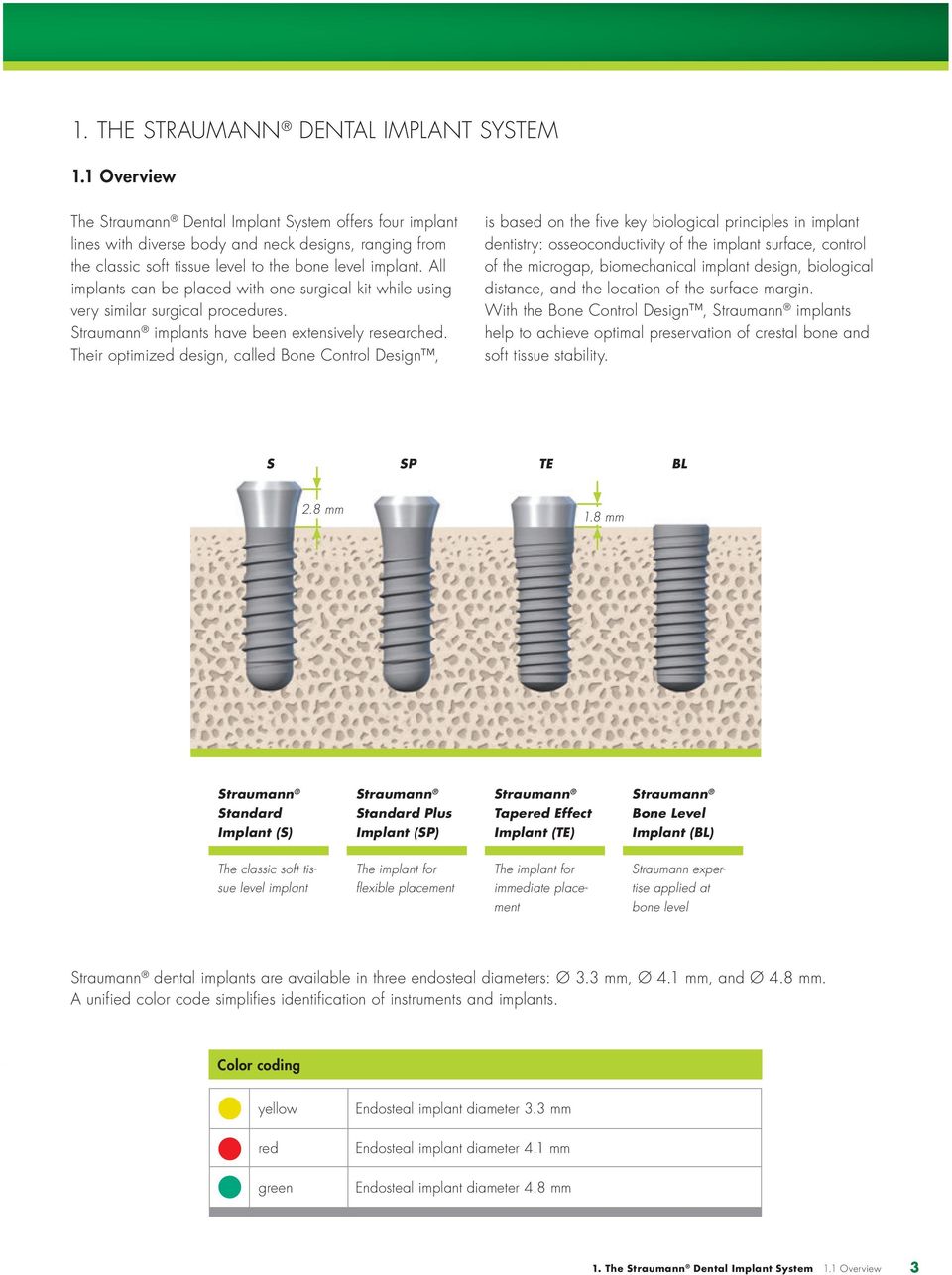
5 1. THE STRAUMANN DENTAL IMPLANT SYSTEM 1.1 Overview The Straumann Dental Implant System offers four implant lines with diverse body and neck designs, ranging from the classic soft tissue level to the bone level implant. All implants can be placed with one surgical kit while using very similar surgical procedures. Straumann implants have been extensively researched. Their optimized design, called Bone Control Design, is based on the five key biological principles in implant dentistry: osseoconductivity of the implant surface, control of the microgap, biomechanical implant design, biological distance, and the location of the surface margin. With the Bone Control Design, Straumann implants help to achieve optimal preservation of crestal bone and soft tissue stability. S SP TE BL 2.8 mm 1.8 mm Straumann Standard Implant (S) Straumann Standard Plus Implant (SP) Straumann Tapered Effect Implant (TE) Straumann Bone Level Implant (BL) The classic soft tissue level implant The implant for flexible placement The implant for immediate placement Straumann expertise applied at bone level Straumann dental implants are available in three endosteal diameters: Ø 3.3 mm, Ø 4.1 mm, and Ø 4.8 mm. A unified color code simplifies identification of instruments and implants. Color coding yellow red green Endosteal implant diameter 3.3 mm Endosteal implant diameter 4.1 mm Endosteal implant diameter 4.8 mm 1. The Straumann Dental Implant System 1.1 Overview 3
6 Implant overview Neck diameter Straumann Standard Implant Straumann Standard Plu S Ø 3.3 RN S Ø 4.1 RN S Ø 4.8 RN S Ø 4.8 WN SP Ø 3.3 NN SP Ø 3.3 RN SP Ø 4.1 RN Ø 4.8 mm Ø 4.8 mm Ø 4.8 mm Ø 6.5 mm Ø 3.5 mm Ø 4.8 mm Ø 4.8 mm ROXOLID TITANIUM 2.8 mm Endosteal diameter SLActive SLActive SLA 8 mm S S 10 mm S S 12 mm S S 14 mm S S 16 mm S Ø 3.3 mm Ø 4.1 mm Ø 4.8 mm Ø 4.8 mm Ø 3.3 mm Ø 3.3 mm Ø 4.1 mm 6 mm S S S S 8 mm S S S S S S S 10 mm S S S S S S S 12 mm S S S S S S S 14 mm S S S S S S 16 mm S S 6 mm S S S S 8 mm S S S S S S S 10 mm S S S S S S S 12 mm S S S S S S S 14 mm S S S S S S 16 mm S S Connection Prosthetic restoration components RN RN RN WN NN RN RN RN synocta RN Solid Abutment Retentive Anchor* steco Titanmagnetics * LOCATOR * RN synocta RN Solid Abutment Retentive Anchor steco Titanmagnetics LOCATOR RN synocta RN Solid Abutment Retentive Anchor steco Titanmagnetics LOCATOR WN synocta WN Solid Abutment NN RN synocta RN Solid Abutment Retentive Anchor* steco Titanmagnetics * LOCATOR * RN synocta RN Solid Abutment Retentive Anchor steco Titanmagnetics LOCATOR *only with Roxolid implants 4 1. The Straumann Dental Implant System 1.1 Overview

7 s Implant Straumann Tapered Effect Implant Straumann Bone Level Implant SP Ø 4.8 RN SP Ø 4.8 WN TE Ø 3.3 RN TE Ø 4.1 RN TE Ø 4.8 WN BL Ø 3.3 NC BL Ø 4.1 RC BL Ø 4.8 RC Ø 4.8 mm Ø 6.5 mm Ø 4.8 mm Ø 4.8 mm Ø 6.5 mm Ø 3.3 mm Ø 4.1 mm Ø 4.8 mm 1.8 mm 1.8 mm Ø 4.8 mm Ø 4.8 mm Ø 3.3 mm Ø 4.1 mm Ø 4.8 mm Ø 3.3 mm Ø 4.1 mm Ø 4.8 mm S S S S S S S S S S S S S S S S S S S S S S S S S S S S S S S S S S S S S S S S S S S S RN WN RN RN WN NC RC RC RN synocta WN synocta RN synocta RN synocta WN synocta NC CrossFit RC CrossFit RC CrossFit RN Solid Abutment WN Solid Abutment RN Solid Abutment RN Solid Abutment WN Solid Abutment LOCATOR LOCATOR LOCATOR Retentive Anchor Retentive Anchor Retentive Anchor steco steco steco Titanmagnetics Titanmagnetics Titanmagnetics LOCATOR LOCATOR LOCATOR steco and Titanmagnetics are trademarks of steco-system-technik GmbH & Co. KG, Germany. LOCATOR is a registered trademark of Zest Anchors, Inc., USA. 1. The Straumann Dental Implant System 1.1 Overview 5

8 1.2 Implant lines Straumann Standard Implant The classic soft tissue level implant Straumann Standard implants have a smooth neck section of 2.8 mm and are especially suitable for classic singlestage procedures, where the implant is placed at soft tissue level and not covered with soft tissue during the healing phase. The Standard Implant uses the Straumann synocta connection together with its corresponding prosthetic components, the Straumann synocta portfolio and the Straumann Solid Abutment. The thread pitch on the Standard implants measures 1 mm for the Ø 3.3 mm implants, and 1.25 mm for all other diameters Straumann Tapered Effect Implant The implant for immediate placement Straumann Tapered Effect implants have a special anatomical design, which combines a cylindrical shape in its apical region and a conical shape in the coronal region, making this implant particularly suitable for immediate or early implantation following extraction or loss of natural teeth. With the smooth neck section of 1.8 mm, healing can occur trans- or subgingivally. Tapered Effect implants have a Straumann synocta connection. Hence, the prosthetic components of the Straumann synocta portfolio and the Straumann Solid Abutment can be used. The thread pitch of 0.8 mm provides excellent primary stability Straumann Standard Plus Implant The implant for flexible placement Straumann Standard Plus implants have a shorter smooth neck section of 1.8 mm that allows flexible coronoapical implant placement in combination with trans- or subgingival healing. This offers the dental surgeon additional options that are particularly useful in the anterior tooth region of the maxilla, where esthetic demands are high. Similar to Straumann Standard implants, this implant type uses the Straumann synocta connection together with its corresponding prosthetic components, the Straumann synocta portfolio and the Straumann Solid Abutment. The thread pitch on the Standard Plus implants measures 1 mm for the Ø 3.3 mm implants, and 1.25 mm for all other diameters Straumann Bone Level Implant Straumann expertise applied at bone level Straumann Bone Level implants are suitable for bone level treatments in combination with trans- or subgingival healing. The implant s rough surface extends to the top of the implant and the connection is shifted inwards. The Bone Level Implant uses a conical-cylindrical connection, the CrossFit Connection, together with its corresponding prosthetic CrossFit components from the Bone Level product portfolio. A cylindrical outer contour and a thread pitch of 0.8 mm, that tapers off in the coronal part of the implant, provide excellent primary stability. The Straumann Standard Plus Narrow Neck implants can be used as an alternative for narrow interdental spaces. They are very flexible for indications where esthetic demands are high. This one-piece design implant has an external connection with a shoulder diameter of 3.5 mm, an endosteal diameter of 3.3 mm, and a smooth neck section of 1.8 mm. Narrow neck implants use their proprietary narrow neck (NN) prosthetic components. The implant has a thread pitch of 1 mm The Straumann Dental Implant System 1.2 Implant lines

9 1.3 Implant-abutment connections Straumann synocta Morse taper connection The Straumann synocta concept was introduced worldwide in 1999, using the well-known Morse taper design principle developed in The mechanically locking friction fit of the Straumann synocta internal connection, with an 8 cone and an octagon for the repositioning of prosthetic parts, shows improved performance over traditional external connections. Abutment loosening, even in screw-retained situations, has virtually been eliminated. The Straumann synocta connection is available for all Straumann Standard, Standard Plus, and Tapered Effect implants with the Regular Neck (RN) and Wide Neck (WN) platform Straumann Narrow Neck connection Straumann Standard Plus Narrow Neck implants have an external connection based on an octagon. Its design is specifically optimized for strength and makes the Straumann Narrow Neck Implant one of the most stable small diameter implants on the market. The Narrow Neck connection can be used only with proprietary narrow neck (NN) prosthetic components. The Narrow Neck connection is available for Straumann Standard Plus Narrow Neck implants only. 1. The Straumann Dental Implant System 1.3 Implant-abutment connections 7

10 1.3.3 Straumann Bone Level CrossFit Connection The CrossFit Connection of Straumann Bone Level implants applies the know-how and benefits from the Straumann synocta Morse taper connection to the connection requirements at bone level. Similar to the Straumann synocta connection, the mechanically locking friction fit of the 15 conicalcylindrical CrossFit Connection with four internal grooves has excellent longterm stability under all loading conditions and virtually eliminates screw loosening. The CrossFit Connection is available for Straumann Bone Level implants only. NC RC Straumann Bone Level Ø 4.1 mm and Ø 4.8 mm implants have the same connection, the regular CrossFit Connection (RC), and share the same secondary components. Straumann Bone Level Ø 3.3 mm implants feature the narrow CrossFit Connection (NC). The corresponding secondary components are colorcoded: p yellow = NC connection p magenta = RC connection Ø 3.3 mm Ø 4.1 mm Ø 4.8 mm 8 1. The Straumann Dental Implant System 1.3 Implant-abutment connections

11 1.4 Surfaces Straumann implants are manufactured from biocompatible pure Grade 4 titanium. All dental implants are provided with the SLActive or the SLA surfaces Straumann SLActive The SLActive surface features the scientifically proven SLA surface topography. Additionally, it exhibits fundamentally improved surface properties such as hydrophilicity and chemical activity which significantly accelerate the entire osseointegration process. Hydrophilicity The hydrophilic properties of SLActive enable a larger accessible surface area for increased blood contact and bone cell attachment. Straumann SLActive surface innovation p Proven SLA surface topography p Hydrophilicity for a larger accessible surface area p Chemical activity promoting faster osseointegration Chemical activity The chemical activity of SLActive provides ideal conditions for direct protein adsorption, stimulating immediate new bone formation Straumann SLA The SLA surface is produced using a large-grit sandblasting technique that generates a macro-roughness on the titanium surface. This is followed by acid-etching that superposes a micro-roughness. The resulting topography offers the ideal structure for cell attachment and is also the basis for the further developed SLActive surface. 1. The Straumann Dental Implant System 1.4 Surfaces 9

12 1.5. Materials Straumann provides implants made of pure titanium grade 4 and a titanium zirconium alloy (Roxolid ) Titanium The complete Straumann implant portfolio is available made of titanium grade 4. Straumann titanium grade 4 is cold worked in order to enhance the mechanical strength. Titanium has shown an excellent biocompatibility on a long term. Its metallic structure allows for producing the implants with the SLA / SLActive surface, thus enabling a good osseointegration Roxolid In addition to titanium implants, Straumann offers part of the implant portfolio made of a new alloy composed of titanium and zirconium, called Roxolid. Roxolid was designed to meet the needs of dental implantologists. Roxolid and SLActive combine higher strength with excellent osseointegration The Straumann Dental Implant System 1.5 Materials

13 2. INDICATIONS AND CONTRAINDICATIONS 2.1 Indications Straumann dental implants are suitable for the treatment of oral endosteal implantation in the upper and lower jaw and for the functional and esthetic oral rehabilitation of edentulous and partially dentate patients (unless specific indications and limitations are present, as stated below). Straumann dental implants can also be used for immediate or early implantation following extraction or loss of natural teeth. Straumann implants are approved, within the scope of indications, for immediate restoration in single tooth gaps and in an edentulous or partially dentate jaw. Good primary stability and an appropriate occlusal load are essential. Two or more adjacent implants should be prosthetically connected together if restored immediately. In the case of immediately restored edentulous indications, at least 4 implants must be connected together. Healing phase duration for delayed restorations is given on page 66. The prosthetic restorations used are single crowns, bridges and partial or full dentures, which are connected to the implants by the corresponding elements (abutments). On page 12, ff. you find implant specific details about indications, the necessary bone volume and the spacing between implants and the distance from adjacent teeth Specific indications for small diameter (Ø 3.3 mm) implants As a general rule, always use the largest possible implant diameter. Because of their reduced mechanical stability, small diameter implants are used only in cases with a low mechanical load. Placement in the molar region is not recommendable. For further restrictions see page 12, ff. 2.2 Contraindications Serious internal medical problems, bone metabolism disturbances, uncontrolled bleeding disorders, inadequate wound healing capacity, poor oral hygiene, maxillary and mandibular growth not completed, poor general state of health, uncooperative, unmotivated patient, drug or alcohol abuse, psychoses, prolonged therapy-resistant functional disorders, xerostomia, weakened immune system, illnesses requiring periodic use of steroids, titanium allergy, uncontrollable endocrine disorders Relative contraindications Previously irradiated bone, diabetes mellitus, anticoagulation drugs/hemorrhagic diatheses, bruxism, parafunctional habits, unfavorable anatomic bone conditions, tobacco abuse, uncontrolled periodontitis, temporomandibular joint disorders, treatable pathologic diseases of the jaw and changes in the oral mucosa, pregnancy, inadequate oral hygiene Local contraindications Inadequate bone volume and/or quality, local root remnants. Attention should be paid to the specific indications of the small diameter implants and the implants with a length of 6 mm as specified above Specific indications for Straumann implants with a length of 6 mm Because of the reduced surface area for anchorage in the bone, these implants are to be used solely for the following indications: p As an additional implant together with longer implants to support implant-borne reconstructions. p As an auxiliary implant for implant-borne bar constructions supporting full dentures in a seriously atrophied mandible. 2. Indications and Contraindications 2.1 Indications 2.2 Contraindications 11

14 2.3 Implant specific indications Titanium implants Specific indications for Straumann Standard and Standard Plus implants Implant type Indications and distinctive features Minimal ridge width* Minimal gap width** SP Ø 3.3 mm NN p Small diameter implant for narrow interdental spaces and ridges 5.5 mm 5.5 mm Caution Placement in the molar region is not recommended S Ø 3.3 mm RN SP Ø 3.3 mm RN p An alternative in the case of a restricted ridge width p In view of their lower mechanical strength compared to the Ø 4.1 mm implants, these implants should be used exclusively for the following indications: p Edentulous jaw: 4 implants S/SP Ø 3.3 RN in conjunction with a bar construction p Partially edentulous jaw: In the case of fixed reconstruction, combined with Ø 4.1 mm implants and splinted with a superstructure Caution Placement in the molar region is not recommended 5.5 mm 7 mm S Ø 4.1 mm RN p For oral endosteal implant indications in the maxilla and mandible, for functional and esthetic rehabilitation of edentulous and partially edentulous patients 6 mm 7 mm SP Ø 4.1 mm RN S = Standard SP = Standard Plus NN = Narrow Neck Ø 3.5 mm RN = Regular Neck Ø 4.8 mm cont. * Minimal ridge width: Minimal orofacial ridge width, rounded off to 0.5 mm ** Minimal gap width: Minimal mesial-distal gap width for a single tooth restoration, between adjacent teeth, rounded off to 0.5 mm Indications and Contraindications 2.3 Implant specific indications

15 Specific indications for Straumann Standard and Standard Plus implants, cont. Implant type Indications and distinctive features Minimal ridge width* Minimal gap width** S Ø 4.8 mm RN SP Ø 4.8 mm RN p For oral endosteal implant indications in the maxilla and mandible, for functional and esthetic rehabilitation of edentulous and partially edentulous patients p The S/SP Ø 4.8 mm implants are especially suited for wider interdental spaces and ridges 7 mm 7 mm S Ø 4.8 mm WN SP Ø 4.8 mm WN p For oral endosteal implant indications in the maxilla and mandible, for functional and esthetic rehabilitation of edentulous and partially edentulous patients p The S/SP Ø 4.8 mm implants are especially suited for wider interdental spaces and ridges p S/SP implants with a WN platform are designed for the reconstruction of teeth with a greater neck diameter 7 mm 8.5 mm S = Standard SP = Standard Plus RN = Regular Neck Ø 4.8 mm WN = Wide Neck Ø 6.5 mm * Minimal ridge width: Minimal orofacial ridge width, rounded off to 0.5 mm ** Minimal gap width: Minimal mesial-distal gap width for a single tooth restoration, between adjacent teeth, rounded off to 0.5 mm 2. Indications and Contraindications 2.3 Implant specific indications 13

16 Specific indications for Straumann Tapered Effect implants Implant type Indications and distinctive features Minimal ridge width* Minimal gap width** TE Ø 3.3 mm RN p For oral endosteal implant indications in the maxilla and mandible, for functional and esthetic rehabilitation of edentulous and partially edentulous patients p Alternative in dental gaps where the roots of adjacent teeth are close together, where implants with a greater endosteal diameter are contraindicated 7 mm 7 mm TE Ø 4.1 mm RN p For oral endosteal implant indications in the maxilla and mandible, for functional and esthetic rehabilitation of edentulous and partially edentulous patients 7 mm 7 mm TE Ø 4.8 mm WN p For oral endosteal implant indications in the maxilla and mandible, for functional and esthetic rehabilitation of edentulous and partially edentulous patients p The TE Ø 4.8 mm implants are especially suited for wider interdental spaces and ridges 8.5 mm 8.5 mm TE = Tapered Effect RN = Regular Neck Ø 4.8 mm WN = Wide Neck Ø 6.5 mm * Minimal ridge width: Minimal orofacial ridge width between adjacent teeth, rounded off to 0.5 mm ** Minimal gap width: Minimal mesial-distal gap width for a single tooth restoration, between adjacent teeth, rounded off to 0.5 mm Indications and Contraindications 2.3 Implant specific indications

17 Specific indications for Straumann Bone Level implants Implant type Indications and distinctive features Minimal ridge width* Minimal gap width** BL Ø 3.3 mm NC p Small diameter implant for narrow interdental spaces and ridges 5.5 mm 5.5 mm Caution Placement in the molar region is not recommended BL Ø 4.1 mm RC p For oral endosteal implant indications in the maxilla and mandible, for functional and esthetic rehabilitation of edentulous and partially edentulous patients 6 mm 6 mm BL Ø 4.8 mm RC p For oral endosteal implant indications in the maxilla and mandible, for functional and esthetic rehabilitation of edentulous and partially edentulous patients p The BL Ø 4.8 mm implants are especially suited for wider interdental spaces and ridges 7 mm 7 mm BL = Bone Level NC = Narrow CrossFit RC = Regular CrossFit * Minimal ridge width: Minimal orofacial ridge width, rounded off to 0.5 mm ** Minimal gap width: Minimal mesial-distal gap width for a single tooth restoration, between adjacent teeth, rounded off to 0.5 mm 2. Indications and Contraindications 2.3 Implant specific indications 15

18 2.3.2 Roxolid implants Specific indications for Straumann Roxolid implants Implant type Distinctive features Minimal ridge width* Minimal gap width** S Ø 3.3 mm RN SLActive Roxolid p Ideal in the case of a restricted ridge width 5.5 mm 7 mm SP Ø 3.3 mm RN SLActive Roxolid TE Ø 3.3 mm RN SLActive Roxolid p For oral endosteal implant indications in the maxilla and mandible, for functional and esthetic rehabilitation of edentulous and partially edentulous patients p Alternative in dental gaps where the roots of adjacent teeth are close together, where implants with a greater endosteal diameter are contraindicated 7 mm 7 mm BL Ø 3.3 mm NC SLActive Roxolid p Small diameter implant for narrow interdental spaces and ridges 5.5 mm 5.5 mm S = Standard SP = Standard Plus TE = Tapered Effect, BL = Bone Level RN = Regular Neck Ø 4.8 mm NC = Narrow CrossFit * Minimal ridge width: Minimal orofacial ridge width between adjacent teeth, rounded off to 0.5 mm ** Minimal gap width: Minimal mesial-distal gap width for a single tooth restoration, between adjacent teeth, rounded off to 0.5 mm Indications and Contraindications 2.3 Implant specific indications

19 3. PREOPERATIVE PLANNING 3.1 Implant position The implant is the focal point of the restoration. It provides the basis for planning the surgical procedure. Close communication between the patient, dentist, surgeon and dental technician is imperative for achieving the desired prosthetic result. To establish the topographical situation, the axial orientation and the choice of implants, we recommend the following: p Make a wax-up/set-up on the previously prepared study cast. p Define the type of superstructure. The wax-up/set-up can later be used as the basis for a custom-made X-ray or drill template and for a temporary restoration. The implant diameter, implant type, position and number of implants should be selected individually, taking the anatomy and spatial circumstances (e.g. malpositioned or inclined teeth) into account. The measurements given here should be regarded as minimum guidelines. Only when the minimum distances are observed is it possible to design the restoration so that the necessary oral hygiene measures can be carried out. The final hard and soft tissue response is influenced by the position between the implant and the proposed restoration. Therefore, it should be based on the position of the implantabutment connection. The implant position can be viewed in three dimensions: p Mesiodistal p Orofacial p Coronoapical Note The implant abutments should always be loaded axially. Ideally, the long axis of the implant is aligned with the cusps of the opposing tooth. Extreme cusp formation should be avoided. It can lead to unphysiological loading. 3. Preoperative Planning 3.1 Implant position 17

20 3.1.1 Mesiodistal implant position The mesiodistal bone availability is an important factor for choosing the implant type and diameter as well as the interimplant distances in the case of multiple implants. The point of reference on the implant for measuring mesiodistal distances is always the shoulder, being the most voluminous part of the implant. Note that all distances given in this chapter are rounded off to 0.5 mm. The following basic rules must be applied: Rule 1 Distance to adjacent tooth at bone level: A minimal distance of 1.5 mm from the implant shoulder to the adjacent tooth at bone level (mesial and distal) is required. S/SP implants TE implants BL implants 1.5 mm 1.5 mm 1.5 mm Rule 2 Distance to adjacent implants at bone level: A minimal distance of 3 mm between two adjacent implant shoulders (mesiodistal) is required. S/SP implants TE implants BL implants 3 mm 3 mm 3 mm Preoperative Planning 3.1 Implant position

21 Examples for single tooth gaps For single tooth restoration, the implant is placed centered within the single tooth gap. The following examples show how rule 1 is implemented. Straumann Standard, Standard Plus, and Tapered Effect implants For Straumann soft tissue level implants, the gap size has to be considered for the selection of the shoulder diameter (NN, RN, WN). In order to make use of the gap width in conjunction with rule 1, the following approximation can be used. Distance between adjacent teeth at bone level 0.5 mm Gap width 0.5 mm The distance between adjacent teeth at bone level is approximately 1 mm (2 x 0.5 mm) more than the gap width. Hence, applying rule 1, the gap width must be 2 mm wider than the implant shoulder. 3. Preoperative Planning 3.1 Implant position 19
22 S/SP/TE implants Shoulder diameter D (mm) Gap width a min (mm) Distance between adjacent teeth at bone level b min (mm) b Ø 3.5 (NN) a D Ø 4.8 (RN) 7 8 Ø 6.5 (WN) Rule D + 2 mm D + 3 mm* 1,5 mm 1,5 mm *Rule 1 applied on both implant sides The Diagnostic T (see page 25), applied in the patient s mouth or on the cast, can be used to obtain an initial measurement of the gap width for the choice of the implant shoulder diameter and prosthetic reconstruction. Straumann Bone Level implants For Straumann Bone Level implants, the distance between adjacent teeth at bone level determines the implant diameter. BL implants Implant diameter D (mm) Gap width a min (mm) Distance between adjacent teeth at bone level b min (mm) b BL Ø a D BL Ø BL Ø Rule D + 2 mm D + 3 mm* 1,5 mm 1,5 mm *Rule 1 applied on both implant sides Preoperative Planning 3.1 Implant position
23 Examples of multiple tooth gaps The following examples show how rules 1 and 2 are implemented in multiple tooth gaps. The measurement is made at bone level from the adjacent tooth to the center of the implant and between implant centers. The minimal distance of 3 mm between two adjacent implant shoulders (rule 2) is important to facilitate flap adaptation, avoid proximity of secondary components and provide adequate space for maintenance and home-care. Straumann Standard, Standard Plus, and Tapered Effect implants S/SP/TE implants Shoulder diameter D 1 (mm) Shoulder diameter D 2 (mm) a min (mm) b min (mm) c min (mm) L min (mm) L Ø 3.5 (NN) Ø 3.5 (NN) a b c Ø 3.5 (NN) Ø 4.8 (RN) D 1 D 2 3 mm Ø 3.5 (NN) Ø 6.5 (WN) Ø 4.8 (RN) Ø 4.8 (RN) Ø 4.8 (RN) Ø 6.5 (WN) ,5 mm 1,5 mm Ø 6.5 (WN) Ø 6.5 (WN) Straumann Bone Level implants BL implants Implant diameter D 1 (mm) Implant diameter D 2 (mm) a min (mm) b min (mm) c min (mm) L min (mm) L BL Ø 3.3 BL Ø a b c BL Ø 3.3 BL Ø D 1 D 2 BL Ø 3.3 BL Ø BL Ø 4.1 BL Ø BL Ø 4.1 BL Ø ,5 mm 3 mm 1,5 mm BL Ø 4.8 BL Ø Preoperative Planning 3.1 Implant position 21
24 3.1.2 Orofacial implant position The facial and palatal bone layer must be at least 1 mm thick in order to ensure stable hard and soft tissue conditions. The minimal orofacial ridge widths for individual implant types are given in the indication tables on page 12, ff. Within this limitation, a restoration-driven orofacial implant position and axis should be chosen such that screw retained restorations are possible. Caution An augmentation procedure is indicated, where the orofacial bone wall is less than 1 mm or a layer of bone is missing on one or more sides. This technique should be employed only by dentists who have adequate experience in the use of augmentation procedures. 1 mm Bone layer at least 1 mm in thickness 1 mm Choose the orofacial implant position and axis so that the screw channel of the screw-retained restoration is located behind the incisial edge Preoperative Planning 3.1 Implant position
25 3.1.3 Coronoapical implant position Straumann dental implants allow for flexible coronoapical implant positioning, depending on individual anatomy, implant site, the type of restoration planned and preference. In the anterior area, a deeper coronoapical implant position is better for esthetic reasons. In this situation, the use of Straumann Standard Plus, Tapered Effect or Bone Level implants is recommended. The following illustration shows the coronoapical implant position for these implants. 2.8 mm 1.8 mm Standard Standard Plus Tapered Effect Bone Level Straumann Standard implants Straumann Standard implants with a smooth neck section of 2.8 mm are submerged in the bone as far as the margin of the SLA /SLActive surface. Straumann Standard Plus and Tapered Effect implants Straumann Standard Plus and Tapered Effect implants with a smooth neck section of 1.8 mm are submerged in the bone as far as the margin of the Straumann SLA/SLActive surface. Optionally they can be placed slightly deeper if necessary. Ideally, in the esthetic region, the implant shoulder should be positioned about 1 mm apical to the cemento-enamel junction (CEJ) of the contralateral tooth or 2 mm subgingival of the prospective gingival margin (see also references on page 24). Caution If a Straumann Standard Plus or a Tapered Effect implant is inserted deeper as the margin of the Straumann SLA /SLActive surface, the preparation depth must be increased accordingly (see also page 67). 3. Preoperative Planning 3.1 Implant position 23
26 Straumann Bone Level implants Straumann Bone Level implants are best set with the outer rim of the small 45 sloping edge (chamfer) at bone level. Ideally, in the esthetic region, the implant shoulder should be positioned about 3 4 mm subgingival of the prospective gingival margin (see also use of Bone Level transfer part on page 48). In a scalloped situation, place the mesial/distal point of the outer rim of the implant to bone level. The lingual/palatinal wall will then extend slightly over the top line of the implant. The buccal wall is located somewhat below the implant edge. For further information regarding surgical procedures in cases pertaining to esthetics, please refer to the following scientific publications: ITI Consensus Paper ITI Treatment Guide Buser D./ Martin W./ Belser U.: Optimizing esthetics for implant restorations in the anterior maxilla: anatomic and surgical considerations. Int J Oral Maxillofac Implants, 2004; 19 Suppl: Buser D./ Martin W, Belser U.: Surgical considerations for single-tooth replacements in the esthetic zone: standard procedure in sites without bone deficiencies. ITI Treatment Guide. Implant Therapy in the Esthetic Zone. Single- Tooth Replacements. 2007, Vol. 1; Quintessence Publishing Co. Ltd, Berlin Preoperative Planning 3.1 Implant position
27 3.2 Planning aids Mesiodistal and orofacial space requirements Diagnostic T for Straumann Standard, Standard Plus, and Tapered Effect implants By using the Diagnostic T in the patient s mouth or on the cast, an initial impression of the spatial relations for the choice of the implant shoulder diameter and prosthetic reconstruction can be obtained. The pictograms on the instruments show which arm is used for which measurement. The use of additional planning methods, such as the use of a drill template (see page 30), is recommended. Note Currently, a Diagnostic T for Straumann Bone Level implants is not available. X = Minimum occlusal space requirement (for the lowest prosthetic restoration option) Y = Interproximal distance (gap width) Z = Implant center to adjacent tooth ( 1 / 2 the gap width) Determining the implant shoulder diameter in a single tooth gap Implant shoulders: NN = Narrow Neck (Ø 3.5 mm) RN = Regular Neck (Ø 4.8 mm) WN = Wide Neck (Ø 6.5 mm) Determining the minimal distance between implant axis and adjacent teeth Minimum vertical space requirement for access with surgical instruments 3. Preoperative Planning 3.2 Planning aids 25
28 Straumann Implant Distance Indicator Two types of distance indicators are available: p For Straumann Standard, Standard Plus and Tapered Effect implants (Art. No ) p For Straumann Bone Level implants (Art. No ) The four discs of the implant distance indicators display the shoulder diameters of Straumann implants. The implant distance indicators can be used to check the available space before the start of treatment or intraoperatively to mark the desired implant site. After flap opening and precise positioning of the disc(s) at the planned implantation site, it is possible to drill through the perforation in the disc(s) with the round bur Ø 1.4 mm (Art. No ) in order to mark the centre of the implant bed. Intraoperative use of the distance indicator before flap opening Round bur Ø 1.4 mm Distance indicator for Straumann Standard, Standard Plus, and Tapered Effect implants Straumann Implant Distance Indicator for Straumann Standard, Standard Plus and Tapered Effect implants (Art. No ) Leg label Disk diameter Corresponding implants Leg 1 RN Ø 4.8 Ø 4.8 mm all Regular Neck (RN) implants Leg 2 RN Ø 4.8 Ø 4.8 mm all Regular Neck (RN) implants Leg 3 NN Ø 3.5 Ø 3.5 mm all Narrow Neck (NN) implants Leg 4 WN Ø 6.5 Ø 6.5 mm all Wide Neck (WN) implants Preoperative Planning 3.2 Planning aids
29 Distance Indicator for Straumann Bone Level implants Straumann Implant Distance Indicator for Straumann Bone Level implants (Art. No ) Leg label Disk diameter Corresponding implants Leg 1 BL Ø 4.1 Ø 4.1 mm Bone Level implants Ø 4.1 mm Leg 2 BL Ø 4.1 Ø 4.1 mm Bone Level implants Ø 4.1 mm Leg 3 BL Ø 3.3 Ø 3.3 mm Bone Level implants Ø 3.3 mm Leg 4 BL Ø 4.8 Ø 4.8 mm Bone Level implants Ø 4.8 mm Determining the vertical bone availability The vertical bone availability determines the maximal allowable length of the implant that can be placed. To make it easier in determining the vertical bone availability, the use of an X-ray template with X-ray reference spheres is recommended X-ray reference sphere The X-ray reference sphere (Art. No V4) has a diameter of 5 mm. The image of the sphere on the X-ray provides the reference value for the magnification scale. To prepare a reference sphere carrying template, the selected implant positions are marked on the study cast. The X-ray reference spheres are fixed at the marked points. The vacuum-formed template is then made with the spheres. The subsequent X-ray shows the vertical bone availability and mucosal thickness, from which the corresponding implant length and type can be derived, in consideration of the enlargement factor. Warning Adhere to production requirements of holding template and ensure that the x-ray sphere is securely fixed within the holding template. 3. Preoperative Planning 3.2 Planning aids 27
30 X-ray templates The X-ray templates are used for measurement and comparison. They also assist the user in selecting the suitable implant type, diameter and length. The following X-ray templates are available: ( V4) = Ø 5,0 mm S S Ø 3,3 mm Ø 4,1 mm RN RN S Ø 4,8 mm RN S Ø 4,8 mm WN SP Ø 3,3 mm NN SP Ø 3,3 mm RN SP Ø 4,1 mm RN SP Ø 4,8 mm RN SP Ø 4,8 mm WN S = Straumann Standard implant NN = Narrow Neck (Ø 3,5 mm) WN = Wide Neck (Ø 6,5 mm) SP = Straumann Standard Plus implant RN = Regular Neck (Ø 4,8 mm) p For Straumann Standard and Standard Plus implants (Art. No ) p For Straumann Tapered Effect implants (Art. No ) p For Straumann Bone Level implants (Art No ) ( V4) = Ø 5,5 mm S S Ø 3,3 mm Ø 4,1 mm RN RN S Ø 4,8 mm RN S Ø 4,8 mm WN max. 0,4 mm SP Ø 3,3 mm NN SP Ø 3,3 mm RN SP Ø 4,1 mm RN SP Ø 4,8 mm RN SP Ø 4,8 mm WN 07/ E20807 Similar to the distortions that occur in X-rays, the implant dimensions are shown on the individual templates with the corresponding distortion factors (1:1 to 1.7:1). X-ray template for Straumann Standard and Standard Plus implants (Art. No ) Determining each magnification factor or scale is facilitated by showing the X-ray reference sphere on the template (next to the scale reference). Tapered Effect Implant 1.0 : ( V4) = Ø 5,0 mm Ø 3,3 mm Ø 4,1 mm RN RN Ø 4,8 mm WN Ø 3,3 mm RN Ø 4,1 mm RN Ø 4,8 mm WN The first stage consists of comparing the size of the X-ray reference sphere on the patient s X-ray with the size of the reference sphere on the template. By superimposing the two pictures, the correct scale can be found. Then, the spatial relations around the implant position are determined and the implant length and insertion depth are established. Tapered Effect Implant 1.1 : ( V4) = Ø 5,5 mm Ø 3,3 mm Ø 4,1 mm RN RN Ø 4,8 mm WN 0,4 mm Ø 3,3 mm Ø 4,1 mm RN RN RN = Regular Neck (Ø 4,8 mm) WN = Wide Neck (Ø 6,5 mm) Ø 4,8 mm WN / E20807 Warning Use only the x-ray template specific to the implant type. X-ray template for Straumann Tapered Effect implants (Art. No ) 1.0 : 1 ( V4) = Ø 5.0 mm ( V4) = Ø 6.0 mm Straumann Bone Level Implant Ø 4.8 mm Ø 4.1 mm Ø 3.3 mm Ø 4.8 mm Ø 4.1 mm 1.2 : 1 Ø 3.3 mm Straumann Bone Level Implant : 1 ( V4) = Ø 5.5 mm ( V4) = Ø 6.5 mm Straumann Bone Level Implant Ø 4.8 mm Ø 4.1 mm Ø 3.3 mm Ø 4.8 mm Ø 4.1 mm 1.3 : 1 Ø 3.3 mm Straumann Bone Level Implant ( V4) = Ø 5.5 mm Example: scale 1.1:1 = reference sphere Ø 5.5 mm X-ray template for Straumann Bone Level implants (Art. No ) 0.4 mm 11/ B Preoperative Planning 3.2 Planning aids
31 To calculate the effective bone availability the following formula should be used: X-ray reference sphere 5 mm x bone availability (X-ray*) Reference sphere diameter on the X-ray = effective bone availability * Taking into consideration all implant-related anatomic structures (e.g. mandibular canal, sinus maxillaris, etc.) Example for a measured bone availability and reference sphere diameter on the X-ray of 13 mm and 6 mm (+ 20 % distortion), respectively. 5 mm x 13 mm 6 mm = 10.8 mm Additional length of the drill tip: Additional length of the drill tip max. 0.4 mm Warning Due to the construction and function of the drills, the drill tip is a maximum of 0.4 mm longer than the implant insertion depth. This additional length must be taken into consideration during the planning phase. See also the section Measurement and analysis procedure for operation planning in the DVD Straumann Dental Implant System Surgical (Art. No ) 3. Preoperative Planning 3.2 Planning aids 29
32 3.2.3 Surgical drill template A custom-made drill template facilitates planning and preparation of the implant bed and enables precise use of the cutting instruments. The planning basis for fabricating this template should be the desired prosthetic result Vacuum-formed drill template A conventional surgical drill template can be produced with the vacuumformed template components. The 10 mm long metal pin functions as the X-ray reference pin. After the pin is integrated into the template, the planned implant axis and position become visible on the X-ray. The drill sleeve is then secured in a drill template. Note For verification, an X-ray with the drill template may also be taken. A Ø 2.2 mm pilot drill is then used for the subsequent drilling. If using single-patient drills Ø 2.2 mm, please ensure that you use drill stop incompatible drills (Art. No S, S, S, S, S, S). These drills have no collar on the shaft and will fit the drill sleeve of the template. For further information see Fabrication and use of an individual drill template (Art. No ), where two fabrication methods are shown gradually in a step-by-step Preoperative Planning 3.2 Planning aids
33 4. SURGICAL PROCEDURES 4.1 Implant bed preparation Preparing the implant bed is done using one surgical kit for all Straumann dental implants and covers two main steps: Steps Influencing factors 1. Basic implant bed preparation Ridge preparation Twist drilling Endosteal implant diameter Basic implant bed preparation involves ridge preparation and twist drilling. For twist drilling, the endosteal diameter of the implant (3.3/4.1/4.8 mm), not the implant type or the bone class, determines the instrumentation used. 2. Fine implant bed preparation Profile drilling Implant type and bone class Fine implant bed preparation involves profile drilling and tapping. For tapping, the implant type (S/SP/ TE/BL) and bone class determine the instrumentation used. Tapping 3. Preoperative Planning 3.2 Planning aids 31
34 Before starting and during the surgical procedure, the following points must be considered: p Check all instruments for completeness and function. An adequate stock of implants and sterile spare instruments should always be available. p Do not use cutting instruments more than 10 times. The table Surgery Tracking Sheet for Straumann Cutting Instruments (Art. No ) facilitates tracking. p Ensure ample cooling of drills with pre-cooled (5 C, 41 F) physiological sterile saline solution (NaCl) or Ringer s solution. p Do not exceed the indicated speed for drills (see graphics and tables on page 33, ff.). p Use drills in ascending order of their diameter. p Use only light pressure and an intermittent drilling technique Surgical procedures 4.1 Implant bed preparation
35 Basic implant bed preparation After opening the gingiva, the basic implant bed preparation begins with preparing the alveolar ridge (Step 1) and marking the implantation site with a round bur (Step 2). After that, the implant bed preparation with pilot and twist drills follows (Step 3 7), according to the endosteal implant diameter chosen in the preoperative planning (see Chapter 3, page 17, ff.) rpm max. Step 1 Prepare the alveolar ridge Carefully reduce and smooth a narrow tapering ridge with a large round bur. This will provide a flat bone surface and a sufficiently wide area of bone. Note When choosing the implant length (SLActive /SLA surface), the vertical reduction of the bone has to be considered rpm max. Step 2 Mark the implantation site Mark the implantation site determined during the implant position planning with the Ø 1.4 mm round bur. The implant distance indicator can be used for that purpose (see pages 26 and 27). Widen and correct the position of the mark with the Ø 2.3 mm or the Ø 3.1 mm round bur, if necessary. 4. Surgical procedures 4.1 Implant bed preparation 33
36 3 800 rpm max. Step 3 Mark the implant axis With the Ø 2.2 mm pilot drill, mark the implant axis by drilling to a depth of about 6 mm. Insert the short side of the depth gauge with the distance indicator to check for correct implant axis orientation. If necessary, correct unsatisfactory implant axis orientation in the following step. Note The distance indicator visualizes the shoulder diameter of 4.8 mm (RN) and enables checking of the probable position of the implant shoulder rpm max. Step 4 Prepare the implant bed to Ø 2.2 mm Pre-drill the implant bed to the final preparation depth with the Ø 2.2 mm pilot drill. Use the Ø 2.2 mm alignment pin to check the implant axis and preparation depth. Caution At this point take an X-ray, particularly with vertically reduced bone availability. The alignment pin is inserted into the drilled area, which allows a comparative visualization of the drill hole in relation to the anatomical structures rpm max. Step 5 Widen the implant bed to Ø 2.8 mm Continue with the implant bed preparation. If necessary, correct the implant position with the Ø 2.8 mm pilot drill. Use the Ø 2.8 mm depth gauge to check the preparation depth. For an implant with an endosteal diameter of 3.3 mm, basic preparation ends here. Continue with the fine implant bed preparation on page Surgical procedures 4.1 Implant bed preparation
37 6 500 rpm max. For Ø 4.1 mm and Ø 4.8 mm implants Step 6 Widen the implant bed to Ø 3.5 mm Continue with the Ø 3.5 mm Straumann Twist Drill PRO and check the final preparation depth with the Ø 3.5 mm depth gauge. For an implant with an endosteal diameter of 4.1 mm, basic preparation ends here. Continue with the fine implant bed preparation on page rpm max. For Ø 4.8 mm implants Step 7 Widen the implant bed to Ø 4.2 mm Continue with the Ø 4.2 mm Straumann Twist Drill PRO and check the final preparation depth with the Ø 4.2 mm depth gauge. Continue with the fine implant bed preparation on page 37. Note To facilitate introducing the instruments into the bone cavity, the bony margin of the drill hole can be beveled slightly using a large round bur or with an SP profile drill corresponding to the diameter of the last twist/spiral drill employed. The profile drills are inserted only a fraction into the drill hole. 4. Surgical procedures 4.1 Implant bed preparation 35
38 The following table summarizes the use of instruments for the basic implant bed preparation according to the endosteal implant diameter. All drills are available in a short and a long version and as multi-use as well as single-patient drills (see also Surgical Instruments on page 67). The table lists the short multi-use drills only. Instrumentation for basic implant bed preparation Step Art. No. Product max. rpm Endosteal Ø (mm) Ø 3,3 Ø 4,1 Ø 4,8 1 Prepare ridge Round bur, Ø 3.1 mm Mark implant position Round bur, Ø 1.4 mm Round bur, Ø 2.3 mm Round bur, Ø 3.1 mm 3 Mark implant axis Pilot drill 1, short, Ø 2.2 mm Depth gauge, with distance indicator, Ø 2.2/2.8 mm 4 Prepare implant bed to Ø 2.2 mm 5 Prepare implant bed to Ø 2.8 mm 6 Prepare implant bed to Ø 3.5 mm Pilot drill 1, short, Ø 2.2 mm Alignment pin, Ø 2.2 mm, straight Pilot drill 2, short, Ø 2.8 mm Depth gauge, with distance indicator, Ø 2.2/2.8 mm Twist drill PRO, short, Ø 3.5 mm Depth gauge Ø 3.5 mm Prepare implant bed to Ø 4.2 mm Twist drill PRO, short, Ø 4.2 mm Depth gauge Ø 4.8 mm Surgical procedures 4.1 Implant bed preparation
39 Fine implant bed preparation The fine implant bed preparation encompasses profile drilling and subsequent tapping. Instrumentation depends on the implant type, the endosteal implant diameter, and the bone class. Profile drilling The profile drill prepares the implant bed for a specific Straumann implant. p Straumann Standard Plus, Tapered Effect, and Bone Level implants require profile drilling with specific instruments. This is independent of the bone class. p Straumann Standard implants are inserted without profile drilling. The profile drills are clearly marked SP, TE, or BL. The (first) diameter indicated on the label corresponds to the diameter of the guide cylinder and, accordingly, to the diameter of the implant bed before profile drilling. All Straumann profile drills are available in a short and a long version. Straumann Standard Plus Profile Drill Straumann Tapered Effect Profile Drill Straumann Bone Level Profile Drill Insertion depth on SLActive /SLA surface margin level Insertion depth on implant shoulder Insertion depth on SLActive /SLA surface margin level Insertion depth on implant shoulder Insert the Straumann Standard Plus Profile Drill according to the planned insertion depth of the implant. Insert the Straumann Tapered Effect Profile Drill according to the planned insertion depth of the implant. Insert the Straumann Bone Level Profile Drill up to the planned implant shoulder level. A dent on the front of the guide cylinder makes the drills better distinguishable from Tapered Effect profile drills. 400 rpm max. 300 rpm max. 300 rpm max. Note Due to the unflared neck portion, the Straumann Standard Plus Ø 3.3 mm NN and Standard Plus Ø 4.8 mm RN implants are inserted without profile drilling. Caution The profile drills are suitable only for the corresponding implant type! 4. Surgical procedures 4.1 Implant bed preparation 37
40 Tapping Tapping prepares the implant bed for a specific thread type. It is an optional step that gives the surgeon the flexibility to adjust the surgical protocol to the bone class to help achieve optimal primary stability. It is recommended in dense bone and with large diameter implants in order to keep the insertion torque in a desirable range. The table below summarizes suggested tap usage. Note TE implants generally do not need tapping. In specific situations of TE implants (e.g. dense bone conditions), the BL/TE tap can be used according to the recommendation for BL implants as suggested in the table below. Tapping according to bone class S, SP implants BL implants Bone Endosteal diameter Endosteal diameter Classes* Ø 3.3 mm Ø 4.1 mm Ø 4.8 mm Ø 3.3 mm Ø 4.1 mm Ø 4.8 mm Class 1 full full full full full full Class 2 coronal coronal full full full full Class 3 full full Class 4 full full * Class 1: hardest bone/class 4: soft bone coronal = thread tapping in the coronal area of the implant bed full = thread tapping over full depth of the implant bed Straumann Standard and Standard Plus taps Straumann Bone Level and Tapered Effect taps Tap for adapter Tap for adapter Coupling for adapter Depth mark Coupling for adapter Label for implant type Depth mark Cutting head S/SP taps are used in the coronal area only or over the full depth of the implant bed, depending on implant diameter and bone class (see table above). Cutting head If a BL/TE tap is used, it should always be inserted over the full depth of the implant bed preparation (see table above). BL/TE taps are available for adapter only. Caution Straumann taps are to be used only for the corresponding implant type! 15 rpm max. 15 rpm max Surgical procedures 4.1 Implant bed preparation
41 Two types of Straumann taps are available: taps for ratchet and taps for adapter. The taps for ratchet are directly coupled to the ratchet, and are for tapping with ratchet only. The taps for adapter can be coupled either to a handpiece or a ratchet adapter and allow both, tapping with the handpiece or with the ratchet. Tapping with handpiece Connect the tap for adapter to the handpiece via the hand-piece adapter. Do not exceed 15 rpm. Tapping with ratchet For tapping with the ratchet connect a ratchet adapter to the tap for adapter. After inserting the tap into the cavity, the ratchet is placed on its coupling and the thread is tapped with a slow rotating movement. The holding key is used as a stabilizer to maintain the direction of tapping during the procedure. Handpiece Handpiece adapter Ratchet Holding key Ratchet adapter Tap for adapter Tap for adapter 4. Surgical procedures 4.1 Implant bed preparation 39
42 4.1.3 Examples for fine implant bed preparation Straumann Standard and Standard Plus implants rpm max. Step 1 Standard Plus profile drill Shape the coronal part of the implant bed with the Standard Plus profile drill. Insert the Standard Plus profile drill up to the planned implant shoulder level (see page 37). Note For Standard implants, profile drilling is not required rpm max. Step 2 Tapping the thread in dense bone Pre-tap the implant bed with the S/SP tap according to the bone class and the endosteal diameter (see table on page 38). Straumann Tapered Effect implants rpm max. Step 1 TE profile drill Shape the coronal part of the implant bed with the TE profile drill. Insert the TE profile drill up to the planned implant shoulder level (see page 37) Surgical procedures 4.1 Implant bed preparation
43 Note TE implants generally do not need tapping. In specific situations of TE implants (e.g. dense bone conditions), the BL/TE tap can be used according to the recommendation for BL implants. Straumann Bone Level implants The following example shows fine implant bed preparation for a Ø 4.1 mm Bone Level Implant of 12 mm of length placed in bone class 1 or 2, making pre-tapping necessary (see table on page 38). These steps follow the basic implant bed preparation (see pages 33 35) rpm max. Step 1 Bone Level profile drill Prepare the implant bed with the Straumann Bone Level profile drill. Insert the profile drill up to the planned implant shoulder level (see page 37) rpm max. Step 2 Tapping the thread in dense bone Pre-tap the entire length of the implant bed with the BL/TE tap. 4. Surgical procedures 4.1 Implant bed preparation 41
44 The following table summarizes the use of profile drills and taps for the fine implant bed preparation for all Straumann implants. All profile drills are available in a short and a long version. S/SP taps are available for ratchet and for adapter. The table lists the short profile drills, and the taps for adapter only. Instrumentation for fine implant bed preparation Straumann Standard Implant Art. No. Product Max. rpm Thread pitch S Ø 3.3 RN S Ø 4.1 RN S Ø 4.8 RN SP Profile drill, short, Ø 2.8 mm, RN SP Profile drill, short, Ø 3.5 mm, RN SP Profile drill, short, Ø 4.2 mm, WN S/SP Tap, Ø 3.3 mm, for adapter S/SP Tap, Ø 4.1 mm, for adapter S/SP Tap, Ø 4.8 mm, for adapter TE Profile drill, short, Ø 2.8 mm RN TE Profile drill, short, Ø 3.5 mm RN TE Profile drill, short, Ø 4.2 mm WN BL Profile drill, Ø 3.3 mm, short BL Profile drill, Ø 4.1 mm, short BL Profile drill, Ø 4.8 mm, short BL/TE Tap, Ø 3.3 mm, for adapter BL/TE Tap, Ø 4.1 mm, for adapter BL/TE Tap, Ø 4.8 mm, for adapter Surgical procedures 4.1 Implant bed preparation
45 Required step * Required in dense bone only Due to the unflared neck portion, the Straumann Standard Plus Ø 3.3 mm NN and Standard Plus Ø 4.8 mm RN implants are inserted without profile drilling. Straumann Standard Plus Implant Straumann Tapered Effect Implant Straumann Bone Level Implant S Ø 4.8 WN SP Ø 3.3 NN SP Ø 3.3 RN SP Ø 4.1 RN SP Ø 4.8 RN SP Ø 4.8 WN TE Ø 3.3 RN TE Ø 4.1 RN TE Ø 4.8 WN BL Ø 3.3 NC BL Ø 4.1 RC BL Ø 4.8 RC * * 4. Surgical procedures 4.1 Implant bed preparation 43
46 4.2 Opening the implant package Straumann SLActive 1 Step 1 Open the blister and remove the vial Note The blister ensures the sterility of the implant. Do not open the blister until immediately prior to implant placement. 2 Step 2 Open the vial Turn the lid in counterclockwise direction. Keep the vial upright to prevent the liquid from flowing out. Note If the implant carrier is not firmly attached to the lid, screw in the lid once again. 3 Step 3 Detach the implant carrier Detach the implant carrier from the lid by pulling it off manually. Note After removing the implant from the solution, the chemical activity of SLActive is ensured for 15 minutes Surgical procedures 4.2 Opening the implant package
47 Straumann SLA 1 Step 1 Open the safety cap Open the safety cap of the sterile ampoule. Note For SLA implants the vial ensures the sterility of the implant, unlike SLActive which utilizes a blister package for sterility. 2 Step 2 Remove the implant from the carrier Simultaneously, pull down the implant carrier and lift the implant out of the implant carrier (while supporting your arms). 4. Surgical procedures 4.2 Opening the implant package 45
48 4.3 Placing the implant A Straumann implant can be placed either manually with the ratchet or with the aid of the handpiece. A maximum speed of 15 rpm is recommended. The following step-by-step shows how a Straumann Standard Plus Implant is placed with the handpiece (left column on the following pages) and how a Straumann Bone Level Implant is placed with the ratchet (right column). Note Straumann Bone Level implants must be rotationally oriented for both, handpiece and ratchet insertion (see Step 5 on page 49). Apart from this exception, all Straumann implants are placed in the same way. Placement with the handpiece Example: Straumann Standard Plus Implant 1 1 Placement with the ratchet Example: Straumann Bone Level Implant click Step 1 Attach the handpiece adapter Grasp the closed part of the implant carrier. Attach the handpiece adapter to the implant. A click is heard when the handpiece adapter is attached correctly. Step 1 Attach the ratchet adapter Hold the implant carrier at the closed end and push the ratchet adapter onto the transfer part until you hear a click Surgical procedures 4.3 Placing the implant
49 2 2 Step 2 Remove the implant from the carrier Simultaneously, pull down the implant carrier and lift the implant out of the implant carrier (while supporting your arms). Step 2 Remove the implant from the carrier Pull the implant carrier slightly downward to remove the implant from the implant carrier. At the same time, lift the implant from the carrier with a slight twisting movement (prop your hands while doing this). 3 3 Step 3 Place the implant Place the implant with the handpiece into the implant bed. Step 3 Place the implant Place the implant manually into the implant bed with the aid of the adapter. 4. Surgical procedures 4.3 Placing the implant 47
50 4 4 4 mm Step 4 Insert the implant with the handpiece Move the implant into final position with a maximum of 15 rpm, turning it clockwise. Note When the floor of the bone cavity is reached, there is a palpable increase in resistance. Step 4 Insert the implant with the ratchet Attach the ratchet and the pivot of the holding key which is used for stabilizing. The clockwise arrow on the rotary knob signals the direction of insertion (see insert). Bring the implant into its final position at bone level with slow movements of the ratchet. The top 4 mm cylindrical part of the transfer part for Straumann Bone Level implants can be used as a depth indicator (e.g. relative to the prospective gingival margin). It facilitates coronoapical implant positioning in the anterior area. Caution An insertion torque of 35 Ncm is recommended. If 35 Ncm is achieved before the implant has assumed its final position, to avoid bone overcompression, check that the implant bed preparation is correct. The transfer piece is provided with a pre-determined breaking point to prevent damage to the inner configuration of the implant, thus ensuring the integrity of the interface for mounting the prosthesis. After breakage of the transfer piece, the remaining part of the transfer piece in the implant must be removed and the implant, if not fitted correctly, has to be unscrewed with a 48h Explantation device. After that the implant bed is to be re-prepared and a new implant has to be inserted. For further details, please consult the brochure Guidance for implant removal Surgical procedures 4.3 Placing the implant
51 5 Step 5 Not needed for S/SP/TE S, SP, and TE implants don t need to be rotationally oriented. If you are placing a Bone Level Implant with the handpiece, choose the correct position as shown in Step 5 in the right column. Step 5 Correct implant orientation While approaching the final implant position, make sure that the drilled holes on the blue transfer part are oriented exactly orofacially. This positions the four protrusions of the internal connection for ideal prosthetic abutment orientation. A quarter turn to the next drilled holes corresponds to a vertical displacement of 0.2 mm. The drilled holes also show the depth of the implant shoulder in the bone. Caution Avoid vertical position corrections using reverse rotations (counterclockwise). This can cause loosening of the transfer part and may lead to a decrease in primary stability. 4. Surgical procedures 4.3 Placing the implant 49
52 6 6 Step 6 Loosen the transfer part Before removing the transfer part, set the motor on the handpiece to reverse. During the first few turns, hold the implant with the holding key which is used for stabilizing (countering) the hexagon. Step 6 Loosen the transfer part Change the direction of the ratchet. The arrow on the rotary knob now points counterclockwise (see insert). Use the holding key to counter the octagon and loosen the transfer part counterclockwise using the ratchet (for details of the holding key see page 73). Remove the transfer part (for details of the holding key see page 73) Surgical procedures 4.3 Placing the implant
53 7 7 Step 7 Remove the instruments Remove the holding key and then completely remove the transfer part with the adapter from the implant. Step 7 Remove the instruments Remove the holding key, then the ratchet, while holding the adapter at the bottom. Finally, remove the transfer part from the implant with the adapter still mounted completely. 4. Surgical procedures 4.3 Placing the implant 51
54 4.4 Soft tissue management After implantation, the implant is closed hand-tightened with an SCS closure screw, healing cap or healing abutment to protect the implant (for SCS screwdrivers see page 73). The surgeon can choose between submucosal and transmucosal healing and has all options available for soft tissue management made possible through a set of secondary healing components. Healing abutment Temporary restoration Final restoration Esthetic results are crucially determined by successful soft tissue management. To optimize the soft tissue management process, various components with Consistent Emergence Profiles are available in the prosthetic portfolio of the Straumann Bone Level Implant. This applies for all healing abutments, the temporary abutment and the abutments for the final restoration. Thus, the emergence profiles are uniform throughout the treatment process (for optimal healing abutment selection see pages 60 65). The non-epithelialized side of the flap should be approximated to the implant neck (soft tissue approximation). If necessary, this step must be combined with a gingivectomy. The wound margins are closed with atraumatic suture material, and the sutures must not be tied too tightly. One relieving suture is placed on either side of the closure screw or healing cap so that the wound margins are approximated without tension. Use of non-absorbable suture material is recommended (e.g. Polyamide or Teflon). The sutures are removed after 7 10 days. A postoperative X-ray is recommended Surgical procedures 4.4 Soft tissue management
55 4.4.1 Submucosal healing For submucosal healing (healing under closed mucoperiosteal flap) the use of a closure screw, shorter healing cap or healing abutment is recommended. Submucosal healing is suggested in esthetic indications and for implantations with simultaneous guided bone restoration (GBR) or membrane technique. A second surgical procedure is required for uncovering the implant and insertion of the desired secondary component. 1 Step 1 Inserting the closure screw after 1st surgery Ensure that the internal configuration of the implant is clean and bloodless. Pick up the closure screw with the SCS screwdriver. The friction fit will secure the closure screw to the instrument during insertion and will allow safe handling. Hand-tighten the closure screw. The design will provide a tight connection between the two components. Note Bone Level closure screws are delivered sterile and ready to use. All other Straumann closure screws are delivered non-sterile and must be sterilized prior to use. Subsequent loosening is made easier by applying chlorhexidine gel or sterile Vaseline to the closure screw before it is screwed into the implant. 4. Surgical procedures 4.4 Soft tissue management 53
56 2 Step 2 Wound closure Adapt the mucoperiosteal flaps carefully and suture together with interrupted sutures. Make sure a tight seal is formed over the implant. 3 Step 3 Reopening and removal: 2nd surgery Locate the implant. Make a small crestal incision down to the closure screw. Spread the flap slightly and remove the closure screw with the SCS screwdriver Surgical procedures 4.4 Soft tissue management
57 4 Step 4 Insertion and wound closure Rinse the exposed internal connection of the implant thoroughly with sterile saline solution. Insert a suitable secondary component. (For optimal Bone Level healing abutment selection see pages ) Adapt the soft tissue and suture it back tightly without tension around the secondary component. 4. Surgical procedures 4.4 Soft tissue management 55
58 4.4.2 Transmucosal healing A versatile portfolio of healing caps and healing abutments is available for all Straumann implants enabling softtissue sculpturing during transmucosal healing. They are recommended for intermediate use. After the soft-tissue healing phase they are replaced with the appropriate temporary or final restoration. (For optimal Bone Level healing abutment selection see pages ) 1 Step 1 Insertion Ensure that the internal configuration of the implant is clean and bloodless. Insert the healing cap or healing abutment with the SCS screwdriver. The friction fit secures the components to the instrument during insertion and ensures safe handling. Hand-tighten the healing cap or healing abutment. The design will provide a tight connection between the two components. Note Healing caps and abutments are delivered non-sterile in blisters and must be sterilized prior to use. Subsequent loosening is made easier by applying chlorhexidine gel or sterile Vaseline to the healing cap or healing abutment before they are screwed into the implant. 2 Step 2 Wound closure Adapt the soft tissue and suture it back tightly around the abutment Surgical procedures 4.4 Soft tissue management
59 Overview of Bone Level abutments and corresponding healing abutments Which healing abutments suit which abutments? Cement-retained solutions Platform NC Type Anatomic abutment Cementable abutment Material Angle Ø (mm) GH (mm) Ti Ti IPS e.max IPS e.max Ti Ti GH (mm) Ø (mm) Type Conical healing abutment Platform RC Type Anatomic abutment Cementable abutment Material Angle Ø (mm) GH (mm) Ti Ti IPS e.max IPS e.max Ti Ti GH (mm) Ø (mm) Type Conical healing abutment 4. Surgical procedures 4.4 Soft tissue management 57
60 Screw-retained solutions Platform NC Type Anatomic abutment Multi-base abutment Material Angle Ø (mm) GH (mm) IPS e.max IPS e.max Ti Ti Ti GH (mm) Ø (mm) Type Conical healing abutment Platform RC Type Anatomic abutment Multi-base abutment Material Angle Ø (mm) GH (mm) IPS e.max IPS e.max Ti Ti Ti GH (mm) Ø (mm) Type Conical healing abutment Surgical procedures 4.4 Soft tissue management
61 Hybrid solutions Platform NC Type Multi-base abutment LOCATOR Material Angle Ø (mm) GH (mm) Ti Ti Ti Ti alloy GH (mm) Ø (mm) Type Conical healing abutment Platform RC Type Multi-base abutment LOCATOR Material Angle Ø (mm) GH (mm) Ti Ti Ti Ti alloy GH (mm) Ø (mm) Type Conical healing abutment 4. Surgical procedures 4.4 Soft tissue management 59
62 5. HEALING PHASE 5.1 Healing phase duration Situation Healing phase SLActive SLA p Good bone quality and adequate bone quantity p Implants with a diameter of 4.1 mm or 4.8 mm and a Straumann SLActive/SLA surface length of 8 mm At least 3 4 weeks At least 6 weeks p Cancellous bone quality p Implants with a diameter of 3.3 mm p Implants with a Straumann SLActive/SLA surface length of 6 mm At least 8 weeks At least 12 weeks p Straumann SLActive/SLA surface is not completely in contact with the bone p Bone augmentation measures* are necessary Healing phase corresponding to the situation SLActive = Sand-blasted, Large grit, Acid-etched, chemically active and hydrophilic, SLA = Sand-blasted, Large grit, Acid-etched * This technique should be employed only by dentists who have adequate experience in the use of augmentation procedures. 5.2 Straumann SLActive and SLA in comparison The bone formation process is initiated at an earlier stage with Straumann SLActive, resulting in significantly earlier secondary stability and thus risk reduction during the critical healing period. Total stability with SLA Total stability with SLActive Total stability Total stability Stability Primary stability (old bone) Stability dip SLA Secondary stability (new bone) S. Raghavendra, M. Wood, T.D. Taylor (2005) Stability Primary stability (old bone) SLActive Secondary stability (new bone) SLA SLActive (blue line), SLA (dotted blue line) Time (weeks) Time (weeks) Healing phase 5.1 Healing phase duration 5.2 Straumann SLActive and SLA in comparison
63 6. ADDITIONAL INFORMATION ON INSTRUMENTS 6.1 Surgical instruments Instruments must be checked for completeness and function. An adequate stock of implants and spare sterile instruments should always be available. The instruments must be disassembled for sterilization. Well maintained instruments prevent infections from developing that could endanger patients as well as the practice team. To avoid contamination of the operation field, all of the instruments and material employed must be sterile. To prevent contamination of the sterile instruments, they should be removed from the surgical cassette with a sterile forceps and put into the handle or ratchet. The forceps (Art. No ) was developed and shaped specially to allow round instruments to be gripped securely. Forceps All steps related to the maintenance of Straumann surgical instruments are part of a dental practice hygiene plan (see also Care and maintenance of surgical and prosthetic instruments (Art. No ) Depth marks on Straumann instruments Straumann instruments have depth marks in 2 mm intervals that correspond to the available implant lengths. The marks on drills are continuous between 10 mm and 12 mm. The lower edge of the mark corresponds to 10 mm and the upper edge to 12 mm. When inserting a Straumann Standard Plus or Tapered Effect Implant up to the implant shoulder level (see Preoperative Planning on page 23), the preparation depth must be 2 mm more than the indicated implant length. Example: The preparation depth for a 10 mm SP implant inserted up to shoulder level must be 12 mm. 12 mm 10 mm 8 mm 6 mm Pilot drill 1, Ø 2.2 mm 2. Alignment pin, Ø 2.2 mm 3. Pilot drill 2. Ø 2.8 mm 4. Twist drill PRO, Ø 3.5 mm 5. Twist drill PRO, Ø 4.2 mm 6. Straumann Standard Plus Implant, Ø 4.1 RN, length 10 mm 7. Straumann Bone Level Implant, Ø 4.1 RC, length 10 mm 12 mm 10 mm Warning Due to the function and design of the drills, the drill tip is 0.4 mm longer than the insertion depth of the implant (see also page 28 on X-ray templates). Additional length of the drill tip max. 0.4 mm 6. Additional information on instruments 6.1 Surgical Instruments 61
64 6.1.2 Single-patient pilot and twist drills Like multi-use drills, single-patient drills are indicated for the preparation of the implant bed for Straumann Dental Implants. They are supplied sterile and are to be used for one operation only and for one patient only. Singlepatient drills can minimize the risk of infection for the patient. They are color-coded for easy identification of the diameter width. Retention collar for drill stop mounting Due to the function and design of the drills, the drill tip is 0.4 mm longer than the insertion depth of the implant. There are 2 types of single-patient drills offered: p Drill stop compatible drills (Art. No S, S, S, S, S, S) p Drill stop incompatible drills (Art.No S, S, S, S, S, S) Single patient drill, drill stop compatible (with collar for drill stop mounting) Drill stop compatible drills are used with the Straumann Drill Stop as described in section below. Drill stop incompatible drills do not have a retention collar on the shaft and are particularly indicated for use with surgical drill templates ( see section 3.2.3). These drills fit the drill sleeves of surgical drill templates Straumann Drill Stop Precise depth control The Straumann Drill Stop provides precise control over drilling depth during implant bed preparation for the placement of Straumann dental implants. Delivered in sterile sets the drill stops are ready to use. The Straumann Drill Stop is designed for single-patient use only and must be used in conjunction with the single-patient drills specifically designed for them. Each Straumann Drill Stop Set includes drill stops with the following diameters: Ø 2.2 mm (blue), Ø 2.8 mm (yellow), Ø 3.5 mm (red), Ø 4.2 mm (green). These diameters correspond to the diameters of the Straumann drills. Ø 2.2 mm Ø 2.8 mm Ø 3.5 mm Ø 4.2 mm Drill Stop Set for one depth Additional information on instruments 6.1 Surgical Instruments
65 Straumann Drill Stop reference chart Short drill Long drill Implant bed depth Drill stop type Drill stop type 16 mm 14 mm 12 mm 10 mm 8 mm 6 mm A B C D A B C D Note Straumann drill stops are not indicated for: p Extraction sites, where bone cavity is often wider than the diameter necessary to hold the drill stop. p Use with drill templates, due to the interference from or with the template. For more information of the Straumann Drill Stop please refer to the brochure Straumann Drill Stop: Precise depth control (Art. No ). 6. Additional information on instruments 6.1 Surgical Instruments 63
66 6.1.4 Straumann Surgical Cassette The surgical cassette is used for the secure storage and sterilization of the surgical instruments and auxiliary instruments of the Straumann Dental Implant System. The cassette is made of a highly shock-proof thermoplastic, which has been proven for years in the medical area and is suitable for frequent sterilization in the autoclave. Screw container Endosteal implant diameter 3.3 mm Endosteal implant diameter 4.1 mm Endosteal implant diameter 4.8 mm p New and simple layout: color-coded application pathways guide through the surgical procedure p Convenient format for all instruments needed for the implantation clearly arranged and ready at hand p Screw container designed to hold Straumann healing caps, healing abutments and closure screws p The instruments are positioned securely in the silicone sleeves for sterilization and storage p The cassette can be packed according to the working procedure Additional information on instruments 6.1 Surgical Instruments
67 Guidelines for the sterilization of the surgical cassette Method Temperature Exposure Time Fractionated vacuum method 121 C (250 F) at least 20 min Fractionated vacuum method 132 C (270 F) up to 134 C (273 F) at least 3 min* Gravitation method 132 C (270 F) up to 134 C (273 F) at least 5 min * 18 min for prion inactivation Pack the instruments or the sterilization cassettes singly or doubly in disposable sterilization packaging corresponding to the following requirements: p Suitable for steam sterilization (temperature resistance up to at least 137 C (278.6 F), sufficient steam permeability) p Sufficient protection of the instruments or sterilization packaging against mechanical damage p DIN EN ISO/ANSI AAMI ISO 11607¹ Note In order to avoid damaging the surgical cassette during autoclaving, it must be placed correctly in the autoclave (see fig.). Always observe the operating instructions of the manufacturer for your sterilizer, especially with regard to loading weight, operating time and functional testing. Corroded and rusty instruments can contaminate the water circuit of the sterilizer with rust particles. These rust particles will cause initial rust on intact instruments in all future sterilization cycles. It is important to regularly inspect and clean the unit! The instruments must be stored dry after sterilization. Caution Flash sterilization method is not permissible. Also, do not use hot-air sterilization, radiation sterilization, plasma sterilization, formaldehyde or ethylene oxide sterilization. See also DVD Straumann Dental Implant System Surgical, Art. No , Surgical cassette or refer to the brochure Care and maintenance of surgical and prosthetic instruments, Art. No ¹ DIN EN ISO/ANSI AAMI ISO Packaging for terminally sterilized medical devices 6. Additional information on instruments 6.1 Surgical Instruments 65
68 6.1.5 Ratchet Ratchet Service instrument Ratchet disassembled The ratchet of the Straumann Dental Implant System is a two-part lever arm instrument with a rotary knob for changing the direction of force. The ratchet is supplied with a service instrument, which is used to loosen the headed screw. After loosening, the ratchet bolt can be removed from the body of the ratchet. It must be disassembled for cleaning and sterilization. The ratchet is required for the following operations: p manual thread tapping p manual placement of implants into their final position in the implant bed Additional information on instruments 6.1 Surgical Instruments
69 6.1.6 Holding key The holding key is used for p stabilizing the ratchet. p countering the transfer part. Holding key Stabilizing the ratchet Use the pivot of the holding key to stabilize the ratchet during implant insertion or during tapping. Stabilizing the ratchet Countering the transfer part Use the holding key for countering when loosening the transfer part from the implant. The transfer part should be loosened only with the ratchet or handpiece (counterclockwise). The shape of the holding key is specially designed for different oral situations p Forked end: when spaces are normal, the forked end is attached directly to the hexagon. p Closed end: when the interdental space is limited, the closed end must be placed on the hexagon over the transfer part. To do this, the ratchet and adapter or handpiece must be removed. Forked end Closed end SCS screwdrivers SCS screwdriver for manual use Article: extrashort, short, long Lengths: 15 mm, 21 mm, 27 mm Material: stainless steel SCS screwdriver for mechanical use in the handpiece Article: extrashort, short, long Lengths: 20 mm, 26 mm, 32 mm Material: stainless steel 6. Additional information on instruments 6.1 Surgical Instruments 67
70 6.2 Osteotomes Instrument set for bone condensation p Indicated in cases with cancellous bone (bone class 3 and 4). p Reinforces bone radially to give improved primary stability to the implant. p Before the instruments are used, it is advisable to mount the depth stops in order not to exceed the pre-determined working depth. These are mounted onto the instrument using a SCS screwdriver. p Instruments of increasing diameter are introduced manually using slightly rotary movements or, if necessary, lightly tapping with a hammer in accordance with the desired implant length and implant diameter. p Insert the implant carefully without applying extra force Note The instruments with diameters of 2.2 mm, 2.8 mm, 3.5 mm and 4.2 mm match the implant diameters of the Straumann Dental Implant System. They are available as a straight or angled model, which facilitates access in the posterior region. Osteotomes for bone condensation Instrument set for transalveolar sinus floor elevation Indicated in cases with inadequate vertical bone. By tapping on the osteotomes with a mallet, the sinus floor can be fractured and elevated. p The bone is prepared using the twist drills (Ø 2.2 mm/2.8 mm/3.5 mm/ 4.2 mm) in accordance with the desired implant diameter. The surgeon feels his or her way very carefully up to the cortical bone of the sinus floor (minimum distance 1 mm). This process requires precise radiological planning. p Before the instruments are used, it is advisable to mount the depth stops in order not to exceed the pre-determined working depth. These are mounted onto the instrument using a SCS screwdriver. p First, the sinus floor is fractured, which requires precise radiological planning. The use of depth stops is also recommended in order not to exceed the pre-determined working depth. The instrument is introduced by lightly tapping with a hammer in accordance with the desired implant length. p During elevation, autologous and/or alloplastic filling or bone material should also be applied to the implant bed. The material introduced acts like a cushion lifting the mucous membrane in accordance with principles of hydraulics. p Insert the implant carefully without applying extra force Osteotomes for sinus floor elevation Note The instruments with diameters of 2.2 mm, 2.8 mm, 3.5 mm and 4.2 mm match the implant diameters of the Straumann Dental Implant System. They are available as a straight or angled model, which facilitates access in the posterior region Additional information on instruments 6.2 Osteotomes
71 6.2.3 Depth stops for osteotomes All osteotomes have clear laser marks for depths of 6 mm, 8 mm, 10 mm, 12 mm and 14 mm. In addition, adjustable depth stops facilitate depth checking. See also DVD Straumann Dental Implant System Surgical (Art. No ). Depth stops for osteotomes 6.3 Cleaning and care of instruments Careful treatment of all instruments is of the utmost importance. Even slight damage for instance to the drill tips (e.g., when the drills are thrown into a bowl of water) impairs cutting performance and thus the clinical result. With correct and careful care, the high quality of the material and excellent workmanship ensure that the rotating instruments (drills*, taps etc.) can be used repeatedly (up to a maximum of ten times is recommended). The Surgery tracking sheet for Straumann cutting instruments (Art. No ) helps to give an overview of how often the individual instruments have already been used. *Exception: Single-patient drills (see page 65). SURGERY TRACKING SHEET FOR STRAUMANN CUTTING INSTRUMENTS Article Art. No. Dimensions Number of surgical procedures Round bur Ø 1.4 mm Round bur Ø 2.3 mm Round bur Ø 3.1 mm Pilot drill Ø 2.2 mm, short Pilot drill Ø 2.2 mm, long Pilot drill Ø 2.8 mm, short Pilot drill Ø 2.8 mm, long Twist drill PRO Ø 3.5 mm, short Twist drill PRO Ø 3.5 mm, long Twist drill PRO Ø 4.2 mm, short Twist drill PRO Ø 4.2 mm, long SP Profile drill, RN Ø 2.8 mm, short SP Profile drill, RN Ø 2.8 mm, long SP Profile drill, RN Ø 3.5 mm, short SP Profile drill, RN Ø 3.5 mm, long SP Profile drill, WN Ø 4.2 mm, short SP Profile drill, WN Ø 4.2 mm, long TE Profile drill, RN Ø 2.8 mm, short TE Profile drill, RN Ø 2.8 mm, long TE Profile drill, RN Ø 3.5 mm, short TE Profile drill, RN Ø 3.5 mm, long TE Profile drill, WN Ø 4.2 mm, short TE Profile drill, WN Ø 4.2 mm, long BL/NNC Profile drill Ø 3.3 mm, short BL/NNC Profile drill Ø 3.3 mm, long BL Profile drill Ø 4.1 mm, short BL Profile drill Ø 4.1 mm, long BL Profile drill Ø 4.8 mm, short BL Profile drill Ø 4.8 mm, long S/SP Tap for Ø 3.3 mm, short ratchet Institut Straumann AG, All rights reserved. Straumann and/or other trademarks and logos from Straumann mentioned herein are the trademarks or registered trademarks of Straumann Holding AG and/or its affiliates. All rights reserved. S/SP Tap for ratchet Ø 3.3 mm, long S/SP Tap for adapter Ø 3.3 mm S/SP Tap for ratchet Ø 4.1 mm, short S/SP Tap for ratchet Ø 4.1 mm, long S/SP Tap for adapter Ø 4.1 mm S/SP Tap for ratchet Ø 4.8 mm, short S/SP Tap for ratchet Ø 4.8 mm, long S/SP Tap for adapter Ø 4.8 mm BL/TE/NNC Tap for adapter Ø 3.3 mm BL/TE Tap for adapter Ø 4.1 mm BL/TE Tap for adapter Ø 4.8 mm Straumann products are CE marked 10/ /en BA21012 Note Because Straumann drills and taps are precisely manufactured and made of high quality material, they can be used in up to 10 surgical procedures. However, careful handling and cleaning techniques are essential to maintain correct function (refer to Care and maintenance of surgical and prosthetic instruments ). For additional information visit 6. Additional information on instruments 6.3 Cleaning and care of instruments 69
72 Instruments with high cutting performance are a basic requirement for successful implantation. The following should therefore be remembered: p Never allow instruments to land on their tips. p Use each instrument only for its intended purpose. p Never let surgical residues (blood, secretion, tissue residues) dry on an instrument; clean immediately after surgery. p Thoroughly clean off incrustations with soft brushes only. Disassemble instruments, clean cavities especially well. p Never disinfect, clean (also ultrasound) or sterilize instruments made of different materials together. p Use only cleaning agents and disinfectants intended for the material and follow the instructions for use of the manufacturer. p Rinse disinfectants and cleaning agents very thoroughly with water. p Never leave or store instruments moist or wet. You will find detailed information in the brochure Care and maintenance of surgical and prosthetic instruments Art. No Ultrasonic Cleaning Cassette The Ultrasonic Cleaning Cassette ensures optimal storage during instrument disinfection and cleaning in the ultrasonic bath. The pimpled silicone mat prevents the cutting edges of the instruments from coming in contact, which would have a negative effect on their cutting performance Additional information on instruments 6.3 Cleaning and care of instruments
73 7. APPENDIX 7.1 Labeling and color coding of the Straumann Dental Implant System Naming and labeling explanations Color coding yellow red green Endosteal implant diameter 3.3 mm Endosteal implant diameter 4.1 mm Endosteal implant diameter 4.8 mm Implant types S: Standard Implant SP: Standard Plus Implant TE: Tapered Effect Implant BL: Bone Level Implant Connection types NN: Narrow Neck Ø 3.5 mm Ø 3.5 mm RN: Regular Neck Ø 4.8 mm Ø 4.8 mm WN: Wide Neck Ø 6.5 mm Ø 6.5 mm NC: Narrow CrossFit Ø 3.3 mm Ø 3.3 mm RC: Regular CrossFit Ø 4.1 and Ø 4.8 mm Ø 4.1 mm Ø 4.8 mm 7. Appendix 7.1 Labeling and color coding of the Straumann Dental Implant System 71
74 Example of label on implant packaging Connection type Length of the SLA /SLActive surface Implant type Endosteal diameter Surface type Catalog number Batch code 128 Barcode The Green Dot Use by Manufacturer Do not re-use Caution: Federal law restricts this device to sale by or on the order of a dental professional Caution, consult accompanying documents Straumann Products with the CE mark fulfill the requirements of the Medical Devices Directive 93/42 EEC Sterilized using irradiation Ø 3.3 SP 8 NN SP Ø 4.1 RN SLActive 10Ti TE Ø 4.8 WN SLActive 12Ti BL Ø 4.1 RC SLActive 12Ti Straumann Standard Plus Implant Endosteal diameter 3.3 mm Narrow Neck 8 mm SLA Straumann Standard Plus Implant Endosteal diameter 4.1 mm Regular Neck 10 mm SLActive Straumann Tapered Effect Implant Endosteal diameter 4.8 mm Wide Neck 12 mm SLActive Straumann Bone Level Implant Endosteal diameter 4.1 mm Regular CrossFit 12 mm SLActive Appendix 7.1 Labeling and color coding of the Straumann Dental Implant System
75 7.2 Related documentation Note Our detailed documentation will help you in carefully planning and performing your implant-based restorations: p Straumann Narrow Neck, Art. No p Crown and Bridge Restorations: Straumann synocta Prosthetic System, Art. No p Cement-retained crowns and bridges with the solid abutment system: Straumann Solid Abutment Prosthetic System, Art. No p Straumann Osteotomes, Art. No and p Straumann Bone Level Implant line: Basic information on the prosthetic procedures, Art. No The DVD Straumann Dental Implant System Surgical, Art. No , features the following films: p Measurement and analysis procedure for operation planning p Implantation of a Standard Plus implant p Implantation of a Tapered Effect implant p Surgical cassette p Osteotomes Instrument care and maintenance Well maintained instruments are a basic requirement for successful treatment. You will find detailed information in the brochure Care and maintenance of surgical and prosthetic instruments Art. No The Straumann guarantee As a Swiss company, we attach the greatest importance to manufacturing our products in to the highest quality. We are firmly convinced of the scientific and clinical basis of our Straumann Dental Implant System and draw on the fund of know-how from nearly 30 years of quality production. The Straumann guarantee regulates replacement of all components of the Straumann Dental Implant System. You will find detailed information in the brochure The Straumann guarantee Art. No Explantation For explantation guidelines please refer to the Directions for use: Explantation procedure for Straumann dental implants, Art. No The components required for explanation can be found in our current product catalogue. References The Straumann Dental Implant System has been comprehensively clinically documented for over 25 years. You can find references to the current research literature on our website or by contacting your local Straumann representative. Courses and training Continuing education ensures long-term success! Please, ask your Straumann representative directly for information on the Straumann Dental Implant System courses and training. Further information at 7. Appendix 7.2 Related documentation 73
76 Custom-made products Under certain circumstances, custom-made products can be supplied for special indications or cases that cannot be treated with standard products. A custom-made product is defined according to EEC directive 93/42/EEC (Article 1, section d) as being any product fabricated specifically for a specific patient according to specific characteristics and prescribed in writing by an appropriately qualified doctor, who assumes the responsibility. List of abbreviations SCS = Screw Carrying System HDD = Horizontal Defect Dimension SLActive = Sand-blasted, Large grit, Acid-etched, chemically active and hydrophilic SLA = Sand-blasted, Large grit, Acid-etched If you require a custom-made product, please contact your customer service. Quality assurance in accordance with MDD 93/42/EEC All production stages carried out by Institut Straumann AG are subject to the Standards laid down in the EN ISO 9001 quality assurance system. This European standard establishes in detail the criteria which a company must fulfil regarding comprehensive quality assurance during its manufacturing processes in order to be recognized. Particularly high standards are rightly expected of medical products. They are defined in European standards ISO 13485, which we also meet. This ensures that the quality of our products and services meets our customers expectations, and can be reproduced and traced at any time. Our products comply with the essential requirements defined in the Medical Devices Directive 93/42/EEC. All of our medical products therefore carry the CE mark. Institut Straumann AG meets the stringent requirements of European directive MDD 93/42/EEC for medical devices and standards EN ISO 9001 and ISO NN = Narrow Neck (3.5 mm) RN = Regular Neck (4.8 mm) WN = Wide Neck (6.5 mm) NC = Narrow CrossFit Connection (for BL implants) RC = Regular CrossFit Connection (for BL implants) S = Standard SP = Standard Plus TE = Tapered Effect BL = Bone Level Appendix 7.2 Related documentation
77 IMPORTANT GUIDELINES 7.3 Important Guidelines Please note Practitioners must have appropriate knowledge and instruction in the handling of the Straumann dental implants, Straumann CADCAM products, Straumann regenerative products or other Straumann products ( Straumann Products ) for using the Straumann Products safely and properly in accordance with the instructions for use. Explanation of the symbols on labels and instruction leaflets Batch code Catalogue number The Straumann Product must be used in accordance with the instructions for use provided by the manufacturer. It is the practitioner s responsibility to use the device in accordance with these instructions for use and to determine, if the device fits to the individual patient situation. min. Sterilized using irradiation Lower limit of temperature The Straumann Products are part of an overall concept and must be used only in conjunction with the corresponding original components and instruments distributed by Institut Straumann AG, its ultimate parent company and all affiliates or subsidiaries of such parent company ( Straumann ). Use of products made by third parties, which are not distributed by Straumann, will void any warranty or other obligation, express or implied, of Straumann. max. max. Upper limit of temperature Availability Some of the Straumann Products listed in this document may not be available in all countries. min. Temperature limitation Caution In addition to the caution notes in this document, our products must be secured against aspiration when used intraorally. Validity Upon publication of this document, all previous versions are superseded. Caution: Federal law restricts this device to sale by or on the order of a dental professional. Do not re-use Documentation For detailed instructions on the Straumann Products contact your Straumann representative. Non-sterile Copyright and trademarks Straumann documents may not be reprinted or published, in whole or in part, without the written authorization of Straumann. Straumann and/or other trademarks and logos from Straumann mentioned herein are the trademarks or registered trademarks of Straumann Holding AG and/or its affiliates. Caution, consult accompanying documents Use by Keep away from sunlight Straumann Products with the CE mark fulfill the requirements of the Medical Devices Directive 93/42 EEC 0123 Consult instructions for use 7. Appendix 7.3 Important Guidelines 75
78 8. INDEX axial orientation 17 biological principles 3 bone availability 27, 34 augmentation 60 class 41 condensation 68 damage 48 effective availability 29 formation process 60 quality 60 quantity 60 Bone Control Design 3 buccal wall 24 cemento-enamel-junction 23 color-coded 62 contraindications 11 contralateral 23 coronal 38 coronoapical 23 CrossFit Connection 8 dental practice hygiene plan 61 depth marks 61 depth stops 68 Diagnostic T 20, 25 drill template custom made 30 free end situations 31 single tooth gaps 31 vacuum formed 30 drilling depth 62 endosteal diameters 3 full depth tapping 38 healing phase duration 60 holding key 50, 67 hydrophilic properties 9 implant diameter 17 distance indicator 26 insertion depth 29 orofacial 22 position 17, 34 Roxolid 4, 16 shoulder diameter 25 specific indications 12 Straumann Bone Level 6 Straumann Standard 6 Straumann Standard Plus 6 Straumann Tapered Effect 6 titanium 4, 12 indications 11 insertion depth 62 instrumentation 37 instruments 36, 61 lingual/palatinal wall 24 mesial/distal point 24 minimum guidelines Index
79 materials 10 Morse taper connection 7 osteotomes 69 pilot drill 34 preparation implant bed 33 basic 33 fine 37 preparation depth 61 profile drilling 37 ratchet 66 reconstruction prosthetic 25 reference sphere diameter 28 risk of infection minimize 62 Roxolid 10 SCS screw driver 67 single tooth gap 19 single-patient drill new generation 62 sinus floor elevation 68 SLA surface 9, 60 Standard Implant 23 Straumann Dental Implant System 3 Straumann Drill Stop 62 Straumann Drill Stop Set 62 Straumann SLA 9, 60 Straumann SLActive 9, 60 Straumann Surgical cassette 64 superstructure 17 surfaces 9 surgical kit 3, 32 synocta connection 7 tapered effect 23 tapping 38 template vacuum-formed 30 titanium 10 transfer part 48 Twist Drill PRO 35 twist drill 61 wax-up/set-up 17 X-ray distortion 28 templates 28 X-ray reference sphere Index 77
80 International Headquarters Institut Straumann AG Peter Merian-Weg 12 CH-4002 Basel, Switzerland Phone +41 (0) Fax +41 (0) Institut Straumann AG, All rights reserved. Straumann and/or other trademarks and logos from Straumann mentioned herein are the trademarks or registered trademarks of Straumann Holding AG and/or its affiliates. All rights reserved. Straumann products are CE marked 10/ /en B21012
Straumann Dental Implant System. Implant Selection Guide.
 Straumann Dental Implant System. Implant Selection Guide. STRAUMANN's IMPLANT PORTFOLIO The Straumann Dental Implant System offers two implant lines with diverse body and neck designs ranging from the
Straumann Dental Implant System. Fax Order Form Collection.*
 Straumann Dental Implant System. Fax Order Form Collection.* * The NNC Fax Order Form is still a stand alone document due to the unique restorative portfolio Straumann Roxolid SLActive Tissue Level Implants
United States. Product Catalog 2015
 United States Product Catalog 2015 2 The ITI (International Team for Implantology) is academic partner of Institut Straumann in the areas of research and education. Valid from January 1, 2015 until superseded
More than a fixed rehabilitation.
 More than a fixed rehabilitation. A reason to smile. In combination with: Patient expectations drive dental treatments for fixed edentulous immediate restorations. Patients today have increasingly high
Guidance for implant removal. Straumann Dental Implant System
 Guidance for implant removal Straumann Dental Implant System The ITI (International Team for Implantology) is academic partner of Institut Straumann AG in the areas of research and education. ContentS
PRoduct catalog International Headquarters Straumann USA Straumann Canada talog PRoduct
 PRoduct Catalog 2012 The ITI (International Team for Implantology) is academic partner of Institut Straumann in the areas of research and education. Valid from February 1, 2012 until superseded by a new
Implants in your Laboratory: Abutment Design
 1/2 point CDT documented scientific credit. See Page 41. Implants in your Laboratory: Abutment Design By Leon Hermanides, CDT A patient s anatomical limitations have the greatest predictive value for successful
Basic information on the surgical procedures for the. Straumann Bone Level Tapered Implant
 Basic information on the surgical procedures for the Straumann Bone Level Tapered Implant About this guide The Basic Information on the Surgical Procedures for the Straumann Bone Level Tapered Implant
Straumann Dental implant system ONE SYSTEM ONE INSTRUMENT KIT ALL INDICATIONS*
 Straumann Dental implant system ONE SYSTEM ONE INSTRUMENT KIT ALL INDICATIONS* For all indications*! The Straumann Dental Implant System offers you and your patients efficient and esthetic implant-borne
Straumann. Time-tested
 Straumann Soft TiSSue Level implant System Time-tested Why a Soft Tissue Level implant? Simplicity and efficiency by integrated soft tissue management Straumann Soft Tissue Level implants have a built-in
Straumann Bone Level Tapered Implant Peer-to-peer communication
 Straumann Bone Level Tapered Implant Peer-to-peer communication Clinical cases April, 2015 Clinical Cases Case No. Site 1 Single unit; Anterior Maxilla 2 Multi-unit; Anterior Maxilla Implant placement
IMPLANT DENTISTRY EXAM BANK
 IMPLANT DENTISTRY EXAM BANK 1. Define osseointegration. (4 points, 1/4 2. What are the critical components of an acceptable clinical trial? (10 points) 3. Compare the masticatory performance of individuals
Replacement of the upper left central incisor with a Straumann Bone Level Implant and a Straumann Customized Ceramic Abutment
 Replacement of the upper left central incisor with a Straumann Bone Level Implant and a Straumann Customized Ceramic Abutment by Dr. Ronald Jung and Master Dental Technician Xavier Zahno Initial situation
CHAPTER 10 RESTS AND PREPARATIONS. 4. Serve as a reference point for evaluating the fit of the framework to the teeth.
 CHAPTER 10 RESTS AND DEFINITIONS A REST is any rigid part of an RPD framework which contacts a properly prepared surface of a tooth. A REST PREPARATION or REST SEAT is any portion of a tooth or restoration
Dental Implant Options in Atrophic Jaws
 Dental Implant Options in Atrophic Jaws Orthopedic Application Jay B. Reznick, D.M.D., M.D. Diplomate, American Board of Oral and Maxillofacial Surgery Tarzana, CA Endopore Dental Implant System Screw-Type
BASIC INFORMATION ON THE STRAUMANN VARIOBASE ABUTMENT. Straumann Variobase Abutment
 BASIC INFORMATION ON THE STRAUMANN VARIOBASE ABUTMENT Straumann Variobase Abutment 1 The ITI (International Team for Implantology) is academic partner of Institut Straumann AG in the areas of research
Prosthodontist s Perspective
 Unless otherwise noted, the content of this course material is licensed under a Creative Commons Attribution - Non-Commercial - Share Alike 3.0 License. Copyright 2008, Dr. Jeff Shotwell. The following
Basic information on the surgical and prosthetic procedures. Straumann PURE Ceramic Implant
 Basic information on the surgical and prosthetic procedures Straumann PURE Ceramic Implant About this guide This surgical and prosthetic procedure describes the steps required for implantation and restoration
RESTORING STRAUMANN IMPLANTS WITH LOCATOR ABUTMENTS
 RESTORING STRAUMANN IMPLANTS WITH LOCATOR ABUTMENTS Straumann is the industrial partner of the ITI (International Team for Implantology) in the areas of research, development, and education. CONTENTS Product
Standard Internal Hex
 Standard Internal Hex Touareg TM -OS Touareg TM -S Swell TM Touareg -S Touareg -OS Swell About ADIN Adin Dental Implant Systems Ltd., designs, manufactures and markets state of the art, technologically
STEP-BY-STEP INSTRUCTIONS ON THE PROSTHETIC PROCEDURES. Straumann Anatomic IPS e.max Abutment
 STEP-BY-STEP INSTRUCTIONS ON THE PROSTHETIC PROCEDURES Straumann Anatomic IPS e.max Abutment The ITI (International Team for Implantology) is academic partner of Institut Straumann in the areas of research
Full Crown Module: Learner Level 1
 Full Crown Module Restoration / Tooth # Full Gold Crown (FGC) / 30 Extensions: Porcelain Fused to Metal (PFM) / 12 All Ceramic / 8 Learner Level 1 Mastery of Tooth Preparation Estimated Set Up Time: 30
Healing Abutment Selection. Perio Implant Part I. Implant Surface Characteristics. Single Tooth Restorations. Credit and Thanks for Lecture Material
 Healing Abutment Selection Perio Implant Part I Credit and Thanks for Lecture Material Implant Surface Characteristics!CAPT Robert Taft!CAPT Greg Waskewicz!Periodontal Residents NPDS and UMN!Machined Titanium!Tiunite!Osseotite
porcelain fused to metal crown
 Lectur.5 Dr.Adel F.Ibraheem porcelain fused to metal crown the most widely used fixed restoration,it is full metal crown having facial surface (or all surfaces) covered by ceramic material. It consist
ATLANTIS abutments design guide CAD/CAM patient-specific abutments
 ATLANTIS abutments design guide CAD/CAM patient-specific abutments Contents Introduction 4 This manual helps you to explore all the benefits of ATLANTIS CAD/CAM patient-specific abutments. It gives you
BASIC INFORMATION ON THE SURGICAL PROCEDURES. Straumann Dental Implant System
 BASIC INFORMATION ON THE SURGICAL PROCEDURES Straumann Dental Imlant System Straumann is industrial artner of the ITI (International Team for Imlantology) in the areas of research, develoment and education.
NARROW DIAMETER implant
 ND NARROW DIAMETER implant TABLE OF CONTENTS ND - NARROW DIAMETER implant Implant characteristics page 04 Dental implant page 05 Open Tray Impression Transfer page 06 Titanium Abutments page 07 O-Ball
SURGICAL MANUAL. Step By Step Techniques
 SURGICAL MANUAL Step By Step Techniques TABLE OF CONTENTS PRE-SURGICAL 1 8 MEASUREMENT OF BONE.......................... 2 BONE CLASSIFICATION........................... 3 IMPLANT SIZE SELECTION.........................
Regular C/X Prosthetics. Prosthetics
 Regular C/X Prosthetics /X C/ Prosthetics ANKYLOS C/X Prosthetics For more than 20 years, the ANKYLOS system developed by Prof. Dr. G.-H. Nentwig and Dr. Dipl.-Ing. Walter Moser with its TissueCare Connection
IMPLANT CONSENT FORM WHAT ARE DENTAL IMPLANTS?
 IMPLANT CONSENT FORM WHAT ARE DENTAL IMPLANTS? Dental implants are a very successful and accepted treatment option to replace lost or missing teeth. A dental implant is essentially an artificial tooth
Straumann Dental Implants Confident smiles
 Straumann Dental Implants Confident smiles STRAUMANN DENTAL IMPLANTS - DESIGNED TO LAST A LIFETIME Dental Implants The decision to replace missing teeth with dental implants is an excellent investment
Implant Systems MAX LOGIC MONO. Today s name in tomorrow s implant technology
 Implant Systems MAX LOGIC MONO Today s name in tomorrow s implant technology Implant Systems Etgar Medical Implant Systems brings to the market an entire spectrum of dental implant products based on its
Contents. Cement retained restoration. Screw retained restoration. Overdenture retained restoration. TS Implant System. 70 ComOcta Gold Abutment
 Contents TS Implant System Cement retained restoration Screw retained restoration 06 Cement-retained bridges with the Solid abutment system (non- 72 Screw retained crown with the ComOcta Gold abutment
ORTHODONTIC MINI IMPLANTS Clinical procedure for positioning. Orthodontics and Implantology
 ORTHODONTIC MINI IMPLANTS Clinical procedure for positioning Orthodontics and Implantology 2 All rights are reserved. Any reproduction of the present publication is prohibited in whole or in part and by
Ideal treatment of the impaired
 RESEARCH IMPLANTS AS ANCHORAGE IN ORTHODONTICS: ACLINICAL CASE REPORT Dale B. Herrero, DDS KEY WORDS External anchorage Pneumatized Often, in dental reconstruction, orthodontics is required for either
LATERAL BONE EXPANSION FOR IMMEDIATE PLACEMENT OF ENDOSSEOUS DENTAL IMPLANTS
 LATERAL BONE EXPANSION FOR IMMEDIATE PLACEMENT OF ENDOSSEOUS DENTAL IMPLANTS Department of Oral Maxillofacial Surgery, Chisinau Abstract: The study included 10 using the split control expansion technique
Crown and Bridge Restorations. Straumann synocta Prosthetic System
 Crown and Bridge Restorations Straumann synocta Prosthetic System The ITI (International Team for Implantology) is academic partner of Institut Straumann AG in the areas of research and education. Contents
IMPLANTS IN FOCUS. Endosseous dental implant restorations PLANNING FOR IMPLANT RESTORATIONS
 IMPLANTS IN FOCUS PLANNING FOR IMPLANT RESTORATIONS Replacing a missing maxillary central incisor with a dental implant can be the most demanding restoration in dentistry, so it s important to consider
Dental Updates. Excerpted Article e-mail: [email protected]. Why Implant Screws Loosen Part 1. Richard Erickson, MS, DDS
 ¼ ½ ¾ µ mw/cm 2 Volume 17; 2007 Dental Updates "CUTTING EDGE INFORMATION FOR THE DENTAL PROFESSIONAL " 200 SEMINARS AND 30 JOURNALS REVIEWED YEARLY FOR THE LATEST, CUTTING EDGE INFORMATION Excerpted Article
STEP-BY-STEP INSTRUCTIONS ON TEMPORARY ABUTMENTS. Straumann Temporary Abutments, VITA CAD-Temp
 STEP-BY-STEP INSTRUCTIONS ON TEMPORARY ABUTMENTS Straumann Temporary Abutments, VITA CAD-Temp The ITI (International Team for Implantology) is academic partner of Institut Straumann AG in the areas of
PROSTHETICS. Crown and bridge restorations with the synocta prosthetic system. www.straumann.com
 PROSTHETICS Crown and bridge restorations with the synocta prosthetic system www.straumann.com Straumann is the exclusive industrial partner of the ITI (International Team for Implantology) in the areas
Ceramics on Implants Fixed Zirconium Dioxide-Based Restorations in the Rehabilitation of the Edentulous upper Jaw
 38 STARGET 1 I 11 ceramic restorations arne F. BOEcklER and MIcHaEl seitz Ceramics on Implants Fixed Zirconium Dioxide-Based Restorations in the Rehabilitation of the Edentulous upper Jaw Introduction
Dental Implants and Esthetics
 Dental Implants and Esthetics Charles J. Goodacre, DDS, MSD; Chad J. Anderson, MS, DMD Continuing Education Units: 1 hour Online Course: www.dentalcare.com/en-us/dental-education/continuing-education/ce203/ce203.aspx
Long-term success of osseointegrated implants
 Against All Odds A No Bone Solution Long-term success of osseointegrated implants depends on the length of the implants used and the quality and quantity of bone surrounding these implants. As surgical
NobelActive. procedures and products
 NobelActive procedures and products precautions and warnings Manufacturer: Nobel Biocare AB, Box 5190, SE-402 26 Göteborg, Sweden. Phone: +46 31 81 88 00. Fax: +46 31 16 31 52 www.nobelbiocare.com Important!
Renaissance of One-Piece Implants
 2 EDI Minimally invasive and patient-friendly treatment concepts using one-piece implants Renaissance of One-Piece Implants Hannes Thurm-Meyer, dentist, Bremen, Germany, Thomas Horn, master dental technician,
STEP BY STEP INSTRUCTIONS ON TEMPORARY ABUTMENTS. Straumann Temporary Abutments, VITA CAD-Temp
 STEP BY STEP INSTRUCTIONS ON TEMPORARY ABUTMENTS Straumann Temporary Abutments, VITA CAD-Temp The ITI (International Team for Implantology) is academic partner of Institut Straumann AG in the areas of
Universal Crown and Bridge Preparation
 Universal Crown and Bridge Preparation The All-Ceramic Crown Preparation Technique for Predictable Success According to Dr. Ronald E. Goldstein Expect the Best. Buy Direct. The Universal * Crown and Bridge
Choosing the right type of abutment
 50 Producing custom implant abutments using CAD/CAM Choosing the right type of abutment S. KHALILOVA 1, F. KISTLER 2, S. ADLER 3, S. WEISS 3, S. KISTLER 2 AND J. NEUGEBAUER 2,4 Rapid developments in the
Don t Let Life Pass You By Because Of Oral Bone Loss
 Don t Let Life Pass You By Because Of Oral Bone Loss Ask For Dental Implant Solutions From BIOMET 3i Scan With Your Smartphone! In order to scan QR codes, your mobile device must have a QR code reader
2016 Buy Up Dental Care Plan Procedure List
 * This is in addition to the embedded Preventive Plan (see procedure list at deltadentalco.com/kp_preventive. BASIC SERVICES Minor Restorative Services D2140 Amalgam 1 surface, primary or permanent D2150
A New Beginning with Dental Implants. A Guide to Understanding Your Treatment Options
 A New Beginning with Dental Implants A Guide to Understanding Your Treatment Options Why Should I Replace My Missing Teeth? Usually, when you lose a tooth, it is best for your oral health to have it replaced.
Taking the Mystique out of Implant Dentistry. Dr. Michael Weinberg B.Sc., DDS, FICOI
 Taking the Mystique out of Implant Dentistry Dr. Michael Weinberg B.Sc., DDS, FICOI What is Restorative Implant Dentistry? Restorative implant dentistry involves taking a few simple mechanical principles
PROSTHETIC OPTIONS FOR NARROW NECK IMPLANTS. Straumann Narrow Neck
 PROSTHETIC OPTIONS FOR NARROW NECK IMPLANTS Straumann Narrow Neck Straumann is industrial partner of the ITI (International Team for Implantology) in the areas of research, development and education. CONTENTS
More than an implant. A sense of trust. Straumann Dental Implant System
 More than an implant. A sense of trust. Straumann Dental Implant System More than an implant. A sense of trust. Patients today are more aware of their options when it comes to tooth replacement. Partner
Understanding Dental Implants
 Understanding Dental Implants Comfort and Confidence Again A new smile It s no fun when you re missing teeth. You may not feel comfortable eating or speaking. You might even avoid smiling in public. Fortunately,
DENTAL IMPLANTS DR JEBIN,MDS.,D.ICOI
 Good Morning DENTAL IMPLANTS DR JEBIN,MDS.,D.ICOI What is implant? A dental implant is an artificial root that replaces the natural tooth root. Crown Gum Implant Tooth Root Jawbone Parts of implant Cover
PROSTHETIC PROCEDURE. for HG IMPLANT SYSTEM
 PROSTHETIC PROCEDURE for HG IMPLANT SYSTEM PROSTHETIC PROCEDURE for HG IMPLANT SYSTEM HG Implant System Contents Cement retained restoration Rigid abutment When abutment reduction is unnecessary When abutment
FABRICATING CUSTOM ABUTMENTS
 FABRICATING CUSTOM ABUTMENTS LUC AND PATRICK RUTTEN How much should a Dental Technician know about the clinical aspects of implantology? The answer is clear: as much as possible. This is the distinction
SURGICAL. Straumann Orthosystem Palatal Implant. www.straumann.com
 SURGICAL Straumann Orthosystem Palatal Implant www.straumann.com Straumann is the exclusive industrial partner of the ITI (International Team for Implantology) in the areas of research, development and
Molar Uprighting Dr. Margherita Santoro Division of Orthodontics School of Dental and Oral surgery. Consequences of tooth loss.
 Molar Uprighting Dr. Margherita Santoro Division of Orthodontics School of Dental and Oral surgery Molars The wide occlusal surface is designed for food grinding. The surface needs to be aligned with the
PROSTHETICS. Crown and Bridge Restorations with the synocta Prosthetic System DENTAL IMPLANT SYSTEM
 PROSTHETICS Crown and Bridge Restorations with the synocta Prosthetic System DENTAL IMPLANT SYSTEM IMPORTANT NOTES Disclaimer of liability The ITI dental implant is part of an overall concept and may only
Tooth Supported Overdentures
 Unless otherwise noted, the content of this course material is licensed under a Creative Commons Attribution - Non-Commercial - Share Alike 3.0 License. Copyright 2008, Dr. Jeff Shotwell. The following
What is a dental implant?
 What is a dental implant? Today, the preferred method of tooth replacement is a dental implant. They replace missing tooth roots and form a stable foundation for replacement teeth that look, feel and function
Patient information on dental implants. More than just beautiful teeth. A comprehensive guide to dental implants.
 Patient information on dental implants More than just beautiful teeth. A comprehensive guide to dental implants. 1 2 My implants have become a part of me. I don t even think about them. There s no discomfort
Ridge Reconstruction for Implant Placement
 Volume 1, No. 5 July/August 2009 The Journal of Implant & Advanced Clinical Dentistry Ridge Reconstruction for Implant Placement 2 Hours of CE Credit Oral Implications of Cancer Chemotherapy Immediate
IMPLANT SYSTEM BRIDGE RESTORATIONS WITH THE CAMLOG CROWN AND. a perfect fit
 a perfect fit CROWN AND BRIDGE RESTORATIONS WITH THE CAMLOG IMPLANT SYSTEM Basic Information Planning of the Prosthetic Restoration Fabrication of the Plaster Model Temporary Restorations Esthomic Line
Bone augmentation procedure without wound closure
 THE CREATION OF ATTACHED GINGIVA IMMEDIATELY AFTER EXTRACTION Bone augmentation procedure without wound closure One of the characteristics of wound healing after an extraction is that the alveolar process
Current Concepts in American Dentistry: Advances in Implantology and Oral Rehabilitation
 2009 New York University College Of Dentistry Linhart Continuing Dental Education Program Presents Current Concepts in American Dentistry: Advances in Implantology and Oral Rehabilitation International
Single anterior tooth replacement: clinical approaches
 Single anterior tooth replacement: clinical approaches Paul Swanson examines the role of implant design in approaching a range of treatment protocols for replacing a single tooth Case 1 Figure 1: Patient
TRI-CAM Implant System
 TRI-CAM Implant System infinite opportunities In Implantology For almost 50 years ACE Surgical has been dedicated to dental surgical advancements. We continue to develop and manufacture the highest quality,
BICON DENTAL IMPLANTS
 BICON DENTAL IMPLANTS The Bicon Dental Implant System, since 1985, has offered discerning dentists the ability to provide secure implant restorations that look, feel, and function like natural teeth. With
High-Tech Ceramics Dental Implant System: Two Part Metal-Free Natural. User Manual. swiss made. giving nature a hand
 e High-Tech Ceramics Dental Implant System: Two Part Metal-Free Natural User Manual swiss made giving nature a hand Giving nature a hand. ZERAMEX, our excellent implant system is fully orientated towards
1 The Single Tooth Implant. The Ultimate Aesthetic Challenge
 1 The Single Tooth Implant The Ultimate Aesthetic Challenge by Daniel G. Pompa, D.D.S. 2 Before starting any Maxillary Anterior Single Implant, or any case in the esthetic zone: TAKE A PHOTO OF YOUR PATIENT
Restorative Guidelines
 Restorative Guidelines Contents Restorative Guidelines 4.1 Neoss Implant System 4.2 4.2 Esthetiline Solution 4.3 4.3 Provisional Abutments 4.8 4.4 Impression Techniques Implant Level 4.12 4.5 NeoLink
ALL-CERAMIC DENTAL IMPLANT SOLUTIONS
 ALL-CERAMIC DENTAL IMPLANT SOLUTIONS Scientific Evidence Bone-to-implant contact of 78% at 3 months. One piece implant = no prosthetic connections References 1. One-year follow-up of first consecutive
PREPARATION OF MOUTH FOR REMOVABLE PARTIAL DENTURES Dr. Mazen kanout
 PREPARATION OF MOUTH FOR REMOVABLE PARTIAL DENTURES Dr. Mazen kanout Mouth preparation includes procedures in four categories: 1. Oral Surgical Preparation. 2. Conditioning of Abused and Irritated Tissue.
Restoration of a screw retained single tooth restoration in the upper jaw with Thommen Titanium base abutment.
 Restoration of a screw retained single tooth restoration in the upper jaw with Thommen Titanium base abutment. Dr. med. dent. David McFadden, Dallas County, USA Initial situation (single X-ray) Tooth 16
Choose What Feels Right. Bridge vs. Dental Implant
 Choose What Feels Right Bridge vs. Dental Implant THE CHOICE THAT FEELS RIGHT A missing tooth just doesn t feel right. It can be uncomfortable, make it difficult to chew and perhaps worst of all, hold
All-on-4 treatment concept with NobelSpeedy Groovy
 All-on-4 treatment concept with NobelSpeedy Groovy Product overview Immediate Function for high patient satisfaction Immediately loaded fixed provisional prosthesis on the day of surgery. Immediate improvement
Resorptive Changes of Maxillary and Mandibular Bone Structures in Removable Denture Wearers
 Resorptive Changes of Maxillary and Mandibular Bone Structures in Removable Denture Wearers Dubravka KnezoviÊ-ZlatariÊ Asja»elebiÊ Biserka LaziÊ Department of Prosthodontics School of Dental Medicine University
Modern Tooth Replacement Strategies & Digital Workflow
 Modern Tooth Replacement Strategies & Digital Workflow Case Studies by Dr Maurice Salama, DMD AS PUBLISHED BY Dentistry Today, June 2014 Complete Implant Restoration System FACTS: Implant Dentistry Has
Dental Implants - the tooth replacement solution
 Dental Implants - the tooth replacement solution Are missing teeth causing you to miss out on life? Missing teeth and loose dentures make too many people sit on the sidelines and let life pass them by.
Anatomic limitations in the maxilla provide challenges
 Osteotome Single-Stage Dental Implant Placement With and Without Sinus Elevation: A Clinical Report Orest G. Komarnyckyj, DDS*/Robert M. London, DDS** Forty-three sites in 16 patients were selected for
Supervisors: Dr. Farhan Raza Khan
 1 Presenter: Dr. Sana Ehsen Supervisors: Dr. Farhan Raza Khan 2 A dental implant (also known as an endosseous implant or fixture) is a surgical component that interfaces with the bone of the jaw to support
Abutment fracture in a bridge supported by natural teeth and implants
 Abutment fracture in a bridge supported by natural teeth and implants Authors_Dr Gregory-George Zafiropoulos, Dr Giorgio Deli & Dr Rainer Valentin, Germany/Italy _Introduction Implant treatment has evolved
What Dental Implants Can Do For You!
 What Dental Implants Can Do For You! Putting Smiles into Motion About Implants 01. What if a Tooth is Lost and the Area is Left Untreated? 02. Do You Want to Restore Confidence in Your Appearance? 03.
procedures & products NOBELESTHETICS including Procera
 procedures & products NOBELESTHETICS including Procera First from Nobel Biocare. NOBELPERFECT, (NP, RP, WP), NOBELDIRECT (NP, RP, WP), Brånemark System, NOBELREPLACE and NOBELSPEEDY Implants. A complete
Eastman Dental Hospital. Dental implants - general information for patients. Department of Restorative Dentistry
 Eastman Dental Hospital Dental implants - general information for patients Department of Restorative Dentistry First published: January 2004 Last review date: March 2014 Next review date: March 2016 Leafl
WHAT YOU NEED TO KNOW ABOUT SELECTING A DENTAL IMPLANT SYSTEM
 the CONFIDENt choice WHT YOU NEED TO KNOW BOUT SELECTING DENTL IMPLNT SYSTEM WHEN CHOOSING DENTL IMPLNT SYSTEM There are many factors when choosing an implant system How much will it cost and will it RELLY
BASIC INFORMATION ON THE prosthetic procedures. Straumann Bone Level Implant Line
 BASIC INFORMATION ON THE prosthetic procedures Straumann Bone Level Implant Line Straumann is the industrial partner of the International Team for Implantology (ITI) in the areas of research, development
ATLANTIS abutments as individual as your patients
 ATLANTIS abutments as individual as your patients ATLANTIS the freedom of unlimited possibilities Discover why ATLANTIS CAD/CAM abutments are the natural choice for patientspecific, cement-retained implant
Another Implant Option for Missing Teeth with Challenging Symmetry Patrick Gannon, DDS and Luke Kahng, CDT
 Another Implant Option for Missing Teeth with Challenging Symmetry Patrick Gannon, DDS and Luke Kahng, CDT Introduction A 58 year old male had been missing teeth #7=12 for approximately 28 years. During
Life Table Analysis for Evaluating Curative-effect of One-stage Non-submerged Dental Implant in Taiwan
 Journal of Data Science 6(2008), 591-599 Life Table Analysis for Evaluating Curative-effect of One-stage Non-submerged Dental Implant in Taiwan Miin-Jye Wen 1, Chuen-Chyi Tseng 2 and Cheng K. Lee 3 1 National
Treatment planning for the class 0, 1A, 1B dental arches
 Treatment planning for the class 0, 1A, 1B dental arches Dr.. Peter Hermann Dr Reminder: Torquing movement on tooth supported denture : no movement Class 1 movement in one direction (depression) Class
In 1999, more than 1 million people in
 Clinical SHOWCASE Slip-and-Fall Injuries Causing Dental Trauma Morley S. Rubinoff, DDS, Cert Prosth Clinical Showcase is a series of pictorial essays that focus on the technical art of clinical dentistry.
Spedding Dental Clinic. 73 Warwick Road Carlisle CA1 1EB T: 01228 521889 www.speddingdental.co.uk
 DENTAL IMPLANTS Spedding Dental Clinic 73 Warwick Road Carlisle CA1 1EB T: 01228 521889 www.speddingdental.co.uk SPEDDING DENTAL CLINIC Jack Spedding is a partner in Spedding dental clinic. He is a highly
Implant Bar Overdenture Utilizing Locator Attachments
 Utilizing Locator Attachments Step-by-Step Restorative Protocol Implant Bar Overdentures offer a removable implant solution for edentulous patients desiring a stable and esthetic prosthesis that improves