
Driving Industrial Energy Efficiency Through Energy Tax Rebates
|
|
|
- Eleanore Washington
- 10 years ago
- Views:
Transcription
1 Industrial Energy Efficiency Driving Industrial Energy Efficiency Through Energy Tax Rebates

2 Payoff for Efficiency Sweden s rebate program encourages voluntary energy efficiency improvements No Swedish industries paid tax on their electricity use in A year later, they all did, to comply with the European Union s industrial tax directive of EUR 0.5 per megawatt hour (MWh). 1 In order to protect industry competitiveness, in 2005 the Swedish Energy Agency launched a program that exempts energy-intensive industries from paying the energy tax if they adopt energy efficiency measures. Sweden targeted the rebate program to the industrial sector because it accounts for about one-third of the energy used in Sweden. Three energy-intensive sectors paper and pulp, iron and steel, and the chemical industry dominate industrial energy consumption and represent 75 percent of total industrial energy use. Similarly, one-third of total Swedish carbon emissions come directly from industry; the largest emitters are the iron and steel, and the mineral sectors (dominated by the cement sector) with almost half of emissions. 2 The tax rebate program, called the Program for Energy Efficiency, imposed many requirements on industry participants based on qualitative targets rather than quantitative measurements for electricity savings. Almost 100 percent of participating firms complied with its demands, and the Program for Energy Efficiency has been a success, resulting in nearly a 4 percent reduction in total electricity used by participating companies. 3 Energy- and carbon-intensive industries share best practices Participation in the rebate program was targeted to energy or carbon intensive companies whose energy purchases amount to at least 3 percent of production and/ or whose taxes on carbon emissions and sulfur amount to at least 0.5 percent of its added value. Thus, participating companies belong to the pulp and paper, mining, iron and steel, non-metal minerals and industrial chemicals sectors. In some cases, food processing industries, saw mills and engineering industries also qualify as energy-intensive. A corporation could choose to have the entire corporation, or just its energy-intensive, independently-run subsidiary, participate in the program. The program period started when a company enrolled, and was a five-year agreement. During this time, participating companies were eligible for a complete rebate on the EUR 0.5 per megawatt hour tax for electricity use, provided they complied with the requirements of the program. 1
3 During the first two years a participating company was required to: Implement and obtain certification for a standardized energy management system; Carry out energy auditing and analysis, in order to identify both its electricity consumption needs, as well as measures to improve efficiency; Document and report its identified electricity savings measures to the Swedish Energy Agency, and implement those measures with a straight payback period of less than three years; Adopt procedures for energy efficient procurement and project planning; Evaluate the impact of alternative choices for energy requirements as soon as possible. During the next three years the company was required to: Implement the actions in the list submitted to the Swedish Energy Agency; Assess the impacts of its energy-efficient planning and purchasing routines. 4,5 To ensure effective implementation of the Program for Energy Efficiency, the Swedish Energy Agency provided information and guidance in the form of manuals on energy mapping and analysis, life-cycle costing, and procurement. It also integrated all participants in a network with the aim of sharing best practices. Clear goals led to energy-savings and emissions reductions While approximately 1,200 companies were eligible for Program for Energy Efficiency membership, the Swedish Energy Agency expected only the largest 100 companies to enroll because participation involved additional expenses for the firms, such as certification for the energy management system, which costs about USD 10,000. The Program for Energy Efficiency opened for applications in January 2005, and by the end of 2006, 117 companies with over 240 separate production sites had joined in. The participants used about 30 terawatt hours (TWh) of electricity per year (both purchased and self-produced), representing 55 percent of industrial electricity demand and 20 percent of all electricity consumed in Sweden. 6,7 When a second five-year program period was launched in 2009, with no significant modifications compared to the first one, most of the initial participants extended their agreements. During the first five-year phase of the Program for Energy Efficiency, electricity savings surpassed expectations. Instead of the expected annual electricity savings of 0.5 TWh, participating companies reported estimated savings from the investments in energy efficiency between and TWh (1 TWh per year represents three to 4 percent of the total electricity used by the companies). They also made investments totaling USD 102 million in more than 1,200 electricity efficiency measures, and carried out over 350 other measures to increase energy performance (for example by replacing fossil fuels with renewable energy sources). The tax exemptions have led to USD 19 million per year in savings for the enterprises. In addition, savings from using at least 1 TWh per year less electricity translate into annual cost savings of about USD 71 million. During the first two years of running the Program for Energy Efficiency, half of the electricity efficiency improvements were in production processes, and the rest in auxiliary systems. Improvement measures included speed control, adjustment of processes, changing to more energy efficient products, and shutting down unnecessary equipment. The greatest energy savings were made in the pulp and paper industry (about 64 percent of the total), but this is also the sector that uses the most electricity (about 22 TWh per year). Electrical efficiency improvements varied by sector. (Figure 1.) 2
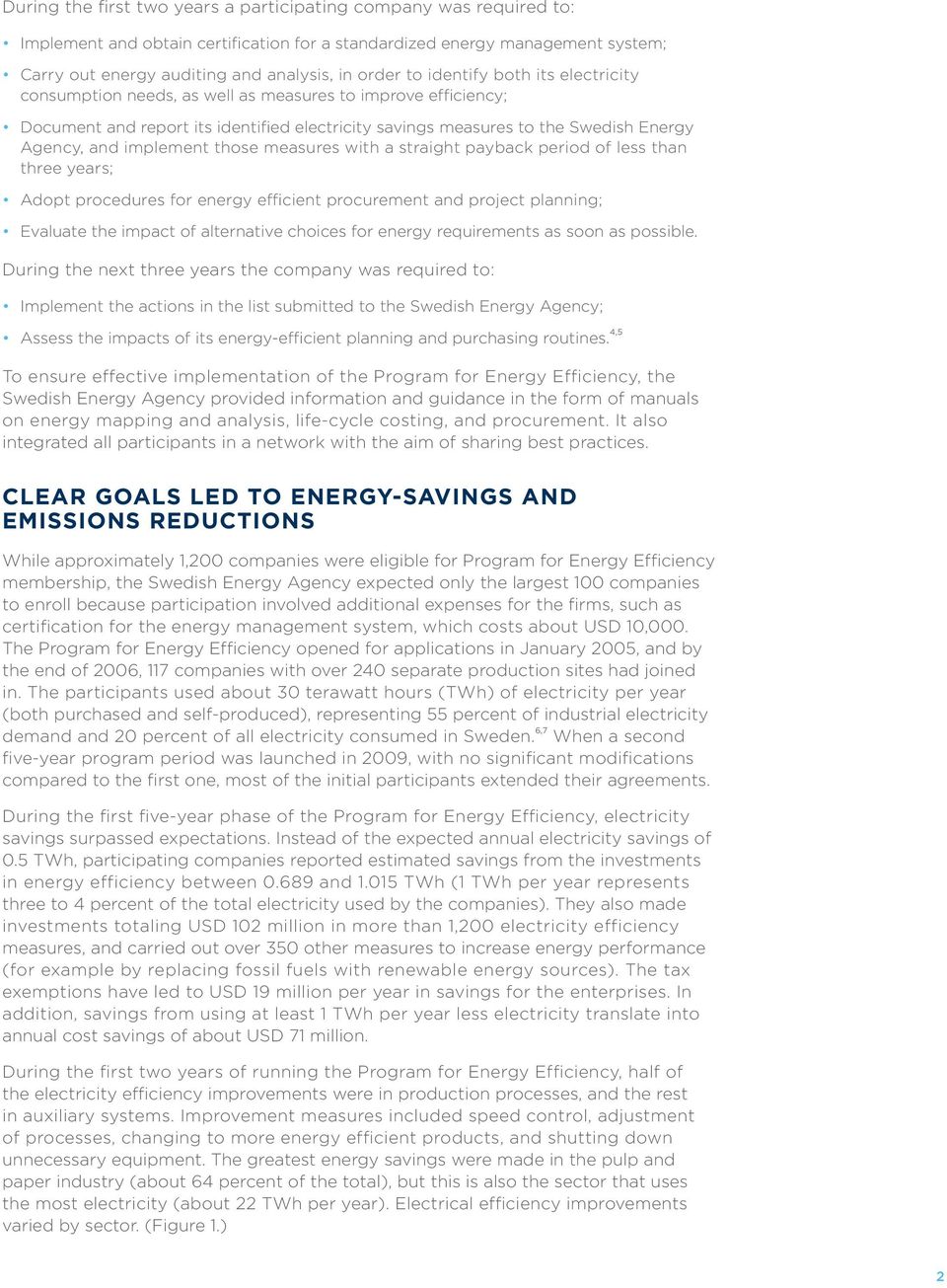
4 Figure 1: Electrical Efficiency Improvements Varied by Sector (2007) Sawmills & Manufacturing of Wood Materials 7.6 Foodstuffs and Drinks 7.1 Mines and Ore Processing 6.6 SECTOR Other Industries Steel & Metals Production Pulp and Paper 2.1 Chemical ELECTRICAL EFFICIENCY IMPROVEMENTS (%) Source: Swedish Energy Agency. By improving their efficiency in electricity use, the companies participating in the tax-rebate efficiency program helped mitigate the environmental and climate effects of their activities. The companies reported average electricity savings of just under 1 TWh per year, which would result in reducing million metric tons CO 2 emissions per year (considering 1 MWh of electricity from a coal fired power station to be equivalent to a CO 2 emission of ton). 8 The Program for Energy Efficiency was successful in overcoming several challenges to realizing greater industrial energy efficiency. Participants developed a network and disseminated good practices, helping to build expertise and lower investment risk, which had previously been a key barrier. By involving tax money, the rebate program made energy issues a management task, which gave it higher priority in companies. Moreover, several firms educated all employees in energy issues due to the energy management system. The program imposed specific requirements and clear deadlines, which proved essential in preventing energy efficiency issues from being put aside for other strategic or more acute ones. Finally, the energy review and analysis introduced by the Program for Energy Efficiency made it easier for companies to plan, implement, follow-up and review their energy efficiency progress. Notwithstanding its success, the tax exemption under the voluntary agreement is scheduled to end at the end of 2012 due to a new EU directive on energy taxation. 3
5 References Stenqvist, C., & Nilsson, L. J Energy efficiency in energyintensive industries: an evaluation of the Swedish voluntary agreement Program for Energy Efficiency. Energy Efficiency [doi: /s ]. < download?func=downloadfile&recordoid= &fileo Id= > Sustainable Energy Technology at Work. Program for energy efficiency in energy intensive industry (PFE). SETatWork Database. < R178.htm> 4
![Efficiency. Energy Efficiency [doi:10.1007/s12053-011-9131-9]. <http://lup.lub.lu.se/luur/ download?](/docs-images/51/14349854/images/page_5.jpg "func=downloadfile&recordoid=2026521&fileo Id=2026522> Sustainable Energy Technology at Work.")
6 Endnotes Note: currencies were converted to US dollars on July 9, 2012 at the exchange rate of 1 USD = 7.02 SEK. 1 Stenqvist, C., & Nilsson, L. J Process and impact evaluation of PFE a Swedish tax rebate program for industrial energy efficiency. Presented at the ECEEE 2009 Summer study. Act! Innovate! Deliver! Reducing energy demand sustainably. Web. June < conference_proceedings/eceee/2009/panel_5/5.269/paper> 2 Johansson, B., Modig, G., & Nilsson, L. J Policy instruments and industrial responses experiences from Sweden. Presented at the ECEEE 2007 Summer Study. Saving energy - just do it! Web. June < euiclimatepolicybibliography.net/2012/07/17/policyinstruments-and-industrial-responses-experiencesfrom-sweden/> 3 Stenqvist, C., & Nilsson, L. J Energy efficiency in energy-intensive industries: an evaluation of the Swedish voluntary agreement Program for Energy Efficiency. Energy Efficiency [doi: /s ]. 4 Sustainable Energy Technology at Work. Program for energy efficiency in energy intensive industry (PFE). SETatWork Database. Web. July 5, < database/products/r178.htm> 5 Stenqvist, C., & Nilsson, L. J., 2011, op cit. 6 Swedish Energy Agency (SEA) Two years with PFE. The first published results from the Swedish LTA programme for improving energy efficiency in industry. 7 Stenqvist, C., & Nilsson, L. J., 2011, op cit. 8 Sustainable Energy Technology at Work, op cit. Figure References Figure 1: Electrical Efficiency Improvements Varied by Sector (2007) Swedish Energy Agency (SEA) Two years with PFE. The first published results from the Swedish LTA programme for improving energy efficiency in industry. 750 First Street, NE, Suite 940 Washington, DC p CCAP CENTER FOR CLEAN AIR POLICY

Financing Energy Efficiency and Renewable Energy through the India Renewable Energy Development Agency
 RENEWABLE ENERGY INDUSTRIAL ENERGY EFFICIENCY BUILDING ENERGY EFFICIENCY Financing Energy Efficiency and Renewable Energy through the India Renewable Energy Development Agency A RANGE OF FINANCIAL SUPPORT
Revolving and Esco Funds for Renewable Energy and Energy Efficiency Finance
 Renewable Energy Industrial Energy Efficiency Building Energy Efficiency Revolving and Esco Funds for Renewable Energy and Energy Efficiency Finance Funding the future The growing might of financing boosts
Sweden Energy efficiency report
 Sweden Energy efficiency report Objectives: o 41 TWh of end use energy savings in 216 o 2 reduction in total energy intensity by 22 Overview - (%/year) Primary intensity (EU=1)¹ 124 - -1.8% + CO 2 intensity
BUILDING ENERGY EFFICIENCY. A Certification System for Building Efficiency ORTUGAL
 BUILDING ENERGY EFFICIENCY A Certification System for Building Efficiency ORTUGAL ENERGY PERFORMANCE Portugal s certification system for buildings encourages efficiency Portugal has significant potential
Energy Efficiency and Renewable Energy Sources in Sweden
 Energy Efficiency and Renewable Energy Sources in Sweden Swedish Energy Agency www.stem.se Yelena Varasteh [email protected] Slovakia, 24-25 April 2006 Total energy supply in Sweden in 2004 Total
Building Energy Efficiency. Minimum Performance Standards and Labeling to Improve Energy Efficiency
 Building Energy Efficiency Minimum Performance Standards and Labeling to Improve Energy Efficiency Leading the region Education, labeling help lower energy demand and emissions in Brazil To improve energy
Hungary Energy efficiency report
 Hungary Energy efficiency report Objectives: o 1.4 Mtoe of end-user energy savings by 216, including 312 ktoe in industry o 1.9 Mtoe of primary energy savings by 23, including around 4% in the power sector
European Energy Efficiency Policy and the ESCO market: the Case of Sweden
 European Energy Efficiency Policy and the ESCO market: the Case of Sweden Professor Lars J. Nilsson, Environmental and Energy Systems Studies, Lund University, Sweden Ph. D candidate Christian Stenqvist,
Overview of UK Carbon Pricing Policies
 Partnership for Market Readiness PA11 Overview of UK Carbon Pricing Policies Paul van Heyningen, Department of Energy & Climate Change 10 March 2015 UK approach to emissions reduction Set legally binding
green public procurement in sweden
 green public procurement in sweden Title: Green Public Procurement in Sweden Orders Phone: + 46 (0)8-505 933 40 Fax: + 46 (0)8-505 933 99 E-mail: [email protected] Internet: www.naturvardsverket.se/bokhandeln
Argentina Energy efficiency report
 Argentina Energy efficiency report Objectives: o 5.4% energy savings in industry in 216 o 6% electricity savings in 216 Overview 2- (%/year) Primary intensity (EU=1)¹ 16 - -2.3% + CO 2 intensity (EU=1)
Analysis of a 30 Percent by 2030 National Renewable Electricity Standard
 Analysis of a 30 Percent by 2030 National Renewable Electricity Standard Alison Bailie, Steve Clemmer, and Jeff Deyette May 12, 2015 Photo: istock 2015 Union of Concerned Scientists www.ucsusa.org/30by2030nationalres.pdf
The Economic Impacts of Reducing. Natural Gas and Electricity Use in Ontario
 The Economic Impacts of Reducing Natural Gas and Electricity Use in Ontario Prepared for Blue Green Canada July 2013 Table of Contents Executive Summary... i Key Findings... i Introduction...1 Secondary
SaskPower CCS Global Consortium Bringing Boundary Dam to the World. Mike Monea, President Carbon Capture and Storage Initiatives
 SaskPower CCS Global Consortium Bringing Boundary Dam to the World Mike Monea, President Carbon Capture and Storage Initiatives 1 Purpose of Today A. CCS around the world B. What SaskPower is doing C.
Eligibility for an exemption for the costs of Contracts for Difference for Energy Intensive Industries
 Eligibility for an exemption for the costs of Contracts for Difference for Energy Intensive Industries Summary of BIS consultation July 2013 RWE npower 7/25/2013 PAGE 1 BACKGROUND RWE npower 7/25/2013
FP7 Energy Information Day Work Programme 2011
 FP7 Energy Information Day Work Programme 2011 Zagreb, 12 th October 2010 Jérémie ZEITOUN Call Coordinator Energy Technologies and Research Coordination Directorate-General for Energy Introduction Croatian
How to Earn the LEED Green Power Credit
 3D EG REES WH ITE PAPER How to Earn the LEED Green Power Credit Using on-site and off-site renewable energy to mitigate the impact of greenhouse gas emissions associated with a LEED project s energy use
ABB drives and motors for improving energy efficiency
 ABB drives and motors for improving energy efficiency Improving energy efficiency worldwide is the fastest, the most sustainable and the cheapest way to reduce greenhouse gas emissions and enhance energy
INTERNATIONAL COOPERATION TO PROMOTE ENERGY MANAGEMENT
 INTERNATIONAL COOPERATION TO PROMOTE ENERGY MANAGEMENT The 78 th Session of the OECD Steel Committee Paris, France May 12, 2015 Ms. Graziella Siciliano [email protected] May 2015 Presentation
CDP7 and OneReport Comparison
 24 27 47 KEY Matches data requested within Related to data requested within Not found in and Comparison # 1.1 2.1 3.1 4.1 5.1 6.1 Regulatory Risk Physical Risk General Risk Regulatory Physical General
China Energy efficiency report
 China Energy efficiency report Objective: 16% reduction in primary energy intensity by 215 Overview 211-211 (%/year) Primary intensity (EU=1)¹ 222 -- -2.8% ++ CO 2 intensity (EU=1) 294 -- -2.5% + CO 2
Natural Gas / Electricity and the Industrial Sector. The Dismantling of US Manufacturing
 Natural Gas / Electricity and the Industrial Sector The Dismantling of US Manufacturing Paul Cicio President Industrial Energy Consumers of America August, 2007 Who Are Energy Price Sensitive Industries?
Greenhouse gas abatement potential in Israel
 Greenhouse gas abatement potential in Israel Israel s GHG abatement cost curve Translated executive summary, November 2009 1 Executive Summary Background At the December 2009 UNFCCC Conference in Copenhagen,
Geothermal ERA NET. 7 th Geothermal ERA NET meeting Trieste, Italy 10-11 September 2014. Guðni A Jóhannesson Director General, Orkustofnun, Iceland
 Cooperation between European countries through the Geothermal ERA NET 7 th meeting Trieste, Italy 10-11 September 2014 Guðni A Jóhannesson Director General, Afternoon Session The is supported by the European
Carbon Emissions Trading and Carbon Taxes
 Carbon Emissions Trading and Carbon Taxes EU Environmental Policy The challenge reaching towards a low carbon economy 1 This presentation covers Can carbon markets be part of the answer in controlling
Climate Review 2013. Group Environmental Management
 Climate Review 213 Group Environmental Management Content 1. Emission development in the Swedbank Group 21 213 2 1.1 Results 213 2 1.2 Emissions per scope 3 1.3 KPI 4 1.4 Important changes 4 2. Detailed
BACKGROUNDER. Emissions Trading versus CO 2 Taxes. Ian W.H. Parry and William A. Pizer. May 2007
 BACKGROUNDER May 2007 Emissions Trading versus CO 2 Taxes Ian W.H. Parry and William A. Pizer 1616 P Street NW Washington DC 20036 202-328-5000 www.rff.org Contents Overview... 1 Similarities between CO
AUDIT REPORT, SUMMARY. Summary. Vattenfall a competitive leader in energy transition? (RiR 2015:6) SWEDISH NATIONAL AUDIT OFFICE
 AUDIT REPORT, SUMMARY 1 Summary Vattenfall a competitive leader in energy transition? (RiR 2015:6) SWEDISH NATIONAL AUDIT OFFICE 1 Vattenfall a competitive leader in energy transition? The Swedish National
Addressing Competitiveness in introducing ETR United Kingdom s climate change levy
 Low Carbon Green Growth Roadmap for Asia and the Pacific CASE STUDY Addressing Competitiveness in introducing ETR United Kingdom s climate change levy Key point The UK Government introduced an energy tax
The current electricity costs of energy-intensive industries in Germany
 Memo From: Dr. Felix Christian Matthes Energy & Climate Division [email protected] Berlin, 23 June 2013 The current electricity costs of energy-intensive industries in Germany Background The electricity
ESBI Carbon Solutions. Partnering with Countries to Achieve their Full Carbon Credit Potential
 ESBI Carbon Solutions Partnering with Countries to Achieve their Full Carbon Credit Potential ESB International ESB International (ESBI) is a growing international energy company and one of Europe s leading
Boise Inc. Joins Chicago Climate Exchange
 Contact: Rafael Marques Karen Punch Chicago Climate Exchange Boise Inc. 312.554.3384 208.384.7037 Boise Inc. Joins Chicago Climate Exchange Chicago, Ill. (July 24, 2008) Boise Inc. has become a member
Module 1: Introduction to Industrial Energy Management
 Module 1: Introduction to Industrial Energy Management Organisations that successfully manage energy have business processes to plan, monitor, and control energy use, just as they do for other corporate
Electricity and natural gas price statistics 1
 Electricity and natural gas price statistics 1 Source: Statistics Explained (http://epp.eurostat.ec.europa.eu/statistics_explained/) - 21/11/2011-09:11:44 Electricity and natural gas price statistics Data
Prepared by the Commission on Environment & Energy
 Policy statement Energy efficiency: a world business perspective Prepared by the Commission on Environment & Energy Key messages Energy efficiency is a fundamental element in progress towards a sustainable
Sustainability. report.
 Sustainability report CONTENT AND BOUNDARY OF THE REPORT This sustainability report refers to the financial year 2006. Unless otherwise stated, the same accounting principles are applied in the sustainability
A sustainable energy and climate policy for the environment, competitiveness and long-term stability
 2009-02-05 A sustainable energy and climate policy for the environment, competitiveness and long-term stability The party leaders of Alliance for Sweden entered into an agreement today on a long-term,
Egypt & Climate Change
 Egypt & Climate Change Eng. Ahmed El Gohary Advisor to the Egyptian Minister of Investment OECD - Paris April - 2010 1 Egypt Area : about 1.2 million km 2 Capital : Cairo Total population: about 84.5 millions
Success story: Feed-In Tariffs Support renewable energy in Germany
 Success story: Feed-In Tariffs Support renewable energy in Germany This document will show how this success story has been brought about and is made up of the following sections: 1. What is a Feed-In Tariff?
Formulating an energy management action plan
 Formulating an energy management action plan Eskom Energy Management Information Pack: Brochure 1 Index Formulating an energy management action plan 1 Structuring an energy management action plan Sample:
Powering Your Home with Solar Energy
 Powering Your Home with Solar Energy Putting Your Roof to Work The sun is waiting to turn your roof into its own miniature electrical power plant. Using solar energy to power your home not only lowers
Economic Outcomes of a U.S. Carbon Tax. Executive Summary
 Economic Outcomes of a U.S. Carbon Tax Executive Summary [ Overview [ During the ongoing debate on how to address our nation s fiscal challenges, some have suggested that imposing a carbon tax would improve
G20 ENERGY EFFICIENCY ACTION PLAN VOLUNTARY COLLABORATION ON ENERGY EFFICIENCY
 G20 ENERGY EFFICIENCY ACTION PLAN VOLUNTARY COLLABORATION ON ENERGY EFFICIENCY 16 NOVEMBER 2014 G20 Energy Efficiency Action Plan 2 1. Executive summary 1.1 Energy efficiency is a priority for G20 members.
RENEWABLE ENERGY. The Solar Thermal Ordinance for Efficient Water Heating in Barcelona
 RENEWABLE ENERGY The Solar Thermal Ordinance for Efficient Water Heating in Barcelona BOOSTING SOLAR ENERGY Solar Thermal Ordinance brings efficient water heating to Barcelona As the Spanish city of Barcelona
Chairman, Working Group on Global Environment Strategy Committee on the Environment and Sft Safety KEIDANREN (Japan Business Federation)
 The Japanese Business Community's Initiative to Tackle Climate Change Jun.1997 *Dec. 1997 Launched "KEIDANREN Action Plan on the Environment" Adoption of Kyoto Protocol @ COP3 Jan. 2013 Launched "KEIDANREN's
How To Get A Carbon Credit
 Energy Saving Technologies & CDM - Business Opportunity with Japan - Clean Energy Finance Committee Mitsubishi UFJ Securities Contents 1. Technology & CDM: Why this is a new business model? 2. CDM: revenue
REDUCING ENERGY CONSUMPTION AND PEAK POWER IN BELGIUM
 REDUCING ENERGY CONSUMPTION AND PEAK POWER IN BELGIUM With the support of: [email protected] www.3e.eu PRESENTATION CONTENT Outline Objective Background Energy efficiency: examples in 3 sectors Residential: electric
COMPARISON OF ELECTRICITY GENERATION COSTS
 Tarjanne Risto, Kivistö Aija COMPARISON OF ELECTRICITY GENERATION COSTS LAPPEENRANNAN TEKNILLINEN YLIOPISTO LAPPEENRANTA UNIVERSITY OF TECHNOLOGY TEKNILLINEN TIEDEKUNTA ENERGIA- JA YMPÄRISTÖTEKNIIKAN OSASTO
Germany Energy efficiency report
 Germany Energy efficiency report Objectives: 231 TWh of end-user energy savings by 216 Overview 29 2-29 (% / year) Primary intensity (EU=1) 1 99 + -1.3% - CO 2 intensity (EU=1) 16 - -1.6% - CO 2 emissions
Energy Efficiency Agreement between the Ministry of Trade and Industry and the Municipality of (2008 2016)
 Dnro 7202/804/2008 Unofficial translation Energy Efficiency Agreement between the Ministry of Trade and Industry and the Municipality of (2008 2016) 1 The starting points and grounds for the agreement
Sweden. Biofuels Annual. Clearance Office: All - FAS. Date: 6/24/2009 GAIN Report Number: SW9008
 Voluntary - Public Clearance Office: All - FAS Date: 6/24/2009 GAIN Report Number: SW9008 Sweden Post: Stockholm Biofuels Annual Report Categories: Bio-Fuels Approved By: Stephen Huete Prepared By: Bettina
Session 8A Energy Efficiency Finance 10:30-12:00 pm. Sara Bryan Pasquier David Morgado
 Session 8A Energy Efficiency Finance 10:30-12:00 pm Sara Bryan Pasquier David Morgado Topics/content The big picture Introduction to economic instruments Discussion break Economic instrument case studies
World Energy Outlook. Dr. Fatih Birol IEA Chief Economist Paris, 27 February 2014
 World Energy Outlook Dr. Fatih Birol IEA Chief Economist Paris, 27 February 2014 The world energy scene today Some long-held tenets of the energy sector are being rewritten Countries are switching roles:
BARRIERS AND SOLUTIONS TO CORPORATE ENERGY EFFICIENCY
 Energy efficiency is often the least expensive way for businesses to reduce GHG emissions and also comes with added benefits of reduced operational costs and risks. Yet, there remains a gap between the
Realizing the full potential of maintenance. Company Introduction
 Realizing the full potential of maintenance Company Introduction CONTENTS Quant is a global leader in industrial maintenance. For over 25 years, we have been realizing the full potential of maintenance
European actions to improve the energy efficiency of buildings. Olli Seppänen, professor Federation of European Heating and Airconditioning
 European actions to improve the energy efficiency of buildings Olli Seppänen, professor Federation of European Heating and Airconditioning Associations 1 Climate Action: Energy for a Changing World On
Energy Consumption Increases Slightly in 2015. Renewables Continue to Grow / Advantages Due to Weather, Economic Trend, and Immigration
 Nro 06 2015 Energy Consumption Increases Slightly in 2015 Renewables Continue to Grow / Advantages Due to Weather, Economic Trend, and Immigration Berlin/Cologne (December 21, 2015) In 2015, energy consumption
Goals Status Current Policies & Programmes GENERAL OVERVIEW
 Mauritius Air Quality Overview This document is based on research that UNEP conducted in 2015, in response to Resolution 7 of the UNEA 1. It describes countrylevel policies that impact air quality. Triple
Preliminary pellet market country report SWEDEN
 Development and promotion of a transparent European Pellets Market Creation of a European real-time Pellets Atlas Preliminary pellet market country report SWEDEN Copyright Hjortekærsvej 99 DK-2800 Kongens
EnMS under China s Top- 10,000 Program
 EnMS under China s Top- 10,000 Program Program Summary China s mandatory energy conservation target- setting policy for large energy users, known as the Top- 10,000 Program (*1), was introduced in 2011.
Energy Consumption. U.S. Energy Consumption by Sector, 2013. Energy Use. Who Uses Energy? Residential and Commercial Sectors
 Energy Use Think about how you use energy every day. You wake up to an alarm clock. You take a shower with water warmed by a hot water heater. You listen to music on the radio as you dress. You catch the
Promotion of energy efficiency and renewable energy experiences from Norway
 Business planning of Renewable Energy and Energy Efficiency Projects in Ukraine and Eastern Europe Kiev 28. April 2011 Promotion of energy efficiency and renewable energy experiences from Norway Hans Borchsenius
EXAMPLES OF SUCCESSFUL POLICY TOOLS FOR EMISSION REDUCTION
 Submission of the United Nations Environment Programme (UNEP) Sustainable Building Initiative (SBCI) to the Ad Hoc Working Group on Long-Term Cooperative Action under the Convention (AWG-LCA) 24 April
THE SOCIOECONOMIC IMPLICATIONS OF RENEWABLE ENERGY AND LOW CARBON TRAJECTORIES IN SOUTH AFRICA
 THE SOCIOECONOMIC IMPLICATIONS OF RENEWABLE ENERGY AND LOW CARBON TRAJECTORIES IN SOUTH AFRICA Tara Caetano and James Thurlow Green and Social Workshop 12-13 March 2014 Bonn, Germany Introduction Literature
Energy Management for Industry
 Energy Management for Industry Realizing full potential through integrated process and energy architectures Energy management initiatives have taken on a greater sense of urgency than at any time in the
Overview. PG&E and Energy Efficiency. CA Energy Efficiency Regulatory & Policy Roadmap. Financing Options for Efficiency & Demand Response
 Overcoming Financial Barriers to Energy Efficiency April 6, 2010 Overview PG&E and Energy Efficiency CA Energy Efficiency Regulatory & Policy Roadmap Financing Options for Efficiency & Demand Response
UNITED NATIONS ECONOMIC COMMISSION FOR EUROPE. Renewable Energy A Crucial Role in the Future Energy Mix
 UNITED NATIONS ECONOMIC COMMISSION FOR EUROPE Renewable Energy A Crucial Role in the Future Energy Mix UNECE UNITED NATIONS ECONOMIC COMMISSION FOR EUROPE RENEWABLE ENERGY A CRUCIAL ROLE IN THE FUTURE
Discovering New Territories: Sustainable Systems for Efficient Mining Operation Mr. Norbert Becker
 Discovering New Territories: Sustainable Systems for Efficient Mining Operation Mr. Norbert Becker Page 1 Siemens Mining Technology Media Talks / Las Vegas 2012 Siemens AG 2012 Siemens offers Integrated
Models for Driving Energy Efficiency Nationally Using Energy Management
 Models for Driving Energy Efficiency Nationally Using Energy Management ABSTRACT Energy management is a proven strategy for achieving clear energy, environmental, and economic benefits across industry
Utilization of renewable energy sources and their role in climate change mitigation. Norsk Energi s experience
 European Economic Area Financial Mechanism. 2009-2014 Programme National Climate Policy Utilization of renewable energy sources and their role in climate change mitigation Norsk Energi s experience Sergei
Energy Efficiency in Industries
 Energy Policy Toolkit on Energy Efficiency in Industries Experiences from Denmark 2 Energy Efficiency in Industries Abbreviations DEA DTI EE EMS EnMP EnPI EU ETS GHG HVAC IIP KPI kwh LCTU LEDS LIEN PBT