
Crossover - A search algorithm and GUI for cross-over designs. Kornelius Rohmeyer
|
|
|
- Stephany Young
- 10 years ago
- Views:
Transcription
1 Crossover - A search algorithm and GUI for cross-over designs Kornelius Rohmeyer July 29, 2015

2 Contents 1 Introduction Installation Overview Design selection in the GUI Designs in R Algorithm Search Models Standard additive model Full set of interactions Self-adjacency model Placebo model No carry-over into self model Treatment decay model Proportionality model Second-order carry-over eects Search strategy Random Subject Eects Model A Appendix 24 A.1 Appendix - Variance Balance / Partial Balance A.2 Appendix - Matrix Algebra / Linear Models A.2.1 Generalized inverse A.2.2 Fisher information A.2.3 Linear Mixed Models A.3 Appendix - Internals A.3.1 Naming conventions Index Literatur Table of Symbols


3 Chapter 1 Introduction This package provides more than two hundred cross-over design from literature, a search algorithm to nd ecient cross-over designs for various models and a graphical user interface (GUI) to nd/generate appropriate designs. The computationally intensive parts of the package, i.e. the search algorithm, is written using the R packages Rcpp and RcppArmadillo (Eddelbuettel and François [2011] and Eddelbuettel and Sanderson [2013]). The GUI is written in Java and uses package rjava (Urbanek [2013]). 1.1 Installation Once it is installed, whenever you start R you can load the Crossover package by entering library(crossover) into the R Console. The graphical user interface as shown in gure 1.1 is started with the command CrossoverGUI(). Figure 1.1: Cross-Over Design GUI. 2
![The GUI is written in Java and uses package rjava (Urbanek [2013]). 1.](/docs-images/51/14320056/images/page_3.jpg "1 Installation Once it is installed, whenever you start R you can load the Crossover package by entering library(crossover) into the R Console. The graphical user interface as shown in gure 1.")
4 1.2 Overview The catalogue, collected and compiled by Professor Byron Jones, contains 241 designs from the following literature: Anderson and Preece [2002], Archdeacon et al. [1980], Atkinson [1966], Balaam [1968], Berenblut [1964], Blaisdell Jr and Raghavarao [1980], Davis and Hall [1969], Federer and Atkinson [1964], Fletcher [1987], Iqbal and Jones [1994], Lewis et al. [1988], Cochran et al. [1941], Patterson and Lucas [1962], Pigeon [1985], Prescott [1999], Quenouille [1953], Russell [1991], Lucas [1956], Williams [1949], Prescott [1994], Bate and Jones [2002] Further 149 designs are constructed from partially balanced incomplete block designs from Clatworthy et al. [1973] and balanced crossover designs Design selection in the GUI The GUI will show appropriate designs from the catalogue according to the number of treatments, periods and the range of sequences the user enters. 1 Further functions from package crossdes (Sailer [2013]) are called to create designs for the specied values if possible. In gure 1.1 you can see the following four checkboxes, that allow you to see only specic subsets: Designs from package archive The previously noted designs from literature are shown. Designs generated by package crossdes Activating this option will result in short delays when displaying the catalogue, since the crossdes algorithms are called. Designs manually entered All designs entered on tab "Input own design" are shown. Designs from previous search runs All designs from previous search runs are shown. The column av.e.trt.pair shows the average eency of pairwise treatment parameter dierences. To dene these eciencies we compare a design D with an "ideal design" D I without period, subject or carry-over eects, where each treatment i {1,..., v} occurs n i times in D and D I. For D I the variance of the treatment parameter dierence estimate ˆτ i ˆτ j for treatment i and j is 1/n i + 1/n j. We dene the eciency for a design D as the quotient of the variances under D I and D, i.e. 1 Var DI (ˆτ i ˆτ j ) Var D (ˆτ i ˆτ j ) = n i + 1 n j Var D (ˆτ i ˆτ j ). The tab "Input own design" provides you with the possibility to analyse and save your own designs easily or to use them as starting points for the search algorithm. The drop-down menu for model let you specify which model you are interested. These models are described in detail in chapter 2. In case of the placebo or proportionality model you can specify further model parameters (namely the number of placebos and the proportionality parameter, respectively). 1 A table referencing all available designs and the respective number of treatments, periods and sequences is available by calling buildsummarytable(). 3
![[1988], Cochran et al.](/docs-images/51/14320056/images/page_4.jpg "[1941], Patterson and Lucas [1962], Pigeon [1985], Prescott [1999], Quenouille [1953], Russell [1991], Lucas [1956], Williams [1949], Prescott [1994], Bate and Jones [2002] Further 149 designs are")
5 1.2.2 Designs in R Our crossover designs in R are numeric matrices, where the elements represent the treatments, the rows represent the periods and the columns the subjects. A data frame referencing all available designs and the respective number of treatments, periods and sequences is available by calling the buildsummarytable() function. Designs referenced in this table can be accessed via the getdesign() function. For example the Williams design for three treatments is represented by a 3 6-matrix and assigns each of the three treatments once to each of the six subjects: getdesign("williams3t") ## s1 s2 s3 s4 s5 s6 ## p ## p ## p ## attr(,"reference") ## [1] "Williams, E.J. (1949) Experimental designs balanced for the estimation of residual effects of ## attr(,"signature") ## [1] "p = 3, n = 6, t = 3" ## attr(,"title") ## [1] "WILLIAMS DESIGN THREE TREATMENTS" Each treatment occurs six times, two times in the each period and each treatment follows each other treatment exactly two times. If we are interested in the variance of the treatment parameter dierence estimates, we can use the function general.carryover: design <- getdesign("williams3t") general.carryover(design, model=1) ## $Var.trt.pair ## [,1] [,2] [,3] ## [1,] ## [2,] ## [3,] ## ## $Var.car.pair ## [,1] [,2] [,3] ## [1,] ## [2,] ## [3,] ## ## $model ## [1] 1 We see that the Williams design is a balanced design. The following nine models which are discussed in chapter 2 are implemented: 4

6 ## 1: "Standard additive model" ## 2: "Self-adjacency model" ## 3: "Proportionality model" ## 4: "Placebo model" ## 5: "No carry-over into self model" ## 6: "Treatment decay model" ## 7: "Full set of interactions" ## 8: "Second-order carry-over effects" ## 9: "No carry-over effects" 5


7 1.2.3 Algorithm Search Figure 1.2: Panel for algorthmic search of cross-over designs. In gure 1.2 the preliminary graphical interface for the search algorithm is shown with the following options: ˆ The covariance pattern can be "Independence", "Autoregressive Error" or "Autoregressive Error". Except for "Independence" a covariance pattern coecient ρ has to be specied. ˆ Specify the exact number of sequences. (The number of treatments and periods is already specied in the top panel of the GUI.) ˆ Optionally specify the exact number of treatment assignments. The GUI default is to let the algorithm gure out good/optimal assignments. But depending on further information (information from theoretical results or treatments more important than the others 2, etc.) the number of treatment assignments can be specied. ˆ You can specify that the design should be constructed in a way that in each sequence/period a treatment occur as evenly as possible. This restriction will normally decrease the eciency of the algorithm. ˆ The GUI default is an all-pair comparison of all treatments with equal weights. Change the contrast weights accordingly if you are interested in other contrasts or dierent weights. ˆ Pressing the "Compute Design" button will start the search algorithm described in section 3. After a few seconds the result will be shown in the previous empty text area on the right. 2 Dierent weights of treatment importance should be specied as weighted contrasts. See item contrasts. 6

8 Chapter 2 Models The package and GUI support the following eight models. 2.1 Standard additive model with 1 Y ijk = µ + π j + τ d[i,j] + λ d[i,j 1] + s ik + e ijk µ intercept, π j period eect for period j, τ d[i,j] direct treatment eect for treatment d[i, j] in period j of sequence i, λ d[i,j 1] rst-order carry-over eect (0 for j 1=0), s ik kth subject eect on sequence i, e ijk random error with zero mean and variance σ 2. which we can write as E(Y ) = µ + X ( ) ( τ λ + Z πs ) with X and Z called the treatment and block design matrices, respectively. We call H a link matrix if X = X r H were X r is the design matrix for the row-column design. The rows of the link matrix specify all possible parameter combinations. Therefore H has as many columns as there are parameters and in the row-column-setting i parameter j is included h ij times. # Design: design <- rbind(c(3,2,1), c(2,1,3), c(1,2,3), c(3,2,1)) design 1 cf. Jones and Kenward [2003], page 8 7
![1 Standard additive model with 1 Y ijk = µ + π j + τ d[i,j] + λ d[i,j 1] + s ik + e ijk µ intercept, π j period eect for period j, τ d[i,j] direct treatment eect for treatment d[i, j] in period j of](/docs-images/51/14320056/images/page_8.jpg "sequence i, λ d[i,j 1] rst-order carry-over eect (0 for j 1=0), s ik kth subject eect on sequence i, e ijk random error with zero mean and variance σ 2.")
9 ## [,1] [,2] [,3] ## [1,] ## [2,] ## [3,] ## [4,] v <- 3 # number of treatments # Link matrix: H <- Crossover:::linkMatrix(model="Standard additive model", v) H ## [,1] [,2] [,3] [,4] [,5] [,6] ## [1,] ## [2,] ## [3,] ## [4,] ## [5,] ## [6,] ## [7,] ## [8,] ## [9,] ## [10,] ## [11,] ## [12,] # Row-Column-Design: (cf. John et al. 2004, Table II and page 2649f.) rcdesign <- Crossover:::rcd(design, v=v, model=1) rcdesign ## [,1] [,2] [,3] ## [1,] ## [2,] ## [3,] ## [4,] # Design Matrix of Row-Column Design: Xr <- Crossover:::rcdMatrix(rcDesign, v, model=1) Xr ## [,1] [,2] [,3] [,4] [,5] [,6] [,7] [,8] [,9] [,10] [,11] [,12] ## [1,] ## [2,] ## [3,] ## [4,] ## [5,] ## [6,] ## [7,] ## [8,] ## [9,]
![## [10,] 1 0 0 0 0 1 ## [11,] 0 1 0 0 0 1 ## [12,] 0 0 1 0 0 1 # Row-Column-Design: (cf. John et al. 2004, Table II and page 2649f.](/docs-images/51/14320056/images/page_9.jpg ") rcdesign <- Crossover:::rcd(design, v=v, model=1) rcdesign ## [,1] [,2] [,3] ## [1,] 3 2 1 ## [2,] 11 7 6 ## [3,] 7 5 12 ## [4,] 6 8 10 # Design Matrix of Row-Column Design: Xr <-")
10 ## [10,] ## [11,] ## [12,] # Design Matrix of Cross-Over Design: X <- Xr %*% H X ## [,1] [,2] [,3] [,4] [,5] [,6] ## [1,] ## [2,] ## [3,] ## [4,] ## [5,] ## [6,] ## [7,] ## [8,] ## [9,] ## [10,] ## [11,] ## [12,] Full set of interactions This model has further interaction parameters γ ij and a design matrix X with 2 v + v 2 columns: ( τλ ) E(Y ) = µ + X + Z ( ) π s γ H <- Crossover:::linkMatrix(model="Full set of interactions", v) H ## [,1] [,2] [,3] [,4] [,5] [,6] [,7] [,8] [,9] [,10] [,11] [,12] [,13] ## [1,] ## [2,] ## [3,] ## [4,] ## [5,] ## [6,] ## [7,] ## [8,] ## [9,] ## [10,] ## [11,] ## [12,] ## [,14] [,15] ## [1,] 0 0 9
![0 0 1 0 ## [12,] 1 0 0 0 0 1 2.](/docs-images/51/14320056/images/page_10.jpg "2 Full set of interactions This model has further interaction parameters γ ij and a design matrix X with 2 v + v 2 columns: ( τλ ) E(Y ) = µ + X + Z ( ) π s γ H <- Crossover:::linkMatrix(model=\"Full")
11 ## [2,] 0 0 ## [3,] 0 0 ## [4,] 0 0 ## [5,] 0 0 ## [6,] 0 0 ## [7,] 0 0 ## [8,] 0 0 ## [9,] 1 0 ## [10,] 0 0 ## [11,] 0 0 ## [12,] 0 1 # Design Matrix of Cross-Over Design: X <- Xr %*% H X ## [,1] [,2] [,3] [,4] [,5] [,6] [,7] [,8] [,9] [,10] [,11] [,12] [,13] ## [1,] ## [2,] ## [3,] ## [4,] ## [5,] ## [6,] ## [7,] ## [8,] ## [9,] ## [10,] ## [11,] ## [12,] ## [,14] [,15] ## [1,] 0 0 ## [2,] 0 0 ## [3,] 0 0 ## [4,] 0 0 ## [5,] 0 0 ## [6,] 0 0 ## [7,] 0 0 ## [8,] 0 0 ## [9,] 0 1 ## [10,] 0 0 ## [11,] 0 0 ## [12,]
![## [5,] 1 0 0 0 1 0 0 1 0 0 0 0 0 ## [6,] 0 0 1 1 0 0 0 0 0 0 0 0 1 ## [7,] 1 0 0 0 1 0 0 1 0 0 0 0 0 ## [8,] 0 1 0 1 0 0 0 0 0 1 0 0 0 ## [9,] 0 0 1 0 0 1 0 0 0 0 0 0 0 ## [10,] 0 0 1 1 0 0 0 0 0 0](/docs-images/51/14320056/images/page_11.jpg "0 0 1 ## [11,] 0 1 0 0 1 0 0 0 0 0 1 0 0 ## [12,] 1 0 0 0 0 1 0 0 1 0 0 0 0 ## [,14] [,15] ## [1,] 0 0 ## [2,] 0 0 ## [3,] 0 0 ## [4,] 0 0 ## [5,] 0 0 ## [6,] 0 0 ## [7,] 0 0 ## [8,] 0 0 ## [9,] 0 1")
12 2.3 Self-adjacency model In the self-adjacency model λ i is replaced by ϕ i in case of carry-over into itself. The case ϕ = 0 represents the no carry-over into self model. E(Y ) = µ + X ( τ λ ϕ ) + Z ( πs ) H <- Crossover:::linkMatrix(model="Self-adjacency model", v) H ## [,1] [,2] [,3] [,4] [,5] [,6] [,7] [,8] [,9] ## [1,] ## [2,] ## [3,] ## [4,] ## [5,] ## [6,] ## [7,] ## [8,] ## [9,] ## [10,] ## [11,] ## [12,] # Design Matrix of Cross-Over Design: X <- Xr %*% H X ## [,1] [,2] [,3] [,4] [,5] [,6] [,7] [,8] [,9] ## [1,] ## [2,] ## [3,] ## [4,] ## [5,] ## [6,] ## [7,] ## [8,] ## [9,] ## [10,] ## [11,] ## [12,] Placebo model In the placebo model there are no carry-over eects for the placebo treatment(s). E(Y ) = µ + X ( τ λ ) + Z ( πs ) 11
![## [3,] 0 0 1 0 0 0 0 0 0 ## [4,] 1 0 0 0 0 0 1 0 0 ## [5,] 0 1 0 1 0 0 0 0 0 ## [6,] 0 0 1 1 0 0 0 0 0 ## [7,] 1 0 0 0 1 0 0 0 0 ## [8,] 0 1 0 0 0 0 0 1 0 ## [9,] 0 0 1 0 1 0 0 0 0 ## [10,] 1 0 0 0](/docs-images/51/14320056/images/page_12.jpg "0 1 0 0 0 ## [11,] 0 1 0 0 0 1 0 0 0 ## [12,] 0 0 1 0 0 0 0 0 1 # Design Matrix of Cross-Over Design: X <- Xr %*% H X ## [,1] [,2] [,3] [,4] [,5] [,6] [,7] [,8] [,9] ## [1,] 0 0 1 0 0 0 0 0 0 ## [2,]")
13 # Link matrix: H <- Crossover:::linkMatrix(model="Placebo model", v, placebos=1) H ## [,1] [,2] [,3] [,4] [,5] [,6] ## [1,] ## [2,] ## [3,] ## [4,] ## [5,] ## [6,] ## [7,] ## [8,] ## [9,] ## [10,] ## [11,] ## [12,] # Design Matrix of Cross-Over Design: X <- Xr %*% H X ## [,1] [,2] [,3] [,4] [,5] [,6] ## [1,] ## [2,] ## [3,] ## [4,] ## [5,] ## [6,] ## [7,] ## [8,] ## [9,] ## [10,] ## [11,] ## [12,] No carry-over into self model This model diers from the standard additive model in the assumption that in the no carry-over into self model no carry-over eect occurs if current and previous treatment are the same. E(Y ) = µ + X ( τ λ ) + Z ( πs ) H <- Crossover:::linkMatrix(model="No carry-over into self model", v) H ## [,1] [,2] [,3] [,4] [,5] [,6] 12
![<- Xr %*% H X ## [,1] [,2] [,3] [,4] [,5] [,6] ## [1,] 0 0 1 0 0 0 ## [2,] 0 1 0 0 0 0 ## [3,] 1 0 0 0 0 0 ## [4,] 0 1 0 0 0 1 ## [5,] 1 0 0 0 1 0 ## [6,] 0 0 1 0 0 0 ## [7,] 1 0 0 0 1 0 ## [8,] 0 1](/docs-images/51/14320056/images/page_13.jpg "0 0 0 0 ## [9,] 0 0 1 0 0 1 ## [10,] 0 0 1 0 0 0 ## [11,] 0 1 0 0 1 0 ## [12,] 1 0 0 0 0 1 2.")
14 ## [1,] ## [2,] ## [3,] ## [4,] ## [5,] ## [6,] ## [7,] ## [8,] ## [9,] ## [10,] ## [11,] ## [12,] # Design Matrix of Cross-Over Design: X <- Xr %*% H X ## [,1] [,2] [,3] [,4] [,5] [,6] ## [1,] ## [2,] ## [3,] ## [4,] ## [5,] ## [6,] ## [7,] ## [8,] ## [9,] ## [10,] ## [11,] ## [12,] Treatment decay model In contrast to the no carry-over into self model in the treatment decay model we assume there are only (negative) carry-over eects if the current and previous treatment are the same. E(Y ) = µ + X ( τ λ ) + Z ( πs ) H <- Crossover:::linkMatrix(model="Treatment decay model", v) H ## [,1] [,2] [,3] [,4] [,5] [,6] ## [1,] ## [2,] ## [3,] ## [4,]
![0 1 0 0 0 1 ## [5,] 1 0 0 0 1 0 ## [6,] 0 0 1 1 0 0 ## [7,] 1 0 0 0 1 0 ## [8,] 0 1 0 1 0 0 ## [9,] 0 0 1 0 0 0 ## [10,] 0 0 1 1 0 0 ## [11,] 0 1 0 0 0 0 ## [12,] 1 0 0 0 0 1 2.](/docs-images/51/14320056/images/page_14.jpg "6 Treatment decay model In contrast to the no carry-over into self model in the treatment decay model we assume there are only (negative) carry-over eects if the current and previous treatment are")
15 ## [5,] ## [6,] ## [7,] ## [8,] ## [9,] ## [10,] ## [11,] ## [12,] # Design Matrix of Cross-Over Design: X <- Xr %*% H X ## [,1] [,2] [,3] [,4] [,5] [,6] ## [1,] ## [2,] ## [3,] ## [4,] ## [5,] ## [6,] ## [7,] ## [8,] ## [9,] ## [10,] ## [11,] ## [12,] Proportionality model For the proportionality model we have no separate carry-over eects, but assume for period i > 1 an additive proportion p of the eect τ d(i 1,j) from the previous treatment d(i 1, j). This model is non-linear in p, therefore we assume p is known. E(Y ) = µ + X p τ + Z ( ) π s H <- Crossover:::linkMatrix(model="Proportionality model", v) H ## [,1] [,2] [,3] ## [1,] ## [2,] ## [3,] ## [4,] ## [5,] ## [6,] ## [7,]
![[8,] 0 1 0 0 0 0 ## [9,] 0 0 1 0 0-1 ## [10,] 0 0 1 0 0 0 ## [11,] 0 1 0 0-1 0 ## [12,] 1 0 0 0 0 0 2.](/docs-images/51/14320056/images/page_15.jpg "7 Proportionality model For the proportionality model we have no separate carry-over eects, but assume for period i > 1 an additive proportion p of the eect τ d(i 1,j) from the previous treatment d(i")
16 ## [8,] ## [9,] ## [10,] ## [11,] ## [12,] # Design Matrix of Cross-Over Design: X <- Xr %*% H X ## [,1] [,2] [,3] ## [1,] ## [2,] ## [3,] ## [4,] ## [5,] ## [6,] ## [7,] ## [8,] ## [9,] ## [10,] ## [11,] ## [12,] Second-order carry-over eects In the model with second-order carry-over eects we do have another vector λ 2 of carry-over eects: Therefore the link matrix has 3 v columns. # Link matrix: E(Y ) = µ + X ( τλ1 λ 2 ) + Z ( π s ) H <- Crossover:::linkMatrix(model="Second-order carry-over effects", v) H ## [,1] [,2] [,3] [,4] [,5] [,6] [,7] [,8] [,9] ## [1,] ## [2,] ## [3,] ## [4,] ## [5,] ## [6,] ## [7,] ## [8,] ## [9,] ## [10,]

17 ## [11,] ## [12,] ## [13,] ## [14,] ## [15,] ## [16,] ## [17,] ## [18,] ## [19,] ## [20,] ## [21,] ## [22,] ## [23,] ## [24,] ## [25,] ## [26,] ## [27,] ## [28,] ## [29,] ## [30,] ## [31,] ## [32,] ## [33,] ## [34,] ## [35,] ## [36,] ## [37,] ## [38,] ## [39,] # Row-Column-Design: (cf. John et al. 2004, Table II and page 2649f.) rcdesign <- Crossover:::rcd(design, v=v, model=8) rcdesign ## [,1] [,2] [,3] ## [1,] ## [2,] ## [3,] ## [4,] # Design Matrix of Row-Column Design: Xr <- Crossover:::rcdMatrix(rcDesign, v, model=8) Xr ## [,1] [,2] [,3] [,4] [,5] [,6] [,7] [,8] [,9] [,10] [,11] [,12] [,13] ## [1,] ## [2,] ## [3,]
![0 1 0 ## [26,] 0 1 0 0 1 0 0 1 0 ## [27,] 0 0 1 0 1 0 0 1 0 ## [28,] 1 0 0 0 0 1 0 1 0 ## [29,] 0 1 0 0 0 1 0 1 0 ## [30,] 0 0 1 0 0 1 0 1 0 ## [31,] 1 0 0 1 0 0 0 0 1 ## [32,] 0 1 0 1 0 0 0 0 1 ##](/docs-images/51/14320056/images/page_17.jpg "[33,] 0 0 1 1 0 0 0 0 1 ## [34,] 1 0 0 0 1 0 0 0 1 ## [35,] 0 1 0 0 1 0 0 0 1 ## [36,] 0 0 1 0 1 0 0 0 1 ## [37,] 1 0 0 0 0 1 0 0 1 ## [38,] 0 1 0 0 0 1 0 0 1 ## [39,] 0 0 1 0 0 1 0 0 1 #")
18 ## [4,] ## [5,] ## [6,] ## [7,] ## [8,] ## [9,] ## [10,] ## [11,] ## [12,] ## [,14] [,15] [,16] [,17] [,18] [,19] [,20] [,21] [,22] [,23] [,24] [,25] ## [1,] ## [2,] ## [3,] ## [4,] ## [5,] ## [6,] ## [7,] ## [8,] ## [9,] ## [10,] ## [11,] ## [12,] ## [,26] [,27] [,28] [,29] [,30] [,31] [,32] [,33] [,34] [,35] [,36] [,37] ## [1,] ## [2,] ## [3,] ## [4,] ## [5,] ## [6,] ## [7,] ## [8,] ## [9,] ## [10,] ## [11,] ## [12,] ## [,38] [,39] ## [1,] 0 0 ## [2,] 0 0 ## [3,] 0 0 ## [4,] 0 0 ## [5,] 0 0 ## [6,] 0 0 ## [7,] 0 0 ## [8,] 0 0 ## [9,] 0 0 ## [10,] 0 0 ## [11,]
![0 0 0 0 0 0 0 0 ## [2,] 0 0 0 0 0 0 0 0 0 0 0 0 ## [3,] 0 0 0 0 0 0 0 0 0 0 0 0 ## [4,] 0 0 0 0 0 0 0 0 0 0 0 0 ## [5,] 0 0 0 0 0 0 0 0 0 0 0 0 ## [6,] 0 0 0 0 0 0 0 0 0 0 0 0 ## [7,] 0 0 0 0 0 0 0 0](/docs-images/51/14320056/images/page_18.jpg "0 0 0 0 ## [8,] 0 0 0 0 0 0 0 0 0 1 0 0 ## [9,] 0 0 0 0 0 0 0 1 0 0 0 0 ## [10,] 0 0 0 0 0 0 0 0 0 0 1 0 ## [11,] 0 0 0 1 0 0 0 0 0 0 0 0 ## [12,] 0 0 0 0 0 0 0 0 0 0 0 0 ## [,26] [,27] [,28] [,29]")
19 ## [12,] 0 0 # Design Matrix of Cross-Over Design: X <- Xr %*% H X ## [,1] [,2] [,3] [,4] [,5] [,6] [,7] [,8] [,9] ## [1,] ## [2,] ## [3,] ## [4,] ## [5,] ## [6,] ## [7,] ## [8,] ## [9,] ## [10,] ## [11,] ## [12,]
![0 0 0 ## [5,] 1 0 0 0 1 0 0 0 0 ## [6,] 0 0 1 1 0 0 0 0 0 ## [7,] 1 0 0 0 1 0 0 0 1 ## [8,] 0 1 0 1 0 0 0 1](/docs-images/51/14320056/images/page_19.jpg "0 ## [9,] 0 0 1 0 0 1 1 0 0 ## [10,] 0 0 1 1 0 0 0 1 0 ## [11,] 0 1 0 0 1 0 1 0 0 ## [12,] 1 0 0 0 0 1 0 0")
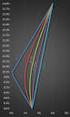
20 Chapter 3 Search strategy Monte-Carlo search for rst candidates, followed by parallel hill climbing search, extended by long jumps. In the following graphic we see design evaluations (that take less than 7 seconds on my computer), consisting out of 20 hill climbing search runs from 20 dierent designs as starting point which were selected by a Monte-Carlo search. We can see that 10 out of the 20 search runs were not able to achieve the ecieny the other 10 achieved. We can see, that there were most likely at least four local maxima the hill climbing search found and got stuck: set.seed(42) x <- searchcrossoverdesign(s=9, p=5, v=4, model=4) plot(x) 19

21 plot(x, type=2) 20
22 Denition (Eciency). If the dierence of two treatments, replicated r 1 and r 2 times, is estimated in an ideal design with residual variance σ 2, the variance of the estimated dierence y A y B is ( 1 V I = + 1 ) σ 2. r 1 r 2 In a cross-over design the variance of a parameter estimates for A and B are given by the corresponding elements σ 2 x A and σ 2 x B of σ 2 (X T X) 1 with X the crossover design matrix. The variance of the dierence is σ 2 (x A + x B 2 x AB ) where x AB is the element of X T X specifying the covariance of the two treatment parameter estimates. The eciency is E := V I r 1 + r 2 = V C r 1 r 2 (x A + x B 2 x AB ) [0, 1]. If we have a model with n parameters and a contrast matrix C R n n, the sum of the variances of the 21
23 linear combinations given by C is trace(ch T A r HC T ). Example for two treatments We compare our results with results from the algorithm of John et al. [2004] that are presented in [Jones and Kenward, 2003, table , p. 202] for s=6 sequences, p=4 periods and v=2 treatments under the constraint that each treatment should occur 12 times. The following shows all designs that were found. For some models the algorithm always returned only one design, but for some 2 or even 3 equally good designs were found. Here are all the designs as found by the above code. Actually there are only 11 dierent designs, since the following designs were already found for other models: 7, 8, 9, 12, 13. Design 1 : Design 2 : Design 3 : Design 4 : Design 5 : Design 6 : Design 7 : Design 8 : Design 9 : Design 10 : Design 11 : Design 12 : Design 13 : Design 14 : Design 15 : Design 16 :
24 Design Additive Self-adjacency Proportional Placebo No into self Decay Interaction 2nd-order carry-over Not estimable Note that for the full interaction model and the self-adjacency model we get the same results, because they are essentially the same models with λ SA 1 = λ F I 1 + γ F I 12, λ SA 2 = λ F I 2 + γ F I 21, ϕ SA 1 = λ F I 1 + γ F I 11, and ϕ SA 2 = λ F I 2 + γ F I 22. For the treatment decay model the algorithm provided us with a design where the treatment decay eect never occurs. Let's give a little bit of weight to this treatment decay eect: As we can see we nd the design from the book, when we give weights 100:1 for treatment / carry-over eects in the treatment decay model. (As seen in the rst result section a zero weight for the carry-over eects results in a model with alternating treatments, so that there never occurs a treatment decay eect.) Summary 3.1 Random Subject Eects Model See Jones and Kenward [2003], 5.3, page 213. The model stays the same Y ijk = µ + π j + τ d[i,j] + λ d[i,j 1] + s ik + e ijk, but we also assume that the subject eects follow a normal distribution: s ik N (0, σ 2 s). In matrix notation we have Y = Xβ + Zγ + ε with X and Z the xed and random eects design matrices 1, ε N (0, Σ) and γ N (0, D). Then 2 Var(Y ) = ZDZ T + Σ. For known V := Var(Y ) = ZDZ T + Σ the MLE and BLUE is given by ˆβ = (X t V 1 X) 1 X t V 1 Y. 1 Note that X and Z are dierent from the... 2 See for example [Lee et al., 2006, chapter 5]. 23
25 Appendix A Appendix The appendices are all work in progress. A.1 Appendix - Variance Balance / Partial Balance Denition A.1.1 (Variance Balance). A design is variance balanced if Var[ˆτ i ˆτ j ] is constant for all pairs of the n treatment eects τ i, τ j, 1 i, j n, i j. Denition A.1.2 (Partially balanced incomplete block design with two associate classes). A partially balanced incomplete block design with two associate classes (or short PBIBD(2)) is a design that fulls the following (see Clatworthy et al. [1973]): ˆ There are b blocks of k units each. ˆ There are v treatments and v > k, so that not all treatments can occur in a block. Each treatment occurs once in each block and is assigned r times. ˆ Let X be the set of treatments. Then there is a partition of X X into three relations, with one relation the identity and the other two relations R 1 and R 2 fullling the following properties: A treatment y is called an ith associates, i {1, 2}, if and only if (x, y) R i. Each treatment x has n i ith associates. For all i, j, k {1, 2} there is a constant numbers p i jk, so that for all (x, y) R i the number of treatments z with (x, z) R j and (z, y) R k is p i jk. The association scheme is commutative, i.e. p i jk = pi kj. ˆ There are two numbers λ 1, λ 2 so that (x, y) R i, i {1, 2}, implies that treatment x and y occur together in exactly λ i blocks. A.2 Appendix - Matrix Algebra / Linear Models A.2.1 Generalized inverse Denition A.2.1 (Moore-Penrose pseudoinverse). For A R m n a matrix A + is called Moore-Penrose pseudoinverse i 1. AA + A = A, 24
26 2. A + AA + = A +, 3. (AA + ) T = AA + and 4. (A + A) T = A + A. The Moore-Penrose pseudoinverse exists for every real matrix and is unique. Theorem A.2.2 (Block matrix pseudoinverse). For a block matrix X := [ A B ] we have (X T X) + = ([ ] ) + ([ A T [ B T A B ] = A T A A T B B T A B T B ]) + = [ ] (A T P B A)+ (B T P B T A(A T A) + (A T P B A)+ A T B(B T B) + (B T P with the orthogonal projection matrices P B = I B(BT B) + B T, P A = I A(AT A) + A T. For a proof see for example http: // en. wikipedia. org/ wiki/ Block_ matrix_ pseudoinverse. Theorem A.2.3. Let Ax = b a linear equation system in n variables and A + the Moore-Penrose pseudoinverse of A. Solutions exist if and only if AA + b = b and are given in this case by {A + b + (I A + A)y y R n }. Proof. If AA + b = b we have for every A + b + (I A + A)y with y R n : A(A + b + (I A + A)y) = b + Ay AA + Ay = b + Ay Ay = b... Theorem A.2.4. Let y = Xβ + ε be a linear model with ε N (0, σ 2 I). t T (X T X) + X T X = t T. Then t T β is estimable i A.2.2 Fisher information For a linear regression model with design matrix X and variance σ 2 the information matrix is given by 1 σ 2 XT X. A.2.3 Linear Mixed Models In the linear mixed model the response Y is given by Y = Xβ + Zγ + ε with X and Z the xed and random eects design matrices, ε N (0, Σ) and γ N (0, D). Then 1 Var(Y ) = ZDZ T + Σ. For known V := Var(Y ) = ZDZ T + Σ the MLE and BLUE is given by 1 See for example [Lee et al., 2006, chapter 5]. ˆβ = (X t V 1 X) 1 X t V 1 Y. 25
27 A.3 Appendix - Internals A.3.1 Naming conventions Most functions exist as R and C/C++ variant, with the following naming conventions: We have functions in R and on the C/C++ level with the same name (in our folowing example rcd) that should be used in R and C/C++ respectively. The R function rcd calls the C function rcd2r which handles the conversion from and to the R structures the SEXP are pointing to. Apart from that we often provide an R function with a sux _R, i.e. in our example rcd_r, which is a pure R function and reimplements the same functionality for testing purposes. SEXP creatercdesign2r (SEXP designs, SEXP vs, SEXP models ) {... } arma : : mat creatercdesign ( arma : : mat design, int v, int model ) {... } creatercdesign < function (X, v, model) { return (. Call ( " creatercdesign2r ", X, v, model, PACKAGE = " Crossover " ) ) } creatercdesign_r < function (X, v, model) { } # Same f u n c t i o n a l i t y w r i t t e n in R A variable v means always the original number of treatments. A variable vv stands for the maximum number of dierent settings 2, either v + v 2 or for the second-order carry-over eects v + v 2 + v 3. 2 For the no carry-over into self or placebo model there are actually less settings. 26
28 Index balanced variance, 24 block design matrix, 7 eciency, 21 Fisher information, 25 information matrix, 25 Linear Mixed Models, 25 link matrix, 7 model no carry-over into self, 12 placebo model, 11 proportionality model, 14 self-adjacency model, 11 standard additive, 7 treatment decay, 13 with full set of interactions, 9 with second-order carry-over eects, 15 Moore-Penrose pseudoinverse, 24 partially balanced incomplete block design, 24 PBIB(2), 24 second-order carry-over eects, 15 self-adjacency model, 11 treatment design matrix, 7 variance balance, 24 27
29 Bibliography Ian Anderson and DA Preece. Locally balanced change-over designs. Utilitas Mathematica, 62:3359, DS Archdeacon, Jerey H. Dinitz, Douglas R. Stinson, and TW Tillson. Some new row-complete latin squares. Journal of Combinatorial Theory, Series A, 29(3):395398, Glenn Francis Atkinson. Designs for sequences of treatments with carry-over eects , Biometrics, pages LN Balaam. A two-period design with t2 experimental units. Biometrics, pages 6173, S. Bate and B. Jones. The construction of universally optimal uniform cross-over designs. Technical report, GlaxoSmithKline Biomedical Data Sciences, II Berenblut. Change-over designs with complete balance for rst residual eects. Biometrics, 20(4):707712, EA Blaisdell Jr and D Raghavarao. Partially balanced change-over designs based on m-associate class pbib designs. Journal of the Royal Statistical Society. Series B (Methodological), pages , Mausumi Bose and Aloke Dey. Optimal Crossover Designs. World Scientic Publishing Company, 2nd edition edition, Willard H Clatworthy, Joseph M Cameron, and Janace A Speckman. Tables of two-associate-class partially balanced designs. US Government Printing Oce, WG Cochran, KM Autrey, and CY Cannon. A double change-over design for dairy cattle feeding experiments. Journal of Dairy Science, 24(11):937951, AW Davis and WB Hall. Cyclic change-over designs. Biometrika, 56(2):283293, Dirk Eddelbuettel and Romain François. Rcpp: Seamless R and C++ integration. Journal of Statistical Software, 40(8):118, Dirk Eddelbuettel and Conrad Sanderson. RcppArmadillo: Accelerating R with high-performance C++ linear algebra. Computational Statistics and Data Analysis, in press, URL /j.csda WT Federer and GF Atkinson. Tied-double-change-over designs. Biometrics, pages , David J Fletcher. A new class of change-over designs for factorial experiments. Biometrika, 74(3):649654, I Iqbal and B Jones. Ecient repeated measurements designs with equal and unequal period sizes. Journal of statistical planning and inference, 42(1):7988, J Aneurin John and Maurice Henry Quenouille. Experiments: design and analysis. Grin London,
30 J.A. John and E.R. Williams. Cyclic and Computer Generated Designs. Monographs on Statistics and Applied Probability. Chapman & Hall/CRC, ISBN JA John, KG Russell, and D Whitaker. Crossover: an algorithm for the construction of ecient cross-over designs. Statistics in medicine, 23(17): , Byron Jones and Michael G Kenward. Design and analysis of cross-over trials, volume 98. Chapman & Hall, 2nd edition edition, Eugene M Laska and Morris Meisner. A variational approach to optimal two-treatment crossover designs: application to carryover-eect models. Journal of the American Statistical Association, 80(391):704710, Youngjo Lee, John A Nelder, and Yudi Pawitan. analysis via H-likelihood. CRC Press, Generalized linear models with random eects: unied SM Lewis, DJ Fletcher, and JNS Matthews. Factorial cross-over designs in clinical trials. Optimal Design and Analysis of Experiments, pages , HL Lucas. Switchback trials for more than two treatments. Journal of Dairy Science, 39(2):146154, JNS Matthews. Optimal crossover designs for the comparison of two treatments in the presence of carryover eects and autocorrelated errors. Biometrika, 74(2):311320, HD Patterson and Henry Lawrence Lucas. Change-over designs. North Carolina Agricultural Experiment Station and US Department of Agriculture, Joseph G Pigeon. Residual eects designs for comparing treatments with a control. PhD thesis, Temple University, P. Prescott. Construction of sequentially counterbalanced designs formed from two or more latin squares. In R. Dutter and W. Grossmann, editors, Proceedings of the 11th Symposium on Computational Statistics held in Vienna, Austria, pages Physica-Verlag: Heidelberg, P Prescott. Construction of sequentially counterbalanced designs formed from two latin squares. Utilitas Mathematica, 55:135152, H. Quenouille. The Design and Analysis of Experiment. Hafner Pub. Co., KG Russell. The construction of good change-over designs when there are fewer units than treatments. Biometrika, 78(2):305313, Martin Oliver Sailer. crossdes: Construction of Crossover Designs, URL org/package=crossdes. R package version Simon Urbanek. rjava: Low-level R to Java interface, URL rjava. R package version EJ Williams. Experimental designs balanced for the estimation of residual eects of treatments. Australian Journal of Chemistry, 2(2):149168,
31 Table of Symbols Sets R set of real numbers N 0 set of natural numbers (including 0) Pot(X) power set of set X, i.e. the set of all subsets of X Variables v number of treatments p number of periods s number of sequences µ intercept π j τ d[i,j] period eect for period j direct treatment eect for treatment d[i, j] in period j of sequence i λ d[i,j 1] rst-order carry-over eect (0 for j 1=0) s ik kth subject eect on sequence i e ijk random error with zero mean and variance σ 2 Functions X transpose of matrix X X + Moore-Penrose pseudoinverse of X, standard direct product x, y = n j=1 x j y j for x, y R n id X identity on X, i.e. id X : X X, x x Other Symbols N (µ, σ 2 ) Normal distribution with mean µ and variance σ 2. N (µ, Σ) Multivariate normal distribution with mean µ and covariance matrix Σ. 30
SAS Software to Fit the Generalized Linear Model
 SAS Software to Fit the Generalized Linear Model Gordon Johnston, SAS Institute Inc., Cary, NC Abstract In recent years, the class of generalized linear models has gained popularity as a statistical modeling
Introduction to General and Generalized Linear Models
 Introduction to General and Generalized Linear Models General Linear Models - part I Henrik Madsen Poul Thyregod Informatics and Mathematical Modelling Technical University of Denmark DK-2800 Kgs. Lyngby
DATA ANALYSIS II. Matrix Algorithms
 DATA ANALYSIS II Matrix Algorithms Similarity Matrix Given a dataset D = {x i }, i=1,..,n consisting of n points in R d, let A denote the n n symmetric similarity matrix between the points, given as where
MATRIX ALGEBRA AND SYSTEMS OF EQUATIONS. + + x 2. x n. a 11 a 12 a 1n b 1 a 21 a 22 a 2n b 2 a 31 a 32 a 3n b 3. a m1 a m2 a mn b m
 MATRIX ALGEBRA AND SYSTEMS OF EQUATIONS 1. SYSTEMS OF EQUATIONS AND MATRICES 1.1. Representation of a linear system. The general system of m equations in n unknowns can be written a 11 x 1 + a 12 x 2 +
1 Introduction to Matrices
 1 Introduction to Matrices In this section, important definitions and results from matrix algebra that are useful in regression analysis are introduced. While all statements below regarding the columns
Least Squares Estimation
 Least Squares Estimation SARA A VAN DE GEER Volume 2, pp 1041 1045 in Encyclopedia of Statistics in Behavioral Science ISBN-13: 978-0-470-86080-9 ISBN-10: 0-470-86080-4 Editors Brian S Everitt & David
Chapter 3: The Multiple Linear Regression Model
 Chapter 3: The Multiple Linear Regression Model Advanced Econometrics - HEC Lausanne Christophe Hurlin University of Orléans November 23, 2013 Christophe Hurlin (University of Orléans) Advanced Econometrics
Overview of Violations of the Basic Assumptions in the Classical Normal Linear Regression Model
 Overview of Violations of the Basic Assumptions in the Classical Normal Linear Regression Model 1 September 004 A. Introduction and assumptions The classical normal linear regression model can be written
Oscillations of the Sending Window in Compound TCP
 Oscillations of the Sending Window in Compound TCP Alberto Blanc 1, Denis Collange 1, and Konstantin Avrachenkov 2 1 Orange Labs, 905 rue Albert Einstein, 06921 Sophia Antipolis, France 2 I.N.R.I.A. 2004
Review Jeopardy. Blue vs. Orange. Review Jeopardy
 Review Jeopardy Blue vs. Orange Review Jeopardy Jeopardy Round Lectures 0-3 Jeopardy Round $200 How could I measure how far apart (i.e. how different) two observations, y 1 and y 2, are from each other?
15.062 Data Mining: Algorithms and Applications Matrix Math Review
 .6 Data Mining: Algorithms and Applications Matrix Math Review The purpose of this document is to give a brief review of selected linear algebra concepts that will be useful for the course and to develop
Integer Factorization using the Quadratic Sieve
 Integer Factorization using the Quadratic Sieve Chad Seibert* Division of Science and Mathematics University of Minnesota, Morris Morris, MN 56567 [email protected] March 16, 2011 Abstract We give
Influence of missing data on analysis and power calculation in bioequivalence studies
 Influence of missing data on analysis and power calculation in bioequivalence studies Henrike Häbel May 4 th,2011 1/33 Influence of missing data on analysis and power calculation in bioequivalence studies
SF2940: Probability theory Lecture 8: Multivariate Normal Distribution
 SF2940: Probability theory Lecture 8: Multivariate Normal Distribution Timo Koski 24.09.2015 Timo Koski Matematisk statistik 24.09.2015 1 / 1 Learning outcomes Random vectors, mean vector, covariance matrix,
Analysis of Variance. MINITAB User s Guide 2 3-1
 3 Analysis of Variance Analysis of Variance Overview, 3-2 One-Way Analysis of Variance, 3-5 Two-Way Analysis of Variance, 3-11 Analysis of Means, 3-13 Overview of Balanced ANOVA and GLM, 3-18 Balanced
Sales forecasting # 2
 Sales forecasting # 2 Arthur Charpentier [email protected] 1 Agenda Qualitative and quantitative methods, a very general introduction Series decomposition Short versus long term forecasting
D-optimal plans in observational studies
 D-optimal plans in observational studies Constanze Pumplün Stefan Rüping Katharina Morik Claus Weihs October 11, 2005 Abstract This paper investigates the use of Design of Experiments in observational
Statistics for Business Decision Making
 Statistics for Business Decision Making Faculty of Economics University of Siena 1 / 62 You should be able to: ˆ Summarize and uncover any patterns in a set of multivariate data using the (FM) ˆ Apply
Linear Algebra Review. Vectors
 Linear Algebra Review By Tim K. Marks UCSD Borrows heavily from: Jana Kosecka [email protected] http://cs.gmu.edu/~kosecka/cs682.html Virginia de Sa Cogsci 8F Linear Algebra review UCSD Vectors The length
Introduction to Matrix Algebra
 Psychology 7291: Multivariate Statistics (Carey) 8/27/98 Matrix Algebra - 1 Introduction to Matrix Algebra Definitions: A matrix is a collection of numbers ordered by rows and columns. It is customary
University of Lille I PC first year list of exercises n 7. Review
 University of Lille I PC first year list of exercises n 7 Review Exercise Solve the following systems in 4 different ways (by substitution, by the Gauss method, by inverting the matrix of coefficients
Least-Squares Intersection of Lines
 Least-Squares Intersection of Lines Johannes Traa - UIUC 2013 This write-up derives the least-squares solution for the intersection of lines. In the general case, a set of lines will not intersect at a
Lecture 3: Linear methods for classification
 Lecture 3: Linear methods for classification Rafael A. Irizarry and Hector Corrada Bravo February, 2010 Today we describe four specific algorithms useful for classification problems: linear regression,
Linear Algebra Notes for Marsden and Tromba Vector Calculus
 Linear Algebra Notes for Marsden and Tromba Vector Calculus n-dimensional Euclidean Space and Matrices Definition of n space As was learned in Math b, a point in Euclidean three space can be thought of
STRUTS: Statistical Rules of Thumb. Seattle, WA
 STRUTS: Statistical Rules of Thumb Gerald van Belle Departments of Environmental Health and Biostatistics University ofwashington Seattle, WA 98195-4691 Steven P. Millard Probability, Statistics and Information
Tests for Two Survival Curves Using Cox s Proportional Hazards Model
 Chapter 730 Tests for Two Survival Curves Using Cox s Proportional Hazards Model Introduction A clinical trial is often employed to test the equality of survival distributions of two treatment groups.
Web-based Supplementary Materials for Bayesian Effect Estimation. Accounting for Adjustment Uncertainty by Chi Wang, Giovanni
 1 Web-based Supplementary Materials for Bayesian Effect Estimation Accounting for Adjustment Uncertainty by Chi Wang, Giovanni Parmigiani, and Francesca Dominici In Web Appendix A, we provide detailed
Math 312 Homework 1 Solutions
 Math 31 Homework 1 Solutions Last modified: July 15, 01 This homework is due on Thursday, July 1th, 01 at 1:10pm Please turn it in during class, or in my mailbox in the main math office (next to 4W1) Please
Physics 235 Chapter 1. Chapter 1 Matrices, Vectors, and Vector Calculus
 Chapter 1 Matrices, Vectors, and Vector Calculus In this chapter, we will focus on the mathematical tools required for the course. The main concepts that will be covered are: Coordinate transformations
COMMUTATIVITY DEGREES OF WREATH PRODUCTS OF FINITE ABELIAN GROUPS
 COMMUTATIVITY DEGREES OF WREATH PRODUCTS OF FINITE ABELIAN GROUPS IGOR V. EROVENKO AND B. SURY ABSTRACT. We compute commutativity degrees of wreath products A B of finite abelian groups A and B. When B
Matrix Differentiation
 1 Introduction Matrix Differentiation ( and some other stuff ) Randal J. Barnes Department of Civil Engineering, University of Minnesota Minneapolis, Minnesota, USA Throughout this presentation I have
Logistic Regression. Jia Li. Department of Statistics The Pennsylvania State University. Logistic Regression
 Logistic Regression Department of Statistics The Pennsylvania State University Email: [email protected] Logistic Regression Preserve linear classification boundaries. By the Bayes rule: Ĝ(x) = arg max
An extension of the factoring likelihood approach for non-monotone missing data
 An extension of the factoring likelihood approach for non-monotone missing data Jae Kwang Kim Dong Wan Shin January 14, 2010 ABSTRACT We address the problem of parameter estimation in multivariate distributions
Lecture 2 Matrix Operations
 Lecture 2 Matrix Operations transpose, sum & difference, scalar multiplication matrix multiplication, matrix-vector product matrix inverse 2 1 Matrix transpose transpose of m n matrix A, denoted A T or
MAT188H1S Lec0101 Burbulla
 Winter 206 Linear Transformations A linear transformation T : R m R n is a function that takes vectors in R m to vectors in R n such that and T (u + v) T (u) + T (v) T (k v) k T (v), for all vectors u
Outline. Topic 4 - Analysis of Variance Approach to Regression. Partitioning Sums of Squares. Total Sum of Squares. Partitioning sums of squares
 Topic 4 - Analysis of Variance Approach to Regression Outline Partitioning sums of squares Degrees of freedom Expected mean squares General linear test - Fall 2013 R 2 and the coefficient of correlation
THE NUMBER OF GRAPHS AND A RANDOM GRAPH WITH A GIVEN DEGREE SEQUENCE. Alexander Barvinok
 THE NUMBER OF GRAPHS AND A RANDOM GRAPH WITH A GIVEN DEGREE SEQUENCE Alexer Barvinok Papers are available at http://www.math.lsa.umich.edu/ barvinok/papers.html This is a joint work with J.A. Hartigan
E(y i ) = x T i β. yield of the refined product as a percentage of crude specific gravity vapour pressure ASTM 10% point ASTM end point in degrees F
 Random and Mixed Effects Models (Ch. 10) Random effects models are very useful when the observations are sampled in a highly structured way. The basic idea is that the error associated with any linear,
1 Portfolio mean and variance
 Copyright c 2005 by Karl Sigman Portfolio mean and variance Here we study the performance of a one-period investment X 0 > 0 (dollars) shared among several different assets. Our criterion for measuring
Bioavailability / Bioequivalence
 Selection of CROs Selection of a Reference Product Metrics (AUC, C max /t max, Shape of Profile) Acceptance Ranges (0.80 1.25 and beyond) Sample Size Planning (Literature References, Pilot Studies) Steps
Multivariate Analysis of Variance (MANOVA)
 Chapter 415 Multivariate Analysis of Variance (MANOVA) Introduction Multivariate analysis of variance (MANOVA) is an extension of common analysis of variance (ANOVA). In ANOVA, differences among various
Gamma Distribution Fitting
 Chapter 552 Gamma Distribution Fitting Introduction This module fits the gamma probability distributions to a complete or censored set of individual or grouped data values. It outputs various statistics
Fitting Subject-specific Curves to Grouped Longitudinal Data
 Fitting Subject-specific Curves to Grouped Longitudinal Data Djeundje, Viani Heriot-Watt University, Department of Actuarial Mathematics & Statistics Edinburgh, EH14 4AS, UK E-mail: [email protected] Currie,
Quadratic forms Cochran s theorem, degrees of freedom, and all that
 Quadratic forms Cochran s theorem, degrees of freedom, and all that Dr. Frank Wood Frank Wood, [email protected] Linear Regression Models Lecture 1, Slide 1 Why We Care Cochran s theorem tells us
Lecture L3 - Vectors, Matrices and Coordinate Transformations
 S. Widnall 16.07 Dynamics Fall 2009 Lecture notes based on J. Peraire Version 2.0 Lecture L3 - Vectors, Matrices and Coordinate Transformations By using vectors and defining appropriate operations between
Factor Analysis. Factor Analysis
 Factor Analysis Principal Components Analysis, e.g. of stock price movements, sometimes suggests that several variables may be responding to a small number of underlying forces. In the factor model, we
Similarity and Diagonalization. Similar Matrices
 MATH022 Linear Algebra Brief lecture notes 48 Similarity and Diagonalization Similar Matrices Let A and B be n n matrices. We say that A is similar to B if there is an invertible n n matrix P such that
Improving Experiments by Optimal Blocking: Minimizing the Maximum Within-block Distance
 Improving Experiments by Optimal Blocking: Minimizing the Maximum Within-block Distance Michael J. Higgins Jasjeet Sekhon April 12, 2014 EGAP XI A New Blocking Method A new blocking method with nice theoretical
October 3rd, 2012. Linear Algebra & Properties of the Covariance Matrix
 Linear Algebra & Properties of the Covariance Matrix October 3rd, 2012 Estimation of r and C Let rn 1, rn, t..., rn T be the historical return rates on the n th asset. rn 1 rṇ 2 r n =. r T n n = 1, 2,...,
Lecture 1: Systems of Linear Equations
 MTH Elementary Matrix Algebra Professor Chao Huang Department of Mathematics and Statistics Wright State University Lecture 1 Systems of Linear Equations ² Systems of two linear equations with two variables
Exploratory Factor Analysis and Principal Components. Pekka Malo & Anton Frantsev 30E00500 Quantitative Empirical Research Spring 2016
 and Principal Components Pekka Malo & Anton Frantsev 30E00500 Quantitative Empirical Research Spring 2016 Agenda Brief History and Introductory Example Factor Model Factor Equation Estimation of Loadings
International College of Economics and Finance Syllabus Probability Theory and Introductory Statistics
 International College of Economics and Finance Syllabus Probability Theory and Introductory Statistics Lecturer: Mikhail Zhitlukhin. 1. Course description Probability Theory and Introductory Statistics
MATH2210 Notebook 1 Fall Semester 2016/2017. 1 MATH2210 Notebook 1 3. 1.1 Solving Systems of Linear Equations... 3
 MATH0 Notebook Fall Semester 06/07 prepared by Professor Jenny Baglivo c Copyright 009 07 by Jenny A. Baglivo. All Rights Reserved. Contents MATH0 Notebook 3. Solving Systems of Linear Equations........................
The Matrix Elements of a 3 3 Orthogonal Matrix Revisited
 Physics 116A Winter 2011 The Matrix Elements of a 3 3 Orthogonal Matrix Revisited 1. Introduction In a class handout entitled, Three-Dimensional Proper and Improper Rotation Matrices, I provided a derivation
SF2940: Probability theory Lecture 8: Multivariate Normal Distribution
 SF2940: Probability theory Lecture 8: Multivariate Normal Distribution Timo Koski 24.09.2014 Timo Koski () Mathematisk statistik 24.09.2014 1 / 75 Learning outcomes Random vectors, mean vector, covariance
MATRIX ALGEBRA AND SYSTEMS OF EQUATIONS
 MATRIX ALGEBRA AND SYSTEMS OF EQUATIONS Systems of Equations and Matrices Representation of a linear system The general system of m equations in n unknowns can be written a x + a 2 x 2 + + a n x n b a
Spatial Statistics Chapter 3 Basics of areal data and areal data modeling
 Spatial Statistics Chapter 3 Basics of areal data and areal data modeling Recall areal data also known as lattice data are data Y (s), s D where D is a discrete index set. This usually corresponds to data
Modern Optimization Methods for Big Data Problems MATH11146 The University of Edinburgh
 Modern Optimization Methods for Big Data Problems MATH11146 The University of Edinburgh Peter Richtárik Week 3 Randomized Coordinate Descent With Arbitrary Sampling January 27, 2016 1 / 30 The Problem
Lecture 5 Least-squares
 EE263 Autumn 2007-08 Stephen Boyd Lecture 5 Least-squares least-squares (approximate) solution of overdetermined equations projection and orthogonality principle least-squares estimation BLUE property
u = [ 2 4 5] has one row with three components (a 3 v = [2 4 5] has three rows separated by semicolons (a 3 w = 2:5 generates the row vector w = [ 2 3
![u = [ 2 4 5] has one row with three components (a 3 v = [2 4 5] has three rows separated by semicolons (a 3 w = 2:5 generates the row vector w = [ 2 3](/thumbs/40/21151686.jpg "u = [ 2 4 5] has one row with three components (a 3 v = [2 4 5] has three rows separated by semicolons (a 3 w = 2:5 generates the row vector w = [ 2 3") MATLAB Tutorial You need a small numb e r of basic commands to start using MATLAB. This short tutorial describes those fundamental commands. You need to create vectors and matrices, to change them, and
MATLAB Tutorial You need a small numb e r of basic commands to start using MATLAB. This short tutorial describes those fundamental commands. You need to create vectors and matrices, to change them, and
CONTROLLABILITY. Chapter 2. 2.1 Reachable Set and Controllability. Suppose we have a linear system described by the state equation
 Chapter 2 CONTROLLABILITY 2 Reachable Set and Controllability Suppose we have a linear system described by the state equation ẋ Ax + Bu (2) x() x Consider the following problem For a given vector x in
Auxiliary Variables in Mixture Modeling: 3-Step Approaches Using Mplus
 Auxiliary Variables in Mixture Modeling: 3-Step Approaches Using Mplus Tihomir Asparouhov and Bengt Muthén Mplus Web Notes: No. 15 Version 8, August 5, 2014 1 Abstract This paper discusses alternatives
NCSS Statistical Software Principal Components Regression. In ordinary least squares, the regression coefficients are estimated using the formula ( )
 Chapter 340 Principal Components Regression Introduction is a technique for analyzing multiple regression data that suffer from multicollinearity. When multicollinearity occurs, least squares estimates
Probability Calculator
 Chapter 95 Introduction Most statisticians have a set of probability tables that they refer to in doing their statistical wor. This procedure provides you with a set of electronic statistical tables that
A SURVEY ON CONTINUOUS ELLIPTICAL VECTOR DISTRIBUTIONS
 A SURVEY ON CONTINUOUS ELLIPTICAL VECTOR DISTRIBUTIONS Eusebio GÓMEZ, Miguel A. GÓMEZ-VILLEGAS and J. Miguel MARÍN Abstract In this paper it is taken up a revision and characterization of the class of
Example: Credit card default, we may be more interested in predicting the probabilty of a default than classifying individuals as default or not.
 Statistical Learning: Chapter 4 Classification 4.1 Introduction Supervised learning with a categorical (Qualitative) response Notation: - Feature vector X, - qualitative response Y, taking values in C
13 MATH FACTS 101. 2 a = 1. 7. The elements of a vector have a graphical interpretation, which is particularly easy to see in two or three dimensions.
 3 MATH FACTS 0 3 MATH FACTS 3. Vectors 3.. Definition We use the overhead arrow to denote a column vector, i.e., a linear segment with a direction. For example, in three-space, we write a vector in terms
Transportation Polytopes: a Twenty year Update
 Transportation Polytopes: a Twenty year Update Jesús Antonio De Loera University of California, Davis Based on various papers joint with R. Hemmecke, E.Kim, F. Liu, U. Rothblum, F. Santos, S. Onn, R. Yoshida,
Illustration (and the use of HLM)
 Illustration (and the use of HLM) Chapter 4 1 Measurement Incorporated HLM Workshop The Illustration Data Now we cover the example. In doing so we does the use of the software HLM. In addition, we will
a 11 x 1 + a 12 x 2 + + a 1n x n = b 1 a 21 x 1 + a 22 x 2 + + a 2n x n = b 2.
 Chapter 1 LINEAR EQUATIONS 1.1 Introduction to linear equations A linear equation in n unknowns x 1, x,, x n is an equation of the form a 1 x 1 + a x + + a n x n = b, where a 1, a,..., a n, b are given
Linear Algebraic Equations, SVD, and the Pseudo-Inverse
 Linear Algebraic Equations, SVD, and the Pseudo-Inverse Philip N. Sabes October, 21 1 A Little Background 1.1 Singular values and matrix inversion For non-smmetric matrices, the eigenvalues and singular
UNIVERSITY OF WAIKATO. Hamilton New Zealand
 UNIVERSITY OF WAIKATO Hamilton New Zealand Can We Trust Cluster-Corrected Standard Errors? An Application of Spatial Autocorrelation with Exact Locations Known John Gibson University of Waikato Bonggeun
Chapter 13 Introduction to Nonlinear Regression( 非 線 性 迴 歸 )
 Chapter 13 Introduction to Nonlinear Regression( 非 線 性 迴 歸 ) and Neural Networks( 類 神 經 網 路 ) 許 湘 伶 Applied Linear Regression Models (Kutner, Nachtsheim, Neter, Li) hsuhl (NUK) LR Chap 10 1 / 35 13 Examples
Continued Fractions and the Euclidean Algorithm
 Continued Fractions and the Euclidean Algorithm Lecture notes prepared for MATH 326, Spring 997 Department of Mathematics and Statistics University at Albany William F Hammond Table of Contents Introduction
Problems. Universidad San Pablo - CEU. Mathematical Fundaments of Biomedical Engineering 1. Author: First Year Biomedical Engineering
 Universidad San Pablo - CEU Mathematical Fundaments of Biomedical Engineering Problems Author: First Year Biomedical Engineering Supervisor: Carlos Oscar S. Sorzano June 9, 05 Chapter Lay,.. Solve the
Poisson Models for Count Data
 Chapter 4 Poisson Models for Count Data In this chapter we study log-linear models for count data under the assumption of a Poisson error structure. These models have many applications, not only to the
Application of discriminant analysis to predict the class of degree for graduating students in a university system
 International Journal of Physical Sciences Vol. 4 (), pp. 06-0, January, 009 Available online at http://www.academicjournals.org/ijps ISSN 99-950 009 Academic Journals Full Length Research Paper Application
Detection of changes in variance using binary segmentation and optimal partitioning
 Detection of changes in variance using binary segmentation and optimal partitioning Christian Rohrbeck Abstract This work explores the performance of binary segmentation and optimal partitioning in the
Bindel, Spring 2012 Intro to Scientific Computing (CS 3220) Week 3: Wednesday, Feb 8
 Spaces and bases Week 3: Wednesday, Feb 8 I have two favorite vector spaces 1 : R n and the space P d of polynomials of degree at most d. For R n, we have a canonical basis: R n = span{e 1, e 2,..., e
Multivariate Analysis (Slides 13)
 Multivariate Analysis (Slides 13) The final topic we consider is Factor Analysis. A Factor Analysis is a mathematical approach for attempting to explain the correlation between a large set of variables
Randomization Based Confidence Intervals For Cross Over and Replicate Designs and for the Analysis of Covariance
 Randomization Based Confidence Intervals For Cross Over and Replicate Designs and for the Analysis of Covariance Winston Richards Schering-Plough Research Institute JSM, Aug, 2002 Abstract Randomization
Factorial experimental designs and generalized linear models
 Statistics & Operations Research Transactions SORT 29 (2) July-December 2005, 249-268 ISSN: 1696-2281 www.idescat.net/sort Statistics & Operations Research c Institut d Estadística de Transactions Catalunya
5. Orthogonal matrices
 L Vandenberghe EE133A (Spring 2016) 5 Orthogonal matrices matrices with orthonormal columns orthogonal matrices tall matrices with orthonormal columns complex matrices with orthonormal columns 5-1 Orthonormal
Using the Delta Method to Construct Confidence Intervals for Predicted Probabilities, Rates, and Discrete Changes
 Using the Delta Method to Construct Confidence Intervals for Predicted Probabilities, Rates, Discrete Changes JunXuJ.ScottLong Indiana University August 22, 2005 The paper provides technical details on
Bipan Hazarika ON ACCELERATION CONVERGENCE OF MULTIPLE SEQUENCES. 1. Introduction
 F A S C I C U L I M A T H E M A T I C I Nr 51 2013 Bipan Hazarika ON ACCELERATION CONVERGENCE OF MULTIPLE SEQUENCES Abstract. In this article the notion of acceleration convergence of double sequences
GENERATING SETS KEITH CONRAD
 GENERATING SETS KEITH CONRAD 1 Introduction In R n, every vector can be written as a unique linear combination of the standard basis e 1,, e n A notion weaker than a basis is a spanning set: a set of vectors
The four [10,5,4] binary codes
![The four [10,5,4] binary codes](/thumbs/40/20775341.jpg "The four [10,5,4] binary codes") 1 Preliminaries The four [10,,] binary codes There are four distinct [10; ; ] binary codes. We shall prove this in a moderately elementary way, using the MacWilliams identities as the main tool. (For the
1 Preliminaries The four [10,,] binary codes There are four distinct [10; ; ] binary codes. We shall prove this in a moderately elementary way, using the MacWilliams identities as the main tool. (For the
STATISTICA Formula Guide: Logistic Regression. Table of Contents
 : Table of Contents... 1 Overview of Model... 1 Dispersion... 2 Parameterization... 3 Sigma-Restricted Model... 3 Overparameterized Model... 4 Reference Coding... 4 Model Summary (Summary Tab)... 5 Summary
DEPARTMENT OF PSYCHOLOGY UNIVERSITY OF LANCASTER MSC IN PSYCHOLOGICAL RESEARCH METHODS ANALYSING AND INTERPRETING DATA 2 PART 1 WEEK 9
 DEPARTMENT OF PSYCHOLOGY UNIVERSITY OF LANCASTER MSC IN PSYCHOLOGICAL RESEARCH METHODS ANALYSING AND INTERPRETING DATA 2 PART 1 WEEK 9 Analysis of covariance and multiple regression So far in this course,
Constrained Least Squares
 Constrained Least Squares Authors: G.H. Golub and C.F. Van Loan Chapter 12 in Matrix Computations, 3rd Edition, 1996, pp.580-587 CICN may05/1 Background The least squares problem: min Ax b 2 x Sometimes,
Minimally Infeasible Set Partitioning Problems with Balanced Constraints
 Minimally Infeasible Set Partitioning Problems with alanced Constraints Michele Conforti, Marco Di Summa, Giacomo Zambelli January, 2005 Revised February, 2006 Abstract We study properties of systems of
Section 6.1 - Inner Products and Norms
 Section 6.1 - Inner Products and Norms Definition. Let V be a vector space over F {R, C}. An inner product on V is a function that assigns, to every ordered pair of vectors x and y in V, a scalar in F,
Chapter 7. Matrices. Definition. An m n matrix is an array of numbers set out in m rows and n columns. Examples. ( 1 1 5 2 0 6
 Chapter 7 Matrices Definition An m n matrix is an array of numbers set out in m rows and n columns Examples (i ( 1 1 5 2 0 6 has 2 rows and 3 columns and so it is a 2 3 matrix (ii 1 0 7 1 2 3 3 1 is a
Simple Regression Theory II 2010 Samuel L. Baker
 SIMPLE REGRESSION THEORY II 1 Simple Regression Theory II 2010 Samuel L. Baker Assessing how good the regression equation is likely to be Assignment 1A gets into drawing inferences about how close the
Optimal Scheduling for Dependent Details Processing Using MS Excel Solver
 BULGARIAN ACADEMY OF SCIENCES CYBERNETICS AND INFORMATION TECHNOLOGIES Volume 8, No 2 Sofia 2008 Optimal Scheduling for Dependent Details Processing Using MS Excel Solver Daniela Borissova Institute of
From the help desk: Demand system estimation
 The Stata Journal (2002) 2, Number 4, pp. 403 410 From the help desk: Demand system estimation Brian P. Poi Stata Corporation Abstract. This article provides an example illustrating how to use Stata to
160 CHAPTER 4. VECTOR SPACES
 160 CHAPTER 4. VECTOR SPACES 4. Rank and Nullity In this section, we look at relationships between the row space, column space, null space of a matrix and its transpose. We will derive fundamental results