
Project Health, Safety, and Environment Plan. Interior Heart and Surgical Center Project Number:
|
|
|
- Philip Little
- 10 years ago
- Views:
Transcription
1 Project Health, Safety, and Environment Plan Interior Heart and Surgical Center Project Number: Printed: December, 2011 Project Health, Safety, and Environment Plan Copyright April 2009 PCL CONSTRUCTORS WESTCOAST INC. The term "PCL" in the following document is used to refer to any one of the independent operating companies in the PCL family of companies. Latest Update: October, 2011

2

3 Project Health, Safety, and Environment Plan Interior Heart and Surgical Center PROJECT HSE PLAN SIGN-OFF Interior Heart and Surgical Center After reviewing the policies and practices as outlined in this plan, the company owner, site superintendent, on-site foreman, lead hands, and all subcontractors are to sign off this sheet. The sign-off sheet must be returned to the PCL Project Manager, before commencement of work-related activities on the jobsite. I have read and understand this Project Health, Safety and Environment Plan and will carry out my work within these guidelines. Company Name: Company Owner Name: Date: Signature: Title: Company Superintendent Name: Date: Signature: Title: On Site Foreman Name: Date: Signature: Title: Revision Number: 01 Page 1 of 77 Revision Date: 25/11/11
4 Project Health, Safety, and Environment Manual Interior Heart and Surgical Center Section 1 Policies (page 8-15) TABLE OF CONTENTS 1.1 Overview 1.2 Project Description 1.3 Policy Statements PCL Corporate Health, Safety and Environment Policy Statement PCL Safety Philosophy PCL Environmental Policy Statement PCL Fall Prevention and Protection Policy PCL Workplace Violence Policy 1.4 Drug and Alcohol Drug and Alcohol test 1.5 Discrimination, Harassment and Violence 1.6 Worker s Right of Refusal Section 2 Leadership and Administration (page 16-26) 2.1 Overview 2.2 Prime Contractor 2.3 Construction Manager/Manager, Special Projects 2.4 Project Manager 2.5 Project Superintendent 2.6 Field Engineer / Project Coordinator 2.7 Quality Assurance / Quality Control Personnel 2.8 Procurement / Materials Manager 2.9 Project HSE Manager / Supervisor / Coordinator 2.10 Foreman / Supervisor / Lead Hand 2.11 Subcontractors 2.12 Visitors / Suppliers / Consultants 2.13 Enforcement of HSE Rules Section 3 HSE Orientation and Training (page 27) 3.1 Components of Orientation 3.2 Supervisor Orientation for Major Projects 3.3 Visitors Forms: HSE Orientation Checklist HSE Orientation Questionnaire Voluntary Medical Questionnaire Revision Number: 01 Page 2 of 77 Revision Date: 21/10/11
5 Project Health, Safety, and Environment Plan Interior Heart and Surgical Center Section 4 HSE Communication Systems (page 28-29) 4.1 Open and Close Circle Meetings 4.2 Project HSE Committee Meetings (Joint Health and Safety Committee) 4.3 Weekly HSE Meeting (Tailgate/Safety Meeting) Form: Weekly HSE form Section 5 Hazard Identification and Control (page 30-37) 5.1 Hazard Evaluation 5.2 Hazard Categories 5.3 Construction Hazard Assessment / Construction Hazard Identification and Control List 5.4 Job Safety Analysis 5.5 Pre-Job Safety Instruction (PSI) 5.6 WHMIS - Work Place Hazardous Materials Information System 5.7 Material Safety Data Sheets (MSDS) Form: Construction Hazard Assessment Section 6 Inspections and Audits (page 38-39) 6.1 Informal Inspections 6.2 Formal Inspections 6.3 Hazard Classification for Inspections 6.4 Audits Form: HSE Inspection Checklist Section 7 Personal Protective Equipment (page 40-43) 7.1 Basic Personal Protective Equipment 7.2 Inspection Defective/Damaged PPE 7.3 Selecting Personal Protective Equipment 7.4 Mandatory Fulltime PPE requirements Head Protection Eyes and Face Protection Hand Protection Foot Protection High Visibility Vests 7.5 Hearing protection 7.6 Limb and Body protection 7.7 Respiratory protection Revision Number: 01 Page 3 of 77 Revision Date: 25/11/11

6 Project Health, Safety, and Environment Manual Interior Heart and Surgical Center 7.8 Fire Retardant clothing 7.9 Clothing and Jewelry Section 8 Emergency Response Plan (page 44-47) 8.1 Definitions 8.2 Emergency Meeting Point 8.3 Site Plot Plan 8.4 Emergency Contact List 8.5 Emergency Coordination 8.6 Types of Emergencies and Procedures 8.7 Medical Emergencies 8.8 Emergency Evacuation 8.9 Earthquake Procedures 8.10 Action on discovering a fire 8.11 Bomb Threat Actions to be taken Attachments: Injury Response Procedure Emergency Evacuation Plan Earthquake Procedure Section 9 Site Security (page 48-49) 9.1 Fencing / Physical Barriers 9.2 Gates 9.3 Lighting 9.4 Visitor Control 9.5 After hours activities 9.6 Parking overview 9.7 Vehicle access 9.8 Tools & Equipment 9.9 Shipping, Receiving and Material Control 9.10 Key Control Section 10 Environmental Action Plan (page 50-57) 10.1 Environmental Project Checklist 10.2 Site Environmental Inspections 10.3 Waste Management 10.4 Environmental Incident Reporting 10.5 Spill Response Plan 10.6 Communication System 10.7 Spill Details 10.8 Control of Scene 10.9 Spill Station/Spill Containment Kit Clean Up Operations Transfer and Disposal of Hazardous Waste Equipment Requirements Revision Number: 01 Page 4 of 77 Revision Date: 21/10/11

7 Project Health, Safety, and Environment Plan Interior Heart and Surgical Center Attachments: Spill Contingency Plan Waste Management Plan Forms: Environmental Spill Report Form Environmental Project Checklist Environmental Checklist Environmental Scope of Work Section 11 Subcontractor/Trade Contractor HSE Program (page 58-59) 11.1 Program promotion and awareness 11.2 Personal Protective Equipment 11.3 Incident Reporting 11.4 Investigations 11.5 Statistical reporting 11.6 Audits and Inspections 11.7 Training (Competent/Qualified Person) 11.8 Meeting attendance Weekly HSE meetings Project HSE Committee Meetings 11.9 Project HSE Manual Acknowledgement Form Section 12 Preventative Maintenance (page 60) 12.1 Inspection 12.2 Maintenance 12.3 Site requirements Section 13 Incident Investigations (page 61-67) 13.1 Purpose 13.2 Definitions 13.3 Objective 13.4 Incident Investigation Procedure 13.5 Documenting and reporting procedure Forms: Incident Investigation Form (HSE ) Witness Statement (HSE ) Section 14 Safe Work Practices (page 68-80) 14.1 Fall Protection 14.2 Scaffolds 14.3 Opening Penetrations (cutting/coring) Revision Number: 01 Page 5 of 77 Revision Date: 25/11/11
8 Project Health, Safety, and Environment Manual Interior Heart and Surgical Center 14.4 Open Penetrations (Floor/Wall) 14.5 Ladders 14.6 Self Propelled Elevating Work Platforms 14.7 Communication and Signage 14.8 Fire Protection 14.9 Motorized Vehicles Manual lifting moving material and equipment overview Workplace Lighting Fuel Storage Electrical Safety Hand and Power tools Powder actuated tools Welding (Hot work) Storage of Compressed Gasses Housekeeping Material and Equipment Storage Infection and Sharps Cellular Phone and radio use Dust and Airborne Aerosols Dust Control Noise and Vibration Permits Overview Smoking overview Forms: Dust Control Program Hot work permit Section 15 Safe Work Procedures (page 81) Overview of requirements and examples of tasks that require written safe work procedures. Revision Number: 01 Page 6 of 77 Revision Date: 21/10/11

9 Project Health, Safety, and Environment Plan Interior Heart and Surgical Center Attachments: Appendix A Spill Contingency Plan Appendix B Emergency/Injury Response Plan Appendix C Construction Waste Management Plan Appendix D Emergency Earthquake Procedures Forms Section: 1) HSE Orientation Checklist (section 3) 2) HSE Orientation Questionnaire (section 3) 3) Voluntary Medical Questionnaire (section 3) 4) Weekly HSE meeting (section 4) 5) HSE Committee Meeting Minutes (section 4) 6) Construction Hazard Assessment (section 5) 7) Job Hazard Analysis 8) Hazard Identification and Control Form 9) HSE Inspection Checklist (section 6) 10) Environmental Inspection Report 11) Environmental Spill Report (section 10) 12) Environmental Project Checklist 13) Environmental Checklist 14) Environmental Scope of work 15) Checklist for visually determining the presence of mold in an existing building 16) Medical Treatment Memo 17) Statement Form 18) Fitness Form 19) Modified Work Offer 20) Employee Injury Management Form 21) Incident Investigation Report Form (section 13) 22) Witness Statement Form (section 13) 23) Safe Operating Procedures Table of Content (from PCL Business Guide) 24) Working Alone Permit 25) Extended Working Hours Permit 26) Extended Working Hours Sign in Sheet 27) Hot and Safe Work Permit System 28) Dust Control Program 29) Site Plan Revision Number: 01 Page 7 of 77 Revision Date: 25/11/11

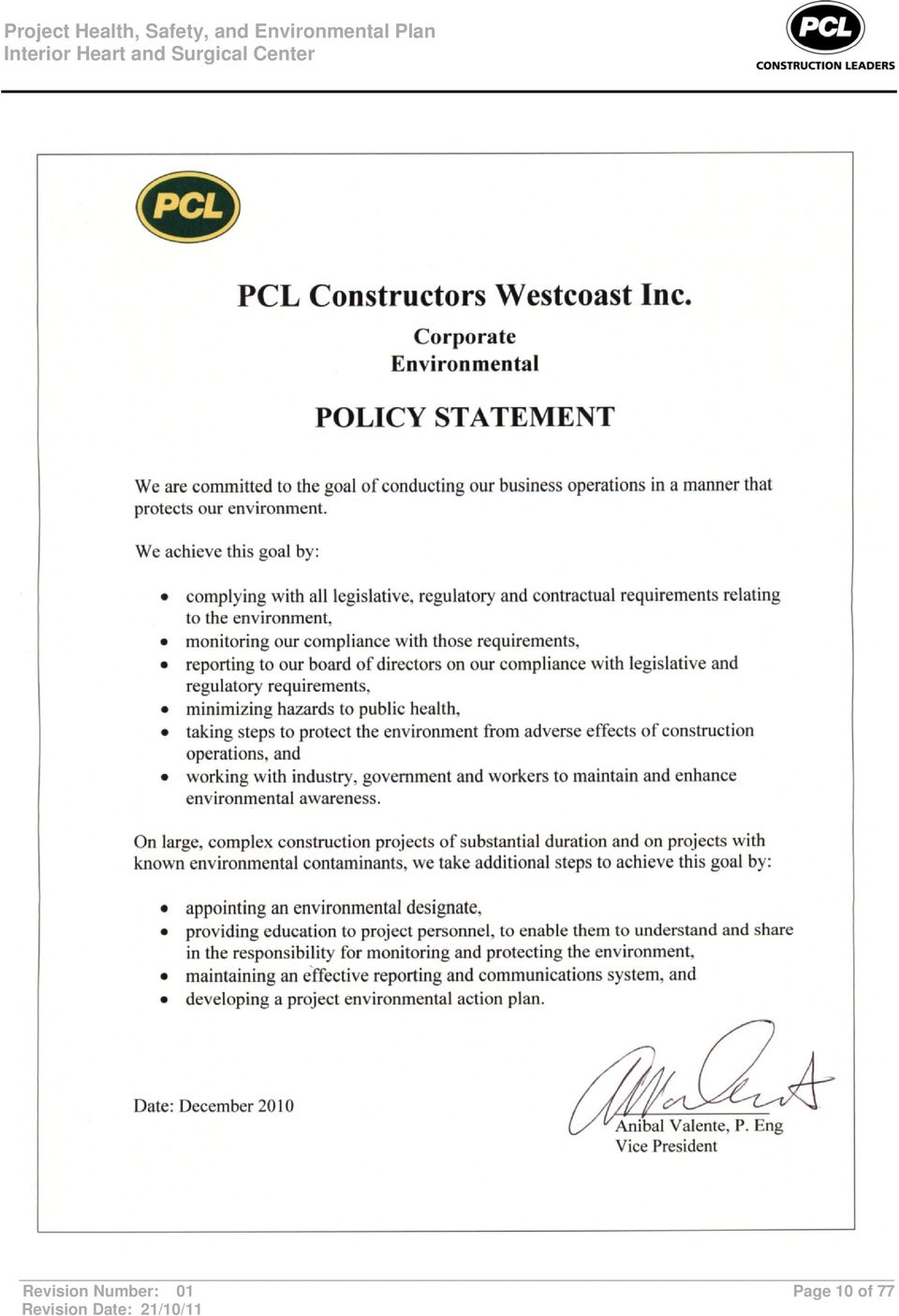
10 Project Health, Safety, and Environmental Plan Interior Heart and Surgical Center Section 1 Policies 1.1 Overview PCL has long acknowledged the importance of maintaining a safe and healthy work environment for all personnel and the stewardship required in maintaining an effective and successful program. This Project Health, Safety, and Environment (HSE) Plan applies to all on-site personnel and describes the safety and environmental standards, which govern the work performed on this project. Full compliance with this Project HSE Plan and applicable safety and environmental laws and regulations are the minimum acceptable standards on Interior Heart and Surgical Center Project. Where there is conflict between this Project HSE Plan and any regulatory requirement, the more stringent will apply. This Project HSE Plan can be amended as site conditions warrant. The purpose of the Project HSE Plan is to: assist project personnel in the planning, organizing, control monitoring and implementation of corrective measures which are necessary to prevent exposures which could cause injury, illness or negative environmental consequence enhance and maintain safety and environmental awareness of all project personnel minimize hazards to public health 1.2 Project Description The Interior Heart and Surgical Center (IHSC) is a three-storey building, plus mechanical, which will house the Cardiac and Inpatient Surgical Suite and support spaces, Cardiac Surgery Intensive Care Unit as well as the new Medical Device Reprocessing Department. The IHSC will be designed to expand and to accommodate approximately 30 medical/surgical inpatient beds. 1.3 Policy Statements PCL Corporate Health, Safety and Environment Policy Statement PCL Environmental Policy Statement PCL Fall Prevention and Protection Policy PCL Workplace Violence Policy PCL Safety Philosophy Revision Number: 01 Page 8 of 77 Revision Date: 21/10/11
11 Project Health, Safety, and Environment Plan Interior Heart and Surgical Center Revision Number: 01 Page 9 of 77 Revision Date: 25/11/11

12 Project Health, Safety, and Environmental Plan Interior Heart and Surgical Center Revision Number: 01 Page 10 of 77 Revision Date: 21/10/11
13 Project Health, Safety, and Environment Plan Interior Heart and Surgical Center Revision Number: 01 Page 11 of 77 Revision Date: 25/11/11

14 Project Health, Safety, and Environmental Plan Interior Heart and Surgical Center Revision Number: 01 Page 12 of 77 Revision Date: 21/10/11

15 Project Health, Safety, and Environment Plan Interior Heart and Surgical Center Revision Number: 01 Page 13 of 77 Revision Date: 25/11/11

16 Project Health, Safety, and Environmental Plan Interior Heart and Surgical Center 1.4 Drugs and Alcohol If a worker is taking a prescription drug, for which there is a potential unsafe side effect, he/she has an obligation to report this potential to the supervisor. No worker will misuse prescription drugs. No worker shall report to work, or be at work, with an alcohol level equal to or in excess of grams per 210 liters of breath (.002 on a breathalyzer) Workers are expected to not use illegal drugs. If they test positive for illegal drugs, they will be removed from the site and not allowed to continue working on the project until PCL at its discretion determines they no longer pose a safety risk. Workers will likewise be removed from the site and not allowed to continue working on the project if they test for alcohol in excess of the limit described above Drug and Alcohol Testing Testing will be conducted when PCL determines there are reasonable grounds to suspect that an employee is using illegal drugs, or has rejected to work, or is working with an alcohol level in excess of the limit described above. Such reasonable grounds will include absenteeism or performance problems. Testing will also be conducted after an accident, or, at the discretion of the District HSE manager and site superintendent, after a near-accident or other incident. Refusal to submit to a test will be treated as a positive test. 1.5 Discrimination, Harassment and Violence PCL is committed to creating and maintaining a working environment free from all forms of discrimination, harassment, and violence on the grounds specified under anti-discrimination legislation and PCL related policies. See PCL Workplace Violence Policy in this Section All persons under PCL contractual responsibility are responsible for making certain their behavior does not negatively contribute to the maintenance of the work environment. Incidents are to be investigated with corrective measures put in place. 1.6 Workers Right of Refusal PCL management, contractor supervisors, and workers all share responsibility for identifying and recommending corrective action respecting situations which are, or could be, unsafe. A worker who refuses to carry out a work process or operate a tool, appliance, or equipment that they feel is unsafe; (1) must immediately report the circumstances of the unsafe condition to their supervisor. (2) The supervisor receiving a report must immediately contact PCL Superintendent and investigate the matter and (a) ensure that any unsafe condition is remedied without delay, or (b) If in their opinion the report is not valid, must so inform the person who made the report. (3) If this does not resolve the matter and the worker continues to refuse to carry out the work process or operate the tool, appliance or equipment, the supervisor or employer must investigate the matter in the presence of the worker who made the report and in the presence of (a) a worker member of the joint committee, (b) A worker who is selected by a trade union representing the worker, or Revision Number: 01 Page 14 of 77 Revision Date: 21/10/11

17 Project Health, Safety, and Environment Plan Interior Heart and Surgical Center (c) If there is no joint committee or the worker is not represented by a trade union, any other reasonably available worker selected by the worker. (4) If the investigation does not resolve the matter and the worker continues to refuse to carry out the work process or operate the tool, appliance or equipment, both the supervisor, or the employer, and the worker must immediately notify a Worksafe BC Officer, who must investigate the matter without undue delay and issue whatever orders are deemed necessary. Revision Number: 01 Page 15 of 77 Revision Date: 25/11/11

18 Project Health, Safety, and Environmental Plan Interior Heart and Surgical Center Section 2 Leadership and Administration 2.1 Overview Responsibilities and enforcement information is contained in the Health, Safety, and Environment (HSE) manual. A copy will be provided at the site office. All workers, trade contractors, suppliers and consultants are required to review and understand these requirements. 2.2 Prime Contractor PCL Constructors Westcoast Inc. has been appointed Prime Contractor by Plenary Health Group and Interior Health Authority. All Subcontractors / Trade Contractors are to adhere to PCL Constructors Westcoast Inc. safety policies and procedures, as well as this site specific health safety and environment manual. PCL Constructors Westcoast Inc. as Prime Contractor will ensure the activities of and between Subcontractors / Trade Contractors performing work at the Interior Heart and Surgical Center related to health, safety and environment are coordinated, and do everything that is reasonably practicable to establish and maintain systems and processes outlined in this manual and ensure compliance with Worksafe BC Legislation with respect to all activities. 2.3 Construction Manager The construction manager is responsible to assist in the development and implementation of the Project Specific HSE Plan on assigned construction projects. Responsible, with respect to the projects they manage, to: Account to the operations manager and/or district manager/general manager; Receive regular reports from project management (site) regarding; o the effectiveness of district and/or project HSE programs and operations; o the occurrence of any significant HSE incident within the district; and o implementation of corrective or remedial actions arising out of significant incidents; Receive reports or recommendations from HSE director, USHO/HSE vice president, NAHQ and/or district HSE department regarding: o the effectiveness of HSE policies and programs, required reviews, and updates; and o the appropriateness and adequacy of resources (financial and time) for HSE programs; Report to the operations manager/project director/ district HSE manager: o the effectiveness of district and/or project HSE programs; o the occurrence of any significant HSE incident within the district; and o implementation of corrective or remedial actions arising out of significant incidents; Implement HSE standards and procedures as stated in the HSE Manual; Conduct PSI audits; Verify that the SMC is being utilized and updated on an on-going basis; Comply with regulatory requirements and building codes, as to construction means, methods and project specifications; Exercise authority to maintain compliance with regulatory and company requirements; Establish goals and objectives for employee training; (HSE-03) Participate in the required training for their position; (HSE-03) Provide resources necessary to carry out training goals and objectives; (HSE-03) Verify that the superintendent is chairing and the project manager is co-chairing the project HSE committee meetings; (HSE-04) Participate and attend all required HSE committee meetings; (HSE-04) Implement the District Strategic HSE Plan and report progress to the district HSE committee; (HSE- 04) Revision Number: 01 Page 16 of 77 Revision Date: 21/10/11
19 Project Health, Safety, and Environment Plan Interior Heart and Surgical Center Prepare HSE topics/issues for meeting agendas with clients, suppliers, and subcontractors/sub-trade contractors; Verify that the hazard assessment process is followed on each project; (HSE-05) Develop and approve the Project Specific HSE Plan prior to mobilization; (HSE-05) Complete regular revisions of the Project Specific HSE Plan as project conditions change; (HSE-05) Participate in the CHA; (HSE-05) Provide coaching and recognition to employees on the implementation and development of SWPs, HSEOPs, JHAs, and the overall hazard assessment process; (HSE-05) Verify that projects are following the Project Specific HSE Plan standards through auditing and observation; (HSE-05) Verify that applicable procedures are an integral part of the project HSE program; Verify that project management is familiar with the Project Specific HSE Plan; (HSE-05) Verify that corrective actions identified during inspections are implemented; (HSE-06) Complete corrective action plans for items identified during audits; (HSE-06) Conduct one formal inspection per month, at a minimum; (HSE-06) Set an appropriate example for employees under their direction; (HSE-07) Verify that PPE standards outlined in this manual or otherwise established by the district are followed; (HSE-07) Provide sufficient resources (including materials, equipment, and training) to effectively deal with potential emergencies at the work place; (HSE-08) Assist in the development of the ERPs and verify that it is implemented on projects; (HSE-08) Provide sufficient resources, including materials, equipment, and training to effectively deal with security needs and issues; (HSE-09) Submit the completed Environmental Scope of Work form and the CHA to the appropriate project management team to facilitate their assistance with the development of the Project Specific HSE Plan; Assist with the development of the Project Security Plan, and verify that it is part of the overall Project Specific HSE Plan; (HSE-09) Assist with the development of the Environmental Action Plan and verify that it is implemented on each project; (HSE-10) Verify that projects are following the Environmental Action Plan standards through auditing and observation; (HSE-10) Participate in the environmental inspection components of the Environmental Action Plan and address deficiencies where required; (HSE-10) Assist with the implementation of the PCL subcontractors screening Continuously monitor subcontractors with poor HSE performance to the point where their HSE performance has sufficiently improved; (HSE-11) Notify subcontractors of work schedule, location, hazards, and special precautions, including the Project Specific HSE Plan content prior to the start of the project; (HSE-11) Verify the Project Specific HSE Plan acknowledgement form has been signed and returned to the project management team; (HSE-11) Monitor subcontractors to verify their work is conducted in a safe, responsible and compliant manner, is in accordance with the Project Specific HSE Plan and the subcontractor s HSE Plan; (HSE-11) Review the subcontractor s designated HSE qualifications; (HSE-11) Provide support and resources for the inspection, maintenance, and repair of equipment and tools; (HSE-12) Participate, support and reinforce the incident investigation and reporting process; (HSE-13) Review incident investigation reports and verify that the company incident investigation process is followed; (HSE-13) Communicate and report incidents to the appropriate client representatives as per district management directive; (HSE-13) Support corrective actions identified in incident investigations; (HSE-13) and Provide adequate support and resources for all aspects of the injury management program.(hse-14) Revision Number: 01 Page 17 of 77 Revision Date: 25/11/11
20 Project Health, Safety, and Environmental Plan Interior Heart and Surgical Center The Construction Managers on this project will be Les Krusel and Wayne Bilawchuk. 2.4 Project Manager The project manager is responsible for assisting in the development and implementation of the Project Specific HSE Plan for assigned projects. The project manager will work closely with the project superintendent and the district HSE manager to implement these HSE programs. In addition to the responsibilities of all employees as set out in section 3.1 of this HSE-02, project managers are responsible, in respect to their projects, to: Account to the operations manager/construction manager/manager, special projects/general manager/district manager as applicable; Assist and develop regular reports regarding; o the effectiveness of project HSE programs and operations; o the occurrence of any significant HSE incident; and o implementation of corrective or remedial actions arising out of significant incidents; Receive reports or recommendations from HSE director, USHO/HSE vice president, NAHQ and/or district HSE department regarding: o the effectiveness of HSE policies and programs, required reviews, and updates; o the appropriateness and adequacy of resources (financial and time) for HSE programs; Report to the operations manager/construction manager/manager, special projects/general manager/district manager/ district HSE manager as applicable: o the effectiveness of project HSE programs; o the occurrence of any significant HSE incident; and o implementation of corrective or remedial actions arising out of significant incidents; Implement HSE standards and procedures as stated in the HSE Manual; Conduct PSI audits; Verify that the SMC is being utilized and updated on an on-going basis; Comply with regulatory requirements and building codes, as to construction means, methods and project specifications; Exercise authority to maintain compliance with regulatory and company requirements; Where practical participate in site orientations; (HSE-03) Participate in the required training for their position; (HSE-03) Provide resources necessary to carry out training goals and objectives; (HSE-03) Develop the Project HSE Trend Analysis; (HSE-04) Develop action plans arising from the Project HSE Trend Analysis; Verify that the superintendent is chairing and the project manager is co-chairing the project HSE committee meetings; (HSE-04) Participate and attend all required HSE committee meetings; (HSE-04) Implement the District Strategic HSE Plan and report progress to the district HSE committee; (HSE- 04) Prepare HSE topics/issues for meeting agendas with clients, suppliers, and subcontractors/sub-trade contractors; (HSE-04) Assist in the development and verify implementation of the Project Specific HSE Plan; (HSE-05) Verify that the hazard assessment process is followed; (HSE-05) Complete regular revisions of the Project Specific HSE Plan as project conditions change; (HSE-05) Participate in the CHA; (HSE-05) Provide coaching and recognition to employees on the implementation and development of SWPs, HSEOPs, JHAs, and the overall hazard assessment process; (HSE-05) Verify that the project is following the Project Specific HSE Plan standards through auditing and observation; (HSE-05) Verify that applicable procedures are an integral part of the project HSE program; Verify that project management and project supervision are familiar with the Project Specific HSE Plan; (HSE-05) Revision Number: 01 Page 18 of 77 Revision Date: 21/10/11

21
22 Project Health, Safety, and Environmental Plan Interior Heart and Surgical Center o the effectiveness of project HSE programs and operations; o the occurrence of any significant HSE incident; and o implementation of corrective or remedial actions arising out of significant incidents; Receive reports or recommendations from HSE director, USHO/HSE vice president, NAHQ and/or district HSE department regarding: o the effectiveness of HSE policies and programs, required reviews, and updates; and o the appropriateness and adequacy of resources (financial and time) for HSE programs; Report to the operations manager/construction manager/manager, special projects/general manager/district manager/district HSE manager (as applicable) regarding: o the effectiveness of project HSE programs; o the occurrence of any significant HSE incident; and o implementation of corrective or remedial actions arising out of significant incidents; Implement HSE standards and procedures as stated in the HSE Manual; Conduct PSI audits; Assist supervisors with the on-site PSI program; Assist with the development of SWPs, HSEOPs and JHAs; Verify that the SMC is being utilized and updated on an on-going basis; Comply with regulatory requirements and building codes, as to construction means, methods and project specifications; Exercise authority to maintain compliance with regulatory and company requirements; Where practical, participate in site orientations; (HSE-03) Establish goals and objectives for employee training; (HSE-03) Participate in the required training for their position; (HSE-03) Provide resources necessary to carry out training goals and objectives; (HSE-03) Assist with action plan development arising from the project HSE trend analysis; (HSE-04) Chair the project HSE committee meetings; (HSE-04) Participate and attend all required HSE committee meetings; (HSE-04) Implement the District Strategic HSE Plan and report progress to the district HSE committee; (HSE- 04) Prepare HSE topics/issues for meeting agendas with clients, suppliers, and subcontractors/sub-trade contractors; (HSE-04) Make all workers aware of communication systems; (HSE-04) Assist in the development and verify implementation of the Project Specific HSE Plan; (HSE-05) Verify that the hazard assessment process is followed on each project; (HSE-05) Complete regular revisions of the Project Specific HSE Plan as project conditions change; (HSE-05) Participate in the CHA; (HSE-05) Provide coaching and recognition to employees on the implementation and development of SWPs, HSEOPs, JHAs, and the overall hazard assessment process; (HSE-05) Review JHAs/SWPs/HSEOPs that are commensurate with the scope of work for PCL and subcontractors; Verify that the project is following the Project Specific HSE Plan standards through auditing and observation; (HSE-05) Verify that applicable procedures are an integral part of the project HSE program; Verify that project management and project supervision are familiar with the Project Specific HSE Plan; (HSE-05) Review completed hazard assessments with employees prior to the start of work; (HSE-05) Communicate the Project HSE Plan to his/her workers in the area of their responsibility; (HSE-05) Conduct daily informal inspections of their work areas; (HSE-06) Verify that corrective actions identified during inspections are implemented;(hse-06) Complete corrective action plans for items identified during audits; (HSE-06) Conduct one formal inspection per week, at a minimum; (HSE-06) Set an appropriate example for employees under their direction; (HSE-07) Verify that PPE standards outlined in the Project Specific HSE Plan are followed; (HSE-07) Revision Number: 01 Page 20 of 77 Revision Date: 21/10/11
23 Project Health, Safety, and Environment Plan Interior Heart and Surgical Center Provide sufficient resources including materials, equipment, and training to effectively deal with potential emergencies at the work place; (HSE-08) Assist in the development of the ERPs and monitor the implementation on project; (HSE-08) Verify that emergency response standards are met for each project before commencement of work; (HSE-08) Inform all supervisors of their responsibilities within the ERP; (HSE-08) Assume leadership of the emergency response team; (HSE-08) Provide sufficient resources, including materials, equipment, and training to effectively deal with security needs and issues; (HSE-09) Assist with the project security plan development, and verify that it is part of the overall Project Specific HSE Plan; (HSE-09) Assist with the Environmental Action Plan development and monitor implementation on project; (HSE- 10) Verify the project is following the Environmental Action Plan standards through auditing and observation; (HSE-10) Participate in the environmental inspection components of the Environmental Action Plan and address deficiencies where required; (HSE-10) Assist with the implementation of the PCL subcontractors screening and approval process; (HSE-11) Hold a pre-job meeting to discuss subcontractor HSE performance expectations and communicate HSE requirements to the subcontractor prior to the start of the subcontract; (HSE-11) Support the subcontractor HSE program and provide assistance where required; (HSE-11) Continuously monitor subcontractors with poor HSE performance to the point where their HSE performance has sufficiently improved; (HSE-11) Notify subcontractors of work schedule, location, hazards, and special precautions, including the content of the Project Specific HSE Plan prior to the start of the project; (HSE-11) Monitor subcontractors to verify their work is conducted in a safe, responsible and compliant manner and is in accordance with the Project Specific HSE Plan and the subcontractor s HSE Plan; (HSE-11) Review the subcontractor s designated HSE personnel qualifications; (HSE-11) Do not permit the use of any piece of equipment or tools that have been tagged OUT OF SERVICE or DO NOT USE or are otherwise defective; (HSE-12) Verify the safe operation and maintenance of all equipment on the project; (HSE-12) Provide support and resources for the inspection, maintenance, and repair of equipment and tools; (HSE-12) Participate, support and reinforce the incident investigation and reporting process; (HSE-13) Review incident investigation reports and verify that the company incident investigation process is followed; (HSE-13) Communicate and report incidents to the appropriate client representatives as per district management directive; (HSE-13) Support corrective actions identified in incident investigations; (HSE-13) Determine, in conjunction with project HSE manager/supervisor/coordinator, if the Incident Investigation Form HSE or if the Near Miss Form should be used; (HSE-13) Provide adequate support and resources for all aspects of the injury management program; (HSE-14) Provide employees and supervisors training in the injury management program; (HSE-14) Implement modified work programs within the requirements of the policy and local regulations; (HSE- 14) Review all medical treatment memorandums and other incident related reports for accuracy and action as required; Verify operators of mobile or hoisting equipment qualifications; and Verify that all equipment (particularly hoisting equipment) is inspected before use. On projects that do not have a project HSE supervisor, the project superintendent will assume or delegate the HSE supervisor's responsibilities. Revision Number: 01 Page 21 of 77 Revision Date: 25/11/11
24
25 Project Health, Safety, and Environment Plan Interior Heart and Surgical Center 2.9 Project HSE Manager/Supervisor/Coordinator The project HSE manager/supervisor/coordinator assists with the development, implementation, and monitoring of the Project Specific HSE Plan with the assistance of the project management team and the superintendent. The responsibilities/accountability will be clearly identified in the Project HSE Plan by the district HSE manager. In addition to the responsibilities of all employees as set out in section 3.1 of this HSE-02, the project HSE manager/supervisor/coordinators are responsible to: Account to the construction manager/district HSE manager or as identified in the Project Specific HSE Plan; Develop regular reports and make recommendations for all workers/district management and project management (as applicable) regarding; o the effectiveness of project HSE programs and operations; o the occurrence of any significant HSE incident on the project; o implementation of corrective or remedial actions arising out of significant incidents; and o the appropriateness and adequacy of resources (financial and time) for HSE programs; Report to and advise project management on current legislation, information, and issues regarding HSE; Assist project management in evaluating HSE performance and exercising authority to maintain compliance with regulatory and company requirements; Research legislation and information applicable to operations; Assist project management on HSE related issues; Conduct PSI audits; Participate in HSE associations; Monitor, assess and document the performance of subordinate project HSE staff as defined in the Project Specific HSE Plan; Liaise with district HSE manager on project HSE related issues; Assist with, and verify that, the information contained in the SMC is up-to-date and accurate; Issue and circulate HSE literature to enhance and maintain awareness; Review investigation reports of incidents including HSE, medical, first aid cases, and damage to property or equipment and verify that corrective action has been completed; Notify government agencies of project starts and reportable incidents in accordance with local and federal regulations as directed by the district HSE manager; Assist with development of education and training programs for the project; Assist with development and review of HSEOPs; Assist with development of HSE audit results and industry trends which could impact project operations; (HSE-04) Prepare monthly HSE performance statistics and circulate to project management and as otherwise directed by project management; Review weekly HSE meeting minutes to verify that meaningful information is being provided to workers; Assist in the organizing, planning, and implementation of the worker HSE orientation program (HSE- 03) and the on-site PSI program (HSE-05); Participate and attend all required HSE committee meetings; (HSE-04) Review hazard assessments for accuracy and relevance to the work being performed; (HSE-05) Review the Project Specific HSE Plan prior to distribution; (HSE-05) Assist with hazard assessments where required; (HSE-05) Provide coaching and recognition to employees on the implementation and development of SWPs, HSEOPs, JHAs, and the overall hazard assessment process; (HSE-05) Verify that the hazard assessment process is followed on the project; (HSE-05) Revision Number: 01 Page 23 of 77 Revision Date: 25/11/11
26 Project Health, Safety, and Environmental Plan Interior Heart and Surgical Center Verify the project is following the Project Specific HSE Plan standards contained through auditing and observation; (HSE-05) Assist with CHA prior to mobilization to site; (HSE-05) Research, evaluate, and select medical facilities and service providers to accommodate project requirements; Assist with revisions of the Project Specific HSE Plan as project conditions change; (HSE-05) Coordinate the development, implementation, coordination, distribution, and communication of the Project Specific HSE Plan standards; (HSE-05) Verify the Project Specific HSE Plan is current; (HSE-05) Verify the Project Specific HSE Plan is communicated to all project personnel in orientation; (HSE-05) Coordinate training for line supervision on the Project Specific HSE Plan content; (HSE-05) Audit the PSI process where the employees are performing the work; (HSE-05) Provide appropriate methods of documenting inspections; (HSE-06) Perform one formal work site inspection per week, at a minimum; Perform audits and additional inspections as directed by project management; Verify the project inspections are conducted according to policy; (HSE-06) Verify that corrective actions identified during inspections are implemented; (HSE-06) Evaluate HSE inspection reports to identify unsatisfactory performance trends; Complete corrective action plans for audits completed in their area of responsibility; (HSE-06) Verify that PPE standards are developed for the tasks performed by PCL; (HSE-07) Recommend PPE that meets applicable government, industry, or customer standard(s) governing its use; (HSE-07) Set an appropriate example for employees under their direction; (HSE-07) Assist in the development and implementation of the ERP; (HSE-08) Verify that the applicable ERP procedures are part of the Project Specific HSE Plan; (HSE-08) Verify through inspections that procedures are up-to-date; (HSE-08) Verify project personnel are aware of, and have knowledge of, proper emergency reactions; (HSE-08) Investigate, report, and recommend future preventative action plans; (HSE-08) Verify that all personnel are familiar with the plan and can adequately respond if required; (HSE-08) Exercise the ERP with the emergency evacuation team in test situations at a frequency of no less than once per year. On major construction sites as defined by the district manager/hse manager, emergency procedures should be completed every six months; (HSE-08) Verify that proper first aid procedures are carried out until the arrival of emergency response personnel; (HSE-08) Assist in the development and implementation of site security plans; (HSE-09) Review the Environmental Action Plan prior to distribution; (HSE-10) Evaluate the subcontractor s pre-qualification documentation to determine the ability to achieve expected HSE performance; (HSE-11) Monitor subcontractor safety performance and verify correction and redirection as needed; (HSE-11) Determine the degree of PCL involvement in the subcontractor s HSE efforts; (HSE-11) Develop programs to verify that equipment and tools are maintained in safe working condition; (HSE- 12); Monitor or assist company-owned or rented equipment safety maintenance programs; Provide incident investigation training to project management and project supervision; (HSE-13) Investigate or assist with the HSE incident investigations; (HSE-13) Review incident investigation reports to verify accuracy, completeness, and evaluate corrective actions taken; (HSE-13) Determine in conjunction with superintendent if the Incident Investigation Form HSE or if the Near Miss Form should be used; (HSE-13) Verify that employees and supervisors are trained in injury management; (HSE-14) Assist with development of processes and training to accomplish injury management program goals; (HSE-14) Verify that modified work programs are implemented within the requirements of the policy and local regulations; (HSE-14) Revision Number: 01 Page 24 of 77 Revision Date: 21/10/11
27 Project Health, Safety, and Environment Plan Interior Heart and Surgical Center Ongoing liaison with medical practitioners and district HSE regarding rehabilitation or return to work plans; (HSE-14) Manage claims on compensation cases and/or assist injury management coordinators; Verify that applicable procedures are an integral part of the project HSE program; Assist supervisory staff with preparation of agenda and material for project HSE committee meetings and weekly HSE meetings; Review HSE related reports and memorandums for accuracy and then forward, as required, to the district HSE manager; and Verify that site supervisors have adequately prepared their employees to act appropriately in emergency response situations Foreman/Supervisor/Lead Hand The foreman/supervisor/lead hand is responsible for promoting HSE awareness and demonstrating to the workers, through day-to-day example and actions. In addition to the responsibilities of all employees as set out in section 3.1 of this HSE-02, the foremen/supervisors/lead hands are responsible to: Account to the applicable immediate supervisor/project superintendent; Report to project superintendent promptly on occurrence of any significant HSE incident; Assist with development and implementation of the Project Specific HSE Plan as directed by project management; Perform informal daily inspections of assigned work areas; Conduct task specific HSE orientations for new workers prior to assignment of duties, including hazardous material and JHA s instruction; Implement/monitor the Project Specific HSE Plan requirements; Assist with the SWPs, HSEOPs and JHAs development; Provide PSIs to employees at the beginning of each shift and whenever new tasks are assigned; Issue appropriate PPE to employees as required; Develop and maintain good housekeeping standards; Monitor the job site through personal observation for environmental non-compliance or unsafe conditions/hazards and communicate these (with remedial action as required) to appropriate line supervisors or employees; Conduct a preliminary investigation upon the occurrence of an incident; Report results of the incident investigations to the project superintendent; Hold weekly HSE meetings with employees as per HSE-04; Verify that operators complete equipment inspection checklists; Check that operators are qualified, fit, and authorized to operate equipment or vehicles safely; Conduct PSI audits; Enforce HSE rules and issue appropriate discipline; Take immediate action to correct unsatisfactory HSE performance; and Familiarize themselves, comply with, and communicate to subordinate employees the Project Specific HSE Plan requirements. Provide PSIs to workers whenever new tasks are assigned or when job conditions change; Before commencing work, contact the project superintendent for instructions regarding HSE hazards; Advise their workers of the Project Specific HSE Plan and verify compliance through personal observation; Provide education and training, and enforce the use of applicable PPE; Provide specific hazard analysis that is commensurate with their scope of work (this may include SWPs, HSEOPs, JHAs, and/or HSEOPs) to the project superintendent; Make arrangements with the project superintendent concerning emergency procedures; Immediately correct any unsafe conditions and acts observed in their jurisdiction; Revision Number: 01 Page 25 of 77 Revision Date: 25/11/11
28 Project Health, Safety, and Environmental Plan Interior Heart and Surgical Center Immediately report to the PCL project superintendent any unsafe acts and conditions observed outside of their jurisdiction; Cooperate with all HSE PCL representatives having jurisdiction at the jobsite; Contact the PCL project superintendent if they have any doubt regarding the meaning or interpretation of the Project Specific HSE Plan; Conduct HSE meetings with their workers, document the meetings, and submit a copy of the minutes to the PCL project superintendent; Conduct PSI audits; Participate in the PSI program; Maintain good housekeeping practices in their work areas; Designate a qualified person to coordinate their project HSE program; (HSE-11) Understand and fully comply with the Project Specific HSE Plan, client HSE requirements, and legislative jurisdictional requirements; (HSE-11) Fully comply with all requirements related to subcontractors in the HSE Manual; (HSE-11) Communicate the above items to all contractor supervisors and workers; (HSE-11) and Demonstrate commitment to the PCL HSE policies and goal for zero incidents Visitors/Suppliers/Consultants Visitors, suppliers, and consultants are responsible for safeguarding their own health and safety and the safety of project workers and to: Report to the project office before entry to the project site; Report to PCL project superintendent promptly on occurrence of any significant HSE incident; Participate and comply with HSE directives received from the PCL project superintendent; Comply with the PCL Project Specific HSE Plan; Wear appropriate PPE; Report any unsafe acts and/or unsafe conditions to the PCL project superintendent that could have any negative HSE consequence; Report any injury sustained on the jobsite; and Demonstrate commitment to the PCL HSE policies and goal for zero incidents Enforcement of HSE Rules Compliance with company and legislated health, safety, and environment standards is necessary to maintain a safe and healthy work environment. As with any program, corrective disciplinary measures may be required to deal with non-compliance. The following are guidelines for disciplinary action resulting from health, safety, and environment infractions for PCL employees: On first offense, worker will be given a documented verbal warning. On second offense, worker will be given a written warning. On third offense, worker's employment will be terminated. Subcontractors are expected to enforce their own disciplinary policy or adopt PCL s disciplinary policy. PCL RESERVES THE RIGHT TO TERMINATE ANY EMPLOYEE ON A SINGLE HSE INFRACTION, WITH OR WITHOUT PRIOR NOTICE; AND IN NO EVENT SHALL ANY EMPLOYEE EXCEED THE GUIDELINES PROVIDED ABOVE. The direct supervisor of the worker is responsible for the issuance of the disciplinary action. Revision Number: 01 Page 26 of 77 Revision Date: 21/10/11
29 Project Health, Safety, and Environment Plan Interior Heart and Surgical Center Section 3 HSE Orientation and Training 3.1 Components of Orientation All employees and contractors, shall attend a site specific safety orientation prior to commencing work. A site designate will be appointed to oversee this process and will be assigned by the Project Superintendent. At the completion of the general HSE orientation workers will be tested for their knowledge of site HSE expectations. A dated site HSE Orientation sticker will be issued upon successful completion of the orientation process. Orientations to be held: TBA 3.2 Supervisor Orientation for Major Projects All subcontractor/trade Supervisors/Lead-hands will attend an orientation in addition to the standard site specific orientation. The supervisor orientation will include an overview of site expectations for safety management and daily/weekly/monthly administrative requirements such as PSI, tailgate meetings, mancounts, etc. 3.3 Visitor Control (inspectors, one off deliveries ) All visitors must report to the project office prior to going on site and be provided with an escort and will be required to sign in and out at the project office. The responsible person from PCL Constructors Westcoast Inc. or the applicable Subcontractor / Trade Contactor who has completed the full orientation will be responsible to escort and supervise the visitor and be present at all times. The escort will be responsible for the safe acts and conditions of the visitor while they are on site as well as completing a PSI with his or her visitor(s). All visitors must wear the required personal protective equipment while on the project site. The responsibility to assign an escort belongs to the contractor accepting the delivery or requiring an inspection. Forms: HSE Orientation Checklist, HSE Orientation Questionnaire, Voluntary Medical Questionnaire (See Forms Section) Revision Number: 01 Page 27 of 77 Revision Date: 25/11/11
30 Project Health, Safety, and Environmental Plan Interior Heart and Surgical Center Section 4 HSE Communication Systems The purpose of the HSE communication systems is to provide Management, Supervision and workers with up-to-date information regarding health, safety, and environment requirements and issues at the site level. Equally important, this communication system provides an opportunity for participation, involvement, feedback, and HSE awareness for all personnel. 4.1 Open and Close Circle Meetings The purpose of the Open and Close Circle is to ensure all Supervisors are focused on the project targets and to stimulate conversations with regard to improving processes and efficiencies not only for production, quality but also safety. All Supervisors in attendance are expected to participate in these discussions. It is strongly recommended that subcontractor supervisors attend and participate in PCL s open and close meetings if possible. Opening the circle in the morning provides a review of the day s work plans and objectives. What are the targets? Are there any improvements that we can make from yesterday? All are open-ended questions that need to be asked. The people doing the work have the best view of the challenges they face and often can offer the best ways to overcome these challenges. At the end of the work shift, the same Supervisors meet to discuss the days progress. By closing the circle at the end of the day we can reflect and evaluate on how the day unfolded, discuss how to duplicate the successes and prepare for the days ahead. Once again, ask questions: What worked? What didn t work and why not? What changes need to be made? It is important to keep these meetings positive, have them daily, and ensure everyone participates. 4.2 Project HSE Committee Meetings (Joint Health and Safety Committee) The Project HSE Committee develops and promotes the environmental and safe work practices as well as makes recommendations to management that will improve compliance performance as well as the health and safety of the workers on the project. The Project HSE Committee will be chaired by the Project Superintendent and co-chaired by the Project Manager. Projects will establish a Joint Health and Safety Committee (JHSC). Where required by legislation, the structure, functions, membership, and authority of the JHSC must meet jurisdictional legislative requirements. Committee meetings provide the forum required for communication amongst project stakeholders that include the owner, architect, consultants, and contractors. Committee meetings keep everyone's concern for health, safety, and environment front and center. From the committee, members are expected to distribute information, decisions, and procedures to their managers, supervisors, workers, and suppliers. To be practical and efficient, the size of the committee must be limited. However, membership can rotate to allow as many people as possible to benefit from the experience of committee work. Contractors, whether on-site full time or on a sporadic or inconsistent basis, are required to send a representative to each Joint Health and Safety Meeting. Joint Health and Safety Committee Meetings will be held the first Wednesday of every month for the duration of the project, with the JHSC Safety Inspection conducted 1-2 days before the meeting. Revision Number: 01 Page 28 of 77 Revision Date: 21/10/11
31 Project Health, Safety, and Environment Plan Interior Heart and Surgical Center 4.3 Weekly HSE Meeting (Tailgate/Safety Meeting) The purpose of the Weekly HSE meeting is to provide timely information on health, safety, and environment items that relate to project activities. Weekly HSE meetings are conducted by supervisors and/or lead-hands and provide an important communication link to each crew. These meetings must be held each week within the first two days of the week. Topics for discussion should pertain to health, safety, and environment matters only. Minutes of these meetings are recorded on the Weekly HSE Meeting form and submitted to the responsible PCL Superintendent for the respective trade. All members of the crew shall attend. Each member must print and sign their names on the Weekly HSE Meeting form (see Forms Section). Anyone missing must be informed about important items. Forms: Weekly HSE Form (See Forms Section) Revision Number: 01 Page 29 of 77 Revision Date: 25/11/11
32 Project Health, Safety, and Environmental Plan Interior Heart and Surgical Center Section 5 Hazard Identification and Control Hazard Identification and Control are key components in maintaining a safe and healthy workplace. Health hazards, occupational factors or illnesses, arising in and from the workplace, which may cause impaired health and well being, sickness, or significant discomfort and inefficiency must be identified, monitored, and controlled. The hazard identification and control process will be implemented and maintained throughout the tenure of the project. General site hazards and controls will be identified on the Hazard Identification and Control List and placed within this section of Project Specific HSE Plan. It will be reviewed monthly with changing site conditions and updated as the findings necessitate. Copies of the reviewed and/or updated hazard identification and control list will be provided to all stakeholders for communication with their team from Management to Supervisors to Workers. Ongoing hazard(s) and control(s) will be addressed by safe work practices, job hazard analyses, safe operating procedures, and the Pre-Job Safety Instruction Program contained within this standard. 5.1 Hazard Evaluation An evaluation of identified hazards will be done so that adequate controls can be implemented. The evaluation process will include: Risk potential for worker(s); Magnitude of potential risk; Hazards involved; Control measures already in place; Effectiveness of control measures; What was included in evaluation process; Documentation of evaluation results; and Advising all stakeholders. 5.2 Hazard Categories Hazards are generally divided into four categories, which include: Chemical hazards; Physical hazards; Biological hazards; and Ergonomic hazards. 5.3 Construction Hazard Assessment The Construction Hazard Assessment (CHA) is essential to identify hazards and risks and appropriate controls prior to mobilization to site. All hazards identified must be prioritized. Information collected during the CHA is used in the development of this Project Specific HSE Plan 5.4 Job Hazard Analysis Revision Number: 01 Page 30 of 77 Revision Date: 21/10/11
33 Project Health, Safety, and Environment Plan Interior Heart and Surgical Center The completion of a Job Hazard Analysis (JHA) is required to verify that hazards and risks associated with a specific task are identified and appropriate controls are implemented prior to execution of the task. All hazards identified must be prioritized. The JHA must be communicated to all workers involved with the task prior to the start of the task. PCL project management will be responsible for the development of JHAs for all hazardous PCL work. Subcontractor will be responsible to develop their own JHAs or safe work procedure for any work in their scope that is hazardous and/or complex. 5.5 Pre-Job Safety Instruction (PSI) Pre-Job Safety Instruction (PSI) is a documented program designed to assist supervisors and workers to safely accomplish their day-to-day activities and responsibilities through the application of hazard identification and control where the work is conducted. PSI is used to enhance communication between workers and supervisors resulting in increased awareness between all crew members. Workers and supervisors will be trained in the proper completion of a PSI. Foremen/Supervisors are responsible for the following steps: Downloading information to their workers concerning general site conditions and site activities as discussed in the Open the Circle at the beginning of the shift. Assigning work tasks to their workers and coaching on general hazard information for the tasks. Ensuring that a PSI has been completed for each task, that the appropriate hazards/controls have been identified, and that the required controls have been implemented. Ensuring that PSIs are updated and/or reviewed after breaks or when conditions or tasks change. Workers will be responsible for the following: Identifying specific hazards in their area of work and completing a PSI for that task Updating and/or reviewing the PSI after breaks and whenever the task changes. Advising his or her foremen of concerns regarding the work or of hazards that require additional attention. Revision Number: 01 Page 31 of 77 Revision Date: 25/11/11
34 Project Health, Safety, and Environmental Plan Interior Heart and Surgical Center PSI Flowchart Open the circle Foreman informs crew of site conditions and activities. Assigns task to workers/work groups Individual worker/work groups goes to work area and does a 360 look around for hazards and area activities Workers/work groups complete PSI for their tasks Foreman visits each worker/work group to review and sign PSI Workers/work groups review and update PSI to ensure controls are adequate after breaks and whenever condition/task changes Worker / work groups submit PSI at the end of the shift PSI Audits PSI audits will be conducted by the PCL Project management staff during the work day to commend, correct, and coach proper completion of a PSI. Ten percent of all PSIs completed in the field will be audited. 5.6 WHMIS (Workplace Hazardous Materials Information System) & Material Safety Data Sheets Where subcontractors are required to work with, or adjacent to hazardous materials the law requires persons using these products are educated to work safely with these substances. To commit to the Workplace Hazardous Materials Information System (WHMIS), the responsibility is upon each subcontractor to ensure that the product brought to site meets the specifications outlined in the contract and to label all applicable containers according to WHMIS legislation. Subcontractors are to notify PCL of flammable, explosive, or otherwise dangerous substances. Subcontractors using controlled substances are also required to train employees in WHMIS and meet the requirements for Transportation of Dangerous Goods (TDG). WHMIS uses classifications to group chemicals with similar properties or hazards. The Controlled Products Regulations specifies the criteria used to place materials within each classification. There are six classes, although several classes have divisions or subdivisions. Each class has a specific symbol to help people identify the hazard quickly. For clarification, these classes are: Revision Number: 01 Page 32 of 77 Revision Date: 21/10/11
35 Project Health, Safety, and Environment Plan Interior Heart and Surgical Center Class A Compressed Gases Class B Flammable and Combustible Materials Class C Oxidizing Materials Class D Poisonous and Infectious Materials Class E Corrosive Materials Class F Dangerously Reactive Materials 5.7 Material Safety Data Sheets A requirement of WHMIS is to ensure any controlled substance brought to the jobsite is accompanied with a current (less than 3 years) Material Safety Data Sheet (MSDS). Before a controlled substance is brought onto site. A copy of the MSDS must be provided to the PCL Project Superintendent and a copy kept by the subcontractor and made readily available for review by their respective workforce. Forms: Construction Hazard Assessment and Hazard Identification and Control Form (see Forms Section) Revision Number: 01 Page 33 of 77 Revision Date: 25/11/11
36 Project Health, Safety, and Environmental Plan Interior Heart and Surgical Center Revision Number: 01 Page 34 of 77 Revision Date: 21/10/11
37 Project Health, Safety, and Environment Plan Interior Heart and Surgical Center Revision Number: 01 Page 35 of 77 Revision Date: 25/11/11
38 Project Health, Safety, and Environmental Plan Interior Heart and Surgical Center Revision Number: 01 Page 36 of 77 Revision Date: 21/10/11
39 Project Health, Safety, and Environment Plan Interior Heart and Surgical Center Sample of a completed PSI Revision Number: 01 Page 37 of 77 Revision Date: 25/11/11
40 Project Health, Safety, and Environmental Plan Interior Heart and Surgical Center Section 6 Inspections and Audits The purpose of an inspection is to identify conditions and hazards in the workplace that can lead to an incident and identify positive conditions, behaviors, and observations. The purpose of an audit is to evaluate the implementation of systems and processes within this HSE Manual against a defined standard. 6.1 Informal Inspections Informal inspections include the daily visual inspection of workplace conditions. These inspections are conducted by all employees as a part of their regular work tasks. Note: Subcontractor / Trade Contractor Supervisors are required to conduct and submit a weekly safety inspection to the responsible PCL Superintendent with hazards and corrective actions identified. 6.2 Formal Inspections Formal inspections are documented visual tours of the work place, used to identify hazards and hazardous conditions. Formal project inspections will be conducted weekly by the Project Superintendent, and the Project HSE Supervisor. All noted deficiencies are to be signed off on the HSE Inspection Checklist. Note: Subcontractor / Trade Contractor Management are required to conduct and submit a monthly formal safety inspection to the responsible PCL Superintendent with hazards and corrective actions identified. 6.3 Hazard Classification for Inspections When a non-conformance item has been identified (during an inspection), a hazard classification is assigned. The hazard classification rating system contains the following: Class A Hazard A condition or practice likely to cause permanent disability, loss of life or body part, or extensive loss of structure, equipment or material, or significant negative environmental impact that has the potential to be reported to authorities. Class B Hazard A condition or practice likely to cause serious injury or illness resulting in temporary disability or property damage that is disruptive but not extensive. Class C Hazard A condition or practice likely to cause minor (non-disabling) injury or illness, or nondisruptive property damage. 6.4 Audits Audits are much more detailed than inspections and focus on the overall HSE process or management system. This includes such items as communication, administration, documentation, HSE education, training, practices, and procedures. When supported within a framework of frequency statistical analysis Revision Number: 01 Page 38 of 77 Revision Date: 21/10/11
41 Project Health, Safety, and Environment Plan Interior Heart and Surgical Center and HSE inspections, this system is very efficient and effective in terms of HSE performance measurement. Note: audits that will take place include: Daily PSI Audits (As per section 5) Contractor Mid-Point Audit conducted by PCL management team midway through the Subcontractor /Trade Contractor s tenure on site. Based on the findings of this audit, the responsible PCL Project Manager will conduct a Performance Review with the Subcontractor/Trade Contractor management team. Close out Audit conducted at the end of the Subcontractor /Trade Contractor s tenure on site. Audit findings will indicate areas that are good and areas that may need some improvement. Action plans are developed with responsibilities delegated and time lines designated for items of improvement. Follow up is conducted to ensure that the improvement item action plans have been conducted. Form: HSE Inspection Checklist (see Forms Section) Revision Number: 01 Page 39 of 77 Revision Date: 25/11/11
42 Project Health, Safety, and Environmental Plan Interior Heart and Surgical Center Section 7 Personal Protective Equipment The purpose of personal protective equipment (PPE) is to provide an effective barrier between a worker and potentially dangerous objects, substances, and processes. 7.1 Basic Personal Protective Equipment At a minimum, basic PPE must include: Hard hat; Safety Glasses; High vis vests; Gloves (applicable to task); and Safety footwear. Note: All personal protective equipment must meet the applicable standard as defined by legislation and policy. 7.2 Inspection Defective/Damaged PPE Workers must inspect PPE prior to use to verify it is fit for use. Defective or damaged PPE must be immediately removed from use. All PPE removed from service will be tagged as out of service. 7.3 Selecting Personal Protective Equipment PPE will be selected based on the following information: Hazard assessments; Material safety data sheet (MSDS); Customer/client requirements; and Legislative jurisdictional requirements 7.4 Mandatory Full Time PPE Requirements Head Protection Personnel shall wear hard hats that are in good condition and meet legislative jurisdictional requirements and standards. Bump hats and metal hard hats shall not be worn as head protection. Personnel must wear hard hats with their company logo and the workers name clearly displayed on the hard hat. Alteration of hard hats is prohibited Hard hats shall be worn in the manner prescribed by the manufacturer. Only head apparel designed to be worn under a hard hat will be allowed. Hardhats are required while welding. They are to be fitted with the appropriate shield Eye and Face Protection All personnel must wear properly fitting eye and face protection commensurate with PCL policy on active work sites. Face and eye protection shall be kept clean and in good repair. Revision Number: 01 Page 40 of 77 Revision Date: 21/10/11
43 Project Health, Safety, and Environment Plan Interior Heart and Surgical Center If a worker cannot wear safety glasses, as documented by a physician s note, alternate arrangements must be made to verify the individual s face and eyes are protected. All components of prescription glasses that are being used for eye protection must meet approved applicable regulatory standards. The prescription glasses will include side-shields that must meet the applicable regulatory standards. Coverall glasses or goggles shall be required for prescription glasses that do not meet the standard. Face shields are required when grinding/cutting steel, concrete, chemical use. When using a face shield, safety glasses are also required under the face shield Hand Protection All personnel must have appropriate gloves available for their task on their persons. Gloves are to be worn when conducting work activities with hazards that may cause injury to hands Foot Protection All personnel on a work site must wear safety footwear. The minimum is a CSA approved, Grade one (green triangle), 6 high cut boot appropriate to the task. No running shoes of any kind are permitted on work sites. Safety footwear must be in good repair. It is the responsibility of the employee to verify that their footwear is in proper working condition High Visibility Vests High visibility apparel shall meet WSBC regulations and will be worn whenever worker and mobile equipment are working in a common area. 7.5 Hearing Protection Personnel will receive an overview of hearing protection requirements during the project orientation. The training shall include identification of any hearing protection required areas, the hazards associated with noise exposure, and the purpose, use, maintenance, and limitations of the protective equipment provided on site. Personnel should not be exposed to noise in excess of the occupational exposure limits (OEL) listed below: 85 dba Lex daily noise exposure level; 140 dbc peak sound level. This may be accomplished by: Instituting engineering controls; Work practices/administrative control; and/or Providing personal hearing protection. There are two types of recognized hearing protection available for use in effectively reducing noise exposure earplugs and earmuffs. In most instances, earplugs are acceptable hearing protection. Cotton plugs are not acceptable and shall not be used. When using earmuffs for hearing protection special care must be given to check they are disinfected before being used by another employee. Revision Number: 01 Page 41 of 77 Revision Date: 25/11/11
44 Project Health, Safety, and Environmental Plan Interior Heart and Surgical Center Workers are to be informed of the hazards associated with exposure to noise and the purpose and limitations of protective hearing devices by their respective Supervisors. As per legislated requirements hearing testing is required to be conducted within six months of tenure and annually after that. To assist subcontractors / trade contractors in meeting this requirement hearing testing will be scheduled throughout the tenure of the project and dates communicated to the stakeholders. 7.6 Limb and Body Protection Where there is risk of injury to a worker s limb and/or body, adequate limb and body protection must be worn and equipment designed to protect employees from injury to their limbs and body must be used (i.e. chainsaw chaps). Where there is risk of injury due to congested work area and/or the movement of heavy equipment in and/or around the work area, all employees must wear high visibility apparel. When work is being done in extreme hot or cold temperatures, the protective clothing being worn must be reviewed to verify that it is adequate. Personnel must be informed of any special precautions that need to be taken or special protective clothing that needs to be worn. At a minimum a 4 inch sleeve is required (no tank tops / muscle shirts are permitted) 7.7 Respiratory Protection This section provides a description of various types of respirators that may be used at the jobsite for respiratory protection. Respiratory Protection Options include: Disposable Dust/Particulate Respirators - Single use disposable particle masks (double strapped types) are designed to protect the lungs from nuisance particles. Air Purifying, Half Mask Respirators - Air purifying, half mask respirators have a rubber face seal that fits over the nose and under the chin. It is fitted with cartridges which purify the air as the wearer breathes. Different types of cartridges are available for different types of air contaminants. Air Purifying, Full Face-piece Respirators - Air purifying, full face-piece respirators work on the same principal as the half-mask respirators described above. The face-piece extends around the entire face, covering the eyes, nose, chin, and mouth. This type of mask should be used when working with highly corrosive chemicals to protect the eyes and face from chemical splashes or where a face-shield and respirator combination is required. Powered Air Purifying Respirators (PAPR) - PAPR features a battery powered, portable fan which draws air through a particulate or chemical filter and blows it to the face-piece. The fan and filter unit may be an integral part or the face-piece or mounted on the wearer s back or belt. Full and half mask face-pieces are available as well as a variety of helmets and hoods. This type of respirator is typically Revision Number: 01 Page 42 of 77 Revision Date: 21/10/11
45 Project Health, Safety, and Environment Plan Interior Heart and Surgical Center used when high particulate concentrations are present. Airline Respirators - Airline respirators provide clean, fresh air to the wearer from a stationary source such as compressor or compressed air cylinders. They may be equipped with a full or half mask face-piece, helmet, or hood. Breathing air must be high quality and meet regulatory specifications. Respirator Fit Testing Prior to issuing a reusable, face-fitting respirator to a worker, the worker must successfully pass a qualitative fit test on that respirator. Aspects of the fit test requirements are outlined below: A worker cannot be fitted with a face-sealing respirator if there is any facial hair present that would come between the skin and facemask sealing surface. Moderate stubble at the sealing surface is considered excessive facial hair. Any worker who exhibits difficulty breathing or a severe psychological reaction during any phase of fit testing the worker must be examined by a physician, and the examining physician must be provided with sufficient information to allow the physician to advise the employer of the ability of the worker to wear a respirator. Fit testing repeated at least annually, or more frequently, if any change occurs which may alter respirator fit (i.e. weight loss or gain) Note: Records of fit tests are to be submitted to the PCL Superintendent 7.8 Fire Retardant Clothing Fire retardant clothing (FRC) must be used where there is risk of fire (i.e. welding) or explosion, legislative requirements dictate, or client requirements dictate. Where FRC is required, the outer layer of worker s clothes, including rain gear, must be made of fire retardant material. 7.9 Clothing and Jewelry For personal protection and to limit the spread of construction related contaminates throughout the facility, workers will not be permitted to wear: loose fitting clothing or jewelry greasy or oily clothing; torn or ragged clothing; cut-off or muscle shirts (4 sleeve shirt is the minimum sleeve length allowed); or short pants Work site personnel wearing shirts, other clothing and stickers displaying any offensive language or opinion will be asked to remove the offensive material or leave the site immediately. Revision Number: 01 Page 43 of 77 Revision Date: 25/11/11
46 Project Health, Safety, and Environmental Plan Interior Heart and Surgical Center Section 8 Emergency Response Plan The purpose of the Emergency Response Plan (ERP) is to provide guidelines for the response required in the event of an injury, fire, or any other emergency at a work site. 8.1 Definitions Emergency Assembly/Muster Point Emergency assembly/muster points are a predetermined location where personnel will gather in the case of an emergency evacuation. 8.2 Emergency Meeting Point Emergency meeting points are a predetermined location where a designate will be sent to meet responding emergency response crews. 8.3 Site Plot Plan The site plot plan will indicate: access gates; streets; site offices; evacuation routes to emergency assembly/muster points; emergency meeting points first aid room/trailer location; fire extinguisher / air horn locations; controlled product storage 8.4 Emergency Contact List As part of the emergency response plan, the site will complete an Emergency Contact List that shall be kept current, including the following information and contacts: PCL site supervision; Project management; Client representatives; District HSE department; Government agencies; Medical transportation services; Medical services; and NAHQ Offices. 8.5 Emergency Coordination Project superintendents (or other designates) must be able to respond to, and participate in, any emergencies that may occur. All subcontractors/trade contractors should participate by identifying their qualified first aid personnel. The main responsibility during an emergency coordination is to respond to the call for emergency help. ** During an emergency, all radio traffic will be dedicated to the emergency. ** Revision Number: 01 Page 44 of 77 Revision Date: 21/10/11
47 Project Health, Safety, and Environment Plan Interior Heart and Surgical Center 8.6 Types of Emergencies and Procedures All personnel working on this project are directed to the procedures within this section should they need emergency help. 8.7 Medical Emergencies See INJURY RESPONSE PROCEDURE at attachments section. 8.8 Emergency Evacuation See EMERGENCY EVACUATION PLAN at attachments section. 8.9 Earthquake Procedures See EMERGENCY EARTHQUAKE PROCEDURES at attachments section Action on Discovering a Fire In the event of a fire, ensure the REACT procedures are followed. REACT R Remove those in immediate danger. E Ensure room doors and windows are closed. A Activate the air horn (1 long blast). C Call 911 and inform the operator. T Try to extinguish or control the fire. Only fight the fire if: trained to do so you will not be placing yourself in danger the correct type of extinguisher is available an escape route is available On hearing the fire alarm stop all work-related activities If using cranes, lower all loads to a safe location switch off electrical equipment close windows proceed along the safest and closest escape route, closing doors behind you move directly to the designated Emergency Assembly/Muster Point. ensure any flammable or explosive liquids are removed from the building (if possible) follow all instructions given by fire marshals or members of the emergency services. Do not re-enter the building or move from the assembly area unless instructed to do so. When the fire alarm sounds, there are certain things you must not do. DO NOT walk upstairs or enter another room. DO NOT enter a building or area where the alarm is sounding. DO NOT carry bags or other bulky articles with you. DO NOT use the elevators. Revision Number: 01 Page 45 of 77 Revision Date: 25/11/11
48 Project Health, Safety, and Environmental Plan Interior Heart and Surgical Center DO NOT loiter near entrances/exits to buildings. DO NOT move vehicles. DO NOT leave tools, equipment, or materials in locations that obstruct pathways or exit ways. DO NOT block the access roads Bomb Threat When notification of a bomb threat is received by telephone, the PCL Project Manager and the PCL Project Superintendent must be notified immediately, giving as many details as possible. All construction workers, foremen, and supervisors should be familiar with the bomb threat procedures. If the threat is received in writing, the letter or note should be turned over to local authorities. The note should be handled as little as possible as it may be useful in an investigation (i.e. fingerprints may be required) Actions To Be Taken Contact should be made immediately with the local police department at 911 and to the PCL Project Manager or Project Superintendent providing all available details relating to the bomb threat. The local police department will initiate action in accordance with established procedures. Applicable areas will be searched and/or evacuated (follow Emergency Evacuation Response Plan), as deemed necessary by PCL and in consultation with city or other police officials. It is important in the event of a bomb threat, that no one touches any suspected item. Should a suspected item be located, immediately notify the PCL Project Superintendent. Attachments: Emergency Contact Information, Injury Response Procedure, Emergency Evacuation Plan (see Appendix B); Emergency Earthquake Procedure (see Appendix D) Revision Number: 01 Page 46 of 77 Revision Date: 21/10/11
49 Project Health, Safety, and Environment Plan Interior Heart and Surgical Center Incident Reporting Diagram Revision Number: 01 Page 47 of 77 Revision Date: 25/11/11
50 Project Health, Safety, and Environmental Plan Interior Heart and Surgical Center Section 9 Site Security The purpose of this section is to prevent loss caused by intentional acts and reduce the opportunity for public incidents in our workplaces. 9.1 Fencing and/or Physical Barriers The purpose of fencing and/or physical barriers is to keep the general public off the site and to keep materials and equipment inside the site. No fencing is to be removed unless it has been authorized by the PCL Superintendent. 9.2 Gates All gates will be identified and numbered as well the gates will be identified on the site safety plan. Gates should be closed when not in use and opened only when required for specific deliveries or other authorized entries. 9.3 Lighting PCL will illuminate walkway areas and common areas to an adequate degree of brightness. For safe access & egress. (Task lighting is by trades). Each site will have specific identified emergency route lighting that is automatically initiated when there is an electrical power loss. These emergency light systems will be inspected and tested on a regular basis, and identified on the site safety plot plan. 9.4 Visitor Control (inspectors, one off deliveries ) All visitors must report to the project office prior to going on site and be provided with an escort as outlined in Section 3 of this safety program. All visitors will be required to sign in and out at the project office. The responsible person from PCL Constructors Westcoast Inc. or the applicable Subcontractor / Trade Contactor who has completed the full orientation will be responsible to escort and supervise the visitor and be present at all times. The escort will be responsible for the safe acts and conditions of the visitor while they are on site as well as completing a PSI with his or her visitor(s). All visitors must wear the required personal protective equipment while on the project site. 9.5 After Hours Activities Any personnel and subcontractors/trade contractors that return to the project after hours or on weekends must be authorized to do so by the project superintendent or operations designate. An extended hours work permit must be completed and submitted to the PCL Superintendent for approval. First Aid coverage may become the responsibility of the subcontractor/trade contractor. 9.6 Parking Overview Parking is not provided for workers on the Project. If parking is required to facilitate the work it is to be arranged through the PCL Project Superintendent. Consideration of the project traffic plan is to be given for all vehicular traffic including deliveries to the site. PCL Contractors are to ensure companies delivering material and/or equipment to the site are familiar with delivery locations, procedure and safety/environmental requirements prior to coming to the site. Revision Number: 01 Page 48 of 77 Revision Date: 21/10/11
51 Project Health, Safety, and Environment Plan Interior Heart and Surgical Center 9.7 Vehicle Access Only authorized vehicles are allowed on site. PCL Project management will control vehicle entry. All vehicles entering and exiting site are subject to search. 9.8 Tools and Equipment The security of the tools and equipment is the responsibility of the applicable owner. Subcontractor/trade contractors are responsible for their equipment on the project. 9.9 Shipping, Receiving, and Material Control Each subcontractor/trade contractor is responsible for their own shipping and receiving of materials and equipment. PCL Constructors Westcoast Inc. will not sign for any shipments delivered to site for a subcontractor/trade contractor and is therefore not responsible for: Partial shipment; Damaged shipment Inaccurate packing slip, inadequate shipping document; and/or Inaccurate listings of shipments returned to equipment or material suppliers Key Control The PCL Superintendent is responsible for key control. Keys that access general areas will only be issued to supervisors. An inventory and signature system will be set up to control keys, including vehicle and equipment keys Revision Number: 01 Page 49 of 77 Revision Date: 25/11/11
52 Project Health, Safety, and Environmental Plan Interior Heart and Surgical Center Section 10 Environmental Action Plan This Project Health, Safety, and Environment Plan is intended to provide information to all project personnel for the purpose of eliminating or minimizing exposures which could have a negative or harmful effect on people, property, or the environment. All on-site personnel are responsible for: complying with the Environmental Action Plan performing all work activities with due care and attention for other personnel and environment Immediately reporting any potential or actual hazards to their supervisor Environmental Project Checklist The completed Environmental Project Checklist is a quick reference planning document which identifies key elements in the PCL project specific environmental program. See Forms Section. The Environmental Project Checklist specifically highlights program considerations such as: Selection of an on-site environmental designate Listing on-site environmentally sensitive products/contaminants Chemical substitution review which would provide less hazardous and more environmentally friendly products Ensuring that current health hazard information on products is available (Material Safety Data Sheets) Having the necessary environmental permits/licenses arranged for Identifying safe storage areas and handling of products Having spill response kits on site and identifying location(s) on the site safety plan Development of a spill response plan Contact numbers of relevant jurisdictional environmental agencies for reporting of incidents Developing plans for transport and disposal of contaminated waste Having emergency response equipment and personal protective equipment available 10.2 Site Environmental Inspections Formal environmental inspections will be conducted at each project location by PCL on a monthly basis unless otherwise directed by legislative jurisdictional requirements. These can be included with regular HSE inspections; All site inspections will examine the worksite to address any environmental hazards or potential conditions Waste Management Wherever possible, PCL and subcontractors will minimize production of non-hazardous waste through recycling, reuse, and waste minimization initiatives. This includes participation in site recycling programs unless otherwise specified by legislative jurisdictional requirements; and where hazardous waste is generated, PCL will follow the required legislated protocols for the handling and disposal of such material. When working on client sites, all hazardous waste will be managed through the client waste management programs. Revision Number: 01 Page 50 of 77 Revision Date: 21/10/11
53 Project Health, Safety, and Environment Plan Interior Heart and Surgical Center 10.4 Environmental Incident Reporting There are two types of environmental incident categories: Incidents which are not in compliance with legislation and which must be reported to a regulatory agency, and; Incidents which are not serious in nature but which have a serious hazard potential and are reported within the company only. Environmental incidents will be investigated by the PCL Superintendent and the on-site Environmental designate in liaison with the District HSE Manager. Where serious incidents require the services of consultants, expert personnel, or special agencies, arrangements are to be made in consultation with the HSE Vice President, NAHQ (for Canadian operations) Spill Response Plan Spills of chemical, fuels, and other substances may occur as isolated events or they may occur in association with other emergencies such as fire, explosion, natural causes, or accident. There are six distinct steps Communicate event Spill details Control of scene Spill containment kit retrieval Spill/release clean up Disposal of contaminated materials 10.6 Communication System An effective communications system is set up so that key personnel such as the project environmental designate, superintendent, project manager, district manager, and the district HSE manager can be contacted in a timely manner. This system includes public agencies such as government environmental agencies, and emergency services if required Spill Details When a spill occurs, the person discovering the spill must provide details of the spill such as: Location; Product name of spilled substance (if known); Estimated volume or how much was spilled; Total quantity involved (this refers to potential of additional spillage); Source of the spill or leak; Any hazards involved; Size of area affected by spill, and Injuries or personnel requiring medical attention or rescue. Revision Number: 01 Page 51 of 77 Revision Date: 25/11/11
54 Project Health, Safety, and Environmental Plan Interior Heart and Surgical Center 10.8 Control of Scene (Affected area) When a spill occurs, the designated first responders will evaluate the situation and hazard's before proceeding. Items to be considered are; Proper identification of spilled product or substance; Review Material Safety Data Sheets ( MSDS ) for allocation of appropriate personal protective equipment and other control measures; Weather conditions which could affect contaminated area such as rain, snow, wind and temperature; Evacuation of area to protect personnel (if required); Cordoning off and securing of the contaminated area; Equipment/materials required to control spill area; Personal protective equipment required to protect personnel as identified on the MSDS; Containment to minimize contaminated area; Extinguish or remove sources of ignition; Stopping leak or spill at source, i.e. repairing a leaking drum or container, turn off valves, or shut down compressor or pump; Placing dams of absorption materials to protect sensitive watershed areas such as floor drains, area drains for surface moisture collection, open recessed drains, spillways or watershed avenues; and Taking photographs of contaminated and affected area(s) Spill Station/Spill Containment Kit Obtain spill response kit from its identified location on the site safety plan; Obtain Material Safety Data Sheets for product spilled (if known) so that the correct response/clean up can be accomplished in a timely manner; Collect any Personal protective equipment required that is identified on the Material Safety Data Sheet Shovels, pails, plastic bags, over pack barrel(s); Neutralizers; Labels for each containment of hazardous waste, identify date, Contractor and material/contaminant; Log for contaminated waste. Including; No. of bags, Contractor and material/contaminant Clean Up Operations Clean up operations will be dictated by the situation and circumstances but generally consist of: Extraction and transfer of spilled material/substance into tanks or barrels; Extraction and transfer of contaminated soil, material or water into tanks or drums; Placement of damaged drums or containers into over packs; Extraction and transfer of used absorbents into drums; Placement of labels on drums, tanks and over packs; and Proper storage and transfer of materials or substances Transfer and Disposal of Hazardous Waste Transfer and disposal of hazardous waste will be conducted as per jurisdictional legislated requirements and only by a licensed hauler/disposal agency with properly trained employees. Note: Any subcontractors/trade contractors that are found responsible for the spill or release will be held accountable for all costs associated with the response, clean-up (including materials and personnel Revision Number: 01 Page 52 of 77 Revision Date: 21/10/11
55 Project Health, Safety, and Environment Plan Interior Heart and Surgical Center hours), disposal of the contaminated materials by an approved licensed hauler and any damages to area where spill/release occurred. Erosion, Sediment, Run-off and Seepage Control Plan (To be developed, site specific) Attachments: Waste Management Plan, Spill Contingency Plan (see attachments section) Forms: Environmental Project Checklist, Environmental Spill Report Form, Environmental Checklist and Environmental Scope of Work (see Forms Section) Revision Number: 01 Page 53 of 77 Revision Date: 25/11/11
56 Project Health, Safety, and Environmental Plan Interior Heart and Surgical Center Section 11 Subcontractor / Trade Contractor HSE Program 11.1 Program Promotion and Awareness PCL Constructors Westcoast Inc. will verify that the respective subcontractor/trade contractor HSE program and/or systems in place meet the applicable standards and are integrated with the PCL Program. Where there is a discrepancy between programs and legislation, the higher standard will be applied. In addition subcontractor/trade contractors will agree to adopt the content of this Health Safety and Environment Manual by signing the Acknowledgment form at the back of this section. This acknowledgment form must be signed and submitted prior to starting any activities on the project site. All subcontractor/trade contractors are required to meet all applicable legislated standards as defined by Worksafe BC in the Occupational Health & Safety Regulations and the BC WSBC Act. In addition all subcontractor/trade contractors will comply with any other client, legislative jurisdictional, and company requirements (i.e. Marine Vessels Act, Transportation of Dangerous Goods Act). All subcontractor/trade contractors will ensure compliance with the Alcohol and Drug policies as identified in this manual. If a subcontractor does not meet these requirements under their own respective Alcohol and Drug policies, they will follow the PCL Alcohol and Drug policy. Testing of subcontractor employees is the responsibility of the subcontractor. The subcontractor/trade contractor shall designate a representative to be responsible for the administration of the subcontractor HSE program. This person must be a line manager or supervisor Personal Protective Equipment Subcontractors/trade contractors are responsible for verifying that their employee s have the appropriate PPE and are trained in its use and maintenance. This HSE manual describes basic and specialized personal protective equipment requirements. These requirements will be outlined in detail during the site HSE orientation Incident Reporting The subcontractor/trade contractor is required to notify PCL of all incidents including near misses. All incidents must be reported to the site superintendent immediately. All incidents that require medical attention, or have the potential for medical attention require the immediate notification of the project management team Investigations An investigation must be conducted by the subcontractor/trade contractor supervisors for all incidents involving their workers. The preliminary investigation report must be submitted to the project management team within twenty-four hours of occurrence. These reports must be completed to the satisfaction of the PCL project management team Statistical Reporting Each subcontractor/trade contractor will confirm, on a daily basis, a report detailing the number of their Employees on site. Revision Number: 01 Page 54 of 77 Revision Date: 21/10/11
57 Project Health, Safety, and Environment Plan Interior Heart and Surgical Center 11.6 Audits and Inspections Subcontractors/trade contractors shall inspect their work areas and their subcontractors work areas on an on-going basis to verify compliance with HSE regulations. Subcontractors/trade contractors are expected to conduct formal inspections on their job sites in accordance with Section 6 of this manual and provide copies of the inspections to the PCL project management team. If non-compliance items are observed, the subcontractor/trade contractor must rectify any unsafe acts and/or conditions without delay. Work which is not in compliance with applicable HSE standards will be stopped until corrective action is implemented Training All subcontractor/trade contractor personnel must be trained and competent to perform the assigned work. Training requirements must meet or exceed requirements outlined in BC WSBC OHSR and any applicable standard. Training records must be submitted before at risk work is permitted to begin (i.e. work at heights, confined space, mobile equipment ) 11.8 Meeting Attendance All subcontractor/trade contractor personnel shall attend and/or conduct the following meetings: Weekly HSE Meetings (Tailgate Safety Talks) Weekly HSE meetings are to be held a minimum of once per week. Meeting minutes are to be submitted to the PCL project management team on the day of the meeting. Project HSE Committee Meetings (Joint Health and Safety Committee Meetings) Project HSE Committee meetings will include company supervisors, subcontractor/trade contractor supervisors, foremen, and designated workers. The intent of these meetings is for workers and supervisors to discuss any HSE issues that may arise on the project. Revision Number: 01 Page 55 of 77 Revision Date: 25/11/11
58 Project Health, Safety, and Environmental Plan Interior Heart and Surgical Center Section 12 Preventative Maintenance The purpose of this Preventative Maintenance standard is to verify that the tools and equipment provided to workers are properly maintained Inspection Tools and vehicles/equipment shall be inspected daily and prior to each use by the user/operator to verify that they are in proper working order. Equipment that has a pre-operation inspection checklist must have them completed and be kept on the piece of equipment for verification. Damaged or defective tools must be tagged DO NOT USE / OUT OF SERVICE and returned to the Supervisor immediately. Under no circumstances may tools or equipment in need of inspection or repair remain in service Maintenance Competent workers will maintain all tools, vehicles, and mobile equipment in accordance with the manufacturer s maintenance requirements. Records of maintenance will be kept. Only Qualified persons may repair tools and equipment (i.e. Journeyman Electrician repairing temporary electrical panel) Site Requirements All tools and vehicles/equipment, company owned or rented, dispatched to the site shall be sent in good mechanical condition and with the required HSE equipment installed and be accompanied by operation manuals, testing (inspection) forms, and maintenance instructions. This is a requirement of legislation, codes, and company procedure. Revision Number: 01 Page 56 of 77 Revision Date: 21/10/11
59 Project Health, Safety, and Environment Plan Interior Heart and Surgical Center Section 13 Incident Investigations 13.1 Purpose Investigations are a methodical examination of the facts of an incident that resulted, or could have resulted in injury, illness, loss, property damage, or liability. They are conducted not to find blame, but to determine root causes and ultimately determine corrective actions or controls designed to prevent a recurrence of the incident Definitions Incident An incident is an undesired event that results in harm to people, loss of process, environmental interference, property damage, or liability. Near Miss A near miss is an incident where something could have resulted in personal harm, property damage, loss, or liability. Loss of Process Loss of process is an undesired incident that results in the disturbance of normal construction operations caused by an incident, damage to property, equipment, or the environment. Lost Time Injury (LTI) A lost time injury (LTI) is an injury where a medical professional directs the injured worker to remain away from work longer than the day on which the incident occurred. Modified Work (Restricted Work) This refers to work duties that have been modified to accommodate an injured worker who cannot perform their regular work duties as directed by a medical professional. Medical Treatment (Medical Aid) An injury or illness-related procedure other than first aid or preventative treatment that is intended to provide remedy or palliative care. First Aid Any one time treatment and subsequent observation(s) of minor, superficial injuries (ie. minor scratches, cuts, burns, abrasions and splinters or foreign objects embedded only in surface tissue) that do not require the professional medical care of a medical professional even though such an individual may have delivered the care Objective The objective of investigating and reporting an incident is to determine the underlying causes that allowed the incident to occur and to implement effective corrective measures regarding: An incident; Revision Number: 01 Page 57 of 77 Revision Date: 25/11/11
60 Project Health, Safety, and Environmental Plan Interior Heart and Surgical Center Damage to property, equipment, and environment; and Loss of process. An investigation is a systematic process of examination, observation, and inquiry comprised of three parts including: Description of Incident The description identifies in detail how, when, and where the incident occurred including all related factors (i.e. weights, heights, distances, time of day, weather conditions). Root Cause (Why did the incident occur?) What acts, failures to act, and conditions contributed to the incident. Recommendations After the cause of the incident has been determined, recommendations (corrective actions) to prevent recurrence will be prepared Incident Investigation Procedure The purpose of an investigation is to gather factual information which is pertinent to the incident or near miss which has occurred. The investigation will be proportionate to the loss potential. As the degree of loss potential increases, so will the degree of investigation. The following information has been prepared to assist the investigation process. Investigation Team The PCL Project management team is responsible to conduct or assign someone to conduct on site investigations. Where incidents involve serious injury or major equipment / property / environmental damage, project management can request assistance from the district HSE manager. Where minor incidents involving non-disabling injuries or minimal equipment damage occur, it is permissible for the project management team to utilize a competent designate providing the project superintendent oversees all investigation proceedings. Incident Response First Aid/Emergency Services People s lives and their well being come first. Have first aid administered following the emergency response plan identified in Section 8. Establishing Control Establishing control at the scene where the incident occurred is critical to the success of the investigation. The success of an investigation is generally the result of a prompt and efficient response. Many things can happen in a short period of time that can mitigate or compromise evidence and information. The following is a list of some initial steps to assist and support this process. Control Potential Secondary Occurrences Prior to entering an area where an incident has occurred, an assessment of potential hazards must be done. Secondary occurrences can sometimes be more serious because normal controls can be Revision Number: 01 Page 58 of 77 Revision Date: 21/10/11
61 Project Health, Safety, and Environment Plan Interior Heart and Surgical Center weakened or modified as a result of the incident. Positive temporary actions need to be taken after timely but careful consideration of the consequences. Photographs Photographs effectively preserve the visual aspects of the scene. When properly done, they can save hours of note taking, drawing, and writing. Photographs can also be used for training purposes. Photographs will be taken as follows: Use a long range, medium range, and close up sequence; Take a general scene photograph; Take a photograph of work station(s); Take a close up shot of deficiency items, damaged and impacted area(s); Photograph the scene from all sides; and Number each photograph and document the location of each shot on the sketch where the incident occurred. Sketching the Scene A sketch will be made of the area(s) where the incident occurred. In most cases a plan view is sufficient however, elevation views may be necessary to identify certain items. Sketches will include directional orientation (i.e. North, South, East, West) so that recorded information adequately describes the site where the incident occurred. Measurements will be included to identify and determine who and what was where. Witness locations (when incident occurred) will be noted on the sketch as well as photograph locations. Some affected areas may require a grid that in turn will be included in the sketch. Identify Sources of Evidence Conditions can change quite rapidly after an incident has occurred. Emergency rescue work involving equipment, machinery, lights, ventilation, and people can alter the scene and destroy valuable evidence. The investigator needs to know and recognize these things while taking other initial actions. This is when photographs can be very useful. If photographs are taken, note the locations at which photographs were taken on the sketch plan. Preserve Evidence Affected areas will be cordoned off, work stopped in that area immediately, and people restricted from entering the area until the investigation has been completed. Collection of Evidence Equipment Examination An investigation will include the tools, equipment, and materials that people were using at the time of the incident. In some cases this may require the services of an expert. Guards, warning labels, condition of tools, application of tools, equipment, and materials as well as wear and tear can reveal evidence of what may have happened. Records Check Review all records (training, maintenance, schedule of work practices, and job procedures) to determine possible contribution to the incident (PSI, work plans, drawing, JHA, disciplinary actions). Revision Number: 01 Page 59 of 77 Revision Date: 25/11/11
62 Project Health, Safety, and Environmental Plan Interior Heart and Surgical Center Medical Condition Investigate thoroughly; that is, evaluate all factors that may or may not be relevant. Consider, among other things, substance abuse, mental health, physical disabilities, fraudulent behavior, and future job continuity. Re-enactment On occasion, a re-enactment of the incident may become necessary to see what happened and how it occurred. Re-enactment will only be used when: The information cannot be gained in any other way; It is vital to the development of remedial or corrective actions; and It is absolutely necessary to verify critical facts. Interviewing Witnesses Immediately after the site has been secured, witnesses must be interviewed (Witness Statement attached at the end of this standard). A witness is anyone who knows something related to what happened. Eyewitnesses and the people involved in the incident will be interviewed first. The first details from these witnesses give the investigator symptoms of the problem(s) and/or causes of the incident. The investigators will obtain more objective information when they demonstrate a calm, supportive, nonjudgmental attitude. The Interviewing Process Interviews will be conducted as follows: Interview as soon as possible; Find fact, not fault; Interview near the scene (if possible) where incident occurred; Mark the locations where witnesses were when incident occurred on the site sketch; Interview one on one separately from other witnesses; Put the witness at ease; Ask open ended questions; Ask witness to complete a witness statement; Repeat information to witness for verification; Offer the witnesses a copy of their statements; Thank the witnesses for their time and effort; and Keep communication open by advising them if they remember anything else to call you. Incident Analysis After all information and evidence has been collected, the analysis of what happened can begin. This process will include but not be limited to: Write down all facts; List the facts that contradict one another; Compare facts with physical evidence to establish the most likely answer; List the sequence of events; Identify root causes; and Corrective actions. Revision Number: 01 Page 60 of 77 Revision Date: 21/10/11
63 Project Health, Safety, and Environment Plan Interior Heart and Surgical Center Notification/Report Write the Report The report will include all pertinent information including copies of gathered documents and lessons learned. Report shall be completed and submitted to NAHQ no later than 72 hours after the occurrence of the incident. If the incident is still under investigation by a regulatory agency, then a preliminary report may be submitted to NAHQ with gathered documents to that point, followed by a final report when investigation (by the regulatory agency) is complete. Lessons Learned (Corrective Actions) TEMPORARY ACTION includes those items that can be implemented immediately to prevent recurrence of the incident. PERMANENT ACTION includes those items that take substantial time to implement such as training and/or developing or modifying a particular practice, standard, or procedure. In any case, corrective action will be monitored until fully implemented Documenting and Reporting Procedure General All serious incidents including near misses must be reported, investigated, and documented immediately. See Section 2 for employee s roles and responsibilities. The success of the company HSE program depends entirely on the cooperation and commitment of all employees to all phases of the program. It is of the utmost importance that all managers and supervisors know and comply with the procedures as outlined herein. Investigation action items are to be signed off by the construction manager. Regulatory Reporting All contact and reporting to government officials is to be done by the district HSE manager with consultation of Vice President, NAHQ. In regards to injuries, all compensation carriers have specific legislative reporting requirements for the employer, worker, and attending physician(s). Internal Reporting All incidents must be reported to the site supervisor immediately. All incidents that require medical attention, or have the potential for medical attention require the immediate notification of the project HSE supervisor or superintendent. All serious incidents must be reported to the district HSE manager immediately the notification of NAHQ and any government agencies will be coordinated by the district HSE manager. First Aid Injuries All injuries, major and minor, must be recorded in the project first aid treatment log maintained by the first aid attendant. Medical Aid Injuries All injuries requiring medical attention must use the following administrative procedures: The foreman or project HSE supervisor initiates the company medical treatment memorandum. If possible, accompany the injured worker to the medical facility. After treatment, the attending physician completes the memorandum. Revision Number: 01 Page 61 of 77 Revision Date: 25/11/11
64 Project Health, Safety, and Environmental Plan Interior Heart and Surgical Center The supervisor forwards copies of the memorandum to the district HSE manager and retains a copy for the site records. Reporting Equipment and Property Damage The district HSE manager and the district administration manager must be promptly notified of equipment or property damage. The Incident Report Form must be completed for all incidents and forwarded to the district office for administrative processing. Forms: Investigation form, Witness Statement form (see Forms Section) Revision Number: 01 Page 62 of 77 Revision Date: 21/10/11
65 Project Health, Safety, and Environment Plan Interior Heart and Surgical Center Revision Number: 01 Page 63 of 77 Revision Date: 25/11/11
66 Project Health, Safety, and Environmental Plan Interior Heart and Surgical Center Section 14 - Safe Work Practices 14.1 Fall Protection The purpose of Fall Protection is to protect construction workers from the risks of injuries due to falls when working at elevated heights. All contractors will supply a site-specific fall protection plan to the PCL Project Superintendent, prior to starting work that meets BC Occupational Health and Safety Regulations Part 11, Documentation is required for workers certified/trained in fall protection. All workers are responsible to utilize fall protection in areas where it is possible for a worker to fall a vertical distance of greater than 1.83 meters or 6 feet from a temporary work area or 1.2 meters or 4 feet from a permanent work area. The following fall protection hierarchy will be followed. 1. Eliminate the fall hazard/potential. 2. Conventional Systems (Guardrails) 3. Fall Restraint 4. Fall Arrest 5. Procedures (Control Zone and Monitor) The hierarchy noted above must be followed in the order identified. Each practice must be found not practicable with the work process before moving onto the next. Where work activities are taking place on a roof, no personnel may approach within 1.98 meters or 6.5 feet of the leading edge without the use of fall protection system in place. A Control Zone that meets the legislated requirements must be installed 1.98 meters or 6.5 feet back from the leading edge. A Personal Fall Protection System consists of four distinct parts 1. Anchor 2. Anchorage Connector (note: lifeline with knots cannot be used as an anchorage connector on a PCL site) 3. Body Holding Device 4. Rescue Plan Anchor Anchors must have an ultimate load capacity in any direction in which a load may be applied of at least 5,000 lbs; Fall Restraint anchor must be a minimum 800lbs or 4x the workers total weight. Fall Arrest anchor must be able to withstand a minimum 5000 lbs or twice the maximum arresting force. Anchorage Connector Anchorage connectors, connect from the worker to the anchor. Examples of these are: Shock absorbing lanyards Self-retracting lifelines Lifeline with rope grab Anchorage slings Body Holding Device Revision Number: 01 Page 64 of 77 Revision Date: 21/10/11
67 Project Health, Safety, and Environment Plan Interior Heart and Surgical Center A body holding device is another term for a fall protection harness. Depending on the type of work being conducted a specific harness may be required (i.e. Confined Space is an E Type Harness). Note: Safety Belts are not permitted to be used on PCL Projects Rescue Plan A Rescue Plan is required for all fall protection scenarios. Only qualified, trained persons are permitted to rescue a worker who has fallen and is suspended. In most circumstances it is the local Fire Rescue Service that provides high angle rescue. Training and Supervision No personnel will be permitted to use fall protection unless provided with adequate instruction and training. Proof of training documents are required to be submitted to PCL for all subcontractor/trade contractor workers who will be on site working at heights. All workers who are authorized to be using fall protection must be supervised by the responsible supervisor. Standards All fall protection equipment is to be used as per manufacturer s instructions and applicable standards. All fall protection equipment must be CSA or ANSI Approved. (i.e. lifting/rigging slings are not permitted to be used in a fall protection system. Careful consideration is required to ensure that each piece of equipment is compatible with each system component. 100% fall protection is required on all PCL project sites. This is defined as constant fall protection at 6 or above which could include systems such as double shock absorbing lanyards etc Scaffolds Where work cannot safely be done on or from the ground, or from part of a building, or other permanent structure, there shall be provided, placed and kept in position for use and properly maintained either scaffolds or, where appropriate, ladders or other means of support, all of which shall be sufficient and suitable for the purpose for which it is used. PCL is not responsible for the erection or the approval of any scaffold structure. The erection of all scaffolds must be done by a competent person, as per industry standards and Worksafe BC requirements. Current OH&S guidelines / manufactures specifications must be adhered to when the use of a scaffold is required (meaning proper deck, all braces, etc.) Scaffold greater than 3x the height of the minimum base dimension requires out riggers to increase the base dimension on all sides and/or to be rigidly tied back to structure at specified intervals. (This includes guardrail heights of the scaffold). Note: Guardrails will be installed on all scaffolds greater than 4 if they do not interfere with the work process and mandatory on scaffolds 6 and higher. Revision Number: 01 Page 65 of 77 Revision Date: 25/11/11
68 Project Health, Safety, and Environmental Plan Interior Heart and Surgical Center Additional elements that must be followed while working on a scaffold structure include: Supervision of Work No scaffold shall be erected or be substantially added to or altered or be dismantled except under the immediate supervision of a qualified person and by trained and experienced personnel. During scaffold erection and dismantlement fall protection is required. The qualified erector is required to provide a written fall protection plan prior to commencing erection or dismantling of the scaffold. Upon completion of the scaffold erection, the qualified erection Supervisor will install a tag indicating that the scaffold is ready for use and advise as such. Maintenance of Scaffolds: Every scaffold shall be properly maintained and every part shall be kept so fixed, secured, or placed in position as to prevent accidental displacement. Construction and Material: Every scaffold, and every part thereof, shall be of good design and construction, of suitable and sound material and of adequate strength for the purpose for which it is used. The type and quantity of material shall be in accordance with current OH&S regulations and manufacturers specifications. Partly Erected or Dismantled Scaffolds: Any scaffold that is partly erected or partly dismantled cannot be used unless it is deemed safe for use by the responsible erection Supervisor. In case a scaffold that is partly erected or partly dismantled does not comply with OH&S either: a prominent warning notice indicating that the scaffold or part, as the case may be, is not to be used is affixed near any point at which the scaffold or part, as the case may be, is liable to be approached for the purpose of use, or access to the scaffold or part, as the case may be, shall be prevented by suitable barriers or other equally effective means. scaffolds that are load bearing, must adhere to industry practices as well as have engineered stamped drawings immediately available in accordance with OH&S Regulations. Engineering In the event that the scaffold requires engineering as per legislated requirements (BC WCB OHSR Part - 13, Item Engineering required) a copy of the stamped engineered drawings will be available on site during the erection, disassembly and when in use. A copy of the stamped engineered drawings must be provided to PCL prior to these activities taking place. Inspection Scaffolds are required to be inspected prior to each shift. A Scaffold inspection tag will be provided by PCL to the responsible subcontractor/trade contractor that is required to be affixed to the scaffold and signed off each shift by the identified qualified competent person. Revision Number: 01 Page 66 of 77 Revision Date: 21/10/11
69 Project Health, Safety, and Environment Plan Interior Heart and Surgical Center 14.3 Opening Penetrations (cutting/coring) Cutting or disruption of existing services when opening penetrations into floor space creates a falling hazard to those within the immediate area. To prevent injury, the following must be strictly adhered to when opening a penetration: Two-worker operation minimum (One worker above and one worker below the penetration). Communication between top and bottom worker at all times. Plotting and referencing penetrations to be done from existing services. Flag off area in floor space where penetrations will be opened. Punch or drill a pilot hole in low ridge of Q-Decking with punch or screwdriver. Place a color-coded marker through punch hole to verify proper location. Confirm plotting and referencing of the penetration opening. Commence to open the penetration and proceed with caution. Flag off the area or secure a cover (e.g. plywood marked with a circle with X) over the opening if the penetration is left unsupervised for any length of time Open Penetrations (floor/wall) All floor and wall openings in a floor, walkway, roof or wall must be securely covered with a cover of adequate size and strength or with guardrails. Covers will be clearly marked with a circle and an X. Workers should avoid crossing over covered floor openings when possible. Mobile equipment, scaffolds, or other materials will not be placed on covered openings Ladders Ladders shall be checked by the user for general condition prior to each use. Ladder use will be followed in accordance to the manufacturers specifications and recommendations. Due to product specification changes that may occur, the users when in doubt should always consult the manufacturers specifications. If the ladder is found to be unsafe, it must be tagged out and removed from service immediately and repaired or destroyed. No worker shall use the top two rungs on a step ladder. All portable extension ladders shall extend a minimum of 36 inches (1 meter) past the area to be accessed. Three point contact must be maintained at all times when climbing a ladder. Equipment and/or materials shall not be carried up a ladder. A rope shall be utilized to transport equipment and/or materials. Extension ladders must be tied off (secured) at the top and bottom at all times unless the ladder is being used for short duration work and is being stabilized by another worker. One worker shall hold the ladder while another worker climbs and secures the ladder. Only then can the worker stabilizing the ladder let go of the ladder. Extension ladders should be installed using the 4:1 angle ratio. Extension ladders must not be taken apart to use the extension as a second ladder as no swivel feet are on this section of the ladder. Revision Number: 01 Page 67 of 77 Revision Date: 25/11/11
70 Project Health, Safety, and Environmental Plan Interior Heart and Surgical Center Any job built ladder must be built in accordance with Worksafe BC Standard LDR 1 Job Built Ladders. This standard is available at: Workers performing light duty work from a portable ladder at a height of 6 feet or greater, where the ladder will be at any one spot for sporadic, short-term work must follow the guideline below: The worker shall keep his/her centre of gravity (worker s waist) between the side rails of the ladder. The worker will have one hand available to hold on to the ladder or other support to maintain three points of contact. The ladder is not to be positioned near an edge or floor opening that would significantly increase the potential fall distance. Note: that if the work on a ladder is likely to exceed 15 minutes at one spot, some form of fall protection shall be used Self Propelled Elevating Work Platforms (Scissor / Boom Lifts) All self propelled elevating work platforms will only be operated by trained and authorized personnel. Manufacturers specifications and recommendations are to be reviewed prior to use. Pre-operation inspection checklists are required to be completed by each operator prior to use and must be kept with the equipment for verification. All workers using self propelled elevating work platforms shall be trained in their proper use and have proof of training documentation. Subcontractor/trade contractors are required to submit proof of operator training to PCL. All personnel working in boom-lifts will use fall protection and connect to the identified fall protection anchor points. The basket guardrail is not a fall protection anchor point. Lanyard length can be no longer than 5, or as per manufacturers requirements. All self propelled elevating work platforms must be situated on firm level, solid ground with the outriggers (if equipped) fully extended. If unsure of ground conditions, do not proceed - report to Supervisor for remedial action (i.e. road plates). No ladders or other raising devices are permitted on/in the platforms. Operators are not permitted to stand on the mid or top rail of the basket guardrail. The operators feet must never leave the floor of the platform. The only acceptable exception to this is when there are two workers in basket and they are using the lift to access an elevated area. A written procedure is required for this and must identify that the individual leaving the basket must remain tied off to the basket until tied off in the area they are exiting to. The second person in the lift can then disconnect the fall protection from the basket connection The total load, including personnel, tools/equipment and supplies must not exceed the manufacturers indicated capacity. If hot work is taking place from within the basket, a 20lb. fire extinguisher must be immediately available in the basket, fire blankets utilized to protect controls and area below delineated as per standard practice. Revision Number: 01 Page 68 of 77 Revision Date: 21/10/11
71 Project Health, Safety, and Environment Plan Interior Heart and Surgical Center 14.7 Communication and Signage Every site will be equipped with signage that informs all workers and visitors of the regulations, hazards and site or job specific safety equipment required. Any unsafe area should be identified with a barricade and hazard signage. Each contractor is responsible for the assembling and dismantling of warning barricades and/or applicable signage that pertains to their scope of work (e.g. welding, overhead work, electrical hazards, etc.). Hazard/caution tape is not to be used on this project except for short duration or emergency situations. In lieu of this, 3/8 poly propylene rope is to be used to prevent or restrict access. (see diagram) Signage is to be suspended from the rope identifying the hazard(s) and rules or safe work requirements or other appropriate means as approved by PCL Fire Protection Overview A fire extinguisher rated at not less than 20lb. ABC Dry Chemical shall be the minimum standard for general use on the project site. All fire extinguishers shall be inspected monthly and identified as such on the monthly inspection tag required by the NFPA (National Fire Protection Association). All inhabited spaces on the project site will have a fire extinguisher immediately accessible. This includes trailers, lunch rooms and storage areas. Fire extinguisher access shall not be covered or blocked by material or debris. Clear access to fire protection equipment must be maintained. Fire blankets shall be used beneath or adjacent to any welding/burning operation where it is necessary to catch sparks or slag. Fuel storage areas will have a fire extinguisher nearby within close proximity, not immediately adjacent to the storage area. Any equipment with a combustion engine is required to have a fire extinguisher attached, unless there is an integral automatic fire suppression system designed into the equipment. Any fuel tanks on site must be grounded during transfer or fuel. Revision Number: 01 Page 69 of 77 Revision Date: 25/11/11
72 Project Health, Safety, and Environmental Plan Interior Heart and Surgical Center 14.9 Motorized vehicles (i.e. trucks, forklifts, tractors, etc.) All operators and passengers in vehicles shall wear their seatbelts while being transported in the vehicles. No personnel are permitted to ride in the back of any vehicle, unless designed to transport passengers in this manner. All vehicles and equipment required by legislation and applicable standards will have a functioning reverse audible warning device. In the event that the vehicle or piece of equipment does not have this device as per the legislated requirements or applicable standard, the operator is to utilize the horn or a spotter and horn combination. All operators of motorized equipment shall hold a current operator s license for the equipment they are operating. Fork-lift trucks of all classes shall be only operated by trained and certified (as per CSA Standard) operators and must be operated within the parameters of the equipment design Manual Lifting and Moving Equipment and Material Overview Back injury is the leading cause of lost time injuries. Experience and statistics have shown prevention programs significantly reduce the incidence of back injuries. Below are a few basic suggestions to lifting that may prevent the occurrence of a back injury. Avoid lifting where possible and practical by pushing, pulling, rolling or sliding the object to be moved. Use mechanical aids (hand trucks, carts, winches, forklifts, etc.) Request help from other employees when necessary, particularly when you find yourself in a difficult or awkward lifting situation. When lifting heavy objects from the floor or ground can't be avoided, here are some basic principles to prevent back pain and injury: Plan the lift (P.S.I) Lift only loads you can safely handle. Establish good footing. Keep the load close to the body. Bend at the knees as you grasp it and keep your eyes looking straight ahead. Get a full handgrip and keep your body erect. Lift smoothly by straightening the legs (avoid jerky or snatching lifts). Avoid the lift and twist action. When turning, shift the position of your feet rather than twisting your body at the waist. Reverse the procedure to set the object down. REMEMBER that the secret to proper lifting is to bend your knees, not your back, and let your leg muscles do most of the work. For further information log onto: Workplace Lighting PCL will illuminate walkway areas and common areas to an adequate degree of brightness. Where lighting is required in specific rooms or for specific tasks, each contractor is responsible for task lighting where they work. Revision Number: 01 Page 70 of 77 Revision Date: 21/10/11
73 Project Health, Safety, and Environment Plan Interior Heart and Surgical Center Fuel Storage A fuel storage area will be designated by PCL. All fuel storage require the appropriate containment. Tidy tanks of diesel are allowed to and from the work area up to 100 gallons, but must be approved by PCL Project Management. Jerry cans (CSA approved) of gasoline are acceptable. The criterion for storage tanks in the designated area is as follows: Tank must be mounted on a steel cradle and grounded; Must have approved vent cap, fill nozzle and tank shut-off; A 20 lb. dry chemical extinguisher must be within a 25 foot radius of the storage facility (not directly beside the fuel itself) Electrical Safety All electrical equipment shall be of construction grade and CSA/ULC approved. This means that it must be certified in accordance with the electrical code. Portable electrical hand tools must be double insulated or grounded. All electrical cords and cables if practicable must be elevated or covered to protect them from damage and to mitigate tripping hazards. Qualified electricians are the only personnel authorized to repair electrical equipment. Field repairs or tampering with any electrical equipment by unauthorized personnel will not be tolerated. Temporary lighting must have guards over bulbs. Electrical cords must be of commercial gauge with heavy-duty insulation, weather and sun resistant with a ground conductor and free from splices. All electrical equipment is to be visually inspected by the user daily or before each use. When performing work on live electrical equipment, lockout must be used. All trades performing this work must submit their own lock out procedure to PCL for review and approval. All electrical cords must be in accordance with Assured Grounding Program. Electrical cords are tested for grounding every three months and the identified colour of electrical tape is put on the male end of the cord approximately 4 from the plug. Red: January, February, March White: April, May, June Blue: July, August, September Green: October, November, December This program is the responsibility of the owner of the electrical cord. Electrical cords found in use not in accordance with the assured grounding program will be removed from service until confirmed. All temporary electrical cords must have GFCI protection. Revision Number: 01 Page 71 of 77 Revision Date: 25/11/11
74 Project Health, Safety, and Environmental Plan Interior Heart and Surgical Center Hand and Power Tool Overview All workers using hand/power tools are to inspect these tools prior to each shift to determine if they are in a safe operating condition. Ensure all guards are in place and operational (i.e. grinder guard and second handle in place). All tools requiring repair or missing guards will be immediately removed from service and reported to the workers supervisor. Such tools will be taken out of service, tagged and repaired before making them available to any other worker. Only hand tools that are in good condition and that are the right tool for the job should be used Powder Actuated Tools User must be properly instructed, trained and able to provide proof of training. User must ensure area behind shot is clear and material will take the shot applied. A procedure for the disposal of used and unused shot cartridges will be provided and implemented by the contractor Welding Special precautions must be taken to ensure proper ventilation and air quality of area when burning or welding as well as ensuring proper personal protective equipment is used including the use of fire blankets to prevent fire or damage to other products as required. Fire blankets must always be kept in good condition. In the event hot work must take place inside the building, adequate notice to the PCL Superintendent is required, so that adequate ventilation can be evaluated or other controls implemented. A hot work permit must be completed and signed off by superintendent. Use of local exhaust ventilation (smoke eater) will likely be required. (See Hot and Safe Work Permit form in forms section) Sufficient welding screens/blinds must be used during welding operations to protect persons from welder s flash. A 20lb. ABC Dry chemical fire extinguisher must be readily available in the immediate vicinity of any welding/burning operations. Welding/burning shall never be performed on flammable materials (dunnage), barrels or other systems that may have contained a combustible or unknown product and have not been cleaned or purged. Workers shall ensure that all welding leads and oxygen/acetylene hoses are clear of walkways and stairways by routing them away from walk areas or by suspending them overhead. And that all short or unused pieces of welding rod are discarded or put away. All oxygen/acetylene bottles shall have the regulators removed and caps in place when not in use and shall be stored and transported in such a manner as to prevent personal injury or property loss. Revision Number: 01 Page 72 of 77 Revision Date: 21/10/11
75 Project Health, Safety, and Environment Plan Interior Heart and Surgical Center Flash back arrestors shall be installed on both the torch and the regulator ends of the hoses Storage of Compressed Gasses The handling, storage, and use of all compressed gases in cylinders on site shall be in accordance with the provisions of the PCL and applicable provincial legislation, as well as NFPA (National Fire Protection Association). Typically, compressed gasses are not to be transported or stored inside the building. However, some work practices require compressed gas as a tool to complete a project. If compressed gas is required, adequate notification must be given to PCL management before the compressed gas is brought on-site. At no time is propane or another compressed gas to be stored overnight within any structure without prior approval from PCL. General Guidelines for Compressed Gasses If, as a result of a visual inspection, a cylinder appears to be damaged or leaking, it should be immediately removed from site to the vendor or manufacturer for repair or replacement. (No one shall use a damaged or a leaking pressure cylinder) Pressure cylinders should not be subjected to a temperature above 50 Celsius (125 Fahrenheit), nor should a flame ever be permitted to come in contact with any part of a compressed gas cylinder. Smoking and any form of hot work are prohibited within 50 feet of a cylinder storage area. Individual cylinders or small groups of cylinders must be chained to a fixed object, whether in use or in storage, unless they are chained in a cylinder cart. Propane gas cylinders must be fitted with a flashback arrester at the regulator end of the hose. Pressure cylinders shall be stored in a well-ventilated area. Do not drop compressed gas cylinders or permit them to strike each other violently. Qualified vendors or manufacturers may only fill cylinders. It is illegal to remove or change the numbers or marks stamped on compressed gas cylinders. Do not use a sling when handling compressed gas cylinders. Cylinders are not to be used for rollers, supports, or for any purpose other than that to carry gas. Pressure cylinders should always be stood in the upright position. All oxygen valves, gauges, regulators, pipes and fittings must be scrupulously free of oil, grease, graphite or any other oxidizing substance. Such pipes, gauges, fittings, etc must at no time be allowed to come to an elevated temperature due to proximity to welding operations, burners or other heat sources. All compressed gas cylinders must comply with WHMIS (workplace hazardous materials information system) and TDG (transportation or dangerous goods) requirements. Revision Number: 01 Page 73 of 77 Revision Date: 25/11/11
76 Project Health, Safety, and Environmental Plan Interior Heart and Surgical Center Housekeeping Overview Housekeeping is a basic requirement on all construction sites and must be maintained at all times. Special attention must be given to maintaining clear walkways and roadways. Removal of trash, slipping and tripping hazards, and proper storage of materials is an ongoing requirement. Trash containers and/or garbage cans must be available in the various work areas. Removal of protruding nails staples, screws or other objects that present a hazard to personnel or equipment. Hoses, cables and cords where practicable should be suspended from overhead or effectively covered when on the ground. Excess hose, cord, cable found on the ground shall be removed from the work area. Any cylindrical waste (i.e. welding rods, conduit, pipe, coil rod) shall be removed from the floor, ground and gratings. Scaffold decks must be kept clear of debris Material and Equipment Storage All materials must be properly stacked and secured to prevent sliding, falling or collapse. Aisles, stairs and passageways must be kept clear to provide for the safe movement of personnel and equipment and to provide access/egress in an emergency. To protect the other parties, tools and equipment are never to be left unattended. Always store tools and equipment (unless flammable, corrosive, or explosive) within a designated storage area or a construction area. The tools should be locked up or locked to a secure object to prevent theft. PCL is not responsible for missing or stolen tools or equipment Infection and SHARPS Needle and Blade waste (SHARPS) consists of hypodermic, surgical, suture, or IV needles, syringes with needles, lancets, scalpels, blades and similar metallic sharp or pointed items for disposal that are capable of causing punctures, cuts, or tears in the skin or membranes. Universal precautions will be observed at this facility in order to prevent contact with blood or other potentially infectious materials. All blood or other potentially infectious material will be considered infectious regardless of the perceived status of the source individual Cellular Phone and Radio Use Personal music devices (radios, IPods, MP3 Players, etc.) are not permissible on PCL construction sites. At no time are operators of equipment or vehicles permitted to use a cell phone while operating the equipment. The standard rule for employees required to use a cell phone while on site is to stop and move to a safe place, where you can be aware of any potential hazards around you such as moving equipment, and conduct your phone conversation. No personal cell phone usage is permitted on site unless you are using that phone for company business. Revision Number: 01 Page 74 of 77 Revision Date: 21/10/11
77 Project Health, Safety, and Environment Plan Interior Heart and Surgical Center Dust and Airborne Aerosols Construction activities and airborne particulate matter (dust, smoke, etc.) often go hand-in-hand, meaning construction and renovations often result in the creation of airborne dusts and other matter. For healthy people, unprotected exposure to these contaminates often results in nothing more than a brief period of sore eyes and minor irritation of the airway. However, to ill individuals, exposure to even a minor concentration of airborne contaminate may result in serious health consequences. During construction activities, small dust particulate and other microscopic entities travel through the airways, and if not controlled they could travel to non-construction areas. These microscopic entities could travel to non-construction areas that treat ill or injured persons that require a clean air environment. Therefore, dust-control procedures were developed to control construction generated dusts and other contaminates within a specific and controlled boundary. Procedures within construction zones may include, but are not limited to the following: enclosing a construction zone with temporary walls, structures, or hoarding negative pressure within construction zones; procedural changes for activities that generate dust; air cleaners; and worker education, training, and supervision Dust Control See Dust Control Program at Forms Section Noise and Vibration Noise created during construction process may produce or have adverse effects upon residents in the area. Noise is a reality of the process of construction, but all efforts must be made to reduce, eliminate, or schedule activities that generate noise that could be considered excessive. PCL Project management team to identify and provide to subcontractor/trade contractors a copy of the local municipal noise bylaws that indicates days and times that construction work is permitted. If construction activities that generate noise are required outside of the identified times, a noise variance must be applied for with the municipality. It is duly noted that municipal approval for a noise variance may take time and this time must be considered in advance of the application. Activities that generate considerable noise during the process of construction will be identified to PCL on a daily basis. Notification of tasks and times of noise creations will be relayed to the managers of the area s most likely to be affected by the PCL representative. Not all noise related tasks can be detailed, but identifying the ones that are foreseeable will allow PCL directed forces or owner staff the opportunity to direct their procedures accordingly Permits Overview A permit to work system may be used to coordinate work and particularly to approve work, which affects construction operations. (i.e. Confined Space Entry Permit, Hot work or Lock-out) Contact the PCL Site Superintendent for specific requirements prior to the start of work. Revision Number: 01 Page 75 of 77 Revision Date: 25/11/11
78 Project Health, Safety, and Environmental Plan Interior Heart and Surgical Center Smoking Overview All PCL construction sites are designated non-smoking. Smoking is only permitted in designated smoking areas. These smoking areas will be identified on the site plan. Attachments: Hot and Safe Work Permit, Dust Control Program (see Forms Section) Revision Number: 01 Page 76 of 77 Revision Date: 21/10/11
79 Project Health, Safety, and Environment Plan Interior Heart and Surgical Center Section 15 Safe Work Procedures In some instances work being performed on PCL construction sites may require a specific written safe work procedure. This includes procedural requirements identified by Worksafe BC or the applicable standard. These procedures are required to be submitted in advance to PCL for review of compliance with the requirements prior to the activity taking place. Activities requiring written safe work procedures are, but not limited to: Fall Protection Confined Space De-energization and Lock-out Crane Operation (Tandem/Critical/Engineered Lifts, Personnel Suspended Work Platforms) Trenching and Excavation Dust Exposure (I.e. Silica, Fire Proofing) Evacuation and Rescue Asbestos Abatement Lead Abatement Mold Abatement Commercial Diving Working alone or in isolation Blasting Operations Or any other high risk activity, process that requires a written safe work procedure as determined by PCL. Revision Number: 01 Page 77 of 77 Revision Date: 25/11/11
80 PURPOSE AND SCOPE: APPENDIX A - SPILL CONTINGENCY PLAN The purpose of this Spill Contingency Plan is to clearly identify potential spill risks associated with the construction of the Interior Heart & Surgical Centre, and to identify the procedures to be followed to facilitate the rapid deployment of resources to minimize impacts and risks to the environment. It is understood and expected that subcontractors will have in place relevant inspection and maintenance regimes for any equipment that will be used on-site. This will be the first level of preventive measures to reduce the risk of spills of substances such as hydrocarbon fuels or lubricants. It is a contractual requirement of all subcontractors is thoroughly familiar with this plan. IDENTIFICATION OF HAZARDOUS MATERIALS: The following substances will be utilized during project construction: Lubricating Oils; Diesel; Gasoline; Propane. Oxy/Acetylene; Form release agents; Other products as indicated in the specification documents. Additional substances identified subsequent to the distribution of this plan will be addressed as quantities and suppliers are finalized. Material Safety Data Sheets (MSDS) for all substances used will be maintained on site in a predetermined location familiar to all employees. These sheets identify: product information; hazardous ingredients; physical data; fire and explosion hazard; reactivity data; toxicological properties; preventative measures; first aid measures; and, preparation information, as required by the Workers Compensation Board of British Columbia. ASSOCIATED RISKS: Risks associated with the occurrence of spills include: environmental pollution/degradation; human exposure, via dermal contact or inhalation possibly resulting in illness; slipping, possibly resulting in personal injury; and/or, fire.
81 APPENDIX A - SPILL CONTINGENCY PLAN In order to minimize the occurrence/consequences of spills it is important to ensure that: Equipment is properly maintained, ensuring all leaks are repaired; All onsite fuel is properly stored within double-walled tanks or within approved secondary containment facilities; Fuel and/or lubricant containers are stored with the lids on in order to prevent overflow during heavy rainfall, or spills if accidentally knocked over; Spill kits are available in visible, accessible locations; and, Prompt and effective clean-up is initiated in the event of a spill. Workers will be encouraged to provide information on weaknesses in current management control and prevention systems such that improvements can be made which may eliminate the occurrence of a spill. EMERGENCY ORGANIZATION AND RESPONSIBILITIES: Spills of chemical, fuels and other substances may occur as isolated events or they may occur in association with other emergencies such as fire, explosion, natural causes or accident. The key personnel involved during a spill incident and the reporting responsibilities are illustrated in the following chart. Person Discovering Spill Site/Project Supervisor Site/Project Manager Environmental Designate On-Scene Coordinator Government Agencies On-Scene Work Crew (including 3 rd. Party Clean up companies) Page 2
82 APPENDIX A - SPILL CONTINGENCY PLAN The responsibilities of each of these personnel are discussed on the following pages, with names and numbers kept current at all times at the project site. RESPONSIBILITIES OF THE PERSON DISCOVERING THE SPILL, FIRE OR INJURY: Any person discovering a spill will: Assess the initial severity of the spill and safety concerns. If a risk of gas poisoning exists or if fire or explosion hazards are perceived, then warn all personnel to evacuate the area. Identify the source of the spill. Arrange for appropriate operating equipment to be shut down, if applicable, contain the spill and remove any sources of ignition. Notify his/her Supervisor immediately. If warranted, notify on-site Occupational First Aid persons to administer first aid. Any person attending a person exposed to spilled substances will: Notify on- Occupational First Aid persons to administer first aid. Notify his/her Supervisor immediately. Notify ambulance or police if required. RESPONSIBILITIES OF THE SITE/PROJECT SUPERVISOR: The Supervisor must immediately contact the Site/Project Manager with the following information: The name of the person discovering the spill; The time of the incident; The location of the incident; The type and quantity of the substance spilled; The cause of the incident, if known; The current weather conditions; Any perceived potential for hazard, and any injury to people, wildlife or the marine environment; Whether a fire or explosion hazard is deemed to exist; Any actions already taken; and, Any persons already notified. The Supervisor will remain on-site, with the exception of imminent personal danger. RESPONSIBILITIES OF THE SITE/PROJECT MANAGER: In the case of a spill, the Site/Project Manager will immediately inform the following: The Environmental Designate (3 rd. Party Spill Clean Up Company) depending on the nature of spill (extent and substance spilled) The Provincial Emergency Program (PEP) at This 24-hour government contact will notify all concerned municipal, provincial and federal agencies, including the following, as appropriate: The local PEP office; The police; The Provincial Waste Management Branch; Page 3
83 APPENDIX A - SPILL CONTINGENCY PLAN The Provincial Ministry of Health; Environment Canada, and Any other relevant agencies. If applicable, the Ministry of Water, Land and Air Protection Emergency Oil Spill Plan at The Site/Project Manager will plan for the disposal of recovered spill material and, upon completion of the cleanup and restoration, prepare a Spill Report. A complete log of events and activities undertaken during and after the spill, and photographs if possible for legal purposes and critical review of events at a later date. RESPONSIBILITIES OF THE ENVIRONMENTAL DESIGNATE: The Environmental Designate will maintain contact with, advise and coordinate work crews undertaking the actual cleanup of a spill. After successful cleanup is completed, the Environmental Designate will: Ensure this Spill Contingency Plan is up-to-date with all potentially hazardous materials listed and all names of personnel and phone numbers accurate; Be responsible for assessing new spill hazards as they develop and take preventative actions, whether covered in this Plan or not; Check and maintain the operating status of required response equipment which may be required at a spill (i.e. a spill kit containing: absorbent material such as Dry Rite, absorbent pads, booms); and, Train emergency response personnel with respect to their duties. RESPONSIBILITIES OF THE ON-SCENE COORDINATOR AND WORK CREW: Upon receiving a report of a spill, the On-Scene Coordinator and Work Crew will carry out the following: If injury, serious health threats or potential equipment hazards exist, call the Site/Project Manager if the person reporting the spill has not already done so. Consult the appropriate MSDS to review the properties of the spilled material and recommended response actions. If further information is required, contact one of the resource services listed below. Assess the spill requirements for human resources, equipment, materials, tools and protective gear to contain the spill, in consideration of the resources available. Mobilize these resources and take responsibility for implementation of the response actions at the spill site. Contact the Environmental Designate to determine what, if any, sampling should be done and to discuss the spill and any environmental implications. Due to the proximity of the project site to fish bearing waters it is critical that all attempts be undertaken to prevent the introduction of spilled material into the marine environment. This can be achieved through the use of spill kit equipment including absorbent pads, booms, or in the case of a high volume spill, as may occur in a vehicular accident, a temporary berm made of local substrate material to impede flow and contain the spill. Page 4
84 ANNUAL SPILL RESPONSE EXERCISE: APPENDIX A - SPILL CONTINGENCY PLAN A spill response exercise will be conducted at least once per year to test and evaluate the state-of-preparedness of the Spill Response Team and the communications links with PEP and the provincial, federal and municipal agencies that could become involved with responding to actual spill incidents. Spill response exercises can take the form of desk-top exercises intended to evaluate the decision-making procedures required in the event of an actual spill incident. In particular, this type of exercise exposes the members of the Spill Response Team to their responsibilities in the event of a spill and provides the opportunity to evaluate communications among the team and with the regulatory and resource agency reporting system. Field spill response exercises serve to test the effectiveness of the Spill Response Team and its equipment. Such exercises involve the actual deployment of spill response equipment and manpower under realistic yet hypothetical conditions. Exercises of this nature permit evaluation of the response techniques and provide valuable practice experience for the participants in the exercise. RESOURCES AND PHONE NUMBERS: Response to accidents involving the transportation of dangerous goods is the responsibility of the shipper. Site personnel will lend whatever assistance is required in order to rapidly contain and clean up spill incidents. Response to spills involving products received from the supplier is the sites responsibility. It is anticipated that the procedures outlined above will be sufficient in most instances to deal with problems that may arise. However, in some cases there may be a need to obtain further assistance. The following list summarizes personnel and/or resources to be contacted in case of a spill, fire or injury incident, as well as additional resources that may be able to provide information or assistance. Page 5
85 APPENDIX B - EMERGENCY RESPONSE INJURY RESPONSE PROCEDURE INTERIOR HEART & SURGICAL CENTRE: PROJECT #: STOP STOP THINK OBSERVE PLAN INJURY RESPONSE TEAM NAME RESPONSIBILITIES CONTACT # First Aid Attendant (Primary) First Aid Attendant (Secondary) Superintendant (Primary) Superintendent (Secondary) Designated Caller to 911 Ambulance Escort #1 Ambulance Escort (Backup) BY RADIO OR BY RADIO OR BY RADIO OR BY RADIO OR BY RADIO OR BY RADIO OR BY RADIO OR
86 APPENDIX B - EMERGENCY RESPONSE INJURY RESPONSE PROCEDURE INTERIOR HEART & SURGICAL CENTRE: PROJECT #: INJURY RESPONSE PROCEDURE NOTE: Response to injuries may result from either of the following ways: THREE (3) short blasts on air horn Call for help on RADIO Call for help on CELL PHONE Yelling for help from injured individual NOTICE from TOWER CRANE OPERATOR (if applicable) 1) Once call for help is received, the FIRST AID ATTENDANT and other SUPERVISORS respond to the scene NOTE: FIRST RESPONDER may be closer and may respond to injured worker before arrival of the above individuals 2) FIRST AID ATTENDANT (Primary) is in charge of injured worker; other personnel assist where directed to. 3) FIRST AID ATTENDANT upon arrival - conduct scene assessment. If all is clear/safe; secure the area, commence treatment of injured worker(s). 4) FIRST AID ATTENDANT to attend to injured worker and provide necessary first aid 5) If ambulance/stretcher is required, please refer to the AMBULANCE SUMMONING PROCEDURE below 6) If ambulance/stretcher is not required, please refer to the attached Medical Treatment Route
87 APPENDIX B - EMERGENCY RESPONSE INJURY RESPONSE PROCEDURE INTERIOR HEART & SURGICAL CENTRE: PROJECT #: AMBULANCE SUMMONING PROCEDURE If ambulance/stretcher is required for injured worker, the FIRST AID ATTENDANT at the scene shall: 1) DESIGNATED CALLER to telephone for an ambulance by dialing stating: a) We have a construction-related accident b) We are located at: 2) DESIGNATED CALLER to: 1. Provide a description of the incident 2. Provide a description of number of injured workers and their injuries. 3. Advise of response so far (i.e. First Aid Attendant on scene) 4. Report back to the FIRST AID ATTENDANT that an ambulance has been called with the estimated time of arrival 3) AMBULANCE ESCORT to meet the ambulance at: PRE-DETERMINED LOCATION 4) AMBULANCE ESCORT: escort the ambulance/ems attendants along the safest direct route to scene and injured worker
88 APPENDIX B - EMERGENCY RESPONSE INJURY RESPONSE PROCEDURE INTERIOR HEART & SURGICAL CENTRE: PROJECT #: MEDICAL TREATMENT ROUTE (HOSPITAL) NEAREST HOSPITAL: PHONE NUMBER: STEP BY STEP DIRECTION FROM SITE TO HOSPITAL Overview Start End
89 APPENDIX B - EMERGENCY RESPONSE INJURY RESPONSE PROCEDURE INTERIOR HEART & SURGICAL CENTRE: PROJECT #: MEDICAL TREATMENT ROUTE (MEDICAL CLINIC) NEAREST MEDICAL CLINIC: PHONE NUMBER: STEP BY STEP DIRECTION FROM SITE TO MEDICAL CLINIC
90 APPENDIX B EMERGENCY RESPONSE EMERGENCY EVACUATION PLAN PROJECT NAME: INTERIOR HEART & SURGICAL CENTRE PROJECT #: EMERGENCY RESPONSE TEAM: NAME POSITION 1 SITE SUPERINTENDENT 2 SUPERINTENDENT SECONDARY 3 HS E COORDINATOR 4 TRAFFIC CONTROL PERSON #1 5 TRAFFIC CONTROL PERSON #2 6 DESIGNATE 1 7 DESIGNATE 2 8 PRIMARY FIRST AID (PCL) 9 BACKUP FIRST AID (PCL) FIRE/EXPLOSION RESPONSE PROCEDURES R Remove those in immediate danger E Ensure room doors and windows are closed A Activate the fire alarm and/or air horn Call the PCL SITE SUPERINTENDENT: C explain the emergency, a designate will contact 911. T Try to control the threat 1) STOP ALL WORK 2) LOWER all loads (if possible). 3) ALL equipment and energy sources to be SHUT DOWN. 4) CLOSE all site fencing, gates and doors (if possible). 5) Proceed along SAFEST and most DIRECT escape route.
91 APPENDIX B EMERGENCY RESPONSE EMERGENCY EVACUATION PLAN PROJECT NAME: INTERIOR HEART & SURGICAL CENTRE PROJECT #: FIRE/EXPLOSION RESPONSE PROCEDURES cont. 6) ALL employees, in orderly fashion, to proceed to nearest designated MUSTER POINT: SECONDARY MUSTER POINT: 7) Follow ALL instructions given by Emergency Response Personnel (ERP) 8) DO NOT re-enter buildings or site; do not leave MUSTER POINT unless instructed to do so. 9) Work to be resumed only under direction of SITE SUPERINTENDENT: SUPERINTENDENT: MOBILE: 10) DO NOT: o LOITER NEAR ENTRANCES/EXITS TO BUILDING/SITE o USE ELEVATORS o LEAVE TOOLS, EQUIPMENT, OR MATERIALS IN LOCATIONS THAT OBSTRUCT PATHWAYS OR EXITWAYS o BLOCK ACCESS ROADS 11) NOTE: All communications with media to be conducted through PCL District Manager for Vancouver HEAD OFFICE Please call
92 APPENDIX B EMERGENCY RESPONSE EMERGENCY EVACUATION PLAN PROJECT NAME: INTERIOR HEART & SURGICAL CENTRE PROJECT #: EMERGENCY RESPONSE RESPONSIBILITIES 1) First Observer: Blow Air Horn 1 LONG BLAST Notify PCL Supervision who will designate someone to call 911 Communicate Location of incident on site, and description of event PROCEED TO NEAREST MUSTER POINT AND REPORT TO YOUR SUPERVISOR!! 2) Designate to Call 911: Call 911 Advise description of incident to 911 Operator Advise 911 Operator of site: Pandosy St. & Rose Ave Advise of any injured parties and what response is currently underway (i.e. First Aid Attendant on scene) DO NOT HANG UP UNLESS TOLD TO DO SO BY THE 911 OPERATOR. 2) All Personnel o Evacuation begins with o Witnessing an emergency event (e.g. Fire, Explosion, Utility Rupture) o Hearing one long blast on an Air Horn o Hearing one long blast from the crane operator >15sec o Word of mouth from fellow worker or foreman o Frequent sounding of siren from megaphone. o PROCEED TO NEAREST MUSTERING POINT o REPORT TO YOUR SUPERVISOR o SUPERVISORS TO REPORT FINDINGS TO THE PCL SUPERINTENDENT AT THE MUSTER POINT
93 APPENDIX B EMERGENCY RESPONSE EMERGENCY EVACUATION PLAN PROJECT NAME: INTERIOR HEART & SURGICAL CENTRE PROJECT #: EMERGENCY RESPONSE RESPONSIBILITIES cont. 3) Superintendent: PROCEED TO DESIGNATED MUSTER POINT give general announcement with instructions to all personnel with radios to evacuate and spread the evacuation instructions to all personnel while evacuating. Give special instruction to crane operators in regards to evacuation or to stay in place. Give special instruction to site foreman as required to facilitate the Emergency Evacuation Plan. Give special instruction to Primary First Aid Attendant in regards to entry to site to aid injured worker, if any. Radio contact Health Safety and Environment Coordinator with status of designates Take head count from all foreman/supervisors and designates When head count is complete approach ERP (take at least two volunteers with you) Advise of injured or missing workers (if any) Give ALL CLEAR SIGNAL once hazard is controlled and the site is safe for entry, confirmed by Emergency Response Personnel. Notify relevant Project Management Staff and district office staff at: o Sean Brock Cell#: o Lou Metcalf Cell#: ) Superintendant (Alt) Conduct sweep of building to ensure all workers have evacuated the site. Assist primary Superintendent as needed
94 APPENDIX B EMERGENCY RESPONSE EMERGENCY EVACUATION PLAN PROJECT NAME: INTERIOR HEART & SURGICAL CENTRE PROJECT #: EMERGENCY RESPONSE RESPONSIBILITIES cont. 5) Health Safety and Environment Coordinator PROCEED TO NEAREST MUSTER POINT Verify if 911has been called. If not; Call 911. Instruct Designates and Traffic Control as necessary Contact Superintendent with update Ask what assistance is required Instruct volunteers of required assistance Check on designates and determine whether additional assistance is required Walk the site and use the siren equipped megaphone to notify personnel who may have missed the evacuation signal 6) PRIMARY FIRST AID ATTENDANT Assemble a medical evacuation team to tend to injured worker, if any Check with Site Superintendent to establish whether it is safe to enter the site to aid injured workers, if any. Ensure that proper first aid procedures are carried out until the arrival of emergency response personnel. 7) Traffic Control Person PROCEED TO NEAREST MUSTER POINT Check in with your supervisor Obtain 2 Traffic Paddle and delineators (if possible) Wait for Emergency Response Team to arrive on scene Close roads and sidewalks as required to facilitate emergency response
95 APPENDIX B EMERGENCY RESPONSE EMERGENCY EVACUATION PLAN PROJECT NAME: INTERIOR HEART & SURGICAL CENTRE PROJECT #: EMERGENCY RESPONSE RESPONSIBILITIES cont. 8) Crane Operators o Crane Operators to lower all loads if is safe to do so. o Crane Operators to follow evacuation procedure unless it is not safe to do so (e.g. crane involved in electrical incident, no clear access from base of crane) o If instructed to stay in crane blow crane horn for 1 long blast 15 seconds minimum to alert all workers to evacuate. MAINTENANCE OF EMERGENCY EQUIPMENT FIRE EXTINGUISHERS EMERGENCY AIR HORN Verify location of fire extinguisher / air horn stations as indicated on site safety plan. Check all fire extinguishers for serviceability on a monthly basis. Check tag if in good service. Check yearly check service date on all extinguishers. Replace extinguisher from service if annual service is required. Extinguishers that require service or have an expired yearly tag will be removed from service immediately and sent to the yard for service Change out all Air Horns that arrive on site in red boxes Test all Air Horns at least once a month Update list of locations of all tested air horns.
96 Emergency/Crisis Contact Phone List This list shall be posted by the telephone and used in cases where assistance is required from an outside agency. Project Name: Interior Heart & Surgical Centre Project Number: Fire Police Ambulance Medical Clinic EXTERNAL Location/Contact Number Address Administration 604 EMERGENCY Administration 604 EMERGENCY Administration Vancouver EMERGENCY Hospital City of General Information BC Poison Control Centre For poisoning questions or emergencies, call or Vancouver Ministry of Public Safety and Solicitor General Spill cleanup and disposal/hazardous waste (CEDA) Environmental Emergencies Victoria Main Office 24 hour emergency number Fax Booth Avenue Coquitlam, BC V3K 1B9 BC Hydro Emergencies & Power Outages Vancouver Call Before You Dig or Cell *6886 Terasen Gas Gas Emergencies (24 hrs) Vancouver Environment Canada Weather One-on-one Canada Owner Consultant INTERNAL Project Superintendent Jobsite Project Manager Richmond Construction Manager Richmond District HSE Manager Lou Metcalf Richmond Manager, Finance & Administration Dwayne Hostyn Richmond District Manager Sean Brock Richmond
97 APPENDIX C CONSTRUCTION WASTE MANAGEMENT PLAN Project Waste Management Objectives: This project shall generate the least amount of waste possible by: planning and ordering carefully to minimize poor quantity estimating and over packaging; following all proper storage and handling procedures to reduce broken and damaged materials, contamination of reusable/recyclable materials, inadequate protection of materials from moisture, dust and other damage; reusing materials wherever possible; and PCL will work with the project designers to ensure that specific construction details minimize waste by working to standard construction material dimensions. Of the inevitable waste that is generated, as much of the waste materials as economically feasible shall be salvaged for reuse, or separated for recycling. At least 75% of waste generated will be reused or recycled, with a goal of diverting more than 90% of waste. Waste Management Procedures: All contractors will be provided with a copy of this Waste Management Plan upon award of tender, and will be expected to review this Plan, and provide a description of how the plan will be implemented for their own construction activities within 10 days of tender award. All contractors will appoint one person responsible for implementing waste management plan. Waste prevention, reuse, and recycling activities and performance will be discussed at the beginning of each subtrade meeting. As each new contractor comes on-site, the designated person from PCL will provide a tour of the recycling areas and describe separation procedures. All contractors will be expected to make sure that their entire crew complies with the Waste Management Plan. All recycling containers will be clearly labelled and lists of acceptable or unacceptable materials will be posted throughout the site. Contractors are responsible for transporting their own recyclables to the designated area and carefully sorting them into the appropriate bins on a daily basis. All contractors will also provide adequate documentation verifying compliance with the requirements established herein. All contractors will be responsible for ensuring that materials are delivered to site in containers or packing that is reusable wherever possible. Contractors will be responsible for removing reusable packing from site and taking it back to the supplier examples of this are glazing frames, block / brick pallets. Where packaging is not reusable it shall be recycled - cardboard will have its own recycling collection points. Wood crating, where not reusable, is to be placed in clear wood bin. The following chart identifies the waste materials that will be generated on this project, the reuse/recycling/disposal method for each material, and any handling procedures. In addition to these minimum requirements, PCL and all contractors will make every effort to reuse/recycle additional materials at local recycling/reuse facilities. 1
98 APPENDIX C CONSTRUCTION WASTE MANAGEMENT PLAN PCL Waste Management Handling: A goal of over 90% waste diversion has been set for the project. On the following pages are tables indicating how different types of waste will be handled. Individual contractors will be responsible for source separating their own waste. For contractors responsible for removal, recycling and disposal of their own recycling and waste materials, a Waste Management Plan (using this format) will be provided to PCL within ten (10) days of tender award. Contractors will also provide the Construction Waste Management Reporting Sheet (attached) on a monthly basis to PCL. PCL will provide the following collection areas for recycling: Metals Clean Wood Concrete, brick, concrete block, asphalt Excavated materials (soil, aggregate, etc.) Organic materials Plastics Cardboard Beverage Containers Paper PCL Waste Management Plan: Clearing/Excavation Phase (Minimum Requirements) Materials Fate Handling Procedure Facility Excavated Soils 1. Reclaim on site for backfill 2. Grade fill for future development 3. Bioremediation 4. Landfill Site Stockpile, ensuring wind/water erosion is prevented Asphalt 1. Reuse on site as temporary fill 2. Reuse elsewhere for roadfill 3. Recycled Stockpiled, then crushed onor offsite for fill. Stockpiled, then hauled to recycling facility Concrete Recycled Stockpiled, the crushed and removed Hazco XS West Landfill Columbia Bitulithic Columbia Bitulithic 2
99 APPENDIX C CONSTRUCTION WASTE MANAGEMENT PLAN New Construction Phase (Minimum Requirements) Materials Fate Handling Procedure Facility All Metals: Aluminum framing, hot rolled steel, cast iron, rebar, cold rolled galvanized steel sheet, metal pipe, etc. 1. Reuse or salvage by contractor. 2. Recycle by Salvage Contractor. Deposit all metals in metals dumpster. Richmond Steel Clean Wood (incl. OSB, PT wood, formply, etc.) Scraps reused for formwork, backing / blocking etc. Remainder recycled. Separate clean wood in clean wood dumpster. Urban Woodwaste Impacted Wood (veneered, creosote treated, etc.) 1. Reuse or salvage on site. 2. Reuse by general public. 3. Landfill. Normal trade waste. Ecowaste Landfill Concrete, Mortar, Masonry Recycle at Asphalt Plant. Break up any wastes or mistakes and put in concrete dumpster. Gypsum Drywall Recycle Drywaller provided bin Glass Recycling Plant Glass bin Paint Return to paint depot. Opened cans to be turned over to Owner for maintenance materials. Special containment for recycling. Ceramic Reduce, reuse, recycle where possible. Balance to landfill. Trade contractor removal. Normal trade waste. Resilient Flooring Carpet Remaining Materials Packaging Reduce, reuse, recycle where possible. Balance to landfill. Reduce, reuse, and recycle where possible. Balance to landfill. Reduce, reuse, and recycle where possible. Balance to landfill. Cardboard recycle Clear plastics recycle Trade contractor removal. Normal trade waste. Trade contractor removal. Normal trade waste. Normal trade waste. Cardboard recycle bin Plastics recycle bin Rigid Foam Insulation Reduce, Reuse Source separated for return to supplier / PCL yard future projects Plastic Plant Pots Return to supplier Collection by landscape contractor 3
100 APPENDIX C CONSTRUCTION WASTE MANAGEMENT PLAN Ongoing Recycling Requirements Materials Fate Handling Procedure Facility Beverage Recycle. Drink container recycling Containers Cardboard Reduce, reuse, and recycle. Separate in cardboard collection container. Super Save Recycling Mixed Office Paper Reduce, reuse, and recycle. Separate in paper collection container. Super Save Recycling Additional Recycling Efforts (Goals) Materials Fate Handling Procedure Facility Forming Plywood Reuse as many times as possible, then recycle. Stack next to supply of new for boards for reuse. Recycle clean unusable forms in Acoustical Ceiling Tile Carpet Salvage all full tiles. Recycle where possible Recycle. Reuse as protection for finished surfaces. clean wood dumpster. Salvage and turn over all full tiles to Owner for future use; normal trade recycling or waste Send back to supplier/manufacturer for recycling. 4
101 APPENDIX D - EMERGENCY EARTHQUAKE PROCEDURES PREAMBLE During an earthquake it is impossible to determine the type and extent of damage the building would receive; the entire office in and out would be affected. The intent of these guidelines is to offer a preconceived plan of action and a tool for educating our staff. Earthquakes vary in duration, intensity and pattern they can be very destructive. If you are inside a building: DURING AN EARTHQUAKE Stay calm, drop, cover and hold on. Do not attempt to exit the building while the shaking is occurring. Get to a position of safety: away from objects that can fall on you away from edges of slabs or floor openings sit in an inside corner of other structurally sound points. e.g. doorways keep out from under any temporary forms or structures DO NOT HESITATE MOVE AT ONCE! Do not leave your position of safety until the shaking stops. If you have no position of safety, what can you do to protect yourself? Get down in a forward position and hold you hands over your head clasped together to protect your neck. Keep your hard hat on. After the shaking has stopped, move to the emergency assembly area shown on the site plan and report your name and any injuries. If you are hurt and unable to move, remain calm to conserve energy and call out for help. Rescue teams will be organized to search for the injured. On the way to the assembly area, if you find an injured worker report the location A.S.A.P. Do not move an injured worker as you can complicate injuries. Move the injured worker only in a life-threatening situation. Do this while maintaining C-Spine control (minimizing back and neck movement). Be aware of aftershocks as you may have to repeat the above. Biggest dangers: Falling objects Swinging doors and broken windows Fires Electrical hazards Damaged gas mains Filing cabinets/bookshelves. 1
102 APPENDIX D - EMERGENCY EARTHQUAKE PROCEDURES If you are outdoors: If possible, move to an open area. Keep out of harms way, i.e. away from stored materials, tress, mobile equipment, gas or chemical storage, motor vehicles, crew and office trailers, or any other objects that can fall and crush you. After the shaking has stopped, move to the designated emergency assembly mustering area and report in with your name and any injuries. If you are hurt and unable to move, remain calm to conserve energy and call out for help. As mentioned before, do not move an injured worker unless there is imminent danger to him. Be prepared for aftershocks. After the Earthquake has ended: The Site Superintendent or his designate will ensure the following: Triage and first aid of injured workers has started. A head count is conducted listing the last known location of missing workers. If necessary, hazardous utilities (gas/electricity) will be located and shut down. No worker is to leave the site without authorization. Additional Information: In order to prevent further injuries, do not leave for home. Power will be out, including traffic lights. Traffic congestion will occur, people will panic and emergency vehicles will be unable to respond to the injured. Have a home plan prepared in advance to give your family its best chance. Guides are available from supermarkets and bookstores. Stay where you are needed until advised by emergency services. If you are not part of the solution, you are part of the problem. In case of a major disaster, Emergency Shelter locations will be broadcast by Emergency Services Radio. At this time, the local authorities will advise on how to contact family members. If everyone does their part by staying calm, following procedures and following the directions of the Emergency Services, everything will be back to order sooner. 2
103 Forms: 1) HSE Orientation Checklist (section 3) 2) HSE Orientation Questionnaire (section 3) 3) Voluntary Medical Questionnaire (section 3) 4) Weekly HSE meeting (section 4) 5) HSE Committee Meeting Minutes (section 4) 6) Construction Hazard Assessment (section 5) 7) Job Hazard Analysis 8) Hazard Identification and Control Form 9) HSE Inspection Checklist (section 6) 10) Safety Tour Report 11) Environmental Inspection Report 12) Environmental Spill Report (section 10) 13) Environmental Project Checklist 14) Environmental Checklist 15) Environmental Scope of Work 16) Checklist for visually determining the presence of mold in an existing building 17) Medical Treatment Memo 18) Statement Form 19) Fitness Form 20) Modified Work Offer 21) Employee Injury Management Form 22) Incident Investigation Report Form (section 13) 23) Witness Statement Form (section 13) 24) Safe Operating Procedures Table of Content (from PCL Business Guide) 25) Working Alone Permit 26) Extended Working Hours Permit 27) Extended Working Hours Sign in Sheet 28) Hot and Safe Work Permit System 29) Dust Control Program 30) Site Plan
104
105 PCL HSE MANUAL BC Orientation 2010 HEALTH, SAFETY AND ENVIRONMENT ORIENTATION CHECKLIST COMPANY: WORKER'S NAME: PROJECT SUPERVISOR: PROJECT: PERMANENT TEMPORARY TRANSFER ORIENTATION DATE: DD/MM/YY PART ONE (Site Specific) Items reviewed with all workers: YES NO N/A CL 1. Have you been advised that working safely is a condition of employment, and of the disciplinary procedures associated with failure to adhere to this or other site requirements? 2. Has the team approach been reviewed with you? 3. Has an overview of the following PCL policies as they relate to this project been given: a. HSE b. Workplace Violence and Harassment c. Drug and Alcohol d. Fall Protection e. Environment 4. Have you been advised of the environmental designate? 5. Has the Pre-Job Safety Instruction Program (PSI) and the following steps been explained and reviewed with you? recognizing potential hazards? eliminating potential hazards? controlling potential hazards? 6. Have you been advised about site s basic PPE requirements? 7. Has the project site plot plan been reviewed (including hazards associated with utilities, excavations and restricted areas etc)? 8. Have the site s hours of operation been reviewed? 9. Have you been advised about HSE signage, proper use and compliance? 10. Has the use of a fire extinguisher been demonstrated to you? 11. Do you know the expectation for housekeeping onsite? 12. Have you been advised that intoxicating beverages and drugs are not allowed on the worksite? 13. Have you been advised that firearms or weapons of any kind are not allowed on the worksite? 14. Have the project fall protection plan requirements been explained to you? 15. Have you been advised where to find MSDS, PCL Project Safety Plan, and OHS legislation on the site? 16. Have you been advise on the procedure to refuse unsafe work? Nov 2010 Rev
106 PCL HSE MANUAL BC Orientation 2010 Items reviewed with all workers: YES NO N/A CL 17. Have you been advised on current general job site hazards (check all that apply): Harmful Gases Overhead Activity Congested Work Areas Restricted Work Areas Excavations Trenches Demolition Traffic Falls from height Mobile Equipment Other Please Specify: 18. Has the project s scaffold inspection and tagging procedures been explained to you? 19. Has it been explained that we follow both local legislation and PCL requirements and that the more stringent standard of the two will always apply on site? 20. Have you physically been shown the location of muster areas, first aid stations, and spill kits, etc? 21. Have the site s incident report procedures (including near misses) been explained to you? 22. Has it been explained that all injuries must be immediately reported and recorded? 23. Have the medical facilities and services on and off the job been reviewed? 24. Have you been advised that any damage to public, project and/or client property or equipment must be reported immediately to PCL? 25. Have you been introduced to the site superintendent and did he/she discuss their commitment to HSE on the jobsite? 26. Have you been advised about weekly HSE meetings? 27. Have the emergency procedures for fire, first aid, and spills been reviewed with you? Note: Non PCL workers please go to questions 40 and 41 before signing the trade/sub contractor orientation acknowledgement portion of this form located on page 3. PART TWO PCL EMPLOYEE HSE ORIENTATION Items reviewed with the employee: YES NO N/A CL 28. Has the maintenance requirements of tools, equipment, and vehicles been reviewed? 29. Has a review and demonstration of manual lifting procedures been completed? 30. Has WHMIS/HAZCOM been explained to you? 31. Has a review of scaffold requirements been completed? 32. Has a review of ladder requirements been completed? 33. Has a review of guardrail requirements been completed? 34. Has a review of PCL s requirements for openings been completed? 35. Have your breaks and lunch times been reviewed? 36. Has the worker been advised that hearing protection must be worn if sound levels exceed 85dB? 37. Have any other items been reviewed? If so, please describe below: 38. Has the modified work program been explained to you and if required, do you know what would be expected if you became injured? 39. Has the PCL stretching program requirements been reviewed with you? Nov 2010 Rev
107 PCL HSE MANUAL BC Orientation 2010 TRADE/SUBCONTRACTOR ORIENTATION ACKNOWLEDGEMENT Items reviewed with the worker: YES NO N/A CL 40. Have the applicable decals been issued to the worker at the completion of this orientation? 41. Has the worker been advised to request a PSI from his foreman upon leaving this orientation and joining his/her crew? PCL ORIENTATION ACKNOWLEDGEMENT Additional items covered with the worker: 42. Has the worker completed the orientation questionnaire? YES NO N/A CL 43. Have the applicable decals been issued to the worker at the completion of this orientation? 44. Has the worker been advised to request a PSI from his foreman upon leaving this orientation and joining his/her crew? THIS FORM WILL BE RETAINED ON FILE AT THE PROJECT WORKSITE LOCATION. WORKER'S SIGNATURE: FACILITATOR S NAME: (please print): FACILITATOR S SIGNATURE: NAME OF EMERGENCY CONTACT: EMERGENCY CONTACT NUMBER: ( ) FOREMEN/TRADE REP. NAME (please print): FOREMEN/FORMEN/TRADE REP. SIGNATURE: Legend: CL = Client N/A = Not Applicable For clarification, check the response boxes CL and YES if these safety points have already been completed by the client during their orientation. Nov 2010 Rev
108
109 PCL HSE HSE Orientation and Training BC Region Standard HSE ORIENTATION QUESTIONNAIRE WORKER'S NAME: PROJECT NAME: YOUR EMPLOYER IS: PROJECT LOCATION: 1. A PSI will be used to identify and control hazards associated with your work tasks and location. True : False : 2. Working safely and in compliance with environmental legislative requirements is a condition of employment on this site. True : False : 3. Injuries, regardless how minor, must be immediately reported to? 4. PCL is responsible for housekeeping on this site. True : False : 5. Unsafe conditions must be reported your supervisor and/or PCL: Before the end of the day. At your next break. Immediately. 6. Carrying materials or equipment up or down any access ladder is acceptable on this site. True : False: 7. Openings that are covered with plywood will have the plywood secured to prevent accidental dislodgement and will be marked with: A circle A cross A warning sign All of the above 8. A trench of only 6 feet deep does not require shoring, cutbacks or engineering before entering. True : False : 9. Eye protection is only required when working on a task that has the potential for an eye injury. True : False : 10. When you are working from heights and the guardrails are missing, you must use fall protection equipment. True : False : 11. Tools and equipment that have guards which are inoperative or missing are okay to use 'on a temporary basis'. True : False : 12. The Workplace Hazardous Material Information System (WHMIS)/Hazardous Communication system designates certain products as controlled products and requires them to be labelled. This label is a warning for you the worker. The label tells you the: Name of the product Hazard symbol Risks when you use it Personal protective equipment to wear First aid treatment if necessary All of the above 13. Material Safety Data Sheets (MSDS) are also required for WHMIS controlled products. These sheets are readily available for your additional information by asking your supervisor to see them. True : False : 14. Some form of fall protection is required whenever working at a height of 6 feet or more. True : False : Worker: (please print) Signature of worker: September,
110
111 PCL HSE MANUAL Injury Management Standard HSE Voluntary Medical Questionnaire Site: The following is a Medical Questionnaire, which will be filled out on voluntary basis by all employees being orientated to this site. Once filled out, the Medical Questionnaire allows the company to assure that: (1) existing problems are not aggravated; (2) limitations due to disabilities are considered when assigning duties; and (3) it alerts safety or medical staff of conditions or medications, in case a worker is injured and unable to pass this information on to hospital staff him/herself. Filling out this questionnaire is greatly appreciated and in no way puts a workers job in jeopardy. This information is strictly confidential. Do you suffer any of the following conditions: Yes No 1. asthma, bronchitis 2. high blood pressure 3. diabetes 4. epilepsy 5. nose bleeds 6. joint pain i.e. arthritis 7. frequent headaches 8. back problems 9. allergies chemicals, pollen, etc. 10. allergies bee stings 11. heart problems 12. hepatitis A, B, C 13. skin disorders psoriasis, eczema, rashes 14. carpal tunnel syndrome 15. hernias If you have answered yes to any of the above, are you taking any medication for these conditions? yes no If yes, please indicate what you are taking and the amount prescribed: Do you have any other conditions not listed? yes no If yes, please indicate the condition and if medication is needed: Is there any other medical information that you feel is important? yes no If yes, please indicate: I have chosen not to provide any information. Name (please print clearly) Trade Company Date Signature August, 2008 Rev
112
113 Company/District: Date: DD/MM/YY Project Supervision: Trade: Project Name: Project Number: Subcontractor: Print Weekly HSE Meeting PCL HSE MANUAL HSE Communication Systems Standard HSE Attendance 1. Print 1. Signature 2. Print 2. Signature 3. Print 3. Signature 4. Print 4. Signature 5. Print 5. Signature 6. Print 6. Signature 7. Print 7. Signature 8. Print 8. Signature 9. Print 9. Signature 10. Print 10. Signature Safety Items Discussed: Employee Suggestions: Corrective Actions: Safety Talk Used: Project Supervision: Reviewed By: Signature Print December, 2010 Rev
114 PCL HSE MANUAL HSE Communication Systems Standard HSE Weekly HSE Meeting Responsibilities of Project Supervision Review the last Project HSE Committee meeting minutes; Bring forward topics for discussion; e.g. environmental, at risk behaviors, practices, or conditions that have been observed. Review the following: o o o Inspection dd/mm/yy; Incident; and MSDS. Encourage worker suggestions and discussion; Decide on corrective action and follow up to verify that this has been completed; Brief the workers on new types of equipment and controlled products; Discuss personal protective equipment suitable for the work on site; Review first aid and emergency procedures, update of any current changes; Discuss current HSE risks on the job site; Use the results of HSE inspections or audits as a topic of discussion; and Periodically, request assistance from the district HSE manager or project HSE supervisor in regards to content or special presentations. December, 2010 Rev
115 HSE Committee Meeting Minutes PCL HSE MANUAL HSE Communication Systems Standard HSE Meeting Minutes #: Date: Time: Location: Participant s Name: DD/MM/YY District (or jobsite, company, etc): Absent: TOPIC 1.1 DISCUSSION Topic Name Heading (e.g., Review of Previous Minutes) ACTION BY NEXT MEETING The next meeting is scheduled for: Time: Location: DD/MM/YY December, 2010 Rev
116
117 Construction Hazard Assessment (CHA) Project Project Number Date Completed by Hazard Affected Group Mandated Group Control SITEWORK Applicable to project X fall <10' fall >10' fall >21' noise light radiation biological chemical mechanical pnumatic electrical struck by/contact immersion > 50 lbs traffic awkward postion repetitious PCL worker contractor worker public gov. requirement PCL requirement Engineering Administrative PPE Comments EXCAVATION LOOSE FORMWORK GANG & FLY FORMWORK CONCRETE & PLACING CEM FINISH/CONC SPEC REINFORCING STEEL PRECAST CONCRETE MASONRY METALS WOOD AND PLASTICS THERM/MOIST PROTECT. DOORS & WINDOWS FINISHES 1-2
118 Construction Hazard Assessment (CHA) Hazard Affected Group Mandated Group Control SPECIALTIES Applicable to project fall <10' fall >10' fall >21' noise light radiation biological chemical mechanical pneumatic electrical struck by/contact immersion > 50 lbs traffic awkward position repetitious PCL worker contractor worker public gov. requirement PCL requirement Engineering Administrative PPE Comments BUILDING EQUIPMENT FURNISHINGS SPECIAL CONSTRUCTION CONVEYING M2STEMS BUILDING MECHANICAL BUILDING ELECTRICAL CONFINED SPACE 2-2
119 Job Hazard Analysis Project Number Project Name Work Activity/Work Task JHA/ -001 rev. Steps Hazards Considerations to: People, Equipment, Material, Environment, Tools,(Chemical, Biological, Physical, Hygiene and Ergonomics) Pre-control Risk Rating Control Post Control Risk Rating Controls Verified Yes / No Review By: Special Review By: (if required) Project Superintendent Date: Day Month Year Required: Foreman Date: Day Month Year Engineer Yes No N/A Date: District HSE Project HSE Date: Day Month Year Manager Yes No N/A Date: 1-2
120 Crew Reviewed with Signatures: Date: Day Month Year Date: Day Month Year Date: Day Month Year Date: Day Month Year Date: Day Month Year Date: Day Month Year Step 1 Risk Matrix Frequency Category Term Definition 4 Very Frequent Activity will be repeated many times in the course of a task 3 Frequent Activity will be repeated several times in the course of a task 2 Occasional Activity will occur at somepoint in overall task 1 Infrequent Activity could be occured but not likey Step 2 Severity Consequences Severity Consequence Category People Property Environment 4 Major Fatality Impact >$10,000 Reportable Occurrence 3 Critical Permanent, long-term injury or illness 2 Serious Recordable Injury Impact < $10,000 but > $5000 Impact < $5000 but > $ 1000 Client Standards Not Met Site Conditions Unacceptable Public Image, Reputation & Disruption Government intervention Owner Intervention Community Attention Step 3 Risk Category A High (8-16) B Medium (4-6) C Low (1-3) Situation must be corrected immediately. Approval to continue at current level of risk by District Manager, Senior Construction Manager and District HSE Manager. Approval to continue at current level of risk by 2 senior supervisory project team members. Managed appropriately at field level. 1 Minor On-site/ No Treatment Impact < $1000 No Impact Individual or none 2-2
121 HAZARD IDENTIFICATION AND CONTROL LIST NAME OF PROJECT: Job Location: Name of Project Superintendent: Inventory Date: (please print) Name(s) of the Physical, Biological or Chemical Hazards: 1) 5) 2) 6) 3) 7) 4) 8) Monitoring Frequency Regulated Exposure Limit/Control Action Level: 1) 5) 2) 6) 3) 7) 4) 8) Equipment, Operation(s) or Machine(s) Creating Hazard: 1) 5) 2) 6) 3) 7) 4) 8) Exact Location of Equipment, Operation(s) or Machine(s): 1) 5) 2) 6) 3) 7) 4) 8) Summary of Hazard Control Measures (personal protective equipment, evacuation, auxiliary lighting, turn fans on, wetting down, purging, replace specific part, spill contaminant, etc.) 1) 2) 3) 4) 5) 6) 7) 8) See reverse for Control Measures
122 CONTROL MEASURES: Item 1 Item 2 Item 3 Item 4 Item 5 Item 6 Item 7 Item 8 Authorized by: Date: Site Superintendent s Name
123 HSE Inspection Checklist Project Name / Location: Project #: Inspection Date: Time: Item # Item Description Notes Hazard Rating Corrective Action Assigned To Target Date Completion Date Deduction (optional) Inspection Type: Formal Informal Weekly Monthly Project Team Safety Committee District Safety Reviewed Previous Inspection Final Score (optional) Weather Conditions: Lighting: Positive Observations: Inspection Team: (please print) (lead) Reviewed by Project Manager: Superintendent: signature date signature signature date signature date date Class A Hazard: Class B Hazard: Class C Hazard: a condition or practice likely to cause permanent disability, loss of life or body part, or extensive loss of structure, equipment or material. a condition or practice likely to cause serious injury or illness, resulting in temporary disability or property damage that is disruptive but not extensive. a condition or practice likely to cause minor (non-disabling) injury or illness or non-disruptive property damage. White copy: post on site, circulate to project team and to be filed in project management files. Yellow copy: forward to HSE Department in Richmond Office. P305
124 PCL HSE MANUAL Inspections and Audits Standard HSE General Project Requirements 9. Welding & Cutting 17. Steel Erection 25. Fall Protection Systems 2. Public Safety/Security/Signage 10. Electrical 18. Demolition 26. Fall Protection 3. Occupational Health 11. Scaffold Erection 19. Ladders 27. Marine Operations 4. Environmental 12. Scaffold Use 20. Confined Space 28. Respiratory Program 5. Personal Protective Equipment 13. Cranes/Hoists/Lifts 21. Lockout Tagout 29. Aerial Work Platforms 6. Fire Protection 14. Vehicles & Equipment 22. Procedures: PSI, JHA, Infection Control, Controlled Access Zones Other 7. Material Handling/Storage 15. Excavations 23. Rigging 8. Hand & Power Tools 16. Concrete & Masonry 24. Stairways December, 2010 Rev
125 SAFETY TOUR REPORT PROJECT NAME: CONTRACTOR NAME ITEM HAZARDOUS CONDITIONS/ACTS AND LOCATION CORRECTIVE ACTION AREA: BY WHOM DATE COMPLETED FORM RETURNED TO : Project Superintendent SAFETY REP District Safety Office DATE
126
127 Signature of Inspector: Signature of Superintendent: PCL ENVIRONMENTAL INSPECTION REPORT Project: Date: Site/Weather Information Inspected Items Comments / Corrective Action Items: Corrective Measures: Inspected By: Project Superintendents are responsible to: All correspondence measures Contractors on Site: - record all non-compliance items will be signed and detailed in Heavy Equip. on Site: - implement all corrective measures the section when completed. Activities on Site: - advise District Loss Prevention Manager Weather: of status/completion within 48 hours mm rain in last week: ITEMS: Yes No NA DETAILS: SIGNATURE: D/M/Y SEDIMENT AND EROSION CONTROL MANAGEMENT HAZARDOUS MATERIAL MANAGEMENT WASTE MATERIAL MANAGEMENT a) Silt Fences b) Temporary Surface Water Storage Area c) Outlet at Surface Water Storage Area d) Integrity of Swales and Channels e) Are SlopesStabilized? f) Is Cover of Rough Grades Req? / Maintained? g) Catchbasins Filtering Controls h) Remove/Salvage of Topsoil i) Dewatering j) Dust Control k) Mud Tracking l) Breakout & Removals (Asphalt/Conc/Saw Cut) m) Protection of Trees n) Protection of Private Property o) Are Stockpiles Stabilized? p) Is Vegetation Providing Adequate Stabilization? q) Other r) Chemical/Hazardous Material Storage s) Fuel Storage t) Disposal/Recycling of Chemicals/Haz. Matl's u) Other v) Disposal of Waste w) Reduction of Waste x) Reuse of Waste y) Recycling of Waste z) Recovery of Waste Other OTHER - SPECIFY ADDITIONAL COMMENTS :
128
129 Environmental Spill Report PCL HSE MANUAL Environmental Management Standard HSE Date of Report: DD/MM/YY Date of Incident: DD/MM/YY Project Name: Location: Name of District: Name of Project Superintendent: Print Name of Company Responsible for Spill? Address: Phone #: Contact Name: Print Position: Name of product/substance spilled/released: (refer to Material Safety Data Sheet) Location of spill: Total quantity involved: Time incident started: Weather conditions anticipated during clean up operations: Briefly describe what caused the spill or release: Briefly describe what was affected by the spill/release (identify surface areas, where practical to do so): Quantity spilled/released: Time incident stopped: Briefly describe measures/actions taken to control spill/release (include equipment, materials, etc.): Identify corrective measures/actions taken to complete all operations (ie. Clean up, packaging, storing, disposal, etc.): Date and time of completion: DD/MM/YY Time Recommendation(s) to prevent reoccurrence: Was anyone injured? Yes No If yes, has an Incident Investigation Report been completed? (contained in HSE-13) If yes, please attach a copy of this report Who has been contacted? District Manager District HSE Manager HSE Director Environmental Protection Agency Other Government Agencies contacted (identify who/when) Name of On-site Environmental Designate: Print Signature Name of District HSE Manager: Print Signature December, 2010 Rev
130 PCL HSE MANUAL Environmental Management Standard HSE SEQUENCE OF EVENTS RECORD Date Time DESCRIPTION OF ACTION TAKEN AND PERSONS INVOLVED Initials December, 2010 Rev
131 PCL HSE MANUAL Environmental Management Standard HSE Environmental Project Checklist Name of Project: Job Location: Date: DD/MM/YY Project Superintendent: Print District/Location: No. Topic or Item YES NO N/A 1. Has an on-site environmental designate been selected? 2. Has a list of the on-site environmentally sensitive products/contaminants been developed? 3. Has a chemical substitution review been completed which would provide less hazardous and more environmentally friendly products? 4. Is current health hazard information on products available? 5. Have the necessary environmental permits/licenses been arranged for? 6. Has a procedure for safe storage and handling of products been completed? 7. Have arrangements for an on-site spill containment kit been established? 8. Has a spill containment and response plan been developed? 9. Has a communication system been established with the on-site environmental designate and the district HSE manager pursuant to notification of relevant government regulators such as the Environmental Protection Agency? 10. In the event of a spill, have retrieval, transportation and disposal of products been addressed? 11. Is emergency response equipment and personal protective equipment available on-site? 12. Have contact procedures for preferred environmental consultants or labs for emission analysis or product sampling and testing been established? 13. Is there a system in place on how to accommodate audits/inspections by government regulators such as the Environmental Protection Agency? Name of Environmental Designate: Print Signature Note: Use reverse side as required. December, 2010 Rev
132 PCL HSE MANUAL Environmental Management Standard HSE Use this portion for additional information which may be required as part of the Environmental Checklist. No. Topic or Item December, 2010 Rev
133 PCL HSE MANUAL Environmental Management Standard HSE Environmental Checklist District Name Print Project Name Print Chief Estimator Print Initials Date of Review DD/MM/YY INSTRUCTIONS This Environmental Checklist has been compiled to assist the chief estimator and project management team(s) define an Environmental Scope of Work. When completed, this Environmental Checklist must be attached to the Environmental Scope of Work Form for distribution. Project manager is responsible to review this information with project management team and modify (if necessary) to facilitate field operations. 1. Available Information Regarding the Site a. Reports/Assessments and other pre-existing information. YES NO N/A Has an Environmental report/phase I/II report been included with the contract? Is the date of the report acceptable? (data current enough to still be utilized?) Are there clearly defined conclusions and recommendations? A list of clear conclusions and recommendations: Was the Phase I/II assessment completed in accordance with any standards or protocols (i.e. CSA or ASTM)? Reference Note(s): December, 2010 Rev
134 PCL HSE MANUAL Environmental Management Standard HSE b. Contract YES NO N/A Does the bid document identify or indicate the presence of any on-site environmental contaminants, pollutants or hazardous waste? Reference Note(s): Have any environmental enforcement or clean-up actions been initiated by E.P.A. at or near the proposed site? Reference Note(s): Is the site on the Government s: National Contaminated Sites List (Canadian?) National Priorities List (US) Reference Note(s): c. Document Possible Information Sources: Aerial photographs? Local libraries, private companies, the federal government, certain provincial/state or federal government directories Reference Note(s): Property use records? Insurance companies, municipal, provincial/state or federal government directories Reference Note(s): Records of previous ownership, such as title transfer documents? Provincial/state land registries, title search companies Reference Note(s): December, 2010 Rev
135 PCL HSE MANUAL Environmental Management Standard HSE Previous environmental assessment reports Engineering and other firms that have conducted environmental studies at the site YES NO N/A Reference Note(s): Company records, including site plans, building plans (including as-builts) and permits, production and maintenance records, emergency response or contingency plans, and spill reports? Internal company files and accounts Reference Note(s): Geological and geotechnical reports? Engineering and other firms that have conducted environmental studies at the site Reference Note(s): Environmental permits, orders and charges relating to hazardous material storage, hazardous waste treatment, landfills, and contamination of adjacent sites, and other regulatory documents? Federal or provincial/state government agencies dealing with waste management, water quality, public health, and environmental planning and protection Reference Note(s): d. Inspection of the site Has PCL taken any groundwater, soil, microbial or other samples been taken and analyzed which are not part of any consultants report? Current uses of the property that may involve hazardous materials? Reference Note(s): December, 2010 Rev
136 PCL HSE MANUAL Environmental Management Standard HSE Details about hazardous materials and unidentified substances observed on the site? YES NO N/A Reference Note(s): Evidence of present or former underground or aboveground storage tanks. These indicate a high probability of environmental contamination? Reference Note(s): The condition of any storage areas and bins. These can suggest the presence of hazardous materials such as solvents and other chemicals? Reference Note(s): The presence of special attention items, such as items containing asbestos, CFC s and lead. Transformers and old light ballasts suggest the presence of PCB s, which may have leaked or spilled onto surface soils? Reference Note(s): Unusual odors at the site? Reference Note(s): Housekeeping practices, indicated by the general maintenance and appearance of a site, and by the condition and tidiness of any buildings, storage or waste-disposal areas? Reference Note(s): Is there evidence of any bird or mouse feces (body waste) in any of the buildings proposed work areas? Reference Note(s): December, 2010 Rev
137 PCL HSE MANUAL Environmental Management Standard HSE e. Interior Observations: YES NO N/A Type of fuel used in heating and cooling systems? Reference Note(s): Stains on floors, walls, or ceilings? Reference Note(s): The location and condition of floor drains and sumps? Reference Note(s): Interior finishes of buildings, which may include hazardous materials such as asbestos & lead paint? Reference Note(s): Is there evidence of water damage (i.e. Surface stains, sewer backup markings, broken water line or fire suppression)? Reference Note(s): Is there any black or greenish-black mold growth present on interior surfaces? Reference Note(s): f. Exterior Observations: The exterior condition of buildings on the property? Reference Note(s): Natural and artificial surface features (i.e. topography and geology). These features sometimes allow judgments to be made about subsurface conditions, such as direction of groundwater flow and migration of contaminants to or from the site? Reference Note(s): December, 2010 Rev
138 PCL HSE MANUAL Environmental Management Standard HSE The presence of wells on the site. Those that are not used as sources of water may have been used for contamination assessment or impact studies, disposal of liquid wastes; those that are still in use are potential sources of contaminated water? Reference Note(s): YES NO N/A Waste-disposal practices, such as disposal of process liquids, sewage and solid waste? Reference Note(s): Pits and lagoons used for waste disposal or waste treatment, surface water drainage systems, and wastewater discharge systems? Reference Note(s): Surface staining, which can suggest the discharge of waste materials or other causes of soil contamination? Reference Note(s): Type and condition of vegetation? Reference Note(s): Unusual surface formations and areas of fill. These may contain hazardous or otherwise contaminated materials? Reference Note(s): Features of adjacent property that may have a direct influence on the presence and type of contamination at site? Reference Note(s): December, 2010 Rev
139 PCL HSE MANUAL Environmental Management Standard HSE YES NO N/A Did the Phase II report include: An executive summary? The date of assessment? A list of clear conclusions and recommendations? Data current enough to still be utilized? Reference Note(s): Was the Phase II assessment completed in accordance with any standards or protocols (i.e. CSA or ASTM)? Reference Note(s): Were these standards and protocols clearly defined within the Phase II report? Reference Note(s): Are existing underground tanks or structures identified on any drawings? Reference Note(s): 2. Identification of Potential Environmental Risks Protected Areas Reference Note(s): December, 2010 Rev
140 PCL HSE MANUAL Environmental Management Standard HSE Identification of Potential Environmental Risks YES NO N/A a. Hazardous Materials Will PCL be responsible for dealing with any contaminants? If yes, check the following areas of responsibility: Handling? Removal? Storage? Transportation? Disposal? Monitoring and Sampling? Laboratory Analysis? Quality Control/Assurance Procedures? Reference Note(s): Water related risks Has a dewatering assessment or plan been completed? Reference Note(s): b. Environmental Permits Who is responsible for acquiring the hazardous waste generator permit: the client? PCL? Is there sufficient time for proper acquisition of permits? Which environmental permits is PCL responsible for? Reference Note(s): _ Noise/dust/emissions Reference Note(s): _ December, 2010 Rev
141 PCL HSE MANUAL Environmental Management Standard HSE Species at risk/migratory birds Are there any protected, threatened or endangered species in the area? YES NO N/A Reference Note(s): _ Other risks Landslides Are there any historical or archaeological concerns on or near the site? Reference Note(s): 4. PCL s Contractual or Other Legal Liability for Identified Environmental Risks Are there any clauses addressing unanticipated environmental occurrences? If yes, check the following items: Is work to be stopped? Has the responsibility for dealing with this problem been clearly defined? Is there adequate and equitable adjustment available for suspension of work? Will change orders be issued for remedial work? Will approval time be adequately allowed to facilitate schedule requirements? Are there provisions for Environmental Liability Release and Indemnity for PCL? Reference Note(s): Does the bid document contain any deviation clauses or information which places undue environmental liability on PCL? (i.e. to determine the presence and type of environmental contaminants) Reference Note(s): December, 2010 Rev
142 PCL HSE MANUAL Environmental Management Standard HSE Does the contract document expressly any environmental scope of work requirements? YES NO N/A Reference Note(s): Does the contract clearly identify the regulatory requirements? If yes, do they coincide with PCL s interpretation of regulatory requirements? If no, have we clarified requirements with the client? Reference Note(s): 5. PLOT PLAN AND CONSTRUCTION DRAWINGS: Are existing underground tanks or structures identified on any drawings? Reference Note(s): 6. ON-SITE CONSIDERATIONS Will on-site spill kits be required? Reference Note(s): Will containment booms be required? Reference Note(s): Will absorbent booms be required? Reference Note(s): Will transfer pumps be required? Reference Note(s): December, 2010 Rev
143 PCL HSE MANUAL Environmental Management Standard HSE YES NO N/A Will containment membranes be required? Reference Note(s): Will storage bins be required? Reference Note(s): Will spill containment trays be required? Reference Note(s): Will spill overpack drums be required? Reference Note(s): Will special personal protective and activity isolation equipment be required? Reference Note(s): December, 2010 Rev
144 PCL HSE MANUAL Environmental Management Standard HSE MISCELLANEOUS CONSIDERATIONS/NOTES (Please specify) December, 2010 Rev
145 ENVIRONMENTAL RISK EVALUATION AND CONTROL CONSIDERATIONS Topic or Item GENERAL CONTRACT CONSIDERATIONS An extremely important contract consideration is determining the environmental risks associated with the proposed scope of work which in most cases, have accompanying liabilities and costs. The following items have been complied to assist with this evaluation: Environmental Risk Assessment and Control HAZARD (definition) Any object, chemical, material, activity, operation, situation, etc. with the inherent ability to cause harm or adverse impact. Harms/Adverse Impacts Include: Environmental damage Occupational or community health and safety Adverse financial or operational cost impact Increased regulatory agency scrutiny Public, client or labor relations image Management perception Operational or manpower resource impacts Regulatory compliance program resource impact Civil and criminal liability (and cost of defense) VULNERABILITY, SUSCEPTIBILITY, OR SEVERITY (Definition) The vulnerability or susceptibility of the potential hazard receptor to harm or adverse impacts, or the severity of these impacts resulting from the particular hazard(s). Receptors include: Public Workers (direct hire) Subcontractors Third Party/Consultants Property Environment Business Operations Operating Resources Public Image Utilities such as storm drains December, 2010 Rev
146
147 PCL HSE MANUAL Environmental Management Standard HSE Environmental Scope of Work INSTRUCTIONS The identification of an environmental scope of work for each project is mandatory to meet regulatory compliance and to develop a Project Specific HSE Plan so all on-site personnel can be effectively protected. The chief estimator (or designate) is responsible to identify the project specific environmental scope of work on this form. To assist this process, an "Environmental Checklist" (for contract bidding and field operations) has been prepared and included in this section. This must be completed (only to the extent required) and attached to the "Environmental Scope of Work" form. In some cases, there may not be any environmental requirements identified at the bidding stage. In such cases, it must be identified on this form that there is NO ENVIRONMENTAL SCOPE OF WORK. Upon completion of this form and if we are successful in achieving the contract, this completed form (together with the Environmental Checklist ) must be submitted to the construction manager who will in turn submit it to the appropriate project management team who is responsible for having the Project Specific HSE Plan developed (see Responsibility and Distribution Chain attached). District Name: Project Name: Location of Project: Environmental Scope of Work Date: Chief Estimator (or designate): DD/MM/YY Print Signature December, 2010 Rev
148 PCL HSE MANUAL Environmental Management Standard HSE Environmental Scope of Work (continued) December, 2010 Rev
149 CHECKLIST FOR VISUALLY DETERMINING THE PRESENCE OF MOLD IN AN EXISTING BUILDING Topic or Item YES NO N/A 1. Occupied Space Number of floors: General uses: Problematic? Use of attic, if applicable: Dirty, malodours, signs of animals/birds/insects, growth sign, water marks? Use of basement or crawlspace, if applicable: Dirty, malodours, signs of animals/birds/insects, growth sign, water marks? Presence of water features (e.g. fountains, sprays, indoor waterfalls, etc.) Sign of abnormal water movement? Malodours Location(s): Visible microbial growth? Location(s): History of water damage? Location(s): Evidence of water damage (stained or discoloured ceiling tiles, walls, floors, carpeting, etc.)? Location(s): Condensation or mildew on walls and windows? Location(s): Foul* window air conditioners? Location(s): Foul evaporative air coolers? Foul sump pump? Foul fan coil and induction units? Potted plants with visible microbial growth? Portable air cleaners for odour control? Location(s): Foul console humidifiers? Location(s): Console dehumidifiers? Location(s): Typical RH > 60%?
150 2. Heating, Ventilation and Air Conditioning System A. General Characteristics Type of ventilation system: Location of air handling units: Cooling method: Heating method: Locations served by individual air handlers: B. Outdoor Air Intake (OAI) Location(s): Compromised bird screen? Feathers or bird droppings near or in air intake? Other organic matter near or in air intake (e.g. leaves, plant down, insects)? Air intake unprotected from rain, snow, fog? Standing water or evidence of standing water near or in air intake? Cooling tower within 7.5 m (25 ft)? Exhaust air outlet within 7.5 m (25 ft)? C. FILTERS Filter with organic debris and sign of microbial growth? D. MIXING CHAMBER OF AIR HANDLING UNIT Mixing area dirty with debris and sign of microbial growth? Malodours? Evidence of water damage or intrusion? E. HEATING AND COOLING COIL AREA Coils with organic material and sign of microbial growth? Foul condensate pan and drain (i.e. standing water, biofilm, or residue)? Corrosion on pan? Malodours? Evidence of water transport from coil area to other areas?
151 F. SPRAY HUMIDIFIERS, EVAPORATIVE COOLERS OR AIR WASHERS Type of unit: Chemicals or additives used: Maintenance schedule: Type of medium, if any: Microbiological growth found in previous water samples? If yes, details: Recirculated water used with foul indication? Bioflim, dirt or microbial growth in sump area? Malodours? Water leakage from humidifier into duct system? Water pooled near unit? Unit enters air space directly (or ducted to other areas) with sign of unusual water movement? G. Supply Side of Air Handling Unit Where do ducts enter building (e.g. at ceilings, below floor): Type of supply ducts (lined or unlined): SUPPLY AREA WITH DEBRIS AND SIGN OF MICROBIAL GROWTH? Malodours? Evidence of water damage or intrusion? H. Return Side of Air Handling Unit Type of return (ducted or plenum): Porous lining on ducts or plenums with foul indication? Return area with debris and sign of microbial growth? Malodours? Evidence of water transport from coil area to other areas?
152 3. Plumbing Fixtures/Piping/Accessories Evidence of water leakage from: Bathtubs? Urinals? Showers? Toilets? Basins? Sinks? Laundry tubs? Washing facilities? Gang handwash stations? Fire suppression systems? Piping (supply/drainage)? Roof vents? Grease interceptor traps? Ice-making machines? Floor drain backups? Vacuum breakers? Relief valves? Blowdown valves? Building envelope penetration? Valve stems? 4. Refuse Areas Check for microbial growth in: Garbage cans? Garbage bins? Garbage storage rooms? Garbage chutes? Recycle bins? *Foul: Refers to unusual appearance and/or odour. NOTE: A YES response indicates a potential problem and requires effective remedial action.
153 Medical Treatment Memorandum PCL HSE MANUAL Injury Management Standard HSE WCB: Lost time incident (LTI) Modified Work (MW) Medical aid (MA) Client: Lost time incident (LTI) Modified Work (MW) Medical aid (MA) First aid (FA) Non-occupational 1. EMPLOYEE INFORMATION: Name: Print Date of birth: DD/MM/YY Sex: M F Address: Social insurance #: Trade/occupation: Telephone #: Apprentice Yes No Year of apprenticeship: If the worker was not injured, when would it be expected that the job would end? 2. SITE INFORMATION: Project name: Superintendent: Foreman: Project Manager: 3. INCIDENT AND INJURY INFORMATION: a. Date and time of incident: 20 at a.m./p.m. b. Date and time incident reported to employer: 20 at a.m./p.m. c. Regular work hours are from: a.m./p.m. to a.m./p.m. d. Provide a detailed description of how the injury was caused (include weights, sizes of materials and body positions) e. What machine, tool, or equipment was the worker using? f. Was the worker referred for further medical treatment? Yes No Where? To Whom? Hospital Medical Centre General Practitioner Physical Therapy Treatments Chiropractic Treatments Further Testing (x-rays, CT scan, MRI) g. What part of the body was injured? Right Left h. What type of injury is this? (ie. Sprain, strain, bruise, laceration, etc.) Was an alcohol and drug test administered? Yes No Why was it administered or not administered? Was the next level of management consulted? Yes No Who? This report was completed by: Project #: December, 2010 Rev
154
155 PCL HSE MANUAL Injury Management Standard HSE Statement Date and time statement was written: Name and title of person giving statement: This statement is regarding (who / what): Details (be specific and descriptive): (please use additional pages if more space is required) I declare that the statement above, which I have given to has been read back (to) me. I understand the content of this statement and I declare that it truly and correctly records the information given by me. Signature DD/MM/YY Address: Street City State/Province Zip Code/Postal Code Phone: Home Work December, 2010 Rev
156 PCL HSE MANUAL Injury Management Standard HSE When completing or reviewing a statement, the following must be included: the date and time the statement was written who wrote the statement, including their title who / what the statement is about the sequence of events, in chronological order very specific and descriptive detail, including: o times within the details o names and titles of people o specifics of what was said, rather than general comments o a sequence of events that are accurate and include all information. The more descriptive the statement the better Do not include any personal or subjective comments on a statement. December, 2010 Rev
157 PCL HSE MANUAL Injury Management Standard HSE Fitness Form Date: DD/MM/YY Site Contact Phone: Site Contact Fax: Section A TO BE COMPLETED AT SITE Name of Worker: Print Date of Birth DD/MM/YY Date of Injury/Illness: DD/MM/YY I authorize the release of any relevant medical information/records related to my current medical condition to PCL for the purpose of enabling them to develop a written rehabilitation plan to assist me in returning to work. Signature of Worker: Date: DD/MM/YY Section B TO BE COMPLETED BY PHYSICIAN Walking/standing Only short distances No kneeling/squatting Lifting/carrying No more than 10lbs 20lbs 30lbs 40lbs 50lbs Pushing/pulling No more than 10lbs 20lbs 30lbs 40lbs 50lbs Manual dexterity Left Right Limited use of hand(s) Not able to: Write Sort Repetitive motion Left Right Short periods Self-paced Climbing stairs/ladders No ladder climbing No stair climbing Short flights at own pace Medication causing sedation/drowsiness: Misc.: No working with arms above shoulder level No operating mobile equipment Vision is a potential safety hazard Ground level work only No working near high speed/moving machinery No bending or twisting Not able to work in: Dust Cold temperatures Worker Status: Diagnosis: Treatment Provided: Fit for regular job Estimated date or return to regular work: DD/MM/YY Fit for modified work Indicate level: Sedentary Light Medium Heavy Can this employee safely work overtime? (beyond 40 hours per week) Yes No Can this employee safely work his/her scheduled shift of? Yes No Date of reassessment: DD/MM/YY Comments: Physician s signature: Date: DD/MM/YY December, 2010 Rev
158
159 PCL HSE MANUAL Injury Management Standard HSE Modified Work Offer Duration: DD/MM/YY to DD/MM/YY Name: Print PCL will make a reasonable effort to provide you with suitable, meaningful, and productive modified work to assist in your recovery and promote a safe return to your pre-accident employment. In keeping with your work restrictions of: Walking / standing: Only short distances No kneeling / squatting work capacity level: Lifting / carrying: No more than 10 lbs 20 lbs 30 lbs 40 lbs 50 lbs sedentary: - lifting 10 lbs max. Pushing / pulling: No more than 10 lbs 20 lbs 30 lbs 40 lbs 50 lbs - occasional lifting/carrying Manual dexterity: Left Right Limited use of hand(s) Not able to: Write Sort - primarily sitting light: Repetitive motion: Left Right Short periods Self-paced - lifting 20 lbs max. - frequent lifting/carrying up to 10 Climbing stairs / ladders: No ladder climbing No stair climbing Short flights at own pace lbs Other: - may require walking/standing medium: - lifting 50 lbs max. - frequent lifting/carrying up to 20 lbs PCL is offering you the following modified work placement. Your specific job duties include: We will continually review your progress and adjust the length of this placement as required, based on relevant medical information. Your rate of pay will remain the same. Your next medical follow-up will be on DD/MM/YY with During your modified work placement you will be supervised by:. It is the responsibility of you and your supervisor to complete the Employee Injury Management Form and submit it to in the HSE Department at the end of each week. It is your responsibility to report any concerns or difficulties immediately to your supervisor and in the HSE Department. Offer Accepted Offer Not Accepted* *refusal could affect your right to collect benefits Employee: Print Signature DD/MM/YY Supervisor: Print Signature DD/MM/YY HSE Department: Print Signature DD/MM/YY December, 2010 Rev
160
161 PCL HSE MANUAL Injury Management Standard HSE PHYSICAL RESTRICTIONS Employee Injury Management Form walking / standing only short distances no kneeling / squatting Name: lifting / carrying no more than 10 lbs 20 lbs 30 lbs 40 lbs 50 lbs pushing / pulling no more than 10 lbs 20 lbs 30 lbs 40 lbs 50 lbs manual dexterity left right limited use of hand(s) not able to: write sort repetitive motion left right short periods self-paced climbing stairs / ladders no ladder climbing no stair climbing short flights at own pace Supervisor: other: EMPLOYEE DETAILS Shift: Day Night Hours: a.m. / p.m. a.m. / p.m. work capacity level: sedentary: lifting 10 pounds maximum light: lifting 20 pounds maximum medium: lifting 50 pounds maximum occasional lifting/carrying frequent lifting/carrying up to 10 pounds frequent lifting/carrying up to 20 pounds primarily sitting may require walking/standing week starting date job(s) performed within restrictions Monday yes no Tuesday yes no Wednesday yes no Thursday yes no Friday yes no Saturday yes no Sunday yes no medical appointment treatments (time) comments This form is to be completed by the employee and his/her direct supervisor. Original to be forwarded to project safety, which will be sent to the district HSE manager at the end of each week. In the event that an employee or supervisor deviates from the restrictions, the injury management coordinator/district HSE manager must be notified immediately. Any changes to the restrictions by the medical professional must be reflected on this form. Employee Signature: Supervisor Signature: December, 2010 Rev
162
163 PCL HSE MANUAL Incident Investigation Standard HSE Incident Investigation Report Form ABC Seven Step Process Investigation No. 1. Secure the Scene 2. Risk Classification 3. Collect the Facts 4. Description/Develop the Sequence of Events 5. Determine the Cause(s) 6. Corrective Actions 7. Signoff and Final Report STEP 1- SECURE THE SCENE STEP 2- RISK CLASSIFICATIONS A B C *Complete prior to investigation* Frequency of Task Category Term Definition 4 Frequent Possibility of repeated events (many times over the course of a week) 3 Common Possibility of isolated events (several times over the course of a month) 2 Occasional Possibility of event occurring sometime (likely in a year) 1 Remote Event not likely to occur (occasionally over a course of year) Consequence Category Severity Consequences The possibility of the event consequences resulting in: People Property Environment Public Image, Reputation & Disruption 4 Major Fatality Impact >$100,000 3 Critical Permanent, Long-Term Injury or Illness 2 Serious Recordable Injury Impact < $100,000 but > $50,000 Impact < $50,000 but > $ 10,000 Reportable/Damage to Environment Reportable Incident/Minimal Environmental Impact Site Conditions Unacceptable Government Intervention Community Attention Senior Management Involvement/Project Shutdown 1 Minor On-site FA Treatment Impact < $10,000 No Impact Individual or None Severity Frequency of Task Risk Category Definition Level of Investigative Involvement/Instruction A High (8-16) B Medium (4-6) C Low (1-3) Class A Incident: a condition or practice likely to cause permanent disability, loss of life or body part, or extensive loss of structure, equipment or material. Class B Incident: a condition or practice likely to cause serious injury or illness, resulting in temporary disability or property damage that is disruptive but not extensive. Class C Incident: a condition or practice likely to cause minor (non-disabling) injury or illness or non-disruptive property damage. District HSE Manager; DISTRICT MANAGEMENT (OFF-SITE) May include corporate/regional HSE manager SUPERINTENDENT/CM/PM; PROJECT MANAGEMENT (ON-SITE) May include district management off site AS DELEGATED BY SUPERINTENDENT; PROJECT SUPERVISION May include project management and/or district management December, 2010 Rev
164 PCL HSE MANUAL Incident Investigation Standard HSE STEP 3- COLLECT THE FACTS: Incident Investigation Report Incident Reported to: Date & Time of Incident: (AM/PM) Date & Time of Incident Reported: (AM/PM) By: Investigation No.: Company: Project Name: Project No: Incident Location: Client: Did this incident involve a Subcontractor(s)? YES NO Name of Subcontractor(s): Print Employee Name: Print Supervisor: Print Birthdate: DD/MM/YY Trade & Trade Status: Time Employed by PCL: Hire Date: DD/MM/YY Duration on Project: Number of Years in Craft: Hours of Employment on the day of Incident: from to Weather: Clear Overcast Rain Sleet Snow Foggy Temperature F/C Wind speed/direction Light Conditions: Daylight Darkness Artificial Light Dusk/Dawn PCL Incident Classification: Near Miss First Aid Medical Aid Modified Work Lost Time Vehicle Damage Equipment/Property Damage Environmental Fire Post-incident Alcohol Yes If Yes, who was the next level of management consulted? (Canada only) & Drug Testing Administered: No If No, why? PSI Completed: Yes No Witnesses: Yes No Type of Contact: Body Part: Type of Injury: Caught in / on/ between or under Contact with Environmental Release Equipment damage Left Right Abdomen Ankle Arm Back Chest Ears Abrasion Allergic Reaction Amputation Avulsion Blister Blood Clot Burn Bursitis Carpal Tunnel Syndrome Chemical Exposure Concussion Equipment failure Ergonomic Fall to lower level Fall on same level Elbow Eye Face Foot/Toe Groin Hand/Finger Contusion/Bruise Crush Dental Damage Dislocation Electric Shock Epicondylitis Foreign Body Fracture Frost Bite Hearing Heart Attack Other: Client Classification If property/equipment/vehicles involved include loss report form. If Yes, attach witness statements and include day time telephone number(s): ( ) Falling objects Overstress, overpressure, overexertion, overexposure Product contamination Head Heart Hip Knee Leg Lungs/Bronchial Heat Stroke Hernia Infection Inhalation Insect Bite Laceration Multiple Nerve Impingement Occupational Illness Puncture Rash Struck against Struck by Other: Mouth Neck Nose Shoulder Wrist Other: Repetitive Motion Respiratory Seizure Sprain/Strain Stress, Mental Stroke Tendonitis Welders Flash Other: December, 2010 Rev
165 PCL HSE MANUAL Incident Investigation Standard HSE Division of Work W O R K A C T I V I T Y Sitework Concrete Masonry Metals Boilermaking Carpentry Concrete Finishing Construction Labor Drywalling Electrical/ Instrumentation Equipment Maintenance Wood Waterproofing Fireproofing Doors & Windows Aligning sections Attaching rigging Installing boilers Maintaining boilers WHMIS/ HAZCOM Building stairs Constructing wooden frames Cutting wood Erecting scaffolding Framing walls Handling material Building formwork Building formwork Cleaning concrete Coloring concrete surfaces Compacting base material Cutting concrete Fabricating concrete beams Building formwork Disassembling scaffolds Erecting scaffolds Flagging and signaling General demolition Handling material Applying textured surfaces Cutting drywall Fastening moldings Filling joints Fitting drywall Handling material Calibration Commissioning Connecting electrical systems Connecting wire Fastening electrical components Inspecting all equipment Installing electrical systems Assembling equipment Calibrating equipment Checking performance Cleaning machinery Disassembling equipment Installing new machinery Finishes Specialties Conveying Systems Mechanical Material handling Updating components Repairing boilers Signaling crane operators Lockout Installing doors Installing finish carpentry Installing millwork Installing windows Joining materials Setting loose formwork WHMIS/ HAZCOM Finishing concrete Grinding concrete Installing base material Material handling Mixing concrete WHMIS/ HAZCOM Housekeeping Identifying building materials Landscaping Mixing concrete Operating machinery Housekeeping Joining material Lifting ceiling panels Measuring drywall Mounting tiles or blocks WHMIS/ HAZCOM Pressing the tile Installing electronic controls Installing wiring systems Locating problems Maintaining electrical systems Maintaining electrical controls Material handling Placing conduit WHMIS/ HAZCOM Lubricating machinery Material Handling Performing repairs Preventative maintenance Testing machinery Electrical Insulation Painting Other: Using hand tools Using power tools Walking to/from the job area Other: Setting repetitive formwork Stripping loose formwork Stripping repetitive formwork Using hand tools Using power tools Walking to/from the job area Other: Placing concrete Removing pavement Rubbing and patching concrete Walking to/from job area Other: Operating man/material hoists Using hand tools Using power tools Walking to/from job area Other: Sanding drywall Taping joints Using hand tools Walking to/from job area Other: Pulling wires/cables Repairing electrical equipment Rewiring electrical systems Terminating Testing electrical systems Upgrading electrical systems Walking to/from job area Other: Using hand tools Using power tools Walking to/from job area WHMIS/ HAZCOM Other: December, 2010 Rev
166 PCL HSE MANUAL Incident Investigation Standard HSE W O R K A C T I V I T Y Equipment Operation Flooring Glazing Inspecting Insulating Ironwork Masonry Digging trenches Driving site vehicles Flagging and signaling Handling material Inspecting equipment Leveling activities Operating crane (tower/mobile/overhead) Cutting material Handling material Heat taping Inspecting the surface Joining materials Removing materials Building extrusions Cleaning glass Cutting glass Cutting marble Cutting plastic Flagging and signaling Inspecting bridges Inspecting buildings Inspecting earth work Inspecting electrical systems Inspecting lifting/conveying devices Blowing loose fill insulation into attic Cutting insulation Fastening insulation Installing heat tracing Installing materials Securing insulation Assembling cranes & derricks Bending bars Bolting steel Checking alignment Connecting beams & columns Cutting rebar Erecting steel frames Fabricating structural metal Building and repairing chimneys Building and repairing fireplaces Building and repairing floor Building and repairing partition Building and repairing structures Operating excavation equipment Operating loading equipment Operating manlifts Operating paving equipment Operating pile driving equipment Operating surface equipment Sanding surfaces Scraping surfaces Stretching the carpet Trimming edges Using hand tools Handling material Installing curtain wall Installing glass panels Installing materials Selecting glass Inspecting mechanical systems Inspecting plumbing Inspecting renovations Inspecting roadway Inspecting sewer systems Inspecting shoring Material handling Measuring insulation Protecting insulation Removing old insulation Spraying foam insulation onto wire mesh Flagging and signaling Installing ornamental iron/steel Installing rebar spacers Material handling Placing iron or steel Positioning mesh Post tensioning Rigging & hoisting Building stone floors Building stone walls Cutting block Filling joints between stones Installing firebrick linings Installing wall panels Material handling Operating tamping equipment Repairing equipment Site grading activities Using power tools Walking to/from job area WHMIS/ HAZCOM Other: Using power tools Walking to/from job area Working with chemicals WHMIS/ HAZCOM Other: Using hand tools Using power tools Walking to/from job area WHMIS/ HAZCOM Other: Inspecting structural steel Material handling Using hand tools Walking to/from job area WHMIS/ HAZCOM Other: Using hand tools Using power tools Walking to/from job area WHMIS/ HAZCOM Other: Securing mesh Setting rebar Tying rebar Walking to/from the job site Welding Steel Welding bars WHMIS/ HAZCOM Other: Repairing cracks Setting block Smoothing mortar Using hand tools Walking to/from job area WHMIS/ HAZCOM Other: December, 2010 Rev
167 PCL HSE MANUAL Incident Investigation Standard HSE W O R K A C T I V I T Y Millwright Painting Plumbing and Pipefitting Rigging Roofing Sheet Metal Working Replacing, repairing machinery Alignment Repair and lubricate machines Assemble and install equipment Attach moving parts WHMIS/ HAZCOM Abrasive blasting surfaces Applying coatings Brushing off dust Climbing scaffolds Erecting scaffolds Filling holes/cracks Material handling Air testing Aligning Bending pipe Clearing drains Cutting pipe Fitting pipe Gluing pipe Hand tolls Ladders WHMIS/ HAZCOM Attach loads, pulleys & blocks Setup & repair rigging Inspect Direct Damp proofing Hammering/chiseling rough spots Installing insulation Installing roofing felt Installing shingles Assembling pieces of sheet metal Bending pieces of sheet metal Building commissioning Cutting pieces of sheet metal Drilling parts Fastening seams and joints together Hammering parts Layout mounting holes Drilling Dismantle machines Hoisting and rigging Anchor installation Shipping & receiving Walking to/from job area Hot work Mixing paints Painting with a brush Painting with a roller Painting with a sprayer Sanding rough spots Sanding surfaces Stripping surfaces Hot work Hanging steel supports Installing fixtures Joining pipes Material handling Preparing and grading Trenches Preparing surfaces Walking to/from the job Climbing to/from Fall protection Flagging/marshalling Assisting operators Manual lifting Installing roofs Material handling Repairing shingles Repairing roofs Sealing roof seams Spreading coating Handling material Installing duct work Making sheet metal parts Nailing/welding parts together Operating equipment Shaping pieces of sheet Metal Testing and balancing Working from heights Manual lifting Climbing Ladders Maintenance of machine Lockouts Other: Walking to/from the job area Washing walls/trim Water blasting surfaces Working with chemicals WHMIS/ HAZCOM Other: Screwing pipe Soap testing Soldering pipe Walking to/from the job area Water testing WHMIS/ HAZCOM Other: Tagline Erection/dismantling Equipment maintenance Hand tools Other: Walking to/from the job area Water proofing WHMIS/ HAZCOM Other: Using hand tools Using power tools Walking to/from the job area Working with fiberglass Working with plastic materials WHMIS/ HAZCOM Other: December, 2010 Rev
168 PCL HSE MANUAL Incident Investigation Standard HSE W O R K A C T I V I T Y Specialty Surveying Welding Air Compressor Axe B Box Banding Tool Battery Charger Bicycle Broom C Panel Cable Puller Cable Stripper Chisel Concrete, Vibrator Conduit/ Pipe Bender Crow Bar Cutter, Bolt Cutter, Pipe Drill Drill Bit Drill Press Mag Drill Extension Cord File Fish Tape Floor Grinder Generator Grinder, Bench Grinder, Right Angle Gun, Caulk Gun, Grease Gun, Heat Gun, Soldering/ Iron Hammer Abatement Bolting/welding beams/rails Construct scaffolding Erecting Erecting containment areas Installing elevator cabs Installing elevator controls Installing lift equipment Material handling Collecting data in the field Holding vertical rods Material handling Cutting metal Forming an inert gas Grinding metal Machine welding Manual welding Material handling Hammer, Sledge Heater Hoe Hoist, Block and Tackle Hoist, Chain Hoist, Comealong Hose Impact Gun Jack Jack Hammer Jointer Ladder, Extension Ladder, Step Leaf Blower Level Lifeline Main Panel/ Transformer Nibbler Paint Brush Paint Roller Paint Sprayer Pallet Jack Pick Axe Pipe, Prep/ Bevel Mach. Pipe, Stand Planer Pliers Plug, Test Ball Pneumatic Fastener Pocket Knife Porta Power Ram Power Washer Mold remediation Operating heavy machinery Packaging radioactive materials Removing asbestos Removing lead Testing lift equipment Using monitoring devices Operating surveying instruments Taking physical measurements Position welding Repair welding Striking an arc Surface preparation Tack welding TOOLS/EQUIPMENT Pry Bar Pump Pry Bar Pump Punch Rake Regulator, Cmp. Gas Rigging Spreader Bar Rigging Riveter, Pop Rope Router Sander Saw, Band Saw, Chain Saw, Chop Saw, Circular Saw, Cutoff Saw, Hack Saw, Hole Saw, Jig Saw, Miter Saw, Radial Arm Saw, Reciprocating Saw, Table Sawz All Scaffold Screed, Hand Screed, Power Screw Driver Shop Vac Shovel Using hand tools Using power tools Using sandblasters Walking to/from the job area WHMIS/ HAZCOM Other: Walking to/from the job area WHMIS/ HAZCOM Other: Walking to/from the job area Welding metal WHMIS/ HAZCOM Other: Snatch Block Square Stapler Tamper Tap and Die Tape Measure Threader Tin Snip Torch, Cutting Torch, Soldering Torch, Tiger Trowel, Hand Trowel, Power Tugger Utility Knife Vise Welder Welding Cable Welding Hose Welding Screen Wet Saw Wheelbarrow Wire Brush Wrench, Adjustable Wrench, Box Wrench, Chain Wrench, Combo. Wrench, Crescent Wrench, Open End Wrench, Pipe Wrench, Socket Wrench, Spud Wrench, Torque Other December, 2010 Rev
169 PCL HSE MANUAL Incident Investigation Standard HSE STEP 4- DESCRIPTION: Briefly describe the incident. NOTE: If additional space is required to completely describe this incident, please add additional page. DEVELOP THE SEQUENCE OF EVENTS: (complete this section for AB hazards only) Use the information collected and determine the events prior to, during and after the incident. NOTE: If additional space is required to completely describe this incident, please add additional page. STEP 5- DETERMINE THE CAUSE(S): CONTRIBUTING CAUSE(s): substandard acts and/or conditions that are the immediate or primary factors that contribute to an incident and lead to the determination of root causes. Substandard Acts Operating Equipment Without Authority Failure to Warn Failure to Secure Travelling too Fast Or Rushing to Complete a Task Making Safety Devices Inoperative Using Defective Equipment Compliance with Personal Protective Equipment Requirements Improper Loading Improper Placement Improper Lifting and Hoisting Improper Position For the Task Servicing Equipment In Operation Horseplay Under Influence of Alcohol and/or Other Drugs Using Equipment Improperly Failure to Follow Procedures / Policy / Practice Failure to Identify Hazard / Risk Failure to Check / Monitor Failure to React / Correct Failure to Communicate / Coordinate Substandard Conditions Inadequate Guards or Barriers Defective Tools, Equipment or Materials Congestion or Restricted Action Inadequate Warning System Fire and Explosion Hazards Poor Housekeeping / Disorder Noise Exposure Radiation Exposure Temperature Extremes Inadequate or Excessive Lighting Inadequate Ventilation Presence of Harmful Materials Inadequate Instructions / Procedures Inadequate Preparation/Planning Inadequate Communications Hardware / Software Process Road Conditions Weather Conditions December, 2010 Rev
170 PCL HSE MANUAL Incident Investigation Standard HSE ROOT CAUSE(s): the most basic cause that can reasonably be identified that management has control to fix and, when fixed, will prevent recurrence. Orientation and Training Communication Systems Not Required Inadequate Not Established Inadequate Not Established Not Current Not Available Not Current Not Available Not Compliant Not Understood Not Compliant Not Understood Hazard Identification and Control Not Established Not Available Not Communicated Not Understood Inadequate Not Current Not Enforced Not Compliant Security/Emergency Response Not Established Inadequate Not Available Not Current Not Communicated Not Enforced Not Understood Not Compliant Standard Operating Procedures Practices and Legislation Not Established Inadequate Not Available Not Current Not Communicated Not Enforced Not Understood Not Compliant Engineering Not Required Not Available Not Understood Site Specific Safety Plan Not Established Not Available Not Understood Leadership and Administration Inadequate Accountability Lack of Discipline Lack of Enforcement Inadequate Lack of Resources STEP 6- CORRECTIVE ACTIONS: Inadequate No Current Standards Available Not Compliant Inadequate Not Current Not Compliant Inadequate Planning Schedule Pressure Poor Execution Not Communicated Inspection and Audits Not Established Inadequate Inadequate Frequency Not Closure Not Trended Environmental Management Not Established Not Available Not Communicated Not Understood Sub/trade-contractor Management Not Required Not Established Not Available Not Understood Procurement Not Established Not Available Inadequate Not Compliant HR/PD Inappropriate Hire Inappropriate Placement No Action Plans Not Communicated Current Form/Checklist Not Used Preventive Maintenance Not Met? Inadequate Not Current Not Enforced Not Compliant Inadequate Not Compliant Pre-qualification/Selection Not Timely Improper Selection Inadequate or no Specifications Not Competent Not Available SPECIFIC MEASUREABLE ACCOUNTABLE REALISTIC TIMELY EFFECTIVE REVIEWED What action or recommendations are made to prevent recurrence? Place an X by items completed. DATE: ACTION BY: DD/MM/YY DD/MM/YY DD/MM/YY Safety Alert recommended: Yes No DD/MM/YY Complete Documents to consider are: Complete Complete Complete Photos Drawings/Blueprint JHAs/PSIs Daily Log Certifications Sketches CHAs Contracts Inspections Timecards Permits Witness Statement Training Records HSEOPs Schedules Weekly HSE Meeting Minutes Insurance Certificate Vendor Agreements/Purchase Orders December, 2010 Rev
171 PCL HSE MANUAL Incident Investigation Standard HSE STEP 7- SIGNOFF: FAX / IMMEDIATELY AND FORWARD ORIGINAL TO HSE DEPARTMENT Lead Investigator: Print Signature Date DD/MM/YY Superintendent Print Signature Date DD/MM/YY Manager Print Signature Date DD/MM/YY Investigation Team: Print Signature Date DD/MM/YY Print Signature Date DD/MM/YY Print Signature Date DD/MM/YY Employee Print Signature Date DD/MM/YY Foreman Print Signature Date DD/MM/YY ADDITIONAL MANAGEMENT COMMENTS: (if required) District/General Manager Print Signature Date DD/MM/YY December, 2010 Rev
172
173 INVESTIGATION CHECKLIST This checklist can be used as a guideline for investigating an incident. A. CONTROL THE SITUATION - PEOPLE ARE THE FIRST PRIORITY Send for help - notify management "Safe" the area and administer first aid, if required Preliminary Notification Requirements Corporate Management Client Contact(s) Government Agencies (if applicable) To Stop Ongoing Hazards To Rescue Personnel You May Have To... Shut off electrical power Bleed or isolate pressurized systems Block mechanical equipment - prevent movement Check air quality Issue personal protective equipment Provide emergency lighting, power, air, etc. Secure the Scene and Protect Evidence Rope off area or station a guard Issue tagouts, lockouts, permits B. COLLECTIVE EVIDENCE Identify Transient Evidence - Make notes, take pictures or provide sketches of the following: Positions of tools, equipment, layout. Housekeeping Equipment Condition or Malfunction History Weather conditions at time of accident. Work Environment or Layout Training, Experience or Supervision Air quality, things that evaporate or melt Floor or Surface Condition Periodic Rule or Procedure Violations Tire tracks, footprints, loose material on Lighting or Visibility floor, etc. Employee Morale or Attitude Noise or Distractions Operating logs, charts, records Health or Safety Record Air Quality, Temperature or Weather Identification numbers of the equipment and Alcohol or Drug Abuse maintenance records Note: Put dimensions on all sketches, sign and date all photos Note General Conditions - Yes or No (Y or N) - did the following factors contribute to the accident? C. GET THINGS BACK TO NORMAL SECTION 1 - AVOID GROUP INTERVIEWS INTERVIEW WITNESSES - ALWAYS ONE-ON-ONE DO DON T ALWAYS Interview as soon as possible Pressure the witness Stress that you want only the facts Interview at the accident scene Take notes or use a tape recorder Put the witness at ease Ask open-ended questions Repeat the story back to the witness End the interview on a positive note Blame the witness for the accident Interrupt an answer Ask questions that can be answered yes or no Ask why questions and opinion questions first Stress that you want to prevent another accident Take the extra time to promote understanding
174
175 PCL HSE MANUAL Incident Investigation Standard HSE Witness Statement Date and time statement was written: Name and title of person giving statement: This statement is regarding (who / what): Details (be specific and descriptive): (please use additional pages if more space is required) I declare that the statement above, which I have given to has been read by (to) me. I understand the contents of this statement and I declare that it truly and correctly records the information given by me. Signature DD/MM/YY Address: Street City State/Province Zip Code/Postal Code Phone: Home Work December, 2010 Rev
176 PCL HSE MANUAL Incident Investigation Standard HSE When completing a statement (or reviewing one), the following must be included: The date and time that the statement was written, Name and title of person who wrote the statement Who / what the statement is about, The sequence of events, in chronological order, Very specific and descriptive detail, including: Times within the details Names and titles of people Specifics of what was said, rather than general comments A sequence of events that are accurate and include all information. The more descriptive the statement the better. Do not include any personal or subjective comments on a statement. December, 2010 Rev
177 PCL HSE Operating Procedures Table of Contents Procedure HSEOP-00 Table of Contents Section 1 Introduction to HSE Operating Procedures Section 2 Tower Cranes Section 3 Mobile Cranes Section 4 Personnel & Material Hoists Section 5 Trenching & Excavation Section 6 Hazard Communication & WHMIS Section 7 Control of Energy Isolation Section 8 Propane Section 9 Swing & Non-Swing Type Earthwork Equipment Section 12 Respiratory Protection Section 13 Confined Space Entry Section 14 Diving Section 15 Scaffolding Section 16 Asbestos Abatement Section 17 Lead Abatement Section 18 Waste Management Section 19 Bloodborne Pathogens Section 20 Demolition Section 21 Silica Protection Section 22 Mold Guidelines Section 23 Preventing Violence at the Workplace Section 24 Fall Protection Section 26 Aerial Work Platform Section 27 Hydrotesting March, 2010 Page 1 of 1 Rev. 00
178
179 WORKING ALONE PERMIT Project Name: Project No.: EMPLOYEE DETAILS NAME: POSITION: COMPANY: DATE: TIME IN: TIME OUT: WORK DETAILS LOCATION OF WORK: EXPECTED DUTIES: 1) 3) 2) 4) RISK LEVEL: LOW MODERATE HIGH CONTACT PROCEDURES SITE CONTACT: CHECK-IN PERIOD: 15 MINUTES ONE (1) HOUR THREE (3) HOURS 30 MINUTES TWO (2) HOURS FOUR (4) HOURS METHOD OF CONTACT: RADIO CELL PHONE NUMBER: WORKING? YES NO WORKING? NO YES CHECK-UP QUESTIONS: 1) ESTIMATED LOCATION ON SITE: 2) STATUS OF WORKER: RESPONDING PROCEDURES RESPONSE PERIOD: NOTE: CONTACT MODE: UNSAFE SITUATION: IMMEDIATE 10 MINUTES 20 MINUTES 5 MINUTES 15 MINUTES 25 MINUTES IF THE WORKER CANNOT BE REACHED BY EITHER MODES OF CONTACT, OR DOES NOT RESPOND WITHIN THE SPECIFIED RESPONSE PERIOD, THEN THE DESIGNATED SITE CONTACT WILL ARRANGE FOR FACE-TO-FACE CONTACT TO BE MADE WITH THE EMPLOYEE BY THE FOLLOWING: FOOT/WALKING SECURITY OTHER: VEHICLE FIELD INDIVIDUAL IF AN UNSAFE SITUATION IS ENCOUNTERED BY THE WORKER WHILE WORKING ALONE OR IN ISOLATION, THE WORKER SHALL IMMEDIATELY CONACT THE DESIGNATED SITE CONTACT, AND WHERE NECESSARY, POLICE/EMERGENCY MEDICAL 9-1-1
180 WORKING ALONE PERMIT Project Name: Project No.: Working alone includes all employees who may go for a period of time where they do not have direct contact with a co-worker or member of the public; when they are on their own and are not directly supervisor; and, when they cannot be seen or heard by another person. The greatest risk in working alone is that no one is available to help a worker who may be injured, raped, or unconscious. In addition, studies have shown that workers working alone are more likely to take risks by cutting corners or not following established procedures. Many of our projects include instances where personnel are susceptible to working alone. The following check-in procedure has been developed and will be used on sites for workers who are assigned to work alone, or in isolation under various conditions, which present a risk of disabling injury, and this checklist establishes how they will be able to secure assistance should an injury or other misfortune occur. NOTE: It is against the law to work alone where the work involves: High voltage Toxic chemicals Confined spaces Trenches Lock-out/tag-out operations PROCEDURE A check-in procedure should be relevant to the type and scope of the project, and should include the following: Prepare a daily work plan so it is known where the lone worker will be and for what duration. Identify one main person to be the contact at the site, plus a backup person. Define under what means the lone worker will check-in and how often. (Verbal check-in via telephone, cell phone, or two-way radio and/or visual check-in by the worker, or co-worker, on a regular basis.) Establish whether the plan is suitable for both regular business hours and after main site hours, or if it needs to be modified to suit each work period. Set up a written log of check-ins noting the set intervals. Have the contact person call or visit the lone worker periodically to make sure they are okay. Develop a plan to be followed if the lone worker does not check-in when they are scheduled to. Establish how emergency services will be able to access the workplace if it is inside a locked building. Prior to working alone, the worker s immediate supervisor shall conduct a detailed tailgate talk, together with a PSI noting the tasks to be done, the hazards associated to the task and location, and the specific plan developed to monitor the well-being of the worker. During the PSI with the worker, ensure that the following items are discussed: Is the worker adequately trained in the task to be performed? Does the worker have the appropriate personal protective equipment? What types of machinery and/or tools are required? Does the worker have any pre-existing medical conditions? Are check-in intervals clearly understood? Is the communication equipment in good working condition? Has the work area been pre-inspected? Should you have any questions regarding the above, please do not hesitate to contact a member of the Safety & Health, safety and environment Department, who can assist in setting up procedures for checking on the wellbeing of individuals working alone, or in isolation, specific to your job site.
181 EXTENDED HOURS WORK PERMIT PCL Superintendent: Today s Date: Date of Work: Projected Hours to Work: am to pm Project Name: Project Number: Subcontractor: Applicant Signature: Foreman Responsible for supervision: Trade: First Aider on Duty: First Aid Certification Level: During the hours that a PCL supervisor is not present on site, the undersigned agrees to accept the responsibility of: - Enforcing PCL s Project Safety Policy, and the Occupational Health and Safety Act; - Maintaining first-aid coverage; and - Ensuring the security of the site for all employees, and the protection of the public. Note: A PCL Superintendent must approve all after hours work where there will be no direct PCL supervision only after identifying, assessing and controlling for any risk associated with the work. Additionally, if there are 2 or more trades working on the site, then direct PCL supervision is required. Name of workers: Area of Work : Office Emergency Contact Name: Phone Number: cc: Security (check if yes) Approved by: PCL Superintendent Date of approval: Updated: November 2, 2009
182
183 SAFE WORK PROCEDURE EXTENDED WORKING HOURS SIGN-IN SHEET Date: CONTRACTOR (name) EMERGENCY CONTACT NAME: EMERGENCY CONTACT NUMBER: SCOPE OF WORK: LOCATIONS OF WORK: WORKERS ON SITE SIGN-IN: (Print name and Signature)
184
185 PROJECT HEALTH, SAFETY AND ENVIRONMENT PLAN HOT AND SAFE WORK PERMIT SYSTEM Project Name: Project No.: HOT WORK PERMIT SYSTEM The Hot Work Permit System is a document designed to communicate an understanding between: 1. employers or supervisors who require specialized or hazardous work to be completed; 2. workers assigned to do specialized or hazardous work; and, 3. others who may be affected by the work (before, during or after). A Hot Work Permit includes: A description of the work to be done; The time period in which the work must be done; Details of any hazards that are, or may be, encountered; Details of safety precautions that must be taken; Details of what safety equipment is necessary; Personnel requirements; Status of all equipment involved before work starts and after work completion; Signatures of persons responsible for the work area and for the work; and, Signatures of persons responsible for the safe conduct of all work on site. Hot work permits will be issued for any work that may involve the use of: welding; cutting; and, soldering. Hot work permits may be necessary for tasks involving: grinding; flammable atmospheres (flammable vapours or materials); electric tools; and, combustible engines. There may also be a Hot Work Permit requirement wherever conditions may prove to contain hazardous elements that require special attention. (E.g. confined space, trenching, working from elevated areas, use of hazardous chemicals, demolition and other such procedures as may be required). 1
186 PROJECT HEALTH, SAFETY AND ENVIRONMENT PLAN HOT AND SAFE WORK PERMIT SYSTEM Project Name: Project No.: HOT WORK PERMIT PROCEDURE 1. The permit will be arranged seventy two (72) hours prior to the work being done. Where shorter notice is necessary, contact the PCL Superintendent or designate to do so. He will detail the conditions to be followed in doing the work. 2. This permit is to be filled out for all Hot Work being done by PCL and their subtrade. They are to be approved by the PCL Superintendent, or his designate. 3. Before starting any Hot Work, the Subtrade Supervisor is to ensure no other subtrades will be using any flammable, combustible or other chemicals that may be affected by the heat generated during the hot work. 4. Hot Work involving welding leads, power source, torches, etc, or other tasks that release vapours or fumes harmful to health, safety or may cause a smoke detector to activate will use a Smoke Eater with clean filter to filter gases. 5. All permits will have a set start and stop time. These times must be strictly adhered to. 6. If work must carry on beyond the designated stop time a new permit is to be arranged for. If the job can be completed within one hour of the designated stop time an extension may be granted by PCL Superintendent or designate for that period of time only. (The PCL Project Superintendent and Project HSE Supervisor/Coordinator are to be notified) 7. Once the permit has expired, it is to be delivered to the PCL Project Superintendent or Project HSE Supervisor/Coordinator for reviewing and filing. A special provision has been made to allow for continuing hot work inside PCL worksites. This permit is to account for work being done on a continuing basis (i.e. daily work). The permit is to be filled out and signed by the area supervisor and the worker/fire watch. Submit the permit to the PCL Superintendent or his designate. Part A is to be posted on the safety board or hot work permit control board (if applicable). Post the permit on the equipment or post it in vicinity of hot work. At the end of each shift, Part B of the permit will be signed off by the area supervisor/fire watch then delivered to the PCL Superintendent or designate, he/she will then match the Part A & B of the permit and file away. NOTE: All conditions on the Hot Work Permits must be followed. Non-compliance with work permit conditions will not be tolerated and considered grounds for dismissal and/or termination of the contract as per PCL Subtrade agreements. The PCL Project Superintendent or Project HSE Supervisor/Coordinator are to be included in all stages of the safety process involved in the work Updated: August 31,
187 PROJECT HEALTH, SAFETY AND ENVIRONMENT PLAN HOT AND SAFE WORK PERMIT SYSTEM Project Name: Project No.: This is the new 2-part Hot Work Permit being used on site. (replace the old permit) [ Front ] [ Back ] Updated: August 31,
188
189 PROJECT HEALTH SAFETY AND ENVIRONMENT PLAN DUST CONTROL PROGRAM Project Name: Project No.: OBJECTIVE To provide workers and Supervisors/Foremen with safe work procedures and controls while conducting work activities such as grinding, chipping, sweeping, and equipment moving where airborne contaminants may become a potential hazard. RESPONSIBILITIES 1 DISTRICT HSE MANAGER Assist the HSE Coordinator/Supervisor and Project Superintendent in the assessment of work activities and the development, implementation and administration of the Dust Control Program. Arrange for the testing of workplace environments to determine if exposures exist and may pose hazards to workers. Provide accurate and qualitative information to project personnel regarding abatement procedures that may be required and the training of workers. Assist project staff to see that quality control measures are completed as necessary. Monitor the Dust Control Program for compliance requirements. 2 HSE COORDINATOR/SUPERVISOR Assist the District HSE Manager and Project Superintendent to assess work operations on site to determine where potential hazards from dust exposures may arise. Assist the District HSE Manager and Project Superintendent to administer and implement the Dust Control Program to minimize or prevent exposures. Facilitate education and training regarding the requirements of the Dust Control Program. Monitor, and where necessary, enforce employee/subcontractor compliance with the Dust Control Program Notify the Project Superintendent of any changes in construction operations which may create and/or alter worker exposures to potential hazards from dust exposure. 3 PROJECT SUPERINTENDENT Assist the District HSE Manager and HSE Coordinator/Supervisor to assess work operations on site to determine where potential hazards to dust exposures may arise. Assist the District HSE Manager and HSE Coordinator/Supervisor to administer and implement the Dust Control Program to minimize or prevent exposures. Assist the HSE Coordinator/Supervisor to determine if testing protocols need to be implemented, as required by the work activities. Verify the facilitation of proper education and training regarding the requirements of the Dust Control Program. Monitor, and where necessary, enforce employee/subcontractor compliance with the Dust Control Program. Verify that there is adequate equipment, sufficient facilities for storage and maintenance and maintain quality control of respiratory protective equipment. Notify the District HSE Manager and HSE Coordinator/Supervisor of any changes in construction operations which may create and/or alter worker exposures to potential hazards from dust. 1
190 PROJECT HEALTH SAFETY AND ENVIRONMENT PLAN DUST CONTROL PROGRAM Project Name: Project No.: RESPONSIBILITIES cont d 4 SUPERVISORS/FOREMEN Be familiar with the Dust Control Program requirements and safe work procedures (including controls) related to dust exposure. Verify that all workers have been trained in, and understand, the hazards of dust exposure and the safe work procedures and controls prior to work being done. Verify that all workers are trained in the proper selection, use and care of the required tools and control measures, such as personal protective equipment (PPE) and Verify that all workers have been properly fit tested for the respiratory protective equipment being used (within the past 12 months). Monitor and supervise workers to verify that they are complying with the Dust Control Program requirements and are following the safe work procedures as outline here within. Initiate and follow up with compliance measures. Conduct PSI s and Tailgate Meetings regarding the hazards of dust exposure and the available controls, where applicable. 5 WORKERS Follow all the applicable safe work procedures and the Dust Control Program requirements to minimize or prevent exposures. Attend and participate in educating and training sessions to familiarize themselves with the Dust Control Program elements. Verify they have received appropriate training regarding the hazards of dust exposure (i.e. dust; silica) and the proper control measures available to minimize or prevent exposures. Properly select, use and care for respiratory protective equipment, where required, and Verify that fit testing has been conducted. Approach their Supervisor/Foreman with any questions, concerns or uncertainties they may have or may encounter. Report to their Supervisor/Foreman any defects, non-compliance items or any other related issues that may arise. 2
191 PROJECT HEALTH SAFETY AND ENVIRONMENT PLAN DUST CONTROL PROGRAM Project Name: Project No.: THE FOLLOWING GUIDELINES APPLY: All workers who may be exposed to potential hazards from dust exposure must use appropriate engineering and/or administrative and/or personal protective equipment controls, as required by the Worker s Compensation Board of British Columbia Occupational Health and Safety Regulations. Workers considered at risk include those actively involved in dust generating procedures or workers who may be working in adjacent areas where dust may interfere with their safe operations. If respiratory protective equipment is used, workers must be fit tested by a Qualified Person in the particular facepiece that they will be wearing, to determine the effectiveness of the facial seal. All subtrades who may be involved in dust generating procedures or who may be exposed to these potential hazards from dust exposure must submit their own Dust Exposure Control Plan. Where controlled products are used, all subtrades must submit to the HSE Supervisor relevant Material Safety Data Sheets (MSDS) prior to conducting work activities. SAFE WORK PROCEDURES CONCRETE GRINDING DRY MIXING MATERIALS A minimum of a full-face respirator fitted with P100 filters must be used for all concrete grinding activities (safety eyewear is not necessary as the full-face respirator will protect the eyes from any debris generated into the air). Dust levels also need to be minimized by a combination of engineering and administrative control measures such as wetting the roadway, worker rotation and/or work schedule adjustments so that other workers in the vicinity are not exposed to the generated airborne contaminants generated. Workers who may work in the vicinity of concrete grinding may need to wear respiratory protective equipment and must be informed of the potential hazards of the generated airborne contaminants. If exhaust ventilation is used, Verify that the air is not vented into other adjacent work spaces where it may pose a hazard to other workers. Concrete grinding should be done with a vacuum grinder wherever possible. Cleaning of the dust and debris (as per the procedures listed below) must be done on a daily basis or more frequently if the situation warrants. A minimum of an N-95 half-mask respirator must be used when mixing dry compounds, as well as appropriate CSA-approved safety eyewear, as per the Material Safety Data Sheets for each component. If dust is generated from the mixing activities, and is distributed on the floors, please refer to the procedures listed below for clean-up. 3
192 DUST CONTROL PROGRAM SAFE WORK PROCEDURES Project Name: Project No.: The level of respiratory protection required for this task will be determined as per assessment. CONCRETE CHIPPING CSA-approved safety eyewear. For small areas, spray bottles filled with water shall be used to control dust generation by keeping the concrete continually wet. For larger areas, a more thorough wetting method may be required to control dust generated. The level of respiratory protection required for this task will be determined as per assessment. CSA-approved safety eyewear. CLEANING FLOORS Wherever possible, a negative pressure vacuum shall be used to clean dry floors to minimize, as much as possible, dust generation. If a vacuum is not practicable, use of a sweeping compound (i.e. Dustbane) must be used when dry sweeping floors. Piles of dust/sweepings must be picked up and disposed of immediately. The level of respiratory protection required for this task will be determined as per assessment. MOVING EQUIPMENT CSA-approved safety eyewear. Dust levels also need to be minimized by a combination of engineering and administrative control measures such as wetting the roadway, worker rotation and/or work schedule adjustments so that other workers in the vicinity are not exposed to the generated airborne contaminants generated. 4
Contractor Safety Management
 1.0 Introduction Memorial University will ensure that a diligent contractor management process is established. This procedure establishes requirements for contract administration and oversight of contractor
Contractor Safety Program Office of Environmental Health and Safety University of Toronto
 Office of Environmental Health and Safety Table of Contents Overview... 3 Program Objectives... 3 University Health and Safety Policy... 4 Environmental, Health and Safety Mission Statement... 4 Roles
Classification: SAFETY PROGRAM. Accountabilities
 Program #SAF-CON-P-01 Page: 1 of 21 Authorization Cover Letter Responsible Person: Manager of Safety Training Code: Target Audience: Ontario Operations Key words: Contractor, Training, Contract, Accountabilities
CHAGUARAMAS TERMINALS LTD.
 POLICY MANUAL All rights reserved to CrewsInn Limited. No part of this document may be reproduced in any form or by any means, without permission in writing from the company CHAGUARAMAS TERMINALS LTD.
Elements of an Occupational Health and Safety Program
 Occupational Health and Safety Division Elements of an Occupational Health and Safety Program Table of Contents Introduction 3 What workplaces must have a program? 5 What criteria must the program meet?
Information. on Workplace Health and Safety. Information. for Workers
 Information on Workplace Health and Safety Information for Workers This guide is designed to provide basic information about workplace health and safety as required by the Occupational Health and Safety
tips How smallchangescan saveyou big, &
 warehousesafety tips How smallchangescan saveyou big preventaccidentsreduceinjuries, & increaseproductivity.. Table of Contents Welcome Statement...4 Safety Policy Statement...5 Guiding Principles...6
CONTRACTOR S MANAGEMENT PROCEDURE
 CONTRACTOR S MANAGEMENT PROCEDURE S No Activity Responsibility 1 Pre-job meeting There shall be a pre-job meeting with contractor after award of contract in which following points shall be discussed and
WORK HEALTH AND SAFETY
 WORK HEALTH AND SAFETY SCOPE POLICY Work Health and Safety System Work Health and Safety Objectives Roles and Responsibilities Executive Responsibilities Manager Responsibilities Worker Responsibilities
HEALTH AND SAFETY POLICY AND PROCEDURES
 HEALTH AND SAFETY POLICY AND PROCEDURES 1 Introduction 1. The Health and Safety at Work etc. Act 1974 places a legal duty on the University to prepare and revise as often as may be appropriate, a written
INJURY AND ILLNESS PREVENTION PROGRAM. For SOLANO COMMUNITY COLLEGE DISTRICT
 INJURY AND ILLNESS PREVENTION PROGRAM For SOLANO COMMUNITY COLLEGE DISTRICT Adopted: August 1992 Updated: January 2004 Updated: January 2006 Updated: January 2009 TABLE OF CONTENTS INTRODUCTION... 1 GOALS...
Vendor Management Program
 The Corporation of the City of Kawartha Lakes is committed to the provision of a safe and healthy work environment for its employees, contractors and visitors. To promote this type of environment, the
CITY OF, MN AWAIR. A Workplace Accident & Injury Reduction Program. Safety Manual
 CITY OF, MN AWAIR A Workplace Accident & Injury Reduction Program Safety Manual Table of Contents Page(s) Introduction... 1 Policy Statement... 2 Revisions and Applications... 3 Objectives and Goals...
Corporate Health and Safety Policy
 Corporate Health and Safety Policy November 2013 Ref: HSP/V01/13 EALING COUNCIL Table of Contents PART 1: POLICY STATEMENT... 3 PART 2: ORGANISATION... 4 2.1 THE COUNCIL:... 4 2.2 ALLOCATION OF RESPONSIBILITY...
Injury Illness Prevention Program Policy
 Injury Illness Prevention Program Policy Policy Statement It is University policy to conduct operations in conformance with all applicable laws, regulations, relevant published standards and practices
Management Leadership and Organizational Commitment
 Management Leadership and Organizational Commitment Page 1 of 62 SPRAY-RITE HEALTH AND SAFETY POLICY Spray-Rite is committed to a proactive health and safety program aimed at protecting our staff, our
1. GENERAL STATEMENT OF COMPANY HEALTH, SAFETY AND ENVIRONMENTAL POLICY
 1. GENERAL STATEMENT OF COMPANY HEALTH, SAFETY AND ENVIRONMENTAL POLICY Dumfries Timber Co. Ltd. is committed to comply with our legal duties in order to provide a safe and healthy working environment
Measuring your capabilities in Workplace Safety Management
 Working with business Measuring your capabilities in Workplace Safety Management ACC Workplace Safety Management Practices Audit Standards Contents Section 1 Audit standards for ACC s Workplace Safety
Communication of Health and Safety Policy and Information
 Modules 1 4 1. Communication of Health and Safety Policy and Information 2. Allocation of Responsibility/Accountability for Health and Safety 3. Purchasing Controls 4. Contractors Communication of Health
Model Safety Program
 Model Safety Program DATE: SUBJECT: Contractor Safety Verification Program REGULATORY STANDARD: OSHA 29 CFR RESPONSIBILITY: The, is solely responsible for all facets of this program and has full authority
HEALTH SAFETY & ENVIRONMENT MANAGEMENT SYSTEM
 HEALTH SAFETY & ENVIRONMENT MANAGEMENT SYSTEM September 2011 OUR HEALTH, SAFETY AND ENVIRONMENT POLICY OUR PRINCIPLE OF DUE CARE We care about the wellbeing of our people and our impact on the environment.
810. Health and Safety Policy
 Adopted: May 14, 2012 Model Policy 810 Revised: June 22, 2015 Orig. 2012. 810. Health and Safety Policy I. PURPOSE The Windom School District strives to provide a safe, healthy work and educational environment
OCCUPATIONAL HEALTH AND SAFETY
 PROCEDURE 420 Adopted October 6, 2008 Last Revised November 2014 Review Date November 2015 Annual review OCCUPATIONAL HEALTH AND SAFETY 1) PURPOSE Hastings and Prince Edward District School Board (HPEDSB)
Chapter 16: Sub-Contractor Management Plan
 : Chapter Content CHAPTER CONTENT... 16.1 16.1 SUB-CONTRACTOR MANAGEMENT PLAN... 16.2 16.2 SUB-CONTRACTOR INFORMATION... 16.4 Chapter 1 Page 16.1 Chapter Content 16.1 Wapiti Gravel Suppliers is committed
SAFETY and HEALTH MANAGEMENT STANDARDS
 SAFETY and HEALTH STANDARDS The Verve Energy Occupational Safety and Health Management Standards have been designed to: Meet the Recognised Industry Practices & Standards and AS/NZS 4801 Table of Contents
A Comparison. Safety and Health Management Systems and Joint Commission Standards. Sources for Comparison
 and Standards A Comparison The organizational culture, principles, methods, and tools for creating safety are the same, regardless of the population whose safety is the focus. The. 2012. Improving Patient
How To Set Up A Safety Committee
 Guide to Workplace Health & Safety Committees Printed February, 2009 WCB Information Series publication Promoting Safe Workplaces... Protecting Employers & Workers COMMITTEES Workplace Guide to Occupational
SPECIFIC SAFETY OBLIGATIONS FOR CONTRACTORS ENGAGED WITH THE CITY OF BUNBURY.
 SPECIFIC SAFETY OBLIGATIONS FOR CONTRACTORS ENGAGED WITH THE CITY OF BUNBURY. The City of Bunbury acknowledges that it has a Duty of Care obligation under the Occupational Safety and Health Act 1984 (Section
Health & Safety Policy For Locations Hosting Film Production Companies
 Health & Safety Policy For Locations Hosting Film Production Companies Throughout this document, the location will be referred to as The Venue and the film production company as The Contractor. The following
Health and safety policy
 1. General statement of intent The Company recognises and accepts its responsibilities as an employer to ensure, so far as is reasonably practicable, the health, safety and welfare of its employees and
Injury & Illness (IIPP)
 Associated Students, Inc. Injury & Illness Prevention Program (IIPP) Created on September 26, 2005 ASSOCIATED STUDENTS, INCORPORATED CALIFORNIA STATE POLYTECHNIC UNIVERSITY, POMONA EMPLOYEE ACKNOWLEDGEMENT
ENVIRONMENT, HEALTH & SAFETY
 ORACLE ENVIRONMENT, HEALTH AND SAFETY: CONTRACTOR SAFETY PROGRAM Oracle has a comprehensive and structured approach to sourcing third-party companies and contractors ( contractors ) to perform a variety
PART 3: RIGHTS AND RESPONSIBILITIES
 PART 3: RIGHTS AND RESPONSIBILITIES When program required OCCUPATIONAL HEALTH AND SAFETY PROGRAMS 3.1 (1) An occupational health and safety program as outlined in section 3.3 must be initiated and maintained
Health and Safety at Work Policy
 Health and Safety at Work Policy Introduction Management of health and safety issues is an integral part of our business and is given the highest priority. Compliance with Health and Safety legislation
Contractor Safety Management Program Guidebook
 Engineering & Construction Contractor Safety Management Program Guidebook E&C Contractor Safety Management Program Page 1 E&C Contractor Safety Management Guidebook Table of Contents Section 1.0 Introduction.
University of California Santa Cruz
 University of California Santa Cruz Departmental Policy for Compliance with California Code of Regulations 8-3203 UCSC Injury and Illness Prevention Program Revised 10/01 INJURY AND ILLNESS PREVENTION
Hazard/Risk Identification and Control Procedure
 Hazard/Risk Identification and Control Procedure Introduction Hazard identification and the steps taken to minimize the risks associated with identified hazards are a critical component of working safely.
1. Organization and Management of UNR Safety Programs
 WRITTEN WORKPLACE SAFETY PLAN University of Nevada, Reno 1. Organization and Management of UNR Safety Programs Administrative Responsibilities Final responsibility for maintenance of campus safety and
ACCIDENT/INCIDENT REPORTING AND INVESTIGATION PROCEDURE
 ACCIDENT/INCIDENT REPORTING AND INVESTIGATION PROCEDURE Introduction 1. Accidents involving personal injuries, including staff, students and visitors etc. and/or property damage may occur on campus. Such
COLUMBUS STATE COMMUNITY COLLEGE EMPLOYEE SAFETY MANUAL
 COLUMBUS STATE COMMUNITY COLLEGE EMPLOYEE SAFETY MANUAL HAZARDOUS MATERIAL MANAGEMENT Effective October 15, 1995 Page 1 of 4 Updated August, 2008 Revised August, 2009 A. Columbus State Community College
OCCUPATIONAL SAFETY AND HEALTH PROGRAM
 OCCUPATIONAL SAFETY AND HEALTH PROGRAM As stated in NFPA 1500, Standard on Fire Department Occupational Safety and Health Program, "Firefighting has been recognized as the most hazardous occupation in
Code of Conduct January 2011
 Representing Agricultural and Amenity Contractors Code of Conduct January 2011 1. Introduction 1.1 This Code of Conduct is designed to promote professionalism amongst NAAC contractor members, encouraging
Implementing Occupational Health & Safety in Schools and District Worksites
 Implementing Occupational Health & Safety in Schools and District Worksites Overview... 2.1 Getting Started (Establishing Due Diligence)... 2.1 How to Use This Manual... 2.1 Responsibility of the Principal
Corporate Health and Safety Policy Issue 9
 Corporate Health and Safety Policy Issue 9 July 2011 1 Contents Foreword by the Chief Executive 3 1. General health and safety policy statement 4 a Our responsibilities 5 b Health and safety management
H-0123 Contractor Safety Program
 H-0123 Contractor Safety Program SUBJECT: Contractor Safety H-0123 REVISION NO: 4 REFERENCES: 29 CFR190 29CFR1926 CP-04-201 Contract Labor CP-04-215 Contract Services CP-28-111 Badging P&P 40-19 CP-04-107
A Workplace Accident and Injury Reduction Program (A.W.A.I.R.)
 A Workplace Accident and Injury Reduction Program (A.W.A.I.R.) Adopted by: LifeStream Services, Inc., August 20, 2013 I. Management Policy on Safety and Health The safety of our employees is of foremost
INTRODUCTION... 3. 1.0 Purpose... 4. 2.0 Policy... 4. Exception for Short-Term Workplace Visits... 4. Relevant Legislation and Regulations...
 March 2006 INTRODUCTION... 3 1.0 Purpose... 4 2.0 Policy... 4 Exception for Short-Term Workplace Visits... 4 Relevant Legislation and Regulations... 5 Definitions... 5 Contractor Safety Coordination Overview...
INDEPENDENT SCHOOL DISTRICT 199 Inver Grove Heights Community Schools 2990 80 th Street East Inver Grove Heights, Minnesota 55076 HEALTH AND SAFETY
 POLICY: 807 ADOPTED: 06/25/12 INDEPENDENT SCHOOL DISTRICT 199 Inver Grove Heights Community Schools 2990 80 th Street East Inver Grove Heights, Minnesota 55076 HEALTH AND SAFETY I. PURPOSE In order to
CONTRACTOR INDUCTION HANDBOOK
 CONTRACTOR INDUCTION HANDBOOK POLICY The health and safety of all school employees and contractor employees is a vital concern at the school. Contract personnel will be treated in a manner consistent with
ACCIDENT PREVENTION PLAN. A Sample Plan for Counties
 ACCIDENT PREVENTION PLAN A Sample Plan for Counties TABLE OF CONTENTS MANAGEMENT COMPONENT... 1 Safety Policy Statement Safety Committee Members Authority and Accountability Statement RECORDKEEPING COMPONENT...
Hazard/Incident Recording, Reporting and Investigation
 Hazard/Incident Recording, Reporting and Investigation Power and Water Corporation Procedure 1 Purpose... 1 2 Scope... 1 3 References... 2 4 Roles and Responsibilities... 2 5 Definitions... 6 6 Records...
Housing, Construction and Building Services. Supplementary Occupational Health and Safety Policy
 Supplementary Occupational Health and Safety Policy Statement Page 1 of 26 Housing, Construction and Building Services Supplementary Occupational Health and Safety Policy Date Author Version Status Reason
Online Training. Training Categories: Page 2. Workplace Wellness (6 videos) Health and Safety (17 videos) Page 3. Page 6. Leadership (7 videos) Page 7
 Training Categories: Page 2 Workplace Wellness (6 videos) Our employee wellness training videos on topics such as Respect in the Workplace, Stress Management, Ergonomics and Substance Abuse are intended
SUB-CONTRACTOR/VENDOR PRE-QUALIFICATION QUESTIONNAIRE
 Page 1 of 7 SUB-CONTRACTOR/VENDOR PRE-QUALIFICATION QUESTIONNAIRE GENERAL INFORMATION 1. Company Name/Contractors License No.: Telephone: SIC(s): Street Address: Mailing Address: 2. Officers: Years With
Facilities Division Integrated Safety Management Plan March 16, 2006
 Facilities Division Integrated Safety Management Plan March 16, 2006 Contents Facilities Division Introduction 1.0 Integrated safety Management 2.0 Accountability 3.0 Satellite Accumulation Area 4.0 Facilities
School or service safety advisor (SSA) role
 School or service safety advisor (SSA) role Document control information Published document name: ssa-role-gn Date issued: January 2012 Version: 1.0 School or service safety advisor (SSA) role Previous
Safety? We have an APP for that!
 Safety? We have an APP for that! Carltech s Accident Prevention Program Employee Safety Handbook Message from our President It is my pleasure to welcome you to the Carltech team! As one of our valued employees,
Getting the occupational safety basics organised
 Getting the occupational safety basics organised 10 important measures Introduction Occupational health and safety are the foundation of wellbeing at work. The employer is responsible for providing safe
(Sample) Safety and Health Training Plan
 (Sample) Safety and Health Training Plan 1.0 Introduction Training is one of the most important components within our company s safety management system. It gives employees an opportunity to learn their
Office of Research Facilities Development and Operations Contractor Safety Policy
 Office of Research Facilities Development and Operations Contractor Safety Policy The National Institutes of Health (NIH) is committed to providing a safe environment for everyone who enters the NIH campus.
Occupational Health & Safety Policy Injury & Incident Reporting
 Occupational Health & Safety Policy Injury & Incident Reporting Policy number 46 Version 1 Approved by board on 6 June 2014 Responsible person President Review date June 2016 Introduction Living Positive
4.00 Student means a Student registered, enrolled or participating in any course or program offered by the university.
 ENVIRONMENTAL HEALTH AND SAFETY POLICY University Policy No: SS9200 Classification: Safety and Security Approving authority: Board of Governors Effective date: March, 2012 Supersedes: May, 1999 Last Editorial
This program is listed as a mandatory inspection item on the MnOSHA Investigation Checklist, Item 7D.
 Standard: Summary: Coverage: Workplace Accident and Injury Reduction Program RESOLUTION NO# 0809-88 Minnesota Statutes 182.653, A Workplace Accident and Injury Reduction Program Minnesota Rules 5205.1500,
HEALTH & SAFETY POLICY
 HEALTH & SAFETY POLICY 1. STATEMENT OF INTENT & POLICY OBJECTIVES The Council, as the governing body of the School, recognises and accepts the responsibilities placed on it as 'Employer' by the Health
ArcelorMittal Dofasco Inc. Third Party Health, Safety and Environment Program
 ArcelorMittal Dofasco Inc. Third Party Health, Safety and Environment Program Copyright by ArcelorMittal Dofasco Inc., 2013 All Rights Reserved Questions or Comments Contact the Manager of ArcelorMittal
Mental Health Resources, Inc. Mental Health Resources, Inc. Corporate Compliance Plan Corporate Compliance Plan
 Mental Health Resources, Inc. Mental Health Resources, Inc. Corporate Compliance Plan Corporate Compliance Plan Adopted: January 2, 2007 Revised by Board of Directors on September 4, 2007 Revised and Amended
Safety and Environmental Information for External Companies Koehler Oberkirch
 and al and at Work 1. Delivery, Notice, Signature After receiving the following information sheets, the team leader from every external company is required to read through them, explain them to their employees,
Health and Safety Policy
 Health and Safety Policy October 2014 1 October 2014 Contents: Introduction 1. STATEMENT OF INTENT AND POLICY OBJECTIVES 2. RESPONSIBILITIES AND ACCOUNTABILITIES FOR HEALTH AND SAFETY 2.1 The Director
Health and Safety Policy Introduction
 Health and Safety Policy Introduction Armstrong Learning, Access to Music, and Cheshire Training Associates recognise that risks to our health, safety and welfare are ever present in our day-to-day working
Safety and Environmental Information for External Companies
 1. Delivery, Notice, Signature After receiving the following information sheets, the team leader from every external company is required to read through them, explain them to their employees, and after
Supervisory responsibilities: Nil
 POSITION DESCRIPTION Position Classification & Grade EBA Accountabilities and Supervisory Responsibilities Occupational Health & Safety Coordinator Management and Administrative Staff classification based
INDEX 1.0 HEALTH, SAFETY & ENVIRONMENT 1.1 INTRODUCTION 1.2 OBJECTIVES 1.3 HEALTH, SAFETY & ENVIRONMENT STATEMENT 1.4 ENVIRONMENTAL STATEMENT
 INDEX 1.0 HEALTH, SAFETY & ENVIRONMENT 1.1 INTRODUCTION 1.2 OBJECTIVES 1.3 HEALTH, SAFETY & ENVIRONMENT STATEMENT 1.4 ENVIRONMENTAL STATEMENT 2.0 HEALTH, SAFETY & ENVIRONMENT MANUAL 2.1 HAZARD MANAGEMENT
Division of Public Health Administrative Manual
 PURPOSE To establish a protocol for the development of a written Division of Public Health Hazard Communications Program at each applicable office or laboratory workplace and to assure that employees are
1 OF 7. there will be few "surprises" as the work progresses.
 1 OF 7 FP-G1.94 GUIDELINES FOR SUCCESSFUL SUPERVISION OF SCHOOL DISTRICT CAPITAL CONSTRUCTION PROJECTS There is no doubt that the successful completion of any capital construction project is the result
Queen's University Environmental Health & Safety. 1. Introduction
 1 1. Introduction The (WHMIS) was developed by the Department of Environmental Health & Safety in accordance with the University s Policy Statement on Health and Safety and to ensure compliance with the
SCC CONTRACTOR ORIENTATION CHECKLIST
 SCC CONTRACTOR ORIENTATION CHECKLIST Give a copy of the Contractor Health and Safety Guideline to the contractors Remind contractors to read through the guideline and educate their staff / subcontractors
SITE CONTRACTOR PROCEDURES
 SITE CONTRACTOR PROCEDURES Asset Collection Type B Assets are considered High risk ; the site activities must be in accordance with Graysonline contractor procedures and are to be collected by appointment
Health and Safety Activity Checklist
 Health and Safety Activity Checklist Workplace Health, Safety and Compensation Commission of New Brunswick WHSCC CSSIAT Commission de la santé, de la sécurité et de l indemnisation des accidents au travail
Guide Document for Development of WHS Management Plans
 DISCLAIMER: THIS DOCUMENT IS PROVIDED AS GUIDANCE TO ASSIST CONTRACTORS IN MEETING THEIR OBLIGATIONS UNDER THE WHS LAW AND NTG CONTRACTS. NTG DOES NOT ACCEPT ANY RESPONSIBILITY FOR THE CONTENTS OF CONTRACTORS
Sample Hazard Communications Program for Spray Polyurethane Foam Applications
 Sample Hazard Communications Program for Spray Polyurethane Foam Applications Sample Hazard Communication Program for Spray Polyurethane Foam Applications Introduction This sample Hazard Communication
Work Health & Safety Policy Document Number: WH&S 023 003 Ver 1
 Work Health & Safety Policy Document Number: WH&S 023 003 Ver 1 Approved by: Senior Leadership Team Page 1 of 7 POLICY OWNER: Human Resources PURPOSE: To ensure, so far as is reasonably practicable, that
Benchmark OHS Consulting Pty Ltd Self Assessment WHS Audit Tool
 Benchmark OHS Consulting Pty Ltd Self Assessment WHS Audit Tool This WHS Auditing System Tool is to be used as a self-assessment of YOUR COMPANY compliance with AS 4801 and the Work Health and Safety Act
Health and Safety Policy Part 1 Policy and organisation
 Health and Safety Policy Part 1 Policy and organisation ICO H&S Policy Policy and organisation, June 2014 Page 1 of 6 1. Scope 1.1 The Health and Safety policy applies to all employees of the Information
R000. Revision Summary Revision Number Date Description of Revisions R000 Feb. 18, 2011 Initial issue of the document.
 2 of 34 Revision Summary Revision Number Date Description of Revisions Initial issue of the document. Table of Contents Item Description Page 1. Introduction and Purpose... 5 2. Project Management Approach...
ENVIRONMENTAL, HEALTH & SAFETY MANAGEMENT SYSTEMS MANUAL
 September 7, 202 940. General Requirements (ISO 400 4.; OHSAS 800 4.).. Alcoa Fastening Systems Republic Operations (AFS Republic) has established, documented, implemented, maintains, and continuously
Injury and Work- Related Illness Prevention Program
 Associated Students, California State University, Northridge, Inc. Injury and Work- Related Illness Prevention Program 1. PURPOSE STATEMENT It is the intention of the Associated Students, California State
SAFETY TRAINING CLASSES & SERVICES LIST
 SAFETY TRAINING CLASSES & SERVICES LIST CUSTOM CLASS ROOM TRAINING AVAILABLE, BACKED WITH ON-SITE SUPPORT SAFETY, TRAINING COURSES OFFERED BY OUR CERTIFIED ELITE RISK CONTROL TEAM: EM 385-1-1 (Military)
Hazard Management Tool
 Developed by the Health and Safety Ontario members: Infrastructure Health and Safety Association Public Services Health & Safety Association Workplace Safety North Workplace Safety & Prevention Services
Safety and Environmental Information for External Companies
 Health and and al Health and at 1. Delivery, Notice, Signature After receiving the following information sheets, the assembly leader from every external company is required to read through them, explain
EMPLOYEE SAFETY TRAINING PROCEDURE
 UNIVERSITY OF ALASKA FAIRBANKS SAFETY SYSTEM POLICY AND PROCEDURE DOCUMENT NUMBER: 301 ISSUE DATE: SEPTEMBER 1996 REVISION DATE: APRIL 2003 SUBJECT: Employee Safety Training Procedure EMPLOYEE SAFETY TRAINING
HealthandSafetyOntario.ca. Introduction. Responsibilities. Health and Safety Policy
 starting your Health and safety program Introduction Workplace injuries and illnesses can be prevented. The key to achieving safe production is to identify and control all workplace health and safety hazards.
BCIT Safety Manual OCCUPATIONAL HEALTH AND SAFETY TRAINING AND ORIENTATION
 BCIT Safety Manual OCCUPATIONAL HEALTH AND SAFETY TRAINING AND ORIENTATION Contents 1. Purpose... 3 2. Definitions... 3 New Workers... 3 Young Worker... 3 Supervisor... 3 Hazard... 3 3. Reference Materials...
SUBSTANCE ABUSE POLICY (NON-DOT)
 Health, Safety and Environmental Manual SUBSTANCE ABUSE POLICY (NON-DOT) 1 SUBSTANCE ABUSE POLICY (NON-DOT) Table of Contents Topic Page 1.0 Objective 3 2.0 Scope 3 3.0 References 3 4.0 Training 3 5.0
Safety Resources from
 Safety Resources from Sample Safety Program TABLE OF CONTENTS I. DECLARATION OF POLICY II. DUTIES AND RESPONSIBILITIES III. SAFETY COMMITTEE IV. PROGRAM REINFORCEMENT V. CORPORATE DRUG POLICY VI. HAZARD
OHSAS 18001 Documentation SaskPower Contractor Health and Safety Management Program. Table of Contents
 Contractor Health and Safety Management Program Contractor Information package Table of Contents Section I Contractor Health and Safety Management Program Policy... I-3 Contractor Health and Safety Management
Facilities management Contractor Safety Guideline
 TABLE OF CONTENTS 1. POLICY...2 2. PURPOSE...2 3. SCOPE...2 4. DEFINITIONS...2 5. FACILITIES MANAGEMENT CONSTRUCTION PROJECTS...3 5.1. GENERAL...3 5.2. JOB START SAFETY MEETING PREPARATION...3 5.3. GENERAL
1.0 GENERAL REQUIREMENTS
 MS21-STD1-RD1-EPCOR HSE Requirements Page 1 of 20 EPCOR HSE REQUIREMENTS RELATED DOCUMENT Last Reviewed: 2014 Aug. 28 Version: 01 MS21-STD1-RD1 CONTENTS 1.0 GENERAL REQUIREMENTS... 1 2.0 EPCOR HEALTH,
Safety Programs and Policies
 Safety Programs and Policies Safety Programs and Policies Wesley L. Wheeler NECA National Director of Safety This session is eligible for: 1 Continuing Education Hour and 1 Contact Hour. To earn these
OSHA Compliance Checklist ASC
 OSHA Compliance Checklist ASC Date Inspectors Facility OSHA is the agency responsible for establishing and enforcing standards that will make the workplace safe and healthful for the employees. The way