
SAMPLE COURSE SYLLABUS*
|
|
|
- Asher Collins
- 10 years ago
- Views:
Transcription
1 DSS CENTER FOR DEVELOPMENT OF SECURITY EXCELLENCE (CDSE) EDUCATION DIVISION Managing a DoD Installation Security Program ED 507 SAMPLE COURSE SYLLABUS* A. DESCRIPTION The 2007 Defense Installations Plan created a strategic vision for the management of facilities within the DoD. The forward to this document is instructive to those seeking to understand the role of installations within the Department: America s security depends upon defense installation assets that are available when and where needed, and with the right capabilities to support current and future mission requirements. As the enterprise managers of the defense installations portfolio, we recognize transformation as a critical enabler to ensure these capabilities are delivered effectively and efficiently. America s military installations, including their associated environment, have many purposes. They must sustain the regular forward and home station presence of U.S. forces as well as provide support in training and deployment to meet the Nation s need in periods of crisis, contingency, and combat. They need to ensure a productive, safe, and efficient workplace, and also offer a decent quality of life for military members and families, and the civilian and contactor workforce. The President and the Secretary of Defense have challenged the military to transform itself to meet current and future threats to America s security. In addition to leadingedge weapon systems, doctrinal innovation, and the employment of technology, this transformation also requires a similar change in our approach to the fundamental business practices and infrastructure backbone of the Department of Defense. Goal 3 of this Plan is entitled Right Risk and articulates the Department s concept for the protection of its installations: DoD leaders must be able to anticipate, recognize, evaluate, and manage risk while maintaining the capability to respond and recover from incidents that degrade the mission. DoD is dedicated to identifying and mitigating or avoiding unnecessary and unacceptable risk. Further guidance for the protection of DoD installations was provided in DoD Instruction titled DoD Installation Emergency Management (IEM) Program, dated January 13, *Sample syllabus is subject to change each semester.

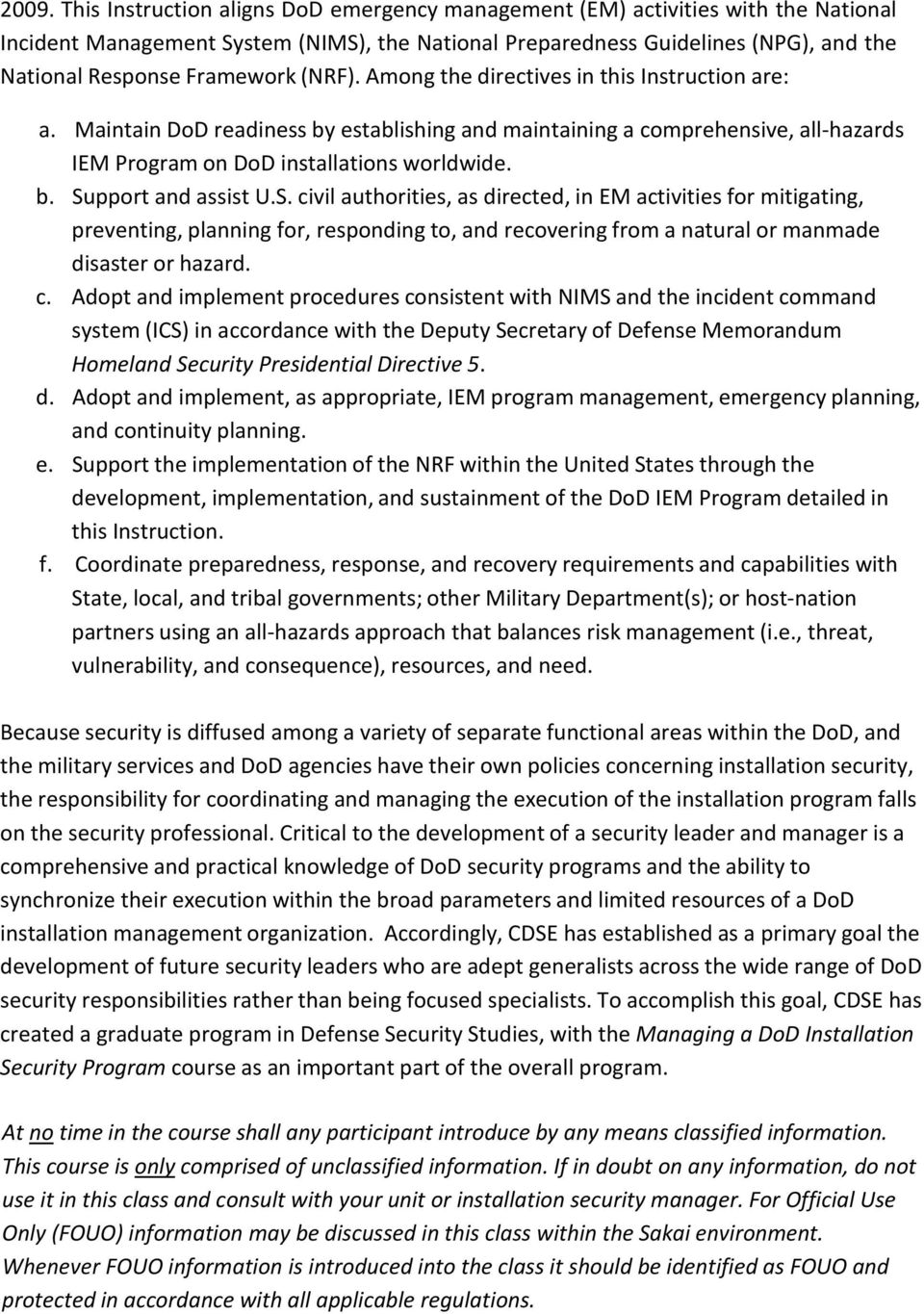
2 2009. This Instruction aligns DoD emergency management (EM) activities with the National Incident Management System (NIMS), the National Preparedness Guidelines (NPG), and the National Response Framework (NRF). Among the directives in this Instruction are: a. Maintain DoD readiness by establishing and maintaining a comprehensive, all-hazards IEM Program on DoD installations worldwide. b. Support and assist U.S. civil authorities, as directed, in EM activities for mitigating, preventing, planning for, responding to, and recovering from a natural or manmade disaster or hazard. c. Adopt and implement procedures consistent with NIMS and the incident command system (ICS) in accordance with the Deputy Secretary of Defense Memorandum Homeland Security Presidential Directive 5. d. Adopt and implement, as appropriate, IEM program management, emergency planning, and continuity planning. e. Support the implementation of the NRF within the United States through the development, implementation, and sustainment of the DoD IEM Program detailed in this Instruction. f. Coordinate preparedness, response, and recovery requirements and capabilities with State, local, and tribal governments; other Military Department(s); or host-nation partners using an all-hazards approach that balances risk management (i.e., threat, vulnerability, and consequence), resources, and need. Because security is diffused among a variety of separate functional areas within the DoD, and the military services and DoD agencies have their own policies concerning installation security, the responsibility for coordinating and managing the execution of the installation program falls on the security professional. Critical to the development of a security leader and manager is a comprehensive and practical knowledge of DoD security programs and the ability to synchronize their execution within the broad parameters and limited resources of a DoD installation management organization. Accordingly, CDSE has established as a primary goal the development of future security leaders who are adept generalists across the wide range of DoD security responsibilities rather than being focused specialists. To accomplish this goal, CDSE has created a graduate program in Defense Security Studies, with the Managing a DoD Installation Security Program course as an important part of the overall program. At no time in the course shall any participant introduce by any means classified information. This course is only comprised of unclassified information. If in doubt on any information, do not use it in this class and consult with your unit or installation security manager. For Official Use Only (FOUO) information may be discussed in this class within the Sakai environment. Whenever FOUO information is introduced into the class it should be identified as FOUO and protected in accordance with all applicable regulations.
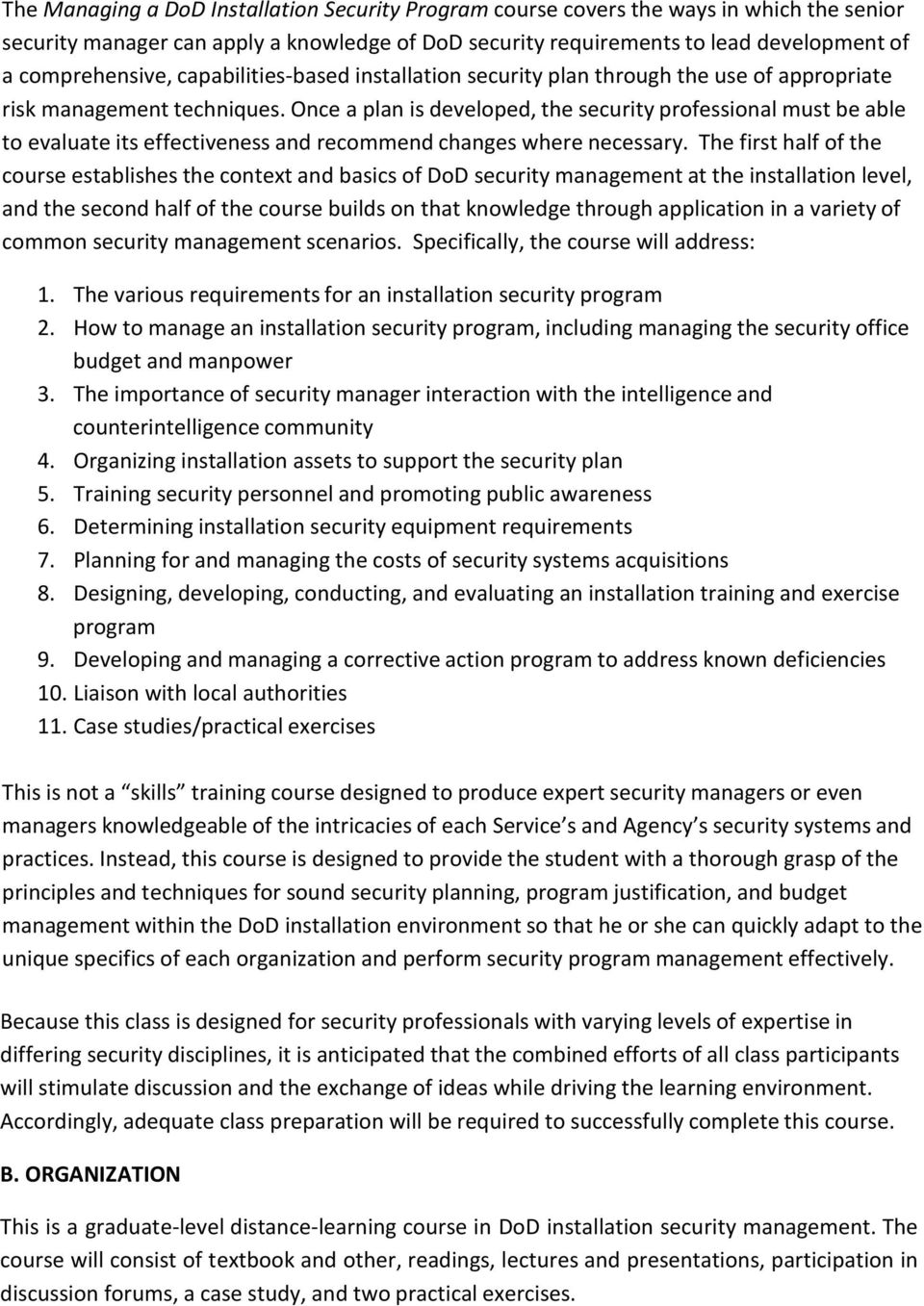
3 The Managing a DoD Installation Security Program course covers the ways in which the senior security manager can apply a knowledge of DoD security requirements to lead development of a comprehensive, capabilities-based installation security plan through the use of appropriate risk management techniques. Once a plan is developed, the security professional must be able to evaluate its effectiveness and recommend changes where necessary. The first half of the course establishes the context and basics of DoD security management at the installation level, and the second half of the course builds on that knowledge through application in a variety of common security management scenarios. Specifically, the course will address: 1. The various requirements for an installation security program 2. How to manage an installation security program, including managing the security office budget and manpower 3. The importance of security manager interaction with the intelligence and counterintelligence community 4. Organizing installation assets to support the security plan 5. Training security personnel and promoting public awareness 6. Determining installation security equipment requirements 7. Planning for and managing the costs of security systems acquisitions 8. Designing, developing, conducting, and evaluating an installation training and exercise program 9. Developing and managing a corrective action program to address known deficiencies 10. Liaison with local authorities 11. Case studies/practical exercises This is not a skills training course designed to produce expert security managers or even managers knowledgeable of the intricacies of each Service s and Agency s security systems and practices. Instead, this course is designed to provide the student with a thorough grasp of the principles and techniques for sound security planning, program justification, and budget management within the DoD installation environment so that he or she can quickly adapt to the unique specifics of each organization and perform security program management effectively. Because this class is designed for security professionals with varying levels of expertise in differing security disciplines, it is anticipated that the combined efforts of all class participants will stimulate discussion and the exchange of ideas while driving the learning environment. Accordingly, adequate class preparation will be required to successfully complete this course. B. ORGANIZATION This is a graduate-level distance-learning course in DoD installation security management. The course will consist of textbook and other, readings, lectures and s, participation in discussion forums, a case study, and two practical exercises.
4 Because this is a 3 credit hour equivalent course, the contact time over the 16 weeks should be approximately 40 hours. Students will be required to critically analyze and discuss the readings as well as to be able to articulate them from differing perspectives. Students will be expected to do research at the graduate level in this course. To provide a substantial research capability to all students in the program, a number of internet-accessible research sites will be sent to each student prior to the first lesson. The primary research site will be the CiteULike virtual library. Students will also receive information for signing on to other research sites or databases relevant to security and defense studies, such as opening an account with the Defense Technical Information Center (DTIC). This will ensure that every student has more than enough resources to do the research expected in this course. The instructor may provide additional research sources or sites. Students are also encouraged to make use of library and research sources available to them in their own geographical area or through their own professional or academic networks. Wikipedia cannot not be used as a reference. Class participation is both important and required. If, due to an emergency, students are unable to respond to a discussion prompt in the week it is assigned, they must contact the instructor immediately. The academic week begins at 0001 Eastern Time (ET) on the Monday of that week. It ends at 2359 ET on the Sunday of that week. No discussion posts nor specific graded assignments can be submitted before the week they are due. Discussion Forum: A. Students must post responses to all instructor provided discussion questions, two per week, no later than Wednesday, 2100 ET each week. Each posting must be at least 250 words in length and have a minimum of two references (books, articles, etc.) in accordance with the Chicago Manual of Style, 16 th Ed. B. To facilitate learning and discussion, students will also respond to at least two other students responses no later than Friday, 2359 ET each week. Any research references used must be annotated in accordance with the Chicago Manual of Style, 16 th Ed. Points will be lost for non-participation or not providing thoughtful comments on at least two others students post. C. Posting and responding is encouraged as early in the week as possible. This gives other students more time to read and respond to more students posts, thus enhancing learning. It is important that a group discussion be built by asking each other questions, thoughtfully responding to other students posts, expanding on points from different perspectives, offering a resource or a tip, giving personal examples, or playing devil s

5 advocate. Specific Graded Assignments: There are three: one case study and two practical exercises. These must be posted by 2359 ET on Sunday during the week they are due. For example, if the syllabus states the graded assignment is due in week 4, the assignment must be submitted no later than 2359 ET on Sunday, the last day of week 4. These assignments must have at least four references to support the assignment annotated in accordance with the Chicago Manual of Style, 16 th Ed. Every effort should be made to submit the assignments on time. It is expected that assignments will be submitted on time; however, it is recognized that students occasionally have serious work/personal problems that prevent work completion by the deadline. If such a dilemma arises, students should contact the instructor immediately. C. OBJECTIVES This course will enable students to: Examine the mission of a typical DoD installation Describe the organization of a typical DoD installation Explain the mission of the installation security manager and the typical organization of an installation security office, to include the management of security office resources Articulate the relationship among the security manager, installation staff, and the installation commander/manager, including the interface with intelligence agencies Assess the risk to a DoD installation Assess the unique security requirements of a DoD installation Apply the principles of sound risk management to the evaluation of an existing security program Evaluate the likelihood of a security program achieving its protection mission Analyze the effectiveness of an organization dedicated to a security program Analyze the training program related to a security program Evaluate the appropriateness of equipment associated with a security program Evaluate a security program exercise plan Evaluate the ability of a security program to achieve its protection mission Assess the effectiveness of a corrective action program Evaluate the level of cooperation with local security officials D. COURSE REQUIREMENTS Evaluation criteria for each graded assignment aside from discussion questions are listed below. Any assignment that receives a failing grade can be resubmitted within the following two weeks, but there will be no further extensions beyond this two-week period. If a student receives a failing grade on assignment, contact the instructor.

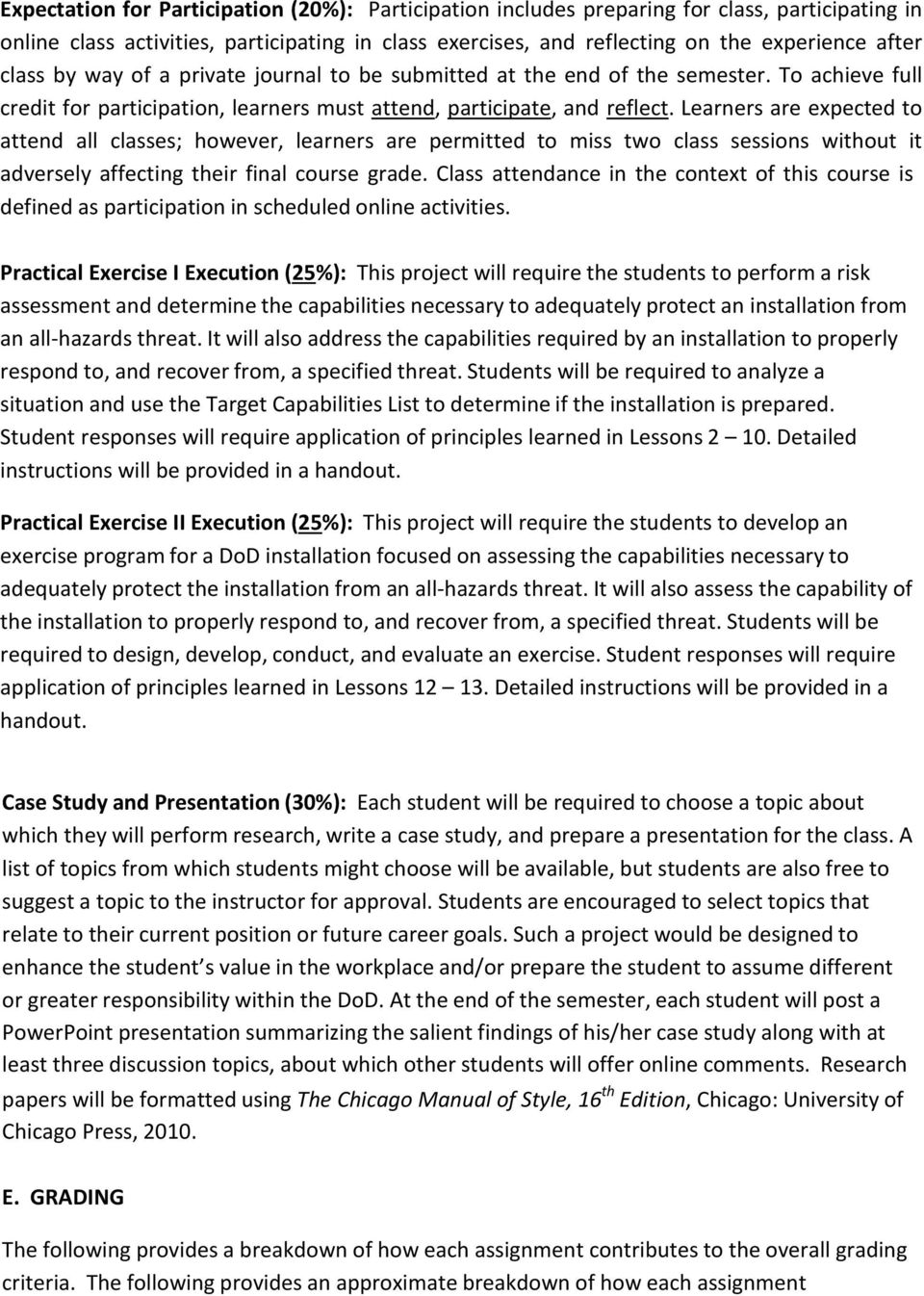
6 Expectation for Participation (20%): Participation includes preparing for class, participating in online class activities, participating in class exercises, and reflecting on the experience after class by way of a private journal to be submitted at the end of the semester. To achieve full credit for participation, learners must attend, participate, and reflect. Learners are expected to attend all classes; however, learners are permitted to miss two class sessions without it adversely affecting their final course grade. Class attendance in the context of this course is defined as participation in scheduled online activities. Practical Exercise I Execution (25%): This project will require the students to perform a risk assessment and determine the capabilities necessary to adequately protect an installation from an all-hazards threat. It will also address the capabilities required by an installation to properly respond to, and recover from, a specified threat. Students will be required to analyze a situation and use the Target Capabilities List to determine if the installation is prepared. Student responses will require application of principles learned in Lessons Detailed instructions will be provided in a handout. Practical Exercise II Execution (25%): This project will require the students to develop an exercise program for a DoD installation focused on assessing the capabilities necessary to adequately protect the installation from an all-hazards threat. It will also assess the capability of the installation to properly respond to, and recover from, a specified threat. Students will be required to design, develop, conduct, and evaluate an exercise. Student responses will require application of principles learned in Lessons Detailed instructions will be provided in a handout. Case Study and Presentation (30%): Each student will be required to choose a topic about which they will perform research, write a case study, and prepare a for the class. A list of topics from which students might choose will be available, but students are also free to suggest a topic to the instructor for approval. Students are encouraged to select topics that relate to their current position or future career goals. Such a project would be designed to enhance the student s value in the workplace and/or prepare the student to assume different or greater responsibility within the DoD. At the end of the semester, each student will post a PowerPoint summarizing the salient findings of his/her case study along with at least three discussion topics, about which other students will offer online comments. Research papers will be formatted using The Chicago Manual of Style, 16 th Edition, Chicago: University of Chicago Press, E. GRADING The following provides a breakdown of how each assignment contributes to the overall grading criteria. The following provides an approximate breakdown of how each assignment
7 contributes to the overall performance in the class. Category Weight Point Value Class Participation 20% 200 Practical Exercise I Execution 25% 250 Practical Exercise II Execution 35% 250 Case Study and Presentation 30% 300 Total 100% 1,000 Individual graded assignments with a score lower than 80% are acceptable; however, a student s final grade at the end of the semester must be 80% or higher to pass the course. A letter grade will be assigned to each graded assignment, following the grading scale below: Letter Grade Point Range Percentage A % B % C % D % F 599 and below 59% and below

8 Evaluation criteria for each graded assignment are listed below. Element Evaluated Content of paper, analysis,, or project (40% of paper s grade) Application of theory and knowledge to given facts (30%) Completeness (15%) Terminology (5%) Organization / Style (5%) Form (grammar, format, punctuation, spelling, logic) citation) Excellent % Critical thinking related to the issues, substance, points raised and arguments presented is very evident Application of theory and knowledge is very evident Assignment is complete in every aspect and exceeds requirements Use of terminology is correct in all instances Organization is relevant to topic, clear and understandable with logical flow Virtually error free. Evaluation Criteria Good 80-89% Critical thinking is well demonstrated A good understanding of theory and knowledge is shown Assignment is complete Terminology is mostly correct Mostly relevant, clear, and logical Few errors (one per page or less) Below Standards 70-79% Some critical thinking is shown but could improve Some understanding of theory and knowledge is shown Assignment is mostly complete but missing some required elements Multiple mistakes in terminology Unclear, Lacks relevance, is difficult to understand, or logic is missing. Frequent Errors (over one per page) Failure 69 or below% Critical thinking is not well demonstrated or not evident Understanding of theory and knowledge is lacking in significant respects or absent Assignment is missing major elements Correct terminology not used Disorganized, improper style. Form errors endemic throughout.

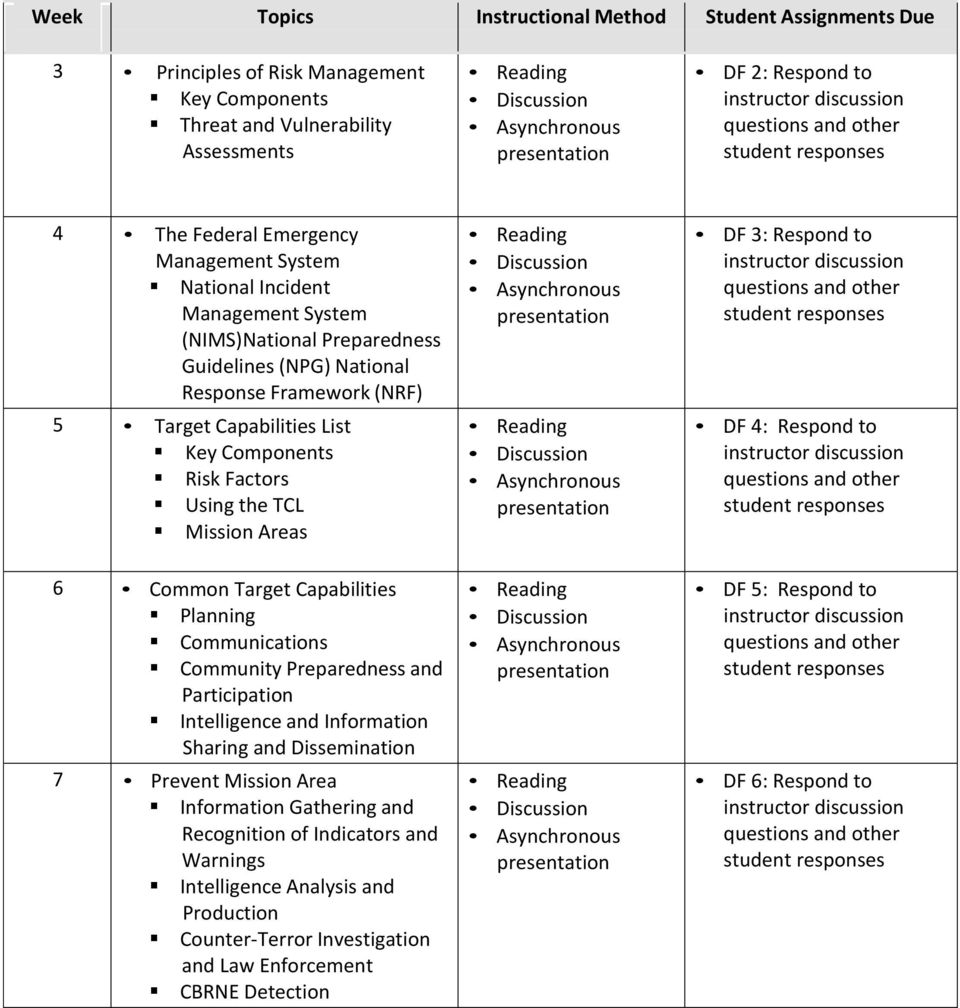
9 F. COURSE TEXTBOOKS /READINGS There is no single textbook available that can address all of the instructional needs for this class. However, Strategic Security Management: A Risk Assessment Guide for Decision Makers by Karim H. Vellani is an excellent resource for DoD security professionals who make risk management recommendations and decisions daily. It is the only required textbook for the class. Many of the course readings will be from this textbook. Additionally, the instructor will assign periodically readings collected from print and online resources. Students are encouraged to establish personal professional libraries to enhance their learning and serve as references for future security endeavors. Required Text: Vellani, Karim H. Strategic Security Management: A Risk Assessment Guide for Decision Makers, Burlington, MA: Butterworth-Heinemann/Elsevier, Inc., Recommended But Not Required Text: The Chicago Manual of Style, 16 th Edition, Chicago: University of Chicago Press, G. COURSE OUTLINE The following table outlines the 16-week course agenda. Week Topics Instructional Method Student Assignments Due 1 Course Overview, Grading, and Major Assignments Introductions: Instructor and Students Principles of Installation Security Management Discuss Case Study Assignment 2 The DoD Installation Security Environment Programs Manpower Budgeting forum Post biographical sketch prior to class Introductions Forum (DF) 1: Respond to instructor discussion questions and other

10 Week Topics Instructional Method Student Assignments Due 3 Principles of Risk Management Key Components Threat and Vulnerability Assessments DF 2: Respond to 4 The Federal Emergency Management System National Incident Management System (NIMS)National Preparedness Guidelines (NPG) National Response Framework (NRF) 5 Target Capabilities List Key Components Risk Factors Using the TCL Mission Areas DF 3: Respond to DF 4: Respond to 6 Common Target Capabilities Planning Communications Community Preparedness and Participation Intelligence and Information Sharing and Dissemination 7 Prevent Mission Area Information Gathering and Recognition of Indicators and Warnings Intelligence Analysis and Production Counter-Terror Investigation and Law Enforcement CBRNE Detection DF 5: Respond to DF 6: Respond to
11 Week Topics Instructional Method Student Assignments Due 8 Protect Mission Area Critical Infrastructure Protection Food Safety and Defense Epidemiological Surveillance and Investigation Laboratory Testing 9 Response Mission Area On-Site Incident Management EOC Management Critical Resource Logistics and Distribution Emergency Public Safety and Security Response Explosive Device Response 10 Recover Mission Area Structural Damage Assessment Restoration of Lifelines Economic and Community Recovery 11 Practical Exercise: Determining Required Capabilities for a DoD Installation Powerpoint to class DF 7: Respond to DF 8: Respond to DF 9: Respond to Prepare for Practical Exercise I Read Practical Exercise I Handout DF 10: Respond to scenario discussion 12 Homeland Security Exercise and Evaluation Program (HSEEP) Volume I: Overview and Exercise Program Management Volume II: Exercise Planning and Conduct DF 11: Respond to

12 Week Topics Instructional Method Student Assignments Due 13 Homeland Security Exercise and Evaluation Program (HSEEP) Volume III: Exercise Evaluation and Improvement Planning Volume V: Prevention Exercises DF 12: Respond to Prepare for Practical Exercise II 14 Practical Exercise II Developing an Installation Exercise Conducting an Installation Exercise Powerpoint to class Read Practical Exercise II Handout DF 13: Respond to scenario discussion 15 Practical Exercise II (cont d) Developing and Managing a Corrective Action Program Powerpoint to class Read Practical Exercise II Handout DF 14: Respond to scenario discussion 16 Case Study Submission Course Wrap-Up and Critique Powerpoint to class Complete and submit Case Studies DF 15: Respond to case study discussion

Cybersecurity and Oversight of Information System Security (CDSE ED 514)
 Cybersecurity and Oversight of Information System Security (CDSE ED 514) Defense Security Service (DSS) Center for Development of Security Excellence (CDSE) Education Division SAMPLE COURSE SYLLABUS* 1
Security and Emergency Services Community of Interest 0089 Emergency Management Career Road Map
 Security and Emergency Services Community of Interest 0089 Emergency Management Career Road Map Prepared by: Booz Allen Hamilton Career Progression within the 0089 Occupational Series is Marked by Support
v. 03/03/2015 Page ii
 The Trident University International (Trident) catalog consists of two parts: Policy Handbook and Academic Programs, which reflect current academic policies, procedures, program and degree offerings, course
Salem Community College Course Syllabus. Section I. Course Title: Principles of Emergency Management. Course Code: EME101.
 Salem Community College Course Syllabus Section I Course Title: Principles of Emergency Management Course Code: EME101 Lecture Hours: 3 Lab Hours: 0 Credits: 3 Course Description: This is a three credit
UCF Office of Emergency Management. 2013-2018 Strategic Plan
 UCF Office of Emergency Management 2013-2018 Strategic Plan Table of Contents I. Introduction... 2 Purpose... 2 Overview... 3 Mission... 5 Vision... 5 II. Mandates... 6 III. Accomplishments and Challenges...
Assessment Profile: Establishing Curricular Categories for Homeland Security Education
 Assessment Profile: Establishing Curricular Categories for Homeland Security Education During any examination or assessment of the subject, homeland security, it becomes quite evident that by the definition(s)
Course Title: HSE-101 Introduction to Homeland Security Prerequisites: None Credit Hours: 3 lectures, 3 hours
 Bergen Community College Division of Business, Social Science and Criminal Justice and Homeland Security Department of Criminal Justice and Homeland Security Master Course Syllabus Course Title: HSE-101
WENTWORTH MILITARY ACADEMY JUNIOR COLLEGE Lexington, MO 64067. Course Syllabus
 HS101 Principles of August 24 December 14, 2010 Instructor: Bret E. Brooks [email protected] -? [email protected] Course Description: WENTWORTH MILITARY ACADEMY JUNIOR COLLEGE Lexington, MO 64067 Course
DOD DIRECTIVE 4715.21 CLIMATE CHANGE ADAPTATION AND RESILIENCE
 DOD DIRECTIVE 4715.21 CLIMATE CHANGE ADAPTATION AND RESILIENCE Originating Component: Office of the Under Secretary of Defense for Acquisition, Technology, and Logistics Effective: January 14, 2016 Releasability:
Flooding Emergency Response Exercise
 Flooding Emergency Response Exercise James Woodward, Senior Exercise Planner California Emergency Management Agency 3650 Schriever Ave. Mather, CA 95655 Cell: (916) 439-3546 Email: [email protected]
TEXAS HOMELAND SECURITY STRATEGIC PLAN 2015-2020: PRIORITY ACTIONS
 TEXAS HOMELAND SECURITY STRATEGIC PLAN 2015-2020: PRIORITY ACTIONS INTRODUCTION The purpose of this document is to list the aligned with each in the Texas Homeland Security Strategic Plan 2015-2020 (THSSP).
Assessment and Evaluation of DoD Security Programs (CDSE ED 509) Defense Security Service (DSS) Center for Development if Security Excellence (CDSE)
 Assessment and Evaluation of DoD Security Programs (CDSE ED 509) Defense Security Service (DSS) Center for Development if Security Excellence (CDSE) Sample Course Syllabus* 1.1. Course Description/Overview
STATE UNIVERSITY OF NEW YORK COLLEGE OF TECHNOLOGY CANTON, NEW YORK COURSE OUTLINE EADM 400 INCIDENT COMMAND: SYSTEM COORDINATION AND ASSESSMENT
 STATE UNIVERSITY OF NEW YORK COLLEGE OF TECHNOLOGY CANTON, NEW YORK COURSE OUTLINE EADM 400 INCIDENT COMMAND: SYSTEM COORDINATION AND ASSESSMENT Prepared By: Dr. Michael J. O Connor Jr. SCHOOL OF BUSINSS
ISM527 - Cyber Security Management
 ISM527 - Cyber Security Management Credit Hours: 3 Contact Hours: This is a 3-credit course, offered in accelerated format. This means that 16 weeks of material is covered in 8 weeks. The exact number
Essential Components of Emergency Management Plans at Community Health Centers Crosswalk of Plan Elements
 Plan Components Health centers will have an emergency management plan Plan and organization are NIMS compliant Bureau of Primary Health Care Policy Information Notice 2007-15 Plans and procedures for emergency
MSE 6201, Homeland Security Course Syllabus. Course Description. Course Textbook. Course Learning Outcomes. Credits.
 MSE 6201, Homeland Security Course Syllabus Course Description Comprehensive examination of homeland security, terrorism, domestic security, emergency preparedness, and border and transportation security.
Department of Defense INSTRUCTION
 Department of Defense INSTRUCTION NUMBER 1322.24 October 6, 2011 ASD(HA) SUBJECT: Reference: Medical Readiness Training (a) DoD Directive 5124.02, Under Secretary of Defense for Personnel and Readiness
Ohio Homeland Security Strategic Plan 2013-2016
 GOAL 1 Strengthen Ohio s intelligence and information sharing system for the detection and prevention of threats to public safety. Objective 1.1 Support continued development of the information sharing
Final Exam for: IS-700.a: National Incident Management System (NIMS) An Introduction
 Final Exam for: IS-700.a: National Incident Management System (NIMS) An Introduction Each time that this test is taken online, questions and answers are scrambled to protect the integrity of the exam Completion
LAWRENCE COUNTY, KENTUCKY EMERGENCY OPERATIONS PLAN ESF-13
 LAWRENCE COUNTY, KENTUCKY EMERGENCY OPERATIONS PLAN LAW ENFORCEMENT AND SECURITY ESF-13 Coordinates and organizes law enforcement and security resources in preparing for, responding to and recovering from
Type 3 All-Hazard Incident Management System Credentialing Guide
 Florida Division of Emergency Management Type 3 All-Hazard Incident Management System Credentialing Guide DSOC Approved March 7, 2013 Florida Division of Emergency Management Type 3 All-Hazard Incident
ST. JOHNS COUNTY COMPREHENSIVE EMERGENCY MANAGEMENT PLAN APRIL 2012. Appendix E. Training Program
 ST. JOHNS COUNTY COMPREHENSIVE EMERGENCY MANAGEMENT PLAN APRIL 2012 Appendix E Training Program Appendix E Training - 1 I. PURPOSE St. Johns County Training Appendix To outline a training program that
This page intentionally left blank.
 This page intentionally left blank. This page intentionally left blank. CONTENTS List of Tables...vii List of Figures...vii What Is the National Incident Management System?...1 PREFACE... 3 INTRODUCTION
THE WHITE HOUSE. Office of the Press Secretary. For Immediate Release February 12, 2013. February 12, 2013
 THE WHITE HOUSE Office of the Press Secretary For Immediate Release February 12, 2013 February 12, 2013 PRESIDENTIAL POLICY DIRECTIVE/PPD-21 SUBJECT: Critical Infrastructure Security and Resilience The
Overview of Homeland Security Funding 1999 to Present National Incident Management System Mandates and Training Requirements
 Overview of Homeland Security Funding 1999 to Present National Incident Management System Mandates and Training Requirements Jim Weldin Delaware League of Local Governments 1 Homeland Security Grant Funding
NIMS Compliance for U.S. Hospitals
 NIMS Compliance for U.S. Hospitals Emergency Management Program vs. Incident Command System An organization s Emergency Management Program involves activities across four phases: Mitigation Preparedness
Subject: National Preparedness
 For Immediate Release Office of the Press Secretary The White House December 17, 2003 Homeland Security Presidential Directive / HSPD-8 Subject: National Preparedness Purpose (1) This directive establishes
ON-SITE INCIDENT MANAGEMENT
 ON-SITE INCIDENT MANAGEMENT Capability Definition Onsite Incident is the capability to effectively direct and control incident activities by using the Incident Command System (ICS) consistent with the
DEPARTMENT OF THE NAVY HEADQUARTERS UNITED STATES MARINE CORPS 3000 MARINE CORPS PENTAGON WASHINGTON, DC 20350 3000
 DEPARTMENT OF THE NAVY HEADQUARTERS UNITED STATES MARINE CORPS 3000 MARINE CORPS PENTAGON WASHINGTON, DC 20350 3000 MCO 3030.1 POC MARINE CORPS ORDER 3030.1 From : To: Commandant of the Marine Corps Distribution
Final Exam for: IS-700.a National Incident Management System (NIMS), I-700
 Final Exam for: IS-700.a National Incident Management System (NIMS), I-700 Privacy Act Statement (Public Law 93 579) Please note that you will be required to enter your Social Security number at the completion
FEDERAL EMERGENCY MANAGEMENT AGENCY (FEMA) INDEPENDENT STUDY COURSE INTRO TO INCIDENT COMMAND SYSTEM FOR FEDERAL WORKERS (IS-100.
 This Study Guide has been created to provide an overview of the course content presented in the Federal Emergency Management Agency (FEMA) Independent Study Course titled IS-100.FWA Intro to Incident Command
RESTORATION OF LIFELINES
 RESTORATION OF LIFELINES Capability Definition Restoration of Lifelines is the capability to initiate and sustain restoration activities. This includes facilitating the repair/replacement of infrastructure
Teaching an Overview of Homeland Security
 Teaching an Overview of Homeland Security Stan Supinski, NPS/CHDS Bert Tussing, US Army War College 1 Overview ~ What Should Homeland Security Leaders be Talking About.. What Should be in an Overview Course?
Cornell University EMERGENCY MANAGEMENT PROGRAM
 Cornell University EMERGENCY MANAGEMENT PROGRAM Table of Contents Table of Contents Section 1 INTRODUCTION... 2 Section 2 EMERGENCY MANAGEMENT COMPONENTS... 3 Prevention-Mitigation Plan... 3 Preparedness
Template introduction:
 Template introduction: The attached template is designed to assist you in creating an Orientation Seminar, Drill, Tabletop, Functional, or Full Scale exercise. The format allows for the creation of the
HSEM Emergency Management Director s Qualification Curriculum, Emergency Management Certification and Elected/Appointed Officials Certificate Programs
 HSEM Emergency Management Director s Qualification Curriculum, Emergency Management Certification and Elected/Appointed Officials Certificate Programs 1-16-2014 1 A Note from the Director Effective emergency
National Preparedness Guidelines
 National Preparedness Guidelines September 2007 THIS PAGE INTENTIONALLY LEFT BLANK ii PREFACE President Bush has led a committed effort to strengthen the Nation s preparedness capabilities. The national
Wisconsin Hospital Emergency Preparedness Plan (WHEPP) Emergency Operations Center (EOC) Hospital Liaison Lesson Plan Mission and Skills
 Objective: The objective of this lesson plan is to prepare an Emergency Operation Center (EOC) Hospital Liaison to actively and successfully participate in state, local, or tribal EOC activities during
Qualifications FISK CONSULTANTS
 Qualifications FISK CONSULTANTS All Hazards Emergency Management Consultant (Business Continuity, Risk and Vulnerability Assessment & Management, Corporate & Personal Protection, Emerging Threats, Active
COURSE SYLLABUS CJUS 380 INTRODUCTION TO HOMELAND SECURITY
 Note: Course content may be changed, term to term, without notice. The information below is provided as a guide for course selection and is not binding in any form, and should not be used to purchase course
Course Title: HSE -103 Legal Aspects of Homeland Security and Emergency Management Prerequisites: None Credit Hours: 3 lectures, 3 hours
 Bergen Community College Division of Business, Social Science and Criminal Justice and Homeland Security Department of Criminal Justice and Homeland Security Master Course Syllabus Course Title: HSE -103
UNCLASSIFIED. UNCLASSIFIED Office of Secretary Of Defense Page 1 of 9 R-1 Line #139
 Exhibit R-2, RDT&E Budget Item Justification: PB 2015 Office of Secretary Of Defense Date: March 2014 0400: Research, Development, Test & Evaluation, Defense-Wide / BA 6: RDT&E Management Support COST
Texas Department of Public Safety Texas Division of Emergency Management. Preparedness Standards for Emergency Management in Texas TDEM-100
 Texas Department of Public Safety Texas Division of Emergency Management Preparedness Standards for Emergency Management in Texas June 2000 FOR ADDITIONAL INFORMATION Requests for additional copies of
For Official Use Only. Springfield-Greene County, Missouri Multi-Year Training and Exercise Plan 2016-2018 (TEP) July 27, 2015. For Official Use Only
 For Official Use Only Springfield-Greene County, Missouri Multi-Year Training and Exercise Plan 2016-2018 (TEP) July 27, 2015 For Official Use Only SPRINGFIELD-GREENE COUNTY Point of Contact Erin Pope
Emergency Management Academic Program Emergency Management Planning and Policy PAD 5398 SPRING 2014 Online Graduate Syllabus
 Emergency Management Academic Program Emergency Management Planning and Policy PAD 5398 SPRING 2014 Online Graduate Syllabus Instructor: Janet Dilling, Ph.D. Online Office Hours: Wednesday 10:00a.m. -12:00p.m.
NIMS ICS 100.HCb. Instructions
 NIMS ICS 100.HCb Instructions This packet contains the NIMS 100 Study Guide and the Test Questions for the NIMS 100 final exam. Please review the Study Guide. Next, take the paper test - record your answers
National Incident Management System (NIMS) Update. Matthew P Bernard NIMS Coordinator FEMA Region X April 2012
 National Incident Management System (NIMS) Update 1 Matthew P Bernard NIMS Coordinator FEMA Region X April 2012 Presentation Agenda Overview of PPD 8 National Preparedness NIMS Overview NIMS Update 2012
Dust Explosion Incident Response & Coordination
 Dust Explosion Incident Response & Coordination Objectives Introduction to NIMS History Concepts National Response Framework Introduction to ICS History Concepts Implementation NIMS National Incident Management
Department of Defense DIRECTIVE
 Department of Defense DIRECTIVE NUMBER 5205.16 September 30, 2014 USD(I) SUBJECT: The DoD Insider Threat Program References: See Enclosure 1 1. PURPOSE. In accordance with sections 113 and 131 through
B E F O R E T H E E M E R G E N C Y
 B E F O R E T H E E M E R G E N C Y RESPONSIBILITY / LIABILITY for Homeland Security / Emergency Management Duty of Care - Counties and Cities ARE responsible for the safety of their citizens. Following
Preventing and Defending Against Cyber Attacks November 2010
 Preventing and Defending Against Cyber Attacks November 2010 The Nation s first ever Quadrennial Homeland Security Review (QHSR), delivered to Congress in February 2010, identified safeguarding and securing
Department of Defense INSTRUCTION
 Department of Defense INSTRUCTION NUMBER 5200.39 May 28, 2015 USD(I)/USD(AT&L) SUBJECT: Critical Program Information (CPI) Identification and Protection Within Research, Development, Test, and Evaluation
New Mexico Homeland Security and Emergency Management REQUEST TO USE FEDERAL GRANT FUNDS For Training, Conferences or Exercise Activities
 New Mexico Homeland Security and Emergency Management REQUEST TO USE FEDERAL GRANT FUNDS For Training, Conferences or Exercise Activities NMDHSEM, State Administrative Agency (SAA) PO Box, 27111, Santa
Learning Goals: A Statement of Principles
 Criminal Justice Seminar (388) Course Syllabus Fall, 2014 Instructor: Daniel Posluszny, Ed.D. Office: Lucy Stone Hall Room Rutgers, New Brunswick Campus A347 Telephone/Text: 609.203.8133 (cell phone) (Before
Department of Criminal Justice CRJ 325 Incident Management and Planning
 Department of Criminal Justice CRJ 325 Incident Management and Planning Instructor Information Professor: Class Information: 3 Credit Hour Course Classroom: Online E-mail Contact Information: Telephone
STATE HOMELAND SECURITY GRANT PROGRAM
 FY2015 State Homeland Security Investment Justifications STATE HOMELAND SECURITY GRANT PROGRAM OREGON OFFICE OF EMERGENCY MANAGEMENT www.oregon.gov/omd/oem Mailing address: P.O. Box 14370 Salem, OR 97309-5062
HLS300: Introduction to Homeland Security
 HLS300: Introduction to Homeland Security Credit Hours: 3 Contact Hours: This is a 3-credit course, offered in accelerated format. This means that 16 weeks of material is covered in 8 weeks. The exact
JOB ANNOUNCEMENT. Chief Security Officer, Cheniere Energy, Inc.
 JOB ANNOUNCEMENT Chief Security Officer, Cheniere Energy, Inc. Position Overview The Vice President and Chief Security Risk Officer (CSRO) reports to the Chairman, Chief Executive Officer and President
PSPSOHS606A Develop and implement crisis management processes
 PSPSOHS606A Develop and implement crisis management processes Revision Number: 1 PSPSOHS606A Develop and implement crisis management processes Modification History Not applicable. Unit Descriptor Unit
Department of Defense DIRECTIVE
 Department of Defense DIRECTIVE NUMBER 5505.13E March 1, 2010 ASD(NII)/DoD CIO SUBJECT: DoD Executive Agent (EA) for the DoD Cyber Crime Center (DC3) References: See Enclosure 1 1. PURPOSE. This Directive:
Standards for Security Categorization of Federal Information and Information Systems
 FIPS PUB 199 FEDERAL INFORMATION PROCESSING STANDARDS PUBLICATION Standards for Security Categorization of Federal Information and Information Systems Computer Security Division Information Technology
Water Security Issues: The Federal Perspective. J. Alan Roberson, P.E. Director of Security and Regulatory Affairs AWWA Washington, DC
 Water Security Issues: The Federal Perspective J. Alan Roberson, P.E. Director of Security and Regulatory Affairs AWWA Washington, DC Outline The Overall Concept for Water Security What s Important in
State Homeland Security Strategy (2012)
 Section 1 > Introduction Purpose The purpose of the State Homeland Security Strategy (SHSS) is to identify statewide whole community priorities to achieve and sustain a strengthened ability to prevent,
The Role of Elected Officials During Disasters. The Florida Division of Emergency Management
 The Role of Elected Officials During Disasters The Florida Division of Emergency Management Bryan W. Koon Director Florida Division of Emergency Management Introduction Florida s elected officials play
The Commonwealth of Massachusetts State Homeland Security Strategy
 The Commonwealth of Massachusetts State Homeland Security Strategy Massachusetts Executive Office of Public Safety and Security December 2014 The Commonwealth of Massachusetts Executive Office of Public
FINAL DRAFT. State and Urban Area Homeland Security Strategy
 FINAL DRAFT State and Urban Area Homeland Security Strategy Guidance on Aligning Strategies with the National Preparedness Goal July 22, 2005 Table of Contents I. INTRODUCTION... 2 II. CONTEXT FOR THE
Business Continuity and Emergency Preparedness Planning. Vandita Zachariah, MA, MBA, CIA HHSC Internal Audit Division May 21, 2010
 Business Continuity and Emergency Preparedness Planning Vandita Zachariah, MA, MBA, CIA HHSC Internal Audit Division May 21, 2010 Overview Define key terms and list essential elements of business continuity
Office of Professional & Continuing Education 301 OD Smith Hall Auburn, AL 36849 http://www.auburn.edu/mycaa Contact: Shavon Williams 334-844-3108
 Student Full Name: Office of Professional & Continuing Education 301 OD Smith Hall Auburn, AL 36849 http://www.auburn.edu/mycaa Contact: Shavon Williams 334-844-3108 Auburn University is an equal opportunity
School of Security and Global Studies. Criminal Justice CMRJ698 Comprehensive Exam in Criminal Justice. 8 Week Course
 School of Security and Global Studies Criminal Justice CMRJ698 Comprehensive Exam in Criminal Justice 8 Week Course Instructor Information Course Description Course Scope Course Objectives Course Delivery
NIMS IMPLEMENTATION FOR HEALTHCARE ORGANIZATIONS GUIDANCE
 NIMS IMPLEMENTATION FOR HEALTHCARE ORGANIZATIONS GUIDANCE BACKGROUND Homeland Security Presidential Directive (HSPD)-5, Management of Domestic Incidents, called for the establishment of a single, comprehensive
NIMS Study Guide. Lesson One: What Is the National Incident Management System (NIMS)? What is NIMS?
 NIMS Study Guide Lesson One: What Is the National Incident Management System (NIMS)? What is NIMS? NIMS is a comprehensive, national approach to incident management that is applicable at all jurisdictional
JOINT STATEMENT COMMISSION ON WARTIME CONTRACTING
 JOINT STATEMENT COMMISSION ON WARTIME CONTRACTING TOTAL FORCE POLICY, THE QDR, AND OTHER DEFENSE OPERATIONAL PLANNING: WHY DOES PLANNING FOR CONTRACTORS CONTINUE TO LAG? JULY 12, 2010 Chairman Thibault,
CENTRAL TEXAS COLLEGE SYLLABUS FOR CRIJ 2314 CRIMINAL INVESTIGATION. Semester Hours Credit: 3
 CENTRAL TEXAS COLLEGE SYLLABUS FOR CRIJ 2314 CRIMINAL INVESTIGATION INSTRUCTOR: OFFICE HOURS: Semester Hours Credit: 3 I. Introduction A. This course covers the fundamentals of criminal investigations
https://usawc.blackboard.com/bbcswebdav/pid-82431-dt-content-rid-112988_1/institution/...
 Unit 6 - Homeland Security, Homeland Defense, and Defense Support of Civil Authorities Page 1 of 5 The defense of the homeland is a significant contemporary security issue. Defending the homeland is a
Prospectus of the Ed. D. in Curriculum and Instruction Delivered in an Executive Format February 28, 2011
 Prospectus of the Ed. D. in Curriculum and Instruction Delivered in an Executive Format February 28, 2011 Table of Contents Pages I. Perspectives 1-2 A. Program Goal B. Recruitment Goal II. Program Admission
Purpose of the Governor s strategy. Guiding Principles
 Purpose of the Governor s strategy The Governor s initiative to develop and implement a State of Tennessee program to counter terrorism within the State is outlined in this document. The primary purpose
BUSINESS CONTINUITY PLANNING
 Policy 8.3.2 Business Responsible Party: President s Office BUSINESS CONTINUITY PLANNING Overview The UT Health Science Center at San Antonio (Health Science Center) is committed to its employees, students,
FEMA National Incident. Support Manual
 FEMA National Incident Support Manual February 2011 National Manual (Working Draft)ITAU December 1, 2010 U.S. Department of Homeland Security Federal Emergency Management Agency i Contents Chapter 1: Introduction...
I. PREREQUISITES For information regarding prerequisites for this course, please refer to the Academic Course Catalog.
 Note: Course content may be changed, term to term, without notice. The information below is provided as a guide for course selection and is not binding in any form, and should not be used to purchase course
Department of Defense INSTRUCTION
 Department of Defense INSTRUCTION NUMBER 3115.12 August 24, 2010 USD(I) SUBJECT: Open Source Intelligence (OSINT) References: See Enclosure 1 1. PURPOSE. This Instruction: a. Establishes policy, assigns
Academic Program Assessment Plan Certificate: Homeland Security Studies
 Academic Program Assessment Plan Certificate: Homeland Security Studies Department of History and Political Science College of Humanities and Social Sciences Colorado State University-Pueblo Plan appended
INTRODUCTION. Purpose. Scope. Policies. Worker Safety and Health Support Annex. Coordinating Agency: Cooperating Agencies:
 Coordinating Agency: Department of Labor/Occupational Safety and Health Administration Cooperating Agencies: Department of Defense Department of Energy Department of Health and Human Services Department
NATIONAL INCIDENT MANAGEMENT SYSTEM. March 1, 2004
 NATIONAL INCIDENT MANAGEMENT SYSTEM March 1, 2004 (This Page Intentionally Left Blank) NATIONAL INCIDENT MANAGEMENT SYSTEM March 1, 2004 (This Page Intentionally Left Blank) (This Page Intentionally Left
Establishing A Secure & Resilient Water Sector. Overview. Legislative Drivers
 Establishing A Secure & Resilient Water Sector December 14-15, 2010 LWQTC Overview Key Drivers Legislation Presidential Directives AWWA & Sector Initiatives Standards & Guidance Mutual Aid & Assistance
NEBRASKA STATE HOMELAND SECURITY STRATEGY
 NEBRASKA STATE HOMELAND SECURITY STRATEGY 2014-2016 Nebraska Homeland Security Policy Group/Senior Advisory Council This document provides an overall framework for what the State of Nebraska hopes to achieve