
Electronic Palliative Care Co-ordination Systems (EPaCCS) in England
|
|
|
- Alexandra Stewart
- 10 years ago
- Views:
Transcription
1 Electronic Palliative Care Co-ordination Systems (EPaCCS) in England Survey of clinical commissioning groups (2013) by the National End of Life Care Intelligence Network

2 About Public Health England Public Health England s mission is to protect and improve the nation s health and to address inequalities through working with national and local government, the NHS, industry and the voluntary and community sector. PHE is an operationally autonomous executive agency of the Department of Health. The National End of Life Care Intelligence Network (NEoLCIN) The National End of Life Care Strategy published in 2008 pledged to commission a National End of Life Care Intelligence Network (NEoLCIN) to improve the collection and analysis of national data about end of life care for adults in England. The network was established in May Its aim is to support the NHS and its partners to commission and deliver high quality end of life care in a way that makes the most efficient use of resources and responds to the wishes of dying people and their families. The NEoLCIN plays a vital role in supporting delivery of the strategy. On 1 April 2013 the NEoLCIN became part of Public Health England. Public Health England Waterloo Road Wellington House London SE1 8UG Tel: Facebook: NHS Improving Quality NHS Improving Quality (NHS IQ) provides improvement and change expertise to help improve health outcomes for people across England. It has brought together a wealth of knowledge, expertise and experience of a number of former NHS improvement organisations, including the former National End of Life Care Programme, to build on the expertise and experience of all that has gone before. NHS IQ works with PHE on the ongoing development of the end of life care co-ordination National Information Standard (ISB 1580). It is working to improve quality in end of life care as part of its dedicated Long Term Conditions Programme. It is responsible for supporting the implementation and uptake of EPaCCS in England and assessing their impact. 2

3 NHS Improving Quality Ground Floor No 1 Whitehall Quay Leeds LS1 4HR [email protected] Prepared by: National End of Life Care Intelligence Network (NEoLCIN) For queries relating to this document, please contact: [email protected] Crown copyright 2013 You may re-use this information (excluding logos) free of charge in any format or medium, under the terms of the Open Government Licence (OGL) v2.0. To view this licence, visit OGL or [email protected]. Where we have identified any third party copyright information you will need to obtain permission from the copyright holders concerned. Published April 2014 PHE publications gateway number: This document is available in other formats on request. Please call or [email protected] Disclaimer This report has been compiled from survey data submitted by CCGs in England. We are aware that the data is not complete and there may be inaccuracies in some of the data reported. We do not accept responsibility for any loss, damage or expense resulting from the use of this information. 3

4 Acknowledgements Special thanks to all those in clinical commissioning groups (CCGs) and other EPaCCS implementing organisations who responded to the survey. This summary report was written and developed with input from the stakeholders who support the National End of Life Care Intelligence Network. Their contributions were invaluable in the development of the questionnaire and the compilation of this report. The questionnaire was developed, tested and approved by the national EPaCCS team in the National End of Life Care Intelligence Network and NHS Improving Quality, with support from PHE s South West Knowledge and Intelligence Team and Dr Julian Abel, Consultant in Palliative Care, Weston Area Health Trust and Weston Hospicecare. Feedback We welcome feedback from survey respondents and other users of this report. Please send comments to [email protected]. We would also be grateful if EPaCCS leads could let us know if their contact details change so that we can keep our records up-to-date. Please send details to [email protected]. Thank you. 4

5 Contents Acknowledgements 4 Feedback 4 Executive summary 6 1 Introduction 11 2 Aim 11 3 Methodology 12 4 Results: EPaCCS implementation 13 5 Results: compliance with the national information standard 29 6 Respondent feedback 33 7 General feedback 37 8 Conclusions 39 9 Recommendations and next steps 40 References 41 Appendix 1: Survey questionnaire 42 Appendix 2: Full list of feedback 47 5

6 Executive summary Introduction When the sharing of up-to-date information about a patient and their wishes across agencies works effectively, it is the most fantastic thing and makes a huge difference to the patient, family and those involved in caring for them. CCG respondent Electronic Palliative Care Co-ordination Systems (EPaCCS) enable the recording and sharing of people s care preferences and key details about their care with those delivering their care. The systems support co-ordination of care and the delivery of the right care, in the right place, by the right person, at the right time. EPaCCS began with eight locality pilot sites in Roll-out across England has progressed through the period of NHS re-organisation from 2010 and the creation of clinical commissioning groups (CCGs), which formally came into being on 1 April A baseline survey of EPaCCS was carried out in July This survey was carried out in August The aim of this survey was to gather information about EPaCCS implementation and their impact, as well as to assess compliance with the national information standard for end of life care co-ordination (ISB 1580). Response rates The survey was sent to the 211 CCGs in England. Responses were received from a variety of organisations, with some submitting on behalf of more than one CCG. In total there were 172 usable responses providing information on 188 (89%) of CCGs. There were 154 unique responding organisations, 127 of which were CCGs (83%). Others were hospital trusts, commissioning support units, hospices or palliative care providers and informatics units. Results Partnerships Many CCGs are working in partnership to implement EPaCCS. We identified 33 partnerships involving 139 CCGs (66% of all CCGs). Almost a quarter (49 CCGs) were implementing EPaCCS on their own. 6

7 System status Sixty-four CCGs (30%) had operational EPaCCS, 111 (53%) had started planning for their implementation and 10 (5%) stated that they had no operational system and that planning had not started. Of those who had started planning, 40 were expecting to have operational systems by January 2014 and an additional 17 by January Hosting Of the CCGs with operational systems, 33 used NHS trusts as host organisations and seven were hosted by CCGs. Just under half of CCGs in the planning stage (47%) could not report where the system would be hosted. Those who could, reported CCGs, GPs and hospices as the most likely hosts. Lead technical systems Ten different lead technical systems were reported for the 64 CCGs with operational systems and 111 CCGs with systems planned (total 175). The most popular were Adastra (39 CCGs, 22%), SystmOne (22 CCGs, 13%) and EMIS (14 CCGs, 8%). However, in almost a third of CCGs with operational systems (20 CCGs, 31%), the lead system used was not reported. In a quarter of CCGs with systems planned (27 CCGs, 24%), it was indicated that multiple systems would be used, and a further 21% (23 CCGs) stated that the lead system had yet to be confirmed. Activity on operational EPaCCS Responses to questions about the patients registered on operational EPaCCS varied. There was information for 49 CCGs on the numbers of patients registered on EPaCCS (over 26,000), number of people dying between June 2012 and May 2013 (just over 6,000) and numbers of people dying of cancer in that same period (over 1,327). Information provided for CCGs with operational systems who were able to extract the data from their systems (n=11) indicates that fewer people died in hospital and more died at home than the national average (54% in hospital, 20% at home between 2008 and 2010). Access to care records Information on care services with access to EPaCCS and the format of that access was collected for 33 CCGs which had operational systems. Social care services had access 7

8 to care co-ordination records in just three cases. The most common form of access was via a shared web interface. Contracts compliance Response rates to questions regarding compliance with the national information standard were low for the 64 CCGs with operational systems and varied across the four questions on this topic. Fourteen reported that they met the requirement for their system to contain the core content defined in the national information standard; nine that they met the requirement for their system to comply with user interface standards and National Patient Safety Agency guidelines for safe on-screen display of medical information; ten carried out a clinical safety risk assessment prior to implementing their system and had a risk control system in place. Most of the 15 CCGs who responded reported full compliance with all the data items included in the national information standard, with a few exceptions on a small number of individual data items. Feedback on guidance Responses to questions about implementation and record keeping guidance indicated that 80% of respondents found the guidance to be either quite useful, useful or very useful. Responses also suggested that more guidance was required on developing system interoperability between systems and organisations, funding and incentives and provision of national support such as workshops, regular meetings and web based supporting resources. General feedback Forty-six respondents gave feedback on the beneficial impact of EPaCCS implementation and the challenges. Benefits reported by those with an operational EPaCCS included improved communication and ease of information sharing between professionals involved in a person s care (most frequently mentioned), and supporting carers, clinicians, ambulance and out of hours services to make appropriate decisions about a person s care. Engaging with clinicians from all areas was seen as key to driving projects forward. For CCGs in the planning stage of implementation, the benefit of EPaCCS in bringing different agencies together and giving participants a better understanding of end of life care needs was highlighted. 8

9 Implementing EPaCCS was found to drive training, systems and cultural change in organisations and so forms part of the improvement process for end of life care services. The challenges that respondents implementing operational systems had to address included interoperability of IT systems (most frequently mentioned), data ownership, consent, engagement of health professionals (particularly GPs) and funding. Conclusions This report is the first to provide a comprehensive overview of EPaCCS in England since the re-organisation of the NHS and the emergence of CCGs. It illustrates that EPaCCS is a complex project that aims to support end of life care co-ordination across a multitude of different agencies. The majority of CCGs are working in partnership with each other and with other agencies to implement EPaCCS. It is still early days for EPaCCS implementation, with around one third of CCGs with operational systems and only a few of these able to report on data from the systems in this survey. The available data, however, does suggest that the use of EPaCCS helps people to die in their preferred place of death, decreases the percentage of hospital deaths and increases in the percentage of deaths at home and in hospices. There was much positive feedback in areas where EPaCCS have been implemented. The greatest benefits were identified as improvements in communication and information sharing between healthcare professionals and support for making appropriate decisions about patients care. EPaCCS supports patient choice, shared decision making, individual care planning and integration of care across sectors. It is expected to play a significant role in supporting the care integration agenda, including the Integrated Care and Support Pioneers Programme. Over the coming years we expect to see an increase in the number of systems to which social care services have access. Successful implementation of EPaCCS requires the appropriate configuration of systems, services and infrastructure. For many CCGs this has raised a number of issues, such as system interoperability, stakeholder engagement, data ownership, costs, information support and funding, which need to be resolved to ease implementation. Although CCGs were able to provide certain information, they often had little access to data and a poor understanding of technical issues for EPaCCS management. We hope to build a better database of EPaCCS leads across the CCGs so that we improve the accuracy and reduce discrepancies in future surveys. Future work needs to determine which stakeholders are best able to provide this kind of information. 9

10 Recommendations and next steps This report provides an overview of EPaCCS implementation across England. It includes information about systems and approaches being used and shares the learning and experiences of implementers. This will be useful to all those implementing or planning local EPaCCS or other electronic co-ordination systems. Those planning EPaCCS should be aware of the value and importance of system functionality to report on activity and the impact of implementation, for example on place of death. The report will also be useful to IT systems suppliers and there are important messages regarding the need for system suppliers to work together to support interoperable systems. It will inform the national team supporting EPaCCS implementation about the current status of EPaCCS implementation and provides valuable feedback from implementers on the additional support required. The report also provides information for the Standardisation Committee for Care Information (SCCI) (formerly the Information Standards Board) on the progress of EPaCCS implementation and the impact of the national information standard for end of life care co-ordination. The report, together with the Electronic Palliative Care Co-ordination Systems mid-2012 survey report, will be used to monitor future progress in EPaCCS implementation. 10

11 1 Introduction The End of life Care Strategy (2008) 3 identifies the need to improve the co-ordination of care, recognising that people at the end of life frequently received care from a wide variety of teams and organisations. The development of Locality Registers (now Electronic Palliative Care Co-ordination Systems known as EPaCCS) were identified as a mechanism for enabling co-ordination. EPaCCS enable the recording and sharing of people s care preferences and key details about their care with those delivering care. The systems support co-ordination of care and the delivery of the right care in the right place, by the right person, at the right time. Eight pilots were established across England in 2009 to test proof of concept and an evaluation carried out by Ipsos MORI reported in June In March 2012 a national information standard for End of Life Care Co-ordination (ISB 1580) 5 was published with an implementation date of 1 December This standard identifies and defines the core content to be held in EPaCCS. The standard requires all contracts for EPaCCS to be compliant with its specifications, IT systems suppliers to provide compliant systems and data items included in the systems to be compliant with the specifications of the standard. Responsibility for the national information standard now sits with the Standardisation Committee for Care Information (SCCI) as the Information Standards Board closed on 31 March A baseline survey was carried out in July 2012 to determine the roll out of EPaCCS in England and a report, Electronic Palliative Care Coordination Systems (EPaCCS) Mid 2012 Survey Report published in February Since this survey was conducted in July 2012 the NHS has undergone a major re-organisation. Primary care trusts (PCTs) were abolished and, from 1 April 2013, responsibility for commissioning including the commissioning of end of life care services moved to newly established clinical commissioning groups (CCGs). The survey detailed in this report was completed in August of 2013 and has been carried out to capture progress towards implementing EPaCCS for end of life care across England post re-organisation. CCGs were used as the principal points of contact for questionaire distribution and in many sections the results are presented by CCG. 2 Aim This survey was designed to gather information about EPaCCS implementation since 2012, the impact and benefit of EPaCCS, and to assess compliance with the national information standard for end of life care co-ordination (ISB 1580). 11

12 2.1 EPaCCS implementation The survey aimed to establish the following: the status of EPaCCS implementation for each CCG in England (i.e. whether operational, planned or planning not started) timescales for planned implementation CCG partnership arrangements and identification of the organisation types hosting EPaCCS systems technical systems being used by EPaCCS an understanding of the scale and system maturity of operational EPaCCS, including details of the types of care provider with access to EPaCCS records and the format used to assess the degree of system interoperability in the EPaCCS that are being implemented to request feedback on implementation challenges or issues 2.2 Information standard To determine whether the EPaCCS being implemented in England are compliant with the national information standard in respect of: the collection of data items specified in the information standard compliance with the IT standards specified in the standard clinical risk management The survey also requested feedback on the resources that are available to support implementation of EPaCCS and additional support that could be provided by the national team. 3 Methodology A link to the online survey (see Appendix 1) was sent to every CCG in England (211 in total). CCGs were contacted prior to the circulation of the survey to identify end of life care leads and address any issues regarding changed geographies and staff changes as of 1 April The questionnaire was developed, tested and approved by the national EPaCCS team in the National End of Life Care Intelligence Network and NHS Improving Quality, with support from PHE s South West Knowledge and Intelligence Team. The survey was delivered via the online SurveyMonkey tool. 12

13 The survey ran from 5 August to 6 September There was a two-week follow up period during which non-responders were contacted. This report is compiled using the survey information submitted. It should be noted that we are aware that the information received did not always match what we might have expected. An example is that we are aware of the London-wide EPaCCS being implemented called Coordinate My Care. At the time of the survey the IT system used for Coordinate My Care was System C. However, three CCGs in London reported their lead system as Health Analytics. 4 Results: EPaCCS implementation 4.1 Response rates Response rates (organisations) There were 215 responses from a variety of organisations (not just CCGs), with some submitting on behalf of more than one CCG. Of these, 172 were usable and provided information on 188 CCGs (89% coverage). Eighteen of these responded more than once (for more than one CCG). There were, therefore, 154 unique responding organisations, 127 of which were CCGs (83%). The response rates by organisation are summarised in Table 1 and Figure 1. Table 1: Number and percentage of unique responding organisations grouped by type Organisation Total Per cent Hospital trust CCG Commissioning support unit Hospice/palliative care provider Informatics unit Total

14 Figure 1: Percentage of unique organisations responding grouped by type Response rates (respondents) Of the 172 usable responses, 171 individual respondents were identified and categorised into one of eight different role groups depending on their job title. Multiple responses from organisations are included in this section where the respondents were different individuals. A breakdown of the roles of respondents is shown in Table 2 and Figure 2. Over half of respondents worked either in commissioning or as CCG leads (not specified as end of life care leads) and around 20% of respondents were GPs or end of life care leads. 73% of respondents (125 in total) were happy to share their contact details. Table 2: Individual respondents put into role groups based on their job title Role of respondent Number Per cent Commissioning Clinical lead CCG lead (not end of life care) CCG end of life care lead EPaCCs or IT lead GP Palliative care Nursing or nursing lead Total

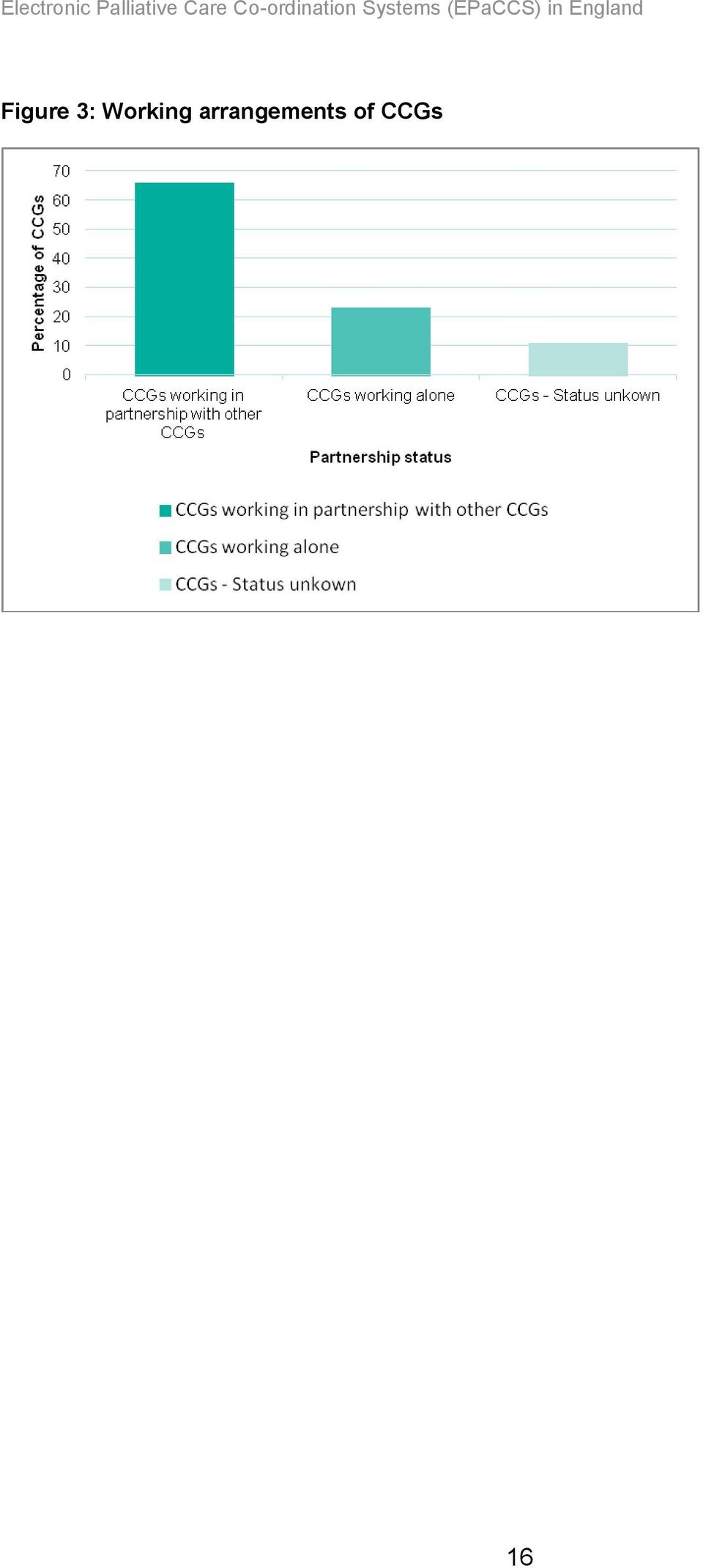
15 Figure 2: Individual respondents put into role groups based on their job title (percentage of respondents) 4.2 EPaCCS in CCGs The information presented in this section relates to CCG respondents rather than any other type of responding organisation. Multiple responses from CCGs were used when they enhanced the information received Partnership working Many CCGs are working in partnership to implement EPaCCS. We identified 33 partnerships involving 139 CCGs (66% of all CCGs). Almost a quarter (49 CCGs) were working on their own. The working arrangements of CCGs are summarised in Table 3 and Figure 3. Partnerships between CCGs are shown in Map 1. The London partnership, Coordinate my care, was the largest with 29 CCGs involved. Table 3: Working arrangements of CCGs Number of CCGs Per cent CCGs working in partnership with other CCGs CCGs working on their own CCGs - status unknown Total

16 Figure 3: Working arrangements of CCGs 16
17 Map 1: CCG partnership arrangements for EPaCCS implementation 17

18 Note: Despite many London CCGs not responding, they have been included in the figures for a London partnership. However, Havering, Barking and Dagenham and Redbridge CCGs (partnership 1) were not included in the London partnership because their response indicated that they were working as a self-contained group. Partnerships between CCGs also involved many different agencies working together (for example ambulance trusts, hospices and providers, out of hours services) to create an integrated record of care System status Sixty-four out of a possible 211 CCGs in England (30.3%) were identified as having operational EPaCCS (defined as a functioning electronic system(s) or process(es) linking care providers across a locality), 111 (53%) stated that planning had started and 10 CCGs (5%) stated that they had no operational system and that planning had not started (Table 4, Figure 4 and Map 2). Operational status could not be determined from the responses of three CCGs and no information was obtainable for 23 CCGs. Table 4: System status for CCGs responding to the survey System status Number of CCGs Per cent System operational System in planning No system and no planning Status unknown Total Figure 4: System status for CCGs responding to the survey (percentage of all CCGs) 18

19 Map 2: Operational status of EPaCCS in CCGs 19

20 Of the 49 CCGs working on their own (not in a partnership, Table 3), 11 stated that they had operational systems, 26 stated that planning had started, and nine stated that planning had not started. The operational status of a further three was unknown. Seven partnerships had operational systems, three had semi-operational systems (not all members of a partnership had an operational system) and 23 had planning underway Start dates for systems in planning phase Of the 111 CCGs planning EPaCCS implementation, information about start dates was provided for 107 (Table 5). Forty (36%) expected to have an operational system in place by January 2014 and an additional 17 (15%) by January Fifty (47%) did not have a designated start date. CCG start dates are also shown in Map 3. Table 5: Start dates for CCGs planning implementation of EPaCCS Date Number of systems becoming operational Per cent August September October November December January April May September December January Not known Total

21 Map 3: Start dates for systems in planning 21
22 4.2.4 Host organisations This section is based on information from CCGs with operational systems (64 CCGs) or who have started planning (111 CCGs). The top three hosting organisations for CCGs with operational systems were: NHS trusts (33 CCGs, 52%), out of hours services (11 CCGs, 17%) and CCGs themselves (7 CCGs, 11%). The majority of CCGs in the planning stage (47%) could not report where the system would be hosted. Of the respondents who could give a host organisation, CCGs, GPs and hospices were the most likely (Table 6 and Figure 5). Table 6: Host organisations for CCGs with operational or planned EPaCCS systems Number of CCGs Per cent System Planning System Planning Host organisation Total Total operational started operational started Ambulance service CCG Commissioning support unit (CSU) GP Community services provider Hospice Informatics service NHS trust Out of hours service Urgent care services Unknown Total
23 Figure 5: Host organisations for CCGs with operational or planned EPaCCS systems Lead technical systems Ten different lead technical systems were reported for the 64 CCGs with operational systems and 111 CCGs with systems planned (total 175). The most popular were Adastra (39 CCGs, 22%), SystmOne (22 CCGs, 13%) and EMIS (14 CCGs, 8%). Adastra was the most popular for CCGs with operational systems, accounting for 36% of those in use (Table 7). However, in almost a third of CCGs with operational systems (20 CCGs, 31%), the lead system used was not known. In a quarter of CCGs with systems planned (27 CCGs, 24%), it was indicated that multiple systems would be used, and a further 21% (23 CCGs) stated that the lead system had yet to be confirmed. 23
24 Table 7: Lead systems in CCGs with operational systems or who are implementing EPaCCS Lead system Per cent System CCGs with operational systems CCGs planning EPaCCS implementation CCGs with operational systems CCGs planning EPaCCS implementation Adastra SystmOne EMIS SystemC Coordinate my care SCR Graphnet MIG Health Analytics Cleo Multiple systems To be confirmed Unknown Total Although many operational EPaCCS are in their infancy, some CCGs reported that they were able to share information through EPaCCS with clinical systems Activity on operational EPaCCS Where EPaCCS were operational, respondents were asked to provide details of the numbers of people added since inception, the numbers added between 1 June 2012 and 31 May 2013, and the number of people with an EPaCCS record who had cancer as the main cause of death. Responses were supplied either directly by CCGs or by partnerships. In total, there were 18 responses for 49 CCGs (77% of CCGs with operational systems). Table 8 summarises the results. 24
25 Table 8: Numbers of people registered on operational EPaCCS, numbers who died between 1 June 2012 and 31 May 2013, and the number of people with cancer as the main cause of death Number of people added to the EPaCCS register since inception Number of people with an EPaCCS record who died between 1 June 2012 and 31 May 2013 Number of people with an EPaCCS record who died between 1 June 2012 and 31 May 2013 and had cancer as the main cause of death Organisation Bradford District Care Trust and Marie Curie. Working on behalf of Bradford City, Bradford District and Airedale/Wharfedale/Craven CCGs 3,000 1, Leeds South & East, Leeds North and West Leeds CCGs 1, West Leeds CCG Salford CCG 2,046 Sheffield CCG 1,713 Central Eastern CSU working on behalf of Southend, Castle Point and Rayleigh CCGs 3,010 1,009 Bedfordshire CCG 1, London - Coordinate my Care covering 31 CCGs 8,570 1,302 Merton CCG 974 Hammersmith and Fulham CCG* West London CCG* Central London CCG* Wandsworth CCG 250 Medway CCG and Medway Council West hampshire CCG 60 Somerset CCG** 2,718 1, Southampton City CCG 22 Portsmouth, South East Hants and Fareham & Gosport CCGs 80 Total 26,249 6,003 1,327 Notes: * Figures are from January 2013; **Figures are from September 2012 to 31 May 2013 CCGs with operational systems were also asked about place of death for the number of people who died between June 2012 and May 2013, whether their preferred place of death had been recorded on EPaCCS, and the number who actually died in their preferred place of death during the same period. 25
26 There were seven responses for 11 CCGs (17% of CCGs with operational systems). The results are shown in Tables 9 and 10. For the CCGs that did respond the percentage of people dying in their preferred place of death ranged from 61.5% to 81.5%. The percentage of hospital deaths ranges from between 4% and 40% and the percentage of home deaths between 35% and 54%. Between 2008 and 2010 in England, hospital was the place of death for 54% of those dying and home the place of death for 20%. 6 Table 9: Place of death and preferred place of death of people with an EPaCCS record Number of people with an EPaCCS record who died between 1 June 2012 and 31 May 2013 and who had their preferred place of death recorded Number of people with an EPaCCS record who died between 1 June 2012 and 31 May 2013 and who died in their preferred place of death Number of people with an EPaCCS record who died between 1 June 2012 and 31 May 2013 in the following places: Care home Home Hospice Other Organisation Hospital Central Eastern CSU working on behalf of Southend, Castle Point and Rayleigh CCGs West Leeds CCG Leeds South & East, Leeds North and West Leeds CCGs Medway CCG and Medway Council Bedfordshire CCG Bradford District Care Trust and Marie Curie. Working on behalf of Bradford City, Bradford District and Airedale/Wharfedale/ Craven CCGs Somerset CCG 726** Total 3,057 2, , Notes: **Figures are from September 2012 to 31 May 2013 Please note that, the number of people reported as dying in their preferred place of death is higher than the number of people reported to have had their place of death recorded 26
27 Table 10: Place of death and preferred place of death of people with an EPaCCS record (percentage) Organisation Percentage of people with an EPaCCS record who died between 1 June 2012 and 31 May 2013 and had their preferred place of death recorded^^ Percentage of people with an EPaCCS record who died between 1 June 2012 and 31 May 2013 in their preferred place of death Percentage of people with an EPaCCS record who died between 1 June 2012 and 31 May 2013 in the following places: Hospital Care home Home Hospice Other Central Eastern CSU (working on behalf of Southend, Castle Point and Rayleigh CCGs) West Leeds CCG Leeds South & East, Leeds North and West Leeds CCGs Medway CCG and Medway Council Bedfordshire CCG Bradford District Care Trust and Marie Curie. Working on behalf of Bradford City, Bradford District and Airedale/Wharfedale/Craven CCGs 42.0 Somerset CCG** 72.0** Note: **Figures are from September 2012 to May 2013 Percentages not calculated as the number of people reported as dying in their preferred place of death is higher than the number of people reported to have had their place of death recorded. ^^The denominator for Column 1 is Column 2, Table 8; the numerator is Column 1 in Table 9. Finally, respondents were asked whether any information on EPaCCS had been incorporated into and/or synchronised with clinical systems. There were nine responses for 11 CCGs (Table 11). Table 11: Information on EPaCCS incorporated into and/or synchronised with clinical systems CCG Clinical system Responses North East Leicester CCG via SystmOne 1 Hammersmith and Fulham, West London and Central London, Wandsworth, Leeds South and East and Somerset CCGs 111 GP Out of Hours 6 Central Eastern CSU working on behalf of Southend, Castle Point and Rayleigh CCGs Ambulance CAD 1 Salford CCG Care First (social care) 1 Salford CCG Emis / Vision (GP systems) 1 Salford CCG Allscripts (Acute trust EPR) 1 Ashford CCG Share My Care (Emis/Vision) 1 Somerset CCG SWAST Adastra system 1 27
28 4.2.7 Access to care records and format The survey included questions about the scope of access to EPaCCS for service providers within the CCG localities and the format of systems being used to transfer information between professionals. Information was provided for 33 CCGs with operational EPaCCS. Results are shown in Table 12. Social care had the least access to systems out of the just 15 who responded about social care access, 12 said that there was none. The most used data formats for access to the EPaCCS record were via shared web interface/viewer and direct electronic system to system transfer. These formats were especially used by hospital departments and community health providers, GPs and ambulance services. Information was shared with out of hours services by automated , batch systems and overnight electronic transfer. Table 12: Care setting access and format as reported by 33 CCGs with an operational system Access format (responses) Care setting No access Direct electronic system to system transfer Batch/overnight electronic transfer Access via shared web interface/viewer Access via coordination centre Information shared by automated Sent by letter or FAX Total GP Out of hours Ambulance Hospital A&E Hospital other than A&E Community health providers Social care Specialist Palliative Care
29 5 Results: compliance with the national information standard National guidance was produced to support organisations implementing EPaCCS (implementation guidance) and for professionals using EPaCCS (record keeping guidance). The national information standard ISB 1580 defines the core content to be held in EPaCCS or other end of life care co-ordination systems and specifies the requirements for implementation. The implementation date for the standard was 1 December Contracts compliance Respondents were asked whether all contracts for electronic palliative care coordination systems issued after March 2012, included the requirement for the system to contain the core content defined in the national information standard. Out of the 64 CCGs with operational systems, 15 responded to this question. Of these, 14 met the requirement. Of the 111 CCGs in the planning stage, 32 responded of which 23 (72%) complied with the requirement (Table 13 and Figure 6). Table 13: CCGs with EPaCCS contracts issued after March 2012 specifying the requirement for the system to comply with the national information standard Respondents with an operational system Respondents planning or implementing EPaCCS Response Total Per cent Total Per cent No Yes Total

30 Figure 6: CCGs with EPaCCS contracts issued after March 2012 specifying the requirement for the system to comply with the a national information standard 5.2 Compliance with user interface standards and National Patient Safety Agency (NPSA) guidelines Respondents were asked whether their EPaCCS or other IT end of life care coordination system complied with user interface standards and NPSA guidelines for safe on-screen display of medical information. Of the 64 CCGs with an operational system, ten responded to this question and nine met the requirement. Of those with a system planned or being implemented, 21 out of the 25 responding CCGs (84%) met the requirement (Table 14 and Figure 7). Table 14: Respondent status for the requirement for a palliative care system to comply with interface standards and to NPSA guidelines for safe on-screen display of medical information Respondents with an operational system Respondents planning or implementing EPaCCS Response Total Per cent Total Per cent No Yes Grand total
31 Figure 7: Respondent status for the requirement for a palliative care system to comply with interface standards and to NPSA guidelines for safe on-screen display of medical information 5.3 Clinical safety and risk management Respondents were asked whether a clinical safety risk assessment was carried out prior to implementing EPaCCS or other IT end of life care co-ordination system and a risk control system put in place. The response rate for this question was 12 out of a possible 64 CCGs with operational systems with ten meeting the requirement. For those in the planning stage, 21 out of 109 CCGs responded of which 14 (66.6%) complied with the standard (Table 15 and Figure 8). Table 15: Respondent status for clinical safety risk assessments carried out prior to implementing EPaCCS or other IT co-ordination system and a risk control system put in place Respondents with an operational system Respondents planning or implementing EPaCCS Response Total Per cent Total Per cent No Yes Grand total
32 Figure 8: Respondent status for clinical safety risk assessments carried out prior to implementing EPaCCS or other IT co-ordination system and a risk control system put in place 5.4 Compliance of data items Respondents were asked whether IT systems that hold any of the data items included in the national information standard (ISB 1580) complied with the standard? The response rate for all parts of this question was 15 out of 64 CCGs with operational systems. Almost all respondents operating EPaCCS systems were fully compliant with ISB standards in respect of the data items. The only areas where respondents were not fully compliant were planned review date, name and contact details of Lasting Power of Attorney and names and contact details of others to be involved in decisions about care (Table 16). 32
33 Table 16: Level of compliance of IT systems that hold any of the data items included in ISB1580 (CCGs with operational EPaCCS) Data item Record creation date and record amendment date Fully compliant Responses Not fully compliant Not collected Total Fully compliant Percent Not fully compliant Planned review date Person s details Main informal carer GP details Key worker Formal carers Medical details Just in case box/anticipatory medicines End of life tools in place Advance statement Preferred place of death Do not attempt cardiopulmonary resuscitation Person has made an advance decision to refuse treatment (ADRT) Name and contact details of Lasting Power of Attorney Other relevant issues or preferences around provision of care Names and contact details of others that the person wants to be involved in decisions about their care Not collected 6 Respondent feedback 6.1 Information standard resources National guidance was produced to support organisations implementing EPaCCS (End of Life Care Co-ordination: Implementation Guidance) and for professionals using EPaCCS (End of Life Care Co-ordination: Record Keeping Guidance). 33
34 6.1.1 Implementation guidance Respondents were asked how useful the implementation guidance has been in helping them or their system suppliers to implement the national information standard. There were 61 responses and over 60% found the implementation guidance to be either quite useful or useful. A further 20% found the guidance to be very useful (Table 17 and Figure 9). Table 17: The usefulness of implementation guidance for respondents planning, implementing or operating EPaCCS Response Responses Per cent Not useful Not very useful Quite useful Useful Very useful Total Figure 9: The usefulness of implementation guidance for respondents planning, implementing or operating EPaCCS Record keeping guidance Respondents were asked how useful the record keeping guidance has been in helping them or staff who deliver end of life care to implement the national information standard (ISB 1580). There were 58 responses and over 60% of respondents found the record keeping guidance to be either quite useful or useful. A further 17% found the guidance to be very useful (Table 18 and Figure 10). 34
35 Table 18: The usefulness of record keeping guidance for respondents planning, implementing or operating EPaCCS Response Responses Per cent Not useful Not very useful Quite useful Useful Very useful Grand Total Figure 10: The usefulness of record keeping guidance for respondents planning, implementing or operating EPaCCS 6.2 Requests for additional support Respondents were asked if there was anything else they would like produced to assist other CCGs with implementation of the national information standard. The most cited areas of feedback regarding ISB implementation included guidance and technical support around system interoperability, leadership around implementation of targets and milestones, national resources and information about funding and costs Guidance around system interoperability: Feedback included requests for: access to technical advice and support guidance on system interfacing 35
36 clearer guidance to clinical system suppliers around the interoperability requirements information about access options for GPs, hospices, 111 and out of hours clarity on the use of codes in GP practice systems Respondents highlighted the importance of scoping IT systems in use across their locality when planning their EPaCCS solution Resources Feedback around resources included: the value of regular meetings and workshops using workshops to develop guidelines around consent, information governance, clinical governance, public relations, and reporting requirements sharing experiences and information including a summary of the lessons learned guidance on developing information governance arrangements across multiagency users/stakeholders provision of national guidance on sharing documents between disparate IT systems named person in national team to contact for support national guidance on engaging GPs, community services and acute hospitals linking guidance on advance care planning with implementation of EPaCCS easy access to all resources on an appropriate website Information about national policies Respondents asked for: clear and achievable milestones to be set out national data sharing protocols and policies more clarity about requirements and deadlines Costs, funding, capacity and stakeholder issues Respondents identified a need for: greater understanding of costs associated with all aspects of implementation in addition to the IT system solution, for example training, project management, maintenance and development costs greater appreciation that there are competing priorities and and capacity issues that affect implementation provision of funding to support development They also suggested that a publicity campaign to explain the advantages of EPaCCS to the public and professionals and guidance on getting clinical engagement would be useful. 36
37 7 General feedback Respondents were asked to give examples of things that have gone well, impact for staff, for people and their families and examples of any difficulties encountered in the implementation of EPaCCS. This section contains selected items of feedback to illustrate the main points made. A full list can be found in Appendix 2 (46 responses). 7.1 Benefits Benefits reported by those with an operational EPaCCS included improved communication and ease of information sharing between professionals involved in a person s care (most frequently mentioned), and supporting carers, clinicians, ambulance and out of hours services to make appropriate decisions about a person s care. Engaging with clinicians from all areas was seen as key to driving projects forward. Clinical engagement and leadership at all stages within the process has been key, as has engagement with other key providers of care e.g. community services, ambulance services. EPaCCS has made a great difference: OOH doctors and ambulance staff report that it is invaluable - if correctly updated. Our data shows that it makes a huge difference to where people die: All [local area] patients including those on EPaCCS: Home 20.6%, Acute Hospital 37.8%. [Local area] patients on EPaCCS: Home 47%, Acute Hospital 6%. We now have about a fifth of all deaths in [local area] on EPaCCS - the next challenge will be to increase this. For CCGs in the planning stage of implementation, the benefit of EPaCCS in bringing different agencies together and giving participants a better understanding of end of life care needs was highlighted. So far, during the planning phase, multi-stakeholder engagement and interest has been excellent. Planning meetings that started back in March 2012 have been well attended and a productive ten months of meetings have been held (prior to proof of concept and business case submission). We have engagement and commitment from all key stakeholders. We have recently commissioned a new 24 hour palliative care service with a co-ordination hub and expect that the EPaCCS we develop will inform this work. 37
38 Implementing EPaCCS was found to drive training, systems and cultural change in organisations and so forms part of the improvement process for end of life care services. Commissioning of a system with a provider that can also manage the training and implementation was considered vital to ensure that there are resources to dedicate to the implementation and the relevant skills to provide the training required. There has been a clear improvement in communication among different parties looking after terminal patients in the community (GP practices, district nurses, hospices, matrons...). More non cancer patients have been added to End of Life register, although not showing yet on the sample. There has been no practice that once engaged has decided to drop out, perhaps the more clear indication it is a helpful tool. 7.2 Challenges For those respondents with an operational EPaCCS, the main challenges were reported as system interoperability, data ownership and consent, the engagement of GPs, clinicians and nurses, and the cost and funding of EPaCCS. System interoperability was the most frequently mentioned challenge. Where providers within a partnership were using different lead systems that did not interface there were instances where data had to be entered manually or twice. The need for software suppliers to collaborate to resolve interoperability problems was highlighted and it was felt that NHS organisations had little influence in this area. One of the biggest local challenges is the different IT systems across the health community, which do not currently communicate with each other. Main difficulty remains the IT interoperability with Ambulance, 111 and OOH [out of hours] and the fact GPs have to enter information twice as unable to 'cut and paste' from their existing IT software. [...] is exploring an IT solution and electronic system to capture and share patient information wider than EOL and whilst this is a positive step has resulted in conflicting priorities. Data ownership and consent was something also raised as an issue by a number of CCGs. There are big concerns from GP colleagues about the impact on confidentiality and getting consent from patients for sharing information. This will be our biggest hurdle to overcome in implementing EPaCCS. 38
39 Engaging with general practice and other clinical services was challenging when systems did not meet expectation, or when staff did not integrate EPaCCS into existing clinical systems. Major difficulty we have is getting the GPs to use the register. Biggest win we could have is the software to pre-population register from GP clinical system. Funding was also a consideration for some, including in one area identifying the need to secure funding for the long term provision of excellent palliative care support. 8 Conclusions This report is the first to provide a comprehensive overview of EPaCCS in England since the re-organisation of the NHS and the emergence of CCGs. It illustrates that EPaCCS is a complex project that aims to support end of life care co-ordination across a multitude of different agencies. The majority of CCGs are working in partnership with each other and with other agencies to implement systems. It is still early days for EPaCCS implementation, with around one third of CCGs with operational systems and only a few of these able to report on data from the systems in this survey. The available data, however, does suggest that the use of EPaCCS helps people to die in their preferred place of death, decreases the percentage of hospital deaths and increases in the percentage of deaths at home and in hospices. There was much positive feedback in areas where EPaCCS have been implemented. The greatest benefits were identified as improvements in communication and information sharing between healthcare professionals and support for making appropriate decisions about patients care. EPaCCS supports patient choice, shared decision making, individual care planning and integration of care across sectors. It is expected to play a significant role in supporting the care integration agenda, including the Integrated Care and Support Pioneers Programme. Over the coming years we expect to see an increase in the number of systems to which social care services have access. Successful implementation of EPaCCS requires the appropriate configuration of systems, services and infrastructure. For many CCGs this has raised a number of issues, such as system interoperability, stakeholder engagement, data ownership, costs, information support and funding, which need to be resolved to ease implementation. Although CCGs were able to provide certain information, they often had little access to data and a poor understanding of technical issues for EPaCCS management. We hope to build a better database of EPaCCS leads across the CCGs so that we improve the 39
40 accuracy and reduce discrepancies in future surveys. Future work needs to determine which stakeholders are best able to provide this kind of information. 9 Recommendations and next steps This report provides an overview of EPaCCS implementation across England. It includes information about systems and approaches being used and shares the learning and experiences of implementers. This will be useful to all those implementing or planning local EPaCCS or other electronic co-ordination systems. Those planning EPaCCS should be aware of the value and importance of system functionality to report on activity and the impact of implementation, for example on place of death. The report will also be useful to IT systems suppliers and there are important messages regarding the need for system suppliers to work together to support interoperable systems. It will inform the national team supporting EPaCCS implementation about the current status of EPaCCS implementation and provides valuable feedback from implementers on the additional support required. The report also provides information for the Standardisation Committee for Care Information (SCCI) (formerly the Information Standards Board) on the progress of EPaCCS implementation and the impact of the national information standard for end of life care co-ordination. The report, together with the Electronic Palliative Care Coordination Systems mid-2012 survey report, will be used to monitor future progress in EPaCCS implementation. 40
41 References 1. NHS Improving Quality. Economic evaluation of Electronic Palliative Care Coordination Systems (EPaCCS) early implementer sites. February National End of Life Care Programme. Electronic Palliative Care Coordination Systems (EPaCCS) Mid 2012 Survey. Report October Department of Health. End of Life Care Strategy: promoting high quality care for adults at the end of their life. July Ipsos Mori. End of Life Locality Registers Evaluation. Final report June ISB 1580 End of Life Care Co-ordination: Core Content 6. Public Health England. What we know now. New information collated by the National End of Life Care Intelligence Network. November
42 Appendix 1: Survey questionnaire EPaCCS: 2013 Survey This survey aims to capture progress towards implementing EPaCCS (Electronic Palliative Care Co-ordination Systems) for end of life care across England. Your response will help to inform the national team how local implementation can be best supported. It is hoped that this survey will also contribute towards the case for change, building end of life intelligence and supporting people to experience a better death. It is suggested that the survey is completed by CCG end of life care leads or their nominated representative. Please contact Robert Mulliss at [email protected] if you have any questions. Section 1. Respondent Details 1. Respondent name Freetext 2. Respondent job title Freetext 3. Your organisation (CCG) Freetext 4. Telephone contact number Freetext 5. address Freetext 6. Are you happy for us to share your contact details with others interested in EPaCCS? Yes / No Section 2. EPaCCS in your CCG 7. Is EPaCCS operational in your CCG? Note: EPaCCS (to co-ordinate end of life care) is defined as operational when there is a functioning electronic system(s) or process(es) linking care providers across a locality. Yes / No 8. If EPaCCS is not operational has planning started? Yes / No 9. If planned or operational, is EPaCCS limited to your own CCG geography? Yes / No If no, please list the other CCG s covered Freetext 42
43 10. Which organisation hosts (or will host) the EPaCCS system being used in your CCG? Free text 11.Please tell us the date that EPaCCS went live or if in planning stage what is the anticipated start date? Free text 12. Which lead technical system is being used or planned to be used if the project is in the planning phase? Adastra SCR SystemC SystmOne Graphnet EMIS Vision Other (please specify) Section 3. Live EPaCCS Systems in your CCG 13. How many people have been added to the EPaCCS register since inception? 14. How many people with an EPaCCS record died between 1 June 2012 and 31 May 2013? 15. How many people with an EPaCCS record who died between 1 June 2012 and 31 May 2013 had their preferred place of death recorded? 16. How many people with an EPaCCS record who died between 1 June 2012 and 31 May 2013 died in their preferred place of death? 17. Of those with an EPaCCs record, dying between 1 June 2012 and 31 May 2013, how many died at: Hospital Care Home Hospice Home Other 18. What percentage of people with an EPaCCS record that died between 1 June 2012 and 31 May 2013 had cancer as the main cause of death? % 43
44 19. Please indicate in the table below which care settings have access to the information in the EoLC co-ordination record and in which formats. GP Out of hours Ambulance Hospital A&E Hospital other than A&E Community health providers Social care Specialist palliative care No access Sent via letter or fax Access via coordination centre Access via shared web interface/vie wer Information shared via automated Direct electronic system to system transfer Batch/ overnight electronic transfer Other: Freetext 20. Is any information shared through EPaCCS incorporated into and / or synchronised with other clinical systems Yes / No 21. Please specify the CCGs that the information provided for in this section (Section 3) represents Freetext Section 4. EPaCCS and the National Information Standard This section is to be completed by CCGs where an EPaCCS or other end of life care coordination system is in operation or where implementation has started. The national information standard ISB1580 defines the core content to be held in EPaCCS or other EoLC co-ordination systems and specifies the requirements for implementation. Guidance has been produced to support the implementation of the national information standard (ISB1580) Implementation guidance Record Keeping Guidance 22. How useful has the implementation guidance been in helping you, or your system suppliers to implement ISB1580? Very useful Useful Quite useful Not very useful Not useful 44
45 23. How useful has the record keeping guidance been in helping you or your professional staff that deliver EoLC to implement ISB1580? Very useful Useful Quite useful Not very useful Not useful 24. Is there anything else you would like produced to assist other CCGs with implementation? Free text 25. Do all contracts for electronic palliative care co-ordination systems issued after March 2012, include the requirement for the system to contain the core content defined in the national information standard for end of life care co-ordination? Yes / No 26.Do IT systems that hold any of the data items included in ISB1580 comply with the standard? Category Fully compliant Not fully compliant Record creation date AND record amendment dates Planned review date Person s details Main informal carer GP details Not collected Key worker Formal carers Medical details Just in case box/anticipatory medicines End of life care tools in place Advance statement Preferred place of death Do not attempt cardio-pulmonary resuscitation Person has made an advance decision to refuse treatment (ADRT) Name and contact details of Lasting Power of Attorney Other relevant issues or preferences around provision of care Names and contact details of others that the person wants to be involved in decisions about their care Comments Freetext 45
46 27. Does the EPaCCS or other IT co-ordination system comply with user interface standards and to NPSA guidelines for safe on-screen display of medical information? For further information please see guideline for safe on-screen display of medical information and the website of the Health and Social Care Information Centre. Yes / No 28. Was clinical safety risk assessment carried out prior to implementing EPaCCS or other IT co-ordination system and a risk control system put in place? For further information please refer to the Information Standards Board for Health and Social Care ISB 0129 and ISB Yes / No 29. Please inform us if any high risk/ unacceptable clinical risks were identified? Freetext Section 5. Feedback Your feedback is important and we invite you to give any comments you may have about the implementation of EPaCCS; examples of things that have been gone well, impact for staff, for people and their families and examples of any difficulties encountered. Free text Thank you for completing this survey 46
47 Appendix 2: Full list of feedback As this has been a project led locally by The Hospice in our area - we have had some teething problems with the integration of IT systems and are now planning to implement it using [system] and will have more information to share in future months. Three month trial currently under way in a large practice [.]- information to be available to inform full roll out in the autumn/early winter. EPaCCS is only at the discussion stage in [...] - meetings are talking place and it remains on the agenda for the future but it will be some time before any definite progress is made with regard to implementation. Frustratingly slow for staff in hospitals to have been given access to the [system] viewer. Still no progress on integration with hospital IT systems. No integration with [system] (used by 111 provider) or [system]. The lack of integration with other computer systems is a disgrace. Sadly, no one seems to be capable of forcing software companies to cooperate over this. GPs maintain that functionality of the [.] EPaCCS system is poor. All demographic data has to input manually and cannot be populated from GPs systems currently. This results in a lack of willingness to use the system. We are working with service users to improve data entry onto the system. In [...] the platform was moved from the [...] Hub to a Hub provided by [...] (as the new provider) in March The CSU or CCG does not hold the license for [system] which has resulted in difficulties in accessing expertise to extract the data required for this return. [...] are currently working with [system] on this. All [.]CCGs are working to resolve this issue. The [system] platform transferred from the [...] Hub to [...] (the new host provider) in March This caused additional problems for users and data retrieval which compounded the issues articulated above. The EPACCS will be a component of our [...] Integrated Care Records system and cannot be seen as a separate entity. This is clearly a large piece of work but it is our intention that End of Life Care information provision should be one of the first deliverables and that any functionality should be compliant with the requirement. We use a single electronic patient record across all NHS palliative care settings. The only exception is the in-patient facility at the local hospice who are planning to move to [system] but funding now the PCT s have gone needs to be established. All information regarding this patient groups is recorded once and once only into each services clinical record. There is no requirement to keep a register updated. There is no duplication of record keeping. When palliative information is recorded for the first time in any clinical setting the system prompts the clinician to record a [note] on the record. That note acts 47
48 as a flag which is immediately visible to the NHS111 call handlers who use the same system, the caller is then transferred to a clinical member of staff who can with patient consent open and review the very latest clinical information. Staff, are always presented with the latest information in all care settings. They are able to always build upon the assessments of colleagues in other services rather than start from scratch. They are able to communicate directly through the system to all other providers of care. They are able to see exactly what other services are involved and refer electronically to services not yet involved. Patients who present in both planned and unplanned care settings are met by staff who have direct access (with their consent) to the full care record creating a seamless provision of service across multiagencies. The introduction of the new data sharing model with [system] has caused issues in the short term with some practices being unwilling to share their records as they are not confident with the new process. However this is being overcome by the obvious clinical need of this patient group to provide integrated care. All information is recorded contemporaneously during the consultation and when appropriate, this is done on mobile devices from within the patient s home. We are fortunate to have one system for 95% of our GP s, all of community services, including District and MacMillan Nursing, 111 & OOH, in-patient secondary care, A&E, day care and hospice at home services. The only palliative care service currently outside of this is the in-patient hospice facility who are planning to move to the same system in early The EPaCCS model chosen for [...] is at implementation stage. We were keen from the start to design a register which would be adopted and updated by GPs, and easily accessible to, in particular, the [...] Ambulance Services Trust for facilitating urgent and out of ours care. We chose [system] as the strategic option, and given the high achievement of generating [system] records in [...] most compliant systems have now been turned on and tested for electronic messaging. Where a record as been enriched the feedback has been positive from the Urgent Care Services who have many examples of the electronic record avoiding admission. Roll out is at an early stage with challenges around the GP ownership of the enrichment of records and the slow move to other professionals having data entry rights. The [...] CCG has been working with colleagues from a range of agencies to consider the approach to be taken to develop the EPaCCS, this has included the neighbouring CCG ([...]), the [...] NHS Trust, the [...] NHS Foundation Trust, the [...] City Council, the [...] Council, and local hospices, particularly the [...] Hospice and Marie Curie. The recommendations from the group undertaking this work was that [system] should be the system of choice in this area. The [...] CCG held a workshop for the Governing Body to consider how the EPaCCS should be implemented locally and it is hoped that a decision will be made in October. 48
49 So far, during the planning phase, multi-stakeholder engagement and interest has been excellent. Planning meetings that started back in March 2012 have been well attended and a productive 10 months of meetings have been held (prior to proof of concept and business case submission). We have half of our practices using [system] and half on [system]. We don't really feel that we have EPaCCS as, although [system] links with community nursing and our acute trust there is no linkage with LA. The questions in Section 4 of this survey cannot be answered accurately as it assumes that the respondent is knowledgeable about the technical aspect of the [.] system and the [system] data ware house reporting facility which can only be directly accessed by [system] and not the respondent. Some of the issues we have had with [system] are: interoperability issues between GP systems and Connectivity issues in Nursing homes unable to access [system] as a result. Some of the positive examples include the ease of information sharing between health care professionals involved in patients care. 111 Provider from [...] noted that the records are useful in helping their clinical advisors to further probe the patient to understand their symptoms and recommend the most appropriate care setting that aligns with their care plan. The National Evaluation of EPaCCS was incredibly helpful as it enabled the clinical group to understand the issues experienced by other areas during the pilot. Personal contact with pilot site representatives was illuminating in terms of challenges and continuing practical issues. Implications of implementing in line with guidance now fully understood. Local learning has been the importance of 'end to end' sign up across the health community, especially at primary care level before EPaCCS can deliver. The Economic Impact of EPaCCS document was also very useful in understanding the modelling required to understand the entire cost of implementation and for commissioners to understand the likely potential gains achieved through the investment. Where areas are already performing above national averages (like [...]), the investment required is unlikely to yield a correlated improved performance. Therefore, clinicians are now considering next steps. We have engagement and commitment from all key stakeholders. We have recently commissioned a new 24 hour palliative care service with a co-ordination hub and expect that the EPaCCS we develop will inform their work. Good points: Promoted record sharing, more co-ordinated meetings, information easier to find in patients records leading to better co-ordinated care, supports identification of palliative care patients. Problems: Difficulty in recording requested information due to codes not being in existence, lack of interoperability between clinical systems, initial engagement & sustainability with General Practice Services across a large city using different clinical systems. 49
50 Major difficulty we have is getting the GPs to use the register. Biggest win we could have is the software to pre-populate the register from GP clinical system. The EoL Board has discussed this and agreed to take it forward. The CCGs are tendering for a Principal Provider/ Managing Agent role for this area of work and the electronic register will be something we expect them to implement. Project has brought providers and commissioners closer together and improved their working relationship. The acute hospital has been unrealistic in their expectations. They wanted a system that interfaced automatically with their IT system so that EoL details would be apparent to any clinician accessing the hospital's electronic records. Unfortunately, their own system is not yet complete, so this expectation was impossible to fulfil! They have finally agreed a compromise and should be able to access all information as required. We are looking at solution currently as we have 2 key systems that currently do not connect therefore it is difficult to answer the attached questions. One of the biggest local challenges is the different IT systems across the health community, which do not currently communicate with each other. We would need to consider further the benefits or otherwise of EPaCCs. At this stage we have not considered this any further. Thank you. Although we are not currently progressing this workstream in our EOLC programme we have considered the benefits and are not currently swayed enough of this but would be keen to hear how others are dong on this and will keep this on hold as a project until we have more information. We do believe that we want to create the behaviours that would be required if we did have a system where care plans could be shared i.e. identification of people who may be at the end of life, personalised care planning/advance care planning, integrated care across all providers. We also feel GP education and training (as well as other health and allied professionals) in having difficult conversations etc will be key and we want to take these aspects forward first. We are developing a local model of care and are focusing as a priority on ensuring that patients receive high quality end of life care at all stages. Loads of enthusiasm to overcome IT difficulties. Communicating between several different IT systems has been problematical but we believe that all appropriate clinical personnel will now have access to EOLC special notes by the end of September. During the end of 2012, [system] training was delivered to clinicians within the [...] health economy as a part of the 111 rollout. Unfortunately this training programme did not result in a successful go-live of [system]. The following items were identified as 50
51 requiring resolution prior to any further [system] training delivery in the [...] health economy: - The lack of Integration between IT systems thus causing duplication - A clear system process of how [system] works between various providers - The future costs of [system] and CCG approval - A clear transition/cut over plan for moving to [system] from special patient notes - Clear decision around who owns the record and who is responsible for ensuring consent - No funding available to support any [.] arrangements for GPs to raise records on [system] - A clear workaround process for Nursing homes and Hospices that is agreed and sustainable until Non N3 access is working - The role of [.] in the rollout and transition to [system] from special patient notes as the Out of Hours provider - A local policy on alerts - The impact of the lack of no real time updating of [system] on clinical risk from District/Community Nurses. We have completed the survey as far as possible. However, please note that we do not have a fully implemented EPaCCS system. A number of MDTs and specialist palliative care services identify patients who are in their last year of life and record information regarding diagnosis, patents understanding of their diagnosis, prognosis and aims of treatment, key workers and contact details, foci of care and management plan recommendations for consideration by GPs. This information is then ed or faxed in letter format to the relevant GP so they can consider adding the patent to their own practice EOLC register and implementing the management plan recommendations.[.] We are actually in a pre-implementation stage - a bid for funds has been made to the DH but the outcome is not yet known. We have had a couple of false starts where funding has not been forthcoming for other ideas. These answers would also hold true for [...] CCG. EPaCCS has made a great difference: Out of hours Drs and ambulance staff report that it is invaluable - if correctly updated. Our data shows that it makes a huge difference to where people die: All [local area]patients including those on EPaCCS: Home 20.6%, Acute Hospital 37.8%. [Local area] patients on EPaCCS: Home 47%, Acute Hospital 6%. We now have about a fifth of all deaths in [local area] on EPaCCS - the next challenge will be to increase this. Main difficulty remains the IT interoperability with Ambulance, 111 and out of hours and the fact GPs have to enter information twice as unable to 'cut and paste' from their existing IT software. [...] is exploring an IT solution and electronic system to capture and share patient information wider than end of life and whilst this is a positive step has resulted in conflicting priorities. 51
52 We are in very early stages we have produced an Initial Proposal which we are discussing at a [local area] wide group on 9th September then will go to the Governing Bodies. We have not implemented EPaCCS yet and so we have no local learning to share - other than to say that we are procuring our EPaCCS to work with the operational system locally for our end of life patients and not change anything just to suit a software system. It has been difficult to get GPs to fully embrace it and integrate it into their clinical systems. We plan to have another stab at it before the end of the year to look into what things have hampered practices. Although not yet in place, we can see the benefit of having instant access to records which can be updated at that time, and then accessible to anyone who requires them. We carried out an electronic consultation prior to clinical workshops to keep the clinical time required down to a minimum. This worked really well. We are about to go into Development of the Product. Commissioning the system whilst managing the NHS transition has been challenging and this has delayed the implementation within the CCG. To ensure success the CCG has made end of life care and the implementation of an EPaCCS system a priority within the organisation and linking the use of the system across the health economy through CQUINS, QOF/QP. Clinical engagement and leadership at all stages within the process has been key as has engagement with other key providers of care e.g. Community services, Ambulance services. Commissioning of a system with a provider that can also mange the training and implementation was considered vital to ensure that there is the resources to dedicate to the implementation and the relevant skills to provide the training required. The whole EOLC system in [...] recognises the value of the [system] EPaCCS. However, the current version is "clunky" and not user friendly which puts users off! Systems need to be slick, intuitive and integrated with other systems eg [system] to be fully effective and utilised to their full capacity. We are hoping [system] will be vastly improved with the re-procurement process that is currently underway. When the sharing of up-to-date information about a patient and their wishes across agencies works effectively, it is the most brilliant thing and makes a huge difference to the patient, family and those involved with the patient. We all need to hold on to that thought when working through the implementation difficulties!. 52
53 There are big concerns from GP colleagues about the impact on confidentiality and getting consent from patients for sharing information. This will be our biggest hurdle to overcome in implementing EPaCCS. Its early days for use in [...] CCG and records have been uploaded slowly/reports and analysis not yet in a position to be conducted due to go live in June We will start analysing some initial results around Christmas time. There has been a clear improvement in communication among different parties lookiing after terminal patients in the community (GP practices, district nurses, hospices, matrons...) More non cancer patients have been added to End of Life register, although not showing yet on the sample. There has been no practice that once engaged has decided to drop out, perhaps the more clear indication it is a helpful tool. Very useful to work on joint approach in [...] and [...] palliative care academy. Project leads are now re-connected but the landscape and architecture is still developing! It is difficult to provide answers to Q10, Q11 and Q12 as a decision hasn't been made by the CCG as to who the preferred host organisation will be. An options paper to understand the benefits and risks of the systems available will be prepared and considered by the various CCG approval bodies. EPaCCS will form part of the Integrated Care programme that is currently being developed across [...] providers which is being led by the Community Trust. The CCG is currently experiencing delays in receiving technical support from the local IT service. We have requested many times over the years to be connected in any way to the NHS system to ensure effective coordination of care. Project leads are now re-connected but the landscape and architecture is still developing! It s very early in the planning here PID not done yet. Implementing an EPaCCS is so much more than the setup of an IT system; it represents a culture change and requires a change management approach for the clinicians and patients involved. The commissioning requirements for an EPaCCS includes an electronic solution, as well as the provision of clinical knowledge, training, education, governance infrastructure, reporting facility and project management capacity to effectively implement this system in Primary, Community Care and other providers. Having provided initial training for professionals in EoLC it will be important for this to be consolidated with extended professional development in palliative care. [.] has plans to offer advanced training as part of its service and training delivery. In addition, [.] will be developed to offer personalised care plans for patients with long term conditions, dementia and extended to additional groups. 53
Dental public health intelligence programme North West oral health survey of services for dependant older people, 2012 to 2013
 Dental public health intelligence programme rth West oral health survey of services for dependant older people, 2012 to 2013 Report 2: adult residential care, nursing homes and hospices About Public Health
Incident reporting policy National Chlamydia Screening Programme
 Incident reporting policy National Chlamydia Screening Programme Date of publication: November 2014 Date for review: November 2016 About Public Health England Public Health England exists to protect and
Newborn and Infant Physical Examination Screening Programme Standards 2016/17
 Newborn and Infant Physical Examination Screening Programme Standards 2016/17 Publication Date: April 2016 Review Date: March 2017 Public Health England leads the NHS Screening Programmes About Public
NHS England Equality Information Patient and Public Focus First published January 2014 Updated May 2014 Publication Gateway Reference Number: 01704
 NHS England Equality Information Patient and Public Focus First published January 2014 Updated May 2014 Publication Gateway Reference Number: 01704 NHS England INFORMATION READER BOX Directorate Medical
Residential rehabilitation: state of the sector in 2014 Report of a survey of providers and commissioners of residential services
 Residential rehabilitation: state of the sector in 2014 Report of a survey of providers and commissioners of residential services Residential rehab: state of the sector in 2014 About Public Health England
INFORMATION MANAGEMENT AND TECHNOLOGY (IM&T) STRATEGY
 INFORMATION MANAGEMENT AND TECHNOLOGY (IM&T) STRATEGY 1 INTRODUCTION 1.1 This Somerset Information Management and Technology (IM&T) Strategy outlines the strategic vision and direction for the development
A briefing on the evidence-based drug and alcohol treatment guidance recommendations on mutual aid
 A briefing on the evidence-based drug and alcohol treatment guidance recommendations on mutual aid A briefing on the evidence-based drug and alcohol treatment guidance recommendations on mutual aid About
Electronic Palliative Care Co-Ordination Systems: Information Governance Guidance
 QIPP Digital Technology Electronic Palliative Care Co-Ordination Systems: Information Governance Guidance Author: Adam Hatherly Date: 26 th March 2013 Version: 1.1 Crown Copyright 2013 Page 1 of 19 Amendment
Protecting and improving the nation s health. Specialist substance misuse treatment for young people in England 2013-14
 Protecting and improving the nation s health Specialist substance misuse treatment for young people in England 2013-14 January 2015 About Public Health England Public Health England exists to protect and
The End of Life Care Strategy promoting high quality care for all adults at the end of life. Prof Mike Richards July 2008
 The End of Life Care Strategy promoting high quality care for all adults at the end of life Prof Mike Richards July 2008 The End of Life Care Strategy: Rationale (1) Around 500,000 people die in England
Sue Ryder s example of good practice in end of life care in domestic settings: joint and integrated working between health and social care.
 Sue Ryder s example of good practice in end of life care in domestic settings: joint and integrated working between health and social care. About Sue Ryder Sue Ryder is a charitable provider of health
Monitoring surgical wounds for infection
 Monitoring surgical wounds for infection Information for patients This leaflet explains surgical wound infection and the national programme for monitoring infections acquired in hospitals What are surgical
GP2GP Utilisation Framework
 Document filename: GP2GP Utilisation Framework Directorate / Programme Cross Government Programmes Project GP2GP Document Reference Project Manager Status Live Owner Andrew Walsham Version 1.2
Protecting and improving the nation s health. Alcohol treatment in England 2013-14
 Protecting and improving the nation s health Alcohol treatment in England 2013-14 October 2014 About Public Health England Public Health England exists to protect and improve the nation s health and wellbeing,
Alcohol treatment in England 2012-13
 Alcohol treatment in England 2012-13 October 2013 About Public Health England Public Health England s mission is to protect and improve the nation s health and to address inequalities through working with
SCR Expert Advisory Committee
 SCR Expert Advisory Committee Terms of Reference Judith Brodie, Chair August 2015 1 Copyright 2015, Health and Social Care Information Centre. Contents Contents 2 1. Background and Strategic Justification
Informatics: The future. An organisational summary
 Informatics: The future An organisational summary DH INFORMATION READER BOX Policy HR/Workforce Management Planning/Performance Clinical Document Purpose Commissioner Development Provider Development Improvement
Protecting and improving the nation s health. Drug treatment in England 2013-14
 Protecting and improving the nation s health Drug treatment in England November 214 About Public Health England Public Health England exists to protect and improve the nation s health and wellbeing, and
Big Chat 4. Strategy into action. NHS Southport and Formby CCG
 Big Chat 4 Strategy into action NHS Southport and Formby CCG Royal Clifton Hotel, Southport, 19 November 2014 Contents What is the Big Chat? 3 About Big Chat 4 4 How the event worked 4 Presentations 5
Patient Choice Strategy
 Patient Choice Strategy Page 1 of 14 Contents Page 1 Background 4 2 Putting Patients and the Public at the Heart of Health and 5 Healthcare in West Lancashire 3 Where are we now and where do we need to
Health Policy & Scrutiny Urgency Sub-Committee MINUTES OF PROCEEDINGS
 CITY OF WESTMINSTER MINUTES Health Policy & Scrutiny Urgency Sub-Committee MINUTES OF PROCEEDINGS Minutes of a meeting of the Health Policy & Scrutiny Urgency Sub-Committee Committee held on Thursday 7th
Receive the July 2015 report of the Chief Clinical Officer
 Governing Body Meeting Agenda Item: 8 Date: 7 July 2015 Author: Clinical Lead: CCG Director/Manager: Dr Mary Backhouse Chief Clinical Officer Chief Clinical Officer s Report to Governing Body Recommendations
Nursing and Midwifery Contribution to Public Health. Improving health and wellbeing
 Nursing and Midwifery Contribution to Public Health Improving health and wellbeing June 2013 1 Nursing and Midwifery Contribution to Public Health Introduction The challenges we face in terms of population
Coventry and Warwickshire Repatriation Programme
 NHS Arden Commissioning Support Unit Coventry and Warwickshire Repatriation Programme Large-scale service redesign and innovation to benefit patients Arden Commissioning Support Unit worked with Coventry
The Care Quality Commission and the Healthwatch network: working together
 The Care Quality Commission and the Healthwatch network: working together September 2014 Introduction This briefing describes how the Care Quality Commission (CQC) will work with local Healthwatch and
Appendix 1 Business Case to Support the Relocation of Mental Health Inpatient Services in Manchester (Clinical Foreword and Executive Summary)
 Appendix 1 Business Case to Support the Relocation of Mental Health Inpatient Services in Manchester (Clinical Foreword and Executive Summary) Together we are better Foreword by the Director of Nursing
Good governance outcomes for CCGs: A survey tool to support development and improvement of governance
 Good governance outcomes for CCGs: A survey tool to support development and improvement of governance Good Governance Institute Part of a programme commissioned by NHS England Publications gateway reference
The importance of nurse leadership in securing quality, safety and patient experience in CCGs
 Briefing note: July 2012 The importance of nurse leadership in securing quality, safety and patient experience in CCGs Introduction For the NHS to meet the challenges ahead, decisions about health services
Public Health Training Prospectus
 Greater Manchester Public Health England Centre Public Health Training Prospectus Issue Date: February 2015 Review Date: July 2015 About Public Health England PHE exists to protect and improve the nation's
Pandemic Influenza. NHS guidance on the current and future preparedness in support of an outbreak. October 2013 Gateway reference 00560
 Pandemic Influenza NHS guidance on the current and future preparedness in support of an outbreak October 2013 Gateway reference 00560 Purpose of Guidance To provide an update to EPRR Accountable Emergency
Executive Summary and Recommendations: National Audit of Learning Disabilities Feasibility Study
 Executive Summary and Recommendations: National Audit of Learning Disabilities Feasibility Study Contents page Executive Summary 1 Rationale and potential impact of a future audit 2 Recommendations Standards
Healthwatch North Somerset. Public Board of Directors Meeting. Local 111 Service (Care UK) Talk. James Head Deputy Clinical Lead
 Healthwatch North Somerset Public Board of Directors Meeting Local 111 Service (Care UK) Talk James Head Deputy Clinical Lead Caroline Pike - Business Relationship Manager Tuesday 14 th April 2015 Nailsea
Governance. Information. Bulletin. Welcome to the nineteenth edition of the information governance bulletin
 Welcome to the nineteenth edition of the information governance bulletin Our regular bulletin about information governance and the work of the IG transition programme Publication Gateway Reference: 02465
Information Governance and Risk Stratification: Advice and Options for CCGs and GPs
 Information Governance and Risk Stratification: Advice and Options for CCGs and GPs 1 NHS England INFORMATION READER BOX Directorate Medical Operations Patients and Information Nursing Policy Commissioning
A Health and Wellbeing Strategy for Bexley Listening to you, working for you
 A Health and Wellbeing Strategy for Bexley Listening to you, working for you www.bexley.gov.uk Introduction FOREWORD Health and wellbeing is everybody s business, and our joint aim is to improve the health
IMPROVING DENTAL CARE AND ORAL HEALTH A CALL TO ACTION. February 2014 Gateway reference: 01173
 1 IMPROVING DENTAL CARE AND ORAL HEALTH A CALL TO ACTION February 2014 Gateway reference: 01173 2 Background NHS dental services are provided in primary care and community settings, and in hospitals for
HEALTHWATCH AND NHS COMPLAINTS ADVOCACY AN UPDATE ON THE IMPLEMENTATION OF SERVICES IN BEXLEY
 HEALTH OVERVIEW AND SCRUTINY COMMITTEE 7 APRIL 2014 HEALTHWATCH AND NHS COMPLAINTS ADVOCACY AN UPDATE ON THE IMPLEMENTATION OF SERVICES IN BEXLEY 1. INTRODUCTION The Health & Social Care Act 2012 transferred
Local action on health inequalities: Good quality parenting programmes
 Local action on health inequalities: Good quality parenting programmes Health equity briefing 1a: September 2014 About PHE Public Health England exists to protect and improve the nation s health and wellbeing,
How To Track Life Expectancy In England
 Recent Trends in Life Expectancy at Older Ages February 2015 About Public Health England Public Health England exists to protect and improve the nation's health and wellbeing, and reduce health inequalities.
AVOIDING UNPLANNED ADMISSIONS ENHANCED SERVICE: PROACTIVE CASE FINDING AND CARE REVIEW FOR VULNERABLE PEOPLE GUIDANCE AND AUDIT REQUIREMENTS
 April 2014 AVOIDING UNPLANNED ADMISSIONS ENHANCED SERVICE: PROACTIVE CASE FINDING AND CARE REVIEW FOR VULNERABLE PEOPLE GUIDANCE AND AUDIT REQUIREMENTS A programme of action for general practice and clinical
GP Systems of Choice (GPSoC)
 GP Systems of Choice (GPSoC) Update October 2006 Contents 1 Introduction 3 2 Scheme status 4 3 Overview of the scheme 5 4 Funding 4.1 IT infrastructure 6 4.2 Annual service charges 6 4.3 Migration 6 5
Policies, Procedures, Guidelines and Protocols
 Policies, Procedures, Guidelines and Protocols Document Details Title Complaints and Compliments Policy Trust Ref No 1353-29025 Local Ref (optional) N/A Main points the document This policy and procedure
Revalidation of nurses and midwives
 Revalidation of nurses and midwives An independent report by KPMG on the impact of revalidation on the health and care system for the Nursing and Midwifery Council (NMC) Appendices 10 August 2015 Contents
Supporting information pack
 Supporting information pack The new commissioning system As part of the modernisation of the NHS, a number of changes to how health services are managed came into effect from April 2013. Primary Care Trusts
Minutes of Patient Participation Group (PPG) Meeting Beckett House Practice 6.30-8pm Wednesday 8 th July 2015
 Minutes of Patient Participation Group (PPG) Meeting Beckett House Practice 6.30-8pm Wednesday 8 th July 2015 Attendance from the Practice: Dr Elizabeth McGinn (GP Partner), Sandra Connolly (Practice Manager)
The Way Forward: Strategic clinical networks
 The Way Forward: Strategic clinical networks The Way Forward Strategic clinical networks First published: 26 July 2012 Prepared by NHS Commissioning Board, a special health authority Contents Foreword...
Making choice at the end of life a reality
 Making choice at the end of life a reality October 2013 Contents Foreword 5 Executive summary 7 1 Why is choice at the end of life important? 8 2 Barriers to choice 10 3 Solutions and recommendations
Staff Survey Action Plan
 Staff Survey Action Plan Presented by Lisa Yarr and Marianne King on behalf of the Staff Forum to the Leadership Team of Somerset CCG 11 June 2015 Our approach: 5. Response required from the Leadership
NATIONAL STATISTICS TO MONITOR THE NHS CANCER PLAN - REPORT OF A PRE SCOPING STUDY
 NATIONAL STATISTICS TO MONITOR THE NHS CANCER PLAN - REPORT OF A PRE SCOPING STUDY Statistics Commission Report No 2 May Statistics Commission Statistics Commission Report No. 2 National Statistics to
BOARD PAPER NHS ENGLAND
 Paper 1505142 BOARD PAPER NHS ENGLAND Title: Patient and Public Voice From: Tim Kelsey, National Director for Patients and Information Purpose of paper: NHS England is committed to: promoting and upholding
Improving smoking cessation in drug and alcohol treatment
 Improving smoking cessation in drug and alcohol treatment Interim briefing on Turning Point s PHE-supported smoking cessation pilots Tobacco smoking is prevalent among drug and alcohol users, and contributes
A Review of the NHSLA Incident Reporting and Management and Learning from Experience Standards. Assessment Outcomes. April 2003 - March 2004
 A Review of the NHSLA Incident Reporting and Management and Learning from Experience Standards Assessment Outcomes April 2003 - March 2004 September 2004 1 Background The NHS Litigation Authority (NHSLA)
Abuse of Vulnerable Adults in England. 2011-12, Final Report, Experimental Statistics
 Abuse of Vulnerable Adults in England 2011-12, Final Report, Experimental Statistics Published: 6 March 2013 We are England s national source of health and social care information www.ic.nhs.uk [email protected]
Liverpool Clinical Commissioning Group: for a healthy Liverpool
 1 Liverpool Clinical Commissioning Group: for a healthy Liverpool In this leaflet: - A guide to Liverpool Clinical Commissioning Group and its priorities for the city - Introducing The Healthy Liverpool
Consultation on possible location of main site
 THE HIGH SPEED RAIL COLLEGE Consultation on possible location of main site MARCH 2014 Contents Contents...2 The high speed rail college: consultation on possible location of main site...3 1. Introduction...4
Guidance document for EMIS Web EPS Release 2 deployment
 Guidance document for EMIS Web EPS Release 2 deployment Crown Copyright 2011 Contents Guidance document for EMIS Web EPS Release 2 deployment... 1 1 Introduction... 4 1.1 Background... 4 1.2 Purpose...
Directors of Public Health in Local Government
 Directors of Public Health in Local Government i) Roles, responsibilities and context 1 DH INFORMATION READER BOX Policy Clinical Estates HR / Workforce Commissioner Development IM & T Management Provider
Emergency Care Weekly Situation Report Standard Specification
 Title Emergency Care Weekly Situation Report Specification Document ID ISB 1607 Specification Sponsor Sarah Butler, DH Status FINAL Developer Paul Steele Version 1.0 Author Paul Steele Version Date 19/03/2014
Leeds South and East CCG Governing Body Meeting
 PAPER N Agenda Item: GB15/44 FOI Exempt: No Leeds South and East CCG Governing Body Meeting Date of meeting: Thursday 23 rd July 2015 Title: Annual Nursing Report Lead Governing Body Member: Ellie Monkhouse,
Your rights and how to make a complaint
 Your rights and how to make a complaint Most medical care and treatment goes well, but things occasionally go wrong, and you may want to complain. So where do you start? Every NHS organisation has a complaints
Best Practice. Change Management. Guidelines
 Best Practice Change Management Guidelines 1 Created by: Denise Phelan, Demand Management lead, (LPP) Reviewed by: Jonathan Porter, HR Workstream Lead, St George s Healthcare NHS Trust Approved by: Mick
Introduction to the NHS 111 Service
 Introduction to the NHS 111 Service Introduction NHS 111 aims to make it easier for people to access healthcare services when they need medical help fast, but it s not a life-threatening situation. In
2.1. CCG Board Paper Summary Sheet. DETAILS Part 1 (Open) Agenda Item. X Part 2 (Closed) Title of Paper Interoperability and Connecting Care Meeting
 CCG Board Paper Summary Sheet DETAILS Part 1 (Open) X Part 2 (Closed) Agenda Item Title of Paper Interoperability and Connecting Care Meeting CCG Board Date 3 rd December 2015 Executive Lead Sarah James
Guide to to good handling of complaints for CCGs. CCGs. May 2013. April 2013 1
 Guide to to good handling of complaints for CCGs CCGs May 2013 April 2013 1 NHS England INFORMATION READER BOX Directorate Commissioning Development Publications Gateway Reference: 00087 Document Purpose
Information Governance. A Clinician s Guide to Record Standards Part 1: Why standardise the structure and content of medical records?
 Information Governance A Clinician s Guide to Record Standards Part 1: Why standardise the structure and content of medical records? Contents Page 3 A guide for clinicians Pages 4 and 5 Why have standards
Senior Major Gifts Manager - Nursing. Candidate Briefing March 2014. Marie Curie Senior Major Gifts Manager Nursing March 2014 1
 Senior Major Gifts - Nursing Candidate Briefing March 2014 Marie Curie Senior Major Gifts Nursing March 2014 1 Introduction from the Head of Major Gifts and Special Events Dear Candidate, It is an exciting
Type of change. V02 Review Feb 13. V02.1 Update Jun 14 Section 6 NPSAS Alerts
 Document Title Reference Number Lead Officer Author(s) (name and designation) Ratified By Central Alerting System (CAS) Policy NTW(O)17 Medical Director Tony Gray Head of Safety and Patient Experience