
Catalog No. E The History of Gauge Blocks
|
|
|
- Anabel Barber
- 10 years ago
- Views:
Transcription
1 Catalog No. E12016 The History of Gauge Blocks

2 Contents Preface...3 Chapter I The Birth of Gauge Blocks...4 The beginning... 4 Chapter II Manufacture of Gauge Blocks in Japan...9 Chapter III Production of Gauge Blocks by Mitutoyo...10 Trial manufacture of gauge blocks at the Kamata Factory Producing gauge blocks for in-house use at the Mizonokuchi Plant Producing gauge blocks for sale at the Utsunomiya Plant Construction of Numata Research Laboratory and full-scale production of gauge blocks History of product development and technical development Progress at the Miyazaki Plant History of product development and technical development (continued) Afterword

3 Preface Although length is defined by the velocity of light and a variety of length measuring systems are available based on the wavelength of a highly stable laser beam, it is gauge blocks that are used as the practical standard of length for the calibration or dimensional reference of measuring tools and instruments because of their ease of use, dimensional stability and relatively low cost. Since the use of gauge blocks helps an organization to demonstrate traceability to national length standards, gauge blocks are in widespread use in corporations, universities and laboratories throughout the world. Gauge blocks are equally as useful for the regular inspection and calibration of the small tools such as micrometers, calipers and dial indicators used in manufacturing industry and research institutes as they are for calibrating large measuring instruments such as coordinate measuring machines. A gauge block is rectangular with two opposing sides (called the measuring faces) finished precisely flat and parallel by grinding and lapping so that the actual distance between these two faces is exceedingly close to the nominal size marked on the block. One of the major features of gauge blocks is that a precise length can be obtained by combining several gauge blocks of the appropriate sizes by wringing them together, so that they form one cohesive stack. The wringing phenomenon involves a wringing layer for every block in a stack and this fact has had a practical effect on the definition of block size, which is now defined as the length between the top measuring face of a block that is wrung to a platen of the same material (reference plane) and the surface of that platen, thus including the thickness of one wringing layer. This has the advantage that no wringing film allowance is needed when calculating the precise size of a stack of blocks. Requirements for gauge blocks are high dimensional and form accuracy, the ability to wring to other blocks, low secular variation (high dimensional stability over time), excellent abrasion resistance, a thermal expansion coefficient close to that of common workpiece materials, superior resistance to rust and corrosion, and so on. Gauge blocks in the size range 0.5mm to 1m are manufactured in four grades of accuracy to ISO (JIS) Standards and five grades to ASME Standards. The tightest limits of size used for blocks that are calibrated mechanically are ±0.3μm for 100mm blocks and ±2μm for 1m blocks in ISO (JIS) Standards. The highest grade blocks are calibrated by interferometer with an uncertainty of measurement of approximately 0.2μm, with respect to 1m. This value corresponds to the thickness of a strand of hair with respect to a full circuit of a 400m running track. There are two kinds of length standard: line standards and end standards. A steel rule, a precisely-graduated standard scale and the international standard meter (obsolete since the definition of the meter became based on the speed of light) are all line standards that are read optically. On the other hand, measuring-face-based standards, such as gauge blocks and length bars, are end standards that are used with contact methods of comparison. The prototype meter (Meter de Archives, constructed in 1799) was an end standard with 25.3mm x 4mm rectangular end faces, similar to a long gauge block. The following chapters describe the birth and history of gauge blocks, the history of domestic gauge block production in Japan and the history of Mitutoyo gauge blocks. Gauge blocks 3

4 Chapter I The Birth of Gauge Blocks The beginning The concept of a set of gauge blocks that can be used to assemble a gauge to accurately represent almost any practical length from a small number of pieces was invented by Carl Edvard Johansson (Figure 1), a Swedish machinist, in 1896 and therefore has more than a century of history. Figure 2 illustrates a demonstration of gauge block wringing force performed by Johansson in 1917 at a mechanical engineering conference in Stockholm. A total of 200lb (more than 90kg) of weights were suspended from the lower gauge block. The wringing force was equivalent to that generated by a differential pressure of 33 atmospheres on the wrung surface area. It is a curious fact that the wringing force often increases with the time blocks are left wrung together 2. For this reason it is unwise to leave gauge blocks in the wrung state for any length of time in case they become inseparable without risking damage to the measuring faces. This chapter traces the history of gauge block development based on the article The Master of Measurement Carl E. Johansson serialized in Mitutoyo's in-house magazine Approach. This history was translated into Japanese by Nobuo Suga (the former vice-president of Mitutoyo America Corporation) from the book The Master of Measurement 3 Figure 1 Johansson and his gauge blocks Figure 2 Demonstration by Johansson at the conference (wringing force equivalent to 33 atmospheres) based on Johansson's diary under license from Johansson Corporation. Johansson worked for a rifle manufacturer (Carl Gustaf Stad's Rifle Factory) in his home town of Eskilstuna as an armoury inspector involved with Remington rifle manufacturing (Figure 3). According to Johansson's records, variously shaped gauges and a large number of limit gauges used on the shop floor were collectively referred to as gauge blocks. The top-end reference at the factory in those days was the micrometer made by Brown & Sharpe Corporation, with which the shop-floor gauges were measured and calibrated. Nowadays, micrometers are calibrated with gauge blocks. The ranking order between gauge block and micrometer seems to have reversed around 1906 when the accuracy of gauge blocks reached the submicron range. The limit gauges used for inspecting rifle parts were manufactured specifically for each part, and required remanufacturing every time a model was renewed or any part modified. When Johansson visited the Mauser Corporation in Germany, famous for the Mauser carbine, he was disappointed to discover that the factory used several thousand limit gauges. Therefore Johansson thought about 4

5 The History of Gauge Blocks Figure 4 Example of wrung gauge blocks Figure 3 Johansson at the rifle factory (leftmost in the front row) 30 or 35* 9 Nominal size combining a minimum number of gauges based on the idea of 'how to test more dimensions with fewer gauges'. After taking great pains, Johansson came up with a combination of 102 blocks that provided about 20-thousand different dimensions from 1mm to 201mm in increments of 0.01mm. He named this his 'combination gauge block set', which comprised 49 gauge blocks of 1.01mm to 1.49mm in increments of 0.01mm; 49 blocks of 0.5mm to 24.5mm in increments of 0.5mm; and 4 blocks of 25, 50, 75 and 100mm. This idea of obtaining many sizes with a minimum number of blocks was also adopted in the United States at that time. Johansson subsequently found an introductory article about a product called Size Blocks in the American Machinist magazine. This product was a set of 16 gauge blocks consisting of sizes from 1/16 inch to 1 inch in increments of 1/16 inch, i.e. a combination of 1/16, 1/8 (=2/16), 3/16, 1/4 (=4/16), 5/16, 3/8 (=6/16), 7/8 (14/16), 15/16, and 1 inch. Upon seeing this article, Johansson hastened to obtain a patent for his gauge blocks. Although the patent on his gauge blocks was filed in 1898, the idea was not easily understood by the government. Consequently, Johansson appealed the patent to the Swedish royal family and finally got it established in However, the patent claim was how to use a number of blocks of different thicknesses by stacking end-to-end to make up a given length, without use of the term wringing, so the patent was thus granted on the basis of the idea of a combination of Figure 5 * This length depends on the nominal size. Dimension for exceeding nominal 10mm (except for 10mm): 35mm Dimension for nominal 10mm or less: 30mm Johansson type (rectangular type) gauge block dimensions. The phenomenon of wringing had already been reported by J. Tyndall ( ) working in the U.K. He pointed out that "well-ground steel plates are wrung together and the force is above atmospheric pressure", and that wringing also occurs in a vacuum (Figure 4). A wringing experiment was demonstrated to the public in 1875 at the Royal Society in London. The first time Johansson experienced wringing was in 1900 when he found that two lapped gauges that were tightly stuck together would not separate when they were accidentally dropped. From the fact that the patent application for gauge blocks was filed in 1898, two years before his first experience of wringing, and that nothing about wringing was claimed in the patent, it can be seen that the idea of 'making up a given dimension by wringing gauge blocks together' as a major feature was derived from the acquisition of a high wringing force due to a process improvement in lapping quality. Much research has been conducted into the wringing force phenomenon. As a result it is believed to be primarily due to intermolecular attraction between the material at the surface of the blocks themselves and with any liquid (often oil) in the wringing film. Surface tension of the oil and differential 5

6 The Birth of Gauge Blocks Figure 6 Johansson's house Figure 7 Gauge block measuring tool using a modified micrometer air pressure between the exposed surfaces and the wrung surfaces are thought to be secondary causes. It is also known that the force varies depending on the flatness, surface roughness and type of liquid used on the wrung faces. It has been established that, if wringing is properly performed, the thickness of the wringing film is around 0.01μm (10nm) or less. Johansson's gauge blocks had a 9x28mm rectangular crosssection (9x30/35mm at present). This is because the steel sheet used at the rifle factory to make gauges was 10mm in thickness. This rectangular gauge block is known as the Johansson type or rectangular type (Figure 5). At first, Johansson's gauge blocks had many problems in spite of some successes in trial production. It took 2 years (till 1900) for production to get on track and for the quality to reach a level the government required. There was no fixed sales price at that time and a gauge block set was sold for 500 to 700 krona. Sometimes it took a year for a set to be delivered to the customer. After joining the rifle factory, Johansson acutely felt the need for industrial knowledge, so he attended industrial school at night over a period of years and eventually graduated. At the same time he was promoted to the position of apprentice armoury inspector, but his yearly pay was only 600 krona. It would be safe to say that the yearly salary of a subsection chief or section chief was similar to the price of a gauge block set in those days. It is said that the gauge block manufacturing process finished at the factory after the surface grinding stage and then transferred to Johansson's house (Figure 6) for heat treatment, lapping and inspection, amid great secrecy. A converted sewing machine was used for lapping and a dedicated tool was used for inspection, in which the thimble diameter of a Brown & Sharpe micrometer was increased to 150mm to provide a resolution of one micrometre (1μm) per division and a deadweight arranged to ensure a constant measuring force (Figure 7). Sweden, being rich in iron ore, is famous for producing highquality steel (Swedish Steel) and in fact has been known as the Iron Country from the time of the Vikings. Johansson carefully selected carbon steel used in gauge blocks in collaboration from C. E. Tahlin, the director of the Wikmanshytte Co. steelmaking plant, and also obtained a great deal of help from him regarding the technology of heat treatment. Johansson manufactured gauge blocks so that they assumed their nominal size at a measurement temperature of 20 C (the mean of a factory temperature range of 15 to 25 C), although international practice at the time specified 0 C as the standard measurement temperature. The standard temperature in industrial length measurement was not specified to be 20 C by CIPM (Comite International des Poids et Measures) until 6

7 The History of Gauge Blocks 1931, and then afterwards by the International Organization for Standardization (ISO). The root of the current standard temperature for length measurement can thus be traced to Johansson's time. Johansson maintained this temperature at the factory in winter using heating 4. The accuracy of gauge blocks manufactured in those early days is a matter of great interest. Johansson himself gave "the order of 1μm (0.001mm)" as the answer to this question. In 1903 Johansson made a cylindrical reference gauge that was just 100mm at 20 C, according to his measurements. He then asked the International Bureau of Weights and Measures in Paris to measure the gauge to determine the temperature at which it measured exactly 100mm, which turned out to be C. In other words, this reference gauge was found to have an error of approximately 0.7μm at 20 C 5. The International Bureau of Weights and Measures (BIPM) keeps the International Standard Mètre platinum-iridium alloy bar, made in 1889, in safe custody at the originally defined environmental conditions under which the length was defined, including at a temperature of 0 C. It is said that the accuracy of Johansson's gauge blocks at that time in 1908 was within the range of ±1μm when assembled to a dimension within 100mm with each block wrung tightly. After that, Johansson made 100mm, 50mm and 25mm gauge blocks and again asked the BIPM for an accuracy assessment. In 1912, he received the result, which was that their accuracy Figure piece gauge block set made by Johansson (1899, Johansson Corporation's possession) Figure 9 Johansson gauge made in the U.S. was within 0.1μm. From that point onwards Johansson knew he possessed gauge blocks traceable at an extremely high level to the BIPM. From 1909 the BIPM conducted scientific research on gauge blocks, which were then being introduced worldwide, and reported favourably on their self-checking capability and high reliability. Johansson revised the initial 102-piece set by adding a 1.005mm block (Figure 8) to create a 103-piece set. In 1909 he created a 112-piece set by adding 9 blocks with sizes of 1.001mm to 1.009mm in increments of 1μm. This enabled around 200-thousand dimensions to be available in increments of 1μm. Johansson was independent from the rifle manufacturer in 1911 and established C.E. Johansson Corporation. After that the demand for arms greatly increased due to the outbreak of World War I. Johansson's gauge blocks were used by more than 450 companies in the world and supplied to both friend and foe alike. At that time the U.K. and U.S. differed slightly in the definition of the inch, as well as the standard temperature at which it was measured. The U.K. worked to a length standard known as the Imperial Standard Yard (36 inches) and defined the reference temperature as 62 degrees Fahrenheit (16.67 C). One inch in 7

8 The Birth of Gauge Blocks the U.K. was precisely mm, based on comparison with the international standard meter. On the other hand, the U.S. defined one inch as mm at 68 degrees Fahrenheit (20 C) (congressionally determined in 1866), which amounted to a difference of less than 3 parts per million. Johansson actually manufactured inch gauge blocks assuming 1 inch was exactly equivalent to 25.4mm at a temperature of 20 C. In later years when the inch definition between the U.S. and U.K. was unified to agree with this definition, Johansson's gauge blocks had penetrated widely in the weapons industry, which then could not help but conform to Johansson's definition. As a result, Johansson might be seen as the originator of the current definition of the inch. Johansson's gauge blocks were also used at the National Bureau of Standards (NBS) and were declared to be strategic goods. A million pieces (11,000 sets) of his gauge blocks had been manufactured by At this time Johansson went over to America and started production of U.S.-made gauge blocks (Figure 9) in collaboration with Henry Ford ( ) of the Ford Motor Company. The National Physical Laboratory (NPL) in the U.K. succeeded in trial manufacture of gauge blocks in about 1918, after which the Pitter Gage Precision Tool Company started production and sales. Hommel Corporation and other companies also sold gauge blocks. In the U.S., in 1917, a National Bureau of Standards (NBS) employee, W. E. Hoke, invented a round (later, square) gauge block with a hole in the middle (Figure 10, right). This design of gauge block enables assembling a stack of blocks with a threaded rod and screws and is referred to as a Hoke Gauge or square gauge block (SGB) (Figure 10, left). Gauge blocks of this type are used even now in the U.S. (Figure 11 and 12). In Japan, Mitutoyo Corporation started production and sales of this type of gauge block in Figure 11 Using square gauge blocks to calibrate an electronic caliper Figure 12 Using square gauge blocks in a height comparison measurement Nominal size 6.7mm hole Hoke gauge Square type Round Hoke gauge blocks with a hole invented in Figure 10 8

9 Chapter II Manufacture of Gauge Blocks in Japan Gauge blocks were manufactured and sold for the first time in Japan by Taisuke Tsugami ( ) 6,7. He started research on the domestic production of gauge blocks in 1923 and established Tsugami Seisakusho Co., Ltd. in 1928 (renamed later, Toyo Seiki Co., Ltd. and currently, Mitsui Seiki Kogyo Co., Ltd.). The company received an industrial incentive payment of 10-thousand yen from the Industrial and Commercial Department and set up an advanced facility with equipment from the top manufacturers, such as a constant temperature and humidity room, Zeiss interferometer and SIP jig borer. His company succeeded in trial manufacture in 1931 and started production and sales of gauge blocks under the Mitsui Seiki Kogyo brand label in Taisuke Tsugami had confidence in the quality of his company's gauge blocks and regretted that clients did not believe in their quality merely because they were domestic products. At that time the military and naval factories had Johansson gauge blocks that were regarded as the best in the world. Taisuke Tsugami borrowed those gauge blocks to check the dimensional stability and made a presentation of the report to the U.K. technical magazine Engineering. Meanwhile, Johansson presented the research result on Tsugami's gauge blocks to the Precision Measurement Association Magazine. The debate continued for 3 years. After that, Tsugami conducted full-scale production of gauge blocks in 1937 at Tsugami Seisakusho Co., Ltd. (presently TSUGAMI Corporation, taking over Toyo Seiki Co., Ltd.) established at Nagaoka in Niigata Prefecture, in addition to Mitsui Seiki Kogyo Co., Ltd. Following Tsugami's pioneering lead in Japan, Saburo Kuroda 8 the founder of Kuroda Gauge Manufacturing Company (presently Kuroda Precision Industries), who was independent from SONOIKE MFG. (presently AMADA), succeeded in the development of gauge blocks in 1934 and started full production in The military and naval forces were enthusiastic about engaging in domestic production of gauge blocks, probably starting production sometime around Fifty or more workers might have worked for Kokura Military Arms Factory as gauge block personnel. Meanwhile, Kure Naval Arsenal promoted the development of gauge block technology. In 1935 Toyo Kogyo Co., Ltd. introduced the technology from the arsenal and started production and sales of gauge blocks. Nachi-Fujikoshi Corp. started gauge block production in 1937, and a year later so did the SEKI KOUHAN FACTORY (presently SEKI KOUHAN, LIMITED). Then, in 1955, Mitutoyo Manufacture Co., Ltd. (presently Mitutoyo Corporation) started sales of gauge blocks and in 1965, Showa Seiko Co., Ltd. in Hiroshima started full-scale marketing 9. 9

10 Chapter III Production of Gauge Blocks by Mitutoyo Figure 13 Yehan Numata, the founder of Mitutoyo Figure 15 Model of Kamata Factory (built by Taro Morioka of Kogeisha). Mitutoyo started producing gauge blocks along with domestic production of micrometers 10. Yehan Numata ( , Figure 13), the founder of Mitutoyo Manufacture Co., Ltd (presently Mitutoyo Corporation), who was a statistics officer of the Cabinet Resource Department at that time, got the idea of business promotion for the purpose of gaining funds for Buddhism missionary work. In 1934 he established a research laboratory at Musashi Shinden in Tokyo and launched domestic production of micrometers, which were then imported goods, with several persons employed. However, the business did not yield the quality of results he desired, so he resigned from his government post to focus on his business and constructed a factory at Kamata in Tokyo, naming it Mitutoyo Manufacture (Figure 15). Repeating trial manufacture and evaluation many times, in December of the same year he finally succeeded in manufacturing good quality micrometers and from the next year, 1937, sales commenced (Figure 14). Trial manufacture of gauge blocks at the Kamata Factory Micrometers were inspected at the time using Johansson gauge blocks. Research on gauge blocks was started at the Kamata Factory with a view to self-manufacture and trial manufacturing of them in 1941 proved successful. Producing gauge blocks for inhouse use at the Mizonokuchi Plant In 1940, the Mizonokuchi Plant (Figure 16) at Kawasaki in the Kanagawa Prefecture went on-line for mass production of micrometers and the output rose to 1,000 pieces per month. Mitutoyo started production of gauge blocks at the Mizonokuchi Plant, where from 1942 gauge blocks were mass produced for in-house use to inspect micrometers. At that time, Mitutoyo used the Zeiss Ultra Optimeter and Horizontal Optimeter for inspection of gauge blocks and, in the next year, succeeded in trial manufacture of its own electrostatic capacitance electronic micrometer. Figure 14 Mitutoyo's first micrometer (1937) 10

11 The History of Gauge Blocks Figure 16 Mizonokuchi Plant Producing gauge blocks for sale at the Utsunomiya Plant In 1944 the Utsunomiya Plant (Figure 17) started operation, after which the production of gauge blocks was transferred there. In 1945 the Kamata Factory was lost due to war damage and the Mizonokuchi Plant was also closed temporarily. Since the domestic market collapsed after World War II, the production of measuring instruments could not be kept going because of a sharp downturn in demand. Mitutoyo only continued operation with the Utsunomiya Plant that, during this period, produced daily commodities such as electric heaters, hair clippers and kitchen knives to support the livelihood of employees. The Utsunomiya Plant then manufactured wooden pipes for spinning, automated weighing machines and automated weighing and sorting machines for caramel candies, sticks of chewing gum, Ajinomoto condiments and golf balls, etc., while plant management planned an early recovery. The Mizonokuchi Plant continued minimal production of micrometers to preserve the associated production technologies. Additionally, the Hiroshima Research Laboratory, founded at Shiwa in Hiroshima Prefecture, the founder's birthplace, commenced production of micrometers in 1947 by demobbed employees, along with existing personnel. In 1949, in accordance with the founder's original intention, Mitutoyo restarted production of micrometers at the Mizonokuchi Plant and also started production of calipers and height gages at the Utsunomiya Plant. The first time Mitutoyo made sales of gauge blocks was in 1955 when the Utsunomiya Plant produced the 8-piece gauge block set for micrometer inspection (Figure 18). A measuring instrument of the highest accuracy is essential to the production of gauge blocks. Some very high-accuracy measuring instruments were developed by Mitutoyo in tandem with gauge blocks production. To illustrate examples of these measuring instruments, in 1957 the Utsunomiya Plant manufactured the gauge block inclination adjusting device on the built-in gauge block measuring instrument in a constant temperature tank supplied to the Central Inspection Institute of Weights and Measures and, in 1953 and 1960, the interferometric length measuring system on the interferometric standard barometer developed by the Central Inspection Institute of Weights and Measures. In 1964, the second upgraded version of this barometer was adopted as the standard laboratory barometer in Japan. Figure 17 Utsunomiya Plant Figure 18 Gauge block set for micrometer inspection 11

12 Production of Gauge Blocks by Mitutoyo Height Masters) (Figure 21) by using stacked gauge blocks. Although the Height Master (and associated Check Master) design has been changed a few times, they have been used regularly by customers for more than half a century and represent a truly enduring product (Figure 22, 23 and 24). Figure 19 Riken-system Interferometer In 1958, a Riken-system interferometer (using the comparative method of measurement) (Figure 19) was produced experimentally and high-accuracy dial indicators with a resolution of 1 μm were put into production. The Utsunomiya Plant developed a high-accuracy digital micro indicator using a differential transformer in 1961, and the Research Department at Mitutoyo headquarters developed the high-accuracy Okoshi-system surface roughness tester AA-1 with an enhanced magnification of 24,000X in Meanwhile, the Research Department at Mitutoyo headquarters developed the Ultra Comparator with a resolution of 0.01 μm (Figure 20) by using the principle of a strain gauge in This comparator received an award as one of the Nikkan Kogyo Shinbun Ten Big New Products in the next year. In 1957 the Mizonokuchi Plant commenced production of height check micrometers (height standards, later renamed Figure 21 Original Height Master (height check micrometer) Figure 22 Current Height Master (analog type) Figure 23 Current Height Master (digital type) Figure 20 Ultra Comparator Figure 24 Current Check Master 12

13 The History of Gauge Blocks Construction of Numata Research Laboratory and full-scale production of gauge blocks In 1940 the Numata Research Laboratory (Figure 25), later the factory dedicated to gauge blocks, was constructed for R&D in measuring instruments in the Shonan area of Chigasaki in Kanagawa Prefecture (nearest station: Tsujido on the Tokaido line). However, since it was difficult to import laboratory machines from German companies during World War II, the establishment was used as a recreation facility for employees. Eventually, in 1961, the laboratory reverted to a factory producing micrometers, micrometer heads, inside micrometers, etc. Toshihide Numata, director (presently a Mitutoyo senior adviser, ), who is the eldest son of the founder, and Hiroshi Sasaki, plant manager (former Mitutoyo vice-president) managed its operations. According to statistical information from the Ministry of International Trade and Industry concerning the domestic gauge block sales situation at that time, the total amount of gauge block sales in four companies: Tsugami, Kuroda Precision Industries, Toyo Kogyo and Nachi-Fujikoshi in 1962 was 140 million yen a year, and that in five companies, including Showa Seiko in 1965, it was 250 million yen a year. The total sales in 1967 was 290 million yen. Among those companies, Tsugami's gauge blocks commanded nearly an 80% share of major users and those from Kuroda Figure 26 New factory of Numata Research Laboratory (1966) Precision Industries made up 40% of the total domestic sales. Regardless of sales of gauge blocks for micrometer inspection since 1955, Mitutoyo did not secure a strong market position because of a limited choice of blocks and less sales volume than other companies at that time. In 1967, Mitutoyo-brand gauge blocks were introduced to the market on a full-scale basis. The Numata Research Laboratory was rebuilt to become a dedicated gauge block facility and a new two-storey plant was completed in 1966, constructed from well-insulated concrete block and equipped with a constant-temperature room. In the same year, the production of gauge blocks was transferred from the Utsunomiya Plant to this plant where machining and heat-treatment equipment was relocated, or newly acquired, and a dedicated heat treatment room was constructed. A lapping machine developed at the Mizonokuchi Plant was also introduced. As a background to the entry into full-scale marketing of Mitutoyo gauge blocks, MTI Corporation (founded in 1963 as a local sales subsidiary in the U.S.) had made a request for an early launch of them onto the market. Mitutoyo made a production plan from the start with a view to the world market by manufacturing products premised on compliance with American Standards and domestic standards (as well as German Standards). Figure 25 Numata Research Laboratory at the time of starting operations (1961) 13

14 Production of Gauge Blocks by Mitutoyo Figure 27 Gauge block lapping (1966) The factory first started production of discrete gauge blocks and then 81-piece block sets (inch sizes). The production output reached 1,000 pieces a month in the first year and 10,000 pieces a month the year after. Lapping of gauge blocks (Figure 27) requires a lot of skill. Although this had been a hand process for many years, mass production was implemented from the start by introducing a lapping machine. This was because machine lapping made it possible to manufacture high quality gauge blocks with a high degree of flatness and parallelism and little variation in size at low cost, without resort to skilled workers. Other domestic manufacturers were also promoting a shift to machine lapping at that time. Inspection facilities, including in-house digital micro indicators, interferometric flatness measuring instruments and the Koester Interferometer (Figure 28), were relocated and Zeiss Optimeters (Projektions Optimeter) were introduced. Mitutoyo transferred young employees to the Utsunomiya Plant for training in lapping and machining and to the Metrology Research Laboratory, an Agency of Industrial Science Technology in the Ministry of International Trade and Industry for the acquisition of interferometric measurement technology. Additionally, three veteran employees were transferred from the Utsunomiya Plant to the latter. The factory also produced the special gauge blocks for Height Masters in addition to standard gauge blocks. In the same year, Mitutoyo commenced sales of the Digital Height Master (counter separation type), which was our first digital product. Since 1968, Mitutoyo has participated in Gauge Block Round-robin Measurement Comparisons (comparison of measurement accuracy started in 1955 among manufacturers, laboratories and major users that have interferometers) under the auspices of the Research Laboratory of Metrology, intending to maintain traceability and improve measurement technology. Figure 29 Inspecting gauge blocks (1966) Figure 28 Koester interferometer (Interference Comparator made by Carl Zeiss Jena Corporation in former East Germany) 14

15 The History of Gauge Blocks History of product development and technical development This chapter traces the history of Mitutoyo's gauge block product and technology development Enhanced the range of gauge block sets offered and achieved full-scale entry into the market (103-, 76-, 56-, 47-, 32-, 18- and 9-piece metric sets, and a 10-piece set for calibrating micrometers). In this year the serial number marking method was improved from that of engraving with a pantograph to that of imprinting by means of photographic film in order to attain clearer letters in advance of other manufacturers (Figure 30). positioning unit in addition to automatic calculation, grade judgment and error judgment functions using a computer, which later boosted its sales to several major outside users. Monthly production of 40,000 pieces was achieved Developed an 8-piece set of long gauge blocks (Figure 32) and a 10-piece set of all-tungsten carbide gauge blocks for calibrating micrometers Started production of 2mm-base gauge block sets. This set was designed to ease the wringing operation by changing the base dimension from 1mm to 2mm. This is because thicker gauge blocks are flatter and therefore wring more readily. Monthly production of 30,000 pieces was achieved. Figure 31 Calibrating gauge blocks with the original automatic calibration tester 1973 Started production of tungsten carbide gauge blocks. Developed Mitutoyo's first automatic gauge block calibration tester (Figure 31). This development made it possible to perform measurement of ultra-high precision gauge blocks efficiently without requiring special skills. This epoch-making tester was provided with differential transformer-type high precision sensors and a cam-type Figure 32 Long gauge blocks Figure piece gauge block set (manufactured by Mitutoyo) 15

16 Production of Gauge Blocks by Mitutoyo 1975 Started production of long gauge blocks ranging from a nominal size of 600mm to 1000mm. Succeeded in developing the world's first ultra-thin gauge blocks of nominal size 0.1mm (Figure 33). Figure 33 Ultra-thin gauge block set Figure 34 Square gauge blocks 1981 The 20th anniversary of the start of production at the Numata Research Laboratory. A total production of 5 million pieces had been achieved Started production of square gauge blocks In response to demand from the U.S. (SGB, Hoke-type) (Figure 34). Founded the Measurement Technology Research Laboratory on the Mizonokuchi site and started the wavelength calibration business for lasers available for absolute measurement of gauge blocks. The laser wavelength calibration system was developed in the following year, at which time Mitutoyo's standard supply system was complete The Automatic Interferometer for Long Gauge Blocks (Figure 35), developed by the Measurement Technology Research Laboratory, was introduced into the Numata Research Laboratory where the measurement of long gauge blocks up to a nominal size of 1000mm had been made possible. In this interferometer the technology employed by Mitutoyo for manufacturing the holder part when the trial production of the 1m-interferometer was carried out at the Central Inspection Institute of Weights and Measures, Agency of Industrial Science and Technology (later the Research Laboratory of Metrology) in 1957 was utilized. In Japan, this interferometer is used only by Mitutoyo and the National Institute of Advanced Industrial Science and Technology (AIST, the former Research Laboratory of Metrology), which is one of the public research agencies. Figure 35 Interferometer for measuring long gauge blocks 16

17 The History of Gauge Blocks Up until then the scale of production of gauge blocks had also expanded and, therefore, the space available at the Numata Research Laboratory had become insufficient for reinforcing/ augmenting the production facilities. Moreover, since there was a strong welcome initiative at that time from Miyazaki Prefecture a plan to found a factory there emerged, and Mitutoyo decided to transfer the manufacturing base for gauge blocks to Miyazaki Prefecture by the end of the year. Practical use of fine ceramics as industrial materials progressed in the 1980s on account of their obvious advantages, including greater hardness and wear resistance and their corrosion-free nature as compared to steel, which suggested the possibility of applying them to gauge block manufacture. In the same period, also at the Numata Research Laboratory, the development of ceramic gauge blocks was started. After performing several trial production runs and evaluating gauge blocks using various kinds of ceramic materials, they reached the conclusion that zirconia was the most promising. In 1985 a trial was made by manufacturing wear gauge blocks (nominal 1mm and 2mm sizes) from zirconia ceramic, and they were introduced at a private exhibition. As to commercialization, there still remained the need to reduce material cost and solve some outstanding technical issues (Figure 36). Figure 36 Mitutoyo steel gauge blocks (back) and ceramic gauge blocks (front) Progress at the Miyazaki Plant Figure 37 Miyazaki Mitoyo Precision Co., Ltd. (presently Mitutoyo Miyazaki Plant Co., Ltd.) In October 1985 the production of gauge blocks moved from the Numata Research Laboratory to Miyazaki (Miyazaki Prefecture Tano-Cho Tsukijihara Industrial Complex) located in the south of the country. The Miyazaki Plant (Figure 37) was Mitutoyo's 12th factory in Japan and is a state-of-the-art facility dedicated to gauge block production. It has a large precision measurement room located 5.5m underground to ensure the most stable environmental conditions. At this time the production of Height Masters (including Check Masters), which had always been produced in the Utsunomiya Operations, was also transferred to the Miyazaki Plant. Next year the production of long square gauge blocks (SGB) started. The Miyazaki Plant was founded as the Miyazaki Mitutoyo Precision Co., Ltd., as one of the Mitutoyo affiliates and, five years later, its name was changed to Miyazaki Mitutoyo Co., Ltd., and then changed again to Mitutoyo Hiroshima Operations Co., Ltd., in Later it became the Hiroshima Operations Miyazaki Manufacturing Department and lastly, since April 2009, has become the Miyazaki Plant. Below is a brief review of the characteristics which a steel gauge block should possess and the method of manufacture. First of all, steel gauge blocks are required to be subject to minimum variation in their size due to wear from normal use, i.e. wringing, etc. To achieve this, gauge blocks must have a Vickers Hardness (HV) of 800 or more. Therefore high-carbon steel, which is easily hardened through quenching (rapid cooling after heating), must be used as the base material (Figure 38). For commercial production a special carbon tool 17

18 Production of Gauge Blocks by Mitutoyo Figure 38 Heat treatment line Figure 40 Heat processing/forming line for ceramics steel alloy is used. If such material is rapidly cooled (quenched) in water or oil after heating, in a similar way as quenching a Japanese sword, its crystal structure is transformed into a very hard form. After hardening various kinds of stabilizing processes, including tempering and annealing, are applied. The dimensional stability requirement (the amount of secular change permitted) for a gauge block is very high, and is defined by one International Standard (ISO3650) to be 0.045μm or less per 100mm per year, and 0.27μm or less per 1m per year in the case of Grade K or 0 (zero) gauge blocks. Therefore, every gauge block manufacturer makes strenuous efforts to suppress possible secular change by devising special heat treatment methods for relieving residual process stresses in their steel gauge blocks that otherwise would reduce performance. In 1988 Mitutoyo started full-scale production and sales of the world's first zirconia ceramic gauge block called CERA block (rectangular type) (Figure 39). This snow-white gauge block has remarkable characteristics including extreme resistance to wear, requires no special handling (non-corroding) and has very low secular change, Figure 39 CERA block properties that have traditionally been the weakest points of steel gauge blocks. In addition, the thermal expansion coefficient is close to that of steel gauge blocks, so CERA blocks can be used as direct replacements for steel blocks without the need for temperature corrections when working with steel workpieces. This is in contrast with tungsten carbide gauge blocks, conventionally marketed as a block with high wear and abrasion resistance, that have a thermal expansion coefficient only half that of steel blocks and a modulus of elasticity very different, so they cannot be used easily with steel components, requiring careful thought and precautions when using them to avoid the risk of dimensional errors arising. The wear and abrasion resistance of CERA blocks is at least 10 times better than steel blocks, and secular change is even less than the uncertainty resulting from interferometer measurement, so is practically zero. Furthermore, to allay any user concerns about the perceived fragility of ceramics, the material used for CERA blocks has been made very chip-resistant by implementing an integrated production system from raw material to finished product (Figure 40) that includes investment in advanced heat processing plants and factories dedicated to ceramics, which has also achieved high quality assurance and a competitive cost for this product. In advance of these actions, Mitutoyo employed university graduates in ceramics and dispatched trainees to the Japanese Fine Ceramics Center in Nagoya in order for them to master the heat processing/forming techniques that were needed. As a result of these efforts there have been almost no complaints regarding chipping or cracking of CERA blocks 18

19 The History of Gauge Blocks from users since the introduction of this exceptional product to the market. Thereafter, even though gauge blocks featuring zirconia began to be marketed by other vendors both from within Japan and overseas, still the CERA block is viewed throughout the world as the epitome of a ceramic gauge block, demonstrating the many eminent features of its type such as long life, freedom from corrosion and extreme resistant to wear. History of product development and technical development (continued) 1990 Started the production of long CERA blocks up to a nominal size of 500mm (Figure 41). Figure 41 Long CERA blocks 1991 Started the production of square CERA blocks. Figure 42 Automatic Gauge Block Interferometer (GBI) 1994 Aimed to improve accuracy in comparison measurements by introducing the Calculation Type Automatic Gauge Block Interferometer (Figure 43) with Bidirectional Touch Signal Probe, which was developed at the Kawasaki Research and Development Center (MKC). Acquired the certification of the first JCSS (Japanese Calibration Service System)-authorized calibration laboratory in gauge block calibration based on the Measurement Law, and the Tsukuba Research Laboratory acquired the accreditation of JCSS-authorized calibration laboratory in laser wavelength calibration. Miyazaki Plant acquired the accreditation of ISO9002 (quality system of the International Standardization Organization), which was the first within Mitutoyo's domestic organization Achieved the total cumulative production of five million pieces at the Miyazaki Plant The Automatic Gauge Block Interferometer (GBI) (Figure 42) developed at the Kawasaki Research and Development Center (MKC) was introduced. This interferometer is provided with a function to automatically read interference fringes, thus contributing to the improvement of both accuracy and efficiency in interferometric measurement. Up until then, Mitutoyo had used interferometers manufactured by Zeiss for many years. Figure 43 Calculation Type Automatic Gauge Block Interferometer 19

20 Production of Gauge Blocks by Mitutoyo 1995 Acquired accreditation as a calibrating organization that conforms to ISO/IEC (general requirements regarding the capability of a test station and calibrating organization which is defined by the International Standardization Organization) from RvA NKO (the Netherlands Calibration Association / Netherlands Accreditation Organization). Since the JCSS Calibration Certificate issued by Mitutoyo for a gauge block is under the endorsement of MRA (Mutual Recognition Agreement) accreditation based on APLAC (Asia- Pacific Laboratory Accreditation Cooperation) and ILAC (International Laboratory Accreditation Cooperation), it is also valid in each country (Western and Asian Nations) affiliated to these organizations. Against this background, Mitutoyo planned to introduce the second version of the Automatic Gauge Block Interferometer (GBI) that used two laser wavelengths Started production of the world's first low-expansion glass gauge block, developed as a reference standard in support of the trend toward temperature-compensated precision coordinate measuring machines (CMMs) (Figure 44). Because successful operation of this type of CMM depends on knowing the effect of temperature differences between a workpiece and the CMM scales, a smaller gauge block with a much smaller coefficient of thermal expansion is required in order to minimize uncertainty in the calibration that establishes this relationship. In this year, falling as it did on the 10th anniversary of the initial sales of the CERA block, Shunji Sudo (vice plant manager and quality control section chief of Miyazaki Plant), made a research presentation on the phase compensation of a CERA block at a meeting of the International Society for Optical Engineering, SPIE) held in Europe. The speech concerned the report addressing reliability of the interferometric measurements of CERA blocks which had already been widely disseminated. Figure 44 Calibration of a high-precision coordinate measuring machine with low-expansion glass gauge blocks 2000 Started to sell the 122-piece set which contained the largest number of gauge blocks ever marketed Launched the technology development to process onepiece gauge blocks made to a special dimension (customerspecified dimension). Shortened the delivery period for special dimension gauge blocks, and thus gained many customers Announced the introduction of mixed sets of steel blocks and CERA blocks. These sets offered increased resistance to wear by using CERA blocks for those blocks that are most frequently used in normal use. This development was to meet customer demand for a lower priced, but still long lasting, gauge block set Achieved the world's highest performance level in the interferometer measurement capability of gauge blocks among JCSS authorized calibration laboratories (Uncertainty of Measurement = 0.03 micrometre/100mm). 20

21 The History of Gauge Blocks 2005 Developed the Mitutoyo-original non-contact type interferometer which can measure the thermal expansion coefficient of gauge blocks to high accuracy Started selling the world's first gauge blocks (Steel/CERA blocks) (Figure 45) designed for applications requiring blocks calibrated not only for size but also for coefficient of thermal expansion. Figure 47 Micrometer-check gauge block holder (developed in 2002) Figure 45 Gauge block with a calibrated coefficient of thermal expansion 2009 Developed the world's first ceramic gauge block with a negligible thermal expansion coefficient. This Zero CERA block (Figure 46) has been used by universities and research organizations, in addition to major company customers, for research regarding the calibration of coordinate measuring machines and other high-precision applications. Figure piece gauge block set (developed in 1999) Figure 46 Zero CERA block 21
22 Afterword The year 2012 marks 70 years since Mitutoyo first started production of gauge blocks. Since the time when the Numata Research Laboratory entered the market on a full-scale production basis, the production of Mitutoyo gauge blocks now exceeds a total of 23 million pieces in 45 years, and they continue to be used all over the world. Advanced processing techniques have been cultivated by Mitutoyo over the years with its research and development advancing measurement technology and creating new products, such as new types of gauge block, as well as leading-edge measurement equipment for gauge block evaluation. With a reputation for innovation and reliability endorsed by history, and an extensive sales/service network stretching throughout the world, Mitutoyo continues to support manufacturing industries wherever they may be found. Written by Tetsuo Kosuda, the Miyazaki Plant Manager. Figure 49 Mitutoyo Miyazaki Plant, Co., Ltd. 22
23 <<The History of Gauge Blocks>> First edition: January, 2013 Not for sale Publisher: Mitutoyo Corporation 1) Kesakatsu Koizumi (1961). History of Weights and Measures. Central Inspection Institute of Weights and Measures of the Agency of Industrial Science and Technology. 2) Tamotsu Aoki (1933). Precision Measurement and Measuring Instruments. Maruzen. 3) Nobuo Suga. The Master of Measurement - Carl E. Johansson. Serial article carried in the inhouse newsletter Approach of Mitutoyo Corporation. Based on a Japanese translation of Carl Edvard Johansson: The Master of Measurement (Johansson). 4) Masaji Sawabe: Normal Temperature in Industrial Measurement - Circumstances of Its Establishment and the Problems. Research of Machines (2001), Vol. 53, No. 7. 5) Ted Doiron. 20 C - A Short History of the Standard Reference Temperature for Industrial Dimensional Measurements. Journal of Research of the National Institute of Standards and Technology (2007), 112, ) Taisuke Tsugami: Gauge Blocks and Myself. Mikuro: Japanese Precision Measuring Instruments Association's Memorial Magazine for the 20th Anniversary of Foundation (1978). 7) Kenzo Tsugami (1962). Factory Measuring Instrument Lecture 8 Block Gauge. Nikkan Kogyo Shimbun. 8) Kuroda Precision Industries, Ltd. 70-Year Magazine. 9) Mikuro (1978). Japanese Precision Measuring Instruments Association's Memorial Magazine for the 20th Anniversary of Foundation. 10) The following documents/materials of Mitutoyo Corporation: Shokichi Miyazaki: Searching for the Root of Measuring Instruments - Micrometer, Vernier Caliper, and Gauge block (Mitutoyo Museum) History of Mitutoyo - Guiding the Numata Memorial Hall (Mitutoyo Numata Memorial Hall) Sasaki Hiroshi Lecture Record: 50 Years of Mitutoyo Gauge Blocks (1998) Mitutoyo Numata Memorial Hall Facilities and source materials possessed by the Mitutoyo Museum Mitutoyo 50-year magazine Mitutoyo Mizonokuchi Plant 50-year magazine Mitutoyo Utsunomiya Operations 50-year magazine Mitutoyo Miyazaki Plant 10-year magazine Mitutoyo Catalog and Website Home Page Copyright Mitutoyo Corporation 2013 The contents of this document are protected by law. Do not reproduce, reprint, quote, or modify without permission.
24 Mitutoyo Corporation 20-1, Sakado 1-Chome, Takatsu-ku, Kawasaki-shi, Kanagawa , Japan T +81 (0) , F +81 (0) (1) B- (NE) HS122
Determining Measurement Uncertainty for Dimensional Measurements
 Determining Measurement Uncertainty for Dimensional Measurements The purpose of any measurement activity is to determine or quantify the size, location or amount of an object, substance or physical parameter
Length, Finland, MIKES (VTT Technical Research Centre of Finland Ltd, Centre for Metrology / Mittatekniikan keskus)
 absolute mise en pratigue: mise en pratigue: absolute absolute Level or Range 633 633 nm 0.04 fm 2 95% No 1 474 474 THz 24 khz 2 95% No 1 532 532 nm 0.08 fm 2 95% No 50 563 563 THz 0.08 MHz 2 95% No 51
VICKERS HARDNESS TESTER. HBS HBW Kc
 ICKERS HARDNESS TESTER H HK HBS HBW Kc Clean Touch Panel coordinated with highly integrated PC board. Measuring procedures, conditions and data are displayed clearly. (F-800 Series) Accurate light load
MEASURING MACHINES. Pratt & Whitney METROLOGY LABORATORY. Measurement Systems, Inc.
 METROLOGY LABORATORY Pratt & Whitney Measurement s, Inc. METROLOGY LABORATORY The Standard of Accuracy Pratt & Whitney Metrology Laboratory Machines are the standard of accuracy to which all other gages
Schedule of Accreditation issued by United Kingdom Accreditation Service 2 Pine Trees, Chertsey Lane, Staines-upon-Thames, TW18 3HR, UK
 2 Pine Trees, Chertsey Lane, Staines-upon-Thames, TW18 3HR, UK Unit 7 Contact: Mr S C Sparks Solent Industrial Estate Tel: +44 (0)1489 790296 Hedge End Fax: +44 (0)1489 790294 Southampton E-Mail: [email protected]
'INSIZE' is becoming an international brand.
 Insize is based in Suzhou (Shanghai area), in the same area as the factories of other famous metrology brands in China such as Mitutoyo, Mahr and Starrett. Founded in 1995, Insize Co., Ltd. has always
THE THERMAL FLOW METER, A GAS METER FOR ENERGY MEASUREMENT
 THE THERMAL FLOW METER, A GAS METER FOR ENERGY MEASUREMENT Kazuto Otakane, Tokyo Gas Co., Ltd Katsuhito Sakai, Tokyo Gas Co., Ltd Minoru Seto, Tokyo Gas Co., Ltd 1. INTRODUCTION Tokyo Gas s new gas meter,
LOCATION DEPENDENCY OF POSITIONING ERROR IN A 3-AXES CNC MILLING MACHINE
 th International & 26 th All India Manufacturing Technology, Design and Research Conference (AIMTDR 214) December 12 th 14 th, 214, IIT Guwahati, Assam, India LOCATION DEPENDENCY OF POSITIONING ERROR IN
Calibration. How can you get lower costs for the calibration? What is traceability? What is measurement uncertainty? What is calibration?
 Calibration Tvinnargatan 25 SE-507 30 Brämhult SWEDEN Phone: +46 33 22 56 30 Fax: +46 33 13 88 71 [email protected] www.kalibrera.se In May 2011 Elastocon purchased the company Mätcentrum in Eskilstuna,
DMS 680. Universal length measuring system gauge inspection for»iso 9000«requirements
 DMS 680 Universal length measuring system gauge inspection for»iso 9000«requirements Universal length measuring system DMS 680 Wide range of applications For periodic inspection of gauges, reference gauges,
INTERNATIONAL HOCKEY FEDERATION PERFORMANCE REQUIREMENTS AND TEST PROCEDURES FOR HOCKEY BALLS. Published: April 1999
 INTERNATIONAL HOCKEY FEDERATION PERFORMANCE REQUIREMENTS AND TEST PROCEDURES FOR HOCKEY BALLS Published: April 1999 CONTENTS 1 Introduction 2 Test Procedures General 3 Standards and Specific Test Procedures
The Gauge Block Handbook. Ted Doiron and John Beers
 The Gauge Block Handbook by Ted Doiron and John Beers Dimensional Metrology Group Precision Engineering Division National Institute of Standards and Technology Preface The Dimensional Metrology Group,
Advances in Thermal Dispersion Mass Flow Meter Accuracy
 Advances in Thermal Dispersion Mass Flow Meter Accuracy By Dan McQueen President Fluid Components International (FCI) Advances in Thermal Dispersion Mass Flow Meter Accuracy By Dan McQueen President Fluid
SCS Directory Accreditation number: SCS 0115
 International standard: ISO/IEC 17025:2005 Swiss standard: SN EN ISO/IEC 17025:2005 METRON SA Calibration Laboratory Via Luserte Sud 7 CH-6572 Quartino Head: Angelo Capone Responsible for MS: Angelo Capone
Schedule of Accreditation issued by United Kingdom Accreditation Service 21-47 High Street, Feltham, Middlesex, TW13 4UN, UK
 code Location code Customers Sites locations: 21-47 High Street, Feltham, Middlesex, TW13 4UN, UK Calibration Centre Bolkiah Garrison BB3510 Negara Brunei Darussalam Contact: Mr Lim Tiong Thai Tel: +673-2-386475
Lecture slides on rolling By: Dr H N Dhakal Lecturer in Mechanical and Marine Engineering, School of Engineering, University of Plymouth
 Lecture slides on rolling By: Dr H N Dhakal Lecturer in Mechanical and Marine Engineering, School of Engineering, University of Plymouth Bulk deformation forming (rolling) Rolling is the process of reducing
LARGE MEASUREMENT RANGE MECHANICAL COMPARATOR FOR CALIBRATION OF LONG GAUGE BLOCKS
 XVII IMEKO World Congress Metrology in the 3rd Millennium June 22 27, 2003, Dubrovnik, Croatia LARGE MEASUREMENT RANGE MECHANICAL COMPARATOR FOR CALIBRATION OF LONG GAUGE BLOCKS Tanfer Yandayan TUBITAK-Ulusal
ENGINEERING METROLOGY
 ENGINEERING METROLOGY ACADEMIC YEAR 92-93, SEMESTER ONE COORDINATE MEASURING MACHINES OPTICAL MEASUREMENT SYSTEMS; DEPARTMENT OF MECHANICAL ENGINEERING ISFAHAN UNIVERSITY OF TECHNOLOGY Coordinate Measuring
Gas Custody Transfer Calibration
 Gas Custody Transfer Calibration Using multi variable temperature / pressure calibrators for flowmeter calibration 2013 Introduction Gas custody transfer flow computers require special calibration to perform
Coolant Proof Micrometer QuantuMike
 Small Tool Instruments and Data Management Coolant Proof Micrometer QuantuMike Pioneering design, means taking the lead Bulletin No. 1930 Rapid measurement is achieved thanks to 2 mm* of spindle feed for
Using Equotip Hardness Test Blocks Abstract 1. Introduction 2. Verification of Leeb hardness testers according to standards
 Using Equotip Hardness Test Blocks Heinz-Horst Pollok, consultant for material testing and instrument electronics (Cologne, Germany) Dr. Ralph T. Mennicke, product manager for material testing, Proceq
PRELIMINARY BROCHURE. Uddeholm Ramax HH
 PRELIMINARY BROCHURE Uddeholm Ramax HH Uddeholm Ramax HH Uddeholm Ramax HH provides several benefits: The product offers uniform hardness in all dimensions combined with excellent indentation resistance.
PRELIMINARY BROCHURE. Uddeholm Corrax
 PRELIMINARY BROCHURE Uddeholm Corrax Uddeholm Corrax Uddeholm Corrax stainless moulds steel has a unique set of properties that makes it the ultimate choice in a large number of demanding applications.
Force measurement. Forces VECTORIAL ISSUES ACTION ET RÉACTION ISOSTATISM
 Force measurement Forces VECTORIAL ISSUES In classical mechanics, a force is defined as "an action capable of modifying the quantity of movement of a material point". Therefore, a force has the attributes
Tube Control Measurement, Sorting Modular System for Glass Tube
 Tube Control Measurement, Sorting Modular System for Glass Tube Tube Control is a modular designed system of settled instruments and modules. It comprises measuring instruments for the tube dimensions,
TechCut 4 Precision Low Speed Saw
 Product Brochure TechCut 4 Precision Low Speed Saw 3" - 6" Blade Range Digital Speed Display 1-Micron Sample Indexing Spring-Loaded Dressing Stick Attachment All Aluminum & Stainless Steel Construction
North American Stainless
 North American Stainless Long Products Stainless Steel Grade Sheet 2205 UNS S2205 EN 1.4462 2304 UNS S2304 EN 1.4362 INTRODUCTION Types 2205 and 2304 are duplex stainless steel grades with a microstructure,
METHOD OF TEST FOR UNIT WEIGHT OF FRESH CONCRETE
 STATE OF CALIFORNIA BUSINESS, TRANSPORTATION AND HOUSING AGENCY DEPARTMENT OF TRANSPORTATION DIVISION OF ENGINEERING SERVICES Transportation Laboratory 5900 Folsom Blvd. Sacramento, California 95819-4612
digital quality control fail pass at your fingertips Smart Metrology Solutions.
 digital quality control fail pass µphase smartgage The clever innovation in digital metrology by FISBA, which lets you smarten up your quality management and economize your production processes, yet spares
VALLIAMMAI ENGINEERING COLLEGE SRM NAGAR KATTANKULATHUR DEPARTMENT OF MECHANICAL ENGINEERING ME2304 ENGINEERING METROLOGY AND MEASUREMENT
 VALLIAMMAI ENGINEERING COLLEGE SRM NAGAR KATTANKULATHUR DEPARTMENT OF MECHANICAL ENGINEERING ME2304 ENGINEERING METROLOGY AND MEASUREMENT QUESTION BANK UNIT I CONCEPT OF MEASUREMENT 1. What are the uses
Precision Miniature Load Cell. Models 8431, 8432 with Overload Protection
 w Technical Product Information Precision Miniature Load Cell with Overload Protection 1. Introduction The load cells in the model 8431 and 8432 series are primarily designed for the measurement of force
CEEN 162 - Geotechnical Engineering Laboratory Session 7 - Direct Shear and Unconfined Compression Tests
 PURPOSE: The parameters of the shear strength relationship provide a means of evaluating the load carrying capacity of soils, stability of slopes, and pile capacity. The direct shear test is one of the
SCOPE OF ACCREDITATION TO ISO/IEC 17025:2005 & ANSI/NCSL Z540-1-1994
 SCOPE OF ACCREDITATION TO ISO/IEC 17025:2005 & ANSI/NCSL Z540-1-1994 F. D. HURKA COMPANY 4731 Stockholm Court Charlotte, NC 28273 Paul Yanney Phone: 704 552 0008 CALIBRATION Valid To: December 31, 2016
THE STRAIN GAGE PRESSURE TRANSDUCER
 THE STRAIN GAGE PRESSURE TRANSDUCER Pressure transducers use a variety of sensing devices to provide an electrical output proportional to applied pressure. The sensing device employed in the transducers
EVEN FOR SMALL QUANTITIES WE GET STARTED RIGHT AWAY...
 EVEN FOR SMALL QUANTITIES WE GET STARTED RIGHT AWAY... Because we produce in-house, so we don t have far to go. Our decisions are not based on when and who can do what in Asia; instead, we look at what
To measure an object length, note the number of divisions spanned by the object then multiply by the conversion factor for the magnification used.
 STAGE MICROMETERS Introduction Whenever there is a need to make measurements with an eyepiece graticule, there is also a need to ensure that the microscope is calibrated. The use of a stage micrometer
WIRE, TERMINAL AND CONNECTOR REPAIR CONDUCTORS
 CONDUCTORS Conductors are needed to complete the path for electrical current to flow from the power source to the working devices and back to the power source. Special wiring is needed for battery cables
RAMAX S Prehardened stainless holder steel
 T O O L S T E E L F A C T S RAMAX S Prehardened stainless holder steel Wherever tools are made Wherever tools are used This information is based on our present state of knowledge and is intended to provide
Advanced solutions for 5 pieces or 5,ooo,ooo pieces and everything in between. T E C H N O L O G I E S. High Volume Hydromat.
 MACHINING T E C H N O L O G I E S High Volume Hydromat CNC Milling CNC Swiss Machining CNC Turning Engraving Secondary Operations Advanced solutions for 5 pieces or 5,ooo,ooo pieces and everything in between.
LABORATORY EXPERIMENTS TESTING OF MATERIALS
 LABORATORY EXPERIMENTS TESTING OF MATERIALS 1. TENSION TEST: INTRODUCTION & THEORY The tension test is the most commonly used method to evaluate the mechanical properties of metals. Its main objective
Zero Width Glass Cutting with CO 2 Laser
 Zero Width Glass Cutting with CO 2 Laser Mohammed Naeem GSI Group, Laser Division Cosford Lane, Swift Valley Rugby [email protected] Introduction Laser cutting of glass in not a novel technique, excellent
Environmental Management Accounting (Material Flow Cost Accounting :MFCA)
 Environmental Management Accounting (Material Flow Cost Accounting :MFCA) September, 2007 Environmental Industries Office Industrial Science and Technology Policy and Environment Bureau Ministry of Economy,
A long-established trading company that deals in 1,300 tons of steel products every month.
 Case Study KAMATA SPECIAL STEEL CO.,LTD. Profitability has increased through the improvement of material yield and reduction of labor. A long-established trading company that deals in 1,300 tons of steel
Subminiature Load Cell Model 8417
 w Technical Product Information Subminiature Load Cell 1. Introduction... 2 2. Preparing for use... 2 2.1 Unpacking... 2 2.2 Using the instrument for the first time... 2 2.3 Grounding and potential connection...
Machine Tool Inspection & Analyzer solutions
 Machine Tool Inspection & Analyzer solutions Introduction IBS Precision Engineering machine tool inspection series offers a range of products to provide peace of mind and control to machine operators by
CRACK DETECTION METHODS USING RADIO FREQUENCY IDENTIFICATION AND ELECTRICALLY CONDUCTIVE MATERIALS
 CRACK DETECTION METHODS USING RADIO FREQUENCY IDENTIFICATION AND ELECTRICALLY CONDUCTIVE MATERIALS Koichi Morita 1 and Kazuya Noguchi 2 1 Senior Research Engineer, Building Research Institute, Tsukuba,
P3000 Series. Pneumatic Deadweight Testers Model P3000. Technical Data. Features
 P3000 Series Pneumatic Deadweight Testers P3000 Technical Data Features Pressure ranges from Vacuum through 2 000 psi (140 bar) Accuracy better than 0.015 % of reading. (Increased accuracy option of 0.008
MaraMeter. Indicating Snap Gages
 - 9-2 MaraMeter. Indicating Snap Gages Overview MaraMeter. The Indicating Snap Gage is ideal for highly accurate and reliable results on cylindrical work pieces with a narrow tolerance. MaraMeter 840 F
Development of Ultra-Multilayer. printed circuit board
 Development of Ultra-Multilayer Printed Circuit Board Yasuyuki Shinbo Using the multilayer and characteristic impedance control technologies cultivated in the field of telecommunications, OKI Printed Circuits
Keywords: Torque, calibration, uncertainty, torque tools, torque testers. Contents
 Measurement uncertainty in torque calibration Luca G. Bochese, ASQ CQE, CRE (Boch - Milano), [email protected], www.boch.net Dr. A. Bochese ( Feanor - Tallinn), [email protected], www.feanor.com Keywords: Torque,
MONDOATHENS BASKETBALL SET (Reference PK110)
 MONDOATHENS BASKETBALL SET (Reference PK110) DESCRIPTION The MONDOATHENS backstop unit is mainly designed for multi-sports pavilions and installations where the highest-level basketball competitions are
YUASA MILLING MACHINE ACCESSORIES & TOOLS
 97 HORIZONTAL / VERTICAL 5C COLLET INDEX 550 series 2 YEAR WARRANTY Spindle is manufactured with a taper seat in body frame. Rapid opening and closing is performed with a level collet closer with a leverage
Development of High-Speed High-Precision Cooling Plate
 Hironori Akiba Satoshi Fukuhara Ken-ichi Bandou Hidetoshi Fukuda As the thinning of semiconductor device progresses more remarkably than before, uniformity within silicon wafer comes to be strongly required
Stanz- und Feinwerktechnik. Welcome to Hölzel. The company at a glance
 Welcome to Hölzel The company at a glance Progressive Die Making Project consulting, development and implementation in die making High-performance modular progressive stamping dies Modular progressive
PTB 311E Manual 3-in-1 Tablet Testing Instrument
 PTB 311E Manual 3-in-1 Tablet Testing Instrument The manual tablet testing instrument PTB 311E is a dual force mode hardness test apparatus as it can be used for either linear force or linear speed increase
Lapping and Polishing Basics
 Lapping and Polishing Basics Applications Laboratory Report 54 Lapping and Polishing 1.0: Introduction Lapping and polishing is a process by which material is precisely removed from a workpiece (or specimen)
The entire document shall be read and understood before proceeding with a test. ISTA 3B 2013 - Page 1 of 35
 Packaged-Products for Less-Than-Truckload (LTL) Shipment ISTA 3 Series General Simulation Performance Test PROCEDURE VERSION DATE Last TECHNICAL Change: NOVEMBER 2012 Last EDITORIAL Change: JANUARY 2013
VCE VET ENGINEERING STUDIES
 Victorian Certificate of Education 2013 SUPERVISOR TO ATTACH PROCESSING LABEL HERE STUDENT NUMBER Letter Figures Words VCE VET ENGINEERING STUDIES Written examination Section Wednesday 20 November 2013
Ultrasonic Reference Blocks
 Ultrasonic Reference Blocks Custom and Standard Test Blocks for Nondestructive Testing Introduction 3 IIW Type 1 Calibration Block 4 Miniature Angle Beam (ROMPAS) Calibration Block 4 Distance Calibration
Integration Services
 Integration Services EXPERIENCED TEAM ADVANCED TECHNOLOGY PROVEN SOLUTIONS Integrations for large scale metrology applications Metris metrology to streamline your CAPABILITIES Advanced systems design Engineering
FACTORY AUTOMATION INTELLIGENT CLAMP MONITORING FOR MACHINE TOOL SPINDLES WITH INDUCTIVE POSITIONING SYSTEMS
 FACTORY AUTOMATION INTELLIGENT CLAMP MONITORING FOR MACHINE TOOL SPINDLES WITH INDUCTIVE POSITIONING SYSTEMS POSITION DETECTION FOR MACHINE TOOL CLAMP OPTIMIZING THE TOOL CLAMPING PROCESS The core of a
3D SCANNING: A NEW APPROACH TOWARDS MODEL DEVELOPMENT IN ADVANCED MANUFACTURING SYSTEM
 3D SCANNING: A NEW APPROACH TOWARDS MODEL DEVELOPMENT IN ADVANCED MANUFACTURING SYSTEM Dr. Trikal Shivshankar 1, Patil Chinmay 2, Patokar Pradeep 3 Professor, Mechanical Engineering Department, SSGM Engineering
PRODUCT BROCHURE 7.10.7 SF. Shop-Floor Coordinate Measuring Machine
 PRODUCT BROCHURE 7.10.7 SF Shop-Floor Coordinate Measuring Machine HEXAGON METROLOGY 7.10.7 SF Quality Insight at the Point of Production The Hexagon Metrology 7.10.7 SF is like a machine tool for quality
UDDEHOLM ELMAX SUPERCLEAN
 UDDEHOLM ELMAX SUPERCLEAN UDDEHOLMS AB No part of this publication may be reproduced or transmitted for commercial purposes without permission of the copyright holder. This information is based on our
PORTIO. Intelligent Portion Cutter. High speed cutting: Fixed weight, fixed thickness. High precision, minimal give-away.
 Intelligent Portion Cutter PORTIO High speed cutting: Fixed weight, fixed thickness High precision, minimal give-away Flexible software Easy to clean Labor saving options Features PORTIO 1 Principle Automatic
OMCL Network of the Council of Europe QUALITY MANAGEMENT DOCUMENT
 OMCL Network of the Council of Europe QUALITY MANAGEMENT DOCUMENT PA/PH/OMCL (12) 77 7R QUALIFICATION OF EQUIPMENT ANNEX 8: QUALIFICATION OF BALANCES Full document title and reference Document type Qualification
SHIMS STAMPINGS MACHINED COMPONENTS
 SHIMS STAMPINGS MACHINED COMPONENTS The Spirol Concept WE ARE SHORT-RUN PRODUCTION SPECIALISTS Our objective is to provide our customers with the highest quality, short run stamped and machined components,
EUROLAB 25 years. The role of metrology and testing to characterize materials and products. EUROLAB 25th Anniversary Seminar
 EUROLAB 25 years The role of metrology and testing to characterize materials and products April 9, 2015, Odense Danmark 1 Origin of Conformity Assessment The New Approach for the European Economic Community
HFM Heat Flow Meter Thermal Conductivity Analyzer
 HFM Heat Flow Meter Thermal Conductivity Analyzer Introduction An insulating material is a material with low thermal conductivity, which in the construction industry, equipment manufacturing, or the production
METHOD OF STATEMENT FOR STATIC LOADING TEST
 Compression Test, METHOD OF STATEMENT FOR STATIC LOADING TEST Tension Test and Lateral Test According to the American Standards ASTM D1143 07, ASTM D3689 07, ASTM D3966 07 and Euro Codes EC7 Table of Contents
Lenntech. 1000 psi End port pressure vessels 2.5. User s Guide to: Phoenix Vessel Technology Limited. Model number: 1503
 1 User s Guide to: Phoenix Vessel Technology Limited 1000 psi End port pressure vessels 2.5. Model number: 1503 Lenntech [email protected] Tel. +31-152-610-900 www.lenntech.com Fax. +31-152-616-289 Phoenix
Leading-edge technology for machine tools
 Leading-edge technology for machine tools We combine five specialists in one Improving productivity and successfully distinguishing themselves from the competition are key objectives for machine tool
4 Thermomechanical Analysis (TMA)
 172 4 Thermomechanical Analysis 4 Thermomechanical Analysis (TMA) 4.1 Principles of TMA 4.1.1 Introduction A dilatometer is used to determine the linear thermal expansion of a solid as a function of temperature.
The Unique Accelabar Flow Meter
 The Unique Accelabar Flow Meter The Accelabar is a new and unique flow meter that combines two differential pressure technologies to produce operating ranges never before attainable in a single flow meter.
End Effector Selection and Design. End Effector Types General Design Practices Specific Design Criteria Case Studies
 End Effector Selection and Design End Effector Types General Design Practices Specific Design Criteria Case Studies 1 End Effector Types Mechanical Grippers Negative Pressure (vacuum) Magnetic Hooks Ladles
It's large enough to handle most welding job shop projects, yet small enough to make it a worth while home-workshop tool
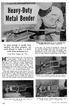 It's large enough to handle most welding job shop projects, yet small enough to make it a worth while home-workshop tool H Craft Print Project No. 272 ERE'S a metal bender that will enable you to bend
Renishaw 2008. apply innovation TM. Calibrating 5-axis machines to improve part accuracy. 5Align
 Calibrating 5-axis machines to improve part accuracy 5Align Productive Process Pyramid TM Understanding and tracking machine behaviour Process verification Thermal compensation In-cycle process control
AISI O1 Cold work tool steel
 T OOL STEEL FACTS AISI O1 Cold work tool steel Great Tooling Starts Here! This information is based on our present state of knowledge and is intended to provide general notes on our products and their
Ceramic Injection Moulding Capabilities
 Ceramic Injection Moulding Capabilities TECHNICAL CERAMICS About is a global materials engineering company which designs and manufactures a wide range of high specification products with extraordinary
NEW SIX-SEALS CUTTING RING. INTERNATIONAL INDUSTRIAL PATENT Nr. 864061 of the 10/03/99 FLANKS AND DOES NOT REPLACE THE STANDARD RING CURRENTLY IN USE
 B4 NEW SIX-SEALS CUTTING RING. INTERNATIONAL INDUSTRIAL PATENT Nr. 864061 of the 10/03/99 FLANKS AND DOES NOT REPLACE THE STANDARD RING CURRENTLY IN USE AVAILABLE IN CARBON AND STAINLESS STEEL 23 THEORY
ACCURACY PRATT & WHITNEY PRODUCTS OF 1930
 ACCURACY PRATT & WHITNEY PRODUCTS OF PRATT & WHITNEY MACHINE TOOLS, SMALL TOOLS AND GAGES OF M ODERN Pratt & Whitney tools are made to the same high standards of craftsmanship which our founders established,
A World Class Manufacturer of Induction Bends
 A World Class Manufacturer of Induction Bends COFELY FABRICOM BENDING A leading position in bending High Flexibility and Close Tolerances As a world leading manufacturer of pipe bends, produced by induction
Stilling Well Recommendations
 White Paper June 24, 2009 Stilling Well Recommendations This document describes general requirements for stilling wells used for radar tank gauging applications. Automation solutions for oil & gas, defense
Michael Montgomery Marketing Product Manager Rosemount Inc. Russ Evans Manager of Engineering and Design Rosemount Inc.
 ASGMT / Averaging Pitot Tube Flow Measurement Michael Montgomery Marketing Product Manager Rosemount Inc. Russ Evans Manager of Engineering and Design Rosemount Inc. Averaging Pitot Tube Meters Introduction
TruLaser Tube: Optimal tube. and. profile cutting. Machine Tools / Power Tools Laser Technology / Electronics Medical Technology
 TruLaser Tube: Optimal tube and profile cutting Machine Tools / Power Tools Laser Technology / Electronics Medical Technology Giving you the edge in laser tube processing. The TRUMPF Group ranks among
TENSIONMETER ** code 183_LNRSTW **
 Electronic tension meter for applications in textile and wire industry. 9 Tension ranges from 0.1-200 cn to 5-50 dan. Versatile instruments usable for applications in textile industry: e. g. 50 up to max.
E. K. A. ADVANCED PHYSICS LABORATORY PHYSICS 3081, 4051 NUCLEAR MAGNETIC RESONANCE
 E. K. A. ADVANCED PHYSICS LABORATORY PHYSICS 3081, 4051 NUCLEAR MAGNETIC RESONANCE References for Nuclear Magnetic Resonance 1. Slichter, Principles of Magnetic Resonance, Harper and Row, 1963. chapter
Good Boards = Results
 Section 2: Printed Circuit Board Fabrication & Solderability Good Boards = Results Board fabrication is one aspect of the electronics production industry that SMT assembly engineers often know little about.
Structural Bolting. Notice the Grade 5 has a much smaller head configuration and a shorter shank then the A325 structural bolt. Rev.
 Structural Bolting ASTM A325 and ASTM A490 are the two U.S. standard structural bolts. When looking at the mechanical requirements of bolts it appears that an ASTM A325 and SAE J429 Grade 5 are identical
T A B L E T 1 T E S T S A N D I N S P E C T I O N C A B L E P C U T A N D P C U T - A
 T A B L E T 1 1 of 7 Tests & Inspection Cable PCUT & PCUT-A (Table T1) T E S T S A N D I N S P E C T I O N C A B L E P C U T A N D P C U T - A No. Test Scale MOC Requirements G 20:10:001:01 Defined Test
Easy Machining Center Setup
 White Paper Document No. MWA-072-EN_01_1404 April 2014 Easy Machining Center Setup Using FANUC s Direct Input of Workpiece Origin Setting Measured and Tool Length Measurement features to easily establish
Simulation Technology to Support the Design of Electric Distribution and Control Devices
 Simulation Technology to Support the Design of Electric Distribution and Control Devices SAKATA Masayoshi ABSTRACT Simulation technology for electric distribution and control devices includes structural
Specifying Laser Scanning Services. A Quantapoint White Paper
 A Quantapoint White Paper ABSTRACT Specifying Laser Scanning Services to Help Ensure Trusted and Accurate Results As-built documentation created using laser scanning is rapidly being adopted as the tool
North American Stainless Long Products
 North American Stainless Long Products 1 North American Stainless North American Stainless is part of the most competitive stainless steel manufacturing group in the world, Acerinox, S.A. The development
Stainless Linear Motion Rolling Guide series
 products are avaiable from: MARYLAND METRICS phones: (410)358-3130 (800)638-1830 faxes: (410)358-3142 (800)872-9329 P.O.Box 261 Owings Mills, MD 21117 USA URL: http://mdmetric.com E-mail: [email protected]
METHOD STATEMENT HIGH STRIAN DYNAMIC TESTING OF PILE. Prepared by
 METHOD STATEMENT HIGH STRIAN DYNAMIC TESTING OF PILE Prepared by Infratech ASTM CO., LTD. Contents Chapter Description Page Contents...... 1 List of Appendix. 1 1. Introduction.. 2 2. Test Method..2 3.
API Flanged Safety Relief Valves Series 526 CATALOG
 API Flanged Safety Relief Valves Series 26 CATALOG The-Safety-Valve.com 1 Valve finder How to find the right product group High operating to set pressure ratio, high backpressure or low total height? Yes
Pressure calibration equipment
 Pressure calibration equipment Pressure calibration evolution 1925 Westertoren in Amsterdam 30 meter mercury column (±40 bar) 1950 comparison test pump 21 st century Stiko gas driven differential deadweight