
The tikzposter class
|
|
|
- Darren George
- 10 years ago
- Views:
Transcription
1 The tikzposter class Pascal Richter, Elena Botoeva, Richard Barnard, Dirk Surmann January 17, 2014 Abstract This document class aims to provide a simple way of using LateX and TikZ for generating good looking scientific posters. Contents 1 Introduction 2 2 Creating a Poster 2 3 Options for the Document Class 3 4 The Poster Contents Title Matter Blocks Notes Columns and Subcolumns Poster Layout Setting the colors Setting the layout Background style Title style Block style Inner Block styles Note style Poster template 16 7 Poster example 18 8 Appendix Available variables This document corresponds to tikzposter v2.0, dated 2014/01/15. 1

2 1 Introduction The tikzposter document class file may be used to simplify formatting and generating scientific posters in the.pdf format. It uses the TikZ package to generate a poster layout. The poster is formed by a series of blocks against a background in a sequence of aligned columns. The purpose of the class is to reduce the level of formatting by automatically setting spacing between blocks in the poster as well as their lengths. The user has control over the width of the columns. Due to the class reliance on TikZ, only.pdf output is supported. This document explains the formatting options available and how to easily create a basic block layout. To start with the class, the user can look at either the template file included with the class tikzposter-template.tex (also shown in Section 6) which provides a template, the minimal working example shown in Section 2, or the example file tikzposter-example.tex. The last file illustrates various formatting options available. In Section 3, the \documentclass is described. Inside of the document environment, the title is created by the use of one of the title block commands and columns of aligned blocks are then created; the various commands are described in the subsections of Section 4. If you want to alter the appearance of the poster, the various ways of doing this are explained in Section 5. Finally, the Appendix (Section 8) lists useful variables for those who want to further customize the appearance of the posters. Required packages: The class uses L A TEX2e and the following required packages: tikz, calc, ifthen, ae, xstring, etoolbox, xkeyval. Changes from previous versions: Significant changes have been made between the current version and the previous version of tikzposter. Aside from bug fixes, there have been the following changes: The background can now be customized, the title formatting can be customized, blocks can be shifted with respect to the default positioning, the format and appearance of blocks can be customized, the note object was introduced (a new type of object) and colorthemes have been modified. The various changes mean backwards compatibility was not possible for posters using some of the formatting options in the previous version. 2 Creating a Poster Below is a minimal example of a poster and the relevant places in the manual to find further information. 2

3 \documentclass{tikzposter} % See Section 3 \title{title} \institute{inst} % See Section 4.1 \author{auth} \titlegraphic{logo} \usetheme{basic} % See Section 5 \begin{document} \maketitle % See Section 4.1 \block{blocktitlea}{blocktext} % See Section 4.2 \begin{columns} % See Section 4.4 \column{0.3} % See Section 4.4 \block{blocktitleb}{blocktext} \column{0.7} \block{blocktitlec}{blocktext} \note{notetext} % See Section 4.3 \end{columns} \end{document} 3 Options for the Document Class In order to use the class, begin the document with \documentclass[options]{tikzposter} There are several options available for customizing the general layout of the poster. These are called as optional arguments when declaring the document class. The options for the page geometry are font size: The size of the text in the main body may be set as : 12pt, 14pt, 17pt, 20pt, or 25pt; paper size: Currently, paper sizes may be set to : a0paper, a1paper, or a2paper; orientation: Either landscape or portrait. The standard options fleqn and leqno may also be invoked here. The following options are set in the form variable name = value and deal with spacing of the poster: margin: The margin between outer edge of the poster and the edge of the paper. innermargin: The margin from the edge of the poster edge to the outermost edge of the blocks; colspace: The horizontal spacing between successive columns; subcolspace: The horizontal spacing between successive columns in the subcolumn environment (See Section 4.4 for more on this environment); blockverticalspace: The spacing between the bottom of a normal block and the top of the next block. 3

4 A sample usage of these options would be : \documentclass[25pt, a0paper, portrait, margin=0mm, innermargin=15mm, blockverticalspace=15mm, colspace=15mm, subcolspace=8mm]{tikzposter} These listed values are in fact the default values of the optional arguments. To turn off the comment on how the poster was created in the lower right corner, include in the preamble \tikzposterlatexaffectionproofoff. 4 The Poster Contents \maketitle 4.1 Title Matter The information for the title matter is defined in the usual manner; the user may use \author{}, \institute{}, and \title{}. Additionally, a logo for the title matter may be defined via \titlegraphic{}. The title is created with the normal \maketitle[options] command; however, we note that new options are available to alter the default settings: width: The width of the title portion of the poster. roundedcorners, linewidth, innersep: Passed to relevant TikZ commands in the title style, governing the box surrounding the title matter (if the style is made dependent on these parameters the default style, for instance, is). titletotopverticalspace, titletoblockverticalspace: Space between the top of the poster (excluding margins) and the top edge of the title portion; and space between the bottom of the poster and the top block, respectively. titlegraphictotitledistance: a length, used for a vertical distance between the titlegraphic and title description. titletextscale: a number which allows for relative scaling of the text of the title. \settitle The necessary spacing is handled using the options chosen in the call to the document class described in Section 3. The default format for the title is seen in Figure 1. One can redefine the way the title matter (title, author, etc.) are arranged by calling \settitle. The user can change this format by including in the preamble \settitle. Note that when referring to the title, author, titlegraphic, and institute with this command, one needs to use \@title, \@author, \@institute and \@titlegraphic. A sample alternative title format is: 4

5 titlegraphic TITLE author institute Figure 1: Default format of the title material \settitle{ \centering \vbox{ \centering \color{titlefgcolor} {\bfseries \Huge \sc \par} \vspace*{1em} {\huge \par} \vspace*{1em} {\LARGE }} \block Block Options 4.2 Blocks Blocks are created with the command \block[options]{title}{text}. Excluding options, this creates a block of the width of the page (or column/subcolumn, see section 4.4), excepting the margin and inner margin. A title for the block will be generated along the top in a separate, smaller block, centered using the contents of title. By default, its width will be set to be the \textwidth or, if in a column (see below), to the \colwidth; alternatively, it may be altered as described below. If the title field is left empty, then there will be no title for the block created. Multiline titles are supported and will be (approximately) broken to satisfy the maximum width of the block titles as specified in the formatting options. The contents of text will be displayed in the main body of the block. The length of the block is determined automatically by the contents of text. Further blocks may be generated in the same column by further uses of \block. However, if the contents of the blocks in a single column lead to spill over (that is, they take up more vertical space than allowed under the formatting for the paper size and margins), then formatting errors will occur. If the user wishes to have certain internal spacing and positioning aspects of the block to differ from those of the layout theme, they may reset the following: titleoffsetx, titleoffsety, bodyoffsetx and bodyoffsety: The block may be placed in violation of the automatic alignment according to the default spacing rules. This may be achieved with 4 options. The first two are used to shift the title block from the default position. The latter two shift the main content block (containing text) from a position directly under the title. All four are by default set to 0. That is, in relation to previously created blocks, the class determines the position of the current block according to the format options spacing values and then determines the appropriate heights of the two components, main part and title. The position can then be adjusted as desired. Please note that these offset values use the convention of positive values resulting in a shift right/upwards and negative values in a shift left/downwards. 5
![2 Blocks Blocks are created with the command \block[options]{title}{text}. Excluding options, this creates a block of the width of the page (or column/subcolumn, see section 4.](/docs-images/41/13820652/images/page_5.jpg "4), excepting the margin and inner margin. A title for the block will be generated along the top in a separate, smaller block, centered using the contents of title.")
6 titlewidthscale, bodywidthscale: The relative scaling from the default widths of the block s title and main portion, respectively. This is given in relative terms; i.e., titlewidthscale=.5 will result in a 50% narrower title width than the default. titleleft, titlecenter, titleright: The alignment of the title text within the title section of the block (if it it exists). Unless specified in the block or the block style (see below), center alignment is used. bodyverticalshift: Additional spacing (in absolute terms) between the bottom of the title and the beginning of the contents of the block body. roundedcorners, linewidth: Parameters used to determine the degree of roundedness of the corners of the block and the thickness of the outer edge of the block, respectively; behaves as in TikZ. titleinnersep, bodyinnersep: Separation for the title and body of the block, respectively, between the edge and their contents. A sample block may be created by the command \block[titleleft,titleoffsetx=2em,titleoffsety=1em,bodyoffsetx=2em, bodyoffsety=1em,titlewidthscale=.6, bodywidthscale=.8, roundedcorners=14, linewidth=8mm, bodyinnersep=4em, titleinnersep=2em] {Sample Block}{Text\\Text\\Text Text} Block objects \innerblock There are three special objects which may be placed in the blocks: inner blocks, colored boxes, and figures. Inner blocks, called by the command \innerblock[options]{heading}{text}, are blocks placed in the body. If no heading is provided, the title area is not drawn, as in the case of normal blocks. The available options are: titlewidth, bodywidth, titlewidthscale, bodywidthscale: Respectively, the absolute width of the title and body, and scaling from the default widths set by the inner block style (see below). NOTE: If using the style Table (see Section 5.6) sec: for inner blocks, the sum of titlewidthscale and bodywidthscale must be no greater than 1 and the total height of the heading text should be less than the the total height of the text. Title alignment: Either titlecenter, titleleft, or titleright. titleoffsetx, titleoffsety, bodyoffsetx, bodyoffsety: For positioning from the default placement of the title and body, similar in function to the options for a block. roundedcorners, linewidth, titleinnersep, bodyinnersep: Same functionality as the options for blocks. 6

7 \coloredbox Colored boxes can be used for emphasizing parts of the block body and are generated by \coloredbox[options]{text}. Without options, a box of the width of the block body (minus the length blockbodyinnersep) is created, highlighted by the color assigned to the background of notes (see below for more on setting colors). The options are: width: the width of the highlighted region. linewidth, roundedcorners: similar as above. bgcolor, fgcolor, framecolor: Colors of the background highlighting, the text, and the frame of the colored box. Due to implementation of the blocks, using the standard L A TEXfigure environ- ment is not possible. As a workaround, the environment tikzfigure has been included using a solution adapted from code suggested by Stephan Thober. It may be used in the same manner as the standard figure environment. tikzfigure \begin{tikzfigure}[caption of the figure] \label{fig:fig1} Figure \end{tikzfigure} \note 4.3 Notes Smaller objects called notes are also available. These are associated with blocks and can be used to attach comments to specific points in the blocks. Their use is slightly more complicated; they are created with the use of the \note[options]{contents} command. We will here remark on the options that are needed for placing them. These options are: targetoffsetx, targetoffsety: The note places a target point in the center of the previously created block and uses this as a reference point for placement. If this target should be moved, these two parameters can be set to shift the target away from the default; angle, radius: After the target has been set, the center of the note is a distance of radius away from the target with angle (with respect to the horizontal axis) angle; width: The desired width of the note; connection: If the note style allows for it (see below on the styles for notes), using the connection option draws the relevant connection (i.e. line or arrow) from the note s center point to the target point; rotate: If the entire note should be rotated, a rotation angle (again with respect to the horizontal axis) may be defined using this option. 7

8 roundedcorners, linewidth, innersep: If the note should be drawn using corners that are rounded differently than the default, with a thicker/thinner bounding line than the default, or with a different separation between content and edge of the note, respectively, these options may be used to reset the values. Two comments should be kept in mind. First, notes are always visible over the background and blocks. Second, there are no automatic spacing rules for notes, so care should be used in placement to ensure the proper appearance of the poster. A sample note could be constructed via: \note[targetoffsetx=2cm, targetoffsety=-1cm, angle=90, radius=3cm, width=5cm, rotate=30, connection, linewidth=.2cm, roundedcorners=30, innersep=1cm]{text} This inserts a note which is directly above (angle=90) and 3 cm from the target, which is 2 cm to the right of and 1 cm below the block center, and is then rotated 30 degrees. A connection is then drawn from the block center to this target. columns If multicolumn formats are desired, the environment columns may be used. All blocks generated inside of this environment will be divided into the desired columns with the specified width. To begin a column, use the command \column{width}, e.g., width=0.3\textwidth or width=20cm. Any blocks created after this will be aligned along a vertical line automatically placed, depending on the number of columns and their widths, as specified inside of the instance of the environment. Formatting errors may arise if the sum of the column widths is greater than \textwidth. The width of the column may be referred for formatting pictures or altering a block s width, for instance by referencing the length \colwidth. If you wish to create a set of subcolumns in the current column, the environ- ment subcolumns can be used. In this environment, subcolumns are created by \subcolumn{width}. However, the width in the \subcolumn command is relative now to the current \colwidth and can be referenced by the length \subcolwidth. The same comments on formatting made above regarding widths and text length hold here as well. subcolumns 4.4 Columns and Subcolumns 5 Poster Layout We will describe additional options which govern the appearance of the poster. There are options for changing the: colors used, background of the poster, the appearance of the title matter, the shapes of the various blocks, the appearance of inner blocks, and the shapes of the notes. 8

9 The colors used in the poster are defined using two objects: the palette and the style. The palette provides 3 basic colors to be used. There are several included color palettes. They may be called by the command \usecolorpalette{}. The included palettes are Default, BlueGrayOrange, GreenGrayViolet, PurpleGrayBlue, BrownBlueOrange. The way that these colors are used in the poster is defined in a color style, which is called by the command \usecolorstyle[options]{style name}. The options are the basic colors or the palette to be used. A sample set of options is [colorpalette=brownorangeblue,colorone=blue,colortwo=black,colorthree=green], which would not be used due to redundancy. All styles have a predefined palette as default. The included color styles are named after various countries (please note the associated default palettes are not connected by the names) and are: Default, Australia, Britain, Sweden, Spain, Russia, Denmark, Germany. The color style (with the palette) is used by the styles which define the appearance of the title, blocks, notes, and background. If no color palette or style is chosen, a default color theme is used. We now will explain the different components that can have colors assigned to them. The background has associated with it the colors backgroundcolor and framecolor which are, respectively, the color for the solid background and the color for the outer edges of the poster and the outer edges for all blocks. The text of the title material of the poster is in the color titlefgcolor. The background of the title material is given by the color titlebgcolor. The colors for the backgrounds of the blocks can also be defined. The back- ground color of the title portion of the block may be set with blocktitlebgcolor and the background color of the portion of the block with the text is set by blockbodybgcolor. The text colors for the title and the block contents are set with blocktitlefgcolor and blockbodyfgcolor, respectively. Inside blocks, the inner blocks will be colored using innerblocktitlebgcolor, innerblocktitlefgcolor, innerblockbodybgcolor, innerblockbodyfgcolor for, respecitvely, the background color of the title, the text color for the title, the background color of the body, and the text color of the body. \usetheme \usecolorpalette \usecolorstyle background colors title colors block colors innerblock colors coloredbox colors note colors A poster theme provides the settings for the other options. A theme is called by the command \usetheme{layout style} where the argument is either a predefined object name in tikzposterlayoutthemes.tex, or a style defined in the preamble for the appropriate object. Creating styles and their components is described in the following subsections. The predefined themes are Default, Rays, Basic, Simple, Envelope, Wave, Board, Autumn, and Desert. It should be noted that the user may call \usetheme and subsequently overwrite any or all components of the layout theme by resetting the different styles contained. 5.1 Setting the colors The note background color is used as the default of the background of colored boxes in the blocks. The note blocks created have background color defined by notebgcolor and 9
![The way that these colors are used in the poster is defined in a color style, which is called by the command \usecolorstyle[options]{style name}.](/docs-images/41/13820652/images/page_9.jpg "The options are the basic colors or the palette to be used.")
10 text colors \definecolorpalette \definecolorstyle text color defined by notefgcolor. The note blocks frames are colored by noteframecolor. The relevant text colors may also be individually defined. The color of the text of the title matter is defined via titlefgcolor. The color of the title text in each block is defined by blocktitlefgcolor and the color of the text of the main portion of the block is defined by blockbodyfgcolor. Finally, the notes text uses the color notefgcolor. Finally, if one wishes, one may define the color palette and style locally in the preamble. The palette is defined by the command \definecolorpalette{color palette name}{definitions}. A sample palette can defined by \definecolorpalette{samplecolorpalette} { \definecolor{colorone}{named}{green} \definecolor{colortwo}{named}{black} \definecolor{colorthree}{named}{cyan} } For a style, this is accomplished by \definecolorstyle{color style name}{default palette}{definitions}. Using the name convention below of colorone, colortwo, and colorthree when setting the colors allows the flexibility of various palettes. A sample color style can be defined by: \definecolorstyle{samplecolorstyle} { \definecolor{colorone}{named}{blue} \definecolor{colortwo}{named}{yellow} \definecolor{colorthree}{named}{orange} }{ % Background Colors \colorlet{backgroundcolor}{colorone} \colorlet{framecolor}{black} % Title Colors \colorlet{titlefgcolor}{black} \colorlet{titlebgcolor}{colorone} % Block Colors \colorlet{blocktitlebgcolor}{colorthree} \colorlet{blocktitlefgcolor}{white} \colorlet{blockbodybgcolor}{white} \colorlet{blockbodyfgcolor}{black} % Innerblock Colors \colorlet{innerblocktitlebgcolor}{white} \colorlet{innerblocktitlefgcolor}{black} \colorlet{innerblockbodybgcolor}{colorthree!30!white} \colorlet{innerblockbodyfgcolor{black} % Note colors \colorlet{notefgcolor}{black} \colorlet{notebgcolor}{colortwo!50!white} \colorlet{noteframecolor}{colortwo} } 10

11 \definelayouttheme \usebackgroundstyle \definebackgroundstyle 5.2 Setting the layout The basic components of the poster fall into three categories: the title portion, the blocks of content, and smaller notes. General rules for the appearance of the components as well as the background are set by a layout theme. The layout theme is composed of rules for the general shape of the components. One may use, for instance, the Default color style with the Envelope layout. A sample theme called sample may be defined with the following: \definelayouttheme{sample}{ \usecolorstyle[colorpalette=samplecolorpalette]{samplecolorstyle} \usebackgroundstyle{sample} \usetitlestyle{test} \useblockstyle{sample} \useinnerblockstyle{sample} \usenotestyle{corner} } In the following subsections, the styles for background, title, block, innerblock, and notes are described. 5.3 Background style The background is by default a vertically graded single color depending on the value of backgroundcolor set by the color theme chosen (see Section 5.1). If the user wishes to alter this, then in the preamble you can use the \usebackgroundstyle{} command. This command takes as argument a name for a setting in the file tikzbackgrounds.tex; predefined backgrounds included with the package are: Default, Rays, VerticalGradation, BottomVerticalGradation, Empty. If you want to define a custom background style, you can use the commnd \definebackgroundstyle{style name}{background commands}: This command takes as first argument a name for the background and as second argument valid TikZ commands; an example usage of this is: \definebackgroundstyle{samplebackgroundstyle}{ \draw[inner sep=0pt, line width=0pt, color=red, fill=backgroundcolor!30!black] (bottomleft) rectangle (topright); } Following this definition, the preamble should include the command \usebackgroundstyle{samplebackgroundstyle} either directly or inside of a layout theme. In making a custom background, it is important to note that the point (0, 0) is the center of the poster (after removing the margins). Additionally, as can be seen from the example commands above, the user has access to several variables. These include: \textwidth: The total width of the available poster space, after creating the margins. 11

12 \textheight: The total height of the available poster space, after creating the margins. \titlegraphicheight, \titletotopverticalspace, \titleinnersep: See the information in desigining a titlestyle. backgroundcolor: above). Defined in color theme or by user in preamble (see topright: a TikZ node defining the top right position poster background. bottomleft: a TikZ node defining the bottom left position poster background. \usetitlestyle \definetitlestyle 5.4 Title style If the default simple box surrounding the title matter is not desired, the user may use one of the several predefined title styles by using in the preamble \usetitlestyle[options]{style name} where the argument is a style listed in tikzpostertitlestyles.tex or the name of a style defined in the preamble. The preset title styles are: Default, Basic, Envelope, Wave, VerticalShading, Filled, Empty. If the user wishes to use a title with a different appearance, then \definetitlestyle{style name}{options}{title commands}. The available options are those mentioned above. Several parameters which might be helpful when writing a custom title style are: \textwidth: The width of the poster contents, similar to the standard usage in L A TEX, albeit having incorporated both margins set in the document class options. \textheight: Same as the standard L A TEXusage. \titlewidth: Stores the value passed from the options in \maketitle. \titlegraphicheight: Height of the defined title graphic. \titlelinewidth, \titleinnersep: Line width and inner sep. \titletotopverticalspace: Spacing between the upper edge of the poster (after including margins) and the upper edge of the title. titlebgcolor: As defined in the color style. \titleposleft, \titleposright, \titleposbottom, \titlepostop: The horizontal (resp. vertical) coordinates of the left and right (resp. bottom and top) edges of the title portion. A sample title style is shown below 12

13 \definetitlestyle{sampletitle}{ width=500mm, roundedcorners=20, linewidth=2pt, innersep=5pt, titletotopverticalspace=15mm, titletoblockverticalspace=30mm }{ \begin{scope}[line width=\titlelinewidth, rounded corners=\titleroundedcorners] \draw[color=blocktitlebgcolor, fill=titlebgcolor] (\titleposleft,\titleposbottom) rectangle (\titleposright,\titlepostop); \end{scope} } and could be called using \usetitlestyle{sampletitle}. For more information on the available variables to assist in designing a custom title style, please refer to the Appendix. 5.5 Block style \useblockstyle If the user wishes to use blocks with a different style, he or she may use \defineblockstyle \useblockstyle[options]{style name}. This loads either prewritten styles available in tikzposterblockstyles.tex or custom styles. The predefined styles are Default, Basic, Minimal, Envelope, Corner, Slide, TornOut. The user can also create a custom block style, in the preamble via the command \defineblockstyle{stylename}{ default values}{commands} which contains the name of the style, the default values (see below) of relevant parameters; and a definition for drawing a block and (if wanted) the title composed of TikZ commands. A sample definition of this might be \defineblockstyle{sampleblockstyle}{ titlewidthscale=0.9, bodywidthscale=1,titleleft, titleoffsetx=0pt, titleoffsety=0pt, bodyoffsetx=0mm, bodyoffsety=15mm, bodyverticalshift=10mm, roundedcorners=5, linewidth=2pt, titleinnersep=6mm, bodyinnersep=1cm }{ \draw[color=framecolor, fill=blockbodybgcolor, rounded corners=\blockroundedcorners] (blockbody.south west) rectangle (blockbody.north east); \ifblockhastitle \draw[color=framecolor, fill=blocktitlebgcolor, rounded corners=\blockroundedcorners] (blocktitle.south west) rectangle (blocktitle.north east); \fi } At any point, the user may change the block style used for subsequent blocks by using \useblockstyle{} with the new style. The block will then draw the objects as defined by \defineblockstyle and afterwards put the contents in those positions. The parameters that may be assigned default values and referenced in the commands are \blockroundedcorners, \blocklinewidth, \blockbodyinnersep, and \blocktitleinnersep; if this is not done, preset default values are used. These are used for values in TikZ commands that use the 13

14 parameters for rounded corners, line width (for the edge of the block), inner sep for the body content and title, respectively. As can be seen, when creating the style, the user has access to several parameters. They are computed after the class determines, under the rules of formatting and given the width of the block, dimensions of the block. These, aside from those already mentioned, include: \ifblockhastitle: A boolean for whether the block has nonempty first argument; blocktitle: A TikZ node defining the appropriate position of the title subject to the spacing rules and the length/width of the title; blockbody: A TikZ node defining the appropriate position of the body subject to the spacing rules and the length/width of the body and title(assuming the title is above the body); \blockroundedcorners, \blocklinewidth, \blockbodyinnersep, and \blocktitleinnersep: Parameters passed from the options of the block. framecolor, blocktitlebgcolor, blockbodybgcolor: Determined by the chosen color scheme. \useinnerblockstyle \defineinnerblockstyle 5.6 Inner Block styles If one wishes, inner blocks may have their appearance changed by the command \useinnerblockstyle{style name}. The included styles are Default and Table, along with copies of the styles for blocks. If the user wants, additional inner block styles may be created with the command \defineinnerblockstyle{stylename} {default values}{commands}. The relevant parameters are: \ifinnerblockhastitle: A boolean denoting whether the inner block has nonempty first argument innerblocktitle, innerblockbody: heading and body of the inner block. TikZ nodes for the position of the \innerblockroundedcorners, \innerblocklinewidth, \innerblockbodyinnersep, and \innerblocktitleinnersep : Parameters passed from the options of the inner block. innerblockbodybgcolor, innerblocktitlebgcolor, framecolor: Colors determined by the chosen color scheme, or passed as options. Styles are similar in structure as those for blocks. 14

15 \usenotestyle \definenotestyle 5.7 Note style If one wishes, alternative note appearances may be used. If the user wants to use one of the included note styles Default, Corner, VerticalShading, or Sticky, then the command \usenotestyle[options]{style name} may be employed. Alternatively, one may include in either the preamble or inside of the document the command \definenotestyle{note style name}{default values}{commands} where the inputs are the name of the style, default values for relevant format options and valid TikZ commands for drawing the note. In the use of \definenotestyle, the user may make use of the following parameters: \ifnotehasconnection: A boolean denoting whether connection has been included as an option; notetarget: A TikZ node defining the placement of the note target; notecenter: A TikZ node defining the placement of the center of the note; \noterotate: The angle the entire note should be rotated; \notelinewidth, \noteroundedcorners, \noteinnersep: Values from either the default values or from the user passing options corresponding to the width of the outer edge of the note, the roundedness of the corners, and the separation between the note edge and contents, respectively. noteframecolor, notefgcolor, notebgcolor: Colors defined in the color them (see above). An example style may be defined via the command: \definenotestyle{samplenotestyle}{ targetoffsetx=0pt, targetoffsety=0pt, angle=45, radius=8cm, width=6cm, connection=true, rotate=0, roundedcorners=0, linewidth=1pt, innersep=0pt% }{ \ifnotehasconnection \draw[thick] (notecenter) -- (notetarget) node{$\bullet$}; \fi \draw[draw=notebgcolor,fill=notebgcolor,rotate=\noterotate] (notecenter.south west) rectangle (notecenter.north east); } 6 Poster template The following L A TEX document is intended to be used as a template. It has a minimal set of inputs. Included with the package is an additional tikzposter-example.tex which has more extensive comments and additional options implemented, see Section 7. 15

16 1 tikzposter-template.tex 2 \documentclass{tikzposter} %Options for format can be included here 3 4 % Title, Author, Institute 5 \title{template Poster} 6 \author{author(s)} 7 \institute{institute} 8 \titlegraphic{logographic Inserted Here} 9 10 %Choose Layout 11 \usetheme{default} \begin{document} % Title block with title, author, logo, etc. 16 \maketitle 17 \block{basic Block}{Text} 18 \begin{columns} % FIRST column 21 \column{0.6}% Width set relative to text width \block{large Column}{Text\\Text\\Text Text Text} 24 \note{note with default behavior} 25 \note[targetoffsetx=12cm, targetoffsety=-1cm, angle=20, rotate=25] 26 {Note \\ offset and rotated} % First column - second block 29 \block{block titles with enough text will automatically obey spacing requirements } 30 {Text\\Text} % First column - third block 33 \block{sample Block 4}{T\\E\\S\\T} % SECOND column 36 \column{0.4} 37 %Second column with first block s top edge aligned with with previous column s top % Second column - first block 40 \block[titleleft]{smaller Column}{Test} % Second column - second block 43 \block[titlewidthscale=0.6, bodywidthscale=0.8] 44 {Variable width title}{block with smaller width.} % Second column - third block 47 \block{}{block with no title} % Second column - A collection of blocks in subcolumn environment. 16

17 50 \begin{subcolumns} 51 \subcolumn{0.27} \block{1}{first block.} \block{2}{second block} 52 \subcolumn{0.4} \block{sub-columns}{sample subblocks\\second subcolumn} 53 \subcolumn{0.33} \block{4}{fourth} \block{}{final Subcolumn block} 54 \end{subcolumns} % Bottomblock 57 \block{final Block in column}{ 58 Sample block. 59 } 60 \end{columns} 61 \block[titleleft, titleoffsetx=2em, titleoffsety=1em, bodyoffsetx=2em,% 62 bodyoffsety=-2cm, roundedcorners=10, linewidth=0mm, titlewidthscale=0.7,% 63 bodywidthscale=0.9, bodyverticalshift=2cm, titleright] 64 {Block outside of Columns}{Along with several options enabled} \end{document} 67 /tikzposter-template.tex 7 Poster example Included in the class directory is an example tex file tikzposter-example.tex. This demonstrates the various options available, as opposed to the minimal working copy tikzposter-template.tex. 8 Appendix 8.1 Available variables If one wishes to create their own themes/styles/etc, the following variables which govern positioning, spacing, and appearance may be of use. They may be used within themes, title styles, block styles, and note styles. Please note that each of these are defined and then passed to the style; they may then be referenced and redefined inside of a style. However, not all are local to that block; only those that are noted as being redefined. \TP@visibletextwidth, \TP@visibletextheight: The width and height of the poster material. Excludes the margin length set in the option. Defined in op- \TP@titleinnersep, \TP@titletoblockverticalspace: tions of the document. May be redefined in a theme. \titlewidth, \titleheight: Width and height of the title block. \titlegraphicheight: The height of graphic used in the title. \titletotopverticalspace: Defined in the options. 17

18 The space between columns, defined in the options, the y-coordinate of the current column s beginning, end, center axis, and absolute width, respectively. \TP@subcolspace, \TP@subcoltop, \TP@subcolbottom, \TP@subcolcenter, \subcolwidth: The same lengths, in the subcolumn environment. \TP@blockverticalspace, \TP@blocktitleinnersep, \TP@blockbodyinnersep: Spacing rules for blocks, defined in options. \TP@blockcenter: Horizontal position of the center of the current block; it is redefined for each call to the \block command. \blockwidth, \blockbodyheight, \blocktitleheight: Dimensions of the current block s components; it is redefined for each call to the \block command. \TP@blocktop: The y-coordinate of the top edge of the block (including the title if it exists). \TP@blocktitleoffsetx, \TP@blocktitleoffsety: Shifts to the position of the block title component; each call to \block resets them to 0. \TP@blockbodyoffsetx, \TP@blockbodyoffsety: Similar to the above, but for the block s body component; also reset to 0 with each \block call. \blockroundedcorners, \blocklinewidth, \blockbodyinnersep, \blocktitleinnersep: Values passed by the user with each block, or defined in a block style, which give the values to be used for TiKz draw parameters rounded corners, line width, and inner seps of the body and title, respectively. These may have default values defined in a style/theme using the functions: \setblockdefaultroundedcorners{}, \setblockdefaultlinewidth{}, \setblockdefaultbodyinnersep{}, and \setblockdefaulttitleinnersep{}. If the user does not specify these values in the options of the block call, the defaults are used. \TP@noteinnersep: Defined in the options \TP@noteradius, \TP@notetargetoffsetx, \TP@notetargetoffsety, \notewidth: Arguments optionally passed from the \note command; redefined for each call to \note. \noteheight: The height of the current note computed according to size of contents and \notewidth; redefine with each call to \note. \noteroundedcorners, \notelinewidth, \noteinnersep: Values passed by the user with each note, or defined in a note style, which give the values to be used for TiKz draw parameters rounded corners, line width, and inner 18

19 seps of the body and title, respectively. These may have default values defined in a style/theme using the functions: \setnotedefaultroundedcorners{}, \setnotedefaultlinewidth{}, and \setnotedefaultbodyinnersep{}. If the user does not set in a note call the options, the defaults are used. Additionally, several nodes are defined for the title and the blocks. These should be used when defining block styles and title styles. The title node is the main node for the title material which spans an area large enough to cover the entirety of the title material as formatted with the \settitle command. The vertical and horizontal positions of the title are stored as \titlepostop, \titleposbottom, \titleposleft, and \titleposright. For blocks, blocktitle and blockbody are nodes which cover the extent of the relevant components. 19

The tikzposter class
 The tikzposter class Pascal Richter, Richard Barnard, Elena Botoeva, Dirk Surmann [email protected] August 2, 2013 Abstract This document class aims to provide a simple way of using TikZ
Guide To Creating Academic Posters Using Microsoft PowerPoint 2010
 Guide To Creating Academic Posters Using Microsoft PowerPoint 2010 INFORMATION SERVICES Version 3.0 July 2011 Table of Contents Section 1 - Introduction... 1 Section 2 - Initial Preparation... 2 2.1 Overall
Create Charts in Excel
 Create Charts in Excel Table of Contents OVERVIEW OF CHARTING... 1 AVAILABLE CHART TYPES... 2 PIE CHARTS... 2 BAR CHARTS... 3 CREATING CHARTS IN EXCEL... 3 CREATE A CHART... 3 HOW TO CHANGE THE LOCATION
KB COPY CENTRE. RM 2300 JCMB The King s Buildings West Mains Road Edinburgh EH9 3JZ. Telephone: 0131 6505001
 KB COPY CENTRE RM 2300 JCMB The King s Buildings West Mains Road Edinburgh EH9 3JZ Telephone: 0131 6505001 Email: [email protected] [email protected] [email protected] Step 1. Set up page orientation
Creating an invitation
 Creating an invitation Michaela Maginot About the author Michaela Maginot lives in Unterhaching, Germany, not too far from Munich. She graduated from the Deutschen Meisterschule für Mode (German Master
Publisher 2010 Cheat Sheet
 April 20, 2012 Publisher 2010 Cheat Sheet Toolbar customize click on arrow and then check the ones you want a shortcut for File Tab (has new, open save, print, and shows recent documents, and has choices
DIRECTIONS FOR SETTING UP LABELS FOR MARCO S INSERT STOCK IN WORD PERFECT, MS WORD AND ACCESS
 DIRECTIONS FOR SETTING UP LABELS FOR MARCO S INSERT STOCK IN WORD PERFECT, MS WORD AND ACCESS WORD PERFECT FORMAT MARCO ITEM #A-3LI - 2.25 H x 3W Inserts First create a new document. From the main page
Drawing Gantt Charts in L A TEX with TikZ The pgfgantt package
 Drawing Gantt Charts in L A TEX with TikZ The pgfgantt package Wolfgang Skala April 18th, 2011 The pgfgantt package provides the ganttchart environment, which draws a Gantt chart within a TikZ picture.
Instructions for Creating a Poster for Arts and Humanities Research Day Using PowerPoint
 Instructions for Creating a Poster for Arts and Humanities Research Day Using PowerPoint While it is, of course, possible to create a Research Day poster using a graphics editing programme such as Adobe
Basic Excel Handbook
 2 5 2 7 1 1 0 4 3 9 8 1 Basic Excel Handbook Version 3.6 May 6, 2008 Contents Contents... 1 Part I: Background Information...3 About This Handbook... 4 Excel Terminology... 5 Excel Terminology (cont.)...
May 20, 2012. MyCV * Author: Andrea Ghersi. Abstract
 May 20, 2012 MyCV * Author: Andrea Ghersi Abstract This LATEX class provides a set of functionality for writing curriculum vitæ with different layouts. To achieve this goal, it adopts a different approach
Getting Started With DraftSight A Guide For AEC Users
 Getting Started With DraftSight A Guide For AEC Users DraftSight.com Facebook.com/DraftSight Welcome to DraftSight a valuable tool for any AEC professional! DraftSight is more than a free, professional-grade
Create a Poster Using Publisher
 Contents 1. Introduction 1. Starting Publisher 2. Create a Poster Template 5. Aligning your images and text 7. Apply a background 12. Add text to your poster 14. Add pictures to your poster 17. Add graphs
GUIDELINES FOR PREPARING POSTERS USING POWERPOINT PRESENTATION SOFTWARE
 Society for the Teaching of Psychology (APA Division 2) OFFICE OF TEACHING RESOURCES IN PSYCHOLOGY (OTRP) Department of Psychology, Georgia Southern University, P. O. Box 8041, Statesboro, GA 30460-8041
Mail Programming Topics
 Mail Programming Topics Contents Introduction 4 Organization of This Document 4 Creating Mail Stationery Bundles 5 Stationery Bundles 5 Description Property List 5 HTML File 6 Images 8 Composite Images
A series Metric (cm) Imperial (inch)
 Poster Creation PowerPoint for Posters PowerPoint is well known as a presentation support application. However, it can also be used to create academic posters as it is a format that many people are already
PowerPoint 2007: Basics Learning Guide
 PowerPoint 2007: Basics Learning Guide What s a PowerPoint Slide? PowerPoint presentations are composed of slides, just like conventional presentations. Like a 35mm film-based slide, each PowerPoint slide
Utilizing Microsoft Access Forms and Reports
 Utilizing Microsoft Access Forms and Reports The 2014 SAIR Conference Workshop #3 October 4 th, 2014 Presented by: Nathan Pitts (Sr. Research Analyst The University of North Alabama) Molly Vaughn (Associate
Creating an invitation
 Creating an invitation Michaela Maginot Concept and design Invitation complete with gift box, card, and transparent envelope. For more options, please visit www.corel.com/design collection. The goal was
How to build text and objects in the Titler
 How to build text and objects in the Titler You can use the Titler in Adobe Premiere Pro to create text and geometric objects. There are three methods for creating text, each capable of producing either
ECDL / ICDL Presentation Syllabus Version 5.0
 ECDL / ICDL Presentation Syllabus Version 5.0 Purpose This document details the syllabus for ECDL / ICDL Presentation. The syllabus describes, through learning outcomes, the knowledge and skills that a
How To Create A View Frame In 3D
 12/4/2008-10:00 am - 11:30 am Room:Palazzo O-P (5th) The Secrets of Cutting Plan and Profile Sheets in AutoCAD Civil 3D Michelle Rasmussen - Application Engineer, IMAGINiT Technologies CV304-1P In this
Excel 2007 Basic knowledge
 Ribbon menu The Ribbon menu system with tabs for various Excel commands. This Ribbon system replaces the traditional menus used with Excel 2003. Above the Ribbon in the upper-left corner is the Microsoft
A package for rotated objects in L A TEX
 A package for rotated objects in L A TEX Robin Fairbairns Sebastian Rahtz Leonor Barroca printed January 26, 2010 Contents 1 Introduction 1 2 Usage 2 2.1 Package options............................. 2
Excel 2003 Tutorial I
 This tutorial was adapted from a tutorial by see its complete version at http://www.fgcu.edu/support/office2000/excel/index.html Excel 2003 Tutorial I Spreadsheet Basics Screen Layout Title bar Menu bar
11 Printing Designs. When you have completed this chapter, you will be able to:
 11 Printing Designs Creating printed documents is the end we have worked towards from the beginning of this course. We have already been introduced to it very briefly with Printing - A First Look on page
Creating a Poster in Powerpoint
 Creating a Poster in Powerpoint January 2013 Contents 1. Starting Powerpoint 2. Setting Size and Orientation 3. Display a Grid 5. Apply a background 7. Add text to your poster 9. Add WordArt to your poster
Creating a Poster Presentation using PowerPoint
 Creating a Poster Presentation using PowerPoint Course Description: This course is designed to assist you in creating eye-catching effective posters for presentation of research findings at scientific
Introduction to Autodesk Inventor for F1 in Schools
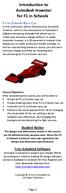 Introduction to Autodesk Inventor for F1 in Schools F1 in Schools Race Car In this course you will be introduced to Autodesk Inventor, which is the centerpiece of Autodesk s digital prototyping strategy
Creating Drawings in Pro/ENGINEER
 6 Creating Drawings in Pro/ENGINEER This chapter shows you how to bring the cell phone models and the assembly you ve created into the Pro/ENGINEER Drawing mode to create a drawing. A mechanical drawing
What s New V 11. Preferences: Parameters: Layout/ Modifications: Reverse mouse scroll wheel zoom direction
 What s New V 11 Preferences: Reverse mouse scroll wheel zoom direction Assign mouse scroll wheel Middle Button as Fine tune Pricing Method (Manufacturing/Design) Display- Display Long Name Parameters:
Designing a poster. Big is important. Poster is seldom linear, more like a MindMap. The subjects belonging together are located close to each other.
 Designing a poster Poster is seldom linear, more like a MindMap The subjects belonging together are located close to each other. Big is important. Warm colours bring closer, cold ones estrange. A human
Intro to Excel spreadsheets
 Intro to Excel spreadsheets What are the objectives of this document? The objectives of document are: 1. Familiarize you with what a spreadsheet is, how it works, and what its capabilities are; 2. Using
TABLE OF CONTENTS. INTRODUCTION... 5 Advance Concrete... 5 Where to find information?... 6 INSTALLATION... 7 STARTING ADVANCE CONCRETE...
 Starting Guide TABLE OF CONTENTS INTRODUCTION... 5 Advance Concrete... 5 Where to find information?... 6 INSTALLATION... 7 STARTING ADVANCE CONCRETE... 7 ADVANCE CONCRETE USER INTERFACE... 7 Other important
Excel Unit 4. Data files needed to complete these exercises will be found on the S: drive>410>student>computer Technology>Excel>Unit 4
 Excel Unit 4 Data files needed to complete these exercises will be found on the S: drive>410>student>computer Technology>Excel>Unit 4 Step by Step 4.1 Creating and Positioning Charts GET READY. Before
Advanced Microsoft Excel 2010
 Advanced Microsoft Excel 2010 Table of Contents THE PASTE SPECIAL FUNCTION... 2 Paste Special Options... 2 Using the Paste Special Function... 3 ORGANIZING DATA... 4 Multiple-Level Sorting... 4 Subtotaling
PowerPoint: Graphics and SmartArt
 PowerPoint: Graphics and SmartArt Contents Inserting Objects... 2 Picture from File... 2 Clip Art... 2 Shapes... 3 SmartArt... 3 WordArt... 3 Formatting Objects... 4 Move a picture, shape, text box, or
Beas Inventory location management. Version 23.10.2007
 Beas Inventory location management Version 23.10.2007 1. INVENTORY LOCATION MANAGEMENT... 3 2. INTEGRATION... 4 2.1. INTEGRATION INTO SBO... 4 2.2. INTEGRATION INTO BE.AS... 4 3. ACTIVATION... 4 3.1. AUTOMATIC
ADMINISTRATORS GUIDE EPISUITE 6
 ADMINISTRATORS GUIDE EPISUITE 6 A quick tutorial on how to set up and implement Episuite Software created by IDentiphoto Specialists in IDentification 1810 Joseph Lloyd Pkwy. Willoughby, OH 44094 Phone:
Understand the Sketcher workbench of CATIA V5.
 Chapter 1 Drawing Sketches in Learning Objectives the Sketcher Workbench-I After completing this chapter you will be able to: Understand the Sketcher workbench of CATIA V5. Start a new file in the Part
Avery DesignPro 2000 User Guide
 Avery DesignPro 2000 User Guide Creating labels and cards for your personal needs is easy with Avery DesignPro 2000 Avery DesignPro 2000 User Guide First edition of the condensed user manual for Avery
Portal Connector Fields and Widgets Technical Documentation
 Portal Connector Fields and Widgets Technical Documentation 1 Form Fields 1.1 Content 1.1.1 CRM Form Configuration The CRM Form Configuration manages all the fields on the form and defines how the fields
Creating a Newsletter
 Creating a Newsletter Publisher Templates Toolbars and Guides Color Schemes Font Schemes Graphics Text Boxes Text overflow Import document Master Pages Design Gallery Publication Designs Microsoft Publisher
Getting Started with Excel 2008. Table of Contents
 Table of Contents Elements of An Excel Document... 2 Resizing and Hiding Columns and Rows... 3 Using Panes to Create Spreadsheet Headers... 3 Using the AutoFill Command... 4 Using AutoFill for Sequences...
Fireworks CS4 Tutorial Part 1: Intro
 Fireworks CS4 Tutorial Part 1: Intro This Adobe Fireworks CS4 Tutorial will help you familiarize yourself with this image editing software and help you create a layout for a website. Fireworks CS4 is the
Creating Interactive PDF Forms
 Creating Interactive PDF Forms Using Adobe Acrobat X Pro Information Technology Services Outreach and Distance Learning Technologies Copyright 2012 KSU Department of Information Technology Services This
Elfring Fonts, Inc. PCL MICR Fonts
 Elfring Fonts, Inc. PCL MICR Fonts This package contains five MICR fonts (also known as E-13B), to print magnetic encoding on checks, and six Secure Number fonts, to print check amounts. These fonts come
Drawing Gantt Charts in L A TEX with TikZ The pgfgantt Package
 Drawing Gantt Charts in L A TEX with TikZ The pgfgantt Package Wolfgang Skala v3.0 2012/01/25 The pgfgantt package provides the ganttchart environment, which draws a Gantt chart within a TikZ picture.
Technical Drawing Specifications Resource A guide to support VCE Visual Communication Design study design 2013-17
 A guide to support VCE Visual Communication Design study design 2013-17 1 Contents INTRODUCTION The Australian Standards (AS) Key knowledge and skills THREE-DIMENSIONAL DRAWING PARALINE DRAWING Isometric
Positioning Container Elements
 Advanced Lesson Group 3 - Element Positioning with CSS Positioning Container Elements The position: style property is used to move block elements to a specific location on the web page. The position style
Using and creating Crosstabs in Crystal Reports Juri Urbainczyk 27.08.2007
 Using and creating Crosstabs in Crystal Reports Juri Urbainczyk 27.08.2007 Using an creating Crosstabs in Crystal Reports... 1 What s a crosstab?... 1 Usage... 2 Working with crosstabs... 2 Creation...
Enhanced Formatting and Document Management. Word 2010. Unit 3 Module 3. Diocese of St. Petersburg Office of Training Training@dosp.
 Enhanced Formatting and Document Management Word 2010 Unit 3 Module 3 Diocese of St. Petersburg Office of Training [email protected] This Page Left Intentionally Blank Diocese of St. Petersburg 9/5/2014
User s Guide to the PGF Package, Version 0.61 http://www.ctan.org/tex-archive/graphics/pgf/
 User s Guide to the PGF Package, Version 0.61 http://www.ctan.org/tex-archive/graphics/pgf/ Till Tantau [email protected] April 7, 2004 Contents 1 Introduction 1 1.1 Overview...............................................
SellerDeck 2014 Responsive Design Guide
 SellerDeck 2014 Responsive Design Guide Version: 1.0.0 SellerDeck 2014 Responsive Design 1 Contents Introduction...3 Themes and Wireframe...4 Classic Theme...4 Smart Theme...5 Wireframe...6 How the Responsive
Introduction to Autodesk Inventor for F1 in Schools
 F1 in Schools race car Introduction to Autodesk Inventor for F1 in Schools In this course you will be introduced to Autodesk Inventor, which is the centerpiece of Autodesk s Digital Prototyping strategy
Dissertation Template for Princeton. University
 Dissertation Template for Princeton University First Middle Last A Dissertation Presented to the Faculty of Princeton University in Candidacy for the Degree of Doctor of Philosophy Recommended for Acceptance
Quick Start Tutorial Imperial version
 Quick Start Tutorial Imperial version 1996-2006 Cadsoft Corporation. No part of this guide or the accompanying software may be reproduced or transmitted, electronically or mechanically, without written
Microsoft PowerPoint 2010 Templates and Slide Masters (Level 3)
 IT Services Microsoft PowerPoint 2010 Templates and Slide Masters (Level 3) Contents Introduction... 1 Installed Templates and Themes... 2 University of Reading Templates... 3 Further Templates and Presentations...
Scientific Posters. Styleguide
 Scientific Posters Styleguide April 2007 Basics The scientific poster is designed within the Roche CD guidelines as close as possible. It contains basically two sections: the header and the main content.
Welcome to CorelDRAW, a comprehensive vector-based drawing and graphic-design program for the graphics professional.
 Working with layout Welcome to CorelDRAW, a comprehensive vector-based drawing and graphic-design program for the graphics professional. In this tutorial, you will create a poster for an imaginary coffee
Handout: How to Use Excel 2010
 How to Use Excel 2010 Table of Contents THE EXCEL ENVIRONMENT... 4 MOVE OR SCROLL THROUGH A WORKSHEET... 5 USE THE SCROLL BARS TO MOVE THROUGH A WORKSHEET... 5 USE THE ARROW KEYS TO MOVE THROUGH A WORKSHEET...
Microsoft Excel 2010 Charts and Graphs
 Microsoft Excel 2010 Charts and Graphs Email: [email protected] Web Page: http://training.health.ufl.edu Microsoft Excel 2010: Charts and Graphs 2.0 hours Topics include data groupings; creating
BUSINESS OBJECTS XI WEB INTELLIGENCE
 BUSINESS OBJECTS XI WEB INTELLIGENCE SKW USER GUIDE (Skilled Knowledge Worker) North Carolina Community College Data Warehouse Last Saved: 3/31/10 9:40 AM Page 1 of 78 Contact Information Helpdesk If you
If you know exactly how you want your business forms to look and don t mind detail
 Advanced Form Customization APPENDIX E If you know exactly how you want your business forms to look and don t mind detail work, you can customize QuickBooks forms however you want. With QuickBooks Layout
Creating a 2D Geometry Model
 Creating a 2D Geometry Model This section describes how to build a 2D cross section of a heat sink and introduces 2D geometry operations in COMSOL. At this time, you do not model the physics that describe
Welcome to CorelDRAW, a comprehensive vector-based drawing and graphic-design program for the graphics professional.
 Creating a logo Welcome to CorelDRAW, a comprehensive vector-based drawing and graphic-design program for the graphics professional. In this tutorial, you will create a logo for an imaginary coffee shop.
2013 Getting Started Guide
 2013 Getting Started Guide The contents of this guide and accompanying exercises were originally created by Nemetschek Vectorworks, Inc. Vectorworks Fundamentals Getting Started Guide Created using: Vectorworks
KaleidaGraph Quick Start Guide
 KaleidaGraph Quick Start Guide This document is a hands-on guide that walks you through the use of KaleidaGraph. You will probably want to print this guide and then start your exploration of the product.
Introduction to Microsoft Word 2008
 1. Launch Microsoft Word icon in Applications > Microsoft Office 2008 (or on the Dock). 2. When the Project Gallery opens, view some of the available Word templates by clicking to expand the Groups, and
CREATING EXCEL PIVOT TABLES AND PIVOT CHARTS FOR LIBRARY QUESTIONNAIRE RESULTS
 CREATING EXCEL PIVOT TABLES AND PIVOT CHARTS FOR LIBRARY QUESTIONNAIRE RESULTS An Excel Pivot Table is an interactive table that summarizes large amounts of data. It allows the user to view and manipulate
CATIA Drafting TABLE OF CONTENTS
 TABLE OF CONTENTS Introduction...1 Drafting...2 Drawing Screen...3 Pull-down Menus...4 File...4 Edit...5 View...6 Insert...7 Tools...8 Drafting Workbench...9 Views and Sheets...9 Dimensions and Annotations...10
Importing and Opening an Alignment
 Chapter 6 Alignment Files An alignment defines the route of a road, utility line, water way, etc., and is typically comprised of both horizontal and vertical elements. Also, an alignment may include cross-sectional
2. More Use of the Mouse in Windows 7
 65 2. More Use of the Mouse in Windows 7 The mouse has become an essential part of the computer. But it is actually a relatively new addition. The mouse did not become a standard part of the PC until Windows
Microsoft Publisher 2010 What s New!
 Microsoft Publisher 2010 What s New! INTRODUCTION Microsoft Publisher 2010 is a desktop publishing program used to create professional looking publications and communication materials for print. A new
User s Guide to ArcView 3.3 for Land Use Planners in Puttalam District
 User s Guide to ArcView 3.3 for Land Use Planners in Puttalam District Dilhari Weragodatenna IUCN Sri Lanka, Country Office Table of Content Page No Introduction...... 1 1. Getting started..... 2 2. Geo-referencing...
So you say you want something printed...
 So you say you want something printed... Well, that s great! You ve come to the right place. Whether you re having us design and edit your work, or you fancy yourself a designer and plan to hand over your
Creating a Poster in PowerPoint 2010. A. Set Up Your Poster
 View the Best Practices in Poster Design located at http://www.emich.edu/training/poster before you begin creating a poster. Then in PowerPoint: (A) set up the poster size and orientation, (B) add and
The beamer Class: a L A TEX Presentation System
 : a L A TEX Presentation System 1 1 Department of Mathematics Michigan State University East Lansing, MI USA [email protected] June 16, 2010 Outline 1 Preamble Items 2 Basics of Frames and Slides \pause
CREATING POSTERS WITH POWERPOINT
 CREATING POSTERS WITH POWERPOINT PowerPoint files will be required for Posters on CD-Rom with very few exceptions. WHY POWERPOINT? Although there are many software programs that will create posters, PowerPoint
Access 2007 Creating Forms Table of Contents
 Access 2007 Creating Forms Table of Contents CREATING FORMS IN ACCESS 2007... 3 UNDERSTAND LAYOUT VIEW AND DESIGN VIEW... 3 LAYOUT VIEW... 3 DESIGN VIEW... 3 UNDERSTAND CONTROLS... 4 BOUND CONTROL... 4
Making a Poster Using PowerPoint 2007
 Making a Poster Using PowerPoint 2007 1. Start PowerPoint: A Blank presentation appears as a Content Layout, a blank one one without anything not even a title. 2. Choose the size of your poster: Click
BookMaker. User Guide Windows & Mac OSX. Devalipi Software www.devalipi.com. The Easiest Professional Digital Book Printing Tool
 1.1 BookMaker User Guide Windows & Mac OSX The Easiest Professional Digital Book Printing Tool Devalipi Software www.devalipi.com Features 2up Book printing made easy! Creates Book PDF directly from one
Pro/ENGINEER Wildfire 4.0 Basic Design
 Introduction Datum features are non-solid features used during the construction of other features. The most common datum features include planes, axes, coordinate systems, and curves. Datum features do
Part Number: PMT1080-ENG Rev. 1
 2010 Dassault Systèmes, All Rights Reserved DraftSight and the DraftSight logos are trademarks of Dassault Systèmes or its subsidiaries in the US and/or other countries. Other brand or product names are
4 Manipulating Elements
 4 Manipulating Elements In the context of this course, Manipulation of elements means moving, copying, rotating, scaling and some other similar operations. We will find that manipulations are always a
ACS Version 10.6 - Check Layout Design
 ACS Version 10.6 - Check Layout Design Table Of Contents 1. Check Designer... 1 About the Check Design Feature... 1 Selecting a Check Template... 2 Adding a Check Template... 2 Modify a Check Template...
Greetings Card. Projects 1
 Projects 1 h b Whether it s to celebrate a birthday, an anniversary, or a graduation, or simply to tell a friend you are thinking of them, we all enjoy sending and receiving greetings cards. With PagePlus,
Designing a Poster using MS-PowerPoint
 Designing a Poster using MS-PowerPoint TABLE OF CONTENTS Introduction... 3 Main components of a poster... 3 Setting up your poster... 5 Setting up the document size... 5 Configuring the grid and guides...
TurboCAD Architectural
 TurboCAD Architectural Version 15 Getting Started Guide IMSI/Design LLC, US 100 Rowland Blvd. Novato. CA 94945, USA Tel: +1-415-878-4000 Fax: +1-415-897-2544 Web Site www.imsisoft.com www.turbocad.com
My Custom Design ver.1.0
 My Custom Design ver.1.0 Embroidery Data Creation Software Instruction Manual Before using this software, be sure to read this Instruction Manual for information on the correct use of the software. Keep
Smart Board Notebook Software A guide for new Smart Board users
 Smart Board Notebook Software A guide for new Smart Board users This guide will address the following tasks in Notebook: 1. Adding shapes, text, and pictures. 2. Searching the Gallery. 3. Arranging objects
Creating Animated Apps
 Chapter 17 Creating Animated Apps This chapter discusses methods for creating apps with simple animations objects that move. You ll learn the basics of creating two-dimensional games with App Inventor
Microsoft Word 2010. Quick Reference Guide. Union Institute & University
 Microsoft Word 2010 Quick Reference Guide Union Institute & University Contents Using Word Help (F1)... 4 Window Contents:... 4 File tab... 4 Quick Access Toolbar... 5 Backstage View... 5 The Ribbon...
Microsoft Word 2010 Prepared by Computing Services at the Eastman School of Music July 2010
 Microsoft Word 2010 Prepared by Computing Services at the Eastman School of Music July 2010 Contents Microsoft Office Interface... 4 File Ribbon Tab... 5 Microsoft Office Quick Access Toolbar... 6 Appearance
DOING MORE WITH WORD: MICROSOFT OFFICE 2010
 University of North Carolina at Chapel Hill Libraries Carrboro Cybrary Chapel Hill Public Library Durham County Public Library DOING MORE WITH WORD: MICROSOFT OFFICE 2010 GETTING STARTED PAGE 02 Prerequisites
Rear Impact Guard TEST METHOD 223. Standards and Regulations Division. Issued: December 2003
 Transport Canada Safety and Security Road Safety Transports Canada Sécurité et sûreté Sécurité routière Standards and Regulations Division TEST METHOD 223 Rear Impact Guard Issued: December 2003 Standards
Publication Layout. Master Pages
 Training Creating a Newsletter Using PageMaker California State University, Sacramento October 1997 Publication Layout Master Pages In multi-page publications, the design will be more cohesive if each