
EA NETWORKS ASSET MANAGEMENT PLAN
|
|
|
- Donna Peters
- 10 years ago
- Views:
Transcription

1 EA NETWORKS ASSET MANAGEMENT PLAN

2 2 ASSET MANAGEMENT PLAN FOR EA NETWORKS' ELECTRICITY NETWORK Planning Period: 1 April 2015 to 31 March 2025 Disclosure Year: Disclosure Date: 31 March 2015 Approved by Board: 30 March 2015 EA Networks Private Bag 802 Ashburton 7740 Website: Telephone: (03) Facsimile: (03) Copyright: EA Networks As of November 2012, EA Networks is the trading name of Electricity Ashburton Limited. References to EA Networks in this document denote Electricity Ashburton Limited. The owner and custodian of this document is the Network Division of EA Networks, Ashburton. All comments, queries and suggestions should be forwarded to the Network Manager.

3 3 CONTENTS Page EXECUTIVE SUMMARY 9 1 Background and Objectives 2 Level of Service 3 Network Description 4 Life Cycle Asset Management 5 Network Development 6 Non-Network Assets 7 Risk Management 8 Financial Summary 9 Evaluation of Performance 1 BACKGROUND AND OBJECTIVES EA Networks Evolution 1.2 Overview of EA Networks Organisation 1.3 Objectives of This Plan 1.4 Stakeholders 1.5 Scope of This Plan 1.6 Plan Structure and Approach 1.7 Asset Management Drivers 1.8 Asset Management Processes and Systems 1.9 Responsibilities 1.10 Information Sources, Assumptions and Uncertainty 2 LEVEL OF SERVICE Introduction 2.2 Consumer Research and Expectations 2.3 Strategic and Corporate Goals 2.4 Network Service Levels 2.5 Network Security Standards 2.6 Network Power Quality Standards 2.7 Safety 2.8 Environmental 3 NETWORK DESCRIPTION Service Area Characteristics 3.2 Network Configuration 3.3 Asset Justification 3.4 Asset Value 4 LIFECYCLE ASSET MANAGEMENT Introduction 4.2 Overview 4.3 Subtransmission Assets 4.4 Distribution Assets 4.5 Low Voltage Line Assets 4.6 Service Line Connection Assets 4.7 Zone Substation Assets 4.8 Distribution Substation Assets 4.9 Distribution Transformer Assets 4.10 High Voltage Switchgear Assets 4.11 Low Voltage Switchgear Assets 4.12 Protection System Assets 4.13 Earthing System Assets 4.14 SCADA, Communications and Control Assets 4.15 Ripple Injection Plant Assets

4 4 5 NETWORK DEVELOPMENT Network Development Processes 5.2 Load Forecasting 5.3 Network Level Development 5.4 Strategic Plans by Asset 6 NON-NETWORK ASSETS Non-Network Asset Description 6.2 Non-Network Policies 6.3 Non-Network Programmes and Projects 7 RISK MANAGEMENT Introduction 7.2 Safety 7.3 Environmental 7.4 Risk Assessment 7.5 Risk Mitigation Proposals 8 FINANCIAL PLANS Capital Expenditure 8.2 Maintenance Expenditure 9 EVALUATION of PERFORMANCE Progress Against Plan 9.2 Service Level 9.3 Service Improvement Initiatives 9.4 Asset Management Maturity Evaluation 9.5 Gap Analysis 9.6 Asset Management Improvement Initiatives 9.7 Capability to Deliver 10 APPENDICES Appendix A - Definitions 10.2 Appendix B - Asset Management Plan Cash-flow Schedule 10.3 Appendix C - Forecast Load Growth 10.4 Appendix D - Disclosure Cross-References 10.5 Appendix E Large Consumer Dialogue Questionnaire 10.6 Appendix F Customer Engagement Statement 10.7 Appendix G Disclosure Schedules

5 5 Liability Disclaimer This document has been produced and disclosed in accordance with the disclosure requirements under subpart 9 of Part 4 of the Commerce Act 1986 (Electricity Information Disclosure Determination 2012). Any information contained in this document is based on information available at the time of preparation. Numerous assumptions have been made to allow future resource requirements to be assessed. These assumptions may prove to be incorrect or inaccurate and consequently any of the future actions that are identified in this document may not occur. People use information contained in this document at their own risk. EA Networks will not be liable to compensate any person for loss, injury or damage resulting from the use of the contents of this document. If any person wishes to take any action on the basis of the content of this document, they should contact EA Networks for advice and confirmation of all relevant details before acting.

6 6 If you are viewing this document digitally (in pdf form) it is worth noting that there is a link to the main table of contents at the very top of every page in the centre ( To Table of Contents in grey).

7 7 EXECUTIVE SUMMARY Table of Contents Page 1 Background and Objectives 9 EA Networks Evolution 9 Objectives of this Plan 9 Asset Management Drivers 10 Processes 11 Systems 11 2 Level of Service 11 Consumer Expectations 11 Network Service Levels 12 3 Network Description 12 4 Life Cycle Asset Management 12 Overview 12 Life Cycle Plans by Asset 13 5 Network Development 13 Load Forecasting 14 Strategic (Development) Plans by Asset 14 6 Non-Network Assets 15 7 Risk Management 16 Introduction 16 Risk Assessment and Mitigation 16 8 Financial Summary 17 9 Evaluation of Performance 17 Improvements 17 Network Service Improvements 18 Capability to Deliver 18

8 8

9 Section Contents 9 EXECUTIVE SUMMARY 1 Background and Objectives The Asset Management Plan is a cornerstone document, which guides the work of all EA Networks personnel. This particular plan was completed on 30 March 2015, and covers a planning period from 1 April 2015 through to 31 March The next plan is due for release by 31 March This summary is prepared for people who may not be involved within the business of electricity distribution networks and associated services, but who understand and have an interest in efficient management. EA Networks Evolution After starting life as a privately owned generator based in Ashburton township, the Ashburton Electric Power Board was established in After that time the AEPB grew through a variety of operating voltages which included 230 volts dc, 3.3kV, 6.6kV, 11kV, and latterly, 33kV ac. During the 1970s irrigation demand caused growth to accelerate dramatically, expanding the 33kV subtransmission network to all corners of the Ashburton District. A small hydro generator, Montalto, was also built during the early 1980s. EA Networks (as the AEPB became) has more recently introduced 22kV and 66kV as voltages on the network. A large capital works programme during the late 1990s and the early part of this century now has the majority of subtransmission lines operating at 66kV and a significant portion of the distribution network operating at 22kV. EA Networks supply electricity line services to approximately 18,500 consumers using about 3,009km of lines in Mid-Canterbury (see plan cover) - both underground cables and overhead EA Networks Network: Maximum Demand Annual Load Factor Delivered Energy Subtransmission Lines MV Distribution Lines LV Distribution Lines 168 (Jan 2015) 45 (2015 estimate) 607 (2015 estimate) 453 2, MW % GWh km km km lines. Other pertinent statistics (As at February 2015) are shown at right. EA Networks also Distribution Substations 6,155 develop and operate an open access fibre optic (Data as at February 2015) network in Mid-Central Canterbury and have an interest in a Mid-Canterbury piped irrigation scheme (Barrhill Chertsey Irrigation Ltd). Objectives of this Plan This plan aims to document the approach EA Networks intends to take in managing EA Networks electricity assets. EA Networks has the following Asset Management Plan objective: To provide a systematic approach to asset management, which is intended to ensure that the condition and performance of the electricity network and associated assets are being effectively and efficiently maintained or improved to satisfy stakeholder requirements. This plan clearly defines the service objectives and gives a strong focus on life cycle management by presenting operations, maintenance and renewal policies and programmes by asset type. Asset management planning processes should effectively integrate best practice features. These establish the service standards and future demands to meet business, legislative and other needs, while developing optimum lifecycle asset management strategies and cash flow projections based on assessing non asset solutions, failure modes, cost/benefits and risk. The Asset Management Plan has been fashioned so that it meets the requirements for disclosure of AMP's outlined in the Commerce Act (Electricity Information Disclosure Requirements) Notice 2004 and amendments.

10 10 The disclosure regulations stipulate that the disclosed plan must include certain mandatory sections. This plan does not necessarily follow the order or grouping that the requirements are laid out in the regulations. An attempt has been made to flow the document through logical steps rather than the arbitrary nature of the regulation. It should however be noted that every effort has been made to permit simple identification of the mandatory sections. It is hoped that the chosen layout and style allows the widest possible audience including all stakeholders to take advantage of the information it contains. The stakeholders in the plan include: EA Networks shareholder/consumers Transpower Energy retailers Landowners Embedded generation owners Financial institutions Ashburton District Council Regulatory agencies Employees and contractors Distributed generation proponents Period Covered This Asset Management Plan covers the management of EA Networks electricity network assets for a period of 10 years from the financial year beginning on 1 April 2015 until the year ended 31 March The main focus of analysis is the first 5 years and for this period, most of the specific projects have been identified. Beyond this time, analysis tends to be more indicative based on long-term trends and it is likely that new development project requirements will arise in the latter half of the planning period that are not identified here. Stakeholder Interests Set Asset Management Drivers: Safety, Environmental, Consumer service, Economics, Legislation. Prepare Asset Management Improvement Plan Set Target Levels of Service Monitor Asset Performance Predict Future Demand and Conditions Prepare Financial Plans Assess Risk Manage/Mitigate Prepare Asset Lifecycle Management Determine required asset performance Evaluate condition Develop management strategies Develop, analyse and select solutions Put chosen solution into effect The Planning Process The process used to formulate the Asset Management Plan and other supporting documentation is as shown in the above diagram. Asset Management Drivers Drivers for this Asset Management Plan (set in consultation with stakeholders) include: Safety for staff and public Corporate profile Consumer service - reliability Environmental responsibility Economic efficiency Legislative compliance

11 11 Asset Management Practices The management of an electricity network requires a broad range of information systems and applications to store, process and analyse the characteristics and location of electrical assets. EA Networks have a number of mature applications to facilitate some of this work. Some aspects of asset management are not so well served and improvements are planned to bring these up to an acceptable standard. Processes Processes exist for most aspects of asset management in the EA Networks network division. A number of these processes require refinement to ensure optimal decision-making. One of the major processes still requiring additional documentation and formalisation is the design, inspection and testing regimes. Currently these are known and partially recorded but cannot be reproduced or easily modified. The risk management process requires a feedback that triggers reassessment of risk after network changes. Systems EA Networks have a range of systems available for asset management and some are more capable than others. The main systems/applications that are in use are: Asset Management System GIS Asset Mapping System SCADA System Work Management System Financial/Accounting System Network Modelling and Analysis Connection System Fault Recording System Standards Documentation System Optimised Deprival Valuation System 2 Level of Service Service is about satisfying all stakeholders and this includes safety aspects and environmental responsibilities as well. It is EA Networks goal to perform above the industry median for comparable line companies and it is targeting an on-going quality improvement with a consistent price path. Consumer Expectations As a co-operative company, the vast majority of consumers are in fact shareholders and they directly elect a shareholders committee who in turn appoint the directors. Also received/scrutinised by the Shareholders Committee is the Statement of Corporate Intent, which identifies a range of financial and reliability performance targets. In conjunction with this form of consultation, EA Networks management liaises with the Energy Retailers to determine the expectations of their customers, and quantify these in terms of desirable reliability indices. A recent telephone survey has concluded that only 6% of consumers are prepared to pay a slightly increased charge in order to ensure a more timely restoration of supply following an unexpected outage. Future Performance Targets Indicator Default Quality Path Limit SAIDI Total (mins) SAIFI Total (#/yr) Faults/100km


12 Minutes per Consumer To Table of Contents Interruptions per Consumer 12 Network Service Levels EA Networks has historically struggled to meet the majority of the service levels that it set as targets. The targets have been revised in the last 24 months. What this information infers is that EA Networks (on average) target to have fewer outages than currently. When compared to other New Zealand lines companies the targets are almost all below the average forecast performance. Irrespective of the performance relative to other companies, on average, it is intended to outperform previous performance year by year. These targets assume "severe weather events" (admittedly undefined) are excluded from the averages. SAIDI Unplanned 900 Planned Target SAIFI 3.0 Unplanned Planned Target Network Description The area EA Networks serves is largely rural land used for cropping and dairy farming. These two uses encourage a high level of irrigation in the district. The summer demand for irrigation water is in many cases served by electrically pumped systems. Irrigation load represents the largest single group of load on that EA Networks supply. Other significant loads are vegetable and meat processing facilities and a ski-field. There is a significant amount of distributed generation on the EA Networks network. The largest is Highbank at 26 MW. Several smaller ones also contribute and they collectively provide about 20-25% of the energy needs of the district. Unfortunately, they are very seasonal and cannot be relied upon for back-up supply. EA Networks has one geographic supply point from Transpower with two voltages (66kV and 33kV). An extensive 33kV and 66kV subtransmission network supplies 23 zone substations varying in size from 2.5 MVA to 40 MVA. The distribution network is a mixture of 22kV, 11kV and LV with both overhead and underground variants of each. The distribution system as a whole is about 19.8% underground cable by circuit length. Distribution transformers and substations come in a variety of forms and EA Networks modern ones are modular and flexible. The LV network is extensive in urban areas but not so in rural areas. Underground conversion in urban areas is removing a lot of older overhead LV lines. EA Networks have a range of secondary assets that perform critical functions in the network and range from ripple injection to protection and voice/data communications. The 2014 closing Regulatory Asset Base (RAB) was $ Million. 4 Life Cycle Asset Management When considering the priorities for maintenance of a line company network it becomes apparent that the subtransmission level lines and substations require the highest priority. These represent the backbone of supply and the long-term loss of any one of these assets would have a potentially devastating effect on service levels. Lower voltage level assets are treated with the same rigour but slightly lower priority and less intensive diagnostic testing. Overview The management plans for each asset category detail how EA Networks intends to operate and manage

13 Pole Quantity 13 the assets so that they meet the required performance standards. The focus on optimising lifecycle costs shapes all of the processes involved. Maintenance on all equipment is condition based rather than time-based. The condition is measured by inspection, testing and/or the duty a device has seen measured in operations or interrupted current. Life Cycle Plans by Asset Subtransmission Lines This asset class is rapidly becoming younger as 66kV lines replace older 33kV lines. Little maintenance work is expected to be necessary during the planning period. Development work is likely to continue given the load growth predictions. Softwood 9% Steel 1% Concrete 8% Zone Substations This asset category uses some of the most intensive diagnostic testing of all assets. Testing of oil, gases, mechanisms and insulation are all undertaken to ensure detailed knowledge of condition. Development of the subtransmission network will require redevelopment of several sites as well as some new sites. Distribution Assets The distribution network is predominantly in good condition with the vast majority of lines capable of withstanding moderate to strong wind and snow without damage. Condition assessment is on-going and as lines are examined they are either scheduled for maintenance or reinspection at a later date. 22kV conversion is refurbishing portions of the network as the line is reinsulated. It allows hardware to be examined and assessed for condition. The existing conductor is typically left in-situ Hardwood 82% Age (Years) The maintenance requirements of the network are not expected to increase over the planning period despite the probable increase in line length and load. 5 Network Development Dramatic load growth has occurred in the Mid-Canterbury region over the last decade. The summer maximum demand has more than trebled since 1995 and more than doubled since The summer peak was 168MW. The previous maximum summer peak was 155MW. Irrigation load has doubled since 2005 and now exceeds 140MW. This growth has in turn driven very significant capital development on the EA Networks network. It is important to assess the future load as accurately as possible since network investment is required before the load arrives, not after. Incorrectly assessed, the absence of load can leave expensive assets under-utilised and conversely the presence of un-forecast load can leave it unserviced. Future demand also comes in the form of security requirements that require additional or larger assets so that the network is more fault-tolerant. A continuation of the historic rates of load growth are no longer inevitable. Irrigation load growth appears to be slowing. A combination of gravity pressurised irrigation schemes, groundwater abstraction limits being reached and potential new water storage schemes has influenced the attitudes of farmers. A cautious approach to electricity network capacity increases is warranted. An intelligence gathering exercise investigating of future on-farm irrigation demand will be undertaken to minimise the risk of new underutilised assets.

14 Load (MW) To Table of Contents 14 Load Forecasting Future load projection is a difficult task and is based on a complex multivariate environment. A careful and rigorous approach must be taken to developing future load projections based on historical trends, available information and estimates on future changes. Actual and Estimated EA Networks' Summer / Winter Maximum Demand Historical Load Estimated Summer MD (High) Estimated Summer MD (Med) Estimated Summer MD (Low) Estimated Winter MD Irrigation Capacity Estimated Irrigation Summer Winter Year Forecasts of maximum demand on the subtransmission system have been derived from internal modelling work. Two forecasts have been derived. The first forecast is based on estimating the future load likely to occur on each zone substation. Separate summer and winter demands are estimated for the next ten years. The results of this estimate are shown in the diagram above. Extrapolating a moving four-year average growth linear regression line into the future for ten years has developed the second forecast. This method of projection has the advantage of incorporating unknown future load (load that cannot be estimated because it arrives as a step increase out of the blue) since it incorporates past "surprise" load. The results of this forecast are becoming less credible as it continues to show exponential growth. The two models are divergent. The statistical projection cannot account for the likely (and now apparent) downturn in irrigation load growth caused by water extraction restrictions. On the other hand, the individual load estimation reflects that downturn but does not account for unknown future load. It is of course likely that the truth lies somewhere between these two bounds. Assuming that to be so, the summer system maximum demand will possibly exceed 191 MW by 2025 but is equally possible to be slightly below that value. The additional impact of stage 2 of the proposed BCI irrigation scheme can be seen on the estimated irrigation load curve with a perceptible 3 MW step increase occurring between 2017 and This scheme will place additional demands on the subtransmission network and 66kV GXP. Projects have been included in the plan that accommodate this load. Strategic (Development) Plans by Asset Transpower Grid Exit Points At Transpower s Ashburton substation 66kV GXP load has exceeded 140 MVA on the 66kV bus and 170 MVA system total. A third 220/66kV 120 MVA transformer has been installed. It is unlikely further development will be required at this GXP. Any expansion would probably be at a new geographically remote 66kV GXP site. Subtransmission Network The subtransmission network will come under increased pressure if the load grows as predicted. The 33kV

15 15 system will be fully converted to 66kV for capacity, security and possibly commercial reasons. By the end of the planning period it is possible that a second, geographically separate, 66kV GXP may supply some of the 66kV subtransmission network. Zone Substations The need to convert more of the subtransmission network to 66kV has occurred, there are several zone substations that will require conversion over the next 3 years. A few smaller 33/11kV substations have become redundant and new or rebuilt 66kV substations have supplied that load via 11kV or 22kV distribution. By the end of the planning period virtually no zone substation will be untouched by the 66kV developments. Rural HV Distribution Network Emphasis on conversion to 22kV as the best solution to capacity and voltage problems has already paid dividends for EA Networks. This approach will be followed wherever it makes commercial and engineering sense to do so. Increasing the conductor size of 11kV lines will still be an option for specific short-term problems that are not widespread. Urban HV Distribution "Urban" distribution feeders are restricted to Ashburton, Methven, and Rakaia townships. Other townships are typically connected to a rural overhead feeder with additional network segregation using line reclosers to offer the township a more secure supply. Urban reinforcement solutions are typically implemented by adding additional cable routes from a zone substation, although a point is reached when congestion makes this impractical. Ashburton substation was nearing this situation and the chosen solution was to introduce Northtown substation. Later in the planning period an additional, larger, cable network may be needed in Ashburton township. The underground conversion programme has the widespread support of the consumers/shareholders, which lends additional weight to the other less obvious advantages that accrue from this work. The additional security, capacity, flexibility, quality of supply, and low maintenance characteristics all contribute to greater consumer/shareholder satisfaction. Other stakeholders are also encouraging of this work. SCADA A progressive expansion of the SCADA system is envisaged to include all devices at all zone substations including those without any SCADA at present. Distribution automation will also be emphasised. Communications to zone substations has improved to allow data, voice and video communication. This communications development is largely complete. The next stage is to strengthen communication to distribution devices beyond the zone substation boundary. Distributed Generation EA Networks already has significant distributed generation connected in the form of three hydroelectric generation plants, one at Cleardale (1.0 MW), one at Montalto (1.6 MW) and one at Highbank (26 MW). New distributed generation of any scale is encouraged and will be connected subject to suitable commercial and technical arrangements made according to industry rules and guidelines governing these activities. A significant number of distributed generation proponents have had informal discussions with EA Networks. One has recently confirmed their intention to proceed with a 500kW small hydro plant. This plant will be commissioned during A range of other generation projects are possible and they vary from small to quite large over various fuel/energy sources. The economic environment for new generation investment is currently not particularly favourable. The possible projects are detailed in section EA Networks are always reviewing the feasibility of locally connected distributed generation that would enhance the security and profitability of both the company and the community. Several preliminary studies have been undertaken and this has identified some promising options that will be detailed in the Asset Management Plan if they become a commercial proposal. 6 Non-Network Assets EA Networks has recently relocated its operational base to a new purpose built premises. This site and

16 16 buildings offer an integrated solution with IL4 seismic resistance and self-supporting storage infrastructure for diesel fuel, drinking water and on-site back-up power generation. Other assets include vehicles, test equipment, LAN, radio-communications infrastructure, and various technical software systems. Some of these assets will incur significant expenditure during the planning period. Most policies regarding non-network assets are understood but not formally documented. As opportunity permits they will be recorded. The vehicle policy is documented and has acceptable use and vehicle replacement criteria. 7 Risk Management EA Networks has assessed risk from three distinct perspectives. The first is risk to people from the construction and operation of the electricity network. The second is the risk to the environment from the construction and operation of the electricity network. The third is the risk to the network from people, the environment, and condition-related failure. Introduction The EA Networks network is periodically exposed to events or incidents that subject elements of the electrical network to a high risk of failure. If the location of these events coincides with a critical component of the electrical network, the result is a high risk to the integrity of the electrical network. This risk of failure can in turn lead to high risks for consumers, either as individuals or as larger collective groups. Risk Factor Design of seismic restraints of various network equipment Loss of 220/66kV GXP transformer leaving un-served load Security of Ashburton township load Lightning exposure of major plant Oil spill management SF6 gas management Actual/Proposed Mitigation Engage seismic design experts for advice and adopt that advice where prudent Third 220/66kV transformer has been installed. Two substations now supply ensuring no on-going loss of supply. Future reinforcement of 11kV network to increase transfer capacity. Assess each item for exposure and address in most effective manner for each item. Bund major oil volumes where possible and provide training and emergency response kits accessible from all locations. Acknowledge potential harm to the environment and manage according to industry best practices. Weather exposure of overhead lines Network design standards, network renewal, emergency stocks, closed subtransmission rings. 11kV switchgear failure Distribution transformer failure Ripple plant failure Progressively replace affected model and allow only remote control until replaced. A universal spare distribution transformer with cables (1 MVA, 22-11kV/415 V) exists. Configure plants so that loss of one plant does not prevent effective control. Risk Assessment and Mitigation A comprehensive risk assessment has been undertaken on both individual pieces of major equipment and

17 $ (Thousands) To Table of Contents 17 categories of plant with common failure modes. These assessments have been entered in to a risk register database for ease of update and prioritising. Some of the key risk factors that emerged and the proposed or actual mitigation plans are: Further work is required to be done on the contingency plans for low likelihood, high consequence events that have mostly been treated by contingency planning. Reassessment of risk occurs every day and the adoption of sound procedures and minimum acceptable design standards provides mitigation from the conceptual design stages of all development or enhancement work. 8 Financial Summary The following tables summarise the projected expenditure over the next ten financial years on asset management of the EA Networks electricity network. The amount of baseline capital and maintenance expenditure forecast in the plan has been revised to more accurately reflect the actual base levels that have been experienced over the last few years. Categorisation of expenditure is now more accurate and consistent than previous plans. The costs stated here are in constant dollars (not adjusted for inflation). Network Capital Expenditure $25,000 $20,000 $15,000 $10,000 $5,000 $ Financial Year Ending Overall Network Capital TOTAL (exc. Non-Network) 18,025 19,633 18,674 17,061 13,924 15,368 15,175 13,452 14,255 11,611 The first 7 years of the capital forecast are dominated by a series of development projects that are driven by load growth or security requirements. After 7 years the capital expenditure drops closer to a baseline level ($11M - $12M)which includes on-going routine activity associated with consumer connections as well as discretionary programmes such as the urban underground conversion effort. On-going 11-22kV conversion is also included in the entire planning period. Overall Maintenance TOTAL (exc. Non-Network) 2,665 2,667 2,667 2,667 2,667 2,667 2,667 2,667 2,667 2,667 The operational (maintenance) expenditure is shown as flat over the entire planning period. This is unlikely to be the case as random natural events will undoubtedly cause periods where significant repairs will be required. The planned operational expenditure will be more predictable as additional actual condition data is gathered (currently condition is inferred from age). The basis for the annual operational expenditure is historical performance. Details of financial expenditure are available here. 9 Evaluation of Performance Improvements EA Networks do not claim to be leaders in any particular field of asset management. The processes, systems and applications that EA Networks use are improving all the time, but it would be overly optimistic to think that improvements could be made to use all best practice tools without consideration of the payback period for adopting them. Investment will be made in the areas EA Networks considers to be appropriate for a small, largely rural, electricity lines company. In some circumstances this may not compare favourably to some other companies with a different focus and drivers for asset management. Initial targets of this improvement will be SCADA, risk management, spatial information system upgrade, and detailed system security evaluation.

18 18 Network Service Improvements A range of service improvement initiatives have been identified and either implemented or plan to be implemented. Areas that initiatives have targeted include: Subtransmission configuration New equipment specifications Diagnostic inspections Substation configurations Protection upgrades Underground conversion Tree control Continuing SCADA development Rural distribution switchgear Harmonic mitigation The main factors influencing the performance of the EA Networks network during and were several severe wind events during (causing tree damage and equipment problems) and the extent of planned outages. The only practical and affordable method to complete the scale of essential planned work is by having interruptions. These outages were required to permanently repair or maintain assets after fault repairs, attend to regular condition based maintenance work, or development work associated with load or security requirements. Planned work such as 11-22kV network conversion, new work, rebuilds, and maintenance combined contributed 65 minutes (34%) of the total SAIDI so far in In comparison, the unplanned SAIDI is 133 minutes (66%). Defective equipment, lightning and foreign interference (inc. wildlife) has contributed a significant proportion. Most other interruptions were the result of trees or unknown causes. Given the amount of planned work undertaken, the overall performance of EAL is satisfactory for this financial year and is comparable with some of the forecast targets. SCADA system expansion is continuing. It is expected that a more complete and expanded SCADA system will significantly improve fault restoration times (and to a lesser degree planned restoration times) in the future. EA Networks plans to improve its performance so that it more closely matches its targets within peer companies particularly with regard the duration of outages. Fault performance of the network was Adverse Weather unsatisfactory in causing a breach Defective Equipment of regulatory thresholds, but improved Foreign Interference during There is still room for improvement. Unfortunately, there were two Human Element significant outages affecting Ashburton Lightning township - one of which was preventable. Other than that, it appears to have been Trees Unknown more distribution voltage faults affecting moderate numbers of consumers. Once the planned interruptions decrease, performance index totals will improve. The unplanned interruptions should also decrease in frequency and duration with asset improvements that are planned in the future. Capability to Deliver Cause of Lost Customer Minutes Planned Adverse Environment History has shown that the EA Networks business structure has provided a robust and resilient platform to implement the strategies outlined in the annual Asset Management Plan through times of unprecedented asset development and load growth. In recent years, EA Networks has grown and additional roles/skills have been employed to provide added rigour to a number of internal processes. In future, it is planned to use the decrease in development workload to refine systems and processes that do not currently form part of a documented procedure.

19 19 BACKGROUND and OBJECTIVES Table of Contents Page 1.1 EA Networks Evolution Overview of EA Networks Organisation Objectives of This Plan Stakeholders Scope of This Plan Plan Structure and Approach Asset Management Drivers Safety Consumer Service Economic Efficiency Environmental Responsibility Corporate Profile Legislative Compliance Asset Management Processes and Systems Responsibilities Information Sources, Assumptions and Uncertainty Information Sources Significant Assumptions Future Changes to the Distribution Business Factors Affecting Information Uncertainty Assumptions Surrounding Sources of Uncertainty Price Inflator Assumptions 49

20 20

21 Section Contents 21 BACKGROUND AND OBJECTIVES 1.1 EA Networks Evolution In 1908 a private company, Craddock & Co, began supplying electricity to Ashburton township consumers at 220 volts d.c. The source of this supply was a 30 kw generator driven by a steam traction engine. 3.3kV a.c. was soon introduced and this was the distribution voltage of choice until around In 1923, the Ashburton Electric Power Board came into existence and it took over the operation of the generators and began implementing one of the options for connecting to the national grid. The new Public Works Department Ashburton substation (the present Ashburton zone substation is on the same site) began supplying electricity to the Ashburton urban area in The AEPB initially had both 6.6kV and 11kV supplies from Ashburton substation (having retired the 3.3kV and d.c. supplies fairly quickly). This system evolved gradually over the next twenty years until second and third 11kV points of supply from the national grid were established near Methven and Springfield Road. During this time (1932) Mr Kemp (the founding engineer at A.E.P.B.) devised an electric tractor. The photo at right shows the mobile substation used to supply the tractor. Six tractors were built and they each did over 4,000 hours of cultivation during an eight-year period. During the post-war years the Power Board became the Power and Gas Board - supplying coal gas to a large percentage of Ashburton township. Gas production ceased in 1973 as it had become uneconomic. As the load continued to increase, it became apparent in the early 1960s that a true subtransmission network would be required. Planning began and once 33kV had been settled upon as the correct subtransmission voltage, the first 33/11kV substations were commissioned in These substations were supplied from three 5 MVA step-up transformers (11/33kV) located at the Ashburton substation. The final portion of 6.6kV distribution was converted to 11kV in The popularity of pumped irrigation began to increase and general electricity use continued to rise. As a result of the increased irrigation load and other industrial loads such as snowmaking, animal processing plants and vegetable processing, the number of 33/11kV substations increased. By the early 1980s the three step-up transformers were overloaded and relief came in the form of a 33kV point of supply at Ashburton and another at Cairnbrae (5km south-east of Methven). This arrangement allowed the creation of a 33kV ring network that allowed individual 33kV line faults to be tolerated without extended loss of supply. A small (1.6 MW) hydro power station was constructed by the AEPB during the 1980s at Montalto. This induction generator continues to operate but is now owned by an electricity retailer. During the late 1980s and early 1990s Transpower proposed decommissioning the 110kV circuits between Timaru and Hororata. This required shifting one of the points of supply from the Ashburton township site to a site about 7km south-east of Ashburton. Once the two parties agreed on commercial arrangements, the new 220/33kV substation was built and EA Networks took 33kV supply from it in Around 1995, what was the Ashburton Electric Power Board was transformed into the co-operatively owned company EA Networks. Options for this transition, from a quasi-governmental entity with undefined ownership to a limited liability company, were comprehensively researched and what was considered the
22 22 fairest and most stable ownership option was instituted. The subtransmission and point of supply rearrangement assisted in extending the life of portions of the 33kV ring network, but the huge increases in irrigation load were beginning to tax the rural 33kV network beyond its capacity. The same problem was facing the 11kV distribution network in places, so a bold decision was made to begin converting portions of the 33kV network to 66kV and some of the 11kV network to 22kV. The change to 66kV introduced an opportunity to provide a 66kV connection to the Highbank Power Station that had historically been connected to the Transpower network. This option was duly negotiated and a more extensive 66kV conversion undertaken to connect Highbank. The subtransmission development also enabled the Cairnbrae 66/33kV point of supply to be relinquished and there is now only one physical location for EA Networks connection to the national grid. Tasman Sea Canterbury Pacific Ocean Christchurch Transpower s Ashburton substation (actually 7km from Ashburton) supplies 33kV directly into the EA Networks subtransmission network. The 66kV supply from Transpower Ashburton connects to an EA Networks substation called Elgin immediately adjacent to it. Elgin then connects to the EA Networks 66kV subtransmission network. Simultaneous with the subtransmission conversion was the conversion from 11kV to 22kV of some distribution lines. This was also very successful and offers much improved voltage regulation, thereby increasing power quality to those rural consumers supplied via 22kV. 22kV conversion has continued to progress in many rural 11kV areas where additional capacity is needed. Dunedin The area EA Networks services directly is approximately 3,500km². The extents of the area are the Rangitata River in the south, the Rakaia River in the north and the foothills of the Southern Alps in the west. Three distribution lines run up river gorges in to the foothills but these form a very small portion of the entire network. The network comprises of some 29,387 poles, 2,384km of high voltage overhead lines, 205.1km of high voltage underground cable, 22 zone substations and switchyards, 6,164 distribution substations, one control room and a communications network. There are three hydro generating stations embedded in the network. Cleardale is a 1MW station, Montalto is a 1.6MW station and Highbank is a 26MW station. Cleardale is owned by Mainpower, while Montalto and Highbank are owned by Trustpower. EA Networks distribution lines have a variety of different capacities, dependent upon local demands and geographical considerations. Operating voltages include 66kV (66,000 volts), 33kV, 22kV, 11kV and 400V. The rural distribution network configuration is predominantly long radial overhead feeders with some interconnection to adjacent feeders and substations. This arrangement is largely driven by economics and is the method of supplying rural consumers that offers best value at acceptable levels of reliability. Typically, the capacity of a rural feeder is limited by voltage drop and not the thermal rating of the conductors. The urban 11kV distribution network is based upon a similar principle to the rural arrangement except the network is largely underground cable, the interconnections are more frequent, and the overall feeder lengths are significantly shorter. The capacity of urban feeders is thermally constrained by the maximum current rating of the underground cable. EA Networks also operate and develop an open access fibre optic network in Mid-Central Canterbury and has an interest in a Mid-Canterbury piped irrigation scheme (Barrhill Chertsey Irrigation Ltd).
23 23 Summary of Network Assets (As at February 2015). Circuit voltage is rated voltage (operating voltage quantity in brackets). Network Inputs and Outputs: Connections 18,553 Maximum Load Demand 168 MW Delivered Energy 607 GWh ( estimate) Annual Load Factor 45 % ( estimate) Annual Loss Ratio 8.0 % ( estimate) Network Components: Overhead Lines (circuit km) 338 (285) 66kV Subtransmission 109 (104) 33kV Subtransmission 1,449 (1,144) 22kV Distribution 489 (851) 11kV Distribution V Distribution 35 Street Lighting Poles 29,387 All types Underground Cables (km) 2.1 (1.5) 66kV Subtransmission 4.6 (5.1) 33kV Subtransmission 93.0 (46.8) 22kV Distribution (151.6) 11kV Distribution V Distribution Street Lighting Zone Substations 14 66/11kV or 66/22kV 8 33/11kV Distribution Substations 4,776 Pole Mounted 1,379 Ground Mounted The future of the EA Networks network will focus on a 66kV subtransmission network, a largely 22kV overhead line rural distribution network, and an 11kV urban underground cable distribution network in Ashburton and Methven townships. It is likely that an additional layer of larger 11kV underground cable distribution will be added in Ashburton as the existing urban feeders approach security or rating limits.
24 Overview of EA Networks Organisation EA Networks operates as a stand-alone co-operatively owned lines business - EA Networks. This business incorporates an asset management function (the Network Division) and a contracting function (the Contracting Division). EA Networks owns, operates and maintains the infrastructure assets. The Network Division plans and controls the asset management function. EA Networks offers network line services as its core activity. Ancillary to this function is the contracting wing, which offers services to the Network Division, other line owners and the general public. Other business activities include a fibre optic data network and partial ownership (via a joint venture company) of a piped and pressurised irrigation water delivery network. There are 30,069,100 shares issued in EA Networks. The Ashburton District Council holds 28,750,000 of these shares in a non-rebate/non-voting form. The consumer/shareholders hold 1,302,669 rebate shares at 100 shares per consumer (some consumers have more than one connection). There are 16,431 unallocated rebate shares available for new consumers as they connect to the network. Existing consumer/shareholders who add additional connections are not entitled to additional shares. The Asset Management Group of the Network Division holds the technical knowledge and is responsible for technical decisions concerning the asset. The Asset Management Group remains associated with the Contracting function within one corporate body. The company is in charge of EA Networks assets and personnel - hence the requirements of equipment and personnel safety remain within one corporate body. The company structure is shown below. EA Networks Consumers/Shareholders EA Networks Shareholders Committee EA Networks Board of Directors General Manager Commercial Manager Contracting Manager Network Manager Finance Manager Commercial Division (Stakeholder Contact & Negotiation) Contracting Division (Asset Construction & Maintenance Function) Network Division (Asset Management Function) Finance Division (Asset Accounting Function) The key functions and responsibilities of the groups are: Consumers/Shareholders The end users of electricity supplied over the EA Networks network. All new consumers are initially a shareholder in the cooperative company. Almost every new consumer chooses to retain the shareholding and only a handful of existing consumers are not shareholders. Each shareholder (consumer) has one vote to elect a shareholder committee, irrespective of the size/scale of their electrical connection(s) or contribution to the company s income or profit. The shareholders have the responsibility to consider their choice of committee member carefully to ensure they faithfully represent their views both in appointing directors and influencing the performance of the company as a whole. Ultimately, shareholder dissatisfaction with either the Shareholders Committee or the Board will firstly result in changes to the Shareholders Committee by the ballot and then a different emphasis in the Board members appointed by the Committee.
25 25 Shareholders Committee Representatives of all shareholders. Represent the interests of the shareholders/consumers (to be a shareholder one must be a consumer). Appointment of Directors, intense scrutiny of Statement of Corporate Intent (including performance targets) and monitoring and reporting of performance of the company and directors to the shareholders. The Shareholders Committee also provide the principal means to resolve conflicts between asset management practices and large stakeholder interests. Three of the seven members of the Shareholders Committee are appointed by the Ashburton District Council, the remainder are elected by a one vote per shareholder ballot. Board of Directors Review and approval of the Annual Budget and the Asset Management Plan as official company documents that accurately reflect the state and desired direction of EA Networks for the short and medium term. General Manager Provision of company secretariat and attaining of revenue streams and a key contact point with electricity retailing companies wishing to use the EA Networks network for the distribution of electricity. Provides corporate policies that influence asset management philosophies. Monthly reporting of significant Asset Management Plan project progress and annual summary presentation of progress and plans for asset management to the Shareholder Committee and Board. The Safety and Quality Manager reports directly to the General Manager. The General Manager has 104 staff under him. Network Manager (Asset Management Function) Managing the network including Subtransmission, Distribution, Services, LV Reticulation, Zone Substations, Distribution Substations, SCADA/Communications, Protection and Distribution Transformers to maximise system availability. Develop maintenance strategies, set and manage priorities, set and manage standards, issue works orders to ensure target reliability is achieved at minimum cost. The Network Manager has 27 staff. The Network Division completes the vast majority of designs. Only when the scope of a project exceeds the capabilities of the internal staff in resource availability or expert knowledge is an external designer engaged. Contracting Manager (Asset Construction and Maintenance Function) Carry out the plans and works orders of the Network Manager satisfying the appropriate statutes, regulations, standards and industry guidelines. Additionally, the contracting function offers suggestions for innovative work techniques to increase safety, security and reliability while minimising capital and on-going maintenance costs. The Contracting Manager has approximately 60 staff. The maintenance of the network is primarily carried out by the EA Networks Contracting Division as the preferred contractor. They are contracted to undertake the servicing and testing, along with fault callout and fault repair work. Most line replacement, enhancement or development projects are also handled by the Contracting Division but when the scope of a particular project exceeds the capabilities of the Contracting Division, either sub-contractors will be sourced or the Network Division will offer the complete construction project for competitive proposals from other contracting companies. Commercial Manager (Stakeholder Contact and Negotiation) Provides the interface between EA Networks and the external stakeholders particularly major consumers. Facilitates discussions on changes to capacity and security with major consumers often assisted by technical personnel from the Network Division. The Commercial Manager has 4 staff. Finance Manager (Asset Accounting Function) Financial accounting of network assets and management. Ensures compliance with relevant legislation governing financial activities of EA Networks including financial disclosures. The Finance Manager has 5 staff.
26 Objectives of This Plan This plan aims to document the intended approach EA Networks take in managing EA Networks electricity assets. As a regulatory requirement, an Asset Management Plan must be published annually (with few exceptions). With this document, every effort has been made to comply with the requirements for disclosure of AMP's outlined in the most recently determined information disclosure requirements for Electricity Lines Companies set by the Commerce Commission under the Commerce Act To assist readers who have an interest in the regulatory aspect of this plan, Appendix D offers cross-reference to the mandatory disclosure items of the Electricity Distribution Information Disclosure Determination This plan clearly defines the service objectives and gives a strong focus on life cycle management by presenting operations, maintenance and renewal policies and programmes by asset type. Asset management planning processes should effectively integrate best practice features. These establish the service standards and future demands to meet business, legislative and other needs, while developing optimum lifecycle asset management strategies and cash flow projections based on assessing non asset solutions, failure modes, cost/benefits and risk. Asset Management Plans must address growth. The EA Networks network has seen dramatic load growth over the last decade. This was predominantly caused by various types of rural irrigation. It would appear that this growth is likely to continue for a few more years, but at a reduced rate, as farmers attempt to provide guarantees against drought, convert to dairy farming, as well as giving themselves more flexible cropping options, while ECAN promotes sustainable use of water. It should be noted that ECAN may not retain the same control of water management in Canterbury in the future. The Government are currently considering what actions to take to resolve a number of pressing issues relating to water management in Canterbury. It is likely that a significantly different approach to governance will be taken in coming years. EA Networks has the following Asset Management Plan objective: To provide a systematic approach to asset management, which is intended to ensure that the condition and performance of the electricity network and associated assets are being effectively and efficiently maintained or improved to satisfy stakeholder requirements. 1.4 Stakeholders Stakeholders are defined as those parties with interests in EA Networks' asset management from a financial or operational point of view. The principal stakeholders are: EA Networks' Shareholders EA Networks shareholders (who, since EA Networks is a co-operative company, are all consumers) wish to ensure, as owners of the assets, that their financial capital is protected in the long term, by ensuring that the operating capability of the network is maintained and that the system is maintained efficiently so that they earn a sufficient return on their investment The interests of shareholders are actively sought by the Shareholders Committee. As elected committee members (or Ashburton District Council appointed members as is the case for three of the seven), they are all members of the local community and they individually and collectively seek feedback from shareholders and shareholder/consumer groups. The shareholders also have a direct interest in how EA Networks provides customer service and how it meets its obligations to other parties (as described below). The shareholders elect a Shareholders Committee and this group not only appoints the Board of Directors but also provides a consultative role for the Board and management. The Shareholders Committee review the Statement of Corporate Intent, the Annual Report, the Asset Management Plan and other relevant company disclosures and statements. This process provides shareholder feedback and provides the principal means of managing conflicts between most stakeholder interests and asset management practices. The shareholders are also able to address any specific issues at the Annual General Meeting but more commonly they would use the Shareholder s Committee as the conduit to resolve any issues of principle. Section 2.2 details the representative voice that the Shareholders Committee provides between
27 27 all shareholder/consumers and how this influences the asset management philosophy of EA Networks. Other stakeholders are typically consulted on an issue by issue basis as and when required. EA Networks Consumers These are directly connected end-use consumers (more than 99% are shareholders). The Shareholders Committee actually serve as a de facto Consumers Committee as all shareholders must be current consumers on the EA Networks network. They seek and balance the interests of the shareholders from a prudent financial management perspective as well as considering the level of network performance that is required to maintain a high level of satisfaction from the consumer/customer base. EA Networks management also encourage individual consumers and representatives of groups of consumers to engage in constructive dialogue to further refine the focus of EA Networks in satisfying their needs and interests. An annual consumer survey of 400 consumers takes place and they are asked more than 30 questions ranging from preparedness to pay for additional reliability, ownership of on-property lines and satisfaction with advice and dialogue with EA Networks personnel. The survey is also provided to the Shareholders Committee for their consideration. A selection of the larger consumers are interviewed as part of the survey to gauge their interests and concerns. These concerns can be addressed with individualised solutions in most circumstances and it generally comes down to presenting the price/quality trade-off options clearly and in a timely manner so that they can evaluate them objectively. Generally, the consumers wish to receive a safe, adequate and suitably reliable network service and to be assured of being able to receive this over the long term, at minimum cost. EA Networks Customers (Retailers and Generators) The retailers and generators (most of them are both and are colloquially called gentailers ) active on EA Networks network are few in number (less than ten) and are always prepared to share their opinion of EA Networks business focus and methodologies. Regular meetings are held with representatives of some gentailers while others (typically those with few customers on the EA Networks network) do not appear to seek regular engagement. At least one of the retailers has provided EA Networks with benchmark performance indicators comparing the various lines companies they deal with. The EA Networks Use of System Agreement provides the major vehicle for translating gentailers interests into the performance required of the EA Networks network. Equally, it provides a path to communicate the requirements EA Networks place on a gentailer to use the electricity network. There is a review process available for the Use of System Agreement and any significant changes in either party s interests can trigger that review process. Among other things, the gentailers want stable business practices, robust network performance and justifiable charges for use of the EA Networks network. Other issues of interest include timely responses to information requests and, where needed, follow-up actions. Others Other parties with a potential interest in EA Networks asset management include: Transpower who have an interest in the existing and future utilisation of their assets. Management have regular meetings with Transpower representatives on various issues. Transpower have plans to encourage closer engagement with their customers such as EA Networks. This will entail much more direct discussion between peers in each organisation. Commercial negotiations tend to arrive at the most satisfactory resolution of any issues. Other lines companies in the region with whom common problems and solutions can be shared. This engagement takes place as a matter of course, and there are many examples of a unified approach to identifying, researching and resolving issues of common interest. These can be in the form of common equipment specifications, design standards or even principles of application of similar policies. Employees and contractors who design and build the system and have an interest in the future work that is available and the safety of the assets. Every time a contractor is engaged they are fully briefed on EA Networks safety requirements and although the level of work contracted out is
28 28 less than many other lines companies any request for information is answered promptly and candidly. The public on whose land the network may be built. EA Networks are fortunate not to have significant quantities of assets on private property. Whenever private land must be entered, permission is sought well in advance unless it is an emergency when all efforts are made to contact the owner and minimise the impact of any required work. Tree owners who have a requirement to keep their trees clear of power lines. A full time employee actively manages the required dialogue with tree owners in an attempt to minimise the conflict between trees and power lines. This process is typically amiable and very few dialogues become formal exchanges of letters. The tree owner typically has an interest in minimising the impact of tree control work on their tree and subsequently preventing any fiscal or reliability implications of the tree interfering with the line. Financial institutions who may be called upon to fund aspects of asset development or maintenance. The financial institutions that EA Networks both borrow money from and deposit money with have an interest in ensuring that EA Networks continues to be a viable and profitable business that can service any debt as contracted. These financial institutions always advertise their interests at an early stage and ensure they continue to be well known. Local Electrical Contractors who are required to comply with EA Networks connection standards. These standards control a range of performance measures including, but not limited to: safety; the impact the connection has on the reliability of other consumers; the impact the connection s load has on the power quality of other consumers and on the EA Networks network; and the timing/advance notice needed to provide the connection. Interest groups such as Federated Farmers and Grey Power. These groups are really consumer groups from whom EA Networks actively seek opinions on issues that will impact their members. Obviously, these two groups are not the only consumer groups with whom EA Networks seek to engage and the vested interests of each group are balanced by presenting the Board and Shareholder Committee with both the interest group s opinions as well as the technical and fiscal implications for EA Networks should they choose to heed any or all of these opinions. Distributed generation (DG) proponents. These individuals and organisations are encouraged to communicate their interests to EA Networks at the earliest opportunity. As with all lines companies, EA Networks has a published policy and guidelines for the connection of DG to the network. The nature of potential DG connections is that they can be completely unknown to EA Networks and because of commercial sensitivity do not wish to engage in dialogue until the last stages of any development. This obviously makes it difficult to determine their interests in advance. EA Networks believe the DG policy in place satisfies the vast majority of DG proponent s interests. Ashburton District Council as a major shareholder and the body that controls access to the road corridor. Many of the interests of a local body are enshrined in legislation and are therefore very transparent to EA Networks. Unique local interests that are specific to either district development or planning are typically dealt with in management to management dialogue and, on occasion, formal consultation for issues such as District Plan reviews and amendments. There are issues in the political domain that are discussed at Board, Shareholder Committee and District Councillor level. Asset management personnel are generally aware of the outcomes of these discussions rather than the content. While a significant shareholder, the Ashburton District Council has no greater power as a shareholder than any other shareholder. Regulatory agencies with which EA Networks comes into contact. The governmental agencies that EA Networks are required to deal with tend to make their interests quite clear by inviting comments on discussion papers or draft regulations that indicate the intent of any future regulation or legislation. Any interaction is typically very formal and open so that all interested third parties can gauge for themselves the validity of the opinions expressed by the regulatory body and EA Networks.
29 Scope of This Plan This Asset Management Plan covers the management of EA Networks electricity network assets for a period of 10 years from the financial year beginning on 1 April 2015 until the year ended 31 March The main focus of analysis is the first 5 years and, for this period, most of the specific projects have been identified. Beyond this time, analysis tends to be more indicative based on long-term trends. It is likely that new development project requirements will arise in the latter half of the planning period that are not identified here. Hopefully, most new projects would only affect the timing of development funds by displacing a project which has goals that can be mostly solved by the new project. To provide a framework for asset management within the planning period, it is necessary to determine the longer-term direction in which the system should be developed. For example, it would not be prudent to invest heavily in enhancing a system at a particular voltage if, beyond the planning horizon but well within the life of those assets, it was likely that they would be overlaid by a new higher voltage system. A case in point is the augmentation of supply to the area bordering the foothills of the Southern Alps where currently 11kV is the distribution voltage but 22kV is the voltage of choice for new lines/equipment. Further, strategic development planning must be responsive to a range of scenarios that might occur. The regulated timing of Asset Management Plan disclosure coincides with the beginning of a new financial year. A consequence of this is that the data used for comparison with other Electricity Lines Companies is as of the date of the previous disclosure - exactly one year ago. The disclosed full year data used in this plan is as of 31 March Where newer data is available it is used for forecasting/trending (such as power quality, load projections, asset quantities, asset ages, etc) or internal comparisons so that there is as little planning lag incorporated as possible. 1.6 Plan Structure and Approach This plan uses a consistent set of defined activities and asset types to categorise work programmes and their associated expenditure. Budgeting and financial reporting within EA Networks allows actual programme achievement and expenditure outcomes to be compared with the plan. Consistent use of this framework will facilitate comparisons over time. It should be noted that the activity and asset definitions are independent of accounting classifications of expenditure (i.e. between maintenance and capital expenditure). Therefore trends over time should not be altered by any changes in the application of accounting policies regarding the accounting treatment of expenditure. However it should be noted that, under the current application of accounting policies, all activities could be classified as either entirely revenue expenditure or entirely capital expenditure. Similarly, the activity and asset type definitions are also independent of EA Networks organisational structure and responsibilities, although closely aligned with the present structure. In the long run, adherence to the definitions will ensure that the plan remains meaningful in spite of any changes in organisational structure or responsibilities. The asset and activity planning categories are defined in Appendix A. Asset Types and Activity categories, known as the Job Costing Tree Structure, are included. It should be noted that not all asset types and activity combinations are used. In addition, maintenance activities generally can be planned at the detailed asset level (e.g. servicing of transformers, of circuit-breakers etc), whereas development projects or programmes, which typically involve a combination of different asset types (e.g. lines, transformers, circuit-breakers, protection, communications and network management) are kept intact rather than attempting to allocate the expenditure against the component asset types. While no historical breakdown exists, the revised disclosure requirements will mean that this break down will occur in the future. Since the same workforce often does different tasks it is often a relatively arbitrary breakdown between asset classes. For example, in the process of laying cable for an underground conversion, the same staff lay two cables. Backfill and reseal applies to both cables along with additional works associated with installing pillar boxes and substations. It is not practical or cost efficient to expect field staff to split labour and common materials across asset classes. One further definition distinction is made throughout this plan: between projects and programmes. The word "programme" is used to define a generic activity with a generic justification, but which may apply at a number of different sites. Replacement of defective insulators or fitting vibration dampers to lines are
30 30 therefore classed as such programmes. On the other hand "projects" are site (or asset) specific; for example adding a second circuit to a particular line, or upgrading a particular transformer bank. The process used to formulate the Asset Management Plan and other supporting documentation is as shown in the following diagram. Asset Management Plan - Relationship with Other Plans and Approval Processes Consumer Consultation Statement of Corporate Intent Asset Management Plan Background framework Long term strategic asset overview Development Plans Maintenance Plans Expenditure Plans Submission of the Asset Management Plan to the Board for approval Annual Budget Summary of Business Direction Summary of AMP Expenditure Plans Non-AMP Expenditure Plans (including personnel) Distribution Revenue Plans Consolidation Financial Plans Board Approval of the Annual Budget. Authorisation of expenditure in accordance with the approved delegations Work Undertaken The plan interacts with other EA Networks working plans. Of particular importance are the Statement of Corporate Intent, which is required by law and sets out the business intentions of EA Networks, and annual budgets, which set out the specific resources required for asset management activities. Those parts of the annual estimates relating to the asset management of the electricity network are closely based on the annual Asset Management Plans. Authorisation of expenditure results from approval of the annual estimates by the Board of Directors and from specific approvals. The Asset Management Plan does not represent an authorisation by EA Networks to commit expenditure, nor does it represent a commitment on the part of EA Networks to proceed with any specific projects or programmes. Governance Any significant addition or alteration to the asset management philosophy of EA Networks is always thoroughly developed at management level using engineering focus groups before being tested for acceptability with the Board. If necessary, the Board will seek further clarification of the implications of any change and this may include workshops with management to permit less formal open exchanges of information and opinions in both directions. Once an understanding has been reached, the approach will be adopted and documented in Board motions or policy documents and this plan. Alternatively, it can be rejected and either another option is developed or the status quo remains. An example of this process is the policy to enforce all new connections to the network to be placed underground. This has significant implications for both EA Networks and the consumer. Once the proposal was instigated, management developed a draft policy that encompassed the philosophical background and rationale along with the necessary technical requirements. The fiscal implications were also assessed and together they were submitted to the Board for consideration. After consideration of the pros and cons of the proposal, the Board adopted it as policy and it now influences significant areas of the asset management philosophy at the distribution level. The Board are provided with the schedule included as Appendix B of this plan (which individually identifies all significant projects) at the time of annual budget submission. This ensures that the Board can assess the
31 31 complete evolution of any multi-stage project that they may be committing to in the budget they are considering. This was certainly the case when the initial conversion from 33kV subtransmission to 66kV subtransmission was proposed as it committed the Board to more than a decade of expenditure with dozens of future projects worth tens of millions of dollars. This conversion process is nearing its end after more than 15 years. A similar consideration was made with the commitment to embrace 22kV as the preferred rural distribution voltage. Large projects that are not part of a previously considered concept draw particular attention from the Board and the individual justification required is significantly more comprehensive than a project that fits into a pre-approved concept. The Board take an active interest in the outcomes of all asset management decisions. This encompasses not only the direct financial cost of the projects and programmes triggered by the decision, but also the success at achieving the asset performance targets that were submitted as justification for the project or programme. An example of this interest was in the last few years a proposal was presented to rebuild two rural overhead 11kV lines (which had reached the end of their useful lives) as underground cable. Both lines bordered State Highways. The positive decision was undoubtedly influenced by the previous decision to enforce new connections to be underground as well as a commitment to reliability, road/public safety and general aesthetic values of the Ashburton District. The Board made it clear that it would be a pilot project to examine the feasibility of more widespread use of underground cable in the rural area. The projects were studied and further underground conversion projects have been completed has several more of these state highway conversions planned. Moderate to minor asset management decisions are left in the hands of management. These decisions tend to be influenced more by technical knowledge than overarching fiscal or policy matters. As an example, these items include the preparation of methodologies to set internal performance criteria, the inclusion of new techniques and products (within approved budgets) that enhance the performance of the network, and any decision that has a low fiscal and/or reliability impact on the consumers and customers served by EA Networks. EA Networks management has responsibility for the day-to-day management of the company and its assets and for carrying out company policies. They are therefore the "owners" of the Plan - responsible for its creation and for using it as a tool for improving the efficiency and effectiveness of the management of EA Networks assets. 1.7 Asset Management Drivers The factors that drive asset management activities and their relationship to EA Networks performance are derived from the external performance required of EA Networks by its consumers, staff (including contractors), shareholders and the public. EA Networks 2014 Statement of Corporate Intent identifies the following objective: To operate a sustainable business providing an electricity distribution network and related activities that delivers electricity in a safe, efficient, reliable and environmentally responsible manner to all classes of consumer in the Ashburton District, subscribing at all times to the wider social, environmental and economic values of the community. EA Networks will consider involvement in broader focussed infrastructure projects that demonstrate benefit to existing shareholders and the wider community. We will continue to follow the co-operative business model to provide services at a quality that reflects consumer demand and share the benefits, including efficiency gains, with consumers through having the lowest sustainable cost to consumers. This statement encompasses all of the drivers that have been determined for this plan which are as follows Safety Safety is determined by a combination of asset design, asset location, maintaining the assets in a safe condition and the use of safe operating and work practices.
32 32 The Electricity Act 1992 (Reprinted 1 January 2014), section 61A sets out requirements for companies such as EA Networks to provide a public safety management system (PSMS). The PSMS requires all practicable steps to be taken to prevent the electricity supply network from presenting a significant risk of: Serious harm to any member of the public Significant damage to property owned by someone other than the electricity generator or distributor. Stakeholder Interests Set Asset Management Drivers: Safety, Environmental, Consumer service, Economics, Legislation. Prepare Asset Management Improvement Plan Set Target Levels of Service Monitor Asset Performance Predict Future Demand and Conditions Prepare Financial Plans Assess Risk Manage/Mitigate Prepare Asset Lifecycle Management Determine required asset performance Evaluate condition Develop management strategies Develop, analyse and select solutions Put chosen solution into effect The Electricity Safety Regulations 2010 (reprinted 1 August 2014), Regulations 47 to 56 set out the application detail of the PSMS and that it shall comply with either NZS 7901 or Regulations 49 and 50. The regulations required that the PSMS was in place and audited by 1 April EA Networks fulfilled this requirement. The Electricity Safety Regulations 2010, the Health and Safety in Employment Act 1992 and the Health and Safety in Employment Regulations 1995 contain additional legal drivers for EA Networks safety related asset management. These standards require EA Networks to operate as a reasonable and prudent operator. The Electricity Regulations 2010 have a realigned focus and are less prescriptive than previous versions. The emphasis is now on risk analysis for safe outcomes of design and operation rather than general technical requirements and considerations for new lines and substations are couched in language that reflects that. The Regulations also require existing assets to be maintained in good order and repair to assure high immunity from danger. The Building Act 1991 puts in place a building maintenance regime that is aimed at ensuring the existence of essential safeguards for the users of buildings; specifically that buildings are safe, sanitary and offer adequate means of escape from fire. The Health and Safety in Employment Act 1992 and the Electricity Act 1992 (Electricity Amendment Act 1993 and Electricity Reform Act 1998) now dictate the legislative framework with a performance based regime which puts the onus on EA Networks as the employer and as a principal to take control for ensuring the safety of workers and others in the work place. The Health and Safety in Employment Act's main objective is to provide for the prevention of harm to employees, contractors and subcontractors, who in EA Networks case will be working on EA Networks equipment. EA Networks has the responsibility for putting in place preventive measures. The way in which
33 33 EA Networks does it is discretionary, but the outcome is not Consumer Service EA Networks consumer service objective is to manage the network reliably, efficiently and economically to meet the needs of its consumers. Capacity (i.e. Adequacy of Service) EA Networks policy is to provide sufficient capacity to meet current and future consumer's requirements, subject to satisfactory arrangements to cover the additional costs associated with any capacity additions required. For asset management planning purposes, projected demands, security and capacity criteria are analysed assuming the additions and modifications to the network which have been projected in the plan take place. Large step changes in load cannot be accurately forecasted, as these are often associated with large industrial projects whose promoters are notoriously loath to make firm commitments until the latest possible point in time. Nevertheless, EA Networks keeps up regular dialogue with these ventures whenever possible so that it can take potential changes into account when carrying out its regular planning activities. Reliability (i.e. Continuity of Service) Reliability is a function of: Asset design, the most important mechanism being built-in equipment redundancy (referred to as the security level) so that, for example, failure of any one component does not lead to a supply outage. 1 Asset condition where this affects the likelihood of failure of a component. Efficient operation and maintenance practices (i.e. minimising the effects of planned equipment outages). Within the network, EA Networks policy is to focus expenditure on areas that give reliability improvements where the greatest benefits can be achieved for its consumers in the most economical manner. Generally this involves focusing attention on distribution automation to reduce restoration times. This includes the installation of: Modern reclosers for automatic fault isolation; and Remote controlled disconnectors, gas switches and ring main units for fault indication and sectionalising. Transient Effects Where problems are identified in relation to short-term voltage variations, EA Networks works with individual consumers to identify the best economic and engineering solution. Voltage Profile The present terms and conditions of supply specify voltage levels and tolerances at points of supply. EA Networks generally adopts the policy that the supply bus voltage will not vary from the nominal voltage by more than +3/-4% for supplies at 11kV / 22kV or + 6% at a consumer's LV connection point. Specific values are agreed with individual consumers where required. Power Quality With the rapid development of modern irrigation systems incorporating variable speed drives, EA Networks has experienced a rapid increase in harmonic levels on its network. This was accentuated in some areas 1 This is referred to as an n-1 security level. Security in which failure of a single component causes a supply outage is referred to as "n level" security, while design which allows for any 2 components to fail without causing a supply outage is referred to as n-2.
34 34 where load growth occurred on relatively weak parts of the network with lower than current design fault levels. EA Networks has put in place a standard for connecting new loads which requires the limitation of harmonic current generation to acceptable international standard levels. EA Networks have implemented a subsidy scheme to encourage existing variable speed drive users to mitigate the harmonic distortion they create on the distribution network. A generous 50% subsidy of the cost of a suitable filter is available for the first year and this subsidy reduces to 25% over the following years in conjunction with the introduction of a differential (more costly) tariff for non-compliant installations. This scheme gives incentives which fairly and economically encourage consumers to correct existing loads to acceptable levels. It is envisaged that after this grace period, where consumers are incentivised to comply, EA Networks will require disconnection if the installation remains non-compliant after 1 October Economic Efficiency Economic efficiency is an important driver for maintenance and development work. A large proportion of repair work, refurbishment, and asset replacement work is undertaken only after economic analysis to determine the most cost-effective solution. This frequently involves the choice between a development option and continued maintenance Environmental Responsibility EA Networks policy is to act in an environmentally responsible manner and as required under legislation. The Resource Management Act 1991 is a major legal driver for EA Networks, now supplemented by the Hazardous Substances and New Organisms Act The provisions relating to the discharge of contaminants into the environment, the duty to avoid unreasonable noise and the duty to avoid, remedy or mitigate any adverse effect on the environment are of particular relevance to EA Networks Corporate Profile Many of EA Networks network line assets, distribution substations and some zone substations are in high public profile areas and the design/condition of these assets reflects on the public perception of EA Networks as a responsible manager of local assets. Similarly, the condition of assets is readily observable by consumers who have a strong vested interest in their reliability. Owing to its co-operative structure many customers have a sense of ownership of EA Networks and its assets. Maintenance programmes recognise the need to preserve visual appearance in conjunction with economic and efficient management. For example, a review of the land around substations has shown that appearances are largely reasonable and only a few can be improved and maintenance costs reduced by appropriate landscaping and/or revising the land usage. EA Networks policy is to develop and maintain assets in a way that reflects well on the organisation, and to adopt a socially responsible attitude towards community impacts. While this is not a major driver of asset management work, it is a consideration in all work Legislative Compliance Although implicit in the philosophy of the company, the accomplishment of legislative compliance can be greatly assisted by documenting its interaction with the management of the assets of an electricity lines business. Achieving compliance with legal obligations under the following legislation (and all other legislation the list is not exhaustive) is a driver for our asset management activities: Building Act 2004 Civil Defence Emergency Management Act 2002 Commerce Act 1986 Companies Act 1993
35 35 Consumer Guarantees Act 1993 Electricity Act 1992 & amendments 1993, 1997, 2000, 2001(1), 2001(2) Electricity Industry Act 2010 Electricity (Safety) Regulations 2010 Electricity Reform Act 1998 Electricity (Hazards from trees) Regulations 2003 Employment Relations Act 2000 Fair Trading Act 1986 Financial Reporting Act 1993 Fire Safety and Evacuation of Buildings Regulations 1997 Fire Service Act 1975 Hazardous Substances and New Organisms Act 1996 Health & Safety in Employment Act 1992 & amendments 1993, 1998, 2002 Health & Safety in Employment Regulations 1997 Holidays Act 2003 Human Rights Act 1993 Injury Prevention, Rehabilitation and Compensation Act 2001 Local Government Act 2002 Minimum Wage Act 1983 NZ Electrical Codes of Practice Parental Leave and Employment Protection Act 1987 Privacy Act 1993 Resource Management Act 1991 Sale of Goods Act 1908 Smoke Free Environments Act 1990 Taxation Legislation Wages Protection Act Asset Management Processes and Systems The electricity distribution system is comprised of assets with long lives. The management of these assets (comprising maintenance of existing assets and development of new assets) is EA Networks primary focus in providing an effective and efficient distribution service to its consumers. Further, because distribution is only one part of an integrated electricity system, consultation and co-ordination of plans is an essential ingredient for the effective functioning of that system. This plan is an annually produced plan covering the next 10 years and documents likely or intended asset management requirements. The plan provides a focus for on-going analysis within EA Networks aimed at continuously improving the management of the distribution system and it provides a vehicle for communicating Asset Management Plans with consumers. In many cases, particularly where asset development is involved, the work will be driven directly by consumer requirements and associated financial commitments. This plan is based on EA Networks present understanding of its consumers' requirements. It is part of the process of communication with consumers and EA Networks will be responsive to consumer input, with regard both to actual expenditure commitment and to long term future planning.
36 36 Asset Management Processes Appraisal Process Current Business practice Desired Business Practice Level of service Knowledge of Assets Condition Assessment Risk Management Accounting/ Economics Operations Maintenance Performance Monitoring Optimised Life Cycle Strategy Project Management Asset Utilisation QA / Continuous Improvement Most performance standards in place. Consultation undertaken in association with specific developments and enhancements requested by consumers. Shareholder/consumer input via Board and Shareholders Committee. New as-builts are entered into GIS for location and quantity after construction. Some extra data capture for validation of RAB database occurs. Attribute and condition information collection process from maintenance activities not comprehensive. Minimal condition feedback requirement from contractors. Routine maintenance inspection. Testing of specific sites undertaken where performance is suspected to be outside targeted level of service. Fundamental Risk Analysis is concluded but not refreshed regularly. Critical assets monitored, failure modes and effects understood and used for contingency planning and asset management prioritisation. Financial systems record costs against maintenance activities. Maintenance expenditure not allocated against individual assets. Valuation based on ODV principles. Substantial documentation of operational processes. On-going training of operators. No formal contractual relationship with in-house service providers. Unit rates used for internal work. System faults recorded by controllers. Power quality monitoring at individual installations at consumer request or complaint. Load loss monitoring at Grid entry points. SCADA evolving beyond zone substations. Replacement of assets based on assessment by experienced staff. No formal risk management strategies. Statistical failure modes not well understood. Contract management process in place. Project management procedures reasonably well documented. Capacity of network assessed by load flow monitoring and computer modelling. Some inspection of work undertaken but no formal process for quality assurance of decision-making; management procedure and data. Complete range of performance measures. Additional logic for service level review process implemented. Regular consumer feedback & consultation. Greater understanding of consumer preferences. Process for collection of maintenance data. Proposed work documented in a way that permits as-built GIS records to be created without re-entry of data. Enhance programme for condition assessment of critical assets. Establish review process to monitor risk - closing the loop. Complete risk management contingency plans. Forecast renewals used to measure the drop in service potential. Robust process for tracking and reviewing projects and asset groupings. On-going training/updating programme. Develop target pricing for all maintenance work with contractors. Process for on-going review of maintenance needs and delivery. Feeder metering via telemetry for few remaining zone substation feeders. Greater range of performance standards for service delivery contracts. Process for monitoring compliance of contractors with performance standards established. Develop 10-year renewal programme with budgets based on predicting failure for critical assets, replacement on failure of non-critical assets. Life cycle and risk costs considered in optimisation process. Document project management procedures to optimise lifecycle costs established. Introduce real-time load flow analysis (state estimation). System of quality checks on all key asset management activities in place.
37 37 The plan is also intended to demonstrate responsible stewardship of assets by EA Networks to its consumers and shareholders. The plan shows the maintenance and replacement requirements which are intended to maintain the operating capability of the system over the long term. Each year an audit is carried out which reviews EA Networks achievement with respect to this plan. This section broadly outlines EA Networks Network Division's current and desired asset management practices and specific improvement initiatives prior to discussing proposed asset management improvements (section 9.6). To identify and prioritise the asset management practices and needs of the Network Division, asset management improvement tasks are discussed under broad headings of Processes, Information Systems and Data. Processes (above) are the business processes, analysis and evaluation techniques needed for life cycle asset management. Information Systems are the information support systems used to store and manipulate the data. Data is required for effective decision making (i.e. for manipulation using information systems). The following tables broadly describe the current EA Networks asset management practices and possible future (desired) business practices it is intended to ultimately develop. The Asset Management Improvement Plan (section 9.6) discusses improvement priorities, timetables and resources for the next 3 years. Asset Management Information Systems Appraisal System Current Business Practice Desired Business Practice Asset Registers Financial System Maintenance Management Condition Monitoring Consumer Enquiries Risk Management Optimised Renewal Strategy Current database is linked/part of GIS but integration is weak. Asset database system established and working. Financial system adds financial transactions to assets. Depreciation based on age of asset. Maintenance history of network equipment assets is being recorded. Service Maintenance Management system in place. Some basic condition monitoring systems for asset types. SCADA system now functional, reporting being developed. Condition data is loaded in to Assets database. Limited records of consumer enquiries. No computerised consumer service system. No risk component in the Asset Management System capability. Stand-alone risk assessments. Renewal on systematic basis. Life cycle costs taken into account in assessing renewal options. Close integration of Asset database and GIS database as there are strong relationships between financial, GIS, asset management and disclosure. Open financial system recording asset transactions and integrated well with other systems. Maintenance costs allocated against individual assets in Asset Management System. Critical and non-critical assets identified. Service Maintenance Management system used for cyclic maintenance programmes. Condition monitoring systems extended for key assets. Predictive modelling capability available for critical assets. SCADA system fully functional and data integrated with other systems. Electronic record of consumer enquiries. Asset links to consumer enquires. Failure modes, and probabilities and risk cost available from Asset Management System. Renewal strategy in place. Forward Works Programme Integration of Systems 10-year forward maintenance and renewal forward programmes based on historical/condition data. Development needs based on known future demands and IRR. Limited integration of consumer database, Service Maintenance Management System or Asset Management System. Optimised future costs based on various scenarios. Full interoperability between all systems to allow additional knowledge extraction from existing data.
38 38 Plans and records Operations and Maintenance Manuals Levels of Service Failure Management Plans Asset Management Plans Geographical Information System Overhead records all entered into GIS. Underground records scanned and being vectorised gradually Some dependence on worker knowledge. Operations well documented for access to network by others. Maintenance manuals for limited number of zone substations. Reported continuously by "Faults" system but entered manually. No non-electrical performance measures logged in real-time. Procedures for operational activities documented. Documented Asset Management Plan process but not sufficiently widely read. All major assets have been captured into the GIS. Present GIS is no longer supported. Deployment of new GIS system has commenced. Fully digital record system allowing on-line access and linkages to other databases and systems. Basic manuals available for all significant assets. More complete performance analysis from realtime "Faults" system. Automated entry into "Faults" system. Complete procedures for systems failure documented. Mature Asset Management Plan used for forward planning and stakeholder consultation. Open, standards based GIS system fully supported and with a future upgrade path. Asset Management Data Appraisal Data Current Business Practice Desired Business Practice Asset Classification Asset Identification Asset Textual/ Spatial Data Maintenance Tasks Historical Condition & Maintenance Data Future Prediction Data Network Operational Support EA Networks uses the internal contracting division as its preferred maintenance contractor for all network associated inspection, servicing and testing, faults response, fault repair, maintenance, replacement and network enhancement. Some development and maintenance work is put out to external tender where internal capacity or expertise is insufficient or alternatively the contracting division may arrange subcontractors to assist. Information Systems Development Network asset hierarchy established. Asset categories identified for asset cost records. Unique ID numbers allocated in Asset database and/or GIS system for all major network assets. Quality and completeness satisfactory. Check sheets for Zone Substations and other major assets. Limited history available for some assets, but "Assets" system now storing all available data. Predicted future growth data limited. Simulated future load flows from computer model based on theoretical growth. Coherent multiple-use categorisation established to satisfy Disclosure, Valuation, AMP, Tax, and other uses. Comprehensive asset register. Appropriate spatial/textual data available on GIS/plans. Documented maintenance tasks for network. Documented maintenance programmes for Zone Substations. Full maintenance data history in Asset Management System used for maintenance scheduling. Simulated future load flows from computer model based on growth predictions. More authoritative future load growth data. Life Cycle Costs Life cycle costs not collected. Life cycle cost data used for renewal decisionmaking. The network division has developed the "Assets" system, which is used to record and manage an everincreasing range of assets. It was anticipated that this system would form the core data repository for current and historical data. A recent decision has been made to migrate the asset information into an asset register module of the financial system. The new financial system shows much more promise as a
39 39 partner for asset management than the previous legacy system. expenditure by activity, asset type and other categories. These advances should help track The capture of asset information has been carefully considered and EA Networks are content that the level of detail and accuracy presently stored is close to optimal. Additional information could be gathered, but the cost/benefit ratio for doing so is not particularly favourable. The current "Assets" system records information about a range of equipment including transformers, substations, switchgear (HV and LV), ICP's, miscellaneous assets such as battery chargers and relays etc. Ancillary to "Assets" is a "Faults system that records interruptions, a "Competency" register that records an individual s competency for tasks that need to be performed on the network. The range of data managed is expanding on a regular basis. The GIS system installed at EA Networks is called Power-View. This system is very "open" and all its data is accessible by other applications (including Assets). EA Networks have captured all of the primary asset information via this system from work-plans and maps. The data is being used for RAB and asset management. In conjunction with Assets, Power-View keeps information on types of equipment installed at a site. "Assets" records details of assets and tracks maintenance history of transformers and other associated equipment. The Power-View and Assets databases are continually expanding to accommodate new sources of information. EA Networks can geographically locate any uniquely identifiable asset via Power-View and Assets can provide all available data on that asset. The Power-View GIS system has gone "end-of-life". That is, the product is no longer being developed and it is anticipated that it will become less compatible as underlying operating systems move on. EA Networks have selected and purchased a replacement product, initially implementing it to capture the fibre optic network. Electric network configuration, modelling and possibly conversion will take place in The GIS system provides information to users that is drawn from data stored in many different systems. Information from external agencies, "Assets", GIS, GPS units, and other open data sources can be drawn together for a spatial view of data that can reveal previously hidden relationships. It is hoped to integrate the "Faults" system to the new GIS so that spatial analysis can be performed on fault statistics. The linking together of GIS, asset management and the financial system will enable data concerning networks assets to be accessed in a multitude of ways and from multiple applications, resulting in better decision making processes. EA Networks have a range of in-service systems available for asset management and some are more capable than others. The main systems/applications that are in use are: Network Information Systems Description System/Application Capabilities Asset Management System Designed and built by EA Networks. It offers a closely customised solution for storing and analysing detailed asset information. The system lacks integration with other key decision software, GIS and financial software. A decision has been made to replace the in-house designed assets management system with an off the shelf asset management system which integrates with GIS and the financial system. GIS Asset Mapping System Power-View has proven to be a very effective GIS capture and storage application. It is now end-of-life and its replacement is being implemented. Open data storage enables access by many other GIS tools for detailed analysis. Data linking and exchange with other systems is very simple. Data is complete, consistent and spatially fit for purpose.
40 40 More complete and higher performance electrical connectivity analysis tools would vastly increase the value and use of the data. SCADA System Fully operational. Expansion continues. The SCADA system is very capable and will undoubtedly boost network performance over time. Extended development time has hurt EA Networks historical performance. Archival data capture, storage and analysis still requires enhancement. Work Management System System is part of enterprise resource planning system which includes the financial system. Replacement asset management system will integrate work management system. Data is captured for all projects and will permit reporting in multifaceted ways. Consistent categorisation of work for disclosure is still challenging at times. Financial/Accounting System System is in place and detailed reporting will permit useful insights. The use of an industry standard database engine will lead to better integration/availability of data. Until GIS, asset management and financials are integrated, analysis is challenging and maximum benefit cannot be achieved. Network Modelling and Analysis DIgSILENT and ETAP Powerstation software are easy to use and provide for day-to-day analysis of network fault levels and power load flows. Future prospects for real-time analysis exists and integration by linking with SCADA and GIS for interruption planning and fault restoration is possible. Network models are prepared as required. The overhead of maintaining a complete model in an accurate state cannot be justified. Future GIS may allow direct linkage and provide a useable model without additional data entry. Connection System All connections are recorded and linked via unique identifier to the Assets system and GIS. History of connection changes and occupation are available as is the interruption history, which is integrated with the faults system. Data is complete and as accurate as required. Access is readily available and widely used. Fault Recording System All interruptions, both planned and unplanned, are recorded in this system and a full history is available that permits anytime calculation of performance indices and any other parameter of interest. Data is almost complete but some difficulty in allocating faults to connections and known issues with fault cause categorisation require attention. Additional benefit would derive from data capture of fault location to the nearest pole or faulted asset. Standards Documentation System There is a minimal intranet based system for storing documentary standards. A more robust and substantial system is being implemented to provide a framework for storing and accessing documentation as it is developed.
41 41 A system is being installed that will allow storage and access to a wide range of documentation. As it develops, the desire to commit more information to standards will grow. Public Safety Management System As required by legislation, a safety management system has been implemented. The supporting processes and systems for the PSMS will help underpin other necessary systems that have historically lacked robust structure. Specification, Procedures and Manuals EA Networks has spent considerable effort in preparing a set of drawings which provides information to staff and contractors on EA Networks standard overhead line and underground cabling construction techniques. Further work is still required to extend these publications into documented design standards. Documentation for levels of competency, Network Releases and access to sites is now complete but additional work is still required to provide a completely integrated approach. Procedures have also been completed which are deemed to be mandatory for contractors who wish to carry out work for EA Networks or on EA Networks network. EA Networks licensed a set of procedures and standards from PowerCo which assisted in initially developing the significant quantity of documentation required to support asset management and a Public Safety Management System (PSMS). This initiative helped overcome the historic difficulties EA Networks have experienced with high load growth causing rapid network development which prevented adequate resource being available to develop documentation. EA Networks have transitioned away from the PowerCo documents and dedicated staff are developing standards that better suit EA Networks. 1.9 Responsibilities Within the network division of EA Networks staff are allocated distinct responsibilities for asset management functions. The Network Manager oversees the process and takes direct responsibility for the asset decisions which are made. The size of EA Networks requires multiple responsibilities by all staff and this helps to provide perspective on many tasks and assets that would otherwise quickly become foreign. The small scale of EA Networks means that planning/analysis/asset management/design/ procurement/standards are all managed by a small core of personnel. There are no departments that separately handle these functions and consequently there is no distinct structural separation. The entire network group work in close proximity in an open plan environment. This working arrangement encourages the free flow of information and ideas between members of the group and encourages the dissemination of information. A weekly Engineering Meeting is an open forum for discussing all aspects of asset management, work processes, ideas and the general dissemination of information. The communication paths established and the relatively small number of people involved in the asset management process alleviates the need for some of the formal documentation that would be required in a larger organisation. The key staff have the following responsibilities specific to asset management, although these are also shared to some extent: Network Manager: Electricity network information systems - development and maintenance Network valuations - preparation and maintenance Overall responsibility for asset management and asset performance Operations Manager: Network operations day to day network control and performance Vegetation control management
42 42 Network performance capture, analysis and disclosure of faults statistics and consequently offering engineering recommendations for improvement or investigation of equipment SCADA development, maintenance, operation, enhancement and expansion Graduate engineer management Planning Engineer: Network planning preparation, analysis and documentation of medium-long term and mediumlarge scale network development Electrical protection design, specification, procurement and settings on major equipment As-built records capture, documentation and recording of records as they are returned Zone substation conceptual design, detailed design, major equipment specification and procurement Engineering analysis incidental load-flow and fault analysis (shared responsibility) Preparation of Asset Management Plan Geographic Information Systems development and maintenance New technology investigation and analysis Project Manager (Overhead and Underground): Scheduling and management of underground cable projects Scheduling and management of overhead line projects Network stores management 11kV to 22kV conversion design and management Projects Manager: Overhead lines detailed design and maintenance Distribution equipment procurement and specification New connection interface network design and specification Engineering Safety Advisor: Personnel competency documentation of individual competencies Safety and Training management of the safety and training regimes run by EA Networks Public Safety Management System (PSMS) coordination of implementation Senior Network Engineer: Performance monitoring and analysis of network Reporting and analysis of network and planning options using engineering software (load-flow and fault analysis) Power quality investigation and analysis Preparation of documented standards for areas of responsibility Electrical protection settings and test plans on various equipment Substation Manager: Zone and distribution substations maintenance planning Distribution transformers specification and procurement Substation construction project management
43 43 Underground Manager: Underground cables detailed planning, design and maintenance Subdivision development electrical reticulation negotiations and design Land interests and requirements negotiation, procurement and maintenance 1.10 Information Sources, Assumptions and Uncertainty As a forward looking planning document, this publication relies on a considerable pool of information sources, assumptions, opinions and known facts. Other than facts, all of these considerations have a degree of uncertainty associated with them which needs to be at least described and where ever possible quantified Information Sources It is impractical to list every source of information used to prepare this document. The items listed below represent the principal foundations upon which this plan is built. They are: EA Networks 2014 Statement of Corporate Intent. EA Networks Business Plan and Budget. EA Networks Use of System Agreement. EA Networks New Connections and Extensions Policy (22 March 2013). EA Networks 2014 Shareholders Committee Report. EA Networks October 2013 Consumer Engagement Survey Report. EA Networks large user consumer interviews. EA Networks Asset database. EA Networks Consumer Connections database. EA Networks equipment loading records. Retailer s generation and energy consumption data. Retailer s reports on EA Networks performance. Transpower s and EA Networks GXP energy data. Transpower s disclosed development documents. Ashburton District Council s District Plan. Ashburton District Council population projections. Environment Canterbury s strategy and policy documents as they relate to home heating and water availability for irrigation. Resource consent data (water) is also supplied from this source. EA Networks internal discussions regarding commercial and technical options for managing security, reliability, increased load and the value of these considerations. External discussions with existing and prospective consumers regarding new electrical load and/or security requirements. Correspondence with shareholders (consumers) regarding issues that can be addressed within the scope of asset management techniques. Documents by The Treasury such as Half Year Economic and Fiscal Update 2014.
44 Significant Assumptions It is important for stakeholders that the manner and the basis upon which the Asset Management Plan is intended to operate is clearly understood. For the purposes of clarity, and in order to avoid any confusion, the following underlying assumptions need to be taken into account by the stakeholders in dealing with the Asset Management Plan: As a Lines Business, EA Networks will continue to be a going concern under the regulatory regime in place now or in the future. Asset Management, System Control and Corporate Services functions will be provided internally and be based in Ashburton. EA Networks will have access to skilled and experienced staff. The Lines Business will continue to operate an internal Contracting Division. The Lines Business must satisfy the twin constraints of providing a risk-adjusted normal profit for its shareholders sufficient to retain investment, while performing within the regulatory limits set by government regulations. The prevailing regulatory and legislative requirements mandated by central and local government remain unchanged for the duration of the planning period. This ensures that the environment which influences reliability targets, as well as governing industry codes of practice, health and safety, design and environmental standards is stable. The predictions and estimates of load growth are timely, and of reasonable and prudent scale. This ensures that the level of investment to cope with additional load is not unreasonably small or large and occurs in advance of the additional demand occurring. The availability of ground water for irrigation will not increase above that presently consented in ECAN red-zoned aquifers. There are no significant unidentified errors or omissions in the internal records and databases (they contain suitably accurate information). The focus, policies and key business strategies of EA Networks remain consistent for the duration of the planning period. The value of future projects and programmes is not affected by the value of the New Zealand Dollar or the cost of constituent raw materials (particularly copper, aluminium, steel and oil) by more than the official rate of CPI. In reality these costs will change. The impact of these changes will be reflected within 12 months when a subsequent plan is issued with updated cost projections. Wage rate movements are not significantly greater than the prevailing CPI. Skill shortages and wage/availability pressures around the Christchurch rebuild could be an issue. The availability of sufficient capacity (as described by projected load growth in this plan) from both the existing Ashburton GXP and any new Transpower Grid Exit Point will not be unreasonably constrained by 220kV operational limits. This applies under steady state and fault conditions. The Transpower charging methodology of regional coincident maximum demand remains and the peak occurs during winter. Consequently, load management of summer peaking consumers (such as irrigation pumps) has not been a necessary commercial consideration. The consistent pattern of responses exhibited by consumers surveyed annually by EA Networks continues in future surveys. This will ensure satisfaction, expectations and willingness to fund improved reliability remain within narrow bounds and do not fundamentally change the current asset management strategies. The EA Networks network is not exposed to extraordinary natural disasters during the planning period. In particular, events such as a major earthquake caused by a rupture of the Alpine Fault, further Canterbury earthquakes, a massive flood of record proportions, a snowstorm of record proportions, or a windstorm with sustained speeds exceeding 140 km/h (900 Pa). Any of these events is outside the reasonable design parameters for the electricity network to survive without significant damage. The impact of electric cars on peak demand is not significant during the planning period. The
45 45 moderate initial uptake of electric cars due to high cost is likely to dampen the initial impact on the network. It is also inevitable that they will be subject to some form of load control. The option to source energy from electric cars into the network has not been considered as viable during the planning period. A review of any of the District Plans covering the EA Networks network does not materially affect the ability of EA Networks to manage the network assets using the strategies outlined in this plan. Any distributed generation that is commissioned during the planning period is of sufficiently small scale as to not materially affect the demand estimates or permit the postponement or cancellation of any planned projects or programmes. The climate during the planning period is within the normal range of precipitation, temperature, wind speed and humidity. Significant changes in any of these parameters could not only affect the assets but also the characteristics of electricity demand placed on those assets. The changing retail cost of electricity does not materially affect the rate or pattern of consumption exhibited by consumers or groups of consumers representing significant demand on the EA Networks network. The international price of agricultural commodities remains similar to current values. This is particularly relevant to dairy products and irrigated crops. A major drop in price could see less irrigation demand and a major increase in price could see a dramatic increase in irrigation demand. No significant agricultural event, such as an outbreak of foot and mouth disease occurs, which could materially affect the value of agricultural production in Mid-Canterbury. The performance characteristics of technologies and equipment types new to the EA Networks network are as represented to EA Networks during the approval process. History has shown that on rare occasions vendors have misrepresented the products they sell (generally unknowingly). EA Networks have an expectation that any such technology or equipment performs as specified Future Changes to the Distribution Business Any change in the scale, scope, structure or focus of EA Networks as an electricity lines company could considerably affect the validity of many information sources and assumptions used to prepare this plan. There is no intention to change the ownership or structure of the electricity lines company that is EA Networks. As such, all of the prospective information and assumptions used here are consistent with the current scale, scope and structure of EA Networks. For completeness, it should be noted that EA Networks are currently involved in two other utility projects: A fibre optic communications network. Initially for EA Networks use as inter-substation communication, but also built with the intent of provision of broadband services to other users. A piped and gravity pressurised water distribution network for irrigation from the Rangitata Diversion Race. The primary focus of EA Networks for the foreseeable future remains the electricity lines function Factors Affecting Information Uncertainty The information sources that have been used in this plan are all subject to a greater or lesser degree of uncertainty. A high level of uncertainty in a parameter is not necessarily problematic unless the plan exhibits a high degree of sensitivity to that particular parameter. What follows is a description of the information sources that do have a moderate to high degree of sensitivity on the plan s projections and outcomes. Should the uncertainty prove to be significant, it could materially affect any comparison of predictions with future actual outcomes. The factors are as follows: The load growth is significantly greater or less than predicted in the plan.
46 46 Water availability for irrigation significantly increases from either ground or storage sources. No significant agricultural event, such as an outbreak of foot and mouth disease occurs, which could materially affect the value of agricultural production in Mid-Canterbury. The regulatory environment changes, requiring EA Networks to achieve different service standards or different design or security standards. This could also affect the availability of funds for asset management. The regional coincident maximum demand occurs in summer. This could drive further investment in piped irrigation schemes as the increased cost of Transpower summer peaks discourages electricity usage. Consumer expectations change and/or they are prepared to pay a different amount for a significantly different level of reliability. A significant natural disaster occurs. Significant amounts of distributed generation are commissioned. Large and unforeseen loads require connection to the network. The uptake of electric cars is much faster and widespread than anticipated. The District Plans covering the EA Networks network introduce significant new restrictions or requirements on new or existing network. International markets for agricultural commodities boom or collapse causing changes in irrigation or processing industry demand. Advances in condition assessment and research in network planning generate additional development and maintenance requirements that are significantly different from current strategies. A major item of equipment may fail without warning requiring significant repair or replacement expenditure. The ownership of EA Networks may change with new owners requiring different service, design or security standards to meet business objectives not embodied in this plan Assumptions Surrounding Sources of Uncertainty It is possible to subjectively quantify uncertainty and in some cases even objectively quantify uncertainty. Even if the actual degree of uncertainty is open to debate, the effect of the uncertainty can often be evaluated in a much more rigorous manner that establishes the sensitivity of the assumption to uncertainty and ultimately its impact on any information based on the assumption. What follows is a generalised description of the effects of uncertainty on the assumptions of section Source of Uncertainty Load Growth Irrigation Water Potential Effect of Uncertainty A general acceleration or deceleration in load growth would (as has happened in previous plans) advance or retard the enhancement and development project(s) that had been earmarked to accommodate it. If significant additional irrigation water sources were made available, the projected demand could increase well above the level expected during the planning period. The rate of increase could also be dramatic as the allocation is likely to be prioritised by the sequence of application. Significant additional network reinforcement (capital expenditure) would be Potential Impact of the Uncertainty Low Medium High (estimated 10-25% increase in capital expenditure depending on water quantity and location).
47 47 necessary to support the extra load. Regulatory Environment Regional Demand Consumer Expectations Alternatively, a significant move from deep well pumped irrigation to gravity fed/surface water could result in significant load reductions. Retention of the deep well water consent and electrical connection could cause very large peaks in drought years hidden/unused in average years. While the majority of network lines companies remain natural monopolies, it is highly likely that the level of regulation will persist at current levels or increase. Regulatory compliance costs are therefore likely to increase. The Regulator is best placed to quantify the likely impact. If the regional demand peak period changes to summer, pressure would come on to control that peak. Presently the irrigation consumers have indicated they prefer to pay the peak penalty than accept load control. If peak charges increase, irrigators may accept control capping peak load. This would defer some scheduled capital expenditure. The embedding of Trustpower s Cobb power station by Network Tasman has captured the 32MW station as part of the Upper South Island net peak load. The station previously injected via Transpower owned lines which have been sold to Network Tasman. This may be sufficient to cause a change in the timing of the Upper South Island peak load to summer. Although it has zero impact on the core Transpower network peak load, this commercial transaction could impact EA Networks consumer pricing structure considerably. If the annual consumer survey reveals a change in service quality expectations and/or a preparedness to fund this change, the altered service levels would result in variations in capital expenditure. Medium Low Medium to High Low Natural Disaster Widespread equipment damage (potentially irreparable) would require significant funding for repairs and replacements not allowed for in cost projections. Low Medium High severity dependent Distributed Generation Large Loads Widespread small scale distributed generation could cause localised issues that would need resolution as well as network wide issues. Depending upon generation availability it could defer some development costs. Medium-large ( MW) individual distributed generators can generally be accommodated without major service level or network development cost implications. Large (typically industrial) new loads will change the load growth estimates by step amounts. Beyond the GXP, additional investment required to service a new load is typically borne by the new load. This funding can be in the form of a long-term contract requiring EA Networks to initially find the capital. This would change the capital cash-flow projected in the plan. Low Low
48 48 Electric Vehicles District Plans Commodity Prices Planning & Monitoring Rapid and widespread uptake of electric vehicles could require significant network development in dense urban areas. This would be new capital expenditure not allowed for in the plan. A dramatic change in the District plan rules or land zoning would typically only impact on new network (existing use rights would protect existing network). A tightened set of controls would increase new network capital cost. A significant rise or fall in agricultural commodity prices would raise or lower existing and new irrigation demand. This would in turn advance or defer planned network capital projects and programmes. The development and maintenance requirements differ from those currently projected, particularly for years 6-10 of the planning period and generally involving the 22kV, 11kV and LV networks. Low Medium (estimated 10-15% increase in capital expenditure) Low Low Medium Low Equipment Failure Widespread or major equipment failure and subsequent repairs or replacement are not factored into current projections. Largest individual item does not exceed 1% of network value. Low Ownership An altered ownership structure or new owners outright could alter the business objectives of the company and therefore the drivers of this plan. This could result in significant changes to service levels and expenditure. Low Medium Weather affects the fault expenditure through the level of storm damage experienced. As it is very difficult to predict weather patterns over a 12-month period, the budget for fault expenditure can only be an estimate based on historical averages and general knowledge of the asset condition. The sensitivity of the network to storm damage has greatly reduced over the last 10 years as major subtransmission and distribution feeders have been progressively upgraded with better quality materials. A continuing distribution automation programme is reducing the amount of time and effort required for fault location and repair. Recent events with earthquakes in Canterbury show the unpredictability of major events and the extent of damage that can occur in a moderate earthquake. EA Networks is regulated using a default price-quality path under Part 4A of the Commerce Act 1986 that applies to 17 electricity distribution business in NZ. The price-quality path reset for a five year period from 1 April 2015 has the following components: The maximum prices/revenues that are allowed at the start of the regulatory period. The annual rate at which maximum allowed prices can increase expressed in the form of CPI-X The minimum service quality standards (SAIDI&SAIFI) that must be met. Penalties may incur for breaches of the price-quality path. If prices are forced downward, costs will have to be reduced accordingly through reduced maintenance expenditure. The most likely area for attention would be that of Inspection, Servicing and Testing, as this has little immediate effect on system performance and can be deferred for short periods to smooth out expenditure. GDP in the Mid-Canterbury area has a direct effect on EA Networks revenue stream through increased demand from large consumers. It also has an indirect effect as secondary and tertiary level consumers in the commercial and domestic area expand. As for price control, any reduction in revenue must be reflected in cost savings or deferred maintenance if profitability is to be maintained. Several major projects have been mooted for Mid-Canterbury over recent years involving irrigation, agricultural processing and industrial processing. Any large additional loads could require major system
49 49 reinforcement with associated increased expenditure on development and enhancement projects. This activity would also highlight the potential shortage of skilled labour which could either delay or priceescalate projects. This expenditure will have to be at least partially funded by the end user, either as a capital contribution or through a longer term contractual arrangement. Maintenance expenditure will not be directly affected except insofar as competition for resources may slightly reduce the level of non-critical work carried out Price Inflator Assumptions The majority of costs quoted in this plan are in constant price 2015 New Zealand dollars. There are some disclosures associated with the plan that require nominal dollar values. In order to convert forecasts made in constant price dollars to nominal dollar values a set of assumptions must be made about future economic conditions. The obvious factors that would influence future costs include: The consumer price index (CPI) NZD/Foreign currency exchanges rates New Zealand labour rates International commodity prices (aluminium, copper, steel, oil, plastic etc) Export/import tariffs and taxes Although all of these factors are valid, there are very few authoritative forecasts freely available for periods exceeding a few months to a year. The CPI actually includes most of the other factors to some degree. Consequently, EA Networks have decided that the only price inflator that will be factored into the nominal dollar multiplier is the CPI forecast issued by the New Zealand Government Treasury at: This Half Year Economic and Fiscal Update 2014 includes a CPI forecast to 2019 and EA Networks will use the 2019 value of CPI for the following 6 years, extending the forecast to The values are as follows: Year Treasury Forecast (%) Cumulative Price Inflator * *Note that the Treasury forecast for 2017 is actually 2.1 but has been set at 2.0 for ease of multiple year calculation. All other years are as per forecast.
50 50
51 51 LEVEL OF SERVICE Table of Contents Page 2.1 Introduction Consumer Research and Expectations Strategic and Corporate Goals Network Service Levels Target Level of Service Forecast Level of Service Significant Recent Events Network Security Standards Introduction General Transpower Grid Exit Points Main Subtransmission Ring Systems Radial Subtransmission Zone Substations kV and 11kV Distribution System Low Voltage System Protection Effects on Reliability Indices of Design Network Power Quality Standards Steady State Voltage Transient Voltage Disturbances Harmonic Voltage and Current Distortion Safety Environmental 69
52 52
53 Section Contents 53 2 LEVEL OF SERVICE 2.1 Introduction EA Networks is required by statute to take all reasonable precautions to secure continuity of service. A certain level of outages is inevitable and they occur in all utilities. As a predominantly rural electricity supplier with several townships it is not always reasonable to compare EA Networks directly with a predominantly urban supplier. It is EA Networks goal to ensure that it continues to perform above the industry average for comparable line companies and it is targeting an on-going quality improvement with a consistent price path. Service is about satisfying all stakeholders and this includes safety aspects and environmental responsibilities as well. This section outlines stakeholder expectations, current, past and desired network performance, and goes on to detail service improvement solutions that are either proposed or have already been implemented. 2.2 Consumer Research and Expectations In order to set reasonable security standard targets that are compatible with end user expectations, appropriate research must be carried out. The needs of electricity users have changed greatly over the last decade or so with the rapid introduction of technology into the domestic market. Appliances from DVD players and personal computers to security and fire alarm systems are now commonplace in most homes and have greatly increased the sensitivity of householders to power outages and minor interruptions. The degree to which modern society has come to be reliant on a secure supply of electricity was clearly demonstrated during outages in the Auckland area in recent years. While EA Networks area cannot boast a similar level or density of critical business users, this perception is merely a matter of degree. The small gift shop owner in Ashburton, running on small margins and high overheads, is just as reliant on electricity to power cash registers and EFTPOS terminals as the largest multinational company is for power to its multistorey tower office block. There is of course an argument that they both should have some degree of backup for critical systems (a UPS for the cash register, EFTPOS terminal and phone system would be sensible in the case of the small retailer). EA Networks 2014 Statement of Corporate Intent Objective (see section 1.7) details the governance philosophy of the business. This approach has been crafted by embracing the feedback received from the community of consumers that the company serves. Words used in the Statement of Corporate Intent such as "efficient", "reliable" and "sustainable" are relative terms that are subject to personal perceptions. In turn, these perceptions must be viewed from the consumer s perspective, which must be actively sought. A consumer engagement telephone survey had been undertaken annually since The most recent survey was in September/October The year-by-year consistency of results has resulted in a decision to conduct biennial surveys, 2014 was therefore omitted. These surveys were initially commissioned in response to Commerce Commission requirements along with a desire to gauge consumer responses to a number of issues. The results of the 2013 survey had a margin of error of ± 4.9% at the 95% confidence level. The 400 randomly selected consumers were split 72% urban (Sept 2012 : 71%), 28% rural (29%). The main results were as follows: 88% (83%) of the total sample accepted the idea of three planned outages a year. 75% (72%) of the sample accepted the possibility that planned outages could last an average of 5 hours. 89% (75%) of respondents who had experienced unexpected outages indicated supply had been restored within an acceptable timeframe. 33% (38%) of the total sample believed that up to 3 hours was an acceptable timeframe for supply
54 54 restoration. 6% (5%) of the total sample indicated that they would accept paying a slightly increased charge in order to ensure the timely restoration of supply following an unexpected outage. A summary of the results of some of the survey questions is shown below. Question % % % Acceptance of three planned outages per year. Acceptance regarding planned outages lasting on average five hours each. Advice received during the previous six months about a planned electricity outage. Satisfaction with amount of information and period of notice. Customers experiencing an unexpected interruption to their electricity supply during the previous six months. Time taken to restore electricity supply.. < 2hrs <4 hrs Electricity supply restored within an acceptable timeframe. Accept slightly increased charge in order to ensure timely restoration of electricity supply following an unexpected outage Acceptance of 0-3 hours overall timeframe for supply restoration following an unexpected interruption For 2006 and 2007 only those respondents who had not experienced an outage were asked this question. From 2008 this question was posed to all respondents. Other opinions have also been sought relating to EA Networks role in the community, on-property asset ownership and satisfaction in dealings with EA Networks. It is relevant that between the first two surveys a major snow storm had caused lengthy and widespread power outages that had affected virtually every EA Networks consumer. Somewhat surprisingly, the survey results showed little change in the opinion of the participants towards outages and restoration times. As a co-operative company, the vast majority of consumers are in fact shareholders (more than 99%) and they directly elect a Shareholders Committee who in turn appoint the directors. When shareholder viewpoints are required, the Shareholders Committee provides the effective voice for consumers/shareholders. Regular consultation occurs between the Board and the Shareholders Committee where any issues that concern either party are discussed. Examples of the type of discussion that occur are: the cost implications of various network performance improvements (price/quality trade-off) the conflict of the differing scale of urban versus rural reliability/cost/capacity/aesthetic impact the balancing of asset management practices with potentially conflicting shareholder interests the path of proposed network development and the consumer price implications major projects that are proposed and the impact they will have on EA Networks and consumers the Statement of Corporate Intent and the associated Trend Statement which documents targeted financial and reliability performance indices into the future (the Shareholders Committee receive/scrutinise the Statement of Corporate Intent) The Shareholders Committee provide a commentary on the performance of EA Networks for inclusion in the EA Networks Annual Report each year. In short, it appears to endorse the general direction of the company s performance. The company have taken this endorsement as concluding an appropriate
55 55 method of reconciling stakeholder/shareholder interests and asset management practices. When an obvious conflict between significant stakeholders interests arises, the technical and political elements are separated. The technical options are conceptualised and approximate costs prepared along with the pros and cons for each option. These are presented to the Board for consideration alongside the political ramifications of the technical options that exist to address the conflict. Once in the realm of socio-political evaluation, the process of reconciling the technical and political aspects is left to the Board and Shareholder Committee to reach a consensus. The decision is then passed back to management for implementation. Issues of Safety, Security, Quality, Cost and Service Consultation by Management and Shareholder Committee Stakeholders Opinions Conflict Consensus Stakeholder Liaison with Shareholder Committee, Board and Management Political Processes Prepare Technical Options and Financial Evaluation Rejection with Feedback to Stakeholders Consideration by Board Inclusion in Asset Management Plan In conjunction with the abovementioned forms of consultation, EA Networks management liaises with the Energy Retailers to determine the expectations of their customers, and quantify these in terms of desirable reliability indices as well as other relevant system or process improvements. The EA Networks control centre accepts calls from consumers (but does not actively encourage them) and this inadvertently forms another useful avenue for consumer research. Although the consumer is generally contacting EA Networks to report a power outage, the consumer s attitude is almost always courteous and understanding. There are relatively few instances of angry callers and where appropriate the caller s concerns are documented and passed on to the relevant staff member. Field staff also pass on any constructive comments from consumers to the relevant staff members. Large users of electricity are contacted on a regular basis to ascertain the satisfaction with current service levels. The Commercial Division of EA Networks undertake this consultation. When service issues are raised, a range of alternative solutions are prepared to encourage the consumer to consider the service/cost trade-off. Typically, this has resulted in relatively minor changes to the status quo. A questionnaire that is used to prompt discussion in these dialogues is shown in Appendix F. This process has resulted in three
56 56 consumers requesting some options for a higher security supply. Discussions with these consumers are ongoing and several options are being provided for their consideration. EA Networks have described in some detail in the "Disclosure of compliance with quality threshold 6(1)c" the forms of consumer consultation that occur - published as part of the 2005 threshold disclosure process and available publicly on the EA Networks website ( Relevant excerpts from this document are included in Appendix E Customer Engagement Statement. 2.3 Strategic and Corporate Goals EA Networks is committed to an open and neutral policy of operation. Its prime responsibilities are to manage the distribution system reliably, efficiently and economically and also to meet its users' needs in providing quality electricity supply services. EA Networks operates to meet those needs effectively and efficiently, recognising its position as Mid-Canterbury's dominant provider of electricity distribution services. Minimisation of operational costs is sought through the introduction of distribution automation as appropriate and the strict management of all projects to set standards of safety, performance, budget and timing. The present condition (and by implication reliability) of any distribution line is largely a factor of its age and the environmental aggression of the locations it traverses. Historically, maintenance has been reactive rather than proactive. The construction of lines in the distant past was often driven by not only consumer demands but also political influences (the Power Board was an elected body). This has contributed to the seemingly erratic nature of some line ages. One aim of the Asset Management Plan is to normalise the age profile of the system as much as possible by maintaining the average age of the network at approximately half of the weighted service life of the assets. At the same time, the condition of all lines will be carefully monitored to make sure that the integrity and reliability of the network is not unduly compromised. Network performance, as measured by SAIFI and other performance indices are key parameters in determining whether sufficient maintenance expenditure is being provided to sustain a satisfactory level of network reliability. The underground conversion programme is primarily driven by the condition of urban overhead lines and the need to either convert them to underground cable or rebuild them overhead. It must be noted however that additional considerations were involved in the Board decision to allocate these funds. One of the significant influences was (and still is) the desire to provide fairness in the degree of investment provided in rural versus urban areas. The many millions of dollars spent in developing the rural network to accommodate irrigation demand are being counterbalanced by the allocation of additional discretionary funds for urban development for additional reliability, security and environmental appeal. The outcome of this strategy continues to be satisfied consumers/stakeholders in both the rural and urban areas. 2.4 Network Service Levels The overall level of system reliability can be measured in many ways that are combinations of the number of interruptions, the length of interruptions, the frequency of interruptions, the number of consumers affected by the interruptions, the total number of consumers, and the total length of lines. These parameters are used to disclose a range of performance measures which are used for comparison with other, similar, companies. The following published parameters are used to measure EA Networks performance in comparison to other Power Companies (see Appendix A for explicit definitions): Consumer Service Levels: SAIDI = System Average Interruption Duration Index Sum of (number of interrupted consumers x interruption duration) Total number of connected consumers
57 57 SAIFI = System Average Interruption Frequency Index Sum of (number of interrupted consumers) Total number of connected consumers CAIDI = Customer Average Interruption Duration Index The above indices reflect a measure of continuity of supply and supply restoration time to individual consumers. While SAIDI largely depends on restoration time, SAIFI is a measure of outages - which depend on the planning, design and condition of assets. While it is possible to control these indices to an extent, it is not always feasible or possible to do so. As examples, extreme weather conditions and vehicle vs. pole collisions can significantly influence these parameters. Asset/Financial Performance Levels: Sum of (number of interrupted consumers x interruption duration) Sum of (number of interrupted consumers) Total Interruptions = Sum of (number of interruptions) Faults per 100km Fault Restoration = 100 x Sum of faults at a particular voltage and line type Sum of (length of particular voltage and line type) in km = Maximum time taken to restore power to the Electricity Ashburton network after an unplanned interruption. Electricity (Information Disclosure) Regulations are designed to ensure that Network Line Companies provide an appropriate level of reliability and security of supply to their consumers Target Level of Service While ultimately it is consumers' requirements and financial commitments that drive work, possibly altering system reliability, the Asset Management Plan is based upon maintaining a set of predetermined targets. It should be noted that the statistics used to measure performance against these targets could vary significantly from year to year due to the random occurrence of a single major outage, seriously weighting the overall statistic. Further analysis by EA Networks will seek to identify trends in underlying system reliability so that appropriate management responses can be taken Reliability Forecast : Target Index Unplanned Planned Total SAIDI (min) SAIFI (p.a.) CAIDI (min) Faults/100km 5 The targets are set by: examining the historical performance of EA Networks, aligning planned outage performance with the level of work planned on the overhead network, evaluating historical performance when compared with all lines companies and separately with similar lines companies then defining a position close to the desired performance relative to the other companies, taking account of consumer feedback from surveys and shareholder/consumer representatives, ensuring the target dictated by industry comparisons is both desirable and ultimately achievable. EA Networks justify setting targets in this manner because it not only ensures that consumer/shareholder
58 Minutes per Consumer Faults per 100km Interruptions per Consumer To Table of Contents 58 SAIDI Unplanned 900 Planned Target SAIFI 3.0 Unplanned Planned Target Faults per 100km by Operating Voltage Distribution Total Subtransmission 0 as often as possible. preferences are accommodated but any movement in performance by the industry as a whole will cause a shift in emphasis for EA Networks. Performing above or below the normal bounds of the group of peer companies highlights areas where as a minimum an explanation is required and, in the worst case, significant alteration to asset management or operational methodology is necessary. History has shown that the performance targets quantified are ambitious and consequently they are not shown as a downward trend during the planning period. Once the targets are being consistently achieved, they will be reviewed to ensure they continue to match stakeholder expectations. This review may result in changed targets which will be published in applicable documents. This review is likely to establish a more rigorous methodology to quantitatively set and review future targets. While significant amounts of capital are being spent on development, most of this is justified by the need to provide capacity for a rapidly growing rural load. It does not necessarily follow that dramatically higher levels of reliability will occur. Security will definitely increase for most consumers and EA Networks are confident this will have a positive effect on reliability (all new assets are designed to meet security standards while a range of existing ones do not meet them). There has however been no effort made to mathematically quantify the likely increase in reliability in this plan. Future plans may attempt to provide analysis of this data thereby influencing targets. The unplanned SAIDI & SAIFI targets have been based on the average of the years ending 2008 to 2015 excluding 2009 & 2014 which both had wind storms. The planned SAIDI and SAIFI have been calculated using long-term averages with a variable component based upon the amount of overhead line work planned in that year. These values form the two components of the overall SAIDI and SAIFI targets. This approach ensures that achievable targets are set while still challenging the asset manager to make the best planned and unplanned historical performances coincide The targets are reviewed annually by management, the Board and the Shareholders Committee to ensure that they are relevant and reflect consumer feedback accurately. These targets assume "severe weather events" (admittedly undefined) are excluded from the averages.
59 59 The use of system agreement that is now applicable to all retailers using EA Networks network has a clause for penalty payments should EA Networks not achieve predefined levels of performance to individual consumers. The schedule is outlined in the table to the right. The present value of the penalty payment per occurrence is $30 for a single or two-phase connection or $100 for a three-phase connection. The Power-View Geographic Information System that EA Networks use has the ability to "trace" the network to determine which connections are without power for any open/close combination of switches and fuses. The results of these analyses are fed into the Assets system that records each outage against individual connections. This system can then be interrogated to establish performance over any time scale at each connection. The Intergraph GIS system will be able to do this and much more once it is fully implemented. EA Networks have additional detailed targets. The following tables provide some of these. Connection Service Standards Standard Urban Rural Remote Maximum number of times any one connection is without power per year due to a planned outage. 3 times 3 times 3 times Maximum duration of any one fault outage. 180 min 360 min 720 min Faults per 100km : Target Year 66kV Lines 33kV Lines 22kV Lines 11kV Lines All Lines < 2 < 3 < 6 < 6 < 5 Number of Interruptions : Target Year Unplanned Planned Total < 150 < 300 < 450 Network Performance Target Comparisons The performance achieved by the EA Networks network is not presently class-leading when compared to similar network line companies. Although EA Networks will improve its performance, the target for the critical indices is to be better than the median performance of all New Zealand power companies and in the top third amongst its predominantly rural peers. The following table compares EA Networks 2016 performance targets with the industry forecasts as a whole and then peer companies. The most recent forecasts readily available are those for years so those have been used. The "Industry Average" is the average value for all disclosing distribution lines
60 60 companies. The "rural average" is the average value for those companies that have less than 10 consumers per kilometre of network and have less than 18% of their network underground (EA Networks network is 17% underground). The predominantly rural group of 14 peer companies supply 15% of the total consumers in New Zealand using 33% of the total lines in New Zealand that have 21% of the total distribution network value. The percentage of average is an indication of EA Networks target level (lower is better ~ better than average is less than 100%). Comparison of Target Performance Indices: 2015 & 2016 EA Networks 2016 Target Industry Average Forecast % of Average Rural Peers Average Forecast % of Average SAIDI Total (mins) % % 88 Planned 120 Unplanned SAIFI Total (interruptions) % % 0.32 Planned 1.44 Unplanned Faults/100km Total * 149% - - * The data to calculate this forecast was not available. The actual 2014 performance has been used instead. This actual value includes all voltages underground cables and overhead lines. It is not representative of a rural network. Comparing EA Networks 2016 targets with the industry forecasts (disclosed in March 2014) it can be seen that EA Networks reliability targets are similar to the average forecast, particularly the rural peers. If the targets can be achieved regularly it will reflect in a newly revised target the following year. This will probably reflect in a lowering of the average score percentage when compared to the industry. This will provide useful feedback to the stakeholders allowing them to consider how much reliability is sufficient or even what the added cost of reliability well above the industry norm may be and whether they wish to pay that cost in the future. There continues to be significant amounts of planned development and maintenance work. Planned SAIDI and SAIFI is one of the few areas that EA Networks has direct control over. If stakeholders indicate that the duration or frequency of planned outages are above tolerable levels, then EA Networks could use less efficient but lower outage duration approaches to doing planned work. These approaches could include: employing additional contractors or staff to get much more done during any given outage or shortening the outage, using live line working techniques to do some work that is currently done de-energised, more widespread use of generators to supply load that would otherwise be interrupted, building new lines on routes not occupied by the existing lines (for example the other side of the road). Although these approaches are possible, there would have to be a demonstrable advantage to employing them. As yet, that advantage is not sufficient to actively pursue most of these approaches. It must be remembered that the industry-wide average values above, include all of the urban network data which are not considered to be typical of EA Networks peer companies. Another aspect of EA Networks network is that one Transpower substation serves the entire EA Networks area. This is uncommon for the size of network load EA Networks carry and one of the consequences is that EA Networks takes the risk of fault on the additional length of subtransmission lines and also energy losses that are borne by Transpower in most other line company networks. Historically, EA Networks has undertaken a lot of planned development work and this is reflected in traditionally high planned CAIDI and SAIDI values. This has begun to change as 66kV line development
61 61 work decreases although 11kV to 22kV conversion work still has an impact. EA Networks averaged 4.0 planned interruptions per 100km of lines in 2014 compared to an average of 5.8 for the industry (0.69 x the industry average) planned outage rates per 1,000 connections were 6.69 compared to the industry average of 4.25 (1.57 x the industry average). It is anticipated that this planned outage rate will vary in proportion to the level of overhead line development work and this is largely dictated by on-going load growth. Internal reporting and targeting of performance indices are more detailed than those discussed here. EA Networks management report performance against these to the Board each month and they take an active interest in not only the nature of the targets but also how they are influenced by a variety of factors. There are other financial and technical indices published as part of the disclosure process but these can be very misleading without a great deal of technical analysis using background information about each company s load types, locations, profiles and seasonality. In the future more detailed cross-company comparisons may be attempted if significant asset management benefit is seen by using these indices. EA Networks is constantly endeavouring to improve its service performance. As part of this effort, EA Networks has started to implement an analytical approach to identify various network trends. A number of initiatives have been planned for the upcoming years. For example, a review of the outage management database is underway in order to align historical and current performances. Feeder performance comparisons will be included as part of a regular reliability analysis Forecast Level of Service The targets set in the previous section indicate the level of service that EA Networks would expect to deliver in a year when the impact of external influences is at a minimum and planned work is at a normal level. Meeting our target level of service would be considered a good, although not extraordinary, year. A normal year will have external influences impact on the level of service EA Networks delivers and it is 50% probable that the target will be exceeded. Future Performance Target/Forecast : Indicator Default Quality Path Limit SAIDI Planned (mins) SAIFI Planned (#/yr) SAIDI Unplanned (mins) SAIFI Unplanned (#/yr) SAIDI Total (mins) SAIFI Total (#/yr) Faults/100km In order to provide a realistic expectation of future performance, a set of forecast performance indices have been calculated based upon historical fault performance and future network expenditure (see table above). The unplanned SAIDI and SAIFI reflect the average actual performance over the last four years. The planned SAIDI and SAIFI are the most recent actual performance ( ) scaled by the forecast network expenditure on overhead lines for each year of the planning period essentially a planned minutes/frequency per million dollars spent. It has already been noted that a lot of the Quality of Supply expenditure in this plan will increase security of supply for relatively rare but very consequential events. If none of these events have occurred in recent years or occur in the disclosure year, then the future impact on the level of service of this expenditure may not be particularly measurable/visible. Having said that, it is expected that the increases in security will
62 62 have considerable advantages to the consumer in service level improvements, but those improvements are difficult to directly quantify. There are many types of faults that are almost impossible to prevent without disproportionate cost particularly in rural areas. Trees falling through overhead lines is one; as the tree regulations do not permit obligatory tree control beyond a set radius of the line. A tall tree can fall from across the road (well outside the trim radius) and cause considerable damage to any overhead line. The only way to avoid this risk is to build outside the road corridor (easements and associated cost and access difficulties) or underground conversion of the line (cost) Significant Recent Events It is considered worthwhile to document any recent events that have had a significant impact on network performance and asset management strategies. The following events are ones that have caused sufficient impact as to cause network performance to exceed targeted values. September & October 2013 Wind Storms On 10 th and 11 th of September 2013 a very significant nor-west wind storm took place that impacted on all lines companies in Canterbury. The winds were compared to an historic storm of August 1975 which caused widespread damage at the time. In 2013 there were many faults caused predominantly by trees or branches falling on lines. Entire rows of trees were blown over and travelling along State Highway One there is still evidence of upturned trees today. This one event caused a contribution of approximately 600 minutes to SAIDI and 0.41 outages to SAIFI. One of he outcomes of the event was to focus the intent of EA Networks to control trees that could cause outages or harm to overhead lines. A smaller storm occurred some 6 weeks later but this caused mush less damege as many of the troublesome trees had already blown over or been removed. September 2010 Wind Storm On 5 th September 2010, the day after the first Canterbury earthquake at Darfield, a strong nor-west wind caused a number of significant faults in the EA Networks network. Most of the 11kV and 22kV problems were caused by trees falling onto or through EA Networks lines. Many of the trees were substantial and fell from the opposite side of the road onto the line. The worst impact was from two phase-to-phase 66kV faults that caused loss of supply to a significant area and after lengthy (60 minute) line patrols no definitive cause was found and the network was returned to service. It is suspected that either a branch or bark caused the fault and only fell clear after initial unsuccessful test reclosing was complete. January 2009 Wind Storm On 2 nd January 2009 the Ashburton District experienced a severe wind storm closely followed by a lightning storm. The event was caused by a short (60 minutes) sudden north-westerly gale that struck during the middle of the day. The wind was very gusty and caused widespread tree damage. In one area, about 50% of a row of 150 or so blue gum trees that extended for about 1km were uprooted. Nearby, some very large old pine trees also fell and caused significant damage to power lines. Across the district, many power lines were damaged by limbs falling from trees. The largest outage contribution was the loss of supply to Ashburton 33/11kV zone substation (5,400 connections). This was caused by a very large length of dirty bale wrap material (similar to cling-film) that was blown from the local landfill about 1km away and deposited across a disconnector in the 33kV bus. Without any dedicated bus zone protection, it took quite some time to find the cause of the outage, and being a public holiday there was a skeleton staff available to call on. This event caused loss of supply to a large number of connections for extended periods. SAIDI minutes for the month of January 2009 totalled 184 minutes (175 fault minutes) compared to the annual total of 337 minutes and an equivalent monthly average over the remaining eleven months of 14 minutes. If the SAIDI is adjusted to exclude this day (144 minutes), the annual SAIDI would have been reduced to 193 minutes which is much closer to the target value of 149 minutes. The day s contribution to SAIFI was 0.62 interruptions (cause categorised as a mixture of weather and trees).
63 63 Use of System Agreement EA Networks have a "Use of System Agreement" with energy retailers that outlines a number of connection service standards that EA Networks must meet or payments become due to the affected consumers. To date these payments have been very low (nil for the year to date February 2015). This tends to provide support for the current Asset Management Plan strategies. On the rare occasions EA Networks have not met a connection service standard, some retailers have chosen not to pass the payment on to the affected consumer. Other service guarantees to consumers include: Not to accidentally disconnect supply to a consumer. To provide written notice 7 business days in advance of planned maintenance interruptions and no more than two in any 12 month period (unless by agreement). To advise requirements for new connections within 5 business days and connect on agreed day provided all requirements are met. To disconnect or reconnect at an agreed time, or within 8 business hours for urban addresses and 12 business hours for rural addresses from request - subject to safety approvals. To provide a written response or estimate for new or additional supplies within 5 working days. Failing to meet these targets requires payment of the previously mentioned $30 (single phase consumer) or $100 (three phase consumer). So far during there have been no payments made for failing to meet these standards. 2.5 Network Security Standards Introduction Electrical supply security can be generally defined as the ability of a portion of the electrical network to resist loss of supply to consumers. EA Networks have adopted a security standard that is comparable to the "Security of Supply in NZ Electricity Networks " prepared by Electrical Engineers Association of New Zealand Inc. which is in turn comparable to the P.2/5 requirement set in the United Kingdom. It is EA Networks assessment that the comprehensive standards that have been adopted meet, and in some circumstances exceed, the above mentioned standards. As previously discussed, security is normally defined in terms of "n-a" where n is the number of possible supplies for a particular consumer or group of consumers, and "a" is the number of these supplies whose loss can be tolerated while still keeping full capacity available. If "n" is one, then the loss of one supply (a=1) means no supply. If n is two the loss of one supply (a=1) will mean at least 50% of the capacity is still available, and if the load is less than 50% of the supply capacity it can be said to have n-1 security. If the load is more than 50% of the supply capacity then only a portion of the load has n-1 security. Very secure loads can be configured to have n-2 security, which means two supplies can fail and the supply capacity can still be greater than the load. EA Networks have very few consumers with any assurance of n-2 security. The more secure a system is, the more reliable it tends to be. Another term that requires definition is the "firm" capacity available to a consumer. The firm capacity is the total supply capacity with the largest of any possible supplies out of service. Firm capacity can be either "no-break" or "break". No-break would infer that two supplies are operating in parallel and no loss of supply is experienced when one supply fails. Break firm capacity is when the supply fails and the alternative one has to be switched into service to restore the supply. For the purposes of this plan, no-break firm capacity is generally only used in reference to parallel zone substation transformers and firm capacity without a qualifier will be the alternative supply capacity available after switching. Environmental security has two aspects - (1) the effect of the environment on the electricity network and (2) the effect of the electricity network on the environment. Both are considered under the environmental security standards General When the EA Networks network is maintained or upgraded the electrical configuration of the network can
64 64 change. This rearrangement could lead to individual connections or groups of connections having a different level of security. The security level of any one connection will not permanently decrease over time. The only exception to this is at dedicated, high voltage, single user connection points, where security can be varied by agreement. For the purposes of this guideline the term "permanent" means any period greater than 24 months. The term critical load describes load that would be severely disadvantaged by an outage of more than about 90 minutes. Examples of critical load would include diabetics, hospitals, milking machines on dairy farms, retirement homes, lighting at night, refrigerated food storage etc. Non-critical load would include all air-conditioning, pumped irrigation, some types of industrial load (where they have discretion), commercial heating, and all water heating etc. For the purposes of this standard, critical load will be taken as 50% of the peak through/busbar load unless more authoritative information is available. A significant proportion of the EA Networks network meets the adopted security standards. Proposals to improve the remaining portions are included in Section 5 - Network Development. The dynamic nature of the subtransmission and distribution network in recent years (caused by significant development) has made thorough analysis of the areas that do not meet the security standards difficult. Engineering staff have been diverted to load-driven development rather than assessment tasks. All development will ultimately improve security levels. Additional effort will be required to identify non-compliant portions of the network and these results will appear in future plans as they are completed Transpower Grid Exit Points The main on-going requirement for GXP's (Grid Exit Points) will be that the firm transformer, or alternative feed capacity, will match or exceed the any-time GXP maximum demand. This criterion will mean that the failure of any single item of plant will not lead to on-going loss of supply under any conditions. Where necessary, restoration of all load will occur within 90 minutes Main Subtransmission Ring Systems Sufficient redundancy shall be designed into the subtransmission system to ensure no on-going loss of supply should certain credible contingency events arise. The following criteria define these contingencies: All load must be restored within 90 minutes of any one section of a circuit becoming unavailable. For a single point failure affecting 2 circuits, critical load must be restored within 90 minutes and all load within the designated Connection Service Standard target time limit. No single point failure will affect more than two circuits. Subtransmission system design shall allow for maintenance, including major component replacement e.g. transformers, circuit-breakers, poles and conductors to be carried out at appropriate times, without the above criteria being violated to any significant degree. The precise level of redundancy built in to specific parts of the subtransmission system depends on the likelihood of contingency events occurring and the costs of reinforcement. Each situation shall be treated on its merits and subject to rigorous financial analysis Radial Subtransmission The radial subtransmission system comprises those parts of the network that act as spur supply systems for specific sites or connections. Currently these spurs include: Methven 33kV Substation, Montalto Power Station, Montalto (Temp) Substation, and Mt Somers Substation Highbank Power Station (by agreement) Dorie Substation Mt Hutt Substation Northtown Zone Substation (has two 66kV circuits but one of the circuits does not provide meaningful in-feed capacity during summer).
65 65 By definition, these components have a single circuit supply (some in common with adjacent substations) and any failure will result in the need for a back-up supply via the 11kV and/or 22kV distribution system. The restoration of all load, after any one failure, must occur within the designated Connection Service Standard target time limit (unless agreed otherwise with the connected consumer) Zone Substations The zone substation s function is to provide transformation from the subtransmission voltage to the distribution voltage. In performing this function, it is a critical element in the path from point of supply to connection. If it fails, the consequences are seen over a wide area and there are relatively few parallel paths to provide back-up supply. In order to minimise the risk at these substations, the following criteria have been developed: The capacity of any subtransmission or distribution busbar within a zone substation will not limit the operation of the network for credible network configurations. With the exception of bus coupling devices, all zone substation switchgear can be worked on with only one other circuit element (i.e. electrically adjacent transformer, line etc) out of service. All zone substations normally supplying less than 1,000 connections or less than 5 MW maximum demand shall permit restoration of critical load within 90 minutes and the balance within 12 hours under all credible n-1 contingencies. All zone substations normally supplying between 1,000 connections and 3,000 connections or more than 5.0 MW and less than 10 MW maximum demand shall permit restoration of all load within 90 minutes under all credible n-1 contingencies. All zone substations normally supplying greater than 3,000 connections or more than 10 MW maximum demand shall have a no-break supply for all load under all credible n-1 contingencies. Zone substations dedicated to an individual connection will have a security level negotiated with the electricity user using that connection. No substation is to be loaded beyond its firm capacity. All substations must be able to deliver nominal secondary voltage for n-1 scenarios. The distribution voltage substation bus must be able to be used as a "through/linking" bus when the transformation is out of service. The zone substation security standard is currently under review particularly for the high seasonal load, low consumer count, rural substations kV and 11kV Distribution System The overhead line distribution system is typically less reliable than the subtransmission system. There is significantly more length of distribution line, it is lower to the ground, and there are significant numbers of privately owned distribution lines connected to the same system (which are outside EA Networks control for maintenance and tree control purposes). The urban underground reticulation has a much higher reliability than the rural overhead lines. The urban network is also heavily interconnected which allows faster restoration times. The only performance requirement for the distribution system is that the restoration of all load, after any one failure, must occur within the designated Connection Service Standard target time limit Low Voltage System The only performance requirement for the low voltage system is that the restoration of all load, after any one failure, must occur within the designated Connection Service Standard target time limit Protection The systems that detect and isolate either faulty equipment or external interference with electrical equipment have a large influence on the outcome of any incident. The systems that detect and isolate electrical plant when undesirable electrical situations arise is generically known as "Protection".
66 66 As a policy, new or rebuilt nodes on the subtransmission network will have protection systems that are in line with modern standard practice. Protection systems for the EA Networks network will be designed to: detect faults between phases or between phases and earth, allow plant to carry rated maximum load without disconnection; disconnect faulty plant from the system with minimum damage; disconnect faults quickly enough to avoid system instability, minimise the likelihood of personal injury or property damage; minimise supply interruptions; detect abnormal operating conditions which could result in plant damage; disconnect only the plant item affected; prevent damage due to through faults; operate with a level of reliability that can be economically justified; operate with a level of sensitivity that will not result in tripping of circuit-breakers at normal load levels. Abnormal Conditions For zone substation transformers the protection will be set to detect conditions that may lead to significant overheating and possible failure of equipment. Overload protection will be provided for subtransmission circuits only where potential system configuration could lead to sustained overload conditions. Selectivity The protection will be set so that when all protective relays and circuit-breakers are functioning as designed, the protection system will clear only the faulted equipment from the system. If a circuit-breaker fails to operate correctly, it is desirable that the remaining equipment operates selectively. Fault Clearance Time Clearance times will be: limited so that damage at the point of fault is reduced to that economically justified by the increasing protection expenditure such that the short time rating of equipment is not exceeded short enough to ensure that system stability is maintained for all foreseeable fault conditions, where the fault is cleared by the main protection. It is desirable that this time is also short enough if the fault is cleared by backup protection Risk to People The protection system will always comply with the Electrical Supply Regulations. Particular attention will be paid to providing fast and reliable protection in urban areas. Protection Reliability Protection systems will be designed to have a high degree of reliability because of the extreme consequences of failure to operate Effects on Reliability Indices of Design To ensure some emphasis is placed on minimising the extent of any one outage, the maximum number of connections interrupted by any one circuit-breaker or fuse operation has been defined. Additionally, the number of connections on any one continuous section of network (no isolation within the section) has also been defined. These design parameters ensure that the network can be restored as quickly as possible after a fault with as
67 67 few consumers left without supply as possible. It also provides a degree of determinism about how many consumers should be affected by any on-going outage for the duration of a repair. This determinism does assume that the network is capable of providing adequate back-feed capacity at every location on every feeder at any time of the year and this is not in fact possible. Provided the repair does not exceed the Connection Service Standard target time limit the performance standards have still been met. Consumers per device operation 33kV or 66kV Subtransmission (inc. Zone Substation) 11kV or 22kV Distribution (inc. Distribution Transformer) (A) (B) 3,000 1, LV Distribution (A) - Maximum number of consumers interrupted by a single device operation (B) - Maximum number of consumers on any one continuous section of network The table above identifies the current guidelines for design. 2.6 Network Power Quality Standards The principal aspects of quality are voltage variation and control, and the voltage waveform. Ideally, it is EA Networks intention to supply a pure sinusoidal voltage to all consumers and for them to take a pure sinusoidal current from the network. EA Networks is judged by the quality of electricity delivered to consumers. There are some aspects of power quality that are outside the control of EA Networks. It is not the responsibility of EA Networks to "condition" the supply voltage waveform it receives from generators via Transpower. Transpower are contracted to supply an appropriate level of power quality performance at the GXP's. The network is designed to remain within the normal tolerance voltage ranges for the forecast loading conditions considered. For the various credible contingency situations identified and studied for security purposes, the voltage should not go beyond the voltage range prescribed by the regulations Steady State Voltage Programmes and projects are typically justified on the basis of the following benefits from improved voltage level or controls: the ability to meet any legal or contractual requirements with respect to voltage standards specific consumer requirements which the consumer is willing to pay for improvements in subtransmission circuit capacity and the consequential deferment of capital expenditure Most consumers are connected to the system at LV (230 or 400 volts) and EA Networks undertakes to control this within a range of ± 6% as per legal requirements. For 11kV and higher voltage consumers, the design voltage range is from 96% to 103% of rated voltage. During the year there were 25 complaints about voltage and 16 were found to be valid and remedied. During the year to date there have been 23 complaints about voltage and 7 have been found to be valid and remedied Transient Voltage Disturbances EA Networks design to limit transient voltage disturbances in accordance with the AS/NZS (LV) and (MV) standards. Motor starting is controlled according to The Electric Supply Engineers' Institute of New Zealand Inc. "Committee Report on Motor Starting Currents for AC Motors - February 1982".
68 Harmonic Voltage and Current Distortion Harmonics are non-sinusoidal currents or voltages produced by nonlinear loads. Nonlinear loads such as Variable Speed Drives (VSD), switch mode power supplies (SMPS), electronic ballasts for fluorescent lamps, and welders inject harmonic currents into the power distribution network. These harmonic currents couple with the system impedances creating voltage distortion at various points on the network. As a result, equipment such as computers, digital clocks, transformers, motors, cables, capacitors, and electronic controls connected to the same point, can suddenly malfunction or even fail completely - beyond economic repair. As harmonics are produced by the end users, it is important that these harmonics are controlled at the end user connection. This is considered to be a good practice as by controlling the emission levels of individual sources of harmonics, the flow of harmonics into the network is restricted at the point of common coupling (PCC) with other consumers. This will, in turn, limit widespread effects of harmonics in the entire network. EA Networks endeavours to ensure that the Sinusiodal and Distorted AC Current quality of voltage in the network is always maintained at an acceptable level at all times. In recent times, EA Networks has observed network voltage problems that are associated with harmonics. EA Networks have decided that it is time to act and take all the necessary measures to minimize the widespread effects of harmonic pollution. The end result will enable EA Networks to provide Sinusoidal better voltage quality to all consumers. Distorted EA Networks have implemented measures to control harmonic currents (and therefore voltages) in the network. The network standard that has been prepared requires all new rural loads to meet current distortion limits (typically 8% maximum). It is expected that the design practices and equipment purchases for the network will continue to meet the requirements of EA Networks harmonic standard for limiting harmonic voltages at consumer connection points. There are 1,500 Irrigation connections to the network and they constitute most of the summer peak load. About one third of these loads are unfiltered active harmonic producing loads. This assessment is based upon a full survey completed during EA Networks has realised that it is not easy to track the exact number of variable speed drives because the consumer s equipment can change over time and any new equipment s characteristics are not necessarily provided or available to EA Networks. The number of variable speed drives has been increasing steadily over the past few years and this may grow in the future. The per substation irrigation load shown in Section provides an illustration of the presumed scale of distorting irrigation loads on each substation. A scheme to subsidise the mitigation of harmonic distorting equipment has been introduced (as of April 2014). Under this scheme the cost of a filter or other form of mitigation is heavily subsidised for the first year of the scheme s operation and this rolls back to no subsidy over the next two years. A differential tariff operates after this time and if the load has not been corrected by October 2018, the distorting load will be disconnected for non-compliance. It is very early in the scheme, but it would appear that the zone substation power quality monitoring devices have already shown a slight reduction in peak harmonic distortion during the summer. 2.7 Safety Electricity is potentially dangerous. All participants in the electricity industry have an obligation to ensure staff, contractors and the public are well informed of potential hazards and how to avoid them. Industry participants also have an obligation to minimise the exposure of all people to hazards by designing to an appropriate level for the environment in which the electrical equipment is installed. In general terms, the safety standards are determined by relevant legislation and industry best practice on any particular issue.
69 69 The commitment to education and training of all staff is a core obligation of EA Networks approach to safety. EA Networks are committed to having appropriately competent persons working on and operating the network. All work is carried out in accordance with nationally accepted regulations, guides, codes and rules. Records of worker competency levels are held on file with regular refresher training undertaken to maintain current competence. EA Networks work closely with the industry training organisation (ESITO) to promote worker competency standards. The general public are kept informed of safety issues by regular radio and newspaper advertising of the hazards of all electrical equipment - particularly overhead lines. Safety presentations are regularly made to emergency services personnel to ensure safe behaviour of all people in emergency situations. Extensive warning labelling of EA Networks equipment is undertaken where public access to kiosks, poles or other safety perimeters is possible. All accidental line contacts are recorded and informative letters sent out to those involved with the event. EA Networks are aware of increasing safety issues with privately owned lines. Aging overhead lines are creating potential hazards by contacting trees, sagging lower than legal heights and component failure. A free condition assessment is offered to owners of HV service lines and this highlights any problems to them in writing. If our recommendations are ignored, a more assertive stance is taken that entails providing a written warning and, if this is disregarded, a copy of the letter is forwarded to the Energy Safety Service. EA Networks have a Public Safety Management System (PSMS) in place that covers all aspects of asset management including: management of risk, hazards and change, equipment specification, procurement, network design, network construction, network operation, public awareness. 2.8 Environmental EA Networks is committed to being environmentally responsible and strives to minimise the effects of its activities and actions on the environment. A range of environmental phenomena have an influence on the security of the electricity network. The following environmental factors are considered significant in electricity network performance and impact: Seismic EA Networks has taken expert advice on seismic design and a design standard has been prepared for structural design of foundations, supports, structures and buildings. The level of seismic resistance incorporated into the standard is at least 50% higher than the general building requirement. The standard is currently being reviewed as a consequence of the Canterbury earthquakes. A revised standard based upon NZS1170 Part 5 methodologies and updated risk factors will be the result. Typical seismic horizontal load coefficients in use are g. Pollution Where harsh environmental conditions exist, such as saline pollution in coastal locations, appropriate provision is made in specifications for anti-corrosion protection of surfaces, and for insulation performance. Acoustic EA Networks currently requires certain equipment to meet international standards on noise levels, and in locations adjacent to urban areas will require plant to be installed to meet defined criteria at the site boundaries. Climate The summer peak of EA Networks network demand requires careful consideration of the specifications of
70 70 major transformers and the sag and clearance design of network overhead lines. Oil Containment It is policy to provide oil containment facilities at substations with oil filled equipment or storage facilities containing 1,500 litres or more of insulating oil. The standard design incorporates a bund wall around transformers with manually controlled storm-water drainage to a field drain or to the surface (where there is no risk of the discharge entering waterways). At some sites a polymer cartridge has now been installed that allows clean water to flow through but forms an impermeable barrier once hydrocarbon contaminated water comes in contact with it. Oil spill kits are maintained at certain strategically placed zone substations and any discharge from the bund is controlled by strict guidelines stipulating no contamination. If oil is spilled, all of the contaminated earth is collected and disposed of at authorised disposal facilities. Statutory Obligations The electricity network has an influence on the environment. In order to control this influence, certain statutes apply to EA Networks in its operation and maintenance of the distribution network. These include the Resource Management Act. Section 9 of RMA relates to Restrictions on use of land - (1) No person may use any land in a manner that contravenes a rule in a district plan or proposed district plan unless the activity is a) Expressly allowed by a resource consent granted by the territorial authority responsible for the plan; or b) An existing use allowed by section 10 (certain existing uses protected). EA Networks Network currently crosses land governed by two different Territorial Authorities, each with their own District Plan and each slightly different in the rules governing the construction of new distribution lines. EA Networks protection of existing works is covered by Section 22 of the Electricity Act 1992 and the rights of entry in respect of these works are covered in Section 23 of the Act. Prior to commencement of any construction or maintenance of works, EA Networks must give notice to other utility owners and the appropriate Territorial Authority of its intention to commence construction or maintenance on its works. EA Networks Distribution Network generally runs along the roadside throughout the Mid-Canterbury plains area. Mid-Canterbury is predominantly a farming area and the only cost-effective means of supplying these farms with electricity is via overhead power lines. In the future, for specific applications, EA Networks may be required to use alternative methods of construction to minimise the effects on the environment. An example of this was the supply to Mt Hutt ski-field. The impact on the environment would have been too great had an overhead line been constructed. An underground cable was installed in that case. District Plan rules require consultation with the Council when installing lines in areas of high scenic value and EA Networks consults and works with the District Councils when working in these areas. This consultation may be required for tree trimming, agreement on line routes or just general distribution line upgrades. Other sections of the Resource Management Act also help shape EA Networks approach to network design and construction. As an example, the urban underground conversion programme is a way EA Networks chooses to improve the urban environment with no assistance from external funding sources. As a major user of SF6 gas, EA Networks is a participant in a monitoring regime to ensure annual loss of gas is kept below 2%. To date there has been no loss detected that is outside the measuring tolerances. EA Networks have also registered with the New Zealand Emission Trading Scheme as a major user of SF6.
71 71 NETWORK DESCRIPTION Table of Contents Page 3.1 Service Area Characteristics Network Configuration GXP and Generation Subtransmission Zone Substations Distribution System Secondary Assets Asset Justification Asset Value 88
72 72
73 Section Contents 73 3 NETWORK DESCRIPTION 3.1 Service Area Characteristics The Mid-Canterbury area (see AMP cover) has a number of activities that in some way contribute to the demand on the EA Networks electrical network or influence the design or operation of the network. The activity that Mid-Canterbury is most known for is farming. The patchwork quilt effect when flying over the district illustrates the various crop types that are growing, each crop having a distinctive shade of colour. The variety of colours are reducing as more and more farms are converted to grow grass to feed dairy cows. The productivity of Mid-Canterbury dairy herds is amongst the highest in New Zealand. In order to grow enough grass to ensure an economic level of milk production it is essential to irrigate the grass. This irrigation demand influences the design, capacity and maximum demand of the EA Networks electricity network. Irrigation occurs throughout the Plains area of Mid-Canterbury. Currently EA Networks have about 1,500 irrigation connections. The dairy sheds associated with these farms also place a significant demand on the network. Farmers are very keen to have high electrical reliability to these diary sheds as a couple of missed milking cycles can cause the cows to dry off and this can have a catastrophic impact on the farmer s income. Another feature of the district is the meat and vegetable processing facilities. There are two meat-works supplied by EA Networks as well as a vegetable processing factory. These facilities either have dedicated electricity substations or a dedicated supply from a substation. The key issues these consumers have are capacity and reliability. Mt Hutt ski-field is also located in the district and it has electric tows and snow-making facilities. The location of the field means that the electricity supply is both electrically and environmentally challenging. The supply to the ski-field requires dedicated power lines from Methven to a substation above the Rakaia Gorge. From the substation, a pair of underground cables wend their way up a steep slope across the main ridgeline and descend into the My Hutt basin. This route was the only one that was acceptable to the Department of Conservation and overhead lines were not acceptable from an environmental perspective or from a viewpoint of serviceability. In winter, the route can be covered by several metres of snow and winds on the ridges regularly exceed 160 km/h. This is no place for an overhead line. The main settlement in the District is Ashburton township and it holds about 17,000 people. Smaller towns of
74 74 Methven (1,400 people) and Rakaia (1,100 people) are also significant in terms of electricity consumer count. The district has a total population of about 30,000 people. In the early 20th century, the Government decided to build an irrigation canal that takes water from the Rangitata River and transports it across the Canterbury Plains as far as the Rakaia River. This canal is called the Rangitata Diversion Race (RDR). During summer the RDR is used as an irrigation water canal and several downstream irrigation schemes are supplied from it. These schemes distribute water onto farms using various sizes of irrigation races. In recent times, some of these races have been converted to piped schemes which eliminates evaporative and ground losses as well as providing gravity pressurised water to the farm gate. To reduce the risk during dry periods many farmers on open race schemes have constructed large storage ponds on their farms. The farmer may then take their full allocation of water at any time it is available and any water not required at that moment is stored for later use. The farmer can pump the water from the pond at any rate they choose. One of the uses for the RDR is power generation. There are two hydro generators on the RDR, one at Montalto and another at Highbank. The Montalto one generates all year round while Highbank can only generate if most irrigation schemes are not taking water. Location of Electric Irrigation Pumps in Mid-Canterbury Methven Rakaia Ashburton
75 Total Power (kw) To Table of Contents Total Quantity 75 There are a couple of other small Irrigation Connections in 10kW Bands hydro generators in the district at Cleardale (Rakaia Gorge) and on an irrigation canal at Ealing. The electrical demand need to 18,000 16,000 14, irrigate a hectare of land at a rate of 0.6 litres/second/hectare 12,000 (the generally accepted rate) 10, varies depending on the source of water and irrigator type. A 8, modern centre pivot irrigator 6,000 supplied with water from a surface pond will require about 4, kw/hectare. So, a 900m 2,000 radius centre pivot will require a pump of approximately 140 kw to drive it. If the water comes 0 0 from a deep well, the pump Pump Size (kw) must also overcome the additional gravity head of the well. If the same 900m centre pivot is supplied with water from a 120m deep well then another 0.71 kw/hectare must be added. This would mean the installation would need a 320 kw electric pump to drive it. This type of load places considerable demand on a rural electricity network. The average size of EA Networks irrigation connections is 85 kw. The Highbank Hydro Power Station has recently been equipped with an array of six 1.5 MW pumps that allow it to take water from the Rakaia River and pump it up the power station penstock (a height of about 100m) into the RDR. The water is then available for irrigators to use. This scheme is generally referred to as the BCI scheme ( During January 2015 this load was coincident with the summer peak demand for the first time (a dry year caused low diversity of irrigation demand). There is an agreement in place that should a 66kV subtransmission circuit be unavailable because of a fault, the supply to these pumps would not be available (i.e. the Highbank pump load is interruptible). This was a condition negotiated before the load was initially supplied. The following table depicts the major loads supplied by EA Networks. Significant Load 2012 Energy (MWh) Peak Load (kw) Meatworks #1 39,000 8,000 Meatworks #2 13,600 3,400 Vegetable Processor 21,400 4,400 Plastic Goods Mfr 4,100 1,300 Ski-field 1,900 2,100 BCI Irrigation Scheme 650 7,000 Distributed Irrigation 220,000+ (Typical Year) 140,000 Other Load 250,000+ (Typical Year) 65,000 TOTAL 550,000+ (Typical Year) 168,000 More than 50% of the energy transported by EA Networks is delivered to 8% of the connected consumers. The peak demand (which occurs in summer) is almost entirely determined by the amount of rainfall, which in turn influences the amount of irrigation that takes place. The winter peak demand is approximately 40% of the summer peak and is largely determined by the harshness of the winter and low temperatures driving residential heating. The winter load is concentrated in the townships particularly Ashburton and the urban underground network is designed with this in mind. Mt Hutt ski-field is also peaking its electricity usage in winter and the early part of winter can see the snow-making systems working at full capacity, particularly overnight when it is colder. The diagrams in section show the seasonal variation in load between rural/urban zone substations as well as the seasonal load/generation balance.
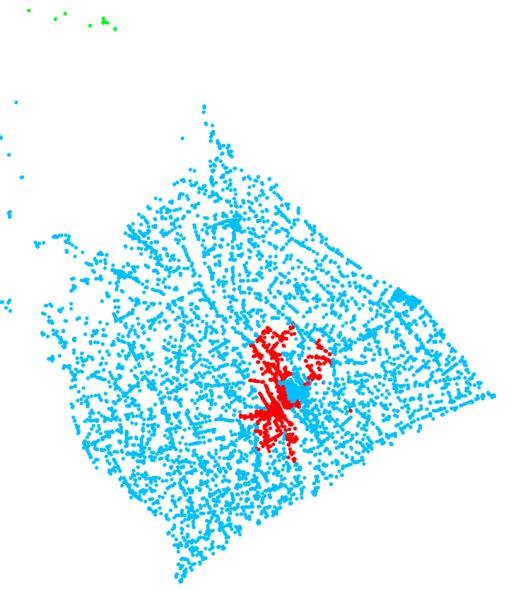
76 Network Configuration This section describes the general arrangement of each major section of the EA Networks electricity network GXP and Generation EA Networks take supply from the national grid company (Transpower) at a site approximately 7km south-east of Ashburton township. The Transpower Ashburton Substation (known as Ashburton220 or ASB since EA Networks also have an Ashburton substation) supplies EA Networks with two subtransmission voltages, 33kV and 66kV (also known as a Grid Exit Points GXP). The following diagram illustrates the configuration of the Transpower ASB substation and the two GXPs within it. The orange lines represent 220kV (the national grid transmission voltage). The blue lines are 66kV and the green lines are 33kV. The capacity of each transformer is shown above and the peak load of the 33kV GXP is currently below the rating of one transformer. The 66kV GXP has a peak load below the rating of Connections by GXP Voltage 33kV GXP 66kV GXP EA Networks Grid Exit Point Configuration Twizel-Ashburton A Ashburton 220kV (ASB) 220kV Ashburton-Islington I T10 120MVA 66kV T9 120MVA T T To EA Networks To EA Networks Twizel-Ashburton B Ashburton-Bromley T8 100MVA T A T1 50MVA A T T3 50MVA 66kV 33kV To EA Networks To EA Networks
77 March March March April April April May May May June June June July July July August August August September September September October October October November November November December To Table of Contents December December January January January February February February MW MW MW kV GXP Load (171 GWh YTD) 66kV GXP Load (net 370 GWh YTD) Total Network Load (657 GWh YTD) T8 (the smaller of the two 220/66kV transformers) and one other of T9 or T10. T9 was commissioned during This configuration ensures 66kV loads up to 220 MVA are secure. The 33kV GXP supplies approximately one third of EA Networks consumers (6,300) and has the lowest peak load of the two GXPs. The load charts below illustrate the residential/commercial nature of the load on the 33kV GXP. The seasonal variation is present and is of the order of 20-30% higher in winter than in summer. The weekly load variation can be clearly seen with significant dips at the weekends. The daily load variation is very marked during morning and evening meal times with both heating and cooking loads being heavily used. It is at these times that water heating load control is used to ensure both the Transpower grid and EA Networks assets are not unnecessarily high capacity for a load that can be shifted a few hours without consumer impact. Note that in May there was a step decrease in 33kV GXP load when Northtown zone substation was converted run at 66kV. The corresponding load increase on the 66kV GXP is seen as a decrease in net export caused by embedded generation. The 66kV GXP is very different in its load profile. This GXP supplies about 12,400 consumers including about one third of Ashburton township. Many are similar residential (albeit rural) connections to that on the 33kV GXP. It is however the relatively small number of irrigation and generation connections that shape the seasonal and peak 66kV GXP loads. Irrigators do not tend to have a daily or weekly load variation. Once the water is required, the irrigator is left to run for possibly weeks on end. The irrigation is predominantly used in the summer although a farmer s growing season can extend into April in some years. Equally, a dry winter can cause early irrigation demand to occur in August or September as happened in A wet spell during December has reduced that demand briefly. Note that the negative MW areas of the graph below the 0 line represent a net export of power into Transpower from the GXP. The load on the 66kV GXP varies from +140 MW in summer to -15MW in winter.
78 March April May June July To Table of Contents August September October November December January February MW Typical 66kV GXP Daily Summer Load Curve MW Typical 33kV GXP Daily Winter Load Curve The Highbank Hydro Power Station is rated at about 28MW output. It has a single turbine with a head of 104m. The RDR race has a flow of 31 m³/s at peak times when no water is being used for other purposes. There is no ability to store water in the RDR and Highbank is considered and run of the river station. The output diagram for can be seen below and when irrigation demand begins in September and October the water supply becomes less consistent and daily peak generation output can vary significantly. Being a single turbine station with Highbank Hydro Power and Pumping Station no water storage facilities EA Networks cannot rely on Highbank operating at any particular point in time. As such, EA Networks do not factor in Highbank output during supply security studies. Highbank also has relatively new pumps located at it to allow Rakaia River water to be pumped up into the RDR. These pumps have been used significantly during and appear on the Highbank load graph as load of about 5-8MW. So, the Highbank 66kV connection varies from -28MW during winter (generation) to +8MW during summer (pump load) MW Highbank Hydro & Pumps Output (102 GWh YTD) Generating Pumping
79 March April May June July August September October November December January February 79 There are three other embedded generators of note connected to the EA Networks network. Montalto Power Station Montalto Hydro Output (10 GWh YTD) ,000-1,200-1,400-1,600-1,800-2,000 Generation kw Montalto is also located on the RDR but its location offers year round output. Connected at 33kV, the generator is an induction machine which means it cannot provide any system support or provide emergency output during network faults. Winter output is around 1.6MW while summer output is about 1.1MW. Cleardale is a 1MW generator in a valley adjacent to the Rakaia River gorge. A high head low flow machine, it generally has year round output. The 11kV connection is relatively remote and its output is largely absorbed in the Methven area after being transformed up to 33kV. The machine cannot provide emergency output. The additional expense to provide this ability was examined at the time of installation but could not be justified for the small variable output and local fault frequency/consequences. The very small hydro turbine at Ealing Pastures is located on an irrigation race and is normally used as a mechanical drive to a pump. When there is excess mechanical power a 200kW induction generator provides electrical power for on-farm needs and any excess is then exported onto the EA Networks system at 22kV. The generator has virtually no impact on the network other than to reduce the farm s demand during the irrigation season. Distributed Generator Energy (MWh YTD) Capacity (kw) Highbank 102,545 28,000 Montalto 9,978 1,650 Cleardale 3,341 1,000 Ealing Pastures The geographic location of the main generators as well as Transpower s ASB substation are shown in the diagram in section Subtransmission EA Networks use two voltages for subtransmission; 33kV and 66kV. The 33kV network is limited to two distinct zones. The most heavily loaded 33kV network, which is directly connected to the 33kV GXP, supplies Ashburton, Fairton and the ANZCO meat works (SFD). During the ANZCO load was switched to the 66kV network, as was a portion of the Ashburton load when Northtown substation was converted to 66kV. The Ashburton-Fairton supply consists of a 33kV ring that is normally operated closed. This means that in most circumstances a single line fault will not cause an interruption in supply. The second section of 33kV network is a radial line supplied from the Methven 66/33kV substation. There are two 33kV lines fed from Methven. One is dedicated to the Mt Hutt 33/11 kv substation which supplies the Mt Hutt ski field as well as the Cleardale generator. The other 33kV line supplies Methven 33/11kV substation, Mt Somers substation, Montalto substation and Montalto Hydro Power station. Both of these lines are radial, so a fault anywhere along their length will typically mean loss of supply will occur. There is a
80 80 Coleridge line circuit-breaker at Mt Somers which prevents faults beyond there from causing an outage at Methven or Mt Somers 33kV substations. The 66kV subtransmission network is the core of the rural supply system for EA Networks. The configuration Lake Lake Heron MHT HBK ASB Ashburton 220 ASH Ashburton CRW Carew CSM Coldstream DOR Dorie EFN Eiffelton EGN Elgin FTN Fairton HBK Highbank HTH Hackthorne LGM Lagmhor LSN Lauriston MHT Mt Hutt MON Montalto MSM Mt Somers MTV Methven66 MVN Methven33 NTN Northtown OVD Overdale PDS Pendarves SFD Seafield TIN Tinwald WNU Wakanui MON SH1 to Timaru Mt Somers Mayfield CRW MSM CSM Hinds Methven MVN MTV HTH LGM Lauriston Fairton FTN Ashburton ASH(66) EFN LSN NTN ASB Chertsey WNU SFD(66) Rakaia SH1 to Christchurch OVD PDS DOR 66kV Lines 33kV Lines 66kV Lines not at 66kV 2014 Electricity Ashburton Sub-transmission Network Ashburton kv GXP ASB Elgin EGN Ashburton kv GXP ASB Seafield SFD Eiffelton EFN Northtown NTN Wakanui WNU Ashburton ASH66 Fairton FTN Ashburton ASH Coldstream CSM Seafield SFD66 Lagmhor LGM Hackthorne HTH Carew CRW Lauriston LSN Pendarves PDS Overdale OVD Montalto MON Mt Hutt MHT Methven66 MTV Dorie DOR Methven33 MVN Montalto Hydro Mt Somers MSM Highbank Hydro
81 81 of the 66kV network consists of two closed rings. The northern network supplies a number of 66/22 kv substations as well as Methven 66/33kV & 66/11 kv substation. There is a three terminal 66kV line in this section of the network that supplies the new Seafield66 (SFD) zone substation. In the middle of summer, this portion of the network supplies more than 80 MVA of load. The southern 66kV ring is also operated closed and has an internal 66kV line joining two substations. This line offers additional security for faults in the first section of the ring leading away from the 66kV GXP. A fault in any 66kV line in the southern ring should not result in any outage for consumers. A 66kV line has been built towards EA Networks Ashburton 33/11kV substation (ASH) in preparation for its conversion to 66kV. The first stage of this conversion has occurred and has increased the security of Ashburton township considerably Zone Substations Zone substation loads and security are detailed numerically in section 4.7 as well as Appendix C. The load/generation centres shift between the summer/winter seasons. This shift requires the network to support high urban loads and high rural generation during winter, while during summer the rural load increases dramatically and generation disappears. These two distinct load/generation configurations are not particularly conducive to efficient network utilisation since energy is not being generated close to the available load. Another factor with electric irrigation is the need to keep fault levels relatively high so that motor starting (an intrinsically poor power factor situation through predominantly reactive overhead lines) is less disturbing to other consumers. Modern "soft" starters and variable speed drives have helped this aspect but drives in particular introduce other potentially disturbing characteristics. A typical 66/22kV zone substation will have two 66kV lines supplying it. Line differential and distance protection is installed on each line terminal circuit-breaker. The tubular aluminium 66kV bus is supported by steel stand and has high impedance bus zone protection installed. An ONAN/ODAF 10/20 MVA 66/22kV transformer with a +5/-15% tap-changer is installed with an accompanying 22kV 40Ω NER. A numeric transformer differential relay protects the transformer. An indoor 22kV 5 way switchboard (one incomer and four feeders) is installed with numeric protection relays. The 22kV feeders leave the substation in 250 amp rated underground cables that are terminated outside the substation on suitable poles. Large urban substations will have multiple 66kV bus-sections, bus-section circuit-breakers, multiple 66/11kV transformers, Summer Zone Substation Loads Winter Zone Substation Loads Cleardale Mt Hutt Highbank Hydro (Pumps) Cleardale Mt Hutt Highbank Hydro (Power Station) Methven Methven Rakaia Rakaia Montalto Hydro Ashburton Montalto Hydro Ashburton
82 ICP Count Ashburton33 Fairton Carew Coldstream Dorie Eiffelton Hackthorne Highbank Hydro To Table of Contents Lagmhor Lauriston Methven33 Methven66 Montalto (Temp) Mt Hutt Mt Somers Northtown Overdale Pendarves Wakanui Seafield66 Orion 82 ICP by Zone Substation multiple 11kV switchboards with at least one bus section circuit-breaker in each board. The preceding load maps represent existing zone substation maximum demands themed by colour and circle diameter. The larger and redder the circle, the larger the load is. The blue circles represent embedded generators. Highbank at 28 MW is by far the largest of the three and currently only runs during winter due to irrigation demands on its water supply (Rangitata Diversion Race) during summer. The three charts at left and below show the irrigation load by zone substation as well as the connection count per substation. Examination clearly shows the large disparity between the two measures. 50% of the connections that EA Networks supply are on two substations (Ashburton and Northtown). The irrigation load that these two substations serve is about 3.3% of the total. ICP Count by GXP and Substation 6,000 5,000 4,000 3,000 2,000 1, Orion
83 Load (kw) Ashburton33 Fairton Carew Coldstream Dorie Eiffelton Hackthorne To Table of Contents Highbank Hydro Lagmhor Lauriston Methven33 Methven66 Montalto (Temp) Mt Hutt Mt Somers Northtown Overdale Pendarves Wakanui 83 Irrigation Load by GXP & Substation 18,000 16,000 14,000 12,000 10,000 8,000 6,000 4,000 2, A more detailed description of the assets at each zone substation is included in section Distribution System The distribution system is the most obvious and visible part of the electricity network. It is on the side of many roads and when it is overhead the poles and wires are immediately evident. It is also the most numerous, asset intensive and fault prone portion of the electricity network. Medium Voltage EA Networks operates two medium voltage distribution voltages. The 11kV network is the system which has been used since around 1960 in Mid-Canterbury. It has served EA Networks well and it will remain as the dominant voltage for distribution in Ashburton and Methven townships. The extensive 11kV underground cable network in both townships means that it is not economically viable (or currently technically necessary) to convert it to 22kV. The 22kV network voltage has been in use since about Each year since then, some portion of the heavily loaded 11kV network has been converted to 22kV. 22kV has become EA Networks rural distribution voltage of choice. The dramatic increases in irrigation load during the early part of this century could not have been accommodated on the pre-existing 11kV network or even a heavily upgraded 11kV network. It is fortunate that the small rural townships have not been heavily converted from overhead lines to underground cables. This has allowed townships such as Hinds, Rakaia and Chertsey to be supplied directly from the surrounding 22kV distribution network. Other townships such as Mayfield and Mt Somers are now being converted to underground distribution and all of these cables are capable of 22kV operation (Mayfield is now operating at 22kV). A typical rural 22kV feeder will have about 175 connections on it. The feeder will leave a zone substation indoor circuit-breaker in a short length of underground cable and connect to the overhead line on a nearby pole. The main feeder line will then radiate away from the substation for an average of about 10-15km before it encounters the end of an adjacent feeder (typically fed from another zone substation). At intermediate points along the feeder there may be spur lines protected by reclosers or sectionalisers. These devices prevent the main feeder circuit-breaker from tripping for faults on these spur lines thereby keeping supply on to most consumers during such faults. There will typically be several points along the feeder where it can interconnect with adjacent feeders. These normally open switches are either disconnectors, SF6 gas switches, or ring main units. Remote control of these switches can speed restoration significantly.
84 84 Fault indicators will be located at some junctions where more than one line branches off the main feeder line. These indicators will show if a fault current has passed it recently. If an indicator is triggered, the fault is beyond that point. Ring main units are being used at points in the rural network where there are many lines that require switching (at least three, normally four). 22kV feeders can have peak loads up to 7MVA although typically they are around 4MVA. The length of a rural feeder is constrained by voltage drop along its length. It is very rare that a thermal limit is reached as conductors must be sized for voltage drop and this typically results in larger conductors than would otherwise be thermally required to supply the load. A typical urban 11kV feeder is completely underground and has about 450 connections on it. At every distribution substation on the feeder a ring main unit will be installed that allows isolation of the cables connected to it, as well as the transformer supplied from it. This allows ready isolation of a faulted item, speeding restoration as well as permitting planned outages of assets without supply interruption. Fault indicators are used at regular intervals along a feeder to permit prompt identification of a faulty cable or transformer (which will normally cause a feeder circuit-breaker tripping). The opportunities for interconnection with other feeders is far greater in an urban area simply because of proximity/density. It would not be uncommon to have four or five points that permit at least partial back-feeding of an urban 11kV feeder. The reach of an urban 11kV feeder is normally constrained by thermal considerations. The rating of a buried cable is thermally limited and prudent sizing is required to ensure adequate capacity for future demand without over-specification. An underground feeder may radiate up to 4km long (cable route) and typically has a peak load of around 3MVA. This limit ensures a 4.5MVA capacity feeder can provide back-feed support to adjacent feeders in case of a fault. The degree of underground cable usage is very dependent on the voltage. The urban 11kV areas adopt intensive use of underground cable. Methven township is completely underground at both 11kV and LV levels. The only poles in Methven are street lighting poles (supplied from underground cables). Ashburton township is approximately 87% underground cable at 11kV and at LV is 83% underground. Overall, the 11kV network is 17.7% underground and the LV network is 77% underground. At 22kV, the penetration of underground cable is much less. Only 6.0% of the 22kV network is underground. The distribution network (22kV, 11kV and LV) is 20.3% underground by circuit length. Distribution Substation A distribution substation is a facility in the network that accommodates equipment that switches and transforms MV (medium voltage - 22kV and 11kV) to LV (low voltage volts). There are a range of styles of distribution substations. A pole-mounted substation is a relatively simple assembly of assets. The key component is the transformer which is hung from a short crossarm using galvanised steel brackets that are supplied with the transformer. These brackets are secured to the crossarm for both seismic security and restraint should a vehicle contact the pole. The transformer has a set of MV drop-out fuses mounted above it (generally on a separate crossarm) that provide the transformer with fault protection as well as the ability to isolate the transformer should it be required for maintenance or replacement. A set of LV fuses are installed on the transformer hanger arm which ensure any fault in the connected LV network does not cause the MV fuses to operate and also provides some overload protection to the transformer. Several types of ground-mounted distribution substations are in use. The simplest ones consist of an off-theshelf microsub or minisub. These are a ground-mounted transformer with two cabinets directly attached to the body of the transformer. One cabinet has the MV bushing wells in it and can have one or two cables per phase connected (two cables allows a connection to another transformer). The second cabinet houses the LV bushings and can accommodate several LV cables and a number of LV fusedisconnectors. This style of substation is used when small (<150 kva) supplies are needed and there is no need for multiple high capacity LV circuits. They are commonly used on rural properties for houses, sheds, small dairy sheds, etc particularly when they are fed from a nearby overhead line. Some of the larger
85 85 microsubs have two MV bushing wells per phase (bridged internally) that allow two cables to be connected. This permits simple disconnection of one set of screened elbow terminations to occur when the need arises. The microsub and minisub both use precast concrete foundations. The next level of sophistication comes with a pad-mounted transformer and either one or two separate small steel kiosks. This arrangement provides the ability to house a MV ring main unit in one kiosk and a multi-way LV switchboard in the other kiosk. These substations can be large (up to 1,000kVA) and are used in commercial/industrial applications where an exposed transformer is less conspicuous. The concrete foundations for these units are also precast to one of two standard designs (depending on transformer rating). These substations can be integrated into an interconnected urban/industrial/commercial LV network. The final variant of the distribution substation is a large single kiosk design (above; 11kV left and 22kV right). The kiosk is either steel (22kV) or fibreglass (11kV) and houses a transformer (up to 500kVA), a MV ring main unit (up to 4 x 11kV or 3 x 22kV circuits), a LV switchboard (up to 7 x 630 amp rated circuits plus 3 x 60 amp streetlighting circuits), and any ancillary equipment such as ripple relays and maximum demand indicators. These substations are the standard style used for residential areas and integrate fully into the MV and LV networks. An urban distribution substation can supply up to 100 residential connections on multiple LV feeders. Low Voltage The low voltage distribution network is largely located in the urban areas. overhead lines or underground cables from a pole mounted distribution substation to the property boundary (EA Networks ownership typically ends at the boundary). Rural LV is typically short The urban LV network is either older overhead lines located in the smaller townships or predominantly underground located in the larger townships. Overhead LV is smaller in capacity and has virtually no interconnection (via switches) with adjacent overhead LV network fed from other distribution substations. The reason for the low level of interconnection is twofold: the small capacity means it is typically incapable of providing adequate back-feeds and the polemounted distribution substations are typically much smaller and cannot provide the capacity for back-feeding. The urban underground LV network is much higher capacity and has a great deal of interconnectivity. This allows the shifting of segments of the LV network from feeder to feeder and substation to substation during either planned or fault work. The switching of these segments (between substations) takes place at distribution boxes housing compact LV
86 86 switchgear (see image above). The style of switchgear in use allows live disconnection of cables, installation of new ways, and even interconnection of two adjacent cables without using the bus. This very flexible system provides opportunities to accommodate unusual operating conditions. The distribution boxes are standardised designs that use a common backplane/bus that permits addition/removal of plugin switching devices as required Secondary Assets There are a range of EA Networks assets that are ancillary to the structural or high current/voltage functionality of electricity distribution. These include the following: Protection Relays The protection relay assets at EA Networks vary from relatively few old electromechanical devices through to many modern microprocessor based units. The standard approach is to use a limited range of standardised devices so that existing designs can be reused and staff are do not have to retain familiarity with too many different devices. At subtransmission voltages every protection scheme incorporates a local device that will provide back-up in the event of failure or non-detection of a fault. This ensures that the minimum amount of equipment is removed from service during fault conditions. At distribution voltages the zone substation transformer protection provides back-up to the feeder protection. Beyond the feeder circuit-breakers exist a range of reclosers and sectionalisers that do not have local back-up but rely on the feeder protection relay to detect the fault if they do not. This leads to larger loss of supply but the fault is still cleared safely. Section 4.12 provides some additional information about the protection relays at EA Networks. Ripple Injection Systems EA Networks operate a 283 Hz decabit ripple injection system. The injection plant is all solid state. There are three injection plants, two of which are actively used. The 33kV plant at Ashburton 33kV substation (ASH) provides signal injection for Ashburton, Fairton and Seafield substations. This represents about 33% of the connections on the network and a significant proportion of the controlled water heating load. The second 33kV plant at Transpower s Ashburton220 substation (ASB) provides signal for the 66kV network using a 33/66kV step-up transformer in the adjacent Elgin substation. The signal level from the ASB plant is lower than ideal and has come under additional pressure since a third 220/66 kv transformer was commissioned at ASB in late In the event of a problem with the ASH plant the ASB plant can provide signal by switching it from the step-up transformer to the ASB 33kV bus. The small third injection plant at Methven 33kV substation (MVN) can provide some cover in the event of a problem with the ASB plant but it is unlikely to provide complete coverage. There are two projects in the plan to address this issue. SCADA Systems The SCADA system is available at the majority of EA Networks zone substation sites. The newer sites with numeric protection relays have all been integrated onto the SCADA system. Some of the older/smaller sites have not been connected or are not fully monitored/controlled. Section 4.14 provides additional information about the SCADA system. Telecommunication Systems EA Networks own a fibre-optic data network (as a separate commercial function) and extensive use is made of it for electricity network telecommunications. A digital mobile radio (DMR) network has been implemented as the primary voice communication system for EA Networks. DMR offers digital audio clarity and the ability to transparently transport small data packets such as GPS location, device control signals or SMS messages. Another advantage of DMR is the ability to integrate multiple base stations to provide better coverage. The 5 base stations are interconnected using TCP/IP over the fibre network. Other uses of the large reliable bandwidth that fibre offers include the SCADA system and video monitoring of zone substation buildings and yards. This allows not only intruder detection but also an additional layer of safety as the control centre can monitor staff while they are on site and any incidents responded to immediately. A more comprehensive description of the telecommunications network is available in section 4.14.
87 Asset Justification In order to justify the existence of the present EA Networks owned electricity network assets one could look at it from first principles and prove by calculation that the class and size of each asset category is the minimum needed to support the loads that exist on the network. Alternatively, one could assume that only variations from the Australasian norm would need to be justified the evolution of the Australasian electricity networks have occurred progressively over the last 50 years and most networks have ended up with a similar style and scale of investment. The following table documents what EA Networks anticipate the electricity industry considers to be the "average" network: Network Feature Connection(s) to National Grid: Subtransmission Network: HV Distribution Network: Characteristics One or more supply points operating at one or more voltages at or between 11kV, 33kV, 66kV and 110kV. Typical respective capacities: MW (11kV urban supply), MW (33kV general supply), MW (66kV general supply), and MW (110kV general supply). Capacity is comparable with the peak load of the supplied network. 33kV, 66kV or 110kV network with typical respective capacities of 25 MW, 55 MW and 95 MW per overhead circuit. Maximum voltage drop not exceeding 10% during n-1 security events. Typically overhead lines in rural and light urban settings. Normally underground cables in high density urban settings. 6.6kV, 11kV, 22kV and rarely 33kV network. Capacity determined by thermal rating for short feeders and voltage drop in long feeders. Rural network and older urban network are usually overhead lines. Newer urban network is usually underground cables. Typically rated at between 200 and 400 amps. Voltage drop should not exceed about 5% under normal peak loading. LV Distribution Network: 230/400 volt network. Rural network and older urban network typically overhead lines. Newer urban network typically underground cables. Embedded Generation: If it exists, it is typically up to several MW at discrete locations around a network. Can be connected to either HV distribution or subtransmission networks. EA Networks network can be briefly described as follows: EA Networks Network Feature Connection to National Grid: Subtransmission Network: Characteristics One supply point operating at 33kV and 66kV. 33kV capacity 2 x 50 MVA and 66kV capacity 2 x 120 MVA + 1 x 100 MVA. 33kV peak load approx. 30 MW, 66kV peak load approx. 140 MW. EA Networks have fewer supply points than most similar companies. Extensive 33kV and 66kV network with capacities of 25 MW and 55 MW per overhead circuit (500 amps). Some portions of the 33kV network are radial and have no alternative 33kV supply. All significant subtransmission is overhead except for one run of 33kV cable in the Ashburton urban area. Prior to conversion to 66kV, parts of the 33kV network were operating at 30kV (-10%) during peak loads with all circuits in service.
88 88 HV Distribution Network: 11kV and 22kV network. Urban network is mixed overhead and underground 11kV. Per circuit capacity of 200 to 400 amps. Rural network is both 11kV and 22kV overhead lines. Portions of 11kV network approaching 5% voltage drop during peak loading. Prior to conversion to 22kV much of the 11kV network exceeded 5% voltage drop at peak loading. LV Distribution Network: 230/400 volt network. Rural network and older urban network overhead lines of modest capacity. Newer urban network is underground cables of significant capacity. Embedded Generation: Three significant embedded generators: 1.0 MW, 1.6 MW and 26 MW. The 1.0 MW unit is connected to the distribution network. Both larger units are connected to the subtransmission network. 26 MW unit required dual 66kV circuits from Methven to Elgin to provide security and limit voltage rise. The reader is directed to section 1.1 for the evolution of the present network and it is hoped that along with this section it provides adequate justification for the network in use today. 3.4 Asset Value EA Networks was required by regulation to periodically value its assets using a methodology called Optimised Deprival Valuation (ODV for short). This approach was supposed to represent a modern equivalent depreciated value for the existing asset base. The "deprival" term infers that if you were deprived of your present network, what would you replace it with. The general approach is as follows: 1) categorise all existing assets into discrete predetermined asset classes such as lines, cables, transformers etc, 2) quantify these assets in each class by size and length/count/capacity (lines are by length and current rating while transformers are by number and kva rating), 3) apply standard replacement values to each item in each of these classes, 4) by this stage a standard replacement cost (RC) is available the modern replacement cost of the existing network, 5) the age of each asset must be known to move to the next step, 6) the next step is to apply depreciation to the assets so that an older asset is worth less than a newer one of equivalent capacity, 7) the network value obtained at this point is called the depreciated replacement cost (DRC), 8) the final step is to "optimise" the existing network and this removes any capacity that cannot be justified on the basis of security or current rates of load growth, 9) the network value obtained by removing the excess capacity is called the optimised depreciated replacement cost (ODRC). There are many different points of view about the validity of valuing a network in this way, but for the moment that is the process that is used. EA Networks have referred to the optimisation process earlier in the plan to justify the present capacity of assets on the basis that low levels of optimisation represent little or no overcapacity.
89 89 In order to provide indicative values for the assets covered by this asset management plan the same approach is used to obtain a DRC value for each asset management category. It must be remembered that the asset management categorisation is the construction voltage of the asset, not the operating voltage. The ODV process is valued on the basis of the operating voltage of the asset (the function it fulfils at the moment of valuation) and not the construction voltage (the capability of the asset and the way it is managed as a category across different operating voltage boundaries). Earthing System Protection Relays LV Switchgear SCADA & Comm's Ripple Plants & Other 66kV OH Lines & UG Cables HV Switchgear 33kV OH Lines & UG Cables Distribution Transformers Distribution Substations 11kV and 22kV OH Lines Zone Substations Service Connections 11kV and 22kV UG Cables 400 V UG Cables 400 V OH Lines The table (below) and chart (above) describe the proportion and value of assets in each category. Summary of EA Networks Valuation (2004) Asset Category DRC Value ($M) Percent of Total 66kV OH Lines & UG Cables % 33kV OH Lines & UG Cables % 11kV and 22kV OH Lines % 11kV and 22kV UG Cables % 400 V OH Lines % 400 V UG Cables % Service Connections % Zone Substations % Distribution Substations % Distribution Transformers % HV Switchgear % LV Switchgear % Protection Relays % Earthing System % Ripple Plants % TOTAL % The values stated in the table are extracted from the 2004 ODV prepared as part of that year s disclosure
90 90 requirements. It is the most recent audited ODV available. Some of the ODV categories include items that are not as per the asset management categories. This is simply the way the ODV process has been mandated. In future Asset Management Plans it is intended to generate an indicative DRC valuation using standard cost principles but specifically categorised as per the Asset Management plan categories. This can then be updated on a year by year basis to add accuracy to the discussion of value. Earthing system values are an estimate extracted from the distribution substation category and protection relays are currently embedded in Zone substation values. An effort will be made to correctly categorise these in future plans. The significant categories are the distribution system (43.5 % of the total) and the subtransmission system (24 % of the total). The HV switchgear is split over these two categories and is an additional 11.7%. The changes that have occurred since 2004 will have increased the proportion of value in zone substations considerably. Likewise the 66kV network will form a more substantial portion of the total. The 2014 closing Regulatory Asset Base (RAB) was $ Million. Additional information concerning the make-up of EA Networks RAB can be downloaded from:
91 91 LIFECYCLE ASSET MANAGEMENT Table of Contents Page 4.1 Introduction Overview Maintenance Replacement Enhancement Development Asset Renewal Processes Line Maintenance - General Observations Present Planning Priorities Subtransmission Assets kV Subtransmission Lines kV Subtransmission Lines Distribution Assets kV and 22kV Overhead Distribution Lines kV and 22kV Underground Distribution Cables Low Voltage Line Assets V Overhead Distribution Lines Description V Underground Distribution Cables Service Line Connection Assets Zone Substation Assets Distribution Substation Assets Distribution Transformer Assets High Voltage Switchgear Assets Low Voltage Switchgear Assets Protection System Assets Earthing System Assets SCADA, Communications and Control Assets Ripple Injection Plant Assets 152
92 92
93 Section Contents 93 4 LIFECYCLE ASSET MANAGEMENT 4.1 Introduction This section is where the detailed asset-specific management issues are discussed. It describes each asset by category and details quantities, condition, performance, maintenance and the operational standards of each in turn. The management plans for each asset category detail how EA Networks intends to operate and manage the assets so that they meet the required performance standards. The focus on optimising lifecycle costs shapes all of the processes involved. EA Networks owns electricity reticulation assets that are used to provide distribution and connection services to electricity retailers and generators. These assets generally comprise equipment that is common to all New Zealand electricity lines businesses and, wherever possible, industry standard assets have been employed. In particular, the Asset Management Plan covers the electrical reticulation assets and associated systems owned by EA Networks. For the purposes of managing the assets that EA Networks own, logical groupings of assets are required. These groups may have members that are geographically distant or installed in a different application but they are most effectively managed as a single population. These groupings comprise the following: Subtransmission Line Assets - Electric lines and cables, including associated easements and access ways operating at voltages of 33kV and 66kV; Overhead HV Distribution Line Assets - Electric overhead lines, including associated easements and access ways operating at a voltage of 11kV or 22kV; Underground Cable HV Distribution Assets - Electric underground cables, including associated easements and access ways operating at a voltage of 11kV or 22kV; Overhead Low Voltage Line Assets 400V electric overhead lines, including associated easements and access ways; Underground Cable Low Voltage Assets 400V electric underground cables, including associated easements and access ways; Service Lines Connection assets at any voltage owned by EA Networks for the purpose of supplying a single consumer (not including the line on the consumer s premises but including any portion of the service line in, on, or above the legal roadway); Zone Substations High voltage substations connected to the subtransmission network. This includes plant and equipment within the substations such as power transformers, foundations, oil interception equipment and incidental equipment such as DC batteries and chargers together with station land and buildings. Other items such as switchgear, structures and buswork, earthing, SCADA and protection, are covered by other definitions; Distribution Substations Substations connected to the distribution network. This includes plant and equipment within the substations such as foundations, platforms and Maximum Demand Indicators, together with land and kiosk covers, but excludes transformers, MV and LV switchgear and earthing; Distribution Transformers Standard transformers used in distribution substations ranging from 5kVA to 1000kVA and generally having a primary voltage of 11kV or 22kV. Also includes MV regulators or autotransformers up to 5,000kVA. High Voltage Switchgear Circuit-breakers, reclosers, sectionalisers, disconnectors, ring-main units, expulsion drop-out fuses, structures and buswork used in the distribution and subtransmission systems; LV Switchgear Load-break switches, fuse switches, fuses, support frames, busbars and capacitors used in the LV line and cable systems. Protection Systems Fault protection includes all protection relays, associated panels, metering devices, current transformers, voltage transformers and control cabling. Over-voltage protection includes surge arrestors and spark-gap devices. Earthing Systems All earthing systems that are owned by EA Networks and connected to EA Networks
94 94 equipment. SCADA, Communications and Control Equipment SCADA, Communications Equipment and associated facilities installed at any location. This includes Control Room equipment, Remote Terminal Units, radio repeaters and dedicated fibre optic systems installed, owned and maintained by EA Networks; Ripple Control Ripple Injection Equipment. The size and complexity of EA Networks fixed asset base is considerable when compared to other businesses such as retail chains and serves as a major differentiator for this company and other utility organisations. Below is a diagram illustrating some of the different asset categories and typical ownership involved in the electricity supply industry. Asset Owner Voltage(s) Equipment Generator/ Retailer 11kV or similar Generator (Wind, Hydro, Gas, etc) ~ Generator/ Transpower 11kV and 220kV Generator Transformer Transpower 220kV (Transmission) Transmission Overhead Line Transpower 220kV and 66-33kV GXP Substation Transformer EA Networks 66-33kV (Subtransmission) Subtransmission Overhead Line EA Networks 66/22-11kV or 33/11kV Zone Substation Transformer EA Networks 22-11kV Zone Substation Feeder Circuit-Breaker and Protection Relay EA Networks 22-11kV (Distribution) Distribution Overhead Line or Underground Cable EA Networks 22-11kV and 400 V (LV) Distribution Substation Transformer EA Networks LV (Low Voltage) LV Distribution Overhead Line or Underground Cable EA Networks LV Consumer Connection Point (Pillar Box or Pole Fuse) Private LV Consumer Service Line Variations on this ownership structure exist, particularly in industrial or rural situations where the consumer may own some 22-11kV lines which are dedicated to servicing their property.
95 Overview This section outlines the lifecycle management plan required to maintain, enhance and develop the operating capability of the system. The programmes are outlined by asset type and, within this, according to area and then by maintenance activity. Maintenance servicing, inspections and testing fault repairs planned repairs and refurbishment (including replacement at the component level) planned replacement programmes (at the asset level) Enhancement Development Section Appendix A has a more complete series of activity definitions. For the purposes of lifecycle management, the Enhancement and Development categories can be seen as the asset creation/acquisition phase of the cycle. The Replacement category will introduce new equipment of similar function at a similar location and have a similar purpose as the existing asset. Each category of asset has a "Standards" subsection that details the documentation available for each activity undertaken on that category. This is one area that still requires some work to complete. Many categories do not have documentation to cover post-commissioning activities such as inspection and maintenance. The actual work is done to an acceptable standard, but the methodology is not yet formally recorded. Asset disposal is typically done only at the end of an asset s useful life. The majority of these assets are equipment that is only suitable for scrap and it is normally disposed of in an appropriate manner as part of the activity replacing it. Any asset that becomes surplus and is not at the end of its service life will have a specific disposal plan. As at the time of writing there are relatively few assets that have been identified that will require disposal in this manner and only those asset categories will contain a Disposal activity Maintenance Maintenance work is largely based on the condition of the assets. The scope of work planned under each maintenance activity is quantified wherever possible to assist in reviewing EA Networks achievement in future years. The estimated maintenance expenditure is projected in this section and where relevant, the consequences of the proposed maintenance programmes are noted. It should be noted that analysis of maintenance strategies and programmes is an on-going process and the most cost-effective means of maintaining the network is constantly under review. In some instances (e.g. pole replacement) further investigation and analysis is required to determine a suitable strategy. The maintenance requirements are influenced by development projects, many of which, if they proceed, will lead to dismantling and decommissioning of assets that would otherwise require significant repairs and/or replacement. The maintenance programmes described in this section cover the anticipated situation where all of the planned development projects proceed. The base-line planned maintenance expenditure projections assume, for consistency within this plan, that development projects take place as projected in Section 5 Network Development. It will be necessary to monitor closely the likelihood of each project proceeding and additional remedial work will need to be programmed if certain projects do not proceed or are significantly delayed Replacement When an asset reaches the end of its useful life and economic maintenance options have been exhausted, the only remaining options are scrapping the asset without replacing it, or replacing it with a modern equivalent asset. Under most circumstances assets will be replaced with an asset that exhibits the best price/performance ratio. Each individual case will be examined for the economic efficiency of the
96 96 options. Replacement work does not increase the asset s design capacity but restores, replaces or renews an existing asset to its original capacity Enhancement This activity outlines work that is planned to enhance the system. By this, it means that this increases the capacity of the asset to: supply increased load enhance voltage regulation improve security and reliability It includes projects (at specific sites) and programmes of related work covering a number of sites. Project numbers ( e.g. [10023] ) are used to identify individual projects or programmes. Appendix B has a complete list of these, including costs and categorisation. Specific enhancement projects are detailed in Section 5 Network Development Development Specific development projects and programmes are described in Section 5 Network Development, which outlines the projects currently anticipated over the planning period. The nature of each project is briefly described along with the reason why it appears to be required. The justifications for including each of the projects in the plan are categorised as follows: safety-related issues specific consumer requests (and commitment to incur project-related charges) anticipated demand growth to meet security planning guidelines economics (i.e. where the project produces overall cost savings) The projects described in this document represent an indicative plan based on the best information currently available. There is currently no commitment by EA Networks to undertake all or any of the specific projects listed, nor should consumer commitment be inferred from the inclusion of any project in this plan, except where they are described as being already committed. Further, it should be noted that more detailed investigations will undoubtedly lead to changes in the scope of projects that do proceed. There may be considerable scope for integrated subtransmission/distribution system planning to achieve the required results by somewhat different means. Because of the need for consumer consultation and, in many cases, agreement, as well as uncertainty in the fickle prediction of future load growth, it is likely that some projects in the first half of the planning period will not proceed or will proceed later than indicated in this plan. Secondly, because investigations tend to be more focused on the short-to-medium term, it is likely that additional required projects will arise, particularly towards the end of the planning period Asset Renewal Processes The general renewal strategy is to rehabilitate or replace assets when justified by: Safety The asset represents an unacceptably elevated risk to the safety of people or property. Asset performance Renewal of an asset is where it fails to meet the required level of service. The monitoring of asset reliability, capacity and efficiency during planned maintenance inspections and operational activity identifies non-performing assets. Indicators of non-performing assets include:
97 97 - Structural life - Repeated failure Economics Risk - Ineffective and/or uneconomic operation Renewals are programmed with the objective of achieving: - The lowest life cycle cost for the asset (uneconomic to continue repairing), or - An affordable medium term cash flow, or - Savings by co-ordinating renewal works with other planned works The risk of failure and associated environmental, public health, financial or social impact justifies proactive action (e.g. impact and extent of supply discontinuation, probable extent of property damage, health risk etc) Priority Selection Criteria for Asset Renewal Renewal Criteria 1 (High) Safety concerns Asset failure has occurred. Asset failure of critical system component is imminent. Regular maintenance required. Complaints 2 Failure of non-critical asset is imminent and renewal is the most efficient life cycle cost alternative. Maintenance requiring more than six visits per year. 3 Reticulation maintenance involving two to three visits annually. Difficult to repair, due to fragile nature of material, obsolescence. 4 Existing assets have low level of flexibility and efficiency compared with replacement alternative. 5 (Low) Existing asset materials or types are such that known problems will develop in time Planned and reactive replacement works can be prioritised in accordance with the priority ranking shown in the above table. The process of asset renewal is generally triggered and managed according to the flow-chart shown below. The Assets database is used to examine candidates for inspection based on a combination of age, material of construction, make or type of equipment, and any previous inspections. Other triggers for inspection include information from the Faults database and ad-hoc reports from either field staff or the public describing a potential condition-related problem. The inspection is scheduled and completed using the appropriate personnel (internal for routine inspections, external specialists for some unique or critical equipment). The results of the inspection are passed to engineering staff for evaluation. Consideration is given to all stakeholders interests when evaluating possible replacement equipment. If the inspection reveals an acceptable level of remaining life in the equipment the inspection details are recorded against the equipment in the Assets database and scheduled for reinspection at a future date. If the economic test is passed other considerations are introduced to ensure opportunities for security or capacity improvements at little or no extra cost are not lost. The best value option is ultimately selected were the "value" is not only financial but, on occasion, also relates to less tangible stakeholder interests. The project budget is prepared and submitted to the Board for approval. If approved, the project is scheduled for construction and detailed design occurs, ultimately
98 98 leading to the issue of workplans to the chosen contractor (by default internal). A project manager from the Asset Management function of EA Networks is appointed to monitor all aspects of the project and ensure a successful outcome. Project timing, budget monitoring, spot auditing, compliance with the specification, and adherence to normal contractor standards (safety and contractual) are the common areas attended to by the project manager. Condition Monitoring Process and Responses Assets Database Age Previous Inspections Material Type Informal Report Casual reporting of equipment condition Faults Database Location Frequency Cause Inspection Triggered Field Inspection Scheduled/Completed Continued Monitoring Technical and Economic Analysis of Data As-Built Records Returned Project Works Audited for Quality Construction Process Project Managed Budget Monitored Compliance Monitoring Milestone Monitoring Engineering Response Budget Preparation and Board Approval Project Costs Audited for Accuracy and Budget Plans Issued for Construction Project Scheduled Construction Costs Trended for Future Budgeting Workplan Preparation Survey & Design Once notified as complete, the works are audited by the appropriate inspection staff to ensure quality and completeness are acceptable. The as-built records are returned to the GIS and Assets systems so that the dismantled plant is removed and the new plant is added. The completed project is then financially analysed to ensure accuracy and the cost compared to budget and any discrepancies investigated. The actual costs are used to refine the budgeting process for future project costing Line Maintenance - General Observations Line Repairs and Refurbishment All line repairs are carried out to the requirements laid down in EA Networks line maintenance standards. These are based on international practice combined with local knowledge and New Zealand legislative requirements. Major Refurbishment A number of HV overhead lines will require refurbishment or replacement during the planning interval. These are not all explicitly identified, but pooled and allocated a value based on the known distribution pole age profiles and historical trends. The subtransmission lines that are approaching the end of their mechanical life are identified by line section and a Project number.
99 99 Wood Poles and Crossarms Approximately 2,900 hardwood poles are over 40 years old (another 1,000 are years old). It is currently projected that approximately 500 poles per year would need either changing or replacing with underground cable over the next 5 years in order to cope with defects. However this number will gradually decrease as lengths of very old wood pole lines are dismantled and eventually the annual pole change should reduce to nearer 300 each year. Conductors and Accessories As a policy, all replacement Aluminium Conductor Steel Reinforced (ACSR) is being purchased with a greased core wire. Some aluminium wrap splices have failed and investigations are being undertaken to discover the mechanism of failure. Once the cause is found remedial action will take place to minimise the risk or recurrence. Insulators and Insulator Fittings Neoprene wrap-lock ties were used for a period but have proven troublesome by loosening the grip from wire to insulator when exposed to normal wind vibration. Replacement of these ties is occurring as a moderate priority. EA Networks current standard practice is to bind the conductor to the insulator with wire of the same metal as the conductor. Diagnostic Techniques The purchase of an infrared thermographic video camera allows EA Networks personnel to regularly inspect overhead lines for failing or overloaded connections or equipment. This is a very good preventative measure that has already saved a number of fault outages (albeit that a planned outage took its place). A second camera may be purchased to allow a faster drive-by scan of equipment Present Planning Priorities Load growth caused by increased consumer demand and consumer expectations of reliability, security and power quality, as well as the regulatory and statutory environment set by central, regional and district government all guide the planning priorities of EA Networks. In recent years, the principal focus has been on providing capacity for the dramatic pumped irrigation load growth in rural areas. In conjunction with this stimulus there were other security and capacity issues that required resolution. As a result of these combined pressures, 66kV has been implemented as a subtransmission voltage. Fourteen zone substations have been built and now operate at 66kV. Six more zone substations remain to be either converted to 66kV or built from scratch. The vast majority of the subtransmission network by length is now insulated at 66kV. All zone substations that are planned to be built at 66kV or converted from 33kV will be completed during the next ten years. The development focus is also on the Ashburton urban area and the capacity and security requirements of the township. At Ashburton substation the original switchboard which was replaced as it was more than 55 years old, maintenance intensive, and at risk from a seismic event. An additional zone substation has been constructed to provide additional capacity and supply security to Ashburton township consumers. Northtown, as the new substation is known, has been commissioned for approximately four years and has proven to be very beneficial. Northtown was recently converted to 66 kv operation. At the HV distribution level, conversion from 11kV operation to 22kV operation has been the chosen option for many of the areas facing the need for reinforcement associated with additional pumped irrigation load. This form of reinforcement has proven to be very successful and is likely to continue as the preferred option where significant rural HV distribution reinforcement is required. EA Networks continue to monitor and assess the condition of all network equipment and, where necessary, this equipment is replaced or maintained depending upon the risk it presents and the whole life economics of repair versus replacement. The risk each piece of equipment represents is assessed according to the methodology outlined in section 7 - Risk Management. June 2006 Snow Storm Review In the aftermath of the damaging snow storm of June 2006 a number of reviews were done to assess the adequacy of the existing network and of the suitability of the current line design standards. The review of the existing network identified a number of component types that appeared to be inadequate to meet current security standards. A full report was prepared and submitted to the Board for assessment. The
100 100 major items that have been identified as needing attention are: Long spans (>100m) of small conductors such as squirrel (lower priority) One, two or three strand conductors such as #8 galvanised steel (number 8 fencing wire), 3/10 copper (relatively high priority) Older, low strand count, copper conductors (of any span length) that appear to have become more brittle over time (relatively high priority) 1940s vintage steel poles (so called Bates poles) which do not have adequate strength reserves (higher priority) Understrength mechanical fittings (particularly near the historically lightly snow loaded coast) which cannot withstand the weight of conductor when loaded with snow. (lower priority) The Canterbury-wide review of the existing line design standards showed that they were very close to the suggested level. The line design standards remain largely unchanged but the specification of equipment used to build lines has been raised to ensure all components are rated and applied to meet these design standards. The main change has been the use of Flounder conductor in place of Squirrel conductor for new and rebuilt lines. September 2010 and February 2011 Earthquakes The earthquakes of were a tragedy for Christchurch and provided a severe test for all utilities serving the affected population. The severity of the shaking felt in Ashburton was significantly less than that felt in Christchurch during both major events. During the September earthquake, the peak recorded ground acceleration anywhere in the Ashburton District was less than 0.2g. This compares with acceleration of more than 0.3g in most of Christchurch and more than 0.7g in rural areas closer to the Greendale fault. The February earthquake was further from Ashburton than the September one and Ashburton District ground acceleration was less than 0.1g. The Christchurch urban area experienced ground acceleration between 0.5g to 0.9g with one recorder peaking at more than 2.0g. The experience of the earthquake has refocused EA Networks. Preparedness is essential to prevent catastrophic equipment failure. Once the workload at Christchurch-based lines company Orion has returned to some semblance of normality, EA Networks will be keen to learn anything that Orion are prepared to share about risk preparedness and recovery. EA Networks are well aware of the many natural and man-made risks that are faced by an electricity utility but have not progressed risk and recovery planning into formal documentation that could be called upon in an emergency. The seismic design standards that EA Networks use are considered and robust. This should ensure that modern equipment is largely serviceable after a significant seismic event. The main area of concern is likely to be the significant quantity of older equipment that was installed prior to the adoption of current standards. Future plans will address the additional planning required for rare but significant events and the impact they have on an electricity utility. 4.3 Subtransmission Assets kV Subtransmission Lines Description EA Networks now own significantly more 66kV insulated overhead line than 33kV overhead line (338km vs 109km). The 66kV network (see Section for a map of the layout) is in two distinct rings. The northern section is an interconnected ring directly supplying Northtown (NTN), Wakanui (WNU), Pendarves (PDS), Dorie (DOR), Overdale (OVD), Lauriston (LSN) and Methven66 (MTV) zone substations. Highbank (HBK) power station is connected on a 66kV spur line beyond Methven66. To the south of Ashburton, a southern 66kV ring supplies Ashburton66 (ASH), Eiffelton (EFN), Coldstream (CSM), Carew (CRW), Hackthorne (HTH) and Lagmhor (LGM) zone substations. Two types of construction have been used to build 66kV overhead lines. The first type is brand new Jaguar,
101 Quantity 101 Lemon or Dog ACSR line constructed with treated hardwood poles and polymer insulators. The second type is reinsulation of pre-existing 33kV lines on hardwood poles. Steel extensions are used to provide adequate clearance to the under-built 22kV circuit on these reinsulated lines. The capacity of the conductors in use is: Jaguar (low snow loading areas) or Lemon (heavy snow loading areas) which both have a conservative still air thermal rating of approximately 400 amps (summer) and 500 amps (winter), Dog has a conservative still air thermal rating of about 250 amps (summer) and 300 amps (winter). All 66kV insulators are manufactured using polymer materials (synthetic rubber) with a clamp top rather than the traditional porcelain and binder. This allows construction of new lines without crossarms (see adjacent photo). There are some short sections of 66kV underground cable that have been used to provide egress from sites at Pendarves and Elgin (adjacent to ASB). The 66kV subtransmission cables located at the Pendarves substation are copper conductor / XLPE insulation / HDPE sheathed cables and they were installed in 1999 and Other short sections of 66kV cable have been installed from Elgin substation to the overhead lines which supply Coldstream and Northtown substations. At the request (and partial funding) of a land owner a 300m section of 66kV cable has been installed across private property allowing the removal of a section of 33kV overhead line. These cables have a thermal rating to match the connected 66kV overhead line and are expected to have a lifetime in excess of 50 years. Condition Poles The condition of the 66kV subtransmission assets largely reflects their age and the quality of materials used in construction. The vast majority of the poles are less than 15 years old and the cluster of older poles represent the lines that were converted from 33kV. All of the poles have a life expectancy of at least 40 years from new. Insulators The 66kV insulation has no known issues. Fittings Fitting of vibration dampers as standard to all 66kV circuits and to the underbuilt HV distribution circuit (where larger conductor sizes are used) has reduced aeolian vibration effects to an acceptable level. Wedge connectors are universally used for conductor junctions and have proven to be very reliable. There are no known issues with the condition of any of the 66kV lines currently in service. Standards kV Sub-Transmission Pole Age Profile Age (Years) Documentation of standards presently used for testing, inspection and maintenance of the 66kV subtransmission network is still being developed. Construction standards are fully documented and all new work is audited for compliance.
102 102 Maintenance Inspections, Servicing and Testing The condition of the 66kV subtransmission network is monitored using the following techniques: corona camera survey (insulators and cable terminations) complete visual inspection every 5 years (roadside location assists in reporting of any uncharacteristic behaviour) periodic infra-red scanning (typically every two years) analysis of fault information tree control inspections annually. Fault Repairs There have been very few faults on the 66kV subtransmission network. The only issues that have arisen are one occurrence of a loose bolt holding a 66kV insulator causing a pole fire (necessitating pole replacement) and several instances of insulator failure on the under-built circuit causing pole fires. The majority of 66kV faults have been caused by vehicles, wildlife or trees. Planned Repairs and Refurbishment Other than routine tree cutting there is only one remedial project planned. refurbishment is scheduled. No other repairs or Retrofitting of 66kV Vibration Dampers During the early periods of 66kV line construction it was not obvious that 100m+ length spans would cause aoelian vibration of conductors. A significant programme revisited early 66kV circuits and fitted vibration dampers to the conductors. The dampers prevent the vibrations from damaging the insulators and other pole fittings, extending the life of the line considerably. This programme is nearing completion and there is no additional damper installation retrofitting planned. Replacement There are no plans for any replacement work. Enhancement See section Network Development for details. Development See section Network Development for details kV Subtransmission Lines Description EA Networks have a 33kV subtransmission network comprising of a main inner ring supplied from a single Transpower GXP - Ashburton (ASB) (see Section for a map of the layout). Radial 33kV lines supply four zone substations (MVN, MSM, MON, MHT) from Methven 66kV zone substation where a 66/33kV transformer is located. This arrangement has evolved as 66kV subtransmission has been introduced and 33kV line length will continue to shrink as more load is taken on to the 66kV network. The total route length of the 33kV network is 109km. The evolution of the 33kV network was initially focussed on NZED's (Transpower) urban Ashburton substation (ASH) as the 15 MVA 33kV supply point. This was later upgraded to a 30 MVA 110/33kV supply point. Once the 110kV network was removed, the 33kV supply point was shifted to its present location in Wakanui Road
103 Quantity 103 (ASB). From this point onwards the 33kV network had to support the pre-existing load plus the addition of urban Ashburton load (about 20 MW at the time). The load on the 33kV network has been significantly reduced in recent years by widespread conversion to 66kV but portions remain that will cause constraints within the horizon of this plan. There will be a point in the near future when most of the 33kV network will have to be converted to 66kV to prevent both voltage constraints, conductor thermal limitations and security concerns. The 33kV lines take a variety of standard construction forms. The early lines are on hardwood poles with porcelain insulators and many of these still standing today. During the 1970s and 1980s concrete poles came into vogue for 33kV construction and a number of lines use either prestressed or mass reinforced (spun) concrete poles. Pin insulators are exclusively porcelain, but the strain insulators are a mixture of porcelain and polymer materials. Conductor types are exclusively ACSR and AAC. The most common sizes are Jaguar, Mata, Waxwing and Dog. The capacity of the conductors in use is: Jaguar (snow loading areas) or Mata (low snow loading areas) which both have a still air thermal rating of approximately 400 amps (summer) and 500 amps (winter), Waxwing has a still air thermal rating of about 300 amps (summer) and 350 amps (winter), Dog has a still air thermal rating of about 250 amps (summer) and 300 amps (winter). EA Networks have approximately 4.6km of 33kV underground cable in various locations around the district. All 33kV cables are XLPE insulated with heat-shrink terminations and joints. The most significant 33kV cable length (3km) is installed between Ashburton township zone substation in Dobson Street (ASH) and the northern end of Ashburton urban area. This cable is single core 185 mm² aluminium conductor with XLPE insulation, aluminium wire screen and PVC oversheath (conservatively rated at 295 amps). This particular cable was installed when the 33kV supply point was at ASH and its design could not take in to account the later reversal of significant power flow from Transpower's Ashburton site (ASB) to ASH. Operational restrictions are required to prevent overloading this cable. It 33kV Sub-Transmission Pole Age Profile is probable that within 10 years, as a consequence of 66kV conversion, this cable 450 will be derated to 11kV and used in the 400 urban distribution network. Larger 33kV cables are installed at ASB and ASH as a way to connect from substation busbars to overhead lines. The cable used here is single core 400 mm² aluminium conductor XLPE insulated, copper wire screened with an HDPE/LDPE oversheath (rated at 500 amps). These cables are sized to match the line ratings and are up to 200 metres long There are a variety of other short 33kV cable lengths installed (typically 185 mm² aluminium) that overcome height restrictions under Transpower lines and glide-slopes at airstrips. Age (Years)
104 104 Condition Poles The age profile of the 33kV subtransmission poles shows that the only new poles that have been installed since 66kV subtransmission became the preferred voltage, are to either replace defective ones or those damaged in car crashes. With the decommissioning of Lismore zone substation, a portion of the 33kV line from Lismore Montalto to Mt Somers Substation has been made redundant. It was constructed in 1972 and is considered to be in a fair condition and may be partly reused at 22kV. The piled poles which form part of this line in the Hinds River, failed during a rainstorm event during The failed hardwood piles have been replaced with a much more substantial form of steel foundation. It is planned to rebuild much of this circuit at 66kV to supply the proposed Montalto substation (project [10046] ) after which the remaining line will be redundant (200 poles). This will remove a significant number of older 33kV poles from the network (approx. 450 total). In a similar state is the line from Mt Somers to Methven which was constructed in 1980 and is currently being replaced. This line is oriented across the infamous north-west wind and encounters several snowfalls most winters. Projects [184] and [185] will see the line rebuilt and converted to 66kV. In the process, complete renewal of all the components will remove even more old 33kV poles from the network (approx. 450). The full rebuild should be completed during As of February 2015, the 33kV system involved approximately 300 concrete poles and 1,200 hardwood poles. Of these, it is estimated 250 hardwood poles (21% of total) will need replacing within 5 years. Approximately another 600 are estimated to need replacement closer to the end of the planning period (subject to further evaluation). If the EA Networks network evolves as described in this plan, the 33kV network will be entirely superseded with a new 66kV network by the end of the planning period. This obviously solves all of the 33kV line conditions issues identified above. Many 33kV poles have underbuilt distribution lines on them and they will continue in service beyond the end of the planning period. These poles will be managed as distribution poles once they operate at 22kV or 11kV only. Fittings There is a mixture of old technology (porcelain) and new technology (polymeric) insulation used on the 33kV subtransmission system. Due to the low pollution environment in Mid-Canterbury and the replacement of failed first generation polymeric (cycloaliphatic) insulation some years ago, it is not envisaged there will be a need for a widespread insulation replacement programme before retirement or conversion to a lower voltage. During 1999, radio interference problems occurred on a section of 33kV over 11kV line built in the early 1990s. The problem was identified as deterioration of the neoprene cushion within pre-formed insulator wrap lock ties used to attach aluminium conductors to insulators. Apart from the possibility of interference as the cushion deteriorates further, there is a possibility of the conductor parting company with the insulator as it loosens. EA Networks have installed approximately 7,000 of this type of tie on the system to date, but discontinued their use approximately ten years ago. It can be expected that during the planning period there is a high likelihood of the ties deteriorating further requiring their progressive replacement. This work will be covered by progressive 66kV conversion. Should the 66kV conversion not progress as planned any 33kV lines requiring attention will be resolved separately. The Methven to Mt Somers 33kV line uses two piece 44kV rated porcelain pin insulators. In recent years there has been an increase in the number of insulators failing in the junction between the two sections of the insulator. These failures cause outages. The line is currently in Stage 3 (of 3) of replacement which will be complete within a year. It has been decided that additional ultrasonic inspection will be the remedial action until the replacement occurs. Termination or connector practices have varied over the years ranging from PG (parallel groove) connectors, line taps and over the last seven or eight years a policy of using only wedge connector clamping has been implemented. The existing PG clamps are prone to overheating and/or corrosion and subsequent failure. The line tap arrangement was subject to failure during through-fault conditions. While the PG connectors and line taps still exist in the EA Networks system, it is not intended to undertake a mass replacement programme. However, the PG clamps will be monitored on a regular basis by thermographic methods and individual clamps replaced as and when necessary.
105 105 Underground Cables The 33kV single core cables laid from the Ashburton zone substation out to Racecourse Road are some 3km in route length and have an Aluminium/ XLPE insulated PVC sheath with an aluminium screen. This cable was installed in 1986 and has been the subject of several failures due to water between the aluminium screen and the sheath entering joints. It is suspected that the water problem occurred both during the manufacturing process and prior to installation (poorly fitting end caps). Further analysis revealed a problem that required attention. The issue that was identified was that of excessive circulating currents in the cable screens. The cable has now been mid-point earthed and cable screen voltage limiting devices installed at each end of the cable. This work permits the full cable rating to be sustained without excessive heating. Partial discharge tests, wire screen continuity/impedance tests and insulation tests would suggest that the cable itself is unlikely to fail catastrophically within its useful lifetime of operation at 33kV. Within the planning period it is proposed that the cable will be derated to 11kV operation - once Northtown and Ashburton substations are both operating at 66kV. Standards Documentation of standards presently used for testing, inspection and maintenance of the 33kV subtransmission network are unlikely to be developed. It is unlikely this work will proceed to conclusion with the conversion to 66kV or retirement of 33kV lines well within the planning period. Construction standards are fully documented and all new work is audited for compliance. Maintenance Inspections, Servicing and Testing The condition of the 33kV subtransmission network is monitored using the following techniques: corona camera survey (insulators and cable terminations) complete visual inspection every 5 years (roadside location assists in reporting of any uncharacteristic behaviour) periodic infra-red scanning (typically every two years) analysis of fault information As with the entire 33kV network, inspection and patrols are important to reduce fault incidents. The 33kV network has a higher impact on reported statistics than lower voltage lines and this encourages more preventative action and research. The majority of the 33kV network is on public road reserve (as are most EA Networks lines) and this fact tends to encourage both staff and the public to report components that are causing concern. The Lines Inspector will examine the 33kV network at least once during the planning period. Fault Repairs The history of faults on the 33kV network would suggest that one or two a year would occur on average. This rate could increase slightly up until the date the oldest lines have been either replaced or refurbished. It is very difficult to predict the number of faults from year to year due to climatic conditions. An estimate for fault work is provided based on historical fault data for the entire 33kV network. The 33kV lines have had a variety of faults affecting them over recent years. The most concerning was a spate of 33kV porcelain insulator failures where the binder groove would crack off the top of the insulator allowing the conductor to drop and cause either an earth fault or a pole fire. Analysis of the failed insulators did not suggest any particular cause and the corona surveys have not revealed any additional problems. The usual problems of trees, wildlife and car crashes account for the remainder of the problems. The per km cost of faults on the 33kV network is slowly rising, but in absolute terms the total cost is decreasing as new 66kV lines replace the older 33kV ones.
106 106 Planned Repairs and Refurbishment Other than regular tree cutting, there are no scheduled plans for repairs or refurbishment of portions of the 33kV network. Replacement Should the need arise, any replacement of 33kV lines will be with 66kV lines in a location compatible with future requirements. This will make the work enhancement rather than replacement. Enhancement See section Network Development for details. Development See section Network Development for details. 4.4 Distribution Assets Electric lines and cables, including associated easements and access ways operating at a voltage of 11kV and 22kV make up the bulk of EA Networks infrastructure assets, in terms of both value and number. The extent of the distribution network is such that it covers virtually all of the plains in Mid-Canterbury and three long spur lines reach 35km in to the foothills of the Southern Alps via the Rangitata, Ashburton and Rakaia Gorges kV and 22kV Overhead Distribution Lines Description EA Networks have extensive 11kV and 22kV distribution networks. Until the early 1990s, EA Networks used only 11kV distribution voltage. The rapid increase in irrigation load caused steady state 11kV voltage to drop to intolerably low levels. The security of the distribution network also fell, since back-feeding was not an option, as it would have resulted in an unacceptably low voltage. A rigorous investigation of the various solutions led to the adoption of 22kV as the preferred solution to the raft of capacity and security problems. The 22kV network is proving to be an excellent distribution voltage. As an example, most people in the industry are familiar with conductor sizes by code names. Swan or Squirrel ACSR conductor run at 22kV has a lower percentage volt drop for a given kw load than Dog ACSR run at 11kV. Ferret conductor at 22kV has 21% less voltage drop than Jaguar ACSR at 11kV. These capabilities ideally suit a rural voltageconstrained network. The two-fold increase in thermal capacity (absolute power rating) of all conductors is merely a useful by-product of the conversion work kV construction types are many and varied with lines that cover various materials, ages and designs. Pole types include hardwood, treated hardwood, treated softwood, prestressed concrete, mass reinforced concrete and steel (expanded I-beam). All of these different poles have their strengths and weaknesses. Crossarms are either hardwood or steel. Capacity Class 11kV Circuit Length (km) 22kV Circuit Length (km) Major insulation hardware has always been, and continues to be, porcelain pin insulators because of competitive pricing and a respectable track record. Strain insulators of choice have changed from being porcelain to universal adoption of polymer strain insulators at 11kV and 22kV. Light Medium Heavy 0 28 TOTAL 489 1,449 Current standard construction employs hardwood poles and crossarms in a conventional style with porcelain pin insulators and polymer strain insulators. The table above details the route length of the overhead distribution assets owned by EA Networks by ODV capacity class. It should be noted that a significant quantity of the lines categorised as 22kV will be
107 107 insulated at 22kV but operating at 11kV. The HV overhead distribution lines that radiate from rural zone substations are what most people see running along the rural roadsides. EA Networks own a total of 1,938km of 11kV and 22kV overhead lines that are predominantly located on the roadside. Some of the poles that carry these lines also carry subtransmission or LV lines. The highest voltage the pole was constructed to carry provides the asset category that is responsible for its asset management. Other line owners supplied by EA Networks own about 523km (572km in previous plan) of HV overhead line which is all on private property. As of the date of this plan, the data available for management of pole hardware is incomplete. The total number and age of poles is known from work-plan information however the hardware fitted to these poles has not been captured. The relatively low incidence of ancillary component failure on poles and the ability to repair failures quickly means that there is a low return on gathering and maintaining this data. At this point in time, data on components other than poles will be gathered if and when personnel visit the host pole. It should be noted that replacement of any existing pole will result in brand new pole hardware being fitted. Distribution Components Type Quantity Distribution Structures (not overbuilt) Distribution Pole Supports Conductor Wood - Hardwood 16,801 - Softwood 2,280 Concrete 2,026 Steel Poles 247 TOTAL 21,354 Guy Wires - Aerial Single Down 2,335 - Double Down 997 In-Ground Pole Blocks 4,845 Prop Poles 11 Conductor Length (km) - 11kV 1,380 (Span length x No of wires) - 22kV (inc. 22kV at 11kV) 4,287 TOTAL (km) 5,667 The next stage in data capture will be capturing the structure type and this will permit the use of standard bill of material schedules to determine total quantities of cross arms, insulators braces and even nuts, bolts and screws. This will also tie into costing, budgeting, asset valuation, stores management, asset management and financial reporting. Condition The present condition of any distribution line is largely a factor of its age, the quality and type of materials used and the climatic conditions the lines are exposed to in various areas. EA Networks location is largely free from corrosive airborne contaminants such as salt. The major life accelerating factors are sun (attacks insulation and protective coverings), wind (vibration and cyclic stress) and pole resilience to fungal or insect attack. At this stage, relatively few young poles have been individually inspected. The older poles have been inspected and those in need of attention replaced. The age profile would suggest that the bulk of the backlog maintenance has been attended to.
108 Quantity Hardwood Poles There are approximately 16,801 hardwood poles (79% of total distribution poles) in the overhead distribution network. The distribution lines are 22kV or 11kV single circuit and double circuit construction with an age ranging from new to around 50 years old. A number of the older lines have been replaced over recent years, but this has still left a small but significant percentage of poles in excess of 45 years old. Several of these lines are scheduled for replacement over the next two years. Over the years, three styles of hardwood poles have been used in the EA Networks system. These styles are - natural round (first generation pole), desapped hardwoods and more recently CCA treated hardwood poles Distribution Pole Age Profile by Voltage 22kV Poles 11kV Poles Age (Years) Concrete Pole Lines Concrete poles make up approximately 9% of the total distribution poles used in EA Networks system. There are 2 two types of concrete poles used Pre-Stressed concrete poles - these various pre-stressed type of concrete poles were first installed around the late 60s and therefore not expected to need to replacement during the planning period. An early type of pre-stressed pole (called Burnett) was deemed defective and dangerous and these have all been replaced with other manufacturer s pre-stressed concrete poles, softwoods and hardwood poles. Mass-reinforced concrete poles - these are in excellent condition and are likely to last well beyond 40 years. Treated Softwood Pole Lines Construction of treated softwood pole lines began in the early 1990s for economic reasons, and continued through until 1997, when the cost differential between hardwood and treated softwood poles became less and the quality of the softwood poles received deteriorated. These poles make up approximately 11% of the total system poles. The green (damp) nature of the poles when first installed has seen the pole tops in many cases setting with a twist as the timber dried out causing the conductor to become unevenly sagged. This in turn leads to the possibility of conductor clash during turbulent wind flows. Large cracks have also appeared during the drying process in some poles that may pose a problem if the poles continue to split especially around any bolt holes. The splits also allow moisture in to the untreated pole interior. Due to the varying diameters of the poles they can be susceptible to birds resting between the centre insulator and pole causing a current to earth and the resulting burning-out of the top portion of the pole. It is not envisaged a wide-spread remedial maintenance programme be set in place during the planning period. Repair work will be expected in some cases, but this will occur as and when problems develop. Each specific case will be examined at that time to determine if it is symptomatic of a wider problem. The expected life of these poles is greater than 30 years. The use of these poles may be reconsidered, as a refined treatment process now produces a higher quality pole. The technical/economic balance will determine future softwood pole usage. These lines are typically wired in ACSR conductor. "Bates" Steel Pole Lines These poles were installed in the mid-1940s and account for approximately 1.2% of the system total (1.3% in previous plan). These poles are rapidly approaching the end of their life with a reasonable number of poles requiring replacement within 5 years.
109 109 The rapid deterioration through rusting has seen a programme introduced to replace the majority of these poles within the planning period. The June 2006 snow storm reinforced this opinion as a number of steel poles failed during this severe weather event. The main 11kV line between Ashburton and Overdale had 52 "Bates" Steel poles which needed replacement (out of approximately 196 "Bates" Steel poles in this line). A 22kV conversion exercise in 2003 provided the opportunity to replace the substandard poles and the remaining steel poles are considered suitable for up to 10 more years of service. Some of this was as a consequence of the failures experienced during the snow storms of recent years and others were simply the poor condition of the poles. 134 Bates Steel poles now remain in this line will see 100 of these poles removed as projects to convert the state highway to underground proceed (leaving 147 in service network-wide). Conductors and Conductor Accessories A variety of conductor types have been used over the years ranging from galvanised steel, Aluminium Conductor Steel Reinforced (ACSR), All Aluminium Conductor (AAC), copper weld (copper coated steel), #8 copper (solid high strength copper) and stranded copper. Most of the ACSR and all AAC installed are in a good condition and there is no intended replacement programme for any of these conductors. After the recent snow storms it was decided that the small relatively low strength Squirrel conductor would not be used for new or rebuilt lines. In its place a much stronger smooth body conductor Flounder will be used. Galvanised steel, #8 copper and copper weld conductors make up approximately 1.2% of the total distribution conductor length. In particular the galvanised steel conductors are beginning to rust (in some cases quite significantly), while the copper weld conductor is becoming brittle and is prone to breaking. It is anticipated that the majority of these conductors will require replacement during the planning period and there has already been significant progress along this path a reduction of about 30 km since the last plan was published. This leaves approximately 69 km of these conductors in service at 11kV or 22kV. Some of this conductor length is the first span (which crosses the road corridor) of an on-property extension owned by others. Line splices have started to cause an increase in faults. It appears the application of these splices has not been according to the manufacturer s instructions. Remedial action will be taken once a survey of suspect splices has been completed using thermography. Wire termination and connector practices have been amended as per the current practice for subtransmission lines (see section Fittings). Insulators and Insulator Fittings A majority of the insulation used on the distribution system is porcelain and generally considered in reasonable condition. Given the relatively low pollution environment it is not envisaged that any major replacement programme will need to be implemented in the near future. Wrap-lock ties were also used at 11kV and the situation described in section Fittings also applies to a proportion of 11kV lines. The June 2006 snow storm identified that in some cases mechanical fittings were inadequate and they failed prematurely, dropping conductors onto the ground. The application and use of these types of fittings has been reconsidered and provided they are applied correctly they are adequate. Standards Documentation of the standards presently used for testing, inspection and maintenance of the HV overhead distribution network is still being developed. Construction standards are fully documented and all new work is audited for compliance. Maintenance HV distribution assets comprise the majority of EA Networks asset base by distance, value and most other measures. Consequently, the asset type also accounts for the greatest share of maintenance and enhancement expenditure. The values of distribution lines included in projects that are triggered by subtransmission development will
110 110 remain at a relatively high level. This is caused by the incidental reconstruction of distribution lines on the route of new 66kV subtransmission lines. The cost of these rebuilt distribution lines has been estimated and allocated so that a true indication of increasing asset value can be obtained. Any line in the 22kV network is at worst a refurbished line and at best a brand new one. This situation has arisen from the 11kV to 22kV conversion programme. Lines are generally reinsulated without full replacement work being necessary, however, if any faulty components are discovered they are replaced. This process effectively extends the planned maintenance-free period on 22kV lines for at least ten years from the date of conversion. Inspections, Servicing and Testing The rural 22-11kV network is the area that consumes most of the Lines Inspector s time. The majority of the inspection budget is spent assessing poles and hardware on these lines. A gradual accumulation of information on lines is being achieved with inspections targeting the oldest lines first. Future plans may allocate the inspection time more systematically. The refurbished nature of the 22kV network has relegated it down the priority list for patrols and inspections. It is anticipated that the data gathered during the conversion work so far will be used to assess the refurbished lines, looking for inspection candidates towards the end of the planning period. Fault Repairs This section of the network absorbs the biggest portion of the fault budget every year. The usual culprits are wind, wildlife, cars, trees, snow, irrigators (large rotating steel booms), occasionally aircraft (top dressing), vandalism, equipment failure, consumer earth faults intruding into the distribution network causing protection to trip a feeder, and completely unknown causes. The projected costs are based on historical values adjusted for major replacement, refurbishment and development projects. A surprising statistic has come from the fault data gathered since 22kV conversion was started. There appears to be an irreducible lower level of faults that exist for all open wire distribution lines. Asset management staff were hoping to see the number of faults fall to low levels in the 22kV areas, but this was not the case. The fault level certainly dropped, with aged equipment failure virtually eliminated (faulty or damaged new components accounted for most equipment failures). It would appear that provided there are people, birds, exotic marsupials, and trees (including blue gum trees with bark streamers), faults will occur. Dramatic reductions in this base level of faults will require alternative construction techniques. The fault repairs on the HV distribution network have been estimated from the pool of fault maintenance done in previous years. Planned Repairs and Refurbishment The repairs and refurbishments have not been identified individually. The present rate of maintenance is likely to reduce over the planning period as the average pole age decreases. Replacement The rural HV distribution network is decreasing in average age. A considerable effort has been made in recent years to catch up on backlog maintenance that was postponed during times of major enhancement and development. This has reduced the level of annual maintenance required to a more routine amount. Routine amounts would be 2.0 to 2.5% (40 to 50 year average lives) of the total pole population per year needing replacement. With a distribution pole population of approximately 21,000 this represents approximately 500 poles per annum. This of course assumes a flat age curve and this is not the case. The present rate of replacement would be about half this number (250 per annum). Bates Steel Poles (on-going) The Bates steel poles, which have given long service, are reaching the end of their mechanical life. As part of the pool of overhead HV distribution line replacement funds allowed in the planning period, these poles will be progressively replaced. Approximately 40 of these poles have been replaced/removed since the last plan was published - leaving 248 in service. A significant quantity (100) of these poles are planned to be removed in the year.
111 111 Enhancement See section Network Development for details. Development See section Network Development for details kV and 22kV Underground Distribution Cables Description Underground cable is becoming a significant asset for EA Networks. It is being used to service any new urban development as well as replacing urban overhead plant when it requires rebuilding. The Methven urban area is completely underground. The decision to proceed with undergrounding Methven was taken after a disastrous snowstorm in the 1970s that left the majority of poles and wires lying in the streets. It took many weeks to repair the damage sufficiently to return supply to all consumers. Urban Ashburton is being progressively converted to underground cable as the condition of the existing overhead lines deteriorate, demanding replacement. When prioritisation is required because of limited resources, the HV distribution voltage lines are chosen before the LV reticulation as they have a higher public safety risk and a more dramatic impact on reliability. It is not only urban areas that benefit from underground cable installation. Where necessary, short sections of rural distribution lines have been placed underground to avoid conflict with Transpower transmission lines, airstrips and to get around problematic obstacles. Distribution feeder entry and exit from zone substations is also normally achieved with short lengths of underground cable. A more extensive trial of rural underground distribution is being undertaken with approximately 10km of end-of-life overhead line being replaced with underground cable. After the trial has been completed, an assessment of the actual costs and operational experience will determine if rural underground becomes more commonplace. It should be noted that EA Networks has a policy that all new connections to the EA Networks network must be made using underground cable (up to and including 22kV). The distribution voltage cables used by EA Networks are almost entirely XLPE insulated. The following cables are in use at EA Networks : Since about 1995, the cable specification changed from a copper tape screen with PVC over-sheath to a copper wire screen with HDPE over-sheath. EA Networks presently have about 105km of 11kV cable installed (an increase of 5km from the last plan) and 93km of 22kV cable (an increase of 19km from the last plan). Voltage (kv) Description Current Rating (amps) Capacity (MVA) 11 3 core 95 mm² XLPE aluminium (urban distribution) core 150mm² XLPE aluminium (distribution feeder core) core 300mm² XLPE aluminium (heavy duty distribution) core 35mm² XLPE aluminium (rural consumer connection) core 95mm² XLPE aluminium (general distribution) core 120mm² XLPE aluminium (distribution feeder core)
112 Quantity (km) Condition EA Networks have a mixture of old and new technology cables throughout the system and these are generally in reasonable condition and trouble free. As with most power companies, failures are typically associated with joint and termination problems or mechanical damage. The spike in cable years old is caused by 14km of 11kV cable being installed onto Mt Hutt ski-field in the late 1980s. Cable Accessories Any remaining older style cable terminations are of concern from a reliability point of view. EA Networks is targeting these for replacement during the planning period. Historically, a series of joint failures occurred 11kV Cable 40.0 in an 11kV cable in William Street, Ashburton. A thorough investigation was 30.0 less conclusive than was hoped. It is suspected that a crimp connector failed and caused a heavy current fault. This fault may have weakened similar crimped connectors in other joints in the same 0.0 cable. Additional care is now being taken during application of crimp connectors and where possible existing and new joints are Age (Years) being engineered out of the cable system. New distribution cable installations use shear-bolt connectors, which appear to be more tolerant of cyclical heating. Standards Documentation of the standards presently used for testing, inspection and maintenance of the HV underground distribution network is still being developed. Construction standards are fully documented and all new work is audited for compliance. Maintenance The maintenance requirement of underground cable is virtually nil and the urban Ashburton 11kV network is being placed underground on the basis of condition, solving the problem for the foreseeable future. The other urban areas that have some 22-11kV overhead distribution, namely Rakaia and Hinds face the same destiny of being placed underground - should condition demand it. This approach provides for medium to long-term cost minimisation. Inspections, Servicing and Testing There is limited inspection and testing work that can be done on any buried equipment. Periodically, electrical tests are done on cable segments that are out of service for other reasons, but condition is predominantly ascertained by tracking fault information. Some tests using partial discharge mapping have been trialled after a series of faults occurred in quick succession. The results of the testing were not particularly compelling and it was decided widespread adoption of the technique would not offer good value. Fault Repairs There is a very low frequency of faults on the HV distribution cable network. A small allowance is made for fault repairs annually. Planned Repairs and Refurbishment There are no planned repairs or refurbishment scheduled. Distribution Cable Age Profile by Voltage 22kV Cable
113 113 Replacement There are no plans to proceed with any replacement work. Enhancement See section and Network Development for details. Development See section and Network Development for details. 4.5 Low Voltage Line Assets These assets include 400V overhead lines and cables used to reticulate electricity to the boundary of consumer s premises where it connects to the service line V Overhead Distribution Lines Description EA Networks uses a conventional overhead low voltage configuration with insulated conductors and wooden crossarms. Aerial Bundled Cable (ABC) construction techniques are not employed. The total length of line in this category is approximately 102km. This quantity has reduced from the last plan through a combination of removal and refinement of ownership for spans that leave an EA Networks pole and connect to a privately owned pole. These lines are located in both urban areas and on the rural roadside. The urban lines will typically be heavier construction with larger conductor and almost always three phases. The rural lines are likely to be lighter and commonly will be only single phase. A significant proportion of the circuit length identified here is likely to be road crossings and the first span leaving the road to service a consumer s property. Despite being dedicated to each consumer these short spans are all owned by EA Networks as they are fully or partially over the public roadway. In terms of conductor selection, copper was used extensively until the mid-1970s, but was gradually replaced with PVC covered aluminium because of economic and constructability considerations. The last large-scale urban overhead reconstruction was completed in the early 1990s and used PVC insulated Weke AAC conductor. Since then there have been no significant urban LV reconstructions undertaken. The present policy of the EA Networks Board is to convert to underground cable whenever an urban overhead distribution reconstruction becomes necessary. Before After The smaller rural townships of Rakaia, Chertsey, and Hinds all have some LV overhead reticulation, some of which is approaching the end of its useful life. Mayfield and Mt Somers townships have both been converted to underground since the last plan was published. It is envisaged that these will be placed underground as and when necessary, provided the density of consumers on the line is typical of an urban setting. Hinds is approximately 75% underground.
114 Quantity Rural townships or settlements such as Mayfield, Chertsey, Mt Somers, Hinds, Lauriston, Fairton, Hakatere Huts, Rakaia Huts and Rangitata Huts are a blend of urban sections and open/undeveloped paddocks. This style of housing does not particularly lend itself to underground conversion. The supply to the settlements is typically via a long overhead distribution line, which is the most significant risk in the overall security to the consumer. In general, the consumer density is low enough that a conventional overhead LV network can accommodate the entire load in an acceptable fashion. Underground conversion has been selectively applied in these areas where it is truly advantageous to all stakeholders. An example of this is at the Rangitata Huts where the Hutholders Association organised the conversion of both HV and LV overhead to underground cable (photo above). This solved safety, capacity and reliability issues within the settlement and provided a much more aesthetically pleasing environment. There is very little truly rural LV network. The majority of this is single spans leaving or crossing the road reserve. Service Poles Service lines on consumer s premises are generally owned and maintained by the individual consumers - irrespective of voltage. The only ownership interest EA Networks maintains is in the span leaving EA Networks network pole (while it is above the road reserve) and poles in the road reserve that only support one or more services. Service poles can be likened to aerial pillar boxes. Street Lighting A network of street lighting pilot wires has been run to supply street lighting. These pilots are switched at distribution substations by a ripple control relay that is signalled at dusk (on) and dawn (off). This conductor is typically 16 mm² copper in overhead reticulated areas. EA Networks own 36km of overhead street lighting pilot line. The overhead pilot network is as reliable as the other LV overhead distribution and malfunctions/faults are generally caused by clashing wires or a faulty ripple control relay. There are some cases where EA Networks have converted to underground reticulation and have made available an underground cable street lighting pilot but the street light owner has chosen not to use it or install new street lighting columns. In these circumstances the overhead street lighting pilot and supporting poles become the street light owner s responsibility. Condition The age-based condition of LV overhead lines is a relatively evenly distributed profile. The distribution represents all LV poles and these are distributed in both rural and urban areas. The poles less than 15 years old are mostly located in the rural area. Then urban lines are split between much older lines that will probably be converted to underground within the next ten years and relatively new lines that were rebuilt in the 1980s and early 1990s. These newer lines will be in generally very good condition. The older lines (>40 years) are one of the principal targets of underground conversion. They will typically be smaller conductors with either no covering, or failed covering, that offers little protection against conductor clash or accidental contact. The conversion to underground will eliminate any condition related issues. The EA Networks policy change to enforce all new network connections be underground has caused a dramatic drop in the number of LV poles under four years old. This will become even more apparent in future years. The overhead lines constructed over the last twenty years consist mainly of PVC covered All Aluminium Conductor (AAC) or PVC covered hard drawn copper and are in generally good condition LV Distribution Pole Age Profile A number of older lines still exist using original braid covered conductor. The general condition of this conductor is very poor and is subject to conductor clashing. In some places insulated spreaders have been used to reduce this problem. It is not 50 0 Age (Years)
115 115 intended at this stage to replace these conductors in the near future, as the undergrounding programme will take care of this as condition dictates. The recently adopted policy that all new connections to the network will be via underground cable will see a gradual reduction in the quantity of overhead LV network although its average age is likely to increase. Standards Documentation of the standards presently used for testing, inspection and maintenance of the LV overhead distribution network is still being developed. Construction standards are fully documented and all new work is audited for compliance. Maintenance Inspections, Servicing and Testing Major inspections were performed during 2007 and This ascertained the condition of all urban poles including LV and service poles. This data is being used to further prioritise and schedule reinspections and the urban underground conversion effort. In rural townships this data may promote some replacement activity of overhead lines. Rural LV lines are only reinspected if the associated HV distribution line has triggered a visit. Fault Repairs The frequency of LV faults on the EA Networks network is very low. This is reflected in the relatively low cost of LV faults overall. Of the sum allowed for LV faults system-wide, Rakaia takes a slightly higher than average proportion. This is purely age related and reflects the "minor maintenance until converted to underground" approach considered as prudent by EA Networks. Planned Repairs and Refurbishment No substantial repairs or refurbishment are proposed during the planning period. Most maintenance work is on an as-required basis. Replacement There are no plans to replace any LV overhead network in urban areas during the planning period. Rural townships and rural areas are likely to have some replacement work completed as part of HV distribution replacement or enhancement work. Where individual poles are close to failure, in an otherwise sound line, a pole replacement will occur, generally with a pole that matches the remaining life of the rest of the line. Enhancement See section Network Development for details. Development See section Network Development for details. The Ashburton District Council s District Plan has rules that make additional pole locations in urban areas a non-compliant activity V Underground Distribution Cables Description As has been already mentioned EA Networks has a significant amount of underground cable and this is increasing as LV overhead lines require reconstruction. The Methven urban area is completely underground and approximately 73% of Ashburton consumers are supplied via a pillar box using an underground cable. This broadly reflects the degree of underground reticulation versus overhead LV
116 116 circuit length in Ashburton (83%). Various cable types were used during early underground installations. This included PVC insulated single solid aluminium core cable. The present standard types are: Description Current Rating (amps) Capacity (kva)* 3 core 16mm² XLPE copper (standard urban connection) core 25mm² XLPE copper (larger urban connection) core 35mm² XLPE copper (pillar box to main cable) core N/S 95mm² XLPE aluminium (light duty LV distribution) core N/S 185mm² XLPE aluminium (standard LV distribution) core 185mm² XLPE aluminium (old standard LV distribution) core 240mm² XLPE aluminium (heavy duty LV distribution) * It should be noted that distribution LV cable circuits are typically limited by voltage drop not thermal rating. In many cases the ability to supply load with a LV cable is determined by voltage drop rather than thermal capacity. The total distance of LV cable presently installed and owned by EA Networks is approximately 318km. This includes all cable sizes from 16 mm² to 500 mm². Currently, all new urban subdivisions are reticulated underground as a requirement of the appropriate District Plan. District Plan provisions ensure that no new poles (where one does not already exist) can be located in urban areas. This means that any new urban reticulation is typically underground. Various roadside boxes are required to complete the LV cable system. categorised as follows: These vary in size and are Pillar box Residential pillar box that can accommodate up to six single phase or two three phase connections, Link box This is typically at a junction in the LV network and provides network reconfiguration capabilities or supplies a larger three phase load, Box Type Quantity Pillar Box 4,434 Link Box 507 Distribution Box 334 TOTAL 5,275 Distribution box This is the largest LV box and can provide up to four 400 amp three phase connections and its typically used in commercial and industrial areas. The typical configuration of urban LV underground distribution is that a cable will be run on each side of the street in individually fused feeders from a distribution substation. The cables either loop between pillar boxes or are tapped off to pillar boxes that are used to connect the consumer s service cable via fuses. At the end of a cable run, a link box or distribution box will allow interconnection to adjacent LV cables that may be from a neighbouring substation. This arrangement allows reconfiguration to accommodate changes in load or back-feeding during cable failure or distribution transformer replacement. Service Cables The cable from pillar box to house or business does not always exit directly from the pillar box across the road boundary. Often during underground conversion the most cost effective and least disruptive route is along the footpath and then across the boundary. EA Networks retain ownership of the portion within the road reserve. The underground service cable is generally very reliable in the roadside unless excavated by other utilities or contractors. There are no known problems with this portion of the LV network. Street Lighting As mentioned above, a parallel network of street lighting pilot cables has been run to supply street lighting.
117 Quantity (km) 117 This cable is typically 16 mm² copper neutral screened cable in underground areas. EA Networks own 236km of underground street lighting pilot cable. The pilot cable network is very reliable and malfunctions/faults are generally at the ripple control relay. Condition EA Networks has a mixture of early generation PVC and modern XLPE insulated, PVC covered, low voltage cables in the low voltage network. Generally, these are all very reliable with the exception of some early single core aluminium cables that have a very thin sheath and are therefore prone to mechanical damage from stones etc. These cables only form a small percentage of the total low voltage cable population - approximately 2%. It is intended to replace these cables as they begin to fail at an unacceptably high rate. The age distribution shows the effect of more than Age (Years) 25 years of underground conversion and new urban subdivision. This chart has all EA Networks owned underground cable including small in-road service cables. The underground LV cable system is generally in excellent condition. The exposed parts of the network, such as boxes, can be subject to vandalism and vehicle damage but the frequency of damage is very low and there are no known outstanding condition-related issues. Standards Documentation of the standards presently used for testing, inspection and maintenance of the LV underground distribution network is still being developed. Construction standards are fully documented and all new work is audited for compliance. Maintenance Inspections, Servicing and Testing Inspections of LV boxes, cables up poles and cable terminations are only instigated when damage is noticed or reports of unusual appearance are received. Fault Repairs Fault repairs are typically very low in frequency and in many cases are chargeable to the party causing the fault. Planned Repairs and Refurbishment There is one historical problem with the LV network in urban Ashburton. The phasing of different parts of the network is not necessarily the same. That is, the "red" phase wire cannot be guaranteed to have the same absolute phase angle as another "red" phase wire in an adjacent substation area. Correct phasing is necessary when using LV ties between substations. A number of LV links are now labelled "Do Not Operate" because of the phase difference across them. This situation has arisen from the historical lack of LV interconnectivity. The overhead LV network was built in a substation-by-substation manner with no particular reference to adjacent or absolute phase angle. A survey of phase angle is complete and each Magnefix ring-main unit has been labelled with the known and true, red, yellow and blue phase conductors. This gives all personnel the information needed to correctly connect a standard Dyn11 distribution transformer as HV RYB ABC and LV ryb abc. Work is proceeding to physically correct the phasing both as a stand-alone programme (during periods of reduced workload for high priority tasks) as well as in association with other routine projects or tasks. It is likely to be several years before this is 100% complete as the areas that remain are not as simple to remedy. Currently, the programme is about 75% complete LV Underground Cable Age Profile
118 118 No other repairs are planned. Replacement There are no plans to replace any significant portion of underground LV network during the planning period. Enhancement See section Network Development for details. Development See section Network Development for details. 4.6 Service Line Connection Assets Description This asset consists of the equipment used to provide approximately 18,500 consumer connections to the EA Networks distribution network. The major component of this asset is the service protective device, which may be one of the following: 400V re-wireable pole fuse 400V HRC pole fuse 400V HRC pillar box or distribution box fuse 11-22kV drop-out fuse 11-22kV disconnector 11-22kV circuit-breaker The service line on the premises of the consumer is owned and maintained by the consumer. There are circumstances where EA Networks will contribute towards consumer owned service lines. One example would be during underground conversion. EA Networks fund the first 20 metres of underground service line conversion onto private property. This ends up in consumer ownership but is a cost against the project and therefore against the network assets. Any portions of service line assets on the road reserve are considered EA Networks asset as a private land owner has no explicit right to own equipment in the road reserve. Condition The connection assets are largely in sound order with the most common condition related issue being gradual deterioration of the fuse link as fault current (interrupted by on-property equipment) passes through the fuse. Occasionally, the fuse link carrier may deteriorate as a consequence of corrosion or thermal (overloading) damage and this is replaced as and when required. Standards Documentation of the standards presently used for testing, inspection and maintenance of service line connection assets is still being developed. Construction standards are fully documented and all new work is audited for compliance. Maintenance In general, EA Networks does not carry out maintenance on consumer owned service lines unless contracted to do so. These are the responsibility of the consumer to maintain and they can use any competent contractor to do so. The situations where EA Networks do maintain service line related equipment include: replacement of blown service fuses due to faults
119 119 replacement of service poles on the street where these are sub-standard repairs to network connection equipment repairs to service spans across road reserve (any asset located in the road corridor is assumed to be EA Networks responsibility unless informed otherwise). Financial control procedures mean that only approved work is carried out and that the consumer will be required to pay for most work on consumer-owned service lines. Inspections, Servicing and Testing There are no scheduled inspections of the LV service asset category. The Board have indicated that they believe EA Networks are in the best position to offer advice to consumers about their 11-22kV service lines. Consequently, the lines inspector visits private on-property lines to assess them and advise the owner of any remedial work that is required. Currently there is no charge for this inspection. The relatively few HV service lines connected via a circuit-breaker are subject to regular inspection and servicing as per section HV EDO fuses connecting HV service lines are examined whenever they are operated. Fault Repairs Service lines are generally owned by the end consumer and as such are not maintained by EA Networks. The only maintenance item of note is the occasional replacement of a defective service fuse carrier, cartridge or base. Planned Repairs and Refurbishment No repairs or refurbishments are planned. Replacement The gradual replacement of re-wireable fuses with HRC types as part of LV replacement projects is expected to reduce the number of premature service fuse failures, which should be reflected in a reduced cost of fault work. Enhancement There are no enhancement proposals. Development There are no development proposals. It should be noted that all new connections to the EA Networks network are required to be made using underground cable (at all reticulated voltages below 33kV). This will lower the mechanical burden on the service line connections and should decrease further the impact of failed service lines on the EA Networks network. 4.7 Zone Substation Assets Description Zone Substations are used to transform power from subtransmission voltages of 66kV or 33kV down to EA Networks standard distribution voltages of 11kV or 22kV. These substations comprise buildings, switchyard structures and associated hardware, high voltage circuit-breakers, power transformers, instrument transformers, and a multitude of other associated power supply cabling and support equipment. Furthermore, the substations range in size from 2.5
120 120 MVA to 40 MVA and are used to feed all areas of EA Networks network, thus playing a critical role in the overall reliability of EA Networks network. Section shows the location of EA Networks 23 Zone Substations. ASH and ASH66 are co-located. Highbank is not shown as it is owned by Trustpower although it both injects winter generation and takes summer pump load. EGN is adjacent to the Transpower 66kV GXP and does not supply any distribution load (although this is planned in the future). Abbreviations have been used to keep substation descriptions concise. The substations are listed below along with some vital statistics. Note that firm capacity in this context relates to the loss of a power transformer. Each site has its own particular characteristics that tend to relate to the design and technology at the time of construction. The full details of each site are too much to describe here, but a brief overview follows. The distribution load details in each title line are pre-diversity and non-seasonal. The General category will include a lot of commercial users such as retail, accommodation, dairy sheds and warehousing while the majority is residential. The actual peak load is in the summary description that follows. Code Name Transformer(s) Peak Load (MW) Subtransmission Line Security Firm (No break) Capacity (MW) Firm (Break) Capacity (MW) ASH Ashburton 33/11 2 x 10/20 MVA 25 n ASH66 Ashburton 66/11 1 x 10/20 MVA - n 0 28 CRW Carew 66/22 1 x 10/15 MVA 15 n CSM Coldstream 66/22 1 x 10/15 MVA 13 n DOR Dorie 66/22 1 x 10/15 MVA 11 n 0 9 EFN Eiffelton 66/11 1 x 10/20 MVA 8 n EGN Elgin 66/33** 1 x 45/60 MVA - n FTN Fairton 33/11 2 x 5/10 MVA 8 n HTH Hackthorne 66/22 1 x 10/20 MVA 14 n LGM Lagmhor 66/11 1 x 10/20 MVA 5 n LSN Lauriston 66/22 1 x 10/15 MVA 15 n MVN Methven 33/11 1 x 5 MVA 2 N 0 4 MHT Mt Hutt 33/11 1 x 5 MVA 2 n* 0 2 MON Montalto 33/11 1 x 2.5 MVA 2 N 0 1 MSM Mt Somers 33/11 1 x 5/10 MVA 3 N 0 3 MTV Methven 66/11 1 x 10/15 MVA 4 n MTV Methven 66/33 1 x 18/25 MVA 5 n NTN Northtown 33/11 2 x 10/20 MVA 9 N OVD Overdale 66/22 1 x 10/15 MVA 14 n PDS Pendarves 66/22 2 x 10/20 MVA 16 n SFD Seafield 33/11 1 x 5/10 MVA - n* 0 15 SFD66 Seafield 66/11 1 x 10/15 MVA 8 n* 0 10 WNU Wakanui 66/11 1 x 10/15 MVA 11.6 n n* - these substations are dedicated to one industrial consumer each and security levels have been negotiated with that consumer. SFD is essentially hot standby for SFD66. ** EGN does not have any distribution voltages present.
121 121 Ashburton (ASH & ASH66) General: 24.9 MW Industrial: 4.0 MW Irrigation: 4.2 MW This site used to be Transpower's supply point into Ashburton. The site is expansive and well fenced. The 33kV switchyard is well laid out, easily maintained and has equipment around 25 years old. Two incoming 33kV circuits support the 33kV bus. The 33/11kV transformers are about 18 years old. Stage 1 of 66kV development (ASH66) is complete with a single 66kV line and a single 66kV transformer installed. The main building dates from the late 1940s but was extended to accommodate two 11kV switchrooms. The 11kV load is served from two 11kV switchboards. 11kV Feeder protection uses electronic relays. Some SCADA functionality exists, which is limited by the older technology used at 33kV. A high capacity crane bay (25 tonne) is one of the unique facilities at Ashburton. The site currently supplies 70% of urban Ashburton and some outlying areas. The load has a winter peak consisting almost entirely of residential dwellings. Northtown zone substation offers additional switched firm capacity. Total switched firm capacity matches load. Carew (CRW) General: 3.7 MW Industrial: Irrigation: 12.1 MW A recent 66/22kV site. Two 66kV circuits from a closed ring serve this site. The 66kV numeric line protection is line differential with backup distance. The site has modern electronic transformer and 22kV feeder relays fitted and SCADA. The site is proving to be low maintenance. The load is summer peaking and irrigation based. The high general capacity is a consequence of the large number and size of dairy sheds. Firm capacity almost matches load. Site may have second 10/20 MVA transformer fitted to provide more firm capacity to load and adjacent sites (CSM, HTH & LGM) with back-feed capacity. Coldstream (CSM) General: 3.2 MW Industrial: Irrigation: 14.1 MW A relatively new site that operates at 66/22kV and serves an area that has seen significant growth in irrigation requirements. Two 66kV circuits from a closed ring serve this site and line distance and differential protection is fitted. Modern electronic relays are fitted and SCADA is operational. Load exceeds firm capacity. The high general capacity is a consequence of the large number and size of dairy sheds. The dominant load is irrigation pumps which are summer peaking. Dorie (DOR) General: 1.8 MW Industrial: Irrigation: 9.5 MW This site is compact and originally housed a 33/11kV substation. Rebuilt as a 66/22kV site around 2000 it has a concrete block building and all electrical equipment is new. A single 66kV circuit serves this site. Indoor 22kV circuit-breakers are used. 22kV feeder protection and the 66kV transformer inter-trip signalling has been updated in The site summer peaks with irrigation load. The high general capacity is a consequence of the large number and size of dairy sheds. SCADA system installation covers 22kV feeder protection. Firm capacity via 22kV interconnections exceeds load. Eiffelton (EFN) General: 1.5 MW Industrial: Irrigation: 6.8 MW Eiffelton site (EFN66) supplies all of the load that was connected to the now decommissioned Eiffelton 33/11kV substation and some of the ex-hinds 33/11kV load. It is a new site with a 66/11 kv, 10/20 MVA transformer, 22kV capable indoor switchboard, numeric 22kV feeder, transformer, 66kV bus, and 66kV line protection. SCADA control is available and the three 66kV circuits that are connected provide excellent security. Firm capacity is slightly below load due to 11kV back-feed limitations. Elgin (EGN) A site that is located adjacent to the Transpower Ashburton GXP. This site houses EA Networks main 66kV supply bus and a large (60 MVA) autotransformer to allow ripple plant signalling on the 66kV network (also previously used to provide security to the 66kV bus). Significant changes occurred during to make the 66kV bus more secure. The 66kV bus now has three sections with bus zone protection over each section. There are no distribution feeders currently supplied from this site. Firm capacity and load is dependent on Transpower GXP configuration. Once all 33kV load has been migrated to 66kV GXP the 60
122 122 MVA 66/33/12.7kV YNad0 autotransformer will be reconfigured as a YNyn0 66/22kV transformer [10104]. This will allow load to be served directly off the EGN 66kV bus and provide significant back-feed capacity to Wakanui, Eiffelton, Ashburton, Northtown, Fairton, and Seafield substations. Fairton (FTN) General: 0.6 MW Industrial: 5.5 MW Irrigation: 1.3 MW This site was originally established to supply the nearby meat-works. The meat-works are still operating and additional industrial load has arrived in the area. The site is somewhat prone to corrosion from atmospheric pollution. The switchgear is a combination of indoor 11kV and outdoor 33kV and 11kV. Two 33kV lines have directional protection on them. The industrial load is non-seasonal but total load peaks in summer with irrigation load. The meatworks and a vegetable processing plant form a base load. Limited SCADA system. Two 5/10 MVA transformers. Firm capacity exceeds maximum load. Scheduled for replacement during the planning period (projects [00010] and [10059] ). Hackthorne (HTH) General: 2.5 MW Industrial: Irrigation: 12.1 MW A modern site configured for 66/22kV operation. Two 66kV subtransmission circuits are connected in a closed ring. The site has modern electronic relays fitted and SCADA. Full 66kV line protection is fitted (differential & distance). The site is proving to have low maintenance requirements. The load is summer peaking and irrigation based. The high general capacity is a consequence of the large number and size of dairy sheds. Maximum load currently exceeds firm capacity. 22kV incomer cables have been replaced to obtain full 20MVA rating from transformer. Additional 22kV conversion will over time increase firm capacity, as will operation of Montalto and Mount Somers substations at 66/22kV. Lagmhor (LGM) General: 0.5 MW Industrial: Irrigation: 5.2 MW This site was developed in saw conversion from 33/11 kv operation to 66/11kV operation. During late 2012 the site was converted to 66/22kV operation. Three 66kV subtransmission circuits are connected which gives excellent security. A 10/20 MVA transformer is relatively lightly loaded although feeder reconfiguration has increased this and unloaded Hackthorne substation somewhat. The 10/20 MVA Lagmhor transformer will be swapped with the Lauriston 10/15 MVA transformer during Numeric 22kV feeder and transformer protection is installed. 66kV bus differential and full 66kV line protection is installed. Indoor 22kV vacuum circuit-breaker switchboard. Fibre-optic communication gives full SCADA facilities. Firm capacity exceeds maximum load. Lauriston (LSN) General: 4.0 MW Industrial: Irrigation: 13.6 MW Rebuilt in 2000 and now operating at 66/22kV. The site was established in the 1980s anticipating a surge in irrigation demand that didn't arrive until ten years later. Two full capacity 66kV circuits offer n-1 security. Load has seemingly reached a plateau with limits on new water extraction. Irrigation pumps are large in this area due to depth of wells (200m+). SCADA system is operational on most relays. Maximum load exceeds firm capacity. Summer peaking due to irrigation demand. The high general capacity is a consequence of the large number and size of dairy sheds. Recent 22kV conversion has largely secured most load. Once Mt Hutt substation is converted to 66kV operation, the conversion of the 66/33kV transformer at Methven to 66/22kV (project [10105]) will secure all distribution load. It is planned to install a 10 MVA 22/11kV transformer at Methven to increase switched firm capacity to both sites (project [00157] ). Methven33 (MVN) General: 2.5 MW Industrial: MW Irrigation: 0.9 MW A site that was developed on the edge of Methven to offer reliable service to this tourist village. Chalet style A-frame building houses problematic 11kV switchgear and a 33kV ripple plant. Outdoor 33kV switchgear in a compact pole-mounted arrangement. SCADA system fitted but not fully functional. Currently supplies only rural overhead feeders. Marginally winter peaking as a consequence of tourist/skiing influx. Summer irrigation almost retains a flat annual load profile. Firm capacity exceeds
123 123 maximum load. One 33kV circuit available. Backup via nearby Methven66 substation provides firm capacity. Scheduled for decommissioning as an 11kV supply point during The site will be retained as a remote storage and backup network control centre facility as well as housing the back-up 33kV ripple plant. Methven66 (MTV) General: 5.0 MW Industrial: 0.2 MW Irrigation: 0.3 MW A site that was established as part of the initial 66kV ring development and Highbank generation embedding. Three 66kV lines terminate at this site, two of which are high capacity alternatives. The third (radial) circuit serves Highbank power station. This site serves as a 66/33kV transformation to supply Methven33, Mt Hutt, Montalto Hydro, Montalto and Mt Somers substations. There is also a 66/11kV transformer, which offers Methven township n-1 levels of security on an entirely underground 11kV network. Load is winter peaking as a consequence of tourist/skiing influx and residential/commercial predominance. SCADA system is fully functional. Firm capacity of 11kV exceeds maximum load. 33kV firm capacity is zero. All 33kV switched firm capacity is via the distribution network. Montalto (MON) General: 0.5 MW Industrial: Irrigation: 0.6 MW This site has been in service for a few years. It is currently a temporary substation located near the Montalto hydro power station. As the BCI irrigation project proceeds (making more irrigation water available), a future project will probably construct a brand new Montalto 66kV substation at a permanent site about 3 km away (Project [10054] ). The new substation is dependent on new irrigation load occurring. If significant new load does not occur the new substation construction will be delayed. Mt Hutt (MHT) General: 0.4 MW Industrial: 2.6 MW Generation: 1.0MW A 1980s site with modern indoor 11kV switchgear and a compact outdoor 33kV bus arrangement for the single incoming 33kV underground feeder. Small concrete block building. No SCADA system because of difficult communication paths. Load peaks in winter associated with ski-field activities. Maximum load exceeds firm capacity. Zero irrigation. Cleardale generation is connected at 11kV. Early electronic protection is scheduled for replacement (project [00047]. Switched firm capacity is sufficient for essential services of the major consumer. Any increase in security is by negotiation. Mount Somers (MSM) General: 1.7 MW Industrial: 0.7 MW Irrigation: 1.5 MW A 1970s site with two 33kV circuits - one incoming, one outgoing (to Montalto substation and Montalto Hydro). Outdoor 33kV switchyard. Recently commissioned SCADA system. Maximum load matches firm capacity. A new building has been constructed and a new 22kV switchboard has been commissioned along with modern transformer and feeder protection. Fibre-optic recently connected. A 33/11kV 5/10 MVA has been installed in Site will be rebuilt as 66/11-22kV in future (project [10051] ) depending upon load and security requirements. The load is balanced between extensive rural (many non-electric irrigated) farms, Mt Somers township, and a couple of lime quarries. The load is slightly summer peaking due to the irrigation but remains close to the summer peak during winter as a consequence of the residential demand. There is scope for additional irrigation load to occur on this site as more water is made available from the RDR. Firm capacity is available from Hackthorne via a 66kV line running at 22kV supplying a 5MVA 22/11 kv autotransformer. Northtown (NTN) General: 10.2MW Industrial: 1.6MW Irrigation: 0.6 MW A site completed in 2006 that is now operating at 66/11kV. Two 66kV subtransmission circuits supply an outdoor 66kV switchyard (one of the circuits has limited in-feed capacity). Two 10/20 MVA 66/11kV transformers. The 11kV switchgear is configured as two switchboards, each with a bus-coupler and two incomers, in two separate rooms giving four bus sections with one incomer and four outgoing feeders on each section. Modern electronic protection relays and SCADA. This site is intended to complement Ashburton (ASH) substation providing additional capacity and security to Ashburton township and immediate surrounds. Better transformer security now that it is operating at 66kV will see a second full capacity 66kV circuit available. Firm capacity exceeds maximum load. Load is winter peaking in line with residential demand. Overdale (OVD) General: 5.0 MW Industrial: 0.3 MW Irrigation: 12.9 MW A site constructed in Two full capacity 66kV circuits offer n-1 security. The site has a 10/20 MVA transformer (upgraded in 2014), indoor 22kV vacuum circuit-breaker switchboard, modern electronic relays fitted and SCADA. The site is exhibiting low maintenance requirements. The load is summer peaking and irrigation based, although Rakaia township with its residential/commercial demand causes higher base
124 124 loads than some other irrigation-serving substations. Firm capacity exceeded by maximum load. Planned work at adjacent substations (PDS, FTN and LSN) will increase switched firm capacity. Pendarves (PDS) General: 1.6 MW Industrial: 0.2 MW Irrigation: 15.4 MW Site constructed originally as 33/11kV in Two full capacity 66kV circuits offer n-1 security, a third offers limited back-feed ability. A fourth 66kV radial circuit feeds Dorie substation. All modern equipment with a compact building which is scheduled for replacement (project [00017] ). Outdoor 66kV bus and circuitbreakers. Indoor 22kV circuit-breakers. Irrigation load causes this site to summer peak at 10 times its winter peak. Partial SCADA system functionality. Firm capacity is available to all load as the site has two 10/20 MVA transformers (one of these is considered as the system spare). Project planned to provide fire barrier between the two 66/22kV transformers (project [00019] ). Seafield (SFD & SFD66) General: Industrial: 8.0 MW Irrigation: These sites are dedicated to Canterbury Meat Packers meat-works. At SFD, a single 33kV line feeds onto a bus via an outdoor circuit-breaker. Indoor 11kV switchgear feeds into a consumer-owned cable network. Concrete block building. Non-seasonal peak load. Limited SCADA system to permit switching load between SFD and SFD66. SFD66 is a new site separate to SFD and is supplied from a single T connected 66kV line. A single 66/11kV 10/15 MVA transformer normally supplies the industrial load. Firm capacity currently exceeds maximum load but this is not a contracted arrangement and will reduce to a 5MVA 22kV back-up once the 33kV site is decommissioned (scheduled 2018). Long term, SFD will be a 66kV site only (when 33kV GXP relinquished). Wakanui (WNU) General: 2.5 MW Industrial: 0.2 MW Irrigation: 11.6 MW 66/22kV site with a summer peak load. Is unique in the EA Networks network as a split-level site. Two full capacity 66kV lines serve a single 10/15 MVA 66/22kV transformer and new 22kV indoor switchgear. The site has modern electronic relays fitted and SCADA. Firm capacity is insufficient to secure all load. Additional 22kV conversion will progressively increase firm capacity. Elgin 66/22kV reconfiguration (project [10104] ) will increase switched firm capacity. Power Transformers EA Networks has 27 power transformers (18 x 66kV and 9 x 33kV primary voltage) installed at its Zone Substations, (as opposed to distribution transformers, which are used in distribution substations). All of the power transformers are three phase units fitted with on-load tap-changers. A mixture of tapchangers have been used including: Easun MR (Reinhausen) MR (Reinhausen) Ferranti ATL Fuller ABB Oil Containment Oil containment facilities have been installed at major substations constructed since 1991, including Pendarves, Dorie, Hackthorne, Lauriston, Wakanui, Elgin, Methven66, Carew, Coldstream, Lagmhor, Overdale, Eiffelton66, Northtown and Ashburton Substations. These facilities have also been retrofitted at Mt Somers. EA Networks policy is to install these facilities at all new sites where single vessels contain 1,500 litres or more of mineral oil and at existing sites where there is a risk to the environment. Other Equipment Four revenue energy meters owned by EA Networks are installed at Transpower s Ashburton substation (one on each supply transformer) and these are used as "check" meters for comparison with Transpower s meters. The only other energy meters installed on the network are principally used for power quality
125 Combined Capacity (MVA) To Table of Contents 125 monitoring at zone substation bus distribution voltages. EA Networks do not own or operate any power factor correction equipment at any voltage. Condition The 23 zone substations that EA Networks operate range in age from brand new to almost 35 years old. The new sites are obviously in excellent order while the older, smaller sites such as Mt Somers (MSM) are beginning to reach the point where maintenance is increasing. Transformers The population of zone substation power 30 2 transformers are generally in very good order. A proportion of the units could 0 be said to have entered middle age, and, like anything in middle-age, it pays Age Range (years) to monitor certain critical parameters more closely. Dissolved Gas Analysis (DGA) has allowed EA Networks to monitor the internal condition of its power transformer population and demonstrate that, in general, there is little evidence of accelerated insulation ageing or deterioration. The age chart clearly shows the younger and larger 66kV transformers versus the older and smaller 33kV transformers. Four smaller (2.5 MVA) 33/11kV units, manufactured by ECC in the mid-1960s, have all been detanked after a design flaw was exposed as a result of an 11kV fault. No major damage was done (an exposed tertiary inter-phase conductor had touched the tank) and some minor corrective engineering achieved an acceptable solution. While detanked, the core and winding clamps were tightened and a general internal wash (with clean oil) refurbished the units. Only one of these units is currently in service, the other three are awaiting disposal. With the conversion to 66kV at some sites, several 33/11kV units have been taken out of service and been relocated to other sites facing increased loading. A number of other transformers are currently in storage awaiting commissioning, redeployment (possibly at 22/11kV or 33/22kV after modification) or disposal. Oil Containment All oil containment bunds installed at Zone Substations are in excellent condition. Some of the bund field drains have become clogged with detritus from bird s nests and leaves. These will be renovated and are likely to be converted to the more modern surface drain type permitting much simpler maintenance. EA Networks are trialling polymer filter devices to allow direct drainage of storm-water from the bund without a normally closed valve. Other Station Equipment Batteries at all stations are now monitored with portable specialist equipment and analysis of the data obtained has kept the batteries in good order. HV switchgear is considered in section 4.10 and protection in section Standards Documentation of the standards presently used for testing, inspection and maintenance of zone substations is still being developed. Construction standards are fully documented and all new work is audited for compliance. Maintenance Power Transformer Age Profile All Zone substations are routinely inspected, tested and maintained regularly in accordance with EA Networks standard requirements. Maintenance is categorised as either minor (non-invasive) or major (invasive). Visual Inspections are categorised as minor. 8 5 Power Transformer Capacity Power Transformer Count
126 126 Inspections, Servicing and Testing Visual Inspections All Zone substations are visually inspected monthly as a minimum, increasing to fortnightly during high load periods. Visual inspections incorporate the checking of oil levels, voltage regulation, switchgear condition, battery test and security. A detailed report is made of load and equipment operation. This information is used to assist with forward planning and maintenance. Battery Banks While the modern battery is considered virtually maintenance free, high importance is placed on the reliability of substation batteries, as many of the new protection devices are reliant on stable DC supply for correct operation. Batteries and chargers are visually examined at each monthly inspection and every three months a non-intrusive battery impedance test is carried out and recorded for comparison with previous values. Regular analysis of the trend can used to determine battery replacement criteria. Several sites have dual battery banks to guard against individual cell failure causing loss of protection functions. Dual battery banks are standard at new sites. Infrared Camera Thermal Inspection Inspections using a sensitive thermal infrared digital camera are carried out on most equipment on a semi-annual basis. Ultrasonic Ultrasonic outdoor inspections are performed bi-annually to detect high levels of discharge. Partial Discharge Partial discharge testing is performed on indoor equipment on a biannual basis. This technique is used selectively where certain switchgear/bus components are known to present a risk or represent a security hazard. Other Station Equipment Other switchyard equipment such as local service transformers, surge arrestors, cables, etc is maintained as necessary when the associated circuit is taken out of service. Power Transformer Testing As part of EA Networks maintenance programmes all major power transformers have an annual minor maintenance service which encompasses a visual inspection, routine diagnostic tests and minor repair work in accordance with EA Networks standards which incorporate manufacturers recommendations and EA Networks experience. In general, maintenance on the transformers consists of maintaining oil within acceptable dielectric and acidity standards, patching up corrosion, fixing oil leaks and annual diagnostic tests on the insulating oil. In addition, the units fitted with on-load tap-changers require periodic inspection of the tap-changers and the contacts are dressed or replaced as necessary. Additional remedial work required outside the scope of the maintenance standard is referred to the asset management team for further action, which is budgeted as repairs and refurbishment. Oil Testing- Dissolved Gas Analysis For more than a decade, all Zone Substations have had annual dissolved gas analysis tests carried out and this has helped identify potential problems that need monitoring. A baseline Dissolved Gas Analysis (DGA) test was carried out on most power transformers in 1996 (the remainder in 1997). Trends revealed by this analysis give some indication of internal condition. After a period, the frequency of testing may be reduced on units showing no discouraging trends. Costing for minor maintenance is very dependent on location and based on the present maintenance expenditure. Costing for major maintenance, i.e. on-load tap-changers, is not only dependent on the location of the site
127 127 but also the usage and types of unit and is such that some units are scheduled to be serviced every two years and others every six years. Fault Repairs Equipment failures occur randomly and generally without warning and range from a simple battery failure or a faulty resistor, to a costly transformer winding failure. The cost budgeted is the cost to restore supply or the service following the failure, not the cost of any repair work after supply or service has been restored. The projected expenditure is based on actual expenditure incurred in recent years. It is not practicable to allocate projected expenditure against each substation asset category given the range of faults which can occur. Planned Repairs and Refurbishment This area of expenditure includes corrective work identified during inspections and tests while undertaking routine maintenance or following equipment failures. The magnitude of costs can vary significantly. Planned expenditure also includes the cost of materials and spares. Power Transformers Major causes of power transformer failures to date have been winding, internal connection faults and on load tap changer mechanism failure. No faults to power transformers have been caused by lightning to date, however, surge arrestors are installed at all zone substations as a precaution. The other major internal maintenance on a power transformer is oil refurbishment, which is carried out as required based on oil acidity and moisture test results. It is not expected that this will be required on any EA Networks units within the planning period. Some older transformers do require regular maintenance for oil leaking around radiator connection fittings. This work is usually combined with other maintenance such as painting. Repainting Painting is carried out on a regular basis at a period of generally between 10 to 15 years depending on site conditions. It is planned to paint approximately 0.5 site/transformer per year over the period General The general condition of the one or two smaller, older zone substation sites is beginning to deteriorate. The transformer capacity of these sites is now coming under pressure and fortuitously they will be either rebuilt as 66kV sites or decommissioned within the planning period. Replacement There are no plans to replace any of the existing power transformers during the planning period based on the age and condition of the units. The recent 66kV subtransmission expansion has introduced a significant number of new transformers that help decrease the average age of power transformers. Within the plan horizon, planned 66kV development will ensure all older transformers are retired from 33kV service and any that remain in alternative applications will have suitable replacements available. There is a concern that some of the 33kV transformers are greater than 30 years old with an increasing potential for failure. Indications to date have shown that, apart from some sealing problems, the older transformers are well within acceptable test parameters. It is expected that some 33/11kV units will become available for reuse as the 66kV upgrade progresses with an opportunity to decrease the average age of 33kV transformers. These 33/11kV transformers may be investigated for reuse as 22/11kV transformers. The feasibility of modifying them will be examined once they are available. Regardless of whether a pre-emptive replacement programme is undertaken, it seems likely that the oldest units will fail at an increasing rate in future, and this will force replacement. Provided sufficient diagnostic tests are undertaken to identify imminent failure and provided some suitable spare units are available, this should not lead to a noticeable decrease in consumer supply reliability and could be a cost-effective replacement strategy option.
128 128 Enhancement See section Network Development for details. Development See section Network Development for details. Disposal When zone substation equipment becomes surplus to requirements it is either scrapped in a commercially and environmentally appropriate way or if it is saleable will be offered to other electricity network companies. Should a serviceable unit not sell it is likely to be stored for use as spares or until it is certain no third parties are interested at which point, depending upon the value of the item, consideration will be given to selling the item as scrap. Zone substations represent some of the larger single location land holdings of a network operator and there have been occasions where some site rationalisation has occurred. It is typically impractical to offer the result of small boundary adjustments to anyone other than the adjacent land owner. Each situation is treated on its merits. Should an entire site require disposal it would be placed in the hands of a real estate company for valuation and marketing. 4.8 Distribution Substation Assets Description Pole-mounted substations generally consist of a distribution transformer (defined elsewhere) and associated equipment including: 11 or 22kV Drop Out Fuses Surge Arrestors Low Voltage Fuses Support Crossarms In addition to these items, larger substations rated at 100kVA or 150kVA will often have the following additional components: Galvanised Steel Cantilever Platform Maximum Demand Indicator In some applications, transformers as large as 300kVA have been placed on a pole-mounted platform consisting of two poles with broad beams between them, upon which the transformer sits (this is no longer done for reasons of seismic security and the borderline economic advantage of pole mounting). All new pole mounted transformers (maximum 100kVA) reside on one pole only. New substations 150kVA and over use pad-mounted construction, where the transformer is placed on the ground. One such site is shown above. The EA Networks Board have recently adopted a New Connections and Extensions Policy that requires all new connections to the EA Networks network to be via underground cable at less than subtransmission voltages. In addition, the policy requires that all new onproperty transformers are ground-mounted. This means that the only new pole-mounted substations are those that are established on EA Networks owned poles on the rural roadside and are less than 150kVA capacity. Generally, EA Networks provides the substation without a capital contribution from the consumer. This policy will cause a significant increase in the number of ground-mounted substations. Extra assets required for ground mounted substations usually include: Concrete pad
129 129 Fibreglass or steel cover HV and LV Feeder Cables HV ring main unit (when part of a cable network) Distribution Substation Type Quantity Ground-Mounted 1,387 Pole-Mounted 4,776 DIN LV Fusegear Autotransformer/Regulator 10 Anti-ferroresonance capacitors (when single phase switched at a distance) or three-phase remote switching Land purchase or easement. Condition The condition of these assets covers the whole range from being in need of replacement to brand new. The assets in need of prompt replacement are generally either smaller, very old, rural sites or urban sites built on platforms between two poles. Very few remain in urban settings and they will be replaced with a pad-mounted site. The small rural sites will be prioritised for refurbishment. The volume of transformer replacement and upgrading caused by load growth has ensured that the majority of substation sites have been at least proven mechanically sound during the last years. Standards Documentation of the standards presently used for testing, inspection and maintenance of distribution substations is still being developed. Construction standards are fully documented and all new work is audited for compliance. Maintenance Inspections, Servicing and Testing All distribution substations are required to be tested every five years for safety reasons in accordance with the Electricity Regulations. At the same time, the general condition of the transformer is checked and an oil sample may be taken to monitor the internal state of the unit. Fault Repairs Lightning damage, pole failure or ingress of water causes most transformer faults. Regular inspection of transformers and covers reduces the number of failures due to water ingress caused by deterioration such as rusty tanks as these are clearly obvious to the naked eye. Pad-mounted substations have relatively few faults and usually the substation itself is not damaged (other components such as transformers or HV and LV switchgear tend to be at fault). Planned Repairs and Refurbishment There are very few substations that are known to be in need of repairs or refurbishment. Those that are will be attended to under a general repair budget set aside for this and other minor repairs. Replacement The urban underground conversion programme will often revisit substations that were first installed in the 1960s or earlier. These tend to be either pole-mounted on a platform (not suitable for underground conversion) or "tin box" style units that cannot accommodate the modern style of HV and LV switchboards used by EA Networks. The result is a rebuilt substation that has the same capacity but is dramatically more flexible/functional and achieves much higher levels of operator and public safety. Enhancement See sections 5.4.4, and for details.
130 Combined Capacity (MVA) To Table of Contents Development See sections 5.4.4, and for details. 4.9 Distribution Transformer Assets Description Distribution transformers come in a variety of forms suited to particular applications. Many small transformers (<75kVA) are mounted on a single pole by a hanger bracket and suited to rural situations such as a farmhouse, dairy-shed or workshop. A significant proportion of these small transformers will in future be mounted on the ground in accordance with EA Networks New Connections and Extensions Policy. Modern low-maintenance specifications require galvanised steel tanks supplied as standard for all polemounted distribution transformers. Larger distribution transformers take a similar form when they are designed for pole mounting (up to 100kVA), but tend not to have hangers, as the mass is too great for a single crossarm. All new transformers larger than 100kVA are now ground mounted to ensure adequate seismic security and immunity to pole condition. When the transformer is designed for ground mounting there are several options, of which EA Networks has at least one example of each. EA Networks standard specification for transformers has facilities to fit HV and LV cable boxes and wall mounted HV bushing wells (which allow screened cable termination elbows to be connected). The lid is fitted with outdoor porcelain bushings as standard and these are removed and blanked-off when ground mounting is required. Other types of transformers in use include pre-packaged "mini-subs" which have integral equipment cubicles at each end and specialist kiosk mounting units which have the HV and LV bushings adjacent to each other on one wall of the tank. All new ground-mounted transformers are being fitted with in-tank HV fuses. These allow multiple transformers to be installed on an underground cable without the need to consider individual fault rating or fuse operation causing ferroresonance issues. The chart below shows the total MVA of each different standard transformer size and the number of each. The chart excludes regulators and autotransformers Distribution Transformer Size & Count Extra-large distribution transformers are those that operate at distribution voltages on both primary and secondary. Examples of this in use at EA Networks are a MVA 11kV regulator and nine MVA 11/22kV autotransformers (several containerised). These 10 transformers are designed, constructed and operated in a similar fashion to "large" groundmounted distribution transformers Size (kva) and hence they are covered by this description. Regulators are used on only one portion of the 11kV network. The location is where a long, heavily loaded line feeds the Braemar area. 11/22kV autotransformers are used at locations where the 11kV network and 22kV network meet mid-feeder or at zone substations to provide a source of 22kV or 11kV depending on the substation bus voltage. Low impedance, bi-directional power flow (maintains neutral earth reference), portability (housed in 6 metre shipping containers with cable connections) and low losses are some of the appealing features of the autotransformers. There are 44MVA of 11/22kV autotransformers and 11kV regulators on the network, all of which are in good order. The tanks of most distribution transformers have in recent times been supplied with bolted lids. This is of particular note with widespread use of in-tank fuses. All units have an off-load tap-changer with a boost capability of 7.5% and a buck capability of 2.5% to account for heavy voltage regulation
131 Combined Capacity (MVA) To Table of Contents 131 All substation data including servicing records are stored in the "Assets" database system. This system includes links to the Power-View GIS, which can locate substations and electrically trace upstream to feeder circuit-breakers or downstream to consumers (ICP's) for the purposes of outage notices and fault statistics. Condition In the past three decades, and particularly in recent years, EA Networks has purchased significant quantities of distribution transformers at both 22kV and 11kV. The main driver for this either directly, or indirectly (via 22kV conversion), is the growth in load. A population of transformers with low average unit age of 21.1 years (average kvaweighted age is 17.9 years) is a relatively low fault and maintenance asset. The average transformer size is about 85 kva. There are a number of transformers that are very old and these are normally retired when they either fault or are removed from service for other reasons. It must be said that many of the older transformers were built to last and consequently they have a longer life expectancy than the newer units. The total population of in-service distribution transformers numbers 6,176 (5,959 previous plan) and the combined capacity is 523 MVA (490 MVA previous plan). There are several hundred transformers in storage either ready for service or ready for assessment/servicing. Many of these are related to 11kV to 22kV conversion work. These stored transformers are not included in the age profiles. Standards Documentation of the standards presently used for testing, inspection and maintenance of distribution transformers is still being developed. Purchasing specifications are fully documented and all transformers are inspected for compliance. Maintenance The population of distribution transformers covers a diverse range of sizes, types and ages. As such, it is important that a comprehensive management plan is put in place, as the condition of the asset is not always easily discernible on a population-wide basis. EA Networks policy is to extend the life of distribution transformers where this is economically feasible. In support of this policy, many distribution transformers run well below their rated values for much of the time, resulting in long lives for the cores and windings. Provided that the tanks and oil are well maintained, the overall unit may be kept in service for up to 55 years or more. In this way, the maximum return can be leveraged from these high value assets. Inspections, Servicing and Testing Smaller pole-mounted distribution transformers are regularly inspected on a rolling five-year basis in conjunction with EA Networks substation earth testing programme. The inspection includes checks for ,399 Distribution Transformer Age Profile Age Range (years) tank corrosion paint chips breakdown oil leaks
132 132 insulator damage breather condition (where fitted) termination faults Where possible, the oil level is checked and recorded and if an oil sample valve is available (standard issue on all new transformers), a sample of the oil is taken and checked for dielectric breakdown. Larger pole-mount and all pad-mount units have Maximum Demand Indicators (MDI s) which are read every 12 months. This indicates loading trends to be monitored and that allows for early intervention should a unit become overloaded. Very large transformers in areas such as the CBD of Ashburton or industrial sites such as ANZCO have annual thermograph surveys carried out to check the tank and termination temperatures as well as to identify any other potential hotspots. Any indications suggesting that the transformer requires attention results in prompt on-site repairs, or if this is not possible, the transformer is swapped with a spare unit from the store and sent back to the transformer workshop for refurbishment. Fault Repairs The majority of distribution transformer faults are caused by lightning damage. Because of the regular inspection and servicing carried out, it is very rare for a unit to fail because of old age or deterioration. Most faults are handled by swapping the transformer with a spare and sending the damaged unit back to the transformer workshop for inspection and repair or scrapping if the damage is too severe. An exception to this is bushing faults on large units where the bushing can be easily repaired or replaced on site. A result of 11kV to 22kV conversion is that a large number of 11kV transformers are returned into stock. Some of these units have reached the end of their useful life and they are scrapped. The remainder are either sold or refurbished for use elsewhere on the distribution network. EA Networks have a limited stock of emergency spares which are used only under the circumstances of unexpected failure. A single 22-11kV, 1,000kVA unit covers all pad-mounted situations and is equipped with 15 metre flexible HV and LV cables to permit installation adjacent to the failed unit. Planned Repairs and Refurbishment Repairs can range from a minor paint touch-up on earlier painted units through to insulator repairs and bolt replacements. Refurbishment may include oil changes, rewinds and even tank replacements. Rewinds are only attempted on relatively modern units where modular replacement windings are readily available. Tanks are often subject to corrosion, especially in the case of older painted units. At the same time however, the internal core and windings may be in excellent condition. For this reason, tanks are often repaired or replaced if the unit is otherwise in good condition. Each unit is assessed on its age, loss characteristics, condition and service history in determining whether to repair or replace the unit. Oil refurbishment is planned for up to 100 distribution transformers per year. Generally, it is necessary to refurbish a transformer s oil initially after a 25 year period then approximately every 10 years which, with EA Networks in-service distribution transformer population, means oil refurbishment will be required on a number of units throughout the planning period. With an estimated life of 55 years, this means each transformer will have its oil refurbished at least 3 times in its life. It is expected that in the future, because of the high quality requirements for the insulating oil in transformers now being purchased, the initial and following periods to oil refurbishment will be less than the aforementioned 25 and 10 years.
133 133 Replacement Very old transformers that require extensive refurbishment or transformers that have been extensively damaged due to say lightning damage are often replaced rather than repaired. This is a purely economic decision. All replacement units are purchased to EA Networks specifications, which prescribe galvanised tanks, stainless steel fixings and oil sampling valves to minimise the cost of future maintenance. The 22kV conversion programme ensures that a steady flow of used 11kV transformers return to stock. This is in addition to those units that have failed as a result of old age or lightning damage. The transformer technician individually assesses each transformer when returned to the store and estimates the likely cost of repair and subsequent life. A spreadsheet is then used to make an appropriate economic decision to scrap or repair the unit. This economic decision-making process is a means of prudently managing the asset and ensuring that an appropriate age profile is maintained. The Assets information system records all available information about transformer condition and history. This data will be used in future plans as a maintenance cost projection technique. Enhancement Occasionally, the need arises for a pad-mounted cable box style of transformer. The EA Networks distribution transformer specification allows for conversion of a pole-mounted unit 150kVA or larger to a pad-mountable arrangement. The cost of doing so is typically $500-$600. This capability is used regularly but this work is done on demand rather than as a planned activity. While this is being done, in-tank HV fuses will be retrofitted. A standard seismically designed precast concrete foundation pad is now in use for all uncovered ground mounted distribution transformers. These pads allow very accurate location of holding-down bolts cast into the pad. All transformers larger than 100kVA that are cycled through the store for reuse are modified to accommodate the standard mounting template. This process ensures that all transformers will over time adopt a rigorously designed and standardised hold-down arrangement. In some cases the rehousing of the core and windings of smaller (<100 kva) pole-mounted transformers in good condition into new ground-mounted tanks is viable. This is only commercially feasible because of the recent increase in price of the materials that are used in the core and windings. The value of the New Zealand dollar also impacts the economy of this approach. Other than this capability, little enhancement work is carried out on distribution transformers, as these are essentially a standard module, with no capacity for upgrading. Development EA Networks provide most distribution transformer assets as part of the network line charging mechanism. Any new development of note will require a suitable transformer. The 22kV conversion projects have liberated a reasonable quantity of 11kV transformers which are used whenever possible. Failing this, a new unit will be purchased or a second-hand unit may be sourced from other network companies. Disposal As a consequence of the 11kV to 22kV conversion that EA Networks regularly undertakes, a significant quantity of older 11kV transformers become surplus to requirements. Any transformer returned to stock has an evaluation completed to determine its remaining life and value. Any units that are considered saleable are offered to other electricity network companies at a cost that reflects the remaining life and maintenance costs required to return it to service. Any transformers that are unsaleable are disposed of as scrap after removal of insulating oil.
134 High Voltage Switchgear Assets Description This class of equipment includes all of the following items regardless of location: Disconnectors (66, 33, 22 and 11kV) Gas (SF6) Switches (22kV and 11kV) Circuit-breakers (66, 33, 22 and 11kV, indoor and outdoor) Voltage Transformers (66, 33, 22 and 11kV, indoor and outdoor) Reclosers (33, 22 and 11kV) Sectionalisers (22 and 11kV) Ring Main Units (22kV and 11kV) Expulsion Drop-out fuses (33, 22 and 11kV) Structures and Buswork (66, 33, 22 and 11kV) HV Switchgear Summary by Type Type 66kV 33kV 22kV 11kV Total Units Disconnectors Load Break Disconnectors Circuit-Breakers or Reclosers Voltage Transformers Gas Switches 0 0 Sectionaliser 0 2 Drop-out Fuses 0 4,428 2,472 6,901 Pacific Glass Fuses 0 52 Ring Main Unit Circuit-Breakers 0 Ring Main Unit Switches Total Units: ,492 3,388 9,100 Resin/Air Ring Main Units Oil Ring Main Units 1 1 This table summarises the presently documented population of high voltage switchgear. There are quantities of switchgear that are in storage awaiting disposal or refurbishment. The stored switchgear is not counted in these totals. Disconnectors Historically, a local (Canterbury) manufacturer has supplied many of EA Networks disconnectors. Units at all voltages other than 66kV are a rocking post design. Some units operating at 33kV and below are fitted with load-break heads where load current exceeds the interrupting capacity of the bare disconnector. The 66kV disconnectors are a double-break centre rotating design. Recent purchases of 66kV disconnectors have been sourced from off-shore. Several disconnectors were unsuccessfully fitted with remote operating mechanisms, which have now been removed. The rating of these disconnectors are all well in excess of the circuits they are installed on. Typical ratings are 630 and 800 amps. A number of older 33kV and 11kV disconnectors are still in use and they are more prone to failure than the modern designs. The decision has been made not to purchase any new 11kV or 22kV disconnectors for in-line use buying gas switches instead. Disconnectors are still used to connect consumer s 11kV and 22kV cables to the network.
135 135 Gas (SF6) Switches A worthwhile addition to the EA Networks network are SF6 load break switches designed for pole mounting. They offer very reliable operation when compared to a load-break disconnector. The decision to purchase these devices was a balance between the additional cost and the significant benefits in distribution automation, operator safety, and lower future maintenance. The units that were purchased are 24kV 400 amp rated and have: stainless steel tanks, manual and motorised operation, internal current transformers (for measuring load or fault current), and can be converted to sectionaliser operation where required. The design of these units allows them to be used as isolation for working on lines, so no additional devices are required in series. To protect the unit and guarantee the insulation characteristics of an open switch, six surge arrestors are fitted to every gas switch (one per bushing). A photo of an installed gas switch is shown above. Circuit-Breakers and Reclosers EA Networks have used a large range of circuit-breaker/recloser, indoor/outdoor equipment over the last fifty years, and this has caused difficulty in training personnel and maintenance. EA Networks have now attempted to limit the different makes/models of circuit-breaker in operation at the various system voltages. The philosophy taken is that two different makes of each category of equipment will be selected and on each occasion either make will be awarded a contract for equipment supply. This limits the variety of equipment to two, while ensuring a competitive contract price. Still in use today are a range of bulk oil circuit-breakers and reclosers manufactured by AEI, and Reyrolle and other, mainly British, companies. These units remain suitable for areas with low device operation counts. A recent addition to the ranks of circuit-breakers are what have traditionally been considered ring-main units. Some manufacturers have produced competitively priced ring main units that instead of fuses contain vacuum circuit-breakers. This has opened up a number of possibilities for additional fault isolation in both urban and rural settings. Many of the installed ring main unit circuit-breakers do not currently have protection enabled and are categorised as ring main unit switches. Once SCADA and auto-reclosing is resolved, the protection will be enabled and they will be recategorised as circuit-breakers. Voltage Transformers Voltage transformers are not actually capable of switching anything. They are however closely associated to switchgear. 11kV and 22kV voltage transformers are fitted to most indoor circuit-breaker switchboards and are used to control and monitor voltage and calculate feeder power in modern protection relays. The gas switches purchased for 11kV and 22kV are also fitted with a 500VA 3% accuracy voltage transformer when remote control is required (the voltage transformer provides power to charge the batteries for the switch as well as providing an indication of the phase to phase voltage). 33kV and 66kV voltage transformers are mounted outdoor on stands and these are used to monitor voltage and provide a reference for directional and/or distance protection relays protecting subtransmission lines. Sectionalisers EA Networks own two oil-filled sectionalisers that are located on lines that cannot justify a recloser but require the ability to detect earth-faults (fuses cannot). The two units are in use to supply relatively short lengths of feeder across the Rangitata River and beyond Montalto into the foothills. Ring-Main Units Four different models of ring-main unit (RMU) are owned and used by EA Networks. The vast majority are resin insulated 12kV Eaton Holec Magnefix units or 24kV Eaton Holec Xiria units. The majority of groundmounted 11kV kiosk substations have a Magnefix unit installed. The other brands of unit are a 12kV oil-filled Lucy unit and one Felten & Guillaume 24kV unit. All brands of RMU have the option of either fuses, or more
136 Quantity (units) To Table of Contents recently circuit-breakers, installed in certain models. It is now possible to purchase a reasonably priced vacuum circuit-breaker in a Magnefix unit and this option has been used in one location. During the last of the oil-filled RMUs (the Lucy unit) will be removed from service and disposed of once an easement can be arranged. Expulsion Drop-out Fuses The most common HV protective device in the distribution network is the expulsion drop-out (EDO) fuse. Manufactured by a large number of companies, most fuse-link carriers tend to be compatible with one another and the simplicity of operation, low price (for bases and replacement fuse-links) and relative reliability and safety make them very attractive. EA Networks have significant quantities of these type of fuses (33kV, 22kV and 11kV) as well as a rapidly diminishing number of "Pacific" glass tube fuses (11kV only) which are being replaced by EDO fuses as required. EDO fuses are located at (or on the supply to) every pole-mounted transformer providing fault and heavy overload protection and at strategic locations on the distribution network (line fuses) to sectionalise faults. Note that the drop-out fuse quantities are an estimate of transformer fuses plus an accurate inventory of system numbered devices. Fuses supplying transformers directly (on the same pole) are presumed to be one per transformer in this total. The quantities are the number of installations not the number of individual phase items. Structures and Buswork At many locations where HV switchgear is located an outdoor busbar system is also present. These busbars and associated switchgear require support and interconnection. EA Networks have a range of structural supports and busbar types. These range from simple wooden poles on the roadside with flexible jumpers as the bus, to galvanised steel flange-mounting posts in zone substations, supporting post insulators and 75 mm diameter hollow aluminium buswork. Other supports are made of reinforced concrete or short wooden poles. The bus systems can also be made from tubular copper, stranded copper, stranded AAC or ACSR conductor. All of these methods are in use at EA Networks. Condition Circuit-Breakers Ground-mounted outdoor and indoor circuit-breakers in use at EA Networks are all in reasonable condition. 100 Circuit-Breaker Age Profile 9 Pole-Mounted Switchgear Metal-clad switchgear deteriorates with age resulting in ageing of insulation materials, such as formation of voids and penetration of moisture. Visible compound leaks and audible corona discharge often accompany this Stand-Mounted Switchgear Indoor Switchgear Replacement is justified primarily on reliability/risk of failure grounds and consumer service operating limitations There is potential for explosive failure, which occurs infrequently (historically, approximately one such failure every ten Age Range (Years) years almost entirely caused by one particular model of older switchgear) As personnel work in close proximity to the equipment, and a few of the older equipment are oil filled, there is an increased risk of personnel injury. Best practice appears to suggest that adopting designs such that new oil filled equipment is not installed indoors (or at all) and substantial walls are installed between old equipment and places where personnel are required to work for extended periods. Modern SF6/vacuum replacement installations, with air or resin insulated bus chambers (rather than the old oil or compound insulated types) are virtually maintenance free. There is a high cost associated with maintenance of old oil filled and compound insulated equipment, which usually requires major service after faults. 1
137 137 The typical economic life of EA Networks indoor 11kV metal-clad switchgear installations has been assessed to be 50 years based on past experience. At present, more than 60% of indoor circuit-breakers are less than 15 years old. As 66kV and 22kV conversion proceeds, the older indoor circuit-breakers will be progressively replaced with modern equivalent assets decreasing the average age even more. The bulk-oil indoor 11kV SoHi units have had failures at other power companies. EA Networks has experienced two non-catastrophic failures in the past. A series of projects are in place to gradually remove the remaining SoHi units from service. By 2109 all SoHi units will be decommissioned. The population of outdoor circuit-breakers has been largely trouble-free, with wildlife usually the principal cause of damage. Pole-Mounted Reclosers The range of pole-mounted reclosers that EA Networks own covers three voltage levels (33kV, 22kV and 11kV) and several technologies (oil, SF6 and vacuum). The only units to cause some problems are the 33kV models. These have flashed over on the bushings on many occasions (despite having surge arrestors mounted adjacent to the terminals) and two of these remain out of service as a result. The units remaining in service have had insulated tails fitted to cover the top skirt on the bushings and this appears to have reduced (but not completely eliminated the problem). It is likely that this type of circuit-breaker will be scrapped or sold after decommissioning at 33kV. The conversion of several zone substations from 33kV to 66kV has liberated a number of less troublesome 33kV circuit-breakers for redeployment in place of the damaged units. Ultimately, as 33kV equipment is decommissioned it may be redeployed at 22kV. The more recent 22kV and 11kV reclosers have been largely trouble-free with no problems on the highvoltage side of the devices. A minor technical problem with the control circuitry has been attended to by one particular manufacturer at no cost to EA Networks. An older generation of oil-filled 11kV reclosers have had some problems in the wound primary CT chamber. These problems are now well known and largely eliminated. As necessary, these units will be upgraded with new units and either scrapped or shifted to uses which represent a lower risk to security, reliability and on-going maintenance. Voltage Transformers The population of voltage transformers at EA Networks had historically proven to be trouble-free until about A particular make of 66kV voltage transformer failed on three occasions and based on the post-fault analysis it appeared that the manufacture of the units was at fault. An inspection of all of the suspect units occurred and all of them have been replaced. One set of the recovered units has been kept as emergency spares but will not be placed in service under normal circumstances. After assessment, some of the additional recovered units may be reused at a lower voltage - monitoring 22kV NER voltages (where they are not exposed to voltage unless an earth fault occurs). Sectionalisers The two sectionalisers in service with EA Networks are relatively new (1992) and are expected to remain trouble-free for the duration of the planning period. Disconnectors The disconnectors in use at all voltages have been reasonably reliable in the low-pollution environment of Mid-Canterbury. Some of the older disconnectors have had problems with failing insulators, but the occurrence of this type of failure has been infrequent enough not to require a special replacement programme. Remedial action will be taken on these affected units as they come to notice. There are a number of very old two insulator disconnectors that are in a state of decline but at this stage they have not proven to be particularly unreliable but are subject to operational restrictions on breaking load. As 22kV conversion proceeds any 11kV disconnectors (which includes all old units) are recovered. The population of 22kV and 66kV units is very new and as such are in very good condition. Expulsion Drop Out (EDO) Fuses The population of EDO's in the EA Networks network includes 33kV, 22kV and 11kV variants. The different makes of 11kV fuse bases and carriers have at times contributed to different reliability issues. A type manufactured locally for many years experienced some problems at EA Networks and other power companies. EA Networks have moved to alternative suppliers who manufacture to an international design
138 138 standard. The 33kV EDO fuses are used at Fairton zone substation for transformer protection. These units have on occasion failed in the insulator section. Repairs have overcome the problem and these can be classified as in serviceable order. The 22kV EDO (24kV class) is the only voltage rating of EDO now purchased. The unit is in some cases the same as is offered for 11kV use. These have been trouble-free and are expected to remain so for the duration of the planning period. The glass "Pacific" fuse is prone to failure when interrupting heavy faults or when it is exposed to salt spray. The spray covers the glass tube and when the element melts, tracking occurs down the outside of the glass tube gradually causing heating until either is fails catastrophically or disintegrates when an attempt is made to remove it. Gas (SF6) Switches This type of switch has only been installed for the past few years and consequently they are in essentially new condition. The ruggedness of the switch and mounting arrangement was shown during the 2006 snowstorm when one switch s bushings had to support the three wires of an entire span of snow laden conductor after the crossarm failed. The only damage to the switch was the bushing terminals were bent. No gas leaked and the unit has returned to service. Ring Main Units Four different types of ring-main unit are in service. All types are in satisfactory condition and should remain so (with suitable servicing) for the duration of the planning period. A decision has been made to replace the solitary remaining oil-insulated ring main unit with a modern resin or gas insulated item. This will reduce the number of types of ring main units to three and increase operator familiarity and safety. Structures and Buswork The structures and bus-work that form switchyards and switching locations come in many forms and represent different risks. The majority of 66kV and 33kV bus structures are very sound and in satisfactory condition. The support structures put in place in recent times are all steel with a hot-dip galvanised coating. This will ensure that they remain in service for many decades with no major maintenance work required. An unexpected issue has arisen with the 66kV buswork used at all of the 66kV sites. Aeolian vibration is occurring on the longer unsupported spans of 75mm diameter tubular aluminium buswork. A vibration logger has been installed and it determined that the installation of some suitably large ACSR conductor inside the tube effectively damped the motion. It is planned to install this ACSR solution to all affected spans as outage windows permit. Standards Documentation of the standards presently used for testing, inspection and maintenance of HV switchgear is still being developed. Purchasing specifications are fully documented and all new HV switchgear is audited for compliance. Maintenance Inspections, Servicing and Testing Circuit-Breakers Circuit-breakers are subjected to minor and/or major maintenance routines in accordance with the requirements of the manufacturer s maintenance standards. Fault maintenance is also carried out on oil or SF6 circuit-breakers when a unit has completed a specified number of fault trippings. Modern vacuum circuit-breakers are subjected to minor services and condition monitoring tests only at 4-5 yearly intervals. Invasive major servicing/adjustment is not scheduled and would be carried out only if required and indicated by condition monitoring tests. As with power transformers, there are two levels of servicing:
139 139 minor servicing, involving external servicing (non-invasive) major servicing, which involves invasive servicing The frequency and scope of servicing is defined uniquely for each type, make and model of circuitbreaker, and costs per breaker vary significantly. Typically, minor servicing is carried out as recommended by the manufacturer at a relatively low cost per service. While major servicing, is typically undertaken every 2 to 10 years at a more significant cost per service. There are breaker types that lie outside of these ranges both for frequency of service and service cost. The tests performed as part of zone substation inspection and testing cover indoor switchgear. Other Disconnectors, ring-main units, sectionalisers and drop-out fuses are operated sufficiently regularly to identify any servicing requirements. Generally, this is limited to lubrication and cleaning. Fault Repairs Circuit-Breakers Fault repairs to switchgear take place as required, but as the population of older bulk-oil reclosers diminishes in line with the replacement programme and enhancement and development projects, the occurrence of these faults has greatly diminished. Failures in indoor switchgear are also relatively rare, and with the replacement programme of units prone to failure, it is expected that the fault rate will continue to decrease over the next five years. There have been no failures during the intervening period since the last plan. Disconnectors Disconnectors normally fail due to deterioration of the operating arms with corrosion or from an arc developing across two or more phases. By identifying under-rated disconnectors and replacing these with gas switches, the incidence of arcing faults should be reduced. Where the disconnector is required to interrupt load a gas switch will replace it. Expulsion Drop-out Fuses and "Pacific" Glass Fuses "Pacific" glass fuses are subject to pollution contamination in coastal areas and fragility when operating. Any fault in these fuses will result in replacement with modern EDO fuses. They are also replaced when any planned work takes place in the vicinity. Resin Ring-Main Units (RMU) Only one problem has occurred with some RMU's that resulted in a component failing in a safe manner. The manufacturer has provided replacement units at no cost to EA Networks. Planned Repairs and Refurbishment Planned repair work in respect to circuit-breakers relates to additional corrective work and refurbishment identified during routine services, inspections and tests, or following failures. Refurbishment work planned includes overhaul of decommissioned circuit-breakers prior to placing in stores. Replacement EA Networks has determined its replacement programme for high voltage switchgear based on the following criteria: Safety Where equipment presents a higher than normal risk to personnel during operating or maintaining the equipment e.g. generic types of aged bulk oil circuit-breakers with history of failures circuit-breakers requiring local hand closing
140 140 Technical Suitability This applies to equipment that is no longer suitable for its service application e.g. disconnectors and circuit-breakers unreliable or inconsistent in performing their functions due to excessively worn mechanisms equipment which fails to meet EA Networks seismic requirements electrically under-rated equipment where the existing circuit-breaker is not able to be remotely controlled where there is a need to obtain more metering information. Economics This is where replacement is justified purely for economic reasons, e.g. equipment is excessively expensive to maintain or repair high cost of spares or where spares can no longer be purchased maintenance intensive equipment installed at a sensitive supply location Circuit-Breakers In line with the practice of overseas utilities as reported by CIGRE, EA Networks has a policy, subject to project-specific economic analysis, of replacement rather than life extension of aged deficient bulk oil and minimum oil circuit-breakers by major refurbishment. Circuit-breakers are also replaced for the following reasons where they have high maintenance costs where they are unreliable due to an increased defect rate where a system node requires a maintenance-free circuit-breaker i.e. maintenance outages cannot be tolerated. It is internationally recognised that forty years is generally the "time expired" life of oil circuit-breakers. Some types have an economic life greater or less than this figure. Bulk oil breakers generally have a longer life, while minimum oil breakers typically last only years. While age is not itself a criterion for replacement, analysis based on likely total economic lives for each type, make and model of circuit-breaker provides a means of assessing likely future replacement requirements. The replacements themselves would be determined by safety, economics and reliability assessments at the time. Following a number of incidents involving a particular make and model of indoor bulk-oil circuit-breaker, a decision has been made to schedule the progressive replacement of all such units within the EA Networks network. Voltage Transformers A thorough inspection of 66kV voltage transformers confirmed that a particular make/model was substandard and needed replacement as a result of poor quality control during manufacture. All of the potentially faulty units have now been replaced. EA Networks are not currently aware of any other issues with voltage transformers. Ring Main Units The last oil-filled ring-main unit in service on the urban 11kV network will be replaced during This will reduce the types of ring main unit in use to three and eliminate some equipment that is either aged or has represented an operating limitation based on field experience. Other None of the other high voltage switchgear identified in this plan meets the criteria for replacement within the planning period.
141 141 Disconnectors are scheduled for replacement when they develop a history of unreliability or failures, when their maintenance costs become unacceptably high, or when they are identified as being electrically under-rated. Should a disconnector require replacement, current policy would see it replaced with a gas switch. Aged instrument transformers are only replaced when they fail, or when they are about to fail as diagnosed by testing. They are then replaced with a similar unit, usually a spare. Other replacements occur during site development works and depending on whether the condition and ratings etc. of the transformer are suitable for use at another site, they may be scrapped. Enhancement See sections 5.4.3, 5.4.4, and for details. Development A significant increase in high voltage switchgear is purchased during the planning period. This is predominantly circuit-breakers and disconnectors associated with the 66kV subtransmission developments but includes items at 11kV and 22kV. See section Network Development for details Low Voltage Switchgear Assets Description Housed in various enclosures are a range of LV switchgear, which perform various protective and operational functions. The simplest item in this category is a fuse connecting a consumer to the LV network from a pole or pillar box. Most pole-mounted substations will have a single set of fuses on the LV side to protect the connected cable or conductor from fault. These have traditionally been porcelain bases with HRC fuses. Extensive use has now been made of underhung DIN style fuse-disconnectors where loads have approached the rating of the porcelain equivalent. The most extensive use of LV switchgear is in kiosk distribution substations and roadside link/distribution boxes. DIN fuse disconnectors of various sizes ranging from 100 amps to 1,200 amp ratings form the LV switchboard in these applications. Two standard types are used, a full size DIN unit for substations and a proprietary compact unit for roadside boxes. A full inventory of all LV switchgear types, locations and quantities is gradually being gathered. Once Total 3ph (Estimated) 3,066 complete, additional quantitative details will be given in the plan. An estimate of these quantities is as shown in the table at right. Additional locations and types will be detailed once the data is available. Condition LV Switchgear by Type & Location Switchgear Location & Type Number 3ph Link Box (JW3 Porcelain Fuse) 449 Link Box (DIN Fuse Switch) 1,021 Distribution Substation (JW3) 208 Distribution Substation (DIN) 1,388 Low voltage switchgear is dispersed widely across the area EA Networks service. The vast majority of these devices are in good order. Some link boxes and distribution substation switchboards use a particular type of fuse base and porcelain carrier (JW3) that is prone to overheating when approaching its rated current. Under normal loading conditions they are very reliable. The condition of heavily loaded JW3 installations will be monitored closely for deterioration. The JW3 also has exposed live terminals on it and is definitely not touch-safe in the open or closed position. The modern DIN switchgear used in most distribution substation switchboards since 1988 is very reliable and no electrical failures have been recorded. Several failure of link box LV DIN fuse units have been recorded. After researching the issue, it was noted that the loads had exceeded the unit rating and the derating of multiple adjacent units in a small enclosure had not been considered. More monitoring is taking place. These devices can be described as in very good condition.
142 142 Standards Documentation of the standards presently used for testing, inspection and maintenance of LV switchgear is still being developed. Purchasing specifications are fully documented and all new LV switchgear is audited for compliance. Maintenance Inspections, Servicing and Testing This asset requires only low-level inspection and servicing. The sites where these items are located tend to be visited for operational reasons and this is when the very infrequent problems are found. An infra-red non-contact thermometer is routinely used to check for thermal issues. Fault Repairs There is a minimal amount of fault repair work required on this asset class. Fault repair generally falls into the replacement category. Planned Repairs and Refurbishment These assets tend not to be repairable as such. The value and construction of the items generally involves complete replacement of the asset. Replacement Some of the larger distribution substations (500kVA and larger) have a type of low voltage fuse (JW3) that is known to cause problems as it approaches its maximum rating. These are being progressively replaced with DIN type switchboards at the rate of two per year. The safety of the JW3 switchboards is also suspect and this provides additional justification for replacement. The cost of this is part of the general scheduled underground work. Enhancement There is no practical means to enhance this class of asset. Development The majority of LV switchboard development is in conjunction with the underground conversion programme and any new urban subdivision that occurs Protection System Assets Description Electrical Fault Protection Electrical Fault protection is one area that has made rapid technological advances in recent years. Historically, electromechanical devices were required to respond to various electrical inputs and then trip a circuit-breaker. This is how the name "relay" evolved. Modern protection is closer to a personal computer than a click/clack relay. The steps between these two extremes were solid state electronic relays, then "intelligent" relays that used the analogue solid state information, and we are now at the point where we have "numeric" relays which calculate all the necessary parameters from raw current and voltage inputs. EA Networks have some of each of these technologies. In some applications, the earliest technology still does a reasonable job. The major benefits of numeric protection devices are the flexibility to alter the logic of the device as well as being able to "talk" to it using a SCADA system or a local computer. Once you are connected to it you can extract any information that it has. This information is almost limitless. The numeric relay replaces chart recorders, stand-alone panel meters, SCADA transducers, SCADA RTUs and switches. All of these are built into the one box.
143 143 Zone substations tend to have a proliferation of protection devices and this is where the majority are located. Reclosers have the protection built into the supplied equipment and these are also becoming increasingly sophisticated. The modern pole-mounted recloser controller can measure current, voltage, power, direction of power flow and many other useful parameters. EA Networks have approximately 129 numeric relays in service in zone substations at the time of writing. This number will climb further over the next few years as the 66kV network replaces the 33kV network. A full inventory of protection equipment age and condition is still being prepared and will be available in a future plan. Overvoltage Protection The area in which EA Networks operate is not particularly prone to lightning which is a blessing for the asset manager. Lightning causes very large voltages on the lines and cables of the electrical network and these tend to "flash-over" to earth at the weakest point. In many cases this point is the earthed tank of a transformer or circuit-breaker. Once a flash-over has occurred, significant damage can be done to the bushings, insulation and contacts in the device. Nothing can truly protect a device from a direct strike by lightning, the energy involved is too great to contain. There is equipment that can protect a device from indirect strikes or switching surges. These are called surge arrestors. EA Networks apply distribution class surge arrestors to any equipment deemed sufficiently at risk or critical to network security. This has generally involved linemounted circuit-breakers and sectionalisers, zone substation transformers and any cable termination. Accurate quantities of surge arrestors will be obtained for inclusion in future Asset Management Plans. Surge Arrestor by Operating Voltage Arrestor Operating Voltage Number 3ph 66kV 51 33kV 14 22kV kV 432 Total 3ph Sets 1310 EA Networks have an additional consideration when applying surge arrestors. The 66kV network, 33kV network and the 22kV network are all earthed using neutral earthing resistors. During a single-phase to earth fault the "healthy" phases can rise to a voltage 70 % higher than the normal phase to earth voltage. Surge arrestors must be selected taking this into account. Condition Electrical Fault Protection The electrical fault protection system (protection system) is designed and manufactured to be inherently reliable and low maintenance. This is certainly true of the modern numeric relays that, through selfmonitoring, are very low maintenance. The in-built monitoring of these units can detect when a problem has occurred and alert the relevant control system to create an alarm. The electromechanical relays in the network are beginning to show their age in some cases. These devices are much like a mechanical clock and require reasonable attention for optimum performance. Even some solid state relays are now failing as electronic components age. Solid state relays are not usually repaired when they fail, they are replaced with complete spare units or a modern numeric device. The age of some of the early numeric relays is now being watched closely. Component availability as well as economic viability may mean that the repair or refurbishment of aged (>15 years) numeric relays is doubtful. The features and price of numeric relays continue to improve and it is unlikely a numeric relay will be repaired. A replacement would be purchased and the faulty unit kept for spares or scrapped. The tests that have been performed on a regular basis reveal any relays in poor condition and they are promptly repaired or replaced. As such, the condition of the modern solid-state relays can generally be reported as good and the electromechanical units are ageing but still serviceable.
144 144 This register of devices is incomplete and represents the relays located at zone substations. There are a range of other protection relays associated with reclosers and ring main units that will have additional data captured about them over time. Numeric Protection Relays by Model Relay Model Quantity Schweitzer 2100 Mirrored Bits Hub 2 Schweitzer 2440 Numeric RTAC 1 Schweitzer 311C Numeric Mk0 13 Schweitzer 311C Numeric Mk1 18 Schweitzer 311L Numeric 2 Schweitzer Numeric 4 Schweitzer 351S Numeric 2 Schweitzer 387L Numeric 23 Schweitzer 551C Numeric 1 Schweitzer 587Z Numeric 12 ABB RACID 8 GE Multilin SR745 Numeric 3 GE Multilin SR760 Numeric 6 GE Multilin URF35 Numeric - H/W rev 3 9 GE Multilin URF35 Numeric - H/W rev 5 10 GE Multilin URT60 Numeric - H/W rev 3 6 GE Multilin URT60 Numeric - H/W rev 5 9 Total 129 Over-voltage Protection The surge arrestor population on the EA Networks network is limited to critical items of plant and cable terminations. The rate of surge arrestor failure is low and adequately testing these items in or out of service is difficult. The anecdotal evidence would suggest that the population is still in reasonable condition and should remain so for the duration of the planning period. Standards Documentation of the standards presently used for testing, inspection and maintenance of protection equipment is still being developed. Purchasing specifications are fully documented and all new protection equipment is audited for compliance. Maintenance Although referring to two distinct classes of asset, fault protection and over-voltage protection, this section makes no further reference to overvoltage protection, as the devices in question are low maintenance, low cost and generally very reliable. Additionally, there is little data to provide meaningful analysis of asset condition. Inspections, Servicing and Testing The policy in this area is to maintain protection schemes with alternate major and minor services every 4-8 years, on each protection device depending on the type of protection (numeric/electronic/mechanical). Electromechanical types are tested more frequently while numeric are tested less frequently. It should be noted that "maintenance" on protection equipment is essentially "recalibration and testing"
145 145 rather than the conventional view of maintenance, which would imply replacement of consumable parts. Protection maintenance is mainly required to re-affirm that the protection is calibrated within tolerance and will operate when called upon to do so. Some of this maintenance is as simple as checking relay logs to ensure it has operated correctly on a fault condition in recent times. There are international trends towards reduced maintenance. Typically intervals are being increased to between 5 and 10 years in other utilities comparable to EA Networks, in particular where microprocessor (numerical) protection systems are used. These protections have in-built self-testing and monitoring routines which reduce the necessity for manually driven maintenance testing. Once the input linearity/accuracy of the device has been proven (this can be done with load current and line voltage), a simple timing test should establish that the internal processes are working correctly. Other sources of information to prove the status of the equipment include event records which show both operation and pick-up on faults, along with the associated currents, voltages and times. An advanced relay test set has been purchased to facilitate maintenance testing. This will be used for commissioning of new protection (developments and enhancements) as well as maintenance. Fault Repairs Fault repairs on protection are not generally carried out. Thorough examination of the entire scheme is generally done and a complete service of the scheme advanced from the next planned service. Planned Repairs and Refurbishment The expenditure planned over the review period is mainly in the following areas replacement of aged lead acid batteries seismic strengthening of protection panels seismic restraints for batteries Replacement Many protection relays will be replaced during the planning period. This is likely to be in conjunction with larger zone substation and subtransmission developments and could be considered in the enhancement category due to the extra functionality that they provide - making some other assets redundant. A number of 11kV or 22kV switchboard replacements will occur within the plan horizon and this will also see replacement feeder protection installed in most cases. Enhancement Additional load could require enhanced protection assets in some locations, however it is not anticipated that this is likely. In conjunction with the SCADA expansion programme it is possible that some protection equipment may be replaced as the most cost-effective way to integrate remote control and data collection into the sites. Other reasons for replacing older equipment would be lack of protective features or reliability of operation. Development It is obvious that there are significant development projects for the protection system during the planning period. The majority of these projects involve the installation of replacement or additional relays in zone substations protecting 66kV lines, 66kV transformers or distribution feeders (Section and Appendix B Projects and Programmes identifies the location and extent of expenditure) Earthing System Assets Description Earthing systems form an important part of the electricity network. Under normal circumstances no
146 146 electricity should flow from a circuit into earth. This allows protective devices to sense when a fault has occurred, such as a tree touching a line or a person touching a toaster that has become live. In order to provide this protection, the connection to earth of the electrical supply system must be adequate to allow a certain minimum amount of current to flow. For a high voltage network this value is generally 20 amps or more. This corresponds to a value of earth resistance of no greater than 100 ohms (for 11kV) once all of the equipment in the fault loop has been accounted for and a safety margin added. All equipment that has conductive components that can be touched must be earthed in a safe manner. Any neutral connection must be earthed at the source. This means that all distribution substations need a substantial earth, as do surge arrestors (necessary for correct operation), disconnector handles, recloser operating boxes, cable terminations and any other item designed to be "screened" or "bonded" to earth. Much larger earth mats are installed at zone substations and these must take into account voltages that develop on the ground and on equipment within the substation. Additional buried conductors can control these voltages to a safe level and all zone substations have been reviewed to ensure safe conditions exist. At zone substations with 22kV supply busbars, a device called a neutral earthing resistor (NER) has been installed in the neutral connection of the supply transformer(s). An NER restricts the amount of current that can flow into any type of earth fault. This makes for a safer system, but it can make it more difficult to detect very high resistance faults such as trees brushing the line. In the future, it is likely that earthing installations will be identified individually within the GIS and Assets information system and the items of plant using that earth will then be associated with it. This will enable an accurate inventory of earths to be kept (all earths are known and measured but several devices may share the same earthing system and not all of these can be associated with it in the GIS or Assets databases). The total number of earths in the EA Networks network is currently obtained by adding together the quantity of Total 7,970 equipment known to have earthing systems (excluding zone substations). Condition The 2010 Electricity (Safety) Regulations state that all works must have earthing systems that are: designed, installed, operated, and maintained to ensure, as far as practicable, Distribution Earth Count by Location Location (a) the effective operation of protection fittings in the event of earth fault currents; and Quantity Distribution Substation 6,469 Disconnector 790 Recloser/Sectionaliser 34 Surge Arrestor 677 (b) that the voltage of each conductor is restricted to a value consistent with the level of insulation applied; and (c) that step voltages, touch voltages, and transferred voltages are controlled to prevent danger to any person. If an earthing system complies with Electrical Code of Practice (ECP) 35 it is deemed as compliant with this clause of the regulations. In EA Networks situation, because of the very high soil resistivity that is often encountered, a risk based process must be employed to establish a practical means to comply with the Regulation. The EEA Guide to Power Systems Earthing (August 2009) provides guidance and advice on safe earthing practices for high voltage a.c. power systems adequate to meet the requirements of electricity safety legislation. EA Networks are using this document as a benchmark for compliance. The Regulations do require that earthing systems be tested regularly, and EA Networks has been addressing this issue in earnest. To meet the requirements, a programme of continuous earth testing is underway and will continue to progressively test the total substation population at no more than ten-yearly intervals. Any distribution substation, disconnector or surge arrestor that is altered, has its earthing retested and improved if it is substandard. Based on experience, it is expected that during the testing phase, a number of substandard earthing installations will be identified that are capable of being practically upgraded. A programme of upgrading
147 147 these earth systems using driven rods and extra copper conductor will follow on directly from the earth testing exercise. The single most important criterion for earth improvement will be - that the resistance of the earth system at any site must provide an earth path of low enough resistance to ensure the HV feeder circuit-breaker operates under all circumstances if a single phase to earth fault occurs at that site. The exercise of earth improvement is not trivial and it is probable that over time significant resources will be required to attend to this problem. Large earthing systems such as that found in zone substations are regularly measured to ensure on-going integrity of the conductors and rods. None of the zone substation sites have shown a level of deterioration that requires attention. Urban distribution substations have the multiple-earthed neutral as a continuous metallic connection from the zone substation out to the earthing point. The result is that urban earthing is never a problem in terms of the value of resistance achieved. Because the earth resistance is low the currents that flow are much higher and connectors must be checked for integrity whenever the earth is inspected/measured. EA Networks has an electrical earthing installation at every substation, disconnector, recloser, sectionaliser, and surge arrestor connected to its network. All of these earths are required to serve a specific purpose related to personnel and/or equipment safety. The ability of an earth to achieve an acceptably low resistance (to a truly remote earth) is dependent on two major parameters. The first and most important is the earth resistivity 2 of the soil, stones and rocks into which the earth installation must be placed. The second parameter is the physical extent of the installation itself. EA Networks operate in an area where earth resistivity varies considerably. The best locations achieve an average of 300 ohm-metres, which is considered poor in many other regions. The worst locations are almost ten times this at an average of 2,800 ohm-metres. Achieving a desirable low earth resistance value (such as 10 ohms) in these conditions is next to impossible. EA Networks have adopted a pragmatic approach to the problem and concluded that the primary criterion for each installation's earth resistance is that should the phase wire of any high voltage line come into contact with metalwork connected to that installation, the operation of a high voltage circuitbreaker must occur. Another Canterbury lines company with a similar range of earthing conditions established this principle. The impedance of the earth fault loop has a safety factor of two. The guidelines that have been established and compliance with the Regulations will be used as the criteria to improve the performance of the EA Networks earthing system. EA Networks are watching the implementation and user experience of resonant earthing systems in other networks. A resonant earthing system reduces earth fault currents to very low values making step and touch hazards much lower. It could be that resonant earthing systems are an option for the future. Standards Documentation of the standards presently used for testing, inspection and maintenance of earthing systems is in place. Construction standards are fully documented and all new earthing systems are audited for compliance. Maintenance Inspections, Servicing and Testing Regular earth testing is performed on all of the earth installations in the EA Networks network. The typical return period for any one site is 10 years. In conjunction with normal line inspections, the above-ground portion of the earthing system is inspected every 5 years. All of the data gathered is saved in the "Assets" database system. Fault Repairs A faulty earth typically requires either complete replacement or significant enhancement. Planned Repairs and Refurbishment Whenever a substation is altered in any way (this includes a transformer change) the earth installation is 2 The resistivity of a material is the ease which current flows through the material when a voltage is applied to it.
148 148 retested. If these tests do not meet the established guidelines the site is given priority for earth improvement. A description of the earth improvement programme is shown in the enhancement category. Replacement There are no proposals to replace any earth installation during the planning period. Enhancement Based on data held in the Assets system a statistical assessment has been made of the number of earth installations requiring improvement. This is approximately 350 earths, which represents 4.5% of the total earth population. It has been determined (both theoretically and practically) that the only reliable technique to establish a lower earth resistance is to deep drive rods in to the ground. Extending the earth horizontally simply extends the hazardous area without necessarily lowering the resistance appreciably. Surge arrestor earth installations will be installed to the same guidelines as distribution transformer earths. Disconnectors may be solved in a different manner. The only reason a disconnector must be earthed is the continuous metallic path between the disconnector assembly proper and the operating handle. If the operating handle is electrically isolated from the disconnector the need to provide a substantial earth is removed. It is proposed to use a 1 metre fibreglass section in the pipework to isolate the handle from the switch and then bond the handle to an earthed conductive operating pad (which is EA Networks standard practice). This ensures that regardless of the condition of the disconnector, the operators do not have any voltage difference between hands and feet. To achieve the goal of improving the earthing system to an acceptable level of performance will take a long-term effort. The time scale will determine the annual cost to EA Networks. The earthing improvement programme is currently targeting the highest 10% of non-complying earths per annum. This equates to about 50 earths each year. Development Whenever a new substation is constructed, an earth is also installed. These earths must meet the established guidelines of tripping a high voltage circuit-breaker for a single-phase fault. An annual allowance has been made for the duration of the planning period to provide for the number of new earths that have been installed in recent years. Several zone substation projects incorporate significant earthing systems, but this development is incorporated in the overall zone substation project cost SCADA, Communications and Control Assets This includes all communications equipment and radio repeater sites as well as vehicle-mounted equipment and the Supervisory Control and Data Acquisition plant including the Master Station in the Control Room and any equipment installed at remote sites for the purposes of remote control. Description EA Networks have a SCADA system in operation that covers all of the modern zone substations. Master Station: A system supplied by QTech Data Systems has been progressively implemented and upgraded since The system comprises the following equipment: SCADA Master station incorporating a Human Machine Interface (HMI) Power Management Controller. Data storage systems Alarming and alerting (SMS and systems) Communication systems using both Fibre Optic cables and Radio Substation servers
149 149 A detailed description of the SCADA system will not be given, as such information could be beneficial to someone with a malicious intent. Suffice to say that the necessary information and control will be available to those personnel that require it. SCADA systems enable fast responses to situations as they arise. The information and control that SCADA provides can shorten restoration times considerably. The historical data that accumulates is also of value to the asset manager as substation component utilisation is readily apparent. Dynamic rating capabilities can be evaluated at some sites as temperatures are transduced on some zone substation power transformers. Remote Stations The concept of an RTU at EA Networks modern zone substations is largely redundant in that the modern protection relay has sufficient inputs and outputs to control and monitor substation functions and can transduce, calculate and record virtually any electrical parameter. The functionality of the protection devices connected to the transformers and feeders is such that they handle virtually all of the I/O and transducing. An industry standard protocol is used to communicate with the protection devices. At sites requiring SCADA that do not have advanced numeric protection relays, a small conventional RTU is installed to provide the necessary control and data gathering. Communications System The EA Networks communications network consists of a mix of a number of technologies of various ages and age profiles. This equipment provides bearers for operational speech, operational SCADA and load management information. It also permits engineering access to a range of devices allowing remote detailed interrogation. Primarily driven by the need for fast acting differential protection on its subtransmission systems, EA Networks has developed an extensive fibre optic network that now links all but three of its zone substations. Of the remaining three one is a temporary substation, one is shortly to be completely rebuilt (and is currently serviced by a radio link) and the third is economically challenging. All fibre links are duplicated with very few common paths. Even the primary radio repeater site is serviced by fibre with a microwave backup. Built on top of the fibre network is a fully routed layer three IP network providing logical redundancy to all connected zone substations. Currently, speeds of 1Gbps are provided. This can be raised to 10Gbps using the existing switching infrastructure. The availability of reliable high bandwidth communication paths has enabled new features such as VoIP phones and video surveillance to be delivered to connected zone substations. Because EA Networks also provides a public fibre based broadband network, we are able to use this where it passes remote controllable devices to have secure, reliable communication to those devices. As the control centre has moved off site from the Ashburton substation, for real time control applications the new corporate office is connected to the communications hub by redundant 10Gbps links. In due course, one of these links will be routed via a backup control and disaster recovery centre in Methven. The fibre optic network is a separate business function and as such the asset management of that network is not part of this plan. Only fibre optic cables fully contained within a zone substation site and dedicated to power system functions will be considered in this plan. The DMR radio system has the benefit of being 100% digital. Consequently, the system can transport nonvoice data transparently. This has been used to supplement the SCADA system by utilising a small DMR data unit as a remote control mini RTU. These devices will be used where it is difficult to obtain access to the fibre network.
150 150 VHF Mobile Speech Network The VHF speech network is a digital repeater system used exclusively by the Network and Contracting divisions of EA Networks. A major replacement project that took place in resulted in reliable Tait T2000 series equipment being deployed throughout EA Networks area. EA Networks had considered moving to a P25 digital mobile radio system. Just as deployment of that network had commenced, developments in the DMR digital radio system caused EA Networks to rethink that decision. As a result, EA Networks entered into a beta trail program with a commercial manufacturer of tier 3 DMR systems. Having completed that trial and subsequent evaluation, a DMR network using 5 repeaters has been fully rolled-out across the EA Networks fleet. The DMR radio system is supplemented by a VoIP phone installed in every connected substation and communications facility. At most modern zone substations a 19 metre concrete communications tower has been installed and this serves as the platform for all radio communications needs to and from the site. Condition SCADA The SCADA system presently being implemented is comprehensive at the sites it covers. Backup systems are already in place for data and power supply. Maintenance of the SCADA system should be limited to occasional hardware repairs (for which spares are readily available) and software upgrading of the protection relays, SCADA application or other operating system revisions. Communications EA Networks has now successfully rolled out a digital DMR system. This system provides GPS location of all vehicles and handheld radios and in the future will potentially have a degree of in-field data coverage. As mentioned previously, the trunked DMR system can also provide remote control and indication of pole top and other remote devices. The building housing the communications facilities at Gawler Downs has been replaced in 2009 and in 2012 communication facilities were constructed to house both the SCADA IP based systems and the public broadband system. The UHF network had equipment dating back to the mid-1980s and has been withdrawn from service with the exception of the backup Microwave link to the Gawler Downs hill-top repeater site. The condition of other communications assets is adequate for the required level of performance. Standards Documentation of the standards presently used for testing, inspection and maintenance of SCADA, communication and control systems is still being developed. Construction standards are fully documented and all new SCADA, communication and control equipment is audited for compliance. Maintenance SCADA Inspections, Servicing and Testing The integrity of the main hardware and software system at the control room is of the highest importance to the on-going management and safety of the electricity network. EA Networks Network Division staff manage the computer system and maintain the operational state of the software and hardware systems. Full 24hr monitoring of SCADA equipment is provided by automated systems. This is a 24-hour per day task with staff on call if required to ensure high availability of equipment. The main SCADA computer hardware is non-proprietary and suitable spares are readily available, as are entire workstations should the need arise. The base station operates in hot-standby mode and failure of the main server causes the back-up one to take control. The Network Division maintains most equipment external to the master station and sufficient spares are held
151 151 to guarantee prompt response and repair times. Communications The intra-substation fibre optic cables that EA Networks own are brand new and in excellent order. Automated monitoring equipment monitors all communication links and supporting hardware such as UPS s 24 hours a day. The inter-substation fibre optic cables that EA Networks own are brand new and in excellent order. Automated monitoring equipment monitors all communication links and supporting hardware such as UPS s 24 hours a day. Fault Repairs In recent times, contract maintenance technicians have had to respond to relatively few SCADA or communications faults in any particular year. SCADA Planned Repairs and Refurbishment It is not planned to repair or refurbish any of the SCADA plant. To date the QTech system has not required any significant repairs. Communications A replacement and augmentation project for our fixed communications bearers is nearing completion. Replacement SCADA As with all computer-based systems, it is expected that some upgrading of the operating system, softwareapplications and possibly hardware will be required throughout the planning period. Communications It is not planned to replace any communications equipment during the planning period. Enhancement SCADA With the advent of industry-wide performance monitoring, EA Networks is benchmarked against other Electricity Companies in terms of system reliability and continuity of supply. Furthermore, consumers are becoming more aware of fault outages, this being partly due to the increase in the number of electronic home appliances and the resulting reliance on a continual supply of electricity. For these reasons, it is becoming increasingly important to cut down on fault restoration times. One way to do this is by automating remote switches. This greatly reduces the travelling time required for a faultman during sectionalising of faulted line sections. It also means that fewer staff are required to isolate the fault, reducing the overall cost of fault restoration. It is proposed that critical main line switches continue to be automated at the rate of five to ten per annum. This process will be in conjunction with the use of gas switches and rural ring main units which are purchased ready for remote control. Good progress is being made with this programme. Communications None of the communications equipment identified in this plan will require enhancement during the planning period. Development See section Network Development.
152 Ripple Injection Plant Assets Description EA Networks own three 33kV ripple injection plants with one each at Ashburton 33/11kV Substation (ASH), Transpower Ashburton Substation (ASB), and Methven33 (MVN) Substation. All plants are solid state and manufactured by Landis & Gyr Ltd (formerly Zellweger Ltd), and use the Decabit code system. The plant at the Ashburton 33/11kV substation is used as the primary 33kV injection plant. The plant at ASB is used to inject ripple onto the 66kV network via a 33/66kV autotransformer. The ASB plant and the ASH plant are centrally controlled from the QTech power management system. The Methven plant is a standby unit for use if the ASB plant fails and it can cover a significant portion of the northern 66kV network. Condition EA Networks sold all of its ripple relays to the incumbent retailer (Trustpower) on 31 March 1999 along with exclusive use of channels in use at that time. The ripple injection plants were retained for the purpose of load control as well as providing a load switching service to retailers under contract. All ripple injection plant components appear to be in acceptable order, but at up to 26 years old they have the potential for age-related issues. There have been two injector failures (ASH plant and ASB plant). The ASH failure was resolved with the supplier and a modern replacement injector unit was installed at ASH. The ASB failure was solved by purchasing the spare injector held by Landis & Gyr. Both the ASH and ASB plants are now a hybrid of a new high capacity injection component and older low capacity high voltage coupling components. Because of the solid-state construction of the injection plants, faults are unlikely to be a frequent occurrence. If they do occur, the consequences can be considerable extra cost of an unconstrained system peak at the Transpower GXP and high loadings on network equipment. Some consideration will be given to early replacement of critical components in an attempt to prevent faults occurring. The age of some of the solid-state components (> 25 years) is such that spare parts are becoming difficult or even impossible to source. Standards Documentation of the standards presently used for testing, inspection and maintenance of Ripple control systems is still being developed. Construction standards are fully documented and all new Ripple control systems are audited for compliance. Maintenance EA Networks two in-service ripple injection plants (a smaller spare unit exists at Methven33) are both of the same make (Landis & Gyr), making lifecycle Summary of 33kV Ripple Injection Plant Components management easier to Site Capacity Install Date Manufacture Date implement. Although not identical, the plants have Ashburton 33 (ASH) 440/60kVA 2007/ /1985 some interchangeable Ashburton 220 (ASB) 200/60kVA 2010/ /1988 components and operate in Methven 33 (MVN) - Spare 25kVA an identical manner. Recently some components were used from Methven33 s plant to temporarily repair the Ashburton33 plant. The Methven33 plant has since been restored to operation capability. The injection plant supplier has stated that they cease support for any particular generation of equipment 10 years after it has ceased production. Inspections, Servicing and Testing Monthly checks are carried out as part of regular zone substation visits which include the visual inspections of the converters coupling transformers
153 153 coupling cells Advice received from the manufacturer indicates a higher risk of intermittent faults can be expected as the plant age nears 20 years. With this in mind, a service contract is in place with the manufacturer, which includes an annual test on performance plus a full inspection. Tests include injection levels, current balance, optimum tuning and load sharing with other units. Fault Repairs The solid-state construction of the injection plants means that faults are very infrequent. On rare occasions, the high-power output transistors may require replacement or the logic board may require repair. Vermin may get into the high voltage coupling cells causing flashover although this has not occurred on any of EA Networks plants. The redundancy built into the injection network is becoming less robust. Failure of the ASB plant could severely impact on overall ripple signal propagation causing loss of load and tariff control. The MVN plant can inject over most of the northern 66kV network keeping many ripple relays operating correctly but the southern 66kV ring is likely to be uncontrolled. Planned Repairs and Refurbishment Minor repairs are required on the coupling equipment and converters from time to time as a result of fault events. There is no repair and refurbishment program planned for this equipment which is in relatively good condition. It is expected that the plants should give ten years of service. Replacement As a consequence of component failure, two of the older (1985/88) inverter units were replaced in 2007 and One of these has been sized to suit future use at 66kV. The other was the only available option at the time. Alternative signalling technology is being considered as a range of technical and commercial challenges appear on the horizon associated with harmonic distortion/filtering and increasing supply capacity at the Ashburton220 66kV GXP. Enhancement The capacity of the existing ripple equipment is limited and provides no room for 66kV network expansion. As the network configuration changes, there will be a need to look at ripple plant control technology, location and size. Development At some stage during the planning period the ripple control system will need to be reconfigured/replaced to accommodate the conversion of all load to 66kV. The addition of a third 220/66kV transformer supplying EGN from ASB has lowered the available signal level. During 2015 some crucial decisions will be made on the future technology to be used for load control. This may involve a new 66kV ripple plant(s), new 22kV ripple plants, new signalling technology or some other alternative. An interim measure is to recommission the Methven33 plant to synchronously inject with the ASB plant [00205]. One possible long-term outcome has been flagged as two projects [10044] & [10062] which allow for the installation of two new 66kV ripple injection plants. Once a definitive solution has been selected it will be detailed in a future plan. See section Network Development for details.
154 154
155 Returned 155 NETWORK DEVELOPMENT Table of Contents Page 5.1 Network Development Processes Network Characteristics Network Performance Equipment Characteristics Design Standardisation Statutes, Regulations, Standards and Policies Network Development Initiation Network Development Implementation Network Development Options/Considerations/Methods Network Development Prioritisation Load Forecasting Introduction Derivation of Forecasts Significant Drivers Future Load Projections Network Level Development kV Subtransmission kV Rural Distribution Urban Underground Conversion Strategic Plans by Asset Transpower Grid Exit Points Subtransmission Network Zone Substations Rural 11kV and 22kV Distribution Network Urban 11kV Distribution Network Industrial 11kV Distribution Network Low Voltage Network High Voltage Switchgear Protection Systems SCADA, Communications and Control Ripple Injection Plants Distributed Generation 216
156 156
157 Section Contents NETWORK DEVELOPMENT 5.1 Network Development Processes This section of the Plan attempts to outline the processes and criteria used for network development. It cannot be completely authoritative because the network development environment is not purely technical in nature and normal business negotiations can provide solutions that would otherwise not have been considered. Supply from Embedded Generators Supply from Transpower Network Modification Process (see separate diagram) Existing Network Requirements applied by Stakeholders Fundamental Characteristics Performance Measurements Network Development Options Standards, Policies and Specifications The EA Networks electricity network that exists today exhibits characteristics and levels of performance that may or may not be adequate to satisfy stakeholders requirements now or in the future. These stakeholder requirements are encapsulated by standards, policies, statutes, regulations, specifications, and contracts/agreements between EA Networks and other parties. If the performance of the network is considered to be inadequate because it does not meet one or more of the stakeholder requirements or a new requirement occurs, some form of network development must be initiated. Once initiated, there are a vast range of methods available to modify the characteristics or performance of the network Network Characteristics An electrical distribution network is fundamentally simple to characterise in electrical terms. Its prime purpose is to transport electricity from one location to another with maximum reliability and minimum loss. The inputs are from either Transpower or a directly connected generator. The outputs are to consumers who are connected to the EA Networks network. At each point in the EA Networks network the fundamental characteristics are voltage and fault level. The voltage is what consumers observe. The fault level defines how the network responds to demands placed upon it either by loads or faults. EA Networks use standard voltages that are industry norms and have international standards that support their use. The range over which these standard voltages can vary is partly controlled by standards and regulations. This is particularly so for standard low voltage supplies (230/400 volts). Higher voltages have standard prescribed upper limits that equipment is built to tolerate both in steady state and in temporary overvoltage situations. EA Networks have determined operational limits for all voltages in use. The standards and operational limits are detailed in the following table.
158 158 Voltage Normal Operational Range (Design) Contingency Operational Range Maximum Rated Voltage 1 Short-Time Withstand Impulse Withstand 66kV 105% to 92.5% 106.5% to 89% 72.5kV 140kV 325kV 33kV 105% to 92.5% 106.5% to 89% 36kV 70kV 250kV 22kV 103% to 96% 103% to 94% 24kV 50kV 125kV 11kV 103% to 96% 103% to 94% 12kV 28kV 75kV 230/400V 106% to 96% 106% to 94% n/a 2 n/a 2 n/a 2 1 Maximum rated voltage is approximately 9% above nominal voltage but other limitations preclude operating at this level. 2 Because consumers are directly connected at this voltage the voltage limits are determined by appliance tolerance to overvoltages and appliance standards vary. No overvoltage tolerance is assumed. Fault levels vary depending upon the electrical path taken from the respective supply points. The maximum fault levels observed on the network determine minimum equipment specifications and minimum consumer connection standards. It is possible to control some additions to fault level by specifying new equipment so that it restricts the contribution it can make to the total fault level. High fault levels cause equipment heating, mechanical stresses on equipment, and require the capability for equipment to interrupt high currents. EA Networks have established limits to the maximum prospective fault current at each voltage level. These are based upon a combination of historical fault levels that Transpower provide, likely future GXP expansion, typical transformer impedances, and future embedded generation. The maximum fault levels are detailed in the following table. Voltage Maximum Prospective 3Ø Fault Current 1 Power Equivalent Typical 3Ø Fault Current 2 Minimum 3Ø Fault Current 3 Typical 1Ø Fault Current 4 66kV 16 ka 1,800 MVA 7.5 ka 1.3 ka 1 ka 33kV 16 ka 900 MVA 5.5 ka 0.7 ka 1 ka 22kV 16 ka 600 MVA 7 ka 0.5 ka 0.3 ka 11kV 20 ka 380 MVA 9 ka 0.5 ka 0.3 ka 230/400V 20 ka 14 MVA 9 ka 0.5 ka 9 ka 1 This value represents the assessed highest future fault current anywhere on the EA Networks network rounded up to the next standard IEC value. 2 This value is the typical fault current close to the source of that supply voltage. 3 This value is at the extremes of the EA Networks network with at least one network element out of service. 4 All voltages other than 230/400V have Neutral Earthing Resistors restricting the total maximum earth fault current to that shown. Actual currents flowing to earth in a fault would be less than this value Network Performance Given a network with the characteristics detailed above, applying the electrical loads, reliability expectations and power quality requirements of the stakeholders tests the capability of that network to deliver satisfactory performance. The reliability of the network is continuously measured and reported in documents such as this Plan. The two things that determine reliability are fault frequency and the ability of
159 159 the network to tolerate that fault with minimum or no interruption to consumer s supply. Fault frequency can only be influenced when probable causes can be prevented. Network resistance to faults can be influenced by asset availability, design and operation. Power quality is influenced by many factors, only some of which are able to be directly controlled by the network owner. Reliability Requirements The stakeholders determine the acceptable level of reliability by providing feedback to EA Networks using the methods detailed in section 2.2. This information is used to set desirable network performance criteria which are then measured against the required stakeholder-influenced targets. If these targets are not able to be met using the existing asset configuration or operational methods then a network development process is initiated. Once triggered, this process is likely to influence the security requirements in some way. Security Requirements In simple terms, the security level is determined by the level of redundancy built in to the electricity network either by quantity and/or configuration. Section 2.5 details the criteria EA Networks apply when evaluating the suitability of the network to deliver the required level of reliability. Power Quality Requirements The simplest power quality measure is the presence or absence of voltage. Very short blackouts (less than 2 seconds) are typically considered as a power quality issue rather than a reliability issue. The effects can be very similar to a much longer outage but the cause is generally very different. Another fundamental power quality issue is low or high voltage. Consumer-observed low voltage is typically an indication that the feeder load has increased to a point that the network cannot keep within the voltage design range. This unexpected issue would initiate the network development process. A range of other power quality measures are considered as network development initiators including harmonic distortion and flicker. If reliable measurements show that the network is delivering unacceptable levels of any power quality measure a response will be initiated. Section 2.6 details the power quality criteria that EA Networks apply when assessing the performance of the network. Safety Requirements If it is apparent that the network is providing elevated levels of risk to people or property the risk will be quantitatively assessed and, if it is unacceptably high, a network development response will be initiated. Sections and 2.7 outline the primary criteria integrating safety into asset management Equipment Characteristics Any item of electrical equipment should perform satisfactorily when it is used within the parameters considered when it was designed. It is important to respect the limits of any items capabilities while still considering any limited scope to use temporary overload capacity to increase security. An important set of network development criteria relate to the specification of equipment used within the network as the network is simply an assemblage of many individual items of equipment. Once the equipment is in the network, how it is operated is as important as how it was specified. Specifications EA Networks specify all equipment to exceed the relevant electrical parameters detailed in the Network characteristics section above. This ensures the item will operate reliably regardless of its location within the network. Each type of equipment (transformer, circuit-breaker, cable etc) has additional characteristics that are specified on a case by case basis, but every effort is made to specify standard models of equipment with standard ratings tested to internationally accepted specifications such as IEC. The capacity and performance requirements of each asset type is detailed in Section 5.4. Operating Range Every item of electrical equipment has a rated current and a rated voltage. Utilising these ratings to their maximum (or above) during contingencies can provide a more secure network. In order to do this reliably, good knowledge is required of the overload capabilities of the equipment and the effects any overload will have on continued equipment operation.
160 160 To allow adequate margin for contingent operation the normal level of operation must be below the rated maximum capacity. Different categories of asset may permit unique (over)loading characteristics. EA Networks have a largely radial distribution network with multiple interconnections to adjacent zone substations. The same principle applies for urban 230/400 volt distribution between distribution substations. This network architecture makes the assumption that if an item of equipment fails the distribution network will be able to back-feed from adjacent feeders. In most cases this will mean a faulted feeder will have at least two adjacent feeders that can provide back-up and faulted transformer would have two adjacent substations to provide back-up. These principles allow the following general design/operation thermal limits to be stated in the following table. Asset Type Assumed Conditions Normal Operation Contingent Operation 30 minute Operation Power Transformer Overhead Conductor Underground Cable Feeder Circuit-Breaker Disconnector /Switch Still Air 25 C 100% 125% 150% Still Air 25 C 75% 100% 110% Ducted 75% 100% 110% 25 C 75% 100% 100% 25 C 50% 100% 100% For specific network development designs these general guidelines for normal operation are indicative only. Certain situations may require lower or permit higher loadings than those shown. The contingent operation limits are fixed and determine the required nominal rating of each item of equipment based on any contingent scenarios considered at the design stage. The operational voltage limits of equipment have been incorporated into the network characteristics contingency limits detailed above (see Section 5.1.1) Design Standardisation An approach to design that encourages standardisation has many advantages that can provide tangible cost efficiency gains. Provided the standard designs are not over-specified for the average application (a design that considers the anywhere anytime worst possible case is generally over-specified) then EA Networks will normally consider adopting the design for use elsewhere. The standardisation approach is particularly prudent when external design expertise has been used to certify or validate a design such as seismic or structural elements. Repeated use of external consulting to optimise a design is frequently a loss-making exercise (the cost saving in optimised equipment is less than the consulting cost of the expert). In these circumstances, the designer is advised of the need to consider the design to be a standard design and document the environmental and operation limits of the design so that it can be reused with confidence within those limits. The tangible benefits of standard design include: Lower equipment population lifetime engineering costs, although the initial standard design process may be much more time consuming than a one-off design. Standard designs can be applied by personnel with less design expertise provided they appreciate and keep within the limits of the design. Staff and contractors are familiar with the techniques used to construct and operate the design, which should promote a safer operating environment and more cost-effective construction.
161 161 Design staff have confidence that the design will perform as expected (based upon experience already gained with the design). Minimising the stock of spare equipment that must be kept for repairs and on-demand new projects. Incremental design improvements can normally be incorporated without affecting backwards compatibility. The components for the standard design can be purchased in bulk which encourages costeffective procurement. Standard designs based upon standard components can be more cost-effective assuming the components are in turn based upon some common standard that allows multiple competitive sources for the component. Any issues that may arise with a standard design can be attended to with a universal solution rather than individually engineered solutions. EA Networks standard designs are identified by the frequency of use and the incremental cost of both the equipment and the design resource required to adequately engineer a solution. If a design is expensive to do and the equipment relatively inexpensive then is makes sense to standardise the design, Alternatively, if the incremental cost of equipment is expensive and the design is relatively inexpensive it could make sense to individually examine each application of the equipment to ensure it is necessary and not excessive in that particular circumstance. An example of expensive design and relatively inexpensive equipment is protection schemes. The design effort required to specify and document the details of a 66kV bus zone scheme are typically more than the cost of the protection relay hardware, so it makes sense to standardise the design. Conversely, long runs of 66kV cable are incrementally expensive to increase in size and it pays to spend sufficient design time to ensure the optimal choice is made (within a preferred selection of sizes). The following table identifies the range of standard designs (either in full or in part) that contribute to the cost efficiency of EA Networks asset management: GXP Transformer Size Compatible with transformer n-1 situations i.e. firm capacity is n-1 x transformer capacity rather than sum minus largest single unit. Zone Substation Transformer Design & Size 66kV Bus and Line/Transformer Bays Foundation Design Building Design Protection Design 22kV Switchgear Type 66kV Switchgear Type Standard size, foundation interface, HV outdoor interface, MV cable interface, control cable interface, impedance, tap range etc allow any 66kV transformer to be relocated to any other site without redesign. All units can be parallel connected if needed. Seismically certified stand designs and buswork designs are reused at each new/expanded site. Seismically certified foundation designs are reused at new/expanded sites. A standard seismically certified building design is reused where appropriate. Standard protection designs are reused at new/expanded sites for 66kV lines, 66kV bus, 66kV transformer, and 22kV feeders. A restricted range of 22kV switchgear types maintains compatibility with standard buildings/foundations, mounting frames, and seismic restraints. Standard styles of 66kV circuit-breakers (dead tank) and disconnectors (centre rotating) ensure foundation, stand, and mechanical interfaces are all compatible with the standard designs. 66kV Overhead Line Structure Designs All 66kV structures are standardised other than for very rare specific applications.
162 162 Conductor Type & Size A limited range of conductors is used at 66kV (currently only 2). This assists in minimising structural design and inventory of spares and production stock. 66kV Underground Cable Cable Size & Type Trench Profile 22kV Overhead Line Structure Designs Conductor Type & Size 22kV or 11kV Underground Cable Cable Size & Type Trench Profile Distribution Substation Foundation Designs Kiosk Cover Designs Switchgear Support Frame Design Distribution Transformer Size Bushing Interface Design Foundation Interface Design HV Switchgear Mounting Design LV Switchgear Model Range Limitation DIN Standard Design Wherever possible, one of a limited selection of standard cable sizes are used. Only one cable type has been used. A standard trench profile/backfill has known thermal and mechanical performance characteristics which do not require further design for reuse. All 22kV structures are standardised other than for very rare specific applications. A limited range of conductors is used at 22kV (currently 4) when building new lines. This ensures spares and production inventory is kept to a minimum. A limited selection of cable sizes and types is used to keep the stock of spares and accessories to a minimum. A standard trench profile/backfill has known thermal and mechanical performance characteristics which do not require further design for reuse. Several standard foundation designs are in use. A number are precast designs which are recoverable for reuse should the site be decommissioned. A range of standard kiosk covers with matching foundations allows a versatile mix of standard modular substation components to be combined. An example would be a high capacity substation consisting of: MV kiosk for MV switchgear, a precast pad for the transformer, and a LV kiosk for the LV switchgear. Support frames for MV and LV switchgear is standardised and allows different standard switchboard design combinations to be accommodated. Standard sizes based upon industry standards. Interchangeable outdoor (porcelain) and indoor (bushing wells for screened elbows) bushings, which mean the transformer manufacturer s standard configuration can be accommodated under kiosk covers (no special layout for EA Networks). All GM transformers have standard hold down positions which ensures standard foundation use, full interchangeability and certified seismic strength. Gas switches, RMUs, 22kV or 66kV zone substation CBs all fit on standard mounting frames or foundations. Three styles of LV switchgear are used and each has standard housings and mountings. The link/distribution box switchgear has a standard busbar backplane that accommodates modular switch types. Only the necessary modules are initially installed but any combination is possible after installation. The use of DIN standard design LV Fuse Disconnectors allows standard busbar mounting and interchangeability with multiple manufacturers equipment.
163 163 LV Underground Cable Cable Size & Type Joint Types Box Designs SCADA & Communications SCADA Protocol Ethernet Switches A limited range of cable sizes and types is used to keep the stock of spares and accessories to a minimum. Standard joint types for standard cable sizes allows stocks of spares to be kept to a minimum. Standard box designs and layouts allow spare box stock to be kept to a minimum and known capacity of LV switchgear can be accommodated. Also allows production of preassembled boxes for stock. Use of the industry standard DNP3.0 protocol ensures that engineering work is limited to settings per device. Combined with standard protection designs this encourages engineering efficiency. The layer 2 Ethernet switches in use within the SCADA data communications infrastructure are all industry standard devices which are interchangeable with various makes and models. Standard Design Drawing for 66-22kV Overhead Line Structure
164 Statutes, Regulations, Standards and Policies Almost all network development will be in response to one or more non-compliant network performance measures which are in turn based upon statutes, regulations, standards, policies, codes, specifications, contracts or agreements. The range of documents this covers is significant and only those that have broad application will be detailed here. Safety. Overarching all of the other criteria is the requirement to design, build and operate the network in a safe manner. Statutes and Regulations. Statutory/regulatory obligations are a given and the network is operated and developed to comply with all statutory requirements. Service Levels. Service levels are set by agreement with stakeholders and these can change from time to time. Service level standards flow through in to many technical standards which are intended to result in a network that meets the service level standards. Technical Standards. These cover the bulk of asset intensive network activities. Areas covered by technical standards include: Equipment Specifications, Procurement Standards, Design Standards, Construction Standards, and Maintenance Standards. Financial Requirements. EA Networks need to make an adequate return on new network development. Any network addition must meet minimum criteria for financial viability. The viability threshold is normally a particular rate of return set by the board from time to time. A determination of viability can however be a trade-off with other (possibly future) benefits that are less tangible in the short term. Use of System Agreement. All consumers who connect to the EA Networks network are bound by the obligations of the use of system agreement via their Retailer. This document encapsulates references to other policies and standards that ensure consumers do not cause unexpected effects on the network or other users of the network. Equally it obliges EA Networks to provide the levels of performance prescribed by the multitude of standards and policies currently in force. The Connection Standard referenced by the Use of System Agreement includes obligations on consumers regarding underground connection, power factor, harmonics limitation, motor starting limitation and consumer owned equipment safety. The policies and standards of EA Networks are based on certain underlying principles. The following list provides a broad summary of these: The network will not present an elevated safety risk to staff, contractors, the public or their property; The network will be designed and operated to meet or exceed all statutory requirements; Procurement and installation of network equipment will be compliant with network standards and manufacturer s instructions to ensure optimal life and performance. Network developments will provide an acceptable commercial return for EA Networks; Different consumer connection groups will have different reliability and security standards applied to them which represents the price/quality trade-off; The reasonable electricity capacity requirements of a consumer will be met; A prudent level of additional capacity is designed into the network to allow for predicted load growth; All network assets will be operated within the design thermal and voltage ratings to ensure they are not damaged by overloading or overstressing Network Development Initiation The network development planning process is tightly integrated with this plan. The diagram of section gives some idea of the continuously looped sequence of events that deliver the network development strategies presented in this plan. Given that there is an existing network that exhibits certain characteristic levels of performance, the best place to enter the loop is by measuring the performance of the network
165 165 Monitor Asset Performance. There are essentially two key reasons the network development process will be initiated. (1) If an existing or new stakeholder approaches EA Networks with either new or increased electrical remand or a desire for enhanced requirements/characteristics at the interface(s) with EA Networks. (2) One or more of the statutes, regulations, standards, policies, codes, specifications, contracts or agreements is not being complied with. Once the process is initiated it goes through the same series of tests and justifications as any business proposal. Network Development Initiation and Modification Process Process and Responses Possible Revision of Standards Network Monitoring and Modelling Non-Compliance with Standards, Policies etc New or Enhanced Stakeholder Requirement Update Asset Records Completion Implementation Detailed Design Initiate Network Development Response Consider Solutions Considerations Risk Safety Standards Policies Regulations Statutes Financial Viability Non-Network Options Approval by Board Prioritisation Network Development Implementation Once an option or strategy has been adopted and approved, it is incorporated in to the internal policy documents as well as the Asset Management Plan. This will cause any new project or programme to comply with these approved strategies. An example of this would be the continuing use of 22kV conversion as a solution to increasing distribution system capacity and quality issues as the norm. 11kV reconductoring projects would require a different style of approval mechanism as they do not fit an approved strategy. Once a project is approved by the Board it enters the normal process for scheduling, detailed design and construction. This is typically completed using internal resources. Once complete, the new/altered asset is incorporated into the asset records and the fiscal/accounting aspects completed Network Development Options/Considerations/Methods There are a number of possible reasons the network development process has been initiated. Not all of these will involve changes in load or security, although the majority do. At times stakeholders will request
166 166 changes in perceived safety or even aesthetics and the Shareholder Committee, Board and management will consider these requests with the same rigour as any other. The options available to respond to changes in load or security are very similar in many cases. They will typically involve a change of operating technique for existing assets, an upgrade of existing assets, or the addition of new assets. Non-network solutions are considered but must be suitable to the stakeholder both commercially and practically. Each of the following options is carefully evaluated based on economic efficiency and technical performance. Wherever possible, capital-intensive development is delayed until absolutely necessary and non-asset intensive solutions used where these are not incompatible with future development plans. The first three solutions listed are essentially non-asset intensive (non-network in some cases). The options include: Tariff structure (Non-network) Demand based tariffs give the end user strong incentives to reduce peak demand and maximise plant load factors. This results in less peak demand and better regulation on the EA Networks network. Demand side management (Non-network) Use of Demand Side Management is linked to the tariff structure and allows the consumer or EA Networks to control the internal demand by shedding non-essential load at peak periods. The success of demand side management is related to the value the consumer places on electricity at peak times versus the cost of supplying electrical demand at that peak time. Line drop compensation (Non-network) Line Drop Compensation (or LDC) can be used in specific circumstances to boost the sending end voltage on a feeder to improve down line regulation. This effectively increases the available capacity on some feeders. Voltage regulation Voltage regulators can be a useful measure if load growth can be reliably predicted. If the load exceeds the rating or boost capacity of the regulator, a new larger unit must be purchased requiring the smaller unit to be relocated, stored or sold. Regulators can increase losses and are an increased security risk as they can fail (a spare is therefore required). System reconfiguration System reconfiguration is the first choice of any asset manager in accommodating additional load. Caution must be exercised to ensure that the combination of reconfiguration and new load does not compromise the security levels offered to existing and new consumers. Typically, the capacity liberated by reconfiguration is limited. Reactive compensation (capacitors) Installing capacitors at strategic points in the network where voltage constraints are present or imminent can postpone the need for more asset intensive solutions. In some cases, load growth for a particular installation may require increased reactive support, and the consumer is required to contribute to the capital expenditure involved. High harmonic levels on the EA Networks network make this option more expensive than on many other networks. Conversion to a higher voltage Conversion to higher voltage is particularly effective solution. Doubling the voltage (from 11kV to 22kV as an example) provides a four-fold increase in capability when the line is voltage constrained. The cost of voltage conversion is higher than some of the other solutions, but it provides a capacity increase that none of the other options can. Reconductoring Reconductoring is asset intensive and can require involve significant cost if the poles supporting the existing conductor are insufficiently strong for the larger conductor. The additional capacity introduced by reconductoring depends on the pre-existing conductor size. The most one could typically expect to achieve on the same poles would be a 100% increase in capacity (for example
167 167 going from a Mink sized conductor to Jaguar an increase from 220 amps to 500 amps). Overlaying with a higher voltage Overlaying with a higher voltage (LV with 11-22kV or 11-22kV with 66kV) is very asset intensive, and often cannot be justified in terms of the cost involved. In many cases this cost must be borne by the consumer requesting the new or increased supply, and becomes their decision in the final analysis. Additional SCADA remote control Automation allows timely pre-emptive or reactive responses to impending or actual events. This can effectively increase reliability and can possibly liberate additional capacity. Load Diversity Ensure that the diversity within and between different types of consumer groupings are accurately modelled. If the peak demands of each group do not coincide then capacity is either liberated or not required. Loading Knowledge Accurate information about the existing network loading is essential to permit accurate calculations of spare capacity and the need for upgrades or additions. Long-Term Planning Every solution should be compatible with the long-term plan for network development. This will ensure minimum long-term cost and disruption. Coordinated Development All of the proposed projects on the EA Networks network (development, maintenance, replacement etc) must be fully coordinated to ensure any possible synergistic benefits are realised. The load growth estimates are used as a basis for determining the likely timing of projects which are justified by load growth and/or security. The performance targets are used to develop strategies to accommodate both increased demand and other (presumably) improved performance targets. These strategies cover all voltage levels and asset classes and include non-asset solutions. The different strategies are evaluated against each other and the feasible options are then presented to the Board for consideration (see section 1.7). Network/asset performance is multidimensional. There are capacity, regulatory, cost, reliability, safety, environmental and power quality dimensions that trade off against each other. For example, in order to have the lowest possible risk to personnel there is likely to be a compromise with either cost or reliability. It is generally more expensive to do live line techniques than to have an outage and work with the network earthed, but the trade-off is that live line work makes the reported system reliability higher while incurring some additional risk. EA Networks presently take the approach that live line work is only used where the benefits comprehensively outweigh the risk and cost. The measurement of all network performance must be objective and complete. The capacity of the network is the biggest issue that is debated between the regulator, funder, network designer, network owner, network operator, and consumer (all stakeholders). Too much capacity and it is seen as wasteful. If there is too little (or it is delivered too late) then it is seen as poor service. While there are no simple ways to measure performance in this area, the Board have adopted an objective that any small-medium consumer (typically <500 kw) that applies for a new or enhanced connection before the end of one irrigation season can expect to be connected before the next season starts. It must be explained that the term irrigation season implies that an application received before April would be connected by September. Most other urban and industrial connections are easily achieved within this timescale. In order to provide a prudent level of capacity, the estimated 10 year future load (as per Appendix C) is used as a minimum to size distribution assets when they are installed. Regulatory performance is a given. All personnel are fully conversant with the regulations that cover their area(s) of responsibility and they are expected to comply with them at all times (see section 1.7.6). Measuring performance in this arena is as much about peer awareness and external observations (such as other organisation s performance and practices) as it is about internal processes and systems. There have been rare occasions when non-critical regulatory requirements were unable to be achieved. These are
168 168 generally resolved in the shortest possible timeframe and the necessary resources engaged to prevent a recurrence. Unless the non-compliance is consequential it is not explicitly reported. EA Networks believe that they are painstaking in their efforts to ensure the network reliability indices reported reflect all incidents that require inclusion in those indices. All outages are traced using the electrically connected model included in the Power-View GIS system to obtain a list of affected connection points. All faults are then entered in to the Faults database and this allocates all connection points interrupted by that fault to it. This allows every connection point interruption to be identified and, if necessary, individual CAIDI and CAIFI values reported. The Faults database provides the storage and analysis of EA Networks reliability data. The financial performance indicators are as accurate as the data they are based upon. This presumes that the categorisation of all projects is precise and that allocation guidelines are followed in every instance. These financial values are subject to audit and consequently there is no reason to doubt their precision. Safety, power quality and environmental performance is measured and recorded in systems that are best suited to each area. The safety performance data is integrated with competence, training and other personnel specific information in a system that runs in parallel with the asset management environment. Any safety issues that are linked to asset performance are reported via the Safety Committee to the Network Manager. The Network Manager then obtains engineering advice on available solutions to mitigate or eliminate the source of risk. Where necessary, that solution will be inserted into the asset management approval process for acceptance into the appropriate methodology by the management and/or Board. The power quality performance (other than outages) is monitored in a less sophisticated fashion than some other parameters. Consumer level voltage performance tends to be monitored on demand using small data loggers that provide files that can be analysed for compliance with standards of steady state voltage as well and momentary excursions. These are registered as a simple justified or not justified tag for the purposes of a Voltage Complaint index. A relatively new (for EA Networks) power quality parameter is harmonic distortion. In the last few years we have become aware of the distortion levels on the EA Networks network. A collection of both portable and fixed harmonic monitoring equipment has been purchased/installed. These devices will begin to accumulate large volumes of data that can be analysed for both compliance with standards as well as examining trends in background/average values. As mitigation measures are enforced, their effectiveness can be measured over time. Future plans will include a commentary on this performance. Environmental monitoring has been limited to compliance with the relevant legislation and Regional/District Plan rules. This particularly concerns noise, gas and liquid discharges, and District Plan aesthetic rules. EA Networks monitor and, where necessary, record the loss levels of gases (such as Sulphur Hexafluoride) as well as fluids such as transformer and hydraulic oil or storm-water from transformer bunds. The aesthetic rules relate to all new plant being underground in urban and fringe urban zones. These zones are well known and there have been no issues of non-compliance Network Development Prioritisation Particularly during periods of rapid demand growth, there is a tension between various projects that need EA Networks available financial, physical and intellectual resources. The resolution of which issue requires priority is not necessarily straight forward. The general methodology and criteria for the technical and financial evaluation of network development projects can be summarised in the diagram shown below. The required economic rate of return is set in the Statement of Corporate Intent. This rate of return can occasionally be discounted when other less tangible benefits can be identified. Any capital expenditure must be fully justified and in normal circumstances such a project is expected to add value to the company by providing a competitive Return on Investment (ROI) over a 40 year life. Competing projects are compared using Internal Rate of Return studies (IRR), and this is used to prioritise the order of projects in terms of Net Present Value (NPV). This determines which projects can be justified for funding out of a limited capital budget.
169 169 Ultimately, it is the Board that dictates the immediate focus for the company and they consider not only the advice offered by management but also external factors including matters such as public perception, politics and overarching business strategies. New Network Development Project PRIORITY SAFETY of Public or Staff #1 Security, Reliability or Quality of existing consumers. Capacity New or upgraded. Security, Reliability or Quality improvements. Other projects. Economic Tests and Ranking Economic Tests and Ranking Economic Tests and Ranking Economic Tests and Ranking #2 #3 #4 #5+ Other Considerations Number of consumers who benefit. Size of load affected. Revenue effects. Community impacts. Incidental gains in capacity, quality, security and reliability. Incidental safety improvements. Miscellaneous. 5.2 Load Forecasting Introduction Future load projection is a difficult task and is based on a complex multivariate environment. A careful and rigorous approach must be taken to developing future load projections based on historical trends, available information and estimates on future changes Derivation of Forecasts Forecasts of maximum demand on the subtransmission system have been derived from internal modelling work. Sources of information include: Historical demand and energy usage data, A report commissioned by EA Networks from farm management consultants Englebrecht, Evans & Co Ltd, Discussions with real estate agents, well drilling contractors, irrigation system consultants and other service/equipment providers for rural industries, Major consumers connected to the network, The "Canterbury Groundwater Study: Sustainable Yield of Aquifers in Ashburton District" April 2005, The "Ashburton District Development Plan" June 2005, The Canterbury Irrigation Peak Electrical Load report prepared for Transpower NZ Ltd by Aqualink Research Ltd November 2010, The economic value of potential irrigation in Canterbury prepared for Canterbury Development Corporation by AERU Lincoln University - September, 2012, Canterbury Strategic Water Study (CSWS) Stage 3 Lincoln Environmental 2008, Canterbury Water Management Strategy Canterbury Mayoral Forum November 2009,
170 170 The economic impact of increased irrigation NZIER - November 2010, Environment Canterbury reports and resource consent applications. These information sources have been used to generate two forecasts. Forecast A (Projection) is a statistical projection of the system maximum demand growth rates, which offers a GXP maximum demand forecast. Because it is based on trends, forecast A includes some consideration of future unknown loads that are likely to occur. Forecast A is also prone to large errors in a period of fluctuating load growth. The alternative, Forecast B (Estimation), analyses individual zone substation maximum demands based on present demand with likely additional load allocated by each zone substation for the next ten years. This model has the advantage of locating the estimated load within the subtransmission and distribution networks allowing analysis of the capacity utilisation of many network components. The disadvantage of forecast B is that unknown future loads are not accounted for. The two models have always been divergent. The statistical projection cannot account for the now observed downturn in irrigation load growth caused by water extraction restrictions. On the other hand, the individual load estimation reflects that downturn but does not account for unknown future load. The projected load growth is now considered unrealistic. The estimated load growth has been split in to a normal and low curve and the average of the two taken as the likely outcome. Assuming that to be so, the summer system maximum demand will probably be 191 MW by 2025 but is very unlikely to exceed 199 MW Significant Drivers Some factors that could significantly affect electricity consumption have been taken into account in the forecasting process, and these have been projected forward. They are: Population Impact Population projections, broken down into local supply areas are provided by Ashburton District Council's District Plan. The impact of population growth on load is largely that of additional domestic consumption, although population-based industries such as entertainment and retailing also tend to grow. Domestic loads are typically peaking at meal times and early morning and are obviously concentrated in urban areas. Cold weather will also cause domestic consumption to rise and the coldest weather typically causes the regional/national peak in electricity demand. Hot weather is also beginning to increase demand as domestic heat pump/air-conditioning units become much more ubiquitous. The impact of purely population driven demand is much lower in the EA Networks network than in many others as a consequence of the dominant irrigation demand. There has been no measurable impact on demand caused by Christchurch residents shifting to Mid-Canterbury. Price Impact In an efficient environment, energy prices (at least for marginal sales) should be close to marginal cost. Marginal prices have spiked very high in some years due to a shortage of fuel for generation. Electricity growth could begin slowing down as prices increase. This may not impact on the growth in system maximum demand however, since maximum demand is measured over any half-hour period - a short time for energy consumption. The use of energy may become more selective - only when the return on expenditure is high (a very dry year in the case of irrigation). To date, the increasing price of electrical energy does not appear to have changed usage patterns or volumes to any measurable degree. The majority of people see electricity as an essential service that they cannot do without and are not currently making decisions based on doing without. Industries may be looking for more efficient technologies to use electricity, but few are abandoning its use for alternatives. Major Industries Impact Most forecast increases in load are an indirect response to economic and demographic pressures, and cannot be related to any particular electricity consuming development. Some major industrial loads can be anticipated however, particularly in the food processing industry. Unfortunately these are also the most difficult to predict or quantify as they depend on investment decisions from major industries. Historically, final commitments on these projects have been deferred to a very late stage, often involving significant last minute load revisions, leaving EA Networks in a difficult situation from a planning perspective. Meat processing industries and the food processing industry generally are of sufficient size (and in specific locations) to need to be studied separately. These industries are generally year round with relatively
171 171 consistent loads and are not weather dependent. The existing industrial loads greater than 1 MW are limited to RX Plastics (plastic product manufacturing), CMP Seafield (meat processing), Talleys Fairton (vegetable processing), PPCS Fairton (meat processing), Mt Hutt ski-field (snow making & tows) and Trustpower BCI Highbank (water pumping). CMP are served directly via a dedicated zone substation and security is negotiated directly with them. PPCS Fairton is likewise served directly via a zone substation which also serves Talleys via a relatively short 22kV feeder. Mt Hutt ski-field has a dedicated zone substation. The large (2 x 950 kw) air compressors for snow-making have recently been replaced with a smaller set of compressors and this has decreased the ski-field load. The water pumps associated with the snow-making system cause large voltage depressions on the zone substation 11kV bus during starting. No other consumers see this voltage depression. Mt Hutt is a winter only load. All of these loads have to some degree individually negotiated their capacity and security. Dairy farming and irrigation are the dominant industrial loads in the EA Networks network and these have been growing at a significant rate. Irrigation load has been the dominant contributor to system peak demand for many years and will continue to be so for the foreseeable future. Total chargeable irrigation load now exceeds 140 MW (including 9MW of pumping at Highbank Power Station). It has been suggested by most informed industry commentators that spray irrigation development of farms (both dairy and cropping) will continue for several years, although probably at a lower rate than the recent boom years. These developments are likely to partially replace most other forms of flood irrigation in the future. The irrigation load is very dependent on weather conditions. During a "wet" summer the diversity in use of irrigation plants increases considerably, which in turn lowers the simultaneous demand placed on the EA Networks network. A "dry" summer tends to remove the diversity from irrigation load and can cause very significant jumps in maximum demand from year to year. As an example , had a summer peak demand of 104 MW while a year later (with the addition of 8 MW of new irrigation plants) the summer peak demand dropped to 100 MW because of a less arid summer. The current irrigation season is a dry summer with only small amounts of rainfall. In the summer demand peaked at 148 MW. A year later the demand peaked at 143 MW despite the addition of 17MW of irrigation load. In summer an all-time high maximum demand of 168 MW occurred. 155 MW was the previous record maximum demand and that occurred in a normal year. Large irrigation plants can range up to 300 kw in size for an individual pump (this is equivalent to about 100 residential homes). The irrigation "season" can start as early as August and last until as late as April. Once operating, an irrigation plant can typically be left to run for days or even weeks - particularly the centre pivot types. Electrically irrigated farms were historically restricted to more coastal parts of Ashburton district. Over then last two decades deeper and deeper water wells have been funded by the improved economics of intensive farming. This has caused the load density to intensify closer to the Southern Alps which is further from EA Networks GXP. This increases losses in the subtransmission network. Historically irrigators have indicated (after being consulted specifically on the issue) that they would prefer to pay higher charges than be subject to control at times of maximum demand. The network has evolved to suit that requirement. This attitude does not appear to have changed and the returns from irrigation are sufficiently high that it has been assumed that there would have to be a major change in global food demand to influence prices sufficiently to make load control an acceptable option. Two significant irrigation developments have been implemented in recent times. The schemes are generally described as the Barrhill Chertsey Irrigation (BCI) scheme and the Acton scheme. The BCI scheme consists of an 8 m³/s water intake from the Rakaia River supplying a pumping station lifting up to 8 m³/s (4m³/s initially) of the water from river level to the normally empty end of the Rangitata Diversion Race (RDR) and a piped pressurised water distribution network on the plains. In electrical terms, the item of interest is the pumping load. The initial pumping station is a load of 7.5MW composed of 5 x 1.5 MW motors. A sixth 1.5MW motor has now been added and more are mooted potentially taking the total load to 12MW). The impact of this load on the subtransmission network is considerable and it has been arranged so that it is interruptible during subtransmission outages. Additional pumping load on the distribution network has been allowed for as the scheme will liberate water for on-farm pumping from other parts of the RDR. The water distribution network will be a gravity pressurised pipe network which will only require small amounts of electrical pumping to boost pressure at the initial points of off-take from the RDR. This may actually reduce the electrical pumping load on the EA Networks network. The Acton scheme is a canal-based distribution network fed from a river level intake in the vicinity of Rakaia township. The canal requires no electrical pumping but the on-farm electrical pumping needs have been
172 172 estimated at approximately 3 MW. This load increase has been shared across Overdale, Pendarves and Dorie zone substations and is in addition to existing irrigation pump load. Regulatory Uncertainty ECAN (Environment Canterbury Canterbury Regional Council) are presently being run by a Government appointed commissioners. One of the reasons the Government has taken this move is to provide a clear path forward for water management in the Canterbury region. A Canterbury Water Management Strategy has now been prepared, facilitated by the Canterbury Mayoral Forum. The strategy has been embraced by ECAN as a suitable way forward. The Canterbury Natural Resources Regional Plan is a parallel process that ECAN must progress that set environmental flows in a number of Canterbury rivers. As the strategy matures and the recommendations of stakeholders in various district committees are presented to be enacted the impact of their decisions on EA Networks will be considered. If the underlying assumptions about water availability and portability were changed by ECAN, it could result in another surge of irrigation demand in areas currently assumed to be fully electrically serviced for available irrigation demand. Until there is additional clarity about the nature of any changes, future load estimates will assume there are no material changes to the availability of ground water (as presently constrained by ECAN) caused by the regulatory environment. A recent ECAN commissioner decision appears to have liberated additional ground water for use by 49 applicants in an area to the northwest of Ashburton township. The nature of the ruling does not easily allow an accurate assessment of the likely additional electrical load that will result. A crude assessment based on published data would suggest about 3.5 MW of additional pumping load distributed over a wide area. Economic Uncertainty Economic activity is difficult to predict accurately over a period of 10 years, and this will have consequential effect on electricity demand. Likewise, factors such as population, price of electricity and the effect of other fuels are uncertain over this period. The global and national economies are currently at a low ebb. How this affects the primary industries that EA Networks peak load is driven by is uncertain. It is possible that existing load will continue to operate but the connection of new load may be delayed or cancelled. To some degree the estimated load forecast takes this downturn into account, the projected load forecast does not. It has been observed that while inquiries for new irrigation and dairy sheds dropped significantly in late 2009 into early 2010 they have since recovered but not to pre-2009 levels. There is still significant interest in dairy conversion in the rural community and the only perceived constraint at this time is the availability of finance and water. Recently, a Mid-Canterbury farm suited to dairy conversion sold for a record price per hectare which suggests the economics of dairying are still favourable. Over time, the electricity used per unit of production will change, and automation may result in electricity replacing labour. The extent to which this will happen over the next decade is hard to predict. Similarly, there may be improvements in energy efficiency, so that over time energy requirements (per unit of production) may diminish. This will not necessarily reduce electricity consumption, as in many instances efficient use of electricity may be a better use of fossil fuel resources than their direct use. Energy efficiency measures can also see a rise in peak demand while lowering average demand. Demand Structure The characteristics of the various classes of load; domestic, commercial, irrigation and industrial are quite different. In particular, domestic consumption has a low daily load factor and is a major contributor to system peaks (despite the use of water heating load control). Irrigation has a high daily load factor during summer but a low annual load factor. The base load varies from commercial/domestic heating in the winter to industrial/irrigation load in the summer. Tariff structures reflect these load characteristics and allocate cost where it falls but this does not necessarily materially affect the behaviour of consumers. Recent irrigation scheme changes have provided farmers with the option to purchase the right to use water from piped schemes that deliver pressurised water onto the farm. These schemes are providing both new water resources as well as converting existing open race schemes to piped schemes. The impact of these changes on actual and future electrical demand has been complex. Where the farmer has not had access to water previously or used flood irrigation, these schemes have had little impact on connected irrigation demand. There is likely to be some additional demand from farms that convert to dairy production as a consequence of new irrigation with new dairy sheds being developed. A significant
173 173 number of farms that have signed up for pressurised water delivery already have either deep well irrigation plants or surface water pumping systems. These farmers are retaining their deep well electrical pumping facilities on alternative tariffs to provide high reliability irrigation during periods of restrictions on the piped scheme water sources. A consequence is that the electrical load is no longer identifiable as an irrigation pump merely as a business rate load that is unlikely to be used most years. This latent demand is a big risk for the EA Networks network as it can be simultaneously activated after being dormant for many years - potentially overloading assets that were historically adequately sized. Consideration is being given to a method to retain historic pump information against the ICP to guard against the possibility of unexpected overloading by hidden load. A major impact looming on the horizon is that of electric vehicles. The energy and demand impacts of widespread use of home charged electric vehicles are enormous. The small vehicles currently being introduced to the market are useful city cars with enough range for a daily commute. The smallest battery pack on these electric cars has a capacity of 16 kwh. The specified recharging time is 7 hours from a standard 10 amp socket. At almost 100% efficiency that represents 2.3 kw of demand per vehicle. As car and battery technology advances it can only be assumed that much larger vehicles with improved range and performance will be developed. A vehicle/battery with 50 or even 100 kwh is likely and the consumer will expect to be able to recharge this overnight at home or substantially more quickly at dedicated recharging facilities. A household is likely to have more than one vehicle. Considerable thought needs to go into the way electric vehicles will be integrated into both the national and local infrastructure that presently adequately serves the existing load. At this stage, no specific allowance has been made for the additional demand electric vehicles would place on the EA Networks network, other than providing a path for urban network reinforcement should that be necessary. The Canterbury Regional Council (ECAN) has introduced clean air requirements for solid fuel space heaters. This strategy is aimed at reducing the quantity of airborne pollution, particularly that caused by domestic solid fuel heaters. The requirements have seen additional electrical heating demand come on to the residential portions of the EA Networks network and the majority of the appliances are inverter style heat pumps. The impact on the peak demand has not been considerable and may be offset to some degree by the new heat pumps displacing resistive heating in homes that would have used fan heating for initial comfort in the early evening or morning. No specific allowance has been made for the impact of the clean air strategy but significant numbers of heat pumps have been installed in recent years (prior to the clean heat strategy) and the rate of winter load growth reflects this. The possibility of these heat pumps being used for cooling during times of peak demand in summer is of more consequence to overall system demand and this will be monitored. Diversity Peak demands for different supply points do not necessarily occur simultaneously. The natural diversity among loads can be used to advantage. Since a zone substation MD (Maximum Demand) will be less than the sum of individual distribution substation MD s served from it, the major distribution elements can be designed to a smaller capacity than the sum of individual consumer connections. Similarly, the expected system demand for EA Networks and each GXP (Transpower Grid Exit Point) will be less than the corresponding sum of the zone substation totals. Diversity can also work against the Asset Manager. The diversity in the connected irrigation load EA Networks has varies considerably with the weather. During a season with average rainfall, the diversity is average. When the season is particularly dry (every five years or so), there is minimal diversity and all pumps that can be operated are. This can cause a false sense of security for the Asset Manager during the preceding four years and may have implications for emergency capacity. Distributed Generation Distributed generation has the potential to reduce the peak demand EA Networks impose on the Transpower grid. It must however be of such a scale and be sufficiently reliable (both mechanically/electrically and with its source of fuel) to guarantee that EA Networks can avoid investment in major system components while retaining the appropriate level of security to service load. If the distributed generation was for example wind powered, a calm summer day during a dry year would cause peak demand on the EA Networks network, but none of the wind turbines would be generating because of lack of wind. The Highbank hydro power station is another example that generates only during winter (offpeak for EA Networks, but presently during the period of peak regional demand that Transpower charges for). Only distributed generation with very high availability, some form of fuel storage (for generation on-
174 174 demand) or a diverse range of independent fuel sources will offset the need for network investment. The estimated future network demands have not allowed for the existing distributed generation plants (Cleardale 1.0MW, Montalto - 1.6MW and Highbank - 26MW) to be operating. The nature of the plants (single penstock, run of the river, single turbine) means that they can be (and sometimes are) unavailable at peak times. In terms of energy, the existing embedded generators supplied about 17% of the 657 GWh delivered to consumers during 2015 year to date. A range of generation proposals have been discussed in recent years. Most of the projects are still commercially sensitive. Section has details of the type and scale of these potential developments. None of these projects are sufficiently mature and/or large to be included in the load estimates although some of them could have a meaningful effect on substation and system demand should they proceed. Once firm details are available, the impact on peak load will be assessed and included in the demand estimates. Demand Management The only form of direct demand management currently in place is that of ripple control of hot water and night storage heating facilities. Indirect demand management by signalling of price is accomplished by a tariff structure that makes night energy cheaper than day energy. EA Networks do not have in place any dynamic signalling of demand peaks to consumers. There are currently no plans to implement dynamic demand signalling to individual consumers. Future demand management would certainly be imposed on electric vehicle recharging. During 2014 there were a range of network security options placed before the Board for consideration. One of the options discussed was contingency load management. This would require that certain types of load be automatically interrupted during faults. Restoration of this load would then be done by remote control (either feeder by feeder or over larger areas - depending on the type of fault). This action would, under many circumstances, allow the remaining connected loads to be supplied via un-faulted network paths while the fault is repaired. Contingency load management could be an appropriate response to a low likelihood high impact event such as a zone substation transformer failure. Well managed, contingency load control could provide capacity for all essential load and share the remaining capacity in an equitable manner. This would not be possible if the larger, non-critical, interrupted loads remained connected. No immediate commitment was made and future plans will disclose the results of any Board decisions. In the set of forecasts that follow, no specific allowance has been made for intangible factors, other than in line with historical trends. Increasingly, it may be possible to control load so that appropriate action can be planned ahead. Thus, for example, as a particular subtransmission circuit approaches capacity, it may be preferable to improve the efficiency of utilisation in the area rather than immediately increase capacity Future Load Projections Statistical forecasts have been developed and are prepared on a "high", "medium" and "low" basis. All things being equal, the "medium" figures would be the expected projected forecast. There is a small chance that demand will exceed the "high" figures, and an equally small chance that they will be less than the "low". These uncertainties are subjective, but reflect uncertainties in population, price of electricity, economic activity and the intensity of use of electricity in industry. They are simply bands of uncertainty around a statistical projection of historical data. Forecasts of estimated maximum demand indicate a medium 10-year growth averaging 1.4% p.a. in summer ADMD (After Diversity Maximum Demand). This is a lot lower than the average of the last ten years. Winter ADMD is predicted to grow at about 1.7%. Appendix C contains additional data used to derive this forecast plus the estimated individual zone substation maximum demands for the next ten years. The estimated growth in individual zone substation loads is a subjective process in that it relies on the opinions of a range of people who are knowledgeable within the various industries that contribute to the majority of electrical demand in the Ashburton district. For irrigation, localised trends are prepared for each zone substation and incorporated in the future load figures. A recent report prepared for Transpower has provided some additional estimates of future irrigation load and these have been considered when
175 Load (MW) To Table of Contents 175 preparing our own estimates. Other industries contribute likely step load increases and these are allocated individually to zone substations at the expected load commissioning date. Residential and general supplies are trended in percentage growth terms and this is seen as acceptable, bearing in mind the difficulty in alternative models and the relatively low impact of this growth on the total peak loads (particularly at subtransmission levels). Actual and Estimated EA Networks' Summer / Winter Maximum Demand Historical Load Estimated Summer MD (High) Estimated Summer MD (Med) Estimated Summer MD (Low) Estimated Winter MD Irrigation Capacity Estimated Irrigation Summer Winter Year Some additional estimates of maximum regional irrigation demand were provided in the Canterbury Irrigation Peak Electrical Load report. The estimates for the total EA Networks network varied between MW to MW depending upon the assumptions made. The highest value assumed intensive irrigation of all available area including large portions of the high country basins. This would appear to be highly unlikely at the energy densities assumed in the report. EA Networks have used a similar technique for estimating system wide demand in the past but the sensitivity to assumed energy intensity is so great that it is only broad quantitative indicator rather than a precise forecasting tool. EA Networks estimate of complete consentable district irrigation using existing demand density is around 146 MW although the uncertainty surrounding this is likely to be at least ±10%. The estimated irrigation load of 158 MW in 2025 is within this band of uncertainty. The lower regional load estimate of MW is actually a considerable reduction in load caused by increased use of gravity pressurised pipe schemes. Several of these schemes have been installed in recent years and appear to be successful. Where they are converting an existing open-race scheme to pipes, the electrical demand of surface spray irrigators is eliminated. When a new scheme is introduced using newly consented water (or water is conserved by piping) some deep well pumps are only used as dry year backup when the surface water supply may be restricted. The potential demand still exists but is not expressed during normal years. If a new piped scheme proves to be reliable, the deep well consents may be sold to other interests within the same aquifer zone - shifting the electrical demand on the EA Networks network. Growth at these estimated rates will still require development work on the EA Networks network in order to accommodate the load while continuing to meet the security standards. The forecasts of projected maximum demand (statistically extrapolated at -¾ %, 0 %, and +¾ % of historical growth trends) indicate a 10-year summer growth averaging 5.1 % p.a. in ADMD (After Diversity Maximum Demand). Winter ADMD is predicted to grow at a lower rate starting at about 2.8 % and lowering to 1.7 %. This data is presented in the diagram below.
176 Load (MW) To Table of Contents These load projections are looking unrealistic now that gravity pressurised irrigation schemes are proving successful and levels of water availability are becoming more definitive. Water storage is the pervading sentiment as the way to advance irrigation water availability in the Canterbury region. Winter load growth is at a rate comparable with other urban networks. Winter peak demand growth is constrained by regional load control strategies and the growth of uncontrolled load such as heat pumps. It is possible that widespread uptake of electric vehicles could potentially change the estimated/projected peak winter demand (increased demand) as could additional distributed generation (decreased demand). The scope for decreasing demand across significant parts of the network (thereby decreasing demand on upstream assets) depends on the location and scale of any distributed generation. Energy efficiency may slow the growth rate over time. 5.3 Network Level Development All of the following network level developments provide energy efficiency benefits. By utilising the correct voltage and larger or more numerous conductors/cables the energy efficiency of the network is measurably higher. Although the primary reason for doing the developments was not energy efficiency it was certainly one of the influencing factors kV Subtransmission Actual and Projected EA Networks' Summer / Winter Maximum Demand High Growth Projection [S] Medium Growth Projection [S] Low Growth Projection [S] Historical Load Growth Projection [W] Irrigation Capacity Summer Winter During the mid to late 1990s the EA Networks 33kV subtransmission network was showing its age. The incessant growth in irrigation had caused parts of the network to sag to 30kV with all circuits in service. This caused large energy losses and meant there was zero security should a 33kV line fault occur. Some zone substation transformers were also operating on maximum boost tap. It was obviously time to reconsider the subtransmission development at EA Networks. A range of options were investigated including the following: Irrigation Year More than one new 33kV GXP from Transpower Although the option of additional GXP s from Transpower was viable, the risk was that the load would grow to the extent that even three GXPs may not provide sufficient subtransmission capability without having to build many more large 33kV lines. The security of each GXP was also an issue. Each GXP would require at least two transformers to prevent loss of supply if one faulted. If one GXP was used only two transformers of
177 177 appropriate size would be required (or three once the load grew even further). The poor flexibility and cost-effectiveness of this approach and its limited capacity at a distance (33kV volt drop) caused it to be discarded. Many additional 33kV lines The single 33kV GXP with many new 33kV lines radiating from it was soon ascertained to be impractical. Analysis of the distances from the GXP and size of loads that needed serving soon showed that the number of 33kV lines required would occupy almost every roadside for many kilometres from the GXP. The absolute capability of this approach was also very poor. This option was discarded as impractical and poor value for money. Migration to 66kV The option of using 66kV as a subtransmission voltage was immediately appealing. The ability to supply the scale of loads EA Networks were anticipating would occur and the distance from the GXP they would occur at was a good match. The techniques used to construct 66kV lines was similar to those used at 33kV so EA Networks personnel could build and maintain them without major reskilling or retooling. The cost of major components for 66kV were only 15-20% more costly than 33kV items. In some cases the cost was virtually the same. The increase in capacity was almost 400% for the voltage constrained parts of the network. 66kV appeared to be a very viable option as a solution to the subtransmission capacity constraints at EA Networks. Migration to 110kV 110kV substations and lines are considered to be a true transmission voltage (as opposed to 33kV and 66kV which are considered as subtransmission voltages). It soon became apparent that it would be much more costly to use 110kV subtransmission as the equipment costs were beginning to rise considerably above 66kV equipment. The scale of line construction was also right at the limits of the capability of EA Networks machinery which meant that construction and maintenance may in some cases need to be outsourced (not necessarily a problem, but an emergency response is several hours delayed as a result). The capacity that 110kV offered was also well in excess of the forecast need on the EA Networks subtransmission network (at the time, one 110kV circuit would supply the entire EA Networks load). The solution was viable technically and was very appealing from a capacity perspective but could not really be justified as the excess capacity would potentially be unused for several decades. So, the options (including approximate costs) were presented to the Board for discussion and it concluded with a request to provide an estimate of cost for a conversion of a significant portion of the 33kV subtransmission network to 66kV. A project to solve the immediate 33kV problem with 66kV operation was approved. Once that commitment had been made, the Asset Management Plan became the vehicle to communicate future subtransmission plans to the Board. In subsequent years, as the pace of irrigation load growth accelerated even further, the Board further endorsed the principle that the future of the subtransmission network was with 66kV. In future, if the 66kV subtransmission system begins to reach its limits, a second 66kV GXP would provide immediate and on-going relief kV Rural Distribution The late 1980s had already seen significant irrigation load growth occurring on the EA Networks distribution network. This was putting the 11kV distribution voltage under stress in a number of places on the network. Energy losses were high and power factor was dropping (high kvar losses in the reactive overhead lines). In some cases the measured distribution voltage was as low as 10.3 kv (minus 6.5%) which made motor starting and running very difficult and the voltage range consumers were experiencing was exceeding the standard range that EA Networks had prescribed as acceptable. In some cases, attempting to start one motor would stop an adjacent one. The 11kV fault levels were becoming inadequate for the increasing size of individual loads being supplied. A solution to this issue was required. Forecast load growth was increasing and these voltage regulation issues were going to be very widespread if nothing was done. A range of potential solutions were considered including the following options that were analysed in detail: 11kV reconductoring The most obvious option was to increase the size of the conductor on the existing pole lines. In reality, this results in a relatively small incremental change in capacity as the existing poles can typically only double
178 Fault Level (MVA) To Table of Contents 178 the area of conductor at best. So, a line carrying Mink conductor (75mm²) may be able to be restrung with Dog (120mm²) but this results in a 40% increase in capacity at best (if the entire line is restrung) with no further options for size increase without reconstructing the entire line with stronger poles (expensive). The extent of the potential voltage problems were sufficiently widespread that a lot of restringing would have been required with a capacity increase ceiling at the conclusion. The restrung network would still have very limited back-feeding capacity at times of peak demand (distribution security levels would not increase appreciably). The distribution system fault levels would perceptibly increase with this solution but motor starting would still be limited in many cases. Although this option was certainly viable it was not the long-term solution that would solve the issues facing EA Networks. This solution was not preferred or recommended to the Board. 11kV regulators Another method of boosting voltage was the in-line voltage regulator. This is essentially a localised solution for maintaining voltage on a distribution feeder. It does not increase fault levels (in fact they slightly reduce) so motor staring is still difficult for larger loads. It is a relatively low risk option in that the regulator can be relocated if necessary or additional ones can be installed to further boost voltage. On the downside, system losses begin to increase and back-feeding through a regulator is not always straight-forward. The extent of distribution system reinforcement required would have involved the purchase of dozens of voltage regulators and this would essentially be solving one of the symptoms of an overloaded distribution network without solving the underlying problem. This solution was not preferred or recommended to the Board. Additional zone substations An expensive but technically viable option would be to build additional zone substations between the existing ones thereby shortening the 11kV feeder length by approximately 50%. This has a number of technical advantages but is very costly. It doubles the number of 11kV feeders, each with half the number of consumers per feeder, which means any distribution fault only affects half the number of connections. The load per feeder is halved which solves the voltage drop issues and the fault level increases as a consequence of shorter line lengths from the 11kV source. It seems to be a good solution but the downside is certainly the cost and complexity of many more zone substations of half the size that would otherwise be required. A loss of load diversity means that each smaller zone substation would actually be more heavily loaded than 50% of the one that originally supplied the entire load. The fact that the 33kV network was showing signs of duress and that 66kV was already being contemplated as an option meant that the cost of building twice the number of new 66kV substations was not very appealing economically. This solution was not preferred or recommended to the Board. 22kV conversion Distribution System Fault Level Although the option of converting to 22kV seemed costly, in reality there 120 was little waste in the exercise. The main costs are in reinsulating existing 100 overhead lines (a relatively low cost (three insulators for most poles) and 11kV Mink replacing the existing distribution 80 transformers with 22kV units. The 22kV Mink transformers can be reused on 11kV 60 portions of the network or sold to other networks. In the worst case, the very 40 old ones are scrapped. The overwhelming technical advantages 20 of 22kV were plain to see. The percentage voltage drop on the same conductor falls by 75% allowing 4 times 0 the load for the same voltage drop as kV. The fault level also increases Distance from Source (km) considerably and stays much higher over the entire feeder length. This allows much larger motors to be started without causing interference with neighbouring consumers. Existing poles and conductor could be retained and the only things needing replacement were the insulators, the fuses and switchgear, and any surge arrestors. The incremental cost
179 Voltage Level (%) To Table of Contents 179 of 22kV equipment over 11kV equipment varies from zero to at most 20% (overall 8%). In many cases the equipment is the same as it is not cost effective to manufacture both voltage classes of equipment. The source of 22kV could be provided by 11/22kV star connected autotransformers which maintained zero phase shift and allowed them to be moved along a feeder as conversion Distribution System Volt Drop (1 MW Load) proceeded. This solution was 101 recommended to the Board as a 11kV Mink solution that could be applied where kV Mink 11kV was likely to no longer be 99 adequate for the loads being served. 98 The Board were presented with the 97 various options that had been 96 considered and were content that 95 22kV conversion offered the best longterm value for money. It was pointed out that within a decade or so the subtransmission network and a portion 92 of the rural distribution network could be renewed and the opportunity to Distance from Source (km) migrate to what is generally accepted as the modern distribution voltage class of 24kV was one that should not be missed. The fact that the subtransmission voltage at the time was 33kV (only 50% higher than 22kV) tended to reinforce the notion that it too was under pressure. Ultimately, the Board agreed that 22kV was the best choice overall for stakeholders where significant distribution system voltage regulation was an issue. In hindsight, had the move to 22kV not occurred, the dramatic load growth that occurred from 2000 to 2010 would have overwhelmed the 11kV network and loads would have been turned away. This would not have been a good situation for the local or national economy. The combination of 66kV subtransmission and 22kV distribution seems to be close to the perfect match for the scale and distribution of loads on the EA Networks network Urban Underground Conversion As a cooperative company, the ownership structure of EA Networks encourages the Board to make decisions that are in the long-term best interests of the shareholders/consumers and other stakeholders that use or interact with EA Networks network. One of the areas that EA Networks Board have chosen to reinvest in the community that they serve (and where the vast majority of shareholders reside) is by continuing to convert end-of-life urban overhead lines to underground reticulation. The Board are well aware of the alternative, which is to rebuild the network as overhead lines. Overhead lines are certainly less costly but they provide very few of the other benefits of underground cables: Underground cables are immune to the frequent snow and wind storms that Mid-Canterbury experiences. One such storm in the 1970s caused virtually every pole in Methven to fail and power was not restored for several weeks as a consequence. The safety of an underground system is several powers of magnitude greater than overhead lines due to its largely buried situation. The exposed nature of overhead lines (particularly in an urban area) is a significant risk and adverse weather, trees, vehicles, kites, fireworks, vandalism etc. can all place the urban dweller at greater risk of accessible or damaged overhead conductors. The capacity of an underground cable is typically much greater than the equivalent overhead line as it serves only half the number of consumers and is usually of greater cross section (lower voltage drop). The flexibility of interconnected underground cable systems normally means planned outages are very infrequent as the various parts of the network can be isolated without interrupting supply. The aesthetic benefits cannot be ignored. Residents are much more satisfied with underground reticulation. The reliability of underground networks is significantly higher than overhead networks, so the consumer has a better power quality and lower outage duration. When a fault does occur,
180 180 restoration is typically much faster also. Energy losses are typically much lower is underground networks, largely as a result of the larger conductors and lighter loading of individual LV circuits. Fewer (but larger) distribution transformers are required (all of which are ground-mounted). This minimises the potential oil spill risk. Feedback from consumers has shown that they are very satisfied with the continuing underground conversion programme. The Shareholders Committee (the elected/appointed shareholder representatives) have also supported the urban underground conversion philosophy. In addition to the technical and service benefits, there are on-going political drivers. As a cooperative company the return to shareholders needs to be fairly distributed and with considerable investment in the rural area to support irrigation and farming generally, there needs to be a counterbalance for the urban consumer/shareholders. All conversion programs are driven by the need to replace existing overhead lines owing to diminished capabilities and condition. 5.4 Strategic Plans by Asset Once the rate of growth has been predicted and assumptions have been made about the location of the additional load, decisions must be made on how to accommodate it on the network. This section identifies each major voltage level and functional grouping and then goes on to describe what impact the additional load will have and what changes will be necessary to cater for it. Please note that the [10045] type reference in each project title is the project code for reference to financial detail in Appendix B. Project costs can be seen in Appendix B - referenced by the year and project code Transpower Grid Exit Points EA Networks have two grid exit points (GXP's) that are geographically at the same Transpower Substation - a site approximately 7km south-east of Ashburton township. Transpower call this substation Ashburton Substation but for clarity (EA Networks also have an Ashburton Substation in Ashburton township), it is known as Ashburton220 (220kV is the highest voltage on Transpower s Ashburton site). Ashburton220 provides EA Networks with a 33kV GXP as well as a 66kV GXP. Immediately adjacent to Ashburton220 is an EA Networks substation called Elgin. This provides two major functions. Firstly, it takes Elgin 66kV Bus Configuration T10 F12 F13 F14 T9 F - Feeder T - Transformer BC - Bus Coupler BC1 1 F11 BUS C F10 BC2 1 F9 BUS B F8 T8 BUS A BC3 1 F7 F1 F2 F3 F4 F5
181 181 the three 66kV supplies from Transpower and splits them into the individual circuits that form the 66kV subtransmission network. Secondly, it provides a (normally open) link between the 33kV GXP and the 66kV GXP in the form of a 60 MVA autotransformer. This autotransformer allows a 33kV ripple injection plant to serve the 66kV network. The capacity and configuration of the Ashburton220 substation largely determines the security and reliability of the GXP's at that site. It is the responsibility of EA Networks to plan the configuration of those GXP's and the way the connections to GXP's are made in order to promote high performance and good value. The cost of Transpower assets that are dedicated to supplying EA Networks are passed on to EA Networks in the form of an annual charge that reflects a rate of return and some assessment of maintenance requirements. This charge is in turn passed on to the consumers that use the EA Networks network. The existing arrangement meets the security standards at peak load times and for the foreseeable future. The addition of a third 220/66kV transformer during enabled full security policy compliance. The total 2015 summer maximum demand of 168 MW is within the new firm site 66kV GXP capacity of 220 MVA. The 33kV GXP firm capacity exceeds the 33kV maximum demand. By 2019, the 33kV GXP will be relinquished as all load will have been transferred to the 66kV GXP. Capacity of New Equipment The security standards effectively set the requirements for immediate capacity and security (section 2.5.3). The margin allowed for growth is the only parameter that is not predetermined by the security standard. The prospective staged transfer of load from the 33kV GXP to the 66kV GXP will require consideration as will the load forecast detailed in this plan. The marginal cost of additional capacity now versus the cost at a later date will also need to be evaluated. For example, it is cheaper to obtain a single 120 MVA transformer now than a 100 MVA unit now and a 20 MVA unit in 5 years time once the value of combined transformers and additional ancillary equipment such as protection, circuit-breakers and civil works is added to the installed cost. As there is only one site containing two GXP s (which is likely to be one GXP in the medium term and then two geographically distinct GXPs in the longer term) the capacity needs have been considered and a third 120 MVA 220/66kV transformer (T9) was installed during If a proposal for contingency load management is approved by the Board the need for a second GXP may be delayed for some time (until the combination of risk and consequence become unacceptable). Projects [2024] ASB GXP Capacity Increase (GXP2 - Stage 3) System Growth The 220kV bussing project that Transpower recently completed forced a rapid decision on the 220kV bus configuration for all of the transformers supplying EA Networks. The conclusion that was reached is that each transformer requires a separate 220kV bus section to prevent capacity limitations (caused by multiple transformer outages) during planned or unplanned bus (or other equipment) outages. The site redesign has accommodated this requirement and each transformer is now connected to a separate section of 220kV bus which is electrically distinct from the other transformers. Having connected a third 220/66kV GXP transformer (T9) and implemented a 3 section 66kV ring bus, the 66kV GXP and Elgin site now meet current security requirements. It is unlikely that further development will occur at this GXP as the routes leaving the site are fully occupied with 66kV lines. The trigger point for a second geographically distinct 66kV GXP is still being considered and a realistic case of 2024 has been included. There are many factors that need consideration including; GXP loading, GXP/network security, new GXP lead time, 220kV capacity, 66kV subtransmission constraints, practical GXP sites, and new GXP cost compared to alternatives. The biggest factor for triggering the need for a second GXP is load growth and the associated load security. At this point in time it is becoming less certain that the historically high irrigation load growth will continue. Many factors are influencing this and there will be a concerted effort during 2015 to improve the background information and modelling EA Networks have on irrigation density, economics, options, and any possible new generation that could tie in with water distribution schemes.
182 182 Once a consensus is reached on the new GXP trigger point it will be documented in a future plan. The likely date has been placed in the current plan from a timing perspective. Stage Possible Timescale (years) Possible Configuration 1 Exists The existing 60/100 MVA 220/66kV transformer (T8), 60/120 MVA 220/66kV transformer (T10), and 60/120 MVA 220/66kV transformer (T9) working in parallel. The two existing 50 MVA 220/33kV transformers also working in parallel. 33kV bus firm capacity 50 MVA. 66kV bus firm capacity 220 MVA minimum Transfer all load to the 66kV GXP and relinquish both of the 50 MVA 220/33kV units. 66kV bus firm capacity 220 MVA Once load approaches 180+ MW (190 MVA), develop a separate 66kV GXP on a different site to diversify risk and lower 66kV subtransmission losses. This stage may involve relocation of one of the three transformers from Ashburton GXP and installing a new unit to pair it with at the new GXP. This would provide a firm capacity of 120 MVA at each GXP with a total (fast switched) firm capacity of 340 MVA over both GXPs. Project [80004] Subtransmission Network The 66kV subtransmission network is becoming the backbone of the EA Networks network (more than 80% of the peak load is on it). The capabilities of a 66kV network are in keeping with the scale of loads that EA Networks serve. All EA Networks load is presently supplied from a single Transpower substation. Thermally, the same conductor offers twice the capacity at 66kV than at 33kV. If voltage drop is the limiting factor, the same conductor running at 66kV offers approximately a four-fold increase in carrying capacity over a 33kV operating voltage. At 66kV, the subtransmission network capacity is thermally limited in some sections close to the GXP and generally voltage limited in other sections more remote from the GXP. The 33kV network has served well with the loads that are presently imposed upon it. Thermal limitations exist on the 33kV lines supplying Ashburton. It is important to consider the amount of prior planning that has been incorporated into the majority of subtransmission development projects that are included in this plan. Rather than making an attempt to exhaustively justify the choice of the particular solution for each project, the reader is reminded that the scope and scale of the 66kV strategy was researched, justified and authorised at an early stage and documented in internal reports predating the first EA Networks Asset Management Plan. The vast majority of the subtransmission and zone substation projects are simply jigsaw pieces that are used to complete the big picture that EA Networks are committed to. Having said that, the migration of load to the 66kV network will be determined by a combination of load growth and limited 33kV line capacity. If the anticipated load growth does not occur, it is likely that some or all of the projects identified in this section will not proceed or will be heavily modified to reflect the changed circumstances. Capacity of New Equipment The capacity of any new subtransmission line is determined by a combination of required mechanical strength, thermal rating constraints and voltage drop considerations. The specification of these parameters is as follows: For all foreseeable n-1 contingencies the thermal rating of any subtransmission line must not be continuously exceeded and the voltage at any point on the subtransmission network must not drop below 90% of its nominal value. A load considered to be probable 10 years into the future will be applied to a model of the entire subtransmission network (as it is planned to be in 10 years into the future) to measure compliance with these parameters. The mechanical strength of all subtransmission lines will be such that it adequately resists all reasonable environmental influences for the duration of its life. The Ashburton District Plan contains a rule that makes any new line in excess of 110kV or 100 MVA capacity a non-compliant activity. This does not mean that it cannot be built, merely that a resource consent is required. Resource consent applications can be a difficult, time consuming, and costly process. It is likely
183 Lake Coleridge 183 Lake Heron MHT HBK ASB Ashburton 220 ASH Ashburton CRW Carew CSM Coldstream DOR Dorie EFN Eiffelton EGN Elgin FTN Fairton HBK Highbank HTH Hackthorne LGM Lagmhor LSN Lauriston MHT Mt Hutt MON Montalto MSM Mt Somers MTV Methven66 MVN Methven33 NTN Northtown OVD Overdale PDS Pendarves SFD Seafield TIN Tinwald WNU Wakanui MON SH1 to Timaru Mt Somers Mayfield CRW MSM CSM Hinds Methven MVN MTV HTH LGM Lauriston Fairton FTN Ashburton ASH(66) EFN LSN NTN ASB Chertsey WNU SFD(66) Rakaia SH1 to Christchurch OVD PDS DOR 66kV Lines 33kV Lines 66kV Lines not at 66kV 2014 Electricity Ashburton Sub-transmission Network Ashburton kv GXP ASB Elgin EGN Ashburton kv GXP ASB Seafield SFD Eiffelton EFN Northtown NTN Wakanui WNU Ashburton ASH66 Fairton FTN Ashburton ASH Coldstream CSM Seafield SFD66 Lagmhor LGM Hackthorne HTH Carew CRW Lauriston LSN Pendarves PDS Overdale OVD Montalto MON Mt Hutt MHT Methven66 MTV Dorie DOR Methven33 MVN Montalto Hydro Mt Somers MSM Highbank Hydro that additional subtransmission reinforcement will be justified, meeting the original parameters, if load grows significantly beyond that used to test compliance. Other considerations will also come into play when determining new subtransmission equipment capacity including: energy losses, expected equipment life, pollution resistance, aesthetic impact etc.
184 184 Projects Most of the projects in this subtransmission section are in some way linked. As an example, if 66kV supply is introduced at the source of a subtransmission circuit, the need to convert existing lines connected to the same source line or build new alternative ones becomes unavoidable. Around 1997, before the first 66kV line was built or the first 66kV substation was even designed, a broad concept was provided to the EA Networks Board for their consideration. It showed the evolution of the then overloaded 33kV and 11kV networks to a predominantly 66kV and 22kV system. Budgetary estimates of the cost to develop the 66kV aspect of the concept were provided and the benefits in capacity and security were outlined. After evaluating the alternatives (massive increase in size and quantity of 33kV lines, 110kV & 33kV, or not supplying the new load) the Board provided an endorsement to proceed with system development keeping this ultimate 66kV concept in mind. This initial endorsement has been subsequently reinforced by approval of many projects that fit into the concept. This must be borne in mind when considering many of the subtransmission projects identified below. The substantive alternatives have already been considered as part of a much larger all of network concept and EA Networks are not aware of any new technologies or opportunities to use non-network options that would provide an adequate substitute for the solution included in the initial concept. Should an alternative solution become apparent it will be evaluated and the decision documented in future plans. To provide a sense of where all of the individual projects are taking the network, a series of diagrams have been included. Each one represents a stage in the evolution of the subtransmission network from where it is now (2014), to where it will be during the coming year (2016), to the end of the planning period - where it is entirely 66kV with a second 66kV GXP. The first diagrams (2014, 2016 & 2018) show the network with two geographically coincident Transpower GXP s one at 33kV and one at 66kV. The 33kV subtransmission is a combination of rings and radial lines. The 66kV network consists of: * a northern interconnected closed ring supplied by three circuits with several radial lines supplying individual sites, * a southern closed ring supplied from two circuits. The associated geographic map provides the location of each of the sites described in the schematic diagram. The steps through the change from 33kV to 66kV will be somewhat more progressive than the diagrams illustrate, with a range of intermediate configurations that may satisfy load and security considerations for a period /185 [2016] Upgrade MSM to MTV 33-66kV Line Stage 3 (6.5km) Asset Replacement The circuit that presently supplies Methven 33kV substation, Mt Somers, Montalto and Montalto Hydro from Methven 66kV substation is at the end of its useful life. This project will replace the final one third of the existing line with a new 66kV line. Stage A and B of this work has already replaced two thirds of the line. This is in preparation for Mount Somers [10051] and Montalto [10054] zone substations operating at 66kV. Alternative solutions to meet the anticipated demand and security requirements utilise 22 and 11kV distribution level proposals and do not represent good value for money when the benefit to the entire subtransmission network is taken into account. This project consists of sub-section 1 [10184] and subsection 2 [10185]. The project was split into stages and sections to ensure adequate time was available each year to complete the line in the non-irrigation season (winter) /174 [2016] New MON to MSM 33-66kV Line Stage 2 (4.4km) Asset Replacement The 33kV circuit from Mt Somers to Montalto Hydro is in poor condition from Mt Somers zone substation to Arundel Rakaia Gorge Road. The chosen solution is to rebuild the existing 33kV line as 66/22kV overhead line. This is compatible with the medium term evolution of the subtransmission network and a separate project [10046] completes the 66kV line from Mt Somers to the new Montalto site. The project consists of two sections to ensure construction remains manageable [2016] EGN to ASH 33-66kV Line Urban UG Section Design (3km) System Growth The existing 33kV circuit through Ashburton township which supplies Ashburton 33/11 kv substation is difficult to maintain and reaching the end of its useful life.
185 185 Coleridge Replacing this 33kV overhead circuit with an underground 66kV circuit is the only viable solution. This project allows for the design of the new cable route and the design and specifications for its installation. Lake Lake Heron MHT HBK Methven ASB Ashburton 220 ASH Ashburton CRW Carew CSM Coldstream DOR Dorie EFN Eiffelton EGN Elgin FTN Fairton HBK Highbank HDS Hinds HTH Hackthorne LGM Lagmhor LSN Lauriston LSR Lismore MHT Mt Hutt MON Montalto MSM Mt Somers MTV Methven66 MVN Methven33 NTN Northtown OVD Overdale PDS Pendarves SFD Seafield TIN Tinwald WNU Wakanui WSL Winslow MON SH1 to Timaru Mt Somers Mayfield CRW MSM HTH LGM Hinds CSM MTV Lauriston Fairton FTN Ashburton ASH(66) TIN EFN LSN NTN ASB Chertsey WNU SFD(66) Rakaia SH1 to Christchurch OVD PDS DOR 66kV Lines 33kV Lines 66kV Lines not at 66kV 2016 Electricity Ashburton Sub-transmission Network Ashburton kv GXP ASB Elgin EGN Ashburton kv GXP ASB Tinwald TIN Seafield SFD Eiffelton EFN Northtown NTN Wakanui WNU Ashburton ASH66 Fairton FTN Ashburton ASH Coldstream CSM Seafield SFD66 Lagmhor LGM Hackthorne HTH Carew CRW Lauriston LSN Pendarves PDS Overdale OVD Montalto MON Mt Hutt MHT Methven66 MTV Dorie DOR Montalto Hydro Mt Somers MSM Highbank Hydro
186 186 This design work is likely to be outsourced as it is a significant project that requires specialist knowledge and thermal analysis tools to ensure adequate cable rating is maintained along the entirety of the chosen route [2017] EGN to ASH 33-66kV Line Urban UG Section Stage 1 (1.5km) System Growth This is the main 33kV supply to Ashburton zone substation and system loading has made it very difficult to maintain. The southern 66kV ring is complete and the Transpower Ashburton 66kV GXP offers at least 220 MVA of firm capacity. The conversion of Ashburton and Fairton substations to 66kV is arriving as n-1 security is compromised by 33kV subtransmission circuit capacity. A conversion of the urban section of this line to underground cable will drastically lower maintenance requirements, remove the present 33kV overhead circuit from private property, and improve urban safety. Economic considerations may also drive this project as the cost of retaining the 33kV GXP is significant when a viable alternative (66kV GXP) exists. The project is likely to last more than one financial year. The project has been broken into stage 1 and stage [2017] New MON to MSM 33-66kV Line Stage 3 (7.6km) System Growth In preparation for the commissioning of the new Montalto zone substation [10054], this line will initially provide an 33kV supply from the existing Mt Somers substation into Montalto and Montalto Hydro. By 2021 the line will be operating at 66kV and the 33 & 11kV load will be transferred and supplied at 22kV from a new Montalto zone substation. This MON-MSM 66kV line is being built in three stages. The first two stages have been completed. Bearing in mind the existing 33kV subtransmission arrangement does not meet the EA Networks security standards, this project is the only one of relatively few alternatives that can provide a degree of compliance and ultimately contribute to a fully compliant solution of two 66kV lines [10067/76] supplying MON substation. Given that the Montalto substation requires at least one subtransmission supply, there are no alternatives to this project. This is the third stage of the 66kV line to connect the new MON zone substation [10054] to a 66kV supply. This line is part of the minimum solution to supplying the load presently connected to the temporary MON 33/11 kv substation and the generation at Montalto Hydro once the MTV-MSM line is running at 66kV (2019) [2018] EGN to ASH 33-66kV Line Urban UG Section Stage 2 (1.5km) System Growth Stage 2 is the second and final stage of the project started as [10103] [2018] HTH to LSN New 66kV Line Stage 1 (12 km) System Growth As a consequence of the BCI irrigation scheme development, a large pumping load (9 MW) has been placed beyond Methven substation on the extremity of the 66kV network. Voltage support for this load is required once stage 2 is commissioned (a prospective total of 12 MW in 2018) and a new 66kV line linking the southern and northern 66kV rings will assist in providing this. The BCI load will continue to be interruptible during critical n-1 subtransmission events which will cause 66kV undervoltage. The new line will also assist in securing the southern 66kV ring during certain 66kV line outages. The proposed site for a second 66kV GXP would take advantage of this line to supply into the southern 66kV ring. Alternatives to this solution may still be available and continue to be investigated. The BCI scheme has been completed, but not fully developed. Once additional irrigation water is required from the Rakaia River this project will almost certainly be necessary to service the 12 MW load during n-1 outages as well as to keep 66kV voltage at an acceptable level when all 66kV circuits are in service. Alternative options (both network and non-network) will continue to be investigated and the most prudent selected. The project has been split into two stages to ensure completion of each stage during the short nonirrigation season available to do the work. The second stage is the following year [2019] HTH to LSN New 66kV Line Stage 2 (12 km) System Growth Stage two of this project started as [10047].
187 Lake Coleridge 187 Lake Heron MHT HBK ASB Ashburton 220 ASH Ashburton CRW Carew CSM Coldstream DOR Dorie EFN Eiffelton EGN Elgin FTN Fairton HBK Highbank HTH Hackthorne LGM Lagmhor LSN Lauriston MHT Mt Hutt MON Montalto MSM Mt Somers MTV Methven66 MVN Methven33 NTN Northtown OVD Overdale PDS Pendarves SFD Seafield TIN Tinwald WNU Wakanui MON SH1 to Timaru Mt Somers Mayfield CRW MSM CSM Hinds Methven MVN MTV HTH LGM Lauriston Chertsey Fairton FTN (66) Ashburton ASH(66) TIN EFN LSN NTN ASB WNU SFD (66) Rakaia SH1 to Christchurch OVD PDS DOR 66kV Lines 33kV Lines 66kV Lines not at 66kV 2018 Electricity Ashburton Sub-transmission Network Elgin EGN Ashburton kv GXP ASB Ashburton kv GXP ASB Tinwald TIN Seafield SFD Eiffelton EFN Northtown NTN Wakanui WNU Ashburton ASH66 Fairton FTN Ashburton ASH Coldstream CSM Seafield SFD66 Lagmhor LGM Hackthorne HTH Carew CRW Lauriston LSN Pendarves PDS Overdale OVD Montalto MON Mt Hutt MHT Methven66 MTV Dorie DOR Montalto Hydro Mt Somers MSM Highbank Hydro
188 188 Lake Coleridge Lake Heron MHT HBK Methven ASB Ashburton 220 ASH Ashburton CRW Carew CSM Coldstream DOR Dorie EFN Eiffelton EGN Elgin FTN Fairton HBK Highbank HTH Hackthorne LGM Lagmhor LSN Lauriston MHT Mt Hutt MON Montalto MSM Mt Somers MTV Methven66 NTN Northtown OVD Overdale PDS Pendarves SFD Seafield TIN Tinwald WNU Wakanui MON SH1 to Timaru Mt Somers Mayfield CRW MSM HTH LGM Hinds CSM MTV Lauriston LSN Chertsey Fairton FTN Ashburton ASH NTN ASB SFD WNU EFN Rakaia SH1 to Christchurch OVD PDS DOR 66kV Lines 33kV Lines 66kV Lines not at 66kV 2020 Electricity Ashburton Sub-transmission Network Ashburton kv GXP ASB Elgin EGN Tinwald TIN Eiffelton EFN Fairton FTN Wakanui WNU Ashburton ASH Coldstream CSM Northtown NTN Seafield SFD66 Lagmhor LGM Hackthorne HTH Carew CRW Lauriston LSN Pendarves PDS Overdale OVD Montalto MON Methven66 MTV Dorie DOR Mt Hutt MHT Montalto Hydro Mt Somers MSM Highbank Hydro
189 Lake Coleridge 189 Lake Heron MHT HBK Methven ASB Ashburton 220 ASH Ashburton CRW Carew CSM Coldstream DOR Dorie EFN Eiffelton EGN Elgin FTN Fairton HBK Highbank HTH Hackthorne LGM Lagmhor LSN Lauriston MHT Mt Hutt MON Montalto MSM Mt Somers MTV Methven66 MVN Methven33 NTN Northtown OVD Overdale PDS Pendarves SFD Seafield TIN Tinwald WNU Wakanui MON SH1 to Timaru Mt Somers Mayfield CRW MSM HTH LGM Hinds CSM MTV Lauriston LSN Chertsey Fairton FTN Ashburton ASH NTN ASB SFD WNU EFN Rakaia SH1 to Christchurch OVD PDS DOR 66kV Lines 2023 Electricity Ashburton Sub-transmission Network Ashburton kv GXP ASB Elgin EGN Tinwald TIN Eiffelton EFN Fairton FTN Wakanui WNU Ashburton ASH Coldstream CSM Northtown NTN Seafield SFD66 Lagmhor LGM Hackthorne HTH Carew CRW Lauriston LSN Pendarves PDS Overdale OVD Montalto MON Methven66 MTV Dorie DOR Mt Hutt MHT Mt Somers MSM Highbank Hydro [2018] EGN to ASH 33-66kV Line Urban UG Section Stage 2 (1.5km) System Growth This project is the second stage of [10103] which started in This stage 2 will complete the project.
190 190 Lake Coleridge Lake Heron MHT HBK Methven ASB Ashburton 220 ASH Ashburton CRW Carew CSM Coldstream DOR Dorie EFN Eiffelton EGN Elgin FTN Fairton HBK Highbank HTH Hackthorne LGM Lagmhor LSN Lauriston MHT Mt Hutt MON Montalto MSM Mt Somers MTV Methven66 MVN Methven33 NTN Northtown OVD Overdale PDS Pendarves SFD Seafield TIN Tinwald WNU Wakanui MON SH1 to Timaru Mt Somers Mayfield CRW MSM HTH LGM Hinds CSM MTV Lauriston LSN GXP2 Chertsey Fairton Ashburton FTN ASH NTN ASB SFD WNU EFN Rakaia SH1 to Christchurch OVD PDS DOR ASB 66kV Lines GXP2 66kV Lines 202? Electricity Ashburton Sub-transmission Network (inc GXP2) Ashburton kv GXP ASB Elgin EGN Tinwald TIN Eiffelton EFN Fairton FTN Wakanui WNU Ashburton ASH Coldstream CSM Northtown NTN Seafield SFD66 220/66kV GXP2 Lagmhor LGM Hackthorne HTH Carew CRW Lauriston LSN Pendarves PDS Overdale OVD Open point between GXPs Montalto MON Methven66 MTV Dorie DOR Mt Hutt MHT Mt Somers MSM Highbank Hydro
191 [2019] New EGN to FTN 66kV Line (10km) System Growth This 10km line will be needed to offer n-1 security to Northtown and Fairton substations. Now that the Northtown 66kV conversion has occurred, this project may be triggered earlier than planned. The route is established with an existing 33kV line already occupying the entire path. As the final 66kV route to be built from Elgin it is possible that the capability for two circuits will be provided along a significant portion of its length. This would allow for future subtransmission reinforcement without the need for lengthy line outages while many poles were replaced. It is unlikely viable alternative solutions exist although these will be researched prior to any commitment to proceed [2019] HTH-MSM 22kV Line - 66kV Conversion (21km) System Growth This existing 66kV line operating at 22kV will require conversion to operate at 66kV. The conversion will add the underbuilt 22kV circuit where it is currently absent. Once complete, this project will permit the Mt Somers 66/11kV substation to have two 66kV circuits supplying it. It will also provide a second 66kV route tying the northern and southern 66kV networks together (HTH-LSN is the other one [10047/77] ). This project is part of the long-term plan for the 66kV system development [2021] MTV to MHT Reinsulate 33-66kV Line Stage 2 (17 km) System Growth Once the load in the Mount Somers and Montalto area increases to the level that triggers 66kV conversion, the 33kV supply from Methven66 substation will only be serving Mt Hutt zone substation. The most logical solution is to convert the Methven to Mt Hutt line to 66kV and then convert Mt Hutt substation to 66kV. This liberates an 18/25 MVA 66/33-22kV transformer that can be used to better advantage either in-situ as a 66/22kV unit or elsewhere in the EA Networks network. Alternatives do exist for this project and may yet be utilised. The simplest is to leave the 66/33kV transformer at Methven and the status quo prevails. As 2019 approaches, a full assessment of the options will be made and the most prudent one selected [2023] CRW to MON 66kV Line Stage 1 (10km) Quality of Supply Should the load or generation on Montalto substation dictate that a higher security level is justified, a 66kV circuit can be provided between Carew substation and Montalto substation. This will allow loss of the Montalto to Mt Somers circuit or the Montalto to Carew circuit without an outage at Montalto substation. There are no alternative solutions that can offer the no-break capacity of a second 66kV circuit. An assessment of the need for this level of security will be made and if the requirement is deemed to be a nobreak supply, this project will be the only possible solution [2024] CRW to MON 66kV Line Stage 2 (10km) Quality of Supply This project is the second and final stage of the project started as [10067] Zone Substations The development at zone substations is typically a very costly and important part of network development. The drivers for doing this work are generally load growth and security. It may be that as the number of substations running at 66kV increases, another driver will emerge, and that is an economic one. Transpower costs are based on peak demand and Transpower assets employed. It is probable that, as 33kV load reduces, EA Networks can supply load at 66kV more economically than persisting with a 33kV supply from Transpower. The economics of this would have to be periodically examined. A case in point is the Ashburton and Fairton 33kV substations and whether to convert them to 66kV. By discontinuing the 33kV GXP and spending money on the EA Networks 66kV network, the decrease in GXP costs may actually result in overall savings. EA Networks currently has 15 sites operating at 66kV and once fully developed, an additional 7 to 9 sites will be either decommissioned, converted from 33kV, or constructed from scratch. The zone substations operating at 33kV are typically less secure with less capacity than the ones operating at 66kV.
192 192 Capacity of New Equipment A range of equipment is introduced when a new zone substation is constructed. The most critical and high cost items are the power transformers and the circuit-breakers. The capacity of a new power transformer is influenced by a range of parameters, some of which relate directly to the load being served and some of which are externally derived. The only power transformers that EA Networks now purchase are units with 66kV primary voltage. The secondary voltage is either 11kV or 22kV. All units purchased so far have been capable of both secondary voltages by the use of a series/parallel connection of the windings. This configuration allows operation at 66/22kV, 66/11kV and 33/11kV. The transformer power rating is based on the minimum economical size of 66kV transformer while keeping a degree of standardisation amongst the installed population of units. To date, two sizes of unit have been purchased, 10/15 MVA and 10/20 MVA. These share the same impedance as well as a common external electrical and mechanical connection arrangement which allows any unit to be exchanged with any other unit. The security standard (section 2.5.6) dictates the combination of single or dual transformers that are required to be installed to serve particular size and types of load MVA units are a close match to these security requirements. Circuit-breakers and disconnectors are a simpler specification. At both 66kV and 22kV the continuous thermal and short circuit ratings of the majority of available equipment exceeds the requirements at both voltage levels. Minimum ratings of 630 amps and 16 ka are easily met by virtually all equipment. With the exception of urban Ashburton sites, all new distribution equipment is 22kV rated. All new subtransmission equipment is 66kV rated. Projects [2016] New TIN 66kV Switching Station Stage 1 (Civil Works) Quality of Supply The Tinwald 66kV line is now periodically loaded by Ashburton 66/11kV substation and one of two things must occur. The existing three terminal line between Elgin, Ashburton and Lagmhor will remain or a new Tinwald switching station will be constructed. The switching station option would have three subtransmission circuits switched by circuit-breakers to offer Ashburton a more secure Elgin to Ashburton line (faults between Tinwald and Lagmhor would be cleared by a Tinwald circuit-breaker, as would faults between Elgin and Tinwald). Currently, a fault anywhere in the three circuit limbs causes loss of supply to Ashburton 66/11kV substation. Both options are valid but security requirements have determined that the switching station option is the preferred option. The project has been split into three distinct stages that cover different aspects of the construction process. This first stage is the site preparation, earth grid, ducting, direct buried cabling, equipment foundations and pads, building shell, fencing and surface finish. The other two stages are [00008] and [10065] [2016] New TIN 66kV Switching Station Stage 2 (Structural/Electrical) Quality of Supply This is stage 2 of the Tinwald 66kV switching station construction process. Work encompasses all aboveground work including; 66kV support stands, 66kV buswork, disconnectors, circuit breakers, control cabling, building fit-out, 110V dc systems, 400V ac systems, protection, and all other works required to operate as a 66kV substation.
193 [2016] New FTN 66kV Substation Stage 1 (Civil Works) System Growth EA Networks are now committed to a single voltage subtransmission network. In order to achieve this the existing substations directly supplied from Transpower at 33kV require conversion to 66kV. The logical sequence to progress conversion requires Fairton 66/22-11kV substation to be commissioned prior to Ashburton 66kV substation being fully converted to 66kV with the consequent loss of two 33kV circuit supply to Fairton 33k logical substation. This project is the initial stage of this sequence. The new site will have 66/22kV and 66/11kV transformers installed in two new 66kV bays along with three 66kV lines connected to three new 66kV bays. New 22kV and 11kV switchboards will be installed to service the entire load presently supplied from Fairton 33/11kV substation plus some served from Northtown substation. A 22/11kV interconnecting transformer will provide firm capacity to the two 66kV transformers. This project covers the civil works associated with a new Fairton substation which is being built in close proximity to the existing Fairton 33kV substation. The green field nature of the new site allows a progressive construction to take place over an extended period (not restricted by planned outages). This stage will encompass; site preparation, earth grid, ducting, direct buried cabling, equipment foundations and pads, building shell, fencing and surface finish. The second and final stage is [10059] with an associated project being [10090] [2016] EGN Site Completion System Growth Final work to complete the development of Elgin substation. Most of the work is non-electrical and relates to site tidying and various minor works. Committed to completion [2016] Personnel Gate Upgrades Safety There are several substation where the personnel gate is not operating at a modern standard. These two gates will be replaced with the new standard personnel access gate that is secure and reliable /200 [2016] CRW Second Transformer Civil Works (Stage 1) System Growth The continued growth of load at all 66kV zone substations has caused consideration of the security available to adjacent substations at peak loading periods. Several different sites would not be able to offer the adjacent site any significant back-feed capacity should a transformer fault develop at the adjacent site. This project is an allowance to begin the process of reinforcing the capacity of at least one of these sites. Carew has been identified as one possible candidate for reinforcement although it may be that after consideration a different site may be chosen as more optimal. Once installed the transformer would also serve as the second spare unit to cover for periods when the first spare has been called upon because of transformer failure. The repair/replacement time for a power transformer can be considerable (9-12 months). A second project has allowed for the deposit to purchase the transformer [00200] [2016] MTV Protection, Cabling & Switchgear System Growth / Safety The project started in 2015 and this continuation to install a 22kV switchboard to provide the facilities for a dual 22 and 11kV supply system from MTV. This project also covers the completion of the 22/11kV transformer and NER installation at MTV. Methven urban supply will remain at 11kV while the surrounding rural area progresses to 22kV over time. A five circuit breaker 22kV switchboard is now installed. New feeder, NER and transformer protection relays also require installation. This project will retire an 11kV switchboard at MVN with known safety concerns. EA Networks has had similar switchboards fail and the only suitable solution is to retire the switchboard in a manner that is compatible with the long-term development of the subtransmission and distributions networks (66kV and 22kV). There are no viable alternatives to this solution that meet the stated development goals [2016] LSN - LGM Zone Substation - Transformer Swap & Incomer Cable Upgrade System Growth The existing transformer at Lauriston (10/15MVA) is fully loaded. The existing transformer at Lagmhor (10/20 MVA) is lightly loaded. This project arranges to swap the two transformers to more closely match the loads and the adjacent substation back-feed requirements. The incomer cable at Lauriston also needs to be upgraded to cope the extra transformer capacity [2016] PDS Upgrade Building & Local Service Ring Main Unit Quality of Supply The growth of Pendarves substation has been greater than the original building design anticipated. In order to adequately accommodate the existing and future equipment housing needs, the existing building will be demolished and new larger building will replace the existing one. The new building will also allow
194 194 increased flood and seismic resistance to be incorporated. An indoor 22kV ring main unit will be installed to connect a local service transformer to offer a more secure a.c. supply to substation equipment. This project was carried over from 2015 as the very tight time constraints imposed by seasonal loading were not adequately considered [2016] PDS Install T1/T2 Firewall Quality of Supply There are two transformers at PDS zone substation and a fire in one of these units could quickly involve the other one. One of these units is EA Networks system spare and loss of both would be catastrophic. A fire resistant wall will be constructed that separates the two units to allow time to extinguish the fire in the other unit before functional damage occurs to the non-faulted one. In order to achieve this, the units may need additional separation. This may involve modification or replacement of the existing transformer pad. A feasibility study with a fire engineer will be the first stage of design [2016] 66kV Cable Screen Arrester Installation Quality of Supply The cable screens of most 66kV cables are connected to earth at one end only. This prevents circulating currents during steady state loading. Unfortunately, during lightning strikes the screen voltage at the nonearthed end can reach levels that can put the plastic sheath's integrity at risk. In the worst instance the sheath and screen would be punctured allowing moisture into the cable. To prevent this, all 66kV cables will have 2.5kV cable sheath arresters installed at the unearthed end [2017] HTH Second Transformer Quality of Supply Hackthorne substation will require a second 66/22kV transformer to adhere to security requirements. Loss of the existing transformer at peak times will not permit full load restoration within the required timescales. The project involves 66kV buswork, a 66kV circuit-breaker, transformer civil works, power transformer, incomer cables, 22kV circuit-breakers, and transformer protection. The alternatives are to change the security requirements, build massive amounts of reinforced 22kV distribution or do nothing. It may be possible to implement contingency load control for the rare but possible scenario of a transformer failure. Nearer the time, stakeholders will be asked if a load control scheme could provide an acceptable solution. Currently, none of the alternatives provide an acceptable solution so the asset-based solution has been included [2017] New FTN 66kV Substation Stage 2 (Structural/Electrical) System Growth This is stage 2 of the Fairton 66kV substation construction process. Work encompasses all above-ground work including; 66/11kV transformer procurement and installation, 66/22kV transformer procurement and installation, 22/11kV transformer procurement and installation, 66kV support stands, 66kV buswork, disconnectors, procurement and installation of 66kV, 22kV and 11kV circuit breakers, control cabling, NER s, building fit-out, 110V dc systems, 400V ac systems, protection (66kV line, transformer bus, 11-22kV feeder and NER), and all other works required to operate as a 66kV substation. This is a significant project and will require substantial resources to complete in a timely manner [2017] New TIN 66kV Switching Station Stage 3 (11-22kV Electrical) Quality of Supply This project is to procure and install distribution level equipment in the new Tinwald 66kV switching station. Located on the outskirts of urban Ashburton it is a suitable site to interconnect the 22kV and 11kV networks using a 10MVA 22/11kV Ynyn0(d1) transformer. An 11kV switchboard, a 22kV switchboard and various feeder and transformer protection will be needed to complete the arrangement. This equipment will allow back-feeding between the Ashburton 66/11kV substation and the Lagmhor 66/22kV substation. During n-1 events this will provide a great increase in flexibility that will assist in reducing outage durations and help cover for significant equipment failure. A future development may see a 66/11kV transformer situated at the Tinwald site [10073] [2018] ASH Zone Substation 66kV Conversion (Stage 2) System Growth One consequence of securing the southern 66kV ring was a reduction in security to Ashburton 33/11kV substation. This is because the previously 33kV Tinwald subtransmission circuit now operates at 66kV. Loss of one of the two 33kV circuits that feed Ashburton, Fairton and Seafield 33/11 kv substations would place the remaining 33kV circuit at or above its rating.
195 195 The first stage of Ashburton 66kV substation returned a degree of security to the Ashburton substation 11kV busbars. This leaves Ashburton with a 27 MVA 33kV subtransmission circuit direct from Transpower s GXP, a 17 MVA 33kV underground circuit from Fairton substation, and a 40 MVA 66kV subtransmission circuit from Tinwald. Two 66kV line bays and a 66kV transformer bay were constructed including line, bus and transformer protection. The new 10/20 MVA 66/11 kv transformer is used in hot-standby configuration so that at short notice it can be used to relieve or back-feed the entire load presently on the Ashburton 33/11 kv substation. The timing of this work is load and security related. If the load cannot be adequately managed between Ashburton and Northtown substations due to distribution limits (keeping Ashburton substation load below 17 MVA), the case for complete 66kV conversion is more compelling. If the peak load is over 17 MVA, this work will be required to prevent sequential tripping or thermal damage of 33kV circuits. There are no realistic alternatives to this project. This project is the final stage of converting Ashburton to an entirely 66kV site. This would involve installation of a second 66/11kV transformer and the completion of protection in a second line bay for a 66kV circuit direct from Elgin [10064]. This would provide more complete security to the Ashburton 11kV bus and, in conjunction with Northtown substation, provides a long-term platform for growth in Ashburton [2018] New EGN 66kV Line Protection for ASH Circuit System Growth In preparation for the complete conversion of Ashburton 66/11kV substation to 66kV operation [10069], the reinsulated EGN-ASH circuit [10061] will require connection to the Elgin 66kV bus. Protection relays and associated ancillary equipment will be procured, installed and commissioned under this project [2018] LSN Second Transformer Quality of Supply Lauriston substation will require a second 66/22kV transformer to adhere to security requirements. Loss of the existing transformer at peak times will not permit full load restoration within the required timescales. The project involves 66kV buswork, a 66kV circuit-breaker, transformer civil works, power transformer, incomer cables, 22kV circuit-breakers, and transformer protection. A partial solution may be available in [10105] which could offer additional switched firm capacity from Methven. The other alternatives are to change the security requirements, build massive amounts of reinforced 22kV distribution, do nothing, or contingency load management. None of these currently provide an acceptable solution [2019] EGN T1 Reconfigure as 66/22kV Transformer System Growth The 66/33/12.7 kv YNynad0 autotransformer located at Elgin is presently used for ripple injection onto the 66kV bus. Once the 66kV ripple injection system has been replaced ([10044] & [10062]) the autotransformer will serve no purpose. When it was purchased this eventuality was considered and the delta tertiary winding was specified as 12.7 kv and all of the winding ends were externally terminated. This offers the possibility to reconfigure the autotransformer as a 66/22kV YNyn0 transformer with a 15/20 MVA rating. By doing this and installing a 22kV switchboard and feeder cabling from Elgin, the load on a number of 66/22kV substations can be reduced thereby unloading the 66kV subtransmission network. Zone substations that would benefit from this project include: Wakanui, Fairton, Eiffelton, and Pendarves. Other zone substations such as Ashburton, Northtown and Seafield would consequently have additional backfeed capacity available during n-1 contingencies. This relatively low cost project may be advanced if it can delay other more costly projects [2019] MTV T1 Reconfigure as 66/22kV Transformer System Growth Once Mt Hutt substation has been converted to 66kV operation the 66/33kV, 18/25 MVA transformer at Methven can be reused as a 66/22kV 18/25 MVA unit. When it was purchased in 1999 the possibility of 33kV abandonment was considered and the 33kV star winding was specified with a fully rated 22kV tapping. Some simple reconfiguration of the internal leads via a hatch will allow operation as 66/22kV. The 22kV supply will be used to supply the surrounding rural area and also provide local switched firm capacity to Methven township at 11kV via a 10 MVA 22/11 kv YNyn0(d1) transformer. The 22kV supply will also be able to provide significant back-feed capacity to Lauriston substation, possibly precluding the need for a second transformer [10060] (although several projects would need to be advanced by several years to achieve this).
196 196 This project may even provide an option for supply of Mt Hutt substation at 33kV. A suitable 22/33kV transformer could be significantly cheaper than a small 66/11kV transformer and 66kV line conversion [10049] that would otherwise be required. Investigation of this option will continue [2019] OVD Second Transformer Quality of Supply Overdale substation will require a second 66/22kV transformer to adhere to security requirements. Loss of the existing transformer at peak times will not permit full load restoration within the required timescales. The project involves 66kV buswork, a 66kV circuit-breaker, transformer civil works, a power transformer, incomer cables, 22kV circuit-breakers, and transformer protection. The alternatives are to change the security requirements (possibly by adopting contingency load management), build massive amounts of reinforced 22kV distribution or do nothing. None of these currently provide an acceptable solution [2019] MSM Convert to 66kV System Growth As a consequence of the BCI irrigation project proceeding, it is likely that additional load will appear around Mt Somers. If this load exceeds the capacity of the Mt Somers substation (5/10 MVA), it will trigger the redevelopment of the Mt Somers site to increase transformer capacity and prepare it for 66kV operation. Additionally the zone substation security requirements may trigger 66kV conversion as Mt Somers presently does not have any firm subtransmission capacity (single radial 33kV line). This project involves the procurement and installation of civil works, 66kV buswork, 66kV disconnectors and circuit-breakers, line protection, bus protection, a 22kV NER, a new 66/22-11kV transformer and new incomer cables. To permit Montalto and Montalto Hydro to continue operating at 33kV it is planned to install an 11/33kV step-up transformer to feed the existing 33kV line to Montalto until 2022 [10051]. The cost of the 11/33kV step-up arrangement will be low as it will reuse existing 33kV and 11kV equipment. It may be possible to delay the conversion to 66kV, and therefore this project, provided the 33kV voltage is still within security limits at Lismore and Montalto. A larger 33/11kV transformer has been installed in the present site but security concerns will eventually compel the conversion to 66kV /86 [2019] HTH and LSN New 66kV Line Bays System Growth The construction of the 66kV line from Hackthorne to Lauriston [10047/77] necessitates new line bays and line protection at both substations. Given that the line will be built and requires connection, there are no alternatives to this project [2019] EGN New 66kV Line Protection for FTN Circuit System Growth The construction of a new Fairton 66kV zone substation [00010] & [10059] and the 66kV line supplying it [10058] requires the installation of new line protection at Elgin zone substation. Protection relays and associated ancillary equipment will be procured, installed and commissioned under this project. There are no alternatives to connecting the new Fairton substation and 66kV line [2021] CSM Second Transformer Quality of Supply Coldstream substation will require a second 66/22kV transformer to adhere to security requirements. Loss of the existing transformer at peak times will not permit full load restoration within the required timescales. The project involves 66kV buswork, a 66kV circuit-breaker, transformer civil works, power transformer, incomer cables, 22kV circuit-breakers, and transformer protection. The alternatives are to change the security requirements, build massive amounts of reinforced 22kV distribution, or do nothing. None of these provide an acceptable solution [2021] MHT Convert to 66kV and MTV Line Bay System Growth The load on the Mt Hutt ski-field is winter only and in recent years has decreased through more efficient snow-making facilities. Once Mt Somers and Montalto substations have been converted to 66kV operation, the 18/25 MVA transformer at Methven substation will only be supplying the Mt Hutt Substation. It is likely that an evaluation of the economics of retaining the transformer as 66/33kV versus converting Mt Hutt to 66kV will come out in favour of purchasing a much smaller 66/11kV transformer for Mt Hutt and
197 197 reconfiguring the 66/33-22kV unit as 66/22kV. Other projects in the plan assume that the 66/33kV unit is reconfigured as 66/22kV. Should this conversion proceed, a new 66kV line bay would also be required at Methven substation. Alternatives are the status quo, using an 11/33kV step-up transformer at MTV, or supplying at a different voltage. The only limiting factor is the large pumps on the ski-field that require a reasonable fault level to limit voltage drop during starting (although this may be catered for with modern starting technology). A definitive solution will be determined closer to the scheduled project time [2021] & [2022] Contingency Projects System Growth / RSE Other As the title suggests, these projects have been included as unknown issues that are bound to arise over a ten year period. Whatever the problem that requires solution, it is unlikely to be in the year 2021/22 or cost $894k each but these projects are representative of some relatively modest development requirement [2022] New MON Zone Substation System Growth The BCI irrigation project has become a reality. The injection of water at the bottom of the Rangitata Diversion race has liberated water at the top end (near Montalto). This water is available for pumping onto farms. In time, the additional load will probably exceed the capacity of not only the 2.5 MVA transformer at the temporary Montalto substation but also cause additional voltage drop in the 33kV network. The first response to this will be to construct a permanent Montalto substation on a new site which is capable of 66kV operation but could operate at 33kV initially. Once the 33kV voltage regulation exceeds prudent levels and security requirements become more pressing, the site will be converted to 66kV operation (after Mt Somers substation [10051]). A raft of alternatives exist for this project and some may yet be utilised. The chosen solution will depend upon the scale and rate of BCI inspired load growth and local hydro generation [2022] Montalto Hydro Injection at 22kV Consumer Connection Other Once 66kV conversion of Mt Somers and Montalto substations is certain, the existing Montalto Hydro generation station (33/3.3kV) will need to be injected at a different network location and a different voltage. The new Montalto substation is in close proximity to Montalto Hydro and the opportunity to inject at 22kV will exist as soon as the substation is commissioned at 66kV. This would involve changing the existing (Trustpower owned) 33/3.3kV transformer to a 22/3.3kV unit and plumbing in the end of the existing 33kV line to a 22kV feeder. Alternatively, should a raft of small additional hydro generation opportunities be pursued, the total generation in the area could approach 20 MW. This level of injection would be most suited to 33kV as the injection voltage and this would provide the opportunity to retain Montalto hydro as is and inject the generation into the Montalto substation 66kV bus via a 66/33kV transformer - such as the one presently at Methven 66kV substation [2023] New 66kV Line Bays CRW and MON Quality of Supply The construction of the 66kV line between Carew and Montalto substations [10067] will require a 66kV line bay at each substation. The line bays will involve the procurement and installation of some civil works, 66kV disconnector(s), 66kV circuit-breaker(s), and line protection relays. Given that the line is being built, there are no alternatives to this solution [2024] Tinwald Substation 66/11kV Transformer and 11kV Switchboard System Growth Presuming the load in Ashburton continues to grow there will be a need to provide additional firm capacity within urban Ashburton. It is sensible to have geographically diverse 11kV supply points and the Tinwald 66kV switching station will be available to house a 66/11kV 10/20 MVA transformer and switchboard [2024] & [2025] Contingency Projects System Growth / RSE Other As the title suggests, these projects have been included as unknown issues that are bound to arise over a ten year period. Whatever the problem that requires solution, it is unlikely to be in the year 2024/25 or cost $894k each but these projects are representative of some relatively modest development requirement.
198 Rural 11kV and 22kV Distribution Network The loading, security and load growth on each of EA Networks rural distribution feeders is assessed annually and this assists in preparing enhancement and development projects for this plan. The need for reinforcement is typically driven by the security standards and how the HV distribution network would cope with loss of an overhead line segment. Once a candidate feeder has been identified, the potential solutions are developed and then rigorously analysed to select the option offering best value. Rural feeders are almost always limited by voltage drop. There are a range of solutions that can be applied to reinforce these feeders to meet the security standards. These include (but are not limited to): increase the conductor size convert to higher operating voltage reconfigure the network install additional inter-feeder tie lines install capacitors install additional feeders from the zone substation install voltage regulator(s) install additional line reclosers to increase segmentation The vast majority of rural load is summer peaking irrigation load. Although peak demand load determines the feeder capacity it may not determine the feeder configuration or its compliance with security standards. A lightly loaded rural feeder with little irrigation load may have many consumers supplied from it and consumer numbers rather than load may dictate the appropriate level of security. Capacity of New Equipment The capacity of new rural distribution lines is nearly always determined by voltage drop and mechanical considerations. The primary requirement in sizing rural overhead lines is to ensure that no part of the feeder in question experiences a voltage below 95 % of nominal during a foreseeable n-1 security event using the load probable 10 years into the future. Thermal constraints can exist in the portion of line immediately beyond the feeder circuit-breaker. These are considered on a case by case basis but generally will not require a rating exceeding 300 amps (11 MVA at 22kV). Rural distribution transformers are sized based upon the scale and type of load being served. Small domestic and non-irrigation loads will be provided with transformers closely matched to the load. Irrigation pumps were historically provided with transformers that were larger than normal due to the harmonic derating effect of variable speed drives (compulsory harmonic limits now preclude the need for derating). Projects [2016] Lambies Road 22kV (1.6km) Asset Replacement A routine rebuild of an end-of-life 11kV line as a 22kV line [2016] Springfield Road West, 11kV (3.2km) Asset Replacement A routine rebuild of an end-of-life 11kV line as a 22kV line [2016] Arundel Rakaia Gorge Road, 33-22kV (3.9km) Asset Replacement A routine rebuild of an end-of-life 33/11kV line as a 33/22kV line [2016] Griggs Road, 22kV (2.7km) Asset Replacement A routine rebuild of an end-of-life 22kV line as a 22kV line [2016] Mitcham Road, 22kV - Upgrade (1.9km) System Growth This 11kV line is undersized (Magpie) for its location in the network. It will be uprated using Mink conductor on the existing poles. This work will require crossarm replacement and conductor replacement [2016] Taverners Road 11kV (1.6km) System Growth A section of Squirrel conductor to be upgraded to Mink conductor between Stanley Road and Chertsey Road. This line is too small for its location in the network. In order to support the larger conductor the line
![199 needs rebuilding in heavier construction. 00176 [2016] Rawles Crossing Road 22kV (1.9km) Quality of Supply A project to provide additional MV distribution interconnectivity.](/docs-images/29/13684720/images/199-0.png "It is intended to provide a connection between the Lagmhor zone substation supply area and the Ashburton zone substation supply area.")
199 199 needs rebuilding in heavier construction [2016] Rawles Crossing Road 22kV (1.9km) Quality of Supply A project to provide additional MV distribution interconnectivity. It is intended to provide a connection between the Lagmhor zone substation supply area and the Ashburton zone substation supply area. These two areas are separated by the Ashburton River and there are very few distribution links across it. This will allow a significant section of rural overhead line to be normally supplied from the rural Lagmhor substation rather than the urban (and largely underground) Ashburton 11kV network. Historically the rural faults have caused significant power quality issues for the Ashburton urban residents. It also provides a means to relieve the Ashburton zone substation of some load while increasing the load on the Lagmhor zone substation which has spare capacity. This project was initiated in 2014 but the river crossing portion remains to be completed. This project will see the line finished [2016] Peters Road, 11kV (1.8km) Asset Replacement A routine rebuild of an end-of-life 11kV line as a 22kV line [2016] Lauriston Barrhill Road, 22kV (Stage 1) (4.5km) System Growth This project is required to decrease voltage regulation on a heavily loaded 22kV feeder from Lauriston substation. The present conductor is a small size (Ferret) and it is carrying almost 5MW at times. This causes voltage drop that requires compensatory tap changes at the far end of the line. These tap settings then elevate voltages excessively in winter when the feeder is not loaded. This project would replace about half of the feeder with the much larger Dog conductor. The remaining half may be upgraded in future if load continues to grow. Methven Rakaia 11kV 22kV Ashburton Rural Distribution Network (as at February 2015) [2016] 11-22kV Conversion Fairton-Dromore System Growth The project that converts the existing overhead line on Rakaia Highway (SH1) to underground [00060] provides the opportunity to also convert the 11kV network to 22kV. Immediately adjacent to the 11kV
200 200 area is a 22kV supply emanating from Overdale and Lauriston zone Substations. It has been decided to convert the area to 22kV and provide not only significantly more capacity and power quality but also back-feeding options that currently do not exist. Once Fairton zone substation is built at 66kV this area will be supplied at 22kV from there and will relieve Overdale/Lauriston of not only the load from this area but also significant other areas. This will increase the switched firm capacity available for all three sites depending upon the location of the network outage. Project [00094] caters for the new 22kV distribution transformers required for this project [2016] 11-22kV Conversion Greenstreet System Growth This is a section of 22kV conversion which will connect a long 11kV line to 22kV at both ends. The load on this line has increased to the point where reinforcement is needed for voltage regulation and security. The relatively small conductor and long distances mean that 22kV conversion is certainly the most attractive option (the alternative is rebuilding a lot of 11kV line with larger poles and conductor or purchasing an 11kV regulator that will eventually be redundant). This project forms part of larger strategy in the centre of the Ashburton District to secure load by converting to 22kV. The map on the previous page shows the red area of interest to the north and west of Ashburton township which is becoming enveloped by the surrounding 22kV network. Project [00092] caters for the new 22kV distribution transformers required for this project [2016] 11-22kV Conversion Thompsons Track System Growth Thompsons Track is supplied at 11kV from Lauriston Substation using a 22/11kV autotransformer. The 5MW peak loaded feeder then goes some 12km on large conductor to the site of an 11kV regulator which is required to boost the voltage to an acceptable level. The time has arrived to eliminate the 11kV regulator and autotransformer from the feeder so that a medium-term goal of 22kV substation interconnection can be achieved boosting reliability and capacity to the area. Project [00093] caters for the new 22kV distribution transformers required for this project [2016] 33-22kV Conversion Boundary Road Quality of Supply Part of the 33kV network is a now redundant circuit heading south of Ashburton with an 11kV underbuilt circuit. An opportunity exists to convert this ex-33kv circuit to 22kV and use it to interconnect 66/22kV substations providing valuable 22kV back-feed capability at very little additional cost. It also provides a means to gradually convert the spur lines from the underbuilt 11kV line to 22kV (rather than having to do many lines at once). This project provides for the conversion and interconnection of the ex-33kv circuit at 22kV to the adjacent 22kV circuitry. The only alternative is to spend money removing the circuit - which is senseless [2016] Methven Highway UG Asset Replacement This project is an underground conversion project to replace end-of-life HV rural overhead network. The location of this line is Methven Highway (SH77). In the section is question the road is quite narrow and bordered by irrigation races which make pole placement very difficult. Access to adjacent rural-residential land for rebuilding overhead would prove to be very challenging. There have been a number of vehicle versus pole incidents on this section of road. NZTA have a policy of encouraging overhead utilities to stay away from the State Highways if possible. Collectively all of these factors have influenced the decision to continue a trial of rural underground conversion. While it is definitely more expensive than overhead lines, the mole-ploughing technique that EA Networks are using minimises the installation cost. The significant area of cost is the cable itself and the associated switchgear, kiosk covers and terminations. The distribution transformers associated with this conversion are accounted for by project [00202]. This project has been delayed by several years because of a biological contamination scare. A truck carrying commercial seed polluted with Black Grass seeds travelled through the area of this project and spilled small quantities of seed on the roadside. The relevant government agencies have restricted the ability to excavate or even drive off the road surface for fear of transporting the seeds elsewhere. It is possible this project may be delayed again because of concerns about the Black Grass issue [2016] Hinds Highway UG Conversion (1.1km) Asset Replacement The section of 22kV overhead line from Lynnford Road to Hinds township is at the end of its useful life. This project will convert the present overhead line to underground cable.
201 201 NZTA (New Zealand Transport Agency) have indicated that they actively discourage poles on any state highway corridor. EA Networks have discussed this with NZTA and they have indicated that will be prepared to contribute to removing the poles from this section of SH1 (State Highway 1). The benefits to reliability and public safety make a good case for choosing the underground conversion option rather than rebuilding the line overhead. The Board have supported this approach in other areas where underground conversion has been a suitable option (high traffic areas with obvious reliability benefits to consumers). Even with a contribution from NZTA the cost of underground conversion is still more than the equivalent overhead line but the ongoing safety, reliability and longevity benefits tip the balance in favour of the underground solution [2016] Rakaia Highway UG Conversion Fairton-Dromore (5.6km) Asset Replacement The section of 11kV overhead line between Works Road at Fairton and Dromore Methven Road at Dromore is at the end of its useful life. The line has many of the very old Bates Steel poles which are more than 60 years old in many cases. Clearly the line needs replacing. In order to remove all roadside poles, NZTA have negotiated with EA Networks to convert this section of SH1 to underground cable. The section of SH1 between Ashburton and Rakaia has a poor safety record with multiple crashes over the years many involving off-road obstacles such as trees and poles. Beyond public vehicle safety, there are obvious benefits to EA Networks reliability, network longevity, and ability to keep the public safe from downed conductors during extreme weather events, natural disasters and preventing equipment from contacting/damaging overhead conductors (such as irrigators and over-height loads). The benefits of underground conversion of high traffic routes for public safety are incontestable, the only issue is that of cost. NZTA have assisted that benefit/cost ratio by contributing towards the cost of completing this project. Although it is still more expensive than an overhead rebuild of the line, the benefits to the public and EA Networks are sufficient to proceed. In conjunction with this project the underground circuit will be converted to 22kV operation [00094]. This ties the newly constructed Fairton 66/22-11kV zone substation into the surrounding 22kV network. Once completed this project allows very significant load to be supplied at 22kV from Fairton which relieves Overdale, Northtown, Ashburton and Pendarves substations of some load. This load transfer benefits the distribution network and the subtransmission network by supplying the load from a point electrically closer to the 66kV GXP. The only equipment that is needed for this conversion are the 22kV transformers as all of the other new underground equipment is 22kV rated. Project [00094] provides the transformers for this work [2016] Rakaia Highway UG Conversion Overdale-Rakaia (3km) Asset Replacement This section of 22kV overhead line supplies Rakaia township from the Overdale 66/11kV substation. Most components in the line are 48 years old and consequently its condition is beginning to significantly deteriorate. The line needs to be replaced and this project provides for underground conversion of the 3km length of line located on Rakaia Highway (SH1). The pros and cons of underground conversion of a rural distribution line have been outlined in [00059] and [00060] above and won t be repeated here. NZTA have again indicated that they are prepared to contribute towards the costs of removing poles from SH1. A significant reliability benefit in this specific case is the urban load of Rakaia township (600 ICPs) which is supplied from this 22kV circuit. At present, the township is exposed to the overhead circuit with its inherently more fault-prone nature. In time, it is planned to completely underground convert the existing Rakaia township 22kV and LV networks, as is befitting an urban area. It would be counterproductive to supply a completely underground network from an overhead circuit such as that which exists currently. The underground conversion of this line fits neatly within the long-term planning for urban reliability in Rakaia [2016] Rakaia Highway UG Conversion Chertsey-Railway (1.5km) Asset Replacement There is a short section of 22kV overhead line north of Chertsey on SH1 that is composed of many bates Steel poles that are more than 60 years old. The line is at the end of its useful life. This project replaces that line. In about EA Networks were aware of the impending state of the line and, when NZTA were doing some road works in the area, discussions were held to see if there was a mutual benefit in coordinating works. The outcome was that NZTA funded the installation of ducting along the length of SH1 coincident with the deteriorating line on the understanding that the poles would be removed. The installation of cable
202 202 in this duct is relatively simple and removes much of the difficulty in working on SH1 - with minimal excavation required. The pros and cons of underground conversion of a rural distribution line have been outlined in [00059] and [00060] above and won t be repeated here [2016] SH77 UG Conversion Waimarama Road (2.8km) Asset Replacement Waimarama Road is actually a portion of State Highway 77 (SH77) and the line that occupies a 2.8km length of is approaching the end of its useful life. At 40 years old, in a high wind and high snow load environment, the line needs replacement. Being on a state highway, a discussion was held with NZTA about the suitability of the route for replacing the line with a new overhead line. NZTA indicated that they would be prepared to contribute towards a solution that removed the poles from the roadside. As such, EA Networks have proposed to covert the 11kV overhead circuit to a 22kV capable underground circuit. The pros and cons of underground conversion of a rural distribution line have been outlined in [00059] and [00060] above and won t be repeated here. The high wind and frequent snow experienced in this area certainly reinforces the benefits of having an underground network that is largely immune to the vagaries of the weather [2016] SH77 UG Conversion Arundel Rakaia Gorge Road (1.8km) Asset Replacement This section of the Arundel Rakaia Gorge Road that this line runs alongside is actually a portion of SH77. This section of single phase 11kV line is at the end of its useful life and needs to be replaced. Being on a state highway, a discussion was held with NZTA about the suitability of the route for replacing the line with a new overhead line. NZTA indicated that they would be prepared to contribute towards a solution that removed the poles from the roadside. As such, EA Networks have proposed to covert the 11kV overhead circuit to a 22kV capable underground circuit. The distribution transformers required for this work are accounted for by project [00204]. The pros and cons of underground conversion of a rural distribution line have been outlined in [00059] and [00060] above and won t be repeated here. The high wind and frequent snow experienced in this area certainly reinforces the benefits of having an underground network that is largely immune to the vagaries of the weather. Rangitata River Gorge
203 [2016] Upgrade Earthing - Safety As a result of regular testing, earthing is brought up to EA Networks standard on non-compliant substations and switchgear [2016] Rangitata River Gorge 11kV Stage A (10km) Asset Replacement This line is one of the few EA Networks lines that is considered remote. It was built in 1966 and at 47 years old it has surpassed its expected life. It regularly experiences lightning, gale force winds and heavy snow during winter. This 34km line supplies relatively few connections (about 40) and was built with the assistance of the Rural Electricity Reticulation Council. That assistance is no longer available and a decision needed to be made about the viability of maintaining these lines to remote areas. The Board have indicated that they wish to continue to provide a service to the consumers in these remote valleys using a conventional overhead solution. This is largely driven from the cooperative company approach of sharing risk and return and operating the network in a manner that has no location penalty. Given this stance, it is planned to rebuild the line in several stages, of which this project is stage A. Stage A will target the sub-section of the line that is in the poorest condition. See map above [2016] Rules Road 471-A Bypass RMU System Growth A small project to liberate an extra feeder form Pendarves substation. The existing 22kV network from Pendarves substation has two segments of a circuit converge on a RMU. With the redevelopment at Pendarves substation the opportunity to provide an additional 22kV feeder has arisen. With careful reconfiguration of the existing 22kV network it will be possible to create this feeder at little cost. This project allows for the removal of two cables from a RMU and their joining (using the existing elbows fitted to the cable) and subsequent burial (the elbows are suitable for direct burial) [2017] FTN Zone Substation22kV Feeder Integration (1.7km) System Growth When the Fairton 66/22-11kV substation is built, it will require additional distribution cabling to integrate it into the 22kV and 11kV networks. This project covers the approximately 1.7km of underground cabling necessary to achieve this. It will result in five 11kV feeders and four 22kV feeders being fed from the new site. Given that the new Fairton substation is necessary, the district plan requires new network to be underground in the business zoned areas surrounding the new site. There is no alternative to this project / [ ] Unscheduled Consumer Connections Rural LV/Rural Transformer When a new connection is supplied there is typically some modification or extension to the distribution network. This can range from a replacement pole through to a significant 22kV extension of several kilometres with several new substations. Being unscheduled, this work is essentially completed on demand (assuming the new or altered connection load is advantageous to EA Networks). The solution chosen to supply a new/altered load is typically agreed during consultation with the consumer to determine a price/quality/security trade-off they are happy with [ ] Upgrade 11kV to 22kV (Annual Conversion) System Growth The 22kV conversion programme is a carefully considered decision between upgrading an existing 11kV line to provide a moderate incremental increase in capacity or converting to 22kV providing a significant step increase in capacity. Each proposal is treated on merit and what it can offer in the way of long-term benefits. Capacity (at a distance), earning potential, quality of supply, security, motor starting demands, future load growth, risk and outright cost are but a selection of the considerations made when the options are weighed. This programme is essentially "on-demand" as an alternative to other technical solutions available to all lines companies. A sum has been allowed for every year of the planning period. The sum may not be used in any one year but it is likely that overall the total for the ten years will be consumed if not as 22kV conversion then as 11kV enhancement by increasing conductor size or capacitor installation. The full range of alternatives described above are always considered alongside the conversion option. There are occasions when alternatives such as conductor size increase has been chosen over 22kV conversion but each situation is individually examined and only the optimal capacity and security enhancing solution chosen.
204 [2022] MON 22kV Feeder Integration System Growth The new Montalto substation requires integration into the existing distribution network. This project will involve the construction of several kilometres of Dog conductor 22kV overhead line. Dog conductor will allow Montalto to supply some or all of the loads presently connected to Lismore, Mt Somers and Montalto (temp) substations and offer backfeed opportunities during adjacent substation or feeder outages. This project has no alternatives Urban 11kV Distribution Network "Urban" distribution feeders are restricted to Ashburton, Methven, and Rakaia townships. Other townships are typically connected to a rural overhead feeder with additional network segregation using line reclosers to offer the township a more secure supply. In recent times, additional cables have been laid to secure the supply from the Methven66 zone substation to the Methven urban area. If load continues to grow an additional cable may be required from the Methven66 zone substation to service the Methven urban area (giving a total of three 11kV underground feeders). This work is likely to occur during the planning period. Urban reinforcement solutions are typically implemented by adding additional cable routes from a zone substation, although a point is reached when congestion makes this impractical. Ashburton substation is nearing this situation and the chosen solution has been to introduce Northtown substation. During the planning period there is likely to be a need to provide reinforced 11kV ties and distributors from both Northtown and Ashburton substations. As circuits reach thermal capacity and security suffers, a decision on how to increase security and capacity is likely to lead down the path of an additional layer of 11kV cabling within the Ashburton urban area. These large capacity cables ( amps) would be used to transport energy away from the substations to other nodes and between nodes. Normal capacity distribution feeders ( amps) would then radiate from these nodes, interconnecting with existing feeders. Capacity of New Equipment The capacity of a new urban 11kV underground distribution circuit is typically sized between 200 amps and 300 amps. The exact sizing is determined by likely feeder loading and its function during n-1 security events. Typically this will mean the load will be no more than 50% of the thermal capacity to allow for growth and adjacent feeder back-feeding during n-1 events. Urban distribution transformers are sized using either an average diversified load for domestic consumers (4kVA) or assessed load information from industrial/commercial consumers. Maximum demand meters in the distribution substation ensures calculated values can be readily confirmed. Projects [2016] Maldon Street, Chertsey UG Conversion Asset Replacement An underground conversion project to replace endof-life 22kV and LV urban overhead network in Chertsey township. The project is in line with the Board s approach to urban network renewal. Partly carried over from the previous year [2016] Chertsey Kyle Road, Chertsey UG Conversion Asset Replacement An underground conversion project to replace endof-life 22kV and LV urban overhead network in Chertsey township. The project is in line with the
205 205 Board s approach to urban network renewal [2016] Railway Terrace Mackie Street, Rakaia UG Conversion - Quality of Supply A project to reinforce the 22kV links within Rakaia township. Currently only one overhead 22kV circuit crosses the railway line through Rakaia township which leaves the town s population exposed to overhead faults during extreme weather events (see schematic above additions in blue). This project will add some 22kV cabling and switchgear to provide an alternative supply through the township. The chosen route will also fortuitously cause some end of life LV overhead lines to be replaced with underground cable. The project is in line with the Board s approach to urban network renewal and the Ashburton District Plan does not permit new urban overhead construction [2016] Middle Road, Belt Road to Creek Road UG Conversion Asset Replacement An island of LV overhead network exists that is over 40 years old, surrounded by underground network and it is nearing the end of its useful life. In line with the Board s approach to urban reticulation this project will place the line underground and that is the chosen solution [2016] Cambridge Street, Wellington Street to Beach Road UG Conversion Asset Replacement An area of very old (1948) LV overhead lines is at the end of its useful life. In line with the Board s approach to urban reticulation this project will place the line underground and that is the chosen solution [2016] Davis Crescent UG Conversion Asset Replacement An underground conversion project to replace end-of-life (1965) LV urban overhead network. The project is in line with the Board s approach to urban network renewal [2016] McDonald Street UG Conversion Asset Replacement An underground conversion project to replace end-of-life (1965) LV urban overhead network. The route will be used for some 11kV cable as well providing additional inter-circuit connections. The project is in line with the Board s approach to urban network renewal [2016] Carters Road UG Conversion Asset Replacement A small underground conversion project to replace end-of-life 11kV suburban overhead network. The project is in line with the Board s approach to urban network renewal [2016] Barrhill Village UG Conversion Asset Replacement The (very) small settlement of Barrhill (zoned residential) has a number of protected features under the Ashburton District Plan. These include architectural aspects, historical aspects and the established trees. The overhead network supplying Barrhill is at the end of its useful life and needs replacing. Considering the restrictions placed upon infrastructure in the village and the desire of the local community to retain as many of the special features as possible, it has been decided that a underground conversion is the preferred option to replace the line. The work will involve one new ground-mounted substation, approximately 200m of 22kV cable and about 200m of LV cable. This will remove all poles and overhead electricity network from the village [2016] Burnett Street CBD UG Conversion Asset Replacement At some stage in the 1970s, during an urban underground conversion effort, the decision was made to use the building façade above the footpath verandas as a costeffective LV cable route. This certainly saved money and the need to excavate in front of shops and commercial premises. Unfortunately, the Canterbury earthquakes damaged a number of these older buildings and they are going to be demolished. EA Networks will be required to remove the small LV cable from the buildings and bury a modern adequately sized cable in the footpath. There is no choice of solution with this project it must be done (see photo at right).
206 [2016] West Street-Walnut Avenue Traffic Lights Asset Relocation NZTA and the Ashburton District Council have indicated that an existing roundabout will be replaced with traffic lights on SH1 within Ashburton township. This will require the relocation of one ground-mounted distribution substation and the associated 11kV and LV cables. This project and associated work is fully funded by the parties requesting the relocation [2016] Morgan Street, Cushmor Drive to Forest Drive Methven System Growth Over the last 20 years (since Methven underground conversion was completed) the town has grown and recently an additional 11kV feeder was constructed from Methven 66/11kV substation to provide sufficient security should one of the existing two feeders fail. The 11kV circuit configuration within Methven has a bottle-neck which prevents the new feeder from being well integrated into the system and during a fault may not be able to inject its full capacity. This project creates an additional 11kV circuit linkage within Methven giving much greater flexibility during steady state operation as well as during n-1 events. A 350m length of cable will be installed and connected to existing cables to provide this link. There are no alternatives to this work expect the unacceptable status quo /63/ [2016] Oaklea Stage 3/5, UG Subdivision - Consumer Connection Other Oaklea is a new subdivision on the Tinwald suburb of Ashburton. These stages of development adds some 46 (28+18) additional lots but does not complete the development. As with all subdivisions, the developer pays for all non-recoverable assets that are installed in the development. Essentially this covers any below-ground assets such as cable, pillar boxes, civil works and the plant and labour to install all required assets. This leaves EA Networks to fund assets such as transformers, 22-11kV switchgear, distribution substation covers, substation LV switchboard etc. The capital contribution therefore covers a portion of the cost of subdivision work, but not all of it. Although this work is categorised as Consumer Connection Other, as it is triggered by the desire to take additional electrical connections to the network, it does not immediately create any new ICPSs. In fact, the bulk of new connections generally occur a year or so later as the marketing takes effect. A consequence of this is that there are generally no new ICPs reported next to subdivision work in the disclosure documentation. Other types of new connections are charged directly against the project creating them and can be resolved back to the relevant connection category [2016] Tarbottons Road, UG Subdivision - Consumer Connection Other A new subdivision is being developed and as per [00063] this project represents the costs of that work to EA Networks. The developer dictates whether this work will proceed [2016] Geoff Geering Drive, UG Subdivision - Consumer Connection Other Geoff Geering Drive is a development owned by the Ashburton District Council. It has been established for several years and its first stage is full. This second stage will create 34 lots that are likely to be covenanted in order to create an eco development (stormwater capture, solar power or geothermal hot water heating, etc) as the first stage development did. As per [00063] this project represents the costs of that work to EA Networks. whether this work will proceed. The developer dictates [2016] Tarbottons Road, UG Subdivision - Consumer Connection Other A new subdivision is being developed and as per [00063] this project represents the costs of that work to EA Networks. The developer dictates whether this work will proceed [2016] Ashburton Gorge Road Mt Somers, UG Subdivision - Consumer Connection Other A new 8 lot rural residential subdivision is being developed and as per [00063] this project represents the costs of that work to EA Networks. The developer dictates whether this work will proceed [2016] Kermode Street 71 Distribution Substation Asset Replacement An aging 750kVA CBD substation in poor condition requires rebuilding to bring it up to a modern standard of functionality and safety.
207 207 This project will involve the removal of most of the existing substation (transformer, kiosk cover, 11kV RMU, LV switchboard) and the refurbishment of the transformer and RMU. A new kiosk cover, LV switchboard, RMU & LV switchboard mounting frame, and ancillary equipment will be reinstalled to provide a much safer and flexible substation. Leaving the substation in its present state is not acceptable and there are no other alternatives [2016] Agnes Street 11 Distribution Substation Asset Replacement An aging 300kVA urban substation in poor condition requires rebuilding to bring it up to a modern standard of functionality and safety. The foundation of the pad also appears to have failed and the kiosk is leaning considerably, indicating a significant seismic risk. This project will involve the removal of all of the existing substation (pad, transformer, kiosk cover, 11kV RMU, LV switchboard) and the refurbishment of the transformer and RMU. A new kiosk cover, LV switchboard, RMU & LV switchboard mounting frame, and ancillary equipment will be reinstalled to provide a much more secure, safer and flexible substation. Leaving the substation in its present state is not acceptable and there are no other alternatives [ ] Ashburton UG Works to Reinforce Distribution System Growth With the prospect of Clean Heat solid fuel burner to heat pump conversion, the introduction of small commuter home-recharged electric cars, and as the seemingly inevitable general growth in electricity consumption continues, it is very likely that additional distribution system capacity will be needed in the Ashburton urban area. The planned reinforcement would take the form of relatively few, new, high capacity (7 MW) 11kV circuits radiating from both Ashburton and Northtown substations. These circuits would terminate in new switching centres that would interconnect (via circuit-breakers) with the smaller (4 MW) existing distribution feeders. Distribution substations would not be directly connected to these new circuits. These high capacity circuits would then interconnect between switching centres to provide an 11kV backbone which could be used to shift load during cable faults and zone substation transformer outages. An added benefit is that the existing smaller feeders would be typically halved in length and load so any cable fault should affect only half as many consumers and restoration to the un-faulted sections would be significantly faster. This programme of works would only be undertaken as necessary. The addition of unforeseen load may accelerate the programme and equally a prolonged period of low growth may postpone the programme. Alternative distribution architectures exist and will be considered as part of any solution as will future load shifting or embedded generation technologies /05 [ ] Unscheduled - Asset Replacement and System Growth The underground conversion programme has been mentioned many times already and the widespread support of the consumers/shareholders lends additional weight to the other less obvious advantages that accrue from this work. The additional quality of supply, security, capacity, flexibility and low maintenance characteristics all contribute to greater consumer/shareholder satisfaction. Other stakeholders are also encouraging of this work. The individual projects funded by this programme are prioritised by the following factors: 1) The condition of the existing overhead lines 2) The benefits to reliability and security obtained by underground conversion 3) The need to increase line or transformer capacity in an urban area Projects are evaluated for inclusion in the budget schedules before the beginning of each financial year. The nature of these projects is such that they can typically be reshuffled between adjacent financial years to accommodate unexpected projects without undue consequences. This work has been included as an annual programme rather than a series of somewhat arbitrary projects that would be shuffled to suit priorities year by year. It may be that in future plans the pool of projects is identified and ranked without stipulating timing. It should be noted that the Ashburton District Plan does not permit the installation of additional poles in the urban and fringe urban zones and replacement poles must be of the same or similar height and scale and in the same or similar location. This precludes significant changes to any overhead line if it was going to be
208 208 rebuilt [ ] Unscheduled Consumer Connections Urban When a new connection is supplied there is typically some modification or extension to the distribution network. This can range from a replacement pole through to a significant 11kV or 22kV extension of several hundred metres with a new substation. Being unscheduled, this work is essentially completed on demand (assuming the new or altered connection load is advantageous to EA Networks). The solution chosen to supply a new/altered load is typically agreed during consultation with the consumer to determine a price/quality/security trade-off they are happy with Industrial 11kV Distribution Network The major industrial zoned areas of Ashburton, Methven and Rakaia are generally close to existing or proposed zone substations. This has made planning for the security and capacity requirements of these areas relatively straightforward. As necessary, additional feeders will be taken into these areas to ensure compliance with the security and power quality standards. A new industrial park is being developed to the northeast of Ashburton township and it is in close proximity to both Fairton and Northtown substations. A number of industrial plants are directly connected to EA Networks HV distribution network and these consumers have individual arrangements with regards the security, reliability and quality of supply they wish to receive. Most of these consumers are adjacent to a zone substation and they take ownership of the HV distribution network (generally excluding transformers) as it enters the plant boundary. Any alteration of the supply up to the boundary is done either at the request of the consumer or by negotiation with the consumer. Any alteration to the HV network within the plant boundary is the responsibility of the consumer and although EA Networks can offer advice on solutions it is up to the consumer to ensure adequate capacity and performance. Capacity of New Equipment The majority of equipment is sized to suit individual industrial consumers. Consumers are asked to reveal any expansion plans so this can be factored into the sizing calculation. Most industrial consumers of note are served by a dedicated distribution substation and the cost to the consumer indirectly reflects the investment in these assets i.e. the consumer gets the capacity and security they pay for. Projects 99011/05 [ ] Unscheduled - Asset Replacement and System Growth Any work identified here is to secure industrial load as part of the underground conversion programme. Most of this load is on a radial feed, and work would typically increase security while relieving feeders that are heavily loaded [ ] Unscheduled Consumer Connections Urban When a new connection is supplied there is typically some modification or extension to the distribution network. This can range from a replacement pole through to a significant 11kV or 22kV extension of several hundred metres with a new substation. Being unscheduled, this work is essentially completed on demand (assuming the new or altered connection load is advantageous to EA Networks). The solution chosen to supply a new/altered load is typically agreed during consultation with the consumer to determine a price/quality/security trade-off they are happy with.
209 Low Voltage Network The LV distribution network is heavily interconnected in the urban area. This generally permits reconfiguration to solve capacity problems. If a new consumer load exceeds the additional capacity reconfiguration can liberate, a new cable is normally run from the either a suitable distribution substation or higher capacity LV node. Should the load exceed the ability of the LV network to meet the security standard, a new distribution substation is the most common alternative. Essentially the LV network is extended or installed on demand. The low consumer count on each LV segment typically precludes a high level of security at the individual connection. Some larger consumers will be supplied from a switching point from which two supplies can be selected. This allows restoration of supply relatively quickly after an LV segment faults, while others directly connected to the segment will have to wait for either physical isolation of the faulted cable or the full repair time. The LV network in Ashburton is approximately 65% underground by area. This underground area is largely fault-free. Occasional terminal or connector problems arise and there have been some instances of older single core PVC insulated aluminium cables corroding causing an open circuit fault. The capacity of the LV underground network is adequate for the planning period except for a few very early underground subdivisions where the cables were undersized by modern standards. These are not causing a problem at the moment but could become an issue before the end of the planning period as both the thermal rating and guideline voltage drop limits are exceeded. Urban Methven has been completely underground for several years and has a low-maintenance LV network. Load growth is typically hotels, accommodation houses, restaurants or smaller industrial loads. The accommodation houses and restaurants are usually supplied from the LV network and have consumed much of the extra capacity built into the LV network at the design stage. Fortunately, the density of these developments has peaked and it appears that as a new one opens, another tends to close. The larger hotel and industrial loads are supplied from a dedicated distribution substation in most cases. When they are supplied from the LV network, care has been taken that the additional source impedance does not permit inrush loads such as motors to interfere with other consumers on the same LV segment. Rural LV distribution is traditionally overhead and serves one or two consumers on each segment. Other than conversion to underground cable (normally at the consumer s cost) there is little that can be done to collectively and economically improve the security of these lines. Capacity of New Equipment The value of the cable is typically a relatively minor component of the total cost of LV underground network installations. The standard cable in use at EA Networks is either 185 mm² aluminium or 240 mm² aluminium 3 core neutral screened XLPE insulated cable. This allows optimal spacing of distribution substations while ensuring adequate capacity to allow for adjacent distribution substation outages caused by maintenance or fault. The key parameter is that the voltage at any connection point must not drop below 95% of the nominal value during a foreseeable n-1 security event. The thermal rating of the cable must not be continuously exceeded at any time. Projects See the projects listed under section as they contain the majority of new LV network installed in conjunction with MV work /05 [ ] Unscheduled - Asset Replacement and System Growth As the urban underground conversion programme progressively covers the urban areas, the security and capacity of the LV distribution network improves significantly. This programme is the only identifiable initiative to reinforce this section of the network to accommodate future demand and security objectives. The modern cable designs and installation techniques will guarantee a long trouble-free life for this plant. The consumer/shareholder enthusiasm for this programme is very high. All stakeholders in this plan are satisfied that the urban underground conversion programme is the best solution for an ageing urban overhead network.
210 [ ] Unscheduled Consumer Connections Urban When a new connection is supplied there is typically some modification or extension to the distribution network. This can range from a new pillar box through to a significant LV extension of a hundred metres. Being unscheduled, this work is essentially completed on demand (assuming the new or altered connection load is advantageous to EA Networks). The solution chosen to supply a new/altered load is typically agreed during consultation with the consumer to determine a price/quality/security trade-off they are happy with High Voltage Switchgear The range of high voltage switchgear in use at EA Networks covers 66kV, 33kV, 22kV and 11kV voltages; circuit breakers, disconnectors, load-break switches, fuse switches, fuses, links; and is located on poles, on the ground, inside kiosks, inside buildings, and inside zone substations. Although the voltage, type and location of the devices vary greatly they are all electromechanical in nature and share common asset attributes and maintenance requirements. Generally new switchgear is installed as an adjunct to subtransmission, distribution or zone substation projects. There are a few projects that are explicitly switchgear focussed and they are described here. Capacity of New Equipment Switchgear capacity is typically sized to comfortably exceed the load rating forecast for ten years into the future. The majority of high voltage switchgear has minimum ratings that exceed EA Networks requirements. The required fault ratings are determined by the parameters detailed in section Projects [2016] Additional RMUs for Overhead Network Quality of Supply One of the programmes that has been pursued by EA Networks is the strategic use of ground mounted ring main units (RMUs) in the rural area where a three or four way intersection of circuits occurs. The use of a RMU provides a number of benefits over a conventional disconnector. RMUs can be readily remote controlled and most have built in fault indication and voltage indication. The environmentally isolated switching and insulation systems ensure a much higher insulation integrity as well as traditionally higher reliability of operation. In-built fault-making earth switches (which can be remotely closed after on-site selection on the EA Networks RMUs) provide much safer isolation and earthing points than traditional polemounted switchgear. Some modern RMUs have vacuum circuit-breakers in the place of fuses and this allows not only repeated operation but also the potential for single operation auto-reclose. This project covers the installation of six ring main units at various locations. All of the ways are circuit breakers and will have protection and auto-reclose functions available. The locations and configurations are as follows (T=circuit-breaker): Barrhill Lauriston Road (2 x TTTT) Pole Road / Reynolds Road / Methven Highway corner (TTTT) Waimarama Road (TTTT) To be determined (TTTT) Protection Systems The demands of the security standards and increased load require that the protection systems not only detect faults but also, whenever possible, prevent overloading of network components. As technology advances this is becoming more achievable. Devices now exist that can monitor and model many different power system components while offering fault protection functionality as their primary purpose. With an accurate model, many power system components can be run at higher than rated capacity for short periods without any detrimental effects. This can liberate previously unavailable capacity to supply either additional short-term peaking load or offer higher security to consumers reliant on that component
211 211 as an alternative supply. When any network is made more secure there is normally a protection relay that is providing the logic to keep the supply on to consumers. At subtransmission voltages this involves isolating the faulted path, leaving the unfaulted path(s) to carry the full load. This philosophy may also exist in heavily loaded HV distribution networks. In HV distribution the goal is usually to: (1) ensure the fault is not transient (a branch touching a line then burning away) - in which case the line will be automatically relivened (this is not used for underground cable circuits), (2) if the fault is permanent, interrupt only the faulted segment of network in the fastest possible time, (3) if it is possible to reconfigure the network to resupply consumers that are not connected to the faulted segment, do so in the shortest possible time. All of these goals are to some degree achievable and, if implemented, can help increase compliance with security standards as load grows. Projects The zone substation replacement, development and enhancement projects all contain aspects of protection technology. Although it is possible that protection will be upgraded independently of these projects, the majority of new protection will be introduced as a result of zone substation work. The introduction of closed 66kV rings requires some form of directional, distance or differential protection scheme to take full advantage of the additional security two 66kV lines per substation offers. EA Networks standard approach is to use line differential protection with a distance backup on all 66kV line terminals and also use bus differential protection on each 66kV busbar. The line differential protection will use the EA Networks inter-substation fibre optic network. The 3 zone distance protection will also be the master control device for the line bay (marshalling or controlling items such as: status, analogue values, reclosing and remote control etc). Once complete, all equipment from the 66kV GXP to the zone substation 22kV (or 11kV) busbar will be covered by differential protection zones. This arrangement will provide selective operation of all circuit-breakers in the fastest possible way minimising voltage depressions and outages experienced by consumers. There are a range of alternative protection schemes that could possibly be engineered to perform a similar function (at significant engineering cost both initially and for maintenance) but none would offer the same level of performance on offer by the differential/distance combination. Also, none of the alternative protection schemes would scale up as easily or be as stable with the level of interconnectivity that the 66kV system will eventually exhibit [2016] WNU-SFD-PDS New Line Differential Protection Quality of Supply The addition of Seafield 66kV zone substation to the WNU-PDS 66kV circuit created a three terminal line covered by a two terminal POTT distance protection scheme. While this is an acceptable short term risk the long term solution is to protect the circuit with three terminal line differential protection. Most of the equipment necessary to implement the scheme is in place with the exception of the Pendarves differential terminal. The delay in replacing the Pendarves building caused the commissioning to be delayed (there is no room in the present Pendarves building for the additional relays). This project covers the work required to implement and commission the final stages of the differential scheme. Other than not completing the work there are no viable alternatives [2016] MHT Transformer and Feeder Protection Asset Renewal The protection at Mt Hutt substation was state of the art when it was first installed in In the 28 years that have followed the first generation ABB solid state/numeric relays have provided very reliable service. Discussion with various vendors of utility grade electronic devices have suggested that there are three thresholds when considering device age. 15 years is when you should begin to closely monitor the health of the device to see if it exhibits any loss of calibration or other signs of aging. At 20 years the device should be scheduled for replacement. At 25 years the device is at the end of its life and should be replaced as soon as possible. There have been some examples of these relays that have exhibited age related issues. This project replaces the entire transformer (1) and feeder (3) protection arrangement at Mt Hutt substation with modern numeric protection relays. There is no alternative available.
212 [2016] OVD New Line Differential & Bus Zone Protection Quality of Supply As part of the progressive standardisation of 66kV protection across the network the Overdale substation requires two additional relays to be commissioned to implement 66kV line differential and 66kV bus zone protection. This project covers the commissioning of those relays /211 [2016] Protection Relay Upgrade Quality of Supply The manufacturer of one of the main relay platforms EA Networks use has an upgrade programme in place that brings first generation versions of their relays up to the current hardware and software revisions. Bearing in mind that some of these relays are 2001 manufacture (14 years old) it is prudent to take advantage of this offer. The replacement hardware has a 10 year guarantee. The cost of upgrading the relays appears to be about 50% of the replacement cost. These two projects provide for a total of 18 transformer and feeder relays to be upgraded. The only alternative is to leave the relays in service for a further period and risk in-service failures and subsequently replace the relays at full cost. The obvious solution is to do the upgrade [2016] 66kV System Sync-Check Quality of Supply The embedded hydro generator at Highbank is a synchronous machine that can create an island situation if the 66kV subtransmission network clears a fault that trips both of the 66kV lines that interconnect MTV substation with the EGN/ASB GXP. This situation can be catastrophic if the network is reconnected to the Highbank supplied island when it is out of phase with the EGG supplied network. The generator can suffer irreparable damage. Currently there is no automatic reclosing on the 66kV network and even during controller-initiated closures of 66kV circuit breakers Trustpower shuts down the Highbank generator to guard against out of synchronism events. The disadvantages of this mode of operation are clear. All 66kV circuit breakers fault operations must be patrolled before any thoughts of closing the circuit breaker and when that can occur Highbank must be shut down. This all adds to delays and inefficiency. This project is to provide a mechanism that guarantees that synchronism exists between EGN and MTV and communicates this to all of the nodes on the 66kV network. The approach that EA Networks intend to take is to install a device at EGN and another at MTV that sense the 66kV voltage and communicate samples of this with a very accurate time stamp (Synchrophasors) to a calculation device. The calculation device checks the absolute and relative phase angle of the two signals to see if it is stable and within acceptable bounds. If it is, a signal is propagated across the network to indicate that is permissible to close a 66kV circuit breaker. The absence of this signal will be used to inhibit closing of all 66kV line circuit breakers. Discussion with Trustpower will take place to ensure they are satisfied with degree of security that this check offers and if agreement is reached the project will proceed. The alternative of the status quo, while safe and low risk, is very inefficient and cumbersome. The only additional option would be to fit 66kV line VTs and synchronising relays to all line terminals in the EA Networks 66kV network. This would cost a considerable sum and is unlikely to be any more secure than the proposed solution /119 [2016] Fault Detectors Quality of Supply A number of RMU fault indicators will be purchased to install at strategic parts of the network to assist with fault sectionalising. This is a result of using a neutral earthing resistor (NER) on the Northtown 11kV supply to Ashburton. Historically, staff could rely on the overcurrent fault indicators that come standard with the ring main units that EA Networks have purchased for several decades as the earth fault current would be several thousand amps. The NER has reduced 11kV earth fault levels to less than load currents and the traditional fault indicators no longer work for earth faults. The new fault indicators will be positioned at feeder midpoints and branch points on the underground network. These same fault indicators could also be used in the rural network at RMUs to provide fault passage indication. The second project is for conventional overhead line fault indicators which are useful for rapid fault identification. There are no alternatives other than to do without fault indication, which is not acceptable.
213 SCADA, Communications and Control SCADA is an acronym for Supervisory Control And Data Acquisition, which essentially means remote control of power system equipment and getting information back from remote power system equipment. In this case "remote" is anywhere other than "here". SCADA systems are not new and have existed for many decades in various forms. The most rapidly changing aspect of SCADA systems is the devices they connect to in the substation and at other points on the network. Microprocessor-based protection relays and modern electronically controlled reclosers have a wealth of information on offer to SCADA systems about power system conditions and faults. It is now possible to look at real-time values of current, voltage, power, thermal demand, harmonic currents and voltages and virtually any other measurable power system quantity as well as historical logs of any of these values. If a fault has occurred, the relay can provide a surprisingly accurate estimate of distance to the fault and data to display the waveform of the currents and voltages before and after the event. All of this information can assist in planning a more responsive power system that can provide higher levels of fault immunity and assist in identifying under-utilised capacity such as when power factor is too low at peak times. A SCADA system can also be used to schedule events such as switching on or off capacitors or generation that prevents overloading of a piece of equipment during a period of normal peak loading or during fault events when being used to supply load above normal levels. Any reasoned decision that a human can make can now be programmed into a personal computer and it can then reproduce that logic for similar situations. In the future, with sufficient processing power, communications, data gathering and remote control, it will be possible to provide a much faster response to loading and fault situations than is presently the case. It may even prove possible to reliably predict loading minutes or hours in advance (given sufficient data to derive an accurate model). These capabilities will be used to dynamically configure the network so that overloading is avoided and faults affect fewer consumers. This concept is the next step in a system called distribution automation. Distribution automation is currently a predominantly reactive process which attempts to restore supply once it has been lost. A progressive expansion of the current SCADA system is envisaged to include all existing and new zone substations as well as many smaller switching and data gathering locations. Data communication to all zone substations has dramatically improved through the use of the new fibre optic network and allows reliable data, video and voice communication. The fibre optic provision is occurring as a separate commercial development by EA Networks which is not suitable for inclusion in this electricity network asset management plan. Projects No SCADA-specific projects have been identified. As new sites are developed they will incorporate SCADA functionality and will contribute to a more complete automation system. There are a small number of projects related to communications and control /049 [2016] RMU Control Box Installation Quality of Supply Many of the rural RMU units are not yet remote controlled or capable of single shot reclosing. This is disadvantageous as it requires personnel to visit the site to operate the circuit breaker or switch. In addition, it places the operator immediately adjacent to the RMU while opening/closing which is less desirable. These two projects procure and install 15 control boxes and connects them to suitable communications (fibre where possible). One of the communications devices could be DMR [00138]. The alternative is to do nothing (no remote indication or control) which defeats many of the RMU benefits [2016] SCADA Control and Status of Pole-top Devices Quality of Supply There is a range of 22kV distribution equipment that can be remote controlled that currently is not. Many of these devices are SF6 load break switches plus a few reclosers. Obviously, it is advantageous to have remote control and indication from these devices that something has happened. This project provides for the provision of RTUs and other facilities necessary to obtain control and status where possible and also interface with the available communications media.
214 /129 [2016] SF6 Load Break Switch Cubicle Manufacture and Installation Quality of Supply There are many SF6 load break switches that do not have any means for remote operation. disadvantageous for fault detection and subsequent supply restoration. This is These projects allow for the manufacture and installation of 5 control boxes /4/5 [2016] Zone Substation Security/Access control/video Surveillance With the availability of fibre optic communications at virtually all zone substations, there are a number of applications that can undertaken that would otherwise be difficult, expensive or impossible. In particular, high quality video surveillance is very simple with high bandwidth IP networking. IP cameras are readily available and have already been used at several sites in the EA Networks system. These cameras have two primary functions; security and safety. Intruders can be caught in the act and evidence provided if necessary. While staff are on site alone they can be assured that in conjunction with vehicle GPS location a watchful eye is being kept on them to ensure they remain safe. Equipment failure can also be detected remotely as the cameras can be equipped with remote tilt-pan-zoom functionality to present a view of the entire switchyard or building. These projects provide for four sites to be equipped with zone substation access control (gate/building swipe access) and two sites to be equipped with video surveillance [2016] TIN Substation SCADA Implementation Quality of Supply The new TIN 66kV switching station will require SCADA to be installed. This project provides for the equipment and installation at the new site as well as configuration testing and commissioning [2016] DMR Radio Equipment Remote Control Quality of Supply The DMR radio system that EA Networks use has the ability to transport data packets transparently. This feature can be used to implement a piece of hardware that acts as a combined radio and RTU. The DMR radio supplier that provisioned the voice system has developed such a product. This project provides for the purchase and installation of 10 radio-rtu units for remote control of either rural RMUs or pole top SF^ load break switches. The device can also carry industry standard SCADA protocols and connect them via ports on the device [2016] Advanced Feeder Automation There is software/hardware available to automate the restoration of faulted feeders by isolating the faulted segment and reconfiguring the distribution network to leave only the faulted segment without supply. This has obvious benefits to the asset owner. The power is restored within tens of seconds (unless you are supplied from the faulted segment) and the asset owner does not have to spend time manually finding and isolating the fault. This type of system relies on sensing the fault location by passage of fault current through devices and either making independent decisions in the field or communicating the information to a central point and the central controller making the logic decisions. It is the latter style of system that EA Networks would prefer. A central controller acts in tandem with the existing SCADA system to firstly gather fault detection data and then to control the distribution system to isolate the fault. There is no duplication of hardware in the field. The controller is essentially a piece of software that is configured to respond in a particular manner should a fault be detected. If necessary, a central controller can be overridden by the controller. This project provides for the assessment, purchase and implementation of a system to achieve some degree of automated feeder restoration Ripple Injection Plants The ripple control system is a very useful way to control the maximum load at any given time. This system can be used in a variety of ways but is predominantly employed to shift water-heating and space-heating load to off-peak times. This limits the maximum load that the EA Networks electrical network must supply at peak times. Another term for the ripple control system is "demand side management". During summer, the rural irrigation load causes the annual system peak to occur (currently about 153 MW).
215 215 Somewhat uniquely, EA Networks has a summer peak demand and it is only during winter that the regional peak occurs. During these winter peaks, EA Networks use the ripple control system to minimise the demand placed on the Transpower GXP s. This has the coincident benefits of reducing total losses and lowering the required average capacity of EA Networks equipment that peaks in winter. The urban network is comparatively lightly loaded during summer and ripple control during summer does not assist in optimising urban network capacity. During winter the energy retailing companies direct EA Networks to control the same heating loads when the cost of wholesale electricity is high. This winter control has the by-product of keeping urban distribution peak demand low, which frees up additional capacity for uncontrolled loads such as lighting, cooking and other household appliances. This peak control can also reduce the need for reinforcement of the urban network, although EA Networks do not currently control load for that reason. Should a fault occur that limits the supply capacity into a particular portion of the network, ripple control can be used reduce the load to a level where all consumers have supply but only if they accept that controlled load is off until a repair is completed. This is a useful method to help achieve the security standards without dramatically inconveniencing consumers. Capacity of New Equipment Because the investment in plant is relatively expensive and typically non-recoverable, the sizing calculation is very important for ripple injection facilities. The probable future network configuration is ascertained and a plant capable of injecting signal successfully across that proposed network will be specified. Projects Until 2005 there had been no firm projects planned to enhance the capability of the ripple control system. Failure of a critical component on one of the ripple injection plants in late 2005 caused a rethink as the age of the technology was such that it could not be fixed. The failed piece of equipment has now been replaced with a modern equivalent, sized to suit potential future use at 66kV. Reconfiguration of the GXP s over the next few years means that plans are in place for reinforcing the ripple signalling system [2016] MVN Recommission 33kV Ripple Plant System Growth The ripple signal level at some points of the 66kV network is beginning to become marginal for reliable relay operation. This tends to be seasonal as the high irrigation loads absorb more signal than the low rural winter loads. A solution is to recommission the MVN 33kv ripple plant to boost the signal in the most problematic area (beyond Methven at 33kV). This will require a synchronised injection facility to be installed to prevent interference from/to the main plant at ASB/EGN. When synchronised, the injected signals reinforce one another rather than cancelling one another. This project will postpone the decision on how to provide a more permanent load control solution now scheduled as [10044] and [10062] [2018] EGN New 66kV Ripple Plant (#1) System Growth The current ripple injection system for the 66kV network is provided by a 33kV ripple plant coupled to the 66kV bus via a 60 MVA autotransformer at EGN. The capacity of this plant was sufficient when the 66kV bus was supplied from one 220/66kV transformer. A third 220/66kV transformer is now in place, and that with increasing 66kV load the signal strength has decreased to the point that some receiver maloperation has occurred. In addition, there is no viable alternative ripple source should the 33kV injection plant fail. As a consequence it is probable that a new larger capacity 66kV ripple injection plant and coupling cell will be required. Included in the project are the 66kV bay items such as circuit-breaker and civil works. The original injector for the 33/66kV ripple plant failed during 2011 and a decision was made to purchase the spare unit that the manufacturer had available. The purchased unit is smaller than will ultimately be required for injection at 66kV but it is larger than the failed unit. The failed unit is no longer supported by the manufacturer and may not be repairable. There is a complication with this proposal in that the proliferation of 6 pulse variable speed drives on irrigation pumps has caused a significant rise in harmonic distortion on the EA Networks network. The predominant harmonics generated by these drives are 5 th (250 Hz) and 7 th (350 Hz) multiples of the
216 216 fundamental frequency (50 Hz). The ripple injection frequency used by EA Networks is 283 Hz. To suppress the distortion of these drives both new and existing installation will require compliance with IEEE519 and in practical terms this means that a harmonic filter will be required at each drive - limiting harmonic current distortion to no more than 8 %. Unfortunately, these filters can also attenuate the ripple signal and, regardless of the injection plant capacity, signal may be unavailable in large areas during summer (irrigation season). There are commercial risks in installing new ripple injection plant(s) when other communication/control technology may supersede it and strand the asset. So called Smart Meters may be able to independently control the same load that ripple presently controls. This could mean a conflict between the retailer/meter owner/controller and the network operator who wish to shift load at different times for different reasons. An interim measure will be put in place [00205] to slightly postpone the need for a commitment. Alternative signalling technologies are available or nearly available and EA Networks are actively investigating their suitability. The complexities of this issue will mean that the form of the solution may change dramatically before [2016] EGN New 66kV Ripple Plant (#2) System Growth With the imminent connection of all load to the 66kV GXP, the importance of securing the ripple injection facilities becomes more critical. The amount of residential heating load that requires control is much more significant in the Ashburton urban area supplied by Northtown and Ashburton substations. If the solitary 66kV ripple plant should fail during a regional peak it is likely to cost in excess of $300,000 in additional charges from Transpower once all load is on the 66kV GXP. There are alternatives to this proposal and they include alternative signalling technology, relocating existing ripple plants to high controllable load distribution voltage busbars, accepting the risk of failure and others. Once the full Ashburton 66kV conversion project is committed to proceed, a clear load control strategy will provide the definitive solution Distributed Generation Distributed generation can be broadly described as any type of electrical generator that is completely embedded within the network of a lines company. A distributed generator can range in size from a photovoltaic panel on a domestic rooftop that has an output of several hundred watts, to hydroelectric or wind generators of several tens of megawatts. Every generator has a different impact on the security and capacity of the network depending upon the size and location of its connection and its generation pattern. A distributed generator can provide additional security/capacity to the EA Networks network but it also has security and capacity requirements of its own. A generator which can always operate during peak demand periods can reduce the required capacity of a portion of the immediate network. If an individual generator is not available, it cannot offset the need to provide network capacity for consumers without breaching security standards. Alternatively, a generator which is unable to dispatch its available generating capacity because a network fault either disconnects it from sufficient consumers, or limits its ability to inject into the network, is unlikely to satisfy the generator s security requirements. EA Networks encourage connection of new distributed generation. The general philosophy is that generators do not pay any on-going asset charge to connect to existing network (provided it has the capacity to absorb the generation without alteration). Only the additional or upgraded assets required to connect the generation are considered for cost recovery. Any fiscal benefits from coincident demand reduction are shared with the generator. If the network is not loaded sufficiently, export into Transpower can occur which results in HVDC (export) charges, which are passed back to the generator. By arrangement, during low load periods, the export risk can be signalled to the generator before export occurs. If distributed generation becomes a widespread phenomenon, the diversity amongst a group of generators can make it a useful alternative to network reinforcement. This assumes that the generators do not have similar generation or fuel availability patterns that cause minimum generation at times of peak demand.
217 217 EA Networks already has significant distributed generation in the form of three hydroelectric generation plants one at Cleardale in the Upper Rakaia (1.0 MW), one at Montalto (1.6 MW) and one at Highbank (26 MW). New distributed generation of any scale is encouraged and will be connected subject to suitable commercial and technical arrangements made according to industry rules and guidelines governing these activities. The Electricity Governance (Connection of Distributed Generation) Regulations 2007 have required all lines companies to publish guidelines for the connection of distributed generation to their respective networks. EA Networks have done this ( and since publishing one formal application has been made and connected (Cleardale). Several potential developments are detailed in the projects section below. The clarity these regulations provide is useful for all participants. EA Networks are always reviewing the feasibility of locally connected distributed generation that would enhance the security and profitability of both the company and the community. Several preliminary studies have been undertaken and this has identified some promising options that will be detailed in the Asset Management Plan if they become a commercial proposal. The photo above shows a distributed generation system which injects into the EA Networks distribution network. This project made use of previously wasted energy from drops in a medium sized irrigation race that ran parallel to the property boundary. At 200kW maximum output it is sufficiently large to provide for all of the on-farm requirements plus a small surplus. Like most of these type of small schemes it has no storage and can only generate when the energy source arrives (water in this case, but equally the sun in the case of solar panels and a breeze in the case of wind turbines). Without storage of the energy they produce or the fuel that feeds them, peak system load on the EA Networks network may not be reduced significantly by distributed generation (consider a cold, calm, frosty, dark winter morning). Capacity of New Equipment All equipment installed for generation plant is sized in agreement with the generation owner although this is usually only required where the generation exceeds 100 kw. Projects The opportunity for discussion with third parties who are interested in developing a wide range of small and large generation projects in the Mid-Canterbury region has continued in recent times. The following table details the style of project by energy source, likely timescale, estimated capacity and a percentage rating of likelihood to proceed (based on information at hand). Project Energy Source Timescale ¹ Estimated Capacity ² Likelihood ³ A Hydro Commissioned 1.0 MW 100% B Hydro 3 10 year 17 MW 25% C Hydro 2 year 2.2 MW 25% D Hydro 7 year 20 MW 0%
218 218 E Hydro 5 year 20 MW 15% F Hydro 2-3 year 5 MW 0% G Wind Unknown 5 50 MW? 15% H Wind Unknown MW? 15% J Hydro 10 year 20+ MW 10% K Hydro 2 year 1.0 MW 50% L Hydro In Progress 0.5 MW 100% ¹ Timescale is an estimate by EA Networks based on generalised discussion with third parties. ² Capacity is either based on third party disclosure or, for larger proposals, an estimate by EA Networks. ³ Likelihood is an entirely subjective assessment by EA Networks which does not imply any evaluation of feasibility or commercial viability. 0% likelihood means EA Networks believe the option is no longer feasible or even physically possible (grey highlight). Project A (Cleardale) has been commissioned. A farmer in the Rakaia Gorge decided to irrigate his farm and in the process provided the opportunity for Mainpower Generation to install a 1 MW pelton wheel turbine. The electrical output of the installation will vary considerably during the year and there may be times when it is unable to run at all through lack of water. The installation is connected to the 11kV network and feeds in to Mt Hutt substation. Both parties are treating this as a learning exercise as this will be the first significant distributed generator directly connected to the 11kV distribution network. There are no problems foreseen, but the understanding of distribution network operation by the generator owner will prove valuable in resolving any issues that arise. Until the actual seasonal generation levels can be quantified, the minor impact on substation and GXP demand has been ignored. Project L (BCI2) is in conjunction with an irrigation scheme and will provide a modest output throughout the year. It will be injected into the EA Networks 22kV network via a feeder from Lauriston substation. As irrigation demand builds, it is likely the summer output will drop and possibly not be available in few years time (the water is diverted to irrigation). This project should be complete by the end of EA Networks are aware of some small hydro generation opportunities that may arise in conjunction with the piping of existing open-race irrigation schemes. One such potential development is at the detailed feasibility stage. If it proceeds, it would be connected to the 22kV distribution network amongst electrical pumps. It is advantageous that this generation would be operating at the same time as the electric pumps as it reduces the peak demand on the 22kV feeders, zone substation, subtransmission network and GXP. The wind opportunity that has been listed is still very early in the investigation process and EA Networks had to make discrete inquiries to even determine who the potential developer was. It is possible that the EA Networks network may not be able to absorb the level of generation proposed, in which case it is not an issue that needs consideration other than for grid interconnection at a GXP. An interesting discussion has been held with a proponent of wave power. The area off the Canterbury coast is apparently well suited to the type of device that the organisation is considering. The commercial and technical viability of wave power may be in its infancy, but if a commercially competitive product evolves it could hold a great degree of promise for an island nation such as New Zealand. There have been no firm proposals for connection of non-hydro forms of distributed generation to the EA Networks network that would prudently affect the predicted maximum demand. There are some other very small scale distributed run-of-the-river hydro generation opportunities that are being discussed and have in one case been developed, but their collective output accounts for only two or three typical irrigation pumps and in drought years they are unlikely to be generating because of water restrictions on river off-takes. It is also possible that the hydro turbine mechanical output will be used directly for mechanical water pumping with no electrical generation or pumping. It should be noted that the economics for new generation investment are particularly poor at the present time. A flat wholesale price path for electrical energy and speculation that the Tiwai Point aluminium smelter may not be operating in several years means that the incentives for new generation have reduced to the point that a number of significant renewable projects have been shelved.
219 219 NON-NETWORK ASSETS Table of Contents Page 6.1 Non-Network Asset Description Non-Network Policies Non-Network Programmes and Projects 223
220 220
221 Section Contents NON-NETWORK ASSETS This is a new category in the plan. The definition of these assets is assets related to the provision of electricity lines services but that are not a network asset. Examples given are land, buildings, furniture, vehicles, tools, plant, machinery, IT systems, asset management systems, software etc. Every effort will be made to identify these assets. The non-network asset quantities are unlikely to be as definitive as the network assets as they are not generally included in the same datasets or maintained in the same way. 6.1 Non-Network Asset Description Land and Buildings EA Networks have a long history in the Mid Canterbury district. Since inception, the main office was in the middle of Ashburton adjacent to what was the NZED Ashburton substation which supplied the town and surrounds with electricity at 11kV. This site had evolved over the years and the town had evolved around it. The age of many of the buildings, the surrounding retail environment, the recent Canterbury earthquakes, the dispersed nature of storage, among a host of other pressures lead to a decision by the Board to search for a new base. Fortuitously, the Ashburton District Council were developing a new business park at his time. In late 2012, EA Networks shifted from Kermode Street (in the CBD of Ashburton township), to a brand new purpose-built facility in the Ashburton Business Estate north of Ashburton. The new site covers about 3.6 hectares and is fully self-contained with main office, contracting office/workshops, and main store/pole yard. The site has diesel fuel facilities, is fully generator backed-up, has multiple access roads to/from the site, and is designed for heavy traffic egress. The buildings have been designed as IL4 facilities which provides assurance that during and after a significant seismic event they will remain fully functional and permit EA Networks to respond to any earthquake damage without having to remediate or shift from its base facilities first. Other interests in land and buildings include: The old site and buildings in Kermode Street which is currently partly leased to tenants but is on the market. Area approx. 1.4 hectares. A small number of decommissioned substation sites that have yet to be disposed of or retasked. Furnishings The new buildings have been furnished with new equipment in most cases. Desks, storage cabinets, chairs and tables are almost all new. IT Hardware Infrastructure In almost every case, the desktop PCs and monitors were reused from the Kermode Street site as they were in serviceable condition. The LAN wiring is obviously all brand new. The back-office systems such as telephony and server infrastructure are adequate, although on-going development will ensure additional performance and functionality will be provided. Extensive use is made of server virtualisation which ensures high levels of flexibility and relative ease of recovery from server
222 222 hardware failures. Vehicles There are a range of vehicles associated with the provision of the electricity line service function. These range from executive vehicles (some with private use as part of salary packages) through to a forklift and a pole handling vehicle for use in the stores yard. All of the contracting/works/construction vehicles are part of that business function and as such are assets of the contracting division of EA Networks. The quantities are as follows: Car/Wagon/SUV 15 Utility 5 Forklift 1 Pole Handler 1 The total book value of the vehicles is about $480,000. Tools/Plant/Machinery The inventory of tools, plant and machinery is reasonably extensive but is not categorised in a fashion that permits meaningful reporting. Additional categorisation will be added to the dataset to enable a meaningful schedule of these items in future plans. Included in this area are items such as electrical test equipment, portable power quality recorders, thermographic equipment, etc. Software and IT Systems EA Networks have a range of software licences ranging from desktop operating systems and general document editing software through to advanced technical analysis software. Corporate server based systems include financials, stores, asset database, payroll, and other typical back-office systems. The major corporate investments are: - Financial/Stores Technology One - GIS Intergraph G/Technology - Assets EA Networks developed SQL Server based system - to be superseded by Technology One - Technical Analysis DigSilent and ETAP load flow and fault analysis Desktop licences include: - Microsoft Office - Custom Software - QuickMap - Assets - MS Access front-end 6.2 Non-Network Policies There are a limited range of formal policies relating to non-network assets. Buildings are currently all brand new and as such there is no policy relating to development. The maintenance and renewal of the buildings will have a formal policy prepared to ensure the standard of maintenance is sufficient to guarantee full functionality and value is retained. It will be some time before any age-related building renewal will be required. Vehicles are covered by a corporate policy and this states that a vehicle will be replaced whenever it is 5 years old or exceeds 150,000 km, whichever occurs first. Office furniture has no formal policy but any reasonable ergonomic requirement can be accommodated and furniture is expected to last a minimum of 5 years with 10 years being a practical end of life for many chairs. Desktop PCs have an average replacement cycle of 3 years. This ensures computing platforms are kept
223 223 current and PCs are replaced before components begin to fail causing data loss and unnecessary downtime for the employee. The IT Infrastructure is generally upgraded as and when required rather than on any set timescale. When an update occurs, it generally provides a significant increase in performance and until that performance advantage is eroded to an unacceptable level, the status quo will prevail. 6.3 Non-Network Programmes and Projects There is a background level of expenditure on non-network assets such as vehicles, plant and IT that is routine and largely constant. Periodically, larger sums will be required for specific development, replacement or upgrade projects/programmes. There are a number of projects in the coming year ( ) that have been identified [2016] Office Building Alterations and Improvements As with any new building there are inevitably things that do not quite work out as expected and in a minor way this has proven to be so for the new office building. This project provides for some minor alterations and improvements to the main office building to either improve the working environment for existing staff, or rearrange the internal configuration to accommodate additional staff [2016] GIS Electrical Project The recently implemented GIS (Intergraph) is currently utilised for the fibre optic network only. During the year the electrical implementation will be completed [2016] Enterprise Resource Planning (ERP) System In order to provide a robust process-oriented environment, the existing corporate financial system will be extended to encompass a more complete ERP system that can track assets, costs and resources through the complete business. ERP software can include the following features: * Procurement * Inventory * Construction * Accounting * Human Resources * Corporate Governance * Customer Services (CRM) The exact scope of the ERP system is still to be determined [2016] Business Intelligence System There are many disparate data stores within the EA Networks business environment. It can be difficult to draw the data together to create a coherent way of analysing it and extracting value from it. A business intelligence system can assist in drawing these data sources together and interpreting and displaying them in ways that make more sense. This project provides for the purchase and implementation of such a system [2016] Network Billing and CRM Software The current network billing environment is an EA Networks developed solution. It may not be adequate for the regulatory environment that is now being ushered in. In the systems will be assessed and the solution with the best value for money will be adopted. This is likely to be a new commercially available system with suitable modifications. The software (or associated software) will also be expected to perform CRM (Customer Relationship Management) functions [2016] Document Management System EA Networks currently do not have a formal documents management system. This is causing considerable
224 224 angst amongst some staff as the information they need is not readily available and if it is there are many duplicates copied around to personal data locations. A document management system can provide a multi-faceted view of documents that is only limited by the metadata that is stored about the document. Searches can be performed on any aspect of the document and results narrowed by sophisticated filters. Versioning of documents can be used to allow a complete history of its evolution through to the current version. This project allows for the purchase and initial implementation of a document management system [2016] MVN Back-up Facility The ex-methven 33 zone substation site will be used as a backup control and command centre should the Ashburton based building be unavailable. A substantial and robust A-frame building in good order exists with toilet and kitchen facilities. This building will be modified to make it suitable for use as a back-up command/control centre. It is possible that some room may be made available for civil defence use as well. It is prudent to have a plan for the non-availability of the IL4 (very robust) main control centre. It is not only natural disasters that can render a site unavailable. A criminal or terrorist act or even a biological hazard could mean the main control centre cannot be used. The fact the MVN building exists and can be converted at relatively low cost makes for a good argument to proceed with this project [2016] Primary Test System for up to 66kV Equipment EA Networks have for a long time used improvised means to achieve primary equipment testing. Primary equipment testing involves applying high voltages (>1kV) and/or high currents (>50 amps) to assets and accurately measuring their response. This project provides for the purchase of a commercially available primary voltage/current test unit that will enable accurate testing, diagnostics and trending of the electrical characteristics of many types of assets. The alternative is to accept the status quo. That choice does not advance the asset management capability of EA Networks at all and is considered a poor option [2016] Lone Worker Communications The new DMR radio system has provision for lone worker communication. These are essentially a DMR handheld radio transceiver that provides all of the normal facilities (including GPS location) but they add a movement and orientation sensor. The sensor continuously monitors the device to see if the person it is attached to is moving and whether they are still vertically oriented (not prone on the ground). The device will trigger an audible alarm after a few minutes of inactivity and if the alarm is not cancelled by pressing any button on the device it will transmit a worker down alarm to the control centre. The controller can then attempt to communicate with the worker and if no response is obtained they can locate the worker by the GPS coordinates and arrange for help to be sent. This project has already proven to be useful in its trial phase and the workers enjoy having personal radio contact regardless of their location. Additional handheld transceivers will be purchased and provided to those workers that regularly work alone [2016] Solar Panel Implementation Some low power requirement remote sites with SCADA equipment will be equipped with solar panels rather than installing conventional small distribution transformers or VTs. This project allows for the purchase and installation of panels at 5 locations [2016] Investigation of capacitive effects on network assets There is work that needs to be done to confirm the impact of significant quantities of 11-22kV cable on the rural distribution network. The scope of this work has yet to be finalised and may be done internally [2016] Mobility/LTE Trial A limited trial of private network LTE mobile data equipment is occurring. This project provides for the hardware costs associated with trialling the system.
225 225 Once the trial has been completed any further development will be identified in separate future projects [2016] Infrared Thermal Camera A thermal imaging camera will be purchased to assist in monitoring all types of network assets. In particular, troublesome overhead splices will be targeted to try and identify those which are likely to fail, dropping conductors to the ground. Any asset that carries a significant amount of current will be examined using the camera and excessive heating can be identified (normally a precursor to failure) [2016] Survey Accurate GNSS Unit A survey accurate GNSS (GPS) unit will be purchased to permit accurate capture of network assets as well as assist in one-person surveying of new or existing line routes. Currently, the lines surveyor requires an assistant to hold the staff which is sighted by the optical survey instrument. A high precision GNSS receiver can resolve its location to within a few cm. This instrument will hopefully permit more office based predesign and cut the labour cost of surveys by close to 50%. The device will probably have a myriad of other uses such as capturing as-built cable routes and any other buried plant locations that are difficult to identify once the ground has been reinstated [2016] Non-Network Routine Plant This project accommodates the many small items that are too small to individually identify or are unknown at the time of budget preparation /00031 [2016] Non-Network Routine Information Technology & Office Equipment These projects accommodate the many small items that are too small to individually identify or are unknown at the time of budget preparation [ ] IT Field Mobility EA Networks presently have little in the way of field data devices. This is inefficient in a data-rich world when a cheap tablet can replace many paper forms and eliminate the time spent transferring that information into a corporate system. This project provides for the purchase and implementation of a field data collection solution /99013 [ ] Replacement Vehicles The replacement of network vehicles occurs at a rate of 3 or 4 per annum. These projects provide for the replacement vehicles and any accessories necessary to make it suitable for use (flashing beacons, canopies, storage boxes, aerials and DMR radio, etc) [ ] Non-Network Atypical IT Projects Although they are not individually identified, there will inevitably be IT projects that are required to keep the business operating at a reasonable level of efficiency and application sophistication. This annual project provides for a couple of medium sized IT developments each year to ensure the business does not fall behind with the IT tools that keep it within the peer business norms of IT usage /23 [2017/23] Aerial Photography EA Networks have joined a consortium of Canterbury organisations that procure aerial photography for a variety of uses. There are two key variants: rural with 0.4m GSD (ground sample distance ~ pixel size), and urban with 0.12m GSD. These allow data capture of pole and other asset location as well as preclude the need for many site visits when (re)designing assets. The photography is reflown every 4 or 5 years and this has been allowed for in the plan.
226 226
227 227 RISK MANAGEMENT Table of Contents Page 7.1 Introduction Safety Environmental Risk Assessment Risk Mitigation Proposals 233
228 228
229 Section Contents RISK MANAGEMENT 7.1 Introduction Management of risk is a daily activity for all of us. We may not realise it but we are constantly assessing risk and making decisions about options for our safety, wealth, emotional well-being and just about every other thing that affects us. This section of the plan will consider the risks that EA Networks electrical network faces from all sources and also the risk it presents to people and the environment. There are some useful documents that describe processes to assess and treat risk. AS/NZS 4360:1999 is one such document and the methodology outlined in this standard has been used as a guide for risk management of the EA Networks electricity network. In the future, AS/NZS ISO31000:2009 will be used as a basis. The broad steps involved in risk management are: 1. Establish the context 2. Identify risks 3. Analyse risks 4. Evaluate risks 5. Treat risks The EA Networks network is periodically exposed to events or incidents that subject elements of the electrical network to a high risk of failure. If the location of these events coincides with a critical component of the electrical network, the result is a high risk to the integrity of the electrical network. This risk of failure can in turn lead to high risks for consumers, either as individuals or as larger collective groups. The range of events that can place the network at risk are extensive and range from a mouse entering a protection panel in a substation to a 747 aircraft crashing into a Transpower substation. These two examples could have similar immediate effects (loss of supply to a wide area) but the likelihood of each one happening is particularly disparate. A full Risk Management Plan (RMP) is still nearing completion after an in-depth look at EA Networks operations and environment. The risk assessment is complete and is periodically updated. The actions required to reduce risk have been identified and some projects have been initiated. The largest area of work still remaining to be done is that of contingency plans. These form a large proportion of the low risk/high consequence situations that have been identified. EA Networks network assets can be at risk from: Natural disasters earthquakes, flood, slippage, climatic conditions etc. People related excavations, vandalism, poor workmanship etc. Non-supply non-supply by Transpower, Generators. Asset failure capacity, reliability, structural, cost. Natural disasters will be assessed by evaluating the risk cost for each event (probability times the consequences of failure cost) and developing appropriate contingency plans and procedures to ensure business continuation and mitigation of impacts respectively. The probability and consequences of failure from people risks will also be used to quantify risk cost and identify the need for contingency plans and specific network security/management policies. The risk of non-supply of electricity is managed by way of service agreements/insurance cover and is outside the scope of this plan.
230 Safety As required by statute, EA Networks has systems in place to identify, assess and manage potential hazards in the workplace. EA Networks Health and Safety Committee actively pursues all workplace hazards and ensures appropriate management of hazards takes place. The committee is made up of personnel from all parts of the organisation. All employees of, and contractors to, EA Networks are regularly reminded of the need for diligence when working in an environment as potentially hazardous as the electricity industry. Worksites are regularly audited for compliance with the relevant regulations and codes of practice. Contractors must provide full details of Health and Safety plans and will not be employed if the plan is deficient in any way. Introduction of new equipment, or modification of existing equipment, is documented and presented at appropriate training sessions. This training ensures all personnel are fully informed about the capabilities, limitations and any specific requirements needed to safely operate or utilise the new equipment. 7.3 Environmental There are three main possibilities that exist for the electricity network to harm the environment. Oil The remote possibility of oil spilling from a transformer or circuit-breaker on to the ground exists wherever they are located. The potential for these spills to occur has been strategically minimised by bunding larger transformers so that all oil spills are contained. Other mitigation measures include: emergency oil spill response kits located at each zone substation and in vehicles where staff regularly deal with oil filled equipment training for all staff on oil spill management reporting and investigation of all oil spills to develop preventative measures contaminated material is disposed of at a facility approved by regulatory agencies liaison with regulatory agencies at the earliest opportunity To date, oil spills have been rare and the sites have been returned to original condition within weeks. SF6 Gas A high percentage of modern high voltage electrical switchgear contains SF6 (sulphur hexafluoride) gas. This gas is a known greenhouse gas and has a global warming potential per molecule thousands of times that of a molecule of carbon dioxide. Of course, if it is not released into the atmosphere it cannot have an effect. If it is released into the atmosphere it is too late to do anything about it. EA Networks attempt to minimise the use of SF6, but it is ubiquitous in switchgear over 33kV and since EA Networks are using a 66kV subtransmission network the gas the 66kV circuit-breakers contain must be managed. A voluntary SF6 management regime has been established and EA Networks is a member. This regime requires members to manage SF6 in an environmentally rigorous fashion and provide an auditable register of quantities of the gas. The mitigation used for SF6 is to handle it with extreme precision so that there is never an intentional discharge to the atmosphere at any time. Contaminated gas is either purified and retested or sent to an internationally recognised disposal agency. Fire One of the most common effects the electricity network has on the rural environment is initiating small brush or grass fires. To date these fires have been small and very localised. The fire brigade is usually called but the fire is often out by the time they arrive. To completely eliminate these fires would be extremely costly and could not be justified by the reduction in environmental harm. Every effort is made to ensure the network is as fault resistant as possible but external factors such as farm machinery and irrigators can damage lines, dropping live wires to the ground where they can be a source of ignition for dry material.

231 Risk Assessment A thorough analysis of the risks facing EA Networks electricity assets has been completed and entered into a risk register. This register provides a risk score for each identified piece of equipment or installation. Using the register, all risks can be ranked for score and the highest scoring ones prioritised for mitigation. A snapshot of a typical risk assessment item from the register is shown here. The assessment identifies the piece of equipment at risk, the supply at risk, the risk elements and the likelihood of each element depriving the network of the equipment, the initial deprival time and quantity delayed (initial consequences of the risk event), the delayed deprival time and quantity (repair time or delayed consequences of the risk event). This information is then used to form a maximum risk score, which combines the maximum risk element score with the duration and quantities of deprival. The next screenshot shows the way in which the element and duration scores are derived. A score of 1 in the categories is a low likelihood and consequence whereas a score of 5 is very high likelihood and very high consequences. Other tabs in the register detail the risk treatment decisions that have been made, who is responsible for acting on them, the risk score after treatment, the year for treatment action, the monitoring technique, and the date of the most recent review. A site summary tab details the risks facing the site overall and any coordinated mitigation that is necessary to reduce the risk to an acceptable level. Widespread risks to a particular type of equipment that could be affected by an area-wide event are assessed without reference to any particular site. The recent rapid rate of network development has resolved some of the most critical historical risks that have been identified in the past.
232 232 Summary of highest risk for major assets Site Building & Contents Power Transformers Switchyard Equipment Ashburton 33/11 Low - Seismic Low - Equipment Medium - Lightning Ashburton 66/11 Low - Seismic Low - Equipment Low - Lightning Carew 66/22 Low - Seismic Low - Equipment Low - Lightning Coldstream 66/22 Low - Seismic Low - Equipment Low - Lightning Dorie 66/22 Low - Seismic Low - Equipment Low - Lightning Eiffelton 66/11 Low - Seismic Low - Equipment Low - Lightning Elgin 66/33 Low - Seismic Low - Seismic Low - Lightning Fairton 33/11 Medium - Seismic Low - Equipment Medium - Seismic Hackthorne 66/22 Low - Seismic Low - Equipment Low - Lightning Lagmhor 66/22 Low - Seismic Medium - Equipment Low - Lightning Lauriston 66/22 Low - Seismic Medium - Equipment Low - Lightning Methven 33/11 Low - Seismic Low - Equipment Low - Seismic Mt Hutt 33/11 Low - Seismic Low - Equipment Low - Seismic Mt Somers 33/11 Low - Seismic Medium - Equipment Medium - Seismic Methven 66/11 Low - Seismic Low - Equipment Low - Lightning Methven 66/33 Low - Seismic Low - Equipment Low - Lightning Montalto 33/11 N/A Low - Equipment Medium - Seismic Northtown 66/11 Low - Seismic Low - Equipment Low - Lightning Overdale 66/22 Medium - Seismic Medium - Equipment Low - Lightning Pendarves 66/22 Low - Seismic Low - Equipment Low - Lightning Seafield 33/11 Low - Seismic Medium Equipment Low - Lightning Seafield 66/11 Low - Seismic Medium Equipment Low - Lightning Wakanui 66/22 Low - Seismic Low - Equipment Low - Lightning "Equipment" refers to the risks involved in equipment failure. Equipment Risks The risk assessment has identified a number of pieces of equipment that have a sufficiently critical place in the EA Networks network that the consequences of failure is seen as worthy of further investigation. In most cases, the risk had been informally identified prior to the risk assessment exercise and consideration was already being given to appropriate mitigation. The preceding table gives a summary of the highest scoring risks for critical pieces of major equipment which would have implicitly high consequences if they were unavailable. External Risks Seismic events, flooding, snowfalls, high wind and wildlife are the key natural risks faced by the road-side electricity network. A consequence of typically being by the road-side means that vehicles, vandalism and fire are the significant man-made risks to the electricity network. Different items of plant will respond in different ways to the same risk. A flood is unlikely to cause major problems for a pole-mounted transformer but a kiosk-mounted unit will undoubtedly have a higher risk of failure during a flood. The following table identifies the risks facing different parts of the network and the consequences of being exposed to that risk.
233 233 Summary of risks for asset categories Category Highest Risk Consequences Treatment UG 66kV & 33kV Cable Seismic High Emergency Spares UG 11kV Cable Seismic Medium Emergency Spares UG LV Cable Seismic Medium Accept OH 66kV Line Wind/Snow Medium Emergency Spares & Design OH 33kV Line Wind/Snow Medium Emergency Spares & C.Plan OH 22kV Line Wind/Snow Medium Normal Spares & Design OH 11kV Line Wind/Snow Medium Normal Spares & Design OH LV Line Snow Low Normal Spares & Design Circuit-Breakers Seismic Medium Emergency Spares Ring Main Units Seismic/Flood Low Normal Spares & C.Plan Disconnectors Seismic Low Normal Spares & C.Plan HV Fuses Lightning/Seismic Low Normal Spares Pole Mount Transformer Wind/Snow Lightning/Seismic Medium Normal Spares & Revise Design Kiosk Transformer Seismic/Flood Medium Normal Spares & Revise Design LV Boxes Vehicle/Flood Low Accept C.Plan = Contingency Plan Design = Ensure Adequate Design Accept = Accept the risk and repair any damage in a routine fashion Emergency Spares = Spares set aside for emergency use only External consultants have reviewed the seismic risk and a number of recommendations resulted from this review that have been adopted - in particular for distribution transformer seismic restraint. The flood risk is highest in Ashburton township and a major stop-bank work to prevent inundation by a 100- year return flood has recently been completed. It is accepted that this effectively reduces the risk of major flooding from Ashburton township during the design life of the equipment to a very low percentage. 7.5 Risk Mitigation Proposals Procedural Responses EA Networks can control some aspects of risk. Gathering information about potential risks and proactively planning responses to it can alleviate the likelihood of an event occurring in some cases or, alternatively, lower the consequences to EA Networks if the event does occur. The following procedures will be adopted to assist in managing risk: Minimise critical equipment failure risks by early identification of issues and subsequent prudent management and maintenance to ensure equipment availability. Liaise closely with regulatory agencies and neighbouring electricity companies to compare preparedness and co-operate with technical information Ensure design standards are compatible with a risk profile deemed acceptable by the community
234 234 Safety aspects of risk have been addressed in section 7.2 and section 2.7. Risk to the environment has been addressed in section 7.3 and section 2.8. Development of a range of emergency response plans and systems to deal with generic risks such as snowfalls and storms as well as contingency plans for specific equipment failure if that is the chosen risk treatment. These plans are still being prepared as resources allow. Engineering Responses A certain amount of physical work can be undertaken that helps mitigate the risk faced by EA Networks if that is an element of the chosen treatment for those risks. The following items are engineering responses to distributed risks that are significantly mitigated by this treatment. Emergency stocks: Specific items have been reserved in the stores system for use in emergencies. These items are typically items that are long delivery or potentially difficult to transport in the aftermath of a natural disaster Emergency spare distribution transformer : A universal emergency distribution transformer has been established. It is 1,000kVA and can be connected to 22kV or 11kV, overhead line or underground cable. This is useful for covering critical individual transformers for failure (hospital, water supply, etc). Distribution transformer restraint: Revision of the mounting arrangements for all distribution transformer mechanical restraint has ensured lower risks for people as well as lower risk of interruption during an earthquake. All new transformers larger than 100kVA are now ground mounted on seismically secure precast foundations. A standard holding down arrangement has been established that offers high seismic security. Staff awareness: Education of staff has heightened awareness of risk and solutions are now becoming part of the way of working. Network renewal: By renewing the network (for other reasons) a lot of the riskiest network components are being removed or replaced. Containerised autotransformers: The 5 MVA autotransformers that are required at the junction of 11kV and 22kV distribution are housed in lined shipping containers to ensure no oil spill risk. Specific Solutions Some of the risks that scored the highest in the risk register have been specifically treated by engineering a solution to minimise the likelihood and/or consequences. The following items are the most relevant responses. Northtown: In response to the risk of a transformer or switchboard failure leaving parts of Ashburton township without supply for many days it was decided to reinforce Ashburton township s supply from a separate site at the northern end of Ashburton. This solution has provided a large boost in security as well as solving some other risks identified in the 11kV underground cable network of Ashburton. The security of Northtown substation will be further enhanced by the addition of the EGN-FTN 66kV circuit in In conjunction with FTN 66kV substation commissioning [10059], this will provide two full capacity in-feed 66kV lines ([10058] in section 5.4.2). Closed Subtransmission Rings: The risk of spur lines failing in adverse weather and then not being accessible for repair has caused the fundamental design requirement of virtually all zone substations to be on a closed subtransmission ring. Those sites that are not on a ring must have alternative HV distribution voltage alternatives available that do not share the same pole line as the subtransmission supply. Sections and outline a variety of projects that advance this objective. Ripple plant configuration: The possibility of ripple plant failure allowing an uncontrolled system peak has significant risks for EA Networks both - economically and electrically. The configuration of the three ripple plants has been engineered to allow any GXP to be covered by another plant in the event of a failure. This was relatively inexpensive to achieve and has reused 33kV ripple plants when the 66kV GXP was introduced. The commissioning of a new 220/66kV transformer (T9) has reduced the ability to cover for ripple plant failure. Future projects will ensure the security of ripple
235 235 plant configuration (see section projects [10044] and [10062]. Loss of 220/66kV transformer: The loss of a single 220/66kV transformer (T10) at ASB220 during summer would have left number of the irrigation pumps unable to be continuously supplied. To satisfy stakeholders, T9 has been added giving additional firm capacity to the growing load. SF6 gas management. The release of SF6 gas to the environment results in a global warming potential of 22,200 times that of CO2. The prudent approach is to acknowledge the risk to the environment and manage the gas according to industry best practices. Emergency Response Plans and Contingency Plans Where it has been indicated as the proposed risk treatment, EA Networks have not yet completed specific emergency response or contingency plans for the electrical network. As such, there are no details of them to disclose in this plan. The recent addition of more internal engineering resources will hopefully allow progress in this area.
236 236
237 237 FINANCIAL PLANS Table of Contents Page 8.1 Capital Expenditure Maintenance Expenditure 242
238 238
239 $ (Thousands) To Table of Contents Section Contents FINANCIAL PLANS 8.1 Capital Expenditure Costing has been prepared for all projects and programmes identified in this plan. Detailed project costs are shown in Appendix B. Overall Network Capital Subtransmssion 1,066 2,721 3,141 3, ,288 1,288 - Zone Substations 2,691 5,100 3,824 1,954 2,144 2,211 2, , OH Distribution 2,735 1,285 1,573 1,721 1,234 1,342 1,998 1,529 1,664 1,342 UG Distribution 5,597 4,882 4,595 4,797 4,872 5,004 4,947 4,675 4,409 4,378 Dist n Substations & Transformers 4,369 4,596 4,549 4,549 4,637 4,809 5,061 4,567 4,774 4,774 Distribution Switchgear 1, ,063 1, Other Non-Network 1, TOTAL 19,553 20,263 19,305 17,670 14,503 15,948 15,754 14,062 14,836 12,192 $25,000 Network Capital Expenditure $20,000 $15,000 $10,000 $5,000 $ Financial Year Ending It should be noted that the estimates for the first half of the planning period are based on known drivers and hence are more accurate than those for the second half which are more in the nature of trend analysis due to a large number of unpredictable factors. The general trend is for a decreasing expenditure after an initial peak. A significant amount of development causes a large amount of expenditure (above $11.5M baseline) through the first half of the planning period ( ). It must be remembered that there is more uncertainty towards the end of the plan. The peak levels of development are due to projects such as 66kV subtransmission development, zone substation reinforcement, 22kV conversion and network security improvements. The on-going
240 240 development costs also reflect a continued emphasis on urban underground conversion and distribution automation as reclosers and gas switches are progressively automated and rural ring main units are installed. By doing this, EA Networks is planning to reduce outage quantities, durations and switching times, resulting in improved reliability statistics. As would be expected, the bulk of the expenditure involves developing EA Networks major assets lines and substations. Closely following this is expenditure on switchgear which is required in substations and to interconnect lines. By 2022, almost all subtransmission line and zone substation development work has been completed and capital expenditure drops significantly to a baseline level. The next rise in expenditure could occur when the decision is made to contract Transpower for another 66kV GXP (although this is likely to be largely operational expenditure). The Other category is mostly unpopulated. This is largely due to difficulty in project disaggregation to the Other category and identifying assets that fall into that category during budget preparation. Consumer Connections Subtransmssion Zone Substations OH Distribution UG Distribution 1,845 1,476 1,476 1,476 1,476 1,476 1,476 1,476 1,476 1,476 Dist n Substations & Transformers 2,070 1,925 1,925 1,925 1,925 1,925 2,178 1,925 1,925 1,925 Distribution Switchgear Other Non-Network TOTAL 4,184 3,618 3,618 3,618 3,618 3,618 3,882 3,618 3,618 3,618 Consumer connections are completely demand driven i.e. they occur when the consumer requires a new or enhanced connection rather than is any reliably predictable manner. Statistically, there have been a certain number of new connections and this has been used to project the future requirements. System Growth Subtransmssion - 2,721 3,141 3, Zone Substations 1,080 3,072 2,753 1, ,218 1,873-1,154 - OH Distribution , , UG Distribution 94 1,266 1,095 1,331 1,208 1,339 1,090 1, Dist n Substations & Transformers 1,240 1,650 1,641 1,641 1,641 1,813 1,571 1,571 1,778 1,537 Distribution Switchgear Other Non-Network TOTAL 3,181 9,905 10,087 9,588 4,155 6,545 6,229 3,623 4,857 2,930 System growth assumes the peak demand growth estimated in section 5.2 occurs. If the load growth does not occur or is significantly delayed then this expenditure will drift later in the planning period or not occur
241 241 at all. The baseline increase in underground distribution is caused by a planned programme to reinforce the urban Ashburton network from 2017 onwards. The zone substation developments cause large peaks in this expenditure which typically correspond to significant increases in distribution capacity. Asset Replacement & Renewal Subtransmssion 1, Zone Substations OH Distribution 1, UG Distribution 3,455 1,505 1,505 1,505 1,673 1,673 1,673 1,673 1,673 1,673 Dist n Substations & Transformers 1, Distribution Switchgear Other Non-Network TOTAL 7,989 2,840 2,840 2,840 3,156 3,156 3,156 3,156 3,156 3,156 Replacements are at a modest level. This can be explained by the amount of development that has occurred and is still planned. All of the condition-based underground conversion is included here and the remainder is rural overhead distribution line rebuilding. Asset Relocations Subtransmssion Zone Substations OH Distribution UG Distribution Dist n Substations & Transformers Distribution Switchgear Other Non-Network TOTAL Asset relcoations are relatively rare events in the predminantly rural Mid Canterbury district. When they do occur they are on-demand at relatively short notice so cannot be reliably predicted. EA Networks have not allowed for any unknown asset relocations. Reliability, Safety & Environment Subtransmssion ,288 1,288 - Zone Substations 1,129 2,028 1,071-1,
242 242 OH Distribution UG Distribution Dist n Substations & Transformers Distribution Switchgear Other Non-Network TOTAL 2,617 3,270 2, , ,054 2, The reliability, safety and environment category contains many of the significant development programmes that EA Networks runs. These include the dual transformer (n-1) zone substation projects, several protection projects, and a number of subtransmission and distribution projects that have generally been trigered by a desire to improve reliability and/or safety. 8.2 Maintenance Expenditure In future plans the maintenance programmes will be assessed individually and trended and the impact of both more modern and increased quantities of equipment will be factored into the cash-flows. Currently the maintenance planning costing is relatively short-term and this has been extrapolated forward as the best information currently available. As information systems and condition data improve it will be used to refine the future maintenance expenditure forecasts. Overall Maintenance Subtransmssion Zone Substations OH Distribution 743 1,239 1,239 1,239 1,239 1,239 1,239 1,239 1,239 1,239 UG Distribution Dist n Substations & Transformers Distribution Switchgear Other TOTAL ,666 2,666 2,666 2,666 2,666 2,666 2,666 2,666 2,666 The EA Networks network is relatively young overall. The significant levels of recent development have replaced much of the subtransmission network and coincidentally the distribution network on the same route. The 11-22kV conversion programme has refreshed much of the distribution network although it has not necessarily extended the life of individual overhead structures, all of the 22kV transformers are now virtually new. Underground conversion continues to remove the oldest urban overhead lines from the asset pool and consequently there is no maintenance mountain within the planning period. Service Interruptions & Emergencies Subtransmssion
243 243 Zone Substations OH Distribution UG Distribution Dist n Substations & Transformers Distribution Switchgear Other TOTAL The levels of expenditure for faults are forward extrapolations of a typical year. Future plans will continue to refine the impact that intensive development and maintenance have on the fault rate/cost. Vegetation Management Subtransmssion Zone Substations OH Distribution UG Distribution Dist n Substations & Transformers Distribution Switchgear Other TOTAL Trees are the bane of network operators. The control and management of trees appears to be an ongoing and unavoidable cost. It is possible these costs may be changed in the future if vegetation control policies are revised in an attempt to reduce tree-related faults. Routine and Corrective Maintenance and Inspection Subtransmssion Zone Substations OH Distribution UG Distribution Dist n Substations & Transformers Distribution Switchgear Other TOTAL The inspection, servicing, testing and fault-reactive expenditure has been kept to the same level through
244 244 the plan to continue monitoring the condition of older components such as hardwood poles so that future maintenance may be targeted toward life extension of ageing assets. Newer assets are also monitored and tested to ensure they are maintained to an adequate level to preserve capability and guarantee a full expected lifetime of operation. Asset Replacement and Renewal Subtransmssion Zone Substations OH Distribution UG Distribution Dist n Substations & Transformers Distribution Switchgear Other TOTAL There are relatively low levels of like-for-like component replacements in the EA Networks asset pool. The majority of asset replacement/renewal involves an intentional increase in capacity or functionality to offer additional system capacity, system security or reliability. The two areas of note where some like-for-like replacements occur are overhead distribution lines (e.g. 11kV or 22kV refurbishment) and distribution transformers and substations where physical deterioration can cause a component of an asset to be replaced. Non-Asset Specific Business Support 4,005 4,005 4,005 4,005 4,005 4,005 4,005 4,005 4,005 4,005 Operations & Network Support 3,550 3,550 3,550 3,550 3,550 3,550 3,550 3,550 3,550 3,550 TOTAL 7,555 7,555 7,555 7,555 7,555 7,555 7,555 7,555 7,555 7,555 The non-asset specific expenditure covers the running costs of the business both technical and backoffice. These costs are reasonably well known and do not vary year-to-year by a significant amount. In recent years, staffing levels have increased to rebalance the technical side of the business which has been diluted by the demands of the more rigorous regulated business environment EA Networks operate in.
245 245 EVALUATION OF PERFORMANCE Table of Contents Page 9.1 Progress Against Plan Physical Financial Service Level Actual Levels of Service Overall Reliability Service Improvement Initiatives Transpower Network Subtransmission System Zone Substations kV and 11kV Distribution System LV Distribution System SCADA, Communications and Control Protection Systems Asset Management Maturity Evaluation Gap Analysis Asset Management Improvement Initiatives Capability to Deliver 267
246 246
247 Section Contents EVALUATION of PERFORMANCE 9.1 Progress Against Plan It has become evident to EA Networks that during times of rapid load growth, significant demands are placed on the company and its resources both financial and human. This extra pressure means that work is prioritised and despite the fact that every best endeavour is made to complete work in the timescale originally proposed, occasionally it is not. This can be for any number of reasons but primarily it is that there were more important things that had to be done and any work that could be deferred was. If the task involves supplying new load or a safety requirement, it will inevitably be done. Where the task involves improvements to security or reliability it will be done with the next highest priority. Where the task is largely documentary and pre-emptive (e.g. contingency plans), it has been known to slip down the list of priorities. This is basically where we find ourselves at this juncture in the progression of Asset Management Plans Physical Physical progress is essentially measured against the items in the financial plan for any given financial year. This can give a slightly distorted view in that a delay of weeks or a few months causes some projects to slip from one financial year to another which, for equipment with life expectancies of 40 to 50 years, is negligible. If replacement works or new project planning is timed that critically (other than for specific new loads) that it cannot wait for a few months, then it has been left too late. Targets The basic target for physical progress is to ensure that network performance is not sacrificed as a result of planned work not proceeding on the proposed timescale. Outcome Capital projects critical for supplying new load and dealing with immediate security concerns were generally attended to. A number of less immediate and more strategic projects have been deferred, some by only months. The Asset Management Plan included a schedule of projects that were planned for completion during the financial year. The following table identifies each major project (>$100k), its status as at 31 March 2014 and a commentary on the project Asset Management Plan Project Status as at 31 March 2014 Project ID Description Status % Complete Commentary A delay in 22kV work at Methven 66kV substation kV Conversion Cairnbrae- Highbank 25% meant that 22kV could not be sourced from there. Lauriston substation was fully loaded. Load must stay at 11kV until MTV is progressed and LSN transformer upgraded kV Conversion Dromore 100% Completed as planned kV Conversion Ruapuna 100% Completed as planned Pudding Hill Road 11kV (4km) 100% Completed as planned Rawles Crossing Road 22kV (4km) 100% Completed as planned Methven-Mt Somers 66-22kV Stage B1 (3.1km) 100% Completed as planned.
248 Methven-Mt Somers 66-22kV Stage B2 (3km) Methven-Mt Somers 66-22kV Stage B3 (2.8km) 100% Completed as planned. 100% Completed as planned Methven-Mt Somers 66-22kV Stage A (8.2km) 95% Outage limitations have prevented a small part of the job from being completed. Until entire line is rebuilt this is not limiting functionality Christys Road to Seafield 66-22kV (1.2km) 100% Completed as planned Additional RMUs 100% Completed as planned Dobson Street, Chalmers Ave to Willow Street UG 100% Completed as planned Dolma Street, Methven UG 100% Completed as planned Carters Terrace, Grove Street UG 100% Completed as planned Middle Road to Belt Road UG 100% Completed as planned Albert Street - Adam Street UG 100% Completed as planned Chalmers Ave/Nelson Street, Havelock Street to Eaton Street UG 100% Completed as planned. Digging conditions in Mt Somers caused delays Hoods Road/Pattons Road/Ashburton Gorge Road, Mt Somers UG 90% in progress. Some final work still needed to remove old overhead lines. Supply to new underground is secure and most consumers are supplied from new UG Wellington Street, Havelock Street, Tancred Street UG 100% Completed as planned Main Street, Methven UG 100% Completed as planned Methven Highway UG 0% Black Grass risk continues to prevent progress Lake Hood Stage 8 - UG Subdivision 100% Completed as planned Braebrook Stage 4 - UG Subdivision 100% Completed as planned Turton Green - UG Subdivision 100% Completed as planned Methven Highway UG - Myklejohn 95% Burnett Street CBD UG 50% Installation complete but not commissioned due to delays in [10015]. Progress is determined by building removal and rebuilds ASH ZSS 66kV Conversion (Stage 1) 100% Completed as planned SFD New 66kV Zone Substation 100% Completed as planned NTN Zone Substation 66kV Conversion 95% Elgin Completion and NTN Bay 95% All physical work complete but awaiting interdependent project completion. Minor works remain to be completed. Does not compromise functionality Methven 22kV Switchboard and Protection 25% Scope changes, significant delays and project
249 249 coordination issues resulted in little progress. Some major items of equipment installed Methven 10MVA 11/22kV Transformer 75% Seismic and Geotech Remediation 70% Coordination with [10079] caused delays with connection. Transformer installed on pad. Investigation, studies and reports completed and no significant geotechnical issues found. Seismic remediation work still to be progressed. Reasons for Variance Over the last 15 years EA Networks has experienced load growth well in excess of the national average. In general, new connections (and work further into the network) that is required to support new connections is given priority over other capital or maintenance with the exception of work required to mitigate safety issues. Delays in projected work have many underlying reasons ranging from the need to level human resource demands, to legal proceedings or on occasion access difficulties. The window of opportunity for much of the work on the EA Networks network is narrow as irrigation demand removes the summer months from the rural work schedule. This leaves the less settled autumnal, winter and early spring months as the rural work window. With the advent of dairy herds across the entire EA Networks region, it has further narrowed this window as milking also occurs outside the irrigation season. To further compound this, dairy supplies often limit planned outages to between 9am and as early as 3pm. When a significant winter storm occurs it can take resources away from planned work and create a backlog of project work that must be either completed or deferred until next autumn at the earliest. During the weather caused a number of significant issues. The continuing increase in peak load as well as a delay in obtaining additional 66kV GXP capacity altered the priorities of the forecast work. Now that there is additional capacity, it is possible to shift additional load from the 33kV network on to the 66kV network. A reshuffled project schedule has now been incorporated and this has caused changes to the forecast cash-flows. Plans to Address Variance To date, the variation in planned work completion dates has not had a material effect on network performance. Essential work is always completed and any work that is targeted for deferral is evaluated for its criticality. If it is seen that a particular project must proceed external assistance is sought to ensure its completion in the required timeframe. The lack of 66kV GXP capacity has been addressed with T9 commissioning. Load continues to grow at a significant rate which has placed stress on available resources. EA Networks is reluctant to increase internal contracting resources significantly as there is an emerging trend of converting some irrigations systems from deep well or on farm pond storage to pressurised pipe systems that significantly reduce electrical loads. Against that trend, our overhead network continues to age. The requirement of all new connections to the network at 22kV or below to be by underground cable has placed additional workloads on cable laying resources. As a result of this, EA Networks is considering increasing its resources in this area. On a more general note, EA Networks is investing in additional resources, both human and non-human, to address some of the project management issues that have hindered completion of some jobs. The recent addition of three graduate engineers has also bolstered the technical staff significantly (4 electrical engineers previously) and over the next few years it is hoped that they can make a marked difference in the performance of the network. The Asset Management Plan Update identified a number of projects that were planned for completion during the financial year. The following table identifies the incomplete projects listed in the previous full Asset Management Plan and each major project from the Asset Management Plan Update, its forecast status as at 31 March 2015, and a commentary on the project.
250 Asset Management Plan Update Project Progress/Forecast as at February 2015 Project ID Description Status % Complete Commentary 2012C EGN 66kV Bus Reconfiguration 98% Functionally complete. Minor civil works to close project. 2012H NTN Zone Substation 66kV Conversion 100% Complete. 2012O CRW New 66kV Line/Bus Protection 100% Complete. 2012P CSM New 66kV Line/Bus Protection 100% Complete. 2012Q HTH New 66kV Line/Bus Protection 100% Complete. 2012R LGM New 66kV Line Bay & Line/Bus Protection 100% Complete. 2012T EFN Zone Substation - Completion 100% Complete. 2012U FTN-NLDT New 66kV Line (4.2 km) 100% Complete. 2013A MSM-MTV Upgrade 33-66kV Line Stage 1 (10 km) 98% Outage limitation and no access to farm land during cropping (summer) prevent project finalisation. 2013C LSN Protection Changes 100% Complete. 2013D ASH ZSS 66kV Conversion (Stage 1) 100% Complete. 2013F PDS Protection Changes 0% Delayed awaiting Seafield substation progress. 2013H SFD-Charing Cross New 66kV Line (1.1 km) 100% Complete. 2013K WNU Protection Changes 100% Complete. 2013L EGN-Nicolls Rd 66kV UG Cable (EFN circuit) 100% Complete. 2013N SFD New 66kV Zone Substation 100% Complete Works Road to Dromore Corner 10% Ongoing coordination with NZTA and their contractors as well as difficult SH1 tree removal has limited progress. Construction work started early Dobson Street, Chalmers Ave to Willow Street UG 100% Complete Additional RMUs 100% Complete Chalmers Ave/Nelson St, Havelock St to Eaton St UG Hoods Rd/Pattons Rd/Ash Gorge Rd, Mt Somers UG 85% Largely complete but some tidying required and some house services need installing. Overhead line still in place. 97% Some very minor works necessary to complete Wellington St, Havelock St, Tancred St UG 100% Complete Methven 10MVA 11/22kV Transformer 75% Peripheral projects and works are preventing commissioning.
251 Install 8* Ringmain switches exist O/H Systems 80% 6 are fully commissioned with one partly installed. One was deferred Install 5* Ringmain switches new U/G projects 50% This project ties in with the [14026] which has been delayed. Work has started and much of the necessary civil work is done Dolma Street Methven UG [Carry over from ] Rakaia 22kV Security. Railway Tce East to Mackie St % Complete. 0% Postponed while other work took priority. Rescheduled for Reasons for Forecast Variance Engineering Resources During the last two years EA Networks has employed a number of engineering staff to assist in the workload that a considerable number of project have placed upon the existing resources. It takes time for new engineers to become familiar with the business and adapt to a workplace after leaving university. In order to become productive the new engineers are mentored by existing staff and this does take time away from production tasks such as design and planning. The loss of two of these staff during this period set the engineering team back for a period as well as illness amongst other engineering staff. The new group of 3 engineering graduates have arrived in early 2015 and they show much promise to fill the gaps that have caused many delays in the past. Volume of Externally Driven Work The volume of work that has been driven by external agencies and organisations has been considerable. The rate of residential subdivision has dramatically increased in recent years and it is only in the last few months it has shown signs of slowing down. The raft of state highway projects that have changed from overhead rebuilds to underground conversion has again increased dramatically. All of this work increases demands on engineering and construction staff. Needless to say the staff do their best to meet these challenges but there are times when they cannot and this period has been one of those times. Managing expectations of external organisations is an important aspect of dealing professionally with them. Realistic timeframes need to be given when it is known that the staff involved are already very busy. This has not always been handled well Financial For a decade the EA Networks Asset Management Plan has formed the core of future financial planning for the Board and management of EA Networks. Corporate 10-year cash-flows are based on the data contained in the schedules prepared for the annual Asset Management Plan. The reader is also referred to for additional detailed information about the financial performance of the company and its assets. Budget Each year the AMP is prepared in tandem with the annual budget and the major projects are extracted from the AMP to form the core of the budget. Smaller, previously unscheduled, works are identified in the budget and used to flesh out the AMP to include the details of work that comes to light at relatively short notice or is based upon newly gathered information. This approach to budgeting/amp preparation tends to cause an influx of small projects into the AMP project schedules that were previously unidentified. These numerous small projects although not identified are allowed for in the AMP forecast as unscheduled items that are grouped together in an estimate of the total likely cost of such activities (based upon historical statistics). As budgeting techniques and tools are refined and more staff resources can be made available for data analysis showing trends and previously hidden statistics it is possible that some of the unscheduled work will be placed in to scheduled projects and programmes to target specific aspects of networks performance.
252 2013 AMP Forecast To Table of Contents Expenditure ($ 000's) 252 The following analysis focuses on network expenditure rather than non-network expenditure. The AMP s focus is on managing the assets in the network so this approach is considered valid. A summary of nonnetwork expenditure is provided but no details are covered or explanations provided. The Asset Management Plan Update contained the following financial plan for the 2014 financial year (actual results are shown alongside): Category Capital Maintenance Total Forecast Actual Forecast Actual Forecast Actual Customer Connection 4,473 4, ,473 4,471 System Growth 2,877 5, ,877 5,201 Reliability, Safety and Environment 4,453 2, ,453 2,817 Asset Replacement & Renewal 1,944 2, ,944 2,713 Asset Relocations Routine & Preventative Refurbishment & Renewal Fault & Emergency , ,025 Vegetation Management TOTAL ($,000) 13,951 15, ,420 16,150 17,637 Non-Network System Operations & Network Support - - 3,496 2, Non-Network Business Support - - 2,367 2, Outcome The Asset Management Plan financial projections and the actual expenditure can for the first time be compared in a full AMP. The following chart shows the disclosed actual performance compared to the forecast amount in the plan. The actual values have been extracted from disclosure data. As can be seen from the chart, the operational (maintenance) expenditure was 10% above that forecast (+$221k). The capital expenditure was +7.8% of the forecast (+$1,103k). 16,000 14,000 12,000 10,000 8,000 6,000 4,000 2, Expenditure History $15,217 $14,114 $2,420 $2,199 Capital Reasons for Variance Maintenance Explanation of variance more than 10% and others for interest: Capital Expenditure. Customer Connection (-$2k ~ -0%) There are some large variances with the consumer connection categories that EA Networks chose for disclosure. The overall consumer connection value was very close - but the constituent components of the total varied considerably. This obviously suggests there were difficulties in categorising the types of
253 253 customer connection. This has been recognised and a revised (more representative) set of categories has been chosen. These revised categories align with the charging mechanism for new connections rather than the previous combination of electrical and usage types. The actual investment in consumer connection has historically and continues to be affected by a large number of external macro events. EA Networks has little control over those macro events, such as dairy pricing which drives irrigation connection demand and earthquakes and the associated population movement from Christchurch. While EA Networks incorporate all known factors into its connection AMP forecast a large amount of data remains hidden from EA. As a result there will always be some variance from forecast to actual. Capital Expenditure. System Growth (-$2,324kk ~ +81%) The main reason for the variance is projects which were started in 2013 and not completed before the start of The 2014 AMP did not include the remaining budgets for these projects. Capital Expenditure. Reliability, Safety and Environment (-$1,636k ~ -37%) The lower than expected investment in RSE reflects an external constraint placed on the ability to complete the scheduled programme. Capital Expenditure. Asset Renewal and Replacement (+$769k ~ +40%) The main reason for the variance is projects which were started in 2013 and not completed before the start of The 2014 AMP did not include the remaining budgets for these projects. Operating Expenditure. Fault and Emergency Maintenance (+221k ~ +10%) Service interruptions and emergencies: Reflects the cost of two unplanned extreme weather events which occurred in the year. Operating Expenditure. Other categories (-116k ~ -8%) Vegetation management: The two extreme weather events, wind storms, resulted in Electricity Ashburton Networks being unable to secure the services of arborists for a period of time. Asset replacement: Staff was diverted from asset replacement to service interruptions and emergency work for a period of time as the result of the extreme weather event. Routine and corrective maintenance and inspections: Staff was diverted from routine and corrective maintenance to service interruptions and emergency work for a period of time as the result of the extreme weather event. Non-Network Operating Expenditure. Overall (-$69k ~ -1%) System operations and network support: A higher than expected amount of time was capitalised to system assets in the period ($185k), the 2013 AMP allowed a PC amount for consultants and training which was based on long term actual spend. The 2014 actual consultancy and training costs were $197k and $87k below the amount allowed for in the 2013 AMP. Plans to Address Variance While distributed load continues to grow in somewhat unpredictable locations and scale, the rescheduling of capital projects and expenditure during the forecast year cannot be precluded. Any capital expenditure is spent completing projects for legitimate reasons, there are no plans to address the variance with any specific actions (other than completing delayed projects as soon as it is pragmatic). The increase in engineering resource and the appointment of dedicated project managers for substations and overhead and underground works will help provide better coordination of works as well as focusing personnel on the critical path for all projects. The lack of overall coordination has been disadvantageous in previous years. A forecast is simply that, a forecast and not a fact. There are times when the prevailing conditions make it difficult to provide a long range forecast and aberrant localised conditions can mean forecasts are dramatically wrong. Efforts are being made to provide a progressive planning mechanism that will review the planned projects every three months and develop a moving month active projects database. The projects at the 18 month horizon are candidates for inclusion in the coming year s works programme. The 36 month horizon
254 2014 AMP Update Forecast To Table of Contents 254 projects are more conceptual and will only become realistic proposals once thorough investigation has taken place. The projects in the database will be refined as time goes by to ensure their viability and scope. By the time they come to be designed in detail there should be a large amount of knowledge built up about how the project will be designed, built, commissioned and operated. All of the project knowledge will be held in the database so any interested personnel have the opportunity to contribute ideas and critique the technical, timing and cost aspects of the proposal. Forecast for 2015 Financial Year At the time of writing, the forecast end of year expenditure versus the AMP Update forecast for the 2015 financial year was as follows: Category Capital Maintenance Total AMP Forecast EOY Forecast AMP Forecast EOY Forecast AMP Forecast EOY Forecast Customer Connection 3,763 3, ,763 3,556 System Growth 3,423 3, ,423 3,573 Reliability, Safety and Environment 2,303 3, ,303 3,583 Asset Replacement & Renewal 4,883 2, ,883 2,882 Asset Relocations Routine & Preventative Refurbishment & Renewal Fault & Emergency Vegetation Management TOTAL ($,000) 14,803 13,594 2,312 2,325 17,115 15,919 Non-Network System Operations & Network Support - - 2,538 3, Non-Network Business Support - - 4,224 4, Service Level Actual Levels of Service Network Performance EA Networks have historically set high expectations for its network performance. This is driven by the rising dairy industry profile where even momentary interruptions caused by a circuit breaker reclosing causes significant disruption to a dairy shed s operation. There is also a rising expectation from customers that the power will always be on. While setting high expectations is a worthy exercise, it can be a difficult target to reach. The method used to set the individual performance targets is to take the average of the last four years (excluding aberrant years) planned performance and add this to the average unplanned performance. This technique attempts to provide a target that is achievable at least some of the time. Previous methods of calculating targets gave unrealistically low values that were very rarely achieved. The targets are now in amongst the peer companies that have similar styles of networks. For example, the average SAIDI forecast for peer companies for is 199 minutes. The current target for EA Networks 66kV SAIDI is 208 minutes. Previous EA Networks targets have been as low as 149 minutes 25% below the peer average. The lower 25 th percentile SAIDI was 160 minutes for those companies. EA Networks SAIFI
255 255 performance is better than average in comparison with both peer companies and about average for lines companies generally. The 14 peer group lines companies have a median/average SAIFI of about 2.6. The internationally recognised CAIDI, SAIDI and SAIFI indices are useful barometers of how a network has performed over a given interval. These indices can be plotted over time to establish any trends. The following tables represent EA Networks performance during to 28 February 2015 (March estimated). SAIDI Total Unplanned Planned Targets Actual / EOY Forecast While a it is a vast improvement over the year s performance, the SAIDI target looks likely to be exceeded by about 7%. The planned SAIDI is a little over the target but this is a reflection of some catch-up line work spilling over from the previous year. If the work is irrigation sensitive and irrigation starts in early September there is no opportunity to complete the work until the following financial year (the next winter). Fault SAIDI is only just above the target and this is because the weather was fair and many of the previous issues that caused outages (protection maloperation, 33kV line design/construction issues) have been resolved. In several significant outages caused a breach of the reliability thresholds of both SAIDI and SAIFI. These outages affected the major urban areas more than once and the Board have requested reprioritisation of the AMP development projects as a consequence. SAIFI Total Unplanned Planned Targets Actual / EOY Forecast The overall SAIFI performance was about 7.8% above the target level (again a significant improvement from the previous year). Only unplanned interruptions exceeded its individual target. Similarly to SAIDI, one outage of Ashburton township while being fed from the 66kV network distort overall figures owing to the disproportionate number of customers affected compared to other zone substation or feeder events. Several other urban feeder faults quickly restored also contributed to the higher than target SAIFI. It should be noted that, in the interests of safety, EA Networks has strict criteria for relivening rural circuits after a fault event. Because of the possibility of irrigators becoming entangled in HV lines, significant line lengths in and around farm yards and the possibility of car vs pole events to name a few, in almost all cases EA Networks standard requires a full line patrol (including on-property lines) after the occurrence of an earth fault. This significantly increases fault restoration times however public safety, in EA Networks opinion, requires this. Interruptions Total Unplanned Planned Targets Actual / EOY Forecast The total interruptions index is really only useful to compare to previous network performance as
256 Minutes To Table of Contents 256 intercompany performance is skewed by the length of network each company operate. Up until 2010, the total interruptions were trending upwards (averaging more than 300 from ). This trend was tracking the planned interruptions rather than reflecting any definitive increase in fault numbers. The last four years have shown a marked decrease in planned outages averaging around 250 per annum. Fault interruptions have fallen slightly and while the reduction is favourable it is not statistically significant. Faults/ 100km Total 11kV-22kV 33kV-66kV Targets Estimate / EOY Forecast The faults per 100km (by voltage) parameter is the most useful index to the asset manager. The performance of the network at subtransmission voltages is encouraging despite exceeding the target values. The voltages which require improvement are the 11kV and 22kV networks. For 2015 the overall rate of faults per 100km seems to have deteriorated to approximately 200% of the 2015 target value. The table shows the voltage at which the network faults are occurring and the chart in section illustrates the trend of these faults. During the coming year, EA Networks will revise its vegetation management and line inspection procedures to better predict and prevent future network failures. Discussion SAIDI A considerable 22kV conversion is undertaken each year. Every effort was 15 made to minimise interruptions by 10 employing additional contractors to complete as much work as possible in 5 every planned interruption. As 0 mentioned previously, the influx of dairy Apr May Jun Jul Aug Sept Oct Nov Dec Jan Feb Mar farming severely impacts on the available number of shutdowns and the duration of each shutdown has an effect. The option of live-line techniques for projects of this size would have been prohibitively expensive and slow. The contribution of planned work to lost customer minutes is significant and this can only be reduced by doing less construction work. This will only occur if the load stops growing at relatively high rates. Over recent years, EA Networks has invested heavily in remote controllable devices in the field. This involves installation of modern reclosers, gas switches and in situations where 3 or 4 lines meet ground mounted ring main units. At the same time, almost all zone substations have been linked with fibre optic cable. The advent of the fibre optic cable is allowing differential line protection to be fitted to virtually all sub-transmission circuits. Along the fibre route RMUs, reclosers and gas switches are now being connected to the communications infrastructure. This will facilitate quicker fault location identification and restoration on sections not directly affected by the fault. Outside the fibre route, remote controlled devices will be connected via a radio network. Mid-Canterbury s flat terrain makes reliable radio communication difficult (hence the deployment of a fibre network for protection purposes) however we are working with a radio manufacturer to develop a data network using much of our radio voice network core. Installation of remote controllable devices has generally occurred when other works are occurring. As a result it takes some time to get sufficient concentration of these devices in any one area to make a Fault Planned
257 Minutes To Table of Contents Interruption Quantity 257 noticeable difference to overall performance. There is now a concerted effort to roll out remote control to as many devices as is practical to achieve noticeable improvements in SAIDI. Several years ago EA Networks introduced a policy requiring all new connections to the network at 22kV or below had to be via underground cable. The policy was to reduce the large number of faults that occurred on private property but resulted in a network outage. Since implementing this policy we have had very few incidents on property involving underground cable, much less than we would have expected from an overhead service. In addition safety has been improved through less chance of strikes by irrigators, grain augers etc. 66kV and 22kV conversion work will continue to influence the indices for several more years. If increases in load continue to occur as predicted, networks at both voltages will need to be extended and the best cost/reliability trade-off occurs by having relatively few, reasonably long, but very productive planned interruptions. The rates of faults per 100 km of distribution lines is disturbing. Since 2010 the 11kV-22kV fault rate has climbed consistently. Both were above the target rates. A variation in 11kV vs 22kV 700,000 performance (not shown in tables or 600,000 diagrams) can be partly explained by 500,000 the location of 22kV and 11kV across 400,000 the district. Looking at the diagram showing the location of the 11kV and 22kV distribution lines in Section it is clear that events can affect one 300, , ,000 voltage more than the other. When - strong wind, lightning or other Apr May Jun Jul Aug Sept Oct Nov Dec Jan Feb Mar environmental events occur the network impact is not always uniform. For example, strong winds are channelled or dispersed by geographic features and if the voltage of the network in near proximity is 22kV, then the faults are attributed to the 22kV network even though an 11kV network would also have failed had it been similarly exposed. The contributions of the various categories of fault cause have shown that although planned faults are the highest individual category in terms of total quantity and duration, it is the next two highest categories of unplanned fault that are concerning. Defective Equipment and Foreign Interference suggest that there components in the network that are deficient. Examination of the individual faults in shows that some of the categorisation choices are struggling to separate cause and effect. For example, a transformer that fails during a lighting storm is not defective equipment that is the result of it being struck by lightning. May 2014 was a poorly performing month for EA Networks. Two significant faults caused loss of supply to part of the Ashburton urban area. The first was a protection commissioning problem that was not detected until the Ashburton 66/11kV substation was loaded during back-feeding several months later. It was quickly remedied. The second was an 11kV underground cable fault caused by third party damage during fibre optic cable installation using thrusting. These two faults 1,000, , ,000 1,400,000 1,200,000 1,000, , , , , /15 Consumer Minutes Lost Interruption Causes - Consumer Minutes & Qty Customer Minutes Qty
258 258 contributed 570,000 consumer minutes to the total (30 minutes to SAIDI, 0.32 to SAIFI). Had these events not occurred or its impact reduced, performance could have been below both targets. EA Networks has performed relatively poorly in CAIDI (restoration time - heavily influenced by planned outages) and SAIDI (directly related to CAIDI). Another factor that undoubtedly influences the relativity of EA Networks restoration times is the strict adherence to the EEA publication "Guide for Reclosing of Feeder Circuit Breakers Following a Fault (October 2001)". This guideline has been updated to Manual Re-Closing of High Voltage Circuits following a Fault (Guide) (2014). EA Networks will examine this document closely and decide if, in balance, the new guide provides a more suitable approach to post-lockout circuit breaker closing. EA Networks are not in a position to comment on other companies practices, but anecdotal observations would suggest that not all companies are quite as rigorous in their application of what EA Networks considers to be industry best practice (patrolling of lines following a recloser lockout). Faults per 100km is better than average for subtransmission lines. Faults per 100km is too high for 11-22kV lines. It is above the median for all companies and is trending up rather than down. The targets are approximately 50% of the values being achieved and it will take considerable effort to bring the actual performance down to the desired values. Service Levels This is the area of performance measurement that directly affects the quality of service that consumers experience. Section 2 of this plan "Levels of Service" addresses most aspects of performance and performance improvement as it relates to service levels. Targets The service level targets have been detailed in section 2.4. Outcome See section Reasons for Variance There have been a range of reasons that performance has not been as per target. The significant ones are: Two faults in May 2014 caused outages in the urban area of Ashburton. One was preventable by EA Networks and processes surrounding commissioning tests have been put in place to ensure this does not recur. The second event was caused by a third party damaging an 11kV underground cable during thrusting operations to install urban fibre optic cable ducts (not EA Networks ducts). These two events comprised 15% of SAIDI and 18% of SAIFI. Without them EA Networks would have made their targets/forecast. Adherence to "Patrol after auto-reclose lockout" philosophy. This can delay restoration considerably but ensures a much lower risk of livening onto vehicle or other situation where it could place the public at risk. The reduced, but still high, levels of planned outages. A number of lightning, vehicle and perennial unknown faults has contributed to the observed network performance. There are the other perennial reasons such as trees and wildlife that always cause issues but they tend to be low frequency and sporadic. Plans to Address Variance Addressing service level performance issues is an on-going process. There is no magic answer to solve all of the issues at once. EA Networks are concentrating on solving the obvious issues as they become apparent. The replacement of faulty equipment prior to failure is a simple action to increase performance if the imminently faulty equipment can be reliably detected. More effort with diagnostic equipment is being made and this will continue for the foreseeable future.
259 259 More research is being done on the causes of faults. Distribution areas each have their own character whether it be trees, wildlife, mechanical interference, vehicle crashes etc. The recent policy to encourage on-property underground distribution will, over time, lower the frequency and impact of on-property faults which are commonly cleared by a network circuit-breaker. The operation of a circuit-breaker affects large feeder segments or entire feeders instead of just the consumer causing the fault. A fault in an underground cable is rare and when it does happen will commonly be caused by mechanical interference which is generally reported by the person excavating allowing faster isolation and restoration of supply. There are no plans to change the line patrol after auto-reclose lockout policy until the new EEA guide on manual reclosing has been thoroughly examined. The level of planned work is a fact of life. While new load appears it will require servicing. Live line techniques are not suitable for the scale of work required for large line rebuilds. Advances in SCADA operation and distribution automation will reduce the time taken to restore consumers after a fault. This will greatly assist in reducing SAIDI and CAIDI. It is apparent that relatively few faults can have a dramatic effect on EA Networks performance. For a smaller company (<20,000 ICPs) the relatively rare event of a typical urban feeder tripping once can have a dramatic effect on system SAIDI as the affected ICP count is a significant proportion of the total. Compare this with a large urban company (100,000+ ICPs) where a single urban feeder tripping is unlikely to impact on system SAIDI by a detectable amount. The only way to address this is by reducing the proportion of ICPs per protective zone so that a single fault affects fewer than say 2-3% of the total ICP count (in EA Networks case this would be ICPs). For a large utility this could be 2,000 to 3,000 ICPs. EA Networks are planning to proceed down this path with more urban circuit breakers and feeders with fewer than 500 ICPs on each. In rural situations, the customer count is rarely high enough to affect SAIFI on a single fault but SAIDI can be adversely affected when faults take too long to diagnose. The installation of many rural RMUs with fault detecting and interrupting capability will begin to address some of these issues as well Overall Reliability The overall reliability for the year was alarming. Several events that took place highlighted the exposed nature of the supply to Ashburton urban area during the migration from 33kV supply to 66kV supply. Additionally, September and October 2013 had significant wind events causing widespread overhead line damage (mostly from falling trees). This caused EA Networks to breach the reliability thresholds set under Part 4 of the Commerce Act The consequences of this have been two-fold. Firstly, the Board have indicated that they would prefer the security of Ashburton township to take a higher priority in the development programme than has previously been the case. This has caused some rearrangement of the asset management plan projects to reflect this change. Secondly, there is now a much more focussed approach to tree control throughout the district. A new tree control policy has been formulated and will be administered with rigour. The tree control policy is based upon the Electricity (Hazards from Trees) Regulations 2003 but has additional opportunities for the tree owner to allow EA Networks tree control standards to apply. If the tree owner chooses to allow EA Networks to apply their own tree proximity and trim standards (more rigorous than those in the Tree Regulations ) then there is the possibility of significantly reduced cost of tree control to the tree owner. Together, it is hoped that these measures will reduce the impact of any future weather events and thereby prevent any future breach of the price-quality path thresholds. The disturbing element of the statistics is the rate of fault occurrence on the 22kV distribution network. The trend is upwards and this needs to be reversed. EA Networks HV distribution network (particularly 22kV) has not performed as well as had been hoped during Targets have been exceeded. The performance of this particular voltage (22kV) appeared to be trending down to a satisfactory fault rate several years ago, however, since the fault rate has increased and is now over twice the target value. Many of these faults still appear to be equipment and tree related. The total faults/100km is above target by 100%. The target appears to be very ambitious. The per company industry average (not truly the industry average) is 9.58 faults per 100km for distribution lines and 4.76 faults per 100km for distribution cables. It is possible that the EA Networks target is unachievable in all but the most environmentally benign of years. The planned interruption rate is reducing as development work tails off. 22kV conversion work continues to have some planned outage
260 260 impact and several of the coming years will feel the impact of 66kV line construction projects. When planned outage frequency begins to drop, the system interruption duration will drop with it. As the 66kV subtransmission network is developed, some of the high impact faults seen historically will be reduced as circuit redundancy eliminates outages. As always, tree control is an ever-present problem that specific regulations and EA Networks own tree control policy now cover. It is anticipated that attending to tree control will continue to reduce fault frequency to some degree. Of more concern than fault frequency are duration measures such as restoration time. Full line patrolling after an auto-reclose lockout is something that EA Networks always undertakes. It is unknown whether this is the norm for all other similar companies. This has a significant impact on restoration time if no cause is found and the line is successfully restored, but it is industry best practice to do this. A major boost to performance is expected with the SCADA system now fully operational and expanding (but still with some devices needing connection). Comprehensive SCADA provides significant information and faster responses to interruptions, reducing the duration aspects of faults but probably not the frequency (although monitoring of protection relay reclosures and pickups may allow preventative maintenance actions). The planned interruption rate is completely under EA Networks control and it forms a large portion of the frequency and duration indices. It is unlikely that these will fall dramatically until the major line construction and voltage conversion projects are complete. In summary, the overall performance of the network shows it is relatively fault resistant when compared with similar companies but fault response needs to be improved. There remains however, significant room available for improvement. 9.3 Service Improvement Initiatives Having identified the level of performance that EA Networks are achieving and the level of performance and standards that stakeholders, consumers and EA Networks wish to achieve, this section details proposals that, where necessary, will drive improvements to the services EA Networks delivers to consumers. The solutions relate to different voltage levels and components within the EA Networks network. See section 4.1 for a chart showing the different voltage levels and the interconnections between them. The maintenance regime at EA Networks is becoming much more focused on preventing failures rather than reacting to them or maintaining equipment at set time-based intervals. EA Networks look at any new diagnostic tests that become available and assess their usefulness for preventative maintenance. When it can be shown that the tests can reliably predict the condition of equipment and any incipient fault, it is used in a targeted fashion on the equipment that is most critical for security or other performance criteria such as safety. All of the initiatives that have been identified for implementation are subject to economic analysis to ensure EA Networks are offering value for the increase in performance. The value can sometimes be difficult to quantify and if a business case cannot be made, the costs, pros and cons will all be presented to the Board to provide the sometimes intangible influence of consumers/shareholders wishes on the proposal Transpower Network Transpower has identified that it has a need to increase the capacity of the national transmission network in order to maintain the level of security required of a national grid. Proposals have included a new 400kV line that takes electricity from the hydro schemes in the south of the South Island to the greater Christchurch area. Other, interim, less expensive steps have now been suggested and they appear to be the preferred option. All of these approaches will offer increased security to Transpower s Ashburton substation (Ashburton220) thereby improving both the security and quality of supply to EA Networks consumers. Transpower have recently altered Ashburton220 to interconnect both circuits of the Twizel- Bromley-Islington double circuit 220kV line (previously only one of the circuits was deviated into Ashburton220). As well as assisting in relieving Transpower s grid constraints, this project has increased the security of Ashburton220 s 220kV bus from n-1 to at least n-2 in relation to 220kV circuits. The addition of a third 220/66kV transformer (T9) has permitted a reconfiguration of the Elgin 66kV bus which connects to Ashburton220. Protection system alterations have also been implemented that improve the performance of the EA Networks subtransmission network protection and allows more reliable and
261 261 selective detection of faults. This assists in reducing the extent of future outages when particular types of fault occur. The third 220/66kV transformer has provided a level of firm capacity that exceeds the present 66kV peak load. There are no projects planned to further increase the 66kV capacity at Ashburton220. In future, should load begin to exceed the level deemed suitable for supply from Ashburton220, a new geographically separate GXP will be developed to both increase GXP security and reduce the loading on the EA Networks 66kV network. A project has been included in 2024 to accommodate such a development [8004] Subtransmission System At least one part of the subtransmission network carries electricity to every consumer supplied by EA Networks. A consequence of this is that loss of any part of the subtransmission network is felt far more widely than the loss of an equivalent portion of the distribution voltage networks. There are a range of initiatives that have been undertaken to improve the service levels obtained from the subtransmission network: new 66kV line design has been externally reviewed to ensure reliable conductor displacements under both normal and extreme conditions vibrations dampers have been fitted to subtransmission circuits - this lowers vibration related faults on the subtransmission network older lines have been inspected with a corona camera and have had subsequent inspections using ultrasonic equipment that detects cracked or faulty insulators as well as defective insulation on most equipment Infra-red cameras that detect thermal discrepancies are used on an annual basis to examine important lines for overloaded or potentially faulty joints and connections high performance protection equipment has been installed on the newer subtransmission circuits resulting in lower fault clearance times, increasing safety and decreasing the duration of voltage depressions Zone Substations A failure in a zone substation can be particularly difficult to deal with. A combination of sensible overall design and relatively modern asset specification can reduce the risk of failure considerably and therefore increase the level of service it provides. Specific initiatives undertaken in zone substations include: very careful monitoring of critical equipment using partial discharge tests, infra-red cameras, ultrasonic equipment and sophisticated oil analysis to provide details of internal transformer condition selection of equipment for new substations that is more immune to factors that have been the cause of historical failures configuration of new substations that makes them more tolerant of equipment failure - supply is not completely lost during or after a critical equipment failure. 66kV bus zone protection that reduces fault clearance times to a few cycles, dramatically reducing fault damage (although not preventing the fault) and localising the outage to the faulted equipment only. There are a raft of other changes that have been implemented as a consequence of the major zone substation construction programme of the last 10 years. Suffice to say that they all assist in providing a higher level of service from the zone substation to the consumer. It is noticeable that there are an increasing number of devices being connected to the network that are creating harmonic distortion of the supply. EA Networks have engaged in a more proactive stance on this and have installed real-time monitoring equipment at most zone substations.
262 kV and 11kV Distribution System The high voltage (HV) distribution network (22kV and 11kV) has the most geographically widespread lines in the entire EA Networks network. HV distribution also forms the highest percentage of total lines and switchgear. As a consequence, it features in the majority of faults affecting consumers. Underground The underground HV distribution network is generally meeting expected performance. Some condition monitoring is done on cables although it has not proven to be particularly good value because the low fault frequency requires monitoring a large proportion of the network to provide a proactive response. The few faults that do occur in the underground HV network are caused by either external influences such as mechanical excavators (this is only preventable by extensive education), or faulty joints and terminations which are always being re-evaluated based upon performance. Future developments are planned to include a new point-to-point 11kV cable network for Ashburton township [80002]. This will decrease the average number of ICPs per feeder to lower levels. This will mean a lower impact for any given cable fault since fewer consumer will be affected. The same network will also allow much more substantial and faster load transfer between Ashburton and Northtown substations during both planned and unplanned outages. This should make planned outages of urban Ashburton ICPs very rare and unplanned outages very short. Overhead The overhead HV distribution network is much more prone to external influences and the majority of overhead line faults affecting consumers occur on the overhead HV distribution network. There are a number of improvement initiatives that have already been undertaken: urban underground conversion programme rural underground conversion where it is deemed to be prudent and sufficiently advantageous thermal imaging analysis of major distribution feeders to detect faulty connections or overloaded components an on-going tree control programme that is now backed up by additional measures for tree owners who wish to take advantage of them replacement of parallel groove connectors with higher reliability wedge connectors repositioning displaced line reclosers to increase network segregation the routine use of more reliable and remote controllable gas switches instead of air-break switches the installation of rural ring-main units to increase switching reliability and safety while providing the opportunity for ring-main unit circuit-breaker fault clearance and single-shot auto-reclose as well as remote control. vibration dampers are being fitted to underbuilt HV distribution on long spans to decrease vibration damage additional surge arrestors have been fitted at locations where existing equipment provides the relatively high cost earthing system universal application of possum guards to poles with high voltage attached to them 11kV glass tube fuses are progressively being replaced with expulsion drop-out types additional interconnections between feeders to provide alternative supplies 11kV to 22kV conversion increases capacity significantly and permits back-feeding which lowers both planned outages and unplanned outage length progressive conversion of the urban overhead HV distribution lines to underground cable causes dramatic reductions in fault frequency neutral earthing resistors reduce the thermal stress on wires and connectors during earth faults as
263 263 well as dramatically reducing the fault voltage depression seen by consumers more rigorous actions in relation to non-compliant privately owned HV lines elimination of unfused overhead extensions onto private property thermal infrared camera inspection of lines and accessories to detect abnormal heating the requirement that all new network connections (both LV and HV) shall be via underground cable and encouragement to have all on-property reticulation underground There is still the need to further improve the performance of the overhead HV distribution network and there are three main possibilities for achieving this. (1) Reduce Fault Frequency (SAIFI reduction) This is possibly the most difficult of the three methods to increase performance. There will always be people driving cars that crash into poles, irrigators that either push wires together or directly hit the wires, birds that perch on insulators, etc. Fault immunity can be increased by these initiatives that EA Networks are initiating or contemplating: use of covered conductor in specific areas prone to conductor contact by trees or machinery (not being actively pursued); use of insulator shrouds and conductor insulation in areas prone to wildlife interference (being used for specific equipment); use of pole-mounted fully-enclosed load-break switchgear in place of air insulated disconnectors - reducing the frequency of equipment malfunction; possible provision of an on-property service line maintenance service contract that would ensure lines that are presently privately owned and are on private property do not cause preventable outages on the EA Networks network; review of recent severe weather events has identified certain types of conductor, poles and fittings that feature in a high proportion of faults. These assets are targeted for replacement as the opportunity arises; even stricter enforcement of tree control to prevent (a) earth faults caused by trees touching the line, (b) bark and branches blowing onto the line, and (c) trees falling and mechanically damaging the line. This has been implemented. (2) Reduce Extent of Fault Impact (CAIDI/SAIDI reduction) Another possible performance improvement is to reduce the number of consumers affected by a fault. This can be either fewer consumers with the power off, or fewer consumers seeing the consequences of the fault. A number of initiatives are under consideration or have been implemented: application of neutral earthing resistors in an urban cable network to reduce the thermal stress on wires and connectors during earth faults as well as dramatically reducing the fault voltage depression seen by consumers (widespread implementation); increase the total number of HV distribution feeders thereby reducing the number of consumers served by each feeder (planned for urban Ashburton); continue to install additional line reclosers increasing the network segmentation (rural RMUs are displacing/supplementing reclosers); implement a degree of distribution automation that would rearrange the network, automatically restoring supply to some consumers within 60 seconds (trial scheme planned for [00133]. (3) Reduce Duration of Fault Impact (CAIDI reduction) If the fault is inevitable (some are) and the number of consumers affected cannot be economically reduced, the last option is to restore supply to as many consumers as possible, as quickly as possible. This is one area where modern technology can have a considerable impact. The initiatives under action or
264 264 consideration are: more remote control of line reclosers, disconnectors, gas switches and ring-main units (actively being implemented); increase the sophistication of protection systems to limit the duration of fault voltage depressions (actively implemented at 66kV, less so at distribution level); permanently install distributed power quality monitoring equipment at consumers properties to report not only fault information but also other power quality statistics (some aspects of this have arisen through the fibre optic network which also supplies on/off information via the consumer connected modem); equip field staff with devices that assist in locating faults and provide real-time operational information to allow fully informed decisions (project planned for [99030] ); possible use of a large (300kVA) generator and step-up transformer to provide an alternative supply during all types of interruption (still being considered). Switchgear The majority of switchgear has proven to be trouble-free provided the manufacturer s recommended maintenance is performed. There are however some particular items of plant that are sub-standard and the only remedy short of major modification is to replace the item. Things that have been done to improve performance or are proposed to be done include: replace switchgear where there is a known risk to safety and/or equipment integrity; use of equipment with better cable termination integrity, lowering the burden on jointers to use materials that are prone to environmental influences; regular inspection of ground-mounted switchgear using partial discharge detection equipment; use of equipment that is designed to be fundamentally safer, more durable and more reliable; increased use of remote control to minimise exposure of personnel to switching equipment; fault indicators are being applied in more locations to reduce restoration times; adopting the routine and extensive use of fully-enclosed SF6 gas load-break switches which are both more reliable, more capable (400 amp load breaking) and safer than open contact style switches for both new and many existing sites. Transformers Distribution transformers have proven to be a very reliable asset category. Failures are typically caused by wildlife, lightning or overloading, with equipment failure coming much further down the list. Since distribution transformers are very reliable, little additional effort can be justified in further increasing performance. The main initiative that has been implemented is a universal system spare 1,000kVA distribution transformer. This unit is self-contained with HV and LV cables and can operate at either 22kV or 11kV. It has been put to good use on a number of occasions already during transformer faults that would have been difficult to deal with otherwise. Although not particularly increasing the reliability of the transformer, EA Networks has adopted the use of in-tank high voltage fuses for all new transformers intended for ground mounting (this typically encompasses all transformers larger than 100 kva and microsub style units used when the choice is made to mount smaller units on the ground. These fuses are intended solely as fault protection for the transformer internals and equipment directly connected to the low voltage bushings. By putting these fuses in the transformer now it prepares them for inclusion in any future underground reticulation network that may not allow for costly ring main units at each transformer site. It also overcomes the problem of adequately protecting a large and small transformer (such as occurs on many farms) on the same piece of underground cable. Previously, the fusing for a large and a small transformer was done collectively at the start of the underground cable and this was not entirely satisfactory. One of the intentions of the policy of ground-mounting any new transformer above 100 kva is to promote a more reliable mounting arrangement for each transformer. During extreme events such as snow storms,
265 265 wind storms and major earthquakes a ground-mounted transformer is much more secure than the equivalent pole mounted unit LV Distribution System The low voltage (LV) distribution network (400 volts) is typically quite reliable and any faults that occur affect relatively few consumers (security standards dictate no more than 50 initially and no more than 25 during the repair). There have been several improvement initiatives that have provided worthwhile increases in performance: conversion of overhead LV lines to underground cable has provided increased reliability, capacity and quality (better voltage regulation and fewer fault voltage depressions) replacement of old open contact LV fuses and links with modern high capacity switchgear has improved the reliability, configurability and safety of kiosk substations, roadside switching boxes and consumer service fuses when overhead lines are installed or replaced, pvc covered LV wires are now universally used and prevent problems with wires clashing and reduce safety concerns SCADA, Communications and Control The SCADA system at EA Networks has been evolving for some time. It is now in a position to provide a significant improvement in network performance with the widespread ability to control switchgear and other power system devices as well as retrieve information that assists in diagnosing both faults and power quality issues. Now that the system is almost fully functional and expanding, the opportunity exists to have the SCADA system extend into automation of some network activities. This will permit faster restoration and allow staff to concentrate on repair of the fault rather than switching of the network. Having stated in previous plans that the ripple control system had proven to have high availability, the electronic portion of one of these plants failed during 2005 and another during Certain electronic components are no longer available and in some cases the service contractor cannot repair failed equipment. Unfortunately, this was the case with both plants that failed. A decision was made to repair one of the failed plants using parts of the standby plant. The 2005 failed equipment has been replaced with a brand new item sized to suit future application at 66kV. This has returned the injection plant count to three and will ensure no on-going loss of load control for a fault in one plant. The issue of high harmonic distortion and the potential for the required mitigation measures to degrade the signal of the ripple system are being researched. It is possible that the outcome may require a significant rethink of the load control signalling system to ensure it remains reliable. There are two projects in the plan to replace the present ripple system [10044] and [10062]. The actual technology to be used to provide this solution is still not entirely clear Protection Systems Any electrical protection component is by design a high reliability item. The configuration of individual components of protective plant can have a considerable influence on the performance of the protection system as a whole. Protection maloperation is rare but it does happen and, depending on the back-up component available, can lead to a more widespread outage. Protection relays ("relay" is a term for the control box that senses faults and switches the circuit-breaker off) are becoming much more sophisticated than they have been. Most modern protection relays are based on microprocessor technology which permits not only advanced decision making but also direct digital communication with other devices such as PC s and of course SCADA systems. EA Networks have utilised many of these modern protection relays, and while there have been some teething issues created by the installation methods, they have proven valuable in providing all manner of loading information as well as post-fault analysis. There is a lot of scope in the application of advanced protection relays for improved network performance. This is not only in the way the relay controls the circuit-breakers but also the information they provide to staff for future engineering decisions. Live-line work is now a routine part of network construction and maintenance techniques. Modern
266 266 protection relays have the capability of being programmed to disable automatic reclosing either locally or remotely (via SCADA) and, if so desired, change the protection settings for live-line working so that a trip operation is extremely fast compared to normal operation. This does not lower the risk of an incident occurring, but it can make the consequences much more tolerable. The main initiative will be to keep abreast of developments in the protection field so that maximum benefit can be obtained from worthwhile technology. Some of the early electronic relays are now beginning to show sign of age related degradation. The oldest relays are being progressively replaced either as issues become apparent during testing or simply based on the age of the unit, its criticality, the spares held and its repairability. Projects [00047], [00209] and [00211] are examples of this approach. 9.4 Asset Management Maturity Evaluation There has been insufficient time and resource available to attend to a rigorous and formal evaluation of asset management processes and systems at EA Networks. Appendix G contains EA Networks disclosed AMMAT response. 9.5 Gap Analysis The service level performance gap analysis has been partly addressed in section 9.3 with a range of initiatives targeting systemic baseline performance characteristics. EA Networks have not been able to complete a comprehensive AMMAT gap analysis. Rather than present a hastily prepared commentary on the range of issues requiring attention it has been decided to leave this section without substantive content. Suffice to say that there are a range of AMMAT topics that will require attention and as internal resources permit they will be developed, documented and addressed. Some of the latent issues that have existed for some time are documented in section 9.6 below. Future plans will contain a more rigorous AMMAT discussion and analysis of gaps that exist and the areas that EA Networks consider worthy of on-going attention offering value for money. 9.6 Asset Management Improvement Initiatives There are a raft of processes and systems that need significant improvement to become equivalent to the level of excellence that are considered industry s best practice. To attempt to improve all of these elements in the short term would be folly. There are some key processes and systems that need immediate attention, while others represent a high benefit/cost ratio and should be advanced on simple economic grounds. The following items represent elements of EA Networks Asset Management that are to be targeted as essential for improvement during the short term (3 years). SCADA Control and Data Gathering The SCADA system is fully functional at almost all of the newer zone substation sites. Distribution system sites are being connected as communications paths become available. The DMR system will be able to boost the numbers of distribution sites dramatically with the addition of a small radio/rtu device that can be used wherever voice coverage is available. A big part of a successful SCADA implementation is obtaining reliable data communication to all zone substations. A separate fibre-optic communications infrastructure has been developed as a potentially commercial enterprise and all 66kV zone substations are connected plus other field equipment is being progressively connected. This platform provides a very secure and reliable network. Once fully operational at all controllable sites, the SCADA system will provide: full remote control (a means
267 267 to reduce restoration times), remote fault diagnosis, gathering of equipment loading in real time, gathering of condition-related data in real time, gathering of power quality data in real time, and temporal trending of a range of power system parameters. Risk Management Although a considerable amount of time and effort has gone into the risk assessment process there are still very few contingency plans to assist staff in the event of that risk affecting particular items of equipment or classes of equipment. Some risks may be treated by engineering responses to reduce exposure to the risk instead of attempting to reduce its consequences after the event through contingency planning. The target of EA Networks risk management is to follow through on high risk items already identified and create documentation to manage the outcome of that risk. This work should have been completed by now but continuing pressure on resources has seen this delayed. At the earliest opportunity and when resources permit this work will be progressed. Spatial Information and Network Modelling The spatial data storage application EA Networks are presently using (Power-View) is no longer supported by the vendor. The same application maintains the electrical model of the network which facilitates intelligent tracing of faults and analysis of the network. It is imperative that EA Networks do not fall behind in this arena as the company relies on spatial information in many critical processes. There is no suggestion that Power-View is incapable of accurately maintaining the data currently being stored, but with no development occurring there are opportunities for utilising the data that EA Networks cannot take advantage of. EA Networks have purchased Intergraph Corporation s G/Technology GIS system to capture and model the new EA Networks fibre-optic network. This modelling work is nearly complete and the next step will be the conversion of Power-View electrical network data into the Intergraph system. It is anticipated that this work will take several months and will occur during The Intergraph G/Technology system will offer a stable and robust platform from which integration with other asset-related systems would increase and much more creative use could be made of the electrical model and other valuable stored data. Levels of Service Having set in place a number of security standards that are supposed to target improvements in the levels of service, additional effort is required to determine the degree of compliance with these standards. All new projects are designed to offer the prospect of improved compliance with the standards but may require an evolution to achieve 100% conformity. The ability to efficiently analyse compliance with the security standards has been hindered by the lack of data available from several systems (SCADA, consumer loading data, GIS tracing ease/performance). These will largely be resolved within months. The target for this aspect of asset management is to identify the non-compliant sections of the EA Networks network and rank them according to priority. Previous targets were not met. With the assistance of new engineering staff members and new software tools, it is intended to complete this task by April Capability to Deliver This plan has been published annually for more than 15 years and has been instrumental in guiding the development and lifecycle management of the EA Networks electricity assets. There have been a number of years when the annual goals have not been met but, overall, the strategies outlined around the year 2000 have succeeded or are steadily progressing towards the desired level of performance. The plan performance targets have been in many cases based upon the best aspects of historical performance. This ensures they are achievable, but ambitious. The ability of EA Networks to achieve the plan objectives is tested annually, not only by the Board, but also the Shareholders Committee who provide a commentary on the performance of the company in the Annual Report. At the management level, the expectation is that any planned project is identified as early as possible and
268 268 included in the Asset Management Plan project database to give an estimate of the project duration and timing, financial resources, design resources and construction resources required to achieve the goal. Three monthly, this database is interrogated to ensure that the cost and design/construction resourcing are within the means of EA Networks and its contractors for any given period. Additionally, analysis of the longterm benefits of the individual projects and programmes must be sufficient (either individually or collectively) to justify their inclusion in any future plan. In recent years, EA Networks has grown and additional staff have been employed to bolster the technical and business capabilities. This growth has increased the rigour of a number of the internal processes including those on investment and project commercial viability. Although some projects are still ultimately considered at Board level using the ethos of a cooperative company structure, the knowledge of underlying commercial considerations will always be relevant. The EA Networks business structure has shown itself to be remarkably stable over time. This stability existed during a period in its history which will be remembered as when asset development was at the highest ever level. The fact that significant network level decisions made more than 15 years ago have been successfully implemented demonstrate that the business structure and processes are sufficient to support the continued implementation of the plan. During this period all consumers irrespective of size were connected without unreasonable delay. As the development workload decreases, it will permit more time to be spent refining the lifecycle management structures and systems as well as developing the formal documentation of many processes and systems that are currently understood and adhered to while not being contained within a controlled document.
269 269 APPENDICES Table of Contents Page 10.1 Appendix A - Definitions Appendix B - Asset Management Plan Cash-flow Schedule Appendix C - Forecast Load Growth Appendix D - Disclosure Cross-References Appendix E Large Consumer Dialogue Questionnaire Appendix F Customer Engagement Statement Appendix G Disclosure Schedules 303
270 270
271 Section Contents APPENDICES 10.1 Appendix A - Definitions The Electricity Distribution Information Disclosure Determination 2012 contains an extensive range of definitions covering a range of activities, assets, and associated terms. In future plans it is intended to make every effort to synchronise the terms in use in the plan (and here in the definitions) with those used by the Disclosure Determination. Unfortunately, there has been insufficient time available to change the structure of this plan to reflect the Disclosure Determination preferred terms. EA Networks do have philosophical issues with some of the Disclosure Determination asset definitions, seemingly having more to do with financial asset definition than physical populations of like assets which are managed in common using the same methodology. Maintenance Activity Definitions Inspection, Service and Testing Routine This is expenditure on patrols, inspections, servicing and testing of assets on a routine basis. Typically, these activities are conducted at periodic intervals defined for each asset or type of asset. This work does not involve any repairs other than some minor component replacements in the course of servicing. Special Inspection, Service and Testing Expenditure on patrols, inspections, servicing and testing which are based on a specific need, as opposed to being time based as with periodic inspections and servicing. Faults Repairs undertaken during fault conditions to restore supply. This does not include the eventual repair of a faulted asset, where it is taken out of service in the course of repairing the fault; only the expenditure required restoring supply is included. Planned repairs and refurbishment Repairs to and refurbishment of an asset which may involve component replacement but not the complete replacement of the asset. This includes corrective repairs of defects identified within a year, "special" repairs (e.g. based on an identified type failure or type weakness) and planned refurbishment s that may involve a significant proportion of component replacement. However to identify refurbishment s as distinct from general repairs would require identification of all specific refurbishment projects over the planning period and this has not proved feasible for this plan. Planned replacement Replacement of an existing asset with a modern equivalent asset providing similar capacity or other aspect of service provided. Note that the asset need not be identical in capacity etc, but should be materially similar. Maintenance contingency An explicit planning contingency, where it is not feasible to identify all minor work, or where it is expected that work will arise but its classification cannot be easily predicted. All contingencies are specifically identified and no implicit contingencies are included in the detailed expenditure projections for other activity classifications. This contingency is converted into one of the above activity classifications once committed. Therefore "Maintenance Contingency" is not a real activity for reporting purposes.
272 272 Enhancement and Development Activity Definitions Enhancement This is the replacement of an existing asset with a modern equivalent asset, which is materially improved on the original asset, or modifications to an existing asset, which have this effect. Specifically, this will include improvements to the existing asset configuration, which are undertaken with the purpose of: Further improving the inherent safety of the system (e.g. installing smoke/heat detectors and entry alarms in substations) Improving the level of consumer service (e.g. increasing capacity by replacing a transformer with a larger unit, or adding an extra circuit to it to increase security) Improving economic efficiency or investing to improve the asset by reducing operating or maintenance costs (e.g. fitting vibration dampers to specific lines to reduce the rate of component deterioration) Improving environmental risk management (e.g. fitting oil containment facilities at substations) Improvement to corporate profile (e.g. landscaping station grounds, although this is also fully justifiable on the basis of reduced grounds maintenance) Note that each aspect of improvement is related to a specific asset management performance driver. Development This is work, which involves installation of new assets in sites or configurations where none previously existed. This may also include substantial upgrade work (e.g. re-building a substation at a higher voltage) in which the original configuration is significantly altered or extended. Development contingency An explicit planning contingency, where it is not feasible to identify all minor work, or where it is expected that work will arise but its classification cannot be easily predicted. No implicit contingencies are included in the detailed enhancement and development expenditure projections. For the same reasons as those discussed under "Maintenance Contingency", this activity is not included in financial reports. Other Activity Definitions Operating Any disconnection of consumer s services for any reason except non-payment of electricity accounts. This includes activities such as house painting, transportation of high loads and low voltage switching. It also includes operation of the high voltage network where this is not directly associated with maintenance or enhancement work. Trees This activity covers all tree cutting and trimming to maintain safe working clearances from power lines and any costs incurred during negotiations with consumers regarding tree trimming. Planning Period Definitions Plan(ning) Period In this plan the term is used to describe the interval that the plan is attempting to predict with a tolerable degree of certainty. Beyond the end of this interval there are too many unknown factors that will influence contemporary engineering decisions to allow reasoned assessment. The solutions that are proposed in this plan will have lifetimes considerably in excess of the planning period but may not provide the specified level of service beyond the planning horizon without enhancement.
273 273 During periods of high load growth, such as being experienced by EA Networks, the accuracy (and therefore risk) of looking too far ahead can be unacceptably poor. EA Networks have chosen to keep the load forecasting horizon coincident with the end of the planning period for the moment. Projects that are initiated during the planning period are designed with future expansion capability in mind in an attempt to provide options for accommodating unknown future load/security requirements. Plan(ning) Horizon The end of the planning period. Asset Type Definitions High Voltage Lines and Cables (Subtransmission and Distribution) Includes all power distribution and subtransmission lines with a rated voltage of 11kV or higher. Within the plan, lines may be further disaggregated into major components, being: Poles Conductors and accessories Insulators and hardware Down and aerial guys Underground cables Terminations Joints Ducting Land or easements Low Voltage Lines and Cables Includes all low voltage lines with a rated voltage of 400V or lower up to the consumer s service fuse. As for high voltage lines, lines may be further disaggregated into major components, being: Poles Conductors and accessories Insulators and hardware Underground cables Distribution, link or pillar boxes Terminations Joints Ducting Land or easements Service Lines (High Voltage and Low Voltage) Includes all service lines on road reserve from the consumer s service fuse to the point at which it crosses the consumer s boundary. This includes: Lines and cables Fuse arms
274 274 Service fuses Service lines on road reserve Zone Substations This includes substation facilities such as land and buildings and the power transformers within them that are connected to the subtransmission network. Individual items of equipment such as disconnectors, circuit-breakers and bus-work are covered in other asset type definitions, which are generic for the whole network. For example, no distinction is made between a disconnector in a substation and one on a distribution line. Power transformers Foundations Oil interception equipment Land or easements Buildings and fencing Other station equipment such as batteries, chargers, NER's etc Distribution Substations All distribution and regulator substation equipment including: Kiosk covers Foundations Connection cables LV and HV Land or easements Accessories - heaters, instruments, CT's etc High voltage and low voltage switchgear located in distribution substations are covered in separate asset definitions. Distribution Transformers All distribution transformers from 5kVA to 1000kVA 11kV and 22kV primary voltage, including regulators or autotransformers up to 5,000kVA: Ground-mounted transformers Pole-mounted transformers 11kV or 22kV Regulators and Autotransformers High Voltage Switchgear All high voltage switchgear, busbars and other items of equipment, both on lines and within substations, including: Circuit-breakers Reclosers Sectionalisers Disconnectors Ring-main units
275 275 Expulsion drop-out fuses Structures and bus-work Instrument transformers HV Capacitors Low Voltage Switchgear All low voltage switchgear and busbars installed in distribution substations, distribution boxes, link boxes or pillar boxes, including: Load-break switches Fuse Switches Fuses Support frames Busbars LV Capacitors Protection Systems There are two main protective systems applied to the electrical network. These are: (a) the systems that detect when a piece of electrical equipment has become faulty or has been damaged so as to make it unsafe or at risk of further damage and The electrical fault protection system is comprised of many components that include: Electromechanical "disk" protection relays. Electronic relays. Metering/Datalogging devices. Interconnecting cables. Panels for mounting. Control switches and control devices. (b) the systems that prevent excessive voltages from damaging network equipment. The over-voltage protection that is applied to protect the EA Networks network is limited to the following components: Metal Oxide Varistor (MOV) surge arrestors Spark-gap devices mounted on transformers and circuit-breakers Earthing Systems All earthing systems connected to EA Networks equipment. The componentry required to construct earthing systems is relatively simple and includes: Driven earth rods from 10 mm diameter to 40 mm diameter, copper and steel. Buried copper conductor Insulated copper conductor Crimped, welded and clamped joints
276 276 SCADA, Communications and Control Includes SCADA Master Station(s) and Remote Terminal Units at individual sites. Communication equipment comprises specific communications sites, associated equipment and facilities and radio communications equipment installed in vehicles, at substations and other bases. Radio aerial support structures are included in this category. Ripple Control Ripple Injection Plants installed at Zone Substations or Grid Exit Points. This definition also includes the load control software included in the SCADA Master Station. The physical injection plant consists of solid-state components. These complex plants comprise capacitors, inductors, transformers, generators and controllers. Performance Indicator Definitions There are a range of parameters that can be derived from raw reliability statistics to indicate the level of performance of a particular network or portion of network. In order to reliably compare these "performance indicators" between networks, the specific method of calculation needs to be defined. The majority of these parameters are as defined in the "Electricity Information Disclosure Requirements 2004" but they are reproduced here for completeness. Consumer Service Indicators Interruption: in relation to the supply of electricity to an electricity consumer by means of a prescribed voltage electric line, means the cessation of supply of electricity to that electricity consumer for a period of 1 minute or longer, other than by reason of disconnection of that electricity consumer for breach of the contract under which the electricity is supplied. For the purposes of this plan "interruption" does not include events originating in the Transpower network. Planned Interruption: means any interruption in respect of which not less than 24 hours' notice was given, either to the public or to all electricity consumers affected by the interruption. Unplanned Interruption: means any interruption in respect of which less than 24 hours' notice, or no notice, was given, either to the public or to all electricity consumers affected by the interruption. Interruption Duration: means the time from the cessation of supply of electricity until the supply of electricity is restored. Interruption Duration Factor: in relation to an interruption, means the sum obtained by calculating, for each electricity consumer that is affected by that interruption, the duration (in minutes) of that interruption and adding together the results of each calculation. SAIDI: means the system average interruption duration index. The sum obtained by adding together the Interruption Duration Factor for the interruption(s) of interest, divided by the total number of consumers served by EA Networks. For the purposes of this plan, faults originating on the Transpower network are not included in this index.
277 277 SAIFI: means the system average interruption frequency index. The sum obtained by adding together the number of electricity consumers affected by the interruption(s) of interest, divided by the total number of consumers served by EA Networks. For the purposes of this plan, faults originating on the Transpower network are not included in this index. CAIDI: means the electricity consumer average interruption duration index. Is the sum obtained by adding together the interruption duration factors for the interruptions of interest, divided by the sum obtained by adding together the number of electricity consumers affected by each of those interruptions. For the purposes of this plan, faults originating on the Transpower network are not included in this index. Consumer: an individual or organisation beyond a network connection point, to which electricity is conveyed by means of works owned, provided, maintained and/or operated by EA Networks. Network Connection Point: means a point where a supply of electricity may flow between EA Networks electric lines and the electrical installation of a consumer or consumers, as the case may be, but excluding points where there is no meter at that point or downstream from that point. Urban: means a zone or geographic area that is predominantly used for relatively high density housing and business use. Rural: means a zone or geographic area that is predominantly used for farming, forestry, recreation and cannot be construed as a city or township, but is accessible by more than one major arterial road. Remote: means a zone or geographic area that is distant from the general location of the rural population. Typically served by only one minor road and subject to disruption of vehicular access during adverse weather. Prescribed Voltage Electric Line: means an electric line that is capable of conveying electricity at a voltage equal to or greater than 3.3 kilovolts. Asset Performance Indicators Fault: means any unplanned event that causes any prescribed voltage electric line to cease to convey electricity for a period of more than 1 minute, regardless of whether or not an interruption occurs; but does not include any event that originates in a transformer or a capacitor. Faults means the number of faults per 100 circuit kilometres of prescribed
278 278 per 100km: voltage electric line (can be broken down into per nominal line voltages). System Length: means the total circuit length (in kilometres) of the electric lines that form part of the EA Networks system. System: means all works owned, provided, maintained, or operated by EA Networks that are used or intended to be used for the conveyance or supply of electricity.
279 Appendix B - Asset Management Plan Cash-flow Schedule This appendix contains the network capital cash-flow schedule which includes all capital items from the electricity network portion of the current EA Networks budget, the capital projects and programmes and baseline unscheduled capital expenditure currently identified as being necessary in the financial years For legibility it is recommended that the following three pages are printed at A3.
280 280 CAPITAL CASHFLOW Project carried over Project advanced TIN New 66kV Zone Substation - Civil Works TIN New 66kV Zone Substation - Structural/Electrical FTN New 66kV Zone Substation - Civil Works PDS Zone Substation - Building Replacement WNU-SFD-PDS 66kV Line Differential PDS Zone Substation - T1/T2 Firewall EGN-ASH 66kV UG Cable - Design kV Cable Screens - Arrester Installation Non-Network - Routine Plant Non-Network - Routine Info Tech MHT Zone Substation - Protection Upgrade RMU Control Cubicles Order UG Conversion Maldon St Chertsey UG Conversion Chertsey Kyle Rd Chertsey Rakaia 22kV security. Railway Tce East to Mackie St UG Conversion Cambridge St. Wellington St to Beach Rd UG Conversion Middle Rd. Belt Rd to Creek Rd UG Conversion Davis Cres UG Conversion McDonald St Ash UG Conversion Galbraith St UG Conversion Carters Rd UG Conversion Hinds Hwy. Lynford Rd to Hinds township UG Conversion Rakaia Hwy. Works Rd to Dromore Cnr UG Conversion Barrhill Village UG Conversion Methven Hwy. Farm Rd to Digbys Bridge New Subdivision. Oaklea Stage 5 (18 lots) New Subdivision. Malcolm Tarbotton - Stage 1 (26 lots) New Subdivision. Geoff Gearing Drive - Stage 2 (34 lots) New Subdivision. Oaklea - Stage 3 (28 lots) New subdivision. Schikker Mt Somers (8 lots rural residential) UG Conversion. Burnett St CBD Substation rebuild. Kermode St 71 (750kVA) Substation rebuild. Agnes St 11 (300kVA) SH1 & Walnut Ave intersection re-design kV Reconfiguration Morgan St. Cushmor Dr-Forest Dr Methven kV Conversion Dromore (1) kV Conversion Greenstreet ( 2) kV Conversion Thompsons Track ( 3) Transformers for Timaru Track/Ashburton Stavely Rd 22kV Conversion Transformers for Thompsons Track-Methven Highway 22kV Conversion Transformers for SH1, Works Rd to Dromore Corner RMUs for Existing Overhead Network - Not installation Personnel Gate Upgrades Fault Indicators Primary Test System for MV and HV Equipment RMU Control Box Installation SCADA Control and Status of Pole-top Devices Full Zone Substation Security - Access Control Zone Substation Security (Access Control Only) Zone Substation Surveillance Only - Installation of Camera Jin Kwang - Control Cubicle (EAL Manufactured) Jin Kwang - EAL Manufactured Control Cubicle Installation Redundant Power Switch - X Advanced Feeder Automation Solar Panel Research and Implementation TIN Zone Substation - SCADA implementation GridLink Deployment Lone Worker Comms Investigation of capacitive effects on network assets CRW Zone Substation - 2nd Transformer Civil Works EGN Zone Substation - Completion OVD Zone Substation - 66kV Line Diff and BZ Protection MTV Zone Substation - Protection, Cabling & Switchgear UG Conversion Rakaia Hwy. Overdale to Rakaia UG Conversion Rakaia Hwy. Chertsey north to rail crossing UG Conversion SH77 Hwy. Waimarama Rd UG Conversion SH77 Hwy. Arundel Rakaia Gorge Rd Lambies Road, 22kV OH Line, Rebuild Springfield Road West, 11kV OH Line, Rebuild MSM to MON, 66/22kV OH Line - Stage 2, Section 1, Rebuild MSM to MON, 66/22kV OH Line - Stage 2, Section 2, Rebuild Arundel Rakaia Gorge Road, 33-22kV OH Line, Rebuild Rawles Crossing Road - Timaru Track, New 22kV OH Line, Section Griggs Road, 22kV OH Line, Rebuild Mitcham Road, 11kV OH Line, Upgrade 45
281 281 CAPITAL CASHFLOW Taverners Road, 22kV OH Line, Rebuild Boundary Road, 33-22kV OH line, Conversion Rules Rd 471-A, Bypass RMU Peters Road, 11kV OH Line, Rebuild Rangitata Gorge, 11kV OH Line, Rebuild, Stage MTV to MSM, 33-66kV OH Line, Rebuild, Stage 3, Section MTV to MSM, 33-66kV OH Line, Rebuild, Stage 3, Section LSN - LGM Zone Substation - Transformer Swap & Incomer Cable Upgrade Lauriston Barrhill Road, 22kV OH Line, Upgrade to Dog (Stage 1) Mobility/LTE Trail Urban Ashburton/Methven Fault Indication - Selection and Deployment Methven (MVN) Control Room Replacement Vehicles CRW Zone Substation - 2nd Transformer Deposit Transformers for Methven Highway - Digbys Bridge to Farm Rd Transformers for Arundel Rakaia Gorge Rd UG conversion MVN Zone Substation - 33kV Ripple Plant Infrared Thermal Camera Survey GPS Unit GE Multilin Protection Relay Upgrade - Stage 1 (Feeder F35) HBK System Synchronising GE Multilin Protection Relay Upgrade - Stage 2 (Transformer T60) Electrical GIS Implementation Electricity Billing Engine & CRM System Business Intelligence System Document Management System Enterprise Resource Planning System IT and Office Equipment Office Building Alterations/Improvements Consumer Connection - Urban Consumer Connection - Rural LV Consumer Connection - Rural Transformer 1, Consumer Connection - Other (inc Large Subdivisions) EGN-ASH 66kV New UG Cable - Stage 1 1, MON-MSM New 66kV Line - Stage 3 1, FTN New 66kV Zone Substation - Stage 2 3, TIN ZSS - 22 & 11kV Equipment - Stage 2 1, FTN ZSS kV Feeder Integration HTH ZSS - Second 66/22kV Transformer 1, Ripple Control Solution - Stage HTH-LSN New 66kV Line - Stage 1 1, LSN ZSS - New 66kV Line Bay EGN-ASH 66kV New UG Cable - Stage 2 1, ASH ZSS - 66kV Conversion - Stage 2 1, LSN ZSS - Second 66/22kV Transformer 1, EGN ZSS - New 66kV Line Protection for ASH Cct MSM ZSS - Upgrade to 66kV 1, EGN-FTN New 66kV Line 1, HTH-LSN New 66kV Line - Stage 2 1, HTH-MSM 22kV Line - 66kV Conversion HTH ZSS - New 66kV Line Bay EGN ZSS - New 66kV Line Protection for FTN Cct Atypical - Aerial Photography OVD ZSS - Second 66/22kV Transformer 1, Ripple Control Solution - Stage EGN ZSS - Reconfigure T1 as 66/22kV MHT ZSS - Convert to 66kV & MTV Line Bay 1, MTV-MHT 66kV Line - Reinsulate CSM ZSS - Second 66/22kV Transformer 1, MTV ZSS - Reconfigure T1 as 66/22kV Contingency Project MON New 66/22kV ZSS 1, MON ZSS - 22kV Feeder Integration Montalto Hydro - Inject at 22kV Contingency Project CRW-MON New 66kV Line - Stage 1 1, CRW & MON ZSS - New 66kV Line Bays Atypical - Aerial Photography TIN ZSS - New 66/11kV Transformer 1, CRW-MON New 66kV Line - Stage 2 1, Contingency Project Contingency Project 894 ANNUAL TOTAL (Individual Projects) 19,556 8,214 7,399 5,815 2,333 3,956 3,762 2,071 3,
282 282 CAPITAL CASHFLOW Routine - IT Routine - Plant Routine - Vehicles Unscheduled Consumer Connection Urban Unscheduled Consumer Connection Rural LV Unscheduled Consumer Connection Rural Transformer 1,964 1,964 1,964 1,964 1,964 1,964 1,964 1,964 1, Unscheduled Consumer Connection Other Upgrade 11kV to 22kV (Annual Conversion) 1,194 1,194 1,194 1,194 1,194 1,194 1,194 1,194 1, Ashburton 11kV UG works to reinforce distribution Unscheduled System Growth 1,915 1,915 1,915 1,915 1,736 1,736 1,736 1,736 1, Unscheduled Asset Replacement and Renewal 2,840 2,840 2,840 3,156 3,156 3,156 3,156 3,156 3, Unscheduled Quality of Supply Unscheduled Other Reliability, Safety and Environment Atypical - IT Projects IT - Field Mobility ANNUAL TOTAL (Baseline / Unidentified Works) 0 12,050 11,905 11,855 12,171 11,992 11,992 11,992 11,298 11,298 ANNUAL TOTAL (Capital) 19,556 20,264 19,304 17,670 14,504 15,948 15,754 14,063 14,836 12,192 Cumulative Total 19,556 39,820 59,124 76,794 91, , , , , ,091
283 Appendix C - Forecast Load Growth Future load estimation is as much art as it is science. There are two main techniques one can use to try and predict future load, one is to look at historical trends and extrapolate these into the future (referred to in this plan as projection), the other is to model the loads and estimate the impact of various factors such as the economy, commodity prices, resource availability, legislative changes, weather, etc on the future loads placed on the network (referred to in this plan as estimation). Provided sufficient information is at hand, it is worth looking at both approaches and that is what has been done at EA Networks. The projection approach examines the previous peak loads on the network and trends this out in to the future. The risk with this technique is that it assumes no major changes in environmental factors in the extrapolated period. The projection approach does have an advantage as, on average, it can take into account the completely unknown factors in load growth. Any unknown factors that have occurred in the past will influence the projected future load. Using this technique, the average load growth over a moving four-year interval has been examined, a linear extrapolation applied for ten years, and three growth projections have been applied to the extrapolated line -¾% (low growth), 0% (medium growth), and +¾% (high growth). A chart of the load growth can be seen below "Percentage Growth for EA Networks Summer Maximum Demand". These growth rates have then been applied to the Transpower GXP maximum demand of the last financial year (all time maximum demand for winter) and plotted to give a ten-year projection and these can be seen in the chart "Actual and Projected EA Networks Summer/Winter Maximum Demand" (see section 5.2.4). Historically, predictions using this technique have been reasonably accurate to the "average growth" line. With the knowledge that Environment Canterbury has started to restrict access to underground water resources the projected growth is very optimistic and now unrealistic. The minimum curve will be used as an absolute maximum growth curve for this plan. 14% 13% 12% 11% 10% 9% 8% 7% 6% 5% 4% 3% 2% 1% -2% Percentage Growth for EA Networks' Summer Maximum Demand Medium Growth Projection Historical 4 year Annual Growth High Growth Projection Low Growth Projection Linear Regression of Historical Data 10.5% 3.1% High Medium 0% % Low 5.8% 5.1% 4.3% The estimation approach is more time consuming and detailed but it does offer the advantage of estimating zone substation maximum demands individually. The model EA Networks has chosen takes each substation and assumes a base load for winter and a base load for summer. The winter base load is assumed to be approximately the winter maximum demand. An irrigation load is available for summer maximum demand calculation. The summer base load and the irrigation load are added together with a
284 284 diversity factor applied and this gives a summer zone substation maximum demand. Individual subtransmission lines and ultimately Transpower GXP maximum demands can also be calculated. Growth at each substation is estimated from, among other things, localised trends in irrigation pump size and resource consent density. These trends are subjective and are influenced by the opinions of many people involved in the irrigation industry - from well drillers to end use farmers. The chart "Actual and Estimated EA Networks Summer/Winter Maximum Demands" (see section 5.2.4) and the table "Base and Irrigation Loads for Zone Substation Load Predictions" (see below) shows the results of this modelling. The estimation technique has been pessimistic in previous plans (since it cannot accommodate unknown load growth). It will be used as a realistic/minimum growth curve for the plan. BASE AND IRRIGATION LOADS FOR ZONE SUBSTATION LOAD PREDICTIONS Financial Year SUBSTATION Year / / / / / / / / / / / 2 5 GXP Ashburton Total Summer x 10/20 MVA Total Winter Firm Winter Base 2.2% Growth ASH Summer Base 1.5% Growth Irrigation Base 100% Diversity GXP Northtown Total Summer x 10/20 MVA Total Winter Firm Winter Base 2.2% Growth NTN Summer Base 1.5% Growth Irrigation Base 100% Diversity GXP Carew Total Summer x 10/15 MVA Total Winter Firm Winter Base 1.0% Growth CRW Summer Base 1.0% Growth Irrigation Base 100% Diversity GXP Coldstream Total Summer x 10/15 MVA Total Winter Firm Winter Base 1.0% Growth CSM Summer Base 1.0% Growth Irrigation Base 100% Diversity GXP Dorie Total Summer x 10/15 MVA Total Winter Firm Winter Base 1.0% Growth DOR Summer Base 1.0% Growth Irrigation Base 100% Diversity GXP Eiffelton Total Summer x 10/20 MVA Total Winter Firm Winter Base 1.0% Growth EFN Summer Base 1.0% Growth Irrigation Base 100% Diversity
285 285 Year / / / / / / / / / / / 2 5 GXP Fairton Total Summer x 5/10 MVA Total Winter Firm Winter Base 2.0% Growth FTN Summer Base 1.0% Growth Irrigation Base 100% Diversity GXP Highbank Summer Load Summer Gen HBK Winter Gen GXP GXP Hackthorne Total Summer x 10/20 MVA Total Winter Firm Winter Base 2.0% Growth HTH Summer Base 1.0% Growth Irrigation Base 100% Diversity GXP Lagmhor Total Summer x 10/20 MVA Total Winter Firm Winter Base 2.0% Growth LGM Summer Base 1.0% Growth Irrigation Base 100% Diversity GXP Lauriston Total Summer x 10/15 MVA Total Winter Firm Winter Base 2.0% Growth LSN Summer Base 1.0% Growth Irrigation Base 100% Diversity GXP Methven 33 Total Summer x 5/10 MVA Total Winter Firm Winter Base 2.0% Growth MVN Summer Base 1.5% Growth Irrigation Base 100% Diversity GXP Methven 66 Total Summer x 10/15 MVA Total Winter Firm Winter Base 2.0% Growth MTV Summer Base 1.5% Growth Irrigation Base 100% Diversity GXP Montalto Summer Generation Winter GXP Montalto Total Summer x 2.5 MVA Total Winter Firm Winter Base 1.0% Growth MON Summer Base 1.5% Growth Irrigation Base 100% Diversity
286 286 Year / / / / / / / / / / / 2 5 GXP Mt Hutt Total Summer x 5 MVA Total Winter Firm Winter Base MHT Summer Base Irrigation Base GXP Mt Somers Total Summer x 2.5 MVA Total Winter Firm Winter Base 1.0% Growth MSM Summer Base 1.0% Growth Irrigation Base 100% Diversity GXP Overdale Total Summer x 10/20 MVA Total Winter Firm Winter Base 2.0% Growth OVD Summer Base 1.0% Growth Irrigation Base 100% Diversity GXP Pendarves Total Summer x 10/20 MVA Total Winter Firm Winter Base 2.0% Growth PDS Summer Base 1.0% Growth Irrigation Base 100% Diversity GXP Seafield Total Summer x 5/10 MVA Total Winter Firm Winter Base SFD Summer Base Irrigation Base GXP Wakanui Total Summer x 10/15 MVA Total Winter Firm Winter Base 1.0% Growth WNU Summer Base 1.0% Growth Irrigation Base 100% Diversity Peak Loss Summer % Growth (Estimated) Summer % Growth Total Summer Winter % Growth Winter % Growth Total Winter
287 287 Year / / / / / / / / / / / 2 5 OVERALL Summer Load excl Gen TOTALS Firm Diversity 83% 84% 84% 85% 85% 85% 85% 85% 85% 85% 85% excl Gen (Low) Diversity 83% 83% 83% 83% 82% 82% 81% 80% 80% 79% 78% Ashburton Firm excl Gen Diversity 96% 98% 100% 100% 100% 100% 100% 100% 100% 100% 100% Ashburton Firm excl Gen Diversity 86% 85% 85% 86% 86% 86% 86% 86% 86% 86% 86% Irrigation High Diversity 99% 100% 100% 100% 100% 100% 100% 100% 100% 100% 100% Low Diversity 99% 99% 98% 97% 96% 95% 94% 93% 92% 91% 90% Generation (S) Winter Load 81% of Subs Firm Diversity 77% 77% 77% 77% 77% 77% 77% 77% 77% 77% 77% Ashburton 33 83% of Subs Firm excl Gen Diversity 83% 83% 83% 83% 83% 83% 83% 83% 83% 83% 83% Ashburton 66 85% of Subs Firm excl Gen Diversity 85% 85% 85% 85% 85% 85% 85% 85% 85% 85% 85% Generation (W) Load exceeds the current firm capacity of the substation (if a transformer fails). This is only one of many possible future scenarios. It is possible the load transfer between 33kV and 66kV will not occur as shown. It should be noted that the firm capacity referred to in the table above is the present firm capacity (steady state and switched) and this will change with development in the network (both subtransmission and distribution development). The pink highlight is used to show the point at which load will exceed firm capacity if nothing is done. Many of the firm capacity constraints are addressed by network development projects during the plan period. The load forecasts assume a normal year (high diversity) and a dry year (low diversity) as that is the demand the network must cope with and when the irrigation capacity is most needed. The risk of irrigation load either remaining static or falling because of surface irrigation scheme piping has resulted in a slight change of approach for load estimation. The normal and dry year estimates are average and this is used as the realistic load estimate for subtransmission planning. Future individual zone substation loads are assessed using non-diverse load estimates. The two charts shown below represent load duration data for the year so far. The charts show the seasonal sensitivity of the 66kV GXP when compared to the 33kV GXP. A marked transition occurs from summer high loads to base winter loads where Highbank generation (20-26 MW) is running. The loads below 36 MW have both voltages at a similar load gradient. The second (frequency distribution) chart has two distinct humps that show the winter load (29-62 MW) and summer load ( MW). A considerable amount of productive growing time is spent beyond 130 MW and the irrigation consumers causing this peak have indicated they are prepared to pay for the assets (both EA Networks and Transpower) necessary to avoid load control of the absolute peak load. The summer of was dry and this caused a very low diversity compared to the past few years. The actual summer peak was very similar to that predicted for a dry year despite the previous summer maximum being 13 MW higher lower (155 MW). Had been a normal/wet summer, EA Networks would have predicted a peak load of about 157 MW. 26 hours were spent above 160 MW during while 7 hours were spent above 140 MW during 2012.
288 Number of Half hours MW To Table of Contents GXP Load Distribution Curve YTD Total ASB0331 ASB % of time below MW Count of Half Hours at a Load for YTD Load MW EA Networks have reached a point in time where some of the underlying assumptions about summer load growth have changed. The total amount of water that can be abstracted from underground aquifers in much of Mid Canterbury has reached the limit stipulated by ECAN. This forces other sources of water to be sought. These other sources are typically obtained from storage regimes and water conservation from existing river abstraction schemes. The piping of existing open race schemes can have a twofold effect: (1) The losses from open race systems are eliminated and that water is now available to the scheme as
289 289 new water. (2) The pipe system is gravity pressurised for most of its length and this allows existing electrical surface pumps to be relinquished or saved only for a dry year. It also can permit some small hydro generation options. Some of the farms that have new surface water available are existing deep well irrigators with a consent and a large electrical pump. This deep well water consent is to some degree portable in that the water is no longer taken from the aquifer so another farmer can apply for the consent to take water from the same aquifer. Initially it is likely that the original consent holder will retain the consent and deep well pump to guarantee reliability of water supply during drought conditions (river based schemes may be restricted). If the piped gravity scheme proves to be reliable, the electrical demand from the deep well pump may shift to a less traditional irrigation area that is less well serviced for this type of demand by EA Networks. Overall the demand for water will remain high and it is very unlikely the total electrical pumping demand will remain static or fall in the medium term although the growth rate in irrigation demand will be lower than in recent years. EA Networks are planning on the basis that all available deep well consents will be used and some existing surface electrical pumps will be substituted by gravity pressurised pipe schemes. The level of generation provided by piped schemes is likely to be low (of the order of a few MW) and will not materially affect the GXP load. It may however affect particular zone substation loads and delay the need for transformer upgrades and similar demand-driven asset intensive solutions.
290 Appendix D - Disclosure Cross-References To assist people reading this plan in relation to the Electricity Information Disclosure Requirements, a crossreference list of mandatory items is shown here. This allows the reader to find all items listed in "Attachment A" of the Electricity Information Disclosure Determination 2012 without searching the entire plan. 3. The AMP must include the following- 3.1 A summary Exec. Summary Background and Objectives 3.2 Details of the background and objectives of the EDB s asset management and planning processes s1 3.3 A purpose statement which makes clear the purpose and status of the AMP in the EDB s asset management practices. s1.3, s states the corporate mission or vision as it relates to asset management s1.3, s identifies the documented plans produced by the annual business planning process how do the different documented plans relate to one another, particularly asset management the interaction of the objectives of the AMP and other corporate goals, business processes, and plans s1.6 s1.6 s Details of the AMP planning period s The date that it was approved by the directors I.F.C. 3.6 A description of stakeholder interests identifying important stakeholders and indicates - s how the interests of stakeholders are identified s what these interests are s how these interests are accommodated in asset management practices s how conflicting interests are managed s A description of the accountabilities and responsibilities for asset management on at least 3 levels, including governance s1.2, s executive s field operations s All significant assumptions s quantified where possible s clearly identified in an understandable manner to interested persons, including a description of changes proposed where the information is not based on the EDB s existing business the sources of uncertainty and the potential effect of the uncertainty on the prospective information the price inflator assumptions used to prepare nominal New Zealand dollar costs s1.10 s s1.10 s Factors that may lead to a material difference(disclosed vs future actual) s1.10, s9.1
291 An overview of asset management strategy and delivery s An overview of systems and information management data s Any limitations in the asset management data and any data improvement initiatives s A description of the processes used within the EDB for managing routine asset inspections and network maintenance s4.2.5, s planning and implementing network development projects s5.1.6 s measuring network performance. s An overview of asset management documentation, controls and review processes Not Available 3.15 An overview of communication and participation processes Not Available 3.16 AMP must present all financial values in constant price NZD except where specified otherwise; 3.17 The AMP must be structured and presented to support the purposes of AMP disclosure (clause 2.6.2) Compliant Compliant Assets covered 4. The AMP must provide details of the assets covered, including- 4.1 a high-level description of the service areas covered, including the region(s) covered s identification of large consumers that have a significant impact on the network s description of the load characteristics for different parts of the network s peak demand and total energy delivered in the previous year s3.1, s a description of the network configuration, including- s GXPs and any DG greater than 1 MW inc. firm supply capacity and current peak load; subtransmission system off each GXP, and security/capacity of zone substations a description of the distribution system, including the extent to which it is underground; s3.2.1 s3.2.2, s3.2.3 s a brief description of the network s distribution substation arrangements; s a description of the low voltage network including the extent to which it is underground; and assets such as protection relays, ripple injection systems, SCADA and telecommunications systems. s3.2.4 s sub-networks as per subclause 4.2. Network assets by category 4.4 The AMP must describe the network assets by providing the following information for each asset category voltage levels; s4.3 s description and quantity of assets; s4.3 s age profiles; and s4.3 s condition of the assets s4.3 s The asset categories discussed in subclause 4.4 above should include at least the
292 292 following Sub transmission s Zone substations s Distribution and LV lines s4.4.1, s Distribution and LV cables s4.4.2, s Distribution substations and transformers s4.8, s Distribution switchgear s4.10, s Other system fixed assets Other assets; s6.1 s4.12, s4.13, s4.14, s Assets owned by the EDB but installed at bulk electricity supply points owned by others; s4.15 Service Levels Reliability and security mobile substations and generators; and Not Applicable Other generation plant owned by the EDB. Not Applicable 5. A set of performance indicators. s Performance indicators SAIDI and SAIFI values for the next 5 disclosure years. s2.4.1, s Performance indicators for which targets have been defined in clause 5 above should also include- 7.1 Consumer oriented indicators that preferably differentiate between different consumer types; 7.2 Indicators of asset performance, asset efficiency and effectiveness, and service efficiency. s2.4 s Basis on which the target level for each performance indicator was determined. s2.2, s Targets should be compared to historic values where available to provide context and scale to the reader. s Forecast expenditure materially affecting performance vs target - expected change. s2.4.2 Network Development Planning 11. AMPs must provide a detailed description of network development plans, including A description of the planning criteria and assumptions for network development; s5.1, s Planning criteria for network developments should be described logically and succinctly; 11.3 Strategies or processes promoting cost efficiency; Compliant s5 By Asset Category 11.4 The use of standardised designs may lead to improved cost efficiencies. s the categories of assets and designs that are standardised; s the approach used to identify standard designs. s Energy efficiency strategies or processes. s Equipment capacity for different types of assets or different parts of the network. s5 By Asset Category 11.7 Prioritising network development projects. s Demand forecasts - basis, constraint locations; s5.2, Appendix C load forecasting methodology and factors; s5.2, Appendix C
293 forecasts to zone substation. Uncertain but substantial load accounted in forecasts; network or equipment constraints; and DG and demand management impact on the load forecasts Significant network level development options identified satisfying target levels of service, including the reasons for choosing a selected option for projects where decisions have been made; alternative options for projects planned within five years and any nonnetwork solutions; planned innovations that improve efficiencies, utilisation, asset lives, and defer investment Network development programme inc. DG and non-network with expenditure. Must include detailed description of projects underway or planned to start within the next 12 months; summary description of programmes/projects for the following four years; and overview of the big projects being considered for the remainder of the AMP planning period. s5.2, Appendix C s5 By Asset Category s5.2, s Appendix C, s5.3 s5.3 s5 By Project and s5.1.8 Various locations s5.3, s5.4, Appendix B s5.4 by Project s5.4 by Project s5.4 by Project EDB s policies on distributed generation. s A description of the EDB s policies on non-network solutions, including- s economically feasible and practical alternatives to conventional network augmentation; and the potential for non-network solutions to address network problems or constraints. Lifecycle Asset Management Planning (Maintenance and Renewal) s5.1.8 s5.1.8, s5.2.3, s5.4.1, s5.4.3 (By Project) 12. The AMP must provide a detailed description of the lifecycle asset management processes, including The key drivers for maintenance planning and assumptions; s Routine and corrective maintenance and inspection policies/programmes/actions per asset category, must include approach to inspecting/maintaining each asset category - inspection types/tests/monitoring/intervals; systemic problems identified per asset types and proposed actions to address these problems; and budgets for maintenance activities broken down by asset category for the AMP planning period Asset replacement and renewal policies/programmes/actions per asset category, inc. expenditure. Must include processes used to decide when and whether an asset is replaced or refurbished; a description of innovations made that have deferred asset replacement; a description of the projects currently underway or planned for the next 12 months; s4 s4.3 s4.15 s4.3 s4.15 s8.2 s4 s4.2, s4.3 s4.15 s4.2, s4.3 s4.15 s4.3 s4.15
294 a summary of the projects planned for the following four years (where known); and an overview of other work being considered for the remainder of the AMP planning period Asset categories in subclauses 12.2 and 12.3 should include at least the categories in subclause 4.5 above. s4.3 s4.15 s4.3 s4.15 Compliant Non-Network Development, Maintenance and Renewal 13. Description of material non-network development, maintenance and renewal plans, including- s a description of non-network assets; s development, maintenance and renewal policies that cover them; s a description of material capital expenditure projects (where known) planned for the next five years; 13.4 a description of material maintenance and renewal projects (where known) planned for the next five years. s6.3, Appendix G s6.3, Appendix G Risk Management 14. AMPs must provide details of risk policies, assessment, and mitigation, including- s Methods, details and conclusions of risk analysis; s Strategies to identify areas vulnerable to high impact low probability events; s A description of the policies to mitigate or manage the risks of events identified in subclause 16.2; s Details of emergency response and contingency plans. s7.5 Evaluation of performance 15. AMPs must provide details of performance measurement, evaluation, and improvement, including A review of progress against plan, both physical and financial; s An evaluation and comparison of actual service level performance against targeted performance; 15.3 AMMAT evaluation and comparison vs objectives of the EDB s asset management and planning processes Gap analysis from AMMAT and performance. Planned initiatives to address the situation. s9.2 s9.4 s9.3, s9.4, s9.5, s9.6 Capability to deliver 16. AMPs must describe the processes used by the EDB to ensure that The AMP is realistic and the objectives set out in the plan can be achieved; s Organisation structure and processes for authorisation/business capabilities to support AMP implementation. s9.7 Please note that this list is does not include explicit references to every passage in the plan that has some relevance to each mandatory item. For readability, EA Networks have chosen to discuss different aspects of some mandatory items in discrete places - where they are relevant. Complete understanding of the plan s concepts and direction requires digestion of the plan as a whole.
295 Appendix E Large Consumer Dialogue Questionnaire This following questionnaire is used by an external agency engaged by EA Networks to assess the satisfaction that large consumers have with EA Networks. The most recent use of this was February Another Large Consumer survey will be performed in =========================================================================== EA NETWORKS CONSUMER ENGAGEMENT INTERVIEW GUIDE Interview No. Name Date Survey conducted on behalf of EA Networks with a sample of major users. EA Networks directors have commissioned this project as part of their on-going commitment to satisfying their consumers' needs. EA Networks is basically looking for an independent assessment of consumer opinions regarding its performance with regard to all aspects of its relationships as well as opportunities for improvement. Results of this survey are confidential to the Directors of EA Networks as well as senior executive staff. You are free to choose whether or not your individual comments are quoted in our report. This interview is expected to take about minutes. (A) Initial impressions 1. What image does EA Networks project in its dealings with your organisation? 2. Do you think that EA Networks has the needs and best interests of its consumers at heart? (B) Ranking of service expectations and (C) EA Networks performance ratings 3. What are your expectations of service from EA Networks? What do you really need from them? (Probe/rank in order of importance) 4. How well has EA Networks performed in terms of your expectations? (1-10 rating scale where 1 = Poor, 5 = OK and 10 = Excellent) (1) (2) (3) (4) (5) (D) Overall performance rating 5. Using the same rating scale can you give an overall performance rating for service received from EA Networks?
296 296 (E) Planned supply interruption 6. EA Networks allows for a maximum of three planned outages (supply interruptions) each year in order to conduct maintenance or upgrade work on its network. Is this number reasonable? What would be more reasonable? 7. EA Networks expects planned outages will on average last for around five hours each time. Is this amount of time reasonable? What amount of time would be more reasonable? 8. Have you received advice of a planned electricity outage during the past six months? Yes No If Yes: Were you satisfied with the amount of information given? Yes No Did you feel you were given enough notice of this planned outage? Yes No If Yes/No: How much notice of planned outages would you prefer to be given? Yes No (F) Unexpected supply interruptions 9. Have you had an unexpected interruption to your power supply during the last six months? Yes No How long did it take for your power to be restored after your most recent experience? What amount of time is reasonable?
297 Who would you contact in the event of power supply to your business being unexpectedly interrupted? EA Networks Retailer Have you made such a call within the last 6 months? Yes No If Yes: Were you satisfied that the system worked in getting you through to the right person? What could be done to improve this system? Were you satisfied with the information that you received? What could be done to improve this information or the way it was delivered? (G) Supply upgrades 11. How satisfied are you with the process used by EA Networks for dealing with supply upgrades? 1 = Very Poor, 5 = OK, 10 = Very Satisfied What specifically could be improved? 12. How satisfied are you with the options offered to you by EA Networks regarding supply upgrades? 1 = Very Poor, 5 = OK, 10 = Very Satisfied What specifically could be improved? (H) Price/Qualify trade offs 13. Has your electricity supplier offered you either: (A) Alternative supply configurations Yes No or (B) Alternative pricing options for controllable load
298 298 Yes No If Yes: Obtain details of offers an indication as to whether or not they were taken up. (I) Line charges/reliability 14. Would you consider paying a higher line charge for a more reliable power supply (or vice versa)? Imagine, if you were to receive half the number of interruptions than you do now, would you be prepared to pay 10% 20% 50% 100% more than you pay now? (J) Strengths/Weaknesses 15. What do you consider that EA Networks does really well? 16. What can be improved? How can the service provided by EA Networks be made better? (K) Wrap up 17. Are there any other issues relating to your relationship with EA Networks which you wish to raise? That concludes our interview. Thank you very much for your time.
299 299 In addition to the external survey, meetings are held between EA Networks personnel and major consumers on an as-required basis. The minutes for such a meeting are recorded and form the action plan for both parties. A sample of the minutes of such as meeting are as follows. The details of the specific consumer have been excluded. In future, these meetings are likely to be facilitated by the Commercial Division of EA Networks with technical assistance from the Network Division as required. NETWORK ENGAGEMENT WITH CONSUMER Meeting Date: 28/2/06 Time: 09:00 ICP No:##### Consumer: Large Consumer #1 Persons Present: Consumer Representative, B Quinn, R Rapley, K Stirling. Discussion Topics Quality of supply: Action Date No issues, electronic systems have UPS. Reliability of Supply: Very few outages experienced and happy with response. Security of Supply: Appears to be adequate as is. Price/Quality Trade off: On the basis of current reliability the consumer considers it unnecessary to upgrade or extend the existing supply configuration. Future Growth and Requirements: The consumer is currently upgrading its heating systems and replacing the older large hot water storage system with individual heat pump systems. Energy consumption is expected to fall. General Business The substation site was inspected and the area is to be cleared with new work soon to be started. This should provide clear access to the substation. The site of a new switching station was looked at and agreed that the planned location was acceptable. Next Meeting: Date March 2007.
300 Appendix F Customer Engagement Statement The following is an extract from the EA Networks Customer Engagement Statement of It has been approved by the Board as an accurate description of the processes used in customer consultation. Compliance requirement Large customer activities Mass-market activities 6(1)(c)(i) properly advise (or ensure that another person properly advises on its behalf) its customers (or another person that accurately reflects the interests of those customers) about the price and quality trade-offs available to them in relation to the goods and services provided by the distribution business. EAL meets with customers (or their representative) seeking a new or significantly altered physical connection to discuss options for precise location, asset configuration, connection rating and pricing options. EAL regularly meets with large customers to discuss price and quality issues. Key reliability measures are defined in Page 11 of the 2005 AMP available from the EAL website. The quality service targets that each class of consumer might reasonably expect are discussed in section of the 2005 AMP on the EAL website. Detailed comparisons of actual and target quality service performance over the last 8 years along with explanations are included in section of the 2005 AMP on EAL s website. Service levels are broadly discussed in EAL s Annual Report and at the company s Annual General Meeting. EAL meets with customers (or their representative) seeking a new or significantly altered physical connection to discuss options for precise location, asset configuration, connection rating and pricing options. EAL offers a number of controlled pricing options that provide customers with a choice of quality (controlled interruption) and price. Key reliability measures are defined on Page 11 of the 2005 AMP available from the EAL website. The quality service targets that each class of consumer might reasonably expect are discussed in section of the 2005 AMP on the EAL website. Detailed comparisons of actual and target quality service performance over the last 8 years along with explanations are included in section of the 2005 AMP on EAL s website. Service levels are broadly discussed in EAL s Annual Report and at the company s Annual General Meeting. Compliance requirement Large customer activities Mass-market activities 6(1)(c)(ii) consult (or ensure that another person consults on its behalf) with those customers (or another person that accurately reflects the interests of those customers) about the quality of goods and services that they require, with reference to the price of those goods and services. EAL regularly meets with large customers to discuss price and quality issues. Through a survey of mass-market consumers. EAL has sought the views of electricity retailers operating on EAL s network. EAL has sought the views of the local economic development agency Enterprise Ashburton as to whether EAL is providing reliable and appropriately priced community infrastructure to the general business community, including commercial customers that are not large enough to fall within the definition of large. EAL sought the views of Federated Farmers on whether EAL was providing a reliable and reasonably priced rural
301 301 electricity supply, but no response was ever received. EAL sought the views of GreyPower on whether EAL is providing a reliable service at an affordable price as might be evidenced by complaints from members, general grumblings amongst members or being raised as a formal agenda item. The Use of System Agreement with each energy retailer defines the price & quality of supply available to consumers. EAL s Statement Of Corporate Intent contains details of expected service levels and expected revenue (as a reflection of prices) and is presented annually to the Shareholder Committee (representing customer interests). Compliance requirement Large customer activities Mass-market activities 6(1)(c)(iii) properly consider the views expressed by customers during and after that consultation. Range of quality/price options provided for customers to select the service package most suitable to their individual business operation. Shareholders Committee meets at least two times during the year to consider price and quality expectancy, targets and performance. Review process within the company s Use of System Agreement provides energy retailers the opportunity to make representation on variations to the published quality service standards and penalty payment regime. Energy retailers provide monthly reports on quality service performance and benchmark against other line companies. Technical staff receives reports from controllers on interruption causes and customer comments. Compliance requirement Large customer activities Mass-market activities 6(1)(c)(iv) adequately take these views into account when making asset management decisions. Agreed projects included in AMP. Customer views from above are compared against actual performance and service quality targets. Quality performance is benchmarked against other line companies and industry norms. Network management team meet regularly to discuss and evaluate the cost implications of quality service variations. Target quality service standards are the
302 302 key driver for determining maintenance schedules and capital development expenditure within the AMP. New Physical Connection Consultation When an intending consumer seeks a new physical connection or if an existing consumer seeks a significant alteration to an existing connection, EAL meets with either the consumer or their representative on site to present a range of alternatives on matters that include the following The location of the physical connection. The rating of the supply sought. The configuration of assets required. Pricing options available for the chosen supply configuration. New Physical Connection Consultation Large Consumers EAL meets regularly with its large consumers to discuss a range of issues including price and quality. Generally consumers report they have no problems with the quality of their supply with some minor incidences of transients. There have been few supply interruptions and consumers are satisfied with the response when they occur. Where possible consumers are offered various price/quality options. In the last two-year period no new alternatives have been taken up although an alternative backup supply option is being evaluated for one consumer. Consumers have reported some potential for capacity growth and are looking at options such as energy management, standby generation and business continuity planning. Annual General Meeting EAL s Annual Report and Annual General Meeting provides a forum to inform interested stakeholders about financial and quality service performance and to receive any concerns about service levels and pricing. Statement of Corporate Intent Electricity Ashburton is a co-operative company where all consumers (end users) are also shareholders of the company. A Shareholders Committee is publicly elected to represent shareholders interests. The role of the Shareholders Committee is to; appoint directors of the company, to receive the annual Statement of Corporate Intent (SCI) and to discuss performance of the company with directors, and to report to shareholders an assessment of performance of the company on a comparative basis against other similar companies. The SCI is the key governance mechanism providing an interface between the shareholders (consumers) and the board. The election of the Shareholder Committee provides a strong accountability of the Committee members back to the community, hence this is a further process of engaging with a proxy for mass market customers. When consumer views are required the Shareholders Committee provides the effective voice for consumer/shareholders. Regular consultation occurs between the Board and the Shareholders Committee where any issues of concern are discussed. The Shareholders Committee receives annually the SCI and associated trend statement that covers both financial (price) and quality performance targets.
303 Appendix G Disclosure Schedules This appendix contains the schedules that are required to be disclosed to the Commerce Commission and the plan must Include, in the AMP or AMP update as applicable, the information contained in each of the reports. To ensure all of the information contained in the schedules is in the plan they have been included here. They are also disclosed in the original formats on the EA Networks website. Schedule 11a 11b 12a 12b 12c 12d Description Report on Forecast Capital Expenditure Report on Forecast Operational Expenditure Report on Asset Condition Report on Forecast Capacity Report on Forecast Demand Report on Forecast Interruptions and Duration 13 Report on Asset Management Maturity Notes on the schedules: 11a The 12 month forecast values for the current year have been derived by escalating the 10 months of available YTD values by a factor of 1.2. The pages are laid out for A3 portrait printing. The text is small at this scale. 12a 12b The data in this schedule represents the best assessment of EA Networks understanding of the requirements, unique asset categorisation and known condition. The % of asset to be replaced in next 5 years is a formulaic assessment based on known age which will be refined over time to reflect actual condition if it is obtained. There is a significant increase in switched transfer capacity in +5yrs at many sites, however there is no way of showing this in the schedule. Several sites have changed feeder open points recently and this may lead to variations in quoted Current Peak Load values in different parts of the plan for the same site. 13 The AMMAT report has been presented in a compact manner. If readers wish to see the full template with associated commentary and scoring notes please go to: and download the EDB ID Determination AMP Templates in Excel format. Warning: the default print layout of Schedule 13 requires 24 pages of A3.
304
305 Commerce Commission Information Disclosure Template SCHEDULE 11a: REPORT ON FORECAST CAPITAL EXPENDITURE sch ref Company Name AMP Planning Period Electricity Ashburton Limited 1 April March 2025 This schedule requires a breakdown of forecast expenditure on assets for the current disclosure year and a 10 year planning period. The forecasts should be consistent with the supporting information set out in the AMP. The forecast is to be expressed in both constant price and nominal dollar terms. Also required is a forecast of the value of commissioned assets (i.e., the value of RAB additions) EDBs must provide explanatory comment on the difference between constant price and nominal dollar forecasts of expenditure on assets in Schedule 14a (Mandatory Explanatory Notes). This information is not part of audited disclosure information. 7 Current Year CY CY+1 CY+2 CY+3 CY+4 CY+5 CY+6 CY+7 CY+8 CY+9 CY+10 8 for year ended 31 Mar Mar Mar Mar Mar Mar Mar Mar Mar Mar Mar a(i): Expenditure on Assets Forecast $000 (in nominal dollars) 10 Consumer connection 3,556 4,268 3,765 3,840 3,917 3,995 4,075 4,458 4,239 4,324 4, System growth 3,573 3,245 10,305 10,705 10,379 4,588 7,372 7,156 4,246 5,806 3, Asset replacement and renewal 2,882 8,150 2,955 3,014 3,075 3,484 3,554 3,625 3,698 3,772 3, Asset relocations Reliability, safety and environment: 15 Quality of supply 3,481 2,584 2,800 1, ,826 1, ,069 2, Legislative and regulatory Other reliability, safety and environment , , Total reliability, safety and environment 3,583 2,669 3,402 2,258 1,097 3,306 2,305 2,191 3,578 3,134 2, Expenditure on network assets 13,594 18,385 20,426 19,817 18,467 15,373 17,307 17,431 15,762 17,036 14, Non-network assets 329 1, Expenditure on assets 13,923 19,944 21,082 20,486 19,127 16,013 17,960 18,097 16,476 17,729 14, plus Cost of financing less Value of capital contributions plus Value of vested assets Capital expenditure forecast 13,279 19,024 20,510 19,902 18,532 15,406 17,341 17,465 15,832 17,072 14, Value of commissioned assets 13,592 19,944 21,082 20,486 19,127 16,013 17,960 18,097 16,476 17,729 14, Current Year CY CY+1 CY+2 CY+3 CY+4 CY+5 CY+6 CY+7 CY+8 CY+9 CY $000 (in constant prices) for year ended 31 Mar Mar Mar Mar Mar Mar Mar Mar Mar Mar Mar Consumer connection 3,556 4,184 3,618 3,618 3,618 3,618 3,618 3,881 3,618 3,618 3, System growth 3,573 3,181 9,905 10,087 9,589 4,155 6,546 6,230 3,624 4,858 2, Asset replacement and renewal 2,882 7,990 2,840 2,840 2,840 3,156 3,156 3,156 3,156 3,156 3, Asset relocations Reliability, safety and environment: 38 Quality of supply 3,481 2,533 2,691 1, ,560 1, ,619 2, Legislative and regulatory Other reliability, safety and environment , , Total reliability, safety and environment 3,583 2,617 3,270 2,128 1,013 2,994 2,047 1,907 3,054 2,623 1, Expenditure on network assets 13,594 18,025 19,633 18,674 17,061 13,924 15,368 15,175 13,452 14,255 11, Non-network assets 329 1, Expenditure on assets 13,923 19,553 20,263 19,304 17,671 14,504 15,948 15,755 14,062 14,835 12, Subcomponents of expenditure on assets (where known) 47 Energy efficiency and demand side management, reduction of energy losses Overhead to underground conversion 2,235 4,487 4,233 4,156 2,560 2,772 2,772 2,772 2,772 2,772 2, Research and development Current Year CY CY+1 CY+2 CY+3 CY+4 CY+5 CY+6 CY+7 CY+8 CY+9 CY for year ended 31 Mar Mar Mar Mar Mar Mar Mar Mar Mar Mar Mar Difference between nominal and constant price forecasts $ Consumer connection System growth Asset replacement and renewal Asset relocations Reliability, safety and environment: 65 Quality of supply Legislative and regulatory Other reliability, safety and environment Total reliability, safety and environment Expenditure on network assets ,143 1,406 1,449 1,939 2,256 2,309 2,781 2, Non-network assets Expenditure on assets ,182 1,457 1,510 2,012 2,342 2,414 2,894 2, Current Year CY CY+1 CY+2 CY+3 CY+4 CY+5 for year ended 31 Mar Mar Mar Mar Mar Mar a(ii): Consumer Connection 75 Consumer types defined by EDB* $000 (in constant prices) 76 Consumer Connection - Urban Consumer Connection - Rural LV Consumer Connection - Rural Transformer 1,809 1,972 1,964 1,964 1,964 1, Consumer Connection - Other 518 1, *include additional rows if needed 82 Consumer connection expenditure 3,556 4,184 3,618 3,618 3,618 3, less Capital contributions funding consumer connection Consumer connection less capital contributions 3,075 3,877 3,068 3,068 3,068 3, a(iii): System Growth 86 Subtransmission 96-2,721 3,141 3, Zone substations 60 1,084 3,103 2,757 1, Distribution and LV lines , Distribution and LV cables ,266 1,095 1,331 1, Distribution substations and transformers 2,313 1,240 1,650 1,641 1,641 1, Distribution switchgear Other network assets System growth expenditure 3,573 3,181 9,905 10,087 9,589 4, less Capital contributions funding system growth System growth less capital contributions 3,526 3,181 9,905 10,087 9,589 4, _EA_Networks_AMP-Templates-v3.0 S11a.Capex Forecast
306 Commerce Commission Information Disclosure Template SCHEDULE 11a: REPORT ON FORECAST CAPITAL EXPENDITURE sch ref Company Name AMP Planning Period Electricity Ashburton Limited 1 April March 2025 This schedule requires a breakdown of forecast expenditure on assets for the current disclosure year and a 10 year planning period. The forecasts should be consistent with the supporting information set out in the AMP. The forecast is to be expressed in both constant price and nominal dollar terms. Also required is a forecast of the value of commissioned assets (i.e., the value of RAB additions) EDBs must provide explanatory comment on the difference between constant price and nominal dollar forecasts of expenditure on assets in Schedule 14a (Mandatory Explanatory Notes). This information is not part of audited disclosure information. 103 Current Year CY CY+1 CY+2 CY+3 CY+4 CY for year ended 31 Mar Mar Mar Mar Mar Mar a(iv): Asset Replacement and Renewal $000 (in constant prices) 106 Subtransmission 740 1, Zone substations Distribution and LV lines 197 1, Distribution and LV cables 5 3,455 1,505 1,505 1,505 1, Distribution substations and transformers 1,542 1, Distribution switchgear Other network assets Asset replacement and renewal expenditure 2,882 7,990 2,840 2,840 2,840 3, less Capital contributions funding asset replacement and renewal Asset replacement and renewal less capital contributions 2,773 7,445 2,840 2,840 2,840 3, a(v):Asset Relocations 117 Project or programme* 118 SH1 & Walnut Ave intersection re-design *include additional rows if needed 124 All other asset relocations projects or programmes Asset relocations expenditure less Capital contributions funding asset relocations Asset relocations less capital contributions a(vi):Quality of Supply 130 Project or programme* kV Conversion Lagmhor (Stage 1) South Street, Chalmers Ave to Willow Street UG [2014] 64 Middle Road to Belt Road UG Albert Street - Adam Street UG Chalmers Ave/Nelson St, Havelock St to Eaton st U/G Hoods Rd/Pattons Rd/Ash Gorge Rd, Mt Somers UG Wellington st, Havelock st, Tancred st UG [2014] Digbys Bridge UG [2014] LSN Line Protection [2014] Carew & Coldstream Battery Chargers [2014] Methven 10MVA 11/22kV Transformer Pendarves Building Design and Install RMU exist O/H and U/G 1, Dolma Street Methven UG [Carry over from ] Lauriston ZZS Line Diff, BZ and TX Protection Wakanui ZSS Line Diff and BZ Protection Overdale ZSS Line Diff and BZ Protection AMP - Pendarves Building and Protection Methven ZSS Line Diff and BZ Protection TIN New 66kV Zone Substation - Civil Works TIN New 66kV Zone Substation - Structural/Electrical PDS Zone Substation - T1/T2 Firewall RMU Control Cubicles Manufacture Rakaia 22kV security. Railway Tce East to Mackie St RMUs for Existing Overhead Network SCADA Control and Status of Pole-top Devices SF6 Load Break Switch - Control Cubicle Advanced Feeder Automation Data Radio Links Deployment Rawles Crossing Road - Timaru Track, New 22kV OH Line Protection Relay Upgrade - Stage 1 (Feeder) Protection Relay Upgrade - Stage 2 (Transformer) TIN ZSS - 22 & 11kV Equipment - Stage , HTH ZSS - Second 66/22kV Transformer - - 1, LSN ZSS - Second 66/22kV Transformer , OVD ZSS - Second 66/22kV Transformer ,034 Ripple Control Solution - Stage *include additional rows if needed 137 All other quality of supply projects or programmes Quality of supply expenditure 3,481 2,533 2,691 1, , less Capital contributions funding quality of supply Quality of supply less capital contributions 3,474 2,533 2,691 1, , a(vii): Legislative and Regulatory 143 Project or programme* *include additional rows if needed 150 All other legislative and regulatory projects or programmes Legislative and regulatory expenditure less Capital contributions funding legislative and regulatory Legislative and regulatory less capital contributions _EA_Networks_AMP-Templates-v3.0 S11a.Capex Forecast
307 Commerce Commission Information Disclosure Template SCHEDULE 11a: REPORT ON FORECAST CAPITAL EXPENDITURE sch ref Company Name AMP Planning Period Electricity Ashburton Limited 1 April March 2025 This schedule requires a breakdown of forecast expenditure on assets for the current disclosure year and a 10 year planning period. The forecasts should be consistent with the supporting information set out in the AMP. The forecast is to be expressed in both constant price and nominal dollar terms. Also required is a forecast of the value of commissioned assets (i.e., the value of RAB additions) EDBs must provide explanatory comment on the difference between constant price and nominal dollar forecasts of expenditure on assets in Schedule 14a (Mandatory Explanatory Notes). This information is not part of audited disclosure information Current Year CY CY+1 CY+2 CY+3 CY+4 CY+5 for year ended 31 Mar Mar Mar Mar Mar Mar a(viii): Other Reliability, Safety and Environment 164 Project or programme* $000 (in constant prices) [2014] Ashburton Modify Crane Room Door Unsched Other Reliability, Safety and Environment Investigation of capacitive effects on network assets Zone Substation Security and Surveillance *include additional rows if needed 171 All other reliability, safety and environment projects or programmes Other reliability, safety and environment expenditure less Capital contributions funding other reliability, safety and environment Other reliability, safety and environment less capital contributions a(ix): Non-Network Assets 179 Routine expenditure 180 Project or programme* 181 Non-Network - Routine Plant Non-Network - Routine Info Tech Replacement Vehicles *include additional rows if needed 187 All other routine expenditure projects or programmes Routine expenditure Atypical expenditure 190 Project or programme* 191 Radio-GPS Radio-Telephone Tech 1 stage Office Building Alterations/Improvements Primary Test System for MV and HV Equipment Mobility/LTE Trial Methven (MVN) Control Room Infrared Thermal Camera Survey GPS Unit Electrical GIS Implementation Electricity Billing Engine & CRM System Business Intelligence System Document Management System Enterprise Resource Planning System Atypical - Aerial Photography *include additional rows if needed 197 All other atypical projects or programmes Atypical expenditure 128 1, Non-network assets expenditure 329 1, _EA_Networks_AMP-Templates-v3.0 S11a.Capex Forecast
308 Commerce Commission Information Disclosure Template SCHEDULE 11b: REPORT ON FORECAST OPERATIONAL EXPENDITURE sch ref Company Name AMP Planning Period Electricity Ashburton Limited 1 April March 2025 This schedule requires a breakdown of forecast operational expenditure for the disclosure year and a 10 year planning period. The forecasts should be consistent with the supporting information set out in the AMP. The forecast is to be expressed in both constant price and nominal dollar terms. EDBs must provide explanatory comment on the difference between constant price and nominal dollar operational expenditure forecasts in Schedule 14a (Mandatory Explanatory Notes). This information is not part of audited disclosure information. 7 Current Year CY CY+1 CY+2 CY+3 CY+4 CY+5 CY+6 CY+7 CY+8 CY+9 CY+10 8 for year ended 31 Mar Mar Mar Mar Mar Mar Mar Mar Mar Mar Mar 25 9 Operational Expenditure Forecast $000 (in nominal dollars) 10 Service interruptions and emergencies , Vegetation management Routine and corrective maintenance and inspection Asset replacement and renewal Network Opex 2,325 2,665 2,720 2,775 2,830 2,887 2,944 3,003 3,063 3,125 3, System operations and network support 3,550 3,550 3,621 3,694 3,768 3,843 3,920 3,998 4,078 4,160 4, Business support 4,005 4,005 4,085 4,167 4,250 4,335 4,422 4,510 4,600 4,692 4, Non-network opex 7,555 7,555 7,706 7,861 8,018 8,178 8,342 8,509 8,679 8,852 9, Operational expenditure 9,880 10,221 10,427 10,635 10,848 11,065 11,286 11,512 11,742 11,977 12, Current Year CY CY+1 CY+2 CY+3 CY+4 CY+5 CY+6 CY+7 CY+8 CY+9 CY for year ended 31 Mar Mar Mar Mar Mar Mar Mar Mar Mar Mar Mar $000 (in constant prices) 22 Service interruptions and emergencies Vegetation management Routine and corrective maintenance and inspection Asset replacement and renewal Network Opex 2,325 2,665 2,667 2,667 2,667 2,667 2,667 2,667 2,667 2,667 2, System operations and network support 3,550 3,550 3,550 3,550 3,550 3,550 3,550 3,550 3,550 3,550 3, Business support 4,005 4,005 4,005 4,005 4,005 4,005 4,005 4,005 4,005 4,005 4, Non-network opex 7,555 7,555 7,555 7,555 7,555 7,555 7,555 7,555 7,555 7,555 7, Operational expenditure 9,880 10,221 10,222 10,222 10,222 10,222 10,222 10,222 10,222 10,222 10, Subcomponents of operational expenditure (where known) 32 Energy efficiency and demand side management, reduction of 33 energy losses Direct billing* Research and Development Insurance * Direct billing expenditure by suppliers that direct bill the majority of their consumers Current Year CY CY+1 CY+2 CY+3 CY+4 CY+5 CY+6 CY+7 CY+8 CY+9 CY for year ended 31 Mar Mar Mar Mar Mar Mar Mar Mar Mar Mar Mar Difference between nominal and real forecasts $ Service interruptions and emergencies Vegetation management Routine and corrective maintenance and inspection Asset replacement and renewal Network Opex System operations and network support Business support Non-network opex ,123 1,297 1, Operational expenditure ,064 1,290 1,520 1,755 1, EA-Networks_AMP_Templates-v3.0 S11b.Opex Forecast
309 Commerce Commission Information Disclosure Template SCHEDULE 12a: REPORT ON ASSET CONDITION Company Name AMP Planning Period Electricity Ashburton Limited 1 April March 2025 This schedule requires a breakdown of asset condition by asset class as at the start of the forecast year. The data accuracy assessment relates to the percentage values disclosed in the asset condition columns. Also required is a forecast of the percentage of units to be replaced in the next 5 years. All information should be consistent with the information provided in the AMP and the expenditure on assets forecast in Schedule 11a. All units relating to cable and line assets, that are expressed in km, refer to circuit lengths. sch ref 7 Asset condition at start of planning period (percentage of units by grade) 8 % of asset forecast to be Data accuracy Voltage Asset category Asset class Units Grade 1 Grade 2 Grade 3 Grade 4 Grade unknown replaced in next (1 4) 5 years 9 10 All Overhead Line Concrete poles / steel structure No. 6.46% 3.27% 70.52% 19.75% % 11 All Overhead Line Wood poles No. 5.60% 5.70% 32.84% 55.86% % 12 All Overhead Line Other pole types No % % 41.67% % 13 HV Subtransmission Line Subtransmission OH up to 66kV conductor km 0.67% 3.31% 22.81% 73.21% % 14 HV Subtransmission Line Subtransmission OH 110kV+ conductor km N/A - 15 HV Subtransmission Cable Subtransmission UG up to 66kV (XLPE) km % 33.68% HV Subtransmission Cable Subtransmission UG up to 66kV (Oil pressurised) km N/A - 17 HV Subtransmission Cable Subtransmission UG up to 66kV (Gas pressurised) km N/A - 18 HV Subtransmission Cable Subtransmission UG up to 66kV (PILC) km N/A - 19 HV Subtransmission Cable Subtransmission UG 110kV+ (XLPE) km N/A - 20 HV Subtransmission Cable Subtransmission UG 110kV+ (Oil pressurised) km N/A - 21 HV Subtransmission Cable Subtransmission UG 110kV+ (Gas Pressurised) km N/A - 22 HV Subtransmission Cable Subtransmission UG 110kV+ (PILC) km N/A - 23 HV Subtransmission Cable Subtransmission submarine cable km N/A - 24 HV Zone substation Buildings Zone substations up to 66kV No % 95.00% HV Zone substation Buildings Zone substations 110kV+ No N/A - 26 HV Zone substation switchgear 22/33kV CB (Indoor) No N/A - 27 HV Zone substation switchgear 22/33kV CB (Outdoor) No % 30.00% % 28 HV Zone substation switchgear 33kV Switch (Ground Mounted) No N/A - 29 HV Zone substation switchgear 33kV Switch (Pole Mounted) No % 70.19% 11.54% 5.77% % 30 HV Zone substation switchgear 33kV RMU No N/A - 31 HV Zone substation switchgear 50/66/110kV CB (Indoor) No N/A - 32 HV Zone substation switchgear 50/66/110kV CB (Outdoor) No % HV Zone substation switchgear 3.3/6.6/11/22kV CB (ground mounted) No. 0.71% 4.29% 19.29% 75.71% % 34 HV Zone substation switchgear 3.3/6.6/11/22kV CB (pole mounted) No % 17.14% 22.86% 48.57% % Asset condition at start of planning period (percentage of units by grade) Voltage Asset category Asset class Units Grade 1 Grade 2 Grade 3 Grade 4 Grade unknown Data accuracy (1 4) % of asset forecast to be replaced in next 5 years 45 HV Zone Substation Transformer Zone Substation Transformers No. 3.57% 10.71% 14.29% 71.43% % 46 HV Distribution Line Distribution OH Open Wire Conductor km 3.37% 4.80% 35.75% 56.08% % 47 HV Distribution Line Distribution OH Aerial Cable Conductor km N/A - 48 HV Distribution Line SWER conductor km N/A - 49 HV Distribution Cable Distribution UG XLPE or PVC km 0.07% 0.57% 24.44% 74.92% % 50 HV Distribution Cable Distribution UG PILC km 4.29% 40.79% 45.08% 9.84% % 51 HV Distribution Cable Distribution Submarine Cable km N/A - 52 HV Distribution switchgear 3.3/6.6/11/22kV CB (pole mounted) - reclosers and sectionalisers No % HV Distribution switchgear 3.3/6.6/11/22kV CB (Indoor) No N/A - 54 HV Distribution switchgear 3.3/6.6/11/22kV Switches and fuses (pole mounted) No. 2.51% 1.96% 11.28% 84.25% % 55 HV Distribution switchgear 3.3/6.6/11/22kV Switch (ground mounted) - except RMU No N/A - 56 HV Distribution switchgear 3.3/6.6/11/22kV RMU No. 0.47% 2.56% 27.21% 69.77% % 57 HV Distribution Transformer Pole Mounted Transformer No. 8.09% 14.28% 21.61% 56.02% % 58 HV Distribution Transformer Ground Mounted Transformer No. 4.54% 6.81% 16.54% 72.12% % 59 HV Distribution Transformer Voltage regulators No % % 60 HV Distribution Substations Ground Mounted Substation Housing No. 0.42% 5.30% 29.24% 65.04% % 61 LV LV Line LV OH Conductor km 26.87% 13.32% 39.60% 20.21% % 62 LV LV Cable LV UG Cable km 1.19% 2.88% 36.07% 59.86% % 63 LV LV Streetlighting LV OH/UG Streetlight circuit km 6.97% 4.97% 37.71% 50.35% % 64 LV Connections OH/UG consumer service connections No % 33.33% 33.34% % 65 All Protection Protection relays (electromechanical, solid state and numeric) No % 13.33% 80.00% % 66 All SCADA and communications SCADA and communications equipment operating as a single system Lot % All Capacitor Banks Capacitors including controls No N/A - 68 All Load Control Centralised plant Lot 66.67% 33.33% % 69 All Load Control Relays No N/A - 70 All Civils Cable Tunnels km N/A EA-Networks_AMP_Templates-v3.0 S12a.Asset Condition
310 Commerce Commission Information Disclosure Template SCHEDULE 12b: REPORT ON FORECAST CAPACITY This schedule requires a breakdown of current and forecast capacity and utilisation for each zone substation and current distribution transformer capacity. The data provided should be consistent with the information provided in the AMP. Information provided in this table should relate to the operation of the network in its normal steady state configuration. Company Name Electricity Ashburton Limited AMP Planning Period 1 April March 2025 sch ref 7 12b(i): System Growth - Zone Substations 8 Existing Zone Substations Current Peak Load (MVA) Installed Firm Capacity (MVA) Security of Supply Classification (type) Transfer Capacity (MVA) Utilisation of Installed Firm Capacity % Installed Firm Capacity +5 years (MVA) Utilisation of Installed Firm Capacity + 5yrs % Installed Firm Capacity Constraint +5 years (cause) 9 Ashburton 33/11kV [ASH] N-1 Switched % 20 94% No constraint within +5 years 10 Ashburton 66/11kV [ASH] - -N-1 Switched % No constraint within +5 years Explanation Firm capacity limit is N-1 transformer capacity limit. Additional 11kV cables in Ashburton increase fast transfer capacity from NTN. 20 MVA hot stand-by available from ASH 66/11kV substation. Within 5 years the ASH 33/11kV substation will be the ASH 66/11 kv substation. All load will be served from the 66kV network. A combination of steady state load transfer to NTN and additional fast transfer switched capacity will ensure acceptable security. 11 Carew 66/22kV [CRW] 15 -N % No constraint within +5 years A second transformer provides 100% firm capacity. Transfer capacity increases with additional 22kV conversion. 12 Coldstream 66/22kV [CSM] 13 -N Transformer A second transformer would provide 100% firm capacity. Transfer capacity increases with additional 22kV conversion. 13 Dorie 66/22kV [DOR] 11 -N Transformer A second transformer would provide 100% firm capacity. 14 Eiffelton 66/11kV [EFN] 8 -N Transformer A second transformer would provide 100% firm capacity. Transfer capacity increases with additional 22kV conversion. 15 Fairton 33/11kV [FTN] 8 10 N-1 Switched 6 78% % Other 16 Hackthorne 66/22kV [HTH] 14 -N % No constraint within +5 years Substation provides 100% firm capacity. Site to be decommissioned within 5 years. New 66/11-22kV substation replacing 33/11kV site. Significant switched transfer capacity from adjacent sites at 11kV and 22kV. 10 MVA of N-1 capacity limited by 22/11kV transformer. A second transformer provides 100% firm capacity. Transfer capacity increases with additional 22kV conversion and 66kV MSM and MON. 17 Highbank 66/11kV [HBK] 8 -N Other Owned by Trustpower. Winter:generation. Summer:pump load. 18 Lagmhor 66/22kV [LGM] 5 -N Transformer A second transformer would provide 100% firm capacity. Transfer capacity increases with additional 22kV conversion and lines. 19 Lauriston 66/22kV [LSN] 15 -N % No constraint within +5 years A second transformer provides 100% firm capacity. Transfer capacity increases with additional 22kV conversion and MTV 22kV supply. 20 Methven 33/11kV [MVN] 2 -N No constraint within +5 years Decommissioned and merged with Methven 66/11kV substation. 21 Methven 66/11kV [MTV] 4 -N Transformer A second transformer would provide 100% firm capacity. Transfer capacity increases with additional 22kV conversion. 22 Methven 66/33kV [MTV] 5 -N No constraint within +5 years 33/11-22kV load is converted to 66/11-22kV alleviating constraint. 23 Mt Somers 33/11kV [MSM] 3 -N Transformer A second transformer would provide 100% firm capacity. Transfer capacity increases with additional 22kV conversion. 24 Mt Hutt 33/11kV [MHT] 2 -N Transformer A second transformer would provide 100% firm capacity. Transfer capacity increases with additional 22kV conversion. 25 Montalto 33/11kV [MON] 2 -N Transformer Northtown 66/11kV [NTN] 9 10 N % 20 93% No constraint within +5 years A second transformer would provide 100% firm capacity. Conversion to 66/22kV and 22kV conversion increases transfer capacity. 33kV to 66kV conversion doubles transformer rating. Additional 11kV cables in Ashburton increase fast transfer capacity from ASH. Overdale 66/22kV [OVD] 14 -N Transformer A second transformer would provide 100% firm capacity. Transfer capacity increases with additional 22kV conversion. 26 Pendarves 66/22kV [PDS] N % 20 80% No constraint within +5 years Firm capacity limit is N-1 transformer capacity limit. A second transformer would provide 100% firm capacity. Negotiated security with sole industrial customer. In 2019 this 27 Seafield 33/11kV [SFD33] 8 -N-1 Switched Transformer substation will be decommissioned. Seafield 66/11kV [SFD66] 8 -N-1 Switched Transformer A second transformer would provide 100% firm capacity. Negotiated security with sole industrial customer. A second transformer would provide 100% firm capacity. Elgin 66/22kV conversion increases 22kV transfer capacity 28 Wakanui 66/22kV [WNU] 13 -N Transformer significantly. 29 ¹ Extend forecast capacity table as necessary to disclose all capacity by each zone substation 30 12b(ii): Transformer Capacity 31 (MVA) 32 Distribution transformer capacity (EDB owned) N/A 33 Distribution transformer capacity (Non-EDB owned) N/A 34 Total distribution transformer capacity #VALUE! Zone substation transformer capacity N/A EA-Networks_AMP_Templates-v3.0 S12b.Capacity Forecast
311 Commerce Commission Information Disclosure Template SCHEDULE 12C: REPORT ON FORECAST NETWORK DEMAND Company Name AMP Planning Period Electricity Ashburton Limited 1 April March 2025 This schedule requires a forecast of new connections (by consumer type), peak demand and energy volumes for the disclosure year and a 5 year planning period. The forecasts should be consistent with the supporting information set out in the AMP as well as the assumptions used in developing the expenditure forecasts in Schedule 11a and Schedule 11b and the capacity and utilisation forecasts in Schedule 12b. sch ref 7 12c(i): Consumer Connections 8 Number of ICPs connected in year by consumer type Number of connections 9 Current Year CY CY+1 CY+2 CY+3 CY+4 CY+5 10 for year ended 31 Mar Mar Mar Mar Mar Mar Consumer types defined by EDB* 12 Consumer Connection - Urban Consumer Connection - Rural LV Consumer Connection - Rural Transformer Consumer Connection - Other Connections total *include additional rows if needed 19 Distributed generation 20 Number of connections Installed connection capacity of distributed generation (MVA) c(ii) System Demand 23 Current Year CY CY+1 CY+2 CY+3 CY+4 CY+5 24 Maximum coincident system demand (MW) for year ended 31 Mar Mar Mar Mar Mar Mar GXP demand plus Distributed generation output at HV and above Maximum coincident system demand less Net transfers to (from) other EDBs at HV and above Demand on system for supply to consumers' connection points Electricity volumes carried (GWh) 31 Electricity supplied from GXPs less Electricity exports to GXPs plus Electricity supplied from distributed generation less Net electricity supplied to (from) other EDBs Electricity entering system for supply to ICPs less Total energy delivered to ICPs Losses Load factor 45% 40% 40% 41% 41% 42% 40 Loss ratio 8.0% 8.4% 8.3% 8.2% 8.3% 8.2% EA-Networks_AMP_Templates-v3.0 S12c.Demand Forecast
312 Commerce Commission Information Disclosure Template SCHEDULE 12d: REPORT FORECAST INTERRUPTIONS AND DURATION Company Name AMP Planning Period Network / Sub-network Name Electricity Ashburton Limited 1 April March 2025 Electricity Ashburton Limited This schedule requires a forecast of SAIFI and SAIDI for disclosure and a 5 year planning period. The forecasts should be consistent with the supporting information set out in the AMP as well as the assumed impact of planned and unplanned SAIFI and SAIDI on the expenditures forecast provided in Schedule 11a and Schedule 11b. sch ref 8 Current Year CY CY+1 CY+2 CY+3 CY+4 CY+5 9 for year ended 31 Mar Mar Mar Mar Mar Mar SAIDI 11 Class B (planned interruptions on the network) Class C (unplanned interruptions on the network) SAIFI 14 Class B (planned interruptions on the network) Class C (unplanned interruptions on the network) EA-Networks_AMP_Templates-v3.0 S12d.Reliability Forecast
313 Commerce Commission Information Disclosure Template SCHEDULE 13: REPORT ON ASSET MANAGEMENT MATURITY This schedule requires information on the EDB S self-assessment of the maturity of its asset management practices. Company Name AMP Planning Period Asset Management Standard Applied Electricity Ashburton Limited 1 April March 2025 No formal asset management standard has been used for this evaluation Question No. Function Question Score Evidence Summary Why Who Record/documented Information Evaluated Maturity Level 3 Asset To what extent has an asset 2 EAN's asset management policy is an Widely used AM practice standards require an Top management. The management team that The organisation's asset management policy, its The organisation has an asset management management policy management policy been documented, authorised and communicated? inherent part of the AMP. EAN develops policies as the need arises. For example, the rural network harmonic policy is used to address the issues arising out of the irrigation connections. Various operating organisation to document, authorise and communicate its has overall responsibility for asset management. asset management policy (eg, as required in PAS 55 para 4.2 i). A key pre-requisite of any robust policy is that the organisation's top management must be seen to endorse and fully support it. Also vital to the effective organisational strategic plan, documents indicating how the asset management policy was based upon the needs of the organisation and evidence of communication. policy, which has been authorised by top management, but it has had limited circulation. It may be in use to influence development of strategy and planning but its effect is limited. policies are used to manage the day to day implementation of the policy, is to tell the appropriate network operational issues. PSMS is used people of its content and their obligations under it. to manage assets to avoid any inadvertent Where an organisation outsources some of its assetrelated risks. There is also a wider interaction activities, then these people and their among the management and the board on organisations must equally be made aware of the policy's a regular basis. content. Also, there may be other stakeholders, such as regulatory authorities and shareholders who should be made aware of it. 10 Asset management strategy What has the organisation done to ensure that its asset management strategy is consistent with other appropriate organisational policies and strategies, and the needs of stakeholders? 1 EAN's asset management strategies are in line with its asset management policies. Health and safety meetings are regularly held and minutes are circulated to all staff. There is also a regular auditing and interviewing process to identify and resolve any health and safety issues. Annually, an external consultant is engaged to do a survey of all customers which provides an input into the asset management strategies of the company. A regular benchmarking of processes and systems is carried out to compare the performance of the company to other companies. In setting an organisation's asset management strategy, it is important that it is consistent with any other policies and strategies that the organisation has and has taken into account the requirements of relevant stakeholders. This question examines to what extent the asset management strategy is consistent with other organisational policies and strategies (eg, as required by PAS 55 para b) and has taken account of stakeholder requirements as required by PAS 55 para c). Generally, this will take into account the same polices, strategies and stakeholder requirements as covered in drafting the asset management policy but at a greater level of detail. Top management. The organisation's strategic planning team. The management team that has overall responsibility for asset management. The organisation's asset management strategy document and other related organisational policies and strategies. Other than the organisation's strategic plan, these could include those relating to health and safety, environmental, etc. Results of stakeholder consultation. The need to align the asset management strategy with other organisational policies and strategies as well as stakeholder requirements is understood and work has started to identify the linkages or to incorporate them in the drafting of asset management strategy. 11 Asset management strategy 26 Asset management plan(s) In what way does the organisation's asset management strategy take account of the lifecycle of the assets, asset types and asset systems over which the organisation has stewardship? How does the organisation establish and document its asset management plan(s) across the life cycle activities of its assets and asset systems? 2 Life cycle of the assets are regularly checked and reported to the management. There is an effective maintenance regime to address the life cycle related issues. The age profiles are analysed and conditions of assets are monitored regularly to replace aging equipment. GIS and other databases are frequently used to maintain an up-to-date knowledge of the assets installation date, categories etc. 3 EAN's AMP has been in place for over 15 years and has a 10 year outlook to maintain and develop assets. Major tasks and activities are identified, developed and implemented to optimize the network. Good asset stewardship is the hallmark of an organisation compliant with widely used AM standards. A key component of this is the need to take account of the lifecycle of the assets, asset types and asset systems. (For example, this requirement is recognised in d) of PAS 55). This question explores what an organisation has done to take lifecycle into account in its asset management strategy. The asset management strategy need to be translated into practical plan(s) so that all parties know how the objectives will be achieved. The development of plan(s) will need to identify the specific tasks and activities required to optimize costs, risks and performance of the assets and/or asset system(s), when they are to be carried out and the resources required. Top management. People in the organisation The organisation's documented asset management with expert knowledge of the assets, asset types, strategy and supporting working documents. asset systems and their associated life-cycles. The management team that has overall responsibility for asset management. Those responsible for developing and adopting methods and processes used in asset management The management team with overall responsibility for the asset management system. Operations, maintenance and engineering managers. The organisation's asset management plan(s). The long-term asset management strategy takes account of the lifecycle of some, but not all, of its assets, asset types and asset systems. Asset management plan(s) are established, documented, implemented and maintained for asset systems and critical assets to achieve the asset management strategy and asset management objectives across all life cycle phases. 27 Asset management plan(s) How has the organisation communicated its plan(s) to all relevant parties to a level of detail appropriate to the receiver's role in their delivery? 3 Asset management plans are communicated to all those parties involved in implementing the plan. Those involved in implementing the plan are also involved in creating it. Evidence includes an sent out to all relevant parties when the AMP is finally published. Plans will be ineffective unless they are communicated to all those, including contracted suppliers and those who undertake enabling function(s). The plan(s) need to be communicated in a way that is relevant to those who need to use them. The management team with overall responsibility for the asset management system. Delivery functions and suppliers. Distribution lists for plan(s). Documents derived from plan(s) which detail the receivers role in plan delivery. Evidence of communication. The plan(s) are communicated to all relevant employees, stakeholders and contracted service providers to a level of detail appropriate to their participation or business interests in the delivery of the plan(s) and there is confirmation that they are being used effectively. 29 Asset management plan(s) How are designated responsibilities for delivery of asset plan actions documented? 3 AMP responsibilities are defined to appropriate people in the organisation. The implementation of asset management plan(s) relies on (1) actions being clearly identified, (2) an owner allocated and (3) that owner having sufficient delegated responsibility and authority to carry out the work required. It also requires alignment of actions across the organisation. This question explores how well the plan(s) set out responsibility for delivery of asset plan actions. The management team with overall responsibility for the asset management system. Operations, maintenance and engineering managers. If appropriate, the performance management team. The organisation's asset management plan(s). Documentation defining roles and responsibilities of individuals and organisational departments. Asset management plan(s) consistently document responsibilities for the delivery actions and there is adequate detail to enable delivery of actions. Designated responsibility and authority for achievement of asset plan actions is appropriate. 31 Asset management plan(s) What has the organisation done to ensure that appropriate arrangements are made available for the efficient and cost effective implementation of the plan(s)? (Note this is about resources and enabling support) 3 The company does its best to make appropriate arrangements once a project is finally approved. It goes through the normal planning, design, drawing and commissioning phases. However, on-going large load growth makes it difficult to achieve all the tasks identified in the plan. It is essential that the plan(s) are realistic and can be implemented, which requires appropriate resources to be available and enabling mechanisms in place. This question explores how well this is achieved. The plan(s) not only need to consider the resources directly required and timescales, but also the enabling activities, including for example, training requirements, supply chain capability and procurement timescales. The management team with overall responsibility for the asset management system. Operations, maintenance and engineering managers. If appropriate, the performance management team. If appropriate, the performance management team. Where appropriate the procurement team and service providers working on the organisation's asset-related activities. The organisation's asset management plan(s). Documented processes and procedures for the delivery of the asset management plan. The organisation's arrangements fully cover all the requirements for the efficient and cost effective implementation of asset management plan(s) and realistically address the resources and timescales required, and any changes needed to functional policies, standards, processes and the asset management information system. 33 Contingency planning What plan(s) and procedure(s) does the organisation have for identifying and responding to incidents and emergency situations and ensuring continuity of critical asset management activities? 3 Responding to "emergencies" is a common activity within the company. For example, any unplanned outages during an extreme weather condition requires controllers to immediately prepare operating instructions and dispatch fault men to the affected areas. An appropriate risk register is maintained for an on-going health and safety analysis. While not fully documented, plans/resources are in place to respond to an event. Widely used AM practice standards require that an organisation has plan(s) to identify and respond to emergency situations. Emergency plan(s) should outline the actions to be taken to respond to specified emergency situations and ensure continuity of critical asset management activities including the communication to, and involvement of, external agencies. This question assesses if, and how well, these plan(s) triggered, implemented and resolved in the event of an incident. The plan(s) should be appropriate to the level of risk as determined by the organisation's risk assessment methodology. It is also a requirement that relevant personnel are competent and trained. The manager with responsibility for developing emergency plan(s). The organisation's risk assessment team. People with designated duties within the plan(s) and procedure(s) for dealing with incidents and emergency situations. The organisation's plan(s) and procedure(s) for dealing with emergencies. The organisation's risk assessments and risk registers. Appropriate emergency plan(s) and procedure(s) are in place to respond to credible incidents and manage continuity of critical asset management activities consistent with policies and asset management objectives. Training and external agency alignment is in place. 37 Structure, authority and responsibilities What has the organisation done to appoint member(s) of its management team to be responsible for ensuring that the organisation's assets deliver the requirements of the asset management strategy, objectives and plan(s)? 3 There is an on-going process to identify the gaps and delegate tasks to appropriate people. The network manager has overall responsibility to undertake these functions. Appropriate structures, authorities and responsibilities are in place to a certain extent. Current structure is more reliant on matrix management for the best possible outcome. In order to ensure that the organisation's assets and asset systems deliver the requirements of the asset management policy, strategy and objectives responsibilities need to be allocated to appropriate people who have the necessary authority to fulfil their responsibilities. (This question, relates to the organisation's assets eg, para b), s of PAS 55, making it therefore distinct from the requirement contained in para a), s of PAS 55). Top management. People with management responsibility for the delivery of asset management policy, strategy, objectives and plan(s). People working on asset-related activities. Evidence that managers with responsibility for the The appointed person or persons have full delivery of asset management policy, strategy, responsibility for ensuring that the objectives and plan(s) have been appointed and have organisation's assets deliver the assumed their responsibilities. Evidence may include requirements of the asset management the organisation's documents relating to its asset strategy, objectives and plan(s). They have management system, organisational charts, job been given the necessary authority to descriptions of post-holders, annual achieve this. targets/objectives and personal development plan(s) of post-holders as appropriate. 40 Structure, authority and responsibilities What evidence can the organisation's top management provide to demonstrate that sufficient resources are available for asset management? 2 Resources are allocated based on the needs of the organisation. Generally, issues are identified and resources are Optimal asset management requires top management to ensure sufficient resources are available. In this context the term 'resources' includes manpower, materials, evaluated/allocated after discussions with funding and service provider support. the relevant parties. Items identified in the plan are completed in the plan time. Two additional engineers have been appointed to improve the AM process. Top management. The management team that has overall responsibility for asset management. Risk management team. The organisation's managers involved in day-to-day supervision of asset-related activities, such as frontline managers, engineers, foremen and chargehands as appropriate. Evidence demonstrating that asset management A process exists for determining what plan(s) and/or the process(es) for asset management resources are required for its asset plan implementation consider the provision of management activities and in most cases adequate resources in both the short and long term. these are available but in some instances Resources include funding, materials, equipment, resources remain insufficient. services provided by third parties and personnel (internal and service providers) with appropriate skills competencies and knowledge. 42 Structure, authority and responsibilities To what degree does the organisation's top management communicate the importance of meeting its asset management requirements? 3 Asset management requirements are regularly communicated to people as per their responsibilities. For example, 6 monthly safety sessions are held and all staff are updated on the current asset management projects, practices and requirements. Widely used AM practice standards require an organisation to communicate the importance of meeting its asset management requirements such that personnel fully understand, take ownership of, and are fully engaged in the delivery of the asset management requirements (eg, PAS 55 s g). Top management. The management team that has overall responsibility for asset management. People involved in the delivery of the asset management requirements. Evidence of such activities as road shows, written bulletins, workshops, team talks and management walk-abouts would assist an organisation to demonstrate it is meeting this requirement of PAS 55. Top management communicates the importance of meeting its asset management requirements to all relevant parts of the organisation. 45 Outsourcing of asset management activities Where the organisation has outsourced some of its asset management activities, how has it ensured that appropriate controls are in place to ensure the compliant delivery of its organisational strategic plan, and its asset management policy and strategy? 2 Very little work is outsourced so this is not as relevant. However, this could change in the future due to either load growth or other initiatives. Most projects are contracted out to an "in house" contracting department. Additional resources have been applied to the process of contracting work which will be managed directly by the asset managers rather than via the in house contractor. Where an organisation chooses to outsource some of its asset management activities, the organisation must ensure that these outsourced process(es) are under appropriate control to ensure that all the requirements of widely used AM standards (eg, PAS 55) are in place, and the asset management policy, strategy objectives and plan(s) are delivered. This includes ensuring capabilities and resources across a time span aligned to life cycle management. The organisation must put arrangements in place to control the outsourced activities, whether it be to external providers or to other in-house departments. This question explores what the organisation does in this regard. Top management. The management team that has overall responsibility for asset management. The manager(s) responsible for the monitoring and management of the outsourced activities. People involved with the procurement of outsourced activities. The people within the organisations that are performing the outsourced activities. The people impacted by the outsourced activity. The organisation's arrangements that detail the compliance required of the outsourced activities. For example, this this could form part of a contract or service level agreement between the organisation and the suppliers of its outsourced activities. Evidence that the organisation has demonstrated to itself that it has assurance of compliance of outsourced activities. Controls systematically considered but currently only provide for the compliant delivery of some, but not all, aspects of the organisational strategic plan and/or its asset management policy and strategy. Gaps exist EA-Networks_AMP_Templates-v3.0 S13.AMMAT (A3_AMP)
314 Commerce Commission Information Disclosure Template SCHEDULE 13: REPORT ON ASSET MANAGEMENT MATURITY (cont) Company Name AMP Planning Period Asset Management Standard Applied Electricity Ashburton Limited 1 April March 2025 No formal asset management standard has been used for this evaluation Question No. Function Question Score Evidence Summary Why Who Record/documented Information Evaluated Maturity Level 48 Training, How does the organisation 2 Training plans are identified on an There is a need for an organisation to demonstrate that it Senior management responsible for agreement of Evidence of analysis of future work load plan(s) in The organisation has developed a strategic awareness and competence develop plan(s) for the human resources required to undertake asset management activities - including the development and delivery of asset management strategy, process(es), objectives and plan(s)? individual basis. There is no specific training application as such. Regular meetings are held with staff to discuss training and personal development opportunities. Staff and various departments are encouraged to come up with their own training, awareness and competence requirements. A staff member has been tasked to develop competencies directly relating to job positions has considered what resources are required to develop and implement its asset management system. There is also a need for the organisation to demonstrate that it has assessed what development plan(s) are required to provide its human resources with the skills and competencies to develop and implement its asset management systems. The timescales over which the plan(s) are relevant should be commensurate with the planning horizons within the asset management strategy considers e.g. if the asset management strategy considers 5, 10 and 15 year time scales then the human resources development plan(s) should align with these. Resources include both 'in house' and external resources who undertake asset management activities. plan(s). Managers responsible for developing asset management strategy and plan(s). Managers with responsibility for development and recruitment of staff (including HR functions). Staff responsible for training. Procurement officers. Contracted service providers. terms of human resources. Document(s) containing analysis of the organisation's own direct resources and contractors resource capability over suitable timescales. Evidence, such as minutes of meetings, that suitable management forums are monitoring human resource development plan(s). Training plan(s), personal development plan(s), contract and service level agreements. approach to aligning competencies and human resources to the asset management system including the asset management plan but the work is incomplete or has not been consistently implemented. 49 Training, awareness and competence How does the organisation identify competency requirements and then plan, provide and record the training necessary to achieve the competencies? 2 There is a competency register to capture competency levels of all staff and contractors. It is kept up to date where possible. But it is aimed more at operational competencies. Refer Q 48. Widely used AM standards require that organisations to undertake a systematic identification of the asset management awareness and competencies required at each level and function within the organisation. Once identified the training required to provide the necessary competencies should be planned for delivery in a timely and systematic way. Any training provided must be recorded and maintained in a suitable format. Where an organisation has contracted service providers in place then it should have a means to demonstrate that this requirement is being met for their employees. (eg, PAS 55 refers to frameworks suitable for identifying competency requirements). Senior management responsible for agreement of plan(s). Managers responsible for developing asset management strategy and plan(s). Managers with responsibility for development and recruitment of staff (including HR functions). Staff responsible for training. Procurement officers. Contracted service providers. Evidence of an established and applied competency requirements assessment process and plan(s) in place to deliver the required training. Evidence that the training programme is part of a wider, coordinated asset management activities training and competency programme. Evidence that training activities are recorded and that records are readily available (for both direct and contracted service provider staff) e.g. via organisation wide information system or local records database. The organisation is the process of identifying competency requirements aligned to the asset management plan(s) and then plan, provide and record appropriate training. It is incomplete or inconsistently applied. 50 Training, awareness and competence How does the organization ensure that persons under its direct control undertaking asset management related activities have an appropriate level of competence in terms of education, training or experience? 2 Competency register exists as mentioned above but to-date review and assessment has concentrated on operational staff. Refer Q 48 A critical success factor for the effective development and implementation of an asset management system is the competence of persons undertaking these activities. organisations should have effective means in place for ensuring the competence of employees to carry out their designated asset management function(s). Where an organisation has contracted service providers undertaking elements of its asset management system then the organisation shall assure itself that the outsourced service provider also has suitable arrangements in place to manage the competencies of its employees. The organisation should ensure that the individual and corporate competencies it requires are in place and actively monitor, develop and maintain an appropriate balance of these competencies. Managers, supervisors, persons responsible for developing training programmes. Staff responsible for procurement and service agreements. HR staff and those responsible for recruitment. Evidence of a competency assessment framework that aligns with established frameworks such as the asset management Competencies Requirements Framework (Version 2.0); National Occupational Standards for Management and Leadership; UK Standard for Professional Engineering Competence, Engineering Council, The organization is in the process of putting in place a means for assessing the competence of person(s) involved in asset management activities including contractors. There are gaps and inconsistencies. 53 Communication, How does the organisation participation ensure that pertinent asset and consultation management information is effectively communicated to and from employees and other stakeholders, including contracted service providers? 59 Asset Management System documentation What documentation has the organisation established to describe the main elements of its asset management system and interactions between them? 3 Majority of work is done by the "in house" contractor. Regular staff meetings are held where AMP projects are discussed. Asset management plans and policies are published on internet and intranet. Formal after board meeting brief is held on a monthly basis to inform the key staff about the asset management expectations and requirements. Customers are also engaged on a regular basis to refine the company's asset management strategies. Widely used AM practice standards require that pertinent asset management information is effectively communicated to and from employees and other stakeholders including contracted service providers. Pertinent information refers to information required in order to effectively and efficiently comply with and deliver asset management strategy, plan(s) and objectives. This will include for example the communication of the asset management policy, asset performance information, and planning information as appropriate to contractors. 2 Currently, PSMS is being developed to include these functions. There are various other databases and systems such as GIS, DIgSILENT, assets database etc. to capture relevant information relating to the main elements of its asset management system. Widely used AM practice standards require an organisation maintain up to date documentation that ensures that its asset management systems (ie, the systems the organisation has in place to meet the standards) can be understood, communicated and operated. (eg, s 4.5 of PAS 55 requires the maintenance of up to date documentation of the asset management system requirements specified throughout s 4 of PAS 55). Top management and senior management representative(s), employee's representative(s), employee's trade union representative(s); contracted service provider management and employee representative(s); representative(s) from the organisation's Health, Safety and Environmental team. Key stakeholder representative(s). The management team that has overall responsibility for asset management. Managers engaged in asset management activities. Asset management policy statement prominently Two way communication is in place between displayed on notice boards, intranet and internet; use all relevant parties, ensuring that of organisation's website for displaying asset information is effectively communicated to performance data; evidence of formal briefings to match the requirements of asset employees, stakeholders and contracted service management strategy, plan(s) and providers; evidence of inclusion of asset process(es). Pertinent asset information management issues in team meetings and contracted requirements are regularly reviewed. service provider contract meetings; newsletters, etc. The documented information describing the main elements of the asset management system (process(es)) and their interaction. The organisation in the process of documenting its asset management system and has documentation in place that describes some, but not all, of the main elements of its asset management system and their interaction. 62 Information management What has the organisation done to determine what its asset management information system(s) should contain in order to support its asset management system? 1 Information is regularly captured to support the AMP processes. For example, the assets database captures asset condition information relating to assets such as CBs, and transformers. GIS captures location, types and other technical information relating to many other assets within the network. The company has purchased an asset management system and is in the process of implementing it. Effective asset management requires appropriate information to be available. Widely used AM standards therefore require the organisation to identify the asset management information it requires in order to support its asset management system. Some of the information required may be held by suppliers. The maintenance and development of asset management information systems is a poorly understood specialist activity that is akin to IT management but different from IT management. This group of questions provides some indications as to whether the capability is available and applied. Note: To be effective, an asset information management system requires the mobilisation of technology, people and process(es) that create, secure, make available and destroy the information required to support the asset management system. The organisation's strategic planning team. The management team that has overall responsibility for asset management. Information management team. Operations, maintenance and engineering managers Details of the process the organisation has employed to determine what its asset information system should contain in order to support its asset management system. Evidence that this has been effectively implemented. The organisation is aware of the need to determine in a structured manner what its asset information system should contain in order to support its asset management system and is in the process of deciding how to do this. 63 Information management How does the organisation maintain its asset management information system(s) and ensure that the data held within it (them) is of the requisite quality and accuracy and is consistent? 2 Data quality is being continually improved by regularly carrying out data audits and via feedback mechanisms. Engineering meetings are held to discuss and address any relevant issues. They will be further reviewed and strengthened with the introduction of the new asset management system. The response to the questions is progressive. A higher scale cannot be awarded without achieving the requirements of the lower scale. This question explores how the organisation ensures that information management meets widely used AM practice requirements (eg, s (a), (c) and (d) of PAS 55). The management team that has overall responsibility for asset management. Users of the organisational information systems. The asset management information system, together with the policies, procedure(s), improvement initiatives and audits regarding information controls. The organisation has developed a controls that will ensure the data held is of the requisite quality and accuracy and is consistent and is in the process of implementing them. 64 Information management 69 Risk management process(es) How has the organisation's ensured its asset management information system is relevant to its needs? How has the organisation documented process(es) and/or procedure(s) for the identification and assessment of asset and asset management related risks throughout the asset life cycle? 2 A lot of information is already available via GIS, assets database and other applications. Some improvements have been identified. For example, the ability to link financial information with the engineering information that is already available. Refer Q 63 2 Many risks have been identified and are being dealt with through wider discussions and operational feedback sessions. Continual improvement process also identifies and deals with the assets at risk. Identified risks are regularly investigated and resolved as soon as practicable. External consultants are also engaged to provide their opinion on some specific risks. Staff have been trained on risk management procedures and are about to implement the process. Widely used AM standards need not be prescriptive about the form of the asset management information system, but simply require that the asset management information system is appropriate to the organisations needs, can be effectively used and can supply information which is consistent and of the requisite quality and accuracy. Risk management is an important foundation for proactive asset management. Its overall purpose is to understand the cause, effect and likelihood of adverse events occurring, to optimally manage such risks to an acceptable level, and to provide an audit trail for the management of risks. Widely used standards require the organisation to have process(es) and/or procedure(s) in place that set out how the organisation identifies and assesses asset and asset management related risks. The risks have to be considered across the four phases of the asset lifecycle (eg, para of PAS 55). The organisation's strategic planning team. The management team that has overall responsibility for asset management. Information management team. Users of the organisational information systems. The top management team in conjunction with the organisation's senior risk management representatives. There may also be input from the organisation's Safety, Health and Environment team. Staff who carry out risk identification and assessment. The documented process the organisation employs to ensure its asset management information system aligns with its asset management requirements. Minutes of information systems review meetings involving users. The organisation's risk management framework and/or evidence of specific process(es) and/ or procedure(s) that deal with risk control mechanisms. Evidence that the process(es) and/or procedure(s) are implemented across the business and maintained. Evidence of agendas and minutes from risk management meetings. Evidence of feedback in to process(es) and/or procedure(s) as a result of incident investigation(s). Risk registers and assessments. The organisation has developed and is implementing a process to ensure its asset management information system is relevant to its needs. Gaps between what the information system provides and the organisations needs have been identified and action is being taken to close them. The organisation is in the process of documenting the identification and assessment of asset related risk across the asset lifecycle but it is incomplete or there are inconsistencies between approaches and a lack of integration EA-Networks_AMP_Templates-v3.0 S13.AMMAT (A3_AMP)
315 Commerce Commission Information Disclosure Template SCHEDULE 13: REPORT ON ASSET MANAGEMENT MATURITY (cont) Company Name AMP Planning Period Asset Management Standard Applied Electricity Ashburton Limited 1 April March 2025 No formal asset management standard has been used for this evaluation Question No. Function Question Score Evidence Summary Why Who Record/documented Information Evaluated Maturity Level 79 Use and maintenance of asset risk information How does the organisation ensure that the results of risk assessments provide input into the identification of adequate resources and training and competency needs? 1 Risks and dangers are considered continually through the existing asset management processes. Continuous improvement forms are also used for this purpose. Health and safety, and public safety risks are continuously monitored and updated to reflect the correct risk matrix. Widely used AM standards require that the output from risk assessments are considered and that adequate resource (including staff) and training is identified to match the requirements. It is a further requirement that the effects of the control measures are considered, as there may be implications in resources and training required to achieve other objectives. Staff responsible for risk assessment and those responsible for developing and approving resource and training plan(s). There may also be input from the organisation's Safety, Health and Environment team. The organisations risk management framework. The The organisation is aware of the need to organisation's resourcing plan(s) and training and consider the results of risk assessments and competency plan(s). The organisation should be able effects of risk control measures to provide to demonstrate appropriate linkages between the input into reviews of resources, training and content of resource plan(s) and training and competency needs. Current input is competency plan(s) to the risk assessments and risk typically ad-hoc and reactive. control measures that have been developed. 82 Legal and other requirements What procedure does the organisation have to identify and provide access to its legal, regulatory, statutory and other asset management requirements, and how is requirements incorporated into the asset management system? 3 Compliance issues are regularly considered and applied in the day to day operation of the network. Organisational, legal, regulatory, statutory and other asset management requirements are discussed on the weekly engineering meetings as well. Responsible people are encouraged to participate in industry events which also helps to keep up to date knowledge of the legal and other requirements. In order for an organisation to comply with its legal, regulatory, statutory and other asset management requirements, the organisation first needs to ensure that it knows what they are (eg, PAS 55 specifies this in s 4.4.8). It is necessary to have systematic and auditable mechanisms in place to identify new and changing requirements. Widely used AM standards also require that requirements are incorporated into the asset management system (e.g. procedure(s) and process(es)) Top management. The organisations regulatory team. The organisation's legal team or advisors. The management team with overall responsibility for the asset management system. The organisation's health and safety team or advisors. The organisation's policy making team. The organisational processes and procedures for ensuring information of this type is identified, made accessible to those requiring the information and is incorporated into asset management strategy and objectives Evidence exists to demonstrate that the organisation's legal, regulatory, statutory and other asset management requirements are identified and kept up to date. Systematic mechanisms for identifying relevant legal and statutory requirements. 88 Life Cycle Activities How does the organisation establish implement and maintain process(es) for the implementation of its asset management plan(s) and control of activities across the creation, acquisition or enhancement of assets. This includes design, modification, procurement, construction and commissioning activities? 3 AMP has been developed for 15 years with good feedback from reviewers. Various life cycle plans have been implemented with no major issues. Life cycle activities are about the implementation of asset management plan(s) i.e. they are the "doing" phase. They need to be done effectively and well in order for asset management to have any practical meaning. As a consequence, widely used standards (eg, PAS 55 s 4.5.1) require organisations to have in place appropriate process(es) and procedure(s) for the implementation of asset management plan(s) and control of lifecycle activities. This question explores those aspects relevant to asset creation. Asset managers, design staff, construction staff and project managers from other impacted areas of the business, e.g. Procurement Documented process(es) and procedure(s) which are relevant to demonstrating the effective management and control of life cycle activities during asset creation, acquisition, enhancement including design, modification, procurement, construction and commissioning. Effective process(es) and procedure(s) are in place to manage and control the implementation of asset management plan(s) during activities related to asset creation including design, modification, procurement, construction and commissioning. 91 Life Cycle Activities How does the organisation ensure that process(es) and/or procedure(s) for the implementation of asset management plan(s) and control of activities during maintenance (and inspection) of assets are sufficient to ensure activities are carried out under specified conditions, are consistent with asset management strategy and control cost, risk and performance? 3 AMP has been developed for over 15 years with good feedback from reviewers. Various life cycle plans have been implemented with no major issues. Having documented process(es) which ensure the asset management plan(s) are implemented in accordance with any specified conditions, in a manner consistent with the asset management policy, strategy and objectives and in such a way that cost, risk and asset system performance are appropriately controlled is critical. They are an essential part of turning intention into action (eg, as required by PAS 55 s 4.5.1). Asset managers, operations managers, maintenance managers and project managers from other impacted areas of the business Documented procedure for review. Documented procedure for audit of process delivery. Records of previous audits, improvement actions and documented confirmation that actions have been carried out. The organisation has in place process(es) and procedure(s) to manage and control the implementation of asset management plan(s) during this life cycle phase. They include a process, which is itself regularly reviewed to ensure it is effective, for confirming the process(es)/ procedure(s) are effective and if necessary carrying out modifications. 95 Performance and condition monitoring How does the organisation measure the performance and condition of its assets? 2 Same as above. Widely used AM standards require that organisations establish implement and maintain procedure(s) to monitor and measure the performance and/or condition of assets and asset systems. They further set out requirements in some detail for reactive and proactive monitoring, and leading/lagging performance indicators together with the monitoring or results to provide input to corrective actions and continual improvement. There is an expectation that performance and condition monitoring will provide input to improving asset management strategy, objectives and plan(s). A broad cross-section of the people involved in the organisation's asset-related activities from data input to decision-makers, i.e. an end-to end assessment. This should include contactors and other relevant third parties as appropriate. Functional policy and/or strategy documents for The organisation is developing coherent performance or condition monitoring and asset performance monitoring linked to measurement. The organisation's performance asset management objectives. Reactive and monitoring frameworks, balanced scorecards etc. proactive measures are in place. Use is Evidence of the reviews of any appropriate being made of leading indicators and performance indicators and the action lists resulting analysis. Gaps and inconsistencies remain. from these reviews. Reports and trend analysis using performance and condition information. Evidence of the use of performance and condition information shaping improvements and supporting asset management strategy, objectives and plan(s). 99 Investigation of asset-related failures, incidents and How does the organisation ensure responsibility and the authority for the handling, investigation and mitigation of nonconformities asset-related failures, incidents and emergency situations and non conformances is clear, unambiguous, understood and communicated? 105 Audit What has the organisation done to establish procedure(s) for the audit of its asset management system (process(es))? 2 Regular inspections, feedback from reliability reports and other measures such as survey and real time SCADA information. They will be part of the new AM system. 1 PWC is engaged to audit reliability statics. Other consultants are involved on an as and when required basis to audit various internal asset management systems. Widely used AM standards require that the organisation establishes implements and maintains process(es) for the handling and investigation of failures incidents and nonconformities for assets and sets down a number of expectations. Specifically this question examines the requirement to define clearly responsibilities and authorities for these activities, and communicate these unambiguously to relevant people including external stakeholders if appropriate. This question seeks to explore what the organisation has done to comply with the standard practice AM audit requirements (eg, the associated requirements of PAS 55 s and its linkages to s 4.7). The organisation's safety and environment management team. The team with overall responsibility for the management of the assets. People who have appointed roles within the assetrelated investigation procedure, from those who carry out the investigations to senior management who review the recommendations. Operational controllers responsible for managing the asset base under fault conditions and maintaining services to consumers. Contractors and other third parties as appropriate. The management team responsible for its asset management procedure(s). The team with overall responsibility for the management of the assets. Audit teams, together with key staff responsible for asset management. For example, Asset Management Director, Engineering Director. People with responsibility for carrying out risk assessments Process(es) and procedure(s) for the handling, investigation and mitigation of asset-related failures, incidents and emergency situations and non conformances. Documentation of assigned responsibilities and authority to employees. Job Descriptions, Audit reports. Common communication systems i.e. all Job Descriptions on Internet etc. The organisation's asset-related audit procedure(s). The organisation's methodology(s) by which it determined the scope and frequency of the audits and the criteria by which it identified the appropriate audit personnel. Audit schedules, reports etc. Evidence of the procedure(s) by which the audit results are presented, together with any subsequent communications. The risk assessment schedule or risk registers. The organisation are in the process of defining the responsibilities and authorities with evidence. Alternatively there are some gaps or inconsistencies in the identified responsibilities/authorities. The organisation understands the need for audit procedure(s) and is determining the appropriate scope, frequency and methodology(s). 109 Corrective & Preventative action How does the organisation instigate appropriate corrective and/or preventive actions to eliminate or prevent the causes of identified poor performance and non conformance? 3 The organisation has a strong record of investigation and applying change as a result of our continuous improvement programs. Having investigated asset related failures, incidents and non-conformances, and taken action to mitigate their consequences, an organisation is required to implement preventative and corrective actions to address root causes. Incident and failure investigations are only useful if appropriate actions are taken as a result to assess changes to a businesses risk profile and ensure that appropriate arrangements are in place should a recurrence of the incident happen. Widely used AM standards also require that necessary changes arising from preventive or corrective action are made to the asset management system. The management team responsible for its asset Analysis records, meeting notes and minutes, management procedure(s). The team with overall responsibility for the management of the assets. Audit and incident investigation teams. Staff responsible for planning and managing corrective and preventive actions. modification records. Asset management plan(s), investigation reports, audit reports, improvement programmes and projects. Recorded changes to asset management procedure(s) and process(es). Condition and performance reviews. Maintenance reviews Mechanisms are consistently in place and effective for the systematic instigation of preventive and corrective actions to address root causes of non compliance or incidents identified by investigations, compliance evaluation or audit. 113 Continual Improvement How does the organisation achieve continual improvement in the optimal combination of costs, asset related risks and the performance and condition of assets and asset systems across the whole life cycle? 2 Currently, the system focusses on public and employee safety but it is intended to be applied across all aspects of the company. Widely used AM standards have requirements to The top management of the organisation. The establish, implement and maintain manager/team responsible for managing the process(es)/procedure(s) for identifying, assessing, organisation's asset management system, prioritising and implementing actions to achieve continual including its continual improvement. Managers improvement. Specifically there is a requirement to responsible for policy development and demonstrate continual improvement in optimisation of implementation. cost risk and performance/condition of assets across the life cycle. This question explores an organisation's capabilities in this area looking for systematic improvement mechanisms rather that reviews and audit (which are separately examined). Records showing systematic exploration of improvement. Evidence of new techniques being explored and implemented. Changes in procedure(s) and process(es) reflecting improved use of optimisation tools/techniques and available information. Evidence of working parties and research. Continuous improvement process(es) are set out and include consideration of cost risk, performance and condition for assets managed across the whole life cycle but it is not yet being systematically applied. 115 Continual Improvement How does the organisation seek and acquire knowledge about new asset management related technology and practices, and evaluate their potential benefit to the organisation? 3 The company has commitment to encourage staff to explore new ideas via conferences, seminars and workshops. EA Networks also encourages staff to bench mark their work to other companies. Regular supplier visits are organised to learn about the new technologies and advances. One important aspect of continual improvement is where an organisation looks beyond its existing boundaries and knowledge base to look at what 'new things are on the market'. These new things can include equipment, process(es), tools, etc. An organisation which does this (eg, by the PAS 55 s 4.6 standards) will be able to demonstrate that it continually seeks to expand its knowledge of all things affecting its asset management approach and capabilities. The organisation will be able to demonstrate that it identifies any such opportunities to improve, evaluates them for suitability to its own organisation and implements them as appropriate. This question explores an organisation's approach to this activity. The top management of the organisation. The manager/team responsible for managing the organisation's asset management system, including its continual improvement. People who monitor the various items that require monitoring for 'change'. People that implement changes to the organisation's policy, strategy, etc. People within an organisation with responsibility for investigating, evaluating, recommending and implementing new tools and techniques, etc. Research and development projects and records, benchmarking and participation knowledge exchange professional forums. Evidence of correspondence relating to knowledge acquisition. Examples of change implementation and evaluation of new tools, and techniques linked to asset management strategy and objectives. The organisation actively engages internally and externally with other asset management practitioners, professional bodies and relevant conferences. Actively investigates and evaluates new practices and evolves its asset management activities using appropriate developments EA-Networks_AMP_Templates-v3.0 S13.AMMAT (A3_AMP)
316 Commerce Act (Electricity Distribution Services Information Disclosure) Determination Schedule 14a Mandatory Explanatory Notes on Forecast Information 1. This Schedule provides for EDBs to provide explanatory notes to reports prepared in accordance with clause This Schedule is mandatory EDBs must provide the explanatory comment specified below, in accordance with clause This information is not part of the audited disclosure information, and so is not subject to the assurance requirements specified in section 2.8. Commentary on difference between nominal and constant price capital expenditure forecasts (Schedule 11a) 3. In the box below, comment on the difference between nominal and constant price capital expenditure for the disclosure year, as disclosed in Schedule 11a. Box 1: Commentary on difference between nominal and constant price capital expenditure forecasts [Insert text here] Commentary on difference between nominal and constant price operational expenditure forecasts (Schedule 11b) 4. In the box below, comment on the difference between nominal and constant price operational expenditure for the disclosure year, as disclosed in Schedule 11b. Box 2: Commentary on difference between nominal and constant price operational expenditure forecasts [Insert text here] _2
317
318
319
COMPLIANCE REVIEW OF 2006/07 ASSET MANAGEMENT PLAN. Top Energy Limited
 PB ASSOCIATES COMPLIANCE REVIEW OF 2006/07 ASSET MANAGEMENT PLAN Prepared for PB Associates Quality System: Document Identifier : 153162 Top Energy Final Report Revision : 2 Report Status : Final Date
2017 19 TasNetworks Regulatory Proposal Expenditure Forecasting Methodology
 2017 19 TasNetworks Regulatory Proposal Expenditure Forecasting Methodology Version Number 1 26 June 2015 Tasmanian Networks Pty Ltd (ACN 167 357 299) Table of contents 1 Introduction... 1 2 Meeting our
Asset Management Plan
 2013 Asset Management Plan www.topenergy.co.nz INTRODUCTION Introduction It gives me great pleasure to present Top Energy s 2013-2023 Network Asset Management Plan (AMP). The 2013 plan follows on from
ESB Networks Response. ERGEG Consultation. Voltage Quality Regulation in Europe
 NETWORKS ESB Networks Response to ERGEG Consultation on Voltage Quality Regulation in Europe Date: 22 February 2007 Distribution System Operator ESB Networks Page 1 of 12 Contents 1.0 INTRODUCTION...3
16 West Coast Regional Plan
 16 West Coast Regional Plan 16.1 Regional overview 16.2 West Coast transmission system 16.3 West Coast demand 16.4 West Coast generation 16.5 West Coast significant maintenance work 16.6 Future West Coast
Asset Management Plan. A 10-year management plan for Orion s electricity network from 1 April 2014 to 31 March 2024
 Asset Management Plan A 10-year management plan for Orion s electricity network from 1 April 2014 to 31 March 2024 Front cover: A team from Connetics installs 11,000 volt and 400 volt cables into a supply
Asset Management Plan. A 10-year management plan for Orion s electricity network from 1 April 2015 31 March 2025
 Asset Management Plan A 10-year management plan for Orion s electricity network from 1 April 2015 31 March 2025 Front cover: A team from Independent Line Services removing conductors prior to dismantling
EDB Information Disclosure Requirements Information Templates for Schedules 11a 13
 EDB Information Disclosure Requirements Information Templates for Schedules 11a 13 Disclosure Date 31 March 2015 Start Date (first day) 1 April 2015 Templates for Schedules 11a 13 (Asset Management Plan)
FIXED CHARGE: This is a cost that goes towards making the service available, including
 ELECTRICITY BILL COMPONENTS FIXED CHARGE: This is a cost that goes towards making the service available, including installation and maintenance of poles, power lines and equipment, and 24-hour customer
2006 Report. of the. Optimised Deprival Valuation of Transpower s System Fixed Assets. as at 30 June 2006
 T R A N S P O W E R N E W Z E A L A N D L I M I T E D 2006 Report of the Optimised Deprival Valuation of Transpower s System Fixed Assets as at 30 June 2006 Prepared by Transpower New Zealand Limited Reviewed
Asset Management Plan 2014 2024
 Asset Management Plan 2014 2024 Clarks Substation in winter Publicly disclosed in March 2014 CONTENTS Contents 0. SUMMARY OF THE PLAN...5 0.1 BACKGROUND AND OBJECTIVES...5 0.2 DETAILS OF THE NETWORK...6
Low Voltage Asset Management (LVAM) The key to reliable and safe electricity
 Low Voltage Asset Management (LVAM) The key to reliable and safe electricity Archie Jaykaran Distribution Division Eskom SA Contents Change drivers Scope, Approach, Project status LV Planning and Design
Asset Management Strategy
 Asset Management Strategy ElectraNet Corporate Headquarters 52-55 East Terrace, Adelaide, South Australia 5000 PO Box, 7096, Hutt Street Post Office, Adelaide, South Australia 5000 Tel: (08) 8404 7966
NETWORK OUTPUT MEASURES METHODOLOGY Authors: National Grid, SP Transmission Limited, Scottish Hydro Electric Transmission Limited
 NETWORK OUTPUT MEASURES METHODOLOGY Authors: National Grid, SP Transmission Limited, Scottish Hydro Electric Transmission Limited TABLE OF CONTENTS 1.0 Purpose and Scope...2 1.1 Methodology Purpose...2
Underground vs. Overhead Transmission and Distribution
 electric power engineering Underground vs. Overhead Transmission and Distribution Your Power System Specialists June 9, 2009 1 NATIONAL TRENDS Municipalities have passed laws requiring new distribution
TEC Capital Asset Management Standard January 2011
 TEC Capital Asset Management Standard January 2011 TEC Capital Asset Management Standard Tertiary Education Commission January 2011 0 Table of contents Introduction 2 Capital Asset Management 3 Defining
SHE Transmission. 2015_10_30 Transmission Losses Strategy Rev 2.0 October 2015
 SHE Transmission 2015_10_30 Transmission Losses Strategy Rev 2.0 October 2015 Summary This paper presents SHE Transmission s views and approach on the impact of transmission losses on the transmission
Cost Allocation Method
 Cost Allocation Method Ergon Energy Corporation Limited Document Summary Version: 4.0 Status: AER Approved Version History and Date of Issue Version Date Issued Summary of Changes 1.0 March 2009 Initial
Power products and systems. Intelligent solutions for power distribution Zone concept
 Power products and systems Intelligent solutions for power distribution Zone concept Securing continuous power supply ABB is one of the world's leading power and automation technology companies whose products,
RCP2 Portfolio Overview Document
 RCP2 Portfolio Overview Document Portfolio: Expenditure Class: Base Capex Expenditure Category: Grid Replacement & Refurbishment As at date: 15 November 2013 Expenditure Forecast Real 2012/13 NZ$ (m) 2015-2016
SUMMARY ASsET MANAGEMENT PLAN
 SUMMARY ASsET MANAGEMENT PLAN INFORmATION DISCLOSURE FOR ELECTRICITY NETWORKS JUNE 2010 2019 ASSET MANAGEMENT PLAN ELECTRICITY NETWORKS FY2010 FY2019 1 contents CHIEF EXECUTIVE S STATEMENT... 2 POWERCO
Vision 2050 An Asset Management Strategy. Jaclyn Cantler Manager, Transmission Planning, PHI
 1 Vision 2050 An Asset Management Strategy Jaclyn Cantler Manager, Transmission Planning, PHI 2 Agenda Case for Change About Vision 2050 Status Closing System Design Cybersecurity Interface with distributed/dispersed
NETWORK OUTPUT MEASURES CONSULTATION
 NETWORK OUTPUT MEASURES CONSULTATION Great Britain s electricity transmission network transmits high-voltage electricity from where it is produced to where it is needed throughout the country. It broadly
Western Power transmission and distribution annual asset management report. prepared by Asset Management Division
 2006 Western Power transmission and distribution annual asset management report prepared by Asset Management Division Disclaimer The Asset Management Division of Western Power has published this document
ENA Customer Guide to Electricity Supply
 ENA Customer Guide to Electricity Supply Energy Networks Association Limited ENA Customer Guide to Electricity Supply August 2008 DISCLAIMER This document refers to various standards, guidelines, calculations,
Lifecycle Strategy DISPOSAL AND DIVESTMENT
 Lifecycle Strategy DISPOSAL AND DIVESTMENT Document 07/10/2013 Page 1 of 19 C O P Y R I G H T 2013 T R A N S P O W E R N E W Z E A L A N D L I M I T E D. A L L R I G H T S R E S E R V E D This document
Asset Management Plan
 Asset Management Plan 2010-2019 West Coast s Locally Owned Electricity Distributor Asset Management Plan A 10 Year Management Plan for Westpower s Electricity Network From 1 April 2009 to 31 March 2019
The Asset Management Landscape
 The Asset Management Landscape ISBN 978-0-9871799-1-3 Issued November 2011 www.gfmam.org The Asset Management Landscape www.gfmam.org ISBN 978-0-9871799-1-3 Published November 2011 This version replaces
Study to Determine the Limit of Integrating Intermittent Renewable (wind and solar) Resources onto Pakistan's National Grid
 Pakistan Study to Determine the Limit of Integrating Intermittent Renewable (wind and solar) Resources onto Pakistan's National Grid Final Report: Executive Summary - November 2015 for USAID Energy Policy
SP Energy Networks 2015 2023 Business Plan
 Environmental Discretionary Reward Scheme 1 SP Energy Networks 2015 2023 Business Plan Executive summary SP Distribution Ltd SP Manweb plc July 2013 RIIO ED1 Business Plan 2015 to 2023 2 A Message from
OPERATIONS CAPITAL. The Operations Capital program for the test years is divided into two categories:
 Filed: September 0, 00 EB-00-0 Tab Schedule Page of OPERATIONS CAPITAL.0 INTRODUCTION Operations Capital funds enhancements and replacements to the facilities required to operate the Hydro One Transmission
Earthing Guidance Notes
 Central Networks Earthing Manual Section E2 Earthing Guidance Notes Version: 2 Date of Issue: September 2007 Author: Nigel Johnson Job Title: Earthing Specialist Approver: John Simpson Job Title: Head
Modular Systems wind portfolio overview Power Collection and Grid Connection products
 Modular Systems wind portfolio overview Power Collection and Grid Connection products Slide 1 Modular Systems wind portfolio Wind power - definition A wind turbine is a device that converts kinetic energy
A Guide For Preparing The Financial Information Component Of An Asset Management Plan. Licensing, Monitoring and Customer Protection Division
 A Guide For Preparing The Financial Information Component Of An Asset Management Plan Licensing, Monitoring and Customer Protection Division July 2006 Contents 1 Important Notice 2 2 Scope and purpose
F.C. Chan General Manager, CLP Engineering Ltd., Hong Kong SAR, China
 ELECTRIC POWER DISTRIBUTION SYSTEMS F.C. Chan General Manager, CLP Engineering Ltd., Hong Kong SAR, China Keywords: Distribution system planning, Load characteristics, Subtransmission Lines, Distribution
NETWORK OUTPUT MEASURES METHODOLOGY Authors: National Grid, SP Transmission PLC, Scottish Hydro Electric Transmission Limited
 NETWORK OUTPUT MEASURES METHODOLOGY Authors: National Grid, SP Transmission PLC, Scottish Hydro Electric Transmission Limited TABLE OF CONTENTS 1.0 Purpose and Scope...2 1.1 Methodology Purpose...2 2.0
A Risk Management Standard
 A Risk Management Standard Introduction This Risk Management Standard is the result of work by a team drawn from the major risk management organisations in the UK, including the Institute of Risk management
ROADS ALLIANCE ASSET MANAGEMENT COMMUNIQUÉ AUGUST 2010 LOCAL GOVERNMENT ASSOCIATION OF QUEENSLAND LTD
 ROADS ALLIANCE ASSET MANAGEMENT COMMUNIQUÉ AUGUST 2010 LOCAL GOVERNMENT ASSOCIATION OF QUEENSLAND LTD Contents 4 Glossary 6 Background 9 Purpose of Communiqué 9 Australian and State Government Drivers
This is a Master s degree level apprenticeship which includes academic learning combined workplace learning and training.
 Power Engineer Degree Apprenticeship The UK s energy sector is integral to the prosperity and stability of the UK economy as a whole, delivering an absolutely fundamental service for all its citizens.
Agenda do Mini-Curso. Sérgio Yoshio Fujii. Ethan Boardman. [email protected]. [email protected]
 Agenda do Mini-Curso Sérgio Yoshio Fujii [email protected] Ethan Boardman [email protected] Agenda do Mini-Curso Sistemas de Distribuição (DMS) Characteristics of Distribution Network
Governor s Two-Storm Panel: Distribution Infrastructure Hardening Options and Recommendations
 Governor s Two-Storm Panel: Distribution Infrastructure Hardening Options and Recommendations Dana Louth, CL&P VP - Infrastructure Hardening December 14, 2011 0 Topics for today s presentation Review of
6.0 Procurement procedure 1 Infrastructure
 Page 6-1 6.0 Procurement procedure 1 Infrastructure 6.1 Overview Introduction Procurement procedure 1 Infrastructure consists of four parts: guidelines for understanding the strategic context for the procurement
Executive summary 2. 1 Introduction 4
 Flexible Networks for a Low Carbon Future Future Network Monitoring Strategy September 2015 Contents Executive summary 2 Glossary 3 1 Introduction 4 2 Fundamental principles of monitoring 5 2.1 LCT monitoring
Business Change Mandate (Including Budget Mandates) Proposal Number: B18 Title: Strategic Property Review
 Business Change Mandate (Including Budget Mandates) Proposal Number: B18 Title: Strategic Property Review All information requested must be completed on the proposed mandate to enable the Cabinet to decide
ICM Project Station Infrastructure and Equipment
 EB 0 00 Schedule B. ( pages) ICM Project Station Infrastructure and Equipment (THESL) EB 0 00 Schedule B. I EXECUTIVE SUMMARY 0. Project Description Many Municipal Substations (MS) located outside of downtown
Electric Power Systems An Overview. Y. Baghzouz Professor of Electrical Engineering University of Nevada, Las Vegas
 Electric Power Systems An Overview Y. Baghzouz Professor of Electrical Engineering University of Nevada, Las Vegas Overview Power Generation Conventional power generation Power generation from renewables
Product overview brochure. ABB Medium Voltage Products Our one-stop approach for every medium voltage application
 Product overview brochure ABB Medium Voltage Products Our one-stop approach for every medium voltage application Overview ABB meets every need for reliable, safe and energy-efficient medium voltage switchgear,
BC Hydro. Electric Distribution System Cost of Service Study
 BC Hydro Electric Distribution System Reimer Consulting Group Inc. Arnie Reimer May 7, 2010 Table of Contents 1. Executive Summary... 3 2. BC Hydro Electric Distribution System... 4 2.1. General Description...
Does your new building
 Does your new building need electricity? To save you time and money, talk to us early about your power supply. Our equipment will occupy ground space on your property. You need to consider the size and
Powerco Limited Pricing Guide 2015 ANNUAL REPORT 2015
 ANNUAL REPORT 2015 PRICING GUIDE 2015 1 CONTENTS Introduction Page 03 Who we are Page 04 The Electricity Industry Page 05 Our Pricing Policy Page 08 How Powerco Performs Page 10 Pricing Methodology Page
ANCILLARY EQUIPMENT AND ELECTRICAL EQUIPMENT Power Supply Systems and Electrical Equipment for Desalination Plants - Y.M. Hamud and A.H.
 POWER SUPPLY SYSTEMS AND ELECTRICAL EQUIPMENT FOR DESALINATION PLANTS Y.M. Hamud and A.H. Anwar Abu Dhabi Water and Electricity Authority, Abu Dhabi, UAE Keywords : Electrical System, Network for Desalination,
Customer Installation Safety Plan. March 2015
 Customer Installation Safety Plan March 2015 Document History Issue No. Date Approved By Summary of Changes 1 June 2014 Chief Engineer Updated and revised in line with requirement for biennial review under
Environmental Guidelines for Preparation of an Environmental Management Plan
 2013 Environmental Guidelines for Preparation of an Environmental Management Plan Environmental Management Division Environmental Protection Agency 3/13/2013 ENVIRONMENTAL GUIDELINES FOR PREPARATION OF
Attachment 20.64 SA Power Networks: Asset Management Plan 3.2.01 Substation Transformers 2014 to 2025
 Attachment 20.64 SA Power Networks: Asset Management Plan 3.2.01 Substation Transformers 2014 to 2025 ASSET MANAGEMENT PLAN 3.2.01 SUBSTATION TRANSFORMERS 2014 TO 2025 Published: October 2014 SA Power
Network Consulting for Power Grid Optimization
 Network Consulting for Power Grid Optimization Project experience in India Network Consulting Competences Page 1 Our worldwide representation Manchester The Hague Denver Schenectady San Diego Houston Mexico
Glenorchy City Council Asset Management Strategy for Infrastructure Assets
 Glenorchy City Council Asset Strategy for Infrastructure Assets 2014/15 to 2017/18 Version 1.3 June 2014 Glenorchy City Council Asset Strategy for Infrastructure Assets Document Control Document Control
SOUTHERN MARYLAND ELECTRIC COOPERATIVE, INC. HUGHESVILLE, MD
 SOUTHERN MARYLAND ELECTRIC COOPERATIVE, INC. HUGHESVILLE, MD HOLLAND CLIFF HEWITT ROAD 230 KV TRANSMISSION LINE PROJECT ELECTRIC ALTERNATIVE EVALUATION STUDY BLACK & VEATCH CORPORATION B&V Project 146026(G)
environment briefing02
 PRODUCED BY THE SAFETY, HEALTH & ENVIRONMENT GROUP OF THE ENERGY NETWORKS ASSOCIATION - JULY 2006 environment briefing02 transporting electricity Overhead Lines or Underground Cables? Introduction The
Frequently Asked Questions (FAQs) on Hydropower
 Frequently Asked Questions (FAQs) on Hydropower What are the advantages of Hydropower? A renewable source of energy - saves scarce fuel reserves. Non-polluting and hence environment friendly. Long life
UNDERGROUND TELECOMMUNICATIONS CABLES ACROSS PRIVATE LAND
 FACT SHEET TELEPHONE 0800 327 646 I WEBSITE WWW.FEDFARM.ORG.NZ UNDERGROUND TELECOMMUNICATIONS CABLES ACROSS PRIVATE LAND BACKGROUND The Rural Broadband Initiative envisages substantially improved broadband
Attachment 20.27 SA Power Networks: Network Program Deliverability Strategy
 Attachment 20.27 SA Power Networks: Network Program Deliverability Strategy Network Program Deliverability Strategy 2015-20 Regulatory Control Period SA Power Networks www.sapowernetworks.com.au Internal
Scorecard - Tillsonburg Hydro Inc.
 Scorecard - Tillsonburg Hydro Inc. 9/18/215 Performance Outcomes Performance Categories Measures 21 211 212 213 214 Trend Industry Distributor Target Customer Focus Services are provided in a manner that
ENERGY NETWORKS ASSOCIATION. Electricity Industry EMF Measurement Protocol for High Field Areas
 ENERGY NETWORKS ASSOCIATION Electricity Industry EMF Measurement Protocol for High Field Areas Contents 1 Introduction 1.1 Background 1.2 High Field Areas 2 High Field Area - Generation Businesses 2.1
Transmission Business Electrical Incident & Safety Performance Reporting Guide
 Transmission Business Electrical Incident & Safety Performance Reporting Guide December 2011 Version 1.0 Energy Safe Victoria PO Box 262 Collins Street West MELBOURNE VIC 8007 AUSTRALIA Telephone (03)
Asset Management Plan 2013-2023
 Asset Management Plan 2013-2023 March 2013 safe, reliable, hassle free service COPYRIGHT 2013 Northpower New Zealand Limited. All rights reserved. This document is protected by copyright vested in Northpower
Methodology for Merit Order Dispatch. Version 1.0
 Methodology for Merit Order Dispatch Version 1.0 25 th April 2011 TABLE OF CONTENTS 1. OBJECTIVES... 1 2. ROADMAP FOR IMPLEMENTATION... 1 3. DEFINITIONS... 3 4. OPERATIONS PLANNING... 3 4.1. General Considerations...
Wind Power and District Heating
 1 Wind Power and District Heating New business opportunity for CHP systems: sale of balancing services Executive summary - Both wind power and Combined Heat and Power (CHP) can reduce the consumption of
Electricity Distribution Business. Pricing Methodology
 Electricity Distribution Business Pricing Methodology Effective 1 April 2015 1. GLOSSARY Commerce Commission (Commission) EDB Electricity Authority (EA) Responsible for the regulation of EDBs as provided
STATEMENT OF CHARGING METHODOLOGY FOR USE OF ELECTRICITY NORTH WEST LIMITED S ELECTRICITY DISTRIBUTION NETWORK
 STATEMENT OF CHARGING METHODOLOGY FOR USE OF ELECTRICITY NORTH WEST LIMITED S ELECTRICITY DISTRIBUTION NETWORK This statement is effective from 1 April 2010 This statement is approved by the Gas and Electricity
ASSET MANAGEMENT STRATEGY Approved
 Approved Document TP.TG 01.01 30/10/2014 Approved Transpower New Zealand Limited 2014. All rights reserved. Page 1 of 25 C O P Y R I G H T 2014 T R A N S P O W E R N E W Z E A L A N D L I M I T E D. A
Principles of Distribution charging:
 Principles of Distribution charging: Electricity networks Introduction A three-stage approach involves the following steps: 1. The analysis and quantification of costs. The cost concept that is relevant
Infrastructure Asset Management Strategy
 Infrastructure Asset Management Strategy Strategy Owner Manager Parks and Assets Engineering and Infrastructure Creation Date 27 March 2006 Revision Date 4 March 2015 Please check Council s Intranet to
The function of a power station is to deliver
 CHAPTER CHAPTER 3 Variable Load on Power Stations 3.1 Structure of Electric Power System 3.2 Variable Load on Power Station 3.3 Load Curves 3.4 Important Terms and Factors 3.5 Units Generated per Annum
Scorecard - Oakville Hydro Electricity Distribution Inc.
 Scorecard - Oakville Hydro Electricity Distribution Inc. 9/24/215 Performance Outcomes Performance Categories Measures 21 211 212 213 214 Trend Industry Distributor Target Customer Focus Services are provided
ENGINEERING COMPETENCIES ENTRY LEVEL ENGINEER. Occupation Specific Technical Requirements
 ENGINEERING COMPETENCIES ENTRY LEVEL ENGINEER Responsible for performing entry level engineering analysis, design, plan, review and inspection for small to medium projects and/or designated segments of
POWER NETWORKS. 2014-15 Electricity Network Tariffs and Charges and Future Price Trends
 POWER NETWORKS 2014-15 Electricity Network Tariffs and Charges and Future Price Trends August 2014 Power and Water Corporation Table of Contents 1 Business Characteristics... 3 2 2014 Network Price Determination...
Proceedings of the 38th Hawaii International Conference on System Sciences - 2005
 The use of Multi-Attribute Trade-Off Analysis in Strategic Planning For an Electric Distribution utility: An Analysis of Abu Dhabi Distribution Company Richard D. Tabors, Ph.D. Rick Hornby Tabors Caramanis
Offshore wind farm electrical engineering (when considering the operation of array cabling at voltages of 66kV)
 Offshore wind farm electrical engineering (when considering the operation of array cabling at voltages of 66kV) 29 th January 2015 Lyndon Greedy / Hans Cleijne 1 SAFER, SMARTER, GREENER DNV GL Renewables
A MODERN DISTRIBUTION MANAGEMENT SYSTEM FOR REGIONAL ELECTRICITY COMPANIES
 A MODERN DISTRIBUTION MANAGEMENT SYSTEM FOR REGIONAL ELECTRICITY COMPANIES A Roberts, T Berry, W D Wilson Schneider Electric Ltd, UK SYNOPSIS This paper describes the features of a modern Distribution
Actual capital expenditure during the current regulatory period. Project summary
 1 Actual capital expenditure during the current regulatory period. Project summary This document provides a summary of the capital expenditure on large capital projects during the current regulatory period.
Data Analytics for Future Energy Systems
 Data Analytics for Future Energy Systems Dr Stuart Galloway & Dr Bruce Stephen Advanced Electrical Systems Group Institute for Energy and Environment Department of Electronic and Electrical Engineering
Asset Management Plan Overview
 Council Strategy Asset Management Plan Overview City of Albany 2013 File Ref: CM.STD.6 Synergy Ref: NMP1331749 102 North Road, Yakamia WA 6330 Version: 25/06/2013 PO Box 484, ALBANY WA 6331 Tel: (08) 9841
Cost Benefit Methodology for Optimal Design of Offshore Transmission Systems
 Centre for Sustainable Electricity and Distributed Generation Cost Benefit Methodology for Optimal Design of Offshore Transmission Systems Predrag Djapic and Goran Strbac July 2008 FUNDED BY BERR URN 08/1144
Energy saving technology to deliver the fastest returns. Top 10 energy saving options
 Energy saving technology to deliver the fastest returns Top 10 energy saving options How can you increase efficiency, reduce costs and cut your carbon emissions? Unstable energy prices, increased costs,
For a phase-to-phase voltage between 100 V and 1000 V. The standard ratings are: 400 V - 690 V - 1000 V (at 50 Hz)
 24 1. NETWORK CONFIGURATIONS definition Standard IEC 38 defines voltage ratings as follows: - Low voltage () For a phase-to-phase voltage between 100 V and 1000 V. The standard ratings are: 400 V - 690