
Applying Virtual Reality Techniques to the Interactive Stress Analysis of a Tractor Lift Arm
|
|
|
- Ashlie Cole
- 10 years ago
- Views:
Transcription
1 Applying Virtual Reality Techniques to the Interactive Stress Analysis of a Tractor Lift Arm By Michael J. Ryken Dr. Judy M. Vance Iowa Center for Emerging Manufacturing Technology Iowa State University Ames, Iowa The objective of this research is to examine the challenges of applying virtual reality techniques to the interactive stress analysis of a tractor lift arm. NURBS-based free form deformation, finite element analysis, sensitivity analysis, collision detection, and virtual reality are combined to create an interactive environment for designers to view and modify part shape, evaluate the resulting stresses, and check for interference of the new part shape and surrounding parts in real-time. These methods are implemented using a surround screen virtual environment where the part of interest and associated geometry surrounding that part are displayed together using stereo projection to provide a three-dimensional view of the assembly. 1

2 Introduction Manufacturing companies are continually trying to reduce the time required to take an idea from product conception to market so they can increase their competitiveness, maintain or increase their market share, and ultimately gain higher profits. This time reduction means fewer hours to develop the product, and fewer physical prototypes of the design that can be tested. With developments in computer codes, designers now rely more heavily on computer analysis and simulation as a way to reduce the number of costly prototypes and the time required to test them. Analysis and simulation leads to fewer prototypes, because it allows designers to solve many design problems before the first prototypes are built. Finite element analysis (FEA) is one form of structural analysis commonly used by manufacturing companies. Virtual reality (VR) is a unique human-computer interface that allows the user to use natural head and hand movements to interact with the objects in the environment. Companies like Boeing[10], Volkswagen[1], Chrysler[7], Ford[2], Caterpillar[6], General Motors[4] and others are evaluating the use of VR techniques to reduce the number of physical prototypes by evaluating designs using a virtual environment. Since only computer models are evaluated, many virtual prototypes can be created and evaluated before the first physical prototypes are built. This saves the company time and money and helps them produce a better end product than was possible with traditional design methods. The work presented here follows from methods developed by Yeh and Vance[12][13] where virtual reality techniques are used to provide the human-computer interface for analyzing FEA results. Yeh and Vance developed a method that allows designers to interactively change the shape of a part and view the effect the change has on the stresses in the part. Finite element analysis, Non-Uniform Rational B-Spline (NURBS)-based free form deformation, sensitivity analysis, design optimization, and virtual reality are combined to create an interactive environment for designers to view and modify part shape and evaluate the resulting stresses in a real-time three-dimensional virtual environment. Unlike traditional structural analysis that is computationally intensive, interactive structural analysis uses shape sensitivities to approximate the stresses that result from the geometry manipulation. Implementing this method in a virtual environment enables the designer to use natural head and hand movements to examine the computer generated part, modify its shape, and evaluate the stresses that result from the change in real-time. This research examines the challenges of applying this method to an industrial problem. The methods presented here extend previous work to include display and interaction in a surround screen virtual environment. Surrounding geometry and collision detection are also added to the environment to provide more information to the designer about the quality of the new design. Surround Screen Virtual Environment The surround screen virtual environment used in this research is the C2 at Iowa State University (Figure 1). The C2 is a second generation CAVE-like device. Computer images are projected on the front, left, and right walls, and the floor using BARCO 1208s projectors. These images are projected in stereo, where a separate computer image is created for the right eye and the left eye. Shutter glasses from StereoGraphics are worn 2

3 by the user and synchronized to the computer graphics refresh rate by an infrared signal. The glasses alternately shutter between the left and right eye corresponding to the computer display of the left and right eye image. The images are refreshed at 96 Hz, so the right image and left image are drawn 48 times each second. The brain does not have the ability to detect changes at this high frequency therefore, the two images are combined by the user s brain, and the objects drawn in the environment appear threedimensional. The user s head and hand positions are tracked using an Ascension Flock of Birds magnetic tracker. The transmitter for the tracking system is suspended at the middle of the C2, and receivers are placed on one pair of CrystalEyes glasses and on an input device for one hand. Each tracking receiver continuously reports it's position and orientation (6 degrees of freedom) within the C2 relative to the transmitter. The receiver for the head position provides the computer with information about the user's viewpoint and orientation so that images are displayed based on where the user is standing and looking in the C2. The receiver on the hand gives the computer information about the hand location and orientation in the environment. Figure 1. The C2 at Iowa State University Three types of input devices are used in the C2: the wand, the Virtual Technologies Cyberglove, and the Fakespace Pinch Gloves. The wand consists of a commercial joystick with the base removed, and the input buttons connected to an Immersion Corporation Ibox. The Ibox uses serial communication to report each button's state (on/off). The Cyberglove consists of a glove with strain gages running along the tops of each finger. These strain gages measure finger bending. Based on the finger orientations, gestures can be programmed to control the virtual environment. The Pinch Gloves record finger contact only. Each finger tip and the palm of the glove contain electrical contact patches. When the contact patches touch, a circuit is completed and this information is used to control the virtual environment. The software used in the C2 consists of the C2 library which contains a set of C and C++ functions that handle the viewing projections, and manage the hardware devices. 3

4 Problem Definition Working with the John Deere Product Engineering Center (PEC) in Waterloo, Iowa, a suitable design problem was identified. High stress had been observed in the right lift arm (Figure 2) of the three point hitch assembly on the 8000 Series tractor due to high vertical forces. These stresses only occurred in the right lift arm because the load that caused the stresses was offset to the right of the center of the tractor. This problem was selected because the stresses could be analyzed using finite element analysis and because a shape change in the area around the hub (area of high stress) could possibly interfere with the lift cylinder rod. Figure 2. Lift arm from the John Deere 8000 series tractor The lift arms are located on the rear of the tractor. They are cast parts and are the input links in a four bar mechanism that is used to raise and lower equipment that is mounted to the hitch. The right and left lift arms are connected to each other via the rockshaft. There are two hydraulic cylinders, one connected to each lift arm, that apply the force to raise and lower the arms. Lift links connect the lift arms to the draft links where the implement is mounted (Figure 3). A - Lift Arm (focus of this project) B - Lift Link C - Draft Link D - Draft Link Stop E Lift Cylinder Figure 3. Side view of the hitch 4

5 Program Operation When the interactive stress analysis program is run, it loads information about the analysis part, the surrounding geometry, and the rest of the environment and displays it on the four surfaces of the C2 (Figure 4). The designer interacts with the three point hitch assembly using the wand to control a virtual hand. The buttons on the wand are used to create gestures with the virtual hand to control the program. Figure 4. Interactive stress analysis program in C2 Because the sensitivity information can not be calculated in real-time, the operation of the program is divided into three parts. Figure 5 shows the three parts of the process, and the steps involved in each part. In this first part of the process, the design area is defined, the design variable is selected, and the MSC/NASTRAN[8] data file for the sensitivity analysis is created. The second part of the process involves calculating the sensitivities based on the design area and design variable selected in the first part. The final part of the process includes modifying the part shape to reduce the stresses in the part and checking for collisions between the new part shape and the surrounding geometry. The program reads two input files, the initial FEA model and results, and surrounding geometry when it is started. The FEA model is displayed with the nodes in their displaced positions along with a color contour map of the stresses. A color key of the stresses is displayed so the designer knows the range of stresses in the part. The surrounding parts are displayed in their initial positions. The geometry is displayed in a texture mapped room to give the user the sense of being in a testing laboratory. A menu (Figure 6) can be displayed in the environment from which the user can select operations to perform in the program. The virtual hand is displayed so the designer 5

6 Figure 5. Interactive stress analysis steps knows where he/she is pointing in the environment. While the menu is displayed, a ray extends in front of the virtual hand (Figure 6) for selecting options on the menu. Using the menu, the designer can perform actions such as increasing or decreasing the size of the model using Scale UP and Scale DOWN, animating the three point hitch mechanism up and down using Animate UP and Animate DOWN, and changing the surrounding geometry from shaded to wire frame with the Shaded Figure 6. Menu 6

7 and Wire Frame buttons. Other menu options are discussed later in this section. The designer can also grab and move the geometry in the environment to examine it from different positions. The designer can move the assembly to any position and orientation in the environment. To place the assembly back into its original position, the designer selects the Reset Transform button on the menu. The interactive stress analysis is performed as follows: Step 1: Bounding Box Definition The Bounding Box menu button is selected to define the design area. This displays a white semi-transparent regularly shaped 3D bounding box, similar to the silk cursor [14], that encloses the FEA model. The designer changes the size of this bounding box to enclose the area of the FEA model that will be reshaped. This is implemented to allow the designer to specify a particular region to reshape and also to preserve areas which should retain their original shape because of assembly considerations, etc. Step 2: Design Variable Definition When the design area is defined, the Deform button is selected from the menu. The design area is mapped to a NURBS volume, and the control point lattice replaces the semi-transparent bounding box. This method was developed in order to allow the designer to make smooth geometry changes to the finite element model. Locations of each FEA node are mapped to locations in the 3D NURBS volume which is defined by control points. Selecting and moving control points effectively causes changes in the nodal locations of each element. In this step, the designer selects certain control points of the NURBS volume to define the design variable. The design variable determines how the shape of the design area will change. Step 3: Sensitivity Computation With the design area and the design variable selected, a MSC/NASTRAN data file for the sensitivity analysis is created. The file that is created is similar to the original MSC/NASTRAN data file except that SOL 200 (Design Optimization) is used instead of SOL 101 (Statics) solution sequence. This file also contains the information about the design variable, the responses, and the design velocity field. In addition to creating the MSC/NASTRAN data file, the program also creates an ASCII file that contains information about the design area and the design variable. The VR program is stopped and the sensitivity information is calculated using MSC/NASTRAN. When the sensitivity analysis is completed, the VR program is restarted. In the next part of the process, the sensitivity information is used to perform the interactive stress analysis, and the new part shape is checked for collisions with the surrounding geometry. Step 4: Interactive Stress Analysis After the program is restarted, the FEA model, surrounding geometry, and room are displayed as in the first part. The Load Sensitivity button is selected from the menu. The program then reads in the sensitivity information as well as the design area and design variable information that was saved in Step 3. The designer now begins to change the shape of the FEA model and view the updated stresses interactively. The part shape changes according to the movement of the users hand. The new stresses are approximated using a linear Taylor series based on the sensitivity information. 7

8 Step 5: Update Design Model When the interactive stress analysis is complete, the updated node locations and stresses are stored in the VR program. The updated node information can be exported from the program to a MSC/NASTRAN data file. This file is analyzed with the finite element software to compare the actual solution with the approximate solution found using the interactive stress analysis program. Step 6: Collision Detection When the part shape has been changed to produce acceptable stresses in the part, collision detection is performed by selecting the Collision Detection button from the menu. The RAPID[3] collision detection algorithm is used to test for interference. To indicate collision detection mode, the FEA model color changes from the stress contour colors to white with red lines to show the boundary elements. Collisions are shown in red when parts collide. As soon as a collision is detected, the motion stops but can be resumed by selecting the Continue Collision button to check for collisions through the full range of motion of the lift arm mechanism. When collision checking is complete, the designer can view the stresses again by picking the Display Stresses button on the menu. If the new shape of the lift arm collides with the surrounding geometry, the designer goes back to the interactive stress analysis, and changes the shape of the part again in an attempt to eliminate this collision. The designer may have to change the design area, and the design variable and perform the sensitivity analysis again to find an acceptable shape that does not interfere with other parts in the assembly. Analysis Engineers from John Deere measured the input loads from field testing under appropriate working conditions. The lift cylinder pressure, lift link force and lift arm angle were recorded. From this information, the largest lift link force was determined, and the corresponding lift arm angle and cylinder pressure were used to determine the input loads for the finite element analysis of the lift arm. Important considerations for the finite element analysis in this application are that the mesh accurately models the part, and that it is not too large. The mesh should accurately model the part to obtain accurate results from the analysis in the area of interest. The mesh should also be small enough to maintain real-time interaction with the part during the interactive analysis. Because of the limitations of the rendering speed of the computer, the number of elements should be as small as possible. If the number of elements is too large, the computer can not render them fast enough to maintain real-time interaction with the lift arm during the interactive analysis. A drawing of the lift arm was obtained from John Deere and modeled using Pro/Engineer[9]. Only the right arm was modeled and analyzed because the high stresses occurred in that arm. The arm was meshed using the automatic mesh generator in Pro/Engineer with tetrahedral elements. Initially, this mesh created a large number of elements that did not allow real-time interaction during the interactive stress analysis. In order to gain real-time performance while maintaining accuracy in the area of high stress, the number of elements had to be reduced. This was accomplished by simplifying the geometric model in areas which were not of interest in this problem. The model was simplified using Pro/Engineer. Figure 7 shows the lift arm before and after 8

9 a. Figure 7. Lift arm geometry (a) before and (b) after simplification simplification. The preprocessing steps for the model were somewhat lengthy, but eventually resulted in an acceptable analysis model. The final procedure involved importing the file created by Pro/Engineer into SDRC I-deas[11] where restraints that fixed the three translation directions were added to the nodes on the inside of the hub. These restraints were chosen because the right and left lift arms are attached through the rockshaft, so translation is restricted. The data file exported from I-deas was used in MSC/NASTRAN to perform the finite element calculations. In order to validate the finite element model, a convergence study was performed. Convergence testing is used to calculate discretization error by increasing the number of degrees of freedom (DOF) by refining the mesh[5]. If the data of interest, in this case stress, does not approach a limiting value either the mesh is still too large, or the model is improperly defined. The initial convergence test was performed with 22 analyses, each with increasing degrees of freedom. Concerns about the accuracy of the model in the area of interest around the hub led to adding a fillet from the outside of the arm to the cylinder yoke (Figure 8) and adding local mesh control in this area. This lead to an acceptable model for accuracy in the area of interest and size for real-time interaction. The final finite element model contains 2642 nodes and elements. b. Figure 8. Fillet on lift cylinder yoke 9
![The final procedure involved importing the file created by Pro/Engineer into SDRC I-deas[11] where restraints that fixed the three translation directions were added to the nodes on the inside of the](/docs-images/51/13669539/images/page_9.jpg "hub. These restraints were chosen because the right and left lift arms are attached through the rockshaft, so translation is restricted.")
10 Results In the first four solution iterations, the design area enclosed the fillet where the high stresses occurred (Figure 9). In each iteration, the selected design area was reduced to enclose less of the fillet each time. The first iteration enclosed the entire fillet and the fourth iteration enclosed only the area of the highest stress in the fillet. Each iteration contained three control points in one direction and two control points in the other two directions of the NURBS volume. Two control points were selected to modify the design area shape that were opposite the fillet. Figure 9 shows the fillet on the lift arm, the selected design area for each of the four iterations, and the selected control points. While analyzing each of these iterations using the interactive stress analysis program it was found that the design area could not be modified enough to sufficiently reduce the stress and maintain a smooth shape. If the shape was changed enough to achieve sufficient stress reduction in the fillet area, sharp edges were produced on adjacent elements at the edges of the bounding box. These edges would cause high stress concentrations when the new shape of the part was reanalyzed. The solutions found from these design iterations were not acceptable. The next approach was to select a design area on the bottom of the lift arm. This design area started near the hub and continued inside the lift cylinder yoke to the center of the lift cylinder attachment point. To prevent sharp edges from occurring on the a. b. c. d. Figure 9. Design area and design variable for the solution iterations (a) 1, (b) 2, (c) 3, and (d) 4. The selected control points are highlighted. 10

11 bounding box edges, more control points were added to the NURBS volume. This iteration contained four control points in two directions and three in the third direction. The design area was selected with at least one element between the fillets on the inside of the lift cylinder yoke and the NURBS volume. The four center control points on the bottom of the design area were selected as the design variable in an attempt to maintain smoothness at the bounding box edges. Figure 10 is a view of the underside of the lift arm for this iteration showing the design area and the design variable. The design variable was moved downward and the stress was reduced in the fillet area to an acceptable level and the elements remained smooth across the design area boundary. The mesh information for the new shape was saved to a MSC/NASTRAN data file for reanalysis. Errors during the analysis indicated that the aspect ratio of some elements was too large to solve the mesh. Because of these errors, the new shape could not be checked for correlation with the approximate solution from the interactive stress analysis program using data directly from the VR program. Figure 10. Design area and design variable for the fifth solution iteration In the final iteration, the design area was selected similar to that shown in Figure 10 with one end of the design area located near the lift arm hub and the other end located near the center of the lift cylinder attachment point. This design area was wider than in the previous iteration in an attempt to produce elements that were not highly distorted. The NURBS volume contained four control points in two directions and three in the third direction. The six control points in the center of the bottom of the design area were selected as the design variable (Figure 11). The design variable was moved downward 44 mm and the stresses were sufficiently reduced in the fillet area. Adjacent elements across the bounding box edges were smoother for this iteration. Figure 12 shows a cross section of the final shape of the lift arm. The mesh information was saved to a MSC/NASTRAN data file for this design. When attempting to solve this mesh, high aspect ratios in some of the elements were found again. 11

12 Figure 11. Design area and design variable for the final solution Because of the complexity of the shape of the lift arm and the location of the high stress area, it was decided that it would be difficult to find a solution with the interactive stress analysis program that did not contain highly distorted elements. A comparison of the maximum vonmises stress approximations from the interactive stress analysis program showed that in the final design the highest stress was 418 MPa which is a 42.6% reduction from the original maximum stress of 728 MPa. The approximate maximum stress of the new design was less than the yield strength of the material which is 440 MPa. After the shape of the part was modified to produce this reduction in stresses, the new part shape was checked for collisions with the lift cylinder rod to verify the quality of the new part shape. The RAPID collision detection algorithm was used to check for collisions through the full range of motion of the lift arm. The two parts were checked at one degree increments from the down position (0 ) to the up position (37 ), and no Figure 12. Final shape of the lift arm 12

13 collisions were found. Figure 13 shows the lift arm and cylinder rod after checking for collisions. To verify the maximum stress value found by the interactive stress analysis program, a new model of the lift arm s shape was created using Pro/Engineer based on the results of the interactive stress modification. This model was meshed and analyzed using MSC/NASTRAN. Results showed the maximum vonmises stress in the reanalyzed part was 466 MPa. This is 11.5% higher than what was indicated while finding the solution using the interactive program, this is attributed to the linear interpolation of the sensitivities performed in the program. This value is higher than the yield strength of the material, therefore more modification would be required to reduce the stresses in this part to an acceptable level. Figure 13. Collision checking of the final solution Discussion The first approach where the design area was selected to closely encompass the area of high stresses did reduce the maximum stress, however, this resulted in large shape changes in the design area which were unacceptable. After several trials of this nature failed to find an acceptable design, changing the shape of the lower part of the arm was investigated. This approach was not immediately obvious and therefore not the first approach. However, after the results were obtained, it was reasoned that, increasing the thickness of the lower part of the arm increases the mass moment of inertia of the arm and therefore reduces the stresses. The interactive stress analysis program allowed solution iterations for the fillet area as well as the area under the arm to be performed easily to find that shape modification of the lower part of the arm would reduce the stress in the fillet area. The solution found using the interactive stress analysis program would be difficult to find using traditional methods. It was possible to create the new shape of the lift arm using Pro/Engineer, however it would have been difficult to iterate to that shape using traditional methods. Also, because of the potential collision with the lift cylinder rod in this area, many iterations would likely have been required to create this shape. 13

14 Using a surround screen virtual environment for this example problem gave the user the ability to use natural movements to interact with the model. Defining the design area, selecting and changing the design variable, and examining the result were facilitated by viewing the model in three-dimensional stereo and interacting with the model using natural head and hand movements. Conclusions This research was successful in examining the challenges of applying virtual reality techniques to the interactive stress analysis of a tractor lift arm. The research presented here has extended previous work by implementing a surround screen virtual environment for displaying and interacting with the virtual geometry. Surrounding geometry and collision detection have also provided more information about the quality of the design to the user. This research combined NURBS-based free form deformation, finite element analysis, sensitivity analysis, collision detection and surround screen virtual reality techniques to facility structural shape design. The John Deere 8000 Series tractor lift arm was analyzed with these methods to evaluate the method s effectiveness when used on an industrial problem. MSC/NASTRAN provided the sensitivity information for the lift arm that made it possible to perform the interactive stress analysis in real-time. The interactive stress analysis program found a solution to the example problem that would have been difficult to find through traditional methods, and was successful in reducing the stresses in the lift arm. Also, the surround screen virtual environment provided natural interaction with the lift arm model. In addition to these conclusions, this research also improved previous work in this area in the following ways: 1. Adding surrounding geometry and collision detection provides the designer with feedback on the quality of the design. These additions to previous methods indicate to the designer whether or not the new shape of the part interferes with the geometry surrounding the analysis part. 2. Evaluating the design in a three-dimensional immersive surround screen virtual environment gives the designer a better understanding of how the analysis part is changed and how it interfaces with surrounding geometry. It also has the potential to facilitate collaborative work with others interested in the part design. Acknowledgements This research was funded by Deere and Company. Facilities were provided by the Iowa Center for Emerging Manufacturing Technology. The input and guidance of Dr. Tsung-Pin Yeh, Engineering Animation, Inc. is gratefully acknowledged. References [1] Dai, F., Felger, W., Frühauf, T., Göbel, M., Reiners, D., and Zachmann, G., Virtual Prototyping Examples for Automotive Industries, Virtual Reality World 96 Proceedings, February [2] Deitz, D., Real Engineering in a Virtual World, Mechanical Engineering, Vol. 117, pp ,

15 [3] Gottschalk, S., Lin, M. C., and Manocha, D., OBBTree: A Hierarchical Structure for Rapid Interference Detection, Proceedings of ACM SIGGRAPH, pp , Aug [4] Kobe, G., Virtual Interiors, Automotive Industries, Vol. 175, No. 5, pp , [5] Kurowski, P., and Szabo, B., How to find errors in finite-element models, Machine Design, Vol. 69, No. 18, pp , Sept. 25, [6] Mahoney, D. P., Driving VR, Computer Graphics World, Vol. 18, No. 5, pp , [7] Mahoney, D. P., VR Drives Chrysler s New Cars, Computer Graphics World, Vol. 20, No. 7, pp , [8] MSC/NASTRAN User s Manual Version 70, The MacNeal Schwendler Corporation, Los Angeles, CA, [9] Pro/Engineer Fundamentals Release 18.0, Parametric Technologies Corporation, Waltham, MA, [10] Schmitz, B., Great Expectations: The Future of Virtual Design, Computer-Aided Engineering, Vol. 14, No. 10, pp , Oct [11] SDRC I-deas Master Series 5 Student Guide, Structural Dynamics Research Corporation, Milford, OH, [12] Yeh, T. P. and Vance, J. M., Applying Virtual Reality Techniques to Sensitivity Based Structural Shape Design, 1998 ASME Design Engineering Technical Conference, CDROM, Sept. 1998, accepted for publication in the ASME Journal of Mechanical Design. [13] Yeh, T. P. and Vance, J. M., Interactive Design of Structural Systems in a Virtual Environment, Computer Modeling and Simulation in Engineering, in press. [14] Zhai, S., Buxton, W, and Milgram P., The Silk Cursor : Investigating Transparency for 3D Target Acquisition, Proceedings of the CHI 94 Conference on Human Factors in Computing Systems, pp , April
![93-98, Sept. 25, 1997. [6] Mahoney, D. P., Driving VR, Computer Graphics World, Vol. 18, No. 5, pp. 22-23, 1995. [7] Mahoney, D. P., VR Drives Chrysler s New Cars, Computer Graphics World, Vol.](/docs-images/51/13669539/images/page_15.jpg "20, No. 7, pp. 61-62, 1997. [8] MSC/NASTRAN User s Manual Version 70, The MacNeal Schwendler Corporation, Los Angeles, CA, 1997. [9] Pro/Engineer Fundamentals Release 18.")
VRSPATIAL: DESIGNING SPATIAL MECHANISMS USING VIRTUAL REALITY
 Proceedings of DETC 02 ASME 2002 Design Technical Conferences and Computers and Information in Conference Montreal, Canada, September 29-October 2, 2002 DETC2002/ MECH-34377 VRSPATIAL: DESIGNING SPATIAL
An Overview of the Finite Element Analysis
 CHAPTER 1 An Overview of the Finite Element Analysis 1.1 Introduction Finite element analysis (FEA) involves solution of engineering problems using computers. Engineering structures that have complex geometry
A Short Introduction to Computer Graphics
 A Short Introduction to Computer Graphics Frédo Durand MIT Laboratory for Computer Science 1 Introduction Chapter I: Basics Although computer graphics is a vast field that encompasses almost any graphical
Back to Elements - Tetrahedra vs. Hexahedra
 Back to Elements - Tetrahedra vs. Hexahedra Erke Wang, Thomas Nelson, Rainer Rauch CAD-FEM GmbH, Munich, Germany Abstract This paper presents some analytical results and some test results for different
Go to contents 18 3D Visualization of Building Services in Virtual Environment
 3D Visualization of Building Services in Virtual Environment GRÖHN, Matti Gröhn; MANTERE, Markku; SAVIOJA, Lauri; TAKALA, Tapio Telecommunications Software and Multimedia Laboratory Department of Computer
This week. CENG 732 Computer Animation. Challenges in Human Modeling. Basic Arm Model
 CENG 732 Computer Animation Spring 2006-2007 Week 8 Modeling and Animating Articulated Figures: Modeling the Arm, Walking, Facial Animation This week Modeling the arm Different joint structures Walking
VISUALIZATION OF POST-PROCESSED CFD DATA IN A VIRTUAL ENVIRONMENT
 Proceedings of DETC 99 1999 ASME Design Engineering Technical Conferences September 12-15, 1999, Las Vegas, Nevada DETC99/CIE-9042 VISUALIZATION OF POST-PROCESSED CFD DATA IN A VIRTUAL ENVIRONMENT Vishant
Virtual Reality. man made. reality. sense. world. What is Virtual Reality?
 Virtual Reality man made reality sense world What is Virtual Reality? Dipl.-Ing. Indra Kusumah Process Technology Fraunhofer IPT Steinbachstrasse 17 D-52074 Aachen [email protected] www.ipt.fraunhofer.de
Customer Training Material. Lecture 4. Meshing in Mechanical. Mechanical. ANSYS, Inc. Proprietary 2010 ANSYS, Inc. All rights reserved.
 Lecture 4 Meshing in Mechanical Introduction to ANSYS Mechanical L4-1 Chapter Overview In this chapter controlling meshing operations is described. Topics: A. Global Meshing Controls B. Local Meshing Controls
Technical What s New. Autodesk Alias Product Line
 Autodesk Alias Product Line Purpose-built for industrial designers and creative professionals, digital modelers/sculptors, and automotive/transportation designers, the Autodesk Alias 2010 product line
CHAPTER 1. Introduction to CAD/CAM/CAE Systems
 CHAPTER 1 1.1 OVERVIEW Introduction to CAD/CAM/CAE Systems Today s industries cannot survive worldwide competition unless they introduce new products with better quality (quality, Q), at lower cost (cost,
How SolidWorks Speeds Consumer Product Design
 white paper How SolidWorks Speeds Consumer Product Design inspiration SUMMARY SolidWorks Premium bridges the gap between industrial design and engineering by providing powerful surfacing capabilities,
An Instructional Aid System for Driving Schools Based on Visual Simulation
 An Instructional Aid System for Driving Schools Based on Visual Simulation Salvador Bayarri, Rafael Garcia, Pedro Valero, Ignacio Pareja, Institute of Traffic and Road Safety (INTRAS), Marcos Fernandez
Mesh Moving Techniques for Fluid-Structure Interactions With Large Displacements
 K. Stein Department of Physics, Bethel College, St. Paul, MN 55112 T. Tezduyar Mechanical Engineering, Rice University, MS 321, Houston, TX 77005 R. Benney Natick Soldier Center, Natick, MA 01760 Mesh
Robotics and Automation Blueprint
 Robotics and Automation Blueprint This Blueprint contains the subject matter content of this Skill Connect Assessment. This Blueprint does NOT contain the information one would need to fully prepare for
Abaqus Technology Brief. Automobile Roof Crush Analysis with Abaqus
 Abaqus Technology Brief Automobile Roof Crush Analysis with Abaqus TB-06-RCA-1 Revised: April 2007. Summary The National Highway Traffic Safety Administration (NHTSA) mandates the use of certain test procedures
Introduction to Computer Graphics
 Introduction to Computer Graphics Torsten Möller TASC 8021 778-782-2215 [email protected] www.cs.sfu.ca/~torsten Today What is computer graphics? Contents of this course Syllabus Overview of course topics
The elements used in commercial codes can be classified in two basic categories:
 CHAPTER 3 Truss Element 3.1 Introduction The single most important concept in understanding FEA, is the basic understanding of various finite elements that we employ in an analysis. Elements are used for
Tutorial for Assignment #2 Gantry Crane Analysis By ANSYS (Mechanical APDL) V.13.0
 Tutorial for Assignment #2 Gantry Crane Analysis By ANSYS (Mechanical APDL) V.13.0 1 Problem Description Design a gantry crane meeting the geometry presented in Figure 1 on page #325 of the course textbook
FEAWEB ASP Issue: 1.0 Stakeholder Needs Issue Date: 03/29/2000. 04/07/2000 1.0 Initial Description Marco Bittencourt
 )($:(%$63 6WDNHKROGHU1HHGV,VVXH 5HYLVLRQ+LVWRU\ 'DWH,VVXH 'HVFULSWLRQ $XWKRU 04/07/2000 1.0 Initial Description Marco Bittencourt &RQILGHQWLDO DPM-FEM-UNICAMP, 2000 Page 2 7DEOHRI&RQWHQWV 1. Objectives
Introduction to Solid Modeling Using SolidWorks 2012 SolidWorks Simulation Tutorial Page 1
 Introduction to Solid Modeling Using SolidWorks 2012 SolidWorks Simulation Tutorial Page 1 In this tutorial, we will use the SolidWorks Simulation finite element analysis (FEA) program to analyze the response
Linear Static Analysis of a Cantilever Beam Using Beam Library (SI Units)
 APPENDIX A Linear Static Analysis of a Cantilever Beam Using Beam Library (SI Units) Objectives: Create a geometric representation of a cantilever beam. Use the geometry model to define an MSC.Nastran
Solved with COMSOL Multiphysics 4.3
 Vibrating String Introduction In the following example you compute the natural frequencies of a pre-tensioned string using the 2D Truss interface. This is an example of stress stiffening ; in fact the
Lap Fillet Weld Calculations and FEA Techniques
 Lap Fillet Weld Calculations and FEA Techniques By: MS.ME Ahmad A. Abbas Sr. Analysis Engineer [email protected] www.advancedcae.com Sunday, July 11, 2010 Advanced CAE All contents Copyright
Tracking devices. Important features. 6 Degrees of freedom. Mechanical devices. Types. Virtual Reality Technology and Programming
 Tracking devices Virtual Reality Technology and Programming TNM053: Lecture 4: Tracking and I/O devices Referred to head-tracking many times Needed to get good stereo effect with parallax Essential for
Effects of Orientation Disparity Between Haptic and Graphic Displays of Objects in Virtual Environments
 Human Computer Interaction INTERACT 99 Angela Sasse and Chris Johnson (Editors) Published by IOS Press, c IFIP TC.13, 1999 1 Effects of Orientation Disparity Between Haptic and Graphic Displays of Objects
CAE -Finite Element Method
 16.810 Engineering Design and Rapid Prototyping CAE -Finite Element Method Instructor(s) Prof. Olivier de Weck January 11, 2005 Plan for Today Hand Calculations Aero Æ Structures FEM Lecture (ca. 45 min)
How To Write An Analysis System For Bridge Test
 Study of Analysis System for Bridge Test Chen Ke, Lu Jian-Ming, Research Institute of Highway, 100088, Beijing, China ([email protected], [email protected]) Summary Analysis System for Bridge Test (Chinese
Customer Training Material. ANSYS Mechanical Basics. Mechanical. ANSYS, Inc. Proprietary 2010 ANSYS, Inc. All rights reserved. WS2.
 Workshop 2.1 ANSYS Mechanical Basics Introduction to ANSYS Mechanical WS2.1-1 Notes on Workshop 2.1 The first workshop is extensively documented. As this course progresses, students will become more familiar
CHAPTER 4 4 NUMERICAL ANALYSIS
 41 CHAPTER 4 4 NUMERICAL ANALYSIS Simulation is a powerful tool that engineers use to predict the result of a phenomenon or to simulate the working situation in which a part or machine will perform in
CAD-BASED DESIGN PROCESS FOR FATIGUE ANALYSIS, RELIABILITY- ANALYSIS, AND DESIGN OPTIMIZATION
 CAD-BASED DESIGN PROCESS FOR FATIGUE ANALYSIS, RELIABILITY- ANALYSIS, AND DESIGN OPTIMIZATION K.K. Choi, V. Ogarevic, J. Tang, and Y.H. Park Center for Computer-Aided Design College of Engineering The
CAE -Finite Element Method
 16.810 Engineering Design and Rapid Prototyping Lecture 3b CAE -Finite Element Method Instructor(s) Prof. Olivier de Weck January 16, 2007 Numerical Methods Finite Element Method Boundary Element Method
Maya 2014 Basic Animation & The Graph Editor
 Maya 2014 Basic Animation & The Graph Editor When you set a Keyframe (or Key), you assign a value to an object s attribute (for example, translate, rotate, scale, color) at a specific time. Most animation
Piston Ring. Problem:
 Problem: A cast-iron piston ring has a mean diameter of 81 mm, a radial height of h 6 mm, and a thickness b 4 mm. The ring is assembled using an expansion tool which separates the split ends a distance
Introduction to Autodesk Inventor for F1 in Schools
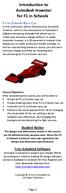 Introduction to Autodesk Inventor for F1 in Schools F1 in Schools Race Car In this course you will be introduced to Autodesk Inventor, which is the centerpiece of Autodesk s digital prototyping strategy
P. Lu, Sh. Huang and K. Jiang
 416 Rev. Adv. Mater. Sci. 33 (2013) 416-422 P. Lu, Sh. Huang and K. Jiang NUMERICAL ANALYSIS FOR THREE-DIMENSIONAL BULK METAL FORMING PROCESSES WITH ARBITRARILY SHAPED DIES USING THE RIGID/VISCO-PLASTIC
Influence of Crash Box on Automotive Crashworthiness
 Influence of Crash Box on Automotive Crashworthiness MIHAIL DANIEL IOZSA, DAN ALEXANDRU MICU, GHEORGHE FRĂȚILĂ, FLORIN- CRISTIAN ANTONACHE University POLITEHNICA of Bucharest 313 Splaiul Independentei
Parametric Technology Corporation. Pro/ENGINEER Wildfire 4.0 Design Animation Concepts Guide
 Parametric Technology Corporation Pro/ENGINEER Wildfire 4.0 Design Animation Concepts Guide Copyright 2007 Parametric Technology Corporation. All Rights Reserved. User and training guides and related documentation
Computer Applications in Textile Engineering. Computer Applications in Textile Engineering
 3. Computer Graphics Sungmin Kim http://latam.jnu.ac.kr Computer Graphics Definition Introduction Research field related to the activities that includes graphics as input and output Importance Interactive
Numerical Analysis of Independent Wire Strand Core (IWSC) Wire Rope
 Numerical Analysis of Independent Wire Strand Core (IWSC) Wire Rope Rakesh Sidharthan 1 Gnanavel B K 2 Assistant professor Mechanical, Department Professor, Mechanical Department, Gojan engineering college,
Visualization of 2D Domains
 Visualization of 2D Domains This part of the visualization package is intended to supply a simple graphical interface for 2- dimensional finite element data structures. Furthermore, it is used as the low
SOLIDWORKS SOFTWARE OPTIMIZATION
 W H I T E P A P E R SOLIDWORKS SOFTWARE OPTIMIZATION Overview Optimization is the calculation of weight, stress, cost, deflection, natural frequencies, and temperature factors, which are dependent on variables
Solving Simultaneous Equations and Matrices
 Solving Simultaneous Equations and Matrices The following represents a systematic investigation for the steps used to solve two simultaneous linear equations in two unknowns. The motivation for considering
The Basics of FEA Procedure
 CHAPTER 2 The Basics of FEA Procedure 2.1 Introduction This chapter discusses the spring element, especially for the purpose of introducing various concepts involved in use of the FEA technique. A spring
The use of Operating Deflection Shapes (ODS) to model the vibration of sanders and polishers HSL/2006/104. Project Leader: Author(s): Science Group:
 Harpur Hill, Buxton Derbyshire, SK17 9JN T: +44 (0)1298 218000 F: +44 (0)1298 218590 W: www.hsl.gov.uk The use of Operating Deflection Shapes (ODS) to model the vibration of sanders and polishers HSL/2006/104
Getting Started with ANSYS ANSYS Workbench Environment
 Getting Started with ANSYS ANSYS Workbench Environment Overview The purpose of this tutorial is to get you started with the ANSYS Workbench environment. We will use a simple, static analysis of a single
Up and Running with Autodesk Inventor Professional Simulation in 90 Minutes!
 Up and Running with Autodesk Inventor Professional Simulation in 90 Minutes! Wasim Younis - Author of Up and Running Inventor Professional Simulation books MA2038 - This class will present a workflow for
Computer Aided Systems
 5 Computer Aided Systems Ivan Kuric Prof. Ivan Kuric, University of Zilina, Faculty of Mechanical Engineering, Department of Machining and Automation, Slovak republic, [email protected] 1.1 Introduction
CATIA V5 Tutorials. Mechanism Design & Animation. Release 18. Nader G. Zamani. University of Windsor. Jonathan M. Weaver. University of Detroit Mercy
 CATIA V5 Tutorials Mechanism Design & Animation Release 18 Nader G. Zamani University of Windsor Jonathan M. Weaver University of Detroit Mercy SDC PUBLICATIONS Schroff Development Corporation www.schroff.com
SimFonIA Animation Tools V1.0. SCA Extension SimFonIA Character Animator
 SimFonIA Animation Tools V1.0 SCA Extension SimFonIA Character Animator Bring life to your lectures Move forward with industrial design Combine illustrations with your presentations Convey your ideas to
Design of a Universal Robot End-effector for Straight-line Pick-up Motion
 Session Design of a Universal Robot End-effector for Straight-line Pick-up Motion Gene Y. Liao Gregory J. Koshurba Wayne State University Abstract This paper describes a capstone design project in developing
Blender 3D Animation
 Bachelor Maths/Physics/Computer Science University Paris-Sud Digital Imaging Course Blender 3D Animation Christian Jacquemin Introduction to Computer Animation Animation Basics animation consists in changing
Embankment Consolidation
 Embankment Consolidation 36-1 Embankment Consolidation In this tutorial, RS2 is used for a coupled analysis of a road embankment subject to loading from typical daily traffic. Model Start the RS2 9.0 Model
Experimental Study of Automated Car Power Window with Preset Position
 Experimental Study of Automated Car Power Window with Preset Position 1 Muazzin Mupit and * Amir Akramin Shafie 1 University Kuala Lumpur Malaysia France Institute 43650 Selangor, Malaysia * Kulliyah of
Computer Aided Design and Drafting (CAD)
 Oakland Community College 2015-2016 Catalog 1 Computer Aided Design and Drafting (CAD) CAD 1050 Geometric Dimensioning and Tolerancing (GD&T) This course is designed to cover the fundamentals as well as
Intuitive Navigation in an Enormous Virtual Environment
 / International Conference on Artificial Reality and Tele-Existence 98 Intuitive Navigation in an Enormous Virtual Environment Yoshifumi Kitamura Shinji Fukatsu Toshihiro Masaki Fumio Kishino Graduate
ETABS. Integrated Building Design Software. Concrete Shear Wall Design Manual. Computers and Structures, Inc. Berkeley, California, USA
 ETABS Integrated Building Design Software Concrete Shear Wall Design Manual Computers and Structures, Inc. Berkeley, California, USA Version 8 January 2002 Copyright The computer program ETABS and all
Two hours UNIVERSITY OF MANCHESTER SCHOOL OF COMPUTER SCIENCE. M.Sc. in Advanced Computer Science. Friday 18 th January 2008.
 COMP60321 Two hours UNIVERSITY OF MANCHESTER SCHOOL OF COMPUTER SCIENCE M.Sc. in Advanced Computer Science Computer Animation Friday 18 th January 2008 Time: 09:45 11:45 Please answer any THREE Questions
Bernice E. Rogowitz and Holly E. Rushmeier IBM TJ Watson Research Center, P.O. Box 704, Yorktown Heights, NY USA
 Are Image Quality Metrics Adequate to Evaluate the Quality of Geometric Objects? Bernice E. Rogowitz and Holly E. Rushmeier IBM TJ Watson Research Center, P.O. Box 704, Yorktown Heights, NY USA ABSTRACT
SAFE A HEAD. Structural analysis and Finite Element simulation of an innovative ski helmet. Prof. Petrone Nicola Eng.
 SAFE A HEAD Structural analysis and Finite Element simulation of an innovative ski helmet Prof. Petrone Nicola Eng. Cherubina Enrico Goal Development of an innovative ski helmet on the basis of analyses
Somero SiteShape System
 Somero SiteShape System www.somero.com [email protected] Somero Enterprises, LLC Corporate Office: 82 Fitzgerald Drive Jaffrey, NH 03452 603 532 5900 - phone 603 532 5930 - fax The Somero SiteShape System
CALIBRATION OF A ROBUST 2 DOF PATH MONITORING TOOL FOR INDUSTRIAL ROBOTS AND MACHINE TOOLS BASED ON PARALLEL KINEMATICS
 CALIBRATION OF A ROBUST 2 DOF PATH MONITORING TOOL FOR INDUSTRIAL ROBOTS AND MACHINE TOOLS BASED ON PARALLEL KINEMATICS E. Batzies 1, M. Kreutzer 1, D. Leucht 2, V. Welker 2, O. Zirn 1 1 Mechatronics Research
How To Program A Laser Cutting Robot
 Robotics ABB Robotics Laser Cutting Software High precision laser cutting made easy - Greater manufacturing flexibility at lower capital investment Robotic laser cutting Overview Allows for the increased
MASTER DEGREE PROJECT
 MASTER DEGREE PROJECT Finite Element Analysis of a Washing Machine Cylinder Thesis in Applied Mechanics one year Master Degree Program Performed : Spring term, 2010 Level Author Supervisor s Examiner :
Laminar Flow in a Baffled Stirred Mixer
 Laminar Flow in a Baffled Stirred Mixer Introduction This exercise exemplifies the use of the rotating machinery feature in the CFD Module. The Rotating Machinery interface allows you to model moving rotating
Finite Element Method
 16.810 (16.682) Engineering Design and Rapid Prototyping Finite Element Method Instructor(s) Prof. Olivier de Weck [email protected] Dr. Il Yong Kim [email protected] January 12, 2004 Plan for Today FEM Lecture
Application of FEM-Tools in the Engine Development Process
 Application of FEM-Tools in the Engine Development Process H. Petrin, B. Wiesler e-mail: [email protected], [email protected] AVL List GmbH Graz, Austria Abstract The requirements for the development
CRASH ANALYSIS OF AN IMPACT ATTENUATOR FOR RACING CAR IN SANDWICH MATERIAL
 F2008-SC-016 CRASH ANALYSIS OF AN IMPACT ATTENUATOR FOR RACING CAR IN SANDWICH MATERIAL Boria, Simonetta *, Forasassi, Giuseppe Department of Mechanical, Nuclear and Production Engineering, University
Off-line Model Simplification for Interactive Rigid Body Dynamics Simulations Satyandra K. Gupta University of Maryland, College Park
 NSF GRANT # 0727380 NSF PROGRAM NAME: Engineering Design Off-line Model Simplification for Interactive Rigid Body Dynamics Simulations Satyandra K. Gupta University of Maryland, College Park Atul Thakur
Autodesk Fusion 360: Assemblies. Overview
 Overview In this module you will learn how different components can be put together to create an assembly. We will use several tools in Fusion 360 to make sure that these assemblies are constrained appropriately
Computer Animation: Art, Science and Criticism
 Computer Animation: Art, Science and Criticism Tom Ellman Harry Roseman Lecture 4 Parametric Curve A procedure for distorting a straight line into a (possibly) curved line. The procedure lives in a black
An introduction to 3D draughting & solid modelling using AutoCAD
 An introduction to 3D draughting & solid modelling using AutoCAD Faculty of Technology University of Plymouth Drake Circus Plymouth PL4 8AA These notes are to be used in conjunction with the AutoCAD software
Blender Notes. Introduction to Digital Modelling and Animation in Design Blender Tutorial - week 9 The Game Engine
 Blender Notes Introduction to Digital Modelling and Animation in Design Blender Tutorial - week 9 The Game Engine The Blender Game Engine This week we will have an introduction to the Game Engine build
5-Axis Test-Piece Influence of Machining Position
 5-Axis Test-Piece Influence of Machining Position Michael Gebhardt, Wolfgang Knapp, Konrad Wegener Institute of Machine Tools and Manufacturing (IWF), Swiss Federal Institute of Technology (ETH), Zurich,
Fluid structure interaction of a vibrating circular plate in a bounded fluid volume: simulation and experiment
 Fluid Structure Interaction VI 3 Fluid structure interaction of a vibrating circular plate in a bounded fluid volume: simulation and experiment J. Hengstler & J. Dual Department of Mechanical and Process
Finite Element Formulation for Plates - Handout 3 -
 Finite Element Formulation for Plates - Handout 3 - Dr Fehmi Cirak (fc286@) Completed Version Definitions A plate is a three dimensional solid body with one of the plate dimensions much smaller than the
ABAQUS/CAE Tutorial: Analysis of an Aluminum Bracket
 H. Kim FEA Tutorial 1 ABAQUS/CAE Tutorial: Analysis of an Aluminum Bracket Hyonny Kim last updated: August 2004 In this tutorial, you ll learn how to: 1. Sketch 2D geometry & define part. 2. Define material
Finite Elements for 2 D Problems
 Finite Elements for 2 D Problems General Formula for the Stiffness Matrix Displacements (u, v) in a plane element are interpolated from nodal displacements (ui, vi) using shape functions Ni as follows,
Equipment Manual. for. Operation of Automatic Polishing Plate Control on the PM5 Precision Lapping & Polishing Machine.
 Equipment Manual for Operation of Automatic Polishing Plate Control on the PM5 Precision Lapping & Polishing Machine Ref: BE-01-53-5 PREFACE: PM5 auto-lap/pol MACHINES The PM5 auto-lap/pol features two
USING TRIANGULATIONS IN COMPUTER SIMULATIONS OF GRANULAR MEDIA
 USING TRIANGULATIONS IN COMPUTER SIMULATIONS OF GRANULAR MEDIA DIDIER MÜLLER, THOMAS M. LIEBLING EPFL-DMA, 1015 Lausanne, Switzerland ABSTRACT The distinct element method used to simulate behavior of granular
Computer Aided Engineering (CAE) Techniques Applied To Hip Implant
 International Journal Of Computational Engineering Research (ijceronline.com) Vol. 3 Issue. 3 Computer Aided Engineering (CAE) Techniques Applied To Hip Implant 1, M. S. Abo_Elkhair, 2, M. E. Abo-Elnor,
NATIONAL TECHNICAL UNIVERSITY OF ATHENS (N.T.U.A.)
 NATIONAL TECHNICAL UNIVERSITY OF ATHENS (N.T.U.A.) MECHANICAL ENGINEERING DEPARTMENT LABORATORY OF MACHINES ELEMENTS Ansys Multiphysics (v. 12) tutorial for electrostatic finite element analysis on spur
Subminiature Load Cell Model 8417
 w Technical Product Information Subminiature Load Cell 1. Introduction... 2 2. Preparing for use... 2 2.1 Unpacking... 2 2.2 Using the instrument for the first time... 2 2.3 Grounding and potential connection...
Constrained Tetrahedral Mesh Generation of Human Organs on Segmented Volume *
 Constrained Tetrahedral Mesh Generation of Human Organs on Segmented Volume * Xiaosong Yang 1, Pheng Ann Heng 2, Zesheng Tang 3 1 Department of Computer Science and Technology, Tsinghua University, Beijing
511 - Creating Structural Frame Designs
 4 th Generation VLC courtesy of Edison2 511 - Creating Structural Frame Designs Rahul Kulkarni, Manager, Product Design, Pune Center, Siemens PLM Software #SEU13 Agenda: 511 - Creating Structural Frame
HAND GESTURE BASEDOPERATINGSYSTEM CONTROL
 HAND GESTURE BASEDOPERATINGSYSTEM CONTROL Garkal Bramhraj 1, palve Atul 2, Ghule Supriya 3, Misal sonali 4 1 Garkal Bramhraj mahadeo, 2 Palve Atule Vasant, 3 Ghule Supriya Shivram, 4 Misal Sonali Babasaheb,
Integrative Optimization of injection-molded plastic parts. Multidisciplinary Shape Optimization including process induced properties
 Integrative Optimization of injection-molded plastic parts Multidisciplinary Shape Optimization including process induced properties Summary: Andreas Wüst, Torsten Hensel, Dirk Jansen BASF SE E-KTE/ES
A Prototype For Eye-Gaze Corrected
 A Prototype For Eye-Gaze Corrected Video Chat on Graphics Hardware Maarten Dumont, Steven Maesen, Sammy Rogmans and Philippe Bekaert Introduction Traditional webcam video chat: No eye contact. No extensive
Animation. Persistence of vision: Visual closure:
 Animation Persistence of vision: The visual system smoothes in time. This means that images presented to the eye are perceived by the visual system for a short time after they are presented. In turn, this
Topology optimization based on graph theory of crash loaded flight passenger seats
 7. LS-DYNA Anwenderforum, Bamberg 2008 Optimierung III Topology optimization based on graph theory of crash loaded flight passenger seats Axel Schumacher, Christian Olschinka, Bastian Hoffmann Hamburg
Science Intensive Development (SID)
 Science Intensive Development (SID) At, we develop custom software that requires specific scientific knowledge. We are experienced in realizing projects that had been considered impossible. The main guarantee
Mesh Discretization Error and Criteria for Accuracy of Finite Element Solutions
 Mesh Discretization Error and Criteria for Accuracy of Finite Element Solutions Chandresh Shah Cummins, Inc. Abstract Any finite element analysis performed by an engineer is subject to several types of
Nonlinear Analysis Using Femap with NX Nastran
 Nonlinear Analysis Using Femap with NX Nastran Chip Fricke, Principal Applications Engineer, Agenda Nonlinear Analysis Using Femap with NX Nastran Who am I? Overview of Nonlinear Analysis Comparison of
Learning Module 6 Linear Dynamic Analysis
 Learning Module 6 Linear Dynamic Analysis What is a Learning Module? Title Page Guide A Learning Module (LM) is a structured, concise, and self-sufficient learning resource. An LM provides the learner
3D Interactive Information Visualization: Guidelines from experience and analysis of applications
 3D Interactive Information Visualization: Guidelines from experience and analysis of applications Richard Brath Visible Decisions Inc., 200 Front St. W. #2203, Toronto, Canada, [email protected] 1. EXPERT