
Saving Money for Finance Students by Utilizing the TVM Capabilities of Graphing Calculators
|
|
|
- Janel King
- 10 years ago
- Views:
Transcription
1 Saving Money for Finance Students by Utilizing the TVM Capabilities of Graphing Calculators Glenna Sumner, Ph.D. Assistant Professor of Economics Abstract Michael Lloyd, Ph.D. Professor of Mathematics and Computer Science Ying Chen, M.B.A. Finance Many Business Finance students purchase a calculator with time value of money functions, such as the TI Business Analyst, or TI BA II plus. This may be a needless expense. After a preliminary survey of Henderson State University Finance students showed that the majority already owned a graphing calculator, two national surveys were conducted to determine the likelihood that this is also the case at many other Universities and Colleges. The first survey was conducted on AACSB schools to determine what math classes are a prerequisite for Finance. The second survey was conducted of 2,256 math department chairs in the United States. The survey asked questions about the requirement that students purchase graphing calculators in College Algebra. The surveys suggest that nationwide, many Business Finance students have already been required to purchase a graphing calculator such as the TI 83 for their math classes. The TI 83 can perform time-value of money calculations. Other graphing calculators, such as the TI-82 and several others, can easily download this capability. In this paper we show the capabilities of the TI 83 and also show how to download financial programming for the TI 82 and other calculators so that they will perform the necessary financial calculations. The rise of college tuition and textbook costs in recent years has put quite a strain on the budget of many college students. The rising costs raise the importance of the decision faced by professors of Business Finance classes whether to require students to purchase a financial calculator. Is the financial calculator essential? Certainly the capability to compute TVM (timevalue of money) calculations, including annuities, is extremely important. But can the students capably compute these financial calculations without the additional purchase of a financial calculator? This paper examines this question. The Preliminary Survey Two sections of Business Finance Students were surveyed at Henderson State University in Fall Semester, The survey consisted of one question. This question was Did you already own a graphing calculator prior to the beginning of this course and if so, what model? The results are presented in detail in Exhibit 1. Those students having a Texas Instruments Graphing Calculator represented 74% of the students surveyed. Students who had a Graphing Calculator of any model represented 79%. Since appropriate TVM calculation software exists for the TI-82, 83, 83+, 83+SE, 85, 86, 89, 92, 92+, and Voyage 200 at this time, it seems wasteful to make students who own these calculators purchase a dedicated financial calculator. If the Fall Semester 2001 was typical of the student population at Henderson, and if only the TI models described here had financial 32
2 capabilities, this means that only 26% of the Henderson State Finance students would need to buy a new calculator. The percentage would only be 21% if the non-texas Instruments calculators also have the TVM capability. This preliminary survey did not answer the question of whether the results for Business Finance students at Henderson State University could be generalized to a wider student population. The Two Larger Surveys Two different surveys were conducted. In the first, AACSB accredited schools were surveyed to determine the likelihood that a College Algebra type course would be a prerequisite for Business Finance. The second survey asked 2,256 Mathematics Chairs questions about the requirement that students purchase graphing calculators in College Algebra. The first survey, of AACSB accredited schools, examined 60 online college catalogs chosen on a randomized basis. The results are as follows: 1. Of the schools in the sample, sixteen (26.7%) required College Algebra. A 95% confidence interval for the population of AACSB schools would have a lower bound of 15.5% and an upper bound of 37.9%. 2. Twenty (33.3%) of the schools in the sample required some algebra, including College Algebra and all other course titles containing the word Algebra. A 95% confidence interval for the entire population of AACSB schools would have a lower bound of 21.4%, and an upper bound of 45.3%. 3. A majority of the schools require at least some math as a prerequisite to Business Finance. There were 36 schools in this category, comprising 60% of the schools in the sample. A 95% confidence interval for the entire population of AACSB schools would have a lower bound of 47.5%, and an upper bound of 72.4%. A group of AACSB professors who attended the Annual Meeting of the Academy of Economics and Finance expressed dismay at the results of this survey when this paper was presented in February A survey of the professors attending the presentation showed 100% of those professors came from AACSB schools that required College Algebra as a prerequisite for Business Finance. To explain the discrepancy between the results of our study and the impromptu survey at the presentation, the authors suggested that perhaps the sample of schools represented in the presentation at the conference was not random. Perhaps, we surmised, schools that are lax in their mathematical prerequisites are also less likely to send faculty to conferences. The authors assured the conference attendees that survey of AACSB schools presented in this paper was indeed a random sample. The second survey, of math department chairs, was conducted using an survey. Of these, we received a total of 979 responses. Some of the conclusions from the survey were: 1. The fraction of departments that either require or recommend a graphing calculator for college algebra is 61.5% +/- 3.3% (5% margin of error). 2. When a math department recommends or requires a graphing calculator, Texas Instruments are the choice of the majority, or 91.9% +/- 2.4% (5% margin of error). 33
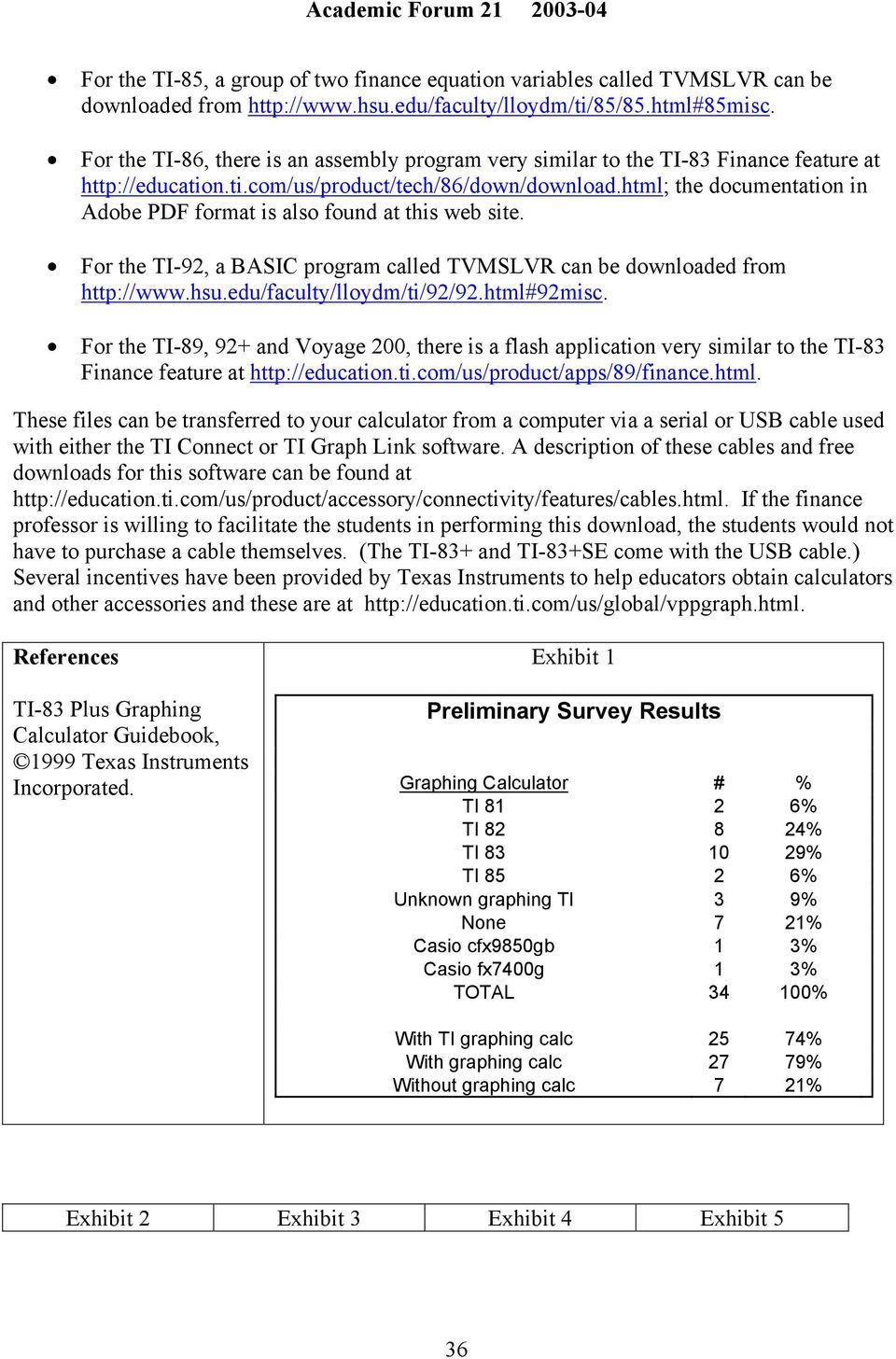
3 3. The TI 83 was especially popular. The Time Value of Money Capabilities of TI graphing calculators The TI-83 and other Texas Instruments graphing calculators have financial applications which operate similar to the TI Business Analyst series. Instead of the standard Business Analyst horizontal row of buttons such as n, i/r, pv, pmt ant fv, the graphing calculators have a screen with a vertical column of these same items. The student enters the numbers on the screen in much the same manner that one operates the Business Analyst series. The TI-83 has annuity functions, can handle annuity due, can calculate the remaining principal after x number of payments and can graph the declining value of a loan over time. Time-Value-Money Solver on the TI-83, 86, 89, 92+, and Voyage The 83 already comes loaded with appropriate TVM capability, and the 86, 89, 92+ and Voyage 200 can be loaded with a program or application that work in a very similar manner. Since the TI-83 was the most popular calculator of the students surveyed, we will use it in the examples that follow. Later in this paper, the 82 and 85 calculators will be discussed. This section presents a short tutorial on the TVM functions of the 83, 83+ and 83+Silver. On the TI-83, touch the Finance button, or for a TI-83+, touch the APPS button and then select Finance by using the arrow keys and the enter key to see the menu as shown in Exhibit 2. Select the time-value-money solver menu to see the variables shown in Exhibit 3. These variables are defined as follows: N is the total number of compounding periods. I% is the annual percentage rate in percent. PV is the present value. PMT is the payment FV is the future value. P/Y is the number of payments per year. C/Y is the number of compounding periods per year. The last line of screen allows the student to set whether a payment is made at the end or beginning of each compounding period. The time-value-money solver will solve for any one of the first five variables as long as the other variables are supplied. For example, if a student wants to know the monthly payments for a $100, year loan at 7% annual interest, then he or she moves the cursor next to the payment variable as shown in Exhibit 4. Then the SOLVE command is invoked (ALPHA ENTER keys) and a payment of $ is found. See Exhibit 5. Other Finance Commands Scrolling down the Finance menu shows the following commands: npv( finds the net present value for a cash flow. irr( finds the internal rate of return for a cash flow. bal( finds the balance for an amortization schedule. ΣPrn( and ΣInt( find the sum of the principal and interest, respectively, during a specified period for an amortization period. 34
4 >Nom( and >Eff( find the nominal rate, given the effective rate and the number of compound periods or find the effective rate, given the nominal rate and number of compound periods. See Exhibit 6 for a screen view of these commands. The calculator comes with a manual that discusses these commands in detail. The 83 and 83+ not only has the features of the financial calculators, it also does more than the financial calculators. It has the ability to graph results, an example of which follows in the next section. A graphing example with the TI-83 Using the above example of a $100,000 loan, we will show how to graph the outstanding balance. Under the MODE key, use the arrow keys and enter to set the number of decimal places to 2 and select parametric (Par) for the graphing mode. See Exhibit 7. We could graph the balance using the using function mode (Func), but parametric (Par) allows us to trace and see the balance for each month or year. 1. Press the Y= key. 2. Return to the Finance/Calc menu. The bal( command, which is item 9 under the Finance/CALC menu is put into Y1 by pressing enter. T is the payment number. See Exhibit 8 for a picture of the parametric function list. 3. Set the WINDOW variables to run from the 0th to the 360th payment and plot the balance every 12 months. (Setting the Tstep to 1 would allow you to see the balance for each month, but it would take a long time to graph.) See Exhibit 9 for a list of all the WINDOW variables values. Tracing will show the month and the corresponding balance. In the example shown in Exhibit 10, tracing to T=180, shows that the outstanding balance is $74, This illustrates that only about one quarter of the loan is paid off after half the payments are made. Creating Tables with the TI-83: The TI-83 also makes tables easily. For example, you could put the payment allocated to the principal in an X variable and the interest allocation in a Y variable. The first graphing pair was deselected by moving the cursor over an = and pressing ENTER. See Exhibit 11 showing the first parametric function pair deselected and the change to the 2nd function pair. Set the TBLSET menu as shown in Exhibit 12 and then select TABLE. The Table in Exhibit 13 shows that about equal amounts are applied to the principal and interest during the 242nd payment. Finance Features on Other TI Graphing Calculators The finance features for the TI-83, TI-83+, and TI-83+ Silver Edition graphing calculators are built in. The other TI calculators can be re-programmed quite easily by going to the following locations on the web: For the TI-82, a BASIC program called TVMSLVR can be downloaded from 35
5 For the TI-85, a group of two finance equation variables called TVMSLVR can be downloaded from For the TI-86, there is an assembly program very similar to the TI-83 Finance feature at the documentation in Adobe PDF format is also found at this web site. For the TI-92, a BASIC program called TVMSLVR can be downloaded from For the TI-89, 92+ and Voyage 200, there is a flash application very similar to the TI-83 Finance feature at These files can be transferred to your calculator from a computer via a serial or USB cable used with either the TI Connect or TI Graph Link software. A description of these cables and free downloads for this software can be found at If the finance professor is willing to facilitate the students in performing this download, the students would not have to purchase a cable themselves. (The TI-83+ and TI-83+SE come with the USB cable.) Several incentives have been provided by Texas Instruments to help educators obtain calculators and other accessories and these are at References TI-83 Plus Graphing Calculator Guidebook, 1999 Texas Instruments Incorporated. Exhibit 1 Preliminary Survey Results Graphing Calculator # % TI % TI % TI % TI % Unknown graphing TI 3 9% None 7 21% Casio cfx9850gb 1 3% Casio fx7400g 1 3% TOTAL % With TI graphing calc 25 74% With graphing calc 27 79% Without graphing calc 7 21% Exhibit 2 Exhibit 3 Exhibit 4 Exhibit 5 36
6 Exhibit 6 Exhibit 7 Exhibit 8 Exhibit 9 Exhibit 10 Exhibit 11 Exhibit 12 Exhibit 13 Biographies: Dr. Glenna Sumner is a member of the school of business. She received her Ph.D. in Economics from the University of Oklahoma in Michael Lloyd received his B.S in Chemical Engineering in 1984 and his Ph.D. in Mathematics from Kansas State University in Manhattan. He has presented papers at meetings of the Academy of Economics and Finance, the American Mathematical Society, the Arkansas Conference on Teaching, the Mathematical Association of America, and the Southwest Arkansas Council of Teachers. He has been at Henderson State University since August Ying Chen received her BBA from Henderson State University in She Received her MBA from Henderson State University in
first complete "prior knowlegde" -- to refresh knowledge of Simple and Compound Interest.
 ORDINARY SIMPLE ANNUITIES first complete "prior knowlegde" -- to refresh knowledge of Simple and Compound Interest. LESSON OBJECTIVES: students will learn how to determine the Accumulated Value of Regular
The values in the TVM Solver are quantities involved in compound interest and annuities.
 Texas Instruments Graphing Calculators have a built in app that may be used to compute quantities involved in compound interest, annuities, and amortization. For the examples below, we ll utilize the screens
Review Page 468 #1,3,5,7,9,10
 MAP4C Financial Student Checklist Topic/Goal Task Prerequisite Skills Simple & Compound Interest Video Lesson Part Video Lesson Part Worksheet (pages) Present Value Goal: I will use the present value formula
THE VALUE OF MONEY PROBLEM #3: ANNUITY. Professor Peter Harris Mathematics by Dr. Sharon Petrushka. Introduction
 THE VALUE OF MONEY PROBLEM #3: ANNUITY Professor Peter Harris Mathematics by Dr. Sharon Petrushka Introduction Earlier, we explained how to calculate the future value of a single sum placed on deposit
14 Financial. Functions. Financial Functions 14-1. Contents
 14 Financial Functions Contents Getting Started: Financing a Car... 14-2 Getting Started: Computing Compound Interest... 14-3 Using the TVM Solver... 14-4 Using the Financial Functions... 14-5 Calculating
TIME VALUE OF MONEY PROBLEM #4: PRESENT VALUE OF AN ANNUITY
 TIME VALUE OF MONEY PROBLEM #4: PRESENT VALUE OF AN ANNUITY Professor Peter Harris Mathematics by Dr. Sharon Petrushka Introduction In this assignment we will discuss how to calculate the Present Value
Main TVM functions of a BAII Plus Financial Calculator
 Main TVM functions of a BAII Plus Financial Calculator The BAII Plus calculator can be used to perform calculations for problems involving compound interest and different types of annuities. (Note: there
Note: In the authors opinion the Ativa AT 10 is not recommended as a college financial calculator at any level of study
 Appendix 1: Ativa AT 10 Instructions Note: DNS = Does Not Calculate Note: Loan and Savings Calculations Automatically round to two decimals. -Clear -Store Data in Memory -Recall Stored Data in Memory [CE]
Finance Application for the TI-89 / TI-92 Plus
 Finance Application for the TI-89 / TI-92 Plus Important Information 2 Where to Find Installation Instructions 3 The Time-Value-of-Money (TVM) Solver 4 Editing Values in the TVM Solver 5 Calculating TVM
TVM Appendix B: Using the TI-83/84. Time Value of Money Problems on a Texas Instruments TI-83 1
 Before you start: Time Value of Money Problems on a Texas Instruments TI-83 1 To calculate problems on a TI-83, you have to go into the applications menu, the blue APPS key on the calculator. Several applications
Texas Instruments BAII PLUS Tutorial
 Omar M. Al Nasser, Ph.D., MBA. Visiting Assistant Professor of Finance School of Business Administration University of Houston-Victoria Email: [email protected] Texas Instruments BAII PLUS Tutorial To
Dick Schwanke Finite Math 111 Harford Community College Fall 2015
 Using Technology to Assist in Financial Calculations Calculators: TI-83 and HP-12C Software: Microsoft Excel 2007/2010 Session #4 of Finite Mathematics 1 TI-83 / 84 Graphing Calculator Section 5.5 of textbook
TIME VALUE OF MONEY. Hewlett-Packard HP-12C Calculator
 SECTION 1, CHAPTER 6 TIME VALUE OF MONEY CHAPTER OUTLINE Clues, Hints, and Tips Present Value Future Value Texas Instruments BA II+ Calculator Hewlett-Packard HP-12C Calculator CLUES, HINTS, AND TIPS Present
Section 5.1 - Compound Interest
 Section 5.1 - Compound Interest Simple Interest Formulas If I denotes the interest on a principal P (in dollars) at an interest rate of r (as a decimal) per year for t years, then we have: Interest: Accumulated
Activity 3.1 Annuities & Installment Payments
 Activity 3.1 Annuities & Installment Payments A Tale of Twins Amy and Amanda are identical twins at least in their external appearance. They have very different investment plans to provide for their retirement.
Course FM / Exam 2. Calculator advice
 Course FM / Exam 2 Introduction It wasn t very long ago that the square root key was the most advanced function of the only calculator approved by the SOA/CAS for use during an actuarial exam. Now students
Introduction. Turning the Calculator On and Off
 Texas Instruments BAII PLUS Calculator Tutorial to accompany Cyr, et. al. Contemporary Financial Management, 1 st Canadian Edition, 2004 Version #6, May 5, 2004 By William F. Rentz and Alfred L. Kahl Introduction
In this section, the functions of a financial calculator will be reviewed and some sample problems will be demonstrated.
 Section 4: Using a Financial Calculator Tab 1: Introduction and Objectives Introduction In this section, the functions of a financial calculator will be reviewed and some sample problems will be demonstrated.
Regular Annuities: Determining Present Value
 8.6 Regular Annuities: Determining Present Value GOAL Find the present value when payments or deposits are made at regular intervals. LEARN ABOUT the Math Harry has money in an account that pays 9%/a compounded
BEST INTEREST RATE. To convert a nominal rate to an effective rate, press
 FINANCIAL COMPUTATIONS George A. Jahn Chairman, Dept. of Mathematics Palm Beach Community College Palm Beach Gardens Location http://www.pbcc.edu/faculty/jahng/ The TI-83 Plus and TI-84 Plus have a wonderful
HANDBOOK: HOW TO USE YOUR TI BA II PLUS CALCULATOR
 HANDBOOK: HOW TO USE YOUR TI BA II PLUS CALCULATOR This document is designed to provide you with (1) the basics of how your TI BA II Plus financial calculator operates, and (2) the typical keystrokes that
The explanations below will make it easier for you to use the calculator. The ON/OFF key is used to turn the calculator on and off.
 USER GUIDE Texas Instrument BA II Plus Calculator April 2007 GENERAL INFORMATION The Texas Instrument BA II Plus financial calculator was designed to support the many possible applications in the areas
Texas Instruments BAII Plus Tutorial for Use with Fundamentals 11/e and Concise 5/e
 Texas Instruments BAII Plus Tutorial for Use with Fundamentals 11/e and Concise 5/e This tutorial was developed for use with Brigham and Houston s Fundamentals of Financial Management, 11/e and Concise,
A Typical Financial Problem
 Cell Phone Apps in a Business Math Class Steven J. Wilson Johnson County Community College Kansas City Math Tech EXPO, 2014 Slides available at: http://www.milefoot.com/about/presentations/cellphoneapps.pdf
Dick Schwanke Finite Math 111 Harford Community College Fall 2013
 Annuities and Amortization Finite Mathematics 111 Dick Schwanke Session #3 1 In the Previous Two Sessions Calculating Simple Interest Finding the Amount Owed Computing Discounted Loans Quick Review of
Time Value of Money. If you deposit $100 in an account that pays 6% annual interest, what amount will you expect to have in
 Time Value of Money Future value Present value Rates of return 1 If you deposit $100 in an account that pays 6% annual interest, what amount will you expect to have in the account at the end of the year.
Texas Instruments BAII PLUS Tutorial
 To begin, look at the face of the calculator. Almost every key on the BAII PLUS has two functions: each key's primary function is noted on the key itself, while each key's secondary function is noted in
TIME VALUE OF MONEY PROBLEM #7: MORTGAGE AMORTIZATION
 TIME VALUE OF MONEY PROBLEM #7: MORTGAGE AMORTIZATION Professor Peter Harris Mathematics by Sharon Petrushka Introduction This problem will focus on calculating mortgage payments. Knowledge of Time Value
CALCULATOR HINTS ANNUITIES
 CALCULATOR HINTS ANNUITIES CALCULATING ANNUITIES WITH THE FINANCE APP: Select APPS and then press ENTER to open the Finance application. SELECT 1: TVM Solver The TVM Solver displays the time-value-of-money
TIME VALUE OF MONEY (TVM)
 TIME VALUE OF MONEY (TVM) INTEREST Rate of Return When we know the Present Value (amount today), Future Value (amount to which the investment will grow), and Number of Periods, we can calculate the rate
TI-86 Financial Functions
 TI-86 Financial Functions Loading and Installing Finance Features on Your TI-86... 2 Loading the Finance Features into TI-86 Memory... 2 Installing the Finance Features for Use... 2 Displaying the FIN
TVM Applications Chapter
 Chapter 6 Time of Money UPS, Walgreens, Costco, American Air, Dreamworks Intel (note 10 page 28) TVM Applications Accounting issue Chapter Notes receivable (long-term receivables) 7 Long-term assets 10
Prepared by: Dalia A. Marafi Version 2.0
 Kuwait University College of Business Administration Department of Finance and Financial Institutions Using )Casio FC-200V( for Fundamentals of Financial Management (220) Prepared by: Dalia A. Marafi Version
Reducing balance loans
 Reducing balance loans 5 VCEcoverage Area of study Units 3 & 4 Business related mathematics In this chapter 5A Loan schedules 5B The annuities formula 5C Number of repayments 5D Effects of changing the
TIME VALUE OF MONEY PROBLEM #5: ZERO COUPON BOND
 TIME VALUE OF MONEY PROBLEM #5: ZERO COUPON BOND Professor Peter Harris Mathematics by Dr. Sharon Petrushka Introduction This assignment will focus on using the TI - 83 to calculate the price of a Zero
Casio Financial Consultant A Supplementary Reader - Part 2
 Casio Financial Consultant A Supplementary Reader - Part 2 An Electronic Publication By Contents i CASIO Financial Consultant: A Supplementary Reader - Part 2 CONTENTS Page Introduction ii Compound Interest
Key Concepts and Skills
 McGraw-Hill/Irwin Copyright 2014 by the McGraw-Hill Companies, Inc. All rights reserved. Key Concepts and Skills Be able to compute: The future value of an investment made today The present value of cash
substantially more powerful. The internal rate of return feature is one of the most useful of the additions. Using the TI BA II Plus
 for Actuarial Finance Calculations Introduction. This manual is being written to help actuarial students become more efficient problem solvers for the Part II examination of the Casualty Actuarial Society
Chapter F: Finance. Section F.1-F.4
 Chapter F: Finance Section F.1-F.4 F.1 Simple Interest Suppose a sum of money P, called the principal or present value, is invested for t years at an annual simple interest rate of r, where r is given
CALCULATOR TUTORIAL. Because most students that use Understanding Healthcare Financial Management will be conducting time
 CALCULATOR TUTORIAL INTRODUCTION Because most students that use Understanding Healthcare Financial Management will be conducting time value analyses on spreadsheets, most of the text discussion focuses
Some Mathematics of Investing in Rental Property. Floyd Vest
 Some Mathematics of Investing in Rental Property Floyd Vest Example 1. In our example, we will use some of the assumptions from Luttman, Frederick W. (1983) Selected Applications of Mathematics of Finance
Introduction to the Graphing Calculator
 Unit 0 Introduction to the Graphing Calculator Intermediate Algebra Update 2/06/06 Unit 0 Activity 1: Introduction to Computation on a Graphing Calculator Why: As technology becomes integrated into all
Math Workshop Algebra (Time Value of Money; TVM)
 Math Workshop Algebra (Time Value of Money; TVM) FV 1 = PV+INT 1 = PV+PV*I = PV(1+I) = $100(1+10%) = $110.00 FV 2 = FV 1 (1+I) = PV(1+I)(1+I) = PV(1+I) 2 =$100(1.10) 2 = $121.00 FV 3 = FV 2 (1+I) = PV(1
Using Financial and Business Calculators. Daniel J. Borgia
 Using Financial and Business Calculators Daniel J. Borgia Table of Contents Texas Instruments (TI) BA-35 SOLAR......................................1 Texas Instruments (TI) BA II PLUS........................................11
Using Financial And Business Calculators. Daniel J. Borgia
 Using Financial And Business Calculators Daniel J. Borgia August 2000 Table of Contents I. Texas Instruments BA-35 SOLAR II. Texas Instruments BAII PLUS III. Hewlett Packard 12C IV. Hewlett Packard 17BII..
Hewlett-Packard 10B Tutorial
 To begin, look at the face of the calculator. Every key (except one, the gold shift key) on the 10B has two functions: each key's primary function is noted in white on the key itself, while each key's
Texas Instruments BA II Plus. Calculator tutorial
 Chartered Financial Analyst Program Texas Instruments BA II Plus calculator tutorial Nicholas J Blain, CFA Chief Executive Quartic Training 1 outline 0. Calculator setup and introduction 1. Basic algebra
PV Tutorial Using Excel
 EYK 15-3 PV Tutorial Using Excel TABLE OF CONTENTS Introduction Exercise 1: Exercise 2: Exercise 3: Exercise 4: Exercise 5: Exercise 6: Exercise 7: Exercise 8: Exercise 9: Exercise 10: Exercise 11: Exercise
The time value of money: Part II
 The time value of money: Part II A reading prepared by Pamela Peterson Drake O U T L I E 1. Introduction 2. Annuities 3. Determining the unknown interest rate 4. Determining the number of compounding periods
Calculator Notes for the TI-89, TI-92 Plus, and Voyage 200
 CHAPTER 1 Note 1A Reentry Calculator Notes for the TI-89, TI-92 Plus, and Voyage 200 If you want to do further calculation on a result you ve just found, and that result is the first number in the expression
Integrated Case. 5-42 First National Bank Time Value of Money Analysis
 Integrated Case 5-42 First National Bank Time Value of Money Analysis You have applied for a job with a local bank. As part of its evaluation process, you must take an examination on time value of money
Hewlett-Packard 10BII Tutorial
 This tutorial has been developed to be used in conjunction with Brigham and Houston s Fundamentals of Financial Management 11 th edition and Fundamentals of Financial Management: Concise Edition. In particular,
Using Your TI-89 in Elementary Statistics
 Using Your TI-89 in Elementary Statistics Level of Handout: Target: Intermediate users of the TI-89. If you are a new user, pair up with someone in the class that is a bit familiar with the TI-89. You
Week in Review #10. Section 5.2 and 5.3: Annuities, Sinking Funds, and Amortization
 WIR Math 141-copyright Joe Kahlig, 10B Page 1 Week in Review #10 Section 5.2 and 5.3: Annuities, Sinking Funds, and Amortization an annuity is a sequence of payments made at a regular time intervals. For
Hewlett-Packard 17BII Tutorial
 To begin, look at the face of the calculator. Most keys on the 17BII have two functions: a key's primary function is noted in white on the key itself, while the key's secondary function is noted in gold
Using the Finance Menu of the TI-83/84/Plus calculators KEY
 Using the Finance Menu of the TI-83/84/Plus calculators KEY To get to the FINANCE menu On the TI-83 press 2 nd x -1 On the TI-83, TI-83 Plus, TI-84, or TI-84 Plus press APPS and then select 1:FINANCE The
Sharp EL-733A Tutorial
 To begin, look at the face of the calculator. Almost every key on the EL-733A has two functions: each key's primary function is noted on the key itself, while each key's secondary function is noted in
Programming the TI-83 and TI-84 Calculators for Finance
 Programming the TI-83 and TI-84 Calculators for Finance Steven P. Rich, Baylor University The power of the Texas Instrument TI-83 and TI-84 calculators lies in the ability to create programs for them.
CHAPTER 2. Time Value of Money 2-1
 CHAPTER 2 Time Value of Money 2-1 Time Value of Money (TVM) Time Lines Future value & Present value Rates of return Annuities & Perpetuities Uneven cash Flow Streams Amortization 2-2 Time lines 0 1 2 3
5. Time value of money
 1 Simple interest 2 5. Time value of money With simple interest, the amount earned each period is always the same: i = rp o We will review some tools for discounting cash flows. where i = interest earned
In Section 5.3, we ll modify the worksheet shown above. This will allow us to use Excel to calculate the different amounts in the annuity formula,
 Excel has several built in functions for working with compound interest and annuities. To use these functions, we ll start with a standard Excel worksheet. This worksheet contains the variables used throughout
BA II PLUS PROFESSIONAL Calculator
 BA II PLUS PROFESSIONAL Calculator Important Information Texas Instruments makes no warranty, either express or implied, including but not limited to any implied warranties of merchantability and fitness
SUPPLEMENTARY NOTES. For examination purposes, the following amendments shall take effect from 3 June 2011: 1. Chapter 12, Page 329, Chapter Outline
 SUPPLEMENTARY NOTES ChFC01 Fundamentals Of Financial Planning And Investments Date Of Issue : 3 May 2011 [Applicable to 1 st Edition (2003), Re-printed March 2006 version and earlier] The following amendments
BA II PLUS Calculator
 BA II PLUS Calculator 1997, 2002 Texas Instruments Incorporated Important Texas Instruments makes no warranty, either expressed or implied, including but not limited to any implied warranties of merchantability
Continue this process until you have cleared the stored memory positions that you wish to clear individually and keep those that you do not.
 Texas Instruments (TI) BA II PLUS Professional The TI BA II PLUS Professional functions similarly to the TI BA II PLUS model. Any exceptions are noted here. The TI BA II PLUS Professional can perform two
Bank: The bank's deposit pays 8 % per year with annual compounding. Bond: The price of the bond is $75. You will receive $100 five years later.
 ü 4.4 lternative Discounted Cash Flow Decision Rules ü Three Decision Rules (1) Net Present Value (2) Future Value (3) Internal Rate of Return, IRR ü (3) Internal Rate of Return, IRR Internal Rate of Return
Finance Unit 8. Success Criteria. 1 U n i t 8 11U Date: Name: Tentative TEST date
 1 U n i t 8 11U Date: Name: Finance Unit 8 Tentative TEST date Big idea/learning Goals In this unit you will study the applications of linear and exponential relations within financing. You will understand
Casio 9860 Self-Guided Instructions TVM Mode
 Using TVM: Casio 9860 Self-Guided Instructions TVM Mode Instructions Screenshots TVM stands for 'Time, Value, Money'. TVM is the Financial Mode on the calculator. However, Financial Mathematics questions
Using Financial Calculators
 Chapter 4 Discounted Cash Flow Valuation 4B-1 Appendix 4B Using Financial Calculators This appendix is intended to help you use your Hewlett-Packard or Texas Instruments BA II Plus financial calculator
Chapter 4 Time Value of Money ANSWERS TO END-OF-CHAPTER QUESTIONS
 Chapter 4 Time Value of Money ANSWERS TO END-OF-CHAPTER QUESTIONS 4-1 a. PV (present value) is the value today of a future payment, or stream of payments, discounted at the appropriate rate of interest.
The Time Value of Money
 C H A P T E R6 The Time Value of Money When plumbers or carpenters tackle a job, they begin by opening their toolboxes, which hold a variety of specialized tools to help them perform their jobs. The financial
6: Financial Calculations
 : Financial Calculations The Time Value of Money Growth of Money I Growth of Money II The FV Function Amortisation of a Loan Annuity Calculation Comparing Investments Worked examples Other Financial Functions
Compounding Assumptions. Compounding Assumptions. Financial Calculations on the Texas Instruments BAII Plus. Compounding Assumptions.
 Compounding Assumptions Financial Calculations on the Texas Instruments BAII Plus This is a first draft, and may contain errors. Feedback is appreciated The TI BAII Plus has built-in preset assumptions
How To Use The Ti-83+/84+ Calculator For Math 111
 Using the TI-83+/84+ Graphing Calculator in Math 111 at Tacoma Community College Version 1.0 Scott MacDonald Copyright c 2005 by Scott MacDonald Permission is given to reproduce this document in whole
Topics. Chapter 5. Future Value. Future Value - Compounding. Time Value of Money. 0 r = 5% 1
 Chapter 5 Time Value of Money Topics 1. Future Value of a Lump Sum 2. Present Value of a Lump Sum 3. Future Value of Cash Flow Streams 4. Present Value of Cash Flow Streams 5. Perpetuities 6. Uneven Series
BA II PLUS Calculator
 BA II PLUS Calculator Important Information Texas Instruments makes no warranty, either express or implied, including but not limited to any implied warranties of merchantability and fitness for a particular
1. Annuity a sequence of payments, each made at equally spaced time intervals.
 Ordinary Annuities (Young: 6.2) In this Lecture: 1. More Terminology 2. Future Value of an Ordinary Annuity 3. The Ordinary Annuity Formula (Optional) 4. Present Value of an Ordinary Annuity More Terminology
The Mathematics of Financial Planning (supplementary lesson notes to accompany FMGT 2820)
 The Mathematics of Financial Planning (supplementary lesson notes to accompany FMGT 2820) Using the Sharp EL-738 Calculator Reference is made to the Appendix Tables A-1 to A-4 in the course textbook Investments:
Chapter 4. The Time Value of Money
 Chapter 4 The Time Value of Money 4-2 Topics Covered Future Values and Compound Interest Present Values Multiple Cash Flows Perpetuities and Annuities Inflation and Time Value Effective Annual Interest
DISCOUNTED CASH FLOW VALUATION and MULTIPLE CASH FLOWS
 Chapter 5 DISCOUNTED CASH FLOW VALUATION and MULTIPLE CASH FLOWS The basic PV and FV techniques can be extended to handle any number of cash flows. PV with multiple cash flows: Suppose you need $500 one
HOW TO USE YOUR HP 12 C CALCULATOR
 HOW TO USE YOUR HP 12 C CALCULATOR This document is designed to provide you with (1) the basics of how your HP 12C financial calculator operates, and (2) the typical keystrokes that will be required on
For another way to generate recursive sequences, see Calculator Note 1D.
 !"# If you want to do further calculation on a result you ve just found, and that result is the first number in the expression you now want to evaluate, you can simply continue the expression. For example,
Key Concepts and Skills. Multiple Cash Flows Future Value Example 6.1. Chapter Outline. Multiple Cash Flows Example 2 Continued
 6 Calculators Discounted Cash Flow Valuation Key Concepts and Skills Be able to compute the future value of multiple cash flows Be able to compute the present value of multiple cash flows Be able to compute
The Mathematics of Financial Planning (supplementary lesson notes to accompany FMGT 2820)
 The Mathematics of Financial Planning (supplementary lesson notes to accompany FMGT 2820) Using the Sharp EL-733A Calculator Reference is made to the Appendix Tables A-1 to A-4 in the course textbook Investments:
Activity 6 Graphing Linear Equations
 Activity 6 Graphing Linear Equations TEACHER NOTES Topic Area: Algebra NCTM Standard: Represent and analyze mathematical situations and structures using algebraic symbols Objective: The student will be
Chapter 4: Time Value of Money
 Chapter 4: Time Value of Money BASIC KEYS USED IN FINANCE PROBLEMS The following two key sequences should be done before starting any "new" problem: ~ is used to separate key strokes (3~N: enter 3 then
Activity 5 Calculating a Car Loan
 Teaching Notes/Lesson Plan Objective Within this lesson, the participant will be able to use the Casio calculator to determine such information as monthly payment, interest rate, and total cost of the
1. If you wish to accumulate $140,000 in 13 years, how much must you deposit today in an account that pays an annual interest rate of 14%?
 Chapter 2 - Sample Problems 1. If you wish to accumulate $140,000 in 13 years, how much must you deposit today in an account that pays an annual interest rate of 14%? 2. What will $247,000 grow to be in
How To Read The Book \"Financial Planning\"
 Time Value of Money Reading 5 IFT Notes for the 2015 Level 1 CFA exam Contents 1. Introduction... 2 2. Interest Rates: Interpretation... 2 3. The Future Value of a Single Cash Flow... 4 4. The Future Value
TIME VALUE OF MONEY #6: TREASURY BOND. Professor Peter Harris Mathematics by Dr. Sharon Petrushka. Introduction
 TIME VALUE OF MONEY #6: TREASURY BOND Professor Peter Harris Mathematics by Dr. Sharon Petrushka Introduction This problem assumes that you have mastered problems 1-5, which are prerequisites. In this
FINA 351 Managerial Finance, Ch.4-5, Time-Value-of-Money (TVM), Notes
 FINA 351 Managerial Finance, Ch.4-5, Time-Value-of-Money (TVM), Notes The concept of time-value-of-money is important to know, not only for this class, but for your own financial planning. It is a critical
Chapter 7 SOLUTIONS TO END-OF-CHAPTER PROBLEMS
 Chapter 7 SOLUTIONS TO END-OF-CHAPTER PROBLEMS 7-1 0 1 2 3 4 5 10% PV 10,000 FV 5? FV 5 $10,000(1.10) 5 $10,000(FVIF 10%, 5 ) $10,000(1.6105) $16,105. Alternatively, with a financial calculator enter the
BA II Plus Advanced Business Analyst Calculator
 BA II Plus Advanced Business Analyst Calculator Quick Guide to Settings and Concepts Purpose of Guide This Quick Guide is a supplement to the BA II Plus Guidebook. It includes brief examples of commonly
Activity 5. Two Hot, Two Cold. Introduction. Equipment Required. Collecting the Data
 . Activity 5 Two Hot, Two Cold How do we measure temperatures? In almost all countries of the world, the Celsius scale (formerly called the centigrade scale) is used in everyday life and in science and
CHAPTER 9 Time Value Analysis
 Copyright 2008 by the Foundation of the American College of Healthcare Executives 6/11/07 Version 9-1 CHAPTER 9 Time Value Analysis Future and present values Lump sums Annuities Uneven cash flow streams
Bond valuation. Present value of a bond = present value of interest payments + present value of maturity value
 Bond valuation A reading prepared by Pamela Peterson Drake O U T L I N E 1. Valuation of long-term debt securities 2. Issues 3. Summary 1. Valuation of long-term debt securities Debt securities are obligations
Ehrhardt Chapter 8 Page 1
 Chapter 2 Time Value of Money 1 Time Value Topics Future value Present value Rates of return Amortization 2 Time lines show timing of cash flows. 0 1 2 3 I% CF 0 CF 1 CF 2 CF 3 Tick marks at ends of periods,
THE TIME VALUE OF MONEY
 QUANTITATIVE METHODS THE TIME VALUE OF MONEY Reading 5 http://proschool.imsindia.com/ 1 Learning Objective Statements (LOS) a. Interest Rates as Required rate of return, Discount Rate and Opportunity Cost
Time-Value-of-Money and Amortization Worksheets
 2 Time-Value-of-Money and Amortization Worksheets The Time-Value-of-Money and Amortization worksheets are useful in applications where the cash flows are equal, evenly spaced, and either all inflows or