
A JAVA VIRTUAL MACHINE FOR THE ARM PROCESSOR
|
|
|
- Tracy Garrison
- 10 years ago
- Views:
Transcription
1 A JAVA VIRTUAL MACHINE FOR THE ARM PROCESSOR A report submitted to the University of Manchester for the purpose of a Master of Science in the Faculty of Science and Engineering September 2004 By Ming Chen Department of Computer Science

2 Contents Abstract 7 Declaration 8 Copyright 9 The Author 10 Acknowledgements 11 1 Introduction Purpose Scope Overview Background JVM and Jikes RVM Java and the Java Virtual Machine (JVM) Jikes RVM Structure of the Jikes RVM Platform Independent Features of the Jikes RVM Boot Image Compiler Subsystem Baseline compiler working mechanism Target Hardware Environment ARM, MPCore and Intel Xscale ARM Workstation Linux Summary

3 3 Design and Implementation Methodology Port from the PowerPC implementation A Minimal Approach VM Convention Register Categories Stack Conventions Register Map Synchronisation Magic prepare and attempt calls Protect VM Processor.vpStatus Application Binary Interface Endian and Word Order Register Zero Limited length of offset and immediate operand System Trap Floating Point Summary Result Analysis Achievement Limitations of implementation Validation and testing Testing the VM Assembler Testing the VM Compiler Summary Engineering Experience Milestones of this porting project Exception Driven Modification Debugging the Jikes RVM Cross Compiling Summary Conclusions and future work Conclusions
4 6.2 Future work Engineering Research Future Work A Appendix results 53 A.1 Table of the Bytecode Coverage Test A.2 Table of the Process in Instruction Coversion Bibliography 69 4

5 List of Figures 2.1 Call path of Baseline Compiler Baseline Compiler Work Mechanism Register Map of the PowerPC Implementation Register Map of the ARM port Comparison of the Byte Ordering between the PowerPC and ARM Comparison of the Word Ordering of Long Value between the PowerPC and ARM Comparison of the Word Ordering of Double Value between the PowerPC and ARM Bytecode Coverage Test A Process in Instruction Conversion A

6 List of Tables A.1 Bytecode Coverage Test A.2 Bytecode Coverage Test Detail A.3 Progress in Instruction Conversion

7 Abstract Virtual machines, in particular the Java Virtual Machine (JVM), offer the ability for applications to be developed in a platform-independent manner and gain ever increasing popularity. The Jikes Research Virtual Machine (RVM) is a JVM that written in Java. This thesis presents a port of the Jikes RVM to the important embedded architecture, ARM. Substantial work has been done porting the initial baseline compiler of the Jikes RVM. The work is presented, along with considerations for the optimising and adaptive compilation systems. Not only is ARM an important embedded architecture, but also it is starting to extend a function as a Chip-Multi-Processor (CMP) architecture. This work also presents consideration of the Jikes RVM running in a ARM MPCore environment. 7

8 Declaration No portion of the work referred to in this thesis has been submitted in support of an application for another degree or qualification of this or any other university or other institution of learning. 8

9 Copyright Copyright in text of this thesis rests with the Author. Copies (by any process) either in full, or of extracts, may be made only in accordance with instructions given by the Author and lodged in the John Rylands University Library of Manchester. Details may be obtained from the Librarian. This page must form part of any such copies made. Further copies (by any process) of copies made in accordance with such instructions may not be made without the permission (in writing) of the Author. The ownership of any intellectual property rights which may be described in this thesis is vested in the University of Manchester, subject to any prior agreement to the contrary, and may not be made available for use by third parties without the written permission of the University, which will prescribe the terms and conditions of any such agreement. Further information on the conditions under which disclosures and exploitation may take place is available from the head of Department of Computer Science. 9

10 The Author Having graduated from the South China University of Technology with a BEng in Automation, I then worked in the R&D sectors of the Telecommunication industry. After four years working, I began the MSc in Advanced Computer Science with ICT Management course at the University of Manchester. The last part of this course is the project described in this dissertation. This work was undertaken as part of the Jamaica Project in the Advanced Processor Technologies Group. 10

11 Acknowledgements Thank you to my supervisor Ian Watson, the research fellows, Andrew Dinn and Dr. Ian Rogers. Their real-time support was critical for this project, and their professional spirit encouraged me to overcome many difficult situations. Thanks to the other colleges in the JAMAICA and APT groups, Steve Furber, Chris Kirkham, Matthew Horsnell, Zhao JiSheng, their time and help is always invaluable. Thanks to the experts who helped me through the Jikes RVM-researchers mailing list, Eliot Moss, David P Grove, Perry Cheng and Chris Hoffmann. Thanks to all my other friends, my family and those who have helped me in the Acomb house. Spepial thanks to my best friend Fu,Xiaoyan for give me a lot of valuable feedback on my thesis. 11

12 Chapter 1 Introduction The Jikes Research Virtual Machine (RVM) is a research oriented Java Virtual Machine (section 2.1.1) developed by the IBM T.J.Watson Research Centre. The flexible architecture design makes it suitable for Java Virtual Machine research. In the JAMAICA research group, the Jikes RVM platform is being leveraged to research into dynamic compilation techniques for parallel architectures. Most of the Jikes RVM is machine independent. There are two challenges in this project: one is to identify the machine dependent design; the other is to debug the ported system. 1.1 Purpose This thesis describes the design and implementation of an ARM port of the Jikes RVM. The ARM backend of the Jikes RVM, built by this project, can be used in the following two potential research areas, which will be discussed as the further research work in section Low-power oriented dynamic compiling optimisation for the ARM architecture. Compiling support of parallel computing for the ARM MPCore chip-multi-processor. 1.2 Scope Considering the time limitation, this project has focused on a prototype implementation. This prototype system is based on the baseline compiler subsystem 12

13 CHAPTER 1. INTRODUCTION 13 and is developed it to a level where small Java programs such as HelloWorld can be run. 1.3 Overview There are six core chapters in this thesis as follows: Chapter 2, Background Chapter 2 will give an overview of the technical background of this project. Firstly, it will briefly introduce the architecture of the Jikes RVM, followed by a brief overview of the Java and Java Virtual Machine. After the analysis of the Jikes RVM, it will examine the architecture independent features of the main components of the Jikes RVM. Secondly, it will discuss the working mechanism of the baseline compiler subsystem. Finally, it will introduce the target hardware and operating system. Chapter 3, Design and Implementation Chapter 3 will explain the critical decisions made on this project. There are ten subtopics in this chapter. 1. Methodology Port from the PowerPC implementation A Minimal Approach It introduces the methodologies and philosophies applied to this project. 2. VM Convention It shows the special virtual machine convention for the ARM processor. 3. Register Map Because the ARM processor has just fifteen general purpose registers, it is necessary to reallocate the registers to match the requirement of the Jikes RVM. 4. Register Zero The register zero has special meaning in the PowerPC s instruction. In the ARM, it is necessary to deal with register zero differently.
14 CHAPTER 1. INTRODUCTION Synchronisation The ARM has a different synchronisation mechanism for locking than the PowerPC. 6. Application Binary Interface 7. Endian and Word Order 8. Limited length of offset and immediate operand In the ARM, the length of offset of the instructions is smaller than PowerPC s. There are some design decisions related to it. 9. System Trap It will present the different implementations of system trap in ARM, Intel and PowerPC, and then it shows the solution chosen on this prototype implementation. 10. Floating Point It will examine the floating point implementation of this ARM port. Chapter 4, Result Analysis This chapter evaluates this prototype ARM port of the Jikes RVM. 1. Achievements of this porting project 2. Limitation of implementation 3. Validation and testing Testing the Assembler Testing the Compiler Chapter 5, Engineering Experiences This chapter discuss the engineering challenges and solutions in this project. Milestones of this porting project Exception Driven Modification Debugging the Jikes RVM This concerns guidelines about how to use gdb to debug Jikes RVM. Cross Compiling

15 CHAPTER 1. INTRODUCTION 15 Chapter 6, Conclusions and Further work 1. Conclusion This will introduce the current progress of this project and add conclusion for this stage. 2. Further work There are some suggestions for further work on this project.

16 Chapter 2 Background Java is one of the most popular high-level programming languages of this networking age. Its platform independence, security and mobility features make it suitable for network-oriented computing. Java s executable code, byte code, which is an intermediate code, can not be directly executed by the processor. It must be executed by a Java Virtual Machine (JVM). Compared with native executable code, executing byte code by a running JVM requires additional overhead, such as Just-in-Time compilation, which may affect the performance, however, Java s features, like strong typing and dynamic execution, make it possible to increase its performance with compiler optimisation. A JVM can use run-time profile data to optimise the Java program dynamically. For some benchmarks, running on some JVM implementations, Java can achieve a similar performance and better than C. Currently with the development of chip multi-processor architectures, JVMs might provide benefits from dynamic optimisation for parallel computing. In this chapter, we will introduce the relationship between the Java Virtual Machine and the Jikes RVM, the architecture and machine dependent features of the Jikes RVM, as well as the development environment of this project. 2.1 JVM and Jikes RVM The Jikes RVM is one of the state-of-the-art Java Virtual Machines. 16

17 CHAPTER 2. BACKGROUND Java and the Java Virtual Machine (JVM) The Java Virtual Machine is the key component of the Java architecture. It is the heart of the Java network oriented features[ven97]. The JVM provides a runtime environment to support these features. The JAVA Programming language Java s suitability for networked environments is inherent in its architecture, which enables secure, robust, platform-independent programs to be delivered across networks and run on a great variety of computers and devices. Platform independence, security, and network-mobility these three facets of Java s architecture work together to make Java suitable for the emerging networked computing environment [Ven97]. JAVA Architecture Java s architecture arises out of four distinct but interrelated technologies: The Java programming language The Java class file format The Java Application Programming Interface The Java Virtual Machine The writing and running of a Java program starts from Java source code written in the Java programming language. Then the source code is compiled to the Java class file format, which contains Java Bytecode. If needed, operating system resources can be accessed by the Java Programming Interface at the source code level. Finally, the Java class file would be executed on the Java Virtual Machine. Java Virtual Machine Architecture A JVM s responsibility is to execute Java Bytecodes on the target hardware platform. In general, a Java Virtual Machine is platform dependent. There are different JVM implementation for different operating system and CPU architecture.

18 CHAPTER 2. BACKGROUND Jikes RVM The Jikes RVM is a new generation Java Virtual Machine, developed by IBM J.Watson Research Centre[IBM04]. The Jikes RVM s well-designed architecture makes it flexible with the different memory management modules and different optimising algorithms, which makes it an ideal research platform for compiling technology. It is also written in Java Structure of the Jikes RVM The Jikes RVM has four key components: core runtime, compilers, memory managers and an adaptive optimisation system [IBM04]. Core runtime is responsible for managing all the underlying data structures required to execute applications and interfacing with libraries. An example of runtime objects are those responsible for threading. Compilers are responsible for generating executable code from byte codes. The executable code is held as Java arrays. Special VM Maigc calls enable the Jikes RVM to incorporate with this code into its running image. Memory managers are responsible for the allocation and collection of objects during the execution of an application. Adaptive optimisation system is responsible for profiling an executing an application and judiciously using the optimising compiler to improve its performance Platform Independent Features of the Jikes RVM In the four major components of the Jikes RVM, only the compiler subsystems are platform dependent. The other three components are platform independent. 2.2 Boot Image As a Java Virtual Machine written in Java, Jikes RVM uses a boot image, which is a snap-shot of a working Jikes RVM, to boot itself. There is a short C bootstrap program, called the boot image runner, that reads the boot image from a file,
![technology. It is also written in Java. 2.1.3 Structure of the Jikes RVM The Jikes RVM has four key components: core runtime, compilers, memory managers and an adaptive optimisation system [IBM04].](/docs-images/51/13603264/images/page_18.jpg "Core runtime is responsible for managing all the underlying data structures required to execute applications and interfacing with libraries.")
19 CHAPTER 2. BACKGROUND 19 loads it into memory, and starts its running. Another important program is the boot image writer. This is a Java program that runs on an existing JVM (in this project, we use the Java HotSpot 1 Virtual Machine 1.4.2). In the boot image file, a minimal set of java classes are compiled into machine codes. The Jikes RVM compiler itself would be compiled into the boot image as well. VM.boot() VM.boot() is the first java method executed in the boot image file. It is a suitable place to add some bytecode test code, as discribed later in the testing section Compiler Subsystem The function of the compiler subsystems of the Jikes RVM is to generate machine code from Java bytecode. In the compiler subsystem, there are two kinds of compiler: the baseline compiler and the optimising compiler. The difference between them is in the compilation time and the quality of the generated code. The mechanisms of the baseline compiler are simple and straightforward. It directly translates bytecode into machine code. Therefore, the baseline compiler can generate machine code very quickly, but the performance of the machine code generated by it is relatively poor. The optimising compiler has complex optimisation routines that create high performance machine code, however this comes at a higher cost of a longer compile time. The Jikes RVM has an adaptive optimisation system to trade off the compiling time with the performance gain, based on a runtime profile. The basic idea is to use the optimising compiler to compile a small set of performance critical Java methods, and use the baseline compiler to compile all the other performance non-critical Java methods, which is referred to the 90/10 rule(90% of execution time occurs in 10% of the code[hp96]), This project focuses on the implementation of the baseline compiler. 1 According to Sun Microsystems, the HotSpot virtual machine, Sun s Java virtual machine (JVM), promises to make Java as fast as C++. Specifically, Sun says that a platform-independent Java program delivered as bytecode in class files will run on HotSpot at speeds on par with an equivalent C++ program compiled to a native executable [Ven98].
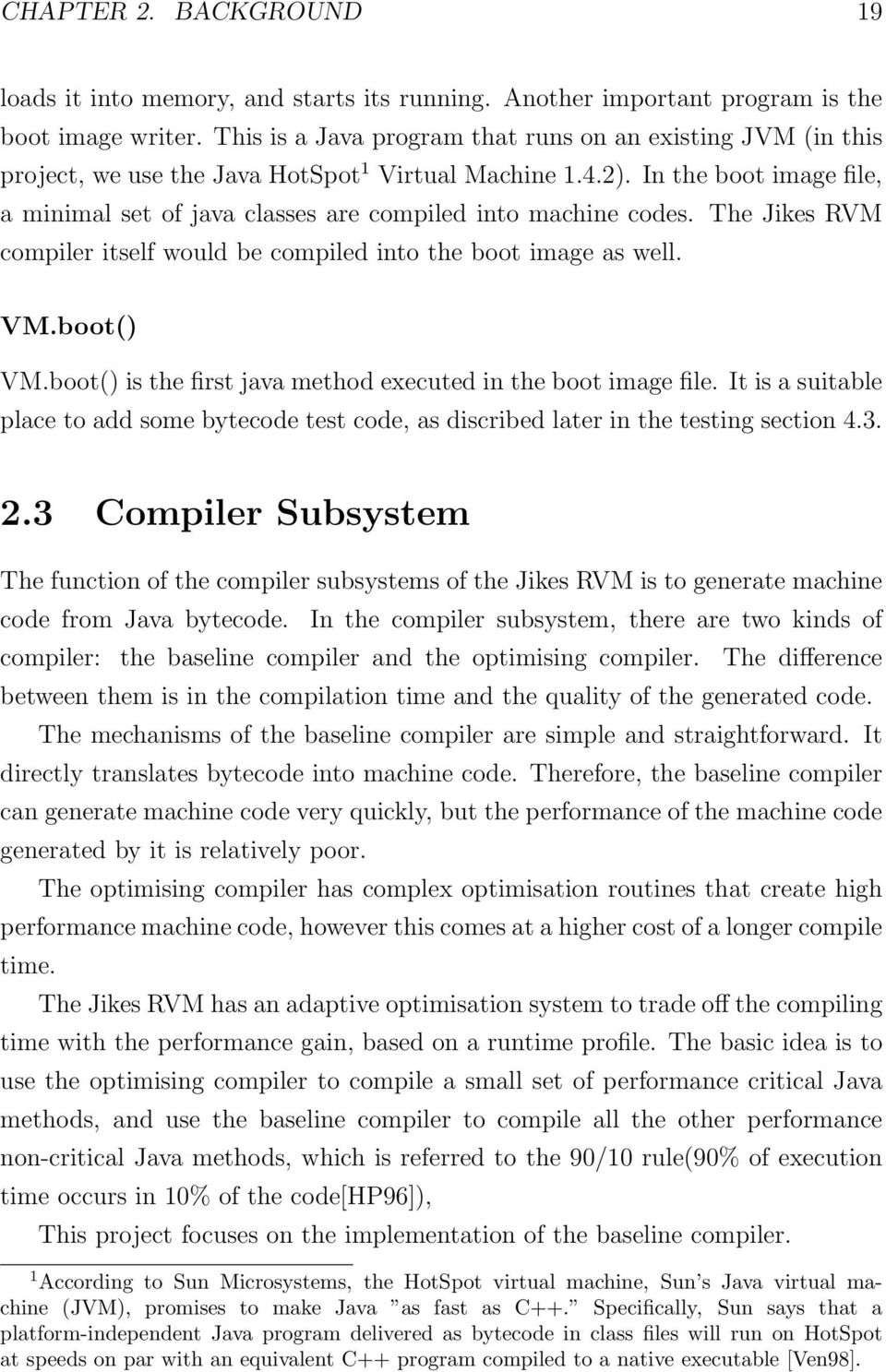
20 CHAPTER 2. BACKGROUND Baseline compiler working mechanism Most of the baseline compiler is machine-independent. The main class is VM BaselineCompiler. Figure 2.1 shows the function of the VM BaselineCompiler is to invoke VM Compiler to emit the machine code for each bytecode. The body VM_RuntimeCompiler VM_BaselineCompiler VM_Compiler VM_Assembler compile() emit_iadd() popint() popint() emitadd() pushint() baselinecompile() gencode() emit_"byte code" emit"assembly CODE 1" emit"assembly CODE 2" VM_CompiledMethod Figure 2.1: Call path of Baseline Compiler of the compile method in the baseline compiler is a big switch table. For each bytecode, it invokes different emit bytecode () in the VM Compiler. For the
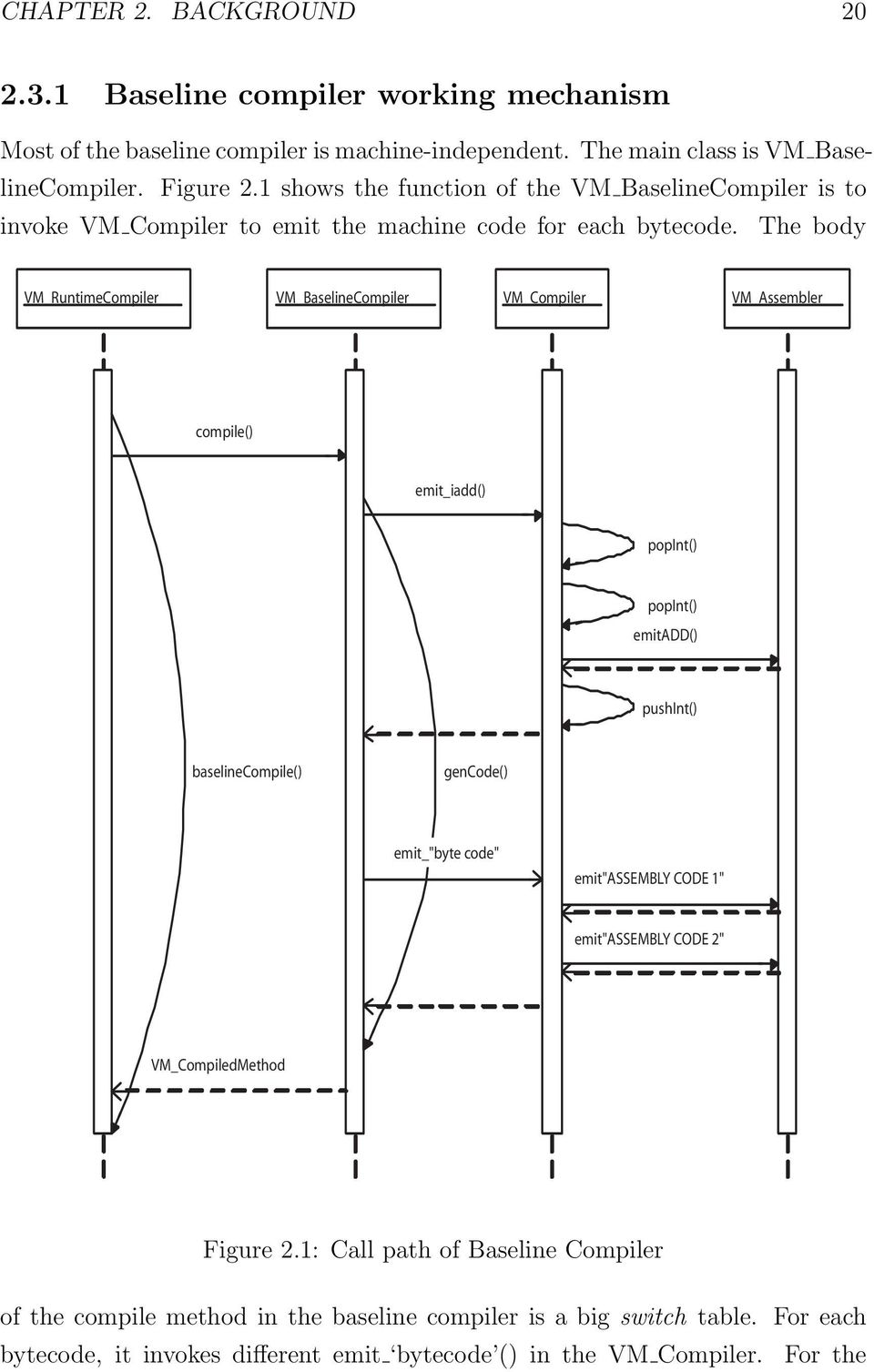
21 CHAPTER 2. BACKGROUND 21 VM BaselineCompiler, there is no difference among the different processors, because the bytecode is the same. Therefore the VM BaselineCompiler is machine-independent. Further as shown in Figure 2.2, the VM Compiler and VM Assembler are machine dependent. For the same bytecode, the VM BaselineCompiler should be the same, whilst the VM Compiler will generate a different assembly code sequence according to different processors. Obviously the VM Assembler should be machine dependent, because its function is to generate binary machine code for each of the different processors. JAVA Class File VM_BaselineComiler aload_0 invokesp ecial return VM_Compiler (ARM) LDR STR... VM_Assembler (ARM) 0xe59b 0xe ARM VM_Compiler (PowerPC) LWZ STW... VM_Assembler (PowerPC) 0x83c x PowerPC... Figure 2.2: Baseline Compiler Work Mechanism Baseline compilation consists of two main steps: GC map computation 2 and code generation. Code generation is straightforward, consisting of a single pass through the byte codes of the method being compiled. 2 The baseline compiler computes GC maps by abstractly interpreting the byte codes to determine which expression stack slots and local variables contain reference at the start of each bytecode[ibm04].
22 CHAPTER 2. BACKGROUND Target Hardware Environment ARM, MPCore and Intel Xscale ARM stands for Advanced RISC Machine. The ARM architecture incorporates a number of features from the Berkeley RISC design, but a number of other features were rejected [Fur00]. Those that were used are: A load-store architecture Fixed-length 32-bit instructions 3-address instruction formats The significant features of the ARM processors, such as high performance, low power consumption and low system cost, have made it the most popular processor in the embedded system market. The ARM MPCore is an ARM multi-chip-processor, which has four processors on-chip. To support low power optimisation research in a parallel computing environment, the JAMAICA research group decided to build a Jikes RVM backend on the ARM MPCore. Because currently there is not an operating system on the ARM MPCore, the porting has been started from an ARM single chip system. The Intel Xscale core is an ARM V5TE compliant microprocessor. The Intel Xscale core implements the integer instruction set architecture of ARM V5, but does not provide hardware support for floating-point instructions. It also provides the Thumb 3 instruction set[int04] ARM Workstation This project uses an IYONIX PC ARM workstation, which uses the Xscale processor/600m. The model of workstation is IYONIX PC X200 3 The Thumb instruction set consists of 16-bit instructions that act as a compact shorthand for a subset of the 32-bit instructions of the standard ARM. Every Thumb instruction could instead be executed via the equivalent 32-bit ARM instruction. However, not all ARM instructions are available in the Thumb subset; for example, there is no way to access status or coprocessor registers. Also, some functions that can be accomplished in a single ARM instruction can only be simulated with a sequence of Thumb instructions[arm00].
23 CHAPTER 2. BACKGROUND Linux Linux is the most popular free open source operating system. In this project, Debian Linux has been used. The Linux kernel used in this project is version Summary Java Virtual Machines in general are platform dependent. The design of Jikes RVM makes it mostly platform independent. The VM Compiler and VM Assembler are the key components to be ported in this project.
24 Chapter 3 Design and Implementation This chapter describes some critical design decisions made when porting the Jikes RVM to the ARM processors. Section 3.1 focuses on the engineering principles and philosophies applied to this project, and the other eight sections discuss special technical problems faced and the solutions adopted. 3.1 Methodology There are two important decisions made in terms of the methodologies applied to this project: firstly, to port the Jikes RVM from the PowerPC implementation rather than the Intel IA32 one; secondly, two special methodologies have been applied, such as exception driven modification and module testing Port from the PowerPC implementation There are two existing implementations of the Jikes RVM: Intel IA32 and PowerPC. As discussed in section 2.1.4, the porting of the Jikes RVM is focused on the baseline compiler. The core components of the baseline compiler are VM Compiler and VM Assembler. VM Compiler emits assembly code from the Java bytecode; then VM Assembler is responsible for emitting binary machine code from the assembly code. Whether porting from the PowerPC or the Intel IA32, there is no difference for the VM Assembler, which must be totally re-designed, but it would make a difference for porting the VM Compiler. The Intel IA32 is a CISC architecture, whilst both PowerPC and ARM have 24
25 CHAPTER 3. DESIGN AND IMPLEMENTATION 25 some common RISC features, such as load and store architecture, fixed-length 32-bit instructions and 3-address instruction formats. For this reason, most of the design of the VM Compiler for the PowerPC can be reused by an ARM version, while porting from the Intel IA32 would require major changes. In a load-and-store architecture, only registers can be operands of data processing instructions. It is necessary to load data from memory first, and then process the data, finally store the result back to memory. In a CISC architecture, like the Intel IA32, there is no such restrictions. It can use memory addresses as operands directly. In the Intel IA32, just one instruction can replace three instructions on the ARM and PowerPC. For example, in order to generate machine code for bytecode iinc (Increment a local variable by a constant), there are three steps in the PowerPC and ARM: 1. Load the value from memory to register. 2. Increase the value in register by constant. 3. Store the value from register to memory. However, for the Intel IA32, one step is enough. It can directly use a memory address as a operand, thus just one add instruction is sufficient. Therefore, in this project, the port is based on the PowerPC implementation of the baseline compiler, whilst the Intel IA32 implementation can provide a reference in some cases. In this way, we can reuse the existing design for the RISC architecture in the Jikes RVM A Minimal Approach The Jikes RVM is a complex system. There are 12,993 lines of code (567 methods) in the Jikes RVM/PowerPC s baseline compiler. The Jikes RVM is mostly written in Java. It cannot initially run on itself, so it uses another Java Virtual Machine to execute its Java bytecode, which generates a binary boot image file. Then it uses a small bootstrap program written in C, to load the boot image file into memory and execute it. This process generates all of its symbols internally and does not create a symbol table for a debugger, such as gdb, so it is impossible to trace the machine code compiled from each method. For this reason, it is difficult to use gdb to debug the binary machine code in the boot image.
26 CHAPTER 3. DESIGN AND IMPLEMENTATION 26 Considering these two issues, it is easy to introduce bugs in such a complex system and hard to find them with limited debugging tools. As a result, the philosophy of this project is to change as little as possible to decrease the possibility of generating bugs. Therefore the project plan is to make HelloWorld work with minimum modifications at first, then focus on optimising it later. Chapter 5 has some further discussion about the details of applying these two methodologies in practice. 3.2 VM Convention In this section, the register, stack, and calling conventions, which apply to the Jikes RVM on the ARM processor, will be described. The stack frame layout of the ARM is the same as the PowerPC, but the calling conventions are modified slightly to fit with the difference in registers of the ARM Register Categories In the PowerPC implementation, the general registers can be roughly categorised into four types[ibm04]: Scratch: Needed for the prologue 1 / epilogue 2 of a method. They can be used by the compiler between method calls. As in the PowerPC, there are two scratch registers in the ARM. Dedicated: Reserved registers with known contents, such as JTOC (Jikes RVM Table of Contents), FP (Frame Pointer), PR (Processor Register). Volatile (caller save, or parameter): These can be used by compilers as temporaries but they are not preserved across calls. They are different from scratch registers in the way that they can be used to pass parameters and result(s) to and from methods. 1 The responsibilities of method prologue are: 1. Execute a stack overflow check, and grow the thread stack if necessary;2. Save the caller s next instruction pointer; 3. Save any nonvolatile floating-point registers used by callee; 4. Save any nonvolatile general-purpose registers used by callee; 5. Store and update the frame pointer FP; 6. Store callee s compiled method ID; 7. Check to see if the Java thread must yield the VM Processor. 2 The responsibilities of method epilogue are: 1. Restore FP to point to caller s stack frame; 2. Restore any nonvolatile general-purpose registers used by callee; 3. Restore any nonvolatile floating-point registers used by callee.; 4. Branch to the return address in caller.
27 CHAPTER 3. DESIGN AND IMPLEMENTATION 27 Non-volatile (Callee save, or preserved): They may be used but must be saved on method entry and restored at method exit Stack Conventions Stacks grow from high memory to low memory in the PowerPC. The layout of the stack frame is not changed for the ARM. 3.3 Register Map On the ARM, there are just 15 general-purpose registers available, less than one half of the number in the PowerPC, which has 69 registers, 32 of them are General Purpose Registers (GPRs). It is necessary to examine how to allocate the limited number of registers to make the RVM work with minimum changes. First of all, in order to be compatible with the register layout of a Linux system call, it is necessary to conform to the Procedure Call Standard for the ARM Architecture (AAPCS) [Ear03]. See Figure 3.2, the parameters are passed in the registers (r0-r3) and on the stack, so r0-r3 are used as OS Parameter Volatile registers and r4-r13 are used as OS Nonvolatile registers. On this PowerPC, shown in Figure 3.1, scratch registers are a part of OS Nonvolatile registers. The Jikes RVM needs two scratch registers. If we allocate the scratch registers in the same way, there are just two volatile registers available to pass the parameters, which is not enough for the Jikes RVM. Some bytecode operations, such as resolved newarray, are so complex that they need seven registers. On the ARM, there are 15 registers available. In these 15 registers, there are 4 registers (link register, stack pointer register, procedure-call scratch register and frame pointer) defined on the AAPCS, which are necessary for the operating system and virtual machine. At the same time, there are three register reserved by the virtual machine, which are JTOC, Processor Register and KLUDGE TI REG. So there are just eight registers left for the volatile, scratch and nonvolatile registers. On this ARM port, these three need to share the remaining eight registers. So there is no choice but to make the scratch register sector overlap the non-volatile register sector. This means that some scratch registers need to be stored in or loaded from the stack when entering and exiting a method. Figure 3.2 shows the whole register map of the ARM port.
28 CHAPTER 3. DESIGN AND IMPLEMENTATION 28 Registers 0 r0 1 r1 2 r2 3 r3 4 r4 5 r5 6 r6 7 r7 8 r8 9 r9 10 r10 11 r11 12 r12 13 r13 Processor Register 14 r14 JTOC 15 r15 KLUDGE_TI_REG 16 r16 17 r17 18 r18 19 r19 20 r20 21 r21 22 r22 23 r23 24 r24 25 r25 26 r26 27 r27 28 r28 29 r29 30 r30 31 r31 OS Parameter _Volatile Volatile Nonvolatile VM Register 0 Frame Pointer Volatile Scratch Nonvolatile Reserved Nonvolatile Figure 3.1: Register Map of the PowerPC Implementation
29 CHAPTER 3. DESIGN AND IMPLEMENTATION 29 Register OS 0 r0 1 r1 Parameter_ Volatile 2 r2 Volatile 3 r3 4 r4 5 r5 6 r6 Scratch 7 r7 8 r8 KLUDGE_TI_REG 9 r9 JTOC 10 r10 Nonvolatile Processor Register 11 Frame Pointer Procedure-call scratch 12 register 13 Stack Pointer 14 Link Register 15 Program Counter VM Nonvolatile Reserved Nonvolatile 3.4 Synchronisation Figure 3.2: Register Map of the ARM port In the Jikes RVM, there are six different mechanisms to handle synchronisation issues. For normal library code and most VM code, monitorenter and monitorexit are sufficient. The other four lower-level primitives provide building blocks for implementing monitorenter and monitorexit. Some VM systems, such as thread scheduling and GC, resort to lower-level primitives for situations where normal Java object locking is inconvenient or illegal. There are four different lower-lever synchronisation mechanisms in the Jikes RVM. All of the others are based on VM Magic.prepare and VM Magic.attempt. Therefore VM Magic.prepare and VM Magic.attempt are the lowest level synchronisation mechanisms of the Jikes RVM. They are platform dependent. As a result, in this project most of the attempts are put into the following two operations: 1. Magic prepare and attempt calls 2. Protect VM Processor.vpStatus.
30 CHAPTER 3. DESIGN AND IMPLEMENTATION Magic prepare and attempt calls Generally the prepare call fetches the contents of a memory location and begins a conditional critical section. The attempt call ends the conditional critical section. This attempt call will return true if and only if there were no intervening writes to the guarded memory location. PowerPC On the PowerPC, the compilers implement prepare and attempt using the lwarx and stwcx instructions. Lwarx and stwcx are used as a pair. Lwarx is used at the start of the code which needs synchronisation protection. It loads the value from memory like a normal load instruction and also creates a RESERVE for use by a store word conditional indexed (stwcx) instruction in the cache. When the RESERVE has been set, the processor enables hardware snooping for the block of memory addressed by the RESERVE address. If the processor detects that another processor writes to the block of memory it has reserved, it will clear the RESERVE bit. At the end of the protected code, the stwcx instruction will check whether the RESERVE is still available. If nothing touched the block of memory, while protected code is executing, it will store the changed value back to the reserved memory address [Mot01]. As discussed above, the combination of lwarx and stwcx fits the magic prepare and magic attempt mechanism. In the magic prepare lwarx loads the value from the memory and reserves the memory. Stwcx will check and store back the changed value on the magic attempt. IA-32 On the Intel IA-32, there are no such instructions as lwarx and stwcx. It uses a more complex approach. In the magic prepare part, it uses the normal load to load the value from an address. In the magic attempt, it uses CMPXCHG, which can compare and exchange atomically. It exchanges the value if the compare is successful. So it can be used to check whether the lock is available. If no other processor (program) tried to change the protected memory, it will update the memory with new value. Otherwise it will leave it unchanged and return fail.
31 CHAPTER 3. DESIGN AND IMPLEMENTATION 31 ARM On the ARM, there is a SWP instruction. It does a simple atomic swap operation without compare. Comparing with the other architectures, IA32 and PowerPC, the solution of ARM is similar to IA32. The solution is to use normal load on the magic prepare, then use the SWP instruction to implement a lock on the magic attempt. Because the SWPs function is so simple, it does not provide a compare and conditional write facility, which must be done explicitly Protect VM Processor.vpStatus In the Jikes RVM, VM Processor is created on a operating system pthread. The vpstatus is the field of VM Processor which stores the status of the thread. There are three options: IN JAVA, IN NATIVE and BLOCKED IN NATIVE. Most of time the status should be IN JAVA. This shows that the thread is executing Java code. When it is going to invoke a C function or a system call, the status should be changed to IN NATIVE; when the code exits from C code, the status should be changed back to IN JAVA. Sometimes a C function or system call cannot return immediately as they are waiting for a hardware response. At that time, the status of VM Processor should be BLOCKED IN NATIVE. In the JVM, there are several Java threads which share one VM Processor. The transition from IN NATIVE to BLOCKED IN NATIVE is not done by the pthread which is running the native code. Indeed another glue thread writes the field whilst the executing pthread is blocked on an I/O call. These two threads are possibly going to change the status at the same time. Therefore the change of the status of VM Processor should be atomic. There are two places where the status of VM Processor is changed in the Jikes RVM. Both are used to call a C function from Java. One is in VM OutOfLineMachineCode, in which, it implements certain Magic calls; the other place is in the VM JNICompiler, where it is used to plant code to invoke a JNI function. On the ARM, there is only one instruction for the synchronisation. It is SWP. Its function is simple. It can atomically swap the value from
32 CHAPTER 3. DESIGN AND IMPLEMENTATION 32 the memory and registers. If a semaphore function is needed, the ARM architecture suggests the following algorithm: Do Mark the value of the address as I am looking by SWAP. If someone else is looking at that address, then atomic update fails. Else if someone is using the address, then atomic update fails, restore the original value to the address. Else no one else is looking at or using at the address, then mark the address as I am Using by SWAP. Now it is safe to do some operations on the value get from the address. Update the address as Free to use, atomic update is successful. End if While atomic update fails; [ARM00] Following this idea, this porting used the additional I am looking status to guarantee the comparison operation itself to be atomic. 3.5 Application Binary Interface On the PowerPC, long parameters are stored in the two general purpose registers and should be stored starting from an odd numbered register [ppc96]. But in the ARM, there is no such requirement. This effects the program to generate the prologue for each call. 3.6 Endian and Word Order The PowerPC and ARM(Xscale) both can be configured to either Big-endian or Little-endian byte ordering. The PowerPC default is Big-endian whilst ARM s is Little-endian. There are two important features to be considered in this porting project.
33 CHAPTER 3. DESIGN AND IMPLEMENTATION Byte ordering Shown in Figure 3.3, the ARM and PowerPC have different byte ordering. Therefore the load and store programs must be changed, especially to load and store the short data types, whose length is smaller than 32 bits. On the PowerPC the load starts from the highest bits of the memory. On the ARM, it starts from the lowest bits. PowerPC (Big-Endian) ARM (Little-Endian) A D D R E S S E S 0x0 0x1 0x2 0x3 0x4 0x5 0x6 0x7 J I K E S R V M M V R S E K I J Figure 3.3: Comparison of the Byte Ordering between the PowerPC and ARM 2. Word ordering In most cases, word ordering is the same as byte ordering. But in ARM Linux, the word ordering of Long and Double are different. Long follows the Little Endian (Figure 3.4) order while Double is Big Endian (Figure 3.5). For this reason, some parts of the Jikes RVM have been changed to be platform independent, such as bootimagewriter. Load and store long and double should use different code. 3.7 Register Zero On the PowerPC, if register 0 is used as an operand, it means the value 0 instead of the value of the memory, addressed by register 0. According to the Application
34 CHAPTER 3. DESIGN AND IMPLEMENTATION 34 Long Value: 0x abcdef Byte Ordering: Word Ordering: PowerPC Big-Endian Big-Endian ARM Little-Endian Little-Endian 0x0 0x0 0xf 0x1 0x1 0xe 0x2 0x2 0xd 0x3 0x4 0x3 0x4 0x x89abcdef 0xc 0xb A D D R E S S E S 0x5 0x6 0x7 0x8 0x9 0xa 0xb 0xc 0x5 0x6 0x7 0x8 0x9 0xa 0xb 0xc 0x89abcdef 0x xa 0x9 0x8 0x7 0x6 0x5 0x4 0x3 0xd 0xd 0x2 0xe 0xe 0x1 0xf 0xf 0x0 Figure 3.4: Comparison of the Word Ordering of Long Value between the PowerPC and ARM
35 CHAPTER 3. DESIGN AND IMPLEMENTATION 35 Double Value (1.1): 0x3ff a Byte Ordering: Word Ordering: PowerPC Big-Endian Big-Endian ARM Little-Endian Big-Endian 0x0 0x3 0x9 0x1 0xf 0x9 0x2 0xf 0x9 0x3 0x4 0x1 0x9 0x3ff x3ff x9 0x1 A D D R E S S E S 0x5 0x6 0x7 0x8 0x9 0xa 0xb 0xc 0x9 0x9 0x9 0x9 0x9 0x9 0x9 0x9 0x a 0x a 0xf 0xf 0x3 0xa 0x9 0x9 0x9 0x9 0xd 0x9 0x9 0xe 0x9 0x9 0xf 0xa 0x9 Figure 3.5: Comparison of the Word Ordering of Double Value between the PowerPC and ARM
36 CHAPTER 3. DESIGN AND IMPLEMENTATION 36 Binary Interface of the PowerPC, register 0 is not used to transfer parameters between methods. Register 0 is only used in the prologue program. On the ARM, register 0 has been used as a parameter register. The first argument of a method is stored on it. Since register 0 is used by the prologue program on the PowerPC, the register 0 has been replaced by scratch register 0 (S0). 3.8 Limited length of offset and immediate operand Most of the data processing instructions in the PowerPC can have an 16-bit immediate operand. But on the ARM, most instructions can have only an 8-bit immediate value. There is a similar difference between data transfer instructions, ARM has a 12-bit offset, while the PowerPC has 16-bit offsets. As a result, when the immediate or offset are too long for one instruction, it is necessary to use several instructions to implement a similar function to the one instruction of PowerPC. Basically the solution is that when the length of the offset or immediate is longer than the limitation of an instruction, the value is loaded to the scratch register (S0 and S1), then used as the operand to complete the operation. The most common example is to load a constant to a register. A 32-bit constant needs four move and shift instructions to implement. 3.9 System Trap In the Jikes RVM, the system trap mechanism is used to tell the operating system that a fatal run-time error has happened in the Jikes RVM. For example, dividing by zero, or trying to write a value to a negative address. In the PowerPC, the trap would generate a software interrupt and then handle it using a SIGTRAP signal handler. Linux will catch this signal and execute the necessary signal handler program. This mechanism is similar to event listeners. At boot time a series of signal handlers are setup in advance. If a signal is generated, the relative pre-set handler would be invoked by the operating system. There are three potential design solution for the System Trap an ARM as follows: Solution 1, to use a similar SIGTRAP mechanism to PowerPC and IA32. This is difficult.
37 CHAPTER 3. DESIGN AND IMPLEMENTATION 37 Solution 2, to use the Java call directly. Compared with solution 1, this solution is simple and straightforward, so it consumes less system performance. But it cannot handle a system error. To make this port more robust, it is necessary to install some system error handlers to process some system level errors. Solution 3, cause a memory fault deliberately when it is necessary to stop the Jikes RVM, such as store a value into a negative address on purpose. Currently, solution 3 has been used. Later solution 2 will be considered at the system optimisation stage Floating Point A minimal port of ARM s Jikes RVM still needs floating point support. For example, the memory management unit uses floating point to manage the heap. There are two kinds of floating point solutions: 1. Hardware Floating Point The compiler emits opcodes designed to be used with a hardware floating point coprocessor (FPU). The FPU usually has a set of extra arguments for its use, and the compiler may pass floating point arguments to functions through those registers. This should gain higher performance than a software floating point solution by using the computing power of the FPU. 2. Software Floating Point In this case, there is no hardware support of floating point. The compiler convert floating point operations into function calls and a special library is used to provide all functions performing the required operations. In this case, standard registers are used instead of the floating point registers. All the floating point arguments have to be passed through standard registers. The Xscale processor, used on this project, has no hardware floating point support. If using the software floating point solution, it should gain better performance, but refer to the traditional compiler implementation of ARM Linux, and considering the compatibility issues. In this port, hardware floating point has been used. Later it could be optimised to use soft floating point. How does hardware floating point work without FPU hardware? The CPU will raise an invalid instruction exception each time a FPU opcode is encountered.
38 CHAPTER 3. DESIGN AND IMPLEMENTATION 38 Then the Linux kernel will trap this exception, look at the given FPU instruction and emulate it in software. Relatively, it has worse performance than a software implementation. But it can reuse the existing floating point trap and process mechanism in the ARM Linux kernel, whilst it can improve the compatibility between the different ARM Linux platforms of this Jikes RVM port. On the ARM, compared with the floating point instruction set of the PowerPC, the ARM has some special features. Firstly, The ARM cannot use a register as an offset operand in the floating point instruction sets, it only can use an immediate value as offset operand, which means that it is impossible to use the same approach as the fixed point instruction sets which can load the offset to a register, then use the register as offset operand, when the practical offset is bigger than the limitation of an immediate offset operand. The solution is to add the base register to the offset, save the result to a scratch register, then use the scratch register as baseline register and zero as immediate offset operand. Secondly, in the floating point data operation sets, there is an instruction to round a floating value to an integer. On the PowerPC, the destination register is a floating point register whist on ARM, it is a general purpose register. This has been considered in this porting project Summary This chapter has introduced nine major problems and solutions on this porting project. All of them arise from the different features of the PowerPC and ARM processors. Most of the problem presented in this chapter were discovered by debugging. In the following chapters, we discuss the testing (section 4.3) and debugging (section 5.3) issues.
39 Chapter 4 Result Analysis This chapter will examine the achievements of this project and the methodology to validate the quality of this port. 4.1 Achievement This porting project has finished most of the programming work, however it still can not make HelloWorld run yet. The project passed the third milestone (see figure 5.1) and is still ongoing. The latest progress can be tracked on the project web site 1. From the figure 4.2, all the PowerPC instructions, which have been used by the baseline compiler subsystem, have been ported to ARM instructions. 202 emit methods have been replaced the ARM implementation and all of them passed the test, which will be described in section See Table A.1, 91.55% of bytecode emit methods have passed the test. The debugging is still ongoing, to complete the remaining 12 bytecode tests. 4.2 Limitations of implementation The objective of this project is to implement a port of Jikes RVM to the ARM. A prototype system has been developed, but there are a lot of potential improvements which could be made. 1 In the project, we use an online discussion group - to support the project progress management. 39
40 CHAPTER 4. RESULT ANALYSIS 40 Bytecode Coverage Test Count of Bytecodes VM_TestArithmetic VM_TestArrayAccess VM_TestCompare VM_TestConstants VM_TestConversions VM_TestFinally VM_TestInstanceOf VM_TestMonitorUnwind VM_TestReturn VM_TestSpecialCall VM_TestStackAccess Test Class Name VM_TestStaticCall VM_TestSwitch VM_TestVirtualCall Others Failed Passed Figure 4.1: Bytecode Coverage Test A.1 Progress in Instruction Conversion Uncompleted 0% Unused in the baseline 1% Waiting replaced Unused by Jikes RVM 1% 15% Unused in 32-bit 9% Replaced by the ARM 74% Figure 4.2: Process in Instruction Conversion A.3
41 CHAPTER 4. RESULT ANALYSIS 41 Firstly, not all the system has been tested. Only some functional unit tests have been completed. The aim of this project was to make the HelloWorld program run with minimum modification. It is very hard to find out the bugs without complete module and system tests. Secondly performance has not been addressed. Both the VM Assembler and VM Compiler porting reused the logic of the PowerPC s implementation focusing on the correctness of the logic. A source code review may be helpful to modify the design to simplify the logic to fit the ARM architecture. Thirdly, the assembler only generates ARM code. A complete solution for the ARM architecture should also have an assembler for Thumb code. Fourthly, the baseline subsystem has no implementation of the VM Disassembler, which is used to disassemble the binary machine code to assembly code. In section 6.2, the above limitations will be discussed further. 4.3 Validation and testing Testing is critical to discover the bugs in this project. As mentioned, in Chapter 3, debugging is very hard on the Jikes RVM. Discovering the bugs in the early stages of the porting would save a lot effort compared to finding them out among tens of thousands of machine code instructions. There are two important classes in the baseline compiler subsystem: VM Assembler and VM Compiler, which are the key test targets in this project Testing the VM Assembler The function of VM Assembler is to produce binary machine code from the assembly code. In order to verify the correctness of the binary machine code the gcc assembler on the ARM/Linux was used as the benchmark. The PowerPC s VM Assembler can disassemble the binary machine code by using a disassembler. This means that it is necessary to implement a disassembler to make it work. Therefore, a disassembler is essential for this purpose, while it would be much more complex to port the disassembler at the same time. First, it is necessary to implement a complex and large dissembler class, which will increase the work load significantly. Secondly, if there are any mistakes found in the binary machine code generation, there will be at least two possible points where some bugs could be hidden. Either the assembler produced the wrong binary machine
42 CHAPTER 4. RESULT ANALYSIS 42 code, or the disassembler generated the wrong assembly code based on the correct binary machine code. Sometime there are some bugs in both the assembler and disassembler. This would increase the difficulty of identifying the location of the bug. Currently the solution is that the system implements some simple methods in the VM Assembler to print out the assembly code for each emitxxx() method. The binary machine code and assembly code are generated in the same short method, which makes it easier to keep consistency between binary machine code and assembly code compared with the disassembler solution. The Further work section will discuss the implementation of the disassembler further Testing the VM Compiler Testing the VM Compiler is more complex than the VM Assembler. It is hard to find a suitable test tool to verify the assembly code generated by VM Compiler for each bytecode. The project used a run time execution result to test the VM Compiler. The basic idea is to make VM Compiler and VM Assembler compile the test class to machine code, and then put the machine code in the boot image file. When the boot image is executed, the result is checked to see whether it is the same as predicted. This project reuses the bytecode test source codes in the Jikes RVM source code package. In order to perform the test, first of all, it is necessary to make the VM.sysWrite() work. VM.sysWrite() is a magic call, which invokes the print() in the C library on ARM/ Linux. Without a fully working-well VM Assembler, it is necessary to make the stack and call invoking mechanism work. Secondly, there is a need to change the names of the test codes. They must be prefixed with VM, so that, the boot image writer knows that the machine code of this class should be written in the boot image file. Finally, after the bytecode test for the primitive data type is passed, it can do some object relative bytecode test. The test code should be executed after the memory management subsystem is initiated.
43 CHAPTER 4. RESULT ANALYSIS Summary All the emit methods in the VM Assembler of PowerPC have been analysed and sorted. All the assembly code of PowerPC, which are necessary for the baseline compiler subsystem, has been replaced by the same function of the ARM s assembly code. The VM Assembler has been successfully ported. 130 bytecodes passed the test, however 12 bytecodes can not yet pass the test. Most of VM Compiler has been ported.
44 Chapter 5 Engineering Experience This porting project is largely an engineering project rather than a pure research one. Most of the time and energy have been spent on hunting bugs. The most significant engineering challenge on this project is how to avoid generating bugs by minimising the changes. To speed up the progress of this project, we tried to make some improvement in the following three aspects: Exception Driven Porting Effective Debugging Cross Compiling 5.1 Milestones of this porting project To make this project easy to be managed, six milestones have been set. 1. Build up the development environment. There are some preparations, which should be done before the formal porting starts. (a) Create a series of environment values and directories for the ARM. (b) Copy the machine dependent code from the PowerPC to the ARM. The code includes the code under the src/arch/powerpc directories and the Jikes RVM preprocessor directives on the PowerPC. 44
45 CHAPTER 5. ENGINEERING EXPERIENCE 45 (c) Insert the exception Please implement [the name of method] in the beginning of each method, which has been copied from the PowerPC implementation in the previous step. (d) Make the cross compiling work, including cross compiling GNU CLASS- PATH and Jikes RVM. 2. Make the jbuild successfully generate the boot image. The target of this stage is to generate a bootable boot image file. At this stage, exception driven modification (see section 5.2) is used to identify the machine code, which needs to written into the boot image file. The conclusion of this stage is that the boot image file has been built without any exceptions. All the machine code, written into boot image file, has been verified by GCC assembler (see section 4.3.1). In the other words, VM Assembler has been mostly correctly ported. 3. Insert the Bytecode test into the VM.boot() This step verifies the correctness of the assembly code sequences generated by VM Compiler (see section 4.3.2). To make the test work, there are several preparations need to be done. (a) Make the bootstrap program work. Some assembly code, on the src/tools/bootimagerunner/bootthread.c, need to be modified. (b) Make the VM syswrite work. In this project, most of the tests are dependent on the output. It is necessary to make the Jikes RVM print out something which is necessary for the further porting. This simple method uses the Magic call mechanism. It invokes the print() in the C++ library. This means that it is necessary to make the whole method Prologue/Epilogue and invocation of the C++ library method mechanism work. Then the bytecode test can be run in the VM.boot(). This uses the bytecode test code to test whether correct machine code has been generated at run-time. This tests the logic of the VM Compiler. At the end of this
46 CHAPTER 5. ENGINEERING EXPERIENCE 46 milestone, all the bytecode test programs should be passed without any errors. 4. Make the Jikes RVM launch correctly. The objective of this milestone is to execute the boot image without any errors. In this stage, the whole Java Virtual Machine runtime system should be loaded into the memory. 5. Run HellowWorld. To run HelloWorld in the Jikes RVM successfully, all the subsystems must work correctly. It is necessary to run most of the bytecode for HelloWorld. 6. Run Dhrystone [Oka02] and Spec JVM 98 [SPE98]. Dhrystone and Spec JVM 98 are going to be used as the benchmark to test the performance of Jikes RVM. 5.2 Exception Driven Modification The porting of the VM Assembler is driven by the exceptions. The process is a loop. 1. Run the build image program (jbuild). 2. If an unimplemented exception is thrown. This exception will identify which machine dependent method is been invoked by the build image program. 3. Check the PowerPC and ARM instruction manual, and then replace the method which emits the PowerPC machine code with the one which can generate ARM machine code. Sometimes the name of the emit method must be changed to follow the naming convention of the ARM. In this case, VM Compiler should be changed to use the new method name. 4. Run the build image program again, and use GCC to verify whether the machine code has been correctly planted. 5. After this machine code has been corrected ported, go to the first step, to port another machine code.
47 CHAPTER 5. ENGINEERING EXPERIENCE Debugging the Jikes RVM As a Java Virtual Machine written in Java, Jikes RVM is started by a C program that launch the boot image, created by running the Java compiler programs to compile themselves. Currently the boot image does not include a symbol table, which can be used by some debug tools, such as gdb. Use of gdb to debug the boot image file of Jikes RVM just shows a list of assembly machine code, without any information about which Java methods and bytecodes have generated the machine code sequence. To debug the Jikes RVM with gdb, it is necessary to refer to several information sources to identify the Jikes RVM run-time status. The most useful information is in the file named RVM.map. It is a map file for the JTOC (Jikes RVM Table of Contents) of Jikes RVM. The whole Jikes RVM method call mechanism is based on the JTOC table. The JTOC table is big table; it stores all the pointers to the static methods and fields. There are some skills which proved useful during this project. Firstly how to find the start of a method in a sequence of machine code. A NOP instruction is plugged in between each method, to make it easy to identify the start of the method. Secondly, for an address in the Jikes RVM, how to identify to which method this address belongs. A python script was obtained from Mr. Chris Hoffmann [Hof04]. The logic of this script is to find out a method name on the RVM.map with the closet start address to a particular address. Thirdly, we need to find out which line of Java code is related to a particular address. There is not a straight forward way, but there are two useful clues. One is to find a sequence of codes which get a static value from the JTOC table. The JTOC not only stores the offset of the start of the methods; but also the offset of the static values. In the ARM port of Jikes RVM, the base of JTOC is stored in register 9. A location in the program can be identified by finding the closet instruction which loads a value using register 9 as the base register, and then identifying which value it wants to load from JTOC by the offset. After knowing which constant the machine code is going to access, one can scan the Java source code of the method, identified by the second skill. In most case, this decreases the scope of the Java source to further identify from which line of Java code the machine
48 CHAPTER 5. ENGINEERING EXPERIENCE 48 code was compiled. The other helpful clue is the log file generated by the VM Assembler and VM Compiler. In this log file, there are details of each bytecode and the machine code emitted for it. At this stage, it is necessary to carefully match the nearby machine code to identify from bytecode the particular machine code came. Then the bytecode can be related to the Java source code. 5.4 Cross Compiling Cross compiling 1 is a technology used in this porting project. Using exception driven modification, whenever a piece of code has been modified, it is necessary to rebuild and link the boot image file. However the performance of Xscale/Linux is very poor, it takes more than eight hours to build and link. To work more effectively, we use cross-compiling: to build the boot image on a high performance machine (Intel IA32 with 2 Xeon processors) and then link the image file on Xscale/Linux. Because the whole boot image writing subsystem is implemented in Java, it is platform independent. As a result, it takes only one hour to finish the rebuilding of Jikes RVM. There are three special technical issues, which would be invoked in cross compiling. 1. Cross compile GNU CLASSPATH First of all is to cross compile the GNU CLASSPATH. The GNU CLASS- PATH library is used both to build the boot image and by the run-time Jikes RVM. Most of the GNU CLASSPATH is written in Java; the rest is C++ code. Because there are some bugs in the Jikes compiler on Xscale/ Linux, it failed to compile Java code in the GNU CLASSPATH. We compiled the Java code on the IA32 machine, and just compiled the C++ code locally. On the local Xscale/Linux, we use the -enable-java=no, to skip the compiling of Java code. Then we copy the class file from the GNU CLASS- PATH, which is created on the IA32/Linux, to the GNU CLASSPATH for the Xscale/Linux directory. 1 Cross compiling is the procedure for building a program for a platform different from the one on which the cross compiler runs. Platform does not only mean the hardware architecture but also software platforms, e.g. the process for building the GNU/Hurd operating system from sources on a running Linux for the same hardware architecture is also a cross compiling[nd03].
49 CHAPTER 5. ENGINEERING EXPERIENCE Cross generate the RVM.image The programs to generate the boot image are written in Java. This program is platform independent. We use a high performance PC server to generate the boot image. 3. Local linking the Jikes RVM. To link the boot image and boot strap code, it is necessary to use GCC on the local Xscale/Linux machine. 4. Ignore recompiling GNU CLASSPATH To further speed up the rebuilding process, the shell scripts have been changed to skip recompiling the GNU CLASSPATH. As an result, it save more than 60 minutes to rebuild the Jikes RVM each time. 5.5 Summary This chapter has introduced the technical skills applied on this porting project. It is difficult to debug the Jikes RVM in such a porting project. It would be helpful to make the Jikes RVM generate a symbol table, which could be used by some debugging tools, such as gdb in this kind of porting project.
50 Chapter 6 Conclusions and future work 6.1 Conclusions This thesis has described the design and implementation of a port of the Jikes RVM to the ARM architecture. This port starts from the PowerPC implementation. The PowerPC and ARM processors share some RISC architecture features, differences between them have been considered in this project. According to time and resource limitation, this project applied the methodology of change, only when necessary and used testing and debugging to discover the problems and find out the solutions. However, without effective tools, the project progress was relatively slow. By now, most of the programming work has been done. From the bytecode coverage test (see table A.1), only 8.45% of bytecodes cannot pass the tests. Some debugging work still needs to be done. 6.2 Future work This project managed to implement a minimum implementation of the Jikes RVM for the ARM processor. There are two areas of further work which are necessary. Further improve the ARM port Research on the Jikes RVM with the ARM series processors. 50
51 CHAPTER 6. CONCLUSIONS AND FUTURE WORK Engineering Robust Jikes RVM As a simple port of the Jikes RVM, we have ignored the Garbage Collector and Performance Management Unit Support mechanism. Firstly, the effort can be put into implementing a complete Jikes RVM. Secondly, some optimisation on the Magic calls can be considered. To save time, in this porting project, we overused the Magic calls to implement some complex byte codes. The Magic calls invoke the C library. If this can be replaced by a sequence of assembly code, it would improve the performance. Thirdly, the other potential point to improve the performance is to examine the pipeline and cache issues to optimise the assembly machine code emitted for each byte code. Baseline compiler for Thumb code On the ARM processor, there are two kinds of instruction sets: the ARM code and the Thumb code. The ARM code is 32-bit instructions with relative higher performance; Thumb code is 16-bit high-density code, which may be viewed as a compressed form of a subset of the ARM instruction set. Normally thumb code requires 70% of the space of ARM code. Thumb code has higher code density, and can save energy on the fetch operations. In an energy critical situation, a mix of ARM and Thumb code could be one of the best solutions: to use the ARM code for performance critical methods and Thumb code for the other codes. Optimise compiler design The optimise compiler subsystem is the core of the Jikes RVM. Most of the research on the Jikes RVM is using the optimising compiler system. To port the existing parallel optimisation algorithm to the ARM port would be a very interesting topic for the JAMAICA research group Research Future Work Dynamically generate the Thumb code and ARM code As mentioned, in the background section 2.4.1, the ARM processor is famous for its low power oriented design. One of the most important techniques for power
52 CHAPTER 6. CONCLUSIONS AND FUTURE WORK 52 saving is the Thumb code. On the C compiler, programmers would decide which part of source code should be compiled into the ARM code or the Thumb code. The best practice is to compile the performance critical program into the ARM code and the rest to the Thumb code. Normally it requires a lot of performance test and analysis to trade off between them. On the virtual machine, the real-time profile information makes it possible to dynamically compile the source to ARM code or Thumb code. For large systems written in Java it should be possible to use a dynamic measure of performance to choose the appropriate machine code. In this way, it can give us more opportunity to gain the best trade off between the performance and power consumption at the system level. It is very important for some power critical systems, such as mobile equipments. Dynamically switch off the spare processors or parallel execute As with other series of microprocessors, the ARM processor family has developed the chip-multi-processor MPCore, as discussed in section The multi-chip processor should improve the performance by parallelling computing, but would consume more energy than a single core processor. Currently many chip-multi-processor parallel computing algorithms are based on a speculative prediction mechanism. If the prediction is correct, it uses parallel computing to improve the performance, otherwise it will achieve similar performance to a single core processor. A failed prediction will cost little or nothing from some view points. But in a power critical situation, the failure will waste energy. Currently the ARM chip multiprocessor supports a turn-off function, which means that it can choose the number of active processors at run time. In some cases, it is worth using parallel computing to improve the performance, when the ratio of successful prediction is high enough; otherwise it is more sensible to switch off some processors and just use one processor to save power. This requires the run-time system to be smart enough. If the trade off can be considered based on the run-time execution profile, it would give the system more chance to gain the optimum trade-off.
53 Appendix A Appendix results A.1 Table of the Bytecode Coverage Test Test Class Number Passed Failed VM TestArithmetic VM TestArrayAccess VM TestCompare VM TestConstants VM TestConversions VM TestFinally VM TestInstanceOf VM TestMonitorUnwind VM TestReturn VM TestSpecialCall VM TestStackAccess VM TestStaticCall VM TestSwitch VM TestVirtualCall SUM Percentage 91.55% 8.45% Table A.1: Bytecode Coverage Test 53
54 APPENDIX A. APPENDIX RESULTS 54 Table A.2: Bytecode Coverage Test Detail Bytecode Test Class Name Status aaload VM TestArrayAccess Passed aastore VM TestArrayAccess Passed aconst null VM TestConstants Passed aload VM TestStackAccess Passed areturn VM TestReturn Passed arraylength astore VM TestStackAccess Passed athrow baload VM TestArrayAccess Passed bastore VM TestArrayAccess Passed caload VM TestArrayAccess Passed castore VM TestArrayAccess Passed checkcast checkcast final checkcast resolvedclass d2f VM TestConversions Passed d2i VM TestConversions Passed d2l VM TestConversions Passed dadd VM TestArithmetic Passed daload VM TestArrayAccess Passed dastore VM TestArrayAccess Passed dcmpg VM TestCompare Passed dcmpl VM TestCompare Passed dconst 0 VM TestConstants Passed dconst 1 VM TestConstants Passed ddiv VM TestArithmetic Passed deferred prologue dload VM TestStackAccess Passed dmul VM TestArithmetic Passed dneg VM TestArithmetic Passed Continued on next page
55 APPENDIX A. APPENDIX RESULTS 55 Bytecode Test Class Name Status drem VM TestArithmetic Passed dreturn VM TestReturn Passed dstore VM TestStackAccess Passed dsub VM TestArithmetic Passed dup VM TestStackAccess Passed dup x1 VM TestStackAccess Passed dup x2 VM TestStackAccess Passed dup2 VM TestStackAccess Passed dup2 x1 VM TestStackAccess Passed dup2 x2 VM TestStackAccess Passed f2d VM TestConversions Passed f2i VM TestConversions Passed f2l VM TestConversions Passed fadd VM TestArithmetic Passed faload VM TestArrayAccess Passed fastore VM TestArrayAccess Passed fcmpg VM TestCompare Passed fcmpl VM TestCompare Passed fconst 0 VM TestConstants Passed fconst 1 VM TestConstants Passed fconst 2 VM TestConstants Passed fdiv VM TestArithmetic Passed fload VM TestStackAccess Passed fmul VM TestArithmetic Passed fneg VM TestArithmetic Passed frem VM TestArithmetic Passed freturn VM TestReturn Passed fstore VM TestStackAccess Passed fsub VM TestArithmetic Passed goto Failed i2b VM TestConversions Passed i2c VM TestConversions Passed Continued on next page
56 APPENDIX A. APPENDIX RESULTS 56 Bytecode Test Class Name Status i2d VM TestConversions Passed i2f VM TestConversions Passed i2l VM TestConversions Passed i2s VM TestConversions Passed iadd VM TestArithmetic Passed iaload VM TestArrayAccess Passed iand VM TestArithmetic Passed iastore VM TestArrayAccess Passed iconst VM TestConstants Passed idiv VM TestArithmetic Passed if acmpeq VM TestCompare Passed if acmpne VM TestCompare Passed if icmpeq VM TestCompare Passed if icmpge VM TestCompare Passed if icmpgt VM TestCompare Passed if icmple VM TestCompare Passed if icmplt VM TestCompare Passed if icmpne VM TestCompare Passed ifeq VM TestCompare Passed ifge VM TestCompare Passed ifgt VM TestCompare Passed ifle VM TestCompare Passed iflt VM TestCompare Passed ifne VM TestCompare Passed ifnonnull VM TestCompare Passed ifnull VM TestCompare Passed iinc VM TestArithmetic Passed iload VM TestStackAccess Passed imul VM TestArithmetic Passed ineg VM TestArithmetic Passed instanceof VM TestInstanceOf Failed instanceof final VM TestInstanceOf Failed Continued on next page
57 APPENDIX A. APPENDIX RESULTS 57 Bytecode Test Class Name Status instanceof resolvedclass VM TestInstanceOf Failed invoke compiledmethod invokeinterface ior VM TestArithmetic Passed irem VM TestArithmetic Passed ireturn VM TestReturn Passed ishl VM TestArithmetic Passed ishr VM TestArithmetic Passed istore VM TestStackAccess Passed isub VM TestArithmetic Passed iushr VM TestArithmetic Passed ixor VM TestArithmetic Passed jsr VM TestFinally Failed l2d VM TestConversions Passed l2f VM TestConversions Passed l2i VM TestConversions Passed ladd VM TestArithmetic Passed laload VM TestArrayAccess Passed land VM TestArithmetic Passed lastore VM TestArrayAccess Passed lcmp VM TestCompare Passed lconst VM TestConstants Passed ldc VM TestConstants Passed ldc2 VM TestConstants Passed ldiv VM TestArithmetic Passed lload VM TestStackAccess Passed lmul VM TestArithmetic Passed lneg VM TestArithmetic Passed loadaddrconst lookupswitch VM TestSwitch Passed lor VM TestArithmetic Passed lrem VM TestArithmetic Passed Continued on next page
58 APPENDIX A. APPENDIX RESULTS 58 Bytecode Test Class Name Status lreturn VM TestReturn Passed lshl VM TestArithmetic Passed lshr VM TestArithmetic Passed lstore VM TestStackAccess Passed lsub VM TestArithmetic Passed lushr VM TestArithmetic Passed lxor VM TestArithmetic Passed Magic monitorenter VM TestMonitorUnwind Failed monitorexit VM TestMonitorUnwind Failed multianewarray VM TestArrayAccess Failed pop VM TestStackAccess Passed pop2 VM TestStackAccess Passed prologue resolved getfield VM TestFieldAccess Passed resolved getstatic VM TestStaticCall resolved invokespecial VM TestSpecialCall Failed resolved invokestatic VM TestStaticCall Passed resolved invokevirtual VM TestVirtualCall resolved new resolved newarray VM TestArrayAccess Failed resolved putfield resolved putstatic ret return VM TestReturn Passed saload VM TestArrayAccess Passed sastore VM TestArrayAccess Passed swap VM TestStackAccess Passed tableswitch VM TestSwitch Passed threadswitch threadswitchtest unresolved getfield VM TestFieldAccess Passed Continued on next page
59 APPENDIX A. APPENDIX RESULTS 59 Bytecode Test Class Name Status unresolved getstatic VM TestStaticCall Passed unresolved invokestatic VM TestStaticCall Passed unresolved invokevirtual VM TestVirtualCall Passed unresolved new unresolved newarray unresolved putfield VM TestFieldAccess Passed unresolved putstatic Others VM TestFloatingRem Failed Others VM TestInterfaceCall Passed Others VM TestClone Failed Others VM TestInstanceOf Failed Others VM TestGC Failed Others VM TestClassInitializer Failed A.2 Table of the Process in Instruction Coversion Table A.3: Progress in Instruction Conversion The PowerPC Instructions Status Comment BC Replaced by the ARM BL Replaced by the ARM ADC Replaced by the ARM ADD Replaced by the ARM ADD Replaced by the ARM ADDCrLSL Replaced by the ARM ADDI Replaced by the ARM ADDI Replaced by the ARM ADDICr Replaced by the ARM ADDIS Replaced by the ARM Continued on next page
60 APPENDIX A. APPENDIX RESULTS 60 The PowerPC Instructions Status Comment ADDIS12 Replaced by the ARM ADDItoc Replaced by the ARM ADDs Replaced by the ARM ADDsLSL Replaced by the ARM ADFD Replaced by the ARM ADFS Replaced by the ARM AND Replaced by the ARM ANDI Replaced by the ARM B Replaced by the ARM B Replaced by the ARM BC Replaced by the ARM BC Replaced by the ARM BCCTR Replaced by the ARM BCCTRL Replaced by the ARM BCLR Replaced by the ARM BCLRL Replaced by the ARM BICLSL Replaced by the ARM BLA Unused by Jikes RVM BLA Replaced by the ARM CMF Replaced by the ARM CMP Unused by Jikes RVM CMP Replaced by the ARM CMP Replaced by the ARM CMPAddrI Replaced by the ARM CMPD Unused by Jikes RVM CMPD Replaced by the ARM CMPDI Replaced by the ARM CMPI Unused by Jikes RVM 3 arguments 1 CMPI Replaced by the ARM CMPI Replaced by the ARM Continued on next page 1 It is a three arguments instruction. On the ARM, the CMPI just have two arguments.
61 APPENDIX A. APPENDIX RESULTS 61 The PowerPC Instructions Status Comment CMPL Unused by Jikes RVM 3 arguments 2 CMPLD Unused in 32-bit It is a 64 bit instruction. CMPLD Replaced by the ARM CRAND Unused by Jikes RVM CRAND Replaced by the ARM CRANDC Unused by Jikes RVM CRANDC Replaced by the ARM CROR Unused by Jikes RVM CROR Replaced by the ARM CRORC Unused by Jikes RVM CRORC Replaced by the ARM DCBF Unused by Jikes RVM DCBF Replaced by the ARM DCBST Replaced by the ARM DIVD Unused in 32-bit It is a 64 bit-instruction. DIVD Replaced by the ARM DIVW Replaced by the ARM DVFD Replaced by the ARM DVFS Replaced by the ARM EXTSB Replaced by the ARM EXTSW Unused by Jikes RVM EXTSW Replaced by the ARM FABS Unused by Jikes RVM FABS Replaced by the ARM FCFID Unused in 32-bit It is a 64 bit-instruction. FCFID Replaced by the ARM FCTIDZ Unused by Jikes RVM FCTIDZ Replaced by the ARM FIXZ Replaced by the ARM FMADD Unused by Jikes RVM FMADD Replaced by the ARM Continued on next page 2 It is a three arguments instruction. On the ARM, CMPL just have two arguments.
62 APPENDIX A. APPENDIX RESULTS 62 The PowerPC Instructions Status Comment FNMSUB Unused by Jikes RVM FNMSUB Replaced by the ARM ForwardBC Replaced by the ARM FSEL Unused by Jikes RVM FSEL Replaced by the ARM ICBI Replaced by the ARM ISYNC Replaced by the ARM LAddr Replaced by the ARM LAddrToc Replaced by the ARM LAddrX Replaced by the ARM LBZ Unused by Jikes RVM LBZ Replaced by the ARM LBZX Replaced by the ARM LD Unused in 32-bit It is a 64 bit-instruction. LD Replaced by the ARM LDARX Unused in 32-bit It is a 64 bit-instruction. LDARX Replaced by the ARM LDFD Replaced by the ARM LDFS Replaced by the ARM LDRSB Replaced by the ARM LDRSBX Replaced by the ARM LDRSH Replaced by the ARM LDRSHX Replaced by the ARM LDtoc Unused in 32-bit It is a 64 bit-instruction. LDtoc Replaced by the ARM LDU Unused in 32-bit It is a 64 bit-instruction. LDU Replaced by the ARM LDUX Unused in 32-bit It is a 64 bit-instruction. LDUX Replaced by the ARM LDX Unused in 32-bit It is a 64 bit-instruction. LDX Replaced by the ARM LFDtoc Replaced by the ARM Continued on next page
63 APPENDIX A. APPENDIX RESULTS 63 The PowerPC Instructions Status Comment LFDU Unused by Jikes RVM LFDU Replaced by the ARM LFDX Replaced by the ARM LFStoc Replaced by the ARM LFSX Unused by Jikes RVM LFSX Unused by Jikes RVM LHZ Replaced by the ARM LHZX Replaced by the ARM LI Replaced by the ARM LVAL Replaced by the ARM LVALAddr Unused by Jikes RVM LVALAddr Replaced by the ARM LWA Unused by Jikes RVM LWA Replaced by the ARM LWARX Replaced by the ARM LWARX Replaced by the ARM LWAtoc Unused by Jikes RVM LWAtoc Replaced by the ARM LWAX Unused in 32-bit It is a 64 bit-instruction. LWAX Replaced by the ARM LWZ Replaced by the ARM LWZtoc Replaced by the ARM LWZU Replaced by the ARM LWZUX Replaced by the ARM LWZX Replaced by the ARM MFLR Replaced by the ARM MFTB Unused in the baseline Used for performance measure. MFTB Replaced by the ARM MFTBU Unused in the baseline Used for performance measure. MFTBU Replaced by the ARM MLA Replaced by the ARM MNFS Replaced by the ARM Continued on next page
64 APPENDIX A. APPENDIX RESULTS 64 The PowerPC Instructions Status Comment MOVX Replaced by the ARM MOVX Replaced by the ARM MOVXS Replaced by the ARM MTIP Replaced by the ARM MTLR Replaced by the ARM MUFD Replaced by the ARM MUFS Replaced by the ARM MUL Replaced by the ARM MULHDU Unused by Jikes RVM MULHDU Replaced by the ARM MULHWU Unused by Jikes RVM MULHWU Replaced by the ARM MULLD Unused in 32-bit It is a 64 bit-instruction. MULLD Replaced by the ARM NEG Replaced by the ARM NOP Replaced by the ARM OR Replaced by the ARM ORI Replaced by the ARM ORIS Replaced by the ARM patchconditionalbranch Replaced by the ARM patchconditionalbranch Replaced by the ARM patchloadaddrconst Unused by Jikes RVM patchshortbranch Replaced by the ARM patchunconditionalbranch Replaced by the ARM ResetReg Replaced by the ARM RLDINM Unused by Jikes RVM RLDINM Replaced by the ARM RLWINM Unused by Jikes RVM RLWINM Replaced by the ARM ShortBC Replaced by the ARM SLAddr Replaced by the ARM SLAddrI Unused by Jikes RVM Continued on next page
65 APPENDIX A. APPENDIX RESULTS 65 The PowerPC Instructions Status Comment SLD Unused by Jikes RVM SLD Replaced by the ARM SLDI Unused by Jikes RVM SLDI Replaced by the ARM SLW Replaced by the ARM SLWI Replaced by the ARM SRA Addr Replaced by the ARM SRA AddrI Unused by Jikes RVM SRAD Unused in 32-bit It is a 64 bit-instruction. SRAD Replaced by the ARM SRADI Unused in 32-bit It is a 64 bit-instruction. SRADI Replaced by the ARM SRADIr Unused by Jikes RVM SRADIr Replaced by the ARM SRAW Replaced by the ARM SRAWI Replaced by the ARM SRAWIr Unused by Jikes RVM SRAWIr Replaced by the ARM SRD Unused in 32-bit It is a 64 bit-instruction. SRD Replaced by the ARM SRW Replaced by the ARM SRWI Replaced by the ARM STB Unused by Jikes RVM STB Replaced by the ARM STBX Replaced by the ARM STD Unused in 32-bit It is a 64 bit-instruction. STD Replaced by the ARM STDCXr Unused in 32-bit It is a 64 bit-instruction. STDCXr Replaced by the ARM STDtoc Replaced by the ARM STDU Unused in 32-bit It is a 64 bit-instruction. STDU Replaced by the ARM Continued on next page
66 APPENDIX A. APPENDIX RESULTS 66 The PowerPC Instructions Status Comment STDUX Unused in 32-bit It is a 64 bit-instruction. STDUX Replaced by the ARM STDX Unused in 32-bit It is a 64 bit-instruction. STDX Replaced by the ARM STFD Replaced by the ARM STFDtoc Replaced by the ARM STFDU Unused by Jikes RVM STFDU Replaced by the ARM STFDX Replaced by the ARM STFS Replaced by the ARM STFStoc Unused by Jikes RVM STFStoc Replaced by the ARM STFSU Unused by Jikes RVM STFSU Replaced by the ARM STHX Replaced by the ARM STW Replaced by the ARM STWCXr Replaced by the ARM STWCXr Replaced by the ARM STWtoc Replaced by the ARM STWU Replaced by the ARM STWUX Unused by Jikes RVM STWUX Replaced by the ARM STWX Replaced by the ARM SUB Replaced by the ARM SUB Replaced by the ARM SUBFC Replaced by the ARM SUBFCr Replaced by the ARM SUBFE Replaced by the ARM SUBFEr Replaced by the ARM SUBFIC Replaced by the ARM SUBFZE Replaced by the ARM SUBI Replaced by the ARM Continued on next page
67 APPENDIX A. APPENDIX RESULTS 67 The PowerPC Instructions Status Comment SUBICr Replaced by the ARM SUFD Replaced by the ARM SUFS Replaced by the ARM SWP Replaced by the ARM SYNC Replaced by the ARM TAddrEQ0 Replaced by the ARM TAddrI Replaced by the ARM TAddrLE Replaced by the ARM TAddrLLE Replaced by the ARM TAddrLT Replaced by the ARM TAddrWI Replaced by the ARM TDEQ0 Unused in 32-bit It is a 64 bit-instruction. TDEQ0 Replaced by the ARM TDI Unused in 32-bit It is a 64 bit-instruction. TDI Replaced by the ARM TDLE Unused in 32-bit It is a 64 bit-instruction. TDLE Replaced by the ARM TDLLE Unused in 32-bit It is a 64 bit-instruction. TDLLE Replaced by the ARM TDLT Unused in 32-bit It is a 64 bit-instruction. TDLT Replaced by the ARM TDWI Unused in 32-bit It is a 64 bit-instruction. TDWI Replaced by the ARM Trap Replaced by the ARM TWEQ0 Replaced by the ARM TWI Replaced by the ARM TWI Replaced by the ARM TWLE Replaced by the ARM TWLLE Replaced by the ARM TWLT Replaced by the ARM TWNE Replaced by the ARM UMLAL Replaced by the ARM Continued on next page
68 APPENDIX A. APPENDIX RESULTS 68 The PowerPC Instructions Status Comment UMULL Replaced by the ARM XOR Replaced by the ARM XORI Unused by Jikes RVM XORI Replaced by the ARM
69 Bibliography [ARM00] ARM Limited. ARM Architecture Reference Manual, June [Ear03] [Fur00] Richard Earnshaw. Procedure Call Standard for the ARM Architecture. ARM Limited, October Stephen B Furber. ARM system-on-chip architecture. Addison-Wesley, Harlow, England, [Hof04] Chris Hoffmann. Personal communication from the jikesrvm-researchers mailing list [HP96] [IBM04] John L. Hennessy and David A. Patterson. Computer Architecture: A Quantitative Approach. Morgan Kaufmann, San Mateo, CA, second edition, IBM Limited. The Jikes Research Virtual Machine User s Guide, April [Int04] Intel Limited. Intel XScale Core Developer s Manual, Jan [Mot01] [ND03] Motorola Limited. Programming Environments Manual For 32-Bit Implementations of the PowerPC Architecture, Ross Moore Nikos Drakos. Adsl software router with firewalling and virtual private networking on embedded devices with linux on the example of a sega dreamcast gaming console. Technical report, Computer Based Learning Unit, University of Leeds; Mathematics Department, Macquarie University, Sydney, [Oka02] Tetsuya Okado. Dhrystone benchmark in Java. c-creators.co.jp/okayan/dhrystoneapplet/, May
70 BIBLIOGRAPHY 70 [ppc96] The PowerPC Compiler Writer s Guide. Warthman Associates, [SPE98] SpecJVM benchmark [Ven97] Bill Venners. Inside the Java Virtual Machine. McGraw-Hill, December [Ven98] Bill Venners. The HotSpot virtual machine. Developer.com, 1998.
picojava TM : A Hardware Implementation of the Java Virtual Machine
 picojava TM : A Hardware Implementation of the Java Virtual Machine Marc Tremblay and Michael O Connor Sun Microelectronics Slide 1 The Java picojava Synergy Java s origins lie in improving the consumer
An Implementation Of Multiprocessor Linux
 An Implementation Of Multiprocessor Linux This document describes the implementation of a simple SMP Linux kernel extension and how to use this to develop SMP Linux kernels for architectures other than
1 The Java Virtual Machine
 1 The Java Virtual Machine About the Spec Format This document describes the Java virtual machine and the instruction set. In this introduction, each component of the machine is briefly described. This
Chapter 7D The Java Virtual Machine
 This sub chapter discusses another architecture, that of the JVM (Java Virtual Machine). In general, a VM (Virtual Machine) is a hypothetical machine (implemented in either hardware or software) that directly
ADVANCED PROCESSOR ARCHITECTURES AND MEMORY ORGANISATION Lesson-12: ARM
 ADVANCED PROCESSOR ARCHITECTURES AND MEMORY ORGANISATION Lesson-12: ARM 1 The ARM architecture processors popular in Mobile phone systems 2 ARM Features ARM has 32-bit architecture but supports 16 bit
The Java Virtual Machine and Mobile Devices. John Buford, Ph.D. [email protected] Oct 2003 Presented to Gordon College CS 311
 The Java Virtual Machine and Mobile Devices John Buford, Ph.D. [email protected] Oct 2003 Presented to Gordon College CS 311 Objectives Review virtual machine concept Introduce stack machine architecture
ARM Microprocessor and ARM-Based Microcontrollers
 ARM Microprocessor and ARM-Based Microcontrollers Nguatem William 24th May 2006 A Microcontroller-Based Embedded System Roadmap 1 Introduction ARM ARM Basics 2 ARM Extensions Thumb Jazelle NEON & DSP Enhancement
Instruction Set Architecture (ISA)
 Instruction Set Architecture (ISA) * Instruction set architecture of a machine fills the semantic gap between the user and the machine. * ISA serves as the starting point for the design of a new machine
Caml Virtual Machine File & data formats Document version: 1.4 http://cadmium.x9c.fr
 Caml Virtual Machine File & data formats Document version: 1.4 http://cadmium.x9c.fr Copyright c 2007-2010 Xavier Clerc [email protected] Released under the LGPL version 3 February 6, 2010 Abstract: This
Interpreters and virtual machines. Interpreters. Interpreters. Why interpreters? Tree-based interpreters. Text-based interpreters
 Interpreters and virtual machines Michel Schinz 2007 03 23 Interpreters Interpreters Why interpreters? An interpreter is a program that executes another program, represented as some kind of data-structure.
Chapter 3 Operating-System Structures
 Contents 1. Introduction 2. Computer-System Structures 3. Operating-System Structures 4. Processes 5. Threads 6. CPU Scheduling 7. Process Synchronization 8. Deadlocks 9. Memory Management 10. Virtual
Instruction Set Design
 Instruction Set Design Instruction Set Architecture: to what purpose? ISA provides the level of abstraction between the software and the hardware One of the most important abstraction in CS It s narrow,
General Introduction
 Managed Runtime Technology: General Introduction Xiao-Feng Li ([email protected]) 2012-10-10 Agenda Virtual machines Managed runtime systems EE and MM (JIT and GC) Summary 10/10/2012 Managed Runtime
Replication on Virtual Machines
 Replication on Virtual Machines Siggi Cherem CS 717 November 23rd, 2004 Outline 1 Introduction The Java Virtual Machine 2 Napper, Alvisi, Vin - DSN 2003 Introduction JVM as state machine Addressing non-determinism
Automatic Logging of Operating System Effects to Guide Application-Level Architecture Simulation
 Automatic Logging of Operating System Effects to Guide Application-Level Architecture Simulation Satish Narayanasamy, Cristiano Pereira, Harish Patil, Robert Cohn, and Brad Calder Computer Science and
KVM: A Hypervisor for All Seasons. Avi Kivity [email protected]
 KVM: A Hypervisor for All Seasons Avi Kivity [email protected] November 2007 Virtualization Simulation of computer system in software Components Processor: register state, instructions, exceptions Memory
Overview. CISC Developments. RISC Designs. CISC Designs. VAX: Addressing Modes. Digital VAX
 Overview CISC Developments Over Twenty Years Classic CISC design: Digital VAX VAXÕs RISC successor: PRISM/Alpha IntelÕs ubiquitous 80x86 architecture Ð 8086 through the Pentium Pro (P6) RJS 2/3/97 Philosophy
Topics. Introduction. Java History CS 146. Introduction to Programming and Algorithms Module 1. Module Objectives
 Introduction to Programming and Algorithms Module 1 CS 146 Sam Houston State University Dr. Tim McGuire Module Objectives To understand: the necessity of programming, differences between hardware and software,
Computer Architectures
 Computer Architectures 2. Instruction Set Architectures 2015. február 12. Budapest Gábor Horváth associate professor BUTE Dept. of Networked Systems and Services [email protected] 2 Instruction set architectures
Hardware/Software Co-Design of a Java Virtual Machine
 Hardware/Software Co-Design of a Java Virtual Machine Kenneth B. Kent University of Victoria Dept. of Computer Science Victoria, British Columbia, Canada [email protected] Micaela Serra University of Victoria
Multi-core Programming System Overview
 Multi-core Programming System Overview Based on slides from Intel Software College and Multi-Core Programming increasing performance through software multi-threading by Shameem Akhter and Jason Roberts,
Example of Standard API
 16 Example of Standard API System Call Implementation Typically, a number associated with each system call System call interface maintains a table indexed according to these numbers The system call interface
IA-64 Application Developer s Architecture Guide
 IA-64 Application Developer s Architecture Guide The IA-64 architecture was designed to overcome the performance limitations of today s architectures and provide maximum headroom for the future. To achieve
Characteristics of Java (Optional) Y. Daniel Liang Supplement for Introduction to Java Programming
 Characteristics of Java (Optional) Y. Daniel Liang Supplement for Introduction to Java Programming Java has become enormously popular. Java s rapid rise and wide acceptance can be traced to its design
Port of the Java Virtual Machine Kaffe to DROPS by using L4Env
 Port of the Java Virtual Machine Kaffe to DROPS by using L4Env Alexander Böttcher [email protected] Technische Universität Dresden Faculty of Computer Science Operating System Group July 2004
An Overview of Stack Architecture and the PSC 1000 Microprocessor
 An Overview of Stack Architecture and the PSC 1000 Microprocessor Introduction A stack is an important data handling structure used in computing. Specifically, a stack is a dynamic set of elements in which
Computer Architecture Lecture 2: Instruction Set Principles (Appendix A) Chih Wei Liu 劉 志 尉 National Chiao Tung University [email protected].
 Computer Architecture Lecture 2: Instruction Set Principles (Appendix A) Chih Wei Liu 劉 志 尉 National Chiao Tung University [email protected] Review Computers in mid 50 s Hardware was expensive
An Introduction to the ARM 7 Architecture
 An Introduction to the ARM 7 Architecture Trevor Martin CEng, MIEE Technical Director This article gives an overview of the ARM 7 architecture and a description of its major features for a developer new
Garbage Collection in the Java HotSpot Virtual Machine
 http://www.devx.com Printed from http://www.devx.com/java/article/21977/1954 Garbage Collection in the Java HotSpot Virtual Machine Gain a better understanding of how garbage collection in the Java HotSpot
FRONT FLYLEAF PAGE. This page has been intentionally left blank
 FRONT FLYLEAF PAGE This page has been intentionally left blank Abstract The research performed under this publication will combine virtualization technology with current kernel debugging techniques to
M A S S A C H U S E T T S I N S T I T U T E O F T E C H N O L O G Y DEPARTMENT OF ELECTRICAL ENGINEERING AND COMPUTER SCIENCE
 M A S S A C H U S E T T S I N S T I T U T E O F T E C H N O L O G Y DEPARTMENT OF ELECTRICAL ENGINEERING AND COMPUTER SCIENCE 1. Introduction 6.004 Computation Structures β Documentation This handout is
Cloud Computing. Up until now
 Cloud Computing Lecture 11 Virtualization 2011-2012 Up until now Introduction. Definition of Cloud Computing Grid Computing Content Distribution Networks Map Reduce Cycle-Sharing 1 Process Virtual Machines
evm Virtualization Platform for Windows
 B A C K G R O U N D E R evm Virtualization Platform for Windows Host your Embedded OS and Windows on a Single Hardware Platform using Intel Virtualization Technology April, 2008 TenAsys Corporation 1400
ELEC 377. Operating Systems. Week 1 Class 3
 Operating Systems Week 1 Class 3 Last Class! Computer System Structure, Controllers! Interrupts & Traps! I/O structure and device queues.! Storage Structure & Caching! Hardware Protection! Dual Mode Operation
Intel Application Software Development Tool Suite 2.2 for Intel Atom processor. In-Depth
 Application Software Development Tool Suite 2.2 for Atom processor In-Depth Contents Application Software Development Tool Suite 2.2 for Atom processor............................... 3 Features and Benefits...................................
Armed E-Bunny: A Selective Dynamic Compiler for Embedded Java Virtual Machine Targeting ARM Processors
 2005 ACM Symposium on Applied Computing Armed E-Bunny: A Selective Dynamic Compiler for Embedded Java Virtual Machine Targeting ARM Processors Mourad Debbabi Computer Security Research Group CIISE, Concordia
System Structures. Services Interface Structure
 System Structures Services Interface Structure Operating system services (1) Operating system services (2) Functions that are helpful to the user User interface Command line interpreter Batch interface
CSC 2405: Computer Systems II
 CSC 2405: Computer Systems II Spring 2013 (TR 8:30-9:45 in G86) Mirela Damian http://www.csc.villanova.edu/~mdamian/csc2405/ Introductions Mirela Damian Room 167A in the Mendel Science Building [email protected]
Chapter 1 Computer System Overview
 Operating Systems: Internals and Design Principles Chapter 1 Computer System Overview Eighth Edition By William Stallings Operating System Exploits the hardware resources of one or more processors Provides
Learning Outcomes. Simple CPU Operation and Buses. Composition of a CPU. A simple CPU design
 Learning Outcomes Simple CPU Operation and Buses Dr Eddie Edwards [email protected] At the end of this lecture you will Understand how a CPU might be put together Be able to name the basic components
CSE 141L Computer Architecture Lab Fall 2003. Lecture 2
 CSE 141L Computer Architecture Lab Fall 2003 Lecture 2 Pramod V. Argade CSE141L: Computer Architecture Lab Instructor: TA: Readers: Pramod V. Argade ([email protected]) Office Hour: Tue./Thu. 9:30-10:30
Chapter 3: Operating-System Structures. Common System Components
 Chapter 3: Operating-System Structures System Components Operating System Services System Calls System Programs System Structure Virtual Machines System Design and Implementation System Generation 3.1
CHAPTER 1 INTRODUCTION
 1 CHAPTER 1 INTRODUCTION 1.1 MOTIVATION OF RESEARCH Multicore processors have two or more execution cores (processors) implemented on a single chip having their own set of execution and architectural recourses.
Stack machines The MIPS assembly language A simple source language Stack-machine implementation of the simple language Readings: 9.1-9.
 Code Generation I Stack machines The MIPS assembly language A simple source language Stack-machine implementation of the simple language Readings: 9.1-9.7 Stack Machines A simple evaluation model No variables
COS 318: Operating Systems
 COS 318: Operating Systems OS Structures and System Calls Andy Bavier Computer Science Department Princeton University http://www.cs.princeton.edu/courses/archive/fall10/cos318/ Outline Protection mechanisms
Chapter 6, The Operating System Machine Level
 Chapter 6, The Operating System Machine Level 6.1 Virtual Memory 6.2 Virtual I/O Instructions 6.3 Virtual Instructions For Parallel Processing 6.4 Example Operating Systems 6.5 Summary Virtual Memory General
Java Virtual Machine Locks
 Java Virtual Machine Locks SS 2008 Synchronized Gerald SCHARITZER (e0127228) 2008-05-27 Synchronized 1 / 13 Table of Contents 1 Scope...3 1.1 Constraints...3 1.2 In Scope...3 1.3 Out of Scope...3 2 Logical
Chapter 3: Operating-System Structures. System Components Operating System Services System Calls System Programs System Structure Virtual Machines
 Chapter 3: Operating-System Structures System Components Operating System Services System Calls System Programs System Structure Virtual Machines Operating System Concepts 3.1 Common System Components
Fachbereich Informatik und Elektrotechnik SunSPOT. Ubiquitous Computing. Ubiquitous Computing, Helmut Dispert
 Ubiquitous Computing Ubiquitous Computing The Sensor Network System Sun SPOT: The Sun Small Programmable Object Technology Technology-Based Wireless Sensor Networks a Java Platform for Developing Applications
Last Class: OS and Computer Architecture. Last Class: OS and Computer Architecture
 Last Class: OS and Computer Architecture System bus Network card CPU, memory, I/O devices, network card, system bus Lecture 3, page 1 Last Class: OS and Computer Architecture OS Service Protection Interrupts
Chapter 2 System Structures
 Chapter 2 System Structures Operating-System Structures Goals: Provide a way to understand an operating systems Services Interface System Components The type of system desired is the basis for choices
İSTANBUL AYDIN UNIVERSITY
 İSTANBUL AYDIN UNIVERSITY FACULTY OF ENGİNEERİNG SOFTWARE ENGINEERING THE PROJECT OF THE INSTRUCTION SET COMPUTER ORGANIZATION GÖZDE ARAS B1205.090015 Instructor: Prof. Dr. HASAN HÜSEYİN BALIK DECEMBER
Java and Real Time Storage Applications
 Java and Real Time Storage Applications Gary Mueller Janet Borzuchowski 1 Flavors of Java for Embedded Systems Software Java Virtual Machine(JVM) Compiled Java Hardware Java Virtual Machine Java Virtual
ARM Architecture. ARM history. Why ARM? ARM Ltd. 1983 developed by Acorn computers. Computer Organization and Assembly Languages Yung-Yu Chuang
 ARM history ARM Architecture Computer Organization and Assembly Languages g Yung-Yu Chuang 1983 developed by Acorn computers To replace 6502 in BBC computers 4-man VLSI design team Its simplicity it comes
18-447 Computer Architecture Lecture 3: ISA Tradeoffs. Prof. Onur Mutlu Carnegie Mellon University Spring 2013, 1/18/2013
 18-447 Computer Architecture Lecture 3: ISA Tradeoffs Prof. Onur Mutlu Carnegie Mellon University Spring 2013, 1/18/2013 Reminder: Homeworks for Next Two Weeks Homework 0 Due next Wednesday (Jan 23), right
CPU Organization and Assembly Language
 COS 140 Foundations of Computer Science School of Computing and Information Science University of Maine October 2, 2015 Outline 1 2 3 4 5 6 7 8 Homework and announcements Reading: Chapter 12 Homework:
C Compiler Targeting the Java Virtual Machine
 C Compiler Targeting the Java Virtual Machine Jack Pien Senior Honors Thesis (Advisor: Javed A. Aslam) Dartmouth College Computer Science Technical Report PCS-TR98-334 May 30, 1998 Abstract One of the
Real-time Java Processor for Monitoring and Test
 Real-time Java Processor for Monitoring and Test Martin Zabel, Thomas B. Preußer, Rainer G. Spallek Technische Universität Dresden {zabel,preusser,rgs}@ite.inf.tu-dresden.de Abstract This paper introduces
Advanced Computer Architecture-CS501. Computer Systems Design and Architecture 2.1, 2.2, 3.2
 Lecture Handout Computer Architecture Lecture No. 2 Reading Material Vincent P. Heuring&Harry F. Jordan Chapter 2,Chapter3 Computer Systems Design and Architecture 2.1, 2.2, 3.2 Summary 1) A taxonomy of
Jonathan Worthington Scarborough Linux User Group
 Jonathan Worthington Scarborough Linux User Group Introduction What does a Virtual Machine do? Hides away the details of the hardware platform and operating system. Defines a common set of instructions.
Performance Comparison of RTOS
 Performance Comparison of RTOS Shahmil Merchant, Kalpen Dedhia Dept Of Computer Science. Columbia University Abstract: Embedded systems are becoming an integral part of commercial products today. Mobile
Dongwoo Kim : Hyeon-jeong Lee s Husband
 2/ 32 Who we are Dongwoo Kim : Hyeon-jeong Lee s Husband Ph.D. Candidate at Chungnam National University in South Korea Majoring in Computer Communications & Security Interested in mobile hacking, digital
Processor Architectures
 ECPE 170 Jeff Shafer University of the Pacific Processor Architectures 2 Schedule Exam 3 Tuesday, December 6 th Caches Virtual Memory Input / Output OperaKng Systems Compilers & Assemblers Processor Architecture
Computer Architecture. Secure communication and encryption.
 Computer Architecture. Secure communication and encryption. Eugeniy E. Mikhailov The College of William & Mary Lecture 28 Eugeniy Mikhailov (W&M) Practical Computing Lecture 28 1 / 13 Computer architecture
Java Programming. Binnur Kurt [email protected]. Istanbul Technical University Computer Engineering Department. Java Programming. Version 0.0.
 Java Programming Binnur Kurt [email protected] Istanbul Technical University Computer Engineering Department Java Programming 1 Version 0.0.4 About the Lecturer BSc İTÜ, Computer Engineering Department,
The Hotspot Java Virtual Machine: Memory and Architecture
 International Journal of Allied Practice, Research and Review Website: www.ijaprr.com (ISSN 2350-1294) The Hotspot Java Virtual Machine: Memory and Architecture Prof. Tejinder Singh Assistant Professor,
Lecture N -1- PHYS 3330. Microcontrollers
 Lecture N -1- PHYS 3330 Microcontrollers If you need more than a handful of logic gates to accomplish the task at hand, you likely should use a microcontroller instead of discrete logic gates 1. Microcontrollers
- Applet java appaiono di frequente nelle pagine web - Come funziona l'interprete contenuto in ogni browser di un certo livello? - Per approfondire
 - Applet java appaiono di frequente nelle pagine web - Come funziona l'interprete contenuto in ogni browser di un certo livello? - Per approfondire il funzionamento della Java Virtual Machine (JVM): -
Design Cycle for Microprocessors
 Cycle for Microprocessors Raúl Martínez Intel Barcelona Research Center Cursos de Verano 2010 UCLM Intel Corporation, 2010 Agenda Introduction plan Architecture Microarchitecture Logic Silicon ramp Types
Traditional IBM Mainframe Operating Principles
 C H A P T E R 1 7 Traditional IBM Mainframe Operating Principles WHEN YOU FINISH READING THIS CHAPTER YOU SHOULD BE ABLE TO: Distinguish between an absolute address and a relative address. Briefly explain
QEMU, a Fast and Portable Dynamic Translator
 QEMU, a Fast and Portable Dynamic Translator Fabrice Bellard Abstract We present the internals of QEMU, a fast machine emulator using an original portable dynamic translator. It emulates several CPUs (x86,
Introduction to Embedded Systems. Software Update Problem
 Introduction to Embedded Systems CS/ECE 6780/5780 Al Davis logistics minor Today s topics: more software development issues 1 CS 5780 Software Update Problem Lab machines work let us know if they don t
A JIT Compiler for Android s Dalvik VM. Ben Cheng, Bill Buzbee May 2010
 A JIT Compiler for Android s Dalvik VM Ben Cheng, Bill Buzbee May 2010 Overview View live session notes and ask questions on Google Wave: http://bit.ly/bizjnf Dalvik Environment Trace vs. Method Granularity
12. Introduction to Virtual Machines
 12. Introduction to Virtual Machines 12. Introduction to Virtual Machines Modern Applications Challenges of Virtual Machine Monitors Historical Perspective Classification 332 / 352 12. Introduction to
VLIW Processors. VLIW Processors
 1 VLIW Processors VLIW ( very long instruction word ) processors instructions are scheduled by the compiler a fixed number of operations are formatted as one big instruction (called a bundle) usually LIW
Performance Monitoring of the Software Frameworks for LHC Experiments
 Proceedings of the First EELA-2 Conference R. mayo et al. (Eds.) CIEMAT 2009 2009 The authors. All rights reserved Performance Monitoring of the Software Frameworks for LHC Experiments William A. Romero
High Performance or Cycle Accuracy?
 CHIP DESIGN High Performance or Cycle Accuracy? You can have both! Bill Neifert, Carbon Design Systems Rob Kaye, ARM ATC-100 AGENDA Modelling 101 & Programmer s View (PV) Models Cycle Accurate Models Bringing
Motorola 8- and 16-bit Embedded Application Binary Interface (M8/16EABI)
 Motorola 8- and 16-bit Embedded Application Binary Interface (M8/16EABI) SYSTEM V APPLICATION BINARY INTERFACE Motorola M68HC05, M68HC08, M68HC11, M68HC12, and M68HC16 Processors Supplement Version 2.0
Operating Systems 4 th Class
 Operating Systems 4 th Class Lecture 1 Operating Systems Operating systems are essential part of any computer system. Therefore, a course in operating systems is an essential part of any computer science
what operations can it perform? how does it perform them? on what kind of data? where are instructions and data stored?
 Inside the CPU how does the CPU work? what operations can it perform? how does it perform them? on what kind of data? where are instructions and data stored? some short, boring programs to illustrate the
Technical Properties. Mobile Operating Systems. Overview Concepts of Mobile. Functions Processes. Lecture 11. Memory Management.
 Overview Concepts of Mobile Operating Systems Lecture 11 Concepts of Mobile Operating Systems Mobile Business I (WS 2007/08) Prof Dr Kai Rannenberg Chair of Mobile Business and Multilateral Security Johann
Basics of VTune Performance Analyzer. Intel Software College. Objectives. VTune Performance Analyzer. Agenda
 Objectives At the completion of this module, you will be able to: Understand the intended purpose and usage models supported by the VTune Performance Analyzer. Identify hotspots by drilling down through
Adapting the PowerPC 403 ROM Monitor Software for a 512Kb Flash Device
 Adapting the PowerPC 403 ROM Monitor Software for a 512Kb Flash Device IBM Microelectronics Dept D95/Bldg 060 3039 Cornwallis Road Research Triangle Park, NC 27709 Version: 1 December 15, 1997 Abstract
Introduction to RISC Processor. ni logic Pvt. Ltd., Pune
 Introduction to RISC Processor ni logic Pvt. Ltd., Pune AGENDA What is RISC & its History What is meant by RISC Architecture of MIPS-R4000 Processor Difference Between RISC and CISC Pros and Cons of RISC
Mobile Devices - An Introduction to the Android Operating Environment. Design, Architecture, and Performance Implications
 Mobile Devices - An Introduction to the Android Operating Environment Design, Architecture, and Performance Implications Dominique A. Heger DHTechnologies (DHT) [email protected] 1.0 Introduction With
Reconfigurable Architecture Requirements for Co-Designed Virtual Machines
 Reconfigurable Architecture Requirements for Co-Designed Virtual Machines Kenneth B. Kent University of New Brunswick Faculty of Computer Science Fredericton, New Brunswick, Canada [email protected] Micaela Serra
Last Class: OS and Computer Architecture. Last Class: OS and Computer Architecture
 Last Class: OS and Computer Architecture System bus Network card CPU, memory, I/O devices, network card, system bus Lecture 3, page 1 Last Class: OS and Computer Architecture OS Service Protection Interrupts
Validating Java for Safety-Critical Applications
 Validating Java for Safety-Critical Applications Jean-Marie Dautelle * Raytheon Company, Marlborough, MA, 01752 With the real-time extensions, Java can now be used for safety critical systems. It is therefore
Operating System Overview. Otto J. Anshus
 Operating System Overview Otto J. Anshus A Typical Computer CPU... CPU Memory Chipset I/O bus ROM Keyboard Network A Typical Computer System CPU. CPU Memory Application(s) Operating System ROM OS Apps
Logical Operations. Control Unit. Contents. Arithmetic Operations. Objectives. The Central Processing Unit: Arithmetic / Logic Unit.
 Objectives The Central Processing Unit: What Goes on Inside the Computer Chapter 4 Identify the components of the central processing unit and how they work together and interact with memory Describe how
Helping you avoid stack overflow crashes!
 Helping you avoid stack overflow crashes! One of the toughest (and unfortunately common) problems in embedded systems is stack overflows and the collateral corruption that it can cause. As a result, we
Machine-Code Generation for Functions
 Machine-Code Generation for Functions Cosmin Oancea [email protected] University of Copenhagen December 2012 Structure of a Compiler Programme text Lexical analysis Binary machine code Symbol sequence
Exceptions in MIPS. know the exception mechanism in MIPS be able to write a simple exception handler for a MIPS machine
 7 Objectives After completing this lab you will: know the exception mechanism in MIPS be able to write a simple exception handler for a MIPS machine Introduction Branches and jumps provide ways to change
Exception and Interrupt Handling in ARM
 Exception and Interrupt Handling in ARM Architectures and Design Methods for Embedded Systems Summer Semester 2006 Author: Ahmed Fathy Mohammed Abdelrazek Advisor: Dominik Lücke Abstract We discuss exceptions
CPS221 Lecture: Operating System Structure; Virtual Machines
 Objectives CPS221 Lecture: Operating System Structure; Virtual Machines 1. To discuss various ways of structuring the operating system proper 2. To discuss virtual machines Materials: 1. Projectable of
Lecture 12: Software protection techniques. Software piracy protection Protection against reverse engineering of software
 Lecture topics Software piracy protection Protection against reverse engineering of software Software piracy Report by Business Software Alliance for 2001: Global economic impact of software piracy was
Chapter 2 Logic Gates and Introduction to Computer Architecture
 Chapter 2 Logic Gates and Introduction to Computer Architecture 2.1 Introduction The basic components of an Integrated Circuit (IC) is logic gates which made of transistors, in digital system there are
Virtual Machines. www.viplavkambli.com
 1 Virtual Machines A virtual machine (VM) is a "completely isolated guest operating system installation within a normal host operating system". Modern virtual machines are implemented with either software