
COUNTY TEMPORARY ASSISTANCE FOR NEEDY FAMILIES (TANF) PROGRAM WORK PARTICIPATION DATA REPORTING FOR FEDERAL FISCAL YEAR (FFY) 2014.
|
|
|
- Ella Barton
- 10 years ago
- Views:
Transcription
1 April 2, 2014 ALL COUNTY LETTER (ACL) NO TO: ALL COUNTY WELFARE DIRECTORS REASON FOR THIS TRANSMITTAL [ ] State Law Change [X] Federal Law or Regulation Change [ ] Court Order [ ] Clarification Requested by One or More Counties [ ] Initiated by CDSS SUBJECT: COUNTY TEMPORARY ASSISTANCE FOR NEEDY FAMILIES (TANF) PROGRAM WORK PARTICIPATION DATA REPORTING FOR FEDERAL FISCAL YEAR (FFY) REFERENCE: CALIFORNIA S WORK VERIFICATION PLAN, EFFECTIVE SEPTEMBER 1, 2013; ACL 13-70, CALIFORNIA WORK OPPORTUNITY AND RESPONSIBILITY TO KIDS (CalWORKs) IMPLEMENTATION OF SAFETY NET, DRUG FELON AND FLEEING FELON AID CODES; ACL 13-14, COUNTY TEMPORARY ASSISTANCE FOR NEEDY FAMILIES (TANF) PROGRAM WORK PARTICIPATION DATA REPORTING FOR FEDERAL FISCAL YEAR (FFY) 2013, DATED MAY 7, 2013; ACL 12-25, SEMI-ANNUAL REPORTING (SAR) SYSTEM, DATED MAY 17, 2012; ALL COUNTY INFORMATION NOTICE (ACIN) I-32-07E, DATED AUGUST 6, 2007 This letter provides updated instructions for reporting county-specific FFY 2014 TANF work participation rate (WPR) data to the California Department of Social Services (CDSS) using the web-based Enterprise II Lite (E2Lite) system. The information in this ACL is consistent with the existing TANF Program Final Rule released on February 5, In addition, the instructions and definitions are consistent with the updated California s Work Verification Plan, which was approved by the United States Department of Health and Human Services, Administration for Children and Families (ACF) on January 15, 2014, effective September 1, Brief descriptions of the major changes are as follows: Clarified Holidays Definition The Holidays definition clarifies that the ten allowable holidays are in addition to the allowable monthly excused absences (Attachment 1, Page 5).

2 ACL NO Page Two Updated Job Assistance and Job Readiness Assistance Definition The Job Assistance and Job Readiness Assistance definition is updated as it relates to substance abuse treatment, mental health treatment or rehabilitation activities (Attachment 1, Pages 5-7). Updated Job Skills Training Directly Related to Employment Definition The Job Skills Training Directly Related to Employment definition is updated to incorporate the reporting of vocational education reporting (Attachment 1, Page 7). Expanded Providing Care for a Disabled Family Member Definition The Providing Care for a Disabled Family Member definition now includes authorization to use a doctor s verification for classifying disability (Attachment 1, Pages 8 and 9). Updated Unsubsidized Employment Definition and Instruction The Unsubsidized Employment definition and instruction incorporating hours of participation in various barrier removal activities, such as mental health, substance abuse, and/or rehabilitative services, will count under this activity if they are integrated parts of work experience (Attachment 1, Page 12; Attachment 3, Items 5, 36 and 65). Updated Work Experience Definition and Instruction The Work Experience definition and instruction incorporated hours of participation in various barrier removal activities, such as mental health, substance abuse, and/or rehabilitative services, will count under this activity if they are integrated parts of work experience (Attachment 1, Page 14; Attachment 3, Items 8, 39, 68 and 73). The Work Eligible Individual Definition and the County TANF WPR Sample Information Clarification The Work Eligible Individual definition and the County TANF WPR Sample Information for FFY 2014 clarifies that if a case does not receive TANF or TANF Maintenance of Effort funding, it is not included in the review (Attachment 1, Pages 13 and 14 and Attachment 4, Page 1). Updated SAR system and Annual Reporting Instructions Instructions are updated for full implementation of the SAR system and Annual Reporting. The SAR system for reporting was implemented on October 1, Projection of hours for up to six months is allowed for E2Lite data reporting (Attachment 2, Pages 8-10).

3 ACL NO Page Three Highlighted Vocational Education Reporting Emphasis on how vocational education should be reported was added to the data reporting instructions To help preserve months countable toward the vocational education federal 12-month limit when clients choose to utilize their welfare-to-work 24-month time clock, counties are reminded that if participation in other federally allowable activities meets or exceeds the hourly participation requirement, then the hours of participation in vocational education training would not count toward the 12-month limit. (Attachment 3, Items 19, 20, 21, 24, 50, 51, 52, 55, 79, 80, 81 and 84). Updated Stratum Universe Calculations Cell references for monthly stratum universe calculations using the CalWORKs Cash Grant Caseload Movement Report (CA 237 CW) report are updated (Attachment 4). The following eight attachments are included with this ACL: Definitions (Attachment 1) Definitions of specific terms to assist in the completion of both the questions in the E2Lite survey tool and the data elements in the comma separated values (CSV) file that is produced using the E2L Automated (E2LA) tool. These definitions are consistent with TANF data reporting requirements. General Information on Reporting and Documenting TANF Work Participation (Attachment 2) General information about reporting participation based on actual hours and documenting and verifying work participation hours. County WPR Data Elements and Instructions (Attachment 3) Instructions to complete the data elements for reporting FFY 2014 TANF work participation data using either the E2Lite survey tool or E2LA tool. County TANF WPR Sample Information for FFY 2014 (Attachment 4) Information on the sample and universe used to determine the County WPR. County TANF WPR Contact Sheet (Attachment 5) Document used for notifying CDSS of a change in the county contact(s) for the WPR information. The CDSS Federal Data Reporting and Analysis Bureau (FDRAB) E2Lite distribution list is revised using the County WPR contact sheet. Each county must send an updated contact sheet to CDSS when the information changes to ensure the appropriate county staff receive the data.

4 ACL NO Page Four County TANF WPR Contacts in the CDSS FDRAB (Attachment 6) Contact information for CDSS staff who provides technical assistance with county data reporting. County WPR Sample Sizes for FFY 2014 (Attachment 7) Table of the estimated impact of the reduced County WPR sample precision waiver. E2Lite Data Transmission Schedule FFY 2014 (Attachment 8) List of dates showing when complete and accurate E2Lite data are due to CDSS. The E2Lite survey tool is accessible at The E2LA tool may be accessed at Additional information regarding the specifications for both the survey and the CSV file created using the E2LA tool may be found at If you have any questions or need additional information, please contact Donald Hamilton, FDRAB County Consultant, at (916) or Sincerely, Original Document Signed By: M. AKHTAR KHAN, Chief Research Services Branch Administration Division Attachments c: County Welfare Directors Association California State Association of Counties

5 ACL NO Attachment 1 DEFINITIONS These definitions are consistent with the Temporary Assistance for Needy Families (TANF) Final Rule released February 5, 2008, and California s Work Verification Plan approved by the federal Administration for Children and Families (ACF) effective September 1, Adult An adult is a person who is either: Nineteen years of age or older. Eighteen years of age and head-of-household. A minor head-of-household, including a teen parent married to the head-of-household. Aided Caretaker Relative An aided caretaker relative is a relative other than a parent (natural or adoptive) or stepparent head-of-household with insufficient income to meet his or her own needs. Assistance Assistance is defined as: cash payments, vouchers and other forms of benefits designed to meet a family s ongoing basic needs for food, clothing, shelter, utilities, household goods, personal care items and general incidental expenses. Benefits provided in the form of payments by a California Work Opportunity and Responsibility to Kids (CalWORKs) agency to individual recipients and conditioned on their participation in work experience, community service or other work activities are included in this definition of assistance. Supportive services such as transportation and childcare provided to families who are not employed are also defined as assistance except where specifically excluded by any of the seven exclusions listed below. The term assistance excludes: 1. Non-recurring short-term benefits (such as payments for rent deposits or appliance repairs) that: Are designed to deal with a specific crisis situation or episode of need. Are not intended to meet recurrent or ongoing needs. Will not extend beyond four months. The exclusion of non-recurrent short-term benefits also applies to supportive services to recently employed families, during temporary periods of unemployment in order to enable continuity in their service arrangements.

6 ACL NO Attachment 1 2. Work subsidies (i.e., payments to employers or third parties to help cover the costs of employee wages, benefits, supervision and training). 3. Supportive services such as childcare and transportation provided to families who are employed. 4. Refundable earned income tax credits. 5. Contributions to, and disbursements from, Individual Development Accounts. 6. Services such as counseling, case management, peer support, childcare information and referral, transitional services, job retention, job advancement and other employment-related services that do not provide basic income support. 7. Transportation benefits provided under an Access to Jobs or Reverse Commute Project, pursuant to section 404(k) of the Social Security Act to an individual who is not otherwise receiving assistance. Assistance Unit (AU, also referred to as TANF Family) An AU is defined as all individuals receiving assistance as part of a family under the TANF program, and the following additional persons: 1. Parent(s) or caretaker relative(s) (including those receiving Supplemental Security Income [SSI]) of any minor child receiving assistance. 2. Minor siblings (including those receiving SSI) of any child receiving assistance. 3. Any person whose income or resources would be counted in determining the family s eligibility for, or amount of assistance. Community Service Programs Community service is a training activity that is temporary and transitional, is performed in the public or private nonprofit sector, and provides participants with basic job skills that can lead to employment while meeting a community need. Other activities may be included within the community service programs. In these situations, short-term training or equivalent activities are included if they are of limited duration (usually no longer than six months) and are necessary for participation in the community service activity. Daily Supervision Daily supervision means that a responsible party has daily responsibility for oversight of the individual s participation. A worksite sponsor, classroom instructor, contracted service provider, community-based provider, job search instructor, treatment provider or a county employee can fulfill the role of this responsible party. Supervision does not need to be daily, in-person contact with the participant, but can be by telephone or 2

7 ACL NO Attachment 1 electronic methods as appropriate. In most cases, daily supervision is the supervision determined appropriate and provided by the employer, trainer or service provider at the same level as other employees or trainees. Daily supervision is not applicable to participation in unsubsidized employment, subsidized employment or on-the-job training because the requirement only applies to unpaid work activities. Deeming Core Hours for Work Experience and Community Service Deeming core hours means counting all aided members of the AU (family), as having satisfied the core work activity requirement if they participate in work experience or community service to the extent permitted under the Fair Labor Standards Act (FLSA) rules even when actual hours fall short of the core requirement. These FLSA provisions do not apply to work-eligible individuals who are not members of the AU (sanctioned or timed-out individuals). Actual hours of participation must be reported for these individuals. For work experience or community service, there is a maximum number of hours per month that a family may be required to participate under the minimum wage requirement of FLSA. That maximum number of hours is determined by combining the CalWORKs AU s grant amount with the AU s portion of CalFresh, federally known as the Supplemental Nutrition Assistance Program (SNAP), allotment and then dividing the total by the state or federal minimum wage, whichever is higher. If the actual number of hours of participation in work experience or community service falls short of the family s core hourly requirement but is equal to or greater than the calculated hours, the family will be deemed to have met the core hourly requirement. Please note: If an individual happens to participate for more than the calculated number of FLSA hours, then the excessive hours must not be reported under the activity. Instead, they must be reported in the Other Work Activities category. Example All Families Case Two- Parent Case Minimum core hourly requirement (A) 20 hours 30 hours If actual hours are equal to or greater than B and less than A, deeming is allowed. Fair Labor Standards Act calculation (B) 14 hours 18 hours If actual hours are less than B, no deeming is allowed. The number of deemed core hours per week for the report month is calculated by subtracting the actual average number of hours of participation in community services programs and/or work experience subject to the FLSA requirements from the core hour participation requirement. For the example above, for an All-Families case, 3

8 ACL NO Attachment 1 the deemed hours should be 6 hours (20 core hours 14 FLSA hours = 6 deemed hours). For a Two-Parent case, the deemed hours should be 12 hours (30 core hours 18 FLSA hours = 12 deemed hours). Disabled Disabled means the work-eligible individual has a physical or mental illness, defect, or impairment that reduces substantially, or eliminates, the parent s ability to support or care for the child for a period of time that is expected to last at least 30 days, and that is supported by acceptable evidence. Acceptable evidence is: (1) a finding of eligibility for Old Age Survivor and Disability Insurance (OASDI), Supplemental Security Income/State Supplementary Program (SSI/SSP), Workers Compensation or State Disability Insurance (SDI) benefits based upon the parent s disability, or (2) Form CW 61 (Medical Report) or other written statement from a physician, licensed or certified psychologist, or by an authorized member of his or her staff with access to the patient s medical records that provides information sufficient to substantiate the determination of incapacity. See Manual of Policies and Procedures (MPP) Section for additional information about physical or mental incapacity of a parent. Disregard To disregard from the work participation rate means the TANF family is not included in the calculation (numerator or denominator) of the work participation rate. Education Directly Related to Employment, in the Case of a Recipient who has not Received a High School Diploma or a Certificate of High School Equivalency For federal data reporting purposes, education directly related to employment is education related to a specific occupation, job or job offer. The activity is primarily for adults without a high school diploma or General Educational Development (GED) certificate and includes adult basic education, English as a Second Language (ESL) and, when required as a prerequisite for employment, education leading to a GED certificate or high school equivalency diploma. This activity may also include hours of participation in vocational education training that exceeds an individual s 12 month lifetime limit. Excused Absence Policy Excused absences mean specific circumstances when hours in unpaid work activities may be counted as actual hours even though the participant was not able to participate. Excused absences are allowed for semester breaks, planned work shutdowns, school appointments, medical appointments for self or dependents, caseworker appointments, childcare breakdown, own illness or child illness, family problems including domestic abuse issues, housing issues, transportation breakdown and other similar problems. In order to count an excused absence as actual countable hours of participation, the individual must have been scheduled to participate in a countable work activity for the period of the absence that is reported as participation. Documentation and verification of all excused absences must be maintained in the case file. 4

9 ACL NO Attachment 1 In the circumstance where a participant in a paid activity is paid for the hours of an absence from that activity (such as a paid holiday or paid vacation), the actual paid hours are countable as participation. Exempt Based on federal data reporting instructions, exempt means that the individual is not sanctioned for failure to engage in work; however, the TANF family is included in the denominator in the calculation of the work participation rate. Head-of-Household There is not a definition of head-of-household for CalWORKs purposes, other than the CalFresh definition. MPP Section states that the County Welfare Department (CWD) shall permit the household to designate a responsible household member to serve as the head-of-household. For CalWORKs purposes, the head-of-household is commonly known to be the payee for the case. Holidays For unpaid work activities, holiday means any of the ten state holidays allowed as an excused absence. These are in addition to the 16 hours excused absences allowed monthly (maximum of 80 hours per year).the ten state holidays are listed in California s Work Verification Plan as: New Year s Day, Martin Luther King, Jr. s Birthday, President s Day (Washington s Birthday), Memorial Day, Independence Day, Labor Day, Veteran s Day, Thanksgiving Day, the day after Thanksgiving and Christmas Day. In order to count holiday time as actual countable hours of participation, the individual must have been scheduled to participate in a countable work activity for the holiday. Documentation and verification of all holidays must be maintained in the case file. Similar to an Excused Absence circumstance, where a participant in a paid activity is paid for the hours of a holiday, the actual paid hours are countable as participation. Homework Time Homework time means actual hours of participation outside of the classroom in activities related to study or completion of class work associated with classes in which the individual is enrolled. Actual hours spent in supervised homework time and up to one hour of unsupervised homework time for each hour of class time may be counted as federal participation. For all homework time, documentation must include a time sheet or similar record of participation hours signed by the individual verifying the activity. Documentation must support all the reported hours of participation in homework time and must be maintained in the case file. Job Search and Job Readiness Assistance Job search is an activity in which the participant s principal activity is to prepare for and to seek employment. Job search includes looking for suitable job openings, making contact with potential employers, applying for vacancies and interviewing for jobs. 5

10 ACL NO Attachment 1 Job readiness assistance is an activity that also provides the recipient with training to learn basic job seeking and interviewing skills, to understand employer expectations and to learn skills designed to enhance an individual s capacity to move toward selfsufficiency. Job readiness assistance also comprises the following activities: 1. Preparing an individual to obtain or retain employment, such as preparing a résumé or job application, interviewing skills, instruction in work place expectations and life skills training. 2. Substance abuse treatment, mental health treatment or rehabilitation activities. Treatment or rehabilitation services can include participation in residential treatment, group or individual therapy, or support groups such as Alcoholics Anonymous or Narcotics Anonymous. Substance abuse treatment, mental health treatment and rehabilitation programs that include integrated hours of unsubsidized employment, subsidized employment, work experience, or another activity may count as another activity during the hours of the integrated component, as long as the component meets a common sense definition of that other activity. 3. On a case-by-case basis, domestic abuse services that address barriers to employment. Treatment and services for domestic abuse victims include the following activities when needed to seek or prepare for employment: individual counseling of the participant and children; group counseling; substance abuse services; medical and public health services; mental health services; independent living skills; financial planning; and life skills training. The criteria professionals use for assigning these services is that they must be necessary to prepare an individual to obtain or maintain employment or to participate in welfare-to-work (WTW) activities and must be verified and documented in the WTW plan and/or case file. If a portion of the treatment or rehabilitation activities meets a common-sense definition of another work activity, such as community service or work experience, then the hours associated with the work will count under that activity and the actual treatment hours will count in job search and job readiness assistance. 4. Drug testing for a specific job classification and taking tests to qualify for specialized certificates. These activities are assigned to the extent that they are determined necessary for the participant to obtain or prepare for employment or to participate in other WTW activities. 5. Participation in orientation, appraisal or assessment. Orientation is an introduction to the CalWORKs WTW program, including a general description of CalWORKs activities, participation requirements, consequences for failing to meet requirements, available supportive services and exemptions from participation. Appraisal is an evaluation of an individual s employment history and skills, necessary supportive services and any other relevant information needed to assign an individual to WTW 6

11 ACL NO Attachment 1 activities, as well as informing the individual of his or her rights and responsibilities as it pertains to the program. Assessment is a thorough individual review of the recipient s work history, employment skills, educational history, competency levels, need for supportive services, physical limitations or mental conditions and available resources, all in comparison to local labor market conditions, in order to complete a WTW plan. 6. Hours reported under this activity may include time spent online in distance learning activities. Online tasks could include searching for job vacancies, submitting résumés and completing applications. Hours spent in these activities are verified and documented in the WTW plan. Job interviews may be obtained from participating in this activity. Reasonable transportation time between job interviews, but not to the first interview or from the last one of the day, will count toward job search and job readiness hours. A county may require additional documentation of activities, which may include such documents as job contact logs that provide sufficient information to verify the job search activity, mileage logs or other documentation and verification, which must be included in the case file. Job Skills Training Directly Related to Employment For federal data reporting purposes, job skills training directly related to employment is training or education for job skills required by an employer to provide an individual with the ability to obtain employment or to advance or adapt to the changing demands of the workplace. The activity may include either customized or general training to prepare an individual for employment, including literacy and language instruction and other remedial education. Job skills training directly related to employment may include four year bachelor degree programs at any state-certified college or university. Vocational education hours will count under this activity, provided the core hourly requirement is met through other activities, in order to preserve months in which vocational education is countable as a core activity or to continue education programs beyond the 12 month limit for vocational education. In some instances, the job skills training is completed as part of distance learning. Participation will count toward job skills training directly related to employment only when the distance learning program otherwise meets the definition of job skills training directly related to employment and the time spent online can be monitored by the service provider, reported to the county welfare department, documented and verified. The documentation and verification must be maintained in the case file. On-the-Job Training On-the-job training is training in the public or private sector that is given to a paid employee while he or she is engaged in productive work. On-the-job training provides knowledge and skills essential to the full and adequate performance of the job. The employer is subsidized to offset training costs. 7

12 ACL NO Attachment 1 Supported work may be counted as on-the-job training if it includes significant training in the skills and knowledge essential to job performance. On-the-job training may also include orientation and classroom instruction required by the recipient s employer and/or case manager. In some instances, training (e.g., tax preparation) or continuing education (e.g., nursing) is a necessary and regular element of employment. On-the-job training may include participation in these types of activities only when the individual is reimbursed for the training costs. When the individual is not reimbursed for training costs, the participation counts as job skills training directly related to employment, education directly related to employment, vocational education training or job search and job readiness assistance, as appropriate. Parent and Parent with a Minor Child in the Family A parent is a natural or adoptive parent of a minor child. A parent with a minor child in the family may be a natural parent, adoptive parent or step-parent of a minor child in the family. This definition is used in determining a two-parent family. Preceding 12 month Period The preceding 12 month period is defined as the current month for which the county is reporting and the 11 previous months. Example The county is to report for September. September is over, so it looks back over the past 12 months (September through the previous October) to see if the case has reached any limits. Primary Sample The primary samples of two-parent and all families cases consist of families that are identified on the Medi-Cal Eligibility Data System (MEDS) file prior to the sample month. These samples are drawn around the end of the month prior to the sample month and contain the majority of the sample cases for a month. Primary samples are combined with appropriate supplementary samples for the same month in order to fully represent the caseload for the review month and to produce the monthly work participation rates. Providing Care for a Disabled Family Member This is an individual who is providing care for a disabled family member living in the home provided that there is medical documentation to support the need for the parent to remain in the home to care for the disabled family member: 1. Disabled means either the individual is receiving benefits from State Disability Insurance, Worker s Compensation Temporary Disability Insurance, In-Home Supportive Services, or the Supplemental Security Income/State Supplementary Program (SSI/SSP), and/or the individual has provided verification from a doctor of his or her disability. For adult family members, disabled also means 8

13 ACL NO Attachment 1 the individual is temporarily disabled and the disability is expected to last at least 30 days and significantly impairs the individual s ability to be regularly employed or participate in activities. For family members who are children, the disability significantly impairs his or her ability to participate in school activities. In addition to providing verification from a doctor of his or her disability, the individual will be required to actively seek treatment, if appropriate, as verified by a doctor. 2. Family member means the individual is a relative living in the household. A relative may be any relation by blood, marriage or adoption who is within the fifth degree of kinship to the dependent child, as defined in MPP Section Doctor means a health care professional who is licensed by a state to diagnose/treat physical and mental impairments that can affect an individual s ability to work or to participate in WTW activities. Doctor includes, but is not limited to, doctors of medicine, osteopathy, chiropractic and licensed/certified psychologists. The examination must confirm that the condition or disability requires the individual to care for the disabled family member at home. Providing Childcare to an Individual who is Participating in a Community Service Program For federal data reporting purposes, providing childcare to an individual participating in community service is providing childcare to enable another TANF recipient to participate in a community service program. The activity does not allow for one parent in a two-parent case to care for his or her own children in the home while the other parent participates in activities. In most situations, this activity would be reported as unsubsidized employment. Sample A sample is a part of a larger population that is intended to be representative of the whole population. It is used when it is not feasible to examine the entire population. The County Work Participation Rate sample is a statistically valid random sampling of TANF cases. The sample cases are drawn from the universe, which is based upon case characteristics found in the MEDS file. In order to produce the valid all-families and two-parent work participation rates, the sample consists of two TANF sub-groups: Two-Parent Families and All-Families cases. Sanction Sanction means a reduction in the family s grant by removing the needs of the non-compliant family member from the AU for failing or refusing to comply with program requirements without good cause. 9

14 ACL NO Attachment 1 Satisfactory School Attendance at Secondary School or in a Course of Study Leading to a Certificate of General Equivalence in the Case of a Recipient Who has not Completed Secondary School or Received Such a Certificate For federal data reporting purposes, satisfactory school attendance is regular attendance, in accordance with the requirements of the secondary school or course of study, at a secondary school or in a course of study leading to a certificate of general equivalence, in the case of a recipient who has not completed secondary school or received such a certificate. Satisfactory school attendance is primarily an activity for minor parents and will only include other related educational activities, such as adult basic education or language instruction, when they are required for completion of a GED certificate. Hours of participation attending high school in a vocational education track may be counted under this activity. In addition, case management services may be provided to minor parents in this activity. Case management involves directing and coordinating a recipient s educational, health and social services and may include ESL, career training, alternative school, tutoring, dropout prevention and teen pregnancy or parenting programs. The case management programs are essential to this work category in that they address the special social service needs of minor parents. Meeting these specific needs helps this group of recipients attain a GED certificate or attend secondary school, which helps minor parents achieve self-sufficiency. In some instances, participation is completed as part of distance learning and counts toward satisfactory school attendance only when the distance learning program otherwise meets the definition of the activity and the time spent is monitored by the service provider and is reported to the county welfare department on a monthly basis. Homework time that can be documented and verified may also be counted. All documentation and verification must be maintained in the case file. Single Custodial Parent For data reporting purposes, a single custodial parent is the parent of a minor child living in the household (aided or unaided) and the only parent and/or minor child head of household living in the home. Subsidized Private Sector Employment Subsidized private sector employment means employment in the private sector for which the employer receives a subsidy from TANF or other public funds to offset some or all of the wages and costs of employing a work-eligible individual. Subsidized work may include: (1) work supplementation where TANF funds that would otherwise be paid as assistance are paid to the employer or to a third-party contractor, like a temporary staffing agency, which serves as the employer of record and is paid a fee to cover salary, expenses and success in placing employees; (2) supported work for individuals with disabilities in an integrated setting; (3) work study activities; or (4) paid barrier removal and educational activities. Subsidized employment is distinguished from 10

15 ACL NO Attachment 1 work experience in that the participant in subsidized employment is paid wages and receives the same benefits as an employee with no subsidy who performs similar work. Hours of participation in various barrier removal activities, such as mental health, substance abuse, and/or rehabilitative services, can count under this activity if they are integrated parts of subsidized employment. In order to count, the individuals must be paid for all of the hours they participate in such activities that are counted as subsidized employment. If the individuals are not paid while participating in these activities, the participation will be reported as subsidized employment and another appropriate activity such as job search and job readiness assistance. Subsidized Public Sector Employment Subsidized public sector employment means employment in the public sector for which the employer receives a subsidy from TANF or other public funds to offset some or all of the wages and costs of employing a work-eligible individual. Subsidized work may include: (1) work supplementation where TANF funds that would otherwise be paid as assistance are paid to the employer or to a third-party contractor, like a temporary staffing agency, which serves as the employer of record and is paid a fee to cover salary, expenses and success in placing employees; or (2) supported work for individuals with disabilities in an integrated setting; or (3) work-study activities; or (4) paid barrier removal and educational activities. Subsidized employment is distinguished from work experience in that the participant in subsidized employment is paid wages and receives the same benefits as an employee with no subsidy who performs similar work. Hours of participation in various barrier removal activities, such as mental health, substance abuse, and/or rehabilitative services, can count under this activity if they are integrated parts of subsidized employment. In order to count, the individuals must be paid for all of the hours they participate in such activities that are counted as subsidized employment. If the individuals are not paid while participating in these activities, the participation will be reported as subsidized employment and another appropriate activity such as job search and job readiness assistance. Supplementary Sample The supplementary sample consists of cases that received aid during the sample month but were not identified on the MEDS file when the primary sample was drawn. Typically, these cases are those discontinued from eligibility during the sample month and are retroactively restored benefits, or new cases approved after the cutoff date for the primary sample. The supplemental sample is drawn near the end of the month following the sample month, and is combined with the primary sample to represent the complete sample for the review month and to produce the monthly work participation rates. 11

16 ACL NO Attachment 1 Example The January primary sample is pulled around December 26. The January supplementary sample is pulled around February 26. TANF Family See definition of Assistance Unit. Two-parent Family A two-parent family is a family with two work-eligible natural or adoptive parents (of the same minor child) living in the home, unless both are minors and neither is a head-of-household. For two-parent work participation rate calculation purposes, a work-eligible step-parent may be considered when determining a parent with a minor child in a two-parent family. (A family with one or more work-eligible individuals, but not two parents, is only included in the overall work participation rate, unless disregarded.) Universe A universe is a set of individuals, items or data from which a statistical sample is taken. The sample universe consists of all TANF eligible cases found on the MEDS file for each sample month. Unsubsidized Employment Unsubsidized employment is full-time or part-time employment in the public or private sector that is not subsidized by TANF or any other public program. Unsubsidized employment includes self-employment as well as recipients whose employers claim a tax credit for hiring economically disadvantaged workers. Only the hours that are paid by the employer are counted as unsubsidized employment. Apprenticeship programs that allow participants to earn money while they practice the trade under the supervision of a journeyperson and attend classes are also considered unsubsidized employment. The determination of whether employment is subsidized, or not, depends on whether the employer, rather than the recipient, receives a subsidy. Hours of participation in various barrier removal activities, such as mental health, substance abuse, and/or rehabilitative services, can count under this activity if they are integrated parts of unsubsidized employment. Individuals must be paid for all of the hours they participate in such activities that are counted as unsubsidized employment. If the individuals are not paid while participating in these activities, the participation will be reported as another appropriate activity such as job search and job readiness assistance. 12

17 ACL NO Attachment 1 Vocational Education (VocEd) Training For federal data reporting purposes, vocational education training is organized educational programs that are directly related to the preparation of individuals for employment in current or emerging occupations. Vocational education must be provided by vocational-technical schools, postsecondary institutions or proprietary schools. Vocational education training placements are documented on a list developed by each county. Based on MPP , the list, which is revised annually, includes programs that lead to jobs in the local labor market and is used by the CWD to approve vocational education training and/or to assign activities as a result of assessment. For programs not on the county s list, the CWD determines if the program is directly related to job preparation. In some instances, the vocational education training is completed as part of distance learning. Participation counts toward vocational education training hours only when the time spent is monitored by the service provider and reported to the CWD. Homework time that can be documented and verified may also be counted. All documentation and verification must be maintained in the case file. Work-Eligible Individual Work-eligible individual means an adult (or minor child head of household) receiving assistance under TANF or a Separate State Program or a non-recipient parent living with a child receiving such assistance unless the parent is: 1. A minor parent and not the head-of-household. 2. A non-citizen who is ineligible to receive assistance due to his or her immigration status. 3. On a case-by-case basis, a recipient of SSI benefits: The adult applicants of SSI may be retroactively determined to be not work-eligible once they are approved for SSI benefits. Previously reported work participation data may be revised to remove these individuals from work-eligible status. The data revision may include adjustments made retroactively to the beginning of the Federal Fiscal Year (FFY) that includes the review month. In addition, the revision must occur by the end of the calendar year. 4. On a case-by-case basis, a recipient of Social Security Disability Insurance (SSDI) benefits. The adult applicants of SSDI may be retroactively determined to be not work-eligible once they are approved for SSDI benefits. Previously reported work participation data may be revised to remove these individuals from work-eligible status. The data revision may include adjustments made retroactively to the beginning of the FFY that includes the review month. In addition, the revision must occur by the end of the calendar year. 13

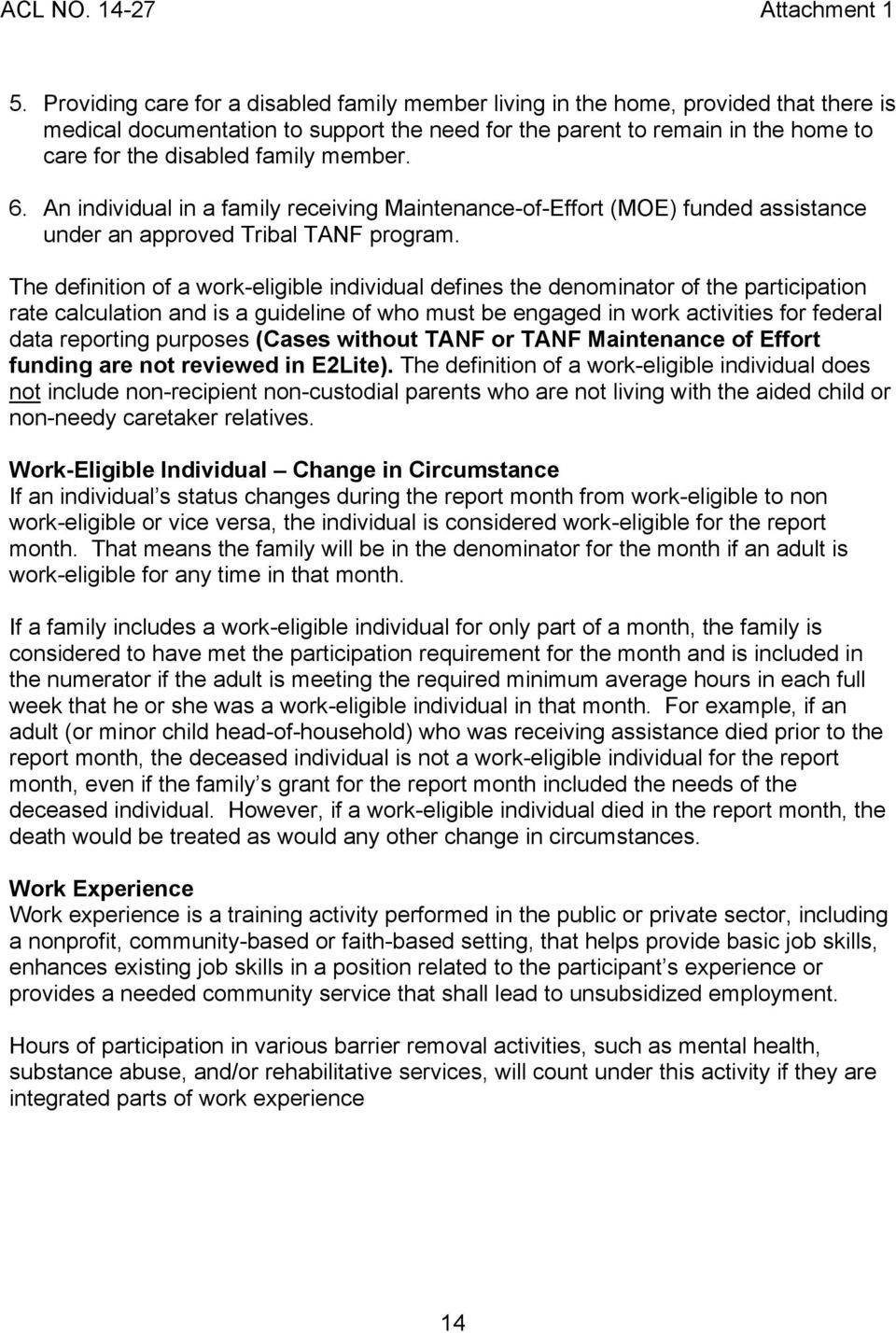
18 ACL NO Attachment 1 5. Providing care for a disabled family member living in the home, provided that there is medical documentation to support the need for the parent to remain in the home to care for the disabled family member. 6. An individual in a family receiving Maintenance-of-Effort (MOE) funded assistance under an approved Tribal TANF program. The definition of a work-eligible individual defines the denominator of the participation rate calculation and is a guideline of who must be engaged in work activities for federal data reporting purposes (Cases without TANF or TANF Maintenance of Effort funding are not reviewed in E2Lite). The definition of a work-eligible individual does not include non-recipient non-custodial parents who are not living with the aided child or non-needy caretaker relatives. Work-Eligible Individual Change in Circumstance If an individual s status changes during the report month from work-eligible to non work-eligible or vice versa, the individual is considered work-eligible for the report month. That means the family will be in the denominator for the month if an adult is work-eligible for any time in that month. If a family includes a work-eligible individual for only part of a month, the family is considered to have met the participation requirement for the month and is included in the numerator if the adult is meeting the required minimum average hours in each full week that he or she was a work-eligible individual in that month. For example, if an adult (or minor child head-of-household) who was receiving assistance died prior to the report month, the deceased individual is not a work-eligible individual for the report month, even if the family s grant for the report month included the needs of the deceased individual. However, if a work-eligible individual died in the report month, the death would be treated as would any other change in circumstances. Work Experience Work experience is a training activity performed in the public or private sector, including a nonprofit, community-based or faith-based setting, that helps provide basic job skills, enhances existing job skills in a position related to the participant s experience or provides a needed community service that shall lead to unsubsidized employment. Hours of participation in various barrier removal activities, such as mental health, substance abuse, and/or rehabilitative services, will count under this activity if they are integrated parts of work experience 14
19 ACL NO Attachment 2 GENERAL INFORMATION ON REPORTING AND DOCUMENTING TEMPORARY ASSISTANCE FOR NEEDY FAMILIES (TANF) WORK PARTICIPATION This information provides additional clarification about reporting actual hours and documenting and verifying participation in TANF work activities. These instructions are consistent with the instructions provided to county and state staff that collect data for federal data reporting (via the Research and Development Enterprise Project) submitted to the federal Administration for Children and Families (ACF) and used to calculate the statewide federal work participation rates. In addition, they are consistent with the federal regulations released on February 5, 2008, and California s Work Verification Plan (WVP), which was approved by ACF effective September 1, Actual Hours of Participation Federal data reporting regulations require reporting, documentation and verification of actual hours of participation. Therefore, since these reporting instructions are meant to be consistent with federal instructions, counties are required to report actual hours of participation in all activities. Counties are encouraged to report all actual hours of participation for all individuals even when it is believed the individuals will not meet participation requirements. To ensure accurate reporting of all data for all sampled cases, each case must be reviewed on a case-by-case basis regardless of the identified aid code, to determine if the case received TANF assistance, whether the case contains work eligible individuals and other characteristics of the case. Quality of Participation Data To ensure accurate and consistent reporting of hours of participation, and to comply with federal regulations and guidance, the California Department of Social Services (CDSS) Federal Data Reporting and Analysis Bureau (FDRAB) continues to recommend the following guidelines for federal data reporting purposes: Actual hours, including those verified through the Work Number and other third party verifications (through the Income and Eligibility Verification System [IEVS], etc.), continue to be the source of the most accurate and acceptable means of reporting hours of participation in any activity. Actual hours of work may be documented and verified during the eligibility process, if reported, using the Semi-Annual Reporting (SAR 7 form) process, and/or other records in the case file or employer reports. Evidence must be submitted with the SAR 7 form, which is signed by the head-of-household under penalty of perjury, to document and verify the reported information. 1

20 ACL NO Attachment 2 Projection of employment hours for up to six months based on actual hours reported on the SAR 7 form and/or other employer-issued documentation continues to be the next most accurate and acceptable method of reporting hours of work participation. When actual hours for any activity are not available in the case file, or if clarification is needed, the county will seek the hours of participation from the recipient. If the information is not available from the recipient, the county shall work with the individual to obtain the information by placing a phone call to the employer/service provider or sending a letter to verify the participant s hours of participation. Any such communication must include the participant s name, the name of the employer, work site supervisor or other service provider, the number of hours and the name and phone number of the person verifying the hours. Documentation and verification must be maintained in the case file. If, after pursuing the steps described above, the actual hours cannot be determined, or are not available for hours of employment, and the monthly salary and hourly wage are available, the county may divide the salary by the hourly wage to determine the number of hours per month worked. This monthly number of hours is then divided by 4.33 and then rounded to the nearest whole number to determine the average number of hours per week of participation. If the hourly wage is unattainable or is unknown, minimum wage cannot be used to determine weekly hours of participation. Deeming of Work Experience Hours, Community Service Hours and School Attendance Hours Deemed hours of participation are automatically calculated and applied when processed by the FDRAB in a batch process. The appropriate hours will appear on the monthly data reconciliation files that are distributed to each county. When appropriate, only actual hours of participation should be entered into Enterprise II Lite (E2Lite). Documentation of Hours of Participation in Case File Generally, the actual hours of participation may be documented and verified during the eligibility process using information reported through the SAR process and/or other records in the case file. Recipient eligibility and benefits for the quarter are based on information provided through the SAR process. In general, evidence must be submitted during the SAR process to verify the reported information. Participants are responsible for making available to the county welfare department (CWD) all documents in their possession or available to them that are needed to verify reported income as well as the date of receipt. Evidence of income may include pay stubs that report hours of employment or other employer-produced documents that support the individual s work hours. If the information necessary to document and verify actual hours is not in the case file, the CWD should seek documentation and verification from the recipient. If the information is not available from the recipient, the county shall provide the recipient assistance in obtaining the information by placing a phone call to the employer or sending a letter to verify the participant s work hours, then documenting the 2

21 ACL NO Attachment 2 communication including the participant s name, the name of the employer, work site supervisor or other service provider, the number of hours and the name and phone number of the person verifying the hours. Documentation of hours of participation must be maintained in the case file. Third-party sources of employment information, such as Income Eligibility Verification System (IEVS), may be accessed when additional employment verification is necessary. Prior to counting these hours, the information from these or other third-party sources must be verified through collateral contact as described above. The Work Number is also a resource that can be used by counties to verify employment. Counties are permitted to use the information obtained from this source in the same manner as they would use information provided by the employer. Therefore, no further verification of employment is necessary when using The Work Number. Please refer to All County Letter for further information on The Work Number. Case records are required to be retained for three years or longer, if any litigation, claim, negotiation, audit or other action involving the records has been started before the expiration of the three-year period. The retention period extends until completion of the action and resolution of all issues which arise from it, or the three-year period, whichever is later. Excused Absences in Unpaid Work Activities Each work-eligible individual engaged in unpaid work activities is allowed excused absences. These absences include ten state holidays as well as 80 hours of additional excused absences during the preceding 12 month period. The following state holidays are allowed as excused absences: New Year s Day, Martin Luther King, Jr. Day, President s Day (Washington s Birthday), Memorial Day, Independence Day, Labor Day, Veterans Day, Thanksgiving, Day after Thanksgiving and Christmas Day. In addition, 80 hours of excused absences, not more than 16 hours per month, are allowed for semester breaks, planned work shutdowns, school appointments, medical appointments for self or dependents, caseworker appointments, childcare breakdown, own illness or child illness, family problems including domestic abuse issues, housing issues, transportation breakdown and other similar problems. In order to count an excused absence as actual countable hours of participation, the individual must have been scheduled to participate in the countable activity for the period of the absence that is reported as participation. Documentation and verification of excused absences must be maintained in the case file. 3
22 ACL NO Attachment 2 Excused Absence and Holiday Hours Rounding in Unpaid Work Activities To ensure consistency with federal data reporting requirements, round excused absence and holiday hours in unpaid work activities independently from the corresponding activity hours before combining the data into E2Lite. For example, if a participant has eight excused absence hours, eight holiday hours and 120 hours of vocational education training (VocEd) for a sample month, the average weekly hours* entered for VocEd would be calculated as follows: 8 excused absence hours / 4.33 = 1.85 (2 avg. weekly hours rounded) 8 holiday hours / 4.33 = 1.85 (2 avg. weekly hours rounded) 120 VocEd hours / 4.33 = (28 avg. weekly hours rounded) Sum of rounded avg. weekly hours = 32 avg. weekly hours entered into E2L * Please see the Participation: Calculating Average Weekly Hours section for additional information about average weekly hours and rounding. Fair Labor Standards Act (FLSA) Deeming for Work Experience and Community Service Since the FLSA applies to participation in work experience and community service, these participants are considered employees. The maximum allowable number of hours of participation per month for such participants is determined by combining the California Work Opportunity and Responsibility to Kids (CalWORKs) grant for the assistance unit (AU) with the assistance unit s portion of CalFresh, federally known as the Supplemental Nutrition Assistance Program (SNAP), allotment for the sample month then dividing the total by the state or federal minimum wage, whichever is higher. All members of the AU (family) cannot be required to participate in work experience or community service more than the number of hours during the month. Under specific circumstances, ACF allows families determined by that calculation to meet core requirements, even when the actual hours are not sufficient to meet the core requirements. If an individual happens to participate for more than the calculated number of FLSA hours, then the excessive hours must not be reported under the activity. Instead, they must be reported in the Other Work Activities category. In-Kind Income The data reporting instructions already provide counties discretion to count these activities under whichever federal work activity best meets the definition of the work. Federal regulations require states to define all work-related activities and require actual hours be reported, documented and verified. If the county has determined, after reviewing the duties associated with the in-kind activity, that participation in this type of activity will assist the individual in attaining 4
23 ACL NO Attachment 2 self-sufficiency and has included the in-kind income activity in the individual s welfare-to-work plan; the hours of participation may be counted under the appropriate activity. These hours should be readily identifiable, on an ongoing basis, through the review of the duties, as well as discussions with the recipient and monitoring of the individual s participation to determine his or her compliance with CalWORKs welfare-to-work requirements. Only when these requirements are met, can the hours reported by the recipient be verified by the case manager by comparing the information to determine if the hours appear to be reasonable. Actual hours of employment may not be obtainable from the employer, but certainly can be obtained from the recipient and verified by the case manager. Limits on Counting Job Search and Job Readiness Assistance Job search and job readiness activities are limited to no more than four consecutive weeks and up to six weeks total in the preceding 12 month period. The six-week limit is based on the average number of hours per week required for a family to count in the overall participation rate. Thus, the six-week limit equates to 120 hours and 180 hours, respectively. For the limit of no more than four consecutive weeks, a week is seven consecutive days and is not converted to hours. Reporting any hours in a week uses a week of participation. A full week of participation may be calculated based on the average daily hours for three or four days. The average hours of participation during three or four days may be applied to the remaining one or two days in the week to determine the total hours for a week. This calculation is one of the only exceptions to reporting actual hours and its use is limited to once in a 12 month period. If this provision is used, the case file must indicate that weekly hours were based on the average number of hours for three or four days. Example of Hourly Equivalent to the Six-Week Limit on Counting Participation in Job Search and Job Readiness Assistance An individual with a 20-hour requirement participates in job search and job readiness assistance for five hours per week and in work experience for 15 hours per week. The participation continues for six months. The 20 hours of job search and job readiness assistance participation from the first four weeks (five hours per week for four weeks) can be counted during the first month thus using only one time-limited week instead of four. At that pace, the six weeks (120 hours) could be stretched to 30 weeks over the preceding 12 month period, keeping in mind that every fifth consecutive week of job search and job readiness assistance hours cannot be counted. 5
24 ACL NO Attachment 2 Example of the Four-Consecutive-Week Limit on Counting Job Search and Job Readiness Assistance Hours A county begins reporting hours for an individual on March 3. All the job search and job readiness assistance hours from March 3 through March 9 would be counted as part of the first week. Hours from March 10 through March 16 would be counted as part of the second consecutive week, and hours from March 17 through 23 would be counted as part of the third consecutive week. After March 30, hours for the individual could not be counted for the next seven consecutive days. Beginning on April 7, job search and job readiness assistance hours could again be counted. For those months when California either (1) has an unemployment rate at least 50 percent greater than the unemployment rate of the United States or (2) meets the definition of a needy state, the limit on an individual s participation in job search and job readiness assistance may be increased from six weeks to a maximum of 12 weeks in the preceding 12 month period. Any increase in the maximum number of weeks of job search and job readiness assistance is permitted only on a case-by-case basis and only for months when California meets the above criteria. It is important to note that the determination of whether a state meets the criteria is made late in the month following the month of qualification. Refer to the following ACF website for information on whether California qualifies for counting these additional weeks on a monthly basis: Participation: Calculating Average Weekly Hours As described in All County Information notice I-62-12, if a family receives assistance for only part of a month, an adult in the family must be engaged in work for the minimum average number of hours in each full week that the family receives assistance in that month to be counted as meeting the work participation requirement for that month. A week begins the day the aid is approved (the effective beginning date of aid in the same report month) and ends seven days later. If aid is granted for a retroactive reporting period (the month prior to approval), the family is only required to be included in the sample or required to meet the hourly work participation requirements during the month of payment, the month in which assistance was received. A retroactive payment made during a review month does not create a work requirement for a family that was not assisted during the review month. The following guidance can be used to calculate hours of participation in TANF work activities. The calculation described in this guidance is consistent with federal TANF data reporting regulations and instructions. 6
25 ACL NO Attachment 2 Work-eligible individuals are the only family members who are required to participate in TANF activities. If the family has no work-eligible individual, then there are no participation requirements for the family. Months of Full TANF Assistance and Participation A family with a work-eligible individual must be engaged in work for the minimum required average number of hours in each full week for which the family receives assistance in that month to be counted as meeting the work participation requirement for the month. Federal data reporting regulations require reporting, documentation and verification of actual hours of participation. To calculate the average number of hours per week of actual participation in a work activity, add the total number of actual participation hours for the month and then divide the total monthly hours by 4.33, which is the average number of weeks per month in a calendar year. If necessary, round to the nearest whole number. The required number of average weekly hours does not change based upon partial assistance or partial participation. What does change is the method for calculating the average weekly hours of actual participation. Months of Partial TANF Assistance Required Number of Hours During the first or last month of any spell of assistance, a family may happen to receive assistance for only part of the month. If a family receives assistance for only part of a month, a work-eligible individual in the family must be engaged in work for the minimum required average number of hours in each full week for which the family receives assistance in that month to be counted as meeting the work participation requirement for that month. Actual Number of Hours If a family receives assistance for only part of the month, the average weekly hours are computed by dividing the total number of actual participation hours for the month by the number of full weeks for which the family received assistance in the month. If necessary, round to the nearest whole number. In the case when the assistance is for fewer than seven days, the hours should not be averaged. The total hours over all of the days for which the family was aided should be reported. Months of Partial TANF Participation Required Number of Hours Any time during a spell of assistance, a family may participate for only part of the month. If a family participates for only part of a month, a work-eligible individual in the family must be engaged in work for the minimum required average number of 7
26 ACL NO Attachment 2 hours in each full week for which the family receives assistance in that month to be counted as meeting the work participation requirement for that month. Actual Number of Hours If a family is aided for the entire month, but the individual only participates for part of the month, the average weekly hours are computed by dividing the total number of actual participation hours for the month by 4.33, which is the average number of weeks per month in a calendar year. If necessary, round to the nearest whole number. Examples of Determining the Average Weekly Hours of Actual Participation Example 1 TANF Family Receives Less Than a Full Week of Assistance A family applies for assistance in late October. After being approved, the family receives a grant for the final four days of the month. The single work-eligible parent worked for six hours on each of the four days. The number of hours of participation should be reported as 24 (six hours multiplied by four days, without averaging). Example 2 Work-Eligible Individual(s) Participated for Less Than a Full Month A family receives aid for the entire month of October. The single work-eligible parent began participating on weekdays only for eight hours a day beginning October 12 th and ending on the 24 th. The number of hours of participation should be reported as 17 (eight hours multiplied by 9 days, divided by 4.33 weeks, rounded up). Example 3 TANF Recipient is Work-Eligible for Less Than a Full Month A family receives aid for the entire month of October during which time the parent participates four hours per weekday. From October 1st through 15th, the parent is a work eligible individual. From October 16th through 31st, the parent is not work eligible. The number of hours of participation should be reported as 22 (four hours participated per day multiplied by 11 days participated as a work eligible individual, divided by two weeks as a work-eligible individual). Projection of Hours Semi-Annual Reporting (SAR) Please note: The SAR System was fully implemented on October 1, The projection of hours calculation is limited to a maximum of six months. The ACF approved California s updated WVP, effective September 1, 2013 to allow the six month projections in California. Projections of hours for up to six months is allowed based on the SAR, Annual Reporting (AR) or actual monthly hours. The link for the ACL 12-25, dated May 17, 2012 describes the SAR system: 8
27 ACL NO Attachment 2 Annual Reporting (AR) The AR provisions of state SB 1041, took effect October 1, Projections of hours for these cases are limited to a six month projection period similar to the SAR projection process below. If a case is sampled after a six month projection, actual data are required to report or make further projections of hours. The link for ACL 12-49, dated September 27, 2012 describes the AR system: Monthly hours of participation in subsidized and unsubsidized employment may be projected for up to six months based on the most current, documented and verified actual hours. This information may be obtained using pay stubs and/or information reported through the most recent SAR process and/or other data sources such as employer reports and time and attendance records. Like reporting all hours of participation for employment, in order to project hours, the actual hours must be available or the total income and the hourly wage must be available. When projecting, the most recent report on hours of participation must be used for any of the six future months. If the actual hours of participation for a particular month are known, there is no need to project hours for that month. Under no circumstances may hours of participation from a current month be used to project hours for a past month (retroactively). In addition, hours of participation for a current month may not be used to project beyond the next six month period. If actual hours of participation from a single calendar month are the most current, verified and documented, these hours may be used for projection purposes. The county must accurately determine the actual hours worked in the single calendar month if pay stubs, etc., cross into multiple months. If any updated hours for the sample month are reported, projections must be recalculated. There are two exceptions in which actual hours from more than a single month may be used to project hours of participation in these activities. These exceptions are: If the actual hours of participation from income reported on the SAR 7, which was used to determine the family s grant for the next six months, had hours and income received from two months, those same hours can be used to project hours of participation for up to six months. If any changes to the actual hours are reported, the projected hours must be recalculated based on the most recent report of hours. Example: SAR 7 report month for February is submitted to the county in March and contains 100 actual hours of participation for the income received in February. The case has been pulled in the May sample and no additional hours of participation have been reported for any individual in the family. The SAR 7 hours (100 hours) can be used to project hours for May. (100 hours divided by 4.33 = 23 (rounded) hours per week of participation). 9
28 ACL NO Attachment 2 In March, if the hours of participation increase to 120 hours, the projected hours that were reported for May must be recalculated. 120 divided by 4.33 = 28 (rounded) hours of participation for May. Documentation and verifications must be maintained in the case file. Example note: The February SAR 7 is used to determine eligibility for the April- September six month period. The hours reported on the February SAR 7 may be used for or projected for cases that come up for review in the next six months respectively (April-September). The hours may not be used or projected for case reviews in March or any month after the projected period. If an individual starts a job after the last SAR 7 information has been reported for the family, only two consecutive weeks of hours of participation may be used, even if the hours of participation cross months. These hours are converted to monthly hours by multiplying the total hours for the two-week period by 2.17 and dividing that amount by If the county has more than two consecutive weeks of hours for new employment, additional reporting may be required to ensure all the actual hours worked for the month have been reported, documented and verified. If a county has actual hours of participation for the report month, no projection is necessary and the total hours of employment for the month are divided by 4.33 to obtain the average number of hours per week for that month. Example using two consecutive weeks: Hours of participation are submitted to the county in March. The most recent pay stub reflects hours of participation for two consecutive weeks of pay (50 hours); one week in February (24 hours), and one week in March (26 hours). These hours may be used to project hours for the month of March (the sample month) as well as the April-September six month period if no additional hourly information is available. The actual hours for the two consecutive weeks (50 hours) are multiplied by 2.17 and the product is divided by 4.33 to determine the average weekly hours of employment for the month; round the final result to the nearest whole number. 50 hours multiplied by 2.17 then divided by 4.33 = 25 (rounded) hours per week of participation. School Attendance Teen parent heads-of-household or spouses without a high school diploma who are properly enrolled in secondary school or its equivalent and are satisfactorily attending classes may be considered both making satisfactory progress and participating. The county should report the actual number of participant hours and if the actual number is not sufficient to meet the hourly requirement, 20 core hours will be deemed in the calculation of the county s rate. These individuals must make good or satisfactory progress, which may include, but is not limited to, performance, attendance, and/or completion timeframes under the standards of the institution or program. These determinations must be documented in the case file. 10
29 COUNTY WORK PARTICIPATION RATE (WPR) DATA ELEMENTS AND INSTRUCTIONS The county WPR survey questions and accompanying instructions are based on the final Temporary Assistance for Needy Families (TANF) regulations released on February 5, 2008, the federal data reporting requirements and California s Work Verification Plan approved by the federal Administration for Children and Families (ACF) effective September 1, The data elements and instructions are required for reporting data in the Enterprise II Lite (E2L) survey tool or the E2L Automated (E2LA) tool. In order for hours of participation to count toward the WPR, the county must document and verify the participation hours. In addition, that documentation and verification must be maintained in the individual s case file. The documentation should include the participant s name; the name of the employer, work site supervisor or other service provider; the number of hours; and the name and phone number of the person verifying the hours. Consistent with ACF s current practice, data for cases can be resubmitted during the federal fiscal year if additional participation information and the appropriate documentation and verification for the review month become available after initial submission. Please refer to the E2L User Manual for additional information on re-submitting data. Case Information 1. Did the assistance unit receive TANF assistance for the review month? Enter yes if the assistance unit (AU) received TANF assistance in the review month, even if it is later determined to be an overpayment. This would also include a grant for which a check is not issued because it is less than $10 or because of a penalty or sanction. Foster Care and Kinship Guardianship Assistance Payments (Kin-GAP) are not considered TANF assistance. A newly approved case granted aid retroactively for a prior month should be excluded if no assistance was received in the sample month. If yes, this case may be included in the calculation in one or both of the participation rates. If no the survey is complete and this case will not be included in either of the participation rate calculations and no further data collection is necessary. 2. If yes to #1, was the head-of-household a work-eligible member of the assistance unit in the review month?
30 A work-eligible individual is an adult (or minor head-of-household) receiving assistance under TANF or a Separate State Program or a non-recipient parent living with a child receiving such assistance unless the parent is: A minor parent and not the head-of-household. A non-citizen who is ineligible to receive assistance due to his or her immigration status. On a case-by-case basis, a recipient of Supplemental Security Income (SSI) benefits. On a case-by-case basis, a recipient of Social Security Disability Insurance (SSDI) benefits. Providing care for a disabled family member living in the home provided that there is medical documentation to support the need for the parent to remain in the home to care for the disabled family member. An individual in a family receiving Maintenance of Effort (MOE)-funded assistance under an approved Tribal TANF program. An applicant for SSI or SSDI is work-eligible. However, once the individual is approved for SSI or SSDI benefits, he or she is no longer considered to be work-eligible. In these instances, prior reported work eligibility information should be reviewed and revised, if necessary, to indicate the individual is no longer work-eligible. Please note that responses to questions may need to be modified if an individual s work-eligible status is changed. Enter yes if the head-of-household meets the definition of a work-eligible individual. If the head-of-household does not meet the definition of a work-eligible individual, enter no. 3. If yes to #2, enter the date of birth for the head-of-household. Enter the eight-digit code for date of birth for the adult (or minor child head-of-household) in the format MMDDYYYY. If the county is using the Comma Separated Values (CSV), the format must be MM/DD/YYYY. 4. Did the head-of-household participate in any work activities in the review month? If yes, enter yes and provide the average number of hours per week of participation during the review month in the appropriate work activity(ies) below. If the head-ofhousehold did not participate during the review month enter no. 2
31 For each work activity (below) in which a work-eligible individual participates, determine the average of the actual hours of participation for each week in the report month. To do this, add the number of actual hours for the month and divide by 4.33, then round to the nearest whole number. Enter the average hours per week for each activity. Counties must document and verify all actual participation, excused absences and holidays in each work activity and identify the source of the documentation (in questions #29, #56 and #83). The documentation and verification must be maintained in the case file. 5. Unsubsidized Employment Unsubsidized employment is full-time or part-time employment in the public or private sector that is not subsidized by TANF or any other public program. Unsubsidized employment includes self-employment as well as recipients whose employers claim a tax credit for hiring economically disadvantaged workers. Only the hours that are paid by the employer are counted as unsubsidized employment. Apprenticeship programs that allow participants to earn money while they practice the trade under the supervision of a journeyperson and attend classes are also considered unsubsidized employment. The determination of whether employment is subsidized, or not, depends on whether the employer, rather than the recipient, receives a subsidy. Net self-employment income is determined by offsetting monthly business expenses, evidenced by receipts submitted by the participant, against monthly gross income from self-employment. Based on current California Work Opportunity and Responsibility to Kids (CalWORKs) eligibility rules, the recipient may choose either actual costs of producing self-employment income or a standard deduction of 40 percent of gross earned income, which will be reported as business expenses for federal data reporting purposes. The number of countable hours is determined by dividing the net self-employment income by the federal minimum wage; divide by 4.33, then round to the nearest whole number. Participants who are not self-employed, but are paid via in-kind; commission only; per-unit; or paid via cash, without a paystub, are still required to report actual hours of employment. Actual hours of employment may not be obtainable from the employer, but certainly can be obtained by the recipient, and verified by the case manager. If the amount of pay as well as the hourly wage is known, the hours reported by the recipient can be verified by the case manager by comparing the information to determine if the hours appear to be reasonable. If the county has determined, after reviewing the duties associated with the in-kind activity, that participation in this type of activity will assist the individual in attaining 3
32 self-sufficiency and has included the in-kind income activity in the individual s welfare-to-work plan, the hours of participation may be counted under the appropriate activity. These hours should be readily identifiable, on an ongoing basis, through the review of the duties, as well as discussions with the recipient and monitoring of the individual s participation to determine his or her compliance with CalWORKs welfare-to-work requirements. Only when these requirements are met, can the hours reported by the recipient be verified by the case manager by comparing the information to determine if the hours appear to be reasonable. Actual hours of employment may not be obtainable from the employer, but certainly can be obtained from the recipient and verified by the case manager. Hours of participation in various barrier removal activities, such as mental health, substance abuse, and/or rehabilitative services, can count under this activity if they are integrated parts of unsubsidized employment. Individuals must be paid for all of the hours they participate in such activities that are counted as unsubsidized employment. If the individuals are not paid while participating in these activities, the participation will be reported as another appropriate activity such as job search and job readiness assistance. Enter the weekly average of the actual number of hours of participation in the month. 6. Subsidized Private Sector Employment Subsidized private sector employment means employment in the private sector for which the employer receives a subsidy from TANF or other public funds to offset some or all of the wages and costs of employing a work-eligible individual. Subsidized work may include: (1) work supplementation where TANF funds that would otherwise be paid as assistance are paid to the employer or to a third-party contractor, like a temporary staffing agency, which serves as the employer of record and is paid a fee to cover salary, expenses and success in placing employees; (2) supported work for individuals with disabilities in an integrated setting; (3) work study activities; or (4) paid barrier removal and educational activities. Only the hours that are paid by the employer are counted as subsidized employment. Subsidized employment is distinguished from work experience in that the participant in subsidized employment is paid wages and receives the same benefits as an employee with no subsidy who performs similar work. Enter the weekly average of the actual number of hours of participation in the month. 7. Subsidized Public Sector Employment Subsidized public sector employment means employment in the public sector for which the employer receives a subsidy from TANF or other public funds to offset some or all of the wages and costs of employing a work-eligible individual. Subsidized work may include: (1) work supplementation where TANF funds that 4
33 would otherwise be paid as assistance are paid to the employer or to a third-party contractor, like a temporary staffing agency, which serves as the employer of record and is paid a fee to cover salary, expenses and success in placing employees; (2) supported work for individuals with disabilities in an integrated setting; (3) work study activities; or (4) paid barrier removal and educational activities. Only the hours that are paid by the employer are counted as subsidized employment. Subsidized employment is distinguished from work experience in that the participant in subsidized employment is paid wages and receives the same benefits as an employee with no subsidy who performs similar work. Enter the weekly average of the actual number of hours of participation in the month. 8. Work Experience Work experience is a training activity performed in the public or private sector, including a nonprofit, community-based or faith-based setting, that helps provide basic job skills, enhances existing job skills in a position related to the participant s experience or provides a needed community service that shall lead to unsubsidized employment. Core hours shall be limited as follows: When the assistance unit includes CalFresh recipients, federally known as the Supplemental Nutrition Assistance Program (SNAP), all the aided individuals shall participate for no more than the number of hours of each month, determined collectively for the assistance unit, equal to the CalWORKs grant plus the SNAP allotment divided by the state or federal minimum wage, whichever is higher. When the assistance unit does not include CalFresh recipients, all the aided individuals shall participate for not more than the number of hours each month, determined collectively for the assistance unit, equal to the CalWORKs grant divided by the state or federal minimum wage, whichever is higher. When work-eligible individuals are not a member of the assistance unit (not aided), the Fair Labor Standards Act (FLSA) provisions do not apply. Report the actual hours of participation for each of these individuals. If the actual hours of participation in work experience and community service falls short of the family s core hourly requirement but are equal to or greater than the calculated hours, the family will be deemed to have met the core hourly requirement. No more than the number of hours derived from the calculation will be allowed to count toward participation. Hours of participation in various barrier removal activities, such as mental health, substance abuse, and/or rehabilitative services, will count under this activity if they are integrated parts of work experience. 5
34 Enter the weekly average of the actual number of hours of participation in the month including rounded excused absence and holiday hours that are counted as actual participation. Divide actual number of hours of participation by 4.33 to get a weekly average number of hours; round to the nearest whole number. 9. Did the head of household participate for at least the number of hours based on the FLSA calculation required for participation in Work Experience for the All Families rate? If the actual number of hours of participation for this individual in question #8 is equal to or greater than the maximum allowable hours under FLSA rules calculation, enter yes. If not, enter no. Please note: FLSA Deeming rules do not apply to work eligible individuals that are not aided in the AU. Actual hours of participation must be reported for these individuals. If yes, the remaining number of hours needed to meet the core hourly requirement will be deemed. 10. Did the family participate for at least the number of hours based on the FLSA calculation required for participation in work experience for the Two-Parent rate? If the actual number of hours of participation for the family in question #8 is equal to or greater than the maximum allowable hours under the FLSA rules calculation, enter yes. If not, enter no. Please note: FLSA Deeming rules do not apply to work eligible individuals that are not aided in the AU. Actual hours of participation must be reported for these individuals. If yes, the remaining number of hours needed to meet the core hourly requirement for the family will be deemed. 11.On-The-Job Training On-the-job training is training in the public or private sector that is given to a paid employee while he or she is engaged in productive work. On-the-job training provides knowledge and skills essential to the full and adequate performance of the job. The employer is subsidized to offset training costs. Supported work may be counted as on-the-job training if it includes significant training in the skills and knowledge essential to job performance. On-the-job training may also include orientation and classroom instruction required by the recipient s employer and/or case manager. In some instances, training (e.g., tax preparation) or continuing education (e.g., nursing) is a necessary and regular element of employment. Only the hours that are paid by the employer are counted as on-the-job training. 6
35 On-the-job training may include participation in these types of activities when the individual is reimbursed for the training costs. When the individual is not reimbursed for training costs, the participation counts as job skills training directly related to employment, education directly related to employment, vocational education training or job search/job readiness assistance, as appropriate. Enter the weekly average of the actual number of hours of participation in the month. 12. Job Search and Job Readiness Assistance Job search is an activity in which the participant s principal activity is to prepare for or seek employment. Job search includes looking for suitable job openings, making contact with potential employers, applying for vacancies and interviewing for jobs. Job readiness assistance is an activity that provides the recipient with training to learn basic job seeking and interviewing skills, to understand employer expectations, and to learn skills designed to enhance an individual s capacity to move toward selfsufficiency. Job readiness assistance also comprises the following activities: a. Preparing an individual to obtain or retain employment, such as preparing a résumés or job application, interviewing skills, instruction in work place expectations and life skills training. b. Substance abuse treatment, mental health treatment or rehabilitation activities. Treatment or rehabilitation services can include residential treatment, group or individual therapy, or participation in support groups such as Alcoholics Anonymous and Narcotics Anonymous. c. On a case-by-case basis, domestic abuse services that address barriers to employment. Treatment and services for domestic abuse victims include the following activities when needed to seek or prepare for employment: individual counseling of the participant and children; group counseling; substance abuse services; medical and public health services; mental health services; independent living skills; and financial planning and life skills training. The criteria professionals use for assigning individuals to these services is that the services must be necessary to prepare an individual to obtain or maintain employment or to participate in welfare-to-work (WTW) activities and must be verified and documented in the WTW plan and/or case file. If a portion of the treatment or rehabilitation activities meets a common-sense definition of another work activity, such as community service or work experience, then the hours associated with the work will count under that activity and the actual treatment hours will count in job search and job readiness assistance. 7
36 d. Drug testing for a specific job classification and taking tests to qualify for specialized certificates. These activities are assigned to the extent that they are determined necessary for the participant to obtain or prepare for employment or to participate in other WTW activities. e. Participation in orientation, appraisal or assessment. Orientation is an introduction to the WTW program, including a general description of CalWORKs activities, participation requirements, consequences for failing to meet requirements, available supportive services and exemptions from participation. Appraisal is an evaluation of an individual s employment history and skills, necessary supportive services, and any other relevant information needed to assign an individual to WTW activities, as well as informing the individual of his or her rights and responsibilities pertaining to the program. Assessment is a thorough individual review of the recipient s work history, employment skills, educational history, competency levels, need for supportive services, physical limitations or mental conditions, available resources, all in comparison to the local labor market conditions, in order to complete a WTW plan. f. Time spent online in distance learning activities. Online tasks could include searching for job vacancies, submitting résumés and completing applications. Hours spent in these activities are verified and documented in the WTW plan. Job interviews may be obtained from participating in this activity. Reasonable transportation time between job interviews, but not to the first interview or from the last one of the day, will count toward job search and job readiness hours. A county may require additional documentation of activities, which may include such documents as job contact logs that provide sufficient information to verify the job search activity, mileage logs or other documentation and verification, which must be included in the case file. Job search and job readiness activities are limited to no more than four consecutive weeks and up to six weeks total in the preceding 12 month period. The six-week limit is based on the average number of hours per week required for a family to count in the overall participation rate. Thus, the six-week limit equates to 120 hours and 180 hours, respectively. For the limit of no more than four consecutive weeks, a week is seven consecutive days and is not converted to hours. Reporting any hours in a week uses a week of participation. Refer to Attachment 2, under Limits on Counting Job Search and Job Readiness Assistance, for more information. 8
37 If participation in other federally-allowable activities meets or exceeds the hourly participation requirement, then the hours of participation in job search and job readiness assistance will not be counted toward the four-week or six-week limit. A full week of participation may be calculated based on the average daily hours for three or four days. For this calculation, a week is five days. The average hours of participation during three or four days may be applied to the remaining one or two days in the week to determine the total hours for a week. This calculation is the only exception to reporting actual hours and its use is limited to once in a 12 month period. If the calculation is used, the case file must indicate that weekly hours were based on the average number of hours for three or four days. For those months when California either (1) has an unemployment rate at least 50 percent greater than the unemployment rate of the United States or (2) meets the definition of a needy State, the limit on an individual s participation in job search and job readiness assistance may be increased from six-weeks to a maximum of 12 weeks in the preceding 12 month period. Any increase in the maximum number of weeks of job search and job readiness assistance is permitted only on a case-by-case basis and only for months when California meets the above criteria. It is important to note that the determination of whether a state meets the criteria is made late in the month following the month of qualification. If, at that time, it is discovered that weeks of job search and job readiness assistance were incorrectly counted, the participation rate data must be adjusted for the month. Refer to the following ACF website for information on whether California qualifies for counting these additional weeks on a monthly basis: Enter the weekly average of the actual number of hours of participation in the month, including rounded excused absence and holiday hours that are counted as actual participation. 13. Of the hours reported in question #12, how many hours of participation were in mental health services? If a portion of the treatment meets a common-sense definition of another work activity, such as community service or work experience, then the hours associated with the work will count under that activity and the actual treatment hours will count in job search and job readiness assistance. Enter the weekly average number of hours the individual participated in mental health services even if the number of hours in question #12 was zero, which could occur due to exceeding the four-week or six-week (hourly) limit for participation in job search and job readiness assistance. These hours are reported for Pay-for-Performance purposes. 9
38 14. Of the hours reported in question #12, how many hours of participation were in substance abuse services? If a portion of the treatment meets a common-sense definition of another work activity, such as community service or work experience, then the hours associated with the work will count under that activity and the actual treatment hours will count in job search and job readiness assistance. Enter the weekly average number of hours the individual participated in substance abuse services even if the number of hours in question #12 was zero. These hours are reported for Pay-for-Performance purposes. 15.Of the hours reported in question #12, how many hours of participation were in domestic violence services? If a portion of the treatment meets a common-sense definition of another work activity, such as community service or work experience, then the hours associated with the work will count under that activity and the actual treatment hours will count in job search and job readiness assistance. Enter the weekly average number of hours the individual participated in domestic violence services even if the number of hours in question #12 was zero. These hours are reported for Pay-for-Performance purposes. 16. Community Service Programs Community service is a training activity that is temporary and transitional, is performed in the public or private nonprofit sector, and provides participants with basic job skills that can lead to employment while meeting a community need. Other activities may be included within the community service programs. In these situations, short-term training or equivalent activities are included if they are of limited duration (usually no longer than six months) and are necessary for participation in the community service activity. Participation in self-initiated community service programs is permitted as long as the activity is temporary and transitional, is performed in the public or private nonprofit sector, provides basic job skills that may lead to employment while meeting a community need and is approved by the County Welfare Department (CWD). The CWD approves self-initiated community service programs that are appropriate for the participant based on the assessment of the following: The participant s work history and an inventory of his or her employment skills, knowledge and abilities. The participant s educational history and present educational competency level. 10
39 An evaluation of the chances for employment given the current skills of the participant and the local labor market conditions. Core hours shall be limited as follows: When the AU includes CalFresh recipients, federally known as SNAP, all of the aided individuals shall participate for no more than the number of hours of each month, determined collectively for the assistance unit, equal to the CalWORKs grant plus the SNAP allotment divided by the state or federal minimum wage, whichever is higher. When the AU does not include CalFresh recipients, all the aided individuals shall participate for not more than the number of hours each month, determined collectively for the assistance unit, equal to the CalWORKs grant divided by the state or federal minimum wage, whichever is higher. When work-eligible individuals are not a member of the AU (not aided), the FLSA provisions do not apply. Report the actual hours of participation for each of these individuals. If the actual hours of participation in work experience and community service falls short of the family s core hourly requirement but are equal to or greater than the calculated hours, the family will be deemed to have met the core hourly requirement. No more than the number of hours derived from the calculation will be allowed to count toward participation. Enter the weekly average of the actual number of hours of participation in the month including rounded excused absence and holiday hours that are counted as actual participation. Divide actual number of hours of participation by 4.33 to get a weekly average number of hours; round to the nearest whole number. 17. Did the head of household participate for at least the number of hours based on the FLSA calculation required for participation in community service for the All Families rate? If the actual number of hours of participation for this individual in question #16 is equal to or greater than the maximum allowable hours under FLSA rules calculation, enter yes. If not, enter no. Please note: FLSA Deeming rules do not apply to work eligible individuals that are not aided in the AU. Actual hours of participation must be reported for these individuals. If yes, the number of hours needed to meet the core hourly requirement will be deemed. 11
40 18. Did this family participate for at least the number of hours based on the FLSA calculation required for participation in community service for the Two-Parent rate? If the total actual number of hours of participation for the family in question #16 is equal to or greater than the maximum allowable hours under the FLSA rules calculation, enter yes. If not, enter no. Please note: FLSA Deeming rules do not apply to work eligible individuals that are not aided in the AU. Actual hours of participation must be reported for these individuals. If yes, the remaining number of hours needed to meet the core hourly requirement for the family will be deemed. 19. Vocational Education Training For federal data reporting purposes, vocational education training is organized educational programs that are directly related to the preparation of individuals for employment in current or emerging occupations. Vocational education must be provided by vocational-technical schools, postsecondary institutions or proprietary schools. Vocational education training placements are documented on a list developed by each California county. The list, which is revised annually, includes programs that lead to jobs in the local labor market and is used by the CWD to approve vocational education training and/or to assign activities as a result of assessment. For programs not on the county s list, the CWD determines if the program is directly related to job preparation. Basic and remedial education and English as a Second Language (ESL) are counted as part of vocational education training activity on a case-by-case basis when the participant s educational history and present educational competency level assessment shows a need for such activities to be included in the vocational education program for the participant to be successful. For example, Vocational English as a Second Language (VESL) is an embedded activity that allows nonnative English speakers to learn the language that is specific to and necessary for successful performance in a particular vocation. The service provider and/or the recipient s case manager will determine whether the activities are necessary for successful participation. In some instances, the vocational education training is completed as part of distance learning. Participation counts toward vocational education training hours only when the time spent is monitored by the service provider and reported to the CWD. Verification of hours spent in class time must confirm that the individual was enrolled in all the classes for which hours were reported and that the hours of reported class time for the month correspond to the individual s class schedule. For example, if a client provided documentation, such as a time sheet, of 12 hours spent in class time 12
41 for a week, then verification of those hours could include a schedule or printout that shows current enrollment in the educational institution. Actual hours spent in supervised homework time and up to one hour of unsupervised homework time for each hour of class time may be counted. A statement from the educational program indicating the amount of homework required must be included in the case file. Total homework time counted as participation must not exceed the hours required or advised by the educational program. For all homework time, documentation must consist of a time sheet or similar record of actual participation hours signed by the individual verifying the activity and must include the participant s name; the name of the employer, work site supervisor or other service provider; the number of hours; and the name and phone number of the person verifying the hours. This activity has a federal lifetime limit of 12 months beginning December 1, If participation in other federally allowable activities meets or exceeds the hourly participation requirement, then the hours of participation in vocational education training would not count toward the 12 month limit. Before or after the 12 month limit, this activity may qualify as education directly related to employment (if the individual does not have a high school diploma or General Educational Development [GED] certificate) or job skills training directly related to employment only after the core hourly requirement has been met from participation in other core activities. Participation hours in vocational education that do not, alone or when combined with hours of another activity, meet the federal core and overall hourly participation requirements for the family must be reported in Other Work Activities. For purposes of determining if hours should count in this category, two-parent families are considered to be meeting requirements by participating 35 average weekly hours, of which 30 are core hours; single parents with a child under six years old are considered to be meeting requirements by participating 20 average weekly core hours; all other families are considered to be meeting requirements by participating 30 average weekly hours, of which 20 are core hours. Enter the weekly average of the actual number of hours of participation in the month, including rounded excused absence and holiday hours that are counted as actual participation. 20. Job Skills Training Directly Related to Employment For federal data reporting purposes, job skills training directly related to employment is training or education for job skills required by an employer to provide an individual with the ability to obtain employment or to advance or adapt to the changing 13
42 demands of the workplace. The activity may include either customized or general training to prepare an individual for employment, including literacy and language instruction and other remedial education. Job skills training directly related to employment may include four-year bachelor degree programs at any state-certified college or university. Vocational education hours will count under this activity, provided that the core hourly requirement is met through other activities, in order to preserve months in which vocational education is countable as a core activity or to continue education programs beyond the 12 month limit for vocational education. In some instances, the job skills training is completed as part of distance learning. Participation counts toward job skills training directly related to employment only when the distance learning program otherwise meets the definition of job skills training directly related to employment and the time spent online can be monitored by the service provider and reported to the CWD and documented in the case file. Verification of hours spent in class time must confirm that the individual was enrolled in all the classes for which hours were reported and that the hours of reported class time for the month correspond to the individual s class schedule. For example, if a client provided documentation, such as a time sheet, of 12 hours spent in class time for a week, then verification of those hours could include a schedule or printout that shows current enrollment in the educational institution. Actual hours spent in supervised homework time and up to one hour of unsupervised homework time for each hour of class time may be counted. A statement from the educational program indicating the amount of homework required must be included in the case file. Total homework time counted as participation must not exceed the hours required or advised by the educational program. For all homework time, documentation must consist of a time sheet or similar record of actual participation hours signed by the individual verifying the activity and must include the participant s name; the name of the employer, work site supervisor or other service provider; the number of hours; and the name and phone number of the person verifying the hours. Enter the weekly average of the actual number of hours of participation in the month, including rounded excused absence and holiday hours that are counted as actual participation. 21. Education Directly Related to Employment (for head-of-household with no High School diploma or certificate of High School Equivalency) For federal data reporting purposes, education directly related to employment is education related to a specific occupation, job or job offer. The activity is primarily for adults without a high school diploma or certificate of high school equivalency and includes adult basic education, ESL and, where required as a prerequisite for 14
43 employment, education leading to a GED certificate or high school equivalency diploma. Vocational education hours will count under this activity, provided that the core hourly requirement is met through other activities, in order to preserve months in which vocational education is countable as a core activity or to continue education programs beyond the 12 month limit for vocational education. In some instances, the education directly related to employment is completed as part of distance learning. Participation will count toward education directly related to employment only when the distance learning program otherwise meets the definition of the activity and the time spent in distance learning is monitored by the service provider and is reported to the CWD and documented in the case file. Homework time that can be documented and verified may also be counted. Actual hours spent in supervised homework time and up to one hour of unsupervised homework time for each hour of class time may be counted. A statement from the educational program indicating the amount of homework required must be included in the case file. Total homework time counted as participation must not exceed the hours required or advised by the educational program. For all homework time, documentation must consist of a time sheet or similar record of actual participation hours signed by the individual verifying the activity and must include the participant s name; the name of the employer, work site supervisor or other service provider; the number of hours; and the name and phone number of the person verifying the hours. In order to count hours of participation, participants must make good or satisfactory progress as determined by the CWD. In general, attendance, academic performance and completion timeframes may be included in the criteria for good or satisfactory progress. Satisfactory progress is monitored monthly by the CWD and the documentation is verified and maintained in the participant s case file, except for teen parent heads-of-household receiving Cal-Learn services, whose progress are monitored up to four times per school year. Exception: If a participant is not making good or satisfactory progress but is regularly attending, up to two months of participation may be counted for such individual while the county works with the participant to improve his or her participation and progress. A statement that documents this decision must be included in the case file. Enter the weekly average of the actual number of hours of participation in the month, including rounded excused absence and holiday hours that are counted as actual participation. 15
44 22. Satisfactory School Attendance (for head-of-household without a high school diploma or certificate of high school equivalency) For federal data reporting purposes, satisfactory school attendance is regular attendance, in accordance with the requirements of the secondary school or course of study, at a secondary school or in a course of study leading to a certificate of general equivalence, in the case of a recipient who has not completed secondary school or received such a certificate. Satisfactory school attendance is primarily an activity for minor parents and will only include other related educational activities, such as adult basic education or language instruction, when they are required for completion of a GED certificate. Hours of participation attending high school in a vocational education track may be counted under this activity. In addition, case management services are provided to minor parents in this activity. Case management involves directing and coordinating a recipient s educational, health and social services and may include ESL, career training, alternative school, tutoring, dropout prevention and teen pregnancy or parenting programs. The case management programs are essential to this work category in that they address the special social service needs of minor parents. Meeting these specific needs helps this group of recipients attain GED certificate or attend secondary school, which helps minor parents achieve self-sufficiency. In some instances, participation will be completed as part of distance learning and will count toward satisfactory school attendance only when the distance learning program otherwise meets the definition of the activity and the time spent can be monitored by the service provider and is reported to the CWD on a monthly basis. Participants must provide routinely available documentation of school attendance and satisfactory progress. Actual hours of participation are verified using report cards, attendance records and similar documentation made available by the service provider and/or participant and maintained in the case file. Documentation needed to support all the reported hours of participation includes the participant s name; the name of the employer, work site supervisor or other service provider; the number of hours; and the name and phone number of the person verifying the hours. Actual hours spent in supervised homework time and up to one hour of unsupervised homework time for each hour of class time may be counted. A statement from the educational program indicating the amount of homework required must be included in the case file. Total homework time counted as participation must not exceed the hours required or advised by the educational program. For all homework time, documentation must consist of a time sheet or similar record of actual participation hours signed by the individual verifying the activity and must include the participant s name; the name of the employer, work site supervisor or other service provider; the number of hours; and the name and phone number of the person verifying the hours. Case managers who have reason to believe that a participant is not attending school can require that specific documentation and verification be provided more often, as necessary. 16
45 In order to count as hours of participation, participants must make good or satisfactory progress as determined by the CWD. In general, attendance, academic performance and completion timeframes may be included in the standard for good or satisfactory progress. Satisfactory progress is monitored monthly by the CWD and the documentation is verified and maintained in the participant s case file except for teen parent heads of household receiving Cal-Learn services, whose progress is monitored up to four times per school year. Exception: If a participant is not making good or satisfactory progress but is regularly attending, up to two months of participation may be counted for such an individual while the county works with the participant to improve his or her participation and progress. A statement that documents this decision must be included in the case file. Enter the weekly average of the actual number of hours of participation in the month, including rounded excused absence and holiday hours that are counted as actual participation. 23. Providing Childcare for an Individual(s) Participating in a Community Service Program For federal data reporting purposes, providing childcare to an individual participating in community services is providing childcare to enable another TANF recipient to participate in a community service program. The activity does not allow for one parent in a two-parent case to care for their own children in the home while the other participates in activities. In most situations, this activity would be reported as unsubsidized employment. Enter the weekly average of the actual number of hours of participation in the month, including rounded excused absence and holiday hours that are counted as actual participation. 24. Work Activities Other Than Those Specified Above For federal data reporting purposes, other work activities are: (1) actual hours of participation in activities that do not meet the definitions provided above, or (2) actual hours of participation in allowable activities whose hours are not countable toward the participation rates (e.g., job search hours that exceed the four-week, six-week or 12-week [hourly] limit). Participation hours in vocational education, job skills training, or education directly related to employment will be reported in this activity when the client is not meeting the core hourly requirement. Counties are strongly encouraged to report actual hours of participation in other activities. 17
46 Enter the weekly average of the actual number of hours of participation in the month. These hours will not count in the work participation rate. 25. Was the head-of-household a single custodial parent with a child under six years old in the review month? Enter yes, if the head-of-household was a single custodial parent with a child under six years old in the review month. If the head-of-household was not a single custodial parent or did not have a child under six years old, enter no. The child must be under six years old as of the first of the review month. 26. If yes to question #25, was the head-of-household eligible for the federal work disregard for a single custodial parent with a child under 12 months old in the review month? If the head-of-household is a single custodial parent with a child under 12 months of age, the family may be eligible to be disregarded from the rate. The single custodial parent is eligible for a disregard for up to 12 months. This disregard is a cumulative, lifetime limit of 12 months, beginning December 1, 1996, for any single custodial parent, but not necessarily a one-time disregard. If the single custodial parent meets this definition, and did not meet federal participation requirements by participating in the required number of hours in allowable work activities, enter yes. A yes answer may disregard the adult from the work participation rate calculation. If the head-of-household does not meet this definition, has already been disregarded from the rate for 12 months or is meeting participation requirements by participating the required number of hours in allowable work activities, enter no. A no answer will include the adult in the WPR calculation. The age of any child on the first day of the month is the age of the child for the review month. If a child is born on the first day of the month, the family has a child under age one for that month. If a child is born after the first day of the month, the family is not considered to have a child under age one until the subsequent month. For example, a family with a child born on December 1, 2010, will be considered to have a child under age one for the months of December 2010 through November If the child was born on December 5, 2010, then the family would have a child under age one for the months of January through December In both situations, the family will be treated as having a child under age one for twelve months. 27. Was the head-of-household granted a good cause waiver for the Family Violence Option? Enter yes, if the head-of-household was granted a good cause waiver for the Family Violence Option in the review month. If not, enter no. 18
47 28. Is the head-of-household currently not aided due to a CalWORKs WTW sanction? If the head-of-household was sanctioned for noncompliance with the CalWORKs welfare-to-work (WTW) program requirements during the review month, enter yes. If not, enter no. 29. If yes to question #28, has the family been sanctioned more than three months in the preceding 12 month period? Enter no, if both of the following are true: a. The head-of-household was sanctioned in the review month. b. And, the family has not been sanctioned for more than three months in the preceding 12 month period. 1) The total number of months in which any work-eligible adult in the family was granted a work-related sanction must not be greater than three for the preceding 12 months. 2) Multiple adult sanctions in a single month are considered one month of sanction for the family. Otherwise, enter yes. A no response allows the family to be disregarded from one or both of the rate calculations for the review month. In order for a family to be disregarded, at least one (but not every) work-eligible adult in the family needs to be currently sanctioned. In addition, the number of months of sanction for the entire family must be three or fewer months over the preceding 12 months. The answer entered here will also populate question #58 and question # Was the head-of-household verifiably exempt from participation in CalWORKs WTW activities in the review month? If the head-of-household has been provided a CalWORKs WTW exemption according to Manual of Policies and Procedures (MPP) Section , enter yes. If no exemption has been provided and documented in the case file, enter no. This information is for Pay-for-Performance purposes. 31. Case Comments Identify the individual (A1, A2, A3), the work activity, and the verifiable source of documentation for hours of participation that have been reported and documented, such as hours of participation from pay stubs, time sheets, attendance records or similar documentation made available by the service provider and/or participant and maintained in the case file. If applicable, describe or comment on hours of participation entered in question #24. 19
48 Information entered here will appear in question #60 and question #89. Once information is entered in question #60 or question #89 it will also be seen here. 32. Was there another adult in the household who was a work-eligible member of the assistance unit in the review month? A work-eligible individual is an adult (or minor head-of-household) receiving assistance under TANF or a Separate State Program or a non-recipient parent living with a child receiving such assistance unless the parent is: A minor parent and not the head-of-household. A non-citizen who is ineligible to receive assistance due to his or her immigration status. On a case-by-case basis, a recipient of SSI benefit. On a case-by-case basis, a recipient of SSDI benefits. Providing care for a disabled family member living in the home provided that there is medical documentation to support the need for the parent to remain in the home to care for the disabled family member. An individual in a family receiving MOE-funded assistance under an approved Tribal TANF program. An applicant for SSI or SSDI is work-eligible. However, once the individual is approved for SSI or SSDI benefits, he or she is no longer considered to be work-eligible. In these instances, prior reported work eligibility information should be reviewed and revised, if necessary, to indicate the individuals are no longer work-eligible. Please note that responses to questions may need to be modified if an individual s work-eligible status is changed. Enter yes, if the head-of-household meets the definition of a work-eligible individual. If the head-of-household does not meet the definition of a work-eligible individual, enter no. 33. If yes to question #32, enter the date of birth of the adult. Enter the eight-digit code for the date of birth for the adult (or minor child head-of- household) in the format MMDDYYYY. If the county is using the CSV, the format must be MM/DD/YYYY. 34. Does this case meet the definition of a two-parent family? A two-parent family, for federal data reporting purposes, is a family with two 20
49 work-eligible, natural, adoptive parents or a step-parent of the same minor child living in the home, unless both are minors and neither is a head-of-household. However, if one (or both) of the parents is disabled, the family is not considered a two-parent family for federal work participation rate purposes. Consequently, the case is not included in the denominator of the two-parent participation rate. Instead, the case is considered an all-families case and will be included in determining only the county s overall (all-families) work participation rate. Enter yes, if this case should be included in the two-parent rate. Enter no, if this case should not be included in the two-parent rate. The answer to this question will also appear in question # Did the adult participate in any work activities in the review month? If yes, enter yes, and provide the average number of hours per week of participation during the review month in the appropriate work activity(ies) below. If the adult did not participate during the review month, enter no. For each work activity (below) in which a work-eligible individual participates, determine the average of the actual hours of participation for each week in the report month. To do this, add the number of actual hours for the month and divide by 4.33, then round to the nearest whole number. Enter the average hours per week for each activity. Counties must document and verify all actual participation, excused absences and holidays in each work activity and identify the source of the documentation (in questions #29, #56 and #83). The documentation and verification must be maintained in the case file. 36. Unsubsidized Employment Unsubsidized employment is full-time or part-time employment in the public or private sector that is not subsidized by TANF or any other public program. Unsubsidized employment includes self-employment as well as recipients whose employers claim a tax credit for hiring economically disadvantaged workers. Only the hours that are paid by the employer are counted as unsubsidized employment. Apprenticeship programs that allow participants to earn money while they practice the trade under the supervision of a journeyperson and attend classes are also considered unsubsidized employment. The determination of whether employment is subsidized or not, depends on whether the employer, rather than the recipient, receives a subsidy. Net self-employment income is determined by offsetting monthly business expenses, as evidenced by receipts submitted by the participant, against monthly gross income from self-employment. Based on current CalWORKs eligibility rules, the recipient 21
50 may choose either actual costs of producing self-employment income or a standard deduction of 40 percent of gross earned income, which will be reported as business expenses for federal data reporting purposes. The number of countable hours is determined by dividing the net self-employment income by the federal minimum wage; divide by 4.33, then round to the nearest whole number. Participants who are not self-employed, but paid via in-kind; commission only; per-unit; or paid via cash, without a paystub, are still required to report actual hours of employment. Actual hours of employment may not be obtainable from the employer, but certainly can be obtained by the recipient and verified by the case manager. If the amount of pay as well as the hourly wage is known, the hours reported by the recipient can be verified by the case manager by comparing the information to determine if the hours appear to be reasonable. If the county has determined, after reviewing the duties associated with the in-kind activity, that participation in this type of activity will assist the individual in attaining self-sufficiency and has included the in-kind income activity in the individual s welfare-to-work plan, the hours of participation may be counted under the appropriate activity. These hours should be readily identifiable, on an ongoing basis, through the review of the duties, as well as discussions with the recipient and monitoring of the individual s participation to determine his or her compliance with CalWORKs welfare-to-work requirements. Only when these requirements are met, can the hours reported by the recipient be verified by the case manager by comparing the information to determine if the hours appear to be reasonable. Actual hours of employment may not be obtainable from the employer, but certainly can be obtained from the recipient and verified by the case manager. Hours of participation in various barrier removal activities, such as mental health, substance abuse, and/or rehabilitative services, can count under this activity if they are integrated parts of unsubsidized employment. Individuals must be paid for all of the hours they participate in such activities that are counted as unsubsidized employment. If the individuals are not paid while participating in these activities, the participation will be reported as another appropriate activity such as job search and job readiness assistance. Enter the weekly average of the actual number of hours of participation in the month. 37. Subsidized Private Sector Employment Subsidized private sector employment means employment in the private sector for which the employer receives a subsidy from TANF or other public funds to offset some or all of the wages and costs of employing a work-eligible individual. Subsidized work may include: (1) work supplementation where TANF funds that would otherwise be paid as assistance are paid to the employer or to a third-party 22
51 contractor, like a temporary staffing agency, which serves as the employer of record and is paid a fee to cover salary, expenses and success in placing employees; (2) supported work for individuals with disabilities in an integrated setting; (3) work study activities; or (4) paid barrier removal and educational activities. Only the hours that are paid by the employer are counted as subsidized employment. Subsidized employment is distinguished from work experience in that the participant in subsidized employment is paid wages and receives the same benefits as an employee with no subsidy who performs similar work. Enter the weekly average of the actual number of hours of participation in the month. 38. Subsidized Public Sector Employment Subsidized public sector employment means employment in the public sector for which the employer receives a subsidy from TANF or other public funds to offset some or all of the wages and costs of employing a work-eligible individual. Subsidized work may include: (1) work supplementation where TANF funds that would otherwise be paid as assistance are paid to the employer or to a third-party contractor, like a temporary staffing agency, which serves as the employer of record and is paid a fee to cover salary, expenses and success in placing employees; (2) supported work for individuals with disabilities in an integrated setting; (3) work study activities; or (4) paid barrier removal and educational activities. Only the hours that are paid by the employer are counted as subsidized employment. Subsidized employment is distinguished from work experience in that the participant in subsidized employment is paid wages and receives the same benefits as an employee with no subsidy who performs similar work. Enter the weekly average of the actual number of hours of participation in the month. 39. Work Experience Work experience is a training activity performed in the public or private sector, including a nonprofit, community-based or faith-based setting, that helps provide basic job skills, enhances existing job skills in a position related to the participant s experience or provides a needed community service that shall lead to unsubsidized employment. Core hours shall be limited as follows: When the assistance unit includes CalFresh recipients, federally known as SNAP, all the aided individuals shall participate for no more than the number of hours of each month, determined collectively for the assistance unit, equal to the CalWORKs grant plus the SNAP allotment divided by the state or federal minimum wage, whichever is higher. 23
52 When the assistance unit does not include CalFresh recipients, all the individuals shall participate for not more than the number of hours each month, determined collectively for the assistance unit, equal to the CalWORKs grant divided by the state or federal minimum wage, whichever is higher. When work-eligible individuals are not members of the assistance unit (not aided), the FLSA provisions do not apply. Report the actual hours of participation for each of these individuals. If the actual hours of participation in work experience and community service falls short of the family s core hourly requirement but are equal to or greater than the calculated hours, the family will be deemed to have met the core hourly requirement. No more than the number of hours derived from the calculation will be allowed to count toward participation. Enter the weekly average of the actual number of hours of participation in the month including rounded excused absence and holiday hours that are counted as actual participation. Divide actual number of hours of participation by 4.33 to get a weekly average number of hours; round to the nearest whole number. 40. Did this work eligible individual participate for at least the number of hours based on the FLSA calculation required for participation in Work Experience for the All-Family rate? If the actual number of hours of participation for this individual in question #39 is equal to or greater than the maximum allowable hours under FLSA rules calculation, enter yes. If not, enter no. Please note: FLSA Deeming rules do not apply to work eligible individuals that are not aided in the AU. Actual hours of participation must be reported for these individuals. If yes, the remaining number of hours needed to meet the core hourly requirement will be deemed. 41. Did this family participate for at least the number of hours based on the FLSA calculation required for participation in Work Experience for the Two Parent rate? If the total actual number of hours for the family in questions #8 and #39 is equal to or greater than the maximum allowable hours under the FLSA rules, enter yes. If not, enter no. Please note: The FLSA Deeming rules do not apply to work eligible individuals that are not aided in the AU. Actual hours of participation must be reported for these individuals. If yes, the remaining number of hours needed to meet the core hourly requirement will be deemed. 24
53 42. On-The-Job Training On-the-job training is training in the public or private sector that is given to a paid employee while he or she is engaged in productive work. On-the-job training provides knowledge and skills essential to the full and adequate performance of the job. The employer is subsidized to offset training costs. Supported work may be counted as on-the-job training if it includes significant training in the skills and knowledge essential to job performance. On-the-job training may also include orientation and classroom instruction required by the recipient s employer and/or case manager. In some instances, training (e.g., tax preparation) or continuing education (e.g., nursing) is a necessary and regular element of employment. On-the-job training may include participation in these types of activities when the individual is reimbursed for the training costs. When the individual is not reimbursed for training costs, the participation counts as job skills training directly related to employment, education directly related to employment, vocational education training or job search/job readiness assistance, as appropriate. Enter the weekly average of the actual number of hours of participation in the month. 43. Job Search and Job Readiness Assistance Job search is an activity in which the participant s principal activity is to prepare for and to seek employment. Job search includes looking for suitable job openings, making contact with potential employers, applying for vacancies and interviewing for jobs. Job readiness assistance is an activity that provides the recipient with training to learn basic job seeking and interviewing skills, to understand employer expectations and to learn skills designed to enhance an individual s capacity to move toward self-sufficiency. Job readiness assistance also comprises the following activities: a. Preparing an individual to obtain or retain employment, such as preparing a résumé or job application, interviewing skills, instruction in work place expectations and life skills training. b. Substance abuse treatment, mental health treatment or rehabilitation activities. Treatment or rehabilitation services can include residential treatment, group or individual therapy, or participation in support groups like Alcoholics Anonymous and Narcotics Anonymous. c. On a case-by-case basis, domestic abuse services that address barriers to employment. Treatment and services for domestic abuse victims include the following activities when needed to seek or prepare for employment: individual counseling of the participant and children; group counseling; substance abuse services; medical 25
54 and public health services; mental health services; independent living skills; and financial planning and life skills training. The criteria professionals use for assigning individuals to these services is that the services must be necessary to prepare an individual to obtain or maintain employment or to participate in WTW activities and must be verified and documented in the WTW plan and/or case file. If a portion of the treatment or rehabilitation activities meets a common-sense definition of another work activity, such as community service or work experience, then the hours associated with the work will count under that activity and the actual treatment hours will count in job search and job readiness assistance. d. Drug testing for a specific job classification and taking tests to qualify for specialized certificates. These activities are assigned to the extent that they are determined necessary for the participant to obtain or prepare for employment or to participate in other WTW activities. e. Participation in orientation, appraisal or assessment. Orientation is an introduction to the WTW program, including a general description of CalWORKs activities, participation requirements, consequences for failing to meet requirements, available supportive services and exemptions from participation. Appraisal is an evaluation of an individual s employment history and skills, necessary supportive services, and any other relevant information needed to assign an individual to WTW activities, as well as informing the individual of his or her rights and responsibilities as pertaining to the program. Assessment is a thorough individual review of the recipient s work history, employment skills, educational history, competency levels, need for supportive services, physical limitations or mental conditions and available resources, all in comparison to the local labor market conditions, in order to complete a WTW plan. f. Time spent online in distance learning activities. Online tasks could include searching for job vacancies, submitting résumés and completing applications. Hours spent in these activities are verified and documented in the WTW plan. Job interviews may be obtained from participating in this activity. Reasonable transportation time between job interviews, but not to the first interview or from the last one of the day, will count toward job search and job readiness hours. A county may require additional documentation of activities, which may include such documents as job contact logs that provide sufficient information to verify the job search activity, mileage logs or other documentation and verification which must be included in the case file. Job search and job readiness activities are limited to no more than four consecutive weeks and up to six weeks total in the preceding 12 month period. 26
55 The six-week limit is based on the average number of hours per week required for a family to count in the overall participation rate. Thus, the six-week limit equates to 120 hours and 180 hours, respectively. For the limit of no more than four consecutive weeks, a week is seven consecutive days and is not converted to hours. Reporting any hours in a week uses a week of participation. Refer to Attachment 2 for more information. If participation in other federally-allowable activities meets or exceeds the hourly participation requirement, then the hours of participation in job search and job readiness assistance will not be counted toward the four-week or six-week limit. A full week of participation may be calculated based on the average daily hours for three or four days. For this calculation, a week is five days. The average hours of participation during three or four days may be applied to the remaining one or two days in the week to determine the total hours for a week. This calculation is the only exception to reporting actual hours and its use is limited to once in a 12 month period. If the calculation is used, the case file must indicate that weekly hours were based on the average number of hours for three or four days. For those months when California either: (1) has an unemployment rate at least 50 percent greater than the unemployment rate of the United States or (2) meets the definition of a needy State, the limit on an individual s participation in job search and job readiness assistance may be increased from six weeks to a maximum of 12 weeks in the preceding 12 month period. Any increase in the maximum number of weeks of job search and job readiness assistance is permitted only on a case-by-case basis and only for months when California meets the above criteria. It is important to note that the determination of whether a state meets the criteria is made late in the month following the month of qualification. If, at that time, it is discovered that weeks of job search and job readiness assistance were incorrectly counted, the participation rate data must be adjusted for the month. Refer to the following ACF website for information on whether California qualifies for counting these additional weeks on a monthly basis: Enter the weekly average of the actual number of hours of participation in the month, including rounded excused absence and holiday hours that are counted as actual participation. 44. Of the hours reported in question #43, how many hours of participation were in Mental Health services? If a portion of the treatment meets a common-sense definition of another work activity, such as community service or work experience, then the hours associated with the work will count under that activity and the actual treatment hours will count in job search and job readiness assistance. 27
56 Enter the weekly average number of hours the individual participated in mental health services even if the number of hours in question #43 was zero, which could occur due to exceeding the four-week or six-week (hourly) limit for participation in job search and job readiness assistance. These hours are reported for Pay-for-Performance purposes. 45. Of the hours reported in question #43, how many hours of participation were in Substance Abuse services? If a portion of the treatment meets a common-sense definition of another work activity, such as community service or work experience, then the hours associated with the work will count under that activity and the actual treatment hours will count in job search and job readiness assistance. Enter the weekly average number of hours the individual participated in substance abuse services even if the number of hours in question #43 was zero. These hours are reported for Pay-for-Performance purposes. 46. Of the hours reported in question #43, how many hours of participation were in Domestic Violence services? If a portion of the treatment meets a common-sense definition of another work activity, such as community service or work experience, then the hours associated with the work will count under that activity and the actual treatment hours will count in job search and job readiness assistance. Enter the weekly average number of hours the individual participated in domestic violence services even if the number of hours in question #43 was zero. These hours are reported for Pay-for-Performance purposes. 47. Community Service Programs Community service is a training activity that is temporary and transitional, is performed in the public or private nonprofit sector, and provides participants with basic job skills that can lead to employment while meeting a community need. Other activities may be included within the community service programs. In these situations, short-term training or equivalent activities are included if they are of limited duration (usually no longer than six months) and are necessary for participation in the community service activity. Participation in self-initiated community service programs is permitted as long as the activity is temporary and transitional, is performed in the public or private nonprofit sector, provides basic job skills that may lead to employment while meeting a community need and is approved by the CWD. The CWD approves self-initiated community service programs that are appropriate for the participant based on the assessment of the following: 28
57 The participant s work history and an inventory of his or her employment skills, knowledge and abilities. The participant s educational history and present educational competency level. An evaluation of the chances for employment given the current skills of the participant and the local labor market conditions. Core hours shall be limited as follows: When the AU includes CalFresh recipients, federally known as SNAP, all the aided individuals shall participate for no more than the number of hours of each month, determined collectively for the assistance unit, equal to the CalWORKs grant plus the SNAP allotment divided by the state or federal minimum wage, whichever is higher. When the AU does not include CalFresh recipients, all the aided individuals shall participate for not more than the number of hours each month, determined collectively for the assistance unit, equal to the CalWORKs grant divided by the state or federal minimum wage, whichever is higher. When work-eligible individuals are not a member of the AU (not aided) the FLSA provisions do not apply. Report the actual hours of participation for each of these individuals. If the actual hours of participation in work experience and community service falls short of the family s core hourly requirement but are equal to or greater than the calculated hours, the family will be deemed to have met the core hourly requirement. No more than the number of hours derived from the calculation will be allowed to count toward participation Enter the weekly average of the actual number of hours of participation in the month including rounded excused absence and holiday hours that are counted as actual participation. Divide actual number of hours of participation by 4.33 to get a weekly average number of hours; round to the nearest whole number. 48. Did the work eligible individual participate for at least the number of hours based on the FLSA calculation required for participation in Community Service for the All Families rate? If the actual number of hours of participation for this individual in question #47 is equal to or greater than the maximum allowable hours under FLSA rules calculation, enter yes. If not, enter no. Please note: FLSA Deeming rules do not apply to work eligible individuals that are not aided in the AU. Actual hours of participation must be reported for these individuals. 29
58 If yes the number of hours needed to meet the core hourly requirement will be deemed. 49. Did this family participate for at least the number of hours based on the FLSA calculation required for participation in community service for the Two-Parent rate? If the total actual number of hours of participation for the family in questions #16 and #47 is equal to or greater than the maximum allowable hours under the FLSA rules calculation, enter yes. If not, enter no. Please note: FLSA Deeming rules do not apply to work eligible individuals that are not aided in the AU. Actual hours of participation must be reported for these individuals. If yes, the remaining number of hours needed to meet the core hourly requirement for the family will be deemed. 50. Vocational Education Training For federal data reporting purposes, vocational education training is organized educational programs that are directly related to the preparation of individuals for employment in current or emerging occupations. Vocational education must be provided by vocational-technical schools, postsecondary institutions or proprietary schools. Vocational education training placements are documented on a list developed by each California county. The list, which is revised annually, includes programs that lead to jobs in the local labor market and is used by the CWD to approve vocational education training and/or to assign activities as a result of assessment. For programs not on the county s list, the CWD determines if the program is directly related to job preparation. Basic and remedial education and ESL are counted as part of vocational educational training activity on a case-by-case basis when the participant s educational history and present educational competency level assessment shows a need for such activities to be included in the vocational education program for the participant to be successful. For example, VESL is an embedded activity that allows non-native English speakers to learn the language that is specific to and necessary for successful performance in a particular vocation. The service provider and/or the recipient s case manager will determine whether the activities are necessary for successful participation. In some instances, the vocational education training is completed as part of distance learning. Participation counts toward vocational education training hours only when the time spent is monitored by the service provider and reported to the CWD. Verification of hours spent in class time must confirm that the individual was enrolled in all the classes for which hours were reported and that the hours of reported class time for the month correspond to the individual s class schedule. For example, if a client provided documentation, such as a time sheet, of 12 hours spent in class time 30
59 for a week, then verification of those hours could include a schedule or printout that shows current enrollment in the educational institution. Actual hours spent in supervised homework time and up to one hour of unsupervised homework time for each hour of class time may be counted. A statement from the educational program indicating the amount of homework required must be included in the case file. Total homework time counted as participation must not exceed the hours required or advised by the educational program. For all homework time, documentation must consist of a time sheet or similar record of actual participation hours signed by the individual verifying the activity and must include the participant s name; the name of the employer, work site supervisor or other service provider; the number of hours; and the name and phone number of the person verifying the hours. This activity has a federal lifetime limit of 12 months beginning December 1, If participation in other federally allowable activities meets or exceeds the hourly participation requirement, then the hours of participation in vocational education training would not count toward the 12 month limit. Before or after the 12 month limit, this activity may qualify as education directly related to employment (if the individual does not have a high school diploma or General Educational Development [GED] certificate) or job skills training directly related to employment only after the core hourly requirement has been met from participation in other core activities. Participation hours in vocational education that do not, alone or when combined with hours of another activity, meet the federal core and overall hourly participation requirements for the family must be reported in Other Work Activities. For purposes of determining if hours should count in this category, two-parent families are considered to be meeting requirements by participating 35 average. weekly hours, of which 30 are core hours; single parents with a child under six years old are considered to be meeting requirements by participating 20 average weekly core hours; all other families are considered to be meeting requirements by participating 30 average weekly hours, of which 20 are core hours. Enter the weekly average of the actual number of hours of participation in the month, including rounded excused absence and holiday hours that are counted as actual participation. 51. Job Skills Training Directly Related to Employment For federal data reporting purposes, job skills training directly related to employment is training or education for job skills required by an employer to provide an individual with the ability to obtain employment or to advance or adapt to the changing 31
60 demands of the workplace. The activity may include either customized or general training to prepare an individual for employment, including literacy and language instruction and other remedial education. Job skills training directly related to employment may include four-year bachelor degree programs at any state-certified college or university. Vocational education hours will count under this activity, provided the core hourly requirement is met through other activities, in order to preserve months in which vocational education is countable as a core activity or to continue education programs beyond the 12 month limit for vocational education. In some instances, the job skills training is completed as part of distance learning. Participation counts toward job skills training directly related to employment only when the distance learning program otherwise meets the definition of job skills training directly related to employment and the time spent online can be monitored by the service provider and reported to the CWD and documented in the case file. Verification of hours spent in class time must confirm that the individual was enrolled in all the classes for which hours were reported and that the hours of reported class time for the month correspond to the individual s class schedule. For example, if a client provided documentation, such as a time sheet, of 12 hours spent in class time for a week, then verification of those hours could include a schedule or printout that shows current enrollment in the educational institution. Actual hours spent in supervised homework time and up to one hour of unsupervised homework time for each hour of class time may be counted. A statement from the educational program indicating the amount of homework required must be included in the case file. Total homework time counted as participation must not exceed the hours required or advised by the educational program. For all homework time, documentation must consist of a time sheet or similar record of actual participation hours signed by the individual verifying the activity and must include the participant s name; the name of the employer, work site supervisor or other service provider; the number of hours; and the name and phone number of the person verifying the hours. Enter the weekly average of the actual number of hours participated in the month, including rounded excused absence and holiday hours that are counted as actual participation. 52. Education Directly Related to Employment (for heads-of-households without a high school diploma or certificate of high school equivalency) For federal data reporting purposes, education directly related to employment is education related to a specific occupation, job or job offer. The activity is primarily for adults without a high school diploma or certificate of high school equivalency and includes adult basic education, ESL and, where required as a prerequisite for 32
61 employment, education leading to a GED certificate or high school equivalency diploma. Vocational education hours will count under this activity, provided the core hourly requirement is met through other activities, in order to preserve months in which vocational education is countable as a core activity or to continue education programs beyond the 12 month limit for vocational education. In some instances, the education directly related to employment is completed as part of distance learning. Participation will count toward education directly related to employment only when the distance learning program otherwise meets the definition of the activity and the time spent in distance learning is monitored by the service provider and is reported to the county welfare department and documented in the case file. Homework time that can be documented and verified may also be counted. Verification of hours spent in class time must confirm that the individual was enrolled in all the classes for which hours were reported and that the hours of reported class time for the month correspond to the individual s class schedule. For example, if a client provided documentation, such as a time sheet, of 12 hours spent in class time for a week, then verification of those hours could include a schedule or printout that shows current enrollment in 12 semester units. Actual hours spent in supervised homework time and up to one hour of unsupervised homework time for each hour of class time may be counted. A statement from the educational program indicating the amount of homework required must be included in the case file. Total homework time counted as participation must not exceed the hours required or advised by the educational program. For all homework time, documentation must consist of a time sheet or similar record of actual participation hours signed by the individual verifying the activity and must include the participant s name; the name of the employer, work site supervisor or other service provider; the number of hours; and the name and phone number of the person verifying the hours. In order to count hours of participation, participants must make good or satisfactory progress as determined by the CWD. In general, attendance, academic performance and completion timeframes may be included in the criteria for good or satisfactory progress. Satisfactory progress is monitored monthly by the CWD and the documentation is verified and maintained in the participant s case file, except for teen parent heads-of-household receiving Cal-Learn services, whose progress is monitored up to four times per school year. Exception: If a participant is not making good or satisfactory progress but is regularly attending, up to two months of participation may be counted for such individual while the county works with the participant to improve his or her 33
62 participation and progress. A statement that documents this decision must be included in the case file. Enter the weekly average of the actual number of hours participated in the month, including rounded excused absence and holiday hours that are counted as actual participation. 53. Satisfactory School Attendance (for individuals without a high school diploma or certificate of high school equivalency) For federal data reporting purposes, satisfactory school attendance is regular attendance, in accordance with the requirements of the secondary school or course of study, at a secondary school or in a course of study leading to a certificate of general equivalence, in the case of a recipient who has not completed secondary school or received such a certificate. Satisfactory school attendance is primarily an activity for minor parents and will only include other related educational activities, such as adult basic education or language instruction, when they are required for completion of a GED certificate. Hours of participation attending high school in a vocational education track may be counted under this activity. In addition, case management services are provided to minor parents in this activity. Case management involves directing and coordinating a recipient s educational, health and social services and may include ESL, career training, alternative school, tutoring, dropout prevention and teen pregnancy or parenting programs. The case management programs are essential to this work category in that they address the special social service needs of minor parents. Meeting these specific needs helps this group of recipients attain GED certificate or attend secondary school, which helps minor parents achieve self-sufficiency. In some instances, participation will be completed as part of distance learning and will count toward satisfactory school attendance only when the distance learning program otherwise meets the definition of the activity and the time spent can be monitored by the service provider and is reported to the CWD on a monthly basis. Participants must provide routinely available documentation of school attendance and satisfactory progress. Actual hours of participation are verified using report cards, attendance records and similar documentation made available by the service provider and/or participant and maintained in the case file. Documentation needed to support all the reported hours of participation includes the participant s name; the name of the employer, work site supervisor or other service provider; the number of hours; and the name and phone number of the person verifying the hours. Actual hours spent in supervised homework time and up to one hour of unsupervised homework time for each hour of class time may be counted. A statement from the educational program indicating the amount of homework required 34
63 must be included in the case file. Total homework time counted as participation must not exceed the hours required or advised by the educational program. For all homework time, documentation must consist of a time sheet or similar record of actual participation hours signed by the individual verifying the activity and must include the participant s name; the name of the employer, work site supervisor or other service provider; the number of hours; and the name and phone number of the person verifying the hours. Case managers who have reason to believe that a participant is not attending school can require that specific documentation and verification be provided more often, as necessary. In order to count as hours of participation, participants must make good or satisfactory progress as determined by the CWD. In general, attendance, academic performance and completion timeframes may be included in the standard for good or satisfactory progress. Satisfactory progress is monitored monthly by the CWD and the documentation is verified and maintained in the participant s case file except for teen parent heads-of-household receiving Cal-Learn services, whose progress is monitored up to four times per school year. Exception: If a participant is not making good or satisfactory progress but is regularly attending, up to two months of participation may be counted for such an individual while the county works with the participant to improve his or her participation and progress. A statement that documents this decision must be included in the case file. Enter the weekly average of the actual number of hours of participation in the month, including rounded excused absence and holiday hours that are counted as actual participation. 54. Providing Childcare for an Individual Participating in a Community Service Program For federal data reporting purposes, providing childcare to an individual participating in community services is providing childcare to enable another TANF recipient to participate in a community service program. The activity does not allow for one parent in a two-parent case to care for their own children in the home while the other participates in activities. In most situations, this activity would be reported as unsubsidized employment. Enter the weekly average of the actual number of hours of participation in the month, including rounded excused absences and holiday hours that are counted as actual participation. 55. Work Activities Other than Those Specified Above For federal data reporting purposes, other work activities are: (1) actual hours of participation in activities that do not meet the definitions provided above, or 35
64 (2) actual hours of participation in allowable activities in which hours are not counted toward the participation rates (e.g., job search hours that exceed the four-week, six-week or 12-week [hourly] limit). Participation hours in vocational education, job skills training, or education directly related to employment will be reported in this activity when the client is not meeting the core hourly requirement. Counties are strongly encouraged to report actual hours of participation in other activities. Enter the weekly average of the actual number of hours of participation in the month. These hours will not count in the work participation rate. 56. Was the adult granted a good cause waiver for the Family Violence Option? Enter yes, if the second adult was granted a good cause waiver for the Family Violence Option in the review month. If not, enter no. 57. Is the adult currently not aided due to a CalWORKs WTW sanction? If the second adult was sanctioned for noncompliance with the CalWORKs WTW program requirements during the review month, enter yes. If not, enter no. 58. If yes to question #57, has the family been sanctioned more than three months in the preceding 12 month period? Enter no if both of the following are true: a. The second adult was sanctioned in the review month. b. And, the family has not been sanctioned for more than three months in the preceding 12 month period. 1) The total number of months in which any work-eligible adult in the family was granted a work-related sanction must not be greater than three for the preceding 12 months. 2) Multiple adult sanctions in a single month are considered one month of sanction for the family. Otherwise, enter yes. A no response allows the family to be disregarded from one or both of the rate calculations for the review month. In order for a family to be disregarded, at least one (but not every) work-eligible adult in the family needs to be currently sanctioned. In addition, the number of months of sanction for the entire family must be three or fewer months over the preceding 12 months. The answer entered here will also populate question #29 and question #87. 36
65 59. Was the adult verifiably exempt from participation in CalWORKs WTW activities in the review month? If the second adult has been provided a CalWORKs WTW exemption according to MPP , enter yes. If no exemption has been provided and documented in the case file, enter no. This information is for Pay-for-Performance purposes. 60.Case Comments Identify the individual (A1, A2, A3), the work activity, and the verifiable source of documentation for hours of participation that have been reported and documented, such as hours of participation from pay stubs, time sheets, attendance records or similar documentation made available by the service provider and/or participant and maintained in the case file. If applicable, describe or comment on hours of participation entered in question #55. Information entered here will appear in question #31 and question #89. Once information is entered in question #31 or question #89 it will also be seen here. 61. Was there another adult in the household who was a work-eligible member of the assistance unit in the review month? A work-eligible individual is an adult (or minor head-of-household) receiving assistance under TANF or a Separate State Program or a non-recipient parent living with a child receiving such assistance unless the parent is: A minor parent and not the head-of-household. A non-citizen who is ineligible to receive assistance due to his or her immigration status. On a case-by-case basis, a recipient of SSI benefits. On a case-by-case basis, a recipient of SSDI benefits. Providing care for a disabled family member living in the home provided that there is medical documentation to support the need for the parent to remain in the home to care for the disabled family member. An individual in a family receiving MOE-funded assistance under an approved Tribal TANF program. An applicant for SSI or SSDI is work-eligible. However, once the individual is approved for SSI or SSDI benefits, he or she is no longer considered to be 37
66 work-eligible. In these instances, prior reported work eligibility information should be reviewed and revised, if necessary, to indicate the individuals are no longer work-eligible. Please note that responses to questions may need to be modified if an individual s work-eligible status is changed. Enter yes if the head-of-household meets the definition of a work-eligible individual. If the head-of-household does not meet the definition of a work-eligible individual, enter no. 62. If yes to question #61, enter the date of birth for the adult Enter the eight-digit code for date of birth for the adult (or minor head-of-household) in the format MMDDYYYY. If the county is using the CSV, the format must be MM/DD/YYYY. 63. Does this case meet the definition of a two-parent family? A two-parent family, for federal data reporting purposes, is a family with two work-eligible, natural, adoptive parents or a step-parent of the same minor child living in the home, unless both are minors and neither is a head-of-household. However, if one (or both) of the parents is disabled, the family is not considered a two-parent family for federal data reporting purposes. Consequently, the case is not included in the denominator of the two-parent participation rate. Instead, the case is considered an all-families case and will be included in determining only the county s overall (all-families) work participation rate. Enter yes if this case should be included in the two-parent rate. Enter no if this case should not be included in the two-parent rate. The answer to this question will also appear in question # Did the adult participate in any work activities in the review month? If yes, enter yes and provide the average number of hours per week of participation during the review month in the appropriate work activity (ies) below. If the adult did not participate during the review month, enter no. For each work activity (below) in which a work-eligible individual participates, determine the average of the actual hours of participation for each week in the report month. To do this, add the number of actual hours for the month and divide by 4.33, then round to the nearest whole number. Enter the average hours per week for each activity. Counties must document and verify all actual participation, excused absences and holidays in each work activity and identify the source of the documentation (in questions #29, #56 and #83). The documentation and verification must be maintained in the case file. 38
67 65. Unsubsidized Employment Unsubsidized employment is full-time or part-time employment in the public or private sector that is not subsidized by TANF or any other public program. Unsubsidized employment includes self-employment as well as recipients whose employers claim a tax credit for hiring economically disadvantaged workers. Only the hours that are paid by the employer are counted as unsubsidized employment. Apprenticeship programs that allow participants to earn money while they practice the trade under the supervision of a journeyperson and attend classes are also considered unsubsidized employment. The determination of whether employment is subsidized or not, depends on whether the employer, rather than the recipient, receives a subsidy. Net self-employment income is determined by offsetting monthly business expenses, evidenced by receipts submitted by the participant, against monthly gross income from self-employment. Based on current CalWORKs eligibility rules, the recipient may choose either actual costs of producing self-employment income or a standard deduction of 40 percent of gross earned income, which will be reported as business expenses for federal data reporting purposes. The number of countable hours is determined by dividing the net self-employment income by the federal minimum wage; divide by 4.33, then round to the nearest whole number. Participants who are not self-employed, but paid via in-kind; commission only; per-unit; or paid via cash, without a paystub, are still required to report actual hours of employment. Actual hours of employment may not be obtainable from the employer, but certainly can be obtained by the recipient and verified by the case manager. If the amount of pay as well as the hourly wage is known, the hours reported by the recipient can be verified by the case manager by comparing the information to determine if the hours appear to be reasonable. If the county has determined, after reviewing the duties associated with the in-kind activity, that participation in this type of activity will assist the individual in attaining self-sufficiency and has included the in-kind income activity in the individual s welfare-to-work plan, the hours of participation may be counted under the appropriate activity. These hours should be readily identifiable, on an ongoing basis, through the review of the duties, as well as discussions with the recipient and monitoring of the individual s participation to determine his or her compliance with CalWORKs welfare-to-work requirements. Only when these requirements are met, can the hours reported by the recipient be verified by the case manager by comparing the information to determine if the hours appear to be reasonable. Actual hours of employment may not be obtainable from the employer, but certainly can be obtained from the recipient and verified by the case manager. 39
68 Hours of participation in various barrier removal activities, such as mental health, substance abuse, and/or rehabilitative services, will count under this activity if they are integrated parts of unsubsidized employment. Individuals must be paid for all of the hours they participate in such activities that are counted as unsubsidized employment. If the individuals are not paid while participating in these activities, the participation will be reported as another appropriate activity such as job search and job readiness assistance. Enter the weekly average of the actual number of hours of participation in the month. 66. Subsidized Private Sector Employment Subsidized private sector employment means employment in the private sector for which the employer receives a subsidy from TANF or other public funds to offset some or all of the wages and costs of employing a work-eligible individual. Subsidized work may include: (1) work supplementation where TANF funds that would otherwise be paid as assistance are paid to the employer or to a third-party contractor, like a temporary staffing agency, which serves as the employer of record and is paid a fee to cover salary, expenses and success in placing employees; (2) supported work for individuals with disabilities in an integrated setting; (3) work study activities; or (4) paid barrier removal and educational activities. Only the hours that are paid by the employer are counted as subsidized employment. Subsidized employment is distinguished from work experience in that the participant in subsidized employment is paid wages and receives the same benefits as an employee with no subsidy who performs similar work. Enter the weekly average of the actual number of hours of participation in the month. 67. Subsidized Public Sector Employment Subsidized public sector employment means employment in the public sector for which the employer receives a subsidy from TANF or other public funds to offset some or all of the wages and costs of employing a work-eligible individual. Subsidized work may include: (1) work supplementation where TANF funds that would otherwise be paid as assistance are paid to the employer or to a third-party contractor, like a temporary staffing agency, which serves as the employer of record and is paid a fee to cover salary, expenses and success in placing employees; (2) supported work for individuals with disabilities in an integrated setting; (3) work study activities; or (4) paid barrier removal and educational activities. Only the hours that are paid by the employer are counted as subsidized employment. Subsidized employment is distinguished from work experience in that the participant in subsidized employment is paid wages and receives the same benefits as an employee with no subsidy who performs similar work. 40
69 Enter the weekly average of the actual number of hours of participation in the month. 68. Work Experience Work experience is a training activity performed in the public or private sector, including a nonprofit, community-based or faith-based setting, that helps provide basic job skills, enhances existing job skills in a position related to the participant s experience or provides a needed community service that shall lead to unsubsidized employment. Core hours shall be limited as follows: When the assistance unit includes CalFresh recipients, federally known as SNAP, all the aided individuals shall participate for no more than the number of hours of each month, determined collectively for the assistance unit, equal to the CalWORKs grant plus the SNAP allotment divided by the state or federal minimum wage, whichever is higher. When the assistance unit does not include CalFresh recipients, all the aided individuals shall participate for not more than the number of hours each month, determined collectively for the assistance unit, equal to the CalWORKs grant divided by the state or federal minimum wage, whichever is higher. When work-eligible individuals are not a member of the assistance unit (not aided), the FLSA provisions do not apply. Report the actual hours of participation for each of these individuals. If the actual hours of participation in work experience and community service falls short of the family s core hourly requirement but are equal to or greater than the calculated hours, the family will be deemed to have met the core hourly requirement. No more than the number of hours derived from the calculation will be allowed to count toward participation. Hours of participation in various barrier removal activities, such as mental health, substance abuse, and/or rehabilitative services, will count under this activity if they are integrated parts of work experience. Enter the weekly average of the actual number of hours of participation in the month including rounded excused absence and holiday hours that are counted as actual participation. Divide actual number of hours of participation by 4.33 to get a weekly average number of hours; round to the nearest whole number. 69. Did the work eligible individual participate for at least the number of hours based on the FLSA calculation required for participation in Work Experience for the All Families rate? If the actual number of hours of participation for this individual in question #68 is equal to or greater than the maximum allowable hours under FLSA rules calculation, 41
70 enter yes. If not, enter no. Please note: FLSA Deeming rules do not apply to work eligible individuals that are not aided in the AU. Actual hours of participation must be reported for these individuals. If yes, the remaining number of hours needed to meet the core hourly requirement will be deemed. 70. Did this family participate for at least the number of hours based on the FLSA calculation required for participation in work experience for the Two-Parent rate? If the total actual number of hours of participation for the family in questions #8, #39 and #68 is equal to or greater than the maximum allowable hours under the FLSA rules calculation, enter yes. If not, enter no. Please note: FLSA Deeming rules do not apply to work eligible individuals that are not aided in the AU. Actual hours of participation must be reported for these individuals. If yes, the remaining number of hours needed to meet the core hourly requirement for the family will be deemed. 71.On-the-Job Training On-the-job training is training in the public or private sector that is given to a paid employee while he or she is engaged in productive work. On-the-job training provides knowledge and skills essential to the full and adequate performance of the job. The employer is subsidized to offset training costs. Supported work may be counted as on-the-job training if it includes significant training in the skills and knowledge essential to job performance. On-the-job training may also include orientation and classroom instruction required by the recipient s employer and/or case manager. In some instances, training (e.g., tax preparation) or continuing education (e.g. nursing) is a necessary and regular element of employment. On-the-job training may include participation in these types of activities when the individual is reimbursed for the training costs. When the individual is not reimbursed for training costs, the participation counts as job skills training directly related to employment, education directly related to employment, vocational education training, or job search/job readiness assistance, as appropriate. Enter the weekly average of the actual number of hours of participation in the month. 72. Job Search and Job Readiness Assistance Job search is an activity in which the participant s principal activity is to prepare for and seek employment. Job search includes looking for suitable job openings, making contact with potential employers, applying for vacancies and interviewing for jobs. Job readiness assistance is an activity that provides the recipient with training to learn basic job seeking and interviewing skills, to understand employer 42
71 expectations and to learn skills designed to enhance an individual s capacity to move toward self-sufficiency. Job readiness assistance also comprises the following activities: a. Preparing an individual to obtain or retain employment, such as preparing a résumé or job application, interviewing skills, instruction in work place expectations and life skills training. b. Substance abuse treatment, mental health treatment or rehabilitation activities. Treatment or rehabilitation services can include residential treatment, group or individual therapy or participation in support groups such as Alcoholics Anonymous and Narcotics Anonymous. c. On a case-by-case basis, domestic abuse services that address barriers to employment. Treatment and services for domestic abuse victims include the following activities when needed to seek or prepare for employment: individual counseling of the participant and children; group counseling; substance abuse services; medical and public health services; mental health services; independent living skills; and financial planning and life skills training. The criteria professionals use for assigning individuals to these services is that the services must be necessary to prepare an individual to obtain or maintain employment or to participate in WTW activities and must be verified and documented in the WTW plan and/or case file. If a portion of the treatment or rehabilitation activities meets a common-sense definition of another work activity, such as community service or work experience, then the hours associated with the work will count under that activity and the actual treatment hours will count in job search and job readiness assistance. d. Drug testing for a specific job classification and taking tests to qualify for specialized certificates. These activities are assigned to the extent they are determined necessary for the participant to obtain or prepare for employment or to participate in other WTW activities. e. Participation in orientation, appraisal or assessment. Orientation is an introduction to the WTW program, including a general description of CalWORKs activities, participation requirements, consequences for failing to meet requirements, available supportive services and exemptions from participation. Appraisal is an evaluation of an individual s employment history and skills, necessary supportive services, and any other relevant information needed to assign an individual to WTW activities, as well as informing the individual of his or her rights and responsibilities as pertains to the program. Assessment is a thorough individual review of the recipient s work history, employment skills, educational history, competency levels, need for supportive 43
72 services, physical limitations or mental conditions and available resources, all in comparison to the local labor market conditions, in order to complete a WTW plan. f. Time spent online in distance learning activities. Online tasks could include searching for job vacancies, submitting résumés and completing applications. Hours spent in these activities are verified and documented in the WTW plan. Job interviews may be obtained from participating in this activity. Reasonable transportation time between job interviews, but not to the first interview or from the last one of the day, will count toward job search and job readiness hours. A county may require additional documentation of activities, which may include such documents as job contact logs that provide sufficient information to verify the job search activity, mileage logs or other documentation and verification which must be included in the case file. Job search and job readiness activities are limited to no more than four consecutive weeks and up to six weeks total in the preceding 12 month period. The six-week limit is based on the average number of hours per week required for a family to count in the overall participation rate. Thus, the six-week limit equates to 120 hours and 180 hours, respectively. For the limit of no more than four consecutive weeks, a week is seven consecutive days and is not converted to hours. Reporting any hours in a week uses a week of participation. Refer to Attachment 2 for more information. If participation in other federally-allowable activities meets or exceeds the hourly participation requirement, then the hours of participation in job search and job readiness assistance will not be counted toward the four-week or six-week limit. A full week of participation may be calculated based on the average daily hours for three or four days. For this calculation, a week is five days. The average hours of participation during three or four days may be applied to the remaining one or two days in the week to determine the total hours for a week. This calculation is the only exception to reporting actual hours and its use is limited to once in a 12 month period. If the calculation is used, the case file must indicate that weekly hours were based on the average number of hours for three or four days. For those months when California either: (1) has an unemployment rate at least 50 percent greater than the unemployment rate of the United States; or (2) meets the definition of a needy State, the limit on an individual s participation in job search and job readiness assistance may be increased from six weeks to a maximum of 12 weeks in the preceding 12 month period. Any increase in the maximum number of weeks of job search and job readiness assistance is permitted only on a case-by-case basis and only for months when California meets the above criteria. It is important to note that the determination of whether 44
73 a state meets the criteria is made late in the month following the month of qualification. If, at that time, it is discovered that weeks of job search and job readiness assistance were incorrectly counted, the participation rate data must be adjusted for the month. Refer to the following ACF website for information on whether California qualifies for counting these additional weeks on a monthly basis: Enter the weekly average of the actual number of hours of participation in the month, including rounded excused absence and holiday hours that are counted as actual participation. 73. Of the hours reported in question #72, how many hours of participation were in mental health services? If a portion of the treatment meets a common-sense definition of another work activity, such as community service, work experience or employment then the hours associated with the work will count under that activity and the actual treatment hours will count in job search and job readiness assistance. Enter the weekly average number of hours the individual participated in mental health services even if the number of hours in question #72 was zero, which could occur due to exceeding the four-week or six-week (hourly) limit for participation in job search and job readiness assistance. These hours are reported for Pay-for-Performance purposes. 74. Of the hours reported in question #72, how many hours of participation were in Substance Abuse services? If a portion of the treatment meets a common-sense definition of another work activity, such as community service or work experience, then the hours associated with the work will count under that activity and the actual treatment hours will count in job search and job readiness assistance. Enter the weekly average number of hours the individual participated in substance abuse services even if the number of hours in question #72 was zero. These hours are reported for Pay-for-Performance purposes. 75. Of the hours reported in question #72, how many hours of participation were in Domestic Violence services? If a portion of the treatment meets a common-sense definition of another work activity, such as community service or work experience, then the hours associated with the work will count under that activity and the actual treatment hours will count in job search and job readiness assistance. 45
74 Enter the weekly average number of hours the individual participated in domestic violence services even if the number of hours in question #72 was zero. These hours are reported for Pay-for-Performance purposes. 76. Community Service Programs Community service is a training activity that is temporary and transitional, is performed in the public or private nonprofit sector, and provides participants with basic job skills that can lead to employment while meeting a community need. Other activities may be included within the community service programs. In these situations short-term training or equivalent activities are included if they are of limited duration (usually no longer than six months) and are necessary for participation in the community service activity. Participation in self-initiated community service programs is permitted as long as the activity is temporary and transitional, is performed in the public or private nonprofit sector, provides basic job skills that may lead to employment while meeting a community need and is approved by the CWD. The county welfare department approves self-initiated community service programs that are appropriate for the participant based on the assessment of the following: The participant s work history and an inventory of his or her employment skills, knowledge and abilities. The participant s educational history and present educational competency level. An evaluation of the chances for employment given the current skills of the participant and the local labor market conditions. Core hours shall be limited as follows: When the AU includes CalFresh recipients, federally known as SNAP, all the aided individuals shall participate for no more than the number of hours of each month, determined collectively for the assistance unit, equal to the CalWORKs grant plus the SNAP allotment divided by the state or federal minimum wage, whichever is higher. When the AU does not include CalFresh recipients, all the aided individuals shall participate for not more than the number of hours each month, determined collectively for the assistance unit, equal to the CalWORKs grant divided by the state or federal minimum wage, whichever is higher. When work-eligible individuals are not a member of the AU (not aided), the FLSA provisions do not apply. Report the actual hours of participation for each of these individuals. 46
75 If the actual hours of participation in work experience and community service falls short of the family s core hourly requirement but are equal to or greater than the calculated hours, the family will be deemed to have met the core hourly requirement. no more than the number of hours derived from the calculation will be allowed to count toward participation. Enter the weekly average of the actual number of hours of participation in the month including rounded excused absence and holiday hours that are counted as actual participation. Divide actual number of hours of participation by 4.33 to get a weekly average number of hours; round to the nearest whole number. 77. Did the work eligible individual participate for at least the number of hours based on the FLSA calculation required for participation in community service for the All Families rate? If the number of hours of participation entered for question #76 is equal to or greater than the maximum allowable hours under FLSA rules calculation, enter yes. If not, enter no. Please note: FLSA Deeming rules do not apply to work eligible individuals that are not aided in the AU. Actual hours of participation must be reported for these individuals. If yes, the number of hours needed to meet the core hourly requirement will be deemed. 78. Did this family participate for at least the number of hours based on the FLSA calculation required for participation in community service for the Two-Parent rate? If the total actual number of hours of participation for the family in questions #16, #47 and #76 is equal to or greater than the maximum allowable hours under the FLSA rules calculation, enter yes. If not, enter no. Please note: FLSA Deeming rules do not apply to work eligible individuals that are not aided in the AU. Actual hours of participation must be reported for these individuals. If yes, the remaining number of hours needed to meet the core hourly requirement for the family will be deemed. 79. Vocational Education Training For federal data reporting purposes, vocational education training is organized educational programs that are directly related to the preparation of individuals for employment in current or emerging occupations. Vocational education must be provided by vocational-technical schools, postsecondary institutions or proprietary schools. Vocational education training placements are documented on a list developed by each California County. The list, which is revised annually, includes programs that 47
76 lead to jobs in the local labor market and is used by the CWD to approve vocational education training and/or to assign activities as a result of assessment. For programs not on the county s list, the CWD determines if the program is directly related to job preparation. Basic and remedial education and ESL are counted as part of vocational education training activity on a case-by-case basis when the participant s educational history and present educational competency level assessment shows a need for such activities to be included in the vocational education program for the participant to be successful. For example, VESL is an embedded activity that allows non-native English speakers to learn the language that is specific to and necessary for successful performance in a particular vocation. The service provider and/or the recipient s case manager will determine whether the activities are necessary for successful participation. In some instances, the vocational education training is completed as part of distance learning. Participation counts toward vocational education training hours only when the time spent is monitored by the service provider and reported to the CWD. Verification of hours spent in class time must confirm that the individual was enrolled in all the classes for which hours were reported and that the hours of reported class time for the month correspond to the individual s class schedule. For example, if a client provided documentation, such as a time sheet, of 12 hours spent in class time for a week, then verification of those hours could include a schedule or printout that shows current enrollment in 12 semester units. Actual hours spent in supervised homework time and up to one hour of unsupervised homework time for each hour of class time may be counted. A statement from the educational program indicating the amount of homework required must be included in the case file. Total homework time counted as participation must not exceed the hours required or advised by the educational program. For all homework time, documentation must consist of a time sheet or similar record of actual participation hours signed by the individual verifying the activity and must include the participant s name; the name of the employer, work site supervisor or other service provider; the number of hours; and the name and phone number of the person verifying the hours. This activity has a federal lifetime limit of 12 months beginning December 1, If participation in other federally allowable activities meets or exceeds the hourly participation requirement, then the hours of participation in vocational education training would not count toward the 12 month limit. Before or after the 12 month limit, this activity may qualify as education directly related to employment (if the individual does not have a high school diploma or General Educational Development [GED] certificate) or job skills 48
77 training directly related to employment only after the core hourly requirement has been met from participation in other core activities. Participation hours in vocational education that do not, alone or when combined with hours of another activity, meet the federal core and overall hourly participation requirements for the family must be reported in Other Work Activities. For purposes of determining if hours should count in this category, two-parent families are considered to be meeting requirements by participating 35 average. weekly hours, of which 30 are core hours; single parents with a child under six years old are considered to be meeting requirements by participating 20 average weekly core hours; all other families are considered to be meeting requirements by participating 30 average weekly hours, of which 20 are core hours. Enter the weekly average of the actual number of hours of participation in the month, including rounded excused absence and holiday hours that are counted as actual participation. 80. Job Skills Training Directly Related to Employment For federal data reporting purposes, job skills training directly related to employment is training or education for job skills required by an employer to provide an individual with the ability to obtain employment or to advance or adapt to the changing demands of the workplace. The activity may include either customized or general training to prepare an individual for employment, including literacy and language instruction and other remedial education. Job skills training directly related to employment may include four-year bachelor degree programs at any state-certified college or university. Vocational education hours will count under this activity, provided the core hourly requirement is met through other activities, in order to preserve months in which vocational education is countable as a core activity or to continue education programs beyond the 12 month limit for vocational education. In some instances, the job skills training is completed as part of distance learning. Participation counts toward job skills training directly related to employment only when the distance learning program otherwise meets the definition of job skills training directly related to employment and the time spent online can be monitored by the service provider and reported to the CWD and documented in the case file. Verification of hours spent in class time must confirm that the individual was enrolled in all the classes for which hours were reported and that the hours of reported class time for the month correspond to the individual s class schedule. For example, if a client provided documentation, such as a time sheet, of 12 hours spent in class time 49
78 for a week, then verification of those hours could include a schedule or printout that shows current enrollment in 12 semester units. Actual hours spent in supervised homework time and up to one hour of unsupervised homework time for each hour of class time may be counted. A statement from the educational program indicating the amount of homework required must be included in the case file. Total homework time counted as participation must not exceed the hours required or advised by the educational program. For all homework time, documentation must consist of a time sheet or similar record of actual participation hours signed by the individual verifying the activity and must include the participant s name; the name of the employer, work site supervisor or other service provider; the number of hours; and the name and phone number of the person verifying the hours. Enter the weekly average of the actual number of hours of participation in the month including rounded excused absence and holiday hours that are counted as actual participation. 81. Education Directly Related to Employment (for heads-of-households without a high school diploma or certificate of high school equivalency) For federal data reporting purposes, education directly related to employment is education related to a specific occupation, job or job offer. The activity is primarily for adults without a high school diploma or certificate of high school equivalency and includes adult basic education, ESL and, where required as a prerequisite for employment, education leading to a GED certificate or high school equivalency diploma. Activities may include vocational education training that exceeds the 12-month limit. In some instances, the education directly related to employment is completed as part of distance learning. Participation will count toward education directly related to employment only when the distance-learning program otherwise meets the definition of the activity and the time spent in distance learning is monitored by the service provider and is reported to the CWD and documented in the case file. Homework time that can be documented and verified may also be counted. Verification of hours spent in class time must confirm that the individual was enrolled in all the classes for which hours were reported and that the hours of reported class time for the month correspond to the individual s class schedule. For example, if a client provided documentation, such as a time sheet, of 12 hours spent in class time for a week, then verification of those hours could include a schedule or printout that shows current enrollment in 12 semester units. Actual hours spent in supervised homework time and up to one hour of unsupervised homework time for each hour of class time may be counted. A statement from the educational program indicating the amount of homework required must be included in the case file. Total homework time counted as 50
79 participation must not exceed the hours required or advised by the educational program. For all homework time, documentation must consist of a time sheet or similar record of actual participation hours signed by the individual verifying the activity and must include the participant s name; the name of the employer, work site supervisor or other service provider; the number of hours; and the name and phone number of the person verifying the hours. In order to count hours of participation, participants must make good or satisfactory progress as determined by the county welfare department. In general, attendance, academic performance and completion timeframes may be included in the criteria for good or satisfactory progress. Satisfactory progress is monitored monthly by the CWD and the documentation is verified and maintained in the participant s case file, except for teen parent heads-of-household receiving Cal-Learn services, whose progress is monitored up to four times per school year. Exception: If a participant is not making good or satisfactory progress but is regularly attending, up to two months of participation may be counted for such an individual while the county works with the participant to improve his or her participation and progress. A statement that documents this decision must be included in the case file. Enter the weekly average of the actual number of hours of participation in the month including rounded excused absence and holiday hours that are counted as actual participation. 82. Satisfactory School Attendance (for heads-of-households with no High School diploma or certificate of High School Equivalency) For federal data reporting purposes, satisfactory school attendance is regular attendance, in accordance with the requirements of the secondary school or course of study, at a secondary school or in a course of study leading to a certificate of general equivalence, in the case of a recipient who has not completed secondary school or received such a certificate. Satisfactory school attendance is primarily an activity for minor parents and will only include other related educational activities, such as adult basic education or language instruction, when they are required for completion of a GED certificate. Hours of participation attending high school in a vocational education track may be counted under this activity. In addition, case management services are provided to minor parents in this activity. Case management involves directing and coordinating a recipient s educational, health, and social services and may include ESL, career training, alternative school, tutoring, dropout prevention and teen pregnancy or parenting programs. The case management programs are essential to this work category in that they address the special social service needs of minor parents. Meeting these specific needs helps this group of recipients attain GED certificate or attend secondary school, which helps minor parents achieve self-sufficiency. 51
80 In some instances, participation will be completed as part of distance learning and will count toward satisfactory school attendance only when the distance learning program otherwise meets the definition of the activity and the time spent can be monitored by the service provider and is reported to the CWD on a monthly basis. Participants must provide routinely available documentation of school attendance and satisfactory progress. Actual hours of participation are verified using report cards, attendance records, and similar documentation made available by the service provider and/or participant and maintained in the case file. Documentation needed to support all the reported hours of participation includes the participant s name; the name of the employer, work site supervisor or other service provider; the number of hours; and the name and phone number of the person verifying the hours. Actual hours spent in supervised homework time and up to one hour of unsupervised homework time for each hour of class time will be counted. A statement from the educational program indicating the amount of homework required must be included in the case file. Total homework time counted as participation will not exceed the hours required or advised by the educational program. Homework time that can be documented and verified may also be counted. For all homework time, documentation must consist of a time sheet or similar record of actual participation hours signed by the individual verifying the activity and must include the participant s name; the name of the employer, work site supervisor or other service provider; the number of hours; and the name and phone number of the person verifying the hours. Case managers who have reason to believe that a participant is not attending school can require that specific documentation and verification be provided more often, as necessary. In order to count as hours of participation, participants must make good or satisfactory progress as determined by the county welfare department. In general, attendance, academic performance, and completion timeframes may be included in the standard for good or satisfactory progress. Satisfactory progress is monitored monthly by the CWD and the documentation is verified and maintained in the participant s case file except for teen parent heads of household receiving Cal-Learn services, whose progress is monitored up to four times per school year. Exception: If a participant is not making good or satisfactory progress but is regularly attending, up to two months of participation may be counted for such an individual while the county works with the participant to improve his or her participation and progress. A statement that documents this decision must be included in the case file. Enter the weekly average of the actual number of hours of participation in the month, including rounded excused absence and holiday hours that are counted as actual participation. 52
81 83. Providing Childcare for an Individual Participating in a Community Service Program For federal data reporting purposes, providing childcare to an individual participating in community services is providing childcare to enable another TANF recipient to participate in a community service program. The activity does not allow for one parent in a two-parent case to care for their own children in the home while the other parent participates in activities. In most situations, this activity would be reported as unsubsidized employment. Enter the weekly average of the actual number of hours of participation in the month including rounded excused absence and holiday hours that are counted as actual participation. 84. Work Activities Other Than Those Specified Above. For federal data reporting purposes, other work activities are: (1) actual hours of participation in activities that do not meet the definitions provided above; or (2) actual hours of participation in allowable activities whose hours are not countable toward the participation rates (e.g., job search hours that exceed the four-week, six-week or 12-week [hourly] limit). Participation hours in vocational education will be reported in this activity when the client is not meeting the core hourly requirement. Counties are strongly encouraged to report actual hours of participation in other activities. Enter the weekly average of the actual number of hours of participation in the month. These hours will not count in the work participation rate. 85. Was the adult granted a good cause waiver for the Family Violence Option? Enter yes if the third adult was granted a good cause waiver for the Family Violence Option in the review month. If not, enter no. 86. Is the adult currently not aided due to a CalWORKs WTW sanction? If the third adult was sanctioned for noncompliance with the CalWORKs WTW program requirements during the review month, enter yes. If not, enter no. 87. If yes to question #86, has the family been sanctioned more than three months in the preceding 12 month period? Enter no, if both of the following are true: a. The third adult was sanctioned in the review month. 53
82 b. And, the family has not been sanctioned for more than three months in the preceding 12 month period. 1) The total number of months in which any work-eligible adult in the family was granted a work-related sanction must not be greater than three for the preceding 12 months. 2) Multiple adult sanctions in a single month are considered one month of sanction for the family. Otherwise, enter yes. A no response allows the family to be disregarded from one or both of the rate calculations for the review month. In order for a family to be disregarded, at least one (but not every) work-eligible adult in the family needs to be currently sanctioned. In addition, the number of months of sanction for the entire family must be three or fewer months over the preceding 12 months. The answer entered here will also populate question #29 and question # Was the adult verifiably exempt from participation in CalWORKs WTW activities in the review month? If the third adult has been provided a CalWORKs WTW exemption according to MPP , enter yes. If no exemption has been provided and documented in the case file, enter no. This information is for Pay-for-Performance purposes. 89.Case Comments Identify the individual (A1, A2, A3), the work activity, and the verifiable source of documentation for hours of participation that have been reported and documented, such as hours of participation from pay stubs, time sheets, attendance records or similar documentation made available by the service provider and/or participant and maintained in the case file. If applicable, describe or comment on hours of participation entered in question #84. Information entered in question #31 or question #60 will be seen here. Once information is entered here, it will appear in question #31 and question #60. 54
83 ACL NO Attachment 4 COUNTY TEMPORARY ASSISTANCE FOR NEEDY FAMILIES (TANF) WORK PARTICIPATION RATE (WPR) SAMPLE INFORMATION FOR FEDERAL FISCAL YEAR 2014 The TANF Federal Sample is the basis for the calculation of California s official TANF WPRs that are used to determine federal TANF penalties and program characteristics. It is an annual sample that is valid only on a statewide basis and includes work participation and other demographic and program data regarding TANF families. The Federal Sample is a statewide annual sample which is used by ACF and CDSS to calculate the Federal Overall (All Families) and the Federal Two-Parent (2P) TANF WPRs. (Please refer to All County Information notice [ACIN] I-32-07E for further guidance regarding the calculation of WPRs). Because the Federal Sample is a statewide sample, it does not include a sufficient number of cases for each county to provide statistically valid and distinct county WPRs. As a result, an additional countyspecific sample is drawn. The Federal Sample and the County Sample are combined in order to calculate statistically valid County WPRs. Similar to the Federal Sample, the combined Federal and County Samples are only valid on an annual basis. Counties receive quarterly County WPR data files, error reports and work participation reports via in order to reconcile County WPRs. Cases without TANF or state TANF Maintenance of Effort (MOE) funding are not reviewed. Currently, two data collection systems are used to collect the data. The Research and Development Enterprise Project (RADEP) is used to collect data for the Federal Sample. The Enterprise II Lite (E2L) is used to collect data for the County Sample. 1. The RADEP collects data for the Federal Sample in order to fulfill federal data reporting requirements for the TANF program. The information in RADEP consists of case characteristics and work participation data. 2. The E2L collects county-specific work participation data based on TANF data reporting requirements for the County Sample. The data in E2L consists of work participation related data only. Sample Design The sample design and methodology are based on the current federally approved TANF sampling plan. Both samples are drawn from the Medi-Cal Eligibility Data System (MEDS) file. The monthly sample frames are determined by TANF aid codes and eligibility status codes from MEDS. The frames consist of all cases that are eligible for TANF assistance in each review month, including Kinship Guardianship Assistance Payment (Kin-GAP) program cases 1. Each month, once the cases for the TANF Federal Sample are drawn, additional county-specific samples are drawn from the 1 To maintain consistency with the federal sampling methodology, Kin-Gap cases are included in all sample frames and included in the calculation of case weights. But by definition, they are excluded from the WPR calculations.
84 ACL NO Attachment 4 corresponding sample frames with the previously selected federal sample cases removed. This is to ensure that the previously selected federal sample cases do not have more than one chance to be selected into the samples. The cases from the Federal and County Samples are combined to calculate the County WPRs. In order to provide counties with the maximum time allowed to collect the necessary data for both samples, ongoing active cases are drawn in two stages for a particular review month. For a particular review month, the Federal and County Samples are drawn during the month prior to the review month. These ongoing active cases are the primary cases for the review month. Supplemental cases are ongoing active cases that received aid during the review month but were not identified in the MEDS file when the primary cases were drawn. Typically, they are cases that are discontinued from eligibility during the review month and are retroactively restored benefits, or approved after the cutoff date for the primary sample. The supplemental sample is drawn near the end of the month following the review month, and is combined with the primary cases to represent the complete sample for the review month and to produce the monthly WPRs. Secondary cases consist of newly approved cases from the Federal Sample. Similar to the methodology for identifying supplemental cases, the look back period is one month to find secondary cases. Secondary cases will be found in both the Federal and County Samples, but because regulations require the Federal Sample to be stratified for newly approved cases, these cases will have a B in the case review number in RADEP. The following is a description of the two types of samples that are drawn: 1. Federal Sample: The active Federal Sample is an annual statewide stratified sample with a minimum of 3,000 cases that are the basis for the federal statewide TANF WPR calculations and other demographic information used to evaluate the TANF program. The sample is drawn on a monthly basis, with approximately 1/12 of the total samples drawn each month. It is statistically valid only on an annual statewide basis. In accordance with federal requirements, the active sample consists of three strata with minimum completed case samples of: 1) 600 primary and supplemental ongoing 2P cases (review type C ). 2) 1,800 primary and supplemental ongoing non-2p cases (review type A ). 3) 600 secondary newly approved cases (combined 2P and non-2p, review type B ). Two types of TANF WPRs are calculated from these three stratifications: 1) The All Families WPR includes cases from all three stratifications (2P, non-2p and newly approved). 2
85 ACL NO Attachment 4 2) The 2P WPR only includes 2P cases and newly approved 2P cases. Additionally, federal policies also require states to provide a sample of families no longer receiving assistance (i.e., closed cases). The minimum required annual sample size is 800 closed cases (review type F ). 2. County Sample: The County Sample is a county-specific sample of ongoing active cases that excludes any cases already selected for the Federal Sample. This sample is not statistically valid for use by itself for any purpose other than data collection. The cases are drawn in a similar manner as the federal sample but without the newly approved stratification. Each county has two types of county sample cases: 1) The 2P cases, primary and supplemental, ongoing and newly approved (review type H ). 2) The non-2p cases, primary and supplemental, ongoing and newly approved (review type G ). Sample Sizes for the County WPR Calculations The Federal and County samples are combined to provide enough cases so that valid County WPRs can be calculated. Typically, with the exception of smaller counties, minimum sample sizes are: primary and supplemental ongoing and newly approved 2P cases (review types C, H, B-2P). 2. 1,800 primary and supplemental ongoing and newly approved non-2p cases (review types A, G, B non-2p). Two types of County WPRs are calculated for each county from these combined stratifications: 1. The All Families County WPR rates which include 2P and non-2p cases. 2. The 2P County WPR rates which only include 2P cases. Monthly Stratum Universe Calculations Using the CA 237CW The monthly stratum universes are calculated using the cash grant caseloads from the CA 237CW and Kinship Guardianship Assistance Payment (Kin-Gap) case counts from the administrative claim reports. Item 8a from the caseload report provides the total number of TANF cash grant cases, but other line items are used to further divide the caseloads into the categories needed. The identification of 2P/non-2P new applications and restorations caseloads from items 7a and 7b are also used. 3
86 ACL NO Attachment 4 The formulas in the tables below use the CA 237CW cell references found in the upper left hand corner of each cell in the report. (The Kin-GAP administrative claim caseload will be provided upon written request to the California Department of Social Services (CDSS) Federal Data Reporting and Analysis Bureau [FDRAB] county consultant). Stratum Code Universe Formulas using CA 237CW cell numbers Description Ongoing 2P Cases receiving cash grant (Part B-Items a, Kin-Gap) minus 42+Kin-Gap from Ongoing non-2p 101 Applications and administrative claim Restorations (Part B-Items 7a, 7b) Newly approved 2P Applications and Newly approved non-2p Restorations-non-2P (Part B-Items 7a, 7b) Weighting of the Samples Because the County WPR calculation includes samples which are stratified to include sufficient data to produce both All Families and 2P WPRs, a case weighting methodology must be utilized to compensate for disproportionate sampling of the sub-groups (strata). Each county has its own set of monthly case weights that are associated with each completed case and must be used when analyzing the data. The case weights are dependent on how the case was sampled (stratum), the sample month, and the stratum caseload for the month, and are subject to change whenever any of these variables change. Since both county and federal data collection systems are based on stratified samples of active TANF cases, the samples must be weighted in order to compensate for disproportionate sampling from the various strata found on Attachment 4, page 2 and 3. Each county has its own set of monthly case weights that are applied to each completed sample case depending on how it was sampled (or stratum), the month it was sampled, and the stratum caseload for the sample month. County and Federal case weights for a sample month are calculated in relation to the respective overall caseload for the month. The case weights are determined by dividing the county s stratum caseloads (as determined by the county s monthly TANF cash grant caseload from the CA 237CW and the Kin-GAP administrative claim report) by the corresponding number of completed cases in each stratum for the county s sample month. This methodology is based upon the Federal Sample design. The Kin-GAP administrative claim caseload will be provided upon written request to the FDRAB county consultant. 4
87 ACL NO Attachment 4 The actual calculation of the weights is complex. The stratification of newly approved (review type B ) cases in the Federal Sample requires that the County WPR case weights be adjusted so that they do not disproportionately affect the WPR calculations or any data analysis. However, since many counties will not always have any federal newly approved sample cases (review type B ) in a sample month, multiple sets of formulas are necessary. In FFY 2012, the weighting methodology was expanded to ensure that case weights represent the way Federal and County Samples are drawn. This expansion has little or no effect on county work participation rates. The methodology includes: Weights that are controlled for by the proportion of completed federal and county cases. As a result, larger weights will be placed on the source (federal or county) with more completed cases. Three different weights are applied to the three different data sets: federal only, county only, and federal and county combined. These weights are designed to reflect the four possible scenarios in which a sample is drawn: Scenario 1: All case types are from the County Sample only. Scenario 2: Ongoing cases are from both the County and Federal Samples; there are no Newly Approved cases from the Federal Sample. Scenario 3: All case types are from both the County and Federal Samples. Scenario 4: All case types are from the County Sample and Newly Approved cases are from the Federal Sample; there are no Ongoing federal cases. A completed case is defined as a case that received TANF assistance for the sample month. For cases from the Federal Sample, this means Item T9= 1 ; for cases from the County Sample, it means Question #1= yes. A newly approved case is one that received TANF assistance for the sample month but not in the two months prior to the sample month. An ongoing case is one that receives aid for the sample month and prior month(s). Monthly reconciliation comma separated values (CSV) files include stratum codes and completed case indicators so that calculation of the case weights may be verified. 5
88 ACL NO Attachment 4 The County Sample is drawn in a similar manner as the Federal Sample but without the newly approved stratification. In the County Sample, each county has only two types of sampled cases non-2p cases (review type G ) and two-parent family cases (review type H ). The steps for establishing the monthly County WPR case weights for each scenario are as follows (the steps for calculating 2P weights are similar except that 2P stratum codes are used along with 2P case counts from the CA 237CW): Scenario 1: All case types are from the County Sample only. Stratum code 101: On-going non-2p Cases Stratum code 121: Newly Approved non-2p Cases W 101/121 = (U 101 +U 121 ) / (S 101 +S 121 ) W 101/121 = Weight for strata codes 101 and 121 U 101 = Universe for strata codes 101 and 121 (CA237CW non-2p+ Kin-GAP non-2p Admin.) = Samples for strata codes 101 and 121 (Federal & County) S 101 Table 4-1 CA237 non2p UNIV + Kin-GAP Completed by Source Proportion Completed If all cases (Ongoing and New) are from Cnty Sample only Sample Month Stratum Code non2p Admin Total Sample Drop Complete Cnty Federal Cnty Federal Cnty* Federal Weight Mar Mar For the March sample month, Strata code 101 and 121: W 101/121 = (U 101 +U 121 ) / (S 101 +S 121 ) = ( )/ (139+3) =
89 ACL NO Attachment 4 Scenario 2: Ongoing cases are from both the County and Federal Samples; there are no Newly Approved cases from the Federal Sample. Sample Month Table 4-2 CA237 non2p UNIV + Kin- GAP non2p Admin For the December sample month: Step 1: County Sample only weights Strata code 101 and 121: W 101/121 = (U 101 +U 121 ) / (S 101 +S 121 ) = ( )/ (144+2) = Step 2: Federal Sample only weights Recall, the monthly federal active TANF samples are drawn from three different stratifications. Stratum code 101: W 101 = U 101 / S 101 = 1461/1 = 1461 Step 3a: Combined weights 101 (County and Federal Samples) Stratum code 101 (County sub-sample): W 101e = U 101 / S 101e W 101e = Weights for county sub-sample S 101e = County sub-sample for stratum code 101 = 1461/144 = Completed by Source Proportion Completed If Ongoing cases are from both Cnty and Federal Samples; but New cases are from Cnty Sample only Individual Dataset Weights Combined Datasets Weights Cnty Fed Cnty Fed only only Cnty Fed Final Stratum Code Total Sample Drop Complete Cnty Fed Cnty Fed Dec Dec
90 ACL NO Attachment 4 (Scenario 2, Step 3a continued) Stratum code 101 (federal sub-sample): W 101r = U 101 / S 101r W 101r = Weights for federal sub-sample S 101r = Federal sub-sample for stratum code 101 = 1461/1 = 1461 Stratum code 101 (Combined Weight): W 101 = [(W 101e *P e * S 101e ) + (W 101r *P r * S 101r )]/ S 101 P e P r = proportion completed county cases = proportion completed federal cases = [(10.146*0.993*144) + (1461*0.007*1)] / (144+1) = [( *144) + (10.227*1)] / 145 = ( ) / 145 = / 145 = Step 3b: Combined weights 121 (County and Federal Samples) Stratum code 121 (county sub-sample): W 121e = U 121 / S 121e W 121e = Weights for county sub-sample S 121e = County sub-sample for stratum code 121 = 76/2 = 38 Stratum code 121 (federal sub-sample): W 121r = U 121 / S 121r W 121er = Weights for federal sub-sample S 121r = federal sub-sample for stratum code 121 = 76/0 = 0 8
91 ACL NO Attachment 4 Stratum code 121 (Combined Weight): W 121 = [(W 121e *P e * S 121e ) + (W 121r *P r * S 121r )]/ S 121 P e P r = proportion completed county cases = proportion completed federal cases = [(38*1*2) + (0*0*0)] / (2) = 76 / 2 = 38 Scenario 3: All case types are from both the County and Federal Samples. Sample Month Table 4-3 Stratum Code CA237 non2p UNIV + Kin- GAP non2p Admin Total Sample Drop Complete Completed by Source Proportion Completed Cnty Fed Cnty Fed If cases (Ongoing and New) are from both County and Federal Samples Individual Dataset Combined Weights Datasets Weights Cnty Fed Cnty only Fed only Cnty Fed Final nov nov For the November sample month: Step 1: County Sample only weights Strata code 101 and 121: W 101/121 = (U 101 +U 121 ) / (S 101 +S 121 ) = ( ) / (141+6) = Step 2: Federal Sample only weights Recall, the monthly federal active TANF samples are drawn from three different stratifications. Stratum code 101: W 101 = U 101 / S 101 = 1467/1 =
92 ACL NO Attachment 4 Stratum code 121: W 121 = U 121 / S 121 = 60/1 = 60 (Scenario 3 continued) Step 3a: Combined weights 101 (County and Federal Samples) Stratum code 101 (county sub-sample): W 101e = U 101 / S 101e W 101e = Weights for county sub-sample S 101e = County sub-sample for stratum code 101 = 1467/141 = Stratum code 101 (federal sub-sample): W 101r = U 101 / S 101r W 101r = Weights for federal sub-sample S 101r = Federal sub-sample for stratum code 101 = 1467/1 = 1467 Stratum code 101 (Combined Weight): W 101 = [(W 101e *P e * S 101e ) + (W 101r *P r * S 101r )]/ S 101 P e P r = proportion completed county cases = proportion completed federal cases = [(10.404*0.993*141) + (1467*0.007*1)] / (141+1) = [( *141) + (10.269*1)] / 142 = ( ) / 142 = / 142 = Step 3b: Combined weights 121 (County and Federal Samples) Stratum code 121 (county sub-sample): W 121e = U 121 / S 121e W 121e = Weights for county sub-sample S 121e = County sub-sample for stratum code 121 = 60 / 6 = 10 10
93 ACL NO Attachment 4 (Scenario 3, Step 3b continued) Stratum code 121 (federal sub-sample): W 121r = U 121 / S 121r W 121r = Weights for federal sub-sample S 121r = Federal sub-sample for stratum code 121 = 60 / 1 = 60 Stratum code 121 (Combined Weight): W 121 = [(W 121e *P e * S 121e ) + (W 121r *P r * S 121r )]/ S 121 P e P r = proportion completed county cases = proportion completed federal cases = [(10*0.857*6) + (60*0.143*1)] / (6+1) = [(8.57*6) + (8.58*1)] / 7 = ( ) / 7 = 60 / 7 = Scenario 4: All case types are from the County Sample and Newly Approved cases are from the Federal Sample (i.e., there are no ongoing federal cases). Table 4-4 CA237 non2p UNIV + Kin- GAP non2p Admin Completed by Source Proportion Completed If Ongoing cases are from Cnty Sample; but New cases are from both Cnty and Federal Samples Individual Dataset Weights Combined Datasets Weights Cnty Fed Cnty Fed only only Cnty Fed Final Sample Month Stratum Code Total Sample Drop Complete Cnty Fed Cnty Fed Oct Oct For the October sample month: Step 1: County Enterprise II Lite (E2Lite) only weights Strata code 101 and 121: W 101/121 = (U 101 +U 121 ) / (S 101 +S 121 ) = ( )/ (134+4) =
94 ACL NO Attachment 4 Step 2: Federal only weights Recall, the monthly federal active TANF samples are drawn from three different stratifications. Stratum code 121: W 121 = U 121 / S 121 = 76 / 1 = 76 Step 3a: Combined weights 101 (County and Federal Samples) Stratum code 101 (county sub-sample): W 101e = U 101 / S 101e W 101e = Weights for county sub-sample S 101e = County sub-sample for stratum code 101 = 1446 / 134 = Stratum code 101 (federal sub-sample): W 101r = U 101 / S 101r W 101r = Weights for federal sub-sample S 101r = Federal sub-sample for stratum code 101 Stratum code 101 (Combined Weight): W 101 = [(W 101e *P e * S 101e ) + (W 101r *P r * S 101r )]/ S 101 P e P r = proportion completed county cases = proportion completed federal cases = [(10.791*1*134) + (0*0*0)] / (134) = ( ) / 134 = Step 3b: Combined weights 121 (County and Federal Samples) Stratum code 121 (county sub-sample): W 121e = U 121 / S 121e W 121e = Weights for county sub-sample S 121e = County sub-sample for stratum code 121 = 76/4 = 19 12
95 ACL NO Attachment 4 (Scenario 4, Step 3b continued) Stratum code 121 (federal sub-sample): W 121r = U 121 / S 121r W 121r = Weights for federal sub-sample S 121r = Federal sub-sample for stratum code 121 = 76/1 = 76 Stratum code 121 (Combined Weight): W 121 = [(W 121e *P e * S 121e ) + (W 121r *P r * S 121r )]/ S 121 P e P r = proportion completed county cases = proportion completed federal cases = [(19*0.8*4) + (76*0.2*1)] / (4+1) = [(15.2*4) + (15.2*1)] / 5 = ( ) / 5 = 76 / 5 = 15.2 Calculation of the County WPRs The CDSS FDRAB staff merges the County Sample data with the Federal Sample data to create the work participation rate database that is used to compute the countyspecific All Families (overall rate) and 2P County WPRs. The E2L survey tool or CSV file that is produced from the E2LA tool is not sufficient by itself to calculate County WPRs. (NOTE: This CSV file from the E2LA tool is different from the Monthly WPR Reconciliation CSV file that is sent to counties via . The Monthly WPR Reconciliation CSV file should be used to calculate a county s County WPR. Please refer to ACIN I-32-07E for further guidance regarding the calculation of WPRs.) All sample cases are weighted appropriately to remove bias as a result of the oversampling of 2P families and newly approved cases in the calculation of the work participation rates. Once the case weights are established, each case is analyzed to determine its County WPR. For your convenience, the last four weighted numerator/denominator columns of the Monthly WPR Reconciliation CSV file contains the weighted value of each case (an example is shown in Table 4-6 below) so that the County WPRs can be correctly calculated. The columns labeled Weighted_Den and Weighted_Num represent the case s contribution to the non-2p denominator and numerator, respectively. The columns labeled Weighted_Den_2P and Weighted_Num_2P represent the case s contribution to the 2P denominator and 2P numerator, respectively. Up to four different case weights can occur in any one month reflecting the potential four strata as defined in the weighting methodology section, above. 13
96 ACL NO Attachment 4 TANF cases with no work eligible persons (including Kin-GAP) are assigned case weights, but are excluded from the WPR calculations. For these cases, zeroes will appear in the weighted numerator/denominator columns. The following example shows a county with newly approved federal cases in its sample month. This example will demonstrate the occurrence of multiple case weights in the column Weighted_Den for the sample. Example The January 2011 combined case weights for County A are as follows: Table 4-5 Stratum Case Stratum Code weight Ongoing, non-2p Newly approved federal, non-2p Ongoing, 2P Newly approved federal, 2P A partial WPRdata_A.csv file for County A appears in Table 4-6. Please note only a portion of the CSV file is displayed in the example: Zeroes in the Weighted_Den column indicate that the case was either disregarded from the non-2p denominator, a child-only case or did not receive TANF in January A zero in the Weighted_Den_2P column indicates the case was not a twoparent case or was exempt from the two-parent denominator. 14
97 ACL NO Attachment 4 Table 4-6 County Review Weighted_ Den Weighted_ Num Weighted _Den_2p Weighted_ Num_2p Stratum Code A 11A A 11A A 11A A 11B A 11B A 11B A 11B A 11C A 11C A 11G A 11G A 11H A 11H Total Weighted Cases: County Sample Month WPR Calculation The total weighted denominator for County A is The total weighted numerator for County A is All Families (Overall) WPR = Total Weighted Numerator Cases Total Weighted Denominator Cases = = 51.4% The total weighted two-parent denominator for County A is The total weighted two-parent numerator for County A is Two-Parent WPR = Total Weighted 2P Numerator Cases Total Weighted 2P Denominator Additional Information = = 44.2% Which counties must do the E2L reviews? All counties must do County WPR data reporting. 15
98 ACL NO Attachment 4 Who does the E2L reviews? County staff collects and provides the E2L data. How does the county receive the County Sample? All counties receive their County Samples via the web-based E2L system. How is the review completed? Data may be entered into the E2L survey tool or transmitted via a CSV file that is produced using the E2LA tool. County & Federal Sample source (universe): MEDS. Sample universe: The sample universe includes all active TANF cases, including one parent, two-parent, newly approved, child only cases, (aid codes 30, 32, 33, 35, 38, 3A, 3C, 3E, 3G, 3H, 3L, 3P, 3R, 3U, 3W, 4F, 4H). (note: Work eligible adults in sampled cases are now subject to reporting). County Sample size: Varies by county. Sample sizes are based upon several factors: 1) overall caseload size; 2) proportion of two-parent and non-two-parent caseloads; and 3) the number of federally sampled cases. The sample sizes found in Attachment 7 of this All County Letter (ACL) provides the sample precisions necessary to calculate work participation rates that are comparable to the federal non-two-parent and two-parent rates when combined with the Federal Sample cases, and include allowances for dropped cases. The estimated County WPR sample sizes are listed in the first column of the chart found in Attachment 7. The required minimum number of completed cases is listed in the last column. 100 percent reporting: 100 percent reporting will be based upon TANF eligible cases found in MEDS. Who draws the sample? The CDSS FDRAB. When are the samples drawn? Two sub-samples, non-two-parent and two-parent, are maintained and monitored. The samples are drawn in two phases, primary and supplemental: The primary sample is pulled near the end of the month prior to the sample month. The supplemental sample is pulled near the end of the month following the sample month. The supplementary samples consist of families that received aid during the sample month but were not initially selected or in MEDS, due to timing issues. Review numbers: An eight digit review number is assigned to each case in the sample for ease of identification and so that the samples may be monitored on a regular basis. An example review number is 12G The format is as follows: Two digit federal fiscal year code (12). One digit sample type indicator ( G =non-two-parent, H =two parent). 16
99 ACL NO Attachment 4 Two-digit sample month code (01-12). Three digit sequence number ( ). If supplemental review, the three digit sequence number will be Is there an overlap with the County Sample and the Federal Sample? no, the County Sample does not include any cases from the Federal Sample. The FDRAB will merge the data from the County and the Federal Samples for each county to create a county work participation rate. Reporting Due Date: Both the primary and secondary samples are due to the state 75 days after the end of the sample month. 17
100 ACL NO Attachment 5 COUNTY TEMPORARY AID FOR NEEDY FAMILIES WORK PARTICIPATION RATE CONTACTS County Please circle the item(s) that apply: RADEP and/or E2Lite (Please return this form any time the information requires updating) Primary Contact Person Name Title Department Address City/State/Zip Phone Address Alternate Contact Person Name Title Department Address City/State/Zip Phone Address Prepared by Date Return this contact sheet to: California Department of Social Services Federal Data Reporting and Analysis Bureau 744 P Street, MS , Sacramento, CA Phone (916) Fax (916) Attention: Work Participation Rate Unit Donald Hamilton, County Consultant ([email protected])
101 ACL NO Attachment 6 COUNTY TEMPORARY ASSISTANCE TO NEEDY FAMILIES WORK PARTICIPATION RATE CONTACTS IN THE CALIFORNIA DEPARTMENT OF SOCIAL SERVICES (CDSS) FEDERAL DATA REPORTING AND ANALYSIS BUREAU (FDRAB) The following persons in the CDSS FDRAB are available to provide assistance with data reporting issues, the federal and county-specific samples and the work participation rate. Shelley Tillman, Chief [email protected] Joel Reynolds, Manager [email protected] Donald Hamilton, Consultant to All California Counties [email protected] E2Lite Help Desk [email protected] Phone For technical questions regarding E2Lite system software.
102 ACL NO Attachment 7 1/ 2/ 3/ 4/ County COUNTY WORK PARTICIPATION RATE (COWPR) SAMPLE SIZES INCLUDING THE REQUIRED MINIMUM NUMBER OF COMPLETED CASES FFY 2014 Waiver Option 1/ Sample Estimates (includes allowance for drop rates 2/ ) CWPR Sample (subject to E2Lite data collection) Federal Sample (subject to RADEP data collection) Annual Monthly Annual Monthly Annual Monthly Twoparent All Other ALAMEDA A 1, , Alpine 4/ B Amador B 1, , ,144 Butte A 1, , Calaveras A 1, , Colusa 5/ B 1, , CONTRA COSTA A 1, , Del Norte A 1, , El Dorado A 1, , FRESNO B 2, , ,781 Glenn A , Humboldt B 2, , ,631 Imperial A 1, , Inyo 5/ A KERN B 2, , ,876 Kings A 1, , Lake A 1, , Lassen A 1, , LOS ANGELES B 1, , , ,946 Madera A 1, , Marin A 1, , Mariposa B 1, , Mendocino B 2, , ,644 MERCED A 1, , Modoc 5/ B 1, , Mono 4/ B MONTEREY A 1, , Napa B 2, , ,538 Nevada B 2, , ,425 ORANGE B 2, , ,963 Placer A 1, , Plumas 5/ B 1, , RIVERSIDE A 1, , SACRAMENTO A 1, , San Benito A 1, , SAN BERNARDINO A , SAN DIEGO B 2, , ,809 SAN FRANCISCO B 2, , ,913 SAN JOAQUIN B 2, , ,781 San Luis Obispo B 2, , ,778 San Mateo B 2, , ,815 Santa Barbara A 1, , SANTA CLARA B 2, , ,904 Santa Cruz A 1, , Shasta A 1, , Sierra 4/ B Siskiyou A 1, , SOLANO A 1, , Sonoma B 2, , ,900 STANISLAUS A 1, , Sutter A 1, , Tehama A 1, , Trinity 5/ B 1, , TULARE A 1, , Tuolumne A 1, , VENTURA B 2, , ,916 Yolo A 1, , Yuba A 1, , Note: Counties in uppercase are the 19 largest Performance Measurment Counties (PMC) Total Sample for WPR Calculation (CWPR + RADEP) Option A = Waiver (+/- 5.0 Two-Parent, +/- 3.0 All Family) / Option B = No Change (+/- 3.9 Two-Parent, +/- 2.1 All Family) County specific drop rates used for sampling estimates. Annual Minimum Number of Completed Samples 3/ Minimum samples based on CA 237CW data--includes RADEP and E2Lite sample cases with no allowance for dropped cases. Alpine, Mono, and Sierra counties are subject to 100% reporting for both Two-Parent and All Other samples, based on MEDS 5/ Colusa, Inyo, Modoc, Plumas, and Trinity counties are subject to 100% reporting for Two-Parent sample only, based on MEDS data.
103 ACL NO Attachment 8 FEDERAL FISCAL YEAR 2014 E2Lite SAMPLE MONTH E2Lite DATA DUE TO CDSS October 2013 Tuesday, January 14, 2014 November 2013 Thursday, February 13, 2014 December 2013 Monday, March 17, 2014 January 2014 Wednesday, April 16, 2014 February 2014 Wednesday, May March 2014 Monday, June 16, 2014 April 2014 Monday, July 14, 2014 May 2014 Thursday, August 14, 2014 June 2014 Monday, September 15, 2014 July 2014 Tuesday, October 14, 2014 August 2014 Friday, November 14, 2014 September 2014 Monday, December 15, 2014 Due dates that fall on a Saturday, Sunday or state holiday are extended to the following business day.
Temporary Assistance for Needy Families
 NEW MEXICO HUMAN SERVICES DEPARTMENT INCOME SUPPORT DIVISION Temporary Assistance for Needy Families Second Amended Work Verification Plan beginning Federal Fiscal Year 2012 Susana Martinez Governor Sidonie
42-714 FEDERAL WORK PARTICIPATION REQUIREMENTS 42-714 HANDBOOK BEGINS HERE
 Regulations WELFARE-TO-WORK 42-714 (Cont.) 42-714 FEDERAL WORK PARTICIPATION REQUIREMENTS 42-714 If California does not meet federal work participation requirements, counties that fail to meet federal
Division Family Support. Volume IIIA INTRODUCTION TO THE KENTUCKY WORKS PROGRAM (KWP) 4000-4199. Introduction 4000-4019
 Division Family Support OPERATION MANUAL Volume IIIA OMTL-430 KENTUCKY WORKS PROGRAM (KWP) Table of Contents R. 11/13/12 INTRODUCTION TO THE KENTUCKY WORKS PROGRAM (KWP) 4000-4199 Introduction 4000-4019
Florida s Work Verification Plan Background:
 1 Florida s Work Verification Plan Background: The Temporary Assistance for Needy Families (TANF) Program in Florida is administered through four state agencies, a state-level policy board, Workforce Florida,
Guide to Welfare in Maryland
 Guide to Welfare in Maryland Welfare Advocates November, 2008 1979 2008 Celebrating 29 Years of Education and Advocacy Since its founding in 1979, Welfare Advocates has grown into an umbrella organization
How To Get A Job In The United States
 V E R S I O N M A R C H 2014 S TA T E O F O R E G O N D E P A R T M E N T O F H U M A N S E R V I C E S O F F I C E O F S E L F S U F F I C I E N C Y P R O G R A M S TANF PROGRAM JOB OPPORTUNITY AND BASIC
P.L. 102-477 Financial Reporting Functional Cost Categories
 CATEGORY: Cash Assistance P.L. 102-477 Financial Reporting Functional Cost Categories Cash Assistance is formula-based cash, payments, vouchers, and other forms of benefits designed to meet an eligible
State of Arizona. Supplemental Nutrition Assistance. Employment and Training Policy Manual
 State of Arizona Supplemental Nutrition Assistance Employment and Training Policy Manual ARIZONA DEPARTMENT OF ECONOMIC SECURITY Division of Employment & Rehabilitation Services Employment Administration
6. Self-Initiated Program (SIP)
 CalWORKs Employment Services Handbook page 6-1 6. 6.1 Self Initiated Program (SIP) Approvals 6.1.1 Definitions For purposes of meeting the SIP criteria, for ongoing approvals, the following definitions
DISTRICT OF COLUMBIA S TEMPORARY ASSISTANCE FOR NEEDY FAMILIES (TANF) PROGRAM
 An Affiliate of the Center on Budget and Policy Priorities 820 First Street NE, Suite 460 Washington, DC 20002 (202) 408-1080 Fax (202) 408-8173 www.dcfpi.org DISTRICT OF COLUMBIA S TEMPORARY ASSISTANCE
How To Get A Disability Check From The State Of Maine
 UNDERSTANDING TANF & ASPIRE What Are Your Rights & Responsibilities Written and published by: 126 Sewall Street, Augusta, ME 04330 Phone: (207) 626-7058 Fax: (207) 621-8148 Toll-free: 1 (866) 626-7059
415.0 415.1(C)(5) For purposes of this Part and instruction of the department pertaining thereto, the following definitions of terms shall apply:
 OFFICIAL COMPILATION OF CODES, RULES AND REGULATIONS OF THE STATE OF NEW YORK TITLE 18. DEPARTMENT OF SOCIAL SERVICES CHAPTER II. REGULATIONS OF THE DEPARTMENT OF SOCIAL SERVICES SUBCHAPTER C. SOCIAL SERVICES
29. Disability Based Income [W & I Code 11451.51]
![29. Disability Based Income [W & I Code 11451.51]](/thumbs/25/5563510.jpg "29. Disability Based Income [W & I Code 11451.51]") CalWORKs Handbook page 29-1 29. Disability Based Income [W & I Code 11451.51] Certain categories of disability income are called Disability Based Income. They include: State Disability Insurance (SDI)
CalWORKs Handbook page 29-1 29. Disability Based Income [W & I Code 11451.51] Certain categories of disability income are called Disability Based Income. They include: State Disability Insurance (SDI)
The 60-Month Time Limit on TANF Assistance
 INFORMATION BRIEF Minnesota House of Representatives Research Department 600 State Office Building St. Paul, MN 55155 Amy Petschauer, Legislative Analyst 651-296-5808 January 2002 The 60-Month Time Limit
June 10, 2013 ALL COUNTY LETTER NO. 13-46
 REASON FOR THIS TRANSMITTAL June 10, 2013 ALL COUNTY LETTER NO. 13-46 [ ] State Law Change [x] Federal Law or Regulation Change [ ] Court Order [ ] Clarification Requested by One or More Counties [ ] Initiated
HOUSING AUTHORITY OF THE CITY OF AUSTIN. Community Service and Self Sufficiency Requirement
 HOUSING AUTHORITY OF THE CITY OF AUSTIN Community Service and Self Sufficiency Requirement Effective: 3/1/2011 OVERVIEW The Department of Housing and Urban Development (HUD) regulations pertaining to the
Resident Management Corporations; Resident Councils Cross References: PIH Notice 2009-48
 U.S. Department of Housing and Urban Development Office of Public and Indian Housing Special Attention of: Notice PIH-2015-12 (HA) Public Housing Agency Directors; Public Housing Hub Office Directors;
CALFRESH PROGRAM FACT SHEET
 CALFRESH PROGRAM FACT SHEET The CalFresh Program is a Federal program. The purpose of this program is to promote and safeguard the health and well-being of low-income households by raising their levels
Colorado Works Handbook
 Colorado Works Handbook Advocate for Yourself and Your Family By the All Families Deserve a Chance (AFDC) Coalition All Families Deserve a Chance Coalition August 2013 All Families Deserve a Chance Coalition
June 28, 2013 ALL COUNTY LETTER NO. 13-56
 June 28, 2013 ALL COUNTY LETTER NO. 13-56 REASON FOR THIS TRANSMITTAL [ ] State Law Change [ ] Federal Law or Regulation Change [ ] Court Order [ ] Clarification Requested by One or More Counties [X] Initiated
CALIFORNIA WORK OPPORTUNITY AND RESPONSIBILITY TO KIDS (CalWORKs) OVERPAYMENT COLLECTIONS: SETTLEMENT OF THE HARTLEY V. LIGHTBOURNE LITIGATION
 December 5, 2012 ALL COUNTY LETTER NO. 12-66 REASON FOR THIS TRANSMITTAL [ ] State Law Change [ ] Federal Law or Regulation Change [X] Court Order [ ] Clarification Requested by One or More Counties [
SECTION I: Current Michigan Policies on Postsecondary Education for Low-income Parents Receiving Public Assistance
 SECTION I: Current Michigan Policies on Postsecondary Education for Low-income Parents Receiving Public Assistance 10 Current Michigan Policies The survey and this report focus on the policies and practices
CHAPTER 155. 1. The title of P.L.1993, c.340 is amended to read as follows:
 CHAPTER 155 AN ACT concerning the licensure of professional counselors, associate counselors, and rehabilitation counselors and amending the title and body of and supplementing P.L.1993, c.340. BE IT ENACTED
CHAPTER 6 CHILD CARE SUBSIDY PAYMENTS
 CHAPTER 6 CHILD CARE SUBSIDY PAYMENTS Child care subsidies in California take one of two forms. Either CDE contracts directly with the program that provides care, or indirectly with an APP, who in turn
KERN COUNTY DEPARTMENT OF HUMAN SERVICES POLICY IMPLEMENTATION MEMORANDUM NO 14-45
 KERN COUNTY DEPARTMENT OF HUMAN SERVICES POLICY IMPLEMENTATION MEMORANDUM NO 14-45 DATE: February 27, 2015 RE: Employment Services: Guidelines to Refer Clients to Post-Assessment Training and Education
Lake County Department of Social Services
 Lake County Department of Social Services Overview of Programs and Services Page 1 of 12 CONTACT INFORMATION Department of Social Services (800) 628-5288 15975 Anderson Ranch Parkway (707) 995-4200 P.O.
All County Letter (ACL) 01-77; All County Information Notice (ACIN) 1-71-02
 STATE OF CALIFORNIA - HEALTH AND HUMAN SERVICES AGENCY DEPARTMENT OF SOCIAL SERVICES 744 P Street, Sacramento, California 95814 ARNOLD SCHWARZENEGGER, Governor August 27, 2004 ALL COUNTY LETTER NO. 04-33
DEPARTMENT POLICY. FIP Only
 BEM 245 1 of 11 DEPARTMENT POLICY Dependent children are expected to attend school full-time, and graduate from high school or a high school equivalency program, in order to enhance their potential to
Work Requirements, ABAWDs & Time Limits... 1 Pilot Participants... 2 Screening Work Registrants... 3 Allowable Activities... 4 Other...
 This document includes the second set of clarifications on the Fiscal Year 2015 Pilot Projects to Reduce Dependency and Increase Work Requirements and Work Effort under the Supplemental Nutrition Assistance
MANIILAQ ASSOCIATION EMPLOYMENT & TRAINING
 Direct Employment (DE) Funds: Provides assistance with pre-employment needs such as work-clothes, tools, utilities, deposit and first month's rent, groceries, and basic household needs not to exceed $4000.
WIOA Getting Down to Business
 WIOA Getting Down to Business Rochelle J. Daniels Rochelle J. Daniels, Attorney / Consultant 954 205 25 82 [email protected] 1 Changes to Board Membership Committees Function s WIOA In A Nutshell Regionalism
SHD Paraphrased Regulations - CalFresh
 270-1 As of October 1, 201_, deductions from gross income to provide an adjusted net income for CalFresh purposes include: (1) 20% of gross earned income. (2) A standard deduction which is for persons.
WV INCOME MAINTENANCE MANUAL. WV WORKS Activities/Requirements
 VOCATIONAL EDUCATIONAL TRAINING (VT)/COLLEGE (CL) A. VOCATIONAL EDUCATIONAL TRAINING Vocational Educational Training includes organized educational programs that are directly related to the preparation
Comprehensive Case Management and Employment Program: Services Matrix
 Comprehensive Case Management and Employment Program: Services Matrix CCMEP Services... 2 CCMEP Activities... 4 CCMEP Activity to CCMEP Service Map... 9 OhioMeansJobs.com Activities... 12 OhioMeansJobs.com
KERN COUNTY DEPARTMENT OF HUMAN SERVICES POLICY IMPLEMENTATION MEMORANDUM NO. 08-28
 KERN COUNTY DEPARTMENT OF HUMAN SERVICES POLICY IMPLEMENTATION MEMORANDUM NO. 08-28 Date: August 8, 2008 Re: CalWORKs Child Care Program Purpose The purpose of this Memorandum is to provide information
Serving Teens Transitioning Into Adulthood. The Condensed Version
 Serving Teens Transitioning Into Adulthood The Condensed Version The Basics... CONTRACTUAL AGREEMENT FOR RESIDENTIAL SUPPORT (CARS) NC LINKS EDUCATION EMPLOYMENT HOUSING HEALTH CARE IMMIGRATION OPTIONS
UTAH MEDICAL PROGRAMS SUMMARY
 UTAH MEDICAL PROGRAMS SUMMARY Jan. 2014 www.health.utah.gov/medicaid 1 Information in this document is provided as a public service to community agencies. The summary is designed to give a broad overview
CHAPTER 3 CALIFORNIA DEPARTMENT OF EDUCATION CHILD CARE PROGRAMS INCLUDING CALWORKS STAGES 2 AND 3
 CHAPTER 3 CALIFORNIA DEPARTMENT OF EDUCATION CHILD CARE PROGRAMS INCLUDING CALWORKS STAGES 2 AND 3 The California Department of Education (CDE) administers the majority of child care subsidy programs in
STAFF DEVELOPMENT AND TRAINING
 Manual of Policies and Procedures STAFF DEVELOPMENT AND TRAINING STATE OF CALIFORNIA HEALTH AND HUMAN SERVICES AGENCY DEPARTMENT OF SOCIAL SERVICES Distributed Under the Library Distribution Act This page
The Ohio State University Disability Program Specific Plan Details
 The Ohio State University Disability Program Specific Plan Details Program Provisions for: Long-Term Disability (LTD) Short-Term Disability (STD) Plan Year 204 (January December 3, 204) Office of Human
Supplemental Security Income. Informational Paper 46
 Supplemental Security Income Informational Paper 46 Wisconsin Legislative Fiscal Bureau January, 2015 Supplemental Security Income Prepared by Sam Austin Wisconsin Legislative Fiscal Bureau One East Main,
HMIS Annual Assessment Form
 Name/Identification and Contact Information: Legal First Name: Legal Last Name: Program Name: Case Manager: HMIS consent form signed? Middle Name: Suffix: Program Entry Date: / / Date of Assessment: /
Progress Energy Life Insurance Plan, Progress Energy Accidental Death & Dismemberment Insurance Plan and Progress Energy Business Travel Accident Plan
 Document title: Progress Energy Life Insurance Plan, Progress Energy Accidental Death & Dismemberment Insurance Plan and Progress Energy Business Travel Accident Plan Document number: HRI-SUBS-00013 Applies
How To Get A Welfare Check
 BEM 245 1 of 9 SCHOOL ATTENDANCE AND STUDENT STATUS DEPARTMENT POLICY Dependent children are expected to attend school full-time, and graduate from high school or a high school equivalency program, in
CHAPTER 331. C.45:2D-1 Short title. 1. This act shall be known and may be cited as the "Alcohol and Drug Counselor Licensing and Certification Act.
 CHAPTER 331 AN ACT to license and certify alcohol and drug counselors, creating an Alcohol and Drug Counselor Committee, revising various parts of the statutory law. BE IT ENACTED by the Senate and General
Rhode Island Families
 A Summary of Assistance for Rhode Island Families Updated July 2015 For a full online version of the Guide visit www.economicprogressri.org/guide Para leer La Guía en Español, haga clic en el botón de
GUIDE TO WELFARE IN MARYLAND
 GUIDE TO WELFARE IN MARYLAND DECEMBER 2010 HISTORY OF WELFARE ADVOCATES Founded over 30 years ago, Welfare Advocates is a statewide coalition of community based organizations, advocacy groups, faith communities,
MEDICAID. For SSI-related persons. Iowa Department of Human Services. Comm. 28 (Rev.7/10) PRINTED ON RECYCLED PAPER
 MEDICAID For SSI-related persons Comm. 28 (Rev.7/10) PRINTED ON RECYCLED PAPER Iowa Department of Human Services DHS POLICY ON NONDISCRIMINATION No person shall be discriminated against because of race,
Alaska. State Supplementation. State Assistance for Special Needs. Medicaid. Alaska. Mandatory State Supplementation No recipients.
 Alaska State Supplementation Mandatory State Supplementation No recipients. Optional State Supplementation Administration: Department of Health and Social Services, Division of Public Assistance. Effective
Vocational Rehabilitation
 Vocational Rehabilitation Scope January 5, 2015 The Legislature directed OPPAGA to compile vocational rehabilitation information, including specific metrics, from Florida and the nine other most populous
Illinois. State Supplementation. Illinois. Mandatory Minimum Supplementation
 Illinois State Supplementation Mandatory Minimum Supplementation Administration: State Department of Human Services. Optional State Supplementation Administration: State Department of Human Services. Effective
Indiana Adoption Program Desk Guide
 IN DCS Central Eligibility Unit Indiana Adoption Program Overview The Central Eligibility Unit (CEU) is responsible for the administration and determination of eligibility for the Indiana Adoption Program.
Federal Programs That Can Fund Employment for Homeless People 1
 Federal Programs That Can Fund Employment for Homeless People 1 Food Stamp Employment and Training Program (FSET) U.S. Department of Agriculture 100 percent Federal administration grants; 50/50 Federal
Medi-Cal Handbook page 34-1 1931(b)
 Medi-Cal Handbook page 34-1 34. Effective January 1, 2014, the Affordable Care Act (ACA) expanded eligibility and enrollment simplification for several coverage groups, including Medi-Cal (MC). As of 1/1/2014
Family and Medical Leave
 Family and Medical Leave Application: All positions covered under the Virginia Personnel Act to include full-time and part-time classified, restricted employees, and eligible wage employees. Background
Supplemental Security Income (SSI): Beneficiary Income/Resource Limits and Accounts Exempt from Benefit Determinations
 Supplemental Security Income (SSI): Beneficiary Income/Resource Limits and Accounts Exempt from Benefit Determinations Umar Moulta Ali Analyst in Disability Policy August 9, 2011 The House Ways and Means
Brain Injury Association of New Jersey
 Brain Injury Association of New Jersey 825 Georges Road, 2nd Floor North Brunswick, NJ 08902 Phone: 732-745-0200 Helpline: 1-800-669-4323 Website: www.bianj.org E-mail: [email protected] SOURCES OF FUNDING
RSA 2 Annual Vocational Rehabilitation Program/Cost Report
 U.S. DEPARTMENT OF EDUCATION OFFICE OF SPECIAL EDUCATION AND REHABILITATIVE SERVICES REHABILITATION SERVICES ADMINISTRATION WASHINGTON, D.C. 20202 POLICY DIRECTIVE RSA-PD-06-08 DATE: August 10, 2006 TO:
TITLE 8 SOCIAL SERVICES CHAPTER 230 MEDICAID ELIGIBILITY - FULL COVERAGE FOR PREGNANT WOMEN PART 500 INCOME AND RESOURCE STANDARDS
 TITLE 8 SOCIAL SERVICES CHAPTER 230 MEDICAID ELIGIBILITY - FULL COVERAGE FOR PREGNANT WOMEN PART 500 INCOME AND RESOURCE STANDARDS 8.230.500.1 ISSUING AGENCY: New Mexico Human Services Department (HSD).
JUST THE FACTS A Monthly Public Assistance Update from the Illinois Department of Human Services
 A Monthly Public Assistance Update from the Illinois Department of Human Services January 2014 Summary Total cases receiving Public Assistance in Illinois decreased by 10,008 (20,138 persons) in January
POLICY 3006 EMPLOYEE COMPENSATION AND BENEFITS
 I. Health Insurance Program POLICY 3006 EMPLOYEE COMPENSATION AND BENEFITS The State will pay the premium for the insurance plan at the individual rate of Health Choice High for full-time salaried employees
Request for Proposals For Year Round In-School and Out-of-School Programs
 Partnerships for a Skilled Workforce, Inc. Youth Career Development in Metro Southwest Request for Proposals For Year Round In-School and Out-of-School Programs Issued April 1, 2015 Proposals Due May 8,
N.J.A.C. 6A:20, ADULT EDUCATION PROGRAMS TABLE OF CONTENTS
 N.J.A.C. 6A:20, ADULT EDUCATION PROGRAMS TABLE OF CONTENTS SUBCHAPTER 1. GENERAL PROVISIONS 6A:20-1.1 Purpose and function 6A:20-1.2 Definitions 6A:20-1.3 Age and out-of-school requirements 6A:20-1.4 Certification
Employees. Table of Contents
 Table of Contents 1. Introduction 2 2. Recruitment 2 3. Pay and Leave Administration 5 3.1 Pay Administration 5 3.2 Leave Administration 7 4. Benefits 10 5. Employee Assistance Program 12 6. Conflict Resolution
Ottawa County. County Commissioners: Steve Arndt James Sass Mark Stahl
 Ottawa Commissioners: Steve Arndt James Sass Mark Stahl Department of Job and Family Services Public Children Services Agency Child Support Enforcement Agency Stephanie Kowal, Director 843 West Route 163,
Office of Developmental Programs - Service Descriptions
 1 Office of Developmental Programs - Descriptions *The service descriptions below do not represent the comprehensive Definition as listed in each of the Waivers. Please refer to the appropriate Waiver
Targeted Case Management Services
 Targeted Case Management Services 2013 Acronyms and Abbreviations AHCA Agency for Health Care Administration MMA Magellan Medicaid Administration CBC Community Based Care CBH Community Behavioral Health
NORTH CAROLINA S TEMPORARY ASSISTANCE STATE PLAN P.L. 104-193 NORTH CAROLINA DEPARTMENT OF HEALTH AND HUMAN SERVICES DIVISION OF SOCIAL SERVICES
 NORTH CAROLINA S TEMPORARY ASSISTANCE FOR NEEDY FAMILIES STATE PLAN P.L. 104-193 THE WORK FIRST PROGRAM NORTH CAROLINA DEPARTMENT OF HEALTH AND HUMAN SERVICES DIVISION OF SOCIAL SERVICES FFY 2010-2011
STATE OF RHODE ISLAND DEPARTMENT OF CHILDREN, YOUTH AND FAMILIES PUBLIC NOTICE OF PROPOSED RULE-MAKING
 STATE OF RHODE ISLAND DEPARTMENT OF CHILDREN, YOUTH AND FAMILIES PUBLIC NOTICE OF PROPOSED RULE-MAKING In accordance with Rhode Island General Law (RIGL) 42-35 and 42-72-5, notice is hereby given that
Welcome to the Workforce Investment Act (WIA) Program Orientation. Please click Next to proceed
 Welcome to the Workforce Investment Act (WIA) Program Orientation Please click Next to proceed Workforce Investment Act (WIA) Program Eligibility Services under this program are eligibility-based. Therefore,
Child Health Assurance Program (CHAP)
 Child Health Assurance Program (CHAP) 300 THE CHAP provides medical assistance to children under the age of 19 and pregnant women. 315 ELIGIBLE CATEGORIES - PREGNANT WOMEN AND CHILDREN 315.1 Pregnant Women
EMPLOYEE MANUAL. Elected Officials
 EMPLOYEE MANUAL Elected Officials March 1, 2015 Table of Contents Preamble... 1 Compensation... 2 Hours of Work... 2 Length of Service... 2 Holidays... 2 Health/Dental/Vision Insurance... 3 Life Insurance...
Miami County. County Commissioners: Jack Evans John O Brien Ron Widener. County Department of Job and Family Services Child Support Enforcement Agency
 Miami Commissioners: Jack Evans John O Brien Ron Widener Department of Job and Family Services Child Support Enforcement Agency Carol Morgan, Director 24 North Road 25-A Troy, Ohio 45373-131 CDJFS Phone:
Glossary of SSA Disability Programs and Related Terms
 Glossary of SSA Disability Programs and Related Terms A D V A N C I N G T H E W O R L D O F W O R K N O V E M B E R 2 0 0 7 Age 18 Re-determination (SSI): Any person who was found eligible for SSI as a