
FEDERAL WORK PARTICIPATION REQUIREMENTS HANDBOOK BEGINS HERE
|
|
|
- Bryce Dickerson
- 10 years ago
- Views:
Transcription
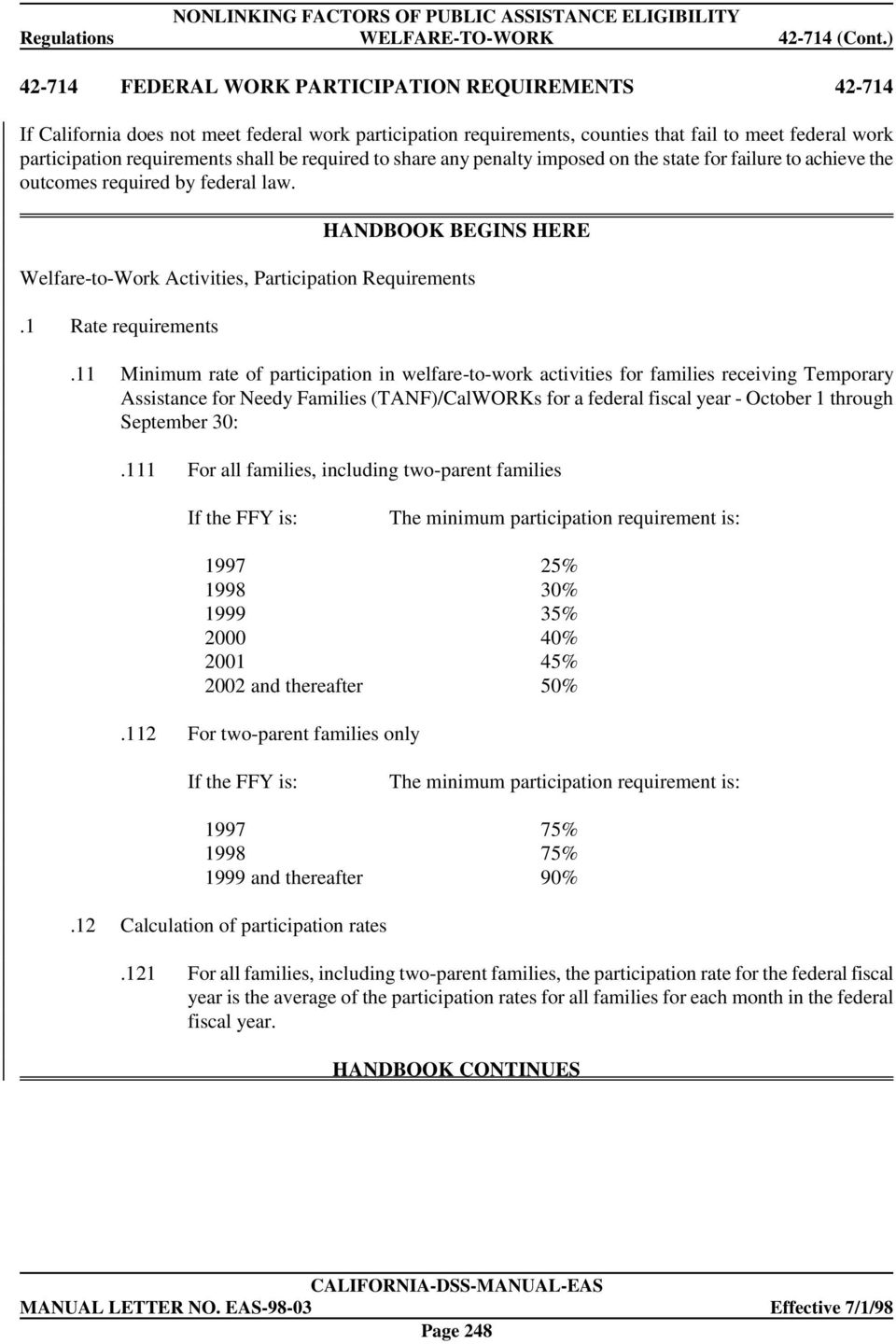
1 Regulations WELFARE-TO-WORK (Cont.) FEDERAL WORK PARTICIPATION REQUIREMENTS If California does not meet federal work participation requirements, counties that fail to meet federal work participation requirements shall be required to share any penalty imposed on the state for failure to achieve the outcomes required by federal law. HANDBOOK BEGINS HERE Welfare-to-Work Activities, Participation Requirements.1 Rate requirements.11 Minimum rate of participation in welfare-to-work activities for families receiving Temporary Assistance for Needy Families (TANF)/CalWORKs for a federal fiscal year - October 1 through September 30:.111 For all families, including two-parent families If the FFY is: The minimum participation requirement is: % % % % % 2002 and thereafter 50%.112 For two-parent families only If the FFY is: The minimum participation requirement is: % % 1999 and thereafter 90%.12 Calculation of participation rates.121 For all families, including two-parent families, the participation rate for the federal fiscal year is the average of the participation rates for all families for each month in the federal fiscal year. HANDBOOK CONTINUES MANUAL LETTER NO. EAS Effective 7/1/98 Page 248
2 (Cont.) WELFARE-TO-WORK Regulations FEDERAL WORK PARTICIPATION REQUIREMENTS HANDBOOK CONTINUES To calculate the monthly participation rate for all families: (1) Divide the number of aided families engaged in work, as specified in Section (those families must include either an aided adult or minor child head of household, who is engaged in work for the month) by: (2) The total number of aided families (those families must include an aided adult or minor child head of household during the month) minus: (A) (B) (C) The number of sanctioned families subject to sanction for not more than three months in the preceding 12-month period - whether or not the months were consecutive; plus The number of families exempted from engaging in work because they include an individual who is a single custodial parent caring for a child who has not attained 12 months of age; plus The number of families that include an individual participating in an Indian tribal work program funded by a federal grant regardless of whether the tribe operates its own TANF program..122 For two-parent families only, the participation rate for the federal fiscal year is the average of the participation rates for each month in the federal fiscal year. A family that includes a disabled parent shall not be considered a two-parent family for purposes of the work participation rate. To calculate the monthly participation rate for two-parent families: (1) Divide the number of two-parent families engaged in work for the number of hours specified in Section by (2) The total number of aided two-parent families, minus: (A) The number of aided two-parent families that have been subject to sanction for not more than three months in the preceding 12- month period - whether or not the months were consecutive; and HANDBOOK CONTINUES MANUAL LETTER NO. EAS Effective 9/13/99 Page 249

3 Regulations WELFARE-TO-WORK (Cont.) FEDERAL WORK PARTICIPATION REQUIREMENTS HANDBOOK CONTINUES (B) The number of families that include an individual participating in an Indian tribal work program funded by a federal grant, regardless of whether the tribe operates its own TANF program..13 Reduction of Participation Rates Due to Caseload Reductions not Required by Federal Law.131 The minimum participation rate required for a fiscal year shall be reduced by the same number of percentage points that the state's average monthly caseload has declined since The reduction shall not reflect any caseload changes that resulted from either federal requirements or state changes in eligibility between the previous and current assistance programs..2 Engaged in Work.21 For all families A recipient is considered to be engaged in work for a month in the federal fiscal year if he/she is participating in work activities for at least the minimum average number of hours per week as specified in the following table. At least 20 hours per week of the minimum average number of hours per week of participation shall be attributable to an activity specified in Handbook Sections through (i). If the month is in FFY: The minimum average number of hours per week is: or thereafter Single parent or relative with child under age six A single parent or caretaker relative in the family of a child who has not attained six years of age, is deemed to be engaged in work if he/she participates in work activities at least 20 hours per week during the month. HANDBOOK CONTINUES MANUAL LETTER NO. EAS Effective 9/13/99 Page 250

4 (Cont.) WELFARE-TO-WORK Regulations FEDERAL WORK PARTICIPATION REQUIREMENTS For two-parent families.3 Work Activities HANDBOOK CONTINUES A family is considered to be engaged in work if the parents are participating as specified in either Section or For a total of at least 35 hours per week, with at least 30 hours spent in the activities specified in Handbook Sections through (i)..232 If the family receives federally-funded child care assistance and an adult in the family is not disabled or caring for a severely disabled child, then the parents must be participating for a total of at least 55 hours per week with at least 50 hours spent in the activities specified in Handbook Sections through (i). (c) (d) (e) (f) Unsubsidized employment; Subsidized employment that is performed in the private sector; Subsidized employment that is performed in the public sector; Work experience, if sufficient private sector employment is not available; On-the-job training; Job search and job readiness assistance; (1) The amount of job search and job readiness assistance activities by any individual that counts toward meeting federal work participation requirements is limited to four consecutive weeks and six weeks total. (The six-week limit may be extended to 12 weeks if California's unemployment rate is at least 50 percent greater than the unemployment rate of the United States, or California is a "needy state" as defined in federal law.) HANDBOOK CONTINUES MANUAL LETTER NO. EAS Effective 1/22/15 Page 251

5 Regulations WELFARE-TO-WORK (Cont.) FEDERAL WORK PARTICIPATION REQUIREMENTS HANDBOOK CONTINUES (2) The state is required to consider participation of an individual in these activities for less than a full week, i.e., for only three or four days during a week, as a full week of participation, but only one time per individual. (g) (h) Community service; Vocational education training (not to exceed 12 months for any individual); (1) For purposes of determining monthly participation rates, not more than 30 percent of the number of individuals in the all families rate and in the two-parent families rate, respectively, who are counted as engaged in work for the month, may consist of individuals considered to be engaged in work by reason of participation in vocational educational training activities. (A) Beginning October 1, 1999, this limit will also include single heads of household or married individuals who are under 20 years of age and either: 1. making satisfactory progress in secondary school or the equivalent, or 2. participating in education directly related to employment for an average of at least 20 hours per week during the month. (i) (j) (k) (l) Providing child care services to a participant in community service; Job skills training directly related to employment; Education directly related to employment, in the case of a recipient who has not received a high school diploma or a certificate of high school equivalency; Satisfactory attendance at secondary school or in a course of study leading to a certificate of general equivalence, in the case of a recipient who has not completed secondary school or received such a certificate. HANDBOOK ENDS HERE MANUAL LETTER NO. EAS Effective 7/1/98 Page 252

6 (Cont.) WELFARE-TO-WORK Regulations FEDERAL WORK PARTICIPATION REQUIREMENTS NOTE: Authority cited: Sections 10553, 10554, and 10604, Welfare and Institutions Code. Reference: Section 10544, Welfare and Institutions Code; and 42 U.S.C. 607,, (c), and (d) DOMESTIC ABUSE PROTOCOLS AND TRAINING STANDARDS Identification of victims of domestic abuse.11 All CalWORKs applicants and recipients shall be informed verbally and in writing, and to the extent required by law, in the language understood by the recipient, of the availability of services designed to assist individuals to identify, escape, or stop future domestic abuse as well as to deal with the effects of domestic abuse. (See Section ).12 Applicants and recipients shall be provided with opportunities to confidentially self-identify or disclose domestic abuse. Sworn statements by a victim of past or present abuse shall be sufficient to establish abuse unless the county documents in writing an independent and reasonable basis to find the applicant or recipient not credible..121 Evidence of domestic abuse includes, but is not limited to: (c) (d) (e) (f) Police, government agency or court records or files; Documentation from a domestic abuse program; Documentation from legal, clerical, medical, or other professionals from whom the applicant or recipient has sought assistance in dealing with domestic abuse; Physical evidence of abuse; A statement from another individual with knowledge of the circumstances that provide the basis for the claim of abuse; or Any other evidence that supports the statement..13 Information on domestic abuse, including resource material, shall be provided during the application process, when the individual enters the county's welfare-to-work program, and at annual redetermination. Information is to be provided in a safe and private physical space for disclosing abuse. MANUAL LETTER NO. EAS Effective 1/31/00 Page 253

7 Regulations WELFARE-TO-WORK (Cont.) DOMESTIC ABUSE PROTOCOLS AND TRAINING STANDARDS HANDBOOK BEGINS HERE.131 Information and services may include: (c) Displaying poster and other materials regarding domestic abuse; Discussing confidentiality during informational sessions, including any legally required disclosures; Making telephones available to individuals who have self-disclosed to safely and privately call resources. HANDBOOK ENDS HERE.132 The CWD shall maintain a comprehensive and current list of local domestic abuse resources..133 Domestic abuse resource materials should include the following: (c) (d) (e) (f) Domestic abuse resources available in the county; Information regarding confidentiality and any required limits on confidentiality; Information regarding any waivers of program requirements for victims of abuse available in the county; Information on domestic abuse which includes legal services, safety planning, and the effects on children witnessing domestic abuse; Information regarding county assistance in tailoring welfare-to-work plans to meet the needs of abuse victims; and Information regarding CalWORKs eligibility provisions for non citizen abuse victims, exceptions to alien sponsor deeming requirements, and applying for legal alien status for aliens who are victims of domestic abuse. MANUAL LETTER NO. EAS Effective 1/31/00 Page 253.1

8 This page is intentionally left blank.

9 Regulations WELFARE-TO-WORK (Cont.) DOMESTIC ABUSE PROTOCOLS AND TRAINING STANDARDS When, during any county-developed and implemented screening procedure, an individual is asked questions about behaviors indicating domestic abuse, he/she shall also be advised that answering such questions is optional and answers indicating abuse will not have a negative effect on his/her ability to participate in the welfare-to-work program. The county shall explain that this information is being requested to better assist the individual in becoming self-sufficient while promoting his or her safety..2 Individual case assessment.21 Each applicant or recipient who has been identified as a victim of domestic abuse shall be referred to staff who are trained in serving recipients who are victims of domestic abuse. Each individual shall be assessed on an individual basis to develop a welfare-to-work plan which will not place the individual at further risk and to which the applicant or recipient can agree. The plan shall be designed with confidentiality and the health and safety of the individual and his or her children as the primary considerations..211 The welfare-to-work plan shall include consideration of the following: The degree to which domestic abuse is a barrier to obtaining employment; HANDBOOK BEGINS HERE (1) Counties are encouraged to provide education and support to employers or work sites and job training programs to assist in situations where recipients have worksite problems. HANDBOOK ENDS HERE (c) (d) Flexibility to accommodate any prior or current legal obligations or other activities or issues related to the domestic abuse; Special cultural or religious needs; Other services for the victim and his or her children include, but are not limited to the following: (1) Community domestic abuse services; (2) Individual counseling of the participant and children; (3) Group counseling; (4) Substance abuse services; MANUAL LETTER NO. EAS Effective 1/31/00 Page 253.1a

10 (Cont.) WELFARE-TO-WORK Regulations DOMESTIC ABUSE PROTOCOLS AND TRAINING STANDARDS (5) Medical and public health services; (6) Mental health counseling; (7) Immigration services; (8) Parenting skills training; (9) Independent living skills training; (10) Financial planning; (11) Relocation activities; (12) Legal services. (e) The appropriate protection for individuals in immediate danger, which are to be integrated into the welfare-to-work plan; and HANDBOOK BEGINS HERE (1) For example, such things as keeping an individual's mailing address, place of residence, and/or workplace confidential should be clearly identified in his/her welfare-to-work plan, if this is necessary for the protection of the individual. HANDBOOK ENDS HERE (f) The need for a waiver from certain program requirements..212 Services provided in the welfare-to-work plan or to which the individual is otherwise referred must be available to him or her. If necessary services are not available, good cause to waive certain welfare-to-work requirements may be established as specified in Section MANUAL LETTER NO. EAS Effective 1/31/00 Page 253.2

11 Regulations WELFARE-TO-WORK (Cont.) DOMESTIC ABUSE PROTOCOLS AND TRAINING STANDARDS HANDBOOK BEGINS HERE A memorandum of understanding (MOU) between a county and service providers assists in the prompt receipt of services to individuals. A MOU typically includes a discussion of confidentiality and the extent to which the provider will assist with removal of the individual's barriers to employment. HANDBOOK ENDS HERE.22 If the participant and the CWD staff are unable to reach an agreement on the welfare-to-work plan, the matter shall be referred by the CWD for an independent assessment by an impartial third party. (See Section ).3 Confidentiality (See Division 19).31 Information with respect to domestic abuse victims and their dependents shall not be released to any outside party or other governmental agencies or to any employee of the CWD who is not directly involved in the applicant's or recipient's case..311 Exceptions: The information is required to be disclosed by law; or The release was authorized in writing by the applicant or recipient..32 All efforts shall be made to preserve the confidentiality and integrity of the service provider and recipient relationship when reviewing an individual's participation in domestic abuse services which are part of his or her welfare to work plan..33 Nothing in these protocols shall preclude the collection of aggregate data with respect to domestic abuse. However, information identifying individual applicants or recipients as domestic abuse victims shall not be disclosed..4 Notice Requirements (See Section , Section , and Section ).41 County staff trained in serving recipients who are domestic abuse victims, shall discuss personal safety with individuals who have been identified as victims of domestic abuse. Individuals shall be provided the opportunity to make decisions about how he or she is to receive communications and correspondence from the county, subject to due process requirements. The safety of the individual shall be considered at all times. MANUAL LETTER NO. EAS Effective 1/31/00 Page 253.3

12 (Cont.) WELFARE-TO-WORK Regulations DOMESTIC ABUSE PROTOCOLS AND TRAINING STANDARDS Case files shall include documentation of any need for alternative notice requirements and the method chosen. Documentation should include a written statement, signed by the applicant or recipient, indicating the noticing method chosen. Alternative notice requirements include, but are not limited to:.5 Waiver of Program Requirements (1) Telephone calls; (2) Alternate mailing address; or (3) Hand delivery..51 A county may waive any program requirement, except as specified in Section , for a recipient who has been identified as a past or present victim of domestic abuse when it has been determined that good cause exists, as specified in Section Program requirements that cannot be waived: Deprivation (See Section ); Assets (See Section ); (c) Income (See Section ) or (d) Homeless assistance (See Section ).512 Program requirements that may be waived include, but are not limited to: (c) (d) Time limit on receipt of assistance; Work requirements; Education requirements (based on the teen school requirement as specified in Section , Section , and Section ); Paternity establishment; and (e) Child support cooperation requirement as specified in Section MANUAL LETTER NO. EAS Effective 4/3/06 Page 253.4

13 Regulations WELFARE-TO-WORK (Cont.) DOMESTIC ABUSE PROTOCOLS AND TRAINING STANDARDS A county shall develop criteria for waiving program requirements for victims of domestic abuse. In developing that criteria, a county can establish the duration of welfare-to-work and time limit waivers as long as the granting of such waivers complies with the state and federal regulations. However, waivers must be re-evaluated periodically based on the established criteria..6 Standards for Training Curricula.61 Staff responsible for working with CalWORKs recipients shall receive training to assist them in working with domestic abuse victims. Counties shall have the flexibility to determine who is to be trained, and when and how often training shall occur..62 Training shall provide an awareness of the dynamics of domestic abuse and the impact of violence on the family. At a minimum, the training must be culturally competent and include the following: Dynamics of domestic abuse: (1) How to interview adults and children who are victims of domestic abuse; (2) How staff will learn to identify potential indicators of domestic abuse; (3) Develop an understanding of the impact of drug and alcohol abuse on family members; (4) Address additional mental health issues; and (5) Obtain information about the abusers and possible referrals. Implications of CalWORKs for victims of domestic abuse: (1) How abuse may interfere with a victim's ability to meet CalWORKs requirements; and (2) How the services provided through the CalWORKs program assist victims of domestic abuse in becoming self sufficient. (c) Features of the CalWORKs program as implemented in the county, including: (1) Confidentiality; (2) A basic understanding of legal options/issues such as basic remedies, terminology, and an explanation of legal issues, probation and perpetrator treatment; MANUAL LETTER NO. EAS Effective 1/1/99 Page 253.5

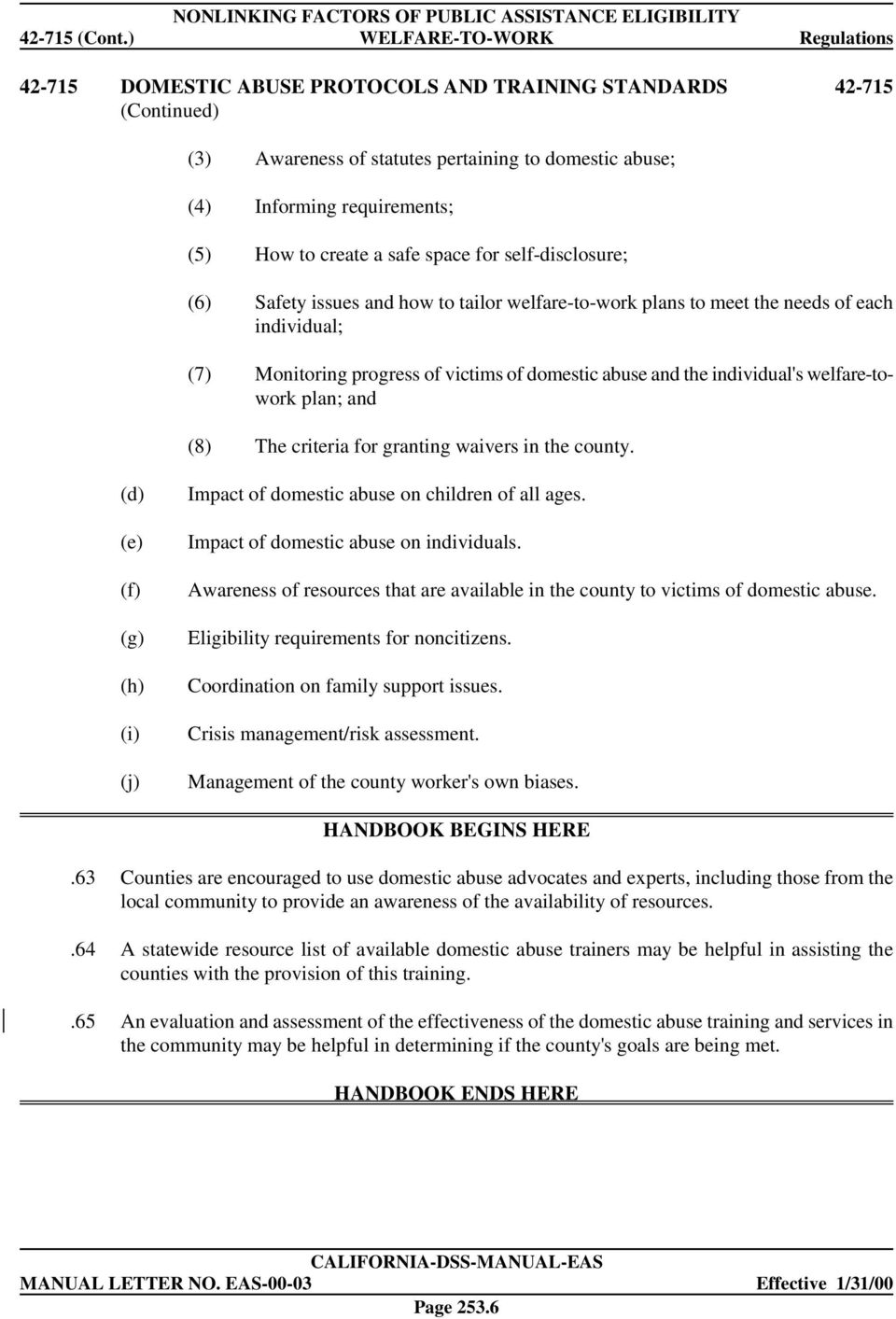
14 (Cont.) WELFARE-TO-WORK Regulations DOMESTIC ABUSE PROTOCOLS AND TRAINING STANDARDS (3) Awareness of statutes pertaining to domestic abuse; (4) Informing requirements; (5) How to create a safe space for self-disclosure; (6) Safety issues and how to tailor welfare-to-work plans to meet the needs of each individual; (7) Monitoring progress of victims of domestic abuse and the individual's welfare-towork plan; and (8) The criteria for granting waivers in the county. (d) (e) (f) (g) (h) (i) (j) Impact of domestic abuse on children of all ages. Impact of domestic abuse on individuals. Awareness of resources that are available in the county to victims of domestic abuse. Eligibility requirements for noncitizens. Coordination on family support issues. Crisis management/risk assessment. Management of the county worker's own biases. HANDBOOK BEGINS HERE.63 Counties are encouraged to use domestic abuse advocates and experts, including those from the local community to provide an awareness of the availability of resources..64 A statewide resource list of available domestic abuse trainers may be helpful in assisting the counties with the provision of this training..65 An evaluation and assessment of the effectiveness of the domestic abuse training and services in the community may be helpful in determining if the county's goals are being met. HANDBOOK ENDS HERE MANUAL LETTER NO. EAS Effective 1/31/00 Page 253.6
15 Regulations WELFARE-TO-WORK (Cont.) DOMESTIC ABUSE PROTOCOLS AND TRAINING STANDARDS NOTE: Authority cited: Sections and 10554, Welfare and Institutions Code. Reference: Sections 11454, 11495, , , and , Welfare and Institutions Code WELFARE-TO-WORK ACTIVITIES Upon the completion of initial engagement activities, or a determination that those activities are not required as an initial activity, the participant shall be assigned to any of the following welfare-to-work activities as needed to obtain employment during the participant s Welfare-to-Work 24-Month Time Clock period as specified in Section (c) (d) Unsubsidized employment, as defined in Section (u)(2). Subsidized employment, as defined in Section (s)(2) that is performed in the private sector. Subsidized employment, as defined in Section (s)(2) that is performed in the public sector. Work experience, as defined in Section (w)(3). (1) Unpaid work experience shall be limited to 12 months, unless the CWD and the welfare-to-work participant agree to extend this period by an amendment to the welfare-to-work plan. The CWD shall review the work experience as appropriate. (A) (B) At the time of the assignment to the work experience activity, the CWD shall identify the job skill(s) to be developed or enhanced. The CWD shall review the work experience activity as necessary to determine the participant's progress toward reaching the training goal. Revisions to the welfare-to-work plan shall be made as necessary to ensure that the work experience assignment continues to be consistent with the participant's plan and is effective in preparing the participant to obtain employment. (2) The maximum hours of participation in unpaid work experience shall be limited as follows: MANUAL LETTER NO. EAS Effective 7/1/15 Page 253.7

16 (Cont.) WELFARE-TO-WORK Regulations WELFARE-TO-WORK ACTIVITIES (A) (B) Participants in work experience activities whose assistance units include food stamp recipients shall participate in these activities for no more than the number of hours each month, determined collectively for the assistance unit, equal to the CalWORKs assistance unit's grant plus the assistance unit's portion of the food stamp allotment divided by the higher of the state or federal minimum wage. Participants in work experience activities whose assistance units do not include food stamp recipients shall participate in these activities for no more than the number of hours each month, determined collectively for the assistance unit, equal to the CalWORKs assistance unit's grant divided by the higher of the state or federal minimum wage. (3) The monthly limit in Sections (d)(2)(A) and (B) shall be considered to have been met by participation in an average weekly number of hours determined by dividing the monthly amount by 4.33 (average number of weeks per month). (e) On-the-job training (OJT), as defined in Section (o)(2). (f) Grant-based OJT, as defined in Section (g)(2) and pursuant to Section (g) (h) (i) (j) Supported work or transitional employment as defined in Section (s)(4), and pursuant to Section , except that only the grant or the grant savings can be diverted to the employer. Work study, as defined in Section (w)(5). Self-employment as defined in Section (s)(1). Community service as defined in Section (c)(5). (1) At the time of the assignment to the community service activity, the CWD shall identify the job skill(s) to be developed or enhanced. The CWD shall review the community service activity as necessary to determine the participant s progress toward reaching the training goal. (A) Revisions to the welfare-to work plan shall be made as necessary to ensure that the community service assignment continues to be consistent with the participant's plan and is effective in preparing the participant to obtain employment. MANUAL LETTER NO. EAS Effective 1/22/15 Page 253.8

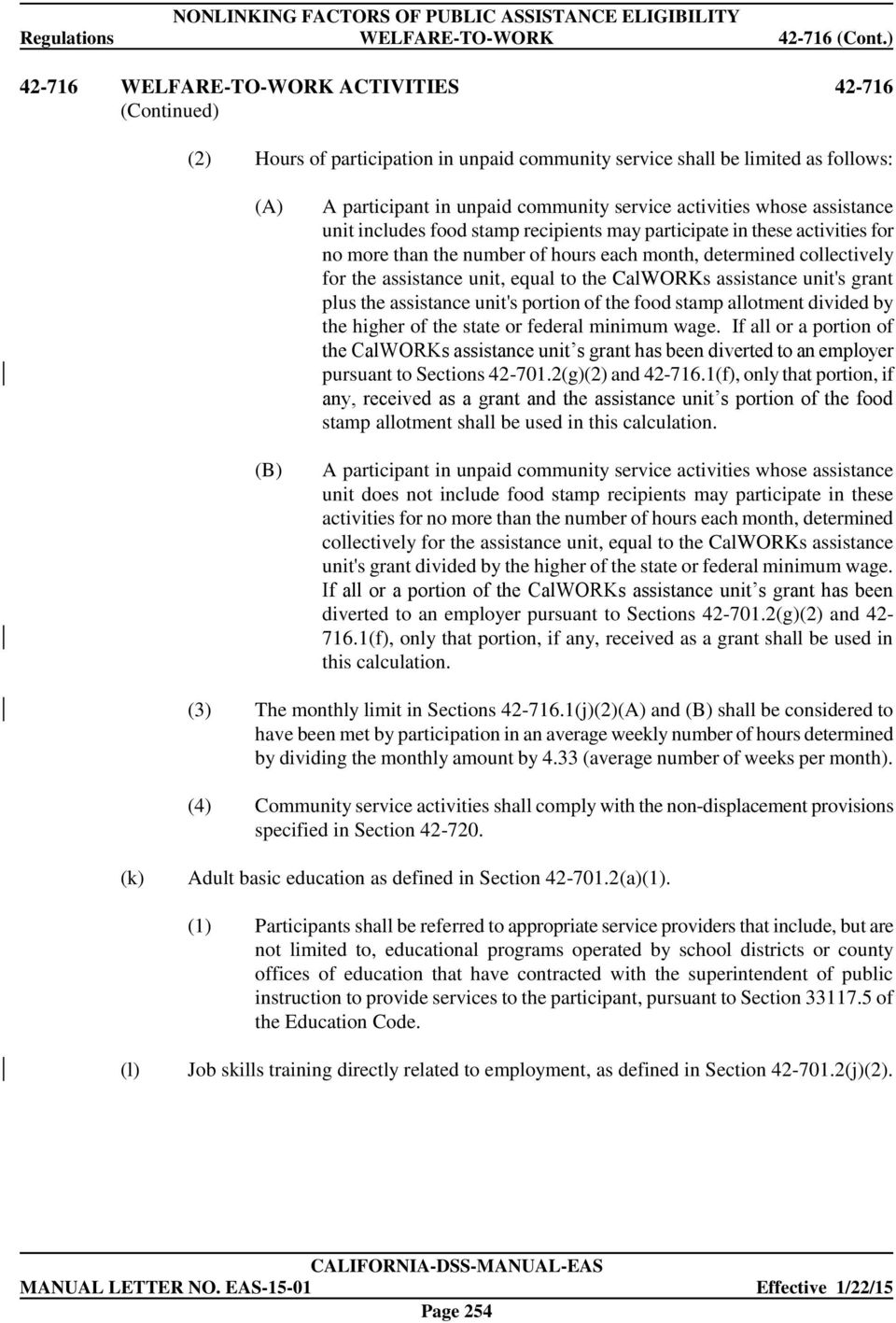
17 Regulations WELFARE-TO-WORK (Cont.) WELFARE-TO-WORK ACTIVITIES (2) Hours of participation in unpaid community service shall be limited as follows: (A) (B) A participant in unpaid community service activities whose assistance unit includes food stamp recipients may participate in these activities for no more than the number of hours each month, determined collectively for the assistance unit, equal to the CalWORKs assistance unit's grant plus the assistance unit's portion of the food stamp allotment divided by the higher of the state or federal minimum wage. If all or a portion of the CalWORKs assistance unit s grant has been diverted to an employer pursuant to Sections (g)(2) and (f), only that portion, if any, received as a grant and the assistance unit s portion of the food stamp allotment shall be used in this calculation. A participant in unpaid community service activities whose assistance unit does not include food stamp recipients may participate in these activities for no more than the number of hours each month, determined collectively for the assistance unit, equal to the CalWORKs assistance unit's grant divided by the higher of the state or federal minimum wage. If all or a portion of the CalWORKs assistance unit s grant has been diverted to an employer pursuant to Sections (g)(2) and (f), only that portion, if any, received as a grant shall be used in this calculation. (3) The monthly limit in Sections (j)(2)(A) and (B) shall be considered to have been met by participation in an average weekly number of hours determined by dividing the monthly amount by 4.33 (average number of weeks per month). (4) Community service activities shall comply with the non-displacement provisions specified in Section (k) Adult basic education as defined in Section (1). (1) Participants shall be referred to appropriate service providers that include, but are not limited to, educational programs operated by school districts or county offices of education that have contracted with the superintendent of public instruction to provide services to the participant, pursuant to Section of the Education Code. (l) Job skills training directly related to employment, as defined in Section (j)(2). MANUAL LETTER NO. EAS Effective 1/22/15 Page 254
18 (Cont.) WELFARE-TO-WORK Regulations WELFARE-TO-WORK ACTIVITIES (m) Vocational education and training including, but not limited to, college and community college education, adult education, regional occupational centers, and regional occupational programs. (1) Any child care provider job training that is funded by either the State Department of Education or the California Department of Social Services shall include information on becoming a licensed child care provider. (n) Job search and job readiness assistance as defined in Sections (j)(2) and (3). (o) (p) (q) (r) (s) Education directly related to employment. Satisfactory progress in a secondary school or in a course of study leading to a certificate of general educational development, in the case of a recipient who has not completed secondary school or received such a certificate. Mental health (see Section ), substance abuse (see Section ), and domestic abuse services (see Section ) that are necessary to obtain and retain employment. Other activities necessary to assist an individual in obtaining unsubsidized employment. Participation required of the parent by the school to ensure the child's attendance, in accordance with Section Assignment to an educational activity identified under Sections (k), (m), (o), and (p) is limited to those situations in which the education is needed to become employed..12 Every CWD shall provide an adequate range of the activities described in Section to ensure each participant's access to needed activities and services to assist him or her in seeking employment, to provide education and training the participant needs to find self-supporting work, and to arrange for placement in paid or unpaid work settings that will enhance a participant's ability to obtain unsubsidized employment..2 Mental Health Treatment Services The CWD shall make mental health treatment services available, when necessary, to enable participants to make the transition from welfare-to-work pursuant to the mental health assessment conducted under Section MANUAL LETTER NO. EAS Effective 1/22/15 Page 255

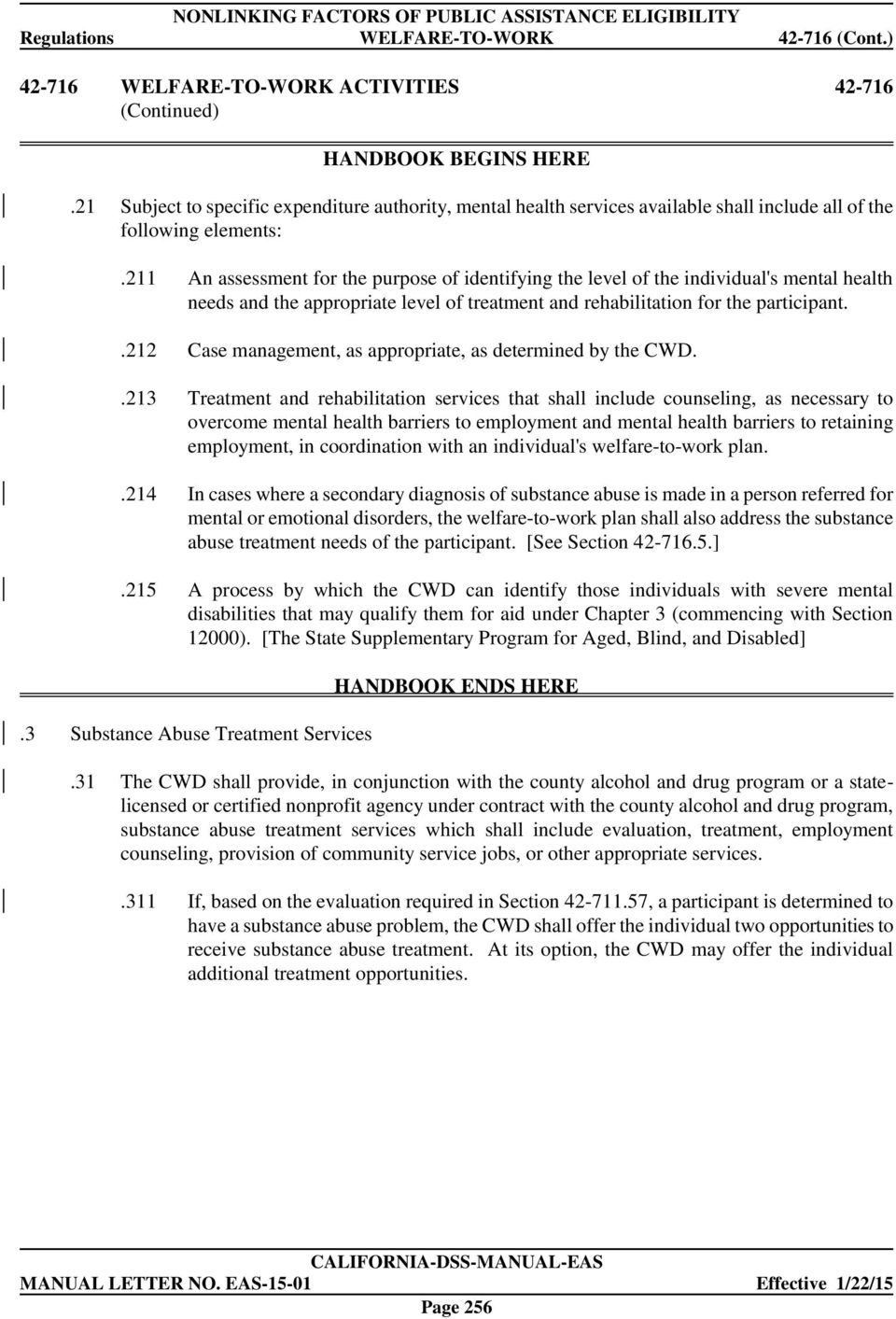
19 Regulations WELFARE-TO-WORK (Cont.) WELFARE-TO-WORK ACTIVITIES HANDBOOK BEGINS HERE.21 Subject to specific expenditure authority, mental health services available shall include all of the following elements:.211 An assessment for the purpose of identifying the level of the individual's mental health needs and the appropriate level of treatment and rehabilitation for the participant..212 Case management, as appropriate, as determined by the CWD..213 Treatment and rehabilitation services that shall include counseling, as necessary to overcome mental health barriers to employment and mental health barriers to retaining employment, in coordination with an individual's welfare-to-work plan..214 In cases where a secondary diagnosis of substance abuse is made in a person referred for mental or emotional disorders, the welfare-to-work plan shall also address the substance abuse treatment needs of the participant. [See Section ].215 A process by which the CWD can identify those individuals with severe mental disabilities that may qualify them for aid under Chapter 3 (commencing with Section 12000). [The State Supplementary Program for Aged, Blind, and Disabled].3 Substance Abuse Treatment Services HANDBOOK ENDS HERE.31 The CWD shall provide, in conjunction with the county alcohol and drug program or a statelicensed or certified nonprofit agency under contract with the county alcohol and drug program, substance abuse treatment services which shall include evaluation, treatment, employment counseling, provision of community service jobs, or other appropriate services..311 If, based on the evaluation required in Section , a participant is determined to have a substance abuse problem, the CWD shall offer the individual two opportunities to receive substance abuse treatment. At its option, the CWD may offer the individual additional treatment opportunities. MANUAL LETTER NO. EAS Effective 1/22/15 Page 256
20 (Cont.) WELFARE-TO-WORK Regulations WELFARE-TO-WORK ACTIVITIES HANDBOOK BEGINS HERE.312 When an individual is determined to have a substance abuse problem, based on an evaluation by the county alcohol and drug program or a state-licensed or certified nonprofit agency, the case manager shall develop the participant's welfare-to-work plan based on the results of that evaluation. In such a case, the individual's welfare-to-work plan may include appropriate treatment requirements, including assignment to a substance abuse program..313 When a participant's welfare-to-work plan includes assignment to a treatment program, the case manager may determine that the participant is out of compliance with the welfare-to-work plan if, at any time in consultation with the substance abuse treatment provider, the county determines that the participant has failed or refused to participate in a treatment program without good cause. The assigned treatment program shall be reasonably accessible within the county of residence or a nearby county..314 When a case manager determines that a participant in a treatment program as specified in his or her welfare-to-work plan is out of compliance with a program requirement other than participation in a required treatment program, the determination of whether the participant has good cause to be out of compliance shall include consideration of whether the participant's substance abuse problem caused or substantially contributed to the failure to comply with the program requirements. In this determination, the county must consult the substance abuse treatment provider as appropriate..315 No recipient may participate in a substance abuse treatment program for longer than six months without concurrently participating in a welfare-to-work activity, to be determined by the county and the recipient, in consultation with the treatment provider. If the recipient is in a state-licensed residential facility or a certified nonresidential substance abuse program that requires him or her to stay at the program site for a minimum of three hours a day, three days per week, or otherwise not to participate in nonprogram activities, the requirements of the treatment program shall fulfill the recipient's welfare-to-work activity requirement..32 Each county shall report annually to the state the number of CalWORKs Program recipients who receive substance abuse treatment and the extent to which the allocation is sufficient to meet the need for substance abuse services as determined by the county. HANDBOOK ENDS HERE MANUAL LETTER NO. EAS Effective 1/22/15 Page 257

21 Regulations WELFARE-TO-WORK (Cont.) WELFARE-TO-WORK ACTIVITIES Job Openings.41 The employer or sponsor of an employment or training position specified in Section shall assist and encourage qualified participants to apply for job openings in the sponsor's organization..42 Participants assigned to public agencies shall be allowed to compete in classified service examinations equivalent to the positions they occupy, and all open and promotional examinations for which experience in the job or other relevant experience qualifies under merit system rules..43 A participant's time worked in a position shall apply toward seniority in a merit public agency position, only to the extent permitted under federal or state law, local ordinance, or collective bargaining agreement..5 Grant-based OJT.51 The CWD shall assign a recipient to a grant-based OJT funded position only if the individual voluntarily consents in writing to the diversion of her/his grant to an employer as a wage subsidy following a one-on-one meeting in which the consent form and assignment are reviewed and discussed with the individual. The written consent shall include, but is not limited to, the following:.511 A statement that the recipient s assignment to grant-based OJT is voluntary and the CWD shall take no action against the individual for refusing to agree to be assigned to a grantbased OJT funded position..512 Notification that the participant is subject to sanction pursuant to Section , if she/he fails to comply with the requirements of the grant-based OJT assignment without good cause..513 A statement that the participant s net income from grant-based OJT may be less than the participant s current grant payment..514 The worksite(s) and job duties, the duration of the grant-based OJT assignment, hours of employment, hourly wage, and any available benefits..515 The good cause criteria specified in Sections and An agreement by the participant acknowledging the participant s obligation to return to the CWD any recovered wages up to the amount of the corrective underpayment paid pursuant to Section MANUAL LETTER NO. EAS Effective 1/22/15 Page 258
22 (Cont.) WELFARE-TO-WORK Regulations WELFARE-TO-WORK ACTIVITIES The CWD shall provide grant-based OJT funded community service positions only if the community service component of the county CalWORKs plan specifies the process by which the CWD will comply with the voluntary consent requirement and lists the languages, other than English, in which written consent will be obtained..53 The participant s diverted cash grant and grant savings shall be used by the employer for the sole purpose of subsidizing the participant s wages..531 Any portion of a participant s wage that is funded by the diversion of the recipient s cash grant and/or grant savings to the employer shall not be entitled to the income disregards specified in Section Any portion of the grant-based OJT participant s wages that are not derived from the participant s diverted grant and/or grant savings shall be subject to the income disregards specified in Section , however, the resulting grant and grant savings may be diverted to the employer..533 Nothing in this Section shall preclude an employer from using its own funds to pay a portion of the participant s wages..54 The CWD shall administer grant-based-ojt funded positions in a manner that minimizes any break in income received by the participant as a grant, or as a wage subsidized by the diverted grant and/or grant savings upon entry into, during, or upon exit from the assignment. (SAR).541 A grant-based OJT placement may begin mid-period..542 When there is any break in income for a grant-based OJT participant caused by an employer's conduct or the participant's inability or failure to work her/his scheduled hours with or without cause, the CWD shall ensure that a recipient receives 100 percent of the maximum aid grant payment for which she/he is otherwise eligible, less the gross amount of the grant-based wages and any other non-exempt income received by the participant. The payment shall be made as a corrective underpayment within five calendar days of the participant notifying the CWD, or within two calendar days of CWD notification if the participant has an eviction Notice or a Notice to Pay Rent or Quit. If the participant s total gross wages paid in a month are less than the total amount of the diverted grant for that month, a corrective underpayment shall be issued in accordance with Section This corrective underpayment shall be equal to the difference between the amount of the gross wages paid to the recipient and the amount of the grant diverted for the month. MANUAL LETTER NO. EAS Effective 1/22/15 Page 259
23 Regulations WELFARE-TO-WORK (Cont.) WELFARE-TO-WORK ACTIVITIES (1) The participant shall return to the CWD the amount of unpaid wages that are recovered from the employer and for which the CWD issued a corrective underpayment. Any such recovered wages not returned by the participant to the CWD shall be treated as an overpayment. The CWD shall collect from the employer any amount of the grant and/or grant savings diverted to the employer that was not paid as wages to the recipient..55 Wages derived from the diverted grant and/or grant savings and paid to a participant pursuant to this section shall not be considered as income in any determination of financial eligibility for the CalWORKs program..56 The CWD shall not place grant-based OJT participants with an employer unless the employer agrees, at a minimum, to all of the following:.561 To use the diverted grant solely for subsidizing the participant's wage and to return to the CWD any of the grant and/or grant savings received that are not paid as wages to the participant..562 Not to displace current employees with grant-based OJT participants pursuant to Section To comply with the labor union and employee notification requirements specified in Section To comply with all applicable federal and state labor laws and regulations..565 That the employer s participation in grant-based-ojt funded job placements may be cancelled pursuant to Section The CWD shall monitor the retention of participants as employees by employers participating in grant-based OJT..571 The CWD shall cancel participation of employers who demonstrate, over a period of time, either of the following: An unwillingness to hire recipients who participated in grant-based OJT with such employers. An inability to provide the participant with the job skills to obtain unsubsidized employment with other employers. MANUAL LETTER NO. EAS Effective 1/22/15 Page 259.1
24 (Cont.) WELFARE-TO-WORK Regulations WELFARE-TO-WORK ACTIVITIES The CWD shall collect and maintain such records as are necessary to verify participating employer s retention of participants or subsequent unsubsidized employment with other employers..58 Any participant in a grant-based OJT-funded position, who fails or refuses to comply with program requirements without good cause shall be sanctioned in accordance with Section Education Activities.61 An individual assigned to participate in adult basic education, job skills training directly related to employment, vocational education and training, satisfactory progress in a secondary school or in a course of study leading to a certificate of general educational development, and education directly related to employment, as described in Sections (k), (l), (m), (o), and/or (p) respectively, may also be assigned supervised or unsupervised homework time as part of his or her welfare-to-work plan..611 Hours spent in supervised homework time and up to one hour of unsupervised homework time for each hour of class time may be assigned as participation in the assigned activity in the individual s welfare-to-work plan..612 Total homework time counted as participation must not exceed the hours required or advised by the education program..62 An individual assigned to participate in adult basic education, job skills training directly related to employment, vocational education and training, satisfactory progress in a secondary school or in a course of study leading to a certificate of general educational development, and education directly related to employment, as described in Sections (k), (l), (m), (o), and/or (p) respectively, or participating in a Self-Initiated Program as described in Section , may elect to participate in distance learning for some or all of his or her classroom hours..621 Distance learning activities are subject to satisfactory participation standards as described in Section No additional satisfactory participation standards may be required of participants in distance learning activities. MANUAL LETTER NO. EAS Effective 1/22/15 Page 259.2
25 Regulations WELFARE-TO-WORK (Cont.) WELFARE-TO-WORK ACTIVITIES Assembly Bill (AB) 98 Subsidized Employment.71 AB 98 subsidized employment shall be used to place participants in subsidized private sector or subsidized public sector subsidized employment as indicated in Sections and (c)..711 To ensure cost neutrality to the state budget, AB 98 subsidized employment shall not be used to place participants in the following types of subsidized employment due to funding requirements: (c) Grant-based on-the-job training as indicated in Section (f) and pursuant to Section Supported work or transitional employment as defined in Section (s)(4), and pursuant to Section Work study as indicated in Section (h)..72 Eligibility for entry into AB 98 subsidized employment under this section shall be limited to individuals who are not otherwise employed at the time of entry into the subsidized employment, and who meet one of the following criteria:.721 Aided CalWORKs recipients participating in the welfare-to-work Program. These individuals may continue to participate in a county's AB 98 subsidized employment program if the family becomes ineligible for CalWORKs aid due to AB 98 subsidized employment income..722 Individuals in welfare-to-work sanction status as described in Section who will cure their sanctions through AB 98 subsidized employment participation. AB 98 participants who cure their sanctions through AB 98 subsidized employment must maintain compliance with welfare-to-work requirements to continue in an AB 98 subsidized employment position. MANUAL LETTER NO. EAS Effective 1/22/15 Page 259.3
26 (Cont.) WELFARE-TO-WORK Regulations WELFARE-TO-WORK ACTIVITIES Individuals who have exceeded CalWORKs time limits and are receiving Safety Net benefits for their eligible children as defined in Section These individuals may continue to participate in a county's AB 98 subsidized employment program if the family becomes ineligible for CalWORKs Safety Net benefits due to AB 98 subsidized employment income..73 AB 98 wage subsidies are limited to a maximum of six months for each participant..731 Upon entry into AB 98 subsidized employment, a Welfare-to-Work client shall participate in an AB 98 subsidized employment placement for no longer than six months. In order to mutually benefit the employer and the participant, AB 98 subsidized employment placements can be extended up to six additional months for up to a total of 12 months..74 If provided for in a county plan, the county may provide welfare-to-work services to former recipients whose families become ineligible for CalWORKs due to AB 98 subsidized employment income..741 The county may provide these services for up to the first 12 months of employment, to the extent they are not available from other sources and are needed for the individual to retain the subsidized employment..8 Expanded Subsidized Employment.81 Eligibility for entry into expanded subsidized employment under this section shall be limited to individuals who meet one of the following criteria:.811 Aided CalWORKs recipients participating in the Welfare-to-Work Program. These individuals may continue to participate in a county's expanded subsidized employment program if the family becomes ineligible for CalWORKs aid due to expanded subsidized employment income..812 Individuals in welfare-to-work sanction status as described in Section who will cure their sanctions through expanded subsidized employment participation. Expanded subsidized employment participants who cure their sanctions through expanded subsidized employment must maintain compliance with welfare-towork requirements to continue in an expanded subsidized employment placement. MANUAL LETTER NO. EAS Effective 7/1/15 Page 259.4
27 Regulations WELFARE-TO-WORK (Cont.) WELFARE-TO-WORK ACTIVITIES Expanded subsidized employment wage subsidies are limited to a maximum of six months for each participant, unless the county determines that the participant meets the requirements for an extension..821 Extensions to expand subsidized employment placements may be granted no more than twice, in three-month increments, not to exceed a total placement of 12 months. The county shall grant an extension if the additional time will increase the likelihood of either of the following: The participant obtaining unsubsidized employment with the participating employer. The participant obtaining specific skills and experiences relevant for unsubsidized employment for a particular field..822 The reason for each extension must be recorded in the participant's CalWORKs case file..83 If provided for in a county plan, the county may provide welfare-to-work services to former recipients whose families become ineligible for CalWORKs due to expanded subsidized employment income..831 The county may provide these services for up to the first 12 months of employment, to the extent they are not available from other sources and are needed for the individual to retain the subsidized employment. NOTE: Authority cited: Sections 10553, 10554, and 10604, Welfare and Institutions Code. Reference: Sections , , , (2), , , , , , , , , , , and (d)(1), (1), , (c), and (d), , (c), (d), and (f), 11326, , , , 11454, and , Welfare and Institutions Code; and Section 8358(c)(2), Education Code; 7 U.S.C. 2029(1); 7 U.S.C. 2035; U.S. Department of Labor guidance on FLSA, with attached U.S.D.A., Food and Nutrition Service (FNS) guidance on an SFSP, dated May 22, 1997; Simplified Food Stamp Program approval letters from FNS to implement the provisions of an SFSP, dated May 5, 2000 and August 3, JOB RETENTION SERVICES If provided in the county plan, the CWD may provide job retention services to employed former CalWORKs recipients for a period of up to 12 months. The purpose of job retention services is to assist former recipients to retain employment or to obtain a better job..11 The period of up to 12 months begins on the earlier of the following dates, but in no event later than one year after the former recipient s aid is discontinued. MANUAL LETTER NO. EAS Effective 7/1/15 Page 259.5
28 (Cont.) WELFARE-TO-WORK Regulations JOB RETENTION SERVICES The date that the former recipient s aid is discontinued, if the former recipient is employed at that time..112 The date that the former recipient becomes employed..12 Job retention services may include but are not limited to case management, mental health and/or substance abuse services, domestic abuse services, parenting classes, vocational training, and supportive services (transportation, ancillary)..13 A former recipient who does not become employed during the 12 month period after being discontinued from aid is not eligible to receive services under Section The CWD may provide job retention services to the extent that the services are:.21 not provided by the employer or the entity that arranged the job placement, if other than the county;.22 not available from other sources;.23 needed for the individual to retain employment, or needed to advance to new employment that may provide greater income or better benefits..3 The CWD may provide services to employed former recipients under Section whether or not the former recipients have exhausted their CalWORKs 48-month time limits..4 If the CWD decides to offer services to former recipients under Section , the CWD:.41 May establish eligibility criteria for those services in addition to the eligibility criteria contained in Sections and.2. If additional criteria are established, they must be reflected in the County Plan (see Section )..42 Shall adopt written policies determining the duration and types of, and, when applicable, the reimbursement rate for, those services..5 In accordance with Section , child care shall be available to former recipients for up to two years from the date the recipient leaves cash aid..6 There is no community service requirement for services provided under Section , unless the CWD adopts a policy requiring community service..7 If the county provides services to the recipient after the 48-month limit has been reached, the recipient shall participate in community service or subsidized employment as described in Section NOTE: Authority cited: Sections and 10554, Welfare and Institutions Code. Reference: Sections , , 11454, , and 11500, Welfare and Institutions Code. MANUAL LETTER NO. EAS Effective 7/1/15 Page 259.6
29 Regulations WELFARE-TO-WORK (Cont.) OTHER PROVIDERS OF ACTIVITIES AND SERVICES Contracting Services HANDBOOK BEGINS HERE A public agency shall, in implementing CalWORKs and the CalWORKs Welfare-to-Work Program, perform program functions exclusively through the use of merit civil service employees of the public agency, except to the extent permitted by provisions of state and federal law that were in effect on August 21, The Personal Responsibility and Work Opportunity Reconciliation Act of 1996 did not become effective until August 22, Discrimination Prohibition Employers, sponsors of training activities, and contractors shall not discriminate against participants on the basis of race, sex, national origin, age, or disability. HANDBOOK ENDS HERE.2 Contracts/Agreements for Job Search, Training, and Education Services.21 Except as specified in Sections and.213, any contract/agreement which provides for payment for training and education services shall be competitively selected using applicable state and federal regulations. Payment for services which are part of an individual's welfare-to-work plan may be made based upon fixed-unit-price performance-based criteria..211 Under these contracts, full payment shall not be considered earned by the contractor for training and education services as defined in Sections through (r) until either of the following has occurred: The participant has successfully completed the education program. (1) A prorata share of the payment shall be paid to the education provider if the participant does not complete the education program. The participant has successfully completed the training program and has been retained in unsubsidized employment for at least 180 days. (1) Up to 70 percent of the fixed-unit price for training services may be paid upon placement in unsubsidized employment. MANUAL LETTER NO. EAS Effective 4/3/06 Page 260
30 (Cont.) WELFARE-TO-WORK Regulations OTHER PROVIDERS OF ACTIVITIES AND SERVICES (A) At least 30 percent of the fixed-unit-price for training services shall be withheld for the follow-up during the 180-day retention period in unsubsidized employment. 1. Progress payments shall be made from the 30 percent withholding portion upon evidence of participant job retention at 30, 90 and 180 days. (2) A prorata share of the 70 percent fixed-unit-price payment in Section (1) shall be paid to the training service provider if the participant does not complete the training either through failure to cooperate, as determined by the CWD, or the participant obtains unsubsidized employment. (A) If the participant in Section (2) obtains unsubsidized employment related to the training, as determined by the CWD, and is retained for at least 180 days, the difference between the pro rata payment in Section (2), and 70 percent of the fixed-unit price for training services shall be paid..212 Training and education services funded by sources other than CalWORKs Welfare-to- Work shall be subject to the criteria and requirements of those sources and not to the requirements of Section The CWD shall be permitted to enter into contracts for educational services without having to adhere to the contracting requirements of Section , when the CWD is unable to obtain educational services due to the absence of an available adult education program or the small number of welfare-to-work referrals. Utilization of this exemption shall require prior review and approval by CDSS. NOTE: Authority cited: Sections 10553, 10554, and 10604, Welfare and Institutions Code. Reference: Sections 10619, 11320, , and , Welfare and Institutions Code. MANUAL LETTER NO. EAS Effective 9/13/99 Page 261
31 Regulations WELFARE-TO-WORK (Cont.) SCHOOL ATTENDANCE All children in an assistance unit (AU) for whom school is compulsory, but who are not subject to Cal- Learn requirements as described in Sections through , shall be required to regularly attend school, as specified in Section Teens ages 16 and 17, who are not regularly attending elementary, secondary, vocational, or technical school on a full-time basis, shall be referred to the CWD to have a welfare-to-work plan developed in accordance with Section The welfare-to-work plan for teens ages 16 and 17, who have not completed high school or its equivalent, shall be for the purpose of completing high school or its equivalent only. These teens may, on a voluntary basis, participate in additional welfare-to-work activities, including job search activities, job readiness activities, and assessment, to the extent that these activities do not interfere with their school attendance. The hours of participation under Section shall not apply to these teens..2 Except as exempted in accordance with Section , teens ages16 and 17 who have completed high school or its equivalent are required to participate in welfare-to-work activities and are subject to all Welfare-to-Work Program requirements specified in Section Repealed by Manual Letter No. EAS-06-01, effective 4/3/06..3 Failure by teens ages 16 and 17 to comply with the mandatory activities in their welfare-to-work plan, developed in accordance with Section , shall result in a reduction in the grant amount to the AU in accordance with Section MANUAL LETTER NO. EAS Effective 4/3/06 Page 262
32 (Cont.) WELFARE-TO-WORK Regulations SCHOOL ATTENDANCE HANDBOOK BEGINS HERE.31 Example 1: A 16- or 17-year old teen fails to attend school regularly. His needs are taken out of the family's grant and, at the same time, he loses the exemption from the CalWORKs Welfare-to-Work Program. If he begins attending school regularly before participation in any specific welfare-to-work activity is required, his needs will be reinstated for complying with the school attendance requirement. Once notified of specific welfare-to-work requirements, the teen must also comply with those requirements. Aid will continue as long as he stays in school and complies with welfare-to-work requirements..32 Example 2: A 16- or 17-year old teen fails to attend school regularly. Her needs are taken out of the family's grant and, at the same time, she loses the exemption from the CalWORKs Welfare-to-Work Program. She begins attending school regularly before participation in any specific welfare-to-work activity is required, and her needs are reinstated for complying with the school attendance requirement. She subsequently fails to comply with a welfare-to-work requirement, and is penalized for that reason. To reinstate her needs, the teen must comply with the Welfare-to-Work Program..33 Example 3: A 16- or 17-year old teen fails to attend school regularly. His needs are not considered in determining the family's grant and, at the same time, he loses the exemption from the CalWORKs Welfare-to-Work Program. He does not resume regular school attendance and also fails to comply with welfare-to-work requirements. His needs will not be reinstated until he complies with both the school attendance and welfare-to-work requirements. HANDBOOK ENDS HERE.34 Aid shall be restored in accordance with Section (g). NOTE: Authority cited: Sections 10553, 10554, and 10604, Welfare and Institutions Code. Reference: Sections , and (2), , , , and 11454, Welfare and Institutions Code; and Section 48200, Education Code. MANUAL LETTER NO. EAS Effective 4/3/06 Page 263
33 Regulations WELFARE-TO-WORK (Cont.) NONDISPLACEMENT PROTECTION IN WORK ACTIVITIES Displacement Provisions Except as specified in Section , an education, employment, or training program position specified in Sections through (l), or under any county pilot project, may not be created as a result of, or may not result in, any of the following:.11 Displacement or partial displacement of current employees including, but not limited to, a reduction in hours of nonovertime and overtime work, wages, or employment benefits..12 The filling of positions that would be promotional opportunities for current employees, unless such promotions are routinely filled through an open process in which recipients are provided an opportunity to compete for the job..13 The filling of a position prior to compliance with applicable personnel procedures or provisions of collective bargaining agreements..14 The filling of established unfilled public agency positions, unless the positions are unfunded in a public agency budget..15 The filling of a position created by termination, layoff, or reduction in work force, caused by the employer's intent to fill the position with a subsidized position..16 A strike, lockout, or other bona fide labor dispute, or violation of any existing collective bargaining agreement between employees and employers..17 The filling of a work assignment customarily performed by a worker in a job classification covered by a collective bargaining agreement in that specific worksite, or the filling of a work assignment in any bargaining unit in which funded positions are vacant or in which regular employees are on layoff..18 The termination of a contract for services, before its expiration date, that displaces or partially displaces workers performing contracted services and which is caused by the employer's intent to fill the vacancy with a subsidized welfare-to-work participant..19 The denial to a participant or employee of protections provided other workers on the worksite under state and federal workplace health, safety, and representation laws..2 Sections , , and shall not apply to unsubsidized employment placements. MANUAL LETTER NO. EAS Effective 1/22/15 Page 264
34 (Cont.) WELFARE-TO-WORK Regulations NONDISPLACEMENT PROTECTION IN WORK ACTIVITIES Notification of labor unions and non-union employees of the use of CalWORKs recipients..31 The CWD shall notify or ensure that an employment or training provider notifies:.311 The appropriate labor union of the use of a CalWORKs recipient assigned to a welfare-towork employment or training activity described in Section or any position created under a county pilot project, in any location or work activity controlled by an employer and covered by a collective bargaining agreement between the employer and a union; or.312 Non-union employees of the use of CalWORKs welfare-to-work participants and the availability of the grievance process described in Section Display of a poster shall satisfy this requirement..4 Employee Displacement Grievance Process (1) The poster required by Section shall not identify any welfare-to-work participant. The following grievance process shall be used to resolve the complaints of regular employees or their representatives who believe assignment of a welfare-to-work participant to community service, work experience, on-the-job training (OJT), or any activity funded by grant-based OJT training violates any of the displacement provisions contained in Section , as applicable. All displacement complaints shall be in written form and shall include the full name, address (if any), and telephone number (if any) of the alleged displaced employee, the full name and address of the employer against whom the complaint is being filed, a clear and concise statement of the facts concerning the alleged displacement, including pertinent dates, and a statement that the complaint has been signed under penalty of perjury..41 Informal Resolution.411 Upon receipt of a written complaint by the employee or employee's representative, the CWD shall contact both the complainant and affected employer and attempt to informally resolve the complaint. MANUAL LETTER NO. EAS Effective 1/22/15 Page 265
35 Regulations WELFARE-TO-WORK (Cont.) NONDISPLACEMENT PROTECTION IN WORK ACTIVITIES The period for informal resolution shall begin on the date the complaint is received by the CWD and shall not exceed ten calendar days. Nothing in this section shall prohibit informal resolution of the complaint at any time during the displacement grievance process..413 Following its efforts to informally resolve the complaint, the CWD shall send a letter informing the complainant of the following: (c) The employer's response to the complaint, including any actions the employer is willing to take toward informal resolution. The right to request a formal hearing as specified in Section if the complainant is dissatisfied with the employer's informal response. The procedures for filing a formal hearing including the address to which a request for hearing should be sent. (d) The time limit for filing a request for formal hearing as specified in Section The CWD shall send the letter required by Section no later than the twentieth calendar day from the date the complaint was received by the CWD. Copies of the letter shall be sent to the affected employer..42 Formal Hearing.421 If the complaint cannot be informally resolved, the complainant may request a formal hearing. A written request for formal hearing must be filed no later than ten calendar days following the employee's receipt of the letter required by Section (1) The date postmarked on the hearing request shall be considered the date of its filing. MANUAL LETTER NO. EAS Effective 7/1/98 Page 266
36 (Cont.) WELFARE-TO-WORK Regulations NONDISPLACEMENT PROTECTION IN WORK ACTIVITIES Formal hearings shall be conducted by the California Department of Social Services (CDSS), State Hearings Division..423 The CDSS, State Hearings Division shall inform the complainant, the CWD, and affected employer in writing of the date, time and location of the hearing and of the opportunity to present evidence, bring witnesses, cross-examine witnesses, and bring or send an authorized representative. An authorized representative is defined as an individual or organization that has been authorized by the complainant or affected employer to act on behalf of the complainant or affected employer in any and all aspects of the formal hearing. An authorized representative may include legal counsel, a relative, friend, or other spokesperson. Upon the request of any party to the complaint, a hearing may be postponed prior to the hearing or at the hearing, if such request or postponement is for good cause. The Department shall have the authority to request verification to support the request for postponement. Notwithstanding the provisions of this section the time limits contained in Section shall apply. The criteria for good cause includes, but is not limited to, the following: (1) Death in the family. (2) Personal illness or injury. (3) Sudden and unexpected emergencies which prevent the complainant or the employer or their respective authorized representatives from appearing. (4) A conflicting court appearance which can not be postponed. (c) (d) A party who wishes to submit a document into evidence must provide a copy of it, free of charge, to the other party. The Administrative Law Judge may not discuss the merits of a pending state hearing with one party outside the presence of the other party. MANUAL LETTER NO. EAS Effective 9/13/99 Page 267
37 Regulations WELFARE-TO-WORK (Cont.) NONDISPLACEMENT PROTECTION IN WORK ACTIVITIES Except as specified in this section, the following provisions of MPP, Division 22 shall apply to formal hearings: Except as specified below, Section relating to general rules and procedures at the hearing. (1) Notwithstanding the provisions of Section , both the complainant and affected employer may bring or send an authorized representative. (2) To the extent that Section refers to rehearings, it shall not apply. (3) Sections and , and any references to Section , shall not apply. (4) Sections and shall not apply. (5) To the extent the provisions of Section apply to formal hearings, all references to "claimant" and "county" shall be deemed to refer to "complainant" and "affected employer," respectively. Section relating to evidence. (1) Requirements at Section shall not apply. (c) Section relating to postponements and continuances for additional evidence. (1) Notwithstanding the time parameters identified in Section , the time limit set forth in Section shall apply. (d) (e) Sections ,.3, and.4 relating to submission and adoption of proposed decisions. Section relating to action by the Director. MANUAL LETTER NO. EAS Effective 7/1/98 Page 268
38 (Cont.) WELFARE-TO-WORK Regulations NONDISPLACEMENT PROTECTION IN WORK ACTIVITIES (1) Notwithstanding the time limits for director action specified in Section , requirements for issuance of a hearing decision at Section shall apply..425 A written hearing decision shall be issued within 90 calendar days of the date the complaint was received by the CDSS State Hearings Division..426 Copies of the written decision shall be sent to all affected parties. The decision shall include: A statement identifying the right to federal appeal of the hearing decision as specified in Section When a hearing decision upholds the displacement complaint, the decision shall: Require termination of the assignment which brought about the complaint and any other assignments which have caused the displacement of regular employees. Identify those actions which shall be taken to remedy the displacement in accordance with Section Remedies.51 Remedies for displaced employees shall include reinstatement, back pay, and/or back benefits from the affected employer. MANUAL LETTER NO. EAS Effective 9/13/99 Page 269
39 Regulations WELFARE-TO-WORK (Cont.) NONDISPLACEMENT PROTECTION IN WORK ACTIVITIES Union Grievance.61 Any grievance procedure that is part of a collective bargaining agreement between the employer and labor union representing the dissatisfied employee shall be used in lieu of the process described in Section NOTE: Authority cited: Sections 10553, 10554, and 10604, Welfare and Institutions Code. Reference: Sections , , and , Welfare and Institutions Code NONCOMPLIANCE WITH PROGRAM REQUIREMENTS The provisions of Sections ,.3, and.4 shall not apply to:.11 Teen parents who are subject to the Cal-Learn Program as described in Sections through Any person who is not required, but who volunteers, to participate in the Welfare-to-Work Program and who fails to appear for a scheduled appointment prior to entering into the welfare-towork plan..13 A reunification parent as defined in Section (r)(3) whose welfare-to-work activities and services are only included in a reunification plan..131 A noncompliant individual shall remain eligible for CalWORKs activities and services until the expiration or termination of a voluntary placement agreement or the court terminates the reunification plan..2 Compliance Process.21 An individual who is required to participate in program activities as a condition of receipt of aid shall be subject to sanctions specified in Section , whenever:.211 He or she fails or refuses without good cause to comply with program requirements; and.212 He or she subsequently fails or refuses without good cause to: agree to a compliance plan; or comply with a compliance plan agreed to by the CWD and the participant. MANUAL LETTER NO. EAS Effective 9/29/03 Page 270
40 (Cont.) WELFARE-TO-WORK Regulations NONCOMPLIANCE WITH PROGRAM REQUIREMENTS Failing or refusing to comply with program requirements means failing or refusing to:.221 sign a welfare-to-work plan; participate in any assigned program activity, including a selfinitiated program; provide required proof of satisfactory progress in any assigned program activity, including a self-initiated program; or accept employment;.222 continue employment; or.223 continue employment at the same level of earnings..23 Upon determination that an individual has failed or refused to comply with program requirements, the CWD shall send the individual a notice of action effective no earlier than 30 calendar days from the date of issuance..231 The notice of action shall inform the individual that a sanction will be imposed if the individual fails to either attend an appointment scheduled by the CWD within 20 calendar days of the notice or contact the CWD by telephone within 20 calendar days of the notice, and fails to do one of the following: Provide information to the CWD that leads to a finding of good cause for refusing or failing to comply with program requirements, or Agree to a compliance plan to correct the failure or refusal to comply..232 The written notice of action shall contain the following additional information: (c) (d) The date, time, and location of the scheduled appointment. A description of the specific act or acts that have caused the individual to be out of compliance with participation requirements. A statement that the individual has the right to explain why he or she failed or refused to comply with program requirements and to demonstrate that he or she had good cause for his or her refusal or failure to comply. A general definition of good cause and examples of reasons that constitute good cause for not participating in the program. MANUAL LETTER NO. EAS Effective 9/13/99 Page 271
41 Regulations WELFARE-TO-WORK (Cont.) NONCOMPLIANCE WITH PROGRAM REQUIREMENTS (e) The right of the individual to establish good cause over the telephone instead of attending the scheduled appointment. (1) The notice shall include the telephone number. (f) (g) (h) (i) (j) The right of the individual to reschedule the appointment once within a period of 20 calendar days. A description of the transportation and child care services available to the individual in order to attend the appointment. A statement that if good cause is not found, a compliance plan will be developed and the individual will be expected to agree to the plan or face a sanction. The name, telephone number, and address of state and local legal aid and welfare rights organizations that may assist the individual with the good cause and compliance plan process. The steps the individual must take to have aid restored..24 Cause Determination.241 The CWD shall schedule a cause determination appointment time within 20 calendar days of the notice of action during which each individual who has failed or refused to comply with program requirements has an opportunity to demonstrate that he or she has good cause for the refusal or failure..242 The individual shall be allowed to reschedule the cause determination appointment once within the 20-calendar-day period..25 If the individual fails to attend the appointment, the CWD shall attempt to contact the individual by telephone at the time of, or after, the appointment to establish a finding of good cause or no good cause. If a finding of no good cause is made, the CWD shall develop a compliance plan to correct the instance of nonparticipation..26 If the CWD is not able to contact the individual as described in Section , and the individual fails to contact the CWD within the 20-calendar-day period, the CWD shall impose a sanction. MANUAL LETTER NO. EAS Effective 7/1/08 Page 272
42 (Cont.) WELFARE-TO-WORK Regulations NONCOMPLIANCE WITH PROGRAM REQUIREMENTS The CWD shall rescind the notice of action if the individual attends the appointment or contacts the CWD by telephone within the 20-calendar-day period and the CWD makes either of the following two determinations:.271 The individual had good cause for refusing or failing to comply, or.272 The individual agrees to a compliance plan to correct the noncompliance. If the individual agrees to a compliance plan at the appointment, the individual shall be provided a copy of the plan. If the individual agrees to a compliance plan over the telephone, a copy of the plan shall be mailed to the client..28 An instance of noncompliance shall not be considered to have occurred if either of the following occurs:.281 The CWD determines that the individual had good cause for failing or refusing to comply..282 The individual did not have good cause for failing or refusing to comply, but agrees to a compliance plan and subsequently fulfills the terms of the compliance plan..29 If the individual does not fulfill the terms of a written compliance plan agreed upon with the CWD and the CWD determines, based on available information, that the individual did not have good cause for failure to meet the terms of the plan, the CWD shall send a notice of action to impose a sanction. If a sanction is imposed under the terms of this paragraph, no further compliance procedures are applicable..3 Good Cause for Failure or Refusal to Comply with Program Requirements.31 No sanctions shall be applied for failure or refusal to comply with program requirements for reasons related to employment, an offer of employment, an activity, or other training for employment including, but not limited to, the following reasons:.311 The employment, offer of employment, activity, or other training for employment discriminates in terms of age, sex, race, religion, national origin, or physical or mental disability..312 The employment or offer of employment exceeds the daily or weekly hours of work customary to the occupation. MANUAL LETTER NO. EAS Effective 7/1/98 Page 273
43 Regulations WELFARE-TO-WORK (Cont.) NONCOMPLIANCE WITH PROGRAM REQUIREMENTS The employment, offer of employment, activity, or other training for employment is remote from the individual's home because either: (c) The round-trip travel time required exceeds a total of two hours, exclusive of the time necessary to transport family members to a school or place providing care, or Walking is the only available means of transportation and the round-trip is more than two miles, exclusive of the mileage necessary to accompany family members to a school or a place providing care. An individual who fails or refuses to comply with the program requirements based on the remoteness of the employment, offer of employment, activity, or other training for employment shall be required to participate in community service activities as defined in Section (c)(5), and in accordance with Section (j)(2)..314 The employment, offer of employment, activity, or other training for employment involves conditions that are in violation of applicable health and safety standards..315 The employment, offer of employment, or work activity does not provide for worker's compensation insurance..316 Accepting the employment or work activity would cause an interruption to an approved education or job training program in progress. For purposes of this section, an education or job training program includes all welfare-to-work activities described in Section , except work experience or community service assignment. The approved education or job training program in progress must lead to employment and sufficient income to be self-supporting. If the hours of participation in the approved education or job training program in progress are less than the hours required as a condition of eligibility for aid, the CWD may require the individual to engage in welfare-to-work activities to the extent necessary to meet the required hours of participation..317 Accepting the employment, offer of employment, or work activity would cause the individual to violate the terms of his or her union membership. MANUAL LETTER NO. EAS Effective 1/22/15 Page 274
44 (Cont.) WELFARE-TO-WORK Regulations NONCOMPLIANCE WITH PROGRAM REQUIREMENTS In determining whether good cause exists for a refusal or failure to comply with program requirements, the CWD shall take into consideration whether the participant has a mental disability that caused or substantially contributed to the refusal or failure to comply with program requirements. This determination shall be made, where appropriate, in consultation with the county mental health department..33 An individual shall have good cause for not participating in welfare-to-work activities if he or she meets the criteria described in Section Sanctions.41 Financial sanctions shall be applied when a non-exempt welfare-to-work participant has failed or refused to comply with program requirements without good cause and compliance efforts have failed..411 Any month in which an individual is under sanction and removed from the assistance unit shall not be counted as a month of receipt of aid in determining the 48-month time limit in accordance with Section (SAR).412 A financial sanction is a county-initiated mid-period change pursuant to Section (SAR)..42 The sanctions shall not apply in the following circumstances:.421 To an individual who is exempt from the welfare-to-work requirements and is voluntarily participating in the Welfare-to-Work Program. If an exempt volunteer engages in conduct that would bring about the sanction procedures described below but for his or her status as a volunteer, the individual shall not be given priority over other participants actively seeking to participate..422 Except as specified in paragraph, an individual who chooses to include more participation hours in his or her welfare-to-work plan than is required pursuant to Section , shall not be subject to a sanction if the number of hours he or she completes in a week is at least the number of hours required in Section Section does not apply to individuals who fail to continue employment, or continue employment at the same level of earnings, pursuant to Sections and.223 respectively without good cause. MANUAL LETTER NO. EAS Effective 1/22/15 Page 275
45 Regulations WELFARE-TO-WORK (Cont.) NONCOMPLIANCE WITH PROGRAM REQUIREMENTS HANDBOOK BEGINS HERE Example A: Jennifer is the mother of a four year old son and lives with her husband, John, who is unaided due to his citizenship status. Jennifer is only required to participate for 20 hours each week to meet the minimum welfare-to-work participation hours as she has months remaining on her Welfare-to-Work 24-Month Time Clock. However, Jennifer wants to meet CalWORKs federal standards so that months are not counted toward her Welfare-to- Work 24-Month Time Clock. Therefore, Jennifer s welfare-to-work plan includes 20 hours of employment and 10 hours of job skills training directly related to employment. In the week of April 14, Jennifer does not attend her job skills training directly related to employment activity, but she completes her employment hours. In this situation, Jennifer is not subject to a noncompliance process, regardless of the reason she did not attend her job skills training activity, because she met the minimum number of hours (20) that she is required to participate. Example B: Robert is the father in a one-parent assistance unit made up of three children ages 8, 10 and 11 years old. Robert s welfare-to-work plan states he needs to work an average at least 30 hours per week, which he consistently performs in an unsubsidized employment job and he has months remaining on his Welfare-to-Work 24-Month Time Clock. In the week of April 13 th, Robert voluntarily decreases his hours worked to 25 hours per week without developing a new welfare-to-work plan and as a result is noncompliant and if he does not increase his number of hours worked to the amount required by his welfareto-work plan, he will be subject to sanction. HANDBOOK ENDS HERE MANUAL LETTER NO. EAS Effective 1/22/15 Page 275.1
46 This page is intentionally left blank
47 Regulations WELFARE-TO-WORK (Cont.) NONCOMPLIANCE WITH PROGRAM REQUIREMENTS Financial sanctions for failing or refusing to comply with program requirements without good cause shall result in a reduction in the family's grant by removing the noncomplying family member from the assistance unit until the noncomplying individual performs the activity(ies) he or she previously refused to perform; or if the activity that the noncomplying individual originally failed to perform is no longer available or appropriate, the county must specify another appropriate activity for the individual to perform..44 The discontinuance from aid shall become effective on the first day of the first payment month that the sanctioned individual's needs are removed from aid following the CWD's timely and adequate notification (see Section ), except as specified in Section If the recipient appeals the sanction through the state hearing process within the period of timely notification, no sanction shall be imposed until the hearing decision is reached. If the CWD's action is sustained, the discontinuance shall be effective at the end of the payment month in which the state hearing decision is received. (1) If the CWD is unable to discontinue aid at the end of such month, aid shall be discontinued at the end of the following payment month..45 In a two-parent assistance unit whose basis for deprivation is unemployment, the sanctioned parent shall be removed from the assistance unit..451 If the sanctioned parent's spouse or the assistance unit's second parent is not participating in the program, except as provided in Section , both the sanctioned parent and the spouse or second parent shall be removed from the assistance unit..452 The CWD shall notify the spouse of the noncomplying participant or second parent in writing at the commencement of the compliance procedures of his or her own opportunity to participate and the impact on sanctions of that participation. MANUAL LETTER NO. EAS Effective 7/1/08 Page 276
48 (Cont.) WELFARE-TO-WORK Regulations NONCOMPLIANCE WITH PROGRAM REQUIREMENTS For purposes of this section, if a spouse or second parent is participating to avoid the sanction of the noncomplying parent, the exemption criteria for care of an ill or incapacitated member of the household pursuant to Section , or the care of a young child pursuant to Section do not apply. Any other exemption or good cause criteria, as described in Sections and and compliance procedures described in Section , shall apply to the sanctioned parent's spouse or the family's second parent..454 A spouse or second parent who chooses to participate to avoid the noncomplying parent's sanction, and subsequently ceases participation without good cause and fails or refuses to agree to or fulfill the terms of a compliance plan without good cause, shall be removed from the assistance unit in accordance with Section If the sanctioned parent's spouse or the second parent is under his or her own sanction at the time of the first parent's sanction, the spouse or second parent shall not be provided the opportunity to avoid the first parent's sanction until the spouse or second parent's sanction is completed..46 For families that qualify due to the absence or incapacity of a parent, only the noncomplying parent shall be removed from the assistance unit, and aid shall be continued to the remainder of the family..461 The CWD shall arrange for a protective payee in accordance with Section If the noncomplying individual is a dependent child, his or her needs shall not be taken into account in determining the family's need for assistance and the amount of the assistance payment..48 The CWD shall restore aid:.481 On the first day of the month following the date that the individual contacted the county to indicate his or her desire to end the sanction after all of the following conditions are met: The activities in accordance with Section have been successfully completed. The individual is determined to be in compliance with program requirements, and is otherwise eligible. If the individual completes the activity after the first of the month following the date of the request to end the sanction, the county shall issue a supplemental payment, retroactive to the first of the month following the date of the request to end the sanction; or MANUAL LETTER NO. EAS Effective 1/22/15 Page 277
49 Regulations WELFARE-TO-WORK (Cont.) NONCOMPLIANCE WITH PROGRAM REQUIREMENTS If the sanction is rescinded as a result of the outcome of a state hearing or the formal grievance procedure established in accordance with Section (SAR).483 Restoration of aid due to the noncomplying participant performing the activities he or she previously refused to perform, in accordance with Sections and (SAR), is a county-initiated mid-period change pursuant to Section (c)(SAR). HANDBOOK BEGINS HERE Example: An individual who was sanctioned for failing to attend orientation contacts the CWD on July 14 and indicates he wishes to end his sanction. The individual signs his curing plan on July 17, attends orientation on July 23 as required by his curing plan, and cures his sanction. On August 1, if the individual is otherwise eligible, his cash aid is restored. Example: An individual contacts the CWD on July 14 and indicates she wishes to end her sanction. The individual signs her curing plan on July 17, which specifies that she must participate in two weeks of job search/job club beginning on July 23. She successfully completes job search/job club on August 5, and ends her sanction. If the individual is otherwise eligible, her cash aid is restored back to August The CWD shall grant aid: HANDBOOK ENDS HERE.491 On the first day of the month following the date that the individual contacted the county to indicate his or her desire to end the sanction, once the activities in accordance with Section have been successfully completed, if the individual applies for aid, is determined to be in compliance with program requirements, and is otherwise eligible. HANDBOOK BEGINS HERE (SAR) Example: An individual who was sanctioned and left aid with his family after failing to participate in vocational education contacts the CWD on July 1 to reapply for aid. His family is determined eligible for aid on July 5 and aid is granted to the family as of July 5; before aid can be granted for the sanctioned individual he must cure his sanction. The individual signs his curing plan on July 5, participates in a vocational education program for 30 days, and successfully cures his sanction on August 3. If the individual is otherwise eligible, his cash aid is granted back to August 1 as a county-initiated mid-period change pursuant to Section (c)(SAR). HANDBOOK ENDS HERE MANUAL LETTER NO. EAS Effective 7/1/14 Page 277.1
50 This page is intentionally left blank
51 Regulations WELFARE-TO-WORK (Cont.) NONCOMPLIANCE WITH PROGRAM REQUIREMENTS State Hearing and Formal Grievance.51 Except as specified in Section ,.512(c), or.512(d), when a participant believes that any program requirement or assignment is in violation of, or inconsistent with, state law and regulations governing the Welfare-to-Work Program, the CWD shall inform him/her of the right either to request a state hearing or to file a formal grievance based on the procedures established by the county board of supervisors..511 State Hearing The CWD shall inform the individual of his/her right to file an appeal through the state hearing process as an alternative to the formal grievance procedures. Procedures for a state hearing are specified in MPP Division 22. (c) With the exception of welfare-to-work supportive services (see Section ), aid will continue if the individual appeals through the state hearing process within the period of timely notification (see Section ). (d) If a welfare-to-work participant or other affected party is dissatisfied with a state hearing decision involving on-the-job working conditions or workers compensation coverage, the party may appeal the decision to the appropriate state regulating agency. (1) A copy of the written decision shall be issued to all affected parties and shall identify the right to appeal. The decision shall also provide the address and instructions for filing an appeal. (A) The instructions shall include the requirement that the appeal be filed within 20 calendar days following receipt of the written decision. (e) The participant shall be permitted to request a state hearing to appeal the outcome of a formal grievance. MANUAL LETTER NO. EAS Effective 7/1/08 Page 278
52 (Cont.) WELFARE-TO-WORK Regulations NONCOMPLIANCE WITH PROGRAM REQUIREMENTS Formal Grievance Procedures (c) (d) (e) The procedures for a formal grievance established by the county board of supervisors and the duration of these procedures shall be specified in the county plan. The sole issue for resolution through a formal grievance shall be whether a program requirement or assignment is in violation of the welfare-to-work plan or inconsistent with Chapter The participant shall not be permitted to use the formal grievance to appeal the outcome of a state hearing or the results of an assessment made according to Section The formal grievance shall not be available to a noncomplying individual who has already failed to successfully conciliate in accordance with Section Under those circumstances, the applicant or recipient may request a state hearing to appeal a program requirement or assignment. The individual shall be subject to sanction pending the outcome of the formal grievance or any subsequent appeal only if he/she fails to participate during the period the grievance procedure (1) This information shall be provided to an individual when he or she requests information about the procedure for filing a formal grievance..513 The CWD shall address any complaints of discrimination based on race, color, national origin, religion, political affiliation, marital status, sex, age, or handicap which may arise through an applicant's/recipient's participation in Welfare-to-Work in accordance with the provisions of MPP Division 21 - Nondiscrimination in State and Federally Assisted Programs. NOTE: Authority cited: Sections 10553, 10554, and 10604, Welfare and Institutions Code. Reference: Sections 11203, , 11320, , , , , (d), , through (e), , , , , , 11454, , and (d), (e), (f), and (g), Welfare and Institutions Code. MANUAL LETTER NO. EAS Effective 1/22/15 Page 279
53 NONLINKING FACTORS OF PUBLIC ASSISTANCE ELIGIBILITY Regulations WELFARE-TO-WORK (Cont.) LEARNING DISABILITIES PROTOCOLS AND STANDARDS CalWORKs Welfare-to-Work Learning Disabilities Screening Requirements.11 Counties must offer CalWORKs welfare-to-work participants a screening for learning disabilities at the first welfare-to-work contact (i.e., orientation or appraisal) or by no later than the assessment as described in Section The offer of the screening and evaluation must be both verbal and in writing..12 Counties are required to provide information about the screening, both verbally and in writing at the first welfare-to-work contact, including a description, of the purpose and benefits of the screening and evaluation. MANUAL LETTER NO. EAS Effective 7/1/08 Page 279.1
54 This page is intentionally left blank.
55 Regulations WELFARE-TO-WORK (Cont.) LEARNING DISABILITIES PROTOCOLS AND STANDARDS Information that counties provide participants must include, but is not limited to, the following: (c) (d) (e) (f) (g) (h) (i) Most people with learning disabilities are intelligent and many are gifted; Individuals with a learning disability may have difficulty reading, listening, understanding directions, writing, spelling, doing math, organizing things, getting along with others, expressing ideas out loud, paying attention; Individuals with a learning disability can be taught to use their strengths and find ways to make it easier to learn and be more successful at school and on the job; The county can help individuals get the appropriate welfare-to-work activity, including accommodations once a learning disability is identified; The learning disabilities screening is a very simple and short test; The screening will help the individual decide if they want a referral to a learning disability specialist for an evaluation to find out if a learning disability exists; The areas that will be tested at evaluation are natural talents and abilities, ability to follow verbal and written information, achievement, and job and career interests. The specialist can help identify strengths and weaknesses so that the county can make referrals to the appropriate services and accommodations; and Individuals have the right to file for a fair hearing pursuant to Section if they disagree with a county action. Limited-English proficient CalWORKs welfare-to-work participants have the right to request a referral to a learning disabilities evaluation, pursuant to Section , when there is no screening tool in their primary language..13 Counties that choose to offer a screening for learning disabilities later than the first welfare-towork contact are still required to provide information about the screening and evaluation, as specified in Section , at the first welfare-to-work contact..14 Participants who request or agree to a learning disabilities screening at any time during their welfare-to-work participation must be screened by the county before they are assigned to another welfare-to-work activity..141 This provision applies only to participants who have not been previously screened..142 Participants in welfare-to-work activities shall have good cause for not participating if their assigned activities, when their screening appointment conflicts with their activity. MANUAL LETTER NO. EAS Effective 7/1/08 Page 279.1a.
56 (Cont.) WELFARE-TO-WORK Regulations LEARNING DISABILITIES PROTOCOLS AND STANDARDS For limited-english proficient CalWORKs welfare-to-work participants for whom no recognized and validated learning disabilities screening tools exist, as required by Section , the county must determine whether a potential learning disability exists. HANDBOOK BEGINS HERE.151 Counties may use discussions with, and observation of, the participant to determine the existence of a potential learning disability. Discussions with the limited-english proficient participant may include, but are not limited to: (1) The participant's ability to follow instructions both verbally and in writing; (2) Learning difficulty in his/her native language while growing up as compared to other children; and (3) Subject areas that were easy for the participant to learn and conversely, subject areas that were difficult to learn. Observation of the participant could include comparison of the participant's work habits and/or classroom ability to their peer group. HANDBOOK ENDS HERE.152 For the purposes of Section , the county shall determine whether limited-english proficient CalWORKs welfare-to-work participants may have a learning disability within the time frames cited in Section If the county determines that a limited-english proficient CalWORKs welfare-to-work participants may have a potential learning disability, the county must refer the participant to a learning disabilities evaluation in accordance with Section If during the learning disabilities screening and evaluation process, the county suspects that the participant has health, behavioral health, and learning disabilities problems, counties should address the health-related issues first..161 Participants referred to health-related evaluations prior to a learning disabilities screening and/or evaluation shall not be required to sign a waiver, in accordance with Section , until the health-related issues are identified and addressed and the participant subsequently declines the screening and/or evaluation. MANUAL LETTER NO. EAS Effective 9/15/04 Page 279.2
57 Regulations WELFARE-TO-WORK (Cont.) LEARNING DISABILITIES PROTOCOLS AND STANDARDS Participants who decline the learning disabilities screening/evaluation.21 When the participant declines the learning disabilities screening referenced in Section and/or the evaluation referenced in Section , the county must:.211 Inform the participant that his/her welfare-to-work activities will not include any accommodations for a learning disability; and.212 Inform the participant that he/she may receive a learning disabilities screening and/or evaluation upon request at any later time; and.213 Read and discuss the waiver of the learning disabilities screening and/or evaluation with the participant and have the participant sign the waiver. A participants refusal to sign the waiver is equivalent to a signed waiver when documented by the county in the case file..22 The county must not sanction a participant because of his/her refusal to be screened and/or evaluated for learning disabilities..221 Should a participant decline to be screened or evaluated, and subsequently refuse or fail to comply with program requirements, or to make satisfactory progress in his/her assigned activity, the participant shall not have good cause on the basis of being learning disabled for failing to comply with program requirements or make satisfactory progress, and shall be subject to the compliance and sanction requirements in accordance with Sections and.4, respectively, unless determined to have a learning disability..23 Should the participant decline the learning disabilities screening and/or evaluation as described in Section , and request a learning disabilities screening and/or evaluation at a later time, the county must provide the screening and evaluation as soon as administratively possible..231 If the evaluation identifies the existence of a learning disability, the welfare-to-work assignment and/or welfare-to-work plan, as necessary, will be modified to provide appropriate services and accommodations to address the learning disability on a prospective basis only..24 Should the participant provide previous evaluation results that were conducted outside of the CalWORKs Welfare-to-Work program, the county has the option to:.241 Accept all or part of the evaluation and provide the individual with any needed reasonable accommodations that are identified in the evaluation; or.242 Not accept the evaluation and obtain a second opinion by referring the participant to another learning disabilities evaluation. MANUAL LETTER NO. EAS Effective 9/15/04 Page 279.3
58 (Cont.) WELFARE-TO-WORK Regulations LEARNING DISABILITIES PROTOCOLS AND STANDARDS In cases when previous evaluations do not provide sufficient information, refer the participant to additional testing..25 If the participant's previous evaluation is determined acceptable by the county, the participant shall not be required to sign the learning disability screening and evaluation waiver..26 A county must, at a minimum, verbally inform participants that it is accepting or rejecting all or part of a previous learning disabilities evaluation..27 If the participant meets the criteria in Sections and.414, and is directly referred to an evaluation without going through the screening process, the participant shall not be required to sign a waiver..3 Providing Learning Disabilities Screening.31 The county may choose who will administer the learning disabilities screening tool..311 Counties must select screeners for potential learning disabilities who have: The training to appropriately administer the screening tool; and To the degree possible, a working relationship with the participant (e.g., county employment case managers, social workers, and eligibility workers; and contracted service providers, etc.)..312 Counties may contract with trained, qualified learning disabilities professionals to administer the screening tool..32 Counties must use only recognized and validated learning disabilities screening tools, if a validated tool exists in the participant s primary language..33 Counties must use bilingual and bicultural staff when determining whether a limited-english proficient individual has a potential learning disability..4 Referral Process for Disabilities Evaluation.41 In accordance with Section , counties must refer CalWORKs participants who are suspected of having a learning disability for a learning disabilities evaluation. These participants include, but are not limited to, individuals who:.411 Have been identified as potentially having a learning disability, based on the learning disabilities screening tool score;.412 Were previously identified as having learning problems (e.g., in Special Education classes in grades kindergarten through 12); or MANUAL LETTER NO. EAS Effective 9/15/04 Page 279.4
59 Regulations WELFARE-TO-WORK (Cont.) LEARNING DISABILITIES PROTOCOLS AND STANDARDS Are suspected of having a learning disability, even though the results from the learning disabilities screening did not indicate a potential learning disability..414 Are limited-english proficient and request a referral to a learning disabilities evaluation if no validated screening tool exists in their primary language..42 If a participant declines the learning disabilities evaluation, the county must inform the participant of how his/her welfare-to-work assignment will be affected as provided in Section If a participant agrees to an evaluation, the county must refer him/her to the evaluation as soon as administratively possible..44 Participants who are screened at the assessment, described in Section , and are found to have a potential learning disability and have agreed to an evaluation, must be evaluated prior to the completion of the assessment and the welfare-to-work plan..441 If the individual initially agrees to an evaluation but fails to attend evaluation without good cause, he/she will be deemed to have declined the evaluation and the assessment process will resume without benefit of the evaluation. The individual shall not be sanctioned as described in Section for failure to attend the evaluation and shall be able to request a screening and/or evaluation at a later time as described in Section Participants in welfare-to-work activities shall have good cause for not participating if their assigned activities, when their evaluation appointment conflicts with their activity..46 Counties must use trained, qualified learning disabilities evaluation professionals who use recognized and validated learning disabilities evaluation tools to identify learning disabilities and to determine the appropriate accommodations for individuals with learning disabilities..461 Learning disabilities evaluation professionals may include county staff who have the necessary training as learning disabilities specialists to administer and interpret validated test instruments..462 The county may contract with qualified learning disabilities evaluation professionals to perform the evaluations. HANDBOOK BEGINS HERE.463 Learning disabilities evaluation professionals with whom the county may contract include, but are not limited to, qualified individuals from the following sources: Professional private/corporate contractors or providers; HANDBOOK CONTINUES MANUAL LETTER NO. EAS Effective 9/15/04 Page 279.5
60 (Cont.) WELFARE-TO-WORK Regulations LEARNING DISABILITIES PROTOCOLS AND STANDARDS HANDBOOK CONTINUES (c) (d) (e) Trained and qualified staff at community/state colleges or universities; Trained and qualified staff from community-based organizations that serve individuals with learning disabilities; Trained and qualified staff from adult educational facilities, or Staff from the Department of Rehabilitation..464 Basic evaluation test instruments that learning disabilities evaluators may use but are not limited to the following areas: (c) Aptitudes/information processing, e.g., Wechsler Adult Intelligence Scale (WAIS), Woodcock-Johnson; Achievement, e.g., Wide Range Achievement Test (WRAT 3), Test of Adult Basic Education (TABE), Nelson-Denny (reading); and Vocational interest, as needed, to assist in the development of the welfare-to-work plan. HANDBOOK ENDS HERE.465 If no recognized and validated evaluation tools exist in the participant s primary language, the learning disabilities evaluation professional, utilizing appropriate bilingual and/or bicultural staff, as necessary, must to the best of staff ability determine if a learning disability exists through: The use of other evaluation tools that may provide pertinent information. Discussions appropriately tailored to the individual's cultural background with, and/or observations of, the participant; and/or.466 If a county staff person, service provider, learning disabilities professional, or the participant suspects that the participant suffers from another impairment that may be a barrier to participation (i.e., a health or behavioral health problem), in addition to or instead of a learning disability, the county also shall refer the participant to a professional who is licensed to diagnose that impairment in accordance with Section Learning Disabilities Evaluation Report.51 The learning disabilities evaluation report, at a minimum, shall include the following core information: MANUAL LETTER NO. EAS Effective 9/15/04 Page 279.6
61 Regulations WELFARE-TO-WORK (Cont.) LEARNING DISABILITIES PROTOCOLS AND STANDARDS Relevant vocational/educational background and history;.512 General aptitude/cognitive level;.513 Other issues, such as, physical/mental problems;.514 Areas of strength;.515 Areas of deficiency; and.516 A summary of the participant s condition and service needs including: (c) (d) (e) (f) severity of disability; areas of potential impact, including employment and participation in welfare-towork activities; rationale for learning disabilities determination/diagnosis; recommendations for additional services, as appropriate; if identified, any suspected conditions other than a learning disability so that the county can make the appropriate referral; and Range of recommended accommodations/assistive technology to be included in the participant s welfare-to-work plan..52 The learning disabilities evaluation report may include, but is not limited to, the following optional information:.521 Identification of local resources to assist recipients;.522 Documentation of accommodation/assistive technology needs for other purposes (e.g., driver s license exam, GED exam); and.523 Discussion of participant s short/long-term employment goals and general/specific vocational recommendations to the extent that the evaluator is qualified to address these issues. If the learning disabilities evaluation report does not include a written discussion of the participant s short/long-term employment goals and general/specific vocational recommendations, the county will need to ensure that these issues are addressed in the assessment process as described in Section in consultation with the learning disabilities evaluator, as necessary. MANUAL LETTER NO. EAS Effective 9/15/04 Page 279.7
62 (Cont.) WELFARE-TO-WORK Regulations LEARNING DISABILITIES PROTOCOLS AND STANDARDS County Response to the Learning Disabilities Evaluation Report.531 If the learning disabilities evaluation report establishes that the participant does not have a learning disability or other disability that interferes with obtaining or retaining employment or participating in the CalWORKs program: (c) (d) The county must provide a copy of the report and an explanation of the evaluation results to the participant; The participant must begin/resume his/her welfare-to-work assignment; The county must inform the participant that he/she will not be provided special accommodations while participating in his/her welfare-to-work assignment, since it was determined that he/she did not have a learning disability; and Inform the participant of the right to file for a state hearing if the participant disagrees with the county actions based on the evaluation, in accordance with Section If the learning disabilities evaluation report establishes that the participant has a learning disability that interferes with obtaining or retaining employment or participating in a CalWORKs program, the county must: (c) (d) Provide a copy and an explanation of the evaluation report results to the participant, including any recommendations for reasonable accommodations identified in the evaluation; Discuss the appropriate welfare-to-work activities and reasonable accommodations needed to help the participant be successful in completing his/her welfare-to-work activities; and As necessary, develop or modify the welfare-to-work activities and/or welfare-towork plan in accordance with Section to reflect appropriate welfare-towork activities and necessary reasonable accommodations based on the results of the assessment, the learning disabilities evaluation, and discussions between the county and the participant. Inform the participant of the right to file for a state hearing if the participant disagrees with the county actions based on the evaluation, in accordance with Section Counties must treat participants medical records and written learning disabilities evaluations as confidential documents that should only be shared with other counties, other learning disabilities evaluators, outside agencies, and welfare-to-work partner agencies on a need-to-know basis. MANUAL LETTER NO. EAS Effective 9/15/04 Page 279.8
63 Regulations WELFARE-TO-WORK (Cont.) LEARNING DISABILITIES PROTOCOLS AND STANDARDS Counties must obtain the participant s written consent to share this information with individuals or organizations outside of the county welfare department..6 Learning Disabilities Participation Requirements.61 Unless exempt pursuant to Section , an individual with a learning disability must participate for the required number of hours as specified in Sections For the purposes of Section , required hours may include participation in supplemental activities that are supportive of the participant's employment goals and consistent with the learning disabilities evaluation and welfare-to-work plan. These activities may include, but are not limited to, adult basic education, literacy tutoring, and, if allowable under the county's CalWORKs plan or as a reasonable accommodation, study time for participants who are in educational programs that are not self-initiated..7 Identifying Participants With Learning Disabilities During Good Cause Determination, Compliance Process and/ or Stopping of a Welfare-to-Work Sanction.71 If a learning disability is confirmed through an evaluation during a participant s good cause determination or compliance process, the county must determine if the disability contributed to the participant s failure to participate..72 If it is determined that the learning disability diminished the participant s ability to participate:.721 The participant shall be considered to have good cause for his/her failure to participate in accordance with Section or, if appropriate, be exempt from welfare-to-work requirements in accordance with Section ;.722 The participant shall not be considered to have an instance of noncompliance in accordance with Section ; and.723 As necessary, the county shall also review the welfare-to-work activity and/or welfare-towork plan and modify it in accordance with Section (c). MANUAL LETTER NO. EAS Effective 1/22/15 Page 279.9
64 (Cont.) WELFARE-TO-WORK Regulations LEARNING DISABILITIES PROTOCOLS AND STANDARDS If a learning disability is confirmed through an evaluation for an individual who is attempting to stop his/her welfare-to-work sanction, the county will determine whether the learning disability was a contributing factor to his/her noncompliance..731 If the learning disability was a contributing factor to the individual s noncompliance: The county will rescind the sanction and the participant shall not be considered to have an instance of noncompliance in accordance with Section ; and The county will give the individual the choice of: (1) receiving retroactive cash aid payments for the months the individual was improperly sanctioned; or (2) prospectively resuming receipt of cash aid and welfare-to-work services, effective the date the participant is determined to be no longer sanctioned. (c) (d) If the individual chooses to receive aid for the rescinded sanction period, in accordance with Section (1), all months in that period will be counted against the 60-month time limit. As necessary, the county will review the welfare-to-work activity and/or welfare-towork plan and modify it in accordance with Sections (c)..74 If the county cannot determine from the evaluation report if the disability contributed to the participant s failure to participate, the county must consult with the learning disabilities evaluator or another learning disabilities specialist to make the determination..75 If the learning disability was not a contributing factor to noncompliance, the county shall continue the sanctioning process in accordance with Section Inter-County Transfers of Individuals With Learning Disabilities MANUAL LETTER NO. EAS Effective 4/3/06 Page
65 Regulations WELFARE-TO-WORK LEARNING DISABILITIES PROTOCOLS AND STANDARDS If a welfare-to-work participant with an identified learning disability moves from one county to another:.811 The first county must, with the participant s written permission, forward a copy of the written learning disabilities evaluation to the second county..812 The second county must develop a new, or modify the existing, welfare-to-work plan, as necessary, to reflect appropriate welfare-to-work activities and necessary reasonable accommodations based on the review of documents received, reevaluation of the original assessment, discussions between the county and the participant, and availability of resources..813 The participant shall not have good cause for failure to participate in the second county, based on the second county s failure to provide services and accommodations that are identified in the learning disabilities evaluation report as being necessary for the participant, when the participant refuses permission for the first county to forward the report. NOTE: Authority Cited: Section 10553, Welfare and Institutions Code. Reference: Sections 10850, (f), , , , , , , , , 11454, and and, Welfare and Institutions Code GAIN JOB SEARCH, TRAINING, AND EDUCATION SERVICES Repealed by Manual Letter No. EAS-98-03, effective 7/1/ EMPLOYEE DISPLACEMENT GRIEVANCE PROCESS Renumbered to Sections ,.5,.6, and.7 by Manual Letter No. EAS-98-03, effective 7/1/ CONTRACTS/AGREEMENTS FOR GAIN JOB SEARCH, TRAINING AND EDUCATION SERVICES Repealed by Manual Letter No. EAS-98-03, effective 7/1/ AGREEMENTS FOR PREP AND AWEX Repealed by Manual Letter No. EAS-98-03, effective 7/1/ CONTRACTS/AGREEMENTS FOR ON-THE-JOB TRAINING (OJT), SUPPORTED WORK, AND TRANSITIONAL EMPLOYMENT FUNDED BY GRANT DIVERSION Repealed by Manual Letter No. EAS-98-03, effective 7/1/98. MANUAL LETTER NO. EAS Effective 7/1/15 Page
66 WELFARE-TO-WORK Regulations FAMILY STABILIZATION General Provisions and Applicability.11 If, in the course of appraisal, pursuant to Section , or at any point during an individual's participation in welfare-to-work activities pursuant to Section , it is determined that the individual meets the criteria described in this section, the individual shall be eligible to participate in Family Stabilization..12 Individuals shall be eligible to participate in Family Stabilization if the CWD determines that their family is experiencing an identified situation or crisis that is destabilizing the family and would impair their ability to be regularly employed or participate in welfare-to-work activities..121 A situation or a crisis that is destabilizing the family in accordance with paragraph.11 may include, but shall not be limited to the following: Homelessness or imminent risk of homelessness. A lack of safety due to domestic abuse pursuant to Section (c) Untreated or undertreated behavioral needs, including mental health or substance abuse-related needs..13 Individuals who are exempt from participation as described in Section , shall be eligible to participate in Family Stabilization if the CWD determines that participation in Family Stabilization will enable future participation in welfare to work..2 CWD Family Stabilization Plans.21 Each CWD shall submit to the CDSS a plan, as defined by the CDSS, regarding how it intends to implement the provisions of this section..211 Family stabilization services provided to individuals are to be described in the CWD Family Stabilization plan pursuant to Section If a CWD makes significant changes to its Family Stabilization program, a revised CWD Family Stabilization plan must be submitted to the CDSS as they occur..3 Family Stabilization Services.31 Family stabilization services may be offered to the family in addition to those barrier removal services otherwise provided by a CWD s Welfare-to-Work Program..32 CWDs may offer housing and other needed services for any month in which a family is participating in the Family Stabilization Program. MANUAL LETTER NO. EAS Effective 7/1/15 Page
67 Regulations WELFARE-TO-WORK (Cont.) FAMILY STABILIZATION Family Stabilization Intensive Case Management.41 Each CWD shall provide intensive case management to individuals who are eligible for Family Stabilization under this section..5 Individual Family Stabilization Plans.51 Upon determination that a family qualifies for Family Stabilization, the CWD shall develop a Family Stabilization plan for the family..511 CWD Family Stabilization case managers shall develop a comprehensive plan that assists the family in resolving the identified situation or crisis..512 CWDs shall ensure that all staff developing Family Stabilization plans are provided all applicable training, and have the experience and skills necessary to provide support to families and individuals in crisis..52 For the purposes of beginning to count months toward the Welfare-to-Work 24 Month Time Clock, as described in Section , an individual Family Stabilization Plan shall be used in place of a welfare-to-work plan as described in Section In a two-parent household, all adults are required to have an individual Family Stabilization plan if determined eligible pursuant to this section..6 Participation in Family Stabilization.61 Individuals participating in Family Stabilization are not subject to the minimum hourly participation requirements described in Section , for so long as the individual complies with the requirements of their Family Stabilization plan..62 Months that individuals participated in the Family Stabilization Program shall not count toward their Welfare-to-Work 24-Month Time Clock, pursuant to Section , for up to six cumulative months if the CWD makes a determination of good cause, in accordance with Section Family Stabilization participants must not be sanctioned as a direct result of failing to comply with their Family Stabilization plan..631 Family Stabilization participants refusing or unable to follow their Family Stabilization plans, without good cause as described in Section , are to be returned to the traditional Welfare-to-Work Program. MANUAL LETTER NO. EAS Effective 7/1/15 Page
68 This page is intentionally left blank
69 Regulations WELFARE-TO-WORK (Cont.) FAMILY STABILIZATION Transitioning to Welfare-to-Work.71 Section shall apply to individuals who are participating in Family Stabilization as an initial engagement activity..72 For an individual who was participating in a welfare-to-work plan, the CWD shall make a determination as to whether the individual's prior welfare-to-work plan is still appropriate or if, as a result of Family Stabilization, his or her situation has changed and the individual requires reassessment and a new welfare-to-work plan..721 If applicable, a referral to an assessment shall be included in an individual's Family Stabilization plan and an assessment must occur prior to an individual's transition into welfare to work. NOTE: Authority Cited: Sections 10553, 10554, and 10604, Welfare and Institutions Code. Reference: Sections , , , , Welfare and Institutions Code; AB 74 (Chapter 21, Statutes of 2013), Section 35; SB 855 (Chapter 29, Statutes of 2014), Section 69; 45 CFR 260; and 42 U.S.C. 607(c) and (d) SUPPORTIVE SERVICES Supportive Services.11 Necessary supportive services shall be available to every participant in order to participate in the program activity to which he or she is assigned or to accept or retain employment. If necessary supportive services are not available, the individual shall have good cause for not participating under Section Supportive services shall include all of the following:.111 Child care as described in Chapter Transportation. Transportation costs shall be governed by regional market rates as determined below: The least costly form of public transportation, including CWD provided transportation, that would not preclude participation in welfare-to-work activities pursuant to Section If there is no public transportation available which meets these requirements, participants may use their own vehicles. Participants shall be reimbursed at one of the following rates: (1) The county shall select an existing reimbursement rate used in the county, or MANUAL LETTER NO. EAS Effective 7/1/15 Page 280
70 (Cont.) WELFARE-TO-WORK Regulations SUPPORTIVE SERVICES (2) The county shall develop a rate that covers necessary costs. (3) The reimbursement rate may not include a "cap," or maximum monthly reimbursement amount, beyond which additional miles driven are not reimbursed. (c) (d) Parking for welfare-to-work participants shall be reimbursed at actual cost. Participants shall submit receipts for this purpose, except in cases where parking meters are used. Participants who choose to use their own vehicles when public transportation is available will be reimbursed at the least expensive reimbursement rate of available transportation pursuant to Sections and..113 Ancillary expenses shall include the cost of books, tools, clothing specifically required for the job, fees, and other necessary costs. Tuition (and school fees in the nature of tuition) are not ancillary expenses. The county is not obligated to pay these costs when a person or entity, other than the county or county authorized entity, contracts for the training..114 A participant who has personal or family problems that would affect the outcome of the welfare-to-work plan shall, to the extent available, receive necessary counseling or therapy to help him or her and his or her family adjust to his or her job or training assignment. "To the extent available" means these services are available at no cost to the recipient or the county develops a written policy authorizing payment for personal counseling..2 Supportive Services Payments.21 Payments for supportive services, except child care as described in Chapter , shall be advanced to the participant when necessary and desired by the participant so that the participant need not use personal funds to pay for these services..211 Notwithstanding any other provision of Chapter , any participant in on-the-job training who becomes ineligible for CalWORKs due to earned income, hours worked, or loss of income disregards, shall remain a participant in the program under welfare-towork activities for the duration of the on-the-job training assignment. The participant shall be eligible for supportive services for the duration of the on-the-job training, provided this duration does not exceed the time limits otherwise applicable to the recipient. MANUAL LETTER NO. EAS Effective 9/13/99 Page 281
71 Regulations WELFARE-TO-WORK (Cont.) SUPPORTIVE SERVICES Notwithstanding any other provision of Chapter , any participant in on-the-job training, grant-based on-the-job training, supported work, or transitional employment who remains eligible for aid shall be eligible for transportation and ancillary expenses as specified in this section..213 When a participant requests a hearing within the period of timely notification (see Section ) to appeal a suspension, reduction, or termination of CalWORKs welfare-towork supportive services or a change in the method of providing such services, the participant shall not be entitled to a continuation of CalWORKs welfare-to-work supportive services in the same amount or form pending the hearing decision. The participant shall be entitled to supportive services only at the level and in the form authorized by the county action under appeal..3 Coordination of Supportive Services and Financial Aid.31 The CWD shall encourage participants to apply for financial aid, including educational grants, scholarships, and awards..32 Reimbursement for SIPs (see Section ) shall be provided if no other source of funding for those costs is available. Any offset to supportive services payments will be made in accordance with financial aid provisions as specified in Section Treatment of Financial Aid.331 The CWD shall consider the availability of financial aid received by the participant in the form of educational grants, scholarships and awards when determining the need for welfare-to-work supportive services payments..332 The CWD shall not deny or reduce welfare-to-work supportive services if the participant indicates that the financial aid is not available to meet supportive services needs..333 The CWD shall document all determinations regarding consideration of a participant's educational grants, scholarships and awards in the case file..334 The CWD shall attempt to enter into written agreements with the financial aid office at appropriate educational institutions providing welfare-to-work services in order to avoid duplication of supportive services payments to welfare-to-work participants..335 Any agreement between the CWD and the institution shall include, but not be limited to the following: A description of the supportive services to be provided by each party. MANUAL LETTER NO. EAS Effective 9/13/99 Page 282
72 (Cont.) WELFARE-TO-WORK Regulations SUPPORTIVE SERVICES (c) A provision for amendment and modification as necessary. A provision that supportive services needs will be evaluated on a case-by-case basis..34 Educational loans or work study program awards shall be excluded from consideration when determining supportive services needs..4 Notice Requirements for Transportation and Ancillary Support Services.41 Participants shall be notified of specific arrangements for authorized transportation and ancillary supportive services through an appropriate Notice of Action (NOA) which shall be issued pursuant to the procedures specified in MPP Division NOAs shall be issued to CalWORKs participants for the following types of supportive services actions and changes: Approval of supportive services and the level and method of payment; (1) The CWD shall inform participants who receive an advance payment that the unused portion of the advance will be collected as specified in Section (2) The CWD shall inform participants who receive advance payments that receipt of subsequent advance payments is contingent upon CWD receipt of proof of costs incurred no later than the 10th day of the month following the month for which the advance payment was made. (c) (d) (e) Denial of requests by CalWORKs participants for CalWORKs supportive services arrangements or payments; Changes to existing supportive services payments and arrangements; Collection of supportive services overpayments from CalWORKs participants pursuant to Section ; Termination of supportive services arrangements or payments..414 NOAs are not required for the following types of supportive services actions: Approval of supportive services for one-time, short-term activities. Short-term activities include orientation/appraisal and school field trips. If the amount requested is not approved, a NOA is required. MANUAL LETTER NO. EAS Effective 9/13/99 Page 283
73 Regulations WELFARE-TO-WORK (Cont.) SUPPORTIVE SERVICES Approval of payments which are equal to the amount claimed by the CalWORKs participant or the service provider..42 The CWD shall inform participants of the requirement to provide prior notification to the CWD of changes in transportation and ancillary supportive services arrangements at least ten calendar days before an anticipated change, except in emergency or exceptional situations. NOTE: Authority cited: Sections 10553, 10554, and 10604, Welfare and Institutions Code. Reference: Sections 11320, (f)(1), (c), , , and (d), Welfare and Institutions Code UNDERPAYMENTS AND OVERPAYMENTS FOR TRANSPORTATION AND ANCILLARY SUPPORT SERVICES.1 General Criteria.11 The CWD shall take all reasonable steps necessary to promptly correct any overpayment or underpayment of transportation and ancillary supportive services payments to a recipient or a service provider including, but not limited to, all cases involving fraud and abuse, consistent with these regulations..2 Overpayment Identification.21 When the county has determined that an overpayment exists, the county shall calculate the amount of the overpayment and determine the appropriate method of recovery..22 Counties shall be allowed to use recovery methods as specified in Section (e) concurrently..221 The methods that result in the maximum recovery without interfering with program participation shall be used..3 Adjustment Amounts.31 When an underpayment or denial of supportive services occurs and as a result the applicant or recipient does not receive the amount to which he or she should have received, the CWD shall pay the applicant/recipient the balance or provide supportive services equal to the full amount of the underpayment..4 Collection of Overpayments If the individual is no longer receiving aid under CalWORKs, recovery of overpayments will not be attempted where the outstanding overpayments are less than thirty-five dollars ($35). Reasonable cost-effective efforts at collection shall be implemented where the overpayment amounts owed are thirty-five dollars ($35) or more. MANUAL LETTER NO. EAS Effective 9/13/99 Page 284
74 This page is intentionally left blank.
75 Regulations WELFARE-TO-WORK (Cont.) UNDERPAYMENTS AND OVERPAYMENTS FOR TRANSPORTATION AND ANCILLARY SUPPORT SERVICES (c) If the overpayment is the result of fraud, the CWD shall attempt to recover the overpayment regardless of the amount. Initial Recovery Procedures and Establishing Repayment Agreements (1) The county shall initiate recovery within 30 calendar days of the date the overpayment is first discovered by notifying the individual in writing that he/she has an overpayment and that he/she must contact the county within ten calendar days of the date the notice is mailed to arrange repayment. (A) If the participant does not respond to the overpayment notice within ten calendar days of the date of the initial notice is mailed or the participant does respond to the initial notice, but fails or refuses to enter into a repayment agreement, the county shall use the payment adjustment method of recovery as specified in Section (g) unless: 1. The county determines that the deferred repayment provisions of Section (d) apply. (B) The overpayment notice shall include: 1. The name of the overpaid person; 2. The amount owed; 3. The reason for the claim; 4. The period of time that the claim covers; 5. A statement regarding the right of the participant to a State hearing if the participant disagrees with any aspect of the claim; 6. The reasons repayment may be deferred as specified in Section (d); 7. A statement that recovery will occur as specified in Section (c)(1)(A) if the individual fails to respond within ten calendar days. (C) The county shall attempt to obtain a signed repayment agreement from the overpaid individual subject to the recovery methods specified in Section (e) and provide a copy of the agreement to the overpaid individual. MANUAL LETTER NO. EAS Effective 9/13/99 Page 284.1
76 (Cont.) WELFARE-TO-WORK Regulations UNDERPAYMENTS AND OVERPAYMENTS FOR TRANSPORTATION AND ANCILLARY SUPPORT SERVICES (d) Overpayment Collection Deferrals (1) The collection and recovery of any overpayment shall be deferred if it is not cost effective to pursue the collection. The CWD shall defer collection and recovery of any overpayment if the collection would result in disruption of child care arrangements, preclude participation in welfare-to-work activities, or prevent employment. (2) The CWD shall: (1) notify the participant of the deferral and when a decision to defer overpayment collection is made; (2) reevaluate the need for deferring repayment when necessary; (3) document the expected ending date of the deferred repayment status. (e) Reasonable efforts shall include written notification of the amount of the overpayment and that repayment is required. The following are reasonable cost-effective collection methods: (1) Balancing. When an individual has both an overpayment and an underpayment, the CWD may offset one against the other, subject to the provisions specified in Section (g). (2) Voluntary Cash Recovery. The CWD shall accept any voluntary cash payment from an individual to pay any portion of an existing overpayment. (3) Grant Adjustment. The individual shall be permitted to have supportive services overpayments adjusted from the CalWORKs grant when the individual is receiving CalWORKs, provided: (A) (B) The individual chooses this method of recovery; and The individual agrees with the amount of the CalWORKs grant adjustment. (SAR) (4) Recoupment by grant adjustment shall be conducted in accordance with Section (SAR). (f) Individuals shall be allowed to revoke a repayment agreement incorporating grant adjustment at any time and enter into a new repayment agreement with the CWD. MANUAL LETTER NO. EAS Effective 7/1/14 Page 285
77 Regulations WELFARE-TO-WORK (Cont.) UNDERPAYMENTS AND OVERPAYMENTS FOR TRANSPORTATION AND ANCILLARY SUPPORT SERVICES (g) Supportive Services Payment Adjustment (1) The following payment adjustment provisions shall be applicable only to current welfareto-work participants. (A) The maximum recovery from the current payment(s) shall be as follows: 1. Ten percent of the total payment, for recipient-caused overpayments, unless the individual volunteers to pay a higher percentage. 2. Five percent of the total payment for overpayments resulting from administrative error, unless the individual volunteers to pay a higher percentage. (B) (C) (D) (E) (F) When recovery is made in full from a subsequent supportive services payment, the participant shall be informed in writing. When the current payment adjustment is not enough to recover the entire overpayment or no claim is received in a given month, then the remaining amount of the overpayment shall be applied to succeeding month(s), and the adjustment process shall be repeated as specified above. When any adjustment is made, the CWD shall notify the participant in writing. When no subsequent payment(s) are available for an adjustment to be made, because the individual becomes exempt and does not volunteer to participate or loses eligibility for CalWORKs the CWD shall attempt to establish or obtain a new repayment agreement. The CWD shall notify the participant in writing when a reduction is made to adjust current supportive services. (h) If the individual responsible for the overpayment to the assistance unit is no longer eligible for CalWORKs, or if he or she becomes a member of another assistance unit: (1) Recoupment of overpayments will be made against the individual or his or her present assistance unit, or both. MANUAL LETTER NO. EAS Effective 9/13/99 Page 286
78 (Cont.) WELFARE-TO-WORK Regulations UNDERPAYMENTS AND OVERPAYMENTS FOR TRANSPORTATION AND ANCILLARY SUPPORT SERVICES (i) (j) Where an overpayment has been made to an assistance unit which is no longer receiving CalWORKs, recovery will be made by appropriate action under state law against the income or resources of the individual responsible for the overpayment or against the members of the former assistance unit. Recovery of Overpayments. (1) Any suits to recover overpayments from CalWORKs applicants, recipients and payees will be brought on behalf of the county by the county counsel unless the board of supervisors delegates such duty to the district attorney by ordinance or resolution. NOTE: Authority cited: Sections 10553, 10554, and 10604, Welfare and Institutions Code. Reference: Sections 10063, 11004(g), (h), (i), (k), and (l), , and , Welfare and Institutions Code GAIN REGISTRATION Repealed by Manual Letter No. EAS-98-03, effective 7/1/ GAIN REGISTRANT APPRAISAL Repealed by Manual Letter No. EAS-98-03, effective 7/1/98. MANUAL LETTER NO. EAS Effective 7/1/04 Page 287
Temporary Assistance for Needy Families
 NEW MEXICO HUMAN SERVICES DEPARTMENT INCOME SUPPORT DIVISION Temporary Assistance for Needy Families Second Amended Work Verification Plan beginning Federal Fiscal Year 2012 Susana Martinez Governor Sidonie
Guide to Welfare in Maryland
 Guide to Welfare in Maryland Welfare Advocates November, 2008 1979 2008 Celebrating 29 Years of Education and Advocacy Since its founding in 1979, Welfare Advocates has grown into an umbrella organization
HOUSING AUTHORITY OF THE CITY OF AUSTIN. Community Service and Self Sufficiency Requirement
 HOUSING AUTHORITY OF THE CITY OF AUSTIN Community Service and Self Sufficiency Requirement Effective: 3/1/2011 OVERVIEW The Department of Housing and Urban Development (HUD) regulations pertaining to the
Florida s Work Verification Plan Background:
 1 Florida s Work Verification Plan Background: The Temporary Assistance for Needy Families (TANF) Program in Florida is administered through four state agencies, a state-level policy board, Workforce Florida,
Resident Management Corporations; Resident Councils Cross References: PIH Notice 2009-48
 U.S. Department of Housing and Urban Development Office of Public and Indian Housing Special Attention of: Notice PIH-2015-12 (HA) Public Housing Agency Directors; Public Housing Hub Office Directors;
COUNTY TEMPORARY ASSISTANCE FOR NEEDY FAMILIES (TANF) PROGRAM WORK PARTICIPATION DATA REPORTING FOR FEDERAL FISCAL YEAR (FFY) 2014.
 April 2, 2014 ALL COUNTY LETTER (ACL) NO. 14-27 TO: ALL COUNTY WELFARE DIRECTORS REASON FOR THIS TRANSMITTAL [ ] State Law Change [X] Federal Law or Regulation Change [ ] Court Order [ ] Clarification
The 60-Month Time Limit on TANF Assistance
 INFORMATION BRIEF Minnesota House of Representatives Research Department 600 State Office Building St. Paul, MN 55155 Amy Petschauer, Legislative Analyst 651-296-5808 January 2002 The 60-Month Time Limit
STAFF DEVELOPMENT AND TRAINING
 Manual of Policies and Procedures STAFF DEVELOPMENT AND TRAINING STATE OF CALIFORNIA HEALTH AND HUMAN SERVICES AGENCY DEPARTMENT OF SOCIAL SERVICES Distributed Under the Library Distribution Act This page
Work Requirements, ABAWDs & Time Limits... 1 Pilot Participants... 2 Screening Work Registrants... 3 Allowable Activities... 4 Other...
 This document includes the second set of clarifications on the Fiscal Year 2015 Pilot Projects to Reduce Dependency and Increase Work Requirements and Work Effort under the Supplemental Nutrition Assistance
Division Family Support. Volume IIIA INTRODUCTION TO THE KENTUCKY WORKS PROGRAM (KWP) 4000-4199. Introduction 4000-4019
 Division Family Support OPERATION MANUAL Volume IIIA OMTL-430 KENTUCKY WORKS PROGRAM (KWP) Table of Contents R. 11/13/12 INTRODUCTION TO THE KENTUCKY WORKS PROGRAM (KWP) 4000-4199 Introduction 4000-4019
State Plan for the State Vocational Rehabilitation Services Program and State Plan Supplement for the State Supported Employment Services Program
 Page 1 of 64 Screen 1 of 17 State Plan for the State Vocational Rehabilitation Services Program and State Plan Supplement for the State Supported Employment Services Program Indiana State Plan for Fiscal
CALFRESH PROGRAM FACT SHEET
 CALFRESH PROGRAM FACT SHEET The CalFresh Program is a Federal program. The purpose of this program is to promote and safeguard the health and well-being of low-income households by raising their levels
Colorado Works Handbook
 Colorado Works Handbook Advocate for Yourself and Your Family By the All Families Deserve a Chance (AFDC) Coalition All Families Deserve a Chance Coalition August 2013 All Families Deserve a Chance Coalition
415.0 415.1(C)(5) For purposes of this Part and instruction of the department pertaining thereto, the following definitions of terms shall apply:
 OFFICIAL COMPILATION OF CODES, RULES AND REGULATIONS OF THE STATE OF NEW YORK TITLE 18. DEPARTMENT OF SOCIAL SERVICES CHAPTER II. REGULATIONS OF THE DEPARTMENT OF SOCIAL SERVICES SUBCHAPTER C. SOCIAL SERVICES
Arkansas Department of Career Education Arkansas Rehabilitation Services Division
 Agency # 172.00 Arkansas Department of Career Education Arkansas Rehabilitation Services Division Fiscal Year 2015 State Plan For the Vocational Rehabilitation Services and Supported Employment Services
GENERAL INFORMATION SECTION 1 ELIGIBILITY, ASSIGNMENT, AND AVAILABLE SERVICES
 LDSS-4882A (7/12) GENERAL INFORMATION If you need language assistance, please visit the local Child Support Enforcement Unit so that language translation and/or interpretation services can be provided.
Your Health Care Benefit Program
 Your Health Care Benefit Program HMO ILLINOIS A Blue Cross HMO a product of Blue Cross and Blue Shield of Illinois HMO GROUP CERTIFICATE RIDER This Certificate, to which this Rider is attached to and becomes
How To Get A Job In The United States
 V E R S I O N M A R C H 2014 S TA T E O F O R E G O N D E P A R T M E N T O F H U M A N S E R V I C E S O F F I C E O F S E L F S U F F I C I E N C Y P R O G R A M S TANF PROGRAM JOB OPPORTUNITY AND BASIC
1.5 The state legally may carry out each provision of the State Plan and its supplement.yes
 State Plan for the State Vocational Rehabilitation Services Program and State Plan Supplement for the State Supported Employment Services Program South Carolina Commission for the Blind State Plan for
DISTRICT OF COLUMBIA S TEMPORARY ASSISTANCE FOR NEEDY FAMILIES (TANF) PROGRAM
 An Affiliate of the Center on Budget and Policy Priorities 820 First Street NE, Suite 460 Washington, DC 20002 (202) 408-1080 Fax (202) 408-8173 www.dcfpi.org DISTRICT OF COLUMBIA S TEMPORARY ASSISTANCE
KERN COUNTY DEPARTMENT OF HUMAN SERVICES POLICY IMPLEMENTATION MEMORANDUM NO 14-45
 KERN COUNTY DEPARTMENT OF HUMAN SERVICES POLICY IMPLEMENTATION MEMORANDUM NO 14-45 DATE: February 27, 2015 RE: Employment Services: Guidelines to Refer Clients to Post-Assessment Training and Education
Illinois. State Supplementation. Illinois. Mandatory Minimum Supplementation
 Illinois State Supplementation Mandatory Minimum Supplementation Administration: State Department of Human Services. Optional State Supplementation Administration: State Department of Human Services. Effective
Know Your Rights NEW YORK STATE: WELFARE TO-WORK
 Know Your Rights NEW YORK STATE: WELFARE TO-WORK 395 Hudson Street New York, NY 10014-3684 t: 212.925.6635 f: 212.226.1066 www.legalmomentum.org Under federal welfare law, New York State receives a block
Supportive Housing Program (SHP) Self-Monitoring Tools
 Supportive Housing Program (SHP) Self-Monitoring Tools U.S. Department of Housing and Urban Development Office of Community Planning and Development Table of Contents INTRODUCTION...1 TOOL 1 MEASURING
RULES FOR FILING A CLAIM AND APPEAL RIGHTS
 DIVISION OF TEMPORARY DISABILITY INSURANCE APPLICATION FOR FAMILY LEAVE INSURANCE BENEFITS (FL-1) DETACH THIS PAGE AND KEEP FOR YOUR RECORDS RULES FOR FILING A CLAIM AND APPEAL RIGHTS 1. It is your responsibility
Serving Teens Transitioning Into Adulthood. The Condensed Version
 Serving Teens Transitioning Into Adulthood The Condensed Version The Basics... CONTRACTUAL AGREEMENT FOR RESIDENTIAL SUPPORT (CARS) NC LINKS EDUCATION EMPLOYMENT HOUSING HEALTH CARE IMMIGRATION OPTIONS
CHAPTER 331. C.45:2D-1 Short title. 1. This act shall be known and may be cited as the "Alcohol and Drug Counselor Licensing and Certification Act.
 CHAPTER 331 AN ACT to license and certify alcohol and drug counselors, creating an Alcohol and Drug Counselor Committee, revising various parts of the statutory law. BE IT ENACTED by the Senate and General
LANDLORD AND TENANT RELATIONSHIPS Act 348 of 1972. The People of the State of Michigan enact:
 LANDLORD AND TENANT RELATIONSHIPS Act 348 of 1972 AN ACT to regulate relationships between landlords and tenants relative to rental agreements for rental units; to regulate the payment, repayment, use
CALIFORNIA DEPARTMENT OF REHABILITATION 2015 STATE PLAN. October 1, 2014 September 30, 2015
 CALIFORNIA DEPARTMENT OF REHABILITATION 2015 STATE PLAN October 1, 2014 September 30, 2015 For the Vocational Rehabilitation Services Program and Supplement for the Supported Employment Services Program
State of Arizona. Supplemental Nutrition Assistance. Employment and Training Policy Manual
 State of Arizona Supplemental Nutrition Assistance Employment and Training Policy Manual ARIZONA DEPARTMENT OF ECONOMIC SECURITY Division of Employment & Rehabilitation Services Employment Administration
South Dakota Parental Rights and Procedural Safeguards
 South Dakota Parental Rights and Procedural Safeguards Special Education Programs Revised July 2011 Prior Written Notice... 1 Definition of Parental Consent... 3 Definition of a Parent... 3 Parental Consent...
Assembly Bill 12 Primer
 California Fostering Connections to Success Act Assembly Bill 12 Primer December 13, 2011 Developed by the Alliance for Children s Rights, the John Burton Foundation, and the Children s Law Center For
KERN COUNTY DEPARTMENT OF HUMAN SERVICES POLICY IMPLEMENTATION MEMORANDUM NO. 08-28
 KERN COUNTY DEPARTMENT OF HUMAN SERVICES POLICY IMPLEMENTATION MEMORANDUM NO. 08-28 Date: August 8, 2008 Re: CalWORKs Child Care Program Purpose The purpose of this Memorandum is to provide information
2.00 THE VOCATIONAL REHABILITATION PROCESS
 2.00 THE VOCATIONAL REHABILITATION PROCESS Introduction This chapter describes the procedures involved when an individual is moving through the rehabilitation process from referral to closure. Statuses
RULES OF TENNESSEE DEPARTMENT OF HUMAN SERVICES FAMILY ASSISTANCE DIVISION
 RULES OF TENNESSEE DEPARTMENT OF HUMAN SERVICES FAMILY ASSISTANCE DIVISION CHAPTER 1240-1-31 DRUG ADDICT AND ALCOHOLIC TREATMENT CENTERS AND TABLE OF CONTENTS 1240-1-31-.01 Drug Addict and Alcoholic Treatment
HOUSING AUTHORITY OF THE CITY AND COUNTY OF DENVER VIOLENCE AGAINST WOMEN ACT PROCEDURE
 HOUSING AUTHORITY OF THE CITY AND COUNTY OF DENVER VIOLENCE AGAINST WOMEN ACT PROCEDURE I. Purpose and Applicability The purpose of this policy (herein called Policy ) is to implement the applicable provisions
How To File A Family Law Case In California
 DIVISION 7 FAMILY LAW Rule Effective 700. Subject Matter of the Family Law Court 07/01/2011 700.5 Attorneys and Self Represented Parties 07/01/2011 700.6 Family Law Filings 01/01/2012 701. Assignment of
PUPILS 5530/page 1 of 7 Substance Abuse Sep 14 M [See POLICY ALERT Nos. 105, 121, 144 156, 157, 161, 179 and 204] 5530 SUBSTANCE ABUSE
![PUPILS 5530/page 1 of 7 Substance Abuse Sep 14 M [See POLICY ALERT Nos. 105, 121, 144 156, 157, 161, 179 and 204] 5530 SUBSTANCE ABUSE](/thumbs/24/3455003.jpg "PUPILS 5530/page 1 of 7 Substance Abuse Sep 14 M [See POLICY ALERT Nos. 105, 121, 144 156, 157, 161, 179 and 204] 5530 SUBSTANCE ABUSE") 5530/page 1 of 7 M [See POLICY ALERT Nos. 105, 121, 144 156, 157, 161, 179 and 204] 5530 SUBSTANCE ABUSE The Board of Education recognizes that a student s abuse of harmful substances seriously impedes
5530/page 1 of 7 M [See POLICY ALERT Nos. 105, 121, 144 156, 157, 161, 179 and 204] 5530 SUBSTANCE ABUSE The Board of Education recognizes that a student s abuse of harmful substances seriously impedes
MEDICAID. For SSI-related persons. Iowa Department of Human Services. Comm. 28 (Rev.7/10) PRINTED ON RECYCLED PAPER
 MEDICAID For SSI-related persons Comm. 28 (Rev.7/10) PRINTED ON RECYCLED PAPER Iowa Department of Human Services DHS POLICY ON NONDISCRIMINATION No person shall be discriminated against because of race,
SWEDESBORO-WOOLWICH SCHOOL DISTRICT FILE CODE: 5131.6 Woolwich Township, New Jersey
 SWEDESBORO-WOOLWICH SCHOOL DISTRICT FILE CODE: 5131.6 Woolwich Township, New Jersey Regulation SUBSTANCE ABUSE PROCEDURES Whenever it shall appear to any teaching staff member, school nurse or other educational
This brochure provides general guidance on the legal rights of individuals with alcohol and drug problems. It is not intended to serve as legal
 This brochure provides general guidance on the legal rights of individuals with alcohol and drug problems. It is not intended to serve as legal advice for any particular case involving or potentially involving
REPORTING REQUIREMENTS
 REPORTING REQUIREMENTS REPORTING REQUIREMENTS Consistent with state law, you must report known or suspected abuse, neglect, and/or exploitation of children and certain adults. Different rules apply to
HILLSDALE BOARD OF EDUCATION FILE CODE: 5131.6* SUBSTANCE ABUSE
 HILLSDALE BOARD OF EDUCATION Hillsdale, NJ 07642 SUBSTANCE ABUSE Possible Drug and Alcohol Related Situations Whenever it shall appear to any teaching staff member, school nurse or other education personnel
Workers Compensation Program Review and Approval Authority
 July 2003 Workers Compensation Program Review and Approval Authority Prepared and Edited by: Assistant Director Date UM Workers Compensation Manager Date Reviewed and Approved by: Chair - UM E, H & S Operations
NORTH CAROLINA S TEMPORARY ASSISTANCE STATE PLAN P.L. 104-193 NORTH CAROLINA DEPARTMENT OF HEALTH AND HUMAN SERVICES DIVISION OF SOCIAL SERVICES
 NORTH CAROLINA S TEMPORARY ASSISTANCE FOR NEEDY FAMILIES STATE PLAN P.L. 104-193 THE WORK FIRST PROGRAM NORTH CAROLINA DEPARTMENT OF HEALTH AND HUMAN SERVICES DIVISION OF SOCIAL SERVICES FFY 2010-2011
WELLESLEY SCHOOL COMMITTEE POLICY ON ADMISSION OF STUDENTS TO THE WELLESLEY PUBLIC SCHOOLS
 WELLESLEY SCHOOL COMMITTEE POLICY ON ADMISSION OF STUDENTS TO THE WELLESLEY PUBLIC SCHOOLS 1. Purpose The purpose of this policy is to provide guidance to school administrators, parents, and/or legal guardians
MANIILAQ ASSOCIATION EMPLOYMENT & TRAINING
 Direct Employment (DE) Funds: Provides assistance with pre-employment needs such as work-clothes, tools, utilities, deposit and first month's rent, groceries, and basic household needs not to exceed $4000.
Victim Services Programs. Core Service Definitions
 Victim Services Programs Core Service Definitions EFFECTIVE MAY 2012 1 P a g e Core Services Overview The Criminal Justice Coordinating Council (CJCC) strives to be a responsible and exemplary steward
Rehabilitation Act of 1973, as amended This law and its implementing regulations apply to all organizations that receive federal funds.
 DVR Standards for Community Rehabilitation Programs This document and other CRP related forms are available at: http://www.labor.state.ak.us/dvr/home.htm. 1. Overview Applicable Standards The Division
June 10, 2013 ALL COUNTY LETTER NO. 13-46
 REASON FOR THIS TRANSMITTAL June 10, 2013 ALL COUNTY LETTER NO. 13-46 [ ] State Law Change [x] Federal Law or Regulation Change [ ] Court Order [ ] Clarification Requested by One or More Counties [ ] Initiated
AN ACT. The goals of the alcohol and drug treatment divisions created under this Chapter include the following:
 ENROLLED Regular Session, 1997 HOUSE BILL NO. 2412 BY REPRESENTATIVE JACK SMITH AN ACT To enact Chapter 33 of Title 13 of the Louisiana Revised Statutes of 1950, comprised of R.S. 13:5301 through 5304,
TWC Input on WIOA NPRM Title IV
 TWC Input on WIOA NPRM Title IV Reference(s): 361.1 This section changes the purpose of this act from "prepare for and engage in gainful employment" to "prepare for and engage in competitive integrated
LONG TERM DISABILITY INSURANCE CERTIFICATE BOOKLET
 LONG TERM DISABILITY INSURANCE CERTIFICATE BOOKLET GROUP INSURANCE FOR SOUTH LYON COMMUNITY SCHOOL NUMBER 143 TEACHERS The benefits for which you are insured are set forth in the pages of this booklet.
LONG TERM DISABILITY INSURANCE CERTIFICATE BOOKLET
 LONG TERM DISABILITY INSURANCE CERTIFICATE BOOKLET GROUP INSURANCE FOR WAYNE WESTLAND COMMUNITY SCHOOLS SCHOOL NUMBER 944 TEACHERS The benefits for which you are insured are set forth in the pages of this
HANDBOOK for INDIVIDUAL SERVICE PROVIDERS
 HANDBOOK for INDIVIDUAL SERVICE PROVIDERS (Revised 02/13) 2/28/2013 ISP Handbook INDIVIDUAL SERVICE PROVIDERS... 3 Welcome... 3 What Is an ISP?... 3 What Services Can an ISP Provide?... 4 APPLICATION /
Employee Assistance Program
 Employee Assistance Program SUBSTANCE ABUSE POLICY: Substance Abuse Policy Law Substance Abuse policies and procedures are complex and subject to frequent change by legislation and court decision. It is
HOUSE BILL No. 2577 page 2
 HOUSE BILL No. 2577 AN ACT enacting the addictions counselor licensure act; amending K.S.A. 74-7501 and K.S.A. 2009 Supp. 74-7507 and repealing the existing section; also repealing K.S.A. 65-6601, 65-6602,
IC 22-9-5 Chapter 5. Employment Discrimination Against Disabled Persons
 IC 22-9-5 Chapter 5. Employment Discrimination Against Disabled Persons IC 22-9-5-1 "Auxiliary aids and services" defined Sec. 1. As used in this chapter, "auxiliary aids and services" includes the following:
EXHIBIT A IN THE CIRCUIT COURT OF THE 11 TH JUDICIAL CIRCUIT IN AND FOR MIAMI-DADE COUNTY, FLORIDA ISSUED PURSUANT TO ADMINISTRATIVE ORDER NO.
 EXHIBIT A IN THE CIRCUIT COURT OF THE 11 TH JUDICIAL CIRCUIT IN AND FOR MIAMI-DADE COUNTY, FLORIDA ISSUED PURSUANT TO ADMINISTRATIVE ORDER NO. 14-13 STATUS QUO TEMPORARY DOMESTIC RELATIONS ORDER, WITH
Position Classification Standard for Social Services Series, GS-0187
 Position Classification Standard for Social Services Series, GS-0187 Table of Contents SERIES DEFINITION... 2 EXCLUSIONS... 2 GENERAL STATEMENT ON USE OF THE SERIES... 3 AUTHORIZED TITLES... 3 COVERAGE
SPECIAL OPTIONS SERVICES PROGRAM UNITED STATES PRETRIAL SERVICES AGENCY EASTERN DISTRICT OF NEW YORK
 SPECIAL OPTIONS SERVICES PROGRAM UNITED STATES PRETRIAL SERVICES AGENCY EASTERN DISTRICT OF NEW YORK February 4, 2013 1 I. Introduction The Special Options Services (SOS) Program was established in the
6. Self-Initiated Program (SIP)
 CalWORKs Employment Services Handbook page 6-1 6. 6.1 Self Initiated Program (SIP) Approvals 6.1.1 Definitions For purposes of meeting the SIP criteria, for ongoing approvals, the following definitions
Civil Relief Options for Domestic Violence Victims. By: Abigail A. Lindekugel
 Civil Relief Options for Domestic Violence Victims By: Abigail A. Lindekugel While Orders for Protection ( OFPs ) and Harassment Restraining Orders ( HROs ) provide critically needed relief for domestic
Senate Bill No. 2 CHAPTER 673
 Senate Bill No. 2 CHAPTER 673 An act to amend Section 6254 of the Government Code, to add Article 3.11 (commencing with Section 1357.20) to Chapter 2.2 of Division 2 of the Health and Safety Code, to add
Supplemental Security Income
 Supplemental Security Income Eligibility In 1972, Congress replaced the categorical Federal-State programs for the needy aged, blind, and disabled with the Federal Supplemental Security Income (SSI) program,
NC General Statutes - Chapter 58 Article 68 1
 Article 68. Health Insurance Portability and Accountability. 58-68-1 through 58-68-20: Repealed by Session Laws 1997-259, s. 1(a). Part A. Group Market Reforms. Subpart 1. Portability, Access, and Renewability
Row House Community Development Corporation Resident Selection and Screening Plan
 P.O. Box 1011 Houston, Texas 77251-1011 713/526-7662 Fax: 713/526-1623 www.projectrowhouses.org Row House Community Development Corporation Resident Selection and Screening Plan I. OVERVIEW Row House Community
CHAPTER 3 CALIFORNIA DEPARTMENT OF EDUCATION CHILD CARE PROGRAMS INCLUDING CALWORKS STAGES 2 AND 3
 CHAPTER 3 CALIFORNIA DEPARTMENT OF EDUCATION CHILD CARE PROGRAMS INCLUDING CALWORKS STAGES 2 AND 3 The California Department of Education (CDE) administers the majority of child care subsidy programs in
Sec. 17-136d page 1. Department on Aging TABLE OF CONTENTS
 Department on Aging Sec. 17-136d page 1 TABLE OF CONTENTS An Act Creating a Nursing Home Ombudsman Office Purpose... 17-136d- 1 Nursing home ombudsman office... 17-136d- 2 Complaints and reports of abuse,
POLICY TITLE: Employee Drug and Alcohol Testing POLICY NO: 403.50 PAGE 1 of 7
 POLICY TITLE: Employee Drug and Alcohol Testing POLICY NO: 403.50 PAGE 1 of 7 It is the intent of the board of trustees of this district to promote an alcohol and drug-free workplace, thereby enhancing
Glossary of SSA Disability Programs and Related Terms
 Glossary of SSA Disability Programs and Related Terms A D V A N C I N G T H E W O R L D O F W O R K N O V E M B E R 2 0 0 7 Age 18 Re-determination (SSI): Any person who was found eligible for SSI as a
LOCAL RULES SUPERIOR COURT of CALIFORNIA, COUNTY of ORANGE DIVISION 7 FAMILY LAW
 DIVISION 7 FAMILY LAW Rule Effective 700. Subject Matter of the Family Law Court 07/01/2011 700.5 Attorneys and Self Represented Parties 07/01/2011 700.6 Family Law Filings 01/01/2012 701. Assignment of
Long Term Disability Insurance
 Long Term Disability Insurance Group Insurance for School Employees FERRIS STATE UNIVERSITY INSTRUCTOR,FACULTY,LIBRARIAN Underwritten by Connecticut General Life Insurance Company 1475 Kendale Boulevard
EMERGENCY SOLUTIONS GRANTS PROGRAM (ESG) ELIGIBLE EXPENSE GUIDE
 EMERGENCY SOLUTIONS GRANTS PROGRAM (ESG) ELIGIBLE EXPENSE GUIDE DECEMBER 2012 STATE OF CALIFORNIA EMERGENCY SOLUTIONS GRANT ELIGIBLE EXPENSES DEPARTMENT OF HOUSING AND COMMUNITY DEVELOPMENT DIVISION OF
Quality Management. Substance Abuse Outpatient Care Services Service Delivery Model. Broward County/Fort Lauderdale Eligible Metropolitan Area (EMA)
 Quality Management Substance Abuse Outpatient Care Services Broward County/Fort Lauderdale Eligible Metropolitan Area (EMA) The creation of this public document is fully funded by a federal Ryan White
How To Get A Health Insurance Plan
 Document title: AUTHORIZED COPY Progress Energy Health Benefit Plans Document number: HRI-SUBS-00010 Applies to: Keywords: Eligible non-bargaining unit employees of Progress Energy, Inc., Progress Energy
Assembly Bill No. 1296 CHAPTER 641
 Assembly Bill No. 1296 CHAPTER 641 An act to add Part 3.8 (commencing with Section 15925) to Division 9 of the Welfare and Institutions Code, relating to public health. [Approved by Governor October 9,
STATE/COUNTY SPECIAL ASSISTANCE FOR ADULTS
 APRIL 2011 STATE/COUNTY SPECIAL ASSISTANCE FOR ADULTS State Authorization: Code of Federal Regulations, Title 20, Volume 2, Part 416: 2001-.2099 HHS-approved Medicaid State Plan G.S. 108A-25; 108A-40 to
Office of Security Management (213) 974-7926
 PREPARED BY OCCUPATIONAL HEALTH PROGRAMS CHIEF EXECUTIVE OFFICE RISK MANAGEMENT BRANCH October 2007 Section Page STATEMENT OF PURPOSE...3 Psychiatric Emergencies AUTHORITY & CIVIL SERVICE RULES... 4 Application
Rights & Obligations under the Nebraska Workers Compensation Law
 Nebraska Workers Compensation Court Information Sheet: Rights & Obligations under the Nebraska Workers Compensation Law NEBRASKA WORKERS COMPENSATION COURT OFFICIAL SEAL What is workers compensation? Workers