
Vocational Rehabilitation
|
|
|
- Melvyn Cooper
- 10 years ago
- Views:
Transcription
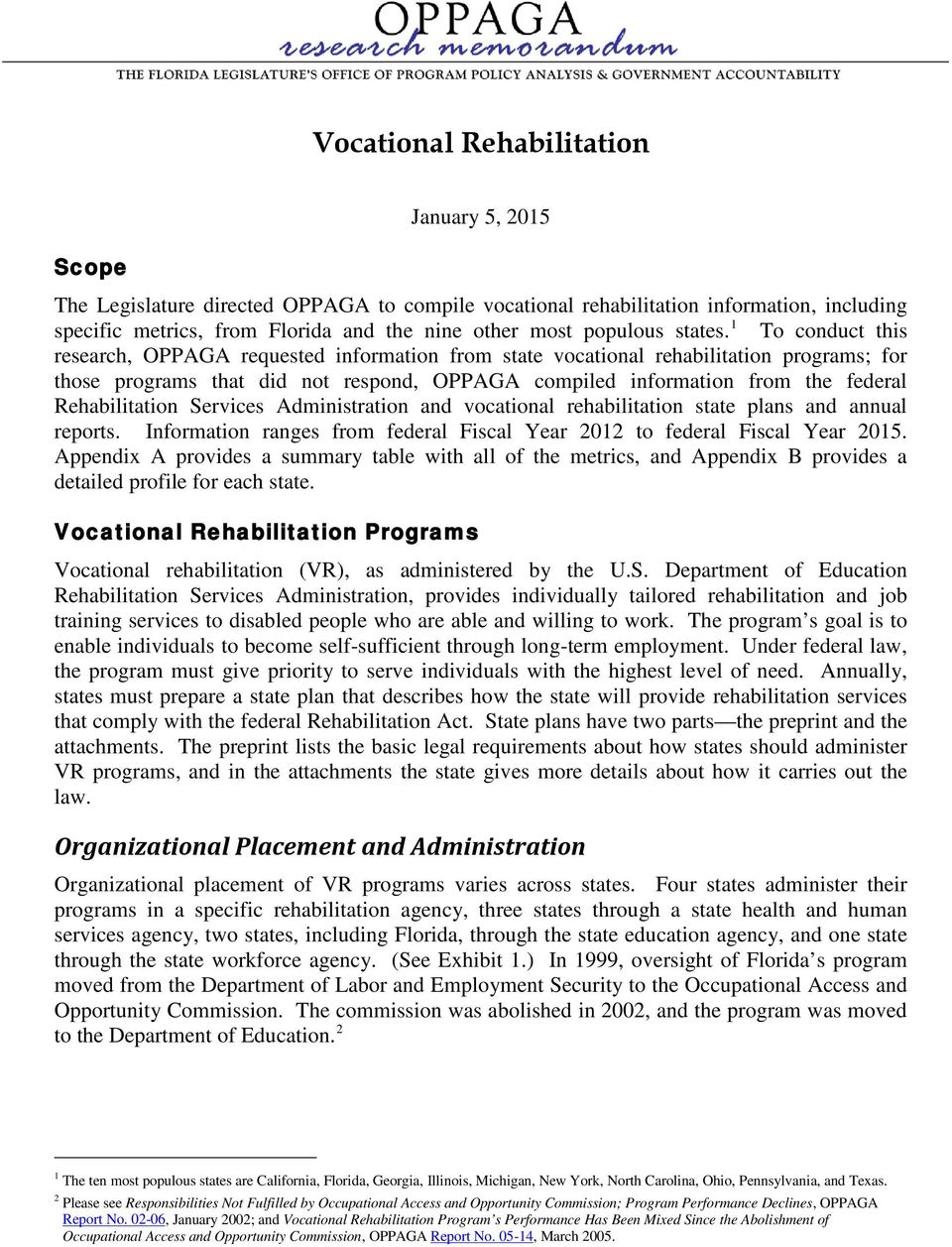
1 Vocational Rehabilitation Scope January 5, 2015 The Legislature directed OPPAGA to compile vocational rehabilitation information, including specific metrics, from Florida and the nine other most populous states. 1 To conduct this research, OPPAGA requested information from state vocational rehabilitation programs; for those programs that did not respond, OPPAGA compiled information from the federal Rehabilitation Services Administration and vocational rehabilitation state plans and annual reports. Information ranges from federal Fiscal Year 2012 to federal Fiscal Year Appendix A provides a summary table with all of the metrics, and Appendix B provides a detailed profile for each state. Vocational Rehabilitation Programs Vocational rehabilitation (VR), as administered by the U.S. Department of Education Rehabilitation Services Administration, provides individually tailored rehabilitation and job training services to disabled people who are able and willing to work. The program s goal is to enable individuals to become self-sufficient through long-term employment. Under federal law, the program must give priority to serve individuals with the highest level of need. Annually, states must prepare a state plan that describes how the state will provide rehabilitation services that comply with the federal Rehabilitation Act. plans have two parts the preprint and the attachments. The preprint lists the basic legal requirements about how states should administer VR programs, and in the attachments the state gives more details about how it carries out the law. Organizational Placement and Administration Organizational placement of VR programs varies across states. Four states administer their programs in a specific rehabilitation agency, three states through a state health and human services agency, two states, including Florida, through the state education agency, and one state through the state workforce agency. (See Exhibit 1.) In 1999, oversight of Florida s program moved from the Department of Labor and Employment Security to the Occupational Access and Opportunity Commission. The commission was abolished in 2002, and the program was moved to the Department of Education. 2 1 The ten most populous states are California, Florida, Georgia, Illinois, Michigan, New York, North Carolina, Ohio, Pennsylvania, and Texas. 2 Please see Responsibilities Not Fulfilled by Occupational Access and Opportunity Commission; Program Performance Declines, OPPAGA Report No , January 2002; and Vocational Rehabilitation Program s Performance Has Been Mixed Since the Abolishment of Occupational Access and Opportunity Commission, OPPAGA Report No , March 2005.
2 Page 2 Exhibit 1 Organizational Placement of Vocational Rehabilitation Program Vocational Rehabilitation Program Organizational Placement California Department of Rehabilitation Rehabilitation Agency Florida Division of Vocational Rehabilitation; Department of Education Georgia Vocational Rehabilitation Division; Vocational Rehabilitation Agency Illinois Division of Rehabilitation Services; Department of Human Services Michigan Rehabilitation Services; Department of Human Services New York Adult Career and Continuing Education Services- Vocational Rehabilitation; Department of Education North Carolina Division of Vocational Rehabilitation Services; Department of Health and Human Services Ohio Bureau of Vocational Rehabilitation; Opportunities for Ohioans with Disabilities Pennsylvania Office of Vocational Rehabilitation; Department of Labor and Industry Texas Division for Rehabilitation Services; Department of Assistive and Rehabilitative Services Source: Vocational Rehabilitation Programs. Education Agency Rehabilitation Agency Health and Human Services Agency Health and Human Services Agency Education Agency Health and Human Services Agency Rehabilitation Agency Workforce Agency Rehabilitation Agency s VR programs are funded through a state and federal matching agreement. Funds are distributed to states using a formula that takes into account population, per capita income, and 1978 funding allocations. The match rate does not vary across states a federal government grant provides 78.7% of program funds while states contribute a 21.3% match. 3 s can use private funding as part of state match; private funding must be earmarked for establishing a community rehabilitation program, particular geographic areas within the state, or any other purpose under the state plan as part of the state match. 4 Total program funds also include federal carry over from the prior year, program income, and a federal award for supported employment. 5 As shown in Exhibit 2, in 2013, total funding ranged from $525 million in California to $119 million in Michigan; Florida s total funding was $206.7 million. 3 Not all states provide a full match for their VR allocations; in these cases, these states federal grants are reduced accordingly. 4 Funds may not be used to benefit the private donor. 5 Supported employment means competitive work in integrated settings or employment in integrated work settings in which individuals are working toward competitive work.

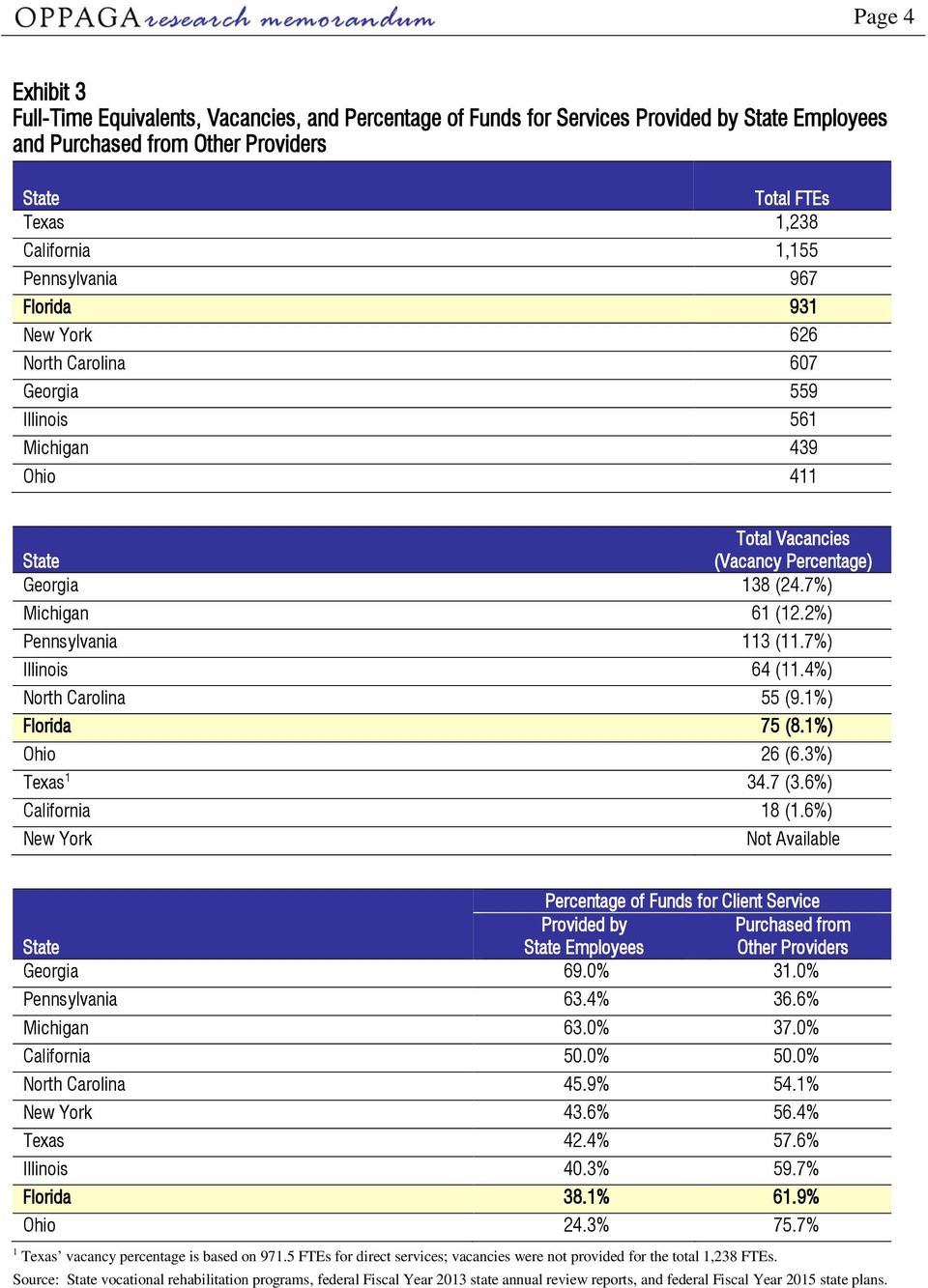
3 Page 3 Exhibit 2 Vocational Rehabilitation Funding Total 2013 Funding Federal Award 2013 Match California $525,123,818 $289,882,431 $77,628,202 Texas 316,344, ,606,938 51,316,744 New York 295,451, ,132,416 55,276,641 Illinois 255,857, ,148,062 29,807,831 Ohio 213,911, ,716,058 29,419,874 Florida $206,700,281 $111,285,655 $30,127,473 Pennsylvania 186,332, ,450,404 30,163,832 Georgia 144,766, ,223,410 17,455,801 North Carolina 129,512,962 89,288,587 28,223,721 Michigan 2 119,032,502 74,723,029 20,112,537 1 In addition to the federal award and state match, total funding also includes federal carry over, program income, and a federal award for supported employment. 2 Michigan s funding is from federal Fiscal Year Source: vocational rehabilitation programs and federal Fiscal Year 2013 state annual review reports. VR services traditionally have been delivered by a mix of state employees and private providers. Federal regulations require that state employees must deliver and conduct certain program services and activities, including all decisions affecting program eligibility, the nature and scope of available services, and provision of those services; the decision to close a case; policy formulation and implementation; allocating and expending program funds; and participation as a partner in the One-Stop service delivery system under Title I of the Workforce Investment Act of program staff ranged from 1,238 FTEs in Texas to 411 in Ohio; Florida has the fourth highest number of FTEs with 931. Of its 931 FTEs, 47% (438) are administration positions, 45% are field supervisors (415), and 8% are counselors (78). Total FTE vacancy rates ranged from 24.7% (138) in Georgia to 1.6% (18) in California; Florida reported a vacancy rate of 8.1% (75). The percentage of funds for client services provided by state employees varied from 69.0% in Georgia to 24.3% in Ohio; 38.1% of Florida s VR funds were used for client services provided by state employees, while 61.9% were used to purchase services from other providers. (See Exhibit 3.)

4 Page 4 Exhibit 3 Full-Time Equivalents, Vacancies, and Percentage of Funds for Services Provided by Employees and Purchased from Other Providers Total FTEs Texas 1,238 California 1,155 Pennsylvania 967 Florida 931 New York 626 North Carolina 607 Georgia 559 Illinois 561 Michigan 439 Ohio 411 Total Vacancies (Vacancy Percentage) Georgia 138 (24.7%) Michigan 61 (12.2%) Pennsylvania 113 (11.7%) Illinois 64 (11.4%) North Carolina 55 (9.1%) Florida 75 (8.1%) Ohio 26 (6.3%) Texas (3.6%) California 18 (1.6%) New York Not Available Percentage of Funds for Client Service Provided by Employees Purchased from Other Providers Georgia 69.0% 31.0% Pennsylvania 63.4% 36.6% Michigan 63.0% 37.0% California 50.0% 50.0% North Carolina 45.9% 54.1% New York 43.6% 56.4% Texas 42.4% 57.6% Illinois 40.3% 59.7% Florida 38.1% 61.9% Ohio 24.3% 75.7% 1 Texas vacancy percentage is based on FTEs for direct services; vacancies were not provided for the total 1,238 FTEs. Source: vocational rehabilitation programs, federal Fiscal Year 2013 state annual review reports, and federal Fiscal Year 2015 state plans.
5 Page 5 Program Operations To be eligible to receive VR services, an individual must be disabled and require services to prepare for, secure, retain, or regain employment. Recipients of Social Security Disability Insurance (SSDI) or Supplemental Security Income (SSI) are presumed to be eligible for services, provided they intend to achieve an employment outcome. However, individuals disabilities need not be so severe as to qualify the person for SSDI or SSI benefits; rather, disabilities must only be a substantial impediment to employment. With limited exceptions, the VR program must determine eligibility within a reasonable period of time, not to exceed 60 days, after the individual submits an application. s include all individuals with a program record when reporting the total number of individuals served; thus, even individuals who have only applied are tracked and reported by states as being served. The total number of individuals served ranged from 80,475 in Texas to 17,455 in Georgia; Florida reported serving a total of 60,085 individuals. s ratio of FTEs to total individuals served ranged from 1:92 in New York to 1:31 in Georgia; Florida s ratio of FTEs to individuals served was 1:65. (See Exhibit 4.) Exhibit 4 Total Individuals Served Total Individuals Served FTEs: Total Individuals Served Texas 80,475 1:65 California 72,030 1:62 Florida 60,085 1:65 Pennsylvania 58,025 1:60 New York 57,890 1:92 North Carolina 46,419 1:76 Illinois 45,200 1:81 Michigan 34,435 1:78 Ohio 22,692 1:55 Georgia 17,455 1:31 Source: vocational rehabilitation programs, federal Fiscal Year 2013 state annual review reports, and federal Fiscal Year 2015 state plans. After eligibility is established, federal regulations require VR programs to develop a written Individualized Plan for Employment (IPE) for each individual. The IPE lists the individual s employment goal and specific services to be provided to assist the individual in reaching that goal. According to federal regulations, vocational rehabilitation services include any service identified in an IPE that is necessary to assist an individual with a disability in preparing for, securing, retaining, or regaining an employment outcome. In each case, employment outcomes must be consistent with individuals strengths, resources, priorities, concerns, abilities, capabilities, interests, and informed choices. As such, VR services are broad and varied, and state VR programs must ensure that all necessary services to equip the individual are provided. (See Appendix C for a detailed list of required services.) Because employment is the ultimate outcome, training is a major component of VR programs. Training can be provided at schools, colleges, or universities; at community rehabilitation programs; and in on-the-job training programs. Training services include academic training, job readiness or disability-related augmentative skills, and occupational, vocational, and job skills.

6 Page 6 As shown in Exhibit 5, in 2013, the number of individuals who received postsecondary education training ranged from 14,168 in California to 1,076 in Ohio; Florida provided postsecondary education to 2,337 individuals. The number of individuals who received other training and education ranged from 17,287 in California to 2,350 in Georgia; Florida provided these services to 9,336 individuals. Transportation is another primary service provided. The number of individuals receiving transportation services ranged from 41,316 in California to 1,897 in Georgia; Florida provided transportation services to 11,002 individuals. Exhibit 5 Number of Individuals Receiving Services Services Number of Individuals Served Postsecondary Education California 14,168 Training New York 6,206 North Carolina 1,651 Texas 5,999 Pennsylvania 5,733 Florida 2,337 Illinois 2,022 Michigan 1,840 Georgia 1,666 Ohio 1,076 Other Training and Education California 17,287 New York 17,568 North Carolina 11,614 Florida 9,336 Ohio 9,548 Texas 6,965 Michigan 6,633 Illinois 3,423 Pennsylvania 2,877 Georgia 2,350 Transportation California 41,316 New York 15,066 Florida 11,002 Ohio 7,858 North Carolina 7,163 Texas 4,071 Pennsylvania 3,590 Michigan 3,577 Illinois 1,966 Georgia 1,897 Source: Federal Fiscal Year 2013 state annual review reports. To close a case for an individual who has achieved an employment outcome, the individual must achieve the employment objective listed in the IPE and maintain the outcome for no less than 90 days. In addition, the individual and VR counselor must agree that the employment outcome is satisfactory and that the individual is performing well. The VR program also must notify the individual that post-employment services may be available even after the case is closed. Cases may be closed for reasons other than achieving employment, such as closing without

7 Page 7 employment or while still in applicant status prior to receiving services. There are various reasons why case closure may occur for a reason other than job achievement. For example, individuals may decide to not pursue program participation or may move to another state or his or her condition may decline, making the individual no longer eligible for rehabilitation services. Exhibit 6 shows the total number of cases closed and, of these, the number closed with employment and the number closed without employment. Florida s VR program closed a total of 29,828 cases. Of these, 6,057 were closed with employment and 7,174 without employment. Both Florida and Ohio closed a higher number of cases without employment compared to cases closed with employment. The individual state profiles in Appendix B provide detail by type of case closed. Exhibit 6 Cases Closed Total Cases Closed New York 38,033 Texas 31,960 California 31,183 Florida 29,828 Pennsylvania 25,888 North Carolina 24,338 Ohio 21,560 Michigan 17,633 Illinois 16,945 Georgia 13,739 Cases Closed with Employment Texas 13,136 New York 11,900 California 11,187 Pennsylvania 9,939 North Carolina 6,758 Michigan 6,618 Florida 6,057 Illinois 5,324 Ohio 3,510 Georgia 4,702 Cases Closed without Employment New York 9,721 Pennsylvania 8,545 California 8,120 Florida 7,174 Texas 6,690 North Carolina 5,233 Michigan 5,201 Illinois 4,477 Ohio 3,660 Georgia 2,813 Source: vocational rehabilitation programs and information from the federal Rehabilitation Services Administration.

8 Page 8 Average cost per person served (total client service expenditures divided by the total number of individuals served) ranged from $5,436 in Ohio to $2,192 in Michigan; the average per person cost for Florida s VR program was $2,690. Average cost per employment outcome (the cost of services for individuals who exited with an employment outcome divided by the total number of these individuals) ranged from $10,104 in Ohio to $3,319 in Michigan; Florida has the second highest average cost per employment outcome at $8,135. (See Exhibit 7.) Exhibit 7 Average Cost per Person and Employment Outcome Average Cost per Person Served Ohio $5,436 Illinois 5,426 California 4,307 New York 3,875 Georgia 3,626 Florida 2,690 Texas 2,685 North Carolina 2,337 Pennsylvania 2,284 Michigan 2,192 Average Cost per Employment Outcome Ohio $10,104 Florida 8,135 Texas 7,287 California 6,439 North Carolina 5,895 New York 5,616 Georgia 5,272 Pennsylvania 5,016 Illinois 4,678 Michigan 3,319 Source: vocational rehabilitation programs and federal Fiscal Year 2013 state annual review reports. If a state does not have the resources to provide VR services to all eligible individuals who apply, it must specify in its state plan the order to be followed in selecting those individuals who will receive services once resources become available; this is known as the Order of Selection and functions as a waitlist. When a state is operating under an Order of Selection, eligible individuals are evaluated for their functional limitation, anticipation of services, and duration of services and are classified as meeting the criteria for one of three priority categories, with the individuals with the highest level of need being placed in Priority Category 1 so that they will receive services first. Five of the 10 states, including Florida, operate an Order of Selection. See Exhibit 8 for the total number of individuals on Order of Selection.

9 Page 9 Exhibit 8 Order of Selection Status Total Individuals on Order of Selection Illinois 25,391 Florida 1,408 Ohio 700 Pennsylvania 29 California 21 Georgia No Order of Selection Michigan No Order of Selection New York No Order of Selection North Carolina No Order of Selection Texas No Order of Selection Source: vocational rehabilitation programs and federal Fiscal Year 2015 state plans. Federal Performance Measures The federal Rehabilitation Services Administration is required to establish performance indicators for the VR program that include outcome and related measures of program performance. plans must include program performance data. agencies that do not meet the minimum levels of performance must develop a Program Improvement Plan that outlines specific actions to improve program performance. In addition, the Rehabilitation Services Administration provides technical assistance to state agencies that perform below established performance levels. If a program fails to enter into or comply with an improvement plan, that program s funding may be reduced or withheld. The federal performance measures include six standards. See Exhibit 9 for each standard s range among the 10 states. Change in employment outcomes is the difference between the number of individuals exiting the VR program who achieved an employment outcome during the current performance period and the number of individuals exiting the VR program who achieved an employment outcome during the previous performance period. The federal change in employment outcomes performance level is greater than or equal to the previous year s performance. The change in employment outcomes ranged from +1,052 in California to -1,469 in Georgia; Florida ranked second with a performance of Percentage of employment outcomes is the percentage of individuals exiting the program during the performance period who have achieved an employment outcome after receiving services. The federal percentage of employment outcomes performance level is 55.8%. The percentage of employment outcomes measure ranged from 62.4% in New York to 35.0% in Georgia; Florida ranked seventh with a performance of 44.0%. Competitive employment outcomes measures the percentage of individuals who exit the VR program in employment in integrated settings with or without ongoing support services, self-employment, or Business Enterprise Program employment with hourly rate earnings equivalent to at least the federal or state minimum wage, whichever is higher. This measure is based on all individuals exiting the program who have achieved an employment outcome after receiving services. The federal competitive employment outcomes performance level is 72.6%. Competitive employment outcomes percentage ranged from 99.8% in Florida to 89.2% in California.
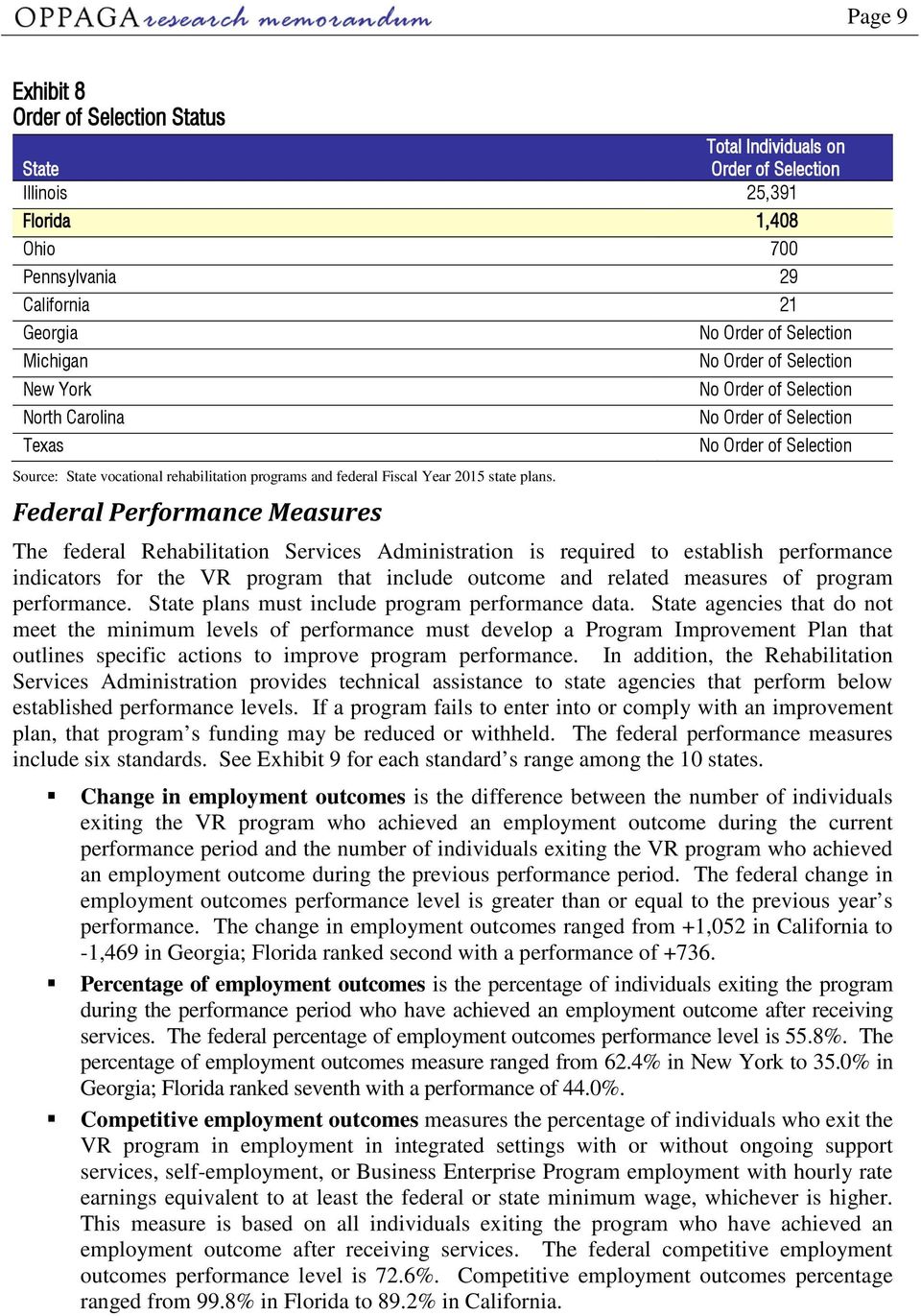
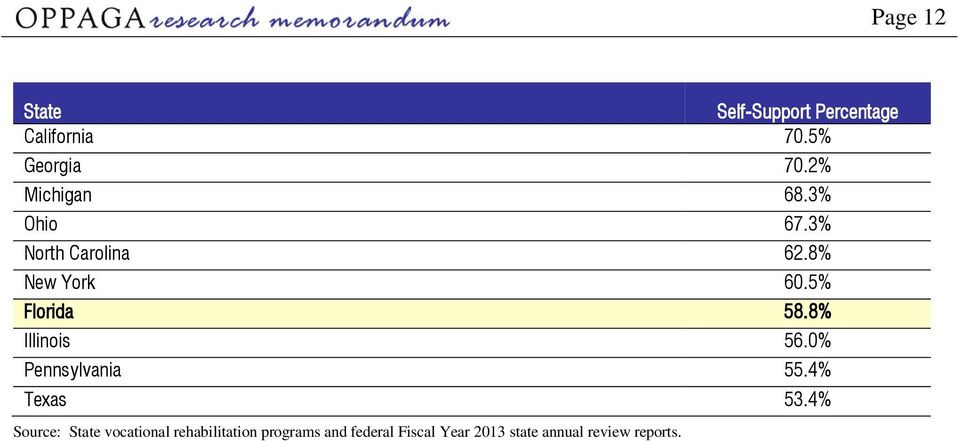
10 Page 10 Significance of disability is the percentage of those individuals who exit the VR program with competitive employment who have significant disabilities. The federal significance of disability performance level is 62.4%. The significance of disabilities percentage ranged from 100% in Pennsylvania to 79.7% in North Carolina; Florida ranked fifth with 98.7%. Earnings ratio is the ratio of the average hourly earnings of all individuals in competitive employment to the average hourly earnings of all employed individuals in the state. The federal earnings ratio performance level is This means that VR clients who achieved competitive outcomes are earning, on average, at least 52 cents for every dollar earned hourly by all employed individuals in the state. Programs earnings ratios ranged from 0.53 in Michigan to 0.36 in New York; Florida s VR program ranked third with a ratio of Self-support percentage examines those individuals who exit the VR program in competitive employment. The self-support percentage is the difference between the percentage of individuals who at program entry reported their income as the largest single source of support and the percentage that reported their personal income as the largest single source of support at program exit. The federal self-support percentage performance standard is 53.0%. Programs self-support percentages ranged from 70.5% in California to 53.4% in Texas; Florida ranked seventh, with a 58.8% self-support percentage. Exhibit 9 Federal Performance Measures Change in Employment Outcomes California +1,052 Florida +736 Texas +430 Ohio +204 Illinois +187 New York +125 Pennsylvania +11 North Carolina -35 Michigan -990 Georgia -1,469 Percentage of Employment Outcomes New York 62.4% Texas 59.4% Pennsylvania 55.4% Illinois 53.6% Michigan 51.6% North Carolina 50.4% Florida 44.0% Ohio 40.3% California 37.1% Georgia 35.0%

11 Page 11 Competitive Employment Outcomes Florida 99.8% North Carolina 99.8% Michigan 99.2% Texas 98.7% Ohio 96.6% Georgia 96.3% New York 96.2% Pennsylvania 95.1% Illinois 93.5% California 89.2% Significance of Disability Pennsylvania 100% Ohio 100% Illinois 100% California 99.2% Florida 98.7% New York 98.3% Georgia 89.5% Michigan 87.7% Texas 85.4% North Carolina 79.7% Earnings Ratio Michigan 0.53 Pennsylvania 0.52 Florida 0.51 Texas 0.49 Ohio 0.48 Georgia 0.47 North Carolina 0.45 California 0.43 Illinois 0.42 New York 0.36

12 Page 12 Self-Support Percentage California 70.5% Georgia 70.2% Michigan 68.3% Ohio 67.3% North Carolina 62.8% New York 60.5% Florida 58.8% Illinois 56.0% Pennsylvania 55.4% Texas 53.4% Source: vocational rehabilitation programs and federal Fiscal Year 2013 state annual review reports.
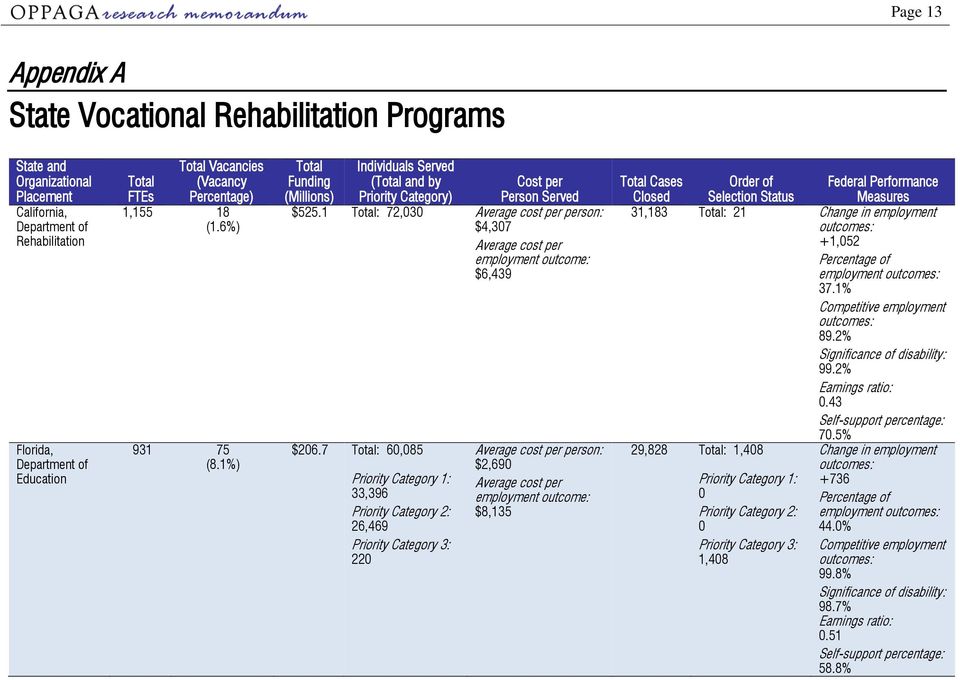
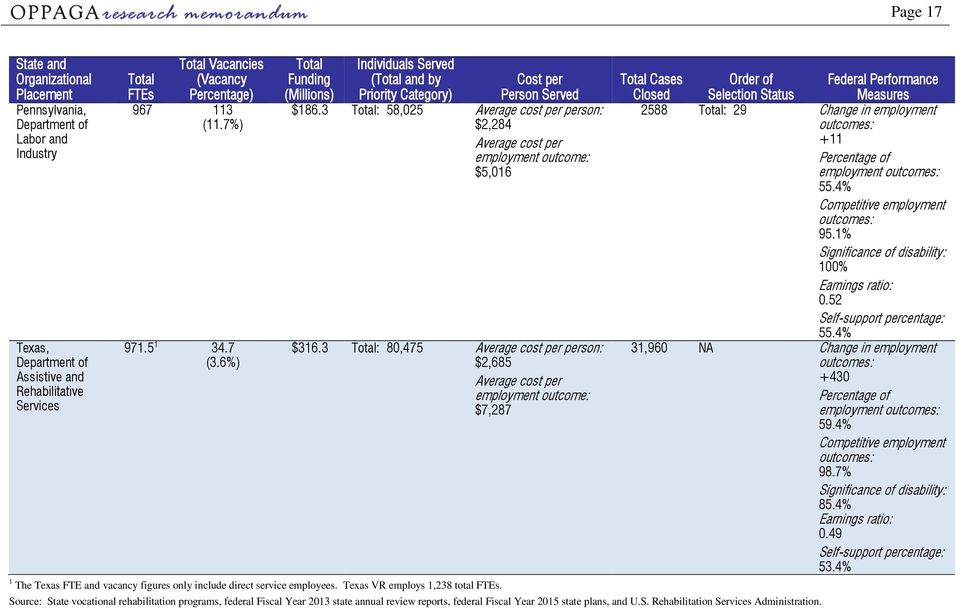
13 Page 13 Appendix A Vocational Rehabilitation Programs and Organizational Placement California, Department of Rehabilitation Florida, Department of Education Total Vacancies Total (Vacancy FTEs Percentage) 1, (1.6%) (8.1%) Total Funding (Millions) Individuals Served (Total and by Priority Category) Cost per Person Served $525.1 Total: 72,030 Average cost per person: $4,307 Average cost per employment outcome: $6,439 $206.7 Total: 60,085 Priority Category 1: 33,396 Priority Category 2: 26,469 Priority Category 3: 220 Average cost per person: $2,690 Average cost per employment outcome: $8,135 Total Cases Closed Order of Selection Status Federal Performance Measures 31,183 Total: 21 Change in employment +1,052 Percentage of employment 37.1% Competitive employment 89.2% Significance of disability: 99.2% Earnings ratio: 0.43 Self-support percentage: 70.5% 29,828 Total: 1,408 Change in employment Priority Category 1: Percentage of Priority Category 2: employment % Priority Category 3: Competitive employment 1, % Significance of disability: 98.7% Earnings ratio: 0.51 Self-support percentage: 58.8%
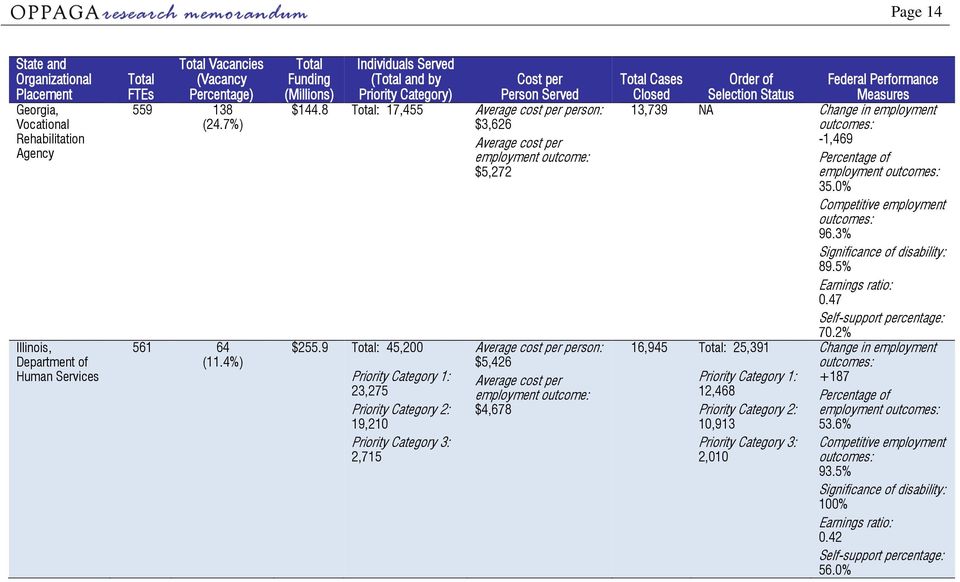
14 Page 14 and Organizational Placement Georgia, Vocational Rehabilitation Agency Illinois, Department of Human Services Total Vacancies Total (Vacancy FTEs Percentage) (24.7%) (11.4%) Total Funding (Millions) Individuals Served (Total and by Priority Category) Cost per Person Served $144.8 Total: 17,455 Average cost per person: $3,626 Average cost per employment outcome: $5,272 $255.9 Total: 45,200 Priority Category 1: 23,275 Priority Category 2: 19,210 Priority Category 3: 2,715 Average cost per person: $5,426 Average cost per employment outcome: $4,678 Total Cases Closed Order of Selection Status Federal Performance Measures 13,739 NA Change in employment -1,469 Percentage of employment 35.0% Competitive employment 96.3% Significance of disability: 89.5% Earnings ratio: 0.47 Self-support percentage: 70.2% 16,945 Total: 25,391 Change in employment Priority Category 1: ,468 Percentage of Priority Category 2: employment 10, % Priority Category 3: Competitive employment 2, % Significance of disability: 100% Earnings ratio: 0.42 Self-support percentage: 56.0%
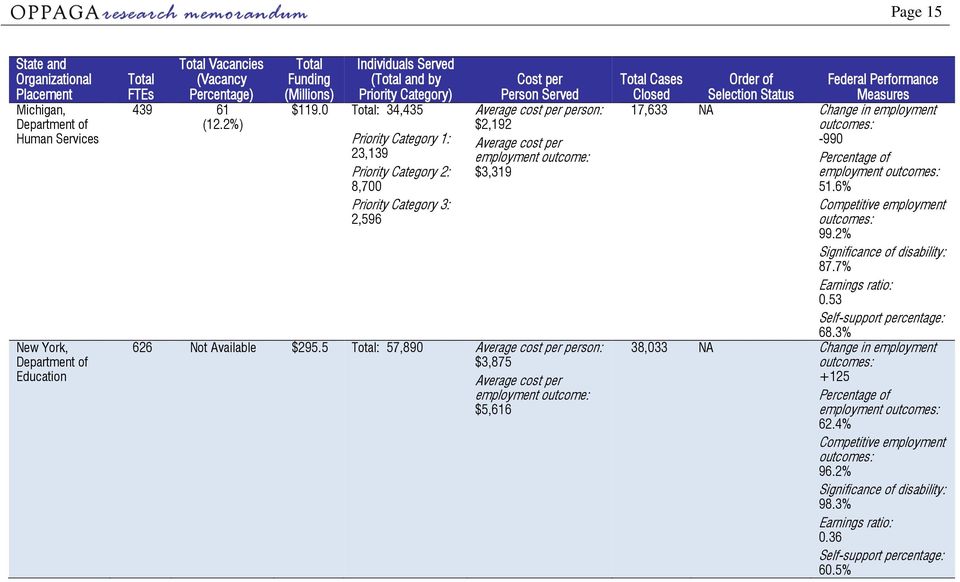
15 Page 15 and Organizational Placement Michigan, Department of Human Services New York, Department of Education Total Vacancies Total (Vacancy FTEs Percentage) (12.2%) Total Funding (Millions) Individuals Served (Total and by Priority Category) $119.0 Total: 34,435 Priority Category 1: 23,139 Priority Category 2: 8,700 Priority Category 3: 2,596 Cost per Person Served Average cost per person: $2,192 Average cost per employment outcome: $3, Not Available $295.5 Total: 57,890 Average cost per person: $3,875 Average cost per employment outcome: $5,616 Total Cases Closed Order of Selection Status Federal Performance Measures 17,633 NA Change in employment -990 Percentage of employment 51.6% Competitive employment 99.2% Significance of disability: 87.7% Earnings ratio: 0.53 Self-support percentage: 68.3% 38,033 NA Change in employment +125 Percentage of employment 62.4% Competitive employment 96.2% Significance of disability: 98.3% Earnings ratio: 0.36 Self-support percentage: 60.5%
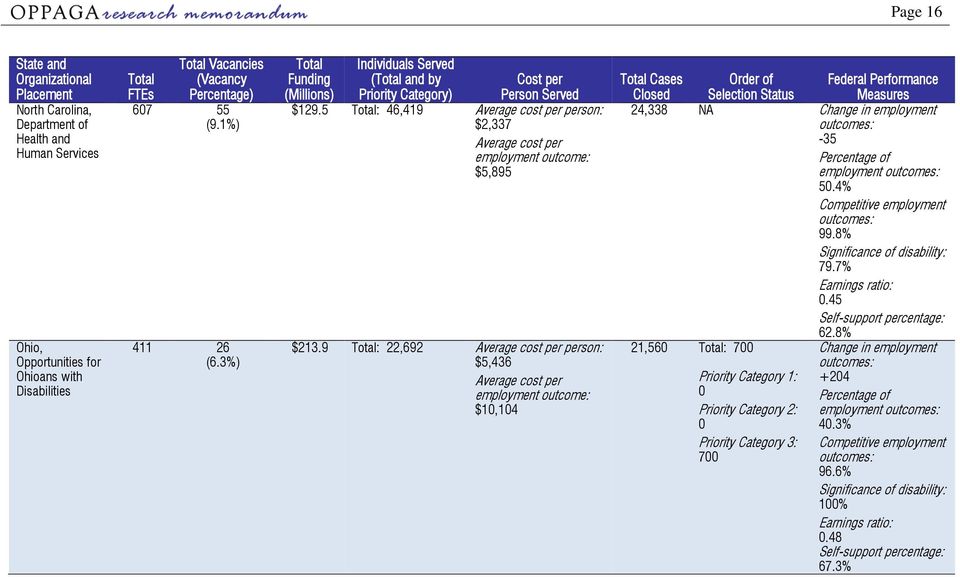
16 Page 16 and Organizational Placement North Carolina, Department of Health and Human Services Ohio, Opportunities for Ohioans with Disabilities Total Vacancies Total (Vacancy FTEs Percentage) (9.1%) (6.3%) Total Funding (Millions) Individuals Served (Total and by Priority Category) Cost per Person Served $129.5 Total: 46,419 Average cost per person: $2,337 Average cost per employment outcome: $5,895 $213.9 Total: 22,692 Average cost per person: $5,436 Average cost per employment outcome: $10,104 Total Cases Closed Order of Selection Status Federal Performance Measures 24,338 NA Change in employment -35 Percentage of employment 50.4% Competitive employment 99.8% Significance of disability: 79.7% Earnings ratio: 0.45 Self-support percentage: 62.8% 21,560 Total: 700 Change in employment Priority Category 1: Percentage of Priority Category 2: employment % Priority Category 3: Competitive employment % Significance of disability: 100% Earnings ratio: 0.48 Self-support percentage: 67.3%
17 Page 17 and Organizational Placement Pennsylvania, Department of Labor and Industry Texas, Department of Assistive and Rehabilitative Services Total Vacancies Total (Vacancy FTEs Percentage) (11.7%) (3.6%) Total Funding (Millions) Individuals Served (Total and by Priority Category) Cost per Person Served $186.3 Total: 58,025 Average cost per person: $2,284 Average cost per employment outcome: $5,016 $316.3 Total: 80,475 Average cost per person: $2,685 Average cost per employment outcome: $7,287 1 The Texas FTE and vacancy figures only include direct service employees. Texas VR employs 1,238 total FTEs. Total Cases Closed Order of Selection Status Federal Performance Measures 2588 Total: 29 Change in employment +11 Percentage of employment 55.4% Competitive employment 95.1% Significance of disability: 100% Earnings ratio: 0.52 Self-support percentage: 55.4% 31,960 NA Change in employment +430 Percentage of employment 59.4% Competitive employment 98.7% Significance of disability: 85.4% Earnings ratio: 0.49 Self-support percentage: 53.4% Source: vocational rehabilitation programs, federal Fiscal Year 2013 state annual review reports, federal Fiscal Year 2015 state plans, and U.S. Rehabilitation Services Administration.
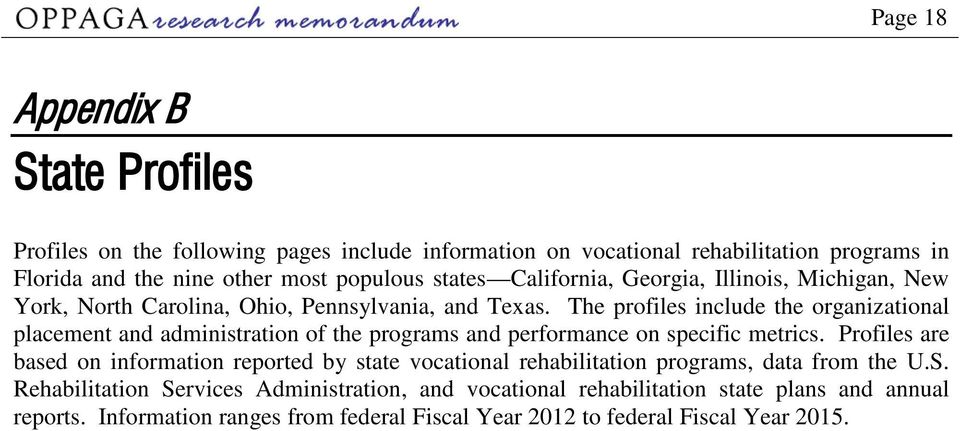
18 Page 18 Appendix B Profiles Profiles on the following pages include information on vocational rehabilitation programs in Florida and the nine other most populous states California, Georgia, Illinois, Michigan, New York, North Carolina, Ohio, Pennsylvania, and Texas. The profiles include the organizational placement and administration of the programs and performance on specific metrics. Profiles are based on information reported by state vocational rehabilitation programs, data from the U.S. Rehabilitation Services Administration, and vocational rehabilitation state plans and annual reports. Information ranges from federal Fiscal Year 2012 to federal Fiscal Year 2015.
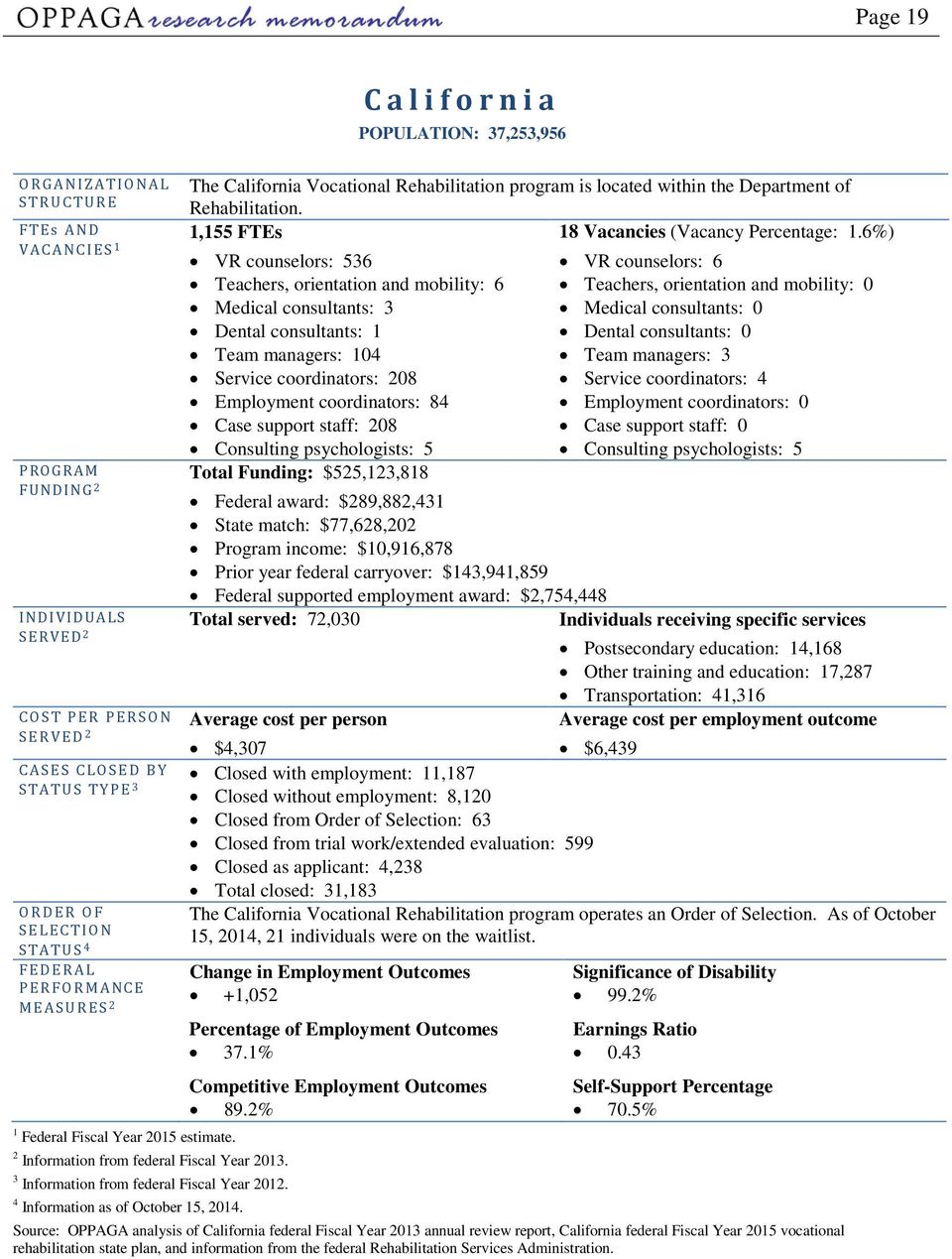
19 Page 19 California POPULATION: 37,253,956 ORGANIZATIONAL STRUCTURE FTEs AND VACANCIES 1 PROGRAM FUNDING 2 INDIVIDUALS SERVED 2 COST PER PERSON SERVED 2 CASES CLOSED BY STATUS TYPE 3 ORDER OF SELECTION STATUS 4 FEDERAL PERFORMANCE MEASURES 2 The California Vocational Rehabilitation program is located within the Department of Rehabilitation. 1,155 FTEs 18 Vacancies (Vacancy Percentage: 1.6%) VR counselors: 536 Teachers, orientation and mobility: 6 Medical consultants: 3 Dental consultants: 1 Team managers: 104 Service coordinators: 208 Employment coordinators: 84 Case support staff: 208 Consulting psychologists: 5 Total Funding: $525,123,818 VR counselors: 6 Teachers, orientation and mobility: 0 Medical consultants: 0 Dental consultants: 0 Team managers: 3 Service coordinators: 4 Employment coordinators: 0 Case support staff: 0 Consulting psychologists: 5 Federal award: $289,882,431 match: $77,628,202 Program income: $10,916,878 Prior year federal carryover: $143,941,859 Federal supported employment award: $2,754,448 Total served: 72,030 Individuals receiving specific services Postsecondary education: 14,168 Other training and education: 17,287 Transportation: 41,316 Average cost per person Average cost per employment outcome $4,307 $6,439 Closed with employment: 11,187 Closed without employment: 8,120 Closed from Order of Selection: 63 Closed from trial work/extended evaluation: 599 Closed as applicant: 4,238 Total closed: 31,183 The California Vocational Rehabilitation program operates an Order of Selection. As of October 15, 2014, 21 individuals were on the waitlist. Change in Employment Outcomes +1,052 Percentage of Employment Outcomes 37.1% Competitive Employment Outcomes 89.2% 1 Federal Fiscal Year 2015 estimate. 2 Information from federal Fiscal Year Information from federal Fiscal Year Significance of Disability 99.2% Earnings Ratio 0.43 Self-Support Percentage 70.5% 4 Information as of October 15, Source: OPPAGA analysis of California federal Fiscal Year 2013 annual review report, California federal Fiscal Year 2015 vocational rehabilitation state plan, and information from the federal Rehabilitation Services Administration.
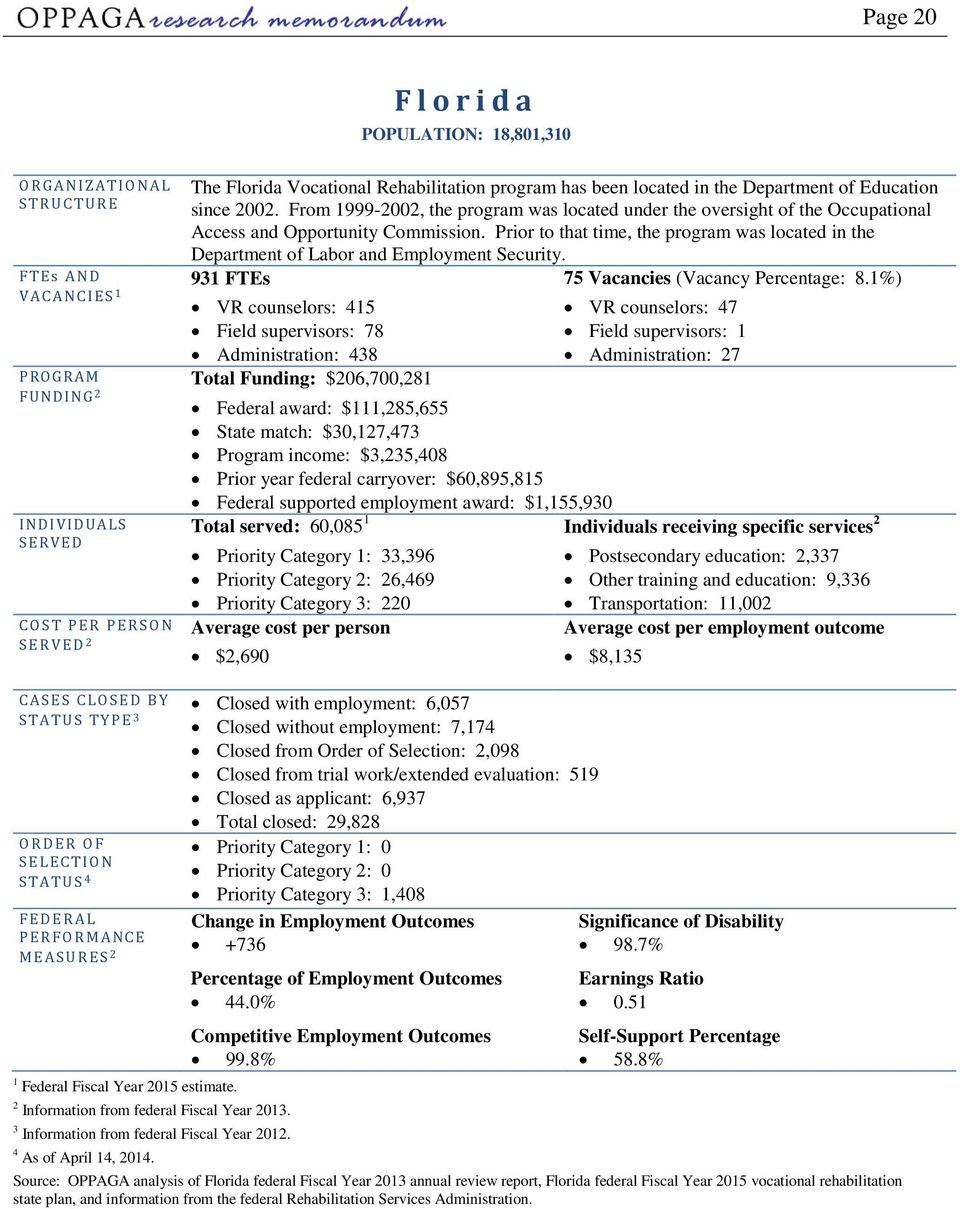
20 Page 20 Florida POPULATION: 18,801,310 ORGANIZATIONAL STRUCTURE FTEs AND VACANCIES 1 PROGRAM FUNDING 2 INDIVIDUALS SERVED COST PER PERSON SERVED 2 The Florida Vocational Rehabilitation program has been located in the Department of Education since From , the program was located under the oversight of the Occupational Access and Opportunity Commission. Prior to that time, the program was located in the Department of Labor and Employment Security. 931 FTEs 75 Vacancies (Vacancy Percentage: 8.1%) VR counselors: 415 Field supervisors: 78 Administration: 438 Total Funding: $206,700,281 Federal award: $111,285,655 match: $30,127,473 Program income: $3,235,408 Prior year federal carryover: $60,895,815 VR counselors: 47 Field supervisors: 1 Administration: 27 Federal supported employment award: $1,155,930 Total served: 60,085 1 Individuals receiving specific services 2 Priority Category 1: 33,396 Priority Category 2: 26,469 Priority Category 3: 220 Average cost per person $2,690 Postsecondary education: 2,337 Other training and education: 9,336 Transportation: 11,002 Average cost per employment outcome $8,135 CASES CLOSED BY STATUS TYPE 3 Closed with employment: 6,057 Closed without employment: 7,174 Closed from Order of Selection: 2,098 Closed from trial work/extended evaluation: 519 Closed as applicant: 6,937 Total closed: 29,828 ORDER OF Priority Category 1: 0 SELECTION Priority Category 2: 0 STATUS 4 Priority Category 3: 1,408 FEDERAL PERFORMANCE MEASURES 2 Change in Employment Outcomes +736 Percentage of Employment Outcomes 44.0% Competitive Employment Outcomes 99.8% 1 Federal Fiscal Year 2015 estimate. 2 Information from federal Fiscal Year Information from federal Fiscal Year Significance of Disability 98.7% Earnings Ratio 0.51 Self-Support Percentage 58.8% 4 As of April 14, Source: OPPAGA analysis of Florida federal Fiscal Year 2013 annual review report, Florida federal Fiscal Year 2015 vocational rehabilitation state plan, and information from the federal Rehabilitation Services Administration.
21 Page 21 Georgia POPULATION: 9,687,653 ORGANIZATIONAL STRUCTURE FTEs AND VACANCIES 1 PROGRAM FUNDING 2 INDIVIDUALS SERVED 2 COST PER PERSON SERVED 2 The Georgia Vocational Rehabilitation Division was moved to the Georgia Vocational Rehabilitation Agency in July Previously, the VR program was located within the Department of Labor. 559 FTEs 138 Vacancies (Vacancy Percentage: 24.7%) Regional directors: 10 Rehabilitation unit managers: 45 Certified rehabilitation counselors: 207 Rehabilitation counselors for the deaf and blind: 29 Provisional rehabilitation counselors: 34 Rehabilitation case work associates: 3 Rehabilitation employment specialists: 62 Rehabilitation job readiness specialists: 40 Rehabilitation assistants: 109 Assistive work technology positions: 20 Total Funding: $144,766,083 Federal award: $100,223,410 match: $17,455,801 Program income: $1,798,292 Prior year federal carryover: $24,571,304 Regional directors: 2 Rehabilitation unit managers: 11 Certified rehabilitation counselors: 65 Rehabilitation counselors for the deaf and blind: 7 Provisional rehabilitation counselors: 14 Rehabilitation case work associates: 3 Rehabilitation employment specialists: 8 Rehabilitation job readiness specialists: 7 Rehabilitation assistants: 12 Assistive work technology positions: 9 Federal supported employment award: $717,276 Total served: 17,455 Individuals receiving specific services Average cost per person $3,626 Postsecondary education: 1,666 Other training and education: 2,350 Transportation: 1,897 Average cost per employment outcome $5,272 CASES CLOSED BY STATUS TYPE 3 ORDER OF SELECTION STATUS FEDERAL PERFORMANCE MEASURES 2 Closed with employment: 4,702 Closed without employment: 2,813 Closed after eligibility, before IPE: 3,262 Closed after IPE, before services: 56 Closed from Order of Selection: 0 Closed from trial work/extended evaluation: 35 Closed as applicant: 2,871 Total closed: 13,739 The Georgia Vocational Rehabilitation Division does not operate an Order of Selection. Change in Employment Outcomes -1,469 Percentage of Employment Outcomes 35.0% Competitive Employment Outcomes 96.3% 1 Federal Fiscal Year 2015 estimate. 2 Information from federal Fiscal Year Information from federal Fiscal Year Significance of Disability 89.5% Earnings Ratio 0.47 Self-Support Percentage 70.2% Source: OPPAGA analysis of Georgia federal Fiscal Year 2013 annual review report, Georgia federal Fiscal Year 2015 vocational rehabilitation state plan, and information from the federal Rehabilitation Services Administration.
22 Page 22 ORGANIZATIONAL STRUCTURE FTEs AND VACANCIES 1 PROGRAM FUNDING 2 INDIVIDUALS SERVED COST PER PERSON SERVED 2 CASES CLOSED BY STATUS TYPE 3 ORDER OF SELECTION STATUS 4 FEDERAL PERFORMANCE MEASURES 2 Illinois POPULATION: 12,830,632 The Illinois Vocational Rehabilitation Program has been located in the Department of Human Services, Division of Rehabilitation Services since Prior to that, the division was a separate state agency. During federal Fiscal Year 2014, approximately 37% of the program s competitive outcomes were purchased from community rehabilitation programs, with the remaining outcomes being due to the efforts of staff employed by the program. 561 FTEs 64 Vacancies (Vacancy Percentage: 11.4%) Rehabilitation counselors: 235 Rehabilitation case coordinators: 134 Rehabilitation and mobility instructors: 26 Field office supervisors: 41 Field office support positions: 37 Business enterprise for the blind staff: 13 Central office staff: 67 Assistant bureau chiefs: 6 Bureau chiefs: 2 Total Funding: $255,857,466 Federal award: $109,148,062 match: $29,807,831 Program income: $4,339,217 Prior year federal carryover: $111,621,896 Rehabilitation counselors: 30 Rehabilitation case coordinators: 10 Rehabilitation and mobility instructors: 5 Field office supervisors: 2 Filed office support positions: 9 Business enterprise for the blind staff: 0 Central office staff: 6 Assistant bureau chiefs: 1 Bureau chiefs: 1 Federal supported employment award: $940,460 Total served: 45,200 1 Individuals receiving specific services 2 Priority Category 1: 23,275 Priority Category 2: 19,210 Priority Category 3: 2,715 Average cost per person $5,426 Postsecondary education: 2,022 Other training and education: 3,423 Transportation: 1,966 Average cost per employment outcome $4,678 Closed with employment: 5,324 Closed without employment: 4,477 Closed from Order of Selection: 29 Closed from trial work/extended evaluation: 108 Closed as applicant: 3,133 Total closed: 16,945 Illinois Vocational Rehabilitation has operated under an Order of Selection for more than 30 years. Priority Category 1: 12,468 Priority Category 2: 10,913 Priority Category 3: 2,010 Change in Employment Outcomes +187 Percentage of Employment Outcomes 53.6% Competitive Employment Outcomes 93.5% 1 Federal Fiscal Year 2015 estimates. 2 Information from federal Fiscal Year Information from federal Fiscal Year Significance of Disability 100% Earnings Ratio 0.42 Self-Support Percentage 56.0% 4 As of November 24, Source: OPPAGA analysis of Illinois federal Fiscal Year 2013 annual review report and information provided by the Illinois Department of Human Services, Division of Rehabilitation Services.
23 Page 23 ORGANIZATIONAL STRUCTURE FTEs AND VACANCIES PROGRAM FUNDING INDIVIDUALS SERVED COST PER PERSON SERVED CASES CLOSED BY STATUS TYPE ORDER OF SELECTION STATUS FEDERAL PERFORMANCE MEASURES 2 Michigan 1 POPULATION: 9,883,640 Michigan Rehabilitation Services (MRS) has been located within the Department of Human Services, Field Operations Administration since October Prior to that time, MRS had previously been a part of the Department of Licensing and Regulatory Affairs, the Department of Energy, Labor, and Economic Growth, and the Department of Labor and Economic Growth. MRS does not use contracted providers to offer services. 439 FTEs 16 Vacancies Activities therapy aide: 2 Departmental analyst: 6 Departmental manager: 3 Departmental specialist: 2 Departmental technician: 8 Division administrator: 3 Domestic services aide: 8 Electrician-master licensed: 1 Executive secretary: 3 Financial analyst: 1 Fire safety officer: 5 General office assistant: 2 Maintenance mechanic: 3 Occupational safety advisor: 3 Registered nurse: 4 Rehabilitation consultant: 9 Total Funding: $119,032,502 Federal award: $74,723,029 appropriated: $14,339,964 Local match: $5,772,573 Federal carry forward: $24,196,935 Total served: 34,435 Priority Category 1: 23,139 Priority Category 2: 8,700 Priority Category 3: 2,596 Average cost per person 1 $2,192 Rehabilitation consultant manager: 3 Rehabilitation coordinator: 1 Rehabilitation counselor: 239 Rehabilitation educators: 25 School teacher: 1 Secretary: 64 Senior executive management assistant: 1 Senior executive service: 1 Site managers: 23 administrative manager: 1 Vocational rehabilitation manager: 12 Youth specialist: 5 Closed with employment: 6,618 Closed without employment: 5,201 Closed after eligibility, before IPE: 2,865 Closed after IPE, before services: 16 (Vacancy Percentage: 12.2%) In process of being filled: 45 Unassigned (no plans to fill at this time): 16 Individuals receiving specific services 2 Postsecondary education: 1,840 Other training and education: 6,633 Transportation: 3,577 Average cost per employment outcome 2 $3,319 Closed from Order of Selection: 0 Closed from trial work/extended evaluation: 325 Closed as applicant: 2,608 Total closed: 17,633 Michigan has established but has never implemented an Order of Selection. Change in Employment Outcomes -990 Percentage of Employment Outcomes 51.6% Competitive Employment Outcomes 99.2% 1 Information from federal Fiscal Year Information from federal Fiscal Year Significance of Disability 87.7% Earnings Ratio 0.53 Source: Michigan Rehabilitation Services and Michigan federal Fiscal Year 2013 annual review report. Self-Support Percentage 68.3%
24 Page 24 New York POPULATION: 19,378,102 ORGANIZATIONAL STRUCTURE FTEs AND VACANCIES 1 PROGRAM FUNDING 1 INDIVIDUALS SERVED 1 COST PER PERSON SERVED 1 CASES CLOSED BY STATUS TYPE 2 ORDER OF SELECTION STATUS The New York Vocational Rehabilitation program is located within the Education Department s Office of Adult Career and Continuing Education Services. 626 FTEs Vacancies Administrative staff: 56 Not available Counselor staff: 420 Support staff: 150 Total Funding: $295,451,556 Federal award: $121,132,416 match: $55,276,641 Program income: $2,791,464 Prior year federal carryover: $115,056,153 Federal supported employment award: $1,194,882 Total served: 57,890 Individuals receiving specific services Postsecondary education: 6,206 Other training and education: 17,568 Transportation: 15,066 Average cost per person Average cost per employment outcome $3,875 $5,616 Closed with employment: 11,900 Closed without employment: 9,721 Closed from Order of Selection: 0 Closed from trial work/extended evaluation: 340 Closed as applicant: 6,444 Total closed: 38,033 New York does not operate an Order of Selection. FEDERAL PERFORMANCE MEASURES 1 Change in Employment Outcomes +125 Percentage of Employment Outcomes 62.4% Competitive Employment Outcomes 96.2% 1 Information from federal Fiscal Year Significance of Disability 98.3% Earnings Ratio 0.36 Self-Support Percentage 60.5% 2 Information from federal Fiscal Year Source: OPPAGA analysis of New York federal Fiscal Year 2013 annual review report, information from the federal Rehabilitation Services Administration, and information provided by the New York Department of Education.
25 Page 25 North Carolina POPULATION: 9,535,483 ORGANIZATIONAL STRUCTURE FTEs AND VACANCIES 1 PROGRAM FUNDING 2 INDIVIDUALS SERVED 2 COST PER PERSON SERVED 2 CASES CLOSED BY STATUS TYPE 3 ORDER OF SELECTION STATUS The North Carolina Division of Vocational Rehabilitation Services is located within the Department of Health and Human Services. 607 FTEs 55 Vacancies (Vacancy Percentage: 9.1%) Rehabilitation counselor I: 181 Rehabilitation counselor II: 106 Counselor-in-charge: 59 Rehabilitation administrative counselor I: 3 Rehabilitation administrative counselor II: 14 Rehabilitation Counselor III: 14 Vocational evaluator II: 45 Human resources placement specialist: 67 Human services coordinator: 19 Rehabilitation casework technician: 99 Total Funding: $129,512,962 Federal award: $89,288,587 match: $28,223,721 Program income: $2,704,414 Prior year federal carryover: $8,696,433 Rehabilitation counselor I: 21 Rehabilitation counselor II: 10 Counselor-in-charge: 4 Rehabilitation administrative counselor I: 0 Rehabilitation administrative counselor II: 2 Rehabilitation Counselor III: 0 Vocational evaluator II: 2 Human resources placement specialist: 65 Human services coordinator: 0 Rehabilitation casework technician: 11 Federal supported employment award: $599,807 Total served: 46,419 Individuals receiving specific services Average cost per person $2,337 Closed with employment: 6,758 Closed without employment: 5,233 Closed from Order of Selection: 0 Closed from trial work/extended evaluation: 34 Closed as applicant: 4,424 Total closed: 24,338 North Carolina has not implemented an Order of Selection Postsecondary education: 1,651 Other training and education: 11,614 Transportation: 7,163 Average cost per employment outcome $5,895 FEDERAL PERFORMANCE MEASURES 2 1 Information as of December 23, Change in Employment Outcomes -35 Percentage of Employment Outcomes 50.4% Competitive Employment Outcomes 99.8% Significance of Disability 79.7% Earnings Ratio 0.45 Self-Support Percentage 62.8% 2 Information from federal Fiscal Year Information from federal Fiscal Year Source: OPPAGA analysis of North Carolina federal Fiscal Year 2013 annual review report, North Carolina federal Fiscal Year 2015 vocational rehabilitation state plan, information provided by the North Carolina Division of Vocational Rehabilitation, and information from the federal Rehabilitation Services Administration.
26 Page 26 Ohio POPULATION: 11,536,504 ORGANIZATIONAL STRUCTURE FTEs AND VACANCIES 1 PROGRAM FUNDING 2 INDIVIDUALS SERVED 2 COST PER PERSON SERVED 2 The Ohio Bureau of Vocational Rehabilitation is part of the Ohio Rehabilitation Services Commission known as Opportunities for Ohioans with Disabilities. 411 FTEs 26 Vacancies (Vacancy Percentage: 6.3%) Account Examiners, Office Assistants, and Public Information Officers: 60 Administrative professionals: 9 Business Enterprise specialists and program coordinators: 9 Deputy directors: 5 Program administrators and Senior analysts: 16 Rehabilitation program specialists: 8 VR counselors: 242 VR assistant counselors: 25 VR supervisors and managers: 37 Total Funding: $213,911,947 Federal award: $110,716,058 match: $29,419,874 Program income: $6,821,529 Prior year federal carryover: $66,110,804 Account Examiners, Office Assistants, and Public Information Officers: 1 Administrative professionals: 0 Business Enterprise specialists and program coordinators: 1 Deputy directors: 2 Program administrators and Senior analysts: 0 Rehabilitation program specialists: 0 VR counselors: 19 VR assistant counselors: 3 VR supervisors and managers: 0 Federal supported employment award: $843,682 Total served: 22,692 Individuals receiving specific services Average cost per person $5,436 Postsecondary education: 1,076 Other training and education: 9,548 Transportation: 7,858 Average cost per employment outcome $10,104 CASES CLOSED BY STATUS TYPE 3 Closed with employment: 3,510 Closed without employment: 3,660 Closed from Order of Selection: 175 Closed from trial work/extended evaluation: 0 Closed as applicant: 6,415 Total closed: 21,560 ORDER OF Priority Category 1: 0 SELECTION Priority Category 2: 0 STATUS 4 Priority Category 3: 700 FEDERAL PERFORMANCE MEASURES 2 Change in Employment Outcomes +204 Percentage of Employment Outcomes 40.3% Competitive Employment Outcomes 96.6% 1 Federal Fiscal Year 2015 estimate. 2 Information from federal Fiscal Year Information from federal Fiscal Year Significance of Disability 100% Earnings Ratio 0.48 Self-Support Percentage 67.3% 4 Information as of May Source: OPPAGA analysis of Ohio federal Fiscal Year 2013 annual review report, Ohio federal Fiscal Year 2015 vocational rehabilitation state plan, and information from the federal Rehabilitation Services Administration.
27 Page 27 Pennsylvania POPULATION: 12,702,379 ORGANIZATIONAL STRUCTURE FTEs AND VACANCIES 1 PROGRAM FUNDING 2 INDIVIDUALS SERVED 2 COST PER PERSON SERVED 2 CASES CLOSED BY STATUS TYPE 3 ORDER OF SELECTION STATUS 1 The Pennsylvania Office of Vocational Rehabilitation is located within the Department of Labor and Industry. 462 Direct Service FTEs; 967 Total FTEs 44 Direct Service Vacancies; Total Vacancies: 113 (Vacancy Percentage: 11.7%) VR counselors: 405 VR counselors deaf and hard of hearing: 18 VR counselor placement: 1 Rehabilitation teachers: 23 Orientation and mobility instructors: 15 Total Funding: $186,332,725 Federal award: $111,450,404 match: $30,163,832 Program income: $6,888,801 Prior year federal carryover: $36,898,463 VR counselors: 38 VR counselors deaf and hard of hearing: 3 VR counselor placement: 0 Rehabilitation teachers: 0 Orientation and mobility instructors: 3 Federal supported employment award: $931,225 Total served: 58,025 Individuals receiving specific services Average cost per person $2,284 Postsecondary education: 5,733 Other training and education: 2,877 Transportation: 3,590 Average cost per employment outcome $5,016 Closed with employment: 9,939 Closed without employment: 8,545 Closed from Order of Selection: 62 Closed from trial work/extended evaluation: 232 Closed as applicant: 3,994 Total closed: 25,888 The Pennsylvania Office of Vocational Rehabilitation operates an Order of Selection. As of December 31, 2013, 29 individuals were on the waitlist in either priority categories 2 or 3. FEDERAL PERFORMANCE MEASURES 2 Change in Employment Outcomes +11 Percentage of Employment Outcomes 55.4% Competitive Employment Outcomes 95.1% 1 Information as of December 31, Significance of Disability 100% Earnings Ratio 0.52 Self-Support Percentage 55.4% 2 Information from federal Fiscal Year Information from federal Fiscal Year Source: OPPAGA analysis of Pennsylvania federal Fiscal Year 2013 annual review report, Pennsylvania federal Fiscal Year 2015 vocational rehabilitation state plan, and information from the federal Rehabilitation Services Administration.
28 Page 28 Texas POPULATION: 25,145,561 ORGANIZATIONAL STRUCTURE FTEs AND VACANCIES 1 PROGRAM FUNDING 2 INDIVIDUALS SERVED COST PER PERSON SERVED CASES CLOSED BY STATUS TYPE 4 ORDER OF SELECTION STATUS The Texas Division for Rehabilitation Services is one of four divisions within the Department of Assistive and Rehabilitative Services (DARS). DARS is one of five agencies within the Health and Human Services Commission Direct Service FTEs; 1,238 Total FTEs 34.7 Direct Service FTE Vacancies (Vacancy Percentage: 3.6%) VR counselors: Transition VR counselors: 93 Program specialists: 80.6 Rehabilitation services technicians: Total Funding: $316,344,160 Federal award: $186,606,938 match: $51,316,744 Program income: $16,901,323 Prior year federal carryover: $56,920,638 VR counselors: 15.5 Transition VR counselors: 5 Program specialists: 4.5 Rehabilitation services technicians: 9.7 Federal supported employment award: $1,598,517 Total served: 80,475 3 Individuals receiving specific services 2 Average cost per person 3 $2,685 Closed with employment: 13,136 Closed without employment: 6,690 Closed from Order of Selection: 0 Closed from trial work/extended evaluation: 346 Closed as applicant: 5,522 Total closed: 31,960 Texas has not implemented an Order of Selection Postsecondary education: 5,999 Other training and education: 6,965 Transportation: 4,071 Average cost per employment outcome 2 $7,287 FEDERAL PERFORMANCE MEASURES 2 Change in Employment Outcomes +430 Percentage of Employment Outcomes 59.4% Competitive Employment Outcomes 98.7% 1 Information as of August 31, Significance of Disability 85.4% Earnings Ratio 0.49 Self-Support Percentage 53.4% 2 Information from federal Fiscal Year Fiscal Year The Texas fiscal year is September through August. 4 Information from federal Fiscal Year Source: OPPAGA analysis of Texas federal Fiscal Year 2013 annual review report and information provided by the Texas Division for Rehabilitation Services.
29 Page 29 Appendix C Required Vocational Rehabilitation Services are Broad Exhibit C-1 lists the required vocational rehabilitation services. Exhibit C-1 Vocational Rehabilitation Required Services Required Service and Description Assessment to determine eligibility and needs, including, if appropriate, by someone skilled in rehabilitation technology Counseling, guidance, and job placement services, and if appropriate, referrals to the services of Workforce Investment Act providers Vocational and other training, including higher education and the purchase of tools, materials, and books Diagnosis and treatment of physical or mental impairments to reduce or eliminate impediments to employment, to the extent financial support is not available from other sources, including health insurance or other comparable benefits. This may include corrective surgery; therapeutic treatment; necessary hospitalization; prosthetic and orthotic devices; eyeglasses and visual services; services for individuals with end-stage renal disease, including dialysis, transplants, and artificial kidneys; and diagnosis and treatment for mental or emotional disorders. Maintenance for additional costs incurred during rehabilitation Transportation, including adequate training in the use of public transportation vehicles and systems, that is provided in connection with the provision of any other service described and needed by the individual to achieve an employment outcome Personal assistance services while receiving VR services Interpreter services for individuals who are deaf; readers, rehabilitation teaching, and orientation and mobility services for individuals who are blind Occupational licenses, tools, equipment, initial stocks, and supplies Technical assistance for those who are pursuing telecommuting, self-employment, or small business operation Rehabilitation technology, including telecommunications, sensory, and other technological aids and devices Transition services for students with disabilities to facilitate the achievement of the employment outcome identified in the IPE Supported employment, defined as competitive work in integrated work settings or employment in integrated work settings in which individuals are working toward competitive work Services to the family to assist an individual with a disability to achieve an employment outcome Other goods and services determined necessary to enable the individual with a disability to achieve an employment outcome Post-employment services necessary to assist an individual to retain, regain, or advance in employment Source: 29 USC 723 and 29 USC 705.
Vocational Rehabilitation
 RIGHTS & REALITY II Vocational Rehabilitation Terri Fuller, Advocacy Specialist Tom Hlavacek, Milwaukee Office Director Wisconsin Coalition for Advocacy www.dwd.state.wi.us/dvr/ 1-800-442-3477 Chapter
Vocational Rehabilitation
 Vocational Rehabilitation Senate Education Appropriations Committee October 7, 2015 Emily Sikes, Chief Legislative Analyst, OPPAGA oppaga THE FLORIDA LEGISLATURE S OFFICE OF PROGRAM POLICY ANALYSIS & GOVERNMENT
The Vocational Rehabilitation System in Texas
 2222 West Braker Lane Austin, Texas 78758 MAIN OFFICE 512.454.4816 Austin, Texas 78758 FAX 512.323.0902 Rev. August 2002 EM3 What Is Vocational Rehabilitation? The Vocational Rehabilitation System in Texas
Vocational Rehabilitation Services VRS
 Vocational Rehabilitation Services VRS Organizational Structure Family and Social Services Administration Division of Aging Division of Mental Health & Addictions Division of Disability and Rehabilitative
Vocational Rehabilitation Handbook of Services
 Vocational Rehabilitation Handbook of Services Employment Services for People with Disabilities We help people with disabilities find employment. To help Kansas citizens with disabilities meet their employment
1. for assessment to determine eligibility and rehabilitation needs; or, 2. for a Trial Work Experience (vocational rehabilitation only); or,
 2800 REHABILITATION SERVICES. West Virginia Department of Education and the Arts 2801 Requirements for Rehabilitation Service Provision. Rehabilitation services will be provided as follows: A. Services
GUIDE TO NEW HAMPSHIRE STATE VOCATIONAL REHABILITATION PROGRAM
 GUIDE TO NEW HAMPSHIRE STATE VOCATIONAL REHABILITATION PROGRAM BY THE CLIENT ASSISTANCE PROGRAM NOVEMBER 2002 Acknowledgements The Client Assistance Program (CAP) would like to thank all those who helped
RSA 2 Annual Vocational Rehabilitation Program/Cost Report
 U.S. DEPARTMENT OF EDUCATION OFFICE OF SPECIAL EDUCATION AND REHABILITATIVE SERVICES REHABILITATION SERVICES ADMINISTRATION WASHINGTON, D.C. 20202 POLICY DIRECTIVE RSA-PD-06-08 DATE: August 10, 2006 TO:
Summary of Vocational Rehabilitation Rights: Eligibility for Services
 Summary of Vocational Rehabilitation Rights: Eligibility for Services A Self-Advocacy Guide 5025 E. Washington 100 North Stone Avenue Suite 202 Suite 305 Phoenix, AZ 85034-2005 Tucson, AZ 85701 602-274-6287
How To Get A Job At The Blind People'S Farm (Blind People)
 State of North Carolina Department of Health and Human Services NC Division of Services for the Blind VOCATIONAL REHABILITATION HANDBOOK Our mission is to enable individuals who are blind or visually impaired
Guidelines for School Personnel working with Transition Students
 New Jersey Division of Vocational Rehabilitation Services Guidelines for School Personnel working with Transition Students The New Jersey Division of Vocational Rehabilitation Services (DVRS) is the designated
107 CMR: MASSACHUSETTS REHABILITATION COMMISSION 107 CMR 4.00: REFERRAL, APPLICATION, ELIGIBILITY, AND ORDER OF SELECTION
 107 CMR 4.00: REFERRAL, APPLICATION, ELIGIBILITY, AND ORDER OF SELECTION Section 4.01: Scope and Purpose 4.02: Nondiscrimination 4.03: Meaning of Terms in 107 CMR 4.00 4.04: Referral and Application 4.05:
84.390 REHABILITATION SERVICES VOCATIONAL REHABILITATION GRANTS TO STATES, RECOVERY ACT
 APRIL 2011 84.390 REHABILITATION SERVICES VOCATIONAL REHABILITATION GRANTS TO STATES, RECOVERY ACT State Project/Program: NC DIVISION OF VOCATIONAL REHABILITATION SERVICES AMERICAN RECOVERY AND U. S. Department
1 have a physical or mental impairment which constitutes or results in a substantial impediment to employment;
 DIVISION OF VOCATIONAL REHABILITATION VISION Move Forward to Work EMPLOYMENT FOR PERSONS WITH DISABILITIES VOCATIONAL REHABILITATION (VR) Vocational Rehabilitation is a State-Federal funded program that
UNDERSTANDING VOCATIONAL REHABILITATION
 Knowing the Road Knowing The Road is a guide to the services offered by Louisiana Rehabilitation Services (LRS). Each step of the vocational rehabilitation (VR) process is described. These steps include:
UNITED STATES DEPARTMENT OF EDUCATION OFFICE OF INSPECTOR GENERAL. March 01, 2016
 UNITED STATES DEPARTMENT OF EDUCATION OFFICE OF INSPECTOR GENERAL AUDIT SERVICES Philadelphia Audit Region Kevin Miller Executive Director Opportunities for Ohioans with Disabilities 150 E. Campus View
2.00 THE VOCATIONAL REHABILITATION PROCESS
 2.00 THE VOCATIONAL REHABILITATION PROCESS Introduction This chapter describes the procedures involved when an individual is moving through the rehabilitation process from referral to closure. Statuses
III. ELIGIBILITY AND INELIGIBILITY DETERMINATION
 III. ELIGIBILITY AND INELIGIBILITY DETERMINATION Title Page Eligibility or Ineligibility Determination... III-1 Presumptive Eligibility SSDI/SSI Recipients... III-2 Certification of Eligibility... III-3
A GUIDE TO DISABILITY RIGHTS
 A GUIDE TO DISABILITY RIGHTS TABLE OF CONTENTS 1. HOW TO USE THIS GUIDE 2. THE CLIENT ASSISTANCE PROGRAM 3. SELF-ADVOCACY SKILLS 4. WHAT IS VOCATIONAL REHABILITATION? 5. SERVICES FROM THE VOCATIONAL REHABILITATION
Comprehensive System of Personnel Development
 Comprehensive System of Personnel Development Comprehensive System of Personnel Development The Division of Rehabilitation Services (Division) has implemented a number of strategies to ensure trained staff
Summary of Vocational Rehabilitation Rights: Vocational Rehabilitation Services
 Summary of Vocational Rehabilitation Rights: Vocational Rehabilitation Services A Self-Advocacy Guide 5025 E. Washington 100 North Stone Avenue Suite 202 Suite 305 Phoenix, AZ 85034-2005 Tucson, AZ 85701
State Plan for Vocational Rehabilitation & Supported Employment Services FFY 2011-2013 Attachment 4.10 Comprehensive System of Personnel Development
 Kansas Rehabilitation Services State Plan for Vocational Rehabilitation & Supported Employment Services FFY 2011-2013 Attachment 4.10 Comprehensive System of Personnel Development The Kansas Rehabilitation
Idaho Division of Vocational Rehabilitation
 Idaho Division of Vocational Rehabilitation 2015-2019 Content and Format The Plan is divided into four sections. The first three sections describe the programs administered under the Idaho Division of
Arkansas State Unified Plan Workforce Investment Act of 1998. M. Corrective Action. 1. Corrective Actions
 M. Corrective Action 1. Corrective Actions [Federal Planning Guidance: Describe the corrective actions the State will take for each program, as applicable, if performance falls short of expectations.]
TABLE OF CONTENTS. Introduction Page 2 The Rhode Island Disability Law Center, Inc. (RIDLC) Page 3. I. Your Rights as a VR Client Page 4
 TABLE OF CONTENTS Introduction Page 2 The Rhode Island Disability Law Center, Inc. (RIDLC) Page 3 I. Your Rights as a VR Client Page 4 II. Vocational Rehabilitation Page 5 Who is Eligible for VR Services?
A Guide For developing your Individualized Plan for Employment IPE
 A Guide For developing your Individualized Plan for Employment IPE Division for Blind Services P.O. BOX 12866, AUSTIN, TX 78711 4800 N. LAMAR BLVD., AUSTIN, TX 78756 1 The Individualized Plan for Employment
Service Area Plan. Department of Rehabilitation Services. Vocational Rehabilitation Services
 Service Area Background Information Service Area Plan Department of Rehabilitation Services Vocational Rehabilitation Services Service Area Description This service area provides comprehensive services
UNITED STATES DEPARTMENT OF EDUCATION OFFICE OF INSPECTOR GENERAL. December 10, 2015
 UNITED STATES DEPARTMENT OF EDUCATION OFFICE OF INSPECTOR GENERAL AUDIT SERVICES Sacramento Audit Region Joe Xavier Director California Department of Rehabilitation 721 Capitol Mall Sacramento, CA 95814
Order of Selection for Vocational Rehabilitation Services
 ORDER OF SELECTION FOR VR SERVICES 1 Work Incentives Support Center Policy & Practice Brief #23 Order of Selection for Vocational Rehabilitation Services An Option for State VR Agencies Who Cannot Serve
How To Plan For A Transition From Special Ed To Adult Life
 Kansas Department of Social and Vocational Rehabilitation Services Transition Notification Referral for Vocational Rehabilitation Services From: School _ Address Keystone Learning Services 500 Sunflower
Comprehensive System of Personnel Development (CSPD): Attachment 4.10
 Comprehensive System of Personnel Development (CSPD): Qualified Personnel Providing Vocational Rehabilitation Services The Office of Adult Career and Continuing Education Services Vocational Rehabilitation
STEP-BY-STEP GUIDE TO VOCATIONAL REHABILITATION SERVICES
 STEP-BY-STEP GUIDE TO VOCATIONAL REHABILITATION SERVICES Stephen S. Pennington, Esquire, Executive Director Jamie Ray-Leonetti, Esquire, Co-Director CLIENT ASSISTANCE PROGRAM Attorney Margaret McKenna
Department of Rehabilitation (DOR) Services
 California s Protection & Advocacy System Toll-Free (800) 776-5746 Department of Rehabilitation (DOR) Services July 2013, Pub #5401.01 1. Who is eligible for services under the Vocational Rehabilitation
Arkansas Department of Career Education Arkansas Rehabilitation Services Division
 Agency # 172.00 Arkansas Department of Career Education Arkansas Rehabilitation Services Division Fiscal Year 2015 State Plan For the Vocational Rehabilitation Services and Supported Employment Services
1.5 The state legally may carry out each provision of the State Plan and its supplement.yes
 State Plan for the State Vocational Rehabilitation Services Program and State Plan Supplement for the State Supported Employment Services Program South Carolina Commission for the Blind State Plan for
State Plan for the State Vocational Rehabilitation Services Program and State Plan Supplement for the State Supported Employment Services Program
 Page 1 of 64 Screen 1 of 17 State Plan for the State Vocational Rehabilitation Services Program and State Plan Supplement for the State Supported Employment Services Program Indiana State Plan for Fiscal
To help people with disabilities find and maintain employment, and enhance their independence.
 1 This handbook outlines the services offered by Vocational Rehabilitation (VR) and provides an overview of the VR program. Keep this booklet handy so you can refer to it at any time. If you have questions,
CALIFORNIA DEPARTMENT OF REHABILITATION 2015 STATE PLAN. October 1, 2014 September 30, 2015
 CALIFORNIA DEPARTMENT OF REHABILITATION 2015 STATE PLAN October 1, 2014 September 30, 2015 For the Vocational Rehabilitation Services Program and Supplement for the Supported Employment Services Program
August 2014 Report No. 14-705
 John Keel, CPA State Auditor A Report on Executive Compensation at State Agencies Report No. 14-705 A Report on Executive Compensation at State Agencies Overall Conclusion The decisions of state agencies
FISCAL YEAR 2013 MONITORING REPORT ON THE CONNECTICUT BUREAU OF REHABILITATION SERVICES VOCATIONAL REHABILITATION PROGRAM
 FISCAL YEAR 2013 MONITORING REPORT ON THE CONNECTICUT BUREAU OF REHABILITATION SERVICES VOCATIONAL REHABILITATION PROGRAM U.S. DEPARTMENT OF EDUCATION OFFICE OF SPECIAL EDUCATION AND REHABILITATIVE SERVICES
New Approaches to Providing Vocational Rehabilitation Services to Injured Employees in the Texas Workers Compensation System
 New Approaches to Providing Vocational Rehabilitation Services to Employees in the Texas Workers Compensation System A Joint Report to The Legislature By Albert Betts, Commissioner Texas Department of
The Need for Assistive Technology Services
 REHABILITATION TECHNOLOGY I. LEGAL AUTHORITY: Workforce Investment Act (WIA) of 1998 (P.L. 105-220); 34 CFR 361.5(b)(45); 34 CFR 361.5(b)(7); and 34 CFR 361.5(b)(8). II. POLICY STATEMENT AND PURPOSE: Rehabilitation
Resources and Services Directory for Head Injury and Other Conditions
 Resources and Services Directory for Head Injury and Other Conditions Section 2: Accessing and Paying for TBI and Related Services 1000 NE 10 TH ST. OKC, OK 73117 TEL 405.271-3430 OR 800.522.0204 (OK only)
Rehabilitation Services CSA Attachment D
 Rehabilitation Services CSA Attachment D Table of Contents I. Introduction II. Applicable Rules III. Program Services IV. Program Plan and Deliverables V. Payment VI. Eligibility Criteria VII. Reporting
The South Carolina Vocational Rehabilitation Department A Working Solution
 The South Carolina Vocational Rehabilitation Department A Working Solution 1 People with disabilities want to be employed, educated and participate in the community. 29.5 million Americans ages 21-64 have
Idaho Division of Vocational Rehabilitation
 Idaho Division of Vocational Rehabilitation 2013-2017 Content and Format Since Federal and Idaho State governments operate according to different fiscal years, and since IDVR is accountable to Rehabilitation
Illinois Disability Employment Initiative Local Innovation Projects Request for Application October 2014
 Illinois Disability Employment Initiative Local Innovation Projects Request for Application October 2014 Illinois Department of Commerce and Economic Opportunity Pat Quinn Governor Adam Pollet Director
Winston-Salem State University RSA Scholars Program
 Winston-Salem State University RSA Scholars Program School of Education and Human Performance Department of Educational Leadership, Counseling, and Professional Studies Rehabilitation Counseling Program
ApplicAnts. A Guide for. What Can I Expect? How Does It Work? What Part Do I Play? VOCATIONAL REHABILITATION PROGRAM
 VOCATIONAL REHABILITATION PROGRAM A Guide for ApplicAnts What Can I Expect? How Does It Work? What Part Do I Play? Texas Department of Assistive and Rehabilitative Services Division for Rehabilitation
Secretary of State Audit Report. Save on Vocational Rehabilitation Costs to Serve More Clients. Kate Brown, Secretary of State.
 Secretary of State Audit Report Kate Brown, Secretary of State Gary Blackmer, Director, Audits Division Save on Vocational Rehabilitation Costs to Serve More Clients Summary Oregon's Office of Vocational
Comprehensive System of Personnel Development
 Comprehensive System of Personnel Development This attachment describes procedures and activities that the Division of Service to the Blind and Visually Impaired (SBVI) has implemented to ensure trained
STATE OF NEVADA Department of Administration Division of Human Resource Management CLASS SPECIFICATION
 STATE OF NEVADA Department of Administration Division of Human Resource Management CLASS SPECIFICATION TITLE GRADE EEO-4 CODE REHABILITATION SUPERVISOR 37 B 12.416 I SERIES CONCEPT Rehabilitation Counselors
MICHIGAN REHABILITATION SERVICES (MRS): BASICS FOR TEACHERS
 MICHIGAN REHABILITATION SERVICES (MRS): BASICS FOR TEACHERS Rebecca Hill, Rehabilitation Counselor, MRS Jessica Vitkin, Transition Rehab Facilitator, MRS Mindy Miller, Transition Coordinator, KRESA TOPICS
NC General Statutes - Chapter 143 Article 59 1
 Article 59. Vocational Rehabilitation Services. 143-545: Repealed by Session Laws 1995, c. 403, s. 1. 143-545.1. Purpose, establishment and administration of program; services. (a) Policy. Recognizing
Welcome. ISBE Non Public School Conference 2012 KSteffan
 Welcome 1 What Schools Need to Know About Vocational Rehabilitation A Nationwide System of Vocational Support for People with Disabilities Karen Steffan, LADSE Today s Objectives Provide you with an understanding
ILLINOIS DEPARTMENT OF CENTRAL MANAGEMENT SERVICES CLASS SPECIFICATION SERIES REHABILITATION COUNSELOR SERIES
 ILLINOIS DEPARTMENT OF CENTRAL MANAGEMENT SERVICES CLASS SPECIFICATION SERIES REHABILITATION COUNSELOR SERIES CLASS TITLE POSITION CODE REHABILITATION COUNSELOR TRAINEE 38159 REHABILITATION COUNSELOR 38145
State of Colorado Department of Human Services. Division of Vocational Rehabilitation
 State of Colorado Department of Human Services Division of Vocational Rehabilitation SERVICE DELIVERY POLICY Vocational Rehabilitation Program Specialized Programs for Individuals who are Blind or Visually
The Basics of Quality Basic Education (QBE) Funding
 The Basics of Quality Basic Education (QBE) Funding Public schools in Chatham County receive a combination of federal, state and local funds to pay for the education of public school students. Public school
Perkins Cancellation
 FEDERAL STUDENT AID HANDBOOK Volume 6 Managing Campus-Based Programs, 2011 2012 http://ifap.ed.gov/fsahandbook/attachments/1112fsahbkvol6ch5.pdf THIS IS AN EXCERPT FROM VOLUME 6, CHAPTER 5 CHAPTER 5 Perkins
ILLINOIS DEPARTMENT OF CENTRAL MANAGEMENT SERVICES CLASS SPECIFICATION PSYCHOLOGIST CLASS SERIES CLASS TITLE POSITION CODE EFFECTIVE DATE
 ILLINOIS DEPARTMENT OF CENTRAL MANAGEMENT SERVICES CLASS SPECIFICATION PSYCHOLOGIST CLASS SERIES CLASS TITLE POSITION CODE EFFECTIVE DATE PSYCHOLOGIST I 35611 07-01-04 PSYCHOLOGIST II 35612 07-01-04 PSYCHOLOGIST
MEMORANDUM OF UNDERSTANDING BETWEEN CALIFORNIA STATE DEPARTMENT OF REHABILITATION AND CHANCELLOR S OFFICE THE CALIFORNIA COMMUNITY COLLEGES
 MEMORANDUM OF UNDERSTANDING BETWEEN CALIFORNIA STATE DEPARTMENT OF REHABILITATION AND CHANCELLOR S OFFICE THE CALIFORNIA COMMUNITY COLLEGES Introduction This Memorandum of Understanding (MOU) provides
VI. SERVICES. Substantiality of Services... Page 1 of 54. Informed Choice... Page 3 of 54. Vocational Rehabilitation Services...
 VI. SERVICES Title Page Substantiality of Services... Page 1 of 54 Informed Choice... Page 3 of 54 Vocational Rehabilitation Services... Page 1 of 54 Provision and Authorization of Services Page 3 of 54
ST. JOHNS RIVER STATE COLLEGE ADMINISTRATIVE SALARY SCHEDULE 2015-2016
 ADMINISTRATIVE SALARY SCHEDULE ADMINISTRATIVE - 12 MONTH CONTRACT Twelve (12) month administrative salaries are determined by formal education, teaching or administrative experience, job responsibilities,
Related Services: How Do Special Needs Education Relate to Your Child?
 Related Services: How Do Special Needs Education Relate to Your Child? Family Driven Non-Profit 501(c)3 What makes FND unique is that the majority of our Board of Directors, all of our Management Staff
Appendix A JOB DESCRIPTION: BENEFITS SPECIALIST. Purpose 1 :
 Appendix A JOB DESCRIPTION: BENEFITS SPECIALIST Benefits Planning, Assistance and Outreach Purpose 1 : This position will provide benefits planning, assistance and outreach and management support too SSA
An Overview of the Department of Assistive and Rehabilitative Services (DARS)
 An Overview of the Department of Assistive and Rehabilitative Services (DARS) House Committee on Human Services Veronda L Durden, Commissioner February 16, 2015 Mission and Responsibilities Mission To
ASN Dialysis Advisory Group ASN DIALYSIS CURRICULUM
 ASN Dialysis Advisory Group ASN DIALYSIS CURRICULUM 0 ASN Dialysis Curriculum Staffing in Dialysis Units Gina Randolph, RN, MSN, MBA Affiliations: DaVita, Inc. (employee) 1 What Determines Staffing Needs?
Overview of Vocational Rehabilitation Services for Transition-Age Youth. Listen and Learn Maine Dept. of Education April 12, 2012
 Overview of Vocational Rehabilitation Services for Transition-Age Youth Listen and Learn Maine Dept. of Education April 12, 2012 What s New in VR? Elimination of Long-Standing Waitlist All categories open
SERVICES FOR VETERANS
 Department of Assistive and Rehabilitative Services 4800 N. Lamar Blvd. Austin, Texas 78756 Inquiries Line 800.628.5115 Email [email protected] www.dars.state.tx.us SERVICES FOR VETERANS
FY 2010 PERFORMANCE PLAN Department on Disability Services
 FY 2010 PERFORMANCE PLAN Department on Disability Services MISSION The mission of the Department on Disability Services (DDS) is to provide innovative high quality services that enable people with disabilities