
Standards: Human activity has consequences on living organisms and ecosystems. (94412, )
|
|
|
- Randell Evans
- 10 years ago
- Views:
Transcription
1 Minnehaha Creek Restoration Project A Place- Based Environmental Water Study Course: 9 th grade Biology Adapted from Kent Piccott, Minneapolis Public Schools Background: This study was designed with the intent to develop individual student relationships with their local ecosystem. By exposing students to environmental fieldwork, it is hoped that the experience will lead them to a greater understanding and appreciation of the role they play in their ecosystem. Course: Biology ( 9 th grade) Standards Human Interactions with Living Systems Standards: Human activity has consequences on living organisms and ecosystems. (94412, ) I can describe the ecological risks and benefits of changing a natural Minnesota ecosystem as a result of human activity. I can describe ways that human activities can change the populations and communities in an ecosystem. Goal: Student Based Enduring Understandings:! I will have an understanding of the role of Minnehaha Creek and the impact humans have had on its ecosystem.! I will understand the ingredients necessary to provide a healthy ecosystem for Minnehaha Creek. ESSENTIAL QUESTIONS 1. What are the elements of an ecosystem? 2. How can you describe the environment of Minnehaha Creek? 3. How do humans affect the environment, and how does the environment affect humans?

2 4. What are the limiting factors that determine healthy populations? SUMMATIVE ASSESSMENT Students will design a restoration plan for an assigned specific location, which if implemented, would lead to positive impact for Minnehaha Creek. This project will include: A group- designed restoration plan Current pictorial view and description of restoration area Drawing representing future improvements for site Benefits for community and Minnehaha Creek FORMATIVE ASSESSMENT Students will collect and identify macro- invertebrates from Minnehaha Creek and correctly identify them using a dichotomous key. Students will perform a variety of field laboratory tests using scientific instruments to collect data necessary to determine the current physical conditions of Minnehaha Creek. This data will be recorded in science journals. Students will record and sketch successful restoration ideas determined from analyzing example creek restoration projects in their journals. This information will be implemented in their restoration plan for Minnehaha Creek. DIFFERENTIATION Inquiry Based Collaborative learning Engaged learning (hands- on) Visual, Auditory, and Kinesthetic Field Experiences Technology Driven = Powerpoint / photography / Vernier Probes.

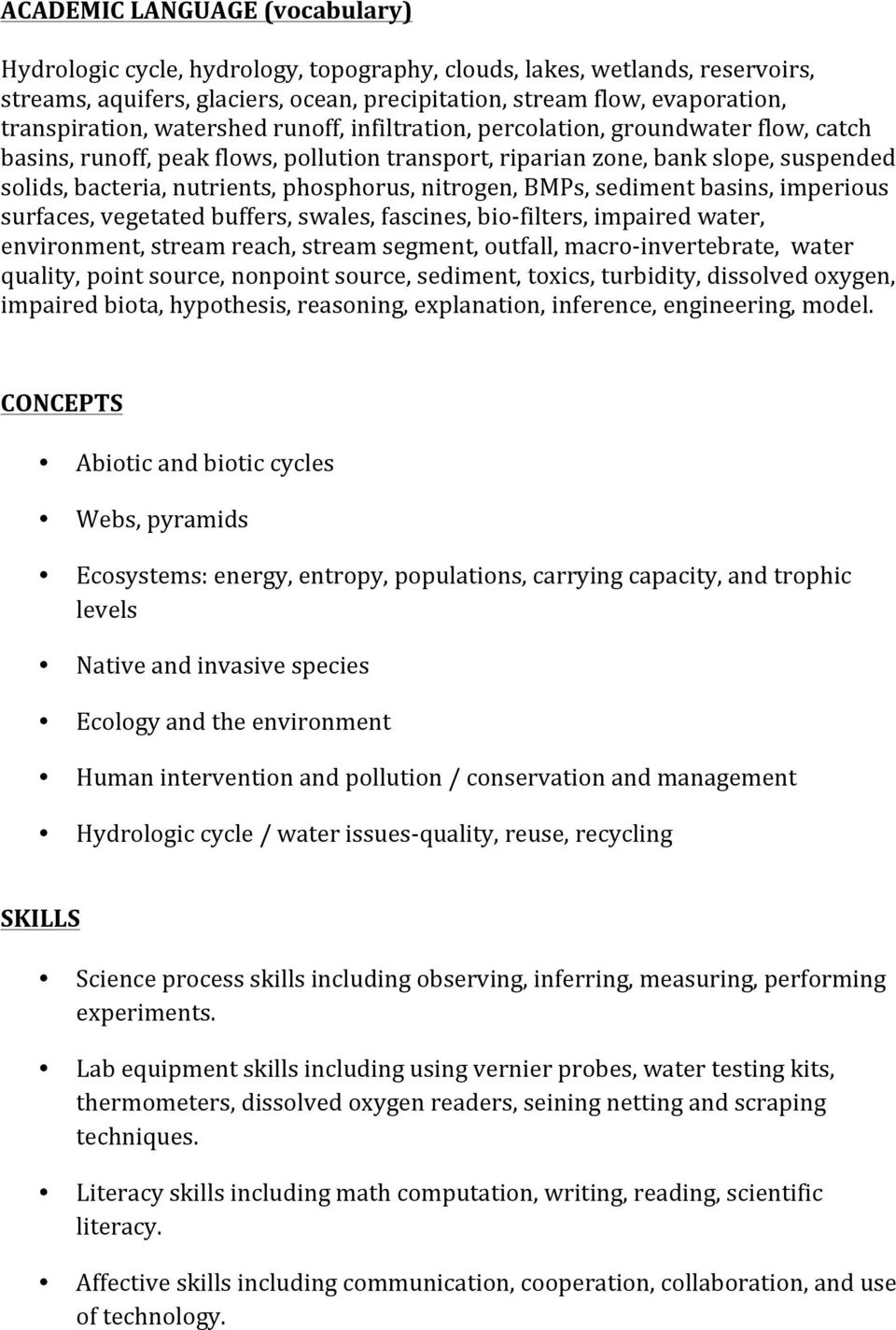
3 ACADEMIC LANGUAGE (vocabulary) Hydrologic cycle, hydrology, topography, clouds, lakes, wetlands, reservoirs, streams, aquifers, glaciers, ocean, precipitation, stream flow, evaporation, transpiration, watershed runoff, infiltration, percolation, groundwater flow, catch basins, runoff, peak flows, pollution transport, riparian zone, bank slope, suspended solids, bacteria, nutrients, phosphorus, nitrogen, BMPs, sediment basins, imperious surfaces, vegetated buffers, swales, fascines, bio- filters, impaired water, environment, stream reach, stream segment, outfall, macro- invertebrate, water quality, point source, nonpoint source, sediment, toxics, turbidity, dissolved oxygen, impaired biota, hypothesis, reasoning, explanation, inference, engineering, model. CONCEPTS Abiotic and biotic cycles Webs, pyramids Ecosystems: energy, entropy, populations, carrying capacity, and trophic levels Native and invasive species Ecology and the environment Human intervention and pollution / conservation and management Hydrologic cycle / water issues- quality, reuse, recycling SKILLS Science process skills including observing, inferring, measuring, performing experiments. Lab equipment skills including using vernier probes, water testing kits, thermometers, dissolved oxygen readers, seining netting and scraping techniques. Literacy skills including math computation, writing, reading, scientific literacy. Affective skills including communication, cooperation, collaboration, and use of technology.
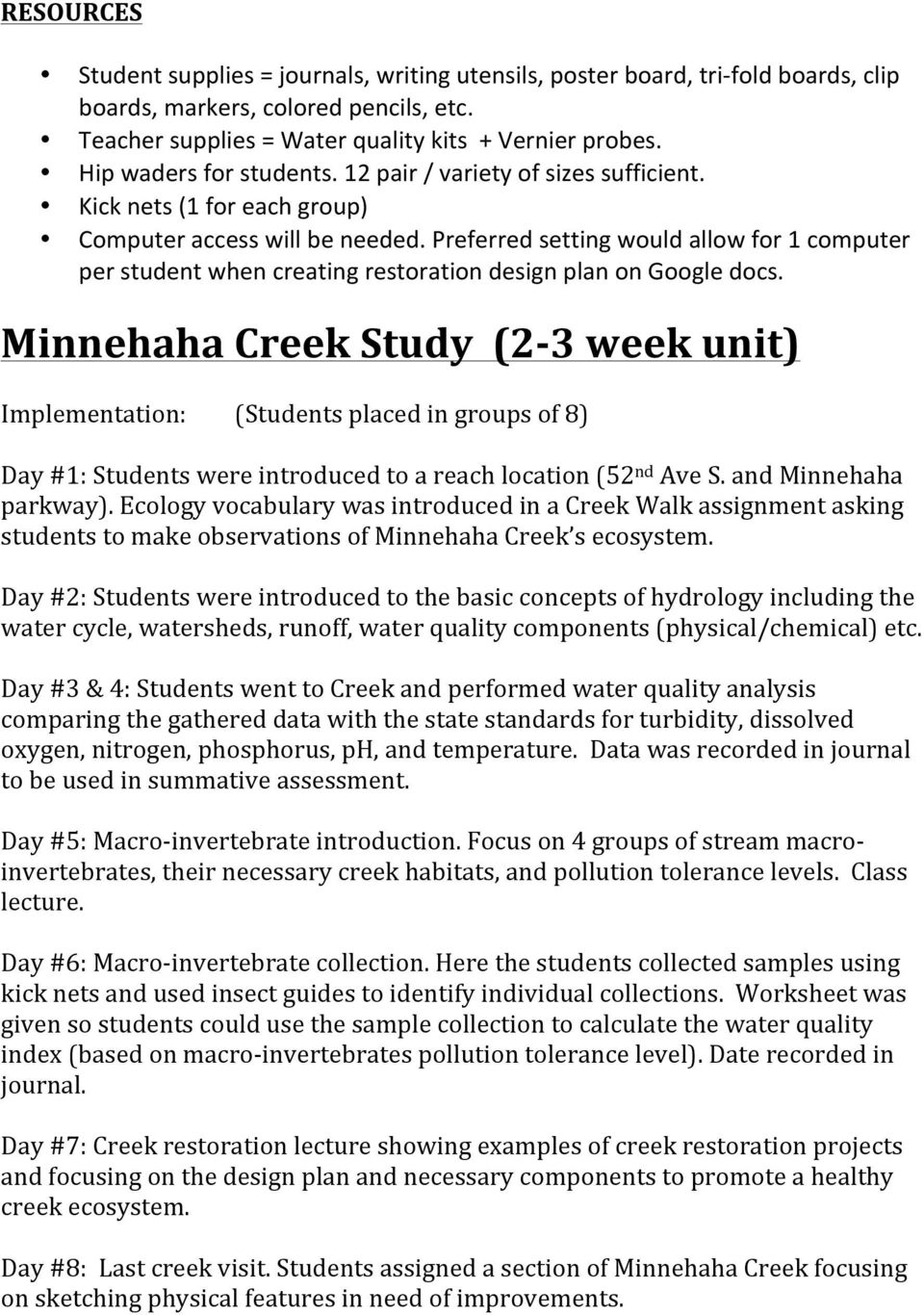
4 RESOURCES Student supplies = journals, writing utensils, poster board, tri- fold boards, clip boards, markers, colored pencils, etc. Teacher supplies = Water quality kits + Vernier probes. Hip waders for students. 12 pair / variety of sizes sufficient. Kick nets (1 for each group) Computer access will be needed. Preferred setting would allow for 1 computer per student when creating restoration design plan on Google docs. Minnehaha Creek Study (2-3 week unit) Implementation: (Students placed in groups of 8) Day #1: Students were introduced to a reach location (52 nd Ave S. and Minnehaha parkway). Ecology vocabulary was introduced in a Creek Walk assignment asking students to make observations of Minnehaha Creek s ecosystem. Day #2: Students were introduced to the basic concepts of hydrology including the water cycle, watersheds, runoff, water quality components (physical/chemical) etc. Day #3 & 4: Students went to Creek and performed water quality analysis comparing the gathered data with the state standards for turbidity, dissolved oxygen, nitrogen, phosphorus, ph, and temperature. Data was recorded in journal to be used in summative assessment. Day #5: Macro- invertebrate introduction. Focus on 4 groups of stream macro- invertebrates, their necessary creek habitats, and pollution tolerance levels. Class lecture. Day #6: Macro- invertebrate collection. Here the students collected samples using kick nets and used insect guides to identify individual collections. Worksheet was given so students could use the sample collection to calculate the water quality index (based on macro- invertebrates pollution tolerance level). Date recorded in journal. Day #7: Creek restoration lecture showing examples of creek restoration projects and focusing on the design plan and necessary components to promote a healthy creek ecosystem. Day #8: Last creek visit. Students assigned a section of Minnehaha Creek focusing on sketching physical features in need of improvements.
5 Day #9 - #11: Students groups create design plan and complete summative assessment project. Students create Google doc and tri- fold poster board presentation. (Student Creek project rubric and guiding questions supplied) Day #12 & #13: Student class presentations. All members are required to have active role in presentation. Instructor / Peer / Self - assessment constitutes the overall score earned. Anecdotal Report from piloted lesson Students showed both excitement and enjoyment during the varied activities of the Minnehaha Creek study. During the Creek data collection days there was a high level of engagement by students who are less motivated when in the classroom setting. Students showed strong cooperative and collaborative skills when at the creek and during the creating of their design plan. A student survey was given which showed 96% of students found the Creek study to be a positive experience and would recommend the instructor to repeat it next year with 9 th grade Biology students. Opportunities for Improvement and Expansion To improve data collection method, student groups could have been better organized to have specific tasks and to rotate these tasks. This ensures there is an even load share by each member when testing and gathering data. There was also lost time due to off- task behaviors by students who naturally allow the leaders of the group to take the ball and run with it. This could be addressed by assigning specific tasks verses individual team members deciding their role during the restoration design plan. Minnehaha Creek Study could include a political/historical component. This would allow for interdisciplinary content yielding a greater understanding of the local value of Minnehaha Creek s ecosystem. Involving some outside professional partners would also increase student understanding of the importance of Minnehaha Creek. Having professional sources as references would bolster their explanation of the importance of their Minnehaha Creek Restoration Plan

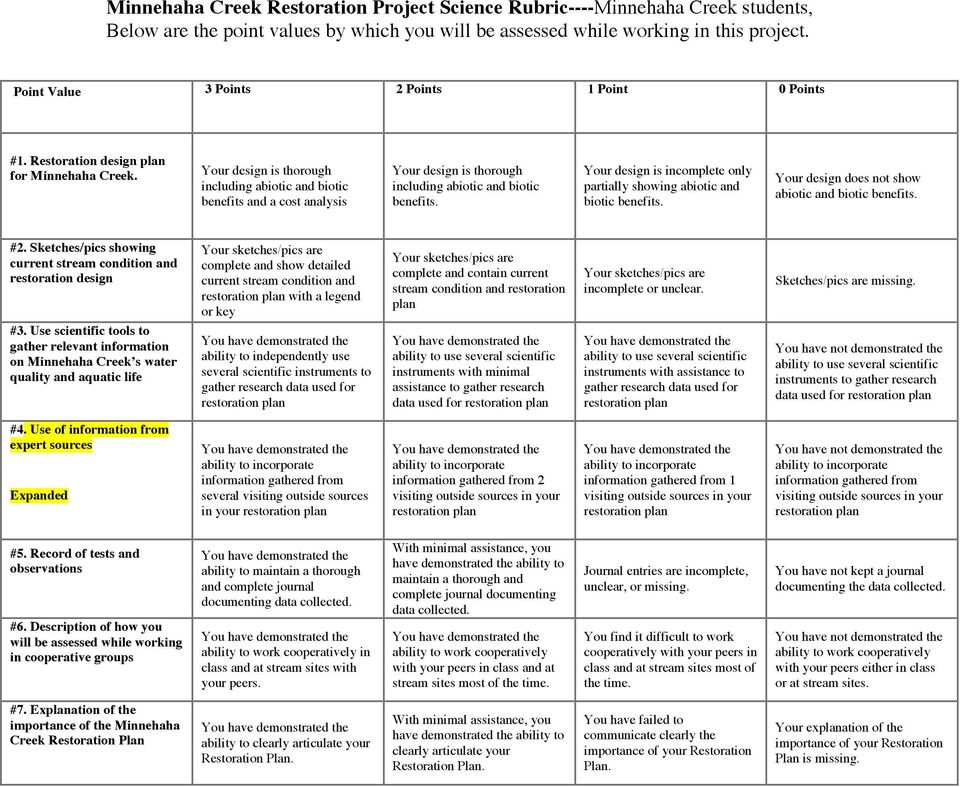
6 Minnehaha Creek Restoration Project Science Rubric----Minnehaha Creek students, Below are the point values by which you will be assessed while working in this project. Point Value 3 Points 2 Points 1 Point 0 Points #1. Restoration design plan for Minnehaha Creek. Your design is thorough including abiotic and biotic benefits and a cost analysis Your design is thorough including abiotic and biotic benefits. Your design is incomplete only partially showing abiotic and biotic benefits. Your design does not show abiotic and biotic benefits. #2. Sketches/pics showing current stream condition and restoration design #3. Use scientific tools to gather relevant information on Minnehaha Creek s water quality and aquatic life Your sketches/pics are complete and show detailed current stream condition and with a legend or key ability to independently use several scientific instruments to gather research data used for Your sketches/pics are complete and contain current stream condition and restoration plan ability to use several scientific instruments with minimal assistance to gather research data used for Your sketches/pics are incomplete or unclear. ability to use several scientific instruments with assistance to gather research data used for Sketches/pics are missing. You have not demonstrated the ability to use several scientific instruments to gather research data used for #4. Use of information from expert sources Expanded ability to incorporate information gathered from several visiting outside sources in your ability to incorporate information gathered from 2 visiting outside sources in your ability to incorporate information gathered from 1 visiting outside sources in your You have not demonstrated the ability to incorporate information gathered from visiting outside sources in your #5. Record of tests and observations #6. Description of how you will be assessed while working in cooperative groups ability to maintain a thorough and complete journal documenting data collected. ability to work cooperatively in class and at stream sites with your peers. With minimal assistance, you have demonstrated the ability to maintain a thorough and complete journal documenting data collected. ability to work cooperatively with your peers in class and at stream sites most of the time. Journal entries are incomplete, unclear, or missing. You find it difficult to work cooperatively with your peers in class and at stream sites most of the time. You have not kept a journal documenting the data collected. You have not demonstrated the ability to work cooperatively with your peers either in class or at stream sites. #7. Explanation of the importance of the Minnehaha Creek Restoration Plan ability to clearly articulate your Restoration Plan. With minimal assistance, you have demonstrated the ability to clearly articulate your Restoration Plan. You have failed to communicate clearly the importance of your Restoration Plan. Your explanation of the importance of your Restoration Plan is missing.
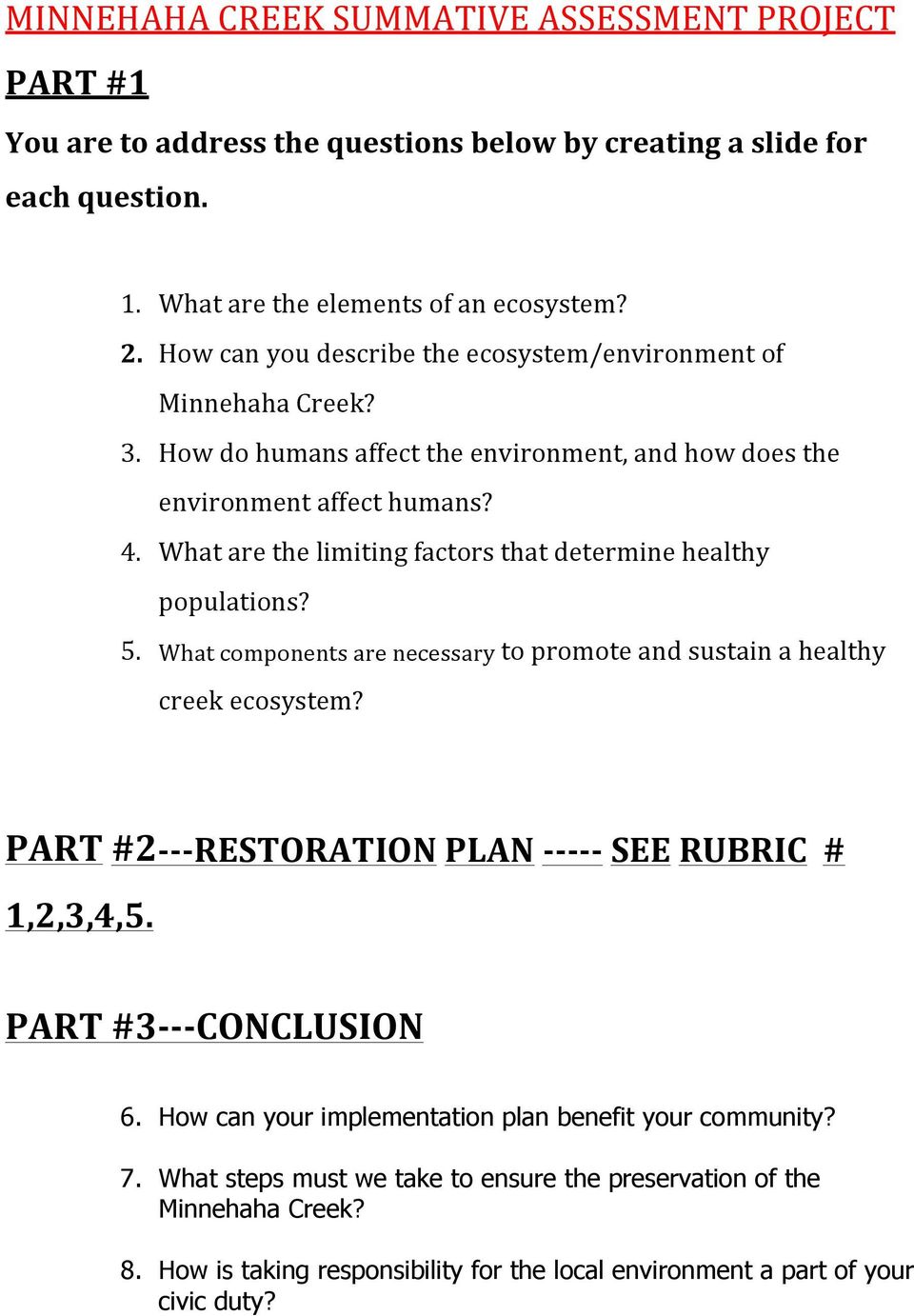
7 MINNEHAHA CREEK SUMMATIVE ASSESSMENT PROJECT PART #1 You are to address the questions below by creating a slide for each question What are the elements of an ecosystem? How can you describe the ecosystem/environment of Minnehaha Creek? How do humans affect the environment, and how does the environment affect humans? What are the limiting factors that determine healthy populations? What components are necessary to promote and sustain a healthy creek ecosystem? PART # RESTORATION PLAN SEE RUBRIC # 1,2,3,4,5. PART # CONCLUSION 6. How can your implementation plan benefit your community? 7. What steps must we take to ensure the preservation of the Minnehaha Creek? 8. How is taking responsibility for the local environment a part of your civic duty?
8

Ecosystems. The two main ecosystem processes: Energy flow and Chemical cycling
 Ecosystems THE REALM OF ECOLOGY Biosphere An island ecosystem A desert spring ecosystem Biosphere Ecosystem Ecology: Interactions between the species in a given habitat and their physical environment.
THE WATER CYCLE. Ecology
 THE WATER CYCLE Water is the most abundant substance in living things. The human body, for example, is composed of about 70% water, and jellyfish are 95% water. Water participates in many important biochemical
Pond Ecosystem Field Study MOLS
 This multi-week lab involves field studies comparing ecosystem-level ecology between 2 freshwater ponds in Marshfield Outdoor Learning Sanctuary. We will be investigating a correlation between weather
Lesson 4: What Makes Water Healthy?
 Lesson 4: What Makes Water Healthy? Activity: Students make observations and measurements of several water samples. This activity helps students think about different ways to determine water quality. Grade
Restoration Planning and Development of a Restoration Bank
 Restoration Planning and Development of a Restoration Bank Black Creek Pioneer Village, South Theatre 8:30 a.m. to 3:30 p.m. Habitat Restoration and Environmental Monitoring Projects Section Restoration
A CONTENT STANDARD IS NOT MET UNLESS APPLICABLE CHARACTERISTICS OF SCIENCE ARE ALSO ADDRESSED AT THE SAME TIME.
 Environmental Science Curriculum The Georgia Performance Standards are designed to provide students with the knowledge and skills for proficiency in science. The Project 2061 s Benchmarks for Science Literacy
Phosphorus. Phosphorus Lake Whatcom Cooperative Management. www.ecy.wa.gov/programs/wq/nonpoint/phosphorus/phosphorusban.html
 Phosphorus Phosphorus Brochure Lake Whatcom Cooperative Management Reducing Phosphorus Website Washington State Department of Ecology www.ecy.wa.gov/programs/wq/nonpoint/phosphorus/phosphorusban.html Nutrients
RUTHERFORD HIGH SCHOOL Rutherford, New Jersey COURSE OUTLINE ENVIRONMENTAL SCIENCE
 RUTHERFORD HIGH SCHOOL Rutherford, New Jersey COURSE OUTLINE ENVIRONMENTAL SCIENCE I. INTRODUCTION Environmental Science introduces students to a broad view of the biosphere and the physical parameters
3. The submittal shall include a proposed scope of work to confirm the provided project description;
 QIN Shoreline Master Program Project Summary The Shoreline Master Program (SMP) development process for the Quinault Indian Nation (QIN) includes the completion of inventory and analysis report with corresponding
a. a population. c. an ecosystem. b. a community. d. a species.
 Name: practice test Score: 0 / 35 (0%) [12 subjective questions not graded] The Biosphere Practice Test Multiple Choice Identify the letter of the choice that best completes the statement or answers the
A Developer s Guide: Watershed-Wise Development
 A Developer s Guide: Watershed-Wise Development Environmental Protection What is a watershed? It does not matter how far away you build from a creek, lake, or the ocean, you are in a watershed. Another
Turbidity (cm) Using Dot # ph. Dissolved Oxygen (ppm or parts per million) Nitrate (ppm) Phosphate (ppm) Color
 For this activity you will need to bring in water samples from 2 streams which should have very different water quality. For our class, I used the Poestenkill in Troy and and a small stream that runs through
1.7.0 Floodplain Modification Criteria
 1.7.0 Floodplain Modification Criteria 1.7.1 Introduction These guidelines set out standards for evaluating and processing proposed modifications of the 100- year floodplain with the following objectives:
How do abiotic factors and physical processes impact life in the ocean?
 This website would like to remind you: Your browser (Apple Safari 7) is out of date. Update your browser for more security, comfort and the best experience on this site. Activitydevelop Ocean Abiotic Factors
Introduction to Ecology
 Introduction to Ecology Ecology is the scientific study of the interactions between living organisms and their environment. Scientists who study ecology are called ecologists. Because our planet has many
How To Plan A Buffer Zone
 Backyard Buffers Protecting Habitat and Water Quality What is a buffer? A buffer (also called a riparian buffer area or zone) is the strip of natural vegetation along the bank of a stream, lake or other
Report for 2003PA14B: Spruce Creek Watershed Keystone Project
 Report for 2003PA14B: Spruce Creek Watershed Keystone Project There are no reported publications resulting from this project. Report Follows Abstract: This proposal seeks support for a graduate assistant
GLOBAL CIRCULATION OF WATER
 Global Circulation of Water MODULE - 8A 27 GLOBAL CIRCULATION OF WATER More than three-fourths of the earth s surface is covered by water. Water is an odorless, tasteless, substance than can naturally
WATER: ENVIRONMENTAL SCIENCE Syllabus
 WATER: ENVIRONMENTAL SCIENCE Syllabus Course Title Water: Environmental Science Course Description Central to all ecosystems, water is essential to life as we know it. It shapes our planet on every level,
COMPREHENSIVE PLAN SECTION B, ELEMENT 4 WATER RESOURCES. April 20, 2010 EXHIBIT 1
 COMPREHENSIVE PLAN SECTION B, ELEMENT 4 WATER RESOURCES April 20, 2010 EXHIBIT 1 ELEMENT 4 WATER RESOURCES TABLE OF CONTENTS 4.1 INTRODUCTION 4.2 GOALS AND POLICIES 4.2.A General Goals and Policies 1 4.2.B
Missouri Regions Shaped by Land Forms and Geology
 Missouri Regions Shaped by Land Forms and Geology Lesson Abstract Summary: MO GLE: Subject Areas: The students will use various resources to compare and contrast the geology of each Missouri region to
Broken Arrow Public Schools AP Environmental Science Objectives Revised 11-19-08
 1 st six weeks 1 Identify questions and problems that can be answered through scientific investigation. 2 Design and conduct scientific investigations to answer questions about the world by creating hypotheses;
Water Extraction Permitting Policy
 Water Extraction Policy 1 Water Extraction Permitting Policy Department of Environment, Labour & Justice January 2013 Water Extraction Policy 2 EXECUTIVE SUMMARY This document establishes a new policy
A Correlation of Environmental Science Your World, Your Turn 2011
 A Correlation of Your World, Your Turn 2011 To Ohio s New Learning Standards for Science, 2011, High School Science Inquiry and Application Course Content INTRODUCTION This document demonstrates how Pearson,
Water Recycles poster
 Water Recycles poster The "Water ReCycles" poster is designed for students of all ages. It shows the natural water cycle and humans influence on water resources. Raincloud illustration The raincloud in
Vulnerability Assessment of New England Streams: Developing a Monitoring Network to Detect Climate Change Effects
 Vulnerability Assessment of New England Streams: Developing a Monitoring Network to Detect Climate Change Effects National Water Quality Monitoring Council 2012 Meeting Britta Bierwagen, National Center
Urban Ecology: Watersheds and Aquatic Ecology A BIOBUGS program
 NAME: Urban Ecology: Watersheds and Aquatic Ecology A BIOBUGS program Objective: To describe the health of the Muddy River in the Fens wetlands system of Boston by examining abiotic and biotic parameters.
Lesson Plan Two - Ecosystems
 Lesson Plan Two - Ecosystems Summary Students discuss what living things need to survive. They identify the abiotic and biotic components of an ecosystem and describe the roles and interactions of producers
Global Climate Change WebQuest
 Global Climate Change WebQuest In this activity, students explore key indicators of global climate change and consider strategies for adaptation/mitigation. This activity could be used before global climate
Planning Commentary Respond to the prompts below (no more than 9 single-spaced pages, including prompts).
 Planning Commentary Respond to the prompts below (no more than 9 single-spaced pages, including prompts). 1. Central Focus a. Describe the central focus and purpose for the content you will teach in this
Ginger Paige and Nancy Mesner University of Wyoming Utah State University
 Effective Water Quality BMP Monitoring Tools Ginger Paige and Nancy Mesner University of Wyoming Utah State University Overview BMP Monitoring Guidance Document for Stream Systems Lessons learned CEAP
Green App Technology-Connected Lesson Plan
 Green App Technology-Connected Lesson Plan By Sharon Instructor Lantz, Teacher Education and Steve Kaye, Science (The lesson plan formats will differ for S. Lantz s class and S Kaye s class since Lantz
Clean Water Services. Ecosystems Services Case Study: Tualatin River, Washington
 Viewed broadly, the concept of ecosystem services describes the many resources and services provided by nature. Typically, traditional planning and development practices do not adequately represent the
LIMNOLOGY, WATER QUALITY
 LIMNOLOGY, WATER QUALITY PA RANI ET E R S, AN D c 0 IV D IT I 0 N S AND ECOREGIONS Water Quality Parameters Nutrients are important parameters because phosphorous and nitrogen are major nutrients required
Water Cycle. DELTA SCIENCE READER Overview... 123 Before Reading... 124 Guide the Reading... 125 After Reading... 130
 Water Cycle T ABLE OF CONTENTS ABOUT DELTA SCIENCE MODULES Program Introduction................... iii Teacher s Guide..................... iv Delta Science Readers............... vi Equipment and Materials
10/4/2012. 40 slide sample of Presentation. Key Principles to Current Stormwater Management
 40 slide sample of Presentation Please contact [email protected] if you would like the complete presentation Key Principles to Current Stormwater Management Distributed Control Measures Integrated
Executive Summary Minnesota Nutrient Reduction Strategy
 Executive Summary The (NRS) will guide the state in reducing excess nutrients in waters so that in-state and downstream water quality goals are ultimately met. Nutrient impacts are widespread. Excessive
Environmental Case Study Decatur, Georgia, DeKalb County A Suburban Creek Resists Channelization
 Introduction A visual examination of Doolittle Creek in a highly developed suburban county in Georgia yielded telltale signs of a creek whose original streambed had been altered. Examination of official
Ecosystems One or more communities in an area and the abiotic factors, including water, sunlight, oxygen, temperature, and soil.
 7-4.1 Summarize the characteristics of the levels of organization within ecosystems (including populations, communities, habitats, niches, and biomes). Taxonomy level: 2.4-B Understand Conceptual Knowledge
Pamela Birak, Jordan Lake State Park, Chatham County, NC
 Pamela Birak, Jordan Lake State Park, Chatham County, NC 3 Lakes, Reservoirs, and Ponds Forty-six states, Puerto Rico, and the District of Columbia (collectively referred to as states in the rest of this
Beasley Lake Watershed National Sedimentation Laboratory Water Quality & Ecology Research Unit USDA ARS Oxford, Mississippi
 Beasley Lake Watershed National Sedimentation Laboratory Water Quality & Ecology Research Unit USDA ARS Oxford, Mississippi M. A. Locke, S. S. Knight, C. M. Cooper, S. Smith, Jr., M. T. Moore, F. D. Shields,
Community Workshop 5. Overarching Goals for Machado Lake Ecosystem and Wilmington Drain Multi-Use Projects
 City of Los Angeles Department of Public Works Bureau of Engineering Machado Lake Ecosystem Rehabilitation Project & Wilmington Drain Multi-Use Project Community Workshop 5 February 24, 2009 In association
Field Performance of Two Stormwater Bioretention Filtration Design Configurations
 Field Performance of Two Stormwater Bioretention Filtration Design Configurations Andrew Anderson, E.I.T. North Carolina State University Department of Biological & Agricultural Engineering 2013 Annual
13.1. Principles of Ecology CHAPTER 13. Ecology is the study of the relationships among organisms and their environment.
 SECTION 13.1 KEY CONCEPT ECOLOGISTS STUDY RELATIONSHIPS Study Guide Ecology is the study of the relationships among organisms and their environment. VOCABULARY ecology community MAIN IDEA: Ecologists study
Post Construction Stormwater Management Checklist Program
 Post Construction Stormwater Management Checklist Program Anahid Damerau, CPESC, CPSWQ Christopher Smith, P.E. Department of Environmental Protection Stormwater Section Watershed Management Program The
Environmental Science Overview
 Overview The standards establish the scientific inquiry skills and core content for all courses in DoDEA schools. The course of study provides students with a basic knowledge of the natural world that
Greater Los Angeles County Region
 Attachment 6 Greater Los Angeles County Region IRWM Implementation Grant Proposal Monitoring, Assessment, and Attachment 6 consists of the following items: Monitoring, Assessment, and. The purpose of this
City of Lakeland s Wetlands Treatment System An Overview
 An Overview In response to more stringent requirements for wastewater discharges in the early 1980 s, the City explored options for the advanced treatment required, with the Wetland Treatment System proving
Earth Science. River Systems and Landforms GEOGRAPHY 1710. The Hydrologic Cycle. Introduction. Running Water. Chapter 14.
 Earth Science GEOGRAPHY 1710 River Systems and Landforms DAVID R. SALLEE Robert W. Christopherson Charlie Thomsen Chapter 14 Introduction Rivers and streams are dynamic systems that continually adjust
Web of Water. Teacher s Guide Webisode 1 Blue Ridge
 Web of Water Teacher s Guide Webisode 1 Blue Ridge Table of Contents About Blue Ridge.... 3 South Carolina Science Standards.. 4 Discussion Questions.. 10 Knowitall Resources....... 13 Credits..... 14
AP Environmental Science Syllabus
 Course Overview The following AP Environmental Science Syllabus will comply with all of the requirements and specifications provided by College Board aimed at preparing students for the AP exam given in
Communities, Biomes, and Ecosystems
 Communities, Biomes, and Ecosystems Before You Read Before you read the chapter, respond to these statements. 1. Write an A if you agree with the statement. 2. Write a D if you disagree with the statement.
Interlocking Concrete Pavement Institute (ICPI) Model Stormwater Ordinance for Permeable Interlocking Concrete Pavements August 2010
 Interlocking Concrete Pavement Institute (ICPI) Model Stormwater Ordinance for Permeable Interlocking Concrete Pavements August 2010 Background What are permeable interlocking concrete pavements (PICP)?
Grade 4 Standard 1 Unit Test Water Cycle. Multiple Choice. 1. Where is most water found on Earth? A. in glaciers B. in lakes C. in rivers D.
 Grade 4 Standard 1 Unit Test Water Cycle Multiple Choice 1. Where is most water found on Earth? A. in glaciers B. in lakes C. in rivers D. in oceans 2. What source of energy evaporates the most water from
Ecology and Simpson s Diversity Index
 ACTIVITY BRIEF Ecology and Simpson s Diversity Index The science at work Ecologists, such as those working for the Environmental Agency, are interested in species diversity. This is because diversity is
Watershed Restoration and Protection Strategy
 Watershed Restoration and Protection Strategy (WRAPS) Leech Lake River Watershed - Update October 28, 2014 Phil Votruba Watershed Division Minnesota Pollution Control Agency July2007MuskyLeechLake.jpg.lnk
Human Impacts on the World Ocean
 This website would like to remind you: Your browser (Safari 7) is out of date. Update your browser for more security, comfort and the best experience on this site. lesson Human Impacts on the World Ocean
Plants, like all other living organisms have basic needs: a source of nutrition (food),
 LEARNING FROM LEAVES: A LOOK AT LEAF SIZE Grades 3 6 I. Introduction Plants, like all other living organisms have basic needs: a source of nutrition (food), water, space in which to live, air, and optimal
CWSRF Project Descriptions and Examples for Green Project Reserve
 CWSRF Project Descriptions and Examples for Green Project Reserve I. Water Efficiency a. Water efficiency is the use of improved technologies and practices to deliver equal or better services with less
BiT Stream Study - Guided Observations:
 BiT Stream Study - Guided Observations: Streams are the pathways that transport water through a watershed. They are also critical to the healthy functioning of the watershed and the myriad of habitats
Aquatic Organisms and Their Habitats
 Aquatic Organisms and Their Habitats Objectives: Students will understand the following: 1. The presence of specific organisms in a freshwater habitat determines the quality of that habitat. 2. An organism
Final Report of the Town Owned Lands Improvement Project for the Town of Brentwood, NH
 Final Report of the Town Owned Lands Improvement Project for the Town of Brentwood, NH Project Background In November of 2013 the Green Infrastructure for Sustainable Coastal Communities (GISCC) project
Natural Resource-Based Planning*
 Natural Resource-Based Planning* Planning, when done well, is among the most powerful tools available to communities. A solid plan, based on good natural resource information, guides rational land-use
STATE UNIVERSITY OF NEW YORK COLLEGE OF TECHNOLOGY CANTON, NEW YORK COURSE OUTLINE ESCI 101 - INTRODUCTION TO ENVIRONMENTAL SCIENCE
 STATE UNIVERSITY OF NEW YORK COLLEGE OF TECHNOLOGY CANTON, NEW YORK COURSE OUTLINE ESCI 101 - INTRODUCTION TO ENVIRONMENTAL SCIENCE Prepared By: Rajiv Narula, Ph.D. SCHOOL OF SCIENCE, HEALTH, AND CRIMINAL
Please click on the tutorial most fitting of your expertise in order to learn about the features of the visualization tool.
 Introduction Welcome to the Indian Creek Conservation Reserve Program (CRP) visualization tool. This tool was developed by the University of Iowa - Institute for Hydroscience and Research (IIHR) as part
MiCorps 101. Presented by Paul Steen. MiCorps Program Manager
 MiCorps 101 Presented by Paul Steen MiCorps Program Manager MiCorps Team Laura Kaminski Katherine Hollins Marcy Knoll Wilmes Gary Kolhepp Dina Klemens Paul Steen, Ph.D. Jason Frenzel Scott Brown Jean Roth
The International Stormwater BMP Database Part 1: Summary of Database
 Land Development Brief: February 2013 The Pennsylvania Housing Research Center The International Stormwater BMP Database Part 1: Summary of Database Katherine L. Blansett, Ph.D., P.E. INTRODUCTION This
NEIGHBORHOOD WATER QUALITY
 1 NEIGHBORHOOD WATER QUALITY Lesson 1: Aquatic Ecosystems Keywords: ecosystem, ecology, watershed, surface water, hydrologic cycle, evaporation, transpiration, precipitation, surface runoff, percolation,
DRAFT FINAL MITIGATED NEGATIVE DECLARATION Pursuant to Section 21080(c) Public Resources Code
 DRAFT FINAL MITIGATED NEGATIVE DECLARATION Pursuant to Section 21080(c) Public Resources Code To: Office of Planning & Research State Clearinghouse 1400 Tenth Street Sacramento, CA 95814 From: State Water
Backyard Buffers that Work for People and Nature by Restoring Ecological Function
 Backyard Buffers that Work for People and Nature by Restoring Ecological Function What is a Wetland Buffer? A wetland buffer is a simple land management practice that is employed by municipalities to protect
Content Guide & Five Items Resource
 Content Guide & Five Items Resource Introduction The following information should be used as a companion to the CPI Links. It provides clarifications concerning the content and skills contained in the
Katherine Prescott, M.Eng.,OCT
 Katherine Prescott, M.Eng.,OCT Ms. Prescott has a multidisciplinary background in science, engineering and education. She has over 20 years of experience in field and laboratory research, ecosystem and
What s For Lunch? Exploring the Role of GloFish in Its Ecosystem, Food Chain and Energy Pyramid
 Name Period Date What s For Lunch? Exploring the Role of GloFish in Its Ecosystem, Food Chain and Energy Pyramid Objective The learner will define terms related to relationships and energy transfer in
DEQ Response to Comments regarding the Public Notice for a Coal Mining Project in the Panther Creek watershed In Craig and Nowata Counties.
 DEQ Response to Comments regarding the Public Notice for a Coal Mining Project in the Panther Creek watershed In Craig and Nowata Counties. There were 10 comments received in response to an April 14, 2014
Understanding by Design. Title: BIOLOGY/LAB. Established Goal(s) / Content Standard(s): Essential Question(s) Understanding(s):
 Understanding by Design Title: BIOLOGY/LAB Standard: EVOLUTION and BIODIVERSITY Grade(s):9/10/11/12 Established Goal(s) / Content Standard(s): 5. Evolution and Biodiversity Central Concepts: Evolution
Comparing Levels of Phosphates in Dishwasher Detergents
 Lesson Plan Grades 9-12 Note: The Student Resource Page and Student Worksheets can be found at the end of this lesson plan. Essential Questions > How can phosphate levels in water be measured? > How much
Increasing water availability through juniper control.
 Tim Deboodt, OSU Crook County Extension Agent 498 SE Lynn Blvd. Prineville, OR 97754 541-447-6228 [email protected] Increasing water availability through juniper control. Throughout the region
Environmental Science Science Curriculum Framework. Revised 2005
 Environmental Science Science Curriculum Framework Revised 2005 Course Title: Environmental Science Course/Unit Credit: 1 Course Number: 424020 Teacher Licensure: Please refer to the Course Code Management
Assessment Plan Mission
 Assessment Plan B.S. Environmental Biology, B.S. Earth Science School of Environmental and Sustainability Sciences College of Natural, Applied and Health Sciences Kean University The School of Environmental
SUSTAINABLE URBAN DRAINAGE SYSTEMS
 overflow can lead into a permeable conveyance system to increase further the benefit and reduce the need for pipe systems. Pollutant removal rates have been shown to be high, with some pollutants being
Table 2: State Agency Recommendations Agency of Agriculture, Food and Markets
 SUPPORTING INFORMATION ASSOCIATED WITH THE ALLOCATION PRIORITIES FOR CLEAN WATER FUND BOARD Table 2: State Agency Recommendations Agency of Agriculture, Food and Markets 1 Agriculture AAFM On-Farm Implementation
Georgia Performance Standards Framework for Science Grade 6. Unit Organizer: Water in Earth s Processes. (Approximate Time: 5-6 Weeks)
 The following instructional plan is part of a GaDOE collection of Unit Frameworks, Performance Tasks, examples of Student Work, and Teacher Commentary. Many more GaDOE approved instructional plans are
Table of Contents Section 8: How Children Learn
 Table of Contents Section 8: How Children Learn This section provides educators with information about educational theories and objectives and how these apply to a unit of study on the West Eugene Wetlands.
Rocky EEP Preliminary Findings Report Summary February 2005
 This is a DRAFT summary of the NC Ecosystem Enhancement Upper Rocky River Local Watershed Plan Preliminary Findings Report. The original, 157 page document can be found here: www.ncsu.edu/weco/rocky. The
Healthy Forests Resilient Water Supply Vibrant Economy. Ecological Restoration Institute
 Healthy Forests Resilient Water Supply Vibrant Economy Ecological Restoration Institute How Water Gets to Your Home MOST OF THE VALLEY S WATER SUPPLY comes from winter precipitation and runoff from Arizona
User s Manual for the BMPTRAINS Model
 User s Manual for the BMPTRAINS Model Prepared By: Marty Wanielista, Mike Hardin, Przemyslaw Kuzlo, and Ikiensinma Gogo-Abite STORMWATER TREATMENT ANALYSIS: STEP 1: Specify pre- and post-development watershed
Chapter 3 Communities, Biomes, and Ecosystems
 Communities, Biomes, and Ecosystems Section 1: Community Ecology Section 2: Terrestrial Biomes Section 3: Aquatic Ecosystems Click on a lesson name to select. 3.1 Community Ecology Communities A biological
Prentice Hall Interactive Science Series 2011 Correlated to: Arizona Science Standards, Strands 1-6 (Grade 7)
 Strand 1: Inquiry Process Inquiry Process establishes the basis for students learning in science. Students use scientific processes: questioning, planning and conducting investigations, using appropriate