
Restoration of Polluted Lakes - A new approach
|
|
|
- Shanna Phillips
- 10 years ago
- Views:
Transcription
1 Sengupta, M. and Dalwani, R. (Editors) Proceedings of Taal2007: The 12 th World Lake Conference: Restoration of Polluted Lakes - A new approach R. Ilangovan M.E. Environmental Cell Division, Water Resources Organization, Public Works Department, Coimbatore Tamilnadu. [email protected] ABSTRACT Lakes are the important water resources which support millions of people, but due to rapid urbanization and industrialization, many thousands of lakes adjacent to urban center has already been closed. The remaining lakes are most useful for holding domestic waste water and dumping of solid wastes. After the severe crisis facing in water supply, local bodies, irrigation departments, state and central governments and other NGO s are showing keen interest on cleaning lakes and restoring the existing remaining water bodies. It is pathetic to see that even at this stage the action plan proposed to restore the polluted lakes involves only structural oriented activities and not concerned with ecological components like flora and fauna and environmental aspects. The structural components like desilting strengthening sluice and weir repairs are plays critical role in the action plan. The action plan does not address the waste water, solid wastes, public awareness, training etc. since the civil engineers involving in the restoration programme do not have any idea about basic environmental and ecological issues and the need of remedial measures for keeping the lakes pollution free. This article insists the need of change of attitude in lakes conservation concepts. In the lakes restoration plan the causes, impacts due to pollution are to be studied. Some time the change of land use pattern also paves ways for encroachments. Before arriving any action plan, for polluted lakes, all the social and environmental issues shall be listed and also the holistic approach is to be adopted for preparing the DPR. Basis for the scientific way of improving lakes is arrived based on the eco system approach for which the communities involved in the preparation of DPR have to develop their skill in environmental, ecological and social aspects. Since our lands and areas are divided into specific eco system such as forest, pond, river eco systems. Each eco system has its own advantages in supporting the environment and people. Without knowing these facts about the pond eco system, restoration of lakes with respect to structural component will not solve the problems. Here a new approach is needed in preparing the DPR for the restoration of polluted lakes. Keywords Urbanization - Industrialization Domestic Waste Water Solid Waste Ecological Components Flora and fauna Encroachments River Eco system. INTRODUCTION Lakes are life supporting system of the society. Some of the lakes have water only during rainy season called as rain fed tanks and some other lakes have water throughout year called as system tank. Lake pollution is a common scenario due to rapid urbanization and industrialization. So the water quality of lakes become unfit for the purposes assigned. Lake restoration is being practiced for past several years by central and state governance and local bodies. Even many NGO (Non Governmental Organization) and private firms are also involving in the restoration programme of polluted lakes. Some popular lakes in India viz Katchrali lake, Ooty Lake, Kodaikanal lake, and Hussain sagar lakes restoration programme have been implemented in the past years. But the water quality of few lakes has again polluted due to mixing of waste water and the amounts invested become waste due to unscientific approaches. The restoration of polluted lake is easy in the rain fed tanks and seasonal lakes. It is very tough in the system tanks and perennial lakes. From the past experience, it has been observed that the restoration action plan consists of desilting of lakes and strengthening of weirs and bunds. Many action plans do not talk about the discharge of waste water and dumping of solid waste. So the polluted or degraded lakes have not been rejuvenated completely except in one or two lakes. So, the present restoration approach adopted to restore the lakes has to be changed because of highly complicated pollution problems. Before going to deal the new approach, how the present approach become constraint in the restoration plan can be seen in detail. So this is a concept paper prepared based on the various experiences from field of Tamilnadu and south India lakes which could be suitable for world.

2 GENERAL FUNCTION OF LAKES Conventional Functions Whether it is a big lake or small lake, shallow or deep lake, seasonal or perennial lakes the lakes are generally useful for the following purposes. 1. Substitute the drinking water 2. Substitute the ground water recharging. 3. Useful for cultivation 4. Useful for domestic activities 5. Useful for aquaculture activities 6. Useful for water theme centered tourism 7. Influence and Maintain the local climate 8. Influence local precipitation. 9. Attracts migratory birds and native birds. 10. Act as an efficient flood control system. 11. Solve the water scarcity issues in summer. 12. Enrich the floral and faunal communities New Functions In addition to the conventional uses mentioned above, today these tanks and lakes are also more useful for the following purposes 1. Act as sink of modern society 2. Useful for encroachments for all kind of buildings 3. Act as a dumping yard of the city 4. Fulfill the city s space scarcity The modern society treat the lakes water spread area and the supply channels as sink and dumping yard of the society. Degradation of lakes More and more people migrate from rural area to urban area for their better livelihood. Though the statistics says that 65% people are still living in rural area, the migration rate is very fast. In Tamilnadu the urban population already crossed 40% which is higher than any other state in India. Urbanization demands more water resources as well as more household materials for easy and luxury life. The people, who cannot afford cost for land and house for their homes, generally occupy the banks, bunds and even in water spread area of the urban lakes. Some time the government itself encroached for hospitals, school buildings and housing board flats in the name of providing development schemes. More over the city s development did not concentrated on land use pattern. Unplanned growth of the city created public civic problems and untreated domestic water entry is a common scenario in all major Municipalities and corporations. The urban lakes are polluted more than the rural lakes. Many thousands of lakes have already been disappeared due to urbanization and the remaining lakes are polluted with waste water and solid wastes. The remaining lakes shall be conserved for the future generation is the need of the hour. Pollution prevention and restoration of polluted lakes are the essential components of lake development programme. Causes of degradation The lakes are degraded due to various activities. The major causes of degradation are listed below: 1. Encroachments (unauthorized by private agency ) 2. Change of land use pattern (authorized by Government agency) 3. Dumping of all kind of solid wastes 4. Discharge of untreated municipal sewages 5. Discharge of untreated industrial waste water 6. Siltation in water spread area 7. Poor maintenance of the lakes 8. Hiring of Consultants concept 9. Poor city master plan 10. Lack of awareness on water bodies, Environment and Nature 11. Crazy ornamental consumerism The above mentioned causes play crucial role in the degradation of lakes. The social and livelihood issues are influencing the activities. The change of life styles, change of occupation, ornamental consumerism, material driven life styles are the major causes of the degradation. Let us see how the each activity affects the lake s eco system. Without analyzing these causes and impacts, one cannot prepare a successful detailed project report for the restoration plan for the polluted lakes. Encroachments Encroachments are very common scenario near urban lakes. Poor people encroaches the bunds; slope of banks, water spread area, foreshore area for their houses. They construct houses with tiled sheds thatched huts, temporary and semi permanent structures. Rich people and companies are also encroaching the water bodies for their business purposes since the land value is more in urban area. Farmers are occupying the fore shore area for cultivation purposes when there is no water in the lake. These are the unauthorized encroachments done by the people as per their capacity. The main supply channels of the lakes are severely encroached in all cities; because it is the public property and no one question them. The surplus channels are also closed in many areas. The impacts can be seen in rainy season as flooding in all low lying area, streets and Roads even for a light rain. The waste water discharge into the supply channels lead to pollution of lakes unanimously. After closing or encroaching the lakes, people cry for the water supply in dry season and summer. They demonstrate struggles in front of government office demanding for their water supply. The Tamilnadu Government has realized the 1322

3 need of protecting the water bodies and so enacted an act recently stating severe punishment on encroachers of water bodies belong to Public Works Department. It is a pioneer act stating severe punishment for encroachments and helps the field engineers for encroachment removal action programme. Change of land use pattern Whether for school building, hospitals, housing scheme, court buildings, power stations and for any other government office buildings construction, the lakes were encroached by changing the land use pattern. This kind of encroachments is called as authorized encroachment. The government or local bodies can make resolution and make order for constructing buildings in water bodies and in the banks. In Tamilnadu during 1960, we had lakes and during 2000, the figure reduced to lakes. This can also be seen from the agriculture statistics. During 1960, the cultivation through lake water was around 44% of the total area. But during 2000 this figure reduces to 23% shows the reduction in lakes and agriculture area.. In Tamilnadu more than Ten thousand lakes were closed for development activities due to lack of awareness and mismanagement. Once upon the lakes were utilized mainly for irrigations and aquaculture. When urbanization takes place irrigation lands have been converted into other uses. So people and government also thought that the lakes are no more useful for irrigation. Since irrigation lands are not available and simply they swallow the lakes with change of land use pattern. They miserably failed to understand the other functions of the lakes apart from cultivation. They failed to see the lakes as unique eco system. They calculated the lakes value with respect to cultivation alone and simply forget the other uses such as aquaculture, ground water recharging, climate control system and flood control systems etc. This experience give us a lessons that lakes are a part of eco systems have multiple direct and in direct functions. If this is realized by the administrators, the action plan shall include all steps to restore the biotic components in addition to a biotic component. Dumping of solid wastes Urbanization tends to produce more solid wastes than rural area. The solid wastes produced in the city are used to dump in the low lying area, streams, and supply channels and in the lakes for two purposes. One is that the authorities do not know the scientific waste disposal plan since they wanted to solve the solid waste problem. Second is if they dump and level the low lying area this could be useful for other construction activities. So legally and illegally the local bodies, public, merchants, builders, contractors, industrialists dump their solid wastes into the water spread area and banks of the lakes for the easy disposal. This habit continues still in all urban lakes. Because of solid wastes the water quality is affected due to lea chat effect even the Ground water quality in and around the lakes are also affected. After few years of dumping, the periphery of the lakes is slowly closed for any building activities. So the Detailed Project Report of restoration of polluted lakes shall include the disposal management of municipal solid wastes. With out addressing the solid waste management plan restoration of polluted lakes could not be implemented successfully. Discharge of municipal waste water The waste water produced from municipalities and corporation; ultimately find its ways to low lying area such as canals, drains and lakes. The untreated and semi treated waste water discharged into the lakes is the only simple solution could be offered by the local administration. For the implementation of sewage treatment plant, many conventional treatment plants are available such as aerated lagoons, oxidation ponds which need more land for the treatment. The other methods viz, Activated Sludge Process (ASP), Trickling filter (TF), Rotating Biological Contactor (RBC), Rotating Biological Reactor (RBR), Ion Exchange and Electrolysis needs more mechanical and electrical equipment which increases the maintenance cost especially the skilled labour and electricity charges. In growing urban area it is very difficult to get more land area for the conventional methods and hard to meet out the expenditure for the maintenance charges. So the local bodies simply sent the waste water into the lakes found easy for all purposes. Even in the well developed corporations, in the outer periphery developing area, where they do not have UGD (underground drainage) system, they discharge the waste water into low lying area. The waste water contains high amount of nitrates, phosphorous which act as nutrients for water weeds. So unanimously all the urban lakes have water hyacinth and other weeds over the surface area. The manual removal of water hyacinth cannot solve the problems and all lakes lead to eutrophication condition. Many local bodies, NGOs are removing the water weeds manually or mechanically and within three months the weeds come as evader. So the DPR shall include the sustainable waterweed management plan so that the growth of water weeds could be stopped. In many NLCP (National Lake Conservation Lake Project) programme the Environmental part is delayed or ignored so that weeds have grown again in the water bodies. Discharge of industrial waste water 1323

4 Urbanization, other sides paves ways for industrialization. Industrialization helps the society for better employment, increase of standard of livings, and fulfills the house hold goods need to the society. It also parallely generates the waste streams, solid wastes and gaseous. The industries like tannery, textile, paper, pulp, sago and pharmaceutical, sugar and chemical industries consume more water for their process and generate waste water. These industries till date do not have effective full-fledged waste water treatment plant. The semi treatment plant or partial treatment plant provided in the treatment system for sake of business do not solve the purposes. The waste water contains with huge quantity of chemicals, dyes, salts and other organic material mixed in the lake water which deteriorated the quality of water. The treatment technologies adopted in ETP (Effluent Treatment Plant) and CETP (Common Effluent Treatment Plant) do not meet the standards required because of more complicated issues. That s why nowadays high court and supreme courts are intervening in the issues and directing the concerned authorities for zero discharge concept by changing the technology. The so called proud able technologies adopted in the ETP and CETP solved only a few parameters. For example in Tannery and Textile industries, the ETP and CETP can reduce the colour and reduce the BOD, COD and TSS to certain extent but did not solve the TDS (Total Dissolved Solids) issues. Even after spending crores of rupees for CETP and ETP the partial approach adopted in the treatment system made the urban lakes into severe pollution. One form of waste has been converted into other form. The liquid waste has been converted into solid wastes during the treatment process and disposal of solid waste become big menace to the society. So without addressing the industrial waste water issues, lakes could not be restored. In many lakes untreated and semi treated waste water found mixing and the restoration programme shall have mitigation plan for the management of industrial waste water. SILTATION IN LAKES Catchment management programme Siltation is the natural phenomenon. The soil erosion takes place in the catchment area silt up in the water spread area which reduce the water holding capacity of the lakes. But dumping of solid wastes including construction debrises, agriculture wastes and municipal wastes are found along the banks of the lakes more than the natural silt. So the rain water from the upper tanks, surplus to down stream side as waste. So growing more vegetation in agriculture field nary by banks can prevent soil erosion. The dumping of solid wastes in catchment area also leads to silting in supply channel. So if necessary desilting could be done occasionally to increase the capacity. When the farmers used the lakes for irrigation purposes, they desilted the lakes during summer season and used the enriched soil for their lands. When change of utility shifted or irrigation activities reduced, silt removal become problem. Moreover the urban silt contains with plastic bags, water bottles, glasses and many non decomposable materials, the silt totally unfit for agriculture lands and so the farmers rejected the urban lakes silts. So without planning for the urban solid wastes management and the proper catchment management programme the restoration programme of polluted lakes will not become success. Poor maintenance of the lakes During 1960 and 1970s, the lakes were used for irrigation purposes. So during summer the authorities, taken steps along with farmers to repair the sluices and strengthen the bunds. When agriculture uses are reduced, the maintenance budget also reduced. To increase the productivity through cultivation, the periodical maintenance expenditure was incurred. When the utility scope changed as urban area, the maintenance budget either stopped or reduced, which increased the damage of the structures such as bunds, weirs, sluices and inlet and outlet channels. They have seen the lakes as productivity component when agriculture took place. When the ayacut changed into urbanization they thought that lake area is waste. Irrigation is one of the activities; one can see the benefit directly. The other uses of the lakes such as the ground water recharging, aqua culture, influence on local participation and climate control and helpful to aquatic organisms and birds might be invisible could be easily linked with the productivity. In short the flora and funna status of the lakes towards the productivity is not measured and realized. So the budget for the regular maintenance of the lakes have been considerably reduced or stopped. The B.C. ratio calculation does not permit the authorities to allot the needed amount for its regular maintenance increases the damage of physical components. So the authorities shall under stand the lake ecosystem are supporting system for the mankind apart from direct irrigation. Poor City Master Plan Urbanization is inevitable. The rural people migration to urban centre increases day by day. The local planning authorities and urban authorities did not visualize the extent of damage that thy see in the water bodies. Due to encroachments in the natural drains and lakes flooding is a regular problem in every rainy season. Increase of vehicles, unplanned layout, and scarcity of protected drinking water 1324

5 always threats the urban people. Providing water supply, electricity, road and other amenities are the priorities for the administrative authorities. So they give least importance to the solid waste management, sewage treatment plant and conservation of lakes. More over all government departments who act as service sectors stopped the intake of technical experts and engineers for their development activities. Due to employment ban, the technical experts reduced in the engineering departments who maintain the lakes, drains and do development activities. So it is hectic for the limited available technical staffs for the effective planning. The social and other situation drive the policy makers to recruit only the IAS and clerical staff. The engineers, technical assistants luskars (lowermost staff who maintain the lake and distribution system) have not been recruited sufficiently to execute the development activities and as well as to curtail the encroachments and misuse of lakes. The English people and post independence rulers felt the need of maintaining lakes and to develop the water resources. So, major reservoir constitutions were implemented after independence. The first five year plan programmers insisted the need on water resources development for nation s overall development. But today the policy has switched to industrial sector. Today for any developing country industrial development is essential are the Vedic words from the developed country view point. But even for the industrial development and urbanization, water is the basic need where the lakes support the mankind lot is not understood by the planners, stakeholders other than farmers, public as well as misusers. Hiring of Consultants concept Hiring local and international consultants for every development schemes developed the non responding attitude. During 1960, 1970,s in India all the major Reservoirs and Dams were constructed by our own Engineers and Technical experts. For past two to three decade the situation changed due to the pressure of international funding agency like IMF, USAID and World Bank. The consultants hired from the direction of these funding agencies do not take responsibilities when any natural disasters like flooding Tsunami take place. In CATHRINA named cyclone incident in United States the Government help extended only after two or three days of the incident because of the consultant concepts. But in India if you take any disaster the government help better than any developed country in spite of more financial constraints because the government is taking responsibilities. But here also the consultant concepts slowly reduce the strength of the Government Departments shall be realized by the policy makers. Lack of funds and staff strength coupled with the political system lead to the poor maintenance of lakes. Lack of awareness on the role on water bodies and Nature The generation who started their career after 1970 s does not felt the importance of lakes. If any 100 year old building is demolished for any alternative use, the archeological department and public are protesting not to demolish the same. But these lakes were 600 years to 2000 years old. Whether it is encroachments, dumping of solid wastes, discharging of industrial and domestic waste water, nobody thought of protecting the lakes. They happily involved in the disasters, because they directly or indirectly benefited the short term benefits. They failed to understand the importance of good old lakes supported to the mankind from generation to generation. People not interested to understand the nature s gift and nature. They wanted to succeed the nature by their scientific inventions and like to lead a luxury life as in developed countries. They are marching towards the economic race where no values even for father, mother, relations, god and nature. The only aim is to become rich man, wealthy man with big bungalows, modern cars and all luxury materials. In this economic race, man virtually become mad for economic development and forgotten the role of other natural supportive systems such as lakes, rivers, streams and forests. Crazy ornamental Consumerism Consumerism can be simply defined as the purchase of goods for the day to day life. The consumerism has changed from basic needs of consumerism to crazy ornamental consumerism. This crazy consumerism has changed the good old habits of respecting nature and water bodies. The crazy consumerism lead to change of life styles which demand more urbanization, industries, markets. All these growths tend to produce more solid wastes. Huge quantity of fisher died in one lake at Ahamedabad due to immersion of gigantic Ganesh idols made with plaster of Paris, tin sheets and colourful paints. Fast food culture demand more hotels in urban area which generate more wastages and the waste quantity is increasing day by day. Use and through objects produce more waste which denies the reuse and recycle concepts. The crazy consumerism change the thinking power of the people, because of brain washing advertisement and consequently people forget the values of water bodies and environment. So awareness on environmental protection, reuse and recycling concepts and water bodies protection are 1325

6 so necessary, for urban people while launching the plan of restoration of polluted lakes. Restoration programme Restoration action plan of the polluted lakes shall be prepared carefully considering the causes and impacts of pollution. The restoration of any polluted lakes has three objectives as listed below. 1. To increase or restore the water holding capacity of the lake 2. To improve the water quality of the lake. 3. To evolve sustainable management plan after restoration. These objectives shall be fulfilled only if the polluted lake shall be addressed in the holistic approaches. Conventional method of restoration insists desilting, strengthening and widening of bunds, repairing the sluices and weir. These structural components are essential for safety aspects during rainy season. But degradation of lakes takes place not only due to damage of bunds and weirs as mentioned in earlier paragraph but, dumping of solid wastes, encroachments, discharge of waste water also. The micro organisms such as zoo plankuton and phyto plankuton are so important in maintenance the fresh water of lakes. So without knowing the Physical Chemical and Biological characteristics of the lake water one could not prepare a sustainable restoration plan. Role of zoo plankuton and phyto plankuton The zoo plankuton is a smallest aquatic funna which plays major role in maintaining the lakes. Phyto plankuton is a smallest aquatic flora such as Azolla and A.microphylla is so much important in fresh water system. The grazing on phyto plankatran which is a smallest form of aquatic flora feeds zoo plankuton. These two forms of flora and fauna do their activities when the pollution load is within the carrying capacity of lake. Numerous plants and animals ranging from microscopic algae to large trees and from protozoa to mammals, posses various morphological, anatomical and physiological adaptations that allows them to survive and grow in water. Many organisms are plankutonic (freely drifting within surface layers of water). They include numerous algae, crustallans, and larval stages of several group of organisms, phyto-and zoo plankuton occur in all habitats, but maximum development of their population occur in standing water which has high influence on water quality. Basis for new approach The degradation of lakes occurs both due to either a biota or biota factors (or) structural and non structural damages. Few structural damages are listed below. 1. Damage of bunds, sluices, weirs 2. Encroachments of lakes 3. Siltation of lakes 4. Growth of water weeds These factors can be called as A Biotic factors. Non structural damages are listed with water quality and ecosystems. 1. Dumping of solid wastes 2. Discharge of waste water 3. High nutrients for the growth of water weeds 4. Conceptional change in sluice operations. 5. Sustainable maintenance plan 6. Deposit of silt due to catchment degradation These factors can be called as biotic factors. After desilting and strengthening the water stored in the lake shall meet the standards for the assigned purpose. The pollution of lakes shall be stopped or curtailed. The action plan interlinked with non structural components shall be included in all the DPR. The above structural damages could be handled by widening and strengthening of bunds desilting of lakes, de weeding activities. Normally the Engineering community is well versed with these activities. The lake restoration DPR definitely shall have these components. The degraded lakes shall be restored by implementing the following activities. a. The city shall be implemented the scientific municipal solid waste management plan. b. The untreated or semi treated waste water from domestic and industries shall be treated effectively and allowed into lake otherwise, diverted to other areas. c. If the water stored in the lakes could not be released from the lake, then the polluted water shall be scientifically treated using bio remediation and ozone technology which are natural and cost effective technologies proved by the Environmental Cell Division of Tamilnadu Public Works Department. d. The nutrients enters into the lake shall be stopped for arresting the growth of water weeds and eutrophication. e. The stake holder s involvement in necessary to increase the productivity of water in the lakes. f. Formation of core groups for maintaining the lakes and training and capacity building g. In majority of lakes, ayacut area has been reduced due to urbanization. So sluice operation could be closed and well irrigation only shall be allowed direct irrigation could be closed so that water could be stored for more months. h. Bio remediation and Ozonisation are new technique, without desilting, the treatment 1326

7 of lakes for stagnated water could be treated, where all organic pollutants will be oxidized and the silts are considerably reduced. Untreated industrial waste water mixes in many lakes. Without stopping the untreated water or installing effective treatment plant before the inlet of lakes, the restoration will not be success. Treated water as a Resource If the waste water could be treated as per the standard norms, the treated water will become resource for the lake. But PCB rules objects for the discharge of treated water into lakes. The change of attitude is needed to address the issues. Even if the municipalities are planning for UGD (Under Ground Drainage) / USS (Underground Sewer System) some where, some quantity of waste water flows into lakes are inevitable. So planning of simple treatment plant, at the end of supply channel is necessary so that the waste water could be converted as resource for the lakes. Here by pass arrangements could be made so that during normal course the waste water take diversion to treatment plant and treated water will come to supply channel. During rainy season the dilution effect will take place and so the diluted water could be allowed directly to the lakes as shown in fig. Bio remediation concept Bio remediation technique helps to treat the lake without desilting, when the lakes are with full quantity of water permanently like in Ooty and Kodaikanal in Tamilnadu. The bio remediation technique has five components. 1. One time removal of water weeds and disposal. 2. STP using Bye pass arrangements. 3. on line Treatment of lakes 4. Beautification of lakes and protecting arrangements 5. Sustainable Maintenance Plan One time removal of water weeds The water weeds shall be manually or mechanically removed one time and proper conversion of removed weeds into bio compost and vermin compost are the important components in weed management. Normally they remove the weeds and dumped near the lake bund shall be avoided. STP using bye pass arrangements The existing lake water treatment is not adequate, because the incoming waste water shall be addressed using bye pass arrangements. This STP is also could be designed using bio remediation concepts, where land area for treatment plant shall be reduced. The microbes application in the STP will reduce the land area and also the aeration helps to increase D.O. level and microbial population. These microbes actions oxidize the organic compounds of pollution. On line Treatment of lakes Applying microbes in the lakes water either in the form of powder or liquid and EBB Block and supplying aeration for microbial actions are the main components. The exogenous microbes is necessary to handle the pollution load, high ranges of BOD, COD, odor could be reduced within the norms. Regular application of microbes, aeration for one year to two year can treat the lake. Even the silts at the bottom will be oxidized and the de Siltation takes place without desilting. Beautification and fencing of Lakes. After implementing the three components beautification of lakes bunds and gardening could be planned in and lake area. Widening of bunds, Revetment and Turfing at on and off the shore side of bunds and planting herbs and shrubs may useful to improve the aesthetic value of the lakes. Chain link fencing or barbed wire fencing is also constructed to stop encroachments and misuse until core group take charge of the regular lake maintenance. Sustainable Maintenance Plan After implementing the above four components the lakes shall be maintained successfully without any further encroachments and pollution. The maintenance involves the following activities. Annual repair and maintenance of bunds Regular water supplying and analysis of inlet water and lake water Training, seminar, workshop, exposure visit to the are group for acquiring the knowledge on lakes conservation Regularize the aqua culture activities. Stake holders involvement The various stake holders using the lake for their use shall be involved in the maintenance plan. A core group shall be formed comprising all the users such as famous, industrialists citizen group, fishing firms, educational institution and government departments so that maintenance of lakes could be made sustained. This group may be selected based on rotation basis and their commitment. Training, seminar and Exposure visits will be given to the core group as capacity building activities and in turn to implement effectively. 1327

8 CONCLUSION Restoration of polluted lakes involves the repairing of physical structures and improves the quality of water. It is like both side of the coin. The structural repair and remediation helps to bold structural repair and remediation helps to hold more quantity of water to reduce impacts of the flooding and solve the water scarcity. If the quality of water is good for the assigned purposes, then only the lake water is useful to the society. The quality improvement activities will keep the lake water fresh and aquatic micro organisms like zoo plankton and phyto plankton existence will help to keep the lake water fresh by nature itself. More funding is necessary for the maintenance. From aquaculture, restricted boating and Eco tourism can generate income for maintenance of the lakes. So the lake authorities shall prepare the details project report (DPR) with new approach involving all the components mentioned above. So the Engineering and Technical community who have the implementing powers, shall always bother about the safety of the lakes shall also come forward to understand the other scientific functions of lakes and accordingly the Detailed Project Report has to be prepared for the welfare future generation. REFERENCES WATER Resources, sustainable livelihoods and Ecosystem Services - Kanchan Chopra, C.H.Hanumantha Rao, and Ramprasad Sengupta Water Management in India P.C. Bansil An Overview of conservation strategies and suggestions for restoration of Wet lands in Karnataka - S. Sridhar, B.K. Chakarapani and A.K. Chakravarthi. 1328

National Environment Awareness Campaign(NEAC) 2014-2015. Theme
 National Environment Awareness Campaign(NEAC) 2014-2015. Theme COMBATING DESERTIFICATION, LAND DEGRADATION AND DROUGHT Background Note Desertification is about land degradation: the loss of the land s
INDONESIA - LAW ON WATER RESOURCES,
 Environment and Development Journal Law LEAD INDONESIA - LAW ON WATER RESOURCES, 2004 VOLUME 2/1 LEAD Journal (Law, Environment and Development Journal) is a peer-reviewed academic publication based in
Frequently Asked Questions (FAQs) on Hydropower
 Frequently Asked Questions (FAQs) on Hydropower What are the advantages of Hydropower? A renewable source of energy - saves scarce fuel reserves. Non-polluting and hence environment friendly. Long life
WASTEWATER TREATMENT OBJECTIVES
 WASTEWATER TREATMENT OBJECTIVES The student will do the following: 1. Define wastewater and list components of wastewater. 2. Describe the function of a wastewater treatment plant. 3. Create a wastewater
Green Infrastructure Case Study Template
 Green Infrastructure Case Study Template The aim of the exercise is to provide information on how the elements of the Green Infrastructure Strategy are implemented at national level and to provide case
Water Recycles poster
 Water Recycles poster The "Water ReCycles" poster is designed for students of all ages. It shows the natural water cycle and humans influence on water resources. Raincloud illustration The raincloud in
Phosphorus. Phosphorus Lake Whatcom Cooperative Management. www.ecy.wa.gov/programs/wq/nonpoint/phosphorus/phosphorusban.html
 Phosphorus Phosphorus Brochure Lake Whatcom Cooperative Management Reducing Phosphorus Website Washington State Department of Ecology www.ecy.wa.gov/programs/wq/nonpoint/phosphorus/phosphorusban.html Nutrients
Detention Ponds. Detention Ponds. Detention Ponds. Detention Ponds. Detention Ponds. Detention Ponds. CIVL 1112 Detention Ponds - Part 1 1/12
 CIVL 1112 - Part 1 1/12 The water cycle, also known as the hydrologic cycle, describes the continuous movement of water on, above and below the surface of the Earth. The water cycle, also known as the
Source Water Protection Practices Bulletin Managing Sanitary Sewer Overflows and Combined Sewer Overflows to Prevent Contamination of Drinking Water
 United States Office of Water EPA 916-F-01-032 Environmental Protection (4606) July 2001 Agency Source Water Protection Practices Bulletin Managing Sanitary Sewer Overflows and Combined Sewer Overflows
Lakes and Ponds: Pollution Abatement and Environmental Sustainability
 Lakes and Ponds: Pollution Abatement and Environmental Sustainability National Environmental Engineering Research Institute Dr. Rakesh Kumar, Chief Scientist and Head, Mumbai Regional Center Email: [email protected];
This Questionnaire is divided into 8 sections referring to different capacity areas on the safe use of wastewater in agriculture:
 Annex - II Questionnaire to support the Capacity Development Needs Assessment In the framework of the Capacity Development Project on Safe Use of Wastewater 1 in Agriculture Phase I The Food and Agriculture
How To Plan A Buffer Zone
 Backyard Buffers Protecting Habitat and Water Quality What is a buffer? A buffer (also called a riparian buffer area or zone) is the strip of natural vegetation along the bank of a stream, lake or other
Birmingham City University / Students Union Aspects and Impacts Register. Waste. Impacts description
 Birmingham City University / Students Union and Impacts Register Waste Production of non - hazardous waste Production of hazardous waste Storage of non - hazardous waste Potential for waste to be disposed
Freshwater Resources and Water Pollution
 Visualizing Environmental Science Freshwater Resources and Water Pollution Chapter 10 Copyright The Importance of Water Life on Earth would be impossible without water All living organisms contain water
Environmental Engineering, University of Seoul, Jennong-dong, Dongdaemun-gu, Seoul, Korea.
 WATER QUALITY MANAGEMENT FOR ECOLOGICAL RESTORATION IN ANYANG STREAM Yu, M.J., Cho, Y.M. 2, Lee, S.K. 3 Environmental Engineering, University of Seoul, Jennong-dong, Dongdaemun-gu, Seoul, Korea. 2 Department
Creating Green Jobs within the Environment and Culture sector.
 Creating Green Jobs within the Environment and Culture sector. Matilda Skosana Environmental Programmes (ILO Definition): 1. DEFINITION OF GREEN JOB. Jobs are green when they help reduce negative environmental
Preventing Storm Water Pollution: What We Can Do
 Preventing Storm Water Pollution: What We Can Do ~Employee Training Series~ Streets and Drainage Maintenance PREPARED IN COOPERATION WITH THE Texas Commission on Environmental Quality AND U.S. ENVIRONMENTAL
Pamela Birak, Jordan Lake State Park, Chatham County, NC
 Pamela Birak, Jordan Lake State Park, Chatham County, NC 3 Lakes, Reservoirs, and Ponds Forty-six states, Puerto Rico, and the District of Columbia (collectively referred to as states in the rest of this
septic systems What is a Septic System? How does a Septic System Work?
 septic systems What is a Septic System? A septic system is a private sewage treatment system. They are common in rural areas where there are no municipal sewage pipes for homes, farms, businesses or other
Proposed Terms of Reference for EIA studies
 1 Proposed Terms of Reference for EIA studies Base line data collection will be collected for the Post-Monsoon season 2016 (September to November 2016) in study area and 10 kms radius from project site.
Rehabilitation of Wastewater Treatment Plant of Sakhnin City in Israel by Using Advanced Technologies
 Rehabilitation of Wastewater Treatment Plant of Sakhnin City in Israel by Using Advanced Technologies Yasar Avsar 1, Hussein Tarabeah 2, Shlomo Kimchie 3, Izzet Ozturk 4, Hadi Naamneh 2 1 Yildiz Technical
A Developer s Guide: Watershed-Wise Development
 A Developer s Guide: Watershed-Wise Development Environmental Protection What is a watershed? It does not matter how far away you build from a creek, lake, or the ocean, you are in a watershed. Another
NREGA for Water Management
 National Rural Employment Guarantee Act NREGA for Water Management 30 th October, 2009 Dr. Rita Sharma Secretary to Government of India Ministry of Rural Development NREGA objective supplement wage-employment
RESTORATION & REVITALIZATION
 RESTORATION & REVITALIZATION Legal preservation has not proved to be sufficient to preserve natural communities. Restoration activities are diverse and includes revitalization of natural communities which
Phosphorus inputs to Lough Neagh. The increasing impact of agriculture
 Phosphorus inputs to Lough Neagh. The increasing impact of agriculture Table of contents Introduction Why does phosphorus create water quality problems? An algal bloom Eutrophication and phosphorus How
PROPAK AquaBio Complete Water Restoration Systems
 PROPAK AquaBio Complete Water Restoration Systems Conserving natural resources and lowering operating expenses is no longer an option, it is a necessity. Water, sewer and discharge fees are continuing
FOUR RIVERS RESTORATION PROJECT
 MLTM Republic of Korea Making Every Drop Count International Workshop on Integrated Urban Water Management WATER & GREEN GROWTH FOUR RIVERS RESTORATION PROJECT Office of National River Restoration, Korea
Sewerage Management System for Reduction of River Pollution
 Sewerage Management System for Reduction of River Pollution Peter Hartwig Germany Content page: 1 Introduction 1 2 Total emissions 3 3 Discharge from the wastewater treatment plants 4 4 Discharge from
Ecosystem Services in the Greater Houston Region. A case study analysis and recommendations for policy initiatives
 Ecosystem Services in the Greater Houston Region A case study analysis and recommendations for policy initiatives Ecosystem Services Ecosystems provide services through their natural processes that we
Prof. Shyam R. Asolekar Centre for Environmental Science and Engineering Indian Institute of Technology Bombay Powai, Mumbai 400 076
 Challenges of Sewage Treatment in India Prof. Shyam R. Asolekar Centre for Environmental Science and Engineering Indian Institute of Technology Bombay Powai, Mumbai 400 076 Phones: 022-2576 7851 E-mail:
YOUR SEPTIC SYSTEM UNCOVERED
 YOUR SEPTIC SYSTEM UNCOVERED By Raymond King District Director of Environmental Health It s underground where you can t see it. You don t really understand how it works. When it doesn t work your toilets
Experience in Wetlands restoration and conservation concerning natural water retention measures. Ministry of Environment and Water, Bulgaria
 Experience in Wetlands restoration and conservation concerning natural water retention measures Ministry of Environment and Water, Bulgaria Water management in Bulgaria - Water management in Bulgaria national
PRSENTATION ON DRAINAGE SYSTEM DELHI 25.07.2014 EAST DELHI MUNICIPAL CORPORATION
 PRSENTATION ON DRAINAGE SYSTEM OF DELHI EAST DELHI MUNICIPAL CORPORATION 25.07.2014 MAP OF DELHI SHOWING MCD s, NDMC & DCB ABOUT DELHI DELHI MANIFESTS UNCONTROLLED URBANISATION POPULATION INDUSTRIALISATION
Clean Water Services. Ecosystems Services Case Study: Tualatin River, Washington
 Viewed broadly, the concept of ecosystem services describes the many resources and services provided by nature. Typically, traditional planning and development practices do not adequately represent the
QUESTIONS AND ANSWERS WATERS OF THE U.S. PROPOSAL
 QUESTIONS AND ANSWERS WATERS OF THE U.S. PROPOSAL Key Background Congress enacted the modern Clean Water Act in 1972 to address pollution entering the nation s waters to complement statutes such as the
TERMS OF REFERENCE. BEFORE CONSTRUCTION: Sl No TOR RESPONSE 1. Legalities of the land: Is the land The Project is clear from all angles.
 TERMS OF REFERENCE Name of the Project: M/s Suadela Constructions Pvt. Ltd. Address: Sy.No. 321/2B(P),321/2C(P),322/1,323/1(P),323/1(P),323/3,323/4,323/5(P), 323/6,323/7,325/1(P),325/2,327,328/1,328/2(P),328/3,328/4,330,331,332/2
Ground Water Contamination by Leachate
 Ground Water Contamination by Leachate Manoj P. Wagh, Piyush K. Bhandari, Swapnil Kurhade Assistant Professor, Department of Civil Engineering, P. D. V. V. P. College of Engineering, Ahmednagar, India.
GLOBAL CIRCULATION OF WATER
 Global Circulation of Water MODULE - 8A 27 GLOBAL CIRCULATION OF WATER More than three-fourths of the earth s surface is covered by water. Water is an odorless, tasteless, substance than can naturally
Environmental Management Plan
 Environmental Management Plan ENVIRONMENTAL MANAGEMENT PLAN An Environmental Management Plan is prepared for construction phase, post construction phase (commissioning & operation) and for post project
Stormwater harvesting
 Stormwater harvesting How to collect and re-use stormwater from Sydney Water s stormwater system Most of the stormwater pipes and channels in the Sydney metropolitan area are the responsibility of local
Collection and disposal of wastewater
 10 Collection and disposal of wastewater 10.1 Characteristics and hazards of wastewater from health-care establishments Wastewater from health-care establishments is of a similar quality to urban wastewater,
Water resources. The main problems of pollution that need to be addressed in the country are the following:
 Translated from Spanish Water resources 1. The issue of water resources At the present time, sustainable standards for the development and use of water resources are not maintained in many parts of the
Future Workshop by HBS Oct.6 Oct.11 (Turkey, Lebanon, Palestine, Egypt)
 Future Workshop by HBS Oct.6 Oct.11 (Turkey, Lebanon, Palestine, Egypt) The Future workshop took place in Hasankeyf, Turkey, from October 6,2012 till October 11,2012 where individuals from Turkey, Lebanon,
Septic System. Responsibility! Is Your. You should know that:
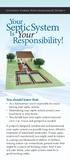 Southwest Florida Water Management District Septic System Your Is Your Responsibility! PIPE SEPTIC TANK DRAIN FIELD SOIL You should know that: As a homeowner you re responsible for maintaining your septic
Environmental Science 101 Waste. Fall 2012. Lecture Outline: Terms You Should Know: Learning Objectives: Reading Assignment: Chlorinated.
 Environmental Science 101 Waste Fall 2012 1 Lecture Outline: 17. SEWAGE DISPOSAL A. Sewage Handling B. Raw Sewage C. Wastewater Treatment Steps D. Individual Septic Systems E. Taking Stock Learning Objectives:
Planning, Health and Environment Division
 18 Planning, Health and Environment Division A Planning Guide to Sustainable Drainage Systems Introduction Working in co-operation with the Environment Agency, Severn Trent Water Ltd., the Highway Authority
Don t spit in the well - you may need to drink from it! -- Unknown, Russia.
 Don t spit in the well - you may need to drink from it! -- Unknown, Russia. WATER POLLUTION Water is a unique substance, because it can naturally renew and cleanse itself, by allowing pollutants to settle
Septic Tank Maintenance Information
 Septic Tank Maintenance Information This section has been adapted from materials developed by the Rouge RAP Advisory Council On-site Septic Subcommittee, which included representatives from Oakland, Wayne
Emergency Conservation Program
 Materials Prepared for Federation of Southern Cooperatives Epes, Alabama September 11, 2009 Emergency Conservation Program by Karen R. Krub Farmers Legal Action Group, Inc. 360 North Robert Street, Suite
Package Treatment Plant Policy and Procedure
 Package Treatment Plant Policy and Procedure PURPOSE There has been increased interest in the use of package treatment plants for new development proposals in the County. Current review procedures are
1. Water Line Maintenance 2. Sanitary Sewer Maintenance 3. Spill/Leak/Overflow Control, Response, and Containment
 WATER AND SEWER UTILITY OPERATION AND MAINTENANCE Although sewage systems the operation and maintenance of public utilities are not considered themselves are not a chronic sources of stormwater pollution,
Alternatives to Conventional Wastewater Treatment
 An Overview of Greywater, Composting, Communal Systems, and Other Options. This discussion will include: Greywater Systems Composting Systems Community Systems Other Systems Greywater Systems Greywater
GUIDELINES FOR THE CONTINUATION OF SCHEME ON REPAIR, RENOVATION AND RESTORATION (RRR) OF WATER BODIES IN XII TH PLAN
 GUIDELINES FOR THE CONTINUATION OF SCHEME ON REPAIR, RENOVATION AND RESTORATION (RRR) OF WATER BODIES IN XII TH PLAN Government of India Ministry of Water Resources October, 2013 I N D E X PARA NO. CONTENTS
Sewage Discharge in Estuaries: The case for Trapping.
 Sewage Discharge in Estuaries: The case for Trapping. Group N- Sarah Wrigley, Bryony Wood, Laura Wicks, Helen Whiting, Daniel Wood, David Willock, Nicholas Wilson, Joanna Williams, Luke Warwick and Alex
case study 7: south east queensland healthy waterways partnership
 2 Australia s National Programme of Action for the Protection of the Marine Environment from Land-Based Activities introduction South-east Queensland s marine systems support large populations of dugongs
Guide to agrichemical use in Resource Management Plans Northland Region as at October 2011
 Guide to agrichemical use in Resource Management Plans Northland Region as at October 2011 Northland Regional Air Quality Plan Note: This guide is intended to assist users and applicators understanding
Water Management in Cuba: Problems, Perspectives, Challenges and the Role of the Cuban Academy of Sciences
 Water Management in Cuba: Problems, Perspectives, Challenges and the Role of the Cuban Academy of Sciences Daniela M. Arellano Acosta Environment Agency/ Water Commission, Academy of Science, CUBA Water
WATER: ENVIRONMENTAL SCIENCE Syllabus
 WATER: ENVIRONMENTAL SCIENCE Syllabus Course Title Water: Environmental Science Course Description Central to all ecosystems, water is essential to life as we know it. It shapes our planet on every level,
SITE-SPECIFIC BEST MANAGEMENT PRACTICES (BMP) PLAN REVIEW CHECKLIST
 This checklist may be used by applicants for encroachment permits, and contractors in development of Site- Specific BMP Plans for projects. plan reviewers will use this checklist to review the Site-Specific
COMPREHENSIVE PLAN SECTION B, ELEMENT 4 WATER RESOURCES. April 20, 2010 EXHIBIT 1
 COMPREHENSIVE PLAN SECTION B, ELEMENT 4 WATER RESOURCES April 20, 2010 EXHIBIT 1 ELEMENT 4 WATER RESOURCES TABLE OF CONTENTS 4.1 INTRODUCTION 4.2 GOALS AND POLICIES 4.2.A General Goals and Policies 1 4.2.B
Understanding Septic Tank Systems
 Understanding Septic Tank Systems Sewage and effluent can contain a variety of human disease-causing microorganisms and parasites. Disease can be spread to humans from this material by direct contact or
Lesson Plan: How Do We Clean Polluted Water?
 Lesson Plan: How Do We Clean Polluted Water? Oil Spill Cleanup / Phosphate Cleanup / Groundwater Contamination / Water Treatment Simulation Estimated Time: 2-4 days State Standards taught and addressed
SITE-SPECIFIC BEST MANAGEMENT PRACTICES (SSBMP) PLAN/STORM WATER POLLUTION PREVENTION PLAN (SWPPP) REVIEW CHECKLIST
 This checklist may be used by applicants for encroachment permits, and contractors in development of Site Specific Best Management Practice (SSBMP) Plans or Storm Water Pollution Prevention Plans (SWPPP)
Mega Manila: Partnership in Action
 Domestic WastewaterManagement in Mega Manila: Partnership in Action Leonor C. Cleofas Deputy Administrator Metropolitan Waterworks and Sewerage System Securing the Future Today The MWSS Privatization On
Outlet stabilization structure
 Overview of Sedimentation and Erosion Control Practices Practice no. 6.41 Outlet stabilization structure Erosion at the outlet of channels, culverts, and other structures is common, and can cause structural
Looking after your Septic Tank System
 Looking after your Septic Tank System Name: Bought to you by Address: File this in your property file. 0800 TO FLUSH Call 0800 TO FLUSH 1 What do you know about your septic tank system? Just like your
Properly maintaining your septic system will help reduce the. It s Your Septic System. Homeowner s Guide. Here s How to Take Care of It
 Homeowner s Guide for Maintenance and Care of On-Site Sewage Systems It s Your Septic System Here s How to Take Care of It Properly maintaining your septic system will help reduce the possibility of health
Unauthorized Discharges and Sanitary Sewer Overflows
 TCEQ REGULATORY GUIDANCE Field Operations Support Division RG-395 Revised April 2011 Unauthorized Discharges and Sanitary Sewer Overflows What does this document cover? The Texas Commission on Environmental
SEPTIC TANK SYSTEMS. Single purpose septic tank receives toilet wastes (blackwater) or sullage (greywater) only.
 SEPTIC TANK SYSTEMS There are three common types of septic tank systems in Tasmania Single purpose septic tank receives toilet wastes (blackwater) or sullage (greywater) only. Dual purpose (or all-waste)
Sustainable Management Plans for Urban Lakes in India
 Sengupta, M. and Dalwani, R. (Editors). 2008 Proceedings of Taal2007: The 12 th World Lake Conference: 1202-1207 Sustainable Management Plans for Urban Lakes in India Sandeep Joshi Shrishti Eco-Research
Flooding Fast Facts. flooding), seismic events (tsunami) or large landslides (sometime also called tsunami).
 Flooding Fast Facts What is a flood? Flooding is the unusual presence of water on land to a depth which affects normal activities. Flooding can arise from: Overflowing rivers (river flooding), Heavy rainfall
GUIDELINES FOR REPAIR, RENOVATION AND RESTORATION
 GUIDELINES FOR REPAIR, RENOVATION AND RESTORATION OF WATER BODIES WITH DOMESTIC SUPPORT Government of India Ministry of Water Resources 2009 I N D E X CONTENTS PAGE NO. 1. Introduction 1 2. Basic Features
On Site Sewage System Maintenance Inspections. March 2011. Building and Development Branch Ministry of Municipal Affairs and Housing
 On Site Sewage System Maintenance Inspections March 2011 Building and Development Branch Ministry of Municipal Affairs and Housing Introduction The Building Code Act, 1992 and Building Code (Ontario Regulation
Chapter 2 Stormwater Pollution Prevention Plan (SWPPP) for Park Operations
 SWPPP for Park Operations 2 Chapter 2 Stormwater Pollution Prevention Plan (SWPPP) for Park Operations Bordered by Lake Washington & Lake Sammamish, the City of Bellevue has more than 60 miles of streams,
Climate Change and Sri Lanka. Ajith Silva Director/ Policy and Planning Ministry of Environment and Natural Resources Sri Lanka
 Climate Change and Sri Lanka Ajith Silva Director/ Policy and Planning Ministry of Environment and Natural Resources Sri Lanka Asia Total Area: 65610 Km Land Area : 62705 Km Inland water : 2905 Km 2 Coastal
Best Management Practices
 for The City of Paso Robles is required to implement a Phase II Municipal Water Program in order to reduce or eliminate the pollutants that enter our waterways from both storm water and non-storm water
GUIDELINES FOR LEACHATE CONTROL
 GUIDELINES FOR LEACHATE CONTROL The term leachate refers to liquids that migrate from the waste carrying dissolved or suspended contaminants. Leachate results from precipitation entering the landfill and
A STUDY ON OWN FUND REVENUE GENERATION THROUGH COMMON PROPERTY RESOURCE MANAGEMENT IN MADANMOHANPUR GRAM PANCHAYAT, WEST BENGAL
 A STUDY ON OWN FUND REVENUE GENERATION THROUGH COMMON PROPERTY RESOURCE MANAGEMENT IN MADANMOHANPUR GRAM PANCHAYAT, WEST BENGAL INTRODUCTION:- Self-Governing Institutions are an integral part of the Indian
It s hard to avoid the word green these days.
 Going green : Environmental jobs for scientists and engineers Alice Ramey Alice Ramey is an economist in the Office of Occupational Statistics and Employment Projections, BLS. She is available at (202)
Living & Working Managing Natural Resources and Waste
 Living & Working Managing Natural Resources and Waste 5.13 Managing Natural Resources and Waste Background 5.13.1 This chapter focuses on how we manage resources within the AONB. It includes renewable
MBJ Environmental Programmes
 MBJ Airports Limited Environmental Policy The following is MBJ Airports Limited s (MBJ) Environmental Policy for Sangster International Airport (SIA): Integrate environmental management measures with planning,
Curt Kerns, M.S., R.P.Bio., C.F.S. WetlandsPacific Corp. 250-722-7117 www.wetlandspacific.com
 Curt Kerns, M.S., R.P.Bio., C.F.S. WetlandsPacific Corp. 250-722-7117 www.wetlandspacific.com Presentation Historical perspectives Present perspectives How wetlands function Examples of natural wetlands
What Is An On-Lot Sewage Disposal System?
 What Is An On-Lot Sewage Disposal System? Most rural homes and communities in Monroe County are not served by a public sewer system. In order to dispose of the wastewater (sewage) generated by homes and
HOW TO FUND BASIN MANAGEMENT PLANS? Invest in IWRM - it pays back!
 HOW TO FUND BASIN MANAGEMENT PLANS? Invest in IWRM - it pays back! Jean-François DONZIER Permanent Technical Secretary of the International Network of Basin Organizations (INBO), General Manager of the
Kristina Veidemane, Baltic Environmental Forum Panevezys, 12.05.2015
 Priority 2 Protection and restoration of biodiversity and soil and promotion of ecosystem services, including through Natura 2000, and green infrastructure Kristina Veidemane, Baltic Environmental Forum
SUSTAINABLE URBAN DRAINAGE SYSTEMS
 overflow can lead into a permeable conveyance system to increase further the benefit and reduce the need for pipe systems. Pollutant removal rates have been shown to be high, with some pollutants being
Environmental guidelines for preparation of an Environment Management Plan
 Environmental guidelines for preparation of an Environment Management Plan Environment Protection Authority MAY 2013 Australian Capital Territory, Canberra 2013 This work is copyright. Apart from any use
Amherst County Public Schools. AP Environmental Science Curriculum Pacing Guide. College Board AP Environmental Science Site
 Amherst County Public Schools AP Environmental Science Curriculum Pacing Guide College Board AP Environmental Science Site REV: 8/12 1 st 9 weeks AP Objectives Energy Resources and Consumption A. Energy
Orange County Sanitation District
 Orange County Sanitation District The Orange County Sanitation District operates large wastewater treatment plants in Fountain Valley and Huntington Beach, CA. These plants treat about 230 million gallons
THE ECONOMIC DATA BASE AN INSTRUMENT SUPPORTING PREPARATION OF THE PROGRAMMES OF MEASURES IN ACCORDANCE TO THE WATER FRAMEWORK DIRECTIVE
 THE ECONOMIC DATA BASE AN INSTRUMENT SUPPORTING PREPARATION OF THE PROGRAMMES OF MEASURES IN ACCORDANCE TO THE WATER FRAMEWORK DIRECTIVE J.Grela, A.Hobot Wojna, M.Owsiany, K.Szewczyk Poland RIOB MEGEVE
LIMNOLOGY, WATER QUALITY
 LIMNOLOGY, WATER QUALITY PA RANI ET E R S, AN D c 0 IV D IT I 0 N S AND ECOREGIONS Water Quality Parameters Nutrients are important parameters because phosphorous and nitrogen are major nutrients required
Septic Systems How They Work and How to Keep Them Working
 Septic Systems How They Work and How to Keep Them Working PO Box 9300, 49 Exeter Street, Portland, Maine 04104-9300 (207) 780-4820 www.cascobayestuary.org 201 Main Street, Suite 6, Westbrook, Maine 04092
A HOMEOWNERS GUIDE ON-SITE SEWAGE MANAGEMENT SYSTEMS
 GEORGIA DEPARTMENT OF HUMAN RESOURCES ENVIRONMENTAL HEALTH SECTION A HOMEOWNERS GUIDE TO ON-SITE SEWAGE MANAGEMENT SYSTEMS March 12, 2002 WHAT IS AN ON-SITE SEWAGE MANAGEMENT SYSTEM An on-site sewage management
Florida Department of Environmental Protection
 Florida Department of Environmental Protection Background Mobile vehicle and equipment washing involves washing at a location where vehicles are based (such as a trucking company, warehouse, bus station,
Madagascar: Makira REDD+
 project focus Madagascar: Makira REDD+ Madagascar is considered to be one of the top five biodiversity hotspots in the world due to more than 75% of all animal and plant species being endemic while less
On-site Sewage Disposal Systems A HOMEOWNER S GUIDE
 On-site Sewage Disposal Systems A HOMEOWNER S GUIDE May 2013 Table of Contents Introduction page 3 Private Sewage Disposal Systems.page 3 Background Check of your System..page 3 Maintaining your System.
Guidance on the use of sustainable drainage systems (SUDS) and an overview of the adoption policy introduced by
 Guidance on the use of sustainable drainage systems (SUDS) and an overview of the adoption policy introduced by Easy guide to Sustainable drainage systems 02 Contents Page Introduction 05 Purpose of this
PRC: Zhanghewan Pumped Storage Power Station Project
 Environmental Monitoring Report Project Number: 28212-013 Quarterly Report January March 2006 PRC: Zhanghewan Pumped Storage Power Station Project Prepared by Hebei Zhanghewan Pumped Storage Co., Ltd.
LAKE OHRID CONSERVATION PROJECT (Case Study on Monitoring &Evaluation)
 GLOBAL ENVIRONMENTAL FACILITY World Bank ALBANIAN NATIONAL ENVIRONMENTAL AGENCY MACEDONIAN MINISTRY OF ENVIRONMENT AND TERRITORY PLANNING Dr. Lirim Selfo Project Coordinator, Albania Mr. Dejan Panovski