
Regional Emergency Services Master Plan & Cooperative Services Feasibility Study Hernando County, FL. Table of Contents
|
|
|
- Felix Merritt
- 10 years ago
- Views:
Transcription
1 Table of Contents Table of Figures...iii Executive Summary... 1 Section 1 Emergency Services Agency Evaluations Objective One Organizational Overview Objective Two Management Component Objective Three Personnel Management Objective Four Staffing Objective Five Capital Improvement and Replacement Programs Objective Six Emergency Services Delivery Objective Seven Training Program Objective Eight Fire Prevention Program Section 2 System Demand Projections Community Growth Potential Community Risk Analysis Service Demand Projections Section 3 Future Delivery System Models Fire and EMS Service Delivery Planning Zones Facilities and Fire Apparatus Deployment Strategies Emergency Medical Services Deployment Strategies Additional Service Improvements Staffing Deployment Strategies Summary Section 4 Concepts for Shared Emergency Service Delivery Processes for Collaboration Discussion and Analysis of Opportunities Summary Table of Partnership Strategies Partnering Strategies A Consolidate All Hernando County Fire and EMS Agencies B Consolidate Spring Hill and Hernando County Fire Rescue C Consolidate Brooksville Fire Department and Hernando County Fire Rescue D Develop Standard Operating Guidelines i

2 E Shared Specialty Teams F Develop a Joint Support and Logistics Services Division G Establish a Hernando County Fire Investigation Team H Develop a Hernando County Fire Safety Education Coalition I Develop a Hernando County Juvenile Fire Setter Intervention Network J Create a Unified Occupational Medicine Program K Contract with Hernando County Emergency Communications Center L Create a Unified Wellness and Fitness Program M Implement a Computerized Training Records Management System N Develop and Adopt Common Training Standards O Create a Hernando County Training Manual P Implement and Cooperatively Use a Video Conferencing System Q Develop an Annual Hernando County Training Plan R Consolidate Training into a Hernando County Training Division S Develop a Hernando County Fire and EMS Training Facility T Develop Mutual Training Strategies U Develop Uniform Fees for Service V Purchase Uniform Emergency Apparatus W Develop a Model Labor Agreement for Hernando County Fire Departments X Acquire AVL and MDC or MDT Capabilities Y Develop Uniform Pre-Incident Plans Z Provide for Joint Staffing of Stations and Apparatus AA Provide Hernando County IC and Operations Supervision AB Purchase and Implement an Electronic Staffing Program Findings and Recommendations Statement of Conditions Findings, Recommendations, and Moving Forward Appendix A Index of Recommendations ii
3 Table of Figures Figure 1: BFD Resource Allocation Comparison...14 Figure 2: HBVFD Resource Allocation Comparison...16 Figure 3: HCFR Resource Allocation Comparison...18 Figure 4: HPVFD Resource Allocation Comparison...20 Figure 5: SHFR Resource Allocation Comparison...22 Figure 6: Brooksville Fire Department Organizational Structure...61 Figure 7: Hernando County FR Organizational Structure...62 Figure 8: High Point VFD Organizational Structure...63 Figure 9: Spring Hill FR Organizational Structure...64 Figure 10: Tri-County VFD Organizational Structure...65 Figure 11: Annual Salary by Rank HCFR, SHFR, and BFD...66 Figure 12: Additional Compensation Comparison...67 Figure 13: Cost of Benefits above Wages Percentage...68 Figure 14: Summary Table of Safety Committees...79 Figure 15: BFD Administrative and Support Personnel...82 Figure 16: HBVFD Administrative and Support Personnel...83 Figure 17: HCFR Administrative and Support Personnel...84 Figure 18: HPVFD Administrative and Support Personnel...84 Figure 19: SHFR Administrative and Support Personnel...85 Figure 20: TCVFD Administrative and Support Personnel...86 Figure 21: Summary Table of Administrative and Support Personnel...87 Figure 22: Emergency Services Summary Table...88 Figure 23: Number of BFD Emergency Response Personnel by Rank...89 Figure 24: Number of HBVFD Emergency Response Personnel by Rank...89 Figure 25: Number of HCFR Emergency Response Personnel by Rank...90 Figure 26: Number of HPVFD Emergency Response Personnel by Rank...90 Figure 27: Number of SHFR Emergency Response Personnel by Rank...91 Figure 28: Number of TCVFD Emergency Response Personnel by Rank...91 Figure 29: Average Volunteer Firefighters Responding Mid-day...93 Figure 30: Summary Table of Operational Personnel...94 Figure 31: Comparison of Combined HCFR and SHFR Firefighters per 1,000 Population...95 Figure 32: Brooksville Apparatus Replacement Funding Figure 33: HBVFD Apparatus Replacement Funding Figure 34: HCFR Apparatus Replacement Funding Figure 35: HPVFD Apparatus Replacement Funding Figure 36: SHFR Apparatus Replacement Funding Figure 37: TCVFD Apparatus Replacement Funding Figure 38: Hernando County Fire Departments Equipment Testing Services Figure 39: Population History Figure 40: Housing by Occupancy iii

4 Figure 41: Brooksville Population by Age Figure 42: Brooksville Area 2007 Estimated Population Density Figure 43: Hernando Beach VFD Population by Age Figure 44: Housing by Occupancy Figure 45: Hernando Beach VFD 2000 Population Density Figure 46: Hernando Beach Area by CBG Estimates for Figure 47: Population History Figure 48: Population by Age Figure 49: Housing by Occupancy Figure 50: HCFR Estimated 2007 Population Density Figure 51: High Point Population by Age Figure 52: Housing by Occupancy Figure 53: High Point 2007 Estimated Population Density Figure 54: Population History Figure 55: Spring Hill Population by Age Figure 56: Housing by Occupancy Figure 57: Spring Hill 2007 Estimated Population Density Figure 58: Tri-County 2000 Population Density Figure 59: BFD Workload Historical Data Figure 60: BFD Monthly Workload Figure 61: BFD Medical Workload by Day of Week Figure 62: BFD Fire Call Workload by Day of Week Figure 63: BFD Calls Other than Fire or Medical Workload by Day of Week Figure 64: BFD Medical Workload by Hour of Day Figure 65: BFD Fire Calls Workload by Hour of Day Figure 66: BFD Calls Other than Fire & Medical Workload by Hour of Day Figure 67: Service Demand - BFD Incident Density Figure 68: Service Demand - BFD Fire Call Density Figure 69: HBVFD Workload by Call Type Figure 70: HBVFD Monthly Workload Figure 71: HBVFD Workload by Day of Week Figure 72: HBVFD Medical Workload by Hour of Day Figure 73: Service Demand - HBVFD Incident Density Figure 74: Service Demand - HBVFD Fire Call Density Figure 75: HCFR Workload Historical Data Figure 76: HCFR Workload by Call Type Figure 77: HCFR Monthly Workload Figure 78: HCFR Medical Workload by Day of Week Figure 79: HCFR Fire Call Workload by Day of Week Figure 80: HCFR Calls Other than Fire or Medical Workload by Day of Week Figure 81: HCFR Medical Workload by Hour of Day Figure 82: HCFR Fire Calls Workload by Hour of Day Figure 83: HCFR Calls Other than Fire & Medical Workload by Hour of Day Figure 84: Service Demand - HCFR Incident Density iv
5 Figure 85: Service Demand - HCFR Fire Call Density Figure 86: HPVFD Workload by Call Type Figure 87: HPVFD Monthly Workload Figure 88: HPVFD Workload by Day of Week Figure 89: HPVFD Workload by Hour of Day Figure 90: Service Demand - HPVFD Incident Density Figure 91: Service Demand - HPVFD Structure Fire Calls Figure 92: SHFR Workload Historical Data Figure 93: SHFR Workload by Call Type Figure 94: SHFR Monthly Workload Figure 95: SHFR Medical Workload by Day of Week Figure 96: SHFR Fire Call Workload by Day of Week Figure 97: SHFR Calls Other than Fire or Medical Workload by Day of Week Figure 98: SHFR Medical Workload by Hour of Day Figure 99: SHFR Fire Calls Workload by Hour of Day Figure 100: SHFR Calls Other than Fire & Medical Workload by Hour of Day Figure 101: Service Demand - SHFR Incident Density Figure 102: Service Demand - SHFR Fire Call Density Figure 103: TCVFD Workload by Call Type Figure 104: TCVFD Monthly Workload Figure 105: TCVFD Workload by Day of Week Figure 106: TCVFD Workload by Hour of Day Figure 107: Service Demand - TCVFD Incident Density Figure 108: Brooksville Fire Station Deployment Figure 109: Current Response Time Capability of BFD Station Figure 110: BFD 1.5 Mile Engine Coverage (ISO) Figure 111: BFD 2.5 Mile Ladder Truck Coverage (ISO) Figure 112: Hernando Beach Fire Station Deployment Figure 113: Current Response Time Capability of HBVFD Station Figure 114: HBVFD 1.5 Mile Engine Coverage (ISO) Figure 115: HBVFD 2.5 Mile Ladder Truck Coverage (ISO) Figure 116: Hernando County Fire Rescue Station Deployment Figure 117: Current Response Time Capability of HCFR Station Figure 118: HCFR Current EMS Response Area Capability Figure 119: HCFR 1.5 Mile Engine Coverage (ISO) Figure 120: High Point Fire Station Deployment Figure 121: Current Response Time Capability of HPFD Station Figure 122: Spring Hill Fire Station Deployment Figure 123: Current Response Time Capability of SHFR Figure 124: SHFR 1.5 Mile Engine Coverage (ISO) Figure 125: SHFR 2.5 Mile Ladder Truck Coverage (ISO) Figure 126: Tri-County Fire Station Deployment Figure 127: Current Response Time Capability of TCVFD Station Figure 128: TCVFD 1.5 Mile Engine Coverage (ISO) v

6 Figure 129: HCFR Residential Effective Firefighting Force Figure 130: SHFR Residential Effective Firefighting Force Figure 131: SHFR Commercial Effective Firefighting Force Figure 132: BFD Unit Hour Utilization Figure 133: BFD Call Concurrency Table Figure 134: HBVFD Unit Hour Utilization Figure 135: HBVFD Station Reliability Rates Figure 136: HCFR Unit Hour Utilization Figure 137: HCFR Call Concurrency Table Figure 138: HCFR Station Reliability Rate Figure 139: HPVFD Unit Hour Utilization Figure 140: HPVFD Station Reliability Rate Figure 141: SHFR Unit Hour Utilization Figure 142: SHFR Call Concurrency Table Figure 143: SHFR Station Reliability Rate Figure 144: TCVFD Unit Hour Utilization Figure 145: TCVFD Station Reliability Rate Figure 146: BFD Response Time Performance History Figure 147: BFD Average Response Time by Hour of Day Figure 148: BFD 90th Percentile Response Time by Hour of Day Figure 149: BFD Response Performance Figure 150: HBVFD Response Time Performance History Figure 151: HBVFD Average Response Time by Hour of Day Figure 152: HBVFD 80th Percentile Response Time by Hour of Day Figure 153: HBVFD Turnout Time Figure 154: HBVFD Response Performance Figure 155: HCFR Response Time Performance History Figure 156: HCFR Average Response Time by Hour of Day Figure 157: HCFR 90th Percentile Response Time by Hour of Day Figure 158: HCFR 80th Percentile Response Time by Hour of Day Figure 159: HCFR Turnout Time Performance Figure 160: HCFR Response Performance Figure 161: HPVFD Response Time Performance History Figure 162: HPVFD Average Response Time by Hour of Day Figure 163: HPVFD 90th Percentile Response Time by Hour of Day Figure 164: HPVFD Turnout Time Performance Figure 165: HPVFD Response Performance Figure 166: SHFR Response Time Performance History Figure 167: SHFR Average Response Time by Hour of Day Figure 168: SHFR 90th Percentile Response Time by Hour of Day Figure 169: SHFR Turnout Time Performance Figure 170: SHFR Response Performance Figure 171: TCVFD Response Time Performance History Figure 172: TCVFD Average Response Time by Hour of Day vi
7 Figure 173: TCVFD 80 th Percentile Response Time by Hour of Day Figure 174: Turnout Time Performance Figure 175: HCFR Ambulance Charges Figure 176: SHFR Ambulance Charges Figure 177: Recommended Frequency of Fire Safety Inspection Based on Hazard Figure 178: Population History Figure 179: Hernando County 2007 Census Block Group Estimated Population Density Figure 180: Hernando County Population by Age & Gender (2005) Figure 181: Pediatric Population Density Figure 182: Senior Citizen Population Figure 183: Hernando Housing by Occupancy Figure 184: Renter Occupancy Density Figure 185: Vacant Housing Density Figure 186: Residential & Commercial Growth Figure 187: Projected Growth in Age Group Populations Figure 188: Population Projections Figure 189: Community Risk Assessment Figure 190: Target Hazards Figure 191: Workload Projection by Type and Year Figure 192: Projected Service Demand Figure 193: Table of Fire and EMS Service Delivery Zones Figure 194: Fire and EMS Service Delivery Zone Areas Figure 195: Proposed Urban Zone Coverage Figure 196: Projected Urban Zone Performance Figure 197: Truck Apparatus Response Capability Figure 198: Apparatus Table for Urban Fire & EMS Service Zone Stations Figure 199: Suburban Response Capability from Current Station Locations Figure 200: Redundant Coverage Figure : Proposed Suburban Zone Coverage Figure 202: Projected Suburban Zone Performance Figure 203: Apparatus Needs for Suburban Fire & EMS Service Zone Stations Figure 204: Proposed Rural Zone Coverage Figure 205: Projected Rural Zone Performance Figure 206: Apparatus Needs for Rural Fire & EMS Service Zone Stations Figure 207: Proposed Tanker Coverage Figure 208: Proposed Brush Truck Coverage Figure 209: Total Medical UHU Figure 210: Peak Load Apparatus Needs Figure 211: Peak Load Apparatus Deployment Figure 212: Hourly Concurrency Figure 213: Alternative EMS Transport Unit Response Time Objectives Figure 214: Projected EMS Transport Unit Performance Figure 215: Recommended Daytime Rescue Deployment Figure 216: Overall Inter-facility Workload vii
8 Figure 217: Inter-facility Hourly Workload Figure 218: Inter-facility Concurrence Figure 219: Inter-facility Workload by Day of Week Figure 220: Inter-facility Demand on Weekend Days by Hour for Figure 221: Rescue Unit Deployment Figure 222: ISO Five-Mile Coverage Analysis Figure 223: ISO Five-Mile Coverage Analysis with Additional Stations Figure 224: Optional Extended Suburban Zone Coverage Figure 225: Projected Optional Suburban Zone Performance Figure 226: Optional Extended Rural Zone Coverage Figure 227: Projected Optional Rural Zone Performance Figure 228: Redeployment Staffing Model Figure 229: Full Deployment Operational Staffing Model Figure 230: Full Deployment Unit Staffing Breakdown Figure 231: Full Deployment Operational Staffing Model Figure 232: Full Deployment Administration and Support Staffing by Department Figure 233: Anticipated Impact on Property Tax Base and Millage Rates in Hernando County Figure 234: Consolidated, Modeled Baseline Cost of Fire Protection Figure 235: Modeled Consolidated Staffing Plan Figure 236: Consolidated Cost of Fire and EMS Figure 237: Annual Administrative and Support Costs at Full Deployment as Separate Agencies Figure 238: Full Deployment Administration and Support Staffing Model, Consolidated Figure 239: Administrative and Support Costs at Full Deployment, Consolidated Agency Figure 240: Consolidated Comparison of Firefighters per 1,000 Population Figure 241: Consolidated On-Duty Firefighters in Similar Communities Figure 242: Consolidated Comparison of Resource per 1,000 Population Figure 243: Comparison of Incidents per 1,000 Population Figure 244: Comparison of Fires per 1,000 Population Figure 245: HCFR and SHFR Taxable Value, Figure 246: HCFR & SHFR, Modeled Baseline Cost of Fire Protection Figure 247: HCFR & SHFR, Modeled Staffing Plan Figure 248: Consolidated HCFR & SHFR, Modeled 2007 Operating Costs Figure 249: Consolidated HCFR & SHFR, Comparison of Firefighters per 1,000 Population Figure 250: On-Duty Firefighters in Similar Communities Figure 251: Consolidated HCFR & SHFR, Comparison of Resources per 1,000 Population Figure 252: Consolidated HCFR & SHFR, Comparison of Incidents per 1,000 Population Figure 253: Consolidated HCFR & SHFR, Comparison of Fires per 1,000 Population Figure 254: Consolidated Brooksville & HCFR, Baseline Cost of Fire Protection Figure 255: Consolidated Brooksville & HCFR, Staffing Plan Figure 256: Brooksville & HCFR, Cost of Consolidated Fire and EMS Figure 257: Consolidated Brooksville & HCFR, Comparison of Firefighters per 1,000 Population Figure 258: Consolidated Brooksville & HCFR, On-Duty Firefighters in Similar Communities Figure 259: Consolidated Brooksville & HCFR, Comparison of Resources per 1,000 Population Figure 260: Consolidated Brooksville & HCFR, Comparison of Incidents per 1,000 Population viii

9 Figure 261: Consolidated Brooksville & HCFR, Comparison of Fires per 1,000 Population Figure 262: Frontline Pumper Comparison Figure 263: Impact from Apparatus Differences Figure 264: Pumper Fleet by County Fire Department Figure 265: Annual and Projected 15-year Cost Avoidance, Custom vs. Stock Pumpers Figure 266: Comparison of Features MDT vs. MDC ix

10 Section 1 Emergency Services Agency Evaluations Objective One Organizational Overview Brooksville Fire Department The Brooksville Fire Department (BFD) is the operating department of the City of Brooksville designated to provide fire protection and emergency medical first responder service. The department s jurisdiction encompasses the municipal limits of the city. The response area includes densely populated urban areas as well as suburban residential areas of Hernando County (County) and is situated in the center of the County, about ten miles east of the coast. BFD provides emergency services to a population of 7,637 2 in an area of roughly 12.3 square miles. These services are provided from one facility located within the jurisdiction. The department maintains a fleet of vehicles including one fire engine, one aerial truck, one tanker, one rescue truck, one wildland firefighting vehicle, a fast attack unit, and two staff vehicles. One vehicle is available in a reserve fleet, not typically used for front-line service. There are 30 individuals 3 involved in delivering these services to the jurisdiction. The department has a Fire Chief and Administrative Assistant. The Administrative Assistant provides most of the clerical support services. Primary staffing coverage for emergency response is primarily through the use of career and part-time firefighters operating on scheduled duty shifts. The following figure provides an overview of the Brooksville Fire Department s fire suppression resources and compares these with the average rate of resource allocation in other communities of similar size within the same region of the United States. 4 2 U.S. Census Bureau, 2005 Population Estimates data. 3 Current number at time of field research. 4 Comparison data from the National Fire Protection Association Fire Department Profiles
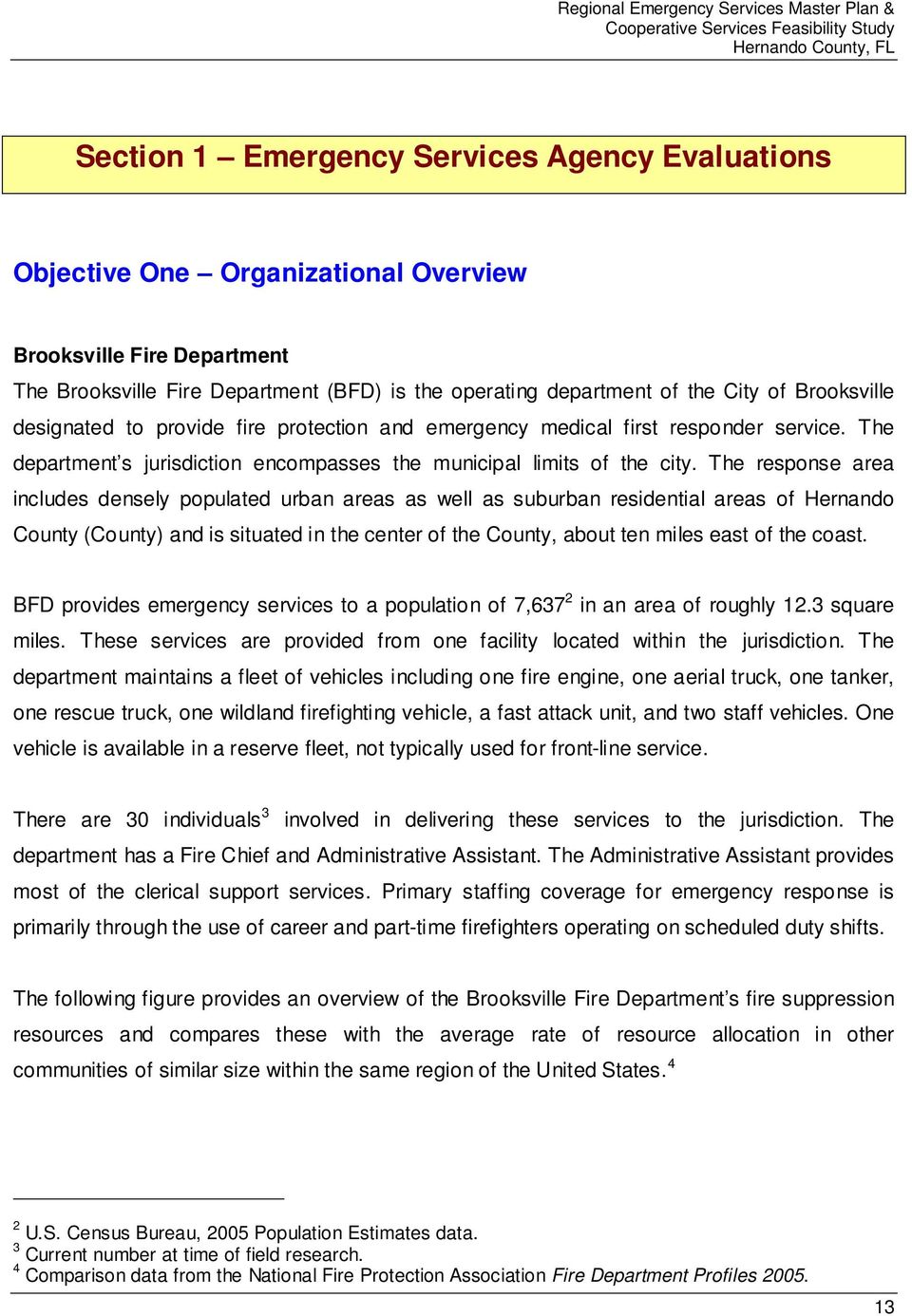
11 Figure 1: BFD Resource Allocation Comparison Comparison of Resources per 1,000 Population Stations Pumpers Aerials National Median Brooksville The chart demonstrates that BFD has a slightly lower than median allocation of stations, approximately 68 percent of the typical deployment for communities of its population. The department has a lower than median number of pumpers, and a higher than median ratio of aerial devices. However, the department operates an aerial device commonly known as a quint, which is fully capable of operating as a pumper as well as an aerial. The pumper capability or dual function of this unit is not accounted for in the statistical comparison shown in the chart. The department provides a variety of services including fire suppression, victim rescue, emergency medical first responder, technician-level hazardous materials (hazmat) response, and public fire safety education. The Brooksville Police Department Dispatch Center provides emergency call receipt and dispatch service 5. Enhanced-911 telephone service, computer-aided dispatch, and a multichannel radio system are in place. Hernando Beach Volunteer Fire Department The Hernando Beach Volunteer Fire Department, Inc. (HBVFD) provides fire response services to a portion of the County through a contractual agreement with the Hernando County Fire 5 Scheduled for consolidation with Hernando County Emergency Communications Center in

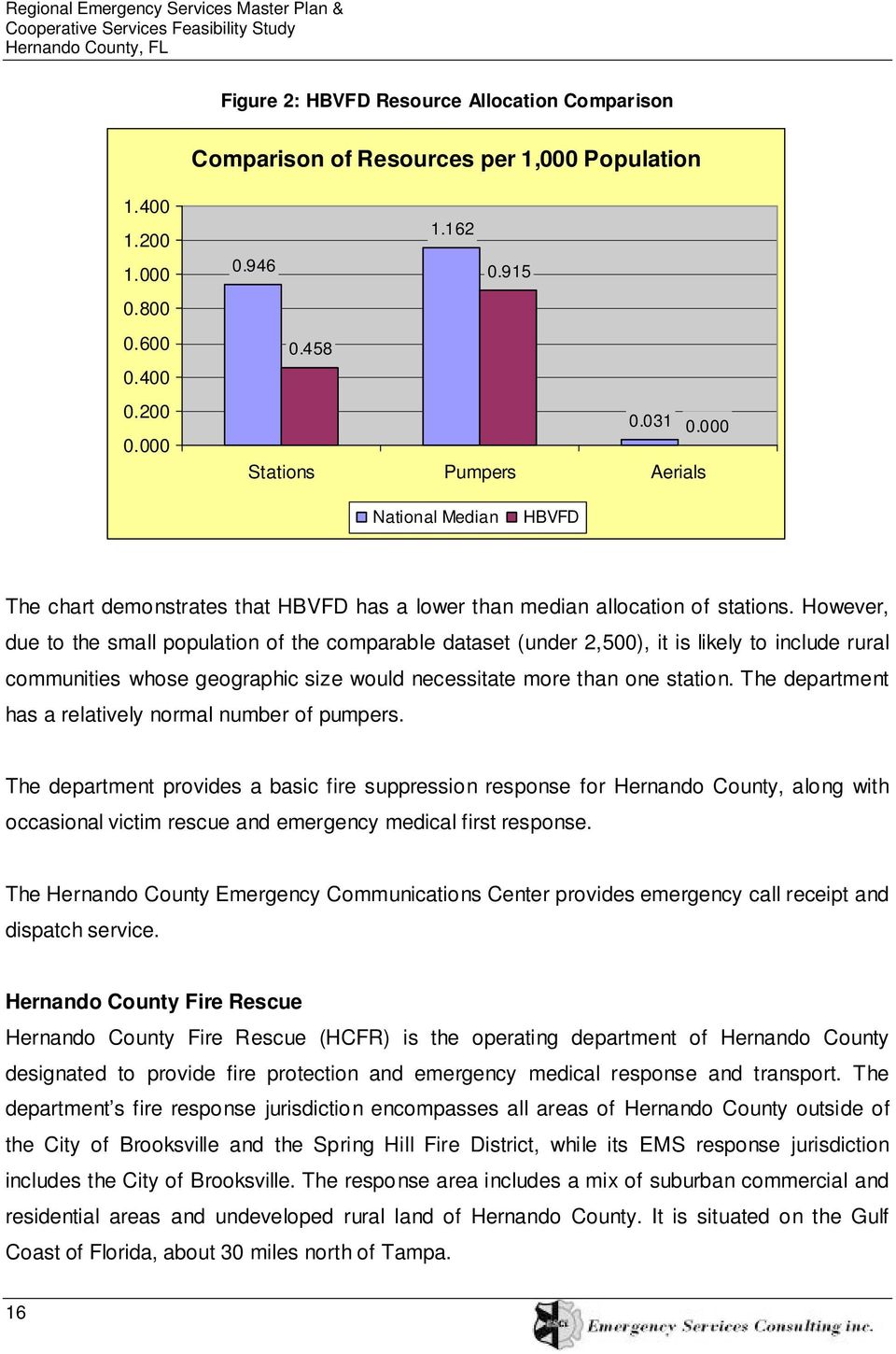
12 Rescue MSBU. The response area includes medium-density suburban areas, as well as beachfront development, and is situated in the extreme southwest portion of the County on the gulf coast. HBVFD provides emergency services to a population of 2,648 6 in an area of roughly 18.4 square miles. Approximately 6,000 acres of this area are owned by the Southwest Florida Water Management District. Services are provided from one facility located within the jurisdiction. The department maintains a fleet of vehicles including two fire engines, one rescue truck, and two specialty/utility vehicles. There are 50 individuals 7 involved in delivering these services to the jurisdiction. The department has a Fire Chief and Assistant Chief. Primary staffing coverage for emergency response is through the use of volunteer, on-call response. The following figure provides an overview of the Hernando Beach Volunteer Fire Department s fire suppression resources and compares these with the average rate of resource allocation in other communities of similar size within the same region of the United States. 8 6 U.S. Census Bureau, 2000 Census data. 7 Current number at time of field research. 8 Comparison data from the National Fire Protection Association Fire Department Profiles

13 Figure 2: HBVFD Resource Allocation Comparison Comparison of Resources per 1,000 Population Stations Pumpers Aerials National Median HBVFD The chart demonstrates that HBVFD has a lower than median allocation of stations. However, due to the small population of the comparable dataset (under 2,500), it is likely to include rural communities whose geographic size would necessitate more than one station. The department has a relatively normal number of pumpers. The department provides a basic fire suppression response for Hernando County, along with occasional victim rescue and emergency medical first response. The Hernando County Emergency Communications Center provides emergency call receipt and dispatch service. Hernando County Fire Rescue Hernando County Fire Rescue (HCFR) is the operating department of Hernando County designated to provide fire protection and emergency medical response and transport. The department s fire response jurisdiction encompasses all areas of Hernando County outside of the City of Brooksville and the Spring Hill Fire District, while its EMS response jurisdiction includes the City of Brooksville. The response area includes a mix of suburban commercial and residential areas and undeveloped rural land of Hernando County. It is situated on the Gulf Coast of Florida, about 30 miles north of Tampa. 16
14 HCFR provides primary fire protection and emergency medical transport services to a population of 64,458, and also provides emergency medical transport services to an additional population of 13,687 in Brooksville, Hernando Beach, High Point, and Tri-County s fire response areas. 9 HCFR s service area is spread widely over an area of roughly square miles. These services are provided from nine facilities located within the jurisdiction. The department maintains a fleet of vehicles including eight fire engines, two tankers, five ambulances, six wildland firefighting vehicles, one non-transport advanced life support (ALS) unit, a hazmat truck, and an aircraft crash unit. Six vehicles are available in a reserve fleet, not typically used for front-line service. There are 121 individuals involved in delivering these services to the jurisdiction. The department has a Fire Chief, Assistant Chief of Operations, Assistant Chief of Administration, Logistics Chief, and the Shift Deputy Chief. 10 A Logistics Technician, Quality Assurance Officer, Training Chief, Financial Coordinator, and three Executive Secretaries provide additional support services. Staffing coverage for emergency response is primarily through the use of career firefighters operating on 24-hour shifts. The following figure provides an overview of the Hernando County Fire Rescue s fire suppression resources and compares these with the average rate of resource allocation in other communities of similar size within the same region of the United States Hernando County Planning Department CBG estimates. 10 Number of personnel current at time of field work. HCFR has eliminated one assistant fire chief position during the current fiscal year. 11 Comparison data from the National Fire Protection Association Fire Department Profiles
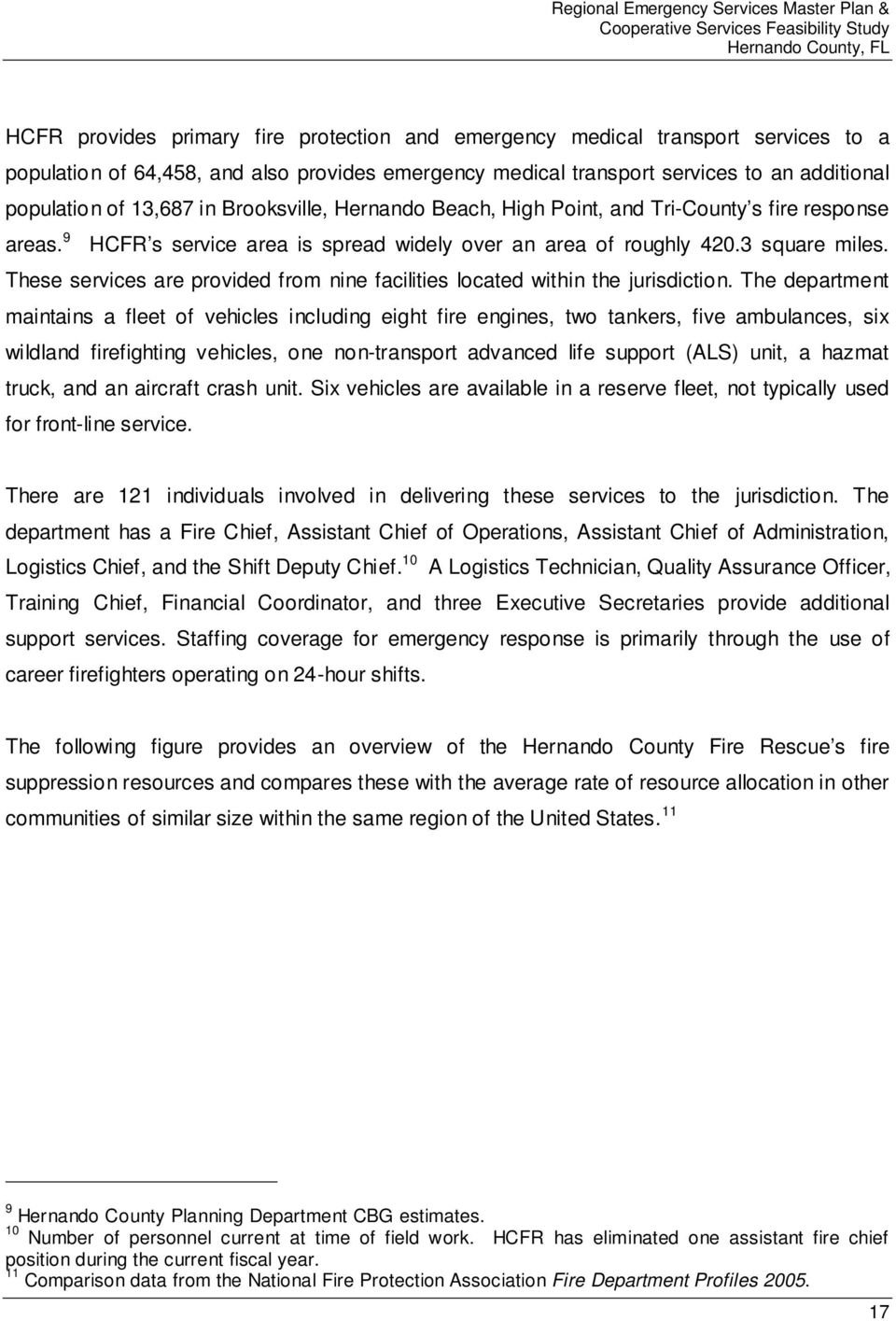
15 Figure 3: HCFR Resource Allocation Comparison Comparison of Resources per 1,000 Population Stations Pumpers Aerials National Median HCFR The chart demonstrates that HCFR has a higher than median allocation of stations, but the comparison data available is of limited use here. Most departments within this population dataset serve an incorporated municipality with much greater population density than HCFR. Due to the fact that HCFR serves some of the most rural areas of the County, with low population densities, a higher ratio of stations is expected to accommodate reasonable response times. Likewise, the department has a higher than median number of pumpers, and a lower than median ratio of aerial devices (the department does not operate an aerial). The department provides a variety of services including fire suppression, victim rescue, emergency medical response and transport, technician-level hazardous material response, fire code enforcement, and public fire safety education. The Hernando County Emergency Communications Center provides emergency call receipt and dispatch service. Enhanced-911 telephone service, computer-aided dispatch, and a multichannel radio system are in place. 18

16 High Point Volunteer Fire Department The Hernando High Point Volunteer Fire Department, Inc. (HPVFD) operates under traditional agreement with Hernando County and provides fire protection and basic emergency medical first responder services. The department s jurisdiction duplicates the boundaries of the High Point 55 and Older Golf Community Association. The response area includes a senior golf community with approximately 1,628 single-family manufactured homes and is situated northeast of Spring Hill and west of Brooksville. At the state level, this department is known as the Hernando High Point Volunteer Fire Department to differentiate it from another High Point Fire Department in the state, but locally it is more commonly known simply as High Point VFD. The department began providing services in 1975, initially using a mobile home as a fire station with a metal awning for apparatus parking. HPVFD provides emergency services to a population of as many as 2, in an area of roughly one square mile. The area served by the department is experiencing very limited growth. The department s services are provided from one facility located within the community. The department maintains a fleet of vehicles including two fire engines, one tanker, and one utility vehicle. There are 38 individuals 13 involved in delivering these services to the jurisdiction. The department s primary management team includes a Fire Chief, Assistant Chief, two Captains, and one Lieutenant. A President, Vice President and Secretary-Treasurer provide additional support services. Primary staffing coverage for emergency response is through the use of oncall personnel. For immediate response, at least between 10 and 15 personnel are typically available and carrying pagers to receive radio calls for emergency response. The following figure provides an overview of the High Point Volunteer Fire Department s fire suppression resources and compares these with the average rate of resource allocation in other communities of similar size within the same region of the United States U.S. Census Bureau, 2000 census data. 13 Current number at time of field research. 14 Comparison data from the National Fire Protection Association Fire Department Profiles
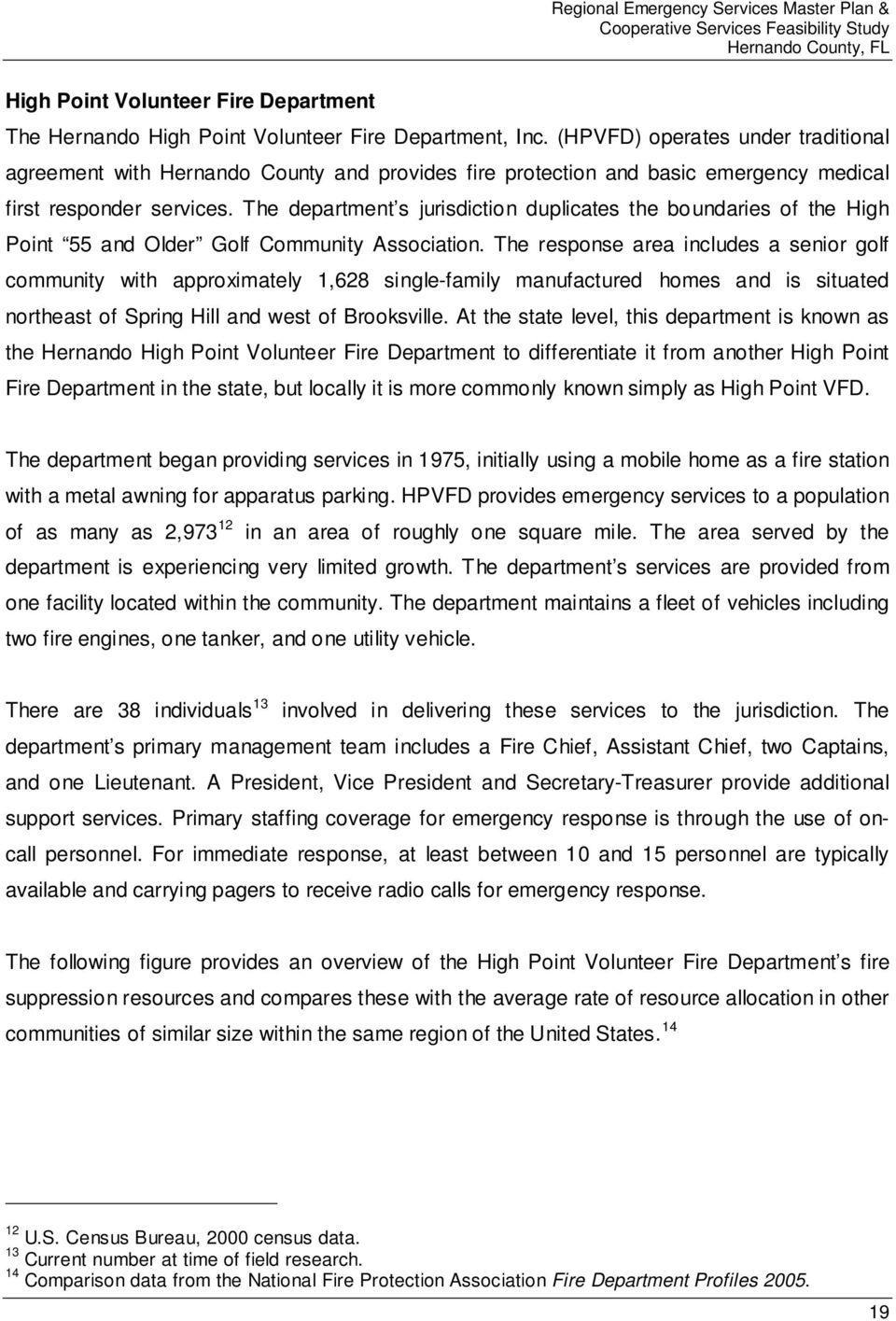
17 Figure 4: HPVFD Resource Allocation Comparison Comparison of Resources per 1,000 Population Stations Pumpers Aerials National Median HPVFD The chart demonstrates that HPVFD has a similar allocation of stations and pumpers to communities of comparable size. The department provides primary fire suppression response, along with occasional victim rescue and emergency medical first response. The Hernando County Emergency Communications Center provides emergency call receipt and dispatch service. Spring Hill Fire Rescue Spring Hill Fire Rescue (SHFR) is the operating department of the Spring Hill Fire Rescue District, a dependent special service district of Hernando County, providing fire protection and emergency medical response and transport. The response area includes regional and community commercial areas, as well as densely populated suburban residential areas of Hernando County and is situated in the southwest portion of the County just west of the Suncoast Parkway. The Spring Hill Fire Rescue District was formed by County Ordinance in This ordinance required that a referendum be held to determine if the district should be created with 20

18 taxing authority. In early 1974, the referendum approved the creation of the district, including the power to set rates for taxes, fees, and other charges. Problems arose in 1989 when the Florida State Legislature enacted the Uniform Special District Accountability Act of This Act put into question whether the tax rate of the district would be added into the County s rate, to be applied toward a ten-mill rate cap. As a result, the Florida Department of Community Affairs in 1990 classified the Spring Hill Fire Rescue District as a dependent district. In response, the County adopted Ordinance 90-31, creating a Municipal Services Taxing Unit (MSTU) that could levy the taxes for the district outside the County s 10- mill cap. In 1991, the County adopted Ordinance 91-26, which would convert the district from a dependent district to a completely independent district, subject to a referendum of approval from the voters. During this time period, the County also appealed the State s finding of the district s dependent status through the court system. The Supreme Court ultimately upheld all lower court decisions, confirming the status. On November 3, 1992, the district s electors voted against the referendum to change the district to an independent district. In 1993, the County adopted Ordinance 93-02, which made the dependent Spring Hill Fire Rescue District a Municipal Services Benefit Unit (MSBU). As a MSBU, the district s budget control would remain with the Board of County Commissioners (BOCC) through its separate MSTU. Under this arrangement, the BOCC would levy the taxes to fund SHFR through the MSTU, but would then contract with the MSBU (the Spring Hill Fire Rescue District Board) to operate the department using those funds. Additional ordinances were passed in 1996, 2004, and 2005 to clarify the relationship between the BOCC and Spring Hill District, including budget processes and County administration over human resource matters. SHFR provides emergency services to a population of 90, in an area of roughly 49.6 square miles. These services are provided from four facilities located within the jurisdiction. The department maintains a fleet of vehicles including four fire engines, one aerial truck, four ambulances, one wildland firefighting vehicles, and one hazmat truck. Four vehicles are available in a reserve fleet, not typically used for front-line service. 15 Hernando County Planning Department CBG estimates. 21
19 There are 111 individuals 16 involved in delivering these services to the jurisdiction. The department has a Fire Chief, Assistant Chief, Administrative Office Supervisor, an on-duty District Chief, and Communications Supervisor. Four Office Assistants, a Mechanic/Firefighter, two Maintenance Technicians, two Training Officers, an Information Technician, and a Supply Clerk provide additional support services. Staffing coverage for emergency response is primarily through the use of career firefighters operating on 24-hour shifts. The following figure provides an overview of the SHFR s fire suppression resources and compares these with the average rate of resource allocation in other communities of similar size within the same region of the United States. 17 Figure 5: SHFR Resource Allocation Comparison Comparison of Resources per 1,000 Population Stations Pumpers Aerials National Median SHFR The chart demonstrates that SHFR has a lower than median allocation of stations, 71 percent of the typical deployment for communities of its population. The department has a lower than median number of pumpers and a typical ratio of aerial devices. 16 Current number at time of field research. 17 Comparison data from the National Fire Protection Association Fire Department Profiles

20 The department provides a variety of services including fire suppression, victim rescue, emergency medical response and transport, technician-level hazardous materials response, fire code enforcement, and public fire safety education. The Spring Hill Fire Rescue Dispatch provides emergency call receipt and dispatch service. Enhanced-911 telephone service, computer-aided dispatch, and a multi-channel radio system are in place. Tri County Volunteer Fire Department The Tri-County Volunteer Fire Department, Inc. (TCVFD) provides fire response services to a portion of Hernando County through a contractual agreement with the Hernando County Fire Rescue MSBU. The department s jurisdiction encompasses a small rural area designated within this contract. The response area includes very lightly populated rural areas of Hernando County and is situated in the extreme northeast corner of the County near the Sumter County line. TCVFD provides emergency services to a population of in an area of roughly 4.4 square miles. These services are provided from two locations - one in Hernando County and one in Sumter County. The department maintains a fleet of vehicles including two fire engines, one tanker, and one rescue truck. There are 12 individuals 19 involved in delivering these services to the jurisdiction. The department has a Fire Chief and Assistant Chief. A Captain and Lieutenant provide additional support services. Primary staffing coverage for emergency response is through the use of volunteer, on-call response. The department does have on-duty staff at its Sumter County station that typically responds on calls in Hernando County as well. Due to the small geographic size and population of the area protected by TCVFD, benchmark comparison data regarding resource allocation is unavailable. However, any fire protection capability would require a minimum of one station and one pumper, regardless of how small a population or area is served and this is, generally, the location available in TCVFD for the Hernando County station. 18 U.S. Census Bureau, 2000 Census data. 19 Current number at time of field research. 23

21 The department provides a basic fire suppression response for Hernando County, along with occasional victim rescue and emergency medical first response. The Hernando County Emergency Communications Center provides emergency call receipt and dispatch service in coordination with Sumter County Dispatch. Responsibilities and Lines of Authority Brooksville Fire Department The City of Brooksville is a municipal corporation, formed under the laws of the State of Florida, and operates as a Charter City that is provided the authority to levy taxes for operating a fire protection system. The city operates under a council-manager form of government, and the council is provided with broad power and authority to govern the provision of fire protection and emergency services within the city including organizing a fire protection system, appointing officers and members, purchasing land and equipment, entering into contracts, issuance of bonds, and levying of taxes. The role and authority of the council and the City Manager is reasonably clarified within city charter, ordinances, and written policy documents describing their function and tasks. The council maintains strictly policy-level involvement, avoiding direct management and hands-on task assignment, an arrangement established within written policy. The Fire Chief is an at-will employee and is not provided with a formal personal services contract. The City Manager provides an annual formal written evaluation of the Chief s services as a means of documenting performance and establishing personal objectives. Hernando Beach Volunteer Fire Department The Hernando Beach Volunteer Fire Department is a private corporation, formed by citizens and originally funded primarily by donations as a community fire protection group. HBVFD operates under a private corporation form of governance, and has a service contract with the Hernando County MSBU. Through its contract, HBVFD receives funding support from the Hernando MSBU and works directly with Hernando County Fire Rescue, who has primary responsibility for the service area and oversees the HBVFD contract. 24
22 The role and authority of the department s Executive Board and the Fire Chief is clarified within the Constitution and Bylaws describing their function and tasks. The Fire Chief is an elected volunteer officer and is not provided with a formal personal services contract. The Fire Chief is not provided any formal written evaluation of services as a means of documenting performance and establishing personal objectives. Hernando County Fire Rescue Under Florida state statutes, Hernando County is provided the authority to levy taxes for operating a fire protection system. The County operates under a commission form of government, and the Board of County Commissioners is provided with broad power and authority to govern the provision of fire protection and emergency services within the unincorporated County including organizing a fire protection system, appointing officers and members, purchasing land and equipment, entering into contracts, issuance of bonds, and levying of taxes. The role and authority of the Board of County Commissioners and the County Administrator is further clarified within County ordinances and written policy documents describing their function and tasks. The commissioners maintain strictly policy-level involvement, avoiding direct management and hands-on task assignment, an arrangement established within written policy. The Fire Chief is an at-will employee and is not provided with a formal personal services contract. The County Administrator provides an annual formal written evaluation of the Chief s services as a means of documenting performance and establishing personal objectives. High Point Volunteer Fire Department HPVFD is a private, member-governed corporation, formed under the laws of the State of Florida, and operates as a non-profit IRS 501(c3) that is chartered for the purpose of providing emergency service to the community. The private, member-governed corporation operates under a Board of Directors form of governance, and Hernando County Board of Commissioners provides the department with the authority to govern the provision of fire protection in the designated jurisdiction. The 25
23 Commissioners have chosen to exclude the High Point community from the MSBU that funds Hernando County Fire Rescue and allow the HPVFD to operate as an independent fire territory that depends on voluntary donations and service subscriptions for local funding. The role and authority of the membership and the officers is further clarified within By-Laws and written policy documents describing their function and tasks. The Fire Chief is an appointed officer position, selected by the Board of Directors, with a three-year term limit. Spring Hill Fire Rescue As indicated earlier, the Spring Hill Fire Rescue District is a Municipal Services Benefit Unit (MSBU), formed under the laws of the State of Florida, and operates as a dependent district that is provided no statutory authority to levy taxes for operating a fire protection system. The MSBU contracts with the County s Municipal Services Taxing Unit (MSTU) for funding, with the MSTU operating under direct authority of the Board of County Commissioners. The district operates under a Special District form of government, and the Fire District Board is provided with only limited power and authority to govern the provision of fire protection and emergency services within the district including organizing a fire protection system, appointing officers and members, purchasing land and equipment, and entering into contracts. The role and authority of the Fire District Board and the County Board of Commissioners is further clarified within ordinances of Hernando County establishing the District. This distribution of authority has been a source of contention for some time and continues to affect relationships between the Fire District Board and the Board of County Commissioners. Depending on whose interpretations of these ordinances one chooses to follow, there quickly appear areas of redundancy and overlap in authority and responsibility. Efforts to further clarify authority over the Spring Hill Fire Rescue District are ongoing at the time of this study. What appears apparent to the outsider is that supreme authority and responsibility over district matters, including tax authority, could have been transferred fully to the Fire District Board by voter approval of a referendum making the district an independent special district under Florida law. This action would have left the issues of authority and responsibility quite clear. However, this referendum was placed on the ballot and was not approved by the voters. 26
24 In the absence of such action, the district remains a dependent district, that is - dependent to the County Board of Commissioners for tax authority and governance. However, the history of its formation leads to a general feeling that a final decision by voter referendum should decide, once and for all, what the status of this district should be. Unfortunately, conflict in this situation, where two distinctively different methods of governance overlap, is almost inevitable. The Fire Chief is reported to be a civil service-style employee, whose position is protected within the applicable rules and is provided with a personal services contract. The Fire District Board Chairman provides an annual formal written evaluation of the Chief s services as a means of documenting performance and establishing personal objectives. Tri County Volunteer Fire Department The Tri-County Volunteer Fire Department is a private corporation, formed by citizens and originally funded primarily by donations as a community fire protection group. Their primary, and most heavily-populated, response area lies within Sumter County. In recent years, the department has consolidated with, and is now a division of, the Sumter County Fire Rescue Department. As such, the Tri County Fire Chief is now an appointed district chief within Sumter County Fire Rescue. However, in the contract that stipulated consolidation conditions, Tri County Volunteer Fire Department retained the Hernando County station, as well as its rights and abilities to contract for service with Hernando County in the area it has been serving for many years. This agreement with Sumter County is relatively generous, permitting Tri County to use all of its available resources, whether owned by Sumter County or not, to service its contract with Hernando County. In doing so, the paid staffing resources available in its Sumter County station have also, on occasion, benefited the Hernando County contract as well. In servicing the Hernando County contract, the TCVFD operates under a private corporation form of governance. Through its contract, TCVFD receives funding support from the Hernando MSBU and works directly with Hernando County Fire Rescue, who has primary responsibility for the service area and oversees the TCVFD contract. 27
25 The Fire Chief is an elected officer and is not provided with a personal services contract, though his position is also considered an appointed district chief with Sumter County. Sumter County provides a biennial written evaluation of the Chief s services as a means of documenting performance and establishing personal objectives. Foundational Policy Organizations that operate efficiently are typically governed by clear policies that lay the foundation for effective organizational culture. These policies set the boundaries for both expected and acceptable behavior, while not discouraging creativity and self-motivation. A comprehensive set of departmental operating rules and guidelines should contain at least two primary sections. The following format is suggested. 1. Administrative Rules This section would contain all of the rules that personnel in the organization are required to comply with at all times. Administrative rules, by definition, require certain actions or behaviors in all situations. The department s board should adopt or approve the administrative rules since the fire chief is also subject to them. However, the board should delegate authority to the fire chief for their enforcement on department personnel. The administrative rules should govern all members of the department - paid, volunteer, and civilian. Where rules and policies, by their nature, require different application or provisions for different classifications of members, these differences should be clearly indicated and explained in writing. Specifically the administrative rules should contain sections which address: Public records access and retention Contracting and purchasing authority Safety and loss prevention Respiratory protection program Hazard communication program Harassment and discrimination Personnel appointment and promotion Disciplinary and grievance procedures Uniforms and personal appearance Other personnel management issues 2. Standard Operating Guidelines (SOGs) This section should contain street-level operational standards of practice for personnel of the department. SOGs are different from 28
26 administrative rules in that variances are allowed in unique or unusual circumstances where strict application of the SOG would be less effective. The document should provide for a program of regular, systematic updating to assure it remains current, practical, and relevant. SOGs should be developed, approved, and enforced under the direction of the fire chief. Brooksville Fire Department Brooksville Fire Department maintains three primary policy manuals - the City Administrative Policies, SOGs, and Safety Manual. The administrative documents are fairly well organized, and it appears that a great deal of time went into writing the various policies and procedures in a professional and clear manner. The manuals include the appropriate policies either required by law or focused on reducing the risk of civil liability. These include a sexual harassment policy, family medical leave, and disciplinary policy. The SOGs are minimal and do not necessarily reflect current industry standards and best practices in all areas of fire and rescue operations. The procedures are reported to be somewhat out-of-date, with no prescribed system in place to review and update the procedures on a periodic basis. An SOG update is said to be underway at this time. The procedures do contain sections on emergency scene operations, but these sections are not very extensive and can provide field personnel with only partial guidance on fireground operations such as ladder placement, fire stream management, standard operating pressures, ventilation procedures and so forth. The department has recently adopted the National Incident Management System (NIMS) into its SOGs, providing clear guidance on incident management and command. Hernando Beach Volunteer Fire Department HBVFD maintains a set of Bylaws as its primary administrative policy manual. In addition, it maintains SOGs. The HBVFD Bylaws were very basic, typical of those which govern most small volunteer fire departments. The SOG manual was not made available for review. Hernando County Fire Rescue HCFR maintains two primary policy manuals - the Hernando County Employee Policy Manual and the HCFR Standard Operating Guidelines. The documents are fairly well organized. The manual includes the appropriate policies either required by law or focused on reducing the risk 29
27 of civil liability. These include a sexual harassment policy, family medical leave, and disciplinary policy. Other policies cover routine procedures, complaint handling, orientation of new members, and uniform use. The Standard Operating Guidelines are well organized, easy to understand and apply, and reflect current industry standards and best practices. The procedures are reported to be reasonably up-to-date, with a system in place to review and update the procedures on a periodic basis. The procedures do not appear to contain adequate sections on emergency scene operations which can provide field personnel with insufficient guidance on fireground operations such as fire streams, pump operations, search procedures, and evacuations. Recommendations: HCFR should expand its Standard Operating Guidelines to include additional guidance on field emergency scene operations. High Point Volunteer Fire Department HHPVD maintains two primary policy manuals - By-Laws and Standard Operating Guidelines. The manuals were given a basic review for quality and content. The manuals were reasonably organized, but do not contain all of the appropriate policies either required by law or focused on reducing the risk of civil liability. The Standard Operating Guidelines are fairly current, their development having been prompted by recent recommendations from a department review conducted by the Florida Division of the State Fire Marshal. The procedures contain adequate sections on emergency scene operations and can provide field personnel with guidance on most fireground operations. Recommendations: HPVFD should expand its By-laws and Policies to include additional personnel policies intended to reduce civil liability in areas of discriminatory practices, etc. Spring Hill Fire Rescue SHFR maintains two primary policy documents - SHFR Administrative Policies and Tactical Operating Guidelines. The manuals were given a review for quality and content. The documents are fairly well organized, though there are errors in format and a variety of styles. No index is available. The policy manual includes a sexual harassment policy (uses the County document), 30
28 family medical leave, and disciplinary policy. Other policies cover routine procedures, complaint handling, orientation of new members, and uniform use. The SOGs are not particularly well organized, but are relatively easy to understand and apply, and appear to reflect current industry standards and best practices. Again, no master index was found. The procedures are reported to be reasonably up-to-date, with a system in place to review and update the procedures on a periodic basis. The procedures contain adequate sections on emergency scene operations and provide field personnel with guidance on fireground operations such as fire streams, pump operations, search procedures, and evacuations. Tri County Volunteer Fire Department TCVFD maintains a set of organizational bylaws as its primary administrative policy manuals. In addition, it operates under the existing policies, practices, and SOGs of the Sumter County Fire Rescue, of which it is a part. The Sumter County documents were not reviewed for this study. The TCVFD Bylaws were very basic, typical of those which govern most small volunteer fire departments. Maintenance of History A regularly maintained historical record serves as a valuable tool for planning and decisionmaking. It allows quick recollection of how the department has adapted to changes in the community. It provides valuable historical data to agencies, such as the Insurance Services Office, for evaluation purposes. It also allows for permanent memory of the people who have contributed to the success of the department in its service to the community. A well-produced annual report can serve to satisfy this need. In addition, an annual report is a wonderful communications tool to share the efforts and activities of the department with the public. At a minimum, an annual report should include: Brief history of the department 31
29 Summary of events and activities during the report year Description of major incidents handled by the department Descriptions of new or improved services and programs List of people who served with the department during the year Awards received by the department or individuals Financial summary including revenues and expenditures, grants, etc. Statistical analysis, with trends, of key community service level indicators The annual report should be printed and distributed to the community and made available at such places as the local Chamber of Commerce and library. Brooksville Fire Department The Brooksville Fire Department has informal levels of history retention programs in place. Appropriate records of all corporate or municipal meetings are maintained in accordance with the laws of the state governing various types of public meetings and decisions involving public funds. The department does maintain a scrapbook or file containing items of historical significance, including pictures, newspaper articles, etc. In addition, the community has a Historical Society that is actively involved in maintaining city history, of which the fire department is a prominent part. The department does not publish or distribute an annual report of activities and accomplishments to the general public. An annual report is provided to the City Manager. Hernando Beach Volunteer Fire Department The Hernando Beach Volunteer Fire Department has several levels of history retention in place. Appropriate records of all corporate meetings are maintained. The department maintains a scrapbook/file containing items of historical significance, including pictures, newspaper articles, etc. Three assigned firefighters are currently accepting responsibility for this function. The department has been producing and distributing an annual report of activities and accomplishments that provides a historical reference and measurement of its performance. 32
30 Hernando County Fire Rescue Hernando County Fire Rescue has little in the way of history retention programs in place. Appropriate records of all corporate or municipal meetings are maintained in accordance with the laws of the state governing various types of public meetings and decisions involving public funds. The department does not formally maintain a scrapbook or file containing items of historical significance, including pictures, newspaper articles, etc. The department does not publish or distribute an annual report of activities and accomplishments, failing to provide any specific historical record or measurement of its performance. Recommendations: HCFR should publish a formal annual report of activities and accomplishments suitable for distribution to elected officials and the general public. High Point Volunteer Fire Department The High Point Volunteer Fire Department has informal levels of history retention programs in place. Appropriate records of all corporate meetings are maintained. The Chief maintains a scrapbook containing items of historical significance, including pictures, newspaper articles, etc. The department does not publish or distribute an annual report of activities and accomplishments, failing to provide any specific historical record or measurement of its performance. Recommendations: HPVFD should publish a formal annual report of activities and accomplishments suitable for distribution to elected officials and the general public. Spring Hill Fire Rescue Spring Hill Fire Rescue has several levels of history retention programs in place. Appropriate records of all district meetings are maintained. The department maintains a scrapbook containing items of historical significance, including pictures, newspaper articles, etc. The department reported in interviews that it been producing and distributing an annual report of activities and accomplishments that provide a historical reference and measurement of its performance. However, no copies of the annual report were made available for review as to content and quality. 33
31 Tri County Volunteer Fire Department The Tri-County Volunteer Fire Department has limited history retention in place. Appropriate records of all corporate meetings are maintained. The department maintains a scrapbook containing items of historical significance, including pictures, newspaper articles, etc., but no one is currently accepting responsibility for this function. The department does not publish or distribute an annual report of activities and accomplishments. Recommendations: TCVFD should publish a formal annual report of activities and accomplishments suitable for distribution to elected officials and the general public. 34
32 Objective Two Management Component As with most emergency service agencies, the Hernando County fire departments face challenges to organizational growth and management. In addition to the operational challenges of emergency response, the management of the business of a fire department always presents unique issues involving the administration of financial resources, the setting of goals and objectives, internal and external communications, information management, and security. This section of the report examines the departments efforts in this area and preparation for the future health of the organization. Mission, Vision, Strategic Planning, Goals, and Objectives The process of strategic planning involves clarifying an organization s mission, articulating its vision for the future, and specifying the values within which it will conduct itself. During strategic planning, the agency should involve stakeholders from both administrative and operational divisions, as well as support services. Top-level and mid-management officers should be represented, as should the rank and file members. Some method for assessing public input, concerns, and issues should be included in the process. The department's mission statement should be up-to-date and clear values should be articulated in writing. An organizational vision should be provided, enabling readers to identify where the department intends to be in the next several years. Service delivery goals should be developed and objectives defined for accomplishment of the goals. Critical tasks and timelines for accomplishment should also be produced. Without a good strategic plan, the department's members direct their efforts at the immediate issues of the day and are unable to commit significant time to planning for future service delivery, evaluating service improvement opportunities, or developing new programs and services desired by the customer. This effort is clearly important to the future of the fire and emergency services system. 35
33 Brooksville Fire Department Brooksville Fire Department has not conducted formal strategic planning processes. BFD does have an adopted mission statement, but no clear organizational vision for the future has been developed through a stakeholder-involvement process. Member value statements do not exist, nor are goals and objectives formally established to direct organizational effort, aside from annual budgeting guidance. A Customer Centered Strategic Planning process could resolve much of this deficiency and give the department a clear sense of direction. Hernando Beach Volunteer Fire Department Hernando Beach Volunteer Fire Department has not conducted formal strategic planning processes. HBVFD, however, does have an adopted mission statement posted in the bay area. No clear organizational vision for the future has been formally developed. Member value statements do not exist, nor are long-term goals and objectives formally established to direct organizational effort. The department does perform annual planning in association with the budget process, and sets informal goals and objectives in response to the budget outcome. Though a formal strategic planning process might be beneficial, it is not at all unusual for smaller organizations with limited resources to conduct planning on a more informal annual basis, such as occurs at HBVFD. Hernando County Fire Rescue Hernando County Fire Rescue has not conducted formal strategic planning processes. HCFR does have an adopted mission statement, but no clear organizational vision for the future has been developed. A County vision statement, however, is published in the department's manuals. Member value statements do not exist, but the department reports that goals and objectives have been formally established at the agency and program level to direct organizational effort. High Point Volunteer Fire Department HPVFD has not fully conducted formal strategic planning processes. The organization does not have an adopted mission statement, and no clear organizational vision for the future has been developed. Member value statements do not exist, nor are goals and objectives formally established to direct organizational effort. 36
34 The departmental strategic plan, when developed, should include an organizational mission statement, vision, and values. Service delivery goals should be developed and objectives defined for accomplishment of the goals. Critical tasks and timelines for accomplishment should also be produced. This effort is clearly important to the future of the fire and emergency services system. Spring Hill Fire Rescue Spring Hill Fire Rescue has completed a strategic planning process that involved various members of the organization charting a clear direction for its future. The department's mission statement is valid and up-to-date, but no specific organizational values have been articulated in writing. In addition, the document does not contain a vision statement, another important element of strategic planning. A Customer Centered Strategic Planning process could resolve much of this deficiency and give the department a clear sense of direction. Tri-County Volunteer Fire Department The Tri-County Volunteer Fire Department has not conducted formal strategic planning processes. TCVFD does not have an adopted mission statement, and no clear organizational vision for the future has been developed. Member value statements do not exist, nor are goals and objectives formally established to direct organizational effort, though officers reported having some informal objectives guide performance measurement. However, TCVFD is now a branch of the larger Sumter County Fire Rescue Department and, as such, may be subject to strategic planning and goal-setting by that agency. Availability of SOGs, Rules, Regulations, and Policies As discussed previously, at least some level of departmental management policies exists in every fire department. Regardless of the quality or condition of such policies and guidelines, their availability and familiarity to workers is critical. Distribution and availability encourages the daily use and application of the guidelines and ensures that outdated ones are brought to the attention of management as early as possible. 37
35 Brooksville Fire Department Department members indicate that administrative policies or rules and regulations are available in the workplace or distributed individually. A distribution system is also in place to confirm the receipt of revisions or additions to the documents. SOGs have been distributed adequately in support of their purpose. Members have access to the operational guidelines for reference during training sessions and drills and can study them at their leisure. Hernando Beach Volunteer Fire Department Department members indicate that administrative policies or rules and regulations are available in the workplace or distributed individually. A distribution system is also in place to confirm the receipt of revisions or additions to the documents. SOGs have been distributed adequately in support of their purpose. Members have access to the operational guidelines for reference during training sessions and drills and can study them at their leisure. Hernando County Fire Rescue Department members indicate that administrative policies or rules and regulations are available in the workplace or distributed individually. A distribution system is also in place to confirm the receipt of revisions or additions to the documents. Standard operating guidelines have been distributed adequately in support of their purpose. Members have access to the operational guidelines for reference during training sessions and drills and can study them at their leisure High Point Volunteer Fire Department Department members indicate that administrative policies or rules and regulations are available in the workplace or distributed individually. A distribution system is also in place to confirm the receipt of revisions or additions to the documents. 38
36 Standard Operating Guidelines have been distributed adequately in support of their purpose. Members have access to the operational guidelines for reference during training sessions and drills and can study them at their leisure. Spring Hill Fire Rescue Department members indicate that administrative policies or rules and regulations are available and are distributed individually. A distribution system is also in place to confirm the receipt of revisions or additions to the documents. Standard operating guidelines have been distributed adequately in support of their purpose. Members have access to the operational guidelines for reference during training sessions and drills and can study them at their leisure. Tri-County Volunteer Fire Department Although the policy documents could be sought out upon request, TCVFD officers reported that most members did not have day-to-day contact or access to the most current versions. Members indicated that they did not have simple or easy access to the latest Sumter County Standard Operating Guidelines. Recommendations: TCVFD should make certain that the most up-to-date version of all policy documents is available for easy access and referral by all members of the department. Internal and External Communications Quality communications is an achievable goal for any organization, but one that always seems to be most elusive. However, it is extremely important. To their credit, there are established communication processes within all of these departments that provide opportunities for department personnel to be heard and be involved. Regular staff meetings encourage the sharing of ideas, issues and concerns and encourage a teamwork approach to overall department management. Minutes or summaries of regular staff meetings should always be made available for review by all members of the organization, except where privacy is necessary. Such an effort encourages internal communications and 39
37 permits members to share ideas on departmental issues, enhancing a feeling of empowerment among personnel. Written, formal memorandums provide a written record of internal communications that are important to organizational efficiency. Distribution of critical memos or policies should be verified in writing or electronically. This system would provide a record of confirmation that the information was received and improves accountability. Opportunities such as open personnel meetings or forums allow open exchange and discussion of concerns, ideas, or issues directly with management staff. These types of opportunities enhance the feeling of teamwork, open lines of communications, and encourage a feeling of ownership among the members. Employee newsletters provide an excellent opportunity for distribution of agency news and information, as well as less formal information about members such as birthdays, marriages, or personal off-duty accomplishments. Though such newsletters require significant effort, they have proven very beneficial in organizations that utilize them. Departmental bulletin boards must be adequately controlled and organized to be effective. Outof-date information should be removed and official communications should be kept separate from other types of posting. addresses should be issued to appropriate personnel, as they offer an efficient and verifiable method of information distribution. Voic should be available for all primary staff and officers when phone systems permit this. These systems permit other members or the external customer to efficiently and quickly leave personal contact messages. Communication with the public, or external customer, is equally important. Community newsletters permit the release of specific and detailed information, authored directly by the agency, to those served by its programs and can be an excellent tool for improved public relations. A formal, written procedure should be established for handling complaints from the public. Members should be made familiar with its contents in order to make certain such complaints are handled consistently, quickly, and with due process. 40
38 Public surveys or questionnaire can also be effective and provide customer feedback on service priorities, quality issues, or performance efforts. These surveys, when utilized appropriately, can provide valuable input for organizational planning. Many departments can benefit from a citizen's advisory group that meets occasionally with department management to provide the customer perspective to issues within the department and assist in planning efforts. This process encourages a close connection between agency management and the consumer of its services and also serves as an additional public relations tool. Brooksville Fire Department Regular staff meetings have been initiated in this agency, and include all primary staff and officers. Minutes or summaries of regular staff meetings are not regularly made available or distributed for review by all members of the organization, though some informal notes are kept by attending officers. Written, formal memorandums are regularly utilized for distribution of information, ensuring that all members receive critical data in an organized and consistent fashion. Officers distribute information by hand to each shift member. No system is in place for verification of the distribution to all personnel. This system would provide a record of confirmation that the information was received and improves accountability. Formal opportunities for open personnel meetings or forums are rarely held for the purpose of exchanging and discussing concerns, ideas, or issues directly with management staff. However, being a small agency, face to face dialogue and idea exchange is still consistent. No employee/member newsletter has been initiated. Departmental bulletin boards are adequately controlled and organized, with information being sorted and updated on a regular basis. Departmental business addresses have been issued to appropriate personnel. Shift mailboxes are used to exchange important hard-copy documents and prevent missing or misplaced documents. Voic has only been put in place on cell phones for primary staff and officers. Office phone voice mail is not used. 41
39 The department has not published a community newsletter for distribution to the public. No formal procedure has been established for handling complaints from the public. Such a policy should be established. An active and useful website is currently maintained at and provides an additional means of distributing information and communicating with the public. The site is kept up-to-date and provides contact information for major programs operated by the department. In 2002, the city performed a public survey intended to provide customer feedback. Consideration should be given to establishing a citizen's advisory group. Recommendations: BFD should establish a system for verification of the distribution of critical policies and documents to all personnel. BFD should establish individual office phone voice mail for primary officers. BFD should establish a formal procedure for handling complaints from the public. BFD should consider establishing a citizen's advisory group. Hernando Beach Volunteer Fire Department Regular staff meetings have been initiated in this agency, and include all primary staff and officers. Minutes or summaries of regular staff meetings are made available or distributed for review by all organization members, unless appropriate privacy is necessary. Written, formal memorandums are regularly utilized for distribution of information, ensuring that all members receive critical data in an organized and consistent fashion. No specified or formal system is in place for distribution of written information or verification of the distribution to all personnel. Occasional member meetings are conducted in a manner that provides personnel with an opportunity or forum for exchanging and discussing concerns, ideas, or issues directly with management personnel. No employee/member newsletter has been initiated. Departmental bulletin boards are adequately controlled and organized, with information being sorted and updated on a regular basis. Departmental business addresses have not been issued. Some staff are making use of personal addresses for departmental business and others use very little . This 42
40 consistent and verifiable means of information distribution is certainly an accepted means of information exchange in this day and age, as common as mailing addresses, and should be encouraged. It should be determined whether the officers could be placed on the County s system in order to accommodate this. No specific individual member mailboxes or station/shift mailboxes are used to exchange important hard-copy documents. This can result in missing or misplaced documents. Voic is not currently available for primary staff and officers. The department has not published a community newsletter for distribution to the public. A formal procedure has been established for handling complaints from the public and is intended to make certain such complaints are handled consistently, quickly, and with due process. The department does not yet maintain what would be considered an active or useful website to provide an additional means of distributing information and communicating with the public. Many model fire department websites are available as examples, and typically contain a variety of information sufficient to answer the most frequent inquiries of the public at large. The department has not yet performed a public survey or questionnaire intended to provide customer feedback on service priorities, quality issues, or performance efforts. Consideration should be given to establishing a citizen's advisory group. Recommendations: HBVFD should establish a system for verification of the distribution of critical policies and documents to all personnel. HBVFD should expand its use of as a consistent and verifiable means of information distribution. HBVFD should develop an active website. HBVFD should consider establishing a citizen's advisory group. Hernando County Fire Rescue Regular staff meetings have been initiated in this agency, and include all primary staff and officers. Minutes or summaries of regular staff meetings are made available or distributed for review by all members, unless appropriate privacy is necessary. Written, formal memorandums are regularly utilized for distribution of information. A systematic method for distribution of written communications is currently being developed and will be 43
41 implemented soon. Likewise, a system is also being developed for verification of distribution to all personnel as a record of confirmation that the information was received. Opportunities such as open personnel meetings or forums are rarely held for the purpose of exchanging and discussing concerns, ideas, or issues directly with management staff. Some effort in this regard is recommended. No employee/member newsletter has been initiated. Bulletin board space is available, but is rather poorly organized or controlled. Observations indicated that information is often out of date or difficult to find. Departmental business addresses have been issued to appropriate personnel. No specific individual member mailboxes or station/shift mailboxes are used to exchange important hardcopy documents. This can result in missing or misplaced documents. Voic is not currently available for primary staff and officers. The department has not published a community newsletter for distribution to the public. A formal procedure has been established for handling complaints from the public and is intended to make certain such complaints are handled consistently, quickly, and with due process. A department website is currently under development to provide an additional means of distributing information and communicating with the public. The department has not recently performed a public survey or questionnaire intended to provide customer feedback on service priorities, quality issues, or performance efforts. Such an effort was conducted some years ago, but has not been repeated. The department had a Citizen Advisory Group for several years, but the group was dissolved in Consideration should be given to re-establishing a citizen's advisory group. Recommendations: HCFR bulletin board space is available, but is rather poorly organized or controlled. This should be improved. At HCFR, voic should be made available for all primary staff and officers. HCFR should consider re-establishing a citizen's advisory group. 44
42 High Point Volunteer Fire Department Regular officer's meetings have been initiated in this agency, and include all primary board members and officers. Minutes or summaries of regular officer's meetings are not regularly made available or distributed for review by all organization members. Written, formal memorandums are regularly utilized for distribution of information, ensuring that all members receive critical data in an organized and consistent fashion. A systematic method for distribution of written communications is in place and is followed regularly. When certain types of critical memos or policies are released, a system has been established for verification of the distribution to all personnel. Monthly member meetings are conducted in a manner that provides personnel with an opportunity or forum for exchanging and discussing concerns, ideas, or issues directly with management personnel. No employee/member newsletter has been initiated. Departmental bulletin boards are adequately controlled and organized, with information being sorted and updated on a regular basis. Departmental business addresses have not been issued and officers instead use personal addresses for departmental business. No specific individual member mailboxes are used to exchange important hard-copy documents. Voic is not currently available for officers. Various efforts are currently made to communicate with the public. The neighborhood association publishes a community newsletter for distribution to the public on an occasional basis, and the department participates in writing articles or submitting information. No formal procedure has been established for handling complaints from the public. Any such complaints would be handled by the Chief or the Board of Directors. A department webpage is currently maintained as a submenu selection of the website and provides an additional means of distributing information and communicating with the public. The site is a relatively recent effort by the department with intentions to add features as time permits. 45
43 On occasion, the department has performed a public survey or questionnaire intended to provide customer feedback on service priorities, quality issues, or performance efforts. The department does not have a citizen's advisory group, but maintains consistent and close relations with the homeowner's association and provides regular updates on department activities with immediate opportunity for discussion and feedback. Spring Hill Fire Rescue Regular staff meetings have been initiated in Spring Hill Fire Rescue, and include all primary staff and officers. Minutes or summaries of regular staff meetings are not regularly made available or distributed for review by all members of the organization. The department indicated that District Chiefs relay all necessary information from staff meetings to members. Without written minutes or reports, however, this process could easily vary from shift to shift and commander to commander. Written, formal memorandums are regularly utilized for distribution of information. All memos are reported to be posted in a memo book at each station and officers are responsible for ensuring that each member has read and signed the memos. Open personnel meetings or forums are rarely held. Some effort in this regard is recommended. No employee/member newsletter has been initiated. Departmental bulletin boards are adequately controlled and organized, with information being sorted and updated on a regular basis. Departmental business addresses have been issued to appropriate personnel. Individual member mailboxes or station/shift mailboxes are used to exchange important hard-copy documents and prevent missing or misplaced documents. Voic is not currently available for all primary staff and officers. The department has not published a community newsletter for distribution to the public. No formal procedure has been established for handling complaints from the public. Such a policy should be established. 46
44 An active and useful website is currently maintained at and provides an additional means of distributing information and communicating with the public. The site is kept up-to-date and provides contact information for major programs operated by the department. The department regularly performs post-incident surveys with a questionnaire intended to provide customer feedback on service quality. Consideration should be given to establishing a citizen's advisory group. Recommendations: At SHFR, minutes or summaries of regular staff meetings should be made available or distributed for review by all members of the organization. At SHFR, voic should be made available for all primary staff and officers. SHFR should establish a formal procedure for handling complaints from the public. SHFR should consider establishing a citizen's advisory group. Tri-County Volunteer Fire Department Regular staff meetings are typically held as part of the weekly department meetings and drills. Meetings of Sumter County officers, in which TCVFD participates, are held on occasion. Minutes or summaries of regular staff meetings are not regularly made available or distributed for review to all organization members. Written, formal memorandums are regularly utilized for distribution of information, particularly communication sent down from Sumter County Fire Rescue. The typical method for distribution of written communications is the department bulletin board. No formal system is in place for verification of the distribution of critical items to all personnel. Regular member meetings are conducted in a manner that provides personnel with an opportunity or forum for exchanging and discussing concerns, ideas, or issues. No employee/member newsletter has been initiated. Departmental bulletin boards are adequately organized. Departmental business addresses have not been issued. Individual member mailboxes are not available to exchange hard-copy documents. Voic is not currently available for primary staff and officers. 47
45 The department has not published a community newsletter for distribution to the public, but has exchanged some information through its picture fund-raising campaign. No formal procedure has been established for handling complaints from the public. Typically, any such complaints are handled directly by the Fire Chief. The department does not yet maintain what would be considered an active or useful website. During fund-raising, the department has occasionally provided a public survey or questionnaire intended to provide customer feedback on service priorities, quality issues, or performance efforts. Because of its community involvement, TCVFD regularly interacts with various citizens and community leaders during events held at the station. As a small agency, this interaction likely results in similar input as would be received by a community advisory group. Recommendations: Minutes or summaries of regular staff meetings at TCVFD should be made available for review by all organization members. TCVFD should establish a system for verification of the distribution of critical policies and documents to all personnel. TCVFD should expand its use of as a consistent and verifiable means of information distribution. TCVFD should establish a formal procedure for handling complaints from the public. TCVFD should develop an active website. Document Control and Security Records management is a critical function to any organization. A variety of uses are made of written records and, therefore, their integrity must be protected. State law requires public access to certain fire and emergency medical services (EMS) department documents and data. Clear written procedures should be in place to provide for public records access. Paper records required adequate security and should not be left in open file cabinets, storage boxes, or other areas where access is available to unauthorized personnel. Computer files should also be secured and regularly backed-up to a secure data location. Fire departments have a significant investment in facilities, apparatus, equipment, and other items, along with financial assets. Protecting these assets is very important. Stations should be 48
46 kept secure from unauthorized entry or casual browsing by the general public. Locks should be occasionally changed to maintain security. Monitored security and fire alarms can provide early notification of unauthorized entry, as well as smoke and fire detection for buildings, and can provide an additional life-safety measure for occupants in the event of a fire. Such systems are highly recommended for fire stations and office areas. Department computers should be programmed with password security and firewall protection when accessing the internet and other outside servers. The protection should be capable of preventing most unauthorized network intrusions. Up-to-date virus protection software is critical. An inventory of capital assets should be maintained. A system to log new purchases for future inventories, as well as releasing surplus items no longer needed, should be established to keep the inventory current. Business-related or petty cash on premises should be kept to a minimum to avoid creating security problems. Written, formal purchasing policies and procedures should be in place, requiring purchase orders (POs) with appropriate approval. Brooksville Fire Department Clear written procedures are in place citywide to provide for public records access through the department staff. Paper records (hard copy files) are adequately secured with passage and/or container locks with limited access. Important computer files are backed-up to a secure data location on a regular and consistent basis. Stations are reported to be consistently locked and secure from unauthorized entry when empty. Public access to the buildings is limited to business areas or when accompanied by an employee, but personnel admit that bay doors are often left up and apparatus areas are not consistently monitored for unauthorized entry. Locks are changed, at least occasionally, to prevent orphan keys and unauthorized entry. No security alarm systems are used to provide for automatic notification of unauthorized entry or break-in. Premises are not equipped with monitored fire alarm systems. Department computers are programmed with password security on sensitive file access. Firewall protection is in place for computers accessing the internet and other outside servers. 49
47 Up-to-date virus protection software is utilized on all incoming and files or operating systems are regularly scanned for undetected virus infection. The agency maintains a current inventory of capital assets whose value is in excess of a specified dollar value. A process is in place to maintain this inventory and new assets are logged and recorded at purchase. No business-related cash is routinely kept on the premises of the department, reducing or eliminating risks associated with burglary and theft. The use of petty cash has been eliminated. General-use credit cards, such as VISA or MASTERCARD, are issued to key managers, but strict account controls, low credit limits, and zero liability fraud protection are in place. Written, formal purchasing policies and procedures are in place and are strictly enforced. Virtually all purchases require specific POs with appropriate approval signatures and appropriation verifications. Hernando Beach Volunteer Fire Department The process of responding to public access records requests is inadequately formalized and should be initiated as a written policy and procedure to ensure that all legal requirements are met in a timely fashion. According to the department, it is subject to the County s requirements for public records access, however these policies should be in writing and available to officers of personnel who may be asked to respond to such a request. Paper records (hard copy files) are adequately secured with passage and/or container locks with limited access. Stations are reported to be consistently locked and secure from unauthorized entry. Public access to the buildings is limited to business areas or when accompanied by an employee. Locks are rarely changed to prevent use of orphan keys and unauthorized entry. Security monitoring and coded access is in place for certain unoccupied areas. The department does not currently have computers in use on the premises. The agency maintains a current inventory of capital assets whose value is in excess of a specified dollar value. A process is in place to maintain this inventory and new assets are logged and recorded at purchase. Some amount of business-related cash is routinely kept on the premises of the department, increasing the risk associated with burglary and theft. Petty cash is available for use by key managers, but the amount is very limited. The department 50
48 reported that the County Office of Budget and Management is used to oversee and maintain purchasing and other financial processes. Written, formal purchasing policies and procedures are used. Hernando County Fire Rescue Clear written procedures are in place to provide for public records access through the department staff. Paper records (hard copy files) are adequately secured with passage and/or container locks with limited access. Important computer files are backed-up to a secure data location on a regular and consistent basis. Stations are reported to be consistently locked and secure from unauthorized entry. Public access to the buildings is limited to business areas or when accompanied by an employee. Locks are changed, at least occasionally, to prevent orphan keys and unauthorized entry. No security alarm systems are used to provide for automatic notification of unauthorized entry or break-in. Monitored fire alarm systems are not in place. Department computers are programmed with password security on sensitive file access and software to provide an additional level of security and data integrity. Firewall protection is in place for computers accessing the internet and other outside servers. Up-to-date virus protection software is utilized on all incoming and files or operating systems are regularly scanned for undetected virus infection. The agency maintains a current inventory of capital assets whose value is in excess of a specified dollar value. A process is in place using barcodes and readers to maintain this inventory and new assets are logged and recorded at purchase. No business-related cash is routinely kept on the premises of the department, reducing or eliminating risks associated with burglary and theft. The use of petty cash has been eliminated. General-use credit cards are issued to key managers, but strict account controls, low credit limits, and zero liability fraud protection are in place. Written, formal purchasing policies and procedures are in place and are strictly enforced. Virtually all purchases require specific POs with appropriate approval signatures and appropriation verifications. 51
49 High Point Volunteer Fire Department Informal procedures are in place to provide for public records access through the department officers. Paper records are adequately secured. The station is reported to be consistently locked and secure from unauthorized entry. A coded access system is in place for the fire station, permitting a code change if necessary to retain security. No security alarm systems are used to provide for automatic notification of unauthorized entry or break-in. Premises are not equipped with fire alarm systems. Department computers are programmed with password security on sensitive file access and software to provide an additional level of security and data integrity. Up-to-date virus protection software is utilized on all incoming and files or operating systems are regularly scanned for undetected virus infection. The agency does not maintain an up-to-date capital assets inventory, but does maintain a full equipment list for all apparatus. Other equipment in the building is not inventoried. This should be corrected and a process put in place to maintain this inventory, with new assets being logged and recorded at time of purchase. No business-related cash is routinely kept on the premises of the department, reducing or eliminating risks associated with burglary and theft. The use of petty cash has been eliminated. General-use credit cards, such as VISA or MASTERCARD, are issued to key managers, but strict account controls, low credit limits, and zero liability fraud protection are in place. Written, formal purchasing policies and procedures are either not in place and are not strictly enforced. Spring Hill Fire Rescue Clear written procedures are in place to provide for public records access through the department staff. Paper records (hard copy files) are adequately secured. Stations are reported to be consistently locked and secure from unauthorized entry. Public access to the buildings is limited to business areas or when accompanied by an employee. Coded access locks are in place. Security alarm systems monitor certain unoccupied areas and provide for automatic notification of unauthorized entry or break-in. Premises are not equipped with monitored fire alarm systems. 52
50 Department computers are programmed with password security when logging in to the workstation. However, members admit that computers remain accessible when someone has walked away from the workstation without manually logging off. Firewall protection is in place for computers accessing the internet and other outside servers. Up-to-date virus protection software is utilized on all incoming and files or operating systems are regularly scanned for undetected virus infection. The agency maintains a current inventory of capital assets whose value is in excess of a specified dollar value. A process is in place to maintain this inventory and new assets are logged and recorded at purchase. Some amount of business-related cash is routinely kept on the premises of the department, increasing the risk associated with burglary and theft. Petty cash is available for use by key managers, but even tightly controlled petty cash systems can pose problems in loss, theft, or accountability. The department may wish to eliminate this practice in favor of rapid reimbursement systems or use-controlled credit cards. General-use credit cards are issued to key managers, but strict account controls, low credit limits, and zero liability fraud protection are in place. Written, formal purchasing policies and procedures are in place and are strictly enforced. Virtually all purchases require specific POs with appropriate approval signatures and appropriation verifications. Tri-County Volunteer Fire Department The process of responding to public access records requests is inadequately formalized and should be initiated as a written policy and procedure to ensure that all legal requirements are met in a timely fashion. Paper records (hard copy files) are adequately secured with passage and/or container locks with limited access. Any computerization of department records or information does not occur in the TCVFD fire station in Hernando County, since no computer or system is installed there. If personal computers in members'homes are used for this purpose, it is unclear whether data is backed up or adequately protected. The station is reported to be consistently locked and secure from unauthorized entry. Public access to the building is limited. Locks are rarely changed to prevent use of orphan keys and 53
51 unauthorized entry. No security alarm systems are used to provide for automatic notification of unauthorized entry or break-in. Premises are not equipped with monitored fire alarm systems. The agency does not maintain an up-to-date inventory of capital assets. This should be corrected and a process should be put in place to maintain this inventory, with new assets being logged and recorded at time of purchase. Some amount of business-related cash is routinely kept on the premises of the department, increasing the risk associated with burglary and theft. Petty cash is available for use by key managers, but even tightly controlled petty cash systems can pose problems in loss, theft, or accountability. The department may wish to eliminate this practice in favor of rapid reimbursement systems or use-controlled credit cards. General-use credit cards are not issued. Written, formal purchasing policies and procedures are in place. Recommendations: At TCVFD, the process of responding to public access records requests is inadequately formalized and should be initiated as a written policy and procedure. If personal computers in members'homes are used for TCVFD business, data should be backed up and adequately protected. TCVFD should maintain an up-to-date inventory of capital assets. Reporting and Records Every fire department should have up-to-date records management software that is fully compliant with NFIRS (National Fire Incident Reporting System) Version 5.0 standards. Whenever possible, all training records should be maintained on computer, permitting easy retrieval of accurate reports on training attendance, certification status, and subject matter. Code enforcement activities and occupancy records should be in an effective database to permit analysis of prevention activities, community risks, and trends. Maintenance records should allow for collection and analysis of fleet management processes. Personnel records should be secure and up-to-date. Full and complete records on employment history, discipline, commendations, work assignments, injuries, exposures, and leave time should be maintained and easily accessible to management. Financial activities should also be computerized in an effective manner. 54
52 Brooksville Fire Department The department utilizes up-to-date records management software to enter and store incident information. The software is compliant with NFIRS Version 5.0 standards. Training records are maintained on computer. Code enforcement activities and occupancy records are maintained in an effective database. Maintenance records are kept only in rough hard-copy format, making collection and analysis of fleet management processes more difficult. Personnel records are complete and up-to-date, and maintained in a manner that protects private medical information. Financial activities, including budgets, expenditures, revenues, purchase orders, and other encumbrances are kept in a financial records management software system. The department uses a PC-based computer system, with Windows XP TM operating system, and all computers are networked to a municipal server. as its primary Hernando Beach Volunteer Fire Department The department's records management system for incidents is not locally computerized. Incident information is, however, provided to the State of Florida for use in the NFIRS system, as required. Incident information, activity summary, and other analysis is difficult to obtain locally and requires extensive manual effort. Training records are not currently maintained on computer, prohibiting easy retrieval of accurate reports on training attendance, certification status, and subject matter without extensive hand counting or processing. Maintenance records are kept only in hard-copy format. Personnel records are minimal. Full and complete records on employment history, discipline, commendations, work assignments, injuries, and exposures are not maintained or easily accessible to management. The financial records management is handled by the County Office of Budget and Management. 55
53 Hernando County Fire Rescue The department recently transitioned to an up-to-date records management software to enter and store incident information. The software is compliant with NFIRS 5.0 standards and incidents are entered quickly and accurately. With the recent integration of the new software, training records are now maintained on the computer. Code enforcement activities and occupancy records will also be maintained in an effective database to permit analysis of prevention activities. Maintenance records for apparatus and equipment will be computerized to increase the efficiency of the fleet management program. Personnel records are complete and up-to-date, and maintained in a manner that protects private medical information. Records are maintained by the County on employment history, discipline, commendations, work assignments, injuries, exposures, and leave time. Financial activities, including budgets, expenditures, revenues, purchase orders, and other encumbrances are kept in a financial records management software system by the County, permitting consistent and up-to-date monitoring of all financial activities and accounts. The department uses a PC-based computer system, with Windows XP TM operating system, and all computers are networked to a County server. as its primary High Point Volunteer Fire Department The department utilizes up-to-date records management software to enter and store incident information. The software is compliant with NFIRS (National Fire Incident Reporting System) standards and incidents are entered quickly and accurately. Training records are maintained on computer, permitting easy retrieval of accurate reports on training attendance, certification status, and subject matter. Maintenance records are kept only in rough hard-copy format, making collection and analysis of fleet management processes more difficult. Personnel records are complete and up-to-date, and maintained in a manner that protects private medical information. Financial activities, including budgets, expenditures, revenues, purchase orders, and other encumbrances are kept in a financial records management software 56
54 system permitting consistent and up-to-date monitoring of all financial activities and accounts. Most computers used by the department are personally owned. Spring Hill Fire Rescue The department uses an older records management software to enter and store incident information. Though incident information is entered and stored, the software is not currently compliant with NFIRS Version 5.0 standards and, instead, runs on outdated Version 4.0 standards. Training records are maintained on computer. Code enforcement activities and occupancy records are maintained in an effective database. Maintenance records are kept only in rough hard-copy format, making collection and analysis of fleet management processes more difficult. Personnel records are complete and maintained by Hernando County Human Resources. Financial activities, including budgets, expenditures, revenues, purchase orders, and other encumbrances are kept in a financial records management software system. The department uses a PC-based computer system, with Windows XP TM as its primary operating system, and all computers are networked to a district server. Internet access is provided through the Hernando County government system. Tri-County Volunteer Fire Department The Sumter County Fire Rescue Department utilizes up-to-date records management software to enter and store incident information. The software is compliant with NFIRS 5.0 standards. Incidents are provided by TCVFD in hand-written form, and entered by Sumter County support personnel. Training records are not adequately maintained on a department computer, prohibiting easy retrieval of accurate reports on training attendance, certification status, and subject matter without extensive hand counting or processing. Maintenance records are kept only in hard-copy format. 57
55 Personnel records are minimal. A financial records management system is not currently in place to computerize financial activities, including budgets, expenditures, revenues, purchase orders, and other encumbrances. 58
56 Objective Three Personnel Management An organization s people are its most valuable resource. Careful attention must be paid to managing that resource to achieve maximum productivity for the organization and maximum satisfaction for the individual. A safe working environment, fair treatment, and recognition for a job well done are key components to job satisfaction and retention of members. It is important that members of an organization know to whom they should go when they have a problem, question, or issue related to their relationship with the department. In large companies, this function is typically handled by a human resource (HR) department. Staff within such a department handles questions, issues, and tasks related to appointment, benefits, performance, disciplines, promotion, or termination of employees. In the not so distant past, by tradition, the fire chief was the final authority for all inquiries associated within the fire department. Even for a paramilitary organization like the fire service, the time of complete reliance on one individual to be the expert on everything is thankfully gone. Fire service administrators now and rightfully should rely on professionals dedicated to a specific discipline. This includes finance and accounting, plans examination, public educators, and human resources. ESCi recommends that whenever possible, fire departments use the services of full-time HR practitioners. Enough nuances exist in the employment practices of emergency service workers that HR specialists should have access to a library of resource materials. To remain proficient, HR professionals often spend a significant amount of time in continuing education. A human resource contact becomes knowledgeable on issues unique to the fire service; a level of trust is developed prior to dealing with issues that are often of a personal nature. The fire chief and staff should still coordinate internal personnel issues and provide an added point of contact for members when it comes to questions regarding their employment. Human resources becomes the contact point for applicants; processing and testing of applicants; new employee orientation and processing; coordinating job classifications and 59
57 compensation plans; administering benefit programs; development of personnel policies and programs; ensuring compliance with established personnel rules and regulations; and the administration of workers compensation benefits. In similar fashion, Hernando County has established a HR department for the express purpose of specializing in personnel management. HCFR, and to a lesser degree SHFR, use the services of the County HR department. It is recommended that all of the fire departments operate under the umbrella of the Hernando County HR department. Recommendations: All Hernando County fire agencies should consider using the Hernando County HR department for personnel management services. Organizational Structure Span of control, also known as span of management, is a human resources management term that refers to the number of subordinates a supervisor can effectively manage. Developed in the United Kingdom in 1922 by Sir Ian Hamilton, the concept of span of control evolved from the assumption that managers have finite amounts of time, energy, and attention to devote to their jobs. In his research of British military leaders, Hamilton found that leaders could not effectively control more than three to six people directly. This generally accepted rule of thumb for span of control is still considered relevant today and applies not only to the military, but correspondingly to the fire service. It is important to note that all managers experience a decrease in effectiveness as their span of control exceeds the optimal level. In other words, the limitations implied by span of control are not short-comings of certain individual managers, but rather of managers in general. In addition, it is important to understand that span of control refers only to direct reports, rather than to an entire corporate hierarchy (all personnel in the fire department). "Extending span of control beyond the recommended limits engenders poor morale, hinders effective decision making, and may cause loss of the agility and flexibility that give many entrepreneurial firms their edge." Hendricks, Mark. Span Control Entrepreneur, January
58 Brooksville Fire Department A review of the department s organizational chart shows that it is organized in a typical topdown hierarchy. The chain of command is well defined with responsibilities and authority distributed in a reasonable fashion. The following figure indicates a chain of command for BFD that is relatively vertical, with distribution of responsibilities and authority beginning with the Fire Chief. Figure 6: Brooksville Fire Department Organizational Structure The alignment is that of what one would expect within a single station organization with supervisory positions having one, or two, and a maximum of three direct reports. ESCi would consider this to be on the lighter side of span-of-control. This is reflective of the smaller size of the organization and that personnel have more than one area of responsibility. 61
59 Hernando Beach Volunteer Fire Department HBVFD is organized in a typical top-down hierarchy. Despite the relatively small size of the department, responsibilities are clearly defined and well organized. Members of the department have a say in routine activities and decisions of the department. The Fire Chief s span of control is within what would be considered normal, customary, and appropriate. The Fire Chief has been provided with disciplinary authority, up to and including termination of volunteer members. The Hernando County HR Department is the source of human resource services for the department. HBVFD uses and has available copies of Hernando County Fire Rescue s policy and procedure manual. Hernando County Fire Rescue A review of HCFR s organizational chart shows that it is organized in a typical top-down hierarchy. The chain of command is well defined with responsibilities and authority distributed in a reasonable fashion. The following figure indicates a chain of command for HCFRD that is relatively consistent with the distribution of responsibilities and authority beginning with the fire chief. Figure 7: Hernando County FR Organizational Structure Finance Coordinator Fire Chief / Director Executive Secretary Assistant Chief Operations Executive Secretary Assistant Chief Administration Executive Secretary District Chiefs East-West A/B/C Training Chief Fire Marshal Logistics Officer QA / EMS Billing Officer 27 Captains 2 Fire Inspector Logistics Technician Firefighters 30 - EMTs 35 - Paramedics The Fire Chief has responsibility for supervision of two Assistant Fire Chiefs, the Finance Coordinator, and an Executive Secretary. Department structure provides for an Assistant Fire 62
60 Chief of administration and support functions and one for oversight of operations. The span of control exercised by the Fire Chief and the executive team is considered within the normal range for the number of subordinates that can be effectively managed by one supervisor. High Point Volunteer Fire Department HPVFD is organized in a typical top-down hierarchy. Despite the relatively small size of the department, responsibilities are clearly defined and well organized. Members of the department have a say in routine activities and decisions of the department. The Fire Chief s span of control is within what would be considered normal, customary, and appropriate. The Fire Chief has been provided with disciplinary authority up to and including suspension of volunteer members pending a review by the Board of Directors. The following figure indicates a chain of command for HPVFD that is relatively vertical, with distribution of responsibilities and authority beginning with the Fire Chief. Figure 8: High Point VFD Organizational Structure Fire Chief Board of Directors Assistant Chief Training Captain Safety Captain Operations Lieutenants Firefighters and Members The Fire Chief appears to directly supervise three other individuals, including the Assistant Chief and two Captains. The Chief's span of control falls within the range typically considered normal and acceptable. 63
61 Spring Hill Fire Rescue The following indicates a chain of command for SHFR that is relatively consistent with the distribution of responsibilities and authority beginning with the Fire Chief. Figure 9: Spring Hill FR Organizational Structure The Fire Chief has responsibility for supervision of one Assistant Fire Chief. District structure provides for an Assistant Fire Chief with oversight of an Administrative Supervisor, three District Chiefs, communications, training, fire inspections/prevention, hydrant division, medical supplies, fleet maintenance, and the IT department. The span of control exercised by the Assistant Fire Chief is considered to be beyond the number of subordinates that can be effectively managed by one supervisor; a total of 11 programs and internal departments are supervised by the Assistant Chief. 64
62 Tri County Volunteer Fire Department Tri-County Volunteer Fire Department provides emergency services in two counties, Sumter and Hernando. The volunteer department is a contractor to the larger Sumter County Fire Rescue. Sumter County Fire Rescue was formed through the unification of ten separate fire departments that existed in Sumter County prior to October 1, TCVFD does not have an official documented organizational chart. The Fire Chief directly supervises an Assistant Chief, and is clearly the respected leader of the department. When speaking with individuals in the organization, it is clear they understand the roles and responsibilities of each position. In a smaller fire department, it is common to find that the individual with the expertise, time, or money is the one to handle the task of the moment. In appearance, this is the case with Tri- County, and that this system is working quite well. During ESCi s observation, routine activities were handled effectively and efficiently with interaction of personnel being professional. Figure 10: Tri-County VFD Organizational Structure 65
63 Compensation and Benefits Typical compensation forms are provided to the full-time members of the three career departments, including salary, comprehensive medical/dental insurance, disability insurance, life insurance, and retirement pension. The figure below is shown as a primer for comparing compensation by rank of fire suppression personnel. Figure 11: Annual Salary by Rank HCFR, SHFR, and BFD HCFR SHFR BFD Rank Annual Salary Captain/Paramedic $50,086 N/A N/A Captain/EMT N/A $51,970 $50,735 Lieutenant N/A N/A $43,673 Driver/engineer/Paramedic $40,950 $600 for State Pump Operator Certification N/A Driver/engineer EMT $33,600 $600 for State Pump Operator Certification N/A Firefighter/Paramedic $39,000 $42,797 N/A Firefighter/EMT $32,000 $38,161 $32,784 The purpose of this study was not to be a thorough compensation analysis. Thus, this evaluation did not attempt to perform in-depth comparisons with other agencies of similar type and makeup. However, it is important that, within the context of this emergency services evaluation, we determine whether the salary and benefit packages appear to be strength or weakness of the organization as it affects employee morale, loyalty, and turnover. The following figure compares additional salary or compensation available to operational employees of the three career departments. 66
64 Figure 12: Additional Compensation Comparison Additional Compensation HCFR SHFR BFD Fire Officer 1 or 2: $50 Fire Instructor 1, 2, or 3: $50 Fire Safety Inspector 1 or 2: $50 State degree incentive: Match one month amount once annually Educational benefits, hazardous materials pay Qualified Hazardous Materials Team members receive $1,200 per year. Qualified alternates receive $600. Sick Leave Buy Back program allows employees to receive cash for sick time. Qualified Hazardous Materials Team members receive $1,200 per year. Qualified alternates receive $600. Qualified USAR Team members receive $800 per year. Qualified alternates receive $400. 7% out of grade pay Longevity pay, sick leave buy back incentive, vacation buyback. Sick Leave Buy Back program allows employees to receive cash for sick time. N/A EMT Premium Pay Paramedic Pay EMT minimum, required Included in base wage Sick leave award days N/A Separate rank On-call Pay N/A N/A Clothing Allowance Uniforms are provided Uniforms are provided Included in the total compensation package N/A N/A, minimum callback pay is two hours and four if on a holiday $225 per person for uniforms While wages (or salary) are the largest cost attributed to personnel services, benefits can add considerably to those costs. In ESCi s experience, the cost of benefits averages 30 to 40 percent above gross wages. Instances where benefits are 50, 60, or over 100 percent of wages are not unheard of or unique. We will next look at the benefits provided to the career employees of the departments. In the following chart, the cost of benefits above wages is shown in percentage for operational personnel by each fire department. 67
65 Figure 13: Cost of Benefits above Wages Percentage SHFR 62.11% HCFR 49.25% BFD 47.26% 0.00% 10.00% 20.00% 30.00% 40.00% 50.00% 60.00% 70.00% The dollar amounts were based on the 2007 budgets of the three fire departments. For HCFR, the fire and EMS budgets were combined and calculated as one budget. Brooksville Fire Department BFD uses career staffing to carry out its functions. All administrative, support, and response personnel are paid professional staff. Benefit packages for represented members appear to be reasonably competitive when compared to other similar organizations. Benefit packages for non-represented members also appear to be reasonably competitive. Furthermore, it appears that the benefit packages provided by the city do not present a significant threat to the welfare of the organization. Hernando Beach Volunteer Fire Department Hernando Beach Volunteer Fire Department uses volunteers exclusively to carry out its functions. All administration, support, and response positions are filled by volunteers. HBVFD has a depth of volunteer personnel from divergent backgrounds, employed in a variety of professional and blue collar occupations. This blending of citizens appears to add strength to the organization. 68
66 Hernando County Fire Rescue Hernando County Fire Rescue uses career staffing to carry out its functions. All administrative, support, and response personnel are paid professional staff. Benefit packages for represented members appear to be reasonably competitive when compared to other similar organizations. Benefit packages for non-represented members also appear to be reasonably competitive. Furthermore, it appears that the benefit packages provided by the County do not present a significant threat to the welfare of the organization. High Point Volunteer Fire Department The High Point Volunteer Fire Department uses volunteers exclusively to carry out its functions. All administration, support, and response positions are filled by volunteers. HPVFD has a depth of volunteer personnel from divergent backgrounds, most of whom are retired individuals living in this senior community. In its planning, the department has targeted the recruitment of younger members as a critical component of its continued sustainability. Spring Hill Fire Rescue Spring Hill Fire Rescue uses career staffing to carry out its functions. All administrative, support, and response personnel are paid professional staff. Benefit packages for represented members appear to be reasonably competitive when compared to other similar organizations. Benefit packages for non-represented members also appear to be reasonably competitive. Furthermore, it appears that the benefit packages provided by the County do not present a significant threat to the welfare of the organization. Wages for SHFR operational personnel are the highest of the three career departments in Hernando County. The cost of benefits is also the highest of the three. As a dependent district of Hernando County, SHFR may benefit from negotiating insurance benefits collectively with the County. ESCi recommends that collective negotiation of health insurance benefits be considered in an effort to realize an economics of scale. We realize the added difficulty in that medical plans provided to employees of SHFR are unlike those of other County employees. Tri County Volunteer Fire Department Tri-County Volunteer Fire Department uses volunteers exclusively to carry out its functions. All administration, support, and response positions are filled by volunteers. TCVFD has a depth of 69
67 volunteer personnel from divergent backgrounds, retirees, and people employed in a variety of professional and blue collar occupations. TCVFD has benefited from volunteers with past experience in larger career departments. Unique from the other fire departments in the County, TCVFD has volunteer personnel that staff one of the two fire stations at night. This provides a higher service level than is found with the other volunteer fire departments. Records and Reports The maintenance of adequate and up-to-date personnel records is critical in every organization that depends on the effective performance of its people. Brooksville Fire Department The city human resources department maintains adequate written and computerized records of BFD personnel. Original documents are kept in the city HR office and copies are secured in the Fire Chief s office with limited access. The responsibility for maintaining and updating these records is somewhat split between the HR Director and Fire Chief. Health and exposure records are maintained in the Fire Chief s office, separate from other records. Access and control is limited to three individuals with access keys. Hernando Beach Volunteer Fire Department The Hernando Beach Volunteer Fire Department maintains adequate written records of HBVFD personnel. Original documents are kept in the Fire Chief s office with limited access. The responsibility for maintaining and updating these records is the Fire Chief. Copies of health and exposure records are maintained in the Fire chief s office, and originals at the County HR department. Hernando County Fire Rescue The County HR department maintains adequate written and computerized records of HCFR personnel. Original documents are kept in the County s HR office. The responsibility for maintaining and updating these records is the HR Director with HCFR administrative staff sharing duties of capturing and forwarding records. Health and exposure along with injury and 70
68 accident records are maintained in the administrator s office of HCFR in a locked file. Access and control is limited to the Fire Chief and administrator. Employees have the right, upon reasonable request, to information in their personnel file and a copy of any and all material including evaluations at no cost. Employees are provided copies of an insertion of documents involving discipline, evaluation, or performance into the employee s personnel file. The employee then has 14 days to draft a response to the action for inclusion in the file. High Point Volunteer Fire Department The High Point Volunteer Fire Department maintains adequate written records of HPVFD personnel. Original documents are kept in the station office. The responsibility for maintaining and updating these records falls to the Fire Chief and Assistant Chief. Spring Hill Fire Rescue The County HR department maintains adequate written and computerized records of SHFR personnel. Original documents are kept by the County in the HR office. The responsibility for maintaining and updating these records is the HR Director with SHFR administrative staff sharing duties of capturing and forwarding records. Health and exposure along with injury and accident records are maintained in the administrator s office of SHFR in a locked file. Access and control is limited to the Fire Chief and administrator. Tri County Volunteer Fire Department The Tri-County Volunteer Fire Department maintains adequate written records of TCVFD personnel. Original documents are kept in the Sumter County Fire Rescue headquarters office. The responsibility for maintaining and updating these records is the Sumter County Fire Chief and the District Chief. Health and exposure along with injury and accident records are maintained at the headquarters office. Recommendations: All departments should develop a standard procedure for the location and retention of personnel records for both career and volunteer personnel. 71
69 Disciplinary Process Brooksville Fire Department Brooksville Fire Department has an established disciplinary policy. The disciplinary process for personnel is progressive. Personnel receive education on the disciplinary process at the time of hire. Corrective action practices are very straight forward and conform to accepted practices and State of Florida laws. Hernando Beach Volunteer Fire Department Hernando Beach Volunteer Fire Department has an established disciplinary policy. Disciplinary procedures are found in the administrative orders. Discipline is progressive in nature and an appeal process is provided. Personnel receive education on the disciplinary process during the orientation process with the department. Hernando County Fire Rescue Hernando County Fire Rescue has an established disciplinary policy. HCFR disciplinary procedures are found in the district policy manual and the labor agreement. Discipline is progressive in nature and a process for appeal is provided in the union contract. Personnel receive education on the disciplinary process at the time of hire. High Point Volunteer Fire Department High Point Volunteer Fire Department has an established, but very limited, disciplinary policy. Disciplinary procedures are found in the By-laws. An appeal process is provided to the Board of Directors. Personnel receive a copy of the By-laws during the orientation process with the department. Spring Hill Fire Rescue Spring Hill Fire Rescue has an established disciplinary policy. SHFR disciplinary procedures are found in the district policy manual and the labor agreement. Discipline is progressive in nature and a process for appeal is provided in the union contract. Personnel receive education on the disciplinary process at the time of hire. 72
70 Tri County Volunteer Fire Department Tri-County Volunteer Fire Department has an established disciplinary policy. Disciplinary procedures are found in the Sumter County Personnel Policy Manual. The outlined discipline is progressive in nature and an appeal process is provided. Personnel receive education on the disciplinary process during the orientation period with the department. Counseling Services Emergency services bring otherwise ordinary people into life and death situations that sometimes end very tragically. Even though fire department personnel are trained responders, they do not have an impregnable shield that prevents them from being affected by traumatic events. Critical incident stress is a very real condition that affects all emergency service workers to some degree or another. It is how emergency workers deal with that stress that makes the difference. The trigger for significant psychological trauma may be a single event or a series of events compounding on each other. Fire and EMS departments have recognized the need to provide a support system for their personnel who are exposed to traumatic incidents. Critical incident stress interventions are a short-term process only. Though normally sufficient to help emergency personnel cope with the event, on occasion longer term support is needed. Failure to provide that support can ultimately lead to the loss of a valued department member. An Employee Assistance Program (EAP) is often made available to emergency personnel as a long-term stress intervention tool. EAPs operate separate from sponsored medical plans and provide additional support for other life problems that may affect a member s motivation and work quality such as: substance abuse, marital difficulties, financial complications, and the like. Brooksville Fire Department Critical Incident Stress Debriefing (CISD) is available for emergency responders from a countywide team. There is a move to create a multi-county team that would include the Citrus and Marion County CISD teams. Fire department personnel have access to the city EAP for longer term support and for issues of personal concern. An intervention program is included as an element of the discipline policy. 73
71 Hernando Beach Volunteer Fire Department Hernando Beach Volunteer Fire Department does not use the services of a CISD team; however, they could enroll in the County-wide team if needed. Fire department personnel have access to the Hernando County EAP for long term support and for issues of personal concern. HBVFD does not have an intervention program. Hernando County Fire Rescue Hernando County Fire Rescue has an internal program for CISD. Fire department personnel have access to the Hernando County EAP for long-term support and for issues of personal concern. A plan for intervention is detailed in the union contract. High Point Volunteer Fire Department High Point Volunteer Fire Department intends to use the County-wide CISD team if needed. Fire department personnel do not have access to an EAP program for long-term support and for issues of personal concern. HPVFD does not have an intervention program. Spring Hill Fire Rescue Spring Hill Fire Rescue has an internal program for CISD. Fire department personnel have access to the Hernando County EAP for long-term support and for issues of personal concern. A plan for intervention is detailed in the union contract. Tri County Volunteer Fire Department Emergency responders of Tri-County Volunteer Fire Department have access to CISD from the Sumter county-wide team. There is a move to create a multi-county team that would include the Citrus and Marion County CISD teams. Fire department personnel have an EAP for longer term support and for issues of personal concern. An intervention program is included as an element of the Sumter County Personnel Policy Manual. Application and Recruitment Recruitment of personnel is a critically important function for emergency service agencies. The community places a tremendous amount of trust in fire department personnel. The process used to select personnel should be quite comprehensive. 74
72 The American s with Disabilities Act (ADA) prohibits discrimination against individuals with physical disabilities, but permits employers to establish the physical standards that are required to perform the primary functions of any job safely and effectively. History has shown that the most effective method of avoiding a litigation suit involving ADA is through reasonable and consistent application of job-relevant pre-employment physical ability testing. Brooksville Fire Department The hiring of new employees for the fire department is performed by the city human resources department (Note: BFD lacks a formal recruitment program for hiring new firefighters). An outside agency provides a validated examination instrument that is used for knowledge testing. Candidates are subject to qualification, reference, and background checks. Oral interviews are included as a component of the process. Appropriately following a conditional offer of employment, a baseline physical examination is conducted. Personnel with hazardous materials responsibilities receive annual physicals. Hernando Beach Volunteer Fire Department The hiring of new employees for the HBVFD involves applicants attending fire school under a contract. The applicant must complete the coursework and is committed to paying back the department in hours. The department uses an in-house application. The fire school process acts as a method of knowledge testing. Candidates are subject to qualification and background check, but no check of references. Oral interviews of applicants are conducted by one department officer and the Fire Chief as an element of the process. A medical physical is required of new hires. Physical standards have not been established. Hernando County Fire Rescue The hiring of new employees for the fire department is performed by the Hernando County Human Resources Department (Note: HCFR lacks a formal recruitment program for hiring new firefighters). A written examination developed internally is used for knowledge testing, along with a practical physical agility test. Candidates are subject to qualification, reference, and background checks. Oral interviews of applicants are conducted by a department officer and the Fire Chief as an element of the process. 75
73 Appropriately following a conditional offer of employment, a pre-employment baseline medical physical examination is conducted by Dr. Frankenburg. Annual medical physicals performed on employees are also administered by Dr. Frankenburg. High Point Volunteer Fire Department The appointment of new members is made by the Board of Directors. Recruitment is primarily by word of mouth, but a targeted recruitment campaign for younger members is being planned. New members complete a department application form and are interviewed by the officers and Board. All new members that are intending to progress to interior firefighters are required to pass a new-hire physical, compliant with National Fire Protection Association (NFPA) Non-interior firefighters and support members do not have to submit to a physical. Spring Hill Fire Rescue SHFR conducts recruitment on an as needed basis; the list is retained for two years. Employment applications are retained internally at SHFR headquarters. Applications are accepted at the district, St. Petersburg Times, on the web, and through the County. The Hernando County Human Resources Department completes the qualification, reference, and background checks. An outside agency provides a validated examination instrument that is used for knowledge testing. Oral interviews of applicants are conducted internally by the district. Appropriately following a conditional offer of employment, a pre-employment baseline medical physical examination is conducted by the County s medical director. Annual medical physicals are also performed. Tri County Volunteer Fire Department TCVFD conducts recruitment using word of mouth with current volunteers recruiting interested individuals. Applicants apply with Sumter County. A written examination is not part of the process. Sumter County subjects applicants to qualification, reference, and background checks. Interviews of applicants are conducted. 21 NFPA 1582: Comprehensive Occupational Medical Program for Fire Departments. 76
74 A baseline medical physical examination is conducted on new firefighters. Personnel with hazardous materials responsibilities receive annual physicals. Recommendations: All Hernando County fire agencies should avail themselves of the services of the Hernando County HR department when hiring new firefighters. One exception is Tri-County Volunteer Fire Department; we recommend that TCVFD continue to use the services of Sumter County. Competency Testing Once on staff, personnel should be evaluated periodically to ensure their continued ability to perform job duties safely and efficiently. Technical and manipulative skills should be evaluated on a regular basis. This provides documentation about a person s ability to perform their responsibilities and provides valuable input into the training and education development process. The lack of such a program may lead to decreased emergency scene performance as member s age and/or become less active. Sincere consideration for establishing a comprehensive annual physical abilities evaluation and skill competence demonstrations should be undertaken by all Hernando County fire departments. Regular evaluation and feedback for personnel is critical to behavior modification and improvement. Only two departments have a formal performance evaluation system currently in place for all employees of the department and such evaluations are conducted on a regularly scheduled basis. It is reported that only Brooksville Fire Department and Hernando County Fire Department provide annual performance evaluations after an employee s probation period. It is important to maintain such programs whenever possible. It has long been proven that employees and members sincerely wish to perform well and to be a contributing part of any organization. This desire to succeed is best cultivated through effective feedback that allows a member to know what he/she is doing well or what needs improvement. The honest and effective presentation of this feedback encourages the member to reinforce those talents and abilities they already excel in and to work harder to improve the areas where they fail to perform as desired. 77
75 Recommendations: All Hernando County fire agencies should establish a comprehensive annual physical abilities evaluation and skill competence demonstration for emergency response personnel. The fire departments should provide all employees, career and volunteer, with performance evaluations at least annually. Health and Safety Firefighting is a very stressful job that requires physically and mentally fit personnel to perform it safely, effectively, and efficiently. Approximately 50 percent of firefighter fatalities come from heart attacks. Of those fatalities, 50 percent had existing heart problems. It is clearly in the interest of all fire departments and individual firefighters to ensure programs are in place to periodically review and support high levels of medical and physical fitness. Comprehensive physical capacity testing should be conducted at least annually. The evaluation can mirror an entry-level physical capacity test but should, within limits, give some consideration of an individual s age. Physical capacity testing cannot detect all potential limiting conditions of an individual s health and fitness level. Periodic medical examinations are also necessary. National standards for firefighters recommend a regular medical examination. The evaluation should include all the criteria included in the entry-level examination as well as periodic stress EKGs and blood toxicology screening. Communicable disease vaccinations can also be updated as needed during this process. The following table summarizes the membership of each safety committee, and if medical standards are established and if periodic medical examinations are required of incumbent personnel. 78
76 Figure 14: Summary Table of Safety Committees Services Provided Medical Standards Established Periodic Medical Examination Safety Committee Established Safety Committee Membership Meetings Meeting Minutes Safety Committee Function Brooksville Fire Department Hernando County Fire Rescue Hernando Beach Fire Department High Point Fire Department Spring Hill Fire Rescue Tri-County Volunteer Fire Department No Yes No No Yes No No City panel with input. City department heads Yes, twice monthly Yes, annually Yes Captain, fire medic, and the two assistant fire chiefs No No Yes, annually No Captain is assigned as the safety officer Captain Captain is assigned as the safety officer NA Yes Assistant fire chief, line personnel, officers, medical director, and the training officers Yes, Sumter County Yes, fire chief is a member Monthly NA NA Yes Monthly No Yes NA NA No Yes Review accidents, and corrective action needed Review accidents, and corrective action needed NA NA Review accidents, and corrective action needed Review accidents, and corrective action needed NFPA 1500 recommends a fire department have an active safety committee that meets on a regular basis. 22 Each of the fire departments has a safety committee that meets at least monthly to review accidents, and take corrective action. Hernando County Fire Rescue, Spring Hill Fire Rescue, and Tri-County Volunteer Fire Department indicate that minutes of safety committee meetings are kept. Recommendations: Hernando Beach Volunteer Fire Department and Brooksville Fire Department should scribe and retain minutes of safety committee meetings. 22 NFPA 1500: Standard on Fire Department Safety and Health Program,
77
78 Objective Four Staffing Fire and EMS (emergency medical service) organizations must provide adequate staffing in three key areas emergency services, administration, and support. ESCi surveyed the fire departments to assure that a reasonable balance between the three areas is maintained, given the realities of available local resources. Several standards address staffing issues. Specifically, the OSHA Respiratory Protection Standard 29 CFR ; NFPA 1710 Standard for the Organization and Deployment of Fire Suppression Operations, Emergency Medical Operations, to the Public by Career Fire Departments; and NFPA 1720 Standard for the Organization and Deployment of Fire Suppression Operations, Emergency Medical Operations, and Special Operations to the Public by Volunteer Fire Departments are frequently cited as authoritative documents. In addition, the Center for Public Safety Excellence (CPSE) publishes benchmarks for the number of personnel required on the emergency scene for various levels of risk. 23 Each emergency service agency in Hernando County provides fire suppression using a distinctively individual system of staffing to accomplish its mission and responsibilities to its constituents. However, there are some similarities that exist in the administrative functions. In the three organizations with career personnel, administration is generally the responsibility of staff officers with support functions provided by clerical employees. Staffing for emergency response to fire, emergency medical, and related incidents is provided with an amalgamation of career, paid on-call, reserve, and volunteer personnel. In HCFR, SHFR, and BFD, the staffing for emergency response to fire, emergency medical, and related incidents are provided by career personnel on a 24-hour, three platoon schedule. Hernando County Fire and Rescue and Tri-County Volunteer Fire Department operate entirely with volunteer personnel CPSE: formerly the Commission on Fire Accreditation International (CFAI). 24 The volunteer fire chief of Tri-County receives an annual stipend of $2,
79 Administration and Support Staff One of the primary responsibilities of a department s administration and support staff is to ensure that the organization s operational entities have the ability and means to accomplish their responsibilities on the emergency incident. Efficient and effective administration and support are critical to the department s success. Without sufficient oversight, planning, documentation, training, and maintenance, the operational entities of a department will fail any operational test. Additionally, like any other part of a fire department, administration and support require appropriate resources to function properly. Analyzing the ratio of administrative and support positions to the total positions of a department facilitates an understanding of the relative number of resources committed to this important function. The appropriate balance of the administration and support component to the operational component is critical to the success of the department s mission and responsibilities. The report will examine the administration and support complement of each department separately and then collectively. Brooksville Fire Department The following figure summarizes the full-time equivalents (FTEs) of personnel assigned to administration and management at BFD. Figure 15: BFD Administrative and Support Personnel BFD Rank Number of FTEs Fire Chief 1 Administrative Assistant 1 Total Administration and Support Staff 2 The administration and support staff for Brooksville Fire Department is comprised of two FTEs. Statistically, it appears as if the department maintains a ratio of percent of administration and support staff to total personnel. Based on experience with similar organizations, ESCi has determined emergency services departments usually enjoy a 10 to 15 percent ratio of administration and support staff of total personnel. It appears that BFD administrative and support staffing level is within this comparison range. 82
80 Hernando Beach Volunteer Fire Department The following figure summarizes the personnel assigned to administration and management at HBVFD. Some administration and support is provided by Hernando County, at the same time the two personnel listed as administrative are volunteers and respond on emergency requests for assistance. Figure 16: HBVFD Administrative and Support Personnel HBVFD Rank Number Fire Chief 1 Assistant Fire Chief 1 Training Officer 1 Supply Clerk 1 Communication Officer 1 Administrative Assistant 1 Hydrant Maintenance Coordinator 1 Total Administration and Support Staff 7 The administration and support staff for Hernando Beach Volunteer Fire Department is comprised of two volunteer chief officers. Statistically, it appears as if the department maintains a ratio of 15 percent of administration and support staff to total personnel. Based on ESCi s experience with similar organizations, we have determined emergency services departments usually enjoy a 10 to 15 percent ratio of administration and support staff of total personnel. It appears that HBVFD administrative and support staffing level is within this comparison range. Hernando County Fire Rescue The following figure summarizes the personnel full-time equivalents (FTEs) assigned to administration and management at HCFR. 83
81 Figure 17: HCFR Administrative and Support Personnel HCFR Rank Number of FTEs Fire Chief 1 Assistant Fire Chief 2 Fire Marshal 1 Fire Inspector 2 Training Officer 1 Logistics Officer 1 Logistics Assistant 1 Quality Assurance Officer 1 Administrative Assistant 3 Hydrant Maintenance 1 Total Administration and Support Staff 14 The administration and support staff for Hernando County Fire Rescue is comprised of 14.0 FTEs. Statistically, it appears as if the department maintains a ratio of percent of administration and support staff to total personnel. Based on experience with similar organizations, ESCi has determined emergency services departments usually enjoy a 10 to 15 percent ratio of administration and support staff of total personnel. It appears that HCFR administrative and support staffing level is within this comparison range. High Point Volunteer Fire Department The following figure summarizes the personnel assigned to administration and management at HPVFD. All personnel listed as administrative are volunteers and respond on emergency requests for assistance as well. Figure 18: HPVFD Administrative and Support Personnel HPVFD Rank Number Fire Chief 1 Assistant Fire Chief 1 Training Captain 1 Safety Captain 1 President of the Board 1 Secretary of the Board 1 Treasurer of the Board 1 Total Administration and Support Staff 7 The administration and support staff for High Point Volunteer Fire Department is comprised of two volunteer chief officers. Statistically, if Board positions are included, it appears as if the 84
82 department maintains a ratio of 18 percent of administration and support staff to total personnel. Based on ESCi s experience with similar organizations, we have determined emergency services departments usually enjoy a 10 to 15 percent ratio of administration and support staff of total personnel. It appears that HPVFD administrative and support staffing level is close to this comparison range. Spring Hill Fire Rescue The following figure summarizes the personnel full-time equivalents (FTEs) assigned to administration and management at SHFR. Figure 19: SHFR Administrative and Support Personnel SHFR Rank Number of FTEs Fire Chief 1 Assistant Fire Chief 2 Training Officer 2 Fire Inspector 3 Supply Clerk 0.5 Maintenance Technician 1 IT/Communications 1 Firefighter/Mechanic 1 Administrative Officer Supervisor 1 Secretary Reception 4 Total Administration and Support Staff 16.5 The administration and support staff for Spring Hill Fire Rescue is comprised of 16.5 FTEs. Statistically, it appears as if the department maintains a ratio of percent of administration and support staff to total personnel. Based on experience with similar organizations, ESCi has determined emergency services departments usually enjoy a 10 to 15 percent ratio of administration and support staff of total personnel. It appears that SHFR administrative and support staffing level is slightly above this comparison range. 85
83 Tri County Volunteer Fire Department The following figure summarizes the personnel assigned to administration and management at TCVFD. Some administration and support is provided by Sumter County. At the same time, the two personnel listed as administrative are volunteers and respond on emergency requests for assistance. Figure 20: TCVFD Administrative and Support Personnel TCVFD Rank Number Fire Chief 1 Assistant Fire Chief 1 Total Administration and Support Staff 2 The administration and support staff for Tri-County VFD is comprised of two volunteer chief officers. Statistically, it appears as if the department maintains a ratio of percent of administration and support staff to total personnel. Based on experience with similar organizations, ESCi has determined emergency services departments usually enjoy a 10 to 15 percent ratio of administration and support staff of total personnel. It appears that TCVFD administrative and support staffing level is within this comparison range. The next figure is a summary of the administrative and support personnel by rank for the Hernando County fire departments. 86
84 Figure 21: Summary Table of Administrative and Support Personnel HCFR SHFR BFD HBVFD TCFD Total Personnel Rank Number of FTEs Fire Chief Assistant Fire Chief Training Officer Fire Marshal Fire Inspector Supply Clerk Maintenance Technician IT/Communications Firefighter/Mechanic Administrative Officer Supervisor Administrative Assistant Secretary Reception Logistics Officer Logistics Assistant Quality Assurance Officer Hydrant Maintenance Total Administrative and Support Emergency Service Staff Services Provided The flowing table provides a summary of the emergency services provided by the Hernando County fire departments. 87
85 Figure 22: Emergency Services Summary Table Services Provided Fire Suppression EMS/Rescue, First Response EMS, Advanced Life Support Specialized Rescue Fire Prevention Inspections Public Education Hazardous Materials Response (level) Brooksville Fire Department Hernando County Fire Rescue Hernando Beach Fire Department High Point Fire Department Spring Hill Fire Rescue Tri-County Fire Department Yes Yes Yes Yes Yes Yes Yes Yes Yes Yes Yes Yes No No Yes, line personnel and the fire chief Yes, an individual that does it off duty Technician level, joint countywide Yes, transport Yes, hazardous materials, and participate in a USAR team Yes, inspectors only Yes, fire inspector and on-duty crews Technician level, joint countywide No No No, county handles Yes, schools Operations level No No No, county handles Community events No Yes, transport Yes, hazardous materials, and participate in a USAR team Yes, inspectors only Yes, fire inspector and on-duty crews Technician level, joint countywide Yes, limited No Yes Yes No It takes an adequate and well trained staff of emergency responders to put the appropriate emergency apparatus and equipment to its best use in mitigating incidents. Insufficient staffing at an operational scene decreases the effectiveness of the response and increases the risk of injury to all individuals involved. The number of operational personnel maintained by a fire department provides some measure of the ability of the agency to assemble emergency workers to respond to requests for assistance. An analysis of emergency service staffing usually includes a comparison of the community s available emergency personnel with those of other regional communities serving a similar population. The following section will summarize the personnel assigned to street-level service 88
86 delivery. The various charts contrast the emergency personnel available to Hernando County fire agencies with the emergency workers available in other similar communities. 25 Brooksville Fire Department Brooksville Fire Department uses career staffing to carry out its functions. All administrative, support, and response personnel are paid professional staff. The following figure shows the distribution of emergency personnel by rank. Figure 23: Number of BFD Emergency Response Personnel by Rank BFD Rank Number of FTEs Captain Brooksville Captain is Shift 3 Commander Lieutenant 3 Firefighter/EMT 9 Reserve staff Not Counted in FTE 15 Total Operational Staff 15 Hernando Beach Volunteer Fire Department Hernando Beach Volunteer Fire Department uses volunteer staffing to carry out its functions. All administrative, support, and response personnel are volunteers. The following figure shows the distribution of emergency personnel by rank. Figure 24: Number of HBVFD Emergency Response Personnel by Rank HBVFD Rank Number Captain 1 Lieutenant 5 Firefighter/paramedic 1 Firefighter/EMT 12 Firefighter II 8 Firefighter I 16 Total Operational Staff NFPA, Michael J. Karter Jr., U.S. Fire Department Profile Through 2004, September
87 Hernando County Fire Rescue Hernando County Fire Rescue uses career staffing to carry out its functions. All administrative, support, and response personnel are paid professional staff. The following figure shows the distribution of emergency personnel by rank. Figure 25: Number of HCFR Emergency Response Personnel by Rank HCFR Rank Number of FTEs District Chief 7 Captain/paramedic 17 Captain 12 Firefighter/paramedic 41 Firefighter/EMT 30 Total Operational Staff 107 High Point Volunteer Fire Department High Point Volunteer Fire Department uses 38 volunteers to carry out its functions. All administrative, support, and response personnel are volunteers. The following figure shows the distribution of emergency personnel by rank. Figure 26: Number of HPVFD Emergency Response Personnel by Rank HPVFD Rank Number Chief Officers (also FFI or II) 2 Captains (also FF I or II) 2 Lieutenant (also FF I or II) 2 Firefighter I (interior attack) 5 Support Firefighter (exterior only) 27 EMT Basic (not included in total number) 7 Total Operational Staff 38 Spring Hill Fire Rescue Spring Hill Fire Rescue uses career staffing to carry out its functions. All administrative, support, and response personnel are paid professional staff. The following figure shows the distribution of emergency personnel by rank. 90
88 Figure 27: Number of SHFR Emergency Response Personnel by Rank SHFR Rank Number of FTEs District Chief 3 Captain 15 Firefighter/paramedic 48 Firefighter/EMT 23 Total Operational Staff 89 Tri County Volunteer Fire Department Tri-County Volunteer Fire Department uses volunteer staffing to carry out its functions. All administrative, support, and response personnel are volunteers. The following figure shows the distribution of emergency personnel by rank. Figure 28: Number of TCVFD Emergency Response Personnel by Rank TCVFD Rank Number Fire Chief 26 1 Assistant Fire Chief 1 Captain 1 Lieutenant 1 Firefighter/EMT 8 Total Operational Staff 12 Staff Allocation Use of Career and Volunteer Personnel In communities around the country, the number of fire calls has declined over the past decade. Yet as the frequency of fires diminishes, in part due to stricter fire codes and safety education, the workload of fire departments has risen sharply medical calls, hazardous materials calls, and every sort of household emergency is now addressed by fire departments. Therefore, as the frequency of fires diminishes, the need for a ready group of firefighters has increased. Although modern codes tend to make fires in newer structures more infrequent, today s energyefficient construction (designed to hold heat during the winter) also tends to confine the heat of a hostile fire. In addition, research has shown that modern furnishings generally burn hotter (due to synthetics), and roofs collapse sooner because prefabricated roof trusses separate easily 26 The Fire Chief and Assistant Fire Chief are responders as one part of their duties and are included in the table. 91
89 after a very short exposure to flame. In the 1970s, scientists at the National Institute of Standards and Technology found that after a fire breaks out, building occupants had about 17 minutes to escape before being overcome by heat and smoke. Today, that estimate is three minutes. 27 The necessity of firefighters arriving on the scene of a fire in the shortest span of time is more critical now than ever. Along with a quick response, a robust, well-trained, and appropriately equipped compliment of emergency workers is needed to successfully mitigate structural fires. Too few firefighters at an emergency scene decreases effectiveness and increases the risk of injury to all. While many requests for emergency assistance are comparatively low risk requiring few personnel, the emergency workers needed to mitigate a structure fire are greater. A house fire involving just one room and its contents is considered as a moderate risk incident in the industry. The Commission for Public Safety Excellence recommends 15 firefighters be assembled to combat just a moderate risk emergency. Nationally, the number of volunteer firefighters available during daytime hours is declining. While it was once common for departments to rely on employees from local businesses to respond during emergencies, the practice is much less prevalent now. Today, people frequently work more than one job. Family responsibilities and long commutes only compound the difficulties for volunteers; lessening the time available for training and emergency duty. Assignment of Responsibilities and Activity Levels of Personnel In a recent study, the NFPA posed a question to Florida fire departments that use all (or mostly) volunteers for emergency response. 28 The departments were asked to identify the number of volunteer firefighters who respond to a mid-day house fire. The responses are categorized by community size as summarized in Figure The lesser ranges correspond more closely to the population of the volunteer response area communities of Hernando County. 27 National Institute of Standards and Technology, Performance of Home Smoke Alarms, Analysis of the Response of Several Available Technologies in Residential Fire Settings, Bukowski, Richard, et al. 28 NFPA, A Needs Assessment of the Fire Service, Florida, June A mostly-volunteer department might respond with some career firefighters as well, but this question asked only about volunteers responding. 92
90 Figure 29: Average Volunteer Firefighters Responding Mid-day Population of Community 1 or 2 3 or 4 5 to 9 10 to to or more Total 25,000 to 99, % 50. 0% 25. 0% 25. 0% 0. 0% 0. 0% % 10,000 to 24, % 43. 8% 18. 8% 18. 8% 6. 3% 0. 0% % 5,000 to 9, % 19. 0% 47. 6% 4. 8% 0. 0% 0. 0% % 2,500 to 4, % 35. 7% 50. 0% 7. 1% 3. 6% 0. 0% % under 2, % 33. 3% 41. 7% 8. 3% 4. 2% 0. 0% % Hernando County fire departments serving larger populations use career staffing while those that serving smaller population bases use volunteers. This is consistent with other Florida emergency service providers. According to A Needs Assessment of the Fire Service, Florida: All or mostly-career departments account for half or more of departments down to communities of at least 25,000 population. Rural communities, defined by the U.S. Bureau of Census as a community with less than 2,500 population, are all protected by all- or mostly-volunteer departments, and these communities account for 51 percent of all the all- or mostly-volunteer departments in Florida. Both career and volunteer departments have been successful at incorporating operational efficiencies that have increased the level of service they can provide: Night time cover of one TCVFD fire station with resident volunteers Regional hazardous materials response Consolidated emergency dispatch ESCi believes that other opportunities exist to improving service that should be considered. They are discussed in a later section of this report. Observation: Hernando Beach, High Point, and Tri-County volunteer fire departments have succeeded in maintaining a level of service with strong leaders and exceptionally dedicated volunteers. This is not the case for the majority of those departments that rely solely on volunteers. Many volunteer and rural fire departments are struggling to attract and maintain volunteers as is illustrated by the following quote. 93
91 Rural fire departments say the challenge of finding volunteer firefighters for whom camaraderie and a sense of community service are repayment enough is getting tougher. 30 The next figure is a summary of operational personnel by rank for the Hernando County fire departments. Figure 30: Summary Table of Operational Personnel HCFR SHFR BFD HBVFD HPVFD TCVFD Total Personnel Rank Number District chief/chief officer Captain/PM Captain Brooksville captain is shift commander Lieutenant Firefighter/paramedic Firefighter/EMT * 8 82 Firefighter II Firefighter I Reserve staff * Exterior-only support firefighters Total Operational Staff *Not counted in total operational staff Currently, some Hernando County volunteer personnel are both fire and EMS trained, while others are single discipline oriented. ESCi believes that to the highest degree possible, department personnel (career and volunteer) should be cross-trained in fire and EMS skills. Recommendations: To the highest degree possible, all career and volunteer fire department personnel should be cross-trained in fire and EMS skills. The following figure was an exercise to determine how combining the population served by HCFR and SHFR with there current operational staffing would compare with the regional and national median. The population for the two areas served was combined for the comparison. 30 With fewer volunteers, rural towns raising funds for full-time firefighters Milwaukee Journal Sentinel, August 25,
92 Figure 31: Comparison of Combined HCFR and SHFR Firefighters per 1,000 Population Regional Median Combined SHFR & HCFR National Median A comparison with a combined HCFR and SHFR emergency operational personnel shows that there would be a slightly higher number of firefighters for each 1,000 residents than the median of other similar communities regionally and nationally. As expected, there is a significant decline from the HCFR (2.19, 24.2 percent decline) and a corresponding increase from the SHFR (1.29, percent increase) comparison. 95
93
94 Objective Five Capital Improvement and Replacement Programs Fire and EMS Facilities Hernando County contains a total of sixteen fire stations. While career, volunteer, and even combination departments have different facility requirements, there are basic needs every fire station must address. For the most part, the departments do not have formal facilities plans for fire station renovation or replacement, though it has recognized that there may be a need to replace and relocate some of the current stations. Given the current trend of steady growth addressed in this study, this would be the time to develop a comprehensive and long-range facilities management plan. Inadequate facilities for housing firefighters and apparatus detract from the department s mission. Limited space can significantly impact the available options for resource assignment, hinder the ability to maintain a well-trained and fit workforce, and may affect employee morale. In the case of the departments in this study, the design and construction of several of the fire stations are not suitable for operations as they exist today. Further consideration should be given to the ability of the facilities to support department functions as they may exist in the future. The primary functions that should take place within the fire station environment should be closely examined and adequate, efficient space for all functions should be provided. Here are some examples: Housing and cleaning apparatus and equipment Residential living that is gender compatible for on-duty crew members Administrative office duties Firefighter training Firefighter fitness This section deals only with analysis of current facilities. However, ESCi recommends development of a full, long-range facilities management plan, as well as specific plans to address any current problems. 97
95 An evaluation and general condition assessment was conducted on each facility in the system. It should be noted, however, that this study is not a full facilities assessment as would be conducted by an engineer or architect. Such a study would be far more detailed than the evaluation conducted for this report. Each department should consider the recommendations of an architect or engineering study as a final authority in issues of condition and need. This focus is on operational conditions, efficiency, safety, and staff. 98
96 Brooksville Fire Department Brooksville - Station 1 85 Veterns Ave Built in 1981, this 4,474 square foot facility consists of two apparatus bays. This station houses an engine, rescue, and shift commander's unit as the primary response units. There are no major concerns related to maintenance, staff facilities, bay access safety, and efficiency. Design: Construction: Safety: Environment: Code Compliance: Staff Facilities: Efficiency: Any specific problems, concerns or features with this facility can be classified into the following seven categories. The station is aesthetically designed to fit in with the surrounding community structures and blends well in the neighborhood. This building was designed as a fire station and is adequately designed for its functions. It is not designed for two gender staffing, and lacks individual sleepnig rooms. Adequate parking for staff and visitors. Block and wood frame construction. A small proportioned building for the call volume and size of the staff. This station is designed to accommodate current staffing levels. Building is not sprinklered. No automatic monitored fire alarms - local fire and smoke alarms only. Automatic door stops. Turnout gear is stored in the apparatus bay area. Building has auxiliary generator. No major problems noted, but no exhaust removal system. No problems noted. Building is ADA compliant. Kitchen eating area is a little small for current staffing. Adequate storage spaces. No two-gender staffing considerations. Plenty of room to work around apparatus, on small equipment, and for a safe and rapid response turnout. Staff has access to a washer and dryer. Relatively efficient building. Good space utilization. Station meets most of today's standards. 99
97 Hernando Beach Volunteer Fire Department Hernando Beach - Station Shoal Lane Blvd. Built in 1981, this 2,500 square foot facility consists of three apparatus bays. This station houses all of its primary reponse units. There are no major concerns related to maintenance, staff facilities, bay access safety, and efficiency. Any specific problems, concerns or features with this facility can be classified into the following seven categories. Design: Construction: Safety: Environment: Code Compliance: Staff Facilities: Efficiency: The station is designed to fit in with the surrounding community structures and blends well in the neighborhood. The facility is not adequately designed for its functions. It is not designed for any staffing. Metal pole building construction. A small, but usable building for the call volume and size of the staff. This station is not designed to accommodate any staffing levels. Building is not sprinklered. No automatic door stops. No automatic monitored fire alarms - local smoke alarms only. Turnout gear is stored in the apparatus bay area. Building has no auxiliary generator. No major problems noted. No exhaust removal system. No problems noted. Building is not ADA compliant. No staffing considerations. Limited room to work around apparatus. Staff has access to a washer and dryer. Not an efficient building for staffing. Good space utilization. Station does not meet most of today's standards. 100
98 Hernando County Fire Rescue Hernando County - Station Barclay Ave. Built in 1997, this relatively modern, 4,642 square foot facility consists of two apparatus bays. This station houses an engine, rescue and Deputy Chief's unit as the primary response units.there are no major concerns related to maintenance, staff facilities, bay access safety, and efficiency. Design: Construction: Safety: Environment: Code Compliance: Staff Facilities: Efficiency: Any specific problems, concerns or features with this facility can be classified into the following seven categories. The station is aesthetically designed to fit in with the surrounding community structures and blends well in the neighborhood. The facility is adequately designed for its functions. It is not designed for two gender staffing, and lacks individual sleeping rooms. Adequate parking for staff and visitors. Block and wood frame construction. Hurricane shutters installed. A generously proportioned building for the call volume and size of the staff. This station is designed to accommodate the current staffing levels. Building is not sprinklered. No automatic monitored fire alarms - local smoke alarms only. Automatic door stops. Turnout gear is stored in the apparatus bay area. Building has auxiliary generator. No major problems noted. Equipped with exhaust removal system. No problems noted. Building is ADA compliant. Adequate storage spaces. No two-gender staffing considerations. Plenty of room to work around apparatus, on small equipment, and for a safe and rapid response turnout. Staff has access to a washer and dryer. Relatively efficient building. Good space utilization. Station meets most of today's standards. 101
99 Hernando County - Station Ovenbird Rd. Built in 1991, this relatively modern, 4,638 square foot facility consists of two apparatus bays. This station houses an engine and rescue unit as the primary response units. There are no major concerns related to maintenance, staff facilities, bay access safety, and efficiency. Design: Construction: Safety: Environment: Code Compliance: Staff Facilities: Efficiency: Any specific problems, concerns or features with this facility can be classified into the following seven categories. The station is aesthetically designed to fit in with the surrounding community structures and is well hidden in the neighborhood. This building was designed as a modern fire station and is adequately designed for its functions. Adequate parking for staff and visitors. Block and wood frame construction. A generously proportioned building for the call volume and size of the staff. This station is designed to accommodate the current staffing levels. Building is not sprinklered. No automatic monitored fire alarms- local smoke alarms only. Turnout gear is stored in the apparatus bay area. Building has auxiliary generator. No major problems noted. No exhaust removal system. No problems noted. Building is ADA compliant. Adequate storage spaces. No two-gender staffing considerations. Plenty of room to work around apparatus, on small equipment, and for a safe and rapid response turnout. Relatively efficient building. Good space utilization. Station meets most of today's standards. 102
100 Hernando County - Station Centralia Rd. Built in 1991, this relatively modern, 4,638 square foot facility consists of two apparatus bays. This station houses an engine unit as the primary response unit. There are no major concerns related to maintenance, staff facilities, bay access safety, and efficiency. Any specific problems, concerns or features with this facility can be classified into the following seven categories. Design: Construction: Safety: Environment: Code Compliance: Staff Facilities: Efficiency: The station is aesthetically designed to fit in with the surrounding community structures and blends well in the neighborhood.the facility is adequately designed for its functions. It is not designed for two gender staffing, and lacks individual sleepnig rooms. Adequate parking for staff and visitors. Block and wood frame construction. A generously proportioned building for the call volume and size of the staff. This station is designed to accommodate the current staffing levels. Building is not sprinklered. No automatic monitored fire alarms - local smoke alarms only. Turnout gear is stored in the apparatus bay area. Building has auxiliary generator. No major problems noted. No exhaust removal. No problems noted. Building is ADA compliant. Adequate storage spaces. No two-gender staffing considerations. Plenty of room to work around apparatus, on small equipment, and for a safe and rapid response turnout. Relatively efficient building. Good space utilization. Station meets most of today's standards. 103
101 Hernando County - Station Broad St. Built in 1998, this relatively modern, 5,752 square foot facility consists of two apparatus bays. This station houses an engine and ARF unit as the primary response units. There are no major concerns related to maintenance, staff facilities, bay access safety, and efficiency. Design: Construction: Safety: Environment: Code Compliance: Staff Facilities: Efficiency: Any specific problems, concerns or features with this facility can be classified into the following seven categories. The station is aesthetically designed to fit in with the surrounding community structures and as part of the County Airport. The facility is adequately designed for its functions. It is not designed for two gender staffing, and lacks individual sleepnig rooms. Adequate parking for staff and visitors. Block and wood frame construction. A generously proportioned building for the call volume and size of the staff. This station is designed to accommodate the current staffing levels. Building is not sprinklered. No automatic monitored fire alarms - local smoke alarms only. Turnout gear is stored in the apparatus bay area. Building has auxiliary generator. No major problems noted. No exhaust removal. No problems noted. Building is ADA compliant. Adequate storage spaces. No two-gender staffing considerations. Plenty of room to work around apparatus, on small equipment, and for a safe and rapid response turnout. Relatively efficient building. Good space utilization. Station meets most of today's standards. 104
102 Hernando County - Station Shoal Line Blvd. Unknown when this building was built, this small one person staffed, 900 square foot facility consists of no apparatus bays. This station now houses a medic ambulance as the primary response unit. There are some concerns related to staff facilities, safety, and efficiency. Design: Construction: Safety: Environment: Code Compliance: Staff Facilities: Efficiency: Any specific problems, concerns or features with this facility can be classified into the following seven categories. The station is designed to fit in with the surrounding community structures, but is not a fire station - only a two room building for two firefighter/medics. Adequate parking for staff and visitors. Block and wood frame construction. This station was designed to accommodate a a staffing level of one medic, but now houses two personnel 24 hours per day. Building is not sprinklered. No automatic monitored fire alarms- local smoke alarms only. Building has no auxiliary generator. No major problems noted. No major problems noted. Building is ADA not compliant. Firefighters do not have a stove for preparing meals while on duty. No adequate storage spaces. Inefficient building. This station may have met the requirement of a one-person response unit, but is not adequate for 24-hour staffing of a two-person crew. 105
103 Hernando County - Station Mondon Hill Rd. Built in 1993, this relatively modern, 4,638 square foot facility consists of two apparatus bays. This station houses an engine, rescue and Deputy Chief's unit as the primary response units. There are no major concerns related to maintenance, staff facilities, bay access safety, and efficiency. Design: Construction: Safety: Environment: Code Compliance: Staff Facilities: Efficiency: Any specific problems, concerns or features with this facility can be classified into the following seven categories. The station is aesthetically designed to fit in with the surrounding community structures in the neighborhood. This building was designed as a modern fire station and is adequately designed for its functions. Adequate parking for staff and visitors. Block and wood frame construction. A generously proportioned building for the call volume and size of the staff. This station is designed to accommodate the current staffing levels. Building is not sprinklered. No automatic monitored fire alarms- local smoke alarms only. Turnout gear is stored in the apparatus bay area. Building has auxiliary generator. No major problems noted. No major problems noted. Building is ADA not compliant. Adequate storage spaces. No two-gender staffing considerations. Plenty of room to work around apparatus, on small equipment, and for a safe and rapid response turnout. Relatively efficient building. Good space utilization. Station meets most of today's standards. 106
104 Hernando County - Station Cortez Blvd. Built in 1997, this relatively modern, 4,887 square foot facility consists of two apparatus bays. This station houses an engine and rescue unit as the primary response units. There are no major concerns related to maintenance, staff facilities, bay access safety, and efficiency. Design: Construction: Safety: Environment: Code Compliance: Staff Facilities: Efficiency: Any specific problems, concerns or features with this facility can be classified into the following seven categories. The station is aesthetically designed to fit in with the surrounding community. This building was designed as a modern fire station and is adequately designed for its current functions. Adequate parking for staff and visitors. Block and wood frame construction. A generously proportioned building for the call volume and size of the staff. This station is designed to accommodate the current staffing levels. Building is not sprinklered. No automatic monitored fire alarms- local smoke alarms only. Turnout gear is stored in the apparatus bay area. Building has auxiliary generator. No major problems noted. No major problems noted. Building is ADA not compliant. Adequate storage spaces. No two-gender staffing considerations. Plenty of room to work around apparatus, on small equipment, and for a safe and rapid response turnout. Relatively efficient building. Good space utilization. Station meets most of today's standards. 107
105 Hernando County - Station Lake Lindsey Rd. Built in 2004, this modern, 3,444 square foot facility consists of two apparatus bays. This station houses an engine unit as the primary response unit. There are no major concerns related to maintenance, staff facilities, bay access safety, and efficiency. Any specific problems, concerns or features with this facility can be classified into the following seven categories. Design: Construction: Safety: Environment: Code Compliance: Staff Facilities: Efficiency: The station is aesthetically designed to fit in with the surrounding community. This building was designed as a modern fire station and is adequately designed for its functions. Adequate parking is available for staff and visitors. Block and wood frame construction. A generously proportioned building for the call volume and size of the staff. This station is designed to accommodate current staffing levels. Building is not sprinklered. No automatic monitored fire alarms - local smoke alarms only. Turnout gear is stored in the apparatus bay area. Building has auxiliary generator. No major problems noted. No major problems noted. Building is ADA compliant. Adequate storage spaces. No two-gender staffing considerations. Plenty of room to work around apparatus, on small equipment, and for a safe and rapid response turnout. Staff has access to a washer and dryer. Relatively efficient building. Good space utilization. Station meets most of today's standards. 108
106 Hernando County - Station Benton Ave. Built in 1962, this relatively old, 1,200 square foot facility consists of no apparatus bays. This station has an engine and rescue unit as the primary response units. This station is in poor condition. There are major concerns related to maintenance, public access, staff facilities, safety, and efficiency. Design: Any specific problems, concerns or features with this facility can be classified into the following seven categories. The station is a converted office used as a fire station with no protection or security for apparatus. The size of this facility is not adequate for staffing. Sleep areas are crowded. Adequate parking for staff and visitors. Construction: Block and wood frame construction. Safety: Environment: Code Compliance: Staff Facilities: Efficiency: Building is not sprinklered. No automatic monitored fire alarms - local smoke alarms only. Turnout gear is stored in shed behind the building. Building has an auxiliary generator. No major problems noted. No major problems noted. Building is not ADA not compliant. Firefighters do not have a working stove. No adequate storage spaces. No two-gender staffing considerations. Not a very efficient building. No good space utilization. Station does not meet the needs of today's standards. This station is very close to the Brooksville Fire Department. 109
107 High Point Volunteer Fire Department High Point Station Baltic Street This 3,350 square foot one-story building, built in 1978, consists of two apparatus bays. The facilty is a small, neighborhood fire station in a quiet residential area. Design: Construction: Safety: Environment: Code Compliance: Staff Facilities: Efficiency: The structure was designed primarily for apparatus housing with only a small office and kitchen area. No accomodation for on-duty housing or quarters. Blends well with the surrounding community, adequate parking. Masonry block and wood frame construction. Pitched roof with asphalt shingles in fair condition. Forced-air, electric heat and 15% central air conditioning. The current building was built around and existing manufactured home used previously as the firehouse. Building is not sprinklered. No automatic monitored fire alarms - local smoke alarms only. Flammable liquids in bay area not in approced storage cabinet. Building does not have an auxiliary generator. Flow-through forced air exhaust removal system in place must be activated by hand. No oil separators on floor drainage. Building is not fully ADA compliant due to access and bathroom hardware. Space in bays is very tight with equipment and other items stored in bays. Inadequate space for working on and around apparatus. Inadequate space for cooking and eating. Member lounge area is in with cramped office space of original manufactured home converted for use as firehouse. No sleeping spaces. Not intended for on-duty staffing. Very cramped conditions. Possible future availability of nearby residential property could allow on-duty staffing. 110
108 Spring Hill Fire Rescue Spring Hill - Station Parker Ave. Built in 1994, this relatively modern, 5,386 square foot facility consists of two apparatus bays. This station houses an engine and rescue unit as the primary response units. There are no major concerns related to maintenance, staff facilities, bay access safety, and efficiency. Design: Construction: Safety: Environment: Code Compliance: Staff Facilities: Efficiency: Any specific problems, concerns or features with this facility can be classified into the following seven categories. The station is aesthetically designed to fit in with the surrounding community structures and blends well in the neighborhood. This building was designed as a modern fire station and is adequately designed for its functions. It is not designed for two gender staffing, and lacks individual sleeping rooms. Adequate parking for staff and visitors. Block and wood frame construction. New shingle roof installed at time of inspection. A generously proportioned building for the call volume and size of the staff. This station is designed to accommodate current staffing levels. Building is sprinklered. No automatic monitored fire alarms - local fire and smoke alarms only. No automatic door stops. Turnout gear is stored in vented lockers in the apparatus bay area. Building has auxiliary generator. No major problems noted. Equipped with exhaust removal system. No problems noted. Building is ADA compliant. Adequate storage spaces. No two-gender staffing considerations. Plenty of room to work around apparatus, on small equipment, and for a safe and rapid response turnout. Staff has access to a washer and dryer. Relatively efficient building. Good space utilization. Station meets most of today's standards. 111
109 Spring Hill - Station Bob Hartung Court Built in 1976, this relatively modern, 4,638 square foot facility consists of four apparatus bays. This station houses an engine, ladder and rescue unit as the primary response units. There are major concerns related to maintenance, staff facilities, bay access safety, and efficiency. Design: Construction: Safety: Environment: Code Compliance: Staff Facilities: Any specific problems, concerns or features with this facility can be classified into the following seven categories. The station is aesthetically designed to fit in with the surrounding community structures and blends well in the neighborhood.the facility is not adequately designed for its functions. It is not designed for two gender staffing, and is not designed for the number of firefighters assigned to the station. Adequate parking for staff and visitors. Block and wood frame construction. Building is not sprinklered. Automatic door stops. No automatic monitored fire alarms - local smoke alarms only. Turnout gear is stored in the apparatus bay area. Building has auxiliary generator. No major problems noted. No exhaust removal system. No problems noted. Building is not ADA compliant. Station does not have enough room for the current staffing kitchen, small dorm is crowded, and exiting could be a problem. Inadequate storage spaces. No two-gender staffing considerations. Plenty of room to work around apparatus, on small equipment, and for a safe and rapid response turnout. Staff has access to a washer and dryer. Efficiency: Not an efficient building for staffing. Good space utilization. Station does not meet most of today's standards. 112
110 Spring Hill - Station 3 Temporary Spring Hill Drive Built in 2007, this temporary modular home, 1,800 square foot facility consists of two apparatus bays. This station houses an engine and rescue unit as the primary response units. There are no major concerns related to maintenance, staff facilities, bay access safety, and efficiency. Design: Construction: Any specific problems, concerns or features with this facility can be classified into the following seven categories. The station is designed as a temporary unit while a new station is under construction. The facility is adequately designed for its functions as a temporary unit. Modular wood frame construction. A small, but usable building for the call volume and size of the staff. This station can accommodate current staffing levels. Safety: Environment: Code Compliance: Staff Facilities: Efficiency: Building is sprinklered. No automatic monitored fire alarms- local smoke alarms only. Building has auxiliary generator. No major problems noted. No exhaust removal. No problems noted. Building is ADA compliant. Adequate storage spaces. No two-gender staffing considerations. Plenty of room to work around apparatus, on small equipment, and for a safe and rapid response turnout. Staff has access to a washer and dryer. Relatively efficient building. Good space utilization. 113
111 Spring Hill - Station 3 New Spring Hll Drive Built in 2007, this very modern, 6,444 square foot facility consists of two apparatus bays. New station under construction. Any specific problems, concerns or features with this facility can be classified into the following seven categories. Design: Construction: Safety: Environment: Code Compliance: Staff Facilities: Efficiency: Currently under construction. The station will be aesthetically designed to fit in with the surrounding community. Currently under construction. Currently under construction. Currently under construction. Currently under construction. Currently under construction. Currently under construction. 114
112 Spring Hill - Station Mariner Blvd. Built in 1991, this relatively modern, 5,628 square foot facility consists of two apparatus bays. This station houses an engine and rescue unit as the primary response units. There are no major concerns related to maintenance, staff facilities, bay access safety, and efficiency. Design: Construction: Safety: Environment: Code Compliance: Staff Facilities: Efficiency: Any specific problems, concerns or features with this facility can be classified into the following seven categories. The station is aesthetically designed to fit in with the surrounding community structures and blends well in the neighborhood. Adequate parking for staff and visitors. Block and wood frame construction. This station is designed to accommodate the current staffing levels of one Medic. Building is not sprinklered. No automatic monitored fire alarms - local smoke alarms only. Building has auxiliary generator. No major problems noted. No major problems noted. Building is ADA compliant. Adequate storage spaces. No two-gender staffing considerations. Plenty of room to work around apparatus, on small equipment, and for a safe and rapid response turnout. Staff has access to a washer and dryer. Relatively efficient building. Good space utilization. Station meets most of today's standards. 115
113 Tri-County Volunteer Fire Department Tri-County - Station 29 CR 476 Built in 1974, this 3,200 square foot facility consists of two apparatus bays. This station houses all of its primary reponse units. There are no major concerns related to maintenance, staff facilities, bay access safety, and efficiency. Any specific problems, concerns or features with this facility can be classified into the following seven categories. Design: Construction: Safety: Environment: Code Compliance: Staff Facilities: Efficiency: The station is designed to fit in with the surrounding community structures and blends well in the neighborhood. The facility is not adequately designed for its functions. It is not designed for any staffing. Metal pole building construction. A generously proportioned A small, but usable building for the call volume and size of the staff. This station is not designed to accommodate any night staffing levels. Building is not sprinklered. No automatic door stops. No automatic monitored fire alarms - local smoke alarms only. Turnout gear is stored in the apparatus bay area. Building has no auxiliary generator. No major problems noted. No exhaust removal. No problems noted. Building is not ADA compliant. Adequate storage spaces. No twenty four hour staffing considerations. Plenty of room to work around apparatus, on small equipment, and for a safe and rapid response turnout. Not an efficient building for staffing. Good space utilization. Station does not meet most of today's standards. 116
114 Condition Summary for all Stations Station Number Year Built Sq. Ft. Building Brooksville Fire Department General Appearance # ,474 Good - Well Maintained Very Good Hernando Beach Volunteer Fire Department # ,500 Fair - Well Maintained Good High Point Volunteer Fire Department # ,350 Fair - Well Maintained Good Hernando County Fire Rescue # ,642 Good Well Maintained Very Good # ,638 Good Well Maintained Fair # ,638 Good Well Maintained Very Good # ,752 Good Well Maintained Very Good # 15 Unknown 900 Fair Some maintenance issues Fair # ,638 Good - Well Maintained Good # ,887 Poor Numerous maintenance issues Poor # ,444 Good Well Maintained Very Good # ,200 Poor Numerous maintenance issues Poor Spring Hill Fire Rescue # ,386 Well Maintained - Very Good Very Good # ,638 Well Maintained - Good Fair # 3 Temp ,800 Well Maintained - Very Good Very Good # 3 New ,444 New Under Construction New # ,628 Well Maintained - Very Good Very Good Tri - County Volunteer Fire Department # ,200 Fair - Well Maintained Good 117
115 Fire and EMS Apparatus Brooksville Fire Department Unit Brooksville Year Condition Pump GPM Tank Size Seats Meets NFPA Remarks E Good Yes Well equipped, unsecured equipment. Unapproved gas cans. T Excellent Yes Well equipped, unsecured equipment Good N/A N/A 2 N/A No problems noted. R Good N/A No problems noted. R Excellent N/A N/A 2 N/A No problems noted. TNK Fair No Older unit minimal tank for a tanker. Unsecured equipment. B Fair? N/A Used for wildland fires. No problems noted. 118
116 Unit Brooksville Year Condition Pump GPM Tank Size Seats Meets NFPA Remarks E-1 RES 1986 Fair No Unsecured equipment. HM Good N/A N/a 2 N/A No problems noted. Owned by Hernando County The following chart lists the primary heavy apparatus used by the department, excluding smaller commercial-style utility or staff vehicles. It includes current age, life expectancy, and roughly estimated replacement-funding requirements. Figure 32: Brooksville Apparatus Replacement Funding REPLACEMENT ANNUAL FUND CURRENT CASH UNIT YEAR COST CONTRIBUTIONS REQUIREMENTS Engine $ 225,000 $ 15,000 $ 105,000 Tower $ 675,000 $ 33,750 $ 33,750 Rescue $ 125,000 $ 8,333 $ 58,333 Rescue $ 125,000 $ 8,333 $ 33,333 Brush $ 100,000 NA $ 100,000 Tanker $ 235,000 $ 11,750 $ 152,750 TOTALS $ 77,167 $ 483,167 Does Not Include Reserve Vehicles In order to meet apparatus replacement needs of current resources, $77,167 should be contributed to a reserve fund each year. Also, based on the age and replacement schedule of apparatus in use today, there should be $483,167 available in a reserve fund. This is based on a continuation of the current number and type of apparatus that Brooksville Fire Department maintains. It should be noted that these replacement funding charts represents funding levels needed for a capital replacement fund that is both adequate and up-to-date, assuring cash is available for purchase at the expected time of replacement. This is not meant to exclude other funding methods from consideration. 119
117 Hernando Beach Volunteer Fire Department Unit Hernando Beach VFD Year Condition Pump GPM Tank Size Seats Meets NFPA Remarks E Fair Yes No problems noted. Mileage: 17,623 E Excellent Yes Well equipped, no problems noted. Mileage: E Good??? Yes No problems noted. Mileage: S Good N/A N/A 2 N/A No problems noted. Mileage: Unknown R Good N/A N/A 2 N/A No problems noted. Mileage: 108,000 The following chart lists the primary heavy apparatus used by the department, excluding smaller commercial-style utility or staff vehicles. It includes current age, life expectancy, and roughly estimated replacement-funding requirements. Figure 33: HBVFD Apparatus Replacement Funding REPLACEMENT ANNUAL FUND CURRENT CASH UNIT YEAR COST CONTRIBUTIONS REQUIREMENTS Engine $ 375,000 $ 18,750 $ 281,250 Engine $ 375,000 $ 18,750 $ 375,000 Engine $ 175,000 $ 11,667 $ 140,000 TOTALS $ 49,167 $ 796,250 Does Not Include Reserve Vehicles 120
118 In order to meet apparatus replacement needs of current resources, $49,167 should be contributed to a reserve fund each year. Also, based on the age and replacement schedule of apparatus in use today, there should be $796,250 available in a reserve fund. This is based on a continuation of the current number and type of apparatus that Hernando Beach Fire Department maintains. It should be noted that these replacement funding charts represents funding levels needed for a capital replacement fund that is both adequate and up-to-date, assuring cash is available for purchase at the expected time of replacement. This is not meant to exclude other funding methods from consideration. 121
119 Hernando County Fire Rescue Unit Hernando County Fire Rescue Year Condition Pump GPM Tank Size Seats Meets NFPA Remarks E Good Yes Well equipped, no problems noted. Mileage: OOS R Excellent N/A N/A 2 Yes Well equipped, no problems noted. Mileage: B Excellent Yes No problems noted. Mileage: 9400 E Excellent Yes Well equipped, no problems noted. CAFS system. Mileage: R Excellent N/A N/A 2 Yes Well equipped, no problems noted. Mileage: 166,012 TNK Good? Yes Vehicle has electrical problems. Mileage: 23,598 E Good Yes Well equipped, no problems noted. All wheel drive. Mileage: 71,
120 Unit Hernando County Fire Rescue Year Condition Pump GPM Tank Size Seats Meets NFPA Remarks B Good Yes No problems noted. 4X4 winch Mileage: 9045 E Good Yes Well equipped, no problems noted. Mileage: 57,313 ARF Good Yes No problems noted. 450 Dry Chem. Owed by Airport Authority Mileage: 6,964 B Excellent Yes No problems noted. Mileage: 48,110 M Excellent N/A N/A 2 Yes Well equipped, no problems noted. Mileage: 20,131 E Excellent Yes Well equipped, no problems noted. Mileage: unknown R Good N/A N/A 2 Yes Well Equipped, no problems noted. Mileage: 131,163 B-11 Old 1999 Good Yes No problems noted. At Station 21 Mileage: 12,
121 Unit Hernando County Fire Rescue Year Condition Pump GPM Tank Size Seats Meets NFPA Remarks HAZ- MAT Good N/A N/A 2 N/A No problems noted. Includes HAZ-MAT Trailer Mileage: 4,445 E Good Yes Well equipped, no problems noted. Mileage: 59,734 R Good N/A N/A 2 Yes Well equipped, no problems noted. Mileage: 34,498 TNK Good Yes Well Equipped, no problems noted. Mileage: B-22 NOT AVAILABLE 1999 Unknown N/A N/A 2??? OOS Not Available. Mileage: E Fair Yes No problems noted. Mileage: 68,270 B Excellent Yes No problems noted. Mileage: 1,307 E Good Yes No problems noted. Mileage: 15,380 R-24 NOT AVAILABLE 2003 Unknown N/A N/A 2 Yes No problems noted. Mileage: 124
122 Unit Hernando County Fire Rescue Year Condition Pump GPM Tank Size Seats Meets NFPA Remarks E-214 Res 1988 Excellent N/A N/A 2 Yes Well equipped, no problems noted. Planned for surplus in 2007 Mileage: unknown E-203 Res 1996 Fair Yes No problems noted. Mileage: 48,475 E-12 Res 1991 Fair Yes No problems noted. Lack of equipment. Planned for surplus in 2007 Mileage: OOS R-101 Res 2000 Good N/A N/A 2 Yes No problems noted. Planned for surplus in 2007 Mileage: 165,447 R-102 Res 2000 Good N/A N/A 2 Yes No problems noted. Planned for surplus in 2007 Mileage: 152,371 R-158 Res 2000 Fair N/A N/A 2 Yes No problems noted. Mileage: 148,084 The following chart lists the primary heavy apparatus used by the department, excluding smaller commercial-style utility or staff vehicles. It includes current age, life expectancy, and roughly estimated replacement-funding requirements. 125
123 Figure 34: HCFR Apparatus Replacement Funding REPLACEMENT ANNUAL FUND CURRENT CASH UNIT YEAR COST CONTRIBUTIONS REQUIREMENTS Engine $ 375,000 $ 18,750 $ 187,500 Rescue $ 165,000 $ 23,571 $ 70,714 Brush $ 100,000 $ 6,667 $ 33,333 Engine $ 375,000 $ 18,750 $ 131,250 Rescue $ 165,000 $ 23,571 $ 94,286 Tanker $ 100,000 $ 6,667 $ 60,000 Engine $ 375,000 $ 18,750 $ 150,000 Brush $ 100,000 $ 6,667 $ 40,000 Engine $ 375,000 $ 18,750 $ 206,250 Brush $ 100,000 $ 6,667 $ 46,667 Medic $ 165,000 $ 23,571 $ 23,571 Engine $ 375,000 $ 18,750 $ 75,000 Rescue $ 165,000 $ 23,571 $ 165,000 Brush 11 (Old) 1999 $ 100,000 $ 6,667 $ 53,333 Engine $ 375,000 $ 18,750 $ 150,000 Rescue $ 165,000 $ 23,571 $ 23,571 Tanker $ 235,000 $ 11,750 $ 105,750 Brush $ 100,000 $ 6,667 $ 53,333 Engine $ 375,000 $ 18,750 $ 300,000 Brush $ 100,000 $ 6,667 $ 6,667 Rescue $ 165,000 $ 23,571 $ 94,286 TOTALS $ 331,095 $ 2,070,512 Does Not Include Reserve Vehicles In order to meet apparatus replacement needs of current resources, $331,095 should be set aside for apparatus replacement each year. Also, based on the age and replacement schedule of apparatus in use today, there should be $2,070,512 available in a reserve fund. This is based on a continuation of the current number and type of apparatus that Hernando County Fire Department maintains. It should be noted that these replacement funding charts represents funding levels needed for a capital replacement fund that is both adequate and up-to-date, assuring cash is available for purchase at the expected time of replacement. This is not meant to exclude other funding methods from consideration, including participation in the County Fleet Program, so long as such programs provide similar replacement funding capacity. 126
124 High Point Volunteer Fire Department Unit High Point VFD Year Condition Pump GPM Tank Size Seats Meets NFPA Remarks E Very Good Yes No problems noted. E Good Yes No problems noted. T Fair No problems noted. Home-built by County S Fair N/A N/A 2 N/A No problems noted. Former SHFR Ambulance The following chart lists the primary heavy apparatus used by the department, excluding smaller commercial-style utility or staff vehicles. It includes current age, life expectancy, and roughly estimated replacement-funding requirements. Figure 35: HPVFD Apparatus Replacement Funding REPLACEMENT ANNUAL FUND CURRENT CASH UNIT YEAR COST CONTRIBUTIONS REQUIREMENTS Engine $ 225,000 $ 15,000 $ 195,000 Engine $ 225,000 NA $ 225,000 Tanker $ 235,000 NA $ 235,000 Squad $ 125,000 NA $ 125,000 TOTALS $ 15,000 $ 780,000 Does Not Include Reserve Vehicles In order to meet apparatus replacement needs of current resources, $15,000 should be contributed to a reserve fund each year. Also, based on the age and replacement schedule of apparatus in use today, there should be $780,000 available in a reserve fund. This is based on 127
125 a continuation of the current number and type of apparatus that High Point Fire Department maintains. It should be noted that these replacement funding charts represents funding levels needed for a capital replacement fund that is both adequate and up-to-date, assuring cash is available for purchase at the expected time of replacement. This is not meant to exclude other funding methods from consideration. 128
126 Spring Hill Fire Rescue Unit Spring Hill Fire Rescue Year Condition Pump GPM Tank Size Seats Meets NFPA Remarks E Excellent Yes Well equipped, no problems noted. Mileage: R Excellent N/A N/A 2 Yes Well equipped, no problems noted. Mileage: L Excellent N/A N/A 5 Yes Well equipped, no problems noted. Mileage: R Excellent N/A N/A 2 Yes Well equipped, no problems noted. Mileage: 143,135 B Excellent N/A N/A 2 Yes No problems noted. Mileage: 7,662 E Excellent Yes Well equipped, no problems noted. Mileage: 61,557 E Excellent Yes Well equipped, no problems noted. Mileage: 42,
127 Unit Spring Hill Fire Rescue Year Condition Pump GPM Tank Size Seats Meets NFPA Remarks R Excellent N/A N/A 2 Yes Well equipped, no problems noted. Mileage: 115,601 HAZ MAT Excellent N/A N/A 2 Yes No problems noted. Includes HAZ-MAT Trailer. County Owned Mileage: 43,773 E Excellent Yes Well equipped, no problems noted. Mileage: 44,466 R Excellent N/A N/A 2 Yes Well equipped, no problems noted. Mileage: 35,663 E-5 Res 1995 Good 1250???? 4 Yes Well equipped, no problems noted. Mileage: 144,243 R-5 Res 1995 Fair N/A N/A 2 Yes No problems noted. Mileage: 144,243 R-6 Res???? Fair N/A N/A 2 Yes No problems noted. Mileage: 231,658 The following chart list the primary heavy apparatus used by the department, excluding smaller commercial-style utility or staff vehicles. It includes current age, life expectancy, and roughly estimated replacement-funding requirements. 130
128 Figure 36: SHFR Apparatus Replacement Funding REPLACEMENT ANNUAL FUND CURRENT CASH UNIT YEAR COST CONTRIBUTIONS REQUIREMENTS Engine $ 375,000 $ 18,750 $ 37,500 Rescue $ 165,000 $ 23,571 $ 47,143 Ladder $ 675,000 $ 33,750 $ 33,750 Rescue $ 165,000 $ 23,571 $ 117,857 Brush $ 100,000 $ 6,667 $ 46,667 Engine $ 375,000 $ 18,750 $ 112,500 Engine $ 375,000 $ 18,750 $ 56,250 Rescue $ 165,000 $ 23,571 $ 94,286 Engine $ 375,000 $ 18,750 $ 75,000 Rescue $ 165,000 $ 23,571 $ 23,571 TOTALS $ 209,702 $ 644,524 Does Not Include Reserve Vehicles In order to meet apparatus replacement needs of current resources, $209,702 should be contributed to a reserve fund each year. Also, based on the age and replacement schedule of apparatus in use today, there should be $644,524 available in a reserve fund. This is based on a continuation of the current number and type of apparatus that the Spring Hill Fire Rescue Department maintains. It should be noted that these replacement funding charts represents funding levels needed for a capital replacement fund that is adequate and up-to-date, assuring cash is available for purchase at the expected time of replacement. This is not meant to exclude other funding methods from consideration. 131
129 Tri-County Volunteer Fire Department Unit Tri-County Year Condition Pump GPM Tank Size Seats Meets NFPA Remarks E Fair Yes Well equipped, no problems noted. Mileage: 18,550 E Excellent Yes Well equipped, no problems noted. Mileage: 1,523 S Excellent???? Yes Well equipped, no problems noted. Mileage:18,221 TNK Excellent Yes Well equipped, no problems noted. Mileage: 1,408 The following chart lists the primary heavy apparatus used by the department, excluding smaller commercial-style utility or staff vehicles. It includes current age, life expectancy, and roughly estimated replacement-funding requirements. Figure 37: TCVFD Apparatus Replacement Funding REPLACEMENT ANNUAL FUND CURRENT CASH UNIT YEAR COST CONTRIBUTIONS REQUIREMENTS Engine $ 225,000 NA $ 225,000 Engine $ 225,000 $ 15,000 $ 75,000 Squad $ 125,000 $ 8,333 $ 25,000 Tanker $ 235,000 $ 11,750 $ 11,750 TOTALS $ 35,083 $ 336,750 Does Not Include Reserve Vehicles 132
130 In order to meet apparatus replacement needs of current resources, $35,083 should be contributed to a reserve fund each year. Also, based on the age and replacement schedule of apparatus in use today, there should be $336,750 available in a reserve fund. This is based on a continuation of the current number and type of apparatus that Tri-County Volunteer Fire Department maintains. It should be noted that these replacement funding charts represents funding levels needed for a capital replacement fund that is adequate and up-to-date, assuring cash is available for purchase at the expected time of replacement. This is not meant to exclude other funding methods from consideration. Vehicle Maintenance and Emergency Vehicle Technicians (EVT) The emergency service has always ensured that response and rescue personnel are trained and certified to appropriate levels based on accepted standards, such as NFPA standards for firefighters and fire officers. A great deal of emphasis is placed on maintaining the condition of the apparatus and equipment used by these personnel, but what about the people who maintain and repair the vehicles and equipment? What level of training have they received to keep a sophisticated piece of machinery in proper operating order? All fire department agencies should take the steps to establish a maintenance program using standards set by the Emergency Vehicle Technician Certification Commission, Inc. The Emergency Vehicle Technician Certification Commission, Inc. is a nonprofit corporation dedicated to improving the quality of emergency vehicle service and repairs throughout the United States and Canada. Apparatus and ambulances serviced by certified technicians will provide more reliable equipment, thus enhancing the safety of the public and emergency personnel. Brooksville Fire Department Vehicle fleet management and the vehicle maintenance programs are handled through various repair agencies. The department is responsible for vehicle procurement, vehicle maintenance, and small equipment maintenance. Most of the mechanics that work on the fire apparatus are not EVT certified. 133
131 ESCi reviewed the practices used by the BFD in maintaining and repairing its firefighting equipment and found that the department performed adequate routine checks of its equipment and supports a preventive maintenance program. ESCi also found that the department s information system was reliable for tracking repair and a maintenance schedules and costs, for determining whether maintenance tasks are performed in a timely and cost-effective manner. The department has implemented a preventive maintenance (PM) program. The program s goal is to have all major vehicles in the inventory receive PM service on a regular schedule either by miles driven or a specific time schedule depending on the type of vehicle. All service records are maintained by the department. Hernando Beach Volunteer Fire Department Vehicle fleet management and the vehicle maintenance programs are handled through various repair agencies. The department is responsible for vehicle procurement, vehicle maintenance, and small equipment maintenance. Some of the mechanics that work on the fire apparatus may not be EVT certified. ESCi reviewed the practices used by the Hernando Beach Volunteer Fire Department in maintaining and repairing its firefighting equipment and found that the department performed adequate routine checks of its equipment and supports a preventive maintenance program. ESCi also found that the department s information system was reliable for tracking repair and a maintenance schedules and costs, for determining whether maintenance tasks are performed in a timely and cost-effective manner. The department has implemented a PM program. The goal of the program is to have all major vehicles in the inventory receive PM service on a regular schedule either by miles driven or a specific time schedule depending on the type of vehicle. All service records are maintained by the department. Hernando County Fire Rescue Vehicle fleet management and the vehicle maintenance programs are handled through the Hernando County Fleet Maintenance Department. The fleet maintenance department is 134
132 responsible for vehicle procurement, vehicle maintenance, and small equipment maintenance. Most of the mechanics that work on the fire apparatus are EVT certified. ESCi reviewed the practices used by Hernando County Fire Rescue in maintaining and repairing its firefighting equipment and found that the department performed adequate routine checks of its equipment and supports a preventive maintenance program. ESCi also found that the department s information system was reliable for tracking repair and a maintenance schedules and costs, for determining whether maintenance tasks are performed in a timely and cost-effective manner. The fleet maintenance department has implemented a PM program for the fire department. The program s goal is to have all major vehicles in the inventory receive PM service on a regular schedule either by miles driven or a specific time schedule depending on the type of vehicle. All service records are maintained by the fleet maintenance department. High Point Volunteer Fire Department Vehicle fleet management and the vehicle maintenance programs are handled through various repair agencies. The department is responsible for vehicle procurement, vehicle maintenance, and small equipment maintenance. The department performs adequate routine checks of its equipment and supports a preventive maintenance program. The department has implemented a PM program. The goal of the program is to have all major vehicles in the inventory receive PM service on a regular schedule either by miles driven or a specific time schedule depending on the type of vehicle. All service records are maintained by the department. Spring Hill Fire Rescue Vehicle fleet management and the vehicle maintenance programs are handled through the Spring Hill Fleet Maintenance Division. The fleet maintenance division is responsible for vehicle procurement, vehicle maintenance, and small equipment maintenance. Most of the mechanics that work on the fire apparatus are EVT certified. 135
133 ESCi reviewed the practices used by Spring Hill Fire Rescue in maintaining and repairing its firefighting equipment and found that the department performed adequate routine checks of its equipment and supports a preventive maintenance program. ESCi also found that the department s information system was reliable for tracking repair and a maintenance schedules and costs, for determining whether maintenance tasks are performed in a timely and costeffective manner. The fleet maintenance division has implemented a PM program for the fire department. The goal of the program is to have all major vehicles in the inventory receive PM service on a regular schedule either by miles driven or a specific time schedule depending on the type of vehicle. All service records are maintained by the fleet maintenance division. Tri-County Volunteer Fire Department Vehicle fleet management and the vehicle maintenance programs are handled through Sumter County Fire Rescue. That agency is responsible for vehicle procurement, vehicle maintenance, and small equipment maintenance. It is not clear whether all of the mechanics that work on the fire apparatus are EVT certified. ESCi reviewed the practices used by the Tri-County Volunteer Fire Department in maintaining and repairing its firefighting equipment and found that the department performed adequate routine checks of its equipment and supports a preventive maintenance program. ESCi also found that the department s information system was reliable for tracking repair and a maintenance schedules and costs, for determining whether maintenance tasks are performed in a timely and cost-effective manner. Sumter County has implemented a preventive maintenance program for the fire department. The program s goal is to have all major vehicles in the inventory receive PM service on a regular schedule either by miles driven or a specific time schedule depending on the type of vehicle. All service records are maintained by Sumter County. Pump Testing and Hose Testing Two necessary procedures that are required annually and must be documented are pump testing and hose testing. 136
134 The life expectancy of a section of fire hose is determined by the care it receives. Hose is susceptible to mechanical injury, heat and fire damage, mold and mildew, and damage due to chemical contact and excessive pressures. Also an inventory of all fire hose should be recorded along with a history of each section of hose. After reviewing the hose test procedures of Hernando County Fire Rescue, Spring Hill Fire Rescue, Brooksville Fire Department, Tri-County Volunteer Fire Department, and Hernando Beach Volunteer Fire Department, it appears that all departments have done an excellent job in hose testing and recording keeping. The hose testing program established by each fire department meets NFPA standards and appears to be an adequate program. Fire pumps are one of the most important and expensive parts of any fire apparatus. Part of the preventive maintenance program requires that all fire pumps be serviced periodically. These tests should include drain and refill the fluids in the transfer case, grease the bearings, lube all ball valves, linkage, drain valves and pressure relief valves. In addition to the above checks, the booster tank water level gauge is also inspected along with all other gauges, and pump panel lights. An annual pump test should be performed every twelve months. After reviewing the pump test procedures of Hernando County Fire Rescue, Spring Hill Fire Rescue, Brooksville Fire Department, Tri-County Volunteer Fire Department, and Hernando Beach Volunteer Fire Department, it appears that all five departments have done an excellent job in pump testing and maintenance. The pump maintenance program established by each fire department meets industry standards and appears to be an adequate program. 137
135 Hernando County FR Spring Hill FR Brooksville VFD Tri-County FD Hernando Beach VFD High Point VFD Figure 38: Hernando County Fire Departments Equipment Testing Services Annual Pump Test Annual Hose Test Annual Ladder Test Annual Aerial Test Yes Yes Yes N/A Yes Yes Yes Yes Yes Yes Yes Yes Yes Yes Yes N/A Yes Yes Yes N/A Yes Yes No N/A Support and Small Equipment Small equipment can take a significant bite out of an annual budget. The Hernando County fire departments have a very good complement of small tools and equipment. Some of the specialized equipment, however, is duplicated and these fire departments should evaluate and consolidate some of these specialized tools and equipment where possible. Small equipment can be quite expensive and has the additional challenge of having its life limited by technology improvements. A small equipment replacement plan should also be established for all five agencies. The plan, like facilities and apparatus, should include a schedule of equipment covered, estimated life expectancy, replacement cost, and annual contributions required to replace equipment as needed. It is recommended that all equipment with a value of more than $5,000, as well as groups of equipment with an aggregate value of more than $5,000, be included in the plan. Examples include: Heart monitor/defibrillators Extrication tools Thermo imagining cameras Portable and mobile radios Computer equipment and systems 138
136 Shop diagnostic and maintenance equipment Breathing apparatus Computer software (major systems) Rescue tools Water rescue equipment Turnout Gear Maintenance Statistical data indicates a firefighter's health and safety are at a much higher risk due to exposure and the buildup of contaminants on turnout gear due to fire situations. In the latest revisions to NFPA specifications 1500, , 32 and 1971, 33 the fire service has addressed the health and safety risks associated with contaminated turnout gear by requiring that protective clothing be cleaned at least once every six months. With these new requirements put into place by the NFPA, and similar changes being made by OSHA, fire departments across the country are scrambling to find inexpensive ways to effectively comply with new standards. As with any new requirement, funding can be a problem. Studies have found that having gear professionally cleaned and repaired on a routine basis has added another two years of life to the garment. Obviously, wear life depends on the type of department, number and type of fires fought, and aggressiveness of firefighters. Many departments have realized significant savings by having gear (which previously would have been discarded due to heavy contamination or excessive wear and tear) evaluated and professionally cleaned or repaired. The cost of cleaning and repairing can prove to be a fraction of the replacement cost. The Hernando County fire departments all appear to have current NFPA approved turnout gear, and all gear that was inspected was clean, and well maintained. 31 NFPA 1500: Fire Department Occupational Safety and Health Program, NFPA 1581: Fire Department Infection Control Program, NFAP 1971: Protective Ensemble for Structural Fire Fighting,
137
138 Objective Six Emergency Services Delivery Dispatch and Notification System Brooksville City Emergency Communications The Brooksville Fire Department is provided communications and dispatch services through the Brooksville Police Department s Communications Center. This center functions as the dispatch point for all police and fire calls within the City of Brooksville. The Communications Center is managed by a police lieutenant and maintains a minimum of one on-duty dispatcher. The dispatch center is the primary Public Safety Answering Point (PSAP) for the city, but call transfers are necessary for emergency medical calls. Computer-aided dispatch (CAD) software is available to the fire dispatcher. Call processing is currently being improved with the recent installation of a new CAD system. The CAD system is manufactured by DataPursuit, Inc. This system was not in place at the time of our field visit and no direct observations were able to be made on its effectiveness. Formal call processing time standards have not been established, and there is no formal system for quality control. The establishment of performance standards and regular monitoring of dispatcher performance is as important as company response time, since the call receipt and notification process makes up the first critical component of a department s total reflex time to an incident. Notification of companies takes place by general department announcement, with no programmed assignment of specific apparatus quantities and types. Apparatus availability for the department is not tracked automatically by the CAD system and back-up assignments are not provided by the software. Decisions on unit or mutual aid assignment for concurrent calls must be performed on-the-fly. Computer tracking of dispatch, arrival and control times is available and tracked by CAD. 141
139 Dispatch of apparatus within the fire stations takes place by encoded station radios. There is no in-station dispatch printer or direct-line audio feed. This provides no redundant method for transmitting alarms. Field personnel are notified by tone-encoded radio receivers. Dispatchers are not certified in the Emergency Medical Dispatch (EMD) system; however, medical calls are transferred to the County, where EMD personnel stay on the line with the caller. BFD s radio system operates on trunked 800mhz frequencies provided through the Hernando County emergency communications backbone system. Data and encoding tones are transmitted on frequencies in the 400mhz range. The dispatch center has adequate contingency plans for system failure. Back-up power is in place with a spare console available. A back-up transmitter and a functionally redundant dispatch site are available. Evacuation and transfer drills should be conducted at least annually to train dispatchers for emergency relocation and other system failure procedures. Radio system failure and back-up drills have been held on occasion. Hernando County Emergency Communications Center Hernando County Fire Rescue, Hernando Beach VFD, and High Point VFD are provided communications and dispatch services through the Hernando County Emergency Communications Center. This center functions as the dispatch point for all police, fire, and EMS calls within Hernando County, with the exception of the City of Brooksville and Spring Hill Fire Rescue. The Communications Center is managed by a Hernando County Sheriff Division Director, along with shift supervisors, and maintains between six and ten personnel on duty, depending on workload. The center uses call-takers to communicate with callers, while dispatching is done by dedicated fire dispatchers. Two consoles are typically assigned fire duties, with capability to expand this to three when workload necessitates. The dispatch center is the primary Public Safety Answering Point for the entire County, with the exception of the City of Brooksville. 142
140 The center handles between 5,200 and 5,400 incoming calls each month. There are eight incoming telephone trunk lines and an additional two lines dedicated to cellular calls. The center s system is compliant with Phase Two cellular location identification. Computer-aided dispatch software is available to the fire dispatcher. Call processing and dispatch is handled quickly, with automated processes that take place in order to identify the correct unit or stations to dispatch. The CAD system is manufactured by Positron OSSI and is a geo-based system running on a Windows -based SQL server. The system relies on geographic information maintained by the County geographical information system (GIS) department and updated regularly. CAD is currently programmed with a minimum of five layers of back-up alarm recommendations. Formal call processing time standards have been established, and there is a system for quality control. The center s performance objectives include a maximum call processing and call pickup time. A quality assurance program was being written at the time of the site visit by ESCi s project team. Notification of companies takes place by specific unit dispatch, with programmed assignment of specific apparatus quantities and types. Apparatus availability for the department is tracked automatically by the CAD system and back-up assignments are determined with assistance from the CAD software. Computer tracking of dispatch, arrival and control times is available and tracked by CAD as well. Dispatch of apparatus within the fire stations takes place by encoded station radios. Direct line in-station printers are planned for the future. This is advisable, since it would provide two redundant methods for transmitting alarms. Field personnel are notified by tone-encoded radio receivers. The CAD system includes an interface for direct and automated creation of alphanumeric paging, but this system has not been initiated as of yet. Dispatchers are fully certified in the Emergency Medical Dispatch system, allowing them to provide pre-arrival instructions to bystanders at medical incidents. Medical priority dispatching is also utilized, ensuring that the correct resources respond in the correct manner to various types of medical emergencies, based on described conditions and symptoms. 143
141 The County s radio system operates on trunked 800mhz frequencies from multiple tower sites. The system is currently operating with eight trunked channels. Even with approximately 1,400 field units, however, dispatchers report that system queuing is rare. The dispatch center has adequate contingency plans for system failure. Back-up power is in place with spare consoles available. A back-up transmitter and a functionally redundant dispatch site are available, including the county s mobile command center. Evacuation and transfer drills should be conducted at least annually to train dispatchers for emergency relocation and other system failure procedures. Spring Hill Fire Rescue District Emergency Communications Center Spring Hill Fire Rescue is provided communications and dispatch services through the district s own communications center. This center functions as the dispatch point for fire and EMS calls within the Spring Hill District. The center is managed by a Communications Supervisor and maintains a minimum of two on-duty dispatchers. The dispatch center is not the primary PSAP for the district. Calls are received by the Hernando County Emergency Communications Center, where they are screened for call type, and then call transfers are necessary for fire and emergency medical calls in the district. Some time delay is inherent in this process. Call processing and dispatch is handled quickly, with automated processes that take place in order to identify the correct unit or stations to dispatch. The CAD system is manufactured by Cisco, Version 12, and is a table-based system running on a Windows -based server. The system relies on information tables maintained and updated by dispatch personnel when notified of new subdivisions or streets. CAD is currently programmed with between seven and 10 layers of back-up alarm recommendations. Formal call processing time standards have not been established, and there is no formal system for quality control. However, system performance is checked regularly and has recently demonstrated call pick-up performance at around three seconds and call processing performance at around 39 seconds. The establishments of formal performance standards and regular monitoring of dispatcher performance is as important as company response time, since 144
142 the call receipt and notification process makes up the first critical component of a department s total reflex time to an incident. Notification of companies takes place by specific unit dispatch, with programmed assignment of specific apparatus quantities and types. Apparatus availability for the department is tracked automatically by the CAD system and back-up assignments are determined with assistance from the CAD software. Computer tracking of dispatch, arrival and control times is available and tracked by CAD as well. Dispatch of apparatus within the fire stations takes place by encoded station radios and direct line in-station printers, providing redundant methods for transmitting alarms. Field command personnel are also notified by alphanumeric paging on certain types of calls. Dispatchers are certified in the Emergency Medical Dispatch system. In addition, about half are certified emergency medical technicians. APCO 34 emergency medical dispatch cards are used for medical action advice, but call priority is not being used. SHFR s radio system operates on trunked 800mhz frequencies provided through the Hernando County emergency communications backbone system. The dispatch center has adequate contingency plans for system failure. Back-up power is in place with a spare console available. A back-up transmitter is available through the County. No functionally redundant dispatch site is available Evacuation and transfer drills should be conducted at least annually to train dispatchers for emergency relocation and other system failure procedures. The delivery of fire suppression and rescue services is no more effective than the sum of its parts. It requires efficient notification of an emergency, rapid response from well-located facilities in appropriate apparatus and with sufficient staffing, following a well-practiced plan of action. 34 APCO: Association of Public-Safety Communications Officials. 145
143 This section evaluates these various components and provides observations of the elements that make up the delivery of the most critical core services provided by the fire departments in Hernando County. Current Population and Demographic Information Various sources of data were utilized to examine, as accurately as possible, the current population and demographic information for each fire district. Accurate and up-to-date U.S. Census Bureau information is typically available at the state, county, and, in some cases, the incorporated municipal level. Some unincorporated areas are identified as a Census Designated Place (CDP), comprising a densely settled concentration of population that is locally identified by a name (such as Spring Hill or High Point). The U.S. Census Bureau completed its last full census in After that, population estimates for counties and some incorporated cities have been completed annually. Counties are subdivided into smaller geographic areas. A block is the smallest geographic unit for which the U.S. Census Bureau tabulates 100-percent data. Many blocks correspond to individual city blocks bounded by streets. However, blocks - especially in rural areas - may include many square miles and may have some boundaries that are not streets. Because they are numerous, certain blocks are grouped together to form larger census block group (CBG) areas. This is most often used for estimates of population at a local level. These CBGs are grouped to form geographically larger census tracts which subdivide a county. The Hernando County Planning Department estimates total population and housing units annually based on census block group (CBG) areas. In examining demographics within fire districts, these analyses must be considered as scientific estimates, since many times the district lines bisect blocks and census block areas. While the district boundaries can be overlaid on census blocks or block groups, the lines simply do not always match up. In those cases, estimated population for those divided blocks and block groups must be used. In addition, not all census area divisions discussed herein have recent population estimates, nor do they all have the level of detail in which our standard population analysis requires, such as age ranges and housing occupancy. In such cases, we utilized detailed data from the most recent source. In some smaller unincorporated fire response districts; this is the 2000 census block data. 146
144 Brooksville Fire Department The Brooksville Fire Department provides primary fire protection and first responder emergency medical services to the City of Brooksville, Florida within Hernando County. According to the 2000 U.S. Census, the population of Brooksville is 7,264. The Census Bureau has estimated an increase in population since the 2000 Census; Brooksville s population was estimated at 7,637 in For the city, this population figure represents a 2.65 percent increase from the 1990 Census, when the population was 7,440. Figure 39: Population History Population History; Population Anualized Rate 7,700 7,650 7,600 7,550 7,500 7,450 7,400 7,350 7,300 7,250 7,200 7, % 1.0% 0.5% 0.0% -0.5% -1.0% -1.5% -2.0% -2.5% -3.0% Although the total population figures for the district have increased, the growth rate has decreased. Recent population estimates from the U.S. Census Bureau indicate the population of Brooksville has experienced a net loss in population of two percent from 1990 to 2000; however estimated growth in population has increased entering the mid-decade Population estimate for 2005 is from the U.S. Census Bureau Population Estimates Program. 36 Recent data from the US Census Bureau s American Community Surveys did not include the City of Brooksville in its estimates. The census block groups are geographically inconsistent with the city limits. Census block information is limited to 2000 data. 147
145 Figure 40: Housing by Occupancy Demographics- Housing By Occupancy Vacant 18% Renter Occupied 29% Owner Occupied 53% Selected Housing Information to 2000 Housing Units Owner Occupied Renter Occupied Vacant change -1% -2% 0% 2% As a percentage of total housing, owner occupied housing decreased from 53.6 percent in 1990 to 52.9 percent in A slight increase in percentage of total housing was experienced in vacant properties. An increase in rental and vacant properties may be a reflection of negative economic conditions within the area. During such times, an increase in emergency incidents can be experienced. As one factor that influences emergency service demand, this growth in population, and its composition with regards to age and socioeconomic characteristics, will need to be examined. The following chart examines the population segmented by age groups. 148
146 Figure 41: Brooksville Population by Age Demographics- Population By Age 65 to 74 11% 75 and up 18% Age <5 7% 5 to 24 23% 55 to 64 9% 45 to 54 10% 25 to 44 22% Selected Demographic Information to 2000 Total Pop Age <5 5 to to to to to and up , , change -2% -13% 2% -15% 31% -8% -36% 24% As seen in the figure, 29 percent of the population is 65 years of age or older and seven percent of the population is under five years of age, placing a total of 36 percent of the area s population within the significant target age groups that pose the highest risk in residential fire incidents. Although the bulk of the population is aged five to 24 years, the rate of growth over the decade in the 45 and older categories presents unique challenges to the fire service. As this group ages, they enter an age prone to medical incidents which can be expected to create a significant increase in service demand for emergency medical incidents. It is useful to assess population distribution within the response area, since there is a direct correlation between population density and service demand. The following map displays the population density of the City of Brooksville, based on Hernando County Planning Department estimates of 2007 population by census block group. The census block group estimates by the 149
147 planning department cannot be utilized for exact population totals for Brooksville as the city limits do not coincide with the areas of the various census block groups. 37 Figure 42: Brooksville Area 2007 Estimated Population Density The population continues to be most concentrated within the core municipal limits of Brooksville. The location of the fire station is within these areas of higher population density. Hernando Beach Volunteer Fire Department The Hernando Beach Volunteer Fire Department provides primary fire protection and first responder emergency medical services within the Hernando Beach Fire District. The district encompasses 18 square miles of primarily rural countryside. The district s population was 2,648 according to the 2000 U.S. Census Block data. 38 As one factor that influences emergency service demand, this population and its composition with regards to age and socioeconomic characteristics will need to be examined. The following chart examines the population segmented by age groups. 37 Planning department estimates for total CBG population and dwelling units. Information was not segmented by age ranges or occupancy types. 38 HBVFD area did not correspond with Census block group divisions. Smaller block information, for which only 2000 data could be obtained, was utilized. 150
148 Figure 43: Hernando Beach VFD Population by Age Demographics- Population By Age 75 and up 13% Age <5 2% 5 to 24 15% 65 to 74 18% 25 to 44 15% 55 to 64 19% 45 to 54 18% The figure shows 31 percent of the population is 65 years of age or older and two percent is under five years of age, placing a total of 35 percent of the area s population within the significant target age groups that pose the highest risk in residential fire incidents. Although the bulk of the population is aged 55 to 64 years, the rate of growth over the decade in the 45 and older categories present unique challenges to the fire service. As this cohort group ages, they enter an age prone to medical incidents which can be expected to create a significant increase in service demand for emergency medical incidents. The following chart examines the occupancy data for housing within these census block area that are encompassed by the HBVFD district. 151
149 Figure 44: Housing by Occupancy Demographics- Housing By Occupancy Renter Occupied 7% Vacant 19% Owner Occupied 74% Larger amounts of rental and vacant properties may be a reflection of negative economic conditions within the area. During such times, an increase in emergency incidents can be experienced. However, many of these vacant properties may be occupied by seasonal residents who primarily live elsewhere, such as the northern states. It is useful to assess the distribution of the population within the fire district, since there is a direct correlation between population density and service demand. The following map displays the population density of the fire district, based on information from the 2000 U.S. Census blocks. 152
150 Figure 45: Hernando Beach VFD 2000 Population Density Population continues to be most concentrated within the northern third of the fire district. The location of the fire station is within close proximity to these areas of higher population density. For comparison, the following map illustrates the CBG boundaries in relationship to the fire district itself. The CBGs population density is shaded in similar categories as the previous map. 153
151 Figure 46: Hernando Beach Area by CBG Estimates for 2007 It can be seen that the loss of detail by using the CBG data as well as the potential overestimation by using the CBGs which intersect the fire district in this case. The population of the two coastal CBGs is estimated to be 2,853 by the Hernando County Planning Department. Hernando County Fire Rescue Hernando County Fire Rescue provides primary fire protection and emergency medical services to large areas of Hernando County, Florida. While the emergency medical district includes fire districts other than HCFR, these areas are covered under their respective fire districts and therefore omitted here. The census block groups within Hernando County, except those which primarily encompass Brooksville, Spring Hill, and Hernando Beach were analyzed. 154
152 The following figures provide demographic information on population and housing for Hernando County Fire Rescue s primary fire suppression response area. 39 We begin by examining historical population growth. Figure 47: Population History Population Growth; ,000 60,000 50,000 40,000 30,000 20,000 10, % 4.5% 4.0% 3.5% 3.0% 2.5% 2.0% 1.5% 1.0% 0.5% 0.0% Population Annualized Rate Collectively, the population in 2000 totaled 49,454 persons for these census block groups. Although the total population figures for HCFR district have increased during the first half decade, a healthy rate of growth has caused recent population estimates 40 of these census block groups to be 64,458 persons; an increase of 23 percent since the year As one factor that influences emergency service demand, this population growth and its composition with regards to age and socioeconomic characteristics will need to be examined. The following chart examines the population of the census block groups segmented by age groups for available data from the 2000 US Census Data from the U.S. Census Bureau. 40 Hernando County CBG estimates. 41 Hernando County CBG population and housing estimates totals and does not detail age ranges or housing occupancy types. 155
153 Figure 48: Population by Age Demographics-Population by Age 65 and up 27% Age <5 5% 5 to 17 15% 18 to 21 3% 50 to 64 20% 40 to 49 13% 22 to 29 6% 30 to 39 11% As seen in the figure, 27 percent of the population is 65 years of age or older and five percent of the population is under five years of age, placing a total of 32 percent of the area s population within the significant target age groups that pose the highest risk in residential fire incidents. Although the bulk of the population is aged 65 and older currently, the rate of growth over the next decade in the 40 and older categories present unique challenges to the fire service. As this group ages, they enter an age prone to medical incidents which can be expected to create a significant increase in service demand for emergency medical incidents. As service demand for this group increases, the over age 65 cohort increases in percentage of overall population despite mortality rates which cause some decrease in the elderly population. 156
154 Figure 49: Housing by Occupancy Demographics- Housing By Occupancy Renter Occupied 9% Vacant 14% Owner Occupied 77% The higher owner occupied rate in the HCFR district is a positive economic indicator. Although the amount of vacancies is higher than similar sized communities, the practice of winter homesteading by owners who primarily live elsewhere may account for this statistic. The latest total dwelling unit estimate for these census blocks has grown 23 percent since the 2000 census. 42 It is useful to assess population distribution within the fire response area, since there is a direct correlation between population density and service demand. The following map displays the population density of the fire response area, based on information from the 2007 census block group estimates from Hernando County Planning Department. 42 June 30 th 2007 Hernando County estimated dwelling units for select HCFR CBGs. 157
155 Figure 50: HCFR Estimated 2007 Population Density The population density of the fire response area is mostly rural densities of less than 500 persons per square mile. Most of the higher population densities are surrounding Spring Hill and the City of Brooksville. Fire station locations are dispersed throughout the geographic area of the district. High Point Volunteer Fire Department The High Point Volunteer Fire Department provides primary fire protection and first responder EMS to the City of High Point, Florida within Hernando County. The U. S. Census Bureau has designated the area near High Point as a census designated place (CDP). The figures based on this CDP come from a three square mile area around High Point. The use of these figures would over estimate the true population within the fire district. Therefore, information from smaller census blocks was utilized for a more accurate reflection of the fire district s population and housing. The population of the fire district was 2,080 according to the 2000 U.S. Census Blocks versus 2,973 persons counted in the CDP. This creates a high population density within the district itself. 158
156 As one factor that influences emergency service demand, population and its composition with regards to age and socioeconomic characteristics will need to be examined. The following chart examines the population segmented by age groups. 43 Figure 51: High Point Population by Age Demographics- Population By Age 75 and up 38% Age <5 1% 5 to 24 5% 25 to 44 7% 45 to 54 5% 55 to 64 14% 65 to 74 30% As seen, 68 percent of the population is 65 years of age or older and one percent is under five years of age, placing a total of 69 percent of the area s population within the significant target age groups that pose the highest risk in residential fire incidents. The bulk of the population is aged over 65 years and this age composition within High Point presents unique challenges to the fire service. This cohort group is prone to medical incidents which can be expected to create a continued amount of service demand for emergency medical incidents Census Block Data. Recent population estimates of Census Block Group population by the Hernando County Planning Department would not provide an accurate assessment due to the small geographic nature of the fire district. This data also does not provide detailed age range or housing occupancy data. 159
157 Figure 52: Housing by Occupancy Demographics- Housing By Occupancy Renter Occupied 4% Vacant 20% Owner Occupied 76% A contradiction exists within the housing data. A high percentage of owner-occupied housing and a low amount of rental property indicates a healthy economic environment. The large vacant property percentage, however, is typically a negative economic indicator. Usually, communities with higher vacant and rental properties generate higher service demand for fire and rescue services than communities that have less of these properties proportionally. The vacant properties may be winter retreats for taxpayers who primarily live elsewhere such as northern states. It is also useful to assess the population distribution within the fire district, since there is a direct correlation between population density and service demand. The following map displays the fire district population density, based on information from the 2000 U.S. Census Block Groups and the estimated population by the Hernando County Planning Department for the area near the High Point Fire District. 160
158 Figure 53: High Point 2007 Estimated Population Density Spring Hill Fire Rescue Spring Hill Fire Rescue provides primary fire protection and emergency medical services to area known as Spring Hill, Florida. The U.S. Census Bureau tabulates demographic figures for Spring Hill as a census designated place (CDP). The geographic area of this CDP does not coincide with fire district borders. For this analysis, ESCi utilized data from smaller geographic census block groups that collectively, adhere closer to the fire district boundaries than does the CDP. This creates a more accurate reflection of the demographic composition of the community served by SHFR. The following figures provide demographic information on population and housing for the Spring Hill Fire Rescue district. We begin by examining historical population growth. Spring Hill has 161
159 experienced significant growth in the 1990s by more than doubling its population within a decade 44 and continues to grow albeit at a slower rate. Figure 54: Population History Population History; Population Annualized Rate % 12.0% 10.0% 8.0% 6.0% 4.0% 2.0% 0.0% Although the total population figures for the fire district have increased during the last decade, the growth rate has slowed within this decade. Recent population estimates from the Hernando County Planning Department indicates the population of these Spring Hill census block groups is 90,837 persons; an increase of 26 percent since the year As one factor that influences emergency service demand, growth in population and its composition with regards to age and socioeconomic characteristics will need to be examined. The following chart examines the population segmented by age groups U.S. Census Bureau and Hernando County Planning Department Data U.S. Census Information. Planning Department CBG estimates do not detail age ranges or housing occupancy data. 162
160 Figure 55: Spring Hill Population by Age Demographics- Population By Age 65 and up 34% Age <5 4% 5 to 17 14% 18 to % to 29 6% 50 to 64 18% 40 to 49 11% 30 to 39 10% As seen in the figure, 34 percent of the population is 65 years of age or older and four percent of the population is under five years of age, placing a total of 38 percent of the area s population within the significant target age groups that pose the highest risk in residential fire incidents. Although the bulk of the population is aged 65 and older currently, the growth rate over the next decade in the 50 and older categories present unique challenges to the fire service. As this cohort group ages, they enter an age prone to medical incidents which can be expected to create a significant increase in service demand for emergency medical incidents. 163
161 Figure 56: Housing by Occupancy Demographics- Housing By Occupancy Renter Occupied 12% Vacant 8% Owner Occupied 80% The higher owner occupied rate in the Spring Hill area is a positive economic indicator. The amount of housing increased 109 percent from 1990 in reflection of the population boom this area had experienced. The total amount of dwelling units has increased percent to 41,426 since the 2000 census as estimated by the Hernando County Planning Department. It is useful to assess the distribution of the population within the fire district, since there is a direct correlation between population density and service demand. The following map displays the fire district s population density, based on the estimated population by CBG information from the Hernando County Planning Department. 164
162 Figure 57: Spring Hill 2007 Estimated Population Density The population density of the fire district is mostly urban densities of over 1,000 persons per square mile. Fire station locations are within and surrounding these areas of higher population density. Tri County Volunteer Fire Department The Tri-County VFD provides primary fire protection and first responder emergency medical services to the Tri-County fire district within Hernando and Sumter Counties of Florida. The district s population is estimated to be 429 persons according to census block information for The following map displays the population density of the fire district, based on information from the 2000 U.S. Census. 46 Fire district area is significantly smaller than the census block group area of which it is a part. Utilizing this CBG would over estimate the population significantly. 165
163 Figure 58: Tri-County 2000 Population Density The area is a low density populated area within the County. The fire station location is near an area of a higher quantity of streets and hence population and structures. Service Demand Analysis For the Brooksville Fire Department, National Fire Incident Report System (NFIRS) data was utilized in the following analysis. For the other departments, dispatch data from the Spring Hill Communications Center was utilized. Cancelled calls, non-emergency calls, inter-facility medical transport, and out of district responses were utilized in this workload analysis, but are not used in later analysis of response time. 166
164 Brooksville Fire Department Brooksville Fire Department has experienced a stable number of fire responses while other nonmedical responses have increased overall. Emergency medical responses had increased earlier in this decade, but have since stabilized. The following chart shows how response volume has changed over the last two years. 47 Figure 59: BFD Workload Historical Data Brooksville FD: Total Workload by Year Medical Other Fire The bulk of the workload for Brooksville Fire Department is handling requests for emergency medical aid. 48 This is not unusual for fire districts who participate in either first responder or transporting services. In the analysis to follow, ESCi considered structure fires, emergency medical incidents, and all other fire and service calls separately in order to permit closer analysis of trends affecting a particular type of response. 47 The chart includes mutual aid responses provided to areas outside the limits of the City of Brooksville. 48 BFD provides initial first responder EMS. Patient transport is provided by HCFR. 167
165 A review of incidents by time of occurrence also reveals when the greatest response demand is occurring. The following charts show how activity and demand change for BFD based on various measures of time. ESCi began by breaking down yearly workload into monthly increments. Figure 60: BFD Monthly Workload Brooksville FD: Total Workload by Month 12% 10% 8% 6% % 2% 0% JAN FEB MAR APR MAY JUN JUL AUG SEP OCT NOV DEC Monthly workload for all types of calls within the district appears to vary on a year to year basis. This variation is considered slight in nature as it consists of one to two percent. 168
166 In further analysis, workload is examined by day of the week. Because the majority of calls are categorized as medical, it is important to analyze call types separately to evaluate any unique patterns that exist. The following depicts the district s workload by day of week for medical calls. Figure 61: BFD Medical Workload by Day of Week Brooksville FD: Workload by Day of Week Medical 16% 16% 15% 15% 14% 14% 13% 13% 12% 12% SUN MON TUE WED THU FRI SAT It can be seen that medical calls exhibit a generally rising workload throughout the week, except on Wednesdays before decreasing on the weekends. Contrastingly, incidents of fire incidents begin to decrease earlier in the week, spiking briefly on Fridays. 169
167 The following figure details fire incidents by the day of the week. Figure 62: BFD Fire Call Workload by Day of Week Brooksville FD: Workload by Day of Week 25% Fire 20% 15% 10% 5% 0% SUN MON TUE WED THU FRI SAT Requests for services not categorized as fire or medical follow a rising pattern into the weekend. The following figure illustrates the workload for calls other than fire or medical by day of the week. 170
168 Figure 63: BFD Calls Other than Fire or Medical Workload by Day of Week Brooksville FD: Workload by Day of Week Other 20% 18% 16% 14% 12% 10% 8% 6% 4% 2% 0% SUN MON TUE WED THU FRI SAT The final analysis of historical workload concludes with examination of call types by hour of day. The hours of peak activity can strain an under-equipped or under-staffed fire district. Understanding when peak activity occurs begins the process of developing deployment strategies and needs assessment. ESCi will examine each call type so that medical workload does not overshadow unique patterns of other call types. As such, ESCi begins with medical calls in the following figure as this type of call is most abundantly recorded. 171
169 Figure 64: BFD Medical Workload by Hour of Day Brooksville FD: Workload by Hour of Day Medical 7% 6% 5% 4% 3% 2% 1% 0% Activity for medical calls begins to climb by 6:00 AM reaching peak by 11:00 AM, when it begins to decrease gradually. This pattern follows the typical active hours of most people s daily lives. Fire incidents demonstrate a different pattern in relation to the hour of day. Beginning early in the day at 5:00 AM, fire incidents vary during the day, and rapidly decrease in frequency through the evening hours. 172
170 Figure 65: BFD Fire Calls Workload by Hour of Day Brooksville FD: Workload by Hour of Day Fire 12% 10% 8% 6% 4% 2% 0% Calls other than actual fire and medical requests follow a similar hourly pattern to the previous graphs in that activity begins to increase in the morning at 8:00 AM, rises quickly and peaks earlier in the day until a gradual decrease begins at 8:00 PM. 173
171 Figure 66: BFD Calls Other than Fire & Medical Workload by Hour of Day Brooksville FD: Workload by Hour of Day Other 10% 9% 8% 7% 6% 5% 4% 3% 2% 1% 0% Peak activity times can be reflected in response time performance in certain cases. The impact of response time on the outcome of emergency incidents has been exhaustively studied, both in the laboratory and in historical data, with predictable correlation between the two. Though seemingly intuitive, it is still useful to review how longer response times can have a negative effect on the ability to suppress fires, particularly in structures, or to successfully intervene in a life-threatening medical emergency. Response time performance is examined in a separate section. In addition to the temporal analysis of the current service demand, it is useful to examine geographic distribution of service demand. Later in this study, the evaluation of geographic service demand will allow for assessing station locations in comparison to the actual service demand within the area. The following maps indicate the distribution of emergency incidents responded to by the department during
172 Figure 67: Service Demand - BFD Incident Density Most areas of highest service demand are located in areas of high residential population density and near the fire station. While the above map reflects all calls for service for the fire district, it can be influenced by the prevalence of medical requests. The following map illustrates the location of structure fires within Brooksville that were handled by BFD over the same time period. It illustrates that the majority of structure fire incidents occur near the populated areas and within proximity of the fire station. 175
173 Figure 68: Service Demand - BFD Fire Call Density Hernando Beach Volunteer Fire Department Dispatch data supplied by the Spring Hill Fire Communications Center was analyzed for this section. There were 438 responses within the Hernando Beach VFD response area last year. The following chart details the last full year s data, categorized by call type. 176
174 Figure 69: HBVFD Workload by Call Type Calls by Type-2006 Transports 0% Other 11% Fire 7% Medical 82% The bulk of the workload for HBVFD is handling requests for emergency medical aid. 49 This is not unusual for fire departments who participate in either first responder or transporting services. In the analysis to follow, ESCi considered structure fires, emergency medical incidents, and all other fire and service calls separately in order to permit a closer look at trends affecting a particular type of response. A review of incidents by time of occurrence reveals when the greatest response demand is occurring. The following charts show how activity and demand change for HBVFD based on various measures of time. ESCi began by breaking down yearly workload into monthly increments. 49 HBVFD provides initial first responder EMS. Patient transport is provided by HCFR. 177
175 Figure 70: HBVFD Monthly Workload Monthly Workload % 14% 12% 10% 8% 6% 4% 2% 0% JAN FEB MAR APR MAY JUN JUL AUG SEP OCT NOV DEC Monthly workload for all types of calls within the district is lower during the winter months except for a spike of activity in March. The workload that begins higher in May declines throughout the rest of the year. In further analysis, workload is examined by day of the week. 178
176 Figure 71: HBVFD Workload by Day of Week Daily Workload 20% 18% 16% 14% 12% 10% 8% 6% 4% 2% 0% Sun Mon Tue Wed Thu Fri Sat It can be seen that call volume is generally higher on the weekends with higher workloads on Tuesdays. The final analysis of historical workload concludes with examination of call types by hour of day. Peak activity hours can strain an under-equipped or under-staffed fire district. Understanding when peak activity occurs begins the process of developing deployment strategies and needs assessments. 179
177 Figure 72: HBVFD Medical Workload by Hour of Day Hourly Workload 12% 10% 8% 6% 4% 2% 0% 0:00 1:00 2:00 3:00 4:00 5:00 6:00 7:00 8:00 9:00 10:00 11:00 12:00 13:00 14:00 15:00 16:00 17:00 18:00 19:00 20:00 21:00 22:00 23:00 Activity for service demand begins to climb in the morning, reaching a peak by 9:00 AM, when it begins to decrease until the afternoon hours when it increases briefly through what is generally considered the afternoon commuting hours. Peak activity times can be reflected in response time performance in certain cases. The impact of response time on the outcome of emergency incidents has been exhaustively studied, both in the laboratory and in historical data, with predictable correlation between the two. Though it is still useful to review how longer response times can have a negative effect on the ability to suppress fires, particularly in structures, or to successfully intervene in a life-threatening medical emergency. Response time performance is examined in a separate section. In addition to the temporal analysis of the current service demand, it is useful to examine geographic distribution of service demand. Later in this study, this will allow for assessing station locations in comparison to the actual service demand within the area. The following maps indicate the distribution of emergency incidents responded to by the department during
178 Figure 73: Service Demand - HBVFD Incident Density It can be seen that most of the areas of highest service demand are located in areas of high residential population density and near the fire station. While the above map reflects all calls for service for the fire district, it can be influenced by the prevalence of medical requests. The following map illustrates the location of structure fires within the city that were handled by HBVFD over the same time period. It illustrates that the majority of structure fire incidents occur near the populated areas and within proximity of the fire station. 181
179 Figure 74: Service Demand - HBVFD Fire Call Density Hernando County Fire Rescue With the exception of 2005, Hernando County Fire Rescue has experienced an increasing annual number of emergency responses. The hurricane seasons of 2003 and 2004 may have increased volume at a faster rate than would have normally occurred, reflecting in a respite in service demand in The following chart shows how response volume has changed over the last five years from data provided by HCFR The chart includes mutual aid responses provided to areas outside the fire district limits. 182
180 Figure 75: HCFR Workload Historical Data Five-year Workload History Fire EMS Other In the following analysis, the last 12 months of dispatch data from the Spring Hill Fire Communications Center was utilized for workload, temporal, and response analyses. The following figure breaks up the general categories in the previous figure into more specific categories for the workload experienced in Calls categorized as blank refer to those incidents in which call type was not specified in the records. 183
181 Figure 76: HCFR Workload by Call Type Workload by Call Type Residential Fire 1% Public Assist 4% Other 1% Transport 8% Vehicle Fire 1% Blank 2% Brush Fire 2% Commercial Fire 1% Misc. Fire 3% Medical 77% The bulk of the workload for Hernando County Fire Rescue is handling requests for emergency medical aid. In the analysis to follow, ESCi considered structure fires, medical incidents, and all other fire and service calls separately in order to permit closer analysis of trends affecting a particular type of response. A review of incidents by time of occurrence reveals when the greatest response demand is occurring. The following charts show how activity and demand changes for HCFR based on various measures of time. ESCi began by breaking down yearly workload into monthly increments. 184
182 Figure 77: HCFR Monthly Workload HCFR: Monthly Workload % 9% 8% 7% 6% 5% 4% 3% 2% 1% 0% JAN FEB MAR APR MAY JUN JUL AUG SEP OCT NOV DEC Monthly workload for all types of calls within the district appears to have a consistent pattern over the last year, whereby service demand increases in the cooler months and declines slightly in the summer. In further analysis, workload is examined by day of the week. Because the majority of calls are categorized as medical, it is important to analyze call types separately to evaluate any unique patterns that exist. The following chart depicts the district s workload by day of week for emergency medical and non-emergency transportation (NET) calls. 185
183 Figure 78: HCFR Medical Workload by Day of Week Medical Calls Transports 20% 18% 16% 14% 12% 10% 8% 6% 4% 2% 0% Sun Mon Tue Wed Thu Fri Sat It can be seen that emergency medical calls (blue columns) exhibit a stable workload throughout the week, while non-emergent transports are predictably lower on the weekends. Generally, the number of fire incidents is higher on the weekends and Thursdays. The following figure details fire incidents by the day of the week. Figure 79: HCFR Fire Call Workload by Day of Week Fire 18% 16% 14% 12% 10% 8% 6% 4% 2% 0% Sun Mon Tue Wed Thu Fri Sat Requests for services not categorized as fire or medical follow a generally rising pattern into Fridays, and a stable workload on the weekends. The following figure illustrates the workload for calls other than fire or medical by day of the week. 186
184 Figure 80: HCFR Calls Other than Fire or Medical Workload by Day of Week Other 18% 16% 14% 12% 10% 8% 6% 4% 2% 0% Sun Mon Tue Wed Thu Fri Sat Included in this chart are calls that did not have a type specified in the dispatch data. The final analysis of historical workload concludes with examination of call types by hour of day. The hours of peak activity can strain an under-equipped or under-staffed fire district. Understanding when peak activity occurs begins the process of developing deployment strategies and needs assessment. ESCi will examine each call type so that medical workload does not overshadow unique patterns of other call types. As such, ESCi begins with medical calls in the following figure as this type of call is the most abundantly recorded. 187
185 Figure 81: HCFR Medical Workload by Hour of Day Medical Calls Transports 9% 8% 7% 6% 5% 4% 3% 2% 1% 0% 0:00 1:00 2:00 3:00 4:00 5:00 6:00 7:00 8:00 9:00 10:00 11:00 12:00 13:00 14:00 15:00 16:00 17:00 18:00 19:00 20:00 21:00 22:00 23:00 Activity for medical calls begins to climb by 4:00 AM, reaching peak by 12:00 PM when it begins to decrease gradually. Non-emergent transports spike at 9:00 AM as the first shift in most medical care centers arrive and most scheduled procedures are appointed. A secondary spike before this shift leaves and after the evening shift arrives for their work is also experienced. As expected, nighttime transports are few in relation to the overall hourly volume. Fire incidents demonstrate a different pattern in relation to the hour of day; fire incidents are more prevalent during the afternoon hours. 188
186 Figure 82: HCFR Fire Calls Workload by Hour of Day Fire 12% 10% 8% 6% 4% 2% 0% 0:00 1:00 2:00 3:00 4:00 5:00 6:00 7:00 8:00 9:00 10:00 11:00 12:00 13:00 14:00 15:00 16:00 17:00 18:00 19:00 20:00 21:00 22:00 23:00 Calls other than actual fire and medical requests follow a similar hourly pattern to the previous graphs in that activity begins to increase in the morning at 7:00 AM, and rises for the remainder of the day until 8:00 PM when it sharply declines. 189
187 Figure 83: HCFR Calls Other than Fire & Medical Workload by Hour of Day 9% 8% 7% 6% 5% 4% 3% 2% 1% 0% Other 0:00 1:00 2:00 3:00 4:00 5:00 6:00 7:00 8:00 9:00 10:00 11:00 12:00 13:00 14:00 15:00 16:00 17:00 18:00 19:00 20:00 21:00 22:00 23:00 Peak activity times can be reflected in response time performance in certain cases. The impact of response time on the outcome of emergency incidents has been exhaustively studied, both in the laboratory and in historical data, with predictable correlation between the two. Though seemingly intuitive, it is still useful to review how longer response times can have a negative effect on the ability to suppress fires, particularly in structures, or to successfully intervene in a life-threatening medical emergency. Response time performance is examined in a separate section. In addition to the temporal analysis of the current service demand, it is useful to examine geographic distribution of service demand. Later in this study, this will allow for assessing station locations in comparison to the actual service demand within the area. The following maps indicate the distribution of emergency 51 incidents responded to by the department during Public service and non emergent transports have been removed for this representation. 190
188 Figure 84: Service Demand - HCFR Incident Density Most areas of highest service demand are located in areas of high residential population density near Spring Hill and Brooksville. While the above map reflects all calls for service for the fire district, it can be influenced by the prevalence of medical requests. The following map illustrates the location of structure fires within the city that were handled by Hernando County Fire Rescue over the same time period. It illustrates that the majority of structure fire incidents occur near the populated areas and usually within proximity of a fire station. 191
189 Figure 85: Service Demand - HCFR Fire Call Density 192
190 High Point Volunteer Fire Department Dispatch data supplied by the Spring Hill Fire Communications was analyzed for this section. There were 461 responses within the High Point VFD response area last year. The following chart details the last full year s data categorized by call type. Figure 86: HPVFD Workload by Call Type Workload by Call Type Other 33% Fire 34% Medical 33% The bulk of the workload for High Point Volunteer Fire Department is generally balanced between fire, other categories, and calls for emergency medical aid. 52 In the analyis to follow, a review of incidents by time of occurrence reveals when the greatest response demand is occurring. The following charts show how activity and demand changes for HPVFD based on various measures of time. ESCi began by breaking down yearly workload into monthly increments. 52 HPVFD provides initial first responder EMS. Patient transport is provided by HCFR. 193
191 Figure 87: HPVFD Monthly Workload Monthly Workload % 12% 10% 8% 6% 4% 2% 0% JAN FEB MAR APR MAY JUN JUL AUG SEP OCT NOV DEC Monthly workload for all types of calls within the district appears to vary on a month to month basis. Generally, the department s workload begins to increase in the winter months and extends through the spring. Service demand is also higher in the summer months. In further analysis, workload is examined by day of the week. 194
192 Figure 88: HPVFD Workload by Day of Week Daily Workload 20% 18% 16% 14% 12% 10% 8% 6% 4% 2% 0% Sun Mon Tue Wed Thu Fri Sat It can be seen that medical calls exhibit a fluctuating workload throughout the week; higher on Sundays and during midweek. The final analysis of historical workload concludes with examination of call types by hour of day. The hours of peak activity can strain an underequipped or under-staffed fire district. Understanding when peak activity occurs begins the process of developing deployment strategies and needs assessment. 195
193 Figure 89: HPVFD Workload by Hour of Day Hourly Workload 8% 7% 6% 5% 4% 3% 2% 1% 0% 0:00 1:00 2:00 3:00 4:00 5:00 6:00 7:00 8:00 9:00 10:00 11:00 12:00 13:00 14:00 15:00 16:00 17:00 18:00 19:00 20:00 21:00 22:00 23:00 Call activity begins to climb by 8:00 AM, reaching peak by 10:00 AM, it decreases briefly through midday when it peaks again at 2:00 PM, then begins to decrease into the evening. This pattern follows the typical hours of most people s daily activity. Peak activity times can be reflected in response time performance in certain cases. The impact of response time on the outcome of emergency incidents has been exhaustively studied, both in the laboratory and in historical data, with predictable correlation between the two. It is useful to review how longer response times can have a negative effect on the ability to suppress fires, particularly in structures, or to successfully intervene in a life-threatening medical emergency. Response time performance is examined in a separate section. In addition to the temporal analysis of the current service demand, it is useful to examine geographic distribution of service demand. Later in this study, this will allow for assessing station locations in comparison to the actual service demand within the area. The following maps indicate the distribution of emergency incidents responded to by the department during
194 Figure 90: Service Demand - HPVFD Incident Density Most areas of highest service demand are located in areas which surround the fire station. While the above map reflects all calls for service for the fire district, it can be influenced by the prevalence of medical requests. The following map illustrates the location of structure fires within the district that were handled by the department over the same time period. A majority of fire incidents occurred to the northwest of the fire station in This is an area least accessible by mutual aid units which are closer to the southwest and southeast of the district. 197
195 Figure 91: Service Demand - HPVFD Structure Fire Calls Spring Hill Fire Rescue The Spring Hill Fire Rescue has experienced a stable number of fire responses, while other non-medical responses have decreased overall. Medical responses, however, have increased. The following chart shows how response volume has changed over the last two years from data provided by the Spring Hill Fire Communications Center. 198
196 Figure 92: SHFR Workload Historical Data Fire Medical Transports Other The following figure breaks up these general categories more specifically for the workload experienced in Figure 93: SHFR Workload by Call Type Calls by Type-2006 Transports 5% Other 11% Fire 4% Medical 80% The bulk of SHFR s workload is handling requests for emergency medical aid. This is not unusual for fire districts who participate in either first responder or transporting services. In the 199
197 analyses to follow, ESCi considered structure fires, medical incidents, and all other fire and service calls separately in order to permit closer analysis of trends affecting a particular type of response. A review of incidents by time of occurrence reveals when the greatest response demand is occurring. The following charts show how activity and demand change for SHFR based on various measures of time. ESCi began by breaking down yearly workload into monthly increments. Figure 94: SHFR Monthly Workload Monthly Workload % 9% 8% 7% 6% 5% 4% 3% 2% 1% 0% JAN FEB MAR APR MAY JUN JUL AUG SEP OCT NOV DEC Monthly workload for all types of calls within the district appears to have a consistent pattern whereby service demand increases in the cooler months and declines slightly in the summer. In further analysis, workload is examined by day of the week. Because the majority of calls are categorized as medical, it is important to analyze call types separately to evaluate any unique patterns that exist. The following depicts the district s workload by day of week for emergency medical and non-emergency transportation calls. 200
198 Figure 95: SHFR Medical Workload by Day of Week Medical Calls Transports 20% 18% 16% 14% 12% 10% 8% 6% 4% 2% 0% Sun Mon Tue Wed Thu Fri Sat Emergency medical calls (blue columns) exhibit a stable workload throughout the week, while non-emergent transports are predictably lower on the weekends. Contrastingly, fire incidents begin to increase earlier in the week, decreasing on Thursdays to fluctuate in volume through Sundays. The following figure details fire incidents by the day of the week. Figure 96: SHFR Fire Call Workload by Day of Week Fire 18% 16% 14% 12% 10% 8% 6% 4% 2% 0% Sun Mon Tue Wed Thu Fri Sat 201
199 Requests for services not categorized as fire or medical follow a rising pattern into midweek and remain stable into Saturdays. The following figure illustrates the workload for calls other than fire or medical by day of the week. Calls categorized as blank refer to those incidents in which call type was not specified in the records. Figure 97: SHFR Calls Other than Fire or Medical Workload by Day of Week Other 18% 16% 14% 12% 10% 8% 6% 4% 2% 0% Sun Mon Tue Wed Thu Fri Sat The final analysis of historical workload concludes with examination of call types by hour of day. The hours of peak activity can strain an under-equipped or under-staffed fire district. Understanding when peak activity occurs begins the process of developing deployment strategies and needs assessment. ESCi will examine each call type so that medical workload does not overshadow unique patterns of other call types. As such, ESCi begins with medical calls in the following figure as this type of call is most abundantly recorded. 202
200 Figure 98: SHFR Medical Workload by Hour of Day M edical Calls Transports 10% 9% 8% 7% 6% 5% 4% 3% 2% 1% 0% 0:00 1:00 2:00 3:00 4:00 5:00 6:00 7:00 8:00 9:00 10:00 11:00 12:00 13:00 14:00 15:00 16:00 17:00 18:00 19:00 20:00 21:00 22:00 23:00 Activity for medical calls begins to climb by 5:00 AM reaching peak by 10:00 AM, when it begins to gradually decrease. This pattern follows the typical active hours of most people s daily lives. Non-emergent transports begin to increase gradually from 8:00 AM as the first shift in most medical care centers arrive and most scheduled procedures are appointed. A high rate of activity in the afternoon hours before this shift leaves and after the evening shift arrives for their work is also experienced. As expected, nighttime transports are few in relation to the overall hourly volume. Fire incidents demonstrate a different pattern in relation to the hour of day. Beginning early in the day at 6:00 AM, fire incidents are more prevalent during the afternoon and evening hours. 203
201 12% Figure 99: SHFR Fire Calls Workload by Hour of Day Fire 10% 8% 6% 4% 2% 0% 0:00 1:00 2:00 3:00 4:00 5:00 6:00 7:00 8:00 9:00 10:00 11:00 12:00 13:00 14:00 15:00 16:00 17:00 18:00 19:00 20:00 21:00 22:00 23:00 Calls other than actual fire and medical requests follow a similar hourly pattern to the previous graphs. Activity begins to increase in the morning at 5:00 AM, rises quickly but peaks earlier in the day at 11:00 AM, decreasing until a secondary high rate of calls occurring in the afternoon hours. 204
202 Figure 100: SHFR Calls Other than Fire & Medical Workload by Hour of Day 7% 6% 5% 4% 3% 2% 1% 0% Other 0:00 1:00 2:00 3:00 4:00 5:00 6:00 7:00 8:00 9:00 10:00 11:00 12:00 13:00 14:00 15:00 16:00 17:00 18:00 19:00 20:00 21:00 22:00 23:00 Peak activity times can be reflected in response time performance in certain cases. The impact of response time on the outcome of emergency incidents has been exhaustively studied, both in the laboratory and in historical data, with predictable correlation between the two. Though seemingly intuitive, it is still useful to review how longer response times can have a negative effect on the ability to suppress fires, particularly in structures, or to successfully intervene in a life-threatening medical emergency. Response time performance is examined in a separate section. In addition to the temporal analysis of the current service demand, it is useful to examine geographic distribution of service demand. Later in this study, this will allow for assessing the location of stations in comparison to the actual service demand within the area. The following maps indicate the distribution of emergency 53 incidents responded to by the department during Public service and non emergent transports have been removed for this representation. 205
203 Figure 101: Service Demand - SHFR Incident Density It can be seen that most areas of high service demand are located in high residential population density areas and near a fire station. The exception is Station 3 which has a lower demand density nearby the station, while a higher service demand density exists between Station 3 and Station 1. While the above map reflects all calls for service for the department, it can be influenced by the prevalence of medical requests. The following map illustrates the location of structure fires within the city that were handled by Spring Hill Fire Rescue over the same time period. It illustrates that the majority of structure fire incidents occur near the populated areas and usually within proximity of a fire station. 206
204 Figure 102: Service Demand - SHFR Fire Call Density Tri County Volunteer Fire Department The Tri-County Fire District (TCFR) has responded to 111 incidents within Hernando County in 2006 according to Spring Hill Fire Communications. The calls are divided among the major categories of call types and displayed in the following figure. 207
205 Figure 103: TCVFD Workload by Call Type Calls by Type-2006 Transports 0% Other 18% Fire 1% Medical 81% \ As with most districts, medical type calls make up the majority of the response type within the Tri-County District. 54 A review of incidents by time of occurrence also reveals when the greatest response demand is occurring. The following charts show how activity and demand change for TCFR based on various measures of time. ESCi began by breaking down yearly workload into monthly increments. 54 TCVFD provides initial first responder EMS. Patient transport is provided by HCFR. 208
206 Figure 104: TCVFD Monthly Workload Monthly Workload % 14% 12% 10% 8% 6% 4% 2% 0% JAN FEB MAR APR MAY JUN JUL AUG SEP OCT NOV DEC Due to the small workload, the monthly workload for all types of calls within the district appears to vary widely. Suffice it to say workload is higher in the earlier part of the year. In further analysis, workload is examined by day of the week. The following depicts the department s workload by day of week for all types of calls. Most calls occur in the latter half of the week. 209
207 Figure 105: TCVFD Workload by Day of Week Daily Workload 30% 25% 20% 15% 10% 5% 0% Sun Mon Tue We d Thu Fri Sat The final analysis of historical workload concludes with examination of call types by hour of day. The hours of peak activity can strain an under-equipped or under-staffed fire department. Understanding when peak activity occurs begins the process of developing deployment strategies and needs assessment. 210
208 Figure 106: TCVFD Workload by Hour of Day Hourly Workload 10% 9% 8% 7% 6% 5% 4% 3% 2% 1% 0% 0:00 1:00 2:00 3:00 4:00 5:00 6:00 7:00 8:00 9:00 10:00 11:00 12:00 13:00 14:00 15:00 16:00 17:00 18:00 19:00 20:00 21:00 22:00 Call activity appears to be relatively sporadic during daytime hours, however it must be remembered that the size of the dataset is relatively small for a consistent pattern to emerge. The impact of response time on the outcome of emergency incidents has been exhaustively studied, both in the laboratory and in historical data, with predictable correlation between the two. It is still useful to review how longer response times can have a negative effect on the ability to suppress fires, particularly in structures, or to successfully intervene in a lifethreatening medical emergency. Response time performance is examined in a separate section. In addition to the temporal analysis of the current service demand, it is useful to examine geographic distribution of service demand. This will allow for assessing the location of stations in comparison to the actual service demand within the area. The following map indicates the distribution of emergency incidents responded to by the department during
209 Figure 107: Service Demand - TCVFD Incident Density It can be seen that most of the areas of highest service demand are located in areas of higher residential population density relative to the district itself. Resource Distribution Analysis In this section, each department facility is mapped within their primary response district. In order to visualize response time capabilities, a travel model map demonstrates those areas within a specified response time from the station(s). The response time is modeled using a one-minute 212
210 turnout time and the remaining minutes of travel time on the actual roadway network. Reduction of speed has been calculated to account for turning apparatus and negotiating intersections. The next set of maps examines each district s coverage based upon credentialing criteria for the Insurance Services Office (ISO). The ISO evaluates fire protection in communities nationwide and is influential in the rate determination that insurers charge business and residential customers. In order to achieve optimum credit for the number of engine companies, ISO reviews the response area of each existing engine and identifies the number of fire hydrants within those response areas. ISO analyzes whether there are additional geographic areas of the district outside of the existing station response areas where at least 50 percent of the hydrants served by the largest existing response area could be served by a new engine. For ISO purposes, the response area is measured at 1.5 miles of travel distance from each engine company on existing roadways. To achieve optimum credit for the number of truck companies, ISO reviews the response area of each existing truck and identifies the number of fire hydrants within those response areas. ISO analyzes whether there are additional geographic areas of the district outside of the existing truck response areas where at least 50 percent of the number of hydrants served by the largest existing response area could be served by a new truck were one to be added. For ISO purposes, the response area is measured at 2.5 miles of travel distance from each truck company on existing roadways. A truck company is not required to have an elevating ladder or aerial device unless there are a sufficient number of buildings that would meet the three-story height and square footage limits. Other areas can receive credit for a truck company without the requirement of an elevated device and can even receive partial credit for a truck company if other apparatus, such as an engine, carries a complement of truck company equipment. It is unclear precisely how much of the district s protection area would meet the necessary requirements for a aerial devices or elevated ladders, since geographical data regarding building height and square footage was not made available. 213
211 It is possible that additional apparatus in reserve status may provide some increase in credit for reserve companies, but it is not likely to affect the overall community insurance rating. Brooksville Fire Department Brooksville Fire Department currently operates out of one facility. The following map depicts this location within the City of Brooksville. Figure 108: Brooksville Fire Station Deployment In order to visualize response time capabilities, the following map demonstrates those areas within a five, seven, and nine-minute response time of this station. Areas shaded black are within the five-minute response profile of a city fire station. Areas shaded green are within a five 214
212 to seven-minute response time capability from the nearest station. The area shaded red is within a seven to nine-minute response timeframe. Figure 109: Current Response Time Capability of BFD Station A majority of the primary response area is reachable with a five-minute response time. Since hydrant location data was made available, an analysis indicates that the hydrant locations within the city limits, as provided to us by Hernando County GIS Department, are all within a 1.5 mile range of the fire station. However, we believe additional hydrants exist that were not included in the GIS data provided, some of which are outside the 1.5 mile range of the station. Thus, our 215
213 analysis of hydrant coverage may not be reliable. The following map displays the areas of the district that are within 1.5 miles of an existing engine company. Figure 110: BFD 1.5 Mile Engine Coverage (ISO) The following map displays the areas of the district that are within 2.5 miles of an existing truck company. The map illustrates that the truck companies, as currently stationed, covers most of the area in which at-risk structures would be expected to be located. 216
214 Figure 111: BFD 2.5 Mile Ladder Truck Coverage (ISO) Hernando Beach Volunteer Fire Department Hernando Beach Volunteer Fire Department currently operates out of one facility. The following map depicts this location within the City of Hernando Beach. The following sections illustrate the fire district s capability from the currently operated station. 217
215 Figure 112: Hernando Beach Fire Station Deployment The following map demonstrates those areas within a five and a nine-minute response time of this station. The response time is modeled using a one-minute turnout time and the remaining minutes of travel time on the actual roadway network. Areas shaded black are within the fiveminute response profile of a city fire station. The area shaded red is within a seven to nine minute response timeframe. 218
216 Figure 113: Current Response Time Capability of HBVFD Station Since hydrant location data was made available, an analysis indicates that the seven hydrants within the fire district limits are all within a 1.5 mile range of the fire station. The following map displays the areas of the district that is within 1.5 miles of an existing engine company. 219
217 Figure 114: HBVFD 1.5 Mile Engine Coverage (ISO) The following map displays the areas of the district that are within 2.5 miles of an existing truck company. 220
218 Figure 115: HBVFD 2.5 Mile Ladder Truck Coverage (ISO) The map illustrates that the truck companies, as currently stationed cover most of the area in which at-risk structures would be expected to be located. Hernando County Fire Rescue Hernando County Fire Rescue currently operates out of nine facilities. The following map depicts these locations within Hernando County. The following sections illustrate the fire district s capability from the currently operated stations and their respective fire response zones. 221
219 Figure 116: Hernando County Fire Rescue Station Deployment In order to visualize response time capabilities, the following map demonstrates those areas shaded black are within the five-minute response profile of a fire station. The area shaded yellow is within a five to seven minute response time and the area shaded red is within a seven to nine minute response time. 222
220 Figure 117: Current Response Time Capability of HCFR Station Station 15 is equipped only with an ALS transport rescue unit. Station 13 and Station 23 are not equipped with rescue units, although all engine companies within HCFR are ALS equipped. Additionally, the total response area for rescue units is larger than the HCFR fire unit response area as the entire County, except Spring Hill, is responded to by rescue units for emergency medical transportation. The following map illustrates response capability from stations that are equipped with rescue units. 223
221 Figure 118: HCFR Current EMS Response Area Capability Since hydrant location data was made available, an analysis indicates that 151 of 660 hydrants are within a 1.5 mile range of fire stations. The following map displays district areas that are within 1.5 miles of an existing engine company. Figure 119: HCFR 1.5 Mile Engine Coverage (ISO) 224
222 The map does not illustrate coverage from Station 15, as it is not equipped with an engine company. At-risk properties would be expected to be located near Spring Hill and Brooksville as well as along major arterial routes. HCFR relies on Brooksville and Spring Hill for truck company services. High Point Volunteer Fire Department High Point Volunteer Fire Department currently operates out of a single facility. The following map depicts this location. The following sections illustrate the fire department s capability from the currently operated station. Figure 120: High Point Fire Station Deployment The following map demonstrates those areas shaded black are within the five-minute response profile of the fire station. Areas shaded green are within a five to seven-minute response time capability from the station. The area shaded red is within a seven to nine-minute response timeframe. 225
223 Figure 121: Current Response Time Capability of HPFD Station Due to the small area of the district (one square mile), coverage of the subdivision is easily met. However, it is important to note that there are few access/egress points for the community. This can delay mutual aid units responding to High Point. Since hydrant location data was made available, an analysis indicates that the 19 hydrants within the city limits are all within a 1.5 mile range of the fire station. The district itself is one square mile as stated; the entire district is within the ISO recommended distance. 226
224 An ISO truck travel map was not completed, due to the fact that it would obviously exceed the fire district area. Spring Hill Fire Rescue Spring Hill Fire Rescue currently operates out of four facilities. The following map depicts these locations within Hernando County. The following sections illustrate the fire district s capability from the currently operated stations. Figure 122: Spring Hill Fire Station Deployment Spring Hill is the most populated area of Hernando County, located in the southwest along the Pasco County Line, generally bounded by US Highway 19, State Highway 50, and the Suncoast Parkway. 227
225 The following map demonstrates those areas shaded black are within the five-minute response profile of a fire station. The area shaded green is within a five to seven minute response time and the area shaded red is within a seven to nine minute response timeframe. Figure 123: Current Response Time Capability of SHFR Since hydrant location data was made available, an analysis indicates that 309 of the 1,513 hydrants within district limits are within a 1.5 mile range of the fire station. The following map displays the areas of the district that are within 1.5 miles of an existing engine company. 228
226 Figure 124: SHFR 1.5 Mile Engine Coverage (ISO) Although the map illustrates where large areas of development, such as near Station 3 and Station 4, do not have hydrants according to the data, this is because geographic location data compatible with our mapping software was not completed in time for this study. However, a hard copy map of hydrants provided by SHFD indicates these areas are supplied adequately with hydrants. There are areas of hydrants that are outside of the ISO recommended distance such as the areas between Station 1 and Station 2, as well as between Station 1 and Station
227 The following map displays the areas of the district that are within 2.5 miles of an existing truck company. Figure 125: SHFR 2.5 Mile Ladder Truck Coverage (ISO) The map illustrates that the truck company, as currently stationed covers some of the area in which at-risk structures would be expected to be located such as along major arterial routes. 230
228 Tri County Volunteer Fire Department The Tri-County Volunteer Fire Department currently operates out of one facility. The following map depicts this location within the district. The district extends into Sumter County and is part of the consolidated Sumter County Fire Rescue organization. TCVFD is known as District 29 within Sumter County and Rescue 90 within Hernando County. Calls for service in Hernando County are handled through Spring Hill Fire Communications who notify Sumter County Sheriff s Communications for dispatch of Rescue 90. Rescue 90 continues communications with Spring Hill Fire Communications while within Hernando County. The following sections illustrate the fire district s capability from the currently operated station. Figure 126: Tri-County Fire Station Deployment 231
229 In order to visualize response time capabilities, the following map demonstrates those areas shaded black are within the five-minute response profile of the fire station. Areas shaded green are within five to seven minute response time capability from the station. The area shaded red is within a seven to nine minute response timeframe. Figure 127: Current Response Time Capability of TCVFD Station There were no hydrants within the fire district according to the data provided. The fire district has a tanker apparatus for water supply. The following map displays the areas of the district that are within 1.5 miles of an existing engine company. 232
230 Figure 128: TCVFD 1.5 Mile Engine Coverage (ISO) The fire district does not operate a truck company, and therefore, is ineligible for ISO truck company credit. Resource Concentration Analysis Standard firefighting procedures call for the arrival of the entire initial assignment (sufficient apparatus and personnel to effectively combat a fire based on its level of risk) within a certain 233
231 amount of time. This is to ensure that enough people and equipment arrive soon enough to be effective in controlling a fire before substantial damage occurs. Brooksville Fire Department For the BFD, a full alarm assignment consists of personnel. Based on reported minimum apparatus staffing, a collective response of two engine companies, one truck company, one rescue unit, and a chief would likely respond to a structure fire. The area shaded in red in the current response time capability map (see Figure 109, page 202) would be the extent of an effective firefighting force from BFD from its sole location. Hernando Beach Volunteer Fire Department For the HBVFD, mutual aid from surrounding departments is likely to be required. Typically, two engines, a truck, and a rescue unit are normally necessary. Hernando County Fire Rescue HCFR dispatches two engines and two rescue units for a first alarm assignment. A third engine is dispatched when a working fire is confirmed. A travel time of eight minutes is utilized to show the geographic extent of coverage by this apparatus configuration in the figure below. Mutual aid apparatus is also included in this figure. Figure 129: HCFR Residential Effective Firefighting Force 234
232 High Point Volunteer Fire Department For the HPVFD, mutual aid from surrounding departments is likely to be necessary. Typically, two engines, a truck, and a rescue unit are normally necessary. Spring Hill Fire Rescue For SHFR, a full alarm assignment consists of personnel. For residential structure fires, the department dispatches two engines, one truck, and two rescue units, plus command officer(s). A travel time of eight-minutes is utilized to show the geographic extent of coverage by this apparatus configuration in the figure below. Mutual aid apparatus is also included in this figure. 235
233 Figure 130: SHFR Residential Effective Firefighting Force The location of the truck company has the most effect on the geographic reach of this apparatus deployment. For commercial fires, SHFR dispatches an additional engine company. This limits the coverage extent further along with the sole truck company in the area as shown in the following figure. 236
234 Figure 131: SHFR Commercial Effective Firefighting Force Tri County Volunteer Fire Department For the TCVFD, a reliance on paid-on-call staff creates a situation where mutual aid from both counties, would be necessary. 237
235 Reliability Analysis Workload and Failure Rates Emergency response unit workload can be a factor in response time performance. The busier a given unit, the less available it is for the next emergency. If a response unit is unavailable, a unit from a more distant station must respond, increasing overall response time. A cushion of surplus response capacity above average values must be maintained due to less frequent, but very critical times, when atypical demand patterns appear in the system. Multiple medical calls, simultaneous fires, multi-casualty events, or multiple alarm fires are all examples. Unfortunately, unit dispatch data was not provided in most cases, however a projected unit hour utilization (UHU) based on workload was calculated utilizing the average time on assignment for each call type. In cases where actual unit data was supplied, an exact measurement can be generated. Unit hour utilization is an important workload indicator because it describes the amount of time a unit is not available for response, since it is already committed to an incident. The larger the number, the greater its utilization and the less available it is for assignment to an incident. The highest UHU figures for fire suppression units are typically around 0.20, with some studies indicating that unit failure rates 55 at this workload will begin to hit 10 percent. Studies of fire-based medical units indicate that significant employee burnout can occur with 0.30 unit hour utilization. Since multiple units can respond to a single assignment, the total calls columns are higher than the amount of calls occurring in a fire district. This data includes all types of calls, including cancelled calls, non-emergency transports and out of district assignments as these are considered workload as well. Call Concurrency and Resource Drawdown Another way to look at resource workload is to examine the amount of time multiple calls happen within the same time frame on the same day. ESCi examined the calls during 2006 to find the frequency that apparatus is handling multiple calls within any time frame. This is 55 The unit failure rate is the percentage of calls for which a unit is unavailable due to handling an existing call where it otherwise would have been dispatched as the primary unit. 238
236 important because calls occurring at the same time can stretch available resources and extend response times from distant responding available apparatus. As in most communities, the majority of calls occur singularly. However, as communities grow the propensity for concurrent calls increases. When the concurrency reaches a level to which it stretches resources to near capacity, response times begin to extend. Although multiple medical calls will cause drawdown especially as concurrency increases, they usually occupy one unit at a time. Concurrent fire calls however, are of more concern as they may require multiple unit responses for each call depending upon the dispatch criteria. Other calls that are not actual fires or medical calls may have higher rates of concurrency and, depending on the dispatch criteria, may create periods of extensive resource drawdown. In this analysis, the data includes all types of calls, including cancelled calls, non-emergency transports and out of district assignments. Station District Reliability Rates Each station has an area in which it is responsible and expected to be the first on the scene during an emergency. How reliable a station covers its area is measured by the amount of times it has failed to respond within its host station area. The impact on station reliability can be affected by several factors such as: Out of service for mechanical reasons Out of service for training exercises Out of area on move-up deployment Lack of staffing Concurrent calls Non-emergency assignments When these factors impact the station s reliability to respond within its prescribed territory, response time performance measures for the back-up station/apparatus can be negatively affected. Wherever sufficient data permits in multi-station departments, tables are provided that detail the reliability rate for each station area for emergency calls only. Cancelled calls and calls answered by units other than fire rescue apparatus, such as a staff officer only, have been 239
237 removed. Reliability rates less than 80 percent become areas of concern, as they point to either a need for additional staffing, facilities, apparatus or operational policy changes. Brooksville Fire Department The overall utilization is currently well below recommended targets, indicating unit workload is not likely a factor in achieving improved response times. Figure 132: BFD Unit Hour Utilization Call Type Avg. Time 2005 Calls UHU 2006 calls UHU Fire 0:45: Medical 0:22: Other 0:54: All Calls 0:28: Figure 133: BFD Call Concurrency Table Brooksville FD: Frequency of Concurrent Calls 2006 Single All 90.06% 8.55% 0.81% 0.36% 0.04% 0.04% 0.09% 0.04% Fire 97.62% 2.38% Medical 93.88% 6.06% 0.06% Other 93.75% 5.36% 0.60% 0.30% The department requested mutual aid 75 percent of the time over the two years worth of data. This does not mean BFD did not respond, more likely they requested additional support from an outside source such as ambulance transportation. Out of district calls can reduce the department s reliability to handle calls within their own district. BFD provided mutual aid outside their district less than one percent of the time; it is not likely to have a major impact on department reliability. Hernando Beach Volunteer Fire Department The overall utilization of HBVFD is currently well below recommended targets, indicating unit workload is not likely a factor in achieving improved response times. 240 Figure 134: HBVFD Unit Hour Utilization HBVFD Call Time UHU :38: E51 5 6:28: E :22:
238 Because multiple units that have jurisdiction (such as medical units) were dispatched to HBVFD s area and each were given separate incident numbers assigned to different agencies, it is not possible to produce a concurrency table for this department. However, given the service demand it is extremely doubtful that this is an issue. The following table of station reliability considered all the units with primary jurisdiction in this area. 241
239 Figure 135: HBVFD Station Reliability Rates Emergency Calls HBVFD Unit ID 51 B2 E1 1 E2 E3 1 E4 L2 R1 11 R2 2 R3 R B11 B13 B14 B21 B22 E11 E12 1 E13 E14 E21 E22 1 E23 E24 E31 E51 1 E54 4 E90 E91 M R11 3 R12 13 R14 R21 1 R22 R24 R90 S51 1 S52 1 Grand Total 398 Reliability 90.45% Adjusted Reliability 96.48% 242
240 Hernando County Fire Rescue The unit hour utilization for fire apparatus is currently well below recommended targets, indicating unit workload is not likely a factor in achieving improved response times. Unit hour utilization for rescue units is approaching the high-end threshold, indicating a potential effect on response times. Figure 136: HCFR Unit Hour Utilization HCFR Call Time UHU B :44: B :51: B :26: B :19: B :39: B23 7 5:37: E :52: E :27: E :07: E :41: E :17: E :03: E :38: E :58: M :45: R :27: R :05: R :27: R :33: R :14: R :41: T :35: T21 4 0:01: T22 6 7:08: Figure 137: HCFR Call Concurrency Table District Single % 17.69% 3.28% 0.30% 0.08% % 20.09% 5.03% 1.59% 0.53% 0.11% % 4.55% 0.40% 0.20% % 9.50% 0.58% % 3.75% 0.43% % 11.54% 1.08% 0.27% % 3.49% 1.16% % 15.63% 2.17% 0.27% 0.07% 243
241 Geographic extent poses an additional factor in concurrency as the distance between each station and lack of duplicate stationed units can cause increased workload and response times. Eight of the nine stations have fire apparatus (Station 15 has a rescue unit only), while only five of the nine stations have full-time rescue units. However, it should be noted that all response, utilization, concurrency and reliability data used in this report was drawn from a time period when a rescue unit was located in Station 14 for day-use only, while Station 15 housed an advanced life support (ALS) quick response vehicle that required a rescue unit for transportation purposes. 244
242 Figure 138: HCFR Station Reliability Rate 2006 Emergency Calls Hernando County Fire Rescue Department Unit ID B2 1 1 E1 1 5 E E E L2 R1 6 1 R R R B B B B B22 15 E E E E E E E E E31 E51 E54 E90 1 E91 1 M R R R R R R R S51 S52 Grand Total Reliability 78.04% 71.85% 64.25% 80.83% 84.76% 89.35% 84.28% 84.20% Adjusted Reliability 92.08% 90.74% 94.34% In areas which lack dedicated rescue units, the adjusted reliability considers the neighboring units that do respond. These areas can cause lower reliability rates in those zones in which the unit is normally stationed by removing it from availability a greater percentage of the time. 245
243 High Point Volunteer Fire Department The overall utilization is currently well below recommended targets, indicating unit workload is not likely a factor in achieving improved response times. Figure 139: HPVFD Unit Hour Utilization High Point Call Time UHU :06: E31 8 4:10: T34 2 4:29: Because multiple units that have jurisdiction (such as medical units) were dispatched to HPVFD s area and each were given separate incident numbers assigned to different agencies, it is not possible to produce a concurrency table for this district. However, given the service demand it is extremely doubtful that this is an issue for this district. The following table of station reliability considered all the units with primary jurisdiction in this area. 246
244 Figure 140: HPVFD Station Reliability Rate Emergency Calls High Pt. Unit ID 31 B2 E1 E2 E3 E4 L2 R1 R2 1 R3 R B11 B13 B14 B21 B22 E11 E12 8 E13 E14 E21 E22 E23 E24 E31 2 E51 E54 E90 E91 M15 2 R11 48 R R14 3 R21 1 R22 1 R24 8 R90 S51 S52 Grand Total 440 Reliability 94.55% 247
245 Spring Hill Fire Rescue The unit hour utilization for fire apparatus is currently well below recommended targets, indicating unit workload is not likely a factor in achieving improved response times. UHU for rescue units are approaching their high-end threshold, indicating a potential effect on response times. Figure 141: SHFR Unit Hour Utilization Spring Hill Call Time UHU B :51: E :13: E :32: E :18: E :35: L2 22 5:14: R :11: R :37: R :37: R :02: R5 3 0:01: Figure 142: SHFR Call Concurrency Table 2006 Single District % 18.76% 4.07% 0.67% 0.18% 0.04% District % 15.06% 2.66% 0.52% 0.05% 0.05% District % 21.51% 4.54% 1.20% 0.18% 0.03% 0.06% District % 12.79% 2.17% 0.35% 0.10% 0.05% Each station has at least one engine and a rescue unit; therefore the reliability of each station to handle the service demand that occurs within their respective territory can be measured. 248
246 Figure 143: SHFR Station Reliability Rate 2006 Emergency Calls Spring Hill Fire Rescue Unit ID B E E E E L2 3 1 R R R R B B13 B14 1 B21 B22 E E E13 1 E E21 E22 E23 1 E E31 E51 E54 E90 E91 M R R R R21 R22 1 R24 4 R90 S51 S52 Grand Total Reliability 84.80% 84.10% 62.48% 87.38% 249
247 Tri County Volunteer Fire Department The overall utilization for TCVFD is currently well below recommended targets (0.003), indicating unit workload is not likely a factor in achieving improved response times. Figure 144: TCVFD Unit Hour Utilization TriCty Call Time UHU E9 1 0:19: E91 3 2:26: R :33: Because multiple units that have jurisdiction (such as medical units) were dispatched to TCVFD s area and each were given separate incident numbers assigned to different agencies, it is not possible to produce a concurrency table for this district. However, given the service demand it is extremely doubtful that this is an issue for this district. The following table of station reliability considered all the units with primary jurisdiction in this area. 250
248 Figure 145: TCVFD Station Reliability Rate 2006 Emergency Calls Tri-CTY Unit ID 91 B2 E1 E2 E3 E4 L2 R1 R2 R3 R B11 B13 B14 B21 B22 E11 E12 E13 E14 E21 E22 E23 40 E24 E31 E51 E54 E90 1 E91 M15 R11 R12 1 R14 2 R21 R22 R24 2 R90 44 S51 S52 Grand Total 90 Reliability 96.67% 251
249 Response Time Performance Objectives The ultimate goal of any emergency service delivery system is to provide sufficient resources (personnel, apparatus, and equipment) to the scene of an emergency in time to take effective actions to minimize the impacts of the emergency. This need applies to fires, medical emergencies, and any other emergency situations to which the fire department responds. In cases where response time standards have not been adopted, comparisons to national benchmark standards such as NFPA and NFPA are useful. (See appendix for supplemental information on NFPA guidelines.) Brooksville Fire Department BFD has only established a written turnout time objective for its emergency services; that being 60 seconds from 7:00 AM to 10:00pm and 90 seconds during the overnight hours. Comparable: NFPA 1710 Hernando Beach Volunteer Fire Department HBVFD has not established a written response time objective for its emergency services. Comparable: NFPA 1720 Hernando County Fire Rescue HCFR has not established a written response time objective for its emergency services. Comparable: NFPA 1720 High Point Volunteer Fire Department HPVFD has not established a written response time objective for its emergency services. Comparable: NFPA 1720 Spring Hill Fire Rescue SHFR has not established a written response time objective for its emergency services. Comparable: NFPA NFPA 1710: Organization and Deployment of Fire Suppression Operations, Emergency Medical Operations, and Special Operations to the Public by Career Fire Departments, NFPA 1720: Organization and Deployment of Fire Suppression Operations, Emergency Medical Operations, and Special Operations to the Public by Volunteer Fire Departments,
250 Tri County Volunteer Fire Department TCVFD has not established a written response time objective for its emergency services. Comparable: NFPA 1720 Recorded Response Time Performance Total response time is the amount of time a resident or business waited until an apparatus arrived at the scene of an emergency beginning when they first called the designated emergency number, often There are multiple elements that make up total response time. The first element is the amount of time it takes the dispatch center to process the call information and to dispatch the appropriate units. This is recommended to take less than one minute in modern dispatch centers. Dispatching for all departments within Hernando County was handled by the Spring Hill Fire Communications Center (SHFCC) during this study, and therefore, is not a controllable aspect of response time by a fire department. The dataset provided by SHFCC included details only from the dispatch time (when the fire department was notified). The next element is turnout time which is the amount of time it takes after being notified, for the firefighters to become en route to the scene. NFPA 1710 recommends one minute for this activity for career staffed departments while by nature, volunteer personnel can take much longer. The last element is the amount of time it takes to travel to a scene. The response time analysis that follows examines the time between notification and arrival on scene at an emergency. 58 For some departments, time stamps when becoming en route to a scene were not provided. Throughout this document, certain descriptive statistical measures are utilized which may not be familiar to all readers. In an effort to reduce confusion or the drawing of inaccurate conclusions, this section seeks to provide a brief explanation of these measures. The measures most often used that require clarification are the use of average and percentile measures. 58 Mutual aid calls and non-emergent calls were removed from response time analyses. Response times in excess of 60 minutes were considered anomalous and also removed from the analyses. 253
251 Average The average measure is a commonly used descriptive statistic also called the mean of a data set. It is a measure which is a way to describe the central tendency, or the center of a data set. The average is the sum of all the points of data in a set divided by the total number of data points. In this measurement, each data point is counted and the value of each data point has an impact on the overall performance. Averages should be viewed with a certain amount of caution because the average measure can be skewed if an unusual data point, known as an outlier, is present within the data set. Depending on the sample size of the data set, the skewing can be either very large or very small. As an example, assume that a particular fire station with a response time objective of six minutes or less had five calls on a particular day. If four of the calls had a response time of eight minutes while the other call was across the street and only a few seconds away, the average would indicate the station was achieving its performance goal. However, four of the five calls, or 80 percent, were beyond the stated response time performance objective. The opposite can also be true where one call with an unusually long response time can make otherwise satisfactory performance appear unacceptable. These calls with unusually short or long response times have a direct impact on the total performance measurements and the farther they are from the desired performance, the greater the impact. The reason to compute the average is because of its common use and ease of understanding that is associated with it. The most important reason for not using averages for performance standards is that it does not accurately reflect the performance for the entire data set. As illustrated above, one extremely good or bad call skewed the entire average. While it does reflect all values, it does not really speak to the level of accomplishment in a strong manner. Percentile With average measure, it is recognized that some data points are below the average and some are above the average. The same is true for a median measure, which simply arranges the data set in order and finds the value in which 50 percent of the data points are below the median, and the other half are above the median value. This is also called the 50 th percentile. 254
252 When you deal with fractiles or percentages, the actual value of the individual data does not have the same impact as it did in the average. The reason for this is that the fractile is nothing more than the ranking of the data set. The 90th percentile means that 10 percent of the data is greater than the value stated and all other data is at or below this level. Higher fractile measurements are normally used for performance objectives and performance measurement because they show that the large majority of the data set has achieved a particular level of performance. This can be compared to the desired performance objective to determine the degree of success in achieving the goal. Brooksville Fire Department Response time analysis for the Brooksville Fire Department was based on data contained within the department s NFIRS report. Out of district calls were removed as they were identified. The following chart illustrates the overall response time frequency from the time of dispatch for the BFD over the last year of data provided. Figure 146: BFD Response Time Performance History Brooksville FD: 2006 Response Time Performance Frequency Cumulative % % 300 Average 2:51 100% Frequency :00 00:30 01:00 01:30 02:00 02:30 03:00 03:30 04:00 Minutes:Seconds 90th Percentile 5:23 04:30 05:00 05:30 06:00 06:30 07:00 07:30 08:00 08:30 09:00 09:30 80% 60% 40% 20% 0% 255
253 The most frequently recorded response time was within the two-to--three minute range; specifically the average of all calls is 2:51. Ninety percent of all calls are answered within a 5:23 response time city-wide. Response times can vary by time of day in reflection of service demand workload as well as traffic and weather conditions. The average total response time for emergency incidents ranged from a high average of 4:12 for calls between the hours of 4:00 AM and 5:00 AM, to a low average of 2:20 for incidents between the hours of 3:00 PM and 4:00 PM. Figure 147: BFD Average Response Time by Hour of Day Brooksville FD: 2006 Average Hourly Response Time :00 01:00 02:00 03:00 04:00 05:00 256
254 The 90 th percentile response time for emergency incidents occurring within all BFD districts ranged from a high of 6:55 during the 4:00 AM to 5:00 AM hours to a low of 4:29 during the 3:00 PM to 4:00 PM hours. As illustrated previously, the overall 90 th percentile response time of the department within its primary jurisdiction was 5:23 for all call types. The following figure displays the 90 th percentile response time performance by hour of day for all calls within the city. Figure 148: BFD 90th Percentile Response Time by Hour of Day Brooksville FD: 2006 Hourly Response Times, 90th Percentile :00 02:00 04:00 06:00 08:00 257
255 Geographic Response Performance In addition to viewing temporal changes in response time, it is also of value to view the impact of location on response times. In order to accomplish a geographical analysis of current response time, ESCi evaluated actual response time performance in each station area. The following map illustrates the amount of time taken from the initial dispatch to an apparatus to arrive at actual incidents. Figure 149: BFD Response Performance 258
256 The areas of longest response time are clearly visible through this map and, as expected, the actual response time performance is best in areas closest to the fire stations. Hernando Beach Volunteer Fire Department The following chart illustrates the overall response time frequency from the time of dispatch for all emergency calls answered within the Hernando Beach Volunteer Fire Department over the last year of data provided. Figure 150: HBVFD Response Time Performance History Frequency Cumulative % Average 6:27 120% 100% Frequency :00:00 0:01:30 80th Percentile 8:15 0:03:00 0:04:30 0:06:00 0:07:30 0:09:00 0:10:30 0:12:00 0:13:30 0:15:00 0:16:30 Hours: Minutes:Seconds 0:18:00 0:19:30 0:21:00 0:22:30 0:24:00 0:25:30 The most frequently recorded response time was within the five minute range; specifically the average of all calls is 6:27. Eighty percent of all calls are answered within an 8:15 response time district-wide. This is well within NFPA 1720 parameters for even urban environments, of which Hernando Beach has only a small area considered at this level of population density. 80% 60% 40% 20% 0% Response times can vary by time of day in reflection of service demand workload as well as traffic and weather conditions. The average total response time for emergency incidents ranged from a high average of 22:03 for calls between the hours of 6:00 AM and 7:00 AM. This was 259
257 caused by a small number of calls at this hour which had extended response times. A low average of 4:54 was calculated for incidents between the hours of 7:00 PM and 8:00 PM. Figure 151: HBVFD Average Response Time by Hour of Day Average Response Time by Hour of Day :00 02:00 04:00 06:00 08:00 10:00 12:00 14:00 16:00 18:00 20:00 22:00 24:00 The 80 th percentile response time for emergency incidents occurring within all the HBVFD districts ranged from a high of 27:13 during the 6:00 AM to 7:00 AM hours to a low of 6:10 during the 4:00 PM to 5:00 PM hours. As illustrated previously, the overall 80 th percentile response time of the department within its primary jurisdiction was 8:15 for all call types. 260
258 The following figure displays the 80 th percentile response time performance by hour of day for all calls within the city. Figure 152: HBVFD 80th Percentile Response Time by Hour of Day HBVFD: 80th Percentile Response Time Performance by Hour of Day :00 05:00 10:00 15:00 20:00 25:00 30:00 While factors such as weather, traffic, and distance traveled can affect response times, these are uncontrollable elements. An aspect of these response times that can be controlled is the amount of time it takes after notification, for an apparatus to notify the communications center that it is en-route to the assignment (turnout time). Depending on the staffing arrangement, this can be longer or shorter in volunteer organizations. Nonetheless, the following chart illustrates the average and 90 th performance for emergency call types within Hernando Beach in percentile turnout time 261
259 Figure 153: HBVFD Turnout Time Frequency Cumulative % Average 2:06 120% 100% Frequency th Percentile 3:59 80% 60% 40% 10 20% 0 00:00 00:30 01:00 01:30 02:00 02:30 03:00 03:30 04:00 04:30 05:00 05:30 06:00 06:30 Minute:Seconds 0% Geographic Response Performance In addition to viewing temporal changes in response time, it is also of value to view the impact of location on response times. In order to accomplish a geographical analysis of current response time, we evaluate the actual response time performance in each station area. The following map illustrates the amount of time taken from the initial dispatch for an apparatus to arrive at actual incidents. 262
260 Figure 154: HBVFD Response Performance The longest response time areas are clearly visible through this map. The best response times are scattered throughout the district which may reflect volunteer availability to respond quickly during the incidents. Hernando County Fire Rescue The following chart illustrates the overall response time frequency from the time of dispatch for Hernando County Fire Rescue District over the last year of data provided. 263
261 Figure 155: HCFR Response Time Performance History Frequency Cumulative % Average 7:23 120% 100% Frequency th Percentile 9:48 90th Percentile 12:00 80% 60% % :00 01:30 03:00 04:30 06:00 07:30 09:00 10:30 12:00 13:30 15:00 16:30 18:00 19:30 21:00 22:30 24:00 Minutes The most frequently recorded response time was within the six to seven minute range; specifically the average of all calls is 7:23. Eighty percent of all calls are answered within a 10:48 response time district-wide, while ninety percent of the calls were answered within 12:00. 20% 0% Response times can vary by time of day in reflection of service demand workload, traffic, and weather. The average total response time for emergency incidents ranged from a high average of 8:56 for calls between the hours of 3:00 AM and 4:00 AM, to a low average of 6:43 for incidents between the hours of 2:00 PM and 3:00 PM. 264
262 Figure 156: HCFR Average Response Time by Hour of Day Average Response Time by Hour of Day :00 02:00 04:00 06:00 08:00 10:00 The 90 th percentile response time for emergency incidents occurring within all HCFR districts ranged from a high of 12:49 during the 3:00 AM to 4:00 AM hours to a low of 11:02 during the 7:00 AM to 8:00 AM hours. As illustrated previously, the overall 90 th percentile response time of the department within its primary jurisdiction was 12:00 for all call types. The following figure displays the 90 th percentile response time performance by hour of day for all emergency calls within the district. 265
263 Figure 157: HCFR 90th Percentile Response Time by Hour of Day HCFR: 90th Percentile Response Time Performance by Hour of Day :00 02:00 04:00 06:00 08:00 10:00 12:00 14:00 Because of the primarily rural and suburban nature of the district, the following chart displays the hourly response time performance at the 80 th percentile. The 80 th percentile response time for emergency incidents occurring within all HCFR districts ranged from a high of 11:14 during the 3:00 AM to 4:00 AM hours to a low of 8:39 during the 2:00 PM to 3:00 PM hours. The following figure displays the 80 th percentile response time performance by hour of day for all emergency calls within the district. 266
264 Figure 158: HCFR 80th Percentile Response Time by Hour of Day HCFR: 80th Percentile Response Time Performance by Hour of Day :00 03:00 06:00 09:00 12:00 Although certain variables can contribute to longer response times such as traffic, highway construction, limited access highway, median barriers, and distance to the call from the station, there is one element that firefighter s can control. Turnout or reflex has been defined as the amount of time it takes after being dispatched, for the firefighters to assemble, don equipment, and state that they are en-route to the assignment. National benchmark standards from the NFPA call for this activity to be completed within one minute, 90 percent of the time for career departments. This timeframe is debatable as to its practicality, given the activities involved, but nevertheless, is a component to which improvements in operational process would correlate with improved response times. The rescue units had similar times as the engine companies on average. The following chart illustrates the turnout time performance in
265 Figure 159: HCFR Turnout Time Performance Frequency Cumulative % % % Frequency Average 1:24 90th percentile 2:16 80% 60% % % 0 00:00 00:30 01:00 01:30 02:00 02:30 03:00 03:30 04:00 04:30 05:00 Minutes:Seconds 0% Geographic Response Performance In addition to viewing temporal changes in response time, it is valuable to view the impact of location on response times. In order to accomplish a geographical analysis of current response time, ESCi evaluated the actual response time performance in each station area. The following map illustrates the amount of time taken from the initial dispatch of an apparatus to arrival at actual incidents. 268
266 Figure 160: HCFR Response Performance The areas of longest response time are clearly visible through this map and, as expected, the actual response time performance is best in areas closest to the fire stations. High Point Volunteer Fire Department The following chart illustrates the overall response time frequency from the time of dispatch for all emergency calls answered by the High Point Volunteer Fire Department over the last year of data provided. 269
267 Figure 161: HPVFD Response Time Performance History Frequency Cumulative % % 45 90% Frequency Average 4:08 90th Percentile 6:18 80% 70% 60% 50% 40% 15 30% 10 20% 5 10% 0 0% 00:00 00:30 01:00 01:30 02:00 02:30 03:00 03:30 04:00 04:30 05:00 05:30 06:00 06:30 07:00 07:30 08:00 Minutes:Seconds The most frequently recorded response time was within the three to four minute range; specifically the average of all calls is 4:08. Ninety percent of all calls are answered within a 6:08 response time. Response times can vary by time of day due to service demand workload and the availability of volunteer firefighters. The average total response time for emergency incidents ranged from a high average of 12:16 for calls between the hours of 11:00 PM and 12:00 AM, to a low average of 2:50 for incidents between the hours of 9:00 PM and 10:00 PM. 270
268 Figure 162: HPVFD Average Response Time by Hour of Day Average Response Time by Hour of Day :00 02:00 04:00 06:00 08:00 10:00 12:00 14:00 The 90 th percentile response time for emergency incidents ranged from a high of 21:28 during the 11:00 PM to 12:00 AM hours to a low of 3:45 during the 8:00 PM to 9:00 PM hours. As illustrated previously, the overall 90 th percentile response time for emergency calls was 6:18 for all call types. The following figure displays the 90 th percentile response time performance by hour of day for all emergency calls within the district. 271
269 Figure 163: HPVFD 90th Percentile Response Time by Hour of Day HPFD: 90th Percentile Response Time Performance by Hour of Day :00 03:00 06:00 09:00 12:00 15:00 18:00 21:00 24:00 While factors such as weather, traffic, and distance traveled can affect response times, these are uncontrollable elements. An aspect of these response times that can be controlled is the amount of time it takes after notification, for an apparatus to notify the communications center that it is en route to the assignment (turnout time). Depending on the staffing arrangement, this can be longer or shorter in volunteer organizations. The following graph illustrates the turnout time performance for 2006 by the High Point Volunteer Fire Department by the hour of day. 272
270 Figure 164: HPVFD Turnout Time Performance Frequency Cumulative % Average 1:35 120% 100% Frequency th Percentile 2:45 80% 60% 40% 20% 0 00:00 00:30 01:00 01:30 02:00 02:30 03:00 03:30 04:00 Minutes:Seconds 0% Longer turnout times are recorded during the late evening and early morning hours when volunteers are typically resting at home or the station itself. Geographic Response Performance In addition to viewing temporal changes in response time, it is also of value to view the impact of location on response times. In order to accomplish a geographical analysis of current response time, we evaluate the actual response time performance in each station area. The following map illustrates the amount of time taken from the initial dispatch to an apparatus to arrive at actual incidents. 273
271 Figure 165: HPVFD Response Performance The areas of longest response time are clearly visible through this map and, as expected, the actual response time performance is best to the vast majority of the fire district. Spring Hill Fire Rescue The following chart illustrates the overall response time frequency from the time of dispatch for district calls answered by the department over the last year of data provided. 274
272 Figure 166: SHFR Response Time Performance History Frequency Cumulative % Average 6:33 120% 100% Frequency :00 01:00 02:00 03:00 04:00 05:00 06:00 07:00 08:00 09:00 10:00 11:00 90th Percentile 9:59 Minutes:Seconds 12:00 13:00 14:00 15:00 16:00 17:00 18:00 19:00 20:00 21:00 22:00 23:00 24:00 25:00 The most frequently recorded response time was within the five to six minute range; specifically the average of all calls is 6:33. Ninety percent of all calls are answered within a 9:59 response time district-wide. 80% 60% 40% 20% 0% Response times can vary by time of day in reflection of service demand workload, traffic, and weather. The average total response time for emergency incidents ranged from a high average of 7:50 for calls between the hours of 3:00 AM and 4:00 AM, to a low average of 5:51 for incidents between the hours of 2:00 PM and 3:00 PM. 275
273 Figure 167: SHFR Average Response Time by Hour of Day Average Response Time by Hour of Day :00 02:00 04:00 06:00 08:00 10:00 The 90 th percentile response time for emergency incidents occurring within all the SHFR districts ranged from a high of 11:00 during the 2:00 AM to 3:00 AM hour to a low of 8:57 during the 2:00 PM to 3:00 PM hour. As illustrated previously, the overall 90 th percentile response time of the department within its primary jurisdiction was 9:59 for all call types. The following figure displays the 90 th percentile response time performance by hour of day for all emergency calls within the district. 276
274 Figure 168: SHFR 90th Percentile Response Time by Hour of Day SHFD: 90th Percentile Response Time Performance by Hour of Day :00 03:00 06:00 09:00 12:00 While factors such as weather, traffic, and distance traveled can affect response times, these are uncontrollable elements. An aspect of these response times that can be controlled is the amount of time it takes after notification, for an apparatus to notify the communications center that it is en route to the assignment (turnout time). The following chart illustrates the turnout time for emergency calls in The rescue units had similar times as the engine companies on average. 277
275 Figure 169: SHFR Turnout Time Performance Frequency Cumulative % Average 1:42 120% 100% Frequency th Percentile 2:30 80% 60% 40% Geographic Response Performance 00:00 00:30 01:00 01:30 02:00 02:30 03:00 03:30 04:00 04:30 05:00 05:30 Bin 06:00 06:30 07:00 07:30 08:00 08:30 09:00 09:30 10:00 In addition to viewing temporal changes in response time, it is also of value to view the impact of location on response times. In order to accomplish a geographical analysis of current response time, we evaluate the actual response time performance in each station area. The following map illustrates the amount of time taken from the initial dispatch to an apparatus arrival at actual incidents. 20% 0% 278
276 Figure 170: SHFR Response Performance The areas of longest response time are clearly visible through this map and, as expected, the actual response time performance is best in areas closest to the fire stations. Tri County Volunteer Fire Department The following chart illustrates the overall response time frequency from the time of dispatch for the Tri-County Volunteer Fire Department over the last year of data provided. 279
277 Figure 171: TCVFD Response Time Performance History Frequency Cumulative % Average 12:10 120% 100% % Frequency th Percentile 17:29 60% :00:00 0:02:00 0:04:00 0:06:00 0:08:00 0:10:00 0:12:00 0:14:00 0:16:00 0:18:00 Hours:Minutes:Seconds 0:20:00 0:22:00 0:24:00 0:26:00 0:28:00 0:30:00 0:32:00 0:34:00 0:36:00 0:38:00 0:40:00 The most frequently recorded response time was in the eight minute timeframe. Specifically, the average of all calls is 12:10. Eighty percent of all calls are answered within a 17:29 response time within Hernando County s area of TCVFD response district. 40% 20% 0% Response times can vary by time of day in reflection of service demand workload and when the firefighters are available to respond. The average total response time for emergency incidents ranged from a high average of 23:37 for calls between the hours of 7:00 PM and 8:00 PM, to a low average of 2:52 for incidents between the hours of 7:00 AM and 8:00 AM. 280
278 Figure 172: TCVFD Average Response Time by Hour of Day Average Response Time by Hour of Day :00 02:00 04:00 06:00 08:00 10:00 12:00 14:00 16:00 18:00 20:00 22:00 24:00 26:00 The 80 th percentile response time for emergency incidents occurring within the entire TCVFD district ranged from a high of 33:34 during the 7:00 PM to 8:00 PM hours to a low of 2:52 during the 7:00 AM to 8:00 AM hours. As illustrated previously, the overall 80 th percentile response time of the department within its primary jurisdiction was 17:29 for all call types. The following figure displays the average and 80 th percentile response time performance by hour of day for all emergency calls within the county. 281
279 Figure 173: TCVFD 80 th Percentile Response Time by Hour of Day TCFR: 80th Percentile Response Time Performance by Hour of Day :00 03:00 06:00 09:00 12:00 15:00 18:00 21:00 24:00 27:00 30:00 33:00 36:00 These response times reflect the amount of time after dispatch that it takes for firefighters to assemble at the fire house, don equipment and be en route to an emergency assignment. This turnout time performance for the Tri-County VFD is reflected in the following graph. 282
280 Figure 174: Turnout Time Performance Frequency Cumulative % th Percentile 8:33 120% 100% Frequency Average 5:05 80% 60% :00 01:30 03:00 04:30 06:00 07:30 09:00 10:30 12:00 13:30 15:00 Minutes:seconds 16:30 18:00 19:30 21:00 22:30 24:00 25:30 27:00 28:30 30:00 31:30 It is notable that the communications protocol unique to Tri-County may result in inaccurate and omitted time stamps unless status updates are transmitted by Rescue 90. Calls received by the Spring Hill Communications Center were, at the time of this study, relayed to the Sumter County Dispatch Center who, in turn, actually notifies TCVFD. TCVFD must report to both agencies on different frequencies as to their status during the call. 40% 20% 0% Emergency Medical Services Hernando County Fire Rescue Hernando County Fire Rescue is a full transport provider of advanced life support (ALS) services to Hernando County with the exception of Brooksville and Spring Hill service areas. HCFR operates two-person engine companies staffed with a minimum of one paramedic/firefighter that is certified under Florida statues for the provision of ALS, first responder level care. HCFR also staffs Rescues 11, 12, 15, 21, 22, and 24 as ALS transport units. These units are staffed with one firefighter/paramedic and one firefighter/emt. 283
281 HCFR assumed the EMS provider role, within its service area, with the dissolution of Florida Regional EMS. Many Florida Regional EMS personnel were incorporated into HCFR as employees. As such, the department has subsequently cross-trained the employees in fire suppression to accomplish a dual role mission of the fire-based EMS system. Hernando County Fire Rescue units are dispatched by Hernando County Emergency Communications Center. Emergency telecommunicators are utilizing standardized EMD protocols in providing callers with pre-arrival emergency medical dispatch instructions. The EMS training division is headed by a District Chief. An additional budgeted captain position has been allocated for identified needs. The department utilizes American Heat and Pulse videos to deliver video-based, continuing education to all organization members, not withstanding geographical challenges. Regular classes are scheduled for the Medical Director to participate in and deliver continuing medical education. Recertification and continuing education is tracked by the training chief in an Excel TM file. The department is in the process of implementing Firehouse software to track future training. The department provides all necessary recertification courses such as Advanced Cardiac Life Support (ACLS) in-house, including actual recertification with the State of Florida Department of Health, Bureau of Emergency Medical Services. HCFR captures electronic patient care reports utilizing the Zoll patient care reporting system and utilizes Life Pak 12-lead (LP-12) electrocardiograms. Panasonic Toughbook tablet computers are the hardware platform utilized by field providers. The LP-12 is synchronized with the Zoll Patient Care Reporting (PCR) system. A designated employee, reporting to the Assistant Chief of Administration, reviews reports utilizing an established quality assurance sheet for thoroughness and compliance issues. Reports that are identified as having deficiencies are flagged for review by training, and ultimately, the system s Medical Director. The department does not currently use clinical performance measurement, goals, or aggregated performance outcome tracking. This is an 284
282 area that the department may wish to explore and one that is being espoused by Federal oversight of EMS by the National Highway Transportation Safety Administration (NHTSA). 59 Examples of system performance measures for clinical success include reduction of chest pain by measuring pre- and post-analog pain scores, improvement in breathing scores, on-scene times for critical patients, time at patient to first shock, and cardiac arrest survival to discharge rates. These measures can easily become clinical scorecards for departmental performance. These scorecard measures can be viewed system-wide, or segmented by shift. These should be readily available for review by system administrators, employees, and both internal and external stakeholders. Training systems should be linked to system performance standards. Such aggregated system performance can also assist in validating system protocol efficacy as opposed to strictly provider compliance. It should be noted that the quality assurance (QA) position is a direct report to the Assistant Chief of Administration, while training reports to the operations division. Through interviews with staff, this does not seem to be an issue with chain of command and lines of authority, however, it is imperative that the linkage remains strong between performance trends, training assessment, and needs. Both operations and administration chiefs reported that the working relation between QA and training is effective. The department has coordinated Health Insurance Privacy and Portability Act (HIPPA) policies and procedures, as well as training of specific requirements under the law. The Chief of Administration is responsible for ongoing compliance and assures that this is accomplished by utilizing video training, lecture, and testing to assure understanding and retention of the materials. The department has a well-formulated infectious disease control plan and all stations and personnel are provided appropriate personal protective equipment. The department handles exposures through the Captain and on-duty District Chief. Currently, employees are transported to area receiving facilities and treated by area health care professionals. The department should consider, in conjunction with its Medical Director, the development of a significant exposure 59 NHTSA, A Leadership Guide to EMS Quality Improvement, 285
283 protocol which would provide area medical facilities and area health practitioner s specific treatment expectations for HCFR employees. HCFR has a contract for services from an EMS qualified physician who serves as Medical Director under the qualifications and regulations prescribed by Florida state legislative authority as outlined in FSS 401, as well as prescribed by the non-binding positions of the Florida Association of Medical Directors and the National Association of EMS Physicians. HCFR has a specific performance-driven contract with the Medical Director, who also serves as Medical Director for other County agencies. This level of protocol consistency assures patients receive the same level of care regardless of geographic location within Hernando County. The Medical Director is required by contract to submit a quarterly report outlining compliance with predetermined contractual performance items. HCFR recently subcontracted with a new EMS billing agent through a competitive process. The agent charges HCFR 5.5 percent of collected accounts, with the exception of Medicaid driven accounts for which the department is charged a flat fee. The department has implemented a program requires that patient care reports (PCR) be uploaded to a network server between 7:00 and 8:00 each morning. After reviewing those records for completeness and quality issues, the department s quality assurance manager coverts the files into a portable document format (PDF) file. Once the files have been converted, the contracted billing agent has access to the server and can download the information for bill processing. The department reports a net collection rate of 70 to 75 percent. Figure 175: HCFR Ambulance Charges Current Ambulance Charges Category Current BLS $ ALS $ Mileage Charge $7.00 Aid Call (no transport) $50.00 Special Event Charge $65.00/hr 286
284 These rates were adopted in calendar year 2000 according to on-site interviews and no further rate reviews and or adjustments, including any further staff recommendations, have occurred. Given that some seven years have passed since the last adjustment to fees was adopted or recommended, it is advisable that this task be readdressed. During one year of receivables reviewed, total revenue was reported to be $1,938, Significant opportunity is available for the department to expand in the EMS preventative education area. Examples common to EMS providers, and have been well received by similar communities such as Spring Hill, include automated external defibrillators, fall injury prevention programs, flu vaccination clinics, chest pain and acute coronary system awareness, and early activation. These investments in time and resources often assure a safer community and more successful EMS outcomes, due to early recognition and the need for rapid emergency medical services. Recommendations: HCFR does not currently use clinical performance measurement, goals, or aggregated performance outcome tracking in its emergency medical services program. These programs should be developed. HCFR should consider, in conjunction with its Medical Director, the development of a significant exposure protocol that would provide area medical facilities and area health practitioner s specific treatment expectations for HCFR employees. Spring Hill Fire Rescue Spring Hill Fire Rescue is a full transport provider of ALS services located within Hernando County. The department provides ALS and emergency medical services response from four stations with four engines, one ladder company, and four rescue transport units. The suppression apparatus are staffed by company officers, with rescue unit staffing being firefighter/paramedic with an additional firefighter/paramedic or firefighter/emt. The vast majority of SHFR calls for service are related to the provision of emergency medical services. The operation is supervised at the station level by a shift captain and, departmentwide by an on-duty District Chief. The suppression units are ALS and staffed by firefighter/paramedics that are certified by the Florida Department of Health, Bureau of Emergency Medical Services, to provide ALS care. As such, units are equipped with medical equipment and supplies as defined by Florida statues governing the provision of out-of-hospital ALS care. 287
285 SHFR units are dispatched by Spring Hill Emergency Communications. Initial emergency calls are received at the Hernando County Sheriff s Office Communications Center, and medical and fire calls are routed to the Spring Hill Center. Emergency telecommunicators at Spring Hill are utilizing standardized APCO protocols to provide callers with pre-arrival emergency medical dispatch instructions. The department utilizes two training officers to deliver EMS continuing education opportunities. The majority of EMS continuing education is offered in-house, with assistance from the department s Medical Director. The department utilizes a contract Medical Director; the same physician that provides medical oversight to Hernando County Fire Rescue. As such, SHFR has participated in the development of County-wide common EMS protocols, which provides for a regional approach to treatment and care regardless of the jurisdiction the call for service originates in and is serviced from. SHFR captures electronic patient care reports utilizing the Zoll patient care reporting system and also utilizes Zoll 12-lead electrocardiograms. Station officers (captains) review reports utilizing an established quality assurance sheet for thoroughness and compliance issues. Reports which are identified as having deficiencies are flagged for review by training, and ultimately the system s Medical Director. There is no reported clinical performance measurement, goals, or aggregated performance outcome tracking. SHFR has formalized Health Insurance Privacy and Portability Act (HIPPA) policies and procedures in place. They are overseen by the privacy officer who is responsible for ambulance billing and collections. HIPPA training has been provided and notices of privacy practices are distributed as appropriate. The department provides it own EMS billing services of approximately 1,665 billable calls annually with the assistance of two full-time billing personnel. A review of the fiscal year shows approximately $360, in receivables. The department s fee schedule is as follows. 288
286 Figure 176: SHFR Ambulance Charges Current Ambulance Charges Category Current BLS $ ALS 1 $ ALS 2 $ Mileage Charge $7.00 The department reports that the infectious disease control officer, by practice, is the Assistant Chief. However, the department primarily relies on its shift captains and district chiefs for handling infectious exposures. This is reported to include filling out exposure reports, workers compensation paperwork, and follow-up with local hospitals. There does not appear to be a department-established protocol for treatment of SHFR employees who have had a significant exposure, but instead rely on the receiving physician to treat as determined appropriate. Working in coordination with the department s Medical Director, there may be value in establishing treatment guidelines that address potential time windows of opportunity, and specific interventions that the department can standardize and share with local receiving medical facilities and treating providers. The department maintains a well-conceived internet presence in an effort to educate the community. The department s web site offers community cardiopulmonary resuscitation (CPR) classes coupled with prevention information, such as swimming pool safety, aimed at a more risk minded community. Additional information such as the department s participation in the file of life program can also be found on the website. The information is important in providing an educational venue for the department to interact with the community. Recommendations: SHFR does not currently use clinical performance measurement, goals, or aggregated performance outcome tracking in its emergency medical services program. These programs should be developed. SHFR should consider, in conjunction with its Medical Director, the development of a significant exposure protocol that would provide area medical facilities and area health practitioner s specific treatment expectations for HCFR employees. 289
287 Incident Management Brooksville Fire Department Brooksville Fire Department deploys a standardized response assignment based on the dispatched incident. This includes a target staff assignment of at least three personnel on each engine, and two personnel on each rescue vehicle before the unit responds to any scene. It appears that response protocols provide a reasonable level of apparatus and manpower for many of the incident types reviewed by the study team, when apparatus staffing is at target level. Structural fires and other high-risk incidents require mutual or automatic aid and the utilization of career firefighter call-backs. Like the other agencies studied, BFD does not consistently establish four-person companies on arrival at incidents, when a single fire suppression apparatus was dispatched. However, the department typically dispatched multiple units on incidents where SCBA (self-contained breathing apparatus) would be used and the two-in, two-out rule would apply. If the department desires to comply with the four-person company staffing standard, it will need to continue this practice. All department apparatus are equipped with maps. Brooksville dispatch provides the responding unit with any scene spotting and hydrant information that is requested. The department color codes hydrants by their inspected GPM (gallon per minute). No static water points have been mapped, nor have any pre-designated water shuttle plans been prepared in the event of water system failure. As stated earlier in the report, BFD has recently adopted the new National Incident Management System. Incident command is established at all multi-company incidents. An accountability system is in place using the cattle tag passport system. The extent of compliance achieved on various incidents is in question. Most reports indicated the system is regularly implemented in major alarms involving significant incidents, and rarely used otherwise. Lastly, a single thermal imager is used and deployed with the first responding unit. 290
288 Hernando Beach Volunteer Fire Department HBVFD uses standardized response assignments from its one station, based on the type of call dispatched. This includes a target staff assignment of at least one personnel (with a desired assignment of at least two personnel) on each suppression vehicle before they respond to the scene. These assignments are intended to provide the quantity and type of apparatus needed for the incident, as well as the correct number of staff to accomplish the critical tasks necessary to mitigate the emergency. Though the full critical task analysis used by the department to develop its standard of cover was informal, it appears that the response protocols provide a reasonable level of apparatus and manpower for many of the incident types when apparatus staffing is at target level. Structural fires and other high-risk incidents require mutual or automatic aid. Like the other agencies studied, HBVFD does not consistently establish four-person companies on arrival at incidents where a single fire suppression apparatus was dispatched. If the department desires to comply with the four-person company staffing standard, it will need to send more than one apparatus or have written policies for assembling a four-person company once units arrive on scene. HBVFD indicates that maps are available in all department apparatus that identify the target hazards and these maps are currently being updated. Mapping of existing hydrants is maintained by the department as well as Hernando County Fire Rescue, but no information is maintained based on water main size or flow. No static water points have been mapped, nor have any pre-designated water shuttle plans been prepared in the event of water system failure although drafting from any accessible canal is the department norm for additional water supplies. The volunteer department does not maintain an on-duty shift officer system and cannot ensure that an individual designated for incident command will be available 24 hours a day. The agency does, however, report that the incident command system is used on all major structure fires and motor vehicle collision calls. The department has adapted its incident command system to the new National Incident 291
289 Management System. HBVFD utilizes the passport helmet and pants tag program as an on-scene personnel accountability system. It is believed that this program is utilized on all major incidents. Hernando Beach does not have any thermal imaging units at this time and uses mutual aid companies to fulfill their need. Hernando County Fire Rescue HCFR uses standardized response assignments from its nine stations based on the type of call dispatched. This includes a target staff assignment of at least two personnel on each suppression vehicle, with four of the eight units containing three personnel before they respond to the scene. These assignments are intended to provide the quantity and type of apparatus needed for the incident, as well as the correct number of staff to accomplish the critical tasks necessary to mitigate the emergency. Though the full critical task analysis used by the department to develop its standard of cover was informal, it appears that the response protocols provide a reasonable level of apparatus and manpower for many of the incident types when apparatus staffing is at target level. Structural fires and other high-risk incidents require mutual or automatic aid. One area of concern, however, is the observation that the department does not consistently establish four-person companies on arrival at incidents where a single fire suppression apparatus was dispatched. When just a single apparatus is dispatched with only two or three persons on board, it would not comply with the objective under NFPA 1710 standards of a fourperson company. The four-person company need not be accomplished through deployment of four-person apparatus, and can be accomplished instead through standard procedure or command direction that assembles personnel arriving on multiple apparatus into four-person crews. If the department desires to comply with the four-person company staffing standard, it will need to send more than one apparatus or have written policies for assembling a four-person company once units arrive on scene. HCFR indicates that district maps are available in all department apparatus. The maps include 292
290 neighborhood by neighborhood, custom directions that hasten locating the proper street. Hydrants are plotted on a map; however, there is no distinction of water main sizes or flows. No static water points have been mapped, nor have any pre-designated water shuttle plans been prepared in the event of water system failure. The department does maintain a shift officer system, and can ensure that an individual designated for incident command will be available 24 hours a day. The agency reports that the incident command system is used on all calls. The department has worked to adapt its incident command system to the new National Incident Management System (NIMS). Developed by the Secretary of Homeland Security at the request of the President, NIMS integrates effective practices in emergency preparedness and response into a comprehensive national framework for incident management. 60 NIMS will enable responders at all levels to work together more effectively and efficiently to manage domestic incidents no matter what the cause, size, or complexity, including catastrophic acts of terrorism and disasters. The NIMS system will eventually involve: Standardized organizational structures, processes, and procedures Standards for planning, training and exercising, and personnel qualification standards Equipment acquisition and certification standards Interoperable communications processes, procedures, and systems Information management systems Supporting technologies voice and data communications systems, information systems, data display systems, and specialized technologies Because NIMS will soon become a standard that must be met to secure certain federal funds and grants, the department is wise to complete the basic training, adoption, and transition. A fireground accountability system is in place for the department using the passport helmet tag program. It is believed that this program is utilized on all incidents no matter the size. 60 Homeland Security Presidential Directive (HSPD) 5 Management of Domestic Incidents, February 2003 and HSPD 8 National Preparedness, December
291 At this time, thermal imaging units are available for use on the district chief s response vehicle. There is currently a plan in place to have these units added to the five primary response engines with hopes that all responding engines will be equipped in the foreseeable future. High Point Volunteer Fire Department HPVFD uses standardized response assignments from its one station, based on the type of call dispatched. This includes a target staff assignment of at least two personnel on each suppression vehicle before they respond to the scene. Due to the relatively low number of interior structural firefighters on the High Point VFD, structural fires and other high-risk incidents would require mutual or automatic aid. Until recently, both High Point and Hernando County Fire Rescue were dispatched to all fire incidents in the High Point area, typically arriving within only a few minutes of each other depending upon the turnout time of the volunteers. While there were numerous issues involved in the decision by the Board of County Commissioners to set up that dual response system (including a State Fire Marshal s investigation into HPVFD operations), the system could be credited with ensuring that a sufficient number of qualified interior firefighters was being initially dispatched to the scene of structure fires. However, local volunteers at High Point resented this automatic response, insisting that it infringed on their independence and autonomy. They petitioned the BOCC to return their jurisdictional autonomy and permit them to respond to structure fires independently. Under a recent decision by the Hernando County Board of Commissioners, High Point now receives an automatic response of only an ambulance from Hernando County Fire Rescue to structural fire incidents, and must now manually request any additional assistance after HPVFD is responding or has arrived on the scene. For a department this small, and with the limited number of certified interior firefighters available, it is unfortunate that automatic dual response to fire incidents is viewed with disdain. It is widely acknowledged that industry best practices encourage the use of automatic dual response from neighboring jurisdictions, where appropriate, to ensure adequate resources 294
292 arrive in a timely manner. The automatic dual response of more than one suppression agency on fire incidents in the High Point area should be reconsidered. HPVFD indicates that maps are available in all department apparatus. The volunteer department does not maintain a formal on-duty shift officer system and cannot ensure that an individual designated for incident command will be available 24 hours a day. However, officers due tend to informally coordinate available among each other. The agency reports that the incident command system is used on all major incidents. The department is adapting its incident command system to the new National Incident Management System. Spring Hill Fire Rescue Spring Hill Fire Rescue utilizes a standardized response assignment based on the type of call dispatched. Included in this is a target staff assignment of at least three persons on each engine and ladder company vehicle before they respond to the scene. One area of concern is the observation that the department does not consistently establish fourperson companies on arrival at incidents where a single fire suppression apparatus was dispatched. If the department desires to comply with the four-person company staffing standard, it will need to send more than one apparatus or have written policies for assembling a fourperson company once units arrive on scene. District maps are made available in all department apparatus. These maps include locations of pressurized hydrants; however, there is no distinction of flows or water main sizes. At this time, no static water points have been mapped, nor have any pre-designated water shuttle plans been prepared in the event of water system failure. There is a district chief assigned to each shift that is responsible for being the daily officer. It is understood that he initiates the incident command system on all incidents. The department has worked to adapt its incident command system to the National Incident Management System. 295
293 The passport helmet tag program has been adopted and is used. However, interviews provided conflicting information as to the extent of compliance that is achieved on various incidents. Most reports indicated the system is primarily implemented in major alarms involving significant incidents. At the time of this report, SHFR deployed six thermal imaging units. These tools are dispersed among the engines, ladder, and district chief s vehicle. Tri-County Volunteer Fire Department The Tri-County Volunteer Fire Department uses a standardized response assignment based on the type of call dispatched. This includes a target staff assignment of at least two persons on each suppression vehicle before the unit responds to the scene. These assignments are intended to provide the quantity and type of apparatus needed for the incident, as well as the correct number of staff to accomplish the critical tasks necessary to mitigate the emergency. Though the full critical task analysis used by the department to develop its standard of cover was informal, it appears that the response protocols provide a reasonable level of apparatus and manpower for many of the incident types when apparatus staffing is at target level. Structural fires and other high-risk incidents require mutual or automatic aid. It should also be noted that the TCVFD does have an automatic aid agreement with Hernando County Fire Rescue where they respond an engine to all of TCVFD s calls. Like the other agencies studied, TCVFD does not consistently establish four-person companies on arrival at incidents where a single fire suppression apparatus was dispatched. If the department desires to comply with the four-person company staffing standard, it will need to send more than one apparatus or have written policies for assembling a four-person company once units arrive on scene. TCVFD indicates that maps are available in all department apparatus that identify target hazards. There is no mapping available for pressurized hydrants and water main sizes. No static water points have been mapped, nor have any pre-designated water shuttle plans been prepared in the event of water system failure. 296
294 The volunteer department does not maintain an on-duty shift officer system and cannot ensure that an individual designated for incident command will be available 24 hours a day. The agency does report that the incident command system is used on all calls. The department has adapted its incident command system to the National Incident Management System. TCVFD has yet to incorporate an accountability system in any response. For firefighter safety, it is imperative to have a system in place. Most of the departments studied have a passport system that tracks where firefighters are assigned during an incident. Tri-County does not have any thermal imaging units at this time and are using mutual aid companies to fulfill their need. Regional Recommendations: None of the agencies can consistently establish four-person companies on arrival at incidents where a single fire suppression apparatus was dispatched. If the departments desire to comply with the four-person company staffing standard and ensure two-in, two-out at incidents requiring the use of self-contained breathing apparatus, they will need to send more than one apparatus or have written policies for assembling a four-person company once units arrive on scene. 297
295
296 Objective Seven Training Program One of the most important keys to a successful fire service is the level and type of training. Anthony Granito, author of Fire Service Instructor s Guide, makes the following observation: A good training program is undoubtedly the single most important factor in producing and maintaining a high level of proficiency in any fire department. It not only produces high efficiency initially, but also affects future efficiency when we consider that the rawest recruit now being trained may be chief of department or at least a senior officer in 20 or 30 years. Learning by experience alone is a slow process that can never lead to broad subject knowledge. While individual experiences may give an individual an adequate ability to perform, it certainly can never yield insight into the wide range of possibilities likely to be encountered during an emergency incident. The function of a training program is not merely imparting knowledge and technical skills to an individual. Training must go beyond that. In order for a training program to be effective, it must develop the self-confidence to perform correctly under stressful and hostile conditions. A training program must be systematic, and must provide feedback to the trainee. The goals of training should always focus on performance, never merely acquiring a certain number of hours. Key fire department training program elements include: Training division administration Training division personnel Training schedules Training facilities Training program goals & objectives Motivation for training Methodology utilized for training Company operations & performance Types of reinforcement used Personnel targeted for training Priority towards training Peer group commitment to training In order to ensure quality training is provided, it should be based on established standards of good practice. There are a variety of sources for training standards. Every department should develop or adopted standards and competencies. Fire training is usually based around the National Fire Protection Association, Delmar Fire Fighter, and IFSTA Firefighter I and II standards and curriculum. In Hernando County, 299
297 emergency medical service training is based on competencies established by the state of Florida. There are legal requirements, benefits, and cautions associated with department training programs. At the federal level, the Superfund Amendment and Reauthorization Act (SARA) requires emergency personnel receive hazardous materials training. OSHA standards oblige employers to protect employees from recognized hazards by, among other things, educating them about bloodborne pathogens, hazardous materials, and may other subjects. Training must be provided on a majority of the mandatory subjects such as: Emergency Medical Technician First Aid/CPR Hazardous Materials Bloodborne Pathogens Respiratory Protection Wildland Two In/Two Out Confined Space Awareness Hazard Communication Airborne Pathogens Additionally, Federal law requires the following: Train all personnel to the minimum level of competency required by applicable regulations. Fire departments must deliver and certify adequate and timely training based on applicable standards. Departments can be cited for lack of training, documentation, or compliance. If the agency adopts a standard, it can be enforced. General Training Program Observations Brooksville Fire Department Training is provided in all mandatory subjects as well as a number of additional subjects. An entry level requirement of Firefighter II has been established for all new hires. New hires must also be state certified. BFD has not developed an in-house training program. Company officers do provide some inhouse (i.e.: company drills); training outside what is offered by the training division. Additionally, there is no requirement that an individual take any responsibility for their individual training or 300
298 professional development. BFD is meeting the ISO requirement of 20 hours of training per month for firefighters. Employees are sent off-site for Emergency Vehicle Operators Course (EVOC) training. BFD has not embraced the concept of officer training and development. Staff has had some discussions on the topic; however nothing is currently in place. Any training or development is the responsibility of the individual. Training is provided in the incident command system (ICS) annually and in the EMS field to keep personnel certified. Specialty rescue training is provided only to a limited number of personnel. Confined space is offered only to an awareness level. Disaster drills are conducted on a limited basis and only at an interagency level. Safety officers are established on all hazardous type drills and safety is always maintained. Post incident critiques are conducted on all major incidents. The priority for training by the organization is very high. Hazardous material training is delivered at awareness, operations, and technician levels. All responses are handled by the County Hazardous Materials Response Team. In order to ensure quality training is provided, it should be based on established standards of good practice. There are a variety of sources for training standards. BFD has not developed standards and competencies. Recommendations: BFD should develop and use proficiencies / competency standards, and test firefighters annually to that established standard. BFD should develop an annual training calendar which includes specific goals and outcomes. BFD should develop training track opportunities that might include officer development, special team training, fire investigation, or public education. Hernando Beach Volunteer Fire Department Training is provided in all mandatory subjects as well as a number of additional subjects. After a volunteer has been with the organization six months, they are sent to the Florida Fire School as 301
299 well as to volunteer week in Ocala. Volunteers are required to give a minimum of two years of service after this training is provided. The training officer provides a majority of the in-house training (i.e.: company drills), which is provided twice weekly on Tuesday evenings and Saturday mornings. Additionally, there is no requirement that an individual take any responsibility for their individual training or professional development. HBVFD is meeting the ISO requirement of 20 hours of training per month for firefighters. Employees are sent off-site for EVOC training; however some in-house driver training is offered. Training is provided in ICS annually and in the EMS field to keep personnel certified. Specialty rescue training is provided only to a limited number of personnel. Confined space is offered only to an awareness level. Disaster drills are conducted on a limited basis and only at an interagency level. Safety officers are established on all hazardous type drills and safety is always maintained. Post incident critiques are conducted on all major incidents. The priority for training by the organization is very high. Hazardous materials training is delivered at an awareness level only and all responses are handled by the County Hazardous Materials Response Team. Hernando County Fire Rescue Training is provided in all mandatory subjects as well as a number of additional subjects. An entry level requirement of Firefighter II has been established for all new hires. HCFR has developed an in-house training program which would be an extension of the formal training program. Company officers are mandated to provide any in-house (i.e.: company drills) training outside what is offered by the training division. Additionally, there is no requirement that an individual take any responsibility for their individual training or professional development. HCFR is meeting the ISO requirement of 20 hours of training per month for firefighters. A 16- hour EVOC is provided to all personnel. 302
300 HCFR has not embraced the concept of officer training and development. Staff has had some discussions on the topic; however nothing is currently in place. Any training or development is the responsibility of the individual. Training is provided in ICS annually, and in the EMS field to keep personnel certified. Specialty rescue training is provided only to a limited number of personnel. Confined space is offered only to an awareness level. Disaster drills are conducted on a limited basis and only at an interagency level. Safety officers are established on all hazardous type drills and safety is always maintained. Post incident critiques are conducted on all major incidents. The organization s priority for training is very high. Hazardous material training is delivered at awareness, operations, and technician levels. All responses are handled by the County Hazardous Materials Response Team. In order to ensure quality training is provided, it should be based on established standards of good practice. There are a variety of sources for training standards. HCFR has not developed standards and competencies. Recommendations: HCFR should develop and use of proficiencies/competency standards, and test firefighters annually to that established standard. HCFR should develop training track opportunities that might include officer development, special team training, fire investigation, or public education. High Point Volunteer Fire Department The initial batch of Firefighter I (FF I) personnel were trained in-house by a contract instructor. New members electing to become interior firefighters are required to attend Firefighter I certification classes elsewhere, paid for by the department. Members electing only to become exterior support firefighters and pump operators are sent to applicable Firefighter I classes, but are not required to complete the certification or participate in those classes intended for interior firefighting. Turnout gear is color-coded, red for interior FF I personnel and yellow for all others. All officers are FF I certified. 303
301 The training captain coordinates or provides a majority of the in-house training (i.e.: company drills), which is provided monthly. Members must attend a minimum of 50 percent of all training sessions and 50 percent of all responses. Members are sent off-site for all EVOC training; however some in-house driver training is offered. Training is provided in ICS regularly. Officers have been NIMS trained up to the 700 level. Disaster drills are not regularly conducted. Safety officers are not established on all hazardous type drills. Post incident critiques are conducted on all major incidents. The priority for training by the organization is high. Hazardous materials training is delivered at an awareness level only and all responses are handled by the County Hazardous Materials Response Team. Recommendations: HPVFD should develop and use proficiencies / competency standards, and test firefighters annually to that established standard. HPVFD should increase hazardous materials training to at least the operations level. Spring Hill Fire Rescue Training is provided in all mandatory subjects as well as a number of additional subjects. An entry level requirement of Firefighter I has been established for all new hires. Additionally, a new employee works 10 shifts at the training station and must complete a series of task performances before receiving a permanent assignment. SHFR has developed an extensive in-house training program which has been adopted as the formal training program. Company officers are mandated to provide any in-house (i.e.: company drills). The programs are made available outline by the training division. SHFR is meeting the ISO requirement of 20 hours of training per month for firefighters. An in-house EVOC has been developed and provided to all personnel. SHFR has embraced the concept of officer training and development and encourages member to take outside training opportunities. A portion of the training budget is allocated to officer development. 304
302 Training is provided in ICS annually and in the EMS field to keep personnel certified. Specialty rescue training is provided to a moderate number of personnel based on their specific response assignment. USAR (urban search and rescue), RIT (rapid intervention team), break out drills, entanglement drills, as well as steep angle training are offered in-house. Wildland training is not offered in-house. Personnel trained to the operations level in confined space are providing training to the awareness level for other members. Disaster drills are conducted on a limited basis and only at an interagency level. Safety officers are established on all hazardous type drills and safety is always maintained. Post incident critiques are conducted on all major incidents. The priority for training by the organization is very high. Hazardous materials training is delivered at awareness, operations, and technician levels, however, all responses are handled by the County Hazardous Materials Response Team. In order to ensure quality training is provided, it should be based on established standards of good practice. There are a variety of sources for training standards. SHFR has not developed standards and competencies. Recommendations: SHFR should develop and use proficiencies/competency standards, and test firefighters annually to that established standard. SHFR should develop training track opportunities that might include officer development, special team training, fire investigation, or public education. Tri-County Volunteer Fire Department Training is provided in all mandatory subjects as well as a number of additional subjects. Per Florida state law, all volunteers firefighter are required to be at a minimum Firefighter I. If this training cannot be delivered in-house in a timely manner, members can be sent to the Florida Fire School as well as to volunteer week in Ocala. The training officer provides a majority of the in-house training (i.e.: company drills), which is provided once weekly on Monday evenings. TCVFD is not meeting the ISO requirement of 20 hours of training per month for firefighters. Employees are sent off-site every other year for all EVOC training and to a local course on the alternate year. 305
303 Training is provided in ICS annually and in the EMS field to keep personnel certified. Specialty rescue training is provided only to a limited number of personnel. Confined space is offered only to an awareness level. Disaster drills are conducted on a limited basis and only at an interagency level. Safety officers are established on all hazardous type drills and safety is always maintained. Post incident critiques are conducted on all major incidents. The priority for training by the organization is very high. Hazardous materials training is delivered at an awareness level only and all responses are handled by the County Hazardous Materials Response Team. Recommendation: TCVFD should develop and use proficiencies/competency standards, and test firefighters annually to that established standard. Training Program Organization Brooksville Fire Department The training division is the overall responsibility of a Captain who is appointed by the Fire Chief. EMS training has been assigned to one of the Station Lieutenants. While the training officer may provide a majority of the training, many personnel within the organization assist with training delivery. Training personnel are not required to be a NFPA instructor, however, a majority of the training is provided by certified instructors. Fire training is based around NFPA and IFSTA, while EMS training is based on competencies established by the State of Florida. Entry-level standards for paid firefighters have been established as being certified by the State of Florida. Hernando Beach Volunteer Fire Department The training division is the overall responsibility of a Lieutenant who was appointed by the Fire Chief, and provides fire and EMS training. While the training officer may provide a majority of the training, other personnel within the organization assist with training delivery. Training personnel are not required to be a NFPA instructor, however, a majority of the training is provided by certified instructors. Fire training is based around the NFPA and IFSTA, while EMS training is based on competencies established by the State of Florida. Entry-level standards for paid firefighters have been established as being certified by the State of Florida. 306
304 Hernando County Fire Rescue The training division is the overall responsibility of a Battalion Chief. While the training officer may provide a majority of the training, many personnel within the organization assist with the training delivery. Training personnel are generally required to be a NFPA instructor, however, some training is provided by non-certified instructors. Fire training is based around NFPA and IFSTA, while emergency medical service training is based on competencies established by the State of Florida. Entry-level standards for paid firefighters have been established as Firefighter II. High Point Volunteer Fire Department Training is the overall responsibility of a Captain who was appointed by the Fire Chief, and provides or coordinates fire training. While the training officer may provide a majority of the training, other personnel within the organization assist with training delivery. Training personnel are not required to be a NFPA instructor, however, a majority of the primary training is provided by certified instructors. Fire training is based around the NFPA and IFSTA, while EMS training is based on competencies established by the State of Florida. Spring Hill Fire Rescue The training division is the overall responsibility of an Assistant Chief. While the two training officers may provide a majority of the training, many personnel within the organization assist with training delivery. Training personnel are generally required to be a NFPA instructor, however, some training is provided by non-certified instructors. Fire training is based around NFPA and IFSTA. Emergency medical service training is based on competencies established by the State of Florida. Entry-level standards for paid firefighters have been established as Firefighter II. Tri-County Volunteer Fire Department The training division is the overall responsibility of a Deputy Chief from Sumter County Fire District who was appointed by the Fire Chief and provides fire and EMS training. While the training officer may provide a majority of the training, other personnel within the organization assist with training delivery. Training personnel are not required to be a NFPA instructor, however, a majority of the training is provided by certified instructors. Fire training is based 307
305 around the IFSTA Firefighting Essentials, while EMS training is based on competencies established by the State of Florida. Entry-level standards for volunteer firefighters have been established as being certified by the State of Florida as Firefighter I. Training Facilities Brooksville Fire Department BFD has no dedicated training facility; however the department does have access to empty commercial structures within the community. BFD does not have any training props. BFD has access to city council chambers, as well as other rooms within the city, which are used for classroom training delivery. There appears to be sufficient training material and equipment. The office space and supplies for the training division appear to be very inadequate. Hernando Beach Volunteer Fire Department HBVFD has no dedicated training facility; however it does have access to empty commercial structures within the community. HBVFD has a jump training tower and extraction pit. HBVFR has access to the fire station day room, which is used for classroom training delivery. There appears to be sufficient training material and equipment. The office space and supplies for the training division appear to be very inadequate. Hernando County Fire Rescue HCFR has no training facility available to support ongoing training and education programs. HCFR does have a test pit, but no additional training props such as smoke maze, vertical vent prop, or a hydrant / standpipe prop. HCFR has access to multiple training rooms - one in the main administration building with a maximum class size of 75, and others in private and public buildings. None of the classrooms have access to sufficient training material and equipment. HCFR has a very limited library; and has not established a program to ensure that the material is current. Office space and supplies for the training division appear to be very inadequate. 308
306 High Point Volunteer Fire Department HPVFD has no dedicated training facility; however it does have access to empty parking areas within the community. HPVFD has access to the fire station apparatus bays, which are used for classroom training delivery. There appears to be sufficient training material and equipment. The office space and supplies for the training division appear to be very inadequate. Spring Hill Fire Rescue SHFR has no dedicated training facility, however has access to empty commercial structures within the community. SHFR does have some props, such as a Denver Drill Wall, entanglement prop, and battle fogger. SHFR has access to the main stations commissioner room which is used for classroom training delivery. There appears to be sufficient training material and equipment. The office space and supplies for the training division appear to be very inadequate. Tri-County Volunteer Fire Department TCVFD has no dedicated training facility; however has access to all facilities of Sumter County. Sumter County has a Fire Blast fire simulator and training props, as well as a LPG tree. Plans are in place to build a five story training tower. TCVFD has access to the fire station day room, which is used for classroom training delivery. There appears to be sufficient training material and equipment. The office space and supplies for the training division appear to be very inadequate. Recommendations: All departments should develop adequate training classroom area, drill ground, and training props to ensure continuing education and skill proficiency. The County and the individual departments should pursue the development of a regional training facility with adequate space for classrooms, professional drill grounds, training towers, live burn areas, and training props. 309
307 Training Delivery Brooksville Fire Department Regular training sessions for career staff are held every shift for two hours. No annual training plan exists. A variety of training topics are covered during the course of the year; but they are not based on any specific needs assessment. The administration has a strong and supportive approach to training. The current operating budget has a specific line allocated to the training program. Currently, the training division develops the annual training report. The delivery methodology used by BFD consists of some manipulative type training, which is accomplished in-house. Lesson plans are available for the specific training subject and are maintained within the training division. There are no night drill requirements, but it is encouraged. Multi-agency drills are offered occasionally, but only on EMS or hazardous materials (hazmat) subjects. The department has not adopted a standard for physical fitness; however it does provide exercise equipment. Annual performance evaluations are conducted for all employees. Post incident critiques of major fires or incidents are used as a training opportunity. Based on the current schedule, about hours per month are offered to provide the needed skill refresher and new skill and knowledge training required for paid personnel. At this time, the training program requires all personnel to attend training regardless of the skills they are expected to possess, their position within the department, or their current ability to perform those skills. Thus, personnel may spend valuable time practicing skills they are already able to perform safely and efficiently. A competency-based approach to training is often times used to maximize training time. Under a competency-based system an evaluation of skill performance is conducted. When an individual can demonstrate the ability to meet the competency, no further training is required. When they cannot, additional training is required and provided. 310
308 A competency-based system ensures that all personnel can perform the appropriate and required tasks and activities in a safe and efficient manner. Documentation of the program provides a valuable record of the department s capabilities and efforts to ensure competency, should it ever be challenged. Other than for those training sessions required to comply with law, attendance standards become less important under a competency-based approach. It is the demonstration of competency and the learning of new skills, to keep pace with a changing environment, that are critical. Hernando Beach Volunteer Fire Department Regular training sessions for volunteer staff is held every Tuesday evening and Saturday morning for three to four hours. This dual delivery allows for volunteers, who work shifts other than days, the opportunity to attend one of the two training sessions. No annual training plan exists. A variety of training topics are covered during the course of a year; but they are not based on any specific needs assessment. The administration has a strong and supportive approach to training. Currently, the training division does not develop an annual training report. The delivery methodology used by HBVFD consists of some manipulative type training, which is accomplished in-house. Lesson plans are available for specific training subjects and are maintained within the training division. There are night drill requirements. Multi-agency drills are offered occasionally, but only on EMS or hazmat subjects. The department adopted a standard for physical fitness. Most fire department training programs are handicapped by the high degree of competition that exists for a firefighter s time, particularly volunteer firefighters. Based on the current schedule, about 300 hours per year (120 sessions) are available to provide the needed skill refresher and new skill and knowledge training required for volunteers. At this time, the training program requires all personnel to attend training regardless of the skills they are expected to possess, their position within the department, or their current ability to 311
309 perform those skills. Thus, personnel may spend valuable time practicing skills they are already able to perform safely and efficiently. A competency-based approach to training is often times used to maximize training time. Under a competency-based system an evaluation of skill performance is conducted. When an individual can demonstrate the ability to meet the competency, no further training is required. When they cannot, additional training is required and provided. Training is designed and delivered based on performance deficiencies identified through the competency evaluation process, with no time being spent on skills already well demonstrated. The net result is more time available, within a limited schedule, to practice skills personnel are not proficient in, and more time to develop new skills and knowledge. Competency-based evaluations are conducted periodically, but frequently, to detect deficiencies early. A competency-based system ensures that all personnel can perform the appropriate and required tasks and activities in a safe and efficient manner. Documentation of the program provides a valuable record of the department s capabilities and efforts to ensure competency, should it ever be challenged. Other than for those training sessions required to comply with law, attendance standards become less important under a competency-based approach. It is the demonstration of competency and the learning of new skills, to keep pace with a changing environment, that are critical. Hernando County Fire Rescue Regular training sessions for career staff are held every shift for two hours, plus the regularly scheduled district training. No annual training plan exists, but a plan is in the process of being developed. A variety of training topics are covered during the course of a year; but they are not based on any specific needs assessment. The administration has a strong and supportive approach to training. The current operating budget has no specific line allocated to the training program. Currently, the training division does develop an annual training report. 312
310 The delivery methodology used by HCFR consists of some manipulative type training, which is accomplished in-house. Lesson plans are available for the specific training subject and are maintained within the training division. There are night drill requirements. Multi-agency drills are offered occasionally, but only on EMS or hazmat subjects. The department adopted a standard for physical fitness and tests their personnel based on their respective ages. Annual performance evaluations are conducted for all employees annually be there supervisor. Post incident critiques are also used as a training opportunity. Based on the current schedule, about 20 hours per month are offered to provide all the needed skill refresher and new skill and knowledge training required for paid personnel. Additionally 24 hours of multi-company drill is offer to all line personnel. At this time, the training program requires all personnel to attend training regardless of the skills they are expected to possess, their position within the department, or their current ability to perform those skills. Thus, personnel may spend valuable time practicing skills they are already able to perform safely and efficiently. A competency-based approach to training is often times used to maximize training time. Under a competency-based system, an evaluation of skill performance is conducted. When an individual can demonstrate the ability to meet the competency, no further training is required. When they cannot, additional training is required and provided. A competency-based system ensures that all personnel can perform the appropriate and required tasks and activities in a safe and efficient manner. Documentation of the program provides a valuable record of the department s capabilities and efforts to ensure competency, should it ever be challenged. Other than for those training sessions required to comply with law, attendance standards become less important under a competency-based approach. It is the demonstration of competency and the learning of new skills, to keep pace with a changing environment, that are critical. 313
311 Recommendations: HCFR should add a training line item in the operating budget sufficient to maintain the current level of proficiency. High Point Volunteer Fire Department Regular training sessions for volunteer staff are held every week for three to four hours. No annual training plan exists. A variety of training topics are covered during the course of a year; but they are not based on any specific needs assessment. Currently, the training division does not develop an annual training report. The delivery methodology used by HPVFD consists of some manipulative type training, which is accomplished in-house. There are night drills. Multi-agency drills are offered rarely. The department has not adopted a standard for physical fitness. Most fire department training programs are handicapped by the high degree of competition that exists for a firefighter s time, particularly volunteer firefighters. Based on the current schedule, about 108 hours per year (36 sessions) are available to provide the needed skill refresher and new skill and knowledge training required for volunteers. Spring Hill Fire Rescue Regular training sessions for career staff are held every shift for two hours. The department has a well developed, annual training plan. A variety of training topics are covered during the course of a year; but they are not based on any specific needs assessment. The administration has a strong and supportive approach to training. Currently, the training division does develop an annual training report. The delivery methodology used by SHFR consists of some manipulative type training, which is accomplished in-house. However a majority of the training is offer via the department s webbased training program on the department intranet. Topics ranging from fire suppression to EMS and from basic life support (BLS) to advanced life support (ALS) are available, as well as some officer development. Lesson plans are available for a majority of the training subjects and are maintained within the training division. There are night drill requirements. Multi-agency drills are offered occasionally, but only on EMS or hazardous materials. The department adopted a 314
312 standard for physical fitness and provides medical physicals for line personnel. Annual performance evaluations are conducted for all employees annually by their supervisor. Post incident critiques are also used as a training opportunity. Based on the current schedule, about 20 hours per month are offered to provide all the needed skill refresher and new skill and knowledge training required for paid personnel. Additionally, special training is offered to affected employees assigned to specific teams. At this time, the training program requires all personnel to attend training regardless of the skills they are expected to possess, their position within the department, or their current ability to perform those skills. Thus, personnel may spend valuable time practicing skills they are already able to perform safely and efficiently. A competency-based approach to training is often times used to maximize training time. Under a competency-based system an evaluation of skill performance is conducted. When an individual can demonstrate the ability to meet the competency, no further training is required. When they cannot, additional training is required and provided. A competency-based system ensures that all personnel can perform the appropriate and required tasks and activities in a safe and efficient manner. Documentation of the program provides a valuable record of the department s capabilities and efforts to ensure competency, should it ever be challenged. Other than for those training sessions required to comply with law, attendance standards become less important under a competency-based approach. It is the demonstration of competency and the learning of new skills, to keep pace with a changing environment, that are critical. Tri-County Volunteer Fire Department Regular training sessions for volunteer staff is held every Monday evening for three hours. Volunteers are required to attend a minimum of two training sessions. Sumter County has established a training calendar for all the volunteers in the county, and this training is supported 315
313 by lesson plans and material. A variety of training topics are covered during the course of a year; but they are not based on any specific needs assessment. The administration has a strong and supportive approach to training. Currently, the training division does not develop an annual training report. The delivery methodology used by TCVFD consists of some manipulative-type training, which is accomplished in-house. Lesson plans are available for the specific training subject and are maintained within the training division. There are night drill requirements. Multi-agency drills are offered occasionally, but only on EMS or hazmat subjects. The department has not adopted a standard for physical fitness. Most fire department training programs are handicapped by the high degree of competition that exists for a firefighter s time, particularly volunteer firefighters. Based on the current schedule, about 96 hours per year (48 sessions) are available to provide the needed skill refresher and new skill and knowledge training required for volunteers. At this time, the training program requires all personnel to attend training regardless of the skills they are expected to possess, their position within the department, or their current ability to perform those skills. Thus, personnel may spend valuable time practicing skills they are already able to perform safely and efficiently. A competency-based approach to training is often times used to maximize training time. Under a competency-based system an evaluation of skill performance is conducted. When an individual can demonstrate the ability to meet the competency, no further training is required. When they cannot, additional training is required and provided. Training is designed and delivered based on performance deficiencies identified through the competency evaluation process, with no time being spent on skills already well demonstrated. The net result is more time available, within a limited schedule, to practice skills personnel are not proficient in, and more time to develop new skills and knowledge. Competency-based evaluations are conducted periodically, but frequently, to detect deficiencies early. 316
314 A competency-based system ensures that all personnel can perform the appropriate and required tasks and activities in a safe and efficient manner. Documentation of the program provides a valuable record of the department s capabilities and efforts to ensure competency, should it ever be challenged. Other than for those training sessions required to comply with law, attendance standards become less important under a competency-based approach. It is the demonstration of competency and the learning of new skills, to keep pace with a changing environment, that are critical. Training Objectives Brooksville Fire Department There are no standards developed for any department positions; no employee development programs are in place. Training manuals have not been developed. There is no training plan or schedule that extends for a period of time greater than one month. NFPA Fire Fighter II curriculum is used as the basis for training. No training program goals and/or objectives have been developed. Hernando Beach Volunteer Fire Department There are no standards developed for any department positions; no employee development programs are in place. Training manuals have not been developed. There is no training plan, or schedule, that extends for a period of time greater than one month. IFSTA is used on some topics; however no specific curriculum is used as the basis for training. No training program goals and/or objectives have been developed. Hernando County Fire Rescue There are no standards developed for any of the department positions, and there are no employee development programs in place. Training manuals have not been developed. There is no training plan, or training schedule, that extends for a period of time greater than one month. NFPA Fire Fighter II curriculum is used as the basis for training. No training program goals and/or objectives have been developed. 317
315 High Point Volunteer Fire Department There are no standards developed for any department positions; no employee development programs in place. Training manuals have not been developed. There is no training plan, or schedule, that extends for a period of time greater than a few months. IFSTA is used on some topics; however no specific curriculum is used as the basis for weekly training. No training program goals and/or objectives have been developed. Spring Hill Fire Rescue There are no standards developed for any of the department positions; however the department has an employee development programs in place. Training manuals have not been developed, however the entire training program is on the department intranet. There is an extensive training plan, including training schedules that extends for a period of one year. NFPA Fire Fighter II curriculum is used as the basis for training. The officer development program uses the IFCA Officer Development Handbook and Crew Resource Management Manual. No training program goals and/or objectives have been developed. Tri-County Volunteer Fire Department The department has developed standards for volunteer firefighters. These standards are documented and followed. All firefighters must be Firefighter I, and all potential officers are provided officer training. Training manuals are used for new firefighters, but not after that point. An annual training plan is developed and followed including issuing lesson plans. IFSTA Essentials is used as the basic training document. Minimal training goals have been established. Recommendations: All departments should develop minimum training standards for all positions. Training Records and Reports Every fire organization, no matter how large or small, requires a system for recording information on training. Training records should provide basic information on drills, formal training, education, and special courses completed by all personnel. Good documentation through training records help in making many management decisions. 318
316 The American Insurance Association makes the following recommendations on training records: Tests, examinations, and grading contribute very little toward department or personnel evaluations unless the results of such tests are recorded and filed for future reference and use. Training records should reveal the status of training and accomplishments of each individual, company, platoon, or department. The records should be complete enough to tell a true story, but need not be complicated. ESCi emphasizes that fire departments should devise a record system that meets the needs of the department. Training records should consist of: Daily training records Company training records Individual training records An inventory of equipment assigned to the training department A complete reference library Brooksville Fire Department Training records are maintained for all personnel in the employee jacket / folder including certificates, continuing education, copies of driver s license, and current certifications. Training records are computerized using an in-house created database on Microsoft Excel TM. The training division does have access to secretarial support for data entry. Developed lesson plans are used and on file. Pre-fire plans are used on a limited basis for training. BFD has not established a check out program for training materials. Additionally, training equipment and resources are not inventoried. Hernando Beach Volunteer Fire Department Training records are maintained for all personnel in the employee jacket / folder including certificates, continuing education, copies of driver s license, and current certifications. Training records are not computerized. The training division does have access to secretarial support for data entry. Developed lesson plans are used and on file however very minimal. Pre-fire plans are not used on a limited basis for training. HBVFD has established a check out program for training materials. Additionally, the training equipment and resources are not inventoried. 319
317 Hernando County Fire Rescue Training records are maintained for all personnel in the employee jacket / folder including certificates, continuing education, copies of driver s license, and current certifications. Training records are computerized using FireHouse. The training division does not have access to secretarial support for data entry. Developed lesson plans are used and on file. Pre-fire plans are not used for training. HCFR has established a check out program for training materials. Additionally, the training equipment and resources are inventoried. High Point Volunteer Fire Department Training records are maintained for all personnel in the member records including certificates, continuing education and current certifications. Training records are computerized. Developed lesson plans are not typically used. Pre-fire plans are not used for training. HPVFD has not established a check out program for training materials. Spring Hill Fire Rescue Training records are maintained for all personnel in the employee jacket / folder including certificates, continuing education, copies of driver s license, and current certifications. Training records are computerized using an in-house program with Microsoft Excel TM. The training division does have minimal access to secretarial support for data entry. Developed lesson plans are used and on file. Pre-fire plans are used on a limited basis for training. SHFR has established a check out program for training materials. Additionally, the training equipment and resources are inventoried. Tri-County Volunteer Fire Department Training records are maintained for all personnel in the employee jacket / folder including certificates, continuing education, copies of driver s license, and current certifications. Training records are computerized using Fire Programs. The training division does have access to secretarial support for data entry. Developed lesson plans are used and on file. Pre-fire plans are used on a limited basis for training. Sumter County has not established a check out program for training materials. Additionally, the training equipment and resources are not inventoried. Recommendations: HBVFD, HCFR, and HPVFD should develop pre-incident plans for all the major facilities and the plan be used as part of the training program. 320
318 Objective Eight Fire Prevention Program An aggressive risk management program, through active fire prevention, is a fire-rescue department s best opportunity to minimize the losses and human trauma associated with fire. Robert Klinoff, author of Introduction to Fire Protection (2003), outlines the perspective as follows: One of the true measures of a fire department s effectiveness is the amount of loss experienced in the community or jurisdiction. If hazards and unsafe acts can be reduced, there will be a resultant reduction in the area s fire experience in order to reduce the losses due to fires, effective, a focused fire prevention effort must take place. A fire-rescue department should actively promote fire resistive construction, built-in warning and fire suppression systems, and an educated public trained to minimize their fire and health challenges and to respond effectively when faced with an emergency. Code Enforcement Brooksville Fire Department Currently, the Fire Chief serves as the Fire Marshal, overseeing the fire prevention activities of Brookville Fire Department. The Fire Chief works with the City s building department and is involved with the plan s review process. The city has adopted and enforces the Florida Fire Code 2004 which incorporates NFPA and NFPA The City has plans to adopt the 2007 code when available. Hernando Beach Volunteer Fire Department The Fire Chief refers all fire code issues to Hernando County Fire Rescue. The County has adopted and enforces the Florida Fire Code 2004 which incorporates NFPA 101 and NFPA NFPA 101: Life Safety Code, NFPA 1: Uniform Fire Code. 321
319 Hernando County Fire Rescue The Fire Marshal oversees the fire prevention activities of Hernando County Fire Rescue. The County has adopted and enforces the Florida Fire Code 2004 which incorporates NFPA 101 and NFPA 1. The Fire Marshal works closely with the County s building department. The current location for the Fire Prevention Bureau makes it difficult for the public to find and gain access to the Fire Marshal. High Point Volunteer Fire Department The Fire Chief refers all fire code issues to Hernando County Fire Rescue. The County has adopted and enforces the Florida Fire Code 2004 which incorporates NFPA 101 and NFPA 1. Spring Hill Fire Rescue Currently, the Fire Chief serves as the Fire Marshal overseeing fire prevention activities, while the Assistant Chief is the direct supervisor for the three inspectors. The County has adopted and enforces the Florida Fire Code 2004 which incorporates NFPA 101 and NFPA 1. The Fire Prevention Division works closely with the County s building department. Office space is very cramped, which makes it difficult to interact with the public. Tri-County Volunteer Fire Department The Fire Chief refers all fire code issues to Hernando County Fire Rescue. The County has adopted and enforces the Florida Fire Code 2004 which incorporates NFPA 101 and NFPA 1. New Construction Review Brooksville Fire Department BFD is consulted on proposed new construction and developments. Fire and life safety plan reviews are conducted on new and remodeled structures in cooperation with the City s building department. The fire department is required to sign-off on all new construction. All occupancies are inspected at least every 18 months. Hernando Beach Volunteer Fire Department The Fire Chief refers all fire code issues to Hernando County Fire Rescue. 322
320 Hernando County Fire Rescue HCFR is consulted on proposed new construction and developments. The department is currently working on a new ordinance for areas without water; which would require a signed agreement to provide fire protection water when the local system is extended within 1000 ft. Fire and life safety plan reviews are conducted on new and remodeled structures in cooperation with the County s building department. The fire department is required to sign-off on all new construction. High Point Volunteer Fire Department The Fire Chief refers all fire code issues to Hernando County Fire Rescue. Spring Hill Fire Rescue SHFR is consulted on proposed new construction and developments. Fire and life safety plan reviews are conducted on new and remodeled structures in cooperation with the County s building department. The fire department is not required to sign-off on all new construction, but does complete a final inspection. All occupancies are inspected at least annually. Recommendations: SHFR should develop a process by which the department is a required sign-off on all new commercial construction and sub-divisions. Tri-County Volunteer Fire Department The Fire Chief refers all fire code issues to Hernando County Fire Rescue. Fire Safety Inspections The primary purpose of any code enforcement effort is to decrease community risk. This means eliminating potential sources of ignition or fire spread; as well as assuring proper and safe egress for occupants in the event of an emergency. Property inspections, to find and eliminate potential fire hazards, are an important part of the overall fire protection system. These efforts can only be effective when completed by individuals having the proper combination of training, experience, and motivation; and when completed in an appropriate frequency. The recommended frequency for public/commercial fire safety inspections varies by the type of occupancy. Generally they are classified by the type of hazard. The table below summarizes the 323
321 various hazard classes and NFPA s optimum recommended frequency for fire safety inspections. Figure 177: Recommended Frequency of Fire Safety Inspection Based on Hazard Hazard Classification Low Example Facilities Apartment common areas, small stores and offices, medical offices, or storage of other than flammable or hazardous materials. Recommended Inspection Frequency Annual Moderate High Gas stations, large (12,000 square feet) stores and offices, restaurants, schools, hospitals, manufacturing (moderate hazardous materials use), industrial (moderate hazardous materials use), auto repair shops, or storage of large quantities of combustible or flammable material. Nursing homes, large quantity users of hazardous materials, industrial facilities with high process hazards, bulk flammable liquid storage facilities, or a facility classified as an extremely hazardous substance facility by federal regulations Semi-annual Quarterly While the above charted inspection frequency may be a challenge for many fire departments to maintain, it does serve to point out the accepted national practice of classifying occupancies by hazard (risk) and adjusting inspection frequency accordingly. Brooksville Fire Department Fire inspections are only performed on an unscheduled basis for some types of occupancies. Company inspections, by on-duty line personnel, are not conducted. Inspections of special risk properties are carried out as dictated by the risk to the community and occupants. Some preincident planning has been done; however, not to the extent that pre-incident plans are available and updated on all commercial and industrial buildings within the City of Brooksville. There are no full-time personnel dedicated to the inspection program. Fire inspections are currently tracked using a computerized system. 324
322 Recommendations: A business occupancy inspection program should be established by BFD to ensure that 100 percent of all target hazards are inspected. Additionally, an engine company inspection program is established to assist in the remainder of the commercial inspections. Pre fire planning should be embraced as a major risk-management tool for the BFD. Preincident plans should be developed for all commercial or industrial structures located in the response zones of BFD. The pre fire planning program should be a major component of the BFD fire training program. Hernando Beach VFD All inspections are conducted by Hernando County Fire Rescue. Hernando County Fire Rescue Fire inspections are performed on existing occupancies at least annually. Inspections of special risk properties are carried out as dictated by the risk to the community and occupants. HCFR currently charges for one inspection and one re-inspection through the annual property tax process. The department is considering additional fees for inspections. The department requires the installation of Knox Box entry storage boxes for all new construction, and has estimated that 30 percent of commercial occupancies have boxes installed. Hydrant flow information is maintained on all hydrants through an internal data base. The department is authorized to issue citations for burning and code violations, which are referred to the County Special Master for resolution. Some pre-incident planning has been done, however, not to the extent that pre-incident plans are available and updated on all commercial and industrial buildings within the department. The inspection program is not currently computerized; however, plans are underway to develop a system. The fire prevention division has one inspector and one temporary light duty person conducting the inspections. Recommendations: Pre fire planning should be embraced by HCFR as a major risk-management tool for the department. Pre-incident plans should be developed for all commercial or industrial structures located in the response zones of HCFR. The pre-fire planning program should be a major component of the HCFR fire training program. 325
323 High Point Volunteer Fire Department No inspections are conducted. Spring Hill Fire Rescue Fire inspections are performed on existing occupancies at least annually. Inspections of special risk properties are carried out as dictated by the risk to the community and occupants. SHFR currently charges for one inspection and one re-inspection through the annual property tax process. The department requires the installation of Knox Box entry storage boxes for all new construction, but has no estimate of the percent of commercial occupancies having boxes installed. Hydrant flow information is maintained on all hydrants through an internal data base. The department is not authorized to issue citations for burning and code violations, however, can refer issues to the County Special Master for resolution. Some pre-incident planning has been done, but not to the extent that pre-incident plans are available and updated on all commercial and industrial buildings within the department s response zones. The inspection program is currently computerized. The fire prevention division has three inspectors conducting the inspections. Recommendations: Pre-fire planning should be embraced by SHFR as a major risk-management tool for the department. Pre-incident plans should be developed for all commercial or industrial structures located in the response zones of SHFR. The pre-fire planning program should be a major component of the SHFR fire training program. Tri-County VFD All inspections are conducted by Hernando County Fire Rescue. Fire Investigation The investigation of fires, explosions, and related emergencies is an integral part of providing life and fire safety to a community. 326
324 Brooksville Fire Department Basic fire origin and cause determination is conducted on all routine fires that occur within all jurisdictional areas. All incidents, where the cause and origin is not basic or obvious, are investigated by the State Fire Marshal s Office. The State Fire Marshal, with the assistance of local law enforcement, coordinates arson investigation and prosecution. Basic fire cause determination training is provided to the members during initial certification, but no additional sessions or advanced training in this area have been made available. The Fire Chief is assigned to fire investigations. The department has, and uses, scene controls and works well with local law enforcement. All evidence collection is handled by either the State Fire Marshal or local law enforcement. The department does use, and requires, a release form for entry to accommodate fire cause investigation. There is no local fire investigation team established to share investigative resources among the various fire and law enforcement agencies. The department does not have a program intended to address juvenile fire setter issues. Recommendations: BFD should develop an in-house fire investigation program. BFD should provide fire and arson investigation training to staff members, including line personnel. BFD should develop a juvenile fire setter intervention program. Hernando Beach VFD All fire investigations are conducted by the State Fire Marshal s office. Hernando County Fire Rescue Fire origin and cause determination is conducted on all routine fires that occur within all jurisdictional areas. All incidents, where the cause and origin is not basic or obvious, are investigated by the State Fire Marshal s Office. The State Fire Marshal, with the assistance of local law enforcement, coordinates arson investigation and prosecution. Little to no arson and fire cause determination training is provided to the organization. The Fire Marshal is the only person assigned to fire investigations. 327
325 The department has, and uses, scene controls, and works well with local law enforcement. All evidence collection is handled by either the State Fire Marshal or local law enforcement. The department does use, and requires, a release form for entry to accommodate fire cause investigation. There is no local fire investigation team established to share investigative resources among the various fire and law enforcement agencies. The department does not have a program intended to address juvenile fire setter issues. Recommendations: HCFR should develop an in-house fire investigation program. HCFR should provide fire and arson investigation training to staff members, including line personnel. HCFR should develop a juvenile fire setter intervention program. High Point Volunteer Fire Department All fire investigations are conducted by the State Fire Marshal s office. Spring Hill Fire Rescue Basic fire origin and cause determination is conducted on all routine fires that occur within its jurisdictional area. All incidents, where the cause and origin is not basic or obvious, are investigated by the State Fire Marshal s Office. The State Fire Marshal, with the assistance of local law enforcement, coordinates arson investigation and prosecution. Little to no arson and fire cause determination training is provided to the organization. No one is assigned to fire investigations. The department has, and uses, scene controls, and works well with local law enforcement. All evidence collection is handled by either the State Fire Marshal or local law enforcement. The department does use, and requires, a release form for entry to accommodate fire cause investigation. There is no local fire investigation team established to share investigative resources among the various fire and law enforcement agencies. 328
326 The department has a program intended to address juvenile fire setter issues and works with the local schools, juvenile councilors, and police to help juvenile fire setters. Recommendations: SHFR should develop an in-house fire investigation program. SHFR should provide fire and arson investigation training to staff members, including line personnel. Tri-County VFD All fire investigations are conducted by the State Fire Marshal s office. Regional Recommendation: All county fire departments should establish a cooperative fire investigation team with representation from all departments and local law enforcement. Public Safety Education Providing fire and life safety education to the public to minimize the occurrence of fire and injury, and to train the community in appropriate actions to take when faced with an emergency, is a particularly important public safety strategy. Prevention and education provides the best chance for minimizing the effects of hostile fire and health emergencies. All the departments, with exception of the Tri-County VFD, provide public safety education programs, in some way, to a variety of audiences. These duties are shared by a variety of people including fire prevention bureau staff, duty firefighters, and volunteers. Programs offered include: Presentations to school children at the request of the schools Safety presentations at shopping malls CPR and baby-sitting safety classes in the community Blood pressure checks Fire extinguisher classes for non-profit groups Public safety messages in local newspapers Safety presentations at care facilities, on request In addition, all departments, with the exception of Tri-County and Hernando Beach, provide a variety of safety and fire prevention informational brochures. Some of these publications are available in a bilingual format. 329
327 Providing fire safety education to the public to minimize the occurrence of fire and training the community in appropriate actions to take when faced with an emergency is a fire protection strategy particularly important to Hernando County. Given the number of senior citizens concentrated in one area, as well the remote nature of much of the response area, prevention provides the best chance for minimizing the affects of hostile fire. Regional Recommendations: All departments should provide a more aggressive public education program. All segments of the population should receive education appropriate to their age and the issues they face. There are a number of excellent programs that can be incorporated into an overall public education strategy that should be explored for implementation. Providing sufficient resources for delivery of safety education is necessary to ensure an effective program. Someone within every organization should be assigned overall responsibility for management of the effort. However, one person alone cannot be effective. Others will need to support the effort through program delivery. Personnel at fire stations are an excellent resource for programs delivered within their respective service areas. This is also an opportunity to expand program delivery resources through the use of community volunteers. There should be some way to measure results of the public education effort. This would include expanding information tracked on each emergency incident to record whether human behavior was a contributing factor to the emergency. Also, whether citizens who were present took appropriate action when faced with the emergency should be tracked. The fire prevention section of each department should produce a monthly report of activities and accomplishments. Providing such information to the governing body and other officials is an important key to gaining the knowledge and understanding necessary for continued support of fire prevention programs. Brooksville Fire Department BFD does not have a designated public information or public education officer; the Fire Chief functions in this capacity. Some public education effort is provided to the community. Various programs are available and offered at local schools. The department does provide a juvenile fire setter program. Fire extinguisher classes are available on request. Publications are available to the public; a few of these are issued in bilingual format. This service area is hampered primarily, as in most agencies, by a lack of available time and a high workload on existing staff. No effectiveness measures or feedback systems are currently used to gauge community perceptions. Formal CPR classes and blood pressure checks, an effective risk mitigation effort (particularly for senior 330
328 citizens) is available on request at the fire stations. The fire prevention/public education section does produce an annual report of activities and accomplishments. Recommendations: BFD should develop a feedback instrument to help measure the impact and effectiveness of department activities. BFD should consider delivering injury prevention programs to the elderly population, to address the growing emergency medical incident rate. Hernando Beach Volunteer Fire Department All efforts are either handled by Hernando County Fire Rescue or the State Fire Marshal. Hernando County Fire Rescue HCFR does not have a designated public information or public education officer; the Fire Marshal functions in this capacity. Some public education effort is provided to the community. Various programs are available and offered at local schools. The department does not provide a juvenile fire setter program. Fire extinguisher classes are available upon request. Publications are available to the public, and a few of these are issued in bilingual format. This area of service is hampered primarily, as in most agencies, by a lack of available time and a high workload on existing staff. No effectiveness measures, or feedback systems, are currently used by the department to gauge community perceptions. Formal CPR classes and blood pressure checks, an effective risk mitigation effort (particularly for senior citizens), is available on request at the fire stations. The fire prevention/public education section produces an annual report of activities and accomplishments. Recommendations: HCFR should consider development of a juvenile fire setter program. HCFR should develop a feedback instrument to help measure the impact and effectiveness of department activities. HCFR should consider delivering injury prevention programs to address the growing emergency medical incident rate. 331
329 High Point Volunteer Fire Department High Point Volunteer Fire Department is active and involved in local community activities. At any opportunity, the department provides public relations and fire safety support to neighborhood events. Spring Hill Fire Rescue SHFR does not have a designated public information or public education office; the Fire Chief functions in this capacity. Some public education effort is provided to the community. Various programs are available and offered at local schools, and the department has a juvenile fire setter program. Fire extinguisher classes are available on request. Publications are available to the public. A few of these are issued in bilingual format. This service area is hampered primarily, as in most agencies, by a lack of available time and a high workload on existing staff. No effectiveness measures, or feedback systems, are currently used to gauge community perceptions. Formal CPR classes and blood pressure checks, an effective risk mitigation effort (particularly for senior citizens), is available on request at the fire stations. The fire prevention/public education section does not produce an annual report of activities and accomplishments. Recommendations: SHFR should develop a feedback instrument to help measure the impact and effectiveness of department activities. SHFR should consider delivering injury prevention programs to address the growing emergency medical incident rate. Tri-County Volunteer Fire Department All efforts are either handled by Hernando County Fire Rescue or the State Fire Marshal. Data Collection and Analysis The primary purpose of maintaining a record of emergency responses is to evaluate the effectiveness of fire/rescue programs and performance. This effort includes deployment strategies, training requirements, and the effectiveness of fire prevention, code enforcement, fire 332
330 investigation, and life safety education programs. Well developed and maintained data, with relevant analysis, can play a significant role in an organization s ability to maintain pace with a community s growth and associated demands. Brooksville Fire Department Currently, incident information is both collected and stored electronically. The information is stored on the states web-based program using NIFRS Version NIFRS is used to collect all the information which is forwarded to the State Fire Marshal s Office. The Station Captain is responsible for writing the incident report, using the in-house intra-net system. The department uses in-house staff to collect and analyze the data. Hernando Beach Volunteer Fire Department Currently, incident information is both collected and stored electronically. The information is stored on the states web-based program using NIFRS Version NIFRS is used to collect all the information which is forwarded to the State Fire Marshal s Office. The Station Captain is responsible for writing the incident report, using the in-house intra-net system. The department uses in-house staff to collect and analyze the data. Hernando County Fire Rescue Currently, incident information is collected and stored both electronically and on hard, paper copy. The information is electronically stored on the department main frame using Cisco software. NIFRS is used to collect information which is forwarded to the State Fire Marshal s Office. The Station Captain is responsible for writing the incident report, using the in-house intra-net system. The department has one FTE (full-time equivalent) designated to data collection and analysis. 333
331 High Point Volunteer Fire Department Currently, incident information is entered and stored electronically. The information is stored on the state s web-based program using NIFRS Version NIFRS is used to collect all the information which is forwarded to the State Fire Marshal s Office. Spring Hill Fire Rescue Currently, incident information is collected and stored electronically. The information is stored on the department s main frame using Microsoft Access TM software. NIFRS is used to collect information which is forward the State Fire Marshal s Office. The Station Captain is responsible for writing the incident report, using the in-house intra-net system. The department has an unknown number of FTEs designated to data collection and analysis. Tri-County Volunteer Fire Department Currently, incident information is both collected and stored electronically. The information is stored on the state s web-based program using NIFRS Version NIFRS is used to collect all the information which is forwarded to the State Fire Marshal s Office. The Station Captain is responsible for writing the incident report, using the in-house intra-net system. The department uses in-house staff to collect and analyze the data. 334
Table of Contents Introduction Page 3. Definitions Page 3. District Description Page 4. Legal existence of the fire district Page 4
 Kitsap County Fire District 18/Poulsbo 2014 Annual Report of Service Level Objectives Table of Contents Introduction Page 3 Definitions Page 3 District Description Page 4 Legal existence of the fire district
Dallas Fire-Rescue. FY 11-12 Proposed Budget Presented to the Dallas City Council September 7, 2011
 Dallas Fire-Rescue FY 11-12 Proposed Budget Presented to the Dallas City Council September 7, 2011 This briefing addresses recent questions regarding the Dallas Fire-Rescue recommended FY 11-12 Budget
US FIRE DEPARTMENT PROFILE 2013
 US FIRE DEPARTMENT PROFILE 2013 Hylton J. G. Haynes Gary P. Stein November 2014 National Fire Protection Association Fire Analysis and Research Division US FIRE DEPARTMENT PROFILE 2013 Hylton J. G. Haynes
Submitted By Dutchess County Emergency Response Coordinator John Murphy Date:
 THE DUTCHESS COUNTY OFFICE OF EMERGENCY RESPONSE FIRE ~ RESCUE ~ EMS MUTUAL AID PLAN FOR THE COUNTY OF DUTCHESS RECOMMENDED FOR ADOPTION BY: DUTCHESS COUNTY FIRE AND SAFETY ADVISORY BOARD ORIGINAL DATED
MICHIGAN LOCAL GOVERNMENT MANAGEMENT ASSOCIATION. Public Sector Labor Law Update
 MICHIGAN LOCAL GOVERNMENT MANAGEMENT ASSOCIATION WINTER INSTITUTE 2013 Public Sector Labor Law Update Steven H. Schwartz Steven H. Schwartz & Associates, PLC 31600 W. 13 Mile, Suite 125 Farmington Hills,
Strathcona County Alberta Emergency Services Master Plan August 2012 25200 SW Parkway Ave. Suite 3 Wilsonville Oregon 97070 www.esci.
 Strathcona County Alberta Emergency Services Master Plan August 2012 25200 SW Parkway Ave. Suite 3 Wilsonville Oregon 97070 www.esci.us 800-757-3724 Strathcona County, Alberta Emergency Services Master
EMS DUTY POLICY. PURPOSE: The purpose of this policy is to define a member's status, minimum duty hour requirements and scheduling process.
 Virginia Beach Department of Emergency Medical Services CASS # 103.01.01 Index # Operations EMS DUTY POLICY PURPOSE: The purpose of this policy is to define a member's status, minimum duty hour requirements
Public Safety Program includes the services and activities of two City departments: Fire and Life Safety Department and Police Department.
 PUBLIC SAFETY PROGRAM Public Safety Program includes the services and activities of two City departments: Fire and Life Safety Department and Police Department. Programs: Fire Department Administration
* See Major Budget Changes C-10. The above organizational chart depicts full-time employees only LEGEND: Fire Chief. Secretary. Deputy * Fire Chief
 FIRE DEPARTMENT ORGANIZATIONAL CHART Fire Chief Secretary Deputy * Fire Chief Office Assistant Battalion Chief A Shift Battalion Chief B Shift Battalion Chief C Shift Fire Captains Fire Captains Fire Captains
Southern Dallas County Fire Protection District
 Thomas A. Schweich Missouri State Auditor Southern Dallas County Fire Protection District August 2013 http://auditor.mo.gov Report No. 2013-062 Thomas A. Schweich Missouri State Auditor August 2013 CITIZENS
AD VALOREM TAX ADOPTED BUDGET
 AD VALOREM TAX ADOPTED BUDGET AGGREGATE TAX RATE AMENDMENT APPROPRIATION ASSESSED VALUE BALANCE FORWARD BALANCE FORWARD - CAPITAL A tax levied on the assessed value of real property (also known as "property
Section VI: Program 4000: Public Safety
 Section VI: Program 4000: Public Safety This section includes detailed information about the FY2016 Operating Budget & Financing Plan for public safety. It includes: 4100 Law Enforcement VI-2 4200 Fire
TENNESSEE LAW ENFORCEMENT ACCREDITATION PROGRAM
 TENNESSEE LAW ENFORCEMENT ACCREDITATION PROGRAM TENNESSEE ASSOCIATION OF CHIEFS OF POLICE APPLICATION TENNESSEE LAW ENFORCEMENT ACCREDITATION PROGRAM APPLICATION AGENCY NAME : ORI NUMBER : STREET ADDRESS
REQUEST FOR PROPOSAL. Fire & Emergency Medical Services Study
 REQUEST FOR PROPOSAL Fire & Emergency Medical Services Study For Blair Township October 1, 2015 Scope of Work Blair Township located in Grand Traverse County, Michigan is seeking a consultant for a review
Guam Fire Department. A Report to Our Citizens 2012-2013
 Guam Fire Department A Report to Our Citizens 2012-2013 Mission Statement The Guam Fire Department will respond to and mitigate all threats to life, property, and the environment in the Territory of Guam
ESCAMBIA COUNTY FIRE-RESCUE 3105.005
 Patrick T Grace, Fire Chief Page 1 of 13 PURPOSE: Escambia County Fire-Rescue responds to a wide range of emergency incidents. In order to effectively manage personnel and resources and to provide for
CHAPTER 2014-254. Committee Substitute for Committee Substitute for House Bill No. 1445
 CHAPTER 2014-254 Committee Substitute for Committee Substitute for House Bill No. 1445 An act relating to the Citrus County Hospital Board, Citrus County; amending chapter 2011-256, Laws of Florida; authorizing
William Penn established Pennsylvania s units of local government when he owned all the
 Pennsylvania Municipalities: In a Class by T hemselves Courtesy of the Pennsylvania Township News magazine William Penn established Pennsylvania s units of local government when he owned all the land that
TOWN OF WAYLAND POSITION DESCRIPTION
 TOWN OF WAYLAND POSITION DESCRIPTION Title: Department: Appointing Authority: Affiliation: Assistant Fire Chief Fire Fire Chief Non-Union Grade: N-9 Personnel Board Approved: 02/29/16 Summary of Duties
The Polk County Board of County Commissioners. DEPUTY CHIEF - MEDICAL SERVICES (Fire Rescue) - Bartow, Florida -
 The Polk County Board of County Commissioners Polk County is strategically located in the center of the Florida peninsula just 25 miles east of Tampa and 35 miles southwest of Orlando. As the geographic
JUNIPER WOODS VOLUNTEER FIRE DEPARTMENT
 JUNIPER WOODS VOLUNTEER FIRE DEPARTMENT CAPABILITY ANALYSIS FEBRUARY 2014 1100 Commerce Drive Prescott Arizona 86305 Phone (928) 771-3321 FAX (928) 771-3323 INTRODUCTION It is in the interest of Yavapai
ATTACHMENT A. Proposed Goals, Objectives and Policies
 ATTACHMENT A Proposed Goals, Objectives and Policies Fire Rescue Element Adopted by the Osceola County Board of County Commissioners DATE EFFECTIVE INDEX ORDINANCE NO. AMENDMENT TYPE CPA13-0014 13-XX LARGE
CHARTER GOVERNMENT. Clerk Buddy Irby (Alachua) Clerk Bob Inzer (Leon) Clerk Barry Baker, (Suwannee) Susan Churuti, Esq. (Bryant Miller Olive)
 CHARTER GOVERNMENT Clerk Buddy Irby (Alachua) Clerk Bob Inzer (Leon) Clerk Barry Baker, (Suwannee) Susan Churuti, Esq. (Bryant Miller Olive) The Florida Constitution In 1821 Andrew Jackson issues first
Volunteer Fire and Rescue Companies
 Public Safety Adult Detention Center Fire and Rescue ¾Volunteer Fire and Rescue PWC Antioch Buckhall Coles Dumfries-Triangle VFD Dumfries-Triangle Rescue Evergreen PWC Gainesville Lake Jackson Neabsco
Case No. 80,158 THOMAS J. WILKES. Orange County Attorney Florida Bar No. 261734. and KAYE COLLIE. Assistant County Attorney. Florida Bar No.
 IN THE SUPREME COURT OF FLORIDA Case No. 80,158 BOARD OF COUNTY COMMISSIONERS HERNANDO COUNTY, etc., et al. VS. Petitioner, FLORIDA DEPARTMENT OF COMMUNITY AFFAIRS, Respondent. 22 1993 CLERK, SUPREME COURT.
*HB0380S03* H.B. 380 3rd Sub. (Cherry) LEGISLATIVE GENERAL COUNSEL Approved for Filing: C.J. Dupont 03-09-16 7:25 PM
 LEGISLATIVE GENERAL COUNSEL Approved for Filing: C.J. Dupont 03-09-16 7:25 PM H.B. 380 3rd Sub. (Cherry) Senator Kevin T. Van Tassell proposes the following substitute bill: 1 UTAH COMMUNICATIONS AUTHORITY
Article 3 - Administrative Services (Language taken from Caro Charter Chapter 7)
 Article 3 - Administrative Services (Language taken from Caro Charter Chapter 7) Section 3.01 Administrative Officers Generally The administrative officers of the city shall be the City Manager, City Clerk,
OHIO DEPARTMENT OF PUBLIC SAFETY DIVISION OF EMERGENCY MEDICAL SERVICES FIRE CHARTER APPLICATION
 OHIO DEPARTMENT OF PUBLIC SAFETY DIVISION OF EMERGENCY MEDICAL SERVICES FIRE CHARTER APPLICATION RETURN COMPLETE APPLICATION TO: OHIO DEPARTMENT OF PUBLIC SAFETY DIVISION OF EMERGENCY MEDICAL SERVICES
HUMAN RESOURCES DIRECTOR
 Announces a Recruitment For HUMAN RESOURCES DIRECTOR For THE CITY OF DES PLAINES, ILLINOIS GovHR USA is pleased to announce the recruitment and selection process for the City of Des Plaines, Illinois next
Local Government in Texas
 Chapter I One Local Government in Texas Effective service as an elected city official requires knowledge of both the officeholder s city and other local governments. This chapter briefly discusses counties,
Overview of Proposed 2011-12 Budget
 Mayor Antonio R. Villaraigosa Overview of Proposed 2011-12 Budget April 20, 2011 Human Resources Benefits Expenditures FY05-06 to FY11-12 Total $401.3 $439.7 $466.5 $467.6 $505.3 $545.7 $555.4 $154.1 $800.0
Arizona 1. Dependent Public School Systems (14) Arizona ranks 39th among the states in number of local governments, with 639 as of June 2002.
 Arizona Arizona ranks 39th among the states in number of local governments, with 639 as of June 2002. COUNTY GOVERNMENTS (15) There are no areas in Arizona lacking county government. The county governing
Re-Accreditation Report
 Re-Accreditation Report Lenexa Fire Department 9620 Pflumm Road Lenexa, Kansas 66215 United States of America This report was prepared on June 20, 2012 by the Commission on Fire Accreditation International
Illinois Laws Affecting the School Finance Referendum
 Illinois Laws Affecting the School Finance Referendum Revised: April 2010 ILLINOIS ASSOCIATION OF SCHOOL BOARDS 2921 Baker Drive One Imperial Place Springfield, IL 62703-5929 1 East 22nd Street 217/528-9688
Paulding County ISO Rating Improves Fire Department Rating Could Mean Lower Insurance Premiums
 Paulding County ISO Rating Improves Fire Department Rating Could Mean Lower Insurance Premiums Hiram, Georgia September 22, 2015 There is very big news for home and property owners across Paulding County.
Fire Chief. Coweta County, Georgia
 Fire Chief To be considered, please submit a cover letter, résumé with salary history and five (5) professional references to: Ms. Patricia Palmer Director, Community and Human Resources 22 East Broad
August 25, 2010. Dear Mr. Trimboli:
 HENRY M CM ASTER AITORNEY G ENERAL Mr. Thomas A. Trimboli Senior Vice President for Legal Affairs College of Charleston 66 George Street Charleston, South Carolina 29424-0001 Dear Mr. Trimboli: In a letter
To protect the lives and property of citizens, by providing professional fire and life safety services to people in need.
 Mission To protect the lives and property of citizens, by providing professional fire and life safety services to people in need. Fire Department Priorities Emergency Response Training Fire Prevention
Q: Currently where do my property taxes go?
 A Lawrence Township Fire District Property Tax Levy, Issue #9, will be on the ballot this November for voters to decide whether to approve an increase in funding for the Fire Departments. The increase
administrative subdivisions of the counties and are not counted as separate governments in census statistics on governments. IOWA
 IOWA Iowa ranks 17th among the states in number of local governments with 1,954 as of October 2007. COUNTY GOVERNMENTS (99) There are no areas in Iowa lacking county government. The county governing body
CHAPTER 5 EMERGENCY SERVICES DEPARTMENT
 5.01 POLICY AND PURPOSE CHAPTER 5 EMERGENCY SERVICES DEPARTMENT a. Emergency Services include Civil Defense and means all measures undertaken by or on behalf of Door County and its political sub-divisions
Company: E 71 Shift: A Initial Probationary Period. Change of Reviewer Period of Review: through Other (Specify):
 Firefighter Performance Evaluation INTRODUCTION Complete the following administrative information regarding the Firefighter being evaluated and the performance evaluation. Note: If the Firefighter has
PRE-DESIGNATED DISPATCHING. Presented by The MCCC ROG Committee
 PRE-DESIGNATED DISPATCHING Presented by The MCCC ROG Committee Overview Projected Dispatch Change Current CAD utilizes three Fire codes. Status is kept only on the first Officer that responds, arrives,
Fire Marshal Bulletin 9. Fire Department Hazardous Material Emergency Planning Responsibilities
 Department of Energy, Labor and Economic Growth Bureau of Fire Services Fire Marshal Bulletin 9 Fire Department Hazardous Material Emergency Planning Responsibilities This document replaces, expands, and
VILLAGE OF PALMETTO BAY PUBLIC RECORD REQUEST POLICY
 VILLAGE OF PALMETTO BAY PUBLIC RECORD REQUEST POLICY TABLE OF CONTENTS I. Introduction II. III. IV. Scope Purpose References V. Definitions VI. VII. VIII. Policy Determination of Public Record for Village
Staffing and Compensation Plan
 I. EFFECTIVE DATE The provisions of this plan shall be effective commencing July 1, 2005 except as it has been or may be amended from time to time by resolution of the City Council and subject to budget
EMERGENCY SERVICES CONTRACT BETWEEN THE CITY OF GEORGETOWN, TEXAS AND THE WILLIAMSON COUNTY SERVICES DISTRICT #8 (Amended September, 2010)
 EMERGENCY SERVICES CONTRACT BETWEEN THE CITY OF GEORGETOWN, TEXAS AND THE WILLIAMSON COUNTY SERVICES DISTRICT #8 (Amended September, 2010) STATE OF TEXAS COUNTY OF WILLIAMSON THIS CONTRACT FOR SERVICES
The City of Calgary, 2009 PSC Operational Review Final Report
 1. The City of Calgary, 2009 PSC Operational Review Final Report Prepared by Framework Partners Inc. & Emergency Services Consulting International April 20, 2010 Table of Contents Executive Summary...
ACADEMIC CREDIT CLASSES
 ACADEMIC CREDIT CLASSES Fire Apparatus Engineer Fire Prevention Principles Firefighter II Hazardous Materials First Responder/Operation Inspector 1 Instructor 1 Instructor 2 MGT 1 MGT 2 MGT 3 MGT 4 Tactics
ICMA Insights TM Key Performance Indicators
 ICMA Insights TM Key Performance Indicators While the ICMA Insights program as a whole enables the tracking of more than 900 performance measures, a subset of these are used in pre-formatted reports and
City of Piedmont FIRE DEPARTMENT. Proposed Budget 2010-2011
 City of Piedmont FIRE DEPARTMENT Proposed Budget 2010-2011 CITY OF PIEDMONT 2010-2011 Budget Fire Department Functional Description/Work Objectives The Fire Department has five basic functional responsibilities
3 YORK REGION EMS AND FIRE SERVICES TRAINING OPPORTUNITIES
 3 YORK REGION EMS AND FIRE SERVICES TRAINING OPPORTUNITIES The Health and Emergency Medical Services Committee recommends the adoption of the recommendations contained in the following report, May 21 2004,
Employee Benefits. To provide centralized budgetary and financial control over employee fringe benefits paid by the County.
 Mission To provide centralized budgetary and financial control over employee fringe benefits paid by the County. Focus Agency 89, Employee Benefits, is a set of consolidated accounts that provide budgetary
Fire Based Medical Transport. Better Faster Cheaper
 Fire Based Medical Transport Better Faster Cheaper 10/10/2011 PINELLAS COUNTY HAS FOUR STATED GOALS To maintain the level of service To equalize funding among providers To contain costs To create a sustainable
Recommended Best Practices For Fire Department Training Programs
 Fire Prevention and Control Issue Date: January, 2015 Revision Date: Recommended Best Practices For Fire Department Training Programs 1. Purpose: The NYS Office of Fire Prevention and Control, with input
FIRE & POLICE COMMISSION E. BUTCH EHRKE MICHAEL P. KONTEK DION J. ZINNEL FIRE CHIEF RICHARD J. MIKEL
 FIRE & POLICE COMMISSION E. BUTCH EHRKE MICHAEL P. KONTEK DION J. ZINNEL FIRE CHIEF RICHARD J. MIKEL The information contained herein is supplied in an effort to inform you about the Village of Elk Grove
3.6.1 Existing Conditions - Police, Fire, Ambulance, Water, Sewer, & Solid Waste
 3.6 3.6.1 Existing Conditions - Police, Fire, Ambulance, Water, Sewer, & Solid Waste Police Protection The Clarkstown Police Department provides police protection services to properties within the 40 square
Employee Benefits. To provide centralized budgetary and financial control over employee fringe benefits paid by the County.
 Mission To provide centralized budgetary and financial control over employee fringe benefits paid by the County. Focus Agency 89, Employee Benefits, is a set of consolidated accounts that provide budgetary
ESF-9 LAW ENFORCEMENT
 ESF-9 LAW ENFORCEMENT CONTENTS PAGE I. PURPOSE ESF 9.1 II. SITUATIONS AND ASSUMPTIONS ESF 9.1 A. Situations ESF 9.1 B. Assumptions ESF 9.1 III. CONCEPT OF OPERATIONS ESF 9.2 A. General ESF 9.2 B. Operational
Wisconsin Library Law: Chapter 43. Summaries of Sections
 Wisconsin Library Law: Chapter 43 Summaries of Sections I. Legal Basis/Rationale and Library Definitions Legislature recognizes 1) the importance of free access to information and diversity of ideas, 2)
BYLAWS CALIFORNIA STATE UNIVERSITY, DOMINGUEZ HILLS FOUNDATION A CALIFORNIA NON-PROFIT PUBLIC BENEFIT CORPORATION ARTICLE I CORPORATE SEAL ARTICLE II
 BYLAWS CALIFORNIA STATE UNIVERSITY, DOMINGUEZ HILLS FOUNDATION A CALIFORNIA NON-PROFIT PUBLIC BENEFIT CORPORATION ARTICLE I CORPORATE SEAL The corporate seal shall consist of a circle, having at its circumference
150-303-405 (Rev. 6-09)
 A Brief History of Oregon Property Taxation 150-303-405-1 (Rev. 6-09) 150-303-405 (Rev. 6-09) To understand the current structure of Oregon s property tax system, it is helpful to view the system in a
STATE FIRE MARSHAL'S OFFICE
 STATE FIRE MARSHAL'S OFFICE Firefighter Fatality Investigations ANNUAL REPORT FY 2010 Texas Department of Insurance Austin, Texas October 2010 Table of Contents Executive Summary... 3 Texas Firefighter
Your Pension Benefits from The City of Atlanta and The Atlanta Board of Education
 Rev. 12/05 Your Pension Benefits from The City of Atlanta and The Atlanta Board of Education Summary Plan Description for the General Employees Pension Plan Police Officer s Pension Plan Firefighter s
Sarasota, Florida. City Manager. Some of the City s accolades include:
 Sarasota, Florida Permanent Population 51,917 per 2010 Census Daytime Population is approximately 80,000 Seasonal Population reaches 150,000 Located on Florida s Gulf Coast, the City of Sarasota is an
About Our Service. Providing Funds to Our Fire Departments www.firerecoveryusa.com
 Providing Funds to Our Fire Departments About Our Service Fire Recovery USA provides funds to fire departments at no cost to the department. Basically, what we do is bill on your behalf, for the services
Effective July 1, 2015 FY 2016 Compensation Ordinance Page 2
 Effective January 8, 2016, sworn members of the departments of police and fire-rescue shall, if eligible, receive a single step increase based on the tables concerning their compensation attached to this
CFDs, SFIDs, and DEVELOPER FEES
 CFDs, SFIDs, and DEVELOPER FEES Sandi Burgoyne, Director Poway Unified School District 13626 Twin Peaks Road Poway, CA 92064 AUGUST 23, 2013 Community Facilities Districts (CFDs) - Just What Are They»
EL PASO COUNTY SHERIFF S OFFICE POLICY AND PROCEDURE MANUAL
 EL PASO COUNTY SHERIFF S OFFICE POLICY AND PROCEDURE MANUAL Effective Date: 03/12/15 Supersedes: 02/21/07 Approval: Number: 318 Subject: ATTENDANCE RECORDS Reference: FLSA Standard: Chapter: III Reevaluation