
What does the LED revolution mean for lighting programs? LED Market Intelligence Report
|
|
|
- Edgar Lucas
- 10 years ago
- Views:
Transcription
1 What does the LED revolution mean for lighting programs? LED Market Intelligence Report April 2015

2 About This Report This LED Market Intelligence report is based on findings from an ongoing lighting market research project sponsored by the Bonneville Power Administration (BPA). Research began in June 2014 and will conclude in the summer of The research team used a variety of sources and information gathering techniques to develop the content of this report, including: Interviews. The research team conducted extensive interviews with regional lighting program staff, program implementers, lighting distributors, retailers, and manufacturers. Sales data collection. Working in tandem with BPA staff and the Northwest Energy Efficiency Alliance (NEEA), the team collected 2013 and 2014 full category sales data from 13 electrical distributors serving the commercial market in the Northwest. LED sales prices. For the past few years, the team has tracked retailer and distributor LED pricing data using a software tool that pulls prices from e-commerce sites such as homedepot.com and grainger.com. Other data sources. Regional lighting program data, retail shelf survey data, NEEA s regional building stock assessments, and several national data sources aided the team s understanding of the market dynamics. A full list of sources and analysis documentation for this report will be available on BPA s website in June A final report covering all research findings will be published in the summer of LED A-Line Lamp Please contact Carrie Cobb at [email protected] with any questions. 2 / LED Market Intelligence Report

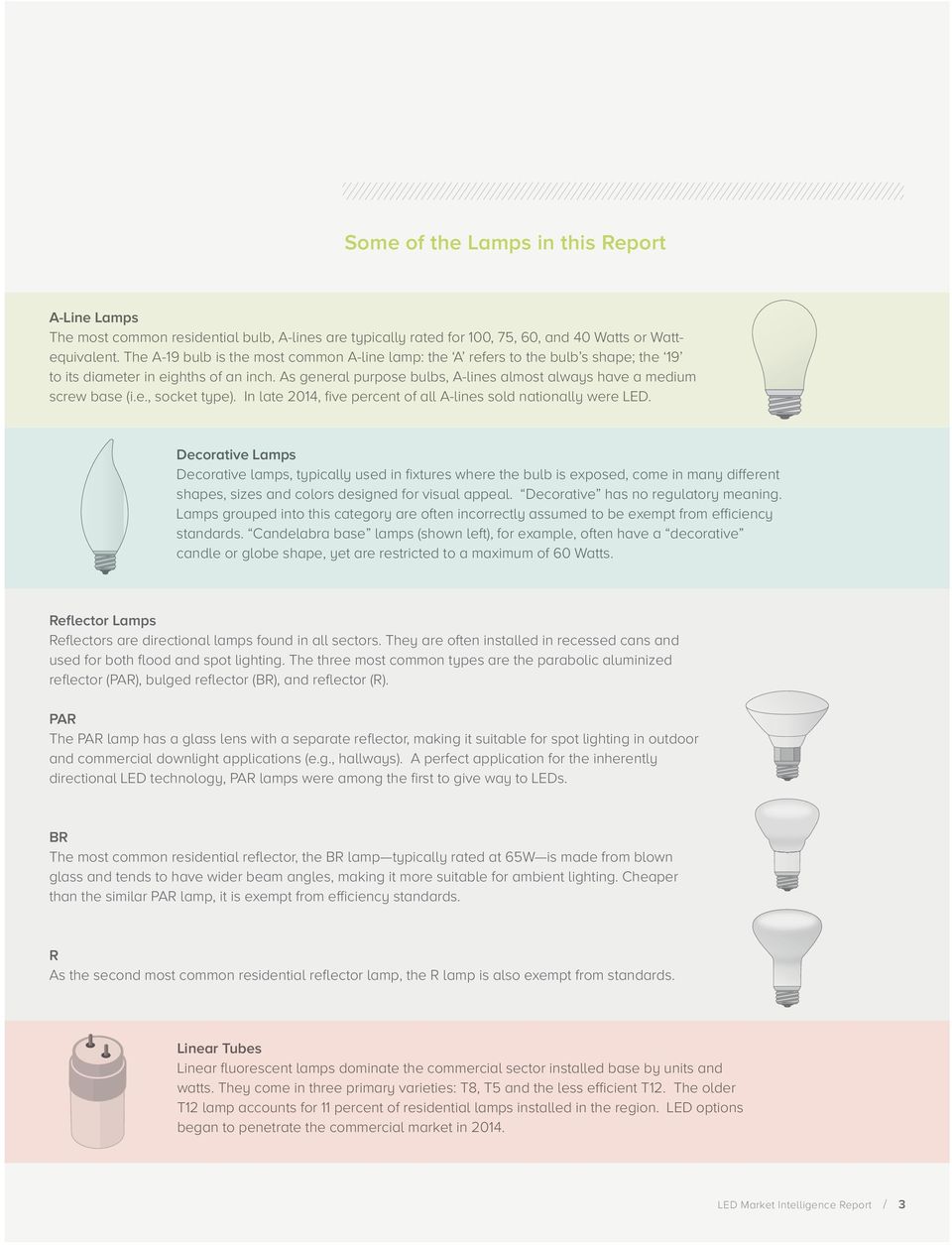
3 Some of the Lamps in this Report A-Line Lamps The most common residential bulb, A-lines are typically rated for 100, 75, 60, and 40 Watts or Wattequivalent. The A-19 bulb is the most common A-line lamp: the A refers to the bulb s shape; the 19 to its diameter in eighths of an inch. As general purpose bulbs, A-lines almost always have a medium screw base (i.e., socket type). In late 2014, five percent of all A-lines sold nationally were LED. Decorative Lamps Decorative lamps, typically used in fixtures where the bulb is exposed, come in many different shapes, sizes and colors designed for visual appeal. Decorative has no regulatory meaning. Lamps grouped into this category are often incorrectly assumed to be exempt from efficiency standards. Candelabra base lamps (shown left), for example, often have a decorative candle or globe shape, yet are restricted to a maximum of 60 Watts. Reflector Lamps Reflectors are directional lamps found in all sectors. They are often installed in recessed cans and used for both flood and spot lighting. The three most common types are the parabolic aluminized reflector (PAR), bulged reflector (BR), and reflector (R). PAR The PAR lamp has a glass lens with a separate reflector, making it suitable for spot lighting in outdoor and commercial downlight applications (e.g., hallways). A perfect application for the inherently directional LED technology, PAR lamps were among the first to give way to LEDs. BR The most common residential reflector, the BR lamp typically rated at 65W is made from blown glass and tends to have wider beam angles, making it more suitable for ambient lighting. Cheaper than the similar PAR lamp, it is exempt from efficiency standards. R As the second most common residential reflector lamp, the R lamp is also exempt from standards. Linear Tubes Linear fluorescent lamps dominate the commercial sector installed base by units and watts. They come in three primary varieties: T8, T5 and the less efficient T12. The older T12 lamp accounts for 11 percent of residential lamps installed in the region. LED options began to penetrate the commercial market in LED Market Intelligence Report / 3
4 (Really) Rapid Product Adoption That the LED lighting market is growing is no surprise. It s the pace of change that is stunning. In the third quarter of 2014 (the most recent data available), one in every 20 A-line bulbs sold nationally was an LED. Just one quarter prior to that, it was 1 in 30. A quarter before that, 1 in 50. Just six years ago, Acuity Brands, the country s largest lighting fixture manufacturer, earned nothing from LED luminaires. In 2015, LED-based sales will likely generate half of the fixture giant s total revenue. TCP, a smaller lamp manufacturer once focused on CFLs, rode the LED transition to an initial public offering on the New York Stock Exchange. LED sales at the company grew from 4 percent to nearly 40 percent of total revenue in three years. FIGURE 1 / Acuity Brands, LED-based Luminaires as Percent of Total Sales 40% 35% 30% 25% 20% 15% 10% 5% 0% SOURCE: Acuity Brands Annual Reports FIGURE 2 / TCP Annual Revenue from LED Sales in Millions For its part, CREE didn t even make lamps or luminaires six years ago. Since they started, the company has driven its cost per 1,000 lumens (roughly the light emitted by a 75 Watt incandescent lamp) down by 90 percent. And despite these rapidly falling prices, CREE lighting revenue has grown roughly 50 percent per year meaning unit sales are growing even faster. CREE s A-line LED bulb was born just two years ago. It s now the best selling LED bulb in the country. And it is already three generations old Programs? 80 percent of BPA s non-residential lighting savings were LED-based in the last six months. SOURCE: TCP International Holdings S-1 Filing, / LED Market Intelligence Report

5 The momentum of LEDs is broad-based, covering both residential and commercial applications. All major technology groups HID, linear fluorescent, compact fluorescent, incandescent/halogen are giving way to LEDs. LED solutions have strengthened their position in applications where they already had a foothold downlights, commercial screw-in reflector lamps, and street lamps, for example. Meanwhile, improvements in performance and reductions in manufacturing costs have opened up new applications for LEDs, from high-bay, high-lumen applications to the smaller MR16 replacement lamps illuminating retail displays. LED A-Line Lamp LED Market Intelligence Report / 5

6 LEDs in the Residential Market Figure 3 depicts the cumulative total of ENERGY STAR certified LED lamps over the previous 15 months. The chart reveals three trends emblematic of the LED transition. First, the sheer growth in total product availability and number of competitors vying for a piece of the market is striking. Second, LED options first appear in applications that are natural fits for the technology (e.g., inherently directional applications like PAR lamps) or represent large market opportunities (e.g., general purpose A-line). And, third, the quick diffusion of LED products into more product niches demonstrates the short product development cycles that now characterize the industry. Think of figure 4, a timeline of CREE s A-line product evolution, as a drill-down view of one product on the ENERGY STAR certification figure below. In less than two years, CREE unveiled two generations of its bellwether residential bulb and extended the product line to include 75 Watt and 100 Watt models, a 3-way option, a high color rendering index lamp, and, most recently, a connected smart bulb. The retail price of the 60 Watt model is 40 percent cheaper than it was two years ago. FIGURE 3 / ENERGY STAR LED Certifications for Screw in Replacement Lamp Markers indicate when ESTAR certified the 100th model of select lamp types 75W A-LINE (47 MODELS ON 3/24) 100W A-LINE (8 MODELS ON 3/24) MR16 Decorative 439 MODELS Number of models certified 60W A-LINE BR30 PAR 30 40W A-LINE General Purpose 799 MODELS Reflector 2839 MODELS Time SOURCE: ENERGY STAR 6 / LED Market Intelligence Report

7 FIGURE 4 / CREE A- Line Product Launches 40W / 60W EQUIVALENT 1st Generation 75W EQUIVALENT 1st Generation 30W / 60W / 100W EQUIVALENT 3-way Lamp 60W EQUIVALENT Connected W / 60W EQUIVALENT High CRI 100W EQUIVALENT 1st Generation 40W / 60W EQUIVALENT 2nd Generation SOURCE: CREE Press Releases LEDs are quickly becoming the efficient lighting technology of choice, rapidly gaining on CFLs. Figure 5 compares the relative quarterly retail sales mix of both incented and unincented CFLs and LEDs in the Northwest throughout In three quarters, LEDs cut CFLs market share lead in half. FIGURE 5 / CFL and LED Retail Sales Mix in the Northwest in % 70% 67% 64% 24% 30% 33% 36% Q1 Q2 Q3 Q4 CFLs LEDs SOURCE: CLEAResult Analysis for NEEA LED Market Intelligence Report / 7

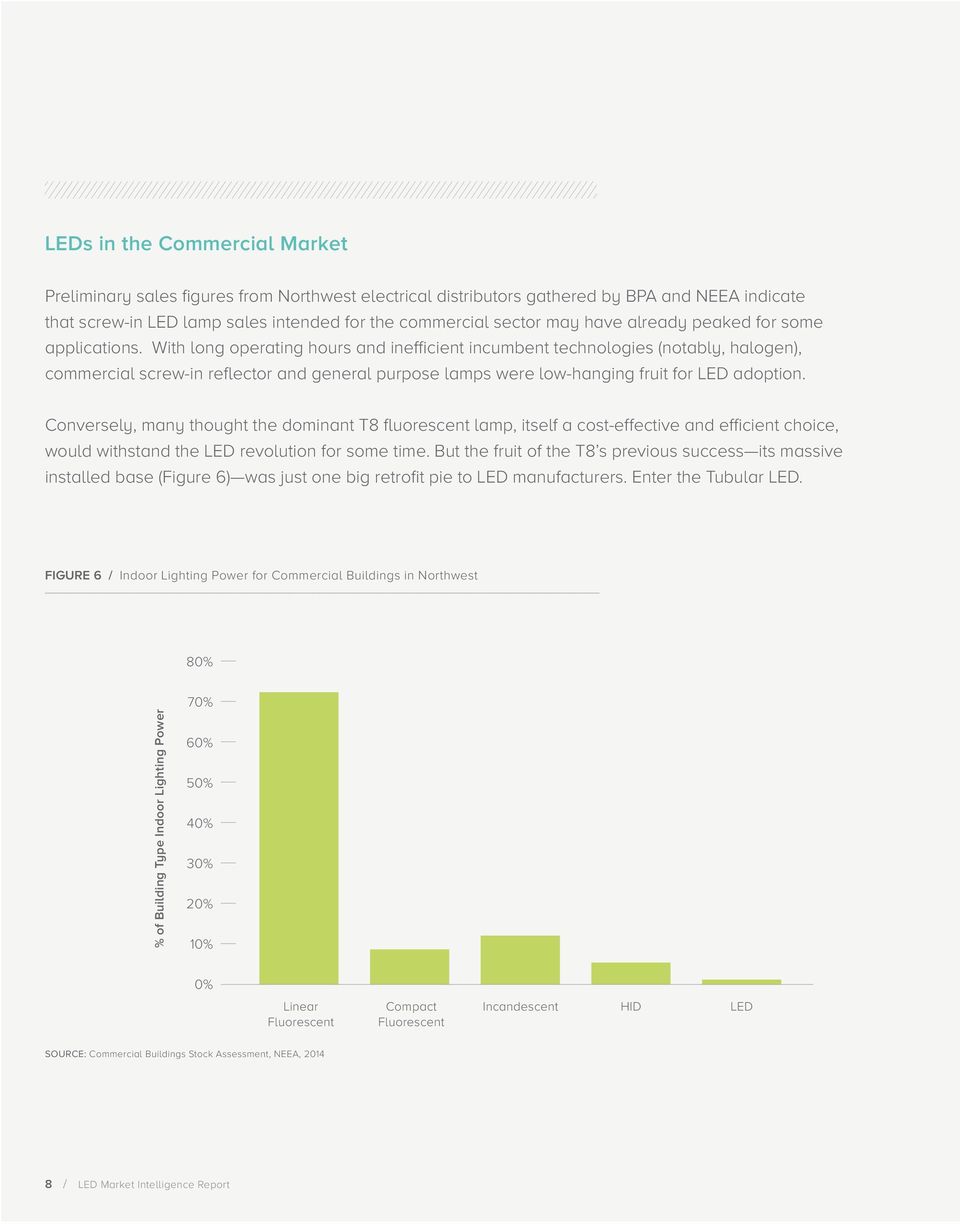
8 LEDs in the Commercial Market Preliminary sales figures from Northwest electrical distributors gathered by BPA and NEEA indicate that screw-in LED lamp sales intended for the commercial sector may have already peaked for some applications. With long operating hours and inefficient incumbent technologies (notably, halogen), commercial screw-in reflector and general purpose lamps were low-hanging fruit for LED adoption. Conversely, many thought the dominant T8 fluorescent lamp, itself a cost-effective and efficient choice, would withstand the LED revolution for some time. But the fruit of the T8 s previous success its massive installed base (Figure 6) was just one big retrofit pie to LED manufacturers. Enter the Tubular LED. FIGURE 6 / Indoor Lighting Power for Commercial Buildings in Northwest 80% % of Building Type Indoor Lighting Power 70% 60% 50% 40% 30% 20% 10% 0% Linear Fluorescent Compact Fluorescent Incandescent HID LED SOURCE: Commercial Buildings Stock Assessment, NEEA, / LED Market Intelligence Report
9 FIGURE 7 / Preliminary Data on LED Sales, as Percent of Total LED Sales in the Distribution Channel Nearly non-existent in 2013, TLEDs boomed a year later as manufacturers launched a slew of next-generation plug and play TLEDs with greatly improved performance and reduced costs. Figure 8 shows the rapid growth in product listings on the Design Lights Consortium (DLC) Qualified Products List (QPL). 43% 31% 8% 15% 2% Preliminary regional distributor sales data indicates TLEDs were four percent of linear fluorescent sales in That might not seem significant, but when you consider TLEDs went from essentially no sales to four percent of the biggest commercial lamp market in just 12 months it is a massive movement. TLEDs will almost certainly pass T12s in FIGURE 8 / Growth in Qualified Linear Fluorescent Replacement Products, Design Lights Consortium % 25% 11% 22% 16% Markers indicate when DLC certified the 100th model of select lamp types TROFFER LUMINAIRE (RETROFIT) 2014 Number of models certified 4FT REPLACEMENT TROFFER LUMINAIRE A-Line Fixtures Reflector 4-ft TLED MR SOURCE: BPA Lighting Market Characterization 1 Results to date. May be subject to revision based on new information. SOURCE: DLC QPL listings, March, 2015 Time LED Market Intelligence Report / 9

10 Falling Prices Dramatic price reductions in recent years have in large part driven increased LED adoption. Each year, the payback on LEDs options has improved across the board. Manufacturers expect intense competition to drive continued innovation in LED chip, package and system design. And as further economies of scale take root, product costs and end-user prices are expected to substantially decline over the next few years. Figures 9-11 show the recent price declines of three common LED applications. The forecasts are Navigant projections based on historical trends. FIGURE 9 / LED A19 60W Equivalent Pricing Trends ($/unit) $40 $35 Actual Forecast $30 $25 $20 Purchase price wlll reduce by half from 2014 to 2016 $15 $10 $5 $ SOURCE: Navigant Analysis 10 / LED Market Intelligence Report

11 FIGURE 10 / LED PAR38 75W Equivalent Pricing Trends ($/unit) $50 $45 Actual Forecast $40 $35 $30 Purchase price wlll reduce by half from 2014 to 2017 $25 $20 $15 $10 $5 $ SOURCE: Navigant Analysis FIGURE 11 / 4 TLED Historic Pricing Trends ($/unit) $50 $45 Actual Forecast $40 $35 $30 Purchase price wlll reduce by half from 2014 to 2017 $25 $20 $15 $10 $5 $ SOURCE: Navigant Analysis LED Market Intelligence Report / 11

12 So What Does This Mean for Program Planners and Managers? 1 First, if baselines are meant to represent current market practice, the rapid penetration of LEDs into the sales mix means baselines should reflect the flow of sales, not the installed stock. The technologies already installed in buildings are not reflective of the current sales trends. 2 Second, adopt baseline frameworks that represent the changing market and can easily be updated with new sales data. Update baselines at least annually because longer update cycles will likely lag the market, risking liberal baselines and potentially misallocate program resources. 3 Third, collect full category lighting sales data. When the product mix in the market changes rapidly, full category data (incandescent, halogen, CFL, LED) is vital in maintaining appropriate baselines. Lighting baselines cannot be addressed with good engineering assumptions they need market data. 4 Fourth, consider creative incentive structures for distributor and retailer partners, aimed at shifting their efficient product mix beyond a given level. 5 Fifth, track LED product cost trends closely and update incentives as necessary. During interviews, some distributors mentioned some rebates were higher than the actual product cost. On the non-residential side, market actors reported a two-year payback as the sweet spot for lighting measures. Incentives that lower the payback below two years may not be necessary. 12 / LED Market Intelligence Report

13 A Disruptive Technology How LEDs are Changing the Game The ongoing transition to solid state lighting has disrupted the lighting market in two significant ways. First, an industry long dominated by three lamp companies GE, Philips, and Osram Sylvania is now seeing incredible fragmentation, with competition from thousands of new manufacturers. Threatened incumbents have tried to wall off access to their established market channels, such as their electrical wholesale distributors, retail partners, and manufacturer sales representatives. In response, upstart LED companies have increasingly taken their lamps and luminaires directly to the end-user, bypassing these traditional distribution channels. While it s too early to know how the distribution channels will ultimately change, it is possible the direct-to-market channel is growing at the expense of the stocking electrical wholesaler, as shown in figure 12. As the market moves from lamps and ballasts that are easily stocked and predictably ordered to integrated, non-standardized systems, how will traditional distributors react? FIGURE 12 / Simplified Commercial Sector Lighting Supply Chain LED Manufacturer RETAILERS WHOLESALE DISTRIBUTIORS DIRECT Commercial End-users LED Market Intelligence Report / 13

14 The second disruption is the shift from standardized lamps to customized lighting systems. LED technology enables an infinite variety of design possibilities in both function and form. However, achieving these possibilities and ensuring a high quality lighting solution, requires an in depth knowledge of both system design and lighting component technology. All system components, from the LED chip (the actual light source) to the driver to the luminaire s optics, must be fully integrated and coordinated. In this way, LEDs stand in stark contrast to the traditional lighting paradigm in which bulbs, ballasts, and fixtures could be sold separately from any number of manufacturers and then installed on site with little technical sophistication. That business model, in which lamp and ballast manufacturers could capture value independent of the how the complete lighting system was assembled, appears less tenable in an LED world. The design and coordination required to optimize the overall LED system performance means, to no small degree, that the fixture (luminaire) manufacturer is now the provider of the actual light source. Particularly in the commercial market, this places fixture manufacturers at the top of the value chain. As a result, many traditional lamp manufacturers are defining and marketing themselves as lighting solution providers, offering customers an overall lighting experience, rather than just manufacturing replacement widgets. The technological potential of LEDs, coupled with competitive pressure on manufacturers to differentiate themselves, appears poised to push exciting developments in lighting systems in the near future. Already, manufactures are marketing sophisticated controls and people-centered functionality that promise a range of possible experiences. Luminaires will work more like computers than bulbs, offering non-energy benefits such as light output and color adjustment to circadian rhythms in order to enhance mood, sleep, and productivity. They may function as wi-fi access points, meters, or data analytics devices. In summary, the value-added features of well designed LED systems go well beyond energy benefits. And lighting manufacturers solution providers will seek to develop and promote these features to differentiate themselves in the highly competitive lighting market. 14 / LED Market Intelligence Report

15 What Does This Mean for Program Planners and Managers? 1 Continually ask: what is the measure we are after? As more non-energy related bells and whistles are added to lighting systems, lighting programs will need to think critically about what features and benefits they are willing to pay for. Manufacturers will seek ways to add value (and maintain prices) in the face of significant cost pressure. 2 Provide application guidance to trade allies for systems installations. The confluence of hardware, software, new lighting performance metrics, and user-experience will be dynamic and ever changing, placing a premium on trade ally education (e.g., installing LED troffers with integrated controls is more complicated than lamp and ballast change outs.). 3 Treat different market segments differently. Lighting systems with integrated controls are most cost-effective in major renovation and new construction projects. Focus marketing and education on trade allies and market actors active in these segments. For the lighting maintenance market complex systems are less likely to be employed, so the focus should be on upstream programs for the distributors and manufacturers, encouraging them to stock and push high efficiency replacement options. 4 Support the development of performance test methods for LED systems. Common methods of LED testing for various performance characteristics including reliability and lifetime are still emerging. Programs should monitor their progress and when appropriate require their use for product qualification purposes. 5 Promote the interoperability of controls and technologies. Interoperability is the ability of separate technologies to speak to one another and work seamlessly together. Compatibility issues have frustrated some early adopters of LED technologies, particularly around dimming capabilities. LED Market Intelligence Report / 15

16 Retail, Regulations, and LEDs Like the commercial market, the residential lighting market is served by many suppliers, including many new LED manufacturers. The path from factory to end-user, however, is far more consolidated. A handful of retailers (Home Depot, Walmart, Costco and Lowe s) dominate the sale of lamps to residential end-users. As a result, lamp manufacturers compete intensely for valuable retailer shelf space at these large chains. This rivalry for access to the consumer reduces manufacturer profit margins relative to the commercial sales channel. The retailers market power forces lamp manufacturers, seeking profit, to lower their own production cost because they can t raise price or even maintain them or they ll risk losing shelf space. For emerging technologies like LEDs, this is especially important because it drives intense research and development efforts aimed at reducing product costs. FIGURE 13 / Supply Relationships for the 60W A-Line LED Bulb Cree Philips TCP GE LSG Feit Osram Home Depot Walmart Costco Lowe s 16 / LED Market Intelligence Report

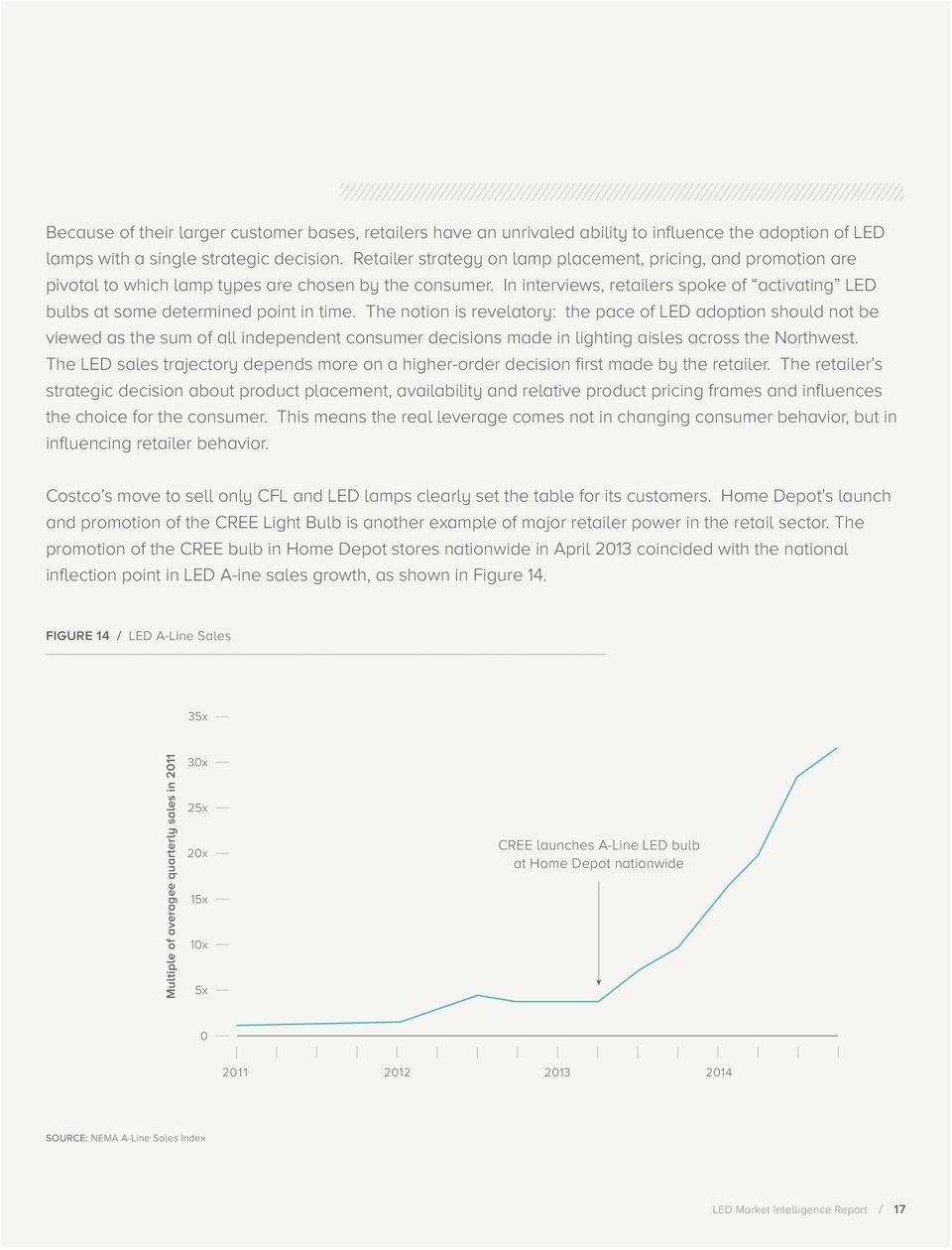
17 Because of their larger customer bases, retailers have an unrivaled ability to influence the adoption of LED lamps with a single strategic decision. Retailer strategy on lamp placement, pricing, and promotion are pivotal to which lamp types are chosen by the consumer. In interviews, retailers spoke of activating LED bulbs at some determined point in time. The notion is revelatory: the pace of LED adoption should not be viewed as the sum of all independent consumer decisions made in lighting aisles across the Northwest. The LED sales trajectory depends more on a higher-order decision first made by the retailer. The retailer s strategic decision about product placement, availability and relative product pricing frames and influences the choice for the consumer. This means the real leverage comes not in changing consumer behavior, but in influencing retailer behavior. Costco s move to sell only CFL and LED lamps clearly set the table for its customers. Home Depot s launch and promotion of the CREE Light Bulb is another example of major retailer power in the retail sector. The promotion of the CREE bulb in Home Depot stores nationwide in April 2013 coincided with the national inflection point in LED A-ine sales growth, as shown in Figure 14. FIGURE 14 / LED A-Line Sales 35x Multiple of averagee quarterly sales in x 25x 20x 15x 10x 5x CREE launches A-Line LED bulb at Home Depot nationwide SOURCE: NEMA A-Line Sales Index LED Market Intelligence Report / 17
18 20 80 FIGURE 15 / Unregulated versus Regulated Wattages, by Lamp Type Wattage Range % 4% 19% 12% 5% Market Share (% of Total Watts) 5% 12% 19% 4% 60% Other Exemptions PAR Lamps Reflector Lamps Candelabra Base Medium Screw Base A-Line Regulated Wattage Range SOURCE: Energy Independence and Security Act of / LED Market Intelligence Report

19 Retailer strategy aside, the Energy Independence and Security Act s (EISA) lighting standards changed the residential efficiency mix more than any other factor over the last three years. Figure 15 puts the EISA standards (and others) into common context. The light gray area in the arch indicates where standards apply for each lamp type and wattage. Simply put, if standards apply, the lamp must have, at the very least, halogen-level efficiency. This impacts program baselines directly, but perhaps more important, improves the payback (and appeal) of LED alternatives as the baseline lamp is more expensive. The figure also shows that EISA afforded candelabra base and reflector lamps--often called decorative or specialty bulbs in programs--more exemptions than the A-line bulb. And now, fully phased in for nearly 18 months, the law s nuance is revealed on retailer shelves across the Northwest. Figure 16 details which exempt lamp categories have the most retail shelf space in the region. FIGURE 16 / Exempted Product Mix on Retail Shelves, by Units and Wattage 25% 15% Decorative Lamps < 40W BR30 65W 25% 35% WATTAGE (inner ring) UNITS (outer ring) All other exemptions 40% 60% SOURCE: NEEA, Northwest Residential Lighting Long-Term Market Tracking Study January 2, 2015 Lighting Efficiency Standards 101 Efficiency standards apply to lamps primarily based on their base-type. Base-type is lighting geek-speak for the type of socket the lamp goes in. DOE may further delineate lamp types and therefore set different standards by brightness level, wattage, and whether it has a reflector. But it all starts with the base-type. Medium (screw) base lamps. The most common lamp addressed by EISA. The law prescribes four different maximum allowable wattages corresponding to the lumen outputs of its four most typical wattages: the 100, 75, 60, and 40 Watt lamps. Effectively, medium base lamps between 30 and 130 Watts must be halogen or better, unless exempted. Important exemptions include most residential reflector lamps, most notably the very common 65 Watt BR30 lamp in recessed cans everywhere, as well as some specialty lamps (e.g., 3-way). Candelabra base. This is the second most common base type in the residential sector. Often called minibase, candelabra screw base lamps must use 60 Watts or less. Put differently, if the lamp has a candelabra base lamp and is rated for 60 Watts or less, it has no efficiency requirement. Lighting programs frequently group these into a decorative lamp category, which has no meaning with respect to federal standards. Intermediate base. Relatively uncommon, lamps with this base-type must be 40 Watts or less. LED Market Intelligence Report / 19

20 0% 70% NEEA 2 conducted a large retailer shelf survey in late 2014, nearly a year after EISA s full phase in. The team used this rich data source to evaluate how the law impacted retail shelf mix. Recognizing different retailers have dramatically different market shares, the team used market share estimates developed in a separate analysis to weight the shelf survey findings. In this way, the team estimated lamp type and technology mix of all retail shelf space in the Northwest. All figures exclude fixtures, as well as pinbased and linear fluorescent lamps. Figure 17 shows the shelf technology mix and market share for general purpose lamps by wattage bin and exempt lamps. Clearly, EISA, where it applies, has worked. The longer the law has been in effect, the lower the share of incandescent lamps. LED penetration is highest for 40W and 60W equivalent bins, which were the first LED replacement options developed by manufacturers. FIGURE 17 / Northwest Retailer Technology Mix in 2014, General Purpose Lamps 40% 50% 60% 30% 20% 80% 10% 90% Exempt* 100W 75W 60W 40W 22% 11% 11% 14% Market Share (% of Total Watts) 42% Incandescent Compact Fluorescent (CFL) Halogen LED *3 way lamps < 310 lumens, > 2600 lumens 2 Source: NEEA, Northwest Residential Lighting Long-Term Market Tracking Study January 2, 2015 and Navigant and Cadeo Analysis. The Team used an analytical approach, coined the Chain Logic Method to estimate the market share of each vendor or group of vendors in the region. The team then used the NEEA shelf survey to compute the technology distribution across different applications and wattage equivalents. 20 / LED Market Intelligence Report

21 0% 70% FIGURE 18 / Northwest Retailer Technology Mix in 2014, Reflector Lamps 40% 50% 60% 30% 20% 80% 10% 90% Exempt* 100W 75W 60W 40W 39% 18% 13% Market Share (% of Total Watts) 22% 8% Incandescent Compact Fluorescent (CFL) Halogen LED *< 310 lumens Figure 18 shows the shelf technology mix and market share for reflector lamps. The most common reflector lamp in the residential sector is the BR30 lamp, a notable exemption in EISA. We can see the impact in the 40W equivalent category below, which is more than half incandescent. LED Market Intelligence Report / 21
22 0% 70% FIGURE 19 / Northwest Retailer Technology Mix in 2014, Globe and Decorative Lamps 40% 50% 60% 30% 20% 80% 10% 90% Exempt* 100W 75W 60W Incandescent 40W Compact Fluorescent (CFL) 60% 6% 4% 1% Market Share (% of Total Watts) 29% Halogen LED *3 way lamps < 310 lumens, > 2600 lumens Figure 19 shows the shelf technology mix and market share for decorative and globe lamps. Decorative lamps are often assumed to be exempt from standards. Not true. What matters for standards is the basetype. Candelabra base-type lamps (sometimes called mini-base) are often associated with decorative style lamps (candle, globe, or flame shaped bulbs). If it has a candelabra base it must be rated 60 Watts or less. The very low share of incandescents in the 60, 75, and 100 Watt equivalent ranges shows the impact of EISA on these lamps. 22 / LED Market Intelligence Report
23 So What Does This Mean for Program Planners and Managers? 1 Increase focus on LED solutions for niche applications. Candelabra or mini-base lamp types, for example, have no efficiency standards below 60 Watts. 2 Target reflector lamps for increased savings opportunities. The 65W BR30 lamp is the most common residential reflector lamp on the market and is not subject to Federal standards. Other common reflector lamps such as the R20 are also exempt from DOE standards. 3 Closely monitor cost and sales trends of general purpose A-line LED lamps for measure cost effectiveness. Programs have rightly targeted the most common general purpose lamps for replacement. However, those same lamps are the most thoroughly regulated by EISA and continue to be the target of LED manufacturer R&D efforts. The result is a narrowing incremental cost for LEDs, which should increase natural adoption practices. Programs should ensure baselines and incentives are continually adjusted for this bellwether lamp. LED Market Intelligence Report / 23
24 Contributors: Developed by Rob Carmichael and Fiona Skinner, Cadeo Group; Laura Tabor and Sonrisa Cooper, Navigant Consulting; Kurt Niedermeier and Stacy Peterson. Developed for the Bonneville Power Administration Please refer questions to: Carrie Cobb,
Residential Retail Lighting Programs: A Bright Future. March 2011
 Residential Retail Lighting Programs: A Bright Future March 2011 Residential Retail Lighting Programs: A Bright Future By Shannon Montgomery Executive Summary Compact fluorescent lamp (CFL) residential
Retrofit HID High Bay Fixtures to Long Life High Efficiency LED
 Retrofit HID High Bay Fixtures to Long Life High Efficiency LED 2013 DyoCore Call us today for sales and pricing information: Toll Free: 877.849.6668 www.dyocore.com It is no hidden secret that LED bulbs
Solid State Lighting Definitions for Functional and Decorative Applications
 NEMA Lighting Systems Division & American Lighting Association Joint Document: LSD 51-2009 Solid State Lighting Definitions for Functional and Decorative Applications Prepared by Solid State Lighting Section,
LED Tubular Lamp / Kit Guide
 LED Tubular Lamp / Kit Guide LED lighting products have great potential to replace existing fluorescent lighting, reduce energy use and improve lighting quality in many indoor commercial applications.
Guide to new, energy-efficient lighting technologies for your business
 Guide to new, energy-efficient lighting technologies for your business Commercial lighting systems are changing rapidly, with new or improved technologies continuously becoming available. Whether you re
Energy efficient lighting for your home find out more.
 Energy efficient lighting for your home find out more. There are many different types of lighting available on the market but with a little research you can ensure that the lighting in your home meets
Business Energy Rebates Application
 Business Energy Rebates Application Business Energy Rebates make it easy and affordable for you to select energy efficient products for your business. and mail-in rebates are available for energy efficient
PPL Electric Utilities Energy Efficiency and Conservation Program
 Category Measure Qualification Fixtures/Lamps Controls Incentive Amount T-8 Lighting Package Must replace T12. T8 Lamp Fixture $14/fixture (lamp & electronic ballast) High Performance / Replacing T12 $19/fixture
GE Lighting. Lighting the future. Your guide to changing to energy efficient lamps
 GE Lighting Lighting the future Your guide to changing to energy efficient lamps Out with ordinary light bulbs In with energy efficient lamps Classic incandescent light bulbs have been gradually phased
Lighting Retrofit Incentive Application for Business Customers
 Lighting Retrofit Application for Business Customers 2015 A Cash Energy Efficiency Program brought to you by: Instructions for Use: For complete instructions, please refer to the Terms and Conditions on
Energy-efficient lighting
 Energy-efficient lighting For your home 1204 01/14 Puget Sound Energy P.O. Box 97034 Bellevue, WA 98009-9734 pse.com/myrebates In this guide 4 Be in the know when you buy 5 Know your light sources 6 Your
LED Retro Fit the next generation in energy efficiency. Converting existing 12v systems to LED
 Benefits and Features of Retro Fitting with LED- LED Retro Fit the next generation in energy efficiency Converting existing 12v systems to LED Between 1960 and 1990, landscape lighting was still in the
LED Luminaire Design Guide
 Application Note CLD-AP15 rev 0D Table of Contents Introduction... 1 Design Approach... 2 Design Process... 3 1. Define Lighting Requirements... 4 2. Define Design Goals... 5 3. Estimate Efficiencies of
Home lighting. Bright ideas for energy savings
 Home lighting Bright ideas for energy savings Shedding light on new technologies Lighting is one of the most visible ways you use energy in your home. While a single light bulb doesn t use much energy,
Commercial Lighting Market Transformation Model Development and Market Research
 Commercial Lighting Market Transformation Model Development and Market Research Phase I: T12 Retrofit and Replacement Market Presented to Energy Trust of Oregon Final Report September 8, 2011 Presented
Commercial Energy Efficiency Program. Save money, reduce energy use and earn incentives. Save money, reduce energy use and qualify for incentives
 Save money, reduce energy use and earn incentives by improving the energy efficiency of your business. Georgia Power s Commercial Energy Efficiency Program makes incorporating energy-efficient improvements
Lumination LED Luminaires
 GE Lighting Lumination LED Luminaires Downlights RX Series Dependable Downlighting New GE Lumination RX Downlights are the economical choice for converting existing CFL sockets to the superior performance
Lighting Incentives. Application and Instructions. Questions
 Application and Instructions SCE&G s EnergyWise for Your Business Program is designed to help nonresidential customers replace aging, inefficient equipment and systems with energy-efficient technologies.
2016 Commercial Efficiency Program
 1. I want to replace my fixture and put LED tubes in it. Do I get rebates for both the fixture and the tubes? No. This type of project qualifies for the LED tube rebate only. 2. Can I install any LED product
Cree Edge and LEDway by Cree Compared to Induction Lamp Luminaires
 Cree Edge and LEDway by Cree Compared to Induction Lamp Luminaires Executive Summary There are many excellent reasons to select a Cree lighting system over one based upon induction technology, even though
Middle Power LM231A LM231B LM561A LM561B LM362A
 LED packages High Power LED Lighting LH351Z (2W) High efficacy 2W class high power LEDs makes the LH351Z suitable for high brightness applications. Highest efficacy among 2W high power LEDs - 143 lm/w
Commercial LED Lighting Equipment
 2010 REBATE APPLICATION Commercial LED Lighting Equipment WHAT S NEW Rebates for outdoor pole/ arm-mounted parking and roadway fixtures, including decorative fixtures, have increased to. Rebates for parking
General Lighting Recommendations
 Design Guidelines for Energy Efficient Lighting Systems Thank you for your interest in energy efficiency! According to the US Department of Energy, 51% of the energy used in commercial buildings is consumed
Why Work with Maxlite as Your Supplier for Light Sources?
 JUN2015 Why Work with Maxlite as Your Supplier for Light Sources? Deal directly with MaxLite As a lighting fixture manufacturer, you always have direct contact with MaxLite customer support, and never
HANDY INFORMAL LIGHTING GLOSSARY
 HANDY INFORMAL LIGHTING GLOSSARY 2 nd Generation T8s Mid-grade 800 series T8s. Typically these F32T8s have 2950 3000 catalog or photopic lumens. 3 rd Generation T8s Also called Super T8s. High-lumen 800
Xcel Energy s Commercial Industrial Energy Efficiency Programs. Overview of Colorado Business Rebate Programs
 Xcel Energy s Commercial Industrial Energy Efficiency Programs Overview of Colorado Business Rebate Programs Trade Relation Managers Derek Shockley 303-294-2082 [email protected] Commercial
Lumination LED Luminaires
 GE Lighting Lumination LED Luminaires Downlights RI Series Heightened Performance Now just about any recessed downlight can benefit from advanced GE LED fixtures. New GE Lumination RI Series LED Downlights
Lighting New Construction Incentive Application for Business Customers
 0 22016 Lighting New Construction Incentive Application for Business Customers A Cash Incentive Energy Efficiency Program brought to you by: Instructions for Use: For complete instructions, please refer
2013 U.S. Retail LED. Smart Lighting Linear Lamps & Ballasts Halogen Linear Fluorescent Fixtures CFL
 2013 U.S. Retail Product Catalog LED Smart Lighting Linear Lamps & Ballasts Halogen Linear Fluorescent Fixtures CFL Contents About Us Company Overview 2 Temperatures & Shapes 4 Bulb Usage Guide 5 Packaging
GE Lighting. Albeo LED Luminaire. Modular High & Low Bay Lighting. (ABH2 - Series) imagination at work
 GE Lighting Albeo LED Luminaire Modular High & Low Bay Lighting (ABH2 - Series) imagination at work Product Features The award winning Albeo ABH-series LED Luminaire utilizes innovative heat-sinking and
GE Lighting. Albeo LED Luminaire. Linear Industrial Low Bay Lighting. (ALV1 - Series) imagination at work
 GE Lighting Albeo LED Luminaire Linear Industrial Low Bay Lighting (ALV1 - Series) imagination at work Product Features The Albeo ALV1-series LED luminaire is an energy-efficient, low maintenance alternative
To Lead in LED Lighting Retrofit
 To Lead in LED Lighting Retrofit Safe Harbor Statement This presentation may contain some statements that may be considered forward-looking statements. These forward-looking statements may include statements
A New Benchmark in LED Lighting Technology and Design.
 LM16 LED MR16 Lamp A New Benchmark in LED Lighting Technology and Design. UNBEATABLE Energy Efficiency ADVANCED Thermal Management LEADING-CLASS Design & Performance GLARE-FREE Beautiful Light Our long-lasting
Business lighting guide
 Business lighting guide Table of contents Advantages of energy-efficient lighting... Take Control & Save Business Lighting Program overview... Implementation and lighting audit walk-through... Introduction
LIGHT SOURCES JAN2016
 LIGHT SOURCES JAN2016 Why Work with Maxlite as Your Supplier for Light Sources? Deal directly with MaxLite As a lighting fixture manufacturer, you always have direct contact with MaxLite customer support,
LED RETROFIT OPTIONS FOR LINEAR FLUORESCENT LUMINAIRES
 LED RETROFIT OPTIONS FOR LINEAR FLUORESCENT LUMINAIRES Fluorescent lamps currently dominate the commercial sector, where they account for 80 percent of installed lamps. 1 LED lighting products are receiving
Final Draft Report of Massachusetts LED Market Effects: Baseline Characterization
 Final Draft Report of Massachusetts LED Market Effects: Baseline Characterization Massachusetts Program Administrators and Energy Efficiency Advisory Council Report No.: Final Draft Date: March 1, 2015
GE Lighting Solutions. Albeo LED Luminaire. Modular High & Low Bay Lighting. (ABHX - Series) imagination at work
 GE Lighting Solutions Albeo LED Luminaire Modular High & Low Bay Lighting (ABHX - Series) imagination at work Product Features The award winning Albeo ABHX-series LED Luminaire utilizes innovative heat-sinking
Lumination LED Luminaires
 GE Lighting Solutions Lumination LED Luminaires Recessed LED Troffer ET Series Thin Is In Ultra-thin Lumination LED Luminaire directs light precisely where its needed Lumination LED Luminaires ultra-thin
2014 Small Business Solutions Program Manual
 2014 Small Business Solutions Program Manual Entergy Louisiana, LLC & Entergy Gulf States Louisiana, L.L.C. PREPARED BY: CLEAResult Contact: Alex Scott 1615 Poydras Street Suite 860 New Orleans, LA 70112
T5 Fluorescent Lamps SYLVANIA PENTRON & PENTRON HO
 T5 Fluorescent Lamps SYLVANIA PENTRON & PENTRON HO T5 SEE THE WORLD IN A NEW LIGHT. More Light+Increased Versatility PENTRONHO HIGH OUTPUT One Lamp Replaces Two SYLVANIA PENTRON HO T5 lamps were designed
Why Philips LEDtube? LED Lamps EMEA February 2015. February 2015_BG LS & E LEDlamps
 Why Philips LEDtube? LED Lamps EMEA February 2015 Content Why Philips? Why LEDtubes? Why Philips LEDtubes? Why Philips? Innovation leader in linear lighting Lighting experience Real quality of light Why
gue productcatalo www.tronix.nl 2013/2014
 productcatalogue www.tronix.nl 2013/2014 TRONIX LIGHTING BV: the quality brand in LED lighting In 1963 Ben van Dijk - founder and CEO of Tronix - started building his expertise in the world of electronics
Small Business Lighting
 Small Business Lighting Business Customer Information Opportunity ID: For a free lighting assessment, please contact the Small Business Lighting program at 1-877-287-2250. Company name Date submitted Billing
RETROFIT LIGHTING & CONTROLS SOLUTIONS. Automotive Dealerships
 RETROFIT LIGHTING & CONTROLS SOLUTIONS Automotive Dealerships The Challenge and the Opportunity There are over 17,000 automotive dealerships in North America and on average, they use up to 18% more energy
Lighting Requirements
 ASHRAE/IESNA Standard 90.1-1999 Lighting Requirements Joseph G. Howley Jr., IESNA GE Lighting Immediate Past Chair of ASHRAE SSPC 90.1 Lighting Subcommittee 1 How to Get the Standard Standard 90.1-2001
Prescriptive Program Rebate Application
 Prescriptive Program Rebate Application Check the appropriate program box for your rebate. OID Internal Use Only Cooling FSO (Fluid System Optimization) Foodservice Equipment Heating Lighting Motors &
Breathtaking brilliance. MASTER LEDcandles and MASTER LEDlusters DiamondSpark
 Breathtaking brilliance MASTER LEDcandles and MASTER LEDlusters DiamondSpark Global leader in LED lighting With our state-of-the-art LED technology and more than 100 years experience in optics and electronics,
Brighter Choice... LED Lighting from Verbatim. Quality. Performance. Technology. Mitsubishi Chemical Holdings Group
 Brighter Choice... LED Lighting from Verbatim Quality. Performance. Technology. Mitsubishi Chemical Holdings Group A new era in lighting... Delivering a better user experience in commercial and domestic
GE Appliances & Lighting. Business Update for Credit Suisse
 Business Update for Credit Suisse Jim Campbell August 11, 2010 "Results are preliminary and unaudited. This document contains forward-looking statements - that is, statements related to future, not past,
Recessed. EvoKit LED Retrofit Kits Gen 3
 Recessed EvoKit LED Retrofit Kits Gen 3 Project: Location: Cat.No: Type: Lamps: Notes: Qty: 2'x4' Philips EvoKit LED Retrofit Kit is an energy efficient LED alternative to traditional linear fluorescent
Any source of light can be described in terms of four unique and independently respective properties:
 LIGHTING Effective lighting is the essence of cinematography. Often referred to as painting with light, the art requires technical knowledge of film stocks, lighting instruments, color, and diffusion filters,
MARKET EFFECTS AND MARKET TRANSFORMATION: THEIR ROLE IN ENERGY EFFICIENCY PROGRAM DESIGN AND EVALUATION
 MARKET EFFECTS AND MARKET TRANSFORMATION: THEIR ROLE IN ENERGY EFFICIENCY PROGRAM DESIGN AND EVALUATION Prepared by Mitchell Rosenberg KEMA, Inc. Lynn Hoefgen Nexus Market Research Prepared for CIEE Market
LIGHTING INCENTIVE CATALOG
 LIGHTING INCENTIVE CATALOG 2015 SAVING ENERGY AND MONEY FOR WISCONSIN For more information, call 800.762.7077 or visit focusonenergy.com Focus on Energy, Wisconsin utilities statewide program for energy
Session 15 Lighting Fundamentals
 Session 15 Lighting Fundamentals Illumination Levels - Example Illumination Levels (Cont.) Lighting Sources in the International World Incandescent: -40⁰ C (-40⁰ F) Fluorescent: -20⁰ C (-4⁰ F) minimum
LED lamps Consumer CEE Product information 2016. May 2016
 LED lamps Consumer CEE Product information 2016 May 2016 1 What s new 2016 LED lamps Exciting range introductions * SceneSwitch * WarmGlow * Classic Filament * Glass Spots The right light is everything
LED High Bay FBX. An economical LED high bay Enjoy flexibility and savings along with quality illumination
 LED High Bay FBX An economical LED high bay Enjoy flexibility and savings along with quality illumination Enjoy flexibility and savings along with quality illumination The Philips Day-Brite/Philips CFI
Rayben Technologies (Zhuhai) Limited Issue 1, 15 July 2014 NEWSLETTER. Rayben Technologies Accredited With Guang Dong Hi-Tech Enterprise
 NEWSLETTER e-raytrons Launched! Newest Stuff For Lighting Designers To Experience! ISSUE 1, 15 JULY 014 HEADLINES: Rayben CSP D module for omnidirectional light bulb demo attracted many customers at Guangzhou
LIGHTING and LIGHTING SYSTEMS
 LIGHTING and LIGHTING SYSTEMS Introduction Lighting is an important area of opportunity for energy savings, since it is a large fraction of use of electricity in residential and commercial buildings. Lighting
Lutron Linear Recessed and Video Conference Fixture Solutions
 Lutron Linear Recessed and Video Conference Fixture Solutions Lutron Linear Recessed and Video Conference Fixture Solutions What are linear recessed and video conference fixtures? Lutron fixture solutions
Lighting A to Z. The lighting solutions reference guide
 Lighting A to Z The lighting solutions reference guide Contents 4 Sustainable Lighting 5 A New Way to Look at Light 6 LED Lighting 9 14 LED Featured Products 15 LED Application Guide 16 Compact Fluorescent
Answers. T8 Fluorescent Lamps. ... Volume 1 Number 1 April 1993. Background. What does T8 mean?
 T8 Fluorescent Lamps Answers........................................................ Volume 1 Number 1 April 1993 Background Throughout the 1970s, manufacturers of fluorescent lamps introduced new products
ENERGY STAR Residential Light Fixtures & The Advanced Lighting Package. Supplement to ENERGY STAR Homes Specification Development 2009
 ENERGY STAR Residential Light Fixtures & The Advanced Lighting Package Supplement to ENERGY STAR Homes Specification Development 2009 1 Why use ENERGY STAR Residential Light Fixtures? 2 Why ENERGY STAR?
Small Commercial Business Energy Audits. Recognizing and addressing the special requirements of the small business market segment.
 Small Commercial Business Energy Audits Recognizing and addressing the special requirements of the small business market segment. Class 4 Class 4: Lighting Fundamentals Basic Lighting Technology Advanced
WHAT S NEW IN THE 2013 CODE?
 WHAT S NEW IN THE 2013 CODE? Changes to mandatory Title 24 lighting requirements California's new Building Energy Efficiency Standards take effect in 2014. They improve the energy efficiency of homes by
ABOUT SELS ACERCA DE SELS 1 1
 SMART ERA LIGHTING SYSTEMS (SELS) was founded with the vision that LED lights needed to be an affordable quality product in order to become the new lighting standard for the conscientious consumer. Replacing
Electric Sign Energy Certification Service To California Energy Commission Title 24 Technical Requirements and Audit Instructions (ENVS) Header Title
 Header Title Subheadline Electric Sign Energy Certification Service To California Energy Commission Title 24 Technical Requirements and Audit Instructions (ENVS) Electric Sign Energy Certification Service
How To Make An Led Lamp For An Older M16 Lamp
 Cree XLamp XP-E MR16 Reference Design CLD-AP-76 REV 0 INTRODUCTION It is a challenge to design an efficient, high lumen, small form factor, solid-state luminaire at a reasonable cost. The limited space
Field Demonstration of Advanced Lighting Technologies for Poultry Houses
 Field Demonstration of Advanced Lighting Technologies for Poultry Houses Susan Watkins, Susan Sullivan, Joe Lacy and H.L. Goodwin Center of Excellence for Poultry Science University of Arkansas Division
Outdoor and Landscape Lighting. diode led. An Elemental LED product line
 Outdoor and Landscape Lighting diode led An Elemental LED product line NEW SUBMERSIBLE LED STRIP LIGHT Diode LED introduces HYDROLUME, a truly waterproof, California factory-finished strip light designed
Spot/Flood Lighting. Tube Lighting
 General Bulb Standard Ultra Bright 7 SMT LED Light-45859.....1 Standard Ultra Bright 6 Watt LED Light-78469.........1 Standard Ultra Bright Five 1 Watt LED Light-42522.....2 Side Firing LED Light-45376..
Dimmer and Bulb Compatibility
 Dimmers Buying Guide By reducing the amount of energy provided to the lighting fixtures they control, dimmers are an easy and effective way to save energy and extend the life of the bulb. They also offer
Stow Lighting Advisory Subcommittee Terminology Guide
 Stow Lighting Advisory Subcommittee Terminology Guide Stow Lighting Advisory Subcommittee Terminology Guide Page 1 of 9 Revision Date Description 1.0 5 Feb 2003 Beginning of first draft. 1.1 5 Mar 2003
Why Philips LEDtube? Leander Bloot Product marketing LEDtubes LED Lamps EMEA January 2014. January 2014_BG LS & E LEDlamps
 Why Philips LEDtube? Leander Bloot Product marketing LEDtubes LED Lamps EMEA January 2014 Content Why Philips? Why LEDtubes? Why Philips LEDtubes? Why Philips? Innovation leader in linear lighting Lighting
Juno Mini LED Downlights and Gimbals. Next generation illumination for small spaces
 Juno Mini LED Downlights and Gimbals Next generation illumination for small spaces Juno Mini LED Downlights accentuate the finish and mitering details on the cabinet faces while providing useful task lighting
JD(Doug) Rooks Western Area Applications Manager
 AC vs DC LED Design/Benefits JD(Doug) Rooks Western Area Applications Manager Seoul Semiconductor Product Summary Acriche Side View LED Dot Matrix Z-Power LED Chip LED Lamp LED Custom Display Deep UV Top
Lighting is and always has been an important factor
 Lighting for Schools James R. Benya, PE Benya Lighting Design December 2001 Lighting is and always has been an important factor in designing and operating schools. Until the 1950s, natural light predominated
Welcome to this presentation on LED System Design, part of OSRAM Opto Semiconductors LED 101 series.
 Welcome to this presentation on LED System Design, part of OSRAM Opto Semiconductors LED 101 series. 1 To discuss the design challenges of LED systems we look at the individual system components. A basic
GE Lighting. high performance. before we illuminate, we listen
 GE Lighting high performance before we illuminate, we listen inspire creating a comfortable place to work An office should be designed with comfort and productivity in mind, including lighting that reflects