
MLC Facts and Figures
|
|
|
- May Newman
- 10 years ago
- Views:
Transcription
1 Adviser use only MLC Facts and Figures 2012/13

2 MLC Facts and Figures 2012/13 Tax 1 16 Super Income Streams Social Security Aged Care Insurance This information has been published by MLC Limited (ABN ) Miller Street, North Sydney NSW 2060, a member of the National Australia Group of companies. This information was produced as an information service and without assuming a duty of care. This information is for adviser use only. It contains general information only and does not constitute tax or financial advice and should not be relied upon as a substitute for financial or professional tax advice. In preparing this information, MLC Limited did not take into account the investment objectives, financial situation or particular needs of any particular person. Before making an investment decision, a person needs to consider (with or without the advice or assistance of an adviser) whether this information is appropriate to their needs, objectives and circumstances. This information is based on our interpretation of relevant superannuation, social security and taxation laws as at 1 July MLC is not a registered tax agent. Should you wish to rely on this advice to determine the personal tax obligations of an individual, it is recommended that you/they seek appropriate tax advice from a registered tax agent.

3 Tax Tax Contents Personal Tax Rates 2 Minor Tax Rates 2 Flood Levy 2 Medicare Levy 3 Medicare Levy Surcharge 4 Tax Offsets 4 Private Health Insurance 5 Corporate Tax Rate 5 Withholding Tax Rates 5 Capital Gains Tax (CGT) 6 CPI Indexation Factors 7 CGT Small Business Concessions 8 Fringe Benefits Tax (FBT) 11 Life Policy Taxation 13 Employment Termination Payments 13 Other Termination Payments 16 MLC Facts and Figures July 2012 Page 1
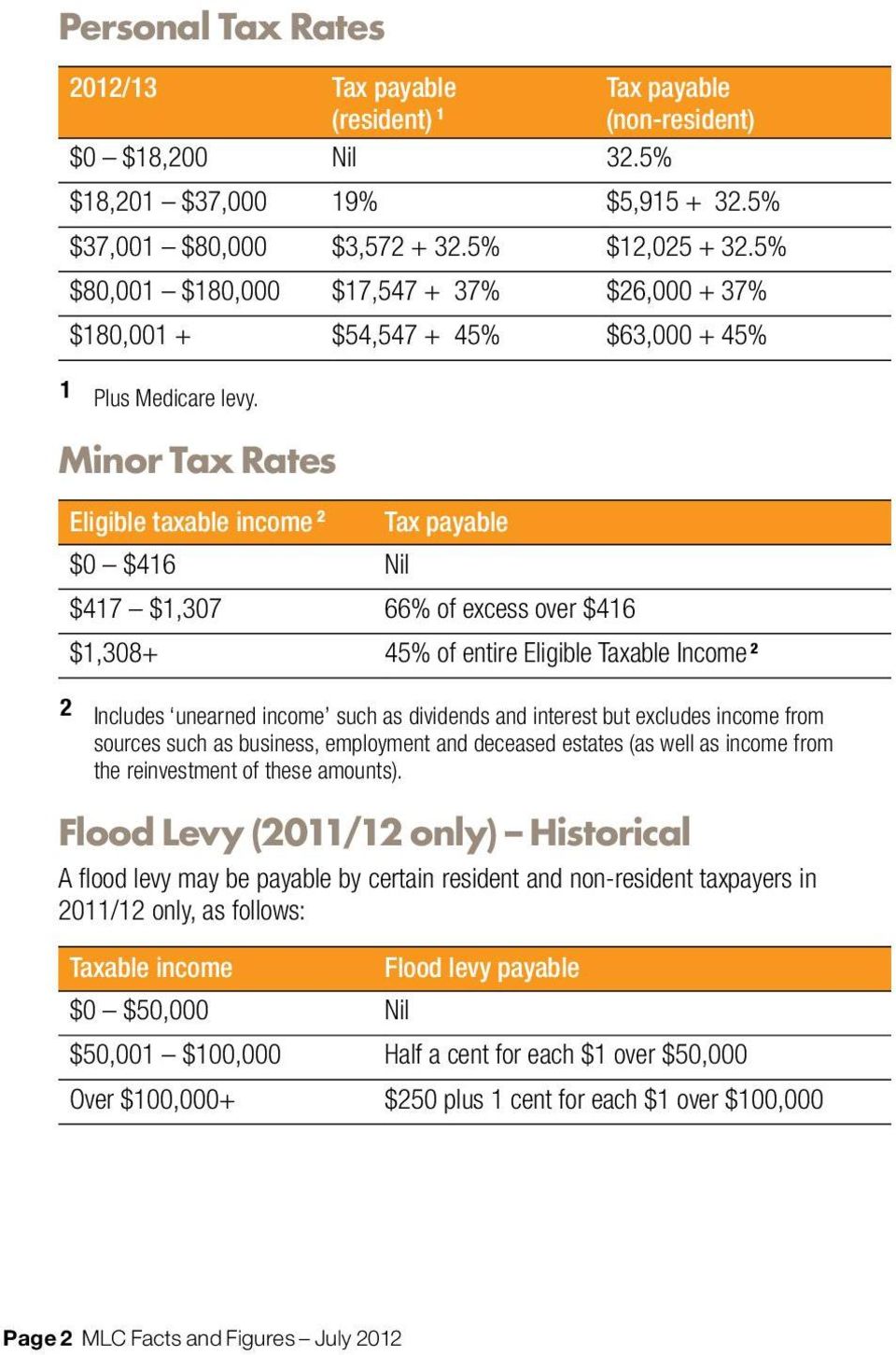
4 Personal Tax Rates 2012/13 Tax payable (resident) 1 Tax payable (non resident) $0 $18,200 Nil 32.5% $18,201 $37,000 19% $5, % $37,001 $80,000 $3, % $12, % $80,001 $180,000 $17, % $26, % $180,001 + $54, % $63, % 1 Plus Medicare levy. Minor Tax Rates Eligible taxable income 2 Tax payable $0 $416 Nil $417 $1,307 66% of excess over $416 $1, % of entire Eligible Taxable Income 2 2 Includes unearned income such as dividends and interest but excludes income from sources such as business, employment and deceased estates (as well as income from the reinvestment of these amounts). Flood Levy (2011/12 only) Historical A flood levy may be payable by certain resident and non-resident taxpayers in 2011/12 only, as follows: Taxable income Flood levy payable $0 $50,000 Nil $50,001 $100,000 Half a cent for each $1 over $50,000 Over $100,000+ $250 plus 1 cent for each $1 over $100,000 Page 2 MLC Facts and Figures July 2012
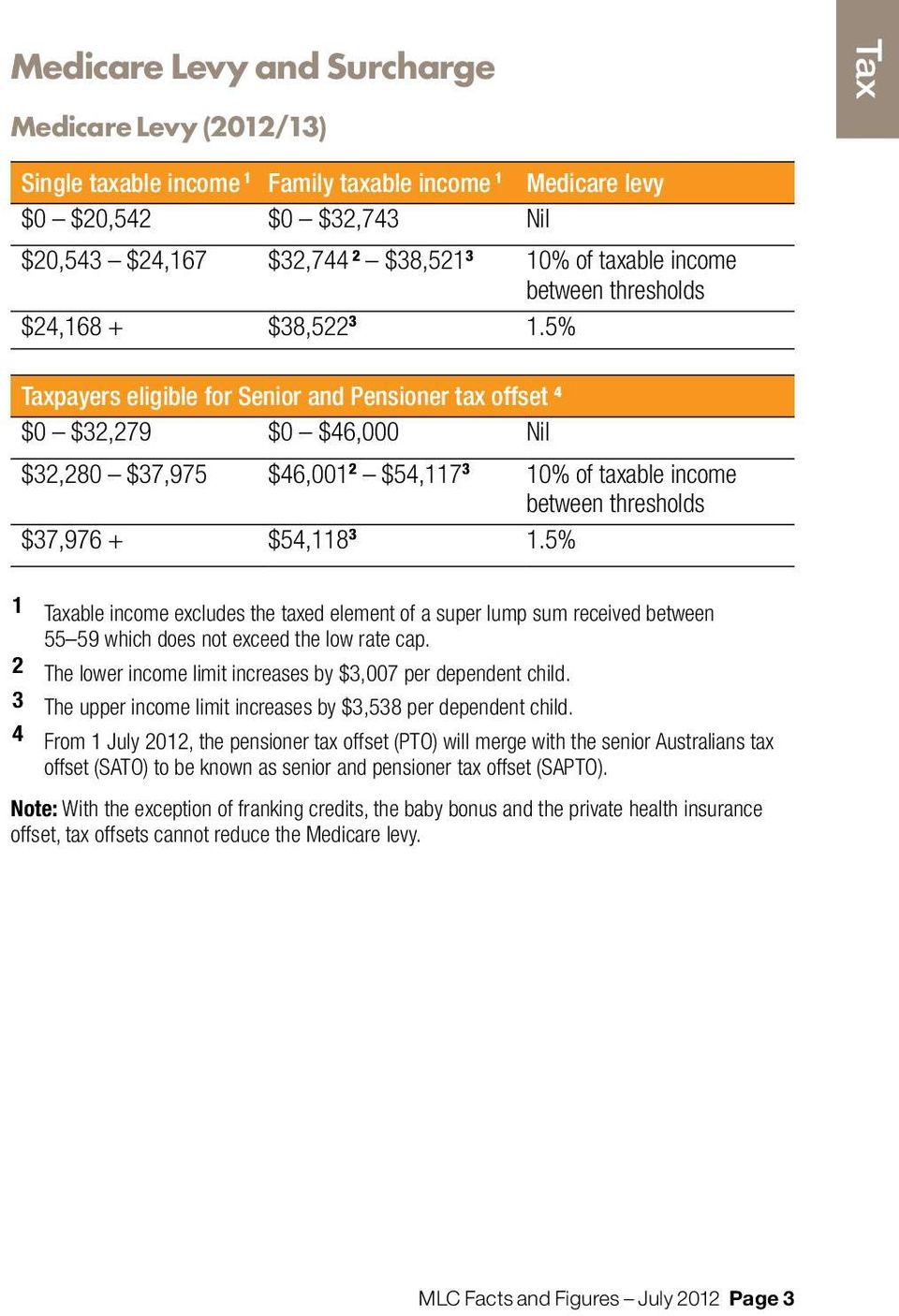
5 Medicare Levy and Surcharge Medicare Levy (2012/13) Tax Single taxable income 1 Family taxable income 1 Medicare levy $0 $20,542 $0 $32,743 Nil $20,543 $24,167 $32,744 2 $38, % of taxable income between thresholds $24,168 + $38, % Taxpayers eligible for Senior and Pensioner tax offset 4 $0 $32,279 $0 $46,000 Nil $32,280 $37,975 $46,001 2 $54, % of taxable income between thresholds $37,976 + $54, % 1 Taxable income excludes the taxed element of a super lump sum received between which does not exceed the low rate cap. 2 The lower income limit increases by $3,007 per dependent child. 3 The upper income limit increases by $3,538 per dependent child. 4 From 1 July 2012, the pensioner tax offset (PTO) will merge with the senior Australians tax offset (SATO) to be known as senior and pensioner tax offset (SAPTO). Note: With the exception of franking credits, the baby bonus and the private health insurance offset, tax offsets cannot reduce the Medicare levy. MLC Facts and Figures July 2012 Page 3
6 Medicare Levy Surcharge (2012/13) Income 1 Medicare levy surcharge 3 Single Families 2 < $84,000 < $168,000 0% $84,001 $97,000 $168,001 $194,000 1% $97,001 $130,000 $194,001 $260, % > $130,000 > $260, % 1 Income is taxable income, reportable fringe benefits, total net investment losses, reportable super contributions less the taxed element of a super lump sum received between age which does not exceed the low rate cap. 2 Family threshold increases by $1,500 for every child after the first child. 3 Applies to taxable income, reportable fringe benefits and any amount on which family distribution tax has been paid. Excluded amounts are the taxed element of a super lump sum received between age which does not exceed the low rate cap and reportable fringe benefits. Tax Offsets (2012/13) Tax offset Max offset Shade-out taxable income Rate of reduction Low Income $445 $37,000 $66,667 $0.015 per $1.00 Mature Age Worker Tax Offset 1 $500 $0 $10,000 $0.05 per $1.00 $10,001 $53,000 N/A $53,001 $63,000 $0.05 per $1.00 Seniors and pensioners tax offset 2, 3 Single $2,230 $32,279 $50,119 $0.125 per $1.00 Couples (each) $1,602 $28,974 $41,790 $0.125 per $1.00 Dependent Spouse (2011/12) 3, 4 $2,355 $282 $9,702 $0.25 per $1.00 Page 4 MLC Facts and Figures July 2012

7 Private Health Insurance 5 Income Oldest member s age Single Couples/Families < < $84,000 < $168,000 30% 35% 40% $84,001 $97,000 $168,001 $194,000 20% 25% 30% $97,001 $130,000 $194,001 $260,000 10% 15% 20% > $130,000 > $260,000 0% 0% 0% Tax 1 Available to taxpayers 55 and over. Phases in between $0 $10,000. Offset is calculated on taxable income from working, reportable fringe benefits and reportable employer super contributions. From 1 July 2012, it is proposed to phase out the offset for taxpayers born on or after 1 July From 1 July 2012, the pensioner tax offset (PTO) has merged with the senior Australians tax offset (SATO) to be known as the senior and pensioner tax offset (SAPTO). 3 Offset is calculated on taxable income, adjusted fringe benefits, reportable super contributions and total net investment losses. 4 The dependent spouse tax offset is no longer available for spouses born after 30 June Certain exceptions will apply, including where the spouse is an invalid or permanently disabled. 5 This can be claimed as either a reduction of premiums, a direct payment or as a tax offset. Corporate Tax Rate Year Tax rate applicable 2001/02 onwards 30% Withholding Tax Rates Type of payment Non-tax treaty country Tax treaty 6 country Unfranked Dividends 30% Generally 15% Interest 10% Generally 10% Royalties 30% Generally 10% Franked Dividends 0% 0% 6 These are the general rates. Refer to the specific tax treaty for confirmation. Note: Special withholding rules apply to distributions from managed investment trusts to non-residents. MLC Facts and Figures July 2012 Page 5

8 Capital Gains Tax (CGT) Asset acquired Individual Company To 19/9/1985 Nil Nil 20/9/1985 to Tax on 50% of nominal gain 21/9/ or Tax on 100% of real gain (CPI frozen at 30/9/1999) Tax on 100% of real gain (CPI frozen at 30/9/1999) From 22/9/ Tax on 50% of nominal gain Tax on 100% of nominal gain Asset acquired Complying super fund To 21/9/ Tax on 2 /3 of nominal gain or Tax on 100% of real gain (CPI frozen at 30/9/1999) From 22/9/ Tax on 2 /3 of nominal gain 1 If the asset was held for 12 months or less, the full nominal gain is taxable. Note: It is proposed that the 50% CGT discount not be available to non-residents on taxable gains accuring after 8 May Page 6 MLC Facts and Figures July 2012

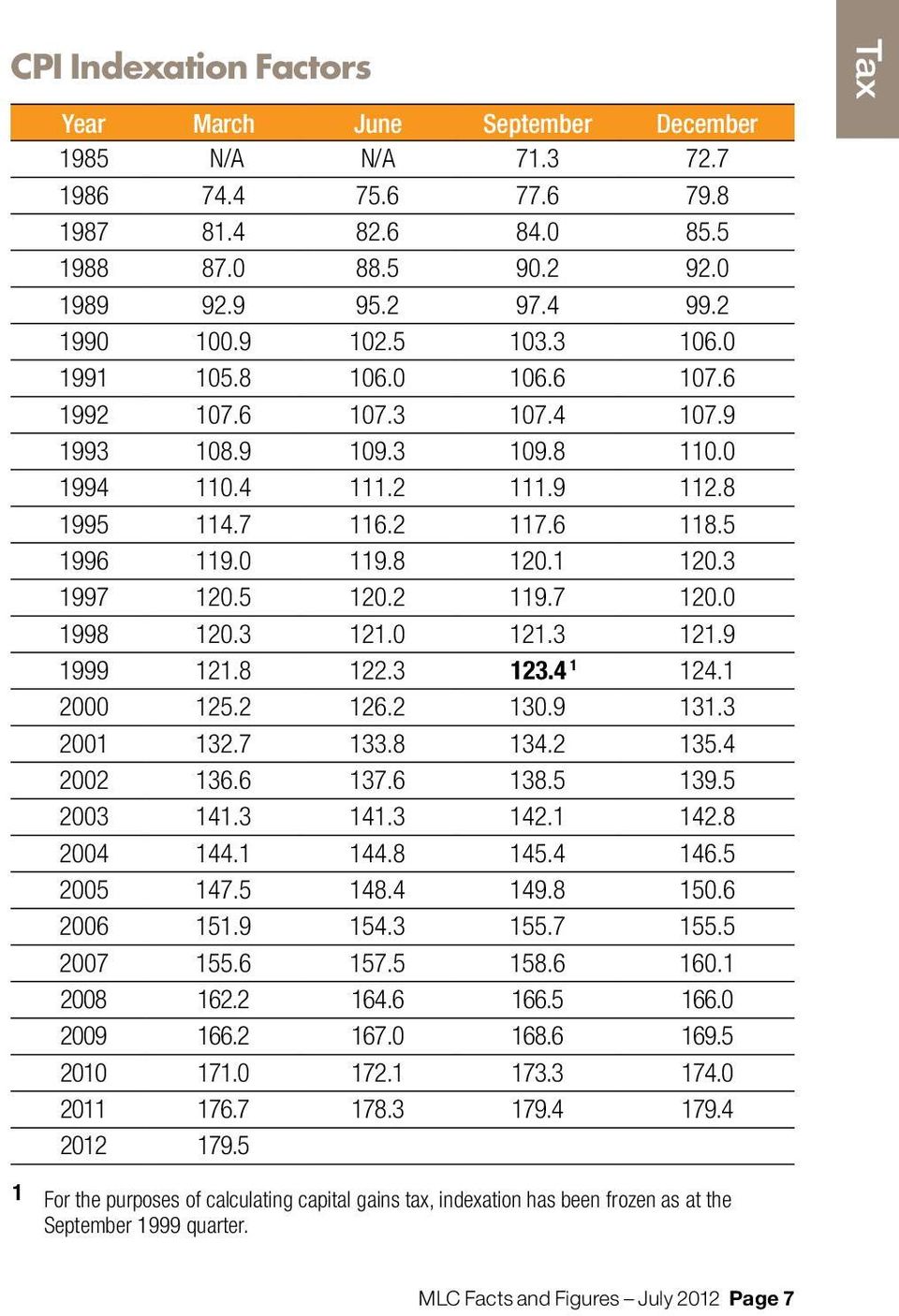
9 CPI Indexation Factors Year March June September December 1985 N/A N/A Tax 1 For the purposes of calculating capital gains tax, indexation has been frozen as at the September 1999 quarter. MLC Facts and Figures July 2012 Page 7
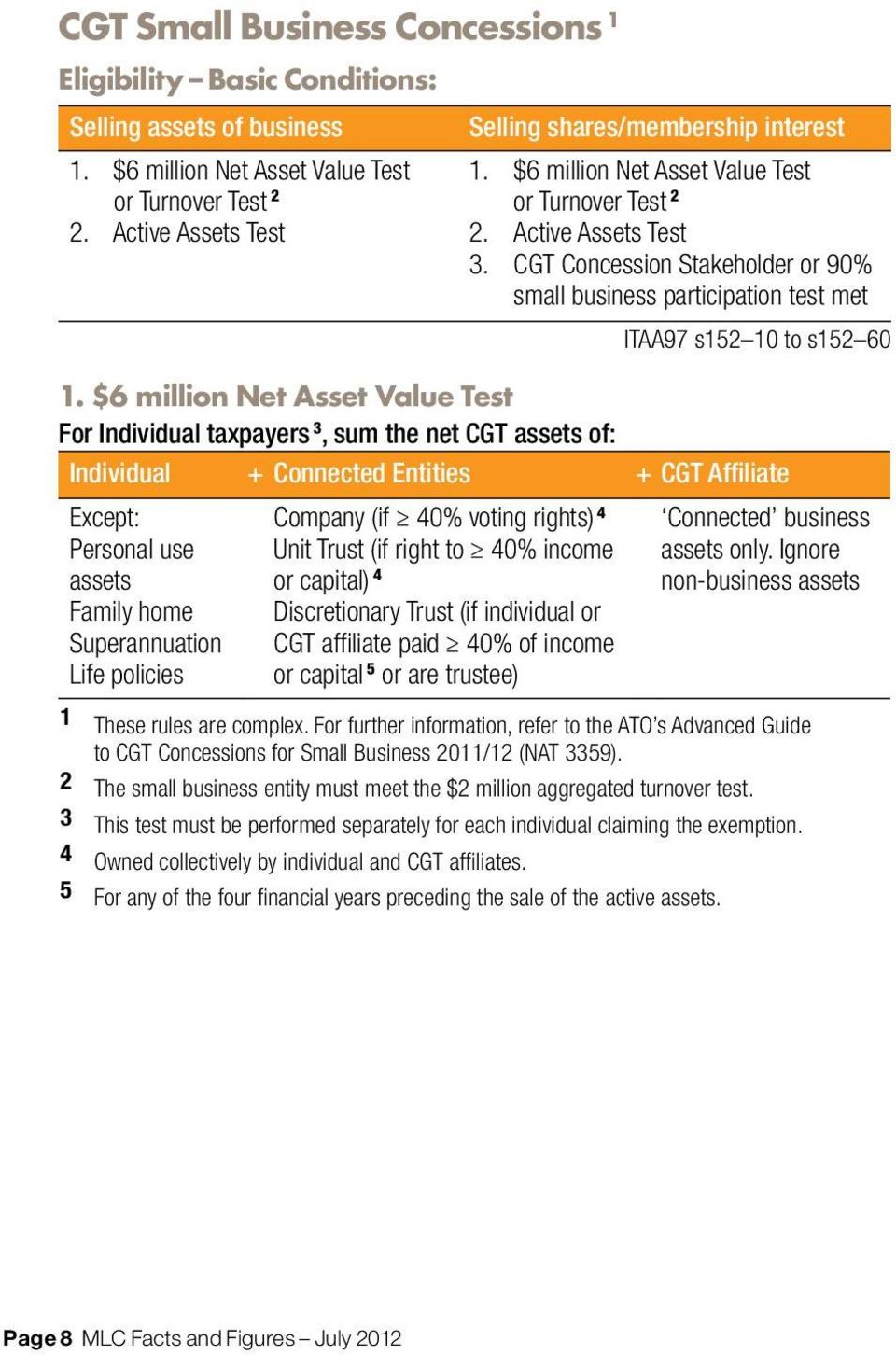
10 CGT Small Business Concessions 1 Eligibility Basic Conditions: Selling assets of business 1. $6 million Net Asset Value Test or Turnover Test 2 2. Active Assets Test Selling shares/membership interest 1. $6 million Net Asset Value Test or Turnover Test 2 2. Active Assets Test 3. CGT Concession Stakeholder or 90% small business participation test met ITAA97 s to s $6 million Net Asset Value Test For Individual taxpayers 3, sum the net CGT assets of: Individual + Connected Entities + CGT Affiliate Except: Personal use assets Family home Superannuation Life policies Company (if 40% voting rights) 4 Unit Trust (if right to 40% income or capital) 4 Discretionary Trust (if individual or CGT affiliate paid 40% of income or capital 5 or are trustee) Connected business assets only. Ignore non business assets 1 These rules are complex. For further information, refer to the ATO s Advanced Guide to CGT Concessions for Small Business 2011/12 (NAT 3359). 2 The small business entity must meet the $2 million aggregated turnover test. 3 This test must be performed separately for each individual claiming the exemption. 4 Owned collectively by individual and CGT affiliates. 5 For any of the four financial years preceding the sale of the active assets. Page 8 MLC Facts and Figures July 2012
11 If taxpayer is a company or trust, sum the net CGT assets of: Company/Trust + Connected Entities + Connected Individuals 1 Net value of company/trust assets Company (if 40% voting rights) 2 Unit Trust (if right to 40% income or capital) 2 Discretionary Trust (if company/ trust paid 40% of income or capital 3 or is trustee) Except: Personal use assets Family home Superannuation Life policies 1 By virtue of the 40% collective control test. Includes CGT affiliates. 2 Owned by first company or trust. 3 For any of the four financial years preceding the sale of the active assets. Tax 2. Active Assets Test Selling assets of business Active asset if: Owned by entity and used in carrying on business by entity, connected entity, spouse, minor child or affiliate (includes goodwill). Active for the lesser of 7.5 years or 50% of its life. Selling shares/membership interest Active asset if: Company or trust is resident. Market value of underlying active assets, cash and financial instruments > 80% of total assets (for at least half of ownership period for shares/interest). 3. CGT Concession Stakeholder A CGT Concession Stakeholder of a company or trust is a significant individual or a spouse of a significant individual. Significant individual must satisfy the following: Company: holds at least 20% of votes or distributions of income or capital. Unit Trust: beneficially entitled to at least 20% of income or capital. Discretionary Trust: entitled to at least 20% of distributed income or capital in year of disposal. Must be at least one significant individual just before the time of disposal. Spouse must satisfy the following: Company: holds company shares. Unit Trust: beneficially entitled to income or capital. Discretionary Trust: beneficially entitled to income or capital. MLC Facts and Figures July 2012 Page 9

12 Eligibility Specific Conditions: 15 year CGT Exemption 1 Active assets are exempt from CGT if continuously owned for at least 15 years where they are disposed of in connection with retirement after age 55 or as a result of permanent incapacity. If an individual sells their shares or interest in an entity, or where a company or trust is selling a CGT asset, there must be a significant individual (not necessarily the same person) for a period totalling 15 years and the significant individual is > age 55 and retiring or is permanently incapacitated. Concession limited to stakeholders participation %. 1 This contribution can be applied towards the small business lifetime CGT cap of $1.255 million in 2012/13 see page 24. ITAA97 s & s If not eligible for the 15 year CGT Exemption, the small business owner may be able to claim the following CGT concessions: 50% Active Assets Reduction A 50% exemption available to all small business owners on the disposal of active assets. A significant individual is only required if the active asset is a share in a company or an interest in a trust. Capital losses and the general 50% discount for individuals 1 (see page 6) must be applied first. Can elect not to claim this concession and instead use the CGT Retirement Exemption or small business rollover. CGT Retirement Exemption 2 Available to all small business owners who dispose of active assets. A $500,000 lifetime limit applies to this exemption. If < age 55, the exempt amount must be contributed to a superannuation fund. If age 55, the capital gain can be taken as cash or contributed to super (if eligible see page 26). It may also be possible to claim a deduction for super contributions (see page 28). Page 10 MLC Facts and Figures July 2012

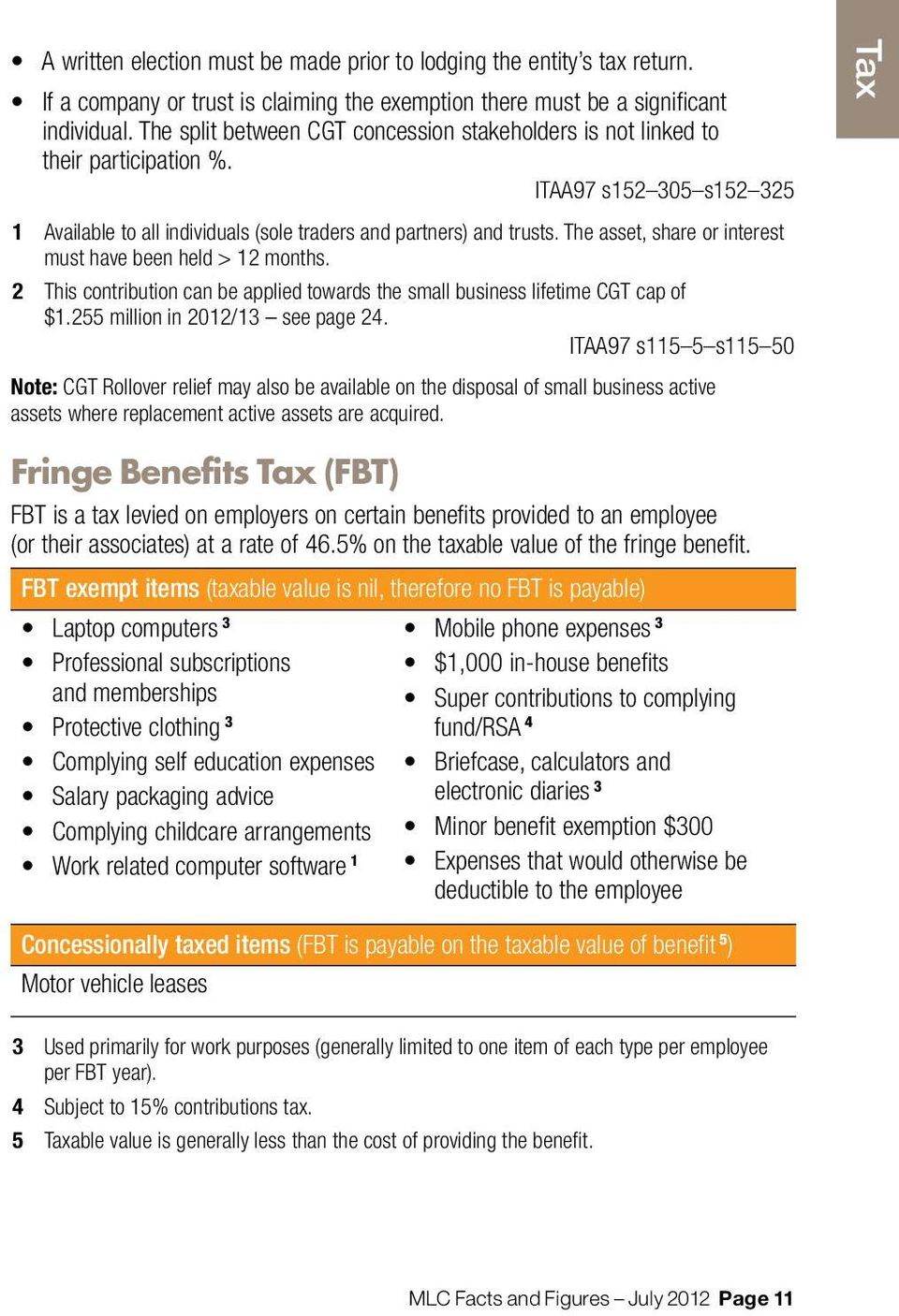
13 A written election must be made prior to lodging the entity s tax return. If a company or trust is claiming the exemption there must be a significant individual. The split between CGT concession stakeholders is not linked to their participation %. ITAA97 s s Available to all individuals (sole traders and partners) and trusts. The asset, share or interest must have been held > 12 months. 2 This contribution can be applied towards the small business lifetime CGT cap of $1.255 million in 2012/13 see page 24. ITAA97 s115 5 s Note: CGT Rollover relief may also be available on the disposal of small business active assets where replacement active assets are acquired. Tax Fringe Benefits Tax (FBT) FBT is a tax levied on employers on certain benefits provided to an employee (or their associates) at a rate of 46.5% on the taxable value of the fringe benefit. FBT exempt items (taxable value is nil, therefore no FBT is payable) Laptop computers 3 Professional subscriptions and memberships Protective clothing 3 Complying self education expenses Salary packaging advice Complying childcare arrangements Work related computer software 1 Mobile phone expenses 3 $1,000 in-house benefits Super contributions to complying fund/rsa 4 Briefcase, calculators and electronic diaries 3 Minor benefit exemption $300 Expenses that would otherwise be deductible to the employee Concessionally taxed items (FBT is payable on the taxable value of benefit 5 ) Motor vehicle leases 3 Used primarily for work purposes (generally limited to one item of each type per employee per FBT year). 4 Subject to 15% contributions tax. 5 Taxable value is generally less than the cost of providing the benefit. MLC Facts and Figures July 2012 Page 11
14 Car Statutory Fractions Annual kilometres travelled Before 10/5/2011 From 10/5/2011 From 1/4/2012 From 1/4/2013 From 1/4/ ,000 26% 20% 20% 20% 20% 15,000 25,000 20% 20% 20% 20% 20% 25,000 4, % 14% 17% 20% 20% > 40,000 7% 10% 13% 17% 20% Exempt Employers Certain non-profit employers such as tax-exempt charities are entitled to FBT concessions. No FBT is payable on the first $17,000 (grossed-up taxable value) for each employee of a public hospital or ambulance service and $30,000 (grossed up taxable value) for each employee of other public benevolent institutions. Rebatable employers are entitled to a rebate of 48% of the FBT on the first $30,000 (grossed up taxable value) of fringe benefits for each employee. The employer must still report the grossed-up fringe benefit amount on the employee s Payment Summary. Page 12 MLC Facts and Figures July 2012

15 Life Policy Taxation Investment earnings are taxed at the corporate rate of 30%. The policies are not subject to further tax at the policy holder level if held for 10 years or more. Withdrawals before 10 years are assessed as follows: Year Assessable portion 1 8 All accumulated bonuses 1 9 Two thirds of accumulated bonuses 1 10 One third of accumulated bonuses 1 Tax A 30% tax offset is available on the assessable portion. For low marginal tax rate payers, any excess can be used to offset other tax payable but it is not refundable. Additional deposits > 125% of the previous year s deposit will restart the 10 year period. 1 This is effectively the growth in the value of the policy. ITAA36 s26ah Employment Termination Payments Employment termination payments contain two tax components: Tax Free will usually be nil, but may include a pre-july 83 segment (calculated at the date of payment) if the employee has pre-service and/or an invalidity segment if the employee has ceased gainful employment due to ill-health. 2 Taxable is the balance of the payment after taking the Tax Free component into account. 2 Two legally qualified medical practitioners must certify that the employee is unlikely to be able to be gainfully employed in a capacity for which they are reasonably qualified by education, training, or experience. MLC Facts and Figures July 2012 Page 13

16 Life Benefit Termination Payments (transitional) Historical Prior to 1 July 2012, LBTP could be rolled over to super or taken as cash between 1 July 2007 and 30 June To qualify, the payment amount (or formula) must have been specified in either a written contract, law or workplace agreement as at 9 May To receive treatment, ETP must have been recieved by super fund before 1 July Rollovers (Directed Termination Payments DTPs) Employees have 30 days from receiving a pre-payment statement to elect to rollover 1 the transitional payment. The Taxable component will be taxed in the super fund at 15% and the Taxable component above $1 million will count towards the employee s CC cap see page To rollover, the employee must be eligible to contribute to super see page 26. ITTPA s82 10F Cash lump sum Age at end of Component Tax rate financial year Under 55 Tax Free Tax-free Taxable First $1 million 2 at 30% 3 Excess at 45% 3 55 and over Tax Free Tax-free Taxable First $165,000 4 at 15% 3 Between $165,000 4 and $1 million 2 at 30% 3 Excess at 45% 3 2 This threshold was not indexed and is reduced by the amount of any transitional termination payments received. 3 Plus Medicare levy. Flood levy may also apply for 2011/12 (see page 2). 4 Applies to all transitional termination payments received during the transition period. Threshod applies for 2011/12 financial year (last year of transitional period). ITTPA s82 10 Page 14 MLC Facts and Figures July 2012

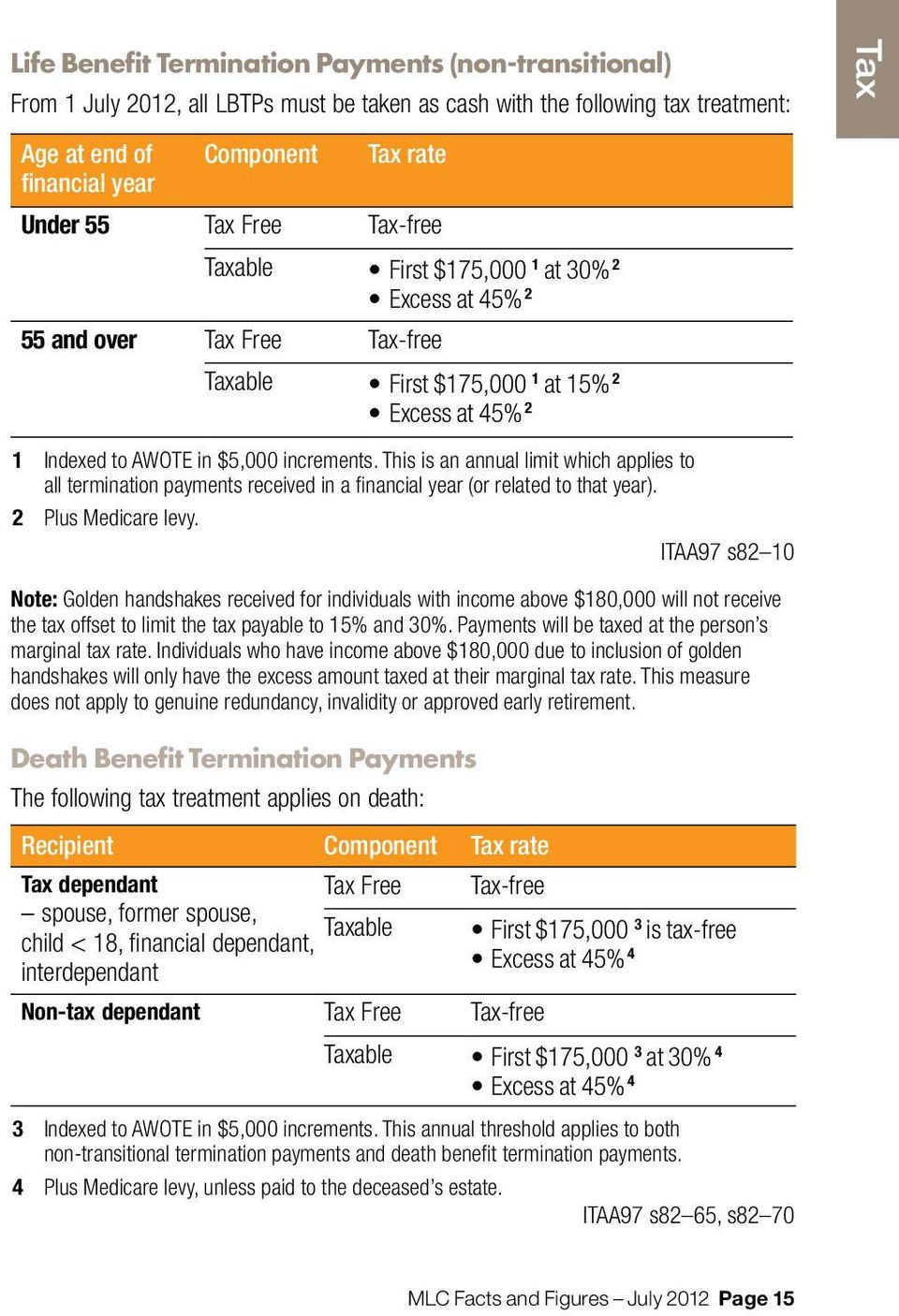
17 Life Benefit Termination Payments (non-transitional) From 1 July 2012, all LBTPs must be taken as cash with the following tax treatment: Tax Age at end of Component Tax rate financial year Under 55 Tax Free Tax-free Taxable First $175,000 1 at 30% 2 Excess at 45% 2 55 and over Tax Free Tax-free Taxable First $175,000 1 at 15% 2 Excess at 45% 2 1 Indexed to AWOTE in $5,000 increments. This is an annual limit which applies to all termination payments received in a financial year (or related to that year). 2 Plus Medicare levy. ITAA97 s82 10 Note: Golden handshakes received for individuals with income above $180,000 will not receive the tax offset to limit the tax payable to 15% and 30%. Payments will be taxed at the person s marginal tax rate. Individuals who have income above $180,000 due to inclusion of golden handshakes will only have the excess amount taxed at their marginal tax rate. This measure does not apply to genuine redundancy, invalidity or approved early retirement. Death Benefit Termination Payments The following tax treatment applies on death: Recipient Component Tax rate Tax dependant Tax Free Tax-free spouse, former spouse, Taxable First $175,000 child < 18, financial dependant, is tax-free Excess at 45% interdependant Non-tax dependant Tax Free Tax-free Taxable First $175,000 3 at 30% 4 Excess at 45% 4 3 Indexed to AWOTE in $5,000 increments. This annual threshold applies to both non transitional termination payments and death benefit termination payments. 4 Plus Medicare levy, unless paid to the deceased s estate. ITAA97 s82 65, s82 70 MLC Facts and Figures July 2012 Page 15
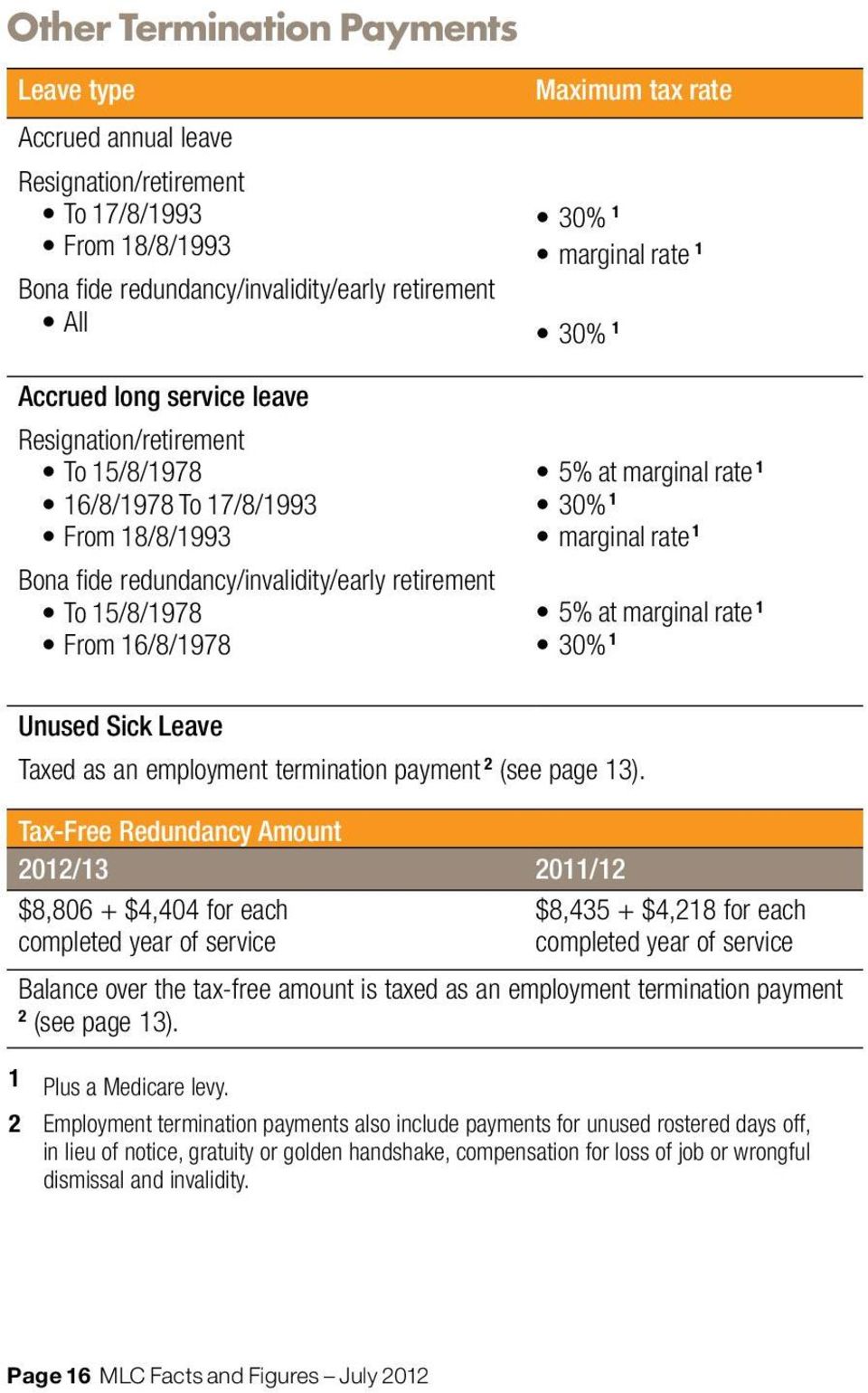
18 Other Termination Payments Leave type Accrued annual leave Resignation/retirement To 17/8/1993 From 18/8/1993 Bona fide redundancy/invalidity/early retirement All Accrued long service leave Resignation/retirement To 15/8/ /8/1978 To 17/8/1993 From 18/8/1993 Bona fide redundancy/invalidity/early retirement To 15/8/1978 From 16/8/1978 Maximum tax rate 30% 1 marginal rate 1 30% 1 5% at marginal rate 1 30% 1 marginal rate 1 5% at marginal rate 1 30% 1 Unused Sick Leave Taxed as an employment termination payment 2 (see page 13). Tax-Free Redundancy Amount 2012/ /12 $8,806 + $4,404 for each completed year of service $8,435 + $4,218 for each completed year of service Balance over the tax-free amount is taxed as an employment termination payment 2 (see page 13). 1 Plus a Medicare levy. 2 Employment termination payments also include payments for unused rostered days off, in lieu of notice, gratuity or golden handshake, compensation for loss of job or wrongful dismissal and invalidity. Page 16 MLC Facts and Figures July 2012
19 Super Contents Super Superannuation Guarantee (SG) 18 Superannuation Fund Choice 20 Portability of Benefits 22 Contribution Caps 22 Non-Concessional Contributions (NCCs) 24 Concessional Contributions (CCs) 25 Super Contributions Acceptance 26 Super Contributions Deductions 27 Super Contributions Spouse Tax Offset 29 Super Contributions Co-contribution 29 Low Income Superannuation Contribution 30 Taxation of Fund Income 30 Preservation Conditions of Release 32 Contribution Splitting 33 Taxation of Super Benefits 33 Death Benefits 36 SMSF Membership Rules 37 Super Investment Rules 38 Limited Recourse Borrowing Arrangements 39 In-house Asset Rules 39 Note: The following section relates to complying superannuation arrangements and unless specified does not apply to defined benefit interests, untaxed superannuation arrangements, or non-residents. MLC Facts and Figures July 2012 Page 17

20 Superannuation Guarantee (SG) Minimum SG contribution rate: 9% Maximum contribution base per quarter: $45,750 SG quarter Due date for quarterly SG Due date for SG Charge (SGC) if late 1 1 Jul 30 Sep 28 Oct 28 Nov 1 Oct 31 Dec 28 Jan 28 Feb 1 Jan 31 Mar 28 Apr 28 May 1 Apr 30 Jun 28 Jul 28 Aug 1 The employer is required to submit a SG Statement and SGC to ATO (additional penalties apply if late see page 19). Note: The SG rate will gradually increase from 9% to 12% from 1 July 2013 until 1July Offsetting SGC With Late Contributions Employers can apply to the ATO to offset their SG charge (SGC) where contributions are paid late to a super fund but before the employer is assessed for that quarter 2. To qualify for the late payment offset, the employer must have: paid the late contribution to the employee s super fund paid the contribution before the original SGC assessment became payable, and elected to use the offset within four years of the original SGC assessment date. 2 To the extent an offset is claimed, the late contribution is not deductible and cannot be used to meet SG obligations for any other period. SGAA s23a, s49, ITAA97 s26 95, s Basic SG Facts SG calculation = SG% x Ordinary Time Earnings (OTE) per quarter. Employee includes any person receiving salary/wages in exchange for labour/services including directors or persons under contracts wholly or principally for labour. OTE includes the total of an employee s earnings for ordinary hours of work. SGAA s23, SGRs 2009/2, 2005/1, 2005/2 Page 18 MLC Facts and Figures July 2012

21 Main Exemptions from SG: Employees paid < $450 in a calendar month (for that month). Employees aged 70 years 1 and over. Employees < age 18 working < 30 hrs/week. Non-resident employees paid for work done outside Australia. Resident employees paid by non-resident employers for work done outside Australia. Foreign executives who hold certain visas or entry permits. Employees paid for domestic or private work 30 hrs/week. Employees temporarily working in Australia for an overseas employer who are covered by a Bilateral Superannuation Agreement. A Certificate of Coverage is required. 1 Pro-rata SG required for quarter when employee turns 70. This age limit will be abolished from 1 July SGAA s27 28, SGD 2003/5 Super Penalties Failure to pay SG by due date: SGC 2 comprising: SG shortfalls basically calculated as quarterly salary/wages per employee x SG% 3. Nominal interest of 10% from start of quarter to later of SG Statement due date or date SG Statement and SGC submitted. Administration fee of $20 per employee per quarter. 2 The SGC is not tax deductible and cannot be reduced by the ATO. 3 Late contributions used to offset the SGC may reduce this liability (see page 18). SGAA s17, s19, s31 32 Additional penalties: If SGC and SG Statement not submitted: General Interest Charge (GIC) from the SGC due date. GIC compounds daily until SGC and accrued GIC is paid. ATO can reduce. GIC is deductible. Non-payment/disclosure penalties: these are applied at a rate of 200% of the SGC. ATO can reduce. Further penalties may apply for false/misleading statements, avoidance, failure to provide information, or failure to keep SG records. SGAA Part 7, TAA s8aac MLC Facts and Figures July 2012 Page 19
22 Superannuation Fund Choice Eligible employees can choose the fund to which their employer must pay SG contributions. If no choice is made, employers must contribute to an employer default fund (ie a fund specified in a relevant Award or, if no Award or no fund specified, to any complying fund or RSA). Eligible Employees Employers must generally offer choice to all employees except where contributions are being made: in accordance with a Certified Agreement, collective agreement, Australian Workplace Agreement (or replacement Individual Transitional Agreement) under an applicable State Award or Agreement 1 to certain public sector (Government) schemes. In limited situations employees in defined benefit schemes are not entitled to choose a fund. Employers may need advice from industrial law experts if they are uncertain of their obligations or which industrial regime applies. 1 Incorporated employers operating under State industrial provisions generally had to offer fund choice from 1 July SGAA s20, s32c, s32f, s32zaa Standard Choice Form (SCF) 2 Must be given to eligible employees within 28 days of: commencement for new employees a change to the default fund (where the employee is a member) becoming aware that a fund ceases to be a chosen fund for the employee becoming aware that the default fund named on a SCF given to an employee cannot accept contributions from the employer a written request by an employee (unless a SCF was provided in the previous 12 months). 2 Employers are exempt from providing a SCF where, as a condition of employment, employees are required to choose their own fund and there is no default fund. Employers may, in some cases, refuse a chosen fund (eg where employee fails to provide required details, has chosen another fund in previous 12 months, or their chosen fund becomes non complying). Employers must still meet their SG obligations. SGAA s32n 32P, SGAR 9C Page 20 MLC Facts and Figures July 2012
23 Minimum Death Cover (employer default fund) With limited exceptions 1 an employer default fund must offer life insurance based on: a premium of at least $0.50 per week for members under age 56, or a minimum level of cover as shown in the table below. Age range Level of insurance Age range Level of insurance $50, to 49 $14, $35, to 55 $7, $20,000 Over 55 Nil Super 1 Key exceptions: The fund s insurer refuses cover (eg due to health, occupation, hours worked etc). The fund/plan is specified under an Award, is capital guaranteed or an RSA. The employer provides an equivalent level of cover in a separate arrangement. SGAR 9A Note: Trustees of MySuper products will have to develop a single default insurance offering that applies to all members of the product. The default offering would be able to vary the levels of cover and/or the cost of premium on the basis of age, gender and occupation type. The default offering for MySuper members may comprise part of the fund s overall insurance strategy. Penalties for Non-compliance Employers may be penalised where the: SG contributions are paid to an incorrect fund at any time two months after receipt of an employee s valid notification. SCF is not given to an eligible employee within the required timeframe (see page 20). The penalties are calculated as follows: choice penalty 2 nominal interest (currently 10% pa) for the quarter on the choice penalty amount, plus administration component of $20 per affected employee for the quarter. This is only applied once if employer is subject to both SGC and choice penalties. These penalties are capped at $500 per notice period. The ATO determines the notice period. 2 If an employer fails to meet their minimum SG obligation in total for a quarter, then the employer is liable to pay the full SGC (see page 19), but does not pay the choice penalty. Partial payment to an incorrect fund may result in SGC and choice penalty. SGAA s17, s19, s31 32 MLC Facts and Figures July 2012 Page 21
24 Portability of Benefits Fund members can apply to rollover their accumulated entitlements at any time 1. The fund has 30 days to comply and can refuse a member s written request where: on partial rollover, the account balance will be < $5,000 the fund has already processed a rollover in the last 12 months the member has an illiquid investment (as described in fund disclosure material) 2, or the fund has insufficient mandatory information to process the rollover. 1 Does not apply to unfunded public sector schemes, SMSFs, defined benefit interests or certain pensions (such as guaranteed or complying pensions). 2 Broadly defined as being an asset which does not have a ready cash value or, converting to cash in the time period of 30 days would have an adverse impact on the realisable value. SISR 6.34, 6.35 Contribution Caps Caps apply to the amount of concessional contributions (CCs) and non concessional contributions (NCCs) that can be made each year. Individuals exceeding the CC or NCC cap are liable for additional tax. See pages for more information on each cap. CC Cap Financial year Annual cap amount 3,4 2012/13 $25,000 Mandated and SG contributions 2013/14 $25,000 can only be made after age 75 3 Indexed to AWOTE in $5,000 increments. Indexation has been frozen until 30 June 2014 and will remain at $25,000. It is expected to increase to $30,000 from 1 July It is proposed from 1 July 2014 to allow eligible individuals age 50 and over with super balances below $500,000 to make additional concessional contributions of $25,000 pa (unindexed) above the standard cap rate. ITAA97 s292 20, Subdiv 960M, SISR 7.04 Page 22 MLC Facts and Figures July 2012
25 NCC Cap Age on first day Annual cap amount of financial year < 65 $150,000 1 or a three-year limit of $450, <75 $150, NCCs cannot be accepted Super 1 This figure is six times the standard CC Cap (see page 22). 2 Once triggered (by exceeding the annual cap), the three-year NCC cap is not indexed. 3 Once the three-year NCC cap is triggered, the unused amount can be used in the subsequent two years, even if over age 65. ITAA97, s292 90, Subdiv 960M Tax on Excess CCs and NCCs This is a member (not a fund) liability. The member will receive an excess contributions tax assessment from the ATO and must ensure it is paid within 21 days 4. The GIC will accrue daily on amounts unpaid. Type Excess NCCs Tax rate Fund cashing rule 46.5% The member must withdraw the tax amount from their super account by submitting the ATO Release Authority to the fund within 21 days. The fund then has 30 days to pay 5. Excess % The member can elect to withdraw the tax amount from the CCs 6 fund by submitting an ATO Release Authority to the fund within 90 days. The fund then has 30 days to pay 5. 4 The ATO may exercise their discretion to extend this date. 5 Members can request the fund pay the ATO on their behalf. Due to timing differences it may be better if members pay the ATO directly and submit the Release Authority to the fund for reimbursement. 6 The Government will allow eligible individuals the option to have excess concessional contributions taken out of their super funds and assessed as income at their marginal tax rate, rather than incurring excess contributions tax at 46.5%. This measure applies to excess concessional contributions up to $10,000 (unindexed) and only for the first year in which an excess contribution occurs. The commencement date is 1 July This is in addition to 15% contributions tax. ITAA97 Subdiv 292 E, SECCA s5, SENCCA s5 MLC Facts and Figures July 2012 Page 23
26 Non-Concessional Contributions (NCCs) NCCs broadly comprise contributions that are not assessable to the fund but with specific inclusions and exclusions as set out below. Main NCC cap inclusions Personal after-tax (undeducted) contributions. Spouse contributions (for recipient). Small business sale proceeds above the lifetime CGT cap of $1.255 million 1. Payments from overseas funds except to the extent the member is able to, and does, elect for it to be taxable to the fund. Contributions from prior years to non-complying funds where the fund subsequently becomes complying. Distributions of the above contribution types from fund reserves. Excess concessional contributions 3. Main NCC cap exclusions Concessional contributions (unless excessive). Government co-contributions. Small business sale proceeds up to the CGT cap of $1.255 million 1. To use the CGT cap the election must be submitted to the fund on or before the contribution is made. Personal injury payments 2 where no personal injury election must be submitted to the fund on or before the contribution is made. Rollovers/Transfers between complying super arrangements. Tax Free component of an employer DTP see page Indexed to AWOTE in $5,000 increments. The CGT cap includes proceeds related to the CGT retirement exemption and the 15-year CGT exemption see page 8. A person can use capital proceeds that qualify for the 15-year CGT exemption even if the disposal did not result in a capital gain or loss; the asset was a pre-cgt asset; or the disposal occurred before the 15-year holding period had elapsed due to permanent incapacity. A CGT cap election must be submitted via an approved form to the fund on or before the contribution is made. If a deduction is claimed, the contribution counts toward the CC cap (the CGT cap cannot be used). 2 These amounts arise from a structured settlement, Court order or worker s compensation lump sum. Individuals must submit an election to the fund on or before the contribution is made indicating these amounts are personal injury contributions. In general, the contribution must be made within 90 days of the later of the receipt of payment or the date the eligible agreement or Court order was made. 3 These will usually be assessable to the fund. ITAA97 s to s Page 24 MLC Facts and Figures July 2012
27 Concessional Contributions (CCs) CCs broadly comprise contributions which are assessable to the fund see page 31. However, there are specific inclusions and exclusions as set out below. Main CC cap inclusions Employer (including SG, voluntary, salary sacrifice) contributions. Personal contributions for which a tax deduction is claimed. Taxable amounts above $1 million from employer DTPs 1 during the transition period see page 14. Payments by the ATO for SG shortfalls or from the SHA Account. Contributions made by another person on behalf of a member which are assessable to the fund 2. Amounts above the vested entitlement at transfer date from overseas super funds. Distributions of the above from fund reserves. Other distributions from reserve accounts (with certain exceptions noted in the exclusion column). Main CC cap exclusions Contributions counted towards the NCC cap (other than excess CCs). Tax Free component plus up to $1 million of the taxable amount of transitional employment termination payments see page 14. Rollovers from complying super arrangements (including those with an untaxed element). Taxable amounts of overseas transfers that the member elects to have taxed in their Australian super account. Distributions from reserve accounts: considered to be fair and reasonable and < 5% of the member s interest at distribution to meet current year pension liabilities, arising from commutation of a pension which is used to commence a new pension for the primary beneficiary, or to pay a benefit on their death. Super 1 The $1 million threshold (unindexed) is reduced by the taxable amount of all other transitional employment termination payments (including those taken in cash). 2 Excludes spouse contributions and non-employer contributions made by another person for a child < 18 (other than deductible contributions made by the child via an adult guardian/ representative). ITAA97 s292 25, ITAR MLC Facts and Figures July 2012 Page 25
28 Super Contributions Acceptance The following tests need to be satisfied before contributions can be accepted. Note: Contributions include most payments into the fund other than rollovers or transfers between complying super arrangements. Work Test Age Contributions may be accepted (subject to fund rules): Under 65 Without restriction 65 to < 70 From any source provided the member has been gainfully employed for at least 40 hours over 30 consecutive days during the financial year in which the contributions are made If mandated employer contributions 1 If amounts are from First Home Saver Accounts (either voluntary or compulsory transfer) 70 to < 75 2 If personal contributions 3, or voluntary employer contributions (including salary sacrifice) provided the member has been gainfully employed for at least 40 hours over 30 consecutive days during the financial year in which the contributions are made If mandated employer contributions 1 75 and over If mandated employer contributions 1 1 Mandated contributions include SG contributions or employer contributions required under an agreement or award certified by an industrial authority. The SG contribution age limit will be abolished from 1 July Contributions must be received within 28 days of the end of the month in which the member reaches age For this purpose, personal contributions include non-concessional, personal tax deductible, small business CGT sale proceeds (see page 24), employer DTPs and overseas transfers. Spouse contributions are not allowed from age 70. TFN Test Contributions made by or on behalf of a member cannot be accepted unless the member has quoted their TFN. The only exception relates to employer contributions (which would be subject to no-tfn tax) see page 31. Page 26 MLC Facts and Figures July 2012
29 Fund NCC Cap Test A single non-employer contribution 1 made by or on behalf of a member cannot be accepted if it exceeds: $450,000 2, where the member is 64 or less at 1 July in the financial year, or $150,000 3, where the member is 65 but < 75 at 1 July in the financial year. 1 Excludes contributions with a valid tax deduction notice (see page 28); personal injury amounts or CGT contributions from the sale of certain small business assets (see page 24); SG shortfalls; SHA amounts; Government co-contributions; and employer DTPs. Broadly, the test applies to personal after tax (undeducted) contributions, spouse contributions and overseas transfers. 2 This is equal to three times the NCC cap of $150,000 for 2012/13. 3 This is the NCC cap for 2012/13. Super Return of Contributions to Contributor Contributions made in breach of the above tests must be rejected or returned to the contributor. Insurance and other costs may be deducted. SISR 5.01, 7.04 Super Contributions Deductions An employer 4 or eligible person (see page 28) may claim a deduction 5 for the full amount contributed in a financial year. However, additional taxes may apply if the contribution caps are exceeded see page The contribution must be for an eligible employee who is: engaged in producing assessable income of the employer; or an Australian resident engaged in the employer s business; or an eligible employee includes an employee within the expanded definition of the SGAA s12. In some cases, deductions are allowed for former employees. 5 Certain rules continue to apply to deductions eg for employers a deduction cannot be claimed for the SG charge and the rules relating to personal services may restrict deductions for an associated person (such as a spouse). In addition, personal deductions may not exceed assessable income. ITAA97 Subdiv 290 B, s26 80, s85 25, s86 75 MLC Facts and Figures July 2012 Page 27
30 Self-employed and Other Eligible Persons Certain conditions must be met in order to claim a deduction for personal contributions 1. The key conditions include: Less than 10% of assessable income, reportable fringe benefits and reportable employer super contributions must be attributable to employment as an employee 2. Individuals under 18 must generate business or employment income. An otherwise eligible individual must be over 55 to make a claim for contributions related to the small business CGT retirement concession (lifetime limit of $500,000) 3. An approved notice to claim a tax deduction must be submitted to the fund by the earlier of: the time the member lodges their tax return, or the end of the following financial year after the contribution was made. An individual cannot vary (ie reduce) the amount they have notified the fund they are claiming after the expiry of the above period (unless a deduction is disallowed). A notice to claim a deduction (or vary a notice) is invalid where the: individual is no longer a member of the fund trustee of the fund no longer holds the contribution 4, or contribution has been used in whole or part to commence a pension. 1 A tax deduction cannot be claimed in respect of transfers from overseas funds, superannuation rollovers/transfers, employer DTPs or, in 2006/07 and earlier years, the rollover of a CGT exempt ETP or employer ETP. 2 Includes holding an office or appointment, performing functions or duties or engaging in work or doing acts and things which would result in the member being an employee under SGAA s12 (including work of a domestic or private nature even if < 30 hrs/week). 3 If a deduction is claimed, these amounts count towards the CC cap see page This might arise, for example, if the individual made a partial withdrawal (cash or rollover). Since 1 July 2010, there is a formula to calculate the proportional amount that may be claimed as a deduction based on the remaining Tax Free component left in the fund. ITAA97 Subdiv 290 C ITAA97 s26 80, s85 25, s86 75 Page 28 MLC Facts and Figures July 2012
31 Super Contributions Spouse Tax Offset 1 Spouse s Assessable Income (Al) 2 Max. Rebatable Conts. (MRC) Max. offset 18% of lesser of: $10,800 or less $3,000 MRC or actual conts (max $540) $10,801 $13,799 $3,000 (AI 2 $10,800) MRC or actual conts $13,800+ $0 $0 Super 1 To qualify for the offset each spouse must be an Australian resident for tax purposes when the contribution is made. If the contributor is entitled to an employer tax deduction for the contribution, the spouse tax offset does not apply. A spouse includes a same sex partner but excludes those permanently living apart. See page 26 for contribution rules. 2 Assessable income, plus reportable fringe benefits and reportable employer super contributions. ITAA97 s Super Contributions Government Co contribution 3 Assessable Income (AI) 4 Personal contribution Co-contribution available $31,920 or less Any amount Personal contribution x 1 (max $1,000) $31,921 $61,919 $0 $1,000 The lesser of: Personal contribution x 1, or $1,000 [ x (AI 4 $31,920)] $31,921 $61,919 $1,000 + $1,000 [ x (AI 4 $31,920)] $61,920+ Any amount Nil 3 To qualify for a co-contribution a person must make personal after-tax (undeducted) contributions; receive at least 10% of their assessable income 4 from eligible employment (including income from self-employment and/or carrying on a business); lodge an income tax return; be < age 71 at the end of the financial year; and not be a temporary resident for any part of the year. From 1 July 2012 the Government has proposed to halve the matching rate to 50% and the maximum co-contribution payable will be $500 and lower the upper threshold to $46,919. The indexation of the income thresholds will be frozen for 2011/12 and 2012/13. 4 Assessable income, plus reportable fringe benefits and reportable employer super contributions. For the purpose of calculating the available co-contribution, AI is reduced by business deductions. GCCA s6 10 MLC Facts and Figures July 2012 Page 29
32 Low income superannuation contribution The LISC is a government contribution to superannuation for eligible individuals representing a refund of contribution tax. The maximum LISC is $500 and forms part of the tax-free component. Assessable income (AI) 1 Concessional contribution $37,000 or less Any amount Concessional contributions x 15% (maximum $500) 1 Assessable income is taxable income, adjusted fringe benefits, target foreign income, net investment losses, tax free pension or benefit, reportable super contributions less deductible child maintenance. Taxation of Fund Income 2 Accrual phase Tax rate Assessable contributions 15% 3 No-TFN contributions 31.5% (plus 15% contributions tax) Earnings 15% Discount capital gains (if applicable) 10% 4 Pension phase Tax rate Income attributable to current Tax exempt pension liabilities (subject to actuarial certification) 5 ITAA97 Subdiv 295 F 2 Non-arm's length income is taxable at 45% (eg private company dividends and specified trust distributions). 3 It is proposed to increase the tax on concessional contributions from 15% to 30% from 1 July 2012 for individuals who earn $300,000 pa or more. If the $300,000 income limit is exceeded due to concessional contributions, the 30% tax would only be applied to the contribution amount that exceeded the limit. This change is yet to be legislated and the operation is yet to be determined. 4 See page 6. 5 This is not required for funds paying only account based pensions, allocated pensions and term allocated pensions provided pension assets have been segregated. Page 30 MLC Facts and Figures July 2012
33 Assessable Contributions Any contributions made for a member by another person or entity with some exceptions, the main ones being: spouse contributions Government co-contributions, and non-employer contributions made by another person for a child < 18 unless they are deductible. Personal contributions for which a tax deduction is claimed. No-TFN contributions. ITAA97 Subdiv 295-C No-TFN Contributions and Tax Assessable contributions are subject to an additional tax of 31.5% (no-tfn tax) where a member fails to quote their TFN by the end of the financial year in which the contributions are made 1. Employers are required to pass on an employee s TFN within 14 days when an employee provides them with a TFN declaration. The fund will not be able to offset the no-tfn tax liability except to effectively claim a refund when the member quotes their TFN within three years from the year in which the no-tfn tax was applied to the contributions. 1 The no-tfn tax does not apply to a pre 1 July 2007 super account provided the total assessable contributions in respect of that account for an income year are $1,000 or less. ITAA97 Subdiv 295-I Super MLC Facts and Figures July 2012 Page 31
34 Preservation Conditions of Release Include: 1. Retirement after preservation age (55 to 60). 2. Termination of employment after age Attaining age Permanent disability (evidence required by Trustee/Provider who must make determination). 5. A terminal medical condition where two medical practitioners (one a specialist) certify that the person s condition is likely to result in death within 12 months. 6. Upon death. 7. Upon permanent departure from Australia for certain temporary residents holding a temporary visa Compassionate grounds (approved by Department of Human Services). 9. Financial hardship (receipt of Centrelink benefits for: 26 weeks consecutively and unable to meet reasonable and immediate family living expenses; or 39 weeks cumulatively if over preservation age and not gainfully employed). Persons not meeting a full condition of release (items 1 6) but over their preservation age, may start a Transition to Retirement (TTR) income stream (see page 49). SISR 6.01(1) (5), SISR Schedule 1 Note: On termination of employment at any age, restricted non-preserved benefits become unrestricted non-preserved (provided employer has contributed to the fund). 1 Can only be paid as a single lump sum Departing Australia Super Payment (DASP) see page 34 for tax rates. Temporary residents can generally only access their benefits under release condition 7, unless they are New Zealand citizens, become Australian permanent residents/citizens or hold an eligible retirement visa. Increase to Preservation Ages Date of birth Preservation age Page 32 MLC Facts and Figures July 2012 Date of birth Preservation age Before 1/7/ /7/ /6/ /7/ /6/ /7/ /6/ /7/ /6/ From 1/7/ SISR 6.01
35 Contribution Splitting Funds may allow members to split the lesser of: 85% of their concessional contributions (CCs) 1 for the financial year, or their CC cap for the financial year to their spouse (including same sex partners) where the receiving spouse is < 65 and, if preservation age, not retired. Eligible contributions can only be split in the financial year after the year in which they were made (unless the member withdraws their entire benefit earlier). Super 1 CCs generally comprise employer contributions (including salary sacrifice) and personal deductible contributions (tax deduction notice required before split can be made). SISR r Taxation of Super Benefits Benefits contain two components: Tax Free 2 mainly composed of non-concessional contributions (see page 24) and also the Tax Free portion of any rollovers. For some clients, this component may contain a crystallised segment related to a portion of their benefits accrued prior to 1 July Taxable is the balance of the client s benefit after taking the Tax Free component into account. It may comprise an element taxed in the fund or an element untaxed in the fund. In general, the Taxable component of benefits paid from taxed superannuation funds will only comprise an element taxed in the fund (except in certain circumstances related to death see page 36). 2 The Tax Free component of permanent disability benefits may be increased when paid as a lump sum or on rollover see page 35. Proportional Drawdown of Tax Components (Accumulation) Any withdrawal includes both a Taxable and Tax Free component in the same proportion as these components make up of the total interest 3 immediately before the withdrawal. 3 For SMSFs an interest is deemed to include all of a member s entitlements in the fund other than pensions that have commenced to be paid. In public offer funds, if a member has more than one account, pensions that have commenced are considered separate. For other accounts it depends on the nature of the claim against the trustee or whether the ATO determines that the purpose of separate accounts is primarily to obtain an unlawful tax benefit. ITAA97 s , ITAR , MLC Facts and Figures July 2012 Page 33
36 Tax Treatment of Lump Sum Benefits Benefits paid to members aged 60 and over, or paid as a cash lump sum due to a terminal medical condition at any age, are tax-free and are non assessable, non exempt income (NANE). The following table shows the tax rates applicable to benefits paid to members under age 60 (other than lump sums paid due to a terminal medical condition). Component Age Tax rate Tax Free Any Tax-free Taxable < 55 20% 1 (taxed element) First $175,000 2 at 0% Excess at 15% 1 1 Plus Medicare levy. 2 This low rate cap applies to the total of all Taxable components (and post-june 1983 components prior to 1 July 2007) that are taken as cash at age 55 and over, and is indexed to AWOTE in $5,000 increments. If a benefit includes both taxed and untaxed elements, it applies firstly to the taxed element. Note: Members with benefits of < $200 can withdraw this amount tax-free provided it is paid as a lump sum. The member must have left an employer sponsor or be a lost member who has been found. ITAA97 s301 10, s301 15, s301 20, s301 35, s , s Departing Australia Superannuation Payment (DASP) 3 Component Tax rate Tax Free Tax exempt Taxable (taxed) 35% Taxable (untaxed) 45% 3 The withholding tax rates apply regardless of whether the member has supplied an Australian TFN. ITAA97 s Note: Super benefits for certain temporary residents (excluding New Zealand citizens, Australian citizens/permanent residents and holders of Retirement visa subclasses 405 and 410) must generally be paid to the ATO where their temporary visa has been cancelled/expired and it has been six or more months since they departed Australia. In this case, benefits may still be claimed from the ATO as a DASP. Page 34 MLC Facts and Figures July 2012
37 Permanent Disability Benefits The Tax Free component of a lump sum benefit or rollover will be increased where members (including the self-employed) become disabled 1. The increase to the Tax Free component is calculated using the following formula (consistent with the previous post-june 1994 invalidity calculation): Amount of benefit x Days to retirement Service days + days to retirement where: days to retirement are the number of days from when the person stopped being capable of being gainfully employed until their last retirement day 2, and service days are the number of days from the start of the eligible service period until the person stopped being capable of being gainfully employed. Super 1 For this purpose, disablement means: they suffer from physical or mental ill health, and two qualified medical practitioners certify they are unlikely to ever be gainfully employed in a capacity for which they are reasonably qualified by education, training or experience. 2 This is the day when their employment or office would have terminated; or when they would have reached a specified retirement age; or completed a specified period of service. Most commonly, it is the day the person would have reached age 65. ITAA97 s If the disability benefit is paid as a lump sum, the tax treatment is outlined on page 34. If paid as a pension, the tax treatment is outlined on page 42. MLC Facts and Figures July 2012 Page 35
38 Death Benefits The following summarises the tax treatment and rules related to payments made due to the death of a member in the superannuation accumulation phase. It also applies to death benefit income streams that are commuted to a lump sum, generally within the later of three months from grant of probate/issue of letters of administration, or six months from date of death (the prescribed period). The lump sum death benefit cannot be rolled over. If the commutation occurs outside the prescribed period see page 47. Lump Sum Death Benefit tax treatment Beneficiary Components Tax rate Tax dependant spouse 1, Tax Free and Taxable Tax-free former spouse 1, child < 18, financial dependant, interdependant Non-tax dependant Tax Free Tax-free Taxable taxed element 15% 2 Taxable untaxed element 30% 2 1 Includes both opposite and same-sex de facto partners. 2 Plus Medicare levy, unless paid to the deceased s estate. ITAA97 s302 60, s , s , s Note: A super fund may pay an anti-detriment amount to a spouse or a child of any age upon payment of a death benefit lump sum. Death Benefit Income Stream eligibility Only certain dependants are able to commence or continue an income stream on death. These are: spouse 1 children < 18 a financially dependent child aged between 18 and 25 other financial dependants (excluding children) interdependants, or disabled 2 children. Page 36 MLC Facts and Figures July 2012
39 Death benefit income streams payable to children must cease at age 25, unless the child is disabled 2. If there is an amount remaining in the account and the income stream is commuted to a lump sum 3 it will be paid tax free if the: child beneficiary is aged < 25, or child beneficiary turns 25, or child is disabled 2. Super 1 Includes both opposite and same-sex de facto partners. 2 Disabled for this purpose means a person with a disability that is attributable to an intellectual, psychiatric, sensory or physical impairment or a combination of such impairments. The disability must be permanent or likely to be permanent and result in a substantially reduced capacity of the person for communication, learning or mobility and the need for ongoing support services. 3 Only full commutations can be taken prior to age 25 unless the child is disabled 2. SISR 6.21(2A) and (2B), ITAA97 s303 5 Death Benefit Income Stream tax treatment For the tax treatment of payments from death benefit income streams, see page 46. SMSF Membership Rules A SMSF must have < five members (including pension recipients) and generally all members must be trustees. In addition, no member of the fund can be an employee 4 of another member, unless they are related. Members under a legal disability (eg < 18) cannot be trustees, however a parent, guardian or legal personal representative may be a trustee in their place. Trustees must not receive remuneration for services performed as trustee. Corporate Trustees (> 1 member funds) A company can be a trustee of a SMSF where: all directors of the company are members of the fund each member of the fund is a director of the company, and no member of the fund is an employee 4 of another member, unless they are related. 4 Includes employment by related entities. MLC Facts and Figures July 2012 Page 37
40 Single Member Funds Allowed if the fund has an additional trustee who is not a member of the fund (the additional trustee cannot be an employer of the sole member unless they are related). A company with one or two directors may also be trustee of the fund as long as the member is a director. Where the trustee company has two directors, the SMSF member cannot be an employee of the other director unless related. SISA s17a Super Investment Rules Complying funds must: Satisfy the sole purpose test SISA s62 Ensure all transactions are at arm s length SISA s109 Not borrow (limited exceptions) 1 SISA s67 Not provide financial assistance to members or relatives SISA s65 Not acquire assets from related parties 2 SISA s66 Satisfy the in-house asset rules SISA s69 s85 Ensure investments are consistent with the fund s investment strategy SISR 4.09 Not use fund assets as security for borrowing. SISR Subject to limited timeframes and a 10% cap of fund assets, trustees may borrow to meet benefit or surcharge liabilities. Also, subject to conditions, trustees may borrow to acquire allowable assets under a limited recourse borrowing arrangement (see page 39). 2 Exceptions to acquiring assets from related parties include: Securities listed on an approved stock exchange Business real property (up to 100%) for funds with < five members only Units in widely held unit trusts Approved banking deposits Life insurance policies (other than those owned by a member or relative of a member) Arm s length investments in a PST In-house assets within allowable limits (see page 39). Page 38 MLC Facts and Figures July 2012
41 Limited Recourse Borrowing Arrangements Subject to strict requirements, funds can use limited recourse borrowing arrangements to acquire permitted assets. Core rules require that: the borrowing is used to acquire an asset held on trust on behalf of the super fund trustee who has a right (but not an obligation) to acquire the legal ownership through one or more payments the lender s recourse against the super fund trustee is limited to rights relating to the asset at the time of the action, and the asset (or any replacement) must be one which the super fund trustee is permitted to acquire and hold directly. SISA s67(4a) Super In-house Asset Rules Generally, super funds are restricted from lending, leasing or investing more than 5% of the fund s total assets to a related party of the fund. Transitional provisions: Date of investment Counted as in-house Asset To 11/8/1999 No 1 12/8/1999 to 23/12/1999 Yes 1 (from 1/7/2001) From 24/12/1999 Yes 1 Provided the investment wasn t captured under the old definition (ie investment in, or loan to a standard employer sponsor or an associate of the employer sponsor). Funds with < five members were able to reinvest earnings and make payments on partly paid shares/units up to 30 June Assets excluded from the in-house asset rules include: Business real property subject to a lease with a related party (funds with < five members). Property owned as tenants in common (unless subject to a lease with a related party). A private non-geared unit trust or company that meets certain conditions. SISA s69 85, SISR 13.22C MLC Facts and Figures July 2012 Page 39
42 Notes Page 40 MLC Facts and Figures July 2012
43 Income Streams Contents Income Streams Taxation Treatment 42 Commutation 45 Death Benefits 46 Superannuation Income Stream Options 48 Account based income streams 48 Non-account based income streams 49 Transition to retirement (TTR) income streams 49 Term Allocated Pension Payment Factors (PF) 50 Life Expectancy Factors 51 Complying Income Streams 52 Defined Benefit Pensions (fixed term or lifetime) 54 Income Streams Note: The following section relates to complying superannuation arrangements and ordinary annuities. Unless specified otherwise, it does not apply to defined benefit interests, untaxed superannuation arrangements or non-residents. MLC Facts and Figures July 2012 Page 41
44 Income Streams Taxation Treatment Superannuation Income Streams These can be commenced with super benefits although a relevant Condition of Release must be met (see page 32). Benefits comprise two components Tax Free and Taxable (see page 33). The Tax Free component of an income stream commenced after 30 June 2007 is determined at the purchase date by reference to the benefits, rollovers, and/or contributions used to purchase the income stream. For income streams commenced prior to 1 July 2007, the Tax Free component is determined by the remaining Undeducted Purchase Price (giving an annual Deductible Amount) until a trigger event occurs see page 43. Benefits paid from taxed super funds to members aged 60 and over are tax-free and are non-assessable, non-exempt income (NANE). The following table shows the tax rates applicable to income payments paid to members under age 60. Note: If the income stream commences due to permanent disability (see footnote 1 on page 35) where the client is < age 55, the Taxable component is treated as per age If the income stream commences due to death, see page 46. Component Tax treatment of income streams Tax Free Tax-free Taxable If under age 55 Taxed at marginal rates 1 If aged 55 to 59 Taxed at marginal rates 1, less 15% tax offset 1 Plus a Medicare levy. ITAA97 s301 10, s301 15, s301 30, s Page 42 MLC Facts and Figures July 2012
45 Proportional Drawdown of Tax Components Any withdrawal (income or commutation lump sum) includes both a Taxable and Tax Free component in the same proportion as these components make up of the amount used to purchase the income stream interest 1. Existing pensions at 1 July 2007 will be converted to the proportional drawdown approach when one of the following trigger events occurs: the investor reaches age 60 the income stream is wholly or partially commuted, or the investor dies. The Tax Free component at the trigger event is the remaining Undeducted Purchase Price (if any) plus, for post 1 July 1994 income streams, the value of the Pre 1 July 1983 component. The proportion that this makes up of the value of the income stream interest 1 at the trigger event will be applied to any future payments to give the Tax Free component with the balance being Taxable. For the tax treatment of commuted lump sums, see page For SMSFs an interest is deemed to include all of a member s entitlements in the fund other than pensions that have commenced to be paid. In public offer funds pensions that have commenced are separate interests. Otherwise, it depends on the nature of the claim against the trustee or whether the ATO determines that the purpose of separate accounts is primarily to obtain an unlawful tax benefit. The ATO is yet to release further guidence on what constitutes a superannuation interest. ITAA97 s , ITAR , Income Streams MLC Facts and Figures July 2012 Page 43
46 Pre 1 July 2007 Super Income Streams and Ordinary Money Annuities Deductible Amount = Undeducted Purchase Price (UPP) Residual Capital Value (RCV) Relevant Number (RN) 1 For income streams purchased with superannuation or employer ETPs, the UPP is calculated as follows: Commencement date UPP Before 1/7/ Undeducted + Pre 1/7/ Concessional 1/7/ /6/1997 Undeducted 1/7/1997 4/6/1998 Undeducted + CGT Exempt After 4/6/1998 Undeducted + CGT Exempt + Post 30/6/1994 Invalidity ITTPA s , ITAA36 s27a 27H For ordinary money annuities, the UPP equals the amount of the investment. Any taxable amount is taxable at the recipient s marginal rate (plus Medicare levy). 1 Relevant Number: For fixed term, is the term of the income stream (see pages for the terms applicable to complying income streams), or For allocated and lifetime income streams, is the life expectancy of the investor (use longest life expectancy for joint life or automatic reversions of lifetime income streams). 2 Income streams purchased before 1July 2007 solely with the commutation proceeds of a Pre 1 July 1994 income stream also receive this favourable UPP treatment. Page 44 MLC Facts and Figures July 2012
47 Commutation Revised Deductible/Deduction Amount (DA) A revised DA applies on commutation based on the following formulae: Taxation 1 Social security 2 (ordinary annuities) Partial Commutation Reduced UPP RCV PP RCV Commutations Reduced RN Original RN Full Commutation Remaining UPP RCV New PP RCV New RN New RN 1 This is not relevant to superannuation income streams. 2 This applies to both superannuation and ordinary income streams except that the tax 'Deductible Amount' definition applies to income streams with no identifiable PP or capital amount (more common in public sector or some corporate funds). For the Income and Assets Test treatment of income streams see page 57. UPP = Undeducted Purchase Price (see page 44). Reduced UPP = Original UPP reduced by UPP used in income payments and prior commutations. PP = Purchase Price. RN = Relevant Number (term or life expectancy see page 44). Reduced RN = Original RN reduced by the period (term) that the income stream has been payable. New RN = Term of new income stream or new life expectancy (as per age on commencement). Note: For superannuation income streams commencing after 1 October 2003, a pro-rata income payment may be required on full or partial commutation (with limited exceptions eg death). ITAA36 s27h, SSA s9(1) Income Streams MLC Facts and Figures July 2012 Page 45
48 Death Benefits Superannuation Income Streams On death, superannuation income streams which commenced prior to 1 July 2007 are converted to the new tax components (unless already converted due to an earlier trigger event). The proportional drawdown rule applies regardless of whether the income stream continues or is paid out as a death benefit lump sum. Only certain dependants for tax purposes will be able to commence or continue an income stream on death. This includes a spouse 1, a child < 18 2, a child aged who is financially dependent 2, a disabled child 3, a financial dependant (other than a child 25 or over) and an interdependent person. 1 Includes both opposite and same-sex de facto partners. 2 A death benefit income stream paid to a child will generally need to cease at age 25 see page 37. Any child, including those aged 25 or over, may continue a death benefit income stream if it became payable to them before 1 July As described in subsection 8-1 of the Disability Services Act. Reversion of Income Stream 4 The tax treatment of the income stream for these beneficiaries will depend upon the age of the deceased (at death) or the age of the recipient (at the date of payment), as follows: Age of deceased/recipient Component Tax treatment If either aged 60 or over Tax Free Tax-free Taxable taxed element Tax-free If both under age 60 Tax Free Tax-free Taxable taxed element Marginal tax rates, less 15% offset 5 4 A reversionary income stream includes automatic reversion upon death or where the trustee exercises discretion to continue to pay the income stream. 5 Plus a Medicare levy. The income will be tax-free once the recipient reaches age 60. Page 46 MLC Facts and Figures July 2012
49 Death Benefit Lump Sum If the death benefit is taken as a lump sum (without first being paid as an income stream to beneficiaries of the deceased) the following tax treatment applies. Death benefit lump sums cannot be rolled over. Beneficiary Components Tax rate Tax dependant spouse, former spouse, child < 18, financial dependant, interdependant Tax Free and Taxable Tax-free Non-tax dependant Tax Free Tax-free Taxable taxed element 15% 1 1 Plus a Medicare levy, unless paid to the deceased s estate. Taxable untaxed element 30% 1 Commutation of Death Benefit Income Stream If an income stream that has commenced or has continued to be paid due to death is subsequently commuted to a lump sum: it will generally be a death benefit lump sum and subject to the above tax treatment if it is paid within the later of three months from grant of probate/issue of letters of administration, or six months from date of death (the prescribed period), or if it is paid outside the prescribed period, and subject to the exceptions below, it will be treated as a superannuation lump sum and taxed accordingly 2 see page 34. A superannuation lump sum arising from the commutation of a death benefit income stream outside the prescribed period will be classed as NANE and is not subject to tax if the beneficiary is: a child under 25 or who must commute due to turning 25, or permanently disabled. Income Streams 2 In this circumstance, a spouse of the deceased can roll over the superannuation lump sum. Note: A super fund may pay an anti-detriment amount to a spouse or a child of any age upon payment of a death benefit lump sum. ITAA97 s302 60, s302 75, s , s , s , s303 5 MLC Facts and Figures July 2012 Page 47
50 Ordinary Money Income Streams Capital amounts, including lump sums paid on death, are not subject to tax. Restrictions apply to return of capital (commutation or RCV). If the income stream is continued, there is no change to the Deductible Amount upon automatic reversion, otherwise it is recalculated based on remaining UPP and dependant s life expectancy (if lifetime) or remaining fixed term. ITAA36 s27h, ITAA97 s Superannuation Income Stream Options From 1 July 2007, new standards apply to account based and non-account based income streams (except complying lifetime income streams). Income streams purchased prior to 20 September 2007 can continue to be paid on the original rules. Account Based Income Streams A minimum payment applies each year calculated by reference to age and a specified percentage of the account balance (see table below). Only those account based pensions that are commenced under the transition to retirement (TTR) condition of release are subject to a maximum payment limit of 10% of the account balance each year. Age at start of pension In 2011/12 1 In 2012/13 1 In 2013/14 1 (and 1 July each year) Under 65 3% 3% 4% % 3.75% 5% % 4.5% 6% % 5.25% 7% % 6.75% 9% % 8.25% 11% % 10.5% 14% 1 The account balance is the amount paid as consideration for the income stream plus earnings, minus fees, charges, taxes and payments. Note: A payment may be deferred until the following financial year where an account based income stream is commenced between 1 June and 30 June. A pro rata minimum payment is required if it is commenced before 1 June. However, the maximum 10% payment requirement for a TTR income stream does not need to be pro-rated. Investors may have the option to elect that a particular income payment be treated as a lump sum for tax purposes. Page 48 MLC Facts and Figures July 2012 SISR 1.05(11A), 1.06(9A), Schedule 7
51 Non-account Based Income Streams Minimum standards apply to income streams commencing from 20 September New and existing lifetime income streams which meet the pre 20 September 2007 complying income stream requirements will be deemed to meet the standards. Other non-account based income streams (such as fixed term annuities/pensions) need to meet certain criteria if offered from 20 September 2007, including a minimum payment at least equal to the purchase price of the income stream multiplied by the relevant account based percentage factor (see page 48) either: in every year, where the income stream provides for a return of capital 1, or in the first year only, if there is no return of capital, and the income stream is payable for life or a fixed term no greater than the difference between the investor s current age and age 100. Payments can be indexed in subsequent years but only by a fixed percentage or by a factor linked to CPI or AWOTE. 1 But not > 100% of the purchase price. SISR 1.05(11A), 1.06(9A), Schedule 7 Transition to Retirement (TTR) Income Streams These are account based income streams with a maximum income limit (10% of the account balance) and additional commutation restrictions that allow investors to access their preserved and restricted non-preserved super benefits after reaching their preservation age (see page 32). They can only be commuted in the following circumstances: To give effect to a Family Law split. Upon meeting any of the Conditions of Release in items 1 6 on page 32. To give effect to a Release Authority (for excess contributions tax see page 23). To another TTR income stream. They can also be commuted and rolled back to an accumulation interest at any time (where the preservation status of the remaining benefit is retained). Income Streams MLC Facts and Figures July 2012 Page 49
52 Term Allocated Pension Payment Factors (PF) The income for a Term Allocated Pension/Annuity (TAP) is calculated at commencement and then at 1 July each year. From 1 January 2006, subject to provider rules, annual income can be varied between plus or minus 10%. After 19 September 2007 new (commutation funded) TAPs must meet both the existing payment factors and the new minimum account based factors (see page 48). Term remaining PF Term remaining PF Term remaining or less 1.00 Note: Income is pro-rated during the first year and on commutation (where allowable with only limited exceptions). If a replacement TAP commences between 1 June and 30 June, the first income payment does not have to be made until the following financial year. Annual income is not recalculated on partial commutation but is recalculated at each 1 July. Any account balance remaining at the end of the term must be paid out as income within 28 days. SISR Schedule 6 PF Page 50 MLC Facts and Figures July 2012
53 Life Expectancy Factors The life expectancy factors to be used from 1 January 2010 are: Age Male Female Age Male Female Income Streams Australian Life Tables MLC Facts and Figures July 2012 Page 51
54 Complying Income Streams These were generally purchased prior to 20 September 2007 to obtain a social security Assets Test Exemption (ATE) and/or qualify for Pension RBL assessment. The terms of existing arrangements continue to apply including commutation restrictions. Where purchased before 20 September 2007, 50% ATE may apply or, if purchased before 20 September 2004, 100% ATE may apply. Specific rules apply to these grandfathered concessions. Term Allocated Pensions Income payments must be paid annually based on account balance and a payment factor (PF) related to the remaining term (see page 50). From 1 January 2006 the term established at commencement can only be a period between the investor s life expectancy (LE) 1 at their current age and the greater of: the investor s LE 1 if they were five years younger, and the difference between the investor s current age and age 100. Or, if the investor specifies that the income stream will automatically revert to a spouse with a longer LE, they may choose a term based on their own LE 1 (above) or a term between their spouse s LE 1 at their current age and the greater of: the spouse s LE 1 if they were five years younger, and the difference between their spouse s current age and age Note: A spouse includes a married or de facto partner including a same sex partner. SISR 1.05(1A)/(1B), 1.05(10), 1.06(1A)/(1B), 1.06(8) 1 Life expectancy is rounded up to the nearest whole year. 2 Subject to governing rules/contract, for superannuation purposes (but not ATE purposes) a spouse established as an automatic reversionary may commute on death of original investor provided the term is based only on the original investor s details (see above). For both superannuation and ATE purposes, if the term is based on the details of the original investor s spouse (see above) the income stream must continue until death of both. Page 52 MLC Facts and Figures July 2012
55 Lifetime 1 Annual income payments must be fixed except for indexation (capped at greater of CPI + 1% or 5% unless otherwise approved by the Regulator) 2. Payable for investor s life and, if applicable, automatic reversionary s life (unless a child < 16 or a student < 25) or joint ordinary annuity owners lives. The maximum guarantee period is 10 years if commenced before 20 September 2004 or the lesser of 20 years or LE if commenced after this date. For a joint lifetime ordinary annuity, the longer LE may be used 3. SISR 1.05(1A)/(1B), 1.05(2)/(3), 1.06(1A)/(1B), 1.06(2)/(3) Life Expectancy (Fixed Term) 1 Annual income payments are fixed except for indexation (capped at greater of CPI + 1% or 5%). The allowable term is the same as for Term Allocated Pensions if commenced after 19 September Prior to 20 September 2004, the term must have been based on life expectancy or a term between 15 years and life expectancy and purchased on or after Age/Service Pension age. Couples (married or de facto) could purchase a joint ordinary annuity income stream for ATE purposes provided that each was the reversionary of the other with the term determined under the same conditions as a Term Allocated Pension (see page 52). SISR 1.05(1A)/(1B), 1.05(9), 1.06(1A)/(1B), 1.06(7) Income Streams 1 Lifetime and life expectancy pensions can only be commenced in a SMSF in limited circumstances (see page 54). 2 For superannuation purposes the income payments may reduce but by no more than the reduction in CPI (if applicable). 3 Lifetime income streams cannot be commuted by a reversionary or to the benefit of the recipient s estate if outside the guarantee period. MLC Facts and Figures July 2012 Page 53
56 Common criteria includes: No Residual Capital Value. Generally, non-commutable except in first six months of a non-commutation funded complying income stream, to pay a surcharge liability, to give effect to a Family Law split, for Release Authority purposes (related to excess contributions tax), on death (see footnote 2 on page 52) or, to purchase another complying income stream. Purchase price must be wholly converted into income. Capital must not be used as security for borrowing. Cannot be transferred except on death. Reversion/Commutation value cannot be > 100% of the benefit immediately prior to reversion/commutation. Restrictions apply on continuation of the income stream on death by a child see page 37. SISR 1.05, 1.06; SSA s9a, s9b & 9BA; VEA s5ja & s5jb Defined Benefit Pensions (fixed term or lifetime) A lifetime or fixed term pension can only be commenced in a < 50 member fund where: the pension is wholly backed by life policies, or the terms and conditions of the pension were specified in the funds governing rules before 12 May New fixed term pensions must meet the non-account based income stream conditions on page 49. SISR 9.04E, 9.04F Page 54 MLC Facts and Figures July 2012
57 Social Security Contents Rates and Thresholds 56 Social Security Assessment 57 Assessment of Couples 58 Waiting Periods 58 Pension Qualifying Ages 60 Superannuation Benefits 60 Income Streams 61 Private Trusts and Companies 62 Conventional Life Policies 62 Gifting 62 Pension Bonus Scheme 63 Work Bonus Scheme 64 Commonwealth Seniors Health Card 64 Social Security MLC Facts and Figures July 2012 Page 55
58 Rates and Thresholds Single Couple Age Pension 1 $ pf $ pf (each) Newstart Allowance 2 $ pf $ pf (each) Deeming Rates 3.0% First $45,400 First $75, % Above $45,400 Above $75,600 Income Test cut out thresholds (Pension) Full Pension Up to $ pf Up to $ pf Part Pension Less than $1, pf Less than $2, pf Assets Test cut out thresholds Home-owners Full Pension Up to $192,500 3 Up to $273,000 3 Part Pension Less than $696,250 Less than $1,032,500 Non-home-owners Full Pension Up to $332,000 3 Up to $412,500 3 Part Pension Less than $835,750 Less than $1,172,000 1 Includes Pension Supplement of $60.20 pf for singles and $90.80 pf (combined) for couples. 2 Includes Pharmaceutical Allowance of $6.20 pf for singles and $6.20 pf (combined) for couples. 3 These figures are cut-off limits to qualify for an allowance. Note: These figures are the non-transitional values and are current from 1 July Page 56 MLC Facts and Figures July 2012
59 Social Security Assessment Pensions Pension Payable = Maximum Pension Pension Reduction Pension Reduction Income Test Assets Test 1 Income 2 above threshold x (Assets 2 above reduction threshold / 1,000) x $1.50 per fortnight Note: Lower of amount calculated under the Income and Assets Tests is the pension payable. Allowances Allowance Payable = Maximum Allowance Allowance Reduction Allowance Reduction Income Test 4 Assets Test 1 First $62 pf $62 $250 pf Above $250 pf Nil No reduction Assets must be rounded down to the nearest $250 (singles) and $500 (couples). 2 Single or couple combined after allowing for the Work Bonus (see page 64). 3 This reduction rate is applicable from 20 September Some pensioners may qualify for transitional rates and their reduction is This test must be applied to each member of a couple based on their own income. Partner income which exceeds cut-out point reduces fortnightly allowance by 60 cents per dollar. 5 To qualify, assets must be below the lower threshold for the Assets Test (see page 56). Note: Newstart Allowance cuts out when income reaches $ pf for singles and $830 pf each for couples (current from 1 July 2012). Social Security MLC Facts and Figures July 2012 Page 57
60 Assessment of Couples Pensioner and allowee couple: Pension Benefit Determined by applying the standard pension Income and Assets Tests and halving the combined couple rate. Allowance Benefit Determined by assessing the combined assets against the couple Assets Test limit and half the combined income against the Income Test thresholds. One member of a couple on a pension: Pension Benefit Determined by applying the pension Income and Assets Tests using combined income and assets and halving the combined couple rate. Allowee couple (whether both on benefits or not): Allowance Benefit Determined by assessing the combined assets against the couple Assets Test limit. For the Income Test each allowee is assessed on their own income. However, partner s income in excess of cut-off threshold reduces allowee s benefit by 60 cents per dollar. Waiting Periods For people qualifying for certain payments (eg Newstart Allowance) the following waiting periods apply: 1. Ordinary Waiting Period seven days 2. Income Maintenance Period 1 no maximum limit. A person s payments will generally be delayed from the date they receive any leave entitlements and/or a time related redundancy payment up until the end of the period covered by these entitlements. 1 The Liquid Assets Waiting Period and the Income Maintenance Period are served concurrently. Page 58 MLC Facts and Figures July 2012
61 3. Liquid Assets Waiting Period 1 up to 13 weeks as per table: Liquid Assets 2 (single, no dependants) Liquid Assets 2 (couples or singles + dependants) Waiting Period (weeks) $3,000 $3,499 $6,000 $6,999 1 $3,500 $3,999 $7,000 $7,999 2 $4,000 $4,499 $8,000 $8,999 3 $4,500 $4,999 $9,000 $9,999 4 $5,000 $5,499 $10,000 $10,999 5 $5,500 $5,999 $11,000 $11,999 6 $6,000 $6,499 $12,000 $12,999 7 $6,500 $6,999 $13,000 $13,999 8 $7,000 $7,499 $14,000 $14,999 9 $7,500 $7,999 $15,000 $15, $8,000 $8,499 $16,000 $16, $8,500 $8,999 $17,000 $17, $9,000+ $18, Note: Maximum Reserve Amount $2,500 for single AND does NOT have a dependent child (single), and $5,000 for a member of a couple AND/OR has a dependent child (family) Formula to calculate the Liquid Assets Waiting Period (LAWP) is: Liquid Assets Maximum Reserve Amount $500 (single) or $1,000 (family) It is proposed to increase the Maximum Reserve Amount from 1 July The Maximum Reserve Amount will be $5,000 (single) and $10,000 (family). Social Security 1 The Liquid Assets Waiting Period and the Income Maintenance Period are served concurrently. 2 Includes cash, shares, managed funds and employment termination payments (see page 14) and super benefits taken as cash. MLC Facts and Figures July 2012 Page 59
62 Pension Qualifying Ages Age Pension The qualifying ages to be eligible to claim an Age Pension will depend on the person s date of birth as per the following schedule: Date of birth Qualifying age Male Female 1/1/ /6/ /7/ /12/ /1/ /6/ /7/ /12/ /1/ /6/ /7/ /12/ /1/1957 onwards Note: Women born prior to 1 January 1946 have already reached their qualifying ages of 60 to DVA Age Service Pension Age Service Pension To be eligible to claim a DVA Service Pension, the qualifying Date of birth 1/1/ /6/1952 Qualifying age 59 age for males is 60. For women 1/7/ /12/ their qualifying age will depend on their date of birth as per the 1/1/1954 and later 60 adjacent schedule: Superannuation Benefits Superannuation assets are exempt from the Income and Assets Tests until a person reaches Age or Service Pension age (see above). Thereafter the superannuation benefit is counted as an asset and is subject to deeming under the Income Test (see page 56). However, an exemption may apply to those people who have reached Age or Service Pension age but are less than age 65 and unable to access their super. Withdrawal from Super Lunp sum withdrawals from super are not assessed as income. However, the amount withdrawn may become assessable when invested. Contribution to Super Reportable super contributions (eg salary sacrifice and personal deductible contributions) are included in the Income Test. Page 60 MLC Facts and Figures July 2012 Note: Women born prior to 1 January 1951 have already reached their qualify ages of 55 to 59.5.
63 Income Streams Asset-tested (five years or less) Asset-tested (> five years incl. account based pensions) Asset-tested exempt (complying income streams) 2 Income Test Subject to Deeming Annual Income less Deduction Amount 1 [where DA = (PP Commutations RCV) /RN] Annual Income less Deduction Amount 1 (as above) Assets Test = PP [((PP RCV)/RN)xYE] = Account Balance, or = PP [((PP RCV)/RN)xYE] Commenced before 20/9/2004: 100% exempt 3 Commenced between 20/9/2004 and 19/9/2007: 4 = 50% x Account Balance, or = 50% x [PP [((PP RCV)/RN)xYE]] PP = Purchase Price. RCV = Residual Capital Value. RN = Relevant Number (term or life expectancy see page 44). YE = Years Elapsed. This is expressed in increments of 0.5 if 2 or more payments in a year (whole year for annual payments). Reduction to asset value occurs at six-monthly intervals. 1 If a commutation is made, the Deduction Amount will change see page An Assets Test Exemption (ATE) does not apply to new income streams purchased from 20 September 2007, although commutation funded complying income streams (see page 52) can be purchased and will retain their ATE in certain circumstances. 3 A legislative instrument was introduced effective on 25 August 2011 that provides clients who commute their Asset-tested Exempt income stream with a choice, at any time of: keeping the Asset-test Exemption by fully transferring into an equivalent ATE retail product with the same level of asset-test exemption; or fully transferring a 100% or 50% ATE income stream into a fully asset-tested Term Allocated Pension within their SMSF or SAF without an overpayment being raised. 4 If these income streams are commuted and rolled to a new complying income stream the 50% ATE will be retained if the commutation was due to: removal of a reversionary beneficiary from a lifetime income stream (due to death or separation); failure to meet actuarial reserving requirements; a successor fund transfer; a divorce property settlement; hardship (under the social security rules); or to meet a surcharge liability. Clients will only have one opportunity to commute and roll to a new complying income stream and retain their ATE where the commutation was due to the removal of a reversionary beneficiary or failure to meet actuarial reserving requirements. MLC Facts and Figures July 2012 Page 61 Social Security
64 Private Trusts and Companies If a person has an involvement in either a private trust or company, and the income and assets of the trust or company are attributed to that person as a controller or source of the assets, then the value of the income and assets of the trust or company will be included in their assessment for any social security income support payments. Conventional Life Policies Conventional Life policies (eg whole of life and endowment policies) are only assessed under the Income Test when the policy is surrendered or matured (bonuses received are treated as income for the following 12 months). The surrender value of the policy may be assessed under the Assets Test depending on how the money is invested. Gifting Social Security recipients can gift up to a maximum of $30,000 over a five year rolling period. While singles and couples (combined) can still gift up to $10,000 in any given financial year, if the level of gifting exceeds $10,000 in a financial year or $30,000 over a five year rolling period, the excess amount will be subject to the deprivation rules. Deprivation Provisions This applies to assets that are disposed of without adequate consideration in the period of five years before commencing Social Security benefits (above the relevant gifting limits), as well as excess amounts gifted in a particular year (see above). The deprived amount is counted as an asset under the Assets Test and is subject to deeming under the Income Test for a period of five years from the date of disposal/gifting. Gifting of a source of income (without adequate consideration) is treated as an ongoing disposal. Page 62 MLC Facts and Figures July 2012
65 Pension Bonus Scheme Note: The Pension Bonus Scheme closed to new entrants on 20 September 2009 and was replaced by the Work Bonus (see page 64). However, people who turned Age Pension age before 20 September 2009 who were not receiving a pension at that time can still register under the scheme. Existing scheme members can continue to accrue entitlements under existing rules. Allowed people who deferred claiming the Age Pension (and continued working) to receive a tax-free lump sum bonus. To be eligible, a client had to: register for the scheme or turned Age Pension age before 20 September 2009 and have registered for the scheme defer claiming for at least one year work at least 960 hours per year, and not receive any income support payment (except Carers Payment) since reaching Age Pension age. Bonus amount = Annual pension x (9.4% x Years entitlement 1 in scheme) x Years in scheme Maximum Bonus 2 Year Single Couple (each) 1 $1, $1, $7, $5, $15, $11, $28, $21, $43, $33, Social Security 1 At the time of making a claim, excludes pharmaceutical and rent allowance. 2 These figures are current from 1 July Note: A similar scheme operates for DVA Veterans. MLC Facts and Figures July 2012 Page 63
66 Work Bonus Scheme The Work Bonus was launched on 20 September 2009 to replace the Pension Bonus Scheme (see page 63) for eligible people who reached Age Pension age (see page 60) from this date. Some significant changes also took effect on 1 July 2011, such that: Eligible pensioners will now be credited with a Work Bonus of $250 pf regardless of how much (or little) employment income 1 they earn or their work patterns. If the pensioner doesn t earn $250 in a particular fortnight, the unused Work Bonus is credited to an income bank up to a maximum of $6,500 (which will take up to 26 fortnights to accumulate). The income bank accumulates unused credits that can be used to offset future employment income exceeding $250 pf. Note: If a pensioner is eligible for a transitional rate of pension, a notional concession balance will be maintained and updated, so that when the pensioner does eventually move to the new rate, they will have the same balance as if they had always been on the new rate. 1 E mployment income is income from remunerative work undertaken by the person as an employee in an employer/employee relationship. This includes but is not limited to salary, wages, commissions and employment related fringe benefits. Employment income does not include income from self-employment or business income. Commonwealth Seniors Health Card 1 Available to people of Age or Service Pension age who do not qualify for income support (eg self-funded retirees). Eligibility is not assets tested although an Annual Income Limit does apply (based on adjusted taxable income 2 ) see table below. Single Couple (combined) Annual Income limit 2 $50,000 $80,000 1 Cardholders will receive a quarterly Seniors Supplement. This supplement is worth $ pa for singles and $1, pa for couples combined. 2 Includes Total Net Investment Losses and Reportable Super Contributions. Note: These figures are current from 1 July The Annual Income Limit for couples who are separated by illness, respite care or gaol, is $100,000 combined or $50,000 each. Page 64 MLC Facts and Figures July 2012
67 Aged Care Aged Care Contents Moving into Residential Aged Care 66 Low Level Care (Hostel) 66 High Level Care (Nursing Home) 66 Summary of Aged Care Costs 66 Aged Care Costs 67 Social Security Implications 69 Tax Implications 70 MLC Facts and Figures July 2012 Page 65
68 Moving into Residential Aged Care Before someone can enter an Aged Care facility, their health situation must be assessed by members of an Aged Care Assessment Team to determine whether a Low Level Care (Hostel) or High Level Care (Nursing Home) is appropriate. Low Level Care (Hostel) Generally provide accommodation and personal care, such as help with dressing and showering, together with occasional nursing care. High Level Care (Nursing home) Provide care for people with a greater degree of frailty and who often need continuous nursing care. Some nursing homes are classified as an Extra Service facility. They offer hotel-type services and extra fees are payable. Summary of Aged Care Costs Fee/charge Low Level Care (Hostel) High Level Care (Nursing Home) Extra service facility (low level) Extra service facility (high level) Basic daily fee 1 Yes Yes Yes Yes Daily income Yes Yes Yes Yes tested fee 1 Accom bond 2 Yes No Yes Yes Accom charge 2 No Yes No No Extra services fee 3 No No Yes Yes 1 See page 68 for more information. 2 See page 67 for more information. 3 Extra service facility offers higher standard of accommodation and services. Extra services fee varies from home to home. Page 66 MLC Facts and Figures July 2012
69 Aged Care Costs Accommodation Bond An amount charged by Low Level Care (Hostel) and Extra Service (Nursing Home) facilities for accommodation based on resident s assets at time of entry. Assessed by Centrelink or DVA. No set amount charged. Only legislative requirement is resident must be left with a minimum level of assets (currently $40,500). If assets < $40,500 bond not payable. May be paid either as lump sum, instalments or combination of both. If paid by instalments, interest rate applies (7.66% 1 pa from 1 July Sept 2012). Note: Thresholds and rates are current from 1 July This interest rate is reviewed quarterly. Accommodation Charge A daily charge, generally imposed by High Level Care (Nursing Home) facilities, based on resident s assets at time of entry (see table below). Assessed by Centrelink or DVA. Residents with < $40,500 in assets won t pay. Resident s status Accommodation charge per day Fully Supported N/A (assets < $40,500) Partially Supported (Assessable assets-$40,500)/2,080 (assets $40,500 $108,266.40) Non-Supported Capped at $30.55 (assets $108, ) Note: Thresholds and rates are current from 1 July Aged Care MLC Facts and Figures July 2012 Page 67
70 Basic Daily Fee Contribution towards accommodation costs and living expenses. Payable by residents in all Aged Care facilities. Amount payable depends on resident s status (determined by Dept of Health and Ageing). Fee/charge/thresholds (max.) Rates per day Standard Resident contributions 1 Up to $42.21 Protected Resident contributions Up to $38.48 Phased Resident contributions Up to $41.22 Non-Standard Resident contributions Up to $47.92 Note: Thresholds and rates are current from 1 July Includes Respite Residents. Daily Income Tested Fee Residents in all Aged Care facilities may be asked to pay an income tested fee. Depends on income and level of care. Calculated using following formula: Fortnightly Fee = (Total Assessable Income Income Tested Fee threshold) x (5/12) Fees are reviewed four times per year. For those who entered care on or after 20 March 2008, daily income tested fee is lesser of: actual cost of care, and 5/12 ths (41.67%) of total assessable income over income tested fee thresholds per fortnight and is capped at $ Different income tested fee thresholds apply for each resident status. The relevant thresholds in the table below are current from 1 July Page 68 MLC Facts and Figures July 2012
71 Income tested fee thresholds Single per fortnight Standard $ $ Non-Standard $ $ Protected $ $ Phased $ $ Per member of a couple per fortnight Note: Residents who entered care before 20 March 2008 will have their income tested fee calculated based on the old formula that applied before 20 March 2008 (ie 25% of each dollar of non-pension income above the income free area ) and the new formula that was introduced on 20 March 2008 (as discussed above). The formula that results in a lower amount will apply. For residents who enter from 20 March 2008, the new formula will apply. Social Security Implications 1. Higher pension may be paid. 2. If receiving rent assistance prior to entry, this will be cancelled (subsidies would be paid directly to Aged Care facility by Dept of Health and Ageing). If a spouse or partner remained in rented family home, he/she could still be eligible for Rent Assistance. 3. Treatment of family home summarised in following table: Home sale proceeds held as cash Retained home partner residing Retained home rented (not paying periodic accommodation bond or charge) Retained home rented (paying periodic accommodation bond or charge) Income Test Deemed immediately Assets Test Assessable immediately Homeownership status Non-homeowner N/A Not assessable Homeowner Assessable as if an investment property Assessable after two years Homeowner (while home is exempt) Non-homeowner (if home no longer exempt) Not assessable Exempt indefinitely Homeowner Aged Care MLC Facts and Figures July 2012 Page 69
72 Tax Implications 1. Selling a home If the home is sold, there is generally a full CGT exemption. After vacating the home, if it's retained and not rented, it may be treated as the main residence for an unlimited period. If the home is rented, it may be treated as the main residence for up to six years after moving out. If the home is rented and sold outside the six-year period, there may be CGT implications. 2. Selling other assets May be subject to CGT. 3. Following Aged Care costs qualify for the Net Medical Tax Offset (NMETO): Basic Daily Fee Daily Income Tested Fee Extra Service Fee Accommodation Charge Periodic payments of Accommodation Bond Amounts drawn from Accommodation Bond as lump sum (retention or drawdown amounts). Page 70 MLC Facts and Figures July 2012
73 Insurance Contents Life Cover 72 Total and Permanent Disability Cover 74 Critical Illness Cover 76 Income Protection and Business Expenses Cover 78 MLC Facts and Figures July 2012 Page 71 Insurance
74 Life Cover Scenario What upfront tax concessions are available? Owned by individual on own life, paid by individual for personal protection None Owned by individual on own life, paid by employer Owned by company, trustee of a trust, partners in partnership or sole trader for Revenue Protection (Key Person) purposes Owned by company, trustee of a trust, partners in partnership or sole trader for Asset Protection (Key Person) purposes 2 Super Fund Trustee owns on member's life Employer can claim premiums (and related FBT liability 1 ) as tax deduction. The company, trustee of a trust, partnership or sole trader can claim premiums as tax deduction (IT 155) provided a term insurance policy is used. None Fund trustee can generally claim premiums as tax deduction. At the member level: Self-employed and other eligible people can claim personal super contributions as a tax deduction (see page 28). Employees can make pre-tax (salary sacrifice) super contributions. Certain members may be eligible for Government co-contributions (see page 29). Note: Super contributions will count towards members concessional or non-concessional contribution cap 3 (see page 22). 1 FBT of 46.5% should be payable on the taxable value of the premiums. 2 Other ownership options may be available when life insurance is used for asset protection purposes. 3 Member must also be eligible to contribute to super see page 26. Page 72 MLC Facts and Figures July 2012
75 Are benefits assessable for tax purposes? Are benefits subject to Capital Gains Tax (CGT)? No if benefit is paid as result of death or No unless recipient not original terminal illness. Accidental injury benefit beneficial owner and acquired interest treated as TPD. for consideration 1. (ITAA97 s (1)) No (as above) No (as above) Yes. Benefits are assessable to company, trustee of a trust, partnership or sole trader at applicable tax rate (IT 155) provided a term insurance policy is used. No (as above) No (IT 155) No (as above) If paid as lump sum, tax treatment outlined on page 33. If paid as pension to eligible beneficiaries, tax treatment outlined on page 46. No 1 Consideration may be monetary or otherwise, but does not include premiums paid on policy (TD 94/34). MLC Facts and Figures July 2012 Page 73 Insurance
76 Total and Permanent Disability Cover Scenario What upfront tax concessions are available? Owned by individual on own life, paid by individual for personal protection None Owned by individual on own life, paid by employer Employer can claim premiums (and related FBT liability 1 ) as tax deduction. Owned by company, trustee of The company, trustee of a trust, partnership or a trust, partners in partnership sole trader can claim premiums as tax deduction or sole trader for Revenue (IT 155). Protection (Key Person) purposes Owned by company, trustee of a trust, partners in partnership or sole trader for Asset Protection (Key Person) purposes 2 Super Fund Trustee owns on member's life None Fund trustee can generally claim premiums as tax deduction 3. At the member level: Self-employed and other eligible people can claim personal super contributions as a tax deduction (see page 28). Employees can make pre-tax (salary sacrifice) super contributions. Certain members may be eligible for Government co-contributions (see page 29). Note: Super contributions will count towards members concessional or non-concessional contribution cap 4 (see page 22). 1 FBT of 46.5% should be payable on the taxable value of the premiums. 2 Other ownership options may be available when total and permanent disability insurance is used for asset protection purposes. 3 From 1 July 2011, if TPD insurance is held in super with an 'own occupation' disability provision, a portion of the premiums may not be deductible to the fund trustee. Premiums will only be fully deductible to the extent the policies have the necessary connection to a liability of the fund to provide disability superannuation benefits to their members. 4 Member must also be eligible to contribute to super see page 26. Page 74 MLC Facts and Figures July 2012
77 Are benefits assessable for tax purposes? No. Benefits are tax-free to insured. No (as above) Are benefits subject to Capital Gains Tax (CGT)? No. if recipient is life insured or defined relative 1 of life insured. (ITAA97 s118 37) No (as above) Yes. Benefits are assessable to company, trustee of a trust, partnership or sole trader at applicable tax rate (IT 155). Yes. if recipient is not life insured or defined relative 1 of life insured (ITAA97 s118 37), however capital gain reduced by amount included in assessable income 2. No (IT 155) If paid as lump sum, tax treatment is outlined on page 34. If paid as pension, tax treatment is outlined on page 42. Yes, if recipient is not life insured or defined relative 1 of life insured. (ITAA97 s118 37) No 1 Defined relatives include: a. the person s spouse, or b. the parent, grandparent, brother, sister, uncle, aunt, nephew, niece, lineal descendent or adopted child of that person, or of that person s spouse, or c. the spouse of a person referred to in paragraph (b). 2 It s generally unlikely for a capital gain to be higher than the amount otherwise assessable as income. MLC Facts and Figures July 2012 Page 75 Insurance
78 Critical Illness Cover (benefit paid as a lump sum) Scenario What upfront tax concessions are available? Owned by individual on own life, paid by individual for personal protection Owned by individual on own life, paid by employer None Employer can claim premiums (and related FBT liability 1 ) as tax deduction. Owned by company, trustee of a trust, partners in partnership or sole trader for Revenue Protection (Key Person) purposes Owned by company, trustee of a trust, partners in partnership or sole trader for Asset Protection (Key Person) purposes 2 The company, trustee of a trust, partnership or sole trader can claim premiums as tax deduction (IT 155). None Note: In some cases, it s possible to take out critical illness cover in a super fund. However, premiums are not deductible to the fund and the benefit can only be accessed if the member satisfies a condition of release (see page 32). This means that even if the benefit is payable from the policy, the fund trustee may not be able to release the proceeds. 1 FBT of 46.5% should be payable on the taxable value of the premiums. 2 Other ownership options may be available when critical illness insurance is used for asset protection purposes. Page 76 MLC Facts and Figures July 2012
79 Are benefits assessable for tax purposes? No. Benefits are tax-free to insured. Are benefits subject to Capital Gains Tax (CGT)? No, if recipient is life insured or defined relative 1 of life insured. (ITAA97 s118 37) No (as above) No (as above) Yes. Benefits are assessable to company, trustee of a trust, partnership or sole trader at applicable tax rate (IT 155). No (IT 155) Yes, if recipient is not life insured or defined relative 1 of life insured (ITAA97 s118 37), however capital gain reduced by amount included in assessable income 2. Yes, if recipient is not life insured or defined relative 1 of life insured. (ITAA97 s118 37) 1 Defined relatives include: a. the person s spouse, or b. the parent, grandparent, brother, sister, uncle, aunt, nephew, niece, lineal descendent or adopted child of that person, or of that person s spouse, or c. the spouse of a person referred to in paragraph (b). 2 It s generally unlikely for a capital gain to be higher than the amount otherwise assessable as income. MLC Facts and Figures July 2012 Page 77 Insurance
80 Income Protection and Business Expenses Cover Scenario What upfront tax concessions are available? Owned by individual on own life, paid by individual for personal protection Owned by individual on own life, paid by employer Super Fund Trustee owns on member's life (Income Protection insurance only) Individual can claim premiums as tax deduction. Employer can claim premiums as tax deduction 1. Fund trustee can claim premiums as tax deduction. At the member level: Self-employed and other eligible people can claim personal super contributions as a tax deduction (see page 28). Employees can make pre-tax (salary sacrifice) super contributions. Certain members may be eligible for Government co-contributions (see page 29). Note: Super contributions will count towards members concessional or non-concessional contribution cap 2 (see page 22). 1 FBT is not payable as the premium is otherwise deductible to the employee. 2 Member must also be eligible to contribute to super see page 26. Page 78 MLC Facts and Figures July 2012
81 Are benefits assessable for tax purposes? Yes. Benefits are assessable to individual. Are benefits subject to Capital Gains Tax (CGT)? No Yes (as above) No Yes (as above) No MLC Facts and Figures July 2012 Page 79 Insurance
82 Notes Page 80 MLC Facts and Figures July 2012
83 Abbreviations (Legislation) GCCA IT Superannuation (Government Co-Contribution for Low Income Earners) Act 2003 Income Tax Ruling ITAA36 Income Tax Assessment Act 1936 ITAA97 Income Tax Assessment Act 1997 ITAR97 Income Tax Assessment Regulations 1997 ITTPA Income Tax (Transitional Provisions) Act 1997 SECCA Superannuation Excess Concessional Contributions Act 2007 SENCCA Superannuation Excess Non-Concessional Contributions Act 2007 SGAA Superannuation Guarantee Administration Act 1992 SGAR Superannuation Guarantee Administration Regulations 1993 SGD SGR Superannuation Guarantee Determination Superannuation Guarantee Ruling SISA Superannuation Industry Supervision Act 1993 SISR Superannuation Industry Supervision Regulations 1994 Note: RSA legislation is similar to SIS SSA Social Security Act 1991 TAA Taxation Administration Act 1953 TD Tax Determination VEA Veterans Entitlements Act 1986 MLC Facts and Figures July 2012 Page 81
84 Adviser Use Only MLC Adviser Hotline mlc.com.au MLC Technical Services MasterKey Custom Adviser Services masterkeycustom.com.au 52033M0712
Super taxes, caps, payments, thresholds and rebates
 Fact Sheet Super taxes, caps, payments, thresholds and rebates This fact sheet provides a useful one-stop reference guide to the tax rates, caps, thresholds and rebates that apply or are related to superannuation
AustChoice Super general reference guide (ACH.02)
 AustChoice Super general reference guide (ACH.02) Issued: 28 May 2015 This guide contains important information not included in the AustChoice Super PDS. We recommend you read this entire guide. The information
General reference guide
 General reference guide (TPS.01) Issued: 1 July 2015 The Portfolio Service Super Essentials The Portfolio Service Superannuation Plan The Portfolio Service Retirement Income Plan This guide contains important
Superannuation. A Financial Planning Technical Guide
 Superannuation A Financial Planning Technical Guide 2 Superannuation Contents Superannuation overview 4 Superannuation contributions 4 Superannuation taxation 7 Preservation 9 Beneficiary nomination 9
Reliance Super. Taxation Supplement. 14 March 2014. a membership category of Maritime Super
 Taxation Supplement 14 March 2014 Contents Tax on contributions 2 Tax on rollovers 3 Tax on investment earnings 3 Tax on super benefits 3 Spouse tax offset 7 Tax deductions for the self-employed 7 Low
Additional Information Booklet
 SuperWrap Additional Information Booklet Dated 20 November 2015 This Additional Information Booklet ( Booklet ) has been prepared by the issuer of SuperWrap: BT Funds Management Limited ABN 63 002 916
SUMMARY OF RATES AND THRESHOLDS 2015/16
 SUMMARY OF RATES AND THRESHOLDS 2015/16 CONTENTS Superannuation rates and thresholds Concessional contributions Non-concessional contributions Capital Gains Tax (CGT) cap amount Untaxed plan cap amount
Tax on contributions. Non-concessional (after tax) contribution caps. Age at 1 July 2015 Annual cap Tax rate Under 65 $180,000* Nil 65-74 $180,000 Nil
 This section summarises the main Federal Government taxes that apply to superannuation at the time of preparation. For more information, contact MyLife MySuper on 1300 MYLIFE (695 433) or the Australian
Tax Rates & Thresholds Handy Guide
 Tax Rates & Thresholds Handy Guide 2014/15 Income Year Issued August 2014 Taxation of Superannuation Benefits Superannuation benefits from a taxed source Age of recipient Lump Sum Income stream 60 and
Superannuation: dealing with life s changes
 Booklet 2 Superannuation: dealing with life s changes MAStech Smart technical solutions made simple Contents Introduction 01 Introduction 03 Accessing your superannuation benefits 04 Conditions of release
End of financial year planning tips May 2014
 End of financial year planning tips May 2014 With the end of the financial year fast approaching, it is a good time to review financial planning strategies with a view to optimising your outcomes. This
How super is taxed. About this document. Tax on concessional contributions. Concessional contribution tax rates from 1 July 2015:
 How super is taxed Date of issue: 1 July 2015 mtaasuper.com.audate Phone: 1300December 362 415 2014 Fax: 1300 365 142 of issue: The information in this document forms part of the Product Disclosure Statement
Superannuation Technical Information Booklet
 Superannuation Technical Information Booklet Macquarie Wrap Document number MAQST02 The information contained in this Technical Information Booklet should be read in conjunction with the relevant Product
ADVANCE RETIREMENT SAVINGS ACCOUNT Annual Report for year ended 30 June 2014. Issued by BT Funds Management Limited ABN 63 002 916 458 AFSL 233724
 ADVANCE RETIREMENT SAVINGS ACCOUNT Annual Report for year ended 30 June 2014 Issued by BT Funds Management Limited ABN 63 002 916 458 AFSL 233724 CONTENTS Introduction... 1 Recent developments in superannuation...
Super terms explained
 Super terms explained Here is a useful reference guide to some of the terms we use with Super. The guide provides plain English information about Super, but does not give formal legal definitions. For
CLIENT FACT SHEET. If you are under age 65 you may make personal contributions to superannuation on your own behalf.
 CLIENT FACT SHEET July 2010 Understanding superannuation and superannuation contributions Superannuation is an investment vehicle designed to assist Australians in saving for their retirement. The Government
Personal Choice Private ewrap Super/Pension
 Personal Choice Private ewrap Super/Pension Product Disclosure Statement (PDS) Part 2 Additional Information I 1 July 2014 PERSONAL CHOICE PRIVATE This Personal Choice Private ewrap Super/Pension PDS Part
FirstTech. Super guide 2010/11. Adviser use only
 FirstTech Super guide 2010/11 FirstTech was ranked 1st by advisers for Technical Support in the 2010 Wealth Insights Fund Manager Service Survey. This Super guide has been developed to provide you with
Superannuation 2010 2011
 RESEARCH PAPER NO. 3, 2010 11 9 September 2010 Superannuation 2010 2011 Leslie Nielson Economics Section Executive summary This paper, updated for the 2010 11 financial year, is designed to provide readers
Additional Information Booklet
 SuperWrap Additional Information Booklet Dated 1 July 2014 This Additional Information Booklet ( Booklet ) has been prepared by the issuer of SuperWrap: BT Funds Management Limited ABN 63 002 916 458 AFSL
Member guide. Superannuation and Personal Super Plan. The information in this document forms part of the Hostplus Product Disclosure Statement issued
 Member guide. Superannuation and Personal Super Plan Product Disclosure Statement The information in this document forms part of the Hostplus Product Disclosure Statement issued Section 7. How super is
ewrap Super/Pension Additional Information Booklet
 ewrap Super/Pension Additional Information Booklet Issue date: 24 November 2014 This ewrap Super/Pension Additional Information Booklet (this Booklet) has been prepared by the trustee of ewrap Super/Pension:
Fact Sheet Tax on Super 2009/10
 It pays to belong TM Key Focus A tax of 15% applies to concessional (i.e. before tax) contributions. All employer and salary sacrifice contributions will be taxed at the top marginal rate if your super
Personal deductible superannuation contributions
 Last updated: 1 January 2011 Personal deductible superannuation contributions People who are entirely self employed, such as those operating their business as a sole trader or through a partnership, are
Contributing to your super
 SUP E R ANNUATION Contributing to your super GESB Super and West State Super ISSUE DATE: 1 July 2015 PREPARATION DATE: 26 June 2015 Government Employees Superannuation Board ABN 43 418 292 917 Contents
Contributions are taxed differently depending on whether you are making contributions to a taxed or untaxed fund.
 Tax and super Issue Date: 1 July 2015 SUP E R ANNUATION The information in this document forms part of the Product Information Booklets for GESB Super and West State Super, each dated 1 July 2015. You
State Super retirement FuND
 State Super retirement FuND Additional Information Booklet Date of Issue 20 January 2015 State Super Financial Services Australia Limited ABN 86 003 742 756 Australian Financial Services Licence No. 238430
Issued ₁ July ₂₀₁₅. Member guide. SuperLeader Fact sheet. AMP Corporate Super Registered trademark of AMP Life Limited ABN 84 079 300 379.
 Issued ₁ July ₂₀₁₅ Member guide SuperLeader Fact sheet AMP Corporate Super Registered trademark of AMP Life Limited ABN 84 079 300 379. This is a member guide fact sheet for SuperLeader. It is an important
Retirement Savings Account (RSA)
 Retirement Savings Account (RSA) Product Disclosure Statement (PDS) Incorporated (by reference) Information Booklet - Superannuation, Rollovers and Pensions. As at 24 September 2014 Issued by the Qantas
Key Superannuation Rates and Thresholds
 Key Superannuation Rates and Thresholds Concessional contributions cap Concessional contributions consist of: 1. Employer contributions including salary sacrifice contributions 2. Personal contributions
MLC MasterKey Super & Pension Fundamentals MLC MasterKey Super & Pension How to Guide
 MLC MasterKey Super & Pension Fundamentals MLC MasterKey Super & Pension How to Guide Preparation date 1 July 2015 Issued by The Trustee, MLC Nominees Pty Limited (MLC) ABN 93 002 814 959 AFSL 230702 The
ANZ Superannuation Savings Account
 ANZ Superannuation Savings Account ADDITIONAL INFORMATION GUIDE 21 JUNE 2012 Issued by OnePath Custodians Pty Limited ABN 12 008 508 496, AFSL 238346, RSE L0000673 About this Additional Information Guide
Product Disclosure Statement
 AMP Retirement Savings Account Product Disclosure Statement Contents 1. About AMP Retirement Savings Account 2. How super works 3. Benefits of investing with AMP Retirement Savings Account 4. Risks of
TAX TUTOR INSIDE IS YOUR TAX GUIDE FOR 2013-2014
 TAX TUTOR INSIDE IS YOUR TAX GUIDE FOR 2013-2014 PERSONAL TAX PERSONAL INCOME TAX RATES 2013-2014 & 2012-2013 Taxable Income $0 - $18,200 Nil Tax Payable $18,201 - $37,000 19% of excess over $18,200 $37,001
SALARY PACKAGING SUPERANNUATION GUIDE TO EMPLOYEES
 SALARY PACKAGING SUPERANNUATION GUIDE TO EMPLOYEES Superannuation Introducing Salary Packaging Salary packaging has been made available to all staff of the University through the Enterprise Agreement process.
Tax deductible superannuation contributions
 Tax deductible superannuation contributions TB 35 TECHNICAL SERVICES ISSUED ON 29 OCTOBER 2014 ADVISER USE ONLY VERSION 1.1 Summary Employers and certain individuals can claim a tax deduction for contributions
Understanding Superannuation
 Understanding Superannuation Client Fact Sheet July 2012 Superannuation is an investment vehicle designed to assist Australians save for retirement. The Federal Government encourages saving through superannuation
How super works. VicSuper FutureSaver Member Guide
 How super works VicSuper FutureSaver Member Guide Date prepared 1 July 2015 The information in this document forms part of the VicSuper FutureSaver Product Disclosure Statement (PDS) dated 1 July 2015.
CPA AUSTRALIA TAX AND SOCIAL SECURITY GUIDE: 2014 2015
 CPA AUSTRALIA TAX AND SOCIAL SECURITY GUIDE: 2014 2015 This guide is the initiative of the CPA Australia Retirement Savings Centre of Excellence. Information is current based on legislation as at 1 July
Superannuation and Residency Fact Sheet - October 2014
 Superannuation and Residency Fact Sheet - October 2014 A change in residence has significant implications for superannuation. A number of issues arise when an individual relocates overseas whether temporarily
Regardless of what your next steps might be this guide may help you effectively manage your new financial position better.
 A guide to managing redundancies A fresh start 2015 2016 Strategy 1 Personalise your investment strategy Regardless of what your next steps might be this guide may help you effectively manage your new
Smart strategies for maximising retirement income 2012/13
 Smart strategies for maximising retirement income 2012/13 Why you need to create a life long income Australia has one of the highest life expectancies in the world and the average retirement length has
How To Save For Retirement
 Booklet 1 Getting the best out of your superannuation savings MAStech Smart technical solutions made simple Contents Introduction 01 Introduction 03 Saving through super 08 How a super fund works 09 How
Understanding tax Version 5.0
 Understanding tax Version 5.0 This document provides some additional information to help you understand the financial planning concepts discussed in the SOA in relation to tax. This document has been published
RECENT INCOME TAX CHANGES
 RECENT INCOME TAX CHANGES Increased Medicare Levy Low Income Thresholds The Medicare Levy low-income thresholds for families and dependent child-student component of the threshold have been changed to
Retirement Savings Account (RSA)
 Retirement Savings Account (RSA) Product Disclosure Statement (PDS) Incorporated (by reference) Information Booklet - Superannuation, Rollovers and Pensions. As at 12 March 2012 Issued by the Qantas Staff
CPA Australia Tax and Social Security Guide: 2013-2014
 CPA Australia Tax and Social Security Guide: 2013-2014 This guide is the initiative of the CPA Australia Retirement Savings Centre of Excellence. Information is current based on legislation as at 1 July
Understanding Tax Version 1.0 Preparation Date: 1st July 2013
 Understanding Tax Version 1.0 Preparation Date: 1st July 2013 This document provides some additional information to help you understand the financial planning concepts discussed in the SOA in relation
Smart strategies for maximising retirement income
 Smart strategies for maximising retirement income 2010 Why you need to create a life-long income Australia has one of the highest life expectancies in the world and the average retirement length has increased
Defence Bank Super Assured Retirement Savings Account
 RETIREMENT SAVINGS ACCOUNT (RSA) Defence Bank Super Assured Retirement Savings Account Superannuation fee free. The way it should be for all Australians. General Information and Application Form Product
The Expatriate Financial Guide to
 The Expatriate Financial Guide to Australian Tax Facts Australia Introduction Tax Year Assessment Basis Income Tax Taxation in Australia is mostly at a national/federal level with property taxes (council
Guide to your Nestlé Super. Defined Benefit category IBR
 Australia Group Superannuation Fund Guide to your Nestlé Super Defined Benefit category IBR The information in this document forms part of the Nestlé Super Product Disclosure Statement Defined Benefit
RECENT INCOME TAX CHANGES
 RECENT INCOME TAX CHANGES Financial Institution Details Required From 1 July 2013, when preparing your income tax returns we will need to include your nominated Australian bank account details when a refund
Guide for notice of intent to claim a tax deduction for personal super contributions 2014/2015
 Guide for notice of intent to claim a tax deduction for personal super contributions 2014/2015 Under section 290-170 of the Income Tax Assessment Act 1997 Need Help? For more information about your eligibility
Superannuation Savings Account
 Superannuation Savings Account Super. Simple. Guaranteed. Supplementary Product Disclosure Statement Preparation Date: 21 June 2007 This is a Supplementary Product Disclosure Statement (SPDS) to the Commonwealth
2016/17 Budget. 1. Effective Budget Night 7.30pm (AEST) 3 May 2016. 1.1 New lifetime cap for non-concessional superannuation contributions
 2016/17 Budget Superannuation reform changes 1. Effective Budget Night 7.30pm (AEST) 3 May 2016 1.1 New lifetime cap for non-concessional superannuation contributions The government will introduce a $500,000
Tax tips and tax return checklist
 Tax tips and tax return checklist To help you complete your tax return, the following lists outlines the payments that are classified as income and those that are classified as expenses across a range
Making the Most of Your Super
 Making the Most of Your Super For many people, super is one of the best ways to accumulate wealth. The Government provides tax benefits to encourage people to fund their own retirement. With more Australians
Smart strategies for your super
 Smart strategies for your super 2010 Make your super count Superannuation is still one of the best ways to accumulate wealth and save for your retirement. The main reason, of course, is the favourable
How super is taxed. VicSuper FutureSaver Member Guide
 How super is taxed VicSuper FutureSaver Member Guide Date prepared 1 July 2015 The information in this document forms part of the VicSuper FutureSaver Product Disclosure Statement (PDS) dated 1 July 2015.
Understanding superannuation Version 5.0
 Understanding superannuation Version 5.0 This document provides some additional information to help you understand the financial planning concepts discussed in the SOA in relation to superannuation. This
CPA AUSTRALIA TAX AND SOCIAL SECURITY GUIDE: 2015 2016
 CPA AUSTRALIA TAX AND SOCIAL SECURITY GUIDE: 2015 2016 This guide is the initiative of the CPA Australia Retirement Savings Centre of Excellence. Information is current based on legislation as at 1 July
Taxation measures. Medicare low income thresholds. Changes to tax rates for non-residents. Changes to the net medical expenses tax offset
 2012-2013 Federal Budget Report May 2012 This year s Federal Budget was returned to surplus while ensuring families and small business share in the benefits of the resource boom. Cor sae por restiam adis
Tax and your CSS benefit
 CSF27 04/12 Tax and your CSS benefit Who should read this? All contributing CSS members. What is in this fact sheet? > > What should I know up front? > > My benefits in the CSS > > How are contributions
OneAnswer Personal Super and Pension. Additional Information Guide
 OneAnswer Personal Super and Pension Additional Information Guide 27 February 2012 Entity details in this guide Name of legal entity Registered numbers Abbreviated terms used throughout the PDS OnePath
Structuring & Tax. Ensuring your plans for your super become a reality. By Ben Andreou Partner Head of Structuring & Tax
 Structuring & Tax Ensuring your plans for your super become a reality By Ben Andreou Partner Head of Structuring & Tax December 2015 Table of Contents Page Why should you read this paper?... 3 Background...
Introduction for paying benefits from an SMSF. Paying benefits from a self-managed super fund
 Introduction for paying benefits from an SMSF Paying benefits from a self-managed super fund NAT 74124-04.2013 Our commitment to you We are committed to providing you with accurate, consistent and clear
1 What is the role of a financial planner when advising a client about retirement planning?
 Questions with Guided Answers by Graeme Colley 2013 Reed International Books Australia Pty Limited trading as LexisNexis. Permission to download and make copies for classroom use is granted. Reproducing
A Financial Planning Technical Guide
 Self Managed Superannuation Funds A Financial Planning Technical Guide Securitor Financial Group Limited ABN 48 009 189 495 AFSL 240687 Contents What is a self managed superannuation fund (SMSF)? 1 What
Lump Sum My Retirement
 Lump Sum My Retirement General advice warning The schemes administered by Super SA are exempt public sector schemes and therefore we are not required to hold an Australian Financial Services licence to
Self managed superannuation funds. A Financial Planning Technical Guide
 Self managed superannuation funds A Financial Planning Technical Guide 2 Self managed superannuation funds What is a self managed 4 superannuation fund (SMSF)? What are the benefits? 4 What are the risks?
Technical Bulletin: Eligibility and process for claiming tax deductions for personal super contributions made in 2013/14
 Technical Bulletin: Eligibility and process for claiming tax deductions for personal super contributions made in 2013/14 December 2013 1 In brief The finer points of the tax deduction rules need to be
- on termination due to redundancy
 The Increased Tax on Lump Sum Termination Payments By Ray Stevens (USA) INTRODUCTION In May, 1983, the Government announced increases in the taxation payable on lump sum superannuation benefits and on
Super and Tax Advantages for the Self Employed
 YOUR SUPER Freelancers, the self-employed & super. If you are self-employed or a freelance or contract worker Media Super can help you understand your super and tax options, and what you can do to maximise
NB: receipt of an allowance does not automatically entitle an employee to a deduction. Compare to ATO Portal report.
 INCOME (PLEASE OBTAIN EVIDENCE WHERE APPLICABLE) 1. Salary and wages NB: have you received all your payment summaries from all your employers? Obtain and attach PAYG summaries. Non cash benefits received
SUPERANNUATION FUND RETURN PREPARATION CHECKLIST 2013
 SUPERANNUATION FUND RETURN PREPARATION CHECKLIST 2013 The following checklist for super funds, prepared by Moore Stephens on behalf of CPA Australia, should be completed in conjunction with the preparation
Funding income protection and trauma insurance via superannuation
 TB 40 Funding income protection and trauma insurance via Issued on 16 June 2014. Summary The tax concessions available for certain contributions can make it tax effective to fund income protection (salary
LWK. Chartered Accountants. Individual Tax Return Checklist
 LWK Pty. Limited ACN 121 288 373 Chartered Accountants Business Advisers and Consultants Business Advisers an Individual Tax Return Checklist This checklist has been prepared by LWK Pty Limited Chartered
ENTERPRISE SUPER MEMBERS GUIDE. EMPLOYER SPONSORED SUPERANNUATION & PERSONAL SUPERANNUATION Issue Date: 22 June 2012
 ENTERPRISE SUPER EMPLOYER SPONSORED SUPERANNUATION & PERSONAL SUPERANNUATION Issue Date: 22 June 2012 Enterprise Super is a division of General Retirement Plan, ABN 32 894 907 884 PO Box 1282, Albury NSW
2014 Federal Budget Analysis
 For adviser use only. Not for public distribution. 2014 Federal Budget Analysis In one of the more highly anticipated Federal Budgets, the Government announced major changes that should be discussed with
AMP Eligible Rollover Fund
 AMP Eligible Rollover Fund Fact sheet Issued 30 June 2014 Issued by AMP Superannuation Limited ABN 31 008 414 104, AFSL No. 233060, the Trustee of AMP Eligible Rollover Fund ABN 32 931 224 407. Registered
baggetta & co accountants financial planners self managed super funds 2013 Individual Tax Return Checklist
 baggetta & co accountants financial planners self managed super funds 2013 Individual Tax Return Checklist Provide all supporting documentation to substantiate your claims Such as copies of receipts, tax
Year-end Tax Planning Guide - 30 June 2014 BUSINESSES
 Year-end Tax Planning Guide - 30 The end of the financial year is fast approaching. In the lead up to 30 June, this newsletter covers some of the year-end tax planning matters for your consideration. BUSINESSES
Year-end Tax Planning Guide - 30 June 2013 BUSINESSES
 Year-end Tax Planning Guide - 30 The end of the financial year is fast approaching. In the lead up to 30 June, this newsletter covers some of the year-end tax planning matters for your consideration. BUSINESSES
stc factsheet 13 information about the commonwealth
 information about the commonwealth government s superannuation co-contribution and the low income superannuation contribution This fact sheet provides an overview of the Commonwealth Government s superannuation
Meeting with your Financial Planner: Helpful Directions
 Meeting with your Financial Planner: Helpful Directions Please consider the following before our meeting: Information we anticipate you will need to provide at our first consultation: Part 1 1. Your domestic
ASPECTS OF FINANCIAL PLANNING. Taxation implications of overseas residency. July 2012
 ASPECTS OF FINANCIAL PLANNING Taxation implications of More and more of our clients are being given the opportunity to live and work overseas. Before you make the move, it is worthwhile considering the
Atwood Oceanics Australia Superannuation Plan sub-plan of The Executive Superannuation Fund
 Atwood Oceanics Australia Superannuation Plan sub-plan of The Executive Superannuation Fund ACCUMULATION DIVISION INCORPORATED INFORMATION Prepared: 11 September 2012 The issuer and Trustee of the Atwood
Introduction for SMSF trustees. Running a self managed super fund
 Introduction for SMSF trustees Running a self managed super fund NAT 11032-11.2013 NAT 72579-03.2013 NAT 71923-04.2013 NAT 74124-04.2013 NAT 8107-08.2012 Our commitment to you We are committed to providing
Individual Tax Interview Checklist - 2010 Income Tax Return
 Where reply is Yes, supply supporting information 2009/2010 refers to the period from 1 July 2009 to 30 June 2010 Unless otherwise stated, this checklist refers to events occurring in 2009/2010 Client
Thank you for your invitation to comment on proposals announced in the recent Federal budget to simplify and streamline superannuation.
 General Manager Superannuation, Retirement and Savings Division The Treasury Langton Crescent PARKES ACT 2600 Dear Sir/Madam A PLAN TO SIMPLIFY AND STREAMLINE SUPERANNUATION Thank you for your invitation
PRODUCT DISCLOSURE STATEMENT. 02 9331 8664 [email protected] www.nowinfinity.com.au PO BOX 1409 Potts Point NSW 1335 ABN 16 154 927 376
 PRODUCT DISCLOSURE STATEMENT 02 9331 8664 [email protected] www.nowinfinity.com.au PO BOX 1409 Potts Point NSW 1335 ABN 16 154 927 376 SMSF Product Disclosure Statement CONTENTS SMSF Product Disclosure
REST Super Member Guide
 REST Super Member Guide Effective 1 October 2015 REST Super has a MySuper option The information in this document forms part of the REST Super Product Disclosure Statement (PDS), effective 1 October 2015.