
Annandale High School
|
|
|
- Randall Stephens
- 10 years ago
- Views:
Transcription
1 Annandale High School Freshmen Course Offering Catalog

2 FROM THE PRINCIPAL'S DESK Dear Annandale Students and Families: Please use this catalog and the valuable services of our student services department as you choose the appropriate course of study and courses that will challenge you during the academic year. Our counselors work closely with the department chairs and teachers to keep current on all of the standard and optional courses offered by each department. Counselors will meet with each student individually to help make decisions about the courses that best support each student s goals. Our entire staff is committed to providing our students with the best education possible. Please contact our student services department with questions about course selection or our program of studies. I hope that you will select courses that are challenging to you, and I hope you choose at least one advanced course in an area of interest to include with your selections. Have a great school year. Sincerely, Vincent J. Randazzo, Principal Annandale High School A Learning Community ADMINISTRATIVE STAFF - Phone: Principal Vincent Randazzo Assistant Principal A - Da Aaron Schneider Assistant Principal De La JamieCarayiannis Assistant Principal Le Raq Pam Gravitte Assistant Principal Rar Z Donna Higgins Assistant Principal Special Education Joe Thompson Director of Student Services...Jennifer Crump-Strawderman Director of Student Activities... Karl Kerns Dean of Students Jeremy Cortash Safety & Security Specialist Chris Tippins STUDENT SERVICES STAFF - Phone: Counselors Mani Deneke A-Beq Nancy Templer....Ber-Dim Cheryl An... Din-Hal Lisa Foliaco Ham-Lam Carrie Schaefer......Lan-Mun Marcelo Valencia Muo-Ral Stacie Shaffer......Ram-Su Rebecca Lockard Sw-Z Ilana Reyes.S.A.M. Students Assessment Coach... Laura Walter Career Resource Specialist...Robin Roth Registrar.....Carol Leventhal Transcript Secretary Cyndi Garman Student Information Assistant.....Stephanie Guidinetti Psychologists Anne Brosnan, Annette Lindsay Social Workers..... Christina Ferrari, Mahogany Hall

3 Table of Contents Graduation Requirements for Students Entering 9 th Grade for the First Time in and Beyond... 2 Standard Diploma... 3 Advanced Studies Diploma... 4 State Diploma Seals... 5 NOTICE: All graduation requirements documented in the Standard Course Offerings Guide reflect Virginia Grading System... 5 Grade Point Average Department... of Education and Fairfax County Public Schools expectations at the time of publication. 5 Expunging High School Courses Taken in Middle School... 6 Courses Taken Outside of FCPS... 6 Late Start Option for Students... 6 Withdraw Policy... 6 Pass-Fail... 7 Audit... 7 Promotion Policy... 7 World Languages Proficiency Credit... 8 Post Secondary Planning... 8 Advanced Academic Programs... 8 Career and Technical Education... 9 Student Fees... 9 FCPS Online Courses International Baccalaureate and IB Middle Years Program Bell Schedule Annandale Policy and Procedures Regular vs. Honors Courses Math Course Recommendations ESOL Course Sequence World Languages Things to Consider What the 9 th Graders Want You to Know Business and Information Technology English ESOL Family and Consumer Sciences Fine Arts Music Theatre Arts Visual Arts General Health and Physical Education Marketing Mathematics Science Social Studies Technology and Engineering Education Trade and Industrial World Languages Special Education NOTICE: All graduation requirements documented in the Standard Course Offerings Guide reflect Virginia Department of Education and Fairfax County Public Schools expectations at the time of publication.
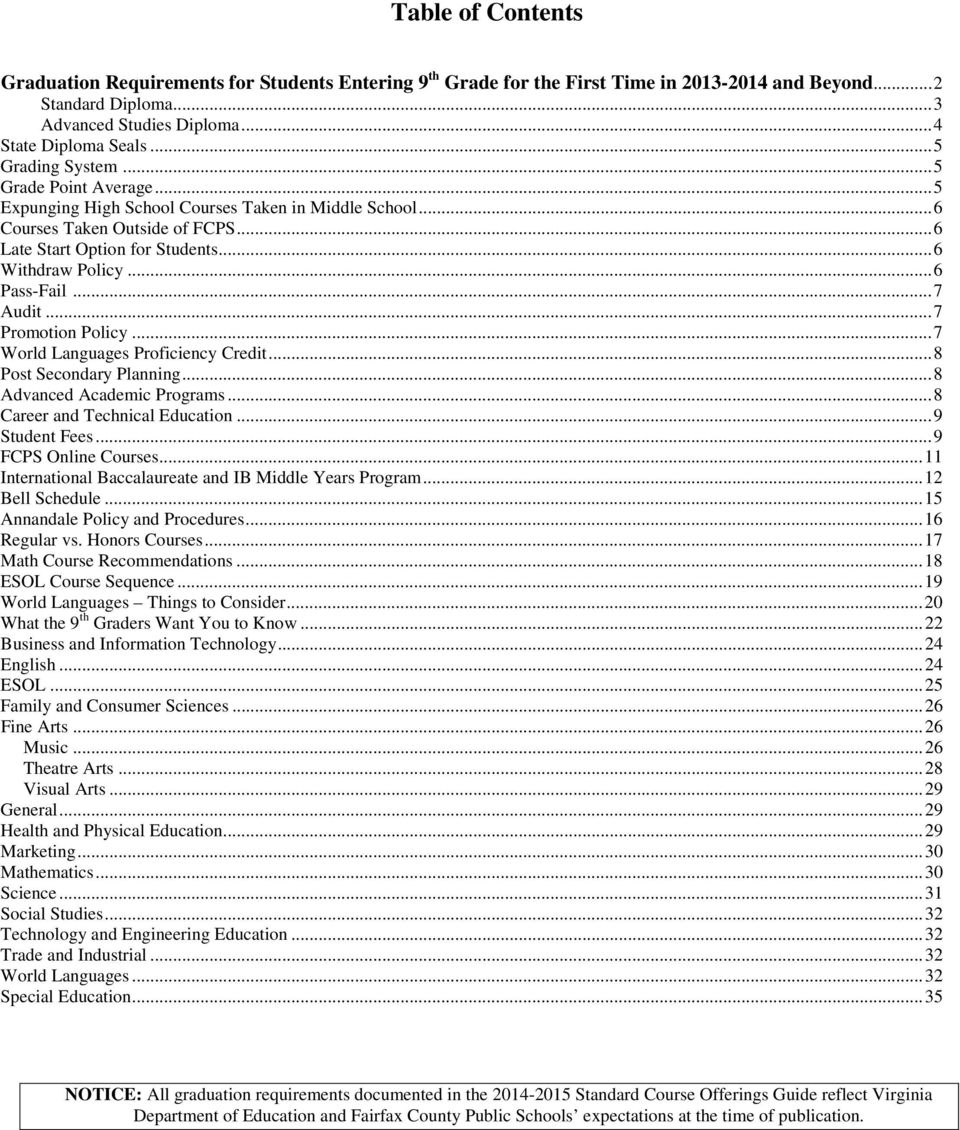
4 Graduation Requirements for Students Entering the 9 th Grade for the First Time in and Beyond For more information, please visit which includes more detailed information and tutorials about diploma types and graduation requirements. 2

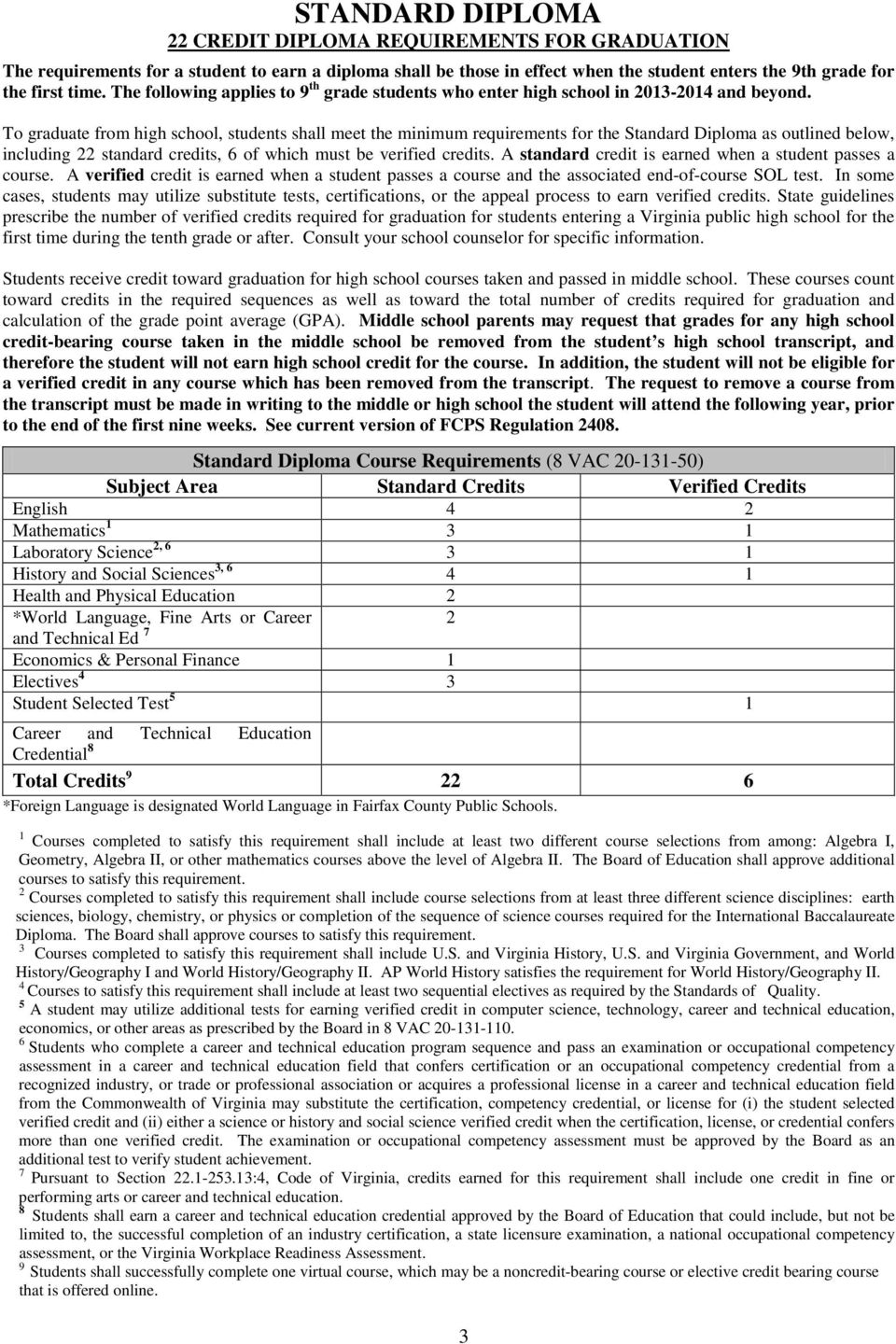
5 STANDARD DIPLOMA 22 CREDIT DIPLOMA REQUIREMENTS FOR GRADUATION The requirements for a student to earn a diploma shall be those in effect when the student enters the 9th grade for the first time. The following applies to 9 th grade students who enter high school in and beyond. To graduate from high school, students shall meet the minimum requirements for the Standard Diploma as outlined below, including 22 standard credits, 6 of which must be verified credits. A standard credit is earned when a student passes a course. A verified credit is earned when a student passes a course and the associated end-of-course SOL test. In some cases, students may utilize substitute tests, certifications, or the appeal process to earn verified credits. State guidelines prescribe the number of verified credits required for graduation for students entering a Virginia public high school for the first time during the tenth grade or after. Consult your school counselor for specific information. Students receive credit toward graduation for high school courses taken and passed in middle school. These courses count toward credits in the required sequences as well as toward the total number of credits required for graduation and calculation of the grade point average (GPA). Middle school parents may request that grades for any high school credit-bearing course taken in the middle school be removed from the student s high school transcript, and therefore the student will not earn high school credit for the course. In addition, the student will not be eligible for a verified credit in any course which has been removed from the transcript. The request to remove a course from the transcript must be made in writing to the middle or high school the student will attend the following year, prior to the end of the first nine weeks. See current version of FCPS Regulation Standard Diploma Course Requirements (8 VAC ) Subject Area Standard Credits Verified Credits English 4 2 Mathematics Laboratory Science 2, History and Social Sciences 3, Health and Physical Education 2 *World Language, Fine Arts or Career 2 and Technical Ed 7 Economics & Personal Finance 1 Electives 4 3 Student Selected Test 5 1 Career and Technical Education Credential 8 Total Credits *Foreign Language is designated World Language in Fairfax County Public Schools. 1 Courses completed to satisfy this requirement shall include at least two different course selections from among: Algebra I, Geometry, Algebra II, or other mathematics courses above the level of Algebra II. The Board of Education shall approve additional courses to satisfy this requirement. 2 Courses completed to satisfy this requirement shall include course selections from at least three different science disciplines: earth sciences, biology, chemistry, or physics or completion of the sequence of science courses required for the International Baccalaureate Diploma. The Board shall approve courses to satisfy this requirement. 3 Courses completed to satisfy this requirement shall include U.S. and Virginia History, U.S. and Virginia Government, and World History/Geography I and World History/Geography II. AP World History satisfies the requirement for World History/Geography II. 4 Courses to satisfy this requirement shall include at least two sequential electives as required by the Standards of Quality. 5 A student may utilize additional tests for earning verified credit in computer science, technology, career and technical education, economics, or other areas as prescribed by the Board in 8 VAC Students who complete a career and technical education program sequence and pass an examination or occupational competency assessment in a career and technical education field that confers certification or an occupational competency credential from a recognized industry, or trade or professional association or acquires a professional license in a career and technical education field from the Commonwealth of Virginia may substitute the certification, competency credential, or license for (i) the student selected verified credit and (ii) either a science or history and social science verified credit when the certification, license, or credential confers more than one verified credit. The examination or occupational competency assessment must be approved by the Board as an additional test to verify student achievement. 7 Pursuant to Section :4, Code of Virginia, credits earned for this requirement shall include one credit in fine or performing arts or career and technical education. 8 Students shall earn a career and technical education credential approved by the Board of Education that could include, but not be limited to, the successful completion of an industry certification, a state licensure examination, a national occupational competency assessment, or the Virginia Workplace Readiness Assessment. 9 Students shall successfully complete one virtual course, which may be a noncredit-bearing course or elective credit bearing course that is offered online. 3
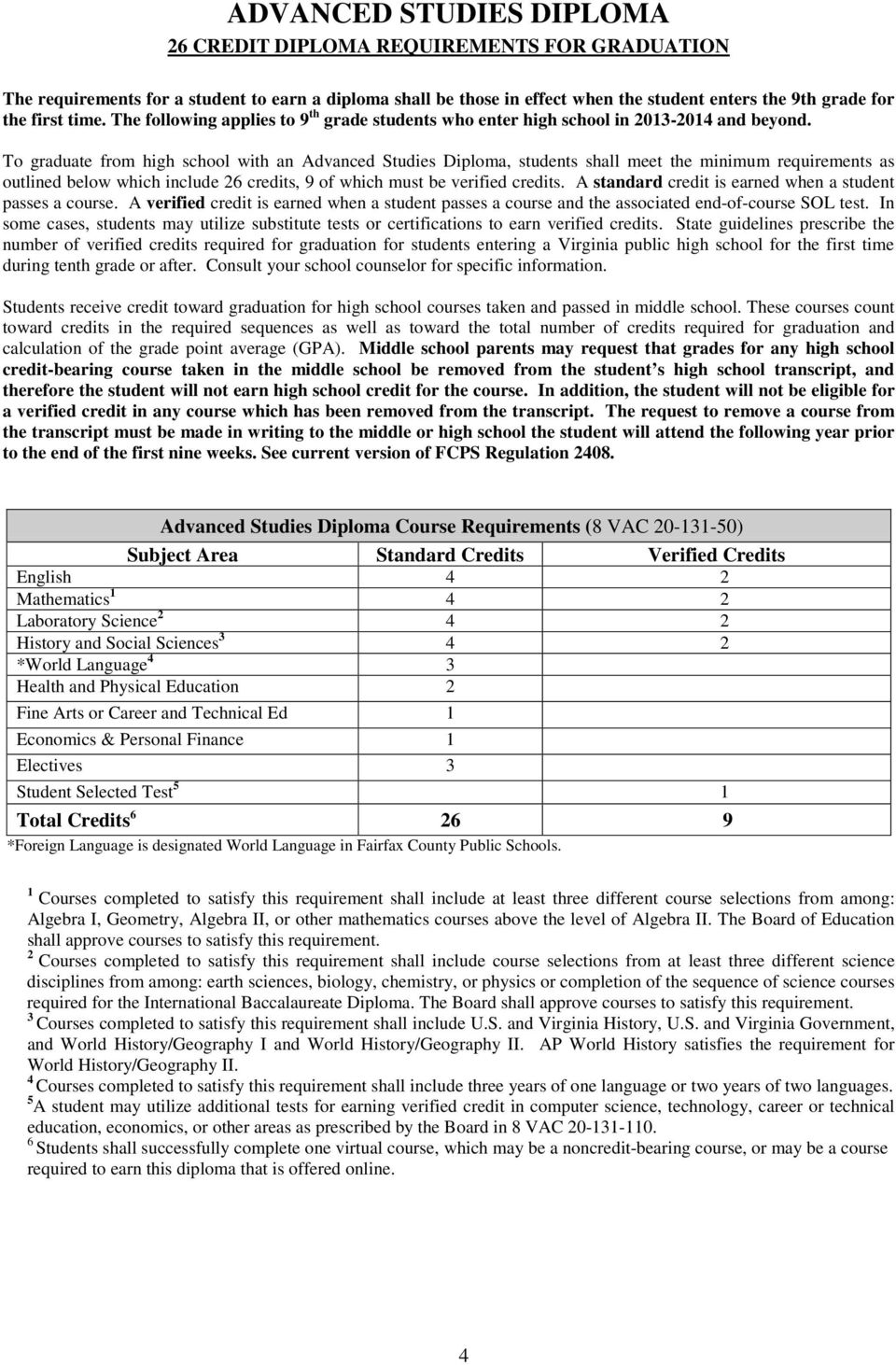
6 ADVANCED STUDIES DIPLOMA 26 CREDIT DIPLOMA REQUIREMENTS FOR GRADUATION The requirements for a student to earn a diploma shall be those in effect when the student enters the 9th grade for the first time. The following applies to 9 th grade students who enter high school in and beyond. To graduate from high school with an Advanced Studies Diploma, students shall meet the minimum requirements as outlined below which include 26 credits, 9 of which must be verified credits. A standard credit is earned when a student passes a course. A verified credit is earned when a student passes a course and the associated end-of-course SOL test. In some cases, students may utilize substitute tests or certifications to earn verified credits. State guidelines prescribe the number of verified credits required for graduation for students entering a Virginia public high school for the first time during tenth grade or after. Consult your school counselor for specific information. Students receive credit toward graduation for high school courses taken and passed in middle school. These courses count toward credits in the required sequences as well as toward the total number of credits required for graduation and calculation of the grade point average (GPA). Middle school parents may request that grades for any high school credit-bearing course taken in the middle school be removed from the student s high school transcript, and therefore the student will not earn high school credit for the course. In addition, the student will not be eligible for a verified credit in any course which has been removed from the transcript. The request to remove a course from the transcript must be made in writing to the middle or high school the student will attend the following year prior to the end of the first nine weeks. See current version of FCPS Regulation Advanced Studies Diploma Course Requirements (8 VAC ) Subject Area Standard Credits Verified Credits English 4 2 Mathematics Laboratory Science History and Social Sciences *World Language 4 3 Health and Physical Education 2 Fine Arts or Career and Technical Ed 1 Economics & Personal Finance 1 Electives 3 Student Selected Test 5 1 Total Credits *Foreign Language is designated World Language in Fairfax County Public Schools. 1 Courses completed to satisfy this requirement shall include at least three different course selections from among: Algebra I, Geometry, Algebra II, or other mathematics courses above the level of Algebra II. The Board of Education shall approve courses to satisfy this requirement. 2 Courses completed to satisfy this requirement shall include course selections from at least three different science disciplines from among: earth sciences, biology, chemistry, or physics or completion of the sequence of science courses required for the International Baccalaureate Diploma. The Board shall approve courses to satisfy this requirement. 3 Courses completed to satisfy this requirement shall include U.S. and Virginia History, U.S. and Virginia Government, and World History/Geography I and World History/Geography II. AP World History satisfies the requirement for World History/Geography II. 4 Courses completed to satisfy this requirement shall include three years of one language or two years of two languages. 5 A student may utilize additional tests for earning verified credit in computer science, technology, career or technical education, economics, or other areas as prescribed by the Board in 8 VAC Students shall successfully complete one virtual course, which may be a noncredit-bearing course, or may be a course required to earn this diploma that is offered online. 4
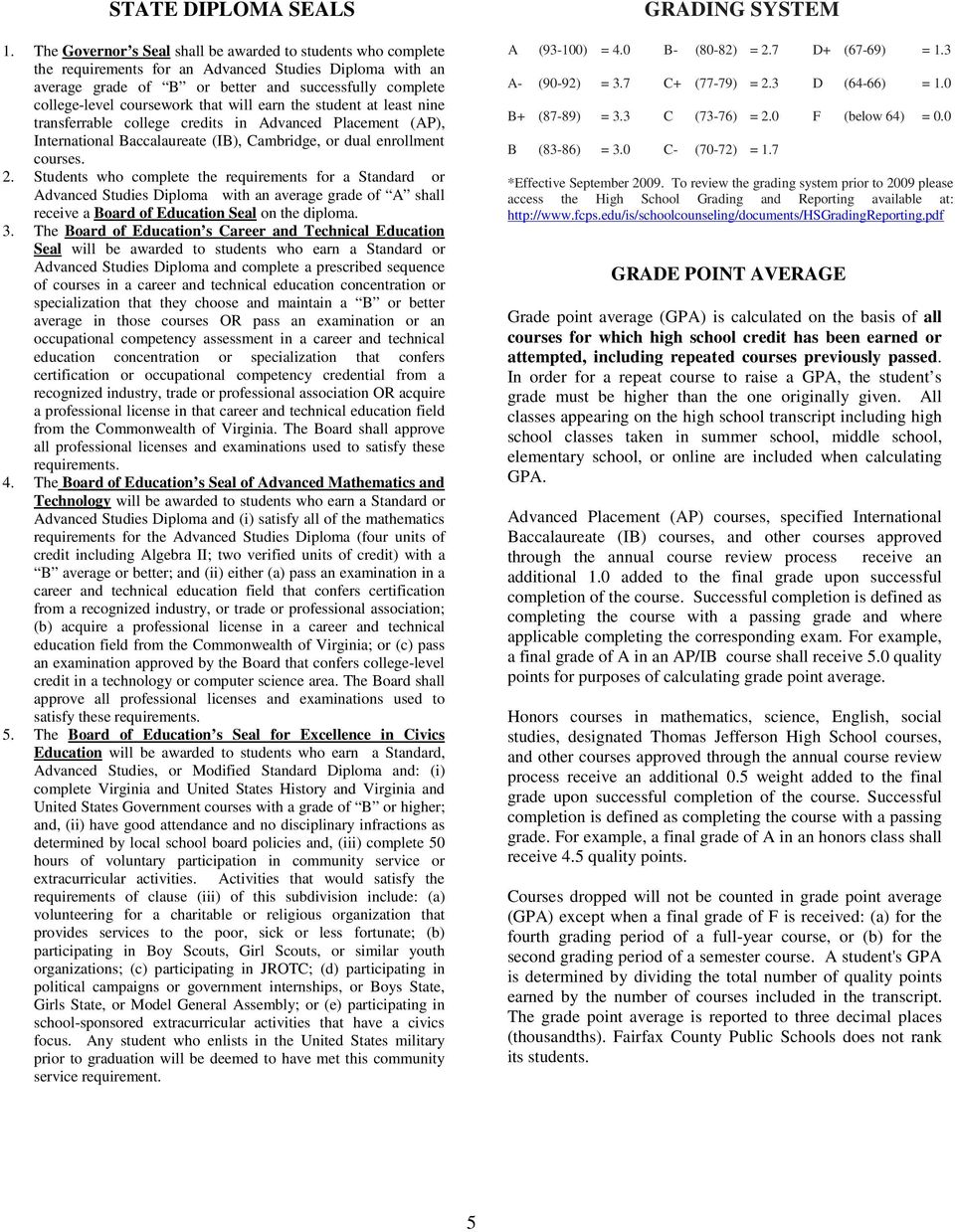
7 STATE DIPLOMA SEALS 1. The Governor s Seal shall be awarded to students who complete the requirements for an Advanced Studies Diploma with an average grade of B or better and successfully complete college-level coursework that will earn the student at least nine transferrable college credits in Advanced Placement (AP), International Baccalaureate (IB), Cambridge, or dual enrollment courses. 2. Students who complete the requirements for a Standard or Advanced Studies Diploma with an average grade of A shall receive a Board of Education Seal on the diploma. 3. The Board of Education s Career and Technical Education Seal will be awarded to students who earn a Standard or Advanced Studies Diploma and complete a prescribed sequence of courses in a career and technical education concentration or specialization that they choose and maintain a B or better average in those courses OR pass an examination or an occupational competency assessment in a career and technical education concentration or specialization that confers certification or occupational competency credential from a recognized industry, trade or professional association OR acquire a professional license in that career and technical education field from the Commonwealth of Virginia. The Board shall approve all professional licenses and examinations used to satisfy these requirements. 4. The Board of Education s Seal of Advanced Mathematics and Technology will be awarded to students who earn a Standard or Advanced Studies Diploma and (i) satisfy all of the mathematics requirements for the Advanced Studies Diploma (four units of credit including Algebra II; two verified units of credit) with a B average or better; and (ii) either (a) pass an examination in a career and technical education field that confers certification from a recognized industry, or trade or professional association; (b) acquire a professional license in a career and technical education field from the Commonwealth of Virginia; or (c) pass an examination approved by the Board that confers college-level credit in a technology or computer science area. The Board shall approve all professional licenses and examinations used to satisfy these requirements. 5. The Board of Education s Seal for Excellence in Civics Education will be awarded to students who earn a Standard, Advanced Studies, or Modified Standard Diploma and: (i) complete Virginia and United States History and Virginia and United States Government courses with a grade of B or higher; and, (ii) have good attendance and no disciplinary infractions as determined by local school board policies and, (iii) complete 50 hours of voluntary participation in community service or extracurricular activities. Activities that would satisfy the requirements of clause (iii) of this subdivision include: (a) volunteering for a charitable or religious organization that provides services to the poor, sick or less fortunate; (b) participating in Boy Scouts, Girl Scouts, or similar youth organizations; (c) participating in JROTC; (d) participating in political campaigns or government internships, or Boys State, Girls State, or Model General Assembly; or (e) participating in school-sponsored extracurricular activities that have a civics focus. Any student who enlists in the United States military prior to graduation will be deemed to have met this community service requirement. GRADING SYSTEM A (93-100) = 4.0 B- (80-82) = 2.7 D+ (67-69) = 1.3 A- (90-92) = 3.7 C+ (77-79) = 2.3 D (64-66) = 1.0 B+ (87-89) = 3.3 C (73-76) = 2.0 F (below 64) = 0.0 B (83-86) = 3.0 C- (70-72) = 1.7 *Effective September To review the grading system prior to 2009 please access the High School Grading and Reporting available at: GRADE POINT AVERAGE Grade point average (GPA) is calculated on the basis of all courses for which high school credit has been earned or attempted, including repeated courses previously passed. In order for a repeat course to raise a GPA, the student s grade must be higher than the one originally given. All classes appearing on the high school transcript including high school classes taken in summer school, middle school, elementary school, or online are included when calculating GPA. Advanced Placement (AP) courses, specified International Baccalaureate (IB) courses, and other courses approved through the annual course review process receive an additional 1.0 added to the final grade upon successful completion of the course. Successful completion is defined as completing the course with a passing grade and where applicable completing the corresponding exam. For example, a final grade of A in an AP/IB course shall receive 5.0 quality points for purposes of calculating grade point average. Honors courses in mathematics, science, English, social studies, designated Thomas Jefferson High School courses, and other courses approved through the annual course review process receive an additional 0.5 weight added to the final grade upon successful completion of the course. Successful completion is defined as completing the course with a passing grade. For example, a final grade of A in an honors class shall receive 4.5 quality points. Courses dropped will not be counted in grade point average (GPA) except when a final grade of F is received: (a) for the fourth grading period of a full-year course, or (b) for the second grading period of a semester course. A student's GPA is determined by dividing the total number of quality points earned by the number of courses included in the transcript. The grade point average is reported to three decimal places (thousandths). Fairfax County Public Schools does not rank its students. 5
8 EXPUNGING HIGH SCHOOL COURSES TAKEN IN MIDDLE SCHOOL In accordance with Virginia state regulations, FCPS Regulation 2408 permits parents of students who take a high school credit-bearing course in middle school to request that the grade be omitted from the student's high school transcript and the student not earn high school credit for the course. Parents must make this request in writing no later than the end of the first nine weeks of the school year following completion of the course. The form to make this request, along with the process for making the request, is available at: or through your student s school counselor. Parents are strongly advised to discuss this decision with their student s school counselor and the impact of expunging a course on desired high school diploma type and standard and verified credit requirements. COURSES TAKEN OUTSIDE OF FCPS WITHDRAW POLICY For the first grading period only, a student has five days after the date on which report cards are sent home in which to drop a course without having a grade recorded. Courses dropped are not counted in the grade point average except when an F is received for the course. Middle schools do not calculate gradepoint averages; however, if a high school credit course is taken by a middle school student, courses dropped are not counted in the high school grade-point average except when an F is received for the course. Unless the principal approves an exception, a student may not withdraw during the final quarter of a course if he or she is passing the course. If a student drops a course during the: 1st quarter 2nd quarter No penalty--nothing is recorded. WP (withdrawn passing) or WF (withdrawn failing) is recorded. Exception: For semester courses a WP or F for failure is recorded. Currently enrolled FCPS students who wish to take a course outside of FCPS and transfer back the credit must have written approval from their school prior to enrolling in the course. The course must meet the requirements outlined in the current version of FCPS regulation 2408 and Virginia state regulations. For additional information about pursing coursework outside of FCPS for credit, please contact your school counselor. 3rd quarter 4th quarter WP or WF is recorded. WP or F for failure is recorded. LATE START OPTION FOR STUDENTS Students may take up to two online courses that can be scheduled in the first block of the day to allow for additional time to sleep. Transportation arrangements for a student on this modified schedule are the responsibility of the family. Students who wish to pursue this option should indicate their intent at the time of course registration. LATE START OPTION FOR SENIORS Seniors who are on track to graduate may reduce their schedule by up to 2 periods in the first block to allow for additional time for sleep. Transportation arrangements for a student on this modified schedule are the responsibility of the family. Seniors considering this option should discuss possible implications for college admissions and Virginia High School League (VHSL) eligibility with their school counselor prior to reducing their schedule. Students who wish to pursue this option should indicate their intent at the time of course registration. Schools will attempt to honor all requests, however, scheduling conflicts may prohibit some students from accessing this option. 6

9 PASS-FAIL The Fairfax County School Board policy permits students to take certain courses on a pass-fail basis. With parental or guardian approval, any high school student shall be given the option of taking one elective credit per school year to be marked on a pass-fail basis. This may be applied to required health and physical education credits, world language credits, and to credits other than those required for English, social studies, mathematics, and laboratory science and specialized courses such as Principles of Engineering Technology and Senior Technology Research taught at Thomas Jefferson High School for Science and Technology. A double or triple-period class taken for two or three credits in the technical fields may be taken on a pass-fail basis as the one pass-fail course per year. No student may take more than two single semester electives or one full-year elective per school year on the pass-fail system except as indicated above. Any high school student wishing to take a course as pass-fail shall indicate this by completing a ''Pass-Fail Status Request Form'' requiring parent approval and returning it to designated school personnel on or before the 22nd school day or by the first half of the first grading period subsequent to entering the course. Students in schools using a semester block schedule must return the parent approval form to the designated school personnel on or before the 11th school day or by the first half of the first grading period subsequent to entering the course. This decision may not be reversed. If a student drops a class being taken on a pass-fail basis and transfers to a new class, the student shall have 10 school days to make a decision as to whether the new class will be taken on a pass-fail basis. Students in schools using a semester block schedule shall have 5 school days to make a decision as to whether the new class will be taken on a passfail basis, provided it is an elective course. This decision may not be reversed. Grades are determined as follows: - ''P'' for an A, A-, B+, B, B-,C+,C, C-, D+, D which will receive credit but will not count in grade-point average. - ''F'' for an F which will receive no credit but will be counted in grade-point average. AUDIT In special circumstances, students may be allowed to attend one course without receiving credit for it. The audit application must be completed, submitted, and approved prior to the beginning of the course. Students may audit a course one year and then take it for credit the next year. Students who audit a course must meet all attendance requirements and strive toward completion of POS standards, benchmarks, and indicators. The decision may not be reversed with the exception of ESOL students placed in a content class who may be changed from audit to credit status at the request of the content teacher and ESOL department chair if the student demonstrates mastery of the course content. PROMOTION POLICY Middle School To qualify for promotion, seventh and eighth grade middle school students must demonstrate knowledge and competency based upon identified standards of achievement in the four core areas of language arts, mathematics, science, and social studies. To guarantee promotion, students must demonstrate proficiency in the foundational knowledge and skills in each of the four core subject areas and earn a passing final grade based on grade level expectations. Students who earn an F as a final grade in one or two core subjects are retained, at the discretion of the principal, and encouraged to participate in an intervention program. Based upon the extent to which a student demonstrates knowledge and competency of identified standards of achievement in an intervention program, he/she is promoted or retained. Students who are promoted may receive continued intervention throughout the following school year. If students do not participate in an intervention program, they are retained at the discretion of the principal. Students who earn an F in three or four core courses are retained, at the discretion of the principal. High School The minimum requirements for placement in high school grades are as follows: To be placed in grade: The student must: 9 Be promoted from 8th grade 10 Be promoted from 9 th grade and have earned at least 5 standard units of credit. 11 Have earned at least 10 standard units of credit. 12 Have a planned program providing sufficient credits to ensure graduation the following June or August. 7

10 WORLD LANGUAGES PROFICIENCY CREDIT The Credit Exam for World Languages is given each fall to students who wish to demonstrate written proficiency in one of several languages: American Sign Language, Amharic, Arabic, Bengali/Bangla, Chinese/Mandarin, Farsi/Persian, French, German, Hindi, Italian, Japanese, Korean, Nepali, Punjabi, Russian, Somali, Spanish, Tagalog/Pilipino, Tamil, Telugu, Twi, Urdu, or Vietnamese. Students who are successful on the exam receive two world languages credits which may be used to fulfill the world languages requirements/electives of the Advanced Studies or Standard Diplomas. In addition, middle school students in grades 6-8 enrolled in certain ESOL courses may receive up to two world languages credits towards high school graduation requirements in the two-plus-two option for fulfilling the world languages requirement. High school students enrolled in ESOL 5720 courses may receive elective or up to two world languages credits toward high school graduation requirements in the two-plus-two option for fulfilling the world languages requirement. For more information on the exam, go to: or contact the World Languages Team at POSTSECONDARY PLANNING Each high school in Fairfax County Public Schools provides a sequential postsecondary planning program that focuses on the acquisition of knowledge, skills, and self-understanding necessary to achieve postsecondary goals. Students are counseled regarding opportunities for postsecondary education, financial aid and employment prior to high school graduation. The program includes career planning that assists students in developing good decision-making skills, an understanding of their interests and abilities, and knowledge of the wide range of career opportunities. To assist in the process, information and resources are provided through the school counseling program at your school and are available online. Additionally, each high school has a staffed Career Center with current college and career resource materials. ADVANCED ACADEMIC PROGRAMS Advanced Academic Programs at the high school level are comprised of honors courses at the 9 th through 12 th grade levels, and the Advanced Placement (AP) program at the 10 th, 11 th, and 12 th grade levels or the International Baccalaureate Diploma Program (IBDP) at the11 th, and 12 th grade levels. Advanced Academic Programs are open to all students committed to rigorous academic work. Student transfer applications may be submitted for an AP or IB program if the base school does not offer the desired program of study. For more information on the program please visit the web site at AP and IB courses are advanced-level courses with external exams. Students who take AP and IB courses are required to complete the examinations. (For more information, see Grade Point Average.) The Advanced Academic program responds to the requirement of the Virginia Board of Education that each local school division plan and implement an instructional program for gifted and talented students at all levels K-12. Courses designated as honors, IB or AP fulfill this requirement. The Fairfax County Public Schools' high school advanced academic program provides educational opportunities designed and coordinated to meet the needs, abilities, and interests of gifted and talented students. The high school advanced academic program provides challenging courses for students who demonstrate advanced academic ability. Differentiated curricula and teaching strategies which stress critical thinking skills, creativity, and problem-solving are integrated into the content of all advanced academic course offerings. The four-year sequence of courses in each of the academic disciplines, which progresses from honors to AP, and IB, provides a continuous and balanced advanced academic program. Advanced Placement Centreville, Chantilly, Fairfax, Falls Church, Hayfield, Herndon, Lake Braddock, Langley, Madison, McLean, Oakton, South County, West Potomac, West Springfield, Westfield, and Woodson High Schools offer the Advanced Placement (AP) program. Individual AP courses are also offered at other high schools. All students enrolled in an AP course are required to complete the end-of-course AP exam. Students may receive college credit and/or placement based upon their exam grades. The AP program is offered in English, social studies, mathematics, science, world languages, and fine arts. AP courses are offered as open enrollment to all students committed to rigorous, academic work. Students taking at least 3 AP exams with at least a grade of 3 on each are recognized by the College Board as AP Scholars. Further information about the AP program may be obtained by contacting the school counselor or AP coordinator at the participating school. 8

11 International Baccalaureate Annandale, Edison, Lee, Marshall, Mount Vernon, Robinson, South Lakes, and Stuart High Schools offer the International Baccalaureate Diploma Program (IBDP). To qualify for the IB Diploma, students must select at least one subject from each of six IB subject groups including English, world languages, mathematics, science, social studies, and an elective. Students take at least 3 and not more than 4 of these subjects at higher level (HL), the others at standard level (SL). All students enrolled in an IB course are required to complete the end-ofcourse IB exams. IB diploma candidates must complete 150 hours of extracurricular activities and community service, take the Theory of Knowledge course, and write a 4000 word essay on a topic of their choice. Students in IB schools may also take IB courses in areas of academic strength and interest. IB diploma course students take one or more IB courses and the associated exam(s) and receive recognition for each IB exam with a score of 4 or better. Annandale, Lee, Mount Vernon, South Lakes, and Stuart offer the IB Career-related Certificate (IBCC). To qualify for the IBCC students must complete a 2-year CTE sequence, 2 IBDP courses and demonstrate world language development. IBCC candidates must also complete community service, take the Approaches to Learning course, and complete a reflective project related to their CTE course of study. The IB program is offered in English, social studies, mathematics, science, world languages, fine arts, and other electives. IB courses are offered as open enrollment to all students committed to rigorous, academic work. Further information about the IB program may be obtained by contacting the school counselor or IB coordinator at the participating school. Annandale, Edison, Lee,Mount Vernon, Robinson, South Lakes, and Stuart High Schools implement the IB Middle Years Program (IBMYP) in 9 th and 10 th grade. Students may choose to work toward the MYP certificate which requires the completion of a personal project at the end of 10 th grade and success on the MYP 10 th grade assessments. Thomas Jefferson High School For Science And Technology The Thomas Jefferson High School for Science and Technology is a unique Fairfax County public school offering a comprehensive college preparatory program emphasizing the sciences, mathematics, and technology. As the Governor s School for Science and Technology in Northern Virginia, the school serves students who are selected in a competitive process and intend to pursue college preparation in the sciences, engineering, or related fields. Students may obtain information about application procedures and deadlines from the School Counseling Office of their local schools or by calling Thomas Jefferson High School for Science and Technology Office of Admissions at or at: CAREER AND TECHNICAL EDUCATION Course descriptions for Career and Technical Education (CTE) courses can be found under Business and Information Technology, Family and Consumer Sciences, Health and Medical Sciences, Marketing, Technology and Engineering Education, and Trade and Industrial in sections of the Standard Course Offerings guide. School counselors can provide further information on specialized courses available at the following locations: Chantilly, Edison, Fairfax, Falls Church, Marshall, and West Potomac High School Academies, as well as at Tysons Corner Center, Fair Oaks Shopping Center, Spring Village Residential Construction Site, and the Fairfax County School of Practical Nursing located at the Plum Center for Lifelong Learning. Please visit the CTE web site at FCPS now offers students opportunities at four Governor s Academies. Chantilly and Marshall Governor s STEM Academies specialize in engineering and information technology. Falls Church and West Potomac Governor s Health Sciences Academies focus on five pathways in the area of health care. Fairfax County Public Schools (FCPS) has established articulation agreements with the Art Institutes of Miami, Philadelphia, and Washington, The Culinary Institute of America, George Mason University, James Madison University, Johnson & Wales University, and Stratford University that allow students to take certain career and technical education classes in high school and receive advanced placement credit. In addition, FCPS has dual enrollment agreements with Northern Virginia Community College (NVCC) and Shennandoah University whereby students can earn college credits for select career and technical education classes. STUDENT FEES Courses that require a student fee for consumable materials have been designated in this catalog. The schedule of divisionwide student fees to be charged for any elective course can be found in Notice 5922 at id=b1cc2edfd153a e00545aa9. Students eligible for the federal Free and Reduced-Price meals program may have course and test fees waived. For more information, see your school counselor. 9

12 Notes: 10

13 FCPS ONLINE COURSES FCPS Online Campus is a program designed to provide students with an online option for earning credits toward high school graduation. This program supports the Governor s Early College Scholars program by providing advanced courses to students. Students registered in any Fairfax County Public School or alternative high school are eligible to apply to take a course through the FCPS Online Campus. These courses are for students who have scheduling conflicts or have special needs requiring web-based instruction. Additionally, students may take up to two online courses that can be scheduled in the first block to allow for additional time for sleep. Students who wish to pursue this option should indicate that at the time of course registration. Tuition will be charged when a student is already scheduled to receive seven credits during the academic year or when a student enrolls in an FCPS online summer course. Students must meet all regular eligibility requirements to enroll in an FCPS online course. Students interested in enrolling in an FCPS Online Campus course should consult their school counselor for information regarding the registration process. For more information go to The following courses are currently available online: Algebra Biology 1 Advanced Accounting Algebra 1 Honors Biology 1 Honors Economics and Personal Finance Geometry Chemistry 1 Geometry Honors Chemistry 1 Honors Spanish 1 Algebra 2 Physics 1 Spanish 2 Algebra 2 Honors Physics 1 Honors Spanish 3 Trigonometry Geosystems AP Spanish Language Precalculus Oceanography AP Spanish Literature AP Calculus AB World History & Geography 1 AP Statistics World History& Geography 1 Honors Korean 1 Creative Writing 1 World History & Geography 2 Korean 2 Creative Writing 2 World History & Geography 2 Honors Korean 3 English 9 VA & US History English 9 Honors VA & US History Honors Physical Education 9 English 10 VA/U.S. Government Physical Education 10 English 10 Honors English 11 English 11 Honors English 12 English 12 Honors AP English Language AP English Literature VA/U.S. Government Honors AP U.S. Government AP Microeconomics AP Macroeconomics Psychology AP Psychology AP US History 11

14 INTERNATIONAL BACCALAUREATE The International Baccalaureate (IB) offers high quality programs of international education to a worldwide community of schools including Fairfax County Public Schools. At the heart of the IB mission is the creation of a better world through education. The IB consists of three programs of international education for students ages 3 to 19. Annandale High School offers two of the programs the Middle Years Program for grades 6 through 10 and the Diploma Program for students in grades 11 and 12. The International Baccalaureate Mission The International Baccalaureate aims to develop inquiring, knowledgeable and caring young people who help to create a better and more peaceful world through intercultural understanding and respect. To this end the organization works with schools, governments and international organizations to develop challenging programs of international education and rigorous assessment. These programs encourage students across the world to become active, compassionate and lifelong learners who understand that other people, with their differences, can also be right. IB Learner Profile The aim of the IB program is to develop internationally minded people who, recognizing their common humanity and shared guardianship of the planet help to create a better and more peaceful world. IB learners strive to be: Inquirers Knowledgeable Thinkers Communicators Principled Open-minded Caring Risk-takers Balanced Reflective More information is available at IB Middle Years Program in 9 th & 10 th Grade Annandale High School, in partnership with Holmes and Poe Middle Schools, offers the International Baccalaureate Middle Years Program (MYP) to all students in grades six through ten. The MYP offers a high quality education at an international level that connects the curricula of different subjects through thematic Areas of Interaction. The MYP subjects studied in 9 th and 10 th grade include: Language A (English) Language B (World Languages) Humanities (History or Government) Science Physical Education Math Optional - Technology (Design Cycle) Optional - Arts (Performing or Visual) The MYP offers students an opportunity for a global education, preparing them to become active world citizens. FCPS MYP Certificate Students who successfully complete all of the following requirements are eligible for an MYP Certificate at the end of 10 th grade. Attain minimum achievement levels in Language A, Language B, Humanities, Science, PE and Math in 9 th and 10 th grade Complete 25 hours of community service both in 9 th and 10 th grades Complete two concurrent levels of a world language in 9 th and 10 th grades Complete and attain minimum achievement levels on the Personal Project IB Diploma Program in 11 th and 12 th Grade The International Baccalaureate Diploma Program (IBDP) is an internationally recognized program of studies offered to highly motivated 11 th and 12 th grade students. This program provides the academic rigor, structure, and experiences for students looking for the highest degree of academic challenge in preparation for university study. The IBDP is a two-year program of studies across disciplines with multiple components. Students complete courses, assessments and examinations in six different areas. IB teaches one how to think analytically and critically, exactly what they expect in college. -AHS IB Diploma Graduate, College of William and Mary Class of

15 Projected AHS IB Diploma Courses Group 1 Language A: the student s first language or the language of the school English HL or SL IB English for ESOL Group 2 Language B: the student s second or classroom-learned language French B HL or SL Spanish B HL or SL Latin SL Language A1: for students with near-native fluency Spanish A1 HL or SL Group 3 Individuals and Societies History of the Americas (11 th grade) IB Topics in 20 th Century History (12 th grade) Geography SL Group 4 Experimental Sciences Biology HL or SL Chemistry HL or SL Physics HL or SL Design Technology SL Environmental Systems SL Group 5 Mathematics Higher Level Mathematics Standard Level Mathematics Math Studies SL Group 6 Arts and Electives Visual Arts HL or SL Music HL or SL Theater HL or SL Computer Science HL or SL Film HL or SL Psychology SL Anthropology SL Business Management HL or SL In addition, IB Diploma students must meet three additional core requirements: Demonstration of 8 learning outcomes in the areas of Creativity, Action, Service (CAS) Successful completion of Theory of Knowledge seminar and assessments (class taken Spring Junior Year and Fall of Senior Year) Writing and submitting a satisfactory Extended Essay under the supervision of a mentor teacher The International Baccalaureate Organization in Geneva, Switzerland, awards an IB Diploma to students who complete all of the required components and earn a total of at least 24 out of a possible 45 points. The IB MYP and the IB Diploma MYP is excellent preparation for the IB Diploma. Within the MYP at Annandale, honors classes are available for highly motivated students in the four core subject areas. Freshman and sophomores planning to take IB Diploma courses are not required or expected to take all four honors classes each year. Annandale High School students have the opportunity to participate in a wide-range of programs and courses that meet their individual needs and interests. In considering one s choice of pathways through IB, students and parents should work with the student s counselor and IB coordinator to plan a schedule that is appropriately challenging and matches the student s abilities, interests and goals. Suggested Courses for FCPS IB MYP Certificate Freshman Year Honors English 9 or English 9 French 2 or Spanish 2 or Latin 2 or Arabic 2 Honors World History2/Geo. or World History & Geo. 1 Honors Biology, Biology, Honors Chemistry or Chemistry 1 Honors Geometry, Geometry, or Algebra 2/Trig. Health and PE 9 Sophomore Year Honors English 10, or English 10 French 3 or Spanish 3 or Latin 3 or Arabic 3 Honors VA/Government or World History & Geography 2 Honors Chemistry, Chemistry, Honors Physics, Physics Geometry, Honors Geo., Alg. 2/Trig. or Honors Alg. 2/Trig. Health and PE 10 NOTE: Other world language options are available for students with native fluency or immersion experiences. In Math, students must finish at least Algebra 1, Geometry and Algebra 2 to enter DP classes for 11 th and 12th Students at AHS are encouraged to complete the requirements to earn the IB Diploma but may elect to take individual IB DP courses and earn an IB Certificate for those courses. To enroll in IB courses students must have at least a grade of B in the prior course and be firmly committed to pursuing the highest level of academic challenge. Students considering an IB Diploma must work with the IB Coordinator and the counselor to plan a 4-year sequence which considers individual interests, abilities and goals while meeting the requirements for graduation, the IB Diploma, and college admission. Taking IB Diploma courses is excellent preparation for college. Students who take IB courses are admitted to college at higher rates than non-ib students, are better prepared for college and have a higher rate of college completion than their non-ib counterparts. 13

16 Subjects IB MYP 9 th grade courses Language A (English) English 9 Honors English 9 Language B (World Languages) Humanities (Social Studies) Science Mathematics Electives MYP Students- Must take one fine/performing art class either 9 th or 10 th. Technology is now embedded in core classes, but a student may still opt to take a Technology elective. DP Students- Must take one IB elective or a second IB language, or IB Social Studies or IB Science for both 11 th and 12 grades. Theory of Knowledge (TOK) class is required for all DP students. TOK is usually offered Spring of Jr. Year/ Fall of Sr. Year. French 2 Spanish 2 Latin 1 or 2 Spanish Fluent Skrs 2 World His/Geo 2 HN Biology Biology HN Chemistry Chemistry HN Geometry Geometry HN Algebra 2 Algebra 2 HN Fine/Performing Arts: Studio Art & Design 1 Photography 1 Ceramics Computer Graphics 1 Theatre 1 Journalism 1 Band Chorus Orchestra Guitar Technology: Basic Tech Drawing Design & Technology Electronics PE- Required all 9th IB MYP 10 th grade courses English 10 Honors English 10 French 3 Spanish 3 Latin 2 or 3 Span Fluent Skrs 3 US VA Government HN Chemistry Chemistry HN Physics Physics HN Biology Biology HN Algebra 2 Algebra 2 HN Pre-calculus Pre-calculus HN Fine/Performing Arts: Studio Art & Design 1/2 Photography 1/2 Ceramics Computer Graphics 1/2 Theatre1/ 2 Journalism 1/2 Band Chorus Orchestra Guitar Photojournalism Technology: Basic Tech Drawing Design & Technology Electronics PE-Required all 10th Annandale High School Planning an IB Diploma Sequence IB DP 11 th grade courses IB English I IB French I IB Spanish I IB Latin I IB Spanish A1 I IB History of the Americas IB Geography SL (1 year) IB Physics I or IB Physics SL II (w/ Physics Honors) IB Biology I (One year) IB Biology SL I IB Chemistry I or IB Chem SL II (w/ Chem Honors) IB Environmental Syst. SL IB Math Studies Part 1 IB Mathematics SL I IB Mathematics HL I 14 IB English SL II IB French SL II IB Spanish SL II IB Latin SL II IB Spanish A1 SL II IB Topics in 20 th Cent. SL IB Geography SL (1 year) IB Physics SL II IB Biology SL II IB Chemistry SL II IB Environ.Systems SL IB Math Studies Part 2 IB Mathematics SL II IB DP 12 th grade courses IB English HL II IB French HL II IB Spanish HL II IB Latin HL II IB Spanish A1 HL II IB Topics in 20 th Cent. HL IB Physics HL II IB Biology HL II IB Chemistry HL II IB Mathematics HL II Two Year Electives: IB Visual Arts SL I IB Visual Arts SL II IB Visual Arts HL I IB Visual Arts HL II IB Theatre Arts SL IB Theatre Arts HL II IB Film SL I IB Film SL II IB Film HL I IB Film HL II IB Computer Sci. SL IB Computer Sci. HL II IB Bus. Management SL IB Bus. Management HL II One Year Electives IB Psychology IB Anthropology IB Design Tech IB Environmental Systems IB Geography IB Business Management IB Computer Science IB Film (Senior Year only) IB Music To earn an IB Diploma you must take IB courses and exams in each of the six areas (Language A, Language B, Science, Social Studies, Math & Elective), normally three at the higher level and three at the standard level during your junior and senior years. Students may opt for a more rigorous course load and take four higher level and two standard level classes to meet the requirement. All higher level courses and many of the standard level courses are two-year courses taken during both the junior and senior years. Some of the standard level courses are one-year courses and may be taken during either junior or senior year. Juniors may take one or two standard level IB exams as part of their IB Diploma requirements. The rest of the standard level IB exams and all Higher Level exams must be taken at the end of the senior year. Theory of Knowledge is a required course for all diploma candidates. Students must also fulfill the Creativity, Action and Service requirement and write an extended essay. To earn an IB Diploma it is important for you to work with the IB coordinator and your counselor as you plan your schedule to be sure you meet all of the requirements for graduation, for college admissions, and for the IB Diploma.

17 ANNANDALE S SCHEDULE Red Day R 1 White Day W 2 7:20 8:46 R 3 8:53 10:21 R 5 & Lunch 7:20 8:46 W 4/Learning Seminar 8:53 9:23 Atom Time 9:30 10:21 W 6 & Lunch 10:28 12:27 (your lunch period will be determined by the class you have this period) R 7 10:28 12:27 (your lunch period will be determined by the class you have this period) W 8 12:34 2:00 12:34 2:00 15

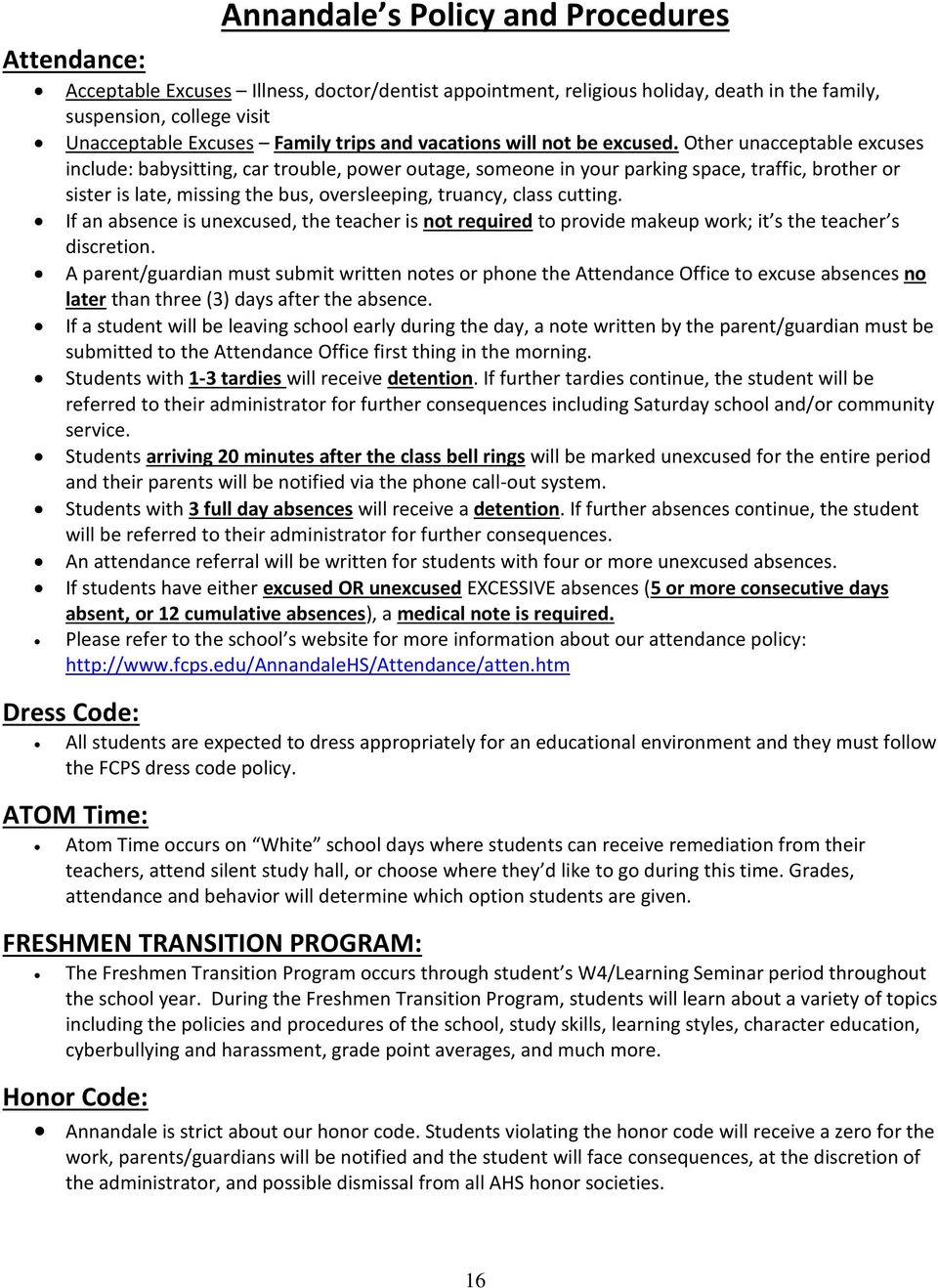
18 Annandale s Policy and Procedures Attendance: Acceptable Excuses Illness, doctor/dentist appointment, religious holiday, death in the family, suspension, college visit Unacceptable Excuses Family trips and vacations will not be excused. Other unacceptable excuses include: babysitting, car trouble, power outage, someone in your parking space, traffic, brother or sister is late, missing the bus, oversleeping, truancy, class cutting. If an absence is unexcused, the teacher is not required to provide makeup work; it s the teacher s discretion. A parent/guardian must submit written notes or phone the Attendance Office to excuse absences no later than three (3) days after the absence. If a student will be leaving school early during the day, a note written by the parent/guardian must be submitted to the Attendance Office first thing in the morning. Students with 1-3 tardies will receive detention. If further tardies continue, the student will be referred to their administrator for further consequences including Saturday school and/or community service. Students arriving 20 minutes after the class bell rings will be marked unexcused for the entire period and their parents will be notified via the phone call-out system. Students with 3 full day absences will receive a detention. If further absences continue, the student will be referred to their administrator for further consequences. An attendance referral will be written for students with four or more unexcused absences. If students have either excused OR unexcused EXCESSIVE absences (5 or more consecutive days absent, or 12 cumulative absences), a medical note is required. Please refer to the school s website for more information about our attendance policy: Dress Code: All students are expected to dress appropriately for an educational environment and they must follow the FCPS dress code policy. ATOM Time: Atom Time occurs on White school days where students can receive remediation from their teachers, attend silent study hall, or choose where they d like to go during this time. Grades, attendance and behavior will determine which option students are given. FRESHMEN TRANSITION PROGRAM: The Freshmen Transition Program occurs through student s W4/Learning Seminar period throughout the school year. During the Freshmen Transition Program, students will learn about a variety of topics including the policies and procedures of the school, study skills, learning styles, character education, cyberbullying and harassment, grade point averages, and much more. Honor Code: Annandale is strict about our honor code. Students violating the honor code will receive a zero for the work, parents/guardians will be notified and the student will face consequences, at the discretion of the administrator, and possible dismissal from all AHS honor societies. 16
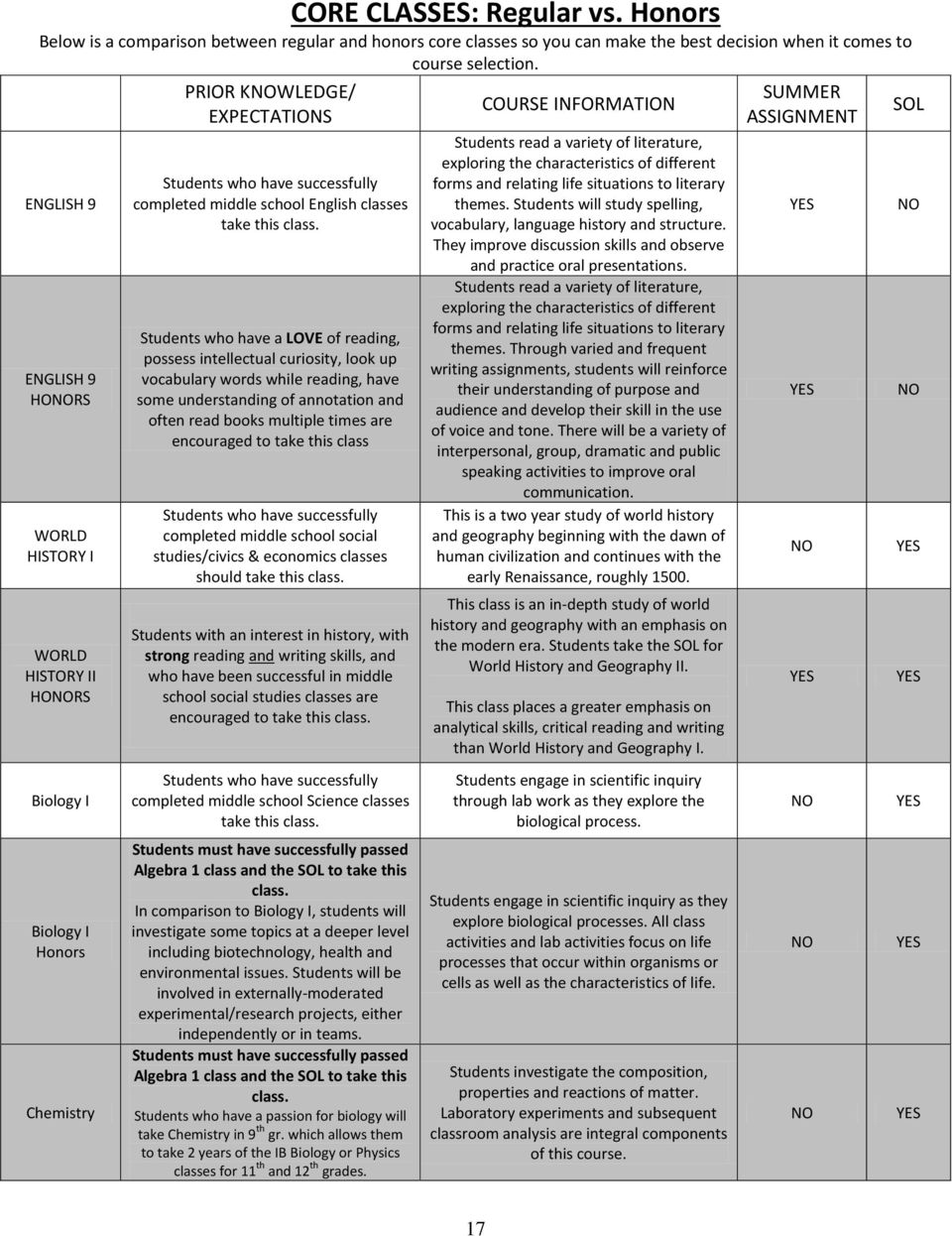
19 CORE CLASSES: Regular vs. Honors Below is a comparison between regular and honors core classes so you can make the best decision when it comes to course selection. ENGLISH 9 ENGLISH 9 HONORS WORLD HISTORY I WORLD HISTORY II HONORS PRIOR KNOWLEDGE/ EXPECTATIONS Students who have successfully completed middle school English classes take this class. Students who have a LOVE of reading, possess intellectual curiosity, look up vocabulary words while reading, have some understanding of annotation and often read books multiple times are encouraged to take this class Students who have successfully completed middle school social studies/civics & economics classes should take this class. Students with an interest in history, with strong reading and writing skills, and who have been successful in middle school social studies classes are encouraged to take this class. COURSE INFORMATION Students read a variety of literature, exploring the characteristics of different forms and relating life situations to literary themes. Students will study spelling, vocabulary, language history and structure. They improve discussion skills and observe and practice oral presentations. Students read a variety of literature, exploring the characteristics of different forms and relating life situations to literary themes. Through varied and frequent writing assignments, students will reinforce their understanding of purpose and audience and develop their skill in the use of voice and tone. There will be a variety of interpersonal, group, dramatic and public speaking activities to improve oral communication. This is a two year study of world history and geography beginning with the dawn of human civilization and continues with the early Renaissance, roughly This class is an in-depth study of world history and geography with an emphasis on the modern era. Students take the SOL for World History and Geography II. This class places a greater emphasis on analytical skills, critical reading and writing than World History and Geography I. SUMMER ASSIGNMENT YES YES NO YES SOL NO NO YES YES Biology I Students who have successfully completed middle school Science classes take this class. Students engage in scientific inquiry through lab work as they explore the biological process. NO YES Biology I Honors Chemistry Students must have successfully passed Algebra 1 class and the SOL to take this class. In comparison to Biology I, students will investigate some topics at a deeper level including biotechnology, health and environmental issues. Students will be involved in externally-moderated experimental/research projects, either independently or in teams. Students must have successfully passed Algebra 1 class and the SOL to take this class. Students who have a passion for biology will take Chemistry in 9 th gr. which allows them to take 2 years of the IB Biology or Physics classes for 11 th and 12 th grades. Students engage in scientific inquiry as they explore biological processes. All class activities and lab activities focus on life processes that occur within organisms or cells as well as the characteristics of life. Students investigate the composition, properties and reactions of matter. Laboratory experiments and subsequent classroom analysis are integral components of this course. NO NO YES YES 17
20 Freshmen Mathematics Course Recommendations: So Many Choices! ESOL STUDENTS: ESOL Math students will be placed by recommendation of their current teacher. 8 th GRADERS IN MATH 8: Math 8 students with a grade of A should take Honors Algebra I with teacher recommendation. Math 8 students with a B+ or B should take Algebra I. Math 8 students with a B or lower should take Algebra I Part I/Algebra I combined, which meets daily. It will be called Algebra I Plus. 8 TH GRADERS IN GEOMETRY: Honors Geometry students with an A or B+ AND a grade of A or B+ in Honors Algebra I or regular Algebra I should consider Honors Algebra II/Trig with teacher recommendation. Honors Geometry students with a grade of B through C AND a grade in Honors Algebra I or regular Algebra I of B, B- or C+ should take regular Algebra II. Honors Geometry students with a C through D should consider retaking Geometry to expunge this grade, replacing it with an improved course grade and building a better foundation of Geometry skills in order to do well in future math classes. Honors Geometry students with a grade of F must repeat Geometry in 9 th grade. 8 TH GRADERS IN ALGEBRA 1/ALGEBRA 1 HN: Regular Algebra I students should consider Honors Geometry if they earned an A or B+, with teacher recommendation. They should take regular Geometry if they earned a B or lower in regular Algebra I. If the grade was below a C+, students should consider repeating Algebra I to expunge this grade and to be better prepared for future math courses. If these students decide not to repeat Algebra I, they should take Geometry part I combined with Geometry, which will meet for 90 minutes daily and will be called Geometry Plus. CALCULATORS FOR MATH CLASS: The school will provide graphing calculators to students in Algebra I and II who do not have their own calculators. Parents/guardians and students will sign a calculator contract regarding their responsibility to replace a lost or damaged calculator and to replace batteries that no longer work during the school year. Algebra I Honors students with a grade of A or B+ should consider Honors Geometry with teacher recommendation. Algebra I Honors students with a grade of B, B- or C+ should take regular Geometry. Honors Algebra I students with a C or D should consider retaking Algebra I to expunge this grade, replacing it with an improved grade and building a better foundation of Algebra skills for future math classes. Algebra I or Honors Algebra I students with a grade of F must repeat the course or take Algebra I Plus in 9 th grade. MATH HOMEWORK: In planning for your child s high school schedule, please keep in mind that math classes usually have minutes of homework per class. Also, before selecting a math course, consider whether your student will have time to stay after school for help once or twice a week, if necessary, including honors courses. 18

21 ESOL Below is a chart of the course sequence that 9 th grade ESOL students will follow depending on their ESOL level: ESOL Level English Math History Science Health/ PE Electives ELP 1 (Entering) Students take 3 sections of English class Teachers recommend class placement Students take Concepts Social Studies Students take Concepts Science Students take Health/PE 9 Students do not have an elective class ELP 2 (Beginning) Students take 3 sections of English class Teachers recommend class placement Students take Concepts Social Studies Students take Concepts Science Students take Health/PE 9 Students do not have an elective class ELP 2/3 (Beg/Dev) Students take 3 sections of English class Teachers recommend class placement Students take Concepts Social Studies Students take Concepts Science Students take Health/PE 9 Students do not have an elective class ELP 3 (Developing) Students take 2 sections of English class Teachers recommend class placement Students take World Hist/Geog 1 ESOL/Adapted Students take Biology ESOL Adapted Students take Health/PE 9 Students will have one elective class ELP 4 (Advanced) Students take 2 ESOL English classes Teachers recommend class placement Students take World Hist/Geog 1 Students take Biology Students take Health/PE 9 Students will have one elective class 19
22 WORLD LANGUAGES THINGS TO CONSIDER Please use this information to make sure you re meeting the high school expectations for these Level 1 world language classes. FRENCH By the end of FRENCH 1, it is expected that you will have: Strong knowledge/control of: Some knowledge/control of: Limited knowledge/control of: Present test of er verbs Present tense of prendre, vouloir, Present tense of ir verbs, pouvoir Present tense of avoir, etre, faire and Imperative Present tense of re verbs aller Aller + infinitive Tu vs. vous Present tense of dormer, partir, sortir, and mettre Negative ne...pas with present tense Contractions with a and de Passé compose with avoir verbs Interrogative words (porquoi, ou, etc) Adjective agreement and placement Partitive articles and en Definite and indefinite articles. Demonstrative adjectives Si vs. oui Possessive adjectives Possession with de Questions with est-ce que and intonation Prepositions with names of cities and countries Placement of adverbs of frequency. LATIN By the end of LATIN 1, it is expected that you will have: Strong knowledge/control of: Some knowledge/control of: Limited knowledge/control of: Reading Latin text aloud using standard pronunciation Identifying noun/adjective agreement Identifying English terms transitive and intransitive verbs, voice, mood, phrase, clause Identifying parts of speech Identifying, producing and translating verbs Identifying and translating 3 rd declension adjectives Identifying subject and verb agreement, including subject pronouns ego, tu, nos, vos Identifying Roman numerals, , Producing and translating numbers, 1-10 Producing and translating personal endings (including perfect tense endings) Identifying and translating present, imperfect, and perfect indicative active tenses, regular verbs, all conjugations Identifying and translating present active infinitive, present imperatives, positive and negatives Identifying and translating ALL FOUR principal parts of verbs Identifying and translating present, imperfect, and perfect active indicative tenses of irregular vers sum, possum, volo, nolo, fero, eo Identifying and translating future active tense, all conjugations + irregulars Identifying and translating personal, reflexive, demonstrative, possessive pronouns/adjectives Identifying and translating subordinate clauses Identifying and translating pluperfect and future perfect active tenses, all conjugations, and irregular verbs 20
23 WORLD LANGUAGES THINGS TO CONSIDER (cont). SPANISH By the end of SPANISH 1, it is expected that you will have: Strong knowledge and control of: Some knowledge/control of: Limited knowledge/control of: Present tense of ar, -er, -ir verbs, Stem-changing verbis (o/u>ue, e>ie) Stem-changing verbs e>i Irregular verbs Tener que + infinitive Personal a Definite and indefinite articles Adjective/noun agreement Possessive adjectives (nuestro, su) Use of no. Possession with de Possessive adjectives (mi, tu) Interrogatives and question formation. If you are in Level 1 now and you choose to continue to the next level, yet feel you are behind in mastering these concepts, you may have to get a tutor and/or work with your Level 2 teacher next year to get caught up. Please note that there are websites available for online practice of Spanish and French. The websites are: Spanish = STARS - French = EIFFEL
24 What the 9 th Graders Want You to Know Do your homework ahead of time so that you re not up late at night finishing homework at the last minute. There is lots and lots of homework! You must pass Health/PE 9 and Health/PE 10 in order to graduate! Teachers don t baby you; you have to take of yourself. Try to get as many high school credits as you can in middle school because they re going to be much harder in high school. Most of the teachers here don t let you turn in late work. (This was said A LOT!!) Don t be shy; it will make it hard to make new friends. If you think middle school is hard then REALLY prepare for high school and get yourself together. You might not want to do sports in the first quarter because it s a lot to balance. Facebook/Twitter is your enemy and a waste of time. Do as many honors classes as possible and although it s a lot of work, it s worth it. Teachers don t care about multiple projects or tests on a day. Don t mess up your freshmen year. Eat breakfast. Join sports and clubs. If you join a sport, be ready to have 3 hour practices and not get home until very late. In 8 th grade there is less stress and less homework. If you re taking honors classes, make sure you do all of the projects and homework. Homework is long and takes a lot of time. Choose your classes wisely. 22
25 What the 9 th Graders Want You to Know (cont.) Do homework the day it s assigned, not the night before it s due. Have a good study environment. You have to get used to waking up early. Honors classes are hard. Teachers make you write 3-4 pages. Classes are harder than in 8 th grade. You have to realize your grades from now on are going to judge your future. World History 2 Honors is hard! Be on time to all classes! You have homework over vacations (summers too!). The tests are way harder than the 8 th grade tests. It s crowded. Traffic jams in the hallways happen all the time. You have to balance your work if you want to do sports. You can t be lazy. You can t spend most of your time out with your friends or on the computer or watching TV if you re not doing well in school. History class writes a lot of essays. Lunch depends on what class you have. Some classes have 200 point projects. Some teachers don t tell you what notes to write. You have to write them yourself. Participate in a fall sport so that you will know some people before you go to school and have someone to sit with at lunch. Fall sports start in the summer, a few weeks before school. (All of these statements came directly from students who were 8 th graders last year at Poe, Holmes, Glasgow, Frost or at a private school.) 23
26 BUSINESS & INFORMATION TECHNOLOGY ADVANCED INFORMATION SYSTEMS (661300) Prerequisite: Information Systems (661200), Computer Solutions (615030, 31, 32), Digital Input Technologies (660932) or equivalent skill Advanced Information Systems provides students with the opportunity to develop professional computer and technology skills in a project-oriented and student-centered environment. Working independently or in teams, students apply problem-solving, decision-making, creative-thinking, and communication skills to relevant, real-life situations through a series of software, the Microsoft IT Academy, and peripheral applications. Instruction in current and emerging information technology includes operating systems, networking and hardware principles, document preparation, presentation tools, spreadsheet analysis and charts preparation, relational database management, technical writing, desktop publishing, copyright issues, and basic web page design. Upon completion of this course, students will be able to apply technology to analyze and solve problems and to complete technology tasks efficiently and effectively. Upon successful completion of Advanced Information Systems, students may elect to obtain industry-recognized professional certification by taking the Microsoft Office Specialist (MOS) exams. The cooperative education (Business Cooperative Internship ) method is available for this course. Students combine classroom instruction and supervised on-the-job training in an approved position with continuing supervision throughout the school year. Industry certification may be available as part of this course. DESIGN, MULTIMEDIA, AND WEB TECHNOLOGIES (663000) Prerequisite: Information Systems (661200) or equivalent skill This product-oriented course introduces the student to multimedia presentations, desktop publications, and web page creation. Hands-on activities are used as students develop advanced skills for creating desktoppublished, interactive multimedia, and Web-site projects. Students work with sophisticated hardware and software, applying skills to real-world projects. Internet research and copyright laws are emphasized. Upon successful completion of Design Multimedia Web Technologies, students may elect to obtain industry-recognized professional certification by taking the Microsoft Office Specialist (MOS) or the Adobe Certified Expert (ACE) exams. The cooperative education (Business Cooperative Internship ) method is available for this course. Students combine classroom instruction and supervised on-the-job training in an approved position with continuing supervision throughout the school year. Industry certification may be available as part of this course. OFFICE ADMINISTRATION (662190) For ESOL Students Only Prerequisite: Computer Solutions or equivalent skill This course allows students to reinforce keyboarding skills and acquire knowledge of office routines such as preparing correspondence and business forms, managing electronic records and financial records, and voice recognition. In a team environment (The Company approach), relevant, real-life activities and simulations are used to improve communication skills, business etiquette, and develop job-seeking techniques. The cooperative education (Business Cooperative Internship ) method is available for this course. Students combine classroom instruction and supervised onthe-job training in an approved position with continuing supervision throughout the school year. Industry certification may be available as part of this course. PRINCIPLES OF BUSINESS (611500) Grades: 9, 10 Students discover the roles of business in the free enterprise system and the global economy. Basic financial concepts of banking, insurance, credit, inheritance, taxation, and investments are investigated to provide a strong background as students prepare to make sound decisions as consumers, wage earners, and citizens. The real-world impact of technology, effective communication, and interpersonal skills is evident throughout the course. This course also supports career development skills and explores career options. This course is an excellent introduction course for IB Business and Management. Industry certification may be available as part of this course. PROGRAMMING (664000) Prerequisite: Computer related course or equivalent skills Students explore computer concepts, apply logic procedures, and implement programming procedures with one or more languages, such as Visual Basic.Net. Graphical User Interfaces may be used as students design and develop interactive multimedia applications. In addition, HTML or JavaScript may be employed to create Web pages. The cooperative education (Business Cooperative Internship ) method is available for this course. Students combine classroom instruction and supervised onthe-job training in an approved position with continuing supervision throughout the school year. Industry certification may be available as part of this course. ENGLISH INFORMATION SYSTEMS (661200) Prerequisite: Computer Solutions Digital Input Technologies or equivalent skill Students apply problem-solving skills to real-life situations through word processing, spreadsheets, databases, multimedia presentations, integrated software activities and the use of the Microsoft IT Academy. Students work individually and in groups to explore computer concepts, operating systems, networks, telecommunications, and emerging technologies. Keyboarding instruction will be a component of this course based on student need. Integrating lessons with real-life business applications and cross-curricular learning activities will enable the students to become better prepared for lifelong learning and problem solving. Upon successful completion of Information Systems, students may elect to obtain industry-recognized professional certification by taking the Microsoft Office Specialist (MOS) exams. The cooperative education (Business Cooperative Internship ) method is available for this course. Students combine classroom instruction and supervised on-the-job training in an approved position with continuing supervision throughout the school year. Industry certification may be available as part of this course. TRANSITIONAL ENGLISH 9 (113095) Grades: 9 Transitional English 9 is intended to be taken concurrently with English for Speakers of other Languages (ESOL) Level 4 to serve as a transition from ESOL to the mainstream English program. Students read and analyze a variety of literary and nonfiction texts, exploring the characteristics of different forms and the techniques authors use to achieve their intended purpose. Language study extends students' vocabulary through learning about connotations, denotations, word origins, and structures. Students apply their understanding of grammar, capitalization, punctuation, spelling, sentence structure, and paragraphing to varied and frequent writing assignments. Through narrative, expository, and persuasive writings, students build on their understanding of writing as a process of prewriting, drafting, revising, and publishing. In the research process, students find, evaluate, and select appropriate sources to access information to create a research product. They also develop communication skills through listening to and practicing oral presentations. (This is a Standards of Learning aligned course, which is tested in 11th grade.) 24
27 ENGLISH 9 (113000) Grades: 9 Prerequisite: English 8 Students read and analyze a variety of literary and nonfiction texts, exploring the characteristics of different forms and the techniques authors use to achieve their intended purpose. Language study extends students' vocabulary through learning about connotations, denotations, word origins, and structures. Students apply their understanding of grammar, capitalization, punctuation, spelling, sentence structure, and paragraphing to varied and frequent writing assignments. Through narrative, expository, and persuasive writings, students build on their understanding of writing as a process of prewriting, drafting, revising, and publishing. In the research process, students find, evaluate, and select appropriate sources to access information to create a research product. They also develop communication skills through listening to and practicing oral presentations. (This is a Standards of Learning aligned course, which is tested in 11th grade.) ENGLISH 9 HONORS (113036) Grades: 9 /weighted +.5 Prerequisite: English 8 English 9 Honors deepens and advances the curriculum of English 9. Students read and analyze a variety of literary and nonfiction texts, exploring the characteristics of different forms and the techniques authors use to achieve their intended purpose. Language study extends students' vocabulary through learning about connotations, denotations, word origins, and structures. Students apply their understanding of grammar, capitalization, punctuation, spelling, sentence structure, and paragraphing to varied and frequent writing assignments. Through narrative, expository, and persuasive writings, students build on their understanding of writing as a process of prewriting, drafting, revising, and publishing. In the research process, students find, evaluate, and select appropriate sources to access information to create a research product. They also develop communication skills through listening to and practicing oral presentations. (This is a Standards of Learning aligned course, which is tested in 11th grade.) DEVELOPING LITERACIES (118060) Grades: 9 Developing Literacies provides direct instruction of content area reading skills necessary to understand the content of mathematics, science, social studies, and English. The course focuses on the reading skills necessary for successful completion of the SOL tests given in the four core areas. JOURNALISM 1 (120000) In Journalism 1 students learn the history and language of journalism; develop communication skills in writing, designing and editing for a variety of media; understand news and the process of publication; and become more critical readers and viewers of mass media. This course prepares students for continued study in journalism, photojournalism, and broadcast journalism. ENGLISH FOR SPEAKERS OF OTHER LANGUAGES ESOL LEVEL 1 ENTERING (571011) Grades: 9, 10, 11 Students engage in listening, speaking, reading and writing English through an integrated language arts curriculum. The class is aligned with English 9 language arts standards. Students take three periods of ESOL classes: two content-based and one literature-based. Students develop language and literacy skills and content vocabulary through science and social studies topics. Students enrolled in this course also take and These courses earn elective credit and may be repeated. ESOL LEVEL 2 BEGINNING (571014) Grades: 9, 10, 11 Students engage in listening, speaking, reading and writing English through an integrated language arts and content curriculum. The class is aligned with English 9 language arts standards. Emphasis is placed on building background knowledge and developing academic language proficiency in social studies, science and language arts. Students take three periods of ESOL classes: two content-based and one literature-based. Students enrolled in this course also take and These courses earn elective credits and may be repeated for additional elective credits. ESOL LEVEL 2/3 BEGINNING/DEVELOPING (571017) Grades: 9, 10, 11 Students engage in listening, speaking, reading and writing English through an integrated language arts and content curriculum. The class is aligned with English 9 language arts standards. Emphasis is placed on developing academic language proficiency, improving reading comprehension and increasing writing fluency. Students take three periods of ESOL classes: two content-based and one literature-based. Students enrolled in this course also take and These courses earn elective credits and may be repeated for additional elective credits. ESOL LEVEL 3 DEVELOPING (572091) Grades: 9, 10, 11 Students continue to develop listening, speaking, reading, and writing skills. They read more challenging fiction and non-fiction texts to increase academic vocabulary. Emphasis is placed on developing reading, writing, and learning strategies to support academic content classes. The class is aligned with English 9 language arts standards. Students enrolled in also take is a literature-based class and is a content-based class. A total of two credits from and may be used as world languages credits. This course may be repeated for elective credit. CREATIVE WRITING 1 (117100) This course provides students an opportunity for additional writing instruction beyond the standard English program. Experimentation with many forms of writing is encouraged, with an emphasis on poetry, short stories, plays, and all forms of descriptive writing. Students continue to expand and refine their ability to write through analyzing and evaluating their own writing and that of other students. SPEECH COMMUNICATION (130000) Speech Communication is designed to introduce students to the basics of speech communication. Students participate in a variety of speech activities, which help them develop self-confidence and poise through preparation, performance, and evaluation. Students participate in interpersonal, group, and public speaking activities. ESOL LEVEL 4 EXPANDING (573000) Grades: 9, 10, 11 This course is taken concurrently with Transitional English 9 or English 9. ESOL and English teachers work together to provide a comprehensive program based on the FCPS English 9 POS. Students read a variety of literature and relate life situations to literary themes. They continue to develop their reading and writing skills and study the structure of the English language through an integrated language arts curriculum. Students refine their listening and speaking skills through class discussions and oral presentations. This course may be repeated for elective credit. INDIVIDUALIZED MATH (312190) Grades: 9, 10, 11 The course is designed for WIDA ELP Level 1 & 2 students with significant gaps in mathematics to support the development of the mathematics and language skills necessary for success in Algebra 1. Students examine algebra- and geometry-preparatory concepts and skills; strategies for collecting, analyzing, and interpreting data; and number concepts and skills emphasizing proportional reasoning. Problem solving, communication, concept representation, and connections among mathematical ideas are presented in a hands-on learning environment. Students may need up to two years to complete the course, but should move to the next course as soon as their mathematics skills warrant. This course emphasizes language objectives in addition to mathematics objectives and does not meet the mathematics graduation requirements; students earn elective credit. 25
28 CONCEPTS SCIENCE (462260) Grades: 9, 10, 11 This course, taught by science or ESOL teachers, is designed for WIDA ELP Level 1 & 2 students. The course provides the students with background information, key vocabulary, and the basic concepts and skills in preparation for taking biology. This course can be offered on a semester basis for a half credit. Concepts Science is an elective and does not satisfy the state science graduation requirements. This course can be repeated for elective credit. WORLD CONCEPTS (299660) Grades: 9, 10, 11 This course provides students with background information, key vocabulary, and basic concepts in preparation for taking World History and Geography 1. This course is designed for WIDA ELP Level 1 & 2 students. World Concepts is an elective and does not satisfy the state Social Studies requirements for graduation. This course may be repeated for elective credit. THEATRE ARTS 1 (141090) Theatre Without Borders Level 1 Theatre Arts 1 provides students with a survey of the theatre arts, allowing students the opportunities to experience and appreciate dramatic literature, and participate in the creative processes of performance and production. The course emphasizes skill development and provides theatrical opportunities that enable students to determine personal areas of interest. Participation in co-curricular theatre productions may be arranged. This course may be used to satisfy the graduation requirement for a credit in fine and practical arts. FAMILY & CONSUMER SCIENCES FITNESS AND FOOD (822832) -half This course is designed to focus on making choices that promote wellness and good health; analyzing relationships between psychological and social needs, and food choices; choosing foods that promote wellness; obtaining and storing food for self and family; preparing and serving nutritious meals and snacks; selecting and using equipment for food preparation; and, identifying strategies to promote optimal nutrition and wellness of our society. Students completing Fitness and Food with a "B" or better may be eligible to articulate 25 hours towards the fulfillment of a Culinary Skills Externship at Stratford University. Students successfully completing this course may be eligible for articulated credit with approved colleges or universities. LIFE PLANNING (822700) This course is designed to focus on managing resources to achieve personal goals; making informed consumer choices; creating and maintaining a sustainable living environment that supports the well-being of self and family; and evaluating types of housing. Critical thinking and practical problem solving are emphasized through relevant life applications. Students learn to make decisions related to maintaining clothing for self and others; planning food choices that meet the health needs of individuals and families and, preparing and serving nutritious foods. In addition, focus is placed on developing a life-management plan; building and maintaining constructive interpersonal relationships; developing strategies for lifelong career planning, coordinating personal and career responsibilities; and, apply the appropriate resources to life situations. The core content of mathematics, science, and communications will be reinforced when appropriate in the content. Industry certification may be available as part of this course. This course requires a student materials fee as listed in FCPS Notice FINE ARTS/MUSIC BAND BEGINNING BAND (923215) Students develop skills as individual musicians and as members of a musical group. Guidance will be given by the instructor in the selection of an instrument. Course content includes beginning level technical and ensemble skills necessary for performance. Some performance opportunities are provided. Marching band techniques and performances may be included. Students must meet both the school day and outside of the school day participation requirements to receive credit for the course. INTERMEDIATE BAND (923315) Level 1 CONCERT BAND II Prerequisite: Beginning Band or successful audition Students continue developing as individual musicians and as members of a musical group. Emphasis is placed on the development of intermediate level technical and ensemble skills necessary for performance. Marching band techniques and performances may be included. Students must meet both the school day and outside of the school day participation requirements to receive credit for the course. INTRODUCTION TO INTERIOR AND FASHION DESIGN (825432) -half This course focuses on the principles and elements of design, design types and vocabulary, psychological and physiological aspects of color, decisionmaking skills, utilization of space, and development of artistic skills. The interior design component focuses on environmental components, lighting, accessories, energy conservation, furnishings, equipment selection and including the historical and cultural influences in the interior design industry. The fashion design component focuses on all aspects of clothing, apparel, and textiles experienced through garment design. Career development and careers related to design are explored. Instructors emphasize the basic skills of mathematics, science, technology, and the arts when appropriate in the content. INTERMEDIATE BAND (923316) Level 2 CONCERT BAND I Prerequisite: Beginning Band or successful audition Students continue developing as individual musicians and as members of a musical group. Emphasis is placed on the development of intermediate level technical and ensemble skills necessary for performance. Marching band techniques and performances may be included. Students must meet both the school day and outside of the school day participation requirements to receive credit for the course. 26
29 ADVANCED BAND (923415) Level 1 SYMPHONIC BAND Prerequisite: Successful audition Students in this course form the representative performing band for the school. Emphasis is placed on the sequential development of advanced technical skills and on the study of related literature. Based on successful completion of sequential concepts for each level, students will continue as specified in course level. Marching band techniques, rehearsals, and performances are included in this course. Students must meet both the school day and outside of the school day participation requirements to receive credit for the course. ADVANCED BAND (923416) Level 2 PERCUSSION ENSEMBLE Prerequisite: Successful audition Students in this course form the representative performing band for the school. Emphasis is placed on the sequential development of advanced technical skills and on the study of related literature. Based on successful completion of sequential concepts for each level, students will continue as specified in course level. Marching band techniques, rehearsals, and performances are included in this course. Students must meet both the school day and outside of the school day participation requirements to receive credit for the course. ADVANCED BAND (923417) Level 3 WIND ENSEMBLE Prerequisite: Successful audition Students in this course form the representative performing band for the school. Emphasis is placed on the sequential development of advanced technical skills and on the study of related literature. Based on successful completion of sequential concepts for each level, students will continue as specified in course level. Marching band techniques, rehearsals, and performances are included in this course. Students must meet both the school day and outside of the school day participation requirements to receive credit for the course. JAZZ ENSEMBLE (924015) Level 1 Prerequisite: Successful audition or permission of the instructor Corequisite: Schools may require membership in an intermediate or advanced band class, and may require participation in marching band. The instrumental jazz ensemble curriculum emphasizes improvisation and styles of the jazz idiom. Content includes the study of blues scale patterns and harmonic progressions innate in jazz music. Content also includes the study of the appropriate jazz literature and rehearsal and performance techniques from the jazz idiom. Instrumentation of the jazz ensemble is at the discretion of the instructor. Marching band techniques and performances may be included. Students must meet both the school day and outside of the school day participation requirements to receive credit for the course. ORCHESTRA BEGINNING ORCHESTRA (923715) Students develop skills as individual musicians and as members of a musical group. Guidance will be given by the instructor in the selection of an instrument. Course content includes beginning level technical and ensemble skills necessary for performance. Some performance opportunities are provided. Students must meet both the school day and outside of the school day participation requirements to receive credit for the course. INTERMEDIATE ORCHESTRA (923815) Level 1 CONCERT ORCH Prerequisite: Attainment of beginning level skills and permission of instructor Students continue developing as individual musicians and as members of a musical group. Emphasis is placed on the development of intermediate level technical and ensemble skills necessary for performance. Students must meet both the school day and outside of the school day participation requirements to receive credit for the course. ADVANCED ORCHESTRA (923915) Level 1 SINFONIA Prerequisite: Successful audition Students in this course form the representative string performing group for the school. Emphasis is placed on the sequential development of advanced technical, ensemble, and disciplinary skills necessary for refined rehearsal and performance both in and out of school. Based on successful completion of sequential concepts for each level, students will continue as specified in course level. Students must meet both the school day and outside of the school day participation requirements to receive credit for the course. ADVANCED ORCHESTRA (923916) Level 2 ARTISTE ORCH Prerequisite: Successful audition Students continue developing as individual musicians and as members of a musical group. Emphasis is placed on the development of intermediate level technical and ensemble skills necessary for performance. Students must meet both the school day and outside of the school day participation requirements to receive credit for the course. STRING ENSEMBLE (925016) PHILHARMONIC STRINGS Prerequisite: Successful audition Corequisite: Schools may require membership in intermediate or advanced orchestra class. The string ensemble class is designed to meet specific needs and/or interests. Content includes study of the appropriate ensemble literature, and rehearsal and performance techniques from the various areas of musical composition. Instrumentation of the group is at the discretion of the instructor. Students must meet both the school day and outside of the school day participation requirements to receive credit for the course. CHORUS MIXED CHORUS (926015) Prerequisite: none Students will participate in a chorus of mixed voices. Emphasis is placed upon correct vocal performance techniques and sight-singing through the study of appropriate choral literature. Based on successful completion of sequential concepts for each level, students will continue as specified in course level. Students must meet both the school day and outside of the school day participation requirements to receive credit for the course. 27
30 WOMEN'S CHORUS (926016) WOMEN'S CONCERT Prerequisite: none Students will participate in a chorus of women's voices. Emphasis is placed upon correct vocal performance techniques and sight-singing through the study of appropriate choral literature. Based on successful completion of sequential concepts for each level, students will continue as specified in course level. Students must meet both the school day and outside of the school day participation requirements to receive credit for the course. GUITAR GUITAR 1 (924515) Students learn the fundamentals of guitar. Guitar instruction emphasizes basic technique, reading, progressions, and music theory. Instructional literature is selected from classical and contemporary repertoire. Guest artists and field trips to performances and/or seminars may also be part of the curriculum. MEN'S CHORUS (926017) MEN'S CONCERT Prerequisite: none Students will participate in a chorus of men's voices. Emphasis is placed upon correct vocal performance techniques and sight-singing through the study of appropriate choral literature. Based on successful completion of sequential concepts for each level, students will continue as specified in course level. Students must meet both the school day and outside of the school day participation requirements to receive credit for the course. ADVANCED MIXED CHORUS (928915) Level 1 ANNANDALE SINGERS Prerequisite: Successful audition Students are offered advanced choral experiences for mixed voices. Emphasis is placed on the development of musicianship and proficiency in ensemble performance. Course content includes a study of choral literature, vocal techniques, and sight-singing. Based on successful completion of sequential concepts for each level, students will continue as specified in course level. Students must meet both the school day and outside of the school day participation requirements to receive credit for the course. ADVANCED WOMEN'S CHORUS (928916) SELECT WOMEN'S ENSEMBLE Prerequisite: Successful audition Students are offered advanced choral experiences for women's voices. Emphasis is placed on the development of musicianship and proficiency in ensemble performance. Course content includes a study of choral literature, vocal techniques, and sight-singing. Based on successful completion of sequential concepts for each level, students will continue as specified in course level. Students must meet both the school day and outside of the school day participation requirements to receive credit for the course. ADVANCED MEN'S CHORUS (928917) MEN'S CHORALE Prerequisite: Successful audition Students are offered advanced choral experiences for men's voices. Emphasis is placed on the development of musicianship and proficiency in ensemble performance. Course content includes a study of choral literature, vocal techniques, and sight-singing. Based on successful completion of sequential concepts for each level, students will continue as specified in course level. Students must meet both the school day and outside of the school day participation requirements to receive credit for the course. GUITAR 2 (924516) Prerequisite: Successful audition or successful completion of Guitar 1 or permission of the instructor Students continue to develop skills on the guitar. Guitar instruction emphasizes intermediate technique, reading, progressions, and music theory. Instructional literature is selected from classical and contemporary repertoire. Guest artists and field trips to performances and/or seminars may also be part of the curriculum. GUITAR 3 (924517) Prerequisite: Successful audition or successful completion of Guitar 2 or permission of the instructor Students continue to develop skills on the guitar. Guitar instruction emphasizes advanced technique, reading, progressions, and music theory. Instructional literature is selected from classical and contemporary repertoire. Guest artists and field trips to performances and/or seminars may also be part of the curriculum. GUITAR ENSEMBLE (924519) Level 2 GUITAR 4 Prerequisite: Successful audition or permission of the instructor Students in this course form the representative performing guitar ensemble for the school. Emphasis is placed on the sequential development of advanced technical skills and on the study of related literature. Based on successful completion of sequential concepts for each level, students will continue as specified in course level. Students must meet both the school day and outside of the school day participation requirements to receive credit for the course. FINE ARTS/THEATRE ARTS THEATRE ARTS 1 (141000) Theatre Arts 1 provides students with a survey of the theatre arts, allowing students the opportunities to experience and appreciate dramatic literature, and participate in the creative processes of performance and production. The course emphasizes skill development and provides theatrical opportunities that enable students to determine personal areas of interest. Participation in co-curricular theatre productions may be arranged. This course may be used to satisfy the graduation requirement for a credit in fine and practical arts. 28
31 TECHNICAL THEATRE 1 (143511) Prerequisite: Theatre Arts 1 and/or recommendation of theatre arts instructor. Students explore various areas of technical theatre such as lighting, costumes, sound, scenery, makeup, properties, and theatre management. An analysis of dramatic literature leads students to an understanding of the design and production process. Participation in co-curricular productions is strongly encouraged. This course may be used to satisfy the graduation requirement for a credit in fine arts. FINE ARTS/VISUAL ARTS STUDIO ART AND DESIGN 1 (912000) Explore a variety of exciting opportunities and materials to inform the artmaking process. Learn to think conceptually and realize potential as a creative and critical thinker in order to meet the challenges of 21st century living. Explore personal interests while developing skills in the areas of drawing, painting, printmaking, ceramics, sculpture, and digital media. Course content includes art production, art appreciation, and studies in visual culture. COMPUTER GRAPHICS 1 (918011) Think creatively and solve visual problems to create personally expressive, original artworks using technology. Develop expertise in the use of computers, scanners, and digital cameras for artmaking. Use Adobe Photoshop, Adobe Illustrator, Bryce 3-D, and Adobe Flash in the areas of motion graphics/animation, graphic design, and digital imaging. Learn to address ethical issues concerning computer generated imagery. No prior computer experience is required. PHOTOGRAPHY 1 (919311) Explore and practice standard black and white photographic processes through the use of cameras, films, light effects, and the application of basic darkroom techniques. Explore and practice digital photographic processes. Produce meaningful photographs that express ideas about experiences and observations of the world. Study the history of photography and the work of well known photographers to inform artmaking. Develop a beginning portfolio. GENERAL AVID (982800) Advancement via Individual Determination Prerequisite: Participants selected through application and interview process. Corequisite: Concurrent enrollment in Algebra I or higher, world language, and at least one honors, AP, or IB course This course is designed to support motivated, capable students in pursuing a rigorous course of high school study leading to acceptance to and success in a four-year college or university. Through a variety of instructional techniques, students develop skills in higher-level thinking, writing across the curriculum, and reading strategies for accessing challenging course material. Students develop time management, note taking, research, organization, and other skills fundamental to success in higher-level mathematics, social studies, English, science, and world language courses. Students participate in college, career, and cultural exploration activities, including field trips. Students must submit an application to be considered for the AVID program. ECONOMICS AND PERSONAL FINANCE (612000) Instruction in economics and personal finance prepares students to function effectively as consumers, savers, investors, entrepreneurs, and active citizens. Students learn how economies and markets operate and how the United States' economy is interconnected with the global economy. On a personal level, students learn that their own human capital (knowledge and skills) is their most valuable resource. Beginning with students entering ninth grade in fall 2011, one standard unit of credit in Economics and Personal Finance is required for graduation.students who choose an EPF option that requires payment, will not be reimbursed should additional options become available. Students who choose an EPF option that requires payment will not be reimbursed should additional options become available. PEER MEDIATION 1 (980900) Grades: 7, 8, 9, 10, 11, 12 Prerequisite: Successful completion of the selection procedures including application, recommendations, and interview. Approval by the peer mediation program instructors and the Director of Student Services is required. This course is designed to train students to implement a peer mediation program in the high school. The training program develops students' interpersonal support, and leadership skills for the purpose of understanding conflict resolution so that they may serve as peer mediators and work with other students to resolve disputes. Students are taught the mediation process through intensive training sessions focusing on defining conflicts, identifying needs, understanding different points of view, examining methods of prejudice reduction, identifying conflict management styles, practicing collaborate problem solving, and developing communication skills. HEALTH and PHYSICAL EDUCATION ADAPTED HEALTH AND PHYSICAL EDUCATION (770002) Grades: 9, 10 Prerequisite: Students must have an Individual Education Plan (IEP) for course enrollment. Adapted health and physical education is a developmental course for general education and/or special education students. The course serves students who are temporarily or permanently physically disabled or have deficiencies in motor coordination and/or physical fitness. The program is individualized and is directed toward improvement of deficiencies. HEALTH AND PHYSICAL EDUCATION 9 (730000) 29
32 Grades: 9 Students gain knowledge and skills in a variety of individual, dual, and team sports/activities to develop competencies to promote an active lifestyle. Students begin to apply personal fitness planning concepts to individualized plans. One quarter of the course includes instruction in the health education topics of alcohol, tobacco, and other drug use prevention; emotional and social health; personal health; injury and violence prevention; disease prevention; and cardiopulmonary resuscitation and automated external defibrillation (CPR and AED). SPORTS MEDICINE (763000) Prerequisite: Successful completion or concurrent enrollment in biology. Students will study and apply concepts related to medical professions, anatomy and physiology of skeletal and muscular systems, kinesiology, types of injuries, injury prevention and nutrition. Students may not take this course in lieu of the grade 9 or grade 10 Health or Physical Education requirements. MARKETING INTRODUCTION TO MARKETING (811000) Grades: 9, 10 Students gain an understanding of the importance of marketing in today's society. They develop skills related to interpersonal communication, selfpresentation, economics, marketing, sales, employability, career discovery, and ethical decision-making. This course reinforces mathematics, science, English, and history/social science Standards of Learning (SOL). Computer/technology applications and DECA activities support this course. DECA, the co-curricular student organization, offers opportunities in leadership, community, and competitive events. Field trips, guest speakers, and competitive events through DECA membership enhance the course work. Industry certification may be available as part of this course. MATHEMATICS ALGEBRA 1 / PART 1 (313100) ALG 1 PLUS (MUST BE TAKEN WITH ALG 1 / ) Grades: 9, 10 Prerequisite: Middle School Mathematics Algebra 1 / Part 1 extends students' understanding of the real number system and its properties through the study of variables, expressions, equations, inequalities, and analysis of data derived from real-world phenomena. Topics include linear equations and inequalities, linear relations and functions, measures of central tendency (mean, median, mode), data analysis and middle school objectives as needed. Algebra 1 / Part 1 includes approximately sixty percent of the Virginia Standards of Learning for Algebra 1. Students who began 9th grade during the school year or earlier must pass Algebra 1 to receive mathematics graduation credit for Algebra 1 / Part 1. This course will not count towards a mathematics graduation credit for students who start 9th grade during the school year or later. Grades: 7, 8, 9 /weighted +.5 Prerequisite: Mathematics 7 and/or Mathematics 8 The depth and level of understanding expected in Algebra I Honors is beyond the scope of Algebra I. Students are expected to master algebraic mechanics and understand the underlying theory, as well as apply the concepts to real-world situations in a meaningful way. Students extend knowledge and understanding of the real number system and its properties through the study of variables, expressions, equations, inequalities, and the analysis of data from real world phenomena. Emphasis is placed on algebraic connections to arithmetic, geometry, and statistics. Calculators and computer technologies are integral tools. Graphing calculators are an essential tool for every student to explore graphical, numerical, and symbolic relationships. Students are required to take the Standards of Learning End of Course Test. GEOMETRY / PART 1 (314400) Grades: 10, 11 Prerequisite: Algebra 1 Students develop an understanding of the reasoning process and the concept of proof. Properties and relationships of lines, angles, and triangles are developed inductively and then verified deductively. Topics include conditional statements, syllogisms, points in space, parallel lines, transversals, planes, congruence, the Pythagorean Theorem, and similarity. Calculators, computers, graphing utilities, dynamic geometry software, and other appropriate technology tools will be used to assist in teaching and learning. This course includes an integrated review of algebraic topics needed in geometry. Students who began 9th grade during the school year or earlier must pass Geometry to receive mathematics graduation credit for Geometry / Part 1. This course will not count towards a mathematics graduation credit for students who start 9th grade during the school year or later. GEOMETRY / PART 2 (314500) Grades: 11, 12 Prerequisite: Geometry / Part 1 Students investigate properties of quadrilaterals, other polygons, circles, and three-dimensional figures using inductive and deductive reasoning. Topics include area, perimeter, symmetry, reflections, rotations, translations, arc length, circumference, secants, tangents, volume, polyhedra, and surface area. Calculators, computers, graphing utilities, dynamic geometry software, and other appropriate technology tools will be used to assist in teaching and learning. This course includes a review of the Geometry / Part 1 topics needed for the Geometry SOL test. Students are required to take the Standards of Learning End of Course Test. GEOMETRY (314300) Prerequisite: Algebra 1 This course emphasizes two- and three-dimensional reasoning skills, coordinate and transformational geometry, and the use of geometric models to solve problems. A variety of applications and some general problemsolving techniques, including algebraic skills, will be used to explore geometric relationships. Conjectures about properties and relationships are developed inductively and then verified deductively. Calculators, computers, graphing utilities, dynamic geometry software, and other appropriate technology tools will be used to assist in teaching and learning. Students are required to take the Standards of Learning End of Course Test. ALGEBRA 1 (313000) Grades: 8, 9, 10, 11 Prerequisite: Mathematics 7 and/or Mathematics 8 This course extends students' knowledge and understanding of the real number system and its properties through the study of variables, expressions, equations, inequalities, and analysis of data derived from real-world phenomena. Emphasis is placed on making connections in algebra to geometry and statistics. Calculator and computer technologies will be used as tools wherever appropriate. Use of a graphing calculator is considered essential to provide a graphical and numerical approach to topics in addition to a symbolic approach. Topics include linear equations and inequalities, systems of linear equations, relations, functions, polynomials, and statistics. Students are required to take the Standards of Learning End of Course Test. ALGEBRA 1 HONORS (313036) GEOMETRY HONORS (314336) 30
33 Grades: 8, 9, 10 /weighted +.5 Prerequisite: Algebra 1 The depth and level of understanding expected in Geometry Honors is beyond the scope of Geometry. This course emphasizes two- and threedimensional reasoning skills, coordinate and transformational geometry, and the use of geometric models to solve problems. A variety of applications and some general problem-solving techniques, including algebraic skills, will be used to explore geometric relationships. Conjectures about properties and relationships are developed inductively and then verified deductively. Students investigate non-euclidean geometries, formal logic, and use deductive proofs to verify theorems. Calculators, computers, graphing utilities, dynamic geometry software, and other appropriate technology tools will be used to assist in teaching and learning. Students are required to take the Standards of Learning End of Course Test. ALGEBRA 2 (313500) Prerequisite: Algebra 1 and Geometry Algebra 2 provides a thorough treatment of algebraic concepts through the study of functions, polynomials, rational expressions, complex numbers, exponential and logarithmic equations, arithmetic and geometric sequences and series, and data analysis. Emphasis is placed on the mechanics of algebra with real world applications and modeling. A transformational approach to graphing is used with families of related graphs. Numerical, graphical, and algebraic solutions are considered for all problems as applicable. Graphing utilities, especially graphing calculators, are integral to the course. Students are required to take the Standards of Learning End of Course Test. ALGEBRA 2 STRATEGIES (011035) This course is designed for students enrolled in Algebra 2 who would benefit from extended work building foundational Algebra skills. Students will explore the mathematics process goals in-depth while building algebraic proficiencies. The materials in this course support the core curriculum instructed in Algebra 2. Algebra 2 strategies is to be taken concurrently with Algebra 2. This course will count as an elective credit towards graduation. ALGEBRA 2 HONORS (313536) Grades: 9, 10, 11 /weighted +.5 Prerequisite: Algebra 1 and Geometry The depth and level of understanding expected in Algebra 2 Honors is beyond the scope of Algebra 2. Students are expected not only to master algebraic mechanics but also to understand the underlying theory and to apply the concepts to real-world situations in a meaningful way. A thorough treatment of advanced algebraic concepts is provided through the study of functions, polynomials, rational expressions, complex numbers, matrices, exponential and logarithmic equations, infinite geometric sequences and series, permutations and combinations, data analysis, and selected topics in discrete mathematics. Emphasis is on modeling, logic, and interpretation of results. A transformational approach to graphing is used with families of related graphs. Numerical, graphical, and algebraic solutions are considered for all problems, as applicable. Graphing utilities, especially graphing calculators, are integral to the course. Students are required to take the Standards of Learning End of Course Test. COMPUTER SCIENCE (318400) Prerequisite: Algebra 1 and Geometry Students develop detailed knowledge of the fundamental structure of a computer system, with emphasis on problem solving and structured programming. Skills in defining, writing, and running programs on a computer are developed through an individual approach that allows the student to work with both mathematical and non-mathematical problems. Java will be the major programming language. SCIENCE BIOLOGY 1 (431000) In Biology 1, students engage in scientific inquiry through lab work as they explore biological processes. All class and laboratory activities focus on life processes that occur within organisms or cells as well as the characteristics of life including: reproduction, development, and adaptation to environment. Major topics of study include molecular biology, cells, genetics, organisms, evolution and ecology. The course includes a unit on human life education that addresses the topics of human reproduction and human development. Parents have the option of withdrawing their child from any or all topics included in the state-mandated Family Life Education portion. Students opting-out will be provided with alternative biology lessons. If dissections are a part of the laboratory experience, alternatives are available. Students are required to take the Standards of Learning End of Course Test. BIOLOGY 1 HONORS (431036) /weighted +.5 In Biology 1 Honors, students engage in scientific inquiry as they explore biological processes. All class activities and laboratory activities focus on life processes that occur within organisms or cells as well as the characteristics of life including: reproduction, development, and adaptation to environment. Major topics of study include molecular biology, cells, genetics, organisms, evolution and ecology. In comparison to Biology 1, students will investigate some topics at a deeper level including biotechnology, health and environmental issues. Students will be involved in an externally-moderated experimental/research project, either independently or in teams. The course includes a unit on human life education that addresses the topics of human reproduction and human development. Parents have the option of withdrawing their child from any or all topics included in the state-mandated Family Life Education portion. Students opting-out will be provided with alternative biology lessons. If dissections are a part of the laboratory experience, alternatives are available. Students are required to take the Standards of Learning End of Course Test. CHEMISTRY 1 (441000) Grades: 10, 11, 12 Prerequisite: One laboratory science course, Algebra 1 Chemistry 1 provides students the opportunity to develop their critical thinking skills as they acquire a better understanding of the chemical nature of our world. Students investigate the composition, properties, and reactions of matter. The approach is inductive, mathematical, and conceptual. Laboratory experiments and subsequent classroom analysis are integral components of the course. Students are required to take the Standards of Learning End of Course Test. CHEMISTRY 1 HONORS (441036) Grades: 10, 11, 12 /weighted +.5 Prerequisite: One laboratory science course, Algebra 1 Corequisite: Algebra 2 Chemistry 1 Honors provides students the opportunity to utilize their strong critical thinking skills and apply their mathematical knowledge as they investigate in depth the composition, properties, and reactions of matter. Laboratory experiments and subsequent classroom analysis are integral components of the course. Students will participate in an externallymoderated experimental/research project, either independently or in teams. Students are required to take the Standards of Learning End of Course Test. 31
34 SOCIAL STUDIES WORLD HISTORY AND GEOGRAPHY 2 HONORS (IB SCHOOLS ONLY) (222107) Grades: 9 /weighted +.5 This course is a chronologically and thematically organized study of world history and geography with an emphasis on the modern era devoted to the geography and history of Europe, Africa, Asia and the Americas from 1500 CE to the present. This course is intended for students who wish to pursue an IB diploma. Students examine spatial and temporal connections among social, economic, cultural, and geopolitical developments. They use the processes of conceptual and critical thinking to analyze historical and contemporary issues. Students engage in intensive analytical reading, writing and discussion. This is the first of a four-year history and social sequence for IB history. Honors World History and Geography 2 meets the course requirements of World History and Geography 2. This course has an end-of course Standards of Learning test for World History and Geography 2. Students are required to take the Standards of Learning End of Course Test. DESIGN AND TECHNOLOGY (840300) Design and Technology is designed as a foundation high school course in technology education. Students use core technology knowledge to solve open-ended problems and create systems. Laboratory activities engage students in the design process through projects that integrate mathematics, science, and other core subjects. Working in groups, students build and control systems in the development of technology. Industry certification may be available as part of this course. This course requires a student materials fee as listed in FCPS Notice ELECTRONICS 1 (841600) Students explore career fields in electricity and electronics. The course includes information on electrical and electronic theory and applications, computer-aided instruction and circuit simulation, components, circuitry troubleshooting, use of test instruments and lab training devices, consumer information, and career opportunities. The course covers the fundamentals of basic electronics through complex AC and DC circuit theory. Students interested in engineering or related careers will benefit from the course. Industry certification may be available as part of this course. This course requires a student materials fee as listed in FCPS Notice WORLD HISTORY AND GEOGRAPHY 1 (221900) Grades: 9 This is the first of a two-year, chronologically and thematically organized study of world history and geography. In this first year, students study the world from ancient times to 1500 CE. The course highlights relationships between the geography and history of Europe, Africa, Asia, and Latin America. Students refine and expand critical thinking skills, practice decision making and problem solving, and formulate questions to guide research. World History and Geography 1 is required for graduation. Students are required to take the Standards of Learning End of Course Test. WORLD HISTORY AND GEOGRAPHY 1 HONORS (221936) Grades: 9 /weighted +.5 This is the first of a two-year, chronologically and thematically organized study of world history and geography. In this first year, students study the world from ancient times to 1500 CE. The course highlights the relationship between the geography and history of Europe, Africa, Asia, and Latin America. Students examine the relationship among social, economic and geopolitical developments across time and place. They use the processes of conceptual and critical thinking to analyze historical and contemporary issues. Students are encouraged to think independently while developing group process skills. World History and Geography 1 Honors satisfies the World History and Geography 1 graduation requirement. Students are required to take the Standards of Learning End of Course Test. TRADE AND INDUSTRIAL AUTOMOTIVE TECHNOLOGY 1 (850626) Prerequisite: Automotive Servicing (871026) (where offered at base high schools); Algebra 1 (Base school optional; Chantilly, Edison, and Marshall Academies - transportation may be provided) Students will study and define the eight major systems of the automobile, related tools and equipment, and the automotive industry. An emphasis will be placed on diagnosing systems, developing troubleshooting skills, and the safe use of laboratory equipment. Curriculum is developed from the National Automotive Technicians Education Foundation (NATEF) task lists. Major topics include engine performance, brakes, electrical and electronic systems, and suspension and steering systems. This course may be offered for college credit. In addition, students will be tested on NATEF criteria. For more information, visit the CTE website. Industry certification may be available as part of this course. This course requires a student materials fee as listed in FCPS Notice WORLD LANGUAGES At Annandale TECHNOLOGY AND ENGINEERING EDUCATION BASIC TECHNICAL DRAWING (843500) Students develop basic skills in drawing and study careers related to drafting through the use of Computer-Assisted Drafting (CAD) and other software applications to gain an understanding of the technical drawing processes. This course is recommended for students interested in technical drawing, interior design, fashion design, decorating, construction, architecture, or engineering careers. 2D CAD certifications may be available. Industry certification may be available as part of this course. This course requires a student materials fee as listed in FCPS Notice ARABIC 1 (501000) Grades: 8, 9, 10, 11, 12 Students develop the ability to communicate about themselves and their immediate environment using simple sentences containing basic language structures. This communication is evidenced in all four language skills - listening, speaking, reading and writing - with emphasis on the ability to communicate orally and in writing. Students begin to explore and study the themes of Personal and Family Life, School Life, Social Life, and Community Life. For middle school students, this credit becomes a part of the high school transcript, is included in the determination of the high school grade point average (GPA), and counts toward fulfilling the world languages requirement of the high school Advanced Studies diploma. It also counts toward the total number of credits required for graduation. ARABIC 2 (502000) Prerequisite: Arabic 1 or equivalency test Students continue to develop proficiency in all four language skills - listening, speaking, reading, and writing - with emphasis on the ability to communicate orally and in writing. They learn to function in real-life situations using more complex sentences and language structures. They read material on familiar topics and produce short writing samples. Students continue to explore as they study the themes of Home Life, Student Life, Leisure Time, and Vacation and Travel. 32
35 ARABIC 3 (503000) Prerequisite: Arabic 2 or equivalency test Students continue to develop and refine their proficiency in all four language skills - listening, speaking, reading, and writing - with emphasis on the ability to interact orally and in writing. They communicate using more complex language structures on a variety of topics, moving from concrete to more abstract concepts. At this level, students comprehend the main ideas of the authentic materials that they read and hear, and they are able to identify significant details when the topics are familiar. Students gain a deeper understanding of the world around them while studying Rights and Responsibilities, Future Plans and Choices, Teen Culture, Environment, and Humanities. Juniors enrolled in Arabic 3 will be eligible to take the IB Arabic Ab initio exam their Senior year if they are enrolled in Arabic 4 for their senior year. LATIN 1 (531000) Grades: 8, 9, 10, 11, 12 Students learn basic language structures and essential elements of Latin pronunciation in order to be able to read simple passages in Latin. The relationship of English to Latin is emphasized in vocabulary building, word derivation, and meanings of prefixes and suffixes. Language structures and syntax are developed through the study of literary passages. The geography, history, government and the culture of the Roman Empire are studied. For middle school students, this credit becomes a part of the high school transcript, is included in the determination of the high school grade point average (GPA), and counts toward fulfilling the world languages requirements of the high school Advanced Studies diploma. It also counts toward the total number of credits required for graduation. LATIN 2 (532000) Prerequisite: Level 1 or equivalency test Students learn additional vocabulary, more complex language structures and syntax in order to be able to read more challenging passages in Latin. Language structures and syntax are developed through the study of literary passages. Students continue to explore as they study Roman life and Rome's contribution to our civilization. FRENCH 3 (513000) Prerequisite: French 2 or equivalency test Students continue to develop and refine their proficiency in all four language skills - listening, speaking, reading and writing - with emphasis on the ability to interact orally and in writing. They communicate using more complex language structures on a variety of topics, moving from concrete to more abstract concepts. At this level, students comprehend the main ideas of the authentic materials that they read and hear and are able to identify significant details when the topics are familiar. Students gain a deeper understanding of the world around them while studying the POS themes of Rights and Responsibilities, Future Plans and Choices, Teen Culture, Environment, and Humanities. SPANISH 1 (551000) Grades: 8, 9, 10, 11, 12 Students develop the ability to communicate about themselves and their immediate environment using simple sentences containing basic language structures. This communication is evidenced in all four language skills - listening, speaking, reading and writing - with emphasis on the ability to communicate orally and in writing. Students begin to explore and study the POS themes of Personal and Family Life, School Life, Social Life, and Community Life. For middle school students, this credit becomes a part of the high school transcript, is included in the determination of the high school grade point average (GPA), and counts toward fulfilling the world languages requirements of the high school Advanced Studies diploma. It also counts toward the total number of credits required for graduation. SPANISH 2 (552000) Prerequisite: Spanish 1 or equivalency test Students continue to develop proficiency in all four language skills - listening, speaking, reading, and writing - with emphasis on the ability to communicate orally and in writing. They learn to function in real-life situations using more complex sentences and language structures. They read material on familiar topics and produce short writing samples. Students continue to explore as they study the POS themes of Home Life, Student Life, Leisure Time, and Vacation and Travel. LATIN 3 (533000) Prerequisite: Latin 2 or equivalency test Students continue to develop and refine their reading skills through the study of Latin literature. Additional vocabulary, more complex language structures and syntax are emphasized in order to be able to read the writings of prose authors. Through translation and interpretation, students gain a greater understanding of the foundation of Western government and civilization. FRENCH 1 (511000) Grades: 8, 9, 10, 11, 12 Prerequisite: none Students develop the ability to communicate about themselves and their immediate environment using simple sentences containing basic language structures. This communication is evidenced in all four language skills - listening, speaking, reading and writing - with emphasis on the ability to communicate orally and in writing. Students begin to explore and study the POS themes of Personal and Family Life, School Life, Social Life, and Community Life. For middle school students, this credit becomes a part of the high school transcript, is included in the determination of the high school grade point average (GPA), and counts toward fulfilling the world languages requirement of the high school Advanced Studies diploma. It also counts toward the total number of credits required for graduation. FRENCH 2 (512000) Prerequisite: French 1 or equivalency test Students continue to develop proficiency in all four language skills - listening, speaking, reading, and writing - with emphasis on the ability to communicate orally and in writing. They learn to function in real-life situations using more complex sentences and language structures. They read material on familiar topics and produce short writing samples. Students continue to explore as they study the POS themes of Home Life, Student Life, Leisure Time, and Vacation and Travel. SPANISH 3 (553000) Prerequisite: Spanish 2 or equivalency test Students continue to develop and refine their proficiency in all four language skills - listening, speaking, reading and writing - with emphasis on the ability to interact orally and in writing. They communicate using more complex language structures on a variety of topics, moving from concrete to more abstract concepts. At this level, students comprehend the main ideas of the authentic materials that they read and hear and are able to identify significant details when the topics are familiar. Students gain a deeper understanding of the world around them while studying the POS themes of Rights and Responsibilities, Future Plans and Choices, Teen Culture, Environment, and Humanities. SPANISH FOR FLUENT SPEAKERS 1 (551100) Grades: 8, 9, 10, 11, 12 Prerequisite: Permission from instructor This course offers fluent speakers of Spanish the opportunity to strengthen their basic skills in reading and writing Spanish. The students learn about the Hispanic contributions to the English language and American culture. The students also study the major historical figures and events of Spanishspeaking countries. The course is conducted in Spanish and counts toward fulfilling the world languages requirement. Middle School: credit becomes a part of the high school transcript, is included in the determination of the high school grade point average (GPA), and counts toward fulfilling the world languages requirements of the high school Advanced Studies diploma. It also counts toward the total number of credits required for graduation. 33
36 SPANISH FOR FLUENT SPEAKERS 2 (552100) Prerequisite: Spanish for Fluent Speakers 1 or permission from instructor This course, designed for fluent speakers of Spanish, continues to emphasize the improvement of students' skills in speaking, reading, and writing in Spanish. Students read and critique contemporary short stories and make oral presentations. The writing and reading processes are emphasized to ensure growth in both skills. The students will also study various Hispanic personalities and historic events of Spanish-speaking countries. The course is conducted in Spanish. Middle School: credit becomes a part of the high school transcript, is included in the determination of the high school grade point average (GPA), and counts toward fulfilling the world languages requirements of the high school Advanced Studies diploma. It also counts toward the total number of credits required for graduation. SPANISH FOR FLUENT SPEAKERS 3 (553100) Grades: 8, 9, 10, 11, 12 Prerequisite: Spanish for Fluent Speakers 2 or permission from instructor This course, designed for speakers of Spanish, continues to emphasize the refinement of proficiency in reading, writing, and speaking Spanish. Students develop research skills through the reading and critiquing of literary works. The influence of Hispanic culture in contemporary American society is highlighted. The course is conducted in Spanish and counts toward fulfilling the world languages requirement of the high school Advanced Studies diploma. WORLD LANGUAGES At Academies E-CLASSROOM ARABIC 1 (501062) Prerequisite: None Enrollment in this course must be approved by the Director of Student Services In this electronic classroom course, students develop the ability to communicate about themselves and their immediate environment using simple sentences containing basic language structures. This communication is evidenced in all four language skills - listening, speaking, reading and writing - with emphasis on the ability to communicate orally and in writing. Students begin to explore and study the themes of Personal and Family Life, School Life, Social Life, and Community Life. Schools must have a facilitator on hand to proctor tests, ensure students are on task, and forward information to the instructor. Schools must provide adequate study area for distance learning students, access to TV, and telephone. E-CLASSROOM ARABIC 2 (502062) Prerequisite: Level 1 or equivalency test. Enrollment in this course must be approved by the Director of Student Services In this electronic classroom course, students continue to develop proficiency in all four language skills - listening, speaking, reading, and writing - with emphasis on the ability to communicate orally and in writing. They learn to function in real-life situations using more complex sentences and language structures. They read material on familiar topics and produce short writing samples. Students continue to explore as they study the themes of Home Life, Student Life, Leisure Time, and Vacation and Travel. Schools must have a facilitator on hand to proctor tests, ensure students are on task, and forward information to the instructor. Schools must provide adequate study area for distance learning students, access to TV, and telephone. E-CLASSROOM ARABIC 3 (503062) Prerequisite: Level 2 or equivalency test Enrollment in this course must be approved by the Director of Student Services In this electronic classroom course, students continue to develop and refine their proficiency in all four language skills - listening, speaking, reading, and writing - with emphasis on the ability to interact orally and in writing. They communicate using more complex language structures on a variety of topics, moving from concrete to more abstract concepts. At this level, students comprehend the main ideas of the authentic materials that they read and hear, and they are able to identify significant details when the topics are familiar. Students gain a deeper understanding of the world around them while studying Rights and Responsibilities, Future Plans and Choices, Teen Culture, Environment, and Humanities. Schools must have a facilitator on hand to proctor tests, ensure students are on task, and forward information to the instructor. Schools must provide adequate study area for distance learning students, access to TV, and telephone. CHINESE 1 (581026) Prerequisite: none (Marshall and Fairfax Academies - transportation may be provided) Students develop the ability to communicate about themselves and their immediate environment using simple sentences containing basic language structures. This communication is evidenced in all four language skills - listening, speaking, reading and writing - with emphasis on the ability to communicate orally and in writing. Students begin to explore and study the themes of Personal and Family Life, School Life, Social Life, and Community Life. This course is only offered at Fairfax Academy and Marshall Academy. CHINESE 2 (582026) Prerequisite: Chinese 1 or equivalency test (Marshall and Fairfax Academies - transportation may be provided) Students continue to develop proficiency in all four language skills - listening, speaking, reading, and writing - with emphasis on the ability to communicate orally and in writing. They learn to function in real-life situations using more complex sentences and language structures. They read material on familiar topics and produce short writing samples. Students continue to explore as they study the themes of Home Life, Student Life, Leisure Time, and Vacation and Travel. This course is only offered at Fairfax Academy and Marshall Academy. CHINESE 3 (583026) Prerequisite: Chinese 2 or equivalency test (Marshall Academy - transportation may be provided) Students continue to develop and refine their proficiency in all four language skills - listening, speaking, reading, and writing - with emphasis on the ability to interact orally and in writing. They communicate using more complex language structures on a variety of topics, moving from concrete to more abstract concepts. At this level, students comprehend the main ideas of the authentic materials that they read and hear, and they are able to identify significant details when the topics are familiar. Students gain a deeper understanding of the world around them while studying Rights and Responsibilities, Future Plans and Choices, Teen Culture, Environment, and Humanities. This course is only offered at the Marshall Academy. CHINESE 3 (583033) Prerequisite: Chinese 2 or equivalency test (Fairfax Academy - transportation may be provided) During this fall semester course students continue to develop and refine their proficiency in all four language skills - listening, speaking, reading, and writing - with emphasis on the ability to interact orally and in writing. They communicate using more complex language structures on a variety of topics, moving from concrete to more abstract concepts. At this level, students comprehend the main ideas of the authentic materials that they read and hear, and they are able to identify significant details when the topics are familiar. Students gain a deeper understanding of the world around them while studying Rights and Responsibilities, Future Plans and Choices, Teen Culture, Environment, and Humanities. This course is only offered at the Fairfax Academy. Students who sign up for Chinese 3 in the fall semester must take Chinese 4 in the spring. 34
37 CHINESE 4 (584034) Prerequisite: Chinese 3 or equivalency test (Fairfax Academy - transportation may be provided) During this spring semester course, students develop more sophisticated communication skills in all four areas - listening, speaking, reading and writing - with emphasis on the ability to interact orally and in writing. The authentic reading selections are emphasized at this level. Students communicate using more complex language structures and express abstract ideas with reasonable fluency. Students are able to create and listen with understanding to reports and presentations. They are also able to describe, summarize and discuss selected upper level POS themes and topics. This course is only offered at Fairfax Academy. KOREAN 1 (587026) Prerequisite: none (Fairfax Academy - transportation may be provided) Students develop the ability to communicate about themselves and their immediate environment using simple sentences containing basic language structures. This communication is evidenced in all four language skills - listening, speaking, reading and writing - with emphasis on the ability to communicate orally and in writing. Students begin to explore and study the themes of Personal and Family Life, School Life, Social Life, and Community Life. The implementation of this course is contingent upon an enrollment of 25 students. This course is only offered at the Fairfax Academy. KOREAN 2 (587526) Prerequisite: Korean 1 or equivalency test (Fairfax Academy - transportation may be provided) Students continue to develop proficiency in all four language skills - listening, speaking, reading, and writing - with emphasis on the ability to communicate orally and in writing. They learn to function in real-life situations using more complex sentences and language structures. They read material on familiar topics and produce short writing samples. Students continue to explore as they study the themes of Home Life, Student Life, Leisure Time, and Vacation and Travel. The implementation of this course is contingent upon an enrollment of 25 students. This course is only offered at the Fairfax Academy. KOREAN 3 (588026) Prerequisite: Korean 2 or equivalency test (Fairfax Academy - transportation may be provided) During this fall semester course students continue to develop and refine their proficiency in all four language skills - listening, speaking, reading, and writing - with emphasis on the ability to interact orally and in writing. They communicate using more complex language structures on a variety of topics, moving from concrete to more abstract concepts. At this level, students comprehend the main ideas of the authentic materials that they read and hear, and they are able to identify significant details when the topics are familiar. Students gain a deeper understanding of the world around them while studying Rights and Responsibilities, Future Plans and Choices, Teen Culture, Environment, and Humanities. The implementation of this course is contingent upon an enrollment of 25 students. This course is only offered at the Fairfax Academy. Students who sign up for Korean 3 in the fall semester must take Korean 4 in the spring semester. KOREAN 4 (588526) Prerequisite: Korean 3 or equivalency test. (Fairfax Academy - transportation may be provided) During this spring semester course students develop more sophisticated communication skills in all four areas - listening, speaking, reading and writing - with emphasis on the ability to interact orally and in writing. The authentic reading selections are emphasized at this level. Students communicate using more complex language structures and express abstract ideas with reasonable fluency. Students are able to create and listen with understanding to reports and presentations. They are also able to describe, summarize and discuss selected upper level POS themes and topics. The implementation of this course is contingent upon an enrollment of 25 students. This course is only offered at the Fairfax Academy. Students who sign up for Korean 4 in the spring semester must have taken Korean 3 in the fall semester. PART 2: SPECIAL EDUCATION BASIC SKILLS I-IV (788980) This elective course is designed to provide support to a student in core curricular areas and to provide direct instruction in specific learning strategies, study skills, time management, organization, and self-advocacy skills. Time is also allotted to address individual areas of need as identified in a student's Individual Educational Plan (IEP). While students may receive assistance on core curricular assignments, the course is not designed to serve as a study hall. Students enrolled in the course receive the equivalent of one period of instruction each day and earn an elective credit. This course may be taught for an elective credit all four years or more, as appropriate. Students successfully completing two years of this course will satisfy the sequential elective requirement for the Standard and Modified Standard Diploma. (Students may be awarded a half-credit upon completion of a full semester of placement in the Basic Skills course. Such a decision is made by the school counselor in conjunction with the special education department chair.) BASIC SKILLS I-IV (788981) LD This elective course is designed to provide support to a student in core curricular areas and to provide direct instruction in specific learning strategies, study skills, time management, organization, and self-advocacy skills. Time is also allotted to address individual areas of need as identified in a student's Individual Educational Plan (IEP). While students may receive assistance on core curricular assignments, the course is not designed to serve as a study hall. Students enrolled in the course receive the equivalent of one period of instruction each day and earn an elective credit. This course may be taught for an elective credit all four years or more, as appropriate. Students successfully completing two years of this course will satisfy the sequential elective requirement for the Standard and Modified Standard Diplomas. (Students may be awarded a half-credit upon completion of a full semester of placement in the Basic Skills course. Such a decision is made by the guidance counselor in conjunction with the special education department chair.) DEVELOPMENTAL READING (118080) This course is designed to provide direct, explicit and intensive reading instruction to students with disabilities who are reading significantly below grade level. Basic objectives of the reading courses are focused on closing the gap between the student's present level of performance and the level of performance needed to successfully access the general curriculum. Instruction focuses on increasing student's decoding, fluency and comprehension skills of fiction and nonfiction materials, which is based on the diagnosis of each student's needs as outlined through the student's Individual Education Program (IEP). FOUNDATIONS OF SCIENCE (781180) Foundations of Science is a one-credit elective course designed to support instruction along the FCPS Program of Studies and the VA Aligned Standards of Learning (ASOL) in the identified content area; does not require SOL testing. Students may enroll in this elective class each year of HS participation. Instruction is individualized based on needs identified in the IEP to help students gain a basic content vocabulary, knowledge and skills and designed to be taught at the learning pace of the individual students. Participation in Foundations courses will aid the student in fulfilling requirements of the Virginia Alternative Assessment Program (VAAP)and meet the requirements for a Special Diploma. 35
38 FOUNDATIONS OF ENGLISH 9-12 (781380) Foundations of English, 9-12, is a one-credit elective course designed to support instruction along the FCPS Program of Studies and the VA Aligned Standards of Learning (ASOL) in the identified content area; does not require SOL testing. Students may enroll in this elective class each year of HS participation. Instruction is individualized based on needs identified in the IEP to help students gain a basic content vocabulary, knowledge and skills and designed to be taught at the learning pace of the individual students. Participation in Foundations courses will aid the student in fulfilling requirements of the Virginia Alternative Assessment Program (VAAP) and meet the requirements for a Special Diploma. FOUNDATIONS OF WORLD HISTORY/GEOGRAPHY (781080) Foundations of World History/Geography is a one-credit elective course designed to support instruction along the FCPS Program of Studies and the VA Aligned Standards of Learning (ASOL) in the identified content area; does not require SOL testing. Students may enroll in this elective class each year of HS participation. Instruction is individualized based on needs identified in the IEP to help students gain a basic content vocabulary, knowledge and skills and designed to be taught at the learning pace of the individual students. Participation in Foundations courses will aid the student in fulfilling requirements of the Virginia Alternative Assessment Program (VAAP) and meet the requirements for a Special Diploma. WORK AWARENESS AND TRANSITION (907161) This option is available to high school students receiving special education services. Students explore potential career options while developing/improving skills needed for success in employment such as interpersonal/co-worker relationships. Most students participate in community work experiences as well. Students successfully completing two years of this course will satisfy sequential elective requirements prescribed in certain diplomas. VISUAL COMMUNICATIONS 1 (915311) Develop and apply techniques in visual communication through the use of traditional and electronic media. Create original artworks for a variety of intended purposes such as personal, commercial, informational, social, cultural and environmental. Develop an understanding of ways in which artists communicate meaningful ideas for a specific purpose or intent. Become familiar with ethical issues related to the field of visual communications. Maintain a traditional and non-traditional sketchbook in addition to compiling a beginning visual communications portfolio. INDIVIDUALIZED MATHEMATICS (312180) The purpose of this course is to provide instruction of foundational mathematics skills to special education students who are functioning more than two years below grade level in mathematics. The couse is designed to present the foundational skills necessary to enter Algebra 1 using manipulatives, special materials, and adaptive strategies. The couse may include number concepts, mental mathematics, estimation, problem solving, operations, measurement, geometry, data analysis, statistics, probability, and fractions. This course should be reflected in the student's IEP. This course does not meet the mathematics graduation requirements for the Standard or Advanced Studies Diploma. Students earn elective credit. LIFE SKILLS (798800) This comprehensive individualized program is designed to prepare students for a style of living that will require a minimum of dependence on family. The course is geared to meet the needs of the students as they prepare to enter employment and emphasizes developing interpersonal skills, following directions, working independently, completing a task, and developing selfadvocacy and other community living skills. PERSONAL AND FINANCIAL MATHEMATICS (312080) Grades: 11, 12 Prerequisite: One high school mathematics course Students learn how to become wiser consumers in today's society. Course topics include personal money management, business procedures, transportation, budgeting, taxation, banking, and insurance. Calculators are used as a tool throughout the course. This course does not meet the mathematics graduation requirements for the Standard or Advanced Studies Diploma. PERSONAL DEVELOPMENT (781580) This course is designed to provide instruction to enhance personal development and interpersonal skills for students with disabilities. In addition, this course will provide social and/or emotional support in order to progress in the general education curriculum. Students who participate in the course have documented social and/or emotional needs in their individualized education program (IEP) and/or have a Behavior Intervention Plan (BIP). The areas of instruction for this course include peer relations, self-management, academic skills, compliance skills, and assertion skills. This course may be taught for an elective credit all four years or more, as appropriate. Students successfully completing two years of this course will satisfy the sequential elective requirement for the Standard and Modified Standard Diploma. 36
Annandale High School
 Annandale High School 2014 2015 Course Offering Catalog FROM THE PRINCIPAL'S DESK Dear Annandale Students and Families: Please use this catalog and the valuable services of our student services department
2015-16 COURSE STANDARD OFFERINGS. ALSO INCLUDED INSIDE: Graduation Requirements, Advanced Academic Programs, and Academy Information
 2015-16 STANDARD COURSE OFFERINGS ALSO INCLUDED INSIDE: Graduation Requirements, Advanced Academic Programs, and Academy Information Table of Contents Graduation Requirements for Students Who Entered the
Course Description Guide 2011-2012
 Course Description Guide 2011-2012 George C. Marshall High School Home of the Statesmen 7731 Leesburg Pike Falls Church, VA 22043 703-714-5400 Web Site: www.fcps.edu/marshallhs PRINCIPAL S MESSAGE I am
Dear Oakton Parents and Students,
 OAKTON HIGH SCHOOL FAIRFAX COUNTY 2900 Sutton Road PUBLIC SCHOOLS Vienna, VA 22181-6199 Telephone: (703) 319-2700 Fax: (703) 319-2797 Dear Oakton Parents and Students, The Oakton Cougars comprise an exceptional
McLean High School Course Selection 2014-2015
 McLean High School Course Selection 2014-2015 McLean High School 1633 Davidson Road McLean, Virginia 22101 (703) 714-5700 FAX (703) 714-5797 ADMINISTRATIVE STAFF 2013-2014 Ms. Ellen Reilly... Principal
J.E.B. Stuart High School 2015-2016 Course Catalog
 J.E.B. Stuart High School 2015-2016 Course Catalog Our Vision: Empower our school Embrace our community Educate to build positive futures as global citizens together J.E.B. Stuart High School 3301 Peace
Graduation & Promotion
 NOTICE OF Graduation & Promotion Hampton City Schools School Year 2015-2016 REQUIREMENTS Updated August 2015 Penny W. Petersen Director of School Counseling One Franklin Street Hampton, Virginia 23669
Liberty Middle School Course Selection Guide
 Liberty Middle School Course Selection Guide 2015-2016 TABLE OF CONTENTS Welcome Letter... 1 Graduation Requirements 2 Postsecondary Planning..5 Grading System... 5 Grade Point Average... 5 Expunging High
MIDDLE SCHOOL STANDARD AND OPTIONAL COURSE OFFERINGS 2016-17
 MIDDLE SCHOOL STANDARD AND OPTIONAL COURSE OFFERINGS 2016-17 Table of Contents Graduation Requirements for Students Entering 9 th Grade for the First Time in 2013-2014 and Beyond... 3 Standard Diploma...
GRADUATION REQUIREMENTS
 GRADUATION REQUIREMENTS The Virginia Board of Education of the Commonwealth of Virginia establishes graduation requirements for all Virginia public schools. The Board of Education of the Chesapeake Public
SECONDARY CHESAPEAKE PUBLIC SCHOOLS CATALOG A STUDENT HANDBOOK & COURSE OF STUDY GUIDE. Secondary Student Catalog 1
 CHESAPEAKE PUBLIC SCHOOLS A STUDENT HANDBOOK & COURSE OF STUDY GUIDE SECONDARY CATALOG 2013 REVISED 2/2013 Secondary Student Catalog 1 Secondary Student Catalog 2 The most current revisions to this publication
OFFERINGS GUIDE HIGH SCHOOL COURSE SPOTSYLVANIA COUNTY PUBLIC SCHOOLS CHANCELLOR HIGH 2014-2015 COURTLAND HIGH MASSAPONAX HIGH RIVERBEND HIGH
 SPOTSYLVANIA COUNTY PUBLIC SCHOOLS HIGH SCHOOL COURSE 2014-2015 OFFERINGS GUIDE CHANCELLOR HIGH COURTLAND HIGH MASSAPONAX HIGH RIVERBEND HIGH SPOTSYLVANIA HIGH CAREER & TECH CENTER WWW.SPOTSYLVANIA.K12.VA.US
THE MISSION OF CHESAPEAKE PUBLIC SCHOOLS TABLE OF CONTENTS
 The most current revisions to this publication may be located on the Chesapeake Public Schools website www.cpschools.com. The copy may be found under the handbook/guidelines tab. THE MISSION OF CHESAPEAKE
OFFERINGS GUIDE HIGH SCHOOL COURSE SPOTSYLVANIA COUNTY PUBLIC SCHOOLS CHANCELLOR HIGH 2015-2016 COURTLAND HIGH MASSAPONAX HIGH RIVERBEND HIGH
 SPOTSYLVANIA COUNTY PUBLIC SCHOOLS HIGH SCHOOL COURSE 2015-2016 OFFERINGS GUIDE CHANCELLOR HIGH COURTLAND HIGH MASSAPONAX HIGH RIVERBEND HIGH SPOTSYLVANIA HIGH CAREER & TECH CENTER WWW.SPOTSYLVANIA.K12.VA.US
Early Opportunities with
 Early Opportunities with Cynthia Delacruz Pathway Connection Outreach Counselor Northern Virginia Community College Tom Grane Dual Enrollment Coordinator Northern Virginia Community College Introduction
Planning Guide for Students and Parents
 Planning Guide for Students and Parents A Program of Studies Grades 6-12 2015-2016 HENRICO COUNTY PUBLIC SCHOOLS DR. PATRICK KINLAW SUPERINTENDENT POST OFFICE BOX 23120 HENRICO, VIRGINIA 23223-0420 (804)
High School Registration Graduation Requirements
 High School Registration Graduation Requirements Beginning with the class of 2013, students will complete the Future-Ready course of study. These courses are designed so that all students graduate prepared
Appomattox County Public Schools
 Appomattox County Public Schools STUDENT COURSE RESOURCE GUIDE FOR ACADEMIC AND CAREER PLANNING www.appomattox.k12.va.us APPOMATTOX COUNTY PUBLIC SCHOOLS 316 Court Street Appomattox, Virginia 24522 (434)
COURSE SELECTION PROCESS
 COURSE SELECTION PROCESS Franklin Central High School Our vision is to have the most sought after graduates by colleges, universities, and the world of work! Diploma Options Class of 2016+ Core 40 Requirements
So You Want to Be an IB?
 International Baccalaureate Program Hanover County Public Schools Wendy Edelman, AHS Jessica Orth, HHS Lesa Berlinghoff, LDHS Micah Eads, PHHS IB Coordinators Points of Discussion 1. What is IB? 2. Why
Admissions Standards for the Massachusetts State University System and the University of Massachusetts. Guidance Document. Updated April 2015
 Admissions Standards for the Massachusetts State University System and the University of Massachusetts Guidance Document Updated April 2015 Massachusetts Department of Higher Education One Ashburton Place,
T.C. WILLIAMS HIGH SCHOOL SCHOOL COUNSELOR S HANDBOOK 2011-2012 FULFILL THE PROMISE.
 T.C. WILLIAMS HIGH SCHOOL SCHOOL COUNSELOR S HANDBOOK 2011-2012 FULFILL THE PROMISE. T.C. Williams High School 3330 King Street Alexandria, VA 22302-3099 (703) 824-6800 Non-Discrimination Compliance The
Coastal Carolina University Catalog 2004/2005 ADMISSIONS
 ADMISSIONS 25 ADMISSION INFORMATION The Office of Admissions is committed to marketing the University and attracting students who seek to attend a comprehensive liberal arts institution. As a team, we
PATRICK COUNTY HIGH SCHOOL PROGRAM OF STUDIES 2014-2015
 PATRICK COUNTY HIGH SCHOOL PROGRAM OF STUDIES 2014-2015 The mission of Patrick County High School is to build a foundation for lifelong learning that prepares students for responsible citizenship. Patrick
Career and Technical Education
 Overview Career and Technical Education Career and Technical Education (CTE) is at the forefront of preparing students to be college- and career-ready by providing instructional programs through which
LCS High School Program of Studies 2015 2016
 LCS High School Program of Studies 2015 2016 Every child, by name, and by need, to graduation Lynchburg City Schools Mission Statement Adopted August 7, 2012 School Board Approved: TABLE OF CONTENTS Page
TENNESSEE STATE BOARD OF EDUCATION
 TENNESSEE STATE BOARD OF EDUCATION HIGH SCHOOL POLICY 2.103 ELEMENTS OF SCHOOL-WIDE REFORM The following policy will be effective beginning with the ninth grade class entering high school during the 2009-2010
An International Baccalaureate World School PROFILE 2011-2012. Mission Statement
 DENTON HIGH SCHOOL An International Baccalaureate World School PROFILE 2011-2012 Mission Statement Denton High School, in partnership with the home and community, is dedicated to the development of knowledgeable,
10 Different State Diploma Structures from Across the Country. October 28, 2014
 10 Different State Diploma Structures from Across the Country October 28, 2014 Guiding Questions How do other states compare on issues of rigor, complexity of course requirements, and college and career
Diploma Requirements Procedure (up to the Class of 2016) Hoover City Schools September 2013
 Note: These requirements apply to students who enrolled in the ninth (9 th ) grade before the 2013-14 school year. Graduation Credential Options The following sections describe the various options for
Engaging Families: Answering K-12 Family Questions About College To Career Readiness
 Engaging Families: Answering K-12 Family Questions About College To Career Readiness AUGUST 12, 2015 1 Key Topic Endorsements/ New Grad Plans/ 2015 Legislative Update Career Exploration Advanced Academics
INDIANA S NEW HIGH SCHOOL COURSE AND CREDIT REQUIREMENTS
 Updated 6/15/06 Indiana State Board of Education FREQUENTLY ASKED QUESTIONS REGARDING INDIANA S NEW HIGH SCHOOL COURSE AND CREDIT REQUIREMENTS June 2006 TABLE OF CONTENTS General Information and Brief
t^iqebo=`eofpqf^k=^`^abjv=
 t^iqebo=`eofpqf^k=^`^abjv= FOUR YEAR CURRICULUM REQUIREMENTS AND ELECTIVES - 2015-2016 Revised 3/11/15 The following requirements have been adopted in order to ensure that our students are prepared for
QUESTIONS AND ANSWERS MassCore Updated October 16, 2015
 GENERAL QUESTIONS 1. What is? is a recommended, rigorous course of study based on standards in Massachusetts s curriculum frameworks that aligns high school coursework with college and career expectations.
Class of 2016. Finding Success at Hellgate
 Class of 2016 Finding Success at Hellgate Learning Goals Understand graduation requirements and number of credits needed Learn about classes offered through Hellgate Learn about Q (formerly Zangle) Understand
International Baccalaureate
 Preparation for International Baccalaureate Camdenton High School 2007-2008 Frequently Asked Questions Who should attempt to earn the IB Diploma? Students seeking the International Baccalaureate should
International Baccalaureate Diploma Program
 International Baccalaureate Diploma Program Oakmont High School Home of the Vikings 1710 Cirby Way Roseville, CA 95661 2014-2015 school year http://oakmont.org/ib Table of Contents The International Baccalaureate
Additional Graduation Requirements for Later Classes Begin on Page 6 Modified Standard Diploma Begins Phase-Out in 2013-2014 - See Page 8
 Board of Education Approved Courses to Satisfy Graduation Requirements for the Standard, Advanced Studies, and Modified Standard Diplomas in Public Schools Approved Courses Effective with Ninth-Grade Class
High School Program of Studies
 Albemarle High School Monticello High School Western Albemarle High School High School Program of Studies 2009-10 School Year Our Vision: All learners believe in their power to embrace learning, to excel,
GRADUATION REQUIREMENTS
 TM Career & Technical Education Students: Credit Requirements These requirements apply only to students enrolled in an approved CTE program of study. Students meeting these requirements become eligible
International Baccalaureate Area V. Henry Wise Wood High School IB Information Night December 3, 2014
 International Baccalaureate Area V Henry Wise Wood High School IB Information Night December 3, 2014 International Baccalaureate Mission Statement The International Baccalaureate aims to develop inquiring,
College/University Transfer Programs
 Tidewater Community College 0-5 Catalog Transfer Education College/University Transfer Programs associate Degree Specialization Certificate Liberal Arts page Business Administration page Engineering* page
Shelby County Board of Education GRADUATION REQUIREMENTS
 Shelby County Board of Education GRADUATION REQUIREMENTS 5004 Issued Date: 08/26/10 Revised: 05/28/13 Effective: 07/01/13 I. PURPOSE To identify requirements for graduation for Shelby County Schools. II.
Auburn Junior High School. What you need to know
 Auburn Junior High School What you need to know 9 th Grade Facts 9 th grade is considered high school! Credits are earned for all courses! Grades count/gpa begins! 9 th Grade Facts Grade Point Average
WELCOME INCOMING FRESHMEN CLASS OF 2019!
 WELCOME INCOMING FRESHMEN CLASS OF 2019! Signature Programs Dysart Automotive Tech AVID Cambridge JROTC Photo Imaging Willow Canyon Valley Vista Shadow Ridge Allied Health Cambridge Academy International
Admissions. Office of Admissions. Admission. When to Apply. How to Apply. Undergraduate Admission Directly from High School
 Iowa State University 2015-2016 1 Admissions Office of Admissions Director Katharine Johnson Suski Admission When to Apply Applicants for the fall semester are encouraged to apply during the fall of the
2015-2016 Articulation Manual
 2015-2016 Articulation Manual Ringling College of Art and Design For more information please visit: www.ringling.edu Mission Ringling College of Art and Design recognizes that artists and designers play
Looking Forward. High School Registration for 8th graders
 Looking Forward High School Registration for 8th graders Website https://sites.google.com/a/gaston.k12.nc. us/high-school-curriculum-guide/ Course of Study Students follow the Future Ready Course of Study
SUNCOAST COMMUNITY HIGH SCHOOL Four Year Plans 2013-2014
 SUNCOAST COMMUNITY HIGH SCHOOL Four Year Plans 2013-2014 Computer Science Academy (CS) (2/25/13) AP English Literature and Composition Dual Enrollment English or English 4 Honors AP World History or AP
INTERNATIONAL BACCALAUREATE MAGNET PROGRAM
 INTERNATIONAL BACCALAUREATE MAGNET PROGRAM Course Selection Guidelines for 2015-2016 Grades 10-12 Richard Montgomery High School 1 MAGNET COURSE SEQUENCE Grade 9 Grade 10 Grade 11 Grade 12 English Magnet
Miami-Dade County Public Schools
 Please note that the information included in this document may be revised, pending legislative changes resulting from the 2016 legislative session. The changes would be in effect for the 2016-2017 school
Course Catalog 2014-2015. Pulaski County High School Home of the Cougars 540-643-0747
 Course Catalog 2014-2015 Pulaski County High School Home of the Cougars 540-643-0747 All course offerings are contingent upon available resources including instructional personnel, student interest, funding
Arlington Public Schools High School Program of Studies 2011-2012
 Arlington Public Schools High School Program of Studies 2011-2012 Comprehensive High Schools and High School Programs Wakefield High School 4901 S. Chesterfield Road Arlington, VA 22206 (703)228-6700 Career
ASSOCIATE IN ARTS DEGREE GENERAL EDUCATION 2010-2011
 ASSOCIATE IN ARTS DEGREE GENERAL EDUCATION 2010-2011 Revised 2.23.11 Graduation from Santa Monica College with the Associate in Arts degree is granted upon successful completion of a program of study of
GRADUATION REQUIREMENTS
 Credit Requirements Regents Advanced Regents MINIMUM REQUIREMENTS 1 English Language Arts (ELA) 8 8 Math Including at least 2 credits of advanced math (e.g., Geometry or Algebra II) Social Studies Distributed
Diploma Programme. The unique benefits of the DP
 Diploma Programme The unique benefits of the DP Contents IB mission statement Learner profile What is the IB Diploma Programme? Diploma Programme curriculum Subjects Curriculum contents Assessment University
High School Course Selection Guide
 Pittsylvania County Schools High School Course Selection Guide 2015-2016 Tunstall Pictured: 2014-2015 Pittsylvania County School Board Student Representatives PITTSYLVANIA COUNTY SCHOOLS P.O. Box 232 39
THE WORLD IS YOUR CLASSROOM.
 THE WORLD IS YOUR CLASSROOM. GO AHEAD. WHAT IS FLVS? Florida Virtual School (FLVS ) is a fully accredited public school district with an established history of successfully educating students. An award-winning,
TABLE OF CONTENTS DEPARTMENT COURSES:
 TABLE OF CONTENTS Mission Statement of Educational Apostolate 02 Beckman System Exit Standards 03 Semester Hour Credit 04 Graduation Requirements 04 Graduation Ceremony Participation 04 Postsecondary Requirements
House Bill 5 and High School Graduation Requirements
 House Bill 5 and High School Graduation Requirements Foundation High School Program HB 5 gives the SBOE decision-making authority in a number of areas related to the new high school graduation requirements.
Michigan Merit Curriculum
 Michigan Merit Curriculum East Grand Rapids Public Schools Educating and inspiring each student to navigate successfully in a global community East Grand Rapids Public Schools 2915 Hall Street SE Grand
Course Selection for 2016-17
 Course Selection for 2016-17 You can access Course Planner through the district website www.slcs.us select South Lyon East High School. The link Career Cruising/Course Planner is under Career Cruising
PROGRAM LEVELS at COMMACK HIGH SCHOOL CO-ENROLLED CLASSES COLLEGE CREDITS THROUGH SENIOR YEAR PROGRAMS IN HIGH SCHOOL
 PROGRAM LEVELS at COMMACK HIGH SCHOOL REGENTS Designed to meet the needs of those students who can follow the regular New York State Education Department Syllabus, the Regents Program offers a Regents
Earning College Credit in High School Katy ISD offers three methods by which students may obtain college credit while in high school.
 Earning in High School Katy ISD offers three methods by which students may obtain college credit while in high school. The Advanced Placement Program (page 18) The Program (page 19) Articulated Credit
EDEN PRAIRIE HIGH SCHOOL REGISTRATION GUIDE. 2015-2016 School Year
 EDEN PRAIRIE HIGH SCHOOL REGISTRATION GUIDE 2015-2016 School Year INTRODUCTION This registration packet and the annual Course Offerings Guide have been prepared to assist students with making important
BARBARA R. ALLEN, Dean
 1 THE COLLEGE OF GENERAL STUDIES BARBARA R. ALLEN, Dean THE COLLEGE of GENERAL STUDIES offers a baccalaureate and associate degree in General Studies for students who desire a plan of study not found in
CMCSS Academic Catalog 2012-2013 Table of Contents
 CMCSS Academic Catalog 2012-2013 Table of Contents Planning for High School and Future Careers Introduction..ii EXPLORE, PLAN, ACT Readiness Benchmark Scores.......ii Graduation Requirements.....iii Focused
Admissions Standards for the Massachusetts State University System and the University of Massachusetts. Guide for High School Guidance Counselors
 Admissions Standards for the Massachusetts State University System and the University of Massachusetts Guide for High School Guidance Counselors Massachusetts Department of Higher Education One Ashburton
R470, General Education, Common Course Numbering, Lower-Division Pre- Major Requirements, Transfer of Credits, and Credit by Examination
 R470, General Education, Common Course Numbering, Lower-Division Pre- Major Requirements, Transfer of Credits, and Credit by Examination R470-1. Purpose: To assure reciprocity and consistency in the structure
COLLEGE PREP PROGRAM 9 TH GRADE
 COLLEGE PREP PROGRAM 9 TH GRADE English Algebra or geometry Biology Ancient Civilizations French or Spanish, level 1 or 2 Foundation Art Concert Band, Orchestra, Chorus, Theater Arts Foundation Skills
Credit for Advanced Placement, International Baccalaureate, A-Levels, and Other Pre-Matriculation Examinations
 54 Requirements for Degrees Credit for Advanced Placement, International Baccalaureate, A-Levels, and Other Pre-Matriculation Examinations College Board Advanced Placement (AP): Entering students interested
How To Get A College Degree In North Carolina
 HIGH SCHOOL OPTIONS FAQ s High School Options - Quick Glance: pg 1 International Baccalaureate Program: pg 2 Health Sciences Academy: pg 3 Phoenix STEM Academy: pg 4 Rockingham Early College High: pg 5
GUARANTEED ADMISSION AGREEMENT BETWEEN GEORGE MASON UNIVERSITY AND THE VIRGINIA COMMUNITY COLLEGE SYSTEM
 GUARANTEED ADMISSION AGREEMENT BETWEEN GEORGE MASON UNIVERSITY AND THE VIRGINIA COMMUNITY COLLEGE SYSTEM SECTION I: PURPOSE George Mason University (Mason) will guarantee admission to Virginia Community
2005-2007. Admission. View from main gate
 Admission View from main gate 23 Wofford College admits, on a competitive basis, men and women of good character who demonstrate the potential for successful academic work at Wofford. The college seeks
South Brunswick High School PATHWAYS TO GRADUATION. Understanding Option II: A Guide for Students and Parents
 South Brunswick High School PATHWAYS TO GRADUATION Understanding Option II: A Guide for Students and Parents Table of Contents Graduation Requirements. Page 2 Options. Page 2 Option II: Course Registration.
WARREN COUNTY PUBLIC SCHOOLS
 WARREN COUNTY PUBLIC SCHOOLS PROGRAM OF STUDIES Grades 6-12 This Program of Studies booklet has been prepared to provide you with pertinent information related to scheduling guidelines and available course
8 th Grade Parent Meeting
 8 th Grade Parent Meeting Indiana s Graduation Requirements (Class of 2016 & Beyond) Rigorous Preparation Core 40 with Academic Honors Core 40 Core 40 with Technical Honors Postsecondary Success College
College of Liberal Arts. Dr. Christina Murphy, Dean Dr. Samuel L. Dameron, Associate Dean www.marshall.edu/cola [email protected]
 College of Liberal Arts Dr. Christina Murphy, Dean Dr. Samuel L. Dameron, Associate Dean www.marshall.edu/cola [email protected] MISSION OF THE COLLEGE The College of Liberal Arts is committed to excellence
Review your plan of study each year after adjusting to the current course schedule.
 Develop a Four-Year Plan of Study Your School Counselor will help you plan your four years of high school in such a manner that your course selections will meet graduation requirements and help you in
Your guide for a... Better Tomorrow!
 Course Offerings and Graduation Guide Learners Community Challenge Growth Your guide for a... Better Tomorrow! Arcadia High Chincoteague Combined Nandua High Tangier Combined As required by Federal laws
EDEN PRAIRIE HIGH SCHOOL REGISTRATION GUIDE for the 2013-2014 School Year
 EDEN PRAIRIE HIGH SCHOOL REGISTRATION GUIDE for the 2013-2014 School Year Class of 2015/2016/2017 INTRODUCTION This registration packet and the annual Course Offerings Guide have been prepared to assist
ARTICLE IV: Student Classification and Academic Requirements
 ARTICLE IV: Student Classification and Academic Requirements Table of Contents 6-4.1 Grade Placement 6-4.2 Grouping for Instruction 6-4.3 Promotion AND Retention 6-4.4 Graduation And SOL Requirements 6-4.5
Florida s Guide to Public High School Graduation
 Florida s Guide to Public High School Graduation It s a Major Opportunity! For Students Entering Ninth Grade in 2008-2009 Florida Department of Education 2008 1 High School Graduation Programs Overview
HB5 Foundation High School Programs
 HB5 Foundation High School Programs Foundation High School Program 22 Credits 4 English Credits: English I, II, III, one advanced English course 3 Math Credits: Algebra I, Geometry, one credit in any authorized
6.002 Admission of Undergraduate First-Time-in-College, Degree-Seeking Freshmen
 6.002 Admission of Undergraduate First-Time-in-College, Degree-Seeking Freshmen (1) FTIC Undergraduate Admission - General. This regulation outlines minimum eligibility requirements for first-time-in-college
Joint School District No. 2, Meridian. EDUCATIONAL PROGRAM Series 600. Policy Title: High School Credits & Graduation Code No. 603.
 1 2 3 4 5 6 7 8 9 10 11 12 13 14 15 16 17 18 19 20 21 22 23 24 25 26 27 28 29 30 31 32 33 34 35 36 37 38 39 40 41 42 43 44 45 46 47 48 49 50 51 52 53 Joint School District No. 2, Meridian EDUCATIONAL PROGRAM
An Introduction to Cambridge International Examinations Board Examination System. Sherry Reach Regional Manager, Americas
 An Introduction to Cambridge International Examinations Board Examination System Sherry Reach Regional Manager, Americas Cambridge Assessment A department of the University of Cambridge We are Europe s
TRANSFER CREDIT SERVICES GUIDE
 TRANSFER CREDIT SERVICES GUIDE Produced by the Office of the Registrar The policies and procedures outlined in this guide are subject to change at any time at the discretion of the College. To best understand
2014 2016 STANLEY Z. KOPLIK CERTIFICATE OF MASTERY WITH DISTINCTION APPLICATION
 2014 2016 STANLEY Z. KOPLIK CERTIFICATE OF MASTERY WITH DISTINCTION APPLICATION Deadline: May 1, 2016* The purposes of the Certificate of Mastery are to: Recognize high academic achievement on MCAS and
A. Bachelor of Arts Degree
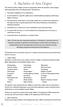 A. Bachelor of Arts Degree The University offers a Major or Honours programme within the Bachelor of Arts Degree. Both programmes have the following basic requirements: 1. Successful completion of 120
Credit Programs and Awards
 Credit Programs and Awards The college offers programs of instruction designed to meet a variety of educational and vocational needs of students. Students who wish to earn a baccalaureate degree may complete
UNIVERSITY, TECHNICAL COLLEGE/ APPRENTICESHIP, AND MILITARY ENTRANCE REQUIREMENTS. University of Wisconsin System: Preparing for College
 UNIVERSITY, TECHNICAL COLLEGE/ APPRENTICESHIP, AND MILITARY ENTRANCE REQUIREMENTS University of Wisconsin System: Preparing for College UW-Colleges (13 WI freshman/sophomore campuses) offer smaller classes