
Annandale High School
|
|
|
- Adela Harmon
- 9 years ago
- Views:
Transcription
1 Annandale High School Course Offering Catalog

2 FROM THE PRINCIPAL'S DESK Dear Annandale Students and Families: Please use this catalog and the valuable services of our student services department as you choose the appropriate course of study and courses that will challenge you during the academic year. Our counselors work closely with the department chairs and teachers to keep current on all of the standard and optional courses offered by each department. Counselors will meet with each student individually to help make decisions about the courses that best support each student s goals. Our entire staff is committed to providing our students with the best education possible. Please contact our student services department with questions about course selection or our program of studies. I hope that you will select courses that are challenging to you, and I hope you choose at least one advanced course in an area of interest to include with your selections. Have a great school year. Sincerely, Vincent J. Randazzo, Principal Annandale High School A Learning Community ADMINISTRATIVE STAFF - Phone: Principal Vincent Randazzo Assistant Principal A - Da Aaron Schneider Assistant Principal De La JamieCarayiannis Assistant Principal Le Raq Pam Gravitte Assistant Principal Rar Z Donna Higgins Assistant Principal Special Education Joe Thompson Director of Student Services...Jennifer Crump-Strawderman Director of Student Activities... Karl Kerns Dean of Students Jeremy Cortash Safety & Security Specialist Chris Tippins STUDENT SERVICES STAFF - Phone: Counselors Mani Deneke A-Beq Nancy Templer....Ber-Dim Cheryl An... Din-Hal Lisa Foliaco Ham-Lam Carrie Schaefer......Lan-Mun Marcelo Valencia Muo-Ral Stacie Shaffer......Ram-Su Rebecca Lockard Sw-Z Ilana Reyes.S.A.M. Students Assessment Coach... Laura Walter Career Resource Specialist...Robin Roth Registrar.....Carol Leventhal Transcript Secretary Cyndi Garman Student Information Assistant.....Stephanie Guidinetti Psychologists Anne Brosnan, Annette Lindsay Social Workers..... Christina Ferrari, Mahogany Hall

3 Table of Contents Graduation Requirements for Students Entering 9 th Grade for the First Time Prior to Standard Diploma... 3 Advanced Studies Diploma... 4 Modified NOTICE: Standard All graduation Diploma... requirements documented in the Standard Course Offerings Guide reflect Virginia 5 Graduation Requirements Department of for Education Students and Entering Fairfax County 9 th Grade Public for Schools the First expectations Time in at the time of publication. and Standard Diploma... 7 Advanced Studies Diploma... 8 Modified Standard Diploma... 9 Graduation Requirements for Students Entering 9 th Grade for the First Time in and Beyond Standard Diploma Advanced Studies Diploma State Diploma Seals Grading System Grade Point Average Expunging High School Courses Taken in Middle School Courses Taken Outside of FCPS Late Start Option for Students Withdraw Policy Pass-Fail Audit Promotion Policy World Languages Proficiency Credit Post Secondary Planning Advanced Academic Programs Career and Technical Education Student Fees FCPS Online Courses High School Academies International Baccalaureate and IB Middle Years Program Business and Information Technology English ESOL Family and Consumer Sciences Fine Arts Dance Music Theatre Arts Academy Visual Arts General Health and Medical Sciences Health and Physical Education Marketing Mathematics Science Social Studies Technology and Engineering Education Trade and Industrial World Languages Special Education NOTICE: All graduation requirements documented in the Standard Course Offerings Guide reflect Virginia Department of Education and Fairfax County Public Schools expectations at the time of publication.
4 Graduation Requirements for Students Entering the 9 th Grade for the First Time Prior to For more information, please visit which includes more detailed information and tutorials about diploma types and graduation requirements. 2
5 STANDARD DIPLOMA 22 CREDIT DIPLOMA REQUIREMENTS FOR GRADUATION The requirements for a student to earn a diploma shall be those in effect when the student enters the 9th grade for the first time. The following applies to 9 th grade students who entered high school prior to To graduate from high school, students shall meet the minimum requirements for the Standard Diploma as outlined below, including 22 standard credits, 6 of which must be verified credits. A standard credit is earned when a student passes a course. A verified credit is earned when a student passes a course and the associated end-of-course SOL test. In some cases, students may utilize substitute tests, certifications, or the appeal process to earn verified credits. State guidelines prescribe the number of verified credits required for graduation for students entering a Virginia public high school for the first time during the tenth grade or after. Consult your school counselor for specific information. Students receive credit toward graduation for high school courses taken and passed in middle school. These courses count toward credits in the required sequences as well as toward the total number of credits required for graduation and calculation of the grade point average (GPA). Middle school parents may request that grades for any high school credit-bearing course taken in the middle school be removed from the student s high school transcript, and therefore the student will not earn high school credit for the course. In addition, the student will not be eligible for a verified credit in any course which has been removed from the transcript. The request to remove a course from the transcript must be made in writing to the middle or high school the student will attend the following year, prior to the end of the first nine weeks. See current version of FCPS Regulation Standard Diploma Course Requirements (8 VAC ) Subject Area Standard Credits Verified Credits English 4 2 Mathematics Laboratory Science 2, History and Social Sciences 3, Health and Physical Education 2 Fine Arts or Career and Technical Ed 1 Electives 4 5 Student Selected Test 5 1 Total Credits Courses completed to satisfy this requirement shall be at or above the level of algebra and shall include at least two course selections from among Algebra I, Geometry, Algebra II, or other mathematics courses above the level of algebra and geometry. The Board of Education may approve additional courses to satisfy this requirement. 2 Courses completed to satisfy this requirement shall include course selections from at least three different science disciplines: earth sciences, biology, chemistry, or physics. The Board may approve additional courses to satisfy this requirement. 3 Courses completed to satisfy this requirement are U.S. and Virginia History, U.S. and Virginia Government, and World History/Geography I and World History/Geography II. AP World History satisfies the requirement for World History/Geography II. 4 Courses to satisfy this requirement shall include at least two sequential electives. 5 A student may utilize additional tests for earning verified credit in computer science, technology, career and technical education or other areas as prescribed by the Board of Education in 8 VAC Students who complete a career and technical education program sequence and pass an examination or occupational competency assessment in a career and technical education field that confers certification or an occupational competency credential from a recognized industry, or trade or professional association or acquires a professional license in a career and technical educational field from the Commonwealth of Virginia may substitute the certification, competency credential, or license for (i) the student selected verified credit and (ii) either a science or history and social sciences verified credit when the certification, license, or credential confers more than one verified credit. The examination or occupational competency assessment must be approved by the Board of Education as an additional test to verify student achievement. 3

6 ADVANCED STUDIES DIPLOMA 24 CREDIT DIPLOMA REQUIREMENTS FOR GRADUATION The requirements for a student to earn a diploma shall be those in effect when the student enters the 9th grade for the first time. The following applies to 9 th grade students who entered high school prior to To graduate from high school with an Advanced Studies Diploma, students shall meet the minimum requirements as outlined below which include 24 credits, 9 of which must be verified credits. A standard credit is earned when a student passes a course. A verified credit is earned when a student passes a course and the associated end-of-course SOL test. In some cases, students may utilize substitute tests or certifications to earn verified credits. State guidelines prescribe the number of verified credits required for graduation for students entering a Virginia public high school for the first time during tenth grade or after. Consult your school counselor for specific information. Students receive credit toward graduation for high school courses taken and passed in middle school. These courses count toward credits in the required sequences as well as toward the total number of credits required for graduation and calculation of the grade point average (GPA). Middle school parents may request that grades for any high school credit-bearing course taken in the middle school be removed from the student s high school transcript, and therefore the student will not earn high school credit for the course. In addition, the student will not be eligible for a verified credit in any course which has been removed from the transcript. The request to remove a course from the transcript must be made in writing to the middle or high school the student will attend the following year prior to the end of the first nine weeks. See current version of FCPS Regulation Advanced Studies Diploma Course Requirements (8 VAC ) Subject Area Standard Credits Verified Credits English 4 2 Mathematics Laboratory Science History and Social Science *World Language 4 3 Health and Physical Education 2 Fine Arts or Career and Technical Ed 1 Electives 2 Student Selected Test 5 1 Total Credits 24 9 *Foreign Language is designated World Language in Fairfax County Public Schools. 1 Courses completed to satisfy this requirement shall be at or above the level of algebra and shall include at least three different course selections from among: Algebra I, Geometry, Algebra II, or other mathematics courses above the level of Algebra II. The Board of Education may approve additional courses to satisfy this requirement. 2 Courses completed to satisfy this requirement shall include course selections from at least three different science disciplines from among: earth sciences, biology, chemistry, or physics or completion of the sequence of science courses required for the International Baccalaureate Diploma. The Board may approve additional courses to satisfy this requirement. 3 Courses completed to satisfy this requirement shall include U.S. and Virginia History, U.S. and Virginia Government, and World History/Geography I and World History/Geography II. AP World History satisfies the requirement for World History/Geography II. 4 Courses completed to satisfy this requirement shall include three years of one language or two years of two languages. 5 A student may utilize additional tests for earning verified credit in computer science, technology, career or technical education or other areas as prescribed by the Board in 8 VAC

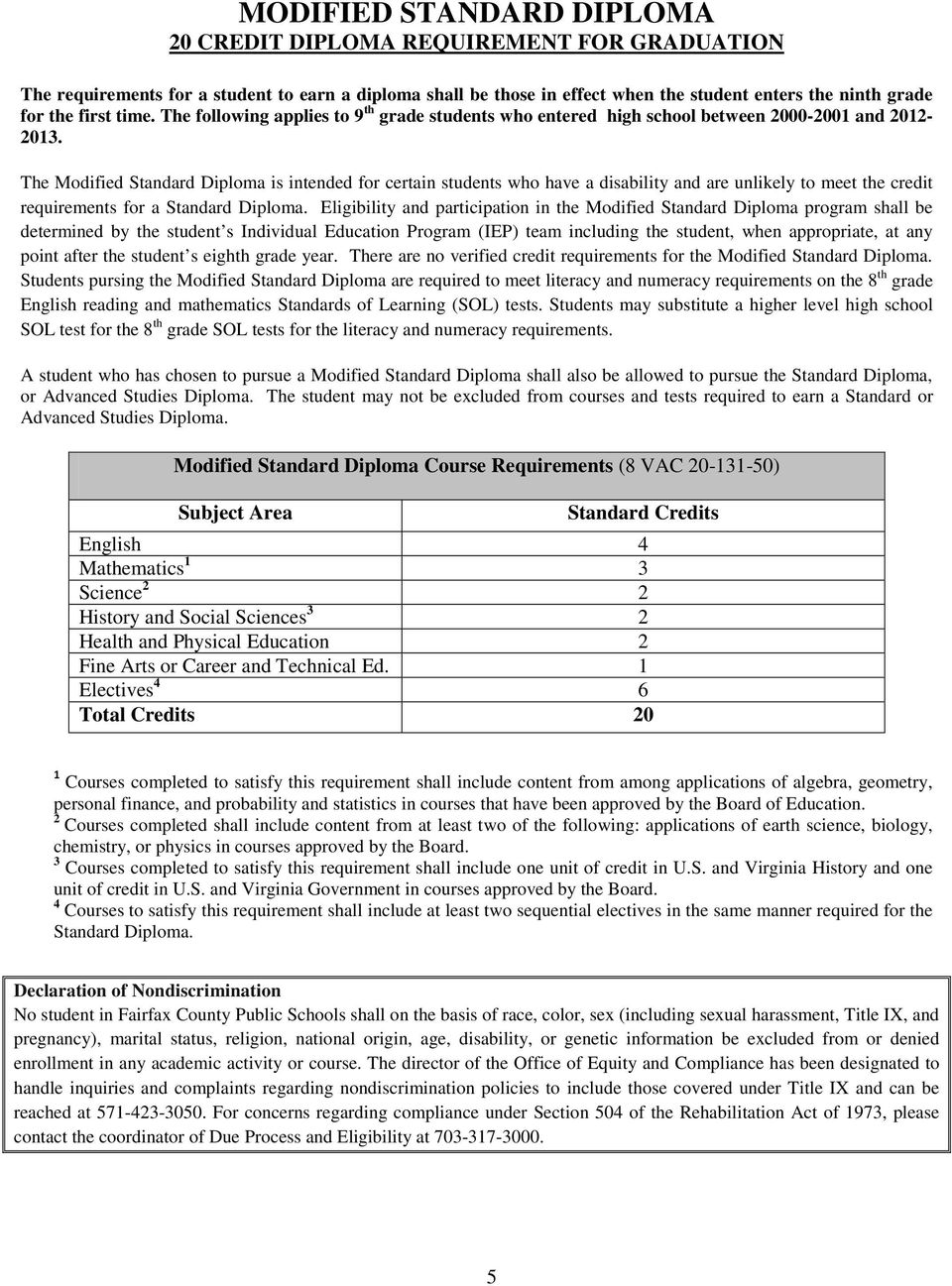
7 MODIFIED STANDARD DIPLOMA 20 CREDIT DIPLOMA REQUIREMENT FOR GRADUATION The requirements for a student to earn a diploma shall be those in effect when the student enters the ninth grade for the first time. The following applies to 9 th grade students who entered high school between and The Modified Standard Diploma is intended for certain students who have a disability and are unlikely to meet the credit requirements for a Standard Diploma. Eligibility and participation in the Modified Standard Diploma program shall be determined by the student s Individual Education Program (IEP) team including the student, when appropriate, at any point after the student s eighth grade year. There are no verified credit requirements for the Modified Standard Diploma. Students pursing the Modified Standard Diploma are required to meet literacy and numeracy requirements on the 8 th grade English reading and mathematics Standards of Learning (SOL) tests. Students may substitute a higher level high school SOL test for the 8 th grade SOL tests for the literacy and numeracy requirements. A student who has chosen to pursue a Modified Standard Diploma shall also be allowed to pursue the Standard Diploma, or Advanced Studies Diploma. The student may not be excluded from courses and tests required to earn a Standard or Advanced Studies Diploma. Modified Standard Diploma Course Requirements (8 VAC ) Subject Area Standard Credits English 4 Mathematics 1 3 Science 2 2 History and Social Sciences 3 2 Health and Physical Education 2 Fine Arts or Career and Technical Ed. 1 Electives 4 6 Total Credits 20 1 Courses completed to satisfy this requirement shall include content from among applications of algebra, geometry, personal finance, and probability and statistics in courses that have been approved by the Board of Education. 2 Courses completed shall include content from at least two of the following: applications of earth science, biology, chemistry, or physics in courses approved by the Board. 3 Courses completed to satisfy this requirement shall include one unit of credit in U.S. and Virginia History and one unit of credit in U.S. and Virginia Government in courses approved by the Board. 4 Courses to satisfy this requirement shall include at least two sequential electives in the same manner required for the Standard Diploma. Declaration of Nondiscrimination No student in Fairfax County Public Schools shall on the basis of race, color, sex (including sexual harassment, Title IX, and pregnancy), marital status, religion, national origin, age, disability, or genetic information be excluded from or denied enrollment in any academic activity or course. The director of the Office of Equity and Compliance has been designated to handle inquiries and complaints regarding nondiscrimination policies to include those covered under Title IX and can be reached at For concerns regarding compliance under Section 504 of the Rehabilitation Act of 1973, please contact the coordinator of Due Process and Eligibility at
8 Graduation Requirements for Students Entering the 9 th Grade for the First Time in and For more information, please visit which includes more detailed information and tutorials about diploma types and graduation requirements. 6
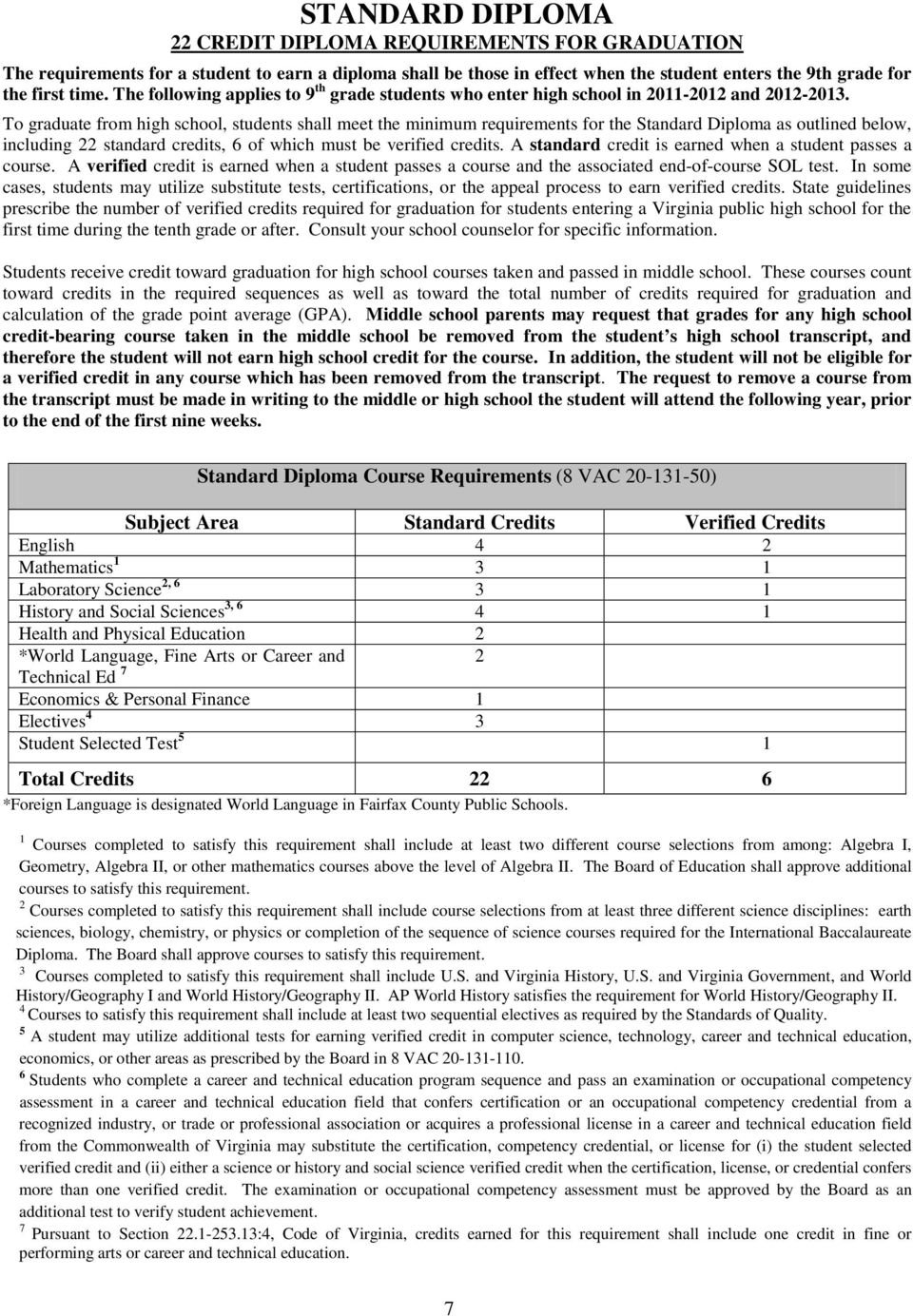
9 STANDARD DIPLOMA 22 CREDIT DIPLOMA REQUIREMENTS FOR GRADUATION The requirements for a student to earn a diploma shall be those in effect when the student enters the 9th grade for the first time. The following applies to 9 th grade students who enter high school in and To graduate from high school, students shall meet the minimum requirements for the Standard Diploma as outlined below, including 22 standard credits, 6 of which must be verified credits. A standard credit is earned when a student passes a course. A verified credit is earned when a student passes a course and the associated end-of-course SOL test. In some cases, students may utilize substitute tests, certifications, or the appeal process to earn verified credits. State guidelines prescribe the number of verified credits required for graduation for students entering a Virginia public high school for the first time during the tenth grade or after. Consult your school counselor for specific information. Students receive credit toward graduation for high school courses taken and passed in middle school. These courses count toward credits in the required sequences as well as toward the total number of credits required for graduation and calculation of the grade point average (GPA). Middle school parents may request that grades for any high school credit-bearing course taken in the middle school be removed from the student s high school transcript, and therefore the student will not earn high school credit for the course. In addition, the student will not be eligible for a verified credit in any course which has been removed from the transcript. The request to remove a course from the transcript must be made in writing to the middle or high school the student will attend the following year, prior to the end of the first nine weeks. Standard Diploma Course Requirements (8 VAC ) Subject Area Standard Credits Verified Credits English 4 2 Mathematics Laboratory Science 2, History and Social Sciences 3, Health and Physical Education 2 *World Language, Fine Arts or Career and 2 Technical Ed 7 Economics & Personal Finance 1 Electives 4 3 Student Selected Test 5 1 Total Credits 22 6 *Foreign Language is designated World Language in Fairfax County Public Schools. 1 Courses completed to satisfy this requirement shall include at least two different course selections from among: Algebra I, Geometry, Algebra II, or other mathematics courses above the level of Algebra II. The Board of Education shall approve additional courses to satisfy this requirement. 2 Courses completed to satisfy this requirement shall include course selections from at least three different science disciplines: earth sciences, biology, chemistry, or physics or completion of the sequence of science courses required for the International Baccalaureate Diploma. The Board shall approve courses to satisfy this requirement. 3 Courses completed to satisfy this requirement shall include U.S. and Virginia History, U.S. and Virginia Government, and World History/Geography I and World History/Geography II. AP World History satisfies the requirement for World History/Geography II. 4 Courses to satisfy this requirement shall include at least two sequential electives as required by the Standards of Quality. 5 A student may utilize additional tests for earning verified credit in computer science, technology, career and technical education, economics, or other areas as prescribed by the Board in 8 VAC Students who complete a career and technical education program sequence and pass an examination or occupational competency assessment in a career and technical education field that confers certification or an occupational competency credential from a recognized industry, or trade or professional association or acquires a professional license in a career and technical education field from the Commonwealth of Virginia may substitute the certification, competency credential, or license for (i) the student selected verified credit and (ii) either a science or history and social science verified credit when the certification, license, or credential confers more than one verified credit. The examination or occupational competency assessment must be approved by the Board as an additional test to verify student achievement. 7 Pursuant to Section :4, Code of Virginia, credits earned for this requirement shall include one credit in fine or performing arts or career and technical education. 7
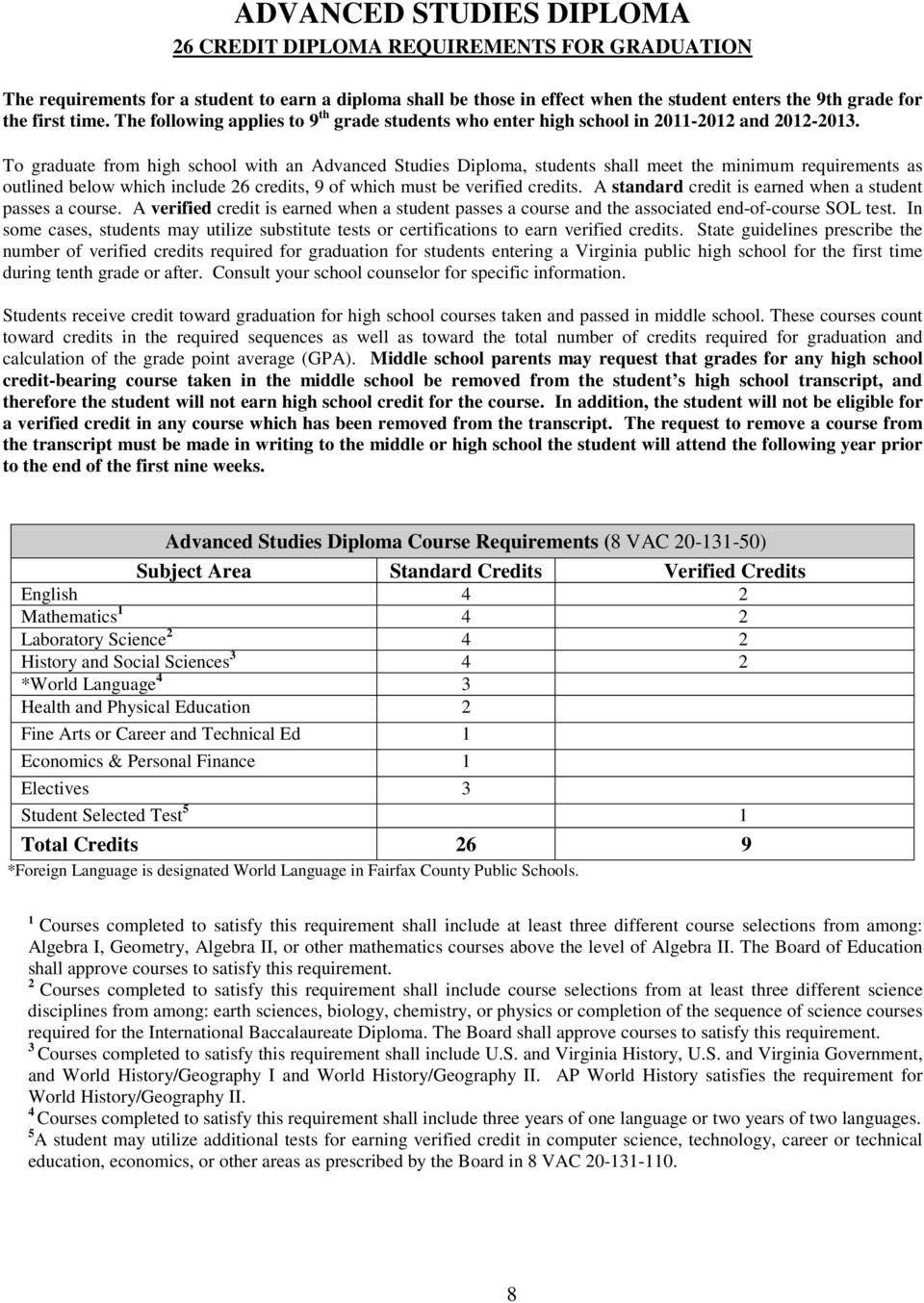
10 ADVANCED STUDIES DIPLOMA 26 CREDIT DIPLOMA REQUIREMENTS FOR GRADUATION The requirements for a student to earn a diploma shall be those in effect when the student enters the 9th grade for the first time. The following applies to 9 th grade students who enter high school in and To graduate from high school with an Advanced Studies Diploma, students shall meet the minimum requirements as outlined below which include 26 credits, 9 of which must be verified credits. A standard credit is earned when a student passes a course. A verified credit is earned when a student passes a course and the associated end-of-course SOL test. In some cases, students may utilize substitute tests or certifications to earn verified credits. State guidelines prescribe the number of verified credits required for graduation for students entering a Virginia public high school for the first time during tenth grade or after. Consult your school counselor for specific information. Students receive credit toward graduation for high school courses taken and passed in middle school. These courses count toward credits in the required sequences as well as toward the total number of credits required for graduation and calculation of the grade point average (GPA). Middle school parents may request that grades for any high school credit-bearing course taken in the middle school be removed from the student s high school transcript, and therefore the student will not earn high school credit for the course. In addition, the student will not be eligible for a verified credit in any course which has been removed from the transcript. The request to remove a course from the transcript must be made in writing to the middle or high school the student will attend the following year prior to the end of the first nine weeks. Advanced Studies Diploma Course Requirements (8 VAC ) Subject Area Standard Credits Verified Credits English 4 2 Mathematics Laboratory Science History and Social Sciences *World Language 4 3 Health and Physical Education 2 Fine Arts or Career and Technical Ed 1 Economics & Personal Finance 1 Electives 3 Student Selected Test 5 1 Total Credits 26 9 *Foreign Language is designated World Language in Fairfax County Public Schools. 1 Courses completed to satisfy this requirement shall include at least three different course selections from among: Algebra I, Geometry, Algebra II, or other mathematics courses above the level of Algebra II. The Board of Education shall approve courses to satisfy this requirement. 2 Courses completed to satisfy this requirement shall include course selections from at least three different science disciplines from among: earth sciences, biology, chemistry, or physics or completion of the sequence of science courses required for the International Baccalaureate Diploma. The Board shall approve courses to satisfy this requirement. 3 Courses completed to satisfy this requirement shall include U.S. and Virginia History, U.S. and Virginia Government, and World History/Geography I and World History/Geography II. AP World History satisfies the requirement for World History/Geography II. 4 Courses completed to satisfy this requirement shall include three years of one language or two years of two languages. 5 A student may utilize additional tests for earning verified credit in computer science, technology, career or technical education, economics, or other areas as prescribed by the Board in 8 VAC
11 MODIFIED STANDARD DIPLOMA 20 CREDIT DIPLOMA REQUIREMENT FOR GRADUATION The requirements for a student to earn a diploma shall be those in effect when the student enters the ninth grade for the first time. The following applies to 9 th grade students who entered high school between and The Modified Standard Diploma is intended for certain students who have a disability and are unlikely to meet the credit requirements for a Standard Diploma. Eligibility and participation in the Modified Standard Diploma program shall be determined by the student s Individual Education Program (IEP) team including the student, when appropriate, at any point after the student s eighth grade year. There are no verified credit requirements for the Modified Standard Diploma. Students pursing the Modified Standard Diploma are required to meet literacy and numeracy requirements on the 8 th grade English reading and mathematics Standards of Learning (SOL) tests. Students may substitute a higher level high school SOL test for the 8 th grade SOL tests for the literacy and numeracy requirements. A student who has chosen to pursue a Modified Standard Diploma shall also be allowed to pursue the Standard Diploma or Advanced Studies. The student may not be excluded from courses and tests required to earn a Standard or Advanced Studies Diploma. Modified Standard Diploma Course Requirements (8 VAC ) Subject Area Standard Credits English 4 Mathematics 1 3 Science 2 2 History and Social Sciences 3 2 Health and Physical Education 2 Fine Arts or Career and Technical Ed. 1 Electives 4 6 Total Credits 20 1 Courses completed to satisfy this requirement shall include content from among applications of algebra, geometry, personal finance, and probability and statistics in courses that have been approved by the Board of Education. 2 Courses completed shall include content from at least two of the following: applications of earth science, biology, chemistry, or physics in courses approved by the Board. 3 Courses completed to satisfy this requirement shall include one unit of credit in U.S. and Virginia History and one unit of credit in U.S. and Virginia Government in courses approved by the Board. Declaration of Nondiscrimination No student in Fairfax County Public Schools shall on the basis of race, color, sex (including sexual harassment, Title IX, and pregnancy), marital status, religion, national origin, age, disability, or genetic information be excluded from or denied enrollment in any academic activity or course. The director of the Office of Equity and Compliance has been designated to handle inquiries and complaints regarding nondiscrimination policies to include those covered under Title IX and can be reached at For concerns regarding compliance under Section 504 of the Rehabilitation Act of 1973, please contact the coordinator of Due Process and Eligibility at

12 Graduation Requirements for Students Entering the 9 th Grade for the First Time in and Beyond For more information, please visit which includes more detailed information and tutorials about diploma types and graduation requirements. 10
13 STANDARD DIPLOMA 22 CREDIT DIPLOMA REQUIREMENTS FOR GRADUATION The requirements for a student to earn a diploma shall be those in effect when the student enters the 9th grade for the first time. The following applies to 9 th grade students who enter high school in and beyond. To graduate from high school, students shall meet the minimum requirements for the Standard Diploma as outlined below, including 22 standard credits, 6 of which must be verified credits. A standard credit is earned when a student passes a course. A verified credit is earned when a student passes a course and the associated end-of-course SOL test. In some cases, students may utilize substitute tests, certifications, or the appeal process to earn verified credits. State guidelines prescribe the number of verified credits required for graduation for students entering a Virginia public high school for the first time during the tenth grade or after. Consult your school counselor for specific information. Students receive credit toward graduation for high school courses taken and passed in middle school. These courses count toward credits in the required sequences as well as toward the total number of credits required for graduation and calculation of the grade point average (GPA). Middle school parents may request that grades for any high school credit-bearing course taken in the middle school be removed from the student s high school transcript, and therefore the student will not earn high school credit for the course. In addition, the student will not be eligible for a verified credit in any course which has been removed from the transcript. The request to remove a course from the transcript must be made in writing to the middle or high school the student will attend the following year, prior to the end of the first nine weeks. See current version of FCPS Regulation Standard Diploma Course Requirements (8 VAC ) Subject Area Standard Credits Verified Credits English 4 2 Mathematics Laboratory Science 2, History and Social Sciences 3, Health and Physical Education 2 *World Language, Fine Arts or Career 2 and Technical Ed 7 Economics & Personal Finance 1 Electives 4 3 Student Selected Test 5 1 Career and Technical Education Credential 8 Total Credits *Foreign Language is designated World Language in Fairfax County Public Schools. 1 Courses completed to satisfy this requirement shall include at least two different course selections from among: Algebra I, Geometry, Algebra II, or other mathematics courses above the level of Algebra II. The Board of Education shall approve additional courses to satisfy this requirement. 2 Courses completed to satisfy this requirement shall include course selections from at least three different science disciplines: earth sciences, biology, chemistry, or physics or completion of the sequence of science courses required for the International Baccalaureate Diploma. The Board shall approve courses to satisfy this requirement. 3 Courses completed to satisfy this requirement shall include U.S. and Virginia History, U.S. and Virginia Government, and World History/Geography I and World History/Geography II. AP World History satisfies the requirement for World History/Geography II. 4 Courses to satisfy this requirement shall include at least two sequential electives as required by the Standards of Quality. 5 A student may utilize additional tests for earning verified credit in computer science, technology, career and technical education, economics, or other areas as prescribed by the Board in 8 VAC Students who complete a career and technical education program sequence and pass an examination or occupational competency assessment in a career and technical education field that confers certification or an occupational competency credential from a recognized industry, or trade or professional association or acquires a professional license in a career and technical education field from the Commonwealth of Virginia may substitute the certification, competency credential, or license for (i) the student selected verified credit and (ii) either a science or history and social science verified credit when the certification, license, or credential confers more than one verified credit. The examination or occupational competency assessment must be approved by the Board as an additional test to verify student achievement. 7 Pursuant to Section :4, Code of Virginia, credits earned for this requirement shall include one credit in fine or performing arts or career and technical education. 8 Students shall earn a career and technical education credential approved by the Board of Education that could include, but not be limited to, the successful completion of an industry certification, a state licensure examination, a national occupational competency assessment, or the Virginia Workplace Readiness Assessment. 9 Students shall successfully complete one virtual course, which may be a noncredit-bearing course or elective credit bearing course that is offered online. 11

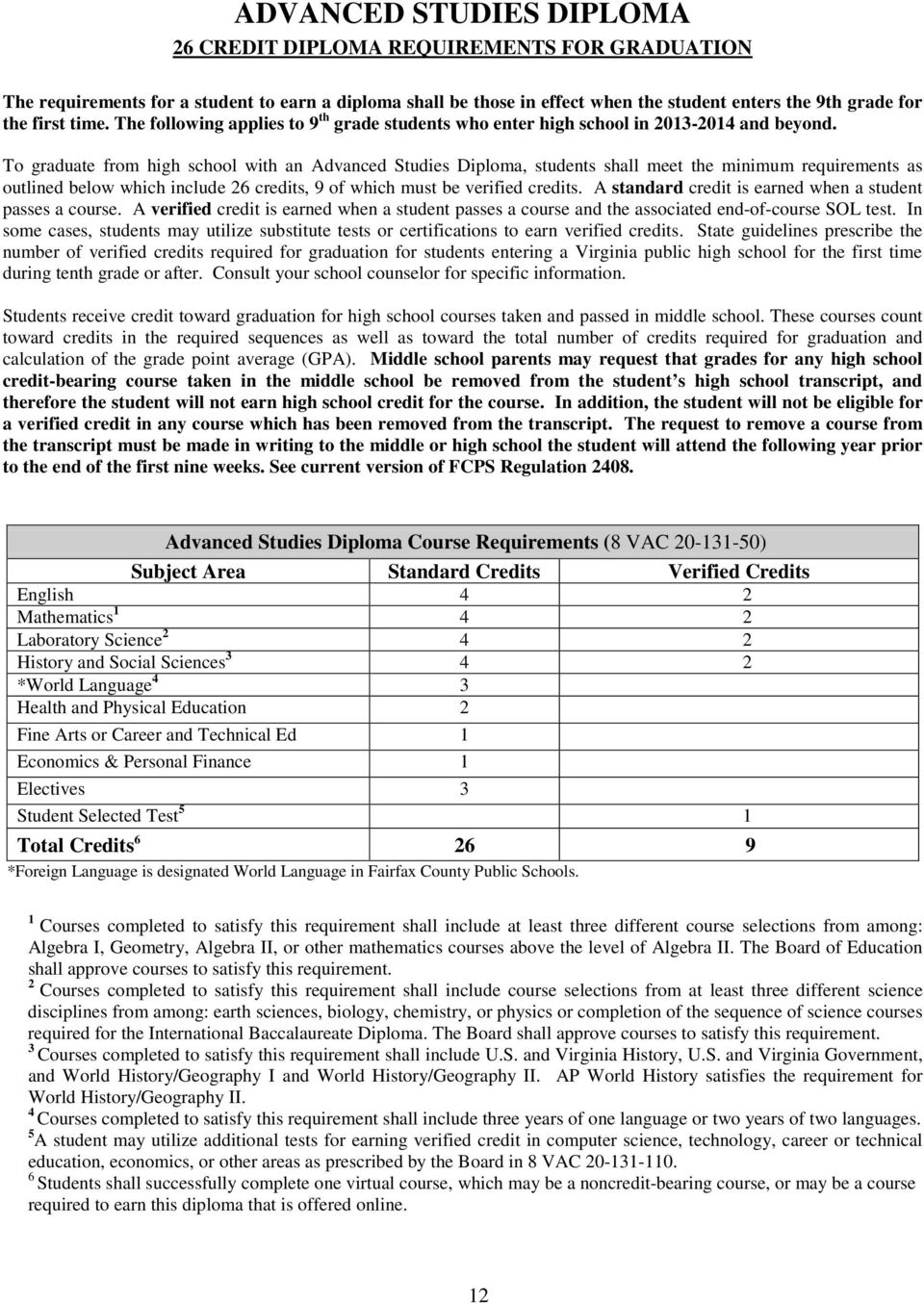
14 ADVANCED STUDIES DIPLOMA 26 CREDIT DIPLOMA REQUIREMENTS FOR GRADUATION The requirements for a student to earn a diploma shall be those in effect when the student enters the 9th grade for the first time. The following applies to 9 th grade students who enter high school in and beyond. To graduate from high school with an Advanced Studies Diploma, students shall meet the minimum requirements as outlined below which include 26 credits, 9 of which must be verified credits. A standard credit is earned when a student passes a course. A verified credit is earned when a student passes a course and the associated end-of-course SOL test. In some cases, students may utilize substitute tests or certifications to earn verified credits. State guidelines prescribe the number of verified credits required for graduation for students entering a Virginia public high school for the first time during tenth grade or after. Consult your school counselor for specific information. Students receive credit toward graduation for high school courses taken and passed in middle school. These courses count toward credits in the required sequences as well as toward the total number of credits required for graduation and calculation of the grade point average (GPA). Middle school parents may request that grades for any high school credit-bearing course taken in the middle school be removed from the student s high school transcript, and therefore the student will not earn high school credit for the course. In addition, the student will not be eligible for a verified credit in any course which has been removed from the transcript. The request to remove a course from the transcript must be made in writing to the middle or high school the student will attend the following year prior to the end of the first nine weeks. See current version of FCPS Regulation Advanced Studies Diploma Course Requirements (8 VAC ) Subject Area Standard Credits Verified Credits English 4 2 Mathematics Laboratory Science History and Social Sciences *World Language 4 3 Health and Physical Education 2 Fine Arts or Career and Technical Ed 1 Economics & Personal Finance 1 Electives 3 Student Selected Test 5 1 Total Credits *Foreign Language is designated World Language in Fairfax County Public Schools. 1 Courses completed to satisfy this requirement shall include at least three different course selections from among: Algebra I, Geometry, Algebra II, or other mathematics courses above the level of Algebra II. The Board of Education shall approve courses to satisfy this requirement. 2 Courses completed to satisfy this requirement shall include course selections from at least three different science disciplines from among: earth sciences, biology, chemistry, or physics or completion of the sequence of science courses required for the International Baccalaureate Diploma. The Board shall approve courses to satisfy this requirement. 3 Courses completed to satisfy this requirement shall include U.S. and Virginia History, U.S. and Virginia Government, and World History/Geography I and World History/Geography II. AP World History satisfies the requirement for World History/Geography II. 4 Courses completed to satisfy this requirement shall include three years of one language or two years of two languages. 5 A student may utilize additional tests for earning verified credit in computer science, technology, career or technical education, economics, or other areas as prescribed by the Board in 8 VAC Students shall successfully complete one virtual course, which may be a noncredit-bearing course, or may be a course required to earn this diploma that is offered online. 12
15 STATE DIPLOMA SEALS 1. The Governor s Seal shall be awarded to students who complete the requirements for an Advanced Studies Diploma with an average grade of B or better and successfully complete college-level coursework that will earn the student at least nine transferrable college credits in Advanced Placement (AP), International Baccalaureate (IB), Cambridge, or dual enrollment courses. 2. Students who complete the requirements for a Standard or Advanced Studies Diploma with an average grade of A shall receive a Board of Education Seal on the diploma. 3. The Board of Education s Career and Technical Education Seal will be awarded to students who earn a Standard or Advanced Studies Diploma and complete a prescribed sequence of courses in a career and technical education concentration or specialization that they choose and maintain a B or better average in those courses OR pass an examination or an occupational competency assessment in a career and technical education concentration or specialization that confers certification or occupational competency credential from a recognized industry, trade or professional association OR acquire a professional license in that career and technical education field from the Commonwealth of Virginia. The Board shall approve all professional licenses and examinations used to satisfy these requirements. 4. The Board of Education s Seal of Advanced Mathematics and Technology will be awarded to students who earn a Standard or Advanced Studies Diploma and (i) satisfy all of the mathematics requirements for the Advanced Studies Diploma (four units of credit including Algebra II; two verified units of credit) with a B average or better; and (ii) either (a) pass an examination in a career and technical education field that confers certification from a recognized industry, or trade or professional association; (b) acquire a professional license in a career and technical education field from the Commonwealth of Virginia; or (c) pass an examination approved by the Board that confers college-level credit in a technology or computer science area. The Board shall approve all professional licenses and examinations used to satisfy these requirements. 5. The Board of Education s Seal for Excellence in Civics Education will be awarded to students who earn a Standard, Advanced Studies, or Modified Standard Diploma and: (i) complete Virginia and United States History and Virginia and United States Government courses with a grade of B or higher; and, (ii) have good attendance and no disciplinary infractions as determined by local school board policies and, (iii) complete 50 hours of voluntary participation in community service or extracurricular activities. Activities that would satisfy the requirements of clause (iii) of this subdivision include: (a) volunteering for a charitable or religious organization that provides services to the poor, sick or less fortunate; (b) participating in Boy Scouts, Girl Scouts, or similar youth organizations; (c) participating in JROTC; (d) participating in political campaigns or government internships, or Boys State, Girls State, or Model General Assembly; or (e) participating in school-sponsored extracurricular activities that have a civics focus. Any student who enlists in the United States military prior to graduation will be deemed to have met this community service requirement. GRADING SYSTEM A (93-100) = 4.0 B- (80-82) = 2.7 D+ (67-69) = 1.3 A- (90-92) = 3.7 C+ (77-79) = 2.3 D (64-66) = 1.0 B+ (87-89) = 3.3 C (73-76) = 2.0 F (below 64) = 0.0 B (83-86) = 3.0 C- (70-72) = 1.7 *Effective September To review the grading system prior to 2009 please access the High School Grading and Reporting available at: GRADE POINT AVERAGE Grade point average (GPA) is calculated on the basis of all courses for which high school credit has been earned or attempted, including repeated courses previously passed. In order for a repeat course to raise a GPA, the student s grade must be higher than the one originally given. All classes appearing on the high school transcript including high school classes taken in summer school, middle school, elementary school, or online are included when calculating GPA. Advanced Placement (AP) courses, specified International Baccalaureate (IB) courses, and other courses approved through the annual course review process receive an additional 1.0 added to the final grade upon successful completion of the course. Successful completion is defined as completing the course with a passing grade and where applicable completing the corresponding exam. For example, a final grade of A in an AP/IB course shall receive 5.0 quality points for purposes of calculating grade point average. Honors courses in mathematics, science, English, social studies, designated Thomas Jefferson High School courses, and other courses approved through the annual course review process receive an additional 0.5 weight added to the final grade upon successful completion of the course. Successful completion is defined as completing the course with a passing grade. For example, a final grade of A in an honors class shall receive 4.5 quality points. Courses dropped will not be counted in grade point average (GPA) except when a final grade of F is received: (a) for the fourth grading period of a full-year course, or (b) for the second grading period of a semester course. A student's GPA is determined by dividing the total number of quality points earned by the number of courses included in the transcript. The grade point average is reported to three decimal places (thousandths). Fairfax County Public Schools does not rank its students. 13
16 EXPUNGING HIGH SCHOOL COURSES TAKEN IN MIDDLE SCHOOL In accordance with Virginia state regulations, FCPS Regulation 2408 permits parents of students who take a high school credit-bearing course in middle school to request that the grade be omitted from the student's high school transcript and the student not earn high school credit for the course. Parents must make this request in writing no later than the end of the first nine weeks of the school year following completion of the course. The form to make this request, along with the process for making the request, is available at: or through your student s school counselor. Parents are strongly advised to discuss this decision with their student s school counselor and the impact of expunging a course on desired high school diploma type and standard and verified credit requirements. LATE START OPTION FOR SENIORS Seniors who are on track to graduate may reduce their schedule by up to 2 periods in the first block to allow for additional time for sleep. Transportation arrangements for a student on this modified schedule are the responsibility of the family. Seniors considering this option should discuss possible implications for college admissions and Virginia High School League (VHSL) eligibility with their school counselor prior to reducing their schedule. Students who wish to pursue this option should indicate their intent at the time of course registration. Schools will attempt to honor all requests, however, scheduling conflicts may prohibit some students from accessing this option. If students wish to investigate this option after they receive their schedule, it will only be honored if the course being dropped is currently sitting in a 1 st or 2 nd block. COURSES TAKEN OUTSIDE OF FCPS Currently enrolled FCPS students who wish to take a course outside of FCPS and transfer back the credit must have written approval from their school prior to enrolling in the course. The course must meet the requirements outlined in the current version of FCPS regulation 2408 and Virginia state regulations. For additional information about pursing coursework outside of FCPS for credit, please contact your school counselor. LATE START OPTION FOR STUDENTS Students may take up to two online courses that can be scheduled in the first block of the day to allow for additional time to sleep. Transportation arrangements for a student on this modified schedule are the responsibility of the family. Students who wish to pursue this option should indicate their intent at the time of course registration. Online courses have a different course code than the live class with the same title. The correct code must be entered into the student information system and the required paperwork for an online class must be completed by May 1, 2014 in order to pursue this option. WITHDRAW POLICY For the first grading period only, a student has five days after the date on which report cards are sent home in which to drop a course without having a grade recorded. Courses dropped are not counted in the grade point average except when an F is received for the course. Middle schools do not calculate gradepoint averages; however, if a high school credit course is taken by a middle school student, courses dropped are not counted in the high school grade-point average except when an F is received for the course. Unless the principal approves an exception, a student may not withdraw during the final quarter of a course if he or she is passing the course. If a student drops a course during the: 1st quarter 2nd quarter 3rd quarter 4th quarter No penalty--nothing is recorded. WP (withdrawn passing) or WF (withdrawn failing) is recorded. Exception: For semester courses a WP or F for failure is recorded. WP or WF is recorded. WP or F for failure is recorded. 14

17 PASS-FAIL The Fairfax County School Board policy permits students to take certain courses on a pass-fail basis. With parental or guardian approval, any high school student shall be given the option of taking one elective credit per school year to be marked on a pass-fail basis. This may be applied to required health and physical education credits, world language credits, and to credits other than those required for English, social studies, mathematics, and laboratory science and specialized courses such as Principles of Engineering Technology and Senior Technology Research taught at Thomas Jefferson High School for Science and Technology. A double or triple-period class taken for two or three credits in the technical fields may be taken on a pass-fail basis as the one pass-fail course per year. No student may take more than two single semester electives or one full-year elective per school year on the pass-fail system except as indicated above. Any high school student wishing to take a course as pass-fail shall indicate this by completing a ''Pass-Fail Status Request Form'' requiring parent approval and returning it to designated school personnel on or before the 22nd school day or by the first half of the first grading period subsequent to entering the course. Students in schools using a semester block schedule must return the parent approval form to the designated school personnel on or before the 11th school day or by the first half of the first grading period subsequent to entering the course. This decision may not be reversed. If a student drops a class being taken on a pass-fail basis and transfers to a new class, the student shall have 10 school days to make a decision as to whether the new class will be taken on a pass-fail basis. Students in schools using a semester block schedule shall have 5 school days to make a decision as to whether the new class will be taken on a passfail basis, provided it is an elective course. This decision may not be reversed. Grades are determined as follows: - ''P'' for an A, A-, B+, B, B-,C+,C, C-, D+, D which will receive credit but will not count in grade-point average. - ''F'' for an F which will receive no credit but will be counted in grade-point average. AUDIT In special circumstances, students may be allowed to attend one course without receiving credit for it. The audit application must be completed, submitted, and approved prior to the beginning of the course. Students may audit a course one year and then take it for credit the next year. Students who audit a course must meet all attendance requirements and strive toward completion of POS standards, benchmarks, and indicators. The decision may not be reversed with the exception of ESOL students placed in a content class who may be changed from audit to credit status at the request of the content teacher and ESOL department chair if the student demonstrates mastery of the course content. PROMOTION POLICY Middle School To qualify for promotion, seventh and eighth grade middle school students must demonstrate knowledge and competency based upon identified standards of achievement in the four core areas of language arts, mathematics, science, and social studies. To guarantee promotion, students must demonstrate proficiency in the foundational knowledge and skills in each of the four core subject areas and earn a passing final grade based on grade level expectations. Students who earn an F as a final grade in one or two core subjects are retained, at the discretion of the principal, and encouraged to participate in an intervention program. Based upon the extent to which a student demonstrates knowledge and competency of identified standards of achievement in an intervention program, he/she is promoted or retained. Students who are promoted may receive continued intervention throughout the following school year. If students do not participate in an intervention program, they are retained at the discretion of the principal. Students who earn an F in three or four core courses are retained, at the discretion of the principal. High School The minimum requirements for placement in high school grades are as follows: To be placed in grade: The student must: 9 Be promoted from 8th grade 10 Be promoted from 9 th grade and have earned at least 5 standard units of credit. 11 Have earned at least 10 standard units of credit. 12 Have a planned program providing sufficient credits to ensure graduation the following June or August. 15

18 WORLD LANGUAGES PROFICIENCY CREDIT The Credit Exam for World Languages is given each fall to students who wish to demonstrate written proficiency in one of several languages: American Sign Language, Amharic, Arabic, Bengali/Bangla, Chinese/Mandarin, Farsi/Persian, French, German, Hindi, Italian, Japanese, Korean, Nepali, Punjabi, Russian, Somali, Spanish, Tagalog/Pilipino, Tamil, Telugu, Twi, Urdu, or Vietnamese. Students who are successful on the exam receive two world languages credits which may be used to fulfill the world languages requirements/electives of the Advanced Studies or Standard Diplomas. In addition, middle school students in grades 6-8 enrolled in certain ESOL courses may receive up to two world languages credits towards high school graduation requirements in the two-plus-two option for fulfilling the world languages requirement. High school students enrolled in ESOL 5720 courses may receive elective or up to two world languages credits toward high school graduation requirements in the two-plus-two option for fulfilling the world languages requirement. For more information on the exam, go to: or contact the World Languages Team at POSTSECONDARY PLANNING Each high school in Fairfax County Public Schools provides a sequential postsecondary planning program that focuses on the acquisition of knowledge, skills, and self-understanding necessary to achieve postsecondary goals. Students are counseled regarding opportunities for postsecondary education, financial aid and employment prior to high school graduation. The program includes career planning that assists students in developing good decision-making skills, an understanding of their interests and abilities, and knowledge of the wide range of career opportunities. To assist in the process, information and resources are provided through the school counseling program at your school and are available online. Additionally, each high school has a staffed Career Center with current college and career resource materials. ADVANCED ACADEMIC PROGRAMS Advanced Academic Programs at the high school level are comprised of honors courses at the 9 th through 12 th grade levels, and the Advanced Placement (AP) program at the 10 th, 11 th, and 12 th grade levels or the International Baccalaureate Diploma Program (IBDP) at the11 th, and 12 th grade levels. Advanced Academic Programs are open to all students committed to rigorous academic work. Student transfer applications may be submitted for an AP or IB program if the base school does not offer the desired program of study. For more information on the program please visit the web site at AP and IB courses are advanced-level courses with external exams. Students who take AP and IB courses are required to complete the examinations. (For more information, see Grade Point Average.) The Advanced Academic program responds to the requirement of the Virginia Board of Education that each local school division plan and implement an instructional program for gifted and talented students at all levels K-12. Courses designated as honors, IB or AP fulfill this requirement. The Fairfax County Public Schools' high school advanced academic program provides educational opportunities designed and coordinated to meet the needs, abilities, and interests of gifted and talented students. The high school advanced academic program provides challenging courses for students who demonstrate advanced academic ability. Differentiated curricula and teaching strategies which stress critical thinking skills, creativity, and problem-solving are integrated into the content of all advanced academic course offerings. The four-year sequence of courses in each of the academic disciplines, which progresses from honors to AP, and IB, provides a continuous and balanced advanced academic program. Advanced Placement Centreville, Chantilly, Fairfax, Falls Church, Hayfield, Herndon, Lake Braddock, Langley, Madison, McLean, Oakton, South County, West Potomac, West Springfield, Westfield, and Woodson High Schools offer the Advanced Placement (AP) program. Individual AP courses are also offered at other high schools. All students enrolled in an AP course are required to complete the end-of-course AP exam. Students may receive college credit and/or placement based upon their exam grades. The AP program is offered in English, social studies, mathematics, science, world languages, and fine arts. AP courses are offered as open enrollment to all students committed to rigorous, academic work. Students taking at least 3 AP exams with at least a grade of 3 on each are recognized by the College Board as AP Scholars. Further information about the AP program may be obtained by contacting the school counselor or AP coordinator at the participating school. 16

19 International Baccalaureate Annandale, Edison, Lee, Marshall, Mount Vernon, Robinson, South Lakes, and Stuart High Schools offer the International Baccalaureate Diploma Program (IBDP). To qualify for the IB Diploma, students must select at least one subject from each of six IB subject groups including English, world languages, mathematics, science, social studies, and an elective. Students take at least 3 and not more than 4 of these subjects at higher level (HL), the others at standard level (SL). All students enrolled in an IB course are required to complete the end-ofcourse IB exams. IB diploma candidates must complete 150 hours of extracurricular activities and community service, take the Theory of Knowledge course, and write a 4000 word essay on a topic of their choice. Students in IB schools may also take IB courses in areas of academic strength and interest. IB diploma course students take one or more IB courses and the associated exam(s) and receive recognition for each IB exam with a score of 4 or better. Annandale, Lee, Mount Vernon, South Lakes, and Stuart offer the IB Career-related Certificate (IBCC). To qualify for the IBCC students must complete a 2-year CTE sequence, 2 IBDP courses and demonstrate world language development. IBCC candidates must also complete community service, take the Approaches to Learning course, and complete a reflective project related to their CTE course of study. The IB program is offered in English, social studies, mathematics, science, world languages, fine arts, and other electives. IB courses are offered as open enrollment to all students committed to rigorous, academic work. Further information about the IB program may be obtained by contacting the school counselor or IB coordinator at the participating school. Annandale, Edison, Lee,Mount Vernon, Robinson, South Lakes, and Stuart High Schools implement the IB Middle Years Program (IBMYP) in 9 th and 10 th grade. Students may choose to work toward the MYP certificate which requires the completion of a personal project at the end of 10 th grade and success on the MYP 10 th grade assessments. Thomas Jefferson High School For Science And Technology The Thomas Jefferson High School for Science and Technology is a unique Fairfax County public school offering a comprehensive college preparatory program emphasizing the sciences, mathematics, and technology. As the Governor s School for Science and Technology in Northern Virginia, the school serves students who are selected in a competitive process and intend to pursue college preparation in the sciences, engineering, or related fields. Students may obtain information about application procedures and deadlines from the School Counseling Office of their local schools or by calling Thomas Jefferson High School for Science and Technology Office of Admissions at or at: CAREER AND TECHNICAL EDUCATION Course descriptions for Career and Technical Education (CTE) courses can be found under Business and Information Technology, Family and Consumer Sciences, Health and Medical Sciences, Marketing, Technology and Engineering Education, and Trade and Industrial in sections of the Standard Course Offerings guide. School counselors can provide further information on specialized courses available at the following locations: Chantilly, Edison, Fairfax, Falls Church, Marshall, and West Potomac High School Academies, as well as at Tysons Corner Center, Fair Oaks Shopping Center, Spring Village Residential Construction Site, and the Fairfax County School of Practical Nursing located at the Plum Center for Lifelong Learning. Please visit the CTE web site at FCPS now offers students opportunities at four Governor s Academies. Chantilly and Marshall Governor s STEM Academies specialize in engineering and information technology. Falls Church and West Potomac Governor s Health Sciences Academies focus on five pathways in the area of health care. Fairfax County Public Schools (FCPS) has established articulation agreements with the Art Institutes of Miami, Philadelphia, and Washington, The Culinary Institute of America, George Mason University, James Madison University, Johnson & Wales University, and Stratford University that allow students to take certain career and technical education classes in high school and receive advanced placement credit. In addition, FCPS has dual enrollment agreements with Northern Virginia Community College (NVCC) and Shennandoah University whereby students can earn college credits for select career and technical education classes. STUDENT FEES Courses that require a student fee for consumable materials have been designated in this catalog. The schedule of divisionwide student fees to be charged for any elective course can be found in Notice 5922 at id=b1cc2edfd153a e00545aa9. Students eligible for the federal Free and Reduced-Price meals program may have course and test fees waived. For more information, see your school counselor. 17

20 Notes: 18

21 FCPS ONLINE COURSES FCPS Online Campus is a program designed to provide students with an online option for earning credits toward high school graduation. This program supports the Governor s Early College Scholars program by providing advanced courses to students. Students registered in any Fairfax County Public School or alternative high school are eligible to apply to take a course through the FCPS Online Campus. These courses are for students who have scheduling conflicts or have special needs requiring web-based instruction. Additionally, students may take up to two online courses that can be scheduled in the first block to allow for additional time for sleep. Students who wish to pursue this option should indicate that at the time of course registration. Tuition will be charged when a student is already scheduled to receive seven credits during the academic year or when a student enrolls in an FCPS online summer course. Students must meet all regular eligibility requirements to enroll in an FCPS online course. Students interested in enrolling in an FCPS Online Campus course should consult their school counselor for information regarding the registration process. For more information go to The following courses are currently available online: Algebra Biology 1 Advanced Accounting Algebra 1 Honors Biology 1 Honors Economics and Personal Finance Geometry Chemistry 1 Geometry Honors Chemistry 1 Honors Spanish 1 Algebra 2 Physics 1 Spanish 2 Algebra 2 Honors Physics 1 Honors Spanish 3 Trigonometry Geosystems AP Spanish Language Precalculus Oceanography AP Spanish Literature AP Calculus AB World History & Geography 1 AP Statistics World History& Geography 1 Honors Korean 1 Creative Writing 1 World History & Geography 2 Korean 2 Creative Writing 2 World History & Geography 2 Honors Korean 3 English 9 VA & US History English 9 Honors VA & US History Honors Physical Education 9 English 10 VA/U.S. Government Physical Education 10 English 10 Honors English 11 English 11 Honors English 12 English 12 Honors AP English Language AP English Literature VA/U.S. Government Honors AP U.S. Government AP Microeconomics AP Macroeconomics Psychology AP Psychology AP US History 19
22 HIGH SCHOOL ACADEMIES AND OTHER SPECIALIZED CTE COURSES Advanced technical and specialized elective courses are available at High School Academies and other community-based locations. Students enrolling in these courses will be provided with opportunities to participate in shadowing, mentoring, and/or internships with local businesses to further prepare them for college and careers. Transportation may be provided. Refer to course descriptions in the Standard Course Offerings for specific information on these specialized courses or visit HIGH SCHOOL ACADEMY COURSE OFFERINGS CHANTILLY ACADEMY A Governor s STEM Academy Air Force JROTC Culinary Arts Geographic Information Systems Animal Science Dental Careers GE 2 Automotive Collision Service Early Childhood Careers Hotel Marketing Automotive Technology Engineering Math Independent Research Engineering Carpentry Engineering Physics Manufacturing Systems Cisco Engineering Systems Medical Assistant Computer Systems Technology A+ Entrepreneurship Network Administration Cosmetology Exploring Health Sciences Pharmacy Technician Criminal Justice Exploring the Language of Medicine Teachers for Tomorrow EDISON ACADEMY Animal Science Criminal Justice Landscape Architecture & Turf Management Automotive Collision Service Culinary Arts Network Administration Automotive Technology Electrical Construction & Engineering Oracle Computer Systems Technology A+ Heating, Ventilation, AC, & Refrigeration Small Engine Repair Cosmetology Hotel Marketing FAIRFAX ACADEMY Chinese Korean Professional Photography Studio Dance Music and Computer Technology Professional Television Production Fashion Design Professional Musical Theatre & Actor s Studio Social Media Marketing FALLS CHURCH ACADEMY A Governor s Health Sciences Academy Criminal Justice Exploring Health Sciences Medical Assistant Dental Careers Exploring the Language of Medicine Pharmacy Technician Early Childhood Careers Fire and Emergency Medical Sciences MARSHALL ACADEMY A Governor s STEM Academy Aerospace Science Cisco Culinary Arts Automotive Collision Service Computer Systems Technology A+ Entrepreneurship Automotive Technology Cosmetology Hotel Marketing Chinese Criminal Justice Network Administration WEST POTOMAC ACADEMY A Governor s Health Sciences Academy Criminal Justice Exploring Health Sciences Music and Computer Technology Dance Exploring the Language of Medicine Pharmacy Technician Dental Careers Fashion Design Physical Therapy/Occupational Therapy Early Childhood Careers Medical Assistant Professional Television Production 20
23 INTERNATIONAL BACCALAUREATE The International Baccalaureate (IB) offers high quality programs of international education to a worldwide community of schools including Fairfax County Public Schools. At the heart of the IB mission is the creation of a better world through education. The IB consists of three programs of international education for students ages 3 to 19. Annandale High School offers two of the programs the Middle Years Program for grades 6 through 10 and the Diploma Program for students in grades 11 and 12. The International Baccalaureate Mission The International Baccalaureate aims to develop inquiring, knowledgeable and caring young people who help to create a better and more peaceful world through intercultural understanding and respect. To this end the organization works with schools, governments and international organizations to develop challenging programs of international education and rigorous assessment. These programs encourage students across the world to become active, compassionate and lifelong learners who understand that other people, with their differences, can also be right. IB Learner Profile The aim of the IB program is to develop internationally minded people who, recognizing their common humanity and shared guardianship of the planet help to create a better and more peaceful world. IB learners strive to be: Inquirers Knowledgeable Thinkers Communicators Principled Open-minded Caring Risk-takers Balanced Reflective More information is available at IB Middle Years Program in 9 th & 10 th Grade Annandale High School, in partnership with Holmes and Poe Middle Schools, offers the International Baccalaureate Middle Years Program (MYP) to all students in grades six through ten. The MYP offers a high quality education at an international level that connects the curricula of different subjects through thematic Areas of Interaction. The MYP subjects studied in 9 th and 10 th grade include: Language A (English) Language B (World Languages) Humanities (History or Government) Science Physical Education Math Optional - Technology (Design Cycle) Optional - Arts (Performing or Visual) The MYP offers students an opportunity for a global education, preparing them to become active world citizens. FCPS MYP Certificate Students who successfully complete all of the following requirements are eligible for an MYP Certificate at the end of 10 th grade. Attain minimum achievement levels in Language A, Language B, Humanities, Science, PE and Math in 9 th and 10 th grade Complete 25 hours of community service both in 9 th and 10 th grades Complete two concurrent levels of a world language in 9 th and 10 th grades Complete and attain minimum achievement levels on the Personal Project IB Diploma Program in 11 th and 12 th Grade The International Baccalaureate Diploma Program (IBDP) is an internationally recognized program of studies offered to highly motivated 11 th and 12 th grade students. This program provides the academic rigor, structure, and experiences for students looking for the highest degree of academic challenge in preparation for university study. The IBDP is a two-year program of studies across disciplines with multiple components. Students complete courses, assessments and examinations in six different areas. IB teaches one how to think analytically and critically, exactly what they expect in college. -AHS IB Diploma Graduate, College of William and Mary Class of
24 Projected AHS IB Diploma Courses Group 1 Language A: the student s first language or the language of the school English HL or SL IB English for ESOL Group 2 Language B: the student s second or classroom-learned language French B HL or SL Spanish B HL or SL Latin SL Language A1: for students with near-native fluency Spanish A1 HL or SL Group 3 Individuals and Societies History of the Americas (11 th grade) IB Topics in 20 th Century History (12 th grade) Geography SL Group 4 Experimental Sciences Biology HL or SL Chemistry HL or SL Physics HL or SL Design Technology SL Environmental Systems SL Group 5 Mathematics Higher Level Mathematics Standard Level Mathematics Math Studies SL Group 6 Arts and Electives Visual Arts HL or SL Music HL or SL Theater HL or SL Computer Science HL or SL Film HL or SL Psychology SL Anthropology SL Business Management HL or SL In addition, IB Diploma students must meet three additional core requirements: Demonstration of 8 learning outcomes in the areas of Creativity, Action, Service (CAS) Successful completion of Theory of Knowledge seminar and assessments (class taken Spring Junior Year and Fall of Senior Year) Writing and submitting a satisfactory Extended Essay under the supervision of a mentor teacher The International Baccalaureate Organization in Geneva, Switzerland, awards an IB Diploma to students who complete all of the required components and earn a total of at least 24 out of a possible 45 points The IB MYP and the IB Diploma MYP is excellent preparation for the IB Diploma. Within the MYP at Annandale, honors classes are available for highly motivated students in the four core subject areas. Freshman and sophomores planning to take IB Diploma courses are not required or expected to take all four honors classes each year. Annandale High School students have the opportunity to participate in a wide-range of programs and courses that meet their individual needs and interests. In considering one s choice of pathways through IB, students and parents should work with the student s counselor and IB coordinator to plan a schedule that is appropriately challenging and matches the student s abilities, interests and goals. Suggested Courses for FCPS IB MYP Certificate Freshman Year Honors English 9 or English 9 French 2 or Spanish 2 or Latin 2 or Arabic 2 Honors World History2/Geo. or World History & Geo. 1 Honors Biology, Biology, Honors Chemistry or Chemistry 1 Honors Geometry, Geometry, or Algebra 2/Trig. Health and PE 9 Sophomore Year Honors English 10, or English 10 French 3 or Spanish 3 or Latin 3 or Arabic 3 Honors VA/Government or World History & Geography 2 Honors Chemistry, Chemistry, Honors Physics, Physics Geometry, Honors Geo., Alg. 2/Trig. or Honors Alg. 2/Trig. Health and PE 10 NOTE: Other world language options are available for students with native fluency or immersion experiences. In Math, students must finish at least Algebra 1, Geometry and Algebra 2 to enter DP classes for 11 th and 12th Students at AHS are encouraged to complete the requirements to earn the IB Diploma but may elect to take individual IB DP courses and earn an IB Certificate for those courses. To enroll in IB courses students must have at least a grade of B in the prior course and be firmly committed to pursuing the highest level of academic challenge. Students considering an IB Diploma must work with the IB Coordinator and the counselor to plan a 4-year sequence which considers individual interests, abilities and goals while meeting the requirements for graduation, the IB Diploma, and college admission. Taking IB Diploma courses is excellent preparation for college. Students who take IB courses are admitted to college at higher rates than non-ib students, are better prepared for college and have a higher rate of college completion than their non-ib counterparts.
25 Subjects IB MYP 9 th grade courses Language A (English) English 9 Honors English 9 Language B (World Languages) Humanities (Social Studies) Science Mathematics Electives MYP Students- Must take one fine/performing art class either 9 th or 10 th. Technology is now embedded in core classes, but a student may still opt to take a Technology elective. DP Students- Must take one IB elective or a second IB language, or IB Social Studies or IB Science for both 11 th and 12 grades. Theory of Knowledge (TOK) class is required for all DP students. TOK is usually offered Spring of Jr. Year/ Fall of Sr. Year. French 2 Spanish 2 Latin 1 or 2 Spanish Fluent Skrs 2 World His/Geo 2 HN Biology Biology HN Chemistry Chemistry HN Geometry Geometry HN Algebra 2 Algebra 2 HN Fine/Performing Arts: Studio Art & Design 1 Photography 1 Ceramics Computer Graphics 1 Theatre 1 Journalism 1 Band Chorus Orchestra Guitar Technology: Basic Tech Drawing Design & Technology Electronics PE- Required all 9th IB MYP 10 th grade courses English 10 Honors English 10 French 3 Spanish 3 Latin 2 or 3 Span Fluent Skrs 3 US VA Government HN Chemistry Chemistry HN Physics Physics HN Biology Biology HN Algebra 2 Algebra 2 HN Pre-calculus Pre-calculus HN Fine/Performing Arts: Studio Art & Design 1/2 Photography 1/2 Ceramics Computer Graphics 1/2 Theatre1/ 2 Journalism 1/2 Band Chorus Orchestra Guitar Photojournalism Technology: Basic Tech Drawing Design & Technology Electronics PE-Required all 10th Annandale High School Planning an IB Diploma Sequence IB DP 11 th grade courses IB English I IB French I IB Spanish I IB Latin I IB Spanish A1 I IB History of the Americas IB Geography SL (1 year) IB Physics I or IB Physics SL II (w/ Physics Honors) IB Biology I (One year) IB Biology SL I IB Chemistry I or IB Chem SL II (w/ Chem Honors) IB Environmental Syst. SL IB Math Studies Part 1 IB Mathematics SL I IB Mathematics HL I 23 IB English SL II IB French SL II IB Spanish SL II IB Latin SL II IB Spanish A1 SL II IB Topics in 20 th Cent. SL IB Geography SL (1 year) IB Physics SL II IB Biology SL II IB Chemistry SL II IB Environ.Systems SL IB Math Studies Part 2 IB Mathematics SL II IB DP 12 th grade courses IB English HL II IB French HL II IB Spanish HL II IB Latin HL II IB Spanish A1 HL II IB Topics in 20 th Cent. HL IB Physics HL II IB Biology HL II IB Chemistry HL II IB Mathematics HL II Two Year Electives: IB Visual Arts SL I IB Visual Arts SL II IB Visual Arts HL I IB Visual Arts HL II IB Theatre Arts SL IB Theatre Arts HL II IB Film SL I IB Film SL II IB Film HL I IB Film HL II IB Computer Sci. SL IB Computer Sci. HL II IB Bus. Management SL IB Bus. Management HL II One Year Electives IB Psychology IB Anthropology IB Design Tech IB Environmental Systems IB Geography IB Business Management IB Computer Science IB Film (Senior Year only) IB Music To earn an IB Diploma you must take IB courses and exams in each of the six areas (Language A, Language B, Science, Social Studies, Math & Elective), normally three at the higher level and three at the standard level during your junior and senior years. Students may opt for a more rigorous course load and take four higher level and two standard level classes to meet the requirement. All higher level courses and many of the standard level courses are two-year courses taken during both the junior and senior years. Some of the standard level courses are one-year courses and may be taken during either junior or senior year. Juniors may take one or two standard level IB exams as part of their IB Diploma requirements. The rest of the standard level IB exams and all Higher Level exams must be taken at the end of the senior year. Theory of Knowledge is a required course for all diploma candidates. Students must also fulfill the Creativity, Action and Service requirement and write an extended essay. To earn an IB Diploma it is important for you to work with the IB coordinator and your counselor as you plan your schedule to be sure you meet all of the requirements for graduation, for college admissions, and for the IB Diploma.
26 BUSINESS & INFORMATION TECHNOLOGY At Annandale ACCOUNTING (632000) Accounting offers students the opportunity to learn about the financial operations of modern business enterprises and prepares students to make better financial decisions for the future. Students study accounting concepts for sole proprietorships, partnerships, and corporations to understand the fundamental accounting equation, the business transaction analysis process, and the elements of financial reporting. Interpretation of accounting information is mastered through decision-making and problem-solving approaches that include source documents, case studies, and simulations. Technology integration and related accounting software applications are used to enhance skills to analyze and evaluate financial situations. Internet learning activities are used to reinforce research, communication, and team building skills. Course topics include forms of ownership, accounts receivable/accounts payable systems, payroll, taxes, and banking activities. Upon completion of this course, students will be able to complete an accounting cycle from transactions to financial statements. The cooperative education (Business Cooperative Internship ) method is available for this course. Students combine classroom instruction and supervised onthe-job training in an approved position with continuing supervision throughout the school year. ADVANCED ACCOUNTING (632100) Prerequisite: Accounting (632000) Students continue to master accounting principles and procedures, adding new topics about managerial accounting, cost accounting, financial analysis, and business ethics. Content areas include property, plant and equipment, corporate investments, bonds, notes payable and receivables, amortizations, cash flow statements, and ratio analysis for the corporate structure. Spreadsheet analysis and accounting software applications provide the opportunity for higher-level thinking skill activities and authentic simulations enhance teamwork, decision making, and communication skills. Students also develop an understanding of career opportunities as they complete career exploration activities. Upon completion, students should be able to demonstrate an understanding of the principles of decision making, problem solving and critical thinking, and apply them to both business and personal financial situations. The cooperative education (Business Cooperative Internship ) method is available for this course. Students combine classroom instruction and supervised on-the-job training in an approved position with continuing supervision throughout the school year. This course is also available online. ADVANCED INFORMATION SYSTEMS (661300) Prerequisite: Information Systems (661200), Computer Solutions (615030, 31, 32), Digital Input Technologies (660932) or equivalent skill Advanced Information Systems provides students with the opportunity to develop professional computer and technology skills in a project-oriented and student-centered environment. Working independently or in teams, students apply problem-solving, decision-making, creative-thinking, and communication skills to relevant, real-life situations through a series of software, the Microsoft IT Academy, and peripheral applications. Instruction in current and emerging information technology includes operating systems, networking and hardware principles, document preparation, presentation tools, spreadsheet analysis and charts preparation, relational database management, technical writing, desktop publishing, copyright issues, and basic web page design. Upon completion of this course, students will be able to apply technology to analyze and solve problems and to complete technology tasks efficiently and effectively. Upon successful completion of Advanced Information Systems, students may elect to obtain industry-recognized professional certification by taking the Microsoft Office Specialist (MOS) exams. The cooperative education (Business Cooperative Internship ) method is available for this course. Students combine classroom instruction and supervised on-the-job training in an approved position with continuing supervision throughout the school year. BUSINESS COOPERATIVE INTERNSHIP (679920) (Formerly Cooperative Office Education-COE) Corequisite: Student must be concurrently enrolled in a business course. Business Cooperative Internship allows students to apply what they have learned in the classroom to the real world. The internship experience combines a business course with employment in a business-related field that reflects the student's current career interests. The program offers valuable work experience, enhances employment skills, and develops marketable skills. This course, taken in conjunction with another business course, will earn one to two units of credit. Students who successfully complete 396 hours of supervised on-the-job training in a related occupation will earn one credit. Students who successfully complete 720 hours of supervised on-thejob training in a related occupation will earn two credits. DESIGN, MULTIMEDIA, AND WEB TECHNOLOGIES (663000) Prerequisite: Information Systems (661200) or equivalent skill This product-oriented course introduces the student to multimedia presentations, desktop publications, and web page creation. Hands-on activities are used as students develop advanced skills for creating desktoppublished, interactive multimedia, and Web-site projects. Students work with sophisticated hardware and software, applying skills to real-world projects. Internet research and copyright laws are emphasized. Upon successful completion of Design Multimedia Web Technologies, students may elect to obtain industry-recognized professional certification by taking the Microsoft Office Specialist (MOS) or the Adobe Certified Expert (ACE) exams. The cooperative education (Business Cooperative Internship ) method is available for this course. Students combine classroom instruction and supervised on-the-job training in an approved position with continuing supervision throughout the school year. IB BUSINESS AND MANAGEMENT HL (613509) /weighted +1.0 Prerequisite: IB Business and Management SL (613508) This course is the second segment of a two-year series. It will continue and expand the curriculum of the first-year course and will require a written research project. The class is designed to promote the importance of exploring business issues from different cultural perspectives, to encourage a holistic view of the world of business, to enable the student to develop the capacity to think critically, and to enhance the student's ability to make decisions. Through the assessment of data from a variety of sources, students will identify social factors, cultural factors, and ethical considerations in the actions of organizations as well as examine the impact of the actions of organizations on the internal and external environment. For students attending base schools that have the IB program, this course may serve as an elective ("Sixth Subject") in the IB Diploma program or may be taken independently for an IB certificate. These IB students are required to take the IB exam, and the course carries a weighted credit of 1.0 on the student's GPA. The cooperative education (Business Cooperative Internship ) method is available for this course. Students combine classroom instruction and supervised on-the-job training in an approved position with continuing supervision throughout the school year. IB BUSINESS AND MANAGEMENT SL (613508) /weighted +1.0 The IB Business and Management SL course is designed to provide a broad introduction to the basic principles and practices of businesses and other organizations, both profit-making and nonprofit in nature. Fundamental principles and skills are studied in local, national and international context, thus affording the opportunity to reflect the differences in perspectives and cultures. Instruction includes units in introduction to business, marketing, finance, accounting, and human resource management. For students attending base schools that have the IB program, this course may serve as an elective ("Sixth Subject") in the IB Diploma program or may be taken independently for an IB certificate. These IB students are required to take the IB exam, and the course carries a weighted credit of 1.0 on the student's GPA. The cooperative education (Business Cooperative Internship ) method is available for this course. Students combine classroom instruction and supervised on-the-job training in an approved position with continuing supervision throughout the school year. 24
27 INFORMATION SYSTEMS (661200) Prerequisite: Computer Solutions Digital Input Technologies or equivalent skill Students apply problem-solving skills to real-life situations through word processing, spreadsheets, databases, multimedia presentations, integrated software activities and the use of the Microsoft IT Academy. Students work individually and in groups to explore computer concepts, operating systems, networks, telecommunications, and emerging technologies. Keyboarding instruction will be a component of this course based on student need. Integrating lessons with real-life business applications and cross-curricular learning activities will enable the students to become better prepared for lifelong learning and problem solving. Upon successful completion of Information Systems, students may elect to obtain industry-recognized professional certification by taking the Microsoft Office Specialist (MOS) exams. The cooperative education (Business Cooperative Internship ) method is available for this course. Students combine classroom instruction and supervised on-the-job training in an approved position with continuing supervision throughout the school year. OFFICE ADMINISTRATION (662190) For ESOL Students Only Prerequisite: Computer Solutions or equivalent skill This course allows students to reinforce keyboarding skills and acquire knowledge of office routines such as preparing correspondence and business forms, managing electronic records and financial records, and voice recognition. In a team environment (The Company approach), relevant, real-life activities and simulations are used to improve communication skills, business etiquette, and develop job-seeking techniques. The cooperative education (Business Cooperative Internship ) method is available for this course. Students combine classroom instruction and supervised onthe-job training in an approved position with continuing supervision throughout the school year. PRINCIPLES OF BUSINESS (611500) Grades: 9, 10 Students discover the roles of business in the free enterprise system and the global economy. Basic financial concepts of banking, insurance, credit, inheritance, taxation, and investments are investigated to provide a strong background as students prepare to make sound decisions as consumers, wage earners, and citizens. The real-world impact of technology, effective communication, and interpersonal skills is evident throughout the course. This course also supports career development skills and explores career options. This course is an excellent introduction course for IB Business and Management. BUSINESS & INFORMATION TECHNOLOGY At Academies CISCO 1 PART A (854232) -half Prerequisite: Computer related course or equivalent skill Corequisite: Cisco 1 Part B (Chantilly and Marshall Academies - transportation may be provided) This is part A of a full year course. Part A is taken in the fall semester. Students also register and take Cisco 1 part B in the spring semester. This course teaches students the skills needed to obtain entry-level home network installer jobs. It also helps students develop some of the skills needed to become network technicians, computer technicians, cable installers, and help-desk technicians. It provides a hands-on introduction to networking and the Internet, using tools and hardware commonly found in home and small business environments. Labs include PC installation, Internet connectivity, wireless connectivity, file and print sharing, and the installation of game consoles, scanners, and cameras. The cooperative education (Business Cooperative Internship ) method is available for this course. Students combine classroom instruction and supervised onthe-job training in an approved position with continuing supervision throughout the school year. For more information, visit the CTE web site. CISCO 1 PART B (854332) -half Prerequisite: Cisco 1 Part A Corequisite: Cisco 1 Part A (Chantilly and Marshall Academies - transportation may be provided) This is part B of a full year course. Part B is taken in the spring semester. Students also register and take Cisco 1 part A in the fall semester. This course prepares students for jobs as network technicians and helps them develop additional skills required for computer technicians and help desk technicians. It provides a basic overview of routing and remote access, addressing, and security. It also familiarizes students with servers that provide services, Web space, and authenticated access. Students learn about the soft skills required for help desk and customer service positions, and the final chapter helps them prepare for the CCENT certification exam. Network monitoring and basic troubleshooting skills are taught in context. The cooperative education (Business Cooperative Internship ) method is available for this course. Students combine classroom instruction and supervised on-the-job training in an approved position with continuing supervision throughout the school year. For more information, visit the CTE web site. Students successfully completing this course may be eligible for articulated credit with approved colleges or universities. PROGRAMMING (664000) Prerequisite: Computer related course or equivalent skills Students explore computer concepts, apply logic procedures, and implement programming procedures with one or more languages, such as Visual Basic.Net. Graphical User Interfaces may be used as students design and develop interactive multimedia applications. In addition, HTML or JavaScript may be employed to create Web pages. The cooperative education (Business Cooperative Internship ) method is available for this course. Students combine classroom instruction and supervised onthe-job training in an approved position with continuing supervision throughout the school year. CISCO 2 PART A (854432) -half Prerequisite: Cisco 1 Part A and B Corequisite: Cisco 2 Part B (Chantilly and Marshall Academies - transportation may be provided) This is part A of a full year course. Part A is taken in the fall semester. Students also register and take Cisco 2 part B in the spring semester. This course familiarizes students with the equipment applications and protocols installed in enterprise networks, with a focus on switched networks, IP Telephony requirements, and security. It also introduces advanced routing protocols such as Enhanced Interior Gateway Routing Protocol (EIGRP) and Open Shortest Path First (OSPF) Protocol. Hands-on exercises, including configuration, installation, and troubleshooting, reinforce student learning. The cooperative education (Business Cooperative Internship ) method is available for this course. Students combine classroom instruction and supervised on-the-job training in an approved position with continuing supervision throughout the school year. For more information, visit the CTE web site. 25
28 CISCO 2 PART B (854532) -half Prerequisite: Cisco 1 Part A and B Corequisite: Cisco 2 Part A (Chantilly and Marshall Academies - transportation may be provided) This is part B of a full year course. Part B is taken in the spring semester. Students also register and take Cisco 2 part A in the fall semester. This course is designed for students interested in pursuing a career in the computer industry. Students will install, configure, upgrade, diagnose, troubleshoot and perform preventive maintenance on computer motherboards, processors, and memory chips. Other areas of study will include basic networking, software operation of Windows and DOS, memory management, and preventive maintenance. The cooperative education (Business Cooperative Internship ) method is available for this course. Students combine classroom instruction and supervised onthe-job training in an approved position with continuing supervision throughout the school year. For more information, visit the CTE web site. Students successfully completing this course may be eligible for articulated credit with approved colleges or universities. COMPUTER SYSTEMS TECHNOLOGY - A+ LEVEL 1 (862232) Prerequisite: Computer related course or equivalent skill Corequisite: Computer Systems Technology - A+ Level 2 (Chantilly, Edison, and Marshall Academies - transportation may be provided) Students also register for Computer Systems Technology - A+ Level 2 in the spring. Students enter the world of computer technology and gain practical experience in assembling a computer system, installing an operating system, troubleshooting computers and peripherals, and using system tools and diagnostic software. They develop skills in computer networking and resource sharing. In addition, students explore the relationships between internal and external computer components. Emphasis is placed on customer service skills and career exploration. Upon successful completion of the course, students may qualify to take the A+ certification exam. The cooperative education (Business Cooperative Internship ) method is available for this course. Students combine classroom instruction and supervised on-the-job training in an approved position with continuing supervision throughout the school year. For more information, visit the CTE web site. COMPUTER SYSTEMS TECHNOLOGY - A+ LEVEL 2 (862332) Prerequisite: Computer related course or equivalent skill Corequisite: Computer Systems Technology - A+ Level 1 (Chantilly, Edison, and Marshall Academies - transportation may be provided) Students also register for Computer Systems Technology-A+ Level 1 in the Fall. Building on the foundation of Computer Systems Technology - A+ Level 1, this advanced course provides students with training in procedures for optimizing and troubleshooting concepts for computer systems and subsystems. Students explore wireless technologies (e.g., Bluetooth, Wi-Fi) and create and configure a network. Emphasis is placed on technical proficiency, skill-building, and workplace readiness. The course prepares students for postsecondary education and training, and a successful career in information technology. Upon successful completion of the course, students may qualify to take the A+ Certification exam. The cooperative education (Business Cooperative Internship ) method is available for this course. Students combine classroom instruction and supervised on-the-job training in an approved position with continuing supervision throughout the school year. For more information, visit the CTE web site. NETWORK ADMINISTRATION 1 (665032) Prerequisite: Computer related course, Algebra 1, or equivalent skill (Chantilly, Edison, and Marshall Academies - transportation may be provided) Network Administration 1 is a comprehensive, hands-on computer course in which students are taught basic networking skills using Windows and Microsoft Server. Topics covered throughout the year include network concepts, installation, configuration, management, and troubleshooting. Network Administration is designed to teach many aspects of computer support and network administration. Students learn networking concepts, from usage to components, and set up peer-to-peer network systems and client server networks. Students install and configure network cards and connect them to networks. Students learn how to install the operating systems, set up and manage accounts, load software, and set up and implement security plans. Upon successful completion of Network Administration, students may elect to obtain industry-recognized professional certification by taking the Microsoft Technical Associate (MTA) exams. The cooperative education (Business Cooperative Internship ) method is available for this course. Students combine classroom instruction and supervised on-the-job training in an approved position with continuing supervision throughout the school year. For more information, visit the CTE web site. NETWORK ADMINISTRATION 2 (665132) Grades: 10, 11 Prerequisite: Network Administration 1 (Chantilly, Edison, and Marshall Academies - transportation may be provided) Network Administration 2 is designed to continue teaching aspects of network administration-focusing on management and support of network users and systems. Time is spent discussing responsibilities of computer professionals, training end users, evaluating new technology, developing system policies, troubleshooting workstations, managing network services and protocols, and effectively using e-business communications. Students learn communications protocols, troubleshooting techniques for systems and client server networks, web site management and other advanced networking topics. Upon successful completion of Network Administration, students may elect to obtain industry-recognized professional certification by taking the Microsoft Technical Associate (MTA) exams leading to the Microsoft Certified Professional (MCP) exams, Microsoft Certified Systems Administrator (MCSA), Microsoft Certified Desktop Support Technician (MCDST) and Microsoft Certified Systems Engineer (MCSE). The cooperative education (Business Cooperative Internship ) method is available for this course. Students combine classroom instruction and supervised on-the-job training in an approved position with continuing supervision throughout the school year. For more information, visit the CTE web site. ORACLE 1 (666032) Prerequisite: Computer-related course or equivalent skill (Chantilly and Edison Academies - transportation may be provided) This is an advanced information technology class that provides complete, hands-on computer training in data modeling and database application software with an emphasis on Oracle 9i. An example of an Oracle web site would be Amazon.com. Students taking this course will be prepared to take Oracle's Introduction to SQL (Structured Query Language) programming exam. Preparation for careers is a major component of this class. The cooperative education (Business Cooperative Internship ) method is available for this course. Students combine classroom instruction and supervised on-the-job training in an approved position with continuing supervision throughout the school year. For more information, visit the CTE web site. 26
29 ORACLE 2 (666232) Prerequisite: Oracle 1 (Chantilly and Edison Academies - transportation may be provided) This advanced information technology class offers supervised self-study opportunities for students interested in learning PL/SQL. Students who have previously passed the Oracle SQL exam and pass the PL/SQL exam will earn the Oracle Certified Associate (OCA) designation. The cooperative education (Business Cooperative Internship ) method is available for this course. Students combine classroom instruction and supervised onthe-job training in an approved position with continuing supervision throughout the school year. For more information, visit the CTE web site. ENGLISH TRANSITIONAL ENGLISH 9 (113095) Grades: 9 Transitional English 9 is intended to be taken concurrently with English for Speakers of other Languages (ESOL) Level 4 to serve as a transition from ESOL to the mainstream English program. Students read and analyze a variety of literary and nonfiction texts, exploring the characteristics of different forms and the techniques authors use to achieve their intended purpose. Language study extends students' vocabulary through learning about connotations, denotations, word origins, and structures. Students apply their understanding of grammar, capitalization, punctuation, spelling, sentence structure, and paragraphing to varied and frequent writing assignments. Through narrative, expository, and persuasive writings, students build on their understanding of writing as a process of prewriting, drafting, revising, and publishing. In the research process, students find, evaluate, and select appropriate sources to access information to create a research product. They also develop communication skills through listening to and practicing oral presentations. (This is a Standards of Learning aligned course, which is tested in 11th grade.) ENGLISH 9 (113000) Grades: 9 Prerequisite: English 8 Students read and analyze a variety of literary and nonfiction texts, exploring the characteristics of different forms and the techniques authors use to achieve their intended purpose. Language study extends students' vocabulary through learning about connotations, denotations, word origins, and structures. Students apply their understanding of grammar, capitalization, punctuation, spelling, sentence structure, and paragraphing to varied and frequent writing assignments. Through narrative, expository, and persuasive writings, students build on their understanding of writing as a process of prewriting, drafting, revising, and publishing. In the research process, students find, evaluate, and select appropriate sources to access information to create a research product. They also develop communication skills through listening to and practicing oral presentations. (This is a Standards of Learning aligned course, which is tested in 11th grade.) ENGLISH 10 (114000) Grades: 10 Prerequisite: English 9 Students read and analyze a variety of literary and nonfiction texts, comparing and contrasting the techniques authors use in literature of different cultures and eras. Language study continues to extend students' vocabulary through learning about connotations, denotations, word origins, and structures. Students apply their understanding of grammar, capitalization, punctuation, spelling, sentence structure, and paragraphing to varied and frequent writing assignments. With an emphasis on expository and analytic writing, students expand their understanding of writing as a process and develop their skills in revising to address a specific audience and purpose. In the research process, students collect, evaluate, organize, and present accurate and valid information to create a research product. They also improve communication and collaboration skills through small and large group discussions and presentations. (This is a Standards of Learning aligned course, which is tested in 11th grade.) ENGLISH 10 HONORS (114036) Grades: 10 /weighted +.5 Prerequisite: English 9 English 10 Honors deepens and advances the curriculum of English 10. Students read and analyze a variety of literary and nonfiction texts, comparing and contrasting the techniques authors use in literature of different cultures and eras. Language study continues to extend students' vocabulary through learning about connotations, denotations, word origins, and structures. Students apply their understanding of grammar, capitalization, punctuation, spelling, sentence structure, and paragraphing to varied and frequent writing assignments. With an emphasis on expository and analytic writing, students expand their understanding of writing as a process and develop their skills in revising to address a specific audience and purpose. In the research process, students collect, evaluate, organize, and present accurate and valid information to create a research product. They also improve communication and collaboration skills through small and large group discussions and presentations. (This is a Standards of Learning aligned course, which is tested in 11th grade.) ENGLISH 11 (115000) Grades: 11 Prerequisite: English 10 Students read and analyze a variety of literary and nonfiction texts, comparing themes of various works and analyzing expository materials to draw conclusions. Language study extends students' vocabulary through applying understanding of connotations, denotations, word origins, and structures. Students apply their understanding of grammar, capitalization, punctuation, spelling, sentence structure, and paragraphing to varied and frequent writing assignments. With an emphasis on persuasive writing, students apply their skills and adapt content, vocabulary, voice, and tone to a specific audience and purpose. In the research process, students analyze, evaluate, synthesize, and organize information from a variety of sources to produce a research product. They also refine their oral communication skills through gathering and organizing evidence to support a position in informative and persuasive presentations. ENGLISH 9 HONORS (113036) Grades: 9 /weighted +.5 Prerequisite: English 8 English 9 Honors deepens and advances the curriculum of English 9. Students read and analyze a variety of literary and nonfiction texts, exploring the characteristics of different forms and the techniques authors use to achieve their intended purpose. Language study extends students' vocabulary through learning about connotations, denotations, word origins, and structures. Students apply their understanding of grammar, capitalization, punctuation, spelling, sentence structure, and paragraphing to varied and frequent writing assignments. Through narrative, expository, and persuasive writings, students build on their understanding of writing as a process of prewriting, drafting, revising, and publishing. In the research process, students find, evaluate, and select appropriate sources to access information to create a research product. They also develop communication skills through listening to and practicing oral presentations. (This is a Standards of Learning aligned course, which is tested in 11th grade.) ENGLISH 11 HONORS (115036) Grades: 11 /weighted +.5 Prerequisite: English 10 English 11 Honors deepens and advances the curriculum of English 11. Students read and analyze a variety of literary and nonfiction texts, comparing themes of various works and analyzing expository materials to draw conclusions. Language study extends students' vocabulary through applying understanding of connotations, denotations, word origins, and structures. Students apply their understanding of grammar, capitalization, punctuation, spelling, sentence structure, and paragraphing to varied and frequent writing assignments. With an emphasis on persuasive writing, students apply their skills and adapt content, vocabulary, voice, and tone to a specific audience and purpose. In the research process, students analyze, evaluate, synthesize, and organize information from a variety of sources to produce a research product. They also refine their oral communication skills through gathering and organizing evidence to support a position in informative and persuasive presentations. 27
30 ENGLISH 12 (116000) Grades: 12 Prerequisite: English 11 Students read and analyze a variety of literary texts, recognizing major forms and their stylistic elements. Using nonfiction texts, students will analyze and synthesize information to solve problems. Language study expands students' general and specialized vocabulary through speaking, listening, reading, and viewing. Writing includes the production of informational, expository, and persuasive/argumentative essays, logically organized demonstrating knowledgeable judgments, and effective conclusions. They also apply their oral communication skills to craft formal presentations and their listening skills to analyze the relationships among purpose, audience, and content of presentations. ENGLISH 12 HONORS (116036) Grades: 12 /weighted +.5 English 12 Honors deepens and advances the curriculum of English 12. Students read and analyze a variety of literary texts, recognizing major forms and their stylistic elements. Using nonfiction texts, students will analyze and synthesize information to solve problems. Language study expands students' general and specialized vocabulary through speaking, listening, reading, and viewing. Writing includes the production of informational, expository, and persuasive/argumentative essays, logically organized demonstrating knowledgeable judgments, and effective conclusions. They also apply their communication skills to craft formal oral presentations and their listening skills to analyze the relationships among purpose, audience, and content of presentations. AP ENGLISH LANGUAGE AND COMPOSITION (119605) Language and Composition Grades: 11 /weighted +1.0 Prerequisite: English 10 Students study advanced composition and analysis of language at a level equivalent to that of a full-year introductory college course. In refining their awareness of language and the writer's craft, students write works of publishable quality. Students who complete this course are prepared to take the Advanced Placement examination in English Language and Composition, and many earn college credit if a qualifying score is achieved. Completion of this course fulfills the English 11 course requirement. IB ENGLISH LITERATURE I HL (115009) Grades: 11 /weighted +1.0 Prerequisite: English 10 This is the first year of a two-year intensive college-level study of language and literature in English. Over these two years students develop their analytical and creative powers of expression, both in oral and written communication. They practice the skills involved in writing and speaking in a variety of styles and situations, using English as a means of effective communication and as a key to the study of other disciplines. Students are introduced not only to major classical works of literature, but also to a range of contemporary writing. They also study different genres, styles, and contexts through the comparative study of works from various cultures. IB English Literature I HL together with IB English Literature II HL prepares students for the higher level exam. IB ENGLISH LITERATURE I SL (115008) Grades: 11 /weighted +1.0 Prerequisite: English 10 This is the first year of a two-year college-level intensive study of language and literature in English. Over these two years students develop their analytical and creative powers of expression, both in oral and written communication. They practice the skills involved in writing and speaking in a variety of styles and situations, using English as a means of effective communication and as a key to the study of other disciplines. Students are introduced not only to major classical works of literature, but also to a range of contemporary writing. They also study different genres, styles, and contexts through the comparative study of works from various cultures. IB English Literature I SL together with IB English Literature II SL prepares students for the standard level exam. ENGLISH 12 WITH SOL REMEDIATION FOCUS (116060) Grades: 12 Prerequisite: English 11 Students read and analyze a variety of literary texts, recognizing major forms and their stylistic elements. Using nonfiction texts, students will analyze and synthesize information to solve problems. Language study expands students' general and specialized vocabulary through speaking, listening, reading, and viewing. Writing will include the production of informational, expository, and persuasive/argumentative essays, logically organized demonstrating knowledgeable judgments, and effective conclusions. They also apply their oral communication skills to craft formal presentations and their listening skills to analyze the relationships among purpose, audience, and content of presentations. Additionally, students work to improve the skills needed for successful completion of the EOC English: Reading test and/or the EOC English: Writing test. This course is available for students who have earned English 11 credit, but who have not yet passed the EOC English: Reading test and/or the EOC English: Writing test. IB ENGLISH LITERATURE II HL (116009) Grades: 12 /weighted +1.0 Prerequisite: IB English 1 This is the second year of a two-year course in which students continue a rigorous study of language and literature in English. They demonstrate an increasing proficiency in creative and analytical thinking skills through reading, writing, and speaking. They develop an understanding of the techniques involved in literary study and criticism, and engage in a detailed and critical examination of written works from world literature. Students develop an appreciation for, and lifelong interest in literature and language. Students are required to take the higher level English Literature IB exam. Students may earn college credit if a qualifying score is achieved. IB ENGLISH LITERATURE II SL (116008) Grades: 12 /weighted +1.0 Prerequisite: IB English 1 This is the second year of a two-year course in which students continue a rigorous study of language and literature in English. They demonstrate an increasing proficiency in creative and analytical thinking skills through reading, writing, and speaking. They develop an understanding of the techniques involved in literary study and criticism, and engage in a detailed and critical examination of written works from world literature. Students develop an appreciation for, and lifelong interest in literature and language. Students are required to take the standard level English Literature IB exam. DEVELOPING LITERACIES (118060) Grades: 9 Developing Literacies provides direct instruction of content area reading skills necessary to understand the content of mathematics, science, social studies, and English. The course focuses on the reading skills necessary for successful completion of the SOL tests given in the four core areas. EXPANDING LITERACIES 1 (151500) Grades: 10, 11 Expanding Literacies provides direct intervention of reading skills and English content necessary to pass the EOC English: Reading and/or the EOC English: Writing SOL tests, which students take in English 11. Verified credit on both tests is required in order to earn a Standard Diploma. This course counts as a sequential elective when taken after Developing Literacies. EXPANDING LITERACIES 2 (151600) Prerequisite: Expanding Literacies 1 This course is for students who are continuing focused intervention in Expanding Literacies for a second year. Expanding Literacies provides direct intervention of reading skills and English content necessary to pass the EOC English: Reading and/or the EOC English: Writing SOL tests, which students take in English 11. Verified credit on both tests is required in order to earn a Standard Diploma. This course counts as a sequential elective when taken after Developing Literacies and/or Expanding Literacies. 28
31 JOURNALISM 1 (120000) In Journalism 1 students learn the history and language of journalism; develop communication skills in writing, designing and editing for a variety of media; understand news and the process of publication; and become more critical readers and viewers of mass media. This course prepares students for continued study in journalism, photojournalism, and broadcast journalism. JOURNALISM 2 (121000) Prerequisite: Journalism 1 In Journalism 2 students learn and apply techniques of layout, design and desktop publishing. Students develop a more sophisticated level of journalistic writing and participate in the operation and production of the high school newspaper and/or student produced website. Students also learn skills in business and circulation management. JOURNALISM 3 (121100) Prerequisite: Journalism 2 In addition to enhancing their skills as reporters, students in Journalism 3 learn the role of editorial leadership, develop a personal sense of professionalism, understand the role of the newspaper in society, and become productive members of the newspaper and/or student produced website staff. Students also learn skills in business and circulation management. CREATIVE WRITING 1 (117100) This course provides students an opportunity for additional writing instruction beyond the standard English program. Experimentation with many forms of writing is encouraged, with an emphasis on poetry, short stories, plays, and all forms of descriptive writing. Students continue to expand and refine their ability to write through analyzing and evaluating their own writing and that of other students. CREATIVE WRITING 2 (117200) Prerequisite: Creative Writing 1 This course provides students an opportunity for further exploration of creative writing. Students continue to experiment with many forms of writing, with an emphasis on poetry, short stories, plays, and all forms of descriptive writing. Students hone their writing skills by attempting more advanced work while also working collaboratively with other students on revision and critique. ADVANCED COMPOSITION 1 (117700) Annandale Writing Center This course provides students an in-depth study of writing in the academic disciplines. Students improve their writing through intense word study, critical reading, and analytical thinking. Students expand and refine their ability to write through analyzing and evaluating their own writing and that of others. JOURNALISM 4 (121200) Grades: 12 Prerequisite: Journalism 3 In Journalism 4 students learn marketable publications skills; develop individual writing, layout, and design styles; and may assume editorial leadership and responsibility for producing a high school newspaper and/or student produced website. Students also take responsibility for business and circulation management. ADVANCED COMPOSITION 2 (117800) Annandale Writing Center Prerequisite: Advanced Composition 1 This course provides students the opportunity for further exploration of academic writing. Students hone their writing skills by further analyzing published texts and attempting more advanced work while also collaborating with other students on revision and critique. BROADCAST JOURNALISM (122000) In this course, students will learn and practice the language and processes of broadcast journalism and reporting. They will develop an understanding of the role and responsibilities of broadcast journalists. SPEECH COMMUNICATION (130000) Speech Communication is designed to introduce students to the basics of speech communication. Students participate in a variety of speech activities, which help them develop self-confidence and poise through preparation, performance, and evaluation. Students participate in interpersonal, group, and public speaking activities. PHOTOJOURNALISM 1 (121500) Prerequisite: Journalism 1 or instructor permission In Photojournalism 1, students learn the principles of interviewing, copywriting, photography, layout, and design. Students will use publishing software to create pages for the school's yearbook. PHOTOJOURNALISM 2 (121600) Prerequisite: Photojournalism 1 In Photojournalism 2, students develop their copywriting skills and advance their photography and design skills as they create pages for the school's yearbook. They may become section editors. PHOTOJOURNALISM 3 (121700) Prerequisite: Photojournalism 2 In Photojournalism 3, students refine their copywriting skills and advance their computer and photography skills, develop individual style, and may assume leadership roles as members of the yearbook staff's editorial board. ADVANCED ORAL COMMUNICATION (130200) Prerequisite: Speech Communication, Forensics or Debate Advanced Oral Communication is a concentrated performance-based course providing students with an opportunity to broaden their expertise in competitive Forensics and Debate events. Through preparation, performance, and evaluation, students will sharpen skills in chosen areas of concentration such as interpretation, original speaking, and debate. IB FILM STUDY I HL (144609) Grades: 11 /weighted +1.0 This is the first year of a two-year course that involves the study of international film texts, film theory, and practical exercises in filmmaking and analysis. At the core of the IB film course lies a concern with clarity of understanding, critical thinking, reflective analysis, effective involvement, and imaginative synthesis that is achieved through the practical engagement of film. Students are required to create film projects as well as analyze film in writing and oral presentations. HL students expand their understanding through extended film analysis as well as more extensive and a wider variety of film projects. IB Film Study 1 HL together with IB Film Study 2 HL prepares students for the higher level exam. PHOTOJOURNALISM 4 (121714) Grades: 12 Prerequisite: Photojournalism 3 In Photojournalism 4, students continue to refine their copywriting skills and advance their computer and photography skills, develop individual style, and assume leadership roles. 29
32 IB FILM STUDY I SL (144608) Grades: 11 /weighted +1.0 This is the first year of a two-year course that involves the study of international film texts, film theory, and practical exercises in filmmaking and analysis. At the core of the IB film course lies a concern with clarity of understanding, critical thinking, reflective analysis, effective involvement, and imaginative synthesis that is achieved through the practical engagement of film. Students are required to create film projects as well as analyze film in writing and oral presentations. IB Film Study 1 SL together with IB Film Study 2 SL prepares students for the standard level exam. ESOL LEVEL 2/3 BEGINNING/DEVELOPING (571017) Grades: 9, 10, 11 Students engage in listening, speaking, reading and writing English through an integrated language arts and content curriculum. The class is aligned with English 9 language arts standards. Emphasis is placed on developing academic language proficiency, improving reading comprehension and increasing writing fluency. Students take three periods of ESOL classes: two content-based and one literature-based. Students enrolled in this course also take and These courses earn elective credits and may be repeated for additional elective credits. IB FILM STUDY II HL (144659) PreRequisite: None Grades: 12 /weighted +1.0 This is the second year of a two-year course that involves the study of international film texts, film theory, and practical exercises in filmmaking and analysis. The course is available to students who have completed the first year of IB Film Study and wish to continue to pursue a rigorous study of film production. At the core of the IB film course lies a concern with clarity of understanding, critical thinking, reflective analysis, effective involvement, and imaginative synthesis that is achieved through the practical engagement of film. Students are required to create film projects as well as analyze film in writing and oral presentations. Students will study at least four films from more than one country. By the end of the second year of HL, students will have created an extended annotated list of sources for documentaries, presented an oral detailed textual analysis of a film scene, and completed a film project and associated trailer. This course is also available to students who want to begin the course for the first time. IB FILM STUDY II SL (144658) PreRequisite: None Grades: 12 /weighted +1.0 This is the second year of a two-year course that involves the study of international film texts, film theory, and practical exercises in filmmaking and analysis. The course is available to students who have completed the first year of IB Film Study and wish to continue to pursue a rigorous study of film production. At the core of the IB film course lies a concern with clarity of understanding, critical thinking, reflective analysis, effective involvement, and imaginative synthesis that is achieved through the practical engagement of film. Students are required to create film projects as well as analyze film in writing and oral presentations. Students will study at least two films from more than one country and create and produce an original film as part of a team or as an individual. By the end of the second year of SL, students will have created an annotated list of sources for documentaries, presented an oral detailed textual analysis of a film scene, and completed a film project. This course is also available to students who want to begin the course for the first time. ESOL LEVEL 3 DEVELOPING (572091) Grades: 9, 10, 11 Students continue to develop listening, speaking, reading, and writing skills. They read more challenging fiction and non-fiction texts to increase academic vocabulary. Emphasis is placed on developing reading, writing, and learning strategies to support academic content classes. The class is aligned with English 9 language arts standards. Students enrolled in also take is a literature-based class and is a content-based class. A total of two credits from and may be used as world languages credits. This course may be repeated for elective credit. ESOL LEVEL 4 EXPANDING (573000) Grades: 9, 10, 11 This course is taken concurrently with Transitional English 9 or English 9. ESOL and English teachers work together to provide a comprehensive program based on the FCPS English 9 POS. Students read a variety of literature and relate life situations to literary themes. They continue to develop their reading and writing skills and study the structure of the English language through an integrated language arts curriculum. Students refine their listening and speaking skills through class discussions and oral presentations. This course may be repeated for elective credit. INDIVIDUALIZED MATH (312190) Grades: 9, 10, 11 The course is designed for WIDA ELP Level 1 & 2 students with significant gaps in mathematics to support the development of the mathematics and language skills necessary for success in Algebra 1. Students examine algebra- and geometry-preparatory concepts and skills; strategies for collecting, analyzing, and interpreting data; and number concepts and skills emphasizing proportional reasoning. Problem solving, communication, concept representation, and connections among mathematical ideas are presented in a hands-on learning environment. Students may need up to two years to complete the course, but should move to the next course as soon as their mathematics skills warrant. This course emphasizes language objectives in addition to mathematics objectives and does not meet the mathematics graduation requirements; students earn elective credit. ENGLISH FOR SPEAKERS OF OTHER LANGUAGES ESOL LEVEL 1 ENTERING (571011) Grades: 9, 10, 11 Students engage in listening, speaking, reading and writing English through an integrated language arts curriculum. The class is aligned with English 9 language arts standards. Students take three periods of ESOL classes: two content-based and one literature-based. Students develop language and literacy skills and content vocabulary through science and social studies topics. Students enrolled in this course also take and These courses earn elective credit and may be repeated. ESOL LEVEL 2 BEGINNING (571014) Grades: 9, 10, 11 Students engage in listening, speaking, reading and writing English through an integrated language arts and content curriculum. The class is aligned with English 9 language arts standards. Emphasis is placed on building background knowledge and developing academic language proficiency in social studies, science and language arts. Students take three periods of ESOL classes: two content-based and one literature-based. Students enrolled in this course also take and These courses earn elective credits and may be repeated for additional elective credits. CONCEPTS SCIENCE (462260) Grades: 9, 10, 11 This course, taught by science or ESOL teachers, is designed for WIDA ELP Level 1 & 2 students. The course provides the students with background information, key vocabulary, and the basic concepts and skills in preparation for taking biology. This course can be offered on a semester basis for a half credit. Concepts Science is an elective and does not satisfy the state science graduation requirements. This course can be repeated for elective credit. WORLD CONCEPTS (299660) Grades: 9, 10, 11 This course provides students with background information, key vocabulary, and basic concepts in preparation for taking World History and Geography 1. This course is designed for WIDA ELP Level 1 & 2 students. World Concepts is an elective and does not satisfy the state Social Studies requirements for graduation. This course may be repeated for elective credit. 30
33 THEATRE ARTS 1 (141090) Theatre Without Borders Level 1 Theatre Arts 1 provides students with a survey of the theatre arts, allowing students the opportunities to experience and appreciate dramatic literature, and participate in the creative processes of performance and production. The course emphasizes skill development and provides theatrical opportunities that enable students to determine personal areas of interest. Participation in co-curricular theatre productions may be arranged. This course may be used to satisfy the graduation requirement for a credit in fine and practical arts. IB LANGUAGE AND LITERATURE SL I (115018) /weighted +1.0 This is the first year of a two-year intensive study of language and literature. Over these two years, students engage in close reading of literary texts, focusing on the relationship between literature and broader societal issues while analyzing the rich complexities and intricacies of the works. They explore how language develops in specific cultural contexts, and how it impacts the world and our understanding of world issues. They also closely examine the ways language is used in the media. IB Language and Literature I together with IB Language and Literature SL II prepares students for the standard level exam. Students must be enrolled in SL I and SL II during the same school year. The class will require a two period commitment for the entire school year. THEATRE ARTS 2 (142090) Theatre Without Borders Level 2 Prerequisite: Theatre Arts 1 and/or recommendation of the theatre arts instructor. Theatre Arts 2 integrates and builds upon concepts and skills from Theatre Arts 1. Through various modes of expression and performance, students investigate dramatic literature, theatrical styles, and historical periods. Students will study and respond to a variety of theatre experiences that will refine their communicative, collaborative, analytical, interpretive, and problem solving skills. Students will expand their artistic abilities and appreciation of the theatrical arts. Students must meet both the school day and after-school participation requirements to receive credit for the course. This course may be used to satisfy the graduation requirement for a credit in fine and practical arts. THEATRE ARTS 3 (143090) Theatre Without Borders Level 3 Prerequisite: Theatre Arts 2 and/or recommendation of the theatre arts instructor. Students exhibit independence, discipline, and commitment to the theatre process through their work on assigned projects. Advanced work in acting skills and preparation, play analysis, and character interpretation are expected. Collaboration with actors and directors is augmented by special assignments and opportunities. Students must meet both the school day and after-school participation requirements to receive credit for the course. This course may be used to satisfy the graduation requirement for a credit in fine arts. THEATRE ARTS 4 (144090) Theatre Without Borders Level 4 Grades: 12 Prerequisite: Theatre Arts 3 and/or recommendation of the theatre arts instructor. Students identify areas of special interest in theatre arts, and initiate and complete major research and/or creative projects, such as playwriting, producing, directing, designing, and stage-managing. Emphasis is placed on in-depth study and completion of projects, assumption of leadership roles, and expansion of criteria for self-evaluation. Students will analyze and evaluate scripts, concentrate on vocal and physical dramatics, and undertake a special theatre project in their area of specialization. Students are expected to assume leadership positions in co-curricular theatre productions. Participation in major projects related to the co-curricular theatre productions may be required. Students must meet both the school day and after-school participation requirements to receive credit for the course. This course may be used to satisfy the graduation requirement for a credit in fine arts. IB Language and Literature SL II (116018) /weighted +1.0 This is the second year of a two-year intensive study of language and literature. Over these two years, students engage in close reading of literary texts, focusing on the relationship between literature and broader societal issues while analyzing the rich complexities and intricacies of the works. Students demonstrate an increasing proficiency in specific cultural contexts, and how it impacts the world and our understanding of world issues. They also develop an understanding of the techniques involved in literary study and criticism. IB Language and Literature SL I together with IB Language and Literature SL II prepares students for the standard level exam. Students must be enrolled in SL I and SL II during the same school year. The class will require a two period commitment for the entire school year. FAMILY & CONSUMER SCIENCES At Annandale CHILD DEVELOPMENT AND PARENTING (823200) This course is designed to focus on assessing the impact of the parenting role in society; taking responsibility for personal growth within the parenting role; preparing for a healthy, emotional, and physical beginning for parent and child; meeting developmental needs of children and adolescents; building positive parent-child relationships; using positive guidance to promote self-discipline, self-esteem, and socially responsible behavior; obtaining parenting information, support, and assistance; and, planning ways that families and society can share in nurturing children and adolescents. Teachers highlight the basic skills of mathematics, science, and technology when appropriate in the content. GOURMET AND INTERNATIONAL FOODS (825900) This course allows students to explore food safety and sanitation, prepare and experience the flavor of global cuisines, become skilled in food presentation, and learn about the diverse careers opportunities related to the hospitality, tourism and recreation industry. Skills in mathematics, science, and technology will be reinforced throughout the curriculum. Students completing Gourmet and International Foods with a "B" or better may be eligible to articulate 4.5 credits at Stratford University. course requires a student materials fee as listed in FCPS Notice Students successfully completing this course may be eligible for articulated credit with approved colleges or universities. FITNESS AND FOOD (822832) -half This course is designed to focus on making choices that promote wellness and good health; analyzing relationships between psychological and social needs, and food choices; choosing foods that promote wellness; obtaining and storing food for self and family; preparing and serving nutritious meals and snacks; selecting and using equipment for food preparation; and, identifying strategies to promote optimal nutrition and wellness of our society. Students completing Fitness and Food with a "B" or better may be eligible to articulate 25 hours towards the fulfillment of a Culinary Skills Externship at Stratford University. Students successfully completing this course may be eligible for articulated credit with approved colleges or universities. 31
34 INTRODUCTION TO INTERIOR AND FASHION DESIGN (825432) -half This course focuses on the principles and elements of design, design types and vocabulary, psychological and physiological aspects of color, decisionmaking skills, utilization of space, and development of artistic skills. The interior design component focuses on environmental components, lighting, accessories, energy conservation, furnishings, equipment selection and including the historical and cultural influences in the interior design industry. The fashion design component focuses on all aspects of clothing, apparel, and textiles experienced through garment design. Career development and careers related to design are explored. Instructors emphasize the basic skills of mathematics, science, technology, and the arts when appropriate in the content. LIFE PLANNING (822700) This course is designed to focus on managing resources to achieve personal goals; making informed consumer choices; creating and maintaining a sustainable living environment that supports the well-being of self and family; and evaluating types of housing. Critical thinking and practical problem solving are emphasized through relevant life applications. Students learn to make decisions related to maintaining clothing for self and others; planning food choices that meet the health needs of individuals and families and, preparing and serving nutritious foods. In addition, focus is placed on developing a life-management plan; building and maintaining constructive interpersonal relationships; developing strategies for lifelong career planning, coordinating personal and career responsibilities; and, apply the appropriate resources to life situations. The core content of mathematics, science, and communications will be reinforced when appropriate in the content. course requires a student materials fee as listed in FCPS Notice CULINARY ARTS 1 (827527) (Base school optional; Chantilly, Edison, and Marshall Academies - transportation may be provided) This course is dedicated to providing students with a working knowledge of classical culinary techniques. Through lecture, hands-on work and projects, the students will learn the skills needed for a career in the food service industry. Training in sanitation, hot food production, meat identification and fabrication, pantry, breakfast cookery, purchasing, and basic culinary skills is offered. Curriculum also includes culinary mathematics, field trips, and competitive events. For more information, visit the CTE web site. course requires a student materials fee as listed in FCPS Notice Students successfully completing this course may be eligible for articulated credit with approved colleges or universities. CULINARY ARTS 2 (827627) Prerequisite: Culinary Arts 1 (827527) (Base school optional; Chantilly, Edison, and Marshall Academies - transportation may be provided) This course builds on the skills learned in Culinary Arts 1. Further advanced instruction in table service, baking, pastries, and management techniques is emphasized. Students create a plan for establishing a restaurant that includes menu selection and preparation, facilities design, and management components. Selected students may participate in internship activities as an option in cooperation with the local business community. For more information, visit the CTE web site. course requires a student materials fee as listed in FCPS Notice Students successfully completing this course may be eligible for articulated credit with approved colleges or universities. FAMILY & CONSUMER SCIENCES At Academies EARLY CHILDHOOD CAREERS 1 (828527) (Base school optional; Sites have collaborative education experiences for students through a preschool program. Transportation may be provided for high school students to Chantilly, Falls Church, and West Potomac Academies.) This course is designed to combine the study of child growth and development with participation in the planning and operation of a preschool laboratory for three- and four-year-olds. Opportunity is provided for students to prepare for careers involving children and for the responsibility of making daily decisions that affect children. Career opportunities that involve working with children are explored, such as social work, education, psychology, child-care, and medicine. Students enrolling in this course may be required to complete an application and/or have approval of the instructor. For more information please visit the CTE website. EARLY CHILDHOOD CAREERS 2 (828627) Prerequisite: Early Childhood Careers 1 (828527) (Base school optional; sites have collaborative education experiences for students through a preschool program. Transportation may be provided for high school students to Chantilly, Falls Church, and West Potomac Academies.) This course is a double-period course with classroom instruction and child development/preschool laboratory experience. Class instruction expands on the skills of Early Childhood Careers 1 and includes development of employment strategies. Individual projects and training plans are required for school laboratory work experiences. Students enrolling in this course may be required to complete an application and/or have approval of the instructor. For more information please visit the CTE website. FASHION DESIGN 1 (828027) Prerequisite: Art 1 (912000), Fashion Marketing (814000), or Introduction to Interior and Fashion Design (825432). A performance review may be required. (Fairfax and West Potomac Academies - transportation may be provided) The Fashion Design 1 students will begin to explore an in-depth creative process and develop technical and presentation skills in the field of fashion design. The program will emphasize design concepts, sketching, draping, pattern making, and garment construction. These skills will enable the student to design and construct a project from creative conception to completion. (Students interested in this course should also see Fashion Marketing 1 under Marketing.) For more information, visit the CTE web site. course requires a student materials fee as listed in FCPS Notice Students successfully completing this course may be eligible for articulated credit with approved colleges or universities. FASHION DESIGN 2 (828127) Prerequisite: Fashion Design 1 (828027) or Portfolio Review (examples of student work) and/or a performance review may be required. (Fairfax and West Potomac Academies - transportation may be provided) The Fashion Design 2 curriculum will continue to foster and explore the creative process and develop advanced technical skills in the field of fashion design. The student will build on existing skills in the areas of design concepts, sketching, pattern making, and garment construction. These skills will enable the student to develop a fashion portfolio and to execute a fashion line from conception to completion. Students will begin to develop a level of professionalism that is standard in the industry. (Students interested in this course should also see Fashion Marketing 1 under Marketing.) For more information, visit the CTE web site. course requires a student materials fee as listed in FCPS Notice Students successfully completing this course may be eligible for articulated credit with approved colleges or universities. 32
35 FINE ARTS/DANCE At Academies FINE ARTS/MUSIC At Annandale DANCE PERFORMANCE AND APPRECIATION (931127) (Formerly Dance 1) Prerequisite: Successful Audition (Selected sites or transportation may be provided to Fairfax Academy or West Potomac Academy) Students will develop skills in basic movement fundamentals, placement and alignment, and beginning dance technique for selected dance forms (modern, jazz, ballet). Students will also develop dance vocabulary, study dance history, gain competence in critiquing skills, learn improvisational skills, and develop performance skills. For more information, visit the academy web site. DANCE PERFORMANCE AND TECHNIQUE (931327) (Formerly Dance 2) Prerequisite: Dance 1 or Successful Audition (Selected sites or transportation may be provided to Fairfax Academy or West Potomac Academy) Students will focus on intensive work and proficiency in alignment, selected techniques, flexibility, and strength. Students will broaden knowledge of dance history, anatomy, theory, vocabulary, criticism, and composition. Students will continue to develop choreographic and performance skills including the use of improvisation. For more information, visit the academy web site. DANCE PERFORMANCE AND ARTISTRY (931527) (Formerly Dance 3) Prerequisite: Dance 2 or Successful Audition (Selected sites or transportation may be provided to Fairfax Academy or West Potomac Academy) Students will focus on more intensive work and proficiency in alignment, selected techniques, flexibility, and strength. Students will continue to broaden knowledge of dance history, anatomy, theory, vocabulary, criticism, and composition. Students will continue to develop choreographic and performance skills including the use of improvisation. For more information, visit the academy web site. DANCE PERFORMANCE AND CHOREOGRAPHY (931927) (Formerly Dance 4) Grades: 12 Prerequisite: Dance 3 or successful audition. (Selected sites or transportation may be provided to Fairfax Academy or West Potomac Academy) Dance 4 students are advanced level dancers who display a mastery of jazz, ballet and modern technique as well as performance excellence on stage and in the rehearsal studio. Students will deepen their understanding of choreographic techniques and have the opportunity to explore and develop their own voice in creating movement and critiquing the choreography of others. The course will focus on preparing the dancer for post-high school opportunities in the professional dance field including: professional company auditions, teaching and/or choreographing for a dance studio or theatre, and earning a degree in Dance Performance or Dance Education. For more information, visit the academy web site. IB MUSIC I (922508) Standard Level Year 1 Grades: 11 /weighted +1.0 Prerequisite: Students will audition for higher level ensembles within the music department if appropriate; recommendation of previous music teacher; completion of announced summer assignment. Corequisite: Enrollment in advanced level performance ensemble course Students engage in advanced study of musical performance. An in-depth study of the historical perspective of music including Western society and other world societies is included. Students study cultures and traditions of various regions of the world and gain an insight into the political, social, and economic conditions that impact composers and performers. The study of traditional music in western society focuses on broad periods of time in history and includes specific style, form, and structure of vocal and instrumental music with analyses of specific works from those periods. This course also provides a solid foundation in the fundamentals of music including: intervals, pitch and rhythmic patterns, chords and chord progressions, and musical terms applicable to listening to and performance of musical literature. Students are required to be a member of an advanced level performance ensemble to participate in the course if the ensemble instrumentation is appropriate. Students are required to take the standard level exam at the end of year 2. BAND BEGINNING BAND (923215) Students develop skills as individual musicians and as members of a musical group. Guidance will be given by the instructor in the selection of an instrument. Course content includes beginning level technical and ensemble skills necessary for performance. Some performance opportunities are provided. Marching band techniques and performances may be included. Students must meet both the school day and outside of the school day participation requirements to receive credit for the course. INTERMEDIATE BAND (923315) Level 1 CONCERT BAND II Prerequisite: Beginning Band or successful audition Students continue developing as individual musicians and as members of a musical group. Emphasis is placed on the development of intermediate level technical and ensemble skills necessary for performance. Marching band techniques and performances may be included. Students must meet both the school day and outside of the school day participation requirements to receive credit for the course. INTERMEDIATE BAND (923316) Level 2 CONCERT BAND I Prerequisite: Beginning Band or successful audition Students continue developing as individual musicians and as members of a musical group. Emphasis is placed on the development of intermediate level technical and ensemble skills necessary for performance. Marching band techniques and performances may be included. Students must meet both the school day and outside of the school day participation requirements to receive credit for the course. 33
36 ADVANCED BAND (923415) Level 1 SYMPHONIC BAND Prerequisite: Successful audition Students in this course form the representative performing band for the school. Emphasis is placed on the sequential development of advanced technical skills and on the study of related literature. Based on successful completion of sequential concepts for each level, students will continue as specified in course level. Marching band techniques, rehearsals, and performances are included in this course. Students must meet both the school day and outside of the school day participation requirements to receive credit for the course. ADVANCED BAND (923416) Level 2 PERCUSSION ENSEMBLE Prerequisite: Successful audition Students in this course form the representative performing band for the school. Emphasis is placed on the sequential development of advanced technical skills and on the study of related literature. Based on successful completion of sequential concepts for each level, students will continue as specified in course level. Marching band techniques, rehearsals, and performances are included in this course. Students must meet both the school day and outside of the school day participation requirements to receive credit for the course. ADVANCED BAND (923417) Level 3 WIND ENSEMBLE Prerequisite: Successful audition Students in this course form the representative performing band for the school. Emphasis is placed on the sequential development of advanced technical skills and on the study of related literature. Based on successful completion of sequential concepts for each level, students will continue as specified in course level. Marching band techniques, rehearsals, and performances are included in this course. Students must meet both the school day and outside of the school day participation requirements to receive credit for the course. JAZZ ENSEMBLE (924015) Level 1 Prerequisite: Successful audition or permission of the instructor Corequisite: Schools may require membership in an intermediate or advanced band class, and may require participation in marching band. The instrumental jazz ensemble curriculum emphasizes improvisation and styles of the jazz idiom. Content includes the study of blues scale patterns and harmonic progressions innate in jazz music. Content also includes the study of the appropriate jazz literature and rehearsal and performance techniques from the jazz idiom. Instrumentation of the jazz ensemble is at the discretion of the instructor. Marching band techniques and performances may be included. Students must meet both the school day and outside of the school day participation requirements to receive credit for the course. ORCHESTRA BEGINNING ORCHESTRA (923715) Students develop skills as individual musicians and as members of a musical group. Guidance will be given by the instructor in the selection of an instrument. Course content includes beginning level technical and ensemble skills necessary for performance. Some performance opportunities are provided. Students must meet both the school day and outside of the school day participation requirements to receive credit for the course. INTERMEDIATE ORCHESTRA (923815) Level 1 CONCERT ORCH Prerequisite: Attainment of beginning level skills and permission of instructor Students continue developing as individual musicians and as members of a musical group. Emphasis is placed on the development of intermediate level technical and ensemble skills necessary for performance. Students must meet both the school day and outside of the school day participation requirements to receive credit for the course. ADVANCED ORCHESTRA (923915) Level 1 SINFONIA Prerequisite: Successful audition Students in this course form the representative string performing group for the school. Emphasis is placed on the sequential development of advanced technical, ensemble, and disciplinary skills necessary for refined rehearsal and performance both in and out of school. Based on successful completion of sequential concepts for each level, students will continue as specified in course level. Students must meet both the school day and outside of the school day participation requirements to receive credit for the course. ADVANCED ORCHESTRA (923916) Level 2 ARTISTE ORCH Prerequisite: Successful audition Students continue developing as individual musicians and as members of a musical group. Emphasis is placed on the development of intermediate level technical and ensemble skills necessary for performance. Students must meet both the school day and outside of the school day participation requirements to receive credit for the course. STRING ENSEMBLE (925016) PHILHARMONIC STRINGS Prerequisite: Successful audition Corequisite: Schools may require membership in intermediate or advanced orchestra class. The string ensemble class is designed to meet specific needs and/or interests. Content includes study of the appropriate ensemble literature, and rehearsal and performance techniques from the various areas of musical composition. Instrumentation of the group is at the discretion of the instructor. Students must meet both the school day and outside of the school day participation requirements to receive credit for the course. CHORUS MIXED CHORUS (926015) Prerequisite: none Students will participate in a chorus of mixed voices. Emphasis is placed upon correct vocal performance techniques and sight-singing through the study of appropriate choral literature. Based on successful completion of sequential concepts for each level, students will continue as specified in course level. Students must meet both the school day and outside of the school day participation requirements to receive credit for the course. 34
37 WOMEN'S CHORUS (926016) WOMEN'S CONCERT Prerequisite: none Students will participate in a chorus of women's voices. Emphasis is placed upon correct vocal performance techniques and sight-singing through the study of appropriate choral literature. Based on successful completion of sequential concepts for each level, students will continue as specified in course level. Students must meet both the school day and outside of the school day participation requirements to receive credit for the course. GUITAR GUITAR 1 (924515) Students learn the fundamentals of guitar. Guitar instruction emphasizes basic technique, reading, progressions, and music theory. Instructional literature is selected from classical and contemporary repertoire. Guest artists and field trips to performances and/or seminars may also be part of the curriculum. MEN'S CHORUS (926017) MEN'S CONCERT Prerequisite: none Students will participate in a chorus of men's voices. Emphasis is placed upon correct vocal performance techniques and sight-singing through the study of appropriate choral literature. Based on successful completion of sequential concepts for each level, students will continue as specified in course level. Students must meet both the school day and outside of the school day participation requirements to receive credit for the course. ADVANCED MIXED CHORUS (928915) Level 1 ANNANDALE SINGERS Prerequisite: Successful audition Students are offered advanced choral experiences for mixed voices. Emphasis is placed on the development of musicianship and proficiency in ensemble performance. Course content includes a study of choral literature, vocal techniques, and sight-singing. Based on successful completion of sequential concepts for each level, students will continue as specified in course level. Students must meet both the school day and outside of the school day participation requirements to receive credit for the course. ADVANCED WOMEN'S CHORUS (928916) SELECT WOMEN'S ENSEMBLE Prerequisite: Successful audition Students are offered advanced choral experiences for women's voices. Emphasis is placed on the development of musicianship and proficiency in ensemble performance. Course content includes a study of choral literature, vocal techniques, and sight-singing. Based on successful completion of sequential concepts for each level, students will continue as specified in course level. Students must meet both the school day and outside of the school day participation requirements to receive credit for the course. ADVANCED MEN'S CHORUS (928917) MEN'S CHORALE Prerequisite: Successful audition Students are offered advanced choral experiences for men's voices. Emphasis is placed on the development of musicianship and proficiency in ensemble performance. Course content includes a study of choral literature, vocal techniques, and sight-singing. Based on successful completion of sequential concepts for each level, students will continue as specified in course level. Students must meet both the school day and outside of the school day participation requirements to receive credit for the course. GUITAR 2 (924516) Prerequisite: Successful audition or successful completion of Guitar 1 or permission of the instructor Students continue to develop skills on the guitar. Guitar instruction emphasizes intermediate technique, reading, progressions, and music theory. Instructional literature is selected from classical and contemporary repertoire. Guest artists and field trips to performances and/or seminars may also be part of the curriculum. GUITAR 3 (924517) Prerequisite: Successful audition or successful completion of Guitar 2 or permission of the instructor Students continue to develop skills on the guitar. Guitar instruction emphasizes advanced technique, reading, progressions, and music theory. Instructional literature is selected from classical and contemporary repertoire. Guest artists and field trips to performances and/or seminars may also be part of the curriculum. GUITAR ENSEMBLE (924519) Level 2 GUITAR 4 Prerequisite: Successful audition or permission of the instructor Students in this course form the representative performing guitar ensemble for the school. Emphasis is placed on the sequential development of advanced technical skills and on the study of related literature. Based on successful completion of sequential concepts for each level, students will continue as specified in course level. Students must meet both the school day and outside of the school day participation requirements to receive credit for the course. FINE ARTS/THEATRE ARTS At Annandale THEATRE ARTS 1 (141000) Theatre Arts 1 provides students with a survey of the theatre arts, allowing students the opportunities to experience and appreciate dramatic literature, and participate in the creative processes of performance and production. The course emphasizes skill development and provides theatrical opportunities that enable students to determine personal areas of interest. Participation in co-curricular theatre productions may be arranged. This course may be used to satisfy the graduation requirement for a credit in fine and practical arts. 35
38 THEATRE ARTS 2 (142000) Prerequisite: Theatre Arts 1 and/or recommendation of the theatre arts instructor. Theatre Arts 2 integrates and builds upon concepts and skills from Theatre Arts 1. Through various modes of expression and performance, students investigate dramatic literature, theatrical styles, and historical periods. Students will study and respond to a variety of theatre experiences that will refine their communicative, collaborative, analytical, interpretive, and problem solving skills. Students will expand their artistic abilities and appreciation of the theatrical arts. Students must meet both the school day and after-school participation requirements to receive credit for the course. This course may be used to satisfy the graduation requirement for a credit in fine and practical arts. THEATRE ARTS 3 (143000) Prerequisite: Theatre Arts 2 and/or recommendation of the theatre arts instructor. Students exhibit independence, discipline, and commitment to the theatre process through their work on assigned projects. Advanced work in acting skills and preparation, play analysis, and character interpretation are expected. Collaboration with actors and directors is augmented by special assignments and opportunities. Students must meet both the school day and after-school participation requirements to receive credit for the course. This course may be used to satisfy the graduation requirement for a credit in fine arts. THEATRE ARTS 4 (144000) Grades: 12 Prerequisite: Theatre Arts 3 and/or recommendation of the theatre arts instructor. Students identify areas of special interest in theatre arts, and initiate and complete major research and/or creative projects, such as playwriting, producing, directing, designing, and stage-managing. Emphasis is placed on in-depth study and completion of projects, assumption of leadership roles, and expansion of criteria for self-evaluation. Students will analyze and evaluate scripts, concentrate on vocal and physical dramatics, and undertake a special theatre project in their area of specialization. Students are expected to assume leadership positions in co-curricular theatre productions. Participation in major projects related to the co-curricular theatre productions may be required. Students must meet both the school day and after-school participation requirements to receive credit for the course. This course may be used to satisfy the graduation requirement for a credit in fine arts. TECHNICAL THEATRE 1 (143511) Prerequisite: Theatre Arts 1 and/or recommendation of theatre arts instructor. Students explore various areas of technical theatre such as lighting, costumes, sound, scenery, makeup, properties, and theatre management. An analysis of dramatic literature leads students to an understanding of the design and production process. Participation in co-curricular productions is strongly encouraged. This course may be used to satisfy the graduation requirement for a credit in fine arts. TECHNICAL THEATRE 2 (143512) Prerequisite: Technical Theatre 1 and/or recommendation of theatre arts instructor Students apply technical theatre knowledge and skills by participating in a variety of theatre lab activities and practical projects. Emphasis is on script interpretation and execution of the design concept. Students will collaborate to effectively and safely create functional scenery, properties, lighting, sound, costumes and makeup, and to develop stage management, business and public relations skills. Students must meet both the school day and after-school participation requirements to receive credit for the course. This course may be used to satisfy the graduation requirement for a credit in fine arts. TECHNICAL THEATRE 3 (143513) Prerequisite: Technical Theatre 2 or recommendation of the instructor Students exhibit independence, discipline, and commitment to the theatre process through their work on assigned projects. Advanced work in technical elements of production is augmented by special assignments and opportunities. Students must meet both the school day and after-school participation requirements to receive credit for the course. This course may be used to satisfy the graduation requirement for a credit in fine arts. FINE ARTS At Academies MUSIC AND COMPUTER TECHNOLOGY 1 (922527) Prerequisite: Advanced Music Theory or a music theory background (Interview may be required with the instructor.) (Selected sites or transportation may be provided to Fairfax or West Potomac Academies) Students will explore the use of computers and other electronic technologies in music including: Musical Instrumental Digital Interface (MIDI), analog and digital synthesis, sequencing, acoustics, sound processing, and electronic musical composition using the latest music industry software and the internet. For more information, visit the academy web site. MUSIC AND COMPUTER TECHNOLOGY 2 (922627) Grades: 12 Prerequisite: Music and Computer Technology 1 (Selected site or transportation may be provided to Fairfax or West Potomac Academies) Students will expand on the use of computers and other electronic technologies developed in Music and Computer Technology I including: Musical Instrumental Digital Interface (MIDI), analog and digital synthesis, sequencing, acoustics, sound processing, and electronic musical composition using the latest music industry software and the internet. For more information, visit the academy web site. PROFESSIONAL MUSICAL THEATRE AND ACTOR'S STUDIO 1 (143027) Prerequisite: One of the following: Theatre Arts, Chorus, or Dance. Audition is also required of all applicants. (See Fairfax Academy website for audition information.) (Selected sites or transportation may be provided to Fairfax Academy.) Students will study advanced performance techniques specific to both classic and modern American musical theatre including acting, body/stage movement, and singing technique. Students will explore the history of musical theatre as well as current topics related to auditioning and resume development. Students will participate in school-based performances that may be in conjunction with students from an advanced technical theatre course. For more information, visit the academy web site. 36
39 PROFESSIONAL MUSICAL THEATRE AND ACTOR'S STUDIO 2 (144027) Grades: 12 Prerequisite: Professional Musical Theatre and Actor's Studio 1 (Selected sites or transportation may be provided to Fairfax Academy.) Students will continue to study advanced performance techniques specific to both classic and modern American musical theatre including acting, body/stage movement, and singing technique. Students will continue to explore the history of musical theatre as well as current topics related to auditioning and resume development. Students will participate in schoolbased performances that may be in conjunction with students from an advanced technical theatre course. For more information, visit the academy web site. PROFESSIONAL MUSICAL THEATRE AND ACTOR'S STUDIO 3 (145027) Grades: 12 Prerequisite: Professional Musical Theatre and Actor's Studio 2 or teacher recommendation (Selected sites or transportation may be provided to Fairfax Academy.) Students will expand and deepen their knowledge and skills developed in levels 1 and 2. Outside class projects such as auditioning for community, high school, semi-professional and professional theatres, scene directing, reviewing performances in the area, and interviewing area professionals will be required. In addition, in-class presentations on topics of interest or areas of expertise will be required. For more information, visit the academy web site. PROFESSIONAL MUSICAL THEATRE AND ACTOR'S STUDIO 1 (143027) Prerequisite: One of the following: Theatre Arts, Chorus, or Dance. Audition is also required of all applicants. (See Fairfax Academy website for audition information.) (Selected sites or transportation may be provided to Fairfax Academy.) Students will study advanced performance techniques specific to both classic and modern American musical theatre including acting, body/stage movement, and singing technique. Students will explore the history of musical theatre as well as current topics related to auditioning and resume development. Students will participate in school-based performances that may be in conjunction with students from an advanced technical theatre course. For more information, visit the academy web site. PROFESSIONAL MUSICAL THEATRE AND ACTOR'S STUDIO 2 (144026) Grades: 12 Prerequisite: Professional Musical Theatre and Actor's Studio 1 (Selected sites or transportation may be provided to Fairfax Academy.) Students will continue study of advanced performance techniques specific to both classic and modern American musical theatre including acting, body/stage movement, and singing technique. Students will continue exploration of the history of musical theatre as well as current topics related to auditioning and resume development. Students will participate in schoolbased performances that may be in conjunction with students from an advanced technical theatre course. For more information, visit the academy web site. ADVANCED TECHNICAL THEATRE 1 (143527) Prerequisite: 11th or 12th grade standing, Technical Theatre 2, or permission of instructor Fairfax Academy Students will explore advanced topics specifically in theatrical design, including set, lighting, sound, costuming, and dramaturgy. Students will learn how to find inspiration for design; explore artistic elements such as color, line, texture, and shape; draft using an architect scale rule; understand and implement McCandless and additive/subtractive color theories; as well as research and effectively draw human figures. Students are given time to focus on design with the emphasis on taking these acquired skills back to their base school to employ them practically, and they will focus on the creation of a professional portfolio. For more information, visit the academy web site. ADVANCED TECHNICAL THEATRE 2 (143567) Grades: 12 Prerequisite: Advanced Technical Theatre 1 Fairfax Academy Students will explore advanced topics specifically in theatrical design, including set, lighting, sound, costuming, and dramaturgy. Students will learn how to find inspiration for design; explore artistic elements such as color, line, texture, and shape; draft using an architect scale rule; understand and implement McCandless and additive/subtractive color theories; as well as research and effectively draw human figures. Students are given time to focus on design with the emphasis on taking these acquired skills back to their base school to employ them practically, and they will focus on the creation of a professional portfolio. For more information, visit the academy web site. PROFESSIONAL MUSICAL THEATRE AND ACTOR'S STUDIO 2 (144027) Grades: 12 Prerequisite: Professional Musical Theatre and Actor's Studio 1 (Selected sites or transportation may be provided to Fairfax Academy.) Students will continue to study advanced performance techniques specific to both classic and modern American musical theatre including acting, body/stage movement, and singing technique. Students will continue to explore the history of musical theatre as well as current topics related to auditioning and resume development. Students will participate in schoolbased performances that may be in conjunction with students from an advanced technical theatre course. For more information, visit the academy web site. PROFESSIONAL MUSICAL THEATRE AND ACTOR'S STUDIO 3 (145027) Grades: 12 Prerequisite: Professional Musical Theatre and Actor's Studio 2 or teacher recommendation (Selected sites or transportation may be provided to Fairfax Academy.) Students will expand and deepen their knowledge and skills developed in levels 1 and 2. Outside class projects such as auditioning for community, high school, semi-professional and professional theatres, scene directing, reviewing performances in the area, and interviewing area professionals will be required. In addition, in-class presentations on topics of interest or areas of expertise will be required. For more information, visit the academy web site. 37
40 FINE ARTS/VISUAL ARTS STUDIO ART AND DESIGN 1 (912000) Explore a variety of exciting opportunities and materials to inform the artmaking process. Learn to think conceptually and realize potential as a creative and critical thinker in order to meet the challenges of 21st century living. Explore personal interests while developing skills in the areas of drawing, painting, printmaking, ceramics, sculpture, and digital media. Course content includes art production, art appreciation, and studies in visual culture. STUDIO ART & DESIGN 2 (913000) Prerequisite: Studio Art and Design 1 Cultivate previously developed artistic knowledge and skills learned in Studio Art and Design 1. Explore new combinations and possibilities in the use of two-dimensional and three-dimensional media including technological applications. Investigate contemporary topics as they relate to artistic expression and design. Ask questions, solve problems, create products, and communicate ideas in innovative ways. Course content includes art production, design thinking, art history, criticism, aesthetics, and studies in visual culture. STUDIO ART AND DESIGN 3 (914000) Prerequisite: Studio Art and Design 2 Expand and improve artistic understandings and skills by using creative processes. Develop an individual style and voice to communicate ideas. Articulate responses to personal and global issues through the integration of traditional and electronic media. Present artworks in diverse formats. Course content includes art production, design application, art history, criticism, aesthetics, and studies in visual culture. STUDIO ART & DESIGN 4: PORTFOLIO PREPARATION GENERAL (914700) Grades: 12 Prerequisite: Studio Art and Design 3 Engage in advanced study of art production, art history, aesthetics, and art criticism while maintaining the attitude and self-discipline of a working artist. Practice and exhibit technical proficiency and personal style, work in advanced media, and apply professional presentation techniques to develop and prepare artwork for exhibitions and portfolios. Demonstrate quality, concentration, and breadth of experience in a body of work and select work for personal exhibitions, exit portfolios, and presentation portfolios. COMPUTER GRAPHICS 1 (918011) Think creatively and solve visual problems to create personally expressive, original artworks using technology. Develop expertise in the use of computers, scanners, and digital cameras for artmaking. Use Adobe Photoshop, Adobe Illustrator, Bryce 3-D, and Adobe Flash in the areas of motion graphics/animation, graphic design, and digital imaging. Learn to address ethical issues concerning computer generated imagery. No prior computer experience is required. COMPUTER GRAPHICS 2 (918111) Prerequisite: Computer Graphics 1 Expand knowledge in the application of computer hardware and software to create personally expressive, original art. Solve complex visual problems within the areas of multimedia presentations, motion graphics/animation, graphic design, and digital imaging using Adobe Photoshop, Adobe Illustrator, Bryce 3-D, and Adobe Flash. Prepare a final required portfolio for evaluation. COMPUTER GRAPHICS 3 (918211) This class is Computer Graphics 3 and Animation 2 Prerequisite: Computer Graphics 2 Expand knowledge and ability in the application of hardware and software to create personally expressive, original art. Create visual solutions using a variety of media, including motion graphics/animation, graphic design, game development, web design and print design. A final portfolio or demo reel is required for evaluation. Animation 2 has a prerequisite of Animation 1 COMPUTER GRAPHICS 4: PORTFOLIO PREPARATION (919911) Grades: 12 Prerequisite: Computer Graphics 3 Engage in advanced study and application of computer graphics while developing the attitude and self-discipline of a working artist. Integrate advanced knowledge of software with creative thinking skills to produce a portfolio of original artworks that shows evidence of expressive content, quality, concentration, and breadth of experience. PHOTOGRAPHY 1 (919311) Explore and practice standard black and white photographic processes through the use of cameras, films, light effects, and the application of basic darkroom techniques. Explore and practice digital photographic processes. Produce meaningful photographs that express ideas about experiences and observations of the world. Study the history of photography and the work of well known photographers to inform artmaking. Develop a beginning portfolio. PHOTOGRAPHY 2 (919411) Prerequisite: Photography 1 Expand on the study of black and white photography and digital processes. Acquire and apply in-depth knowledge of photographic equipment, films, and specialized processes to include digital applications. Investigate leading exponents, equipment, and techniques from an historical perspective. Learn to critique and evaluate personal artwork and photographic works of others. Examine photography and its relationship to other art forms. Prepare a portfolio of meaningful artworks that demonstrate expressive content and quality of craftsmanship. PHOTOGRAPHY 3 (919511) Prerequisite: Photography 2 Develop a thematic path that integrates an in-depth exploration of film and digital processes. Explore various career paths in photography such as Photo Journalism, Commercial and Fine Art Photography. Apply professional exhibition techniques to present own work. Develop a quality portfolio that effectively illustrates a personal voice. 38
41 PHOTOGRAPHY 4: PORTFOLIO PREPARATION (919914) Grades: 12 Prerequisite: Photography 3 Engage in advanced study of photographic processes. Practice the attitude and self-discipline of a working artist. Apply professional exhibition techniques to exhibit personal work. Meet expectations by demonstrating initiative and commitment to communication of ideas through the use of the photographic medium. Prepare a final, required portfolio evidencing technical proficiency, quality, concentration, and breadth of experience. ANIMATION (918100) Prerequisite: Computer Graphics 1 Learn to use 2-D and 3-D computer software to create animation. Create personally expressive animations and communicate visually in effective ways through the use of modeling, story and character development, and lifelike motion. Become familiar with animation related careers such as game design, animation, film and television special effects. CERAMICS 1 (FULL YEAR) (917560) Prerequisite: Studio Art and Design 1 or permission of the instructor Practice and apply three-dimensional design and ceramic techniques. Explore a variety of materials and approaches to create functional and decorative ceramic objects. Think creatively and critically to meet challenges and solve problems in innovate ways. Study the history of ceramics and leading contemporary ceramic artists to inform artmaking. Compile and maintain a required ceramic art portfolio. IB VISUAL ARTS I (914908) Standard Level year 1 Grades: 11 /weighted +1.0 Prerequisite: Studio Art and Design 1 and 2 or permission of instructor Students engage in advanced study of art processes, aesthetic issues, art criticism, and art history and culture while maintaining the self-discipline of the working artist. They exhibit technical proficiency and personal style while working in advanced media, and arrange an art show of their own work using professional exhibiting techniques. A culminating portfolio evidencing quality, a thematic series, breadth of work, progress over time, and the highest level of achievement will be required. An investigation workbook which evidences critical research in an area agreed upon by the teacher and the student is required. Students are required to take the standard level exam at the end of year 2. Standard level students must complete the IB Visual Arts I requirements within a two-year period. IB VISUAL ARTS SL II (915108) Standard Level year 2 Grades: 12 /weighted +1.0 Prerequisite: IB VISUAL ARTS I Standard Level Year 1 Students engage in advanced study of art processes, aesthetic issues, art criticism, and art history and culture while maintaining the self-discipline of the working artist. They exhibit technical proficiency and personal style while working in advanced media, and arrange an art show of their own work using professional exhibiting techniques. A culminating portfolio evidencing quality, a thematic series, breadth of work, progress over time, and the highest level of achievement will be required. An investigation workbook which evidences critical research in an area agreed upon by the teacher and the student is required. Students are required to take the standard level exam at the end of year 2. Standard level students must complete the IB Visual Arts I requirements within a two-year period. IB VISUAL ARTS HL (914909) Higher Level year 1 Grades: 11 /weighted +1.0 Prerequisite: Studio Art and Design 1 and 2 or permission of instructor Students engage in advanced study of art processes, aesthetic issues, art criticism, and art history and culture while maintaining the self-discipline of the working artist. They exhibit technical proficiency and personal style while working in advanced media, and arrange an art show of their own work using professional exhibiting techniques. A culminating portfolio evidencing quality, a thematic series, breadth of work, progress over time, and the highest level of achievement will be required. An investigation workbook which evidences critical research in an area agreed upon by the teacher and the student is required. Designed for the highly motivated visual arts student with imaginative and creative abilities, who may wish to pursue the visual arts at the university or college level. Students are required to take the higher level exam at the end of year 2. Higher level students must complete the Visual Arts II requirements within a two-year period. IB VISUAL ARTS HL II (915109) Higher Level year 2 Grades: 12 /weighted +1.0 Prerequisite: IB Visual Arts HL 1, year 1 Students engage in advanced study of art processes, aesthetic issues, art criticism, and art history and culture while maintaining the self-discipline of the working artist. They exhibit technical proficiency and personal style while working in advanced media, and arrange an art show of their own work using professional exhibiting techniques. A culminating portfolio evidencing quality, a thematic series, breadth of work, progress over time, and highest level of achievement will be required. An investigation workbook which evidences critical research in an area agreed upon by the teacher and the student is required. Designed for the highly motivated visual arts student with imaginative and creative abilities, who may wish to pursue the visual arts at the university or college level. Students are required to take the higher level exam at the end of year 2. Higher level students must complete the IB Visual Arts II requirements within a two-year period. GENERAL PEER MEDIATION 1 (980900) Grades: 7, 8, 9, 10, 11, 12 Prerequisite: Successful completion of the selection procedures including application, recommendations, and interview. Approval by the peer mediation program instructors and the Director of Student Services is required. This course is designed to train students to implement a peer mediation program in the high school. The training program develops students' interpersonal support, and leadership skills for the purpose of understanding conflict resolution so that they may serve as peer mediators and work with other students to resolve disputes. Students are taught the mediation process through intensive training sessions focusing on defining conflicts, identifying needs, understanding different points of view, examining methods of prejudice reduction, identifying conflict management styles, practicing collaborate problem solving, and developing communication skills. PEER MEDIATION 2 (980912) This course is designed to build upon the skills taught in Peer Mediation. Through continuous skills refinement, students will learn how to facilitate more difficult mediation issues, support the training of new peer mediators, and serve as conflict resolution role models to the school community. 39
42 PEER HELPING I (980760) Grades: 7, 8, 10, 11, 12 Prerequisite: Successful completion of the selection procedures including application, recommendations, and interview. Approval by the peer helper program instructors and the Director of Student Services is required. This course is designed to train students to implement a peer helper program in the high school. The training program is designed to develop students' interpersonal, support, and leadership skills for assisting other students to grow socially, emotionally, and academically. Students are taught to help other students (elementary and secondary) by learning to be effective listeners, group leaders, and positive role models. The course presents information and training in the following areas of peer helping preparation such as: verbal and nonverbal communication, self-exploration and selfesteem, listening skills, decision making/problem solving, peer refusal skills, substance abuse prevention, confidentiality and referral procedures. Emphasis is placed on experiential learning, supervised group activities, and skills practice. IB THEORY OF KNOWLEDGE (982062) Grades: 11 -half/weighted +.5 The IB Theory of Knowledge (TOK) course challenges students in the areas of critical thinking and integration of knowledge. The focus of the TOK course is studying what we know in the various fields of knowledge and how we know it. Students are led to make connections among their classroom and non-classroom knowledge and experience, and they examine the ethics, value judgments, and belief systems of the various disciplines. Students develop a critical awareness of the fields of knowledge; study the procedures, processes, and methodologies of each field; recognize the biases inherent in each discipline; understand and appreciate the importance of inquiry as a basis for knowledge; and apply standards of logic and reasoned argument to intellectual problems. Topic of study include comparing four ways of knowing, reason, sense perception, language and emotion; understanding different knowledge systems: mathematics, natural sciences, human sciences, and history, and understanding value judgment, bias, and culture across disciplines. This course carries a weighted grade is a semester long course. IB THEORY OF KNOWLEDGE (982063) -half/weighted +.5 The IB Theory of Knowledge (TOK) course challenges students in the areas of critical thinking and integration of knowledge. The focus of the TOK course is studying what we know in the various fields of knowledge and how we know it. Students are led to make connections among their classroom and non-classroom knowledge and experience, and they examine the ethics, value judgments, and belief systems of the various disciplines. Students develop a critical awareness of the fields of knowledge; study the procedures, processes, and methodologies of each field; recognize the biases inherent in each discipline; understand and appreciate the importance of inquiry as a basis for knowledge; and apply standards of logic and reasoned argument to intellectual problems. Topic of study include comparing four ways of knowing, reason, sense perception, language and emotion; understanding different knowledge systems: mathematics, natural sciences, human sciences, and history, and understanding value judgment, bias, and culture across disciplines. This course carries a weighted grade is a semester long course. ECONOMICS AND PERSONAL FINANCE S1 (612011) -half Semester 1, part one of a two-part course: Instruction in economics and personal finance prepares students to function effectively as consumers, savers, investors, entrepreneurs, and active citizens. Students learn how economies and markets operate and how the United States' economy is interconnected with the global economy. On a personal level, students learn that their own human capital (knowledge and skills) is their most valuable resource. Beginning with students entering ninth grade in fall 2011, one standard unit of credit in Economics and Personal Finance is required for graduation. ECONOMICS AND PERSONAL FINANCE S2 (612012) -half Semester 2, part two of a two-part course: Instruction in economics and personal finance prepares students to function effectively as consumers, savers, investors, entrepreneurs, and active citizens. Students learn how economies and markets operate and how the United States' economy is interconnected with the global economy. On a personal level, students learn that their own human capital (knowledge and skills) is their most valuable resource. Beginning with students entering ninth grade in fall 2011, one standard unit of credit in Economics and Personal Finance is required for graduation. Students are required to take the Standards of Learning End of Course ECONOMICS AND PERSONAL FINANCE (612000) Instruction in economics and personal finance prepares students to function effectively as consumers, savers, investors, entrepreneurs, and active citizens. Students learn how economies and markets operate and how the United States' economy is interconnected with the global economy. On a personal level, students learn that their own human capital (knowledge and skills) is their most valuable resource. Beginning with students entering ninth grade in fall 2011, one standard unit of credit in Economics and Personal Finance is required for graduation.students who choose an EPF option that requires payment, will not be reimbursed should additional options become available. Students who choose an EPF option that requires payment will not be reimbursed should additional options become available. IB APPROACH TO LEARNING 1 (909811) Grades: 11 -half/weighted +.5 The IB Approaches to Learning (ATL) course challenges IB Career-related Certificate (IBCC) students in the areas of thinking, intercultural understanding, communication, and personal development. The focus of the ATL course is studying what we know in a specified career and technical field of knowledge and how we know it. Students are led to make connections among their classroom and non-classroom knowledge and experience, and they examine the ethics, value judgments, and belief systems of the various disciplines. Through the ATL course, students will develop good intellectual habits; practical problem-solving skills; ethical, creative and lateral thinking skills; self-awareness; individual strengths and limitations; intercultural awareness; communication skills; personal and interpersonal skills for the workplace and beyond; the skills of reflection and critical thinking in personal, social and professional situations; and an understanding that many questions, issues or problems do not always have simple right or wrong answers. IBCC students will produce a reflective project that investigates and focuses on an ethical dimension of an issue arising from the student's career/vocational studies. The reflective project is intended to promote high-level research and writing skills, intellectual discovery and creativity. This course carries a weighted grade. IB APPROACH TO LEARNING 2 (909812) Grades: 12 -half/weighted +.5 The IB Approaches to Learning (ATL) course challenges IB Career-related Certificate (IBCC) students in the areas of thinking, intercultural understanding, communication, and personal development. The focus of the ATL course is studying what we know in a specified career and technical field of knowledge and how we know it. Students are led to make connections among their classroom and non-classroom knowledge and experience, and they examine the ethics, value judgments, and belief systems of the various disciplines. Through the ATL course, students will develop good intellectual habits; practical problem-solving skills; ethical, creative and lateral thinking skills; self-awareness; individual strengths and limitations; intercultural awareness; communication skills; personal and interpersonal skills for the workplace and beyond; the skills of reflection and critical thinking in personal, social and professional situations; and an understanding that many questions, issues or problems do not always have simple right or wrong answers. IBCC students will produce a reflective project that investigates and focuses on an ethical dimension of an issue arising from the student's career/vocational studies. The reflective project is intended to promote high-level research and writing skills, intellectual discovery and creativity. This course carries a weighted grade. 40
43 COMPUTER TECHNOLOGY ASSISTANCE (980818) Prerequisite: Successful completion of an introductory computer course or approval of course instructor. Technical Assistant Application. Personal Traits and Occupational Skills Rating by each current teacher. Computer Technology Assistance is an elective course open to students who have a fundamental level of computer hardware and software knowledge. Students will learn advanced level concepts of computer architecture, computer operating systems, network concepts, software maintenance, and advanced computer troubleshooting techniques as they apply their knowledge to the maintenance and support of computers within the school. Students will maintain a weekly journal of their learning experiences that will serve as documentation for potential employment opportunities. AIR FORCE JUNIOR RESERVE OFFICER TRAINING CORPS (AFJROTC) (791927) Aerospace Science 4/Leadership Education 4 Prerequisite: Aerospace Science 3; Leadership Education 3 (Chantilly Academy - transportation may be provided) The fourth year curriculum is unique to the others. It offers one of the following three options: Option 1: Management of the Cadet Corps; Option 2: Honors Program - Ground School; Option 3: Civics Course. The Aerospace Science Instructor chooses the option which is best suited for their school. Leadership Education 4 course gives tips on choosing a career, finding a job, and maintaining employment. Students plan and carry out curricular activities. For more information, visit the CTE website. AVID (982800) Advancement via Individual Determination Prerequisite: Participants selected through application and interview process. Corequisite: Concurrent enrollment in Algebra I or higher, world language, and at least one honors, AP, or IB course This course is designed to support motivated, capable students in pursuing a rigorous course of high school study leading to acceptance to and success in a four-year college or university. Through a variety of instructional techniques, students develop skills in higher-level thinking, writing across the curriculum, and reading strategies for accessing challenging course material. Students develop time management, note taking, research, organization, and other skills fundamental to success in higher-level mathematics, social studies, English, science, and world language courses. Students participate in college, career, and cultural exploration activities, including field trips. Students must submit an application to be considered for the AVID program. HEALTH & MEDICAL SCIENCES At Academies ANIMAL SCIENCE 1 (831027) (Chantilly and Edison Academies - transportation may be provided) Students interested in studying animals and desiring experience in the care of a variety of animals will benefit from this course. The course is designed for students interested in a career in the animal health care field. Core curriculum includes animal anatomy, animal behavior, handling techniques, nutrition, disease pathology, sanitation, and disease control. Students gain hands-on experience working with laboratory animals. Students must purchase a lab apron and provide proof of current tetanus immunization for this course. For more information, visit the CTE web site. course requires a student materials fee as listed in FCPS Notice LEADERSHIP TRAINING 1 (980800) Student Government This course provides leadership training to interested students. It is especially appropriate for student body officers, organizational leaders, and class officers. The course includes understanding leadership, assessment of leadership styles, planning and organization skills, relationship building and problem solving. Focus will be placed on organization, time management, election processes, financial planning, opinion surveys, communication techniques, and becoming a community liaison. Student government and class activities will be the basis around which most of the course work is designed. Student body officers are required to be in this course and must have completed at least one year of Leadership Training. ANIMAL SCIENCE 2 (831127) Prerequisite: Animal Science 1 (831027) (Chantilly and Edison Academies - transportation may be provided) Course content progresses from Animal Science 1 and includes more indepth instruction and skill training necessary for a variety of high-tech animal science employment opportunities. Students continue to work with laboratory animals and have the opportunity to observe or participate at selected animal care facilities, such as veterinary clinics and grooming facilities, throughout the community. Students must purchase a lab apron and provide proof of current tetanus immunization for this course. For more information, visit the CTE web site. course requires a student materials fee as listed in FCPS Notice AIR FORCE JUNIOR RESERVE OFFICER TRAINING CORPS (AFJROTC) (791627) Aerospace Science 3/ Leadership Education 3 Prerequisite: Aerospace Science 2; Leadership Education 2 (Chantilly Academy - transportation may be provided) Aerospace Science: The Exploration of Space course is divided into four units. Unit 1, "The Space Environment," discusses our solar system and the challenges facing space explorers. Unit 2, "Space Programs," introduces United States and covers Russian (Soviet), and international space exploration efforts. Unit 3, "Space Technology," examines the means for accessing space and the technology used to exploit its unique properties. Rocket boosters and basic orbital mechanics are introduced. Unit 4, "Manned Spaceflight," details United States manned spaceflight from Mercury to the present. Also included is a discussion of the developing field of space law. Leadership Education 3 is a study of performance counseling and the fundamentals of management, to include theories, financial, and stress management. The philosophy of citizenship and ethics are included. Students are given the opportunity to apply knowledge and techniques useful in dealing with fellow students and the experience of holding a position of leadership of the cadet organization. For more information, visit the CTE website. DENTAL CAREERS 1 (832827) (Chantilly, Falls Church, and West Potomac Academies - transportation may be provided) Dental Careers 1 is the first-level course of a two-year dental assisting program. The course content focuses on introducing all dental-related careers as well as competencies necessary to manage a dental office. The curriculum includes head and neck anatomy, infection control, tooth charting, and instrumentation. The dental skills relevant to the curriculum are practiced in a classroom dental clinic. Lab coats or scrubs must be purchased for this class. For more information, visit the CTE web site. course requires a student materials fee as listed in FCPS Notice 41
44 DENTAL CAREERS 2 (832927) Grades: 12 Prerequisite: Dental Careers 1 (832827) (Chantilly, Falls Church, and West Potomac Academies - transportation may be provided) During the second year of this course, students refine advanced skills and learn more about the management of the office as well as the dental specialties of oral surgery, orthodontics, and periodontics. Students are provided the opportunity to experience an internship while participating in patient care at local dental offices and to earn a DANB Radiation Health and Safety certification. Lab coats or scrubs must be purchased for this class. Students must purchase liability insurance and meet current dental health agency requirements to participate in clinical experiences. For more information, visit the CTE web site. course requires a student materials fee as listed in FCPS Notice EXPLORING HEALTH SCIENCES (830226) (Base school optional year-long course; Chantilly, Falls Church, and West Potomac Academies - transportation may be provided). This is part one (fall semester) of a two-part, full-year course. Students must also register for part two, Exploring the Language of Medicine for the spring semester. It introduces the student to health care careers and develops basic skills common to all health and medical sciences. It is recommended as the first course for other health and medical sciences courses. This course focuses on exploring health careers, communication skills, safety, first aid, and Healthcare Provider CPR. For more information, visit the CTE web site. EXPLORING THE LANGUAGE OF MEDICINE (838326) Prerequisite: Exploring Health Sciences (Base school optional year-long course; Chantilly, Falls Church, and West Potomac Academies - transportation may be provided). This is part two (spring semester) of a two-part, full-year course. Students must also register for part one, Exploring Health Sciences for the fall semester. This course builds on the foundations of the Exploring Health Sciences course. Exploring the Language of Medicine is designed to help students learn medical terminology. It is presented in logical order, beginning with each body system's anatomy and physiology and progressing through pathology, diagnostic procedures, therapeutic interventions, and pharmacology. Concepts, terms, and abbreviations are also presented to the students. Dual enrollment with Northern Virginia Community College may be available. For more information, visit the CTE web site. FIRE AND EMERGENCY MEDICAL SCIENCES 1 (833326) Prerequisite: Exploring Health Sciences and Exploring the Language of Medicine are recommended but not required. (Falls Church Academy - transportation may be provided) This is part one (fall semester) of a two-part, full-year course. Students must also register for part two, Fire and Emergency Medical Sciences 2 for the spring semester. Fire and Emergency Medical Sciences prepares the student to enter the workforce or pursue further education in the field of Emergency Medical Services (EMS) and Fire Science. The principles and practices of emergency response and firefighting will be explored under the direct supervision of a certified EMT instructor. The curriculum consists of planned learning experiences in the classroom, laboratory, and faculty supervised clinical settings. Students will have the opportunity to observe and interact with a variety of patients experiencing varying degrees of injury or disease that are carefully selected to provide appropriate clinical learning experiences. As preparation, students will be provided with ample lab practice to fully prepare them for the clinical experience and minimize risks. During the course of study, students will have the opportunity to earn N- REMT and other certifications. Offsite clinical lab opportunities with Fairfax County Fire and Rescue may be available to the students. Students must purchase uniforms and liability insurance and meet current health agency requirements to participate in clinical experiences. For more information, visit the CTE web site. course requires a student materials fee as listed in FCPS Notice FIRE AND EMERGENCY MEDICAL SCIENCES 2 (833426) Prerequisite: Fire & Emergency Medical Sciences 1 (833326) (Falls Church Academy - transportation may be provided) This is part two (spring semester) of a two-part, full-year course. Students must also register for part one, Fire and Emergency Medical Sciences 1 for the fall semester. Fire and Emergency Medical Sciences prepares the student to enter the workforce or pursue further education in the field of Emergency Medical Services (EMS) and Fire Science. The principles and practices of emergency response and firefighting will be explored under the direct supervision of a certified EMT instructor. The curriculum consists of planned learning experiences in the classroom, laboratory, and faculty supervised clinical settings. Students will have the opportunity to observe and interact with a variety of patients experiencing varying degrees of injury or disease that are carefully selected to provide appropriate clinical learning experiences. As preparation, students will be provided with ample lab practice to fully prepare them for the clinical experience and minimize risks. During the course of study, students will have the opportunity to earn N- REMT and other certifications. Offsite clinical lab opportunities with Fairfax County Fire and Rescue may be available to the students. Students must purchase uniforms and liability insurance and meet current health agency requirements to participate in clinical experiences. For more information, visit the CTE web site. course requires a student materials fee as listed in FCPS Notice MEDICAL ASSISTANT 1 (834526) Prerequisite: Exploring Health Sciences (830226) and Exploring the Language of Medicine (838326). (Chantilly, Falls Church, and West Potomac Academies only - transportation may be provided) This is part one (fall semester) of a two-part, full-year course. Students must also register for part two, Medical Assistant 2 for the spring semester. Medical Assistant 1 allows students to develop entry-level skills and techniques to increase their knowledge base so that they may enter the health care field. Some of these skills and knowledge base areas include administrative and clinical medical assisting. Field trips to a variety of health care settings may be available. For more information, visit the CTE web site. course requires a student materials fee as listed in FCPS Notice MEDICAL ASSISTANT 2 (834626) Prerequisite: Medical Assistant 1 (834526) (Chantilly, Falls Church, and West Potomac Academies only - transportation may be provided) This is part two (spring semester) of a two-part, full-year course. Students must also register for part one, Medical Assistant 1 for the fall semester. Students further develop medical-assisting skills and techniques learned in Medical Assistant 1. They also learn management of patient records, cardiopulmonary resuscitation, care and use of equipment, collection and analysis of laboratory specimens, special diagnostic testing, basic diseases and disorders, basic knowledge of treatment and medication, and job preparedness skills. Advanced on-the-job clinical experience in a health care facility may be available as a part of the course. Successful completion of the program may lead to employment in physicians' offices or clinics. Students have the opportunity to earn Healthcare Provider CPR and NHA Certified Clinical Medical Assisting certifications. Students must purchase uniforms and liability insurance and meet current health agency requirements to participate in clinical experiences. For more information, visit the CTE web site. course requires a student materials fee as listed in FCPS Notice 42
45 PHARMACY TECHNICIAN 1 (830526) Prerequisite: Exploring Health Sciences and Exploring the Language of Medicine are recommended but not required. (Chantilly, Falls Church, and West Potomac Academies - transportation may be provided) This is part one (fall semester) of a two-part, full-year course. Students must also register for part two, Pharmacy Technician 2 for the spring semester. The Pharmacy Technician course incorporates both classroom and clinical lab pharmacy experiences. The student will be given the opportunity to meet state pharmacy technician competencies as well as be exposed to the larger arena of pharmacy careers. Students may have the opportunity to participate in a clinical experience. Students must purchase liability insurance and meet current health agency requirements to participate in clinical experiences. Students in this course are eligible to sit for the Virginia Pharmacy Technician Certification provided they have a Social Security Number or a control number issued by the Virginia Department of Motor Vehicles as required by the Virginia Board of Pharmacy. For more information, visit the CTE web site. course requires a student materials fee as listed in FCPS Notice PHARMACY TECHNICIAN 2 (830626) Prerequisite: Pharmacy Technician 1 (Chantilly, Falls Church, and West Potomac Academies - transportation may be provided) This is part two (spring semester) of a two-part, full-year course. Students must also register for part one, Pharmacy Technician 2 for the fall semester. The Pharmacy Technician course incorporates both classroom and clinical lab pharmacy experiences. The student will be given the opportunity to meet state pharmacy technician competencies as well as be exposed to the larger arena of pharmacy careers. Students may have the opportunity to participate in a clinical experience. Students must purchase liability insurance and meet current health agency requirements to participate in clinical experiences. Students in this course are eligible to sit for the Virginia Pharmacy Technician Certification provided they have a Social Security Number or a control number issued by the Virginia Department of Motor Vehicles as required by the Virginia Board of Pharmacy. For more information, visit the CTE web site. course requires a student materials fee as listed in FCPS Notice PHYSICAL THERAPY/OCCUPATIONAL THERAPY 1 (836527) Prerequisite: Biology 1, Exploring Health Sciences and Exploring the Language of Medicine are recommended but not required. (West Potomac Academy - transportation may be provided) This course is designed to provide an introduction to the professions of physical and occupational therapy. Students will explore the principles and practices of therapists in the health care industry and may participate in a clinical experience under the direct supervision of a licensed physical and/or occupational therapist. Clinical skills in the areas of physical therapy and occupational therapy will enable students to gain experience in rehabilitative care, which is practiced throughout the continuum of care and across the lifespan of individuals. After successful completion of this course, students will be prepared for employment as a rehabilitation technician or students may seek higher education for specific degrees in a variety of fields such as physical therapy, occupational therapy, speech therapy, sports medicine, athletic training, chiropractic medicine, biology, or exercise physiology. Students must purchase scrubs and liability insurance and meet current health agency requirements to participate in clinical experiences. For more information, visit the CTE web site. course requires a student materials fee as listed in FCPS Notice PHYSICAL THERAPY/OCCUPATIONAL THERAPY 2 (836627) Prerequisite: Physical Therapy/Occupational Therapy 1 (836527) (West Potomac Academy - transportation may be provided) Physical Therapy/Occupational Therapy 2 provides a more in-depth study of the topics covered in the first-level course with emphasis upon individual interests and strengths. Students will be able to select and participate in a clinical experience of their choice from a wide range of clinical settings serving diverse patient populations. The course work will focus on the advancement of problem-solving skills, hands-on techniques, and interpersonal skills with an introduction to clinical research. There will be a greater emphasis on musculoskeletal anatomy during the first two quarters of this course. This course is most appropriate for students anticipating employment or further studies in physical therapy, occupational therapy, or other related healthcare careers. Students must purchase scrubs and liability insurance and meet current health agency requirements to participate in clinical experiences. For more information, visit the CTE web site. course requires a student materials fee as listed in FCPS Notice PRACTICAL NURSING 1 (835726) Grades: 12 /weighted +.5 Prerequisite: Biology 1 and Algebra 1.Exploring Health Sciences and Exploring the Language of Medicine are recommended but not required. (Plum Center for Lifelong Learning - transportation may be provided) This is part one (fall semester) of a two-part, full-year course. Students must also register for part two, Practical Nursing 2 for the spring semester. This course offers preclinical nursing instruction during the student's senior year of high school. Foundations of nursing including communication, anatomy and physiology, and medical math, are the main units of focus. Competency-based instruction provides students with the skills needed to provide basic bedside nursing care used for hospitalized, nursing home, and homebound patients. Following successful completion of Practical Nursing 1 and 2, students electing to enroll in the post-secondary clinical level participate in the summer clinical are eligible to take the Certified Nursing Assistant (CNA) exam. Classes are held at the Plum Center for Lifelong Learning while community healthcare agencies serve as sites for the practical application of the learned competencies. Students must purchase uniforms and liability insurance and meet current health agency requirements to participate in clinical experiences. Eligibility for acceptance into nursing program includes strong algebra and biology grades, attendance, and student statement/essay. Successful completion of the Practical Nursing 1 and 2 courses allows students to take a nine-month, full-time postgraduate clinical internship program. The postgraduate clinical internship curriculum enables students to demonstrate advanced nursing competencies. Students successfully completing this course are eligible to sit for the Virginia Practical Nursing Licensing Exam (NCLEX) provided they have a Social Security Number or a control number issued by the Virginia Department of Motor Vehicles as required by the Virginia Board of Nursing. For more information, visit the CTE web site. course requires a student materials fee as listed in FCPS Notice 43
46 PRACTICAL NURSING 2 (835826) Grades: 12 /weighted +.5 Prerequisite: Practical Nursing 1 (835726) (Plum Center for Lifelong Learning - transportation may be provided) This is part two (spring semester) of a two-part, full-year course. Students must also register for part one, Practical Nursing 1 for the fall semester. This course offers preclinical nursing instruction during the student's senior year of high school. Foundations of nursing including communication, anatomy and physiology, and introduction to pharmacology, are the main units of focus. Competency-based instruction provides students with the skills needed to provide basic bedside nursing care used for hospitalized, nursing home, and homebound patients. Following successful completion of Practical Nursing 1 and 2, students electing to enroll in the post-secondary clinical level participate in the summer clinical are eligible to take the Certified Nursing Assistant (CNA) exam. Classes are held at the Plum Center for Lifelong Learning while community healthcare agencies serve as sites for the practical application of the learned competencies. Students must purchase uniforms and liability insurance and meet current health agency requirements to participate in clinical experiences. Successful completion of the Practical Nursing 1 and 2 courses allows students to take a nine-month, full-time postgraduate clinical internship program. The postgraduate clinical internship curriculum enables students to demonstrate advanced nursing competencies. Students successfully completing this course are eligible to sit for the Virginia Practical Nursing Licensing Exam (NCLEX) provided they have a Social Security Number or a control number issued by the Virginia Department of Motor Vehicles as required by the Virginia Board of Nursing. For more information, visit the CTE web site. course requires a student materials fee as listed in FCPS Notice HEALTH and PHYSICAL EDUCATION ADAPTED PHYSICAL EDUCATION (770003) Prerequisite: Students must have an Individual Education Plan (IEP) for course enrollment. Adapted physical education is a developmental course for general education and/or special education students. The course serves students who are temporarily or permanently physically disabled or have deficiencies in motor coordination and/or physical fitness. The program is individualized and is directed toward improvement of deficiencies. ADAPTED HEALTH AND PHYSICAL EDUCATION (770002) Grades: 9, 10 Prerequisite: Students must have an Individual Education Plan (IEP) for course enrollment. Adapted health and physical education is a developmental course for general education and/or special education students. The course serves students who are temporarily or permanently physically disabled or have deficiencies in motor coordination and/or physical fitness. The program is individualized and is directed toward improvement of deficiencies. HEALTH AND PHYSICAL EDUCATION 9 (730000) Grades: 9 Students gain knowledge and skills in a variety of individual, dual, and team sports/activities to develop competencies to promote an active lifestyle. Students begin to apply personal fitness planning concepts to individualized plans. One quarter of the course includes instruction in the health education topics of alcohol, tobacco, and other drug use prevention; emotional and social health; personal health; injury and violence prevention; disease prevention; and cardiopulmonary resuscitation and automated external defibrillation (CPR and AED). HEALTH AND PHYSICAL EDUCATION 10 (740500) Grades: 10 Prerequisite: Successful completion of Health and Physical Education, grade 9 Students demonstrate competency in a lifetime sport or activity and demonstrate personal fitness planning. One quarter of the course includes instruction in the health education topics of personal and community health, nutrition, human growth and development, and injury and violence prevention. One quarter of the course includes the classroom component of driver education. The 90-minute Parent/Teen Traffic Safety Presentation (Partners for Safe Teen Driving) is offered to fulfill the requirements of juvenile licensing. Grades from all quarters are averaged to determine the final course grade. ADVANCED PHYSICAL EDUCATION LEVEL 1 (751000) Prerequisite: Successful completion of grade 9 and grade 10 health and physical education. Students continue to learn and master and/or refine lifetime sports activities with emphasis on health and sports related fitness, as they relate to attainment of a healthy lifestyle. Students may elect this course in grade 11 or grade 12. Students may not take this course in lieu of Health and Physical Education grade 9 or grade 10 course requirements. ADVANCED PHYSICAL EDUCATION LEVEL 2 (761000) Grades: 12 Prerequisite: Successful completion of grade 9 and grade 10 health and physical education. Successful completion of Advanced Physical Education Level 1. Students continue to learn and master and/or refine lifetime sports activities with emphasis on health and sports related fitness, as they relate to attainment of a healthy lifestyle. Students may elect this course in grade 12. Students may not take this course in lieu of Health and Physical Education grade 9 or 10 requirement. SPORTS MEDICINE (763000) Prerequisite: Successful completion or concurrent enrollment in biology. Students will study and apply concepts related to medical professions, anatomy and physiology of skeletal and muscular systems, kinesiology, types of injuries, injury prevention and nutrition. Students may not take this course in lieu of the grade 9 or grade 10 Health or Physical Education requirements. PERSONAL FITNESS - LEVEL 1 (764011) Prerequisite: Successful completion of Health and Physical Education, grade 9 Students study and apply concepts related to human anatomy and physiology, kinesiology, nutrition, and personal fitness planning. Students will develop and participate in a personal fitness program to improve cardiorespiratory endurance, flexibility, muscular strength and endurance, and body composition. Students may not take this course in lieu of the grade 9 or grade 10 Health and Physical Education requirements. PERSONAL FITNESS - LEVEL 2 (764012) Prerequisite: Successful completion of Personal Fitness - Level 1 Students extend and enrich their knowledge and the application of human anatomy and physiology, kinesiology, nutrition, and personal fitness planning. Students will develop and participate in a personal fitness program to improve cardiorespiratory endurance, flexibility, muscular strength and endurance, and body composition. Students will utilize concepts to assess, plan, monitor, and modify their individual personal fitness plan. Students may not take this course in lieu of the grade 9 or grade 10 Health and Physical Education requirements. 44
47 PERSONAL FITNESS - LEVEL 3 (764013) Grades: 12 Prerequisite: Successful completion of health and physical education grades 9 and 10. Personal Fitness Level 1 and/or teacher recommendation. Personal Fitness 3 will extend and enrich student's interdisciplinary body of knowledge grounded in the biological, psychological, physical and social sciences. Students taking this course have the opportunity to get a personal training certification after completing the program and the appropriate assessments. Students may not take this course in lieu of the grade 9 or grade 10 Health and Physical Education requirements. MARKETING At Annandale ADVANCED MARKETING (813000) Prerequisite: Marketing 1 (812000), Fashion Marketing 1 (814000), Sports and Entertainment Marketing (817500), or approval of instructor Students build on knowledge gained in a prior Marketing course. Students participate in supervisory and management activities focusing on the marketing mix, purchasing, financing, human resources, global marketing, pricing, and emerging technologies. Students will prepare for advancement in marketing careers and postsecondary education. Classroom instruction will be reinforced through the use of case studies, guest lecturers, and field trips. This course reinforces mathematics, science, English, and history/social science Standards of Learning (SOL). Computer/technology applications and DECA activities enhance the course. DECA, the cocurricular student organization, offers opportunities in leadership, community, and competitive events. Marketing Cooperative Internship is available for this course. Students combine classroom instruction and supervised on-the-job training in an approved position with continuing supervision throughout the school year. ADVANCED SPORTS AND ENTERTAINMENT MARKETING (817700) Prerequisite: Sports and Entertainment Marketing (817500) Students will build on prior knowledge of sports, entertainment, and recreation marketing. This course focuses on the principles of management and planning supported by research, financial, and legal concepts. Students will be able to plan and execute an event, develop a career plan, and establish a sports, entertainment, or recreation marketing product/business. Academic skills (mathematics, science, English, and history/social science) related to the content are a part of this course. Computer/technology applications supporting the course are studied. Classroom instruction will be reinforced through the use of case studies, guest lecturers, and field trips. DECA, the co-curricular student organization, offers opportunities in leadership, community, and competitive events. Marketing Cooperative Internship is available for this course. Students combine classroom instruction and supervised on-the-job training in an approved position with continuing supervision throughout the school year. ENTREPRENEURSHIP 1 (909326) (Base school optional; Marshall and Chantilly Academies - transportation may be provided) Entrepreneurship provides students opportunities for learning small business ownership skills. Students will experience the process of developing, financing, and marketing a new product or service through an interactive curriculum. Classroom instruction will be reinforced through the use of case studies, guest lecturers, and field trips. DECA, the co-curricular student organization, offers opportunities in leadership, community, and competitive events. Marketing Cooperative Internship is available for this course. Students combine classroom instruction and supervised on-the-job training in an approved position with continuing supervision throughout the school year. Students may have a dual enrollment option with Northern Virginia Community College. For more information, visit the CTE website. FASHION MARKETING 1 (814000) In this specialized course, students gain basic knowledge of the apparel and accessories industry and skills necessary for successful employment in apparel businesses. Students develop general marketing skills necessary for successful employment in fashion marketing, general marketing skills applicable to the apparel and accessories industry, and specialized skills unique to fashion marketing. Personal selling, sales promotion, purchasing, physical distribution, market planning, and product/service technology as well as academic skills (mathematics, science, English, and history/social science) related to the content are part of this course. Computer/technology applications supporting this course are studied. Marketing simulations, case studies, projects, teamwork, guest speakers, and DECA competitions provide many opportunities for application of instructional competencies. DECA, the co-curricular student organization, offers opportunities in leadership, community, and competitive events. Marketing Cooperative Internship is available for this course. Students combine classroom instruction and supervised on-the-job training in an approved position with continuing supervision throughout the school year. FASHION MARKETING 2 (814500) Prerequisite: Marketing 1 (812000) or Fashion Marketing 1 (814000) Students with a career interest in apparel and accessories marketing gain indepth knowledge of the apparel and accessories industry and skills important for employment in apparel businesses. They develop advanced skills unique to fashion marketing and advanced general marketing skills applied to the apparel and accessories industry. Professional selling, sales promotion, buying, merchandising, marketing research, product/service technology, and supervision as well as academic skills (mathematics, science, English, and history/social science) related to the content are part of this course. Computer/technology applications supporting this course are studied. DECA, the co-curricular student organization, offers opportunities in leadership, community, and competitive events. Marketing Cooperative Internship is available for this course. Students combine classroom instruction and supervised on-the-job training in an approved position with continuing supervision throughout the school year. (Students interested in this course should also see Fashion Design 1 under Family and Consumer Sciences.) GLOBAL MARKETING (813500) Global Marketing and Commerce is a specialized course for students with a career interest in the field of international trade. Students gain an understanding of the various careers in global trade, finance, distribution and marketing and consider fundamental concepts, principles, and theories of marketing in a global marketplace. Field trips, guest speakers, and DECA competitive events are used to enhance the course work. Course content blends economic theory with international culture, politics, legal issues, concepts, practices, and applications. DECA, the co-curricular student organization, offers opportunities in leadership, community, and competitive events. Marketing Cooperative Internship is available for this course. Students combine classroom instruction and supervised on-the-job training in an approved position with continuing supervision throughout the school year. Academic knowledge and skills (mathematics, science, English, and history/social science) related to the content are a part of this course. Computer/technology applications supporting this course are studied. INTRODUCTION TO MARKETING (811000) Grades: 9, 10 Students gain an understanding of the importance of marketing in today's society. They develop skills related to interpersonal communication, selfpresentation, economics, marketing, sales, employability, career discovery, and ethical decision-making. This course reinforces mathematics, science, English, and history/social science Standards of Learning (SOL). Computer/technology applications and DECA activities support this course. DECA, the co-curricular student organization, offers opportunities in leadership, community, and competitive events. Field trips, guest speakers, and competitive events through DECA membership enhance the course work. 45
48 MARKETING 1 (812000) Students examine activities in marketing and business important for success in marketing employment and postsecondary education. Students will learn how products are developed, branded, and sold to businesses and consumers. Students will analyze industry trends and gain hands-on experience in the marketing of goods, services, and ideas. Topics will include professionalism in the workplace, product planning and positioning, promotion, pricing, selling, economic issues, and the impact of technology on the marketplace. This course reinforces mathematics, science, English, and history/social science Standards of Learning (SOL). Computer/technology applications and DECA activities enhance the course. DECA, the co-curricular student organization, offers opportunities in leadership, community, and competitive events. Marketing Cooperative Internship is available for this course. Students combine classroom instruction and supervised on-the-job training in an approved position with continuing supervision throughout the school year. MARKETING COOPERATIVE INTERNSHIP (CO-OP) (819920) Corequisite: Student must be concurrently enrolled in a Marketing or EFE course. The Marketing Cooperative Internship (Co-op) option enhances classroom instruction by providing practical work experience that is relevant to students' career goals. Students enrolled in Co-op attend at least one marketing or EFE class and work a minimum of 396 hours (10 hours per week) in an approved, supervised marketing-related, part-time job for one credit. MARKETING At Academies CLASSROOM-ON-THE-MALL: FASHION MARKETING 2 (814523) Prerequisite: Marketing 1 (812000) or Fashion Marketing 1 (814000) (Fair Oaks Mall and Tyson's Corner Center-transportation may be provided) This specialized program enables students to learn business organization as well as operation skills and techniques in a realistic business setting. Classes are held at Tysons Corner Center and Fair Oaks Shopping Malls. Traditional classroom instruction in marketing, merchandising, and management is enhanced by the opportunity for students to meet and work with professionals in the mall businesses. This course provides an in-depth study of merchandising techniques, fashion trends, fashion promotion, and management skills. Students attend their base schools for regular classes and then travel the mall for both classroom instruction and related on-the-job training. The Holiday Gift Wrap Center at Fair Oaks Mall offers additional opportunities for real-life entrepreneurial experiences. Due to the unique structure of this program, excellent attendance is mandatory. While enrolled in the course, the student is an active member of DECA. DECA prepares emerging leaders and entrepreneurs in marketing, finance, hospitality and management in high schools and colleges around the globe. Marketing Cooperative Internship is available for this course. Students combine classroom instruction and supervised on-the-job training in an approved position with continuing supervision throughout the school year. MARKETING COOPERATIVE INTERNSHIP (CO-OP) (819921) Corequisite: Student must be concurrently enrolled in a Marketing or EFE course. The Marketing Cooperative Internship (Co-op) option enhances classroom instruction by providing practical work experience that is relevant to students' career goals. Students enrolled in Co-op attend at least one marketing or EFE class and work a minimum of 720 hours (20 hours per week) in an approved, supervised marketing-related, part-time job for two credits. SPORTS AND ENTERTAINMENT MARKETING (817500) This introductory course helps students develop a thorough understanding of fundamental marketing concepts and theories as they relate to the sports, entertainment, and recreation industries. Students will investigate the components of branding, sponsorships and endorsements, as well as promotion plans needed for sports, entertainment and recreation events. The course also supports career development skills and explores career options. Academic skills (mathematics, science, English, and history/social science) related to the content are a part of this course. Classroom instruction will be reinforced through the use of outside lectures, case studies, and field trip experiences. DECA, the co-curricular student organization, offers opportunities in leadership, community, and competitive events. Marketing Cooperative Internship is available for this course. Students combine classroom instruction and supervised on-the-job training in an approved position with continuing supervision throughout the school year. CLASSROOM-ON-THE-MALL: MARKETING MANAGEMENT (813223) (Fair Oaks Mall and Tyson's Corner Center-transportation may be provided) This specialized program enables students to learn business organization as well as operation skills and techniques in a realistic business setting. Classes are held in the Fair Oaks and Tyson's Corner Center shopping malls. Traditional classroom instruction in marketing, merchandising, fashion and management is enhanced by the opportunity for students to meet and work with professionals in the mall businesses. Students will develop criticalthinking and decision-making skills through the application of marketing principles to small and large businesses, nonprofit organizations, service industries, and other institutions or associations that make products or provide services. Students attend their base schools for regular classes and then travel to Fair Oaks or Tyson's Corner Center shopping malls for both classroom instruction and related on-the-job training. The Holiday Gift Wrap Center at Fair Oaks Mall offers additional opportunities for real-life entrepreneurial experiences. Due to the unique structure of this program, excellent attendance is mandatory. DECA, the co-curricular student organization, offers opportunities in leadership, community, and competitive events. Marketing Cooperative Internship is available for this course. Students combine classroom instruction and supervised on-the-job training in an approved position with continuing supervision throughout the school year. ENTREPRENEURSHIP 2 (909416) Grades: 12 Prerequisite: Entrepreneurship 1 (909326) (School based optional; Marshall and Chantilly Academies - transportation may be provided) Entrepreneurship 2 is an advanced course enabling students to further investigate and prepare for owning and operating a small business. Students enrolled in this class are encouraged to pursue the business developed in Entrepreneurship 1. The curriculum provides an in-depth study of business ownership. Students will develop a deeper understanding of the role of marketing and finance in their business success in order to implement their Business Plan. Classroom instruction will be supplemented with industry guest speakers, and field experiences. DECA, the co-curricular student organization, offers opportunities in leadership, community, and competitive events. Marketing Cooperative Internship is available for this course. Students combine classroom instruction and supervised on-the-job training in an approved position with continuing supervision throughout the school year. Students may have a dual enrollment option with Northern Virginia Community College. For more information, visit the CTE website. 46
49 INTRODUCTION TO HOTEL MARKETING (816026) (Edison and Marshall Academies - transportation may be provided) Hotel Marketing 1 actively investigates careers in the hospitality and tourism career cluster including hotel and restaurant management, event and wedding planning, tourism, resort and golf course management, and the cruise ship industry. Students become familiar with concepts in marketing, convention, banquet and meeting services, catering services and event planning, venue management, guest services and retention, food and beverage operation, travel and transportation, and social and internet marketing. DECA prepares emerging leaders and entrepreneurs in marketing, finance, hospitality and management in high schools and colleges around the globe. Program activities include: field trips, guest speakers, DECA competitive events, and projects. Marketing Cooperative Internship is available for this course. Students combine classroom instruction and supervised on-the-job training in an approved position with continuing supervision throughout the school year. For more information, visit the CTE website. SOCIAL MEDIA MARKETING (812526) (Fairfax Academy - transportation may be provided) Students receive an introduction to marketing functions and study the Internet and Social Media marketing's role in the global economy. Students gain knowledge of the tools and technique used in Internet and Social Media marketing. They explore ethical, legal, and security aspects and prepare for a career in Internet and/or Social Media marketing. Academic skills (mathematics, science, English, and history/social science) related to the content are part of this course. Computer/technology applications supporting this course are studied. Classroom instruction will be reinforced through the use of outside lectures, case studies, and field trip experiences. DECA, the co-curricular student organization, offers opportunities in leadership, community, and competitive events. Marketing Cooperative Internship is available for this course. Students combine classroom instruction and supervised on-the-job training in an approved position with continuing supervision throughout the school year. For more information, visit the CTE website. HOTEL MARKETING 1 (816027) (Edison and Marshall Academies - transportation may be provided) This course actively investigates careers in the hospitality and tourism career cluster including hotel and restaurant management, event and wedding planning, tourism, resort and golf course management and the cruise ship industry. Students become familiar with concepts in marketing, convention, banquet and meeting services, catering services and event planning, venue management, guest services and retention, food and beverage operation, travel and transportation, and social and internet marketing. Students will have the opportunity to attend classes at participating hotels. Students are required to wear uniforms and follow the hotel dress code. Program activities include: field trips, guest speakers, DECA competitive events, and projects. DECA, the co-curricular student organization, offers opportunities in leadership, community, and competitive events. Marketing Cooperative Internship is available for this course. Students combine classroom instruction and supervised on-the-job training in an approved position with continuing supervision throughout the school year. For more information, visit the CTE website. Students successfully completing this course may be eligible for articulated credit with approved colleges or universities. HOTEL MARKETING 2 (816227) Grades: 12 Prerequisite: Hospitality Marketing 1 ( or ) (Edison and Marshall Academies - transportation may be provided) This advanced course enables students to continue to develop and grow their skills in the hospitality industry. Students will intern in a hotel, work with hotel staff and guests to develop resume-building skills in a variety of departments. Three career clusters will be explored: Business Management & Administration, Marketing, and Hospitality & Tourism. Concentration of course work and internships will be in marketing techniques, supervisory skills, management reporting, overall operations and cost controls, specific department operations, and professional development. While attending classes at participating hotels, students are required to wear uniforms and follow the hotel dress code. Program activities include: field trips, guest speakers, DECA competitive events, and projects. DECA, the co-curricular student organization, offers opportunities in leadership, community, and competitive events. Marketing Cooperative Internship is available for this course. Students combine classroom instruction and supervised on-the-job training in an approved position with continuing supervision throughout the school year. For more information, visit the CTE website. MATHEMATICS ALGEBRA 1 / PART 1 (313100) ALG 1 PLUS (MUST BE TAKEN WITH ALG 1 / ) Grades: 9, 10 Prerequisite: Middle School Mathematics Algebra 1 / Part 1 extends students' understanding of the real number system and its properties through the study of variables, expressions, equations, inequalities, and analysis of data derived from real-world phenomena. Topics include linear equations and inequalities, linear relations and functions, measures of central tendency (mean, median, mode), data analysis and middle school objectives as needed. Algebra 1 / Part 1 includes approximately sixty percent of the Virginia Standards of Learning for Algebra 1. Students who began 9th grade during the school year or earlier must pass Algebra 1 to receive mathematics graduation credit for Algebra 1 / Part 1. This course will not count towards a mathematics graduation credit for students who start 9th grade during the school year or later. ALGEBRA 1 (313000) Grades: 8, 9, 10, 11 Prerequisite: Mathematics 7 and/or Mathematics 8 This course extends students' knowledge and understanding of the real number system and its properties through the study of variables, expressions, equations, inequalities, and analysis of data derived from real-world phenomena. Emphasis is placed on making connections in algebra to geometry and statistics. Calculator and computer technologies will be used as tools wherever appropriate. Use of a graphing calculator is considered essential to provide a graphical and numerical approach to topics in addition to a symbolic approach. Topics include linear equations and inequalities, systems of linear equations, relations, functions, polynomials, and statistics. ALGEBRA 1 HONORS (313036) Grades: 7, 8, 9 /weighted +.5 Prerequisite: Mathematics 7 and/or Mathematics 8 The depth and level of understanding expected in Algebra I Honors is beyond the scope of Algebra I. Students are expected to master algebraic mechanics and understand the underlying theory, as well as apply the concepts to real-world situations in a meaningful way. Students extend knowledge and understanding of the real number system and its properties through the study of variables, expressions, equations, inequalities, and the analysis of data from real world phenomena. Emphasis is placed on algebraic connections to arithmetic, geometry, and statistics. Calculators and computer technologies are integral tools. Graphing calculators are an essential tool for every student to explore graphical, numerical, and symbolic relationships. 47
50 GEOMETRY / PART 1 (314400) Grades: 10, 11 Prerequisite: Algebra 1 Students develop an understanding of the reasoning process and the concept of proof. Properties and relationships of lines, angles, and triangles are developed inductively and then verified deductively. Topics include conditional statements, syllogisms, points in space, parallel lines, transversals, planes, congruence, the Pythagorean Theorem, and similarity. Calculators, computers, graphing utilities, dynamic geometry software, and other appropriate technology tools will be used to assist in teaching and learning. This course includes an integrated review of algebraic topics needed in geometry. Students who began 9th grade during the school year or earlier must pass Geometry to receive mathematics graduation credit for Geometry / Part 1. This course will not count towards a mathematics graduation credit for students who start 9th grade during the school year or later. GEOMETRY / PART 2 (314500) Prerequisite: Geometry / Part 1 Students investigate properties of quadrilaterals, other polygons, circles, and three-dimensional figures using inductive and deductive reasoning. Topics include area, perimeter, symmetry, reflections, rotations, translations, arc length, circumference, secants, tangents, volume, polyhedra, and surface area. Calculators, computers, graphing utilities, dynamic geometry software, and other appropriate technology tools will be used to assist in teaching and learning. This course includes a review of the Geometry / Part 1 topics needed for the Geometry SOL test. GEOMETRY (314300) Prerequisite: Algebra 1 This course emphasizes two- and three-dimensional reasoning skills, coordinate and transformational geometry, and the use of geometric models to solve problems. A variety of applications and some general problemsolving techniques, including algebraic skills, will be used to explore geometric relationships. Conjectures about properties and relationships are developed inductively and then verified deductively. Calculators, computers, graphing utilities, dynamic geometry software, and other appropriate technology tools will be used to assist in teaching and learning. GEOMETRY HONORS (314336) Grades: 8, 9, 10 /weighted +.5 Prerequisite: Algebra 1 The depth and level of understanding expected in Geometry Honors is beyond the scope of Geometry. This course emphasizes two- and threedimensional reasoning skills, coordinate and transformational geometry, and the use of geometric models to solve problems. A variety of applications and some general problem-solving techniques, including algebraic skills, will be used to explore geometric relationships. Conjectures about properties and relationships are developed inductively and then verified deductively. Students investigate non-euclidean geometries, formal logic, and use deductive proofs to verify theorems. Calculators, computers, graphing utilities, dynamic geometry software, and other appropriate technology tools will be used to assist in teaching and learning. ALGEBRA 2 STRATEGIES (011035) This course is designed for students enrolled in Algebra 2 who would benefit from extended work building foundational Algebra skills. Students will explore the mathematics process goals in-depth while building algebraic proficiencies. The materials in this course support the core curriculum instructed in Algebra 2. Algebra 2 strategies is to be taken concurrently with Algebra 2. This course will count as an elective credit towards graduation. ALGEBRA 2 HONORS (313536) Grades: 9, 10, 11 /weighted +.5 Prerequisite: Algebra 1 and Geometry The depth and level of understanding expected in Algebra 2 Honors is beyond the scope of Algebra 2. Students are expected not only to master algebraic mechanics but also to understand the underlying theory and to apply the concepts to real-world situations in a meaningful way. A thorough treatment of advanced algebraic concepts is provided through the study of functions, polynomials, rational expressions, complex numbers, matrices, exponential and logarithmic equations, infinite geometric sequences and series, permutations and combinations, data analysis, and selected topics in discrete mathematics. Emphasis is on modeling, logic, and interpretation of results. A transformational approach to graphing is used with families of related graphs. Numerical, graphical, and algebraic solutions are considered for all problems, as applicable. Graphing utilities, especially graphing calculators, are integral to the course. ALGEBRA 2/TRIG HONORS (313736) Grades: 9, 10, 11 /weighted +.5 Prerequisite: Algebra 1 and Geometry Algebra 2 with Trig Honors includes all of the topics of Trigonometry (3150). The depth and level of understanding expected is beyond the scope of Algebra 2. Students are expected not only to master algebraic mechanics but also to understand the underlying theory and to apply the concepts to real world situations in a meaningful way. A thorough treatment of advanced algebraic concepts is provided through the study of functions, polynomials, rational expressions, complex numbers, matrices, sequences and series, permutations and combinations, and selected topics in discrete mathematics. Emphasis is on modeling, logic, and interpretation of results. A transformational approach to graphing is used with families of related graphs. Numerical, graphical, and algebraic solutions are considered for all problems as applicable. Graphing utilities, especially graphing calculators, are integral to the course. PRECALCULUS WITH TRIGONOMETRY (316000) Prerequisite: Geometry and Algebra 2 Precalculus with Trigonometry includes all the topics of Trigonometry (3150) and a thorough treatment of functions through the study of polynomials, rational functions, logarithmic, exponential, and inverse functions. Topics include continuity, maximum and minimum points, an intuitive approach to limits, and rates of change. A transformational approach to graphing is used with families of related graphs. Numerical, graphical, and algebraic solutions are considered for all problems as applicable. Emphasis will be placed on problem solving techniques. Graphing utilities, especially graphing calculators, are integral to the course. ALGEBRA 2 (313500) Prerequisite: Algebra 1 and Geometry Algebra 2 provides a thorough treatment of algebraic concepts through the study of functions, polynomials, rational expressions, complex numbers, exponential and logarithmic equations, arithmetic and geometric sequences and series, and data analysis. Emphasis is placed on the mechanics of algebra with real world applications and modeling. A transformational approach to graphing is used with families of related graphs. Numerical, graphical, and algebraic solutions are considered for all problems as applicable. Graphing utilities, especially graphing calculators, are integral to the course. 48
51 PRECALCULUS WITH TRIGONOMETRY HONORS (316036) /weighted +.5 Prerequisite: Geometry and Algebra 2 The depth and level of understanding expected in Precalculus with Trigonometry Honors is beyond the scope of Precalculus with Trigonometry. Precalculus with Trigonometry Honors includes all of the topics of Trigonometry (3150) and an in-depth treatment of functions through the study of polynomials, transformations, rational functions, exponential and logarithmic functions, inverses, polar equations, parametric equations, two-dimensional vectors, and selected topics in discrete mathematics. The course also includes the study of limits, continuity, maximum and minimum points and values, definition and properties of the derivative, rules of differentiation, equations of tangent lines to polynomial functions, infinite limits, and partial fractions. Numerical, graphical, and algebraic solutions are considered for all problems as applicable. Graphing utilities, especially graphing calculators, are integral to the course. ADVANCED PLACEMENT STATISTICS (319204) /weighted +1.0 Prerequisite: Geometry and Algebra 2 Advanced Placement Statistics includes graphical and numerical techniques to study patterns and explore data, strategies for developing a plan to conduct a study based on data analysis, probability as a tool for predicting distribution of data, and techniques of statistical inference. Students who successfully complete this course and the AP statistics examination may receive credit and/or advanced placement for a one-semester college statistics course. All students are required to take the Advanced Placement exam. COMPUTER SCIENCE (318400) Prerequisite: Algebra 1 and Geometry Students develop detailed knowledge of the fundamental structure of a computer system, with emphasis on problem solving and structured programming. Skills in defining, writing, and running programs on a computer are developed through an individual approach that allows the student to work with both mathematical and non-mathematical problems. Java will be the major programming language. IB MATHEMATICS SL II (319508) /weighted +1.0 Prerequisite: IB Mathematics SL I or Precalculus with Trigonometry Honors This course concludes the study of the concepts introduced in IB Mathematics SL I. The course includes the study of differential and integral calculus of functions of a single variable with applications. The course reemphasizes and expands upon topics in vectors and matrices introduced in IB Mathematics SL I. The course also includes the study of the theory and application of probability, random variables, and both descriptive and inferential statistics. Students are required to complete a portfolio of problems for the Internal Assessment. Students are required to take the IB Standard Level exam. IB MATHEMATICS HL I (317709) /weighted +1.0 Prerequisite: Algebra 2/Trigonometry or Precalculus with Trigonometry Honors or equivalent This is the first year of a two-year intensive college-level study of mathematics. Course content includes the study of precalculus topics, algebraic and transcendental functions and their inverses, matrices, three dimensional vectors and differential calculus. Students will be required to begin a portfolio of problems for the Internal Assessment. IB Mathematics HL I together with IB Mathematics HL II prepares students for the IB Higher Level exam. Seniors taking IB HL I will not take the Higher Level Exam. IB MATHEMATICS HL II (317009) /weighted +1.0 Prerequisite: IB Mathematics HL I This is the second year of a two-year intensive college level study of mathematics. Course content includes integral calculus, the study of the theory and application of probability, random variables, both descriptive and inferential statistics, three-dimensional vectors, infinite series and differential equations. Students are required to complete a portfolio of problems for the Internal Assessment. IB Mathematics HL I together with IB Mathematics HL II prepares students for the higher level exam. Students are required to take the IB Higher Level exam. PROBABILITY AND STATISTICS (319062) Prerequisite: Geometry and Algebra 2 Probability and Statistics is an activity-based introduction to statistics that emphasizes working with data, graphs, and statistical ideas including the use of statistical software. Students are expected to develop and present professional quality statistical analyses. Course content includes theory of probability, description of statistical measurements, sampling and experimental design, probability distributions, and statistical inference. IB MATHEMATICS STUDIES SL (319608) /weighted +1.0 Prerequisite: Precalculus with Trigonometry or equivalent The content of this course includes a study of functions, algebraic geometry, trigonometry, probability and statistics, sets and logic, financial mathematics, introductory differential calculus, and mathematical applications in the natural world. All students in this course must complete a project. Students are required to take the IB Standard Level exam. IB MATHEMATICS SL I (316308) Grades: 10, 11 /weighted +.5 Prerequisite: Geometry and Algebra 2 (or Algebra 2/Trigonometry) This course begins with the study of polynomial, rational, logarithmic, exponential, trigonometric, and inverse functions and their applications. Sequences and series are investigated to provide a foundation for limits and continuity. The course includes the study of vectors, matrices and differential calculus and expands on topics in trigonometry. Students will be required to begin a portfolio of problems for the Internal Assessment. IB Mathematics SL I together with IB Mathematics SL II prepares students to take the IB Standard Level exam. Students who have completed Algebra 2 Honors with a final grade of an "A" or "B+" will be most comfortable with this course. It is best suited for IB Diploma Candidates.. IB COMPUTER SCIENCE SL (318508) /weighted +1.0 Prerequisite: Computer Science or equivalent The content of this course includes software development, computer systems, system design, social significance, number systems and Boolean Logic, advanced data structures and algorithms, objects and their use in problem solutions, the system life cycle, and file organization. The understanding of a case study will be included. Students will complete an in-depth project that demonstrates mastery of all required Standard Level aspects. Students are required to take the IB Standard Level exam. IB COMPUTER SCIENCE HL (318509) /weighted +1.0 Prerequisite: IB Computer Science SL This is the second year of a two-year course sequence. This course requires applications of concepts taught in IB Computer Science SL. The content of this course includes computer mathematics and logic, advanced data structures and algorithms, further system fundamentals, system life cycle, and file organization. The understanding of a case study will be included. Students will complete an in-depth project that demonstrates mastery of all Higher Level required aspects. Students are required to take the IB Higher Level exam. 49
52 SCIENCE BIOLOGY 1 (431000) In Biology 1, students engage in scientific inquiry through lab work as they explore biological processes. All class and laboratory activities focus on life processes that occur within organisms or cells as well as the characteristics of life including: reproduction, development, and adaptation to environment. Major topics of study include molecular biology, cells, genetics, organisms, evolution and ecology. The course includes a unit on human life education that addresses the topics of human reproduction and human development. Parents have the option of withdrawing their child from any or all topics included in the state-mandated Family Life Education portion. Students opting-out will be provided with alternative biology lessons. If dissections are a part of the laboratory experience, alternatives are available. BIOLOGY 1 HONORS (431036) /weighted +.5 In Biology 1 Honors, students engage in scientific inquiry as they explore biological processes. All class activities and laboratory activities focus on life processes that occur within organisms or cells as well as the characteristics of life including: reproduction, development, and adaptation to environment. Major topics of study include molecular biology, cells, genetics, organisms, evolution and ecology. In comparison to Biology 1, students will investigate some topics at a deeper level including biotechnology, health and environmental issues. Students will be involved in an externally-moderated experimental/research project, either independently or in teams. The course includes a unit on human life education that addresses the topics of human reproduction and human development. Parents have the option of withdrawing their child from any or all topics included in the state-mandated Family Life Education portion. Students opting-out will be provided with alternative biology lessons. If dissections are a part of the laboratory experience, alternatives are available. IB BIOLOGY I (438008) Grades: 11 /weighted +1.0 Prerequisite: Chemistry 1 IB Biology I is the first year of a two-year sequence wherein students study biology in depth. During this course, students will study topics such as cell structure; nucleic acids and proteins; cellular respiration and photosynthesis; genetics; human reproduction; defense against infectious disease; classification and diversity; nerves, muscles, and movement; and plant science. Participation in an interdisciplinary science research (Group 4) project is required. Laboratory investigations form a major component of the course, and all students must maintain a portfolio of laboratory work that is presented to the IB examiners. If dissections are part of the laboratory experience, alternatives are available. IB Biology I together with IB Biology II will prepare students for the higher level exam. IB BIOLOGY HL II (439009) Grades: 12 /weighted +1.0 Prerequisite: IB Biology I IB Biology II is the second year of a two-year sequence wherein students study biology in depth. Students continue the higher level topics on the cell; nucleic acids and proteins; cell respiration and photosynthesis; genetics; human reproduction; defense against infectious disease; classification and diversity; nerves, muscles, and movement; and plant science. In addition, students study higher level options that may include evolution; neurobiology and behavior; applied plant and animal science; ecology and conservation; microbes and biotechnology; or human physiology. Participation in an interdisciplinary science research (Group 4) project is required (either in IB Biology I or in this class). Laboratory investigations form a major component of the course, and all students must maintain a portfolio of laboratory work that is presented to the IB examiners. If dissections are part of the laboratory experience, alternatives are available. Students are required to take the IB Biology higher level exam. IB BIOLOGY SL (439008) /weighted +1.0 Prerequisite: Biology 1 and Chemistry 1 IB Biology SL covers the core standard level topics of the IB Biology program. During this course, students will study such topics as cell structure; nucleic acids and proteins; cellular respiration and photosynthesis; genetics; human reproduction; defense against infectious disease; classification and diversity; nerves, muscles, and movement; and plant science. Participation in an interdisciplinary science research (Group 4) project is required. Laboratory investigations form a major component of the course, and all students must maintain a portfolio of laboratory work that is presented to the IB examiners. If dissections are part of the laboratory experience, alternatives are available. IB Biology I SL prepares students for IB's standard level exam. HUMAN ANATOMY AND PHYSIOLOGY: AN INTRODUCTION TO THE MEDICAL SCIENCES (433000) Prerequisite: Biology and Chemistry Human Anatomy and Physiology provides students with an in-depth understanding and working knowledge of the human body. It covers the ten systems of the human body with emphasis on the mechanisms that maintain homeostasis. Lab activities cover both the physiological and anatomical aspects of human biology. Students have the opportunity to explore careers in the medical sciences. An independent project is required. If dissections are part of the laboratory experience, alternatives are available. This course does not count as one of the science credits for the standard diploma. It can be used as the fourth science credit for an advanced studies diploma if the student has already taken three science courses from three different disciplines. CHEMISTRY 1 (441000) Prerequisite: One laboratory science course, Algebra 1 Chemistry 1 provides students the opportunity to develop their critical thinking skills as they acquire a better understanding of the chemical nature of our world. Students investigate the composition, properties, and reactions of matter. The approach is inductive, mathematical, and conceptual. Laboratory experiments and subsequent classroom analysis are integral components of the course. CHEMISTRY 1 HONORS (441036) /weighted +.5 Prerequisite: One laboratory science course, Algebra 1 Corequisite: Algebra 2 Chemistry 1 Honors provides students the opportunity to utilize their strong critical thinking skills and apply their mathematical knowledge as they investigate in depth the composition, properties, and reactions of matter. Laboratory experiments and subsequent classroom analysis are integral components of the course. Students will participate in an externallymoderated experimental/research project, either independently or in teams. IB CHEMISTRY I (441007) /weighted +.5 Prerequisite: Biology 1, Algebra 1 Corequisite: Algebra 2 This course provides a general introduction to chemistry. The topics of study include atomic structure, ionic and covalent compounds, chemical equations, stoichiometry, gases, solutions, and acids and bases. The history and nature of science are included throughout the course. Students learn to design experiments, to collect data, and to analyze data using graphical and statistical methods. They design and conduct experimental research projects. Participation in an interdisciplinary science research (Group 4) project is required. Laboratory investigations form a major component of the course, and all students must maintain a portfolio of laboratory work that is presented to the IB examiners. IB Chemistry I meets the course requirements of Chemistry 1 Honors. 50
53 IB CHEMISTRY II SL (449008) /weighted +1.0 Prerequisite: IB Chemistry I This second level course provides students with hands-on laboratory experiences and a more comprehensive study of chemistry. Students study atomic theory, structure and bonding, energetics, equilibrium kinetics, periodicity, and carbon chemistry. A more thorough study is made of topics in organic chemistry than is traditionally done in high school chemistry. Participation in an interdisciplinary science research (Group 4) project is required. Laboratory investigations form a major component of the course, and all students must maintain a portfolio of laboratory work that is presented to the IB examiners. Students are required to take the IB Chemistry standard level exam. IB CHEMISTRY II HL (449009) Grades: 12 /weighted +1.0 Prerequisite: IB Chemistry I The college level course provides students with hands-on laboratory experiences and a more comprehensive study of chemistry. Students study atomic theory, structure and bonding, energetics, equilibrium kinetics, periodicity, and carbon chemistry. A more thorough study is made of topics in organic chemistry than is traditionally done in high school chemistry. Students are required to complete a Group 4 science research (Group 4) project. Students are required to take the IB Chemistry higher level exam. ACTIVE PHYSICS (451050) Prerequisite: One laboratory science course Active Physics is a physics course for students who have not yet passed Algebra I or were weak in Algebra I during the previous school year. This course has a strong emphasis on experimentation. The units of study focus on predictions and real-world applications such as sports, medicine, transportation, home, and communication. The physics content is presented in a problem solving manner to strengthen both science and mathematics content knowledge and skills. PHYSICS 1 (451000) Prerequisite: Two laboratory science courses Physics 1 introduces the central concepts of physics, including kinematics, dynamics, the conservation laws (mass, energy, and momentum), electricity, magnetism, and waves. This laboratory-centered course utilizes an approach that is inductive and mathematical as well as conceptual. PHYSICS 1 HONORS (451036) /weighted +.5 Prerequisite: Two laboratory science courses Corequisite: Precalculus with Trigonometry Physics 1 Honors introduces the most central concepts of physics, including the dual wave-particle nature of light, kinematics, dynamics, the conservation laws (mass, energy, and momentum), electricity, magnetism, and waves. This course is laboratory-centered and employs the methods of scientific inquiry. Students will be involved in an externally-moderated experimental/research project, either independently or in teams. IB PHYSICS I (451007) Grades: 10, 11 /weighted +.5 Prerequisite: Two laboratory science courses Corequisite: Algebra 2 or Precalculus with Trigonometry or IB Mathematics I IB Physics I topics include mechanics, electricity, magnetism, waves, thermodynamics, atomic physics, climate change, and alternative energy sources. Laboratory investigations form a major component of the course, and all students must maintain a portfolio of laboratory work that is presented to the IB examiners. At the end of the first year, students may choose to continue with either standard or higher level IB physics studies, according to the student's and the local school's offerings. This course is the first in a two-year sequence designed to prepare students for either the IB standard level or higher level examination in physics. Students will be involved in an externally-moderated experimental/research project. IB Physics I meets the course requirements of Physics 1 Honors. IB PHYSICS II SL (459008) /weighted +1.0 Prerequisite: IB Physics I Corequisite: IB Mathematics SL or IB Mathematics HL The topics--mechanics, electricity and magnetism, waves, thermodynamics, climate, and atomic physics--addressed in IB Physics I are revisited in more depth and breadth. Additionally, students will study two topics among sight & wave phenomena, quantum & nuclear physics, digital technology, relativity & particle physics, astrophysics, communications, and electromagnetic waves. Students are required to complete an interdisciplinary science research (Group 4) project. Students are required to take the IB Physics standard level exam. IB PHYSICS II HL (459009) Grades: 12 /weighted +1.0 Prerequisite: IB Physics I Corequisite: IB Mathematics SL or IB Mathematics HL The topics--mechanics, electricity and magnetism, waves, thermodynamics, climate, and atomic physics--addressed in IB Physics I are revisited in more depth and breadth. Additionally, students will study quantum physics, nuclear physics, digital technology and two topics among astrophysics, communications, electromagnetic waves, relativity, medical physics, and particle physics. Students are required to complete an interdisciplinary science research (Group 4) project and are required to take the IB Physics higher level exam. GEOSYSTEMS (422000) Prerequisite: Biology 1 and Chemistry 1 Geosystems utilizes content from geology, astronomy, oceanography, and meteorology to investigate, both qualitatively and quantitatively, the major earth systems (atmosphere, hydrosphere, lithosphere, biosphere) and their dynamic inter-relationships. Students explore concepts with the same tools professional scientists use including computers, Geographic Information Systems (GIS), Global Positioning System (GPS), image processing software, and probeware. GEOSYSTEMS HONORS (422036) /weighted +.5 Prerequisite: Biology 1 and Chemistry 1 Geosystems Honors utilizes content from geology, astronomy, oceanography, and meteorology to investigate, both qualitatively and quantitatively, the major earth systems (atmosphere, hydrosphere, lithosphere, biosphere) and their dynamic inter-relationships. Students explore concepts with the same tools professional scientists use including computers, Geographic Information Systems (GIS), Global Positioning System (GPS), image processing software, and probeware. Students will investigate some topics at a deeper level and will participate in an externally-moderated experimental/research project either independently or in teams. IB ENVIRONMENTAL SYSTEMS AND SOCIETIES SL (428008) /weighted +1.0 Prerequisite: Biology 1 and Chemistry 1 The course focuses on the fundamental structure and functioning of natural systems and the broad impacts of human activities. Students examine systems and models, the ecosystem, global cycles and physical systems, and human population and carrying capacity. They analyze a specific ecosystem as well as the impacts of resource exploitation, conservation and biodiversity, and pollution. Laboratory investigations, including field studies, form a major component of the course, and all students must maintain a portfolio of laboratory work that is presented to the IB examiners. Students are required to take the IB Environmental Systems and Societies standard level exam. 51
54 OCEANOGRAPHY (425000) Prerequisite: Two laboratory science courses Oceanography explores geophysical and biological factors and covers topics such as the geology and geography of ocean basins, physical properties of sea water, marine chemistry, marine biology, salinity and density circulation in the oceans, waves, and tides. The course is designed to be a survey of oceanography concepts. This course does not count as one of the science credits for the standard diploma. It can be used as the fourth credit for an advanced studies diploma, if the student has already taken three science courses from three different disciplines. SOCIAL STUDIES WORLD HISTORY AND GEOGRAPHY 2 HONORS (IB SCHOOLS ONLY) (222107) Grades: 9 /weighted +.5 This course is a chronologically and thematically organized study of world history and geography with an emphasis on the modern era devoted to the geography and history of Europe, Africa, Asia and the Americas from 1500 CE to the present. This course is intended for students who wish to pursue an IB diploma. Students examine spatial and temporal connections among social, economic, cultural, and geopolitical developments. They use the processes of conceptual and critical thinking to analyze historical and contemporary issues. Students engage in intensive analytical reading, writing and discussion. This is the first of a four-year history and social sequence for IB history. Honors World History and Geography 2 meets the course requirements of World History and Geography 2. This course has an end-of course Standards of Learning test for World History and Geography 2. IB HISTORY I: HISTORY OF THE AMERICAS (236009) Grades: 11 /weighted +1.0 Students study political, social, economic and cultural history of the nations of the Western Hemisphere with an emphasis placed on the history of the United States and are introduced to history as a discipline, the nature and variety of historical sources, and the historian's methods. The historical narrative begins with the fifteenth century encounter by Europeans with American cultures and concludes with the entrance of the United States upon the world stage in the early years of the twentieth century. Topics for study include encounter and exchange, colonial institutions, collapse of imperial regimes, evolution of nineteenth century institutions, and the Americas in the industrial age. Students are expected to perceive past events and issues as they were experienced by people at the time, to acquire a comprehension both of diverse cultures and of shared humanity, and to understand the significance of the past to their own lives. IB History I together with IB History II prepares students to take the higher level exam. IB HISTORY II: TOPICS IN 20TH CENTURY WORLD HISTORY SL (236108) Grades: 12 /weighted +1.0 This course offers students an opportunity to study selected twentieth century topics in World History in an international dimension. Case studies of the major events and issues of the twentieth century are studied. Students read widely, acquiring the skills to evaluate, to interpret, and to use source material critically as historical evidence. These skills are specifically examined in the IB final. Additionally, students are expected to demonstrate an awareness of historical perspective and a consistently high level of critical analysis and handling of evidence in expository writing. A significant part of the final grade is an independent research project. IB History II SL prepares students to take the Standard level exam. IB HISTORY II: TOPICS IN 20TH CENTURY WORLD HISTORY HL (236109) Grades: 12 /weighted +1.0 Prerequisite: IB History I: History of the Americas This course offers students an opportunity to study selected twentieth century topics in World History in an international dimension. Case studies of the major events and issues of the twentieth century are studied. Students read widely, acquiring the skills to evaluate, to interpret, and to use source material critically as historical evidence. These skills are specifically examined in the IB final. Additionally, students are expected to demonstrate an awareness of historical perspective and a consistently high level of critical analysis and handling of evidence in expository writing. A significant part of the final grade is an independent research project. Students are required to take either the standard level or the higher level exam. IB History II, together with IB History I, prepares students to take the higher level exam. WORLD HISTORY AND GEOGRAPHY 1 (221900) Grades: 9 This is the first of a two-year, chronologically and thematically organized study of world history and geography. In this first year, students study the world from ancient times to 1500 CE. The course highlights relationships between the geography and history of Europe, Africa, Asia, and Latin America. Students refine and expand critical thinking skills, practice decision making and problem solving, and formulate questions to guide research. World History and Geography 1 is required for graduation. WORLD HISTORY AND GEOGRAPHY 1 HONORS (221936) Grades: 9 /weighted +.5 This is the first of a two-year, chronologically and thematically organized study of world history and geography. In this first year, students study the world from ancient times to 1500 CE. The course highlights the relationship between the geography and history of Europe, Africa, Asia, and Latin America. Students examine the relationship among social, economic and geopolitical developments across time and place. They use the processes of conceptual and critical thinking to analyze historical and contemporary issues. Students are encouraged to think independently while developing group process skills. World History and Geography 1 Honors satisfies the World History and Geography 1 graduation requirement. WORLD HISTORY AND GEOGRAPHY 2 (222100) Grades: 10 This is the second of a two-year, chronologically and thematically organized study of world history and geography. In this second year, students study the world from 1500 CE through the present. The course weaves together the skills and content of both history and geography so that students may learn how both affect the world around them. Regions of study include North and South America, Europe, Asia, and Africa. Students continue to refine and expand critical thinking skills, practice decision making and problem solving, and formulate questions to guide research. World History and Geography 2 is required for graduation. WORLD HISTORY AND GEOGRAPHY 2 HONORS (222136) Grades: 10 /weighted +.5 This is the second of a two-year, chronologically and thematically organized study of world history and geography. In this second year, students study the world from 1500 CE through the present. The course weaves together the skills and content of both history and geography so that students may learn how both affect the world around them. Regions of study include North and South America, Europe, Asia, and Africa. Students continue to examine the relationship among social, economic, and geopolitical developments across time and place. Students are encouraged to think independently while developing group process skills. World History and Geography 2 is required for graduation. 52
55 VIRGINIA AND UNITED STATES HISTORY (236000) Grades: 11 Students examine the political, economic, social, and cultural change of the United States, including the role of Virginia. Students study major historical developments and their impact on contemporary society and on the individual. Map and globe reading, critical thinking, writing, research, and group-process skills are refined. Virginia and United States History is required for graduation. VIRGINIA AND UNITED STATES HISTORY HONORS (236036) Grades: 11 /weighted +.5 Virginia and United States History Honors deepens and advances the curriculum of Virginia and United States History. Students examine the political, economic, social, and cultural growth of the United States, including the role of Virginia in this growth. Students study major historical developments and their impact on contemporary society and on the individual. Map and globe reading, critical thinking, writing, research, and group-process skills are refined. Virginia and United States History is required for graduation. VIRGINIA AND UNITED STATES GOVERNMENT (244000) Grades: 12 Students examine both the structure and function of American government at the national, state, and local levels. The course focuses on political decision-making, comparative political and economic systems, and the student's role as a citizen. Critical thinking, writing, research, and groupprocess skills are refined. Virginia and United States Government is required for graduation. VIRGINIA AND UNITED STATES GOVERNMENT HONORS (244007) Grades: 10 /weighted +.5 Virginia and United States Government Honors deepens and advances the curriculum of Virginia and United States Government. Students examine both the structure and function of American government at the national, state, and local levels. The course focuses on political decision-making, comparative political and economic systems, and the student's role as a citizen. Critical thinking, writing, research, and group-process skills are refined. Virginia and United States Government is required for graduation. VIRGINIA AND UNITED STATES GOVERNMENT HONORS (244036) Grades: 12 /weighted +.5 Virginia and United States Government Honors deepens and advances the curriculum of Virginia and United States Government. Students examine both the structure and function of American government at the national, state, and local levels. The course focuses on political decision-making, comparative political and economic systems, and the student's role as a citizen. Critical thinking, writing, research, and group-process skills are refined. Virginia and United States Government is required for graduation. IB GEOGRAPHY SL (221008) /weighted +1.0 IB Geography SL is a thematic study of real-world issues using spatial analysis. Students study five core themes: population dynamics, economic growth and development, human responses to natural hazards, agriculture and world food supply, and urban environments.in contemporary society, urbanization, population development and environmental quality are increasingly important areas of study. These and other related themes represent major concerns of our times and reflect the consequences of spatial decisions. Conducting analyses on the local, regional, national and international scales, IB Geography examines the spatial processes and the perceptions of humans, as well as the interrelations between the human and natural environments. Higher order thinking and deep questioning are central practices in the course. Students learn to apply the tools and techniques of geographers. Students are required to take the standard level exam. IB SOCIAL ANTHROPOLOGY SL (237408) /weighted +1.0 In this course, students engage in the comparative study of culture and human societies. They explore both the universal principles of social and cultural life and characteristics of specific societies and cultures. In studying this course students will come to appreciate how anthropology as a discipline contributes to an understanding of contemporary issues, such as war and conflict, the environment, poverty, injustice, inequality and human and cultural rights. The study of social and cultural anthropology offers critical insight into the continuities as well as dynamics of social change and the development of societies, and challenges cultural assumptions. Course activities include observation, field study, reading, writing, and discussion. Students are required to take the standard level exam. PSYCHOLOGY (290000) In this course, students examine patterns and variations of human behavior and the process of individual human development. They identify and examine the emotional, cognitive, and physical factors which influence the development of the individual human being. Students distinguish among the major schools and systems of psychology and methods of investigation. TECHNOLOGY AND ENGINEERING EDUCATION At Annandale ARCHITECTURAL DRAWING (843700) Prerequisite: Basic Technical Drawing (843500) Students study the history of architecture, examine various construction techniques, use Computer-Assisted Drafting (CAD) equipment, and design elements of living and industrial structures. They develop working drawings and specifications as well as a scale model. Students interested in architecture or related careers will benefit from this course. course requires a student materials fee as listed in FCPS Notice BASIC TECHNICAL DRAWING (843500) Students develop basic skills in drawing and study careers related to drafting through the use of Computer-Assisted Drafting (CAD) and other software applications to gain an understanding of the technical drawing processes. This course is recommended for students interested in technical drawing, interior design, fashion design, decorating, construction, architecture, or engineering careers. 2D CAD certifications may be available. course requires a student materials fee as listed in FCPS Notice DESIGN AND TECHNOLOGY (840300) Design and Technology is designed as a foundation high school course in technology education. Students use core technology knowledge to solve open-ended problems and create systems. Laboratory activities engage students in the design process through projects that integrate mathematics, science, and other core subjects. Working in groups, students build and control systems in the development of technology. course requires a student materials fee as listed in FCPS Notice ELECTRONICS 1 (841600) Students explore career fields in electricity and electronics. The course includes information on electrical and electronic theory and applications, computer-aided instruction and circuit simulation, components, circuitry troubleshooting, use of test instruments and lab training devices, consumer information, and career opportunities. The course covers the fundamentals of basic electronics through complex AC and DC circuit theory. Students interested in engineering or related careers will benefit from the course. course requires a student materials fee as listed in FCPS Notice 53
56 ELECTRONICS 2 (841200) Prerequisite: Electronics 1 (841600) Students learn theory and circuitry of more complex systems. Semiconductor, linear, and analog electronic circuits are explored. Students develop an advanced understanding of electrical theory, develop a measure of skill in the application of electrical theory as it applies to electronics circuit development, and learn safe practices for working with electricity and electronics. course requires a student materials fee as listed in FCPS Notice ENGINEERING DRAWING (843600) Prerequisite: Basic Technical Drawing (843500) Students gain an understanding of technical drawing careers in modern industry. The course includes engineering-drafting problems, use of Computer-Assisted Drafting (CAD) equipment, and drafting skills and techniques. Students use Inventor software and specifications along with other resource materials. Students interested in engineering or related careers will benefit from this course. 3D parametric modeling is introduced. course requires a student materials fee as listed in FCPS Notice STEM ADVANCED ELECTRONICS AND ROBOTICS (841300) /weighted +.5 Prerequisite: STEM Engineering (845000) or Electronics 2 (841200) Students investigate computer circuits, digital electronics and microprocessor theory and operation using analytical and hands-on techniques. Topics include: microprocessor architecture, computer logic, digital logic circuits, machine language programming, and microprocessor interfacing. Special topics include hands-on robotics and advanced electronics systems control and manufacturing. Course is STEM based and will incorporate aspects of Science, Technology, Engineering, and Mathematics. STEM ENGINEERING (845000) /weighted +.5 For students interested in engineering, this course builds a solid foundation to move forward in the Science, Technology, Engineering and Math (STEM) curriculum. Students are introduced conceptually and analytically to the primary concepts in the four classic engineering disciplines civil, mechanical, electrical, and aerospace engineering. Students will explore and develop problem based learning projects in these areas while working as real world collaborative teams. By applying STEM concepts to design problems students will dramatically improve their use of mathematics, computer simulations, scientific analysis, oral and written skills during this course. This course provides for orientation to the careers and challenges of engineering. Students are actively involved with high-tech devices, engineering graphics, and mathematics/scientific principles through problem-solving and critical thinking experiences. Students integrate mathematics, science, and technical writing with technology instruction to solve engineering-based problems. course requires a student materials fee as listed in FCPS Notice TECHNOLOGY AND ENGINEERING EDUCATION At Academies AEROSPACE SCIENCE 1 (848726) Prerequisite: Recommended: STEM Engineering (845000) (Base school optional; Marshall Academy - transportation may be provided) Aerospace Science 1 is a course that allows students to study aerodynamic principles, aviation history, electrical and mechanical systems, instrumentation, flight operations, safety and security, air traffic control, airport design, economic impacts, rocketry, and satellite and space operations. Numerous lab activities include computer simulators, and model aircraft design and testing. Leading national institutions and commercial businesses provide valuable resources and career experiences to participating students. For more information, visit the CTE web site. course requires a student materials fee as listed in FCPS Notice AEROSPACE SCIENCE 2 (848826) Prerequisite: Aerospace Science 1 (848726) (Base school optional; Marshall Academy - transportation may be provided) This course provides students with the opportunity to increase their depth and understanding of aerospace principles. Students may be involved with internship opportunities in a variety of areas including air traffic control, airport operations, and fixed-based operator's management. Upon successful completion of the course, students will be endorsed to take the written portion of the private pilot's examination. This is the first step to earning a private pilot's license. In addition, students will be exposed to a variety of guest speakers who will provide firsthand knowledge of the aerospace industry as well as postsecondary and career education opportunities. Students successfully completing this course may be eligible to earn a Career and Technical Education diploma seal. Students successfully completing this course may be eligible to earn a Career and Technical Education diploma seal. Students successfully completing this course will satisfy the sequential elective requirement for the standard or modified standard diploma. For more information, visit the CTE web site. course requires a student materials fee as listed in FCPS Notice ENGINEERING MATHEMATICS (316326) Prerequisite: Algebra 2 Corequisite: Precalculus with Trigonometry (Chantilly Academy transportation may be provided) The mathematics topics taught in this course are motivated through direct applications in engineering. Engineering Mathematics addresses salient mathematics topics actually used in the primary core engineering college courses; Basic Algebraic Manipulations; Trigonometry; 2-D Vectors; Complex Numbers; Sinusoids and Harmonic Signals; Systems of Equations and Matrices; Basics of Differentiation; Basics of Integration; Linear Differential Equations with Constant Coefficients. Course material is taught through hands-on physical experiments in the classroom and laboratory, and is thoroughly integrated with the engineering analysis software MATLAB. Students learn the interconnection between classroom theory, laboratory measurement and numerical representation of their engineering results. 54
57 ENGINEERING PHYSICS 1 (451026) Prerequisite: One year of laboratory science and Algebra 1 (313000) (Chantilly Academy - transportation may be provided) This course may be used to satisfy one credit toward the science, elective, fine arts or career and technical education requirement of the standard or advanced studies diploma. This course is the first year of the two-year college preparatory, laboratory-based Engineering Physics sequence; it is designed for students anticipating careers in the physical sciences, engineering, and technology. The course begins with a review of mathematical and basic scientific procedures. Course curriculum topics include universal concepts, inquiry processes, forcing functions, movement functions, time dependence functions, resistance functions, energy functions, transforming functions, unifying forces, unifying laws, and space-time extremes. These topics are addressed in the context of mechanical, fluid, electrical, thermal, and aerospace systems. Students complete approximately 40 hours of active inquiry and participation in modern technology competitions, and are introduced to the cycle of rapid prototyping design, build, test, and modify. These form the core of modern product development. The course may include curriculum-related field trips, and college-oriented information seminars. For more information, visit the academy web site. course requires a student materials fee as listed in FCPS Notice ENGINEERING SYSTEMS 2 (845226) Prerequisite: Engineering Systems 1 (845126) or STEM Engineering (845000) (Chantilly Academy - transportation may be provided) Engineering Systems 2 is the second year of the two-year Engineering Systems sequence, and is designed for students anticipating careers in science, engineering and technology who seek to enter colleges with strong science and engineering programs. The Engineering Systems 2 curriculum is heavily oriented toward engineering techniques and major system projects which address the national need for advanced energy, transportation, and space systems. Development, maintenance, and retirement of systems are studied in depth. The use of robotics as an enabling technology for advanced systems is incorporated into the course as students engage in an intensive six-week robotics competition project selected for the course. The course may include curriculum-related field trips and college-oriented information seminars. Individual academies apply the curriculum in the manner that best fits local facilities and opportunities. Students may compete for a limited number of industry internships. For more information, visit the CTE web site. course requires a student materials fee as listed in FCPS Notice Students successfully completing this course may be eligible for articulated credit with approved colleges or universities. ENGINEERING PHYSICS 2 (452026) Prerequisite: Engineering Physics 1(451026) or Physics 1 (451000). Corequisite: Algebra Option: Co-enrollment in or completion of Algebra 2 (313500); Calculus Option: Co-enrollment in a calculusbased mathematics course (316308, , or equivalent) (Chantilly Academy - transportation may be provided) This course may be used to satisfy one credit toward the science, elective, fine arts or career and technical education requirement of the standard or advanced studies diploma. The course is the second year of the two-year college preparatory, laboratory-based Engineering Physics sequence; and is designed for students anticipating careers in the physical sciences, engineering, technology, medicine, or other research, and experimentation disciplines. The course begins with a review of mathematical and basic physics and engineering concepts to assure that all students are brought to a consistent level of preparedness. Curriculum topics include universal concepts, inquiry processes, fundamental constants, special relativity, rotational dynamics, waves and vibrations, energy conversion, transducers, electromagnetic radiation, optical measurements, and exponential behavior. These topics are addressed in the context of mechanical, fluid, electrical, thermal, and aerospace systems. Students complete approximately 50 hours of laboratory experimentation and participation in advanced technology competitions. The course may include curriculum-related field trips and college-oriented information seminars. Individual academies apply the curriculum in the manner that best fits local facilities and opportunities. Participating students may compete for a limited number of industry internships. For more information, visit the academy web site. course requires a student materials fee as listed in FCPS Notice Students successfully completing this course may be eligible for articulated credit with approved colleges or universities. GEOGRAPHIC INFORMATION SYSTEMS 1 (842326) (Chantilly Academy - transportation may be provided) This course will introduce students to the theory, vocabulary and concepts behind these and other applications of GIS, while providing students the opportunity to develop basic skills to apply GIS in a variety of contexts. Students will receive instruction in geographic information systems, global positioning systems, remote sensing, digital imaging processing simulator, Geodesy, automated cartography, land surveying, and navigation. Fundamentally, these technologies will enable students to explore and analyze the natural and human-made world, from local to global and beyond. Students will use various tools, processes, and techniques to create, store, access, manipulate, and revise data to solve human challenges. These experiences will employ real-world spatial analysis models and guidelines for integrating, interpreting, analyzing, and synthesizing data. For more information, visit the CTE web site. course requires a student materials fee as listed in FCPS Notice Students successfully completing this course may be eligible for articulated credit with approved colleges or universities. INDEPENDENT RESEARCH-ENGINEERING (845326) Grades: 12 Prerequisite: Engineering Systems 1 (844726) or STEM Engineering (845000), and Engineering Systems 2 (845226) (Chantilly - transportation may be provided) Independent Research-Engineering is a one-year program designed to provide a work-based learning and mentorship experience in engineering at a selected industry, center of higher education, or government organization. The project is a structured, school-coordinated arrangement requiring student preparation, which includes career awareness and exploration prior to the actual experience. For more information, visit the CTE website. course requires a student materials fee as listed in FCPS Notice MANUFACTURING SYSTEMS 1 (842526) (Chantilly Academy - transportation may be provided) This course provides an orientation to careers in various fields of manufacturing. Emphasis will be placed on manufacturing systems, safety, materials, production, business concepts, and the manufacturing process. Students participate in individual and team activities to create products that demonstrate critical elements of manufacturing. For more information, visit the CTE website. course requires a student materials fee as listed in FCPS Notice 55
58 TRADE AND INDUSTRIAL At Annandale AUTOMOTIVE TECHNOLOGY 1 (850626) Prerequisite: Automotive Servicing (871026) (where offered at base high schools); Algebra 1 (Base school optional; Chantilly, Edison, and Marshall Academies - transportation may be provided) Students will study and define the eight major systems of the automobile, related tools and equipment, and the automotive industry. An emphasis will be placed on diagnosing systems, developing troubleshooting skills, and the safe use of laboratory equipment. Curriculum is developed from the National Automotive Technicians Education Foundation (NATEF) task lists. Major topics include engine performance, brakes, electrical and electronic systems, and suspension and steering systems. This course may be offered for college credit. In addition, students will be tested on NATEF criteria. For more information, visit the CTE website. course requires a student materials fee as listed in FCPS Notice AUTOMOTIVE TECHNOLOGY 2 (850727) Prerequisite: Automotive Technology 1 (850626) (Base school optional; Chantilly, Edison, and Marshall Academies - transportation may be provided) Students will study and define the eight major systems of the automobile, related tools and equipment, and the automotive industry. An emphasis will be placed on diagnosing systems, developing troubleshooting skills, and the safe use of laboratory equipment. Curriculum is developed from the National Automotive Technicians Education Foundation (NATEF) task lists. Major topics include engine performance, brakes, electrical and electronic systems, and suspension and steering systems. This course may be offered for college credit. In addition, students will be tested on NATEF criteria. For more information, visit the CTE web site. course requires a student materials fee as listed in FCPS Notice AUTOMOTIVE TECHNOLOGY 3 (850827) Prerequisite: Automotive Technology 2 (850727) (Base school optional; Chantilly, Edison, and Marshall Academies - transportation may be provided) Students will diagnose, troubleshoot, and install components and parts, while focusing on the standards established by the National Automotive Technicians Education Foundation (NATEF). Opportunities will be provided to enhance skills and competencies. An emphasis is placed on problem-solving issues related to technological enhancements in the automotive industry. This course may be offered for college credit. As an option, many students will have an opportunity to participate in local internship experiences. For more information, visit the CTE web site. course requires a student materials fee as listed in FCPS Notice TRADE AND INDUSTRIAL At Academies AUTOMOTIVE COLLISION SERVICE 1 (867626) (Chantilly, Edison, and Marshall Academies - transportation may be provided) Students are introduced to skill sets derived from industry standards in the auto body repair and restoration industry. The curriculum and laboratory activities are defined by I-CAR and include panel repairs, painting, frame and uni-body construction, steering, suspension, detailing, and welding. In addition, students are exposed to the theoretical and practical aspects of this career. For more information, visit the CTE web site. course requires a student materials fee as listed in FCPS Notice AUTOMOTIVE COLLISION SERVICE 2 (867727) Prerequisite: Auto Collision Service 1 (867626) (Chantilly, Edison, and Marshall Academies - transportation may be provided) Students will refine existing skills and develop specific skills necessary to repair late-model damaged vehicles to their original condition. The curriculum and laboratory practices defined by I-CAR include the following: refinishing, metal working, welding, frame-strengthening systems, uni-body measuring principles, structural repair, steering, suspension, mechanical, and electrical repairs. As an option, many students will have an opportunity to participate in internship experiences. For more information, visit the CTE web site. course requires a student materials fee as listed in FCPS Notice AUTOMOTIVE COLLISION SERVICE 3 (867827) Grades: 12 Prerequisite: Automotive Collision Service 2 (867727) (Chantilly, Edison, and Marshall Academies - transportation may be provided) Students participating in Automotive Collision 3 will strive towards independence and quality workmanship as they become more proficient in their individual skill set to repair and/or refinish minor late-model damaged vehicles. The curriculum and laboratory practices defined by 1-CAR include the following: refinishing, metal working, welding, framestrengthening systems, uni-body measuring principles, structural repair, steering, suspension, mechanical, and electrical repairs. As an option, many students will have an opportunity to participate in internship experiences. For more information, visit the CTE web site. course requires a student materials fee as listed in FCPS Notice CARPENTRY 1 (860126) (Chantilly and Edison Academies - Transportation may be provided) Students will have an opportunity to study and learn about a $700 billion industry providing a variety of employment opportunities. An emphasis will be focused on construction safety, OSHA regulations, mathematics applications, and craft knowledge. In addition to a variety of hands-on experiences, students will be introduced to electricity, framing, plumbing, millwork, and problem solving activities related to the construction industry. Curriculum is developed by the National Association of Home Builders (NAHB). For more information, visit the CTE web site. course requires a student materials fee as listed in FCPS Notice CARPENTRY 2 (860227) Prerequisite: Carpentry 1 (860126) (Chantilly Academy - transportation may be provided) Students will receive advanced instruction and experiences in the areas of layout and design, framing, estimating, purchasing, planning, and installing. Topics will range from residential through commercial construction. An emphasis will be placed on entrepreneurship and construction site management using curriculum developed by the National Association of Home Builders (NAHB). Student internship experiences are an option for this course. For more information, visit the CTE web site. course requires a student materials fee as listed in FCPS Notice CARPENTRY 3 (860327) Grades: 12 Prerequisite: Carpentry 2 (860227) (Chantilly Academy - transportation may be provided) Students will receive advanced instruction and experiences in the areas of layout and design, framing, estimating, purchasing, planning, installing, and project management. Topics will range from residential through commercial construction. An emphasis will be placed on entrepreneurship and construction site management using curriculum developed by the National Association of Home Builders (NAHB). Student internship experiences are an option for this course. For more information, visit the CTE web site. course requires a student materials fee as listed in FCPS Notice 56
59 CONSTRUCTION TECH 1 - SPRING VILLAGE RESIDENTIAL CONSTRUCTION SITE (851561) Spring Village Residential Construction Site (transportation may be provided) Through a partnership with the Foundation of Applied Technical Education, Inc. (FATE), students have an opportunity to build a single-family home in Springfield, Virginia. This specialized course curriculum is developed by the National Association of Home Builders (NAHB). All aspects of new home construction will be addressed during the course of the year. Students will work directly on concrete installation, framing, ceramic tile, kitchen installation, bathroom installations, hardwood floors, electrical, plumbing, HVAC, landscape, and other areas of new home construction. Theoretical and physical aspects of the construction industry are explored in order for students to establish career goals in the industry. For more information, visit the CTE website. course requires a student materials fee as listed in FCPS Notice CONSTRUCTION TECH 1 - SPRING VILLAGE RESIDENTIAL CONSTRUCTION SITE (851562) Spring Village Residential Construction Site (transportation may be provided) Through a partnership with the Foundation of Applied Technical Education, Inc. (FATE), students have an opportunity to build a single-family home in Springfield, Virginia. This specialized course curriculum is developed by the National Association of Home Builders (NAHB). All aspects of new home construction will be addressed during the course of the year. Students will work directly on concrete installation, framing, ceramic tile, kitchen installation, bathroom installations, hardwood floors, electrical, plumbing, HVAC, landscape, and other areas of new home construction. Theoretical and physical aspects of the construction industry are explored in order for students to establish career goals in the industry. For more information visit the CTE website. course requires a student materials fee as listed in FCPS Notice CONSTRUCTION TECH 2 - SPRING VILLAGE RESIDENTIAL CONSTRUCTION SITE (851662) Prerequisite: Construction Technologies 1 (851561) Spring Village Residential Construction Site (transportation may be provided) Through a partnership with the Foundation of Applied Technical Education, Inc. (FATE), students have an opportunity to build a single-family home in Springfield, Virginia. This specialized course curriculum is developed by the National Association of Home Builders (NAHB). All aspects of new home construction will be addressed during the course of the year. Students will work directly on concrete installation, framing, ceramic tile, kitchen installation, bathroom installations, hardwood floors, electrical, plumbing, HVAC, landscape, and other areas of new home construction. Theoretical and physical aspects of the construction industry are explored in order for students to establish career goals in the industry. For more information, visit the CTE website. course requires a student materials fee as listed in FCPS Notice CONSTRUCTION TECH 3 - SPRING VILLAGE RESIDENTIAL CONSTRUCTION SITE (851762) Grades: 12 Prerequisite: Construction Technologies 2 (851662) Spring Village Residential Construction Site (transportation may be provided) Through a partnership with the Foundation of Applied Technical Education, Inc. (FATE), students have an opportunity to build a single-family home in Springfield, Virginia. This specialized course curriculum is developed by the National Association of Home Builders (NAHB). All aspects of new home construction will be addressed during the course of the year. Students will also learn key concepts of construction management focusing on contracting, scheduling, safety compliance, and locality regulations. Theoretical and physical aspects of the construction industry are explored in order for students to establish career goals in the industry. For more information, visit the CTE website. course requires a student materials fee as listed in FCPS Notice COSMETOLOGY 1 (852727) (Base school optional; Hayfield Secondary School, Chantilly, Edison and Marshall Academies - transportation may be provided ) Students learn about the characteristics of hair, product selection, and basic elements that determine hair growth, health, and appearance. In addition to up-to-date skills in hair styling and cutting, permanent waving, coloring, scalp and facial treatment, and manicuring, students will begin licensure preparation as prescribed by the Virginia Board of Cosmetology. For more information, visit the CTE website. course requires a student materials fee as listed in FCPS Notice COSMETOLOGY 2 (852827) Prerequisite: Cosmetology 1 (852727) (Base school optional; Hayfield Secondary School, Chantilly, Edison, and Marshall Academies - transportation may be provided) Students use a laboratory setting for the study of skin, hair, nails and cosmetic chemistry. Through laboratory experiences, students will develop advanced skills and knowledge in all phases of salon industry. Students complete the required cosmetology competencies determined by the Virginia Board of Cosmetology in order to successfully pass the Virginia Cosmetology exam to qualify as a licensed cosmetologist. Students in this course will sit for the Virginia Cosmetology Licensing Exam provided they have a Social Security Number or a control number issued by the Virginia Department of Motor Vehicles as required by the Virginia Board of Cosmetology. For more information, visit the CTE website. course requires a student materials fee as listed in FCPS Notice COSMETOLOGY 3 (852927) Grades: 12 Prerequisite: Cosmetology 2 (852827) Corequisite: Contact the instructor at the school site prior to registering any student for this course. (Base school optional; Hayfield Secondary School, Chantilly, Edison, and Marshall Academies - transportation may be provided) Students will focus on management and supervisory skills in their area of concentration. Opportunities will be provided to enhance any skills and competencies not mastered in the second year of instruction. Student internship experiences are an option for this course. For more information, visit the CTE web site. course requires a student materials fee as listed in FCPS Notice CRIMINAL JUSTICE 1 (870226) (Base school optional; Chantilly, Edison, Falls Church, Marshall, and West Potomac Academies - transportation may be provided.) This course is designed for students who are considering a career in criminal justice. The course prepares students for career opportunities within the criminal justice system as well as entrance into institutions of higher learning. Specific areas of training will be provided in criminal law and investigation, security training, communications, emergency response, crimes, search and seizures, arrests, crime prevention, court procedure, and police operations. The program is structured to give students a strong academic background with the skills and knowledge necessary to meet the needs of a career in any of the cited fields. In addition, experts from various agencies provide in-depth information and experiences. For more information, visit the CTE web site. course requires a student materials fee as listed in FCPS Notice 57
60 CRIMINAL JUSTICE 2 (870327) Prerequisite: Criminal Justice 1 (870226) (Base school optional; Chantilly, Edison, Falls Church, Marshall, and West Potomac Academies - transportation may be provided) This course is an in-depth study of crime in America, United States' courts in action, and law enforcement efforts to deal with crime. The course will look into victimization, due process, and Constitutional laws affecting law enforcement as well as a review of sentencing offenders, parole, prison rehabilitation, and corrections of the 1990s. Included will be a view of other employment careers in private and mechanical security systems as well as local, state, and federal law enforcement. A major component of level 2 will include the work-experience component, i.e., shadowing, mentorship, etc. For more information, visit the CTE web site. course requires a student materials fee as listed in FCPS Notice CRIMINAL JUSTICE 3 (870427) Grades: 12 Prerequisite: Criminal Justice 2 (870327) (Base school optional; Chantilly, Edison, Falls Church, Marshall, and West Potomac Academies - transportation may be provided) Students in this course will further their study of the American criminal justice system and global law enforcement. The course will involve in-depth case studies and role playing scenarios. Students will learn advance crime scene processing and handling techniques, case preparation, and criminal justice managements. The course will also examine corporate emergency preparedness and workplace violence issues. A major component of level 3 will include the work-experience component, i.e., shadowing, mentorship, etc. For more information, visit the CTE web site. course requires a student materials fee as listed in FCPS Notice ELECTRICAL CONSTRUCTION AND ENGINEERING 1 (853326) (Edison Academy - transportation may be provided) Laboratory work and academic studies include AC/DC circuit analysis, designing and construction switching circuits, fixture specifications and installations, computing and fabricating residential electrical services, and other wiring exercises as required by residential wiring systems. Theory and the national electric code are taught as they apply to the lesson topic. Students learn to install, relocate, troubleshoot, and repair copper twisted pair network cabling. This course may be offered for college credit. For more information, visit the CTE web site. course requires a student materials fee as listed in FCPS Notice ELECTRICAL CONSTRUCTION AND ENGINEERING 2 (853427) Prerequisite: Electrical Construction and Engineering 1 (853326) (Edison Academy - transportation may be provided) Further study of electrical wiring and power distribution techniques is offered, including direct- and alternating-current machines, such as motors and generators, and magnetic controls and transformers in both single- and two- or three-phase systems. National Electrical Codes, as well as state and power company policies pertaining to electrical power distribution, are studied. Major appliance repair is also taught. Student internship experiences are an option for this course. For more information, visit the academy web site. course requires a student materials fee as listed in FCPS Notice ELECTRICAL CONSTRUCTION AND ENGINEERING 3 (853527) Grades: 12 Prerequisite: Electrical Construction and Engineering 2 (853427) (Edison Academy - transportation may be provided) Students will further their electrical study to learn about layout, planning, and installation of wiring systems in commercial facilities. An introduction to Programmable Logic controls (PLC) and its associated applications will be provided with the most current Allen Bradley controls. Students will also get the chance to lead other students in installing wiring in a residential house. Upon completion of this course students should be able to install and wire all aspects of a residential house to include ordering and managing materials and equipment. Students should also have a knowledge of PLC's, solar power and other related electrical specialty fields. Student internship experiences are an option for this course. For more information, visit the CTE web site. course requires a student materials fee as listed in FCPS Notice HEATING, VENTILATION, AIR CONDITIONING, AND REFRIGERATION 1 (850326) (Edison Academy - transportation may be provided) In the first year of the heating, ventilation and air conditioning (HVAC) program students will learn to use a verity of hand tools including wrenches, pliers, screw drivers, hammers as well as specially tools of the HVAC trade which include digital multi-meters, thermometers, scales, vacuum pumps and refrigerant recovery equipment. Students will complete projects utilizing copper tubing, PVC and black iron pipe with ACR tubing cutters, flaring, swaging and threading tools. Students will also master the use of various types of torches for soldering and brazing and build a basic mechanical refrigeration cycle. Students will also learn the concepts of electricity and complete a series of electrical projects and also be introduced to the sheet metal arts. For more information, visit the CTE web site. course requires a student materials fee as listed in FCPS Notice HEATING, VENTILATION, AIR CONDITIONING, AND REFRIGERATION 2 (850427) Prerequisite: Heating, Ventilation, Air Conditioning, and Refrigeration 1 (850326) (Edison Academy - transportation may be provided) Students continuing their education of the HVAC program in the second year which focuses on the installation, maintenance, troubleshooting service and repair of a central air conditioning system as well as a gas furnace, oil furnace and heat pump systems. Students will also learn about weatherization and energy efficiency of HVAC equipment and ductwork as well as understanding various types of motors used in HVAC equipment. During the second year focus is also given to the Environmental Protection Agency's Section 608 refrigerant handling certification with the goal of passing the Core section plus one or more types in either small appliances, high or low pressure systems earning them an industry credential. Student internship experiences are an option for this course. For more information, visit the CTE web site. course requires a student materials fee as listed in FCPS Notice 58
61 HEATING, VENTILATION, AIR CONDITIONING, AND REFRIGERATION 3 (850527) Grades: 12 Prerequisite: Heating, Ventilation, Air Conditioning, and Refrigeration 2 (850427) The third year of the program focuses on commercial application of the HVAC trade utilizing energy management and zoning controls as well as developing an understanding of the Air Conditioning Contractors of America (ACCA) Manuel J - Load Calculations and Sizing of Equipment for both commercial and residential applications. Students will utilized a laptop and computer programs to size, calculate, control and troubleshoot HVAC equipment as well as specialty tools such as velocity meters, manometers and psychrometers. Students will gain an understanding of the psychometric properties of air and be exposed to testing and balancing of the HVAC systems. Students will also become familiar with commercial ice machine, refrigeration and freezer installation service and repair as well as geothermal heat pumps, cooling towers and ductless split systems. Internships are available for this course and it is designed for high school seniors or post graduate students who are able to return the year following graduation. Student internship experiences are an option for this course. For more information, visit the CTE web site. course requires a student materials fee as listed in FCPS Notice LANDSCAPE ARCHITECTURE AND TURF MANAGEMENT 1 (803626) (Edison Academy - Transportation may be provided) In this course, students develop the necessary knowledge, skills, and habits for employment and advancement in areas such as landscape design, landscape construction, landscape maintenance, turf grass installation, and turf grass management. Students work in the areas of sketching and drawing, analyzing a landscape site, designing for function and aesthetics, identifying and selecting landscape plants, purchasing and installing plants, and maintaining the landscape by watering, fertilizing, mulching, pruning, and controlling pests. This class is both classroom instruction as well as field work. For more information, visit the CTE website. course requires a student materials fee as listed in FCPS Notice LANDSCAPE ARCHITECTURE AND TURF MANAGEMENT 2 (805127) Principles of Landscaping 2 Prerequisite: Landscape Architecture and Turf Management 1 (803626) (Edison Academy - transportation may be provided) In this course, students continue to develop the necessary knowledge, skills, and habits for employment and advancement in areas such as landscape design, landscape construction, landscape maintenance, turf grass installation, and turf grass management. Students work in the areas of sketching and drawing, analyzing a landscape site, designing for function and aesthetics, identifying and selecting landscape plants, purchasing and installing plants, and maintaining the landscape by watering, fertilizing, mulching, pruning, and controlling pests. This class is both classroom instruction as well as field work. For more information, visit the CTE web site. course requires a student materials fee as listed in FCPS Notice PROFESSIONAL PHOTOGRAPHY STUDIO 1 (860726) (Fairfax Academy - transportation may be provided) In a state-of-the art digital photography lab/studio, students use the latest digital cameras on both the PC and Mac platforms. Students will photograph people, places, and objects and will prepare these images with the intent of professional publication using software such as Adobe Photoshop, Illustrator, InDesign, and Acrobat. The course allows the students to see dynamic results in real time and to print their work on professional level color printers. Topics include image composition, digital editing, studio and location lighting, file formats, file maintenance and storage, and print production. Students will relate these skills to the current business and art practices of the modern commercial photographic industry. In addition, students will develop personal portfolios to aid in entry into the marketplace or advanced photography educational program. For more information, visit the CTE web site. course requires a student materials fee as listed in FCPS Notice Students successfully completing this course may be eligible for articulated credit with approved colleges or universities. PROFESSIONAL PHOTOGRAPHY STUDIO 2 (860827) Prerequisite: Professional Photography Studio 1 (860726). Portfolio review may be required. (Fairfax Academy - transportation may be provided) This course provides students with experience needed to begin a career in commercial photography as well as an in-depth view of digital photography and related industries. Students will develop studio lighting techniques and composition skills in this project-oriented course. Creativity, imagination, and innovation are qualities that will be exercised by using high-end digital cameras and sophisticated imagery and production software such as Adobe Photoshop, Adobe Illustrator, InDesign, and Acrobat. Students will relate these skills to the current practices of art and business in the modern commercial photographic industry. A component of this course is dedicated to learning how to open and maintain a professional photography studio. Students will work independently, as well as collaboratively, toward the completion of class projects. Students will develop personal portfolios to aid in entry into the marketplace or advanced photography educational program. For more information, visit the CTE web site. course requires a student materials fee as listed in FCPS Notice Students successfully completing this course may be eligible for articulated credit with approved colleges or universities. PROFESSIONAL TELEVISION PRODUCTION 1 (868826) (Fairfax and West Potomac Academies - Transportation may be provided) This curriculum is designed to train students for a career in, or entry into a collegiate program involving the television and film production industries. Film, Video, and Multi-Media terminology, technique, and theory will be discussed. Only state-of-the-art, video equipment is used by the students in this class. Students will learn to operate professional video cameras and field equipment for productions outside of the classroom, and professional studio cameras, audio equipment, special effect generators, and character generators for use in the fully outfitted studio. With parental permission, equipment may be checked out and used for on-location shoots. Students learn postproduction skills on cutting edge non-linear editing equipment, and finalize their projects to DVD. Toward the end of the first year, students may be presented with internship and professional work opportunities. For more information, visit the CTE web site. course requires a student materials fee as listed in FCPS Notice 59
62 PROFESSIONAL TELEVISION PRODUCTION 2 (868927) Prerequisite: Professional Television Production 1 (868826) (Fairfax and West Potomac Academies - transportation may be provided) Students continue to build a foundation of knowledge and skills through hands-on experience operating professional television production equipment in the field and studio as described in Television Production 1. All students are expected to take advantage of numerous internship opportunities that are available for 2nd year students. New learning opportunities include the ability to specialize in any of several dozen areas of interest with regards to pre-production, production, and post-production. Extensive guidance is offered to students seeking postsecondary educational opportunities and professional experience. For more information, visit the CTE web site. course requires a student materials fee as listed in FCPS Notice PROFESSIONAL TELEVISION PRODUCTION 3 (869027) Grades: 12 Prerequisite: Professional Television Production 2 (868927) (Fairfax and West Potomac Academies - Transportation may be provided) Students will demonstrate mastery of media production knowledge and skills. They will function as media producers by creating original productions developed and marketed toward target audiences. Students will assemble a professional digital portfolio to advance postsecondary and career goals. They will investigate the dynamic media production industry and identify opportunities for real-world experiences (e.g., internship, job shadowing). Students will research postsecondary opportunities and formulate strategies for both college and career success. For more information, visit the CTE web site. course requires a student materials fee as listed in FCPS Notice SMALL ENGINE REPAIR (872426) (Edison Academy - Transportation may be provided) Students will receive advanced instruction and experiences in the areas of small engine repair, small engine maintenance, welding, and servicing. Topics will range from lifecycle, economics, and funding. An emphasis will be placed on entrepreneurship and project management. Student internship experiences are an option for this course. For more information, visit the CTE web site. WORLD LANGUAGES At Annandale ARABIC 3 (503000) Prerequisite: Arabic 2 or equivalency test Students continue to develop and refine their proficiency in all four language skills - listening, speaking, reading, and writing - with emphasis on the ability to interact orally and in writing. They communicate using more complex language structures on a variety of topics, moving from concrete to more abstract concepts. At this level, students comprehend the main ideas of the authentic materials that they read and hear, and they are able to identify significant details when the topics are familiar. Students gain a deeper understanding of the world around them while studying Rights and Responsibilities, Future Plans and Choices, Teen Culture, Environment, and Humanities. Juniors enrolled in Arabic 3 will be eligible to take the IB Arabic Ab initio exam their Senior year if they are enrolled in Arabic 4 for their senior year. ARABIC 4 (504000) Prerequisite: Arabic 3 or equivalency test Students develop more sophisticated communication skills in all four areas - listening, speaking, reading and writing - with emphasis on the ability to interact orally and in writing. The authentic reading selections are emphasized at this level. Students communicate using more complex language structures and express abstract ideas with reasonable fluency. Students are able to create and listen with understanding to reports and presentations. They are also able to describe, summarize and discuss selected upper level POS themes and topics. LATIN 1 (531000) Grades: 8, 9, 10, 11, 12 Students learn basic language structures and essential elements of Latin pronunciation in order to be able to read simple passages in Latin. The relationship of English to Latin is emphasized in vocabulary building, word derivation, and meanings of prefixes and suffixes. Language structures and syntax are developed through the study of literary passages. The geography, history, government and the culture of the Roman Empire are studied. For middle school students, this credit becomes a part of the high school transcript, is included in the determination of the high school grade point average (GPA), and counts toward fulfilling the world languages requirements of the high school Advanced Studies diploma. It also counts toward the total number of credits required for graduation. LATIN 2 (532000) Prerequisite: Level 1 or equivalency test Students learn additional vocabulary, more complex language structures and syntax in order to be able to read more challenging passages in Latin. Language structures and syntax are developed through the study of literary passages. Students continue to explore as they study Roman life and Rome's contribution to our civilization. ARABIC 1 (501000) Grades: 8, 9, 10, 11, 12 Students develop the ability to communicate about themselves and their immediate environment using simple sentences containing basic language structures. This communication is evidenced in all four language skills - listening, speaking, reading and writing - with emphasis on the ability to communicate orally and in writing. Students begin to explore and study the themes of Personal and Family Life, School Life, Social Life, and Community Life. For middle school students, this credit becomes a part of the high school transcript, is included in the determination of the high school grade point average (GPA), and counts toward fulfilling the world languages requirement of the high school Advanced Studies diploma. It also counts toward the total number of credits required for graduation. ARABIC 2 (502000) Prerequisite: Arabic 1 or equivalency test Students continue to develop proficiency in all four language skills - listening, speaking, reading, and writing - with emphasis on the ability to communicate orally and in writing. They learn to function in real-life situations using more complex sentences and language structures. They read material on familiar topics and produce short writing samples. Students continue to explore as they study the themes of Home Life, Student Life, Leisure Time, and Vacation and Travel. LATIN 3 (533000) Prerequisite: Latin 2 or equivalency test Students continue to develop and refine their reading skills through the study of Latin literature. Additional vocabulary, more complex language structures and syntax are emphasized in order to be able to read the writings of prose authors. Through translation and interpretation, students gain a greater understanding of the foundation of Western government and civilization. LATIN 4 (534000) Prerequisite: Latin 3 or equivalency test Students continue to develop and refine their reading skills through the study of Latin literature. Students read Vergil's Aeneid silently for comprehension and orally for poetic meter and analyze the various passages for content, connotation of words and author's style. Students study the life and times of Vergil, his influence on later writers, his poetic devices, and his Aeneid as a literary work. 60
63 LATIN 5 (535000) Prerequisite: Latin 4 or equivalency test Students continue their study of Latin prose and/or poetry, improving their reading proficiency as they deepen their understanding of more complex syntax. Analysis of the Latin texts as literature is emphasized. Students also develop a greater appreciation of the social and political context in which the various works were written as well as their influence upon later literature. IB LATIN I (537008) LATIN IB STANDARD LEVEL /weighted +1.0 Prerequisite: Three years of Latin or equivalency test and permission of instructor This course focuses on the work of Ovid and Vergil, with emphasis placed on refining the student's ability to comprehend and interpret Latin poetry. It includes the study of literary techniques and poetic devices used by Roman authors, the life and times of Vergil, his influence on later writers, and the literary importance of the Aeneid. IB Latin, Part 1, together with IB Latin, Part 2, prepares students to take the IB standard level Latin examination. IB LATIN SL, II (538008) LATIN IB STANDARD LEVEL Grades: 12 /weighted +1.0 Prerequisite: Four years of Latin or equivalency test and permission of instructor. IB Latin, Part 1 is preferred immediately prior to this course. IB Latin, Part 2, is the second segment of a two-year series that prepares students to take the IB Latin Exam. The course continues to focus on the work of Ovid and Vergil, with emphasis placed on refining the student's ability to comprehend and interpret Latin poetry. It includes the study of literary techniques and poetic devices used by Roman authors, the life and times of Vergil, his influence on later writers, and the literary importance of the Aeneid. Students are required to take the standard level examination. FRENCH 1 (511000) Grades: 8, 9, 10, 11, 12 Prerequisite: none Students develop the ability to communicate about themselves and their immediate environment using simple sentences containing basic language structures. This communication is evidenced in all four language skills - listening, speaking, reading and writing - with emphasis on the ability to communicate orally and in writing. Students begin to explore and study the POS themes of Personal and Family Life, School Life, Social Life, and Community Life. For middle school students, this credit becomes a part of the high school transcript, is included in the determination of the high school grade point average (GPA), and counts toward fulfilling the world languages requirement of the high school Advanced Studies diploma. It also counts toward the total number of credits required for graduation. FRENCH 2 (512000) Prerequisite: French 1 or equivalency test Students continue to develop proficiency in all four language skills - listening, speaking, reading, and writing - with emphasis on the ability to communicate orally and in writing. They learn to function in real-life situations using more complex sentences and language structures. They read material on familiar topics and produce short writing samples. Students continue to explore as they study the POS themes of Home Life, Student Life, Leisure Time, and Vacation and Travel. FRENCH 3 (513000) Prerequisite: French 2 or equivalency test Students continue to develop and refine their proficiency in all four language skills - listening, speaking, reading and writing - with emphasis on the ability to interact orally and in writing. They communicate using more complex language structures on a variety of topics, moving from concrete to more abstract concepts. At this level, students comprehend the main ideas of the authentic materials that they read and hear and are able to identify significant details when the topics are familiar. Students gain a deeper understanding of the world around them while studying the POS themes of Rights and Responsibilities, Future Plans and Choices, Teen Culture, Environment, and Humanities. FRENCH 4 (514000) Prerequisite: French 3 or equivalency test Students develop more sophisticated communication skills in all four areas - listening, speaking, reading and writing - with emphasis on the ability to interact orally and in writing. The authentic reading selections are emphasized at this level. Students communicate using more complex language structures and express abstract ideas with reasonable fluency. Students are able to create and listen with understanding to reports and presentations. They are also able to describe, summarize and discuss selected upper level POS themes and topics. FRENCH 5 (515000) Prerequisite: French 4, or Advanced Placement Language, or equivalency test Students study selected upper level POS themes and topics using more sophisticated communication skills in all four areas - listening, speaking, reading and writing - with emphasis on the ability to interact orally and in writing. They participate in in-depth studies of major literary works and historical events and learn to recognize the various themes and conflicts involved. Students express abstract ideas while discussing literature, history, and current events. IB FRENCH I (514208) FRENCH IB STANDARD LEVEL /weighted +1.0 Prerequisite: Three years of French or equivalency test and permission of instructor In this course students continue their development of proficiency in listening, speaking, reading and writing French. Emphasis is placed on using these skills in realistic contexts utilizing authentic materials, to include recordings, films, newspapers and magazines, in addition to selected literary works. Examples and questions from past IB exams are used as learning tools at appropriate times throughout the course. IB French, Part 1, together with IB French, Part 2, prepares students to take the IB French standard level examination. IB FRENCH I (514209) FRENCH IB HIGHER LEVEL /weighted +1.0 Prerequisite: Three years of French or equivalency test and permission of instructor In this course students continue their development of proficiency in listening, speaking, reading and writing French. Emphasis is placed on using these skills in realistic contexts utilizing authentic materials, to include recordings, films, newspapers and magazines, in addition to selected literary works. Examples and questions from past IB exams are used as learning tools at appropriate times throughout the course. IB French, Part 1, together with IB French, Part 2, prepares students to take the IB French higher level examination. IB FRENCH SL, II (515208) FRENCH IB STANDARD LEVEL /weighted +1.0 Prerequisite: Four years of French or equivalency test and permission of instructor. IB French, Part 1 is preferred immediately prior to this course. IB French, Part 2 is the second segment of a two-year series that prepares students to take the IB French Exam. The development of all language skills - listening, speaking, reading, writing - continues, with emphasis on using the language in realistic contexts with authentic materials, to include films, recordings, newspapers and magazines. Selected literary works are included. Examples and questions from past IB exams are used as learning tools at appropriate times throughout the course. Students are required to take the standard level examination. 61
64 IB FRENCH HL, II (515209) FRENCH IB HIGHER LEVEL Grades: 12 /weighted +1.0 Prerequisite: Four years of French or equivalency test and permission of instructor. IB French part 1 is preferred immediately prior to this course. IB French, Part 2 is the second segment of a two-year series that prepares students to take the IB French Exam. The development of all language skills - listening, speaking, reading, writing - continues, with emphasis on using the language in realistic contexts with authentic materials, to include films, recordings, newspapers and magazines. Selected literary works are included. Examples and questions from past IB exams are used as learning tools at appropriate times throughout the course. Students are required to take the higher level examination. SPANISH 1 (551000) Grades: 8, 9, 10, 11, 12 Students develop the ability to communicate about themselves and their immediate environment using simple sentences containing basic language structures. This communication is evidenced in all four language skills - listening, speaking, reading and writing - with emphasis on the ability to communicate orally and in writing. Students begin to explore and study the POS themes of Personal and Family Life, School Life, Social Life, and Community Life. For middle school students, this credit becomes a part of the high school transcript, is included in the determination of the high school grade point average (GPA), and counts toward fulfilling the world languages requirements of the high school Advanced Studies diploma. It also counts toward the total number of credits required for graduation. SPANISH 2 (552000) Prerequisite: Spanish 1 or equivalency test Students continue to develop proficiency in all four language skills - listening, speaking, reading, and writing - with emphasis on the ability to communicate orally and in writing. They learn to function in real-life situations using more complex sentences and language structures. They read material on familiar topics and produce short writing samples. Students continue to explore as they study the POS themes of Home Life, Student Life, Leisure Time, and Vacation and Travel. SPANISH 5 (555000) Prerequisite: Spanish 4, or Advanced Placement Language, or equivalency test Students study selected upper level POS themes and topics using more sophisticated communication skills in all four areas - listening, speaking, reading and writing - with emphasis on the ability to interact orally and in writing. They participate in in-depth studies of major literary works and historical events and learn to recognize the various themes and conflicts involved. Students express abstract ideas while discussing literature, history, and current events. IB SPANISH I (554208) SPANISH IB STANDARD LEVEL /weighted +1.0 Prerequisite: Three years of Spanish or equivalency test and permission of instructor In this course students continue their development of proficiency in listening, speaking, reading and writing Spanish. Emphasis is placed on using these skills in realistic contexts utilizing authentic materials; to include recordings, films, newspapers and magazines in addition to selected literary works. Examples and questions from past IB exams are used as learning tools at appropriate times throughout the course. IB Spanish, Part 1, together with IB Spanish, Part 2, prepares students to take the IB Spanish standard level examination. IB SPANISH I (554209) SPANISH IB HIGHER LEVEL /weighted +1.0 Prerequisite: Three years of Spanish or equivalency test and permission of instructor In this course students continue their development of proficiency in listening, speaking, reading and writing Spanish. Emphasis is placed on using these skills in realistic contexts utilizing authentic materials; to include recordings, films, newspapers and magazines in addition to selected literary works. Examples and questions from past IB exams are used as learning tools at appropriate times throughout the course. IB Spanish, Part 1, together with IB Spanish, Part 2, prepares students to take the IB Spanish higher level examination. SPANISH 3 (553000) Prerequisite: Spanish 2 or equivalency test Students continue to develop and refine their proficiency in all four language skills - listening, speaking, reading and writing - with emphasis on the ability to interact orally and in writing. They communicate using more complex language structures on a variety of topics, moving from concrete to more abstract concepts. At this level, students comprehend the main ideas of the authentic materials that they read and hear and are able to identify significant details when the topics are familiar. Students gain a deeper understanding of the world around them while studying the POS themes of Rights and Responsibilities, Future Plans and Choices, Teen Culture, Environment, and Humanities. SPANISH 4 (554000) Prerequisite: Spanish 3 or equivalency test Students develop more sophisticated communication skills in all four areas - listening, speaking, reading and writing - with emphasis on the ability to interact orally and in writing. The authentic reading selections are emphasized at this level. Students communicate using more complex language structures and express abstract ideas with reasonable fluency. Students are able to create and listen with understanding to reports and presentations. They are also able to describe, summarize and discuss selected upper level POS themes and topics. IB SPANISH SL, II (555208) SPANISH IB STANDARD LEVEL /weighted +1.0 Prerequisite: Four years of Spanish or equivalency test and permission of instructor. IB Spanish, Part 1 is preferred immediately prior to this course. IB Spanish, Part 2, is the second segment of a two-year series that prepares students to take the IB Spanish Exam. The development of all language skills-listening, speaking, reading, writing-continues, with emphasis on using the language in realistic contexts with authentic materials, to include films, recordings, newspapers and magazines. Selected literary works are included. Examples and questions from past IB exams are used as learning tools at appropriate times throughout the course. Students are required to take the standard level examination. IB SPANISH HL, II (555209) SPANISH IB HIGHER LEVEL Grades: 12 /weighted +1.0 Prerequisite: Four years of Spanish or equivalency test and permission of instructor. IB Spanish, Part 1 is preferred immediately prior to this course. IB Spanish, Part 2, is the second segment of a two-year series that prepares students to take the IB Spanish Exam. The development of all language skills-listening, speaking, reading, writing-continues, with emphasis on using the language in realistic contexts with authentic materials, to include films, recordings, newspapers and magazines. Selected literary works are included. Examples and questions from past IB exams are used as learning tools at appropriate times throughout the course. Students are required to take the higher level examination. 62
65 SPANISH FOR FLUENT SPEAKERS 1 (551100) Grades: 8, 9, 10, 11, 12 Prerequisite: Permission from instructor This course offers fluent speakers of Spanish the opportunity to strengthen their basic skills in reading and writing Spanish. The students learn about the Hispanic contributions to the English language and American culture. The students also study the major historical figures and events of Spanishspeaking countries. The course is conducted in Spanish and counts toward fulfilling the world languages requirement. Middle School: credit becomes a part of the high school transcript, is included in the determination of the high school grade point average (GPA), and counts toward fulfilling the world languages requirements of the high school Advanced Studies diploma. It also counts toward the total number of credits required for graduation. SPANISH FOR FLUENT SPEAKERS 2 (552100) Prerequisite: Spanish for Fluent Speakers 1 or permission from instructor This course, designed for fluent speakers of Spanish, continues to emphasize the improvement of students' skills in speaking, reading, and writing in Spanish. Students read and critique contemporary short stories and make oral presentations. The writing and reading processes are emphasized to ensure growth in both skills. The students will also study various Hispanic personalities and historic events of Spanish-speaking countries. The course is conducted in Spanish. Middle School: credit becomes a part of the high school transcript, is included in the determination of the high school grade point average (GPA), and counts toward fulfilling the world languages requirements of the high school Advanced Studies diploma. It also counts toward the total number of credits required for graduation. SPANISH FOR FLUENT SPEAKERS 3 (553100) Grades: 8, 9, 10, 11, 12 Prerequisite: Spanish for Fluent Speakers 2 or permission from instructor This course, designed for speakers of Spanish, continues to emphasize the refinement of proficiency in reading, writing, and speaking Spanish. Students develop research skills through the reading and critiquing of literary works. The influence of Hispanic culture in contemporary American society is highlighted. The course is conducted in Spanish and counts toward fulfilling the world languages requirement of the high school Advanced Studies diploma. IB SPANISH LITERATURE I (554108) SPANISH IB A2 STANDARD LEVEL IB SPANISH A1 LANGUAGE AND LITERATURE /weighted +1.0 Prerequisite: Spanish for Fluent Speakers 3 or the equivalent and permission of the instructor. This is the first year of a two-year intensive study of language and literature in Spanish. Over these two years, students engage in close reading of literary texts, focusing on the relationship between literature and broader societal issues while analyzing the rich complexities and intricacies of the works. They explore how language develops in specific cultural contexts, and how it impacts the world and our understanding of world issues. They also closely examine the ways language is used in the media. IB Language and Literature I together with IB Language and Literature SL II prepares students for the standard level exam. IB SPANISH LITERATURE I (554109) SPANISH IB A2 HIGHER LEVEL IB SPANISH A1 LANGUAGE AND LITERATURE /weighted +1.0 Prerequisite: Spanish for Fluent Speakers 3 or the equivalent and permission of the instructor. This is the first year of a two-year intensive study of language and literature in Spanish. Over these two years, students engage, by extension, in reading of literary texts, focusing on the relationship between literature and broader societal issues while analyzing the rich complexities and intricacies of the works. They explore how language develops in specific cultural contexts, and how it impacts the world and our understanding of world issues. They also closely examine the ways language is used in the media. IB Language and Literature I together with IB Language and Literature HL II prepares students for the higher level exam. IB SPANISH LITERATURE II (555108) SPANISH IB A2 STANDARD LEVEL IB SPANISH A1 LANGUAGE AND LITERATURE Grades: 12 /weighted +1.0 Prerequisite: IB Spanish for Fluent Speakers, Part I This is the second year of a two-year intensive study of language and literature in Spanish. Over these two years, students engage in close reading of literary texts, focusing on the relationship between literature and broader societal issues while analyzing the rich complexities and intricacies of the works. Students demonstrate an increasing proficiency in specific cultural contexts, and how it impacts the world and our understanding of world issues. They also develop an understanding of the techniques involved in literary study and criticism. IB Language and Literature SL I together with IB Language and Literature SL II prepares students for the standard level exam. IB SPANISH LITERATURE II (555109) SPANISH IB A2 HIGHER LEVEL IB SPANISH A1 LANGUAGE AND LITERATURE Grades: 12 /weighted +1.0 Prerequisite: IB Spanish for Fluent Speakers, Part I This is the second year of a two-year intensive study of language and literature in Spanish. Over these two years, students engage, by extension, in reading of literary texts, focusing on the relationship between literature and broader societal issues while analyzing the rich complexities and intricacies of the works. Students demonstrate an increasing proficiency in specific cultural contexts, and how it impacts the world and our understanding of world issues. They also develop an understanding of the techniques involved in literary study and criticism, and engage in a detailed and critical examination of written works. IB Language and Literature HL I together with IB Language and Literature HL II prepares students for the higher level exam. WORLD LANGUAGES At Academies E-CLASSROOM ARABIC 1 (501062) Prerequisite: None Enrollment in this course must be approved by the Director of Student Services In this electronic classroom course, students develop the ability to communicate about themselves and their immediate environment using simple sentences containing basic language structures. This communication is evidenced in all four language skills - listening, speaking, reading and writing - with emphasis on the ability to communicate orally and in writing. Students begin to explore and study the themes of Personal and Family Life, School Life, Social Life, and Community Life. Schools must have a facilitator on hand to proctor tests, ensure students are on task, and forward information to the instructor. Schools must provide adequate study area for distance learning students, access to TV, and telephone. E-CLASSROOM ARABIC 2 (502062) Prerequisite: Level 1 or equivalency test. Enrollment in this course must be approved by the Director of Student Services In this electronic classroom course, students continue to develop proficiency in all four language skills - listening, speaking, reading, and writing - with emphasis on the ability to communicate orally and in writing. They learn to function in real-life situations using more complex sentences and language structures. They read material on familiar topics and produce short writing samples. Students continue to explore as they study the themes of Home Life, Student Life, Leisure Time, and Vacation and Travel. Schools must have a facilitator on hand to proctor tests, ensure students are on task, and forward information to the instructor. Schools must provide adequate study area for distance learning students, access to TV, and telephone. 63
66 E-CLASSROOM ARABIC 3 (503062) Prerequisite: Level 2 or equivalency test Enrollment in this course must be approved by the Director of Student Services In this electronic classroom course, students continue to develop and refine their proficiency in all four language skills - listening, speaking, reading, and writing - with emphasis on the ability to interact orally and in writing. They communicate using more complex language structures on a variety of topics, moving from concrete to more abstract concepts. At this level, students comprehend the main ideas of the authentic materials that they read and hear, and they are able to identify significant details when the topics are familiar. Students gain a deeper understanding of the world around them while studying Rights and Responsibilities, Future Plans and Choices, Teen Culture, Environment, and Humanities. Schools must have a facilitator on hand to proctor tests, ensure students are on task, and forward information to the instructor. Schools must provide adequate study area for distance learning students, access to TV, and telephone. CHINESE 1 (581026) Prerequisite: none (Marshall and Fairfax Academies - transportation may be provided) Students develop the ability to communicate about themselves and their immediate environment using simple sentences containing basic language structures. This communication is evidenced in all four language skills - listening, speaking, reading and writing - with emphasis on the ability to communicate orally and in writing. Students begin to explore and study the themes of Personal and Family Life, School Life, Social Life, and Community Life. This course is only offered at Fairfax Academy and Marshall Academy. CHINESE 2 (582026) Prerequisite: Chinese 1 or equivalency test (Marshall and Fairfax Academies - transportation may be provided) Students continue to develop proficiency in all four language skills - listening, speaking, reading, and writing - with emphasis on the ability to communicate orally and in writing. They learn to function in real-life situations using more complex sentences and language structures. They read material on familiar topics and produce short writing samples. Students continue to explore as they study the themes of Home Life, Student Life, Leisure Time, and Vacation and Travel. This course is only offered at Fairfax Academy and Marshall Academy. CHINESE 3 (583026) Prerequisite: Chinese 2 or equivalency test (Marshall Academy - transportation may be provided) Students continue to develop and refine their proficiency in all four language skills - listening, speaking, reading, and writing - with emphasis on the ability to interact orally and in writing. They communicate using more complex language structures on a variety of topics, moving from concrete to more abstract concepts. At this level, students comprehend the main ideas of the authentic materials that they read and hear, and they are able to identify significant details when the topics are familiar. Students gain a deeper understanding of the world around them while studying Rights and Responsibilities, Future Plans and Choices, Teen Culture, Environment, and Humanities. This course is only offered at the Marshall Academy. CHINESE 3 (583033) Prerequisite: Chinese 2 or equivalency test (Fairfax Academy - transportation may be provided) During this fall semester course students continue to develop and refine their proficiency in all four language skills - listening, speaking, reading, and writing - with emphasis on the ability to interact orally and in writing. They communicate using more complex language structures on a variety of topics, moving from concrete to more abstract concepts. At this level, students comprehend the main ideas of the authentic materials that they read and hear, and they are able to identify significant details when the topics are familiar. Students gain a deeper understanding of the world around them while studying Rights and Responsibilities, Future Plans and Choices, Teen Culture, Environment, and Humanities. This course is only offered at the Fairfax Academy. Students who sign up for Chinese 3 in the fall semester must take Chinese 4 in the spring. CHINESE 4 (584026) Prerequisite: Chinese 3 or equivalency test (Marshall Academy - transportation may be provided) Students develop more sophisticated communication skills in all four areas - listening, speaking, reading and writing - with emphasis on the ability to interact orally and in writing. The authentic reading selections are emphasized at this level. Students communicate using more complex language structures and express abstract ideas with reasonable fluency. Students are able to create and listen with understanding to reports and presentations. They are also able to describe, summarize and discuss selected upper level POS themes and topics. This course is only offered at the Marshall Academy. CHINESE 4 (584034) Prerequisite: Chinese 3 or equivalency test (Fairfax Academy - transportation may be provided) During this spring semester course, students develop more sophisticated communication skills in all four areas - listening, speaking, reading and writing - with emphasis on the ability to interact orally and in writing. The authentic reading selections are emphasized at this level. Students communicate using more complex language structures and express abstract ideas with reasonable fluency. Students are able to create and listen with understanding to reports and presentations. They are also able to describe, summarize and discuss selected upper level POS themes and topics. This course is only offered at Fairfax Academy. KOREAN 1 (587026) Prerequisite: none (Fairfax Academy - transportation may be provided) Students develop the ability to communicate about themselves and their immediate environment using simple sentences containing basic language structures. This communication is evidenced in all four language skills - listening, speaking, reading and writing - with emphasis on the ability to communicate orally and in writing. Students begin to explore and study the themes of Personal and Family Life, School Life, Social Life, and Community Life. The implementation of this course is contingent upon an enrollment of 25 students. This course is only offered at the Fairfax Academy. KOREAN 2 (587526) Prerequisite: Korean 1 or equivalency test (Fairfax Academy - transportation may be provided) Students continue to develop proficiency in all four language skills - listening, speaking, reading, and writing - with emphasis on the ability to communicate orally and in writing. They learn to function in real-life situations using more complex sentences and language structures. They read material on familiar topics and produce short writing samples. Students continue to explore as they study the themes of Home Life, Student Life, Leisure Time, and Vacation and Travel. The implementation of this course is contingent upon an enrollment of 25 students. This course is only offered at the Fairfax Academy. KOREAN 3 (588026) Prerequisite: Korean 2 or equivalency test (Fairfax Academy - transportation may be provided) During this fall semester course students continue to develop and refine their proficiency in all four language skills - listening, speaking, reading, and writing - with emphasis on the ability to interact orally and in writing. They communicate using more complex language structures on a variety of topics, moving from concrete to more abstract concepts. At this level, students comprehend the main ideas of the authentic materials that they read and hear, and they are able to identify significant details when the topics are familiar. Students gain a deeper understanding of the world around them while studying Rights and Responsibilities, Future Plans and Choices, Teen Culture, Environment, and Humanities. The implementation of this course is contingent upon an enrollment of 25 students. This course is only offered at the Fairfax Academy. Students who sign up for Korean 3 in the fall semester must take Korean 4 in the spring semester. 64
67 KOREAN 4 (588526) Prerequisite: Korean 3 or equivalency test. (Fairfax Academy - transportation may be provided) During this spring semester course students develop more sophisticated communication skills in all four areas - listening, speaking, reading and writing - with emphasis on the ability to interact orally and in writing. The authentic reading selections are emphasized at this level. Students communicate using more complex language structures and express abstract ideas with reasonable fluency. Students are able to create and listen with understanding to reports and presentations. They are also able to describe, summarize and discuss selected upper level POS themes and topics. The implementation of this course is contingent upon an enrollment of 25 students. This course is only offered at the Fairfax Academy. Students who sign up for Korean 4 in the spring semester must have taken Korean 3 in the fall semester. PART 2: SPECIAL EDUCATION BASIC SKILLS I-IV (788980) This elective course is designed to provide support to a student in core curricular areas and to provide direct instruction in specific learning strategies, study skills, time management, organization, and self-advocacy skills. Time is also allotted to address individual areas of need as identified in a student's Individual Educational Plan (IEP). While students may receive assistance on core curricular assignments, the course is not designed to serve as a study hall. Students enrolled in the course receive the equivalent of one period of instruction each day and earn an elective credit. This course may be taught for an elective credit all four years or more, as appropriate. Students successfully completing two years of this course will satisfy the sequential elective requirement for the Standard and Modified Standard Diploma. (Students may be awarded a half-credit upon completion of a full semester of placement in the Basic Skills course. Such a decision is made by the school counselor in conjunction with the special education department chair.) BASIC SKILLS I-IV (788981) LD This elective course is designed to provide support to a student in core curricular areas and to provide direct instruction in specific learning strategies, study skills, time management, organization, and self-advocacy skills. Time is also allotted to address individual areas of need as identified in a student's Individual Educational Plan (IEP). While students may receive assistance on core curricular assignments, the course is not designed to serve as a study hall. Students enrolled in the course receive the equivalent of one period of instruction each day and earn an elective credit. This course may be taught for an elective credit all four years or more, as appropriate. Students successfully completing two years of this course will satisfy the sequential elective requirement for the Standard and Modified Standard Diplomas. (Students may be awarded a half-credit upon completion of a full semester of placement in the Basic Skills course. Such a decision is made by the guidance counselor in conjunction with the special education department chair.) CHEMICAL TECHNOLOGY (CT) (441050) Prerequisite: One laboratory science course, Algebra 1 Chemical Technology is an alternative to the more traditional chemistry course and focuses on teaching chemistry using strategies to strengthen math skills. There is an emphasis on hands on experiences and the use of technology. DEVELOPMENTAL READING (118080) This course is designed to provide direct, explicit and intensive reading instruction to students with disabilities who are reading significantly below grade level. Basic objectives of the reading courses are focused on closing the gap between the student's present level of performance and the level of performance needed to successfully access the general curriculum. Instruction focuses on increasing student's decoding, fluency and comprehension skills of fiction and nonfiction materials, which is based on the diagnosis of each student's needs as outlined through the student's Individual Education Program (IEP). FOUNDATIONS OF SCIENCE (781180) Foundations of Science is a one-credit elective course designed to support instruction along the FCPS Program of Studies and the VA Aligned Standards of Learning (ASOL) in the identified content area; does not require SOL testing. Students may enroll in this elective class each year of HS participation. Instruction is individualized based on needs identified in the IEP to help students gain a basic content vocabulary, knowledge and skills and designed to be taught at the learning pace of the individual students. Participation in Foundations courses will aid the student in fulfilling requirements of the Virginia Alternative Assessment Program (VAAP)and meet the requirements for a Special Diploma. FOUNDATIONS OF ENGLISH 9-12 (781380) Foundations of English, 9-12, is a one-credit elective course designed to support instruction along the FCPS Program of Studies and the VA Aligned Standards of Learning (ASOL) in the identified content area; does not require SOL testing. Students may enroll in this elective class each year of HS participation. Instruction is individualized based on needs identified in the IEP to help students gain a basic content vocabulary, knowledge and skills and designed to be taught at the learning pace of the individual students. Participation in Foundations courses will aid the student in fulfilling requirements of the Virginia Alternative Assessment Program (VAAP) and meet the requirements for a Special Diploma. FOUNDATIONS OF WORLD HISTORY/GEOGRAPHY (781080) Foundations of World History/Geography is a one-credit elective course designed to support instruction along the FCPS Program of Studies and the VA Aligned Standards of Learning (ASOL) in the identified content area; does not require SOL testing. Students may enroll in this elective class each year of HS participation. Instruction is individualized based on needs identified in the IEP to help students gain a basic content vocabulary, knowledge and skills and designed to be taught at the learning pace of the individual students. Participation in Foundations courses will aid the student in fulfilling requirements of the Virginia Alternative Assessment Program (VAAP) and meet the requirements for a Special Diploma. INDIVIDUALIZED MATHEMATICS (312180) The purpose of this course is to provide instruction of foundational mathematics skills to special education students who are functioning more than two years below grade level in mathematics. The couse is designed to present the foundational skills necessary to enter Algebra 1 using manipulatives, special materials, and adaptive strategies. The couse may include number concepts, mental mathematics, estimation, problem solving, operations, measurement, geometry, data analysis, statistics, probability, and fractions. This course should be reflected in the student's IEP. This course does not meet the mathematics graduation requirements for the Standard or Advanced Studies Diploma. Students earn elective credit. LIFE SKILLS (798800) This comprehensive individualized program is designed to prepare students for a style of living that will require a minimum of dependence on family. The course is geared to meet the needs of the students as they prepare to enter employment and emphasizes developing interpersonal skills, following directions, working independently, completing a task, and developing selfadvocacy and other community living skills. 65
68 PERSONAL AND FINANCIAL MATHEMATICS (312080) Prerequisite: One high school mathematics course Students learn how to become wiser consumers in today's society. Course topics include personal money management, business procedures, transportation, budgeting, taxation, banking, and insurance. Calculators are used as a tool throughout the course. This course does not meet the mathematics graduation requirements for the Standard or Advanced Studies Diploma. PERSONAL DEVELOPMENT (781580) This course is designed to provide instruction to enhance personal development and interpersonal skills for students with disabilities. In addition, this course will provide social and/or emotional support in order to progress in the general education curriculum. Students who participate in the course have documented social and/or emotional needs in their individualized education program (IEP) and/or have a Behavior Intervention Plan (BIP). The areas of instruction for this course include peer relations, self-management, academic skills, compliance skills, and assertion skills. This course may be taught for an elective credit all four years or more, as appropriate. Students successfully completing two years of this course will satisfy the sequential elective requirement for the Standard and Modified Standard Diploma. REINFORCING FOUNDATIONS (781800) Reinforcing Foundations is a one credit elective course designed to provide support to tenth, eleventh, and/or twelfth grade high school special education students who have not yet passed the eighth grade English: Reading/Literature and Research and Mathematics Standard of Learning tests and may be pursuing a modified standard diploma. This course will include skill work in reading comprehension, research, literature, computation, estimation, measurement, patterns, and basic algebra. This course may be taught for elective credit for three years, as appropriate. Students may be awarded a half-credit upon completion of a full semester of placement in Reinforcing Foundations. Such a decision is made by the school counselor in conjunction with the special education department chair. WORK AWARENESS AND TRANSITION (907161) This option is available to high school students receiving special education services. Students explore potential career options while developing/improving skills needed for success in employment such as interpersonal/co-worker relationships. Most students participate in community work experiences as well. Students successfully completing two years of this course will satisfy sequential elective requirements prescribed in certain diplomas. VISUAL COMMUNICATIONS 1 (915311) Develop and apply techniques in visual communication through the use of traditional and electronic media. Create original artworks for a variety of intended purposes such as personal, commercial, informational, social, cultural and environmental. Develop an understanding of ways in which artists communicate meaningful ideas for a specific purpose or intent. Become familiar with ethical issues related to the field of visual communications. Maintain a traditional and non-traditional sketchbook in addition to compiling a beginning visual communications portfolio. 66
2015-16 COURSE STANDARD OFFERINGS. ALSO INCLUDED INSIDE: Graduation Requirements, Advanced Academic Programs, and Academy Information
 2015-16 STANDARD COURSE OFFERINGS ALSO INCLUDED INSIDE: Graduation Requirements, Advanced Academic Programs, and Academy Information Table of Contents Graduation Requirements for Students Who Entered the
Dear Oakton Parents and Students,
 OAKTON HIGH SCHOOL FAIRFAX COUNTY 2900 Sutton Road PUBLIC SCHOOLS Vienna, VA 22181-6199 Telephone: (703) 319-2700 Fax: (703) 319-2797 Dear Oakton Parents and Students, The Oakton Cougars comprise an exceptional
McLean High School Course Selection 2014-2015
 McLean High School Course Selection 2014-2015 McLean High School 1633 Davidson Road McLean, Virginia 22101 (703) 714-5700 FAX (703) 714-5797 ADMINISTRATIVE STAFF 2013-2014 Ms. Ellen Reilly... Principal
Course Description Guide 2011-2012
 Course Description Guide 2011-2012 George C. Marshall High School Home of the Statesmen 7731 Leesburg Pike Falls Church, VA 22043 703-714-5400 Web Site: www.fcps.edu/marshallhs PRINCIPAL S MESSAGE I am
J.E.B. Stuart High School 2015-2016 Course Catalog
 J.E.B. Stuart High School 2015-2016 Course Catalog Our Vision: Empower our school Embrace our community Educate to build positive futures as global citizens together J.E.B. Stuart High School 3301 Peace
Annandale High School 2014 2015
 Annandale High School 2014 2015 Freshmen Course Offering Catalog FROM THE PRINCIPAL'S DESK Dear Annandale Students and Families: Please use this catalog and the valuable services of our student services
Graduation & Promotion
 NOTICE OF Graduation & Promotion Hampton City Schools School Year 2015-2016 REQUIREMENTS Updated August 2015 Penny W. Petersen Director of School Counseling One Franklin Street Hampton, Virginia 23669
Liberty Middle School Course Selection Guide
 Liberty Middle School Course Selection Guide 2015-2016 TABLE OF CONTENTS Welcome Letter... 1 Graduation Requirements 2 Postsecondary Planning..5 Grading System... 5 Grade Point Average... 5 Expunging High
MIDDLE SCHOOL STANDARD AND OPTIONAL COURSE OFFERINGS 2016-17
 MIDDLE SCHOOL STANDARD AND OPTIONAL COURSE OFFERINGS 2016-17 Table of Contents Graduation Requirements for Students Entering 9 th Grade for the First Time in 2013-2014 and Beyond... 3 Standard Diploma...
SECONDARY CHESAPEAKE PUBLIC SCHOOLS CATALOG A STUDENT HANDBOOK & COURSE OF STUDY GUIDE. Secondary Student Catalog 1
 CHESAPEAKE PUBLIC SCHOOLS A STUDENT HANDBOOK & COURSE OF STUDY GUIDE SECONDARY CATALOG 2013 REVISED 2/2013 Secondary Student Catalog 1 Secondary Student Catalog 2 The most current revisions to this publication
GRADUATION REQUIREMENTS
 GRADUATION REQUIREMENTS The Virginia Board of Education of the Commonwealth of Virginia establishes graduation requirements for all Virginia public schools. The Board of Education of the Chesapeake Public
Planning Guide for Students and Parents
 Planning Guide for Students and Parents A Program of Studies Grades 6-12 2015-2016 HENRICO COUNTY PUBLIC SCHOOLS DR. PATRICK KINLAW SUPERINTENDENT POST OFFICE BOX 23120 HENRICO, VIRGINIA 23223-0420 (804)
Appomattox County Public Schools
 Appomattox County Public Schools STUDENT COURSE RESOURCE GUIDE FOR ACADEMIC AND CAREER PLANNING www.appomattox.k12.va.us APPOMATTOX COUNTY PUBLIC SCHOOLS 316 Court Street Appomattox, Virginia 24522 (434)
Additional Graduation Requirements for Later Classes Begin on Page 6 Modified Standard Diploma Begins Phase-Out in 2013-2014 - See Page 8
 Board of Education Approved Courses to Satisfy Graduation Requirements for the Standard, Advanced Studies, and Modified Standard Diplomas in Public Schools Approved Courses Effective with Ninth-Grade Class
Arlington Public Schools High School Program of Studies 2011-2012
 Arlington Public Schools High School Program of Studies 2011-2012 Comprehensive High Schools and High School Programs Wakefield High School 4901 S. Chesterfield Road Arlington, VA 22206 (703)228-6700 Career
OFFERINGS GUIDE HIGH SCHOOL COURSE SPOTSYLVANIA COUNTY PUBLIC SCHOOLS CHANCELLOR HIGH 2015-2016 COURTLAND HIGH MASSAPONAX HIGH RIVERBEND HIGH
 SPOTSYLVANIA COUNTY PUBLIC SCHOOLS HIGH SCHOOL COURSE 2015-2016 OFFERINGS GUIDE CHANCELLOR HIGH COURTLAND HIGH MASSAPONAX HIGH RIVERBEND HIGH SPOTSYLVANIA HIGH CAREER & TECH CENTER WWW.SPOTSYLVANIA.K12.VA.US
High School Program of Studies
 Albemarle High School Monticello High School Western Albemarle High School High School Program of Studies 2009-10 School Year Our Vision: All learners believe in their power to embrace learning, to excel,
OFFERINGS GUIDE HIGH SCHOOL COURSE SPOTSYLVANIA COUNTY PUBLIC SCHOOLS CHANCELLOR HIGH 2014-2015 COURTLAND HIGH MASSAPONAX HIGH RIVERBEND HIGH
 SPOTSYLVANIA COUNTY PUBLIC SCHOOLS HIGH SCHOOL COURSE 2014-2015 OFFERINGS GUIDE CHANCELLOR HIGH COURTLAND HIGH MASSAPONAX HIGH RIVERBEND HIGH SPOTSYLVANIA HIGH CAREER & TECH CENTER WWW.SPOTSYLVANIA.K12.VA.US
THE MISSION OF CHESAPEAKE PUBLIC SCHOOLS TABLE OF CONTENTS
 The most current revisions to this publication may be located on the Chesapeake Public Schools website www.cpschools.com. The copy may be found under the handbook/guidelines tab. THE MISSION OF CHESAPEAKE
High School Course Selection Guide
 Pittsylvania County Schools High School Course Selection Guide 2015-2016 Tunstall Pictured: 2014-2015 Pittsylvania County School Board Student Representatives PITTSYLVANIA COUNTY SCHOOLS P.O. Box 232 39
LCS High School Program of Studies 2015 2016
 LCS High School Program of Studies 2015 2016 Every child, by name, and by need, to graduation Lynchburg City Schools Mission Statement Adopted August 7, 2012 School Board Approved: TABLE OF CONTENTS Page
PATRICK COUNTY HIGH SCHOOL PROGRAM OF STUDIES 2014-2015
 PATRICK COUNTY HIGH SCHOOL PROGRAM OF STUDIES 2014-2015 The mission of Patrick County High School is to build a foundation for lifelong learning that prepares students for responsible citizenship. Patrick
Dear High School Student:
 Dear High School Student: At Prince William County Public Schools (PWCS) we are committed to your high school success and transition to a meaningful post-secondary choice. With a clear focus on your learning,
Admissions Standards for the Massachusetts State University System and the University of Massachusetts. Guidance Document. Updated April 2015
 Admissions Standards for the Massachusetts State University System and the University of Massachusetts Guidance Document Updated April 2015 Massachusetts Department of Higher Education One Ashburton Place,
Shelby County Board of Education GRADUATION REQUIREMENTS
 Shelby County Board of Education GRADUATION REQUIREMENTS 5004 Issued Date: 08/26/10 Revised: 05/28/13 Effective: 07/01/13 I. PURPOSE To identify requirements for graduation for Shelby County Schools. II.
CLARK COUNTY SCHOOL DISTRICT REGULATION HIGH SCHOOL GRADUATION REQUIREMENTS R-5127
 CLARK COUNTY SCHOOL DISTRICT REGULATION HIGH SCHOOL GRADUATION REQUIREMENTS R-5127 I. Graduation Requirements To receive a diploma signifying graduation from a Clark County School District high school,
T.C. WILLIAMS HIGH SCHOOL SCHOOL COUNSELOR S HANDBOOK 2011-2012 FULFILL THE PROMISE.
 T.C. WILLIAMS HIGH SCHOOL SCHOOL COUNSELOR S HANDBOOK 2011-2012 FULFILL THE PROMISE. T.C. Williams High School 3330 King Street Alexandria, VA 22302-3099 (703) 824-6800 Non-Discrimination Compliance The
10 Different State Diploma Structures from Across the Country. October 28, 2014
 10 Different State Diploma Structures from Across the Country October 28, 2014 Guiding Questions How do other states compare on issues of rigor, complexity of course requirements, and college and career
Miami-Dade County Public Schools
 Please note that the information included in this document may be revised, pending legislative changes resulting from the 2016 legislative session. The changes would be in effect for the 2016-2017 school
TENNESSEE STATE BOARD OF EDUCATION
 TENNESSEE STATE BOARD OF EDUCATION HIGH SCHOOL POLICY 2.103 ELEMENTS OF SCHOOL-WIDE REFORM The following policy will be effective beginning with the ninth grade class entering high school during the 2009-2010
Your guide for a... Better Tomorrow!
 Course Offerings and Graduation Guide Learners Community Challenge Growth Your guide for a... Better Tomorrow! Arcadia High Chincoteague Combined Nandua High Tangier Combined As required by Federal laws
Early Opportunities with
 Early Opportunities with Cynthia Delacruz Pathway Connection Outreach Counselor Northern Virginia Community College Tom Grane Dual Enrollment Coordinator Northern Virginia Community College Introduction
ARTICLE IV: Student Classification and Academic Requirements
 ARTICLE IV: Student Classification and Academic Requirements Table of Contents 6-4.1 Grade Placement 6-4.2 Grouping for Instruction 6-4.3 Promotion AND Retention 6-4.4 Graduation And SOL Requirements 6-4.5
6.002 Admission of Undergraduate First-Time-in-College, Degree-Seeking Freshmen
 6.002 Admission of Undergraduate First-Time-in-College, Degree-Seeking Freshmen (1) FTIC Undergraduate Admission - General. This regulation outlines minimum eligibility requirements for first-time-in-college
GLOUCESTER ONLINE ACADEMY OF LEARNING (GOAL)
 GLOUCESTER ONLINE ACADEMY OF LEARNING (GOAL) Gloucester County Public Schools STUDENT HANDBOOK Page 1 Table of Contents Welcome Letter...3 Site Information...4 Admission and Enrollment...5 Mission, Model,
High School Registration Graduation Requirements
 High School Registration Graduation Requirements Beginning with the class of 2013, students will complete the Future-Ready course of study. These courses are designed so that all students graduate prepared
Florida s Guide to Public High School Graduation
 Florida s Guide to Public High School Graduation It s a Major Opportunity! For Students Entering Ninth Grade in 2008-2009 Florida Department of Education 2008 1 High School Graduation Programs Overview
Diploma Requirements Procedure (up to the Class of 2016) Hoover City Schools September 2013
 Note: These requirements apply to students who enrolled in the ninth (9 th ) grade before the 2013-14 school year. Graduation Credential Options The following sections describe the various options for
6.002 Admission of Undergraduate First-Time-in-College, Degree-Seeking Freshmen
 6.002 Admission of Undergraduate First-Time-in-College, Degree-Seeking Freshmen (1) FTIC Undergraduate Admission - General. This regulation outlines minimum eligibility requirements for first-time-in-college
QUESTIONS AND ANSWERS MassCore Updated October 16, 2015
 GENERAL QUESTIONS 1. What is? is a recommended, rigorous course of study based on standards in Massachusetts s curriculum frameworks that aligns high school coursework with college and career expectations.
Coastal Carolina University Catalog 2004/2005 ADMISSIONS
 ADMISSIONS 25 ADMISSION INFORMATION The Office of Admissions is committed to marketing the University and attracting students who seek to attend a comprehensive liberal arts institution. As a team, we
Within the context of this policy, the following definitions apply:
 GRADUATION REQUIREMENTS BOARD OF EDUCATION Effective: July 1, 2015 I. Policy Statement The Board of Education is committed to ensuring that each student in the Howard County Public School System (HCPSS)
GRADUATION REQUIREMENTS FOR THE ALABAMA OCCUPATIONAL DIPLOMA
 GRADUATION REQUIREMENTS FOR THE ALABAMA OCCUPATIONAL DIPLOMA This diploma is available for student with disabilities as defined by the Individuals with Disabilities Education Act (Public Law 101-576).
CLARK COUNTY SCHOOL DISTRICT REGULATION HIGH SCHOOL GRADUATION REQUIREMENTS R-5127
 CLARK COUNTY SCHOOL DISTRICT REGULATION HIGH SCHOOL GRADUATION REQUIREMENTS R-5127 I. Graduation Requirements To receive a diploma signifying graduation from a Clark County School District high school,
Michigan Merit Curriculum High School Graduation Requirements
 Michigan Merit Curriculum High School Graduation Requirements 45 Understanding Michigan s graduation requirements will enable you to help your child obtain a high school diploma and ultimately succeed
Course Catalog 2014-2015. Pulaski County High School Home of the Cougars 540-643-0747
 Course Catalog 2014-2015 Pulaski County High School Home of the Cougars 540-643-0747 All course offerings are contingent upon available resources including instructional personnel, student interest, funding
Florida s Guide to Public High School Graduation
 Florida s Guide to Public High School Graduation It s a Major Opportunity! For Students Entering Ninth Grade in 2007-2008 Florida Department of Education 2007 High School Graduation Programs Overview If
STAFFORD COUNTY PUBLIC SCHOOLS HIGH SCHOOL PROGRAM OF STUDIES. 2015-2016 (Updated 8/3/2015)
 STAFFORD COUNTY PUBLIC SCHOOLS HIGH SCHOOL PROGRAM OF STUDIES 2015-2016 (Updated 8/3/2015) Staffo rd County Public Schools is presently undergo ing an efficien cy stud y to determin e th e feasibility
HB5 Foundation High School Programs
 HB5 Foundation High School Programs Foundation High School Program 22 Credits 4 English Credits: English I, II, III, one advanced English course 3 Math Credits: Algebra I, Geometry, one credit in any authorized
New. High School Graduation. Michigan s. Requirements
 Michigan s New High School Graduation Requirements a guide for parents of 7th and 8th grade students. Monroe County Intermediate School District 1101 South Raisinville Road Monroe, MI 48161 www.misd.k12.mi.us
Looking Forward. High School Registration for 8th graders
 Looking Forward High School Registration for 8th graders Website https://sites.google.com/a/gaston.k12.nc. us/high-school-curriculum-guide/ Course of Study Students follow the Future Ready Course of Study
DISTRICT ADMINISTRATIVE RULE
 DISTRICT ADMINISTRATIVE RULE IHF-R Graduation Requirements 7/3/14 The District complies with all State Board Rules and policies regarding graduation requirements, credit transfers, and awarding of credits
POLICY 8030 GRADUATION REQUIREMENTS. I. Policy Statement
 GRADUATION REQUIREMENTS BOARD OF EDUCATION Effective: July 1, 2014 I. Policy Statement The Board of Education is committed to ensuring that each student in the Howard County Public School System meets
INDIANA S NEW HIGH SCHOOL COURSE AND CREDIT REQUIREMENTS
 Updated 6/15/06 Indiana State Board of Education FREQUENTLY ASKED QUESTIONS REGARDING INDIANA S NEW HIGH SCHOOL COURSE AND CREDIT REQUIREMENTS June 2006 TABLE OF CONTENTS General Information and Brief
Undergraduate Admissions Policy
 Undergraduate Admissions Policy STATEMENT OF POLICY: Winston-Salem State University (WSSU) is committed to equality of educational opportunity. Admission to the university is based on merit and there is
PATRICK COUNTY HIGH SCHOOL PROGRAM OF STUDIES 2015-2016
 PATRICK COUNTY HIGH SCHOOL PROGRAM OF STUDIES 2015-2016 The mission of Patrick County High School is to build a foundation for lifelong learning that prepares students for responsible citizenship. Patrick
Waynesboro High School Program of Studies 2014-2015
 Waynesboro High School Program of Studies 2014-2015 Waynesboro High School 1200 West Main Street Waynesboro, VA 22980 540-946-4616 School Counseling Department 540-946-4620 1 TABLE OF CONTENTS Letter from
CMCSS Academic Catalog 2012-2013 Table of Contents
 CMCSS Academic Catalog 2012-2013 Table of Contents Planning for High School and Future Careers Introduction..ii EXPLORE, PLAN, ACT Readiness Benchmark Scores.......ii Graduation Requirements.....iii Focused
PROGRAM OF STUDIES High School
 PROGRAM OF STUDIES High School Academic Year 2015 2016 Loudoun County Public Schools 21000 Education Court n Ashburn, Virginia 20148 LOUDOUN COUNTY PUBLIC SCHOOLS II ERIC D. HORNBERGER, Chairman Ashburn
Michigan s High School Graduation requirements Guide for Parents
 D i c k i n s o n - I r o n I n t e r m e d i a t e S c h o o l D i s t r i c t Michigan s High School Graduation requirements Guide for Parents Important Notice Information is subject to change. For the
Texas Private High School Certification. Admission to a Texas Public University Top 10 Percent Scholarship
 Texas Private High School Certification Admission to a Texas Public University Top 10 Percent Scholarship UPDATED 4-2014 - EFFECTIVE FALL 2014 Certification of Course Completion Equivalent BACKGROUND INFORMATION
COURSE SELECTION PROCESS
 COURSE SELECTION PROCESS Franklin Central High School Our vision is to have the most sought after graduates by colleges, universities, and the world of work! Diploma Options Class of 2016+ Core 40 Requirements
WELCOME INCOMING FRESHMEN CLASS OF 2019!
 WELCOME INCOMING FRESHMEN CLASS OF 2019! Signature Programs Dysart Automotive Tech AVID Cambridge JROTC Photo Imaging Willow Canyon Valley Vista Shadow Ridge Allied Health Cambridge Academy International
Michigan Merit Curriculum
 Michigan Merit Curriculum East Grand Rapids Public Schools Educating and inspiring each student to navigate successfully in a global community East Grand Rapids Public Schools 2915 Hall Street SE Grand
WARREN COUNTY PUBLIC SCHOOLS
 WARREN COUNTY PUBLIC SCHOOLS PROGRAM OF STUDIES Grades 6-12 This Program of Studies booklet has been prepared to provide you with pertinent information related to scheduling guidelines and available course
High School Certification Office of Admissions & Recruitment
 Out of State Applicants Admission to a Texas Public University EFFECTIVE FALL 2009 Certification of Course Completion Equivalent to Recommended High School Program BACKGROUND INFORMATION The Texas Legislature
High School Graduation Requirements
 High School Graduation Requirements Procedure No. 2410A A student graduating from a Longview high school shall receive a diploma indicating essential skills competency and exit outcomes proficiency. In
Engaging Families: Answering K-12 Family Questions About College To Career Readiness
 Engaging Families: Answering K-12 Family Questions About College To Career Readiness AUGUST 12, 2015 1 Key Topic Endorsements/ New Grad Plans/ 2015 Legislative Update Career Exploration Advanced Academics
THE DISTRICT SCHOOL BOARD OF COLLIER COUNTY. HIGH SCHOOL Course Information Book
 THE DISTRICT SCHOOL BOARD OF COLLIER CONTY 2014 2015 HIGH SCHOOL Course Information Book 1 www.collierschools.com Dr. Kamela Patton Superintendent of Schools THE DISTRICT SCHOOL BOARD OF COLLIER CONTY
AN ACT. To amend and reenact R.S. 17:183.1(A) and (C)(2), 183.2, 183.3(A)(2), (B), (C), and (D),
 Regular Session, 0 HOUSE BILL NO. ACT No. BY REPRESENTATIVES FANNIN, ADAMS, ANDERS, BADON, BARRAS, BERTHELOT, BILLIOT, WESLEY BISHOP, BROADWATER, BROWN, BURFORD, HENRY BURNS, TIM BURNS, BURRELL, CARMODY,
Requirements for Admission
 Requirements for Admission 25 Requirements for Admission Admissions Office Cope Administration Building 208 Application Filing Deadlines The deadline for Fall Semester applications is July 1. The deadline
GRADUATION REQUIREMENTS
 TM Career & Technical Education Students: Credit Requirements These requirements apply only to students enrolled in an approved CTE program of study. Students meeting these requirements become eligible
Community Service GRADUATION REQUIREMENT
 7/23/15 Community Service GRADUATION REQUIREMENT Beginning with Students Entering Grade 9 in 2013-2014 and Beyond Community Service Graduation Requirement Beginning with Students Entering Grade 9 in 2013-2014
CHAPTER 120 REGULATIONS GOVERNING CAREER AND TECHNICAL EDUCATION. Part I General Provisions
 Virginia Administrative Code: 8VAC20-120 CHAPTER 120 REGULATIONS GOVERNING CAREER AND TECHNICAL EDUCATION Part I General Provisions 8VAC20-120-10. Authority to promulgate; requirements for compliance with
South Brunswick High School PATHWAYS TO GRADUATION. Understanding Option II: A Guide for Students and Parents
 South Brunswick High School PATHWAYS TO GRADUATION Understanding Option II: A Guide for Students and Parents Table of Contents Graduation Requirements. Page 2 Options. Page 2 Option II: Course Registration.
IKF Administrative Regulation
 IKF GRADUATION REQUIREMENTS Section A. GRADUATION STANDARDS CORE 40 1. In order to be eligible to graduate from high school with a Core 40 Diploma, a student shall satisfy the following requirements: English/Language
60% - Summative Test, labs, DIA. 40% - Formatives Reading logs, Class work, Home work
 60% - Summative Test, labs, DIA 40% - Formatives Reading logs, Class work, Home work 3 Language Arts 3 Math 3 Science 3 Social Studies Reading is a district requirement Student s must pass 5 out of 7 classes
Joint School District No. 2, Meridian. EDUCATIONAL PROGRAM Series 600. Policy Title: High School Credits & Graduation Code No. 603.
 1 2 3 4 5 6 7 8 9 10 11 12 13 14 15 16 17 18 19 20 21 22 23 24 25 26 27 28 29 30 31 32 33 34 35 36 37 38 39 40 41 42 43 44 45 46 47 48 49 50 51 52 53 54 55 Joint School District No. 2, Meridian EDUCATIONAL
The Ohio Core. Purpose of the Ohio Core The stated purposes of the Ohio Core are:
 Purpose of the Ohio Core The stated purposes of the Ohio Core are: The Ohio Core To establish the Ohio Core as the standard expectation for all students graduating from high school; To prepare Ohioans
Dual Credit in Indiana Q & A. Version 7.8 October 30, 2012
 Dual Credit in Indiana Q & A Version 7.8 October 30, 2012 Dual Credit in Indiana Q&A GENERAL INFORMATION 1. What is dual credit? In Indiana, dual credit is the term given to courses in which high school
NOTICE OF AMENDED REGULATION. November 20, 2013. DEPARTMENT OF EDUCATION Division of Universities University of North Florida
 DEPARTMENT OF EDUCATION Division of Universities University of North Florida REGULATION TITLE: Admissions First Time in College REGULATION NO.: 2.0381R NOTICE OF AMENDED REGULATION November 20, 2013 SUMMARY:
LOS ANGELES UNIFIED SCHOOL DISTRICT Policy Bulletin
 TITLE: NUMBER: ISSUER: Graduation Requirements for the Graduating Classes of 2014 and 2015 BUL-5186.0 DATE: February 11, 2011 Judy Elliott, Chief Academic Officer Office of Curriculum, Instruction, and
R470, General Education, Common Course Numbering, Lower-Division Pre- Major Requirements, Transfer of Credits, and Credit by Examination
 R470, General Education, Common Course Numbering, Lower-Division Pre- Major Requirements, Transfer of Credits, and Credit by Examination R470-1. Purpose: To assure reciprocity and consistency in the structure
Dual Enrollment. Frequently Asked Questions. General. 1. What is dual enrollment?
 Dual Enrollment Dual enrollment is an acceleration mechanism that allows students to pursue an advanced curriculum relevant to their individual postsecondary interests. Each year, more than 50,000 students
FAIRFIELD HIGH SCHOOL ACADEMIC HANDBOOK
 FAIRFIELD HIGH SCHOOL ACADEMIC HANDBOOK It is the policy of Fairfield High School not to discriminate on the basis of race, color, national origin, sex, age, or handicap in all courses and programs as
CURRICULUM. Texas Association of School Administrators
 HB 5 Aycock Accountability, Assessment, and Curriculum Requirements Due to the dense content of HB 5, the following summary is organized into four broad categories: (1) curriculum, (2) assessment, (3)
High School Graduation
 Genesee Intermediate School District Michigan s High School Graduation requirements Guide for Parents IMPORTANT NOTICE Information is subject to change. For the most current information, go to www.geneseeisd.org.
Graduation Toolkit. Texas Education Agency. Foundation High School Program. Information for Planning Your High School Years & Beyond
 Texas Education Agency Graduation Toolkit Information for Planning Your High School Years & Beyond including information about the new Foundation High School Program Overview Benefits Choices Checklists
GRADUATION REQUIREMENTS
 SOUTH LYON COMMUNITY SCHOOLS 5460/page 1 of 8 GRADUATION REQUIREMENTS Credits Twenty-three (23) credits in grades 9-12 are required for graduation. One-half (1/2) credit will be awarded for successful
HAMPTON CITY SCHOOLS 2015-2016 HIGH SCHOOL COURSE OFFERINGS GUIDE
 HAMPTON CITY SCHOOLS 2015-2016 HIGH SCHOOL COURSE OFFERINGS GUIDE Hampton City Schools Administrative Center 1 Franklin Street Hampton, Virginia 23669 Penny W. Petersen Director of School Counseling High
Dual Enrollment. Frequently Asked Questions. General
 Dual Enrollment Dual enrollment is an acceleration mechanism that allows students to pursue an advanced curriculum relevant to their individual postsecondary interests. Each year, over 50,000 students