
Database Administrator (DBA) GUIDE. DB2 idataagent. Published On: 11/19/2013 V10 Service Pack 4A Page 1 of 73
|
|
|
- Shannon Beasley
- 9 years ago
- Views:
Transcription
1 Database Administrator (DBA) GUIDE DB2 idataagent Published On: 11/19/2013 V10 Service Pack 4A Page 1 of 73

2 DB2 DBA Guide Table of Contents Overview System Requirements Getting Started - Backup Administrator Deployment On unix Configuration Getting Started - Database Administrator Prerequisites Configuration Backup Restore Data Retention Published On: 11/19/2013 V10 Service Pack 4A Page 2 of 73

3 Overview - DB2 DBA Overview Deployment - Windows Deployment - Windows Cluster Deployment - Unix Deployment - Unix Cluster Configuration Table of Contents Introduction Key Features Terminology Introduction Data Protection Suite's DB2 idataagent offers you a simplified, end-to-end backup and recovery solution for DB2 data in your enterprise. It provides a greater control on your data as you can perform a granular backup and recovery of any specific or multiple tablespaces or archived logs of your database. You can effortlessly perform an out of place restore operations of your database or the redirected restores of tablespaces. Key Features The DB2 idataagent offers the following features for database administrators: Ensure a seamless integration with Data Protection Suite's data protection using scripts to automatically configure your database. Perform DB2 commands for backup and restore operations using the load options. Perform backup and restore operations using the DB2 Control Center with vendor options. Schedule backup and restore operations using cron jobs, the DB2 Control Center and Data Protection Suite's CommCell Console. Greater control with new command line tools to query and restore data. Effective utilization of the resources using the Client Side Deduplication. You can also verify whether the MediaAgent contains a particular data block before sending it on to the network. This reduces the amount of storage needed in the backup media. Simplified management of the retention policy and automatic deletion of the backup images to retain the backup data using built in parameters and Data Protection Suite's registry key. The following diagram illustrates Data Protection Suite's DB2 backups: Published On: 11/19/2013 V10 Service Pack 4A Page 3 of 73

4 Terminology The following terminology is used in the DB2 idataagent documentation: Client Instance Backupset Subclient The computer in which the idataagent is installed. The client computer contains the data to be secured. The DB2 instance that contains the DB2 databases. The DB2 database to be used for backup and restore operations The DB2 data to be backed up. Back to top Published On: 11/19/2013 V10 Service Pack 4A Page 4 of 73
5 System Requirements - DB2 idataagent System Requirements Supported Features License Requirements The following requirements are for the DB2 idataagent: Application/Operating System Architecture DB2 Universal Database 10.5/10.1/9.7/9.5/ bit on: AIX AIX 5.3*, 6.1, 7.1 *with technology level 6 (or higher) and runtime library xlc.rte or higher Power PC HP-UX HP-UX 11i v3 (11.31) Itanium HP-UX 11i v2 (11.23) Itanium Linux Red Hat Enterprise Linux Red Hat Enterprise Linux 6.x with libstdc++ version or above Red Hat Enterprise Linux 6 with glibc 2.12.x Red Hat Enterprise Linux 5.x with libstdc++ version or above Red Hat Enterprise Linux 5.x with glibc 2.5.x Red Hat Enterprise Linux 4.x with glibc 2.3.x Power PC x64 Power PC x64 x64 Supported only on versions 9.5 and 9.1. Red Hat Enterprise Linux/CentOS Red Hat Enterprise Linux/CentOS 6.x with glibc 2.12.x Red Hat Enterprise Linux/CentOS 5.x with glibc 2.5.x x64 x64 SuSE Linux (SLES) SuSE Linux 11.x with glibc 2.9.x and above SuSE Linux 11 Enterprise Server with libstdc++ version or above SuSE Linux 10.x with glibc 2.4.x SuSE Linux 10 Enterprise Server with libstdc++ version or above SuSE Linux 10 Enterprise Server x64 Power PC x64 Power PC s390x 64-bit Z-Linux Red Hat Enterprise Linux Red Hat Enterprise Linux 6.x Red Hat Enterprise Linux 5.x Red Hat Enterprise Linux 4.x s390x 64-bit s390x 64-bit s390x 64-bit Supported only on versions 9.5 and 9.1. Solaris Solaris 11.x x64, Ultra5 or higher recommended Solaris 10.x with a minimum of SunOS (Sparc) Patch x64, Ultra5 or higher recommended Windows Windows 2008 Microsoft Windows Server 2008 x64 Editions *Core Editions not supported Windows 2003 Microsoft Windows Server 2003 Editions with a minimum of Service Pack 2 DB2 Universal Database 10.5/9.7/9.5/ bit on: Linux Red Hat Enterprise Linux Red Hat Enterprise Linux 6.x with libstdc++ version or above Red Hat Enterprise Linux 6 with glibc 2.12.x Red Hat Enterprise Linux 5.x with libstdc++ version or above Red Hat Enterprise Linux 5 with glibc 2.6.x Red Hat Enterprise Linux 4.x with glibc 2.3.x Power PC x86 or compatible processors Power PC x86 or compatible processors x86 or compatible processors Supported only on versions 9.5 and 9.1. SuSE Linux (SLES) Published On: 11/19/2013 V10 Service Pack 4A Page 5 of 73

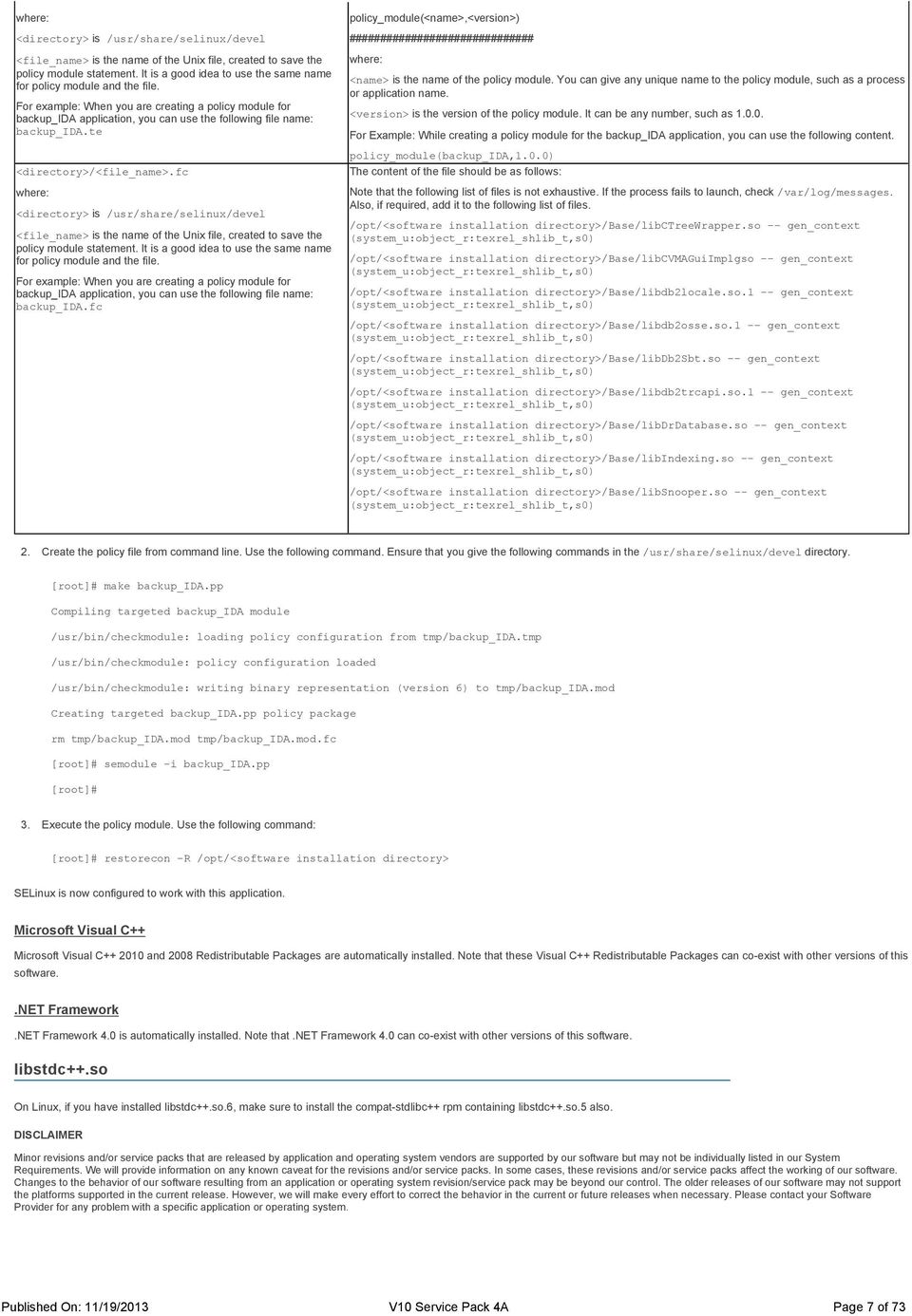
6 SuSE Linux 11.x with glibc 2.9.x and above SuSE Linux 11 Enterprise Server with libstdc++ version or above SuSE Linux 10.x with glibc 2.4.x SuSE Linux 10 Enterprise Server with libstdc++ version or above x86 or compatible processors Power PC x86 or compatible processors Power PC Windows Windows 2008 Microsoft Windows Server bit Editions Windows 2003 Microsoft Windows Server 2003 Editions with a minimum of Service Pack 2 Cluster - Support The software can be installed on a Cluster if clustering is supported by the above-mentioned operating systems. For information on supported cluster types, see Clustering - Support. Hard Drive Windows 888 MB on Data Protection Suite install path including Job Results and Log files 88 MB on Job Results 23.5 MB on Log File path (without debug) Linux 568 MB on Data Protection Suite install path including Log Files and excluding Job Results 1 MB on Data Protection Suite Job Results. 34 MB on Log Files (without debug) AIX MB on Data Protection Suite install path including Job Results 1.97 MB on Job Results MB on Log location with debug Solaris Zones/Containers Support For a comprehensive list of supported components, see Unix Virtualization. AIX LPAR/WPAR Support Data protection on Logical Partitioning (LPAR) and Workload Partitioning (WPAR) is supported. Miscellaneous The File System idataagent will be automatically installed during installation of this software, if it is not already installed. For System Requirements and install information specific to the File System idataagents, refer to: System Requirements - Microsoft Windows File System idataagent System Requirements - AIX File System idataagent System Requirements - HP-UX File System idataagent System Requirements - Linux File System idataagent System Requirements - Solaris File System idataagent On Solaris computers, the operating system must have been installed with at least the user level software option selected. SELinux If you have SELinux enabled on the client computer, create the SELinux policy module as a root user before performing a backup. The SELinux Development package must be installed on the client. To create an SELinux policy module, perform the following steps as user "root": 1. Create the following files in the /usr/share/selinux/devel directory: File Name <directory>/<file_name>.te Content of the File The content of the file should be as follows: Published On: 11/19/2013 V10 Service Pack 4A Page 6 of 73

7 where: <directory> is /usr/share/selinux/devel <file_name> is the name of the Unix file, created to save the policy module statement. It is a good idea to use the same name for policy module and the file. For example: When you are creating a policy module for backup_ida application, you can use the following file name: backup_ida.te <directory>/<file_name>.fc where: <directory> is /usr/share/selinux/devel <file_name> is the name of the Unix file, created to save the policy module statement. It is a good idea to use the same name for policy module and the file. For example: When you are creating a policy module for backup_ida application, you can use the following file name: backup_ida.fc policy_module(<name>,<version>) ############################## where: <name> is the name of the policy module. You can give any unique name to the policy module, such as a process or application name. <version> is the version of the policy module. It can be any number, such as For Example: While creating a policy module for the backup_ida application, you can use the following content. policy_module(backup_ida,1.0.0) The content of the file should be as follows: Note that the following list of files is not exhaustive. If the process fails to launch, check /var/log/messages. Also, if required, add it to the following list of files. /opt/<software installation directory>/base/libctreewrapper.so -- gen_context (system_u:object_r:texrel_shlib_t,s0) /opt/<software installation directory>/base/libcvmaguiimplgso -- gen_context (system_u:object_r:texrel_shlib_t,s0) /opt/<software installation directory>/base/libdb2locale.so.1 -- gen_context (system_u:object_r:texrel_shlib_t,s0) /opt/<software installation directory>/base/libdb2osse.so.1 -- gen_context (system_u:object_r:texrel_shlib_t,s0) /opt/<software installation directory>/base/libdb2sbt.so -- gen_context (system_u:object_r:texrel_shlib_t,s0) /opt/<software installation directory>/base/libdb2trcapi.so.1 -- gen_context (system_u:object_r:texrel_shlib_t,s0) /opt/<software installation directory>/base/libdrdatabase.so -- gen_context (system_u:object_r:texrel_shlib_t,s0) /opt/<software installation directory>/base/libindexing.so -- gen_context (system_u:object_r:texrel_shlib_t,s0) /opt/<software installation directory>/base/libsnooper.so -- gen_context (system_u:object_r:texrel_shlib_t,s0) 2. Create the policy file from command line. Use the following command. Ensure that you give the following commands in the /usr/share/selinux/devel directory. [root]# make backup_ida.pp Compiling targeted backup_ida module /usr/bin/checkmodule: loading policy configuration from tmp/backup_ida.tmp /usr/bin/checkmodule: policy configuration loaded /usr/bin/checkmodule: writing binary representation (version 6) to tmp/backup_ida.mod Creating targeted backup_ida.pp policy package rm tmp/backup_ida.mod tmp/backup_ida.mod.fc [root]# semodule -i backup_ida.pp [root]# 3. Execute the policy module. Use the following command: [root]# restorecon -R /opt/<software installation directory> SELinux is now configured to work with this application. Microsoft Visual C++ Microsoft Visual C and 2008 Redistributable Packages are automatically installed. Note that these Visual C++ Redistributable Packages can co-exist with other versions of this software..net Framework.NET Framework 4.0 is automatically installed. Note that.net Framework 4.0 can co-exist with other versions of this software. libstdc++.so On Linux, if you have installed libstdc++.so.6, make sure to install the compat-stdlibc++ rpm containing libstdc++.so.5 also. DISCLAIMER Minor revisions and/or service packs that are released by application and operating system vendors are supported by our software but may not be individually listed in our System Requirements. We will provide information on any known caveat for the revisions and/or service packs. In some cases, these revisions and/or service packs affect the working of our software. Changes to the behavior of our software resulting from an application or operating system revision/service pack may be beyond our control. The older releases of our software may not support the platforms supported in the current release. However, we will make every effort to correct the behavior in the current or future releases when necessary. Please contact your Software Provider for any problem with a specific application or operating system. Published On: 11/19/2013 V10 Service Pack 4A Page 7 of 73
8 Additional considerations regarding minimum requirements and End of Life policies from application and operating system vendors are also applicable Published On: 11/19/2013 V10 Service Pack 4A Page 8 of 73

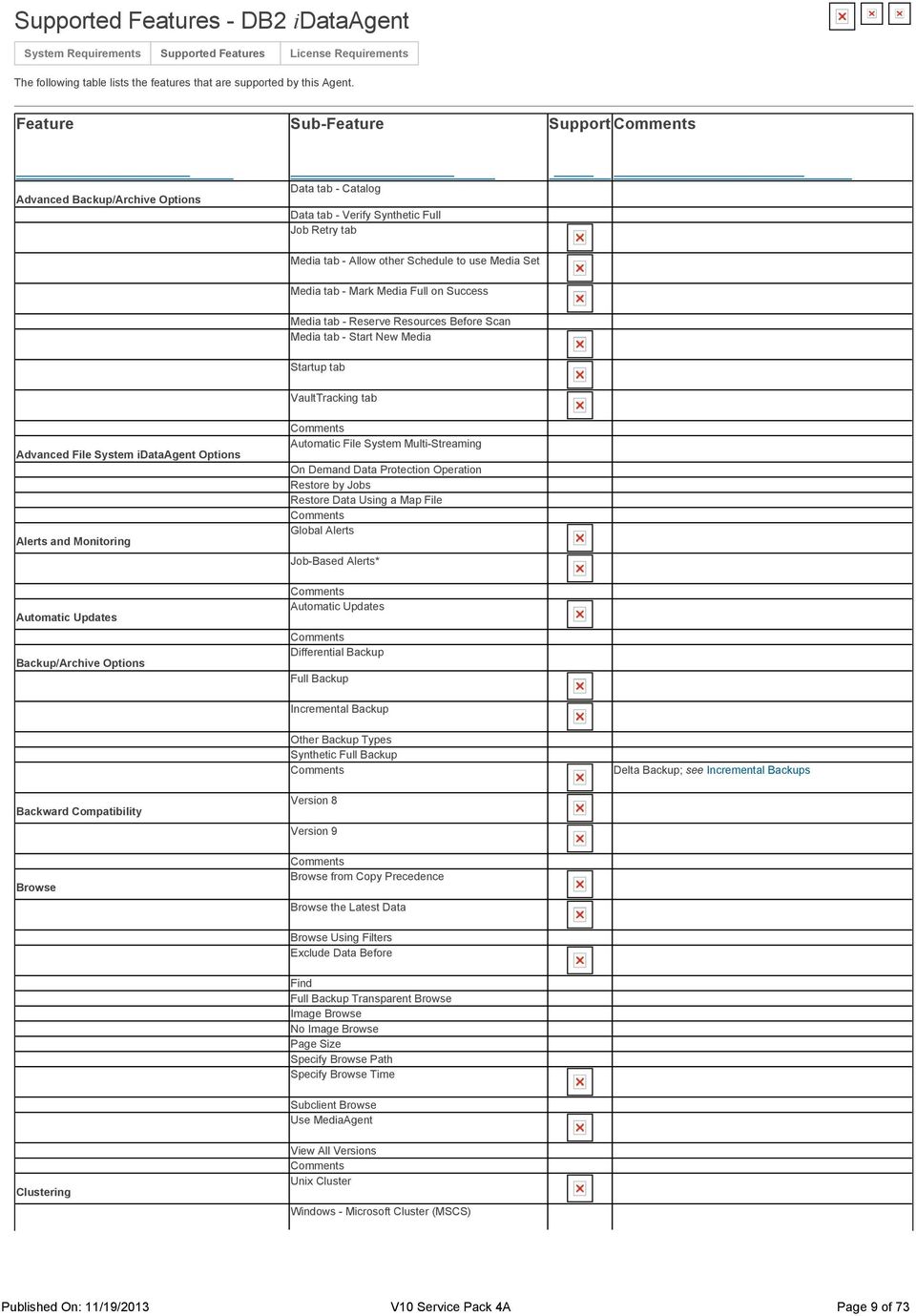
9 Supported Features - DB2 idataagent System Requirements Supported Features License Requirements The following table lists the features that are supported by this Agent. Feature Sub-Feature Support Comments Advanced Backup/Archive Options Data tab - Catalog Data tab - Verify Synthetic Full Job Retry tab Media tab - Allow other Schedule to use Media Set Media tab - Mark Media Full on Success Media tab - Reserve Resources Before Scan Media tab - Start New Media Startup tab VaultTracking tab Advanced File System idataagent Options Alerts and Monitoring Automatic Updates Backup/Archive Options Comments Automatic File System Multi-Streaming On Demand Data Protection Operation Restore by Jobs Restore Data Using a Map File Comments Global Alerts Job-Based Alerts* Comments Automatic Updates Comments Differential Backup Full Backup Incremental Backup Other Backup Types Synthetic Full Backup Comments Delta Backup; see Incremental Backups Backward Compatibility Browse Version 8 Version 9 Comments Browse from Copy Precedence Browse the Latest Data Browse Using Filters Exclude Data Before Find Full Backup Transparent Browse Image Browse No Image Browse Page Size Specify Browse Path Specify Browse Time Subclient Browse Use MediaAgent Clustering View All Versions Comments Unix Cluster Windows - Microsoft Cluster (MSCS) Published On: 11/19/2013 V10 Service Pack 4A Page 9 of 73
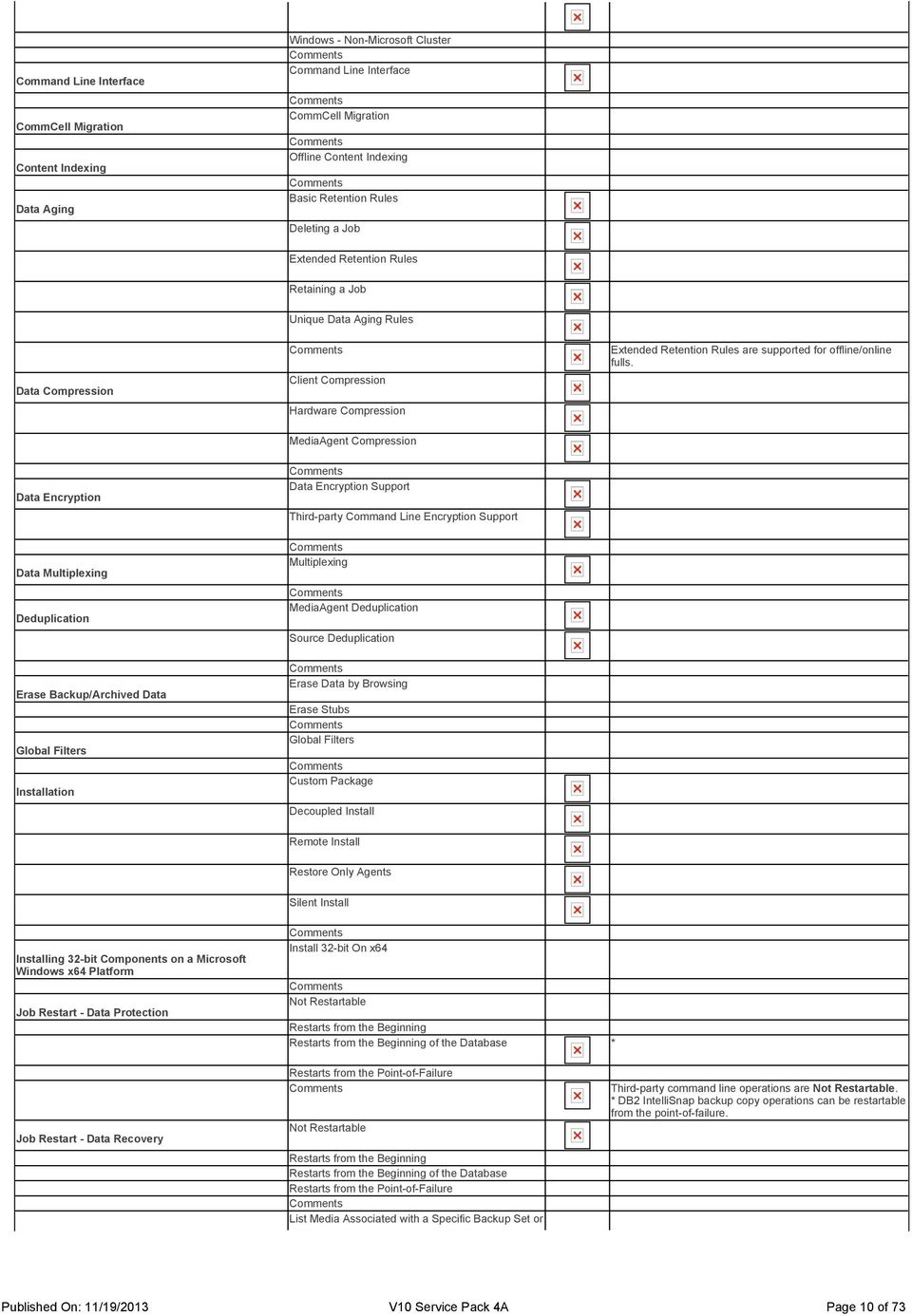
10 Command Line Interface CommCell Migration Content Indexing Data Aging Windows - Non-Microsoft Cluster Comments Command Line Interface Comments CommCell Migration Comments Offline Content Indexing Comments Basic Retention Rules Deleting a Job Extended Retention Rules Retaining a Job Unique Data Aging Rules Data Compression Comments Client Compression Hardware Compression Extended Retention Rules are supported for offline/online fulls. MediaAgent Compression Data Encryption Comments Data Encryption Support Third-party Command Line Encryption Support Data Multiplexing Deduplication Comments Multiplexing Comments MediaAgent Deduplication Source Deduplication Erase Backup/Archived Data Global Filters Installation Comments Erase Data by Browsing Erase Stubs Comments Global Filters Comments Custom Package Decoupled Install Remote Install Restore Only Agents Silent Install Installing 32-bit Components on a Microsoft Windows x64 Platform Job Restart - Data Protection Comments Install 32-bit On x64 Comments Not Restartable Restarts from the Beginning Restarts from the Beginning of the Database * Job Restart - Data Recovery Restarts from the Point-of-Failure Comments Not Restartable Restarts from the Beginning Restarts from the Beginning of the Database Restarts from the Point-of-Failure Comments List Media Associated with a Specific Backup Set or Third-party command line operations are Not Restartable. * DB2 IntelliSnap backup copy operations can be restartable from the point-of-failure. Published On: 11/19/2013 V10 Service Pack 4A Page 10 of 73
11 List Media Multi Instancing Optimized Scan Pre/Post Processes Restore/Recover/Retrieve Destinations Instance List Media Associated with Index List Media Associated with Specific Files and/or Folders List Media Associated with Specific Jobs Comments Multi Instance Comments Optimized Scan Comments Pre/Post Process with Data Protection and Recovery Comments Cross-Application Restores (Different Application version) Cross-Platform Restores - Different Operating System Cross-Platform Restores - Same Operating System - Different Version In-place Restore - Same path/ destination - Same Client Out-of-place Restore - Different path/ destination Out-of-place Restore - Same path/ destination - Different Client Restore Data Using a Map File Restore to Network Drive /NFS-Mounted File System Comments See Restore Destinations for this idataagent. Restore/Recover/Retrieve Options Automatic Detection of Regular Expressions Filter Data From Recover Operations Rename/ Redirect Files on Restore Restore Data Using Wildcard Expressions Restore Data with Pre/Post Processes Restore from Copies Skip Errors and Continue Use Exact Index Use MediaAgent Restore/Recover/Retrieve Overwrite Options Schedule Policy Comments Overwrite Files Overwrite if file on media is newer Restore only if target exists Unconditional Overwrite Unconditionally overwrite only if target is a DataArchiver stub Comments Agent Specific Data Protection Schedule Policy All Agent Types Schedule Policy Storage Policies Subclient Policies Upgrade Comments Incremental Storage Policy* Standard Storage Policies Comments SubClient Policy Comments Netware - Local Unix - Remote (Push) Unix/Linux - Local Unix/Linux - Silent Unix/Linux/Macintosh - Local Incremental Storage Policy does not support Transaction Log backups for this agent. Unix/Linux/Macintosh - Silent Upgrade from CommCell Console Windows - Local Windows - Remote (Push) Published On: 11/19/2013 V10 Service Pack 4A Page 11 of 73
12 Windows - Silent User Administration and Security Comments Backup Set/Archive Set Instance Subclient Comments Additional features are listed below: Activity Control Auxiliary Copy CommCell Console GridStor Log Files Operation window IntelliSnap Backup VaultTracker Enterprise Cloud Storage Deconfigure/Reconfigure Components Languages MediaAgent Scheduling Snapshot Engines VaultTracker Restore/Recover/Retrieve - Other Options Job Restart - Data Collection Published On: 11/19/2013 V10 Service Pack 4A Page 12 of 73
13 Getting Started - Backup Administrator Overview Deployment - Windows Deployment - Windows Cluster Deployment - Unix Deployment - Unix Cluster Configuration Where to Install Install the software on a Windows computer on which the DB2 server resides. As soon as you complete the installation, the Windows computer will be added as a client in the CommCell. Planning Your Installation If a pending rename operation from a previously installed application is found in the operating system, the software installation may require a system reboot. Hence, plan your installation at a convenient time. Before You Begin System Requirements Verify that the computer in which you wish to install the software satisfies the minimum requirements specified in System Requirements. Download Software Packages Download the latest software package to perform the install. Installation The software can be installed using one of the following methods: Method 1: Interactive Install - Standard Use this procedure to install the software using the standard installation options. Method 2: Interactive Install - Custom Use this procedure to install the software by specifying installation settings and options. Method 1: Interactive Install - Standard 1. Log on to the client computer as an Administrator or as a member of the Administrator group on that computer. 2. Run SetupAll.exe from the Software Installation Discs. 3. In the License Agreement dialog box, click I accept the terms in the license agreement, and then click Next. 4. In the Install Type dialog box, click Standard, and then click Next. 5. In the Installation Options dialog box, click Join an Existing CommCell, and then click Next. 6. In the Select Platforms dialog box, expand the Database folder, and then click DB2. Click Next. 7. In the Destination Folder dialog box, verify the default location for software installation. Click Next. If necessary, click Browse... to change the default location. Do not install the software to a mapped network drive Do not use the following characters when specifying the destination path: / : *? " < > # It is recommended that you use alphanumeric characters only If you are installing the software in a clustered environment, make sure to install the software using the same installation path on Published On: 11/19/2013 V10 Service Pack 4A Page 13 of 73
14 8. In the Summary dialog box, verify all the components that you have selected for installation, and then click Next. 9. In the Installer dialog box, click Yes. 10. In the Prerequisites dialog box, click Reboot Now. The installation will automatically resume after the reboot. If the install program does not automatically resume, run SetupAll.exe from the Software Installation Discs. 11. In the Install dialog box, click Next. 12. In the CommServe Name dialog box, enter the fully qualified domain name of the CommServe in the CommServe Host Name box. When you specify the CommServe Host Name, do not use the space and the following characters: \ `~!@#$%^&*()+=<>/?,[]{}:;'" Click Next. 13. In the Communication Interface Name dialog box, enter the following: The local (NetBIOS) name of the client computer is displayed in the Select a Client name list. If necessary you can also type a new (friendly) name for the client in this box. This name will be used in the CommCell and will also be displayed in the CommCell Console. Do not use spaces when specifying a new name for the client. The default network interface name of the client computer is displayed if the computer has only one network interface (NIC card). If the computer has multiple network interfaces, select the interface name that is preferred for communication with the CommServe. Click Next. 14. In the Port Number Selection dialog box, the default port numbers used for CommCell communication are displayed. If necessary, you can modify the port numbers. Click Next. all the nodes. If a component is already installed on this computer, this screen will not be displayed; instead, the install program will use the same name as previously specified. This screen will not appear if the default port numbers are not used for CommCell communication. 15. In the Windows Firewall Configuration dialog box, select one of the following options: If you do not want to disable Windows Firewall, click Next. If you want to disable Windows Firewall for all profiles, click Yes, disable Windows Firewall for all profiles and then click Next. For firewall options and configuration instructions, see Firewall Configuration and continue with the installation. 16. In the Windows Firewall Exclusion List dialog box, select Add programs to the Windows Firewall Exclusion List to add the CommCell programs and services to the Windows Firewall Exclusion List. Click Next. It is recommended to select this option even if the Windows firewall is disabled. This will allow the CommCell programs and services to function without any interruption if the Windows firewall is enabled at a later time. 17. In the Client Group Selection dialog box, select a DB2 Client Group, and then click Next. This screen will not be displayed if Client Groups are not configured in the CommCell Console. For more information, see Client Computer Groups. 18. In the Global Filter Options dialog box, click Next. This agent does not support Global Filters. 19. In the Policy Selection dialog box, select a storage policy from the Storage Policy list. Click Next. Make sure to select the storage policy even if the file system idataagent is not selected during the installation. If you do not have a Storage Policy, the list will not be displayed. You can create the Storage Policy later in step In the DB2 Archive Path dialog box, enter the DB2 Archive Path or click Browse to select a storage location for the DB2 archive files. If you are installing the software in a clustered environment, ensure that the DB2 Archive path resides on a shared drive. 21. In the DB2 Retrieve Path dialog box, enter the DB2 Retrieve Path or click Browse to select a storage location for the DB2 retrieve files. If you are installing the software in a clustered environment, ensure that the DB2 Retrieve path resides on a shared drive. 22. In the DB2 Audit Error Path dialog box, enter the DB2 Audit Error Path or click Browse to select a storage location for the DB2 audit error files. If you are installing the software in a clustered environment, ensure that the DB2 Audit Error Path resides on a shared drive. Published On: 11/19/2013 V10 Service Pack 4A Page 14 of 73

15 23. In the Installer dialog box, click OK. 24. In the Completion Report dialog box, click Reboot Now. If you already have a storage policy selected in step 20, click to proceed to the Configuration section. If you have to create a Storage Policy, continue with the following step. 25. To create a storage policy, you must have configured a library in the CommCell. If you do not already have a library configured, go to Disk Library Creation. If you have a library configured, go to Storage Policy Creation. DISK LIBRARY CREATION: 1. From the CommCell Browser, navigate to Storage Resources, right-click the Libraries, point to Add and then click Disk Library... Alternatively, you can also navigate to MediaAgents, right-click <MediaAgent>, point to All Tasks Create Library and then click Disk Library From the Add Disk Library dialog box, specify the following: In the Name box, specify name of the disk library. From the MediaAgent list, select the MediaAgent. Perform one of the following: Select Local Path if you wish to specify a local path in the MediaAgent computer. In the Disk Device box, type the name of the folder in which the disk library must located or click button to select the folder. Select Network Path, if you wish to specify a network path as the target share. In the Connect As box, type the user name. In the Password and Verify Password box, type the password to access the network share. In the Folder box, type the mount path or click button to select a mount path. Click OK. 3. The newly created disk library will be displayed under Libraries node. This will create a library and Storage Policy. Click to proceed to the Configuration section. Storage Policy Creation 1. From the CommCell Browser, navigate to Policies. 2. Right-click the Storage Policies and then click New Storage Policy. 3. Follow the prompts displayed in the Storage Policy Wizard. The required options are mentioned below: Select the Storage Policy type as Data Protection and Archiving and click Next. Enter the name in the Storage Policy Name box and click Next. From the Library list, click the name of a disk library to which the primary copy should be associated and then click Next. Ensure that you select a library attached to a MediaAgent operating in the current release. From the MediaAgent list, click the name of a MediaAgent that will be used to create the primary copy and then click Next. For the device streams and the retention criteria information, click Next to accept default values. Select Yes to enable deduplication for the primary copy. From the MediaAgent list, click the name of the MediaAgent that will be used to host the Deduplication Database (DDB). In the Location box, type the name of the folder in which the DDB must be located or click the Browse button to select the folder and then click Next. Review the details and click Finish to create the Storage Policy. This will create a storage policy. Click to proceed to the Configuration section. Published On: 11/19/2013 V10 Service Pack 4A Page 15 of 73
16 Default Options Selected During Standard Install Listed below are the default options that are not selected while performing the Standard Install. OPTION ENABLED / DISABLED DESCRIPTION Add programs to the Windows Firewall Exclusion List Disabled This option allows you to add Data Protection Suite programs to the Windows Firewall exclusion list. This option is not selected. Global Filter Options Disabled DB2 idataagent does not support Global Filters. This option is not selected. Components installed by default during Standard Install Listed below are the components that are installed by default while performing the Standard Install: SELECTED PACKAGE COMPONENTS INSTALLED DB2 Agent DB2 idataagent File System Core Windows File System Method 2: Interactive install - Custom 1. Log on to the client computer as an Administrator or as a member of the Administrator group on that computer. 2. Run SetupAll.exe from the Software Installation Discs. 3. In the License Agreement dialog box, click I accept the terms in the license agreement, and then click Next. 4. In the Install Type dialog box, click Custom, and then click Next. 5. In the Custom Install Type dialog box, click Select components to install on this computer, and then click Next. 6. In the Select Platforms dialog box, expand the Database folder, and then click DB2. Click Next. Published On: 11/19/2013 V10 Service Pack 4A Page 16 of 73
17 7. In the Destination Folder dialog box, verify the default location for software installation. Click Next. If necessary, click Browse... to change the default location. Do not install the software to a mapped network drive Do not use the following characters when specifying the destination path: / : *? " < > # It is recommended that you use alphanumeric characters only 8. In the Summary dialog box, verify all the components that you have selected for installation, and then click Next. 9. In the Installer dialog box, click Yes. 10. In the Prerequisites dialog box, click Reboot Now. The installation will automatically resume after the reboot. If the install program does not automatically resume, run SetupAll.exe from the Software Installation Discs. 11. In the Install dialog box, click Next. 12. In the Firewall Configuration dialog box, select one of the following: If the firewall configuration is not required, click Next. If this computer and the CommServe is separated by a firewall, click Configure firewall services. For firewall options and configuration instructions, see Firewall Configuration and continue with the installation. 13. In the CommServe Name dialog box, enter the fully qualified domain name of the CommServe in the CommServe Host Name box. When you specify the CommServe Host Name, do not use the space and the following characters: \ `~!@#$%^&*()+=<>/?,[]{}:;'" Click Next. 14. In the Communication Interface Name dialog box, enter the following: The local (NetBIOS) name of the client computer is displayed in the Select a Client name list. If necessary you can also type a new (friendly) name for the client in this box. This name will be used in the CommCell and will also be displayed in the CommCell Console. Do not use spaces when specifying a new name for the client. The default network interface name of the client computer is displayed if the computer has only one network interface (NIC card). If the computer has multiple network interfaces, select the interface name that is preferred for communication with the CommServe. Click Next. 15. In the Port Number Selection dialog box, the default port numbers used for CommCell communication are displayed. If necessary, you can modify the port numbers. Click Next. If you are installing the software in a clustered environment, make sure to install the software using the same installation path on all the nodes. If a component is already installed on this computer, this screen will not be displayed; instead, the install program will use the same name as previously specified. This screen will not appear if the default port numbers are not used for CommCell communication. 16. In the Windows Firewall Configuration dialog box, select one of the following options: If you do not want to disable Windows Firewall, click Next. If you want to disable Windows Firewall for all profiles, click Yes, disable Windows Firewall for all profiles and then click Next. 17. In the Windows Firewall Exclusion List dialog box, select Add programs to the Windows Firewall Exclusion List to add the CommCell programs and services to the Windows Firewall Exclusion List. Published On: 11/19/2013 V10 Service Pack 4A Page 17 of 73
18 Click Next. It is recommended to select this option even if the Windows firewall is disabled. This will allow the CommCell programs and services to function without any interruption if the Windows firewall is enabled at a later time. 18. In the Client Group Selection dialog box, select a DB2 Client Group, and then click Next. This screen will not be displayed if Client Groups are not configured in the CommCell Console. For more information, see Client Computer Groups. 19. In the Global Filter Options dialog box, click Next. This agent does not support Global Filters. 20. In the Policy Selection dialog box, select a storage policy from the Storage Policy list. Click Next. Make sure to select the storage policy even if the file system idataagent is not selected during the installation. If you do not have a Storage Policy, the list will not be displayed. You can create the Storage Policy later in step In the DB2 Archive Path dialog box, enter the DB2 Archive Path or click Browse to select a storage location for the DB2 archive files. If you are installing the software in a clustered environment, ensure that the DB2 Archive path resides on a shared drive. 22. In the DB2 Retrieve Path dialog box, enter the DB2 Retrieve Path or click Browse to select a storage location for the DB2 retrieve files. If you are installing the software in a clustered environment, ensure that the DB2 Retrieve path resides on a shared drive. 23. In the DB2 Audit Error Path dialog box, enter the DB2 Audit Error Path or click Browse to select a storage location for the DB2 audit error files. If you are installing the software in a clustered environment, ensure that the DB2 Audit Error Path resides on a shared drive. 24. In the Installer dialog box, click OK. 25. In the Completion Report dialog box, click Reboot Now. If you already have a storage policy selected in step 20, click to proceed to the Configuration section. If you have to create the Storage Policy, continue with the following step. 26. To create a storage policy, you must have configured a library in the CommCell. If you do not already have a library configured, go to Disk Library Creation. If you have a library configured, go to Storage Policy Creation. DISK LIBRARY CREATION: 1. From the CommCell Browser, navigate to Storage Resources, right-click the Libraries, point to Add and then click Disk Library... Alternatively, you can also navigate to MediaAgents, right-click <MediaAgent>, point to All Tasks Create Library and then click Disk Library From the Add Disk Library dialog box, specify the following: In the Name box, specify name of the disk library. From the MediaAgent list, select the MediaAgent. Perform one of the following: Select Local Path if you wish to specify a local path in the MediaAgent computer. In the Disk Device box, type the name of the folder in which the disk library must located or click button to select the folder. Select Network Path, if you wish to specify a network path as the target share. In the Connect As box, type the user name. In the Password and Verify Password box, type the password to access the network share. In the Folder box, type the mount path or click button to select a mount path. Click OK. 3. The newly created disk library will be displayed under Libraries node. This will create a library and Storage Policy. Click to proceed to the Configuration section. Storage Policy Creation 1. From the CommCell Browser, navigate to Policies. 2. Right-click the Storage Policies and then click New Storage Policy. Published On: 11/19/2013 V10 Service Pack 4A Page 18 of 73

19 3. Follow the prompts displayed in the Storage Policy Wizard. The required options are mentioned below: Select the Storage Policy type as Data Protection and Archiving and click Next. Enter the name in the Storage Policy Name box and click Next. From the Library list, click the name of a disk library to which the primary copy should be associated and then click Next. Ensure that you select a library attached to a MediaAgent operating in the current release. From the MediaAgent list, click the name of a MediaAgent that will be used to create the primary copy and then click Next. For the device streams and the retention criteria information, click Next to accept default values. Select Yes to enable deduplication for the primary copy. From the MediaAgent list, click the name of the MediaAgent that will be used to host the Deduplication Database (DDB). In the Location box, type the name of the folder in which the DDB must be located or click the Browse button to select the folder and then click Next. Review the details and click Finish to create the Storage Policy. This will create a storage policy. Click to proceed to the Configuration section. Additional Installation Methods Custom Package Create a compact software package for quick deployment to multiple clients. Remote Install Deploy the software from CommCell Console on multiple clients. Silent Install Deploy the software silently on multiple clients. Decoupled Install Install the software first and later register the client in the CommCell. Installing Restore Only Agents Setup a client in the CommCell for restore purposes. Published On: 11/19/2013 V10 Service Pack 4A Page 19 of 73

20 Getting Started - Backup Administrator Overview Deployment - Windows Deployment - Windows Cluster Deployment - Unix Deployment - Unix Cluster Configuration SKIP THIS PAGE IF YOU ARE NOT INSTALLING THIS AGENT ON A MICROSOFT CLUSTER. CLICK DEPLOYMENT. TO CONTINUE WITH THE Steps involved in installing the DB2 idataagent in a Clustered environment: 1. Install the software on physical Nodes 2. Configure the Cluster Group Client Before You Begin System Requirements Verify that the computer in which you wish to install the software satisfies the minimum requirements specified in System Requirements. Network TCP Port Requirements Review the Network TCP Port requirements specified in Network TCP Port Requirements. License Requirements Review the license requirements specified in License Requirements. Download Software Packages Download the latest software package to perform the install. Several additional options are available for remotely installing the software from CommCell Console, refer to Install Software from the CommCell Console (Remote Install) for more information. Install the software on physical Nodes If you do not wish to protect physical nodes with a specific agent, you can install that agent in 'restore only' mode, doing so will prevent the consumption of additional license per node. See Installing Restore Only Agents for more information. Alternatively, you can release license from the CommCell Console for a specific agent after installing it on the physical nodes. Refer to Releasing a License section to see the procedure for releasing a license. The software can be installed on the Physical nodes using the following method: Method : Interactive Installation Use this procedure to Install the software on the physical nodes from the active node of a cluster group. Interactive Installation 1. From the active node of the cluster group, log on to the physical computer as an Administrator or as a member of the Administrator group on that computer. 2. Run SetupAll.exe from the Software Installation Discs. 3. Click I accept the terms in the license agreement. Click Next. 4. Click Custom. Click Next. Published On: 11/19/2013 V10 Service Pack 4A Page 20 of 73

21 5. Click Select components to install on this computer and click Next. 6. Expand Database, and then click DB2. Click Next. 7. Verify the default location for software installation. Click Next. If necessary, click Browse... to change the default location. Do not install the software to a mapped network drive Do not use the following characters when specifying the destination path: / : *? " < > # It is recommended that you use alphanumeric characters only In a clustered environment, the software must be installed to the same path on all the nodes. Published On: 11/19/2013 V10 Service Pack 4A Page 21 of 73
22 8. Click Install. The Summary on your screen should reflect the components you selected for install, and may look different from the example shown. 9. Click Yes. 10. Click Reboot Now. The installation will automatically resume after the reboot. If the install program does not automatically resume, run SetupAll.exe from the Software Installation Discs. 11. Click Next. Published On: 11/19/2013 V10 Service Pack 4A Page 22 of 73
23 12. Select one of the following: If firewall configuration is not required, click Next. If this computer and the CommServe is separated by a firewall, click Configure firewall services. For firewall options and configuration instructions, see Firewall Configuration and continue with the installation. 13. Enter the fully qualified domain name of the CommServe in the CommServe Host Name box. Do not use space and the following characters when specifying the CommServe Host Name: \ `~!@#$%^&*()+=<>/?,[]{}:;'" Click Next. 14. Enter the following: The local (NetBIOS) name of the client computer is displayed in the Select a Client name list. If necessary you can also type a new (friendly) name for the client in this box. This name will be used in the CommCell and will also be displayed in the CommCell Console. Do not use spaces when specifying a new name for the client. Published On: 11/19/2013 V10 Service Pack 4A Page 23 of 73
24 The default network interface name of the client computer is displayed if the computer has only one network interface (NIC card). If the computer has multiple network interfaces, select the interface name that is preferred for communication with the CommServe. Click Next. If a component is already installed on this computer, this screen will not be displayed; instead, the install program will use the same name as previously specified. 15. The default port numbers used for CommCell communication is displayed. If necessary, you can modify the port numbers. Click Next. This screen will not appear if the default port numbers are not used for CommCell communication. 16. Select one of the following options: If you do not want to disable Windows Firewall, click Next. If you want to disable Windows Firewall for all profiles, click Yes, disable Windows Firewall for all profiles and then click Next. 17. Select Add programs to the Windows Firewall Exclusion List, to add CommCell programs and services to the Windows Firewall Exclusion List. Published On: 11/19/2013 V10 Service Pack 4A Page 24 of 73
25 Click Next. This option enables CommCell operations across Windows firewall by adding CommCell programs and services to Windows firewall exclusion list. It is recommended to select this option even if Windows firewall is disabled. This will allow the CommCell programs and services to function if the Windows firewall is enabled at a later time. 18. Select a Client Group. Click Next. This screen will not be displayed if Client Groups are not configured in the CommCell Console. For more information, see Client Computer Groups. 19. Click Next. This agent does not support Global Filters. 20. Select a storage policy from the Storage Policy list. Click Next. Published On: 11/19/2013 V10 Service Pack 4A Page 25 of 73
26 If you do not have a Storage Policy, the list will not be displayed. You can create a Storage Policy later using the steps described in the Configuring storage Policy section. 21. Enter the DB2 Archive Path or click Browse to select a location to store the DB2 archive files. If you are installing the software in a clustered environment, ensure that the DB2 Archive path resides on a shared drive. 22. Enter the DB2 Retrieve Path or click Browse to select a location to store the DB2 retrieve files. If you are installing the software in a clustered environment, ensure that the DB2 Retrieve path resides on a shared drive. 23. Enter the DB2 Audit Error Path or click Browse to select a location to store the Db2 audit error files. If you are installing the software in a clustered environment, ensure that the DB2 Audit Error Path resides on a shared drive. Published On: 11/19/2013 V10 Service Pack 4A Page 26 of 73
27 24. Click Yes. When you click Yes, the software automatically retrieves the list of nodes to which the current active node can failover. 25. Select cluster nodes from the Preferred Nodes list and click the arrow button to move them to the Selected Nodes list. Once you complete your selections, click Next. The list of Preferred Nodes displays all the nodes found in the cluster; from this list, you are required to select the cluster nodes configured to host this cluster group server. 26. Specify User Name and Password of the Domain Administrator account to perform the remote install on the cluster nodes you selected in the previous step. Click Next. The Domain Administrator user account that you specify here must have Administrator rights on all the cluster nodes that you selected in the previous step. Published On: 11/19/2013 V10 Service Pack 4A Page 27 of 73
28 The Installer tries to install the software on all the nodes (physical computers) that you selected in step 25. The progress of the remote install for the cluster nodes is displayed on the Remote Install Progress screen. 27. Click Finish. If the software is not installed successfully on any of the passive nodes selected in step 25, or if any passive node is not available during the installation, a separate installation from the CommCell Console needs to be performed on that node in order to prepare it for a failover protection. For remote install instructions, see Remote Install. The Summary on your screen should reflect the components you selected for install, and may look different from the example shown. 28. Click Finish. This screen may look different from the example shown. Click Reboot Now if it prompts for a reboot. Published On: 11/19/2013 V10 Service Pack 4A Page 28 of 73
29 After installing the software successfully on all the physical computers that host the Cluster Group, you must configure the Cluster Group Client from the CommCell Console. The following section describes the steps involved in configuring the Cluster Group Client. Configure the Cluster Group Client 1. From the CommCell Browser, right-click the Client Computers node, point to New Client Clustered Server and then click Windows Cluster. 2. In the Client Name box, type a name for the cluster group. The Client name can be any unique name. In the Host Name box, type the fully qualified domain name of the cluster group. The Host name of the cluster group client should not be used by any existing client in your CommCell. Host Name is the fully qualified domain name of the cluster group. See the screenshot below for reference. Published On: 11/19/2013 V10 Service Pack 4A Page 29 of 73
30 3. Review the cluster group information and click Finish. Advanced Client Properties window is displayed now. 4. On the Advanced Client Properties dialog box, click the Cluster Group Configuration tab. All the Windows clients that are available in the CommCell will be listed in the Available list. Select the physical computers (nodes) where you installed the necessary Agents from the Available list, and then click Add > to move the client to the Selected list. If the client computer properties dialog box is not displayed automatically, then you need to open it manually: Right-click the <Cluster Group Client>, and then click Properties. Click Advanced on the Client Computer Properties dialog box. Click the Cluster Group Configuration tab on the Advanced Client Properties dialog box. 5. Click the Agents tab. Select the Agents you want to use in the cluster group client from the Available list and click Add > to move the Agent to the Selected list. In order to configure a Cluster Group Client, the agents should be installed on all the clustered nodes for proper failover. If an Agent is not installed on all the nodes, then the Agents selection tab on the Advanced Client Properties window will display the Agent name in plain text (not in bold). However, you can still configure the Cluster Group Client even when the Agents are not installed on a particular node; installation can be done later using Remote install procedure. Published On: 11/19/2013 V10 Service Pack 4A Page 30 of 73
31 6. Click the Job Configuration tab. Type or click Browse to specify the path for the Job Results Directory in the cluster group client. Click OK. Ensure that the Job Results Directory resides on a shared clustered drive. In the case of MediaAgent and ContinuousDataReplicator, the Job Result directory path will be used for the Index Cache and CDR Log directories respectively if no directory location is provided. 7. Click OK. The cluster group client is successfully created. Configuring Storage Policy If you do not have Storage Policy created, continue with the following step. To create a storage policy, you must have a library configured in the CommCell. If you do not already have a library configured, go to Disk Library Creation. If you have a library configured, go to Storage Policy Creation. DISK LIBRARY CREATION: 1. From the CommCell Browser, navigate to Storage Resources, right-click the Libraries, point to Add and then click Disk Library... Alternatively, you can also navigate to MediaAgents, right-click <MediaAgent>, point to All Tasks Create Library and then click Disk Library From the Add Disk Library dialog box, specify the following: In the Name box, specify name of the disk library. From the MediaAgent list, select the MediaAgent. Perform one of the following: Select Local Path if you wish to specify a local path in the MediaAgent computer. In the Disk Device box, type the name of the folder in which the disk library must located or click button to select the folder. Select Network Path, if you wish to specify a network path as the target share. In the Connect As box, type the user name. In the Password and Verify Password box, type the password to access the network share. Published On: 11/19/2013 V10 Service Pack 4A Page 31 of 73
32 In the Folder box, type the mount path or click button to select a mount path. Click OK. 3. The newly created disk library will be displayed under Libraries node. Storage Policy Creation 1. From the CommCell Browser, navigate to Policies. 2. Right-click the Storage Policies and then click New Storage Policy. 3. Follow the prompts displayed in the Storage Policy Wizard. The required options are mentioned below: Select the Storage Policy type as Data Protection and Archiving and click Next. Enter the name in the Storage Policy Name box and click Next. From the Library list, click the name of a disk library to which the primary copy should be associated and then click Next. Ensure that you select a library attached to a MediaAgent operating in the current release. From the MediaAgent list, click the name of a MediaAgent that will be used to create the primary copy and then click Next. For the device streams and the retention criteria information, click Next to accept default values. Select Yes to enable deduplication for the primary copy. From the MediaAgent list, click the name of the MediaAgent that will be used to host the Deduplication Database (DDB). In the Location box, type the name of the folder in which the DDB must be located or click the Browse button to select the folder and then click Next. Review the details and click Finish to create the Storage Policy. Additional Installation Methods Remote Install Deploy the software from CommCell Console on multiple clients. Published On: 11/19/2013 V10 Service Pack 4A Page 32 of 73
33 Getting Started - Backup Administrator Overview Deployment - Windows Deployment - Windows Cluster Deployment - Unix Deployment - Unix Cluster Configuration SKIP THIS PAGE IF YOU ARE NOT INSTALLING ON A UNIX CLIENT. Where to Install Install the software on a computer that you want to back up. As soon as you complete the installation, the computer on which you have installed the software will be added as a client in the CommCell. Before You Begin System Requirements Verify that the computer in which you wish to install the software satisfies the minimum requirements specified in System Requirements. Download Software Packages Download the latest software package to perform the install. Installation 1. Log on to the client computer as root. If you are installing the software from the Software Installation Discs, run the following command to mount the CD: mount -t iso9660,udf /dev/cdrom /mnt/cdrom Run the following command from the Software Installation Package or mount point:./cvpkgadd You can also run this command as a SUDO user with root privileges:./sudo cvpkgadd For steps to add a SUDO user to /etc/sudoers, see Frequently Asked Questions - Install. 2. The product banner and other information is displayed. Press Enter. 3. Read the license agreement. Type y and press Enter. 4. In the Selecting Unix Setup Task dialog, type the number of a setup task in the list, and press Enter. Selecting Unix Setup Task Please select a setup task you want to perform from the list below: Advanced options provide extra setup features such as creating custom package, recording/replaying user selections and installing External Data Connector software. 1) Install data protection agents on this computer 2) Advanced options 3) Exit this menu Your choice: [1] 5. In the Setting Client/Physical Machine Host Name dialog, the default network interface name of the client computer is displayed if the computer has only one network interface (NIC card). Press Enter to accept. If the computer has multiple network interfaces, enter the interface name that is preferred for communication with the CommServe, and then press Enter. Setting Client/Physical Machine Host Name We found one network interface available on your machine. We will associate it with the client being installed, and it will also be used by the CommServe to connect to the client. Note that you will be able to additionally customize Datapipe Interface Pairs used for the backup data traffic later in the Data Protection Suite Java GUI. Please check the interface name below, and make corrections if necessary: Client/Physical Machine Host Name: [myclient.company.com] 6. In the Setting Client Name dialog, the local name of the client computer is displayed. Press Enter to accept. If necessary you can also enter a new (friendly) name for the client, and then press Enter. This name will be used in the CommCell and will also be displayed in the CommCell Console. Do not use spaces when specifying a new name for the client. Setting Client Name Published On: 11/19/2013 V10 Service Pack 4A Page 33 of 73
34 Please specify the client name for this machine. It does not have to be the network host name: you can enter any word here without spaces. The only requirement is that it must be unique on the CommServe. Physical Machine Client name: [myclient] 7. In the Selecting Modules to Install dialog, type the number associated with the DB2 idataagent and press Enter. Selecting Modules to Install. [ ] 1) UNIX File System Basic [1002] [CVGxBase] [ ] 2) UNIX File System Advanced [1101] [CVGxIDA] [ ] 3) MediaAgent [1301] [CVGxMA] [ ] 4) Documentum idataagent [1126] [CVGxDctmIDA] [ ] 5) Oracle idataagent [1204] [CVGxOrIDA] [ ] 6) SAP for Oracle [1205] [CVGxOrSAP] [ ] 7) SAP for MaxDB [1206] [CVGxSAPMAXDB] [ ] 8) Informix idataagent [1201] [CVGxIfIDA] [ ] 9) Sybase idataagent [1202] [CVGxSybIDA] [ ] 10) DB2 idataagent [1207] [CVGxDB2] [ ] 11) MySQL idataagent [1208] [CVGxMySQL] [ ] 12) PostGres idataagent [1209] [CVGxPostGres] [ ] 13) Lotus Notes Database idataagent [1051] [CVGxLndbIDA] >) >>>>>>>>>>>> NEXT PAGE >>>>>>>>>>>> [a=all n=none r=reverse q=quit d=done >=next <=previous?=help] Enter number(s)/one of "a,n,r,q,d,>,<,?" here: In the extended Selecting Modules to Install dialog that is displayed after typing the number associated with the DB2 idataagent, type d for Done, and then press Enter. Selecting Modules to Install. [ ] 1) UNIX File System Basic [1002] [CVGxBase] [ ] 2) UNIX File System Advanced [1101] [CVGxIDA] [ ] 3) MediaAgent [1301] [CVGxMA] [ ] 4) Documentum idataagent [1126] [CVGxDctmIDA] [ ] 5) Oracle idataagent [1204] [CVGxOrIDA] [ ] 6) SAP for Oracle [1205] [CVGxOrSAP] [ ] 7) SAP for MaxDB [1206] [CVGxSAPMAXDB] [ ] 8) Informix idataagent [1201] [CVGxIfIDA] [ ] 9) Sybase idataagent [1202] [CVGxSybIDA] [X] 10) DB2 idataagent [1207] [CVGxDB2] [ ] 11) MySQL idataagent [1208] [CVGxMySQL] [ ] 12) PostGres idataagent [1209] [CVGxPostGres] [ ] 13) Lotus Notes Database idataagent [1051] [CVGxLndbIDA] >) >>>>>>>>>>>> NEXT PAGE >>>>>>>>>>>> [a=all n=none r=reverse q=quit d=done >=next <=previous?=help] Enter number(s)/one of "a,n,r,q,d,>,<,?" here: d 9. In the Configuration for Laptop or Desktop dialog, select the default option no, and press Enter. Deciding if to Config for Laptop or Desktop Backups Do you want to configure the idataagent for laptop or desktop backups? Config for Laptop or Desktop Backups? [no] 10. In the Install Agents for Restore Only dialog, select the default option no, and press Enter. Deciding if to Install Agents for Restore Only Do you want to install the agents for restore only without consuming licenses? Install Agents for Restore Only? [no] 11. In the Preparing Installation Directory dialog, verify the default path for software installation, and then press Enter. If necessary, enter a path to modify the default path and press Enter. Do not install the software to a mapped network drive Do not use the following characters when specifying the path:!@#$%^&*():/?\ It is recommended that you use alphanumeric characters only If you are installing the software in a clustered environment, install the software using the same path on all nodes. Preparing Installation Directory Please specify where you want us to install Data Protection Suite binaries. It must be a local directory or NFS and there should be at least 281MB of free space available. All files will be installed in a "hds" subdirectory, so if you enter "/opt", the files will actually be placed into "/opt/hds". Installation Directory: [/opt] Published On: 11/19/2013 V10 Service Pack 4A Page 34 of 73
35 12. In the Preparing Log Directory dialog, verify the default path for log files, and then press Enter. If necessary, enter a path to modify the default path and press Enter. Do not use the following characters when specifying the path:!@#$%^&*():/?\ It is recommended that you use alphanumeric characters only All the modules installed on the computer will store the log files in this directory. Preparing Log Directory Please specify where you want to keep Data Protection Suite log files. It must be a local directory or NFS share and there should be at least 100MB of free space available. All log files will be created in a "hds/log_files" subdirectory, so if you enter "/var/log", the logs will actually be placed into "/var/log/hds/log_files". Log Directory: [/var/log] 13. In the Deciding If to Use a Unix Group dialog, select the default option Yes, and then press Enter. Deciding If to Use a Unix Group Most of Data Protection Suite processes run with root privileges, but some are launched by databases and inherit database access rights. To make sure that registry and log files can be written to by both kinds of processes we can either make such files world-writeable or we can grant write access only to processes belonging to a particular group, e.g. a "hds" or a "dba" group. We highly recommend now that you create a new user group and enter its name in the next setup screen. If you choose not to assign a dedicated group to Data Protection Suite processes, you will need to specify the access permissions later. If you're planning to backup Oracle DB you should use "dba" group. Would you like to assign a specific group to Software? [yes] 14. In the Setting Unix Group dialog, type the Group name, and then press Enter to continue. Setting Unix Group Please enter the name of the group which will be assigned to all Data Protection Suite files and on behalf of which all Data Protection Suite processes will run. In most of the cases it's a good idea to create a dedicated "hds" group. However, if you're planning to use Oracle idataagent or SAP Agent, you should enter Oracle's "dba" group here. Group name: testgrp1 REMINDER If you are planning to install Data Protection Suite Informix, DB2, Sybase or Lotus Notes idataagent, please make sure to include Informix, DB2, etc. users into group "testgrp1".. Press <ENTER> to continue In the Setting Access Permissions for Group and other Users dialog, select the numbers associated with the access permissions, type d for done, and then press Enter. Setting Access Permissions for Group and Other Users Installer will assign full access rights to root user for all installed Data Protection Suite files and its processes. For group and any other users, you can specify the access permissions now. If you did not assign a dedicated group in previous step, make sure you specify sufficient access rights for other users if you are also planning to install Data Protection Suite agents involving third party software protection. [X] 1) Allow read permission to group users [X] 2) Allow write permission to group users [X] 3) Allow execute permission to group users [X] 4) Allow read permission to other users [ ] 5) Allow write permission to other users [X] 6) Allow execute permission to other users [a=all n=none r=reverse q=quit d=done >=next <=previous?=help] Enter number(s)/one of "a,n,r,q,d,>,<,?" here: d 16. In the Setting Instance Port Number of cvd dialog, the default port number used for CommCell communication is displayed. If necessary, you can modify the port number. Press Enter. Setting Instance Port Number of cvd Every instance of Data Protection Suite should use a unique set of network ports to avoid interfering with other instances running on the same machine. The port numbers selected must be from the reserved port number range and have not been registered by another application on this machine. Please enter the port numbers. Published On: 11/19/2013 V10 Service Pack 4A Page 35 of 73
36 Port Number for CVD : [8400] 17. In the Setting Instance Port Number of EvMgrC dialog, the default port number used for CommCell communication is displayed. If necessary, you can modify the port number. Press Enter. Setting Instance Port Number of EvMgrC Every instance of Data Protection Suite should use a unique set of network ports to avoid interfering with other instances running on the same machine. The port numbers selected must be from the reserved port number range and have not been registered by another application on this machine. Please enter the port numbers. Port Number for CVD: 8400 Port Number for EvMgrC: [8402] 18. In the Deciding If to Configure Firewall dialog, you can perform one of the following: If firewall configuration is not required, press Enter. If this computer and the CommServe is separated by a firewall, type Yes and then press Enter. For firewall options and configuration instructions, see Firewall Configuration. Deciding If to Configure Firewall You need to configure firewall settings if there is a firewall between this client and the CommServe. Is there a firewall between this client and the CommServe? [no] 19. In the Setting CommServe Host Name dialog, type the fully qualified domain of the CommServe host name, and then press Enter. Do not use space and the following characters when specifying the CommServe Host Name: \ `~!@#$%^&*()+=<>/?,[]{}:;'" Setting CommServe Host Name Please specify hostname of the CommServe below. Make sure the hostname is fully qualified, resolvable by the name services configured on this machine. CommServe Host Name: mycommserve.company.com 20. In the Specifying If the CommServe Per-Client Certificate is Enabled dialog, type no and then press Enter if you have not enabled per-client certificate on CommServe. If you have enabled the per-client certificate on CommServe, type yes, and then press Enter. Specifying If CommServe Per-Client Certificate is Enabled If you have checked "Force per-client certificate authentication on CommServe" on the CommServe or Proxy, you need to provide installer with a Temp Certificate. This Temp Certificate can be obtained by opening "Certificate Administration Applet" from the Java GUI's Control Panel, clicking "Temp Certificate" button, selecting newly created client in the popped up window and copying/pasting generated certificate to a local file accessible from this installer. Have you enabled per-client certificate authentication on CommServe? [no] 21. In the Selecting How to Set Commcell Level Global Filters dialog, select one of the following: 1 - To inherit the global filter policy configuration set for the CommCell. 2 - To apply the global filters policy to the default subclient regardless of the policy set for the CommCell. 3 - If you plan to define specific filters for the Agent. Press Enter. Selecting How to Set Commcell Level Global Filters Commcell Level Global Filters are set through Data Protection Suite GUI's Control Panel in order to filter out certain directories or files from backup Commcell-widely. If you turn on the Global filters, they will be effective to the default subclient.there are three options you can choose to set the filters. Please select how to set the Global Filters for the default subclient? 1) Use Cell level policy 2) Always use Global filters 3) Do not use Global filters Your Choice: [1] 22. In the Selecting Client Computer Groups dialog, type the appropriate number to select the Client Group, and then press Enter. This screen will be displayed only if the Client Groups are configured for the CommCell. Published On: 11/19/2013 V10 Service Pack 4A Page 36 of 73
37 Selecting Client Computer Groups Client Group(s) is currently configured on CommServe mycommserve.company.com. Please choose the group(s) that you want to add this client myclient.company.com to. [ ] 1) Client Grp1 [a=all n=none r=reverse q=quit d=done >=next <=previous?=help] Enter number(s)/one of "a,n,r,q,d,>,<,?" here: In the extended Selecting Client Computer Groups dialog that is displayed after typing the appropriate client group, type d for Done, and then press Enter. Selecting Client Computer Groups Client Group(s) is currently configured on CommServe mycommserve.company.com. Please choose the group(s) that you want to add this client myclient.company.com to. [X] 1) Client Grp1 [a=all n=none r=reverse q=quit d=done >=next <=previous?=help] Enter number(s)/one of "a,n,r,q,d,>,<,?" here: d 24. In Deciding if to Configure Storage Policy dialog, type the default option no, and then pressenter. Deciding if to Configure Storage Policy Would you like to configure Storage Policy on this client? Configure? [no] Adjusting modes and permissions of files...done. Starting Data Protection Suite services...done. Thank you for choosing Data Protection Suite. If you do not have a Storage Policy created, the following message will be displayed. You may not be prompted for user input. You can create the Storage Policy later in step 27. There seem to be no Storage Policies configured on the CommServe. Before you can run any backups of this IDA, you will need to install a MediaAgent, create a Storage Policy and assign it to all subclients.. Select the storage policy even if the File System idataagent is not selected during the installation. 25. In the Path for storing the DB2 Logs that are archived dialog, enter the path name, and then press Enter. The db2archive/db2auditerror/db2retrieve subfolders will be created under this path. Please provide a path where directories for storing DB2 logs that are archived (during log archiving) and retrieved (during restore) will be created.. Enter path: /db2/logs If you have already selected a storage policy, click to proceed to the Configuration section. If you have to create a Storage Policy, continue with the following step. 26. To create a storage policy, you must have configured a library in the CommCell. If you do not already have a library configured, go to Disk Library Creation. If you have a library configured, go to Storage Policy Creation. Disk Library Creation: 1. From the CommCell Browser, navigate to Storage Resources, right-click the Libraries, point to Add and then click Disk Library... Alternatively, you can also navigate to MediaAgents, right-click <MediaAgent>, point to All Tasks Create Library and then click Disk Library From the Add Disk Library dialog box, specify the following: In the Name box, specify name of the disk library. From the MediaAgent list, select the MediaAgent. Perform one of the following: Select Local Path if you wish to specify a local path in the MediaAgent computer. In the Disk Device box, type the name of the folder in which the disk library must located or click button to select the folder. Select Network Path, if you wish to specify a network path as the target share. In the Connect As box, type the user name. In the Password and Verify Password box, type the password to access the network share. In the Folder box, type the mount path or click button to select a mount path. Published On: 11/19/2013 V10 Service Pack 4A Page 37 of 73
38 Click OK. 3. The newly created disk library will be displayed under Libraries node. This will create a library and Storage Policy. Click to proceed to the Configuration section. Storage Policy Creation 1. From the CommCell Browser, navigate to Policies. 2. Right-click the Storage Policies and then click New Storage Policy. 3. Follow the prompts displayed in the Storage Policy Wizard. The required options are mentioned below: Select the Storage Policy type as Data Protection and Archiving and click Next. Enter the name in the Storage Policy Name box and click Next. From the Library list, click the name of a disk library to which the primary copy should be associated and then click Next. Ensure that you select a library attached to a MediaAgent operating in the current release. From the MediaAgent list, click the name of a MediaAgent that will be used to create the primary copy and then click Next. For the device streams and the retention criteria information, click Next to accept default values. Select Yes to enable deduplication for the primary copy. From the MediaAgent list, click the name of the MediaAgent that will be used to host the Deduplication Database (DDB). In the Location box, type the name of the folder in which the DDB must be located or click the Browse button to select the folder and then click Next. Review the details and click Finish to create the Storage Policy. This will create a storage policy. Click to proceed to the Configuration< section. Additional Installation Methods Custom Package Create a compact software package for quick deployment to multiple clients. Remote Install Deploy the software from CommCell Console on multiple clients. Silent Install Deploy the software silently on multiple clients. Decoupled Install Install the software first and later register the client in the CommCell. Installing Restore Only Agents Setup a client in the CommCell for restore purposes. Published On: 11/19/2013 V10 Service Pack 4A Page 38 of 73
39 Getting Started - Backup Administrator Overview Deployment - Windows Deployment - Windows Cluster Deployment - Unix Deployment - Unix Cluster Configuration SKIP THIS PAGE IF YOU ARE NOT INSTALLING THIS AGENT ON A VERITAS CLUSTER. CLICK TO CONTINUE WITH THE CONFIGURATION. Steps involved in installing the DB2 idataagent in a Clustered environment: 1. Install the software on physical Nodes 2. Configure the Cluster Group Client Before You Begin System Requirements Verify that the computer in which you wish to install the software satisfies the minimum requirements specified in System Requirements. Network TCP Port Requirements Review the Network TCP Port requirements specified in Network TCP Port Requirements. License Requirements Review the license requirements specified in License Requirements. Download Software Packages Download the latest software package to perform the install. Several additional options are available for remotely installing the software from CommCell Console, refer to Install Software from the CommCell Console (Remote Install) for more information. Install the software on physical Nodes If you do not wish to protect physical nodes with a specific agent, you can install that agent in 'restore only' mode, doing so will prevent the consumption of additional license per node. See Installing Restore Only Agents for more information. Alternatively, you can release license from the CommCell Console for a specific agent after installing it on the physical nodes. Refer to Releasing a License section to see the procedure for releasing a license. The software can be installed on the Physical nodes using the following method: Method :Interactive Installation Use this procedure to Install the software on the physical nodes from the active node of a cluster group. Interactive Installation The DB2 agent software component must be installed on all the physical nodes that host the Cluster Group. Repeat the following steps on each of the physical nodes that host the Cluster Group. 1. Logon to the client computer as root. 2. If you are installing the software from the Software Installation Discs, run the following command to mount the CD: mount -t iso9660,udf /dev/cdrom /mnt/cdrom Run the following command from the Software Installation Package or mount point:./cvpkgadd You can also run this command as a SUDO user with root privileges:./sudo cvpkgadd For steps to add a SUDO user to /etc/sudoers, see Frequently Asked Questions - Install. 3. The product banner and other information is displayed. Press Enter. 4. Read the license agreement. Type y and press Enter. 5. Press Enter. Selecting Unix Setup Task Please select a setup task you want to perform from the list below: Advanced options provide extra setup features such as creating custom package, recording/replaying user selections and installing External Published On: 11/19/2013 V10 Service Pack 4A Page 39 of 73
40 Data Connector software. 1) Install data protection agents on this computer 2) Advanced options 3) Exit this menu Your choice: [1] 6. The default network interface name of the client computer is displayed if the computer has only one network interface (NIC card), press Enter to accept. If the computer has multiple network interfaces, enter the interface name that is preferred for communication with the CommServe, and then press Enter. The interface names and IP addresses depend on the computer in which the software is installed and may be different from the example shown. Setting Client/Physical Machine Host Name We found one network interface available on your machine. We will associate it with the client being installed, and it will also be used by the CommServe to connect to the client. Note that you will be able to additionally customize Datapipe Interface Pairs used for the backup data traffic later in the Data Protection Suite Java GUI. Please check the interface name below, and make corrections if necessary: Client/Physical Machine Host Name: [myclient.company.com] 7. The local name of the client computer is displayed, press Enter to accept. If necessary you can also enter a new (friendly) name for the client, and then press Enter. This name will be used in the CommCell and will also be displayed in the CommCell Console. Do not use spaces when specifying a new name for the client. Setting Client Name Please specify the client name for this machine. It does not have to be the network host name: you can enter any word here without spaces. The only requirement is that it must be unique on the CommServe. Physical Machine Client name: [myclient] 8. Type the number associated with DB2 idataagent and press Enter. Selecting Modules to Install. [ ] 1) UNIX File System Basic [1002] [CVGxBase] [ ] 2) UNIX File System Advanced [1101] [CVGxIDA] [ ] 3) MediaAgent [1301] [CVGxMA] [ ] 4) Documentum idataagent [1126] [CVGxDctmIDA] [ ] 5) Oracle idataagent [1204] [CVGxOrIDA] [ ] 6) SAP for Oracle [1205] [CVGxOrSAP] [ ] 7) SAP for MaxDB [1206] [CVGxSAPMAXDB] [ ] 8) Informix idataagent [1201] [CVGxIfIDA] [ ] 9) Sybase idataagent [1202] [CVGxSybIDA] [ ] 10) DB2 idataagent [1207] [CVGxDB2] [ ] 11) MySQL idataagent [1208] [CVGxMySQL] [ ] 12) PostGres idataagent [1209] [CVGxPostGres] [ ] 13) Lotus Notes Database idataagent [1051] [CVGxLndbIDA] >) >>>>>>>>>>>> NEXT PAGE >>>>>>>>>>>> [a=all n=none r=reverse q=quit d=done >=next <=previous?=help] Enter number(s)/one of "a,n,r,q,d,>,<,?" here: Type d for Done, and press Enter. Selecting Modules to Install. [ ] 1) UNIX File System Basic [1002] [CVGxBase] [ ] 2) UNIX File System Advanced [1101] [CVGxIDA] [ ] 3) MediaAgent [1301] [CVGxMA] [ ] 4) Documentum idataagent [1126] [CVGxDctmIDA] [ ] 5) Oracle idataagent [1204] [CVGxOrIDA] [ ] 6) SAP for Oracle [1205] [CVGxOrSAP] [ ] 7) SAP for MaxDB [1206] [CVGxSAPMAXDB] [ ] 8) Informix idataagent [1201] [CVGxIfIDA] [ ] 9) Sybase idataagent [1202] [CVGxSybIDA] [X] 10) DB2 idataagent [1207] [CVGxDB2] [ ] 11) MySQL idataagent [1208] [CVGxMySQL] [ ] 12) PostGres idataagent [1209] [CVGxPostGres] [ ] 13) Lotus Notes Database idataagent [1051] [CVGxLndbIDA] >) >>>>>>>>>>>> NEXT PAGE >>>>>>>>>>>> [a=all n=none r=reverse q=quit d=done >=next <=previous?=help] Enter number(s)/one of "a,n,r,q,d,>,<,?" here: d 10. Press Enter. Deciding if to Config for Laptop or Desktop Backups Do you want to configure the idataagent for laptop or desktop backups? Config for Laptop or Desktop Backups? [no] Published On: 11/19/2013 V10 Service Pack 4A Page 40 of 73
41 11. Press Enter. Deciding if to Install Agents for Restore Only Do you want to install the agents for restore only without consuming licenses? Install Agents for Restore Only? [no] 12. Verify the default path for software installation. Press Enter. If necessary, enter a path to modify the default path and press Enter. Do not install the software to a mapped network drive Do not use the following characters when specifying the path:!@#$%^&*():/?\ It is recommended that you use alphanumeric characters only If you are installing the software in a clustered environment, make sure to install the software to the same path on all nodes. Preparing Installation Directory Please specify where you want us to install Data Protection Suite binaries. It must be a local directory or NFS and there should be at least 281MB of free space available. All files will be installed in a "hds" subdirectory, so if you enter "/opt", the files will actually be placed into "/opt/hds". Installation Directory: [/opt] 13. Verify the default path for log files. Press Enter. If necessary, enter a path to modify the default path and press Enter. Do not use the following characters when specifying the path:!@#$%^&*():/?\ It is recommended that you use alphanumeric characters only All the modules installed on the computer will store the log files in this directory. Preparing Log Directory Please specify where you want to keep Data Protection Suite log files. It must be a local directory or NFS share and there should be at least 100MB of free space available. All log files will be created in a "hds/log_files" subdirectory, so if you enter "/var/log", the logs will actually be placed into "/var/log/hds/log_files". Log Directory: [/var/log] 14. Press Enter. Deciding If to Use a Unix Group Most of Data Protection Suite processes run with root privileges, but some are launched by databases and inherit database access rights. To make sure that registry and log files can be written to by both kinds of processes we can either make such files world-writeable or we can grant write access only to processes belonging to a particular group, e.g. a "hds" or a "dba" group. We highly recommend now that you create a new user group and enter its name in the next setup screen. If you choose not to assign a dedicated group to Data Protection Suite processes, you will need to specify the access permissions later. If you're planning to backup Oracle DB you should use "dba" group. Would you like to assign a specific group to Software? [yes] 15. Type the Group name and press Enter. Press Enter again. Setting Unix Group Please enter the name of the group which will be assigned to all Data Protection Suite files and on behalf of which all Data Protection Suite processes will run. In most of the cases it's a good idea to create a dedicated "hds" group. However, if you're planning to use Oracle idataagent or SAP Agent, you should enter Oracle's "dba" group here. Group name: testgrp1 Published On: 11/19/2013 V10 Service Pack 4A Page 41 of 73
42 REMINDER If you are planning to install Data Protection Suite Informix, DB2, Sybase or Lotus Notes idataagent, please make sure to include Informix, DB2, etc. users into group "testgrp1".. Press <ENTER> to continue Type d for done with the selection and press Enter. Setting Access Permissions for Group and Other Users Installer will assign full access rights to root user for all installed Data Protection Suite files and its processes. For group and any other users, you can specify the access permissions now. If you did not assign a dedicated group in previous step, make sure you specify sufficient access rights for other users if you are also planning to install Data Protection Suite agents involving third party software protection. [X] 1) Allow read permission to group users [X] 2) Allow write permission to group users [X] 3) Allow execute permission to group users [X] 4) Allow read permission to other users [ ] 5) Allow write permission to other users [X] 6) Allow execute permission to other users [a=all n=none r=reverse q=quit d=done >=next <=previous?=help] Enter number(s)/one of "a,n,r,q,d,>,<,?" here: d 17. The default port numbers used for CommCell communication is displayed. If necessary, you can modify the port numbers. Press Enter. Setting Instance Port Number of cvd Every instance of Data Protection Suite should use a unique set of network ports to avoid interfering with other instances running on the same machine. The port numbers selected must be from the reserved port number range and have not been registered by another application on this machine. Please enter the port numbers. Port Number for CVD : [8400] 18. Press Enter. Setting Instance Port Number of EvMgrC Every instance of Data Protection Suite should use a unique set of network ports to avoid interfering with other instances running on the same machine. The port numbers selected must be from the reserved port number range and have not been registered by another application on this machine. Please enter the port numbers. Port Number for CVD: 8400 Port Number for EvMgrC: [8402] 19. Do one of the following: If firewall configuration is not required, press Enter. If this computer and the CommServe is separated by a firewall, type Yes and then press Enter. For firewall options and configuration instructions, see Firewall Configuration. Deciding If to Configure Firewall You need to configure firewall settings if there is a firewall between this client and the CommServe. Is there a firewall between this client and the CommServe? [no] 20. Type the fully qualified domain of the CommServe host name and press Enter. Do not use space and the following characters when specifying the CommServe Host Name: \ `~!@#$%^&*()+=<>/?,[]{}:;'" Setting CommServe Host Name Please specify hostname of the CommServe below. Make sure the hostname is fully qualified, resolvable by the name services configured on this machine. CommServe Host Name: mycommserve.company.com 21. If you have enabled per-client certificate on CommServe, type y and press Enter. Else, press Enter. Specifying If CommServe Per-Client Certificate is Enabled If you have checked "Force per-client certificate authentication on Published On: 11/19/2013 V10 Service Pack 4A Page 42 of 73
43 CommServe" on the CommServe or Proxy, you need to provide installer with a Temp Certificate. This Temp Certificate can be obtained by opening "Certificate Administration Applet" from the Java GUI's Control Panel, clicking "Temp Certificate" button, selecting newly created client in the popped up window and copying/pasting generated certificate to a local file accessible from this installer. Have you enabled per-client certificate authentication on CommServe? [no] 22. Choose one of the following: 1 - To inherit global filter policy configuration set for the CommCell. 2 - To apply the global filters policy to the default subclient regardless of the policy set for the CommCell. 3 - If you plan to define specific filters for the Agent. Press Enter. Selecting How to Set Commcell Level Global Filters Commcell Level Global Filters are set through Data Protection Suite GUI's Control Panel in order to filter out certain directories or files from backup Commcell-widely. If you turn on the Global filters, they will be effective to the default subclient.there are three options you can choose to set the filters. Please select how to set the Global Filters for the default subclient? 1) Use Cell level policy 2) Always use Global filters 3) Do not use Global filters Your Choice: [1] 23. Type the appropriate number to select the Client Group and press Enter. This screen will be displayed only if Client Groups are configured for the CommCell. Selecting Client Computer Groups Client Group(s) is currently configured on CommServe mycommserve.company.com. Please choose the group(s) that you want to add this client myclient.company.com to. [ ] 1) Client Grp1 [a=all n=none r=reverse q=quit d=done >=next <=previous?=help] Enter number(s)/one of "a,n,r,q,d,>,<,?" here: Type d for Done, and press Enter. Selecting Client Computer Groups Client Group(s) is currently configured on CommServe mycommserve.company.com. Please choose the group(s) that you want to add this client myclient.company.com to. [X] 1) Client Grp1 [a=all n=none r=reverse q=quit d=done >=next <=previous?=help] Enter number(s)/one of "a,n,r,q,d,>,<,?" here: d 25. Press Enter. Deciding if to Configure Storage Policy Would you like to configure Storage Policy on this client? Configure? [no] Adjusting modes and permissions of files...done. Starting Data Protection Suite services...done. Thank you for choosing Data Protection Suite. If you do not have a Storage Policy, the list will not be displayed. You can create a Storage Policy later using the steps described in the Configuring storage Policy section. There seem to be no Storage Policies configured on the CommServe. Before you can run any backups of this IDA, you will need to install a MediaAgent, create a Storage Policy and assign it to all subclients.. Make sure to select the storage policy even if the File System idataagent is not selected during the installation. 26. Enter the path name and press Enter. The db2archive/db2auditerror/db2retrieve subfolders will be created under this path. If you are installing the software in a clustered environment, ensure that the DB2 Archive Path, DB2 Retrieve Path, and DB2 Audit Error Path reside on a shared drive. Published On: 11/19/2013 V10 Service Pack 4A Page 43 of 73
44 Please provide a path where directories for storing DB2 logs that are archived (during log archiving) and retrieved (during restore) will be created.. Enter path: /db2/logs Configure the Cluster Group Client After installing the software successfully on all the physical nodes that host the cluster group, you must configure the cluster group client from the CommCell Console. Use the following steps to configure the cluster group client. 1. From the CommCell Browser, right-click the Client Computers node, point to New Client Clustered Server and then click Unix Cluster. 2. In the Client Name box, type a name for the cluster group. The client name can be any unique name. In the Host Name box, you can type either the fully qualified domain name of the cluster group or the IP address of the cluster group. The Host name of the cluster group client should not be used by any existing client in your CommCell. If you want to specify the IP address of the cluster group, ensure that the IP address is static. 3. Review the cluster group information and click Finish. Advanced Client Properties window is displayed now. 4. On the Advanced Client Properties dialog box, click the Cluster Group Configuration tab. All the Linux clients that are available in the CommCell will be listed in the Available list. Select the physical computers (nodes) where you installed the necessary agents from the Available list, and then click Add > to move the client to the Selected list. Click the Agents tab. Select the agents you want to use in the cluster group client from the Available list and click Add > to move the Agent to the Selected list. If the client computer properties dialog box is not displayed automatically, then you need to open it manually: Right-click the <Cluster Group Client>, and then click Properties. Click Advanced on the Client Computer Properties dialog box. Click Cluster Group Configuration tab on the Advanced Client Properties dialog box. Published On: 11/19/2013 V10 Service Pack 4A Page 44 of 73
45 5. Click the Agents tab. Select the agents you want to use in the cluster group client from the Available list and click Add > to move the agent to the Selected list. In order to configure a Cluster Group Client, the agents should be installed on all the clustered nodes for proper failover. If an agent is not installed on all the nodes, then the agents selection tab on the Advanced Client Properties window will display the agent name in plain text (not in bold). However, you can still configure the Cluster Group Client even when the Agents are not installed on a particular node; installation can be done later using remote install procedure. 6. Click the Job Configuration tab. Type or click Browse to specify the path for the Job Results Directory in the cluster group client. Click OK. Ensure that the Job Results Directory resides on a shared clustered drive. In the case of MediaAgent and ContinuousDataReplicator, the Job Result directory path will be used for the Index Cache and CDR Log directories respectively if no directory location is provided. 7. Click OK. The cluster group client is successfully created. Published On: 11/19/2013 V10 Service Pack 4A Page 45 of 73
46 Configuring Storage Policy If you do not have a Storage Policy created, use the following steps to create a storage policy: To create a storage policy, you must have a library configured in the CommCell. If you do not already have a library configured, go to Disk Library Creation. If you have a library configured, go to Storage Policy Creation. DISK LIBRARY CREATION: 1. From the CommCell Browser, navigate to Storage Resources, right-click the Libraries, point to Add and then click Disk Library... Alternatively, you can also navigate to MediaAgents, right-click <MediaAgent>, point to All Tasks Create Library and then click Disk Library From the Add Disk Library dialog box, specify the following: In the Name box, specify name of the disk library. From the MediaAgent list, select the MediaAgent. Perform one of the following: Select Local Path if you wish to specify a local path in the MediaAgent computer. In the Disk Device box, type the name of the folder in which the disk library must located or click button to select the folder. Select Network Path, if you wish to specify a network path as the target share. In the Connect As box, type the user name. In the Password and Verify Password box, type the password to access the network share. In the Folder box, type the mount path or click button to select a mount path. Click OK. 3. The newly created disk library will be displayed under Libraries node. Storage Policy Creation 1. From the CommCell Browser, navigate to Policies. 2. Right-click the Storage Policies and then click New Storage Policy. 3. Follow the prompts displayed in the Storage Policy Wizard. The required options are mentioned below: Select the Storage Policy type as Data Protection and Archiving and click Next. Enter the name in the Storage Policy Name box and click Next. From the Library list, click the name of a disk library to which the primary copy should be associated and then click Next. Ensure that you select a library attached to a MediaAgent operating in the current release. From the MediaAgent list, click the name of a MediaAgent that will be used to create the primary copy and then click Next. For the device streams and the retention criteria information, click Next to accept default values. Select Yes to enable deduplication for the primary copy. From the MediaAgent list, click the name of the MediaAgent that will be used to host the Deduplication Database (DDB). In the Location box, type the name of the folder in which the DDB must be located or click the Browse button to select the folder and then click Next. Review the details and click Finish to create the Storage Policy. Additional Installation Methods Remote Install Deploy the software from CommCell Console on multiple clients. Published On: 11/19/2013 V10 Service Pack 4A Page 46 of 73
47 Getting Started - Backup Administrator Overview Deployment - Windows Deployment - Windows Cluster Deployment - Unix Deployment - Unix Cluster Configuration Once the DB2 idataagent is installed, perform the following: Set up Permissions for the DB2 Database Administrator 1. From the CommCell Browser, navigate to Security. 2. Right-click the CommCell Users, and then click New User. 3. In the New User Properties dialog box, click the General tab. In the User Name box, enter the name of the new user account. In the Password box, enter the new password for the user account. Re-enter the password in the Confirm Password box. In the Full Name box, enter the full name of the user. In the Description box, enter the description of the user. In the box, enter the of the user. Click OK. 4. From the CommCell Browser, navigate to Security. 5. Right-click the CommCell User Groups and select the New User Group. 6. In the New User Group Properties dialog box, click the General tab. Published On: 11/19/2013 V10 Service Pack 4A Page 47 of 73
48 Type the user group name in the Name box. In the Description box, enter the description of the user group. 7. Click the Capabilities tab. Select Agent Management, Data Protection/Management Operations, In Place Recover, and Out of Place Recover capabilities. Click > to move the selected capabilities to the Assigned Capabilities list box. 8. Click the Users tab. Select the user from the Available Users list and move to the Member Users list. Published On: 11/19/2013 V10 Service Pack 4A Page 48 of 73
49 9. Click the Associated Entities tab. Expand the Client Computers node and select the client computers that you want to associate to this user group. Click OK. Create a Storage Policy with Infinite Retention 1. From the CommCell Browser, navigate to Policies. Right-click the Storage Policies, and then click New Storage Policy. Published On: 11/19/2013 V10 Service Pack 4A Page 49 of 73
50 2. In the Create Storage Policy Wizard, select the default Data Protection and Archiving option, and then click Next. 3. In the Enter the Storage Policy Name dialog box, type the Storage Policy name in the Storage Policy Name box, and then click Next. 4. In the Select a default library for this primary copy dialog box, select the name of a library from the Library list, and then click Next. Published On: 11/19/2013 V10 Service Pack 4A Page 50 of 73
51 5. In the Select a MediaAgent for this copy dialog box, select the name of a MediaAgent that will be used to create the primary copy from the MediaAgent list, and the click Next. 6. In the Enter the Streams and retention criteria for this policy dialog box, click Next to accept default values. If necessary, these values can be modified later. 7. In the Deduplication for Primary Copy dialog box, Yes box is selected by default. This option allows (MediaAgent side) the deduplication on the primary copy. Clear the Enable Client Side Deduplication option, and then click Next. Published On: 11/19/2013 V10 Service Pack 4A Page 51 of 73
52 8. In the Deduplication Database Location dialog box, the name of the deduplication database is displayed by default in Name box. Under DDB Location, perform the following: From the MediaAgent list, click the name of the MediaAgent that will be used to host the deduplication database. In the Location box, type the name of the folder or Browse to the folder in which the deduplication database must be located. Click OK. The deduplication database must be located in a folder and not directly under the root of a disk volume. 9. In the Review your selections dialog box, verify all your options, and then click Finish. 10. From the CommCell Browser, navigate to the Policies Storage Policies <Storage Policy> Right-click the storage policy copy, and then click Properties. Click the Retention tab. Click Infinite. Click OK. Published On: 11/19/2013 V10 Service Pack 4A Page 52 of 73
53 See Data Aging - DB2 idataagent for more information. Published On: 11/19/2013 V10 Service Pack 4A Page 53 of 73
54 Getting Started - Database Administrator Prerequisites Configuration Backup Restore Additional Operations Planning your Backup and Restore Prior to performing the backup and restore operations, do the following: 1. Ensure that the DB2 idataagent is installed on the client computer. 2. Acquire the following from the backup administrator: CommCell login credentials Storage Policy name for the database backups Published On: 11/19/2013 V10 Service Pack 4A Page 54 of 73
55 Getting Started - Database Administrator Prerequisites Configuration Backup Restore Additional Operations Table of Contents Log On to the CommServe Configuring an Instance Configuring a BackupSet Configuring the DB2 Database Parameters Log On to the CommServe To run command line operations, you must first login to the CommServe. From Command prompt, navigate to the <Software_Installation_Directory>/Base and run the following command: qlogin -cs <commserve name> -u <user name> For example, to log on to the CommServe 'server1' with username 'user1', type the following command: qlogin -cs server1 -u user1 Configuring an Instance Use the qcreate instance qcommand to create a new DB2 instance in the CommServe for the DB2 idataagent. Description This command creates a new instance under the given agent. Usage qcreate instance -c DB2CleintName -a idataagent -n instance -dsp defaultstoragepolicy -csp cmdlinestoragepolicy -lsp logstoragepolicy - du DB2user-dp DB2password -dh DB2Home Upon successful completion, this command displays the following message on the command prompt: Created instance successfully In case of an error, an error code and description are displayed: Instance: Error errorcode: errordescription. Ex: PARAMETER Diagnostics Possible exit status values are:: 0 - Successful completion. 1 - CLI usage failures, due to the use of an unsupported option or missing argument. 2 - Any other failure. Examples: For WINDOWS DESCRIPTION OF PARAMETER VALUES -c DB2 Client computer name on which you have installed the DB2 idataagent. -a idataagent installed on the client computer. Ex: Q_UNIX_DB2 (For Unix) / Q_DB2 ( for Windows) -n DB2 Instance Name. -dsp Default Storage Policy for Data Backup -csp Default Storage Policy for DB2 Command Line Backup. -lsp Default Log Storage Policy for DB2 Logs Backup. -du DB2 Instance Owner. -dp DB2 Instance Owner Password. -dh DB2 Instance Home path. Published On: 11/19/2013 V10 Service Pack 4A Page 55 of 73
56 Create an instance with name Instance1 under client Client1 and Agent Q_DB2. D:\HDPS\Data Protection Suite\Base>QCreate.exe instance -c Client1 -a Q_DB2 -n Instance1 -dsp ifx_gd -csp ifx_gd -lsp ifx_gd -du Client1 \db2admin -dp db2_admin -dh "C:\Program Files\company\SQLLIB" For UNIX Create an instance with name Instance1 under client Client1 and Agent Q_UNIX_DB2. Base]#./qcreate instance -c Client1 -a Q_UNIX_DB2 -n Instance1 -dsp ifx_gd -csp ifx_gd -lsp ifx_gd -du db2admin -dp db2admin -dh "/opt/company/db2/v9.7" Configuring A BackupSet Creating a BackupSet Use the qoperation script to create a DB2 backupset. Description Data Protection Suite references each DB2 database as a backupset. Execute the following script to create a backupset: Usage qoperation execscript -sn CreateDB2BackupSet.sql -si <DB2CleintName> - si <DB2InstanceName> -si <DB2LogStoragePolicy> -si <DB2DatabaseName> PARAMETER DB2ClientName DB2InstanceName DB2LogStoragePolicy DB2DatabaseName DESCRIPTION OF PARAMETER VALUES DB2 Client computer name on which you have installed the DB2 idataagent. Existing DB2 Instance Name in the CommServe. Default Storage Policy for DB2 Logs Backup. Existing DB2 Database Name in DB2 Instance (Make sure that this db2 database name does not exist in the CommServe.) Configuring the DB2 Database Parameters Use the following Data Protection Suite utilities to configure the DB2 database configuration parameters. Db2_config.sh for Unix Db2_config.ps1 for Windows UNIX The Db2_config.sh is available in Data Protection Suite_path/iDataAgent on the UNIX client. Use this utility to set the database configurations using Data Protection Suite DB2 on UNIX idataagent. This will allow you to perform the data backups, log Backups and log Archivals on a DB2 Instance. This utility also verifies if the instance user has read/write permissions on the Archive/Retrieve/Audit error directories. You should be a DB2 instance user and need to be added to the UNIX group of Data Protection Suite to run this utility. 1. From the DB2 command prompt, navigate to /opt/data Protection Suite/iDataAgent to locate the db2_config.sh utility. 2. Use the db2_config.sh utility to configure the DB2 database configuration parameters. Usage Db2_config.sh -d <dbname> [-i <simpana_instance>] The Db2_config.sh utility will perform the following: Updates the configuration settings for <dbname> database Verifies whether the currently logged in db2 instance owner has read/write permissions to the Archive/Retrieve directories. WINDOWS The script Db2_config.ps1 is located under Data Protection Suite\iDataAgent location. The Windows powershell needs to run it from Data Protection Suite_installation\iDataAgent\Db2_config.ps1. Use the following steps to run this script from the DB2 command line prompt: 1. Enable the powershell script execution on the system: powershell Set-ExecutionPolicy Unrestricted 2. Execute the script: Published On: 11/19/2013 V10 Service Pack 4A Page 56 of 73
57 powershell.\data Protection Suite_installation\iDataAgent\Db2_config.ps1 Db2_config.ps1 -d <dbname> [-i <Data Protection Suite_instance>] 3. Disable the powershell script execution on the system: powershell Set-ExecutionPolicy Restricted Published On: 11/19/2013 V10 Service Pack 4A Page 57 of 73
58 Getting Started - Database Administrator Prerequisites Configuration Backup Restore Additional Operations Table of Contents Full Backups Delta/Incremental Backups Performing the Multi-Stream Backups Enabling Automatic Backup of Archive Logs Modifying the Threshold Value for Log Backups Viewing the DB2 Backup History Full Backups Full backups provide the most comprehensive protection to your data. Backups for any client start with a full backup. The full backup becomes a baseline to which the subsequent backup types are applied. For example, a full backup must be performed before an incremental backup can be initiated. You can perform a full backup of an online or offline database. The default is an online full backup. Online Full Backup For Unix: Run the following command from the DB2 command prompt to perform an online backup: db2 backup database <Database_Name> online load /<software_install_path>/base/libdb2sbt.so For a DB2 instance on 64-bit AIX/Solaris/HP PARISC or 64-bit Linux on System Z, replace the Base folder with Base64. For Windows: Run the following command from the DB2 command prompt to perform an online backup: db2 backup database <database_name> online load '<software_install_path>\base\db2sbt.dll' where <database_name> is the name of the DB2 database and <software_install_path> is the install path for the agent software (e.g., level1/install). Online backups with logs: Run the following online backup command from the DB2 command prompt for online backups with logs: db2 backup database <db_name> online load '<software install path>/base/libdb2sbt.so' include logs where <db_name> is the name of the DB2 database and <software_install_path> is the install path for the agent software (e.g., level1/install). Delta/Incremental Backups Unix: Run the following command from the DB2 command prompt to perform the delta/incremental backups: db2 backup db <database_name> incremental [delta] load '<software_install_path>/base/libdb2sbt.so' Windows: Run the following command from the DB2 command prompt to perform the delta/incremental backups: db2 backup db <database_name> incremental [delta] load '<software_install_path>\base\db2sbt.dll' The incremental is for incremental backup; the incremental delta is for delta backup. Performing the Multi-Stream Backups DB2 command line backups running on multiple streams will share a single Job ID in the Job Manager. Use the following steps to run multi stream backups from the command line: Unix: Published On: 11/19/2013 V10 Service Pack 4A Page 58 of 73
59 From the DB2 command prompt, type the following backup command: db2 backup database <database_name> online load '<software_install_path>/base/libdb2sbt.so' open <n> sessions. Windows: From the DB2 command prompt, type the following backup command: db2 backup database <database_name> online load '<software_install_path>\base\db2sbt.dll' open <n> sessions. Enabling Automatic Backup of Archive Logs You can enable automatic backups of archive logs when using the hds library parameters (SBT Interface). In this method, when the logs that are accumulated in the log archive path reach the default threshold value, the logs are automatically backed up. Use the following steps to enable the automatic log backups: 1. From the DB2 console, type the command to set the USEREXIT parameter. db2 update db cfg for <database_name> using USEREXIT OFF 2. Type the following command to set the LOGARCHMETH1 parameter to VENDOR. db2 update db cfg for <database_name> using LOGARCHMETH1 "'VENDOR:/<software_install_path>/Base/libDb2Sbt.so'" 3. Type the following command to set the LOGARCHOPT1 parameter. db2 update db cfg for <database_name> using LOGARCHOPT1 "'CvClientName=<CvClientName>,CvInstanceName=<CvInstanceName>'" where <database_name> is the name of the DB2 database <CvClientName> identifies the name of the computer where the DB2 idataagent is installed and this name must be same as in CommCell Console <CvInstanceName> identifies the name of DB2 idataagent instance associated with the appropriate CommServe <software_install_path> is the install path for the agent software; for Unix (except Linux), use base64 for 64-bit machines and base for 32-bit machines, for Linux use base for 32-bit and 64-bit machines. Modifying the Threshold Value for Log Backups By default, the archive log path given at the time of installation holds 1000 archive logs. Once the archive logs reach this threshold value, the automated log backup will start. It is recommended to use a threshold value of 25 archive logs to ensure faster log backups. Use the following steps to change the threshold value to start an automated log backup: 1. From the CommCell Browser, navigate to Client Computers. 2. Right-click <Client> and then click Properties. 3. Click Advanced. 4. Click the Additional Settings tab. 5. Click Add. 6. In the Name box, type sdb2thresholdalfn and click Lookup. 7. The Category, Type and Value will be automatically displayed. 8. Click OK. Published On: 11/19/2013 V10 Service Pack 4A Page 59 of 73
60 Viewing the DB2 Backup History You can view the db2 data and log backup history using qoperation script. You should be a DB2 instance user to run this script. The qoperation script is available in /opt/data Protection Suite/Base in Unix and C:\ProgramFiles\HDPS\Base in Windows. Viewing the Log Backup History Execute the following script to view the log backup history: qoperation execscript -sn QS_querydb2backup -si <'Db2_Client_Name'> -si <'db2_instance_name'> -si <'DB2_Database_Name'> -si 'LOGS' Viewing the Data Backup History Execute the following script to view the data backup history: qoperation execscript -sn QS_querydb2backup -si <'Db2_Client_Name'> -si <'db2_instance_name'> -si <'DB2_Database_Name'> -si 'Data' Published On: 11/19/2013 V10 Service Pack 4A Page 60 of 73
61 Getting Started - Database Administrator Prerequisites Configuration Backup Restore Additional Operations Table of Contents Performing an In-Place Restore Performing an In-Place Restore to the End of Logs Performing an In-Place Point-In-Time Restore Performing an In-Place Restore Using a History File Performing an Out-of-Place Restore Cross Database Restore on the Same Instance Cross Database Restore to a Different Instance on the Same Client Cross Database Restore to a Different Client Restoring from a Secondary Copy Recovering the Database by Reapplying the Logs (Roll-Forward) Reapplying the Logs to the End of Logs Reapplying the Logs to a Point-In-Time Querying and Restoring the Data and Log Backup Images to a Disk Performing an In-Place Restore At the DB2 command prompt, type the following command to perform an in-place restore from the incremental/delta backup images: db2 restore db <database_name> incremental automatic load '<software install path>/<base>/libdb2sbt.so' taken at <backup_image_timestamp> For a DB2 instance on 64-bit AIX/Solaris/HP PARISC or 64-bit Linux on System Z, replace Base with Base64. Performing an In-Place Restore to the End of Logs At the DB2 command prompt, type the following command to perform an in-place restore to the end of logs: db2 recover database <database_name> Performing an In-Place Point-In-Time Restore At the DB2 command prompt, type the following command to perform an in-place point-in-time restore: db2 recover database <database_name> to yyyy-mm-dd-hh-mm-ss using local time Performing an In-Place Restore Using a History File At the DB2 command prompt, type the following command to perform an in-place restore using a history file: db2 recover database <Database_Name> using history file (/home/db2instance/db2rhist.asc) Performing an Out-of-Place Restore Prior to performing an out-of-place restore, make sure to configure the required parameters. Cross Database Restore on the Same Instance Use the following steps to perform a cross-database restore involving the same DB2 instance. Let us assume that the name of the source database is source and that the name of the target database is target. 1. At the Command Prompt, type the following restore command: For non-automatic storage database: db2 "restore db <source_database> load <software install path>/base/libdb2sbt.so taken at into <destination_database> WITHOUT PROMPTING" For an automatic storage database: Published On: 11/19/2013 V10 Service Pack 4A Page 61 of 73
62 db2 "restore db <source_database> load <source or same machine software install path>/base/libdb2sbt.so taken at <backup_image_timestamp> ON <database-storage-path-location> into target WITHOUT PROMPTING Where: ON </database-storage-path-location> parameter redefines the storage paths associated with an automatic storage database. The existing storage paths as defined within the backup image are no longer used and an automatic storage tablespaces are automatically redirected to the new paths. If this parameter is not specified for an automatic storage database, then the storage paths remain as they are defined within the backup image. One or more paths can be specified, each separated by a comma. Each path must have an absolute path name and it must locally exist. 2. Run the following command to continue the restore operation. db2 restore db <source_db> CONTINUE 3. Re-update the db2 database configuration parameters LOGARCHOPT1/VENDOROPT since they are overwritten by source database after restore. Set the CvSrcDbName option for the LOGARCHOPT1 parameter to the source database name. db2 update db cfg for target using LOGARCHOPT1 "'CvSrcDbName=source,CvClientName=<client name>,cvinstancename=<data Protection Suite instance name>'" 4. Roll forward the DB2 database. db2 rollforward db target to end of logs and stop Cross Database Restore to a Different Instance on the Same Client Use the following steps to perform a cross-database restore involving different DB2 instances on the same client. Let us assume that the name of the (source and destination) client is Client1, the name of the source DB2 instance is db2inst3, the name of the source database is source, the name of the destination DB2 instance is target, and the name of the destination database is emp01. Also, assume that the Data Protection Suite instance name (in a multi-instance environment) is Instance Set the CvSrcDB2InstanceName option to the source database name in the VENDOROPT parameter (in this example, db2inst3). db2 update db cfg for target using VENDOROPT "'CvSrcDB2InstanceName=db2inst3,CvClientName=client1, CvInstanceName=Instance001"' 2. At the Command Prompt, run the following restore command: db2 restore db source load <source software install path>/base/libdb2sbt.so taken at <backup_image_timestamp> ON </database-storage-path-location> into target REDIRECT 3. Run the following command to continue the restore operation: db2 restore db source CONTINUE 4. Re-update the db2 database configuration parameters LOGARCHOPT1, VENDOROPT since they are overwritten by source database after restore. Set the CvSrcDbName option to the source database name and the CvSrcDB2InstanceName option to the source DB2 instance name in the LOGARCHOPT1 parameter. db2 update db cfg for target using LOGARCHOPT1 "'CvSrcDbName=source,CvSrcDB2InstanceName=db2inst3,CvClientName=client1, CvInstanceName=Instance001'" 5. Run the following command to roll forward the DB2 database: db2 rollforward db target to end of logs and stop Cross Database Restore to a Different Client Use the following steps to perform a cross-database restore involving different DB2 instances on different clients. Let us assume that the name of the source client is client1, the name of the source DB2 instance is db2inst3, the name of the source database is source, the name of the destination client is client2, the name of the destination instance is db2inst4, and the name of the destination database is target. Also, assume that the Data Protection Suite instance name (in a multi-instance environment) is Instance Set the CvSrcClientName option to the source client name and the CvSrcDB2InstanceName option to the source database name in the VENDOROPT parameter (in this example, db2inst3) on the destination database. Published On: 11/19/2013 V10 Service Pack 4A Page 62 of 73
63 db2 update db cfg for target using VENDOROPT "'CvSrcClientName=client1,CvSrcDB2InstanceName=db2inst3, CvClientName=client2,CvInstanceName=Instance001'" 2. At the Command Prompt, run the restore command. For Automatic Storage Database: db2 restore db source load <source software install path>/base/libdb2sbt.so taken at <backup_image_timestamp> ON </database-storage-path-location> into target REDIRECT For non-automatic storage database: db2 "restore db source load <source software install path>/base/libdb2sbt.so taken at <backup_image_timestamp> into target WITHOUT PROMPTING" 3. Run the following command to continue the restore operation: db2 restore db source continue 4. Re-update the db2 database configuration parameters LOGARCHOPT1, VENDOROPT since they are overwritten by source database after restore. Set the CvSrcDbName option to the source database name, the CvSrcClientName option to the source client name, and the CvSrcDB2InstanceName option to the source instance name in the LOGARCHOPT1 parameter. db2 update db cfg for target using LOGARCHOPT1 "'CvSrcDbName=source,CvSrcClientName=client1, CvSrcDB2InstanceName=db2inst3,CvClientName=client2, CvInstanceName=Instance001'" db2 update db cfg for target using VENDOROPT "'CvSrcClientName=client1,CvSrcDB2InstanceName=db2inst3, CvClientName=client2,CvInstanceName=Instance001'" 5. Run the following command to Roll forward the DB2 database: db2 rollforward db target to end of logs and stop Restoring from a Secondary Copy In-Place Restore Use the following steps to perform an in-place restore from a secondary copy using the DB2 command line: 1. Update the database configuration parameter VENDOROPT that needs to be restored with the option to use the required copy precedence, client name and Data Protection Suite instance. db2 update db cfg for database_name using VENDOROPT "'CvClientName=clientname,CvDb2RestoreCopyPrec=x,CvInstanceName=Instance00x'" Example: db2 update db cfg for testdb1 using VENDOROPT "'CvClientName=windb2test1,CvDb2RestoreCopyPrec=2,CvInstanceName=Instance001'" 2. At the DB2 command prompt, type the following command to restore from a secondary copy: db2 restore db database_name load "'<software install path>\base\db2sbt.dll'" taken at <backup_image_timestamp> Example: db2 restore db testdb1 load "'/opt/data Protection Suite/Base/libDb2Sbt.so " taken at Where testdb1 is name of the database. Where CvClientName= windb2test1 is the name of the client machine as it appears in the CommCell GUI Where CvDb2RestoreCopyPrec=2 is the copy precedence number as it appears in the Storage policy properties Where CvInstanceName=Instance001 is the Data Protection Suite Instance Name Published On: 11/19/2013 V10 Service Pack 4A Page 63 of 73
64 Where = timestamp of the backup image that is being restored Cross Machine/Cross Database Restore Use the following steps to perform a cross machine\cross database restore from secondary copy using the DB2 command line: 1. Update the database required for cross machine\cross database restore from secondary copy with the option to use the required copy precedence, client name and Data Protection Suite instance. db2 update db cfg for database_name using VENDOROPT "'CvClientName=clientname,CvDb2RestoreCopyPrec=x,CvInstanceName=Instance00x'" Example: db2 update db cfg for testdb2 using VENDOROPT "'CvClientName=windb2test1,CvDb2RestoreCopyPrec=2,CvInstanceName=Instance001'" 2. At the DB2 command prompt, type the following command to cross machine\cross database restore from secondary copy with copy precedence as 2: db2 restore db sample load <source software install path>/base/libdb2sbt.so taken at <backup_image_timestamp> into target redirect Example for cross machine\cross database restore from secondary copy with copy precedence as 2: db2 restore db sample load "'/opt/simpana/base/libdb2sbt.so " taken at into testdb2 redirect 3. Run the following command to continue the restore operation: db2 restore db source CONTINUE 4. Re-update the target db2 database using LOGARCHOPT1 configuration parameter. db2 update db cfg for testdb2 using LOGARCHOPT1 "'CvSrcDbName=source,CvClientName=windb2test1,CvInstanceName=Instance001,CvDb2RestoreCopyPrec=2'" 5. Run the following command to roll forward the DB2 database: db2 rollforward db target to end of logs and complete. Example: db2 rollforward db testdb2 to end of logs and complete Where: source = source db name testdb2 = target db name CvClientName= windb2test1 is the name of the client computer as it appears in CommCell console. CvDb2RestoreCopyPrec=2 is the copy precedence number as it appears in the storage policy properties CvInstanceName=Instance001 is the Data Protection Suite Instance name = timestamp of the backup image that is being restored. Recovering the Database by Reapplying the Logs (Roll-Forward) You can recover the database by re-applying the log files containing transactions that are not part of any database backup image. The roll-forward capability is applied after a database or table space image is restored. Before re-applying the logs (roll-forward) on the restored database, you must enable the logarchmeth1 database configuration parameter to perform the log archiving. Whenever the log files are restored with the roll-forward capability, DB2 searches for the following target restore paths: DB2's own directory path for log file restores The retrieve Path that was specified during the installation of the DB2 idataagent The archive Path that was specified during the installation of the DB2 idataagent The path identified (if any) in the Overflow Directory field within the Roll-Forward. If it is unable to find any of these paths, the appropriate error is reported in a file within the DB2 Audit Error Path that was specified during installation of the DB2 idataagent. Published On: 11/19/2013 V10 Service Pack 4A Page 64 of 73
65 After recovering the database, you will not be able to reapply the logs. Reapplying the Logs to the End of Logs At the DB2 command prompt, type the following command to reapply the logs: db2 rollforward db <database_name> to end of logs and complete Reapplying the Logs to a Point-In-Time At the DB2 command prompt, type the following command to reapply the logs to reapply the logs till a point-in-time after a restore: db2 rollforward db <database_name> TO yyyy-mm-dd-hh.mm.ss USING LOCAL TIME and stop Querying and restoring the data and log backup images to a disk You can query the DB2 backup history (data and log backups) details on Data Protection Suite using db2util.ps1 utility on Windows and db2util.sh on Unix and restore these backup images to a disk from the query output. You must be a valid DB2 User to run this DB2 Utility. On Unix: 1. The db2util.sh resides in Data Protection Suite/iDataAgent. 2. Use qlogin from Data Protection Suite/Base directory. su <db2instance_name> cd Data Protection Suite_location/Base./qlogin cs <commserve_name> -u <Data Protection Suite_user_name> cd Data Protection Suite\iDataAgent./db2util.sh q all -d <db2_db_name> -I <Data Protection Suite_instance_name> 3. Execute the following script from Data Protection Suite/iDataAgent to query for the DB2 data and log backup details and restore them to a disk:./db2util.sh -h -- Prints usage information This Script can be used to query the data, logs backups using Data Protection Suite and restore them on to the disk../db2util.sh -q LOG DATA ALL -d <db2_db_name> [-s <db2 instance name>] [-c <client name>] [-i <Data Protection Suite_instance_name>] -- Queries the Data Protection Suite and display data, log file backup details for database <dbname>, for the currently logged in db2 instance user. Options: OPTION DESCRIPTION -q Query operation LOG Query log backup DATA Query data backup ALL Query data and log backup -d Name of database to be queried -s Source Db2 instance name to query -c Source Client name -i Data Protection Suite Instance name -o Target database name. This is an optional option. If you do not provide this option, Data Protection Suite assumes the source database name use. -r Retrieves the log files under the db2 retrieve path. Restoring to a Disk Use the following command to restore a backup image to a disk:./db2util.sh -r JOB LOG -d <dbname> <[-j <jobid>] [-f <from seq> -t <to seq>]> [-p <restore directory>] [-s <db2 instance name>] [-c <client name>] [-n DPF] [-i <Data Protection Suite_instance>] Options: OPTION DESCRIPTION -r Restore operation LOG Restore Logs to retrieve directory Published On: 11/19/2013 V10 Service Pack 4A Page 65 of 73
66 JOB Restore data and logs to a disk based on the backup job id. The logs will be restored if the backup job id contains logs. -d Name of database to be restored -j Backup job id for the data or log to be restored. -f Start Log Sequence number -t End Log sequence number -p Directory to which backup job data has to be restored, valid for '-r JOB' case. -s Source Db2 instance name -c Source Client name -n DPF To be specified for DPF clients -i Data Protection Suite Instance name For restore backup image to disk (-r parameter with JOB), a new folder with this restore jobid will be created to local machine with parameter -p location. The backup image and db2 logs will be restored under this jobid folder. If a -p provider do not exist, the system will create a new folder on the current directory (where db2util.sh is running) with a folder name dump_<timestamp>\jobid. The db2util will restore the backup jobs to Data Protection Suite/Base/Temp if the destination location is not provided using parameter p. if you do not require these restore images, you need to manually clean the restores from this temp folder. If you are using -r JOB, the -f and -t for the range of db2 logs will be ignored. This command line will not support the IntelliSnap (non-traditional db2 backup image) when you provide the Jobid. All Jobids should be the traditional db2 jobs. If you are using -r LOG, the -p target location will be ignored. By default, the db2 retrieve path will be used for log files restore location. The -r LOG command request both -f and -t for db2 archive log beginning sequence # and last sequence #. Use this query on cross machine to query and restore the backup image to cross machine location. You must have installed a DB2 application and DB2 idataagent on the cross computer/server. The platform should be the same and the db2 version should be same or higher. Data Protection Suite supports restoring the backup image to disk using db2util.sh for a single job id only. The last job id in one cycle will be only be considered. The multiple job ids ( one cycle) in command will be ignored. Data Protection Suite supports restoring the backup image to disk using db2util.sh if the backup has multiple streams. The backup job will be restored to disk with multiple images which have the same timestamps as shown in the example below: TESTDB.0.DB2INST7.NODE0000.CATN TESTDB.0.DB2INST7.NODE0000.CATN Restoring to Disk using an input options file Use the following command to restore a backup image to a disk using an input options file which include all the query and restore commands for execution:./db2util.sh -a <option file> [-i <Data Protection Suite_instance>] OPTION DESCRIPTION -a Name of the file containing inputs for script -i Data Protection Suite Instance name. If no Data Protection Suite Instance is specified, Instance001 would be used The option file may be used to specify following options: CVSRCCLIENTNAME <Source Client name> CVSRCDB2INSTANCENAME <Source Db2 instance name> OPERATION <Specify an operation QA/QL/QD(QUERY)or RL/RJ(RESTORE) to be performed on database> RESTOREDIR Directory to which backup job data has to be restored, valid for 'RJ' case.> JOBID <Backup job id for the data to be restored> DBNAME <Name of database> APPLICATION DPF Only for DPF FROMLSN <log number> TOLSN <log number> Once the job completes, logout from the CommServe using the qlogout command. qlogout [-cs commserver] [-all] [-tf tokenfile] [-tk token] [-h] On Windows: Make sure to perform the following before you query for the DB2 data and log backup details and restore them to a disk: 1. Use qlogin from Data Protection Suite/Base directory. You must be a valid DB2 user to use this DB2 utility. qlogin -cs <cs_name> 2. Start the powershell prompt. You can type powershell from windows prompt or start it from the command line prompt. Use the following steps to run this script: 1. Enable the powershell script execution on the system: >set db2instance=<db2_instance_name> >powershell >powershell Set-ExecutionPolicy Unrestricted 2. Execute the script for usage: Published On: 11/19/2013 V10 Service Pack 4A Page 66 of 73
67 PS C:\Program Files\CV\Data Protection Suite\iDataAgent> db2util.ps1 This Script can be used to query the data, logs backups using Data Protection Suite and restore them on to the disk. -- Prints usage information Query Data and Log Backups: db2util.ps1 -q LOG DATA ALL -d <dbname> [-s <db2 instance name>] [-c <client name>] [-i <Data Protection Suite_instance>] Options: -- Queries the Data Protection Suite and display data, log file backup details for database <dbname>, for the currently logged in db2 instance user. OPTION DESCRIPTION -q Query operation LOG Query log backup DATA Query data backup ALL Query data and log backup -d Name of database to be queried -s Source Db2 instance name to query -c Source Client name -i Data Protection Suite Instance name -o Target database name. This is an optional option. If you do not provide this option, Data Protection Suite assumes the source database name to use. -r Retrieves the log files under the db2 retrieve path. Restoring to a Disk Use the following command to restore a backup image to a disk: db2util.ps1 -r JOB LOG -d <dbname> [-j <jobid>] [-f <from seq> -t <to seq>] [-p <restore directory>] [-s <db2 instance name>] [-c <client name>][-n DPF] [-i <Data Protection Suite_instance>] 1. Options: OPTION DESCRIPTION -r Restore operation LOG Restore Logs to retrieve directory JOB Restore data and logs to a disk based on the backup job id. The logs will be restored if the backup job id contains logs. -d Name of database to be restored -j Backup job id for the data or log to be restored -f Start Log Sequence number -t End Log sequence number -p Directory to which backup job data has to be restored, valid for '-r JOB' case. -s Source Db2 instance name -c Source Client name -n DPF To be specified for DPF clients -i Data Protection Suite Instance name For restore backup image to disk (-r parameter with JOB), a new folder with this restore job id will be created to local computer with parameter -p location. The backup image and db2 logs will be restored under this job id folder. If a -p provider do not exist, the system will create a new folder on current directory (where db2util.ps1 is running) with a folder name dump_<timestamp>\restorejobid. The db2util will restore the backup jobs to Data Protection Suite/Base/Temp if the destination location is not provided using parameter p. if you do not require these restore images, you need to manually clean the restores from this temp folder. If you are using -r JOB, the -f and -t for the range of db2 logs will be ignored. This command line will not support the IntelliSnap (non-traditional db2 backup image) when you provide the Jobid. All Jobids should be the traditional db2 jobs. If you are using -r LOG, the -p target location will be ignored. By default, the db2 retrieve path will be used for log files restore location. The -r LOG command request both -f and -t for db2 archive log beginning sequence # and last sequence #. Use this query on cross machine to query and restore the backup image to cross machine location. You must have installed a DB2 application and DB2 idataagent on the cross computer/server. The platform should be the same and the DB2 version should be same or higher. On a Windows computer, you must stop the powershell on command prompt after a restore job. Data Protection Suite supports restoring the backup image to disk using db2util.ps1 for a single job id only. The last job id in one cycle will be only be considered. The multiple job ids ( one cycle) in command will be ignored. Data Protection Suite supports restoring the backup image to disk using db2util.ps1 if the backup has multiple streams. The backup job will be restored to disk with multiple images which have the same timestamps as shown in the example below: TESTDB.0.DB2INST7.NODE0000.CATN TESTDB.0.DB2INST7.NODE0000.CATN using an input options file Published On: 11/19/2013 V10 Service Pack 4A Page 67 of 73
68 Use the following command to use an input options file which include all the query and restore commands for execution: db2util.ps1 -a <option file> [-i <Data Protection Suite_instance>] OPTION DESCRIPTION -a Name of the file containing inputs for script -i Data Protection Suite Instance name. If no Data Protection Suite Instance is specified, Instance001 would be used The option file may be used to specify following options: CVSRCCLIENTNAME <Source Client name> CVSRCDB2INSTANCENAME <Source Db2 instance name> OPERATION <Specify an operation QA/QL/QD(QUERY)or RL/RJ(RESTORE) to be performed on database> RESTOREDIR Directory to which backup job data has to be restored, valid for 'RJ' case.> JOBID <Backup job id for the data to be restored> DBNAME <Name of database> APPLICATION DPF Only for DPF FROMLSN <log number> TOLSN <log number> Once the job completes, logout from the CommServe using the qlogout command. qlogout [-cs commserver] [-all] [-tf tokenfile] [-tk token] [-h] Published On: 11/19/2013 V10 Service Pack 4A Page 68 of 73
69 Data Retention - DB2 DBA Configuring the Retention Policy The following built in parameters are available in DB2 to manage the retention policy and automatically delete the backup images: PARAMETER DESCRIPTION EXAMPLE NUM_DB_BACKUPS Use this parameter to specify the number of database backups to retain. (NUM_DB_BACKUPS) = <n> - DB2 will retain up to <n> number of database backups in the media. REC_HIS_RETENTN Use this parameter to specify the recovery history retention in days. (REC_HIS_RETENTN) = <n> - The database history will be removed after <n> number of days. AUTO_DEL_REC_OBJ Use this parameter to set the automatic deletion of recovered objects. (ON/OFF) (AUTO_DEL_REC_OBJ) = ON When you set the AUTO_DEL_REC_OBJ parameter to ON, the backup and log information in db2 history file will be pruned/deleted. However, Data Protection Suite will not delete the backup images. Set scvdb2enablepruning key to y in the registry under <Data Protection Suite Instance>/Db2Agent to enable the DB2 triggered pruning for Data Protection Suite's backup images. Example: Instance001/Db2Agent Run the following command on a DB2 Client to prune the backup image: $ db2 prune history <timestamp> with force option and delete Example: [db2inst1@host1 ~]$ db2 prune history with force option and delete DB20000I The PRUNE command completed successfully. If you run the db2 prune command using scvdb2enablepruning registry key, then it will supersede the data retention policy on storage policy level. Published On: 11/19/2013 V10 Service Pack 4A Page 69 of 73
70 Troubleshooting Backup - DB2 idataagent Configuration Failures The following section provides information on troubleshooting configuration issues: Unable to Discover DB2 Instances from the CommCell Console Issue Sometimes, you may receive the following error message while trying to discover DB2 instances from the CommCell Console: Unable to execute SrvDb2Agent to populate CV tables for DB2 Resolution/Workaround You need to restart the services and then try to discover the DB2 instance from the CommCell as DB2 Instances cannot be discovered from the CommCell when services are down in the DB2 client computer. Issue Sometimes, if the DB2 instance could not find the db2ls binary file location, then the DB2 instance will not be discovered from the CommCell Console. Resolution/Workaround db2ls binary file location is an user defined path. Generally, the path to this file is /usr/local/bin. Auto-discover instance depends on this binary file. Hence, verify whether this db2ls binary file is located in the root of.profile. If it is not present in the specified root location, then add the following in.profile of root home: export PATH=$PATH:/usr/local/bin Unable to Discover DB2 Databases from the CommCell Console Issue If the DB2 instance is configured with incorrect credentials, then the DB2 databases will not be discovered from the CommCell Console. Resolution/Workaround In order to discover the databases, enter the correct user account credentials for the DB2 instance. Backup Failures The following section provides information on troubleshooting backups. Log Only backup is failing after a DB2 upgrade from 32bit to 64 bit Issue When you upgrade from 32bit to 64bit, the log only backup will fail if you have not linked the sqllib/lib library to a correct lib64 for 64bit DB2. Log Backups are failing Resolution/Workaround Make sure to link the sqllib/lib library to a correct lib64 for 64bit DB2 when you upgrade DB2 from 32bit to 64bit. Issue If you have created the directories, subdirectories or files under Data Protection Suite Log Archive/Retrieve/Audit Error paths, the log backups may fail. Example: In the example, the "db2inst1/db5290/node0000/c //lost+found" directory exists under "/home/db2inst1/db2archive" path. Hence, the log backups failed. The following error message is displayed in cldb2agent.log: /12 16:20: Db2UserExit::OpenLogFile() - 1: fopen (/home/db2inst1/db2archive/db2inst1/db5290/node0000/c //lost+found) /12 16:20: Db2Util::Db2StringToULong() - 0: ERROR: db2str.size ()=10 < i /12 16:20: Db2UserExit::PopulateLogFileHeader() - 0: Util.Db2StringToULong(lost+found) failed /12 16:20: Db2UserExit::BackupLogsFromPath() - 0: PopulateLogFileHeader() failed /12 16:20: Db2UserExit::BackupFromAD() - 0: BackupLogsFromPath failed /12 16:20: Db2UserExit::Backup() - 0: BackupFromAD() failed: /12 16:20: ClDb2Agent::LogsBackup() - 0: Before delete ue...: ue->backup() failed: errorhelpstring=<> /12 16:20: ClDb2Agent::LogsBackup() - 1: SetPendingCauseAndEvent:DB2_LOGBACKUP_FAILED /12 16:20: Db2JobObject::Db2JobObject::SetPendingCauseAndEvent () - 1: Setting the pending cause successful. Published On: 11/19/2013 V10 Service Pack 4A Page 70 of 73
71 Resolution/Workaround Backup Jobs Completed with One or More Errors If you have created any directories, subdirectories or files under Data Protection Suite Log Archive/Retrieve/Audit Error paths, move them to another location. Backup jobs from DB2 idataagent will be displayed as "Completed w/ one or more errors" in the Job History in the following cases: Job is killed after creating some valid data archive files. For example: after running a database backup, if job is killed during the logs phase. When an online/offline/command line backup job completes data phase but fails on log phase. When a LOGS only backup job fails or killed after you backup some logs. General DB2 idataagent issue with backup or restore - List of Items for Effective Troubleshooting When you encounter a DB2 idataagent issue with backup or restore, provide the following information to the Customer Support for troubleshooting the issues: Failed backup/restore Job Type, backup or restore with JOB ID number Initiated either from CommCell Console or DB2 Command line. Complete set of logs from the CommServe, MediaAgent(s) and the DB2 idataagent having an issue. Do not collect logs by Time Range or JOB ID options as this will not provide the information required to troubleshoot a DB2 Backup or Restore issue. The exact OS platform for UNIX or Windows servers that the DB2 Application is running on with FixPack or Maintenance levels. Log on to the DB2 server using the DB2 user account configured in the CommCell Console and perform the following commands: db2level (This command will provide the current DB2 application level) db2 list db directory (This command will provide all of the DB2 databases currently configured) db2 get db cfg for database_name (The database_name for each database listed in the above command. This will need to be run multiple times, once for each database_name listed) In most cases, you may be required to send the DB2 applications db2diag.log. This log is not part of the HDPS Software components. It is the DB2 application database log file. Published On: 11/19/2013 V10 Service Pack 4A Page 71 of 73
72 Troubleshooting Restore - DB2 idataagent The following section provides information on troubleshooting restores. Restore Failures Out of place restore failures Unable to restore to a new database or another instance from the CommCell Console. In such cases, ensure the following: Make sure that database is not created on a different directory other than the default location. The DBHEAP, UTIL_HEAP, and/or APP_CTL_HEAP_SZ configuration parameters for the (source) database that you want to restore should contain the default value. Viewing Restore Logs You can troubleshoot restores by checking the CLDb2Agent restore log located in <software installation path>\log Files. Also, you can check details on the restore by issuing the db2ckrst DB2 command and then reviewing the generated output. The output for this command lists all of the backup images involved in the restore. The command syntax is as follows: db2ckrst [-d <database name>] [-t <timestamp string>] where: <database name> is the name of the database and <timestamp string> is a numerical value representing the backup image involved in the restore. Timestamps are displayed in the Restore Options Restore Arguments dialog box in the CommCell Browser. For example: db2ckrst -d db_one -t might generate the following output: Suggested restore order of images using timestamp for database db_one ============================================================ restore db db_one incremental taken at restore db db_one incremental taken at restore db db_one incremental taken at restore db db_one incremental taken at ============================================================= In this example, note that the timestamp for the database image included in the command appears twice in the output in the first line and in the last line. This indicates that this (delta or incremental) backup image was the last backup image in the backup cycle and therefore was restored first and then last among all of the backup images in the cycle. General DB2 idataagent issue with backup or restore - List of Items for Effective Troubleshooting When you encounter a DB2 idataagent issue with backup or restore, provide the following information to the Customer Support for troubleshooting the issues: Failed backup/restore Job Type, backup or restore with JOB ID number Initiated either from CommCell Console or DB2 Command line. Complete set of logs from the CommServe, MediaAgent(s) and the DB2 idataagent having an issue. Do not collect logs by Time Range or JOB ID options as this will not provide the information required to troubleshoot a DB2 Backup or Restore issue. The exact OS platform for UNIX or Windows servers that the DB2 Application is running on with FixPack or Maintenance levels. Log on to the DB2 server using the DB2 user account configured in the CommCell Console and perform the following commands: db2level (This command will provide the current DB2 application level) db2 list db directory (This command will provide all of the DB2 databases currently configured) db2 get db cfg for database_name (The database_name for each database listed in the above command. This will need to be run multiple times, once for each database_name listed) In most cases, you may be required to send the DB2 applications db2diag.log. This log is not part of the HDPS Software components. It is the DB2 application database log file. Recovering data associated with deleted clients and storage policies Symptom In a disaster recovery scenario, use the following procedure to recover data associated with the following entities: Published On: 11/19/2013 V10 Service Pack 4A Page 72 of 73
73 Deleted storage policy Deleted client, agent, backup set or instance Before You Begin This procedure can be performed when the following are available: You have a Disaster Recovery Backup that contains information on the entity that you are trying to restore. For example, if you wish to recover a storage policy (and the data associated with the storage policy) that was accidentally deleted, you must have a copy of the disaster recovery backup that was performed before deleting the storage policy. Media containing the data you wish to recover is available and not overwritten. If a CommCell Migration license was available in the CommServe when the disaster recovery backup was performed, no additional licenses are required. If not, obtain the following licenses: IP Address Change license CommCell Migration license See License Administration for more details. A standby computer, which is used temporarily to build a CommServe. Resolution Recovering Deleted Data 1. Locate the latest Disaster Recovery Backup that contains the information on the entity (storage policy, client, agent, backup set or instance) you are trying to restore. Check the Phase 1 destination for the DR Set or use Restore by Jobs for CommServe DR Data to restore the data. If the job was pruned and you know the media containing the Disaster Recovery Backup, you can move the media in the Overwrite Protect Media Pool. See Accessing Aged Data for more information. You can then restore the appropriate DR Set associated with the job as described in Restore by Jobs for CommServe DR Data. If the job is pruned and you do not know the media containing the Disaster Recovery Backup, you can do one of the following: If you regularly run and have copies of the Data on Media and Aging Forecast report, you can check them to see if the appropriate media is available. If you do not have an appropriate report, and know the media that contains the DR Backup, catalog the media using Media Explorer. Once the cataloging process is completed, details of the data available in the media are displayed. 2. On a standby computer, install the CommServe software. For more information on installing the CommServe, see Install the CommServe. 3. Restore the CommServe database using the CommServe Disaster Recovery Tool from the Disaster Recovery Backup described in Step 1. (See CommServe Disaster Recovery Tool - Getting Started for step-by-step instructions.) 4. Verify and ensure that the HDPS Client Event Manager HDPS Communications Service (EvMgrS) is running. 5. If you did not have a CommCell Migration license available in the CommServe when the disaster recovery backup was performed, apply the IP Address Change license and the CommCell Migration license on the standby CommServe. See Activate Licenses for step-by-step instructions. 6. Export the data associated with the affected clients from the standby CommServe as described in Export Data from the Source CommCell. When you start the Command Line Interface to capture data, use the name of the standby CommServe in the -commcell argument. 7. Import the exported data to the main CommServe as described in Import Data on the Destination CommCell. This brings back the entity in the CommServe database and the entity is visible in the CommCell Browser. (Press F5 to refresh the CommCell Browser if the entity is not displayed after a successful merge.) 8. If you have additional data that was backed up after the disaster recovery backup and before the deletion of the entity, use the procedure described in Import Metadata from a Tape Media to obtain the necessary information. 9. You can now browse and restore the data from the appropriate entity. As a precaution, mark media (tape media) associated with the source CommCell as READ ONLY before performing a data recovery operation in the destination CommCell CommVault Systems Inc. All rights reserved. This document may not be copied or further distributed, in whole or in part, without written permission from CommVault Systems Inc. Published On: 11/19/2013 V10 Service Pack 4A Page 73 of 73
Administration GUIDE. SharePoint Server idataagent. Published On: 11/19/2013 V10 Service Pack 4A Page 1 of 201
 Administration GUIDE SharePoint Server idataagent Published On: 11/19/2013 V10 Service Pack 4A Page 1 of 201 Getting Started - SharePoint Server idataagent Overview Deployment Configuration Decision Table
TABLE OF CONTENTS. Quick Start Guide - Active Directory idataagent. Page 1 of 25 OVERVIEW NEW FEATURES SYSTEM REQUIREMENTS SUPPORTED FEATURES
 Page 1 of 25 Quick Start Guide - Active Directory idataagent TABLE OF CONTENTS OVERVIEW NEW FEATURES SYSTEM REQUIREMENTS SUPPORTED FEATURES GETTING STARTED - ACTIVE DIRECTORY DEPLOYMENT GETTING STARTED
Administration GUIDE. Exchange Database idataagent. Published On: 11/19/2013 V10 Service Pack 4A Page 1 of 233
 Administration GUIDE Exchange Database idataagent Published On: 11/19/2013 V10 Service Pack 4A Page 1 of 233 User Guide - Exchange Database idataagent Table of Contents Overview Introduction Key Features
TABLE OF CONTENTS OVERVIEW SYSTEM REQUIREMENTS - SAP FOR ORACLE IDATAAGENT GETTING STARTED - DEPLOYING ON WINDOWS
 Page 1 of 44 Quick Start - SAP for Oracle idataagent TABLE OF CONTENTS OVERVIEW Introduction Key Features Full Range of Backup and Recovery Options SnapProtect Backup Command Line Support Backup and Recovery
TABLE OF CONTENTS GETTING STARTED ADVANCED. User Guide - Oracle idataagent. Page 1 of 261 OVERVIEW NEW FEATURES SYSTEM REQUIREMENTS SUPPORTED FEATURES
 Page 1 of 261 User Guide - Oracle idataagent TABLE OF CONTENTS OVERVIEW Introduction Key Features Add-On Components Terminology NEW FEATURES SYSTEM REQUIREMENTS SUPPORTED FEATURES GETTING STARTED DEPLOYMENT
How To Use A Microsoft Microsoft Database Server With Idataagent And Restore On A Microsable 2.5 (Windows) And Microsourge (Windows 2) On A Pcode (Windows 3) On An Uniden 2
 Page 1 of 175 User Guide - SQL Server idataagent TABLE OF CONTENTS OVERVIEW Introduction Key Features Add-On Components Terminology NEW FEATURES SYSTEM REQUIREMENTS SUPPORTED FEATURES GETTING STARTED SQL
Administration Guide - Documentum idataagent (DB2)
 Page 1 of 65 Administration Guide - Documentum idataagent (DB2) TABLE OF CONTENTS OVERVIEW Introduction Key Features Supported Environments Full Range of Backup and Recovery Options Scheduling Efficient
TABLE OF CONTENTS GETTING STARTED ADVANCED. User Guide - SQL Server idataagent. Page 1 of 175 OVERVIEW NEW FEATURES SYSTEM REQUIREMENTS
 Page 1 of 175 User Guide - SQL Server idataagent TABLE OF CONTENTS OVERVIEW Introduction Key Features Add-On Components Terminology NEW FEATURES SYSTEM REQUIREMENTS SUPPORTED FEATURES GETTING STARTED SQL
How To Manage Your Email On A Microsoft Powerbook 2.5 (For Microsoft) On A Macbook 2 (For A Mac) On An Iphone Or Ipad (For An Ipad) On Your Pc Or Macbook
 Page 1 of 285 User Guide - Exchange Mailbox idataagent TABLE OF CONTENTS OVERVIEW Introduction Key Features Add-On Components Terminology SYSTEM REQUIREMENTS - EXCHANGE MAILBOX IDATAAGENT DEPLOYMENT -
TABLE OF CONTENTS. Administration Guide - SAP for MAXDB idataagent. Page 1 of 89 OVERVIEW SYSTEM REQUIREMENTS - SAP FOR MAXDB IDATAAGENT
 Page 1 of 89 Administration Guide - SAP for MAXDB idataagent TABLE OF CONTENTS OVERVIEW Introduction Key Features Full Range of Backup and Recovery Options SnapProtect Backup Command Line Support Backup
TABLE OF CONTENTS. Quick Start Guide - SQL Server idataagent. Page 1 of 53 OVERVIEW NEW FEATURES SYSTEM REQUIREMENTS SUPPORTED FEATURES
 Page 1 of 53 Quick Start Guide - SQL Server idataagent TABLE OF CONTENTS OVERVIEW NEW FEATURES SYSTEM REQUIREMENTS SUPPORTED FEATURES GETTING STARTED - SQL SERVER DEPLOYMENT GETTING STARTED - SQL SERVER
Features - Microsoft Data Protection Manager
 Page 1 of 63 Features - Microsoft Data Protection Manager TABLE OF CONTENTS OVERVIEW SYSTEM REQUIREMENTS - MICROSOFT DATA PROTECTION MANAGER INSTALLATION Install the Microsoft Data Protection Manager BACKUP
TABLE OF CONTENTS GETTING STARTED ADVANCED. User Guide - Oracle RAC idataagent. Page 1 of 150 OVERVIEW NEW FEATURES SYSTEM REQUIREMENTS
 Page 1 of 150 User Guide - Oracle RAC idataagent TABLE OF CONTENTS OVERVIEW Introduction Key Features Add-On Components Terminology NEW FEATURES SYSTEM REQUIREMENTS SUPPORTED FEATURES GETTING STARTED DEPLOYMENT
TABLE OF CONTENTS. Administration Guide - SAP for Oracle idataagent. Page 1 of 193 OVERVIEW SYSTEM REQUIREMENTS - SAP FOR ORACLE IDATAAGENT
 Page 1 of 193 Administration Guide - SAP for Oracle idataagent TABLE OF CONTENTS OVERVIEW Introduction Key Features Full Range of Backup and Recovery Options SnapProtect Backup Command Line Support Backup
Quick Start - NetApp File Archiver
 Page 1 of 19 Quick Start - NetApp File Archiver TABLE OF CONTENTS OVERVIEW Introduction Key Features Terminology SYSTEM REQUIREMENTS DEPLOYMENT Installation Method 1: Interactive Install Method 2: Install
User Guide - Exchange Public Folder idataagent
 Page 1 of 191 User Guide - Exchange Public Folder idataagent TABLE OF CONTENTS OVERVIEW Introduction Key Features Add-On Components Terminology SYSTEM REQUIREMENTS - EXCHANGE PUBLIC FOLDER IDATAAGENT DEPLOYMENT
Quick Start - Generic NAS File Archiver
 Page 1 of 19 Quick Start - Generic NAS File Archiver TABLE OF CONTENTS OVERVIEW Introduction Key Features Terminology SYSTEM REQUIREMENTS DEPLOYMENT Installation Method 1: Interactive Install Method 2:
Features - Media Management
 Page 1 of 14 Features - Media Management TABLE OF CONTENTS OVERVIEW SYSTEM REQUIREMENTS - MEDIAAGENT INSTALLATION Install the MediaAgent - Windows Install the MediaAgent - Solaris Install the MediaAgent
How To Install The Exchange Idataagent On A Windows 7.5.1 (Windows 7) (Windows 8) (Powerpoint) (For Windows 7) And Windows 7 (Windows) (Netware) (Operations) (X
 Page 1 of 208 User Guide - Exchange Database idataagent TABLE OF CONTENTS OVERVIEW Introduction Key Features Add-On Components Customized Features for Your Exchange Version Terminology SYSTEM REQUIREMENTS
TABLE OF CONTENTS. Quick Start - Windows File System idataagent. Page 1 of 44 OVERVIEW SYSTEM REQUIREMENTS DEPLOYMENT
 Page 1 of 44 Quick Start - Windows File System idataagent TABLE OF CONTENTS OVERVIEW Introduction Key Features Simplified Data Management Point-In-Time Recovery System State SnapProtect Backup Office Communications
TABLE OF CONTENTS. User Guide - Windows File System idataagent. Page 1 of 379 OVERVIEW SYSTEM REQUIREMENTS DEPLOYMENT
 Page 1 of 379 User Guide - Windows File System idataagent TABLE OF CONTENTS OVERVIEW Introduction Key Features Simplified Data Management Point-In-Time Recovery System State SnapProtect Backup Office Communications
TABLE OF CONTENTS. User Guide - Active Directory idataagent. Page 1 of 85 OVERVIEW NEW FEATURES SYSTEM REQUIREMENTS DEPLOYMENT
 Page 1 of 85 User Guide - Active Directory idataagent TABLE OF CONTENTS OVERVIEW Introduction Key Features Comprehensive Data Protection and Recovery Point-in-Time Recovery Efficient Job Management and
Quick Start - Virtual Server idataagent (Microsoft/Hyper-V)
 Page 1 of 19 Quick Start - Virtual Server idataagent (Microsoft/Hyper-V) TABLE OF CONTENTS OVERVIEW Introduction Key Features Complete Virtual Machine Protection Granular Recovery of Virtual Machine Data
User Guide - Exchange Mailbox Archiver Agent
 Page 1 of 245 User Guide - Exchange Mailbox Archiver Agent TABLE OF CONTENTS OVERVIEW Introduction Key Features Add-On Components Terminology SYSTEM REQUIREMENTS - EXCHANGE MAILBOX ARCHIVER AGENT DEPLOYMENT
User Guide - OSSV Plug-In
 Page 1 of 68 User Guide - OSSV Plug-In TABLE OF CONTENTS OVERVIEW NEW FEATURES SYSTEM REQUIREMENTS GETTING STARTED SETUP THE NETAPP OSSV AGENT OSSV PLUG-IN DEPLOYMENT ON WINDOWS OSSV PLUG-IN DEPLOYMENT
Quick Start - Exchange Mailbox Archiver Agent
 Quick Start - Exchange Mailbox Archiver Agent TABLE OF CONTENTS OVERVIEW Introduction Key Features Add-On Components Terminology SYSTEM REQUIREMENTS - EXCHANGE MAILBOX ARCHIVER AGENT UPGRADE - EXCHANGE
Administration Guide - OnePass Agent for Windows File System
 Page 1 of 44 Administration Guide - OnePass Agent for Windows File System TABLE OF CONTENTS OVERVIEW Introduction Key Features Terminology SYSTEM REQUIREMENTS DEPLOYMENT Installation Method 1: Interactive
Quick Start Guide - Exchange Mailbox idataagent
 Quick Start Guide - Exchange Mailbox idataagent TABLE OF CONTENTS OVERVIEW Introduction Key Features Add-On Components Customized Features for Your Exchange Version Terminology SYSTEM REQUIREMENTS - EXCHANGE
User Guide - NAS idataagent
 Page 1 of 192 User Guide - NAS idataagent TABLE OF CONTENTS OVERVIEW Introduction Key Features Add-On Components Terminology NEW FEATURES SYSTEM REQUIREMENTS SUPPORTED FEATURES SUPPORTED VENDORS GETTING
Quick Start - Virtual Server idataagent (VMware)
 Page 1 of 24 Quick Start - Virtual Server idataagent (VMware) TABLE OF CONTENTS OVERVIEW Introduction Key Features Complete Virtual Machine Protection Granular Recovery of Virtual Machine Data Minimal
External Data Connector (EMC Networker)
 Page 1 of 26 External Data Connector (EMC Networker) TABLE OF CONTENTS OVERVIEW SYSTEM REQUIREMENTS INSTALLATION (WINDOWS) INSTALLATION (UNIX) GETTING STARTED Perform a Discovery Perform a Migration ADVANCED
User Guide - Exchange Database idataagent
 User Guide - Exchange Database idataagent TABLE OF CONTENTS OVERVIEW Introduction Key Features Add-On Components Customized Features for Your Exchange Version Terminology SYSTEM REQUIREMENTS - EXCHANGE
TABLE OF CONTENTS. Administration Guide - Virtual Server idataagent (Xen) Page 1 of 90 OVERVIEW SYSTEM REQUIREMENTS - VIRTUAL SERVER IDATAAGENT (XEN)
 Page 1 of 90 Administration Guide - Virtual Server idataagent (Xen) TABLE OF CONTENTS OVERVIEW Introduction Key Features Complete Virtual Machine Protection Granular Recovery of Virtual Machine Data Minimal
TABLE OF CONTENTS. Features - SharePoint Server idataagent. Page 1 of 72 OVERVIEW SYSTEM REQUIREMENTS - SHAREPOINT SERVER IDATAAGENT INSTALLATION
 Page 1 of 72 Features - SharePoint Server idataagent TABLE OF CONTENTS OVERVIEW SYSTEM REQUIREMENTS - SHAREPOINT SERVER IDATAAGENT INSTALLATION Install the SharePoint Server idataagent BACKUP DATA - SHAREPOINT
Administration Guide - Virtual Server idataagent (Microsoft Hyper-V)
 Page 1 of 83 Administration Guide - Virtual Server idataagent (Microsoft Hyper-V) TABLE OF CONTENTS OVERVIEW Introduction Key Features Complete Virtual Machine Protection Granular Recovery of Virtual Machine
TABLE OF CONTENTS GETTING STARTED ADVANCED OVERVIEW NEW FEATURES SYSTEM REQUIREMENTS SUPPORTED FEATURES DEPLOYMENT CONFIGURATION BACKUP RESTORE
 Page 1 of 104 User Guide - Macintosh File System idataagent TABLE OF CONTENTS OVERVIEW Introduction Key Features Simplified Data Management Point-In-Time Recovery Backup and Recovery Failovers Efficient
Quick Start - NetApp File Archiver
 Quick Start - NetApp File Archiver TABLE OF CONTENTS OVERVIEW SYSTEM REQUIREMENTS GETTING STARTED Upgrade Configuration Archive Recover Page 1 of 14 Overview - NetApp File Archiver Agent TABLE OF CONTENTS
Table of Contents. Page 1 of 105. Install the Lotus Notes idataagents - Windows Install the Lotus Notes Database idataagent - Unix
 Page 1 of 105 Features - Lotus Notes Database idataagent Table of Contents Overview System Requirements - Lotus Notes Database idataagent Installation Install the Lotus Notes idataagents - Windows Install
TABLE OF CONTENTS GETTING STARTED ADVANCED. Administration Guide - Linux File System idataagent. Page 1 of 267 OVERVIEW SYSTEM REQUIREMENTS
 Page 1 of 267 Administration Guide - Linux File System idataagent TABLE OF CONTENTS OVERVIEW Introduction Key Features Simplified Data Management Point-In-Time Recovery SnapProtect Backup Backup and Recovery
Laptop Backup - Administrator Guide (Windows)
 Laptop Backup - Administrator Guide (Windows) Page 1 of 86 Page 2 of 86 Laptop Backup - Administrator Guide (Windows) TABLE OF CONTENTS OVERVIEW PREPARE COMMCELL SETUP FIREWALL USING PROXY SETUP FIREWALL
Quick Start - Virtual Server idataagent (Microsoft/Hyper-V)
 Page 1 of 31 Quick Start - Virtual Server idataagent (Microsoft/Hyper-V) TABLE OF CONTENTS OVERVIEW Introduction Key Features Complete Virtual Machine Protection Granular Recovery of Virtual Machine Data
Features - NAS NDMP Client
 Page 1 of 78 Features - NAS NDMP Client TABLE OF CONTENTS OVERVIEW SYSTEM REQUIREMENTS - NAS NDMP IDATAAGENT INSTALLATION Install the MediaAgent - Windows Install the MediaAgent - Windows -Clustered Environment
Features - SRM UNIX File System Agent
 Page 1 of 45 Features - SRM UNIX File System Agent TABLE OF CONTENTS OVERVIEW SYSTEM REQUIREMENTS - SRM UNIX FILE SYSTEM AGENT INSTALLATION Install the SRM Unix File System Agent Install the SRM Unix File
TABLE OF CONTENTS. Administration Guide - Virtual Server idataagent (VMware) Page 1 of 176 OVERVIEW
 Page 1 of 176 Administration Guide - Virtual Server idataagent (VMware) TABLE OF CONTENTS OVERVIEW Introduction Key Features Complete Virtual Machine Protection Granular Recovery of Virtual Machine Data
TABLE OF CONTENTS OVERVIEW SYSTEM REQUIREMENTS GETTING STARTED - DEPLOYMENT GETTING STARTED - DEPLOYMENT ON A CLUSTER
 Page 1 of 30 Quick Start - AIX File System idataagent TABLE OF CONTENTS OVERVIEW Introduction Key Features Add-On Components Terminology SYSTEM REQUIREMENTS GETTING STARTED - DEPLOYMENT Where to Install
System Requirements TABLE OF CONTENTS. System Requirements. Page 1 of 196. COMMSERVE Enterprise Version Express Version
 Page 1 of 196 System Requirements TABLE OF CONTENTS COMMSERVE Enterprise Version Express Version MEDIA AGENTS COMMCELL CONSOLE CommCell Console as a Stand-Alone Application CommCell Console as a Remote
Administration GUIDE. Exchange Mailbox Archiver Agent. Published On: 11/19/2013 V10 Service Pack 4A Page 1 of 210
 Administration GUIDE Exchange Mailbox Archiver Agent Published On: 11/19/2013 V10 Service Pack 4A Page 1 of 210 User Guide - Exchange Mailbox Archiver Agent Table of Contents Overview Introduction Key
How To Backup On Myroster Idataagent
 Page 1 of 56 Features - MySQL idataagent TABLE OF CONTENTS OVERVIEW SYSTEM REQUIREMENTS - MYSQL IDATAAGENT INSTALLATION Install the MySQL idataagent -Unix BACKUP - MYSQL RESTORE DATA - MYSQL CONFIGURATION
TABLE OF CONTENTS. Quick Start - Linux File System idataagent. Page 1 of 32 OVERVIEW SYSTEM REQUIREMENTS GETTING STARTED - DEPLOYMENT
 Page 1 of 32 Quick Start - Linux File System idataagent TABLE OF CONTENTS OVERVIEW Introduction Key Features Add-On Components Terminology SYSTEM REQUIREMENTS GETTING STARTED - DEPLOYMENT Where to Install
CommVault Simpana Archive 8.0 Integration Guide
 CommVault Simpana Archive 8.0 Integration Guide Data Domain, Inc. 2421 Mission College Boulevard, Santa Clara, CA 95054 866-WE-DDUPE; 408-980-4800 Version 1.0, Revision B September 2, 2009 Copyright 2009
Table of Contents. Page 1 of 122. Install the Exchange idataagents Install the Exchange idataagents - Clustered Environment -Virtual Server
 Page 1 of 122 Features - Exchange Database idataagent Table of Contents Overview System Requirements - Microsoft Exchange Database idataagent Installation Install the Exchange idataagents Install the Exchange
Laptop Backup - Administrator Guide (Macintosh)
 Laptop Backup - Administrator Guide (Macintosh) Page 1 of 75 Page 2 of 75 Laptop Backup - Administrator Guide (Macintosh) TABLE OF CONTENTS OVERVIEW PREPARE COMMCELL SETUP FIREWALL USING PROXY SETUP FIREWALL
Administration Guide - NetApp File Archiver
 Administration Guide - NetApp File Archiver TABLE OF CONTENTS OVERVIEW SYSTEM REQUIREMENTS GETTING STARTED Upgrade Configuration Archive Recover ADVANCED OPTIONS Configuration Archive Recover Data Aging
Features - NAS NDMP Client
 Page 1 of 86 Features - NAS NDMP Client Table of Contents Overview System Requirements - NAS NDMP idataagent Installation Install the MediaAgent - Windows Install the MediaAgent - Windows -Clustered Environment
Upgrades TABLE OF CONTENTS. Upgrades. Page 1 of 132 SOFTWARE INSTALLATION DISCS SUPPORT INFORMATION - UPGRADE UPGRADE CONSIDERATIONS
 Page 1 of 132 Upgrades TABLE OF CONTENTS SOFTWARE INSTALLATION DISCS SUPPORT INFORMATION - UPGRADE UPGRADE CONSIDERATIONS BACKWARD COMPATIBILITY COMMNET SERVER Interactive Upgrade - CommNet Server Database
RecoveryVault Express Client User Manual
 For Linux distributions Software version 4.1.7 Version 2.0 Disclaimer This document is compiled with the greatest possible care. However, errors might have been introduced caused by human mistakes or by
Online Backup Client User Manual
 For Linux distributions Software version 4.1.7 Version 2.0 Disclaimer This document is compiled with the greatest possible care. However, errors might have been introduced caused by human mistakes or by
Online Backup Client User Manual
 Online Backup Client User Manual Software version 3.21 For Linux distributions January 2011 Version 2.0 Disclaimer This document is compiled with the greatest possible care. However, errors might have
Exchange Server Backup and Restore
 WHITEPAPER BackupAssist Version 6 www.backupassist.com Cortex I.T. 2001-2007 2 Contents 1. Introduction... 3 1.1 Overview... 3 1.2 Requirements... 3 1.3 Requirements for remote backup of Exchange 2007...
1. Product Information
 ORIXCLOUD BACKUP CLIENT USER MANUAL LINUX 1. Product Information Product: Orixcloud Backup Client for Linux Version: 4.1.7 1.1 System Requirements Linux (RedHat, SuSE, Debian and Debian based systems such
Online Backup Client User Manual Linux
 Online Backup Client User Manual Linux 1. Product Information Product: Online Backup Client for Linux Version: 4.1.7 1.1 System Requirements Operating System Linux (RedHat, SuSE, Debian and Debian based
Moving the Web Security Log Database
 Moving the Web Security Log Database Topic 50530 Web Security Solutions Version 7.7.x, 7.8.x Updated 22-Oct-2013 Version 7.8 introduces support for the Web Security Log Database on Microsoft SQL Server
Moving the TRITON Reporting Databases
 Moving the TRITON Reporting Databases Topic 50530 Web, Data, and Email Security Versions 7.7.x, 7.8.x Updated 06-Nov-2013 If you need to move your Microsoft SQL Server database to a new location (directory,
Release Notes. LiveVault. Contents. Version 7.65. Revision 0
 R E L E A S E N O T E S LiveVault Version 7.65 Release Notes Revision 0 This document describes new features and resolved issues for LiveVault 7.65. You can retrieve the latest available product documentation
BACKUP & RESTORE (FILE SYSTEM)
 Table of Contents Table of Contents... 1 Perform a Backup (File System)... 1 What Gets Backed Up... 2 What Does Not Get Backed Up... 3 Perform a Restore... 4 Perform a Backup (File System) The following
Online Backup Linux Client User Manual
 Online Backup Linux Client User Manual Software version 4.0.x For Linux distributions August 2011 Version 1.0 Disclaimer This document is compiled with the greatest possible care. However, errors might
BackupAssist v6 quickstart guide
 Using the new features in BackupAssist v6... 2 VSS application backup (Exchange, SQL, SharePoint)... 2 Backing up VSS applications... 2 Restoring VSS applications... 3 System State backup and restore...
BackupAssist v6 quickstart guide
 New features in BackupAssist v6... 2 VSS application backup (Exchange, SQL, SharePoint)... 3 System State backup... 3 Restore files, applications, System State and mailboxes... 4 Fully cloud ready Internet
Features - SRM NAS Agent
 Page 1 of 41 Features - SRM NAS Agent Table of Contents Overview System Requirements - SRM NAS Agent Installation Install the SRM NAS Agent Configuration SRM Data Collection SRM Summaries SRM NAS Reports
Attix5 Pro Server Edition
 Attix5 Pro Server Edition V7.0.3 User Manual for Linux and Unix operating systems Your guide to protecting data with Attix5 Pro Server Edition. Copyright notice and proprietary information All rights reserved.
Installation and Setup: Setup Wizard Account Information
 Installation and Setup: Setup Wizard Account Information Once the My Secure Backup software has been installed on the end-user machine, the first step in the installation wizard is to configure their account
Laptop Backup - User Guide (Windows)
 Laptop Backup - User Guide (Windows) Page 1 of 14 Page 2 of 14 Laptop Backup - User Guide - (Windows) TABLE OF CONTENTS INSTALLATION MONITOR RESTORE ADVANCED OPTIONS Adding Backup Content Filtering Contents
EMC NetWorker Module for Microsoft for Windows Bare Metal Recovery Solution
 EMC NetWorker Module for Microsoft for Windows Bare Metal Recovery Solution Release 3.0 User Guide P/N 300-999-671 REV 02 Copyright 2007-2013 EMC Corporation. All rights reserved. Published in the USA.
CommVault Simpana 8.0 Application Introduction
 CommVault Simpana 8.0 Application Introduction EMC Data Domain, Inc. 2421 Mission College Boulevard, Santa Clara, CA 95054 866-WE-DDUPE; 408-980-4800 Version 1.0, Revision B December 14, 2011 Copyright
NSi Mobile Installation Guide. Version 6.2
 NSi Mobile Installation Guide Version 6.2 Revision History Version Date 1.0 October 2, 2012 2.0 September 18, 2013 2 CONTENTS TABLE OF CONTENTS PREFACE... 5 Purpose of this Document... 5 Version Compatibility...
Online Backup Client User Manual
 For Mac OS X Software version 4.1.7 Version 2.2 Disclaimer This document is compiled with the greatest possible care. However, errors might have been introduced caused by human mistakes or by other means.
VERITAS NetBackup 6.0 for Microsoft Exchange Server
 VERITAS NetBackup 6.0 for Microsoft Exchange Server System Administrator s Guide for Windows N152688 September 2005 Disclaimer The information contained in this publication is subject to change without
Online Backup Client User Manual Mac OS
 Online Backup Client User Manual Mac OS 1. Product Information Product: Online Backup Client for Mac OS X Version: 4.1.7 1.1 System Requirements Operating System Mac OS X Leopard (10.5.0 and higher) (PPC
Online Backup Client User Manual Mac OS
 Online Backup Client User Manual Mac OS 1. Product Information Product: Online Backup Client for Mac OS X Version: 4.1.7 1.1 System Requirements Operating System Mac OS X Leopard (10.5.0 and higher) (PPC
VERITAS Backup Exec TM 10.0 for Windows Servers
 VERITAS Backup Exec TM 10.0 for Windows Servers Quick Installation Guide N134418 July 2004 Disclaimer The information contained in this publication is subject to change without notice. VERITAS Software
System Administration Training Guide. S100 Installation and Site Management
 System Administration Training Guide S100 Installation and Site Management Table of contents System Requirements for Acumatica ERP 4.2... 5 Learning Objects:... 5 Web Browser... 5 Server Software... 5
IBM WebSphere Application Server Version 7.0
 IBM WebSphere Application Server Version 7.0 Centralized Installation Manager for IBM WebSphere Application Server Network Deployment Version 7.0 Note: Before using this information, be sure to read the
EMC Avamar 7.2 for IBM DB2
 EMC Avamar 7.2 for IBM DB2 User Guide 302-001-793 REV 01 Copyright 2001-2015 EMC Corporation. All rights reserved. Published in USA. Published June, 2015 EMC believes the information in this publication
NETWRIX EVENT LOG MANAGER
 NETWRIX EVENT LOG MANAGER QUICK-START GUIDE FOR THE ENTERPRISE EDITION Product Version: 4.0 July/2012. Legal Notice The information in this publication is furnished for information use only, and does not
Veritas Cluster Server Database Agent for Microsoft SQL Configuration Guide
 Veritas Cluster Server Database Agent for Microsoft SQL Configuration Guide Windows 2000, Windows Server 2003 5.0 11293743 Veritas Cluster Server Database Agent for Microsoft SQL Configuration Guide Copyright
Kaseya Server Instal ation User Guide June 6, 2008
 Kaseya Server Installation User Guide June 6, 2008 About Kaseya Kaseya is a global provider of IT automation software for IT Solution Providers and Public and Private Sector IT organizations. Kaseya's
CommVault Simpana 10 Best Practices
 CommVault Simpana 10 Best Practices for the Dell Compellent Storage Center Andrew Smith, Data Protection Product Specialist Kris Piepho, Microsoft Product Specialist July, 2013 Revisions Date Description
Cloud Services for Backup Exec. Planning and Deployment Guide
 Cloud Services for Backup Exec Planning and Deployment Guide Chapter 1 Introducing Cloud Services for Backup Exec This chapter includes the following topics: About Cloud Services for Backup Exec Security
How to protect, restore and recover SQL 2005 and SQL 2008 Databases
 How to protect, restore and recover SQL 2005 and SQL 2008 Databases Introduction This document discusses steps to set up SQL Server Protection Plans and restore protected databases using our software.
Getting Started. Symantec Client Security. About Symantec Client Security. How to get started
 Getting Started Symantec Client Security About Security Security provides scalable, cross-platform firewall, intrusion prevention, and antivirus protection for workstations and antivirus protection for
Jetico Central Manager. Administrator Guide
 Jetico Central Manager Administrator Guide Introduction Deployment, updating and control of client software can be a time consuming and expensive task for companies and organizations because of the number
safend a w a v e s y s t e m s c o m p a n y
 safend a w a v e s y s t e m s c o m p a n y SAFEND Data Protection Suite Installation Guide Version 3.4.5 Important Notice This guide is delivered subject to the following conditions and restrictions: