
TECHNICAL ASSISTANCE AND BEST PRACTICES MANUAL Speech-Language Pathology in the Schools
|
|
|
- Lindsay Flynn
- 10 years ago
- Views:
Transcription
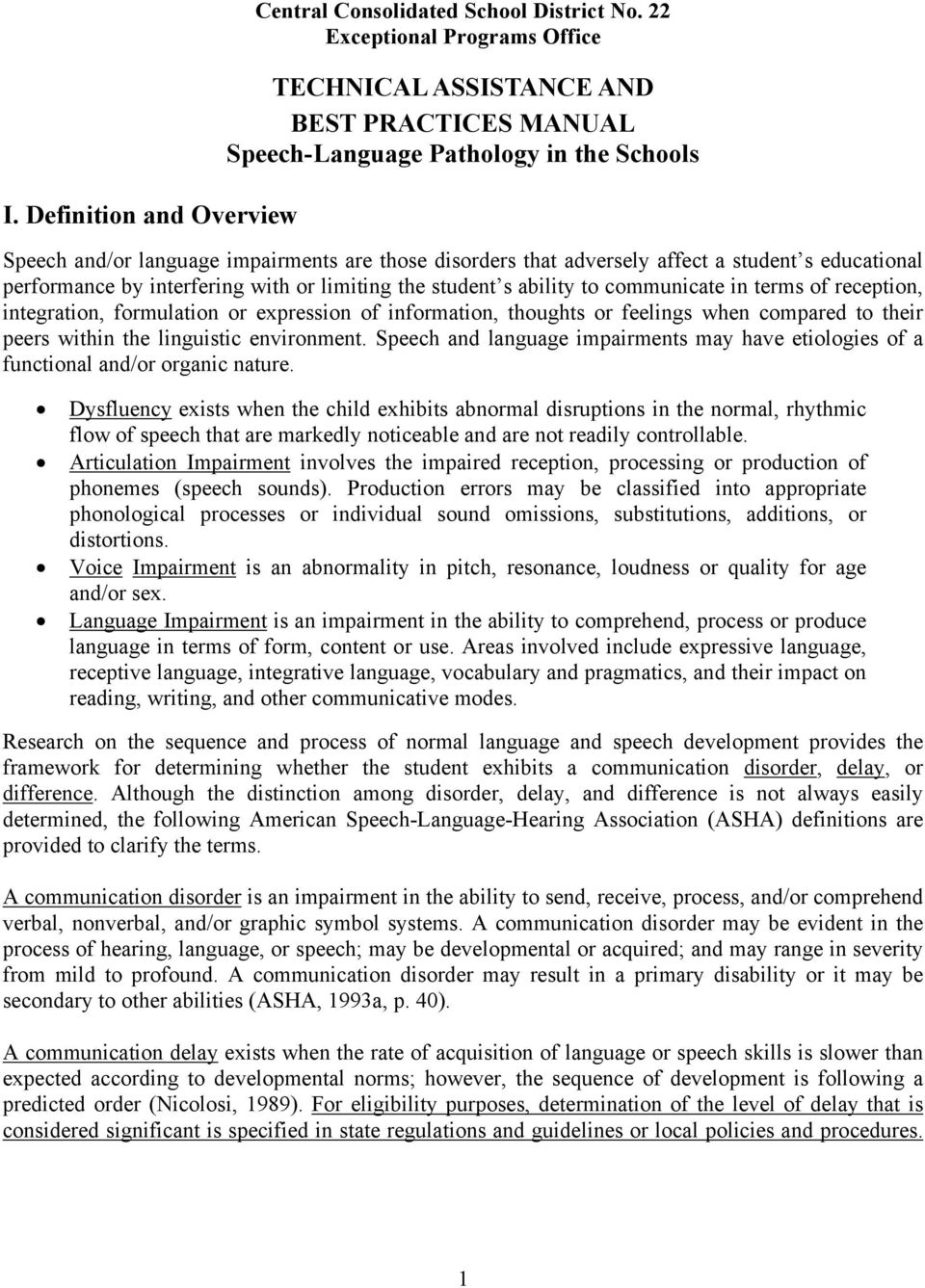
1 I. Definition and Overview Central Consolidated School District No. 22 TECHNICAL ASSISTANCE AND BEST PRACTICES MANUAL Speech-Language Pathology in the Schools Speech and/or language impairments are those disorders that adversely affect a student s educational performance by interfering with or limiting the student s ability to communicate in terms of reception, integration, formulation or expression of information, thoughts or feelings when compared to their peers within the linguistic environment. Speech and language impairments may have etiologies of a functional and/or organic nature. Dysfluency exists when the child exhibits abnormal disruptions in the normal, rhythmic flow of speech that are markedly noticeable and are not readily controllable. Articulation Impairment involves the impaired reception, processing or production of phonemes (speech sounds). Production errors may be classified into appropriate phonological processes or individual sound omissions, substitutions, additions, or distortions. Voice Impairment is an abnormality in pitch, resonance, loudness or quality for age and/or sex. Language Impairment is an impairment in the ability to comprehend, process or produce language in terms of form, content or use. Areas involved include expressive language, receptive language, integrative language, vocabulary and pragmatics, and their impact on reading, writing, and other communicative modes. Research on the sequence and process of normal language and speech development provides the framework for determining whether the student exhibits a communication disorder, delay, or difference. Although the distinction among disorder, delay, and difference is not always easily determined, the following American Speech-Language-Hearing Association (ASHA) definitions are provided to clarify the terms. A communication disorder is an impairment in the ability to send, receive, process, and/or comprehend verbal, nonverbal, and/or graphic symbol systems. A communication disorder may be evident in the process of hearing, language, or speech; may be developmental or acquired; and may range in severity from mild to profound. A communication disorder may result in a primary disability or it may be secondary to other abilities (ASHA, 1993a, p. 40). A communication delay exists when the rate of acquisition of language or speech skills is slower than expected according to developmental norms; however, the sequence of development is following a predicted order (Nicolosi, 1989). For eligibility purposes, determination of the level of delay that is considered significant is specified in state regulations and guidelines or local policies and procedures. 1
2 A communication difference is a variation of a symbol system used by a group of individuals that reflects and is determined by shared regional, social, or cultural/ethnic factors. A regional, social, cultural, or ethnic variation of a symbol system is not considered a disorder of speech or language (ASHA, 1993a, p. 41). Limited English Proficiency is not, in itself, a qualification for speech/language intervention services, although a student with Limited English Proficiency may also have a qualifying speech-language impairment. Speech-language pathologists (SLPs) are professionally trained to prevent, screen, identify, assess, diagnose, refer, provide intervention for, and counsel persons with, or who are at risk for, articulation, fluency, voice, language, communication, swallowing, and related disabilities. In addition to engaging in activities to reduce or prevent communication disabilities, SLPs also counsel and educate families or professionals about these disorders and their management (ASHA, 1996c). In the Central Consolidated School District (CCSD), speech-language services are provided to students who have communication impairments that adversely affect educational performance. The linkage between the speech and/or language impairment and educational performance will be made by the SLP based on current evaluations/performance reports and recommendations by the multidisciplinary team and will be documented on the IEP. II. Assessment It is necessary to exercise caution when using standardized tests that have been normed on populations different from that of the student being tested. SLPs recognize cultural differences, and the interpretation of test results is modified according to this knowledge. When possible, the establishment of local norms is encouraged so that appropriate normative comparisons may be made. Dialects reflect basic behavioral differences between groups of individuals within a society and should be considered natural cultural manifestations of group differences. Dialectal variations of English may be present in any or all components of the language system (phonology, morphology, syntax, semantics and pragmatics) and do not constitute a language disorder. It is important that SLPs be able to distinguish between dialectal differences and communication disorders. It is the role of the SLP to treat only those features or characteristics that are true errors and not attributable to the dialect. (See Comparison of Navajo and English Adapted from Young, RW. English as a Second Language for Navajos: An Overview of Certain Cultural and Linguistic Factors. Navajo Area Office; Division of Education, Bureau of Indian Affairs; In Battle, Dolores E., Communication Disorders in Multicultural Populations, Andover Medical Publishers, 1993, p ) A core role of the school-based SLP is to conduct a thorough and balanced communication assessment. SLPs should select assessment measures that: 1) consider cultural and linguistic differences, 2) are appropriate for the student s age, 3) match the stated purpose of the assessment tool to the reported needs of the student, 4) describe differences when compared to peers, 2

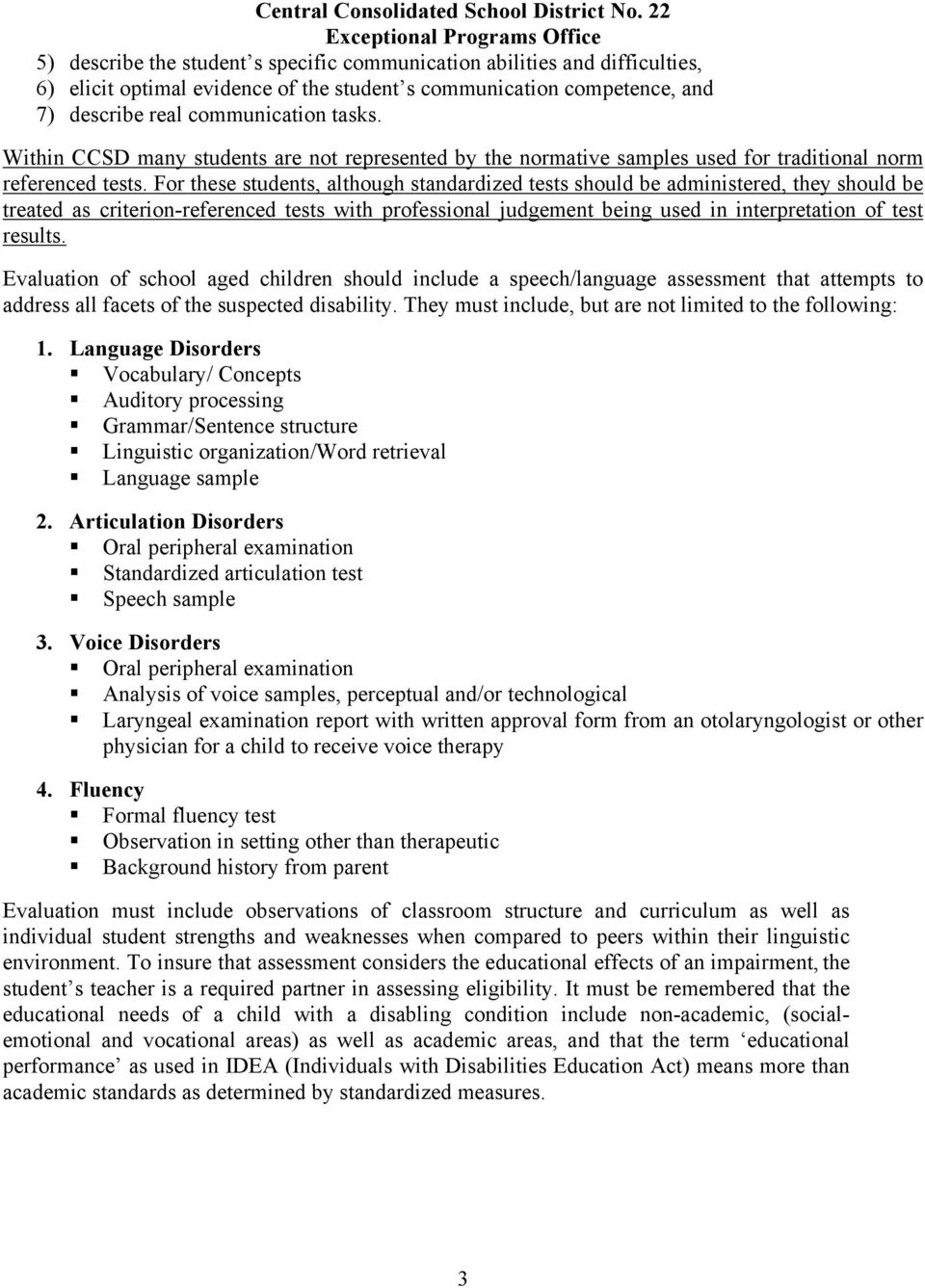
3 5) describe the student s specific communication abilities and difficulties, 6) elicit optimal evidence of the student s communication competence, and 7) describe real communication tasks. Within CCSD many students are not represented by the normative samples used for traditional norm referenced tests. For these students, although standardized tests should be administered, they should be treated as criterion-referenced tests with professional judgement being used in interpretation of test results. Evaluation of school aged children should include a speech/language assessment that attempts to address all facets of the suspected disability. They must include, but are not limited to the following: 1. Language Disorders Vocabulary/ Concepts Auditory processing Grammar/Sentence structure Linguistic organization/word retrieval Language sample 2. Articulation Disorders Oral peripheral examination Standardized articulation test Speech sample 3. Voice Disorders Oral peripheral examination Analysis of voice samples, perceptual and/or technological Laryngeal examination report with written approval form from an otolaryngologist or other physician for a child to receive voice therapy 4. Fluency Formal fluency test Observation in setting other than therapeutic Background history from parent Evaluation must include observations of classroom structure and curriculum as well as individual student strengths and weaknesses when compared to peers within their linguistic environment. To insure that assessment considers the educational effects of an impairment, the student s teacher is a required partner in assessing eligibility. It must be remembered that the educational needs of a child with a disabling condition include non-academic, (socialemotional and vocational areas) as well as academic areas, and that the term educational performance as used in IDEA (Individuals with Disabilities Education Act) means more than academic standards as determined by standardized measures. 3
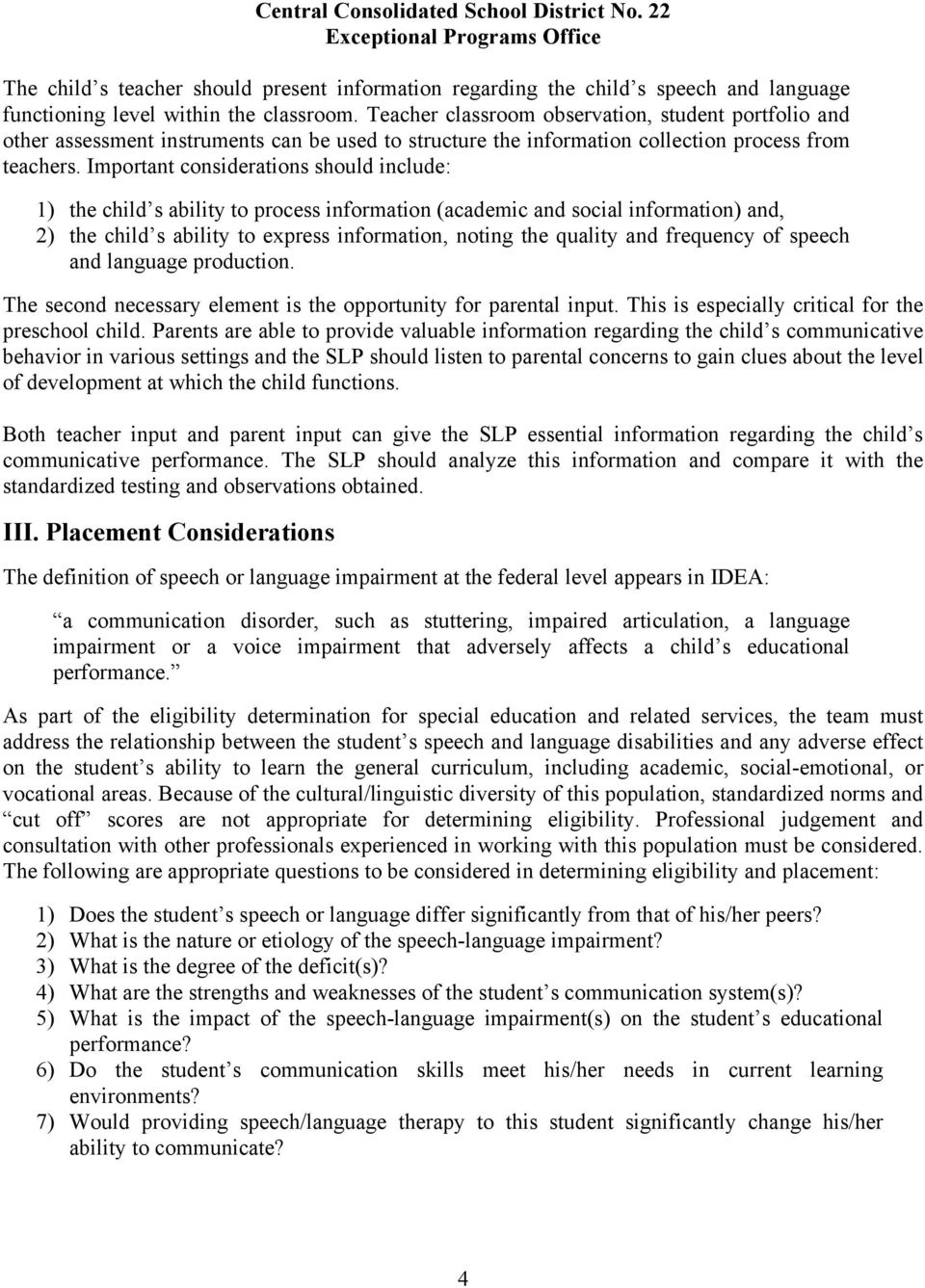
4 The child s teacher should present information regarding the child s speech and language functioning level within the classroom. Teacher classroom observation, student portfolio and other assessment instruments can be used to structure the information collection process from teachers. Important considerations should include: 1) the child s ability to process information (academic and social information) and, 2) the child s ability to express information, noting the quality and frequency of speech and language production. The second necessary element is the opportunity for parental input. This is especially critical for the preschool child. Parents are able to provide valuable information regarding the child s communicative behavior in various settings and the SLP should listen to parental concerns to gain clues about the level of development at which the child functions. Both teacher input and parent input can give the SLP essential information regarding the child s communicative performance. The SLP should analyze this information and compare it with the standardized testing and observations obtained. III. Placement Considerations The definition of speech or language impairment at the federal level appears in IDEA: a communication disorder, such as stuttering, impaired articulation, a language impairment or a voice impairment that adversely affects a child s educational performance. As part of the eligibility determination for special education and related services, the team must address the relationship between the student s speech and language disabilities and any adverse effect on the student s ability to learn the general curriculum, including academic, social-emotional, or vocational areas. Because of the cultural/linguistic diversity of this population, standardized norms and cut off scores are not appropriate for determining eligibility. Professional judgement and consultation with other professionals experienced in working with this population must be considered. The following are appropriate questions to be considered in determining eligibility and placement: 1) Does the student s speech or language differ significantly from that of his/her peers? 2) What is the nature or etiology of the speech-language impairment? 3) What is the degree of the deficit(s)? 4) What are the strengths and weaknesses of the student s communication system(s)? 5) What is the impact of the speech-language impairment(s) on the student s educational performance? 6) Do the student s communication skills meet his/her needs in current learning environments? 7) Would providing speech/language therapy to this student significantly change his/her ability to communicate? 4
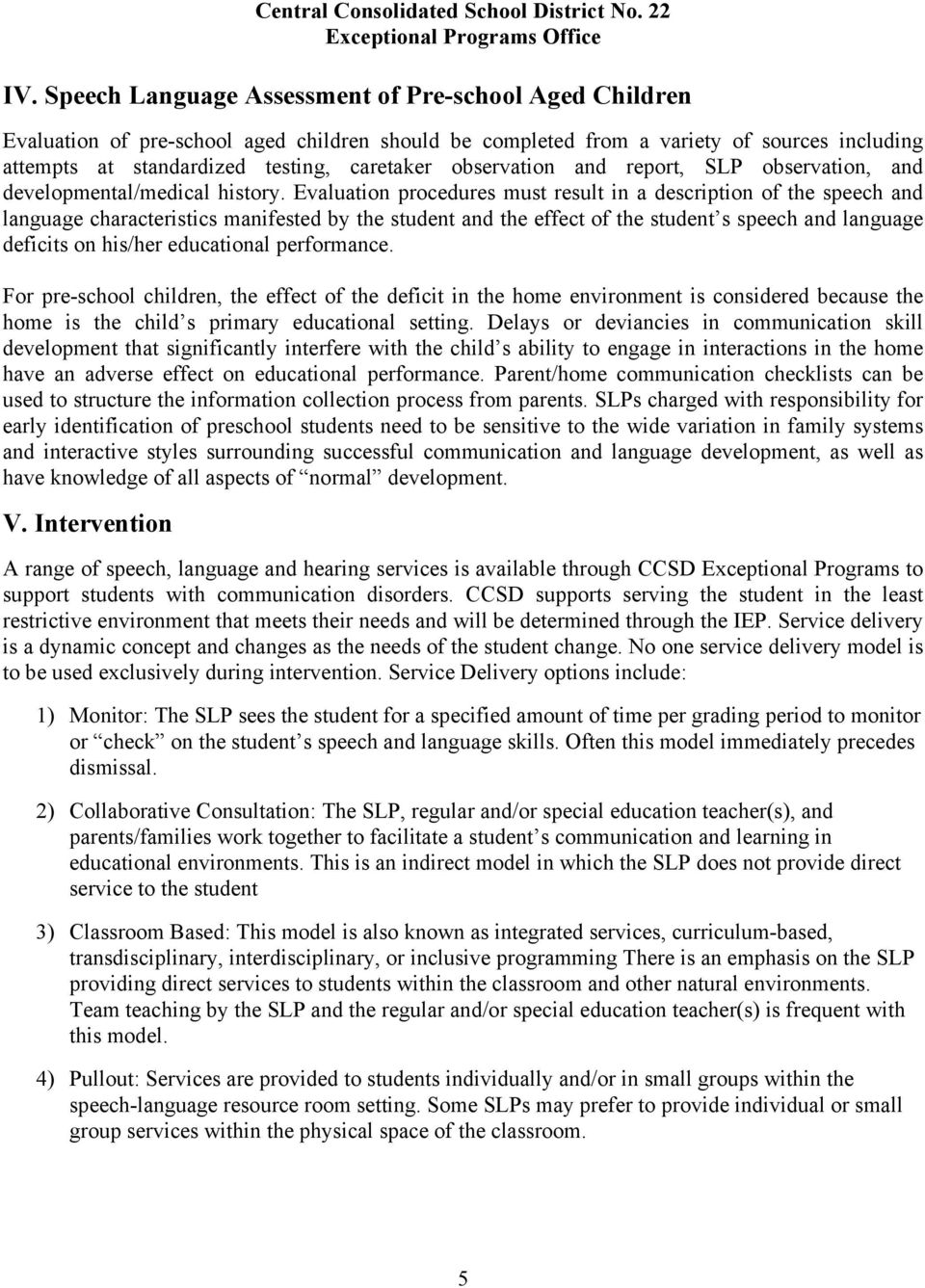
5 IV. Speech Language Assessment of Pre-school Aged Children Evaluation of pre-school aged children should be completed from a variety of sources including attempts at standardized testing, caretaker observation and report, SLP observation, and developmental/medical history. Evaluation procedures must result in a description of the speech and language characteristics manifested by the student and the effect of the student s speech and language deficits on his/her educational performance. For pre-school children, the effect of the deficit in the home environment is considered because the home is the child s primary educational setting. Delays or deviancies in communication skill development that significantly interfere with the child s ability to engage in interactions in the home have an adverse effect on educational performance. Parent/home communication checklists can be used to structure the information collection process from parents. SLPs charged with responsibility for early identification of preschool students need to be sensitive to the wide variation in family systems and interactive styles surrounding successful communication and language development, as well as have knowledge of all aspects of normal development. V. Intervention A range of speech, language and hearing services is available through CCSD Exceptional Programs to support students with communication disorders. CCSD supports serving the student in the least restrictive environment that meets their needs and will be determined through the IEP. Service delivery is a dynamic concept and changes as the needs of the student change. No one service delivery model is to be used exclusively during intervention. Service Delivery options include: 1) Monitor: The SLP sees the student for a specified amount of time per grading period to monitor or check on the student s speech and language skills. Often this model immediately precedes dismissal. 2) Collaborative Consultation: The SLP, regular and/or special education teacher(s), and parents/families work together to facilitate a student s communication and learning in educational environments. This is an indirect model in which the SLP does not provide direct service to the student 3) Classroom Based: This model is also known as integrated services, curriculum-based, transdisciplinary, interdisciplinary, or inclusive programming There is an emphasis on the SLP providing direct services to students within the classroom and other natural environments. Team teaching by the SLP and the regular and/or special education teacher(s) is frequent with this model. 4) Pullout: Services are provided to students individually and/or in small groups within the speech-language resource room setting. Some SLPs may prefer to provide individual or small group services within the physical space of the classroom. 5
6 5) Community Based: Communication services are provided to students within the home or community setting. Goals and objectives focus primarily on functional communication skills. 6) Combination: The SLP provides two or more service delivery options (e.g., provides individual or small group treatment on a pull-out basis twice a week to develop skills or preteach concepts and also works with the student within the classroom). For all service delivery models, it is important that time be made available in the weekly schedule for collaboration/consultation with parents, general educators, special educators and other service providers. VI. Dismissal Considerations The discussion of dismissal actually begins during the eligibility-staffing meeting when prognostic indicators and guidelines should be discussed with the parent. Although the prognosis may change over time, consideration should be given to: 1) potential to benefit from intervention, 2) medical factors, 3) psychosocial factors, 4) attendance, 5) other disabling conditions, 6) student motivation, 7) progress with previous service. Dismissal occurs when a student no longer needs special education or related services to take advantage of educational opportunities. Reasons for dismissal and the IEP team s recommendation for dismissal should be documented through the IEP and the Written Notice of Action. A Multidisciplinary Team Evaluation Report and the Written Notice of Action are necessary to dismiss a student completely from Special Education. Exit criteria to be considered include: 1) the need for specialized services to address the adverse effects on educational performance is no longer present, 2) the disability no longer has an adverse effect on the student s educational performance, 3) the disability no longer exists. A student should be exited or discharged from a speech-language program when the student has made significant communicative progress such that the handicapping condition no longer adversely affects his/her educational progress. 6

7 VI. Bibliography American Speech-Language-Hearing Association. (1993a, March). Definitions of communication disorders and variations. Asha, 35(Suppl. 1 0), American Speech-Language-Hearing Association. (1996c, Spring). Scope of practice in speechlanguage pathology. Asha, 38(Suppl. 16), Nicolosi, L., Harryinan, E., & Kresheck, J. (1989). Terminology of communication disorders: Speech-language-hearing. Baltimore, MD: Williams & Wilkins. Battle, Dolores E., (1993) Communication Disorders in Multicultural Populations, Andover Medical Publishers. 7
SPEECH OR LANGUAGE IMPAIRMENT EARLY CHILDHOOD SPECIAL EDUCATION
 I. DEFINITION Speech or language impairment means a communication disorder, such as stuttering, impaired articulation, a language impairment (comprehension and/or expression), or a voice impairment, that
IDENTIFICATION, EVALUATION AND INTERVENTION FOR ELL STUDENTS WITH COMMUNICATION DISORDERS
 IDENTIFICATION, EVALUATION AND INTERVENTION FOR ELL STUDENTS WITH COMMUNICATION DISORDERS INTRODUCTION Public school systems in the United States have experienced a significant increase in the number of
ELIGIBILITY GUIDELINES SPEECH PATHOLOGY
 ELIGIBILITY GUIDELINES SPEECH PATHOLOGY These guidelines are consistent with the Texas Speech- Language-Hearing Association s (TSHA) eligibility templates. It is recommended that you contact the TSHA Vice
Speech- Language Pathologists in Your Child s School
 Speech- Language Pathologists in Your Child s School What does the SLP do in schools? Screen students to find out if they need further speech and language testing. Evaluate speech and language skills.
North Carolina Guidelines for Speech-Language Pathology Services in Schools
 North Carolina Guidelines for Speech-Language Pathology Services in Schools 9-19-06 Exceptional Children Division Department of Public Instruction 6356 Mail Service Center Raleigh, NC 27699-6356 Telephone
SPEECH-LANGUAGE PATHOLOGY SERVICES
 Shannon Hall-Mills, Ph.D., CCC-SLP BEESS Program Specialist 2011 Schools & Medicaid Conference, Tampa May 5, 2011 SPEECH-LANGUAGE PATHOLOGY SERVICES ROLES & RESPONSIBILITIES OF SLPS Recent guidance from
Mississippi Department of Education Office of Special Education
 Questions and Answers about State Policies Regarding Children with Disabilities under the Individuals with Disabilities Education Act Amendments of 2004 State Board Policy 7219 (referred to hereafter as
Standards for the Speech-Language Pathologist [28.230]
![Standards for the Speech-Language Pathologist [28.230]](/thumbs/40/21177704.jpg "Standards for the Speech-Language Pathologist [28.230]") Standards for the Speech-Language Pathologist [28.230] STANDARD 1 - Content Knowledge The competent speech-language pathologist understands the philosophical, historical, and legal foundations of speech-language
Standards for the Speech-Language Pathologist [28.230] STANDARD 1 - Content Knowledge The competent speech-language pathologist understands the philosophical, historical, and legal foundations of speech-language
Table of Contents Introduction... 1 The PACE Matrix... 3 Step by Step Guide for the PACE Evaluation System... 8
 Table of Contents Introduction... 1 The PACE Matrix... 3 Step by Step Guide for the PACE Evaluation System... 8 Developing a Portfolio for the PACE... 9 Speech Language Pathologist Self Reflection Tool...
SPEECH OR LANGUAGE IMPAIRMENT
 I. DEFINITION "Speech or Language Impairment" means a communication disorder, such as stuttering, impaired articulation, a language impairment, or a voice impairment, that adversely affects a child's educational
PRESCHOOL PLACEMENT CATEGORIES
 PRESCHOOL PLACEMENT CATEGORIES CASEMIS 20 EARLY CHILDHOOD SPECIAL EDUCATION SETTING Early Childhood Special Education Setting: This is a placement setting where children receive all of their special education
Categories of Exceptionality and Definitions
 7. CATEGORIES and DEFINITIONS of EXCEPTIONALITIES Purpose of the standard To provide the ministry with details of the categories and definitions of exceptionalities available to the public, including parents
IDENTIFICATION AND ASSESSMENT OF ENGLISH LANGUAGE LEARNERS
 IDENTIFICATION AND ASSESSMENT OF ENGLISH LANGUAGE LEARNERS CHAPTER 3 INDEX 3.1 PURPOSE AND SCOPE... 3 1 3.2 IDENTIFICATION AND REFERRAL OF ENGLISH LEARNERS SUSPECTED OF HAING A DISABILITY... 3 1 3.3 SPECIAL
Bachelors of Science Program in Communication Disorders and Sciences:
 Bachelors of Science Program in Communication Disorders and Sciences: Mission: The SIUC CDS program is committed to multiple complimentary missions. We provide support for, and align with, the university,
School-Based Health Services: Speech and Language Therapy. Brenda Addington, MA, CCC-SLP Jessamine County Schools August 29, 2013
 School-Based Health Services: Speech and Language Therapy Brenda Addington, MA, CCC-SLP Jessamine County Schools August 29, 2013 Session Objectives: 1. Overview of the areas of communication served in
Special Education: Speech-Language Pathologist Endorsement in PreK-12
 Special Education: Speech-Language Pathologist Endorsement in PreK-12 Knowledge and Skills State Standard 1 Speech-Language Pathology Candidates understand and apply the knowledge base specific to speech-language
ARLINGTON PUBLIC SCHOOLS SPECIAL EDUCATION PROGRAMS AND SERVICES
 ARLINGTON PUBLIC SCHOOLS SPECIAL EDUCATION PROGRAMS AND SERVICES Introduction The Arlington Public Schools provides a comprehensive array of programs and services from pre-school through grades 12 designed
(Latest Revision Spring Semester, 2015)
 HYPOTHETICAL STUDENT Guide to the Student Tracking System CFCC-ASHA STANDARDS BY COURSE For Certification in Speech-Language Pathology Southern University and A&M College (Latest Revision Spring Semester,
3030. Eligibility Criteria.
 3030. Eligibility Criteria. 5 CA ADC 3030BARCLAYS OFFICIAL CALIFORNIA CODE OF REGULATIONS Barclays Official California Code of Regulations Currentness Title 5. Education Division 1. California Department
SPECIFIC LEARNING DISABILITY
 I. DEFINITION "Specific learning disability" means a disorder in one or more of the basic psychological processes involved in understanding or in using language, spoken or written, that may manifest itself
SPECIFIC LEARNING DISABILITIES (SLD)
 Together, We Can Make A Difference Office 770-577-7771 Toll Free1-800-322-7065 www.peppinc.org SPECIFIC LEARNING DISABILITIES (SLD) Definition (1) Specific learning disability is defined as a disorder
INTERMEDIATE UNIT 1. Department Of Communication Disorders And Sensory Impairments
 INTERMEIATE UNIT 1 epartment Of Communication isorders And Sensory Impairments Guidelines For Case Selection, Continuance And ismissal For Speech/Language Services Within Intermediate Unit 1 Revised by:
Frequently Asked Questions about Making Specific Learning Disability (SLD) Eligibility Decisions
 Frequently Asked Questions about Making Specific Learning Disability (SLD) Eligibility Decisions This document is part of the department s guidance on implementing Wisconsin SLD criteria. It provides answers
ELIGIBILITY GUIDELINES FOR SPEECH IMPAIRMENT
 ELIGIBILITY GUIDELINES FOR SPEECH IMPAIRMENT TEXAS SPEECH LANGUAGE HEARING ASSOCIATION 2009 TSHA Eligibility Guidelines for Speech Impairment 2009 1 TSHA Eligibility Guidelines for Speech Impairment 2009
Communication Sciences and Disorders. Standard 5.0 Assessment Master s Degree Program in Speech Language Pathology (MA)
 Communication Sciences and Disorders Standard 5.0 Assessment Master s Degree Program in Speech Language Pathology (MA) The program conducts ongoing and systematic formative and summative assessment of
The Role of the SLP in Schools. A Presentation for Teachers, Administrators, Parents, and the Community 1
 The Role of the SLP in Schools A Presentation for Teachers, Administrators, Parents, and the Community 1 Speech-Language Pathologists (SLPs) Are Specially Trained Professionals Who Have Earned: A master
43 243.1. Criteria for Entry into Programs of Special Education for Students with Disabilities
 Document No. STATE BOARD OF EDUCATION CHAPTER 43 Statutory Authority: Individuals with Disabilities Education Improvement Act of 2004, 20 U.S.C. 1400 et seq. (2004) 43 243.1. Criteria for Entry into Programs
SPECIFIC LEARNING DISABILITY
 SPECIFIC LEARNING DISABILITY 24:05:24.01:18. Specific learning disability defined. Specific learning disability is a disorder in one or more of the basic psychological processes involved in understanding
MICHIGAN TEST FOR TEACHER CERTIFICATION (MTTC) TEST OBJECTIVES FIELD 062: HEARING IMPAIRED
 MICHIGAN TEST FOR TEACHER CERTIFICATION (MTTC) TEST OBJECTIVES Subarea Human Development and Students with Special Educational Needs Hearing Impairments Assessment Program Development and Intervention
Florida Teacher Certification Examination Test Preparation Guide for Speech-Language Impaired K-12
 Florida Teacher Certification Examination Test Preparation Guide for Speech-Language Impaired K-12 FLORIDA DEPARTMENT OF EDUCATION www.fldoe.org Second Edition Developed, produced, and printed under the
KNOWLEDGE AND SKILLS ACQUISITION (KASA) SUMMARY FORM FOR CERTIFICATION IN SPEECH-LANGUAGE PATHOLOGY
 KNOWLEDGE AND SKILLS ACQUISITION (KASA) SUMMARY FORM FOR CERTIFICATION IN SPEECH-LANGUAGE PATHOLOGY Knowledge and Skills Acquisition (KASA) Summary Form For Certification in Speech-Language Pathology March,
on Special Education a publication of the Education Directorate/Student Services Branch 4040 North Fairfax Drive Arlington, VA 22203-1635
 Parent Handbook on Special Education a publication of the Education Directorate/Student Services Branch 4040 North Fairfax Drive Arlington, VA 22203-1635 Parent Handbook on Special Education Table of Contents
Grace Fleming, School of Graduate Studies
 MEMORANDUM To: From: Graduate Curriculum Committee Grace Fleming, School of Graduate Studies Date: 2/11/2008 Subject: Minutes for January 30, 2008 The Graduate Curriculum Committee met in Victor 219, Wednesday,
Special Education Program Descriptions School-Based Program Delivery Model
 Special Education Program Descriptions School-Based Program Delivery Model Resource Room Services Resource Room Services, available in all MCPS schools, provide students with disabilities with the support
General Education What is the SLP s role? Materials/Resources Needed:
 Speech-Language SLP s Role in Tiers of RtI Originally developed by Georgia Organization of School Based SLPs http://www.omnie.org/guidelines/files/role-of-the-slp-in-response-to-intervention.pdf http://www.asha.org/slp/schools/prof-consult/newrolesslp.htm
How Online Speech Therapy is Transforming Speech Therapy in School Systems
 How Online Speech Therapy is Transforming Speech Therapy in School Systems Section TABLE OF CONTENTS Page ONLINE SPEECH THERAPY AN EFFECTIVE SOLUTION FOR STUDENT SPEECH THERAPY NEEDS.. 2 How Does Online
SPECIAL EDUCATION ELIGIBILITY CRITERIA AND IEP PLANNING GUIDELINES
 SPECIAL EDUCATION ELIGIBILITY CRITERIA AND IEP PLANNING GUIDELINES CHAPTER 6 INDEX 6.1 PURPOSE AND SCOPE...6 1 6.2 PRIOR TO REFERRAL FOR SPECIAL EDUCATION.. 6 1 6.3 REFFERRAL...6 2 6.4 ASSESMENT.....6
7. SPECIAL EDUCATION PLACEMENTS, EXCEPTIONALITIES: CATEGORIES AND DEFINITIONS
 7. SPECIAL EDUCATION PLACEMENTS, EXCEPTIONALITIES: CATEGORIES AND DEFINITIONS SPECIAL EDUCATION PLACEMENTS PROVIDED BY THE BOARD The plan encourages the inclusion of exceptional students in regular classrooms
POSITION: Speech Language Pathologist
 Please note: This job description is one of several adopted by the State Board of Education between 1984 and 1987 and was designed to correspond with the evaluation instrument. Local school systems can
Career Paths for the CDS Major
 College of Education COMMUNICATION DISORDERS AND SCIENCES (CDS) Advising Handout Career Paths for the CDS Major Speech Language Pathology Speech language pathologists work with individuals with communication
Eligibility / Staffing Determination EMOTIONAL DISTURBANCE. Date of Meeting:
 Eligibility / Staffing Determination EMOTIONAL DISTURBANCE Date of Meeting: Student Name: DOB: Soc. Sec.#: The basis for making the determination of whether the student has a disability which meets the
Preparation "Speech Language Pathologist Overview"
 Speech Language Pathologist Overview The Field - Preparation - Day in the Life - Earnings - Employment - Career Path Forecast - Professional Organizations The Field Speech-language pathologists, sometimes
62 Hearing Impaired MI-SG-FLD062-02
 62 Hearing Impaired MI-SG-FLD062-02 TABLE OF CONTENTS PART 1: General Information About the MTTC Program and Test Preparation OVERVIEW OF THE TESTING PROGRAM... 1-1 Contact Information Test Development
Rubric for Evaluating North Carolina s Speech- Language Pathologists
 Rubric for Evaluating North Carolina s Speech- Language Pathologists STANDARD 1: School speech-language pathologists demonstrate leadership, advocacy, collaboration, and ethical practices. School Speech-Language
How To Run A School District School In Braintree
 Braintree Public Schools A Parent s Guide to Special Education Programs The purpose of this guide is to provide a general overview of programs and specialized services that are available at the pre-school,
III. Standards for Accreditation of Graduate Education Programs in Audiology and Speech-Language Pathology
 III. Standards for Accreditation of Graduate Education Programs in Audiology and Speech-Language Pathology Effective January 1, 2008 Introduction The Council on Academic Accreditation in Audiology and
Knowledge and Skills Acquisition (KASA) Summary Form* Harding University Communication Sciences and Disorders Program
 Knowledge and Skills Acquisition (KASA) Summary Form* Harding University Communication Sciences and Disorders Program The American Speech-Language-Hearing Association (ASHA) specifies an in-depth program
Comprehensive Special Education Plan. Programs and Services for Students with Disabilities
 Comprehensive Special Education Plan Programs and Services for Students with Disabilities The Pupil Personnel Services of the Corning-Painted Post Area School District is dedicated to work collaboratively
Belmont Public Schools Special Education Programs
 Belmont Public Schools Special Education Programs Preschool Program School: Belmont system wide Population Served: Special Education Students Aged 3 5 Grade: Pre K Program Description: This program is
Insurance Tips. Obtaining Services
 Insurance Tips The information below is designed to provide an overview of how to obtain insurance coverage for speech-language pathology (speech therapy) and audiology services. The American Speech-Language-Hearing
INCREASE YOUR PRODUCTIVITY WITH CELF 4 SOFTWARE! SAMPLE REPORTS. To order, call 1-800-211-8378, or visit our Web site at www.pearsonassess.
 INCREASE YOUR PRODUCTIVITY WITH CELF 4 SOFTWARE! Report Assistant SAMPLE REPORTS To order, call 1-800-211-8378, or visit our Web site at www.pearsonassess.com In Canada, call 1-800-387-7278 In United Kingdom,
SPEECH LANGUAGE PATHOLOGY SERVICES IN SCHOOLS: Guidelines For Best Practice
 SPEECH LANGUAGE PATHOLOGY SERVICES IN SCHOOLS: Guidelines For Best Practice Virginia Department of Education September 2005 The forms included in this document can be found on the Virginia Department of
Speech-Language Pathology: Services in WV Schools
 Guidelines for Best Practices Speech-Language Pathology: Services in WV Schools Office of Special Programs West Virginia Department of Education West Virginia Board of Education 2010-2011 Priscilla M.
Admission/Discharge Criteria in Speech- Language Pathology
 Admission/Discharge Criteria in Speech- Language Pathology Ad Hoc Committee on Admission/Discharge Criteria in Speech-Language Pathology Reference this material as: American Speech-Language-Hearing Association.
HOFSTRA UNIVERSITY Department of Speech-Language-Hearing Sciences Knowledge & Skills Acquisition Report
 HOFSTRA UNIVERSITY Department of Speech-Language-Hearing Sciences Knowledge & Skills Acquisition Report Name: Student ID No.: Prerequisite Courses: Phonetics (5) Anatomy and Physiology (6) Language Development
Vannesa Mueller CURRICULUM VITAE
 Vannesa Mueller CURRICULUM VITAE EDUCATION 2008 University of Iowa, Iowa City, IA Ph.D. in Speech and Hearing Science Dissertation: The Effects of a Fluent Signing Narrator in the Iowa E-Book on Deaf Children
Technical Report. Overview. Revisions in this Edition. Four-Level Assessment Process
 Technical Report Overview The Clinical Evaluation of Language Fundamentals Fourth Edition (CELF 4) is an individually administered test for determining if a student (ages 5 through 21 years) has a language
Speech-Language Pathology Curriculum Foundation Course Linkages
 FACULTY OF HEALTH PROFESSIONS School of Human Communication Disorders Speech-Language Pathology Curriculum Foundation Course Linkages Phonetics (HUCD 5020) a. Vowels b. Consonants c. Suprasegmentals d.
ALBUQUERQUE PUBLIC SCHOOLS
 ALBUQUERQUE PUBLIC SCHOOLS Speech and Language Initial Evaluation Name: Larry Language School: ABC Elementary Date of Birth: 8-15-1999 Student #: 123456 Age: 8-8 Grade:6 Gender: male Referral Date: 4-18-2008
NEVADA STATE COLLEGE SCHOOL OF EDUCATION SPEECH PATHOLOGY PROGRAM
 NEVADA STATE COLLEGE SPEECH PATHOLOGY PROGRAM Application Procedure/Time Line: Applications for admission to the Speech Pathology Program are accepted twice each year. All application materials must be
APPENDIX A SCHOOL-BASED RESOURCES
 APPENDIX A SCHOOL-BASED RESOURCES Classroom Teacher - The classroom teacher is responsible for providing a quality education to all students. Duties include: classroom organization and management, assessment,
Special Education Process
 Special Education Process Special education is intended to provide services to students who have disabilities, and who, because of those disabilities, need help to make progress in the general education
Speech-Language Pathology Interventional Services for Autism Spectrum Disorders
 Last Review Date: September 11, 2015 Number: MG.MM.ME.45bv2 Medical Guideline Disclaimer Property of EmblemHealth. All rights reserved. The treating physician or primary care provider must submit to EmblemHealth
Reevaluation Procedures for Students with Disabilities
 Reevaluation Procedures for Students with Disabilities BACKGROUND This is one of a series of technical assistance materials related to the final regulations implementing the 1997 Amendments to Part B and
Professional Learning Guide
 Professional Learning Guide Professional Learning Guide Published by the Student Wellbeing and Health Support Division Office for Government School Education Department of Education and Early Childhood
Test Administrator Requirements
 CELF 4 CTOPP Clinical Evaluation of Language Fundamentals, Fourth Edition Comprehensive Phonological Processing The CELF 4, like its predecessors, is an individually administered clinical tool for the
Scope of Practice in Speech Pathology
 Level 2 / 11-19 Bank Place T 61 3 9642 4899 [email protected] Melbourne Victoria 3000 F 61 3 9642 4922 www.speechpathologyaustralia.org.au Scope of Practice in Speech Pathology Revised
Special Education Program Descriptions 2016-17
 Special Education Student Services Special Education Program Descriptions 2016-17 Bethlehem Central School District 700 Delaware Avenue, Delmar, New York 12054 Introduction This document provides descriptions
Position Classification Standard for Speech Pathology and Audiology Series, GS-0665
 Position Classification Standard for Speech Pathology and Audiology Series, GS-0665 Table of Contents SERIES DEFINITION... 2 EXCLUSIONS... 2 COVERAGE OF THE SERIES... 3 COVERAGE OF THE STANDARD... 4 OCCUPATIONAL
To help improve the educational experience and general wellbeing of those students who are unable to profit from the existing school program.
 LOCATOR: 3.01 TITLE: School Psychologist QUALIFICATIONS: 1. Valid Connecticut certification with endorsement as psychologist. 2. Such alternatives to the above qualifications as the Board may find appropriate
Admissions Requirements
 Special Education Dickinson Hall, Rooms 300F, 304 (501) 569-3124, (501) 569-8710, (501) 569-8922 Master of Education in Special Education The Master of Education in Special Education (SPED) prepares candidates
THE FRAMEWORK FOR SCHOOL SPEECH AND LANGUAGE PATHOLOGIST EDUCATIONAL SPECIALIST PROGRAM GUIDELINES. October 2014
 THE FRAMEWORK FOR SCHOOL SPEECH AND LANGUAGE PATHOLOGIST EDUCATIONAL SPECIALIST PROGRAM GUIDELINES October 2014 COMMONWEALTH OF PENNSYLVANIA DEPARTMENT OF EDUCATION 333 Market Street Harrisburg, PA 17126-0333
Service Delivery Models
 Service Delivery Models Anne Arundel County Public Schools (AACPS) is committed to educational excellence by "Elevating all Students, Eliminating all Gaps." To that end, AACPS offers a full continuum of
SPECIAL EDUCATION AND RELATED SERVICES
 i SPECIAL EDUCATION AND RELATED SERVICES Updated May 2008 i It is the policy of the South Dakota Department of Education, Office of Educational Services and Supports to provide services to all persons
The Clinical Evaluation of Language Fundamentals, fourth edition (CELF-4;
 The Clinical Evaluation of Language Fundamentals, Fourth Edition (CELF-4) A Review Teresa Paslawski University of Saskatchewan Canadian Journal of School Psychology Volume 20 Number 1/2 December 2005 129-134
Speech-Language Pathology: Services in WV Schools. Guidance for West Virginia Schools and Districts
 Speech-Language Pathology: Services in WV Schools Guidance for West Virginia Schools and Districts Office of Special Programs West Virginia Department of Education November 2013 West Virginia Board of
READING SPECIALIST STANDARDS
 READING SPECIALIST STANDARDS Standard I. Standard II. Standard III. Standard IV. Components of Reading: The Reading Specialist applies knowledge of the interrelated components of reading across all developmental
University of Puerto Rico Medical Sciences Campus School of Health Professions Department of Graduate Programs Speech-Language Pathology Program
 University of Puerto Rico Medical Sciences Campus School of Health Professions Department of Graduate Programs Speech-Language Pathology Program Essential Functions and Attributes of Candidates for Admission
Support Services Subcommittee
 Support Services Subcommittee Support Services 7/20/2012 1 School Psychologists School Social Workers School Speech-Language Pathologists Discussion about what is needed to make recommendations at the
Language Reading Connection
 Language Reading Connection Collaborating with Your SLP WELCOME! What is Project CENTRAL? Coordinating g Existing g Networks To Reach All Learners The ultimate goals are to provide professional development
Special Education Coding Criteria 2014/2015. ECS to Grade 12 Mild/Moderate Gifted and Talented Severe
 Special Education Coding Criteria 2014/2015 Mild/Moderate Gifted and Talented Severe Special Education Coding Criteria 2014/2015 ISBN 978-1-4601-1902-0 (Print) ISBN 978-1-4601-1903-7 (PDF) ISSN 1911-4311
EMOTIONAL DISTURBANCE
 I. DEFINITION "Emotional disturbance" means a condition exhibiting one or more of the following characteristics over a long period of time and to a marked degree that adversely affects a child's educational
Psychological Services as Related Services
 TECHNICAL ASSISTANCE PAPER 10827 Psychological Services as Related Services RATIONALE The purpose of this technical assistance paper is to clarify the nature of psychological services as a related service
Exceptional Student Education K 12
 Exceptional Student Education K 12 Section 61 1 Knowledge of foundations of exceptional student education 1. Identify state and federal legislation and case law that have affected the education of students
Special Education Process: From Child-Find, Referral, Evaluation, and Eligibility To IEP Development, Annual Review and Reevaluation
 Special Education Process: From Child-Find, Referral, Evaluation, and Eligibility To IEP Development, Annual Review and Reevaluation Companion Document to NJOSEP Code Trainings October/November 2006 Updated
Patterns of Strengths and Weaknesses Standards and Procedures. for. Identification of Students with Suspected Specific Learning Disabilities
 Patterns of Strengths and Weaknesses Standards and Procedures for Identification of Students with Suspected Specific Learning Disabilities March, 2010 Table of Contents Patterns of Strengths and Weaknesses
SPEECH LANGUAGE PATHOLOGIST PERFORMANCE AND EVALUATION SYSTEM
 SPEECH LANGUAGE PATHOLOGIST PERFORMANCE AND EVALUATION SYSTEM (Revised 11/2014) 1 Fern Ridge Schools Speech Language Pathologist Performance Review and Evaluation System TABLE OF CONTENTS Timeline of Teacher
Practice Guidelines for Supervisors of Speech-Language Pathology Assistants
 Practice Guidelines for Supervisors of Speech-Language Pathology Assistants History of speech-language pathology assistants (SLPA) in Colorado Who are they? Speech Language Pathology Assistants (SLPAs)
SH732 FLUENCY DISORDERS Boston University - Spring, 2012 SYLLABUS
 SH 732 / Fluency Disorders 1 SH732 FLUENCY DISORDERS Boston University - Spring, 2012 Diane Parris Constantino, MS CCC/SLP, BRS-FD Office Hours: Wednesdays; 1:00 2:00; Room 329. Teaching Assistant: Carolyn
Example of a Well-Designed Course in: COMMUNICATION DISORDERS
 Website: Designlearning.org Example of a Well-Designed Course in: COMMUNICATION DISORDERS Name: Jennifer C. Dalton, Ph.D. Name of Institution: Appalachian State University 1. Specific Context The subject
CARD Rochester Autism Conference. Successful Collaboration in Language Intervention for Children with Autism: A Team Approach to SLP and ABA
 CARD Rochester Autism Conference Successful Collaboration in Language Intervention for Children with Autism: A Team Approach to SLP and ABA Katrina Lublin, M.S., CCC/SLP Rochester, NY October 28, 2009
CALIFORNIA SPECIAL EDUCATION MANAGEMENT INFORMATION SYSTEM (CASEMIS) SERVICE DESCRIPTIONS. San Diego Unified SELPA
 210 Family training, counseling, and home visits(ages 0-2 only): This service includes: services provided by social workers, psychologists, or other qualified personnel to assist the family in understanding
Maria V. Dixon, M.A., CCC-SLP 402 Ridge Rd. #8 // Greenbelt, MD 20770 (301) 405-8083 [email protected]
 Maria V. Dixon, M.A., CCC-SLP 402 Ridge Rd. #8 // Greenbelt, MD 20770 (301) 405-8083 [email protected] SUMMARY OF QUALIFICATIONS I am an accomplished Speech Language Pathologist with experience and expertise