
Elements of Advanced International Trade 1
|
|
|
- Gwenda Garrison
- 10 years ago
- Views:
Transcription
1 Elements of Advanced Internatonal Trade 1 Treb Allen 2 and Costas Arkolaks 3 January 2015 [New verson: prelmnary] 1 Ths set of notes and the homeworks accomodatng them s a collecton of materal desgned for an nternatonal trade course at the graduate level. We are grateful to Crstna Arellano, Jonathan Eaton, Tmothy Kehoe and Samuel Kortum. We are also grateful to Steve Reddng and Peter Schott for sharng ther teachng materal and to Federco Esposto, Ananth Ramananarayan, Olga Tmoshenko, Phlpp Stel, and Alex Torgovtsky for valuable nput and for varous comments and suggestons. All remanng errors are purely ours. 2 Northwestern Unversty and NBER 3 Yale Unversty and NBER

2 Abstract These notes are prepared for a Ph.D. level course n nternatonal trade.

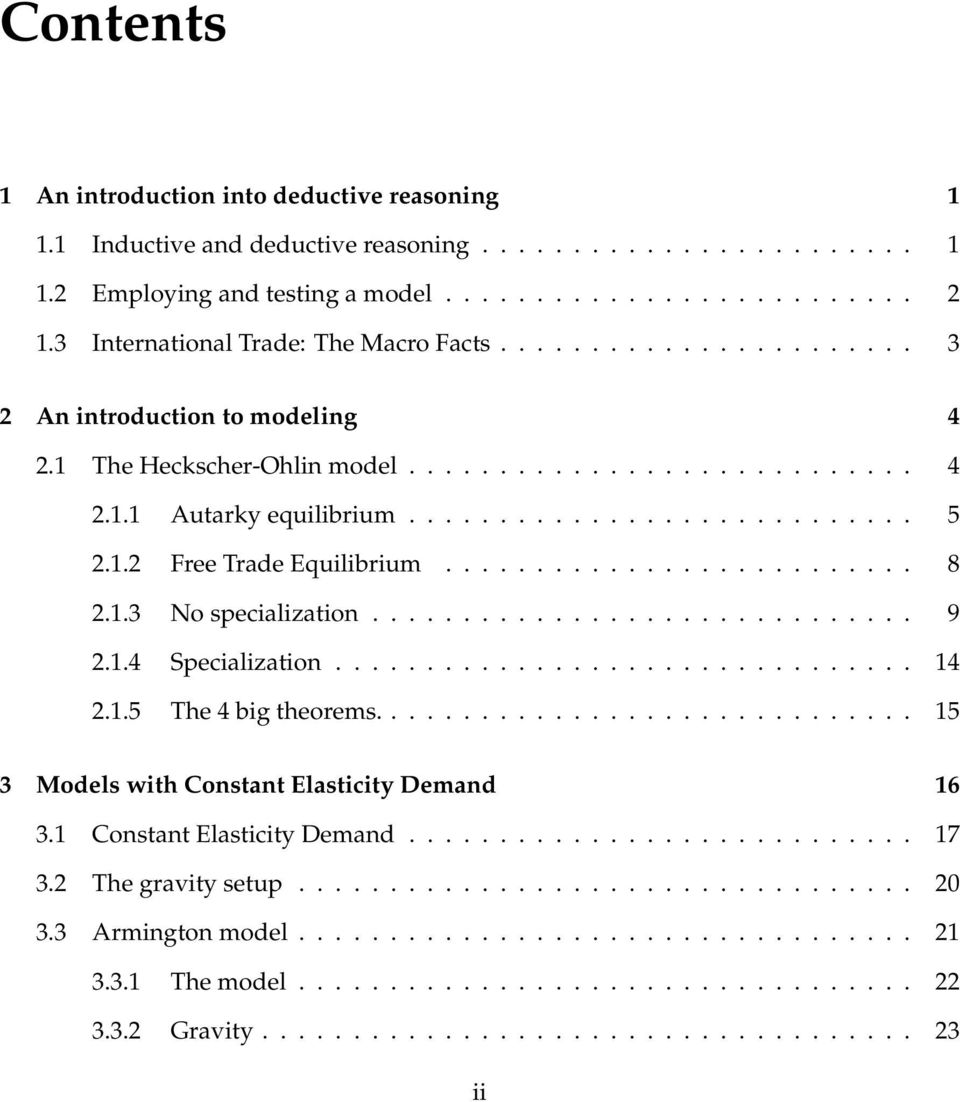
3 Contents 1 An ntroducton nto deductve reasonng Inductve and deductve reasonng Employng and testng a model Internatonal Trade: The Macro Facts An ntroducton to modelng The Heckscher-Ohln model Autarky equlbrum Free Trade Equlbrum No specalzaton Specalzaton The 4 bg theorems Models wth Constant Elastcty Demand Constant Elastcty Demand The gravty setup Armngton model The model Gravty
4 3.3.3 Welfare Monopolstc Competton wth Homogeneous Frms and CES demand Setup Demand Supply Gravty Welfare Free entry Rcardan model The two goods case Autarky Free trade Homeworks Modelng wth CES demand and producton heterogenety Introducton to heterogenety: The Rcardan model wth a contnuum of goods Where DFS stop and EK start A theory of technology startng from frst prncples Order Statstcs and Varous Moments Applcaton I: Perfect competton Eaton-Kortum) Model Setup Equlbrum Gravty Welfare Key contrbutons of EK

5 4.4 Applcaton II: Bertrand competton Bernand, Eaton, Jensen, Kortum) Supply sde Gravty Welfare Key contrbutons of BEJK Applcaton III: Monopolstc competton wth CES Chaney-Meltz) Model Set-up Equlbrum The Pareto Dstrbuton Trade wth frm heterogenety Next steps Summary Homeworks Closng the model General Equlbrum Endogenous Entry Solvng for the Equlbrum when the Proft share s constant Labor Moblty Homeworks Model Characterzaton The Concept of a Model Isomorphsm An Exact Isomorphsm A Partal Isomorphsm General Equlbrum: Exstence and Unqueness v

6 6.3 Analytcal Characterzaton of the Gravty Model Computng the Equlbrum Alvarez-Lucas) Conductng Counterfactuals: The Dekle-Eaton-Kortum Procedure Homeworks Gans from Trade Trade Lberalzaton and Frm Heterogenety Trade Lberalzaton and Welfare gans Arkolaks-Costnot-Rodrguez- Clare) Global Gans Extensons: Modelng the Demand Sde Extenson I: The Nested CES demand structure Extenson II: Market penetraton costs Extenson III: Multproduct frms Gravty and Welfare Extenson IV: General Symmetrc Separable Utlty Functon Monopolstc Competton wth Homogeneous Frms Krugman 79) Consumer s problem Frm s Problem Monopolstc Competton wth Heterogeneous Frms Arkolaks- Costnot-Donaldson-Rodrguez Clare) Frm Problem Gravty Welfare v
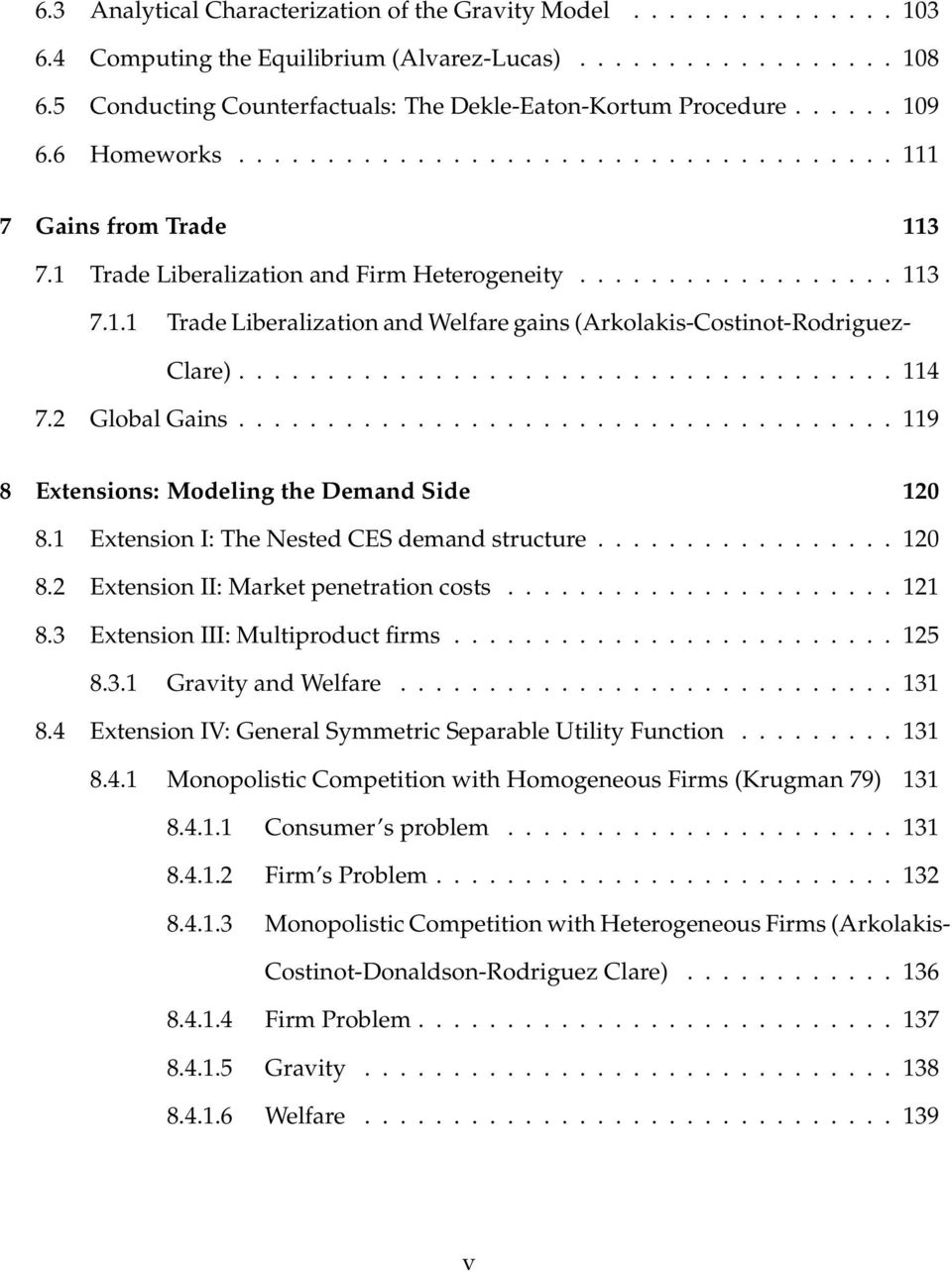
7 9 Modelng Vertcal Producton Lnkages Each good s both fnal and ntermedate Each good has a sngle specalzed ntermedate nput Each good uses a contnuum of nputs The gravty estmator A structural gravty equaton The tradtonal gravty estmator The fxed effects gravty estmator The rato gravty estmator The general equlbrum gravty estmator Estmatng trade costs A note on estmatng trade costs Identfyng the elastcty of trade to varable trade costs The no arbtrage condton Estmatng the no-arbtrage condtons The Eaton and Kortum 2002) approach The Donaldson 2012) approach The Allen 2012) approach The? approach Concluson and next steps Some facts on dsaggregated trade flows Frm heterogenety Trade lberalzaton Trade dynamcs v
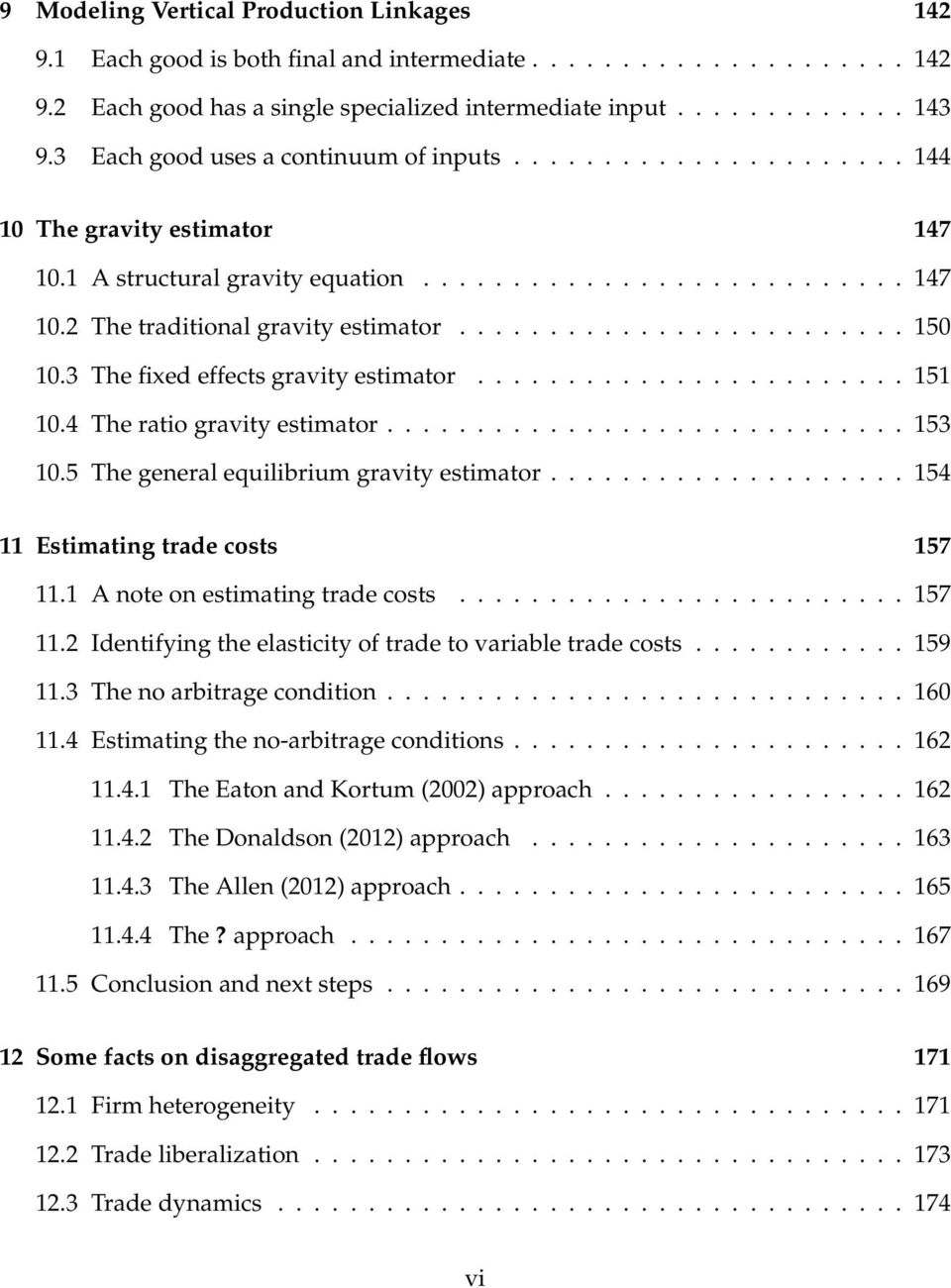
8 13 Estmatng Models of Trade The Anderson and van Wncoop procedure The Head and Res procedure The Eaton and Kortum procedure Calbraton of a frm-level model of trade Estmaton of a frm-level model The model Estmaton, smulated method of moments Appendx Dstrbutons The Fréchet Dstrbuton Fgures and Tables 199 v
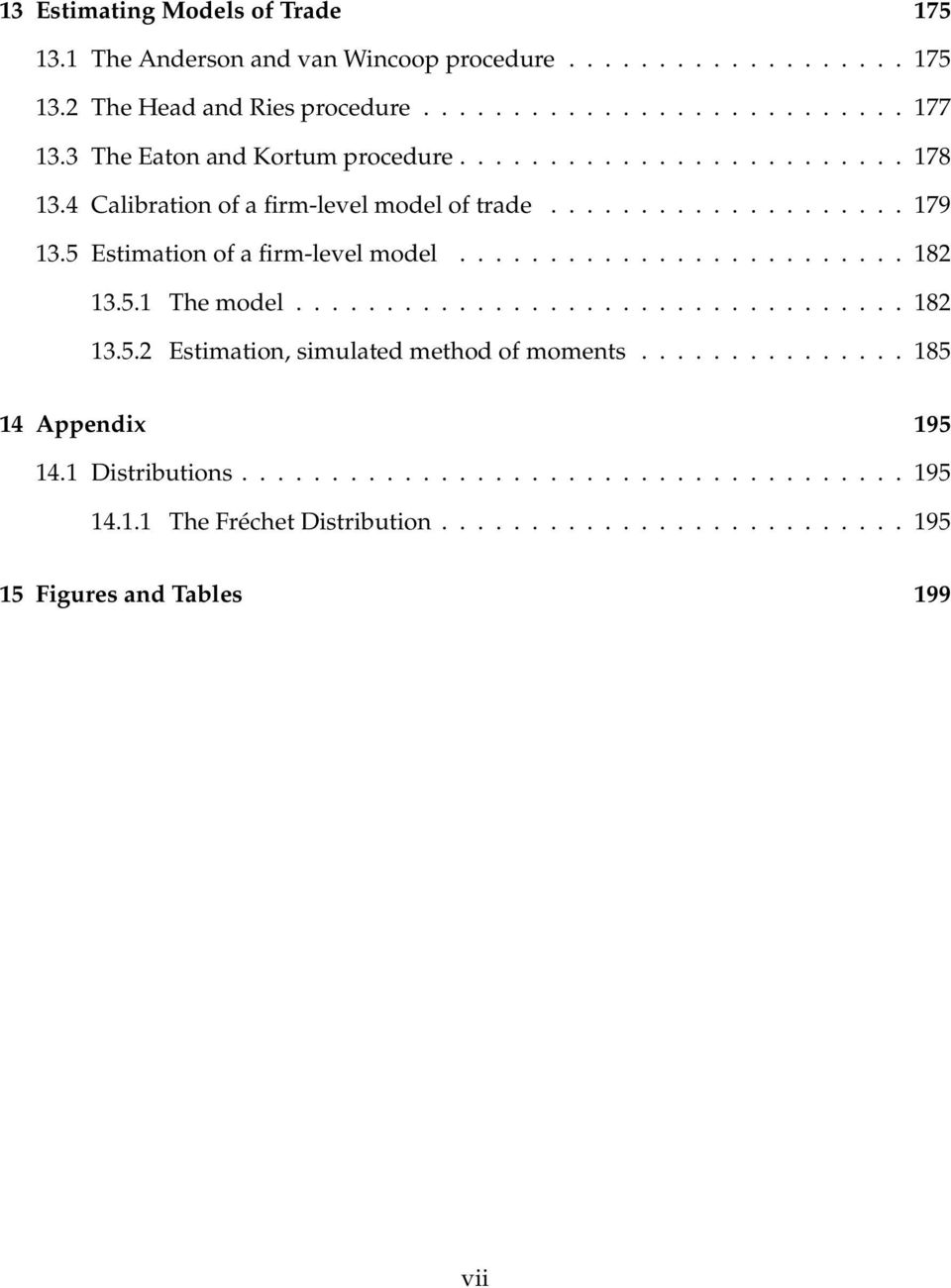
9 Lst of Fgures 15.1 Sales n France from frms grouped n terms of the mnmum number of destnatons they sell to Dstrbutons of average sales per good and average number of goods sold Dstrbuton of sales for Portugal and means of other destnatons group n tercles dependng on total sales of French frms there Product Rank, Product Entry and Product Sales for Brazlan Exporters Increases n trade and ntal trade Frechet Dstrbuton Pareto Dstrbuton v
10 Chapter 1 An ntroducton nto deductve reasonng 1.1 Inductve and deductve reasonng Inductve or emprcal reasonng s the type of reasonng that moves from specfc observatons to broader generalzatons and theores. Deductve reasonng s the type of reasonng that moves from axoms to theorems and then apples the predctons of the theory to the specfc observatons. Inductve reasonng has faled n several occasons n economcs. Accordng to Prescott see Prescott 1998)) The reason that these nductve attempts have faled... s that the exstence of polcy nvarant laws governng the evoluton of an economc system s nconsstent wth dynamc economc theory. Ths pont s made forcefully n Lucas famous crtque of econometrc polcy evaluaton. Theores developed usng deductve reasonng must gve assertons that can be falsfed by an observaton or a physcal experment. The consensus s that f one cannot 1
11 potentally fnd an observaton that can falsfy a theory then that theory s not scentfc Popper). A general methodology of approachng a queston usng deductve reasonng s the followng: 1) Observe a set of emprcal stylzed) facts that your theory has to address and/or are relevant to the questons that you want to tackle, 2) Buld a theory, 3) Test the theory wth the data and then use your theory to answer the relevant questons, 4) Refne the theory, gong through step Employng and testng a model A vague defnton of two methodologes: calbraton and estmaton Calbraton s the process of pckng the parameters of the model to obtan a match between the observed dstrbutons of ndependent varables of the model and some key dmensons of the data. More formally, calbraton s the process of establshng the relatonshp between a measurng devce and the unts of measure. In other words, f you thnk about the model as a measurng devce calbratng t means to parameterze t to delver sensble quanttatve predctons. Estmaton s the process of pckng the parameters of the model to mnmze a functon of the errors of the predctons of the model compared to some pre-specfed targets. It s the approxmate determnaton of the parameters of the model accordng to some pre-specfed metrc of dfferences between the model and the data to be explaned. It s generally consdered a good practce to stck to the followng prncples see Prescott 1998) and the dscusson n Kydland and Prescott 1994)) when constructng 2

12 quanttatve models: 1. When modfyng a standard model to address a queston, the modfcaton contnues to dsplay the key facts that the standard model was capturng. 2. The ntroducton of addtonal features n the model s supported by other evdence for these partcular addtonal features. 3. The model s essentally a measurement nstrument. Thus, smply estmatng the magntude of that nstrument rather than calbratng the model can nfluence the ablty of the model to be used as a measurng nstrument. In addton the model s selecton or n partcular, parametrc specfcaton) has to depend on the specfc queston to be addressed, rather than the answer we would lke to derve. For example, f the queston s of the type, how much of fact X can be accounted for by Y, then choosng the parameter values n such a way as to make the amount accounted for as large as possble accordng to some metrc makes no sense. 4. Researchers can challenge exstng results by ntroducng new quanttatvely relevant features n the model, that alter the predctons of the model n key dmensons. 1.3 Internatonal Trade: The Macro Facts Chapter 2 of Eaton and Kortum 2011) manuscrpt 3

13 Chapter 2 An ntroducton to modelng 2.1 The Heckscher-Ohln model The Heckscher-Ohln H-O) model of nternatonal trade s a general equlbrum model that predcts that patterns of trade and producton are based on the relatve factor endowments of tradng partners. It s a perfect competton model. In ts benchmark verson t assumes two countres wth dentcal homothetc preferences and constant return to scale technologes dentcal across countres) for two goods but dfferent endowments for the two factors of producton. The model s man predcton s that countres wll export the good that uses ntensvely ther relatvely abundant factor and mport the good that does not. We wll present a very smple verson of ths model. Country s representatve consumer s problem s max a 1 log c 1 + a 2 log c 2 s.t. p 1 c 1 + p 2c 2 r k + w l 4

14 The producton technologes of good ω n the two countres are dentcal and gven by y ω = z ω k ω ) bω l ω) 1 bω,, ω = 1, 2 and where 0 < b 2 < b 1 < 1. Ths mples that good 1 s more captal ntensve than good 2. Assume for smplcty that k 1 / l 1 > k 2 / l 2. Ths mples that country 1 s captal abundant relatve to country 2. Fnally, goods, labor, and captal markets clear. One of the common assumptons for the H-O model s that there s no factor ntensty reversal whch n our example s always the case gven the Cobb-Douglas producton functon one good s always more captal ntensve than the other, wth the captal ntensty gven by b ω ) Autarky equlbrum We frst solve for the autarky equlbrum for country. Ths s easy especally f we consder the socal planner problem, but we wll compute the compettve equlbrum nstead. The Inada condtons for the consumer s utlty functon mply that both goods wll be produced n equlbrum. Thus, we ust have to take FOC for the consumer and look at cost mnmzaton for the frm. For the consumer we have max a 1 log c 1 + a 2 log c 2 s.t. p 1 c 1 + p 2 c 2 r k + w l 5

15 whch mples a 1 = λ p 1 c 1 2.1) a 2 = λ p 2 c 2 2.2) p 1 c 1 + p 2 c 2 = r k + w l 2.3) Ths gves p 2 c 2 = a 2 a 1 p 1 c ) The frm s cost mnmzaton problem mn r k ω + w lω ) s.t. y ω z ω k bω ω lω ) 1 bω mples the followng equaton, under the assumpton that both countres produce both goods, b ω 1 b ω ) l ωw = r k ω. 2.5) We can also use the goods market clearng to obtan ) c ω = z ω k bω ω lω) 1 bω = c ω = z ω lω bω w ) bω 1 b ω r. 2.6) Zero profts n equlbrum, p ωz ω k ω ) bω l ω ) 1 bω = r k ω + w l ω, combned wth 2.5), 6

16 gve us p ω = = b ω z ω r k ω r k ω ) 1 b ω ) bω w bω w b ω 1 b ω ) r w ) 1 b ω r ) b ω z ω 1 b ω ) 1 b ω b ω ) b ω We can also derve the labor used n each sector. From the consumer s FOCs, together wth the expressons for p ω and c ω derved above, we obtan: a ω = λ p ωc ω = 1 b ω ) a ω λ = w l ω ths mples that l1 1 b 2 ) a 2 = l2 1 b 1 ) a 1 We can use the labor market clearng condton and get l 2 + l 1 = l = l1 1 b 2 ) a 2 + l1 1 b 1 ) a = l = 1 l 1 = 1 b 1 ) a 1 1 b 2 ) a b 1 ) a 1 l. 2.7) The results are smlar for captal and thus, k 1 = b 1 a 1 b 1 a 1 + b 2 a 2 k, 7
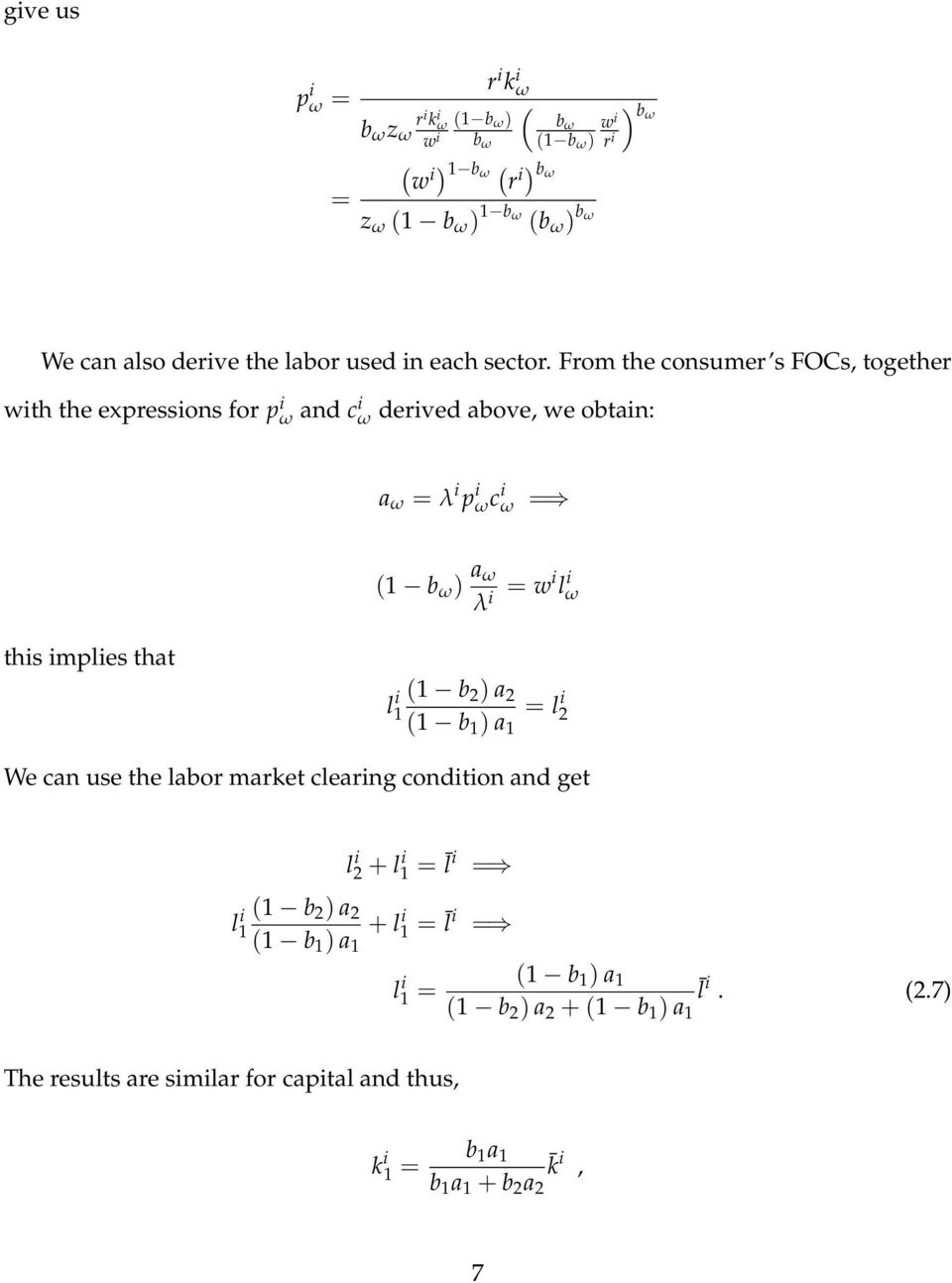
17 Ths mples l k = r w ω 1 b ω ) a ω ω b ω a ω 2.8) Thus, n a labor abundant country captal s relatvely more expensve as we would expect. We can fnally use the goods market clearng condtons combned wth the optmal choces for l ω, k ω to get the values for c ω s as a functon solely of parameters and endowments, ) c bω a bω ) ω 1 ω = z ω k bω ) a 1 bω ω l. 2.9) ω b ω a ω ω 1 b ω ) a ω Free Trade Equlbrum In the two country example, free trade mples that the prce of each good s the same n both countres. Therefore, we wll denote free trade prces wthout a country superscrpt. In the two country case t s mportant to dstngush among three conceptually dfferent cases: n the frst case both countres produce both goods, n the second case one country produces both goods and the other produces only one good, and n the last case each country produces only one good. We frst defne the free trade equlbrum. A free trade equlbrum s a vector of allocatons for consumers ĉ ω,, ω = 1, 2 ), allocatons for the frm ˆk ω, ˆl ω,, ω = 1, 2), and prces ŵ ω, ˆr ω, ˆp ω,, ω = 1, 2 ) such that 1. Gven prces consumer s allocaton maxmzes her utlty for = 1, 2 2. Gven prces the allocatons of the frms solve the cost mnmzaton problem n 8

18 = 1, 2, ) b ω p ω z ω k bω 1 ω lω) 1 bω r, wth equalty f y ω > 0 ) 1 b ω ) p ω z ω k bω ω lω) bω w, wth equalty f y ω > 0 3. Markets clear ω ω ĉ ω = ŷ ω, ω = 1, 2 ˆk ω = k for each = 1, 2 ˆl ω = l for each = 1, No specalzaton We analyze the three cases separately. Frst, let s thnk of the case n whch both countres produce both goods. max a 1 log c 1 + a 2 log c 2 s.t. p 1 c 1 + p 2c 2 r k + w l a 1 = λ p 1 c ) a 2 = λ p 2 c ) p 1 c 1 + p 2c 2 = r k + w l 2.12) 9

19 Ths mples agan that p 2 c 2 = a 2 a 1 p 1 c ) When both countres produce both goods the frms cost mnmzaton problem mples the followng two equaltes, ) b ω p ω z ω k bω 1 ω lω) 1 bω = r, ) 1 b ω ) p ω z ω k bω ω lω) bω = w, whch n turn mply b ω l ω ) w 1 b ω ) r = k ω. 2.14) Addtonally, from zero profts, p ω = r ) b ω w ) 1 b ω z ω b ω ) b ω 1 b ω ) 1 b ω 2.15) and, of course, technologes by assumpton) and prces due to free trade) are the same n the two countres. Notce that the equalty 2.15) s true for = 1, 2 ths mples that r 1) b ω w 1) 1 b ω = r 2 ) b ω w 2 ) 1 b ω ω = 1, 2 ) r 1 bω ) w 2 1 bω = ω = 1, 2 r 2 w 1 Notcng that the above expresson holds for ω = 1, 2 and replacng these two equa- 10

20 tons n one another we have w 2 w 1 ) 1 b 2)b 1 b 2 1+b 1 = 1 = w 2 = w 1 and of course r 2 = r 1. Ths shows that we have factor prce equalzaton FPE) n the free trade equlbrum. From the cost mnmzaton of the frm we have b ω p ωz ω k ω ) bω l ω) 1 bω = r k ω = b ω p ω y ω = r k ω = p ω y ω = r k ω b ω. Summng up over and usng FPE we have ) p ω y ω = r b ω k ω ). 2.16) The equatons 2.10) and 2.11) mply a ω λ 1 + a ) ω λ 2 = p ω c 1 ω + c 2 ω 2.17) 11

21 Usng goods market clearng, c ω = y ω, we have b ω a ω a ) ω λ = p ω c 1 ω + c 2 ω 1 λ = r k ω = = p ω y ω = r b ω k ω = ) 1 λ ω b ω a ω = r ω k ω = 1 λ = r k1 + k 2) 2.18) ω b ω a ω and n a smlar manner 1 λ = w l1 + l 2). 2.19) ω 1 b ω ) a ω Usng 2.18) and 2.19) we can determne the w/r rato l 1 + l 2 k 1 + k = r ω 1 b ω ) a ω ) w ω b ω a ω Assumng that one country s more captal abundant than the other say k 1 / l 1 > k 2 / l 2 ), the equlbrum factor prce rato r/w under free trade les n between the autarky factor prces of the two countres determned n equaton 2.8). Usng the relatonshps for the captal labor rato 2.14) together wth the above expresson and factor market clearng condtons we can derve the equlbrum labor used from each country n each sector. Usng the captal labor ratos for the second good and 12
22 for both countres we get: w r [ l ) l2 b ) 1 1 b 1 ) + l2 ] b 2 = 1 b 2 ) k l2 = 1 b 2) 1 b 1 ) l b 2 b 1 l2 = 1 b 2) 1 b 1 ) l b 1 b 2 r k b ) 1 w l 1 b 1 ) b1 1 b 1 ) ω b ω a l1 ω + l 2 ) k ω 1 b ω ) a ω k 1 + k 2 l You may notce two thngs n ths expresson. Frst, f ntal endowments of the two countres are nsde a relatve range, there s dversfcaton snce l > 0. If the endowments of a country for a gven good are not n ths range, then a country specalzes n the other good ths range of endowments that mples dversfcaton n producton s commonly referred to as the cone of dversfcaton). Second, condtonal on dversfcaton labor abundant countres use relatvely more labor n the labor ntensve sector. What s the share of consumpton for each country? We can use the FOC from the consumer s problem to obtan p 1 c a ) 2 = r k + w l = a 1 c1 = r k + w l ) = p a 2 a 1 c 1 = 1 1 b ω ) w l p a 2 a 1 ) 2.21) where n the last equvalence we used equaton 2.14). Obtanng the rest of the allocatons and prces s straghtforward. In fact, you can show that f the producton functon exhbts CRS and the captal-labor rato for both countres s fxed n a gven sector), total 13
23 producton can be represented by 1 ) bω y ω = z ω k ω 1 bω lω). We can determne k ω, l ω by combnng expresson 2.18) wth 2.16), 2.17) and usng the market clearng condton. Ths gves b ω a ω ω b ω a ω = k ω k, 2.22) and smlarly for labor Specalzaton [HW] 1 Assume that k 1 /l 1 = k 2 /l 2. We only have to prove that gven ths assumpton A k 1 + k 2) b l 1 + l 2) 1 b = A k 1) b l 1) 1 b + A k 2) b l 2) 1 b. Usng repeatedly the condton we have that ) b ) b k 1 + k 2 k A l 1 + l 2 = l 1 k A l 1 l 1 + l ) b A l 2 l 2 l 1 + l 2 ) b ) b k 1 + k 2 k l 1 + l 2 = l 1 k 2 l 1) ) ) /l 2 + k 2 k l 1 + l 2 = l 1 k 2 l 2 = k1 l 1, whch holds by assumpton completng the proof. 14
24 2.1.5 The 4 bg theorems. In ths fnal secton for the H-O model we wll state man theorems that hold n the benchmark model wth two countres and two goods. Varants of these theorems hold under less or more restrctve assumptons. Our approach wll stll be as parsmonous as possble. 2 Theorem 1. Assume countres engage n free trade, there s no specalzaton thus there s dversfcaton) n equlbrum and there s no factor ntensty-reversal, then factor prces equalze across countres. Proof. See man text Theorem 2. Rybczynsk) Assume that the economes reman always ncompletely specalzed. An ncrease n the relatve endowment of a factor wll ncrease the rato of producton of the good that uses the factor ntensvely. 3 XX Theorem 3. Stolper-Samuelson) Assume that the economes reman always ncompletely specalzed. An ncrease n the relatve prce of a good ncreases the real return to the factor used ntensvely n the producton of that good and reduces the real return to the other factor. XXX Theorem 4. Hekchser-Ohln) Each country wll produce the good whch uses ts abundant factor of producton more ntensvely. 2 For a detaled treament you can look at the books of Feenstra 2003) and Bhagwat, Panagarya, and Srnvasan 1998). 3 If prces were fxed a stronger verson of the theorem can be proved. 15
25 Chapter 3 Models wth Constant Elastcty Demand Suppose there s a compact set S of countres. For now, we assume that S s dscrete, although havng a contnuum of countres does not change thngs much. Whenever t s possble, we refer to an orgn country as and a destnaton country as and order the subndces such that X s the blateral trade from to. We defne as X the total spendng of country. We further denote by L the populaton of country and let each consumer have a sngle labor unt that s nelastcally suppled. There are three common assumptons made about the market structure by trade theorsts. The frst s that markets n every country are perfectly compettve, so the prce of a good s smply equal to ts margnal cost. The second s that there s Bertrand competton so that the prce of a good depends on the margnal cost of the least cost producer as well, potentally, on the cost of the second cheapest producer. The thrd s that producton s monopolstcally compettve so that the frm does not perceve any mmedate compettor but t s affected by the overall level of competton. We wll consder each below. 16
26 We also assume throughout that labor s the only factor of producton we wll add ntermedate nputs later on). We also assume that there are ceberg trade costs {τ }, S. Ths means that n order from one unt of a good to arrve n destnaton, destnaton must shp τ unts. Iceberg trade costs are so called because a fracton τ 1 melts on ts way from to, much as f you were towng an ceberg. We almost always assume that τ 1 and usually assume that τ = 1 for all S,.e. trade wth oneself s costless. Furthermore, we sometmes assume that the followng trangle nequalty holds: for all,, k S: τ τ k τ k. The trangle nequalty says that t s never cheaper to shp a good va an ntermedate locaton rather than sell drectly to a destnaton. 3.1 Constant Elastcty Demand We frst ntroduce one of the most remarkably smple as well as versatle demand functons that wll be the bass of our analyss for the next two chapters, the Constant Elastcty of Substtuton CES) demand functon. Why do we do so? CES preferences have a number of attractve propertes: 1) they are homothetc; 2) they nest a number of specal demand systems e.g. Cobb-Douglas); and 3) they are extremely tractable. Trade economsts often do not beleve that CES preferences are a good representaton of actual preferences but are seduced nto makng frequent use of them due to ther analytcal convenence. In partcular, assume that the representatve consumer n country derves utlty U from a set of varetes Ω the consumpton of goods shpped from all countres S: U = ) σ σ 1 a ω) σ 1 q ω) σ 1 σ, 3.1) ω Ω where σ 0 s the elastcty of substtuton and a ω) s an exogenous preference shfter. 17
27 A couple of thngs to note: frst, q ω) s the quantty of a good shpped from that arrves n the amount shpped s τ q ω)); second, the fact that there s a representatve consumer s not partcularly mportant: we can always assume that workers wth dentcal preferences) are the ones consumng the goods and U can be nterpreted as the total welfare of country n ths case homothetcty s, of course, crucal for ths property to be true). We now solve the representatve consumer s utlty maxmzaton problem. Gven the mportance of CES n the class we wll proceed to do the full dervaton for any gven good ω Ω. Let the ncome of country be denoted Y and let the prce of a good net of trade costs) from country n country be p. Then the utlty maxmzaton problem s: max {q ω)} ω Ω ) σ a ω) σ 1 q ω) σ 1 σ 1 σ Ω s.t. q ω) p ω) X, ω Ω where I gnore the constrant that q ω) > 0 why s ths okay?). The Lagrangan s: L : ) σ ) a ω) σ 1 q ω) σ 1 σ 1 σ λ q ω) p ω) X ω Ω ω Ω Frst order condtons FOCs) are: L q ω) = 0 ) 1 a ω) σ 1 q ω) σ 1 σ 1 σ a ω) σ 1 q ω) σ 1 ω Ω = λp ω) L λ = 0 X = q ω) p ω) ω Ω 18
28 From the frst FOC we have for any, S: a ω) a ω ) = pσ ω) q ω) p σ ω ) q ω ) Rearrangng and multplyng both sdes by p yelds: q ω ) p ω ) = 1 a ω) q ω) p ω) σ ω) a ω ) p 1 σ ω ) Summng over all ω Ω yelds: q ω ) p ω ) = 1 a ω Ω ω) q ω) p ω) σ a ω ) p ω ) 1 σ ω Ω X = 1 a ω) q ω) p ω) σ P 1 σ where the last lne used the second FOC and P ω Ω a ω ) p ω ) 1 σ) 1 1 σ s known as the Dxt-Stgltz prce ndex. It s easy to show that U = X P,.e. dvdng ncome by the prce ndex gves the total welfare of country. Rearrangng the last lne yelds the CES demand functon: q ω) = a ω) p σ ω) X P σ 1, 3.2) Equaton 3.2) mples that the quantty consumed n of a good produced n wll be ncreasng wth s preference for the good a ), decreasng wth the prce of the good p ), ncreasng wth s spendng X ), and ncreasng wth s prce ndex. Note that the value of total trade s smply equal to the prce tmes quantty. In what follows, let us denote the value of trade of good ω from country to country as X ω) 19
29 p ω) q ω). Then we have: X ω) = a ω) p 1 σ ω) X P σ ) The only thng left to construct blateral trade s to solve for the optmal prce and aggregate across varetes, whch we wll do after a bref dscusson of the gravty equaton. 3.2 The gravty setup It s helpful to provde a bref motvaton of why we are nterested n wrtng down a flexble model n the frst place. Classcal trade theores Rcardo, Heckscher-Ohln), whle extremely useful n hghlghtng the economc forces behnd trade, are very dffcult to generalze to a set-up wth many tradng partners and blateral trade costs. Because the real world clearly has both of these, the classcal theores do not provde much gudance n dong emprcal work. Because of ths dffculty, those dong emprcal work n trade began usng a statstcal.e. a-theoretc) model known as the gravty equaton due to ts smlarty the Newton s law of gravtaton. The gravty equaton states that total trade flows from country to country, X, are proportonal to the product of the orgn country s GDP Y and destnaton country s GDP Y and nversely proportonal to the dstance between the two countres, D : 1 X = α Y Y D. 3.4) For a varety of reasons whch we wll go nto later on n the course), ths gravty equaton s often estmated n a more general form, whch we refer to as the generalzed gravty 1 Ths s actually n contrast to Newton s law of gravtaton, where the force of gravty s nversely proportonal to the square of the dstance. 20
30 equaton: X = K γ δ, 3.5) where K s a measure of the resstance of trade between and, γ measures the orgn sze and δ measures the destnaton sze note that each country has two dfferent measures of sze).. The gravty equaton 3.4) and ts generalzaton 3.5) have proven to be enormously successful at explanng a large fracton of the varaton n observed blateral trade flows; ndeed, t s probably not too much of an exaggeraton to say that the gravty equaton s one of the most successful emprcal relatonshps n all of economcs. Because t was orgnally proposed as a statstcal relatonshp, however, the absence of a theory ustfyng the relatonshp made t very dffcult to ask any meanngful counterfactual questons; e.g. what would happen to trade between and f the tarff was lowered between and k? 3.3 Armngton model The Armngton model Armngton, 1969) s based on the premse that each country produces a dfferent good and consumers would lke to consume at least some of each country s goods. Ths assumpton s of course ad hoc, and t completely gnores the classcal trade forces such as ncreased specalzaton due to comparatve advantage. However, as we wll see, the model when combned wth Constant Elastcty of Substtuton CES) preferences as n Anderson, 1979)) provdes a nce characterzaton of trade flows between many countres. 2 The Armngton model as formulated by Anderson, 1979)) was mportant because 2 Actually, n the man text, Anderson 1979) consders Cobb-Douglass preferences and wrtes that there s lttle pont n the exercse of generalzng to CES preferences, dong so only n an appendx. Despte hs reluctance to do so, the paper has been cted thousands of tmes as the example of an Armngton model wth CES preferences. 21
31 t provded the frst theoretcal foundaton for the gravty relatonshp. It s also a great place to start our course, as one of the great surprses of the nternatonal trade lterature over the past ffteen years has been how robust the results frst present n the Armngton model are across dfferent quanttatve trade models. By now, as we wll dscuss n ths chapter, models that yeld the gravty relatonshp 3.5) are ubqutous and much of the rest of what follows wll focus on analyzng ther common propertes The model We now turn to the detals of the Armngton models and n partcular to the supply sde of ths model, gven CES demand. The Armngton assumpton s that each country S produces a dstnct varety of a good. Because countres map one-to-one to varetes, we ndex the varetes by ther country names ths wll not be true for Bertrand and monopolstc competton when we have to keep track both of varetes and countres). Suppose that the market for each country/good s perfectly compettve, so that the prce of a good s smply the margnal cost. Suppose each worker can produce A unts of her country s good and let w be the wage of a worker. Then the margnal cost of producton s smply w A. Ths mples that the prce at the factory door.e. wthout shppng costs) s p = w A. What about wth trade costs? Recall that wth the ceberg formulaton, τ 1 unts have to be shpped n order for one unt to arrve. Ths means that τ 1 unts have to be produced n country n order for one unt to be consumed n country. Hence the prce n country of consumng one unt from country s: p = τ w A. 3.6) 22
32 Note that ths mples that: p p = τ, 3.7).e. the rato of the prce n any destnaton relatve to the prce at the factory door s smply equal to the ceberg trade cost. Equaton 3.7) s called a no-arbtrage equaton, as t means that there s no way for an ndvdual to proft by buyng a good n country and sell n country or vce versa). Note, however, that there may stll be proftable tradng opportuntes between trplets of countres even f equaton 3.7) holds when the trangle nequalty s not satsfed Gravty Assumng that each country produces a dfferent good ω, and substtutng equaton 3.6) nto equaton 3.3) yelds a gravty equaton for blateral trade flows: X = a τ 1 σ w A ) 1 σ X P σ ) To the extent that trade costs are ncreasng n dstance, the value of blateral trade flows wll declne as long as σ > 1. We can actually use equaton to get a lttle close to the true gravty equaton. The total ncome n a country s equal to ts total sales: Y = X = a τ 1 σ w A ) 1 σ X P σ 1 w A ) 1 σ = Y / a τ 1 σ X P σ 1 23
33 Replacng ths expresson n the equaton 3.8) yelds: where Π 1 σ foreshadowng here]. X = a τ 1 σ Y ) X Π 1 σ P 1 σ ), 3.9) a τ 1 σ X P σ 1 bears a strkng resemblance to the prce ndex [nsert Equaton 3.9) whch shows that the blateral trade spendng s related to the product of the GDPs of the two countres gravty!!), the dstance/tradecost and a GE component. Equaton 3.9) s actually about as close as we wll ever get to the orgnal gravty equaton. Ths s because all of our theores say that blateral trade flows depend on more than ust the blateral trade costs and the ncomes of the exporter and mporter; what also matters s so-called blateral resstance : ntutvely, the greater the cost of exportng n general, the smaller the Π 1 σ ; conversely, the greater the cost of mportng n general, the smaller the P 1 σ. Ths means that trade between any two countres depends not only on the ncomes of those two countres but also the cost of tradng between those countres relatve to tradng wth all other countres. Ths pont was made n the enormously famous and nfluental paper Gravty wth Gravtas: A Soluton of the Border Puzzle Anderson and Van Wncoop, 2003) Welfare We wll now show that welfare n relatonshp to trade s gven by a smple equaton nvolvng the trade to GDP rato and parameters of the model but no other equlbrum varables). We wll be revstng ths relatonshp multple tmes n these notes. To begn 24
34 defne λ as the fracton of expendture n spent on goods arrvng from locaton : λ X k X k. From equaton 3.8) we have: λ = a τ 1 σ k a k τ 1 σ k ) 1 σ w A ) 1 σ wk A k λ = a τ 1 σ A σ 1 w P ) 1 σ 3.10) snce P 1 σ k a k τ 1 σ k wk A k ) 1 σ. Remember from the CES dervatons above that the utlty of the representatve agent s the real wage,.e. U = w P. Assume that τ = 1. Then by choosng =, equaton 3.10) mples that welfare can be wrtten as: U = λ 1 1 σ σ 1 α 1 A, 3.11).e. welfare depends only on changes n the trade to GDP rato, λ, wth an elastcty of 1/ σ 1) whch s the nverse of the trade elastcty. 3.4 Monopolstc Competton wth Homogeneous Frms and CES demand Wth the Armngton model, we saw how we could ustfy the gravty relatonshp n trade usng the ad-hoc assumpton that every country produces a unque good as well as the assumpton that consumers have a love of varety.e. they want to consume at least a lttle bt of every one of the goods). In ths secton, we wll dspense of the frst assumpton 25
35 by ntroducng frms nto the model. However, we wll contnue to rely heavly on the second assumpton by assumng that each frm produces a unque varety and consumers would lke to consume at least a lttle bt of every varety. The model consdered today was ntroduced by Krugman 1980) and was an mportant part of the reason he won a Nobel prze. A key feature of the Krugman 1980) model s that there are ncreasng returns to scale,.e. the average cost of producton s lower the more that s produced. All else equal, ths wll lead to gans from trade, snce by takng advantage of demand from multple countres, frms can lower ther average costs. To succnctly model the ncreasng returns from scale, we suppose that a frm has to ncur a fxed entry cost f e n order to produce. The e mght seem lke unnecessary notaton; however, we keep t here because n future models there wll be both an entry cost and a fxed cost of servng a partcular destnaton). We assume the fxed cost of entry lke the margnal cost) s pad to domestc workers so that f e s the number of workers employed n the entry sector thnk of them as the workers who buld the frm). Some of the results toward the end of ths secton are based on the subsequent analyss of Arkolaks, Demdova, Klenow, and Rodríguez-Clare 2008) Setup The man departure from the perfect competton paradgm s that n monopolstc competton each dfferentated varety s produced potentally) by a dfferent frm, where there s a measure M of frms n country. Ths number of frms s determned n equlbrum by allowng frms to enter after ncurrng a fxed cost of entry n terms of domestc labor, f e. 26
36 3.4.2 Demand As n the Armngton model, we assume that consumers have CES preferences over varetes. Hence a representatve consumer n country S gets utlty U from the consumpton of goods shpped by all other frms n all other countres, where: U = S ˆ q ω) σ 1 σ Ω dω ) σ σ 1, 3.12) where q ω) s the quantty consumed n country of varety ω. Note that for smplcty, I no longer nclude a preference shfter although one could easly be ncorporated) so that consumers treat all frms n all countres equally. The consumer s utlty maxmzaton problem s very smlar to the Armngton model whch shouldn t be partcularly surprsng, gven preferences are vrtually the same). In partcular, a consumer n country S optmal quantty demanded of good ω Ω s: q ω) = p ω) σ E P σ 1, where: P S ˆ Ω p ω) 1 σ dω ) 1 1 σ 3.13) s the Dxt-Stgltz prce ndex. The amount spent on varety ω s smply the product of the quantty and the prce: x ω) = p ω) 1 σ E P σ ) Note that we derved a very smlar expresson n the Armngton model, from whch the gravty equaton followed almost mmedately. In ths model however, ths s the amount spent on the goods from a partcular frm, so we now need to aggregate across all frms n 27
37 country to determne blateral trade flows between and,.e.: Supply ˆ X x ω) dω = Y P σ 1 Ω ˆ Ω p ω) 1 σ dω. 3.15) All frms n country have a common productvty, z, and produce one unt of the good usng 1 z unts of labor. The optmzaton problem faced by a frm ω from country s: ) τ max p ω) q ω) w q ω) w f e s.t. q ω) = a p ω) σ E P σ 1 {q ω)} z S S We can substtute the constrant nto the maxmand and wrte the equvalent unconstraned problem of choosng the prce to sell to each locaton as: max p 1 σ ω) E P σ 1 τ w p σ {p ω)} z S S ) ω) E P σ 1 w f e Note that the constant margnal cost assumpton mples that the country can treat each destnaton as a separate optmzaton problem ths wll come n helpful n models we wll see later on). 3 Proft maxmzaton mples that optmal prcng for a frm sellng from country to country s p z ) = σ τ w, 3.16) σ 1 z 3 Notce that here we haven t ntroduced fxed costs of exportng. Introducng these costs wll change the analyss n that we may have countres for whch all the frms chose not to export dependng on values of the fxed costs and other varables. More extreme predctons can be delvered f the producton cost f s only a cost to produce domestcally and ndependent of the exportng cost. However, n order to create a true extensve margn of frms.e. more frms exportng when trade costs decrease) requres heterogenety ether n the productvtes of frms as we wll do later on n the notes) or n the fxed costs of sellng to a market see Romer 1994)). 28
38 and snce all frm decson wll depend on parameter s and frm productvty we drop the ω notaton from here on. We wll make the notaton a bt cumbersome by carryng around the z s n order to allow for drect comparson of our results wth the heterogeneous frms example that wll be studed later on Gravty Because every frm s chargng the same prce, we can substtute the prce equaton 3.16) nto the gravty equaton 3.15) to yeld: ˆ X = E P σ 1 X = Ω ) σ 1 σ τ 1 σ σ 1 ) σ w 1 σ τ σ dω 1 z w z ) 1 σ M E P σ ) where M Ω dω s the measure of frms producng n country. Comparng ths equaton to the one derved for the Armngton model wth monopolstc, we see that the two expressons are nearly dentcal - the only dfference here s that we have to keep track of the mass of frms M and all trade flows are smaller f σ > 1) as a result of the markups Welfare It turns out welfare can be wrtten smlarly to the Armngton model. Frst, note that substtutng equaton 3.16) for the equlbrum prce charged nto the prce ndex equaton 3.13) yelds: P 1 σ σ 1 σ σ 1) k τ 1 σ k wk z k ) 1 σ M k. As above, defne λ X k X k to be the fracton of expendture of country on goods sent from country. Then usng equaton 3.17), we can wrte λ as a functon of the prce 29
39 ndex n : λ = σ ) ) 1 σ 1 σ σ 1 τ 1 σ w z M E P σ 1 σ ) ) 1 σ 1 σ k σ 1 τ 1 σ wk z Mk k E P σ 1 k λ = τ1 σ k τ 1 σ k ) 1 σ w z M ) 1 σ wk z Mk k σ λ = σ 1 σ P = σ 1 ) 1 σ τ 1 σ ) ) w τ z w z ) 1 σ M P 1 σ M 1 1 σ σ 1 λ ) Snce equaton 3.18) holds for any and, we can focus on the partcular case where =. Then assumng τ = 1, we can wrte equaton 3.18) as: ) ) σ w P = σ 1 z ) w σ 1 σ 1 = z M 1 P σ M 1 1 σ 1 σ λ 1 σ 1 λ 1, 3.19).e. the real wage s declnng n λ or equvalently, ncreasng n trade openness. Note, however, that unlke the Armngton model, frms are makng postve profts, so that the real wage no longer captures the welfare of a locaton. To deal wth ths ssue, we ntroduce a free entry condton Free entry The fnal thng we have to do s determne the equlbrum number of frms that enter. In ths model the mass of frms M s determned by the free entry condton whch states that the profts of all frms must be equal to zero. The ustfcaton for ths condton s that 30
40 there s a large mass of potental frms or equvalently, other dfferentated products that could be produced), who choose not to enter. [Class queston: why do they not enter?] 4 Hence, to determne the equlbrum mass of frms, we need to calculate the profts of any partcular frm. Frms profts are: π ω) p ω) w ) τ q ω) w f e 3.20) z Substtutng the consumer demand expresson 3.1) and the prce expresson 3.16) nto equaton 3.20) yelds: σ π ω) = σ 1 c τ w ) σ τ z σ 1 )) σ σ π ω) = σ 1 1 σ 1 ) ) 1 σ σ w π ω) = τ σ 1 σ 1 z π ω) = 1 σ 1 σ w σ σ 1) τ z ) w σ τ E P σ 1 z w f e ) σ w z τ ) 1 σ E P σ 1 ) 1 σ E P σ 1 ) 1 σ E P σ 1 w f e w f e w f e It turns out that n ths framework, the profts of a frm have a smple relatonshp to the quantty the frm produces, whch greatly smplfes the equlbrum. To see ths, we frst relate the profts a frm to ts revenues. Note that from equaton 10.1) and the prce 4 To see that the entry of addtonal frms pushes down the profts of any partcular frm, note that combnng expresson 3.13) for the Dxt-Stgltz prce ndex wth the prce expresson 3.16) from the producers optmzaton problem yelds: P σ ) ) 1 1 σ 1 σ w σ 1 M τ z S Hence, an ncrease n the number of frms producng n any country reduces the prce ndex, thereby decreasng profts. [Class queston: what s the ntuton for why more frms lowers the prce ndex?] 31
41 expresson 3.16) that the revenue a producer receves s: σ 1 σ ) 1 σ w r ω) p ω) q ω) = σ 1) τ E P σ 1 z S S so that varable profts are smply equal to revenue dvded by the elastcty of substtuton,.e.: π ω) + w f e = 1 σ r ω). 3.21) [Class queston: what s the ntuton of ths result?]. From the prce equaton 3.16), f we assume that τ = 1, we can decompose the total revenue produced by a frm nto the total quantty t produces and the prce: r ω) = p ω) q ω) = σ σ 1 w z ) q ω), 3.22) where I mposed the fact that the margnal cost c = w A. From the free entry condton, total profts of a frm are zero,.e. π ω) = 0. Applyng the free entry condton to equaton 3.21) yelds: w f e = 1 σ r ω) 3.23) Substtutng equaton 3.22) nto 3.23) then yelds: w f e = 1 σ 1 σ 1) f e = q ω) z w z ) q ω).e. n equlbrum, the fxed cost of entry wll be proportonal q ω) z, whch s the amount of labor used n producton. The last step s to note that the total labor used by all frms for 32
42 both entry and for producton) has to equal the total number of workers n the country, L : M f e + q ) ω) = L z M f e + σ 1) f e ) = L M = 1 σ L f e. 3.24) In equlbrum, the number of frms s proportonal to the populaton of a country and nversely proportonal to the entry costs and the elastcty of substtuton. [Class queston: what s the ntuton for each of these comparatve statcs?]. Usng the equlbrum number of frms gven by expresson 3.24) nto the gravty equaton gven by 10.3) to yeld: X = 1 σ ) σ 1 σ τ 1 σ σ 1 w and we can re-wrte the real wage equaton 3.19) as: z ) 1 σ L f e E P σ ) w P = σ 1 σ ) ) 1 1 σ σ 1 L f e ) 1 σ 1 z λ 1 1 σ. 3.26) Because frms earn zero profts wth free entry, the real wage s now equal to the welfare of locaton, so that equaton 3.26) tells us that the welfare of a locaton s ncreasng wth ts openness. Intutvely, frms bd up the prce of labor by usng workers for the fxed cost of entry, whch ncreases wages to the pont that all profts accrue to wages. Because the equlbrum number of frms s pnned down by exogenous model parameters, the Krugman 1980) gravty equaton 3.25) can be formally shown to be somorphc to Armngton model dscussed n the prevous class. Ths means that wth an appropr- 33
43 ate transformaton of model fundamentals both models wll yeld dentcal predctons for the equlbrum outcomes of the model. Hence, n a sense, makng the Armngton model more realstc by replacng the Armngton assumpton wth frms dd not end up changng anythng that much. 3.5 Rcardan model The Rcardan model s a model of perfect competton where countres produce the same goods usng dfferent technologes. The Rcardan model predcts that countres may specalze n the producton of certan ranges of goods The two goods case We consder the smple verson of the model wth two countres and two goods. In order to get as much ntuton as possble we wll frst consder the case where both countres specalze n the producton of one good. The producton technologes n the two countres = 1, 2 are dfferent for the two goods ω = 1, 2 and gven by y ω) = z ω) l ω),, ω = 1, 2. Assume that country 1 has absolute advantage n the producton of both goods z 2 1) < z 1 1), z 2 2) < z 1 2). Assume that country 1 has comparatve advantage n the producton of good 1 and coun- 34
44 try 2 n good 2 z 1 2) z 2 2) < z1 1) z 2 1). 3.27) Assume Cobb-Douglas preferences. The consumer s problem s max a 1) log c 1) + a 2) log c 2) s.t. p 1) c 1) + p 2) c 2) w l. Consumer optmzaton mples that p 2) c 2) = a 2) a 1) p 1) c 1) 3.28) p 1) c 1) + p 2) c 2) = w l 3.29) Autarky Usng frms cost mnmzaton and the Inada condtons that ensure that the consumer actually wants to consume both goods) from the consumer problem we drectly obtan that p 1) z 1) = w = p 2) z 2). Usng the goods market clearng c ω) = y ω) for ω = 1, 2, together wth labor market clearng l ω) = a ω) l, 35
45 we get labor allocated to each good. Usng the producton functon and goods market clearng we can obtan the rest of the allocatons Free trade Under free trade nternatonal prces equalze. Relatve productvty patterns wll determne specalzaton. There can be three possble specalzaton patterns, two where one country specalzes and the other dversfes and one where both countres specalze. 1. [Specalzaton]Under the assumptons stated, at least one country specalzes n the free trade equlbrum. Proof. If not then the frm s cost mnmzaton together wth the consumer FOCs would mply z 1 2) z 2 2) = z1 1) z 2 1), a contradcton. In the three dfferent equlbra that can emerge the countres export what they have comparatve advantage on specalzaton nto exportng). Under free trade ths relatve prce has to be n the range gven the Inada condtons n consumpton): z 1 2) z 2 2) p 2) p 1) z1 1) z 2 1) To consder an example of how the wages are determned notce that for the country that s under ncomplete specalzaton equatons cost mnmzaton mples p 1) z 1) p 2) z 2) = w w = p 1) p 2) = z 2) z 1), 36
46 .e. ths country sets the relatve prce of the two goods. Now assume that country 1 s ncompletely specalzed whch means that country 2 specalzes n good 2 and normalze w 1 = 1. Because of free trade and perfect competton t must be the case that the cost of producng good 2 n both countres s the same,.e. w 1 z 1 2) = w2 z 2 2) = w2 = z2 2) z 1 2) < 1 = w1. Notce that usng the wages and the zero proft condtons for country 1 we now get p 1) z 1 1) = 1 and p 2) z 1 2) = 1 z 1 1) z 1 2) = p 2) p 1). Fnally usng the budget constrants of the ndvdual we can determne the levels of consumpton and verfy that the equlbrum s consstent wth our ntal assumpton for the patterns of specalzaton.e. ndeed country 2 exports good 2 and country 1 exports good 1) 3.6 Homeworks 1. Dxt-Stgltz Preferences. Suppose that a consumer has wealth W, consumes from a set of dfferentated varetes ω Ω, and solves the followng CES maxmzaton problem: ˆ ) σ max U = q ω) σ 1 σ 1 σ dω {qω)} Ω s.t. ˆ Ω p ω) q ω) W, 3.30) where σ > 0, q ω) s the quantty consumed of varety ω and p ω) the prce of varety ω. 37
47 a) Fnd a prce ndex P such that n equlbrum U = W P. b) Derve the optmal q ω) as a functon of W, P and p ω). c) Show that σ s the elastcty of substtuton,.e. for any ω, ω Ω, σ = ) qω) d ln qω ) U/ qω d ln ) U/ qω) ). d) What happens as σ? σ 1? σ 0? 38
48 Chapter 4 Modelng wth CES demand and producton heterogenety The purpose of ths chapter s to develop a general model for producton heterogenety n whch dfferent assumptons on technology and competton wll gve us dfferent workhorse frameworks mportant for the quanttatve analyss of trade. Our analyss of the general framework s based on the exposton of Eaton and Kortum 2011)) and earler results of Kortum 1997)) and Eaton and Kortum 2002)). We start wth a smple extenson of the Rcardan model wth ntra-sector heterogenety. 4.1 Introducton to heterogenety: The Rcardan model wth a contnuum of goods The model of Dornbusch, Fscher, and Samuelson 1977) s based on the Rcardan model where trade and specalzaton patterns are determned by dfferent productvtes. 1 There 1 The notes n ths chapter are partally based on Eaton and Kortum 2011). 39
49 s absolute advantage due to hgher productvty n producng certan goods, but also comparatve advantage due to lower opportunty cost of producng some goods. The man drawback of the smple Rcardan model, smlar to that of the Heckscher-Ohln model, s n the complexty of solvng for the patterns of specalzaton for a large number of ndustres. Breakthrough: Dornbusch, Fscher, and Samuelson 1977) used a contnuum of sectors. The characterzaton of the equlbrum ended up beng very easy. Perfect competton 2 countres H, F) Contnuum of goods ω [0, 1] CRS technology labor only) Cobb-Douglas Preferences wth equal share n each good Iceberg trade costs τ HF, τ FH We normalze the domestc wage to 1. We want to characterze the set of goods produced and exported from each country. Wthout loss of generalty we wll characterze producton and exportng for country F. We frst need to compare the prce of a good ω potentally offered by country H to country F to the correspondng prce of the good produced by F n order to determne the set of goods produced by country F n equlbrum. For ths purpose, we wll order the goods n a decreasng order of domestc to foregn productvty and defne ω as the good wth the lowest productvty produced n the foregn country. Thus, the foregn country produces goods [ω, 1] whle the domestc [0, ω]. When trade costs exst then the two sets wll overlap, ω > ω, but f τ HF = τ FH then ω = ω. A smple condton that determnes whch are the goods that wll be produced by 40
50 country F dctates that the prce of these goods n country F has to be lower than the prce of mported goods,.e. w F z F ω) < τ HF z H ω) = A ω) z H ω) z F ω) < τ HF. w F Therefore, we can defne A ω) = w F τ HF. 4.1) whch determnes that only products that wll be produced by country F. To fnd the set of goods that F wll be exportng we need to determne set of goods produced by country H. Usng a smlar logc ths smply entals fndng the ω that satsfes A ω) = τ FH w F 4.2) and [0, ω] s the set of goods produced by the home country. Thus, F produces goods [ω, 1] and exports [ ω, 1] snce the domestc does not produce any of the goods n that last set. In order to get sensble relatonshps from the model, DFS parametrze z Fω) by usng z H ω) a monotonc functon. In ths last case we can nvert A and get the exact range of goods produced by each country,.e. effectvely determne ω and ω as a functon of parameters and w F. Subsequently, we can solve for the equlbrum wage, usng the labor market clearng L H = ω w F ) w F L F + ω w F ) L H Where DFS stop and EK start Eaton and Kortum 2002) henceforth EK) treat productvtes z ω) as an ndependent realzaton of a random varable Z ndependently dstrbuted accordng to the same ds- 41
51 trbuton F for each good ω n country. Gven the contnuum of goods usng a LLN argument) we can determne wth certanty the fracton of goods produced by each country. Ths way EK are able to overcome the complcatons faced by the standard Rcardan framework and go much further n developng an analytcal quanttatve trade framework. Assume that the random varable Z follows the Frechet dstrbuton 2 : [ Pr Z z) = exp A z θ]. The parameter A > 0 governs country s overall level of effcency absolute advantage) wth more productve countres havng hgher A s). The parameter θ > 1 governs varaton n productvty across dfferent goods comparatve advantage) hgher θ less dspersed). Now we wll splt the [0, 1] nterval by thnkng of ω as the probablty that the relatve productvty of F to H s less than Ã, where à can ether be defned by 4.2). Therefore, n order to determne ω whch s defned as the share of goods that the domestc country produces we smply compute the probablty that the domestc country s the cheapest provder of the good across all the range of productvtes. For example usng 4.2) for the 2 See the appendx for the propertes of the Frechet dstrbuton and the next chapter for a dervaton from frst prncples. 42
52 defnton of à we can derve ω = λ HH [ ] zf = Pr à z H = Pr [ z F Ãz H ] = = = ˆ + 0 ˆ + 0 Ã) ] θ exp [ A F } {{ } Przω) à zh ω)) exp A H A H + A F à θ df H z) } {{ } densty of z H ω) Ãz ) ] [ θ [ A F θa H z) θ 1 exp A H z) θ] dz Country H s spendng 1 ω) w H L H on mports gven Cobb-Douglas) whch mples X FH = A F w F τ HF ) θ A H + A F w F τ HF ) θ w HL H Notce that ths relatonshp s smlar to the relatonshp??) derved wth the assumpton of the Armngton aggregator but wth an exponent θ. A lower value of θ generates more heterogenety. Ths means that the comparatve advantage exerts a stronger force for trade aganst resstance mpose by the geographc barrer τ n. In other words wth low θ there are many outlers that overcome dfferences n geographc barrers and prces overall) so that changes n w s and τ s are not so mportant for determnng trade. 4.2 A theory of technology startng from frst prncples We start wth a very general technologcal framework under the followng assumptons. Tme s contnuous and there s a contnuum of goods wth measure µ Ω). Ideas for good 43
53 ω ways to produce the same good wth dfferent effcency) arrve at locaton at date t at a Posson rate wth ntensty ār ω, t) where we thnk of ā as research productvty and R as research effort. The qualty of deas s a realzaton from a random varable Q drawn ndependently from a Pareto dstrbuton wth θ > 1, so that Pr [Q > q] = q/q ) θ, q q where s a lower bound of productvtes. Note that the probablty of an dea beng bgger than q condtonal on deas beng bgger than a threshold, s also Pareto see appendx q for the propertes of the Pareto dstrbuton). The above assumptons together mply that the arrval rate of an dea of effcency Q q s ) θ ār ω, t). q/q normalze ths wth q 0, ā + such that āq θ 1 n order to consder all the deas n 0, + )). We also assume that there s no forgettng of deas. Thus, we can summarze the hstory of deas for good ω by A ω, t) = ˆ t R ω, τ) dτ. The number of deas wth effcency Q > q s therefore dstrbuted Posson wth a parameter A ω, t) q ) θ usng the prevous normalzaton). The unt cost for a locaton of producng good ω wth an effcency of q s c = w /q. Gven all the above, the expected number of technques provdng unt cost less than c s 44
54 dstrbuted Posson wth parameter Φ ω, t) c θ where Φ ω, t) = A ω, t) w θ. But notce that ths delvers back unt costs that are condtonally Pareto dstrbuted In what follows set Pr [ C c C c ] = Pr [Q w c = q Q w ] c = q ) θ c = = A ω, t) q ) θ A ω, t) q) θ = Φ = Φ ω, t). q q c ) θ Order Statstcs and Varous Moments The generalty of ths approach stll allow for a number of order statstcs and key moments to be computed. We start by computng the dstrbuton of the order statstcs n the model. 2. C k) s the k th lowest unt cost technology for producng a partcular good. Gven ths defnton we have the man theorem for the ont dstrbuton of the order statstcs C k) 45
55 3. The ont densty C k), C k+1) s ) g C k) = c k, C k+1) = c k+1 g k,k+1 c k, c k+1 ) θ = 2 ) k 1)! Φk+1 c θk 1 k c θ 1 k+1 Φc exp θ k+1 for 0 < c k c k+1 < whle the margnal densty of C k) s: g k c k ) = θ k 1)! Φk c θk 1 k ) exp Φc θ k for 0 < c k < + Proof. We start by lookng at costs C c. The dstrbuton of a cost C condtonal on C c s: ) θ F c c) = c c c c F c c) = 1 c > c The probablty that a cost s less than c k s F c k c). Thus, f we have n technques wth unt cost less than c, where c k c k+1 c, the probablty that k are less than c k whle the remanng are greater than c k+1 s gven by the multnomal: [ ] Pr C k) c k, C k+1) c k+1 n = n k F c k c) k 1 F c k+1 c)) n k Takng the negatve of the cross dervatve of ths expresson wth respect to c k, c k+1 gves g k,k+1 c k, c k+1 c, n) = n!f c k c) k 1 [1 F c k+1 c)] n k 1 F c k c) F c k+1 c) k 1)! n k 1)! 46
56 for c k+1 c k and n k + 1. For n < k + 1 we can defne g k,k+1 c k, c k+1 c, n) = 0. We also know that n s drawn from a Posson dstrbuton wth parameter Φ c θ, the expectaton of ths ont dstrbuton uncondtonal on n s: g k,k+1 c k, c k+1 c) = n=0 exp Φ c θ) Φ c θ) n } {{ n! } prob n deas arrved for a partcular good g k,k+1 c k, c k+1 c, n) } {{ } condtonal on n prob C k) =c k, C k+1) =c k+1 exp Φ c = θ) Φ c θ) n n!f c k c) k 1 [1 F c k+1 c)] n k 1 F c k c) F c k+1 c) n! k 1)! n k 1)! n=k+1 Φ c θ ) k+1 exp Φ c θ F c k+1 c) ) F c k c) k 1 F c k c) F c k+1 c) = k 1)! exp Φ c θ) Φ c θ) m exp Φ c θ F c k+1 c) ) [1 F c k+ c)] m m=0 m! Φ c θ ) k+1 exp Φ c θ F c k+1 c) ) F c k c) k 1 F c k c) F c k+1 c) = 1 k 1)! = Substtutng usng the expresson F c c) we have that g k,k+1 c k, c k+1 c) = θ 2 ) k 1)! Φk+1 c θk 1 k c θ 1 k+1 Φc exp θ k+1 Now by lettng c we can ntegrate for the entre range of c c k and derve the margnal densty by makng use of the above expresson. We have that g k c k ) = = ˆ g k,k+1 c k, c k+1 )dc k+1 c k θ 2 ˆ k 1)! Φk+1 c θk 1 k c θ 1 k+1 e Φcθ k+1 dck+1. c k 47
57 Now by makng the substtuton u = c θ k+1, ˆ c k c θ 1 k+1 e Φcθ k+1 dck+1 = θ 1 ˆ c θ k e Φu du = θ 1 Φ 1 e Φcθ k. Therefore g k c k ) = = θ 2 ) k 1)! Φk+1 c θk 1 k θ 1 Φ 1 e Φcθ k θ k 1)! Φk c θk 1 k e Φcθ k, 4.3) as asserted. Ths result wll be the base for a seres of lemmas to be dscussed later on. Frst, by ] notcng that F k c k) = g k c k ) we can drectly compute the probablty Pr [C k) c k : 4. The dstrbuton of the k th lowest cost C k) s: ] Pr [C k) c k = F k c k ) = 1 k 1 υ=0 ) Φ c θ υ k e Φ cθ υ 4.4) υ! Ths Lemma mples that the dstrbuton of the lowest cost k = 1) s the Frechet dstrbuton ) F 1 c 1 ) = 1 exp Φ c 1 θ Now n ths context we wll assume that deas are randomly assgned to goods across the contnuum. Gven that there s a large number of goods say of measure µ Ω)) n the contnuum we can drop the ω notaton by smply denotng A ω, t) = A t) /µ Ω) to be the average number of deas avalable for a good, n locaton at tme t. Gven the above, the measure of goods wth cost less than c s Φ t) /µ Ω) c θ and the dstrbuton of the 48
58 lowest cost C 1) the fronter dea) s ) F 1 c 1 ) = 1 exp Φ t) /µ Ω)) c 1 θ Thus a set of µ Ω) F 1 c 1 ) deas can be produced at a cost less than c 1. We wll proceed under ths conventon n the rest of ths chapter. Usng the followng proposton and the assumpton of the CES demand we can drectly derve the prce ndex 5. For each order k, the b th moment b > θk) s where Γ α) = + 0 y α 1 e y dy. [ ] E C k)) b = Φ 1/θ) b Γ [θk + b) /θ], k 1)! Proof. Frst consder k = 1, where suppressng notaton we denote by the margnal densty of C k), g k c) = θ k 1)! Φk c θk 1 k [ ] exp Φc θ k E [ C 1)) b ] = = ˆ + 0 ˆ + 0 c b g 1 c) dc [ Φθc θ+b 1 exp Φc θ] dc changng the varable of ntegraton to υ = Φc θ and applyng the defnton of the gamma 49
59 functon, we get ˆ + 0 [ ] E C 1)) b = υ/φ) b/θ exp [ υ] dυ [ ] = Φ) b/θ θ + b Γ θ 4.5) well defned for θ + b > 0. For general k we have E [ C k)) b ] = = ˆ + = Φk 1 k 1)! c b g k c) dc 0 ˆ + c b 0 ˆ + = Φk 1 k 1)! E θ k 1)! Φk c θk 1 exp 0 c b+θk θ θφc θ 1 exp [ Φc θ] dc [ Φc θ] dc [ C 1)) b+θk 1) ] 4.6) Usng the general technology framework we developed above and dfferent assumptons on the competton structure we wll be able to derve man quanttatve models that are wdely used n the recent nternatonal trade lterature. We now provde a number of llustratons of ths general framework that arse from explclty specfyng the competton and market structure. 4.3 Applcaton I: Perfect competton Eaton-Kortum) A man factor nhbtng the use of classcal trade theory n emprcal gravty models was the perceved ntractablty of such a problem. The tradtonal Rcardan comparatve advantage framework reled on two countres and two goods; many attempts to gener- 50
60 alze the framework quckly led to a nghtmare of corner solutons. Whle Dornbusch, Fscher, and Samuelson 1977) provded a tractable framework for a contnuum of varetes wth two countres, t was thought to be mpossble to extend the framework to many countres and arbtrary trade costs both whch are necessary to delver a gravtylke equaton). The closest generalzaton to many countres was the local comparatve statc analyss of Wlson 1980)). Ths s where Eaton and Kortum 2002) enters. Usng a model that bears a resemblance to a dscrete-choce framework a la?), they show how to derve gravty expressons for trade flows n a world wth many countres, arbtrary trade costs.e. arbtrary geography), where trade s only drven by technologcal dfferences across countres.e. comparatve advantage). The Eaton and Kortum 2002) framework not only shattered the age-old belef that there couldn t be a Rcardan gravty model, the model developed turns out to be remarkably elegant. It s also surprsng that despte lookng very dfferent from the models we have consdered thus far, the Eaton and Kortum 2002) trade expresson remans formally somorphc to those models Model Setup Let us now turn to the set-up of the model. The World In ths model, there a fnte number of countres S {1,..., N}; unlke prevous models, there are techncal dffcultes n extendng the model to a contnuum of countres). There are a contnuum of goods Ω. However, unlke n the Krugman 1980) and Meltz 2003) models whch follow, every country s able to produce every good. Countres, however, vary exogenously) n ther productvty of each good; n partcular, let z ω) denote 51
61 country s effcency at producng good ω Ω. The Eaton and Kortum 2002) has no concept of a frm. Instead, t s assumed that all goods ω Ω are produced usng the same bundle of nputs wth a constant returns to scale technology. Let the cost of a bundle of nputs n country S be c so that the cost of producng one unt of ω Ω n country S s c z ω). Fnally, lke the prevous models we consdered, suppose there s an ceberg trade cost τ 1 of tradng a good from S to S. Supply Each good s assumed to be sold n perfectly compettve markets, so that the prce a consumer n country S would pay f she were to purchase good ω Ω from country S s: p ω) = c z ω) τ. 4.7) However, consumers n country S are assumed to only purchase good ω Ω from the country who can provde t at the lowest prce, so the prce a consumer n N actually pays for good ω Ω s: p ω) mn p c ω) = mn S S z ω) τ. 4.8) The basc dea behnd the Eaton and Kortum 2002) s already present n equaton 4.8): a country S wll be more lkely to purchase good ω Ω from country S f 1) t has a lower unt cost c ; 2) t has a hgher good productvty z ω); and/or 3) t has a lower trade cost τ. One of the maor nnovatons of the Eaton and Kortum 2002) model s that the pro- 52
62 ductvty z ω) s treated as a random varable drawn ndependently and dentcally for each ω Ω. Defne F to be the cumulatve dstrbuton functon of the productvty n country S. That s, for each S, for all ω Ω: F z) Pr {z ω) z} Eaton and Kortum 2002) assume that F z) s Fréchet dstrbuted so that for all z 0: { F z) = exp T z θ}, 4.9) where T > 0 s a measure of the aggregate productvty of country note that a larger value of T decreases F z) for any z 0,.e. t ncreases the probablty of larger values of z and θ > 1 whch s assumed to be constant across countres) governs the dstrbuton of productvtes across goods wthn countres as θ ncreases, the heterogenety of productvty across goods declnes). Why make ths partcular dstrbutonal assumpton for productvtes? In a mcrofoundaton that s related to the general technologcal framework we have dscussed above Kortum 1997) showed that f the technology of producng goods s determned by the best dea of how to produce, then the lmtng dstrbuton s ndeed Fréchet, where T reflects the country s stock of deas. More generally, consder the random varable: M n = max {X 1,..., X n }, where X are..d. The Fsher Tppett Gnedenko theorem states that the only normalzed) dstrbuton of M n as n s an extreme value dstrbuton, of whch Fréchet s one of three types Type II). Note that a condtonal logt model assumes that the er- 53
63 ror term s Gumbel Type I) extreme value dstrbuted. If random varable x s Gumbel dstrbuted, ln x s dstrbuted Fréchet; hence, loosely speakng, the Fréchet dstrbuton works better for models that are log lnear lke the gravty equaton), whereas the Gumbel dstrbuton works better for models that are lnear. Demand As n prevous models, consumers have CES preferences so that the representatve agent n country has utlty: ˆ U = Ω q ω) σ 1 σ ) σ σ 1 dω, where q ω) s the quantty that country consumes of good ω. Note that unlke the Krugman 1980) model, not every good produced n every country wll be sold to country. Indeed, good ω Ω wll be produced by all countres but county wll only purchase t from one country. However, lke the prevous models consdered, the CES preferences wll yeld a Dxt-Stgltz prce ndex: ˆ P Ω ) 1 p ω) 1 σ 1 σ dω 4.10) Equlbrum We now consder the equlbrum of the model. Instead of relyng on the CES demand equaton as n the prevous models, we use a probablstc formulaton n order to solve the model. Prces In perfect competton only the lowest cost producer of a good wll supply that partcular good. Thus, we want to derve the dstrbuton of the mnmum prce over a set of prces 54
64 offered by producers n dfferent countres p = mn { p 1,..., p N } In order to fnd ths dstrbuton we take advantage of the propertes of extreme value dstrbutons for productvty z. Everythng turns out to work beautfully! Frst, let us consder the probablty that country S s able to offer country S good ω Ω for a prce less than p. Because the technology s..d across goods, ths probablty wll be the same for all goods ω Ω. Defne: G p) Pr { p ω) p } Usng the perfect competton prce equaton 4.7) and the functonal form of the Fréchet dstrbuton 4.9), we have: G p) Pr { p ω) p } { } c G p) = Pr z ω) τ p { } c G p) = Pr p τ z ω) { G p) = 1 Pr z ω) c } p τ ) c G p) = 1 F p τ { ) } θ c G p) = 1 exp T p τ 4.11) Consder now the probablty that country S pays a prce less than p for good ω Ω. Agan, because the technology s..d across goods, ths probablty wll be the same for 55
65 all goods ω Ω. Defne: G p) Pr { p ω) p } Because country S buys from the least cost provder, usng equaton 4.8) and some basc tools of probablty, we can wrte: { } G p) = Pr mn p ω) p S { } = 1 Pr mn p ω) p S = 1 Pr { S p ω) p )} Substtutng equaton 4.11) nto equaton 4.12) yelds: = 1 1 G p) ) 4.12) S G p) = 1 1 G p) ) S { ) } θ = 1 exp S { = 1 exp = 1 exp T c p τ S } p θ ) θ T c τ { p θ Φ }, 4.13) where Φ S T c τ ) θ. Equaton 4.13) tells us what the dstrbuton of prces wll be across goods for country. Ths, n turn, wll allow us to calculate the prce ndex n 56
66 country, P. Startng wth the defnton of the prce ndex from equaton 4.11), we have: ˆ P P 1 σ = P 1 σ = P 1 σ Ω ˆ 0 ˆ 0 ) 1 p ω) 1 σ 1 σ dω p 1 σ dg p) d { }) ) p 1 σ 1 exp p θ Φ dp dp ˆ = θφ p θ σ exp 0 { p θ Φ } dp. Defne x p θ Φ so that wth a change of varables we have: ˆ x P 1 σ = 0 Φ P 1 σ P 1 σ = Φ 1 σ θ = Φ 1 σ θ Γ P = Φ 1 θ Γ ˆ ) 1 σ θ x 1 σ θ exp { x} dx exp { x} dx 0 ) θ + 1 σ θ ) 1 θ + 1 σ 1 σ, θ where Γ t) 0 xt 1 e x dx s the Gamma functon. Hence, the equlbrum prce ndex n country N can be wrtten as: P = C ) 1 θ ) θ T c τ, 4.14) S where C Γ ) 1 θ+1 σ 1 σ θ. [Class questons: What does ths mean f trade s costless? When trade s nfntely costly?] 57
67 4.3.3 Gravty Now suppose we are nterested n determnng the probablty that S s the least cost provder of good ω Ω to destnaton S. Because all goods receve..d. draws and there are a contnuum of varetes, by the law of large numbers, ths probablty wll be equal to the fracton of goods sells to. Defne: { π Pr p ω) mn = = = ˆ 0 ˆ 0 ˆ 0 k S\ } p k ω) { Pr mn p k ω) p k S\ Pr } dg p) { k S\ pk ω) p )} dg p) 1 Gk p) ) dg p) 4.15) k S\ Substtutng the dstrbuton of prce offers from equaton 4.11) nto equaton 4.15) yelds: π = = ˆ 0 ˆ 0 k S\ k S\ 1 Gk p) ) dg p) exp = T c τ ) θ ˆ = T ) θ c τ = T { exp Φ ) θ c τ Φ 0 T k ck p τ k ) θ }) d dp }) θp θ 1 exp { p θ Φ dp } ) { p θ Φ 0 1 exp { ) })) θ c T p τ dp 4.16) Hence, the fracton of goods exported from to ust depends on s share n s Φ. Note that more productve countres, countres wth lower unt costs, and countres wth lower blateral trade costs all relatve to other countres) wll comprse a larger fracton of the 58
68 goods sold to. Note that π s the fracton of goods that S purchases from S; t may not be the fracton of s ncome that s spent on goods from country. However, t turns out that wth the Fréchet dstrbuton, the dstrbuton of prces of goods that country actually purchases from any country S wll be the same. To see ths, note that the probablty country S s able to offer good ω Ω for a prce lower than p condtonal on havng the lowest prce s smply the product of nverse of the probablty that has the lowest cost good and the probablty that receves a prce offer lower that p: { } Pr p ω) p p ω) mn p k ω) = 1 k S\ π = 1 π ˆ p 0 ˆ p 0 = 1 π T = 1 π T = G p). { } Pr mn p k ω) p dg p) k S\ k S\ 1 Gk p) ) dg p) ) θ c τ exp Φ } ) { p θ Φ p 0 ) θ c τ }) 1 exp { p θ Φ Φ Intutvely, what s happenng s that orgns wth better comparatve advantage lower trade costs, better productvty, etc.) n sellng to wll explot ts advantage by sellng a greater number of goods to exactly up to the pont where the dstrbuton of prces t offers to s the same as s overall prce dstrbuton. Whle ths result depends heavly on the Fréchet dstrbuton, t greatly smplfes the process of determnng trade flows. Snce the dstrbuton of prces offered to an mportng country S s ndependent of the orgn, country s average expendture per good does not depend on the source of the good. As a result, the fracton of goods purchased from a 59
69 partcular orgn π ) s equal to the fracton of s ncome spent on goods from country, λ X Y. Ths mples that the total expendture of on goods from country s: X = π E, where from equaton 4.16) we have: X = T ) θ c τ E 4.17) Φ Supposng that c = w and substtutng n equaton 4.14) for the prce ndex yelds: X = C θ τ θ w θ T E P θ. 4.18) Hence, the Eaton and Kortum 2002) model yelds a nearly dentcal gravty equaton to the Armngton model of Anderson 1979), except that the relevant elastcty s θ nstead of σ 1. As n prevous models, we can also push the gravty equaton a lttle bt further. Note that n general equlbrum, the total ncome of a country wll equal the amount t sells to all other countres: Y = X 4.19) S 60
70 Substtutng gravty equaton 10.2) nto equaton 4.19) yelds: Y = S C θ τ θ w θ T E P θ Y = C θ w θ T τ θ E P θ S C θ w θ T = Y S τ θ E P θ 4.20) Now substtutng equaton 4.20) back nto the gravty equaton 10.2) yelds: where X = C θ τ θ w θ T E P θ X = τ θ Y Π θ Π k S τ θ k E E k P θ k P θ, 4.21) ) 1 θ. We wll see soon that f trade costs are symmetrc, P = Π. Why s the trade elastcty dfferent n ths model? Recall that n the Armngton and Krugman 1980) models, how responsve trade flows were to trade costs depended on how demand for a good was affected by the good s prce, whch was determned by consumer s elastcty of substtuton. In ths model, however, changes n trade costs affect the extensve margn,.e. whch goods an orgn country trades wth a destnaton country. As the blateral trade costs rse, the orgn country s the least cost provder n fewer goods; the greater the θ, the less heterogenety n a country s productvty across dfferent goods, so there are a greater number of goods for whch t s no longer the least cost provder. Hence, the Eaton and Kortum 2002) model s smlar to the Meltz 2003) model n that the elastcty of trade to trade costs ultmately depends on the densty of producers/frms 61
71 that are ndfferent between exportng and not exportng: the greater the heterogenety n productvty, the lower the densty of these margnal producers Welfare From the CES preferences, the welfare of a worker n country S can be wrtten as: W w P. 4.22) Recall from above that λ X E equaton 10.2) we then have that: s the fracton of s expendture spent on. From gravty λ = C θ τ θ w θ T P θ, whch, gven τ = 1, mples: λ = C θ W θ T W = Cλ 1 θ T 1 θ. 4.23) Hence, as n the Krugman 1980) model, welfare can be expressed as a functon of technology and the openness of a country. Indeed, as far as I am aware, Eaton and Kortum 2002) were the frst to derve ths expresson, although the expresson s usually known as the ACR equaton after Arkolaks, Costnot, and Rodríguez-Clare 2012), who derved the condtons under whch t holds more generally we wll see more of ths n several weeks). 62
72 4.3.5 Key contrbutons of EK The Eaton and Kortum model s a key defnng pont n the new trade lterature not only because t has provded a smple framework to model comparatve advantage but also because t has provded a set of probablstc tools to thnk about the determnaton of trade and allocaton of resources wthout havng to worry about mathematcal ntrcaces e.g. corner solutons n the standard Rcardan setup etc.). These tools have been use henceforth for a varety of applcatons that we wll dscuss n many of the remanng chapters. Stll, the structure we developed above can be useful wth dfferent forms of competton as s llustrated by Bernard, Eaton, Jensen, and Kortum 2003) and Meltz 2003) that model other forms of competton Bertrand and monopolstc, respectvely) and also work that brngs models of trade closer to the trade data n many dmensons. 4.4 Applcaton II: Bertrand competton Bernand, Eaton, Jensen, Kortum) Consder the case where dfferent producers have access to dfferent technologes. If we assume Bertrand competton, the cost dstrbuton wll be gven by the fronter producer k = 1 n the expresson 4.4) but prces are related to the dstrbuton of the second lowest cost k = 2). Snce the lowest cost suppler s the one that wll sell the good, the probablty that a good s suppled from to s the same as n perfect competton, equaton??). 63
73 4.4.1 Supply sde The prce of a good ω n market s: p ω) = mn { C 2 ω), mc 1 ω) } where we wll defne C ω) to be the cost of the th mnmum cost producer of good ω n country, and m = σ/ σ 1) s the optmal markup that a monopolst frm would charge assumng CES preferences wth a demand elastcty σ). Gven heterogenety among technologcal costs for frms we wll derve the dstrbuton of costs and markups n each gven country. Effcency, markups, and measured productvty Defne agan C k) as the k th lowest unt cost technology for producng a partcular good. We have the followng Lemma 6. The dstrbuton of C k+1) condtonal on C k) = c k s: ] [ )] Pr [C k+1) c k+1 C k) = c k = 1 exp Φ c θ k+1 cθ k, c θ k+1 cθ k ) Proof. Usng Bayes rule we have ] ˆ ck+1 Pr [C k+1) c k+1 C k) g = c k = k,k+1 c k, c) dc c k g k c k ) ˆ ck+1 [ ] = θφc θ 1 exp Φc θ + Φc θ k dc c k = 1 exp [ )] Φ c θ k+1 cθ k. 64
74 The above relatonshp also mples that defne m = c k+1 /c k ) [ ] C k+1) Pr c k+1 C k) = c c k c k = Pr k [ C k+1) C k) = 1 exp m C k) = c k ] [ m Φc θ )θ )] k 1 The dstrbuton of the rato M = C 2) /C 1) gven C 1) = c 1 s: ] [ m Pr [M m C 1) = c 1 = 1 exp Φc1 θ )θ )] 1. We have that the lower c 1, the more lkely a hgh markup. Thus, n ths context lowcost producers are more lkely to charge a hgh markup and ther measured revenue) productvty s more lkely to appear as hgher. In ths model, revenue productvty s assocated one-to-one wth the markup that the frm charges, snce t equals [ M ω) w τ q ω) /z ω) ] / l ω) = [ M ω) w } {{ } } {{ } τ q ω) /z ω) ] / [q ω) /z ω)] = M ω) w τ. revenue labor used Notce that from ths expresson s straghtforward that market structures/demand functons whch mply costant markup mply no revenue productvty varaton across frms. Notce that the markup wth Bertrand competton that BEJK consder s M ω) = mn { } C 2) ω) C 1) ω), m 4.25) We start by characterzng the dstrbuton of the rato M = C 2) /C 1). Condtonal on the 65
75 second lowest cost n market beng C 2) = c 2, we have [ Pr M m C 2) = c 2 ] = Pr [ ] c 2 /m C 1) c 2 C 2) = c 2 c2 c = 2 /m g c 1, c 2 ) dc 1 c2 0 g c 1, c 2 ) dc 1 = cθ 2 c 2/m ) θ c2 θ = 1 m ) θ. 4.26) Ths dervaton mples that the dstrbuton of ths M does not depend on c 2 and s also Pareto. 3 Thus, the uncondtonal dstrbuton s also Pareto. 4 Gven the markup functon for the case of Betrand competton, equaton 4.25), we have proved the followng 3 Usng agan the results of the theorem we can derve the dstrbuton of m for each k. Notce that ] ˆ Pr [C k) c k C k+1) ck = c k+1 = g k,k+1 c, c k+1 ) /g k+1 c k+1 ) dc 0 = = ˆ ck θ 2 k 1)! Φk+1 c θk 1 c θ 1 k+1 Φc exp θ k+1 0 θ k)! Φk+1 c θk+1) 1 dc k+1 e Φcθ k+1 ) θk ck 4.27) and smply replacng for c k = c k+1 m n expresson 4.27) and gven that Ck+1) = c k+1 ) we can get [ ] C k+1) [ Pr C k) m C k+1) = c k+1 = 1 Pr C k) c ] k+1 m Ck+1) = c k+1 c k+1 = 1 m θk ) 4 An alternatve dervaton of the dstrbuton of the markups can be obtaned for m < m. To compute the uncondtonal dstrbuton of productvtes for m < m we have that ˆ + [ )]) ) Pr [M m] = 1 exp Φc1 θ m θ 1 θc1 θ 1 exp Φc1 θ dc 1 0 ) [ Φc = exp Φc1 θ exp 1 θmθ] + m θ = 1 1/m θ 0 66
76 proposton: 7. Under Bertrand competton the dstrbuton of the markup M s: 1 m θ f m < m Pr [M m] = F M m) = 1 f m m. Wth probablty m θ the markup s m. The dstrbuton of the markup s ndependent of C 2) Gravty Lengthy dervatons can be used see the onlne appendx of BEJK) to show that the ont dstrbuton of the lowest and the second lowest cost of supplyng a country, condtonal on a certan country beng the suppler, s ndependent of the country of orgn, and s gven by equaton 4.27) for k = 1. Therefore, the market share of country n equals to the probablty that country s the suppler and thus λ = ) θ A w τ k=1 N A ) θ = Φ 4.28) k wk τ k Φ It s worth notng that the profts of frms depend on both ther cost but also ther compettor s cost. An nterestng mplcaton of the model s that the share of proft to aggregate revenue s constant and equals to 1/ θ + 1). The proof of ths can be found n the onlne appendx of BEJK. 67
77 4.4.3 Welfare Usng the dervatons for the dstrbuton of markups, we can also derve a prce ndex for ths case. We have ˆ P 1 σ = 1 ˆ m [ E p 1 σ ] M = m θm θ 1 dm [ ) ] = E C 2) 1 σ θm θ+1) dm 1 } {{ } = E [ C 2) margnal cost prcng [ ) ] E mc 2) 1 σ /m θm θ+1) dm m } {{ } ˆ + + ) 1 σ ] [ 1 m θ) + m θ θ 1 + θ σ ] Dxt-Stgltz prcng where n the second equalty we used the fact that the dstrbuton of markups s ndependent of the second lowest cost, equaton 4.26). We have already calculated E C 2) 1 σ [ ) ] n equaton 4.6). Thus, the prce ndex under Bertrand competton s γ BC = P = γ BC Φ 1/θ [ 1 m θ) ] + m θ θ 1/1 σ) Γ 1 + θ σ 2θ + 1 σ θ ) 1/1 σ) and gven the gravty expresson the welfare as a functon of trade s the same as n the case of Perfect competton Key contrbutons of BEJK Develop a frm level model and explctly tests ts predctons wth frm-level data. Model a framework where frms markups are varable and dependng on competton. Alternatve models of varable markups can be developed n monopolstc competton by allowng for a preference structure that departs from the CES aggre- 68
78 gator see secton 8.4). Develop a methodology of smulatng an artfcal economy wth heterogeneous frms and fndng the parameters of ths economy that brngs the predctons of the model closer to the data. Acknowledges the fact that measured productvty when measured as nomnal output over employment s constant n models wth constant markups. It developes a model that can delver varable markups, thus measured productvty dfferentals. 4.5 Applcaton III: Monopolstc competton wth CES Chaney- Meltz) The Krugman 1980) model, whle mcro-foundng the gravty equaton based on a story of equlbrum frm entry, made the smplfyng assumpton that all frms were ex-ante dentcal. Wth the advent of dgtzed data on frm-level tradng partners, however, t became clear that there exsted an enormous heterogenety n frm s exportng behavor Bernard, Jensen, Reddng, and Schott 2007) provdes an excellent overvew of the emprcal patterns concernng frms n nternatonal trade, of whch we menton ust a few. Frst, the vast maorty of frms do not export; n the U.S. n 2000, only 4% of frms were exporters. Second, amongst those 4% of frms that dd export, 96% of the value of exports came from ust 10% of exporters. Thrd, comparng the frms that export to those that do not, the exportng frms tend to be larger, more productve, more skll- and captalntensve, and to pay hgher wages. These dfferences are apparent even before exportng begns, suggestng that more productve frms choose to export rather than the act of exportng ncreasng the productvty of frms). In response to these new emprcal fndngs, Meltz 2003) developed an extenson 69
79 of the Krugman 1980) where frms vared exogenously) n ther productvtes and self selected nto exportng. Ths model has proven enormously successful for a number of reasons: frst, t s able to capture many but not all) of the emprcal facts mentoned above, most notably that larger frms wll be more lkely to export; second, the model has proven ncredbly flexble, generatng a huge number of extensons to capture addtonal emprcal patterns; and thrd, the model generates a new potental) source for gans from trade: f fallng trade costs leads hgher productvty frms to grow and lower productvty frms to shrnk, ths reallocaton of factors of producton wll ncrease the average productvty of a country. Whle there s some debate about whether ths s actually an addtonal gan from trade as we wll see n a few weeks), the dea that greater trade can make a country more productve by ncreasng competton has made the rare) leap from academc to poltcal dscourse; for example the U.S. trade representatve web page lsts as one of ts maor benefts of trade the fact that trade expanson benefts famles and busnesses by supportng more productve, hgher payng obs n our export sectors Model Set-up Let us now turn to the set-up of the model. The world As n the prevous models, there s a compact set S of countres, where I wll keep the notaton that s an orgn country and a s a destnaton country. Each country S s be populated by an exogenous measure L of workers/consumers where each worker supples her unt of labor nelastcally. Suppose that labor s the only factor of producton. 70
80 Supply As n the Krugman 1980) model, suppose that there s a contnuum Ω of possble varetes that the world can produce, and suppose that every frm n the world produces a dstnct varety ω Ω. Let the set of varetes produced by frms located n country S be denoted by Ω Ω. Note that Ω s an equlbrum obect, as t wll depend on the number of frms that are actvely producng). Instead of the fxed entry cost n Krugman 1980) model, suppose that there s a mass M of frms from country S and that frms must ncur a fxed cost f > 0 to export to each destnaton S. 5 The maor nnovaton of the Meltz 2003) model s that frms are heterogeneous. To model ths, we suppose that each frm n S has a productvty ϕ drawn from some cumulatve dstrbuton functon G ϕ),.e. t costs a frm wth productvty ϕ exactly 1 ϕ unts of labor to produce a sngle unt of ts dfferentated varety. In what follows, we wll sometmes dentfy each frm by ts productvty snce all frms wth the same productvty wthn a partcular country wll act the same way) and sometmes dentfy each frm by ts varety ω snce every frm produces a unque varety). Fnally, as n prevous models, we suppose that all frms wthn a country are subect to ceberg trade costs {τ }, S. Demand As n the Krugman 1980) model, we assume that consumers have CES preferences over varetes. Hence a representatve consumer n country S gets utlty U from the consumpton of goods shpped by all other frms n all other countres, where: 5 In Meltz 2003), t was assumed that there was an addtonal entry cost f e that determned the equlbrum mass of frms M. In the Chaney 2008) verson of the model, M was assumed for smplcty) to be proportonal to the ncome n the orgn. The Chaney 2008) verson of the model has become more wdely used because t allows for arbtrary blateral trade costs the orgnal Meltz 2003) model mposed symmetry). 71
81 U = S ˆ q ω) ) σ 1 σ Ω dω ) σ σ 1 where q ω) s the quantty consumed n country of varety ω., 4.29) Equlbrum We now consder the equlbrum of the model. Optmal demand The consumer s utlty maxmzaton problem s dentcal to that of Krugman 1980): A consumer n country S optmal quantty demanded of good ω Ω s: q ω) = p ω) σ Y P σ 1, 4.30) where: P S ˆ Ω p ω) 1 σ dω ) 1 1 σ 4.31) s the Dxt-Stgltz prce ndex. The amount spent on varety ω s smply the product of the quantty and the prce: x ω) = p ω) 1 σ Y P σ ) To determne total trade flows, we need to aggregate across all frms n country : ˆ X x ω) dω = Y P σ 1 Ω ˆ Ω p ω) 1 σ dω. 4.33) Unlke the Krugman 1980) model, frms wth dfferent productvtes wll charge dfferent 72
82 prces, so the ntegral n equaton 4.33) becomes more complcated. Optmal supply We now determne the equlbrum prces that a frm wth productvty ϕ sets where we now dentfy frms by ther productvty). The optmzaton problem s: max p ϕ) q ϕ) w ) {q ϕ)} ϕ τ q ϕ) f S S s.t. q ϕ) = p ϕ) σ Y P σ 1. Substtutng the constrant nto the maxmand yelds: max p ϕ) 1 σ Y P σ 1 w ) {q ϕ)} ϕ τ p ϕ) σ Y P σ 1 f S S The frst order condton mples that a frm from S wth productvty ϕ, condtonal on sellng to destnaton, wll charge a prce: p ϕ) = σ w σ 1 ϕ τ 4.34) Combnng the optmal prce equaton 4.34)) and the optmal demand equaton 4.30)) gves the total revenue of a frm condtonal on exportng) to be: x ϕ) p ϕ) q ϕ) = ) σ w 1 σ σ 1 ϕ τ Y P σ ) 73
83 and varable profts condtonal on enterng note that we now defne π ϕ) as profts wthout the fxed costs): p ϕ) w ) q ϕ) π ϕ) ϕ τ σ w = σ 1 ϕ τ w ) σ ϕ τ σ 1 = 1 ) σ 1 σ w σ σ 1 ϕ τ ) 1 σ Y P σ 1 ) w σ ϕ τ Y P σ 1 = 1 σ x ϕ) 4.36) Note that both revenue and profts are ncreasng n a frm s productvty. [Class queston: Why s ths?] Aggregaton We now dscuss how to use the optmal behavor on the part of each frm to construct the aggregate varables necessary to generate a gravty equaton. Let µ ϕ) be the equlbrum) probablty densty functon of the productvtes of frms from country that sell to country and let M be the equlbrum) measure of frms exportng from to. Then we can wrte the average prces charged by all frms n S sellng to S as: ˆ ˆ ) p ω) 1 σ σ w 1 σ dω = M Ω 0 σ 1 ϕ τ µ ϕ) dϕ ) σ 1 σ ˆ = σ 1 w τ M ϕ σ 1 µ ϕ) dϕ 0 ) σ 1 σ = M σ 1 w ) σ 1 τ ϕ, where ϕ 0 ϕ σ 1 µ ϕ) dϕ ) 1 σ 1 captures the average productvty of producers 74
84 from sellng to. Ths allows us to wrte the gravty equaton 4.33) as: X = ) σ 1 σ τ 1 σ σ 1 w 1 σ ) σ 1 M ϕ Y P σ ) Equaton 4.37) resembles the gravty equaton from Krugman 1980), except that we now have to keep track of both the number of frms sellng to M ) and ther average productvty ϕ. Note that as the average productvty of entrants ncreases, the trade flows ncrease. [Class queston: what s the ntuton for ths?]. Selecton nto exportng In order to determne the equlbrum number of entrants M and the average productvty of entrants ϕ, we have to consder the export decsons of frms. A frm from country S wth productvty ϕ condtonal on producng wll export to f and only f: π ϕ) f From equatons 4.35) and 4.36) we can wrte ths as: ) 1 σ w 1 σ σ σ 1 ϕ τ Y P σ 1 f ϕ ϕ σ f σ σ 1 w τ ) σ 1 Y P σ 1 ) 1 σ ) Hence, only frms that are suffcently productve wll fnd t proftable to ncur the fxed cost of exportng to destnaton. Ths means that the model matches the emprcal fact that larger and more productve frms select nto exportng. Together, equatons 4.38) and 4.46) allow us to determne the average productvty of producers sellng from to : 75
85 ϕ = 1 ) 1 G ϕ and the densty of frms sellng from to : M = ˆ ϕ ϕ σ 1 dg ϕ) 1 σ ) )) 1 G ϕ M, 4.40) so that the gravty equaton 4.37) becomes: ) σ 1 σ ˆ ) X = τ 1 σ σ 1 w 1 σ M ϕ σ 1 dg ϕ) Y P σ ) ϕ The Pareto Dstrbuton In ths secton, we show that when the dstrbuton of frm productvtes s a Pareto dstrbuton, the model above smplfes ncely. Ths nsght s due to Chaney 2008). The assumpton that the dstrbuton of frm s productvtes s Pareto can actually be mcrofounded as follows: Let µ Ω) 0, + ) s the set of avalable varetes. Let I the measure of deas that fall randomly nto goods. In some sense I /µ Ω) deas correspond to each good. In the probablstc context we descrbed above, the monopolstc competton model arses n a very natural way. Let the dstrbuton of the lowest cost for a good to be Frechet such that F 1 c 1 ) = 1 exp I ) µ Ω) cθ 1. The measure of frms wth unt cost less than C 1) c 1, s µ Ω) F 1 c 1 ). Takng the lmt of ths expresson for the number of potental varetes µ Ω) + we can show that the dstrbuton of the best producer s cost of a varety s Pareto. More detals are gven n appendx 14.1). 76
86 Suppose that ϕ [1, ) and: G ϕ) = 1 ϕ θ, 4.42) where θ s the shape parameter of the dstrbuton. We assume that θ > σ 1 ths parametrc assumpton s necessary n order for trade flows to be fnte). Note that as θ ncreases, the probablty that the productvty s below any gven ϕ ncreases,.e. the heterogenety of producers s decreasng n θ. If the productvtes are Pareto dstrbuted, then we can wrte: ˆ ϕ ϕ σ 1 dg ϕ) = ˆ ϕ ) ) d 1 ϕ ϕ σ 1 θ dϕ ˆ = θ ϕ σ θ 2 dϕ = ϕ θ θ + 1 σ ) ϕ σ θ 1 dϕ Recall from equaton 4.38) above that we can wrte the export threshold ϕ as a functon of the fxed cost of export so that: ˆ ϕ ϕ σ 1 dg ϕ) = θ ϕ σ θ 1 θ + 1 σ ) = θ θ + 1 σ σ f σ σ 1 w τ ) σ 1 Y P σ 1 ) σ θ 1 σ ) 77
87 Substtutng expresson 4.43) nto the gravty equaton 4.41) above then yelds: ) σ 1 σ ˆ ) X = τ 1 σ σ 1 w 1 σ M ϕ σ 1 dg ϕ) ϕ ) σ 1 σ X = τ 1 σ σ 1 w 1 σ θ M θ + 1 σ X = C 1 τ w ) θ σ θ 1 f σ 1 M Y P σ 1 ) θ σ 1 Y P σ 1 σ f σ σ 1 w τ ) σ 1 Y P σ 1 ) σ θ 1 σ 1 Y P σ ) where C 1 σ σ θ 1 σ 1 σ ) ) θ θ σ 1 θ +1 σ Trade wth frm heterogenety Armed wth the gravty equaton 4.44) we have calculated, we now turn to the mplcatons of a trade model wth heterogeneous frms. Extensve and ntensve margns of trade Equaton 4.44) bears a resemblance to the gravty equaton derved by Krugman 1980), but the elastcty of trade flows wth respect to varable trade costs s related to the Pareto shape parameter nstead of the elastcty of substtuton! Snce we have assumed that θ > σ 1, ths means that trade flows have become more responsve to changes n trade costs than n the Krugman 1980) model. What gves? Intutvely, as trade costs fall two thngs happen: frst, the frms already producng wll export more ths s known as the ntensve margn); second, smaller frms who were not exportng prevously wll begn to export ths s known as the extensve margn). Both of these effects wll tend to ncrease trade; snce the Krugman 1980) model only had the frst effect, the model wth heterogeneous frms wll predct larger responses 78
88 of trade flows to changes n trade costs. We can actually determne the elastcty of both margns of trade separately to see the relatve mportance of both effects. Ths was the central pont of Chaney 2008)To do so, recall the Lebnez rule: ˆ bz) ˆ bz) f x, z) dx = z az) az) f x, z) b z) a z) dx + f b z), z) f a z), z) z z z Combnng the orgnal gravty equaton 4.33) wth the threshold exportng decson 4.38) we have: ˆ X = M x ϕ) dg ϕ) ϕ Hence we can wrte the elastcty of trade flows wth respect to varable trade costs as: ln X ln τ = X τ τ X = ϕ τ x ϕ) τ dg ϕ) ϕ x ϕ) dg ϕ) + x ) ) ϕ ϕ τ τ dg ϕ, ϕ x ϕ) dg ϕ) where the frst term reflects the effect of a change n trade costs on the ntensve margn and the second term reflects the change on the extensve margn. From the revenue equaton 4.35) we have: τ x ϕ) = τ ) σ w 1 σ σ 1 ϕ τ Y P σ 1 = 1 σ) x ϕ). τ so that: ϕ τ x ϕ) τ dg ϕ) ϕ x ϕ) dg ϕ) = σ 1,.e. a declne n trade costs wll cause all frms currently producng to ncrease ther producton wth an elastcty of σ 1 ths s the orgnal Krugman 1980) effect). [Class queston: Why s the ntensve margn ncreasng wth σ?] 79
89 From equaton 4.38) governng the threshold productvty: so that: ) x ϕ ϕ τ τ dg ϕ) ϕ x ϕ) dg ϕ) ϕ = σ σ f σ 1 w ) σ 1 ) σ 1 1 τ τ τ Y P σ 1 = ϕ τ ) ) = x ϕ ϕ dg ϕ ϕ x ϕ) dg ϕ) σ σ 1 = w ) 1 σ τ Y P σ 1 ϕ σ σ 1 w ) 1 σ τ Y P σ 1 = ϕ 1 θ σ+1 ) σ 1 θ ϕ = θ σ + 1, ) σ 1 θ ) σ 1 θ ϕ ϕ σ 2 θ dϕ.e. on the extensve margn, a declne n trade costs wll nduce less productve frms to enter the market. When the elastcty of substtuton s low.e. σ s low), even the less productve frms wll be able to capture relatvely large market share, so that the dfference n sze between the enterng frms and the exstng frms s small, meanng that the effect on the extensve margn wll be larger. Wth a Pareto dstrbuton, the extensve margn domnates the ntensve margn. Free entry and the allocaton of factors across frms Up untl now, we have taken the mass of producng frms M to be exogenous. We now consder what would happen f t was endogenously determned by a free entry condton much as n Krugman 1980)). Suppose now that frms have to ncur an entry cost f e > 0 80
90 pror to learnng ther productvty. Then the free entry condton wll requre that the expected profts are equal to the entry cost: f e = E ϕ [ S max { π ϕ) f, 0 }] 4.45) Snce more productve frms are weakly) more proftable n every market, ths mples there wll be an equlbrum productvty threshold ϕ where frms, upon drawng a productvty, wll choose to produce only f ther productvty exceeds ϕ. Ths mples that we can wrte re-wrte equaton 4.45) as: ˆ f e = f e = ϕ S ˆ S max { π ϕ) f, 0 } dg ϕ) { } max ϕ,ϕ π ϕ) f ) dg ϕ), 4.46).e. the fxed entry cost s smply equal to the sum across all destnatons of the profts n those destnatons for frms who are suffcently productve to both pay the fxed entry and export costs. What would happen to the profts of frms of dfferent productvtes f we were to lower the varable trade cost τ for some S? Frst, consder a frm whose productvty s greater than the threshold productvty necessary to export to,.e. ϕ ϕ. From equaton 4.36), ts profts are: π ϕ) = 1 σ ) σ w 1 σ σ 1 ϕ τ Y P σ 1 f, so that holdng all else equal, ts total profts must ncrease. Furthermore, the more productve ths frm s, the greater the ncrease n ts profts snce 2 π ϕ) τ ϕ > 0. If the total profts for all frms ϕ ϕ are ncreasng, then the expected profts of enterng the market 81
91 wll also ncrease; because of the free entry condton, ths wll nduce a greater number of frms to enter the market, ncreasng the demand for local labor and drvng up wages. As a result, the profts of frms wth ϕ < ϕ wll go down as wll the frms wth productvtes ϕ < ϕ + ε), so that n equlbrum, only the most productve frms productvtes wll ncrease. In addton, as the wages ncrease, the mnmum productvty requred to produce anythng at all.e. ϕ ) wll ncrease, forcng the least productve frms n the model to ext. Hence, the model mples that greater openness to trade wll ncrease the average productvty of producng frms and wll allocate labor toward the more productve frms Next steps The Meltz 2003) model provdes the backbone for many most?) of the maor trade papers wrtten n the past ten years. Whle we wll not have tme to dscuss ts many extensons n detal, we should note a few. Helpman, Meltz, and Yeaple 2004) endogenzes a frm s decson whether to export or to pursue foregn drect nvestment FDI). Meltz and Ottavano 2008) derve a verson of the model wth lnear demand nstead of CES) to analyze how mark-ups endogenously respond to trade lberalzatons. Helpman, Meltz, and Rubnsten 2008) dscuss how the model wth a bounded dstrbuton of productvty) can be used to explan the zero trade flows observed n blateral trade data and what t suggests for the estmaton of emprcal gravty models. Helpman, Itskhok, and Reddng 2010) ncorporate labor market frctons nto a Meltz 2003) framework. Arkolaks 2010) extends the Meltz 2003) framework to ncorporate market penetraton costs. Eaton, Kortum, and Kramarz 2011) use the Meltz 2003) framework to structurally estmate the exportng behavor of French frms. 82
92 4.6 Summary Establshed a macroeconomc framework where the concept of the frm had a meanng whle the model was tractable and amenable to a varety of exercses. In ths framework t s possble to thnk about trade lberalzaton and frms n GE. Explctly modeled the mportance of reallocaton of producton through the death of the least productve frms. The Meltz 2003) model provdes the backbone for many of the maor trade papers wrtten n the past years. Here we note ust a few. Helpman, Meltz, and Yeaple 2004) endogenzes a frm s decson whether to export or to pursue foregn drect nvestment FDI). Meltz and Ottavano 2008) derve a verson of the model wth lnear demand nstead of CES) to analyze how mark-ups endogenously respond to trade lberalzatons. Helpman, Meltz, and Rubnsten 2008) dscuss how the model wth a bounded dstrbuton of productvty) can be used to explan the zero trade flows observed n blateral trade data and what t suggests for the estmaton of emprcal gravty models. Helpman, Itskhok, and Reddng 2010) ncorporate labor market frctons nto a Meltz 2003) framework. Arkolaks 2010) extends the Meltz 2003) framework to ncorporate market penetraton costs. Eaton, Kortum, and Kramarz 2011) us The Eaton and Kortum 2002) model remans the prmary framework for the study of trade n perfectly compettve markets especally agrculture). However, because of a lack of a real concept of a frm, t has proven less popular than the Meltz 2003) model for the study of frm-level data. In Bernard, Eaton, Jensen, and Kortum 2003), the authors dd extend the framework to one where there s Bertrand competton between frms. The basc dea s straghtforward: the prce charged by the sngle frm that exports a varety s the margnal cost of the second best frm. Whle ths allows for endogenous non-constant) 83
93 markups, the extenson requred somewhat more complcated probablty tools and has turned out to be slghtly less tractable than Meltz 2003) extensons such as Meltz and Ottavano 2008), where there are endogenous markups due to non-ces preferences. 4.7 Homeworks 1. General propertes of gravty trade models. Consder the model developed n secton a) Argue that n all these models profts are a constant fracton of producton. b) Argue that n the model consder n Secton 4.5) payments to fxed costs are a constant fracton of producton. 2. The Frechet dstrbuton. For all n {1,..., N}, suppose that the random varable z n 0 s dstrbuted accordng to the Frechet dstrbuton,.e.: Pr{z n z} = exp T n z θ), where T > 0 and θ > 0 are known parameters. Defne the random varable p n = c n z n. Calculate: { } π n Pr p n mn p k k =n 3. The Pareto dstrbuton. Suppose that the random varable z n [b n, ) s dstrbuted accordng to the Pareto dstrbuton,.e.: Pr{z n z} = 1 ) θ bn, z where b n > 0 and z n > 0 are known parameters. What s the dstrbuton of z n 84
94 condtonal on beng greater than c n > b n? 85
95 Chapter 5 Closng the model In order to determne the soluton of the endogenous varables of the models we constructed above n the general equlbrum. The ndvdual goods markets are already assumed to clear snce we replaced the consumer demand drectly n the sales of the frm for each good. In ths secton we wll make use of three general assumpton.consder the Aggregate profts are a constant share of revenues. Let Π denote country s aggregate profts gross of entry costs f any). The frst macro-level restrcton states that Π must be a constant share of country s total revenues: R1 For any country, Π /Y = π where ζ 0. Under perfect competton, R1 trvally holds snce aggregate profts are equal to zero. Under monopolstc competton wth homogeneous frms, R12 also necessarly holds because of Dxt-Stgltz preferences; see Krugman 1980). In more general envronments, however, R2 s a non-trval restrcton. The second restrcton 86
96 R2 For any country par,,, the share of spendng on fxed exportng cost to blateral sales s constantγ = γ where γ 0. The thrd restrcton s that the value of mports of goods must be equal to the value of exports of goods: R3 For any country k X k = k X k In general, total ncome of the representatve agent n country may also depend on the wages pad to foregn workers by country s frms as well as the wages pad by foregn frms to country s workers. Thus, total expendture n country, X X, could be dfferent from country s total revenues, Y =1 n X. R1 rules out ths possblty. 5.1 General Equlbrum We now show how we can determne the wages, w, and spendng, X that solve for the model s general equlbrum ncome, y, can be wrtten always as a straghtforward functon of spendng n the cases we wll analyze). It turns out that under the technologcal dstrbutons and demand structures that we ntroduced above, we can frst solve for wages and spendng and all the rest of the varables can be wrtten as smple functons of these two varables. To create a formal mappng to the data, where trade defcts are a commonplace, we can also allow for exogenous transfer payments to countres, D, followng Dekle, Eaton, and Kortum 2008)) whch n a statc model wll mply an equal amount of trade defct. Of course, these trade defcts have to sum up to zero across countres, D = 0. In prncple, to solve for w, X we need to consder two sets of equatons 87
97 ) the budget constrant of the representatve consumer k X k = λ k X = X w L + π + D, 5.1) k where π s total profts earned by frms from country net of fxed marketng costs f any), ) and the current account balance there are no captal flows) that conssts of exports, mports and related payment to labor for fxed marketng costs but can be equvalently wrtten as total expendture equals total ncome and transfers 0 = X k X k + γ k X k γ k X k + D = k = } {{ } k = } {{ } k = } k = {{ } exports mports net foregn ncome 0 = k X = k X k k X k = k X k + k X k + k γ k X k γ k X k + D = k γ k X k γ k X k + D, 5.2) k where γ s the share of blateral sales from to that accrues to labor for payments of fxed marketng costs, and trade flows X. These set of equatons can be used to solve for w, X usng an addtonal normalzaton. Notce that s straghtforward to show that wth the CES demand we assume budget balance s equvalent to the CES prce ndex. In partcular, ˆ k k p 1 σ k Ω k Ω k p 1 σ k P 1 σ ω) dω = P 1 σ ω) dω X = X λ k X = X. k 88
98 5.2 Endogenous Entry So far we assumed that N s gven. Many papers assumng frm heterogenety and monopolstc competton, ncludng the orgnal papers of Krugman 1980) and Meltz 2003), assume that new frms can freely choose to enter the economy and draw a productvty from a dstrbuton g z) upon payng an entry cost f e, n terms of labor unts, where the dstrbuton g z) could be degenerate so that all the mass s n a sngle pont. Two restrctons are enough to guarantee that there s a smple soluton for N. We start from the free entry condton, that ndcates that the total profts of frms from gross of entry fxed costs, Π, equal to fxed costs of entry Π N = w f e. Usng R1 together wth the above equaton we have ζy = N w f e, for some constant ζ. Now use R3 mplyng Y = X where the last equals to total labor ncome from the free entry condton, X = w L. Therefore, we have ζy = N w f e = ζw L = N w f e = N = L f e ζ, 5.3).e. entry s lnear n populaton and does not depend on trade costs. 89
99 5.3 Solvng for the Equlbrum when the Proft share s constant From ths general framework we need to specfy the exact market structure to solve for the equlbrum wages. Wth perfect competton, as n Sectons 3.3,4.3, there are no fxed marketng costs, γ = 0. Thus, these two sets of equatons can be thought as one set of equatons wth wages remanng to be solved as a non-lnear equaton on wages, gven equaton??). Another smple case s that of monopolstc competton wth homogeneous frms, Secton 3.4. In that case there are agan no fxed marketng costs and all ncome s ultmately accrued to labor due to free entry so that the budget constrant can be wrtten as X = w L + D and gven ths relatonshp and??), equaton 5.2) can be used to solve for all wages. There are a number of cases where profts are not gong to be zero n equlbrum and thus we have to solve for those. But n all the cases consdered above, t turns out that profts are a constant fracton of country ncome,.e. π = π/ k X k. Notce that n the case of Bertrand competton, Secton 4.4, γ k = 0 as well and snce profts are constant fracton of ncome, π = 1/ θ + 1) smlarly wages can be solved usng 4.28). To proceed to characterze 5.2 wth monopolstc competton and frm heterogenety notce that under the assumpton of Pareto dstrbutons and fxed marketng costs, t can be shown that γ = θ σ + 1) / σθ) γ and that π s a constant share of output π = σ 1) / σθ) ndependent of entry beng endogenous or not). Wth R1,R2 we can develop a very general framework to determne the equlbrum of the endogenous varables. Start by assumng that γ = γ, equaton 5.2) can be wrtten as 1 k X k = X = k X k + γ k 1 Notce that the followng equaton mples that R2 wth D = 0 mples R3. X k γ X k + D 5.4) k 90
100 Now we can combne the above reformulaton of the current account balance condton wth the budget constrant of the consumer equaton 5.1) equvalently the labor market clearng), we obtan w L + π γ k X k = 1 γ) X k k and usng agan the budget constrant of the ndvdual we can rewrte ths equaton as w L + π + D = 1 γ) X k + γ k γ w L + π 1 γ D = k Now note that wth R2 we have X k + k D 1 γ ) + D = X k. 5.5) Combned wth 5.5) π = π k X k = π λ k X k. 5.6) k w L + π γ 1 γ D = π π = [ π w 1 L γ ] π 1 γ D = π 5.7) and thus we can wrte w L + π = 1 1 π w L π γ 1 π 1 γ D. We can thus summarze the equlbrum n all the models above as a set of wages that solves w L + π γ 1 γ D = X k = k 91
101 w L γ 1 γ D = k [ λ k w k L k + 1 π π γ ] ) D 1 γ k 5.8) wth λ k defned dependng on the model usng equatons??),??) and s an explct functon of wages, alone. In ths case the equlbrum can be solved usng the set of equatons defned by 5.8) and one normalzaton due to the redudancy of one equaton as a result of Walras law). In the case of the models of??),4.28) N s endogenously determned and we need to ntroduce the zero proft condton. Assumng R3 n ths case, as we have llustrated, mples that N s lnear n populaton and the same set of equatons can be used to solved for wages. Fnally, X can be found by utlzng the soluton for wages, equaton 5.7) whch expresses profts as a functon of wages, and the budget constrant of the representatve consumer, equaton 5.1). 5.4 Labor Moblty To ntroduce economc geography n ths general setup we assume that workers freely move across regons. In equlbrum ths results to welfare equlzaton across regons. Because of the equvalence of the budget constrant wth the prce ndex we can smply consder the same two equatons for equlbrum as above. For smplcty we wll consder henceforth the case D = 0. Usng equaton 5.8 and R1, R3, X = X k 5.9) k p k ω) ˆΩk 1 σ L w = k ˆ L w = N k zk P 1 σ k w k L k. 5.10) cw τ k / za k )) 1 σ w k L k g z) dz. 5.11) P 1 σ k 92
102 wth Armngton XXXQueston s how to we make a general statementxxx) L w = k w 1 σ P 1 σ k τ 1 σ k A σ 1 L k w 1 σ k. L w σ = W 1 σ τ 1 σ s A σ 1 L s w σ s. k The prce ndex mples P 1 σ P 1 σ = k p k ω) 1 σ dω 5.12) ˆ = N k k zk c 1 σ w 1 σ k τ 1 σ k z σ 1 A σ 1 k g z) dz 5.13) wth Armngton w 1 σ = k W 1 σ T 1 σ k A σ 1 k w 1 σ k. When welfare s equalzed so that W = W for all S equatons 5.9) and 5.12) are lnear operators whose egenfunctons are L w σ and w 1 σ and whose egenvalues are W σ 1, respectvely. Note that the kernels of the two equatons are transposes of each other. A spatal economy equlbrum s defned as w, L and W that solve equatons 5.9), 5.12). These two results allow us to prove the followng theorem: 8. Consder a geography model characterzed by equatons 5.9), 5.12). Then: ) there exsts a unque spatal equlbrum and ths equlbrum s regular; and ) ths equlbrum can be computed as the unform lmt of a smple teratve procedure. Proof. See Allen and Arkolaks 2014).. 93
103 5.5 Homeworks 1. Show that when blateral trade costs a spatal equlbrum can be wrtten as a sngle non-lnear ntegral equaton, whch wll allow to provde a smple characterzaton of the equlbrum system. 94
104 Chapter 6 Model Characterzaton 6.1 The Concept of a Model Isomorphsm It turns out that n the smple monopolstc competton framework wth Pareto dstrbuton of productvtes of frms, the assumpton of endogenous entry has lttle bte see Arkolaks, Demdova, Klenow, and Rodríguez-Clare 2008)): the model wth free entry s mathematcally equvalent to one wth a predetermned number of entrants essentally the Chaney 2008) verson of Meltz 2003)) where the number of entrants s proportonate to the populaton. The only dfference between the two models s that all the profts are accrued to labor allocated for the producton of the fxed cost of entry. In addton, the model delvers the same predctons for trade and welfare gans from trade as all the other gravty models we studed so far Armngton 1969), Eaton and Kortum 2002), Bernard, Eaton, Jensen, and Kortum 2003)). To understand these results we need to formally defne an analyse the concept of a model somorphsm. Consder two models, E 1 = α 1, V 1 ) E 2 = α 2, V 2 ) where s a combnaton of model parameters and fundamentals.e preference and producton structure) and V s a set of 95
105 equlbrum outcomes. Formally, we defne an somorphsm between two models as a bectve mappng F between the parameters ff 1 ff 2 that leads to a bectve mappng to the model outcomes V 1 V 2 ) such that gven 1 F 2 we have that each element v 1 V 1, v 2 V 2 are such that v 1 = f v 2) where f F up to a normalzaton,.e. there exst parameter choces such that you can redefne the model outcomes n an equvalent way. The second requrement s very general n the sense that the varables of the one model are transformatons of the varables of the other model. However, an somorphsm s not a mathematcal formalsm n ths case for two reasons. Frst, models that are somorphc, under certan envronments yeld the same polcy prescrptons for a gven change n polcy n our case, for example, that could be a percentage change n trade costs). Second, the mathematcal and statstcal apparatus that can be used for the soluton of one model can be, as a result, used for the other model as well. Below we llustrate two examples of somorphsms that are key n our analyss. The frst s a precse somorphsm, where f = A.e. the transformaton nvolves only a constant. The second, s a more general somorphsm where the transformaton potentally nvolves more than a constant transformaton, but the polcy prescrptons of the models are the same An Exact Isomorphsm We wll use the concept of the somorphsm to llustrate that a model wth exogenous entry as n Chaney 2008)) s somorphc to a model wth endogenous entry as n Meltz 2003), wth the specfcaton as done by Arkolaks, Demdova, Klenow, and Rodríguez- Clare 2008)). These models are summarzed n the analyss of Secton 4.5 wthout explctly specfyng the labor market clearng condton or the zero proft condton n the endogenous entry case. In the dervatons below we assume that profts accrue to domes- 96
106 tc consumers. Assumng zero profts n expectaton the expected profts of a frm must be equal to entry costs. 1 Usng the free entry condton and a Pareto dstrbuton wth shape parameter θ > σ 1, c.d.f. G z; A ) = 1 A z θ, and support [A 1/θ, + ) we have 2 ˆ σ σ 1 k zk τ k w ) 1 σ z P 1 σ k k σ θ w k f k θ σ + 1 π k z) dg z; A ) = w f e = k ˆ ) w k L k θ Aθ z θ z θ+1 dz w k f k θ k A θ k zk z θ+1 dz = w f e = k w k A θ z k ) θ k w f k A θ w k A θ z k ) θ f k = w f e = z k ) θ σ 1 θ σ + 1 = f e. 6.1) We now combne the free entry condton and a reformulaton of the labor market clearng condton to compute the equlbrum of the model. Notce that the equlbrum number of entrants n country, N, s determned by the followng labor market clearng 1 Essentally, we assume that there exsts a perfect captal market, whch requres frms to pay a fxed entry cost before drawng a productvty realzaton. Consequently, we multply the LHS by 1 G z, b ), the probablty of obtanng the average proft, snce frms wth profts below ths average necessarly ext the market. Alternatvely, we could have specfed a more general case wth ntertemporal dscountng, δ. In ths case the expected profts from entry should equal the dscounted entry cost n the equlbrum. 2 An mplcaton of free entry s that n the equlbrum all the profts are accrued to labor for the producton of the entry cost. 97
107 condton: N k ˆ z k σ σ 1 τ k w ) σ z P 1 σ k ) z θ z w kl k θ k A θ z θ+1 ) z θ dz + f e A + θ N k ) k k z θ f k = L = 6.2) } {{ k } τ k } {{ } labor used nto producton N σ 1) w k k w f k A θ z k ) θ θ θ σ f e Substtutng out equaton 6.1), we obtan ) + k labor for fxed costs N k A θ z k ) θ f k = L. 6.3) N θ f e + f e ) + N k A θ z k ) θ f k = L, k whch, together wth the prce ndex, and the defnton of z and X = w L, P 1 σ w L = ˆ σ = N k k z σ 1 k θσ θ σ + 1 ) τ k w 1 σ k θa θ z z θ 1 dz = ) N k A θ z k ) θ w f k, k mples that N = σ 1 θσ f e L, 6.4) gvng an explct parametrc form to equaton Notce that total export sales from country to are gven by expresson??). 4 Defne the fracton of total ncome of country spent on goods from country by λ. Usng the 3 Wth a slghtly altered proof the same results hold under the assumpton that fxed costs are pad n terms of domestc labor. 4 Average sales of frms from condtonal on operatng n are the same n the model wth free entry and the one wth a predetermned number of entrants. 98
108 defnton of total sales from to and equatons??) and 6.4), we have λ = X k X k, whch gves that λ = L ) θ 1 θ/σ 1) A τ w f ) θ. 6.5) 1 θ/σ 1) k L k A k τk w k f k and the equlbrum wages can be smply determned usng the labor market clearng condton 5.8) gven the fact that fxed marketng costs are a constant proporton of blateral sales, γ A Partal Isomorphsm Now consder all the models that we dscussed above and assume that ther parameters are such that the models yeld the same level of domestc share of spendng λ. As we we wll argue at a later pont ths can be done wth dfferent ways n dfferent models. However, nsofar as the model generate the welfare equaton of the form W = C λ 1/ɛ where C, ε > 0 are model dependent constnats, the welfare gans from the expanson of trade are the same and equal to Ŵ = ˆλ 1/ɛ., as long as all the models are specfed wth the same parameter ε. In other words, the model may even gve dfferent mplcatons for overall trade but they gve somorphsm mplcatons for the welfare gans from trade. Ths pont s made n detal n Arkolaks, Costnot, and Rodríguez-Clare 2012). 6.2 General Equlbrum: Exstence and Unqueness Because the varous setups that we have studed share a common gravty form, ther equlbrum analyss turns out to be smpler than t ntally appears. The startng pont 99
109 s gravty models that yeld the relatonshp between aggregate blateral trade flows and model varables and parameters equaton 3.5), Condton 1. For any countres, and S the value of aggregate blateral flows s gven by X = K γ δ, 6.6) To consder these models n general equlbrum two condtons have to hold: labor market clearng condtons and current account balance. The frst condton mples that ncome generated n a country has to equal to total sales to all destnatons, Condton 2. For any locaton S, Y = X. 6.7) In addton, current account, f there are no captal flows or transfer mples trade balance, Condton 3. For any locaton S, Y = X. 6.8) Notce, that n addton all these models have to satsfy Warlas law, so that one of our equatons s redudandant. 5 For that reason we add a normalzaton that world ncome 5 To see ths note that summng these two equatons over all = N and equatng them we obtan =N X = =N X. By the defnton of gross world ncome beng total trade across all markets we obtan trade balance for the Nth locaton whch mples Warlas law. 100
110 equals to one: 6 Y = ) Inspectng the above equatons, t s clear that they do not mpose suffcent structure to solve the model snce there s no restrcton on the form that Y can essentally take. To these essental condtons of the model we add one more, that restrcts furthermore the class of models that we focus on. Ths addtonal restrcton dffers across gravty trade and geography models. Relatonshp between ncome and the shfters n gravty trade models. Our last condton for a trade model postulates a log-lnear parametrc relatonshp between gross ncome and the exportng and mportng shfters: Condton 4. For any locaton S, Y = B γ αδβ, where we defne α R and β R to be the gravty constants and B > 0 s an exogenous) locaton specfc shfter. We now provde suffcent condtons for establshng exstence and unqueness n a general equlbrum gravty model. We start by formulatng the equlbrum system mpled by our assumptons. Usng equatons 6.7) and 6.8) and substtutng equatons X and Y wth 6.6) and C.4, respectvely, yelds: B γ α 1 δ β = K δ 6.10) and B γ α δβ 1 = K γ 6.11) 6 Ths s a vald normalzaton as long as α = β. When α = β, a sutable alternatve normalzaton s S γ = 1. None of the followng results, unless explctly noted, depend on the normalzaton chosen. 101
111 and usng C.4, the normalzaton equaton 6.6) becomes: B γ α δβ = ) Thus, gven model fundamentals B, K and gravty constants α, β, equlbrum s defned as γ and δ for all S such that equatons 6.10), 6.11) and 6.12) are satsfed. In the specal case where α = β = 1, t s mmedately evdent from equatons 6.10) that 6.11) have a soluton only f the matrces wth elements K B and K B both have a largest egenvalue equal to one. Snce ths wll not generally be true, n what follows we exclude ths case. Based on ths formulaton we can prove the followng theorem: Theorem 5. Consder any general equlbrum gravty model. If α + β = 1, then: ) The model has a postve soluton and all possble solutons are postve; ) If α, β 0 or α, β 1, then the soluton s unque. Proof. See Allen, Arkolaks, and Takahash 2014). Our approach can also be naturally extended to allow for labor moblty as n economc geography models. To do so, we slghtly alter condton C.4 to allow for the gross ncome n a locaton to depend addtonally on an endogenous constant λ, whch can be nterpreted as a monotonc transformaton of welfare whch s equalzed across locatons n economc geography models). It s straghtforward to show that the economc geography model of Allen and Arkolaks 2014) whch under certan parametrc confguratons s somorphc to the economc geography models of Helpman 1998), Reddng 2014), and Bartelme 2014)) satsfes the followng condton Condton 5. For any locaton S, Y = 1 λ B γ αδβ, where λ > 0 s an endogenous varable 102
112 and all other varables are as above. Furthermore, we requre that λ c = C γ dδe for some c, d, e R. Gven ths alternatve condton, we modfy part ) of Theorem 5 slghtly to prove the followng Corollary: Corollary 1. Consder any economc geography model that satsfes condtons C.1, C.2, C.3, C.4, and C.5. Then ) there exsts a soluton as long as α + β = 1; and ) the equlbrum s unque f α, β 0 or α, β > 1. Proof. See Allen, Arkolaks, and Takahash 2014). Notce that the addtonal normalzaton s requred to determne the level of the endogenous varable λ. In the economc geograhy example we consder n the prevous secton ths endogenous varables corresponds to a monotonc transformaton the overall welfare level. 6.3 Analytcal Characterzaton of the Gravty Model Thus far, we have provded varous mcroeconomc foundatons for the gravty trade model, defned the general equlbrum condtons, characterzes when an equlbrum exsts and when t s unque, and dscussed some general equlbrum propertes of gravty trade models. Next, we are gong to take our tools out for a spn and see what exactly the general equlbrum propertes mply for the Armngton model. Remember that t s a reasonably straghtforward task to renterpret the Armngton model n other frameworks.e. there exst formal somorphsms), so the choce of the Armngton model s not partcularly mportant. Whle most of ths class wll be applyng the tools we have developed to a partcular example, we thnk dong so both renforces the power of the tools we have and provdes new nsghts nto the mechansms at play. 103
113 It turns out that we can extend the range n whch unqueness s guaranteed f we constran our analyss to a partcular class of trade frctons whch are the focus of a large emprcal lterature on estmatng gravty trade models. We call these trade frctons quassymmetrc. Defnton 1. Quas Symmetry: We say the trade frctons matrx K s quas-symmetrc f there exsts a symmetrc N N matrx K and N 1 vectors K A and K B such that for all, S we have: K = K K A K B, where K = K Loosely speakng, quas-symmetrc trade frctons are those that are reducble to a symmetrc component and exporter- and mporter-specfc components. Whle restrctve, t s mportant to note that the vast maorty of papers whch estmate gravty equatons assume that trade frctons are quas-symmetrc; for example Eaton and Kortum 2002) and Waugh 2010) assume that trade costs are composed by a symmetrc component that depends on blateral dstance and on a destnaton or orgn fxed effect. When trade frctons are quas-symmetrc t can show that the system of equatons 6.10) and 6.11) can be dramatcally smplfed, and the unqueness more sharply characterzed. Theorem 6. Consder any general equlbrum gravty model wth quas-symmetrc trade costs. Then: ) The balanced trade condton s equvalent to the orgn and destnaton shfters beng equal up to scale,.e. γ K A = κδ K B 6.13) for some κ > 0 that s part of the soluton of the equlbrum. ) If α + β 0 or α + β 2, the model has a unque postve soluton. 104
114 Part ) of the Theorem 6 s partcularly useful snce t allows to smplfy the equlbrum system nto a sngle non-lnear equaton: γ α+β 1 = κ β 1 K B 1 K A ) 1 β ) β K B γ. 6.14) For any gravty trade model where trade frctons are quas symmetrc, f trade s balanced, the goods market clearng condton holds, and the generalzed labor market clearng condton holds, then the equlbrum orgn fxed effects satsfy the followng set of non-lnear equatons: γ = λ S 1 α+β 1 F γ, 6.15) ) where γ γ α+β 1, λ κ β 1 K A ) > 0, and F K K A β K B K 1 B > 0. Ths mples that B there wll always exst a soluton and the soluton wll be unque f α + β 2 or α + β 0. Notce that the normalzaton XXX mples wth quassymmetry that Y = 1 = B γ α δβ = 1 = B γ α γ K A κk B ) β = 1 = K κ β A B K B ) α γ α+β = 1 so that the normalzaton can be used to pn down κ. Wth economc geography ths relatonshp holds but n addton, to determne the level of λ, we make use of the addtonal condton XXX. 105
115 Example: Armngton model wth quas-symmetry Consder now an Armngton model wth ntermedate nputs, but now assume that trade costs are quas-symmetrc. From part ) of Theorem 6, we have γ = κδ, whch mples: ) w δ P 1 δ 1 σ K A = κp σ 1 A w L K B, or equvalently: P = w 1+σ 1)δ 1 σ)2 δ) κl A 1 σ K B K A ) 1 1 σ)2 δ). 6.16) Equaton 6.16) provdes some ntuton for the unqueness condton presented n Theorem 6: when σ < 1 2, t s straghtforward to show that the elastcty of the prce ndex wth respect to the wage s less than one. Ths mples that the wealth effect may domnate the substtuton effect, so that the excess demand functon need not be downward slopng. In addton, combnng equaton 6.16) wth equaton 6.14), assumng δ = 1, and notng that welfare W = w P yelds the followng equaton: κw σ σ L σ = K A σ 1) σ A σ σ L σ W σ 1) σ, 6.17) where σ σ 1 2σ 1.7 Equaton 6.17) holds for both trade models where labor s fxed) and economc geography models where labor s moble); n the former case, L s treated as exogenous parameter and W solved for; n the latter case L s treated as endogenous and 7 When there are only two countres so that trade costs are necessarly quas-symmetrc), we can use equaton 6.17) to derve a sngle non-lnear equaton that yelds the relatve welfare n the two countres ) σ σ ) 1 σ) σ ) σ W1 W1 K 22 K W 11 + K 2 W 21 = K 2 W Comparatve statcs for welfare wth respect to changes n K can be characterzed usng the mplct functon theorem n ths case. W1 106
116 W s assumed to be constant across locatons. Hence, Theorem 6 hghlghts the fundamental smlarty between trade and economc geography models. We now dscuss the equlbrum when there are ust two countres. Note that when there are only two countres, all possble trade costs are quas-symmetrc. kernel F K K A K B K B K A ) σ 2σ 1 A σ σ Defne the A σ 1) σ L σ L σ note that the kernel now ncludes all the exogenous varables n the model). Then the equlbrum condtons from equaton??) can then be wrtten for an arbtrary number of countres) as: W σ σ = F W 1 σ) σ. S Wth two countres, ths becomes: W1 σ σ = F 11 W 1 σ) σ 1 + F 12 W 1 σ) σ 2 W σ σ 2 = F 22 W 1 σ) σ 2 + F 21 W 1 σ) σ 1 Dvdng the frst equaton by the second yelds: W1 W 2 W1 W1 W 2 ) σ σ = F 11W 1 σ) σ 1 + F 12 W 1 σ) σ 2 F 22 W 1 σ) σ 2 + F 21 W 1 σ) σ 1 ) σ σ ) F 22W 1 σ) σ 2 + F 21 W 1 σ) σ 1 = F 11 W 1 σ) σ 1 + F 12 W 1 σ) σ ) σ σ ) ) 1 σ) σ ) 1 σ) σ W1 W1 F 22 + F 21 = F 11 + F 12 W 2 ) σ σ W1 F 22 F 11 W 2 W1 W 2 W 2 ) 1 σ) σ + F 21 W1 W 2 W 2 2 ) σ = F ) Equaton 6.18) shows that wth two countres, the equlbrum relatve welfare n the two 107
117 regons s ust the root of a polynomal equaton! Furthermore, note that f f σ > 1 2 ), σ σ ) 1 σ) σ ) ) σ then F W1 22 W 2 W1 F11 W 2 + W1 F21 W 2 F12 > 0 so that the mplct W 1 /W 2 ) functon theorem mples: W1 F 11 W 2 ) > 0, W1 F 21 W 2 ) < 0, W1 F 12 W 2 ) > 0, W1 F 22 W 2 ) < 0. [Class queston: what s the ntuton for these comparatve statcs?] 6.4 Computng the Equlbrum Alvarez-Lucas) Usng the methodology of Alvarez and Lucas 2007) t can be proven that the model wth ths gravty structure has a unque equlbrum. To show exstence Alvarez and Lucas 2007) defne the analog of an excess demand functon, whch n our context and wth zero exogenous defcts s gven by, f w) = 1 w ) θ 1 θ/σ 1) L A τ w f ) θ 1 θ/σ 1) k L k A k τk w k f k w L w L, where w s the vector of wages, and they show that t satsfes the standard propertes of an excess demand functon. 8 To show unqueness, the gross substtute property has to be proven f w) w k f w) w > 0 for all = k > 0 for all and unqueness follows from Proposton 17.F.3 of Mas-Colell, Whnston, and Green 1995). 8 These propertes are contnuty, homogenety of degree zero, Warlas law, boundness from below and nfnte excess demand f one wage s 0. See Mas-Colell, Whnston, and Green 1995), Chapter
118 To compute the equlbrum, notce that for some κ 0, 1] we can defne a mappng T w) = w [1 + κ f w) /L ] 6.19) Now f we start wth wages that satsfy w L = 1, we have T w) L = w L + w κ f w) = 1 + κ = 1 κ ) θ 1 θ/σ 1) L A τ w f ) θ 1 θ/σ 1) k L k A k τk w k f k w L + κ w L = 1 w L w L so that T w) s mappng w such that t maps w L = 1 to tself. By startng wth an ntal guess of the wages, and updatng accordng to 6.19) the system s guaranteed to converge to the soluton T w) = w see Alvarez and Lucas 2007)). 6.5 Conductng Counterfactuals: The Dekle-Eaton-Kortum Procedure Dekle, Eaton, and Kortum 2008) have establshed a methodology for calculatng counterfactual changes n the equlbrum varables wth respect to changes n the ceberg costs or technology parameters. The mert of ths approach s that t does not requre pror nformaton on the level of technology A and blateral trade costs τ, but rather only percentage changes n the magntudes of these parameters. The dea s to use data for the endogenous varables λ, y to calbrate the model n the ntal equlbrum, and explot the fact that the level of technology A and blateral trade costs τ are perfectly dentfed 109
119 gven the values for λ, y. The procedure can be appled to most of the frameworks above, and n fact delvers robust predctons for changes n trade and welfare as argued by Arkolaks, Costnot, and Rodríguez-Clare 2012), under the smple assumpton that the elastcty of trade wth respect to wages and trade costs s the same. Denote the rato of the varables n the new and the old equlbrum, e.g. ŵ = w /w. We use labor n country as our numerare, w = 1. We wll make crucal use of the fact that ether profts are a constant fracton of ncome or that labor ncome s the only source of ncome n the models above so that we also obtan that ŷ = ŵ for all = 1,..., n. Under the assumpton that the elastcty of trade wth respect to wages and trade costs s the same, and equal to ε, the shares of expendtures on goods from country n country n the ntal and new equlbrum, respectvely, are gven by λ = χ N w ) ε τ n =1 χ N w ) ε 6.20) τ where χ s some parameter of the model, other than τ e.g. blateral fxed marketng costs). Thus, for example, ε = θ n the Eaton and Kortum 2002) model whereas ε = σ 1) n the Armngton 1969) setup. Notce that an essental smplfyng assumpton s that N s a constant and does not depend on technology or blateral trade costs. Combnng ths observaton wth the above two equatons we obtan ˆλ = ŵ ˆτ ) ε n =1 λ ε 6.21) ŵ ˆτ ) From the prevous expresson and the fact that ŵ ˆτ = 1 by our choce of numerare we have that ˆλ = 1 n =1 λ ) ε ŵ ˆτ. 110
120 For the models llustrated above, we can use the trade balance condton as argued by Arkolaks, Costnot, and Rodríguez-Clare 2012) so that n the new equlbrum: w L = ŵ ˆL w L = n λ w L = =1 n ŵ ˆL ˆλ λ w L 6.22) =1 If populaton s exogenous, equatons??) and 6.22) consttute a system on ŵ wth the addtonal normalzaton of one wage. The equlbrum changes n wages, w, and market shares, λ, can be computed gven expresson 6.21) and 6.22), whch completes the argument. 6.6 Homeworks 1. Isomorphsms. Defne X to be the value of trade flows from to. Consder the followng generalzed gravty equaton: X = K γ δ, 6.23) where K s a blateral trade frcton, γ s an orgn fxed effect, and δ s a destnaton fxed effect. a) For each of the followng trade models, show how equlbrum trade flows can be expressed as equaton 6.23). That s, wrte down the mappng between the generalze gravty equaton and model fundamentals.. Armngton model Anderson 79).. Monopolstc competton wth free entry Krugman 80). 111
121 . Perfect competton wth heterogeneous technologes Eaton and Kortum 02). v. Heterogeneous frms wth Pareto dstrbuton) Meltz 03 / Chaney 08). b) Suppose we only observe trade flows n the data. Can we emprcally dstngush between the above models? If not, what other data would you need to observe n order to dstngush between the models? 112
122 Chapter 7 Gans from Trade 7.1 Trade Lberalzaton and Frm Heterogenety There s a common percepton that the gans from trade are larger than what quanttatve general-equlbrum models of trade can explan. A recurrng goal n the trade lterature has been to fnd new channels through whch such models can generate larger gans. Recently, authors such as Meltz 2003) have postulated addtonal gans from the selecton effect compared to the extensve margn effect already postulated by Romer 1994). Arkolaks, Demdova, Klenow, and Rodríguez-Clare 2008) show that some of the key quanttatve frameworks n nternatonal trade delver Krugman, Eaton and Kortum, the Chaney verson of Meltz and Arkolaks) welfare expressons that are closely comparable. Arkolaks, Costnot, and Rodríguez-Clare 2012) show that for a wde class of perfect and monopolstc competton models of trade welfare gans from trade can be wrtten as a functon of two suffcent statstcs: the share of spendng that goes to domestc goods, λ, and the elastcty of trade parameter, ε. Ther result mply that changes n welfare can be 113
123 wrtten as Ŵ = λ 1/ε 7.1) Trade Lberalzaton and Welfare gans Arkolaks-Costnot-Rodrguez- Clare) To understand the ntuton for the man result of Arkolaks, Costnot, and Rodríguez- Clare 2012) we start the analyss from the smplest setup, the Armngton model. The model s essentally dentcal to the model presented n secton 3.3 assumng that the endowment s labor so that the prce of the endowment s wage and that there are no preference shocks so that α = 1,,. We wll obtan the result for the case of monopolstc competton where we assume that exportng and mportng country wages matter for marketng fxed costs through a Cobb- Douglas functon, f w µ w1 µ, µ [0, 1]. Denotng z the cutoff productvty determnng the entry of frms from country n country ; Ω the set of goods that country buys from country can be wrtten as Ω = ω Ω z ω) > z σ σ ) σ 1 w τ f w µ w1 µ σ 1 P X 1 σ ) where we assume that the producton of fxed marketng costs f s usng a mx of domestc and foregn labor wth respectve shares µ, 1 µ. In what follows we assume X = w L whch s guaranteed under perfect competton and free entry. Real wage s gven by W = w /P, n that model where the prce ndex s P 1 σ ˆ = N z ) σw τ 1 σ g z) dz. z 114
124 Takng logs of the real wage and dfferentatng we obtan a formula for predctng welfare gans from trade after changes n trade costs, [ d ln W = d ln w λ d ln w + d ln τ + d ln N 1 σ + γ ] 1 σ d ln z 7.3) where γ = z z ) σ 1 ) g z z σ 1 g z) dz. z σ σ σ 1 σ 1 w τ P ) f w µ w1 µ X At ths pont t worths to pause to understand where the gans from trade are comng from. Notce that n the case of Armngton preferences, d ln N = 0 and also, effectvely, 1 σ 1 d ln z = 0 so that d ln W = n =1 λ [ d ln w + d ln τ ], 7.4).e. n the Armngton model welfare gans from trade arse only because of mprovement n terms of trade. Instead, n the monopolstc competton models, as expresson 7.3 reveals there s an addtonal varety and entry effect. Do ths extra terms mply larger gans from trade? It turns out that under some condtons, the asnwer s no, and we wll nvestgate ths below. Before proceedng t s worth dscussn n detal an mportant result from Atkeson and Bursten 2010). Frst notce that n the Armngton model, expresson 7.4 can be wrtten under symmetry d ln W = ) 1 λ d ln τ. Ths expresson s qute ntutve. Gans from trade, to a frst-order, depend on the per- 115
125 centage change n trade costs, and the exposure of the country to trade. It turns out, that a smlar condton can be derved n monopolstc competton under symmetry see Atkeson and Bursten 2010)). 1 We have that XXX Usng the wage normalzaton, w = 1, small changes n real ncome are now gven by d ln W = λ 1 σ γ [ 1 ) ) σ γ d ln w + d ln τ + d ln N + γ ] 1 σ µd ln w ), where γ λ γ. where we choose wage of country as the numerare. Wth Dxt-Stgltz preferences, we get that market shares are gven by 7.5) X = f w µ N n =1 f w µ N z z [ ] 1 σ w τ z σ 1 g z) dz [ 1 σ 7.6) w τ ] z σ 1 g z) dzx where the densty g z) of goods wth productvty z n Ω s smply gven by the margnal densty of g. Consderng the rato λ /λ = X /X and dfferentatng and usng the def- 1 To see that, you need to dfferentate the free entry condton ˆ ) σ 1 w µ z w1 µ f z z g z) dz w µ w1 µ ˆ f g z) dz = w f e. z Ths dfferentaton, under symmetry w = w, f = f, τ = τ for = ) yeldsxxxx XXXXXX σ 1) ˆ z ) σ 1 z z g z) dz d ln z = 0 = ) σ 1 z z z g z) dz z ) σ 1 d ln z = 0 z z g z) dz 116
126 nton of z, equaton 7.2), d ln λ d ln λ = d ln N d ln N + 1 σ) d ln w + d ln τ ) + µd ln w γ d ln z + γ d ln z 7.7) = 1 σ γ ) d ln c + γ 1 σ µd ln w γ γ ) d ln z + d ln N d ln N. 7.8) Combnng the expresson??) and 7.7) reveals that ) λ [ d ln W = d ln λ 1 σ dλ + ] γ γ ) d ln z + d ln N γ Three are the macro-level restrctons that are used to derve the result n a general perfect competton or monopolstcally compettve setup, such as the ones studes n Chapters 3.4 and 4. We have already talked about R1 and R3. Below we present one more restrcton. The mport demand system s CES. The last macro-level restrcton s concerned wth the partal equlbrum effects of varable trade costs on aggregate trade flows. Defne the mport demand system as the mappng from w, N, τ) nto X { } X, where w {w } s the vector of wages, N = {N } s the vector of measures of goods that can be produced n each country, and τ { } τ s the matrx of varable trade costs. Ths mappng s determned by utlty and proft maxmzaton gven preferences, technologcal constrants, and market structure. It excludes, however, labor market clearng condtons as well as free entry condtons f any) whch determne the equlbrum values of w and N. The thrd macro-level restrcton mposes restrctons on the partal elastctes, ε ln X /X )/ ln τ, of that system: R4 The mport demand system s such that for any mporter and any par of exporters = and 117
127 =, ε = ε < 0 f =, and zero otherwse. Each elastcty ε captures the percentage change n the relatve mports from country n country assocated wth a change n the varable trade costs between country and holdng wages and the measure of goods that can be produced n each country fxed. / / / / Notng that ln z ln τ = ln z ln τ 1 and ln z ln τ = ln z ln τ f =, we can defne the mport demand system as the followng partal dervatve, ln X /X ) ln τ = ε = 1 σ γ ) ) ln z γ γ ln τ ) ) ln z γ γ ln τ for for = =, 7.9) where γ d ln / z z 1 σ g z) dz d ln z. R4 mples γ = γ and 1 σ γ = ε for all,, we obtan from 7.5 that d ln W = ) d ln λ d ln N /ε, usng the fact that n =1 λ = 1 = =1 n λ d ln λ = 0. To conclude, we smply note that free entry and R1 and R3, usng the results of Secton 5.2, mply d ln N = d ln Y = 0. Combnng the two prevous observatons and ntegratng, we fnally obtan expresson 7.1) whch s model nvarant, as long as ɛ s chosen to be the same. Gong back to our varous dervatons n the prevous chapters we note that all the models delver smlar expressons for welfare gans from trade as a functon of λ, and thus the trade share of GDP. In partcular, the expressons for the Armngton and Krugman models n Chapter 3.4 s smlar to the one derved n other models wth heterogeneous frms such as the ones of Eaton and Kortum 2002), the Chaney 2008) verson of Meltz 2003) and Arkolaks 2010) n Chapter 4. The only dfference s that n the latter cases σ 1 s replaced by the parameter that determnes the heterogenety of the productvtes of the frms or productvtes of sectors. 118
128 7.2 Global Gans We use expresson??). Set µ = 0 and consder changes only n trade costs so that d ln f = 0. Usng R1, R3 as above, we have d ln N = 0 and thus d ln W = n =1 n =1 λ d ln w n =1 n =1 λ ) d ln w + d ln τ = n ) n =1 n =1 λ d ln w λ d ln w =1 n =1 λ d ln τ 7.10) The frst double summaton term n the RHS s zero by splttng t nto two terms nterchangng and. Thus, total welfare changes are gven by d ln W = n n =1 =1 λ d ln τ. Ths expresson for global gans s derved by Atkeson and Bursten 2010); Fan, La, and Q 2013). It straghtforward to note that the startng expresson for Armngton and the Eaton Kortum model s expresson 7.10) so that the same conclusons hold for perfect competton. 119
129 Chapter 8 Extensons: Modelng the Demand Sde We now dscuss a number of ways that the smple model can be extended by wth assumptons that have mplcatons for the effectve demand of the frm. We wll dscuss a nested CES structure, endogenous marketng costs, mult-product frms, and other preferences structure dfferent than the constant elastcty demand. 8.1 Extenson I: The Nested CES demand structure We can consder a nested CES structure ˆ Ω N k=1 x k ω) ε 1 ε ) σ 1 σ ε ε 1 dω σ σ 1 120
130 that delvers the demand x ω) = p ω) P ω) ) ε ) P ω) σ X, P wth [ N k=1 1/1 ε) P ω) = p k ω) dω] 1 ε, [ˆ 1/1 σ) P = P ω) dω] 1 σ. Ω and X beng the overall spendng. Servng a market ncurs an entry cost a) ε, F = 0 PC EK02 b) ε, F = 0 Bertrand BEJK c) ε = σ, F > 0 monopolstc competton Meltz-Chaney d) ε > σ, F 0 wth ether F > 0 or ε ) and Cournot, Atkeson and Bursten. 8.2 Extenson II: Market penetraton costs The CES benchmark proved extremely useful for many applcatons. Its man weakness s n predctng the behavor of small frms-goods as Eaton, Kortum, and Kramarz 2011). These frms-goods tend to be a very large part of trade n a trade lberalzaton and as tme evolves. To address ths fact, a smple extenson presented n Arkolaks 2010) does the ob by modelng the fxed entry costs as cost of reachng ndvdual consumers nto ndvdual destnatons. Each good s produced by at most a sngle frm and frms dffer ex-ante only n ther 121
131 productvtes z and ther country of orgn = 1,..., N. We denote the destnaton country by. The preferences for consumer l are gven by the standard symmetrc constant elastcty of substtuton CES) obectve functon: ˆ U l = x ω) σ 1 σ ω Ω l ) σ 1 σ dω, where σ 1, + ) s the elastcty of substtuton. When a good produced wth a productvty z from country s ncluded n the choce set of consumer l, Ω l, the demand of ths consumer s gven by, x z) = y p z) σ P 1 σ, 8.1) where p z) s the prce charged n country, y the ncome per capta of the consumer, and P a prce aggregate of the goods n the choce set of the consumer. An unrealstc assumpton of the CES framework ntroduced by Dxt and Stgltz s that all the consumers have access to the same set of goods Ω l. Ths formulaton departs from the standard formulaton of trade models wth CES preferences by proposng a formulaton where Ω l can be dfferent for dfferent consumers. In order to be able to fully characterze the general equlbrum of the model, we assume that consumers are reached ndependently by dfferent frms and that each frm pays a cost to reach a fracton n of the consumers. In equlbrum, all frms z from country wll reach the same fracton of consumers n country and thus ther effectve sales wll be: 1 p z) 1 σ t z) = n z) L y } {{ } P 1 σ consumers } {{ } reached n sales per-consumer 1 Gven the exstence of a contnuum of frms and consumers I am makng use of the Law of Large Numbers. Ths mples that n z) from a probablty becomes a fracton. The applcaton of the Law of Large Numbers also mples that P s now a functon of n z) s and has a gven value for all consumers. 122
132 where L s the measure of the populaton of country. In order to gve foundatons to the market penetraton cost functon as an explct functon of n z) we depart from the standard formulaton where there s a unform fxed marketng cost to enter the market and sell to all the consumers there. Instead, we consder an alternatve formulaton that ntends to broadly capture the marketng costs ncurred by the frm n order to ncrease ther sales n a partcular market. The marketng costs are modeled as ncreasng access costs that the frms pay n order to access an ncreasng number of customers n each gven country. Due to market saturaton, reachng addtonal consumers becomes ncreasngly dffcult once a relatvely large fracton of them has already been reached. Based on a dervaton of a marketng technology from frst prncples the cost functon of reachng a fracton n of a populaton of L consumers n Arkolaks 2010) s derved to be f n) = L α 1 1 n) 1 β ψ 1 β f β [0, 1) 1, + ) L α ψ log 1 n) f β = 1. 1/ψ denotes the productvty of search effort and a [0, 1] regulates returns to scale of marketng costs wth respect to the populaton sze of the destnaton country. The parameter β determnes how steeply the cost to reach addtonal consumers s rsng. However, for any parametrzaton of β the margnal cost to reach the very frst consumers n a gven market s always postve the dervatve s always bgger than zero). Thus, only frms wth productvty above some threshold z wll have hgh enough revenues from the very frst consumers to fnd t proftable to enter the market. 2 The case where β = 1 corresponds to the benchmark random search case of Butters 1977) and Grossman and Shapro 1984). If β = 0 the functon mples a lnear cost to reach addtonal consumers, whch n turn s somorphc to the case of Meltz 2003)-Chaney 2008) gven that frms 2 Wth no addtonal heterogenety across frms ths mples a herarchy of exportng destnatons 123
133 reach ether all the consumers n a market or none. The producton sde of the frm s standard. Labor s the only factor of producton. The frm z uses a producton functon that exhbts constant returns to scale and productvty z. It ncurs an ceberg transportaton cost τ to shp a good from country to country. Ths mples that the optmal prce of the frm s a constant markup σ/σ 1) over the unt cost of producng and shppng the good, w τ /z. The equlbrum of the model retans many of the desrable propertes of the benchmark quanttatve framework for consderng blateral trade flows develop by Eaton and Kortum 2002) and partcularly the gravty structure. It also allows for endogenous decson of exportng and non-exportng of frms as n Meltz 2003). How can ths addtonal feature of endogenous market penetraton costs help the model to address facts on exporters? The followng verson of the proposton proved n Arkolaks 2010) computes the responses of frm s sales n a trade lberalzaton epsode: 9. [Elastcty of trade flows and frm sze] The partal elastcty of a frm s sales n market wth respect to varable trade costs, ε z) = ln t z) / ln τ, s decreasng wth frm productvty, z,.e. dε z) /dz < 0 for all z z. Proof. Compute the partal elastcty of trade flows t z) wth respect to a change n τ, namely ln t z) / ln τ = ζ z) ln z / ln τ, where ζ z) = σ 1) + σ ) σ 1)/β 1 1 z } {{ } β z 1 ntensve margn } {{ } of per-consumer extensve margn of sales elastcty consumers elastcty. Notce that ζ z) 0 for z z. ζ z) s also decreasng n z and thus decreasng n ntal 124
134 export sales. In fact, as β 0 then ζ z) σ 1) for all z z. The proposton mples that trade lberalzaton benefts relatvely more the smaller exporters n a market. The parameter β governs both the heterogenety of exporters crosssectonal sales and also the heterogenety of the growth rates of sales after a trade lberalzaton. 8.3 Extenson III: Multproduct frms We now turn to an extenson of the basc CES setup that can accomodate multproduct frms. Ths extenson s suggested by Arkolaks and Muendler 2010) and s modelng the dea of core-competency wthn the standard heterogeneous frms setup of Meltz 2003). A conventonal varety offered by a frm ω from source country to destnaton s the product composte x ω) G ω) g=1 x g ω) σ 1 σ σ σ 1, where G ω) s the number of products that frm ω sells n country d and x g ω) s the quantty of product g that consumers consume. The consumer s utlty at destnaton s a CES aggregaton over these bundles U = N =1 ˆ x ω) σ 1 σ ω Ω dω ) σ σ 1 for σ > 1, 8.2) where Ω s the set of frms that shp from source country to destnaton. For smplcty we assume that the elastcty of substtuton across a frm s products s the same as the 125
135 elastcty of substtuton between varetes of dfferent frms. 3 The consumer s frst-order condtons of utlty maxmzaton mply a product demand pg ω) ) σ x g ω) = X, 8.3) P 1 σ where p g s the prce of varety ω product g n market and we denote by X the total spendng of consumers n country. The correspondng prce ndex s defned as P N ˆ k=1 G k ω) ω Ω k g=1 p kg ω) σ 1) dω σ ) A frm of type z chooses the number of products G z) to sell to a gven market. The frm makes each product g { 1, 2,..., G z) } wth a lnear producton technology, employng local labor wth effcency z g. When exported, a product ncurs a standard ceberg trade cost so that τ > 1 unts must be shpped from for one unt to arrve at destnaton. We normalze τ = 1 for domestc sales. Note that ths ceberg trade cost s common to all frms and to all frm-products shppng from to. Wthout loss of generalty we order each frm s products n terms of ther effcency so that z 1 z 2... z G. A frm wll enter export market wth the most effcent product frst and then expand ts scope movng up the margnal-cost ladder product by product. Under ths conventon we wrte the effcency of the g-th product of a frm z as z g z hg) wth h g) > ) We normalze h1) = 1 so that z 1 = z. We thnk of the functon hg) : [0, + ) [1, + ) 3 Arkolaks and Muendler 2010) generalze the model to consumer preferences wth two nests. The nner nest contans the products of a frm, whch are substtutes wth an elastcty of ε. The outer nest aggregates those frm-level product lnes over frms and source countres, where the product lnes are substtutes wth a dfferent elastcty σ = ε. general case of ε = σ generates smlar predctons at the frm-level and at the aggregate blateral country level. 126
136 as a contnuous and dfferentable functon but we wll consder ts values at dscrete ponts g = 1, 2,..., G as approprate. as Related to the margnal-cost schedule hg) we defne frm z s product effcency ndex HG ) G ) 1 σ 1 hg) σ 1). 8.6) g=1 Ths effcency ndex wll play an mportant role n the frm s optmalty condtons for scope choce. As the frm wdens ts exporter scope, t also faces a product-destnaton specfc ncremental local entry cost f g) that s zero at zero scope and strctly postve otherwse: f 0) = 0 and f g) > 0 for all g = 1, 2,..., G, 8.7) where f g) s a contnuous functon n [1, + ). The ncremental local entry cost f g) accommodates fxed costs of marketng e.g. wth 0 < f g) < f g)). In a market, the ncremental local entry costs f g) may ncrease or decrease wth exporter scope. But a frm s local entry costs G ) F G = f g) g=1 necessarly ncrease wth exporter scope G n country because f g) > 0. We assume that the ncremental local entry costs f g) are pad n terms of mporter destnaton country) wages so that F G ) s homogeneous of degree one n w. Combned wth the precedng varyng frm-product effcences, ths local entry cost structure allows us to endogenze the exporter scope choce at each destnaton. A frm wth a productvty z from country faces the followng optmzaton problem 127
137 for sellng to destnaton market π z) = max G,p g G g=1 p g τ w z/hg) ) pg ) P 1 σ σ X F G ). The frm s frst-order condtons wth respect to ndvdual prces p g mply product prces p g z) = m τ w hg)/z 8.8) wth an dentcal markup over margnal cost m σ/σ 1) > 1 for σ > 1. A frm s choce of optmal prces mples optmal product sales for product g p g z)x g z) = P m τ w ) σ 1 z X hg). 8.9) Summng 8.9) over the frm s products at destnaton, frm z s optmal total exports to destnaton are t z) = G z) g=1 p g z) x g z) = ) σ 1 P z X HG m τ w z)) σ 1), 8.10) where HG ) s a frm s product effcency ndex from 8.6). Expresson 8.10) reveals that frm sales n country are strctly ncreasng n productvty z gven that the term HG z)) σ 1) weakly ncreases n G z) and G z) weakly ncreasng n z. Gven constant markups over margnal cost, profts at a destnaton for a frm z sellng G are π z) = ) σ 1 P X z m τ w σ H ) σ 1) ) G F G. The followng assumpton s requred for the frm optmzaton to be well defned: f G) > ) where f G) f G) hg) σ 1 128
138 Under ths assumpton, the optmal choce for G z) s the largest G {0, 1,...} such that operatng profts from that product equal or stll exceed) the ncremental local entry costs: P π g=1 z) ) σ 1 m τ z X w hg) σ f G) P z m τ w ) σ 1 X σ f G) hg) σ 1 f G). 8.12) Operatng profts from the core product are π g=1 z), and operatng profts from each addtonal product g are π g=1 z)/hg) σ 1. Assumpton 8.11 s comparable to a second-order condton for perfectly dvsble scope n the contnuum verson of the model, Assumpton 8.11 s equvalent to the second order condton). When Assumpton 8.11 holds we wll say that a frm faces overall dseconomes of scope. We can express the condton for optmal scope more ntutvely and evaluate the optmal scope of dfferent frms. Frm z exports from to ff π z) 0. At the break-even pont π z) = 0, the frm s ndfferent between sellng ts frst product to market and remanng absent. Equvalently, reformulatng the break-even condton and usng the above expresson for mnmum proftable scope, the productvty threshold z for exportng from to s gven by ) σ 1 z σ f 1) X ) m τ w σ ) In general, usng 8.13), we can defne the productvty threshold z,g wth z z,g sell at least G products as z,g ) σ 1 = f G) f 1) P such that frms z ) σ 1, 8.14) 129
139 under the conventon that z z,1. Note that f Assumpton 8.11 holds then z < z,2 < z,3 <... so that more productve frms ntroduce more products n a gven market. So G z) s a step-functon that weakly ncreases n z. Usng the above defntons, we can rewrte ndvdual product sales 8.9) and total sales 8.10) as ) σ 1 z p g z)x g z) = σ f 1) hg) σ 1) z = σ f [ G z) ] z z,g ) σ 1 hg) σ 1) 8.15) and ) σ 1 z t z) = σ f 1) H [ G ] σ 1) z). 8.16) z The followng proposton summarzes the fndngs. 10. If Assumpton 8.11 holds, then for all, {1,..., N} exporter scope G z) s postve and weakly ncreases n z for z z ; total frm exports t z) are postve and strctly ncrease n z for z z. Proof. The frst statement follows drectly from the dscusson above. The second statement follows because HG z)) σ 1) strctly ncreases n G z) and G z) weakly ncreases n z so that t z) strctly ncreases n z by 8.16). There are two key dfferences to the Meltz 2003) setup. The frst s the term HG z)) σ 1) that reflects mult-product choce wthn the frm. Addng new products make ths term hgher, but wth core-competency these new products are less and less mportant for overall sales. The second dfference wth the Meltz setup s the fxed cost term F G ) that ontly wth H determnes the products optmzaton. These two features properly estmated from the data can be used to evaluate the predcton of ths setup for a number of facts on mult-product exporters. We wll come back to ths pont when we talk about the estmaton of frm-level models. 130
140 8.3.1 Gravty and Welfare The market shares n ths model are gven by λ = N A w τ ) θ f 1) θ F k N k A k w k τ k ) θ f k 1) θ F k where f 1) θ F = G=1 f G) θ 1) hg) θ and θ = θ σ 1. The key new nsght s that changes n the entry cost wll have a dfferent effect on overall trade than n the Meltz 2003) setup nsofar they affect the entry costs for dfferent products dfferently. Condtonal on overall trade flows though, the welfare gans from trade are gven by an expresson that s smlar to the Meltz 2003) setup. Thus, the dfference s n the counterfactual predctons wth respect to changes n trade costs. 8.4 Extenson IV: General Symmetrc Separable Utlty Functon Monopolstc Competton wth Homogeneous Frms Krugman 79) We now retan the monopolstc competton structure and all the notaton from the prevous secton but consder a general symmetrc separable utlty functon as n Krugman 1979) Consumer s problem The problem of the representatve consumer from country s ) s.t. max N =1 N =1 ˆ ˆ Ω u x ω) ) dω Ω p ω) x ω) dω = w,, 131
141 wth u > 0 and u < 0. We assume a partcular regularty condton on the utlty functon that wll allow us to focus on the emprcally relevant cases, and n partcular Ths condton mples ln u x) ln x = x ω) u x ω) ) u x ω) ) > ) u x ω) ) = λ p ω) 8.18) where λ s the Lagrange multpler of the consumer n country. The demand functon mpled by ths soluton s gven by x p ω) ) = u 1 λ p ω) ) 8.19) We focus on demand functons that have the choke prce property,.e. there exsts a p so that gven λ x p ) = 0 for all p p. It s straghtforward to show that ths property requres u 0) < + and that p = u 0) /λ and thus ) ) x p, p p ω) = x p = u 1 u 0) p ) ω) p Frm s Problem We can now ncorporate ths demand as a constrant to the frm s problem. In partcular, a frm from country wth productvty z = z choses prce n country to maxmze w ) π z) = p ω) τ u 1 λ p ω) ) 8.20) z 132
142 The frst order condton of ths problem s gven by makng use of the nverse functon theorem and of expressons 8.18 and 8.19) where u 1 λ p ω) ) + w p ω) τ z ũ x ω) )) τ w z p = ũ x ω) ) = x ω) u x ω) ) u x ω) ) ) u 1 λ p ω) ) λ = 0 = or alternatvely we can smply wrte the prce as a functon of the elastcty of demand and the markup can be wrtten as p = d ln x d ln p τ w d ln x d ln p 1 z ) p ω) µ = A number of mportant ponts can be made for ths expresson. p, d ln x d ln p d ln x d ln p ) Frst, notce that expresson 8.21) depends on the demand elastcty. Thus, how the markup changes wth frm sze depends on how the demand elastcty changes wth sze. By smply nspectng the dervatve of the markup functon t s obvous that f demand s log-convave,.e. d ln 2 x/ d ln p) 2 < 0, then markup ncrease wth frm sze and the opposte for log-convex demand. Second, notce that the degree of pass-through depends on how markups change wth margnal cost changes, for dfferent levels of demand. Ths effectvely requres takng one more dervatve of the markup functon and the result ultmately depends also on the thrd dervatve of the demand functon. Fnally, notce that the second order condtons of the optmzaton problem 8.20) are 133
143 always satsfed f d2 ln x dln p) 2 < 0. Now defne z w τ /p then we can fnally express ) z x = x, z and ) z µ = µ. z In ths envronment we can wrte blateral trade shares as ) ) z N µ τ w z z z q z λ = ) ) z k N k µ k τ k w k z z k z k q k z k ) ) τ N w z z µ z z q z = ) ) τ k N k w k k z k µ q z k z k z k z k Defne v as z/z λ = N w τ e µ v ) z q µ v ) v ) k N k w k τ k e µ v k) z k q µ v k ) vk ) ) λ = N p q µ v ) v ) k N k w k τ k e µ v k) z k q µ v k ) vk ) ) Welfare Neary-Mazrova) Analytcal expresson for the welfare gans from trade are challengng to derve n ths case. We wll nstead work n the case of two symmetrc countres around the free trade equlbrum. The change n equvalent expendture, e, requred to keep the consumer s 134
144 wrtten as V N, N, p, p, I ) [ = f Y = f Nu Np Np + N p ) [ N + N ) u ) I Npe I Np + N p ) e + N u )] N p Np + N p ) )] I N p e where f s some functon p s the prce of the domestc good and p the prce of the foregn good and the two parts nsde the ndrect utlty functon represent the relatve utlty obtan from domestc and foregn goods. We can set ths expresson equal to a constant, the targeted level of utlty, totally dfferentate, dvde by N + N and solve for the equvalent expendture to obtan 4 ˆN N N + N + Np u Np + N p ˆN N N + N + N p u Np + N p ) λn + λ Y ξ ˆN ξ I Np+N p )e u I Np+N p )Y u ) I Np+N p )e ) I Np+N p )e I Np+N p )e ) I Np+N p )e ) ˆN + ˆp ) ˆN + ˆp ) = u + I Np+N p )e u ) I Np+N p )e ) + ˆN 1 λn ) + 1 λ Y ) ξ {λ Y [ ˆp] + 1 λ Y ) [ ˆp ]} = ê 8.22) ξ I Np+N p )e ) ê where and 4 ˆNN + ξ = u u λ Y = Np Np + N p N + N ) ˆN N + N p Np + N p N + N ) I N p e ) I N p e I Np+N p )e Np Np + N p ) ) u λi I Np+N p )e Np+N p )e ) I u Np+N p )e ) u I I N p e N p e ) ˆN + ˆp + ê ) I u Np+N p )e ˆN + ˆp + ê ) =
145 Can we express ths as a functon of trade. Notce that domestc trade shares are gven by λ = Npq p) Npq p) + N p q p )) = λ = ˆN + ˆp + ε ˆp ) [ ˆN + ˆp + ε ˆp ) λ + ˆN + ˆp + ε ˆp ) 1 λ) ] = λ = ˆN + ˆp 1 + ε) ) 1 λ) ˆN + ˆp 1 + ε ) ) 1 λ) where ε = q p/q. Around free trade and symmetry λ = 1 λ, ε = ε λ ˆN ˆN ) 1 λ) = 1 λ) 1 + ε) ˆp ˆp ) = λ ˆN 1 λ) 1 + ε) ˆN ) = ˆp ˆp ) 1 + ε) and replacng n 8.22) usng also that around free trade λ Y = 1 λ Y ) ê = ˆN + ˆN ) ) { λ N + λ Y ξ 1 λ Y ) λ ξ 1 λ) 1 + ε) 1 λ Y) ˆN ˆN ) } 1 + ε) = ˆN + ˆN ) λ N + λ Y ξ + 1 λ ) Y + λ ξ 1 + ε 1 + ε) ˆp and under ntal free trade and symmetry t s also λ Y = λ Monopolstc Competton wth Heterogeneous Frms Arkolaks-Costnot-Donaldson- Rodrguez Clare) We now retan the monopolstc competton structure wth separable utlty functon but we consder heterogeneous frms followng Arkolaks, Costnot, Donaldson, and Rodríguez- Clare 2012). The analyss here covers utlty functons consdered by Behrens and Murata 2009), Behrens, Mon, Murata, and Sudekum 2009), Saure 2009), Smonovska 2009), Dhngra and Morrow 2012) and Zhelobodko, Kokovn, Parent, and Thsse 2011). 136
146 Demand can agan be wrtten as x ω) = u 1 λ p ω) ) 8.23) where λ s the Lagrange multpler of the consumer. As long as u 0) < we can defne a choke-up prce p = u 0) /λ so that f p ω) = p, x p) = 0. Gven that the dstrbuton we use s contnuous and wth unbounded support there wll be always a frm from each offerng a prce low enough to sell to all the markets. We mantan the restrctons made n Secton Frm Problem The frm problem s the same as n the homogenety case. We have the prce choce of the frm to be p z) = µ p z) ) τ w z as ndcated above. It can be shown that gven the assumptons for u the markup s ncreasng n z and 0 for z = z where so that prce can be expressed as z = τ w p ) p z) = µ z/z τ w z. 8.24) For the cross-secton of frms we can offer a characterzaton of how the markup changes wth changes n productvty usng the propertes dscussed above. In partcular, when demand s log-concave, d ln 2 x/ d ln p) 2 < 0, markups are ncrease on frm relatve sze. Snce all the papers dscussed above consder the case of the log-concave demand we wll proceed under ths assumpton as our benchmark n our analyss below. 137
147 Gravty Usng the expresson for frm demand, equaton 8.23), and frm prces 8.24), frms sales can now be wrtten as ) t z) = µ z/z τ w ) ) u 1 µ z/z z/z. 8.25) z Usng ths expresson we can aggregrate across frms to compute average sales of frms from n country, gven by ˆ X = ˆ = z z ) µ z/z τ w ) ) u 1 µ z/z z z /z z ) µ z/z τ w z ) ) z z u 1 µ z/z z /z z ) θ θ+1 dz = ) θ z z θ+1 and usng a standard change of varables argument and the defnton of z, dz X = p ˆ 1 1 ν u 1 µ ν) ν ) ) 1 θ+1 dν, 8.26) ν.e. average sales are source ndependent. Therefore, trade shares are gven by N λ = k N k A ) θ X z A k ) θ X k z k = N ) θ w τ ) θ 8.27) k N k wk τ k the standard formula for blateral trade shares. N s the measure of entrants. Arkolaks, Costnot, Donaldson, and Rodríguez-Clare 2012) that ths number s ndependent of trade n ths model, f there s a free entry condton, so n the nterest of space, we wll assume that dn = 0 n the dervatons below. 138
148 Welfare Because the demand s non-homothetc to characterze welfare we need to explctly solve for the expendture functon rather than smply computng the real wage. Let e ep, u ) denote the expendture functon of a representatve consumer n country facng a vector of prces p and let u be the utlty level of such a consumer at the ntal equlbrum. By Shephard s lemma, we know that de /dp ω, = qp ω,, p, w ) for all ω Ω. Snce all prce changes assocated wth a change from XXXXXX are nfntesmal, we can therefore express the assocated change n expendture as 5 ˆ de = ω Ω [ qω, dp ω, ] dω, where dp ω, s the change n the prce of good ω n country caused by the change from XXX. The prevous expresson can be rearranged n logs as ˆ de = ω Ω [λp ω,, p, w )d ln p ω, ] dω, where λp ω,, p, w ) p ω, q ω, /e s the share of expendture on good ω n country n the ntal equlbrum. Usng equaton 8.25) and the fact that frms from country only sell n country f z z, we obtan ˆ ) d ln e = λ z) d ln w τ + d ln µz/z z ) dg z) 5 In prncple, prce changes may not be nfntesmal because of the creaton of new goods or the destructon of old ones. Ths may happen for two reasons: ) a change n the number of entrants N or ) a change n the productvty cut-off z. Snce the number of entrants s ndependent of trade costs, as argued above, ) s never an ssue. Snce the prce of goods at the productvty cut-off s equal to the choke prce, ) s never an ssue ether. Ths would not be true under CES utlty functons. In ths case, changes n productvty cut-offs are assocated wth non-nfntesmal changes n prces snce goods at the margn go from a fnte sellng) prce to an nfnte) reservaton prce, or vce versa. 139
149 where λ z) = N µ N µ z/z z/z ) w τ z q z/z ) w τ z q z/z ) ) dg z) Combnng equatons??) and??) and equaton 8.27), we obtan, after smplfcatons,xxxxx ) ) ˆ ˆ N µ z/z w τ z q z/z d ln µz/z d ln e = λ d ln w τ ) z z N µ z/z w ) ) ) τ dz z q z/z dg z) d z dg z) or where ˆ d ln e = z ρ = d ln µv) d ln v) λ d ln w τ ρd ln z dg z) N µ v) w τ z q v) v θ 1 N µ v) w τ z q v) v θ 1 dv s a weghted average of the markup elastctes µ v) across all frms, where v = z/z.xxxxa nd the defnton of the productvty cut-off z w τ /p, we can rearrange the expresson above asxxxxxx Notce that the frst term s a standard term and represents gans from trade from margnal costs reductons, but movements n markups have drect effects negatve mpact to welfare from exporters rasng markups) and GE mplcatons potentally postve effects on welfare because domestc producers lower ther markups). Fnally, we can use the labor market clearng and the expresson for total blateral sales to obtan and dfferentatng d ln e = λ d ln c ρ λ d ln c + ρd ln p d ln p = θ 1 + θ λ d ln w τ ) 8.28) At ths pont, notce that from the gravty equaton, XXXXX s equal to d ln λ /θ. 140
150 Puttng everythng together we have d ln e = λ d ln c ρ λ d ln c + ρd ln p These dervatons mply that under standard restrctons on consumer demand and the dstrbuton of frm productvty, gans from trade lberalzaton are weakly lower than those predcted by the models wth constant markups consdered n ACR. 141
151 Chapter 9 Modelng Vertcal Producton Lnkages In ths secton we wll present some straghtforward ways of ntroducng ntermedate nputs nto the heterogeneous frms models. We wll comment on the dfferent ways n whch the producton theory developed above can be used. 9.1 Each good s both fnal and ntermedate In ther heterogeneous sectors framework Eaton and Kortum 2002) have used the ntermedate nputs structure ntally proposed by Krugman and Venables 1995). The dea s that the producton of each good requres labor and ntermedate nputs, wth labor havng a constant share ι. Intermedates comprse the full set of goods that are also used as fnals and they are combned accordng to the same CES aggregator. Therefore, the overall prce ndex n country, P derved n prevous sectons), becomes the approprate ndex of ntermedate goods prces n ths case. The cost of an nput bundle n country s thus c = w ι P1 ι 9.1) 142
152 The overall changes n the predctons of the model are small, but the man effect s that trade shares are now affected by ι and thus λ = A τ θ N k=1 A kτ θ k ) θ w ιp1 ι w ι k P1 ι k ) θ. 9.2 Each good has a sngle specalzed ntermedate nput Y 2003) develops a model where endogenous vertcal specalzaton nto dfferent stages of producton s allowed. The output y 2 ω) for a fnal good ω Ω s produced usng nput from a unquely specalzed ntermedate good y 1 ω). The correspondng producton functons are y 2 ω) = z2 ω) l2 ω) ι y 1 ω)1 ι, = 1, 2 y 1 ω) = z1 ω) l1 ω), = 1, 2 where the output of each one of the stages can be produced by ether countres and 1 ι s the share of ntermedates nto producton. The model s essentally a two stages Dornbusch, Fscher, and Samuelson 1977) model wth Perfect Competton n all the markets. The nterestng feature of the Y 2003) model s that the degree of specalzaton n ether stage of producton for a gven country s endogenous and depends on trade barrers and the comparatve advantage of the two countres. 1 When for a gven good both stages of the producton are performed abroad, trade of that good s more senstve to trade cost changes. Y 2003) uses ths feature of the model to offer an explanaton of the rapd growth of world trade durng the past decades. 1 Whle n the Eaton and Kortum 2002) ntermedates good framework there are two possble producton patterns for the good that s sold n a gven market ether home or foregn s the producer of the sold good) n the model of Y 2003) there are 4 for the two stages of a gven varety. These are HH) Home country) produces stages 1 and 2, FF) Foregn produces stages 1 and 2, HF) Home produces stage 1, Foregn produces stage 2 and FH) Foregn produces stage 1, Home produces stage
153 The man drawback of hs approach s that calbraton s constraned by the usage of the Dornbusch, Fscher, and Samuelson 1977) framework. Thus, Y 2003) can use general monotonc functons for the relatve productvty of one of the stages of producton between the two countres but not of both. Of course, ths setup s very dffcult to be generalzed n more than two countres. 9.3 Each good uses a contnuum of nputs Arkolaks and Ramanarayanan 2008) propose a dfferent ntermedate nputs structure by mergng and generalzng the two approaches descrbed above. Goods are produced n two stages wth the second stage of producton producton of fnal goods ) usng goods produced n the frst stage ntermedate goods ). Producton s vertcally specalzed to the extent that one country uses mported ntermedate goods to produce output that s exported. There s a contnuum of measure one of goods n the frst stage of producton, and n the second stage of producton. We ndex both ntermedate and fnal goods by ω, although they are dstnct commodtes. Each frst-stage ntermedate nput ω can be produced wth a CRS labor only technology gven by y 1 ω) = z1 ω) l1 ω), 9.2) wth effcency denoted by z 1 ω). The technology for producng output of fnal good ω s: 2 y2 ω) = z 2 ω) ˆ l 2 ) ι m ω, ω ) σ 1 σ ) 1 ι)σ dω σ 1, 9.3) where m ω, ω ) s the use of ntermedate good ω n the producton of fnal good ω. The parameter σ s the elastcty of substtuton between dfferent ntermedate nputs. We use the probablstc representaton of Eaton and Kortum 2002) for good-specfc 2 Unless otherwse noted, ntegraton s over the entre set of goods n the relevant stage of producton. 144
154 effcences. For each country and stage s, z s n 9.2) and 9.3) s drawn from a Fréchet dstrbuton characterzed by the cumulatve dstrbuton functon F s z) = e As z θ, for s = 1, 2 and = 1, 2, where A s > 0 and θ > 1. Effcency draws are ndependent across goods, stages, and countres. The probablty that a partcular stage-s good ω can be produced n country wth effcency less than or equal to z s s gven by F s ) z s. Snce draws are ndependent across the contnuum of goods, F s ) z s also denotes the fracton of stage-s goods that country s able to produce wth effcency at most z s. Followng Eaton and Kortum 2002), t s straghtforward to show that the dstrbuton of prces of stage-1 goods that country offers to country equals G s p) = 1 e A s q s ) θ p θ, where q s s the unt cost of producng and shppng the good. Ths means that the overall dstrbuton of prces of stage-s goods avalable n country s G s p) = 1 e Φ s p θ, 9.4) where Φ s k A k s q k s ) θ. 9.5) The probablty that country buys a certan good from country, as Eaton and Kortum 2002) show, equals λ s = A s q s Φ s ) θ. 9.6) As n Eaton and Kortum 2002), t s also true that, because the dstrbuton of stage-s goods actually purchased by country from country s equal to the overall prce dstr- 145
155 buton G s, the fracton λ s of goods purchased from country also equals to the fracton of country s total expendtures on stage-s goods that t spends on goods from country. The nterestng feature of ths ntermedate nputs structure s that the specalzaton patterns ntroduced by Y 2003) stll hold. However, the model s much easer to calbrate gven that the functon that determned comparatve advantage can be easly lnked to observable trade shares for each stage of producton. 146
156 Chapter 10 The gravty estmator We fnally turn to the emprcal sde of modern nternatonal trade and dscuss how one would take a gravty equaton to the data. We wll dscuss four dfferent ways of estmatng the gravty equaton and recoverng the underlyng structural parameters; all four methods use a regresson framework, although they vary n the underlyng assumptons and n how well they adhere to the theory behnd the gravty equaton. Gven the mportance of the gravty equaton n emprcal trade, we should also menton that there exsts two excellent and extensve revews of the emprcal gravty locaton n Baldwn and Taglon 2006), XXAndersonX, and Head and Mayer 2013) A structural gravty equaton For our purposes let us begn by consderng any trade model that yelds the followng gravty equaton: X = K γ δ. 10.1) 147
157 Models len the prevous chapters XXXXX. Let us suppose n equlbrum that the goods market clears: and trade s balanced: Y = X, S Y = X S By combnng the gravty equaton wth the balanced trade condton, we can wrte the destnaton fxed effect δ as a functon of ts ncome Y and the orgn fxed effects n all other countres: Y = X S Y = K γ δ S Y δ = S K γ Substtutng ths expresson back nto the gravty equaton yelds an expresson for blateral trade flows that depends only on the orgn fxed effect: X = K γ δ X = K γ k S K k γ k Y. 10.2) Substtutng equaton 10.2) nto the goods market clearng condton allows us to wrte the orgn fxed effect γ as a functon of the orgn ncome Y and the orgn fxed effects 148
158 n all other countres: Y = X S K γ Y = Y S S K k γ k γ = S Y. K k S K k γ k Y Fnally, substtutng ths expresson back nto the gravty equaton 10.2) allows us to wrte blateral trade flows as a functon of the exogenous) blateral frctons K, the ncome n the orgn and destnaton, and measures of the blateral resstance : X = X = K X = K K γ k S K k γ k Y S Y ) K k S K k γ k Y Y k S K k γ k ) Y Y ), 10.3) Y k S K k Π k Π k where we defne Π k S K k γ k. Let us call equaton 10.3) the structural gravty equaton. As an asde, note that when K { K } s quas-symmetrc, we have shown that K A γ = κk B δ, whch mples that: K A Y k S K k Y k Π k ) = κk B Y Π Π = κ KB K A Y K k k. Π k S k However, for the tme beng, we wll work wth an arbtrary K. 149
159 10.2 The tradtonal gravty estmator Untl about a decade ago, almost all estmaton procedures based on the gravty equaton assumed that trade frctons K were a lnear functon of observed blateral covarates e.g. dstance, common language, shared border, etc.) T,.e.: K = T β + ε and estmated β by runnng the followng regresson: ln X = T β + ln Y + ln Y. 10.4) Call equaton 10.4) the tradtonal gravty estmator. Comparng the tradtonal estmatng gravty equaton to the structural gravty equaton 10.3), t s mmedately obvous that the tradtonal estmatng gravty equaton s mssng.e. not controllng for) Π or k S K k Y k Π k. Snce we can wrte the structural gravty equaton as: X = K Y Π k S K k Y k Π k Y, we can see that the structural gravty equaton mples that the share of trade flows from to depends on how large K Y Π s to K k Y k Π k n all other countres. Snce Π k S K k γ k, destnatons that are more economcally remote n terms of havng lower K k than average) wll tend to have lower Π, whch wll cause country S to export a greater share of ts total trade to those destnatons. Intutvely, ths s because more remote countres wll have hgher prce ndces, and hence wll be wllng to pay more for any gven good. Ths s what Anderson and Van Wncoop 2003) refer to as multlateral resstance. Because Π wll genercally) vares across destnatons, the tradtonal estmatng gravty equaton wll suffer from omtted varable bas. Furthermore, because Π depends on 150
160 the average trade frcton between and the rest of the world, t wll be correlated wth K, whch wll result n based estmates of β. Ths means that you should never use the tradtonal estmatng gravty equaton to estmate trade costs. Indeed, Baldwn and Taglon 2006) award papers dong ths wth the gold medal error of estmatng gravty equatons The fxed effects gravty estmator An alternatve to the tradtonal estmator s to take logs of the gravty equaton 10.1): ln X = ln K + ln γ + ln δ. If we assume that ln K = T β + ε, ths equaton becomes: ln X = T β + ln γ + ln δ + ε. 10.5) Call equaton 10.5) the fxed effects gravty estmator. Snce T are observed and ln γ and ln δ can be estmated by ncludng dummy varables for each orgn country and each destnaton country note: there are two dummy varables for country, a pont to whch we wll return below), β can be estmated consstently by applyng the fxed effects estmator to equaton 10.5) and γ and δ can be consstently estmated to scale) from the coeffcents on the dummy varables. Gven the estmates from equaton 10.5), the fxed effects gravty estmator allows us to recover the multlateral resstance terms to scale) n the structural gravty equaton as follows.by takng exponents of the estmates, we can back out predcted values of the orgn fxed effect and the blateral trade costs: γ exp ) ln γ K exp T β ) 151
161 Snce Π k S K k γ k, we then can construct an estmate of the destnaton multlateral resstance term: Π k S K k γ k = exp T k β + k S ln ) γ k whch then allows to construct the orgn multlateral resstance term k S K k Y k Π k. Note that nowhere n these dervatons dd we use the estmated destnaton fxed effect, whch suggests that the destnaton fxed effects are nusance parameters,.e. they are unnecessary gven the equlbrum condtons) to fully derve the gravty equaton. Ths s because, as we saw above, balanced trade mples that the destnaton fxed effect s pnned down by the orgn fxed effects: δ = Y S K γ, a restrcton that s not made n equaton 10.4). Ths s the maor drawback of ths estmaton procedure: by relyng ust on the gravty structure of the model, the fxed effects estmator mposes no equlbrum condtons on the estmaton, and as such, the resultng estmates wll genercally) not ensure that the goods market clears or that trade s balanced. The other maor drawback of the fxed effect estmaton procedure s that there may be computatonal dffcultes to ncludng so many dummy varables, especally f one s nterested n estmatng γ and δ. However, f one s smply nterested n estmatng β, there exst new ways of dong so wthout havng to nvert the large dependent varable matrx, see?). That beng sad, the fxed effects gravty estmator s probably the most common estmator of gravty equatons today, as t s smple to mplement and model consstent wth the caveat above). It s also straghtforward to extend the fxed effects gravty estmator to nclude multple years by addng orgn-country-year and destnaton-countryyear dummes), multple ndustres by addng orgn-country-ndustry and destnaton- 152
162 country-ndustry dummes), etc The rato gravty estmator An alternatve approach popularzed by XXEKXXX s to consder as the dependent varable the log) trade shares rather than the log) trade levels. From gravty equaton 10.1) we have: ln X X = K γ δ = K γ = X K γ δ K γ ) ) K = ln + ln γ ln γ. X K ) K If we assume that ln K = T β + ε, then ths equaton becomes: ln X X ) = T β + ln γ ln γ + ε. 10.6) Followng Head and Mayer 2013), we call the 10.6) the rato gravty estmator. Because the destnaton fxed effect s constraned to be the negatve of the orgn fxed effect, the rato gravty estmator no longer has any nusance parameters n the estmaton, whch makes the estmaton easer to mplement usng dummy varables. However, whle the rato gravty estmator has N where N s the number of countres) fewer parameters to estmate than the fxed effect estmator, t also has N fewer observatons snce any tme = equaton 10.6) smplfes to the trval equaton 0 = ε ; hence the degrees of freedom remans unchanged. In addton, as wth the fxed effect estmator, the rato gravty estmator s based only on the gravty equaton 10.1), so t too does not mpose that the general equlbrum condtons hold. Furthermore, snce unlke the fxed effects estmator, the rato gravty estmator only dentfes the relatve trade frctons rather than the absolute trade frctons. That s, takng 153
163 ) K exponents of ln K = T β + ε yelds: ˆK = exp T ˆβ ) ˆK. Ths means that we are unable to recover the multlateral resstance term Π snce: k S exp T k β + ln ) 1 γ k = K k S K k ˆγ k = Π K. In order to call ths expresson the multlateral resstance, one would have to assume as s often done) that K = 1,.e. nternal trade s costless The general equlbrum gravty estmator The maor dsadvantage of the tradtonal fxed effects estmator s that t treats the orgn and destnaton fxed effects whch capture the general equlbrum effects of the gravty model as nusance parameters to be controlled for. We now develop a general equlbrum estmator that drectly accounts for these general equlbrum effects, whch, as we wll see, allows the econometrcan to explot the network structure of trade to overcome some common econometrc ssues. Ths estmator can be mplemented n changes snce n that case the hatted) orgn and destnaton fxed effects are functons of the entre matrx of hatted) blateral trade frctons,.e. for all S and S, we can wrte ˆγ ˆTµ ) and ˆδ ˆTµ ), where ˆTµ s an N N matrx whose, element s ˆT µ.xxxwe need to talk earler n the paper about the nversonxxx The general equlbrum estmator µ GE mnmzes the squared devaton from observed hatted) blateral trade flows whle accountng for the effect of µ on the equlbrum hatted) orgn and destnaton fxed effects:xxxis ths a matrx of coefffcents µ GE arg mn ln ˆX µ R S o ˆT µ ln ˆγ ) ˆTµ ln ˆδ )) ) 2 ˆTµ. 154
164 By takng frst order condtons we can derve an mplct equaton for µ GE. In prncpal, the general equlbrum estmator could then be calculated through an teratve procedure or through a non-lnear least squares routne as n Anderson and Van Wncoop 2003). However, t turns out that we can do better. Consder the followng frst order approxmatons of the log change n the orgn and destnaton fxed effects: ln ˆγ ) ˆTµ k l ln γ ˆT kl ln K µ and ln ˆδ ) ˆTµ kl k l ln δ ˆT kl µ. 10.7) ln K kl By takng frst order condtons and applyng these frst order approxmatons, we can derve a straghtforward closed form soluton for the general equlbrum estmator once we turn the N N matrces nto N 2 1 vectors). Frst order condtons for µ : ˆT + k l ln ˆγ ˆT kl + ln ))) ˆδ ˆT ln K kl ln K kl + k ln γ + ln δ ) ) ˆT kl ln K l kl ln K kl 0 = 2 0 = µ GE = µ GE = ˆT + ˆT + ˆT ˆT + I µ = + D) where I s the N 2 N 2 dentfy matrx. Note that: I + D) ˆT = ˆT + D ˆT = { ˆT n + N 2 m=1 D nm ˆT m } 155
165 It was n the paper: µ GE = ˆT + k l ln ˆγ ˆT kl + ln ))) ˆδ ˆT ln K kl ln K kl Then the general equlbrum gravty estmator s: + k ln γ + ln δ ) )) 1 ˆT kl ln K l kl ln K kl µ GE = D ˆT ) D ˆT )) 1 D ˆT ) ŷ. 10.8) where ˆT denotes the N 2 S vector whose + N 1) row s the 1 S vector ˆT, D denote the N 2 N 2 matrx whose + N 1), k + l N 1) element s ln X ln K kl, and ŷ denote the N 2 1 vector whose + N 1) row s ln ˆX o. Equaton 10.8) says that, to a frst order, the general equlbrum estmator s the coeffcent one gets from of an ordnary squares regresson of the observed hatted varables on a general equlbrum transformed explanatory varable ˆT GE : ) ln ˆX o = ˆT GE µge + ε, where: ˆT GE ln ˆX ˆT kl. k l ln ˆK kl 156
166 Chapter 11 Estmatng trade costs 11.1 A note on estmatng trade costs You mght be concerned that for the general equlbrum estmator, we had to assume that K A = K B = 1. If we dd not make ths assumpton, then from equaton??), t s mmedately apparent that we would not be able to separately dentfy {γ } from K A. Ths s actually a concern for all of the estmators we have consdered thus far, as throughout we have mplctly) assumed that T comprses only observables. More generally, however, the true trade frctons mght depend both on observables and unobservables. Suppose for example that: ln K = T β + ln K A + ln K B + ε, where K A and K B are unobserved. Then the fxed effects estmator 10.5) would become: ln X = T β + ln γ K A + ln δ K B + ε. In ths case, the fxed effects only estmate the composte of ln γ K A and ln δ K B, whch prevents us from usng the fxed effects estmates to dentfy the multlateral resstance terms. 157
167 Indeed, Eaton and Kortum 2002), n addton to assumng that K = 1 assume that K A = 1 so that K = T β ) K B. Ths changes the rato gravty estmator they use to: ) X ln = T β + ln γ ln γ + ln K B + ε, X.e. the orgn and destnaton fxed effects are no longer the same because of the unobserved destnaton fxed effect n the trade cost. Waugh 2010), nstead, assumes that K B = 1 so that K = T β ) K A, whch changes the rato gravty estmator to: ln X X ) = T β + ln γ ln γ + ln K A + ε,.e. the orgn and destnaton fxed effects are no longer the same because of the unobserved orgn fxed effect n the trade cost. Of course, both these assumptons ft the trade data exactly as well; all the assumptons do s change the nterpretaton of the fxed effects! A fnal note on trade costs. Suppose we are wllng to assume K A = K B = 1 so that trade costs are strctly symmetrc and we assume that K = 1 for all S. Then one can dentfy trade frctons smply from the followng expresson known as the Head-Res ndex): X X X X = K γ δ ) K γ δ ) K γ δ ) K γ δ ) = K The bottom lne s that n all these estmaton procedures, n order to recover structural parameters of nterest, t s mportant to place assumptons on the trade costs or to observe the trade costs drectly. Because of ths, we wll be spendng some tme n the next few lectures on the varous methods to estmate the trade costs usng methods that do not entrely rely on the observed trade flows. XXXX In the prevous class, we dscussed how one can dentfy a unque to-scale) set of orgn fxed effects, destnaton fxed effects, and blateral trade frctons that are consstent 158
168 wth any observed blateral trade flows as well as the general equlbrum condtons. Recall, however, that the blateral trade frctons we dentfed were the composte of both the underlyng trade costs and the elastcty of trade flows to those trade costs. Next, we dscuss how one can separate the trade costs from the elastcty of trade flows to trade costs usng data on dfferences n prces across space Identfyng the elastcty of trade to varable trade costs As we have n the past, consder any gravty trade model: X = K γ δ 11.1) where the generalzed labor market clearng condton holds: Y = B γ α, where α < 0. As we have seen n prevous lectures, the parameter α s very mportant, as 1) t s necessary to dentfy the model parameters gven the data; 2) t s necessary to calculate the model equlbrum gven model parameters; and 3) t plays a crucal role n the calculaton of welfare. Hence, we would lke to have a way of estmatng t. Wth a few more assumptons, estmaton becomes. Suppose too that the non-general) labor market clearng condton holds as well,.e. Y = w L, so that: w L = B γ α ) 1 L α 1 γ = w α B Fnally, suppose that 1) the margnal cost of producton s proportonal to w and 2) the only blateral frctons are ceberg trade costs { τ }, where τ = 1 for all S whch mples that the margnal cost of producng a good n and sellng t n s proportonal to 159
169 w τ ); 3) prces are proportonal to margnal costs; and 4) as n Arkolaks, Costnot, and Rodríguez-Clare 2012), the mport demand system s CES. These assumptons [I thnk] mply that we can wrte the blateral trade cost functon as: K = τ 1 α K A K B. 11.2) Substtutng equaton 11.2) nto the gravty equaton 11.1) and takng logs then yelds: ln X = 1 ) ) α ln τ + ln K A γ + ln K B δ. 11.3) If τ we observed, we could estmate α by regressng log) blateral trade flows equaton on the log) ceberg costs and condtonng on orgn and destnaton fxed effects. Hence, n order to estmate α, we frst need to estmate the blateral ceberg trade costs. Unfortunately, we have seen that the trade flows alone wll only allow us to dentfy the total blateral trade frctons { } K, so we need to rely addtonal data to recover the ceberg trade costs. The most popular method of dong so s to rely on prce data and the noarbtrage condton The no arbtrage condton If prces are proportonal to margnal costs and there are ceberg trade costs then for any product ω Ω produced n any orgn S and for any destnatons S and k S: p ω) p k ω) = τ τ k. If we assume that τ = 1 for all S then settng k = yelds the no-arbtrage condton: p ω) p ω) =τ. 11.4) 160
170 The no-arbtrage condton provdes an exceedngly smply and surprsngly powerful way of dentfyng the ceberg trade costs. The smplcty of the dentfcaton s selfevdent: f an orgn sells a good to tself and sells t to another destnaton, then the ceberg trade costs s smply equal to the rato of the destnaton prce to the orgn prce. Why s the result surprsngly powerful? It s because no-arbtrage condton should hold regardless of the model. To see ths, suppose that the no-arbtrage condton dd not hold and nstead that p ω) p ω) > τ. Ths should not be an equlbrum, because any selfnterested arbtrageur could purchase the good n S, resell the good n S, and make a proft. Conversely, suppose that p ω) p ω) < τ. Ths mples that whoever was sellng the good from to ought to have ust sold locally. In the frst case, money was beng left on the table, whle n the latter case, money was beng thrown away, both of whch tend to make us economsts nervous. 1 Despte the smplcty and power of usng the no-arbtrage condton to dentfy the ceberg trade costs, there are three maor dffcultes n emprcally mplementng the estmaton strategy: 1. The observed prces n both the orgn and destnaton have to be for the same good ω. Observng prces of dentcal goods s especally dffcult for dfferentated varetes; for example, prces of t-shrts across locatons may vary because of the qualty of the t-shrts rather than because of trade costs. 2. Even f the goods are dentcal, we need to know that the good was produced n S and sold to S. If S purchased a good from another locaton or produced t locally), there s no reason that the no-arbtrage equaton must hold wth locaton. Note the nherent tenson between the frst dffculty and ths dffculty: f one s 1 In my ob market paper, I argue that t can be the case that p p > τ f t s costly for arbtrageurs to dscover what the prce s n other locatons. I beleve that such nformaton frctons are quanttatvely mportant n real world markets. 161
171 able to fnd a good that s truly dentcal across locatons e.g. a commodty), there s a hgh lkelhood that t s produced n many locatons. 3. The no-arbtrage condton only holds f the prce of the good s proportonal to the margnal cost of producton. Ths assumpton would be volated, for example, f producers had market power and were able to charge varable mark-ups n dfferent destnatons. Note n the case of CES, producers do not charge varable mark-ups, but ths result s partcular to the CES case and lkely unrealstc). Let us now dscuss some of the approaches taken n the trade lterature that have attempted more or less successfully) to navgate these three dffcultes Estmatng the no-arbtrage condtons We now consder four methods used to estmate the no-arbtrage condtons The Eaton and Kortum 2002) approach Eaton and Kortum 2002) observe 50 manufactured products across the 19 countres n ther data set. They note that f a product ω Ω s not traded between the two countres, then t must be the case that producers of ω found t more proftable to sell domestcally,.e.: p ω) > p ω) τ τ > p ω) p ω),.e. the ceberg trade costs exceed the prce gap. Conversely, f a product s traded, then the no arbtrage equaton holds wth equalty. These two facts mply that the prce rato of all products s bounded above by the ceberg trade cost. Snce they do not observe whch of the 50 manufactured products are actually traded between any par of countres, they employ a brute force method of estmatng the trade 162
172 cost by takng the maxmum prce rato observed across all products as ther measure of the blateral ceberg trade costs: ˆτ EK max ω Ω p ω) p ω). 11.5) Equaton 11.5) s a vald estmator of the true ceberg trade costs f at least one of the observed products s traded, prces are measured perfectly, the products observed are dentcal, and prces are proportonal to margnal cost. 2 Usng ths estmator, Eaton and Kortum 2002) fnd a trade elastcty.e. 1 α ) of roughly eght;.e. a 10 percent ncrease n trade costs s assocated wth an 80% declne n trade flows. More recently,? have argued that because t s possble for none of the observed products to have actually been traded, an estmator based on equaton 11.5) wll be based downwards. Because observed trade flows can be ratonalzed equally well wth a hgher trade elastcty and lower trade costs or a lower trade elastcty and hgher trade costs, f the estmated trade costs are based downwards, the mpled elastcty of trade wll be based upwards. They develop a smulated method of moments estmator that corrects ths error, and fnd an elastcty of trade of approxmately four, whch currently s the standard n the trade lterature The Donaldson 2012) approach In Donaldson 2012) whch we wll see n detal n a few lectures), the author had a clever soluton to the three dffcultes mentoned above of estmatng the no-arbtrage condton. He found a homogeneous good where the unque locaton of producton was known: salt! As he wrtes: Throughout Northern Inda, several dfferent types of salt were consumed, 2 Recognzng that prces lkely are measured wth error, Eaton and Kortum 2002) actually use the second hghest observed prce rato as ther preferred estmator of the ceberg trade cost. 163
173 each of whch was regarded as homogenous and each of whch was only capable of beng made at one unque locaton. In the smplest case, havng such a good would allow one to construct blateral trade costs mmedately from the no-arbtrage equaton, as τ = p ω). However, even wth p ω) perfect good for whch to apply the no-arbtrage condton, Donaldson 2012) faced two addtonal dffcultes. Frst, t turned out that he dd not observe the prce of a varety ω Ω of salt at the orgn. Second, snce not every locaton S produced ts own unque varety of salt, at best, he could only apply the no-arbtrage condton to fnd a subset of the blateral ceberg trade costs. To solve both problems, Donaldson 2012) made a parametrc assumpton that ln τ = T β + ε. Wth ths assumpton, the no arbtrage condton becomes: τ = p ω) p ω) ln p ω) = ln p ω) + ln τ ln p ω) = ln p ω) + T β + ε. 11.6) By ncludng a salt-varety ω fxed effect, β can be estmated usng ust the observed varaton n prces of a partcular varety across destnatons. Once β s estmated, the trade costs between any orgn and destnaton can be mputed from the parametrc assumpton. Furthermore, α can be estmated by regressng blateral trade flows on T ˆβ usng the gravty regresson n equaton 11.3). Donaldson 2012) estmates the elastcty of trade flows for each commodty n hs data set separately and fnds a mean of roughly four, consstent wth?. The Donaldson 2012) approach assumes that salt s traded n perfectly compettve markets, whch, because salt s a commodty, seems reasonable. 164
174 The Allen 2012) approach In Allen 2012), I use the spatal dsperson n prces of agrcultural commodtes whch, unlke Donaldson 2012), were produced n many regons) n order to nfer the sze of trade costs. The nsght of the approach n ths paper s to note that even when two countres do not trade, the no arbtrage condton provdes nformaton about the sze of the trade costs. The ntuton s the same as n the Eaton and Kortum 2002) above: f a partcular commodty s not observed to be traded between two locatons, then ths must mean that the trade cost exceeded the prce gap between the two locatons,.e. X ω) = 0 = τ > p ω), whereas when trade does occur between the two locatons, then ths must p ω) mean that the no-arbtrage equaton holds,.e. X ω) > 0 = τ = p ω) p ω). Suppose we observe the prce of a partcular commodty ω Ω n each locaton S n each perod t {1,..., T},.e. p t ω). Furthermore, suppose for any par of orgn S and destnaton S, we observe whether or not trade flows occur n each perod t {1,..., T},.e. 1 { X t ω) > 0 }. Fnally, suppose that the blateral trade cost of commodty ω n tme t depend on a tme nvarant blateral trade cost and an dosyncratc error that s..d. across tme perods: ln τ t ω) = ln τ ω) + ε t ω), where ε t ω) N 0, σ 2). We can then estmate ln τ ω) usng a maxmum lkelhood routne. The log lkel- 165
175 hood functon can be wrtten as: l ln τ, σ ) = T t=1 1 { X t ω) > 0 } 1 ln φ σ 1 { X t ω) = 0 } ln 1 Φ 1 σ ln p t ω) p t ω) ln τ ln p t ω) p t ω) ln τ )) +, ))) ) whch bears a very close resemblance to a Tobt estmator. Usng ths estmator to dentfy trade costs and then regressng trade flows on these trade costs to dentfy the trade elastcty yelds an elastcty of a lttle bt more than two n the context of agrcultural trade flows between slands n the Phlppnes. In the presence of nformaton frctons where postve trade flows merely ndcate that the prce rato exceeds the blateral trade costs.e. X ω) > 0 = τ < p ω) ), the the p ω) log lkelhood functon can be wrtten as: l ln τ, σ ) = T t=1 1 { X t ω) > 0 } 1 ln Φ σ 1 { X t ω) = 0 } ln 1 Φ 1 σ ln p t ω) p t ω) ln τ ln p t ω) p t ω) ln τ )) +, ))) ). In ths case, the log lkelhood functon s dentcal to the followng Probt regresson: 1 { X t ω) > 0 } = β ln p t ω) p t ω) + α, where β = 1 σ and α = 1 σ ln τ ω). Hence, dentfyng the ceberg trade cost s straghtforward: you regress whether or not trade flows occurred on the observed log prce rato and a constant. The coeffcent on the prce rato dentfes the varance of the dstrbuton of measurement error n the trade costs and the varance, combned wth the constant, dentfes the ceberg trade cost. Intutvely, as the measurement error goes to zero, any ncrease of the log prce rato above the threshold α wll nduce trade wth probablty one, so that β wll approach nfnty. 166
176 The advantage of ths approach relatve to Eaton and Kortum 2002) s that t explctly allows for measurement error n trade costs; the advantage of ths approach relatve to Donaldson 2012) s that one does not need to observe exactly where a product was produced. The dsadvantage relatve to both approaches s that requres knowng whether or not trade flows occurred at the product level. Lke n the Donaldson 2012) approach, an assumpton n the Allen 2012) approach s that prces are proportonal to margnal costs, whch because the focus s on agrcultural commodtes, seems reasonable The? approach Whle Allen 2012) and Donaldson 2012) have overcome the problem of varable markups by focusng on goods for whch the assumpton of perfect competton seems reasonable,? take very serously the possblty of mark-ups. Pror to dscussng how? deal wth varable mark-ups, let us brefly menton how they overcome the frst two problems of knowng that goods are dentcal knowng that trade flows actually occurred). They overcome both these problems usng extremely detaled prce data collected at the bar code level) and for whch they know the exact locaton for where the good was produced. The bar-code level data assures us that the products are ndeed dentcal, whle knowng the locaton where the good was produced, as n Donaldson 2012) allows us to nfer the orgn of each product. It should be emphaszed that ths was a massve data collecton process! The basc ntuton for how? deal wth varable mark-ups s that they show that much of what s needed n order to dentfy varable mark-ups can be nferred from how shocks to the orgn prce pass-through to the destnaton prce. In what follows, we consder a much smplfed verson of ther set-up. Suppose that the prce dfferences between an destnaton S and the orgn S depend on both the exogenous) ceberg trade 167
177 frctons and the endogenous) mark-up: ln p ln p = ln τ + ln µ p τ ), 11.7) where µ s the mark-up over margnal cost, whch may depend on the margnal cost p τ. As n Donaldson 2012),? parameterze ln τ by assumng that t can be wrtten as a functon f of a vector of observables ln τ = T β, so that equaton 11.7) can be wrtten as: ln p ln p = T β + ln µ p exp { T β }). 11.8) Fully dfferentatng equaton 11.8) wth respect to any element of T yelds: where ρ d ) µ ln p ) ln p = β + dt µ ) p τ β p τ d dt ln p ln p ) = ρβ, 11.9) 1 + ln µ c ) whch I call the pass-through rate captures how a change n the margnal cost passes-through to a change n prces, holdng constant the market compettveness and the demand. Equaton 11.9) says that a change n blateral trade costs wll have two effects on the spatal prce gap: frst, t wll ncrease the margnal cost of sellng from to ; second, t wll affect the mark-up. The key thng to note s that we can dentfy the pass-through rate ρ by seeng how the destnaton prce s affected by changes to the orgn prce; ntutvely, changes to the orgn prce affect the endogenously-determned) mark-up ust as a change to the blateral trade cost would. To see ths, note that the effect of a change n the orgn prce 168
178 on the destnaton prce can be related back to the pass-through rate ρ: d ln p = d ln µ ) p τ = µ ) d ln p d ln p µ ) p τ = ρ 1 p τ That s, f we observed exogenous) varaton the orgn prce ln p t, a smple two-step estmaton procedure allows us to dentfy β. Frst, we regress the log of the destnaton prce on the log of the orgn prce to dentfy ρ: ln p t = ρ 1) ln p t + ε A t ) Once ρ s dentfed from equaton 11.10), we then regress the dfference n log prces on the observables determnng blateral trade costs to dentfy β: ln p t ln p t = T ˆρ ) β + ε B t ) In?, they also show how to control for spatal dfferences n market compettveness and demand, but the key nsght of usng estmated prce pass-through to control for endogenous mark-ups remans Concluson and next steps Ths lecture concludes the the part of the course focusng on methods! In the next three classes, I wll be presentng papers that I feel do a good ob brngng structural gravty models to the data. Next class, I wll present Allen and Arkolaks 2014), where we use a gravty model to ask economc geography questons we have already seen a lttle bt of the theory n the paper, but none of the emprcs). Followng that class, I wll present Donaldson 2012), who uses a gravty model to assess the effect of the constructon of ralroads. Fnally, I wll present Ahlfeldt, Reddng, Sturm, and Wolf 2012), who use a gravty model to assess the reallocaton of economc resources resultng from the creaton 169
179 and destructon) of the Berln wall. 170
180 Chapter 12 Some facts on dsaggregated trade flows 12.1 Frm heterogenety Frms appear to have huge dfferences n sales and measured productvtes Bernard, Eaton, Jensen, and Kortum 2003) BEJK ) In fact, only a tny fracton of frms export to at least one market and an even smaller fracton export to multple destnatons only 16% of French frms sells to at least one destnaton other than France, 3.3% sell to at least 10 destnatons and a mere.05% to 100 or more! See fgure 15.1 drawn from Eaton, Kortum, and Kramarz 2011)). Moreover, exporters typcally earn a small fracton of ther total revenues from ther exportng sales BEJK). Exporters have a sze advantage over non-exporters. In fact, exporters that sell to many countres sell more n total and n the domestc market than exporters that sell to few destnatons or frms that sell only domestcally Eaton, Kortum, and Kramarz 2004), Eaton, Kortum, and Kramarz 2011) EKK ). Ths fact s llustrated n Fgure 15.1 gven that the slope of the lne n the plot s far less than 1 around 171
181 .35): ncludng frms less successful n exportng means less than lnear ncrease n total sales n France. The number of exporters enterng a market, ther average sze and the total number of products sold ncreases wth the sze of the market, wth an elastcty that s roughly constant. Klenow and Rodríguez-Clare 1997), Hummels and Klenow 2005) EKK, Arkolaks and Muendler 2010) AM ). The elastcty of entry for French exporters can be seen n Fgure??. The dstrbuton of sales of frms n a country, condtonal on sellng to that country, s robust across countres. It features a Pareto tal when lookng at the large frms, and large devatons from Pareto when lookng at the small frms: there are too many too small guys sellng to each destnaton. Fgure 15.3 llustrates the dstrbuton of sze of frms n dfferent destnatons, groupng destnatons n three categores dependng on the overall sales of French frms there. Frms that sell more goods sell more per good Bernard, Reddng, and Schott 2011) and AM). Ths feature s true across destnatons as Fgure 15.2 ndcates AM). In fact the dstrbuton of goods s also robust across destnatons AM). At a more dsaggregated level, AM document that the most successful products of a frm the metrc beng the rank of the product n the most popular market) are systematcally more lkely to be sold n other markets and condtonal on beng sold are systematcally more lkely to sell more than other less successful products. Table 15.4 summarzes the fndngs of AM. The above facts suggests the exstence of mportant trade barrers, that only relatvely productve frms can overcome. In addton, the facts suggest that the costs of market 172
182 penetraton have smlar characterstcs across markets and that the same drvng forces govern the behavor of frms Trade lberalzaton There s a substantal response of trade flows to prce changes nduced by changes n tarffs durng trade lberalzatons see for example Romals 2007)). Ths response s much larger than the response of trade flows to prce changes over the busness cycle frequency 2-3 years. The elastcty to changes n tarffs has been estmated n the range of 8-10 whle the one for short run adustments around 1.5 to 2 See Ruhl 2009) for a revew). A large number of new frms engage n trade after trade lberalzaton see dscusson n Arkolaks 2010)). Also a large number of new products are traded after a trade lberalzaton?, Arkolaks 2010)). New goods typcally come wth very small sales Arkolaks 2010)). Goods wth lttle trade before a lberalzaton have hgher growth rates of ther trade flows after trade lberalzaton. see fgure 15.5 and Arkolaks 2010)). Trade lberalzaton forces the least productve frms to ext the market. Bernard and Jensen 1999), Pavcnk 2002), Bernard, Jensen, and Schott 2003)) The above facts on trade lberalzaton suggest that frms respond to short run e.g. exchange rate movements) changes dfferently than they respond to permanent changes e.g tarff reductons). Ther response to permanent changes depends also on ther ntal sze. Whatever the explanaton for ths behavor, ultmately t should also be consstent wth the prevous facts on exportng behavor of heterogeneous frms. 173
183 12.3 Trade dynamcs A large number of frms do not export contnuously to a gven destnaton more than 40%). In addton a large number of new frms start exportng every year at a gven destnaton. These new frms and the frms that de typcally have tny sales Eaton, Eslava, Kugler, and Tybout 2008)). The growth rate of small exporters to a gven destnaton s hgher than the growth rate of larger exporters Eaton, Eslava, Kugler, and Tybout 2008), Arkolaks 2011)). The varance of the growth rate of small exporters to a gven destnaton s larger than the varance of growth of large exporters Expected to be true: see Arkolaks 2011) and the facts presented by Sutton 2002)). 174
184 Chapter 13 Estmatng Models of Trade Anderson and Van Wncoop 2003) developed a framework that delvers structural relatonshps for trade among countres or regons) based on the model analyzed n secton 3.3). Ths model s useful to dentfy parameters related to the cost of dstance and the border. As we showed n the prevous chapters, and as elaborated n Anderson and Van Wncoop 2004) and Arkolaks, Costnot, and Rodríguez-Clare 2012), that basc setup has very smlar propertes n terms of blateral aggregate trade and welfare to rcher models of trade and heterogenety. New, heterogeneous-frm models generate a number of predctons at the frm-level whch can also be used to obtan key parameters of the model. In ths chapter we wll dscuss the dentfcaton of key parameters of these models determnng aggregated but also dsaggregated trade. Alternatve ways of estmatng gravty equatons are summarzed n a survey by Anderson and Van Wncoop 2004) 13.1 The Anderson and van Wncoop procedure Anderson and Van Wncoop 2003) develop a general equlbrum methodology to obtan estmates of the costs of trade n the model as a functon of dstance proxes. 175
185 Usng the equaton??) we have X X W = w1 σ ) 1 σ τ X α P X W where X W s total world spendng ncome). Usng the blateral demand X = p x = α w 1 σ τ P ) 1 σ X we then have X = X X X W α τ k α k τk P k ) 1 σ Xk X W ) 1/1 σ) P 1 σ whle by summng up over í s we can compute the prce ndex, X k = k k P = k X k X X W α k α k τk ) 1 σ Xk X W k α k τk P k ) 1 σ Xk X W τ k ) ) 1 σ 1/1 σ) k α τk Xk k P k P X W 1/1 σ) 1 σ = where we used the fact that balanced trade mples X = k X k. then If we defne P = Ξ 1 σ k [ k=1 ) 1 σ τk X = α k P X W α k τk ) 1 σ Ξ 1 σ k X k X W ] 1/1 σ) under symmetrc trade barrers, τ = τ, α = α, from the last equatons t turns out that 176
186 Ξ = P, so that X = X X X W τ P P ) 1 σ Anderson and Van Wncoop 2003) estmate the stochastc form of the equaton ) X ln = k + a 1 ln τ a 2 D ln P 1 σ X X ln P 1 σ + ε 13.1) where D s a dummy varable related to borders and a 1 = 1 σ) ã 1, τ = τ 1 σ). The nnovaton of Anderson and vanwncoop was to perform ths estmaton expressng P, P as an explct functon of the model parameters, σ and ã 1, a 2 as well as observable) multlateral resstance terms. The authors cannot separately estmate σ snce ts effect on dstance cannot be separately dentfed from ã 1 wth ther methodology. Nevertheless, ther method delvers much more sensble effects for the coeffcent on borders. Estmaton wthout consderng P, P as a functon of the parameters to be estmated overstates the effect of dstance of trade. The ntuton s that smaller countres are lkely to have hgher prce ndces snce they mpose trade barrers to larger countres The Head and Res procedure The Head and Res 2001) procedure s another method of estmatng the parameters on dstance that dspenses of the need of computng the equlbrum of the model. If one looks at the relatonshp X X X X = τ τ ) 1 σ 13.2) then ths relatonshp s an adustment that takes care of the crtque of Anderson and vanwncoop of neglectng the mpact of parameters on general equlbrum varables. Parameters can be estmated through a lnear regresson. 177
187 13.3 The Eaton and Kortum procedure Another approach that gves an unbased estmate of parameter a 1 s to replace the nward and outward multlateral resstance ndces and producton varables, X ln P 1 σ and X ln P 1 σ, wth nward and outward regon specfc dummes. Ths approach s adopted by a seres of papers e.g. Eaton and Kortum 2002)). Eaton and Kortum also provde a varety of dfferent methods to estmate the parameter that governs the elastcty of trade. In the Eaton and Kortum 2002) model ths s the parameter of the Frechet dstrbuton that governs productvty heterogenety, θ whereas n the Armngton model t s σ 1). Usng a relatonshp smlar to??) and specfyng ntermedate nputs as n equaton 9.1), they can derve a relatonshp of the form ln X X = θ ln τ + S S 13.3) where S = A / 1 ι) θ ln w, S are destnaton fxed effects and X = X [1 ι) /ι] ln X /X ) wth 1 ι the share of ntermedates n manufacturng producton. 1 They also use proxes for dstance, border effects etc. for the frst term n order to estmate θ ln τ but whle they can dstngush the effect of the components proxes) of that term they cannot dstngush that effect from the effect of the multplcatve term θ. To address that problem and usng ther estmates from the prevous stage for S they estmate 1 Eaton and Kortum 2002) estmate S = 1 1 ι ln A θ ln w ln τ = f + m + δ where f ncludes dstance and other geographc barrer fxed effects, m a destnaton fxed effect and δ an error term. To capture potental recprocty n geographc barrers, they assume that the error term δ conssts of two components: δ = δ 1 + δ2. The country-par specfc component δ2 wth varance σ2 2 ) affects two-way trade, so that δ 2 = δ 2, whle δ1 wth varance σ2 1 ) affects one-way trade. Ths error structure mples that ) the varance-covarance matrx of δ dagonal elements E δ δ = σ1 1 + σ2 2 and certan nonzero off-dagonal ) elements E δ δ = σ
188 usng technology and educaton fundamentals to be the proxes for A and data for wages adusted for educaton. Usng a 2SLS estmaton they get θ = 3.6. The second alternatve s to estmate the blateral trade equaton 13.3) usng ther proxy of lnp d /P ), nstead of the geography terms along wth source and destnaton effects. The proxy for d s constructed by lookng at the second) hghest rato of prces of homogeneous products across dfferent destnatons and the proxy for P /P as the average of these prce ratos. Usng a 2SLS and geography varables to nstrument for the proxy of lnp d /P ) ther estmate for ths procedure s a θ = The favorte estmate of the Eaton and Kortum 2002) s the dervaton of the θ usng the trade shares equaton n terms of prces X /X X /X = ) P d θ. Wth smple method of moments, θ s smply the rato of the mean of ln X /X X /X P and ther proxes of ln P d P. Smonovska and Waugh 2009) propose an alternatve estmaton of the Eaton and Kortum 2002) by usng the above equaton and a smulated method of moments approach adapted from Eaton, Kortum, and Kramarz 2011) Calbraton of a frm-level model of trade Parameters Determnng Frm Sales Advantage We now turn to technques developed n determnng deeper structural parameters of these models, that determne the mcro behavor of the frms. An example of these parameters s the marketng parameter β and the rato of the Pareto parameter and the elastcty of sales, θ = θ/ σ 1), used n Arkolaks 2010). Both these parameters determne the dstrbuton of sales of frms and can be calbrated by lookng at the sze advantage of prolfc exporters,.e. the sze advantage of frms that are able to penetrate more markets. 179
189 Ths advantage can be uncovered by lookng at the followng two structural relatonshps of the model ) normalzed average sales of frms from France, F, condtonal on sellng to market, X FF X FF = MF M FF ) 1/ θ MF M FF ) 1/ β θ) 1 1/ θ 1 1/ θ β) 1 1 1/ θ 1 1 1/ θ β) and ) exportng ntensty of frms n percentle Pr F n market, t F PrF ) X F / t FF Pr FF ) X FF = 1 ) 1/ 1 Pr θβ) F ) MF 1/ θ ) 1/ M FF 1 PrF θβ) ) M F 1/ θ β) M FF 13.4) 13.5) Notce that parameters θ and σ affect equatons 13.4) and 13.5) only nsofar they affect θ. Hgher θ mples less heterogenety n frm productvtes and thus n frm sales), whereas hgher σ translates the same heterogenety n productvtes to larger dsperson n sales. For the calbraton, Arkolaks 2010) uses a smple method of moments estmate. In partcular, β and θ are pcked so that the mean of the left-hand sde s equal to the mean of the rght-hand sde for both equaton 13.4) and equaton 13.5) evaluated at the medan percentle n each market. The soluton delvers β =.915 and θ = Notce that usng equaton 13.4), a method of moments estmate for the fxed model wth β = 0 gves a θ = To complete the calbraton of the model, we need to assgn magntudes to σ and θ. Broda and Wensten 2006) estmate the elastcty of substtuton for dsaggregated categores. The average and medan elastcty for SITC 5-dgt goods s 7.5 and 2.8, respectvely see ther table IV). A value of σ = 6 falls n the range of estmates of Broda and Wensten 2006) and yelds a markup of around 1.2, whch s consstent wth those values reported n the data see Martns, Scarpetta, and Plat 1996)). In addton, θ = 1.65 and σ = 6 mply that the marketng costs to GDP rato n the model s around 6.6% wthn the 180
190 range of marketng costs to GDP ratos reported n the data. Fnally, ths parameterzaton mples that θ = 8.25 for the endogenous cost model whch s very close to the man estmate of Eaton and Kortum 2002) 8.28) and wthn the range of estmates of Romals 2007) ) and the ones reported n the revew of Anderson and Van Wncoop 2004) 5 10). Snce the model retans the aggregate predctons of the Meltz-Chaney framework f θ s the same I wll calbrate the two models to have θ = For the fxed cost model, gven the calbrated θ = 1.49, t mples a σ = Calbraton for a mult-product frms model Parametrzng a mult-products frm model requres to dg deeper nto establshng predctons at the wthn-frm level. We wll now brefly go over the calbraton procedure of Arkolaks and Muendler 2010) for ther model descrbed n 8.3. Guded by varous log-lnear relatonshps observed n ther data see, for example Fgure 15.2) they specfy the followng functonal relatonshps f g) = f g δ hg) = g α for δ, + ), for α [0, + ). 13.6) Ths specfcaton gves product level sales for the g-th ranked product of the frm as p g z)x g z) = σ f 1) G z) δ+ασ 1) z z,g ) σ 1 g ασ 1). Usng the logarthm of ths structural relatonshp, a regresson of the sales of the frm on a constant, a frm fxed effect and the number of the products of the frm obtans α σ 1) = 2.66 and δ
191 13.5 Estmaton of a frm-level model We present here the framework of Eaton, Kortum, and Kramarz 2011) that s the frst work that estmates a mult-country frm-level model of trade makng use of the frmlevel data. The dea s to dentfy a set of mcro facts on exporters and to develop a consstent modelng framework that would explan these mcro observatons usng model relatonshps. Then the authors estmate the fundamental parameters of the model usng the mcro data. In ths respect the paper of Eaton, Kortum, and Kramarz 2011) s parallel to the Eaton and Kortum 2002) framework The model Sales of the frm are gven by ) 1 σ p t ω) = a ω) n, P derved by asymmetrc CES utlty functon wth preference for each good affected by a ω) these could be nterpreted as Armngton type bas n a partcular good). The term a ω) reflects an exogenous demand shock specfc to good ω n market. The term P s the CES prce ndex that wll be analyzed n a moment. Producers are heterogeneous and the unt cost for a producer from n producng a good and shppng t to country s c ω) = w τ z ω) where τ s an ceberg cost. The measure of potental producers who can produce ther good wth effcency at least z s µ z) = A z θ. Gven the unt cost ths mples that the measure of goods that can be delvered to country 182
192 from anywhere n the world at unt cost c or less n s µ c) = = N µ k c) k=1 N ) θ A k wk τ k c θ k=1 N Φ k c θ k=1 Φ c θ n Condtonal on sellng n a market the producer makes the proft from producer from π ω) = max p,n 1 c ω) p ) ) p 1 σ 1 1 n) 1 β a ω) n X ε ω) f P 1 β where c ω) s the unt producton cost, ε ω) an entry cost and f > 0. Producer charges a constant markup p = mc ω), m = σ/ σ 1), Defne η ω) = a ω) ε ω). Thus, we can descrbe seller s behavor n market n terms of ts cost draws c ω) = c, the demand shock a ω) = a, and the redefned entry shock η ω) = η. It can be shown usng the results of secton 8.2 combned wth ths framework that a frm wll enter a market ff ts cost draw c c ω) c η) = η X ) 1/σ 1) P σ f m. 13.7) Notce that the entry threshold depends on a only through η. For the frms wth c c ω) 183
193 the fracton of buyers reached n a market wll be for β > 0) You can rewrte sales as t η) = ε 1 ) σ 1) c β n η, c) = 1 c η) c c η) ) σ 1) β ) c σ 1) σ f c η) Notce that even though Eaton, Kortum, and Kramarz 2011) add these 3 levels of frm heterogenety they can determne easly all the aggregate varables of the model. Frst, the prce ndex s gven by the followng ntegraton [ˆ ˆ ˆ ) c η) P = αn η, c) m 1 σ c 1 σ dµ c) g α, η) dαdη = m Φ θ θ σ θ θ + σ 1) β 1 β ˆ ˆ whch substtutng for the entry hurdle 13.7) gves where κ 1 = θ θ σ + 1 P = m ) ) 1/θ) 1/σ 1) 1/θ X κ 1 Φ, σ f θ θ + σ 1) β 1 β ˆ ˆ ] 1/σ 1) α c η) θ σ 1) g α, η) dαdη αη θ σ 1) σ 1 g α, η) dαdη, and g α, η) s the ont densty of the realzatons of producer-specfc costs. Second, from the model we can get a seres of relatonshps drectly related to observables. The measure of entrants n market s ˆ M = c η) g = κ 2 κ 1 X σ f 184
194 where ˆ κ 2 = η θ/σ 1) g 2 η) dη Number of frms sellng from to M = κ 2 κ 1 λ X σ f, where λ = Φ Φ beng the observed market share, whch exactly the same as n the monopolstc competton model wth productvty as the only source of varaton. Fnally, average sales are gven by X = κ 1 κ 2 σ f It also turns out that the dstrbuton of sales n a market, and hence mean sales, s nvarant to the locaton of the suppler. Notce that all these relatonshps are derved ndependently of the actual dstrbuton of demand and entry shocks. Ths separablty allows for a very smple and generc soluton of the model that retans the forces of the prevous structure whle allowng for addtonal levels of heterogenety that brngs the model closer to the data Estmaton, smulated method of moments There are partcular steps n the estmaton procedure proposed by the authors. They match 4 sets of moments each set of moments s denoted as m) a) The dstrbuton of exportng sales n ndvdual destnatons by dfferent percentles n these destnatons, b) the sales of french frms n France of frms that sells n ndvdual destnatons by 185
195 dfferent percentles n France, c) normalzed export ntensty of frms by market by dfferent percentles n France, d) the fracton of frms sellng to each possble combnaton of the top seven exportng destnatons. These 4 set of moments contrbute to the obectve functon Q m) = #m ) 2 w k m) ˆp k m) p k m) k=1 where ˆp k m) are the smulated observatons for each moment and p k m) the ones related to the data. The authors use the followng weghts w k m) = N/p k m) where N s the number of frms n the data sample. Wth these weghts each Q m) s a chsquare statstc wth degrees of freedom gven by the number of moments to be matched #m). Ch square s the lmtng dstrbuton of Q m) for N large) under the null that the samplng error s the only source of error and, thus, observed sales follow a multnomal dstrbuton wth the actual probabltes as parameters. Hence, the means of the Q m) s equal ther degrees of freedom and ther varances twce ther means. The paper has a set of mportant contrbutons It dentfes a set of statstcs n the data that wll be a rgorous test for all future trade theores. It develops a model that s consstent wth these facts and can account for dfferent levels of heterogenety. In partcular, t shows how the model can motvate research to nterpret and read the data n a way consstent to the model. It develops an nternally consstent methodology for estmatng frm-level models. 186
196 Bblography AHLFELDT, G. M., S. J. REDDING, D. M. STURM, AND N. WOLF 2012): The Economcs of Densty: Evdence from the Berln Wall, CEPR Workng paper, ALLEN, T. 2012): Informaton Frctons n Trade, mmeo, Yale Unversty. document), , ALLEN, T., AND C. ARKOLAKIS 2014): Trade and the Topography of the Spatal Economy, The Quarterly Journal of Economcs. 5.4, 6.2, 11.5 ALLEN, T., C. ARKOLAKIS, AND Y. TAKAHASHI 2014): Unversal Gravty, NBER Workng Paper , 6.2 ALVAREZ, F., AND R. E. LUCAS 2007): General Equlbrum Analyss of the Eaton- Kortum Model of Internatonal Trade, Journal of Monetary Economcs, 546), , 6.4 ANDERSON, J. E. 1979): A Theoretcal Foundaton for the Gravty Equaton, Amercan Economc Revew, 691), , 2, ANDERSON, J. E., AND E. VAN WINCOOP 2003): Gravty wth Gravtas: A Soluton to the Border Puzzle, Amercan Economc Revew, 931), , 10.2, 10.5, 13, ): Trade Costs, Journal of Economc Lterature, 423), ,
197 ARKOLAKIS, C. 2010): Market Penetraton Costs and the New Consumers Margn n Internatonal Trade, Journal of Poltcal Economy, 1186), , 4.6, 7.1.1, 8.2, 8.2, 12.2, 13.4, 13.4, ): A Unfed Theory of Frm Selecton and Growth, NBER workng paper, ARKOLAKIS, C., A. COSTINOT, D. DONALDSON, AND A. RODRÍGUEZ-CLARE 2012): The Elusve Pro-Compettve Effects of Trade, mmeo , ARKOLAKIS, C., A. COSTINOT, AND A. RODRÍGUEZ-CLARE 2012): New Trade Models, Same Old Gans?, Amercan Economc Revew, 1021), , 6.1.2, 6.5, 6.5, 7.1, 7.1.1, 11.2, 13 ARKOLAKIS, C., S. DEMIDOVA, P. J. KLENOW, AND A. RODRÍGUEZ-CLARE 2008): Endogenous Varety and the Gans from Trade, Amercan Economc Revew, Papers and Proceedngs, 984), , 6.1, 6.1.1, 7.1 ARKOLAKIS, C., AND M.-A. MUENDLER 2010): The Extensve Margn of Exportng Products: A Frm-Level Analyss, NBER Workng Paper, , 3, 12.1, 13.4, 15.2 ARKOLAKIS, C., AND A. RAMANARAYANAN 2008): Vertcal Specalzaton and Internatonal Busness Cycles Synchronzaton, Manuscrpt, Federal Reserve Bank of Dallas and Yale Unversty. 9.3 ARMINGTON, P. S. 1969): A Theory of Demand for Products Dstngushed by Place of Producton, Internatonal Monetary Fund Staff Papers, 16, , 6.1, 6.5 ATKESON, A., AND A. BURSTEIN 2010): Innovaton, Frm Dynamcs, and Internatonal Trade, Journal of Poltcal Economy, 1183), ,
198 BALDWIN, R., AND D. TAGLIONI 2006): Gravty for dummes and dummes for gravty equatons, Dscusson paper, Natonal Bureau of Economc Research. 10, 10.2 BARTELME, D. 2014): Trade Costs and Economc Geography: Evdence from the US, mmeo. 6.2 BEHRENS, K., G. MION, Y. MURATA, AND J. SUDEKUM 2009): Trade, Wages, and Productvty, CEP Dscusson Papers, BEHRENS, K., AND Y. MURATA 2009): Globalzaton and Indvdual Gans from Trade, CEPR dscusson paper, BERNARD, A., B. JENSEN, S. REDDING, AND P. J. SCHOTT 2007): FIrms n Internatonal Trade, Journal of Economc Perspectves, 213), BERNARD, A. B., J. EATON, J. B. JENSEN, AND S. KORTUM 2003): Plants and Productvty n Internatonal Trade, Amercan Economc Revew, 934), , 4.6, 6.1, 12.1 BERNARD, A. B., AND J. B. JENSEN 1999): Exceptonal Exporter Performance: Cause, Effect, or Both, Journal of Internatonal Economcs, 47, BERNARD, A. B., J. B. JENSEN, AND P. K. SCHOTT 2003): Fallng Trade Costs, Heterogeneous Frms and Industry Dynamcs, NBER Workng Paper, BERNARD, A. B., S. J. REDDING, AND P. SCHOTT 2011): Mult-Product Frms and Trade Lberalzaton, Quarterly Journal of Economcs, 1263), BHAGWATI, J. N., A. PANAGARIYA, AND T. N. SRINIVASAN 1998): Lectures on Internatonal Trade. The MIT Press, Boston, Massachussetts
199 BRODA, C., AND D. WEINSTEIN 2006): Globalzaton and the Gans from Varety, Quarterly Journal of Economcs, 1212), BUTTERS, G. 1977): Equlbrum Dstrbutons of Sales and Advertsng Prces, The Revew of Economc Studes, 443), CHANEY, T. 2008): Dstorted Gravty: The Intensve and Extensve Margns of Internatonal Trade, Amercan Economc Revew, 984), , 4.5.3, 4.5.4, 6.1, 6.1.1, 7.1.1, 8.2 DEKLE, R., J. EATON, AND S. KORTUM 2008): Global Rebalancng wth Gravty: Measurng the Burden of Adustment, IMF Staff Papers, 553), , 6.5 DHINGRA, S., AND J. MORROW 2012): The Impact of Integraton on Productvty and Welfare Dstortons Under Monopolstc Competton, mmeo, LSE DONALDSON, D. 2012): Ralroads of the Ra: Estmatng the Economc Impact of Transportaton Infrastructure, Manuscrpt, MIT. document), , , , , , 11.5 DORNBUSCH, R. S., S. FISCHER, AND P. A. SAMUELSON 1977): Comparatve Advantage, Trade, and Payments n a Rcardan Model wth a Contnuum of Goods, Amercan Economc Revew, 675), , 4.3, 9.2 EATON, J., M. ESLAVA, M. KUGLER, AND J. TYBOUT 2008): The Margns of Entry Into Export Markets: Evdence from Colomba, n Globalzaton and the Organzaton of Frms and Markets, ed. by E. Helpman, D. Marna, and T. Verder. Harvard Unversty Press, Massachusetts EATON, J., AND S. KORTUM 2002): Technology, Geography and Trade, Econometrca, 190
200 705), document), 4, 4.1.1, 4.3, 4.3.1, 4.3.1, 4.3.3, 4.3.3, 4.3.4, 4.6, 6.1, 6.3, 6.5, 7.1.1, 8.2, 9.1, 1, 9.3, 9.3, 9.3, 11.1, , , 2, , 13.3, 1, 13.3, 13.4, ): Technology n the Global Economy: A Framework for Quanttatve Analyss. Manuscrpt, Penn State Unvesty and Yale Unversty. 1.3, 4, 1 EATON, J., S. KORTUM, AND F. KRAMARZ 2004): Dssectng Trade: Frms, Industres, and Export Destnatons, Amercan Economc Revew, Papers and Proceedngs, 942), ): An Anatomy of Internatonal Trade: Evdence from French Frms, Econometrca, 795), , 4.6, 8.2, 12.1, 13.3, 13.5, , 15.1, 15.3 FAN, H., E. LAI, AND H. QI 2013): Global Gans from Reducton of Trade Costs, Unpublshed manuscrpt. 7.2 FEENSTRA, R. 2003): Advanced Internatonal Trade. Prnceton Unversty Press, Prnceton, New Jersey. 2 GROSSMAN, G. M., AND C. SHAPIRO 1984): Informatve Advertsng wth Dfferentated Products, The Revew of Economc Studes, 511), HEAD, K., AND T. MAYER 2013): Gravty equatons: Workhorse, toolkt, and cookbook. Centre for Economc Polcy Research. 10, 10.4 HEAD, K., AND J. RIES 2001): Increasng Returns versus Natonal Product Dfferentaton as an Explanaton for the Pattern of U.S.-Canada Trade, Amercan Economc Revew, 914), HELPMAN, E. 1998): The Sze of Regons, Topcs n Publc Economcs. Theoretcal and Appled Analyss, pp
201 HELPMAN, E., O. ITSKHOKI, AND S. J. REDDING 2010): Inequalty and Unemployment n a Global Economy, Econometrca, 784), , 4.6 HELPMAN, E., M. MELITZ, AND Y. RUBINSTEIN 2008): Estmatng Trade Flows: Tradng Partners and Tradng Volumes, Quarterly Journal of Economcs, 25), , 4.6 HELPMAN, E., M. J. MELITZ, AND S. R. YEAPLE 2004): Export Versus FDI wth Heterogeneous Frms, Amercan Economc Revew, 941), , 4.6 HUMMELS, D., AND P. KLENOW 2005): The Varety and Qualty of a Naton s Exports, Amercan Economc Revew, 953), KLENOW, P. J., AND A. RODRÍGUEZ-CLARE 1997): Quantfyng Varety Gans from Trade Lberalzaton, Manuscrpt, Unversty of Chcago KORTUM, S. 1997): Research, Patentng, and Technologcal Change, Econometrca, 656), , KRUGMAN, P. 1979): Increasng Returns Monopolstc Competton and Internatonal Trade, Journal of Internatonal Economcs, 94), KRUGMAN, P. 1980): Scale Economes, Product Dfferentaton, and the Pattern of Trade, Amercan Economc Revew, 705), , 3.4.6, 4.3.1, 4.3.1, 4.3.3, 4.3.4, 4.5, 4.5.1, 4.5.1, 4.5.2, 4.5.2, 4.5.2, 4.5.4, 4.5.4, 5, 5.2 KRUGMAN, P., AND A. J. VENABLES 1995): Globalzaton and the Inequalty of Natons, Quarterly Journal of Economcs, 1104), KYDLAND, F. E., AND E. C. PRESCOTT 1994): The Computatonal Experment: An Econometrc Tool, Federal Reserve Bank of Mnneapols Staff Report,
202 MARTINS, J. O., S. SCARPETTA, AND D. PILAT 1996): Mark-Up Ratos n Manufacturng Industres: Estmates for 14 OECD Countres, OECD Economcs Department Workng Paper, MAS-COLELL, A., M. D. WHINSTON, AND J. R. GREEN 1995): Mcroeconomc Theory. Oxford Unversty Press, Oxford, UK. 6.4, 8 MELITZ, M. J. 2003): The Impact of Trade on Intra-Industry Reallocatons and Aggregate Industry Productvty, Econometrca, 716), , 4.3.3, 4.3.5, 4.5, 4.5.1, 5, 4.5.5, 4.6, 5.2, 6.1, 6.1.1, 7.1, 7.1.1, 8.2, 8.3, 8.3, MELITZ, M. J., AND G. I. P. OTTAVIANO 2008): Market Sze, Trade, and Productvty, The Revew of Economc Studes, 751), , 4.6 PAVCNIK, N. 2002): Trade Lberalzaton, Ext, and Productvty Improvements: Evdence from Chlean Plants, The Revew of Economc Studes, 691), PRESCOTT, E. C. 1998): Busness Cycle Research: Methods and Problems, Federal Reserve Bank of Mnneapols Workng Paper, , 1.2 REDDING, S. J. 2014): Goods Trade, Factor Moblty and Welfare, mmeo. 6.2 ROMALIS, J. 2007): NAFTA s and CUFTA s Impact on Internatonal Trade, Revew of Economcs and Statstcs, 893), , 13.4 ROMER, P. 1994): New Goods, Old Theory, and the Welfare of Trade Restrctons, Journal of Development Economcs, 431), , 7.1 RUHL, K. J. 2009): The Elastcty Puzzle n Internatonal Economcs, Manuscrpt, New York Unversty
203 SAURE, P. 2009): Bounded Love of Varety and Patterns of Trade, mmeo, Swss Natonal Bank SIMONOVSKA, I. 2009): Income Dfferences and Prces of Tradables, Manuscrpt, Unversty of Calforna, Davs SIMONOVSKA, I., AND M. WAUGH 2009): The Elastcty of Trade: Estmates and Evdence, Manuscrpt, Unversty of Calforna, Davs and New York Unversty SUTTON, J. 2002): The Varance of Frm Growth Rates: The Scalng Puzzle, Physca A, 3123), WAUGH, M. 2010): Internatonal Trade and Income Dfferences, forthcomng, Amercan Economc Revew. 6.3, 11.1 WILSON, C. A. 1980): On the General Structure of Rcardan Models wth a Contnuum of Goods: Applcatons to Growth, Tarff Theory, and Techncal Change, Econometrca, 487), YI, K.-M. 2003): Can Vertcal Specalzaton Explan the Growth of World Trade?, Journal of Poltcal Economy, 1111), ZHELOBODKO, E., S. KOKOVIN, M. PARENTI, AND J.-F. THISSE 2011): Monopolstc Competton n General Equlbrum: Beyond the CES, mmeo
204 Chapter 14 Appendx 14.1 Dstrbutons Ths appendx explans the detals of the two man dstrbutons used n these notes The Fréchet Dstrbuton The type II extreme value dstrbuton, also called the Fréchet dstrbuton, s one of three dstrbutons that can arse as the lmtng dstrbuton of the maxmum of a sequence of ndependent random varables. The dstrbuton functon for the Fréchet dstrbuton s { ) } x µ θ Fx) = exp, σ for x > µ, where θ > 0 s a shape parameter, σ > 0 s a scale parameter and µ R s a locaton parameter. The densty of the Fréchet dstrbuton s f x) = θ ) { x µ θ 1 ) } x µ θ exp, σ σ σ 1 Many thanks to Alex Torgovtsky for the preparaton of ths appendx 195
205 for x > µ. If X s a Fréchet-dstrbuted random varable then ˆ EX) = x θ ) { x µ θ 1 ) } x µ θ exp dx σ σ σ where y := ) x µ θ σ and µ ˆ = σ y 1 θ e y dy + µ 0 ) θ 1 = σγ + µ, θ Γz) = ˆ 0 ˆ 0 e y dy t z 1 e t dt s the Gamma functon. Now assume that µ = 0, take T := σ θ and rewrte the dstrbuton functon as Fx) = e Ax θ, so that the Fréchet dstrbuton s now parameterzed by θ, A. Notce that for any gven θ and A s ncreasng n the scale parameter, σ. Fgure 15.6, shows how θ and A affect the Fréchet dstrbuton. The Pareto Dstrbuton The Pareto dstrbuton s parameterzed by a shape parameter, θ > 0, a scale parameter m > 0 and has support [m, ) wth dstrbuton functon m ) θ Fx) = 1. x The densty functon s f x) = θmθ x θ
206 The n th moment of a Pareto dstrbuted random varable can easly be calculated as ˆ θm n EX n ) = x n θm θ x θ 1 θ n dx =, f θ > n m +, f θ n whch shows that the shape parameter controls the number of exstent moments. Drect computaton yelds EX) = θm, f θ > 1, θ 1 θm VarX) = 2 θ 1) 2, f θ > 2. θ 2) The Pareto dstrbuton s an example of a power law dstrbuton, whch can be seen by observng that Ths mples that m ) θ Pr [X x] =. x log Pr [X x]) = θ logm) θ logx), so that the log of the mass of the upper tal past x s lnear n logx). For example, f the number of employees n a randomly sampled frm, X, s Pareto dstrbuted, then the proporton of frms n the populaton that have more than x employees s lnear wth the number of employees on a log-log scale. Ths s related to a useful self-replcatng feature of the Pareto dstrbuton, whch s that the dstrbuton of X condtonal on the event [X x], where x m, s gven by Pr [X x X x] = Pr [X x] Pr [X x] = ) x θ, x for x x. That s, truncatng the Pareto dstrbuton on the left produces another Pareto dstrbuton wth the same shape parameter! Fgure 15.6, shows how θ and the ntal 197
207 pont m affect the Pareto dstrbuton. 198
208 Chapter 15 Fgures and Tables AverageSalesDestnatons.wmf XXX need to replace XXX Fgure 15.1: Sales n France from frms grouped n terms of the mnmum number of destnatons they sell to. Source: Eaton, Kortum, and Kramarz 2011). 199
209 Fgure 15.2: Dstrbutons of average sales per good and average number of goods sold. Means taker over all frms larger or equal than the percentle consdered n the graph. Source: Arkolaks and Muendler 2010). Products at the Harmonzed-System 6-dgt level. Destnatons ranked by total exports. DstrbutonsData.wmf XXX need to replace XXX Fgure 15.3: Dstrbuton of sales for Portugal and means of other destnatons group n tercles dependng on total sales of French frms there. Each box s the mean over each sze group for a gven percentle and the sold dots are the sales dstrbuton n Portugal. Source Eaton, Kortum, and Kramarz 2011). tableproducts.wmf XXX need to replace XXX Fgure 15.4: Product Rank, Product Entry and Product Sales for Brazlan Exporters 200
210 Fgure 15.5: Increases n trade and ntal trade. Source: Arkolaks 2010). Products at the Harmonzed-System 6-dgt level. Data are from Frechet.wmf XXX need to replace XXX Fgure 15.6: Frechet Dstrbuton Paretopc.wmf XXX need to replace XXX Fgure 15.7: Pareto Dstrbuton 201
Addendum to: Importing Skill-Biased Technology
 Addendum to: Importng Skll-Based Technology Arel Bursten UCLA and NBER Javer Cravno UCLA August 202 Jonathan Vogel Columba and NBER Abstract Ths Addendum derves the results dscussed n secton 3.3 of our
Structural Estimation of Variety Gains from Trade Integration in a Heterogeneous Firms Framework
 Journal of Economcs and Econometrcs Vol. 55, No.2, 202 pp. 78-93 SSN 2032-9652 E-SSN 2032-9660 Structural Estmaton of Varety Gans from Trade ntegraton n a Heterogeneous Frms Framework VCTOR RVAS ABSTRACT
Trade Adjustment and Productivity in Large Crises. Online Appendix May 2013. Appendix A: Derivation of Equations for Productivity
 Trade Adjustment Productvty n Large Crses Gta Gopnath Department of Economcs Harvard Unversty NBER Brent Neman Booth School of Busness Unversty of Chcago NBER Onlne Appendx May 2013 Appendx A: Dervaton
Institute of Informatics, Faculty of Business and Management, Brno University of Technology,Czech Republic
 Lagrange Multplers as Quanttatve Indcators n Economcs Ivan Mezník Insttute of Informatcs, Faculty of Busness and Management, Brno Unversty of TechnologCzech Republc Abstract The quanttatve role of Lagrange
Answer: A). There is a flatter IS curve in the high MPC economy. Original LM LM after increase in M. IS curve for low MPC economy
 4.02 Quz Solutons Fall 2004 Multple-Choce Questons (30/00 ponts) Please, crcle the correct answer for each of the followng 0 multple-choce questons. For each queston, only one of the answers s correct.
Support Vector Machines
 Support Vector Machnes Max Wellng Department of Computer Scence Unversty of Toronto 10 Kng s College Road Toronto, M5S 3G5 Canada [email protected] Abstract Ths s a note to explan support vector machnes.
An Alternative Way to Measure Private Equity Performance
 An Alternatve Way to Measure Prvate Equty Performance Peter Todd Parlux Investment Technology LLC Summary Internal Rate of Return (IRR) s probably the most common way to measure the performance of prvate
Results from the Dixit/Stiglitz monopolistic competition model
 Results from the Dxt/Stgltz monopolstc competton model Rchard Foltyn February 4, 2012 Contents 1 Introducton 1 2 Constant elastcty sub-utlty functon 1 2.1 Preferences and demand..............................
How Large are the Gains from Economic Integration? Theory and Evidence from U.S. Agriculture, 1880-2002
 How Large are the Gans from Economc Integraton? Theory and Evdence from U.S. Agrculture, 1880-2002 Arnaud Costnot MIT and NBER Dave Donaldson MIT, NBER and CIFAR PRELIMINARY AND INCOMPLETE August 15, 2011
17 Capital tax competition
 17 Captal tax competton 17.1 Introducton Governments would lke to tax a varety of transactons that ncreasngly appear to be moble across jursdctonal boundares. Ths creates one obvous problem: tax base flght.
Problem Set 3. a) We are asked how people will react, if the interest rate i on bonds is negative.
 Queston roblem Set 3 a) We are asked how people wll react, f the nterest rate on bonds s negatve. When
How To Calculate The Accountng Perod Of Nequalty
 Inequalty and The Accountng Perod Quentn Wodon and Shlomo Ytzha World Ban and Hebrew Unversty September Abstract Income nequalty typcally declnes wth the length of tme taen nto account for measurement.
Recurrence. 1 Definitions and main statements
 Recurrence 1 Defntons and man statements Let X n, n = 0, 1, 2,... be a MC wth the state space S = (1, 2,...), transton probabltes p j = P {X n+1 = j X n = }, and the transton matrx P = (p j ),j S def.
Can Auto Liability Insurance Purchases Signal Risk Attitude?
 Internatonal Journal of Busness and Economcs, 2011, Vol. 10, No. 2, 159-164 Can Auto Lablty Insurance Purchases Sgnal Rsk Atttude? Chu-Shu L Department of Internatonal Busness, Asa Unversty, Tawan Sheng-Chang
8.5 UNITARY AND HERMITIAN MATRICES. The conjugate transpose of a complex matrix A, denoted by A*, is given by
 6 CHAPTER 8 COMPLEX VECTOR SPACES 5. Fnd the kernel of the lnear transformaton gven n Exercse 5. In Exercses 55 and 56, fnd the mage of v, for the ndcated composton, where and are gven by the followng
On the Optimal Control of a Cascade of Hydro-Electric Power Stations
 On the Optmal Control of a Cascade of Hydro-Electrc Power Statons M.C.M. Guedes a, A.F. Rbero a, G.V. Smrnov b and S. Vlela c a Department of Mathematcs, School of Scences, Unversty of Porto, Portugal;
BERNSTEIN POLYNOMIALS
 On-Lne Geometrc Modelng Notes BERNSTEIN POLYNOMIALS Kenneth I. Joy Vsualzaton and Graphcs Research Group Department of Computer Scence Unversty of Calforna, Davs Overvew Polynomals are ncredbly useful
Section 5.4 Annuities, Present Value, and Amortization
 Secton 5.4 Annutes, Present Value, and Amortzaton Present Value In Secton 5.2, we saw that the present value of A dollars at nterest rate per perod for n perods s the amount that must be deposted today
Module 2 LOSSLESS IMAGE COMPRESSION SYSTEMS. Version 2 ECE IIT, Kharagpur
 Module LOSSLESS IMAGE COMPRESSION SYSTEMS Lesson 3 Lossless Compresson: Huffman Codng Instructonal Objectves At the end of ths lesson, the students should be able to:. Defne and measure source entropy..
A Probabilistic Theory of Coherence
 A Probablstc Theory of Coherence BRANDEN FITELSON. The Coherence Measure C Let E be a set of n propostons E,..., E n. We seek a probablstc measure C(E) of the degree of coherence of E. Intutvely, we want
Fisher Markets and Convex Programs
 Fsher Markets and Convex Programs Nkhl R. Devanur 1 Introducton Convex programmng dualty s usually stated n ts most general form, wth convex objectve functons and convex constrants. (The book by Boyd and
The Application of Fractional Brownian Motion in Option Pricing
 Vol. 0, No. (05), pp. 73-8 http://dx.do.org/0.457/jmue.05.0..6 The Applcaton of Fractonal Brownan Moton n Opton Prcng Qng-xn Zhou School of Basc Scence,arbn Unversty of Commerce,arbn [email protected]
Price Competition in an Oligopoly Market with Multiple IaaS Cloud Providers
 Prce Competton n an Olgopoly Market wth Multple IaaS Cloud Provders Yuan Feng, Baochun L, Bo L Department of Computng, Hong Kong Polytechnc Unversty Department of Electrcal and Computer Engneerng, Unversty
benefit is 2, paid if the policyholder dies within the year, and probability of death within the year is ).
 REVIEW OF RISK MANAGEMENT CONCEPTS LOSS DISTRIBUTIONS AND INSURANCE Loss and nsurance: When someone s subject to the rsk of ncurrng a fnancal loss, the loss s generally modeled usng a random varable or
PSYCHOLOGICAL RESEARCH (PYC 304-C) Lecture 12
 14 The Ch-squared dstrbuton PSYCHOLOGICAL RESEARCH (PYC 304-C) Lecture 1 If a normal varable X, havng mean µ and varance σ, s standardsed, the new varable Z has a mean 0 and varance 1. When ths standardsed
ANALYZING THE RELATIONSHIPS BETWEEN QUALITY, TIME, AND COST IN PROJECT MANAGEMENT DECISION MAKING
 ANALYZING THE RELATIONSHIPS BETWEEN QUALITY, TIME, AND COST IN PROJECT MANAGEMENT DECISION MAKING Matthew J. Lberatore, Department of Management and Operatons, Vllanova Unversty, Vllanova, PA 19085, 610-519-4390,
Calculation of Sampling Weights
 Perre Foy Statstcs Canada 4 Calculaton of Samplng Weghts 4.1 OVERVIEW The basc sample desgn used n TIMSS Populatons 1 and 2 was a two-stage stratfed cluster desgn. 1 The frst stage conssted of a sample
Depreciation of Business R&D Capital
 Deprecaton of Busness R&D Captal U.S. Bureau of Economc Analyss Abstract R&D deprecaton rates are crtcal to calculatng the rates of return to R&D nvestments and captal servce costs, whch are mportant for
What is Candidate Sampling
 What s Canddate Samplng Say we have a multclass or mult label problem where each tranng example ( x, T ) conssts of a context x a small (mult)set of target classes T out of a large unverse L of possble
The OC Curve of Attribute Acceptance Plans
 The OC Curve of Attrbute Acceptance Plans The Operatng Characterstc (OC) curve descrbes the probablty of acceptng a lot as a functon of the lot s qualty. Fgure 1 shows a typcal OC Curve. 10 8 6 4 1 3 4
Causal, Explanatory Forecasting. Analysis. Regression Analysis. Simple Linear Regression. Which is Independent? Forecasting
 Causal, Explanatory Forecastng Assumes cause-and-effect relatonshp between system nputs and ts output Forecastng wth Regresson Analyss Rchard S. Barr Inputs System Cause + Effect Relatonshp The job of
1 Example 1: Axis-aligned rectangles
 COS 511: Theoretcal Machne Learnng Lecturer: Rob Schapre Lecture # 6 Scrbe: Aaron Schld February 21, 2013 Last class, we dscussed an analogue for Occam s Razor for nfnte hypothess spaces that, n conjuncton
The Stock Market Game and the Kelly-Nash Equilibrium
 The Stock Market Game and the Kelly-Nash Equlbrum Carlos Alós-Ferrer, Ana B. Ana Department of Economcs, Unversty of Venna. Hohenstaufengasse 9, A-1010 Venna, Austra. July 2003 Abstract We formulate the
Analysis of Premium Liabilities for Australian Lines of Business
 Summary of Analyss of Premum Labltes for Australan Lnes of Busness Emly Tao Honours Research Paper, The Unversty of Melbourne Emly Tao Acknowledgements I am grateful to the Australan Prudental Regulaton
Chapter 7: Answers to Questions and Problems
 19. Based on the nformaton contaned n Table 7-3 of the text, the food and apparel ndustres are most compettve and therefore probably represent the best match for the expertse of these managers. Chapter
How Sets of Coherent Probabilities May Serve as Models for Degrees of Incoherence
 1 st Internatonal Symposum on Imprecse Probabltes and Ther Applcatons, Ghent, Belgum, 29 June 2 July 1999 How Sets of Coherent Probabltes May Serve as Models for Degrees of Incoherence Mar J. Schervsh
8 Algorithm for Binary Searching in Trees
 8 Algorthm for Bnary Searchng n Trees In ths secton we present our algorthm for bnary searchng n trees. A crucal observaton employed by the algorthm s that ths problem can be effcently solved when the
Power-of-Two Policies for Single- Warehouse Multi-Retailer Inventory Systems with Order Frequency Discounts
 Power-of-wo Polces for Sngle- Warehouse Mult-Retaler Inventory Systems wth Order Frequency Dscounts José A. Ventura Pennsylvana State Unversty (USA) Yale. Herer echnon Israel Insttute of echnology (Israel)
Equlbra Exst and Trade S effcent proportionally
 On Compettve Nonlnear Prcng Andrea Attar Thomas Marott Franços Salané February 27, 2013 Abstract A buyer of a dvsble good faces several dentcal sellers. The buyer s preferences are her prvate nformaton,
IS-LM Model 1 C' dy = di
 - odel Solow Assumptons - demand rrelevant n long run; assumes economy s operatng at potental GDP; concerned wth growth - Assumptons - supply s rrelevant n short run; assumes economy s operatng below potental
Economic Models for Cloud Service Markets
 Economc Models for Cloud Servce Markets Ranjan Pal and Pan Hu 2 Unversty of Southern Calforna, USA, [email protected] 2 Deutsch Telekom Laboratores, Berln, Germany, [email protected] Abstract. Cloud computng
An Evaluation of the Extended Logistic, Simple Logistic, and Gompertz Models for Forecasting Short Lifecycle Products and Services
 An Evaluaton of the Extended Logstc, Smple Logstc, and Gompertz Models for Forecastng Short Lfecycle Products and Servces Charles V. Trappey a,1, Hsn-yng Wu b a Professor (Management Scence), Natonal Chao
Joe Pimbley, unpublished, 2005. Yield Curve Calculations
 Joe Pmbley, unpublshed, 005. Yeld Curve Calculatons Background: Everythng s dscount factors Yeld curve calculatons nclude valuaton of forward rate agreements (FRAs), swaps, nterest rate optons, and forward
Lecture 3: Force of Interest, Real Interest Rate, Annuity
 Lecture 3: Force of Interest, Real Interest Rate, Annuty Goals: Study contnuous compoundng and force of nterest Dscuss real nterest rate Learn annuty-mmedate, and ts present value Study annuty-due, and
PRIVATE SCHOOL CHOICE: THE EFFECTS OF RELIGIOUS AFFILIATION AND PARTICIPATION
 PRIVATE SCHOOL CHOICE: THE EFFECTS OF RELIIOUS AFFILIATION AND PARTICIPATION Danny Cohen-Zada Department of Economcs, Ben-uron Unversty, Beer-Sheva 84105, Israel Wllam Sander Department of Economcs, DePaul
CHAPTER 14 MORE ABOUT REGRESSION
 CHAPTER 14 MORE ABOUT REGRESSION We learned n Chapter 5 that often a straght lne descrbes the pattern of a relatonshp between two quanttatve varables. For nstance, n Example 5.1 we explored the relatonshp
Lecture 3: Annuity. Study annuities whose payments form a geometric progression or a arithmetic progression.
 Lecture 3: Annuty Goals: Learn contnuous annuty and perpetuty. Study annutes whose payments form a geometrc progresson or a arthmetc progresson. Dscuss yeld rates. Introduce Amortzaton Suggested Textbook
No 144. Bundling and Joint Marketing by Rival Firms. Thomas D. Jeitschko, Yeonjei Jung, Jaesoo Kim
 No 144 Bundlng and Jont Marketng by Rval Frms Thomas D. Jetschko, Yeonje Jung, Jaesoo Km May 014 IMPRINT DICE DISCUSSION PAPER Publshed by düsseldorf unversty press (dup) on behalf of Henrch Hene Unverstät
DEFINING %COMPLETE IN MICROSOFT PROJECT
 CelersSystems DEFINING %COMPLETE IN MICROSOFT PROJECT PREPARED BY James E Aksel, PMP, PMI-SP, MVP For Addtonal Informaton about Earned Value Management Systems and reportng, please contact: CelersSystems,
where the coordinates are related to those in the old frame as follows.
 Chapter 2 - Cartesan Vectors and Tensors: Ther Algebra Defnton of a vector Examples of vectors Scalar multplcaton Addton of vectors coplanar vectors Unt vectors A bass of non-coplanar vectors Scalar product
Oligopoly Theory Made Simple
 Olgopoly Theory Made Smple Huw Dxon Chapter 6, Surfng Economcs, pp 5-60. Olgopoly made smple Chapter 6. Olgopoly Theory Made Smple 6. Introducton. Olgopoly theory les at the heart of ndustral organsaton
What should (public) health insurance cover?
 Journal of Health Economcs 26 (27) 251 262 What should (publc) health nsurance cover? Mchael Hoel Department of Economcs, Unversty of Oslo, P.O. Box 195 Blndern, N-317 Oslo, Norway Receved 29 Aprl 25;
Modelling the Cocaine and Heroin Markets in the Era of Globalization and Drug Reduction Policies Claudia Costa Storti and Paul De Grauwe
 Modellng the Cocane and Heron Markets n the Era of Globalzaton and Drug Reducton Polces Clauda Costa Stort and Paul De Grauwe Modellng the Cocane and Heron Markets n the Era of Globalzaton and Drug Reducton
Number of Levels Cumulative Annual operating Income per year construction costs costs ($) ($) ($) 1 600,000 35,000 100,000 2 2,200,000 60,000 350,000
 Problem Set 5 Solutons 1 MIT s consderng buldng a new car park near Kendall Square. o unversty funds are avalable (overhead rates are under pressure and the new faclty would have to pay for tself from
Internet companies extensively use the practice of drop-shipping, where the wholesaler stocks and owns the
 MANAGEMENT SIENE Vol. 52, No. 6, June 26, pp. 844 864 ssn 25-199 essn 1526-551 6 526 844 nforms do 1.1287/mnsc.16.512 26 INFORMS Supply han hoce on the Internet Sergue Netessne The Wharton School, Unversty
The literature on many-server approximations provides significant simplifications toward the optimal capacity
 Publshed onlne ahead of prnt November 13, 2009 Copyrght: INFORMS holds copyrght to ths Artcles n Advance verson, whch s made avalable to nsttutonal subscrbers. The fle may not be posted on any other webste,
Bankruptcy and Aggregate Productivity
 Bankruptcy and Aggregate Productvty Julan Nera Unversty of Eeter May 27, 205 Abstract I develop a model of fnancal ntermedaton to study the lnk between bankruptcy effcency the amount a lender can recover
Substitution Effects in Supply Chains with Asymmetric Information Distribution and Upstream Competition
 Substtuton Effects n Supply Chans wth Asymmetrc Informaton Dstrbuton and Upstream Competton Jochen Schlapp, Mortz Fleschmann Department of Busness, Unversty of Mannhem, 68163 Mannhem, Germany, [email protected],
Production. 2. Y is closed A set is closed if it contains its boundary. We need this for the solution existence in the profit maximization problem.
 Producer Theory Producton ASSUMPTION 2.1 Propertes of the Producton Set The producton set Y satsfes the followng propertes 1. Y s non-empty If Y s empty, we have nothng to talk about 2. Y s closed A set
Gestimate Of Value Added And Gross Trade Flows
 WO R K I N G PA P E R S E R I E S N O 1695 / J U LY 2014 COLLATERAL IMBALANCES IN INTRA-EUROPEAN TRADE? ACCOUNTING FOR THE DIFFERENCES BETWEEN GROSS AND VALUE ADDED TRADE BALANCES Arne J. Nagengast and
THE DISTRIBUTION OF LOAN PORTFOLIO VALUE * Oldrich Alfons Vasicek
 HE DISRIBUION OF LOAN PORFOLIO VALUE * Oldrch Alfons Vascek he amount of captal necessary to support a portfolo of debt securtes depends on the probablty dstrbuton of the portfolo loss. Consder a portfolo
Dynamics of Toursm Demand Models in Japan
 hort-run and ong-run structural nternatonal toursm demand modelng based on Dynamc AID model -An emprcal research n Japan- Atsush KOIKE a, Dasuke YOHINO b a Graduate chool of Engneerng, Kobe Unversty, Kobe,
1. Measuring association using correlation and regression
 How to measure assocaton I: Correlaton. 1. Measurng assocaton usng correlaton and regresson We often would lke to know how one varable, such as a mother's weght, s related to another varable, such as a
Using Series to Analyze Financial Situations: Present Value
 2.8 Usng Seres to Analyze Fnancal Stuatons: Present Value In the prevous secton, you learned how to calculate the amount, or future value, of an ordnary smple annuty. The amount s the sum of the accumulated
The Development of Web Log Mining Based on Improve-K-Means Clustering Analysis
 The Development of Web Log Mnng Based on Improve-K-Means Clusterng Analyss TngZhong Wang * College of Informaton Technology, Luoyang Normal Unversty, Luoyang, 471022, Chna [email protected] Abstract.
Staff Paper. Farm Savings Accounts: Examining Income Variability, Eligibility, and Benefits. Brent Gloy, Eddy LaDue, and Charles Cuykendall
 SP 2005-02 August 2005 Staff Paper Department of Appled Economcs and Management Cornell Unversty, Ithaca, New York 14853-7801 USA Farm Savngs Accounts: Examnng Income Varablty, Elgblty, and Benefts Brent
Multiple-Period Attribution: Residuals and Compounding
 Multple-Perod Attrbuton: Resduals and Compoundng Our revewer gave these authors full marks for dealng wth an ssue that performance measurers and vendors often regard as propretary nformaton. In 1994, Dens
Financial Mathemetics
 Fnancal Mathemetcs 15 Mathematcs Grade 12 Teacher Gude Fnancal Maths Seres Overvew In ths seres we am to show how Mathematcs can be used to support personal fnancal decsons. In ths seres we jon Tebogo,
Pricing Model of Cloud Computing Service with Partial Multihoming
 Prcng Model of Cloud Computng Servce wth Partal Multhomng Zhang Ru 1 Tang Bng-yong 1 1.Glorous Sun School of Busness and Managment Donghua Unversty Shangha 251 Chna E-mal:[email protected] Abstract
Descriptive Models. Cluster Analysis. Example. General Applications of Clustering. Examples of Clustering Applications
 CMSC828G Prncples of Data Mnng Lecture #9 Today s Readng: HMS, chapter 9 Today s Lecture: Descrptve Modelng Clusterng Algorthms Descrptve Models model presents the man features of the data, a global summary
Activity Scheduling for Cost-Time Investment Optimization in Project Management
 PROJECT MANAGEMENT 4 th Internatonal Conference on Industral Engneerng and Industral Management XIV Congreso de Ingenería de Organzacón Donosta- San Sebastán, September 8 th -10 th 010 Actvty Schedulng
Extending Probabilistic Dynamic Epistemic Logic
 Extendng Probablstc Dynamc Epstemc Logc Joshua Sack May 29, 2008 Probablty Space Defnton A probablty space s a tuple (S, A, µ), where 1 S s a set called the sample space. 2 A P(S) s a σ-algebra: a set
Intra-year Cash Flow Patterns: A Simple Solution for an Unnecessary Appraisal Error
 Intra-year Cash Flow Patterns: A Smple Soluton for an Unnecessary Apprasal Error By C. Donald Wggns (Professor of Accountng and Fnance, the Unversty of North Florda), B. Perry Woodsde (Assocate Professor
Forecasting the Demand of Emergency Supplies: Based on the CBR Theory and BP Neural Network
 700 Proceedngs of the 8th Internatonal Conference on Innovaton & Management Forecastng the Demand of Emergency Supples: Based on the CBR Theory and BP Neural Network Fu Deqang, Lu Yun, L Changbng School
v a 1 b 1 i, a 2 b 2 i,..., a n b n i.
 SECTION 8.4 COMPLEX VECTOR SPACES AND INNER PRODUCTS 455 8.4 COMPLEX VECTOR SPACES AND INNER PRODUCTS All the vector spaces we have studed thus far n the text are real vector spaces snce the scalars are
Finite Math Chapter 10: Study Guide and Solution to Problems
 Fnte Math Chapter 10: Study Gude and Soluton to Problems Basc Formulas and Concepts 10.1 Interest Basc Concepts Interest A fee a bank pays you for money you depost nto a savngs account. Prncpal P The amount
Gravity, Bilateral Agreements, and Trade Diversion in the Americas*
 Cuadernos de Economía, Vol. 46 (Mayo), pp. 3-31, 2009 Gravty, Blateral Agreements, and Trade Dverson n the Amercas* Raymond Robertson Macalester College Anton Estevadeordal Inter-Amercan Development Bank
Solution: Let i = 10% and d = 5%. By definition, the respective forces of interest on funds A and B are. i 1 + it. S A (t) = d (1 dt) 2 1. = d 1 dt.
 Chapter 9 Revew problems 9.1 Interest rate measurement Example 9.1. Fund A accumulates at a smple nterest rate of 10%. Fund B accumulates at a smple dscount rate of 5%. Fnd the pont n tme at whch the forces
Implied (risk neutral) probabilities, betting odds and prediction markets
 Impled (rsk neutral) probabltes, bettng odds and predcton markets Fabrzo Caccafesta (Unversty of Rome "Tor Vergata") ABSTRACT - We show that the well known euvalence between the "fundamental theorem of
Optimal Customized Pricing in Competitive Settings
 Optmal Customzed Prcng n Compettve Settngs Vshal Agrawal Industral & Systems Engneerng, Georga Insttute of Technology, Atlanta, Georga 30332 [email protected] Mark Ferguson College of Management,
Linear Circuits Analysis. Superposition, Thevenin /Norton Equivalent circuits
 Lnear Crcuts Analyss. Superposton, Theenn /Norton Equalent crcuts So far we hae explored tmendependent (resste) elements that are also lnear. A tmendependent elements s one for whch we can plot an / cure.
Capacity Reservation for Time-Sensitive Service Providers: An Application in Seaport Management
 Capacty Reservaton for Tme-Senstve Servce Provders: An Applcaton n Seaport Management L. Jeff Hong Department of Industral Engneerng and Logstcs Management The Hong Kong Unversty of Scence and Technology
1. Fundamentals of probability theory 2. Emergence of communication traffic 3. Stochastic & Markovian Processes (SP & MP)
 6.3 / -- Communcaton Networks II (Görg) SS20 -- www.comnets.un-bremen.de Communcaton Networks II Contents. Fundamentals of probablty theory 2. Emergence of communcaton traffc 3. Stochastc & Markovan Processes
CHOLESTEROL REFERENCE METHOD LABORATORY NETWORK. Sample Stability Protocol
 CHOLESTEROL REFERENCE METHOD LABORATORY NETWORK Sample Stablty Protocol Background The Cholesterol Reference Method Laboratory Network (CRMLN) developed certfcaton protocols for total cholesterol, HDL
7.5. Present Value of an Annuity. Investigate
 7.5 Present Value of an Annuty Owen and Anna are approachng retrement and are puttng ther fnances n order. They have worked hard and nvested ther earnngs so that they now have a large amount of money on
A Novel Methodology of Working Capital Management for Large. Public Constructions by Using Fuzzy S-curve Regression
 Novel Methodology of Workng Captal Management for Large Publc Constructons by Usng Fuzzy S-curve Regresson Cheng-Wu Chen, Morrs H. L. Wang and Tng-Ya Hseh Department of Cvl Engneerng, Natonal Central Unversty,
CHAPTER 5 RELATIONSHIPS BETWEEN QUANTITATIVE VARIABLES
 CHAPTER 5 RELATIONSHIPS BETWEEN QUANTITATIVE VARIABLES In ths chapter, we wll learn how to descrbe the relatonshp between two quanttatve varables. Remember (from Chapter 2) that the terms quanttatve varable
ADVERSE SELECTION IN INSURANCE MARKETS: POLICYHOLDER EVIDENCE FROM THE U.K. ANNUITY MARKET *
 ADVERSE SELECTION IN INSURANCE MARKETS: POLICYHOLDER EVIDENCE FROM THE U.K. ANNUITY MARKET * Amy Fnkelsten Harvard Unversty and NBER James Poterba MIT and NBER * We are grateful to Jeffrey Brown, Perre-Andre
Finn Roar Aune, Hanne Marit Dalen and Cathrine Hagem
 Dscusson Papers No. 630, September 2010 Statstcs Norway, Research Department Fnn Roar Aune, Hanne Mart Dalen and Cathrne Hagem Implementng the EU renewable target through green certfcate markets Abstract:
Brigid Mullany, Ph.D University of North Carolina, Charlotte
 Evaluaton And Comparson Of The Dfferent Standards Used To Defne The Postonal Accuracy And Repeatablty Of Numercally Controlled Machnng Center Axes Brgd Mullany, Ph.D Unversty of North Carolna, Charlotte
THE METHOD OF LEAST SQUARES THE METHOD OF LEAST SQUARES
 The goal: to measure (determne) an unknown quantty x (the value of a RV X) Realsaton: n results: y 1, y 2,..., y j,..., y n, (the measured values of Y 1, Y 2,..., Y j,..., Y n ) every result s encumbered
Sector-Specific Technical Change
 Sector-Specfc Techncal Change Susanto Basu, John Fernald, Jonas Fsher, and Mles Kmball 1 November 2013 Abstract: Theory mples that the economy responds dfferently to technology shocks that affect the producton
Adverse selection in the annuity market when payoffs vary over the time of retirement
 Adverse selecton n the annuty market when payoffs vary over the tme of retrement by JOANN K. BRUNNER AND SUSANNE PEC * July 004 Revsed Verson of Workng Paper 0030, Department of Economcs, Unversty of nz.