
Neonatal resuscitation
|
|
|
- Natalie Atkinson
- 10 years ago
- Views:
Transcription
1 Neonatal resuscitation

2 Document title: Neonatal resuscitation Publication date: October 2011 Document number: Document supplement Replaces document: Author: Audience: MN11.5-V2-R16 The document supplement is integral to and should be read in conjunction with this guideline NN V1-R11 Review date: October 2016 Endorsed by: Contact: Queensland Maternity and Neonatal Clinical Guidelines Program Health professionals in Queensland public and private maternity services Statewide Maternity and Neonatal Clinical Network Queensland Health Patient Safety and Quality Executive Committee Queensland Maternity and Neonatal Clinical Guidelines Program URL: Disclaimer These guidelines have been prepared to promote and facilitate standardisation and consistency of practice, using a multidisciplinary approach. Information in this guideline is current at time of publication. Queensland Health does not accept liability to any person for loss or damage incurred as a result of reliance upon the material contained in this guideline. Clinical material offered in this guideline does not replace or remove clinical judgement or the professional care and duty necessary for each specific patient case. Clinical care carried out in accordance with this guideline should be provided within the context of locally available resources and expertise. This Guideline does not address all elements of standard practice and assumes that individual clinicians are responsible to: Discuss care with consumers in an environment that is culturally appropriate and which enables respectful confidential discussion. This includes the use of interpreter services where necessary Advise consumers of their choice and ensure informed consent is obtained Provide care within scope of practice, meet all legislative requirements and maintain standards of professional conduct Apply standard precautions and additional precautions as necessary, when delivering care Document all care in accordance with mandatory and local requirements This work is licensed under a Creative Commons Attribution Non-Commercial No Derivatives 2.5 Australia licence. To view a copy of this licence, visit State of Queensland (Queensland Health) 2010 In essence you are free to copy and communicate the work in its current form for non-commercial purposes, as long as you attribute the authors and abide by the licence terms. You may not alter or adapt the work in any way. For permissions beyond the scope of this licence contact: Intellectual Property Officer, Queensland Health, GPO Box 48, Brisbane Qld 4001, [email protected], phone (07) For further information contact Queensland Maternity and Neonatal Clinical Guidelines Program, RBWH Post Office, Herston Qld 4029, [email protected] phone (07) Refer to online version, destroy printed copies after use Page 2 of 27

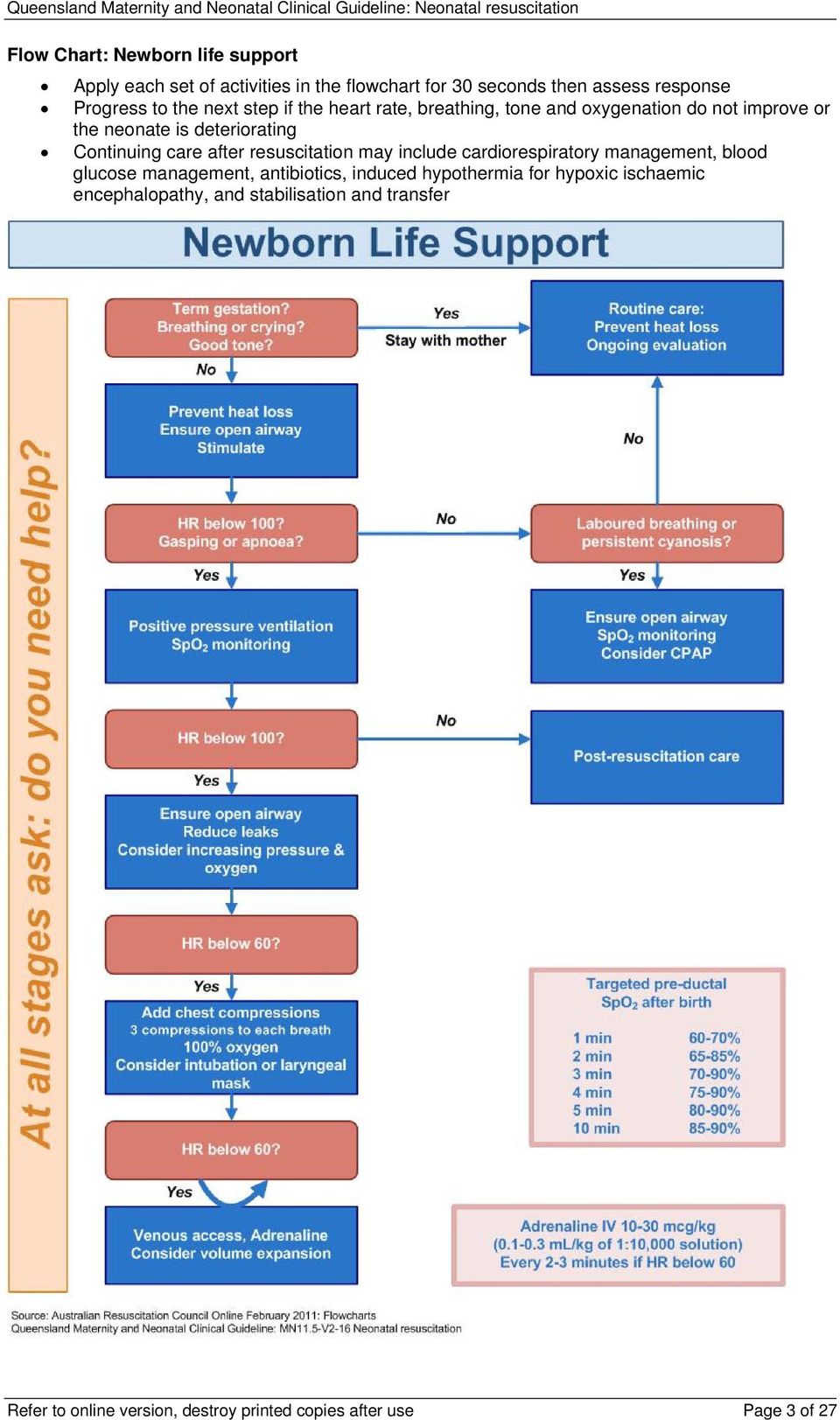
3 Flow Chart: Newborn life support Apply each set of activities in the flowchart for 30 seconds then assess response Progress to the next step if the heart rate, breathing, tone and oxygenation do not improve or the neonate is deteriorating Continuing care after resuscitation may include cardiorespiratory management, blood glucose management, antibiotics, induced hypothermia for hypoxic ischaemic encephalopathy, and stabilisation and transfer Refer to online version, destroy printed copies after use Page 3 of 27
4 Abbreviations bpm BGL CPAP CO 2 CTG ETT F HIE HR H 2 O IM IV LM PEEP PIP PPV QCC SpO2 UVC Beats per minute Blood glucose level Continuous positive airway pressure Carbon dioxide Cardiotocograph Endotracheal tube French gauge Hypoxic-ischaemic encephalopathy Heart rate Water Intramuscular Intravenous Laryngeal mask Positive end expiratory pressure Peak inspiratory pressure Positive pressure ventilation Queensland Emergency Medical Systems Coordination Centre Saturation of peripheral oxygen Umbilical venous catheter Definition of terms Endotracheal Intratracheal Intratracheal Endotracheal Newborn Refers to the infant in the first few minutes to hours following birth 1 Neonate Refers to the infant in the first 28 days of life 1 Infancy Infancy includes the neonatal period and extends through the first 12 months of life 1 Refer to online version, destroy printed copies after use Page 4 of 27

5 Table of Contents 1 Introduction Clinical standards Anticipating the need for resuscitation Communication and information sharing Equipment Equipment checks Assessment of the newborn at birth Resuscitation management Positive pressure ventilation Positive pressure ventilation delivery devices Supplemental oxygen administration Endotracheal intubation Intubation under specific circumstances Chest compressions Drugs and fluids Administration routes Adrenaline Volume expanding fluids Care of the neonate after resuscitation Ethical issues...19 References...20 Appendix A: Sample form - Neonatal resuscitation record...21 Appendix B: Equipment required for neonatal resuscitation...23 Appendix C: Endotracheal tube length and size and Adrenaline dosage by corrected gestation...24 Appendix D: Laryngeal mask...25 Appendix E: Use of a narcotic antagonist...26 Acknowledgements...27 List of Tables Table 1. Clinical standards recommended for facilities providing planned birthing services... 6 Table 2. Risk factors for neonatal resuscitation... 7 Table 3. Communication and information... 8 Table 4. Assessment of the newborn at birth... 9 Table 5. Positive pressure ventilation Table 6. Positive pressure ventilation delivery devices Table 7. Supplemental oxygen Table 8. Target oxygen saturation Table 9. Endotracheal intubation Table 10. Intubation under specific circumstances Table 11. Combined chest compression and positive pressure ventilation Table 12. Administration routes Table 13. Adrenaline administration Table 14. Fluid administration Table 15. Continuing care of the neonate after resuscitation Table 16. Ethical issues Refer to online version, destroy printed copies after use Page 5 of 27

6 1 Introduction Although the need for neonatal resuscitation can often be anticipated, on many occasions it is unexpected 1 : Most newborns are vigorous at birth 1 : o Approximately 10% will require some assistance at birth to begin breathing o Less than 1% will require extensive resuscitation The guideline focus is on the neonatal period and particularly newborns. Paediatric resuscitation techniques may be used in term neonates after the newborn period and specifically in the situation of cardiac aetiology underlying their arrest. 1.1 Clinical standards Clinical standards recommended for maternity facilities providing planned birthing services are outlined in Table 1. Table 1. Clinical standards recommended for facilities providing planned birthing services Aspect Resources 1 Clinical skill requirements 1 Clinician attendance at births 1 Documentation 1 Consideration Required at all times: o A suitable place to resuscitate a newborn o Suitable neonatal resuscitation equipment o Clinicians trained in neonatal resuscitation Organised programs to develop and maintain the standards, skills and teamwork required for newborn resuscitation: o Training requires regular reinforcement in clinical practice and/or refresher courses which should be undertaken at least annually Debriefing services for clinicians: o Regardless of seniority, resuscitations can be stressful o Reflection on practice provides a valuable learning opportunity Clinicians trained in: o Basic neonatal resuscitation: Airway support, ventilation via face mask and chest compressions o Advanced neonatal resuscitation: All the skills of basic neonatal resuscitation Endotracheal intubation Vascular cannulation The use of drugs and fluids Clinicians responsible for neonatal resuscitation should be familiar with available neonatal resuscitation equipment Low risk births: o A clinician trained in basic neonatal resuscitation should be in attendance and responsible only for the care of the newborn o The Australian Resuscitation Council recommends a clinician trained in advanced neonatal resuscitation should also be available High risk births: o A clinician trained in advanced neonatal resuscitation should be in attendance and responsible only for the care of the newborn o More than one experienced person should be present to care for the newborn The Queensland Clinical Services Capability Framework describes the first principle as applying to all services and the second principle as applying to Level 3 services and above. 2 Advanced neonatal resuscitation may not be possible in all Level 1 and 2 services Comprehensive and contemporaneous When possible, one person should be appointed to document, the time, interventions and newborn s response during resuscitation Use of a standardised neonatal resuscitation record is recommended [refer to Appendix A: Sample form - Neonatal resuscitation record] Refer to online version, destroy printed copies after use Page 6 of 27

7 2 Anticipating the need for resuscitation A variety of maternal, fetal and intrapartum circumstances can increase the risk of the newborn needing resuscitation at birth 1 [refer to Table 2] Table 2. Risk factors for neonatal resuscitation Risk factors Maternal 1 Fetal 1 Intrapartum 1 Prolonged rupture of membranes (greater than 18 hours) Bleeding in second or third trimester Pregnancy induced hypertension Chronic hypertension Substance abuse Drug therapy (e.g. lithium, magnesium, adrenergic blocking agents, narcotics) Diabetes mellitus Chronic illness (e.g. anaemia, cyanotic congenital heart disease) Maternal pyrexia Maternal infection Chorioamnionitis Heavy sedation Previous fetal or neonatal death No prenatal care Multiple gestation (e.g. twins, triplets) Preterm gestation (especially less than 35 weeks) Post term gestation (greater than 41 weeks) Large for dates Fetal growth restriction Alloimmune haemolytic disease (e.g. anti-d, anti-kell, especially if fetal anaemia or hydrops fetalis present) Polyhydramnios and oligohydramnios Reduced fetal movement before onset of labour Congenital abnormalities which may effect breathing, cardiovascular function or other aspects of perinatal transition Intrauterine infection Hydrops fetalis Non reassuring fetal heart rate patterns on cardiotocograph (CTG) Abnormal presentation Prolapsed cord Prolonged labour (or prolonged second stage of labour) Precipitate labour Antepartum haemorrhage (e.g. abruption, placenta praevia, vasa praevia) Meconium in the amniotic fluid Narcotic administration to mother within 4 hours of birth Forceps birth Vacuum-assisted (ventouse) birth Maternal general anaesthesia Refer to online version, destroy printed copies after use Page 7 of 27

8 2.1 Communication and information sharing Preparation for a high risk birth requires effective communication and information sharing and a consistent and coordinated approach between obstetric and neonatal clinicians [refer to Table 3]. Table 3. Communication and information Aspect Obstetric and neonatal clinicians Parent(s) Documentation Consideration Maternal information should include details of 1 : o Pre-existing or pregnancy related medical condition and treatment that may affect the resuscitation or management of the newborn o Antenatal ultrasound diagnoses that may affect immediate postnatal management o Assessments of fetal wellbeing (e.g. fetal heart rate monitoring) Minimum fetal information required by personnel responsible for the baby includes 1 : o Gestational age o Number of expected newborns, if multiple birth o Reason this is a high risk birth o Presence of meconium in the liquor o Assessments of fetal heart rate variability o Any known congenital abnormalities o Maternal risk factors for infections (including results of screening if known, e.g. Group B Streptococcus) o Maternal medication Whenever time permits, the neonatal team should introduce themselves to the parent(s) before the birth and should 1 : o Outline the proposed plan for the newborn s care o Enquire and respond to parent s questions In cases of potentially lethal fetal malformations or extreme prematurity, whenever possible, parents should be included in decisions about the extent of the resuscitation 1 Contemporaneous documentation of discussions and care plans 2.2 Equipment A complete set of resuscitation equipment and drugs should always be readily available in the areas of hospitals where newborns are born or receive neonatal care 1 [refer to Appendix B: Equipment required for neonatal resuscitation] Equipment checks Facilities should maintain a clear record documenting the checking procedure for each set of resuscitation equipment and drugs 1 Each set of resuscitation equipment and drugs should be checked: o Before any resuscitation 1 and o According to local hospital policy. 1 Consider frequency of checking: At least daily, preferably once per shift Following resuscitation To enable clinical staff familiarisation of layout in the emergency situation Refer to online version, destroy printed copies after use Page 8 of 27

9 3 Assessment of the newborn at birth Assessing the need to initiate and continue resuscitation should begin immediately after birth and proceed throughout the resuscitation. 1 Evaluation and intervention (if required) are simultaneous processes, especially when more than one resuscitator is present. 1 For clarity this process is described as a sequence of distinct steps 1 [refer to Flowchart: Newborn life support]. Table 4 outlines important aspects of assessment at birth. 1 Table 4. Assessment of the newborn at birth Aspect Cord clamping Initial assessment Subsequent assessment Temperature Handling and skin protection Pulse oximetry Supplemental oxygen Consideration In the compromised newborn, the optimal timing of cord clamping remains unknown 1 The more severely compromised the newborn the more likely it is that resuscitation measures need to take priority over delayed cord clamping Tone Breathing Heart rate Heart rate: o A prompt increase in heart rate remains the most sensitive indicator of resuscitation efficacy 1 Breathing Tone Oxygenation: o Preferably assessed using pulse oximetry Hypothermia may increase oxygen consumption impeding effective resuscitation 1 Ensure area is warm and draft free 1 For term and near term newborn dry newborn and remove wet linen 1 For very premature newborns: o Increase ambient temperature to 26 0 C 1 o Placing the baby in a polyethylene bag (without drying) or under a polyethylene sheet (food or medical grade, heat resistant) up to the neck, (immediately after birth until temperature is stable) 1 All newborns should be handled gently (premature newborns are especially at risk of damage to skin and internal organs) 1 If emergency vascular access is required, antiseptic solution, particularly alcohol containing, should be applied sparingly 1 : o For umbilical catheterisation: Apply only to the cord and less than 2 cm diameter of surrounding skin Avoid pooling around the newborn s groin and flanks Oximetry is recommended when 1 : o The need for resuscitation is anticipated o Positive pressure ventilation (PPV) is administered for more than a few breaths o Whenever persistent cyanosis is suspected during resuscitation or any time after birth o When supplemental oxygen is administered The sensor should be placed on the newborn s right hand or wrist and then connect the probe to the instrument. 1 o This results in the quickest, accurate monitor display 3 Refer to Table 7 Refer to online version, destroy printed copies after use Page 9 of 27
![1 For clarity this process is described as a sequence of distinct steps 1 [refer to Flowchart: Newborn life support]. Table 4 outlines important aspects of assessment at birth. 1 Table 4.](/docs-images/40/1272042/images/page_9.jpg "Assessment of the newborn at birth Aspect Cord clamping Initial assessment Subsequent assessment Temperature Handling and skin protection Pulse oximetry Supplemental oxygen Consideration In the")
10 4 Resuscitation management Effective ventilation is the key to successful neonatal resuscitation 1 Drying and stimulation are both assessment and resuscitative interventions. 1 If the newborn fails to establish spontaneous effective respirations and heart rate does not increase to more than 100 beats per minute (bpm) then commence PPV 1 Effective teamwork is essential to the success of neonatal resuscitation, particularly advanced resuscitation Newborn resuscitation training should include the necessary individual and teamwork skills which are reinforced through regular practice Positive pressure ventilation PPV may be delivered via a face mask, endotracheal tube (ETT) or laryngeal mask 1 (LM) [refer to Table 5 for important aspects of PPV 1 ; Table 6 refers to devices for PPV 1 ] Table 5. Positive pressure ventilation Aspect Indications Technique Rate Pressures Mouth to mouth and nose Assessment of effectiveness PEEP during resuscitation Continuous positive airway pressure (CPAP) 1 Consideration After stimulation commence PPV if: o Newborn s heart rate is less than 100 bpm and o The newborn remains apnoeic or o Breathing is inadequate gasping is not adequate breathing Ensuring the jaw is supported, keep the neck slightly extended in the sniffing position Two people may provide mask ventilation more effectively than one: o One person supports the jaw holding the mask in place with two hands o The other person provides positive pressure breaths breaths per minute For most newborns, ventilation can be accomplished with progressively lower pressures and rates as resuscitation proceeds Should be used when neonatal inflation devices are not available Maternal blood and other body fluids should be wiped from the newborn s face to reduce the risk of infection to the resuscitator Ventilation effectiveness is confirmed by observing: o Heart rate increasing to greater than 100 bpm o Slight rise of chest and upper abdomen with each inflation o Improving oxygenation (preferably assessed using pulse oximetry) Reassess technique if the: o Chest and abdomen do not rise with each inflation o Heart rate does not rise above 100 bpm o Oxygenation does not improve Consider tracheal intubation or use of laryngeal mask if face mask ventilation remains ineffective despite corrective intervention If suitable equipment is available, positive end expiratory pressure (PEEP) (at least 5 cm H 2 O) should be used during resuscitation to: o Assist lung expansion o Help establish a functional residual capacity o Improve oxygenation A trial of CPAP is reasonable for: o Spontaneously breathing newborns who have laboured breathing / respiratory distress o Newborns who are breathing but whose saturations are not meeting targets Refer to online version, destroy printed copies after use Page 10 of 27

11 4.2 Positive pressure ventilation delivery devices Table 6. Positive pressure ventilation delivery devices Aspect Acceptable delivery devices 1 T-piece device* Consideration T-piece device is preferred. Recommended initial pressures: o Peak inspiratory pressure (PIP): Term newborn 30 cm H 2 O (water) Preterm newborn cm H 2 O o PEEP: 5 8 cm H 2 O o Maximum pressure relief valve: 50 cm H 2 O* Self inflating bag o Pressure release valve factory set at approximately 40 cm H 2 O Flow inflating (or anaesthetic) bag Face masks should be: o The appropriate size o Cushioned o Self-inflating bags cannot effectively deliver CPAP, PEEP or sustained inflation breaths Although a maximum pressure relief valve set at 50 cm H 2 O is recommended by the Australian Resuscitation Council 1, a lower maximum pressure relief limit for e.g. 35 cm H 2 O will be adequate for the majority of babies receiving resuscitation. Within each hospital, neonatal T-piece devices should be set up using standard flow and pressure settings that are appropriate for newborns and well known to all clinicians All clinicians should be trained to safely adjust pressure settings during resuscitation if necessary. Rarely babies will need high peak inspiratory pressures of greater than or equal to 50 cm H 2 O at the commencement of ventilation Refer to online version, destroy printed copies after use Page 11 of 27

12 4.3 Supplemental oxygen administration Supplemental oxygen administration should be provided only when oxygen saturation has failed to improve with effective ventilation of the lungs. Points for consideration are provided in Table 7. Table 7. Supplemental oxygen Aspect Consideration Regardless of gestation, the goal of oxygen administration is an oxygen saturation resembling that of a healthy term newborn 1 : o Assess the newborn s response to supplemental oxygen o Reduce or cease supplemental oxygen if saturations are above 90% at any time in the first 10 minutes, although it is acceptable and normal for some newborn saturations to rise above 90% in room air o Table 8 below includes target saturations for newborns during resuscitation: Table 8. Target oxygen saturation Time from birth Target oxygen saturations 1 minute 60 70% 2 minutes 65 85% Supplemental oxygen administration 3 minutes 70 90% 4 minutes 75 90% 5 minutes 80 90% 10 minutes 85 90% The priority is to ensure adequate lung inflation - only increase inspired oxygen concentration if PPV or CPAP have failed to achieve the target peripheral oxygen saturation (SpO 2 ) 1 Term and near term newborns 1 : o Use air initially and only administer oxygen to newborns whose saturations do not meet the lower target range despite respiratory support o Reduce oxygen concentration if saturations reach 90% while supplemental oxygen is used Preterm newborns (less than 32 weeks) 1 : o Initially use room air or blended air and oxygen (at 30-50%) o Guided by pulse oximetry, adjust oxygen concentration according to response o If blended air and oxygen are unavailable, initiate resuscitation with air Refer to online version, destroy printed copies after use Page 12 of 27

13 4.4 Endotracheal intubation A decision to perform endotracheal intubation will depend on the newborn s gestation, degree of respiratory depression, response to face mask ventilation, and the skill and experience of the resuscitator. 1 [refer to Table 9] Table 9. Endotracheal intubation Aspect Clinical standard 1 Indications 1 ETT size and insertion length 1 Position verification 1 Signs that ETT is not in the trachea Consideration Neonatal endotracheal intubation should only be attempted by clinicians with appropriate training and experience in the procedure If there is no-one skilled at intubation present, continue PPV via a face mask or LM [refer to Table 10] Tracheal suctioning in a non vigorous newborn exposed to meconium stained liquor 4 Unsuccessful ventilation via a face mask (e.g. heart rate remains low, oxygen saturation falling or failing to rise or prolonged) Special circumstances (e.g. diaphragmatic hernia, extremely low birth weight) Newborns born without a detectable heart rate Administration of endotracheal medications (e.g. Adrenaline or artificial surfactant) Expected need for continued or prolonged ventilation ETT size and insertion length are based on the newborn s weight and corrected gestation [refer to Appendix C] ETT insertion depth must always be checked by comparing the markings on the tube with the formula or table [refer to Appendix C] Primarily correct ETT position is confirmed by effective ventilation demonstrated by: o Chest movement with each inflation o Heart rate increasing above 100 bpm o Improving oxygenation (oximetry is more accurate than visual assessment) Other signs to verify correct ETT placement include: o Visual inspection of the ETT passing through the larynx o Misting in the ETT during expiration (usually visible for only the first few exhaled breaths) o Colour change visible with an end-tidal carbon dioxide (CO 2 ) detector (the most reliable method in newborns who have spontaneous circulation): False negatives may occur in newborns if there is very low or absent pulmonary blood flow False positives may occur in devices contaminated by adrenaline or surfactant o Hearing symmetrical breath sounds using a stethoscope placed on the upper chest. May be asymmetrical, despite optimal tube position, in some circumstances (e.g. pneumothorax, diaphragmatic hernia) A chest X-ray should be obtained to confirm ETT position once the newborn is stabilised 4 No chest movement with inflations 1 A heart rate less than 100 bpm that does not increase soon after intubation and inflation has started 1 1 No detection of expired CO 2 No improvement in oxygenation 1 or sudden deterioration in oxygenation The absence of breath sounds in the axillae 1 Refer to online version, destroy printed copies after use Page 13 of 27

14 4.4.1 Intubation under specific circumstances Tracheal intubation may be required under specific circumstances [refer to Table 10] Table 10. Intubation under specific circumstances Circumstance Meconium stained liquor Very premature newborns (less than 29 weeks) Unsuccessful facemask and/or tracheal intubation Consideration Need for endotracheal suctioning is based on the newborn s level of activity at birth 4 Only perform intubation to suction meconium from the trachea 1 : o In newborns with decreased muscle tone o Immediately after birth o Before the onset of breathing or crying (stimulation should be withheld until suction is completed) o If an experienced clinician and all the needed equipment are immediately available o Once and then any subsequent resuscitation that is needed should be commenced quickly Use a meconium aspirator device attached to the ETT adapter after intubation Negative pressure used should not exceed 100 mmhg Many very premature newborns can be treated with CPAP without intubation and ventilation 1 Early administration of artificial surfactant can improve response in premature newborns who require endotracheal intubation 1 A LM should be considered during resuscitation of the term and near term newborn if 1 : o Face mask ventilation is unsuccessful (newborns greater than 2000 g or greater than or equal to 34 weeks gestation) o Tracheal intubation is unsuccessful or not feasible A size 1 LM is suitable up to 5 kgs 1 Following LM insertion, correct position is confirmed by effective ventilation as demonstrated by 1 : o Chest movement with each inflation o Heart rate increasing above 100 bpm o Improving oxygenation (oximetry is more accurate than visual assessment) Other signs to verify correct LM placement include: o Colour change visible with an end-tidal CO 2 detector (the most reliable method in newborns who have spontaneous circulation): False negatives may occur in newborns if there is very low or absent pulmonary blood flow o Hearing symmetrical breath sounds using a stethoscope placed on the upper chest. May be asymmetrical, despite optimal tube position, in some circumstances (e.g. pneumothorax, diaphragmatic hernia) There has not been an evaluation of the LM for administration of emergency intra-tracheal medications 1 Refer to Appendix D for practical instructions in use of a LM Refer to online version, destroy printed copies after use Page 14 of 27

15 4.5 Chest compressions When adequate airway and breathing support are provided, cardiac compressions are rarely indicated for resuscitation of neonates. In neonates, cardiac output is heart rate dependent. If the heart rate is too slow, circulation will be inadequate to support tissue oxygenation. 1 [refer to Table 11] Table 11. Combined chest compression and positive pressure ventilation Aspect Consideration Indication Heart rate remains less than 60 bpm despite 30 seconds of effective PPV 4 Supplemental Administer 100% oxygen oxygen Perform a chest compression each half second. In a half second pause after each 3 rd compression, deliver a breath. This results in a 3:1 ratio with a total of 90 compressions and 30 breaths in each minute 1 Coordinate compressions and inflations to avoid simultaneous delivery of a compression and a breath Methods: o 2 thumb technique: Strongly recommended when two clinicians are available. (Usually Technique the resuscitator performing chest compressions faces the newborn s head. The position can be reversed if access to the abdomen is required) or o 2 finger technique acceptable as an interim measure or where access is required to the lower chest and abdomen Ensure full chest expansion between compressions. However, the administrator s hands should not leave the chest Effectively delivered chest compressions will be evident on a pulse oximeter Continue uninterrupted compressions for at least 30 seconds between each pause to assess improvement in spontaneous heart rate and cardiac Duration output Continue chest compressions with as little interruption as possible until it is obvious that the heart rate is greater than 60 bpm Improvement is evidenced by: o Audible heart rate on auscultation o Spontaneous pulsations on oximetry Assessment Note: Chest compressions will also cause pulsations on the pulse oximeter o Rise in oxygen saturation o Spontaneous movement or breaths Refer to online version, destroy printed copies after use Page 15 of 27

16 4.6 Drugs and fluids Drugs and fluids are rarely indicated for resuscitation of newborns 1 : Bradycardia is usually caused by hypoxia and inadequate ventilation and apnoea by insufficient oxygenation of the brainstem. Establishing adequate ventilation is the most important step to improve heart rate, however if heart rate remains less than 60 bpm despite adequate ventilation, Adrenaline may be needed 1 Administration of drugs should not detract from the efficiency and continuity of ventilation and chest compressions For administration of Adrenaline and volume expanding fluids, refer to Table 13 and Table 14 below Refer to Appendix E for the rarely indicated use of a narcotic antagonist Administration routes Preferred vascular access is via the umbilical vein. 1,4 Alternative access is via an endotracheal tube, peripheral vein, or intraosseous lines. [refer to Table 12] Table 12. Administration routes Route Considerations 1 Umbilical vein Endotracheal tube Peripheral vein Intraosseous lines The umbilical vein is the most rapidly accessible intravascular route for Adrenaline and an umbilical venous catheter (UVC) can also be used for fluid administration A 3-way tap should be attached to the UVC and both primed with normal saline before use A UVC can provide continued vascular access until an alternative route is established Blood gases from the UVC may be useful in guiding treatment Give only Adrenaline via the ETT: o ETT administration of Adrenaline is acceptable when the heart rate is less than 60 bpm despite adequate ventilation and chest compressions and when there is no intravenous (IV) access 1 o Administration of ETT Adrenaline should not delay attempts to obtain vascular access for administration of IV Adrenaline Access can be difficult Access may take too long Not commonly used in newborns Can be used if umbilical or venous access is not available Consider if the resuscitator has greater experience with inserting intraosseous lines Refer to online version, destroy printed copies after use Page 16 of 27

17 4.6.2 Adrenaline Table 13. Adrenaline administration Adrenaline 1:10,000 Indication Route IV dose and administration ETT dose and administration Frequency Dilution Volume expanding fluids Table 14. Fluid administration If the heart has failed to increase to greater than 60 bpm within one minute of adequate ventilation and chest compressions Intravascular is the preferred route: o Give as close to the heart as possible: UVC is preferable to peripheral IV or intraosseous 1 ETT: o Do not allow ETT dose to delay attempts at vascular access mg/kg (equates to ml/kg) 1 o Refer to Appendix C for suitable rounded doses Give as a rapid bolus followed by 0.9% Sodium Chloride flush 1 Practice tip: o If resuscitating a term baby, draw up 1 ml of Adrenaline and administer it all mg/kg (equates to ml/kg) 1 Follow with PPV Flush not recommended 1 Ensure the Adrenaline dose is ventilated into the lungs and is not left in the ETT or the adaptor Repeat every few minutes, if the heart rate remains less than 60 bpm despite effective ventilation and cardiac compressions 1 If ETT dose administered, with inadequate effect, give IV dose as soon as vascular access is obtained Not required 0.9% Sodium chloride or O Rhesus negative blood 1 Indication Caution Route Method of administration Initially 0.9% Sodium Chloride for: o Suspected or proven blood loss o Neonate who appears to be in shock (e.g. pale, poor perfusion and weak pulse) and has not responded adequately to other resuscitative measures Subsequently blood suitable for emergency transfusion: o In the setting of massive blood loss o In babies not responding to resuscitation Routine fluid boluses during or after resuscitation may do more harm than good Intravascular e.g. IV, UVC, intraosseous Refer to Table 12 Infusion over several minutes Dose Frequency Dilution 10 ml/kg May be repeated after observation of response if only minimal improvement Not required Refer to online version, destroy printed copies after use Page 17 of 27

18 5 Care of the neonate after resuscitation The neonate who has required resuscitation remains at risk and requires ongoing assessment. 1 [refer to Table 15 1 and Guideline: Neonatal stabilisation 5 Table 15. Continuing care of the neonate after resuscitation Care Location Monitoring Blood glucose management Antibiotics Induced hypothermia for hypoxic-ischaemic encephalopathy Inter-hospital transfer Continuing care of the family Comments Assess the need for admission to an intensive or special care nursery Monitoring required may include: o Oxygen saturation o Heart rate o Respiratory rate and pattern o Blood glucose measurement o Blood gas analysis o Fluid balance and nutrition o Blood pressure o Temperature o Neurological Neonates who require resuscitation are susceptible to hypoglycaemia Check the blood glucose level (BGL) as soon as possible after resuscitation Maintain the BGL greater than 2.5 mmol/l Avoid large bolus doses of glucose (greater than mg/kg) o 1 ml 10% Glucose contains 100 mg Glucose Refer to Guideline: Neonatal hypoglycaemia and blood glucose level monitoring 6 The need for resuscitation can be a consequence of sepsis. Soon after resuscitation consider: o Relevant investigations o The need for antibiotics Discuss any neonate with hypoxic-ischaemic encephalopathy (HIE) who is considered for induced hypothermia early with a Neonatologist Plans should be made for transfer (if required) and admission to a neonatal intensive care unit Refer to Guideline: Hypoxic-ischaemic encephalopathy 6 If the birth facility is unable to provide an appropriate level of post resuscitation monitoring and support, transfer the neonate to an appropriate higher level facility To discuss the decision to transfer and to arrange transfer of the neonate to a higher level facility, contact Queensland Emergency Medical Systems Coordination Centre (QCC) by phoning Parent(s) find witnessing the resuscitation of their baby distressing regardless of outcome. Whenever possible: o Prepare parents for resuscitation if it is anticipated o Keep parent(s) informed during and after resuscitation. Ideally information should be provided by a senior clinician o Facilitate early parental contact with their baby Refer to online version, destroy printed copies after use Page 18 of 27

19 6 Ethical issues The birth of extremely premature neonates and those with severe congenital anomalies raise questions with parent(s) and among clinicians about initiation of resuscitation. 1 [refer to Table 16 1 ]. Table 16. Ethical issues Issue Initiating resuscitation Discontinuing resuscitation Consideration Where unexpected anomalies are present offer full resuscitation, ongoing care can be discussed with parent(s) after assessment of the neonate's condition. 4 Examples of exceptions include neonates with 4 : o Anencephaly o Extreme prematurity for whom there is very little possibility of intact survival Consider discontinuing resuscitation if the heart rate is undetectable and remains so for 10 minutes in a newly born baby 1 The decision to continue resuscitation beyond 10 minutes when there is no or very low heart rate may be influenced by 1 : o Presumed diagnosis o Gestation of neonate o Presence or absence of complications o Parent(s) previously expressed views regarding acceptable risk of morbidity When withdrawing or withholding resuscitation, care should be focused on the neonate s comfort and dignity 1 Autopsy may be appropriate after failed resuscitation.[refer to Guideline: Stillbirth care 7 ] Refer to online version, destroy printed copies after use Page 19 of 27
![1 ]. Table 16.](/docs-images/40/1272042/images/page_19.jpg "Ethical issues Issue Initiating resuscitation Discontinuing resuscitation Consideration Where unexpected anomalies are present offer full resuscitation, ongoing care can be discussed with parent(s)")
20 References 1. Australian Resuscitation Council. Section 13 - Neonatal Guidelines Dec [cited 2011 March 15]. Available from: 2. Queensland Health. Clinical Services Capability Framework for Public and Licensed Private Health Facilities v3.0. Brisbane: Queensland Government Department of Health O Donnell CPF, Kamlin COF, Davis PG, Morley CJ. Obtaining pulse oximetry data in neonates: a randomised crossover study of sensor application techniques. Archives of disease in childhood. Fetal and neonatal edition. 2005; 90:F Kattwinkel J, Perlman JM, Aziz K, Colby C, Fairchild K, Gallagher J, et al. Part 15: neonatal resuscitation: 2010 American Heart Association Guidelines for Cardiopulmonary Resuscitation and Emergency Cardiovascular Care. Circulation. 2010; 122(suppl3):S Queensland Maternity and Neonatal Clinical Guidelines Program. Neonatal stabilisation. Guideline No. MN11.12-V1-R16. Queensland Health Queensland Maternity and Neonatal Clinical Guidelines Program. Neonatal hypoglycaemia and blood glucose level monitoring. Guideline No. MN10.8-V2-R12. Queensland Health Queensland Maternity and Neonatal Clinical Guidelines Program. Stillbirth care. Guideline No. MN11.24-V3-R16. Queensland Health Refer to online version, destroy printed copies after use Page 20 of 27

21 Appendix A: Sample form - Neonatal resuscitation record Refer to online version, destroy printed copies after use Page 21 of 27
22 Refer to online version, destroy printed copies after use Page 22 of 27
23 Appendix B: Equipment required for neonatal resuscitation Equipment Standard kits 1 General 1 Airway management 1 Breathing support 1 Circulation support 1 Drugs and fluid 1 Documentation 1 Comment Prior preparation of standardised kits containing equipment for procedures (e.g. umbilical catheterisation) can save considerable time in emergencies Firm padded resuscitation surface Overhead warmer Light for the area Clock with timer in seconds Warm towel or similar covering Polyethylene bag or sheet, big enough for neonates less than 1500 g birth weight Stethoscope (neonatal preferred) Pulse oximeter plus neonatal probe Suction apparatus and suction catheters (sizes 6F, 8F, and either 10F or 12F) Oropharyngeal airways (sizes 00 and 0) Intubation equipment: o Laryngoscopes with neonatal blades (sizes 00, 0, 1 ) o Spare batteries and bulbs o Compatible laryngoscope handles and blades o Endotracheal tubes (ETT) (uncuffed, no eye, sizes 2.5, 3.0, 3.5 and 4.0 mm internal diameter) o ETT introducer/stylet o Supplies for fixing ETT (e.g. sterile scissors, tape) End-tidal carbon dioxide (CO 2 ) detector (to confirm intubation) Meconium suction device (to apply suction directly to ETT) Magill forceps (neonatal size - optional) Laryngeal mask (size 1, suitable for neonates up to 5 kg) Face masks (range of sizes suitable for premature and term neonates not Rendell Baker type) Positive pressure ventilation device either: o T-Piece resuscitation device (preferred), or o Flow-inflating bag with pressure safety valve and manometer, and o Self-inflating bag (240 ml) with a pressure release valve and a removable oxygen reservoir Medical gases: o Source of medical oxygen (reticulated and/or cylinder allowing flow rate of up to 10 L/min) with flow meter and tubing o Source of medical air plus air/oxygen blender Feeding tubes for gastric decompression (sizes 6F, 8F) Umbilical venous catheter (UVC) kit (including UVC sizes 3.5F and 5F) Peripheral IV cannulation kit Skin preparation solution suitable for neonate skin Tapes/devices to secure UVC/IV cannula Syringes and needles (assorted sizes) Intraosseous needles (50 mm length) Adrenaline 1: concentration (0.1 mg/ml) Volume expander: o Normal saline (0.9% Sodium Chloride) o Blood suitable for emergency neonatal transfusion should be readily available Resuscitation record sheet Equipment check list Refer to online version, destroy printed copies after use Page 23 of 27
24 Appendix C: Endotracheal tube length and size and Adrenaline dosage by corrected gestation The following ETT references are sourced from the Australian Resuscitation Council, Section 13 - Neonatal Guidelines, 2010 [accessed 2011 March 15, Endotracheal tube (ETT): Corrected gestation gestation at birth plus postnatal age ETT internal diameter in millimetres can be calculated as (gestational age in weeks divided by 10): o 2.5 mm ETT for neonates less than 1 kg o 3.0 mm ETT for neonates 1 2 kg o 3.5 mm ETT for neonates 2 3 kg o mm ETT for neonates greater than 3 kg Approximate ETT insertion depth from middle of upper lip can be calculated as (weight in kg + 6 cm) Corrected gestation (weeks) Actual weight (kg) ETT mark at upper lip (cm) ETT size - internal diameter (mm) ETT suction catheter size (F) or or or or or or 10 Adrenaline: Corrected gestation (weeks) IV Adrenaline 1:10,000 (mls) Rounded IV Adrenaline doses are provided as a guide only The Australian Resuscitation Council, Section 13 - Neonatal Guidelines, 2010 [accessed 2011 September 5, recommends IV Adrenaline mg/kg (equates to ml/kg) Adrenaline can be repeated every 2-3 minutes if HR is less than 60 beats per minute If given via the less preferred ETT route, Adrenaline dosages should be three times higher Refer to online version, destroy printed copies after use Page 24 of 27
25 Appendix D: Laryngeal mask Figure 1. Laryngeal mask Source: Australian Resuscitation Council, Guideline 13.5, Tracheal intubation and ventilation of the newborn infant, 2010 Republished with permission of the Australian Resuscitation Council The following laryngeal mask (LM) instructions are quoted (with the exception of the replacement of abbreviation LMA with LM) from the Australian Resuscitation Council, Guideline 13.5 Tracheal intubation and ventilation of the newborn infant [accessed 2011 August 30, 1. Test inflation of the cuff (using a syringe and 4 ml of air), and then slowly and fully deflate the LM cuff before insertion. 2. Lubricate the back and sides of the LM with water-soluble lubricant or baby s saliva, avoiding excess lubricant round the anterior surface of the cuff or in the bowl of the mask 3. Holding the LM like a pen, insert it with the open side of the cushioned mask facing forwards (towards the tongue, away from the palate). The index finger, placed inside the bowl of the mask, is used to prevent the tip from curling and to guide the mask, sliding the back of it against the hard palate and into the pharynx until resistance is felt. 4. The tube is then held firmly and with slight downward pressure with the other hand while the index finger is removed. 5. The cuff is then inflated with 4 ml of air. The tube may rise up slightly out of the hypopharynx as the mask is inflated. 6. A resuscitation device (bag or T-piece device) is then connected to the adaptor. Effectiveness of ventilation should be checked using signs indicated above for endotracheal ventilation (chest wall movement, improvement in heart rate, improvement in oxygenation). In addition, the chest should be auscultated. For newborns receiving ventilation via an [sic] LM, the accuracy of colorimetric CO 2 detectors to confirm position and seal has not been reported. Refer to online version, destroy printed copies after use Page 25 of 27
26 Appendix E: Use of a narcotic antagonist The following quotes are from the Neonatal Resuscitation Textbook 6th Edition 2011, American Heart Association/American Academy of Pediatrics, Lesson 7, page Narcotics given to the laboring mother to relieve pain may inhibit respiratory drive and activity in the newborn. In such cases, administration of naloxone (a narcotic antagonist) to the newborn will reverse the effects of narcotics on the baby. Giving a narcotic antagonist is not the correct first therapy for a baby who is not breathing. The first corrective action is positive-pressure ventilation. The indications for giving naloxone to the baby require both of the following to be present: Continued respiratory depression after positive pressure ventilation has restored a normal heart rate and A history of maternal narcotic administration during labour After naloxone administration, continue to administer positive pressure ventilation until the baby is breathing normally. The duration of action of the narcotic often exceeds naloxone. Therefore, observe the baby closely for recurrent respiratory depression, which may necessitate ongoing respiratory support. Caution: Do not give naloxone to the newborn of a mother who is suspected of being addicted to narcotics or is on methadone maintenance. This may result in the newborn having seizures. Other drugs given to the mother, such as magnesium sulphate or non-narcotic analgesics or general anesthetics, also can depress respirations in the newborn; the effects of these drugs are not reversed by naloxone. If narcotics were not given to the mother or if naloxone does not result in restoring spontaneous respirations, transport the baby to the nursery for further evaluation and management while continuing to administer PPV and monitoring heart rate and pulse oximetry. Naloxone hydrochloride 0.4 mg/ml Indication Route Method of administration Dose Frequency Persistent respiratory depression (after positive pressure ventilation has been provided) in a newborn whose mother has received an opiate analgesic in the 4 hours before birth IV (including UVC) preferred Intramuscular (IM) acceptable but delayed onset of action IV bolus followed by 0.9% Sodium Chloride flush 0.1 mg/kg = 0.25 ml/kg of 0.4 mg/ml stock solution Duration of action of the narcotic can exceed that of naloxone, necessitating repeated doses of naloxone Recurrent respiratory depression may necessitate repeated doses of naloxone, or consideration of alternative diagnoses Refer to online version, destroy printed copies after use Page 26 of 27
27 Acknowledgements The Queensland Maternity and Neonatal Clinical Guidelines Program gratefully acknowledge the contribution of Queensland clinicians and other stakeholders who participated throughout the guideline development process particularly: Working Party Clinical Lead Dr Helen Liley, Neonatologist, Mater Health Services, Brisbane Working Party Members Mr Glen Alexander, Nurse Unit Manager, Logan Hospital Dr Pita Birch, Neonatologist, Gold Coast Hospital Dr David Cartwright, Neonatologist, Royal Brisbane and Women s Hospital Ms Liz Chappell, Neonatal Nurse, Gold Coast Hospital Dr Mark Davies, Neonatologist, Royal Brisbane and Women s Hospital Dr Timothy Hong, Neonatologist, Gold Coast Hospital Dr Luke Jardine, Neonatologist, Mater Health Services Associate Professor Rebecca Kimble, Obstetrician, Royal Brisbane and Women s Hospital Ms Claudia Konig, Pharmacist, Royal Brisbane and Women s Hospital Ms Sam Lannan, Midwife, Nambour General Hospital Mr Bruce Maybloom, Medical student, Bond University, Gold Coast Ms Maryanne Payne, Neonatal Nurse, The Townsville Hospital Dr Peter Schmidt, Neonatologist, Gold Coast Hospital Ms Mary Tredinnick, Pharmacist, Royal Brisbane and Women s Hospital Program Team Associate Professor Rebecca Kimble, Director, Queensland Maternity and Neonatal Clinical Guidelines Program Ms Jacinta Lee, Program Manager, Queensland Maternity and Neonatal Clinical Guidelines Program Ms Catherine van den Berg, Clinical Program Officer Queensland Maternity and Neonatal Clinical Guidelines Program Ms Jackie Doolan, Clinical Program Officer, Queensland Maternity and Neonatal Clinical Guidelines Program Ms Lyndel Gray, Clinical Program Officer, Queensland Maternity and Neonatal Clinical Guidelines Program Steering Committee, Queensland Maternity and Neonatal Clinical Guidelines Program Funding This clinical guideline was funded by Queensland Health, Centre for Healthcare Improvement. Refer to online version, destroy printed copies after use Page 27 of 27
Addendum to the NRP Provider Textbook 6 th Edition Recommendations for specific modifications in the Canadian context
 Addendum to the NRP Provider Textbook 6 th Edition Recommendations for specific modifications in the Canadian context A subcommittee of the Canadian Neonatal Resuscitation Program (NRP) Steering Committee
NRP 2012 Putting New Resuscitation Guidelines into Practice
 Outreach Education Online Video Library for Healthcare Professionals NRP 2012 Putting New Resuscitation Guidelines into Practice. Jeanette Zaichkin, RN, MN, NNP-BC December 2, 2010 Program Handouts This
AHA/AAP Neonatal Resuscitation Guidelines 2010: Summary of Major Changes and Comment on its Utility in Resource-Limited Settings
 AHA/AAP Neonatal Resuscitation Guidelines 2010: Summary of Major Changes and Comment on its Utility in Resource-Limited Settings Resuscitation step Recommendations (2005) Recommendations (2010) Comments/LOE
(C) AMBULANCE VICTORIA
 The Newborn Baby: Definitions and Contacts Newborn definition 'Newborn' refers to the first min to hours post birth. For the purpose of resuscitation, AV accepts up to the first 24 hours from birth in
11 Newborn Life Support
 11 Newborn Life Support Introduction Passage through the birth canal is a hypoxic experience for the fetus, since significant respiratory exchange at the placenta is prevented for the 50-75 s duration
NRP Study Guide. This packet is intended for review only. Requirements to successfully complete NRP:
 This packet is intended for review only Requirements to successfully complete NRP: Completed NRP Pretest is required for admission to the course. Score 84% on the multiplechoice posttest. You may be allowed
NEONATAL RESUSCITATION PROVIDER (NRP) RECERTIFICATION TABLE OF CONTENTS
 NEONATAL RESUSCITATION PROVIDER (NRP) RECERTIFICATION TABLE OF CONTENTS NEONATAL FLOW ALGORITHM.2 INTRODUCTION 3 ANTICIPATION OF RESUSCITATION 4 TEMPERATURE CONTROL.4 CLEARING THE AIRWAY OF MECONIUM 5
Obstetrical Emergencies
 Date: July 18, 2014 Page 1 of 5 Obstetrical Emergencies Purpose: To provide the process for the assessment and management of the patient with an obstetrical related emergency. Pre-Medical Control 1. Follow
 GUIDELINES FOR HOSPITALS WITH NEONATAL INTENSIVE CARE SERVICE : REGULATION 4 OF THE PRIVATE HOSPITALS AND MEDICAL CLINICS REGULATIONS [CAP 248, Rg 1] I Introduction 1. These Guidelines serve as a guide
Neonatal Emergencies. Care of the Neonate. Care of the Neonate. Care of the Neonate. Student Objectives. Student Objectives continued.
 Student Objectives Neonatal Emergencies After completing this section the student will be able to: 1. Identify three physiologic and/or anatomic features unique to the newborn 2. List three perinatal factors
AHE: NRP AAP/AHA COURSE COMPONENTS
 ADVANCED HEALTHCARE EDUCATION 2011 6 TH EDITION - KEY POINT STUDY GUIDE IMPORTANT INFORMATION FOR STUDENTS REGISTERING FOR CLASSES AFTER 01/011/2012. AAP HAS RESTRUCTURED NRP TO NOW REQUIRE COMPLETION
Why is prematurity a concern?
 Prematurity What is prematurity? A baby born before 37 weeks of pregnancy is considered premature. Approximately 12% of all babies are born prematurely. Terms that refer to premature babies are preterm
A8b. Resuscitation of a Term Infant with Meconium Staining. Session Summary. Session Objectives. References
 A8b Resuscitation of a Term Infant with Meconium Staining Karen Wright, PhD, NNP-BC Assistant Professor and Coordinator, Neonatal Nurse Practitioner Program Dept. of Women, Children, and Family Nursing,
Update on Neonatal Resuscitation
 Update on Neonatal Resuscitation Ola Didrik Saugstad MD, PhD, FRCPE Professor of Pediatrics Director Department of Pediatric Research Rikshospitalet, Faculty of Medicine University of Oslo NORWAY 1st.
How To Treat A Heart Attack
 13 Resuscitation and preparation for anaesthesia and surgery Key Points 13.1 MANAGEMENT OF EMERGENCIES AND CARDIOPULMONARY RESUSCITATION ESSENTIAL HEALTH TECHNOLOGIES The emergency measures that are familiar
Neonatal Resuscitation Program 2011: Changes and Controversies
 Neonatal Resuscitation Program 2011: Changes and Controversies Myra H. Wyckoff, MD Associate Professor of Pediatrics UT Southwestern Medical Center at Dallas Disclosures I am not on any speakers bureaus
Neonatal Intubation. Purpose. Scope. Indications. Equipment Cardiorespiratory monitor SaO 2 monitor. Anatomic Considerations.
 Page 1 of 5 Purpose Scope Indications Neonatal Intubation To assure proper placement of endotracheal tubes for maximum ventilation using proper intubation procedures. The policy applies to all Respiratory
Neonatal Reference Guide
 Operated by REACH Air Medical Services Assessment Heart Rate (beats/min.) Age Rate
Target groups: Paramedics, nurses, respiratory therapists, physicians, and others who manage respiratory emergencies.
 Overview Estimated scenario time: 10 15 minutes Estimated debriefing time: 10 minutes Target groups: Paramedics, nurses, respiratory therapists, physicians, and others who manage respiratory emergencies.
NEWBORN LIFE SUPPORT - CLINICAL GUIDELINE 1. Aim/Purpose of this Guideline
 NEWBORN LIFE SUPPORT - CLINICAL GUIDELINE 1. Aim/Purpose of this Guideline This guideline applies to obstetric, midwifery, paediatric, and neonatal staff who may be involved in the resuscitation or stabilisation
Pediatric Airway Management
 Pediatric Airway Management Dec 2003 Dr. Shapiro I., PICU Adult Chain of Survival EMS CPR ALS Early Defibrillation Pediatric Chain of Survival Prevention CPR EMS ALS Out-of-Hospital Cardiac Arrest SIDS
Emergency Medical Services Advanced Level Competency Checklist
 Emergency Services Advanced Level Competency Checklist EMS Service: Current License in State of Nebraska: # (Copy of license kept in file at station) Date of joining EMS Service: EMS Service Member Name:
Oxygen Therapy. Oxygen therapy quick guide V3 July 2012.
 PRESENTATION Oxygen (O 2 ) is a gas provided in a compressed form in a cylinder. It is also available in a liquid form. It is fed via a regulator and flow meter to the patient by means of plastic tubing
5/30/2014 OBJECTIVES THE ROLE OF A RESPIRATORY THERAPIST IN THE DELIVERY ROOM. Disclosure
 THE ROLE OF A RESPIRATORY THERAPIST IN THE DELIVERY ROOM Ona Fofah, MD FAAP Assistant Professor of Pediatrics Director, Division of Neonatology Department of Pediatrics Rutgers- NJMS, Newark OBJECTIVES
Children's Medical Services (CMS) Regional Perinatal Intensive Care Center (RPICC) Neonatal Extracorporeal Life Support (ECLS) Centers Questionnaire
 Children's Medical Services (CMS) Regional Perinatal Intensive Care Center (RPICC) Neonatal Extracorporeal Life Support (ECLS) Centers Questionnaire Date: RPICC Facility: CMS use only Include the following
Cardiac Arrest Pediatric Ventricular Fibrillation / Pulseless Ventricular Tachycardia Protocol revised October 2008
 Cardiac Arrest Pediatric Ventricular Fibrillation / Pulseless Ventricular Tachycardia Protocol revised October 2008 Preamble In contrast to cardiac arrest in adults, cardiopulmonary arrest in pediatric
Neonatal Reference Guide
 Operated by REACH Air Medical Services Assessment Heart Rate (beats/min.) Rate
Resuscitation of the baby at birth
 Chapter 8 Resuscitation of the baby at birth Objectives On successfully completing this topic, you will be able to: understand the important physiological differences in the newly born baby understand
TRANSPORT OF CRITICALLY ILL PATIENTS
 TRANSPORT OF CRITICALLY ILL PATIENTS Introduction Inter-hospital and intra-hospital transport of critically ill patients places the patient at risk of adverse events and increased morbidity and mortality.
Intraosseous Vascular Access and Lidocaine
 Intraosseous Vascular Access and Lidocaine Intraosseous (IO) needles provide access to the medullary cavity of a bone. It is a technique primarily used in emergency situations to administer fluid and medication
Oxygen - update April 2009 OXG
 PRESENTATION Oxygen (O 2 ) is a gas provided in compressed form in a cylinder. It is also available in liquid form, in a system adapted for ambulance use. It is fed via a regulator and flow meter to the
ACLS Provider Manual Comparison Sheet Based on 2010 AHA Guidelines for CPR and ECC. BLS Changes
 ACLS Provider Manual Comparison Sheet Based on 2010 AHA Guidelines for CPR and ECC CPR Chest compressions, Airway, Breathing (C-A-B) BLS Changes New Old Rationale New science indicates the following order:
CORD BLOOD COLLECTION / ANALYSIS- AT BIRTH
 WOMEN AND NEWBORN HEALTH SERVICE King Edward Memorial Hospital CLINICAL GUIDELINES OBSTETRICS AND MIDWIFERY King Edward Memorial Hospital WOMEN AND NEWBORN HEALTH SERVICE INTRAPARTUM CARE SPECIMEN COLLECTION
Insulin Pump Therapy during Pregnancy and Birth
 Approvals: Specialist Group: Miss F Ashworth, Dr I Gallen, Dr J Ahmed Maternity Guidelines Group: V1 Dec 2012 Directorate Board: V1 Jan 2013 Clinical Guidelines Subgroup: July 2011 MSLC: V1 Nov 2012 Equality
Pregnancy and Substance Abuse
 Pregnancy and Substance Abuse Introduction When you are pregnant, you are not just "eating for two." You also breathe and drink for two, so it is important to carefully consider what you put into your
CH CONSCIOUS SEDATION
 Summary: CH CONSCIOUS SEDATION It is the policy of Carondelet Health that moderate conscious sedation of patients will be undertaken with appropriate evaluation and monitoring. Effective Date: 9/4/04 Revision
MINI - COURSE On TEMPERATURE CONTROL IN THE NEWBORN
 MINI - COURSE On TEMPERATURE CONTROL IN THE NEWBORN Instructions: Read each sheet and answer any questions as honestly as possible The first sheets have four questions to allow you to give your thoughts
AUSTRALIAN AND NEW ZEALAND COLLEGE OF ANAESTHETISTS ABN 82 055 042 852 RECOMMENDATIONS FOR THE POST-ANAESTHESIA RECOVERY ROOM
 Review PS4 (2006) AUSTRALIAN AND NEW ZEALAND COLLEGE OF ANAESTHETISTS ABN 82 055 042 852 RECOMMENDATIONS FOR THE POST-ANAESTHESIA RECOVERY ROOM 1. INTRODUCTION A well-planned, well-equipped, well-staffed
SAMPLE. UK Obstetric Surveillance System. Management of Pregnancy following Laparoscopic Adjustable Gastric Band Surgery.
 ID Number: UK Obstetric Surveillance System Management of Pregnancy following Laparoscopic Adjustable Gastric Band Surgery Case Definition: Study 04/11 Data Collection Form - Please report any woman delivering
Levels of Critical Care for Adult Patients
 LEVELS OF CARE 1 Levels of Critical Care for Adult Patients STANDARDS AND GUIDELINES LEVELS OF CARE 2 Intensive Care Society 2009 All rights reserved. No reproduction, copy or transmission of this publication
Laryngeal Mask Airways (LMA), Indications and Use for the Pre-Hospital Provider. www.umke.org
 Laryngeal Mask Airways (LMA), Indications and Use for the Pre-Hospital Provider Objectives: Identify the indications, contraindications and side effects of LMA use. Identify the equipment necessary for
CUESTA COLLEGE REGISTERED NURSING PROGRAM CRITICAL ELEMENTS
 CUESTA COLLEGE REGISTERED NURSING PROGRAM CRITICAL ELEMENTS LEVELS I through IV A. OVERRIDING CRITICAL ELEMENTS Violation of an overriding area will result in termination and failure of the particular
Oregon Birth Outcomes, by Planned Birth Place and Attendant Pursuant to: HB 2380 (2011)
 Oregon Birth Outcomes, by Birth Place and Attendant Pursuant to: HB 2380 (2011) In 2011, the Oregon Legislature passed House Bill 2380, which required the Oregon Public Health Division to add two questions
Oxygenation. Chapter 21. Anatomy and Physiology of Breathing. Anatomy and Physiology of Breathing*
 Oxygenation Chapter 21 Anatomy and Physiology of Breathing Inspiration ~ breathing in Expiration ~ breathing out Ventilation ~ Movement of air in & out of the lungs Respiration ~ exchange of O2 & carbon
NEWBORN (birth to 24 hours)
 NEWBORN (birth to 24 hours) 3kg ETT size: 3mm ETT length: 14cm AIRTRAQ: GREY LMA size: 1 or 1.5 IGT size: 5 FG SHOCK: 15 joules CPR: one third of chest depth rate 100/min 3:1 The emphases in resuscitation
Fetal Acid Base Status and Umbilical Cord Sampling. David Acker, MD
 Fetal Acid Base Status and Umbilical Cord Sampling David Acker, MD Part I: Some Background Intra-uterine Event as Causative of CP Cord ph < 7.00 and base excess of > 12 Early onset neonatal encephalopathy
Enables MDA Medical Teams to categorize victims in mass casualty scenarios, in order to be able to triage and treat casualties
 MDA Disposable ALS + BLS Medical Ambulance Equipment Prices shown in CDN. Funds Items Description Picture Mass Casualty ID tag 1000 units = $350 Enables MDA Medical Teams to categorize victims in mass
Water Birth Online Course. Women s Services
 Water Birth Online Course Women s Services 1 Water Birth Instructions for Online Class 1. Read through all the slides. 2. Print out the certificate at the end of the slides. 3. Sign and date the certificate.
Department of Health Commencing insulin therapy
 Department of Health Commencing insulin therapy Great state. Great opportunity. State of Queensland (Queensland Health) 2008 2013 This work is licensed under a Creative Commons Attribution No Derivatives
UMBILICAL CORD CLAMPING FOR TERM INFANTS 37 WEEKS
 UMBILICAL CORD CLAMPING FOR TERM INFANTS 37 WEEKS This guideline refers to umbilical cord clamping in term infants (those 37 weeks gestational age) DEFINITION Immediate (early) cord clamping (ICC): the
Registered Nurse Initiated Activities Decision Support Tool No. 8A: Obstetrical Emergencies Cord Prolapse
 Registered Nurse Initiated Activities Decision Support Tool No. 8A: Obstetrical Emergencies Cord Prolapse Decision support tools are evidenced-based documents used to guide the assessment, diagnosis and
Regions Hospital Delineation of Privileges Nurse Practitioner
 Regions Hospital Delineation of Privileges Nurse Practitioner Applicant s Last First M. Instructions: Place a check-mark where indicated for each core group you are requesting. Review education and basic
ADMINISTERING EMERGENCY OXYGEN
 FACT SHEET ADMINISTERING EMERGENCY OXYGEN Emergency oxygen can be given for many breathing and cardiac emergencies. It can help improve hypoxia (insufficient oxygen reaching the cells) and reduce pain
Procedure -8. Intraosseous Infusion Adult and Pediatric EZIO. Page 1 of 7 APPROVED:
 Page 1 of 7 Intraosseous Infusion Adult and Pediatric APPROVED: EMS Medical Director EMS Administrator 1. Goals/Introduction: 1.1 Intraosseous (IO) infusion provides an effective alternative means of providing
Package leaflet: Information for the patient. Naloxone Hydrochloride 20 micrograms / ml Solution for Injection Naloxone hydrochloride
 A leaflet will be included in each pack. The leaflet will consist of a Technical Information Leaflet and a Patient Information Leaflet. The two leaflets will be easily separatable. The text of the Technical
Safe Zone: CV PIP < 26; HFOV: MAP < 16; HFJV: MAP < 16 Dopamine infusion up to 20 mcg/kg/min Epinephrine infusion up to 0.1 mcg /kg/min.
 Congenital Diaphragmatic Hernia: Management Guidelines 5-2006 Issued By: Division of Neonatology Reviewed: Effective Date: Categories: Chronicity Document Congenital Diaphragmatic Hernia: Management Guidelines
NSQHS Standard 1 Governance
 NSQHS Standard 1 Governance Definitions sheet Governance Audit Tools Definitions Contents 1. Open Disclosure Program Page 1 2. ACUTE Clinical Record Audit Tools Page 2 -----------------------------------------------------------------------------------
EMBARGOED FOR RELEASE
 Systems of Care and Continuous Quality Improvement Universal elements of a system of care have been identified to provide stakeholders with a common framework with which to assemble an integrated resuscitation
ADVANCE DIRECTIVE. A LIVING WILL A Directive To Withhold Or To Provide Treatment. A Durable Power Of Attorney FOR HEALTH CARE
 ADVANCE DIRECTIVE A LIVING WILL A Directive To Withhold Or To Provide Treatment and A Durable Power Of Attorney FOR HEALTH CARE Name Date of Birth Form # 8-0553 (7-07) LIVING WILL AND DURABLE POWER OF
NCCEP Standards. NCCEP Standards for EMS Equipment
 NCCEP Standards NCCEP Standards for EMS Equipment Performance Standards 2009 . The baseline equipment required in all systems (including Specialty Care Transport Programs) with EMS personnel credentialed
Administration of Medications & Fluids via a Peripheral Intravenous Cannula
 Administration of Medications & Fluids via a Peripheral Intravenous Cannula Clinical S.O.P. No.: 22.0 Compiled by: Approved by: Review date: November 2016 Administration of Medications & Fluids via S.O.P.
Guidelines for the Management of the Obstetrical Patient for the Certified Registered Nurse Anesthetist
 American Association of Nurse Anesthetists 222 South Prospect Avenue Park Ridge, IL 60068 www.aana.com Guidelines for the Management of the Obstetrical Patient for the Certified Registered Nurse Anesthetist
1.4.4 Oxyhemoglobin desaturation
 Critical Care Therapy and Respiratory Care Section Category: Clinical Section: Clinical Monitoring Title: Monitoring of Patients Undergoing Conscious Sedation Policy #: 09 Revised: 05/00 1.0 DESCRIPTION
Crash Cart Drugs Drugs used in CPR. Dr. Layla Borham Professor of Clinical Pharmacology Umm Al Qura University
 Crash Cart Drugs Drugs used in CPR Dr. Layla Borham Professor of Clinical Pharmacology Umm Al Qura University Introduction A list of the drugs kept in the crash carts. This list has been approved by the
Maryland MOLST. Guide for Authorized Decision Makers. Maryland MOLST Training Task Force
 Maryland MOLST Guide for Authorized Decision Makers Maryland MOLST Training Task Force May 2012 Health Care Decision Making: Goals and Treatment Options Guide for Authorized Decision Makers Contents Introduction
SOUTHERN WEST MIDLANDS NEWBORN NETWORK
 SOUTHERN WEST MIDLANDS NEWBORN NETWORK Hereford, Worcester, Birmingham, Sandwell & Solihull Title Person Responsible for Review Delayed Umbilical Cord Clamping Dr Andrew Gallagher Date Guideline Agreed:
Medications or therapeutic solutions may be injected directly into the bloodstream
 Intravenous Therapy Medications or therapeutic solutions may be injected directly into the bloodstream for immediate circulation and use by the body. State practice acts designate which health care professionals
Cardiac Arrest - Ventricular Fibrillation / Pulseless Ventricular Tachycardia Protocol revised October 2008
 Cardiac Arrest - Ventricular Fibrillation / Pulseless Ventricular Tachycardia Protocol revised October 2008 Preamble Survival from cardiorespiratory arrest for patients who present with ventricular fibrillation
How To Treat A Pregnant Woman With A Miscarriage
 Special Patient Populations Obstetrics EMR Education Standard Recognizes and manages life threats based on simple assessment findings for a patient with special needs while awaiting additional emergency
NCPR; Neonatal Cardiopulmonary Resuscitation
 Chapter 4 NCPR; Neonatal Cardiopulmonary Resuscitation NCPR Task Force Chairmen Masanori Tamura, Masaki Wada NCPR Task Force Members Gen Ishikawa, Isao Kusakawa, Keishi Goishi, Takahiro Sugiura, Hisanori
404 Section 5 Shock and Resuscitation. Scene Size-up. Primary Assessment. History Taking
 404 Section 5 and Resuscitation Scene Size-up Scene Safety Mechanism of Injury (MOI)/ Nature of Illness (NOI) Ensure scene safety and address hazards. Standard precautions should include a minimum of gloves
MECHINICAL VENTILATION S. Kache, MD
 MECHINICAL VENTILATION S. Kache, MD Spontaneous respiration vs. Mechanical ventilation Natural spontaneous ventilation occurs when the respiratory muscles, diaphragm and intercostal muscles pull on the
Obstetric Emergencies
 Obstetric Emergencies Dr. Si Lay Khaing Senior Lecturer/ O&G Specialist Faculty of Medicine University of Malaya 15 th March 2014 Abstract Life Saving, The obstetric patient is unique in medicine as two
OET: Listening Part A: Influenza
 Listening Test Part B Time allowed: 23 minutes In this part, you will hear a talk on critical illnesses due to A/H1N1 influenza in pregnant and postpartum women, given by a medical researcher. You will
Intro Who should read this document 2 Key Messages 2 Background 2
 Classification: Policy Lead Author: Nathan Griffiths, Consultant Nurse Paediatric Emergency Medicine Additional author(s): N/A Authors Division: Salford Healthcare Unique ID: DDCPan04(14) Issue number:
Liposuction GUIDELINE
 .goo NON HOSPITAL MEDICAL AND SURGICAL FACILITIES PROGRAM College of Physicians and Surgeons of British Columbia Liposuction GUIDELINE You may download, print or make a copy of this material for your noncommercial
Virginia Office of Emergency Medical Services Scope of Practice - Procedures for EMS Personnel
 Specific tasks in this document shall refer to the Virginia Education Standards. AIRWAY TECHNIQUES Airway Adjuncts Airway Maneuvers Alternate Airway Devices Cricothyrotomy Obstructed Airway Clearance Intubation
RESPONDING TO ANESTHETIC COMPLICATIONS
 RESPONDING TO ANESTHETIC COMPLICATIONS General anesthesia poses minimal risk to most patients when performed by a capable anesthetist using appropriate protocols and proper monitoring. However, it is vitally
Guideline for staff involvement and responsibility with cord blood collection for stem cells (GL811)
 Guideline for staff involvement and responsibility with cord blood collection for stem cells (GL811) Approval Approval Group Job Title, Chair of Committee Date Maternity & Children s Services Clinical
CLINICAL SKILLS: THE 'DR ABCDE' ASSESSMENT
 CLINICAL SKILLS: THE 'DR ABCDE' ASSESSMENT The 'DR ABCDE' approach to assessing an acutely unwell patient should be at the front of every junior doctor's mind whenever they get bleeped or asked to see
CPT Pediatric Coding Updates 2009. The 2009 Current Procedural Terminology (CPT) codes are effective as of January 1, 2009.
 CPT Pediatric Coding Updates 2009 The 2009 Current Procedural Terminology (CPT) codes are effective as of January 1, 2009. NEW CODES Evaluation and Management Services Normal Newborn Care Codes 99431-99440
Resuscitation of the baby at birth
 APPENDIX I Resuscitation of the baby at birth I.1 OBJECTIVES This will teach you: I.2 INTRODUCTION the important physiological differences in the newly born baby the equipment used for resuscitation at
National Registry of Emergency Medical Technicians Emergency Medical Responder Psychomotor Examination BVM VENTILATION OF AN APNEIC ADULT PATIENT
 BVM VENTILATION OF AN APNEIC ADULT PATIENT Candidate: Examiner: Date: Signature: Possible Points Checks responsiveness NOTE: After checking responsiveness and breathing for at least 5 but no 1 Checks breathing
GUIDELINE FOR ADMINISTRATION OF FENTANYL FOR PAIN RELIEF IN LABOUR
 GUIDELINE FOR ADMINISTRATION OF FENTANYL FOR PAIN RELIEF IN LABOUR INTRODUCTION Intravenous (IV) Fentanyl is a good option for pain management during labour and should be administered in a safe and competent
GESTATIONAL DIABETES (DIET/INSULIN/METFORMIN) CARE OF WOMEN IN BIRTHING SUITE
 GESTATIONAL DIABETES (DIET/INSULIN/METFORMIN) CARE OF WOMEN IN BIRTHING SUITE DEFINITION A disorder characterised by hyperglycaemia first recognised during pregnancy due to increased insulin resistance
THE AIRWAY IN AEROMEDICAL EVACUATION. PBLD (Problem Based Learning Discussion)
 THE AIRWAY IN AEROMEDICAL EVACUATION PBLD (Problem Based Learning Discussion) D. John Doyle MD PhD 2012 Edition Image Credit: http://www.arabianaerospace.aero/media/images/stories/medevac%20services.jpg
PEDIATRIC TREATMENT GUIDELINES
 P1 Pediatric Patient Care P2 Cardiac Arrest Initial Care and CPR P3 Neonatal Resuscitation P4 Ventricular Fibrillation / Ventricular Tachycardia P5 PEA / Asystole P6 Symptomatic Bradycardia P7 Tachycardia
BRITISH ASSOCIATION OF PERINATAL MEDICINE. Neonatal Support for Stand Alone Midwifery Led Units (MLUs) A Framework for Practice.
 BRITISH ASSOCIATION OF PERINATAL MEDICINE Neonatal Support for Stand Alone Midwifery Led Units (MLUs) A Framework for Practice May 2011 Neonatal support for Stand Alone Midwifery Led Units (MLUs): a framework
Guidelines for Standards of Care for Patients with Acute Respiratory Failure on Mechanical Ventilatory Support
 Guidelines for Standards of Care for Patients with Acute Respiratory Failure on Mechanical Ventilatory Support Copyright by the SOCIETY OF CRITICAL CARE MEDICINE These guidelines can also be found in the
Quality of Birth Certificate Data. Daniela Nitcheva, PhD Division of Biostatistics PHSIS
 Quality of Birth Certificate Data Daniela Nitcheva, PhD Division of Biostatistics PHSIS Data Quality SC State Law requires that you file the birth certificate within 5 days of a child s birth. Data needs
Chapter 31 Obstetrics and Neonatal Care 1137. Scene Size-up. Primary Assessment
 Chapter 31 Obstetrics and Neonatal Care 1137 Scene Size-up Scene Safety Mechanism of Injury (MOI)/ Nature of Illness (NOI) Ensure scene safety and safe access to the patient. Standard precautions should
British Association of Perinatal Medicine. The Management of Babies born Extremely Preterm at less than 26 weeks of gestation
 Arch Dis Child - FNN Online First:Published on October 6, 2008 as 10.1136/adc.2008.143321 British Association of Perinatal Medicine The Management of Babies born Extremely Preterm at less than 26 weeks
NHS FORTH VALLEY Neonatal Oxygen Saturation Guideline
 NHS FORTH VALLEY Neonatal Oxygen Saturation Guideline Date of First Issue 11/07/2011 Approved 30/09/2011 Current Issue Date 07/09/2011 Review Date July 2013 Version 1 EQIA Yes 22/10/2011 Author / Contact
Update on Small Animal Cardiopulmonary Resuscitation (CPR)- is anything new?
 Update on Small Animal Cardiopulmonary Resuscitation (CPR)- is anything new? DVM, DACVA Objective: Update on the new Small animal guidelines for CPR and a discussion of the 2012 Reassessment Campaign on
TRACHEOSTOMY TUBE PARTS
 Page1 NR 33 TRACHEOSTOMY CARE AND SUCTIONING Review ATI Basic skills videos: Tracheostomy care and Endotracheal suction using a closed suction set. TRACHEOSTOMY TUBE PARTS Match the numbers on the diagram