
A8b. Resuscitation of a Term Infant with Meconium Staining. Session Summary. Session Objectives. References
|
|
|
- Stephany Quinn
- 10 years ago
- Views:
Transcription
1 A8b Resuscitation of a Term Infant with Meconium Staining Karen Wright, PhD, NNP-BC Assistant Professor and Coordinator, Neonatal Nurse Practitioner Program Dept. of Women, Children, and Family Nursing, College of Nursing Armour Academic Center, Rush University, Chicago, IL The speaker has signed a disclosure form and indicated she has no significant financial interest or relationship with the companies or the manufacturer(s) of any commercial product and/or service that will be discussed as part of this presentation. Session Summary This case study describes the delivery room management and full resuscitation of a term infant with a nonreassuring fetal heart rate and meconium staining. We will explore what else may be contributing to resuscitation outcomes in this case patient. Session Objectives Upon completion of this presentation, the participant will: understand a case study of a term infant with on-reassuring fetal heart rate and meconium staining; be able to discuss factors that contribute to resuscitation outcomes. References AACOG Committee Opinion, Number 348, November 2006 (Reaffirmed 2012). ACOG Committee on Obstetric Practice (Nov. 2006). ACOG Committee Opinion No. 348: Umbilical cord blood gas and acid-base analysis. Obstetrics & Gynecology, 108: American College of Obstetricians and Gynecologists (ACOG) and American Academy of Pediatrics (AAP) (Jan 2003). Neonatal encephalopathy and cerebral palsy: Defining the pathogenesis and pathophysiology. Washington, DC: American College of Obstetricians and Gynecologists. Armstrong, L. & Stenson, B. (2007). Use of umbilical cord blood gas analysis in the assessment of the newborn. Archives of Disease in Childhood, Fetal & Neonatal Edition, 92(6): F430 F434. Badawi, N., Kurinczuk, J., Keogh, J., Alessandri, L., O'Sullivan, F., Burton, P., et al. (1998). Antepartum risk factors for newborn encephalopathy: The Western Australian case-control study. British Medical Journal, 317: Handley-Derry, M., Low, J., Burke, S., Waurick, M., Killen, H. & Derrick, E. (1997). Intrapartum fetal asphyxia and the occurrence of minor deficits in 4- to 8-year-old children. Developmental Medicine & Child Neurology, 39: Low, J. (2004). Determining the contribution of asphyxia to brain damage in the neonate. The Journal of Obstetrics & Gynaecology Research, 30: Low, J., Lindsay, B. & Derrick, E. (1997). Threshold of metabolic acidosis associated with newborn complications. American Journal of Obstetrics & Gynecology, 177: A8b: RESUSCITATION OF TERM INFANT WITH MECONIUM STAINING Page 1 of 6
2 Riley, R. & Johnson, J. (1993). Collecting and analyzing cord blood gases. Clinical Obstetrics & Gynecology, 36(1): Thorp, J. & Rushing, R. (1999). Umbilical cord blood gas analysis. Obstetrics and Gynecology Clinics of North America, 26(4): Session Outline See presentation handout on the following pages. A8b: RESUSCITATION OF TERM INFANT WITH MECONIUM STAINING Page 2 of 6

3 Resuscitation of a Term Infant with Meconium Staining History 41 year old Gravida 1 Prenatal screening negative Pregnancy unremarkable Labor History Presented at 0730 in early labor 41 weeks gestation Unremarkable labor until 1130pm Late decelerations noted with contractions Membranes intact Delivery History C/S Decision at 0130 Originally communicated as a Stat section for a poor pattern Transferred to the OR at 0130 Incision at 0215 Meconium staining noted with ROM Difficult delivery because baby was floppy Cord gas drawn at birth Resuscitation Grossly hypotonic Intubated no meconium below the cords Stimulated briefly PPV with 100% O2 Intubated 3.5 ETT 1 minute Apgar 1 for heart rate of Bagged at a rate of 60 with 100% oxygen by ETT Poor chest excursion, breath sounds audible Neonatologist notified and enroute Resuscitation At 2 minutes of life there is no improvement, breath sounds verified Still hypotonic, no response, spontaneous movement or breathing Heart Rate and falling Epinephrine 1:10,000 given via ETT 3mls Chest compressions started Bag and ventilation checked, Breath sounds checked again, ETT markings checked no change, tube is at 9cms UVC placed Epinephrine repeated via UVC A8b: RESUSCITATION OF TERM INFANT WITH MECONIUM STAINING Page 3 of 6
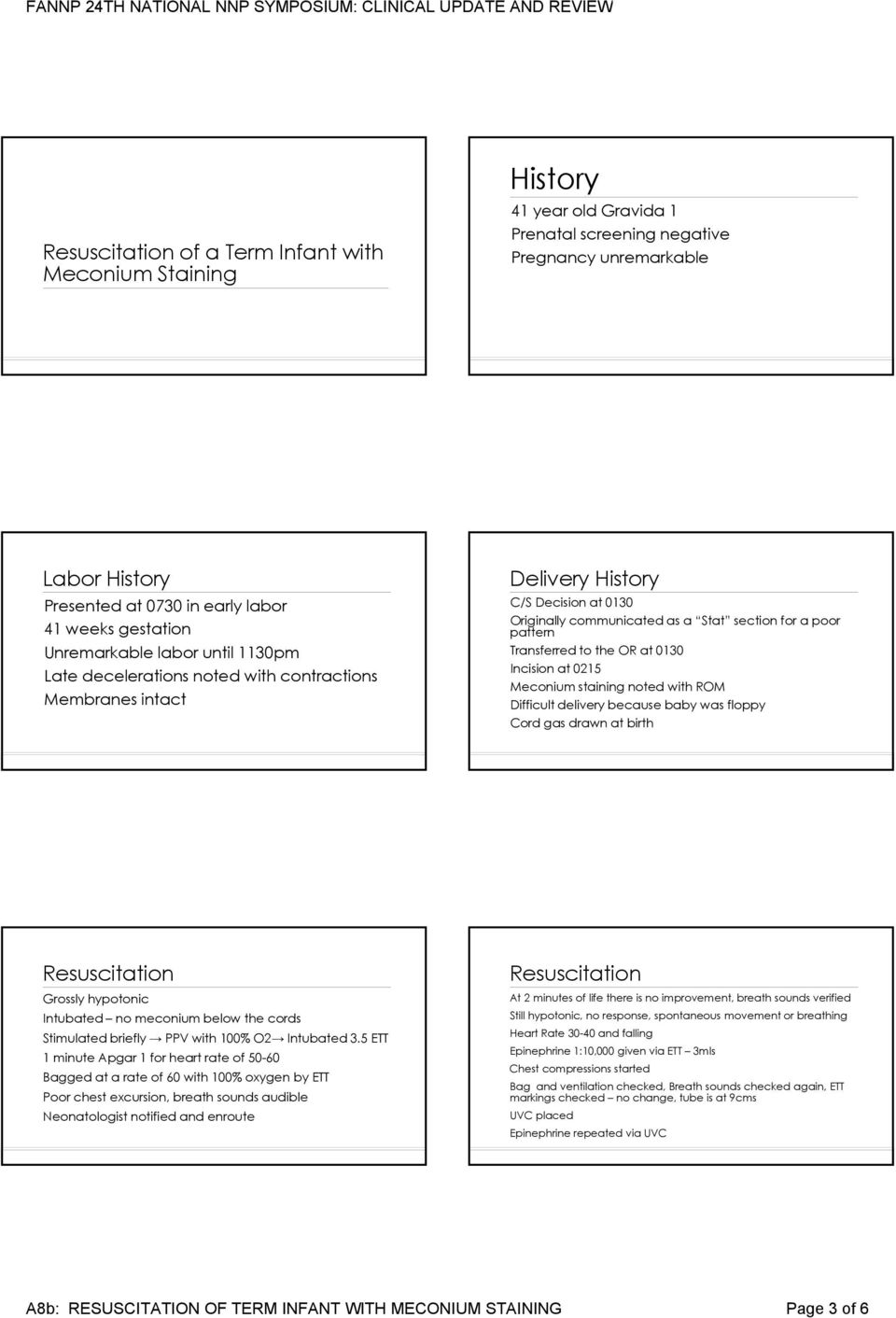
4 Resuscitation Heart Rate rechecked, Reintubated quickly without event, 3.5 ETT ETT secured at 9cms, BS = with bagging Epinephrine repeated via UVC 1ml (BW est = 3kg) X 3 Volume expansion given X 2 Infant expired at 3am After infant expired Mother and Father were still in the OR Tubes and lines inadvertently removed by staff Neonatologist arrived Incidence The prevalence of fetal asphyxia, ranging from mild to severe at delivery, in the term infant is reported at 25 per 1,000 live births; of these, 15% are either moderate or severe (3.75 per 1,000)..in the absence of any other preconception or antepartum abnormalities, of approximately 1.6 per 10,000 Handley-Derry M, Low JA, Burke SO, Waurick M, Killen H, Derrick EJ. Intrapartum fetal asphyxia and the occurrence of minor deficits in 4- to 8-year-old children. Dev Med Child Neurol 1997;39: Low JA. Determining the contribution of asphyxia to brain damage in the neonate. J Obstet Gynaecol Res 2004;30: Badawi N, Kurinczuk JJ, Keogh JM, Alessandri LM, O'Sullivan F, Burton PR, et al. Antepartum risk factors for newborn encephalopathy: the Western Australian case-control study. BMJ 1998;317: Umbilical cord gas analysis Umbilical cord blood analysis is assumed to give a picture of the acid base balance of the infant at the moment of birth when the umbilical circulation was arrested by clamping of the cord. Armstrong & Stenson, Use of umbilical cord blood gas analysis in the assessment of the newborn. Arch Dis Child Fetal Neonatal Ed November; 92(6): F430 F434. it is the gold standard assessment of uteroplacental function and fetal oxygenation/acid-base status at birth Thorp & Rushing, Obstet Gynecol Clin North Am., 1999 Dec;26(4): A8b: RESUSCITATION OF TERM INFANT WITH MECONIUM STAINING Page 4 of 6
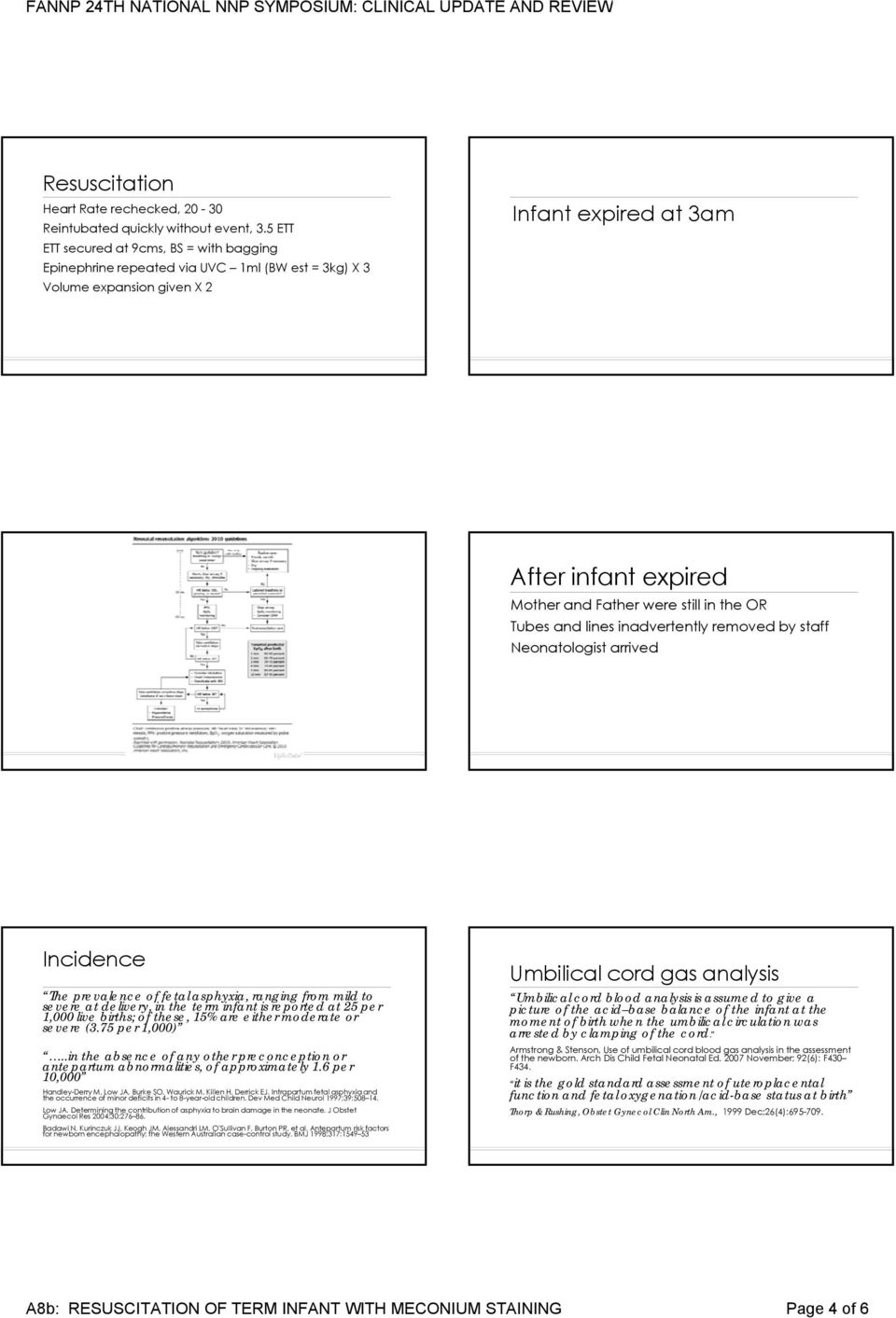
5 AACOG Statement Fetal asphyxia is a condition of impaired blood gas exchange leading to progressive hypoxemia and hypercapnia with a significant metabolic acidosis. The diagnosis of intrapartum fetal asphyxia requires a blood gas and acid-base assessment. The important question for the clinician is what is the threshold of metabolic acidosis beyond which fetal morbidity or mortality may occur? Low and Associates Scoring System Defined umbilical arterial base deficits at birth as: Mild 4 8 mmol/l Moderate 8 12 mmol/l Severe > 12 mmol/l AACOG Committee Opinion, Number 348, November 2006 (Reaffirmed 2012) Cord Gas Results Umbilical cord gas had been sent at delivery by obstetrical team at delivery ph 7.15 BE -7 Fetal Acid Base Disorders Review Acidosis an increase in hydrogen ions in fetal tissue Acidemia an increase in hydrogen ions in fetal blood. Respiratory acidemia refers to a low ph in the presence of a significantly elevated PCO2 and a normal serum bicarbonate concentration. Metabolic acidemia refers to a low ph with a normal PCO2 and low bicarbonate concentration. A mixed acidemia exists when bicarbonate concentration is low and PCO2 is elevated. Hypoxemia a decrease in oxygen content in fetal blood Hypoxia a decrease in oxygenation of fetal tissue. Asphyxia hypoxia with metabolic acidosis. Newborns with hypoxia severe enough to result in hypoxic ischemic encephalopathy (HIE) will usually exhibit an ACOG Committee on Obstetric Practice. ACOG Committee Opinion No. 348, November 2006: Umbilical cord blood gas and acid-base analysis. Obstet Gynecol 2006; 108:1319. American College of Obstetricians and Gynecologists (ACOG) and American Academy of Pediatrics (AAP): Neonatal encephalopathy and cerebral palsy: Defining the pathogenesis and pathophysiology. American College of Obstetricians and Gynecologists, Washington, DC, January 2003 p. 74 Root Cause Analysis What is the relationship of the cord blood results to the cause of death? Where is the significant acidosis? What were the ramifications for the NNP? Root cause analysis results? What is the best course to determine the cause of this outcome? What was the cause of death? What were the lessons learned? A8b: RESUSCITATION OF TERM INFANT WITH MECONIUM STAINING Page 5 of 6

6 Questions for Discussion References AACOG Committee Opinion, Number 348, November 2006 (Reaffirmed 2012). ACOG Committee on Obstetric Practice. (2006). ACOG Committee Opinion No. 348, November 2006: Umbilical cord blood gas and acid-base analysis. Obstetrics & Gynecology, 108: American College of Obstetricians and Gynecologists (ACOG) and American Academy of Pediatrics (AAP): Neonatal encephalopathy and cerebral palsy: Defining the pathogenesis and pathophysiology. American College of Obstetricians and Gynecologists, Washington, DC, January 2003 p. 74. Armstrong, L. & Stenson, B. (2007). Use of umbilical cord blood gas analysis in the assessment of the newborn. Archives of Disease in Child. Fetal & Neonatal Edition, 92(6): F430 F434. Badawi, N., Kurinczuk, J., Keogh, J., Alessandri, L., O'Sullivan, F., Burton, P., et al. (1998). Antepartum risk factors for newborn encephalopathy: the Western Australian case-control study. British Medical Journal, 317: Handley-Derry, M., Low, J., Burke, S., Waurick, M., Killen, H., & Derrick, E. (1997). Intrapartum fetal asphyxia and the occurrence of minor deficits in 4- to 8-year-old children. Developmental Medicine & Child Neurology, 39: Low, J., Lindsay, B., & Derrick, E. (1997). Threshold of metabolic acidosis associated with newborn complications. American Journal of Obstetrics & Gynecology,177: Low, J. (2004). Determining the contribution of asphyxia to brain damage in the neonate. The Journal of Obstetrics & Gynaecology Research, 30: Riley, R. & Johnson, J. (1993). Collecting and analyzing cord blood gases. Clinical Obstetrics & Gynecology, 36(1): Thorp, J. & Rushing, R. (1999). Umbilical cord blood gas analysis. Obstetrics and Gynecology Clinics of North America, 26(4): A8b: RESUSCITATION OF TERM INFANT WITH MECONIUM STAINING Page 6 of 6

CORD BLOOD COLLECTION / ANALYSIS- AT BIRTH
 WOMEN AND NEWBORN HEALTH SERVICE King Edward Memorial Hospital CLINICAL GUIDELINES OBSTETRICS AND MIDWIFERY King Edward Memorial Hospital WOMEN AND NEWBORN HEALTH SERVICE INTRAPARTUM CARE SPECIMEN COLLECTION
Fetal Acid Base Status and Umbilical Cord Sampling. David Acker, MD
 Fetal Acid Base Status and Umbilical Cord Sampling David Acker, MD Part I: Some Background Intra-uterine Event as Causative of CP Cord ph < 7.00 and base excess of > 12 Early onset neonatal encephalopathy
Second stage fetal heart rate patterns and neonatal acid-base status Faridah Hanim Zam Zam 1, Nazimah Idris 2, Tham Seng Woh 1
 Original Article IeJSME 2012 6(2): 18-23 Second stage fetal heart rate patterns and neonatal acid-base status Faridah Hanim Zam Zam 1, Nazimah Idris 2, Tham Seng Woh 1 Background: Fetal surveillance in
Measurement of fetal scalp lactate to determine fetal well being in labour
 Measurement of fetal scalp lactate to determine fetal well being in labour Clinical question Among women at term in labour is the measurement of fetal scalp lactate superior to fetal scalp ph in predicting
BIRTH INJURY AND NEWBORN BRAIN DAMAGE
 BIRTH INJURY AND NEWBORN BRAIN DAMAGE ROBERT J. TALASKA 1415 North Loop West Suite 200 Houston, Texas 77008 713.869.1240 713.869.1465 fax State Bar of Texas 15 TH ANNUAL ADVANCED MEDICAL MALPRACTICE COURSE
The importance of acidosis in asphyxia
 The importance of acidosis in asphyxia Janet M Rennie Senior Lecturer in Neonatal Medicine Institute for Women s Health, UCL, London Clinical negligence seminar, 1 Crown Office Row Objectives To review
Re-Evaluation of Cord Blood Arterial and Venous Reference Ranges for ph, po 2, pco 2, According to Spontaneous or Cesarean Delivery
 Journal of Clinical Laboratory Analysis 24 : 300 304 (2010) Re-Evaluation of Cord Blood Arterial and Venous Reference Ranges for ph, po 2, pco 2, According to Spontaneous or Cesarean Delivery K. Kotaska,
Cerebral Palsy An Expensive Enigma
 Cerebral Palsy An Expensive Enigma Rhona Mahony National Maternity Hospital A group of permanent disorders of the development of movement and posture, causing activity limitation that are not attributed
Newborn outcomes after cesarean section for fetal distress in BC
 Newborn outcomes after cesarean section for fetal distress in BC Patricia Janssen, PhD, UBC School of Population and Public Health Scientist, Child and Family Research Institute Kevin Jenniskens, MSc,
Identification of peripartum near-miss for perinatal audit
 Facts Views Vis Obgyn, 2014, 6 (4): 177-183 Original paper Identification of peripartum near-miss for perinatal audit C. Kerkhofs 1, C. De Bruyn 1, T. Mesens 1, C. Theyskens 2, M. Vanhoestenberghe 2, E.
How To Test For Fetal Blood
 Fetal (FBS) / paired cord blood sampling guideline (GL839) Approval Approval Group Job Title, Chair of Committee Date Maternity & Children s Services Clinical Governance Committee Mr Mark Selinger, Consultant
Umbilical cord blood lactate: A valuable tool in the assessment of fetal metabolic acidosis
 European Journal of Obstetrics & Gynecology and Reproductive Biology 139 (2008) 16 20 www.elsevier.com/locate/ejogrb Umbilical cord blood lactate: A valuable tool in the assessment of fetal metabolic acidosis
BIRTH ASPHYXIA The New Consensus Statement
 P.E.L.T. 2015 BIRTH ASPHYXIA The New Consensus Statement Keith Bolton Rahima Moosa Mother & Child Hospital THE HERD IS UNDER THREAT HPCSA CIVIL COURTS CRIMINAL COURTS Background The child with cerebral
ST Segment Analysis (STAN) as an Adjunct to Electronic Fetal Monitoring, Part II: Clinical Studies and Future Directions
 ST Segment Analysis (STAN) as an Adjunct to Electronic Fetal Monitoring, Part II: Clinical Studies and Future Directions Michael A. Belfort, MBBCH, MD, PhD*, George R. Saade, MD KEYWORDS ST segment analysis
Cord Blood Erythropoietin and Markers of Fetal Hypoxia
 July 21, 2011 By NeedsFixing [1] To investigating the relationship between cord blood erythropoietin and clinical markers of fetal hypoxia. Abstract Objective: To investigating the relationship between
FETAL SCALP LACTATE RESEARCH STUDY COMPARISON OF TWO POINT OF CARE METERS
 FETAL SCALP LACTATE RESEARCH STUDY COMPARISON OF TWO POINT OF CARE METERS Presentation to Healthy Mothers, Healthy Babies Conference Perinatal Services BC February 22 nd, 2014 Ivy Fernando, RN BSN, PNC(C)
Correlation between Umbilical Cord ph and Apgar Score in High Risk Pregnancy
 Original Article Iran J Pediatr Dec 2010; Vol 20 (No 4), Pp:401-406 Correlation between Umbilical Cord ph and Apgar Score in High Risk Pregnancy Mousa Ahmadpour Kacho* 1, MD; Nesa Asnafi 2, MD; Maryam
Oregon Birth Outcomes, by Planned Birth Place and Attendant Pursuant to: HB 2380 (2011)
 Oregon Birth Outcomes, by Birth Place and Attendant Pursuant to: HB 2380 (2011) In 2011, the Oregon Legislature passed House Bill 2380, which required the Oregon Public Health Division to add two questions
Developmental Outcome at 6.5 Years After Acidosis in Term Newborns: A Population-Based Study
 Developmental Outcome at 6.5 Years After Acidosis in Term Newborns: A Population-Based Study AUTHORS: Maria Hafström, MD, PhD, a Siv Ehnberg, RN, b Sofia Blad, PhD, c Håkan Norén, MD, PhD, d Cecilia Renman,
Umbilical Arterial Blood Gas and Perinatal Outcome in the Second Twin according to the Planned Mode of Delivery
 643 Ivyspring International Publisher Research Paper International Journal of Medical Sciences 2011; 8(8):643-648 Umbilical Arterial Blood Gas and Perinatal Outcome in the Second Twin according to the
Careful collection, organization and review of medical information
 Preparing Birth Injury Case Prior To Expert Review of Causation Careful collection, organization and review of medical information essential to documentation of injury By RICHARD A. SILVER When analyzing
Obstetric Guideline 6B ELECTRONIC FETAL MONITORING IN LABOUR, SCALP SAMPLING, & CORD BLOOD GASES
 British Columbia Reproductive Care Program Obstetric Guideline 6B ELECTRONIC FETAL MONITORING IN LABOUR, SCALP SAMPLING, & CORD BLOOD GASES 1. PREAMBLE Meta-analysis of randomized clinical trials 1,2 indicate
What do we mean by birth asphyxia
 Neonatal Medicine and brain injury in the Infant at term Andrew Whitelaw Professor of Neonatal Medicine University of Bristol What do we mean by birth asphyxia Interruption in oxygen delivery to the fetus
A look at continuing developments in the field, including history of fetal monitoring and causation issues
 Medical malpractice: Preparation and trial of birth injury cases A look at continuing developments in the field, including history of fetal monitoring and causation issues BY JAMES BOSTWICK Over the past
How To Compare Pregnancy Complications With Pregnancy And Labor
 Correlation between Intrapartum Cardiotocogram Findings and Cord Blood ph in Term and Preterm Labours Sarah SC CHAN MBBS, MRCOG William WK TO MBBS, MPhil, FRCOG, FHKAM (O&G) Department of Obstetrics and
TIMING OF ASPHYXIAL INJURY AND BIRTH TRAUMA
 TIMING OF ASPHYXIAL INJURY AND BIRTH TRAUMA Richard C. Halpern, Partner, Thomson Rogers Obstetric Malpractice cases involving asphyxiated newborns present unique challenges to Plaintiffs counsel. Standard
Intrapartum Fetal Heart Rate Monitoring. A Standardized Approach to Interpretation and Management
 Intrapartum Fetal Heart Rate Monitoring A Standardized Approach to Interpretation and Management Lecture Objectives At the end of this program, participants will be able to: Review standardized FHR terminology
Cord Blood Lactate and ph Values at Term and Perinatal Outcome: A Retrospective Cohort Study
 Article ID: WMC00694 ISSN 2046-1690 Cord Blood Lactate and ph Values at Term and Perinatal Outcome: A Retrospective Cohort Study Author(s):Dr. Qemer Khoshnow, Dr. Max Mongelli Corresponding Author: Dr.
Brain Injury during Fetal-Neonatal Transition
 Brain Injury during Fetal-Neonatal Transition Adre du Plessis, MBChB Fetal and Transitional Medicine Children s National Medical Center Washington, DC Brain injury during fetal-neonatal transition Injury
SWISS SOCIETY OF NEONATOLOGY. Umbilical cord complications in two subsequent pregnancies
 SWISS SOCIETY OF NEONATOLOGY Umbilical cord complications in two subsequent pregnancies June 2006 2 Hetzel PG, Godi E, Bührer C, Department of Neonatology (HPG, BC), University Children s Hospital, Basel,
SOUTHERN WEST MIDLANDS NEWBORN NETWORK
 SOUTHERN WEST MIDLANDS NEWBORN NETWORK Hereford, Worcester, Birmingham, Sandwell & Solihull Title Person Responsible for Review Delayed Umbilical Cord Clamping Dr Andrew Gallagher Date Guideline Agreed:
INTRAPARTUM PATHWAYS TO NEONATAL NEUROLOGIC INJURY - A LAWYER S VIEW OF THE MEDICINE
 INTRAPARTUM PATHWAYS TO NEONATAL NEUROLOGIC INJURY - A LAWYER S VIEW OF THE MEDICINE By Richard C. Halpern Partner Thomson Rogers [email protected] 416-868-3215 November 2013 INTRODUCTION Newborn
The effect of blood gas and Apgar score on cord blood cardiac Troponin I
 The 2004;16:315 319 Case Report The effect of blood gas and Apgar score on cord blood cardiac Troponin I Gülcan Türker, Kadir Babaoğlu, Can Duman, Ayşe S Gökalp, Emine Zengin and Ayşe Engin Arısoy From
UMBILICAL CORD BLOOD COLLECTION
 UMBILICAL CORD BLOOD COLLECTION by Frances Verter, PhD Founder & Director, Parent's Guide to Cord Blood Foundation [email protected] and Kim Petrella, RN Department of Obstetrics and Gynecology
The Facts about Cerebral Palsy
 The Role of the Obstetrician in preventing Cerebral palsy and protecting oneself from litigation. Prof R. J. PEPPERELL Professor Emeritus,University of Melbourne Previous Professor, Penang Medical College,
Umbilical-Cord Blood Gas Analysis in Obstetrical Practice
 Umbilical-Cord Blood Gas Analysis in Obstetrical Practice Webinar - Wednesday, July 1, 2015 Jan Stener Jørgensen, MD, PhD Head of Obstetrics Professor of Clinical Obstetrics Odense University Hospital
C. P. Noel McCarthy, MD 1936 1936--2009 2009 Risk Reduction Strategies in Risk Obstetrics & Gynecology
 C. P. Noel McCarthy, MD 1936-2009 Risk Reduction Strategies in Obstetrics & Gynecology John F. Rodis, MD Professor of Clinical Obstetrics & Gynecology Columbia University College of Physicians & Surgeons
Addendum to the NRP Provider Textbook 6 th Edition Recommendations for specific modifications in the Canadian context
 Addendum to the NRP Provider Textbook 6 th Edition Recommendations for specific modifications in the Canadian context A subcommittee of the Canadian Neonatal Resuscitation Program (NRP) Steering Committee
Advanced Fetal Assessment and Monitoring: Online Program. Advanced Practice Strategies, LLC
 Advanced Fetal Assessment and Monitoring: Online Program Advanced Fetal Assessment and Monitoring: Online Program Comments from the Authors As a physician who does a great deal of medical legal expert
CHAPTER 11 FETAL HEALTH SURVEILLANCE IN LABOUR
 CHAPTER 11 FETAL HEALTH SURVEILLANCE IN LABOUR Learning Objectives By the end of this chapter, the participant will: 1. Define and recognize normal (reassuring), atypical and abnormal (non-reassuring)
Acknowledgements. Who was Compromised at birth? Research Question: Do lactate levels obtained from cord blood correlate to blood gas analysis?
 To Examine The Reliability Of Cord Blood Lactate Compared To Cord Blood Gases As An Effective Value In Identifying Hypoxiacidema In The Newborn Infant Acknowledgements Research Team Dr. Cleve Department
Physiologic Basis for Fetal Heart Rate Monitoring
 Physiologic Basis for Fetal Heart Rate Monitoring Physiologic Basis for Fetal Heart Rate Monitoring The objective of intrapartum fetal heart rate (FHR) monitoring is to prevent fetal injury that might
Cord Blood Lactate and ph Values at Term and Perinatal Outcome: A Retrospective Cohort Study
 Article ID: WMC00694 ISSN 2046-1690 Cord Blood Lactate and ph Values at Term and Perinatal Outcome: A Retrospective Cohort Study Corresponding Author: Dr. Max Mongelli, Consultant, Women and Childrens'
Cerebral palsy and clinical negligence litigation: a cohort study
 BJOG: an International Journal of Obstetrics and Gynaecology January 2003, Vol. 110, pp. 6 11 Cerebral palsy and clinical negligence litigation: a cohort study Catherine Greenwood a,b, *, Sally Newman
Correlation of Fetal Heart Rate Tracings and Scalp Stimulation Test in Labor with Cord Blood ph and Perinatal Outcome
 Original Article DOI: 10.17354/ijss/2015/228 Correlation of Fetal Heart Rate Tracings and Scalp Stimulation Test in Labor with Cord Blood ph and Perinatal Outcome Pramodita 1, Imam Bano 2 1 Consultant,
Newborn Neurological Injury and Litigation: Medical Legal Challenges to Causation
 Newborn Neurological Injury and Litigation: Medical Legal Challenges to Causation Richard C. Halpern Thomson Rogers July 12, 2011 INTRODUCTION Newborn neurological injury due to trauma occurring in and
Evaluation of cardiotocographic and cord blood changes in induced labor with dinoprostone and misoprostol
 International Journal of Reproduction, Contraception, Obstetrics and Gynecology Pandey K et al. Int J Reprod Contracept Obstet Gynecol. 2014 Mar;3(1):199-203 www.ijrcog.org pissn 2320-1770 eissn 2320-1789
Cerebral palsy, neonatal death and stillbirth rates Victoria, 1973-1999
 Cerebral Palsy: Aetiology, Associated Problems and Management Lecture for FRACP candidates July 2010 Definitions and prevalence Risk factors and aetiology Associated problems Management options Cerebral
8/13/2014. Blood, Sweat (and Tears): Delayed Cord Clamping and Delivery Room Temperature. Delayed Cord Clamping
 8/13/2014 Blood, Sweat (and Tears): Delayed Cord Clamping and Delivery Room Temperature James F. Smith, Jr., MD Professor and Chair Obstetrics and Gynecology Creighton University School of Medicine The
Post - resuscitation management of an asphyxiated neonate
 Post - resuscitation management of an asphyxiated neonate Slide PA 1, 2 Introduction Perinatal asphyxia is a common neonatal problem and contributes significantly to neonatal morbidity and mortality. It
Perinatal features and umbilical cord blood gases in newborns complicated with nuchal cord
 The Turkish Journal of Pediatrics 2008; 50: 466-470 Original Perinatal features and umbilical cord blood gases in newborns complicated with nuchal cord Lütfü S. Önderoğlu 1, Polat Dursun 2, Tekin Durukan
Relations Between Umbilical Troponin T Levels And Fetal Distress.
 In the name of God Shiraz E-Medical Journal Vol. 1 3, No. 2, April 2012 http://semj.sums.ac.ir/vol13/apr2012/90032.htm Relations Between Umbilical Troponin T Levels And Fetal Distress. Rafati Sh*, Rabi
1 NCC Monograph, Volume 3, No. 1, 2010
 NICHD Definitions and Classifications: Application to Electronic Fetal Monitoring Interpretation Purpose of this Monograph Safe care for mothers and babies during labor and birth is the goal of all health
Certified Professional Midwives Caring for Mothers and Babies in Virginia
 Certified Professional Midwives Caring for Mothers and Babies in Virginia Commonwealth Midwives Alliance Certified Professional Midwives in VA Licensed by the BOM since January 2006 5 member Midwifery
Cerebral Palsy. 1995-2014, The Patient Education Institute, Inc. www.x-plain.com nr200105 Last reviewed: 06/17/2014 1
 Cerebral Palsy Introduction Cerebral palsy, or CP, can cause serious neurological symptoms in children. Thousands of children are diagnosed with cerebral palsy every year. This reference summary explains
Innovative use of Neonatal Nurse Practitioners in Rural Hawaii
 Innovative use of Neonatal Nurse Practitioners in Rural Hawaii Petri Pate Pieron, MSN, MPH, APRN Rx, CPNP, NNP Presentation was supported by NIH 1 R25 RR019321 Clinical Research Education and Career Development
IN THE CIRCUIT COURT OF THE STATE OF OREGON FOR THE COUNTY OF MULTNOMAH ) ) ) ) ) ) ) ) ) ) ) ) ) ) FIRST CLAIM FOR RELIEF
 IN THE CIRCUIT COURT OF THE STATE OF OREGON FOR THE COUNTY OF MULTNOMAH 1 1 MATTHEW MARINO and AMY BENTON, Personally and as Guardians Ad Litem for LUCA MARINO, v. Plaintiffs, LEGACY HEALTH, LEGACY EMANUEL
Clinical Policy Title: Home uterine activity monitoring
 Clinical Policy Title: Home uterine activity monitoring Clinical Policy Number: 12.01.01 Effective Date: August 19, 2015 Initial Review Date: July 17, 2013 Most Recent Review Date: July 15, 2015 Next Review
Cerebral Palsy. In order to function, the brain needs a continuous supply of oxygen.
 Cerebral Palsy Introduction Cerebral palsy, or CP, can cause serious neurological symptoms in children. Up to 5000 children in the United States are diagnosed with cerebral palsy every year. This reference
Guidelines for the Management of the Obstetrical Patient for the Certified Registered Nurse Anesthetist
 American Association of Nurse Anesthetists 222 South Prospect Avenue Park Ridge, IL 60068 www.aana.com Guidelines for the Management of the Obstetrical Patient for the Certified Registered Nurse Anesthetist
Why is prematurity a concern?
 Prematurity What is prematurity? A baby born before 37 weeks of pregnancy is considered premature. Approximately 12% of all babies are born prematurely. Terms that refer to premature babies are preterm
Safe Zone: CV PIP < 26; HFOV: MAP < 16; HFJV: MAP < 16 Dopamine infusion up to 20 mcg/kg/min Epinephrine infusion up to 0.1 mcg /kg/min.
 Congenital Diaphragmatic Hernia: Management Guidelines 5-2006 Issued By: Division of Neonatology Reviewed: Effective Date: Categories: Chronicity Document Congenital Diaphragmatic Hernia: Management Guidelines
Delayed Cord Clamping
 ICEA Position Paper Delayed Cord Clamping Position The International Childbirth Education Association recognizes that the first minutes after birth are crucial to both mother and newborn. Optimal care
My Birth Experience at Mercy
 My Birth Experience at Mercy This booklet provides information about labor and birth practices at Mercy and includes an optional birth plan that you can complete prior to your baby s birth. Discuss your
Who Is Involved in Your Care?
 Patient Education Page 3 Pregnancy and Giving Birth Who Is Involved in Your Care? Our goal is to surround you and your family with a safe environment for the birth of your baby. We look forward to providing
Access to Appropriate Services for High Risk. in New York State. New York State Department of Health
 Access to Appropriate Services for High Risk Neonates in New York State Di i i f F il H l h Division of Family Health New York State Department of Health Perinatal Regionalization in New York State Perinatal
Umbilical cord blood gas analysis at the time of
 Umbilical cord blood gas analysis at the time of delivery Maureen Harris, Sarah L. Beckley, Jonathan M. Garibaldi, Robert D. E Keith and Keith R. Greene Aims: it is now recommended that cord blood acid-base
Follow-up of children born with an umbilical arterial blood ph < 7
 Proefschrift H. Nagel 11-01-2007 13:34 Pagina 71 C H A P T E R 5 Follow-up of children born with an umbilical arterial blood ph < 7 HTC Nagel FPHA Vandenbussche D Oepkes A Jennekens-Schinkel LAEM Laan
UMBILICAL CORD CLAMPING FOR TERM INFANTS 37 WEEKS
 UMBILICAL CORD CLAMPING FOR TERM INFANTS 37 WEEKS This guideline refers to umbilical cord clamping in term infants (those 37 weeks gestational age) DEFINITION Immediate (early) cord clamping (ICC): the
Umbilical Cord Blood Gas Analysis at Delivery: A Time for Quality Data
 1054 BRITISH JOURNAL OF OBSTETRICS AND GYNAECOLOGY, 101:1054-1063, 1994 Umbilical Cord Blood Gas Analysis at Delivery: A Time for Quality Data Jennifer A. Westgate, Jonathan M. Garibaldi, Keith R. Greene
Priya Rajan, MD Northwestern University September 13, 2013
 Priya Rajan, MD Northwestern University September 13, 2013 o Study Finds Benefits in Delaying Severing of Umbilical Cord nytimes.com, 7/10/13 o Delay cord clamping for baby health, say experts bbc.com.uk,
Prenatal Factors Influencing the Interpretation of Cord Blood Thyroid Stimulating Hormone Levels
 Original Article DOI: 1.17354/ijss/15/115 Prenatal Factors Influencing the Interpretation of Cord Blood Thyroid Stimulating Hormone Levels Divya Durga 1, Sudha Rudrappa 2, Rajendra Kumar 3, SN Manjunath
Why the INFANT Study
 The INFANT Study A multi-centre Randomised Controlled Trial (RCT) of an intelligent system to support decision making in the management of labour using the CTG Why the INFANT Study INFANT stands for INtelligent
Registered Nurse Initiated Activities Decision Support Tool No. 8A: Obstetrical Emergencies Cord Prolapse
 Registered Nurse Initiated Activities Decision Support Tool No. 8A: Obstetrical Emergencies Cord Prolapse Decision support tools are evidenced-based documents used to guide the assessment, diagnosis and
Does training in obstetric emergencies improve neonatal outcome?
 DOI: 10.1111/j.1471-0528.2006.00800.x www.blackwellpublishing.com/bjog General obstetrics Does training in obstetric emergencies improve neonatal outcome? Tim Draycott, a Thabani Sibanda, a Louise Owen,
Fetal Blood Sampling Guideline
 This is an official Northern Trust policy and should not be edited in any way Fetal Blood Sampling Guideline Reference Number: NHSCT/11/423 Target audience: This policy is directed to all obstetricians
5/30/2014 OBJECTIVES THE ROLE OF A RESPIRATORY THERAPIST IN THE DELIVERY ROOM. Disclosure
 THE ROLE OF A RESPIRATORY THERAPIST IN THE DELIVERY ROOM Ona Fofah, MD FAAP Assistant Professor of Pediatrics Director, Division of Neonatology Department of Pediatrics Rutgers- NJMS, Newark OBJECTIVES
Neonatal Outreach Education Program Course Catalog
 2012 Neonatal Outreach Education Program Course Catalog Photo by Brian Redden (559) 353-5615 (559) 353-6255 Table of Contents Program Overview... 2 General Course Information... 3 Save The Date Children
AHA/AAP Neonatal Resuscitation Guidelines 2010: Summary of Major Changes and Comment on its Utility in Resource-Limited Settings
 AHA/AAP Neonatal Resuscitation Guidelines 2010: Summary of Major Changes and Comment on its Utility in Resource-Limited Settings Resuscitation step Recommendations (2005) Recommendations (2010) Comments/LOE
Early Predictions of Hypoxic-Ischemic Encephalopathy by Umbilical Cord Nucleated Red Blood Cells and Lactate
 Med. J. Cairo Univ., Vol. 79, No. 1, December: 625-631, 2011 www.medicaljournalofcairouniversity.com Early Predictions of Hypoxic-Ischemic Encephalopathy by Umbilical Cord Nucleated Red Blood Cells and
NRP 2012 Putting New Resuscitation Guidelines into Practice
 Outreach Education Online Video Library for Healthcare Professionals NRP 2012 Putting New Resuscitation Guidelines into Practice. Jeanette Zaichkin, RN, MN, NNP-BC December 2, 2010 Program Handouts This
OBSTETRICS IN THE LEGAL JUNGLE. A Practical Guide For A Difficult Journey
 OBSTETRICS IN THE LEGAL JUNGLE A Practical Guide For A Difficult Journey Tom Wiseman Wiseman Ashworth Law Group, PLC 511 Union Street, Suite 800 Nashville, TN 37219-1743 (615) 254-1877 www.wisemanashworth.com
Cerebral palsy (CP) was defined before the specific
 Perinatal Factors Associated With Cerebral Palsy in Children Born in Sweden Kristina Thorngren-Jerneck, MD, PhD, and Andreas Herbst, MD, PhD OBJECTIVE: To identify perinatal factors associated with cerebral
Neonatal jaundice and birth asphyxia as major causes of cerebral palsy in Nigeria: are doctors wrong beliefs and practices part of the problem?
 International Journal of Medicine and Biomedical Research Volume 2 Issue 3 September December 2013 www.ijmbr.com Michael Joanna Publications Original Article Neonatal jaundice and birth asphyxia as major
Umbilical cord blood ph and risk factors for acidaemia in neonates in Kerman V. Modarressnejad 1
 96 La Revue de Santé de la Méditerranée orientale, Vol. 11, N o 1/2, 2005 Umbilical cord blood ph and risk factors for acidaemia in neonates in Kerman V. Modarressnejad 1 ABSTRACT A prospective cross-sectional
Pediatric Airway Management
 Pediatric Airway Management Dec 2003 Dr. Shapiro I., PICU Adult Chain of Survival EMS CPR ALS Early Defibrillation Pediatric Chain of Survival Prevention CPR EMS ALS Out-of-Hospital Cardiac Arrest SIDS
Regions Hospital Delineation of Privileges Nurse Practitioner
 Regions Hospital Delineation of Privileges Nurse Practitioner Applicant s Last First M. Instructions: Place a check-mark where indicated for each core group you are requesting. Review education and basic
Genetic Aspects of Mental Retardation and Developmental Disabilities
 Prepared by: Chahira Kozma, MD Associate Professor of Pediatrics Medical Director/DCHRP [email protected] [email protected] Genetic Aspects of Mental Retardation and Developmental Disabilities
LECTURE OBJECTIVES & OUTLINES
 LECTURE OBJECTIVES & OUTLINES 74 I. OVERVIEW OF MATERNITY NURSING OBJECTIVES At the completion of this class the student will be able to: 1. Compare and contrast expanded nursing roles in this specialty.
British Association of Perinatal Medicine. The Management of Babies born Extremely Preterm at less than 26 weeks of gestation
 Arch Dis Child - FNN Online First:Published on October 6, 2008 as 10.1136/adc.2008.143321 British Association of Perinatal Medicine The Management of Babies born Extremely Preterm at less than 26 weeks