
Textile & Apparel Rules Under Free Trade Agreements & Preference Programs
|
|
|
- Lora Maryann Hart
- 10 years ago
- Views:
Transcription
1 Textile & Apparel Rules Under Free Trade Agreements & Preference Programs July 2012

2 2

3 3

4 U.S. Customs and Border Protection Priority Trade Issues (PTIs) Agriculture Programs Antidumping and Countervailing Duties (ADCVD) Intellectual Property Rights Import Safety Penalties Revenue Textiles Trade Agreements Textiles The goal of the Textiles PTI is to ensure that textile imports, which generate more than 40% of the duties collected by CBP, fully comply with applicable laws, regulations, quotas, Free Trade Agreement requirements, and Intellectual Property provisions. Trade Agreements The objective of the Trade Agreements PTI is to advance CBP s mission by working with internal and external stakeholders to facilitate legitimate trade and address areas of non-compliance while effectively communicating the terms of our free trade agreements and preferential trade legislation. The TA PTI is limited to goods other than textiles and apparel, as textiles and apparel products are handled under a separate Textiles PTI. 4

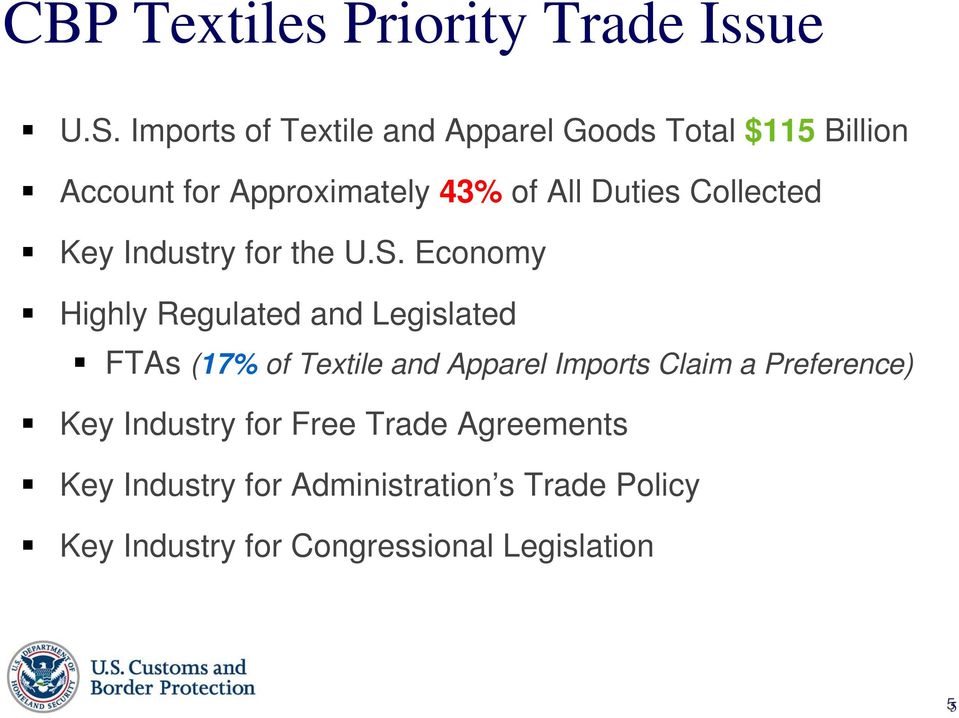
5 CBP Textiles Priority Trade Issue U.S. Imports of Textile and Apparel Goods Total $115 Billion Account for Approximately 43% of All Duties Collected Key Industry for the U.S. Economy Highly Regulated and Legislated FTAs (17% of Textile and Apparel Imports Claim a Preference) Key Industry for Free Trade Agreements Key Industry for Administration s Trade Policy Key Industry for Congressional Legislation 5
6 Textile/Apparel Supplier Countries by Value FY10 1China 42% 2Vietnam 6% 3Mexico 6% 4India 5% 5 Indonesia 4% 6 Bangladesh 4% 7Pakistan 3% 8 Honduras 2% 9Canada 2% 10 Cambodia 2% 11 Italy 2% 12 Thailand 2% 13 El Salvador 2% 14 Sri Lanka 1% 15 Guatemala 1% FY11 1 China 41% 2Vietnam 6% 3 India 6% 4Mexico 5% 5 Indonesia 5% 6 Bangladesh 4% 7Pakistan 3% 8 Honduras 2% 9 Cambodia 2% 10 Canada 2% 11 Italy 2% 12 El Salvador 2% 13 Thailand 1% 14 Sri Lanka 1% 15 Guatemala 1% 6

7 CBP Textiles Priority Trade Issue Enforcement Efforts Unilateral/Bilateral/Multilateral Preference Programs African Growth and Opportunity Act (AGOA) Qualifying Industrial Zones; Jordan/Israel/Egypt Caribbean Basin Trade Partnership Act, Haiti HOPE and HELP Andean Trade Promotion and Drug Eradication Act Free Trade Agreements (Australia, Bahrain, CAFTA, Colombia, Chile, Israel, Jordan, Korea, Morocco, NAFTA, Oman, Peru, Singapore) Trade Agreements Have Become a Critical Element in the Overall Foreign Policy of the United States Unique Qualifying Rules for Each for Textile and Apparel Goods 10 7

8 Textile & Apparel Rules Under Free Trade Agreements & Preference Programs U.S. Legal Concepts of Shared Responsibility, Informed Compliance, and Reasonable Care Apply to Importers By Making a Claim for Preferential Treatment Under a FTA or Preference Program, the Importer of Record is Declaring to CBP They KNOW, UNDERSTAND and MEET the Preference Rule No Special Documents are Needed for Entry Purposes If Asked, the Importer of Record Must Substantiate the Claim is Valid 8

9 Textile & Apparel Rules Under Free Trade Agreements & Preference Programs CBP and Other U.S. Government Public Resources: Where to find information, instructions and guidance about Free Trade Agreements and preference programs. FTA & Preference Rules: Basic summary of the types preference rules for preferential treatment, how to file a claim for preferential treatment. CBP Verification Procedures: Review of U.S. Customs and Border Protection procedures for implementing and enforcing the terms of the agreement or program. 9

10 CBP and Other U.S. Government Public Resources Where to find information, instructions and guidance about Free Trade Agreements and preference programs. 10
11 Textile & Apparel Rules Under Free Trade Agreements & Preference Programs Official Resources (U.S. Government) Harmonized Tariff Schedule of the United States (HTS) U.S. Code of Federal Regulations (CFR) U.S. Customs and Border Protection Resources: Customs Rulings Online Search System (CROSS) Informed Compliance Publications TBTs and QBTs U.S. Trade Data: U.S. International Trade Commission (USITC) DataWeb Office of Textiles and Apparel (OTEXA), U.S. Department of Commerce 11

12 Official Resources (U.S. Government) Harmonized Tariff Schedule of the United States (HTS) FTA & Preference Rules General Notes (GN _ ) (one per agreement or program) Duty Rates indicated by Special Program Indicators (SPI) in Special column in Chapters

13 Official Resources (U.S. Government) Harmonized Tariff Schedule of the United States (HTS) GN 33 13

14 Official Resources (U.S. Government) U.S. Customs and Border Protection Website 14

15 Official Resources (U.S. Government) U.S. Code of Federal Regulations (CFR) FTA Regulations 19 CFR 10 Subpart _ 15

16 Documentation Required for Entry 19 CFR (Entry Documentation) and 19 CFR (Right to Make Entry) Documentation Required for Entry (19 CFR 142.3): CBP Form 7501 Entry Summary Right to Make Entry Negotiable Bill of Lading (19 CFR ) Commercial Invoice Packing List Other Documentation As Required by Other U.S. Agencies 16

17 CBP Form 7501, Entry Summary 17

18 Invoice Requirements 19 CFR

19 Invoice Requirements 19 CFR Port of Entry Name of Importer Detailed Description of the Merchandise Quantities Purchase Price in U.S. Dollars Country of Origin 19
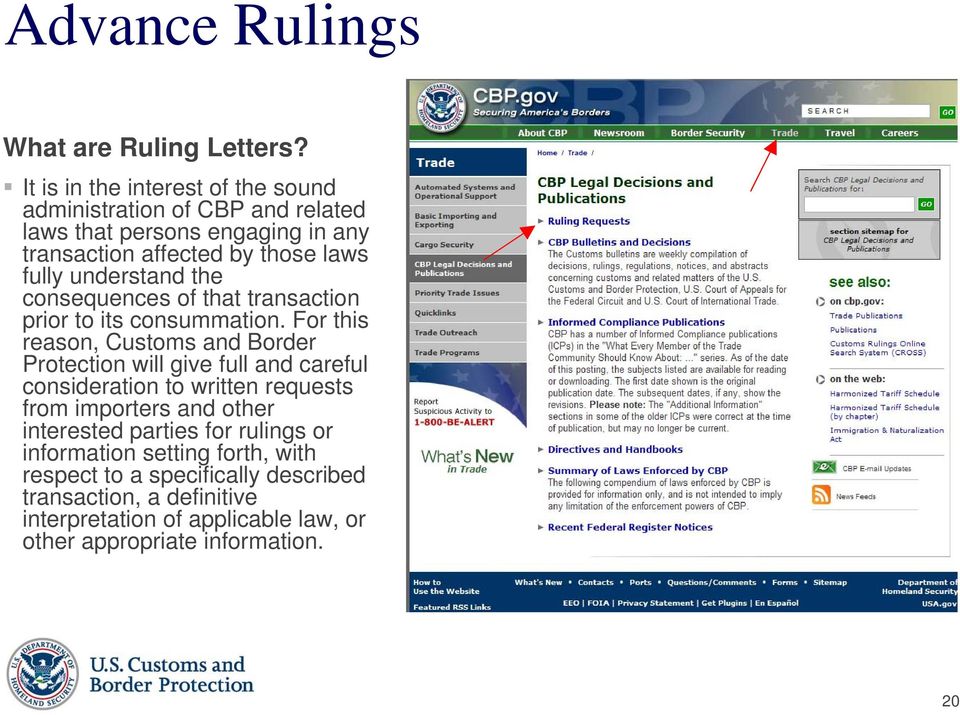
20 Advance Rulings What are Ruling Letters? It is in the interest of the sound administration of CBP and related laws that persons engaging in any transaction affected by those laws fully understand the consequences of that transaction prior to its consummation. For this reason, Customs and Border Protection will give full and careful consideration to written requests from importers and other interested parties for rulings or information setting forth, with respect to a specifically described transaction, a definitive interpretation of applicable law, or other appropriate information. 20
21 Advance Rulings Tariff Classification Application of Customs Value Criteria Application of Duty Drawback, Deferral, or Relief from Other Customs Duties Trade Agreement or Program Originating Status Eligibility for Duty-Free Repairs or Alterations Under FTA Country of Origin Marking Whether a Good is Subject to Quota or Tariff Rate Quota 21
22 Advance Rulings Information Required in Ruling Requests Ruling requests must contain a complete statement of all relevant facts relating to the transaction including: The name, address, address and phone number of the requesting party. The names, addresses, addresses and other identifying information of all interested parties (if known) and the manufacturer ID code (if known). The name(s) of the port(s) in which the merchandise will be entered (if known). A description of the transaction; for example, a prospective importation (merchandise) from (country). A statement that there are, to the importer's knowledge, no issues on the commodity pending before CBP or any court. A statement as to whether advice has been sought from a CBP office; and if so, from whom, and what advice was rendered, if any. 22
23 Official Resources (U.S. Government) U.S. Customs and Border Protection Resources Customs Rulings Online Search System (CROSS) Classification Guidance Eligibility for Preferential Treatment U.S.-Korea FTA Other Free Trade Agreements Preference Programs (AGOA, ATPDEA or CBTPA) 23
24 Official Resources (U.S. Government) CBP Resources - CROSS 24
25 Official Resources (U.S. Government) CBP Resources CROSS - Example N March 22, 2012 CLA-2-38:OT:RR:NC:2:239 CATEGORY: Classification TARIFF NO.: Mr. Glenn M. Carberry Praxair, Inc. 175 East Park Drive Tonawanda, NY RE: The tariff classification of a compressed gas mixture from South Korea Dear Mr. Carberry: In your letter dated February 21, 2012, you requested a tariff classification ruling. The subject product is a compressed gas mixture of fluorine and nitrogen. You state that the product will be imported in a cylinder and will be used to passivate steel and stainless steel piping in the electronics industry. The applicable subheading will be , Harmonized Tariff Schedule of the United States (HTSUS), which provides for Chemical products and preparations of the chemical or allied industries (including those consisting of mixtures of natural products), not elsewhere specified or included: Other: Other: Other: Other: Other: Other. The rate of duty will be 5 percent ad valorem. Duty rates are provided for your convenience and are subject to change. The text of the most recent HTSUS and the accompanying duty rates are provided on World Wide Web at This ruling is being issued under the provisions of Part 177 of the Customs Regulations (19 C.F.R. 177). A copy of the ruling or the control number indicated above should be provided with the entry documents filed at the time this merchandise is imported. If you have any questions regarding the ruling, contact National Import Specialist Richard Dunkel at (646) Sincerely, Thomas J. Russo Director National Commodity Specialist Division 25
26 Official Resources (U.S. Government) U.S. Customs and Border Protection Resources Informed Compliance Publications (ICP) Examples: Classification: Apparel Terminology Under the HTSUS Classification of Coated and Water Resistant Apparel Classification of Knit to Shape Apparel Garments Under HTSUS Heading 6110 Classification of Sets Entry Marking Requirements for Wearing Apparel NAFTA for Textiles & Textile Articles Textile & Apparel Rules of Origin 26
27 Official Resources (U.S. Government) CBP Resources Informed Compliance Publications 27
28 Official Resources (U.S. Government) U.S. Customs and Border Protection Resources TBTs, QBTs Textile Bulletin Transmittals (TBTs) (Example) TBT Documents Used to Verify Free Trade Agreements and Legislated Trade Program Claims for Textiles and Wearing Apparel Quota Bulletin Transmittals (QBTs) (Example) QBT CAFTA-DR MX Cumulation (Announcement of Quota Limit for 2010) nd_quotas/qbts/ 28
29 Official Resources (U.S. Government) U.S. Trade Data U.S. International Trade Commission (ITC) DataWeb: Login and Password Required (Free) Data for All U.S. Imports and Exports Office of Textiles and Apparel (OTEXA) U.S. Department of Commerce: 29
30 FTA & Preference Rules Basic summary of the types preference rules for preferential treatment, how to file a claim for preferential treatment. 30
31 FTA & Preference Rules Textile and Apparel Goods What is a Rule of Origin? Product Specific or Tariff Shift Rules of Origin Short Supply Rules Tariff Preference Levels (TPLs) Value-Based Rules (for Israel, Jordan, QIZs) Process-Based Rule (Preference Programs) 31
32 Rules of Origin A good must be more than a product of a FTA partner or beneficiary country, it must meet a preference rule of origin The FTA & preference rules of origin lay out the various methods that a good can qualify for preference, or originate An imported good must be originating to receive preferential tariff treatment Preferential tariff treatment is not necessarily duty-free, might be a reduced rate of duty while tariffs are being phased out Applicable duty rates are found in the Special Column of the HTS, listed by agreement or program using the Special Program Indicator (SPI) 32
33 U.S.-Korea FTA Duty Rates (U.S.) Column One Rate is 18.8% Rate for originating socks from Korea is 15% 33
34 Product Specific Rules - Tariff Shift International Nomenclature Transparent Not Subjective 34
35 FTA & Preference Rules Textile and Apparel Goods Usually cover HTS Chapters 50 through 63 Tariff shift rules for most fabrics and wearing apparel are based on yarn-forward concept Chapter Rules Apply in conjunction with tariff shift rules, depending on agreement: Component that determines classification Visible lining fabrics formed and finished Sewing thread formed and finished Narrow elastic fabrics formed and finished Pocket bag fabric formed and finished Sets: Total value of the non-originating goods in the set may not exceed 10% of the customs value of the set 35
36 U.S.-Korea FTA Originating Goods Tariff Shift Rules Example Girls Man-made Fiber Sweater Classification HTS Chapter 61 36
37 U.S.-Korea FTA Originating Goods Tariff Shift Rules Example Girls Man-made Fiber Sweater HTS GN 33 (o) Girls Man-made Fiber Sweater HTS U.S.-Korea FTA Tariff Shift Rule from GN 33 (o) Chapter 61 No
38 FTA Originating Goods Tariff Shift Rules HTS Headings for Fibers, Yarns and Fabrics Fibers : Silk : Wool : Cotton : Vegetable : Man-made Staple Yarns : Silk : Wool : Cotton : Vegetable Fibers : Man-made Filament : Man-made Staple : Specialty (Rubber, Coated, Metal, etc) Fabrics 5007: Silk : Wool (Woven) : Cotton (Woven) : Vegetable Fibers (Woven) : Man-made Filament (Woven) : Man-made Staple (Woven) : Felt & Non-Woven : Specialty : Coated : Knit Fabrics 38
39 U.S.-Korea FTA Originating Goods Tariff Shift Rules Example Girls Man-made Fiber Sweater HTS GN 33 (o) A change to headings 6109 through 6111 [ ] from any other chapter, except from headings 5106 through 5113 [Wool Yarn and Woven Fabric], 5204 through 5212 [Cotton Yarn or Woven Fabric], 5307 through 5308, 5310 through 5311 [Certain Woven Vegetable Fiber Fabric], 5401 through 5402, subheadings , through or through heading 5408 [Certain Man-made Filament Yarn or Woven Fabric], or headings 5508 through 5516 [Man-made Staple Yarn or Woven Fabric] or 6001 through 6006 [Knit Fabric], provided that the good is cut or knit to shape, or both, and sewn or otherwise assembled in the territory of one or more of the parties to the Agreement. 39
40 FTA & Preference Rules Textile and Apparel Goods Tariff Shift Rules Except from is the phrase that tells us which materials used in the production of the finished good must also be of U.S. or Korean origin Materials classified in excluded tariff provisions by chapter (2 digits), by heading (4 digits) or by subheading (6 digits) of the tariff schedule are required to be produced in the U.S. or Korea in order for the good produced from those materials to be eligible for preferential treatment under the U.S.-Korea FTA 40
41 FTA & Preference Rules Textile and Apparel Goods All tariff shift model agreements include a De Minimis provision which permits the limited use of non-u.s., non-partner fibers or yarns in the yarns or fabrics used in the production of the component of the goods which determines the tariff classification. Example (from U.S.-Korea FTA): 41
42 FTA & Preference Rules Textile and Apparel Goods For many agreements, elastomeric yarn MUST always be formed and finished in one of the Parties to the Agreement, regardless of the percentage by weight. Example (from U.S.-Korea FTA): 42
43 FTA & Preference Rules Textile and Apparel Goods Tariff Shift Rules Filing a FTA Claim Based on Tariff Shift Rules: Use 10-Digit HTS Number from Chapter 1-97 in First Tariff Field of the U.S. Entry Summary (CF 7501) Affix Special Program Indicator of _ (depends on agreement) in Front of First Tariff Field 43
44 FTA Rules Example of Short Supply or Commercial Availability HTS GN 29 (m)(viii), Chapter 98 Subchapter XXII, Note 20 CAFTA-DR Preference Rule for Short Supply Defined GN 29 (m)(viii): Textile Goods of Chapters 50 through 60 Must Be Wholly Formed in a CAFTA-DR Country From : Apparel Goods of Chapters 61 or 62 Must Be Cut or Knit to Shape, or Both, and Sewn or Otherwise Assembled in a CAFTA-DR Country, and the Fabric of the Outer Shell, Exclusive of Collars and Cuffs Where Applicable Must Be From : Textile Goods of Chapter 63 or Subheading Must Be Cut or Knit to Shape, or Both, and Sewn or Otherwise Assembled in a CAFTA-DR Country, and the Component That Determines the Tariff Classification of the Good Must Be From : One or More of the Fibers, Yarns or Fabrics on the CAFTA-DR Commercial Availability (Short Supply) List, or Originating Fibers, Yarns or Fabrics, or a Combination of Both 44
45 FTA Rules Example of Short Supply or Commercial Availability Commercial Availability or Short Supply Fibers, Yarns and Fabrics Listed in HTS Chapter 98 Subchapter XXII Additions to Short Supply Lists Only on OTEXA Website: Example: CAFTA-DR Short Supply List Shown +140 Items on List 45
46 CAFTA-DR Originating Goods Commercial Availability or Short Supply HTS GN 29 (m)(viii), Chapter 98 Subchapter XXII, Note 20 Be Careful: Be Careful: CAFTA-DR Short Supply Materials Must Meet All Specifications Such as Fiber Content, Width, Thread Count, Finishing Operations, Etc Classification Alone Not Enough 46
47 FTA Rules Example of Short Supply or Commercial Availability Some Short Supply Rules are part of the tariff shift rules, so a claim is filed simply with the SPI on the CF 7501 Some Short Supply Rules rely on a list and make reference to a HTS Chapter 98 provision (such as CAFTA-DR below): Filing a CAFTA-DR Short Supply Claim Use HTS in First Tariff Field of the U.S. Entry Summary (CF7501) Use 10-Digit HTS Number from Chapter 50 through 63 or Subheading in Second Tariff Field Affix Special Program Indicator of P in Front of Second Tariff Field Report Value and Quantity of the Goods with Second Tariff Field 47
48 FTA Rules Tariff Preference Levels Not Included with Every Tariff Shift Agreement Product Coverage Explicitly Defined in HTS Chapter 98 or 99 Are NOT Originating Goods Rules for Apparel Generally Cut and Sew Do Not Use Special Program Indicator (SPI) Some TPLs Require Special Certificate for Entry/Filing a Claim Subject to Merchandise Processing Fee (MPF) Only Originating Goods are Exempt from MPF 48
49 FTA Rules Tariff Preference Levels Generally, Filing a TPL Claim: Use Chapter 99 HTS Number for TPL (Above) in First Tariff Field Use 10-Digit Chapter (product scope varies) HTS Number in Second Tariff Field NO Special Program Indicator (SPI) Report Value and Quantity of Goods with Second Tariff Field Some TPLs, (for example, NAFTA or Nicaragua CAFTA-DR) Require Special Certificate at Entry in Addition to the Above 49
50 FTA & Preference Rules Textile and Apparel Goods Certain Agreements (U.S.-Israel FTA, U.S.-Jordan FTA and Qualifying Industrial Zones (QIZs) for Egypt and Jordan) Rely on a 35% Value Requirement to be Considered Originating Claims for Preferential Treatment Filed Same as Tariff Shift Insert the Special Program Indicator (SPI) on the Entry Summary document in front of the HTS Number. 50
51 FTA & Preference Rules Textile and Apparel Goods The Legislated Preference Programs: Africa Growth and Opportunity Act (AGOA) Caribbean Basin Trade Partnership Act (CBPTA) and Haiti HOPE/HELP Andean Trade Promotion and Drug Eradication Act (ATPDEA) Follow Process-based Rules with Certain Origin-Restricted Inputs. AGOA, CBTPA, ATPDEA Use Certificates of Origin to Assist in the Recordkeeping and Reporting of Information (Forms Can Be Found in the 19 CFR 10 Regulations) AGOA and Haiti HOPE/HELP Also Require a Visa Issued by the Exporting Government Filing a Claim Utilizes the 2 HTS Fields on the CF
52 Transit and Transshipment To Be Considered an Originating Good, a Good Must Not: Undergo Subsequent Production or Any Other Operation Outside the Territories of the Parties, Other Than: Unloading Reloading Any Other Operation Necessary to Preserve the Good in Good Condition or to Transport the Good to the Territory of a Party Be Outside Customs Control in the Territory of a Non-Party 52
53 CBP Verification Procedures Review of U.S. Customs and Border Protection procedures for implementing and enforcing the terms of the agreement. 53
54 Supporting Documents for Claims U.S. Law Requires Importers to Maintain all Entry Documents for a Period of 5 Years; Recordkeeping Requirements Apply to Any Supporting Documentation Needed to Substantiate a Preference Claim Under a Legislated Program or Free Trade Agreement If an Importer Fails to Substantiate a Claim for Preferential Treatment Based on the QIZ Rules, then CBP Will Assess Duty on the Goods Subject to the Verification The Burden of Proof to Support the Duty-free Claim is on the Importer 54
55 CBP Port Verifications Generally Conducted Post Entry Summary Do Not Require the Detention of Merchandise Exam and Acquisition of Sample May be Required CBP Will Request Proof of Origin for Origin-Restricted Inputs, such as: Affidavit from Actual Producers of Yarn and Fabric Commercial Invoice Clearly Stating Goods Were Produced by Factory Other Documents as Required CBP May Verify Accuracy of Affidavits CBP May Request Documents in Support of Transit and Transshipment Requirements 55
56 Importer Knowledge Claim May Be based on Importer Knowledge CBP Retains Authority to Request Documentation and Make a Determination Importer is Required to Support a Knowledge Claim with Documentation 56
57 Responding to a CBP Form 28, Request for Information Certification Documents Supporting Production Process, Cost Data, Materials Used in Production Information Concerning the Growth, Production or Manufacture 57
58 CBP Form 28, Request for Information 58
59 Certification Importer Requirement Can Be In Any Format Must Contain Certain Data Elements Must Be Submitted Upon Request May Be Submitted Electronically 59
60 Data Elements Certifying Person Importer Exporter Producer Description of Good Information Demonstrating that a Good is Originating Period Certification Covers (if a blanket certification) Certifying Statement Authorized Signature & Date Tariff Classification 60
61 Textile Affidavits Affidavits Must Contain Contact Information Yarn and Fabric Producer Must Each Prepare an Affidavit Affidavit Must Contain Specific Information Type of Yarn/Fabric Link to Supporting Documents; Contracts, Invoices, Purchase Orders See CBP Textile Bulletin Transmittals: TBT Supplemental Instructions for Document Review When Verifying Trade Preference Program Claims for Textiles and Wearing Apparel TBT Additional Documents Used to Verify Free Trade Agreement and Legislated Trade Program Claims for Textiles and Wearing Apparel TBT Documents Used to Verify Free Trade Agreement and Legislated Trade Program Claims for Textiles and Wearing Apparel 61
62 Determinations Written Notification Required Issued through a CBP Form 29 Positive or Negative List factual findings Identify appropriate statutes/regulations 62
63 CBP Form 29, Notice of Action 63
64 Production Verification - Textile Production Verification Team (TPVT) Visits Several FTAs Provide for Textile and Apparel Factory Visits to Verify Production and Recordkeeping Example: Article 4.3 of U.S.-Korea FTA States the Importing Party (U.S.) may conduct a verification by visits to an exporter, producer, or any other person that may have evidence that is relevant to the verification. Visits are to be unannounced 64
65 Textile Production Verification Teams Team Members Include: Import Specialists, Immigration and Customs Enforcement Investigators, CBP Auditors or International Trade Specialists Teams Visit Foreign Manufacturing Operations to: Determine if factory made the goods that were entered into the U.S., i.e validate origin Determine production capacity of the factory/type of goods and amount of goods capable of being produced Determine if the apparel or textile goods produced meet the requirements for trade preference treatment 65
66
Side-by-Side Comparison of Free Trade Agreements and Selected Preferential Trade Legislation Programs--Non-Textiles
 Provision NAFTA CHILE (CLFTA) SINGAPORE (SGFTA) AUSTRALIA (AUFTA) GENERAL INFO & DATES Agreement Name North American Free Trade US-Chile Free Trade Agreement US-Singapore Free Trade Agreement US-Australia
Side-by-Side Comparison of Free Trade Agreements and Selected Preferential Trade Legislation Programs--Non-Textiles
 Provision NAFTA CHILE (CFTA) SINGAPORE (SFTA) AUSTRALIA (AFTA) GENERAL INFO & DATES Agreement Name rth American Free Trade Agreement US-Chile Free Trade Agreement US-Singapore Free Trade Agreement US-Australia
Classifying Your Import Shipment
 Classifying Your Import Shipment Presenter Korrie Thomas Director, Compliance Houston Joined BDP in 2011 27 years of trade experience Licensed Customs broker since 1994 Agenda The Basics What, Why, Who
What Every Member of the Trade Community Should Know About: U.S. Rules of Origin Preferential and Non-Preferential Rules of Origin
 What Every Member of the Trade Community Should Know About: U.S. Rules of Origin Preferential and Non-Preferential Rules of Origin AN INFORMED COMPLIANCE PUBLICATION MAY 2004 NOTICE: This publication is
Annexure 1. 1. India s FTA/PTA and RMG Trade with FTA/PTA Partners
 Annexure 1 1. India s FTA/PTA and RMG Trade with FTA/PTA Partners The size of India s clothing industry is estimated to be US$ 62 bn. in 2012 as per FICCI and Textile committee estimates including exports
A GUIDE FOR REDUCING CUSTOMS DUTIES EFFECTIVELY (and Legally)
 A GUIDE FOR REDUCING CUSTOMS DUTIES EFFECTIVELY (and Legally) Published on April 22, 2013 INTRODUCTION The importer is required to use reasonable care in the classification of its merchandise. However,
2015 U.S. Fashion Industry Benchmarking Study
 2015 U.S. Fashion Industry Benchmarking Study By Dr. Sheng Lu Assistant Professor Department of Textiles, Fashion Merchandising, & Design University of Rhode Island in collaboration with the United States
Free Trade Agreements and State-Level Trade. By Joan Shipps Office of Trade Policy Analysis Industry Analysis
 Free Trade Agreements and State-Level Trade By Joan Shipps Office of Trade Policy Analysis Industry Analysis February 7, 2013 Free Trade Agreements and State-Level Trade Executive Summary: OTPA has conducted
Title: Complying with US Customs Product Documentation and Marking Requirements (CFR, Title 19,U.S.C. 19, HTS US)
 Title: Complying with US Customs Product Documentation and Marking Requirements (CFR, Title 19,U.S.C. 19, HTS US) Document Number: 609030 Document Level: II Process Owner: Traffic Revision: Rev - C Page:
U.S. Trade Overview, 2013
 U.S. Trade Overview, 213 Stephanie Han & Natalie Soroka Trade and Economic Analysis Industry and Analysis Department of Commerce International Trade Administration October 214 Trade: A Vital Part of the
U.S. Trading Companies, 2012
 U.S. Trading Companies, 2012 Natalie Soroka Trade and Economic Analysis Industry and Analysis Department of Commerce International Trade Administration November 2014 U.S. Trading Companies: 2012 Highlights
Market Access and Opportunities. Free Trade Agreements (Trade in Goods) Guide for SMEs
 Market Access and Opportunities Free Trade Agreements (Trade in Goods) Guide for SMEs June 2005 INTRODUCTION Free Trade Agreements (FTAs) aim to remove the barriers to trade and investment. They create
Cotton and Wool Outlook
 Economic Research Service Situation and Outlook CWS-14h Release Date August 14, 2014 Cotton and Wool Outlook Leslie Meyer [email protected] Stephen MacDonald [email protected] Global Cotton Stocks
FOCUSED ASSESSMENT PRE-ASSESSMENT SURVEY QUESTIONNAIRE
 FOCUSED ASSESSMENT PRE-ASSESSMENT SURVEY QUESTIONNAIRE The purpose of this document is to obtain information from the importer about its import operations over compliance with CBP laws and regulations.
The Evolution of Textile and Apparel Industry in Asia. Dr. Gordon YEN Executive Director & Chief Financial Officer
 The Evolution of Textile and Apparel Industry in Asia Dr. Gordon YEN Executive Director & Chief Financial Officer 1 Global Supply Chain Major cotton suppliers Major yarn spinners & fabric mills Major garment
Understanding Rules of Origin
 Made in?: Understanding Rules of Origin Market Access Division WTO 2014 Course objectives At the end of this online course, you will be expected to: 1 2 3 Understand why rules of origin are used in international
Appendix 1: Full Country Rankings
 Appendix 1: Full Country Rankings Below please find the complete rankings of all 75 markets considered in the analysis. Rankings are broken into overall rankings and subsector rankings. Overall Renewable
What Every Member of the Trade Community Should Know About: Reasonable Care (A Checklist for Compliance)
 What Every Member of the Trade Community Should Know About: Reasonable Care (A Checklist for Compliance) AN INFORMED COMPLIANCE PUBLICATION FEBRUARY 2004 NOTICE: This publication is intended to provide
External Trade. An Introduction to the EU Scheme of Generalised Tariff Preferences. DG Trade July 2008
 An Introduction to the EU Scheme of Generalised Tariff Preferences DG Trade July 2008 What is the GSP? The GSP is a scheme of generalised tariff preferences that offers preferential access to imports into
TPP#NEGOTIATION## OPPORTUNITIES#AND#CHALLENGES#FOR# VIETNAM#TEXTILE#&#APPAREL#INDUSTRY#
 TPP#NEGOTIATION## OPPORTUNITIES#AND#CHALLENGES#FOR# VIETNAM#TEXTILE#&#APPAREL#INDUSTRY# Vietnam Textile & Apparel Association Hanoi, March 2013 INDUSTRY INTRODUCTION ROLE OF T&A INDUSTRY IN VIETNAM INTEGRATING
What Every Member of the Trade Community Should Know About: Marking Requirements for Wearing Apparel
 What Every Member of the Trade Community Should Know About: Marking Requirements for Wearing Apparel AN INFORMED COMPLIANCE PUBLICATION MAY 2008 NOTICE: This publication is intended to provide guidance
IMPORTER'S GUIDE TO U.S. CUSTOMS CLEARANCE OF IMPORTED GOODS
 IMPORTER'S GUIDE TO U.S. CUSTOMS CLEARANCE OF IMPORTED GOODS DANIEL MARK OGDEN Attorney & Counselor at Law Licensed Customs Broke International Trade Consultant 1000 E. Belt Line Rd., Suite 206 Carrollton,
Building Expertise in International Supply Chain Management
 Your resource for international trade and management Tr 2013 14 Course List Tr Academ Building Expertise in International Supply Chain Management You can register for courses now at www.learnatgta.com
TURKISH TEXTILE, APPAREL, LEATHER and CARPET INDUSTRIES
 TURKISH TEXTILE, APPAREL, LEATHER and CARPET INDUSTRIES HISTORICAL BACKGROUND TEXTILE AND APPAREL Turkey had a closed economy until 1980s; production and export were at poor levels. With the shift towards
When was UNCITRAL established? And why?
 The significance of technology neutrality in support of trade facilitation 6 June 2013 Jaesung Lee (Secretary of Working Group IV on Electronic Commerce) Ahreum Lee (Former Legal Officer) Secretariat Vienna,
Services Summary TRADITIONAL CUSTOMS SERVICES. Instruments of International Traffic Foreign market entry plans
 Services Summary What distinguishes GTS from others is our ability to identify your business needs, customize a practical solution and take the action steps necessary to implement that solution. Our practice
Clinical Trials. Local Trial Requirements
 Clinical Trials Clinical trials insurance covers the legal liabilities of the insured in respect of clinical trials for bodily injury arising from the trial. The coverage provided by Newline is on the
CONTENTS. Page Preface 5 General information 6. PART 1 Information concerning the concept of originating products
 A User's Handbook to the Rules of Preferential Origin used in trade between the European Community, other European Countries and the countries participating to the Euro-Mediterranean Partnership 1 CONTENTS
Summary of Major Trade Preference Programs Julia V. Sekkel* Research Assistant, Center for Global Development April, 2009
 Summary of Major Trade Preference Programs Julia V. Sekkel* Research Assistant, Center for Global Development April, 2009 The immediate objective of the Generalized System of Preferences (GSP) is to provide
List of tables. I. World Trade Developments
 List of tables I. World Trade Developments 1. Overview Table I.1 Growth in the volume of world merchandise exports and production, 2010-2014 39 Table I.2 Growth in the volume of world merchandise trade
Guidelines for DBA Coverage for Direct and Host Country Contracts
 Guidelines for DBA Coverage for Direct and Host Country Contracts An Additional Help document for ADS Chapter 302 New Reference: 06/14/2007 Responsible Office: OAA/P File Name: 302sap_061407_cd48 BACKGROUND:
Trans-Pacific Partnership: A 21st Century Trade Agreement
 Trans-Pacific Partnership: Pacific Ocean Fung Business Intelligence Centre Page 1 TABLE OF CONTENTS: EXECUTIVE SUMMARY 3 I. LATEST DEVELOPMENTS 4 II. OVERVIEW OF THE TPP 5 III. IMPLICATIONS 8 Table 1 TPP
Thailand Tax Profile. Produced in conjunction with the KPMG Asia Pacific Tax Centre. Updated: November 2013
 Thailand Tax Profile Produced in conjunction with the KPMG Asia Pacific Tax Centre Updated: November 2013 Contents 1 Corporate Income Tax 1 2 International Treaties for the Avoidance of Double Taxation
DEPARTMENT OF HOMELAND SECURITY U.S. Customs and Border Protection. CBP FORM 7501 INSTRUCTIONS (Updated July 24, 2012)
 BLOCK 1) ENTRY NUMBER DEPARTMENT OF HOMELAND SECURITY U.S. Customs and Border Protection CBP FORM 7501 INSTRUCTIONS (Updated July 24, 2012) Record the 11 digit alphanumeric code. The entry number is comprised
The Government of the United States of America and the Government of the Republic of
 UNITED STATES CHILE FREE TRADE AGREEMENT The Government of the United States of America and the Government of the Republic of Chile, resolved to: STRENGTHEN the special bonds of friendship and cooperation
DHL CUSTOMS SERVICES TAKING THE COMPLEXITY OUT OF CUSTOMS
 DHL CUSTOMS SERVICES TAKING THE COMPLEXITY OUT OF CUSTOMS Are you fully COMPLIANT? The international trade and compliance landscape is rapidly changing, and global supply chains are facing major challenges.
GENERAL NOTES TARIFF SCHEDULE OF THE UNITED STATES
 ANNEX 2B SCHEDULE OF THE UNITED STATES GENERAL NOTES GENERAL NOTES TARIFF SCHEDULE OF THE UNITED STATES 1. Relation to the Harmonized Tariff Schedule of the United States (HTSUS). The provisions of this
Legal guidelines Free trade agreements of Ukraine
 Legal guidelines Free trade agreements of Ukraine www.sk.ua Table of contents 3 1. FTAs of Ukraine 2. Trade statistics 3. Trade preferences under the FTAs 4. Exemptions from FTAs 5. Eligibility criteria
How to build a great compliance program for your U.S. imports
 How to build a great compliance program for your U.S. imports For the importer of record, compliance means the complete and accurate recording of all internal processes through books and records, from
Free Trade Agreements (FTAs) with Indonesia. Mike Lee FTA Unit, Trade Services & Policy Group 07 November 2013
 Free Trade Agreements (FTAs) with Indonesia Mike Lee FTA Unit, Trade Services & Policy Group 07 November 2013 Topics 1. What is a Free Trade Agreement? 2. Singapore & ASEAN s FTA Network 3. Benefits of
I. World trade developments
 I. World trade developments The value of world merchandise exports increased by 20 per cent in 2011 while exports of commercial services grew by 11 per cent. Key developments in 2011: a snapshot Trade
Carnegie Mellon University Office of International Education Admissions Statistics for Summer and Fall 2013
 Carnegie Mellon University Admissions Statistics for and Fall 2013 New International Students and Fall 2012 Undergraduate 270 14.3% Master's 1301 68.7% Doctorate 192 10.1% Exchange 99 5.2% 31 1.6% Total
Schedule of Accreditation issued by United Kingdom Accreditation Service 21-47 High Street, Feltham, Middlesex, TW13 4UN, UK
 Schedule of United Kingdom Service 21-47 High Street, Feltham, Middlesex, TW13 4UN, UK ISO/IEC 17021:2011 to provide environmental management systems certification Kitemark Court Davy Avenue Knowlhill
GUIDE TO USING CHAFTA TO EXPORT AND IMPORT GOODS
 GUIDE TO USING CHAFTA TO EXPORT AND IMPORT GOODS The China-Australia Free Trade Agreement (ChAFTA), which entered into force on 20 December 2015, improves Australia s access to our largest trading partner.
Senate Committee: Education and Employment. QUESTION ON NOTICE Budget Estimates 2015-2016
 Senate Committee: Education and Employment QUESTION ON NOTICE Budget Estimates 2015-2016 Outcome: Higher Education Research and International Department of Education and Training Question No. SQ15-000549
ONESOURCE Global Trade for FTA. Systematic approach to prepare for the coming China-Korea FTA
 ONESOURCE Global Trade for FTA Systematic approach to prepare for the coming China-Korea FTA Agenda 1. CHINA-KOREA TRADE OVERVIEW 2. CHINA-KOREA FTA OVERVIEW 3. CHINA-KOREA ORIGIN DETERMINATION HIGHLIGHTS
Import/Export Procedure
 Import/Export Procedure By: Benjamin C. Rosen [email protected] Last Update: September 2006 Before shipping merchandise to Mexico, U.S. exporters are advised to secure the services of a licensed customs
THE BILATERAL FREE TRADE AGREEMENT BETWEEN CHINA AND SWITZERLAND A NEW WORLD OF OPPORTUNITIES
 November 2014 THE BILATERAL FREE TRADE AGREEMENT BETWEEN CHINA AND SWITZERLAND A NEW WORLD OF OPPORTUNITIES Studio Fiam S.A. Gestioni e consulenze aziendali DFK (SWITZERLAND) SA Via Frasca, 3 CH 6901 LUGANO
CHAPTER 2 : TRADE IN GOODS. Except as otherwise provided, this Chapter applies to the trade in goods between the Parties.
 CHAPTER 2 : TRADE IN GOODS ARTICLE 2.1 : SCOPE AND COVERAGE Except as otherwise provided, this Chapter applies to the trade in goods between the Parties. ARTICLE 2.2 : DEFINITIONS For the purpose of this
Contact Centers Worldwide
 A Contact Centers Worldwide Country Tel.no. Supported lang. Contact Center Albania Algeria 852 665 00 +46 10 71 66160 Angola 89900 +34 91 339 2121 (Port) and Portuguese +34 913394044 +34 913394023 (Por)
The first round of TPP negotiations was held in Melbourne in March 2010.
 AN INTRODUCTION History The Trans-Pacific Partnership (TPP) builds from the Trans-Pacific Strategic Economic Partnership Agreement (P4) between Brunei, Chile, New Zealand and Singapore which entered into
Navigating the Buy American Act, Trade Agreements Act, and other Domestic Preference Regimes
 Navigating the Buy American Act, Trade Agreements Act, and other Domestic Preference Regimes April 5, 2012 Addie Cliffe J.J. Saulino Agenda Understanding the basic restrictions and tests of the various
Exporting to Mexico - Managing Issues at the Border
 THIS REPORT CONTAINS ASSESSMENTS OF COMMODITY AND TRADE ISSUES MADE BY USDA STAFF AND NOT NECESSARILY STATEMENTS OF OFFICIAL U.S. GOVERNMENT POLICY Voluntary - Public Date: 6/12/2015 GAIN Report Number:
Non Resident Importers (NRI)
 Non Resident Importers (NRI) A Non-Resident Importer (NRI) is a company who in most cases does not have a physical presence in Canada, yet for purposes of customs and GST, acts as the importer of record
The Fiber-Textile-Apparel Value Chain: Mexico and China Compared
 The Fiber-Textile-Apparel Value Chain: Mexico and China Compared Gary Gereffi, Duke University Durham, North Carolina / USA [email protected] First Forum on Opportunities in the Economic and Trade Relationship
Sulfuric Acid 2013 World Market Outlook and Forecast up to 2017
 Brochure More information from http://www.researchandmarkets.com/reports/2547547/ Sulfuric Acid 2013 World Market Outlook and Forecast up to 2017 Description: Sulfuric Acid 2013 World Market Outlook and
Family-sponsored Preferences. as of as of % of Change
 Annual Report of Immigrant Visa Applicants in the Family-sponsored and Employment-based preferences Registered at the National Visa Center as of November 1, 2014 Most prospective immigrant visa applicants
Market Briefing: S&P 500 Revenues & the Economy
 Market Briefing: S&P Revenues & the Economy December 14, 2 Dr. Edward Yardeni 16-972-7683 eyardeni@ Joe Abbott 732-497-36 jabbott@ Mali Quintana 48-664-1333 aquintana@ Please visit our sites at www. blog.
Student visa and temporary graduate visa programme trends
 Student visa and temporary graduate visa programme trends 2008-09 to 2014-15 This page is left blank intentionally. Table of Contents Page About this report 1 Enquiries 1 Definition of terms 2 Background
Agreement between Japan and the Socialist Republic of Viet Nam for an Economic Partnership
 Agreement between Japan and the Socialist Republic of Viet Nam for an Economic Partnership IMPLEMENTING REGULATIONS This Implementing Regulations should be applied to the pertinent provisions in the Schedule
Know the Facts. Aon Hewitt Country Profiles can help: Support a decision to establish or not establish operations in a specific country.
 Aon Hewitt Country Profiles Your eguide to employment requirements and practices Profiles for nearly 90 countries worldwide Risk. Reinsurance. Human Resources. Know the Facts Whether you are a newcomer
EU-KOREA FTA A Practical Guide for European Exporters July 22, 2011
 EU-KOREA FTA A Practical Guide for European Exporters July 22, 2011 From this FTA, the customs duties will be gradually abolished according the schedules both parties agreed upon. The Benefit from Free
RULES OF ORIGIN FOR THE CHINA-PAKISTAN FREE TRADE AREA
 RULES OF ORIGIN FOR THE CHINA-PAKISTAN FREE TRADE AREA In determining the origin of products eligible for preferential tariff concession under the Agreement on the Early Harvest Program and the Free Trade
FINANCING EXPORTS. Sandro Murtas Small Business Administration Office of International Trade Regional Manager [email protected] Tel: 504-756-5353
 FINANCING EXPORTS Sandro Murtas Small Business Administration Office of International Trade Regional Manager [email protected] Tel: 504-756-5353 Separating Myths from Facts Myth Small Businesses Don
Japan s Economic Partnership Agreement (EPA)
 Japan s Economic Partnership Agreement (EPA) Customs & Tariff Bureau, MOF JAPAN May 30 2008 1 2002 Entered into force in November Japan s Current Status of EPA/FTA negotiations Preliminary discussions
Exports to major trading partners and duties faced
 Japan Part A.1 Tariffs and imports: Summary and duty ranges Summary Total Ag Non-Ag WTO member since 1995 Simple average final bound 6.1 28.4 2.7 Binding coverage: Total 99.6 Simple average MFN applied
Exports to major trading partners and duties faced
 Korea, Republic of Part A.1 Tariffs and imports: Summary and duty ranges Summary Total Ag Non-Ag WTO member since 1995 Simple average final bound 17.0 59.3 10.1 Binding coverage: Total 94.5 Simple average
The Global Chemical Industry: US, China and Global Status and Opportunities, 2015
 The Global Chemical Industry: US, China and Global Status and Opportunities, 2015 August 28, 2005 American Chemical Society Martha Gilchrist Moore Moore Economics [email protected] Opportunities
A concise guide to mirroring your U.S. success in Canada
 A concise guide to mirroring your U.S. success in Canada Customs Logistics System Solutions Global Service In recent years, Canada s regulatory regime has become complicated and very technical. With over
ABSTRACT. DANIELS, BONNIE L. DR-CAFTA Opportunities for the U.S. Textile Industry. (Under the direction of Dr. Nancy Cassill and Dr. William Oxenham.
 ABSTRACT DANIELS, BONNIE L. DR-CAFTA Opportunities for the U.S. Textile Industry. (Under the direction of Dr. Nancy Cassill and Dr. William Oxenham.) In an age of rapid globalization, the worldwide textile
Drafting rules of origin
 United Nations Conference on Trade and Development Division for Africa, Least Developed Countries and Special Programmes ( ALDC ) Drafting rules of origin Stefano Inama,Chief Division for Africa, Least
C-TPAT Program Benefits. Reference Guide
 C-TPAT Program Benefits Reference Guide U.S. CUSTOMS AND BORDER PROTECTION C-TPAT PROGRAM BENEFITS T he Customs-Trade Partnership Against Terrorism (C-TPAT) program is but one layer in U.S. Customs and
A Sustainable Supply Chain Value Model for the Textile Industry
 A Sustainable Supply Chain Value Model for the Textile Industry Kent Kvaal Global Vice President, Sales & Technical Resources ITMF Vietnam, 6 November 2012 A Sustainable Supply Chain Value Model for the
2011 Minerals Yearbook
 2011 Minerals Yearbook Asbestos [advance Release] U.S. Department of the Interior U.S. Geological Survey August 2012 Asbestos By Robert L. Virta Domestic survey tables were prepared by Richard H. Kraft,
MAUVE GROUP GLOBAL EMPLOYMENT SOLUTIONS PORTFOLIO
 MAUVE GROUP GLOBAL SOLUTIONS PORTFOLIO At Mauve Group, we offer a variety of complete employee management services such as Global Employment Solutions (GES), Professional Employment Outsourcing (PEO),
Negotiation of a Free Trade Agreement between Hong Kong and the Association of Southeast Asian Nations. Consultation Document
 Negotiation of a Free Trade Agreement between Hong Kong and the Association of Southeast Asian Nations Consultation Document INTRODUCTION The Government of the Hong Kong Special Administrative Region will
... ~-. FO'R FASHION. DESIGNING
 - SYLLABUS.... ~-. FO'R FASHION. DESIGNING B.A. 1YEAR Theory: 40Marks Practical: 60 Marks Time: 3 Hours each for TheorvS Practical I: Theory UNITI Historic and Traditional Textiles of India- " Carpets
Dow Jones Titans Indices Methodology
 Dow Jones Titans Indices Methodology March 2014 S&P Dow Jones Indices: Index Methodology Table of Contents Introduction 4 Highlights and Index Family 4 Eligibility Criteria and Index Construction 7 Dow
THE ADVANTAGES OF A UK INTERNATIONAL HOLDING COMPANY
 THE ADVANTAGES OF A UK INTERNATIONAL HOLDING COMPANY Ideal Characteristics for the Location of an International Holding Company Laurence Binge +44 (0)1372 471117 [email protected] www.woolford.co.uk
Global Education Office University of New Mexico MSC06 3850, Mesa Vista Hall, Rm. 2120 Tel. 505 277 4032, Fax 505 277 1867, geo@unm.
 Global Education Office University of New Mexico MSC06 3850, Mesa Vista Hall, Rm. 220 Tel. 505 277 4032, Fax 505 277 867, [email protected] Report on International Students, Scholars and Study Abroad Programs