
Know Before You Go. U.S. Customs and Border Protection Regulations for U.S. Residents
|
|
|
- Ferdinand Spencer
- 10 years ago
- Views:
Transcription
1 Know Before You Go U.S. Customs and Border Protection Regulations for U.S. Residents

2

3 Know Before You Go U.S. Customs and Border Protection Regulations for U.S. Residents Travelers Checklist...1 What is CBP?...2 Your Inspection...2 Terms Used in This Booklet...3 Check Our Website Before You Travel!...3 Preparing to Return to the United States...3 Documents You Will Need to Enter the United States...4 Visa Waiver Program Participating Countries... 7 What You Must Declare...7 Tip: Register Items Before You Leave the United States...8 Duty-Free Exemption...9 Exemptions... 9 Joint Declaration Types of Exemptions...10 $200 Exemption $800 Exemption...11 $1,600 Exemption For Frequent Travelers...13 Duty-Free or Reduced Rates...13 Items from Certain Countries Household Effects Increased Duty Rates...14 Items from Certain Countries Determining Duty...15 Tobacco Products...16 Alcoholic Beverages Paying Duty...18 Sending Items Back to the United States...18 U.S. Mail Shipments Express Shipments Freight Shipments Know Before You Go

4 Gifts...22 Gifts you bring back Gifts you send Gifts for more than one person Can I send a gift to myself? Personal Belongings If a package is subject to duty Sending Purchases from Insular Possessions and Caribbean Basin and Andean Countries...24 Duty-Free Shops...26 Prohibited and Restricted Items...26 Absinthe (Alcohol) Automobiles Biologicals Ceramic Tableware Cultural Artifacts and Cultural Property (Art/ Artifacts) Dog and Cat Fur Drug Paraphernalia Firearms Fish and Wildlife...31 Food Products (Prepared) Prior Notice for Food Importation Fruits and Vegetables Game and Hunting Trophies Gold Meats, Livestock, and Poultry Medication Merchandise from Embargoed Countries Pets Plants and seeds Soil Textiles and Clothing Trademarked and Copyrighted Articles Money and Other Monetary Instruments...43 Photographic Film...43 CBP s Pledge to Travelers Other Travel-Related Information...45 Key Travel-Related Websites...45 The Mission Statement...47 Glossary of Terms...48 ii

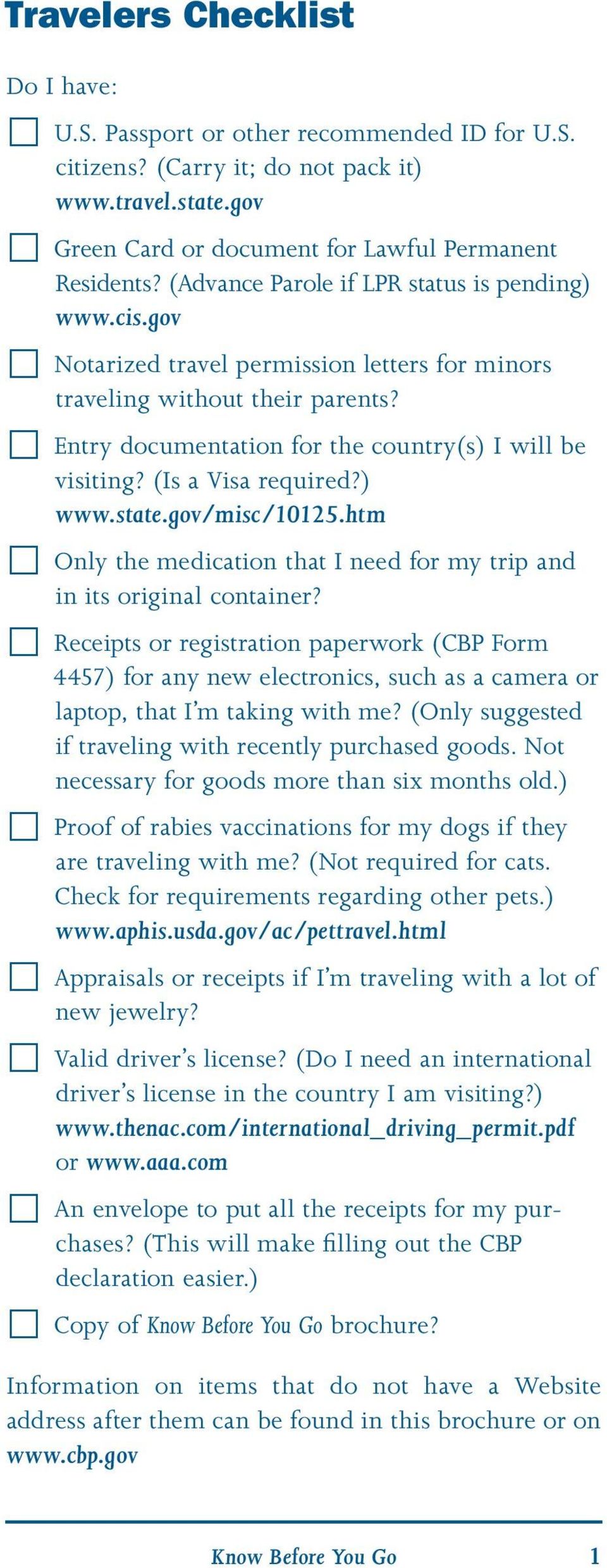
5 Travelers Checklist Do I have: U.S. Passport or other recommended ID for U.S. citizens? (Carry it; do not pack it) Green Card or document for Lawful Permanent Residents? (Advance Parole if LPR status is pending) Notarized travel permission letters for minors traveling without their parents? Entry documentation for the country(s) I will be visiting? (Is a Visa required?) Only the medication that I need for my trip and in its original container? Receipts or registration paperwork (CBP Form 4457) for any new electronics, such as a camera or laptop, that I m taking with me? (Only suggested if traveling with recently purchased goods. Not necessary for goods more than six months old.) Proof of rabies vaccinations for my dogs if they are traveling with me? (Not required for cats. Check for requirements regarding other pets.) Appraisals or receipts if I m traveling with a lot of new jewelry? Valid driver s license? (Do I need an international driver s license in the country I am visiting?) or An envelope to put all the receipts for my purchases? (This will make filling out the CBP declaration easier.) Copy of Know Before You Go brochure? Information on items that do not have a Website address after them can be found in this brochure or on Know Before You Go 1
6 What is CBP? (CBP), within the Department of Homeland Security (DHS), is responsible for keeping America s borders safe and secure. On March 1, 2003, CBP combined the inspectional workforces and broad border authorities of the U.S. Customs Service with three other agencies: Immigration and Naturalization Service, Animal and Plant Health Inspection Service and the Border Patrol. At CBP, our job is to keep terrorists, their weapons, and other illegal material or individuals from entering the United States, while also facilitating the flow of legitimate trade and travel. For obvious reasons, this mission is vitally important. We are dedicated to carrying it out to the best of our abilities. Your Inspection To keep our borders secure, we must inspect everyone who arrives at a U.S. port of entry. We pledge to treat you courteously and professionally. We do not assume that you have done anything wrong because very few travelers actually violate the law. As part of your inspection, you may be asked questions on the nature of your citizenship your trip, and about anything you are bringing back to the United States that you did not have with you when you left. We may also need to examine your baggage or your car, which we have the legal authority to do. If we are checking your baggage, you will need to place it on the exam station and open it. (After the exam is completed, you will be asked to repack and close the baggage.) If you are unhappy with the way you are being treated, ask to speak to a CBP supervisor. 2

7 Terms Used in This Booklet Duty and dutiable are words you will find frequently throughout this brochure: Duty is the amount of money you pay on items coming from another country. It is similar to a tax, except that duty is collected only on imported goods. Dutiable describes items on which duty may have to be paid. Most items have specific duty rates, which are determined by a number of factors, including where you got the item, where it was made, and what it is made of. Also, anything you bring back that you did not have when you left the United States must be declared. For example, you would declare alterations made in a foreign country to a suit you already owned, and any gifts you acquired overseas. Check Our Website Before You Travel! Please note that the information contained within this brochure may change routinely. Visit the travel section of the CBP Website at for the most up-to-date traveler information. Preparing to Return to the United States When you come back, you will need to declare everything you brought back that you did not take with you when you left the United States. If you are traveling by air or sea, you may be asked to fill out a CBP declaration form. This form is almost always provided by the airline or cruise ship. You will probably find it easier and faster to fill out your declaration form and clear CBP if you do the following: Keep your sales slips. Try to pack the things you ll need to declare separately. Read the signs in the arrival area. Know Before You Go 3

8 Documents You Will Need to Enter the United States Important Note: The Western Hemisphere Travel Initiative will soon require all travelers to and from the Americas, the Caribbean, and Bermuda to have a passport or other accepted form of documentation to enter or reenter the United States. The program will be rolled out in phases. The proposed timeline is as follows: December 31, 2006: Requirement applied to all air and sea travel to or from Canada, Mexico, Central and South America, the Caribbean, and Bermuda. December 31, 2007: Requirement extended to all air, sea and land border crossings. (NOTE: These dates are not final until the final ruling is published in the Federal Register later this year.) Until this requirement is in effect as noted above, U.S. citizens are currently exempt from the requirement to show a passport unless they are returning to the U.S. from outside the Western Hemisphere (Europe, Africa, Asia, Australia). However, it is highly recommended that you be prepared to present documentation such as valid U.S. passport, U.S. birth certificate, or naturalization certificate to avoid delays. U.S. Lawful Permanent Residents (LPRs) must provide one of the following in addition to a valid passport: I-551, Permanent Resident Card ( Green Card ) Machine-Readable Immigrant Visa endorsed with a CBP Admission Stamp Temporary Residence Stamp (ADIT stamp) contained in a passport or on Form I-94 Valid Reentry Permit Unexpired Immigrant Visa Visitors/Non-immigrants must provide: Generally, a valid unexpired passport and visa. (However, certain people may require specific supporting documentation such as an employment petition, student authorization, or approval notice.) 4

9 Citizens of countries authorized to participate in the Visa Waiver Program are required to present an unexpired machine-readable passport. (For additional information refer to the State Department at without_1990.html.) Mexicans may provide a valid DSP-150 (BCC) in lieu of a valid passport and visa Generally, Canadian Nationals must show ID but are exempt from passport and visa requirements. However presentation of a Canadian passport, birth certificate, naturalization certificate or other supporting documentation will facilitate the inspection and is strongly encouraged. Nationals of countries authorized to participate in the Visa Waiver Program are required to present an unexpired passport. Advance Parole Caution Due to recent changes to U.S. immigration law, travel outside of the United States may have severe consequences for aliens who are in the process of adjusting their status or applying for an immigrant visa (refugees and asylees). Upon return, these aliens may be found inadmissible, their applications may be denied, or both. It is important that the alien obtain the proper documentation before leaving the United States. Aliens who have pending applications for certain immigration benefits need Advance Parole to re-enter the U.S. after traveling abroad. Aliens applying for advance parole on the basis of a pending application for adjustment of status must be approved for advance parole prior to leaving the United States in order to avoid the termination of their pending application for adjustment. Note: this does not apply to aliens who have applied to adjust to permanent resident status and who maintain H-1B (Specialty Worker) or L-1 (Intracompany Transferee) status, or their dependents, who have applied to adjust to permanent resident status and who have valid H-1B or L status and valid visas, V nonimmigrants who have a valid V nonimmigrant visa, are in valid V nonimmigrant status and have or obtain a valid Know Before You Go 5

10 V nonimmigrant visa before applying for readmission to the US, and K-3/4 nonimmigrants who have applied to adjust to permanent resident status and who have a valid K-3/4 nonimmigrant visa, are in valid K-3/4 nonimmigrant status and have or obtain a valid K-3/4 nonimmigrant visa before applying for readmission to the US. An I-131 application for Advance Parole is filed with U.S. Citizenship and Immigration Services (USCIS) pursuant to the instructions found on their Website, www. uscis.gov. Aliens in the United States should, prior to departure, obtain Advance Parole in order to re-enter the United States after travel abroad if they have: Filed an application for adjustment of status but have not received a decision from the U.S. Citizenship and Immigration Services; Hold refugee or asylee status and intend to depart temporarily to apply for a U.S. immigrant visa in Canada; and/or An emergent personal or bona fide reason to travel temporarily abroad. Applicants who are the beneficiary of a Private bill and Applicants who are under deportation proceedings must file to the Department of Homeland Security, 425 I Street, NW, ATTN: Parole and Humanitarian Assistance Branch, Washington, DC Aliens in the United States are not eligible for Advance Parole if they are: In the United States illegally; or An exchange alien subject to the foreign residence requirement. Please note that Advance Parole does not guarantee admission into the United States. Aliens with Advance Parole are still subject to the U.S. Customs and Border Protection inspection process at the port of entry. 6

11 For more information, please visit the State Department Website at or the U.S. Department of Homeland Security Website at To apply for a passport, U.S. citizens can visit state.gov or call the U.S. Passport Office at USA- PPT or TDD/TYY: Foreign residents should contact their respective governments to obtain passports. Visa Waiver Program Participating Countries Andorra Luxembourg Australia Monaco Austria The Netherlands Belgium New Zealand Brunei Norway Denmark Portugal Finland San Marino France Singapore Germany Slovenia Iceland Spain Ireland Sweden Italy Switzerland Japan United Kingdom Liechtenstein For more information on documentation requirements for VWP participating countries, contact your consulate or embassy or their Website at gov/ for further instructions. What You Must Declare Items you purchased and are carrying with you upon return to the United States. Items you received as gifts, such as wedding or birthday presents. Items you inherited. Items you bought in duty-free shops, on the ship, or on the plane. Repairs or alterations to any items you took abroad and then brought back, even if the repairs/ alterations were performed free of charge. Items you brought home for someone else. Items you intend to sell or use in your business. Know Before You Go 7

12 Also, if you acquired items in the U.S. Virgin Islands, American Samoa, Guam, or in a Caribbean Basin Economic Recovery Act country (see section on $800 exemption for a list of these countries) and asked the merchant to send them to you, you must still declare them when you go through customs. This differs from the usual procedure for mailed items, which is discussed in the section on Sending Goods to the United States. You must state on the CBP declaration, in U.S. currency, what you actually paid for each item. The price must include all taxes. If you don t know for sure, estimate. If you did not buy the item yourself for example, if it is a gift estimate its fair retail value in the country where you received it. Remember: Even if you used the item you bought on your trip, it s still dutiable. You must declare the item at the price you paid or, if it was a gift, at its fair market value. Tip: Register Items Before You Leave the United States If your laptop computer was made in Japan for instance you might have to pay duty on it each time you brought it back into the United States, unless you could prove that you owned it before you left on your trip. Documents that fully describe the item such as sales receipts, insurance policies, or jeweler's appraisals are acceptable forms of proof. To make things easier, you can register certain items with CBP before you depart including watches, cameras, laptop computers, firearms, and CD players as long as they have serial numbers or other unique, permanent markings. Take the items to the nearest CBP office and request a Certificate of Registration (CBP Form 4457). It shows that you had the items with you before leaving the United States and all items listed on it will be allowed duty-free entry. CBP officers must see the item you are registering in order to certify the certificate of registration. You can also register items with CBP at the international airport from which you re departing. Keep the certificate for future trips. 8

13 Duty-Free Exemption The duty-free exemption, also called the personal exemption, is the total value of merchandise you may bring back to the United States without having to pay duty. You may bring back more than your exemption, but you will have to pay duty on it. In most cases, the personal exemption is $800, but there are some exceptions to this rule, which are explained below. Exemptions Depending on the countries you have visited, your personal exemption will be $200, $800, or $1,600. There are limits on the amount of alcoholic beverages, cigarettes, cigars, and other tobacco products you may include in your duty-free personal exemption. The differences are explained in the following section. The duty-free exemptions ($200, $800, or $1,600) apply if: The items are for your personal or household use or intended to be given as gifts. They are in your possession, that is, they accompany you when you return to the United States. Items to be sent later may not be included in your $800 duty-free exemption. (Exceptions apply for goods sent from Guam or the U.S. Virgin Islands.) They are declared to CBP. If you do not declare something that should have been declared, you risk forfeiting it. If in doubt, declare it. You are returning from an overseas stay of at least 48 hours. For example, if you leave the United States at 1:30 p.m. on June 1, you would complete the 48-hour period at 1:30 p.m. on June 3. This time limit does not apply if you are returning from Mexico or from the U.S. Virgin Islands. (See also the section on the $200 exemption.) You have not used all of your exemption allowance, or used any part of it, in the past 30 days for example, if you go to England and bring back $150 worth of items you must wait another 30 days before you are allowed another $800 exemption. (See the section on the $200 exemption.) Know Before You Go 9

14 The items are not prohibited or restricted as discussed in the section on Prohibited and Restricted Items. Note the embargo prohibitions on products of Cuba. Joint Declaration Family members who live in the same home and return together to the United States may combine their personal exemptions. This is called a joint declaration. For example, if Mr. and Mrs. Smith travel overseas and Mrs. Smith brings home a $1,000 piece of glassware, and Mr. Smith buys $600 worth of clothing, they can combine their individual $800 exemptions on a joint declaration and not have to pay duty. Children and infants are allowed the same exemption as adults, except for alcoholic beverages and tobacco products. Types of Exemptions $200 Exemption If you cannot claim other exemptions because: you have been out of the country more than once in a 30-day period or because you have not been out of the country for at least 48 hours, you may still bring back $200 worth of items free of duty and tax. As discussed earlier, these items must be for your personal or household use. If you bring back more than $200 worth of dutiable items, or if any item is subject to duty or tax, the entire amount will be dutiable. For instance, you were out of the country for 36 hours and came back with a $300 piece of pottery. You could not deduct $200 from its value and pay duty on $100. The pottery would be dutiable for the full value of $300. You may include with the $200 exemption your choice of the following: 50 cigarettes and 10 cigars and 150 milliliters (5 fl. oz.) of alcoholic beverages or 150 milliliters (5 fl. oz.) of perfume containing alcohol. 10

15 Note that unlike other exemptions, family members may not combine their individual $200 exemptions. Thus, if Mr. and Mrs. Smith spend a night in Canada, each may bring back up to $200 worth of goods, but they would not be allowed a collective family exemption of $400. Also, duty on items you mail home to yourself will be waived if the value is $200 or less. (See the sections on Gifts and Sending Goods to the United States.) $800 Exemption If you are arriving from anywhere other than a U.S. insular possession (U.S. Virgin Islands, American Samoa, or Guam) you may bring back $800 worth of items duty free, as long as you bring them with you. This is called accompanied baggage. For Caribbean Basin or Andean countries, your exemption is also $800. These countries include: Antigua and Barbuda Guyana Aruba Haiti Bahamas Honduras Barbados Jamaica Belize Montserrat Bolivia Netherlands Antilles British Virgin Islands Nicaragua Colombia Panama Costa Rica Peru Dominica Saint Kitts and Nevis Dominican Republic Saint Lucia Ecuador Saint Vincent and the El Salvador Grenadines Grenada Trinidad and Tobago Guatemala You may include two liters of alcoholic beverages with this $800 exemption, as long as one of the liters was produced in one of the countries listed above (see section on Unaccompanied Purchases from Insular Possessions and Caribbean Basin or Andean Countries). Depending on what items you re bringing back from your trip, you could come home with more than $800 Know Before You Go 11

16 worth of gifts or purchases and still not be charged duty. For instance, say you received a $700 bracelet as a gift, and you bought a $40 hat and a $60 color print. Because these items total $800, you would not be charged duty, since you have not exceeded your dutyfree exemption. If you had also bought a $500 painting on that trip, you could bring all $1300 worth of merchandise home without having to pay duty, because fine art is duty-free. $1,600 Exemption If you return directly or indirectly from a U.S. insular possession (U.S. Virgin Islands, American Samoa, or Guam), you are allowed a $1,600 duty-free exemption. If you travel to a U.S. insular possession and to one or more of the Caribbean Basin or Andean countries listed above, let s say on a Caribbean cruise, you may bring back $1,600 worth of items without paying duty, but only $800 worth of these items may come from the Caribbean Basin or Andean country(ies). Any amount beyond $800 will be dutiable unless you acquired it in one of the insular possessions. For example, if you were to travel to the U.S. Virgin Islands and Jamaica, you would be allowed to bring back $1,600 worth of merchandise duty free, as long as only $800 worth was acquired in Jamaica. Also, you may include 1,000 cigarettes as part of the $1600 exemption, but at least 800 of them must have been acquired in an insular possession. Only 200 cigarettes may have been acquired elsewhere. For example, if you were touring the South Pacific and you stopped in Tahiti, American Samoa, and other ports of call, you could bring back five cartons of cigarettes, but four of them would have to have been bought in American Samoa. Similarly, you may include five liters of alcoholic beverages in your duty-free exemption, but one of them must be a product of an insular possession. Four may be products of other countries (see section on Unaccompanied Purchases from Insular Possessions and Caribbean Basin Countries). 12

17 For Frequent Travelers If you cross the U.S. border into a foreign country and reenter the United States more than once in a short time, you may not want to use your personal exemption until you have returned to the United States for the last time. This is due to the once every 30 days rule you can only apply your personal exemption once every 30 days. So as an example, you go to Canada, buy a liter of liquor, reenter the United States, then go back to Canada and buy $900 worth of merchandise and more liquor. You would probably want to save your $800 exemption for those final purchases and not use it for that first liter of liquor. In this case, on your first swing-back, simply tell the CBP officer that you want to pay duty on the liquor, even though you could bring it in duty free. Duty-Free or Reduced Rates Items from Certain Countries The United States gives duty preferences that is, free or reduced rates to certain developing countries under a trade program called the Generalized System of Preferences (GSP). Some products that would otherwise be dutiable are not when they come from a GSP country. (For details on this program, as well as the complete list of GSP countries, please look for it on our Website.) Similarly: Many products of Caribbean and Andean countries are exempt from duty under the Caribbean Basin Initiative, Caribbean Basin Trade Partnership Act, Andean Trade Preference Act and the Andean Trade Promotion and Drug Eradication Act. Many products of certain sub-saharan African countries are exempt from duty under the African Growth and Opportunity Act. Most products of Israel, Jordan, Chile and Singapore may also enter the United States either free of duty or at a reduced rate under the U.S. free Know Before You Go 13

18 trade agreements with those countries. Check with cbp.gov for details on these programs. The North American Free Trade Agreement (NAFTA) went into effect in If you are returning from Canada or Mexico, your goods are eligible for free or reduced duty rates if they were grown, manufactured, or produced in Canada or Mexico, as defined by the Act. Access the CBP Website for further details. Household Effects Household effects are duty-free. These include such items as furniture, carpets, paintings, tableware, stereos, linens, and similar household furnishings; tools of the trade, professional books, implements, and instruments. You may import household effects you acquired abroad duty-free if: You used them for at least one year while you were abroad. They are not intended for anyone else or for sale. Clothing, jewelry, photography equipment, portable radios, and vehicles are considered personal effects and cannot be brought in duty-free as household effects. However, duty is usually waived on personal effects over 1 year of age. All vehicles are dutiable. Increased Duty Rates Items from Certain Countries Under what is known as its 301 authority, the United States may impose a much higher than normal duty rate on products from certain countries. Currently, the United States has imposed a 100 percent rate of duty on certain products of Austria, Belgium, Denmark, Finland, France, The Federal Republic of Germany, Greece, Ireland, Italy, Luxembourg, the Netherlands, Portugal, Spain, Sweden and the Ukraine. If you should bring more of any of these products back with you than fall within your exemption or flat rate of duty, (see 14

19 below) you will pay as much in duty as you paid for the product or products. While most of the products listed are not the type of goods that travelers would purchase in sufficient quantities to exceed their exemption, diamonds from the Ukraine are subject to the 100 percent duty and might easily exceed the exemption amount. For information on countries that may become subject to a higher than normal duty rate, check the Department of Commerce Website at Determining Duty The CBP officer will place the items that have the highest rate of duty under your exemption. Then, after subtracting your exemptions and the value of any dutyfree items, a flat rate of duty will be charged on the next $1,000 worth of merchandise. Any dollar amount beyond this $1,000 will be dutiable at whatever duty rates apply. The flat rate of duty may only be used for items for your own use or for gifts. As with your exemption, you may use the flat rate provision only once every 30 days. Special flat rates of duty apply to items made and acquired in Canada or Mexico. The flat rate of duty applies to only to those purchases that accompany you on your return to the United States. The following is an example of the different rates if you acquire goods valued at $3,500 from various different places: Country U.S. insular possessions Caribbean Basin countries Other countries or locations Total declared value Personal exemption (duty-free) Flat duty rate $3,500 $1,600 $1,000 at 1.5 percent $3,500 $800 $1,000 at 3 percent $3,500 $800 $1,000 at 3 percent Various duty rates $900 $1,700 $1,700 The flat duty rate will be charged on items that are dutiable but that cannot be included in your personal exemption, even if you have not exceeded the exemp- Know Before You Go 15

20 tion. The best example of this is liquor. If you return from Europe with $200 worth of items, including two liters of liquor, one liter will be duty-free under your exemption; the other will be dutiable at 3 percent, plus any Internal Revenue Service tax. Family members who live in the same household and return to the United States together can combine their items to take advantage of a combined flat duty rate, no matter which family member owns a given item. The combined value of merchandise subject to a flat duty rate for a family of four traveling together would be $4,000. Tobacco Products Travelers may import previously exported tobacco products only in quantities not exceeding the amounts specified in exemptions for which the traveler qualifies. Any quantities of previously exported tobacco products not permitted by an exemption will be seized and destroyed. These items are typically purchased in dutyfree stores, on carriers operating internationally, or in foreign stores. These items are usually marked Tax Exempt. For Use Outside the United States, or U.S. Tax Exempt For Use Outside the United States. For example, a returning resident is eligible for the $800 exemption, which includes not more than 200 cigarettes and 100 cigars: If the resident declares 400 previously exported cigarettes, the resident would be permitted 200 cigarettes, tax-free under the exemption and the remaining 200 previously exported cigarettes would be confiscated. If the resident declares 400 cigarettes, of which 200 are previously exported and 200 not previously exported, the resident would be permitted to import the 200 previously exported cigarettes tax free under the exemption and the resident would be charged duty and tax on the remaining 200 foreign-made cigarettes. The tobacco exemption is available to each adult. Except for information and informational materials, no travel- 16

21 er (whether traveling legally under an Office of Foreign Asset Control (OFAC) license or traveling illegally without an OFAC license) may import Cuban-made goods, including Cuban cigars, unless authorized to do so by a specific license issued by OFAC. Alcoholic Beverages One liter (33.8 fl. oz.) of alcoholic beverages may be included in your exemption if: You are 21 years old. It is for your own use or as a gift. It does not violate the laws of the state in which you arrive. Federal regulations allow you to bring back more than one liter of alcoholic beverage for personal use, but, as with extra tobacco, you will have to pay duty and Internal Revenue Service tax. While Federal regulations do not specify a limit on the amount of alcohol you may bring back for personal use, unusual quantities are liable to raise suspicions that you are importing the alcohol for other purposes, such as for resale. CBP officers are authorized by the Bureau of Alcohol, Tobacco, Firearms and Explosives (ATF) to make on-the-spot determinations that an importation is for commercial purposes, and may require you to obtain a permit to import the alcohol before releasing it to you. If you intend to bring back a substantial quantity of alcohol for your personal use, you should contact the port through which you will be re-entering the country, and make prior arrangements for entering the alcohol into the United States. Also, you should be aware that state laws might limit the amount of alcohol you can bring in without a license. If you arrive in a state that has limitations on the amount of alcohol you may bring in without a license, that state law will be enforced by CBP, even though it may be more restrictive than federal regulations. We recommend that you check with the state government before you go abroad about their limitations on quantities allowed for personal importation and additional state taxes that might apply. Know Before You Go 17
22 In brief, for both alcohol and tobacco, the quantities discussed in this booklet as being eligible for duty-free treatment may be included in your $800 or $1,600 exemption, just as any other purchase would be. But unlike other kinds of merchandise, amounts beyond those discussed here as being duty-free are taxed, even if you have not exceeded, or even met, your personal exemption. For example, if your exemption is $800 and you bring back three liters of wine and nothing else, two of those liters will be dutiable. Federal law prohibits shipping alcoholic beverages by mail within the United States. Paying Duty If you owe duty, you must pay it when you arrive in the United States. You can pay it in any of the following ways: U.S. currency. Foreign currency is not acceptable. Personal check in the exact amount, drawn on a U.S. bank, made payable to U.S. Customs and Border Protection. You must present identification, such as a passport or driver s license. CBP does not accept checks bearing second-party endorsements. Government check, money order, or traveler s check if the amount does not exceed the duty owed by more than $50. In some locations, you may pay duty with credit cards, either MasterCard or VISA. Sending Items Back to the United States Unaccompanied baggage is anything you do not bring back with you. These may be items that were with you when you left the United States or items that you acquired (received by any means) while outside the United States. In general, unaccompanied baggage falls into three categories: U.S. mail, express shipments, and freight. U.S. Mail Shipments Shipping through the U.S. mail, including parcel post, is a cost-efficient way to send items to the United States. 18
23 The Postal Service sends all foreign mail shipments to CBP for examination. CBP officers then return packages that do not require duty to the Postal Service, which sends them to a local post office for delivery. The local post office delivers them without charging any additional postage, handling costs, or other fees. Packages that contain fruits, vegetables, meat or other items of agricultural interest are inspected to ensure that items meet the requirements of the U.S. Department of Agriculture, Animal Plant Health Inspection Service, Plant Protection and Quarantine. The CBP agriculture specialist encloses a Mail Interception Notice, PPQ Form 287, to document any agriculture items that are removed from the package. The package is returned to the U.S. Postal Service for delivery. (Information on importing agriculture items is located on the U.S. Department of Agriculture Website at gov.) If the package does require payment of duty, CBP attaches a form called a mail entry, CBP Form 3419Alt, which indicates how much duty is owed and charges a $5 processing fee as well. When the post office delivers the package, it will also charge a small handling fee. Commercial goods goods intended for resale may have special entry requirements. Such goods may require a formal entry in order to be admitted into the United States. Formal entries are more complicated and require more paperwork than informal entries. Generally, informal entries are personal packages or commercial items worth less than $2,000. CBP employees may not prepare formal entries for you; only you or a licensed customs broker may prepare one. For more information on this subject, please see the brochure U.S. Import Requirements. If you believe you have been charged an incorrect amount of duty on a package mailed from abroad, you may file a protest with CBP. You can do this in one of two ways. You can accept the package, pay the duty, and write a letter explaining why you think the amount was incorrect. You should include with your letter the yellow copy of the mail entry (CBP Form 3419Alt). Send Know Before You Go 19
24 the letter and the form to the CBP office that issued the mail entry, located on the lower left-hand corner of the form. The other way to protest duty is to refuse delivery of the package. Then within five days, send your protest letter to the post office where the package is being held. The post office will forward your letter to CBP and will hold your package until the protest is resolved. For additional information on international mailing, please see the brochure International Mail Imports, or visit the CBP Website at Express Shipments Packages may be sent to the United States by privatesector courier or delivery service from anywhere in the world. The express company usually takes care of clearing your merchandise through customs and charges a fee for its service. Some travelers have found this fee to be higher than they expected. Freight Shipments Cargo, whether duty is owed on it or not, must clear customs at the first port of arrival in the United States. If you choose, you may have your freight sent, while it is still in CBP custody, to another port for clearance. This is called forwarding freight in bond. You, or someone you appoint to act for you, are responsible for arranging to clear your merchandise through CBP or for having it forwarded to another port. Frequently, a freight forwarder in a foreign country will take care of these arrangements, including hiring a customs broker in the United States to clear the merchandise through CBP. Whenever a third party handles the clearing and forwarding of your merchandise, that party charges a fee for its services. This fee is not a CBP charge. There are several ways a traveler can find a broker: Phone book - in the Yellow Pages under "Customs Brokers" Internet - search for "Customs Brokers" 20
25 CBP Website - click the "ports" button, click the state of interest and click on a city within the state. Under each city is a listing of brokers. Click "view list" for a listing of brokers in that area. The phone book listings as well as the Internet listings are limited to brokers that submit the information. It is not all-inclusive. The listing of brokers on the CBP Website is updated on a regular basis. Listed brokers have a current permit in that port. This list is the only broker information provided by CBP. When a foreign seller entrusts a shipment to a broker or agent in the United States, that seller usually pays only enough freight to have the shipment delivered to the first port of arrival in the United States. This means that you, the buyer, will have to pay additional inland transportation, or freight forwarding charges, plus broker fees, insurance, and possibly other charges. If it is not possible for you to secure release of your goods yourself, another person may act on your behalf to clear them through CBP. You may do this as long as your merchandise consists of a single, noncommercial shipment (not intended for resale) that does not require a formal entry in other words, if the merchandise is worth less than $2,000 and you must give the person a letter that authorizes that person to act as your unpaid agent. Once you have done this, that person may fill out the CBP declaration and complete the entry process for you. Your letter authorizing the person to act in your behalf should be addressed to the Officer in Charge of CBP at the port of entry, and the person should bring the letter with them when they go to clear your package. CBP will not notify you when your shipment arrives, as this is the responsibility of your carrier. If your goods are not cleared within 15 days of arrival you could incur expensive storage fees. Know Before You Go 21
26 Gifts Gifts you bring back Gifts you bring back for your personal use must be declared, but you may include them in your personal exemption. This includes gifts people gave you while you were out of the country, such as wedding or birthday presents, and gifts you have brought back for others. Gifts intended for business, promotional, or other commercial purposes may not be included in your duty-free exemption. Also note that by federal law, alcoholic beverages, tobacco products, and perfume containing alcohol and worth more than $5 retail may not be included in the gift exemption. Gifts you send Gifts worth up to $100 may be sent, free of duty and tax, to friends and relatives in the United States, as long as the same person does not receive more than $100 worth of gifts in a single day. If the gifts are mailed or shipped from an insular possession, this amount is increased to $200. Unless returning to the United States from an insular possession, you don t have to declare gifts you sent while you were on your trip, since they won t be accompanying you. Gifts for more than one person Gifts for more than one person may be shipped in the same package, called a consolidated gift package, if they are individually wrapped and labeled with each recipient s name. Here s how to wrap and label a consolidated gift package. Be sure to mark the outermost wrapper with the: Words UNSOLICITED GIFT and the words CONSOLIDATED GIFT PACKAGE; Total value of the consolidated package; Recipients names and 22
27 Nature and value of the gifts inside. For example, tennis shoes, $50; shirt, $45; toy car, $15. For instance: To John Jones one belt, $20; one box of candy, $5; one tie, $20. To Mary Smith one skirt, $45; one belt, $15; one pair slacks, $30. If any item is worth more than the $100 gift allowance, the entire package will be dutiable. Can I send a gift to myself? You, as a traveler, cannot send a gift package to yourself, and people traveling together cannot send gifts to each other. But there would be no reason to do that anyway, because the personal exemption for packages mailed from abroad is $200, which is twice as much as the gift exemption. Personal Belongings Your personal belongings can be sent back to the United States duty-free if they are of U.S. origin and if they have not been altered or repaired while abroad. Personal belongings like worn clothing can be mailed home and will receive duty-free entry if you write the words American Goods Returned on the outside of the package. If a package is subject to duty If a package is subject to duty, the United States Postal Service will collect it from the addressee along with any postage and handling charges. The sender cannot prepay duty; the recipient must pay duty when a package is received in the United States. For more information about mailing packages to the United States, visit Sending Goods to the United States at kbyg/send_to_us.xml. Know Before You Go 23
28 Sending Purchases from Insular Possessions and Caribbean Basin and Andean Countries Unaccompanied purchases are goods you bought on a trip that are being mailed or shipped to you in the United States. In other words, you are not carrying the goods with you when you return. If your unaccompanied purchases are from an insular possession or a Caribbean Basin country and are being sent directly from those locations to the United States, you may enter them as follows: Up to $1,600 in goods will be duty-free under your personal exemption if the merchandise is from an insular possession. Up to $800 in goods will be duty-free if it is from a Caribbean Basin and Andean country. An additional $1,000 in goods will be dutiable at a flat rate if they are from an insular possession, or from a Caribbean Basin country. (See chart under Paying Duty.) If you are sending more than $2,600 from an insular possession or more than $1,600 from a Caribbean Basin country, the duty rates in the Harmonized Tariff Schedules of the United States will apply. The Harmonized Tariff Schedule describes different rates of duty for different commodities. For example, linen tablecloths will not have the same duty rates as handicrafts or plastic toy trucks. To take advantage of the duty-free exemption for unaccompanied tourist purchases from an insular possession or a Caribbean country: Step 1. At place and time of purchase, ask your merchant to hold your item until you send him or her a copy of CBP Form 255 (Declaration of Unaccompanied Articles), which must be affixed to the package when it is sent. Step 2. (a) On your declaration form (CBP Form 6059B), list everything you acquired on your trip, except the things you already sent home as gifts. You must also 24
29 complete a separate Declaration of Unaccompanied Articles form (CBP Form 255) for each package or container that will be sent to you after you arrive in the United States. This form may be available where you make your purchase. If not, ask a CBP officer for one when you clear the customs area. Step 3. When you return to the United States, the CBP officer will: (a) collect duty and tax on the dutiable goods you have brought with you; (b) check to see that your list of unaccompanied articles, which you indicated on the CBP Form 255, agrees with your sales receipts; (c) validate the CBP Form 255 as to whether your purchases are duty-free under your personal exemption ($1,600 or $800) or whether they are subject to a flat rate of duty. Step 4. Two copies of this three part CBP Form 255 will be returned to you. Send the yellow copy of the CBP Form 255 to the foreign shopkeeper or vendor holding your purchase, and keep the other copy for your records. Step 5. When the merchant gets your CBP Form 255, he or she will put it in an envelope and attach the envelope securely to the outside wrapping of the package or container. The merchant must also mark each package Unaccompanied Purchase. Please remember that each package or container must have its own CBP Form 255 attached. This is the most important step to follow in order to gain the benefits allowed under this procedure. Step 6. If your package has been mailed, the U.S. Postal Service will deliver it after it clears customs. If you owe duty, the Postal Service will collect the duty along with a postal handling fee. If a freight service transports your package, they will notify you of its arrival so you can go to the CBP office holding the shipment and complete the entry procedure. If you owe duty or tax, you can pay it at that time. You could also hire a customs broker to do this for you. However, be aware that brokers are not CBP employees, and they charge fees for their services. If freight or express packages from your trip are delivered before you return and you have not made Know Before You Go 25
30 arrangements to pick them up, CBP will authorize their placement in storage after 15 days. This storage will be at your risk and expense. If they are not claimed within six months, the items will be sold at auction. Packages sent by mail and not claimed within 30 days will be returned to the sender unless the amount of duty is being protested. Duty-Free Shops The term duty-free shops confuses many travelers. Travelers often think that what they buy in duty-free shops will not be dutiable when they return home and clear customs. But this is not true. Articles sold in a duty-free shop are free of duty and taxes only for the country in which that shop is located. So if your purchases exceed your personal exemption, items you bought in a duty-free shop, whether in the United States or abroad, will be subject to duty. Articles purchased in American duty-free shops are also subject to U.S. duty if you bring them into the United States. Therefore, if you buy liquor in a duty-free shop in New York before entering Canada and then bring it back into the United States, it may be subject to duty and Internal Revenue Service tax. Prohibited and Restricted Items CBP has been entrusted with enforcing hundreds of laws for 40 other government agencies, such as the U.S. Fish and Wildlife Service and the U.S. Department of Agriculture. These agencies need to know what people bring into the United States, but they are not always at ports of entry, guarding our borders. CBP officers are always at ports of entry their primary mission is to safeguard America s borders. The products we need to prevent from entering the United States are those that would injure community health, public safety, American workers, children, or domestic plant and animal life, or those that would defeat our national political interests. Sometimes the products that cause injury, or have the potential to 26
31 do so, may seem fairly innocent. But, as you will see from the material that follows, appearances can be deceiving. Before you leave for your trip abroad, you might want to talk to CBP about the items you plan to bring back to be sure they re not prohibited or restricted. Prohibited means the item is forbidden by law to enter the United States. Examples of prohibited items are dangerous toys, cars that don t protect their occupants in a crash, or illegal substances like absinthe and Rohypnol. Restricted means that special licenses or permits are required from a federal agency before the item is allowed to enter the United States. Examples of restricted items include firearms, certain fruits, vegetables, and some animals. Absinthe (Alcohol) The importation of Absinthe and any other liquors or liqueurs that contain Artemisia absinthium is prohibited. Automobiles Automobiles imported into the United States must meet the fuel-emission requirements of the Environmental Protection Agency (EPA) and the safety, bumper, and theft-prevention standards of the U.S. Department of Transportation (DOT). Trying to import a car that doesn t meet all the requirements can be a frustrating experience for the following reasons. (See the CBP brochure, Importing a Car) Almost all cars, vans, sport utility vehicles, and so on that are bought in foreign countries must be modified to meet American standards except most late model vehicles from Canada. Passenger vehicles that are imported on the condition that they be modified must be exported or destroyed if they are not modified acceptably. Also under these circumstances, the vehicle could require a bond upon entry until the conditions for admission have been met. And even if the car does meet all federal standards, it might be subject to additional EPA requirements, depending on what countries it was driven in. You are Know Before You Go 27
32 strongly encouraged to contact EPA and DOT before importing a car. Information on importing vehicles can be obtained from visiting the Environmental Protection Agency Website at by writing to Attn.: 6405J, Washington, DC 20460, or by telephone at , for EPA forms call You may also contact the U.S. Department of Transportation, Office of Vehicle Safety Compliance (NEF 32) NHTSA, Washington, DC 20590, by telephone at , or by visiting the DOT Website at Copies of the brochure Importing or Exporting a Car can be obtained by writing to U.S. Customs and Border Protection, P.O. Box 7407, Washington, DC 20044; or visiting the CBP Website at The EPA Automotive Imports Fact Manual can be obtained by writing to the Environmental Protection Agency, Washington, DC 20460; or by visiting Cars being brought into the United States temporarily, by nonresidents, (for less than one year) are exempt from these restrictions. It is illegal to bring a vehicle into the United States and sell it if it was not formally entered on a CBP Form Biologicals You may need a U.S. Department of Agriculture permit to import biological specimens including bacterial cultures, culture medium, excretions, fungi, arthropods, mollusks, tissues of livestock, birds, plants, viruses, vectors for research, biological or pharmaceutical use. Permit requirements are located under Permits on the USDA Website at For some permits you may have to contact the Centers for Disease Control at Ceramic Tableware Although ceramic tableware is not prohibited or restricted, you should know that such tableware made in foreign countries may contain dangerous levels of lead in the glaze, which can seep into foods and beverages. The U.S. Food and Drug Administration recommends that if you buy ceramic tableware abroad especially 28
33 in Mexico, China, Hong Kong, or India you have it tested for lead release when you return, or use it for decorative purposes only. Cultural Artifacts and Cultural Property (Art/Artifacts) Most countries have laws that protect their cultural property: art/artifacts/antiquities; archaeological and ethnological material are also terms that are used. Such laws include export controls and/or national ownership of cultural property. Even if purchased from a business in the country of origin or in another country, legal ownership of such artifacts may be in question if brought into the United States. Therefore, although they do not necessarily confer owner ship, you must have documents such as export permits and receipts when importing such items into the United States. While foreign laws may not be enforceable in the United States, they can cause certain U.S. laws to be invoked. For example, under the U.S. National Stolen Property Act, one cannot have legal title to art/artifacts/antiquities that were stolen no matter how many times such items may have changed hands. Articles of stolen cultural property from museums or from religious or secular public monuments originating in any of the countries party to the 1970 UNESCO Convention specifically may not be imported into the United States. U.S. law may also restrict the importation of specific categories of art/artifacts/antiquities. For example, U.S. laws restrict the importation of: 1) Any pre Columbian monumental and architectural sculpture and murals from Central and South American countries; 2) Native American artifacts from Canada; Mayan pre Columbian archaeological objects from Guatemala; pre Columbian archaeological objects from El Salvador and Peru; archaeological objects like terracotta statues) from Mali; Colonial period objects such as paintings and ritual objects from Peru; 3) Byzantine period ritual and ecclesiastic objects such as icons from Cyprus; and 4) Khmer stone archaeological sculpture from Cambodia. Importation of items such as those listed above is permitted only when an export permit issued by the Know Before You Go 29
34 country of origin, where such items were first found accompanies them. Purveyors of such items have been known to offer phony export certificates. As additional U.S. import restrictions may be imposed in response to requests from other countries, it is wise for prospective purchasers to visit the State Department cultural property website. This website also has images representative of the categories of cultural property for which there are specific U.S. import restrictions. Merchandise determined to be Iraqi cultural property or other items of archaeological, historical, cultural, rare scientific and religious importance illegally removed from the Iraq National Museum, the National Library and other locations in Iraq, since August 6, 1990, are also prohibited from importation. Dog and Cat Fur It is illegal in the United States to import, export, distribute, transport, manufacture, or sell products containing dog or cat fur in the United States. As of November 9, 2000, the Dog and Cat Protection Act of 2000 calls for the seizure and forfeiture of each item containing dog or cat fur. The Act provides that any person who violates any provision may be assessed a civil penalty of not more than $10,000 for each separate knowing and intentional violation, $5,000 for each separate gross negligent violation, or $3,000 for each separate negligent violation. Drug Paraphernalia It is illegal to bring drug paraphernalia into the United States unless they have been prescribed for authentic medical conditions such as diabetes. CBP will seize any illegal drug paraphernalia. Law prohibits the importation, exportation, manufacture, sale, or transportation of drug paraphernalia. If you are convicted of any of these offenses, you will be subject to fines and imprisonment. Firearms The Bureau of Alcohol, Tobacco, Firearms and Explosives (ATF) regulates and restricts firearms and ammunition; 30
35 and approves all import transactions involving weapons and ammunition. If you want to import or export weapons or ammunition, you must do so through a licensed importer, dealer, or manufacturer. Also, if the National Firearms Act prohibits certain weapons, ammunition, or similar devices from coming into the country, you will not be able to import them unless the ATF provides you with written authorization to do so. You do not need an ATF permit if you can demonstrate that you are returning with the same firearms or ammunition that you took out of the United States. To prevent problems when returning, you should register your firearms and related equipment by taking them to any CBP office before you leave the United States. The CBP officer will register them on the same CBP Form used to register cameras or computers. (See the section on Register Items Before You Leave the United States). For further information about importing weapons, contact the Bureau of Alcohol, Tobacco, Firearms and Explosives, U.S. Department of Justice, Washington, DC 20226; or call ; or visit Many countries will not allow you to enter with a firearm even if you are only traveling through the country on the way to your final destination. If you plan to take your firearms or ammunition to another country, you should contact officials at that country s embassy to learn about its regulations. Fish and Wildlife Certain fish and wildlife, and products made from them are subject to import and export restrictions, prohibitions, permits or certificates, and quarantine requirements. We recommend that you contact the U.S. Fish and Wildlife Service before you depart if you plan to import or export any of the following: Wild birds, land or marine mammals, reptiles, fish, shellfish, mollusks, or invertebrates. Any part or product of the above, such as skins, tusks, bone, feathers, or eggs. Products or articles manufactured from wildlife or fish. Know Before You Go 31
36 Endangered species of wildlife, and products made from them, generally may not be imported or exported. You will need a permit from the U.S. Fish and Wildlife Service to import virtually all types of ivory, unless it is from a warthog. The U.S. Fish and Wildlife Service has so many restrictions and prohibitions on various kinds of ivory Asian elephant, African elephant, whale, rhinoceros, seal, pre-endangered Species Act, post-cites (Convention on International Trade in Endangered Species), and many others that they urge you to contact them before you even think of acquiring ivory in a foreign country. You may contact them at You may import an object made of ivory if it is an antique. To be an antique the ivory must be at least 100 years old. You will need documentation that authenticates the age of the ivory. You may import other antiques containing wildlife parts with the same condition, but they must be accompanied by documentation proving they are at least 100 years old. Certain other requirements for antiques may apply. If you plan to buy such things as tortoiseshell jewelry, or articles made from whalebone, ivory, skins, or fur, contact the U.S. Fish and Wildlife Service, Division of Law Enforcement, P.O. Box 3247, Arlington, VA , or call or visit gov. Hunters can get information on the limitations for importing and exporting migratory game birds from this office as well. Ask for their pamphlet, Facts About Federal Wildlife Laws. The U.S. Fish and Wildlife Service has designated specific ports of entry to handle fish and wildlife entries. If you plan to import anything discussed in this section, please contact CBP. CBP will tell you about designated ports and send you the brochure Pets and Wildlife, which describes the regulations CBP enforces for all agencies that oversee the importation of animals. Some states have fish and wildlife laws and regulations that are stricter than federal laws and regulations. If you are returning to such a state, be aware that the stricter state laws and regulations have priority. Similarly, the 32
37 federal government does not allow you to import wild animals into the United States that were taken, killed, sold, possessed, or exported from another country if any of these acts violated foreign laws. Food Products (Prepared) You may bring bakery items and certain cheeses into the United States. The APHIS website features a Travelers Tips section and Game and Hunting Trophies section that offers extensive information about bringing food and other products into the country. Many prepared foods are admissible. However, almost anything containing meat products, such as bouillon, soup mixes, etc., is not admissible. As a general rule, condiments, vinegars, oils, packaged spices, honey, coffee and tea are admissible. Because rice can often harbor insects, it is best to avoid bringing it into the United States. Some imported foods are also subject to requirements of the U.S. Food and Drug Administration. Prior Notice for Food Importation The Public Health Security and Bioterrorism Preparedness and Response Act of 2002 (Bioterrorism Act or BTA), Public Law , established the requirement that food items, imported (or offered for import) for commercial use, including hand-carried quantities, be properly reported to the U.S. Food and Drug Administration (FDA) prior to arrival of those items in the United States. The FDA prior notification timeframes (by transport mode) are two hours by land, four hours by rail or air, eight hours by vessel and prior to the time of mailing for international mail. Food that was made by an individual in his/her personal residence, or food purchased by an individual from a vendor that is sent by that individual as a personal gift (for non-business reasons) to someone in the United States is not subject to BTA requirements. However, food that is sent to an individual in the United States by a business is subject to special requirements of the U.S. Food and Drug Administration. For instance, if you go to a food shop in England and buy a gift basket, then take it to the post office or a courier service to send to a friend, the shipment is not subject to BTA requirements. Know Before You Go 33
38 But if you go to that same shop and ask them to send the gift basket for you, the shipment is subject to BTA requirements, and the vendor will have to file Prior Notice. Many travelers are finding that vendors will not ship food directly to U.S. residents because the reporting requirements can be time-consuming to complete. In general, failure to provide complete, timely and accurate prior notice for BTA regulated items, can result in refusal of admission of the merchandise, movement of the goods to an FDA registered facility (at importer expense) and/or civil monetary penalty liabilities for any party that was involved in the import transaction. For full details regarding the latest FDA BTA requirements, including those food items exempt from these requirements, access the FDA Website at oc/bioterrorism/bioact.html. Fruits and Vegetables Bringing fruits and vegetables can be complicated. For instance, consider the apple you bought in the foreign airport just before boarding and then did not eat? Whether or not CBP will allow the apple into the United States depends on where you got it and where you are going after you arrive in the United States. The same would be true for those magnificent Mediterranean tomatoes. Fresh fruits and vegetables can carry plant pests or diseases into the United States. One good example of problems imported fruits and vegetables can cause is the Mediterranean fruit fly outbreak during the 1980s. The outbreak cost the state of California and the Federal Government approximately $100 million to get rid of this pest. The cause of the outbreak was one traveler who brought home one contaminated piece of fruit. It is best not to bring fresh fruits or vegetables into the United States. However, if you plan to, contact either CBP or check the Permits section on the USDA-APHIS Website at aphis.usda.gov/ppq/permits/plantproducts/index.html for a general approved list on items that need a permit. 34
39 Game and Hunting Trophies If you plan to import game or a hunting trophy, please contact the U.S. Fish and Wildlife Service before you leave at Currently, 14 ports of entry are designated to handle game and trophies; other ports must get approval from the U.S. Fish and Wildlife Service to clear your entry. Depending on the species you bring back, you might need a permit from the country where the animal was harvested. Regardless of the species, you are required to fill out a Fish and Wildlife Form 3-177, Declaration for Importation or Exportation. Trophies may also be subject to inspection by CBP for sanitary purposes. General guidelines for importing trophies can be found on APHIS Website under the APHIS Import Authorization System (IAS) at web01.aphis.usda.gov/ias.nsf/mainform?openform; or by writing to USDA, APHIS, VS, NCIE Products Program, 4700 River Road, Unit 40, Riverdale, MD ; or by calling Also, federal regulations do not allow the importation of any species into a state with fish or wildlife laws that are more restrictive than federal laws. If foreign laws were violated in the taking, sale, possession, or export to the United States of wild animals, those animals will not be allowed entry into the United States. Warning: There are many regulations, enforced by various agencies, governing the importation of animals and animal parts. Failure to comply with them could result in time-consuming delays in clearing your trophy through CBP. You should always call for guidance before you depart. Gold Gold coins, medals, and bullion, formerly prohibited, may be brought into the United States. However, under regulations administered by the Office of Foreign Assets Control, such items originating in or brought from Cuba, Iran, Iraq, Libya, Serbia, and Sudan are prohibited entry. Copies of gold coins are prohibited if not properly marked by country of issuance. Know Before You Go 35
40 Meats, Livestock, and Poultry The regulations governing meat and meat products are very strict. You may not import fresh, dried, or canned meats or meat products from most foreign countries into the United States. Also, you may not import food products that have been prepared with meat. The regulations on importing meat and meat products change frequently because they are based on disease outbreaks in different areas of the world. APHIS, which regulates meats and meat products as well as fruits and vegetables, invites you to contact them for more information on importing meats. You may write to USDA-APHIS Veterinary Services National Center for Import/Export (NCIE), 4700 River Road, Unit 40, Riverdale, MD ; or call Medication Rule of thumb: When you go abroad, take the medicines you will need, no more, no less. Narcotics and certain other drugs with a high potential for abuse Rohypnol, GHB, and Fen-Phen, to name a few may not be brought into the United States, and there are severe penalties for trying to do so. If you need medicines that contain potentially addictive drugs or narcotics (e.g., some cough medicines, tranquilizers, sleeping pills, antidepressants, or stimulants), do the following: Declare all drugs, medicinals, and similar products to the appropriate CBP official. Carry such substances in their original containers. Carry only the quantity of such substances that a person with that condition (e.g., chronic pain) would normally carry for his/her personal use. Carry a prescription or written statement from your physician that the substances are being used under a doctor's supervision and that they are necessary for your physical well being while traveling. U.S. residents entering the United States at international land borders, who are carrying a validly obtained controlled substance (other than narcotics such as marijuana, cocaine, heroin, or LSD), are subject to certain additional requirements. If a U.S. resident wants to bring in a controlled substance (other than narcotics such as marijuana, cocaine, heroin, or LSD) but does 36
41 not have a prescription for the substance issued by a U.S.-licensed practitioner (e.g., physician, dentist, etc.) who is registered with, and authorized by, the Drug Enforcement Administration (DEA) to prescribe the medication, the individual may not import more than 50 dosage units of the medication into the United States. If the U.S. resident has a prescription for the controlled substance issued by a DEA registrant, more than 50 dosage units may be imported by that person, provided all other legal requirements are met. Please note that only medications that can be legally prescribed in the United States may be imported for personal use. Be aware that possession of certain substances may also violate state laws. As a general rule, the FDA does not allow the importation of prescription drugs that were purchased outside the United States. Please see their website for information about the enforcement policy for personal use quantities. Warning: The U.S. Food and Drug Administration (FDA) prohibits the importation, by mail or in person, of fraudulent prescription and nonprescription drugs and medical devices. These include unorthodox cures for such medical conditions as cancer, AIDS, arthritis, or multiple sclerosis. Although such drugs or devices may be legal elsewhere, if the FDA has not approved them for use in the United States, they may not legally enter the country and will be confiscated, even if they were obtained under a foreign physician s prescription. For specifics about importing controlled substances, call For additional information about traveling with medication, contact your nearest FDA office or write to the U.S. Food and Drug Administration, Division of Import Operations and Policy, Room 12-8 (HFC-170), 5600 Fishers Lane, Rockville, MD Merchandise from Embargoed Countries Generally, you may not bring in any goods from the following (if not followed by an asterisk or where specified that the embargo only applies to diamonds): Cuba, Iran*, Iraq*, Serbia and Montenegro*, North Korea*, Burma (Myanmar), Angola, Liberia and Sierra Leone (diamonds only) and Sudan. The Office of Know Before You Go 37
42 Foreign Assets Control (OFAC) of the U.S. Department of Treasury enforces this ban. *The embargo on Iranian goods has been revised to allow the importation of food stuffs intended for human consumption, carpets and other textile floor coverings. Please check with your local port for further details. *Only certain Iraqi cultural property or other items of archaeological, historical/cultural, rare scientific and religious importance illegally removed from the Iraq National Museum, the National Library and other locations in Iraq is prohibited. *There is a general lifting of the embargo on Serbia and Montenegro (exception relates to certain Specially Designated Nationals and Blocked Persons involving transactions prior to January 19, 2000). For more information visit OFAC Website at gov/offices/eotffc/ofac/. *The importation of merchandise from North Korea requires a letter of approval issued by the OFAC. You may, however, may bring in information and informational materials books, magazines, films, posters, photographs, microfilms, tapes, CDs, records, works of art, etc. Blank tapes and blank CDs are not informational materials. If you want to import merchandise from any of these countries, you will first need a specific license from the Office of Foreign Assets Control. Such licenses are rarely granted. There are strictly enforced restrictions on travel to these countries. Therefore, before making plans to visit any of the countries on this list, you should write to the Office of Foreign Assets Control, Department of the Treasury, Washington, DC 20220, or visit their Website at Pets If you plan to take your pet abroad or import one on your return, please get a copy of the CBP brochure Pets 38
43 and Wildlife. You should also check with state, county, and local authorities to learn if their restrictions and prohibitions on pets are stricter than federal requirements. Importing animals is closely regulated for public health reasons and also for the well being of the animals. There are restrictions and prohibitions on bringing many species into the United States. Cats must be free of evidence of diseases communicable to humans when they are examined at the port of entry. If the cat does not seem to be in good health, the owner may have to pay for an additional examination by a licensed veterinarian. As a rule, both cats and dogs must be free of fleas and ticks, and have a health certificate that was issued by the country of residence. Dogs must also be free of evidence of diseases that could be communicable to humans. Puppies must be confined at a place of the owner s choosing, which can be a private residence, until they are three months old and then they must be vaccinated against rabies. The puppy will then have to stay in confinement for another 30 days following the vaccination. Dogs older than three months must get a rabies vaccination at least 30 days before they come to the United States and must be accompanied by a valid rabies vaccination certificate if coming from a country that is not rabies-free. This certificate should identify the dog, show the date of vaccination, the date it expires (there are one-year and three-year vaccinations), and be signed by a licensed veterinarian. If the certificate does not have an expiration date, CBP will accept it as long as the dog was vaccinated 12 months or less before coming to the United States. Dogs coming from rabies free countries do not have to be vaccinated. Birds may be imported as pets as long as you comply with APHIS and U.S. Fish and Wildlife requirements. These requirements may include quarantining the birds at one of the three APHIS Animal Import Centers at your expense. You must make advance reservations at the quarantine facility. If you intend to import a bird, Know Before You Go 39
44 call the APHIS National Center for Import and Export at for more information. In any case, birds may only be imported through ports of entry where a USDA port veterinarian is on duty; and you must make arrangements in advance to have the bird examined by a USDA port veterinarian at the first U.S. port of entry. There is a minimum user fee for this service based on an hourly rate. For more information, contact the USDA, APHIS, Veterinary Services, National Center for Import and Export (NCIE), 4700 River Road, Riverdale, MD 20737; call ; or visit the APHIS Website at animal_health/index.shtml. Other common pets such as rabbits, ferrets, hamsters, gerbils, and guinea pigs may be imported if they are in good health. The importation of reptiles and invertebrates is restricted, please contact the U.S. Fish and Wildlife Service for additional guidance. Most species of snails are not admissible. Contact APHIS for additional information. Plants and seeds Some plants, cuttings, seeds that are capable of propagation, unprocessed plant products, and certain endangered species are allowed into the United States but require import permits; some are prohibited entirely. Threatened or endangered species that are permitted must have export permits from the country of origin. Every single plant or plant product including handicraft items made with straw, must be declared to the CBP officer and must be presented for CBP inspection, no matter how free of pests it appears to be. For information write to USDA-APHIS-PPQ, 4700 River Road, Riverdale, MD 20737; call ; or visit the APHIS Website at Soil Soil is considered the loose surface material of the earth in which plants, trees, and scrubs grow. In most cases, the soil consists of disintegrated rock with an admixture of organic material and soluble salts. Soil 40
45 is prohibited entry unless accompanied by an import permit. Soil must be declared and the permit must be verified. Textiles and Clothing In general, there is no limit to how much fabric and clothing you can bring back as long as it is for your personal use or as gifts. If you have exceeded your personal exemption, you may have to pay duty on the items. Unaccompanied personal shipments (packages that are mailed or shipped), however, may be subject to limitations on amount. On January 1, 2005, quotas for all countries that are part of the World Trade Organization (WTO) were eliminated. There are still some countries, like Vietnam, that are not part of the WTO that have quotas in place for commercial shipments. These countries may require an additional document called a visa accompany the shipment. China could have limits on particular garments called safeguards. It is recommended that you contact a CBP import specialist in your area or at the port where you plan to import to determine what countries are subject to quotas and what products from China are subject to safeguards. There may be additional documentation required for textiles from other countries such as the African countries that require a visa to be placed on a commercial invoice in order to get duty-free treatment. There may also be a certificate of eligibility document requirement to get duty-free treatment under many of the free trade agreements that are negotiated between the United States and the foreign government. These are not admissibility documents, but allow you to import your garments duty-free, provided certain conditions are met. Trademarked and Copyrighted Articles CBP enforces laws relating to the protection of trademarks and copyrights. Articles that infringe a federally registered trademark or copyright or copyright protected by the Berne Convention for the Protection of Know Before You Go 41
46 Literary and Artistic Works are subject to detention and/or seizure. Infringing articles may consist of articles that use a protected right without the authorization of the trademark or copyright owner or articles that copy or simulate a protected right. Articles bearing marks that are counterfeit or inappropriately using a federally registered trademark are subject to seizure and forfeiture. The importation of articles intended for sale or public distribution bearing counterfeit marks may subject an individual to a civil fine if the registered trademark has also been recorded with CBP. Articles bearing marks that are confusingly similar to a CBP recorded registered trademark, and restricted gray market articles (goods bearing genuine marks not intended for U.S. importation for which CBP granted gray market protection) are subject to detention and seizure. However, travelers arriving in the United States may be permitted an exemption and allowed to import one article of each type, which must accompany the person, bearing a counterfeit, confusingly similar or restricted gray market trademark, provided that the article is for personal use and is not for sale. This exemption may be granted not more than once every 30 days. The arriving passenger may retain one article of each type accompanying the person. For example, an arriving person who has three purses, whether each bears a different infringing trademark, or whether all three bear the same infringing trademark, is permitted only one purse. If the article imported under the personal exemption provision is sold within one year after the date of importation, the article or its value is subject to forfeiture. In regard to copyright infringement, articles that are determined by CBP to be clearly piratical of a protected copyright, i.e., unauthorized articles that are substantially similar to a material protected by a copyright, are subject to seizure. A personal use exemption for articles, similar to that described above also applies to copyrighted articles for the personal, non-commercial use of the importer and are not for sale or distribution. 42
47 You may bring back genuine trademarked and copyrighted articles (subject to duties). Products subject to copyright protection most commonly imported include software on CD-ROMs, sound recordings, toys, stuffed animals, clothing with cartoon characters, videotapes, DVDs, music CDs, and books. Products subject to trademark protection most commonly imported include handbags and accessories, and clothing. Money and Other Monetary Instruments You may bring into or take out of the country, including by mail, as much money as you wish. However, if it is more than $10,000, you will need to report it to CBP. Ask the CBP officer for the Currency Reporting Form (FinCen 105). The penalties for non-compliance can be severe. Money means monetary instruments and includes U.S. or foreign coins currently in circulation, currency, travelers checks in any form, money orders, and negotiable instruments or investment securities in bearer form. Photographic Film CBP will not examine film you bought abroad and are bringing back unless the CBP officer has reason to believe it contains prohibited material, such as child pornography. You will not be charged duty on film bought in the United States and exposed abroad, whether it is developed or not. But film you bought and developed abroad counts as a dutiable item. Know Before You Go 43
48 CBP s Pledge to Travelers We pledge to cordially greet and welcome you to the United States. We pledge to treat you with courtesy, dignity, and respect. We pledge to explain the CBP process to you. We pledge to have a supervisor listen to your comments. We pledge to accept and respond to your comments in written, verbal, or electronic form. We pledge to provide reasonable assistance due to delay or disability. If you have a concern or need help understanding CBP regulations and procedures, ask to speak with the passenger service representative on duty. There are passenger service representatives available to travelers on a full-time basis at selected international airports. The representatives major purpose is to help travelers clear CBP. Photos of the passenger service representatives are posted wherever the program is operating, to make it easy for you to recognize them if you need assistance. If you have any questions about CBP procedures, requirements, or policies regarding travelers, or if you have any complaints about treatment you received from CBP officers or about your CBP processing, please write to: Customer Service Center Office of Public Affairs 1300 Pennsylvania Avenue, NW Washington, DC Or call CBP.5511 ( ). Allegations of criminal or serious misconduct may be reported to the Joint Intake Center by telephone at INTAKE ( ), by to Joint. [email protected], by fax to , or by mail to: P.O. Box Pennsylvania Avenue, NW Washington, DC
49 Other Travel-Related Information Passports are issued by the U.S. Department of State Passport Agency. Please contact the Passport Agency nearest you for more information. Postal clerks also accept passport applications. Additional information can be found at Baggage allowance: Ask the airline or steamship line on which you are traveling for more information. Contact the Transportation Security Administration at gov for a list of prohibited and permitted items. Currency of other nations: Your local bank can be of assistance. Foreign countries: For information about the country you will visit or about what articles may be imported or brought into that country, contact that country s embassy, consular office, or tourist information office. Key Travel-Related Websites U.S. Department of Homeland Security protects U.S. citizens and their way of life by securing the borders, airports, waterways and critical infrastructure. U.S. Department of State, Bureau of Consular Affairs serves Americans traveling or residing abroad, issues passports to U.S. citizens and visas to citizens of foreign countries for travel to the U.S. the border agency preventing terrorists and their weapons from entering the U. S., while facilitating the flow of legitimate trade and travel. US-VISIT Program combining technology and processes to establish biometrically-enhanced security measures that Know Before You Go 45
50 enhance security, ensure the integrity of the immigration system, facilitate legitimate travel and trade and protect the privacy of visitors. Transportation Security Administration responsible for security at the nation s airports by screening all passengers and baggage. U.S. Department of Agriculture, Animal and Plant Health Inspection Service (APHIS) protects and promotes U.S. agricultural health. U.S. Department of Health and Human Services, Food and Drug Administration protects the public health by assuring the safety, and security of human and veterinary drugs, biological products, medical devices, our nation s food supply, and cosmetics. U.S. Public Health Service, Centers for Disease Control and Prevention conducts research and investigations, and applies results to improve people s daily lives. Provides travelers with health information. Fish and Wildlife Service conserves, protects and enhances fish, wildlife, and plants and their habitats. Office of Foreign Assets Control administers and enforces economic and trade sanctions. index.shtml 46
51 The U.S. Customs and Border Protection Mission Statement We are the guardians of our Nation s borders. We are America s frontline. We safeguard the American homeland at and beyond our borders. We protect the American public against terrorists and the instruments of terror. We steadfastly enforce the laws of the United States while fostering our Nation s economic security through lawful international trade and travel. We serve the American public with vigilance, integrity, and professionalism. Know Before You Go 47
52 Glossary of Terms Accompanied baggage Baggage that you have with you when you return to the United States CBP was created in 2003, by combining the U.S. Customs Service, Immigration Inspection Service, Animal Plant and Health Inspection Service, and the U.S. Border Patrol into one border agency. DHS Department of Homeland Security is the parent agency of CBP and was also created in 2003, after the 9/11 attacks on the United States. Dutiable Items on which duty may have to be paid. Most items have specific duty rates, which are determined by a number of factors, including where you got the item, where it was made, and what it is made of. Duty-free Also called the personal exemption, is the total value of merchandise you may bring back to the United States without having to pay duty. Duty-free exemption See Personal exemption Flat duty rate When determining the duty of the items a traveler brings with them upon their return to the U.S.: after the personal exemption of $200, $800 or $1,600; the next $1000 of merchandise will be charged a flat rate of duty of 1.5 percent or 3 percent. GSP Generalized System of Preferences, a trade program that gives duty preferences that is, free or reduced rates to certain developing countries. 48
53 Joint declaration Family members who live in the same home and return together to the United States may combine their personal exemptions instead of each family member filing an individual declaration. Personal exemption The total value of merchandise you may bring back to the United States without having to pay duty Prohibited Items Items that are not allowed into the United States under any circumstances. Restricted Items Items that are allowed into the United States but have a condition for importation. They may be limited in number or may need a license to bring into the United States. Visa Waiver Program (VWP) The Visa Waiver Program enables nationals of certain countries to travel to the United States for tourism or business for stays of 90 days or less without obtaining a visa. Know Before You Go 49
54 50
55
56 1300 Pennsylvania Avenue, NW Washington, DC Securing America s Borders Report Suspicious Behavior 1(800) BE ALERT CBP Publication No Revised July 2006
Know Before You Go. Regulations for International Travel by U.S. Residents
 Know Before You Go Regulations for International Travel by U.S. Residents Know Before You Go U.S. Customs and Border Protection Regulations for International Travel by U.S. Residents Traveler's Checklist...
Frequently Asked Questions
 U.S. Department of Homeland Security Frequently Asked Questions August 2010 Contact: DHS Press Office, (202) 282-8010 ELECTRONIC SYSTEM FOR TRAVEL AUTHORIZATION (ESTA) TABLE OF CONTENTS ESTA FEE AND THE
HAWAII (UNITED STATES)
 CUSTOMS REGULATIONS AND INFORMATION FOR IMPORTS Note: Shipments from the other 49 states in the United States are not subject to U.S. Customs. Shipments to Hawaii from foreign countries are subject to
Verifying Lawful Presence
 Verifying Lawful Presence An applicant for a driver license (DL) or identification card (ID) must present proof of lawful presence in the US. The table on the following pages describes the acceptable documents
INTERNATIONAL MAIL IMPORTS Customs Inspections of Mailed Parcels
 INTERNATIONAL MAIL IMPORTS Customs Inspections of Mailed Parcels Contents Page All mail is subject to Customs examination Sending international packages from abroad Mailing vs. shipping Purchases sent
Moving Back to Canada
 Moving Back to Canada The information provided was accurate when it was published; however, legislative provisions and requirements can change at any time. The Canada Border Services Agency (CBSA) makes
Evolution of EU exports and imports of goods with CELAC, 2004-2014 (in billion)
 100/2015-9 June 2015 EU Community of Latin American and Caribbean States (CELAC) summit CELAC represents the fifth most important trading partner of the EU More than 200 bn total trade The 28 Member States
Dial 00-800-0010, when prompted to enter calling number, enter 800-544-6666 American Samoa 1-800-544-6666 Number can be dialed directly Angola 0199
 National Financial Services International Calling Instructions Albania 00-800-0010 Dial 00-800-0010, when prompted to enter American Samoa 1-800-544-6666 Number can be dialed directly Angola 0199 Dial
Nonimmigrant Services
 Nonimmigrant Services What information are you seeking? (Choose one below) Services for students and those interested in studying in the U.S. Extending your stay in your current nonimmigrant status or
Showing that you have an acceptable standard of health
 INZ 1121 Health Requirements for entry to New Zealand This leaflet will give you information on the health requirements you must meet to be granted a visa to travel to New Zealand, or a permit to remain
United States Canada Border Crossing Information
 United States Canada Border Crossing Information Entry / Exit Requirements for U.S. Citizens.. page 1 Who Needs What?. page 2 Approved Documents.. page 2 Tips. page 5 Q & A. page 6 Introduction All United
1. THE IMMIGRATION PROCESS IN IRELAND
 1. THE IMMIGRATION PROCESS IN IRELAND Ireland's policy and procedures in relation to immigration and immigration related matters are the responsibility of the Minister for Justice, Equality and Law Reform
The Law Office of Linda M. Hoffman, P.C. Visa and Immigration Options
 The Law Office of Linda M. Hoffman, P.C. 919 18 th Street, N.W., Suite 250 Washington, D.C. 20006 Tel: (202) 331-9450 Fax: (202) 466-8151 www.hoffmanvisalaw.com Immigrant Visa Green Card Visa and Immigration
UNITED KINGDOM/ BRITISH PASSPORT SERVICE for Adults Ages 16 & Over
 British, UK, United Kingdom Passport Renewal Call us for assistance Toll-free: (866) 378-1722 Local: (202) 684 7150 Fax: (866) 511-7599 1802 Vernon Street, NW Washington, DC 20009 Email: [email protected]
TRAVELLERS GUIDE. The following goods may be imported into South Africa without the payment of Customs duty and Value-Added Tax (VAT):
 TRAVELLERS GUIDE DUTY-FREE ALLOWANCES The following goods may be imported into South Africa without the payment of Customs duty and Value-Added Tax (VAT): Consumable goods in accompanied baggage Goods
Information Available to U.S. Citizens
 Information Available to U.S. Citizens WHAT INFORMATION ARE YOU SEEKING? (PLEASE CHOOSE ONE BELOW) Information about U.S. Passports, Traveling Abroad and Returning to the US After a Trip How to Get Proof
Partnership-Based Temporary Visa Guide
 December 2015 INZ 1199 Partnership-Based Temporary Visa Guide A guide to applying for a partnership-based temporary visa Immigration ONLINE Work You may be able to submit your visa application online.
Customs and tax treatment of gifts received from outside Finland
 www.tulli.fi Customer Bulletin nr 10 Customs and tax treatment of gifts received from outside Finland July 2015 replaces bulletin January 2013 Customs and tax treatment of gifts received from outside Finland
Global Network Access International Access Rates
 Global Network Access International Access Rates We know that you need to communicate with your partners, colleagues and customers around the world. We make every effort to understand the difficulties
Business Phone. Product solutions. Key features
 Product solutions Enjoy free calls and significant savings on your business landline bills with from International. Set-up is simple and you don t need to change your existing telephone numbers, plus there
FACULTY OF PHILOLOGY UNIVERSITY OF BARCELONA
 Secretaria d Estudiants i Docència Gran Via de les Corts Catalanes, 585 08007 Barcelona Tel. +34 934 035 583/584 Fax +34 934 035 596 [email protected] www.ub.edu/filologia FACULTY OF PHILOLOGY UNIVERSITY
Importing Non- Commercial Goods by Mail
 Importing Non- Commercial Goods by Mail (BSF5092-2014-E) Her Majesty the Queen in Right of Canada, represented by the Minister of Public Safety and Emergency Preparedness, 2014 Catalogue No. PS38-40/2014E-PDF
A guide to FATCA and the new Common Reporting Standard
 A guide to FATCA and the new Common Reporting Standard For advisers use only. Contents 01 Introduction 01 Background 02 How are we complying with FACTA in the UK? 02 How are we complying with FACTA in
Commercial Driver Registration Program
 Commercial Driver Registration Program (BSF5038-2014-E) Her Majesty the Queen in Right of Canada, represented by the Minister of Public Safety and Emergency Preparedness, 2014 Catalogue No. PS38-54/2014E-PDF
A Revenue Guide to Importing Goods through the Post
 A Revenue Guide to Importing Goods through the Post CONTENTS 1. WHAT IS THIS GUIDE ABOUT?... 3 2. DEFINITIONS... 3 3. DO ALL PACKAGES REQUIRE A CUSTOMS DECLARATION?... 3 4. GOODS VALUED IN EXCESS OF 1,000...
Fall 2015 International Student Enrollment
 Fall 2015 International Student Enrollment Prepared by The Office of International Affairs Nova Southeastern University Nova Southeastern University International Student Statistics Fall 2015 International
VISA AND RESIDENCE PERMIT FOR GERMANY FOR INTERNATIONAL STUDENTS AND Ph.D. STUDENTS
 VISA AND RESIDENCE PERMIT FOR GERMANY FOR INTERNATIONAL STUDENTS AND Ph.D. STUDENTS Entry and visa obligation The entry regulations for the Federal Republic of Germany differ depending on the country of
What Is the Purpose of Form I-824? When Must I Use Form I-824? When Should I Not File Form I-824?
 Instructions for Application for Action on an Approved Application or Petition Department of Homeland Security U.S. Citizenship and Immigration Services USCIS Form I-824 OMB No. 1615-0044 Expires 10/31/2017
Supplement to the Guide to Benefits Executive Business Credit Card Only Policy Language Changes for 2016 Renewal
 Supplement to the Guide to Benefits Executive Business Credit Card Only Policy Language Changes for 2016 Renewal MasterCard Business Executive Credit Card Program Supplement Guide to Benefits Important
U.S. Trade Overview, 2013
 U.S. Trade Overview, 213 Stephanie Han & Natalie Soroka Trade and Economic Analysis Industry and Analysis Department of Commerce International Trade Administration October 214 Trade: A Vital Part of the
Travel BULLETIN. Emergency Travel Assistance (ETA) Group Benefits
 Travel BULLETIN Group Benefits Emergency Travel Assistance (ETA) As you get ready to start booking your travel, it s a good time to take note of a few helpful reminders for those planning a trip outside
Visa Information 2012
 Visa Information This document is intended to provide you with information on obtaining the correct visa to enter Australia to attend the Global Eco Asia-Pacific Tourism Conference however it is a guideline
Introducing Clinical Trials Insurance Services Ltd
 Introducing Clinical Trials Insurance Services Ltd Important Staff Richard Kelly Managing Director Richard joined CTIS in 2006 having previously managed the Pharmaceutical wholesale division at Heath Lambert
To contact Dell Technical Support electronically, you can access the following websites:
 Contact Numbers Contacting Dell To contact Dell electronically, you can access the following websites: : support.dell.com / support.euro.dell.com (Europe) For specific web addresses for your country, find
Global Dialing Comment. Telephone Type. AT&T Direct Number. Access Type. Dial-In Number. Country. Albania Toll-Free 00-800-0010 888-426-6840
 Below is a list of Global Access Numbers, in order by country. If a Country has an AT&T Direct Number, the audio conference requires two-stage dialing. First, dial the AT&T Direct Number. Second, dial
U.S. Trading Companies, 2012
 U.S. Trading Companies, 2012 Natalie Soroka Trade and Economic Analysis Industry and Analysis Department of Commerce International Trade Administration November 2014 U.S. Trading Companies: 2012 Highlights
SAMPLES OF ACCEPTABLE DOCUMENTS FOR AUTHORIZATION TO WORK VERIFICATION
 SAMPLES OF ACCEPTABLE DOCUMENTS FOR AUTHORIZATION TO WORK VERIFICATION ATTACHMENT 2 Below are representative images of some of the documents that are acceptable for establishing an individual s authorization
Senate Committee: Education and Employment. QUESTION ON NOTICE Budget Estimates 2015-2016
 Senate Committee: Education and Employment QUESTION ON NOTICE Budget Estimates 2015-2016 Outcome: Higher Education Research and International Department of Education and Training Question No. SQ15-000549
INTERNATIONAL. Helping your money travel around the world. International payments travel money and CHAPS. Talk to us today
 INTERNATIONAL Helping your money travel around the world International payments travel money and CHAPS Talk to us today Access your money, at home and away Maybe you have family overseas and want to send
Nonimmigrant Admissions to the United States: 2012
 Nonimmigrant Admissions to the United States: 2012 RANDALL MONGER Nonimmigrants are foreign nationals granted temporary admission into the United States. The major purposes for which nonimmigrant admission
Supplement to the Guide to Benefits Business Credit Card Only Policy Language Changes for 2016 Renewal. January 13 th, 2016
 Supplement to the Guide to Benefits Business Credit Card Only Policy Language Changes for 2016 Renewal January 13 th, 2016 Document Revision History Revision Type Revised By Date Document Revision No.
2015 Spring Admission Guide for the Graduate School of Politics, Government, and Communication
 2015 Spring Admission Guide for the Graduate School of Politics, Government, and Communication Hankuk University of Foreign Studies Administrative Office of Graduate School, Graduate School Administration
PRIOR NOTICE OF IMPORTED FOOD SHIPMENTS A
 U.S. Food and Drug Administration Protecting the U.S. Food Supply U.S. Department of Health and Human Services What You Need to Know About PRIOR NOTICE OF IMPORTED FOOD SHIPMENTS A Small Entity Compliance
WE ARE NEW YORK S LAW SCHOOL
 WE ARE NEW YORK S LAW SCHOOL Foreign students who attend school in the United States may need to apply for an F-1 student visa. The New York Law School will help you with this process and will work with
Applying for a Schengen visa
 Applying for a Schengen visa If you have any questions about this information booklet, please contact the International Student Advisers on [email protected] or (0141) 330 2912.
The Process. A simple guide to explain the background, terminology and procedure for Legal and Regulatory Affairs documentation. cdn-consular.co.
 The Process. A simple guide to explain the background, terminology and procedure for Legal and Regulatory Affairs documentation. cdn-consular.co.uk Notary Public Information A Notary Public is a qualified
Immigrant and foreign resident Guide (Not including an immigrant who received Customs Grant) 20/08/2014
 Immigrant and foreign resident Guide (Not including an immigrant who received Customs Grant) 20/08/2014 Personal import definitions... 1 Goods included in exemption... 2 Procedures and conditions for eligibility
2015-2016 Exchange Visitor (J Visa) Regulations Handbook
 2015-2016 Exchange Visitor (J Visa) Regulations Handbook DASHEW CENTER FOR INTERNATIONAL STUDENTS & SCHOLARS www.internationalcenter.ucla.edu [email protected] Phone: (310) 825-1681 Fax: (310) 206-1612
Friends Life Protection Account Key features of Income Protection Cover
 Protection Friends Life Protection Account Key features of Income Protection Cover Why is this document important? The Financial Services Authority is the independent financial services regulator. It requires
How is the Internet of Things World Forum (IoTWF) different from the Industrial Internet Consortium (IIC) and other IoT-focused organizations?
 General Questions How is the Internet of Things World Forum (IoTWF) different from the Industrial Internet Consortium (IIC) and other IoT-focused organizations? The IoTWF is a group created and hosted
FedEx Ship Manager Software Quick Reference Guide
 FedEx Ship Manager Software Quick Reference Guide 1 New install 1 Download and launch the installer file setup.exe. 2 Select "typical install". 4 At the end of the automatic installation, the Installation
FACT SHEET. Imported and Exported Vehicles Procedures
 PURPOSE FACT SHEET Imported and Exported Vehicles Procedures This fact sheet explains the procedures and documents necessary for titling imported vehicles (also known as foreign market vehicles or grey
INTERNATIONAL FACTORING
 INTERNATIONAL FACTORING November 3, 2011 1 L. Gabriel Segura President and founding officer of CVCredit Inc, a Miami-based company which focuses in USA-domestic and international factoring services. Nine
Friends Life Protection Account Key features of Mortgage Income Protection Cover
 Protection Friends Life Protection Account Key features of Mortgage Income Protection Cover Why is this document important? The Financial Services Authority is the independent financial services regulator.
MIT U.S. Income Tax Presentation Non US Resident Students
 MIT U.S. Income Tax Presentation Non US Resident Students PwC Boston Nabih Daaboul Carol McNeil Rich Wagman 1 Basic U.S. Tax Overview for International Students A foreign national is a person born outside
STUDENT VISA APPLICATION FORM For full-time enrolled Waikato Pathways College & University of Waikato students
 STUDENT VISA APPLICATION FORM For full-time enrolled Waikato Pathways College & University of Waikato students Complete before your appointment Application Form - read and answer every page and question,
STATUTORY INSTRUMENTS. S.I. No. 453 of 2009 IMMIGRATION ACT 2004 (VISAS) (NO. 2) ORDER 2009
 STATUTORY INSTRUMENTS. S.I. No. 453 of 2009 IMMIGRATION ACT 2004 (VISAS) (NO. 2) ORDER 2009 (Prn. A9/1667) 2 [453] S.I. No. 453 of 2009 IMMIGRATION ACT 2004 (VISAS) (NO. 2) ORDER 2009 I, DERMOT AHERN,
Passengers Customs Guide
 Passengers Customs Guide 2nd Version 2011 Public Document www.dubaicustoms.gov.ae INDEX Contact us: Website: www.dubaicustoms.gov.ae E-mail: [email protected] Toll-free number: 80080080
If changes need to be made to the information on the form, then the form must be returned by post.
 2011 REGISTER OF ELECTORS ANNUAL CANVASS The annual canvass forms for the register of electors are sent out each Autumn to gather the up to date occupier details for each residential property in South
How Much Do U.S. Multinational Corporations Pay in Foreign Income Taxes?
 FISCAL FACT May. 2014 No. 432 How Much Do U.S. Multinational Corporations Pay in Foreign Income Taxes? By Kyle Pomerleau Economist Key Findings The United States worldwide system of corporate taxation
SLAB Export Notice Checklist for Shipments to OECD Countries 1
 SLAB Export Notice Checklist for Shipments to OECD Countries 1 Disclaimer: This checklist is an assistance tool provided by EPA for the convenience of the regulated community. It is not a regulation, nor
IMPORTER'S GUIDE TO U.S. CUSTOMS CLEARANCE OF IMPORTED GOODS
 IMPORTER'S GUIDE TO U.S. CUSTOMS CLEARANCE OF IMPORTED GOODS DANIEL MARK OGDEN Attorney & Counselor at Law Licensed Customs Broke International Trade Consultant 1000 E. Belt Line Rd., Suite 206 Carrollton,
REPORT OF THE KNOWLEDGE TRANSFER NETWORK*
 Distr. LIMITED LC/L.3379(CEA.6/7) 19 October 2011 ENGLISH ORIGINAL: SPANISH Sixth meeting of the Statistical Conference of the Americas of the Economic Commission for Latin America and the Caribbean Bávaro,
International Call Services
 International Call Services Affordable rates for business calls. Wherever you are in the world. We ve got plenty to say when it comes to staying in touch when you re overseas. We have agreements with 443
The Economic Impact of a U.S. Slowdown on the Americas
 Issue Brief March 2008 Center for Economic and Policy Research 1611 Connecticut Ave, NW Suite 400 Washington, DC 20009 tel: 202-293-5380 fax:: 202-588-1356 www.cepr.net The Economic Impact of a U.S. Slowdown
Georgia Prep Sports Academy
 Georgia Prep Sports Academy http://www.georgiaprepsportsacademy.org WHAT TO DO FOR A NEW I-20 TO ENTER THE U.S. If your primary intent to come to the United States is to study, then you will need to enter
How To Get Points From Worldpoints
 WorldPoints Rewards Program Rules It s easy to earn Points simply use your credit card for everyday purchases, like buying groceries, filling the gas tank or paying your utility bill. Your rewards at a
SRI LANKA Goods Documents required Customs Prescriptions Remarks
 Goods Documents required Customs Prescriptions Remarks Removal Goods ORIGINAL B/L - AWB. (should be received 3 Duty free importation provided: The owner must be present in Sri Lanka before working days
H-1B Application Checklist (submit as cover page)
 H-1B Application Checklist (submit as cover page) From OSU Hiring School or College Submit Export Control Certification OSU must certify that a license is or is not required from the U.S. Department of
DEFERRED ACTION FOR CHILDHOOD ARRIVALS (DACA)
 DEFERRED ACTION FOR CHILDHOOD ARRIVALS (DACA) Prepared by California Rural Legal Assistance Foundation (CRLAF), www.crlaf.org UC Davis Immigration Law Clinic WHAT IS DEFFERED ACTION FOR CHILDHOOD ARRIVALS
A financial plan that s right for you. NAABA General Meeting March 20, 2014
 A financial plan that s right for you. NAABA General Meeting March 20, 2014 Agenda Scotiabank Global Footprint Financial Solutions Aboriginal Relations Small Business Banking Commercial Banking Wealth
This leaflet will give you information on the health requirements you must meet to be granted a visa to travel to and remain in New Zealand.
 May 2016 INZ 1121 Health Requirements for entry to New Zealand This leaflet will give you information on the health requirements you must meet to be granted a visa to travel to and remain in New Zealand.
Supplement to the Guide to Benefits Gold Card Only Policy Language Changes for 2016 Renewal
 Supplement to the Guide to Benefits Gold Card Only Policy Language Changes for 2016 Renewal Gold MasterCard Gold Credit Card Program Supplement Guide to Benefits Important information: Please read and
IMMIGRATION Canada. Studying in Canada. Applying for a Study Permit Outside Canada. Table of Contents. Appendices: Forms:
 Citizenship and Immigration Canada Citoyenneté et Immigration Canada IMMIGRATION Canada Studying in Canada Table of Contents Overview......................... 3 Studying in Canada................. 4 Working
Global Education Office University of New Mexico MSC06 3850, Mesa Vista Hall, Rm. 2120 Tel. 505 277 4032, Fax 505 277 1867, geo@unm.
 Global Education Office University of New Mexico MSC06 3850, Mesa Vista Hall, Rm. 220 Tel. 505 277 4032, Fax 505 277 867, [email protected] Report on International Students, Scholars and Study Abroad Programs
DHL Customs Services Documentation WayBill Commercial Invoice Packing List. Online Solutions DHL Import Online Express DHL ProView
 INDEX Introduction What can be imported by mode required Customs process Taxes and fees Operational flow to Brazil What can be imported by to Brazil mode required Customs process Taxes and fees WayBill
How To Complete Form I-9 for International Employees and Permanent Residents
 LSU International Services Office How To Complete Form I-9 for International Employees and Permanent Residents A guide for Human Resource Representatives to ensure compliance with immigration regulations
States of Guernsey Home Department. Immigration Act 1971 as extended to the Bailiwick
 WORK PERMIT APPLICATION FORM WORK PERMIT APPLICATION FORM States of Guernsey Home Department Immigration Act 1971 as extended to the Bailiwick Work permits will be issued or refused on behalf of the Home
Instructions for Employment Eligibility Verification
 Instructions for Employment Eligibility Verification Department of Homeland Security U.S. Citizenship and Immigration Services USCIS Form I-9 OMB No. 1615-0047 Expires 03/31/2016 Read all instructions
CHANGE OF STATUS TO F-1
 CHANGE OF STATUS TO F-1 If you are currently on a non-immigrant status (except C, D, J subject to the two-year home residency requirement or K visa status) you may have the ability to change your status
List of tables. I. World Trade Developments
 List of tables I. World Trade Developments 1. Overview Table I.1 Growth in the volume of world merchandise exports and production, 2010-2014 39 Table I.2 Growth in the volume of world merchandise trade
International Student and Scholar Services Middle Tennessee State University. J-1 Visitor s Handbook
 International Student and Scholar Services Middle Tennessee State University J-1 Visitor s Handbook Table of Contents Important Documents and Acronyms...1 Your Activities as a J-1 Visitor...3 Time Limits...4
Before you begin: Ensure you have a passport valid for at least six months after your program ends.
 Italian Student Visa Packet Consulate General of Italy in Houston This consulate is for students whose zip codes fall under the jurisdiction of the Consulate General of Italy in Houston. Your assignment
Know the Facts. Aon Hewitt Country Profiles can help: Support a decision to establish or not establish operations in a specific country.
 Aon Hewitt Country Profiles Your eguide to employment requirements and practices Profiles for nearly 90 countries worldwide Risk. Reinsurance. Human Resources. Know the Facts Whether you are a newcomer
The World Bank IFC M.I.G.A.
 The World Bank IFC M.I.G.A. SUMMARY OF BENEFITS Applicable to Open-Ended and Term Staff at Headquarters The following is a summary of the benefits applicable to open-ended and term staff at Headquarters,
Tax Havens Today. The Benefits and Pitfalls of Banking and Investing Offshore
 Brochure More information from http://www.researchandmarkets.com/reports/2209291/ Tax Havens Today. The Benefits and Pitfalls of Banking and Investing Offshore Description: Filled with in-depth insight
Duty and tax relief when you move to Sweden from a country outside the EU
 Duty and tax relief when you move to Sweden from a country outside the EU The rules on relief from customs duty and tax on personal belongings differ between people who immigrates to Sweden and people
Overview menu: ArminLabs - DHL Medical Express Online-Pickup: Access to the Online System
 Access to the Online System Overview menu: Create shipment: Preselected - Here you can order your shipment including the Pickup 0049 821 78093150 ArminLabs DHL Medical Express Online-Pickup-Manual DHL
www.pwc.com/pk An Update on Foreign Account Tax Compliance Act (FATCA) July 11, 2014 A. F. FERGUSON & CO. A member firm of the PwC network
 www.pwc.com/pk An Update on Foreign Account Tax Compliance Act (FATCA) July 11, 2014 2 General The deadline for agreeing in-substance IGA with the US government expired on June 30, 2014. Pakistan, which
Account Opening Checklist and Guide. 1 Documents provided by the Bank
 Hong Account Opening Checklist and Guide To serve you with maximum efficiency, please refer to the details of the checklist and requirements guide below to open an account. Standard Chartered is required
FREQUENTLY ASKED QUESTIONS.
 FREQUENTLY ASKED QUESTIONS. November 2015 Continue Contents Should I buy a single or an annual multi-trip policy? What confirmation do I have for the cover bought? What is my online account space? Can
Driving in Great Britain (GB) as a visitor or a new resident
 INF38 Driving in Great Britain (GB) as a visitor or a new resident For more information go to www.direct.gov.uk/driving 11/08 Contents 1 European Community/European Economic Area (EC/EEA licences) 3 2
The European Union Savings Tax Directive. An historic guide
 The European Union Savings Tax Directive An historic guide Do you have any questions? This guide will tell you more If you are resident in an EU Member State and earn interest on deposits or investments
J K L M N O P Q R S T U V W X Y Z
 Index A Accepting employee s responsibility Certificate of mailing 313.3 Forwarding ship passenger and crew mail 763.4 Insured mail 323.62 Registered Mail 334.13 Return receipt 344.12 Accountable mail
Department of Homeland Security 235.3
 yshivers on PROD1PC62 with CFR Department of Homeland Security 235.3 (iv) Bearers of Mexican diplomatic or official passports described in 212.1(c) of this chapter; or (v) Any Mexican national admitted
Car Insurance Policy Summary
 Car Insurance Policy Summary This policy summary outlines your car insurance cover, please read this carefully. It does not give details of all of the policy limits, terms, conditions and exclusions. For
Commonly Used Immigration Terms and Definitions
 Immigration 101 In an effort to facilitate the ongoing immigration debate, the Bipartisan Policy Center (BPC) compiled the following overview of phrases, terms and information that are commonly used when
Services Available for Asylee and Refugee
 Services Available for Asylee and Refugee WHAT INFORMATION ARE YOU SEEKING? (PLEASE CHOOSE ONE BELOW) Chapter 1 Chapter 2 Chapter 3 Chapter 4 Chapter 5 Chapter 6 Chapter 7 Chapter 8 Filing for Asylum Asylum