
2015 PROSPECTUS. ishares U.S. Preferred Stock ETF PFF NYSE ARCA AUGUST 1, 2015
|
|
|
- Kelley Harris
- 10 years ago
- Views:
Transcription
1 AUGUST 1, PROSPECTUS ishares U.S. Preferred Stock ETF PFF NYSE ARCA The Securities and Exchange Commission ( SEC ) has not approved or disapproved these securities or passed upon the adequacy of this prospectus. Any representation to the contrary is a criminal offense.

2

3 Table of Contents Fund Overview... S-1 More Information About the Fund... 1 A Further Discussion of Principal Risks.. 2 Portfolio Holdings Information... 8 Management... 8 Shareholder Information Distribution Financial Highlights IndexProvider Disclaimers Supplemental Information The S&P U.S. Preferred Stock Index TM is a product of S&P Dow Jones Indices LLC ( SPDJI ), and has been licensed for use by BlackRock Fund Advisors or its affiliates. Standard & Poor s and S&P are registered trademarks of Standard & Poor s Financial Services LLC ( S&P ); Dow Jones is a registered trademark of Dow Jones Trademark Holdings LLC ( Dow Jones ), ishares and BlackRock are registered trademarks of BlackRock Fund Advisors and its affiliates; these trademarks have been licensed for use by SPDJI and sublicensed for certain purposes by ishares Trust. The Fund is not sponsored, endorsed, sold or promoted by SPDJI, Dow Jones, S&P or their respective affiliates. None of such parties makes any representation regarding the advisability of investing in such product(s); nor do they have any liability for any errors, omissions, or interruptions of the S&P U.S. Preferred Stock Index. i

4 [THIS PAGE INTENTIONALLY LEFT BLANK]

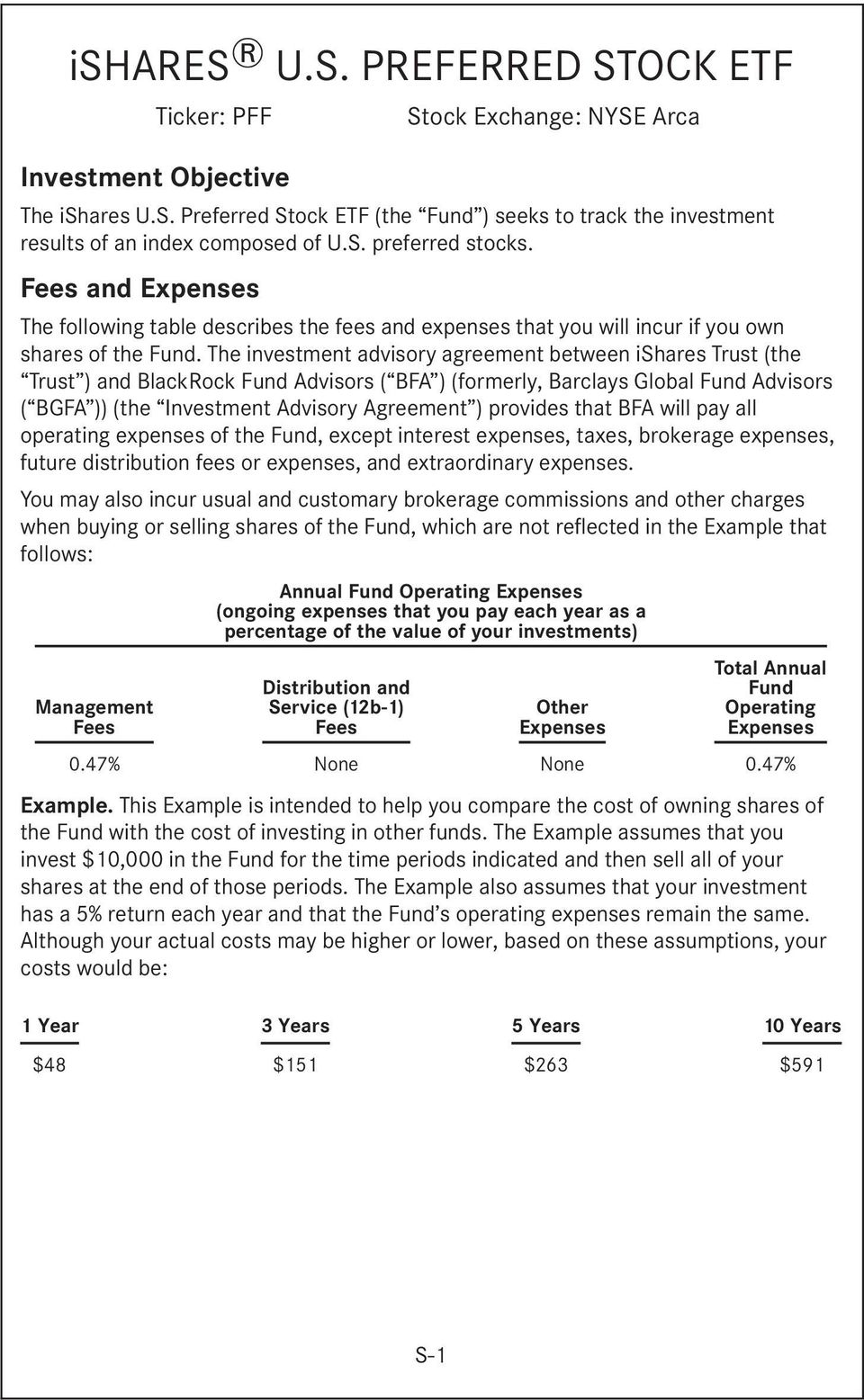
5 ishares U.S. PREFERRED STOCK ETF Ticker: PFF Investment Objective Stock Exchange: NYSE Arca The ishares U.S. Preferred Stock ETF (the Fund ) seeks to track the investment results of an index composed of U.S. preferred stocks. Fees and Expenses The following table describes the fees and expenses that you will incur if you own shares of the Fund. The investment advisory agreement between ishares Trust (the Trust ) and BlackRock Fund Advisors ( BFA ) (formerly, Barclays Global Fund Advisors ( BGFA )) (the Investment Advisory Agreement ) provides that BFA will pay all operating expenses of the Fund, except interest expenses, taxes, brokerage expenses, future distribution fees or expenses, and extraordinary expenses. You may also incur usual and customary brokerage commissions and other charges when buying or selling shares of the Fund, which are not reflected in the Example that follows: Management Fees Annual Fund Operating Expenses (ongoing expenses that you pay each year as a percentage of the value of your investments) Distribution and Service (12b-1) Fees Other Expenses Total Annual Fund Operating Expenses 0.47% None None 0.47% Example. This Example is intended to help you compare the cost of owning shares of the Fund with the cost of investing in other funds. The Example assumes that you invest $10,000 in the Fund for the time periods indicated and then sell all of your shares at the end of those periods. The Example also assumes that your investment has a 5% return each year and that the Fund s operating expenses remain the same. Although your actual costs may be higher or lower, based on these assumptions, your costs would be: 1 Year 3 Years 5 Years 10 Years $48 $151 $263 $591 S-1
6 Portfolio Turnover. The Fund may pay transaction costs, such as commissions, when it buys and sells securities (or turns over its portfolio). A higher portfolio turnover rate may indicate higher transaction costs and may result in higher taxes when Fund shares are held in a taxable account. These costs, which are not reflected in Annual Fund Operating Expenses or in the Example, affect the Fund s performance. During the most recent fiscal year, the Fund s portfolio turnover rate was 13% of the average value of its portfolio. Principal Investment Strategies The Fund seeks to track the investment results of the S&P U.S. Preferred Stock Index TM (the Underlying Index ), which measures the performance of a select group of preferred stocks listed on the New York Stock Exchange ( NYSE ), NYSE Arca, Inc. ( NYSE Arca ), NYSE Amex, NASDAQ Global Select Market, NASDAQ Select Market or NASDAQ Capital Market. The Underlying Index does not seek to directly reflect the performance of the companies issuing the preferred stock. The Underlying Index includes preferred stocks with a market capitalization over $100 million that meet minimum price, liquidity, trading volume, maturity and other requirements determined by S&P Dow Jones Indices LLC (the Index Provider or SPDJI ), a subsidiary of McGraw Hill Financial, Inc. The Underlying Index excludes certain issues of preferred stock, such as those that are issued by special ventures (e.g., toll roads or dam operators) or structured products and brand name products issued by financial institutions that are packaged securities linked to indices or other stocks. In general, preferred stock is a class of equity security that pays a specified dividend that must be paid before any dividends can be paid to common stockholders and takes precedence over common stock in the event of a company s liquidation. Although preferred stocks represent a partial ownership interest in a company, preferred stocks generally do not carry voting rights and have economic characteristics similar to fixed-income securities. Preferred stocks generally are issued with a fixed par value and pay dividends based on a percentage of that par value at a fixed or variable rate. Additionally, preferred stocks often have a liquidation value that generally equals the original purchase price of the preferred stock at the date of issuance. The Underlying Index may include many different categories of preferred stock, such as floating, variable and fixed-rate preferreds, callable preferreds, convertible preferreds, cumulative and non-cumulative preferreds, trust preferreds or various other traditional and hybrid issues of preferred stock. As of March 31, 2015, the Underlying Index was concentrated in the financial industry group, which comprised approximately 88% of the market capitalization of the Underlying Index. The Underlying Index may include large-, mid- or small-capitalization companies. Components of the Underlying Index primarily include financials, telecommunications and utilities companies. The components of the Underlying Index, and the degree to which these components represent certain industries, may change over time. BFA uses a passive or indexing approach to try to achieve the Fund s investment objective. Unlike many S-2

7 investment companies, the Fund does not try to beat the index it tracks and does not seek temporary defensive positions when markets decline or appear overvalued. Indexing may eliminate the chance that the Fund will substantially outperform the Underlying Index but also may reduce some of the risks of active management, such as poor security selection. Indexing seeks to achieve lower costs and better after-tax performance by keeping portfolio turnover low in comparison to actively managed investment companies. BFA uses a representative sampling indexing strategy to manage the Fund. Representative sampling is an indexing strategy that involves investing in a representative sample of securities that collectively has an investment profile similar to that of the Underlying Index. The securities selected are expected to have, in the aggregate, investment characteristics (based on factors such as market capitalization and industry weightings), fundamental characteristics (such as return variability and yield) and liquidity measures similar to those of the Underlying Index. The Fund may or may not hold all of the securities in the Underlying Index. The Fund generally will invest at least 90% of its assets in the component securities of the Underlying Index and may invest up to 10% of its assets in certain futures, options and swap contracts, cash and cash equivalents, including shares of money market funds advised by BFA or its affiliates, as well as in securities not included in the Underlying Index, but which BFA believes will help the Fund track the Underlying Index. The Fund seeks to track the investment results of the Underlying Index before the fees and expenses of the Fund. The Fund may lend securities representing up to one-third of the value of the Fund s total assets (including the value of any collateral received). The Underlying Index is a product of SPDJI, which is independent of the Fund and BFA. The Index Provider determines the composition and relative weightings of the securities in the Underlying Index and publishes information regarding the market value of the Underlying Index. Industry Concentration Policy. The Fund will concentrate its investments (i.e., hold 25% or more of its total assets) in a particular industry or group of industries to approximately the same extent that the Underlying Index is concentrated. For purposes of this limitation, securities of the U.S. government (including its agencies and instrumentalities) and repurchase agreements collateralized by U.S. government securities are not considered to be issued by members of any industry. Summary of Principal Risks As with any investment, you could lose all or part of your investment in the Fund, and the Fund s performance could trail that of other investments. The Fund is subject to the principal risks noted below, any of which may adversely affect the Fund s net asset value per share ( NAV ), trading price, yield, total return and ability to meet its investment objective. Asset Class Risk. Securities in the Underlying Index or in the Fund s portfolio may underperform in comparison to the general financial S-3

8 markets, a particular financial market or other asset classes. Authorized Participant Concentration Risk. Only an Authorized Participant (as defined in the Creations and Redemptions section of the Prospectus) may engage in creation or redemption transactions directly with the Fund. The Fund has a limited number of institutions that act as Authorized Participants. To the extent that these institutions exit the business or are unable to proceed with creation and/or redemption orders with respect to the Fund and no other Authorized Participant is able to step forward to create or redeem, in either of these cases, Fund shares may trade at a discount to NAV and possibly face delisting. Concentration Risk. The Fund may be susceptible to an increased risk of loss, including losses due to adverse events that affect the Fund s investments more than the market as a whole, to the extent that the Fund s investments are concentrated in the securities of a particular issuer or issuers, country, region, market, industry, group of industries, sector or asset class. Equity Securities Risk. Equity securities are subject to changes in value, and their values may be more volatile than those of other asset classes. Financials Sector Risk. Performance of companies in the financials sector may be adversely impacted by many factors, including, among others, government regulations, economic conditions, credit rating downgrades, changes in interest rates, and decreased liquidity in credit markets. The impact of more stringent capital requirements, recent or future regulation on any individual financial company, or recent or future regulation on the financials sector as a whole cannot be predicted. Index-Related Risk. There is no guarantee that the Fund will achieve a high degree of correlation to the Underlying Index and therefore achieve its investment objective. Market disruptions and regulatory restrictions could have an adverse effect on the Fund s ability to adjust its exposure to the required levels in order to track the Underlying Index. Errors in index data, index computations or the construction of the Underlying Index in accordance with its methodology may occur from time to time and may not be identified and corrected by the Index Provider for a period of time or at all, which may have an adverse impact on the Fund and its shareholders. Interest Rate Risk. An increase in interest rates may cause the value of securities held by the Fund to decline. Issuer Risk. Fund performance depends on the performance of individual securities to which the Fund has exposure. Changes in the financial condition or credit rating of an issuer of those securities may cause the value of the securities to decline. Management Risk. As the Fund may not fully replicate the Underlying Index, it is subject to the risk that BFA s investment strategy may not produce the intended results. Market Risk. The Fund could lose money over short periods due to shortterm market movements and over longer periods during more prolonged market downturns. Market Trading Risk. The Fund faces numerous market trading risks, including the potential lack of an active S-4

9 market for Fund shares, losses from trading in secondary markets, periods of high volatility and disruptions in the creation/redemption process. ANY OF THESE FACTORS, AMONG OTHERS, MAY LEAD TO THE FUND S SHARES TRADING AT A PREMIUM OR DISCOUNT TO NAV. Non-Diversification Risk. The Fund may invest a large percentage of its assets in securities issued by or representing a small number of issuers. As a result, the Fund s performance may depend on the performance of a small number of issuers. Passive Investment Risk. The Fund is not actively managed and BFA does not attempt to take defensive positions under any market conditions, including declining markets. Preferred Stock Risk. Preferred stock is subject to many of the risks associated with debt securities, including interest rate risk. In addition, preferred stock may not pay a dividend, an issuer may suspend payment of dividends on preferred stock at any time, and in certain situations an issuer may call or redeem its preferred stock or convert it to common stock. To the extent that the Fund invests a substantial portion of its assets in convertible preferred stocks, declining common stock values may also cause the value of the Fund s investments to decline. Risk of Investing in the United States. The Fund has significant exposure to U.S. issuers. Certain changes in the U.S. economy, such as when the U.S. economy weakens or when its financial markets decline, may have an adverse effect on the securities to which the Fund has exposure. Securities Lending Risk. The Fund may engage in securities lending. Securities lending involves the risk that the Fund may lose money because the borrower of the loaned securities fails to return the securities in a timely manner or at all. The Fund could also lose money in the event of a decline in the value of the collateral provided for loaned securities or a decline in the value of any investments made with cash collateral. These events could also trigger adverse tax consequences for the Fund. Telecommunications Sector Risk. Companies in the telecommunications sector may be affected by industry competition, substantial capital requirements, government regulation and obsolescence of telecommunications products and services due to technological advancement. Tracking Error Risk. Tracking error is the divergence of the Fund s performance from that of the Underlying Index. Tracking error may occur because of differences between the securities or other instruments held in the Fund s portfolio and those included in the Underlying Index, pricing differences, transaction costs, the Fund s holding of uninvested cash, differences in timing of the accrual of dividends or interest, tax gains or losses, changes to the Underlying Index or the need to meet various new or existing regulatory requirements. This risk may be heightened during times of increased market volatility or other unusual market conditions. Tracking error also may result because the Fund incurs fees and expenses, while the Underlying Index does not. Utilities Sector Risk. The utilities sector is subject to significant S-5

10 government regulation and oversight. Deregulation, however, may subject utility companies to greater competition and may reduce their profitability. Companies in the utilities sector may be adversely affected due to increases in fuel and operating costs, rising costs of financing capital construction and the cost of complying with regulations, among other factors. S-6

11 Performance Information The bar chart and table that follow show how the Fund has performed on a calendar year basis and provide an indication of the risks of investing in the Fund. Both assume that all dividends and distributions have been reinvested in the Fund. Past performance (before and after taxes) does not necessarily indicate how the Fund will perform in the future. Supplemental information about the Fund s performance is shown under the heading Total Return Information in the Supplemental Information section of the Fund s prospectus (the Prospectus ). Year-by-Year Returns 1 (Years Ended December 31) 60% 40% 20% 39.27% 13.97% 18.25% 13.45% 0% -20% -40% % -2.20% -0.59% The Fund s year-to-date return as of June 30, 2015 was 1.76%. The best calendar quarter return during the periods shown above was 45.25% in the 2nd quarter of 2009; the worst was % in the 3rd quarter of Updated performance information is available at or by calling iShares ( ) (toll free). Average Annual Total Returns (for the periods ended December 31, 2014) One Year Five Years Since Fund Inception (Inception Date: 3/26/2007) Return Before Taxes 13.45% 8.25% 4.20% Return After Taxes on Distributions % 6.32% 2.16% Return After Taxes on Distributions and Sale of Fund Shares % 6.03% 2.66% S&P U.S. Preferred Stock Index TM (Index returns do not reflect deductions for fees, expenses, or taxes) 14.07% 8.96% 4.58% 2 After-tax returns in the table above are calculated using the historical highest individual U.S. federal marginal income tax rates and do not reflect the impact of state or local taxes. Actual after-tax returns depend on an investor s tax situation and may differ from those shown, and after-tax returns shown are not relevant to tax-exempt investors or investors who hold shares through tax-deferred arrangements, such as 401(k) plans or individual retirement accounts ( IRAs ). Fund returns after taxes on distributions and sales of Fund shares are calculated assuming that an investor has sufficient capital gains of the same character from other investments to offset any capital losses from the sale of Fund shares. As a result, Fund returns after taxes on distributions and sales of Fund shares may exceed Fund returns before taxes and/or returns after taxes on distributions. S-7

12 Management Investment Adviser. BlackRock Fund Advisors. Portfolio Managers. Matthew Goff, Diane Hsiung, Jennifer Hsui and Greg Savage (the Portfolio Managers ) are primarily responsible for the day-to-day management of the Fund. Each Portfolio Manager supervises a portfolio management team. Mr. Goff, Ms. Hsiung, Ms. Hsui and Mr. Savage have been Portfolio Managers of the Fund since 2013, 2008, 2012 and 2008, respectively. Purchase and Sale of Fund Shares The Fund is an exchange-traded fund (commonly referred to as an ETF ). Individual shares of the Fund are listed on a national securities exchange. Most investors will buy and sell shares of the Fund through a broker-dealer. The price of Fund shares is based on market price, and because ETF shares trade at market prices rather than at NAV, shares may trade at a price greater than NAV (a premium) or less than NAV (a discount). The Fund will only issue or redeem shares that have been aggregated into blocks of 50,000 shares or multiples thereof ( Creation Units ) to Authorized Participants who have entered into agreements with the Fund s distributor. The Fund generally will issue or redeem Creation Units in return for a designated portfolio of securities (and an amount of cash) that the Fund specifies each day. Tax Information The Fund intends to make distributions that may be taxable to you as ordinary income or capital gains, unless you are investing through a tax-deferred arrangement such as a 401(k) plan or an IRA. Payments to Broker-Dealers and other Financial Intermediaries If you purchase shares of the Fund through a broker-dealer or other financial intermediary (such as a bank), BFA or other related companies may pay the intermediary for marketing activities and presentations, educational training programs, conferences, the development of technology platforms and reporting systems or other services related to the sale or promotion of the Fund. These payments may create a conflict of interest by influencing the broker-dealer or other intermediary and your salesperson to recommend the Fund over another investment. Ask your salesperson or visit your financial intermediary s website for more information. S-8

13 More Information About the Fund This Prospectus contains important information about investing in the Fund. Please read this Prospectus carefully before you make any investment decisions. Additional information regarding the Fund is available at BFA is the investment adviser to the Fund. Shares of the Fund are listed for trading on NYSE Arca. The market price for a share of the Fund may be different from the Fund s most recent NAV. ETFs are funds that trade like other publicly traded securities. The Fund is designed to track an index. Similar to shares of an index mutual fund, each share of the Fund represents an ownership interest in an underlying portfolio of securities intended to track a market index. Unlike shares of a mutual fund, which can be bought and redeemed from the issuing fund by all shareholders at a price based on NAV, shares of the Fund may be purchased or redeemed directly from the Fund at NAV solely by Authorized Participants. Also unlike shares of a mutual fund, shares of the Fund are listed on a national securities exchange and trade in the secondary market at market prices that change throughout the day. The Fund invests in a particular segment of the securities markets and seeks to track the performance of a securities index that generally is not representative of the market as a whole. The Fund is designed to be used as part of broader asset allocation strategies. Accordingly, an investment in the Fund should not constitute a complete investment program. An index is a financial calculation based on a grouping of financial instruments that is not an investment product while the Fund is an actual investment portfolio. The performance of the Fund and the Underlying Index may vary for a number of reasons, including transaction costs, non-u.s. currency valuations, asset valuations, corporate actions (such as mergers and spin-offs), timing variances and differences between the Fund s portfolio and the Underlying Index resulting from the Fund s use of representative sampling or from legal restrictions (such as diversification requirements) that apply to the Fund but not to the Underlying Index. Tracking error is the divergence of the performance (return) of the Fund s portfolio from that of the Underlying Index. BFA expects that, over time, the Fund s tracking error will not exceed 5%. Because the Fund uses a representative sampling indexing strategy, it can be expected to have a larger tracking error than if it used a replication indexing strategy. Replication is an indexing strategy in which a fund invests in substantially all of the securities in its underlying index in approximately the same proportions as in the underlying index. An investment in the Fund is not a bank deposit and it is not insured or guaranteed by the Federal Deposit Insurance Corporation or any other government agency, BFA or any of its affiliates. The Fund s investment objective and the Underlying Index may be changed without shareholder approval. 1

14 A Further Discussion of Principal Risks The Fund is subject to various risks, including the principal risks noted below, any of which may adversely affect the Fund s NAV, trading price, yield, total return and ability to meet its investment objective. You could lose all or part of your investment in the Fund, and the Fund could underperform other investments. Asset Class Risk. The securities in the Underlying Index or in the Fund s portfolio may underperform other securities or indexes that track other industries, groups of industries, markets, asset classes or sectors. Various types of securities, currencies and indexes may experience cycles of outperformance and underperformance in comparison to the general financial markets depending upon a number of factors, including, among other things, inflation, interest rates, productivity, global demand for local products or resources and regulation and governmental controls. Authorized Participant Concentration Risk. Only an Authorized Participant may engage in creation or redemption transactions directly with the Fund. The Fund has a limited number of institutions that act as Authorized Participants. To the extent that these institutions exit the business or are unable to proceed with creation and/or redemption orders with respect to the Fund and no other Authorized Participant is able to step forward to create or redeem, in either of these cases, Fund shares may trade at a discount to NAV and possibly face delisting. Concentration Risk. The Fund may be susceptible to an increased risk of loss, including losses due to adverse events that affect the Fund more than the market as a whole, to the extent that the Fund s investments are concentrated in the securities of a particular issuer or issuers, country, region, market, industry, group of industries, sector or asset class. The Fund may be more adversely affected by the underperformance of those securities, may experience increased price volatility and may be more susceptible to adverse economic, market, political or regulatory occurrences affecting those securities than a fund that does not concentrate its investments. Equity Securities Risk. The Fund invests in equity securities, which are subject to changes in value that may be attributable to market perception of a particular issuer or to general stock market fluctuations that affect all issuers. Investments in equity securities may be more volatile than investments in other asset classes. Financials Sector Risk. Companies in the financials sector of an economy are often subject to extensive governmental regulation and intervention, which may adversely affect the scope of their activities, the prices they can charge and the amount of capital they must maintain. Governmental regulation may change frequently and may have significant adverse consequences for companies in the financials sector, including effects not intended by such regulation. The impact of recent or future regulation in various countries on any individual financial company or on the financials sector as a whole cannot be predicted. Certain risks may impact the value of investments in the financials sector more severely than those of investments outside this sector, including the risks associated with companies that operate with substantial financial leverage. Companies in the financials sector may also be adversely affected by increases in interest rates and loan losses, decreases in the availability of money or 2

15 asset valuations, credit rating downgrades and adverse conditions in other related markets. Insurance companies, in particular, may be subject to severe price competition and/or rate regulation, which may have an adverse impact on their profitability. During the financial crisis that began in 2007, the deterioration of the credit markets impacted a broad range of mortgage, asset-backed, auction rate, sovereign debt and other markets, including U.S. and non-u.s. credit and interbank money markets, thereby affecting a wide range of financial institutions and markets. During the financial crisis, a number of large financial institutions failed, merged with stronger institutions or had significant government infusions of capital. Instability in the financial markets caused certain financial companies to incur large losses. Some financial companies experienced declines in the valuations of their assets, took actions to raise capital (such as the issuance of debt or equity securities), or even ceased operations. Some financial companies borrowed significant amounts of capital from government sources and may face future government-imposed restrictions on their businesses or increased government intervention. Those actions caused the securities of many financial companies to decline in value. The financials sector is particularly sensitive to fluctuations in interest rates. Index-Related Risk. The Fund seeks to achieve a return which corresponds generally to the price and yield performance, before fees and expenses, of the Underlying Index as published by the Index Provider. There is no assurance that the Index Provider or any agents that may act on its behalf will compile the Underlying Index accurately, or that the Underlying Index will be determined, composed or calculated accurately. While the Index Provider provides descriptions of what the Underlying Index is designed to achieve, neither the Index Provider nor its agents provide any warranty or accept any liability in relation to the quality, accuracy or completeness of the Underlying Index or its related data, and they do not guarantee that the Underlying Index will be in line with the Index Provider s methodology. BFA s mandate as described in this Prospectus is to manage the Fund consistently with the Underlying Index provided by the Index Provider to BFA. Consequently, BFA does not provide any warranty or guarantee against the Index Provider s or others errors. Errors in respect of the quality, accuracy and completeness of the data may occur from time to time and may not be identified and corrected by the Index Provider for a period of time or at all, particularly where the indices are less commonly used. Therefore, gains, losses or costs associated with errors of the Index Provider or its agents will generally be borne by the Fund and its shareholders. For example, during a period where the Fund s Underlying Index contains incorrect constituents, the Fund would have market exposure to such constituents and would be underexposed to the Underlying Index s other constituents. Such errors may negatively or positively impact the Fund and its shareholders. Any gains due to the Index Provider s or others errors will be kept by the Fund and its shareholders and any losses resulting from the Index Provider s or others errors will be borne by the Fund and its shareholders. Apart from scheduled rebalances, the Index Provider or its agents may carry out additional ad hoc rebalances to the Underlying Index in order, for example, to correct an error in the selection of index constituents. When the Underlying Index of the Fund is rebalanced and the Fund in turn rebalances its portfolio to attempt to increase the correlation between the Fund s portfolio and the Underlying Index, any transaction 3

16 costs and market exposure arising from such portfolio rebalancing will be borne directly by the Fund and its shareholders. Therefore, errors and additional ad hoc rebalances carried out by the Index Provider to the Underlying Index may increase the costs and the tracking error risk of the Fund. Issuer Risk. The performance of the Fund depends on the performance of individual securities to which the Fund has exposure. Any issuer of these securities may perform poorly, causing the value of its securities to decline. Poor performance may be caused by poor management decisions, competitive pressures, changes in technology, expiration of patent protection, disruptions in supply, labor problems or shortages, corporate restructurings, fraudulent disclosures or other factors. Issuers may, in times of distress or at their own discretion, decide to reduce or eliminate dividends, which may also cause their stock prices to decline. Management Risk. The Fund may not fully replicate the Underlying Index and may hold securities not included in the Underlying Index. As a result, the Fund is subject to the risk that BFA s investment strategy, the implementation of which is subject to a number of constraints, may not produce the intended results. Market Risk. The Fund could lose money due to short-term market movements and over longer periods during market downturns or due to the credit deterioration of issuers of the securities held by the Fund. Securities may decline in value due to factors affecting financial markets generally or particular asset classes or industries represented in the markets, as well as issuer-specific concerns. The value of a security may decline due to general market conditions, economic trends or events that are not specifically related to the issuer of the security or due to factors that affect a particular industry, group of industries or the issuer. During a general market downturn, multiple asset classes may be negatively affected. Market Trading Risk Absence of Active Market. Although shares of the Fund are listed for trading on one or more stock exchanges, there can be no assurance that an active trading market for such shares will develop or be maintained by market makers or Authorized Participants. Risk of Secondary Listings. The Fund s shares may be listed or traded on U.S. and non- U.S. stock exchanges other than the U.S. stock exchange where the Fund s primary listing is maintained. There can be no assurance that the Fund s shares will continue to trade on any such stock exchange or in any market or that the Fund s shares will continue to meet the requirements for listing or trading on any exchange or in any market. The Fund s shares may be less actively traded in certain markets than in others, and investors are subject to the execution and settlement risks and market standards of the market where they or their broker direct their trades for execution. Certain information available to investors who trade Fund shares on a U.S. stock exchange during regular U.S. market hours may not be available to investors who trade in other markets, which may result in secondary market prices in such markets being less efficient. Secondary Market Trading Risk. Shares of the Fund may trade in the secondary market at times when the Fund does not accept orders to purchase or redeem shares. At such 4

17 times, shares may trade in the secondary market with more significant premiums or discounts than might be experienced at times when the Fund accepts purchase and redemption orders. Secondary market trading in Fund shares may be halted by a stock exchange because of market conditions or for other reasons. In addition, trading in Fund shares on a stock exchange or in any market may be subject to trading halts caused by extraordinary market volatility pursuant to circuit breaker rules on the stock exchange or market. Shares of the Fund, similar to shares of other issuers listed on a stock exchange, may be sold short and are therefore subject to the risk of increased volatility and price decreases associated with being sold short. Shares of the Fund May Trade at Prices Other Than NAV. Shares of the Fund trade on stock exchanges at prices at, above or below the Fund s most recent NAV. The NAV of the Fund is calculated at the end of each business day and fluctuates with changes in the market value of the Fund s holdings. The trading price of the Fund s shares fluctuates continuously throughout trading hours based on both market supply of and demand for Fund shares and the underlying value of the Fund s portfolio holdings or NAV. As a result, the trading prices of the Fund s shares may deviate significantly from NAV during periods of market volatility. ANY OF THESE FACTORS, AMONG OTHERS, MAY LEAD TO THE FUND S SHARES TRADING AT A PREMIUM OR DISCOUNT TO NAV. However, because shares can be created and redeemed in Creation Units at NAV, BFA believes that large discounts or premiums to the NAV of the Fund are not likely to be sustained over the long term (unlike shares of many closed-end funds, which frequently trade at appreciable discounts from, and sometimes at premiums to, their NAVs). While the creation/redemption feature is designed to make it more likely that the Fund s shares normally will trade on stock exchanges at prices close to the Fund s next calculated NAV, exchange prices are not expected to correlate exactly with the Fund s NAV due to timing reasons, supply and demand imbalances and other factors. In addition, disruptions to creations and redemptions, including disruptions at market makers, Authorized Participants, or market participants, and during periods of significant market volatility, may result in trading prices for shares of the Fund that differ significantly from its NAV. Costs of Buying or Selling Fund Shares. Buying or selling Fund shares on an exchange involves two types of costs that apply to all securities transactions. When buying or selling shares of the Fund through a broker, you will likely incur a brokerage commission and other charges. In addition, you may incur the cost of the spread ; that is, the difference between what investors are willing to pay for Fund shares (the bid price) and the price at which they are willing to sell Fund shares (the ask price). There may also be regulatory and other charges that are incurred as a result of trading activity. Because of the costs inherent in buying or selling Fund shares, frequent trading may detract significantly from investment results and an investment in Fund shares may not be advisable for investors who anticipate regularly making small investments. Non-Diversification Risk. The Fund is classified as non-diversified. This means that the Fund may invest a large percentage of its assets in securities issued by or 5

18 representing a small number of issuers. As a result, the Fund may be more susceptible to the risks associated with these particular issuers or to a single economic, political or regulatory occurrence affecting these issuers. Passive Investment Risk. The Fund is not actively managed and may be affected by a general decline in market segments related to the Underlying Index. The Fund invests in securities included in, or representative of, the Underlying Index, regardless of their investment merits. BFA generally does not attempt to take defensive positions under any market conditions, including declining markets. Preferred Stock Risk. Unlike interest payments on a debt security, dividend payments on preferred stock typically must be declared by the issuer s board of directors. An issuer s board of directors is generally not under any obligation to pay a dividend (even if such dividends have accrued), and may suspend payment of dividends on preferred stock at any time. In the event an issuer of preferred stock experiences economic difficulties, the issuer s preferred stock may lose substantial value due to the reduced likelihood that the issuer s board of directors will declare a dividend and the fact that the preferred stock may be subordinated to other securities of the same issuer. Certain additional risks associated with preferred stock could adversely affect investments in the Fund. Interest Rate Risk. Because many preferred stocks pay dividends at a fixed rate, their market price can be sensitive to changes in interest rates in a manner similar to bonds. That is, as interest rates rise, the value of the preferred stocks held by the Fund are likely to decline. To the extent that the Fund invests a substantial portion of its assets in fixed rate preferred stocks, rising interest rates may cause the value of the Fund s investments to decline significantly. Issuer Risk. Because many preferred stocks allow holders to convert the preferred stock into common stock of the issuer, their market price can be sensitive to changes in the value of the issuer s common stock. To the extent that the Fund invests a substantial portion of its assets in convertible preferred stocks, declining common stock values may also cause the value of the Fund s investments to decline. Dividend Risk. There is a chance that the issuer of any of the Fund s holdings will have its ability to pay dividends deteriorate or will default (i.e., fail to make scheduled dividend payments on the preferred stock or scheduled interest payments on other obligations of the issuer not held by the Fund), which would negatively affect the value of any such holding. Call Risk. Preferred stocks are subject to market volatility and the prices of preferred stocks will fluctuate based on market demand. Preferred stocks often have call features that allow the issuer to redeem the security at its discretion. If a preferred stock is redeemed by the issuer, it will be removed from the Underlying Index. The redemption of preferred stocks having a higher than average yield may cause a decrease in the yield of the Underlying Index and the Fund. Because the Underlying Index is rebalanced annually, the removal of a large number of preferred stocks during the year due to maturity, redemption, conversion or other corporate action may cause the Underlying Index to be periodically concentrated in a smaller number of issuers or in issuers of a particular sector or industry. 6

19 Extension Risk. During periods of rising interest rates, certain obligations will be paid off substantially more slowly than originally anticipated and the value of those securities may fall sharply, resulting in a decline to the Fund s income and potentially in the value of the Fund s investments. Risk of Investing in the United States. The Fund has significant exposure to U.S. issuers. A decrease in imports or exports, changes in trade regulations and/or an economic recession in the United States may have a material adverse effect on the U.S. economy and the securities listed on U.S. exchanges. The financial crisis that began in 2007 caused a significant decline in the value and liquidity of issuers in the United States. Policy and legislative changes in the United States are changing many aspects of financial and other regulation and may have a significant effect on the U.S. markets generally, as well as the value of certain securities. In addition, a continued rise in the U.S. public debt level or U.S. austerity measures may adversely affect U.S. economic growth and the securities to which the Fund has exposure. Securities Lending Risk. The Fund may engage in securities lending. Securities lending involves the risk that the Fund may lose money because the borrower of the loaned securities fails to return the securities in a timely manner or at all. The Fund could also lose money in the event of a decline in the value of collateral provided for the loaned securities or a decline in the value of any investments made with cash collateral. These events could also trigger adverse tax consequences for the Fund. BlackRock Institutional Trust Company, N.A. ( BTC ), the Fund s securities lending agent, will take into account the tax impact to shareholders of substitute payments for dividends when managing the Fund s securities lending program. Telecommunications Sector Risk. The telecommunications sector is subject to extensive government regulation. The costs of complying with governmental regulations, delays or failure to receive required regulatory approvals, or the enactment of new regulatory requirements may negatively affect the business of telecommunications companies. Government actions around the world, specifically in the area of pre-marketing clearance of products and prices, can be arbitrary and unpredictable. The domestic telecommunications market is characterized by increasing competition and regulation by various state and federal regulatory authorities. Companies in the telecommunications sector may encounter distressed cash flows due to the need to commit substantial capital to meet increasing competition, particularly in developing new products and services using new technology. Technological innovations may make the products and services of certain telecommunications companies obsolete. Telecommunication providers are generally required to obtain franchises or licenses in order to provide services in a given location. Licensing and franchise rights in the telecommunications sector are limited, which may provide an advantage to certain participants. Limited availability of such rights, high barriers to market entry and increasing regulatory oversight, among other factors, has led to consolidation of companies within the sector, which could lead to further regulation or other negative effects in the future. Tracking Error Risk. Tracking error is the divergence of the Fund s performance from that of the Underlying Index. Tracking error may occur because of differences between the securities and other instruments held in the Fund s portfolio and those included in 7

20 the Underlying Index, pricing differences, transaction costs, the Fund holding uninvested cash, differences in timing of the accrual of dividends or interest, tax gains or losses, changes to the Underlying Index or the costs of complying with various new or existing regulatory requirements. This risk may be heightened during times of increased market volatility or other unusual market conditions. Tracking error also may result because the Fund incurs fees and expenses, while the Underlying Index does not. Utilities Sector Risk. Deregulation may subject utility companies to greater competition and may adversely affect their profitability. As deregulation allows utility companies to diversify outside of their original geographic regions and their traditional lines of business, utility companies may engage in riskier ventures. In addition, deregulation may eliminate restrictions on the profits of certain utility companies, but may also subject these companies to greater risk of loss. Companies in the utilities industry may have difficulty obtaining an adequate return on invested capital, raising capital, or financing large construction projects during periods of inflation or unsettled capital markets; face restrictions on operations and increased cost and delays attributable to environmental considerations and regulation; find that existing plants, equipment or products have been rendered obsolete by technological innovations; or be subject to increased costs because of the scarcity of certain fuels or the effects of man-made or natural disasters. Existing and future regulations or legislation may make it difficult for utility companies to operate profitably. Government regulators monitor and control utility revenues and costs, and therefore may limit utility profits. There is no assurance that regulatory authorities will grant rate increases in the future, or that such increases will be adequate to permit the payment of dividends on stocks issued by a utility company. Energy conservation and changes in climate policy may also have a significant adverse impact on the revenues and expenses of utility companies. Portfolio Holdings Information A description of the Trust s policies and procedures with respect to the disclosure of the Fund s portfolio securities is available in the Fund s Statement of Additional Information ( SAI ). The top holdings of the Fund can be found at Fund fact sheets provide information regarding the Fund s top holdings and may be requested by calling iShares ( ). Management Investment Adviser. As investment adviser, BFA has overall responsibility for the general management and administration of the Trust. BFA provides an investment program for the Fund and manages the investment of the Fund s assets. In managing the Fund, BFA may draw upon the research and expertise of its asset management affiliates with respect to certain portfolio securities. In seeking to achieve the Fund s investment objective, BFA uses teams of portfolio managers, investment strategists and other investment specialists. This team approach brings together many disciplines and leverages BFA s extensive resources. Pursuant to the Investment Advisory Agreement between BFA and the Trust (entered into on behalf of the Fund), BFA is responsible for substantially all expenses of the 8

21 Fund, except interest expenses, taxes, brokerage expenses, future distribution fees or expenses and extraordinary expenses. Effective July 1, 2015, for its investment advisory services to the Fund, BFA is entitled to receive a management fee from the Fund corresponding to the Fund s allocable portion of an aggregate management fee based on the aggregate average daily net assets of the ishares Latin America 40 ETF, ishares MSCI Pacific ex Japan ETF, ishares Russell 2000 ETF, ishares Russell 2000 Growth ETF, ishares Russell 2000 Value ETF, ishares Select Dividend ETF and the Fund ( Combined Funds ). The aggregate management fee is calculated as follows: Rate of Average Daily Net Assets of Combined Funds Management Fee First $46 billion % Greater than $46 billion Up to $81 billion % Greater than $81 billion Up to $111 billion % Greater than $111 billion Up to $141 billion % Greater than $141 billion % Each reduced management fee level set forth in the fee schedule above reflects a 5% reduction (rounded to the fourth decimal place) from the management fee at the prior Combined Funds asset level. Based on the assets of the Combined Funds as of March 31, 2015, for its investment advisory services to the Fund, BFA is entitled to receive a management fee from the Fund, based on a percentage of the Fund s average daily net assets, at an annual rate of 0.47%. BFA may from time to time voluntarily waive and/or reimburse fees or expenses in order to limit Total Annual Fund Operating Expenses (excluding Acquired Fund Fees and Expenses, if any). Any such voluntary waiver or reimbursement may be eliminated by BFA at any time. BFA is located at 400 Howard Street, San Francisco, CA It is an indirect whollyowned subsidiary of BlackRock, Inc. ( BlackRock ). As of June 30, 2015, BFA and its affiliates provided investment advisory services for assets in excess of $4.72 trillion. BFA and its affiliates deal, trade and invest for their own accounts in the types of securities in which the Fund may also invest. A discussion regarding the basis for the Trust s Board of Trustees (the Board ) approval of the Investment Advisory Agreement with BFA is available in the Fund s semi-annual report for the six-month period ended September 30. Portfolio Managers. Matthew Goff, Diane Hsiung, Jennifer Hsui and Greg Savage are primarily responsible for the day-to-day management of the Fund. Each Portfolio Manager is responsible for various functions related to portfolio management, including, but not limited to, investing cash inflows, coordinating with members of his or her portfolio management team to focus on certain asset classes, implementing investment strategy, researching and reviewing investment strategy and overseeing members of his or her portfolio management team that have more limited responsibilities. 9
22 Matthew Goff has been employed by BFA and BTC (formerly, Barclays Global Investors, N.A. ( BGI )) as a portfolio manager since Prior to that, Mr. Goff was a portfolio manager from 2007 to 2008 for US Trust, a product manager from 2006 to 2007 for Iris Financial Solutions and a product manager from 2003 to 2006 for MSCI Barra. Mr. Goff has been a Portfolio Manager of the Fund since Diane Hsiung has been employed by BFA and BTC as a senior portfolio manager since Prior to that, Ms. Hsiung was a portfolio manager from 2002 to 2006 for BGFA and BGI. Ms. Hsiung has been a Portfolio Manager of the Fund since Jennifer Hsui has been employed by BFA and BTC as a senior portfolio manager since Prior to that, Ms. Hsui was a portfolio manager from 2006 to 2007 for BGFA and BGI. Ms. Hsui has been a Portfolio Manager of the Fund since Greg Savage has been employed by BFA and BTC as a senior portfolio manager since Prior to that, Mr. Savage was a portfolio manager from 2001 to 2006 for BGFA and BGI. Mr. Savage has been a Portfolio Manager of the Fund since The Fund s SAI provides additional information about the Portfolio Managers compensation, other accounts managed by the Portfolio Managers and the Portfolio Managers ownership (if any) of shares in the Fund. Administrator, Custodian and Transfer Agent. State Street Bank and Trust Company ( State Street ) is the administrator, custodian and transfer agent for the Fund. Conflicts of Interest. BFA wants you to know that it has relationships with certain entities that may give rise to conflicts of interest or the appearance of conflicts of interest. These entities are BFA s affiliates, including BlackRock and The PNC Financial Services Group, Inc., and each of their affiliates, directors, partners, trustees, managing members, officers and employees (collectively, the Affiliates ). The activities of BFA and the Affiliates in the management of, or their interest in, their own accounts and other accounts they manage, may present conflicts of interest that could disadvantage the Fund and its shareholders. BFA and the Affiliates provide investment management services to other funds and discretionary managed accounts that may follow an investment program similar to that of the Fund. BFA and the Affiliates are involved worldwide with a broad spectrum of financial services and asset management activities and may engage in the ordinary course of business in activities in which their interests or the interests of their clients may conflict with those of the Fund. BFA or one or more of the Affiliates acts, or may act, as an investor, investment banker, research provider, investment manager, commodity pool operator, commodity trading advisor, financier, underwriter, adviser, market maker, trader, prime broker, lender, agent or principal, and have other direct and indirect interests in securities, currencies, commodities, derivatives and other instruments in which the Fund may directly or indirectly invest. Thus, it is likely that the Fund will have multiple business relationships with and will invest in, engage in transactions with, make voting decisions with respect to, or obtain services from, entities for which BFA or an Affiliate seeks to perform investment banking or other services. BFA or one or more Affiliates may engage in proprietary trading and advise accounts and funds that have investment objectives similar to those of the Fund and/or that 10
23 engage in and compete for transactions in the same types of securities, currencies and other instruments as the Fund, including in securities issued by other open-end and closed-end investment companies, which may include investment companies that are affiliated with the Fund and BFA, to the extent permitted under the Investment Company Act of 1940, as amended (the 1940 Act ). The trading activities of BFA and these Affiliates are carried out without reference to positions held directly or indirectly by the Fund and may result in BFA or an Affiliate having positions in certain securities that are adverse to those of the Fund. No Affiliate is under any obligation to share any investment opportunity, idea or strategy with the Fund. As a result, an Affiliate may compete with the Fund for appropriate investment opportunities. As a result of this and several other factors, the results of the Fund s investment activities may differ from those of an Affiliate and of other accounts managed by an Affiliate, and it is possible that the Fund could sustain losses during periods in which one or more Affiliates and other accounts achieve profits on their trading for proprietary or other accounts. The opposite result is also possible. The Fund may, from time to time, enter into transactions in which BFA s or an Affiliate s clients have an interest adverse to the Fund. Furthermore, transactions undertaken by Affiliate-advised clients may adversely impact the Fund. Transactions by one or more Affiliate-advised clients or BFA may have the effect of diluting or otherwise disadvantaging the values, prices or investment strategies of the Fund. The Fund s activities may be limited because of regulatory restrictions applicable to one or more Affiliates and/or their internal policies designed to comply with such restrictions. In addition, the Fund may invest in securities of, or engage in other transactions with, companies with which an Affiliate has developed or is trying to develop investment banking relationships or in which an Affiliate has significant debt or equity investments or other interests. The Fund also may invest in securities of, or engage in other transactions with, companies for which an Affiliate provides or may in the future provide research coverage. An Affiliate may have business relationships with, and purchase, distribute or sell services or products from or to, distributors, consultants or others who recommend the Fund or who engage in transactions with or for the Fund, and may receive compensation for such services. The Fund may also make brokerage and other payments to Affiliates in connection with the Fund s portfolio investment transactions. Pursuant to a securities lending program approved by the Board, the Fund has retained an Affiliate of BFA to serve as the securities lending agent for the Fund to the extent that the Fund participates in the securities lending program. For these services, the lending agent may receive a fee from the Fund, including a fee based on the returns earned on the Fund s investment of the cash received as collateral for any loaned securities. BFA may receive compensation for managing the reinvestment of cash collateral. In addition, one or more Affiliates may be among the entities to which the Fund may lend its portfolio securities under the securities lending program. The activities of BFA or the Affiliates may give rise to other conflicts of interest that could disadvantage the Fund and its shareholders. BFA has adopted policies and 11
24 procedures designed to address these potential conflicts of interest. See the Fund s SAI for further information. Shareholder Information Additional shareholder information, including how to buy and sell shares of the Fund, is available free of charge by calling toll-free: iShares ( ) or visiting our website at Buying and Selling Shares. Shares of the Fund may be acquired or redeemed directly from the Fund only in Creation Units or multiples thereof, as discussed in the Creations and Redemptions section of this Prospectus. Only an Authorized Participant (as defined in the Creations and Redemptions section below) may engage in creation or redemption transactions directly with the Fund. Once created, shares of the Fund generally trade in the secondary market in amounts less than a Creation Unit. Shares of the Fund are listed on a national securities exchange for trading during the trading day. Shares can be bought and sold throughout the trading day like shares of other publicly traded companies. The Trust does not impose any minimum investment for shares of the Fund purchased on an exchange or otherwise in the secondary market. The Fund s shares trade under the trading symbol PFF. Buying or selling Fund shares on an exchange or other secondary market involves two types of costs that may apply to all securities transactions. When buying or selling shares of the Fund through a broker, you may incur a brokerage commission and other charges. The commission is frequently a fixed amount and may be a significant proportional cost for investors seeking to buy or sell small amounts of shares. In addition, you may incur the cost of the spread, that is, any difference between the bid price and the ask price. The spread varies over time for shares of the Fund based on the Fund s trading volume and market liquidity, and is generally lower if the Fund has high trading volume and market liquidity, and higher if the Fund has little trading volume and market liquidity (which is often the case for funds that are newly launched or small in size). The Fund s spread may also be impacted by the liquidity of the underlying securities held by the Fund, particularly for newly launched or smaller funds or in instances of significant volatility of the underlying securities. The Board has adopted a policy of not monitoring for frequent purchases and redemptions of Fund shares ( frequent trading ) that appear to attempt to take advantage of a potential arbitrage opportunity presented by a lag between a change in the value of the Fund s portfolio securities after the close of the primary markets for the Fund s portfolio securities and the reflection of that change in the Fund s NAV ( market timing ), because the Fund sells and redeems its shares directly through transactions that are in-kind and/or for cash, subject to the conditions described below under Creations and Redemptions. The Board has not adopted a policy of monitoring for other frequent trading activity because shares of the Fund are listed for trading on a national securities exchange. The national securities exchange on which the Fund s shares are listed is open for trading Monday through Friday and is closed on weekends and the following holidays: New Year s Day, Martin Luther King, Jr. Day, Presidents Day, Good Friday, Memorial 12
25 Day, Independence Day, Labor Day, Thanksgiving Day and Christmas Day. The Fund s primary listing exchange is NYSE Arca. Section 12(d)(1) of the 1940 Act restricts investments by investment companies in the securities of other investment companies. Registered investment companies are permitted to invest in the Fund beyond the limits set forth in Section 12(d)(1), subject to certain terms and conditions set forth in SEC rules or in an SEC exemptive order issued to the Trust. In order for a registered investment company to invest in shares of the Fund beyond the limitations of Section 12(d)(1) pursuant to the exemptive relief obtained by the Trust, the registered investment company must enter into an agreement with the Trust. Book Entry. Shares of the Fund are held in book-entry form, which means that no stock certificates are issued. The Depository Trust Company ( DTC ) or its nominee is the record owner of all outstanding shares of the Fund and is recognized as the owner of all shares for all purposes. Investors owning shares of the Fund are beneficial owners as shown on the records of DTC or its participants. DTC serves as the securities depository for shares of the Fund. DTC participants include securities brokers and dealers, banks, trust companies, clearing corporations and other institutions that directly or indirectly maintain a custodial relationship with DTC. As a beneficial owner of shares, you are not entitled to receive physical delivery of stock certificates or to have shares registered in your name, and you are not considered a registered owner of shares. Therefore, to exercise any right as an owner of shares, you must rely upon the procedures of DTC and its participants. These procedures are the same as those that apply to any other securities that you hold in book-entry or street name form. Share Prices. The trading prices of the Fund s shares in the secondary market generally differ from the Fund s daily NAV and are affected by market forces such as the supply of and demand for ETF shares and shares of underlying securities held by the Fund, economic conditions and other factors. Information regarding the intraday value of shares of the Fund, also known as the indicative optimized portfolio value ( IOPV ), is disseminated every 15 seconds throughout each trading day by the national securities exchange on which the Fund s shares are listed or by market data vendors or other information providers. The IOPV is based on the current market value of the securities and/or cash required to be deposited in exchange for a Creation Unit. The IOPV does not necessarily reflect the precise composition of the current portfolio of securities held by the Fund at a particular point in time or the best possible valuation of the current portfolio. Therefore, the IOPV should not be viewed as a real-time update of the Fund s NAV, which is computed only once a day. The IOPV is generally determined by using both current market quotations and/or price quotations obtained from broker-dealers and other market intermediaries that may trade in the portfolio securities held by the Fund. The quotations of certain Fund holdings may not be updated during U.S. trading hours if such holdings do not trade in the United States. The Fund is not involved in, or responsible for, the calculation or dissemination of the IOPV and makes no representation or warranty as to its accuracy. Determination of Net Asset Value. The NAV of the Fund normally is determined once daily Monday through Friday, generally as of the regularly scheduled close of 13
26 business of the NYSE (normally 4:00 p.m., Eastern time) on each day that the NYSE is open for trading, based on prices at the time of closing, provided that (a) any Fund assets or liabilities denominated in currencies other than the U.S. dollar are translated into U.S. dollars at the prevailing market rates on the date of valuation as quoted by one or more data service providers and (b) U.S. fixed-income assets may be valued as of the announced closing time for trading in fixed-income instruments in a particular market or exchange. The NAV of the Fund is calculated by dividing the value of the net assets of the Fund (i.e., the value of its total assets less total liabilities) by the total number of outstanding shares of the Fund, generally rounded to the nearest cent. The value of the securities and other assets and liabilities held by the Fund are determined pursuant to valuation policies and procedures approved by the Board. The Fund s assets and liabilities are valued on the basis of market quotations, when readily available. Equity investments are valued at market value, which is generally determined using the last reported official closing price or last trading price on the exchange or market on which the security is primarily traded at the time of valuation. Generally, trading in non-u.s. securities, U.S. government securities, money market instruments and certain fixed-income securities is substantially completed each day at various times prior to the close of business on the NYSE. The values of such securities used in computing the NAV of the Fund are determined as of such times. When market quotations are not readily available or are believed by BFA to be unreliable, the Fund s investments are valued at fair value. Fair value determinations are made by BFA in accordance with policies and procedures approved by the Trust s Board. BFA may conclude that a market quotation is not readily available or is unreliable if a security or other asset or liability does not have a price source due to its lack of liquidity, if a market quotation differs significantly from recent price quotations or otherwise no longer appears to reflect fair value, where the security or other asset or liability is thinly traded, or where there is a significant event subsequent to the most recent market quotation. A significant event is an event that, in the judgment of BFA, is likely to cause a material change to the closing market price of the asset or liability held by the Fund. Non-U.S. securities whose values are affected by volatility that occurs in U.S. markets for related or highly correlated assets (e.g., American Depositary Receipts, Global Depositary Receipts or substantially identical ETFs) on a trading day after the close of non-u.s. securities markets may be fair valued. Fair value represents a good faith approximation of the value of an asset or liability. The fair value of an asset or liability held by the Fund is the amount the Fund might reasonably expect to receive from the current sale of that asset or the cost to extinguish that liability in an arm s-length transaction. Valuing the Fund s investments using fair value pricing will result in prices that may differ from current market valuations and that may not be the prices at which those investments could have been sold during the period in which the particular fair values were used. Use of fair value prices and certain current market valuations could result in a difference between the prices used to calculate the Fund s NAV and the prices used by the Underlying Index, which, in turn, could result in a difference between the Fund s performance and the performance of the Underlying Index. 14
27 Dividends and Distributions General Policies. Dividends from net investment income, if any, generally are declared and paid at least once a year by the Fund. Distributions of net realized securities gains, if any, generally are declared and paid once a year, but the Trust may make distributions on a more frequent basis for the Fund. The Trust reserves the right to declare special distributions if, in its reasonable discretion, such action is necessary or advisable to preserve its status as a regulated investment company ( RIC ) or to avoid imposition of income or excise taxes on undistributed income or realized gains. Dividends and other distributions on shares of the Fund are distributed on a pro rata basis to beneficial owners of such shares. Dividend payments are made through DTC participants and indirect participants to beneficial owners then of record with proceeds received from the Fund. Dividend Reinvestment Service. No dividend reinvestment service is provided by the Trust. Broker-dealers may make available the DTC book-entry Dividend Reinvestment Service for use by beneficial owners of the Fund for reinvestment of their dividend distributions. Beneficial owners should contact their broker to determine the availability and costs of the service and the details of participation therein. Brokers may require beneficial owners to adhere to specific procedures and timetables. If this service is available and used, dividend distributions of both income and realized gains will be automatically reinvested in additional whole shares of the Fund purchased in the secondary market. Taxes. As with any investment, you should consider how your investment in shares of the Fund will be taxed. The tax information in this Prospectus is provided as general information, based on current law. You should consult your own tax professional about the tax consequences of an investment in shares of the Fund. Unless your investment in Fund shares is made through a tax-exempt entity or taxdeferred retirement account, such as an IRA, you need to be aware of the possible tax consequences when the Fund makes distributions or you sell Fund shares. Taxes on Distributions. Distributions from the Fund s net investment income (other than qualified dividend income), including distributions of income from securities lending and distributions out of the Fund s net short-term capital gains, if any, are taxable to you as ordinary income. Distributions by the Fund of net long-term capital gains in excess of net short-term capital losses (capital gain dividends) are taxable to you as long-term capital gains, regardless of how long you have held the Fund s shares. Distributions by the Fund that qualify as qualified dividend income are taxable to you at long-term capital gain rates. Long-term capital gains and qualified dividend income are generally eligible for taxation at a maximum rate of 15% for non-corporate shareholders with incomes below approximately $400,000 ($450,000 if married and filing jointly), adjusted annually for inflation, and 20% for individuals with any income above these amounts that is net long-term capital gain or qualified dividend income. In addition, a 3.8% U.S. federal Medicare contribution tax is imposed on net investment income, including, but not limited to, interest, dividends, and net gain, of U.S. individuals with income exceeding $200,000 (or $250,000 if married and filing jointly) and of estates and trusts. 15
28 Dividends will be qualified dividend income to you if they are attributable to qualified dividend income received by the Fund. Generally, qualified dividend income includes dividend income from taxable U.S. corporations and qualified non-u.s. corporations, provided that the Fund satisfies certain holding period requirements in respect of the stock of such corporations and has not hedged its position in the stock in certain ways. Substitute dividends received by the Fund with respect to dividends paid on securities lent out will not be qualified dividend income. For this purpose, a qualified non-u.s. corporation means any non-u.s. corporation that is eligible for benefits under a comprehensive income tax treaty with the United States, which includes an exchange of information program, or if the stock with respect to which the dividend was paid is readily tradable on an established United States securities market. The term excludes a corporation that is a passive foreign investment company. Dividends received by the Fund from a RIC generally are qualified dividend income only to the extent the dividend distributions are made out of qualified dividend income received by such RIC. For a dividend to be treated as qualified dividend income, the dividend must be received with respect to a share of stock held without being hedged by the Fund, and with respect to a share of the Fund held without being hedged by you, for 61 days during the 121-day period beginning at the date which is 60 days before the date on which such share becomes ex-dividend with respect to such dividend or, in the case of certain preferred stock, 91 days during the 181-day period beginning 90 days before such date. In general, your distributions are subject to U.S. federal income tax for the year when they are paid. Certain distributions paid in January, however, may be treated as paid on December 31 of the prior year. If the Fund s distributions exceed current and accumulated earnings and profits, all or a portion of the distributions made in the taxable year may be recharacterized as a return of capital to shareholders. Distributions in excess of the Fund s minimum distribution requirements, but not in excess of the Fund s earnings and profits, will be taxable to shareholders and will not constitute nontaxable returns of capital. The Fund s capital loss carryforwards, if any, carried from taxable years beginning before 2011 do not reduce current earnings and profits, even if such carryforwards offset current year realized gains. A return of capital distribution generally will not be taxable but will reduce the shareholder s cost basis and result in a higher capital gain or lower capital loss when those shares on which the distribution was received are sold. Once a shareholder s cost basis is reduced to zero, further distributions will be treated as capital gain, if the shareholder holds shares of the Fund as capital assets. If you are neither a resident nor a citizen of the United States or if you are a non-u.s. entity, the Fund s ordinary income dividends (which include distributions of net shortterm capital gains) will generally be subject to a 30% U.S. withholding tax, unless a lower treaty rate applies, provided that withholding tax will generally not apply to any gain or income realized by a non-u.s. shareholder in respect of any distributions of long-term capital gains or upon the sale or other disposition of shares of the Fund. 16
29 A 30% withholding tax is currently imposed on U.S.-source dividends, interest and other income items and will be imposed on proceeds from the sale of property producing U.S.-source dividends and interest paid after December 31, 2016, to (i) foreign financial institutions, including non-u.s. investment funds, unless they agree to collect and disclose to the Internal Revenue Service ( IRS ) information regarding their direct and indirect U.S. account holders and (ii) certain other foreign entities, unless they certify certain information regarding their direct and indirect U.S. owners. To avoid withholding, foreign financial institutions will need to (i) enter into agreements with the IRS that state that they will provide the IRS information, including the names, addresses and taxpayer identification numbers of direct and indirect U.S. account holders, comply with due diligence procedures with respect to the identification of U.S. accounts, report to the IRS certain information with respect to U.S. accounts maintained, agree to withhold tax on certain payments made to non-compliant foreign financial institutions or to account holders who fail to provide the required information, and determine certain other information concerning their account holders, or (ii) in the event that an applicable intergovernmental agreement and implementing legislation are adopted, provide local revenue authorities with similar account holder information. Other foreign entities may need to report the name, address, and taxpayer identification number of each substantial U.S. owner or provide certifications of no substantial U.S. ownership unless certain exceptions apply. If your Fund shares are loaned out pursuant to a securities lending arrangement, you may lose the ability to treat Fund dividends paid while the shares are held by the borrower as qualified dividend income. If you are a resident or a citizen of the United States, by law, back-up withholding at a 28% rate will apply to your distributions and proceeds if you have not provided a taxpayer identification number or social security number and made other required certifications. Taxes When Shares are Sold. Currently, any capital gain or loss realized upon a sale of Fund shares is generally treated as a long-term gain or loss if the shares have been held for more than one year. Any capital gain or loss realized upon a sale of Fund shares held for one year or less is generally treated as short-term gain or loss, except that any capital loss on the sale of shares held for six months or less is treated as longterm capital loss to the extent that capital gain dividends were paid with respect to such shares. Any such capital gains, including from sales of Fund shares or from capital gain dividends, are included in net investment income for purposes of the 3.8% U.S. federal Medicare contribution tax mentioned above. The foregoing discussion summarizes some of the consequences under current U.S. federal tax law of an investment in the Fund. It is not a substitute for personal tax advice. You may also be subject to state and local taxation on Fund distributions and sales of shares. Consult your personal tax advisor about the potential tax consequences of an investment in shares of the Fund under all applicable tax laws. Creations and Redemptions. Prior to trading in the secondary market, shares of the Fund are created at NAV by market makers, large investors and institutions only in block-size Creation Units of 50,000 shares or multiples thereof. Each creator or an 17
30 authorized participant who has entered into an agreement with the Fund s distributor, BlackRock Investments, LLC (the Distributor ), an affiliate of BFA (an Authorized Participant ). A creation transaction, which is subject to acceptance by the transfer agent, generally takes place when an Authorized Participant deposits into the Fund a designated portfolio of securities (including any portion of such securities for which cash may be substituted) and a specified amount of cash approximating the holdings of the Fund in exchange for a specified number of Creation Units. To the extent practicable, the composition of such portfolio generally corresponds pro rata to the holdings of the Fund. However, creation and redemption baskets may differ. Similarly, shares can be redeemed only in Creation Units, generally for a designated portfolio of securities (including any portion of such securities for which cash may be substituted) held by the Fund and a specified amount of cash. Except when aggregated in Creation Units, shares are not redeemable by the Fund. The prices at which creations and redemptions occur are based on the next calculation of NAV after a creation or redemption order is received in an acceptable form under the authorized participant agreement. Only an Authorized Participant may create or redeem Creation Units directly with the Fund. In the event of a system failure or other interruption, including disruptions at market makers or Authorized Participants, orders to purchase or redeem Creation Units either may not be executed according to the Fund s instructions or may not be executed at all, or the Fund may not be able to place or change orders. To the extent the Fund engages in in-kind transactions, the Fund intends to comply with the U.S. federal securities laws in accepting securities for deposit and satisfying redemptions with redemption securities by, among other means, assuring that any securities accepted for deposit and any securities used to satisfy redemption requests will be sold in transactions that would be exempt from registration under the Securities Act of 1933, as amended (the 1933 Act ). Further, an Authorized Participant that is not a qualified institutional buyer, as such term is defined under Rule 144A of the 1933 Act, will not be able to receive restricted securities eligible for resale under Rule 144A. Creations and redemptions must be made through a firm that is either a member of the Continuous Net Settlement System of the National Securities Clearing Corporation or a DTC participant that has executed an agreement with the Distributor with respect to creations and redemptions of Creation Unit aggregations. Information about the procedures regarding creation and redemption of Creation Units (including the cut-off times for receipt of creation and redemption orders) is included in the Fund s SAI. Because new shares may be created and issued on an ongoing basis, at any point during the life of the Fund a distribution, as such term is used in the 1933 Act, may be occurring. Broker-dealers and other persons are cautioned that some activities on their part may, depending on the circumstances, result in their being deemed participants in a distribution in a manner that could render them statutory underwriters subject to the prospectus delivery and liability provisions of the 1933 Act. Any 18
31 determination of whether one is an underwriter must take into account all the relevant facts and circumstances of each particular case. Broker-dealers should also note that dealers who are not underwriters but are participating in a distribution (as contrasted to ordinary secondary transactions), and thus dealing with shares that are part of an unsold allotment within the meaning of Section 4(a)(3)(C) of the 1933 Act, would be unable to take advantage of the prospectus delivery exemption provided by Section 4(a)(3) of the 1933 Act. For delivery of prospectuses to exchange members, the prospectus delivery mechanism of Rule 153 under the 1933 Act is available only with respect to transactions on a national securities exchange. Costs Associated with Creations and Redemptions. Authorized Participants are charged standard creation and redemption transaction fees to offset transfer and other transaction costs associated with the issuance and redemption of Creation Units. The standard creation and redemption transaction fees are set forth in the table below. The standard creation transaction fee is charged to the Authorized Participant on the day such Authorized Participant creates a Creation Unit, and is the same regardless of the number of Creation Units purchased by the Authorized Participant on the applicable business day. Similarly, the standard redemption transaction fee is charged to the Authorized Participant on the day such Authorized Participant redeems a Creation Unit, and is the same regardless of the number of Creation Units redeemed by the Authorized Participant on the applicable business day. Creations and redemptions for cash (when cash creations and redemptions (in whole or in part) are available or specified) are also subject to an additional charge (up to the maximum amounts shown in the table below). This charge is intended to compensate for brokerage, tax, foreign exchange, execution, market impact and other costs and expenses related to cash transactions. Investors who use the services of a broker or other financial intermediary to acquire or dispose of Fund shares may pay fees for such services. The following table shows, as of April 30, 2015, the approximate value of one Creation Unit, standard fees and maximum additional charges for creations and redemptions (as described above): Approximate Valueofa Creation Unit Creation Unit Size Standard Creation/ Redemption Transaction Fee Maximum Additional Charge for Creations* Maximum Additional Charge for Redemptions* $1,992,500 50,000 $ % 2.0% * As a percentage of the net asset value per Creation Unit, inclusive, in the case of redemptions, of the standard redemption transaction fee. Householding. Householding is an option available to certain Fund investors. Householding is a method of delivery, based on the preference of the individual investor, in which a single copy of certain shareholder documents can be delivered to investors who share the same address, even if their accounts are registered under different names. Please contact your broker-dealer if you are interested in enrolling in householding and receiving a single copy of prospectuses and other shareholder 19
32 documents, or if you are currently enrolled in householding and wish to change your householding status. Distribution The Distributor or its agent distributes Creation Units for the Fund on an agency basis. The Distributor does not maintain a secondary market in shares of the Fund. The Distributor has no role in determining the policies of the Fund or the securities that are purchased or sold by the Fund. The Distributor s principal address is 1 University Square Drive, Princeton, NJ BFA or its Affiliates make payments to broker-dealers, registered investment advisers, banks or other intermediaries (together, intermediaries ) related to marketing activities and presentations, educational training programs, conferences, the development of technology platforms and reporting systems, or their making shares of the Fund and certain other ishares funds available to their customers generally and in certain investment programs. Such payments, which may be significant to the intermediary, are not made by the Fund. Rather, such payments are made by BFA or its Affiliates from their own resources, which come directly or indirectly in part from fees paid by the ishares funds complex. Payments of this type are sometimes referred to as revenue-sharing payments. A financial intermediary may make decisions about which investment options it recommends or makes available, or the level of services provided, to its customers based on the payments it is eligible to receive. Therefore, such payments to an intermediary create conflicts of interest between the intermediary and its customers and may cause the intermediary to recommend the Fund or other ishares funds over another investment. More information regarding these payments is contained in the Fund s SAI. Please contact your salesperson or other investment professional for more information regarding any such payments his or her firm may receive from BFA or its Affiliates. 20
33 Financial Highlights The financial highlights table is intended to help investors understand the Fund s financial performance for the past five years. Certain information reflects financial results for a single share of the Fund. The total returns in the table represent the rate that an investor would have earned (or lost) on an investment in the Fund, assuming reinvestment of all dividends and distributions. This information has been audited by PricewaterhouseCoopers LLP, whose report is included, along with the Fund s financial statements, in the Fund s Annual Report (available upon request). Financial Highlights (For a share outstanding throughout each period) Year ended Mar. 31, 2015 Year ended Mar. 31, 2014 Year ended Mar. 31, 2013 Year ended Mar. 31, 2012 Year ended Mar. 31, 2011 Net asset value, beginning of year $ $ $ $ $ Income from investment operations: Net investment income a Net realized and unrealized gain (loss) b 1.12 (1.25) 1.34 (0.90) 1.06 Total from investment operations Less distributions from: Net investment income (2.43) (2.56) (2.35) (2.36) (2.91) Total distributions (2.43) (2.56) (2.35) (2.36) (2.91) Net asset value, end of year $ $ $ $ $ Total return 9.19% 3.13% 10.29% 4.47% 10.41% Ratios/Supplemental data: Net assets, end of year (000s) $13,078,776 $9,067,762 $11,914,777 $8,438,495 $7,089,990 Ratio of expenses to average net assets 0.47% 0.47% 0.48% 0.48% 0.48% Ratio of net investment income to average net assets 5.94% 6.18% 6.40% 6.66% 7.15% Portfolio turnover rate c 13% 35% 32% 16% 33% a Based on average shares outstanding throughout each period. b The amounts reported for a share outstanding may not accord with the change in aggregate gains and losses in securities for the fiscal period due to the timing of capital share transactions in relation to the fluctuating market values of the Fund s underlying securities. c Portfolio turnover rates exclude portfolio securities received or delivered as a result of processing capital share transactions in Creation Units. 21
34 Index Provider SPDJI is the Index Provider for the Underlying Index and is not affiliated with the Trust, BFA, State Street, the Distributor or any of their respective affiliates. SPDJI is the world s largest global resource for index-based concepts, data and research. Home to financial market indicators, such as the S&P 500 and the Dow Jones Industrial Average, SPDJI has over 115 years of experience constructing innovative and transparent solutions that fulfill the needs of institutional and retail investors. With over 1 million indices covering a wide range of asset classes across the globe, SPDJI defines the way investors measure and trade the markets. To learn more about SPDJI, please visit The Index Provider provides financial, economic and investment information and analytical services to the financial community. S&P calculates and maintains the S&P Global 1200 TM, which includes the S&P 500 for the United States, the S&P Europe 350 TM for Continental Europe, Ireland and the United Kingdom, the S&P/TOPIX 150 TM for Japan, the S&P Asia 50 TM, the S&P/TSX 60 TM for Canada, the S&P/ASX 50 TM and the S&P Latin America 40 TM. S&P also publishes the S&P MidCap 400, S&P SmallCap 600, S&P Composite 1500 and S&P U.S. REIT TM for the United States. S&P calculates and maintains the S&P Global Broad Market Index (BMI) Series, a set of comprehensive rules-based equity benchmarks covering developed and emerging countries around the world. Company additions to and deletions from an S&P equity index do not in any way reflect an opinion on the investment merits of the company. BFA or its Affiliates have entered into a license agreement with the Index Provider to use the Underlying Index. BFA or its Affiliates sublicense rights in the Underlying Index to the Trust at no charge. 22
35 Disclaimers The Underlying Index is a product of SPDJI, and has been licensed for use by the Trust. Standard & Poor s and S&P are registered trademarks of Standard & Poor s Financial Services LLC ( S&P ); Dow Jones is a registered trademark of Dow Jones Trademark Holdings LLC ( Dow Jones ). The Fund is not sponsored, endorsed, sold or promoted by SPDJI, Dow Jones, S&P, or their respective affiliates (collectively, S&P Dow Jones Indices ). S&P Dow Jones Indices makes no representation or warranty, express or implied, to the owners of shares of the Fund or any member of the public regarding the advisability of investing in securities generally or in the Fund in particular or the ability of the Underlying Index to track general market performance. S&P Dow Jones Indices only relationship to the Trust and BFA and their affiliates with respect to the Underlying Index is the licensing of the Underlying Index and certain trademarks, service marks and/or trade names of S&P Dow Jones Indices and/or its licensors. The Underlying Index is determined, composed and calculated by S&P Dow Jones Indices without regard to the Trust, BFA or its affiliates or the Fund. S&P Dow Jones Indices have no obligation to take the needs of BFA or its affiliates or the owners of shares of the Fund into consideration in determining, composing or calculating the Underlying Index. S&P Dow Jones Indices are not responsible for and have not participated in the determination of the prices, and amount of shares of the Fund or the timing of the issuance or sale of such shares or in the determination or calculation of the equation by which shares of the Fund are to be converted into cash, surrendered or redeemed, as the case may be. S&P Dow Jones Indices have no obligation or liability in connection with the administration, marketing or trading of shares of the Fund. There is no assurance that investment products based on the Underlying Index will accurately track the Underlying Index performance or provide positive investment returns. S&P Dow Jones Indices LLC is not an investment adviser. Inclusion of a security within an index is not a recommendation by S&P Dow Jones Indices to buy, sell, or hold such security, nor is it considered to be investment advice. S&P DOW JONES INDICES DOES NOT GUARANTEE THE ADEQUACY, ACCURACY, TIMELINESS AND/OR THE COMPLETENESS OF THE UNDERLYING INDEX OR ANY DATA RELATED THERETO OR ANY COMMUNICATION, INCLUDING BUT NOT LIMITED TO, ORAL OR WRITTEN COMMUNICATION (INCLUDING ELECTRONIC COMMUNICATIONS) WITH RESPECT THERETO. S&P DOW JONES INDICES SHALL NOT BE SUBJECT TO ANY DAMAGES OR LIABILITY FOR ANY ERRORS, OMISSIONS, OR DELAYS THEREIN. S&P DOW JONES INDICES MAKE NO EXPRESS OR IMPLIED WARRANTIES, AND EXPRESSLY DISCLAIMS ALL WARRANTIES, OF MERCHANTABILITY OR FITNESS FOR A PARTICULAR PURPOSE OR USE OR AS TO RESULTS TO BE OBTAINED BY BFA OR ITS AFFILIATES, OWNERS OF SHARES OF THE FUND, OR ANY OTHER PERSON OR ENTITY FROM THE USE OF THE UNDERLYING INDEX OR WITH RESPECT TO ANY DATA RELATED THERETO. WITHOUT LIMITING ANY OF THE FOREGOING, IN NO EVENT WHATSOEVER SHALL S&P DOW JONES INDICES BE LIABLE FOR 23
36 ANY INDIRECT, SPECIAL, INCIDENTAL, PUNITIVE, OR CONSEQUENTIAL DAMAGES INCLUDING BUT NOT LIMITED TO, LOSS OF PROFITS, TRADING LOSSES, LOST TIME OR GOODWILL, EVEN IF THEY HAVE BEEN ADVISED OF THE POSSIBLITY OF SUCH DAMAGES, WHETHER IN CONTRACT, TORT, STRICT LIABILITY, OR OTHERWISE. THERE ARE NO THIRD PARTY BENEFICIARIES OF ANY AGREEMENTS OR ARRANGEMENTS BETWEEN S&P DOW JONES INDICES AND BFA OR ITS AFFILIATES, OTHER THAN THE LICENSORS OF S&P DOW JONES INDICES. Shares of the Fund are not sponsored, endorsed or promoted by NYSE Arca. NYSE Arca makes no representation or warranty, express or implied, to the owners of the shares of the Fund or any member of the public regarding the ability of the Fund to track the total return performance of the Underlying Index or the ability of the Underlying Index to track stock market performance. NYSE Arca is not responsible for, nor has it participated in, the determination of the compilation or the calculation of the Underlying Index, nor in the determination of the timing of, prices of, or quantities of shares of the Fund to be issued, nor in the determination or calculation of the equation by which the shares are redeemable. NYSE Arca has no obligation or liability to owners of the shares of the Fund in connection with the administration, marketing or trading of the shares of the Fund. NYSE Arca does not guarantee the accuracy and/or the completeness of the Underlying Index or any data included therein. NYSE Arca makes no warranty, express or implied, as to results to be obtained by the Trust on behalf of the Fund as licensee, licensee s customers and counterparties, owners of the shares of the Fund, or any other person or entity from the use of the Underlying Index or any data included therein in connection with the rights licensed as described herein or for any other use. NYSE Arca makes no express or implied warranties and hereby expressly disclaims all warranties of merchantability or fitness for a particular purpose with respect to the Underlying Index or any data included therein. Without limiting any of the foregoing, in no event shall NYSE Arca have any liability for any direct, indirect, special, punitive, consequential or any other damages (including lost profits) even if notified of the possibility of such damages. The past performance of the Underlying Index is not a guide to future performance. BFA does not guarantee the accuracy or the completeness of the Underlying Index or any data included therein and BFA shall have no liability for any errors, omissions or interruptions therein. BFA makes no warranty, express or implied, to the owners of shares of the Fund or to any other person or entity, as to results to be obtained by the Fund from the use of the Underlying Index or any data included therein. Without limiting any of the foregoing, in no event shall BFA have any liability for any special, punitive, direct, indirect or consequential damages (including lost profits), even if notified of the possibility of such damages. 24
37 Supplemental Information I. Premium/Discount Information The table that follows presents information about the differences between the daily market price on secondary markets for shares of the Fund and the Fund s NAV. NAV is the price at which the Fund issues and redeems shares. It is calculated in accordance with the standard formula for valuing mutual fund shares. The price used to calculate market returns ( Market Price ) of the Fund generally is determined using the midpoint between the highest bid and the lowest ask on the primary securities exchange on which shares of the Fund are listed for trading, as of the time that the Fund s NAV is calculated. The Fund s Market Price may be at, above or below its NAV. The NAV of the Fund will fluctuate with changes in the value of its portfolio holdings. The Market Price of the Fund will fluctuate in accordance with changes in its NAV, as well as market supply and demand. Premiums or discounts are the differences (expressed as a percentage) between the NAV and Market Price of the Fund on a given day, generally at the time the NAV is calculated. A premium is the amount that the Fund is trading above the reported NAV, expressed as a percentage of the NAV. A discount is the amount that the Fund is trading below the reported NAV, expressed as a percentage of the NAV. The following information shows the frequency of distributions of premiums and discounts for the Fund for each full calendar quarter of 2014 and the first two calendar quarters of Each line in the table shows the number of trading days in which the Fund traded within the premium/discount range indicated. The number of trading days in each premium/ discount range is also shown as a percentage of the total number of trading days in the period covered by the table. All data presented here represents past performance, which cannot be used to predict future results. Premium/Discount Range Number of Days Percentage of Total Days Greater than 0.5% and Less than 1.0% % Between 0.5% and -0.5% % 25
38 II. Total Return Information The table that follows presents information about the total returns of the Fund and the Underlying Index as of the fiscal year ended March 31, Average Annual Total Returns represent the average annual change in value of an investment over the periods indicated. Cumulative Total Returns represent the total change in value of an investment over the periods indicated. The Fund s NAV is the value of one share of the Fund as calculated in accordance with the standard formula for valuing mutual fund shares. The NAV return is based on the NAV of the Fund and the market return is based on the Market Price of the Fund. Market Price generally is determined by using the midpoint between the highest bid and the lowest ask on the primary stock exchange on which shares of the Fund are listed for trading, as of the time that the Fund s NAV is calculated. Since shares of the Fund did not trade in the secondary market until after the Fund s inception, for the period from inception to the first day of secondary market trading in shares of the Fund, the NAV of the Fund is used as a proxy for the Market Price to calculate market returns. Market and NAV returns assume that dividends and capital gain distributions have been reinvested in the Fund at Market Price and NAV, respectively. An index is a financial calculation based on a grouping of financial instuments that is not an investment product that tracks a specified financial market or sector. Unlike the Fund, the Underlying Index does not actually hold a portfolio of securities and therefore does not incur the expenses incurred by the Fund. These expenses negatively impact the performance of the Fund. Also, market returns do not include brokerage commissions and other charges that may be payable on secondary market transactions. If brokerage commissions were included, market returns would be lower. The returns shown in the following table do not reflect the deduction of taxes that a shareholder would pay on Fund distributions or the redemption or sale of Fund shares. The investment return and principal value of shares of the Fund will vary with changes in market conditions. Shares of the Fund may be worth more or less than their original cost when they are redeemed or sold in the market. The Fund s past performance is no guarantee of future results. Performance as of March 31, 2015 Average Annual Total Returns Cumulative Total Returns NAV MARKET INDEX NAV MARKET INDEX 1 Year 9.19% 9.30% 9.83% 9.19% 9.30% 9.83% 5 Years 7.45% 7.49% 8.15% 43.25% 43.52% 47.94% Since Inception* 4.42% 4.42% 4.82% 41.44% 41.42% 45.80% * Total returns for the period since inception are calculated from the inception date of the Fund (3/26/07). The first day of secondary market trading in shares of the Fund was 3/30/07. 26
39
40 For more information visit or call Copies of the Prospectus, SAI and recent shareholder reports can be found on our website at For more information about the Fund, you may request a copy of the SAI. The SAI provides detailed information about the Fund and is incorporated by reference into this Prospectus. This means that the SAI, for legal purposes, is a part of this Prospectus. Additional information about the Fund s investments is available in the Fund s Annual and Semi- Annual Reports to shareholders. In the Fund s Annual Report, you will find a discussion of the market conditions and investment strategies that significantly affected the Fund s performance during the last fiscal year. If you have any questions about the Trust or shares of the Fund or you wish to obtain the SAI, Semi-Annual or Annual Report free of charge, please: Call: iShares or (toll free) Monday through Friday, 8:30 a.m. to 6:30 p.m. (Eastern time) [email protected] Write: c/o BlackRock Investments, LLC 1 University Square Drive, Princeton, NJ IS-P-PFF-0815 Information about the Fund (including the SAI) can be reviewed and copied at the SEC s Public Reference Room in Washington, D.C., and information on the operation of the Public Reference Room may be obtained by calling the SEC at Reports and other information about the Fund are available on the EDGAR database on the SEC s website at and copies of this information may be obtained, after paying a duplicating fee, by electronic request at the following address: [email protected], or by writing to the SEC s Public Reference Section, Washington, D.C No person is authorized to give any information or to make any representations about the Fund and its shares not contained in this Prospectus and you should not rely on any other information. Read and keep this Prospectus for future reference BlackRock, Inc. All rights reserved. ishares and BLACKROCK are registered trademarks of BFA and its Affiliates. All other marks are the property of their respective owners. Investment Company Act File No.: Go paperless... It s Easy, Economical and Green! Go to
2015 PROSPECTUS. ishares Core U.S. Growth ETF IUSG NYSE ARCA AUGUST 1, 2015
 AUGUST 1, 2015 2015 PROSPECTUS ishares Core U.S. Growth ETF IUSG NYSE ARCA The Securities and Exchange Commission ( SEC ) has not approved or disapproved these securities or passed upon the adequacy of
2015 PROSPECTUS. ishares Core S&P Total U.S. Stock Market ETF ITOT NYSE ARCA AUGUST 1, 2015
 AUGUST 1, 2015 2015 PROSPECTUS ishares Core S&P Total U.S. Stock Market ETF ITOT NYSE ARCA The Securities and Exchange Commission ( SEC ) has not approved or disapproved these securities or passed upon
2015 SUMMARY PROSPECTUS
 DECEMBER 1, 2015 2015 SUMMARY PROSPECTUS ishares North American Tech-Multimedia Networking ETF IGN NYSE ARCA Before you invest, you may want to review the Fund s prospectus, which contains more information
2015 PROSPECTUS. ishares 7-10 Year Treasury Bond ETF IEF NYSE ARCA JULY 1, 2015
 JULY 1, 2015 2015 PROSPECTUS ishares 7-10 Year Treasury Bond ETF IEF NYSE ARCA The Securities and Exchange Commission ( SEC ) has not approved or disapproved these securities or passed upon the adequacy
2015 SUMMARY PROSPECTUS
 DECEMBER 31, 2015 2015 SUMMARY PROSPECTUS ishares MSCI All Peru Capped ETF EPU NYSE ARCA Before you invest, you may want to review the Fund s prospectus, which contains more information about the Fund
2015 PROSPECTUS. ishares Global Timber & Forestry ETF WOOD NASDAQ AUGUST 1, 2015
 AUGUST 1, 2015 2015 PROSPECTUS ishares Global Timber & Forestry ETF WOOD NASDAQ The Securities and Exchange Commission ( SEC ) has not approved or disapproved these securities or passed upon the adequacy
SPDR Wells Fargo Preferred Stock ETF
 SPDR Wells Fargo Preferred Stock ETF Summary Prospectus-October 31, 2015 PSK (NYSE Ticker) Before you invest in the SPDR Wells Fargo Preferred Stock ETF (the Fund ), you may want to review the Fund's prospectus
2014 PROSPECTUS. ishares MSCI Japan ETF EWJ NYSE ARCA DECEMBER 30, 2014
 DECEMBER 30, 2014 2014 PROSPECTUS ishares MSCI Japan ETF EWJ NYSE ARCA The Securities and Exchange Commission ( SEC ) has not approved or disapproved these securities or passed upon the adequacy of this
PureFunds ISE Cyber Security ETF (the Fund ) June 18, 2015. Supplement to the Summary Prospectus dated November 7, 2014
 PureFunds ISE Cyber Security ETF (the Fund ) June 18, 2015 Supplement to the Summary Prospectus dated November 7, 2014 Effective immediately, Ernesto Tong, CFA, Managing Director of Penserra Capital Management,
2015 PROSPECTUS. ishares iboxx $ Investment Grade Corporate Bond ETF LQD NYSE ARCA JULY 1, 2015
 JULY 1, 2015 2015 PROSPECTUS ishares iboxx $ Investment Grade Corporate Bond ETF LQD NYSE ARCA The Securities and Exchange Commission ( SEC ) has not approved or disapproved these securities or passed
2014 PROSPECTUS. ishares MSCI Brazil Capped ETF EWZ NYSE ARCA DECEMBER 30, 2014
 DECEMBER 30, 2014 2014 PROSPECTUS ishares MSCI Brazil Capped ETF EWZ NYSE ARCA The Securities and Exchange Commission ( SEC ) has not approved or disapproved these securities or passed upon the adequacy
SPDR S&P 400 Mid Cap Value ETF
 SPDR S&P 400 Mid Cap Value ETF Summary Prospectus-October 31, 2015 Before you invest in the SPDR S&P 400 Mid Cap Value ETF (the Fund ), you may want to review the Fund's prospectus and statement of additional
Summary Prospectus August 28, 2015, as revised September 21, 2015
 EXCHANGE TRADED CONCEPTS TRUST ROBO Global TM Robotics and Automation Index ETF Summary Prospectus August 28, 2015, as revised September 21, 2015 Principal Listing Exchange for the Fund: NASDAQ Stock Market
PureFunds TM ISE Big Data ETF Trading Symbol: BDAT Listed on NYSE Arca. Summary Prospectus January 31, 2016. www.pureetfs.com
 PureFunds TM ISE Big Data ETF Trading Symbol: BDAT Listed on NYSE Arca Summary Prospectus January 31, 2016 www.pureetfs.com Before you invest, you may want to review the PureFunds TM ISE Big Data ETF s
2016 Summary Prospectus
 March 1, 2016 Global X Permanent ETF NYSE Arca, Inc: PERM 2016 Summary Prospectus Before you invest, you may want to review the Fund's prospectus, which contains more information about the Fund and its
2014 PROSPECTUS. ishares China Large-Cap ETF FXI NYSE ARCA DECEMBER 1, 2014
 DECEMBER 1, 2014 2014 PROSPECTUS ishares China Large-Cap ETF FXI NYSE ARCA The Securities and Exchange Commission ( SEC ) has not approved or disapproved these securities or passed upon the adequacy of
ALLOCATION STRATEGIES A, C, & I SHARES PROSPECTUS August 1, 2015
 ALLOCATION STRATEGIES A, C, & I SHARES PROSPECTUS August 1, 2015 Investment Adviser: RidgeWorth Investments A Shares C Shares I Shares Aggressive Growth Allocation Strategy SLAAX CLVLX CVMGX Conservative
2015 SUMMARY PROSPECTUS
 MARCH 1, 2015 (as revised September 2, 2015) 2015 SUMMARY PROSPECTUS ishares Interest Rate Hedged High Yield Bond ETF HYGH NYSE ARCA Before you invest, you may want to review the Fund s prospectus, which
2014 PROSPECTUS. ishares Core MSCI Emerging Markets ETF IEMG NYSE ARCA. DECEMBER 30, 2014 (as revised June 22, 2015)
 DECEMBER 30, 2014 (as revised June 22, 2015) 2014 PROSPECTUS ishares Core MSCI Emerging Markets ETF IEMG NYSE ARCA The Securities and Exchange Commission ( SEC ) has not approved or disapproved these securities
SPDR S&P Software & Services ETF
 SPDR S&P Software & Services ETF Summary Prospectus-October 31, 2015 XSW (NYSE Ticker) Before you invest in the SPDR S&P Software & Services ETF (the Fund ), you may want to review the Fund's prospectus
Catalyst/Princeton Floating Rate Income Fund Class A: CFRAX Class C: CFRCX Class I: CFRIX SUMMARY PROSPECTUS NOVEMBER 1, 2015
 Catalyst/Princeton Floating Rate Income Fund Class A: CFRAX Class C: CFRCX Class I: CFRIX SUMMARY PROSPECTUS NOVEMBER 1, 2015 Before you invest, you may want to review the Fund s complete prospectus, which
Brown Advisory Strategic Bond Fund Class/Ticker: Institutional Shares / (Not Available for Sale)
 Summary Prospectus October 30, 2015 Brown Advisory Strategic Bond Fund Class/Ticker: Institutional Shares / (Not Available for Sale) Before you invest, you may want to review the Fund s Prospectus, which
2016 Summary Prospectus
 April 18, 2016 Global X S&P 500 Catholic Values ETF NASDAQ: CATH 2016 Summary Prospectus Before you invest, you may want to review the Fund's prospectus, which contains more information about the Fund
RevenueShares ETF Trust
 RevenueShares ETF Trust SUMMARY PROSPECTUS NOVEMBER 3, 2015 RevenueShares ADR Fund This summary prospectus is designed to provide investors with key fund information in a clear and concise format. Before
Dow Jones Target Date Funds
 Wells Fargo Advantage Funds July 1, 2015 Dow Jones Target Date Funds Prospectus Classes A, B, C Target Today Fund Class A STWRX, Class B WFOKX, Class C WFODX Target 2010 Fund Class A STNRX, Class B SPTBX,
RBC Money Market Funds Prospectus
 RBC Money Market Funds Prospectus November 25, 2015 Prime Money Market Fund RBC Institutional Class 1: RBC Institutional Class 2: RBC Select Class: RBC Reserve Class: RBC Investor Class: TPNXX TKIXX TKSXX
Target Retirement Funds
 Prospectus March 1, 2015 Target Retirement Funds Institutional Class Administrative Class Investor Class Harbor Target Retirement Income Fund HARAX HARBX HARCX Harbor Target Retirement 2015 Fund HARGX
Federated New York Municipal Income Fund
 Summary Prospectus October 31, 2015 Share Class A B Ticker NYIFX NYIBX Federated New York Municipal Income Fund A Portfolio of Federated Municipal Securities Income Trust Before you invest, you may want
Balanced Fund RPBAX. T. Rowe Price SUMMARY PROSPECTUS
 SUMMARY PROSPECTUS RPBAX May 1, 2016 T. Rowe Price Balanced Fund A fund seeking capital growth and current income through a portfolio of approximately 65% stocks and 35% fixed income securities. Before
T. Rowe Price Target Retirement 2030 Fund Advisor Class
 T. Rowe Price Target Retirement 2030 Fund Advisor Class Supplement to Summary Prospectus Dated October 1, 2015 Effective February 1, 2016, the T. Rowe Price Mid-Cap Index Fund and the T. Rowe Price Small-Cap
2015 PROSPECTUS. ishares Core MSCI Total International Stock ETF IXUS NASDAQ. DECEMBER 1, 2015 (as revised February 2, 2016)
 DECEMBER 1, 2015 (as revised February 2, 2016) 2015 PROSPECTUS ishares Core MSCI Total International Stock ETF IXUS NASDAQ The Securities and Exchange Commission ( SEC ) has not approved or disapproved
Evergreen INSTITUTIONAL MONEY MARKET FUNDS. Prospectus July 1, 2009
 Evergreen INSTITUTIONAL MONEY MARKET FUNDS Prospectus July 1, 2009 Evergreen Institutional 100% Treasury Money Market Fund Evergreen Institutional Money Market Fund Evergreen Institutional Municipal Money
Prospectus Socially Responsible Funds
 Prospectus Socially Responsible Funds Calvert Social Investment Fund (CSIF) Balanced Portfolio Equity Portfolio Enhanced Equity Portfolio Bond Portfolio Money Market Portfolio Calvert Social Index Fund
Important Notice Regarding Change in Investment Policy PROSHARES TRUST. ProShares Inflation Expectations ETF
 Important Notice Regarding Change in Investment Policy PROSHARES TRUST ProShares Inflation Expectations ETF Supplement dated May 5, 2016 to the Fund s Summary Prospectus, Statutory Prospectus and Statement
SUMMARY PROSPECTUS. TCW High Yield Bond Fund FEBRUARY 29 I SHARE: TGHYX N SHARE: TGHNX
 TCW High Yield Bond Fund I SHARE: TGHYX N SHARE: TGHNX 20 6 FEBRUARY 29 SUMMARY PROSPECTUS Before you invest, you may want to review the Fund s Prospectus which contain more information about the Fund
Summary Prospectus September 28, 2015 PNC S&P 500 Index Fund Class A PIIAX Class C PPICX Class I PSXIX Class R4 PSPEX Class R5 PSFFX
 Summary Prospectus September 28, 2015 PNC S&P 500 Index Fund Class A PIIAX Class C PPICX Class I PSXIX Class R4 PSPEX Class R5 PSFFX Before you invest, you may want to review the Fund s Prospectus, which
FREE MARKET U.S. EQUITY FUND FREE MARKET INTERNATIONAL EQUITY FUND FREE MARKET FIXED INCOME FUND of THE RBB FUND, INC. PROSPECTUS.
 FREE MARKET U.S. EQUITY FUND FREE MARKET INTERNATIONAL EQUITY FUND FREE MARKET FIXED INCOME FUND of THE RBB FUND, INC. PROSPECTUS December 31, 2014 Investment Adviser: MATSON MONEY, INC. 5955 Deerfield
Retirement Balanced Fund
 SUMMARY PROSPECTUS TRRIX October 1, 2015 T. Rowe Price Retirement Balanced Fund A fund designed for retired investors seeking capital growth and income through investments in a combination of T. Rowe Price
EP Asia Small Companies Fund EP Latin America Fund EP China Fund Each a series of Investment Managers Series Trust
 EP Asia Small Companies Fund EP Latin America Fund EP China Fund Each a series of Investment Managers Series Trust Supplement dated June 30, 2015, to the Summary Prospectus dated March 5, 2015, and the
ADVISORSHARES GARTMAN GOLD/YEN ETF (NYSE Arca Ticker: GYEN) SUMMARY PROSPECTUS November 1, 2015
 ADVISORSHARES GARTMAN GOLD/YEN ETF (NYSE Arca Ticker: GYEN) SUMMARY PROSPECTUS November 1, 2015 Before you invest in the AdvisorShares Fund, you may want to review the Fund s prospectus and statement of
2015 PROSPECTUS. ishares MSCI Emerging Markets ETF EEM NYSE ARCA DECEMBER 31, 2015
 DECEMBER 31, 2015 2015 PROSPECTUS ishares MSCI Emerging Markets ETF EEM NYSE ARCA The Securities and Exchange Commission ( SEC ) has not approved or disapproved these securities or passed upon the adequacy
ADVISORSHARES YIELDPRO ETF (NASDAQ Ticker: YPRO) SUMMARY PROSPECTUS November 1, 2015
 ADVISORSHARES YIELDPRO ETF (NASDAQ Ticker: YPRO) SUMMARY PROSPECTUS November 1, 2015 Before you invest in the AdvisorShares Fund, you may want to review the Fund s prospectus and statement of additional
EGA EMERGING GLOBAL SHARES TRUST
 EGA EMERGING GLOBAL SHARES TRUST Supplement dated May 11, 2016 to the Prospectus dated July 29, 2015 for the following series (the Funds ) of EGA Emerging Global Shares Trust (the Trust ): Fund EGShares
Emerging Markets Bond Fund Emerging Markets Corporate Bond Fund Emerging Markets Local Currency Bond Fund International Bond Fund
 PROSPECTUS PREMX TRECX PRELX RPIBX T. Rowe Price Emerging Markets Bond Fund Emerging Markets Corporate Bond Fund Emerging Markets Local Currency Bond Fund International Bond Fund May 1, 2016 A choice of
SUMMARY PROSPECTUS. BlackRock Liquidity Funds Select Shares California Money Fund Select: BCBXX FEBRUARY 29, 2016
 FEBRUARY 29, 2016 SUMMARY PROSPECTUS BlackRock Liquidity Funds Select Shares California Money Fund Select: BCBXX Before you invest, you may want to review the Fund s prospectus, which contains more information
Federated Municipal Obligations Fund
 Summary Prospectus June 2, 2015 Share Class Cash Series Ticker MFSXX Federated Municipal Obligations Fund A Portfolio of Money Market Obligations Trust Before you invest, you may want to review the Fund
Federated Max-Cap Index Fund
 Summary Prospectus December 31, 2015 Share Class C R Institutional Service Ticker MXCCX FMXKX FISPX FMXSX Federated Max-Cap Index Fund A Portfolio of Federated Index Trust Before you invest, you may want
ADVISORSHARES TRUST. AdvisorShares Pacific Asset Enhanced Floating Rate ETF NYSE Arca Ticker: FLRT
 ADVISORSHARES TRUST AdvisorShares Pacific Asset Enhanced Floating Rate ETF NYSE Arca Ticker: FLRT Supplement dated February 26, 2016 to the Summary Prospectus, Prospectus, and Statement of Additional Information
RevenueShares ETF Trust
 RevenueShares ETF Trust SUMMARY PROSPECTUS NOVEMBER 3, 2015 RevenueShares Mid Cap Fund This summary prospectus is designed to provide investors with key fund information in a clear and concise format.
Exchange Listed Funds Trust. Prospectus. August 28, 2015
 Exchange Listed Funds Trust Prospectus August 28, 2015 Horizons S&P 500 Covered Call ETF Ticker Symbol: HSPX Horizons S&P Energy Select Sector Covered Call ETF Ticker Symbol: HENG Principal Listing Exchange
City National Rochdale Intermediate Fixed Income Fund a series of City National Rochdale Funds
 City National Rochdale Intermediate Fixed Income Fund a series of City National Rochdale Funds SUMMARY PROSPECTUS DATED JANUARY 31, 2015, AS SUPPLEMENTED MAY 1, 2015 Class: Class N Institutional Class
Fund Name Class A Class B Class C Class I
 Mutual Funds Prospectus August 31, 2011 Nuveen Municipal Bond Funds Dependable, tax-free income because it s not what you earn, it s what you keep. Class / Ticker Symbol Fund Name Class A Class B Class
May 1, 2015 as amended June 1, 2015
 INSTITUTIONAL INVESTOR May 1, 2015 as amended June 1, 2015 DATE TARGET FUNDS MyDestination 2005 Fund MyDestination 2015 Fund MyDestination 2025 Fund MyDestination 2035 Fund MyDestination 2045 Fund MyDestination
Federated Government Cash Series
 Summary Prospectus July 31, 2014 Ticker CTGXX Federated Government Cash Series A Portfolio of Cash Trust Series, Inc. Before you invest, you may want to review the Fund s Prospectus, which contains more
City National Rochdale High Yield Bond Fund a series of City National Rochdale Funds
 City National Rochdale High Yield Bond Fund a series of City National Rochdale Funds SUMMARY PROSPECTUS DATED JANUARY 31, 2015, AS SUPPLEMENTED MAY 1, 2015 Class: Institutional Class Servicing Class Class
Pioneer Funds. Supplement to the Summary Prospectuses, as in effect and as may be amended from time to time, for: May 1, 2015
 Pioneer Funds May 1, 2015 Supplement to the Summary Prospectuses, as in effect and as may be amended from time to time, for: Fund Pioneer Absolute Return Bond Fund Pioneer AMT-Free Municipal Fund Pioneer
Market Linked Certificates of Deposit
 Market Linked Certificates of Deposit This material was prepared by Wells Fargo Securities, LLC, a registered brokerdealer and separate non-bank affiliate of Wells Fargo & Company. This material is not
Nuveen Intelligent Risk Conservative Allocation Fund will be liquidated after the close of business on June 24, 2016.
 NUVEEN INTELLIGENT RISK CONSERVATIVE ALLOCATION FUND SUPPLEMENT DATED APRIL 18, 2016 TO THE SUMMARY PROSPECTUS DATED DECEMBER 31, 2015 Nuveen Intelligent Risk Conservative Allocation Fund will be liquidated
JPMORGAN VALUE OPPORTUNITIES FUND, INC. JPMORGAN TRUST II JPMorgan Large Cap Value Fund (All Share Classes)
 JPMORGAN VALUE OPPORTUNITIES FUND, INC. JPMORGAN TRUST II JPMorgan Large Cap Value Fund (All Share Classes) Supplement dated October 15, 2013 to the Summary Prospectuses dated November 1, 2012, as supplemented
SPDR Nuveen S&P High Yield Municipal Bond ETF
 SPDR Nuveen S&P High Yield Municipal Bond ETF Summary Prospectus-October 31, 2015 HYMB (NYSE Ticker) Before you invest in the SPDR Nuveen S&P High Yield Municipal Bond ETF (the Fund ), you may want to
Class / Ticker Symbol Fund Name Class A Class C Class C1 Class I
 Mutual Funds Prospectus August 31, 2011 Nuveen Municipal Bond Funds Dependable, tax-free income because it s not what you earn, it s what you keep. Class / Ticker Symbol Fund Name Class A Class C Class
WST ASSET MANAGER U.S. EQUITY FUND
 Prospectus December 18, 2015 WST ASSET MANAGER U.S. EQUITY FUND Investor Shares (Ticker Symbol: WSTEX) Institutional Shares (Ticker Symbol: WSTIX) WST ASSET MANAGER U.S. BOND FUND Investor Shares (Ticker