
PROGRAMS OF STUDY Section Nine
|
|
|
- Tyrone Wood
- 10 years ago
- Views:
Transcription
1 PROGRAMS OF STUDY Section Nine A. PROGRAMS, SERVICES AND AWARDS The College offers the following instructional programs and services in keeping with its philosophy and purpose. 1. Transfer Programs. Two-Year Associate of Arts (A.A.) Degree and Associate of Science (A.S.) Degree. (a) College Transfer Program - Freshman and sophomore courses are offered for most bachelor degree objectives for students who intend to transfer after two years to a senior institution. Students in transfer programs of study follow a Core Curriculum established by the Board of Regents of the University System of Georgia. The core curriculum is designed to facilitate the transfer of credit among the schools within the University System. All A.A. and A.S. degrees shall be transfer degrees leading to the baccalaureate degree, with the area of study determining which degree is awarded. Other than the distinction between the A.A. and A.S. designation, these degrees carry no indication of the student's area of study (major). Absent the approval of the Senior Vice Chancellor for Academic Affairs, no A.A. or A.S. degree program shall exceed 60 semester credit hours (exclusive of physical education activity/basic health or orientation course hours that the institution may require.) (b) General Studies - Undecided or Unspecified Major Programs. If students are undecided as to their major, or major is not otherwise listed but a transfer program is desired, they are advised to follow this program. 2. Career Programs. The two-year Associate of Science Degree is offered in programs which require two years of specialized training in an allied health career. These include Cardiovascular Technician, Dental Hygiene, Diagnostic Medical Sonography, Emergency Medical Services, Health Information Technology, Human Services Technology, Medical Laboratory Technology, Nursing, Occupational Therapy Assistant, Physical Therapist Assistant, and Respiratory Care. The two-year Associate of Applied Science (A.A.S.) Degree is offered in programs which require two years of specialized training in a career or occupational specialty and are designed to prepare students for immediate employment. These include Accounting, Business Computer Systems, Governmental Services, Histologic Technology, Management, Office Administration, Psychiatric Technician and Veterinary Technology. Selected courses included in these programs may be used for transfer credit. The following are the minimum requirements for career degrees: Programs shall include a minimum of 21 semester credit hours of general education. This coursework must include components designed to develop oral and written communication, reading computational skills, fundamental mathematics skills and the basic use of computers. At least one course from each of the following areas is required: the humanities/fine arts, the social/behavioral sciences, and natural sciences/mathematics. The A.A.S. degree may designate a specific area of study (e.g., A.A.S. in Criminal Justice) or a broad field of study with or without the designation of a specific area (e.g., A.A.S. in Business, A.A.S. in Business: Accounting Option) The A.A.S. degree 61
2 offered on a cooperative basis with State Board of Technical and Adult Education colleges may be awarded only in Business, Health, Services, and Technology. Specific areas of study may be designated as options. The A.S. in allied health areas shall include a designation of the specific area of study (e.g., A.S. in Nursing, A.S. in Respiratory Therapy). Including the technical component, all cooperative A.A.S. degrees shall include the equivalent of at least four full-time System semesters of study. Absent the approval of the Senior Vice Chancellor for Academics and Fiscal Affairs, no A.A.S. degree program shall exceed 70 semester credit hours (exclusive of physical education activity/basic health or orientation course hours that the institution may require) 3. Certificate Programs. The College is authorized to award certificates for completion of the following one-year programs: Accounting, Addiction Counseling, Business Computer Systems, Church Music, Emergency Medical Services, Family and Child Welfare Practitioner, Graphic Design, Health and Physical Education, Histologic Technology, Instructional Technology, Management, Mass Communication, Medical Coding, Medical Transcription, Network Security, Office Administration, Paralegal, Phlebotomy, Polysomnography, Professional Writing, Psychiatric Technician, Spanish for the Healthcare Professional, Teacher Communication and Crisis Skills Enhancement, Technical Theatre, and Visual Communication. 4. Learning Support Program. Those students who have scores below specified levels on the COMPASS test (below 61 - English, below 74 - Reading, 37 - Algebra) or comparable College Placement Examination scores are placed in courses to remediate their basic skills deficiencies. Enrolled students must attain specified skill levels in reading, writing, and computation before pursuing college level work in the basic skills areas. (See Learning Support Requirements.) 5. Cooperative Education. The Cooperative Education Program, also known as Occupational Experience Program, is designed to give students the opportunity to earn college credit for their work experience. In this program, students work in a major-related job part-time or full-time while attending Darton College. Credit is awarded based upon the number of hours worked per week. The objectives of Cooperative Education at Darton College are: 1. To provide relevant work experience for students to test their career interest. 2. To give first hand contact with the occupational environment, to learn needed skills, and to understand the human and technical requirements for productive work and development. 3. To provide meaning and motivation for academic studies. A student may earn a total of 6 credit hours for the Cooperative Education Program. It is recommended that the student complete 15 semester hours and maintain a 2.0 G.P.A. before job placement. Interested students are urged to contact the cooperative Education Office at , located in the Business/Social Science Division, before the beginning of the semester. Please contact the Cooperative Education Office for more information. 6. Continuing Education, Public Services, and Special Programs. (a) Continuing Education - The College offers courses, seminars and activities (with or without academic credit or continuing education units) of less than two years duration to meet specific community or employment needs. Usually these are evening courses developed upon request and are normally arranged through the Director of Continuing Education and Community Services. Some programs may also be conducted by an academic division. 62

3 (b) Certificates - The College is authorized to award appropriate certificates for successful completion of planned objectives requiring less than two years of study. 7. Counseling and Academic Advising Services. These services are provided to all students involved in any of the programs offered, both day and evening. (See Student Affairs, D Minority Advising Program and below.) B. ADVISING Darton College recognizes the importance of a thorough program of academic advising. While it is ultimately the responsibility of the students to select and follow a program of study which will lead to their academic objectives, the College provides a structure of academic advising to assist students. Academic advising is coordinated by the Vice President for Academic Affairs. Students are assigned to a division or department for advising according to their stated program of study. They are then re-assigned to the most appropriate faculty member within that division who will assist them in planning their program of study each semester. Students who are undecided as to major or Learning Support students are assigned specially designated faculty. Students may change advisors for personal or academic reasons by consultation with the Dean/Chair of their major division. Academic advisors are available to help students with their academic planning throughout their program at Darton College. Even though advising weeks are scheduled periodically throughout the year, students are encouraged to discuss any academic problems they encounter with their faculty advisor. Two Year Schedule of Classes - A printed two-year schedule of classes is available in the administrative and divisional offices on the campus. The two year schedule shows a list of planned courses and as such is subject to change. At its sole discretion, the College may revise this schedule and any information contained herein, without advance notice. No contract, either expressly or implied, is created by this schedule. C. PROGRAM OF STUDY CHANGE Students who desire to change their program of study should discuss their intentions with their academic advisors. The Registrar must approve all changes in program of study. To facilitate the change, students should complete a Change of Major form with their advisor or division administrative assistant. This form may also be found at D. LEARNING SUPPORT Learning Support Course Requirements - When placement test scores indicate that students may not be able to attain their educational goals in one or more of the basic skills areas, they are required to enroll in the appropriate Learning Support courses prior to enrollment in the college-level basic skills courses. Currently, COMPASS test scores below 74 in reading, 60 in English, or below 37 in Algebra will require one or more Learning Support classes in each area of deficiency. Learning Support courses are ENGL 0097, ENGL 0099, Learning Support English; READ 0097, READ 0099, Learning Support Reading and Study Skills; and MATH 0097 and 0099, Introductory and Intermediate Algebra. Students must take Learning Support courses required of their curriculum. Students must register for all required Learning Support courses before registering for any credit work. Students are permitted to enroll in credit courses (1) if they have completed or are enrolled in all their Learning Support courses, and (2) if the Learning Support course is not a prerequisite. Students enrolled in both Learning Support work and credit work may not drop a Learning Support course unless they also drop all credit work. A student who accumulates thirty semester college credit hours and has not successfully completed required Learning Support courses may enroll only in Learning Support courses until requirements are successfully completed. 63

4 Learning Support Format - All Learning Support courses offer special instruction designed to correct students basic skills deficiencies; such deficiencies are identified through placement and diagnostic testing. To exit a Learning Support area, students must satisfy the instructional requirements of all required courses and must pass the COMPASS exit test. Mathematics, Reading, and Writing Laboratories are open both day and night for individual assistance for students with specific problems. These laboratories have both directors and student assistants for tutorial services at no additional cost to the student. Learning Support Course Credits - Students who successfully complete these courses will be awarded institutional college credit for their achievement. Credit hours earned in Learning Support courses will be in addition to those required for graduation. Laboratory Services Mathematics, Reading, and Writing Laboratories are located on the second floor of the McKnight Building (F Building.) Their support services are offered free of charge to students enrolled in either Learning Support classes or college credit classes. Lab directors and assistants give students individual help. The labs are open both day and evening for the convenience of all Darton College students. E. ACADEMICALLY SUPERIOR STUDENTS Programs for academically superior students attending Darton College consist of the Honors Program and Credit by Exam for the Advanced Placement. These programs are under the direction of the Vice President for Academic Affairs. Each program is described below: Honors Program - Students with a strong academic background in high school and/or college work are encouraged to apply for admission to the Darton College Honors Program. Application forms for the Honors Program are available from the Honors Program Coordinator or the Admissions Office. Because enrollment is limited, students are encouraged to make application by August 1 for Fall Semester. Late applications are accepted on a space available basis. The Honors Program offers special academic classes to prepare students for admission to competitive programs of study at senior colleges and universities, and for positions of leadership and responsibility in their chosen career. Students also enjoy special social and enrichment opportunities that foster personal growth and friendships. Active participants in the program receive Honors Day Recognition and a stipend of $200 per semester. The program offers two levels of achievement Scholar and Sage. Scholar Students at this level need to complete three courses with an A or a B. Students must also maintain an overall 3.0 Darton G.P.A. A certificate is awarded to Scholar students. Sage Students at this level need to complete six courses with an A or a B. Students must also maintain an overall 3.0 Darton G.P.A. A medallion, wall plaque, and transcript which says Honors Program Graduate are awarded to Sage students. A Leadership Development class is mandatory for both levels. Students at both levels are required to participate in cultural, community and leadership activities each semester. Students at both levels will be recognized on Honors Day. For more information about the Honors Program, please contact the Honors Program Coordinator at

5 Students who are not part of the Honors Program and have at least a 3.0 GPA, can also enroll in honors classes. The general sequence of honor courses offered at Darton: FALL SEMESTER* AREA COMM 1110 Public Speaking C PHIL 1101 Critical Thinking B ENGL 1101 English Composition I A HIST 2112 U.S. History After 1877 E HLTH 1163 Personal Health (online) G SPRING SEMESTER* AREA ENGL 1102 English Composition II A HIST 1112 Survey of World History II E LEAD 1101** Leadership Development B MATH 1112 Trigonometry D POLS 1101 American Government E SOCI 1101 Principles of Sociology (online) E *Some courses may be added or removed in the future. **This class is a required course to complete the program. National Honor Societies - Superior students who maintain a high grade point average will be invited to join one or more of seven national honor societies for two-year college students. These are Phi Theta Kappa, for general academic excellence, all majors invited; Alpha Beta Gamma, for Business majors; Sigma Phi Alpha, for Dental Hygiene majors; Alpha Delta Omega, for Human Services Technology majors; Sigma Delta Mu, for Spanish students; Alpha Mu Gamma for foreign language students and international students whose national language is other than English; and Psi Beta for Psychology majors. Superior students who maintain a good grade point average are considered for various scholarship awards. The Darton College Foundation and many clubs and businesses provide scholarships to students with academic potential or special talent. For information contact the Darton College Director of Financial Aid. Honors Awards - Darton College sponsors an Honors Awards Ceremony each spring semester. On this special occasion students who have excelled in various academic areas and student life are recognized. Credit by Exam Any student who believes he/she is proficient in an academic subject is encouraged to apply for credit by examination. Credit by examination cannot be awarded unless the student is enrolled at Darton College. Credit by examination will not be awarded in courses for which the student has already earned a grade (A,B,C,D,F,WF). Only course credit will be awarded for successful credit by exam; no academic quality points will be assigned. Thus, credits earned by examination will not have any effect on the students grade point average. Students may attempt credit by exam by taking either an institutional challenge exam or a College Level Examination Program (CLEP) exam. 1. Challenge examinations Challenge exams may not be taken more than one time in each particular course. Inquiries about challenge exams should be directed to the division or department Dean/Chair where the course is taught. 2. CLEP exams CLEP exams are College Entrance Examination Board exams offered through the Testing Center for a fee. 65
6 A waiting period of six months is required before a CLEP exam can be retaken. CLEP exams with a score of 50 will yield Darton College credit in most cases as listed below. CLEP EXAM COURSE EQUIVALENTS HOURS EARNED COMPOSITION AND LITERATURE American Literature ENGL English Literature ENGL College Composition ENGL Humanities FIAR FOREIGN LANGUAGES French Language FREN 1001, 1002, 2001 & or 12 Spanish Language SPAN 1001, 1002, 2001 & or 12 (Language credits are awarded as 6 hours of 12 hours, depending on the CLEP score) HISTORY AND SOCIAL SCIENCES American Government *POLS U.S. History I: Early Colonizations to 1877 *HIST U.S. History II: 1865 to the Present *HIST General Psychology PSYC Principles of Macroeconomics ECON Principles of Microeconomics ECON Introductory Sociology SOCI Western Civilization I: HIST Ancient Near East to 1648 Western Civilization II: 1648 to the Present HIST SCIENCE AND MATHEMATICS Calculus with Elementary Functions MATH College Algebra MATH Precalculus MATH Biology BIOL 1107K & BIOL 1108K 8 General Chemistry CHEM 1100K 4 BUSINESS Information Systems & Computer Applications CISM Principles of Management BUSA Financial Accounting ACCT Introductory Business Law BUSA Principles of Marketing BUSA *with local test (Inquire in Social Science Division) Test descriptions can be viewed at under testing. For scheduling information, the student should contact the Testing Center, C-208, Any changes in score requirements or credit to be awarded will be posted at under Testing F. LEADERSHIP AWARDS The Leadership Program is designed to offer students training in leadership skills. It is open to students in all degree programs. Participants must take both credit and non-credit courses and complete community service activities to earn the Leadership Recognition Award which will be given on Honors Day. Requirements are listed below: 66

7 1. Complete one of three alternatives for the Core Leadership Course. a. Honors Program Seminars b. Continuing Education Alternative c. LEAD 1101 Leadership Development 2. Enroll in three of the six leadership component courses. At least two of these courses will be offered each semester during the regular academic year. a. COMM Honors Public Speaking - Honors b. ENGL Honors English Composition I - Honors c. ENGL Honors English Composition II - Honors d. HIST Honors Survey of World History II - Honors e. HIST Honors History After Honors f. HLTH Honors Personal Health - Honors g. LEAD Honors Leadership Development - Honors h. MATH Honors Introduction to Statistics - Honors i. PHIL Honors Critical Thinking - Honors j. POLS Honors American Government - Honors k. SOCI Honors Principles of Sociology - Honors 3. Complete a community service project either as a volunteer or through the Cooperative Education Program. Service should be in a leadership position and documented. G. INDEX TO PROGRAMS OF STUDY Curriculum Responsible Division Page ASSOCIATE OF ARTS DEGREE IN: Art Humanities 86 Dance Humanities 147 English Humanities 177 Foreign Language Humanities 184 History Social Science 223 Journalism and Mass Communication Humanities 233 Music Humanities 269 Philosophy Social Science 300 Speech Humanities 363 Theatre Humanities 380 Curriculum Responsible Division Page ASSOCIATE OF SCIENCE DEGREE IN: Agriculture Science/Mathematics 80 Anthropology Social Science 83 Biology Science/Mathematics 93 Biomedical Technology Science/Mathematics 96 Business Administration Business 98 Chemistry Science/Mathematics 134 Computer Information Systems Business 136 Computer Science Science/Mathematics 139 Criminal Justice Social Science 142 Diagnostic Medical Sonography Allied Health 155 Economics Business 163 Engineering Technology Science/Mathematics 174 Environmental Science Science/Mathematics 181 Forensic Science Science/Mathematics 189 Forestry Science/Mathematics 192 General Studies All Divisions

8 Geography Social Science 200 Health and Physical Education Physical Education Exercise Science Option 206 Recreation Option 208 Sports Management Option 211 Teacher Education Option 203 Health Information Management Allied Health 214 Mathematics Science/Mathematics 252 Medical Technology Allied Health 254 Nuclear Medicine Technology Science/Mathematics 274 Nursing Nursing 277 Occupational Therapy Allied Health 286 Physical Therapy Allied Health 302 Physics Science/Mathematics 310 Political Science Social Science 312 Pre-Dentistry Science/Mathematics 320 Pre-Engineering Science/Mathematics 172 Pre-Law Business 323 Pre-Medicine Science/Mathematics 324 Pre-Optometry Science/Mathematics 327 Pre-Pharmacy Science/Mathematics 330 Pre-Physical Therapy Allied Health 305 Pre-Physician's Assistant Science/Mathematics 332 Pre-Veterinary Medicine Science/Mathematics 334 Psychology Social Science 338 Respiratory Therapy Allied Health 344 Social Work Social Science 357 Sociology Social Science 360 Teacher Education Social Science Early Childhood 367 Middle Grades Education 370 Secondary Education 379 History Education Social Science 379 Humanities Sec. Ed. Humanities 379 Art Secondary Education Humanities 379 English Secondary Education Humanities 379 Foreign Language Secondary Education Humanities 379 Music Secondary Education Humanities 379 Science Secondary Education Science/Mathematics 379 Speech Secondary Education Humanities 379 Theatre Secondary Education Humanities 379 Mathematics Secondary Education Science/Mathematics 379 Special Education Social Science 375 Trade & Industrial Education Social Science 385 Curriculum Responsible Division Page CAREER PROGRAMS ASSOCIATE OF SCIENCE DEGREE IN: Cancer Registry Management 0387 Allied Health 125 Cardiovascular Technology 0381 Allied Health 129 Dental Hygiene 0355 Allied Health 153 Diagnostic Medical Sonography 0382 Allied Health 158 Emergency Medical Services 0367 Allied Health 169 Health Information Technology 0370 Allied Health
9 Human Services Technology 0371 Social Science 226 Medical Laboratory Technology 0365 Allied Health 256 Nursing 0353 Nursing 279 Nursing Healthcare Professional Bridge 4353 Nursing 285 Occupational Therapy Assistant 0372 Allied Health 288 Physical Therapist Assistant 0363 Allied Health 307 Polysomnographic Technology 0384 Allied Health 315 Respiratory Care 0366 Allied Health 347 ASSOCIATE OF APPLIED SCIENCE DEGREE IN: Accounting 0358 Business 101 Business Computer Systems Business Business Computer Specialist Information Systems Computer Systems Administration Cisco Support Specialist Network Support Engineer Office Technology Management Histologic Technology 0373 Allied Health 261 Management 0351 Business 243 Paralegal Studies 0383 Social Science 297 CERTIFICATE PROGRAMS Accounting 0561 Business 104 Addiction Counseling 0570 Social Science 230 Business Computer Systems Business General Business Computer Systems A+ Specialist Cisco Support Specialist Computer Systems Security Certiicate Computer Systems Administration Office Technology Management Technology 5576 Business 123 Web Design and Administration 7576 Business 114 Church Music 0565 Humanities 273 Computed Tomography 0567 Allied Health 341 Criminal Justice Management 4586 Social Science 145 Criminal Justice Technology 0591 Social Science 146 Emergency Medical Services 0566 Allied Health 168 Emergency Medical Technician 0589 Allied Health 171 Family & Child Welfare Practitioner 0571 Social Science 231 Graphic Design 0574 Humanities 90 Health and Physical Education Physical Education Athletic Training Hemodialysis Patient Care Technician 0551 Allied Health 222 Histology 0564 Allied Health 266 Homeland Security 0544 Business 247 Instructional Technology 0595 Business 124 Logistics & Supply Chain Management 0545 Business 248 Management Concentration Business Banking Business Emphasis/Allied Health Field Criminal Justice General 0586 &

10 Women s Leadership & Management Management & Marketing 0584 Business 249 Marketing 0585 Business 250 Mass Communication 0547 Humanities 241 Medical Coding 0563 Allied Health 221 Paralegal Studies Concentration Business Paralegal Studies Phlebotomy 0599 Allied Health 268 Professional Writing 0535 Humanities 242 Psychiatric Technology 0573 Social Science 337 Small Business Management 0587 Business 105 Spanish Medical Language 0540 Humanities 188 Teacher Communication & Crisis Skills Enhancement 0572 Social Science 232 Teacher Education Middle Grades Science 0582 Science/Mathematics 374 Technical Theatre 0541 Humanities 384 Video Techniques and Applications 0569 Humanities 91 Visual Communication 0537 Humanities 92 Wed Design 7576 Business 114 TEN CREDIT-HOUR PROGRAMS Accounting Business 387 Business Computer Systems Business 387 Management Business 387 ONLINE DEGREE PROGRAMS: The following transfer and career programs and certificates are also available online. See the description of each online program of study at Transfer Programs Associate of Arts English History Spanish Speech Communication Associate of Science Biology Business Administration Business Education Computer Information Systems Criminal Justice Early Childhood Education Economics General Studies Information Systems Middle Grades Education Political Science Pre-Dentistry Pre-Law Pre-Veterinary Medicine Psychology Secondary Education Social Work 70
11 Sociology Special Education Trade and Industrial Education Career Programs Associate of Science Accounting Business Computer Specialist Health Information Technology Medical Laboratory Technology Network Support Specialist Respiratory Care Associate of Applied Science Histologic Technology Management Office Administration (Administrative Support) Paralegal Studies Certificate Programs A+ Specialist Accounting Addiction Counseling Computer Systems Security Criminal Justice Management General Management Histotechnology Homeland Security Instructional Technology Logistics & Supply Chain Management Management and Marketing Marketing Medical Coding Microsoft Certified Application Specialist Network Support Specialist Paralegal studies Teachers Communications & Crisis Skills Technology Associate of Science Partially Online (Courses in the following programs combine online learning with on-the-ground laboratories.) Biology Environmental Science Forensic Science Forestry Nuclear Medicine Technology Nursing Pre-Dentistry Pre-Medicine Pre-Optometry Pre-Veterinary Medicine Certificate Programs Partially Online (Courses in the following certificates combine online learning with on-the-ground laboratories.) Computed Tomography 71

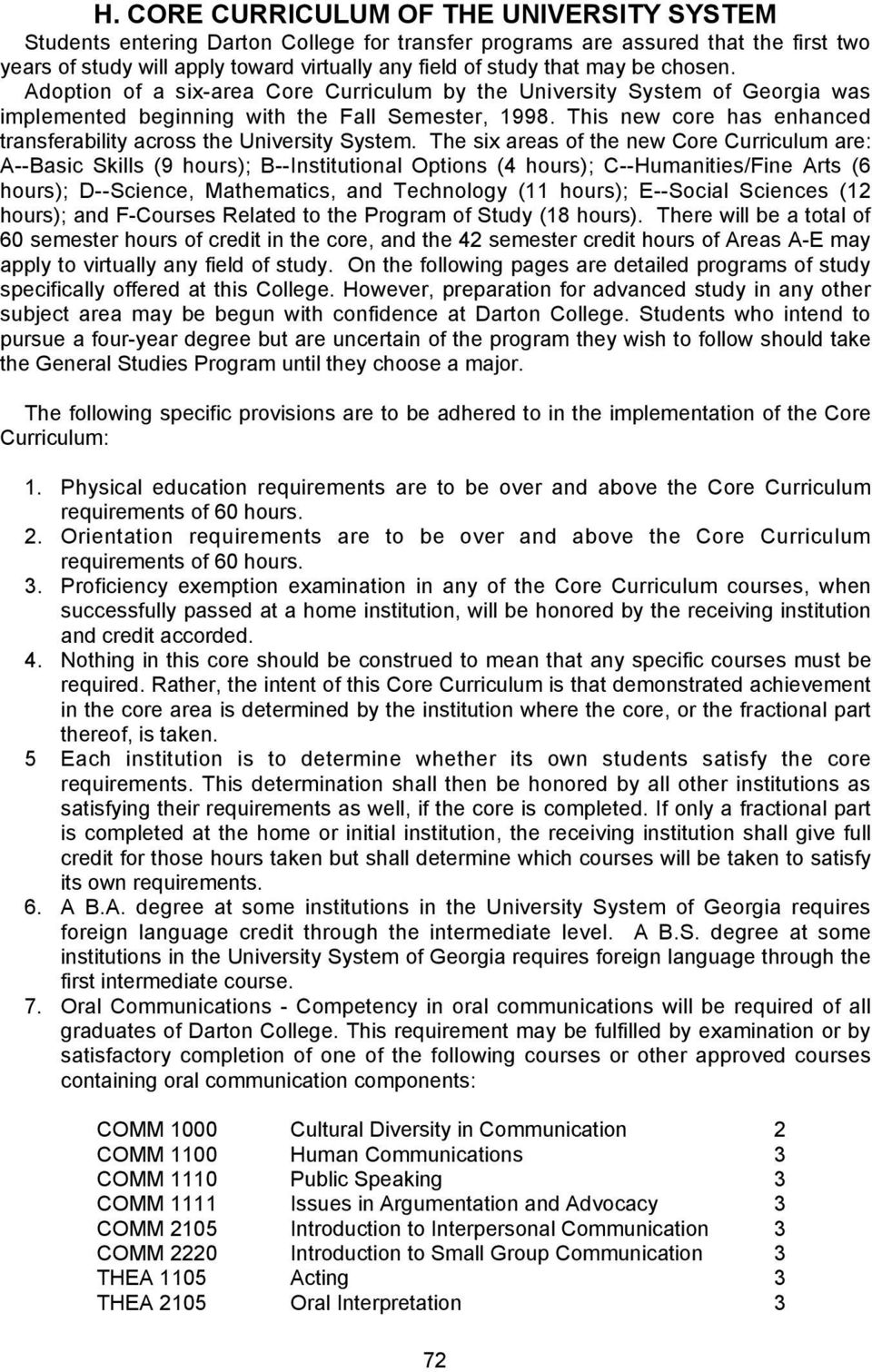
12 H. CORE CURRICULUM OF THE UNIVERSITY SYSTEM Students entering Darton College for transfer programs are assured that the first two years of study will apply toward virtually any field of study that may be chosen. Adoption of a six-area Core Curriculum by the University System of Georgia was implemented beginning with the Fall Semester, This new core has enhanced transferability across the University System. The six areas of the new Core Curriculum are: A--Basic Skills (9 hours); B--Institutional Options (4 hours); C--Humanities/Fine Arts (6 hours); D--Science, Mathematics, and Technology (11 hours); E--Social Sciences (12 hours); and F-Courses Related to the Program of Study (18 hours). There will be a total of 60 semester hours of credit in the core, and the 42 semester credit hours of Areas A-E may apply to virtually any field of study. On the following pages are detailed programs of study specifically offered at this College. However, preparation for advanced study in any other subject area may be begun with confidence at Darton College. Students who intend to pursue a four-year degree but are uncertain of the program they wish to follow should take the General Studies Program until they choose a major. The following specific provisions are to be adhered to in the implementation of the Core Curriculum: 1. Physical education requirements are to be over and above the Core Curriculum requirements of 60 hours. 2. Orientation requirements are to be over and above the Core Curriculum requirements of 60 hours. 3. Proficiency exemption examination in any of the Core Curriculum courses, when successfully passed at a home institution, will be honored by the receiving institution and credit accorded. 4. Nothing in this core should be construed to mean that any specific courses must be required. Rather, the intent of this Core Curriculum is that demonstrated achievement in the core area is determined by the institution where the core, or the fractional part thereof, is taken. 5 Each institution is to determine whether its own students satisfy the core requirements. This determination shall then be honored by all other institutions as satisfying their requirements as well, if the core is completed. If only a fractional part is completed at the home or initial institution, the receiving institution shall give full credit for those hours taken but shall determine which courses will be taken to satisfy its own requirements. 6. A B.A. degree at some institutions in the University System of Georgia requires foreign language credit through the intermediate level. A B.S. degree at some institutions in the University System of Georgia requires foreign language through the first intermediate course. 7. Oral Communications - Competency in oral communications will be required of all graduates of Darton College. This requirement may be fulfilled by examination or by satisfactory completion of one of the following courses or other approved courses containing oral communication components: COMM 1000 Cultural Diversity in Communication 2 COMM 1100 Human Communications 3 COMM 1110 Public Speaking 3 COMM 1111 Issues in Argumentation and Advocacy 3 COMM 2105 Introduction to Interpersonal Communication 3 COMM 2220 Introduction to Small Group Communication 3 THEA 1105 Acting 3 THEA 2105 Oral Interpretation 3 72
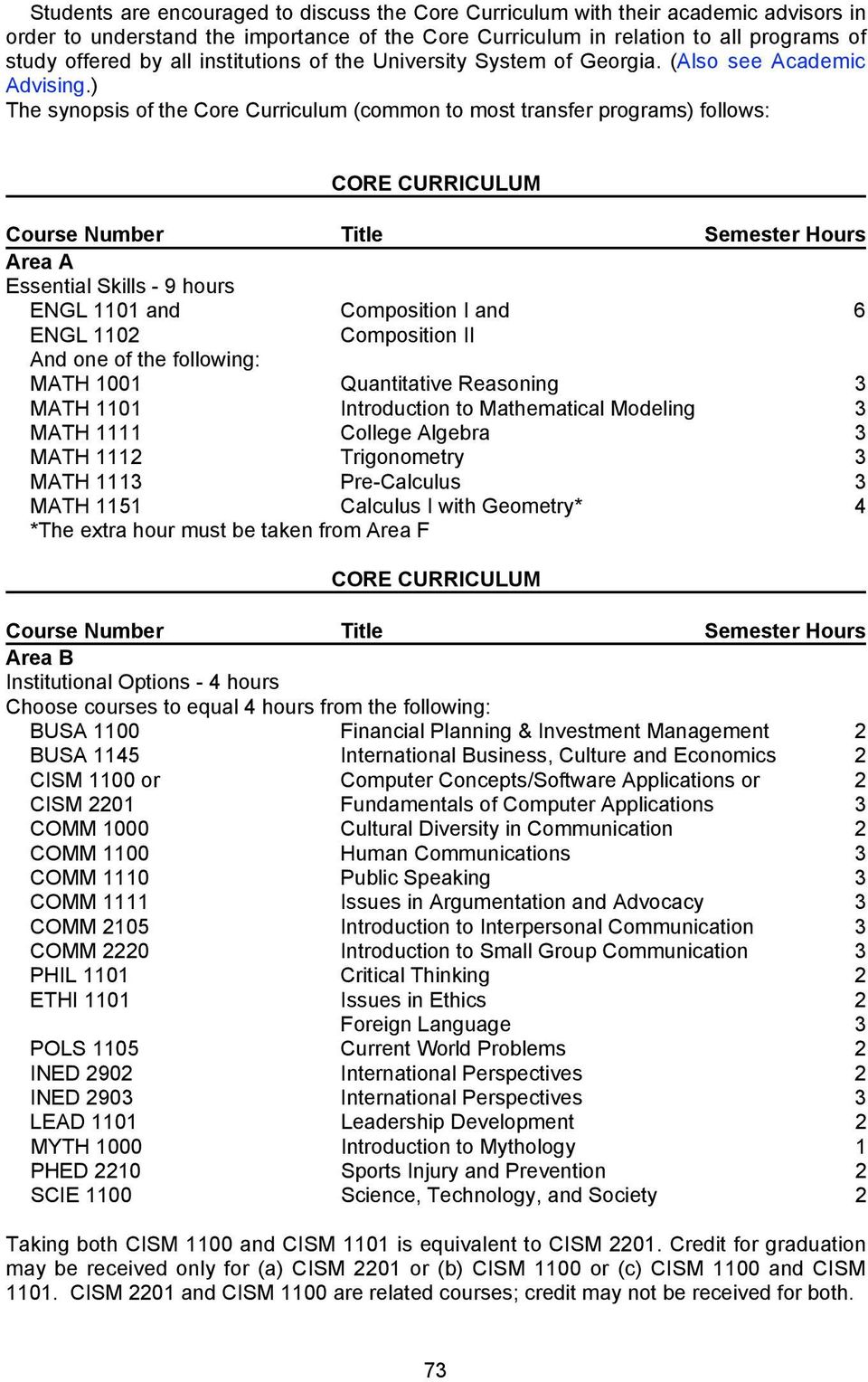
13 Students are encouraged to discuss the Core Curriculum with their academic advisors in order to understand the importance of the Core Curriculum in relation to all programs of study offered by all institutions of the University System of Georgia. (Also see Academic Advising.) The synopsis of the Core Curriculum (common to most transfer programs) follows: CORE CURRICULUM Course Number Title Semester Hours Area A Essential Skills - 9 hours ENGL 1101 and Composition I and 6 ENGL 1102 Composition II And one of the following: MATH 1001 Quantitative Reasoning 3 MATH 1101 Introduction to Mathematical Modeling 3 MATH 1111 College Algebra 3 MATH 1112 Trigonometry 3 MATH 1113 Pre-Calculus 3 MATH 1151 Calculus I with Geometry* 4 *The extra hour must be taken from Area F CORE CURRICULUM Course Number Title Semester Hours Area B Institutional Options - 4 hours Choose courses to equal 4 hours from the following: BUSA 1100 Financial Planning & Investment Management 2 BUSA 1145 International Business, Culture and Economics 2 CISM 1100 or Computer Concepts/Software Applications or 2 CISM 2201 Fundamentals of Computer Applications 3 COMM 1000 Cultural Diversity in Communication 2 COMM 1100 Human Communications 3 COMM 1110 Public Speaking 3 COMM 1111 Issues in Argumentation and Advocacy 3 COMM 2105 Introduction to Interpersonal Communication 3 COMM 2220 Introduction to Small Group Communication 3 PHIL 1101 Critical Thinking 2 ETHI 1101 Issues in Ethics 2 Foreign Language 3 POLS 1105 Current World Problems 2 INED 2902 International Perspectives 2 INED 2903 International Perspectives 3 LEAD 1101 Leadership Development 2 MYTH 1000 Introduction to Mythology 1 PHED 2210 Sports Injury and Prevention 2 SCIE 1100 Science, Technology, and Society 2 Taking both CISM 1100 and CISM 1101 is equivalent to CISM Credit for graduation may be received only for (a) CISM 2201 or (b) CISM 1100 or (c) CISM 1100 and CISM CISM 2201 and CISM 1100 are related courses; credit may not be received for both. 73
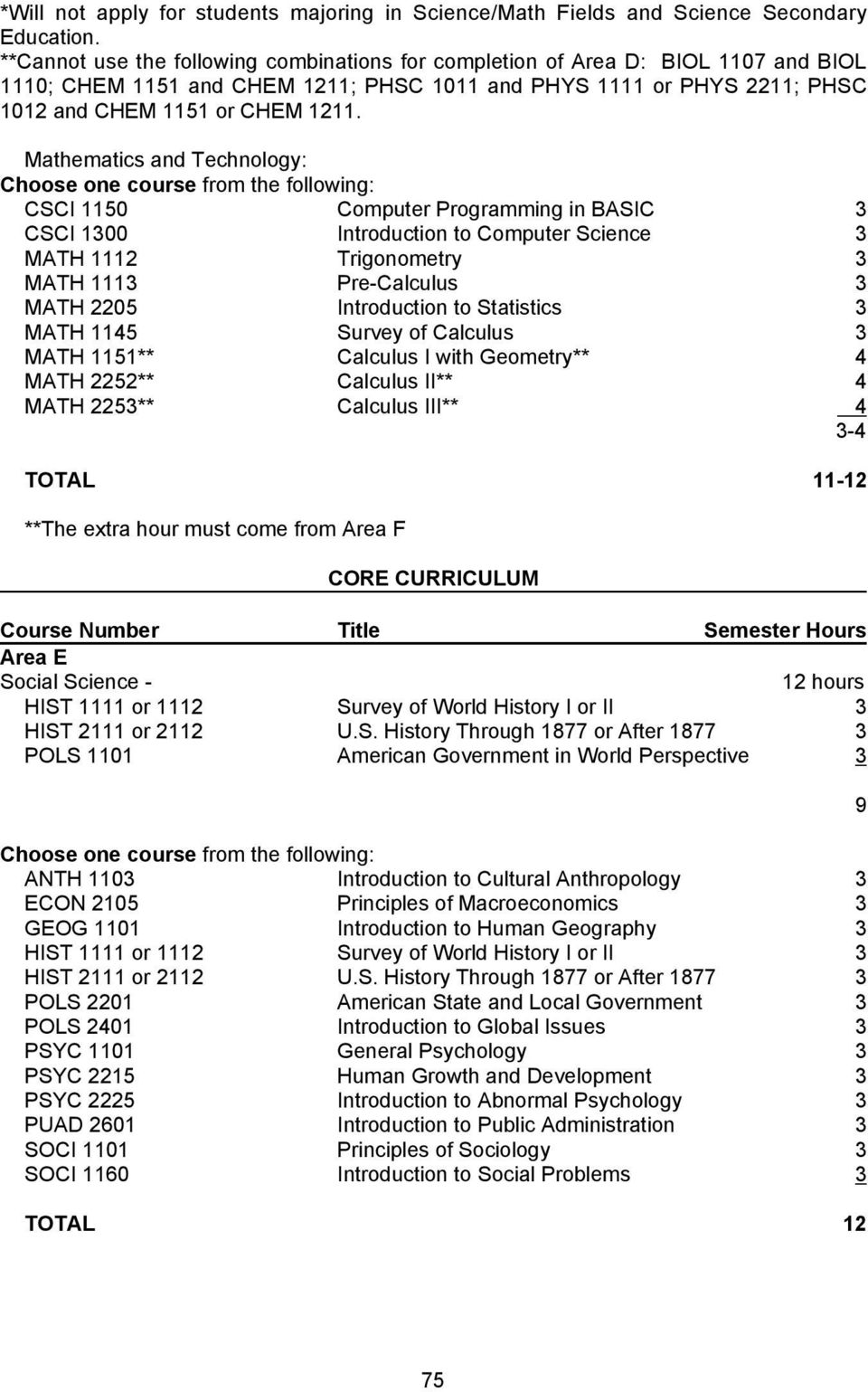
14 Course Number Title Semester Hours Area C Humanities/Fine Arts - 6 hours Literature Choose one of the following: ENGL 2111 World Literature I 3 ENGL 2112 World Literature II 3 ENGL 2121 British Literature I 3 ENGL 2122 British Literature II 3 ENGL 2131 American Literature I 3 ENGL 2132 American Literature II 3 Other Humanities/Fine Arts Courses: Choose one of the following: ART 1100 The Appreciation of Art 3 COMM 1100 Human Communications 3 COMM 1110 Public Speaking 3 FIAR 2250 Humanities Through the Arts 3 FREN 1001 or 1002 Elementary French I or II 3 FREN 2001 or 2002 Intermediate French I or II 3 JAPN 1001 or 1002 Elementary Japanese I or II 3 JAPN 2001 or 2002 Intermediate Japanese I or II 3 MUSC 1100 Appreciation of Music 3 PHIL 2205 Introduction to Philosophy 3 SPAN 1001 or 1002 Elementary Spanish I or II 3 SPAN 2001 or 2002 or 2003 Intermediate Spanish I or II or III 3 THEA 1100 Theatre Appreciation 3 CORE CURRICULUM Course Number Title Semester Hours Area D Science, Mathematics and Technology - 11 hours Science: Choose two lab science courses to equal 8 hours from the following: (Science and Science Secondary Education majors must complete an 8 hour sequence.) BIOL 1110K*, ** Introduction to Environmental Biology* 4 BIOL 1107K** Principles of Biology I 4 BIOL 1108K Principles of Biology II 4 CHEM 1151K*, ** Survey of Chemistry I* 4 CHEM 1211K** Principles of Chemistry I 4 CHEM 1212K Principles of Chemistry II 4 CHEM 2240K Principles of Organic Chemistry I 4 CHEM 2241K Principles of Organic Chemistry II 4 PHSC 1011K*, ** Introductory Physical Science I* 4 PHSC 1012K*, ** Introductory Physical Science II* 4 PHYS 1111K** Introductory Physics I 4 PHYS 1112K Introductory Physics II 4 PHYS 2211K** Principles of Physics I 4 PHYS 2212K Principles of Physics II

15 *Will not apply for students majoring in Science/Math Fields and Science Secondary Education. **Cannot use the following combinations for completion of Area D: BIOL 1107 and BIOL 1110; CHEM 1151 and CHEM 1211; PHSC 1011 and PHYS 1111 or PHYS 2211; PHSC 1012 and CHEM 1151 or CHEM Mathematics and Technology: Choose one course from the following: CSCI 1150 Computer Programming in BASIC 3 CSCI 1300 Introduction to Computer Science 3 MATH 1112 Trigonometry 3 MATH 1113 Pre-Calculus 3 MATH 2205 Introduction to Statistics 3 MATH 1145 Survey of Calculus 3 MATH 1151** Calculus I with Geometry** 4 MATH 2252** Calculus II** 4 MATH 2253** Calculus III** TOTAL **The extra hour must come from Area F CORE CURRICULUM Course Number Title Semester Hours Area E Social Science - 12 hours HIST 1111 or 1112 Survey of World History I or II 3 HIST 2111 or 2112 U.S. History Through 1877 or After POLS 1101 American Government in World Perspective 3 Choose one course from the following: ANTH 1103 Introduction to Cultural Anthropology 3 ECON 2105 Principles of Macroeconomics 3 GEOG 1101 Introduction to Human Geography 3 HIST 1111 or 1112 Survey of World History I or II 3 HIST 2111 or 2112 U.S. History Through 1877 or After POLS 2201 American State and Local Government 3 POLS 2401 Introduction to Global Issues 3 PSYC 1101 General Psychology 3 PSYC 2215 Human Growth and Development 3 PSYC 2225 Introduction to Abnormal Psychology 3 PUAD 2601 Introduction to Public Administration 3 SOCI 1101 Principles of Sociology 3 SOCI 1160 Introduction to Social Problems 3 TOTAL
16 CORE CURRICULUM Course Number Title Semester Hours Area F Major Requirements - 18 hours (See appropriate program requirements.) CORE CURRICULUM Course Number Title Semester Hours Area G Courses required for the degree above the 60 hours. DART 1000 First Year Experience 2 Health and Physical Education 5 8 hours One course per semester of full-time enrollment with a maximum of four courses. To satisfy the fitness competency requirement for graduation, choose one of the following: PHED 1182 Personal Conditioning 2 PHED 1105 Strength Training 2 PHED 1161 or 1162 Fitness I or II 2 PHED 1106 Walk, Jog, or Run for Fitness 2 PHED 1115 or 1116 Step Aerobics I or II 2 PHED 1110 Deep Water Exercise 2 PHED 1123 Aerobic Pump 2 PHED 1139 Fitness Swimming 2 PHED 1198 Aerobic Dancing 2 PHED 1220 Aquatic Circuit Training 2 PHED 1225 Aqua-jogging 2 HLTH 1163H Personal Health Honors 2 Any PHED or HLTH course with a 1000 number satisfies the additional PE requirements. DANC 1600, DANC 1740, DANC 1750, DANC 1840, DANC 1850, may also be used as PE courses. A student may substitute music performance classes (MUSC 1080 College Band and MUSC 1090 College Choir) for up to two (2) of the physical education requirements. TOTAL

17 I. PHYSICAL EDUCATION REQUIREMENTS On-Campus Students Health or Physical Education 4 courses (or 1 course for each semester of full-time enrollment) A fitness/wellness course must be one of these 4 courses All full-time students, with exception of Online-Only students or those excluded by program requirements or personal hardship cases recommended by the Chair of the Physical Education Division and approved by the Vice President for Academic Affairs, are required to complete four courses in physical education for graduation. Each student, unless otherwise exempt, must take a health or physical education course for each semester of attendance as a full-time student up to a maximum of four courses. NOTE! The health or physical education requirement is four (4) courses regardless of the credit awarded in the course. A student must take four courses regardless of the total number of credit hours accumulated. Veterans of more than one year of active military service may be given credit for four (4) courses of health or physical education upon presentation of Form DD 214 to the Registrar s Office. Veterans must make this request before enrolling in a health or physical education course. A competency in fitness/wellness will be required of all graduates of Darton College with exception of those excluded by program requirements, special contracts, and certificate programs. The requirement may be fulfilled by satisfactory completion of one of the following courses: PHED 1105, Strength Training; PHED 1106, Walk, Jog, Run; PHED 1161, Fitness I; PHED 1162, Fitness II; PHED 1110, Deep Water Exercise; PHED 1139, Fitness Swimming; PHED 1115, Step Aerobics; PHED 1116, Step Aerobics II; PHED 1123, Aerobic Pump; or PHED 1182, Personal Conditioning; PHED 1198, Aerobic Dancing; HLTH 1163H Personal Health (Honors.) Health and Physical Education courses may not be repeated and will not count towards the required courses needed for graduation. Classroom health courses may not be repeated. Since Darton College does not grant an exemption from physical education for health reasons, students with a physical disability may satisfy this requirement by completing four health courses which are taught in a classroom setting. Students are urged to ask their advisors or one of the physical education instructors if there are any questions regarding the strenuousness of a physical education course. It is the responsibility of each student with a physical disability who elects to take an activity physical education course to advise the instructor of the disability so that proper accommodations can be made. A student may substitute music performance classes (MUSC 1080 College Band and MUSC 1090 College Choir) for up to two (2) of the physical education requirements. Online-Only Students Fitness/Wellness 1 course The One Fitness course requirement for Online Only students was implemented in the year Therefore, any student attending Darton as an online-only student from 2002 current, will meet the requirement of Fitness/Wellness, 1 course. Any course work completed at Darton College prior to this 2002 Online Only PE requirement will not alter the current status of this student as Online Only. 77

18 Darton College s Physical Education Requirements for Graduation Transfer Student to Graduate AA and AS Certificate Nursing Online Only Career Student to Graduate AA and AS Part-time less than 12 hours Fitness Competency Required for Graduation Exempt from all Physical Education Requirements Any 1 credit for PE activity course (Area G) All course work is online. Students who do not take any campus based classes. Exempt from all Physical Education Requirements Dental Hygiene EMT Health Information Technology Human Services Medical Laboratory Technology Occupational Therapy Assistant Physical Therapy Assistant Respiratory Care Trade & Industrial Full-time 12 or more hours One Course per full-time semester, maximum of four. One course must meet the Fitness Competency Requirements. Fitness Competency Required for Graduation Fitness Competency Required for Graduation Accounting Biomedical Technology Business Computer Systems Cardiovascular Technology Cisco Support Government Services Histotechnology Technician Information Systems Management Network Support Paralegal Polysomnography Psychology Technician 78

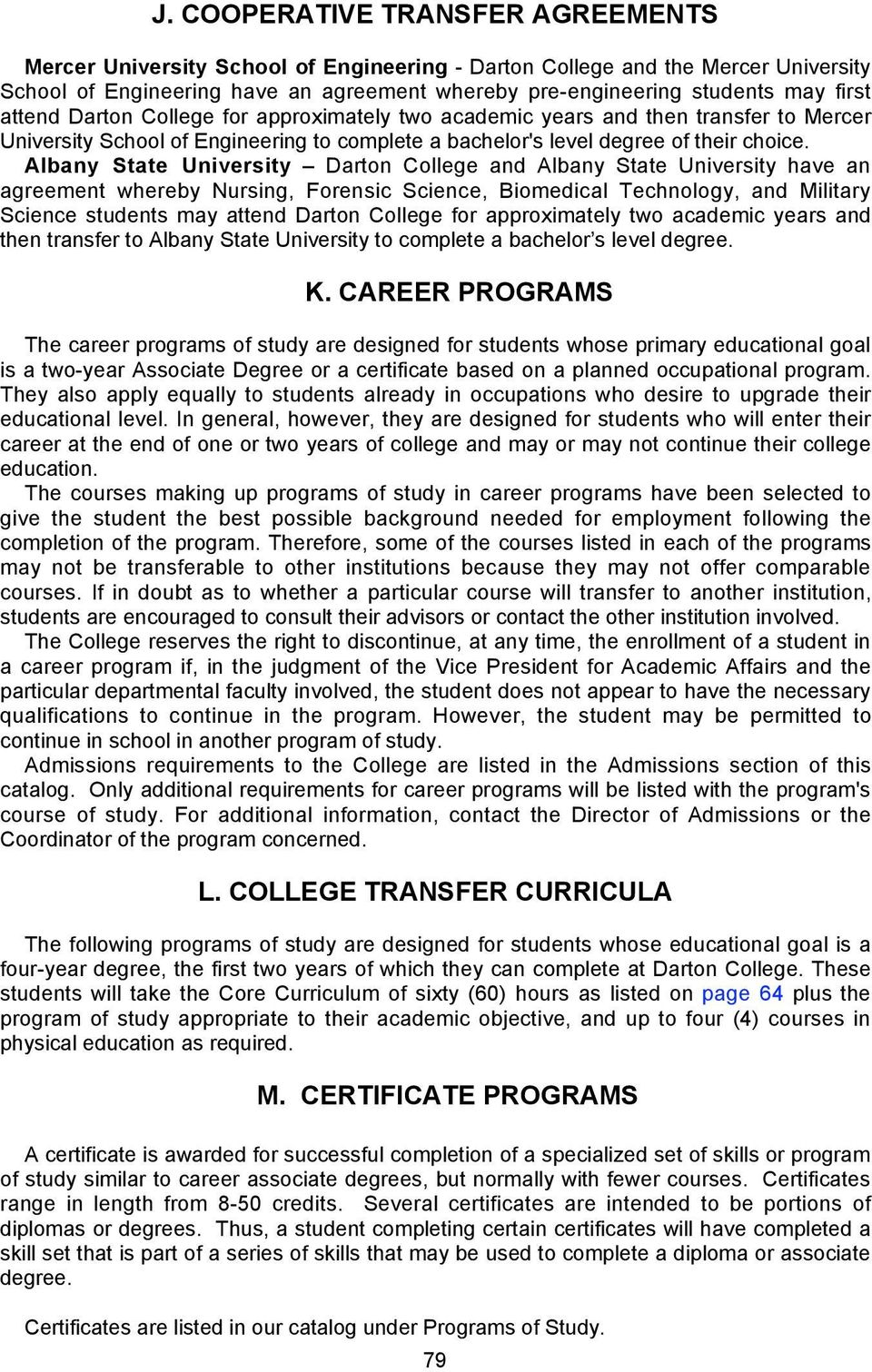
19 J. COOPERATIVE TRANSFER AGREEMENTS Mercer University School of Engineering - Darton College and the Mercer University School of Engineering have an agreement whereby pre-engineering students may first attend Darton College for approximately two academic years and then transfer to Mercer University School of Engineering to complete a bachelor's level degree of their choice. Albany State University Darton College and Albany State University have an agreement whereby Nursing, Forensic Science, Biomedical Technology, and Military Science students may attend Darton College for approximately two academic years and then transfer to Albany State University to complete a bachelor s level degree. K. CAREER PROGRAMS The career programs of study are designed for students whose primary educational goal is a two-year Associate Degree or a certificate based on a planned occupational program. They also apply equally to students already in occupations who desire to upgrade their educational level. In general, however, they are designed for students who will enter their career at the end of one or two years of college and may or may not continue their college education. The courses making up programs of study in career programs have been selected to give the student the best possible background needed for employment following the completion of the program. Therefore, some of the courses listed in each of the programs may not be transferable to other institutions because they may not offer comparable courses. If in doubt as to whether a particular course will transfer to another institution, students are encouraged to consult their advisors or contact the other institution involved. The College reserves the right to discontinue, at any time, the enrollment of a student in a career program if, in the judgment of the Vice President for Academic Affairs and the particular departmental faculty involved, the student does not appear to have the necessary qualifications to continue in the program. However, the student may be permitted to continue in school in another program of study. Admissions requirements to the College are listed in the Admissions section of this catalog. Only additional requirements for career programs will be listed with the program's course of study. For additional information, contact the Director of Admissions or the Coordinator of the program concerned. L. COLLEGE TRANSFER CURRICULA The following programs of study are designed for students whose educational goal is a four-year degree, the first two years of which they can complete at Darton College. These students will take the Core Curriculum of sixty (60) hours as listed on page 64 plus the program of study appropriate to their academic objective, and up to four (4) courses in physical education as required. M. CERTIFICATE PROGRAMS A certificate is awarded for successful completion of a specialized set of skills or program of study similar to career associate degrees, but normally with fewer courses. Certificates range in length from 8-50 credits. Several certificates are intended to be portions of diplomas or degrees. Thus, a student completing certain certificates will have completed a skill set that is part of a series of skills that may be used to complete a diploma or associate degree. Certificates are listed in our catalog under Programs of Study. 79
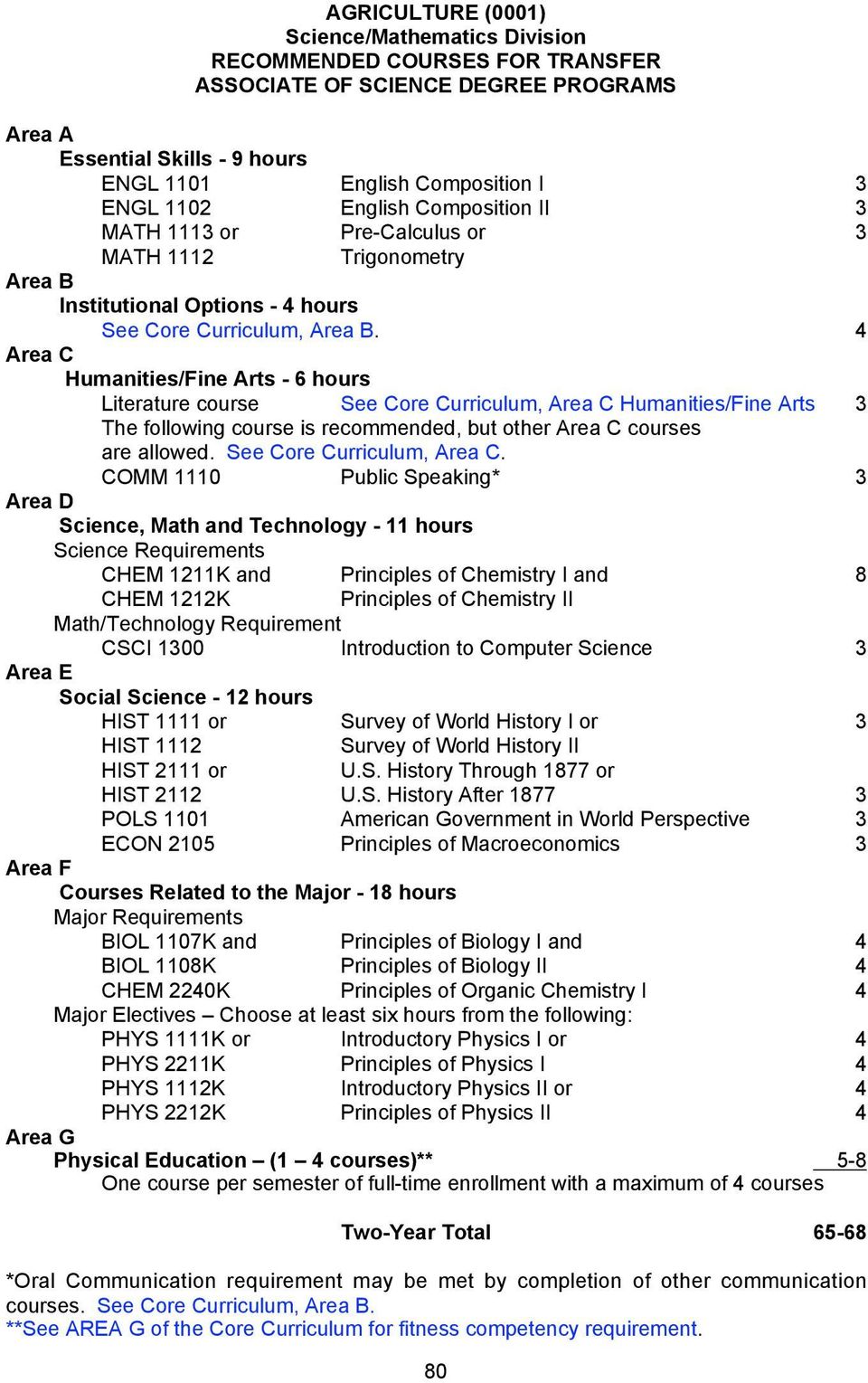
20 AGRICULTURE (0001) Science/Mathematics Division RECOMMENDED COURSES FOR TRANSFER ASSOCIATE OF SCIENCE DEGREE PROGRAMS Area A Essential Skills - 9 hours ENGL 1101 English Composition I 3 ENGL 1102 English Composition II 3 MATH 1113 or Pre-Calculus or 3 MATH 1112 Trigonometry Area B Institutional Options - 4 hours See Core Curriculum, Area B. 4 Area C Humanities/Fine Arts - 6 hours Literature course See Core Curriculum, Area C Humanities/Fine Arts 3 The following course is recommended, but other Area C courses are allowed. See Core Curriculum, Area C. COMM 1110 Public Speaking* 3 Area D Science, Math and Technology - 11 hours Science Requirements CHEM 1211K and Principles of Chemistry I and 8 CHEM 1212K Principles of Chemistry II Math/Technology Requirement CSCI 1300 Introduction to Computer Science 3 Area E Social Science - 12 hours HIST 1111 or Survey of World History I or 3 HIST 1112 Survey of World History II HIST 2111 or U.S. History Through 1877 or HIST 2112 U.S. History After POLS 1101 American Government in World Perspective 3 ECON 2105 Principles of Macroeconomics 3 Area F Courses Related to the Major - 18 hours Major Requirements BIOL 1107K and Principles of Biology I and 4 BIOL 1108K Principles of Biology II 4 CHEM 2240K Principles of Organic Chemistry I 4 Major Electives Choose at least six hours from the following: PHYS 1111K or Introductory Physics I or 4 PHYS 2211K Principles of Physics I 4 PHYS 1112K Introductory Physics II or 4 PHYS 2212K Principles of Physics II 4 Area G Physical Education (1 4 courses)** 5-8 One course per semester of full-time enrollment with a maximum of 4 courses Two-Year Total *Oral Communication requirement may be met by completion of other communication courses. See Core Curriculum, Area B. **See AREA G of the Core Curriculum for fitness competency requirement. 80
21 81
22 AGRICULTURE (0001) Science/Mathematics Division RECOMMENDED COURSES FOR TRANSFER ASSOCIATE OF SCIENCE DEGREE PROGRAMS Freshman Year First Semester Sem. Hrs. ENGL 1101 English Composition I 3 CHEM 1211K Principles of Chemistry I 4 MATH 1113 Pre-Calculus 3 POLS 1101 American Government in World Perspective 3 AREA B Elective See Core Curriculum, Area B Second Semester ENGL 1102 English Composition II 3 CHEM 1212K Principles of Chemistry II 4 CSCI 1300 Introduction to Computer Science 3 HIST 1111 or Survey of World History I or HIST 1112 Survey of World History II 3 AREA B Elective See Core Curriculum, Area B Summer Semester CHEM 2240K Principles of Organic Chemistry I 4 Sophomore Year First Semester Sem. Hrs. BIOL 1107K Principles of Biology I 4 PHYS 1111K Introductory Physics I 4 COMM 1110 Public Speaking* 3 HIST 2111 or U.S. History Through 1877 or HIST 2112 U.S. History After Second Semester BIOL 1108K Principles of Biology II 4 PHYS 1112K Introductory Physics II 4 AREA C Literature See Core Curriculum, Area C. 3 ECON 2105 Principles of Macroeconomics Two-Year Total *Oral Communication requirement may be met by completion of other communication courses. See Core Curriculum, Area B. 82
23 ANTHROPOLOGY (0093) Social Science Division RECOMMENDED COURSES FOR TRANSFER ASSOCIATE OF SCIENCE DEGREE PROGRAMS Area A Essential Skills - 9 Hours ENGL 1101 English Composition I 3 ENGL 1102 English Composition II 3 MATH 1101 or Quantitative Skills and Reasoning or MATH 1111 College Algebra or higher math 3 Area B Institutional Options - 4 Hours See Core Curriculum, Area B. 4 Area C Humanities And The Fine Arts - 6 Hours Literature course See Core Curriculum, Area C, Humanities/Fine Arts. 3 The following course is recommended, but other Area C courses are allowed. See Core Curriculum, Area C. COMM 1110 Public Speaking* 3 Area D Science, Mathematics, And Technology - 11 Hours Lab Science See Core Curriculum, Area D, Lab Sciences. 8 Mathematics/ See Core Curriculum, Area D, Mathematics/ Technology Technology courses. 3 Area E Social Science - 12 Hours HIST 1111 or Survey of World History I or HIST 1112 Survey of World History II 3 HIST 2111 or U.S. History Through 1877 or HIST 2112 U.S. History After POLS 1101 American Government in World Perspective 3 Elective See Core Curriculum, Area E, Social/Science courses 3 Area F Courses Related To The Major - 18 Hours ANTH 1103 Introduction to Cultural Anthropology 3 Optional Electives (15 hours) from the following BIOL 1107K Principles of Biology I 4 BIOL 1108K or Principles of Biology II or 4 CSCI 1150 or Computer Programming in Visual Basic or 3 CSCI 1300 or Introduction to Computer Science 3 ECON 2105 or Principles of Macroeconomics or 3 ECON 2106 or Principles of Microeconomics or 3 Foreign Language 0-12 GEOG 1101or Introduction to Human Geography or 3 HIST 1111** or Survey of World History I 3 HIST 1112** or Survey of World History II 3 HIST 2111** or U.S. History Through 1877 or 3 HIST 2112** or U.S. History After 1877 or 3 83
24 MATH 2205 or Introduction to Statistics or 3 PHIL 2205 or Introduction to Philosophy or 3 POLS 2201 or American State and Local Government or 3 POLS 2401 or International Politics or 3 PSYC 1101 or General Psychology or 3 PSYC 2215 or Human Growth and Development or 3 PSYC 2225 or Introduction to Abnormal Psychology or 3 PSYC 2226 Introduction to Social Psychology 3 PUAD 2601 or Introduction to Public Administration or 3 SOCI 1101 or Principles of Sociology or 3 SOCI 1160 Introduction to Social Problems 3 Area G Physical Education (1 4 courses)*** 5-8 One course per semester of full-time enrollment with a maximum of 4 courses Two-Year Total *Oral Communication requirement may be met by completion of other communication courses. See Core Curriculum, Area B. **If taken in a previous area, may not be used again. ***See AREA G of the Core Curriculum for fitness competency requirement. 84
25 ANTHROPOLOGY (0093) Social Science Division RECOMMENDED COURSES FOR TRANSFER ASSOCIATE OF SCIENCE DEGREE PROGRAMS Freshman Year First Semester Sem. Hrs. ENGL 1101 Composition I 3 MATH 1001 or Quantitative Skills and Reasoning or or MATH 1111 College Algebra or higher math 3 AREA D Lab Science See Core Curriculum, Area D, Lab Sciences. 4 HIST 2111 or U.S. History Through 1877 or HIST 2112 U.S. History After AREA F Elective See Area F Courses Related to the Major. 3 AREA G Elective See Core Curriculum, Health/Phy.Educ Second Semester ENGL 1102 Composition II 3 AREA D Lab Science See Core Curriculum, Area D, Lab Sciences. 4 AREA D Elective See Core Curriculum, Area D, Lab Sciences. 3 HIST 1111 or Survey of World History I or HIST 1112 Survey of World History II 3 AREA F Elective See Area F Courses Related to the Major Sophomore Year First Semester Sem. Hrs. AREA B Elective See Core Curriculum, Area B. 1-3 COMM 1110 Public Speaking* 3 POLS 1101 American Government in World Perspective 3 ANTH 1103 Introduction to Cultural Anthropology 3 AREA F Elective See Area F Courses Related to the Major Second Semester AREA B Elective See Core Curriculum, Area B. 1-3 AREA C Literature See Core Curriculum, Area C. 3 AREA E Elective See Core Curriculum, Area E, Social Sciences. 3 AREA F Elective See Area F Courses Related to the Major. 3 AREA F Elective See Area F Courses Related to the Major Two-Year Total *Oral Communication requirement may be met by completion of other communication courses. See Core Curriculum, Area B. 85
26 ART (0002) Humanities Division RECOMMENDED COURSES FOR TRANSFER ASSOCIATE OF ARTS DEGREE PROGRAMS Area A Essential Skills - 9 Hours ENGL 1101 English Composition I 3 ENGL 1102 English Composition II 3 MATH 1001 or Quantitative Skills and Reasoning or or MATH 1111 College Algebra or higher math 3 Area B Institutional Options - 4 Hours The following courses are recommended, but other Area B courses are allowed. COMM 1000 or Cultural Diversity in Communication or COMM 1110 or Public Speaking* or COMM 1111 Issues in Argumentation and Advocacy 2-3 PHIL 1101 Critical Thinking 2 Area C Humanities And The Fine Arts - 6 Hours Literature See Core Curriculum, Area C. 3 The following course is recommended, but other Humanities/Fine Arts courses are allowed. See Core Curriculum, Area C. Foreign Language Intermediate I or 2001 Higher Foreign Language 3 Area D Science, Mathematics, And Technology - 11 Hours Lab Science See Core Curriculum, Area D, Lab Sciences. 8 The following course is recommended, but other Math/Technology courses are allowed. MATH 1112 Trigonometry 3 Area E Social Science - 12 Hours POLS 1101 American Government in World Perspective 3 HIST 2111 or U. S. History Through 1877 or HIST 2112 U. S. History After HIST 1111 or Survey of World History I HIST 1112 Survey of World History II 3 The following course is recommended, but other Social Science courses are allowed. ANTH 1103 Introduction to Cultural Anthropology 3 Area F Courses Related To The Major - 18 Hours Major Requirements (12 hours) ART 1020 Design I 3 ART 1030 Design II 3 ART 2280 Art History l 3 ART 2285 Art History ll 3 Major Electives (6 hours) ART 1010 ART 2111 ART 2120 ART 2130 ART 2140 ART 2150 ART 2160 Drawing Basic Photography Painting Watercolor Ceramics I Computer Arts Visual Design 86
27 ART 2170 Web Page Design ART 2180 Digital Photography 6 Area G Physical Education (1 4 courses)** 5-8 One course per semester of full-time enrollment with a maximum of 4 courses Two-Year Total *Oral Communication requirement may be met by completion of other communication courses. See Core Curriculum, Area B. **See AREA G of the Core Curriculum for fitness competency requirement. *** A B.A. degree at some institutions in the University System of Georgia requires foreign language credit through the intermediate level. A B.S. degree at some institutions in the University System of Georgia requires foreign language through the first intermediate course. ****See Teacher Education (0014) for Secondary Education Art Majors. 87
28 ART (0002) Humanities Division RECOMMENDED COURSES FOR TRANSFER ASSOCIATE OF ARTS DEGREE PROGRAMS Freshman Year First Semester Sem. Hrs. ART 1020 Design I 3 ENGL 1101 Composition I 3 MATH 1001 or Quantitative Skills and Reasoning or or MATH 1111 College Algebra or higher math 3 POLS 1101 American Government in World Perspective 3 AREA D Lab Science See Core Curriculum, Area D, Lab Sciences Second Semester ART 1030 Design II 3 ENGL 1102 Composition II 3 AREA D Lab Science See Core Curriculum, Area D, Lab Sciences. 4 HIST 2111 or U.S. History Through 1877 or HIST 2112 U.S. History After The following course is recommended, but other Area D Math/Technology courses are allowed. MATH 1112 Trigonometry 3 AREA G Elective See Core Curriculum, Health and Physical Educ Sophomore Year First Semester Sem. Hrs. AREA C Literature See Core Curriculum, Area C. 3 HIST 1111 or Survey of World History I or 3 HIST 1112 Survey of World History II ART 2280 Art History I 3 Choose one of the following: ART 1010 or Drawing or ART 2111 or Basic Photography or ART 2130 or Watercolor or ART 2140 or Ceramics I or ART 2150 or Computer Arts or ART 2170 or Web Page Design or ART 2180 Digital Photography 3 The following courses are recommended, but other Area C Humanities/Fine Arts courses are allowed. See Core Curriculum, Area C. Foreign Language Intermediate I or Higher Foreign Language Second Semester ART 2285 Art History II 3 ART 2111 or Basic Photography or ART 2120 or Painting or ART 2130 or Watercolor or ART 2140 or Ceramics I or ART 2150 or Computer Arts or ART 2160 or Visual Design or ART 2180 Digital Photography 3 The following course is recommended, but other Area B courses are allowed. PHIL 1101 Critical Thinking 2 The following courses are recommended, but other Area B courses are allowed. COMM 1000 or Cultural Diversity in Communication or 88
29 COMM 1110 or Public Speaking* or COMM 1111 Issues in Argumentation and Advocacy 2-3 The following course is recommended, but other Area E Social Science courses are allowed. See Core Curriculum, Area E, Social Science. ANTH 1103 Introduction to Cultural Anthropology Two-Year Total *Oral Communication requirement may be met by completion of other communication courses. See Core Curriculum, Area B. 89
30 GRAPHIC DESIGN (0574) Humanities Division RECOMMENDED COURSES FOR CERTIFICATE PROGRAM The Graphic Design Certificate Program is structured to provide basic skills for immediate employment in the graphic design field. The Graphic Design Certificate requires a completion of 18 hours of study (six courses of 3 hours each.) Four of those six courses are in the existing Art Program. The students will be introduced to basic, introductory level skills in theses areas: drawing, two-dimensional design, digital design, photography, graphic design production, and web page design. Fall Semester Sem. Hrs. ART 1010 Drawing 3 ART 1020 Design I 3 ART 2170 Web Page Design 3 9 Spring Semester ART 2111 Basic Photography 3 ART 2160 Visual Design 3 ART 2150 Computer Art 3 9 One Year Total 18 90
31 VIDEO TECHNIQUES AND APPLICATIONS CERTIFICATE (0569) Humanities Division RECOMMENDED COURSES FOR CERTIFICATE PROGRAM The Video Techniques and Applications Certificate has been created to provide a working knowledge of the basics of the Videography and Digital Video Editing Field and to use that knowledge to immediately enter the workforce. The Video Techniques and Applications Certificate requires a completion of 18 hours of study (six courses of 3 credit hours each.) Two of these courses are in the Art Transfer Degree Program. This program includes basic and advanced digital video camera techniques, basic and advanced digital video editing techniques, computer art, two-dimensional design and portfolio preparation and review. Fall Semester Sem. Hrs. ART 1020 Design I 3 ART 2150 Computer Art 3 ART 2210 Video I 3 9 Spring Semester Sem. Hrs. ART 2190 Photographic Lighting Techniques 3 ART 2230 Video Editing 3 ART 2200 Prof. Practices, Portfolio Preparation & Review 3 9 One-Year Total 18 91
32 VISUAL COMMUNICATION (0537) Humanities Division RECOMMENDED COURSES FOR CERTIFICATE PROGRAM The Visual Communication Certificate is structured to provide basic skills for immediate employment in the Visual Communication field. The Visual Communication Certificate program is based on four courses in the Associate of Arts Art Program (Basic Photography, Computer Art, Design I, and Digital Photography,) with the addition of a course in Photographic Lighting Techniques and a course entitled Professional Practices, Portfolio Preparation and Review. Fall Semester Sem. Hrs. ART 2111 Basic Photography 3 ART 2190 Photographic Lighting Techniques 3 ART 1020 Design I 3 9 Spring Semester Sem. Hrs. ART 2150 Computer Art 3 ART 2180 Digital Photography 3 ART 2200 Professional Practices, Portfolio Preparation and Review 3 9 One-Year Total 18 92
33 BIOLOGY (0003) Science/Mathematics Division RECOMMENDED COURSES FOR TRANSFER ASSOCIATE OF SCIENCE DEGREE PROGRAMS Area A Essential Skills - 9 hours ENGL 1101 English Composition I 3 ENGL 1102 English Composition II 3 MATH 1113 or Pre-Calculus or 3 MATH 1112 Trigonometry Area B Institutional Options - 4 hours See Core Curriculum, Area B. 4 Area C Humanities/Fine Arts - 6 hours Literature Course See Area C Core Curriculum, Humanities/Fine Arts 3 The following course is recommended, but other Area C courses are allowed. See Core Curriculum, Area C. COMM 1110 Public Speaking* 3 Area D Science, Math and Technology - 11 hours Science Requirements CHEM 1211K and Principles of Chemistry I and 8 CHEM 1212K Principles of Chemistry II Math/Technology Requirement MATH 2205 Introduction to Statistics 3 Area E Social Science - 12 hours HIST 1111 or Survey of World History I or HIST 1112 Survey of World History II 3 HIST 2111 or U.S. History Through 1877 or HIST 2112 U.S. History After POLS 1101 American Government in World Perspective 3 Elective See Core Curriculum, Area E 3 Area F Courses Related to the Major - 18 hours*** Major Requirements BIOL 1107K Principles of Biology I 4 BIOL 1108K Principles of Biology II 4 Major Electives CHEM 2240K Principles of Organic Chemistry I and 4 CHEM 2241K Principles of Organic Chemistry II 4 PHYS 1111K and Introductory Physics I or 4 PHYS 2211K Principles of Physics I 4 PHYS 1112K and Introductory Physics II or 4 PHYS 2212K Principles of Physics II 4 SCIE 2000K or Principles of Research Methodology or SCIE 2001K Principles of Scientific Instrumentation/Methods 2 Area G Physical Education (1 4 courses)** 5-8 One course per semester of full-time enrollment with a maximum of 4 courses Two-Year Total
34 *Oral Communication requirement may be met by completion of other communication courses. See Core Curriculum, Area B. **See AREA G of the Core Curriculum for fitness competency requirement. ***Secondary Education Biology Majors see Teacher Education (0014) Secondary Education. 94
35 Biology (0003) Science/Mathematics Division RECOMMENDED COURSES FOR TRANSFER ASSOCIATE OF SCIENCE DEGREE PROGRAMS Freshman Year First Semester Sem. Hrs. ENGL 1101 English Composition I 3 CHEM 1211K Principles of Chemistry I 4 MATH 1113 Pre-Calculus 3 POLS 1101 American Government in World Perspective 3 AREA B Elective See Core Curriculum, Area B Second Semester ENGL 1102 English Composition II 3 CHEM 1212K Principles of Chemistry II 4 MATH 2205 Introduction to Statistics 3 HIST 1111 or Survey of World History I or HIST 1112 Survey of World History II 3 AREA B Elective See Core Curriculum, Area B Summer Semester CHEM 2240K Principles of Organic Chemistry I 4 CHEM 2241K Principles of Organic Chemistry II 4 8 Sophomore Year First Semester Sem. Hrs. BIOL 1107K Principles of Biology I 4 PHYS 1111K Introductory Physics I 4 COMM 1110 Public Speaking* 3 HIST 2111 or U.S. History Through 1877 or HIST 2112 U.S. History After SCIE 2000K or Principles of Research Methodology or SCIE 2001K Principles of Scientific Instrumentation/Methods Second Semester BIOL 1108K Principles of Biology II 4 PHYS 1112K Introductory Physics II 4 AREA C Literature See Core Curriculum, Area C, Hum/Fine Arts. 3 AREA E Elective See Core Curriculu, Area E, Social Sciences Two-Year Total *Oral Communication requirement may be met by completion of other communication courses. See Core Curriculum, Area B. 95
36 BIOMEDICAL TECHNOLOGY (0055) Science/Mathematics Division RECOMMENDED COURSES FOR TRANSFER ASSOCIATE OF SCIENCE DEGREE PROGRAMS Area A Essential Skills - 9 hours ENGL 1101 English Composition I 3 ENGL 1102 English Composition II 3 MATH 1112 or Trigonometry or 3 MATH 1113 Pre-Calculus Area B Institutional Options - 4 hours See Core Curriculum, Area B 4 Area C Humanities/Fine Arts - 6 hours Literature Course See Area C Core Curriculum, Humanities/Fine Arts 3 The following course is recommended, but other Area C courses are allowed. See Core Curriculum, Area C. COMM 1110 Public Speaking* 3 Area D Science, Math and Technology - 11 hours Science Requirements BIOL 1107K and Principles of Biology I 8 BIOL 1108K Principles of Biology II Math/Technology Requirement MATH 2205 Introduction to Statistics 3 Area E Social Science - 12 hours HIST 1111 or Survey of World History I or HIST 1112 Survey of World History II 3 HIST 2111 or U.S. History Through 1877 or HIST 2112 U.S. History After POLS 1101 American Government in World Perspective 3 Elective See Core Curriculum, Area E, Social Sciences. 3 Area F Courses Related to the Major - 28 hours Major Requirements CHEM 1211K Principles of Chemistry I 4 BIOL 2115K Microbiology 4 BIOM 2101K Introduction to Biotechnology 4 BIOM 2100K Molecular Genetics 4 BIOM 2204K Cellular/Molecular Biology 4 BIOM 2205K Introduction to Biochemistry 4 BIOM 2202K Applications in Biotechnology 4 Area G Physical Education (1 4 courses)** PHED 1161 Fitness I 2 Two-Year Total *Oral Communication requirement may be met by completion of other communication courses. See Core Curriculum, Area B. **See AREA G of the Core Curriculum for fitness competency requirement. 96
37 BIOMEDICAL TECHNOLOGY (0055) Science/Mathematics Division RECOMMENDED COURSES FOR TRANSFER ASSOCIATE OF SCIENCE DEGREE PROGRAMS Freshman Year Fall Semester Sem. Hrs. ENGL 1101 English Composition I 3 HIST 1111 or Survey of World History I or HIST 1112 Survey of World History II 3 PHED 1161 Fitness I 2 BIOL 1107K Principles of Biology I 4 MATH 1112 or Trigonometry or MATH 1113 Pre-Calculus 3 15 Spring Semester ENGL 1102 English Composition II 3 MATH 2205 Introduction to Statistics 3 BIOL 1108K Principles of Biology II 4 BIOM 2101K Introduction to Biotechnology 4 AREA B Elective See Core Curriculum, Area B Summer Semester BIOL 2115K Microbiology 4 BIOM 2100K Molecular Genetics 4 8 Sophomore Year Fall Semester Sem. Hrs. AREA C Literature See Core Curriculum, Area C, Hum/Fine Arts. 3 HIST 2111 or U.S. History Through 1877 or HIST 2112 U.S. History After CHEM 1211K Principles of Chemistry I 4 COMM 1110* Public Speaking* 3 BIOM 2204K Cellular/Molecular Biology 4 17 Second Semester POLS 1101 American Government 3 BIOM 2202K Applications in Biotechnology 4 BIOM 2205K Introduction to Biochemistry 4 AREA B Elective See Core Curriculum, Area B. 2 AREA E Elective See Core Curriculum, Area E, Social Sciences Two-Year Total 72 *Oral Communication requirement may be met by completion of other communication courses. See Core Curriculum, Area B. 97
38 BUSINESS ADMINISTRATION (0004) Business Division RECOMMENDED COURSES FOR TRANSFER ASSOCIATE OF SCIENCE DEGREE PROGRAMS This degree program is also available as an online degree program. See the description of the online program of study at Area A Essential Skills - 9 Hours ENGL 1101 English Composition I 3 ENGL 1102 English Composition II 3 The following course is recommended, but other Area A courses are allowed. MATH 1111 College Algebra 3 Area B Institutional Options - 4 Hours The following courses are recommended but other Area B courses are allowed. CISM 2201 Fundamentals of Computer Applications 3 BUSA 1100 or Financial Planning & Investment Management or BUSA 1145 or International Business, Culture and Economics or LEAD 1101 Leadereship Development 2 Area C Humanities And The Fine Arts - 6 Hours Literature Course See Core Curriculum, Area C, Humanities/Fine Arts. 3 The following course is recommended but other Area C courses are allowed. See Core Curriculum, Area C. COMM 1110 Public Speaking* 3 Area D Science, Mathematics, And Technology - 11 Hours The following courses are recommended, but other Area D courses are allowed. PHSC 1011K Introduction to Physical Science I 4 PHSC 1012K Introduction to Physical Science II 4 MATH 1145 Survey of Calculus 3 Area E Social Science - 12 Hours HIST 1111 or Survey of World History I or HIST 1112 Survey of World History II 3 HIST 2111 or U. S. History Through 1877 or HIST 2112 U.S. History After POLS 1101 American Government in World Perspective 3 The following courses are recommended but other Area E courses are allowed. See Core curriculum Area E. ECON 2105 or Principles of Macroeconomics or PSYC 1101 General Psychology 3 Area F Courses Related To The Major - 18 Hours ACCT 2101 Principles of Accounting I 3 ACCT 2102 Principles of Accounting II 3 CISM 2201 Fundamentals of Computer Applications*** 3 ECON 2105 Principles of Macroeconomics*** 3 ECON 2106 Principles of Microeconomics 3 Optional Elective (3 hours) from the following: BUSA 1105 or Introduction to Business or 3 BUSA 2105 or Communicating in the Business Environment or 3 BUSA 2106 The Environment of Business 3 ***If CISM 2201 is taken in Area B and/or ECON 2105 is taken in Area E, then 98
39 additional courses are selected from BUSA 1105, BUSA 2105, and BUSA Area G Physical Education (1 4 courses)** 5-8 One course per semester of full-time enrollment with a maximum of 4 courses Two-Year Total *Oral Communication requirement may be met by completion of other communication courses. See Core Curriculum, Area B. **See AREA G of the Core Curriculum for fitness competency requirement. 99
40 BUSINESS ADMINISTRATION (0004) Business Division RECOMMENDED COURSES FOR TRANSFER ASSOCIATE OF SCIENCE DEGREE PROGRAMS This degree program is also available as an online degree program. See the description of the online program of study at Freshman Year First Semester Sem. Hrs. ENGL 1101 English Composition I 3 CISM 2201 Fundamentals of Computer Applications 3 MATH 1111 College Algebra 3 PHSC 1012K Introduction to Physical Science II 4 POLS 1101 American Government in World Perspective Second Semester ENGL 1102 English Composition II 3 MATH 1145 Survey of Calculus 3 HIST 1111 or Survey of World History I or HIST 1112 Survey of World History II 3 PHSC 1011K Introduction to Physical Science I 4 AREA F Elective See Area F Courses Related to the Major Sophomore Year First Semester Sem. Hrs. ACCT 2101 Principles of Accounting I 3 COMM 1110 Public Speaking* 3 ECON 2105 Principles of Macroeconomics 3 AREA C Literature See Core Curriculum, Area C. 3 AREA B Elective See Core Curriculum, Area B Second Semester ACCT 2102 Principles of Accounting II 3 ECON 2106 Principles of Microeconomics 3 HIST 2111 or U.S. History Through 1877 or HIST 2112 U.S. History After PSYC 1101 General Psychology 3 AREA B Elective See Core Curriculum, Area B Two-Year Total *Oral Communication requirement may be met by completion of other communication courses. See Core Curriculum, Area B. 100
41 ACCOUNTING (0358) Business Division RECOMMENDED COURSES FOR CAREER ASSOCIATE OF APPLIED SCIENCE DEGREE PROGRAMS The Associate Degree Program in Accounting is designed to prepare the student for work in profit and non-profit institutions. The student will develop accounting skills transferable to commercial or service industries. All ACCT, BUSA, and ECON final grades must be C or better to transfer. Students are cautioned that this program is NOT designed for those who intend to pursue a four-year degree in Business at most colleges. AREA A/C Humanities 6 hours ENGL 1101 English Composition I 3 COMM 1110 Public Speaking* 3 Area D Science/Mathematics 6 hours MATH 1101 or Introduction to Mathematical Modeling or Higher Higher math 3 MATH 2205 Introduction to Statistics 3 AREA E Social Sciences 12 hours ECON 2105 Principles of Macroeconomics 3 POLS 1101 American Government 3 HIST 2111 or U.S. History Through 1877 or HIST 2112 U.S. History After BUSA 2220 or Human Relations or PSYC 1103 General Psychology 3 GENERAL EDUCATION TOTAL 24 CORE REQUIRED CLASSES - 24 hours ACCT 2101 Principles of Accounting I3 3 ACCT 2102 Principles of Accounting II 3 ACCT 2205 Microcomputeres in Accounting 3 ACCT 2220 Income Tax Accounting 3 BUSA 1105 Introduction to Business 3 CISM 2201 Fundamental of Computer Applications 3 COPR 2225 Advanced Spreadsheet Apps 3 ECON 2106 Principles of microeconomics 3 MAJOR ELECTIVE CLASSES 12 hours ACCT XXXX Any other Accounting course 3 BUSA XXXX Any other Business course 3 COPR XXXX Any other Computer Course 3 ECON XXXX Any other Economics course 3 ETHI 1101 Issues in Ethics 2 LEAD 1101 Leadership Development 2 PHIL 1101 Critical Thinking 2 MAJOR COURSES TOTAL 36 AREA G Physical Education 2 hours PHED XXXX Physical Education (fitness competency requirement)** 2 PROGRAM TOTAL
42 *Oral Communication requirement may be met by completion of other communication courses. See Core Curriculum, Area B **See AREA G of the Core Curriculum for fitness competency requirement. 102
43 ACCOUNTING (0358) Business Division RECOMMENDED COURSES FOR CAREER ASSOCIATE OF APPLIED SCIENCE DEGREE PROGRAMS The Associate Degree Program in Accounting is designed to prepare the student for work in profit and non-profit institutions. The student will develop accounting skills transferable to commercial or service industries. All ACCT, BUSA, and ECON final grades must be C or better to transfer. Students are cautioned that this program is NOT designed for those who intend to pursue a four-year degree in Business at most colleges. Freshman Year First Semester Sem. Hrs. ACCT 2101 Principles of Accounting I 3 BUSA 1105 Introduction to Business 3 CISM 2201 Fundamentals of Computer Applications 3 ENGL 1101 English Composition I 3 MATH 1101 Introduction to Mathematical Modeling or higher math 3 15 Second Semester ACCT 2102 Principles of Accounting II 3 COMM 1110 Public Speaking* 3 ECON 2105 Principles of Macroeconomics 3 POLS 1101 American Government in World Perspective 3 Electives Area F Electives ACCT/BUSA/COPR/ECON 3 15 Sophomore Year First Semester Sem. Hrs. ACCT 2211 Intermediate Accounting 3 ACCT 2220 Income Tax Procedures 3 HIST 2111 or U.S. History Through 1877 or HIST 2112 U.S. History After MATH 2205 Introduction to Statistics 3 Electives Area F Electives ACCT/BUSA/COPR/ECON 3 15 Second Semester ACCT 2205 Microcomputers in Accounting 3 BUSA 2106 The Environment of Business 3 BUSA 2220 or Human Relations or PSYC 1101 General Psychology 3 COPR 2225 Advanced Spreadsheet Applications 3 Electives Area F Electives ACCT/BUSA/COPR/ECON 3 15 Physical Education (fitness competency requirement)** 2 Two-Year Total 62 *Oral Communication requirement may be met by completion of other communication courses. See Core Curriculum, Area B **See AREA G of the Core Curriculum for fitness competency requirement. 103
44 ACCOUNTING (0561) Business Division RECOMMENDED COURSES FOR CERTIFICATE PROGRAM The student will learn the basic principles of accounting. The student will also learn how to effectively use the computer. Those persons who hold two- or four-year degrees in a nonaccounting related field are invited to consider this certificate. BUSA 1005 Summer Semester Business Mathematics or higher 3 3 Fall Semester Sem. Hrs. ACCT 2101 Principles of Accounting I 3 ACCT 2220 Income Tax Procedures 3 CISM 2201 Fundamentals of Computer Applications 3 ENGL 1101 English Composition I 3 12 Spring Semester ACCT 2102 Principles of Accounting II 3 BUSA 2106 The Environment of Business 3 BUSA 2105 Communicating in the Business Environment 3 COPR 2225 Advanced Spreadsheet Applications 3 Elective ACCT/BUSA/COPR/ECON 3 15 One-Year Total
45 SMALL BUSINESS MANAGEMENT (0587) Business Division RECOMMENDED COURSES FOR CERTIFICATE PROGRAM This certificate is designed to provide basic knowledge and hands-on skills to those students interested in starting their own business. Summer Semester Sem. Hrs. BUSA 1121 Small Business Management 3 CISM 2201 Fundamentals of Computer Applications 3 OCEX 2290 Occupational Experience 3 9 Fall Semester Sem. Hrs. ACCT 2205 Microcomputers in Accounting 3 BUSA 2255 Personal Selling 3 OCEX 2290 Occupational Experience 3 9 Total
46 BUSINESS COMPUTER SPECIALIST OPTION (1357) Business Division RECOMMENDED COURSES FOR CAREER ASSOCIATE OF APPLIED SCIENCE DEGREE PROGRAMS This program is designed to meet the needs of automated offices. The graduate will be able to develop business applications on a microcomputer using software packages, such as Word, Excel, Access, and PowerPoint, to provide technical computer support, and to be familiar with networking concepts. Freshman Year First Semester Sem. Hrs. BUSA 1105 Introduction to Business 3 BUSA 2200 Principles of Management 3 CISM 2201 Fundamentals of Computer Applications 3 ENGL 1101 English Composition I 3 MATH 1111 College Algebra or higher level math 3 15 Second Semester COPR 2235 Database Management Systems 3 BUSA 2105 Communicating in the Business Environment 3 COPR 2220 or Visual Basic for Business Applications or CSCI 1300 or Introduction to Computer Science or CSCI 1150 Computer Programming in Visual Basic 3 COPR 2225 Advanced Spreadsheet Applications 3 POLS 1101 American Government in World Perspective 3 15 Sophomore Year First Semester Sem. Hrs. ACCT 2101 Principles of Accounting I 3 COPR 2321 Basic Principles of Network Security 3 COPR 2250 Computer Systems Support I 3 HIST 2111 or U.S. History Through 1877 or HIST 2112 U. S. History After COPR 2341 Microsoft Word Applications 3 15 Second Semester ACCT 2102 Principles of Accounting II 3 BUSA 2220 or Human Relations or PSYC 1101 General Psychology 3 COMM 1110 Public Speaking* 3 COPR 2244 Introduction to Networking 4 COPR 2251 Computer System Support II 3 16 Physical Education (fitness competency requirement)** 1-2 Two-Year Total *Oral Communication requirement may be met by completion of other communication courses. See Core Curriculum, Area B **See AREA G of the Core Curriculum for fitness competency requirement. 106
47 107
48 BUSINESS COMPUTER SYSTEMS (2576) Business Division RECOMMENDED COURSES FOR CERTIFICATE PROGRAM The Business Computer Systems Certificate Program is designed to equip the student with computer skills necessary to function and grow in today's highly technical business environment. The program offers flexibility by allowing the selection of courses to meet the needs of the individual. GENERAL BUSINESS COMPUTER SYSTEMS OPTION (2576) First Semester Sem. Hrs. ACCT 2101 Principles of Accounting I 3 MATH 1111 College Algebra or higher level math 3 CISM 2201 Fundamentals of Computer Applications 3 ENGL 1101 English Composition I 3 *Elective 3 15 Second Semester BUSA 2105 or Communicating in the Business Environment or ENGL 1102 English Composition II 3 *Electives One-Year Total 30 *Any COPR-prefix course may be used with approval by the Business Computer Systems faculty advisor. 108
49 CISCO SUPPORT SPECIALIST OPTION (4357) Business Division RECOMMENDED COURSES FOR CAREER ASSOCIATE OF APPLIED SCIENCE DEGREE PROGRAMS The Cisco Support specialist degree option is designed to prepare students to become entry level network technicians. Areas of emphasis will be on network concepts of LAN s and WAN s and on the installing, configuring and maintaining of Cisco routers and switches in a small to medium business environment. Students will participate in the Cisco Networking Academy Program. The Cisco Networking Academy Program is a comprehensive e-learning program that provides students with the Internet technology skills essential in a global economy. The Networking Academy delivers Web-based content, online assessment, student performance tracking, hands-on labs, instructor training and support, and preparation for industry standard certifications. Upon completion of the appropriate courses, the student may elect to take the Cisco Certified Network Associate (CCNA) examination. The CCNA is the first of two certifications (the second Cisco Certified Networking Professional CCNP) on the path toward CCIE status, Cisco Certified Internetwork Expert, the industry s most respected networking certification. Other certifications can be pursued upon completion of the appropriate courses, including A+, Network+, Linux+, and Security+. While every effort is made to assist the student in preparing for the CCNA examination, no guarantee is made that students will pass the examination. The prerequisite for this program is a C or better in CISM 2201, Fundamentals of Computer Applications. Exceptions are made for students with excellent computer skills or experience and are made by the director of the program as needed. The courses in the program are subject to change in order to be responsive to the changing information technology demands of the workforce. Freshman Year Summer Semester Sem. Hrs. COPR 2250 Computer Systems Support I 3 COPR 2251 Computer Systems Support II 3 6 Fall Semester ENGL 1101 English Composition I 3 COPR 2281 Cisco I: Networking for Home and Small Businesses (A-term) 5 COPR 2282 Cisco II: Working at a Small-to-Medium Business or ISP (B-term) 5 13 Spring Semester BUSA 2105 or Communicating in the Business Environment or ENGL 1102 English Composition II 3 COPR 2283 Cisco III: Introducing Routing and Switching in the Enterprise (A-term) 5 COPR 2284 Cisco IV: Designing and Supporting Computer Networks (B-term)
50 Sophomore Year Summer Semester Sem. Hrs. COPR 2291 Fundamentals of UNIX 3 COPR 2321 Basic Principles of Network Security 3 COPR 2405 or Advanced Cisco: Implementing Cisco IOS Network Security or COPR 2407 or Advanced Cisco: Implementing cisco IOS Unified Communications or COPR 2409 Advanced Cisco: Implementing Cisco Unified Wireless Networking Essentials 5 11 Fall Semester MATH 1111 College Algebra or higher math 3 CSCI 1300 or Introduction to Computer Science or CSCI 1301 Computer Science I 3-4 HIST 2111 or U.S. History Through 1877 or HIST 2112 U.S. History After COMM 1110 Public Speaking* 3 POLS 1101 American Government in World Perspective Physical Education (fitness competency requirement)*** 2 Two-Year Total ** Oral Communication requirement may be met by completion of other communication courses. See Core Curriculum, Area B ***See AREA G of the Core Curriculum for fitness competency requirement. 110
51 NETWORK SUPPORT ENGINEER OPTION (5357) Business Division RECOMMENDED COURSES FOR CAREER ASSOCIATE OF APPLIED SCIENCE DEGREE PROGRAMS The Network Support Engineer degree program is designed to prepare students to become support experts in the fields of hardware/software support and network administration. Areas of emphasis will be network concepts such as Local Area Network (LAN) and Wide Area Network (WAN) administration from the Microsoft and Cisco points of view. Upon completion of the appropriate courses, the student may elect to take the Microsoft Certified IT Professional (MCITP) exams and/or the Cisco Certified Network Associate exam. Other certifications can be pursued upon completion of the appropriate courses, including A+, Network+, Linux+, and Security+. While every effort is made to assist the student in preparing for these professional exams, no guarantee is made that he/she will successfully pass them. The student must demonstrate a competency in basic computer concepts. This can be accomplished through attaining the A+ professional certification or earning a minimum grade of C in COPR Exceptions are made for students with exceptional computer experience and are made by the director of the program as needed. The courses in the program are subject to change in order to be responsive to the changing information technology demands of the workforce. Freshman Year Fall Semester Sem. Hrs. ENGL 1101 English Composition I 3 MATH 1111 College Algebra or higher math 3 COPR 2281 Cisco I: Networking for Home and Small Businesses (A-term) 5 COPR 2282 Cisco II: Working at a Small-to-Medium Business Or ISP (B-term) 5 16 Spring Semester Sem. Hrs. COPR 2283 Cisco III: Introducing Routing and Switching in the Enterprise (A-term) 5 COPR 2284 Cisco IV: Designing and Supporting Computer Networks (B-term) 5 COMM 1110 Public Speaking** 3 BUSA 2105 or Communicating in the Business Environment or ENGL 1102 English Composition II 3 16 Sophomore Year Summer Semester Sem. Hrs. COPR 2291 Fundamentals of UNIX 3 COPR 2321 Basic Principles of Network Security
52 Fall Semester Sem. Hrs. COPR 2246 Managing and Maintaining a Windows Server (A-term) 5 COPR 2301 Maintaining a Windows Network Infrastructure (B-term) 5 POLS 1101 American Government in World Perspective 3 13 Spring Semester Sem. Hrs. COPR 2303 Planning and Maintaining Windows Active Directory (A-Term) 5 COPR 2245 Configuring Windows Client Operating Systems (B-term) 5 HIST 2111 or U.S. History to 1877 or HIST 2112 U.S. History after Physical Education (fitness competency requirement) *** 2 Two Year Total Hours 66 **Oral Communication requirement may be met by completion of other communication courses. See Core Curriculum, Area B ***See AREA G of the Core Curriculum for fitness competency requirement. 112
53 CISCO SUPPORT SPECIALIST OPTION (6576) Business Division RECOMMENDED COURSES FOR CERTIFICATE PROGRAM The Cisco Support Specialist certificate option is designed to prepare students to become entry level network technicians. Areas of emphasis will be on network concepts of LAN s and WAN s and on the installing, configuring and maintaining of Cisco routers and switches in a small to medium business environment. Students will participate in the Cisco Networking Academy Program. The Cisco Networking Academy Program is a comprehensive e-learning program that provides students with the Internet technology skills essential in a global economy. The Networking Academy delivers Web-based content, online assessment, student performance tracking, hands-on labs, instructor training and support, and preparation for industry standard certifications. Upon completion of the appropriate courses, the student may elect to take the Cisco Certified Network Associate (CCNA) examination. The CCNA is the first of two certifications (the second Cisco Certified Networking Professional CCNP) on the path toward CCIE status, Cisco Certified Internetwork Expert, the industry s most respected networking certification. Other certifications can be pursued upon completion of the appropriate courses, includeing A+, Network+, Linux +, and Security+. While every effort is made to assist the student in preparing for the CCNA examination, no guarantee is made that students will pass the examination. The prerequisite for this program is a C or better in CISM 2201 Fundamentals of Computer Applications. Exceptions are made for students with excellent computer skills or experience and are made by the director of the program as needed. The courses in the program are subject to change in order to be responsive to the changing Information Technology demands of the workforce. Students who complete this certificate may elect to take the necessary courses to earn an Associate in Applied Science degree in the Cisco Support Specialist Option (4357). Sem. Hrs. COPR 2281 Cisco I: Networking for Home and Small Businesses 5 COPR 2250 Computer Systems Support I 3 8 COPR 2282 Cisco II: Working at a Small-to-Medium Business or ISP 5 COPR 2251 Computer Systems Support II 3 8 COPR 2283 Cisco III: Introducing Routing and Switching in the Enterprise 5 COPR 2284 Cisco IV: Designing and Supporting Computer Networks 5 10 COPR 2291 Fundamentals of UNIX 3 COPR 2321 Basic Principles of Network Security 3 6 One-Year Total
54 WEB DESIGN AND ADMINISTRATION OPTION (7576) Business Division RECOMMENDED COURSES FOR CERTIFICATE PROGRAM The Web Design and Administration Certificate Program has been created to provide students with a foundation of Web site creation and administration. Emphasis is placed on the administration and functionality of various technologies used in today s dynamic Internet infrastructure. Those persons who hold a two- or four-year degree in a noninformation science related field are invited to consider this program. The courses in the program are subject to change in order to be responsive to the changing information technology demands of the workforce. Fall Semester Sem. Hrs. COPR 2311 Website Architecture and Development I 3 COPR 2244 Introduction to Networking 4 7 Spring Semester Sem. Hrs. COPR 2312 Website Architecture and Development II 3 COPR 2235 Database Management Systems 3 6 Summer Semester Sem. Hrs. COPR 2313 Web Server Administration 3 COPR 2314 Dynamic Website Development with Cold Fusion 3 6 Total Hours
55 COMPUTER SYSTEMS SECURITY CERTIFICATE OPTION (8576) Business Division RECOMMENDED COURSES FOR CERTIFICATE PROGRAM This program is designed to provide students with the skills necessary to (1) understand security threats to computer hardware, software, and networks, (2) protect against those threats and (3) diagnose, document and (when possible) repair problems caused by security breaches. Upon completion of the appropriate courses, the student may elect to take the A+, Network+, Security+ and/or Certified Forensics Computer Examiner (CFCE) certification exams. While every effort is made to assist the student in preparing for these exams, no guarantee is made that he or she will successfully pass them. The courses in the program are subject to change in order to be responsive to the changing information technology demands of the workforce. Sem. Hrs. COPR 2250 Computer Systems Support I* 3 COPR 2251 Computer Systems Support II* 3 COPR 2244 Introduction to Networking* 4 COPR 2321 Basic Principles of Network Security 3 COPR 2334 Computer Forensics 4 TOTAL 17 *Other courses may be substituted with permission of Business Computer Systems advisor. 115
56 INFORMATION SYSTEMS OPTION * (2357) Business Division RECOMMENDED COURSES FOR CAREER ASSOCIATE OF APPLIED SCIENCE DEGREE PROGRAMS This program is designed to provide the graduate significant technical skills that may result in employment opportunities before pursuing the four-year degree. The curriculum will transfer in total to Georgia Southwestern State University in Americus, Georgia, providing the first two years toward a Bachelor of Science in Information Technology. Freshman Year Fall Semester Sem. Hrs. BUSA 2106 The Environment of Business 3 CISM 2201 Fundamentals of Computer Applications 3 ENGL 1101 English Composition I 3 MATH 1113 Pre-calculus 3 POLS 1101 American Government in World Perspective 3 15 Spring Semester COPR 2244 Introduction to Networking 4 COPR 2250 Computer Systems Support I 3 CSCI 1300 Introduction to Computer Science 3 ENGL 1102 English Composition II 3 HIST 2111 or U.S. History Through 1877 or HIST 2112 U. S. History After Summer Semester COPR 2291 Fundamentals of UNIX 3 COPR 2321 Basic Principles of Network Security 3 6 Sophomore Year Fall Semester ACCT 2101 Principles of Accounting I 3 COMM 1110 Public Speaking** 3 CSCI 1301 Computer Science I 4 ENGL 2111 or World Literature I or ENGL 2112 World Literature II 3 13 Spring Semester ACCT 2102 Principles of Accounting II 3 COPR 2235 Database Management Systems 3 CSCI 1302 Computer Science II 4 MATH 2205 Introduction to Statistics 3 13 Physical Education (fitness competency requirement)*** 2 *2 + 2 with Georgia Southwestern State University. Two-Year Total 65 **Oral Communication requirement may be met by completion of other communication courses. See Core Curriculum, Area B ***See AREA G of the Core Curriculum for fitness competency requirement. 116
57 COMPUTER SYSTEMS ADMINISTRATION OPTION (3357) Business Division RECOMMENDED COURSES FOR CAREER ASSOCIATE OF APPLIED SCIENCE DEGREE PROGRAMS The Network Support Specialist degree program is designed to prepare students to become support specialists in both a hardware/software and network environment. Areas of emphasis will be network concepts such as Local Area Network (LAN) and Wide Area Network (WAN) administration. Upon completion of the MCITP appropriate courses, the student may elect to take the Microsoft Certified Systems IT Professional exams*. Other certifications attainable upon completion of the appropriate courses would include A+, Network+, Linux+, and Security+. While every effort is made to assist the student in preparing for the MCITP exams, no guarantee is made that he/she will pass the exams. The student must earn a minimum grade of C in CISM 2201 before enrolling in any networking courses. Exceptions are made for students with exceptional computer experience and are made by the director of the program as needed. Applicants having passed any of the MCITP exams prior to taking the equivalent course may be exempted from that course if approved by the director of the program. The courses in the program are subject to change in order to be responsive to the changing information technology demands of the workforce. Freshman Year Summer Semester Sem. Hrs. CISM 2201 Fundamentals of Computer Applications 3 3 Fall Semester COPR 2250 Computer Systems Support I 3 COPR 2251 Computer Systems Support II 3 ENGL 1101 English Composition I 3 MATH 1111 College Algebra 3 12 Spring Semester COPR 2244 Introduction to Networking 4 CSCI 1300 or Introduction to Computer Science or CSCI 1301 Computer Science I 3-4 COMM 1110 Public Speaking* 3 BUSA 2105 or Communicating in the Business Environment or ENGL 1102 English Composition II Sophomore Year Summer Semester Sem. Hrs. COPR 2291 Fundamentals of UNIX 3 COPR 2321 Basic Principles of Network Security 3 6 Fall Semester COPR 2246 Managing and Maintaining a Windows Server (A-Term) 5 COPR 2301 Maintaining a Windows Network Infrastructure (B-term) 5 POLS 1101 American Government in World Perspective
58 Spring Semester COPR 2303 Planning and Maintaining Windows Active Directory (A-Term) 5 COPR 2245 Configuring Windows Client Operating Systems (B-term) 5 HIST 2111 or U.S. History Through 1877 or HIST 2112 U.S. History After Physical Education (fitness competency requirement)*** 2 Two-Year Total **Oral Communication requirement may be met by completion of other communication courses. See Core Curriculum, Area B ***See AREA G of the Core Curriculum for fitness competency requirement. *The following courses cover the material for the listed Microsoft exam(s): COPR COPR COPR COPR
59 OFFICE TECHNOLOGY MANAGEMENT OPTION (6357) Business Division RECOMMENDED COURSES FOR CAREER ASSOCIATE OF APPLIED SCIENCE DEGREE PROGRAMS This program is designed to prepare students to assume professional management of the modern, technology-based office. It combines technical skills in software such as Microsoft Ward, Excel, Access, and PowerPoint, with extensive training in business and management. It also allows students to select electives that will meet their specific career objectives. Freshman Year First Semester Sem. Hrs. ENGL 1101 English Composition I 3 MATH 1111 College Algebra or higher math 3 CISM 2201 Fundamentals of Computer Applications 3 POLS 1101 American Government in World Perspective 3 HIST 2111 or U.S. History Through 1877 or HIST 2112 U.S. History After Second Semester ACCT 2101 Principles of Accounting I 3 COMM 1110 Public Speaking* 3 BUSA 2220 or Human Relations or PSYC 1101 General Psychology 3 COPR 2225 Advanced Spreadsheet Applications 3 COPR 2235 Database Management Systems 3 15 Sophomore Year First Semester Sem. Hrs. COPR 2341 Microsoft Word Applications 3 COPR 2226 Advanced PowerPoint/Access 3 BUSA 1105 Introduction to Business 3 BUSA 2105 Communicating in the Business Environment 3 BUSA 2200 Principles of Management 3 15 Second Semester BUSA 2106 The Environment of Business 3 Electives (ACCT/BUSA/COPR/CSCI/ECON) Physical Education (fitness competency requirement) ** 2 Two-Year Total 62 *** Oral Communication requirement may be met by completion of other communication courses. See Core Curriculum, Area B **See AREA G of the Core Curriculum for fitness competency requirement. 119
60 COMPUTER SYSTEMS ADMINISTRATION OPTION (1576) Business Division RECOMMENDED COURSES FOR CERTIFICATE PROGRAM The Network Support Specialist Certificate option is designed to prepare students to become support specialists in both a hardware/software and network environment. Areas of emphasis will be on network concepts such as Local Area Network (LAN) and Wide Area Network (WAN) support. Upon completion of the appropriate courses, the student may elect to take the Microsoft Certified IT Professional (MCITP) exams*. Other certifications attainable upon completion of the appropriate courses would include A+, Network+, Linux+, and Security+. While every effort is made to assist the student in preparing for the MCITP exams, no guarantee is made that he/she will successfully pass the exams. The student must earn a minimum grade of C in CISM 2201 before enrolling in any networking courses. Exceptions are made for students with exceptional computer experience and are made by the director of the program as needed. Applicants having passed any of the MCITP exams prior to taking the equal course may be exempted from that course if approved by the director of the program. The courses in the program are subject to change in order to be responsive to the changing Information Technology demands of the workforce. Students who complete this certificate may elect to take the necessary courses to earn an Associate in Applied Science degree in the Computer Systems Administration Option (3357). Summer Semester Sem. Hrs. COPR 2250 Computer Systems Support I 3 COPR 2251 Computer Systems Support II 3 6 Fall Semester COPR 2244 Introduction to Networking 4 COPR 2246 Managing and Maintaining a Windows Server (A-term) 5 COPR 2301 Maintaining a Windows Network Infrastructure (B-term) 5 14 Spring Semester COPR 2303 Planning and Maintaining Windows Active Directory (A-Term) 5 COPR 2245 Configuring Windows Client Operating Systems (B-term) 5 10 Summer Semester COPR 2291 Fundamentals of UNIX 3 COPR 2321 Basic Principles of Network Security 3 6 One-Year Total 36 *The following courses cover the material for the listed Microsoft exam(s): COPR COPR COPR COPR
61 A+ SPECIALIST OPTION (4576) Business Division RECOMMENDED COURSES FOR CERTIFICATE PROGRAM This option is designed for those individuals who wish to prepare for the CompTIA A+ exam. A+ Certification is an internationally recognized validation of the knowledge required of an entry level computer service technician. To obtain the Darton College A+ Specialist Option Certificate, the hours listed below are required. Summer Semester Sem. Hrs. CISM 2201 Fundamentals of Computer Applications 3 COPR 2321 Basic Principles of Network Security 3 6 Fall Semester COPR 2250 Computer Systems Support I 3 *Electives Spring Semester Sem. Hrs. COPR 2251 Computer Systems Support II 3 COPR 2244 Introduction to Networking 4 *Electives One-Year Total *Any COPR-prefix course may be used with approval by the Business Computer Systems faculty advisor. 121
62 OFFICE TECHNOLOGY MANAGEMENT OPTION (9576) Business Division RECOMMENDED COURSES FOR CERTIFICATE PROGRAM Summer Semester Sem. Hrs. CISM 2201 Fundamentals of Computer Applications 3 ENGL 1101 English Composition I 3 6 Fall Semester MATH 1111 College Algebra of higher math 3 BUSA 1105 Introduction to Business 3 COPR 2341 Microsoft Word Applications 3 COPR 2226 Advanced PowerPoint/Access 3 12 Spring Semester BUSA 2105 Communicating in the Business Environment 3 ACCT 2101 Principles of Accounting I 3 COPR 2225 Advanced Spreadsheet Applications 3 COPR 2235 Database Management Systems 3 12 One-Year Total
63 TECHNOLOGY OPTION (5576) Business Division RECOMMENDED COURSES FOR CERTIFICATE PROGRAM This option allows students to enroll in an array of courses in technology and in the content area of choice. This option provides needed flexibility without requiring an option to be created every time there is a specific need. For example, a certificate could be readily customized to meet the needs of an educator who desires courses in the content area of instruction and in technology. The certificate could be utilized just as easily by a student desiring to enroll in art with a technology emphasis. Fifteen hours of the program must be taken in technology related courses, and no more than nine hours can be taken in core curriculum courses. First Semester Sem.Hrs. *Electives Any technology course 12 CISM 2201 Fundamentals of Computer Applications 3 15 Second Semester Sem. Hrs. *Electives Electives approved by advisor 15 One-Year Total 30 *Electives must be approved by Business Computer Systems faculty advisor. 123
64 INSTRUCTIONAL TECHNOLOGY CERTIFICATE (0595) Business Division RECOMMENDED COURSES FOR CERTIFICATE PROGRAM This certificate is designed to provide in-service instructors with the knowledge and hands on practice needed to succeed in developing and facilitating online courses. The certificate will cover the theory behind instructional technology and design, the selection and evaluation of web-based tools and applications for instruction, and the creation and implementation of robust online courses. First Semester Sem.Hrs. COPR 1122 Introduction to Instructional Technology 3 3 Second Semester Sem. Hrs. COPR 1123 Web-based Tools and Applications for Education 3 COPR 1124 Online Communication Technologies 3 6 Third Semester Sem. Hrs. COPR 1125 Instructional Design of the Online Course 3 COPR 1114 Facilitating Learning Online 2 5 One-Year Total
65 CANCER REGISTRY MANAGEMENT PROGRAM (0387) Allied Health Division RECOMMENDED COURSES FOR ASSOCIATE OF SCIENCE DEGREE PROGRAM The Associate Degree in Cancer Registry Management at Darton College is designed to prepare the student for entry-level employment in either a hospital-based or populationbased cancer registry. Cancer registries play an important role in the fight against cancer by identifying reportable cancers, code and stage primary site, histology and extent of disease, and report cancer data to healthcare officials and hospital administrators for use in cancer prevention and control. Cancer data collected by registrars is also used to assist medical staff and epidemiologists in special studies and research. To be admitted to the Cancer Registry Management Program, the student must: 1. Be admitted to Darton College 2. Complete all required Learning Support courses 3. Present a composite score of 870 on the SAT or 19 or higher on the ACT 4. Have a minimum of a 2.5 GPA 5. Complete all pre-requisite course requirements or show evidence of current enrollment and expected satisfactory completion of pre-requisite courses 6. Complete and submit an application for admission to the program to the Program Director before July 31 for consideration for fall semester 7. Comply with all technology requirements as listed under the Online Tab on the Darton College Homepage, this includes but is not limited to dependable computer access and internet browser, Adobe, Microsoft office suite, RealPlayer, etc. See Online Technical Requirements for full details. 8. Schedule an interview with the Program Director 9. Not already in another Allied Health Division Program Additional Requirements: 1. To continue in the Cancer Registry Management (CRM) program, a C is required in all HITE courses. If the student fails to make a C in an HITE course, and it is the student s first failure, the student may reapply to the CRM program. All of the student s previous HITE course work will be evaluated by the Program Director and the CRM faculty and the Program Director will make the final decision for continuation in the program. More than one D or F in HITE courses will result in permanent dismissal from the program. 2. Because of the nature of the profession, the student is required to sign and abide by a statement that the student will honor the confidential nature of health/medical records. A charge of breach of confidentiality will be treated according to the procedures outlined in the Student Handbook, Code of Conduct. 3. A student may be denied permission to continue in the program if, in the opinion of the faculty, the Allied Health Dean and the Vice President of Academic Affairs, the student does not demonstrate the necessary qualifications for a cancer registrar. 4. To satisfactorily complete the curriculum and develop the skills required of an entry level registrar, the student must demonstrate: a. Visual Acuity (with or without corrective lenses) to read paper, microfilm and electronic documents b. Physical Ability to process reports and records, to operate equipment necessary for record keeping (manually operated filing equipment, 125
66 computer keyboard, printers, microfilm readers/printers) and to move about in limited space c. Manual Dexterity to perform the fine motor functions necessary to document analysis of records (manage pen, pencils, papers) and to operate electronic equipment (computers, word processors and other specialized software programs) d. Hearing (with or without aids) to hear the spoken voice in order to be able to respond verbally. e. For additional Allied Health Division policies that apply to this program, please refer to Academic Regulations, Sections Q-T. 126
67 CANCER REGISTRY MANAGEMENT PROGRAM (0387) Allied Health Division RECOMMENDED COURSES FOR ASSOCIATE OF SCIENCE DEGREE PROGRAM Sem. Hrs. Pre-requisites: BIOL 1100K* A&P for Healthcare Professionals 4 ALHE 1120 Medical Terminology 1 BIOL 1107K Principles of Biology I 4 9 Freshman Year First Semester ENGL 1101 English Composition I 3 MATH 1111** College Algebra 3 HITE 2100 Health Record Content and Structure 3 HITE 2721 Introduction to ICD for Registry Management 3 HITE 2423 Disease Management 3 15 Second Semester ENGL 1102 English Composition II 3 POLS 1101 American Government 3 CISM 2201 Fundamentals of Computer Applications 3 HITE 2738 Oncology Coding and Staging 4 13 Summer Semester HITE 2717 Cancer Registry Organization 3 HITE 2724 Cancer Registry Operations 3 6 Sophomore Year First Semester HITE 2745 Abstracting Principles I 3 HITE 2752 Cancer Statistics and Epidemiology 2 HITE 2731 Patient Follow-up 2 COMM 1110*** Public Speaking 3 HIST 2111**** US History Through Second Semester COPR 2235 Database Management 3 HITE 2746 Abstracting Principles II 3 HITE 2759 Clinical Practicum 5 11 Two-Year Total 67 *A combination of A&P I and II may be substituted **A higher level Math may be substituted *** Oral Communication requirement may be met by completion of other communication courses. See Core Curriculum, Area B ****US History After 1877 may be substituted 127
68 For additional Allied Health Division policies that apply to this program, please refer to Academic Regulations, Sections Q - T, 128
69 CARDIOVASCULAR TECHNOLOGY (0381) RECOMMENDED COURSES FOR CAREER ASSOCIATE OF APPLIED SCIENCE DEGREE PROGRAM This Associate of Science degree program is designed to prepare Cardiovascular Technologists who will assist in invasive and non-invasive cardiology settings. Cardiovascular Technologists are educated to intervene with clients experiencing alterations in health that affect the heart or blood vessels in the areas of diagnositic studies, treatment, client teaching and wellness promotion. The Cardiovascular Technology program is accredited by the Joint Review Committee on Education in Cardiovascular Technology (JRC-CTV), 6 Pine Knoll Drive, Beverly, MA , phone (978) through the Committee on Accreditation of Allied Health Education Programs (CAAHEP), 1361 Park Street, Clearwater, FL, Phone (727) , Fax (727) Darton College is one of only thirty-three programs in the entire United States with such designation. One class per year will be selected. Applicants are urged to submit their completed forms early. The Cardiovascular Technology Program has limited enrollment. Students are selected on the basis of SAT/ACT scores, college course grades, completion of required cardiovascular related coursework, and other qualifications related to academic and professional potential. Additional Admissions Requirements: 1. Applicant must have completed admission to Darton College. 2. All required Learning Support courses must be completed. 3. A composite score of 870 or higher on the Scholastic Aptitue Test (SAT) or a composite score of 19 or higher on the American College Testing Service Assessment Test (ACT) or have a minimum of 2.00 ( C average) on all college work previously taken, if any. 4. Complete the required prerequisite courses, BIOL 1100K, ENGL 1101, MATH 1111, ALHE 1120 and CVTE 1100 with a GPA of 2.0 or greater in the spring or have earned credit on 9 or more semester credit hours of general education courses including one science course required in the program achieving a grade point average of 2.50 or higher. The grade received in the science course must be a C or higher. (All science courses must be completed with a grade of C or higher.) 5. Submit proof of current American Heart Association Cardiopulmonary Resuscitation Certification (CPR.) 6. A minimum of a 2.0 GPA on previous course work completed within the last five years. If this course work is older than 5 years, it will be evaluated by the Program Director and may need to be repeated. 7. Proof of Hepatitis B immunization prior to first patient contact. 8. To comply with the requirements of cooperating clinical facilities, the Allied Health Division requires students to submit a completed health form. These forms will be provided upon enrollment in CVTE To progress successfully through the curriculum and function as a practicing cardiovascular technologist after graduation, the individual must have: a. Visual acuity with or without corrective lenses to identify cyanosis and absence of respiratory movement in a patient. b. Hearing with or without auditory aids to understand the normal speaking voice without viewing the speaker s face (to ensure that the Cardiovascular Technician will be able to attend to a patient s call for help.) c. Physical ability sufficient (minimal impairment of upper and lower extremities) to perform cardiopulmonary resuscitation; d. Manual dexterity and visual acuity with corrective lenses to accurately draw up solutions in a syringe. e. Speech sufficient to communicate with staff and patients in a timely manner. Refer to program handbook for complete information. 129
70 Additional Program Requirements: 1. Students must earn a C or better in all Science and Professional courses in order to progress to the next course in sequence. Any student with a D or F in one professional course will not be allowed to continue in the program. The student may reapply for readmission in the next class. Students seeking readmission will be evaluated by the Cardiovascular Technology program faculty to determine acceptability and placement in the program. Previously completed professional courses may be accepted or may need to be repeated at the discretion of the faculty. Students who have a D and/or F in more than one Cardiovascular Technology course (this may be two different courses or the same course twice) will result in permanent dismissal from the program. A WF is considered F. Students who fail a clinical practicum must repeat both the clinical and classroom courses covering that content. 2. Students are required to maintain a 2.0 cumulative GPA in order to graduate from the program and Darton College. 3. Students must maintain current Cardiopulmonary Resuscitation Certification throughout enrollment. 4. The Division of Allied Health reserves the right to discontinue, at any time, the enrollment of a Cardiovascular Technology student if, in the judgement of the Vice President for Academic Affairs and the Cardiovascular Technology program faculty, the student does not appear to have the necessary qualifications for a Cardiovascular Technology career. 5. Students are required to pass the Regents Test as a requirement for graduation as stated in the college catalog. Early testing is encouraged for those who qualify. 6. The student must abide by the policies and procedures of the Cardiovascular Technology Program as defined in the Program Handbook. 7. Students will have three attempts to successfully demonstrate competency of any skill taught in the laboratory or clinical practicums. Students unable to demonstrate competency after 3 attempts will fail the laboratory or clinical course and will not be allowed to progress in the program. Students may reapply according to the previously listed policies. 8. The faculty, staff, and students in health care programs shall uphold professional and ethical standards. 9. The student is expected to assume responsibility for his/her own health in the event of illness, accident or exposure to communicable disease in class, lab, and clinic. 10. Successful completion of 1,000 hours of clinical experience at selected clinical sites is required to graduate. Additional Costs and Requirements: 1. Cardiovascular Technology students will be responsible for additional fees to cover the costs of uniforms, liability insurance and testing. 2. Professional liability insurance is required prior to clinical assignment. Fees will be assessed annually in the summer as part of the students Tuition and Fees. 3. Students are required to have approved uniforms, shoes, lab coat, stethoscope, and a watch capable of reading seconds. 4. Students will complete the American Heart Association ACLS course as they progress through the program. Fees for these courses are required at the time of the course. 5. Travel for practicums will be required. Students will be required to travel during the last two (2) semesters of the Cardiovascular Technology Program. Travel will, from time to time, require overnight stays in order to complete the required clinical rotation, therefore, the student should plan according to his/her personal needs. The student will be responsible for any costs relating to travel to and from practicum sites. Currently, the associated clinical facilities are throughout the Southeast. All cardiovascular technology students should expect to travel. No exceptions. Many of the clinical facilities have agreed to provide housing at no cost to the student but housing is not guaranteed. ONLY STUDENTS FROM 130
71 DARTON COLLEGE OR OTHER TEACHING INSTITUTIONS ARE ALLOWED TO RESIDE IN THE STUDENT HOUSING. Food and personal items while at the clinical facilities are the responsibility of the student. Financial assistance for these additional expenses cannot be guaranteed although every effort will be made to direct students with major financial problems. The Cardiovascular Technology Program faculty makes no guarantees regarding student travel. 131
72 CARDIOVASCULAR TECHNOLOGY PROGRAM (0381) Allied Health Division RECOMMENDED COURSES FOR ASSOCIATE OF APPLIED SCIENCE DEGREE PROGRAMS Freshman Year **** Summer Semester BIOL 1100K* Sem. Hrs. Human Anatomy & Physiology for the Health Care Professional 4 ENGL 1101 English Composition I 3 MATH 1111 College Algebra 3 CISM 1100***** Computer Concepts & Software Applications 2 CVTE 1100 Introduction to Cardiovascular Technician 1 ALHE 1120 Medical Terminology 1 *BIOL 2111K & BIOL 2112K may be substituted for BIOL 1100K 14 Fall Semester CHEM 1151K* Survey of Chemistry I 4 CVTE 1110 Cardiovascular Pharmacology 3 CVTE 1115 Cardiopulmonary Anatomy & Physiology 3 CVTE 1118 Physics of Ultrasound 1 CVTE 1131 Patient Assessment 3 HIST 2111 or U.S. History Through 1877 or HIST 2112 U.S. History After *CHEM 1211K & CHEM 1212K may be substituted for CHEM 1151K 17 Spring Semester CVTE 1120 Adult Echocardiography I 5 CVTE 1130 Invasive Cardiovascular Technology I 5 RESP 1138 ACLS Prep Class 2 POLS 1101 American Government 3 15 Sophomore Year Summer Semester CVTE 2110 Adult Echocardiography II 5 CVTE 2115 Vascular I (*Elective*) 2 CVTE 2120 Invasive Cardiovascular Technology II 5 PHED Physical Education Fitness Competency** 2 COMM 1000 Cultural diversity in Communication Fall Semester CVTE 2130 or Adult Echocardiography Practicum I or CVTE 2135 Invasive Cardiovascular Technology Practicum I 7 7 Spring Semester CVTE 2140 or Adult Echocardiography Practicum II or CVTE 2145 Invasive Cardiovascular Technology Practicum II 8 8 Core Curriculum Total 28 CVTE Curriculum Total 47 Two-Year Total
73 **See AREA G of the Core Curriculum for fitness competency requirement. ***Oral Communication requirement may be met by completion of other communication courses. See Core Curriculum, Area B. ****It is recommended that students who must work or have heavy family obligations take most or all of their general education courses before entering the Cardiovascular Technology Program. *****CISM 2201 may be used in place of CISM
74 CHEMISTRY (0006) Science/Mathematics Division RECOMMENDED COURSES FOR TRANSFER ASSOCIATE OF SCIENCE DEGREE PROGRAMS Area A Essential Skills - 9 hours ENGL 1101 English Composition I 3 ENGL 1102 English Composition II 3 MATH 1113 or Pre-Calculus or 3 MATH 1112 Trigonometry Area B Institutional Options - 4 hours See Core Curriculum, Area B 4 Area C Humanities/Fine Arts - 6 hours Literature Course See Core Curriculum, Area C, Humanities/Fine Arts. 3 The following course is recommended, but other Area C courses are allowed. See Core Curriculum, Area C. COMM 1110 Public Speaking* 3 Area D Science, Math and Technology - 11 hours Science Requirements CHEM 1211K and Principles of Chemistry I and 8 CHEM 1212K Principles of Chemistry II Math/Technology Requirement MATH 1151 Calculus I with Geometry**** 4 Area E Social Science - 12 hours HIST 1111 or Survey of World History I or HIST 1112 Survey of World History II 3 HIST 2111 or U.S. History Through 1877 or HIST 2112 U.S. History After POLS 1101 American Government in World Perspective 3 Elective See Core Curriculum, Area E, Social/Science courses. 3 Area F Courses Related to the Major - 18 hours Major Requirements Required 16 hours CHEM 2240K Principles of Organic Chemistry I 4 CHEM 2241K Principles of Organic Chemistry II 4 MATH 2252 Calculus II 4 PHYS 2211K Principles of Physics I 4 Major Electives Choose at least one hour from the following: PHYS 2212K Principles of Physics II 4 MATH 2253 Calculus III 4 Area G Physical Education (1 4 courses)** 5-8 One course per semester of full-time enrollment with a maximum of 4 courses Two-Year Total *Oral Communication requirement may be met by completion of other communication courses. See Core Curriculum, Area B. **See AREA G of the Core Curriculum for fitness competency requirement. *** Teacher Education (0014) Secondary Education ****One hour applied to Area F 134
75 CHEMISTRY (0006) Science/Mathematics Division RECOMMENDED COURSES FOR TRANSFER ASSOCIATE OF SCIENCE DEGREE PROGRAMS Freshman Year First Semester Sem. Hrs. ENGL 1101 English Composition I 3 CHEM 1211K Principles of Chemistry I 4 MATH 1113 Pre-Calculus 3 POLS 1101 American Government in World Perspective 3 AREA B Elective See Core Curriculum, Area B Second Semester ENGL 1102 English Composition II 3 MATH 1151 Calculus I with Geometry 4 CHEM 1212K Principles of Chemistry II 4 AREA B Elective See Core Curriculum, Area B. 2 AREA E Elective See Core Curriculum, Area E, Social Sciences Summer Semester CHEM 2240K Principles of Organic Chemistry I 4 CHEM 2241K Principles of Organic Chemistry II 4 8 Sophomore Year First Semester Sem. Hrs. MATH 2252 Calculus II 4 PHYS 2211K Principles of Physics I 4 COMM 1110 Public Speaking* 3 HIST 1111 or Survey of World History I or HIST 1112 Survey of World History II Second Semester MATH 2253 or Calculus III or 4 PHYS 2212K Principles of Physics II AREA C Literature See Core Curriculum, Area C. 3 HIST 2111 or U.S. History Through 1877 or HIST 2112 U.S. History After Two-Year Total *Oral Communication requirement may be met by completion of other communication courses. See Core Curriculum, Area B. 135
76 COMPUTER INFORMATION SYSTEMS (0091) Business Division RECOMMENDED COURSES FOR TRANSFER ASSOCIATE OF SCIENCE DEGREE PROGRAMS Freshman Year First Semester Sem. Hrs. ENGL 1101 English Composition I 3 CISM 2201 Fundamentals of Computer Applications 3 MATH 1111 College Algebra 3 PHSC 1012K Introduction to Physical Science II 4 POLS 1101 American Government in World Perspective Second Semester CSCI 1300 Introduction to Computer Science 3 ENGL 1102 English Composition II 3 HIST 1111 or Survey of World History I or HIST 1112 Survey of World History II 3 PHSC 1011K Introduction to Physical Science I 4 PSYC 1101 General Psychology Sophomore Year First Semester Sem. Hrs. ACCT 2101 Principles of Accounting I 3 COMM 1110 Public Speaking* 3 CSCI 1301 Computer Science I 4 AREA C Literature See Core Curriculum, Area C. 3 AREA B Elective See Core Curriculum, Area B Second Semester ACCT 2102 Principles of Accounting II 3 MATH 2205 Introduction to Statistics 3 HIST 2111 or U.S. History Through 1877 or HIST 2112 U.S. History After AREA B Elective See Core Curriculum, Area B. 2 AREA G Elective See Core Curriculum, Area G, Health/Phy.Educ. 2 Elect 3-4 hours from the following: 3-4 COPR 2244 Introduction to Networking 4 CSCI 1302 Computer Science II 4 CSCI 1150 Computer Programming in Visual Basic Two-Year Total *Oral Communication requirement may be met by completion of other communication courses. See Core Curriculum, Area B. **See AREA G of the Core Curriculum for fitness competency requirement. 136
77 COMPUTER INFORMATION SYSTEMS (0091) Business Division RECOMMENDED COURSES FOR TRANSFER ASSOCIATE OF SCIENCE DEGREE PROGRAMS Area A Essential Skills - 9 Hours ENGL 1101 English Composition I 3 ENGL 1102 English Composition II 3 The following course is recommended but other Area A courses are allowed. MATH 1111 College Algebra 3 Area B Institutional Options - 4 Hours See Core Curriculum, Area B 4 Area C Humanities And The Fine Arts - 6 Hours Literature Course See Core Curriculum, Area C, Humanities/Fine Arts. 3 The following course is recommended, but other Area C courses are allowed. See Core Curriculum, Area C. COMM 1110 Public Speaking* 3 Area D Science, Mathematics, And Technology - 11 Hours The following courses are recommended, but other Area D courses are allowed. PHSC 1011K Introduction to Physical Science I 4 PHSC 1012K Introduction to Physical Science II 4 MATH 2205 Introduction to Statistics 3 Area E Social Science - 12 Hours HIST 1111 or Survey of World History I or HIST 1112 Survey of World History II 3 HIST 2111 or U. S. History Through 1877 or HIST 2112 U.S. History After POLS 1101 American Government in World Perspective 3 The following course is recommended, but other area E courses are allowed. See Core Curriculum, Area E, Social Science. PSYC 1101 General Psychology 3 Area F Courses Related To The Major Hours ACCT 2101 Principles of Accounting I 3 ACCT 2102 Principles of Accounting II 3 CSCI 1300 Introduction to Computer Science 3 Computer science elective (3-4 hours) from the following: CSCI 1301 or Computer Science I or 4 CSCI 1302 or Computer Science II or CSCI 1150 Computer Programming in Visual Basic Optional Electives (6-8 hours) from the following: CISM 2201 or Fundamentals of Computer Applications or 3 CSCI 1301 or Computer Science I or 4 CSCI 1302 or Computer Science II or 4 CSCI 1150 or Computer Programming in Visual Basic or 3 COPR 2244 or Introduction to Networking or 4 MATH 2205 Introduction to Statistics 3 137
78 Area G Physical Education (1 4 courses)** 5-8 One course per semester of full-time enrollment with a maximum of 4 courses Two-Year Total *Oral Communication requirement may be met by completion of other communication courses. See Core Curriculum, Area B. 138
79 COMPUTER SCIENCE (0041) Science/Mathematics Division RECOMMENDED COURSES FOR TRANSFER ASSOCIATE OF SCIENCE DEGREE PROGRAMS Area A Essential Skills - 9 hours ENGL 1101 English Composition I 3 ENGL 1102 English Composition II 3 MATH 1113 or Pre-Calculus or 3 MATH 1112 Trigonometry Area B Institutional Options - 4 hours CISM 2201 Fundamentals of Computer Applications 3 See Core Curriculum, Area B 1 Area C Humanities/Fine Arts - 6 hours Literature Course See Core Curriculum, Area C, Literature 3 The following course is recommended, but other Area C courses are allowed. See Core Curriculum, Area C. COMM 1110 Public Speaking* 3 Area D Science, Math and Technology - 11 hours Science Requirements PHYS 1111K and Introductory Physics I and 8 PHYS 1112K or Introductory Physics II or PHYS 2211K and Principles of Physics I and PHYS 2212K Principles of Physics II Math/Technology Requirement MATH 1151 Calculus I with Geometry 4 Area E Social Science - 12 hours HIST 1111 or Survey of World History I or 3 HIST 1112 Survey of World History II HIST 2111 or U.S. History Through 1877 or HIST 2112 U.S. History After POLS 1101 American Government in World Perspective 3 Elective See Core Curriculum, Area E, Social/Science courses. 3 Area F Courses Related to the Major - 18 hours Major Requirements CSCI 1301 Computer Science I 4 CSCI 1302 Computer Science II 4 CSCI 2200 Internet Technologies 3 CSCI 2500 Discrete Structures 3 MATH 2252 Calculus II 4 139
80 Area G Physical Education (1 4 courses)** 5-8 One course per semester of full-time enrollment with a maximum of 4 courses Two-Year Total *Oral Communication requirement may be met by completion of other communication courses. See Core Curriculum, Area B. **See AREA G of the Core Curriculum for fitness competency requirement. 140
81 COMPUTER SCIENCE (0041) Science/Mathematics Division RECOMMENDED COURSES FOR TRANSFER ASSOCIATE OF SCIENCE DEGREE PROGRAMS Freshman Year First Semester Sem. Hrs. ENGL 1101 English Composition I 3 HIST 2111 or U.S. History Through 1877 or HIST 2112 U.S. History After MATH 1113 Pre-Calculus 3 POLS 1101 American Government in World Perspective 3 CISM 2201 Fundamentals of Computer Applications Second Semester ENGL 1102 English Composition II 3 MATH 1151 Calculus I with Geometry 4 CSCI 1301 Computer Science I 3 Area B Elective See Core Curriculum, Area B. 1 HIST 1111 or Survey of World History I or HIST 1112 Survey of World History II Sophomore Year First Semester Sem. Hrs. MATH 2252 Calculus II 4 PHYS 2211K Principles of Physics I 4 CSCI 1302 Computer Science II 4 CSCI 2200 Internet Technologies Second Semester CSCI 2500 Discrete Structures 3 PHYS 2212K Principles of Physics II 4 COMM 1110 Public Speaking * 3 AREA C Elective See Core Curriculum, Area C, Hum/Fine Arts. 3 AREA E Elective See Core Curriculum, Area E, Social Sciences Two-Year Total *Oral Communication requirement may be met by completion of other communication courses. See Core Curriculum, Area B. 141
82 CRIMINAL JUSTICE (0019) Social Science Division RECOMMENDED COURSES FOR TRANSFER ASSOCIATE OF SCIENCE DEGREE PROGRAMS This degree program is also available as an online degree program. See the description of the online program of study at Area A Essential Skills - 9 Hours ENGL 1101 English Composition I 3 ENGL 1102 English Composition II 3 MATH 1001 or Quantitative Skills and Reasoning or MATH 1111 College Algebra or higher math 3 Area B Institutional Options - 4 Hours See Core Curriculum, Area B 4 Area C Humanities And The Fine Arts - 6 Hours Literature Course See Core Curriculum, Area C, Literature 3 The following course is recommended, but other Area C courses are allowed. See Core Curriculum, Area C. COMM 1110 Public Speaking* 3 Area D Science, Mathematics, And Technology - 11 Hours Lab Science See Core Curriculum, Area D, Lab Sciences. 8 Mathematics/ See Area D Mathematics/Technology courses. Technology 3 The following course is recommended but other Area D courses are allowed: MATH 2205 Introduction to Statistics 3 Area E Social Science - 12 Hours HIST 1111 or Survey of World History I or HIST 1112 Survey of World History II 3 HIST 2111 or U.S. History Through 1877 or HIST 2112 U.S. History After POLS 1101 American Government in World Perspective 3 The following course is recommended, but other Area E courses are allowed. See Core Curriculum, Area E, Social Science. SOCI 1101 Principles of Sociology 3 Area F Courses Related To The Major - 18 Hours CRJU 1100 Introduction to Criminal Justice 3 CRJU 2205 Introduction to Criminal Law 3 CRJU 2215 Introduction to Criminology 3 CRJU 2230 Introduction to Corrections 3 Optional Electives (6 hours) from the following ACCT 2101 or Principles of Accounting I or 3 ACCT 2102 or Principles of Accounting II or 3 ECON 2105 or Principles of Macroeconomics or 3 ECON 2106 Principles of Microeconomics 3 CRJU 1110 Criminal Justice Management and Supervision 3 CRJU 2240 Budgeting/Grant Mgmt. for CJ Managers 3 OCEX 2290 Occupational Experience 1-3 PHIL 2210 or Ethics or 3 PUAD 2601 or Introduction to Public Administration or 3 SOCI 1160 or Introduction to Social Problems or 3 ANTH 1103 Introduction to Cultural Anthropology 3 POLS 2301 or Introduction to Comparative Politics or 3 142
83 POLS 2201 American State & Local Government 3 POLS 2401 Introduction to Global Issues 3 PSYC 1101 or General Psychology or 3 PSYC 2215 or Human Growth & Development or 3 PSYC 2225 Introduction to Abnormal Psychology 3 Area G Physical Education (1 4 courses)** 5-8 One course per semester of full-time enrollment with a maximum of 4 courses Two-Year Total *Oral Communication requirement may be met by completion of other communication courses. See Core Curriculum, Area B. **See AREA G of the Core Curriculum for fitness competency requirement. 143
84 CRIMINAL JUSTICE (0019) Social Science Division RECOMMENDED COURSES FOR TRANSFER ASSOCIATE OF SCIENCE DEGREE PROGRAMS This degree program is also available as an online degree program. See the description of the online program of study at Freshman Year First Semester Sem. Hrs. ENGL 1101 Composition I 3 MATH 1001 or Quantitative Skills and Reasoning or or MATH 1111 College Algebra or higher math 3 AREA D Lab Science See Core Curriculum, Area D, Lab Sciences. 4 HIST 2111 or U.S. History Through 1877 or HIST 2112 U.S. History After CRJU 1100 Introduction to Criminal Justice Second Semester ENGL 1102 Composition II 3 AREA D Lab Science See Core Curriculum, Area D, Lab Sciences. 4 The following course is recommended, but other Area D Math/Technology courses are allowed. MATH 2205 Introduction to Statistics 3 SOCI 1101 Principles of Sociology 3 CRJU 2205 Introduction to Criminal Law Sophomore Year First Semester Sem. Hrs. AREA B Elective See Core Curriculum, Area B. 2 COMM 1110 Public Speaking* 3 POLS 1101 American Government in World Perspective 3 CRJU 2230 Introduction to Corrections 3 AREA F Elective See Area F Courses Related to the Major, page Second Semester AREA B Elective See Core Curriculum, Area B. 2 AREA C Literature See Core Curriculum, Area C. 3 HIST 1111 or Survey of World History I or HIST 1112 Survey of World History II 3 CRJU 2215 Introduction to Criminology 3 AREA F Elective See Area F Courses Related to the Major Two-Year Total *Oral Communication requirement may be met by completion of other communication courses. See Core Curriculum, Area B. 144
85 CRIMINAL JUSTICE MANAGEMENT OPTION (4586) Social Science Division RECOMMENDED COURSES FOR CERTIFICATE PROGRAM The Criminal Justice Management Certificate Option is designed to provide criminal justice managers and supervisors a unique combination of management and criminal justice theory combined with specific requisite skills that are necessary to become effective managers and supervisors in today s highly technical and complex criminal justice system. A Certificate is awarded upon completion. Fall Semester Sem. Hrs. BUSA 2200 Principles of Management 3 BUSA 2215 Principles of Human Resources Management 3 CRJU 1100 Introduction to Criminal Justice 3 ENGL 1101 English Composition I 3 COMM 1110 Public Speaking* 3 15 Spring Semester Sem. Hrs. CRJU 2205 Introduction to Criminal Law 3 CRJU 2215 Introduction to Criminology 3 CISM 2201 Fundamentals of Computer Applications 3 Elective** CRJU/BUSA** 3 12 Summer Semester Sem. Hrs. CRJU 1110 Criminal Justice Management and Supervision 3 3 One Year Total 30 *Oral Communication requirement may be met by completion of other communication courses. See Core Curriculum, Area B. **Elective must be approved by Criminal Justice faculty advisor. 145
86 CRIMINAL JUSTICE TECHNOLOGY (0591) Social Science Division RECOMMENDED COURSES FOR CERTIFICATE PROGRAM The Criminal Justice Technology Certificate Option is designed to provide graduates with a foundation in Criminal Justice along with specialized training in computer forensics. The program is appropriate for (1) those currently employed in law enforcement who want to increase their skills and value to their organizations and (2) students who aspire to criminal justice occupations and wish to have skills that set them apart from other candidates. After completing this certificate, students may choose to continue their studies by enrolling in the Associate of Science program in Criminal Justice with eventual transfer to a four-year college. Fall Semester Sem. Hrs. CISM 2201 Fundamentals of Computer Applications 3 CRJU 1100 Introduction to Criminal Justice 3 CRJU 2230 Introduction to Corrections 3 Optional Elective (3 hours) from the following CRJU 2240 Budgeting/Grant Management for CJ Managers 3 OCEX 2290 Occupational Experience 1-3 SOCI 1101 Introduction to Sociology 3 PSYC 1101 General Psychology 3 12 Spring Semester COPR 2250 Computer Systems Support I 3 COPR 2251 Computer Systems Support II 3 CRJU 2205 Introduction to Criminal Law 3 CRJU 2215 Introduction to Criminology 3 12 Summer Semester COPR 2321 Basic Principles of Network Security 3 COPR 2334 Computer Forensics 4 7 One-Year Total
87 DANCE (0077) Humanities Division RECOMMENDED COURSES FOR TRANSFER ASSOCIATE OF ARTS DEGREE PROGRAMS Area A Essential Skills - 9 Hours ENGL 1101 English Composition I 3 ENGL 1102 English Composition II 3 MATH 1001 or Quantitative Skills and Reasoning or or MATH 1111 College Algebra or higher math 3 Area B Institutional Options - 4 Hours The following courses are recommended, but other Area B courses are allowed. COMM 1000 or Cultural Diversity in Communication or COMM 1110 or Public Speaking* or COMM 1111 Issues in Argumentation and Advocacy 2-3 PHIL 1101 Critical Thinking 2 Area C Humanities And The Fine Arts - 6 Hours Literature See Core Curriculum, Area C. 3 Humanities/Fine Arts See Core Curriculum, Area C, Hum/Fine Arts. 3 Area D Science, Mathematics, And Technology - 11 Hours Lab Science See Core Curriculum, Area D, Lab Sciences. 8 The following course is recommended, but other Area D Math/Technology courses are allowed. MATH 2205 Introduction to Statistics 3 Area E Social Science - 12 Hours POLS 1101 American Government in World Perspective 3 HIST 2111 or U. S. History Through 1877 or HIST 2112 U. S. History After HIST 1111 or Survey of World History I HIST 1112 Survey of World History II 3 The following course is recommended, but other Area E Social Science courses are allowed. See Core Curriculum, Area E, Social Science. ANTH 1103 Introduction to Cultural Anthropology 3 Area F Courses Related To The Major - 18 Hours Choose 18 hours from the following: DANC 1000 Dance Performance 1 DANC 1600 Dance Improvisation 1 DANC 1700 Modern Dance History 2 DANC 1740 Modern Dance I 1 DANC 1750 Modern Dance II 1 DANC 1800 Ballet History & Performance 3 DANC 1840 Ballet Technique I 1 DANC 1850 Ballet Technique II 1 DANC 1900 Dance Composition 2 DANC 2000 Dance Choreographer for Performance 1 DANC 1760 Modern Dance III**** 1 DANC 1860 Ballet III**** 1 147
88 DANC 1400 Technical Theatre for dancers 2 Area G Physical Education (1 4 courses)** 5-8 One course per semester of full-time enrollment with a maximum of 4 courses Two-Year Total *Oral Communication requirement may be met by completion of other communication courses. See Core Curriculum, Area B. **See AREA G of the Core Curriculum for fitness competency requirement. ***A B.A. degree at some institutions in the University System of Georgia requires foreign language credit through the intermediate level. A B.S. degree at some institutions in the University System of Georgia requires foreign language through the first intermediate course. ****Dance majors must successfully pass either DANC 1760 or DANC 1860 with a grade of (B) or higher to graduate with an AA in Dance. DANC 1740, 1750, 1760, 1840, 1850, 1860 may be repeated for credit. A total of 6 credits must be in technique. DANC 1740 and DANC 1840 are open to majors, non-majors, and continuing education students. DANC 1840, DANC 1850, DANC 1740, DANC 1750, DANC 1600 may also be used as PE activity courses in fulfillment of Area G requirements for non-dance majors. 148
89 DANCE (0077) Humanities Division RECOMMENDED COURSES FOR TRANSFER ASSOCIATE OF ARTS DEGREE PROGRAMS Freshman Year First Semester Sem. Hrs. ENGL 1101 Composition I 3 MATH 1001 or Quantitative Skills and Reasoning or MATH 1111 College Algebra or higher math 3 DANC 1000 Dance Performance 1 DANC 1600 Improvisation 1 DANC 1740 Modern I 1 DANC 1840 Ballet I The following courses are recommended, but other Area B courses are allowed. COMM 1000 or Cultural Diversity in Communication or COMM 1110 or Public Speaking* or COMM 1111 Issues in Argumentation and Advocacy Second Semester ENGL 1102 Composition II 3 DANC 1400 Technical Theatre for Dancers**** 2 DANC 1740 Modern Dance I or DANC 1750 Modern Dance II 1 DANC 1840 Ballet I or DANC 1850 Ballet II 1 DANC 1900 Dance Composition 2 FIAR 2250 Humanities Through the Arts 3 HIST 2111 or U.S. History Through 1877 or 3 HIST 2112 U.S. History After Sophomore Year First Semester Sem. Hrs. AREA D Lab Science See Core Curriculum, Area D, Lab Sciences. 4 HIST 1111 or Survey of World History I or HIST 1122 Survey of World History II 3 DANC 1800 Ballet History and Performance 3 DANC 1740 Modern Dance I or DANC 1750 Modern Dance II or DANC 1760 Modern Dance III **** 1 DANC 1850 Ballet II or DANC 1860 Ballet III**** 1 PHIL 1101 Critical Thinking 2 The following course is recommended, but other Area E Social Science courses are allowed. See Core Curriculum, Area E, Social Science. ANTH 1103 Introduction to Cultural Anthropology
90 Second Semester The following course is recommended, but other Area D Math/Technology courses are allowed. MATH 2205 Introduction to Statistics 3 POLS 1101 American Government in World Perspective 3 DANC 2000 Dance Choreographer for Performance 1 DANC 1700 Modern Dance History 2 DANC 1760 Modern III or **** DANC 1860 Ballet III **** 1 AREA C Literature See Core Curriculum, Area C, Hum/Fine Arts. 3 AREA D Elective See Core Curriculum, Area D, Lab Sciences Two-Year Total *Oral Communication requirement may be met by completion of other communication courses. See Core Curriculum, Area B. **See AREA G of the Core Curriculum for fitness competency requirement. ***A B.A. degree at some institutions in the University System of Georgia requires foreign language credit through the intermediate level. A B.S. degree at some institutions in the University System of Georgia requires foreign language through the first intermediate course. ****Dance majors must successfully pass either DANC 1760 or DANC 1860 with a grade of (B) or higher to graduate with an AA in Dance. DANC 1740, 1750, 1760, 1840, 1850, 1860 may be repeated for credit. DANC 1740 and DANC 1840 are open to majors, non-majors, and continuing education students. DANC 1600, DANC 1740, DANC 1750, DANC 1840, and DANC 1850 may also be used as PE activity courses. 150
91 ASSOCIATE OF SCIENCE DEGREE PROGRAMS ALLIED HEALTH DIVISION Additional requirements for all students in the Allied Health Division: 1. Evidence of professional liability insurance must be provided to the Program Director prior to placement in a clinical assignment. 2. Students are financially responsible for all expenses related to any illness, accident or exposure to communicable diseases either in a laboratory or clinical setting. 3. Students must show evidence of Hepatitis B vaccine immunization status according to program guidelines. 4. Students will be expected to follow the health policies of the institution(s) where they are assigned for their clinical placements. 5. Students will be required to purchase any uniforms, name tags, uniform patches, shoes, etc. required for their specific clinical placements. Individual programs may have additional program specific costs and fees. The student is advised to check with the appropriate program to obtain a complete list of these additional expenses. DENTAL HYGIENE (0355) RECOMMENDED COURSES FOR CAREER ASSOCIATE OF SCIENCE DEGREE PROGRAM The program in Dental Hygiene is accredited by the Commission on Dental Accreditation and has been granted the accreditation status of approval. The Commission is a specialized accrediting body recognized by the United States Department of Education. The Commission on Dental Accreditation can be contacted at (312) or at 211 East Chicago Avenue, Chicago, IL Additional Admission Requirements: 1. Official college transcripts, plus official high school transcripts, if fewer than 30 semester hours of college work have been completed. 2. SAT I (or equivalent ACT) scores for Dental Hygiene are encouraged, but not required for admission. If no scores are presented, or if presented and if less than 430 verbal and 400 quantitative on the SAT I (less than 19 English and 18 mathematics on the ACT), the student must take the Collegiate Placement Examination (CPE) or COMPASS test. See page Students requiring Learning Support must complete the Learning Support coursework prior to admission to the Dental Hygiene program. 4. A separate dental hygiene application submitted by June 1 st. Applications received after Junt 1 st may not receive full consideration. 5. A minimum of a 2.0 GPA on previous coursework. 6. Anatomy and Physiology, College Algebra and EITHER Survey of Chemistry I OR Essentials of Microbiology course work completed within the last ten years. If this course work is older than 10 years, it will be evaluated by the Program Director. 7. Proof of Hepatitis B immunization prior to first patient contact. 8. Proof of CPR Certification - American Heart Association Healthcare Provider Card prior to first patient contact. 9. To progress successfully through the curriculum and function as a practicing dental hygienist after graduation, the individual must have: a. Visual acuity with or without corrective lenses to read an instrument calibrated in mm and to detect subtle dental stains; b. Hearing with or without auditory aids to measure blood pressure using an aneroid sphygmomanometer and to obtain a medical/dental history by interview; c. Physical ability to operate equipment (unit, stool, x-ray machine, etc.); 151
92 d. Manual dexterity to perform the fine motor functions associated with intra-oral instrumentation. 10. Please note that admission to Dental Hygiene is competitive and is based on the academic qualifications of the current applicant pool. Readmission of Returning Students: Any student who must interrupt enrollment must re-apply to the Dental Hygiene Program and, if accepted, placement will be determined after previous course work has been evaluated by the Program Director. The evaluation may result in repeating a course previously completed successfully for continuity of skill acquisition and/or professional knowledge. Dental Hygiene courses more than two years old must be repeated. Students who fail a Dental Hygiene clinical course must repeat both the clinical course and the concurrent lecture course. Additional Costs and Requirements: Dental Hygiene students will be responsible for additional fees for uniforms, instruments, liability insurance and membership in the Student American Dental Hygienists Association. Additional costs will be incurred for licensure. Additional Graduation Requirements: In addition to College graduation requirements, the students must have a grade of C or better in all dental hygiene courses. The Dental Hygiene Program reserves the right to discontinue, at any time, the enrollment of a Dental Hygiene student, if, in the judgment of the Vice President for Academic Affairs and the Dental Hygiene faculty, the student does not appear to have the necessary qualifications for dental hygiene. More than one D or F in the Dental Hygiene courses will result in permanent dismissal from the program. For additional Allied Health Division policies that apply to this program, please refer to Academic Regulations, Section Q, Background Check of the college catalog. 152
93 DENTAL HYGIENE PROGRAM (0355) Allied Health Division RECOMMENDED COURSES FOR CAREER ASSOCIATE OF SCIENCE DEGREE PROGRAM Prerequisites Sem. Hrs. BIOL 1100K Human Anatomy and Physiology for The Health Care Professional 4 CHEM 1151K or Survey of Chemistry I or BIOL 2115K Essentials of Microbiology 4 MATH 1111 College Algebra 3 Freshman Year First Semester Sem. Hrs. CHEM 1151K or Survey of Chemistry I or BIOL 2115K Essentials of Microbiology 4 DHYG 1101 Orofacial Anatomy 4 DHYG 1121 Dental Hygiene Lecture I 3 DHYG 1131 Dental Hygiene Clinic I 2 ENGL 1101 English Composition I 3 16 Second Semester DHYG 1110 Nutrition 1 DHYG 1114 Radiology 3 DHYG 1122 Dental Hygiene Lecture II 2 DHYG 1132 Dental Hygiene Clinic II 3 DHYG 2100 Periodontics 2 11 Summer Semester DHYG 1133 Dental Hygiene Clinic III 2 DHYG 2550 Dental Specialties and Materials 2 4 Sophomore Year First Semester Sem. Hrs. DHYG 2150 Pharmacology 2 DHYG 2210 Dental Hygiene Lecture IV 1 DHYG 2250 General and Oral Pathology 3 DHYG 2310 Dental Hygiene Clinic IV 4 MATH 1105 Fundamentals of Laboratory Clinical Mathematics 1 PSYC 1101 General Psychology 3 COMM 1000 Cultural Diversity in Communication 2 16 Second Semester DHYG 2220 Dental Hygiene Lecture V 1 DHYG 2320 Dental Hygiene Clinic V 4 DHYG 2400 Community Dental Health 3 HIST 2111 or U. S. History Through 1877 or 3 HIST 2112 U. S. History After 1877 POLS 1101 American Government in World Perspective 3 SOCI 1101 Principles of Sociology 3 17 Two-Year Total
94 PLEASE NOTE: College, Algebra, Anatomy & Physiology and EITHER survey of Chemistry I OR Essentials of Microbiology must be taken prior to acceptance into the program. Both courses are required for program completion. Courses in bold print MAY be taken prior to acceptance into the program. 154
95 DIAGNOSTIC MEDICAL SONOGRAPHY (0094) Allied Health Division RECOMMENDED COURSES FOR TRANSFER ASSOCIATE OF SCIENCE DEGREE PROGRAMS Area A Essential Skills - 9 hours ENGL 1101 English Composition I 3 ENGL 1102 English Composition II 3 MATH 1113 or Pre-Calculus or 3 MATH 1112 Trigonometry Area B Institutional Options - 4 hours See Core Curriculum, Area B 4 Area C Humanities/Fine Arts - 6 hours Literature Course See Core Curriculum, Area C, Literature 3 The following course is recommended, but other Area C courses are allowed. See Core Curriculum, Area C. COMM 1110 Public Speaking* 3 Area D Science, Math and Technology - 11 hours Science Requirements PHYS 1111K and Introductory Physics I and 8 PHYS 1112K or Introductory Physics II or PHYS 2211K and Principles of Physics I and PHYS 2212K Principles of Physics II Math/Technology Requirement MATH 1151 Calculus I with Geometry 4 Area E Social Science - 12 hours HIST 1111 or Survey of World History I 3 HIST 1112 Survey of World History II HIST 2111 or U.S. History Through 1877 or HIST 2112 U.S. History After POLS 1101 American Government in World Perspective 3 Elective See Core Curriculum, Area E, Social/Science courses. 3 Area F Courses Related to the Major - 18 hours Major Requirements BIOL 2111K and Human Anatomy & Physiology I and 8 BIOL 2112K Human Anatomy & Physiology II Major Electives CHEM 1211K Principles of Chemistry I 8 CHEM 1212K Principles of Chemistry II BIOL 1107K Principles of Biology I 4 BIOL 1108K Principles of Biology II Area G Physical Education (1 4 courses)** 5-8 One course per semester of full-time enrollment with a maximum of 4 courses Two-Year Total *Oral Communication requirement may be met by completion of other communication courses. See Core Curriculum, Area B. **See AREA G of the Core Curriculum for fitness competency requirement. 155
96 156
97 DIAGNOSTIC MEDICAL SONOGRAPHY (0094) Allied Health Division RECOMMENDED COURSES FOR TRANSFER ASSOCIATE OF SCIENCE DEGREE PROGRAMS Freshman Year First Semester Sem. Hrs. ENGL 1101 English Composition I 3 CHEM 1211K Principles of Chemistry I 4 MATH 1113 Pre-Calculus 3 POLS 1101 American Government in World Perspective 3 AREA B Elective See Core Curriculum, Area B Second Semester ENGL 1102 English Composition II 3 CHEM 1212K Principles of Chemistry II 4 MATH 1151 Calculus I with Geometry 4 HIST 1111 or Survey of World History I or HIST 1112 Survey of World History II 3 AREA B Elective See Core Curriculum, Area B Summer Semester BIOL 1107K Principles of Biology I 4 Sophomore Year First Semester Sem. Hrs. BIOL 2111K Human Anatomy & Physiology I 4 PHYS 1111K Introductory Physics I 4 COMM 1110 Public Speaking* 3 HIST 2111 or U.S. History Through 1877 or HIST 2112 U.S. History After Second Semester BIOL 2112K Human Anatomy & Physiology II 4 PHYS 1112K Introductory Physics II 4 AREA C Literature See Core Curriculum, Area C. 3 AREA E Elective See Core Curriculum, Area E, Social Sciences Two-Year Total *Oral Communication requirement may be met by completion of other communication courses. See Core Curriculum, Area B. 157
98 DIAGNOSTIC MEDICAL SONOGRAPHY (0382) Allied Health Division RECOMMENDED COURSES FOR CAREER ASSOCIATE OF SCIENCE DEGREE PROGRAMS APPLICATION DEADLINE Completed application forms must be RECEIVED NO LATER THAN JUNE 1 st, of each year. The application is completed only when all the information requested is received. Students are responsible for making sure their application is complete. PROCEDURES AND REQUIREMENTS FOR ADMISSION TO THE DMS PROGRAM 1. Meet all of Darton College s acceptance requirements. 2. Overall GPA of 2.5 or greater on a 4.0 scale or a minimum of 19 on the ACT. 3. Completion of a DMSP application. (Available and in the Allied Health Office.) 4. Application deadline is June 1 st every year. 5. Submit 3 recommendation forms. 6. Completion of the following pre-dmsp course requirements with a grade of C or better before B-Term Summer Semester begins. 1. College Algebra 2. English I 3. Medical Terminology 4. Introduction to Physical Science I or any upper level science course, Physics, Chemistry, Microbiology. 5. Anatomy and Physiology for the Health Care Provider (be aware this course may not transfer). Anatomy and Physiology I and II may be taken in lieu of Anatomy and Physiology for the Health Care Provider. Students that have chosen to take Anatomy and Physiology I and II may be accepted with the following conditions: Complete Anatomy and Physiology I and II with a grade of C or better before the application deadline. Application & Document Submission to: Allied Health Division Diagnostic Medical Sonography Program Attention: Application Coordinator 2400 Gillionville Rd. Albany, GA DMS program telephone (229) DMS program office is in building J Room 249. Allied Health Telephone # (229)
99 SELECTION NOTIFICATION Due to limited clinical placements, we are accepting 14 students and 1 alternate at this time for each year s class. Points in the selection process will be awarded as follows: 1. Three (3) commendation forms. Each form can count up to 65 points. 2. The student s cumulative GPA. 200 POINTS for GPA POINTS for GPA POINTS for GPA Consideration and additional points may be given to those students that have: 1. Provided documentation of a degree in an Allied Health Field, Science or Biology that is directly related to patient care and medical imaging; including but not limited to Radiologic Technology. Each degree can count up to 100 points. 2. Provided documentation of a certificate in a health area that is directly related to patient care. Each certificate can count up to 50 points. 3. Provided documentation of work experience in a health care environment that is directly related to patient care. This documentation can count up to 25 points. Documentation of work experience: A. Must be on company letter head. B. A minimum of 6 months work experience. C. Provide a description of job duties that demonstrate hands on patient experience. 4. Provided documentation of 40 hours of volunteer work in a health care environment. This documentation can count up to 1 point per hour volunteered up to 40 hours. Documentation of volunteer work experience. A. Must be on company letter head. B. A minimum of 40 hours. C. Provide a descripn of job duties. 5. Completed core course work can count up to 10 points. An interview with the program director and/or the DMS committee will be required of the students with completed application packets and meeting all criteria for the program. SELECTION NOTIFICATION Letters of selection, alternate status, or non acceptance will be sent out following the selection process. The selection process takes place at the end of A-Term Summer Semester every year. Students are notified by July 1 st every year of selection status. Selected students must confirm their intent to enroll in writing, within 10 days after the post marked date of their acceptance letter. A student that fails to respond in the appropriate time will forgeit their position. Alternate students may take the Introduction to Diagnostic Medical Sonography course. The alternate student s inclusion in this course does not mean acceptance into the DMS Program unless a selected student resigns or loses his or her position. 159
100 Upon acceptance into the DMS Program students must provide a certification of medical examination form, student physical and mental health selfevaluation form along with immunization documentation including the first Hepatitis vaccination (all forms must be current within one year and must be in the DMSP office no later than September 1 st following your selection). Failure to provide this documentation will lead to dismissal from the program and an alternate will be chosen to replace you. You may provide this information before notification of selections. PREGNANCY POLICY Any student that is pregnant or becomes pregnant while in the Diagnostic Medical Program should consider the following: 1) Exposure to communicable diseases. As a student you may be exposed to many communicable diseases such as rubella and the Hepatitis C virus which are a serious danger to the developing fetus. It is the pregnant student s responsibility to avoid those patients that may put them at risk. 2) Students are at risk to radiation exposure while performing certain ultrasound exams. Pregnant students must protect themselves and their baby by using lead aprons and avoiding all radiation until after the first trimester. 3) If the students medical condition limits their ability to continue in the program they may withdraw and continue with the next class, if a position is available, beginning with the course or courses dropped. Missed clinical time over the 3 days allowed may be made up but may also delay the student s graduation. RE-ADMISSION OF RETURNING STUDENTS Any student who fails a DMS course will not be allowed to continue onto the next semester of DMS courses. If this is the student s first failure, the student may reapply to the DMS program for the following year. If the student fails for a second time, or fails more than one DMS course, it will result in permanent dismissal from the DMS program without chance of re-admission. For additional Allied Health Division policies that apply to this program, please refer to Academic Regulations, Section Q, Background Check of the college catalog. 160
101 DIAGNOSTIC MEDICAL SONOGRAPHY (0382) Allied Health Division RECOMMENDED COURSES FOR CAREER ASSOCIATE OF SCIENCE DEGREE PROGRAMS Freshman Year Summer Semester Sem. Hrs. **PREREQUISITE COURSES Must be completed or currently enrolled at time of application submission. **ALHE 1120 Medical Terminology 1 **BIOL 1100K Anatomy & Physiology for the Healthcare Provider 4 (Human Anatomy & Physiology I & II may be taken in lieu of BIOL 1110K) **ENGL 1101 English Composition I 3 **MATH 1111 College Algebra 3 **PHSC 1011K Introduction to Physical Science I 4 (Chemistry, Microbiology or Physics may 15 be taken in lieu of PHSC 1011K) Freshman Year Fall Semester ALHE 1115 Clinical Professionalism 1 COMM 1110 or * Public Speaking or * 3 COMM 1100 Human Communications DMSP 1101 Introduction to Diagnostic Medical Sonography 2 ENGL 1102 English Composition II 3 PSYC 1101 General Psychology 3 12 Junior DMS Student Spring Semester DMSP 1102 Abdomen Ultrasound I 3 DMSP 1103 Obstetrical Ultrasound I 3 DMSP 1104 Pelvic Ultrasound 3 DMSP 1105 Clinical Observations 2 11 Junior DMS Student Summer Semester Sem. Hrs. CVTE 1118 Physics of Ultrasound 1 DMSP 2111 Abdomen Ultrasound II 3 DMSP 2112 Obstetrical Ultrasound II 3 DMSP 2113 Clinical Observation & Practicum I 2 HIST 2111 or U.S. History through 1877 or 3 HIST 2112 U.S. History after Senior DMS Student Fall Semester DMSP 2114 Pediatric Ultrasound 3 DMSP 2115 Superficial Structures and Invasive Procedures 4 DMSP 2116 Clinical Observation & Practicum II 2 POLS 1101 American Government in World Perspective 3 12 Senior DMS Student Spring Semester DMSP 2117 Ultrasound in Review 3 DMSP 2118 Clinical Observation & Practicum III 2 DMSP 2120 Vascular Ultrasound 3 PHED Fitness Competency Requirement 2 10 Two-Year Semester Hours Total 72 *Oral Communication requirement may be met by completion of other communication 161
102 courses. See Core Curriculum, Area B. 162
103 ECONOMICS (0073) Business Division RECOMMENDED COURSES FOR TRANSFER ASSOCIATE OF SCIENCE DEGREE PROGRAMS This degree program is also available as an online degree program. See the description of the online program of study at Area A Essential Skills - 9 Hours ENGL 1101 English Composition I 3 ENGL 1102 English Composition II 3 The following course is recommended, but other Area A courses are allowed. MATH 1111 College Algebra 3 Area B Institutional Options - 4 Hours See Core Curriculum, Area B 4 Area C Humanities And The Fine Arts - 6 Hours Literature Course See Core Curriculum, Area C, Literature 3 The following course is recommended, but other Area C courses are allowed. See Core Curriculum, Area C. COMM 1110 Public Speaking* 3 Area D Science, Mathematics, And Technology - 11 Hours The following courses are recommended, but other Area D courses are allowed. PHSC 1011K Introduction to Physical Science I 4 PHSC 1012K Introduction to Physical Science II 4 Mathematics/ See Area D Mathematics/Technology courses, Technology 3 Area E Social Science - 12 Hours HIST 1111 or Survey of World History I or HIST 1112 Survey of World History II 3 HIST 2111 or U. S. History Through 1877 or HIST 2112 U.S. History After POLS 1101 American Government in World Perspective 3 The following course is recommended but other Area E courses are allowed. See Core Curriculum, Area E, Social Science. PSYC 1101 General Psychology 3 Area F Courses Related To The Major - 18 Hours ECON 2105 Principles of Macroeconomics 3 ECON 2106 Principles of Microeconomics 3 Optional Electives (12 hours) from the following: CISM 2201 Fundamentals of Computer Applications 3 MATH 1151 Calculus I with Geometry 4 MATH 2205 Introduction to Statistics 3 Foreign Language/Sociology/History or Other Social Science Electives 6 Area G Physical Education (1 4 courses)** 5-8 One course per semester of full-time enrollment with a maximum of 4 courses 163
104 Two-Year Total *Oral Communication requirement may be met by completion of other communication courses. See Core Curriculum, Area B. **See AREA G of the Core Curriculum for fitness competency requirement. 164
105 ECONOMICS (0073) Business Division RECOMMENDED COURSES FOR TRANSFER ASSOCIATE OF SCIENCE DEGREE PROGRAMS This degree program is also available as an online degree program. See the description of the online program of study at Freshman Year First Semester Sem. Hrs. ENGL 1101 English Composition I 3 CISM 2201 Fundamentals of Computer Applications 3 MATH 1111 College Algebra 3 PHSC 1012K Introduction to Physical Science II 4 POLS 1101 American Government in World Perspective Second Semester ENGL 1102 English Composition II 3 HIST 1111 or Survey of World History I or HIST 1112 Survey of World History II 3 PHSC 1011K Introduction to Physical Science I 4 AREA F Elective See Electives Below* Sophomore Year First Semester Sem. Hrs. COMM 1110 Public Speaking** 3 ECON 2105 Principles of Macroeconomics 3 AREA C Literature See Core Curriculum, Area C. 3 AREA B Elective See Core Curriculum, Area B. 2 AREA D Elective See Core Curriculum, Area D, Lab Sciences Second Semester ECON 2106 Principles of Microeconomics 3 HIST 2111 or U.S. History Through 1877 or HIST 2112 U.S. History After PSYC 1101 General Psychology 3 AREA B Elective See Core Curriculum, Area B. 2 AREA F Elective See Electives Below* 3 AREA F Elective See Electives Below* Two-Year Total *Choose AREA F Electives (9) from the following: MATH 1151or Calculus I with Geometry or 4 MATH 2205 or Introduction to Statistics or 3 Foreign Language/Sociology/History or 6 Other Social Science Elective **Oral Communication requirement may be met by completion of other communication courses. See Core Curriculum, Area B. 165
106 EMERGENCY MEDICAL SERVICES Allied Health Division RECOMMENDED COURSES FOR CERTIFICATE PROGRAMS The Emergency Medical Services Program is designed to provide instruction at the certificate and associate degree level for Emergency Medical Service providers. The Program offers three levels of certification; EMT-Basic, EMT-Intermediate, and EMT- Paramedic. Each course is based on the National Standard Curriculum. Upon completion of the required curricula, those students with a minimum of 2.0 are eligible to take the NREMT exam. After passing the NREMT certification exam, EMS personnel are certified and/or licensed to practice under medical direction to the level of their training by the Emergency Health Section of the Georgia Department of Human Resources. ALL students, irrespective of track, must be admitted to Darton before applying to the EMS Program. Students must also take the University System of Georgia COMPASS Test. The following minimum scores must be met to ensure unconditional admission into the EMS Program: Reading 74 English 60 Math 37 **To be admitted to the Fast Track Program, applicants must exit any English and Reading learning support. Additional Requirements: 1. Submit a completed EMS Program Admissions package to the EMS Program or Allied Health Division. 2. Copies of EMT Certifications when applicable word essay describing your interest in EMS. 4. EMS Admission Committee evaluation. 5. Recommendation by EMS Director, when applicable, and/or 1 character reference. 6. Completed hospital visitation form(s) and background check. 7. Completed health insurance, immunization, and TB screen forms. The Emergency Medical Technician, irrespective of level, is a caregiver with the responsibility of providing life supporting assessments and interventions. Implied in this caregiving role are essential job functions that require the EMT to demonstrate certain cognitive (knowledge), psychomotor (skill), and affective (behavior) mastery. The performance of these job functions must be consistent with the expectation that the EMT must not place himself/herself, a fellow worker, or the patient in jeopardy because of physical or mental disabilities. To satisfactorily complete all levels of certification, the student must have developed the necessary skills to become an entry level practitioner according to his/her level of training. The examples below are not all inclusive and additional disabilities that prove to prevent the performance of essential job functions may be considered on a case by case basis. Visual Acuity (with/without corrective vision) Having the visual capacity to identify life-threatening signs of physical distress through objective patient assessment, identify details of a patient s medications, and with accuracy draw solutions into a syringe when required. Auditory Acuity (with/without aids) Having the auditory capacity to accurately obtain a subjective medical history and to complete a patient assessment using an aneroid sphygmomanometer, stethoscope, and other equipment as necessary to detect sounds including but not limited to breath and bowel. 166
107 Physical Ability Having the physical capacity to safely lift patients and equipment weighing at least 180lbs. with a partner, and have the stamina to perform cardiopulmonary resuscitation. Speaking Ability Having the capacity to acquire a medical history and other details regarding the subjective assessment from the patient, family members, and/or bystanders and communicate those findings in various manners to coordinate patient care. Manual Dexterity Having the capacity to perform intravenous catheterization, fill syringes, and perform other task(s) often associated with effective hand-eye coordination. Mental Stress Having the capacity to perform without hesitation and with coordinated control, the skills of an EMT during times of mental stress, display principles of patient care consistent with the community standard, and respond positively to correction and modify behavior as required. (FT) Fast-Track Paramedic Program This course is designed for students with no prior EMS experience. FT students will take additional courses concurrent with semesters one and two of the Paramedic curricula. Upon successful completion of the second semester, FT students are eligible to take the NREMT-I certification exam and become qualified to enter the EMS job market in Georgia. EMT-I The Pre-requisite or Co-requisite for the EMT-Intermediate Curricula is the completion of the EMT-Basic Curricula Objectives and Requirements. Additional Costs and Fees 1. Professional liability insurance is required prior to clinical assignment. Fees are assessed annually during the first semester as part of the student s tuition and fees. 2. The student must assume responsibility for his/her own health in the event of an illness, an accident, or exposure to communicable disease. Associated expenses will be the responsibility of the student. 3. Students are required to have approved uniforms and equipment as described in the program handbook. Associated expenses are not assessed in advance and will be the responsibility of the student. 4. Students are required to have received all necessary immunization as listed in the program handbook. Associated expenses are not assessed in advance and will be the responsibility of the student. 5. Each student will be held accountable for participating in the required Life Support courses. Associated expenses are not assessed in advance and will be the responsibility of the student at the time of the course. 6. Paramedic students are required to take a comprehensive self-assessment in the spring semester. Fees are assessed in the spring as part of the student s tuition and fees. 7. Upon completion of the required curriculum, those students with a minimum of 2.0 will be eligible to take the NREMT exam. Upon releasing the student for registry examination, it is expected that the student will complete the exam process within 30 days. Fees associated with National Registry testing (first attempt only) will be assessed during the spring semester. For additional Allied Health Division policies that apply to this program, please refer to Academic Regulations, Section Q, Background Check 167
108 Emergency Medical Services (0566) Freshman Year First Semester Sem. Hrs. (Paramedic Certificate Program) DART 1000 First Year Experience 2 BIOL 1100K Human Anatomy & Physiology for the Allied Health Professional 4 EMTP 1110 Introduction to Paramedic Profession 3 EMTP 1111 Essentials of EMS 2 EMTP 1107 Intermediate Trauma and Pediatric Emergencies* 4* EMTP 1112 Psychiatric Emergencies 3 18 Second Semester EMTP 1102 Trauma 5 EMTP 1108 Intermediate Medical emergencies and Ambulance Operations* 4* EMTP 1113 Pharmacology 3 EMTP 1115 OB/Gyn/Neonatal Emergencies 2 EMTP 1117 Respiratory Emergencies 3 EMTP 1118 Pediatric Emergencies 2 19 Third Semester EMTP 1104 Medical Emergencies 5 EMTP 1105 Cardiovascular Emergencies 6 EMPT 1119 Pediatric Emergency Clinical Practicum 1 EMTP 1125 Summative Evaluation 3 15 *Fast-Track students only. One Year Total 52*/44 168
109 EMERGENCY MEDICAL SERVICES (0367) Allied Health Division RECOMMENDED COURSES FOR CAREER ASSOCIATE OF SCIENCE DEGREE PROGRAM Completion of the EMS certificate program plus the courses listed below, will fulfill the requirements for an Associate of Science in Emergency Medical Services Degree. Freshman Year First Semester Sem. Hrs. (EMS Certificate Program) DART 1000 First Year Experience 2 BIOL 1100 K Human Anatomy & Physiology for Allied Health Professional 4 EMTP 1110 Introduction to Paramedic Profession 3 EMTP 1111 Essentials of EMS 2 EMTP 1112 Psychiatric Emergencies 3 EMTP 1107*** Intermediate Trauma and Pediatric Emergencies 4* 18 Second Semester EMTP 1102 Trauma 5 EMTP 1108*** Intermediate Medical Emergencies and Ambulance Operations 4* EMTP 1118 Pediatric Emergencies 2 EMTP 1113 Pharmacology 3 EMTP 1117 Respiratory Emergencies 3 EMTP 1115 OB, Gyn, and Neonatal Emergencies 2 19 Third Semester EMTP 1104 Medical Emergencies 5 EMTP 1105 Cardiovascular Emergencies 6 EMTP 1119 Pediatric Emergencies Clinical Practicum 1 EMTP 1125 Summative Evaluation 3 15 Sophomore Year First Semester Sem. Hrs. ENGL 1101 English Composition I 3 EMTP 1121 or Essential Math for the Prehospital Emergency Care Provider or 1 MATH 1111 College Algebra 3 HIST 2111 or U.S. History Through 1877 or 3 HIST 2112 U.S. History After 1877 CISM 1100**** Computer Concepts/Software Application 2 Elective Choose one from Humanities, Social Science, Business, or Math/Science Second Semester ENGL 1102 English Composition II 3 POLS 1101 American Government 3 PSYC 1101 General Psychology 3 COMM 1110 Public Speaking** 3 12 Two-Year Total
110 *This is a suggested schedule for full-time students. Students may take core classes which apply to an A.S. Degree in EMS on a part-time basis. **Oral Communication requirement may be met by completion of other communication courses. See Core Curriculum, Area B ***Fast-Track students only. ****CISM 2201 may be used in place of CISM
111 EMERGENCY MEDICAL TECHNICIAN (0589) Allied Health Division RECOMMENDED COURSES FOR CERTIFICATE PROGRAM The Emergency Medical Technician Intermediate Certificate provides the student with technical training as it applies to the entry level for Emergency Medical Services. This certificate offers the student hands on training in several aspects of EMS and prepares the student to pursue an advanced degree as a licensed Paramedic. The class sequence for the evening EMT-I class is as follows. Students who only with to become EMT-Basics may exit after completing the fall semester. Upon successfully completing the NREMT-B exam, they may be licensed to practice as an EMT-Basic. Fall Semester DART 1000 First Year Experience 2 ALHE 1120 Medical Terminology 1 BIOL 1100K Human Anatomy & Physiology for the Health Care Professional 4 EMTP 1036 Medical Emergencies for the Advanced Emergency Medical Technician 3 10 Spring Semester EMTP 1110 Introduction to the Emergency Medical Services Profession 3 EMTP 1025 Trauma for the Advanced Emergency Medical Technician 3 EMTP 1032 Advanced Life Support for the Advanced Emergency Medical Technician 6 12 ONE YEAR TOTAL 22 Three semester (satellite) program Two (2) nights per week Summer Semester DART 1000 First Year Experience 2 ALHE 1120 Medical Terminology 1 EMTP 1110 Introduction to the Emergency Medical Services Profession 3 6 Fall Semester BIOL 1100K Human Anatomy & Physiology for the Health Care Professional 4 EMTP 1036 Medical Emergencies for the Advanced Emergency Medical Technician 3 7 Spring Semester EMTP 1025 Trauma for the Advanced Emergency Medical Technician 3 EMTP 1032 Advanced Life Support for the Advanced Emergency Medical Technician 6 9 ONE YEAR TOTAL
112 PRE-ENGINEERING (0044) Science/Mathematics Division RECOMMENDED COURSES FOR TRANSFER ASSOCIATE OF SCIENCE DEGREE PROGRAMS Area A Essential Skills - 9 hours ENGL 1101 English Composition I 3 ENGL 1102 English Composition II 3 MATH 1151 Calculus I with Geometry 4 Area B Institutional Options - 4 hours See Core Curriculum, Area B. 4 Area C Humanities/Fine Arts - 6 hours Literature Course See Core Curriculum, Area C, Humanities/Fine Arts. 3 The following course is recommended, but other Area C courses are allowed. See Core Curriculum, Area C. COMM 1110 Public Speaking*. 3 Area D Science, Math and Technology - 11 hours Science Requirements PHYS 2211K and Principles of Physics I and PHYS 2212K Principles of Physics II 8 Math/Technology Requirement MATH 2252 Calculus II 4 Area E Social Science - 12 hours HIST 1111 or Survey of World History I or HIST 1112 Survey of World History II 3 HIST 2111 or U.S. History Through 1877 or HIST 2112 U.S. History After POLS 1101 American Government in World Perspective 3 Elective See Core Curriculum, Area E, Social/Science courses. 3 Area F Courses Related to the Major - 18 hours Major Requirements CHEM 1211K Principles of Chemistry I 4 CHEM 1212K Principles of Chemistry II 4 MATH 2253 Calculus III 4 Major Electives CSCI 1371 Computing for Engineering 3 ENGR 1111 Engineering Graphics 3 ENGR 2201 Engineering Statics and Dynamics 4 Area G Physical Education (1 4 courses)** 5-8 One course per semester of full-time enrollment with a maximum of 4 courses Two-Year Total *Oral Communication requirement may be met by completion of other communication courses. See Core Curriculum, Area B. **See AREA G of the Core Curriculum for fitness competency requirement. 172
113 PRE-ENGINEERING (0044) Science/Mathematics Division RECOMMENDED COURSES FOR TRANSFER ASSOCIATE OF SCIENCE DEGREE PROGRAMS Freshman Year First Semester Sem. Hrs. ENGL 1101 English Composition I 3 CHEM 1211K Principles of Chemistry I 4 POLS 1101 American Government in World Perspective 3 AREA B Elective See Core Curriculum, Area B. 2 HIST 1111 or Survey of World History I or HIST 1112 Survey of World History II Second Semester ENGL 1102 English Composition II 3 MATH 1151 Calculus I with Geometry 4 CHEM 1212K Principles of Chemistry II 4 CSCI 1371 Computing for Engineering 3 HIST 2111 or U.S. History Through 1877 or HIST 2112 U.S. History After Sophomore Year First Semester Sem. Hrs. MATH 2252 Calculus II 4 ENGR 1111 Engineering Graphics 3 PHYS 2211K Principles of Physics I 4 COMM 1110 Public Speaking* 3 AREA E Elective See Core Curriculum, Area E, Social Sciences Second Semester MATH 2253 Calculus III 4 PHYS 2212K Principles of Physics II 4 ENGR 2201 Engineering Statics & Dynamics 4 AREA B Elective See Core Curriculum, Area B. 2 AREA C Elective See Core Curriculum, Area C, Hum/Fine Arts Two-Year Total *Oral Communication requirement may be met by completion of other communication courses. See Core Curriculum, Area B. 173
114 ENGINEERING TECHNOLOGY (0047) Science/Mathematics Division RECOMMENDED COURSES FOR TRANSFER ASSOCIATE OF SCIENCE DEGREE PROGRAMS Area A Essential Skills - 9 hours ENGL 1101 English Composition I 3 ENGL 1102 English Composition II 3 MATH 1113 or Pre-Calculus or 3 MATH 1112 Trigonometry Area B Institutional Options - 4 hours See Core Curriculum, Area B 4 Area C Humanities/Fine Arts - 6 hours Literature Course See Area C Core Curriculum, Humanities/Fine Arts 3 The following course is recommended, but other Area C courses are allowed. See Core Curriculum, Area C. COMM 1110 Public Speaking* 3 Area D Science, Math and Technology - 12 hours Science Requirements PHYS 1111K and Introductory Physics I and 8 PHYS 1112Kor Introductory Physics II or PHYS 2211K and Principles of Physics I and PHYS 2212K Principles of Physics II Math/Technology Requirement MATH 1151 Calculus I with Geometry 4 Area E Social Science - 12 hours HIST 1111 or Survey of World History I or HIST 1112 Survey of World History II 3 HIST 2111 or U.S. History Through 1877 or HIST 2112 U.S. History After POLS 1101 American Government in World Perspective 3 Elective See Core Curriculum, Area E, Social/Science courses. 3 Area F Courses Related to the Major - 18 hours Major Requirements CHEM 1211K Principles of Chemistry I 4 CHEM 1212K Principles of Chemistry II 4 MATH 2252 Calculus II 4 MATH 2253 Calculus III 4 Major Electives CSCI 1371 Computing for Engineering 3 ENGR 1111 Engineering Graphics 3 ENGR 2201 Engineering Statics and Dynamics 4 Area G Physical Education (1 4 courses)** 5-8 One course per semester of full-time enrollment with a maximum of 4 courses Two-Year Total
115 *Oral Communication requirement may be met by completion of other communication courses. See Core Curriculum, Area B. **See AREA G of the Core Curriculum for fitness competency requirement. 175
116 ENGINEERING TECHNOLOGY (0047) Science/Mathematics Division RECOMMENDED COURSES FOR TRANSFER ASSOCIATE OF SCIENCE DEGREE PROGRAMS Freshman Year First Semester Sem. Hrs. ENGL 1101 English Composition I 3 CHEM 1211K Principles of Chemistry I 4 MATH 1113 Pre-Calculus 3 POLS 1101 American Government in World Perspective 3 AREA B Elective See Core Curriculum, Area B Second Semester ENGL 1102 English Composition II 3 CHEM 1212K Principles of Chemistry II 4 MATH 1151 Calculus I with Geometry 4 CSCI 1371 Computing for Engineering 3 HIST 1111 or Survey of World History I or HIST 1112 Survey of World History II Sophomore Year First Semester Sem. Hrs. MATH 2252 Calculus II 4 PHYS 1111K or Introductory Physics I or 4 PHYS 2211K Principles of Physics I AREA B Elective See Core Curriculum, Area B. 2 COMM 1110 Public Speaking* 3 HIST 2111 or U.S. History Through 1877 or HIST 2112 U.S. History After Second Semester MATH 2253 Calculus III 4 PHYS 1112K or Introductory Physics II or 4 PHYS 2212K Principles of Physics II ENGR 1111 Engineering Graphics 3 AREA C Literature See Core Curriculum, Area C. 4 AREA E Elective See Core Curriculum, Area E, Social Sciences Two-Year Total *Oral Communication requirement may be met by completion of other communication courses. See Core Curriculum, Area B. 176
117 ENGLISH (0022) Humanities Division RECOMMENDED COURSES FOR TRANSFER ASSOCIATE OF ARTS DEGREE PROGRAMS This degree program is also available as an online degree program. See the description of the online program of study at Area A Essential Skills - 9 Hours ENGL 1101 English Composition I 3 ENGL 1102 English Composition II 3 MATH 1001 or Quantitative Skills and Reasoning or or MATH 1111 College Algebra or higher math 3 Area B Institutional Options - 4 Hours The following courses are recommended, but other Area B courses are allowed. COMM 1000 or Cultural Diversity in Communication or COMM 1110 or Public Speaking* or COMM 1111 Issues in Argumentation and Advocacy 2-3 PHIL 1101 Critical Thinking 2 Area C Humanities And The Fine Arts - 6 Hours Literature See Core Curriculum, Area C. 3 Humanities/Fine Arts See Core Curriculum, Area C, Hum/Fine Arts. 3 Area D Science, Mathematics, And Technology - 11 Hours Lab Science See Core Curriculum, Area D, Lab Sciences. 8 The following course is recommended, but other Area D Math/Technology courses are allowed. MATH 2205 Introduction to Statistics 3 Area E Social Science - 12 Hours POLS 1101 American Government in World Perspective 3 HIST 2111 or U. S. History Through 1877 or HIST 2112 U. S. History After HIST 1111 or Survey of World History I HIST 1112 Survey of World History II 3 The following course is recommended, but other Area E Social Science courses are allowed. See Core Curriculum, Area E, Social Science. PSYC 1101 General Psychology 3 Area F Courses Related To The Major - 18 Hours ENGL 2111 or World Literature I or ENGL 2112 World Literature II 3 Choose two of the following courses: 6 ENGL 2111 or World Literature I or ENGL 2112 or World Literature II or ENGL 2121 or British Literature I or ENGL 2122 or British Literature II or ENGL 2131 or American Literature I or 177
118 ENGL 2132 or American Literature II or ENGL 2210 or Creative Writing or ENGL 2220 or Writing Non-Fiction or ENGL 2230 or Professional and Technical Writing or SOCI 1101 or Principles of Sociology or PSYC 1101 or General Psychology or HIST 1111 or Survey of World History I or HIST 1112 or Survey of World History II or HIST 2111 or U.S. History Through 1877 or HIST 2112 or U.S. History After 1877 or THEA 1100 or Theatre Appreciation or FIAR 2250 or Humanities Through the Arts or MUSC 1100 or Music Appreciation or PHIL 2205 or Introduction to Philosophy Choose one of the following Composition courses: 3 ENGL 2210 or Creative Writing or ENGL 2220 or Writing Non-Fiction or ENGL 2230 Professional and Technical Writing Foreign Language Intermediate I and II Foreign and 2002 Language Area G Physical Education (1 4 courses)** 5-8 One course per semester of full-time enrollment with a maximum of 4 courses Two-Year Total *Oral Communication requirement may be met by completion of other communication courses. See Core Curriculum, Area B. **See AREA G of the Core Curriculum for fitness competency requirement. ***A B.A. degree at some institutions in the University System of Georgia requires foreign language credit through the intermediate level. A B.S. degree at some institutions in the University System of Georgia requires foreign language through the first intermediate course. ****Secondary Education English Majors see Teacher Education (0014) Secondary Education. 178
119 ENGLISH (0022) Humanities Division RECOMMENDED COURSES FOR TRANSFER ASSOCIATE OF ARTS DEGREE PROGRAMS Freshman Year First Semester Sem. Hrs. ENGL 1101 Composition I 3 MATH 1001 or Quantitative Skills and Reasoning or MATH 1111 College Algebra or higher math 3 POLS 1101 American Government in World Perspective 3 The following courses are recommended, but other Area B courses are allowed. COMM 1000 or Cultural Diversity in Communication or COMM 1110 or Public Speaking* or COMM 1111 Issues in Argumentation and Advocacy 2-3 AREA D Lab Science See Core Curriculum, Area D, Lab Sciences Second Semester ENGL 1102 Composition II 3 AREA D Lab Science See Core Curriculum, Area D, Lab Sciences. 4 The following course is recommended, but other Area E Social Science courses are allowed. See Core Curriculum, Area E, Social Science. PSYC 1101 General Psychology 3 HIST 2111 or U.S. History Through 1877 or 3 HIST 2112 U.S. History After 1877 Foreign Language Intermediate I Foreign Language Sophomore Year First Semester Sem. Hrs. AREA C Literature See Core Curriculum, Area C. 3 HIST 1111 or Survey of World History I or HIST 1122 Survey of World History II 3 The following course is recommended, but other Area D Math/Technology courses are allowed. MATH 2205 Introduction to Statistics 3 Foreign Language Intermediate II Foreign Language Choose one of the following: 3 ENGL 2210 or Creative Writing or ENGL 2220 or Writing Non-Fiction or ENGL 2230 Professional and Technical Writing Second Semester ENGL 2111 or World Literature I or ENGL 2112 World Literature II 3 AREA C Humanities/Fine Arts See Core Curriculum, Area C, Hum/Fine Arts. 3 The following course is recommended, but other Area B courses are allowed. PHIL 1101 Critical Thinking 2 Choose two of the following: 6 ENGL 2111 or World Literature I or ENGL 2112 or World Literature II or 179
120 ENGL 2121 or British Literature I or ENGL 2122 or British Literature II or ENGL 2131 or American Literature I or ENGL 2132 or American Literature II or ENGL 2210 or Creative Writing or ENGL 2220 or Writing Non-Fiction or ENGL 2230 or Professional and Technical Writing or SOCI 1101 or Principles of Sociology or PSYC 1101 or General Psychology or HIST 1111 or Survey of World History I or HIST 1112 or Survey of World History II or HIST 2111 or U. S. History Through 1877 or HIST 2112 or U. S. History After 1877 or MUSC 1100 or Music Appreciation or THEA 1100 or Theatre Appreciation or FIAR 2250 or Humanities Through the Arts or PHIL 2205 Introduction to Philosophy Two-Year Total *Oral Communication requirement may be met by completion of other communication courses. See Core Curriculum, Area B. 180
121 ENVIRONMENTAL SCIENCE (0074) Science/Mathematics Division RECOMMENDED COURSES FOR TRANSFER ASSOCIATE OF SCIENCE DEGREE PROGRAMS Area A Essential Skills - 9 hours ENGL 1101 English Composition I 3 ENGL 1102 English Composition II 3 MATH 1113 or Pre-Calculus or 3 MATH 1112 Trigonometry Area B Institutional Options - 4 hours See Core Curriculum, Area B 4 Area C Humanities/Fine Arts - 6 hours Literature Course See Core Curriculum, Area C, Literature 3 The following course is recommended, but other Area C courses are allowed. See Core Curriculum, Area C. COMM 1110 Public Speaking* 3 Area D Science, Math and Technology - 11 hours Science Requirements CHEM 1211K and Principles of Chemistry I and CHEM 1212K Principles of Chemistry II 8 Math/Technology Requirement MATH 2205 Introduction to Statistics 3 Area E Social Science - 12 hours HIST 1111 or Survey of World History I or HIST 1112 Survey of World History II 3 HIST 2111 or U.S. History Through 1877 or HIST 2112 U.S. History After POLS 1101 American Government in World Perspective 3 Elective See Core Curriculum, Area E, Social/Science courses. 3 Area F Courses Related to the Major - 18 hours Major Requirements BIOL 1107K Principles of Biology I 4 BIOL 1108K Principles of Biology II 4 Major Electives CHEM 2240K or Principles of Organic Chemistry I or 4 PHYS 1111K or Introductory Physics I or 4 PHYS 2211K Principles of Physics I 4 PHYS 1112K or Introductory Physics II or 4 PHYS 2212K Principles of Physics II 4 SCIE 2000K or Principles of Research Methodology or 2 SCIE 2001K or Principles of Scientific Instrumentation/Methods or MATH 1151 Calculus I with Geometry 4 Area G Physical Education (1 4 courses)** 5-8 One course per semester of full-time enrollment with a maximum of 4 courses Two-Year Total *Oral Communication requirement may be met by completion of other communication courses. See Core Curriculum, Area B. **See AREA G of the Core Curriculum for fitness competency requirement. 181
122 182
123 ENVIRONMENTAL SCIENCE (0074) Science/Mathematics Division RECOMMENDED COURSES FOR TRANSFER ASSOCIATE OF SCIENCE DEGREE PROGRAMS Freshman Year First Semester Sem. Hrs. ENGL 1101 English Composition I 3 CHEM 1211K Principles of Chemistry I 4 MATH 1113 Pre-Calculus 3 POLS 1101 American Government in World Perspective 3 AREA B Elective See Core Curriculum, Area B Second Semester ENGL 1102 English Composition II 3 CHEM 1212K Principles of Chemistry II 4 MATH 2205 Introduction to Statistics 3 HIST 1111 or Survey of World History I or HIST 1112 Survey of World History II 3 AREA B Elective See Core Curriculum, Area B Summer Semester CHEM 2240K Principles of Organic Chemistry I 4 CHEM 2241K Principles of Organic Chemistry II 4 8 Sophomore Year First Semester Sem. Hrs. BIOL 1107K Principles of Biology I 4 PHYS 1111K Introductory Physics I 4 COMM 1110 Public Speaking* 3 HIST 2111 or U.S. History Through 1877 or HIST 2112 U.S. History After Second Semester BIOL 1108K Principles of Biology II 4 PHYS 1112K Introductory Physics II 4 AREA C Literature See Core Curriculum, Area C. 3 AREA E Elective See Core Curriculum, Area E, Social Sciences Two-Year Total *Oral Communication requirement may be met by completion of other communication courses. See Core Curriculum, Area B. 183
124 FOREIGN LANGUAGE (0023) Humanities Division RECOMMENDED COURSES FOR TRANSFER ASSOCIATE OF ARTS DEGREE PROGRAMS This degree program is also available as an online degree program. See the description of the online program of study at Area A Essential Skills - 9 Hours ENGL 1101 English Composition I 3 ENGL 1102 English Composition II 3 MATH 1001 or Quantitative Skills and Reasoning or MATH 1111 College Algebra or higher math 3 Area B Institutional Options - 4 Hours The following courses are recommended, but other Area B courses are allowed. POLS 1105 or Current World Problems or INED 2902 or International Perspectives or MYTH 1000 or Introduction to Mythology or PHIL 1101 Critical Thinking 1-2 The following course is recommended but other Area B courses are allowed. Foreign Language Elementary I Foreign Language Area C Humanities And The Fine Arts - 6 Hours The following courses are recommended, but other Area C Literature courses are allowed. See Core Curriculum, Area C. ENGL 2111 or World Literature I or ENGL 2112 World Literature II 3 The following course is recommended, but other Area C Humanities/Fine Arts courses are allowed. See Core Curriculum, Area C. COMM 1110 Public Speaking* 3 Area D Science, Mathematics, And Technology - 11 Hours Lab Science See Core Curriculum, Area D, Lab Sciences. 8 The following courses are recommended, but other Area D Math/Technology courses are allowed. MATH 1112 or Trigonometry or MATH 2205 Introduction to Statistics 3 Area E Social Science - 12 Hours POLS 1101 American Government in World Perspective 3 HIST 2111 or U. S. History Through 1877 or HIST 2112 U. S. History After HIST 1111 or Survey of World History I or HIST 1112 Survey of World History II 3 The following courses are recommended, but other Area E Social Science courses are allowed. See Core Curriculum, Area E, Social Science. ANTH 1103 or Introduction to Cultural Anthropology or GEOG 1101 or Introduction to Human Geography or POLS 2401 or International Politics or 184
125 PSYC 1101 General Psychology 3 Area F Courses Related To The Major - 18 Hours Foreign Language Elementary I Foreign Language Foreign Language Elementary II Foreign Language Foreign Language Intermediate I Foreign Language Foreign Language Intermediate II Foreign Language Choose two of the following courses: 6 ENGL 2111 or World Literature I or ENGL 2112 or World Literature II or ANTH 1103 or Introduction to Cultural Anthropology or COMM 1110 or Public Speaking or GEOG 1101 or Introduction to Human Geography or PHIL 2205 or Introduction to Philosophy or ART 1100 or Art Appreciation or FIAR 2250 or Humanities through the Arts or MUSC 1100 or Music Appreciation or THEA 1100 or Theatre Appreciation or HIST 1111 or Survey of World History I or HIST 1112 Survey of World History II or SPAN 2003 Intermediate Spanish III Area G Physical Education (1 4 courses)** 5-8 One course per semester of full-time enrollment with a maximum of 4 courses Two-Year Total *Oral Communication requirement may be met by completion of other communication courses. See Core Curriculum, Area B. **See AREA G of the Core Curriculum for fitness competency requirement. ***Secondary Education Foreign Language Majors see Teacher Education (0014) Secondary Education 185
126 FOREIGN LANGUAGE (0023) Humanities Division RECOMMENDED COURSES FOR TRANSFER ASSOCIATE OF ARTS DEGREE PROGRAMS Freshman Year First Semester Sem. Hrs. Foreign Language 1001 or Elementary I Foreign Language or Foreign Language 2001 Intermediate Foreign Language 3 ENGL 1101 English Composition I 3 HIST 1111 or Survey of World History I or 3 HIST 1112 Survey of World History II MATH 1001 or Quantitative Skills and Reasoning or MATH 1111 College Algebra or higher math 3 POLS 1101 American Government in World Perspective Second Semester Foreign Language 1002 or Elementary II Foreign Language or Foreign Language 2002 Intermediate Foreign Language 3 ENGL 1102 English Composition II 3 The following courses are recommended, but other Area D Math/Technology courses are allowed. MATH 1112 or Trigonometry or 3 MATH 2205 Introduction to Statistics The following course is recommended, but other Area C Humanities/Fine Arts courses are allowed. See Core Curriculum, Area C. COMM 1110 Public Speaking* 3 HIST 2111 or U.S. History Through 1877 or HIST 2112 U.S. History After Sophomore Year First Semester Sem. Hrs. Foreign Language 2001 Intermediate I Foreign Language or SPAN 2003 Intermediate Spanish III** 3 The following courses are recommended, but other Area C Literature courses are allowed. See Core Curriculum, Area C. ENGL 2111 or World Literature I or 3 ENGL 2112 World Literature II The following courses are recommended, but other Area B courses are allowed. PHIL 1101 or Critical Thinking or INED 2902 or International Perspectives or POLS 1105 or Current World Problems or MYTH 1000 Introduction to Mythology 1-2 The following course is recommended, but other Area D Lab Science courses are allowed. PHSC 1011K Introductory Physical Science I 4 The following courses are recommended, but other Area E Social Science courses are allowed. See Core Curriculum, Area E, Social Science. ANTH 1103 or Introduction to Cultural Anthropology or GEOG 1101 or Introduction to Human Geography or POLS 2401 or International Politics or PSYC 1101 General Psychology 3 186
127 AREA G See Core Curriculum, Area G, Health/Phy.Educ Second Semester Foreign language Intermediate II Foreign Language The following course is recommended, but other Area D Lab Science courses are allowed. PHSC 1012K or Introductory Physical Science II 4 The following course is recommended, but other Area B courses are allowed. Foreign language Elementary I Foreign Language Choose two of the following courses: 6 ENGL 2111 or World Literature I or ENGL 2112 or World Literature II or ANTH 1103 or Introduction to Cultural Anthropology or COMM 1110 or Public Speaking or GEOG 1101 or Introduction to Human Geography or PHIL 2205 or Introduction to Philosophy or ART 1100 or Art Appreciation or FIAR 2250 or Humanities through the Arts or MUSC 1100 or Music Appreciation or THEA 1100 or Theatre Appreciation or HIST 1111 or Survey of World History I or HIST 1112 Survey of World History II Two-Year Total *Oral Communication requirement may be met by completion of other communication courses. See Core Curriculum, Area B. **If Intermediate Spanish I and II are completed in the freshman year, Intermediate Spanish III should be taken in the first semester of the sophomore year. 187
128 SPANISH MEDICAL LANGUAGE CERTIFICATE (0540) Humanities Division RECOMMENDED COURSES FOR CERTIFICATE PROGRAM This program is designed for individuals working or majoring in health care related fields and provides the student with vocabulary, structures, and grammar with application in the context of health care related professions. This program offers the student basic communicative ability in listening, speaking, reading, and writing Spanish to facilitate communication with Spanish-speaking clients, as well as an introduction to aspects of Hispanic culture that may influence the Hispanic client s history, health, and/or behavior. Fall Semester Sem. Hrs. SPAN 1050 Spanish for Health Care Professionals I 3 Spring Semester Sem. Hrs. SPAN 1054 Spanish for Health Care Professionals II 3 Summer Semester Sem. Hrs. SPAN 1058 Spanish for Health Care Professionals III
129 FORENSIC SCIENCE (0097)** Science/Mathematics Division RECOMMENDED COURSES FOR TRANSFER ASSOCIATE OF SCIENCE DEGREE PROGRAMS Area A Essential Skills - 9 hours ENGL 1101 English Composition I 3 ENGL 1102 English Composition II 3 MATH 1113 or Pre-Calculus or 3 MATH 1112 Trigonometry Area B Institutional Options - 4 hours See Core Curriculum, Area B 1 CISM 2201 Fundamentals of Computer Applications 3 Area C Humanities/Fine Arts - 6 hours Literature Course See Area C Core Curriculum, Humanities/Fine Arts 3 The following course is recommended, but other Area C courses are allowed. See Core Curriculum, Area C. COMM 1110 Public Speaking * 3 Area D Science, Math and Technology - 12 hours Science Requirements CHEM 1211K and Principles of Chemistry I and 8 CHEM 1212K Principles of Chemistry II Math/Technology Requirement MATH 1151 Calculus I with Geometry 4 Area E Social Science 12 hours HIST 1111 or Survey of World History I or HIST 1112 Survey of World History II 3 HIST 2111 or U.S. History Through 1877 or HIST 2112 U.S. History After POLS 1101 American Government in World Perspective 3 Elective See Core Curriculum, Area E, Social/Science courses. 3 Area F Courses Related to the Major 18 hours*** Major Requirements BIOL 1107K Principles of Biology I 4 BIOL 1108K Principles of Biology II 4 Major Electives BIOL 2115K Essentials of Microbiology 4 BIOM 2101K Introduction to Biotechnology 4 CHEM 2240K Principles of Organic Chemistry I 4 CHEM 2241K Principles of Organic Chemistry II 4 FOSC 2100 Criminalistics: An Introduction to Forensic Science 3 PHYS 1111K Introductory Physics I or 4 PHYS 2211K Principles of Physics I 4 189
130 Area G Physical Education (1 4 courses)**** 5-8 One course per semester of full-time enrollment with a maximum of 4 courses Two-Year Total *Oral Communication requirement may be met by completion of other communication coiurses. See Core Curriculum, Area B. **2 + 2 with Albany State University ***Please see advisor for choice of major requirements. ****See AREA G of the Core Curriculum for fitness competency requirement. 190
131 FORENSIC SCIENCE (0097)** Science/Mathematics Division RECOMMENDED COURSES FOR TRANSFER ASSOCIATE OF SCIENCE DEGREE PROGRAMS Science/Mathematics Division Freshman Year First Semester Sem. Hrs. CHEM 1211K Principles of Chemistry I 4 ENGL 1101 English Composition I 3 MATH 1113 Pre-Calculus 3 POLS 1101 American Government in World Perspective 3 AREA B Elective See Core Curriculum, Area B Second Semester CHEM1212K Principles of Chemistry II 4 ENGL 1102 English Composition II 3 MATH 1151 Calculus I with Geometry 4 COMM 1110 Public Speaking** Summer Semester AREA F Elective See Area F of Forensic Science for elective 4 AREA F Elective See Area F of Forensic Science for elective. 4 8 Sophomore Year First Semester Sem. Hrs. AREA C Literature See Core Curriculum, Area C. 3 BIOL 1107K Principles of Biology I 4 HIST 1111 or Survey of World History I or HIST 1112 Survey of World History II 3 CISM 2201 Fundamentals of Computer Applications 3 Area G Elective See Core Curriculum, Area G, Health/Phy.Educ Second Semester BIOL 1108K Principles of Biology II 4 HIST 2111 or U.S. History Through 1877 or HIST 2112 U.S. History After Area E Elective See Core Curriculum, Area E, Social Sciences. 3 FOSC 2100 Criminalistics: An Introduction to Forensic Science 3 AREA B Elective See Core Curriculum, Area B. 2 Area G Elective See Core Curriculum, Area G, Health/Phy.Educ Two-Year Total *Oral Communication requirement may be met by completion of other communication courses. See Core Curriculum, Area B. **2 + 2 with Albany State University 191
132 FORESTRY (0008) Science/Mathematics Division RECOMMENDED COURSES FOR TRANSFER ASSOCIATE OF SCIENCE DEGREE PROGRAMS Area A Essential Skills - 9 hours ENGL 1101 English Composition I 3 ENGL 1102 English Composition II 3 MATH 1113 or Pre-Calculus or 3 MATH 1112 Trigonometry Area B Institutional Options - 4 hours See Core Curriculum, Area B 4 Area C Humanities/Fine Arts - 6 hours Literature Course See Area C Core Curriculum, Humanities/Fine Arts 3 The following course is recommended, but other Area C courses are allowed. See Core Curriculum, Area C. COMM 1110 Public Speaking* 3 Area D Science, Math and Technology - 12 hours Science Requirements CHEM 1211K and Principles of Chemistry I and 8 CHEM 1212K Principles of Chemistry II Math/Technology Requirement MATH 1151 Calculus I with Geometry 4 Area E Social Science - 12 hours HIST 1111 or Survey of World History I or HIST 1112 Survey of World History II 3 HIST 2111 or U.S. History Through 1877 or HIST 2112 U.S. History After POLS 1101 American Government in World Perspective 3 ECON 2105 Principles of Macroeconomics 3 Area F Courses Related to the Major - 18 hours Major Requirements BIOL 1107K Principles of Biology I 4 BIOL 1108K Principles of Biology II 4 Major Electives CHEM 2240K Principles of Organic Chemistry I 4 PHYS 1111K and Introductory Physics I and 4 PHYS 1112K or Principles of Physics II or PHYS 2211K and Introductory Physics II and 4 PHYS 2212K Principles of Physics II MATH 2205 Introduction to Statistics 3 Area G Physical Education (1 4 courses)** 5-8 One course per semester of full-time enrollment with a maximum of 4 courses Two-Year Total *Oral Communication requirement may be met by completion of other communication courses. See Core Curriculum, Area B. **See AREA G of the Core Curriculum for fitness competency requirement. 192
133 193
134 FORESTRY (0008) Science/Mathematics Division RECOMMENDED COURSES FOR TRANSFER ASSOCIATE OF SCIENCE DEGREE PROGRAMS Freshman Year First Semester Sem. Hrs. ENGL 1101 English Composition I 3 CHEM 1211K Principles of Chemistry I 4 MATH 1113 Pre-Calculus 3 POLS 1101 American Government in World Perspective 3 AREA B Elective See Core Curriculum, Area B Second Semester ENGL 1102 English Composition II 3 CHEM 1212K Principles of Chemistry II 4 MATH 1151 Calculus I with Geometry 4 HIST 1111 or Survey of World History I or HIST 1112 Survey of World History II 3 AREA B Elective See Core Curriculum, Area B Summer Semester CHEM 2240K Principles of Organic Chemistry I 4 Sophomore Year First Semester Sem. Hrs. BIOL 1107K Principles of Biology I 4 PHYS 1111K Introductory Physics I 4 COMM 1110 Public Speaking* 3 HIST 2111 or U.S. History Through 1877 or HIST 2112 U.S. History After Second Semester BIOL 1108K Principles of Biology II 4 PHYS 1112K Introductory Physics II 4 AREA C Literature See Core Curriculum, Area C. 3 ECON 2105 Principles of Macroeconomics Two-Year Total *Oral Communication requirement may be met by completion of other communication courses. See Core Curriculum, Area B. 194
135 GENERAL STUDIES (0099) All Divisions RECOMMENDED COURSES FOR TRANSFER ASSOCIATE OF SCIENCE DEGREE PROGRAMS This degree program is also available as an online degree program. See the description of the online program of study at Area A Essential Skills - 9 Hours ENGL 1101 English Composition I 3 ENGL 1102 English Composition II 3 MATH 1001 or Quantitative Skills and Reasoning or MATH 1111 College Algebra or higher math 3 Area B Institutional Options - 4 Hours The following courses are recommended, but other Area B courses are allowed. COMM 1000 or Cultural Diversity in Communication or COMM 1110 or Public Speaking* or COMM 1111 Issues in Argumentation and Advocacy 2-3 The following course is recommended, but other Area B courses are allowed. PHIL 1101 Critical Thinking 2 Area C Humanities And The Fine Arts - 6 Hours Literature See Core Curriculum, Area C. 3 Humanities/Fine Arts See Core Curriculum, Area C, Hum/Fine Arts. 3 Area D Science, Mathematics, And Technology - 11 Hours Lab Science See Core Curriculum, Area D, Lab Sciences. 8 Math/Technology Area E Social Science - 12 Hours See Core Curriculum, Area D, Mathematics/Technology courses. 3 POLS 1101 American Government in World Perspective 3 HIST 2111 or U. S. History Through 1877 or HIST 2112 U. S. History After HIST 1111 or Survey of World History I or HIST 1112 Survey of World History II 3 The following course is recommended, but other Area E Social Science courses are allowed. See Core Curriculum, Area E, Social Science. PSYC 1101 General Psychology 3 Area F Courses Related To The Major - 18 Hours Humanities course related to major area of interest 3 Social Science course related to major area of interest 3 Humanities, Social Science, Mathematics, Science, or other Area B-F course related to major area of interest 3-4 Humanities, Social Science, Mathematics, Science, or other Area B-F course related to major area of interest 3-4 Humanities, Social Science, Mathematics, Science, or other Area B-F course related to major area of interest 3-4 Humanities, Social Science, Mathematics, Science, or other Area B-F course related to major area of interest 3-4 Area G Physical Education (1 4 courses)** 5-8 One course per semester of full-time enrollment 195
136 with a maximum of 4 courses Two-Year Total *Oral Communication requirement may be met by completion of other communication courses. See Core Curriculum, Area B. **See AREA G of the Core Curriculum for fitness competency requirement. ***A B.A. degree at some institutions in the University System of Georgia requires foreign language credit through the intermediate level. A B.S. degree at some institutions in the University System of Georgia requires foreign language through the first intermediate course. 196
137 GENERAL STUDIES (0099) All Divisions RECOMMENDED COURSES FOR TRANSFER ASSOCIATE OF SCIENCE DEGREE PROGRAMS This degree program is also available as an online degree program. See the description of the online program of study at Freshman Year First Semester Sem. Hrs. ENGL 1101 English Composition I 3 MATH 1001 or Quantitative Skills and Reasoning or MATH 1111 College Algebra or higher math 3 POLS 1101 American Government in World Perspective 3 The following courses are recommended, but other Area B courses are allowed. COMM 1000 or Cultural Diversity in Communication or COMM 1110 or Public Speaking* or COMM 1111 Issues in Argumentation and Advocacy 2-3 Area D Lab Science See Core Curriculum, Area D, Lab Sciences Second Semester ENGL 1102 Composition II 3 Area D Lab Science See Core Curriculum, Area D, Lab Sciences. 4 The following course is recommended, but other Area E Social Science courses are allowed. See Core Curriculum, Area E, Social Science. PSYC 1101 General Psychology 3 HIST 2111 or U.S. History Through 1877 or HIST 2112 U.S. History After AREA F Elective Humanities course related to major area of interest Sophomore Year First Semester Sem. Hrs. Area C Literature See Core Curriculum, Area C. 3 HIST 1111 or Survey of World History I or HIST 1112 Survey of World History II 3 AREA F Elective Social Science course 3 related to major area of interest AREA D Math/Technology See Area D Math/Technology courses, 3 AREA F Elective Humanities, Social Science, Mathematics, Science, or other Area B-F course related to major area of interest Second Semester AREA F Elective Humanities, Social Science, Mathematics, Science, or other Area B-F course related to major area of interest 3-4 AREA F Elective Humanities, Social Science, Mathematics, 197
138 Science, or other Area B-F course related to major area of interest 3-4 AREA F Elective Humanities, Social Science, Mathematics, Science, or other Area B-F course related to major area of interest 3-4 AREA C Humanities/Fine Arts See Core Curriculum, Area C, Hum/Fine Arts 3 The following course is recommended, but other Area B courses are allowed. PHIL 1101 Critical Thinking Two-Year Total *Oral Communication requirement may be met by completion of other communication courses. See Core Curriculum, Area B. 198
139 GENERAL STUDIES (0099) All Divisions RECOMMENDED COURSES FOR TRANSFER ASSOCIATE OF SCIENCE DEGREE PROGRAMS WEEKEND PROGRAM Fall Semester Sem. Hrs. ENGL 1101 English Composition I 3 POLS 1101 American Government in World Perspective 3 PHED 1161 Fitness Spring Semester ENGL 1102 English Composition II 3 HIST 2111 U.S. History through PHIL 1101 Critical Thinking Summer Semester ENGL Literature 3 HIST 1111 or Survey of World History I or HIST 1112 Survey of World History II 3 6 Fall Semester MATH 1101 or Math Modeling or MATH 1111 College Algebra 3 BUSA 1100 or Financial Planning/Investment Management or CISM 1100 Computer Concepts/Software Application 2 5 Spring Semester PSYC 1101 General Psychology 3 ECON 2105 Principles of Macroeconomics 3 HIST 2112 or U.S. History after 1877 or SPAN 1001 or Elementary Spanish I or JAPN 1001 Elementary Japanese I 3 9 Summer Semester ECON 2106 Principles of Microeconomics 3 BUSA 1105 Introduction to Business 3 ENGL Literature 3 9 Fall Semester PHSC 1011K Introduction to Physical Science I 4 ACCT 2101 Principles of Accounting I 3 COMM 1110 Public Speaking 3 10 Spring Semester BIOL 1110K Introduction to Environmental Biology 4 MATH 2205 Introduction to Statistics 3 7 Total
140 GEOGRAPHY (0032) Social Science Division RECOMMENDED COURSES FOR TRANSFER ASSOCIATE OF SCIENCE DEGREE PROGRAMS Area A Essential Skills - 9 Hours ENGL 1101 English Composition I 3 ENGL 1102 English Composition II 3 MATH 1001 or Quantitative Skills and Reasoning MATH 1111 College Algebra or higher math 3 Area B Institutional Options - 4 Hours See Core Curriculum, Area B 4 Area C Humanities And The Fine Arts - 6 Hours Literature Course See Core Curriculum, Area C, Literature 3 The following course is recommended, but other Area C courses are allowed. See Core Curriculum, Area C. COMM 1110 Public Speaking* 3 Area D Science, Mathematics, And Technology - 11 Hours Lab Science See Core Curriculum, Area D, Lab Sciences. 8 Mathematics/ See Area D Mathematics/Technology courses Technology 3 Area E Social Science - 12 Hours HIST 1111 or Survey of World History I or HIST 1112 Survey of World History II 3 HIST 2111 or U.S. History Through 1877 or HIST 2112 U.S. History After POLS 1101 American Government in World Perspective 3 Elective See Core Curriculum, Area E, Social/Science courses. 3 Area F Courses Related To The Major - 18 Hours GEOG 1101 Introduction to Human Geography 3 Optional Electives (15 hours) from the following ECON 2105 Principles of Macroeconomics 3 ECON 2106 Principles of Microeconomics 3 Foreign Language See Core Curriculum, Area C, Hum/Fine Arts HIST 1111** Survey of World History I 3 HIST 1112** Survey of World History II 3 POLS 2401 Introduction to Global Issues 3 SOCI 1101 Principles of Sociology 3 SOCI 1160 Introduction to Social Problems 3 Area G Physical Education (1 4 courses)*** 5-8 One course per semester of full-time enrollment with a maximum of 4 courses Two-Year Total *Oral Communication requirement may be met by completion of other communication courses. See Core Curriculum, Area B. **If taken in a previous area, may not be used again. 200
141 ***See AREA G of the Core Curriculum for fitness competency requirement. 201
142 GEOGRAPHY (0032) Social Science Division RECOMMENDED COURSES FOR TRANSFER ASSOCIATE OF SCIENCE DEGREE PROGRAMS Freshman Year First Semester Sem. Hrs. ENGL 1101 Composition I 3 MATH 1001 or Quantitative Skills and Reasoning or MATH 1111 College Algebra or higher math 3 AREA D Lab Science See Core Curriculum, Area D, Lab Sciences. 4 HIST 2111 or U.S. History Through 1877 or HIST 2112 U.S. History After AREA F Elective See Area F Courses Related to the Major Second Semester ENGL 1102 Composition II 3 AREA D Lab Science See Core Curriculum, Area D, Lab Sciences. 4 AREA D Elective See Core Curriculum, Area D, Lab Sciences. 3 HIST 1111 or Survey of World History I or HIST 1112 Survey of World History II 3 GEOG 1101 or Intro. to Human Geography or AREA E Elective See Core Curriculum, Area E, Social Sciences Sophomore Year First Semester Sem. Hrs. AREA B Elective See Core Curriculum, Area B. 1-3 COMM 1110 Public Speaking* 3 POLS 1101 American Government in World Perspective 3 AREA F Elective See Area F Courses Related to the Major 3 AREA F Elective See Area F Courses Related to the Major Second Semester AREA B Elective See Core Curriculum, Area B. 1-3 AREA C Literature See Core Curriculum, Area C, Hum/Fine Arts. 3 AREA E Elective See Core Curriculum, Area E, Social Sciences. 3 GEOG 1101 Intro. to Human Geography 3 AREA F Elective See Area F Courses Related to the Major Two-Year Total *Oral Communication requirement may be met by completion of other communication courses. See Core Curriculum, Area B. 202
143 HEALTH AND PHYSICAL EDUCATION (0018) TEACHER EDUCATION OPTION Physical Education & Athletics Division RECOMMENDED COURSES FOR TRANSFER ASSOCIATE OF SCIENCE DEGREE PROGRAMS Area A Essential Skills - 9 Hours ENGL 1101 English Composition I 3 ENGL 1102 English Composition II 3 MATH 1111 College Algebra 3 Area B Institutional Options - 4 Hours AREA B Elective See Core Curriculum Area B 2 PHED 2210 Sports Injury and Prevention 2 Area C Humanities And The Fine Arts - 6 Hours Literature Course See Core Curriculum, Area C, Literature 3 The following course is recommended, but other Area C courses are allowed. See Core Curriculum, Area C. COMM 1110 Public Speaking* 3 Area D Science, Mathematics, And Technology - 11 Hours The following courses are recommended, but other Area D courses may be allowed. CHEM 1211K Principles of Chemistry I 4 BIOL 1107K Principles of Biology I 4 MATH 1112 or Trigonometry or MATH 2205 Statistics 3 Area E Social Science - 12 Hours HIST 1111 or Survey of World History I or HIST 1112 Survey of World History II 3 HIST 2111 or U.S. History Through 1877 or HIST 2112 U.S. History After POLS 1101 American Government in World Perspective 3 PSYC 1101 General Psychology 3 Area F Courses Related To The Major - 18 Hours BIOL 2111K Anatomy & Physiology I 4 BIOL 2112K Anatomy & Physiology II 4 EDUC 2110 Investigating Critical and Contemporary Issues in EDUC 2120 Education 3 Exploring Socio-Cultural Perspectives on Diversity In Educational Contexts 3 EDUC 2130 Exploring Learning and Teaching 3 PHED 2201 Introduction to Physical Education, Fitness & Sport 1 Area G Physical Education (1 4 courses)** 5-8 One course per semester of full-time enrollment with a maximum of 4 courses Two-Year Total
144 *Oral Communication requirement may be met by completion of other communication courses. See Core Curriculum, Area B. **See AREA G of the Core Curriculum for fitness competency requirement. (HLTH 1160 Community First Aid and Safety highly recommended but not required) 204
145 HEALTH AND PHYSICAL EDUCATION (0018) TEACHER EDUCATION OPTION Physical Education and Athletic Division RECOMMENDED COURSES FOR TRANSFER ASSOCIATE OF SCIENCE DEGREE PROGRAMS Freshman Year First Semester Sem. Hrs. ENGL 1101 English Composition I 3 MATH 1111 College Algebra 3 CHEM 1211K Principles of Chemistry I 4 POLS 1101 American Government in World Perspective 3 COMM 1110 Public Speaking* 3 AREA G Elective See Core Curriculum, Area G, Health/Phy.Educ.* Second Semester ENGL 1102 English Composition II 3 BIOL 1107K Principles of Biology I 4 MATH 1112 or Trigonometry or 3 MATH 2205 Statistics PSYC 1101 General Psychology 3 HIST 2111 or U. S. History Through 1877 or 3 HIST 2112 U. S. History After Sophomore Year First Semester Sem. Hrs. BIOL 2111K Human Anatomy and Physiology I 4 Area C Elective See Core Curriculum, Area C, Hum/Fine Arts. EDUC 2205 Introduction to Education 3 HIST 1111 or Survey of World History I or HIST 1112 Survey of World History II 3 AREA B Elective See Core Curriculum, Area B 2 (HLTH 1160 Community First Aid and Safety highly recommended but not required) Second Semester BIOL 2112K Human Anatomy and Physiology II 4 EDUC 2110 Investigating Critical and Contemporary Issues in Education 3 EDUC 2120 Exploring Socio-Cultural Perspectives on Diversity In Educational Contexts 3 EDUC 2130 Exploring Learning and Teaching 3 PHED 2210 Sports Injury and Prevention 2 AREA G See Core Curriculum, Area G, Health/Phy.Educ Two-Year Total *One Physical Education Course required per semester of full-time enrollment. Fitness competency required for graduation. Area G Physical Education One course per semester of full-time enrollment. (HLTH 1160 Community First Aid & afety highly recommended but not required) 205
146 HEALTH AND PHYSICAL EDUCATION EXERCISE SCIENCE OPTION (3018) Physical Education & Athletics Division RECOMMENDED COURSES FOR TRANSFER ASSOCIATE OF SCIENCE DEGREE PROGRAMS Area A Essential Skills - 9 Hours ENGL 1101 English Composition I 3 ENGL 1102 English Composition II 3 MATH 1111 College Algebra or higher math 3 Area B Institutional Options - 4 Hours See Core Curriculum, Area B 2 PHED 2210 Sports Injury and Prevention 2 Area C Humanities And The Fine Arts - 6 Hours Literature Course See Core Curriculum, Area C, Literature 3 The following course is recommended, but other Area C courses are allowed. See Core Curriculum, Area C. COMM 1110 Public Speaking* 3 Area D Science, Mathematics, And Technology - 11 Hours The following courses are recommended, but other Area D courses may be allowed. CHEM 1211K Principles of Chemistry I 4 BIOL 1107K Principles of Biology I 4 MATH 1112 or Trigonometry or MATH 2205 Statistics 3 Area E Social Science - 12 Hours HIST 1111 or Survey of World History I or HIST 1112 Survey of World History II 3 HIST 2111 or U.S. History Through 1877 or HIST 2112 U.S. History After POLS 1101 American Government in World Perspective 3 The following course is recommended, but other Area E courses are allowed. See Core Curriculum, Area E, Social Science. PSYC 1101 General Psychology 3 Area F Courses Related To The Major - 18 Hours BIOL 2111K Anatomy & Physiology I 4 BIOL 2112K Anatomy & Physiology II 4 PSYC 2215 Human Growth & Development 3 CISM 2201 Fundamentals of Computer Applications 3 HLTH 1160 Community First Aid and Safety 2 AREA F Elective See Advisor. 2 Area G Physical Education (1 4 courses)** 5-8 One course per semester of full-time enrollment with a maximum of 4 courses Two-Year Total *Oral Communication requirement may be met by completion of other communication courses. See Core Curriculum, Area B. **See AREA G of the Core Curriculum for fitness competency requirement. 206
147 HEALTH AND PHYSICAL EDUCATION EXERCISE SCIENCE OPTION (3018) Physical Education and Athletic Division RECOMMENDED COURSES FOR TRANSFER ASSOCIATE OF SCIENCE DEGREE PROGRAMS Freshman Year First Semester Sem. Hrs. ENGL 1101 English Composition I 3 MATH 1111 College Algebra 3 CHEM 1211K Principles of Chemistry I 4 POLS 1101 American Government in World Perspective 3 COMM 1110 Public Speaking* 3 AREA G Elective See Core Curriculum, Area G, Health/Phy.Educ.* Second Semester ENGL 1102 English Composition II 3 BIOL 1107K Principles of Biology I 4 MATH 1112 or Trigonometry or 3 MATH 2205 Statistics PSYC 1101 General Psychology 3 HIST 2111 or U. S. History Through 1877 or 3 HIST 2112 U. S. History After Sophomore Year First Semester Sem. Hrs. BIOL 2111K Human Anatomy and Physiology I 4 AREA C Elective See Core Curriculum, Area C, Hum/Fine Arts. 3 HLTH 1160 Community First Aid and Safety 2 HIST 1111 or Survey of World History I or HIST 1112 Survey of World History II 3 AREA B Elective See Core Curriculum, Area B Second Semester BIOL 2112K Human Anatomy and Physiology II 4 AREA F Elective See Advisor. 2 PSYC 2215 Human Growth and Development 3 CISM 2201 Fundamentals of Computer Applications 3 PHED 2210 Sports Injury and Prevention 2 AREA G See Core Curriculum, Area G, Health/Phy.Educ Two-Year Total *One Physical Education Course is required per semester of full-time enrollment. Fitness competency required for graduation. Area G Physical Education One course is required per semester of full-time enrollment. 207
148 HEALTH AND PHYSICAL EDUCATION RECREATION OPTION (1018) Physical Education & Athletics Division RECOMMENDED COURSES FOR TRANSFER ASSOCIATE OF SCIENCE DEGREE PROGRAMS Area A Essential Skills - 9 Hours ENGL 1101 English Composition I 3 ENGL 1102 English Composition II 3 MATH 1111 College Algebra 3 Area B Institutional Options - 4 Hours See Core Curriculum, Area B 2 The following course is recommended, but other Area B courses are allowed. PHED 2210 Sports Injury and Prevention 2 Area C Humanities And The Fine Arts - 6 Hours Literature Course See Core Curriculum, Area C, Literature 3 The following course is recommended, but other Area C courses are allowed. See Core Curriculum, Area C. COMM 1110 Public Speaking* 3 Area D Science, Mathematics, And Technology - 11 Hours Lab Science See Core Curriculum, Area D, Lab Sciences. 8 The following courses are recommended, but other Area D courses are allowed. MATH 1112 or Trigonometry or MATH 2205 Statistics 3 Area E Social Science - 12 Hours HIST 1111 or Survey of World History I or HIST 1112 Survey of World History II 3 HIST 2111 or U.S. History Through 1877 or HIST 2112 U.S. History After POLS 1101 American Government in World Perspective 3 The following course is recommended, but other Area E courses are allowed. See Core Curriculum, Area E, Social Science. PSYC 1101 General Psychology 3 Area F Courses Related To The Major - 18 Hours CISM 2201 Fundamentals of Computer Applications 3 ACCT 2101 Principles of Accounting I 3 BUSA 2106 The Environment of Business 3 PHED 2201 Introduction to Health & Physical Education 1 PSYC 2215 Human Growth and Development 3 Area F Electives See Advisor. 5 Area G Physical Education (1 4 courses)** 5-8 One course per semester of full-time enrollment with a maximum of 4 courses Two-Year Total *Oral Communication requirement may be met by completion of other communication courses. See Core Curriculum, Area B. **See AREA G of the Core Curriculum for fitness competency requirement. 208
149 209
150 HEALTH AND PHYSICAL EDUCATION RECREATION OPTION (1018) Physical Education and Athletic Division RECOMMENDED COURSES FOR TRANSFER ASSOCIATE OF SCIENCE DEGREE PROGRAMS Freshman Year First Semester Sem. Hrs. ENGL 1101 English Composition I 3 MATH 1111 College Algebra 3 Area D Lab Science See Core Curriculum, Area D, Lab Sciences. 4 POLS 1101 American Government in World Perspective 3 COMM 1110 Public Speaking 3 AREA G Elective See Core Curriculum, Area G, Health/Phy.Educ.* Second Semester ENGL 1102 English Composition II 3 Area D Lab Science See Core Curriculum, Area D, Lab Sciences. 4 MATH 1112 or Trigonometry or 3 MATH 2205 Statistics PSYC 1101 General Psychology 3 HIST 2111 or U. S. History Through 1877 or 3 HIST 2112 U. S. History After Sophomore Year First Semester Sem. Hrs. CISM 2201 Fundamentals of Computer Applications 3 Area C Literature See Core Curriculum, Area C, Hum/Fine Arts. 3 ACCT 2101 Principles of Accounting I 3 HIST 1111 or Survey of World History I or HIST 1112 Survey of World History II 3 AREA B Elective See Core Curriculum, Area B Second Semester BUSA 2106 The Environment of Business 3 PSYC 2215 Human Growth and Development 3 PHED 2201 Introduction to Health & Physical Education 1 PHED 2210 Sports Injury & Prevention 2 AREA F Elective See Advisor. 5 AREA G See Core Curriculum, Area G, Health/Phy.Educ Two-Year Total *One Physical Education Course is required per semester of full-time enrollment. Fitness competency required for graduation. Area G Physical Education One course is required per semester of full-time enrollment. 210
151 HEALTH AND PHYSICAL EDUCATION SPORTS MANAGEMENT OPTION (2018) Physical Education & Athletics Division RECOMMENDED COURSES FOR TRANSFER ASSOCIATE OF SCIENCE DEGREE PROGRAMS Area A Essential Skills - 9 Hours ENGL 1101 English Composition I 3 ENGL 1102 English Composition II 3 MATH 1111 College Algebra 3 Area B Institutional Options - 4 Hours See Core Curriculum, Area B 2 PHED 2210 Sports Injury and Prevention 2 Area C Humanities And The Fine Arts - 6 Hours Literature Course See Core Curriculum, Area C, Literature 3 The following course is recommended, but other Area C courses are allowed. See Core Curriculum, Area C. COMM 1110 Public Speaking* 3 Area D Science, Mathematics, And Technology - 11 Hours Lab Science 8 The following courses are recommended, but other Area D courses may be allowed. MATH 1112 or Trigonometry or MATH 2205 Statistics 3 Area E Social Science - 12 Hours HIST 1111 or Survey of World History I or HIST 1112 Survey of World History II 3 HIST 2111 or U.S. History Through 1877 or HIST 2112 U.S. History After POLS 1101 American Government in World Perspective 3 The following course is recommended, but other Area E courses are allowed. See Core Curriculum, Area E, Social Science. PSYC 1101 General Psychology 3 Area F Courses Related To The Major - 18 Hours ACCT 2101 Principles of Accounting I 3 CISM 2201 Fundamentals of Computer Applications 3 BUSA 2106 The Environment of Business 3 AREA F Electives See Advisor. 9 Area G Physical Education (1 4 courses)** 5-8 One course per semester of full-time enrollment with a maximum of 4 courses Two-Year Total *Oral Communication requirement may be met by completion of other communication courses. See Core Curriculum, Area B. **See AREA G of the Core Curriculum for fitness competency requirement. 211
152 HEALTH AND PHYSICAL EDUCATION SPORTS MANAGEMENT OPTION (2018) Physical Education and Athletic Division RECOMMENDED COURSES FOR TRANSFER ASSOCIATE OF SCIENCE DEGREE PROGRAMS Freshman Year First Semester Sem. Hrs. ENGL 1101 English Composition I 3 MATH 1111 College Algebra 3 AREA D Lab Science See Core Curriculum, Area D, Lab Sciences. 4 POLS 1101 American Government in World Perspective 3 COMM 1110 Public Speaking* 3 AREA G Elective See Core Curriculum, Area G, Health/Phy.Educ.* Second Semester ENGL 1102 English Composition II 3 AREA D Lab Science See Core Curriculum, Area D, Lab Sciences. 4 MATH 1112 or Trigonometry or 3 MATH 2205 Statistics PSYC 1101 General Psychology 3 HIST 2111 or U. S. History Through 1877 or 3 HIST 2112 U. S. History After Sophomore Year First Semester Sem. Hrs. AREA C Elective See Core Curriculum, Area C, Hum/Fine Arts. 3 AREA F Elective See Advisor. 3 HIST 1111 or Survey of World History I or HIST 1112 Survey of World History II 3 AREA B Elective See Core Curriculum, Area B. 2 ACCT 2101 Accounting I Second Semester CISM 2201 Fundamentals of Computer Applications 3 BUSA 2106 The Environment of Business 3 PHED 2210 Sports Injury & Prevention 2 AREA F Elective See Advisor. 3 AREA F Elective See Advisor Two-Year Total *One Physical Education Course is required per semester of full-time enrollment. Fitness competency required for graduation. Area G Physical Education One course is required per semester of full-time enrollment. 212
153 HEALTH AND PHYSICAL EDUCATION ATHLETIC TRAINING (0579) Physical Education and Athletic Division RECOMMENDED COURSES FOR CERTIFICATE PROGRAM The experience encountered through this certificate program will strengthen age-group coaches, non-certificate high school coaches and personal trainers background in athletic training/sports medicine thus making them more marketable. Others seeking additional training may wish to transfer to four-year institutions to secure a degree in Athletic Training/Physical Education to best enhance their marketability. Fall Semester Sem. Hrs. ENGL 1101 English Composition I 3 BIOL 1100K Human Anatomy and Physiology For Health Care Professional 4 PHED 2210 Sport Injury and Prevention 2 HLTH 1160 Community First Aid and CPR 2 12 Spring Semester PSYC 1101 Psychology 3 PHED 2226 Athletic Training Practicum 4 7 Total
154 HEALTH INFORMATION MANAGEMENT (0025) Allied Health Division RECOMMENDED COURSES FOR TRANSFER ASSOCIATE OF SCIENCE DEGREE PROGRAMS Area A Essential Skills - 9 Hours ENGL 1101 English Composition I 3 ENGL 1102 English Composition II 3 MATH 1113 or Pre-Calculus or 3 MATH 1112 Trigonometry Area B Institutional Options - 4 Hours See Core Curriculum, Area B. 3 Area C Humanities And The Fine Arts - 6 Hours Literature Course See Core Curriculum, Area C, Humanities/Fine Arts. 3 COMM 1110 Public Speaking* 3 Area D Science, Mathematics, And Technology - 11 Hours Science Requirements CHEM 1211K Principles of Chemistry I 4 CHEM 1212K Principles of Chemistry II 4 Math/Technology Requirement MATH 2205 Introduction to Statistics 3 Area E Social Science - 12 Hours HIST 2111 or U.S. History Through 1877 or HIST 2112 U.S. History After POLS 1101 American Government in World Perspective 3 Choose two of the following: PSYC 1101 General Psychology 3 PSYC 2215 Human Growth and Development 3 SOCI 1101 Principles of Sociology 3 Area F Courses Related To The Major - 18 Hours BIOL 2111K Human Anatomy and Physiology I 4 BIOL 2112K Human Anatomy and Physiology II 4 CISM 2201 Computer Information Systems Management 3 COPR 2235 Database Management Systems 3 Choose two from the following: ALHE 1120 Medical Terminology 1 BUED 1113 Advanced Keyboarding and Formatting Applications 3 ALHE 2050 Health Care Delivery System 1 Area G Physical Education (1 4 courses)** 5-8 One course per semester of full-time enrollment with a maximum of 4 courses Two-Year Total *Oral Communication requirement may be met by completion of other communication courses. See Core Curriculum, Area B. **See AREA G of the Core Curriculum for fitness competency requirement. 214
155 HEALTH INFORMATION MANAGEMENT (0025) Allied Health Division RECOMMENDED COURSES FOR TRANSFER ASSOCIATE OF SCIENCE DEGREE PROGRAMS Freshman Year First Semester Sem. Hrs. ENGL 1101 English Composition I 3 MATH 1113 or Pre-Calculus or 3 MATH 1112 Trigonometry CHEM 1211K Principles of Chemistry I 4 POLS 1101 American Government in World Perspective 3 AREA B Elective See Core Curriculum, Area B Second Semester ENGL 1102 English Composition II 3 CHEM 1212K Principles of Chemistry II 4 MATH 2205 Introduction to Statistics 3 HIST 2111 or U.S. History Through 1877 or 3 HIST 2112 U. S. History After 1877 AREA B Elective See Core Curriculum, Area B Sophomore Year First Semester Sem. Hrs. BIOL 2111K Human Anatomy and Physiology I 4 CISM 2200 Computer Concepts and Software Applications 3 COMM 1110 Public Speaking* 3 PSYC 1101 General Psychology Second Semester BIOL 2112K Human Anatomy and Physiology II 4 ENGL 2111 World Literature I 3 ALHE 1120 Medical Terminology 1 SOCI 1101 Principles of Sociology 3 COPR 2235 Database Management Systems Two-Year Total *Oral Communication requirement may be met by completion of other communication courses. See Core Curriculum, Area B. 215
156 216
157 HEALTH INFORMATION TECHNOLOGY (0370) Allied Health Division RECOMMENDED COURSES FOR CAREER ASSOCIATE OF SCIENCE DEGREE PROGRAM The associate degree program in Health Information Technology at Darton College is designed to prepare the student for entry-level employment as a health information technician who performs tasks related to the use, analysis, presentation, abstracting, coding, storage and the retrieval of health care data in manual or electronic form. The program is accredited by the Commission on Accreditation for Health Informatics and Information Management Education. Graduates are eligible to apply for the national examination given by the American Health Information Management Association. Upon successful completion of the examination, the health information technician is awarded the professional credential of a registered Health Information Technician (RHIT) by the American Health Information Management Association. This program begins once a year in the fall semester. Applications are accepted January 1 to May 31 for consideration. Admission Requirements: To be considered for admission to the Health Information Technology program, the Darton student must: 1. Complete all required Learning Support courses. 2. Complete all pre-requisite courses with a C or better. 3. Have a minimum GPA of Complete and submit an application for admission to the program to the Program Director. Additional Requirements: 1. Once students are registered for classes, but before admitted to the program, they should access Online Learning on the Darton website for orientation to online system requirements. 2. Students with 2 unsuccessful attempts in program course are ineligible for program re-admission. Withdrawing from an HITE course is considered an unsuccessful attempt. A course grade of D or F is considered an unsuccessful attempt. 3. High speed internet connection is highly recommended for optimal use of AHIMA s Virtual Lab applications. 4. Professional liability insurance is required. The cost of this insurance is approximately $17.50 per year. 5. Because of the nature of the profession, the student is required to sign and abide by a statement that the student will honor the confidential nature of health/medical records. A charge of breach of confidentiality will be treated according to the procedures outlined in the Student Handbook, "Code of Conduct. 6. Student membership in the American Health Information Management Association is recommended. The cost of student membership is $35 per year. 7. A student may be denied permission to continue in the program if, in the opinion of the faculty, the Dean of Allied Health, and the Vice President for Academic Affairs, the student does not demonstrate the necessary qualifications for a health information technician. 8. To satisfactorily complete the curriculum and to develop the skills required of an entry level health information technician, the student must demonstrate: a. Visual Acuity (with or without corrective lenses): to read paper, microfilm, and electronic documents. 217
158 b. Physical Ability: to process reports and records, to operate equipment necessary for record keeping (for example, manually operated filing equipment, printers, microfilm reader/printers, computer keyboard), and to move about in space limited by compacted filing. c. Manual Dexterity: to perform the fine motor functions necessary to document analysis of records (i.e., must use pens, pencils, and manage papers), and to operate electronic equipment (i.e., computers, word processors). d. Hearing (with or without aids): to hear the spoken voice in order to be able to respond verbally. 9. The student must abide by the policies and procedures of the Health Information Technology Program as defined by the Program Handbook. For additional Allied Health Division policies that apply to this program, please refer to Academic Regulations, Section Q - T, 218
159 HEALTH INFORMATION TECHNOLOGY (0370) Allied Health Division RECOMMENDED COURSES FOR CAREER ASSOCIATE OF SCIENCE DEGREE PROGRAMS Students may declare Pre-HIT major upon college enrollment for the purpose of advisement while completing pre-requisite course work. However, declaring this major does not guarantee admission to the HIT Program. Pre-Requisites: Completion of all required Learning Support courses as identified by the college admissions process. ENGL 1101 English Composition I 3 BIOL 1100K A & P for Health Care Professional ** 4 Freshman Year Fall Semester Sem. Hrs. ALHE 1120 Medical Terminology 1 ENGL 1102 English Composition II 3 HITE 2100 Health Record Content and Structure 3 HITE 2400 Pathophysiology & Pharmacology 3 MATH 1111 College Algebra or higher math 3 13 Spring Semester HITE 2150 Coding I 3 COMM 1110 Public Speaking *** 3 POLS 1101 American Government 3 CISM 2201 Fundamentals of Computer Applications 3 12 Summer Semester HITE 2160 Coding II (A Term) 2 HITE 2250 Legal & Ethical Issues in HIM 2 ALHE 2050 Health Care Delivery Systems 1 5 Second Year Fall Semester HITE 2110 Organization & Supervision in HIM 2 HITE 2170 Advanced Coding and Reimbursement 3 HITE 2500 Health Information System Applications 3 HIST 2111 U.S. History Through Elective Core Curriculum, Area B, C, D, or E 2 13 Spring Semester HITE 2200 Healthcare Statistics 2 HITE 2550 Quality Assessment 2 HITE 2600 Professional Practice I 2 HITE 2610 Professional Practice II 2 HITE 2650 Seminar 1 COPR 2235 Database Management Systems 3 12 Two-Year Total
160 ** A combination of BIOL 2111K and BIOL2112K (Human Anatomy & Physiology I and Human Anatomy & Physiology II) may be substituted ***Oral communications requirement may be met by completion of other communication courses. See Core Curriculum, Area B. For additional Allied Health Division policies that apply to this program, please refer to Academic Regulations, Sections Q-T. 220
161 MEDICAL CODING (0563) Allied Health Division RECOMMENDED COURSES FOR CERTIFICATE PROGRAM Medical coders review patient medical (health) records and assign numeric codes for each diagnosis and procedure. To perform this task, they must possess expertise in the International Classification of Diseases and Current Procedural Terminology coding systems. This certificate program is designed to prepare the student for an entry-level position as a medical coder. This certificate program begins once a year in the fall semester. Applications are accepted between May 1 and July 31. Requirements: The student must complete any Reading and English Learning Support area requirements, all pre-requisite courses, and be accepted into this program before beginning any HITE classes. A GPA of 2.0 is required in order to be accepted and the student must achieve a grade of C or better to remain in the program. Darton College Code of Conduct Policies related to Disruptive and Obstructive Behavior will be enforced in an online program just as it would be in a traditional classroom. Exhibit of such behavior may result in dismissal from the program. Prerequisites must be completed or in progress before acceptance to the program Sem. Hrs BIOL 1100K Human Anatomy and Physiology for the 4 Health Care Professional * 4 CISM 2201 Fundamentals of Computer Applications 3 ALHE 1120 Medical Terminology 1 8 Fall Semester Sem. Hrs HITE 2100 Health Record Content and Structure 3 HITE 2400 Pathophysiology and Pharmacology 3 6 Spring Semester HITE 2150 Coding I 3 3 Summer Semester HITE 2160 Coding II 2 2 Fall Semester HITE 2170 Advanced Coding and Reimbursement 3 Total 22 * A combination of BIOL 2111K and BIOL 2112K (Anatomy and Physiology I & II) may be substituted. For additional Allied Health Division policies that apply to this program, please refer to Academic Regulations, Section Q T. 221
162 HEMODIALYSIS PATIENT CARE TECHNICIAN (0551) Allied Health Division RECOMMENDED COURSES FOR CERTIFICATE PROGRAM The current demographic trends of the United States, along with the advances in Hemodialysis Patient Care treatment, support a growing need for Hemodialysis Patient Care Technicians. Hemodialysis Patient Care Technicians function in multiple roles, which include dialyzer reuse, equipment maintenance and repair, water treatment monitoring, and direct patient care to assist the physician in treating End Stage Renal Disease (ESRD.) PREREQUISITE COURSES BIOL 1100K Human Anatomy and Physiology for the Health Care Professional* 4 ALHE 1120 Medical Terminology 1 5 Fall Semester Sem. Hrs RDTC 1100 Introduction to Renal Dialysis 2 RDTC 1105 Principles of Renal Dialysis I 2 RDTC 1110 Renal Failure & Support Therapies 3 RDTC 1115 Clinical Practicum I 4 11 Semester #2 Sem. Hrs RDTC 2100 Hemodialysis laboratory Procedures 3 RDTC 2105 Principles of Renal Dialysis II 3 RDTC 2110 Clinical Practicum II 4 10 Total Program Credits 26 * A Combination of BIOL 2111K and BIOL 2112K (Human Anatomy and Physiology I & II) may be substituted. ADDITIONAL REQUIREMENTS: Completion of all learning support courses. Proof of current Cardiopulmonary Resuscitation (CPR) for the Healthcare Provides 2 professional letters of recommendation. Immunization to Hepatitis B. For additional Allied Health Division policies that apply to this program, please refer to Academic Regulations, Section Q, Background Check
163 HISTORY (0033) Social Science Division RECOMMENDED COURSES FOR TRANSFER ASSOCIATE OF ARTS DEGREE PROGRAMS This degree program is also available as an online degree program. See the description of the online program of study at Area A Essential Skills 9 Hours ENGL 1101 English Composition I 3 ENGL 1102 English Composition II 3 MATH 1001 or Quantitative Skills and Reasoning or MATH 1111 College Algebra or higher math 3 Area B Institutional Options - 4 Hours See Core Curriculum, Area B 4 Area C Humanities And The Fine Arts - 6 Hours Literature Course See Area C Core Curriculum, Humanities/Fine Arts 3 The following course is recommended, but other Area C courses are allowed. See Core Curriculum, Area C. COMM 1110 Public Speaking ** 3 Area D Science, Mathematics, And Technology - 11 Hours Lab Science See Core Curriculum, Area D, Lab Sciences. 8 Mathematics/ See Core Curriculum, Area D, Mathematics/Technology courses. Technology 3 Area E Social Science - 12 Hours HIST 1111 or Survey of World History I or HIST 1112 Survey of World History II 3 HIST 2111 or U.S. History Through 1877 or HIST 2112 U.S. History After POLS 1101 American Government in World Perspective 3 Elective See Core Curriculum, Area E, Social/Science courses. 3 Area F Courses Related To The Major - 18 Hours HIST 1111* or Survey of World History I or HIST 1112* Survey of World History II 3 HIST 2111* or U.S. History Through 1877 or HIST 2112* U.S. History After Foreign Language (3 hrs. if one course is taken in Area B) 3-6 (Two courses in one language) Optional Electives (6-9) from the following: ANTH 1103 Introduction to Cultural Anthropology or 3 CSCI 1150 Computer Programming in Visual Basic or 3 CSCI 1301 Computer Science I or 3 ECON 2105 Principles of Macroeconomics or 3 223
164 ECON 2106 Principles of Microeconomics or 3 GEOG 1101 Introduction to Human Geography or 3 MATH 2205 Introduction to Statistics or 3 PHIL 2205 Introduction to Philosophy or 3 POLS 2201 American State and Local Government or 3 POLS 2401 International Politics or 3 PSYC 1101 General Psychology or 3 SOCI 1101 Principles of Sociology 3 Area G Physical Education (1 4 courses)*** 5-8 One course per semester of full-time enrollment with a maximum of 4 courses Two-Year Total *If taken in a previous area, may not be used again. **Oral Communication requirement may be met by completion of other communication courses. See Core Curriculum, Area B. ***See AREA G of the Core Curriculum for fitness competency requirement. ****Secondary Education History Majors see Teacher Education (0014) Secondary Education. 224
165 HISTORY (0033) Social Science Division RECOMMENDED COURSES FOR TRANSFER ASSOCIATE OF ARTS DEGREE PROGRAMS This degree program is also available as an online degree program. See the description of the online program of study at Freshman Year First Semester Sem. Hrs. ENGL 1101 Composition I 3 MATH 1001 or Quantitative Skills and Reasoning or MATH 1111 College Algebra or higher math 3 Area D Lab Science See Core Curriculum, Area D, Lab Sciences. 4 HIST 2111 U.S. History Through 1877 or HIST 2112 U.S. History After AREA F Elective See Area F courses related to the major Second Semester ENGL 1102 Composition II 3 AREA D Lab Science See Core Curriculum, Area D, Lab Sciences. 4 AREA D Elective See Core Curriculum, Area D, Lab Sciences. 3 HIST 1111 or Survey of World History I or HIST 1112 Survey of World History II 3 AREA F Elective See Area F courses related to the major Sophomore Year First Semester Sem. Hrs. AREA B Elective See Core Curriculum, Area B. 2 COMM 1110 Public Speaking* 3 POLS 1101 American Government in World Perspective 3 Foreign Language See Core Curriculum, Area C, Hum/Fine Arts. 3 HIST 2111 or U.S. History Before 1877 or HIST 2112 U.S. History After Second Semester AREA B Elective See Core Curriculum, Area B. 2 AREA C Literature See Core Curriculum, Area C. 3 AREA E Elective See Core Curriculum, Area E, Social Sciences. 3 HIST 1111 or Survey of World History I or HIST 1112 Survey of World History II 3 Foreign Language See Core Curriculum, Area C, Hum/Fine Arts Two-Year Total *Oral Communication requirement may be met by completion of other communication courses. See Core Curriculum, Area B. 225
166 HUMAN SERVICES TECHNOLOGY (0371) Business/Social Science Division RECOMMENDED COURSES FOR CAREER ASSOCIATE OF SCIENCE DEGREE PROGRAMS The associate degree program in Human Services Technology at Darton College is designed to prepare entry level human service workers to function as direct care providers in mental health, addiction/substance abuse, gerontologic, and other existing and/or emerging human service settings. Graduates are trained to work as collaborative team members under professional supervision and function in the core roles of service provider, service coordinator, and advocate. This program is accredited by the Council for Standards in Human Service Education. For additional information, please contact CSHSE at: Council for Students in Human Service Education Susan Kincaid, VP Program Accreditation Western Washington University Dept. of Human Services 516 High Street Bellingham, WA (360) The Human Services Technology Program provides a three dimensional focus on theoretical knowledge, applied competencies, and clinical/field experience. All students must satisfactorily complete a sequenced core curriculum in Human Services. Once this sequence is completed, students can choose a specialty track. The options are Community Health/Mental Health Worker or Addiction/Substance Abuse Counselor. Each option includes fieldwork experience appropriate to the specialty choice. One class will be admitted per year. The application deadline for Fall Semester enrollment is August 1. Students may enroll on a part-time or full-time basis; the time required to complete the degree will depend upon the number of credits taken each semester. Since the core professional curriculum in Human Services is sequenced, courses are only offered once a year at designated times. Based on availability of faculty and student need, some classes may be offered both day and evening. Course selection and registration for these classes should be done after a personal meeting with the faculty advisor. However, once a student chooses a specialty track, 6 to 18 hours of practicum experience per week in local human service facilities are required. Approximately 500 clock hours in field work settings comprise the total program experience. Graduates in Human Services receive an Associate of Science degree in Human Services Technology. They will be prepared to obtain jobs in settings related to their specialty track or to continue their education toward a Bachelor's Degree in areas such as human services, social work, psychology, sociology, rehabilitation counseling, and mental health technology. Students who are interested in a four-year degree should consult with the Human Services Program Director prior to registering for coursework each semester. These advising sessions will maximize the number of courses taken at Darton that will transfer to another institution. Admission Requirements: To be eligible for admission to the Human Services Technology program, the student must have completed English 0099 and Reading 0099, if applicable, and meet the following conditions: 1. SAT scores are not required; however, traditional students submitting SAT scores with 430/verbal and 400/math may exempt the COMPASS placement test. All required learning support must be completed prior to entering the program. Transfer students must have a GPA of 2.0 or nine semester hours of related courses at Darton with a GPA of 2.0. Students with a degree from an accredited college or university may enroll in Human Services Technology courses, providing prerequisites are met. 226
167 2. The student must complete an application packet to the Human Services Technology Program. This application includes an essay by the student on her/his interest in and understanding of human services and her/his professional goals. Re-Admission of Returning Students: Any student who fails a HUST or ALHE course will not be able to continue onto the next semester of HUST courses. If this is the student s first failure, the student may re-apply to the HST Program and, if accepted, placement of the returning student will be determined after previous coursework has been evaluated by the program director. Courses more than two years old will have to be repeated. More than one D and/or F in HUST or ALHE courses will result in permanent dismissal from the program. (This may be two courses or failure of the same course twice.) The HST program reserves the right to discontinue, at any time and as the result of a 3 step process, the enrollment of a HST student if, in the judgment of the Vice President for Academic Affairs, the HST faculty, and the Dean of the Business/Social Science Division, the student does not appear to have the necessary qualifications for a career as a HST. Additional Requirements: 1. Proof of hepatitis B vaccination series, an up-to-date immunization record, and annual TB testing are required prior to enrolling in the first practicum experience. 2. A minimum grade point average of 2.0 is required in each Human Services course for graduation from the program. If a grade less than "C" is received the course must be repeated. 3. A fee of approximately $17.50 is required to provide liability insurance coverage for the practicum and field work experiences, and is included in student fees. 4. The student is expected to provide transportation to and from any fieldwork site and/or arrange for living accommodations. 5. Prior to the first practicum experience, the student will be expected to successfully complete a CPR course (provided by the Division of Social Science faculty). 6. Prior to the first practicum experience, the student must sign a statement that she/he will maintain confidentiality in matters relating to clients. 7. To satisfactorily complete the curriculum and to develop the skills required of an entry level human services technician, the student must be able to: a. complete required documentation in written or recorded format for effective job performance, b. hear the spoken voice (with or without auditory aids) or "hear" through lip-reading or sign language, c. be independently mobile with or without the aid of assistive devices. 8. Graduates of the program must demonstrate their ability to communicate effectively in a variety of settings; to function in a warm, empathic, non-judgmental fashion with a diversity of clientele; and to recognize ethical and professional limitations in their relationship with clients. 9. Students must successfully pass both the Clinical placement (50%) and the Practicum/Flield Placement Seminar coursework (50%) of HUST 2150, HUST 2210, HUST 2310, HUST 2220 or HUST Failure of either applicable portion of the clinical placement or seminar coursework will result in an F for the course. For additional policies that apply to this program, please refer to Academic Regulations, Section Q, Background Check 227
168 HUMAN SERVICES TECHNOLOGY (0371) Business/Social Science Division RECOMMENDED COURSES FOR CAREER ASSOCIATE OF SCIENCE DEGREE PROGRAMS Freshman Year First Semester Sem. Hrs. *ENGL 1101 English Composition I 3 *MATH 1111 College Algebra 3 *PSYC 1101 General Psychology 3 HUST 1100 Introduction to Human Services 3 HUST 1115 Crisis Intervention 2 *CISM 1100*** Computer Concepts and Software 2 16 Second Semester COMM 1000 Cultural Diversity in Communication or higher communication course** 2 *ENGL 1102 English Composition II 3 *PSYC 2215 Human Growth and Development 3 HUST 1105 Therapeutic Communications for Healthcare Professionals 3 HUST 1110 Families and Other Systems 3 HUST 2150 Human Services Practicum 2 [1 credit=3 hours; 6 hours/week] 16 Summer Semester *ALHE 2000 Ethics and the Health Professional 2 *ALHE 2100 Personal Growth and Development 3 *HIST 2111 or U.S. History Through 1877 or 3 HIST 2112 U.S. History After 1877 *POLS 1101 American Government in World Perspective 3 11 Sophomore Year First Semester Sem. Hrs. HUST 2000 Group Theory and Process 3 HUST 2050 Counseling Theories and Methods 3 HUST 2650 Applied Community Health 3 HUST 2700 Understanding and Treating Addictions 3 HUST 2210 or Community Health/Mental Health Worker Field Placement I or 4 HUST 2310 Addiction/Substance Abuse Counselor Field Placement I 16 [9 hours/week] Second Semester HUST 2750 Current Trends in Addiction and Mental Health 3 HUST 2220 or Community Health/Mental Health Worker Field Placement II or 5 HUST 2320 Addiction/Substance Abuse Counselor Field Placement II [18 hours/week] Elective Social Science Course preferred but any 3 hour course relevant to the major allowed 3 11 Two-Year Total 70 *These courses may be taken prior to acceptance into the program **Oral Communication requirement may be met by completion of other communication ourses. See Core Curriculum, Area B ***CISM 2201 may be used in place of CISM
169 229
170 ADDICTION COUNSELING (0570) Business/Social Science Division RECOMMENDED COURSES FOR CERTIFICATE PROGRAMS This certificate program consists of six (6) Georgia Addiction Counselors Association (GACA) approved courses that total to 270 clock hours of instruction. Students who complete this certificate program will meet the academic training requirement at the CAC-II level (Certified Addiction Counselor Level Two) for certification in addiction counseling. The six courses are taught over a period of three semesters with two courses being offered per semester for a total of 6 semester credits and 90 clock hours each semester. Individuals who sit for the CAC Level II exam must have a Bachelor s degree. Admission Criteria: Individuals who have achieved a Bachelor s Degree or higher, are either currently working in the field of addictions, or are interested in working in this field and meet the listed admissions criteria. However, individuals may also apply: 1. Exited all Developmental Studies/Learning Support classes 2. Earned at Darton or transferred credit to Darton, 90 quarter hours or 60 semester credit hours of college courses 3. Passed with a C grade or higher English 1101 (English Composition I) and English 1102 (English Composition II) Fall Semester Sem. Hrs. HUST 2050 Counseling Theories and Methods 3 HUST 2700 Understanding and Treating Addictions 3 Spring Semester HUST 1110 Families and Other Systems 3 HUST 2750 Current Trends in Addiction and Mental Health 3 Summer Semester HUST 2000 Group Theory and Process 3 HUST 2650 Applied Community Health 3 Certificate Total 18 For additional policies that apply to this program, please refer to Academic Regulations, Section Q, Background Check 230
171 FAMILY AND CHILD WELFARE PRACTITIONER CERTIFICATE (0571) Business/Social Science Division RECOMMENDED COURSES FOR CERTIFICATE PROGRAMS This certificate program has been developed in partnership with the Georgia Association of Homes and Services for Children and the National Center for Professional Certification (NCPC.) To be eligible for this certificate an applicant must meet the following criteria: 1. Be an employee of an agency who is affiliated with the Georgia Association of Homes and Services for children and/or who is affiliated with the National Center for Professional Certification; 2. Be working on the Family and Child Welfare Practitioner Level 2 Award or an equivalent award from the national Center for Professional Certification (NCPC). Summer Semester Sem. Hrs. HUST 1105 Therapeutic Communications for Healthcare Professionals 3 HUST 2150 Human Services Practicum 2 Fall Semester HUST 1115 Crisis Intervention 2 HUST 2210 Community Health/Mental Health Worker Field Placement I 3 HUST 2220 Spring Semester Community Health/Mental Health Worker Field Placement II 6 Certificate Total 16 For additional policies that apply to this program, please refer to Academic Regulations, Section Q, Background Check 231
172 TEACHER COMMUNICATION AND CRISIS SKILLS ENHANCEMENT (0572) Business/Social Science Division RECOMMENDED COURSES FOR CERTIFICATE PROGRAMS This certificate program will provide teachers and other professionals additional training in handling student/client crises and enhance their ability to manage student concerns and problems in general. Current teachers and any professional who wishes to develop skills in these areas are eligible to apply. All students in the Teacher Communication and Crisis Skills Enhancement Certificate must have exited READ 0099 and ENGL 0099 before taking any program courses. Students who have been identified as needing Learning Support via the Compass Test must have exited READ 0099 and/or ENGL 0099 to enroll. Students taking on-line classes must have basic computer skills. Sem. Hrs. Spring Semester HUST 1105 Therapeutic Communications for Healthcare Professionals 3 HUST 1110 Families and Other Systems 3 Summer Semester ALHE 2100 Personal Growth and Development 3 HUST 2700 Understanding and Treating Addictions 3 Fall Semester HUST 1115 Crisis Intervention 2 HUST 2750 Current Trends in Addition and Mental Health 3 Certificate Total
173 JOURNALISM AND MASS COMMUNICATION (0009) Humanities Division RECOMMENDED COURSES FOR TRANSFER ASSOCIATE OF ARTS DEGREE PROGRAMS PRINT CONCENTRATION (1009) Area A Essential Skills - 9 Hours ENGL 1101 English Composition I 3 ENGL 1102 English Composition II 3 MATH 1001 or Quantitative Skills and Reasoning or MATH 1111 College Algebra or higher math 3 Area B Institutional Options - 4 Hours The following courses are recommended, but other Area B courses are allowed. COMM 1000 or Cultural Diversity in Communication or COMM 1110 or Public Speaking* or COMM 1111 Issues in Argumentation and Advocacy 2-3 The following course is recommended, but any other Area B courses are allowed. PHIL 1101 Critical Thinking 2 Area C Humanities And The Fine Arts - 6 Hours Literature See Core Curriculum, Area C Literature 3 Humanities/Fine Arts See Core Curriculum, Area C Hum/Fine Arts 3 Area D Science, Mathematics, And Technology - 11 Hours Lab Science See Core Curriculum, Area D, Lab Sciences. 8 The following course is recommended, but other Area D Math/Technology courses are allowed. Math 2205 Introduction to Statistics 3 Area E Social Science - 12 Hours POLS 1101 American Government in World Perspective 3 HIST 2111 or U. S. History Through 1877 or HIST 2112 U. S. History After HIST 1111 or Survey of World History I or HIST 1112 Survey of World History II 3 The following course is recommended, but other Area E Social Science courses are allowed. See Core Curriculum, Area E, Social Science. PSYC 1101 General Psychology 3 Area F Courses Related To The Major - 18 Hours JOUR 1100 Introduction to Mass Communications 3 JOUR 1110 News Writing 3 Foreign Language Elementary I or II Foreign Language or 1002 Choose one of the following courses: 3 COMM 1100 or COMM 1110 or ENGL 2210 or ENGL 2220 or Human Communications or Public Speaking or Creative Writing or Writing Non-Fiction or 233
174 ENGL 2230 or Professional and Technical Writing or JOUR 1111 Writing for Television, Radio, and the New Media Choose two of the following courses: 6 ACCT 2101 or Principles of Accounting I or ACCT 2102 or Principles of Accounting II or ANTH 1103 or Introduction to Cultural Anthropology or ART 1100 or Art Appreciation or ART 2111 or Basic Photography or ART 2150 or Computer Arts or ART 2180 or Digital Photography or ART 2280 or Art History I or ART 2285 or Art History II or Elective or Communications or ECON 2105 or Principles of Macroeconomics or ECON 2106 or Principles of Microeconomics or Elective or English (2000-level intermediate course) or Elective or Foreign Language or GEOG 1101 or Introduction to Human Geography or Elective or History or MATH 2205 or Introduction to Statistics or MUSC 1100 or Music Appreciation or PHIL 2205 or Introduction to Philosophy or Elective or Political Science or Elective or Psychology or Elective or Sociology or THEA 1100 Theatre Appreciation Area G Physical Education (1 4 courses)** 5-8 One course per semester of full-time enrollment with a maximum of 4 courses Two-Year Total *Oral Communication requirement may be met by completion of other communication courses. See Core Curriculum, Area B. **See AREA G of the Core Curriculum for fitness competency requirement. *** A B.A. degree at some institutions in the University System of Georgia requires foreign language credit through the intermediate level. A B.S. degree at some institutions in the University System of Georgia requires foreign language through the first intermediate course. 234
175 JOURNALISM AND MASS COMMUNICATION (0009) Humanities Division RECOMMENDED COURSES FOR TRANSFER ASSOCIATE OF ARTS DEGREE PROGRAMS PRINT CONCENTRATION (1009) Freshman Year First Semester Sem. Hrs. ENGL 1101 Composition I 3 MATH 1001 or Quantitative Skills and Reasoning or MATH 1111 College Algebra or higher math 3 POLS 1101 American Government in World Perspective 3 JOUR 1100 (COMM 2230) Introduction to Mass Communication 3 AREA D Lab Science See Core Curriculum, Area D, Lab Sciences Second Semester ENGL 1102 Composition II 3 AREA D Lab Science See Core Curriculum, Area D, Lab Sciences. 4 HIST 2111 or U.S. History Through 1877 or HIST 2112 U.S. History After JOUR 1110 News Writing Sophomore Year First Semester Sem. Hrs. AREA C Literature See Core Curriculum, Area C. 3 HIST 1111 or Survey of World History I or HIST 1112 Survey of World History II 3 The following courses are recommended, but other Area B courses are allowed. COMM 1000 or Cultural Diversity in Communication or COMM 1110 or Public Speaking* or COMM 1111 Issues in Argumentation and Advocacy 2-3 The following course is recommended, but other Area D Math/Technology courses are allowed. MATH 2205 Introduction to Statistics 3 Foreign Language Elementary I or II Foreign Language 1001 or AREA G Elective See Core Curriculum, Area G, Health/Phy.Educ ENGL 2210 or ENGL 2220 or ENGL 2230 or JOUR 1111 ACCT 2101 or ACCT 2102 or ANTH 1103 or ART 1100 or Second Semester Choose one of the following: 3 Creative Writing or Writing Non-Fiction or Professional and Technical Writing or Writing for Television, Radio and the New Media Choose three of the following courses: 9 Principles of Accounting I or Principles of Accounting II or Introduction to Cultural Anthropology or Art Appreciation or 235
176 ART 2111 or Basic Photography or ART 2150 or Computer Arts or ART 2280 or Art History I or ART 2285 or Art History II or Elective or Communications or ECON 2105 or Principles of Macroeconomics or ECON 2106 or Principles of Microeconomics or Elective or English (2000-level intermediate course) or Elective or Foreign Language or GEOG 1101 or Introduction to Human Geography or Elective or History or MATH 2205 or Introduction to Statistics or MUSC 1100 or Music Appreciation or PHIL 2205 or Introduction to Philosophy or Elective or Political Science or Elective or Psychology or Elective or Sociology or THEA 1100 Theatre Appreciation The following course is recommended, but other Area E Social Science courses are allowed. See Core Curriculum, Area E, Social Science. PSYC 1101 General Psychology 3 Area C Humanities/ See Core Curriculum, Area C, Hum/Fine Arts Fine Arts 3 The following course is recommended, but other Area B courses are allowed. PHIL 1101 Critical Thinking 2 Two-Year Total *Oral Communication requirement may be met by completion of other communication courses. See Core Curriculum, Area B. 236
177 JOURNALISM AND MASS COMMUNICATION (0009) Humanities Division RECOMMENDED COURSES FOR TRANSFER ASSOCIATE OF ARTS DEGREE PROGRAMS BROADCAST CONCENTRATION (2009) Area A Essential Skills - 9 Hours ENGL 1101 English Composition I 3 ENGL 1102 English Composition II 3 MATH 1001 or Quantitative Skills and Reasoning or MATH 1111 College Algebra or higher math 3 Area B Institutional Options - 4 Hours The following courses are recommended, but other Area B courses are allowed. COMM 1000 or Cultural Diversity in Communication or COMM 1110 or Public Speaking* or COMM 1111 Issues in Argumentation and Advocacy 2-3 The following course is recommended, but any other Area B courses are allowed. PHIL 1101 Critical Thinking 2 Area C Humanities And The Fine Arts - 6 Hours Literature See Core Curriculum, Area C Literature 3 Humanities/Fine Arts See Core Curriculum, Area C Hum/Fine Arts 3 Area D Science, Mathematics, And Technology - 11 Hours Lab Science See Core Curriculum, Area D, Lab Sciences. 8 The following course is recommended, but other Area D Math/Technology courses are allowed. Math 2205 Introduction to Statistics 3 Area E Social Science - 12 Hours POLS 1101 American Government in World Perspective 3 HIST 2111 or U. S. History Through 1877 or HIST 2112 U. S. History After HIST 1111 or Survey of World History I or HIST 1112 Survey of World History II 3 The following course is recommended, but other Area E Social Science courses are allowed. See Core Curriculum, Area E, Social Science. PSYC 1101 General Psychology 3 Area F Courses Related To The Major - 18 Hours JOUR 1100 Introduction to Mass Communications 3 JOUR 1110 News Writing 3 JOUR 1111 Writing for Television, Radio, & the New Media 3 JOUR 2100 Introduction to Broadcast Production 3 THEA 2210 Voice and Diction 3 Choose one of the following courses: 3 Foreign Language Elementary I or II Foreign Language or or 1002 or 237
178 ART 2150 Computer Arts Area G Physical Education (1 4 courses)** 5-8 One course per semester of full-time enrollment with a maximum of 4 courses Two-Year Total *Oral Communication requirement may be met by completion of other communication courses. See Core Curriculum, Area B. **See AREA G of the Core Curriculum for fitness competency requirement. *** A B.A. degree at some institutions in the University System of Georgia requires foreign language credit through the intermediate level. A B.S. degree at some institutions in the University System of Georgia requires foreign language through the first intermediate course. 238
179 JOURNALISM AND MASS COMMUNICATION (0009) Humanities Division RECOMMENDED COURSES FOR TRANSFER ASSOCIATE OF ARTS DEGREE PROGRAMS BROADCAST CONCENTRATION (2009) Freshman Year First Semester Sem. Hrs. ENGL 1101 Composition I 3 MATH 1001 or Quantitative Skills and Reasoning or MATH 1111 College Algebra or higher math 3 POLS 1101 American Government in World Perspective 3 JOUR 1100 (COMM 2230) Introduction to Mass Communication 3 AREA D Lab Science See Core Curriculum, Area D, Lab Sciences Second Semester ENGL 1102 Composition II 3 AREA D Lab Science See Core Curriculum, Area D, Lab Sciences. 4 HIST 2111 or U.S. History Through 1877 or HIST 2112 U.S. History After THEA 2210 Voice and Diction 3 Choose one of the following: 3 Foreign Language Elementary I or II Foreign Language or 1001 or 1002 or ART 2150 Computer Art Sophomore Year First Semester Sem. Hrs. AREA C Literature See Core Curriculum, Area C. 3 JOUR 1110 (COMM 2235) News Writing 3 The following courses are recommended, but other Area B courses are allowed. COMM 1000 or Cultural Diversity in Communication or COMM 1110 or Public Speaking* or COMM 1111 Issues in Argumentation and Advocacy 2-3 The following course is recommended, but other Area D Math/Technology courses are allowed. MATH 2205 Introduction to Statistics 3 JOUR 2100 Introduction to Broadcast Production 3 AREA G Elective See Core Curriculum, Area G, Health/Phy.Educ Second Semester The following course is recommended, but other Area E Social Science courses are allowed. See Core Curriculum, Area E, Social Science. PSYC 1101 General Psychology 3 Area C Humanities/ See Core Curriculum, Area C, Hum/Fine Arts Fine Arts 3 HIST 1111 or Survey of World History I or HIST 1112 Survey of World History II 3 The following course is recommended, but other Area B courses are allowed. 239
180 PHIL 1101 Critical Thinking 2 JOUR 1111 Writing for Television, Radio, & the New Media Two-Year Total *Oral Communication requirement may be met by completion of other communication courses. See Core Curriculum, Area B. 240
181 MASS COMMUNICATION (0547) Humanities Division RECOMMENDED COURSES FOR CERTIFICATE PROGRAM This certificate provides the student with technical and hands on training as it applies to the film and media industries. The occupational experience must be completed in the field of film production or broadcasting. Sem. Hrs. ENGL 1101 English Composition I 3 COMM 2235 News Writing 3 OCEX 2290** Occupational Experience 3 COMM 2230 Introduction to Mass Communication 3 Elective * 3 OCEX 2290** Occupational Experience 3 Total 18 *Select one elective from the following: COMM 1110 Public Speaking 3 ART 2150 Computer Art 3 THEA 1105 Acting 3 Or other appropriate courses approved by the Humanities Division advisor. ** Occupational Experience must be in a mass communication appropriate field and be approved by the Journalism/Mass Communication faculty advisor and/or Humanities Division Dean. Exiting Learning Support English is required. 241
182 PROFESSIONAL WRITING CERTIFICATE (0535) Humanities Division RECOMMENDED COURSES FOR CERTIFICATE PROGRAM This certificate allows students to gain concentrated, practical knowledge in preparing for work in the fields of journalism, marketing communications, and public relations. It is also open to all majors who wish to improve marketability by increasing workplace communication skills. Students will create a portfolio of work to use when applying for positions. Freshman Year Summer Semester Sem. Hrs. ENGL 1101 (A-Term) English Composition I 3 ENGL 1102 (B-Term) English Composition 2 3 Fall Semester JOUR 1100 (COMM 2230) Introduction to Mass Communication 3 JOUR 1110 (COMM 2235) News Writing 3 Spring Semester ENGL 2220 Writing Nonfiction 3 ENGL 2230 Professional and Technical Writing 3 Total
183 MANAGEMENT (0351) Business Division RECOMMENDED COURSES FOR CAREER ASSOCIATE OF APPLIED SCIENCE DEGREE PROGRAMS The Associate Degree program in Management is designed to prepare the student for employment in a wide variety of business enterprises, ranging from industrial and commercial settings to retail, information, and service industries. The student will develop a thorough understanding of the management and marketing skills necessary to be successful in today's competitive work environment. Students are cautioned that this program is not designed for those who intend to pursue a four-year degree in Business Administration at most colleges. Freshman Year First Semester Sem. Hrs. COMM 1110 Public Speaking* 3 ENGL 1101 English Composition I 3 HIST 2111 or U.S. History Through 1877 or HIST 2112 U.S. History After MATH 1111 College Algebra or higher Mathematics 3 PSYC 1101 General Psychology 3 15 Second Semester ENGL 1102 English Composition II 3 BUSA 2106 The Environment of Business 3 BUSA 2220 Human Relations 3 CISM 2201 Fundamentals of Computer Applications 3 POLS 1101 American Government in World Perspective 3 15 Sophomore Year First Semester Sem. Hrs. ACCT 2101 Principles of Accounting I 3 BUSA 2250 Retail Management 3 BUSA 2215 Principles of Human Resources Management 3 BUSA 2240 Principles of Marketing 3 ECON 2105 Principles of Macroeconomics 3 15 Second Semester ACCT 2102 Principles of Accounting II 3 BUSA 2200 Principles of Management 3 BUSA 2255 Personal Selling 3 ECON 2106 Principles of Microeconomics 3 BUSA 2105 Communicating in the Business Environment 3 15 Physical Education (fitness competency requirement)** 2 Two-Year Total 62 *Oral Communication requirement may be met by completion of other communication courses. See Core Curriculum, Area B **See Area G of the Core Curriculum for the fitness competency requirement. 243
184 MANAGEMENT (0586) Business Division RECOMMENDED COURSES FOR CERTIFICATE PROGRAM The management certificate program is designed to prepare students for work in the shortest time possible. A certificate is awarded upon program completion. GENERAL MANAGEMENT OPTION (1586) Business Division RECOMMENDED COURSES FOR CERTIFICATE PROGRAM First Semester Sem. Hrs. BUSA 2215 Principles of Human Resource Management 3 ECON 2105 Principles of Macroeconomics 3 ENGL 1101 English Composition I 3 MATH 1111 College Algebra or higher Mathematics 3 Elective ACCT/BUSA/COPR/ECON/OCEX 3 15 Second Semester Sem. Hrs. ACCT 2101 Principles of Accounting I 3 BUSA 2105 Communicating in the Business Environment 3 BUSA 2200 Principles of Management 3 CISM 2201 Fundamentals of Computer Applications 3 Elective ACCT/BUSA/COPR/ECON/OCEX 3 15 One-Year Total
185 BANKING (7586) Business Division RECOMMENDED COURSES FOR CERTIFICATE PROGRAM This option is designed primarily for individuals in the banking industry who are trying to improve their skills and knowledge. The banking courses use the American Institute of Banking (AIB) texts and resource materials. It is suggested that a plan of study be discussed with the business academic advisor before pursuing. Non-banking individuals may enter the program, but they should work closely with an academic advisor to choose the courses that will provide the most benefit. First Semester Sem. Hrs. BUSA 1171 Principles of Banking 3 BUSA 1172 Law and Banking Applications 3 BUSA 1173 Money and Banking 3 9 Second Semester Electives 9 One-Year Total 18 *Select electives from the following: BUSA 1176 Fundamentals of Consumer Lending 1 BUSA 1177 Introduction to Relationship Selling 1 BUSA 1179 Consumer Lending 3 BUSA 1180 Introduction to Supervision 3 BUSA 1181 Analyzing Financial Statements 3 BUSA 1182 Issues for Bankers 1 *Or other courses approved by the business division advisor. 245
186 HEALTH MANAGEMENT BUSINESS EMPHASIS* (8586) Business Division/Allied Health Field RECOMMENDED COURSES FOR CERTIFICATE PROGRAM Fall Semester Sem. Hrs. ACCT 2101 Principles of Accounting I 3 ALHE 2000 Ethics and the Health Professional 2 ALHE 2050 Health Care Delivery System 1 BUSA1100 Financial Planning & Investment Management 2 BUSA 2215 Principles of Human Resources Management 3 Elective ACCT/BUSA/COPR/ECON 2 13 Spring Semester Sem. Hrs. BUED 2200 Medical Office Management 3 BUSA 2200 Principles of Management 3 BUSA 2220 Human Relations 3 BUSA 2240 Principles of Marketing 3 CISM 2201 Fundamentals of Computer Applications 3 15 One-Year Total 28 *Admission is restricted to those who are currently employed in a management/supervisory capacity in a medical setting and have current certification/licensure in an allied health field or hold an associates or higher degree(s) in business. The Dean of the Allied Health or Business Division may waive these requirements under extenuating circumstances. 246
187 MANAGEMENT OPTION Business Division RECOMMENDED COURSES FOR A HOMELAND SECURITY (HSEC) OPTION (0544) The Homeland Security Management Certificate is designed for those students who have no experience in the field of Homeland Security and those who already have an entry level job or experience and need to enhance their education to stay competitive. Students must complete all of the core courses and choose a minimum of (2) electives. Fall Semester Sem.Hrs. HSEC 2109 Introduction to Homeland Security 3 HSEC 2114 National Response Plan 3 6 Spring Semester HSEC 2123 Terrorism and Homeland Security 3 HSEC 2127 The US Intelligence Community: Links to HSEC 3 6 Summer Semester HSEC 2131 Introduction to Emergency Management 3 Elective 3 hours from list below 3 6 Fall Semester HSEC 2134 Securing our Transportation Systems 3 HSEC 2138 Immigration Threats: Securing our Borders 3 6 Spring Semester HSEC 2142 Protecting Critical Infrastructure 3 Elective 3 hours from list below 3 6 Total 30 HSEC 2146 *Protection of Hazardous Materials 3 HSEC 2153 **Theories of Terrorism: Analysis through Case Studies 3 HSEC 2159 *Information Security (INFOSEC) 3 HSEC 2164 *Corporate Security 3 POLS 1105 *Current World Problems 3 POLS 2201 *American State and Local Government 3 POLS 2401 *Introduction to Global Issues 3 (30) Semester Hours required *A minimum of (2) elective courses are required **Prerequisite exists (See course outline) 247
188 LOGISTICS AND SUPPLY CHAIN MANAGEMENT (0545) Business Division RECOMMENDED COURSES FOR CERTIFICATE PROGRAM This certificate is designed to provide basic knowledge to those students interested in managing global supply chain and logistics. First Semester Sem. Hrs. BUSA 2234 Logistics and Supply Chain Management 3 BUSA 2235 Inventory Management 3 BUSA 2236 Transportation and Traffic Management 3 9 Second Semester BUSA 2237 Cost, Performance and Customer Service Management For Supply Chain 3 BUSA 2238 Global Logistics 3 BUSA 2239 Purchasing and Material Management 3 9 Certificate Total
189 MANAGEMENT AND MARKETING (0584) Business Division RECOMMENDED COURSES FOR CERTIFICATE PROGRAM The Management and Marketing Certificate is structured to provide basic skills for employment in the marketing and management fields. All students will be given the option of selecting six courses from a menu of courses. Sem. Hrs. ACCT 2101 Principles of Accounting 3 BUSA 1105 Introduction to Business 3 BUSA 2106 The Environment of Business 3 BUSA 2200 Principles of Management 3 BUSA 2215 Principles of Human Resource Management 3 BUSA 2220 Human Relations 3 BUSA 2240 Principles of Marketing 3 BUSA 2250 Retail Management 3 BUSA 2255 Personal Selling 3 CISM 2201 Fundamentals of Computer Applications 3 ECON 2105 Principles of Macroeconomics 3 MATH 1111 College Algebra 3 OCEX 2290 Occupational Experience
190 MARKETING (0585) Business Division RECOMMENDED COURSES FOR CERTIFICATE PROGRAM The Marketing Certificate is designed for those students who already have a job or experience and need to enhance their education to stay competitive. First Semester Sem. Hrs. ENGL 1101 English Composition 3 MATH 1111 College Algebra 3 CISM 2201 Fundamentals of Computer Applications 3 ECON 2105 Principles of Macroeconomics 3 BUSA 2240 Principles of Marketing 3 15 Second Semester ACCT 2101 Principles of Accounting 3 BUSA 2105 Communicating in the Business Environment 3 BUSA 2250 Retail Management 3 BUSA 2255 Personal Selling 3 Elective ACCT/BUSA/ECON 3 15 One-Year Total
191 WOMEN S LEADERSHIP AND MANAGEMENT OPTION (5586) Business Division RECOMMENDED COURSES FOR CERTIFICATE PROGRAM This program is designed to enhance opportunities for women in the workforce or women desiring entry into the workforce. The program offers flexibility in the selection of courses thereby addressing the needs of and providing learning opportunities for women at all levels of employment. A Certificate is awarded upon program completion. Sem. Hrs. BUSA 1100 Financial Planning and Investment Management 2 LEAD 1101 Leadership Development 2 ETHI 1101 Issues in Ethics 2 BUSA 2105 OR Communicating in the Business Environment OR CISM 2201 Fundamentals of Computer Application 3 HLTH 1164 Stress Management 2 Elective Choose 3 hrs. from group * 3 Elective Choose 1-2 hrs. from group ** 1-2 Elective Choose 3-4 hrs. from group * or *** 3-4 TOTAL Group * BUED 1111 Beginning Document Processing (3) BUED 2245 Office Procedures (3) CISM 1100 Computer Concepts and Software Applications (2) CISM 2201 Fundamentals of Computer Applications (3) COPR 2225 Advanced Spreadsheet Applications (3) COPR 2230 Systems Analysis (3) COPR 2235 Database Management Systems (3) COPR 2260 Introduction to Website Creation (1) COPR 2341 Microsoft Word Applications (3) Copr 2342 Advanced Microsoft Word Applications (3) Foreign Language Any Foreign Language 1001 or 1002 (3) Group ** PHED 1106 Walk, Job, or Run for Fitness (2) PHED 1110 Deep Water Exercise (2) PHED 1115 Step Aerobics I (2) PHED 1183 Walking (1) Group *** ALHE 2100 Personal Growth & Development (3) BUSA 1105 Introduction to Business (3) BUSA 2105 Communicating in the Business Environment (3) PHIL 1101 Critical Thinking (2) ENGL 1101 English Composition I (3) POLS 1105 Current World Problems (2) HLTH 1101 Personal Development (2) Foreign Language Any Foreign Language 1001 or 1002 (3) 251
192 MATHEMATICS (0010) Science/Mathematics Division RECOMMENDED COURSES FOR TRANSFER ASSOCIATE OF SCIENCE DEGREE PROGRAMS Area A Essential Skills - 9 hours ENGL 1101 English Composition I 3 ENGL 1102 English Composition II 3 MATH 1113 or Pre-Calculus or 3 MATH 1112 Trigonometry Area B Institutional Options - 4 hours See Core Curriculum, Area B. 4 Area C Humanities/Fine Arts - 6 hours Literature Course See Core Curriculum, Area C, Hum/Fine Arts. 3 The following course is recommended, but other Area C courses are allowed. See Core Curriculum, Area C. COMM 1110 Public Speaking* 3 Area D Science, Math and Technology - 11 hours Science Requirements PHYS 2211K and Principles of Physics I and 8 PHYS 2212K Principles of Physics II Math/Technology Requirement MATH 1151 Calculus I with Geometry 4 Area E Social Science - 12 hours HIST 1111 or Survey of World History I or HIST 1112 Survey of World History II 3 HIST 2111 or U.S. History Through 1877 or HIST 2112 U.S. History After POLS 1101 American Government in World Perspective 3 Elective See Core Curriculum, Area E, Social/Science courses. 3 Area F Courses Related to the Major - 18 hours Major Requirements MATH 2252 Calculus II 4 MATH 2253 Calculus III 4 MATH 2218 Linear Algebra 3 CSCI 1301 Computer Science I 4 CSCI 1302 Computer Science II 4 Area G Physical Education (1 4 courses)** 5-8 One course per semester of full-time enrollment with a maximum of 4 courses Two-Year Total *Oral Communication requirement may be met by completion of other communication courses. See Core Curriculum, Area B. **See AREA G of the Core Curriculum for fitness competency requirement. ***Secondary Education Mathematics Majors See Teacher Education (0014) 252
193 MATHEMATICS (0010) Science/Mathematics Division RECOMMENDED COURSES FOR TRANSFER ASSOCIATE OF SCIENCE DEGREE PROGRAMS Freshman Year First Semester Sem. Hrs. ENGL 1101 English Composition I 3 MATH 1113 Pre-Calculus 3 POLS 1101 American Government in World Perspective 3 HIST 1111 or Survey of World History I or HIST 1112 Survey of World History II 3 COMM 1110 Public Speaking* Second Semester ENGL 1102 English Composition 3 MATH 1151 Calculus I with Geometry 4 HIST 2111 or U.S. History Through 1877 or HIST 2112 U.S. History After AREA E Elective See Core Curriculum, Area E, Social Sciences. 3 AREA B Elective See Core Curriculum, Area B Sophomore Year First Semester Sem. Hrs. MATH 2252 Calculus II 4 PHYS 2211K Principles of Physics I 4 MATH 2218 Linear Algebra 3 CSCI 1301 Computer Science I 4 AREA B Elective See Core Curriculum, Area B Second Semester MATH 2253 Calculus III 4 PHYS 2212K Principles of Physics II 4 AREA C Literature See Core Curriculum, Area C. 3 CSCI 1302 Computer Science II Two-Year Total *Oral Communication requirement may be met by completion of other communication courses. See Core Curriculum, Area B. 253
194 MEDICAL TECHNOLOGY (0026) Allied Health Division RECOMMENDED COURSES FOR TRANSFER ASSOCIATE OF SCIENCE DEGREE PROGRAMS Area A Essential Skills - 9 Hours ENGL 1101 Composition I 3 ENGL 1102 Composition II 3 MATH 1111 College Algebra 3 Area B Institutional Options - 4 Hours See Core Curriculum, Area B. 4 Area C Humanities/Fine Arts - 6 hours Literature Course See Core Curriculum, Area C, Hum/Fine Arts. 3 The following course is recommended, but other Area C courses are allowed. See Core Curriculum, Area C. COMM 1110 Public Speaking* 3 Area D Science, Mathematics, And Technology - 11 Hours Science Requirements CHEM 1211K Principles of Chemistry I 4 CHEM 1212K Principles of Chemistry II 4 One 8 hour lab course sequence in chemistry and an additional course in 3 science, mathematics or technology Area E Social Science - 12 Hours HIST 2111 or U.S. History Through 1877 or 3 HIST 2112 U.S. History After 1877 POLS 1101 American Government in World Perspective 3 Electives See Core Curriculum, Area E, Social/Science courses. 6 Area F Courses Related To The Major - 18 Hours BIOL 2111K Human Anatomy & Physiology I 4 BIOL 2112K Human Anatomy & Physiology II 4 BIOL 2115K Essentials of Microbiology 4 CHEM 2240K Principles of Organic Chemistry I 4 Elective 2 Area G Physical Education (1 4 courses)** 5-8 One course per semester of full-time enrollment with a maximum of 4 courses Two-Year Total *Oral Communication requirement may be met by completion of other communication courses. See Core Curriculum, Area B. **See AREA G of the Core Curriculum for fitness competency requirement. 254
195 MEDICAL TECHNOLOGY (0026) Allied Health Division RECOMMENDED COURSES FOR TRANSFER ASSOCIATE OF SCIENCE DEGREE PROGRAMS Freshman Year First Semester Sem. Hrs. ENGL 1101 English Composition I 3 CHEM 1211K Principles of Chemistry I 4 MATH 1111 College Algebra 3 BIOL 2111K Human Anatomy and Physiology I Second Semester ENGL 1102 English Composition II 3 CHEM 1212K Principles of Chemistry II 4 BIOL 2112K Human Anatomy and Physiology II 4 AREA B Elective or See Core Curriculum, Area B. AREA D Elective See Core Curriculum, Area D, Lab Sciences Summer Semester CHEM 2240K Principles of Organic Chemistry I Sophomore Year First Semester Sem. Hrs. BIOL 2115K Essentials of Microbiology 4 COMM 1110 Public Speaking* 3 POLS 1101 American Government in World Perspective 3 AREA B Elective See Core Curriculum, Area B Second Semester HIST 2111 or U.S. History Through 1877 or 3 HIST 2112 U.S. History After 1877 AREA C Elective See Core Curriculum, Area C, Hum/Fine Arts. 3 AREA E Elective See Core Curriculum, Area E, Social Sciences. 6 AREA B Elective See Core Curriculum, Area B Two-Year Total *Oral Communication requirement may be met by completion of other communication courses. See Core Curriculum, Area B. 255
196 MEDICAL LABORATORY TECHNOLOGY (0365) Allied Health Division RECOMMENDED COURSES FOR CAREER ASSOCIATE OF SCIENCE DEGREE PROGRAMS The Medical Laboratory Technology program prepares graduates to practice as a laboratory technician in hospitals, clinics, physician offices, and other health care facilities. Graduates are eligible to sit for national certifying exams. The program is accredited by The National Accrediting Agency for Clinical Laboratory Sciences (NAACLS), 5600 North River Road, Suite 720, Rosemont, IL (847) , (773) , FAX (773) , MLT Admissions Criteria: 1. Students must have an SAT I score of 870 or 9 semester hours of related courses at Darton with a GPA of Students needing Learning Support courses must complete them prior to enrolling in medical laboratory technology courses. 3. Transfer students must have a GPA of 2.5 or 9 semester hours of related courses at Darton with a GPA of 2.5. Additional Requirements: 1. A minimum grade of C is required in each MLT professional course. 2. A medical examination, including proof of hepatitis B immunizations, may be required prior to entry into clinical practicum courses. 3. Students must satisfy admission requirements to Darton College. 4. Liability insurance is required upon enrollment in any MLT technical course. 5. To satisfactorily complete the curriculum and to develop the skills required of an entry level medical laboratory technician, the student must have: (a) Visual acuity (with or without corrective lenses) sufficient to differentiate colors used as reaction indicators; to observe the patient during phlebotomy procedure; to differentiate and identify specimens utilizing microscopic examination; to read laboratory manuals, procedure, policies, specimen labels, test requisitions and other materials pertinent to professional practice; (b) Physical ability to manipulate clinical laboratory instruments and equipment in a manner consistent with operational procedures; (c) Manual dexterity to perform venepuncture procedures and to operate hand held medical laboratory equipment and tools in a manner consistent with operational guidelines. MLT Re-Admission Criteria Students who do not progress in MLT Program courses as outlined by the curriculum guide may continue in the program under the following conditions: (a) They meet Darton College admission criteria. (b) They meet MLT Program admission criteria. (c) They do not have more than one D or F in program courses. (d) Course enrollment will be permitted on a space-available basis and only if prerequisites are met. (e) Students absent from the program for a period exceeding one semester will be required to demonstrate prior course competency by exam or repeat for credit. (f) Students with two unsuccessful attempts in program courses are ineligible for program readmission. Withdrawing from a MLTS course is considered an unsuccessful attempt. A course grade of D or F is considered an unsuccessful attempt. 256
197 Additional Costs: Students in the Medical Laboratory Technology Program are responsible for the following approximated expenses in addition to books, tuition and fees: Liability Insurance $ Uniforms/lab coat $ Laboratory Supplies $ (Gloves, masks, face shields, scissors, rulers, pens, graph paper and markers) Specified immunization $ $ Clinical Assignments: The Darton College MLT Program has clinical affiliations with many hospitals and clinics in Southwest Georgia. Clinical assignments are made by the program faculty with approved affiliates only. Students must be prepared to travel to their clinical training facility. Program Application Required: Applications are available in the Allied Health office at Darton College or may be obtained from the Program home page at: Application Deadline Fall Semester August 1 Spring Semester December 7 Summer Semester May 1 For additional Allied Health Division policies that apply to this program, please refer to Academic Regulations, Section Q, Background Check ADMINISTRATIVE WITHDRAWALS: Students may be withdrawn from the program and/or from a clinical affiliate for lack of competence, if determined to post a threat to the health or safety of others; for failure to comply with the Darton College Code of Conduct or failure to comply with the policies of a clinical affiliate. DRUG SCREEN and CRIMINAL BACKGROUND CHECKS: Students may be subject to drug screens and criminal background checks as a requirement for participating in program activities. Students are also subject to drug screens requested at random or for probable cause. Students may be prevented from participating in program activities until results are provided and they are approved for return to program activities. 257
198 MEDICAL LABORATORY TECHNOLOGY (0365) Allied Health Division RECOMMENDED COURSES FOR CAREER ASSOCIATE OF SCIENCE DEGREE PROGRAMS Freshman Year First Semester Sem. Hrs. MLTS 1160W MLT I 3 MLTS 1160L MLT I Lab 1 BIOL 1100K or Human Anatomy and Physiology 4 for the Health Care Professional or BIOL 2111K Human Anatomy & Physiology I or 4 BIOL 2112K Human Anatomy & Physiology II 4 CHEM 1211K Principles of Chemistry I 4 ENGL 1101 English Composition I 3 HIST 2111 or U. S. History Through 1877 or HIST 2112 U. S. History After ***ALHE 1103 Orientation to MLT Second Semester MLTS 1161W MLT II 3 MLTS 1161L MLT II Lab 1 ENGL 1102 English Composition II 3 CHEM 1212K Principles of Chemistry II 4 COMM 1110 Public Speaking* 3 BIOL 2115K Essentials of Microbiology 4 18 Sophomore Year First Semester Sem. Hrs. MLTS 2010W MLT III 2 MLTS 2010L MLT III Lab 2 MLTS 2020W MLT IV 3 MLTS 2020L MLT IV Lab 1 MATH 1111 College Algebra 3 POLS 1101 American Government in World Perspective 3 14 Second Semester MLTS 2630 MLT Externship 18 **MLTS 2670 MLT Seminars 1 19 Two-Year Total *Oral Communication requirement may be met by completion of other communication courses. See Core Curriculum, Area B. **As an option, program courses are available by distance learning. ***ALHE 1103 Orientation to MLT is highly recommended prior to or during the 1 st semester; not required. NOTE: MLT lab courses (MLTS 1160L, 1161L, 2010L and 2020L) are scheduled at Darton College, Floyd College and Waycross College. Other approved clinical affiliate locations will be considered. 258
199 MEDICAL LABORATORY TECHNOLOGY (0365) Allied Health Division RECOMMENDED COURSES FOR CAREER ASSOCIATE OF SCIENCE DEGREE PROGRAMS Alternative Delivery: Distance Learning Option Freshman Year Fall Semester Sem. Hrs. BIOL 1100K or Human Anatomy and Physiology 4 for the Health Care Professional or BIOL 2111K or Human Anatomy and Physiology I or BIOL 2112K Human Anatomy and Physiology II *HIST 2111 or U.S. History Through 1877 or *HIST 2112 U.S. History After CHEM 1211K Principles of Chemistry I 4 *ENGL 1101 English Composition I 3 ALHE 1103 Orientation to MLT 1 MLTS 1160W MLT I On-line 3 MLTS 1160L MLT I Lab Spring Semester *ENGL 1102 English Composition II 3 CHEM 1212K Principles of Chemistry II 4 **COMM 1110 Public Speaking** 3 BIOL 2115K Essentials of Microbiology 4 MLTS 1161W MLT II On-line 3 MLTS 1161L MLT II Lab 1 18 Sophomore Year Summer Semester Sem. Hrs. MLTS 2010W MLT III On-line 2 MLTS 2010L MLT III Lab 2 MLTS 2020W MLT IV On-line 3 MLTS 2020L MLT IV Lab 1 *POLS 1101 American Government in World Perspective 3 *MATH 1111 College Algebra 3 14 Fall Semester MLTS 2630 MLT Externship 18 *MLTS 2670 MLT Seminars 1 19 *Courses also available on-line Two-Year Total Note: MLTS 1160 is equivalent to MLTS 1160W + MLTS 1160L MLTS 1161 is equivalent to MLTS MLTS 1161L MLTS 2010 is equivalent to MLTS 2010W + MLTS 2010L MLTS 2020 is equivalent to MLTS 2020W + MLTS 2020L **Oral Communication requirement may be met by completion of other communication courses. See Core Curriculum, Area B. ***ALHE 1103 Orientation to MLT is highly recommended prior to or during the 1 st semester; not required. 259
200 NOTE: MLT lab courses (MLTS 1160L, 1161L, 2010L and 2020L) are scheduled at Darton College and Floyd College. Other approved clinical affiliate locations will be considered. 260
201 HISTOLOGIC TECHNOLOGY (0373) Allied Health Division ASSOCIATE OF APPLIED SCIENCE DEGREE PROGRAM The Histologic Technology A.A.S. Degree Program provides students with academic and practical training for job-entry skills in anatomic pathology. Upon successful completion of the program, students receive an Associate of Applied Science Degree and a Certificate in Histologic Technology. The certificate program component is accredited by the National Accreditation Agency for Clinical Laboratory Sciences (NAACLS), 5600 N. River Road Suite 720 Rosemont, IL 60018, phone (773) , fax (773) Histology Admission Option I: High School Option 1. Admission to Darton College 2. Completion of all learning support courses. 3. Completion of high school Algebra, Chemistry and Biology with a C or higher. 4. Program application required.* Option II: College Option This option is an alternative way to gain admission into the program as well as a way to eliminate prior academic deficiencies. 1. Admission to Darton College 2. Completion of all learning support courses. 3. Completion of college Algebra, Chemistry and Biology with a C or higher. 4. Completion of at least 30 hours of the general education requirements prior to admission. 5. Program application required.* *Applications are available through the Education Coordinator or in the Allied Health office at Darton College. Applications are also available from the program homepage at: Application Deadline Fall Semester June 30 Spring Semester November 30 Selection: Once applicants meet the general admission criteria for the program, their completed folders are forwarded to the Program Director for review. Students for the program are selected from the applicants according to the following criteria: Prior Degree Attained Prior laboratory work experience GPA Completed program application Applicants with the highest point accumulation are selected until the class positions are filled. Class size is based upon annual clinical site availability. Additional Requirements: 1. A minimum grade of a C in each professional Histology course. 2. Students are required to submit a copy of a recent physical exam prior to program acceptance. 261
202 3. Students are required to meet the health requirements of the clinical affiliate to which they are assigned. 4. Students must have documented immunization to Hepatitis B. 5. Liability insurance is required upon enrollment in the program. 6. To satisfactorily complete the curriculum and to develop required skills the students must have: a. Visual acuity (with or without corrective lenses) to observe and perform technical procedures; to identify and differentiate specimens, reagents and equipment; to read laboratory manuals, procedures, policies, specimen labels and materials pertinent to professional practice: b. Physical ability to manipulate laboratory instruments and equipment in a manner consistent with operational procedures; c. Manual dexterity to operate laboratory equipment and use tools in a manner consistent with operational guidelines. ADMINISTRATIVE WITHDRAWALS: Students may be withdrawn from the program and/or from a clinical affiliate for lack of competence, if determined to post a threat to the health or safety of others; for failure to comply with the Darton College Code of Conduct or failure to comply with the policies of a clinical affiliate. DRUG SCREEN and CRIMINAL BACKGROUND CHECKS: Students may be subject to drug screens and criminal background checks as a requirement for participating in program activities. Students are also subject to drug screens requested at random or for probable cause. Students may be prevented from participating in program activities until results are provided and they are approved for return to program activities. 262
203 Program Cost Requirements: Students in the Histologic Technology AAS Program are responsible for the following approximate expenses in addition to books, tuition and fees: Liability Insurance $17.50 Uniforms/lab coats $ Laboratory Supplies $50.00 (gloves, pens, markers, etc.) Special immunizations (HBV) $ $ Clinical Assignments: The Darton College program director or designated staff will arrange clinical assignments with the program s approved affiliates only. Students must be prepared to travel to the clinical training facility. Continuation in the Program: Students must complete each required course with a grade of C or better. A student may repeat a single course in which the score is less than a C. A student repeating a course in which an unsatisfactory grade was received will experience a delay in clinical placement until the deficient course is satisfactorily completed. A student withdrawing from the program or a program course may be considered for admission in subsequent classes at the time of the next class selection. Students absent from the program for a period exceeding one semester will be required to demonstrate prior course competency by exam or repeat for credit. For additional Allied Health Division policies that apply to this program, please refer to Academic Regulations, Section Q, Background Check 263
204 HISTOLOGIC TECHNOLOGY (0373) Allied Health Division ASSOCIATE OF APPLIED SCIENCE DEGREE PROGRAM Freshman Year First Semester Sem. Hrs. BIOL 1100K** Human Anatomy & Physiology/Health Care Professional 4 CHEM 1211K Principals of Chemistry I 4 ENGL 1101 English Composition I 3 HIST 2111 or U.S. History Through 1877 or HIST 2112 U.S. History After MATH 1111 College Algebra 3 Elective See Core Curriculum, Area E, Social Sciences Second Semester CHEM 1212K Principals of Chemistry II 4 ENGL 1102 English Composition II 3 COMM 1110 or Public Speaking or 3 COMM 2105 Introduction to Interpersonal Communication BIOL 2115K Essentials of Microbiology 4 AREA C Elective See Core Curriculum, Area C, Hum/Fine Arts. 3 AREA G Elective See Core Curriculum, Area G, Health/Phy.Educ.** Sophomore Year First Semester MLTS 1300* Introduction to Histology 3 MLTS 1310W* Histology I 3 MLTS 1310L* Histology I lab 1 MLTS 1320W* Histology II 2 MLTS 1320L* Histology II lab 1 MLTS 1330* Histology III 1 POLS 1101 American Government in World Perspective 3 AREA G Elective See Core Curriculum, Area G, Health/Phy.Educ.** Second Semester MLTS 1340* Histology IV 5 MLTS 1350* Histology V 2 MLTS 1360* Histology VI 1 8 Two-Year Total *Certificate option only **Electives to include fulfillment of the Fitness competency requirement by completion of one of the following: PHED 1105 Strength Training, PHED 1106 Walk, Jog, Run, PHED 1161 Fitness I, PHED 1162 Fitness II, PHED 1110 Deep Water Exercise, PHED 1139 Fitness Swimming, PHED 1115 Step Aerobics, PHED 1116 Step Aerobics II, or PHED 1182 Personal Conditioning. NOTE: Students must score a C or higher in all Histology program courses in order to successfully complete each course. Satisfactory completion of the Darton College NAACLS Accredited Histology Certificate Program provides the necessary qualifications for National Certification Examinations. 264
205 HISTOLOGIC TECHNOLOGY (0373) Allied Health Division ASSOCIATE OF APPLIED SCIENCE DEGREE PROGRAM The following is the course sequence as outlined in the Darton College Catalog for both the Histotechnology Certificate and Associate of Applied Science Degree. Freshman Year First Semester Sem. Hrs. BIOL 1100K** Human Anatomy & Physiology/Health Care Professional 4 CHEM 1211K Principals of Chemistry I 4 ENGL 1101 English Composition I 3 HIST 2111 or U.S. History Through 1877 or HIST 2112 U.S. History After MATH 1111 College Algebra 3 Elective See Core Curriculum, Area E, Social Sciences Second Semester CHEM 1212K Principals of Chemistry II 4 ENGL 1102 English Composition II 3 COMM 1110 or Public Speaking or 3 COMM 2105 Introduction to Interpersonal Communication BIOL 2115K Essentials of Microbiology 4 AREA C Elective See Core Curriculum, Area C, Hum/Fine Arts. 3 AREA G Elective See Core Curriculum, Area G, Health/Phy.Educ.*** Sophomore Year First Semester MLTS 1300* Introduction to Histology 3 MLTS 1310W* Histology I On-Line 3 MLTS 1310L* Histology I (clinical affiliate) 1 MLTS 1320W* Histology II On-Line 2 MLTS 1320L* Histology II (clinical affiliate) 1 MLTS 1330* Histology III (clinical affiliate) 1 POLS 1101 American Government in World Perspective 3 AREA G Elective See Core Curriculum, Area G, Health/Phy.Educ.*** Second Semester MLTS 1340* Histology IV Clinical Externship 5 MLTS 1350* Histology V On-Line 2 MLTS 1360* Histology VI On-Line 1 8 Two-Year Total *Certificate Option only **Students pursuing a Bachelors degree may wish to take BIOLK 2111 and 2112 in lieu of BIOL 1100K ***Electives to include fulfillment of the Fitness competency requirement by completion of one of the following: PHED 1105 Strength Training, PHED 1106 Walk, Jog, Run, PHED 1161 Fitness I, PHED 1162 Fitness II, PHED 1110 Deep Water Exercise, PHED 1139 Fitness Swimming, PHED 1115 Step Aerobics, PHED 1116 Step Aerobics II, or PHED 1182 Personal Conditioning. NOTE: Students must score a C or higher in all Histology program courses in order to successfully complete each course. Satisfactory completion of the Darton College NAACLS Accredited Histology Certificate Program provides the necessary qualifications for National Certification Examinations. 265
206 HISTOLOGY (0564) Allied Health Division RECOMMENDED COURSES FOR CERTIFICATE PROGRAM The Histotechnology Certificate Program provides students with academic and practical training for job-entry skills in anatomic pathology. The program is approved by the Board of Regents of the University System of Georgia and seeks accreditation with The national Accreditation Agency for Clinical Laboratory Sciences (NAACLS), 8410 West Byrn Mayer Avenue, Suite 670, Chicago, Illinois 60631, Phone (773) , completion of a NAACLS accredited histologic technician certificate program will qualify the student to take their national board exams. Histology Admission Option I: High School Option 1. Admission to Darton College 2. Completion of all learning support courses. 3. Completion of high school Algebra, Chemistry and Biology with a C or higher. 4. Program application required.* Option II: College Option This option is an alternative way to gain admission into the program as well as a way to eliminate prior academic deficiencies. 1. Admission to Darton College 2. Completion of all learning support courses. 3. Completion of college Algebra, Chemistry and Biology with a C or higher 4. Program application required.* Selection: Once applicants meet the general admission criteria for the program, their completed folders are forwarded to the Program Director for review. Students for the program are selected from the applicants according to the following criteria: Prior Degree Attained Prior laboratory work experience GPA Completed program application Applicants with the highest point accumulation are selected until the class positions are filled. Class size is based upon annual clinical site availability. *Applications are available through the Educational Coordinator or in the Allied Health office at Darton College. Applications are also available from the program homepage at: Additional Requirements: 1. A minimum grade of a C in each professional Histology course. 2. Students are required to submit a completed medical form obtained from the office of Allied Health or have a copy of a recent physical exam on file. 3. Students must have documented immunization to Hepatitis B. 4. Liability insurance is required upon enrollment in the program. 5. To satisfactorily complete the curriculum and to develop required skills the students must have: a. Visual acuity (with or without corrective lenses) to observe and perform technical procedures; to identify and differentiate specimens, reagents and equipment; 266
207 to read laboratory manuals, procedures, policies, specimen labels and materials pertinent to professional practice: b. Physical ability to manipulate laboratory instruments and equipment in a manner consistent with operational procedures; c. Manual dexterity to operate laboratory equipment and use tools in a manner consistent with operational guidelines. Clinical Assignments: The Darton College program director or designated staff will arrange clinical assignments with the program s approved affiliates only. Students must be prepared to travel to the clinical training facility. Continuation in the Program: Students must complete each required course with a grade of C or better. A student may repeat a single course in which the score is less than a C. A student repeating a course in which an unsatisfactory grade was received will experience a delay in clinical placement until the deficient course is satisfactorily completed. A student withdrawing from the program or a program course may be considered for admission in subsequent classes at the time of the next class selection. HISTOLOGY CERTIFICATE First Semester Sem. Hrs. MLTS 1300 Introduction to Histology 3 MLTS 1310W Histology I 3 MLTS 1310L Histology I lab 1 MLTS 1320W Histology II 2 MLTS 1320L Histology II lab 1 MLTS 1330 Histology III 1 11 Second Semester MLTS 1340 Histology IV 5 MLTS 1350 Histology V 2 MLTS 1360 Histology VI 1 8 Certificate Total 19 NOTE: Students must score a C or higher in all Histology program courses in order to successfully complete each course. Satisfactory completion of the Darton College NAACLS Accredited Histology Certificate Program provides the necessary qualifications for National Certification Examinations. For additional Allied Health Division policies that apply to this program, please refer to Academic Regulations, Section Q, Background Check 267
208 PHLEBOTOMY (0599) Allied Health Division RECOMMENDED COURSES FOR CERTIFICATE PROGRAM Students must have completed all required Learning Support courses before admission to the program is granted. A Certificate of Completion will be awarded when all requirements are satisfied. Sem. Hrs. Fall Term PHLE 1101 Phlebotomy I 2 Fall Term PHLE 1102 Clinical Phlebotomy II 4 6 Additional Costs and Fees: In addition to tuition, fees and books, costs include the following: Liability insurance $ Uniforms/lab coats Laboratory Supplies (gloves, masks, face shields, markers & pens) Specified Immunizations $ Clinical Assignments: Clinical assignments are made by the Phlebotomy Faculty with approved program affiliates only. Students must be prepared to travel to their assigned clinical training facility. PHLE Re-Admission Criteria: Students who do not progress in PHLE Program courses as outlined by the curriculum guide may be considered for readmission provided: a. They meet Darton College admission criteria. b. They meet PHLE Program admission criteria. c. They do not have more than one D or F in program courses. d Course enrollment will be permitted on a space-available basis and only if prerequisites are met. For additional Allied Health Division policies that apply to this program, please refer to Academic Regulations, Section Q, Background Check ADMINISTRATIVE WITHDRAWALS: Students may be withdrawn from the program and/or from a clinical affiliate for lack of competence, if determined to post a threat to the health or safety of others; for failure to comply with the Darton College Code of Conduct or failure to comply with the policies of a clinical affiliate. DRUG SCREEN and CRIMINAL BACKGROUND CHECKS: Students may be subject to drug screens and criminal background checks as a requirement for participating in program activities. Students are also subject to drug screens requested at random or for probable cause. Students may be prevented from participating in program activities until results are provided and they are approved for return to program activities. 268
209 MUSIC (0011) Humanities Division RECOMMENDED COURSES FOR TRANSFER ASSOCIATE OF ARTS DEGREE PROGRAMS Area A Essential Skills - 9 Hours ENGL 1101 English Composition I 3 ENGL 1102 English Composition II 3 MATH 1001 or Quantitative Skills and Reasoning or MATH 1111 College Algebra or higher math 3 Area B Institutional Options - 4 Hours The following courses are recommended, but other Area B courses are allowed. COMM 1000 or Cultural Diversity in Communication or COMM 1110 or Public Speaking* or COMM 1111 Issues in Argumentation and Advocacy 2-3 The following courses are recommended, but other Area B courses are allowed. PHIL 1101 or Critical Thinking or FREN 1001 Elementary French I 2-3 Area C Humanities And The Fine Arts - 6 Hours Literature See Core Curriculum, Area C, Literature 3 Humanities/Fine Arts See Core Curriculum, Area C, Hum/Fine Arts. 3 Area D Science, Mathematics, And Technology - 11 Hours Lab Science See Core Curriculum, Area D, Lab Sciences. 8 The following courses are recommended, but other Area D Math/Technology courses are allowed. MATH 1112 or Trigonometry or MATH 2205 Introduction to Statistics 3 Area E Social Science - 12 Hours POLS 1101 American Government in World Perspective 3 HIST 2111 or U. S. History Through 1877 or HIST 2112 U. S. History After HIST 1111 or Survey of World History I or HIST 1112 Survey of World History II 3 The following course is recommended, but other Area E Social Science courses are allowed. See Core Curriculum, Area E, Social Science. PSYC 1101 General Psychology 3 Area F Courses Related To The Major - 18 Hours MUSC 1101 Elementary Music Theory I 2 MUSC 2211 Applied Music I 2 MUSC 1080/1090 College Choir/College Concert Band 4 MUSC 1171 Class Piano 1 MUSC 1172 Sight-Singing/Ear Training 1 MUSC 1102 Elementary Theory II 2 MUSC 2212 Applied Music II 2 MUSC 2201 Advanced Theory I 2 MUSC 2202 Advanced Theory II 2 269
210 Area G Physical Education (1 4 courses)** 5-8 One course per semester of full-time enrollment with a maximum of 4 courses Two-Year Total *Oral Communication requirement may be met by completion of other communication courses. See Core Curriculum, Area B. **See AREA G of the Core Curriculum for fitness competency requirement. ***A B.A. degree at some institutions in the University System of Georgia requires foreign language credit through the intermediate level. A B.S. degree at some institutions in the University System of Georgia requires foreign lgnauge through the first intermediate course. Piano and Sight Singing/Ear Training proficiency skills for transfer students must be attained before graduation. Piano and Sight Singing/Ear Training classes may be taken for more than the required 2 hours to meet the proficiency requirements. Four-year music programs expect music transfer students to have participated in at least 4 semesters of applied study, 4 semesters of ensembles, and to have attained keyboard skills, skills in written theory, aural dictation, and sight-singing before transferring into the junior year of a Baccalaureate program. ****Secondary Education Music Majors see Teacher Education (0014) Secondary Education 270
211 MUSIC (0011) Humanities Division RECOMMENDED COURSES FOR TRANSFER ASSOCIATE OF ARTS DEGREE PROGRAMS Freshman Year First Semester Sem. Hrs. ENGL 1101 Composition I 3 MATH 1001 or Quantitative Skills and Reasoning or MATH 1111 College Algebra or higher math 3 HIST 2111 or U.S. History through 1877 or HIST 2112 U.S. History after MUSC 1101 Elementary Music Theory I 2 MUSC 2211 Applied Music 1 MUSC 1080/1090 College Choir/College Concert Band 1 MUSC 1171 Class Piano 1 MUSC 1172 Sight Singing/Ear Training 1 The following courses are recommended, but other Area B courses are allowed. COMM 1000 or Cultural Diversity in Communication or COMM 1110 or Public Speaking* or COMM 1111 Issues in Argumentation and Advocacy Second Semester ENGL 1102 Composition II 3 The following courses are recommended, but other Area D Math/Technology courses are allowed. MATH 1112 or Trigonometry or 3 MATH 2205 Introduction to Statistics The following course is recommended, but other Area E Social Science courses are allowed. See Core Curriculum, Area E, Social Science. PSYC 1101 Psychology 3 POLS 1101 American Government in World Perspective 3 MUSC 1102 Elementary Music Theory II 2 MUSC 1080/1090 College Choir/College Concert Band 1 MUSC 2211 Applied Music Sophomore Year First Semester Sem. Hrs. AREA D Lab Science See Core Curriculum, Area D, Lab Sciences. 4 HIST 1111 or Survey of World History I or HIST 1112 Survey of World History II 3 The following courses are recommended, but other Area B courses are allowed. PHIL 1101 or Critical Thinking or FREN 1001 Elementary French I 2-3 MUSC 2201 Advanced Music Theory I 2 MUSC 1080/1090 College Choir/College Concert Band 1 MUSC 2212 Applied Music
212 Second Semester AREA D Lab Science See Core Curriculum, Area D, Lab Sciences. 4 AREA C Literature See Core Curriculum, Area C, Literature. 3 AREA C Humanities/Fine Arts See Core Curriculum, Area C, Hum/Fine Arts. 3 MUSC 2202 Advanced Music Theory II 2 MUSC 1080/1090 College Choir/College Concert Band 1 MUSC 2212 Applied Music Two-Year Total *Oral Communication requirement may be met by completion of other communication courses. See Core Curriculum, Area B. 272
213 CHURCH MUSIC (0565) Humanities Division RECOMMENDED COURSES FOR CERTIFICATE PROGRAMS This certificate is primarily designed for individuals in the church music industry who are trying to improve their skills and knowledge. The church music courses use the texts and materials of current music classes with the exception of the Church Music Seminar which includes seminar presentations on various topics related to the church music industry. Planning and organizing a choral/music program for all ages. Conducting, music reading, music arranging (choral and/or instrumental), literature and repertoire. Working with accompanists and instrumentalists. Keyboard Skills Music ministry/worship planning (contemporary and traditional). Developing a network and career center for placement of church musicians in ministry locations. Contemporary issues of church music. It is suggested that a plan of study be discussed with the music advisor before pursuing the program and to assure the courses selected provide the greatest benefit. First Semester Sem. Hrs. MUSC 1101 Elementary Music Theory I 2 MUSC 2211 Applied Music 1 MUSC 1090/1080 College Choir/College Band 1 MUSC 1182 Seminars in Church Music I 2 Elective* 3 9 Second Semester MUSC 1102 Elementary Music theory II 2 MUSC 2211 Applied Music 1 MUSC 1090/1080 College Choir/College Band 1 MUSC 1183 Seminars in Church Music II 2 Elective* 3 9 One Year Total 18 Select electives from the following: COMM 1110 Public Speaking 3 MUSC 1100 Music Appreciation 3 Or other courses approved by the Humanities division advisor. 273
214 NUCLEAR MEDICINE TECHNOLOGY (0049) Science/Mathematics Division RECOMMENDED COURSES FOR TRANSFER ASSOCIATE OF SCIENCE DEGREE PROGRAMS Area A Essential Skills - 9 hours ENGL 1101 English Composition I 3 ENGL 1102 English Composition II 3 MATH 1113 or Pre-Calculus or 3 MATH 1112 Trigonometry Area B Institutional Options - 4 hours See Core Curriculum, Area B. 4 Area C Humanities/Fine Arts - 6 hours Literature Course See Core Curriculum, Area C, Literature 3 The following course is recommended, but other Area C courses are allowed. See Core Curriculum, Area C. COMM 1110 Public Speaking* 3 Area D Science, Math and Technology - 11 hours Science Requirements PHYS 1111K and Introductory Physics I and PHYS 1112K or Introductory Physics II or PHYS 2211K and Principles of Physics I and 8 PHYS 2212K` Principles of Physics II Math/Technology Requirement MATH 2205 Introduction to Statistics 3 Area E Social Science - 12 hours HIST 1111 or Survey of World History I or HIST 1112 Survey of World History II 3 HIST 2111 or U.S. History Through 1877 or HIST 2112 U.S. History After POLS 1101 American Government in World Perspective 3 Elective See Core Curriculum, Area E, Social/Science courses. 3 Area F Courses Related to the Major - 18 hours Major Requirements BIOL 2111K Human Anatomy & Physiology I 4 BIOL 2112K Human Anatomy & Physiology II 4 CHEM 1211K Principles of Chemistry I 4 CHEM 1212K Principles of Chemistry II 4 Major Electives BIOL 1107K Principles of Biology I 4 MATH 1151 Calculus I with Geometry 4 Area G Physical Education (1 4 courses)** 5-8 One course per semester of full-time enrollment with a maximum of 4 courses 274
215 Two-Year Total *Oral Communication requirement may be met by completion of other communication courses. See Core Curriculum, Area B. **See AREA G of the Core Curriculum for fitness competency requirement. 275
216 NUCLEAR MEDICINE TECHNOLOGY (0049) Science/Mathematics Division RECOMMENDED COURSES FOR TRANSFER ASSOCIATE OF SCIENCE DEGREE PROGRAMS Freshman Year First Semester Sem. Hrs. ENGL 1101 English Composition I 3 CHEM 1211K Principles of Chemistry I 4 MATH 1113 Pre-Calculus 3 POLS 1101 American Government in World Perspective 3 AREA B Elective See Core Curriculum, Area B Second Semester ENGL 1102 English Composition II 3 CHEM 1212K Principles of Chemistry II 4 MATH 2205 Introduction to Statistics 3 HIST 1111 or Survey of World History I or HIST 1112 Survey of World History II 3 AREA B Elective See Core Curriculum, Area B Summer Semester BIOL 1107K Principles of Biology I 4 Sophomore Year First Semester Sem. Hrs. BIOL 2111K Human Anatomy and Physiology I 4 PHYS 1111K Introductory Physics I 4 COMM 1110 Public Speaking* 3 HIST 2111 or U.S. History Through 1877 or HIST 2112 U.S. History Afterr Second Semester BIOL 2112K Human Anatomy and Physiology II 4 PHYS 1112K Introductory Physics II 4 AREA C Literature See Core Curriculum, Area C. 3 AREA E Elective See Core Curriculum, Area E, Social Sciences Two-Year Total *Oral Communication requirement may be met by completion of other communication courses. See Core Curriculum, Area B. 276
217 NURSING (0029) Nursing Division RECOMMENDED COURSES FOR TRANSFER ASSOCIATE OF SCIENCE DEGREE PROGRAMS Area A Essential Skills - 9 Hours ENGL 1101 English Composition I 3 ENGL 1102 English Composition II 3 MATH 1111 College Algebra 3 Area B Institutional Options - 4 hours See Core Curriculum, Area B. 4 Area C Humanities/Fine Arts - 6 hours Literature Course See Core Curriculum, Area C, Hum/Fine Arts. 3 The following course is recommended, but other Area C courses are allowed. See Core Curriculum, Area C. COMM 1110 Public Speaking* 3 Area D Science, Mathematics, And Technology - 11 Hours CHEM 1211K Principles of Chemistry I 4 CHEM 1212K Principles of Chemistry II 4 CISM 2201 Fundamentals of Computer Applications 3 Area E Social Science - 12 Hours POLS 1101 American Government in World Perspective 3 HIST 2111 or U. S. History Through 1877 or HIST 2112 U. S. History After PSYC 1101 General Psychology 3 SOCI 1101 Principles of Sociology 3 Area F Courses Related To The Major - 18 Hours BIOL 2111K Human Anatomy and Physiology I 4 BIOL 2112K Human Anatomy and Physiology II 4 BIOL 2115K Essentials of Microbiology 4 Choose two from the following: ANTH 1103 or Introduction to Anthropology or 3 PSYC 2215 or Human Growth and Development or 3 MATH 2205 Introduction to Statistics 3 Area G Physical Education (1 4 courses)** 5-8 One course per semester of full-time enrollment with a maximum of 4 courses Two-Year Total *Oral Communication requirement may be met by completion of other communication courses. See Core Curriculum, Area B. **See AREA G of the Core Curriculum for fitness competency requirement. 277
218 NURSING (0029) Nursing Division RECOMMENDED COURSES FOR TRANSFER ASSOCIATE OF SCIENCE DEGREE PROGRAMS Freshman Year First Semester Sem. Hrs. ENGL 1101 English Composition I 3 CHEM 1211K Principles of Chemistry I 4 POLS 1101 American Government in World Perspective 3 COMM 1110 Public Speaking* Second Semester ENGL 1102 English Composition II 3 CHEM 1212K Principles of Chemistry II 4 HIST 2111 or U. S. History Through 1877 or HIST 2112 U. S. History After AREA B Elective See Core Curriculum, Area B. 2 CISM 2201 Fundamentals of Computer Applications Summer Semester BIOL 2111K Human Anatomy and Physiology I 4 AREA B Elective See Core Curriculum, Area B. 2 AREA F Elective See Area F courses related to the major. 3 9 Sophomore Year First Semester Sem. Hrs. BIOL 2112K Human Anatomy and Physiology II 4 PSYC 1101 General Psychology 3 SOCI 1101 Principles of Sociology 3 AREA C Literature See Core Curriculum, Area C, Literature 3 AREA G Elective See Core Curriculum, Area G, Health/Phy.Educ Second Semester BIOL 2115K Essentials of Microbiology 4 MATH 1111 College Algebra 3 AREA F Elective See Area F courses related to the major Two-Year Total *Oral Communication requirement may be met by completion of other communication courses. See Core Curriculum, Area B. 278
219 NURSING (0353) NURSING DIVISION ASSOCIATE OF SCIENCE DEGREE PROGRAMS The Associate Degree Program in Nursing at Darton College is approved by the Georgia Board of Nursing. The Nursing Program is also accredited by the National League for Nursing Accrediting Commission (NLNAC). Information regarding nursing programs may be obtained by contacting the NLNAC at National League for Nursing Accrediting Commission (NLNAC), 3343 Peachtree Road, NE, Suite 500, Atlanta, GA Phone (404) FAX (404) It is a five semester program planned to prepare the graduate to function as a nurse in first-level staff positions in hospitals and comparable agencies. After successful completion of the Associate of Science in Nursing degree, graduates will be academically eligible to write the state licensing examination to practice as a registered nurse. The state Board of Nursing has the right to refuse to grant a registered nurse license to any individual who has been convicted of moral and/or legal violations specified in Georgia law. In addition to the application forms submitted for admission to the College in general, students applying for the first time and those returning to nursing courses after a break in nursing enrollment are required to submit a separate application for admission to the Associate Degree Nursing Program. Application forms are available in the Nursing Office and should be completed and returned to the Nursing Office. To comply with the requirements of cooperating clinical facilities, the Nursing Division requires students to submit a completed health form, to complete a criminal background check and drug screen. These forms will be provided upon enrollment in NURS The Associate Degree Nursing Program has limited enrollment, and students are selected on the basis of college course grades, completion of required nursing related coursework, pre-admission test score, and other qualifications related to academic and professional potential. Students who wish to be considered for admission to the nursing program must submit a nursing program application to the Nursing Office prior to the desired date of admission. Consideration for initial admission or re-admission to the program will be given after it has been determined that all admission requirements have been fulfilled. Readmissions are based on available space. Applicants accepted for a designated beginning nursing class who do not enroll in that class must re-submit an application to the Nursing Office to be considered for a subsequent class. Accepted applicants who fail to maintain admission standards will be dropped before beginning the nursing program. Additional Admissions Requirements 1. Applicants must have completed required Learning Support courses. 2. Applicants must complete the pre-admission test. Pre-admission cut-off scores for admission vary each semester of testing based on candidates who test. 3. Applicants must have a minimum overall college GPA of 2.5 with a minimum of 3-5 of the core classes. The 3-5 core classes may include Human Anatomy and Physiology I, English 1101, and Medical Terminology. a. Only core courses required for the associate degree nursing program will be used to calculate the grade point average. Grades achieved in each attempt will be used in the calculation of this grade point average. b. Grade of D, F, and /or WF in core courses applicable to the nursing program older than ten years may not be calculated in the admission GPA. 4. When faculty/student ratio limits the acceptance of all qualified students, preference may be given to students with the highest GPA and nursing pre-admission test scores and to students who have completed all required core classes. In addition, other factors may contribute to acceptance/denial in situations where the admission 279
220 criteria are highly competitive (such as previous nursing attempts, etc.). In situations such as this, the admissions committee may require a writing assignment or interview to aid in selection of those candidates. 5. Transfer students will be evaluated based on the requirements outlined above. 6. Students who have received two D's and/or F's in nursing courses at any other institution are not eligible for admission to the Darton College nursing program. 7. Science courses taken more than five years prior to enrolling in the nursing program will be evaluated by the Nursing Division Dean. a. BIOL 2115K will not have to be repeated. b. All Biology 2111K and 2112K will need to be repeated if greater than five years if person is not an active healthcare professional. Students may elect to take both of these courses or BIOL 1100K as a refresher to meet the science requirements. c. Students in active healthcare practice do not have to re-take the sciences unless it has been eight years or more since the courses were completed. 8. Students who have completed an LPN Nursing Program or the Advanced Naval Corpsman Hospitalman Course (NER-HN-001) and have one year of active practice within the past two years may challenge NURS 1101 and NURS 1111 for credit. Appointments to challenge these courses will be made after the application, a copy of PNE transcript and a copy of current Georgia license have been submitted. 9. Students desiring to transfer nursing courses for credit must: a. present evidence that transfer course meets the requirements of the nursing curriculum at Darton College, and b. successfully complete the required competency examination on each nursing course presented for transfer credit. 10. Students wishing to repeat NURS 1101/1301 must submit a new application for admission to the nursing program. Readmission will be on a space-available basis. 11. LPNs and paramedics who have been practicing as an LPN or a paramedic for at least one year may be eligible for the Healthcare Professional to RN bridge program provided all other admission criteria have been met. 12. Students who begin one track (traditional, Professional Bridge, etc.) must remain in this track until graduation. Exceptions may be made only in cases where students need to be moved from an accelerated program to one of a traditional nature. Additional Nursing Program Requirements 1. All students must be admitted to the Nursing Program before enrolling in NURS 1101/1301 and NURS NURS 1101/1301 must be taken immediately preceeding or within one semester of NURS 1111/ Students who have been out for more than one semester are required to challenge NURS 1101 prior to enrolling in NURS 1111/1311. Clarification is needed on those students who have progressed from NURS 1111/1311 but who are out of nursing classes for more than one semester. 3. If a student is out of any nursing course for more than one semester and the student did not successfully complete the previous semester, the student will be required to challenge NURS 1101/1301 and NURS 1105 before continuing in the next nursing course. 4. It is recommended that students applying for the Evening Program have completed all of the core courses required for nursing prior to enrolling in NURS Students will be required to submit a completed health form which documents satisfactory health status prior to clinical practicum. The forms will be available after enrollment in NURS The student is expected to assume responsibility for his/her own health in the event of illness, accident, or exposure to communicable disease. Evidence of health insurance is required prior to clinical practicum. Professional liability insurance is also required. 280
221 7. Students must have a grade of C or better in all science courses and all nursing courses. More than one D and/or F in nursing courses will result in permanent dismissal from the program. A WF is considered F. Students who fail a nursing course must repeat both the theory and clinical components of the course. Students will be re-admitted to the course based on space available. 8. Students are required to maintain at least a 2.0 cumulative grade point average in order to remain in the nursing program. 9. A grade of C or better is required in ENGL 1101, ENGL 1102, BIOL 2111, BIOL 2112, and BIOL Students must successfully complete a Cardiopulmonary Resuscitation Course (either American Red Cross or American Heart Association) before or during NURS 1101/1301. This certification must include CPR for the adult, child, and infant (CPR for the Healthcare Provider) and must be maintained throughout enrollment and updated as necessary. 11. Any nursing course presented for graduation that was completed three calendar years or more prior to anticipated date of graduation must be successfully challenged or repeated for credit. 12. Students are required to take the Regents Test each semester unless already passed, exempted with test scores, or enrolled in Learning Support English or Learning Support Reading. Passing the Regents' Test is a requirement for graduation from Darton College. 13. Students must have completed all core courses required in the nursing program and the Regents Test prior to enrolling in the last semester of the nursing program. 14. Students will demonstrate clinical competency of 100% accuracy in computation of medication dosages in NURS 1111, NURS 1112 (or 1311), NURS 2111 (or NURS 2311), NURS 2113 and NURS Students must demonstrate 100% competency on a math test each semester. A maximum of three (3) opportunities will be provided prior to the last day to withdraw from a course without penalty. If a student is unsuccessful on all three attempts, he/she will receive a clinical failure for calculation of medication dosages. If the student drops, he/she will be eligible to register for the next semester of nursing provided that all of the other entry requirements are met. 15. The Division of Nursing reserves the right to discontinue, at any time, the enrollment of a nursing student if, in the judgment of the Vice President for Academic Affairs and the nursing faculty, the student does not appear to have the necessary qualifications for a nursing career. 16. The faculty, staff, and students in health care programs shall uphold professional and ethical standards. 17. A student may withdraw only once from any given nursing course and no more than three times throughout the duration of the nursing program. 18. Students must pass the Computer READI (Readiness for Education At a Distance Indicator) Exam with a 75% or higher or take CISM Core performance standards* for admission and progression in the nursing program are: a. Critical-thinking ability sufficient for clinical judgment as evidenced by the ability to identify the cause/effect relationships in clinical situation, and develop nursing care plans. b. Interpersonal abilities sufficient for interaction with individuals, families, and groups from various social, emotional, cultural, and intellectual backgrounds as evidenced by the ability to establish rapport with patient/clients and colleagues. c. Communication abilities sufficient for verbal and written interaction with others as evidenced by the ability to explain treatment procedures, initiate health teaching, and document and interpret nursing actions and patient/client responses. 281
222 d. Physical abilities sufficient for movement from room to room and in small spaces as evidenced by the ability to move around in a patient s room, work spaces, and treatment areas and administer cardiopulmonary procedures. e. Gross and fine motor abilities sufficient for providing safe, effective nursing care as evidenced by the ability to calibrate and use equipment and position patients/clients. f. Auditory ability sufficient for monitoring and assessing health needs as evidenced by the ability to hear monitor alarm, emergency signals, auscultatory sounds, and cries for help. g. Visual ability sufficient for observation and assessment necessary in nursing care as evidenced by the ability to observe patient/client responses. h. Tactile ability sufficient for physical assessment as evidenced by the ability to perform palpation, functions of physical examination, and/or those related to therapeutic intervention such as insertion of a catheter. *Taken from the Southern Regional Education Board, Council on Collegiate Education for Nursing, The Americans With Disabilities act: Implications for Nursing Education (March 1993), updated In compliance with the Americans with Disabilities Act (ADA), Darton College will honor requests for reasonable accommodations made by individuals with disabilities. Students must disclose their disability to the office of Disability Services before academic accommodations can be implemented. Additional Costs and Fees 1. All applicants must pay the application fee for the pre-admission test. 2. Professional liability insurance is required prior to clinical assignment. 3. The student must assume responsibility for his/her own health in the event of illness, accident, or exposure to communicable disease. Evidence of health insurance is required prior to clinical practicum. 4. All nursing students are required to meet the requirements of the facilities utilized for clinical experience which may include laboratory screenings and immunizations. All students are required to have a repeat tuberculin skin test at the end of the first year. Health and other forms will be provided as needed. 5. All nursing students will be expected to pay a Testing Fee each semester. 6. All nursing students are required to have uniforms, white hose or white socks, shoes, scissors, and watch with sweep second hand. 7. Nursing students are required to join the Darton College GANS Chapter to enhance professional development. 8. All nursing students will be required to pay for a one-time criminal background check, which includes drug screening, on admission to the program. This information will be available to all clinical facilities. *If the student has a conviction in the criminal background check, the student may not be allowed in a particular practice setting. Reasonable accommodations will be made. 9. If drug abuse is suspected, the student will be required to be tested at the student s expense. Additional Graduation Requirements In addition to the College graduation requirements, the student must have a minimum grade of "C" in each nursing course. 282
223 ADVANCED PLACEMENT FOR LICENSED PRACTICAL NURSES Credit by Examination The LPN may challenge NURS 1101 and NURS 1111 by examination. Successful performance on the three components of the challenge examination (theory, clinical laboratory, and mathematics tests) allows the LPN to exempt the fundamentals courses and enter the Associate Degree curriculum. Admissions requirements are the same as for regular Associate Degree students. Admissions Criteria for Credit by Examination Option All applicants for the credit by examination option must meet these criteria: 1. Be eligible for admission to Darton College and the Associate Degree Nursing Program. 2. Submit a transcript from practical nursing education program. 3. Have completed a practical nursing program and have one year of active nursing practice within the last two years. Employee verification and job description required. 4. Submit evidence of unrestricted LPN Licensure. 5. Have completed all prerequisite requirements for the entry nursing class. HEALTHCARE PROFESSIONAL BRIDGE LPN s and Paramedics may be admitted to a shortened Associate Degree Nursing curriculum with the following: 1. Be eligible for admission to Darton College and the Associate Degree Nursing Program. 2. Hold a valid Paramedic certification or LPN license with a minimum of one year of experience. 3. Have earned 16 or more credit hours of general education courses in the nursing curriculum including BIOL 2111 achieving a GPA of 2.5 or higher. 4. Healthcare Professional Bridge students with previous work experience will have fewer clinical hours than generic students. 5. No previous failing grades in other nursing programs. ON-LINE HYBRID NURSING PROGRAM Persons interested in applying to the on-line track will need to meet the same requirements as other students seeking admission to Darton Nursing. Additionally, students wishing to enter the on-line (hybrid) track will need the following: 1. Priority will be given to individuals who have completed core classes required for nursing. 2. A minimum overall college GPA of Evidence of prior learning experience in an on-line format. 4. Submission of a written essay documenting their on-line learning experiences and their reasons for choosing a career in nursing. 5. No previous failing grades in other nursing programs. Students who are accepted into the on-line track will have to meet all of the same theory and clinical requirements as traditional classroom students. Students will be expected to complete on-line assignments and actively participate in on-line discussion forums. All testing will be performed on the Darton Albany campus under the supervision of a Darton Nursing faculty member. Likewise, all clinical assignments will be completed in Albany area healthcare facilities under direct supervision of Darton clinical faculty. Students will be required to travel to Albany several times during the semester to complete these requirements. 283
224 NURSING (0353) Nursing Division RECOMMENDED COURSES FOR CAREER ASSOCIATE OF SCIENCE DEGREE PROGRAMS Freshman Year First Semester Sem. Hrs. ENGL 1101 English Composition I 3 BIOL 2111K Human Anatomy and Physiology I 4 PSYC 2115 Human Growth and Development 3 NURS 1101 Fundamental of Nursing 5 NURS 1105 Pharmacology for Nurses 1 ALHE 1120 Medical Terminology 1 17 Second Semester ENGL 1102 English Composition II 3 COMM 1110 Public Speaking* 3 BIOL 2112K Human Anatomy and Physiology II 4 NURS 1111 Adult Health I 7 17 Third Semester BIOL 2115K Essentials of Microbiology 4 NURS 1112 Adult Health II 7 NURS 2117 Leadership in Nursing 1 PHED Any (1) credit PE course in area G 1 13 Sophomore Year Fourth Semester POLS 1101 American Government in World Perspective 3 HIST 2111 or U. S. History through 1877 or HIST 2112 U. S. History after NURS 2111 Nursing Care of Women and Children 8 NURS 2113 Psychiatric Nursing 3 17 Fifth Semester NURS 2115 Adult Health III 8 8 Two-Year Total *Oral Communication requirement may be met by completion of other communication courses. 284
225 NURSING HEALTHCARE PROFESSIONAL BRIDGE (4353) Nursing Division RECOMMENDED COURSES FOR CAREER ASSOCIATE OF SCIENCE DEGREE PROGRAMS Freshman Year Semester I Sem. Hrs. ENGL 1101 English Composition I 3 BIOL 2111K Human Anatomy & Physiology I 4 PSYC 2115 Human Growth and Development 3 COMM 1110 Public Speaking* 3 POLS 1101 American Government 3 16 Semester II ENGL 1102 English Composition II 3 BIOL 2112K Human Anatomy & Physiology II 4 HIST 2111 or U.S. History Through 1877 or HIST 2112 U.S. History After ALHE 1120 Medical Terminology 1 PHED Any (1) credit hour activity PE 1 12 Semester III BIOL 2115K Essentials of Microbiology 4 NURS 1301 Fundamentals of Nursing Accelerated Bridge for Healthcare Professionals 3 NURS 2313 Psychiatric Nursing Accelerated Bridge for Healthcare Professionals 2 9 Sophomore Year Semester IV NURS 1311 Adult Health II NURS 1105 Accelerated Bridge for Healthcare Professionals 8 Pharmacology Accelerated Bridge for Healthcare Professionals 1 9 Semester V NURS 2311 Nursing Care of Women and Children Accelerated Bridge for Healthcare Professionals 6 NURS 2117 Leadership in Nursing 1 7 Semester VI NURS 2115 Adult Health III 8 8 Total Eligible students must hold a valid Paramedic certification or LPN license with minimum of one (1) year of field experience. 2. Healthcare Professional Bridge students must meet all requirements for career nursing majors. 3. Healthcare Professional Bridge students because of previous work experience will have fewer clinical hours than generic students. 4. Healthcare Professional Bridge students are receiving 12 hours of credit (nonpay) on the basis of LPN or Paramedic experience. 285
226 OCCUPATIONAL THERAPY (0085) TRANSFER PROGRAM Allied Health Division RECOMMENDED COURSES FOR TRANSFER ASSOCIATE OF SCIENCE DEGREE PROGRAMS Area A Essential Skills - 9 Hours ENGL 1101 English Composition I 3 ENGL 1102 English Composition II 3 MATH 1111 College Algebra 3 Area B Institutional Options - 4 hours See Core Curriculum, Area B 4 Area C Humanities/Fine Arts - 6 hours Literature Course See Core Curriculum, Area C, Literature 3 The following course is recommended, but other Area C courses are allowed. See Core Curriculum, Area C. COMM 1110 Public Speaking*. 3 Area D Science, Mathematics, And Technology Hours MATH 1112 Trigonometry 3 CHEM 1211K Principles of Chemistry I 4 CHEM 1212K Principles of Chemistry II 4 Area E Social Science - 12 Hours PSYC 1101 General Psychology 3 POLS 1101 American Government in World Perspective 3 HIST 2111 or U.S. History Through 1877 or 3 HIST 2112 U.S. History After 1877 PSYC 2215 Human Growth and Development 3 Area F Courses Related To The Major - 18 Hours BIOL 2111K Human Anatomy & Physiology I 4 PHYS 1111K Introductory Physics I 4 PHYS 1112K Introductory Physics II 4 PSYC 2225 Introduction to Abnormal Psychology 3 SOCI 1101 Principles of Sociology 3 Area G Physical Education (1 4 courses)** 5-8 One course per semester of full-time enrollment with a maximum of 4 courses Two-Year Total *Oral Communication requirement may be met by completion of other communication courses. See Core Curriculum, Area B. **See AREA G of the Core Curriculum for fitness competency requirement. 286
227 OCCUPATIONAL THERAPY (0085) TRANSFER PROGRAM Allied Health Division RECOMMENDED COURSES FOR TRANSFER ASSOCIATE OF SCIENCE DEGREE PROGRAM Freshman Year First Semester Sem. Hrs. ENGL 1101 English Composition I 3 MATH 1111 College Algebra 3 PSYC 1101 General Psychology 3 COMM 1110 Public Speaking* 3 AREA B Elective See Core Curriculum, Area B Second Semester ENGL 1102 English Composition II 3 POLS 1101 American Government in World Perspective 3 BIOL 2111K Human Anatomy and Physiology I 4 MATH 1112 Trigonometry Summer Semester HIST 2111 or US History Through 1877 or 3 HIST 2112 US History After 1877 AREA C Elective See Core Curriculum, Area C, Hum/Fine Arts Sophomore Year First Semester Sem. Hrs. CHEM 1211K Principles of Chemistry I 4 PHYS 1111K Introductory to Physics I 4 SOCI 1101 Principles of Sociology 3 PSYC 2215 Human Growth and Development Second Semester CHEM 1212K Principles of Chemistry II 4 PHYS 1112K Introductory Physics II 4 PSYC 2225 Introduction to Abnormal Psychology 3 ETHI 1101 Issues In Ethics 2 13 Two-Year Total *Oral Communication requirement may be met by completion of other communication courses. See Core Curriculum, Area B. 287
228 OCCUPATIONAL THERAPY ASSISTANT (0372) Allied Health Division RECOMMENDED COURSES FOR CAREER ASSOCIATE OF SCIENCE DEGREE PROGRAMS The OTA program at Darton College has two tracks for student attendance. The first track is known as the 1+1 option. The student choosing this pathway enters the program after having completed the listed prerequisites. Students following this track will finish the core curriculum in one year. The second track is known as the combined option. Students choosing this pathway enter the program with the curriculum arranged so that over the span of two years they complete integrated prerequisites and core classes. Both track options have the same field work expectations. OTA classes begin each Fall Semester. To be considered as a candidate, completed application packets should be submitted to the Occupational Therapy Assistant Selection Committee no later than July 1st. Application packets which are incomplete or are received after the deadline will be considered only if the class has not been filled. Students who are in the process of completing prerequisites in the Summer Semester for track number one, may apply for the Fall class provided that all 27 prerequisite hours will be completed by the end of Summer Semester. The selection committee must be provided college transcripts at the end of Summer Semester as proof of completion of prerequisites. Accepted applicants who fail to maintain admission standards will be withdrawn before beginning the OTA program. Consideration for acceptance into the Occupational Therapy Assistant program will be based on the following: 1. Be admitted to Darton College. Applicants must present a composite scores of 870 or higher on the Scholastic Aptitute Test (SAT I) or a composite score of 19 or higher on the American College Testing Service Assessment Test (ACT) and have a minimum of 2.00 ( C average) on all college work previously taken, if any. 2. Thoroughness and completeness of answers in OTA application packet. 3. Written communication skills as demonstrated on required essay, Why I have chosen a career as an Occupational Therapy Assistant. 4. Documented observation hours in an Occupational Therapy setting (40 hours in two distinctly different settings.) 5. Successful completion of the prerequisites with a grade of C or better and minimum GPA as stated in the Darton College Catalog. Prerequisites should be completed within five years of the date of application. Prerequisites completed more than five years prior to the date of application are subject to approval by the OTA Selection Committee. 6. Complete Certificate of Immunization form by private physician or health department to include Hepatitis series and PPD current within one year.. 7. Experience in school, work and life which would help prepare a student for a career as an OTA. 8. Completion of Regents reading and writing requirements for Track I applicants. Preliminary selection criteria, including GPA, essay, volunteer work and life experiences are ranked by the Occupational Therapy Assistant Selection Committee. Offers of acceptance will be made by mail. Remaining candidates will either be placed on a waiting list as an alternate or denied admission. Candidates wishing to be reconsidered for a subsequent class must submit a new application packet. After successful completion of the OTA program, which includes both didactic and fieldwork components, an Associate of Science degree will be awarded. Graduates who have completed fieldwork affiliations are eligible to take the national certification examination administered by the National Board for Certification of Occupational Therapy (NBCOT). Successful completion of this examination leads to eligibility for state licensure granted by the Georgia Board of Occupational Therapy. Student application for limited license status can be completed in the interim period between graduation and completion of the certification examination. If you have a felony record or have been conficted of legal and/or moral violations, NBCOT and the state licensure board have the right to refuse to 288
229 grant you certification and/or licensure. After satisfactory performance on the examination, Certified Occupational Therapy Assistants (COTA) will be qualified for entry-level employment in hospitals and other related health care settings. The OTA Pogram is accredited by the Accreditation Council for Occupational Therapy Education (ACOTE.) For additional information, please contact ACOTE using the following information: ACOTE - The American Occupational Therapy Association P.O. Box Bethesda, MD (301) Additional OTA Program Requirements: 1. Any OTA course presented for graduation that was completed three calendar years or more prior to anticipated date of graduation must be successfully challenged or repeated for credit. 2. Students returning to the OTA program after withdrawing or failure of an OTA class will be readmitted on a space available basis. 3. A student may withdraw only once from any given OTA course and no more than three times throughout the duration of the OTA program. Additional Cost and Fees: All OTA students are required to have a criminal background check completed prior to the first scheduled Level I fieldwork assignment. Re-Admission of Returning Students: Because of the sequential nature of the course offerings, students must complete all courses in a Semester before advancing in the program. If a student is experiencing a first time failure, the student may re-apply to the OTA program for admission in the next fall class. Students reapplying to the OTA program must maintain the same requirements expected of all applicants outlined in the OTA Application Packet. Courses more than two years old will have to be repeated. More than one D and/or F in the OTA curriculum will result in permanent dismissal from the program. (This may be two courses or failure of the same course twice.) The OTA program reserves the right to discontinue, at any time, the enrollment of an OTA student if, in the judgment of the Vice President for Academic Affairs, the OTA faculty and the Dean of the Allied Health Division, the student does not appear to have the necessary qualifications for a career as an OTA. Due to the fact that pre-requisites for the Occupational Therapy Baccalaureate programs are different, graduation from the OTA program will not necessarily prepare the student for entry into an Occupational Therapy professional education program. Students wishing to pursue a career as an Occupational Therapist should enroll as an Occupational Therapy major. Additional OTA Program Requirements 1. The OTA program requires a full-time commitment from the student. Generally, classes will be scheduled Monday through Friday from 8:00 am to 5:00 pm with some evening and/or weekend time commitments as needed. 2. Since clinical education is a critical component of the program, all clinical practicums must be passed. Traveling out of town will be necessary. Students are responsible for their own transportation, food and lodging during the practicums unless other arrangements are made by the clinical site or student. 3. Students must provide evidence of the following prior to the first clinical practicum: a. Health insurance (available through Darton College). b. Completed health form, including evidence of initiation of the hepatitis B Vaccine series. c. Cardiopulmonary resuscitation (CPR) certification - American Heart Association BLS Health Care Provider course must be maintained throughout the program. 289
230 d. Malpractice insurance (available through Darton College). e. Signed letter of confidentiality and honor code. 4. The student is expected to assume responsibility for his/her own health in the event of illness, accident, or exposure to communicable disease. 5. A minimum grade of C is required in all OTA courses to advance in the program. 6. Fieldwork must be passed to graduate. In the event of unsatisfactory performance, a practicum may be repeated one time within 18 months of completion of didactic course work. 7. Once enrolled in the program, failure to satisfactorily complete the course work in the scheduled sequence will result in the student being withdrawn from the program. The student must re-apply, be re-accepted and repeat ALL determined course work. 8. Students must follow all policies and procedures relevant to Darton College, the OTA Program and the fieldwork sites. 9. Membership in state and national professional organizations is encouraged to enhance professional development. 10. All OTA students are required to purchase a name tag, uniforms as specified by clinical sites, stethoscope, sphygmomanometer, goniometer (large and hand) and a watch with a sweep second hand. 11. In order to successfully complete the clinical fieldwork and work effectively as an OTA, students are required to possess the following functional abilities and critical skills: a. Able to stand, walk on all surfaces, stoop, bend, kneel, crouch and sit for long periods of time. b. Able to maintain good balance to assist with gait and transfer training. c. Able to transfer or maneuver (by self or with assistance) patients weighing up to 300 pounds. d. Able to lift, push, pull and carry objects weighing up to fifty pounds. e. Able to reach above and below the waist. f. Able to manually and visually operate and/or manipulate wheelchair, mobility aids, ambulation devices, instrumentation and equipment. g. Able to visually and cognitively assess changes in a patient s condition. h. Able to question the patient and relay information about the patient verbally and in writing. I. Able to wear appropriate protective equipment and to tolerate unsightly, noxious environments. j. Able to manage physical, emotional and mental stress effectively. k. Able to tolerate others value systems, morals, cultures, sexual orientation and religious beliefs. 12. Students on Track 2 must complete the Regents reading and writing requirements by the third enrolled semester. 290
231 OCCUPATIONAL THERAPY ASSISTANT (0372) Allied Health Division RECOMMENDED COURSES FOR CAREER ASSOCIATE OF SCIENCE DEGREE PROGRAMS Option #1 One-Plus-One track Pre-requisites: The course work for the first two semesters consists of general education core requirements totaling at least 27 hours including the following: Freshman Year Fall Semester Sem. Hrs. ENGL 1101 English Composition I 3 BIOL 1100K Human Anatomy & Physiology for the Health Care Professional 4 CISM 1100*** Computer Concepts and Software Application 2 MATH 1001 Quantitative Skills and Reasoning or higher 3 12 Sprint Semester ENGL 1102 English Composition II 3 PSYC 1101 General Psychology 3 HIST 2111 or U.S. History Through 1877 or HIST 2112 U.S. History After POLS 1101 American Government 3 12 Summer Semester PSYC 2215 Human Growth and Development 3 ALHE 1120 Medical Terminology 1 COMM 1000 Cultural Diversity in Communication* 2 6 OTA Core Curriculum Courses: Sophomore Year Fall Semester Sem. Hrs OTAS 1100 Introduction to Occupational Therapy 3 OTAS 1104 Introduction to Disease Conditions 2 OTAS 1105 Patient Care Skills for the OTA 2 OTAS 1111 Functional Anatomy and Kinesiology 4 ALHE 1115 Clinical Professionalism 1 12 Spring Semester OTAS 1121 Therapeutic Media 2 OTAS 1131 Physical Function in Occupation I 4 OTAS 1140 Psychosocial Function in Occupation 3 OTAS 1145 Developmental Function in Occupation 3 12 Summer Semester ALHE 2050 Health Care Delivery System 1 OTAS 1132 Physical Function in Occupation II 4 OTAS 2200 Assistive Techniques and Technologies 3 OTAS 2250 Therapeutic Groups for the OTA 2 OTAS 2260 Treatment Methods for the OTA 2 12 Fall Semester OTAS 2410 Level II Fieldwork and 3 OTAS 2420 or Level II Fieldwork or 3 291
232 OTAS 2400 Level II Fieldwork** 6 6 Prerequisite Total 30 Core Curriculum Total 42 Two-Year Total 72 *Oral Communication requirement may be met by completion of other communication courses. See Core Curriculum, Area B **All OTA students must complete level II fieldwork within 18 months following the completion of academic preparation. ***CISM 2201 may be used in place of CISM 1100 Fieldwork must be passed to graduate. In the event of unsatisfactory performance, a practicum may be repeated one time within 18 months of completion of didactic course work. The Occupational Therapy Assistant Program is accredited by the Accreditation Council for Occupational Therapy Education (ACOTE) of the American Occupational Therapy Association (AOTA), located at 4720 Montgomery Lane, P.O. Box 31220, Bethesda, MD AOTA s telephone number is (301)652-AOTA. Gradutes of the program will be able to sit for the national certification examination for the occupational therapy assistant administered by the National Board for Certificaiton in Occupational Therapy (NBCOT). After successful completion of this examination, the individual will be a Certified Occupational Therapy Assistant (COTA). Most state require licensure in order to practice; however, state licenses are usually based on results of the NBCOT Certification Examination. Please note that a felony conviction may affect a graduate s ability to sit for the NBCOT certification examination or to attain state licensure. Track # 1 OTAS 1100 Co-Requisites: OTAS 1104, OTAS 1105, OTAS 1111, ALHE Pre-Requisites: Admission to the OTA Program: ENGL 1101, BIOL 1100K, CISM 1100, COMM 1000, MATH 1101(or Higher), ENGL 1102, PSYC 1101, HIST 2111 or 2112, POLS 1101, ALHE 1120 OTAS 1104 Co-Requisites: OTAS 1100, OTAS 1105, OTAS 1111, ALHE Pre-Requisites: Admission to the OTA Program: ENGL 1101, BIOL 1100K, CISM 1100, COMM 1000, MATH 1001(or Higher), ENGL 1102, PSYC 1101, HIST 2111 or 2112, POLS 1101, ALHE 1120 OTAS 1105 Co-Requisites: OTAS 1100, OTAS 1104, OTAS 1111, ALHE Pre-Requisites: Admission to the OTA Program: ENGL 1101, BIOL 1100K, CISM 1100, COMM 1000, MATH 1001(or Higher), ENGL 1102, PSYC 1101, HIST 2111 or 2112, POLS 1101, ALHE 1120 OTAS 1111 Co-Requisites: OTAS 1100, OTAS 1104, OTAS 1105, ALHE Pre-Requisites: Admission to the OTA Program: ENGL 1101, BIOL 1100K, CISM 1100, COMM 1000, MATH 1001 (or Higher), ENGL 1102, PSYC 1101, HIST 2111 or 2112, POLS 1101, ALHE
233 OTAS 1131 Co-Requisites: OTAS 1140, OTAS 1145, OTAS Pre-Requisites: OTAS 1100, OTAS 1104, OTAS 1105, OTAS 1111, ALHE OTAS 1140 Co-Requisites: OTAS 1131, OTAS 1145, OTAS Pre-Requisites: OTAS 1100, OTAS 1104, OTAS 1105, OTAS 1111, ALHE OTAS 1145 Co-Requisites: OTAS 1131, OTAS 1140, OTAS Pre-Requisites: OTAS 1100, OTAS 1104, OTAS 1105, OTAS 1111, ALHE OTAS 1121 Co-Requisites: OTAS 1131, OTAS 1140, OTAS Pre-requisites: OTAS 1100, OTAS 1104, OTAS 1105, OTAS OTAS 1132 Co-Requisites: ALHE 2050, OTAS 2200, OTAS 2250, OTAS Pre-Requisites: OTAS 1121, OTAS 1131, OTAS 1140, OTAS 1145, PSYC 2215 OTAS 2200 Co-Requisites: ALHE 2050, OTAS 1132, OTAS 2250, OTAS Pre-Requisites: OTAS 1121, OTAS 1131, OTAS 1140, OTAS 1145, PSYC 2215 OTAS 2250 Co-Requisites: ALHE 2050, OTAS 1132, OTAS 2200, OTAS Pre-Requisites: OTAS 1121, OTAS 1131, OTAS 1140, OTAS 1145, PSYC 2215 OTAS 2260 Co-Requisites: ALHE 2050, OTAS 1132, OTAS 2200, OTAS 2250 Pre-Requisites: OTAS 1121, OTAS 1131, OTAS 1140, OTAS 1145 For additional Allied Health Division policies that apply to this program, please refer to Academic Regulations, Section Q, Background Check 293
234 OCCUPATIONAL THERAPY ASSISTANT (0372) Allied Health Division RECOMMENDED COURSES FOR CAREER ASSOCIATE OF SCIENCE DEGREE PROGRAMS Option #2 Combined Track Separate from the one-plus-one option, students who have completed developmental requirements can be accepted into the OTA program earlier. This second track offering affords greater flexibility in meeting the various needs of our learners. Freshman Year Fall Semester Sem. Hrs. ENGL 1101 English Composition I 3 BIOL 1100K Human Anatomy & Physiology for the Health Care Professional 4 OTAS 1100 Introduction to Occupational Therapy 3 OTAS 1105 Patient Care Skills for the OTA 2 12 Spring Semester ENGL 1102 English Composition II 3 CISM 1100*** Computer Concepts & Software Applications 2 COMM 1000 Cultural Diversity in Communication 2 OTAS 1121 Therapeutic Media 2 OTAS 1145 Developmental Function in Occupation 3 12 Summer Semester PSYC 1101 General Psychology 3 POLS 1101 American Government 3 6 Sophomore Year Fall Semester HIST 2111 or U.S. History Before 1877 or 3 HIST 2112 U.S. History after 1877 OTAS 1104 Introduction to Disease Conditions 2 OTAS 1111 Functional Anatomy & Kinesiology 4 PSYC 2215 Human Growth & Development 3 12 Summer Semester MATH 1001 Quantitative Skills and Reasoning or higher 3 ALHE 1115 Clinical Professionalism 1 ALHE 1120 Medical Terminology 1 OTAS 1131 Physical Function in Occupation I 4 OTAS 1140 Psychosocial Function in Occupation 3 12 Summer Semester OTAS 1132 Physical Function in Occupation II 4 OTAS 2200 Assistive Techniques & Technologies 3 OTAS 2250 Therapeutic Groups for the OTA 2 OTAS 2260 Treatment Methods for the OTA 2 ALHE 2050 Health Care Delivery System
235 Sophomore Year Fall Semester OTAS 2410 Level II Fieldwork 3 OTAS 2420 Level II Fieldwork 3 6 OR OTAS 2400 Level II Fieldwork 6 Two Year Total 72 *Oral Communication requirements may be met by completion of other communication courses. See Core Curriculum, Area B **All OTA students must complete level II fieldwork within 18 months following the completion of academic preparation. ***CISM 2201 may be used in place of CISM 1100 Fieldwork must be passed to graduate. In the event of unsatisfactory performance, a practicum may be repeated one time within 18 months of completion of didactic course work. The Occupational Therapy Assistant Program is accredited by the Accreditation Council for Occupational Therapy Education (ACOTE) of the American Occupational Therapy Association (AOTA), located at 4720 Montgomery Lane, P.O. Box 31220, Bethesda, MD AOTA s telephone number is (301)652-AOTA. Gradutes of the program will be able to sit for the national certification examination for the occupational therapy assistant administered by the National Board for Certificaiton in Occupational Therapy (NBCOT). After successful completion of this examination, the individual will be a Certified Occupational Therapy Assistant (COTA). Most state require licensure in order to practice; however, state licenses are usually based on results of the NBCOT Certification Examination. Please note that a felony conviction may affect a graduate s ability to sit for the NBCOT certification examination or to attain state licensure. TRACK #2 OTAS 1100 Co-Requisites: ENGL 1101, BIOL 1100K, OTAS 1105 Pre-Requisites: Admission to the OTA Program OTAS 1105 Co-Requisites: ENGL 1101, BIOL 1100K, OTAS 1100 Pre-Requisites: Admission to the OTA Program OTAS 1145 Co-Requisites: ENGL 1102, CISM 1100, OTAS 1121, COMM 1000 Pre-Requisites: ENGL 1101, BIOL 1100K, OTAS 1100, OTAS 1105 OTAS 1104 Co-Requisites: HIST 2111 or 2112, OTAS 1111, PSYC 2215 Pre-Requisites: ENGL 1101, BIOL 1100K, OTAS 1100, OTAS 1105, OTAS 1145, ENGL 1102, PSYC 1101, COMM 1000, CISM 1100, OTAS 1121, POLS 1101 OTAS 1111 Co-Requisites: HIST 2111 or 2112, OTAS 1104, PSYC 2215 Pre-Requisites: ENGL 1101, BIOL 1100K, OTAS 1100, OTAS 1105, OTAS 1121, OTAS 1145, ENGL 1102, POLS 1101, PSYC 1101, COMM 1000, CISM
236 OTAS 1131 Co-Requisites: MATH 1001 or Higher, OTAS 1140, ALHE 1115, ALHE 1120 Pre-Requisites: ENGL 1101, BIOL 1100K, OTAS 1100, OTAS 1104, OTAS 1105, OTAS 1111, OTAS 1145, ENGL 1102, PSYC 1101, PSYC 2215, COMM 1000, ALHE 1120, CISM 1100, OTAS 1121, POLS 1101, HIST 2111 or HIST 2112 OTAS 1140 Co-Requisites: MATH 1001 or Higher, OTAS 1131, ALHE 1115, ALHE 1120 Pre-Requisites: ENGL 1101, BIOL 1100K, OTAS 1100, OTAS 1104, OTAS 1105, OTAS 1111, OTAS 1145, ENGL 1102, PSYC 1101, PSYC 2215, COMM 1000, ALHE 1120, CISM 1100, OTAS 1121, POLS 1101, HIST 2111 or HIST 2112 OTAS 1121 Co-Requisites: ENGL 1102, CISM 1100, COMM 1000, OTAS 1145 Pre-Requisites: ENGL 1101, BIOL 1100K, OTAS 1100, OTAS 1105 OTAS 1132 Co-Requisites: OTAS 2260, OTAS 2200, OTAS 2250, ALHE 2050 Pre-Requisites: ENGL 1101, BIOL 1100K, OTAS 1100, OTAS 1104, OTAS 1105, OTAS 1111, OTAS 1131, OTAS 1140, OTAS 1145, ENGL 1102, PSYC 1101, PSYC 2215, COMM 1000, ALHE 1120, CISM 1100, MATH 1001 or Higher, POLS 1101, OTAS 1121, HIST 2111 or HIST 2112, ALHE 1115 OTAS 2200 Co-Requisites: OTAS 1132, OTAS 2250, ALHE 2050, OTAS 2260 Pre-Requisites: ENGL 1101, BIOL 1100K, OTAS 1100, OTAS 1104, OTAS 1105, OTAS 1111, OTAS 1131, OTAS 1140, OTAS 1145, ENGL 1102, PSYC 1101, PSYC 2215, COMM 1000, ALHE 1120, CISM 1100, MATH 1001 or Higher, POLS 1101, OTAS 1121, HIST 2111 or HIST 2112, ALHE 1115 OTAS 2250 Co-Requisites: OTAS 2260, OTAS 1132, OTAS 2200, ALHE 2050 Pre-Requisites: ENGL 1101, BIOL 1100K, OTAS 1100, OTAS 1104, OTAS 1105, OTAS 1111, OTAS 1131, OTAS 1140, OTAS 1145, ENGL 1102, PSYC 1101, PSYC 2215, COMM 1000, ALHE 1120, CISM 1100, MATH 1001 or Higher, POLS 1101, OTAS 1121, HIST 2111 or HIST 2112, ALHE 1115 OTAS 2260 Co-Requisites: OTAS 1132, OTAS 2200, OTAS 2250, ALHE 2050 Pre-Requisites: ENGL 1101, BIOL 1100K, OTAS 1100, OTAS 1105, ENGL 1102, CISm 1100, COMM 1000, OTAS 1121, OTAS 1145, PSYC 1101, POLS 1101, HIST 2111 or HIST 2112, OTAS 1104, OTAS 1111, PSYC 2215, MATH 1001 or higher, ALHE 1115, ALHE 1120, OTAS 1131, OTAS 1140 For additional Allied Health Division policies that apply to this program, please refer to Academic Regulations, Section Q, Background Check 296
237 PARALEGAL STUDIES (0383) Business Division RECOMMENDED COURSES FOR CAREER ASSOCIATE OF APPLIED SCIENCE DEGREE PROGRAMS This program is designed to prepare graduates as competent paralegals or legal assistants. Graduates will gain a broad knowledge of numerous areas of law while strengthening specific legal skills that will enhance their role as non-lawyers in the delivery of legal services. The paralegal program will train students in the practical application of legal theory and develop analytical, critical thinking, communication, and organization skills. While paralegals or legal assistants may not provide legal services directly to the public, graduates of this program will be prepared to work effectively and efficiently with attorneys, clients, and the public and will demonstrate a high regard for ethical behavior, professional responsibility, and confidentiality. Freshman Year First Semester Sem. Hrs. ENGL 1101 English Composition I 3 MATH 1111 College Algebra (or higher) 3 CISM 2201 Fundamentals of Computer Applications 3 PARA 1110 Introduction to the Paralegal Profession 3 PARA 1120 The Understanding of Law 3 15 Second Semester ENGL 1102 English Composition II 3 POLS 1101 American Government in World Perspective 3 Lab Science See Core Curriculum, Area D, Lab Sciences. 4 PARA 1130 Legal Research and Writing 3 PARA 1140 Litigation and Trial Practice 3 16 Sophomore Year First Semester Sem. Hrs. COMM 1110 Public Speaking** 3 PSYC 1101 or General Psychology SOCI 1101 Introduction to Sociology 3 ACCT 2101 Principles of Accounting I 3 PARA 1150 Real Estate Law 3 PARA elective PARA elective*** 3 15 Second Semester HIST 2111 or U.S. History Through 1877 or HIST 2112 U.S. History After ECON 2105 or Principles of Macroeconomics ECON 2106 Principles of Microeconomics 3 PARA 1160 Wills, Trusts, and Estates 3 PARA elective PARA elective*** 3 PARA elective PARA elective *** Physical Education (fitness competency requirement) **** 2 Two-Year Total *See AREA D of the Core Curriculum for science course options. **Oral Communication requirements may be met by completion of other communication courses. See Core Curriculum, Area B ***Choose from PARA 2210, Family Law; PARA 2120, Contract Law; PARA 2124, Tort Law; PARA 2130, Bankruptcy Law; PARA 2140, Employment Law; PARA 2150, Paralegal 297
238 Certification Review; PARA 2160, Special Topics in Paralegal Studies; PARA 2164 Criminal Law and Procedure. ****See AREA G of the Core Curriculum for fitness competency requirement. 298
239 PARALEGAL STUDIES Business Division RECOMMENDED COURSES FOR CERTIFICATE PROGRAM PARALEGAL STUDIES (0542) The purpose of the Paralegal Studies program is to provide students the knowledge and skills necessary to perform legal services under the direction of an attorney. The Paralegal Certificate Program offers comprehensive and practical training in the substantive areas of the law offering such courses as Real Estate Law; Wills, Trusts and Estates; Litigation and Trial Practice; and Legal Research and Writing. Fall Semester Sem. Hrs CISM 2201 Fundamentals of Computer Applications 3 ENGL 1101 English Composition I 3 PARA 1110 Introduction to the Paralegal Profession 3 PARA Course (see below)* 3 12 Spring Semester Sem. Hrs COMM 1110 Public Speaking** 3 PARA 1130 Legal Research and Writing 3 PARA course (see below)* 3 9 Fall Semester Sem. Hrs PARA Course (see below)* 3 PARA Course (see below)* 3 Elective ACCT/ECON/PARA 3 9 One-Year Total 30 *PARA Courses: PARA 1110 Introduction to the Paralegal Profession 3 PARA 1120 The Understanding of Law 3 PARA 1130 Legal Research and Writing 3 PARA 1140 Litigation and Trial Practice 3 PARA 1150 Real Estate Law 3 PARA 1160 Wills, Trusts, and Estates 3 PARA 2110 Family Law 3 PARA 2120 Contract Law 3 PARA 2124 Tort Law 3 PARA 2130 Bankruptcy Law 3 PARA 2140 Employment Law 3 PARA 2160 Special Topics in Paralegal Studies 3 PARA 2164 Criminal Law and Procedure 3 **Oral Communication requirements may be met by completion of other communication courses. See Core Curriculum, Area B 299
240 PHILOSOPHY (0034) Social Science Division RECOMMENDED COURSES FOR TRANSFER ASSOCIATE OF ARTS DEGREE PROGRAMS Area A Essential Skills - 9 Hours ENGL 1101 English Composition I 3 ENGL 1102 English Composition II 3 MATH 1001 or Quantitative Skills and Reasoning or MATH 1111 College Algebra or higher math 3 Area B Institutional Options - 4 Hours See Core Curriculum, Area B 4 Area C Humanities And The Fine Arts - 6 Hours Literature Course See Core Curriculum, Area C, Literature 3 The following course is recommended, but other Area C courses are allowed. See Core Curriculum, Area C. COMM 1110 Public Speaking* 3 Area D Science, Mathematics, And Technology - 11 Hours Lab Science See Core Curriculum, Area D, Lab Sciences. 8 Mathematics/ See Core Curriculum, Area D, Math/Tech. courses. Technology 3 Area E Social Science - 12 Hours HIST 1111 or Survey of World History I or HIST 1112 Survey of World History II 3 HIST 2111 or U.S. History Through 1877 or HIST 2112 U.S. History After POLS 1101 American Government in World Perspective 3 Elective See Core Curriculum, Area E, Social/Science courses. 3 Area F Courses Related To The Major - 18 Hours PHIL 2205 Introduction to Philosophy 3 PHIL 2210 Ethics 3 Optional Electives (12 hours). See Below for Options 12 Foreign Language See Core Curriculum, Area C, Hum/Fine Arts. Humanities See Core Curriculum, Area C, Hum/Fine Arts. Natural Sciences See Core Curriculum, Area D, Lab Sciences. Social Sciences See Core Curriculum, Area E, Social Sciences. Area G Physical Education (1 4 courses)** 5-8 One course per semester of full-time enrollment with a maximum of 4 courses Two-Year Total *Oral Communication requirement may be met by completion of other communication courses. See Core Curriculum, Area B. **See AREA G of the Core Curriculum for fitness competency requirement. 300
241 PHILOSOPHY (0034) Social Science Division RECOMMENDED COURSES FOR TRANSFER ASSOCIATE OF ARTS DEGREE PROGRAMS Freshman Year First Semester Sem. Hrs. ENGL 1101 Composition I 3 MATH 1001 or Quantitative Skills and Reasoning or MATH 1111 College Algebra or higher math 3 AREA D Lab Science See Core Curriculum, Area D, Lab Sciences. 4 HIST 2111 or U.S. History Through 1877 or HIST 2112 U.S. History After AREA F Elective See Area F courses related to the major Second Semester ENGL 1102 Composition II 3 AREA D Lab Science See Core Curriculum, Area D, Lab Sciences. 4 AREA D Elective See Core Curriculum, Area D, Lab Sciences. 3 HIST 1111 or Survey of World History I or HIST 1112 Survey of World History II 3 PHIL 2205 Intro. to Philosophy Sophomore Year First Semester Sem. Hrs. AREA B Elective See Core Curriculum, Area B. 1-3 COMM 1110 Public Speaking* 3 POLS 1101 American Government in World Perspective 3 PHIL 2210 Ethics 3 AREA F Elective See Area F courses related to the major Second Semester AREA B Elective See Core Curriculum, Area B. 1-3 AREA C Literature See Core Curriculum, Area C, Literature. 3 AREA E Elective See Core Curriculum, Area E, Social Sciences. 3 AREA F Elective See Area F courses related to the major 3 AREA F Elective See Area F courses related to the major Two-Year Total *Oral Communication requirement may be met by completion of other communication courses. See Core Curriculum, Area B. 301
242 PHYSICAL THERAPY (0027) TRANSFER PROGRAM Allied Health Division RECOMMENDED COURSES FOR TRANSFER ASSOCIATE OF SCIENCE DEGREE PROGRAMS Area A Essential Skills - 9 Hours ENGL 1101 English Composition I 3 ENGL 1102 English Composition II 3 MATH 1111 College Algebra 3 Area B Institutional Options - 4 hours See Core Curriculum, Area B Area C Humanities/Fine Arts - 6 hours Literature Course See Core Curriculum, Area C, Literature 3 The following course is recommended, but other Area C courses are allowed. See Core Curriculum, Area C. COMM 1110 Public Speaking*. 3 Area D Science, Mathematics, And Technology - 11 Hours Science Requirements CHEM 1211K & Principles of Chemistry I & 4 CHEM 1212K or Principles of Chemistry II or 4 BIOL 1107K & Principles of Biology I &- 4 BIOL 1108K Principles of Biology 4 Math/Technology Requirement MATH 1112 or Trigonometry or 3 MATH 1113 or Pre-Calculus or 3 MATH 2205 Introduction to Statistics 3 Area E Social Science - 12 Hours HIST 2111 or U.S. History Through 1877 or 3 HIST 2112 U.S. History After 1877 HIST 1111 or Survey of World History I or HIST 1112 Survey of World History II 3 POLS 1101 American Government in World Prospective 3 PSYC 1101 General Psychology 3 Area F Courses Related To The Major - 18 Hours BIOL 2111K Human Anatomy & Physiology I 4 BIOL 2112K Human Anatomy & Physiology II 4 CISM 2201 Fundamentals of Computer Applications 3 HLTH 1160 Community First Aid & Safety 2 ETHI 1101 Issues in Ethics 2 PSYC 2215 or Human Growth & Development or PSYC 2225 Introduction to Abnormal psychology 3 Area G Physical Education (1 4 courses)** 5-8 One course per semester of full-time enrollment with a maximum of 4 courses Two-Year Total *Oral Communication requirement may be met by completion of other communication 302
243 courses. See Core Curriculum, Area B. **See AREA G of the Core Curriculum for fitness competency requirement. All PT schools in Georgia are graduate level programs. This means that a bachelor s degree (4-year degree) is required before admission. Each school may require different prerequisites for admission, therefore it is highly recommended that the student choose a possible graduate (PT) school and check the school s requirements for application in order to map out the best educational path. It is not a requirement to have a 4 year degree in physical therapy. One may major in English or even Business and still be able to attend PT school. The requirements for each school will differ please check the links below for further information. Medical College of Georgia Armstrong Atlantic State University Emory University Georgia State University Augusta, GA Savannah, GA Atlanta, GA Atlanta, GA North Georgia College & State University Dahlonega, GA List of Accredited Physical Therapy Schools in the United States Please note: The PTA Program is NOT a stepping stone to PT school. 303
244 PHYSICAL THERAPY (0027) TRANSFER PROGRAM Allied Health Division RECOMMENDED COURSES FOR TRANSFER ASSOCIATE OF SCIENCE DEGREE PROGRAMS Freshman Year First Semester Sem. Hrs. ENGL 1101 English Composition I 3 MATH 1111 College Algebra 3 CHEM 1211K or Principles of Chemistry I or BIOL 1107K Principles of Biology I 4 HIST 1111 or Survey of Western Civilization I or 3 HIST 2111 US History Through 1877 AREA B Elective See Core Curriculum, Area B Second Semester ENGL 1102 English Composition II 3 MATH 2205 Introduction to Statistics 3 PSYC 1101 General Psychology 3 CHEM 1112K or Principles of Chemistry II or BIOL 1108K Principles of Biology II 4 HIST 1112 or Survey of Western Civilization II or 3 HIST 2112 US History After Sophomore Year First Semester Sem. Hrs. Area C Elective See Core Curriculum, Area C. 3 PSYC 2215 or Human Growth & Development or PSYC 2225 Intro. To Abnormal Growth 3 POLS 1101 American Government in World Perspective 3 BIOL 2111K Human Anatomy and Physiology I 4 HLTH 1160 First Aid, CPR, and AED Essentials Second Semester COMM 1110 Public Speaking* 3 CISM 2201 Fundamentals of Computer Applications 3 BIOL 2112K Human Anatomy and Physiology II 4 ETHI 1101 Issues in Ethics 2 AREA B Elective See Core Curriculum, Area B Two-Year Total *Oral Communication requirement may be met by completion of other communication courses. See Core Curriculum, Area B. 304
245 PRE PHYSICAL THERAPIST ASSISTANT (0263) Allied Health Division RECOMMENDED COURSES FOR CAREER ASSOCIATES OF SCIENCE DEGREE PROGRAMS Students may declare the Pre-PTA (0263) major upon college enrollment for the purpose of advisement while completing the prerequisite coursework below. However, declaring this major does not guarantee admission to the PTA Program. The following schedule is only an example; the coursework may be taken in any order Freshman Year First Semester Sem. Hrs. ENGL 1101 English Composition I 3 MATH 1111 College Algebra 3 PSYC 1101 General Psychology 3 BIOL 2111K* Human Anatomy & Physiology I 4 13 Second Semester ENGL 1102 English Composition II 3 POLS 1101 American Government 3 BIOL 2112K* Human Anatomy & Physciology II 4 HIST 2111 or U.S. History Through 1877 or HIST 2112 U.S. History After Summer Semester ALHE 1120 Medical Terminology 1 COMM 1110 Public Speaking 3 Elective** Choose one from the recommended courses below 2 6 TOTAL 32 * Please note: BIOL 1100K may be taken in lieu of Anatomy & Physiology I & II (BIOL 2111K & BIOL 2112K), however BIOL 1100K will NOT TRANSFER to another institution. Therefore, if you plan to continue your education after Darton College, we recommend Anatomy & Physiology I & II. **Recommended elective courses (only one required): CISM 2201, COMM XXXX (1100, 1111, 2105, or 2220) HLTH 1160, PHED 1105, PHED 1161, PHED 2210, PSYC 2215, PSYC 2225, PSYC 2266, SPAN
246 PROGRAM INFORMATION PTA Program Applications may be picked up in the Allied Health Division Office J-210 or downloaded from the Darton College Deadline for all PTA application material to be turned in is June 1 st of each year. It ishighly recommended that all required prerequisite core classes be completed prior to admission; however, an applicant may be accepted with only three specific core classes remaining. The three core classes that may be taken along with a full load of PTA program classes (only one allowed per semester) are ENGL 1102, HIST 2111 or HIST 2112, and POLS If the student is in the process of completing classes in the Summer Semester of the June 1 st deadline, he/she may still apply. To be considered for admission to the Physical Therapist Assistant program, the applicant must: 1. Be admitted to Darton College 2. Have a cumulative grade point average (GPA) of 2.5 or higher. 3. Have all prerequisite coursework completed with a grade of C or higher prior to the start date of the Fall Semester to which they are applying. Prerequisites should be completed within five years of the date of application. Prerequisites completed more than five years prior to the date of application are subject to approval by the PTA Selection Committee. 4. Complete the PTA application packet including: a. Application for admission to the PTA program b. Prerequisite Information Form c. Documentation of at least 40 hours of observational experience in one or more physical therapy settings. Hours should be verified by the signature of a physical therapist or a physical therapist assistant on the Observational Hours/Recommendation Form found in the application packet. One class per year will be selected and will begin each Fall Semester. Application packets which are incomplete or are received after June 1 st may not be considered. Preliminary selection criteria, including GPA and observational hours completed, are ranked by the PTA Selection Committee. All applicants who meet the admission criteria will be invited for a personal interview. Offers of acceptance will be made based on the final ranking of those interviewed. Due to the fact that prerequisites for Physical Therapy programs are different, graduation from a PTA program is not a stepping-stone and will not prepare the student for entry into a Physical Therapy professional education program. Students wishing to pursue a career as a physical therapist should enroll as a Physical Therapy major (0027) in the Allied Health Division. 306
247 PHYSICAL THERAPIST ASSISTANT (0363) Allied Health Division RECOMMENDED COURSES FOR CAREER ASSOCIATE OF SCIENCE DEGREE PROGRAMS After completion of the pre-requisite/core-curriculum and acceptance into the PTA Program, the following schedule will apply. This is a full-time program and the following classes must be taken in the order they are listed. An overall grade of 75 or higher is required in each class in order to remain in the program. Failure to satisfactorily complete the coursework in the scheduled sequence will result in the student being withdrawn from the program. Freshman Year *see Pre-PTA (0263) for prerequisite classes 32 Sophomore Year First Semester Sem. Hrs. PTAS 1100 Introduction to Physical Therapy 3 PTAS 1110 Functional Anatomy & Kinesiology 4 PTAS 1115 Clinical Pathology 2 PTAS 1125 Physical Agents 4 13 Second Semester PTAS 1105 Orientation to Patient Care Skills 3 PTAS 1121 Therapeutic Exercise I 4 PTAS 1130 Applied Neurology & Gait Analysis 3 PTAS 2010 Clinical Practicum I 2 12 Summer Semester PTAS 1122 Therapeutic Exercise for Special Populations 4 PTAS 2100 Neurological Rehabilitation 3 PTAS 1135 Seminar for Physical Therapist Assistants 1 2 PTAS 2050 Therapeutic Exercise II 3 12 Fall Semester PTAS 2020 Clinical Practicum II 5 PTAS 2025 Clinical Practicum III 5 PTAS 2200 Seminar for Physical Therapist Assistant II 2 12 Two-Year Total
248 The mission of the Darton College Physical Therapist Assistant Programs is to graduate knowledgeable, competent, self-assured, adaptable, and service-oriented physical therapist assistants. The Physical Therapist Assistant (PTA) Program at Darton College is accredited by the Commission on Accreditation in Physical Therapy Education (CAPTE). Admission to the program is a two-step process. Students may declare a PTA major upon college enrollment while completing prerequisite coursework for the purpose of advisement. However, this does not guarantee admission to the program. After successful completion of the four semester PTA program, this includes both didactic and clinical components, an Associate of Science degree will be awarded. Graduates will be academically eligible to apply for national licensure by examination through the Georgia State Board of Physical Therapy. It is noted that permission to take the examination is granted by the Georgia State Board of Physical Therapy. The board has the right to refuse to grant a license to any individual who has been convicted of legal and/or moral violations specified by Georgia law. After satisfactory performance on the examination, licensed physical therapist assistants will be qualified for entry-level employment in hospitals, rehabilitation centers, outpatient clinics, and other health care settings. The PTA program reserves the right to discontinue, at any time, the enrollment of a PTA student if, in the judgment of the Vice President for Academic Affaairs, the PTA faculty, and the Dean of the Allied Health Division, the student does not appear to have the necessary qualifications for a career as a PTA. Additional PTA Program Requirements 1. The PTA program requires a full-time commitment from the student. Generally, classes will be scheduled Monday thru Thursday from 9:00 am to 5:00 pm with some evening and/or Friday/weekend time commitments as needed. 2. Since clinical education is a critical component of the program, all clinical practicums must be passed. Some out of town travel will be necessary. Students are responsible for their own transportation, food, and lodging during the practicums unless other arrangements are made by the clinical site or student. 3. Students must provide evidence of the following prior to clinical experiences: a. Completed health form, including evidence of the hepatitis B vaccine series. b. Cardiopulmonary resuscitation (CPR) certification - American Heart Association BLS Health Care Provider course. This must be maintained throughout the program. c. Malpractice insurance (available through Darton College). d. Signed letter of confidentiality and honor code. 4. The student is expected to assume responsibility for his/her own health in the event of illness, accident, or exposure to communicable disease. 5. A minimum grade of "C" is required in each PTA didactic course to advance in the program. 6. Clinical practicums must be passed to graduate. In the event of unsatisfactory performance, one practicum may be repeated one time only during the Spring Semester if deemed appropriate by the clinical faculty. 7. Once enrolled in the program, failure to satisfactorily complete the coursework in the scheduled sequence will result in the student being withdrawn from the program. The student would have to reapply, be re-accepted, and repeat appropriate coursework. 8. Students must follow the policies and procedures of the PTA program. 9. Membership in the American Physical Therapy Association is strongly recommended to enhance professional development. 10. All PTA students are required to purchase uniforms as specified by clinical sites and a clinical kit which includes a stethoscope, blood pressure cuff, goniometer, and other commonly needed clinical items. 308
249 11. In order to successfully complete the clinical practicums and work effectively as a PTA, students are required to possess the following functional abilities and critical skills: a. Able to stand, walk on all surfaces, stoop, bend, kneel, crouch, and sit for long periods of time. b. Able to maintain good balance to assist with gait and transfer training. c. Able to transfer or maneuver (by self or with assistance) patients weighing up to 300 pounds. d. Able to lift, push, pull, and carry objects weighting up to fifty pounds. e. Able to reach above and below the waist. f. Able to manually, auditorially, and visually operate and/or manipulate wheelchairs, mobile aids, ambulation devices, instrumentation, and equipment. g. Able to visually and cognitively recognize changes in a patient's condition. h. Able to effectively communicate with patients and relay information about a patient verbally and in writing. I. Able to wear appropriate protective equipment and to tolerate unsightly, noxious environments. j. Able to manage physical, emotional, and mental stress effectively. k. Able to tolerate others value systems, morals, cultures, and religions, which may be different from your own. l. Able to exhibit professional behavior and ethical conduct in a clinic and classroom. Re-Admission of Returning Students: Any student who fails a PTA course will not be able to continue onto the next semester of PTA courses. If this is the student s first failure, the student may re-apply to the PTA Program for the following year. If the student fails for a second time, it will result in permanent dismissal from the program without change of re-admission. For additional Allied Health Division policies that apply to this program, please refer to Academic Regulations, Section Q, Background Check 309
250 PHYSICS (0012) Science/Mathematics Division RECOMMENDED COURSES FOR TRANSFER ASSOCIATE OF SCIENCE DEGREE PROGRAMS Area A Essential Skills - 9 hours ENGL 1101 English Composition I 3 ENGL 1102 English Composition II 3 MATH 1113 or Pre-Calculus or 3 MATH 1112 Trigonometry Area B Institutional Options - 4 hours See Core Curriculum, Area B. 4 Area C Humanities/Fine Arts - 6 hours Literature Course See Core Curriculum, Area C, Hum/Fine Arts. 3 The following course is recommended, but other Area C courses are allowed. See Core Curriculum, Area C. COMM 1110 Public Speaking*. 3 Area D Science, Math and Technology - 11 hours Science Requirements PHYS 2211K and Principles of Physics I and 8 PHYS 2212K Principles of Physics II Math/Technology Requirement MATH 1151 Calculus I with Geometry 4 Area E Social Science - 12 hours HIST 1111 or Survey of World History I or HIST 1112 Survey of World History II 3 HIST 2111 or U.S. History Through 1877 or HIST 2112 U.S. History After POLS 1101 American Government in World Perspective 3 Elective See Core Curriculum, Area E, Social/Science courses. 3 Area F Courses Related to the Major - 18 hours Major Requirements MATH 2252 Calculus II 4 MATH 2253 Calculus III 4 CHEM 1211K Principles of Chemistry I 4 Major Electives CSCI 1300 Introduction to Computer Science 3 CSCI 1371 Computing for Engineering 3 CHEM 1212K Principles of Chemistry II 4 ENGR 2201 Statics & Dynamics 4 Area G Physical Education (1 4 courses)** 5-8 One course per semester of full-time enrollment with a maximum of 4 courses Two-Year Total *Oral Communication requirement may be met by completion of other communication courses. See Core Curriculum, Area B. **See AREA G of the Core Curriculum for fitness competency requirement. ***Secondary Education Physics Majors See Teacher Education (0014) 310
251 PHYSICS (0012) Science/Mathematics Division RECOMMENDED COURSES FOR TRANSFER ASSOCIATE OF SCIENCE DEGREE PROGRAMS Freshman Year First Semester Sem. Hrs. ENGL 1101 English Composition I 3 CHEM 1211K Principles of Chemistry I 4 MATH 1113 Pre-Calculus 3 POLS 1101 American Government in World Perspective 3 AREA B Elective See Core Curriculum, Area B Second Semester ENGL 1102 English Composition II 3 MATH 1151 Calculus I with Geometry 4 CHEM 1212K Principles of Chemistry II 4 CSCI 1300 Introduction to Computer Science 3 AREA B Elective See Core Curriculum, Area B Sophomore Year First Semester Sem. Hrs. MATH 2252 Calculus II 4 PHYS 2211K Principles of Physics I 4 COMM 1110 Public Speaking* 3 HIST 1111 or Survey of World History I or HIST 1112 Survey of World History II 3 AREA E Elective See Core Curriculum, Area E, Social Sciences Second Semester MATH 2253 Calculus III 4 PHYS 2212K Principles of Physics II 4 AREA C Literature See Core Curriculum, Area C 3 HIST 2111 or U.S. History Through 1877 or HIST 2112 U.S. History After Two-Year Total *Oral Communication requirement may be met by completion of other communication courses. See Core Curriculum, Area B 311
252 POLITICAL SCIENCE (0035) Social Science Division RECOMMENDED COURSES FOR TRANSFER ASSOCIATE OF SCIENCE DEGREE PROGRAMS This degree program is also available as an online degree program. See the description of the online program of study at Area A Essential Skills - 9 Hours ENGL 1101 English Composition I 3 ENGL 1102 English Composition II 3 MATH 1001 or Quantitative Skills and Reasoning or MATH 1111 College Algebra or higher math 3 Area B Institutional Options - 4 hours See Core Curriculum, Area B. 4 Area C Humanities/Fine Arts - 6 hours Literature Course See Core Curriculum, Area C, Hum/Fine Arts. 3 The Following course is recommended but other Area C courses are allowed. See Core Curriculum, Area C. COMM 1110 Public Speaking*. 3 Area D Science, Mathematics, And Technology - 11 Hours The follow courses are recommended, but other Area D courses are allowed. Lab Science See Core Curriculum, Area D, Lab Sciences. 8 Mathematics/ See Core Curriculum, Area D, Math/Tech courses. Technology 3 Area E Social Science - 12 Hours HIST 1111 or Survey of World History I or HIST 1112 Survey of World History II 3 HIST 2111 or U.S. History Through 1877 or HIST 2112 U.S. History After POLS 1101 American Government in World Perspective 3 Elective See Core Curriculum, Area E, Social/Science courses. 3 Area F Courses Related To The Major - 18 Hours POLS 2401 Introduction to Global Issues 3 Optional Electives (15 hours) from the following ANTH 1103 Introduction to Cultural Anthropology 3 Computer Science 0-15 ECON 2105 Principles of Macroeconomics 3 ECON 2106 Principles of Microeconomics 3 Foreign Language 0-12 GEOG 1101 Introduction to Human Geography 3 HIST 1111** or Survey of World History I 3 HIST 1112** Survey of World History II 3 HIST 2111** or U.S. History Through 1877 or 3 HIST 2112** U.S. History After PHIL 2205 Introduction to Philosophy 3 PHIL 2210 Ethics 3 POLS 2201 American State and Local Government 3 POLS 2301 Introduction to Comparative Politics 3 PSYC 1101 General Psychology 3 312
253 PSYC 2215 Human Growth and Development 3 PSYC 2225 Introduction to Abnormal Psychology 3 PUAD 2601 Introduction to Public Administration 3 SOCI 1101 Principles of Sociology 3 SOCI 1160 Introduction to Social Problems 3 Area G Physical Education (1 4 courses)*** 5-8 One course per semester of full-time enrollment with a maximum of 4 courses Two-Year Total *Oral Communication requirement may be met by completion of other communication courses. See Core Curriculum, Area B. **If taken in a previous area, may not be used again. ***See AREA G of the Core Curriculum for fitness competency requirement. 313
254 POLITICAL SCIENCE (0035) Social Science Division RECOMMENDED COURSES FOR TRANSFER ASSOCIATE OF SCIENCE DEGREE PROGRAMS This degree program is also available as an online degree program. See the description of the online program of study at Freshman Year First Semester Sem. Hrs. ENGL 1101 Composition I 3 MATH 1001 or Quantitative Skills and Reasoning or MATH 1111 College Algebra or higher math 3 AREA D Lab Science See Core Curriculum, Area D, Lab Sciences. 4 POLS 1101 American Government in World Perspective 3 AREA F Elective See Area F Courses Related to the Major Second Semester ENGL 1102 Composition II 3 AREA D Lab Science See Core Curriculum, Area D, Lab Sciences. 4 AREA D Elective See Core Curriculum, Area D. 3 HIST 1111 or Survey of World History I or HIST 1112 Survey of World History II 3 POLS 2401 Introduction to Global Issues Sophomore Year First Semester Sem. Hrs. AREA B Elective See Core Curriculum, Area B. 2 COMM 1110 Public Speaking* 3 HIST 2111 or U.S. History Through 1877 or HIST 2112 U.S. History After AREA F Elective See Area F Courses Related to the Major 3 AREA F Elective See Area F Courses Related to the Major Second Semester AREA B Elective See Core Curriculum, Area B. 2 AREA C Literature See Core Curriculum, Area C Literature. 3 AREA E Elective See Core Curriculum, Area E, Social Sciences. 3 AREA F Elective See Area F Courses Related to the Major 3 AREA F Elective See Area F Courses Related to the Major Two-Year Total *Oral Communication requirement may be met by completion of other communication courses. See Core Curriculum, Area B. 314
255 POLYSOMNOGRAPHIC TECHNOLOGY (0384) Allied Health Division RECOMMENDED COURSES FOR CAREER ASSOCIATE OF SCIENCE DEGREE PROGRAMS The Associate of Science Degree program in polysomnography at Darton College is a six semester sequence. The first three semesters consists of required prerequisite courses, and the remaining three semesters constitute the actual professional curriculum. The professional curriculum is designed to prepare the graduate to function as a polysomnographic technologist in hospitals, sleep clinics, home care and free standing sleep labs. In addition to application forms submitted to the college, students applying to the Polysomnography Program for the first time or for reapplying for any reason are required to submit a separate application for selection into the Polysomnography Program. Applications are available in the Allied Health Division Office or may be downloaded from the Polysomnography web page for students interested in enrolling in the Polysomnography Program. To comply with the requirements of cooperating clinical facilities, the Polysomnography Program requires students to submit a completed immunization form. To be considered for admission into the Polysomnography program, a completed application should be received by June 15 for the upcoming fall class. Applications received after the deadline will be considered only if the class has not been filled. The Polysomnography program has a limited enrollment and students are encouraged to apply as soon as possible. Students are accepted on the basis of SAT/ACT scores, grade point average and number of credits earned, and completed application packet. An offer of acceptance is made to the applicants who achieve the highest rankings in the selection process. The selection process continues until the class is filled. Additional Admission Requirements: 1. Admission to Darton College. 2. Completion of all Learning Support requirements. 3. A composite score of 870 or higher on the Scholastic Aptitude Test (SAT) or composite score of 19 or higher on the American College Testing Service Assessment Test (ACT) OR have a minimum of a 2.00 cumulative grade point average on all college work previously attempted. 4. A) Complete the required prerequisite course: BIOL 1100K, MATH 1001, ENGL1101, ALHE 1120, and SLEP 1100* with a GPA of 2.0 or greater in the summer OR B) Have completed 15 or more credit hours of the General Education courses required for graduation from the program with a GPA of 2.0 or higher. Students entering under option B will be required to take SLEP 1100 in the Spring Semester and obtain at least a C to remain in the program. Science courses taken more than five years prior to enrollment in the program will be evaluated by the Polysomnography Program Faculty and may need to be repeated. Polysomnography Program Requirements: 1. Students will be required to submit a completed immunization form which documents satisfactory health status prior to clinical practicum. 2. The student is expected to assume responsibility for his/her own health in the event of illness, accident or exposure to communicable disease in class, lab and clinic. 3. Students must earn a C or better in all Science and Professional courses in order to progress to the next course in sequence. Any student failing a professional course will not be allowed to continue in the program. The student may reapply for admission in the next class. Students seeking readmission will be evaluated by the Polysomnography 315
256 faculty to determine acceptability and placement in the program. Previously completed professional courses may be accepted or may need to be repeated at the discretion of the faculty. Students who fail more than one Polysomnography course (this may be two different courses or the same course twice) will be dismissed from the program and will not be re-accepted. Students who fail a clinical practicum must repeat both the clinical and courses covering that content. 4. Students are required to maintain a 2.0 cumulative GPA in order to graduate from the program and Darton College. 5. Students are required to pass the Regents Test as a requirement for graduation as stated in the college catalog. 6. The Polysomnography Program reserves the right to discontinue, at any time, the enrollment of a Polysomnography student if, in the judgment, of the Vice President for Academic Affairs and the Polysomnography Faculty, the student does not appear to have the necessary qualifications for a career as a Polysomnographic Technologist. Refer to the program handbook for more information. 7. The student must abide by the policies and procedures of the Polysomnography Program as defined in the Program Handbook. 8. The student must possess the essential physical and mental functional requirements forthe student must possess the essential physical and mental functional requirements for the profession in the categories of visual acuity, hearing, physical ability, speech and manual dexterity. Visual Acuity Accommodation: Corrective Lenses a. Distinguish scalar markings on instruments calibrated in increments of 1mm. b. Visually identify positions of analog controls and digital displays on medical equipment in low light conditions. c. Identify correct placement of monitoring leads and correct setup of medical equipment. d. Identify and distinguish visually between normal and abnormal waveforms used in patient monitoring. Hearing Acuity Accommodation: Auditory Aids a. Indirect measurement of blood pressure with a stethoscope. b. Ability to hear patients through auditory monitoring devices. Physical Ability Accommodation: Minimal impairment of extremities and lower back a. Ability to use and move equipment including but not limited to the following: Flow meters, mechanical oxygen concentrators, large and small medical gas cylinders, PAP machines, computers and computer components. b. Assist patients of limited mobility to and from bed and other areas, move patients to adjust monitoring devices, etc. c. Provide CPR and other emergency life support assistance as needed in a safe and timely manner. Speech Ability Accommodation: None Known a. To be able to interview patients and ask questions about the patient s condition, history, medications, current level of symptoms, and communicate via intercom during testing. b. To communicate information verbally and nonverbally to others in an appropriate and timely fashion. Manual Dexterity Accommodation: Must perform fine motor tasks. a. Must be able to identify by touch appropriate areas of the skull, face, neck, chest, arms and legs to ensure proper hookup. 316
257 b. To adjust fine incremental controls using dials, touch pads, or computer devices. c. Manipulation of delicate implements during the set up and take down of the test. Mental Stress Accommodation: None known. a. Perform without hesitation and with coordinated control, all elements of the Polysomnographic Technologists scope of practice during times of mental stress. b. Displays principles of patient care consistent with the community and BRPT standards. c. Responds positively to correction and modifies behavior as required. 9. Students will have three attempts to successfully demonstrate competency of any skill taught in the laboratory or clinical practicums. Students unable to demonstrate competency after 3 attempts will fail the laboratory or clinical course and will not be allowed to Progress in the program. Students may reapply according to the previously listed policies. 10. Students must arrange their own travel, and lodging if needed, to out-of-town clinical facilities. Clinical sites are currently located in Albany, Moultrie, Columbus and Thomasville GA. This may change as new clinical sites are added and may extend over the whole state. Students are assigned clinical sites to provide a well-rounded clinical experience. Every attempt will be made to accommodate students needs, but no students are guaranteed any particular clinical schedule or clinical site. Additional Costs and Fees: 1. Professional liability insurance is required prior to clinical assignment. Fees will be assessed annually in the spring as part of the students Tuition and Fees. 2. Students are required to complete a series of Hepatitis B vaccinations. A series of at least 3 shots are required. Costs will vary depending on the students choice of provider. Students must have completed the series prior to beginning their clinical assignment. 3. Students are required to take a practice RPSGT exam in their SLEP1108 course. Fees for this will be assessed that semester, and is currently $ Students are required to have approved uniforms, shoes, lab coat, watch and identification badge. 5. Students must have proof of BLS/CPR certification through the American Heart Association or the American Red Cross, and it must be current at the time of graduation. 6. Membership in the American Association of Sleep Technologists is strongly recommended once approved for program admission. Student membership fees are $ For additional Allied Health Division policies that apply to this program, please refer to Academic Regulations, Sections Q, R and S of the college catalog. 317
258 POLYSOMNOGRAPHIC TECHNOLOGY (0384) Allied Health Division RECOMMENDED COURSES ASSOCIATE OF SCIENCE DEGREE PROGRAM Fall Semester Freshman Year Sem. Hrs. ALHE 1120 Medical Terminology 1 COMM 1000**** Cultural Diversity 2 PSYC 1101 General Psychology 3 ALHE 1115 Clinical professionalism 1 HIST 2111/2112 U.S. History Before or After Spring Semester Freshman Year Sem. Hrs. CISM 2201***** Fundamentals of Computers 3 MATH 1001*** Quantitative Skills and Reasoning 3 ENGL 1101 English Composition I 3 POLS 1101 American Government 3 12 SummerSemester Freshman Year Sem. Hrs. SLEP 1100 Introduction to Polysomnography 2 PHSC 1011K** Introduction to Physical Science 4 BIOL 1100K* A & P for the Health Care Professional 4 PHED****** Fitness Competency Requirement 2 12 Fall Semester Sophomore Year Sem. Hrs. SLEP 1101 Polysomnography I 4 SLEP 1104 Polysomnography II 4 SLEP 1103 Respiratory Modalities for Polysomnography 3 SLEP 1102 Cardiopulmonary A & P 3 14 Spring Semester Sophomore Year Sem. Hrs. SLEP 1105 Pharmacology of Sleep 2 SLEP 1106 Sleep Disorders 2 SLEP 1107 Neuroanatomy and Physiology 2 SLEP 1108 Exam Review/Case Studies 2 SLEP 1109 Management of Sleep lab 2 SLEP 1110 Infant/Pediatric Polysomnography 2 12 Summer Semester Sophomore Year Sem. Hrs. SLEP 1111 Polysomnography Practicum I 6 SLEP 1112 Polysomnography Practicum II 6 12 Two-Year Total 72 *Students may elect to complete BIOL 2111K and BIOL 2112K in place of BIOL 1100K. **Students may elect to complete PHYS 1111K and PHYS 1112K in place of PHSC 1011K ***Students may take MATH 1111 College Algebra or any higher level math course in place of Math 1001 to satisfy program requirements. ****Oral communication requirement may be met by completion of other communication courses. See Area B of the Core Curriculum. *****Taking both CISM 1100 and CISM 1101 is equivalent to CISM ******HLTH 1160 or HLTH 1166 will satisfy PHED requirement. 318
259 319
260 PRE-DENTISTRY (0028) Science/Mathematics Division RECOMMENDED COURSES FOR TRANSFER ASSOCIATE OF SCIENCE DEGREE PROGRAMS Area A Essential Skills - 9 hours ENGL 1101 English Composition I 3 ENGL 1102 English Composition II 3 MATH 1113 or Pre-Calculus or 3 MATH 1112 Trigonometry Area B Institutional Options - 4 hours See Core Curriculum, Area B. 4 Area C Humanities/Fine Arts - 6 hours Literature Course See Core Curriculum, Area C, Literature 3 The following course is recommended, but other Area C courses are allowed. See Core Curriculum, Area C. COMM 1110 Public Speaking*. 3 Area D Science, Math and Technology - 11 hours Science Requirements CHEM 1211K and Principles of Chemistry I and 8 CHEM 1212K Principles of Chemistry II Math/Technology Requirement MATH 2205 Introduction to Statistics 3 Area E Social Science - 12 hours HIST 1111 or Survey of World History I or HIST 1112 Survey of World History II 3 HIST 2111 or U.S. History Through 1877 or HIST 2112 U.S. History After POLS 1101 American Government in World Perspective 3 Elective See Core Curriculum, Area E, Social/Science courses. 3 Area F Courses Related to the Major - 18 hours Major Requirements BIOL 1107K Principles of Biology I 4 BIOL 1108K Principles of Biology II 4 Major Electives CHEM 2240K and Principles of Organic Chemistry I and 8 CHEM 2241K Principles of Organic Chemistry II PHYS 1111K or Introductory Physics I or 4 PHYS 2211K Principles of Physics I 4 PHYS 1112K or Introductory Physics II or 4 PHYS 2212K Principles of Physics II 4 SCIE 2000K or Principles of Research Methodology or SCIE 2001K Principles of Scientific Instrumentation/Methods 2 MATH 1151 Calculus I with Geometry 4 320
261 Area G Physical Education (1 4 courses)** 5-8 One course per semester of full-time enrollment with a maximum of 4 courses Two-Year Total *Oral Communication requirement may be met by completion of other communication courses. See Core Curriculum, Area B. **See AREA G of the Core Curriculum for fitness competency requirement. 321
262 PRE- DENTISTRY (0028) Science/Mathematics Division RECOMMENDED COURSES FOR TRANSFER ASSOCIATE OF SCIENCE DEGREE PROGRAMS Freshman Year First Semester Sem. Hrs. ENGL 1101 English Composition I 3 CHEM 1211K Principles of Chemistry I 4 MATH 1113 Pre-Calculus 3 POLS 1101 American Government in World Perspective 3 AREA B Elective See Core Curriculum, Area B Second Semester ENGL 1102 English Composition II 3 CHEM 1212K Principles of Chemistry II 4 MATH 2205 Introduction to Statistics 3 HIST 1111 or Survey of World History I or HIST 1112 Survey of World History II 3 AREA B Elective See Core Curriculum, Area B Summer Semester CHEM 2240K Principles of Organic Chemistry I 4 CHEM 2241K Principles of Organic Chemistry II 4 8 Sophomore Year First Semester Sem. Hrs. BIOL 1107K Principles of Biology I 4 PHYS 1111K Introductory Physics I 4 COMM 1110 Public Speaking* 3 HIST 2111 or U.S. History Through 1877 or HIST 2112 U.S. History After Second Semester BIOL 1108K Principles of Biology II 4 PHYS 1112K Introductory Physics II 4 AREA C Literature See Core Curriculum, Area C. 3 AREA E Elective See Core Curriculum, Area E, Social Sciences Two-Year Total *Oral Communication requirement may be met by completion of other communication courses. See Core Curriculum, Area B. 322
263 PRE-LAW (0040) Business Division RECOMMENDED COURSES FOR TRANSFER ASSOCIATE OF SCIENCE DEGREE PROGRAMS This degree program is also available as an online degree program. See the description of the online program of study at The Pre-Law major should follow the Business Administration, History, or Political Science curriculum. 323
264 PRE-MEDICINE (0038) Science/Mathematics Division RECOMMENDED COURSES FOR TRANSFER ASSOCIATE OF SCIENCE DEGREE PROGRAMS Area A Essential Skills - 9 hours ENGL 1101 English Composition I 3 ENGL 1102 English Composition II 3 MATH 1113 or Pre-Calculus or 3 MATH 1112 Trigonometry Area B Institutional Options - 4 hours See Core Curriculum, Area B. 4 Area C Humanities/Fine Arts - 6 hours Literature Course See Core Curriculum, Area C, Hum/Fine Arts. 3 The following course is recommended, but other Area C courses are allowed. See Core Curriculum, Area C. COMM 1110 Public Speaking* 3 Area D Science, Math and Technology - 11 hours Science Requirements CHEM 1211K and Principles of Chemistry I and 8 CHEM 1212K Principles of Chemistry II Math/Technology Requirement MATH 1151 Calculus I with Geometry 4 Area E Social Science - 12 hours HIST 1111 or Survey of World History I or HIST 1112 Survey of World History II 3 HIST 2111 or U.S. History Through 1877 or HIST 2112 U.S. History After POLS 1101 American Government in World Perspective 3 Elective See Core Curriculum, Area E, Social/Science courses. 3 Area F Courses Related to the Major - 18 hours Major Requirements BIOL 1107K Principles of Biology I 4 BIOL 1108K Principles of Biology II 4 Major Electives BIOL 2111K Anatomy & Physiology I 4 BIOL 2112K Anatomy & Physiology II 4 CHEM 2240K Principles of Organic Chemistry I 4 CHEM 2241 K Principles of Organic Chemistry II 4 PHYS 1111K Introductory Physics I or 4 PHYS 2211K Principles of Physics I PHYS 1112K Introductory Physiscs II or 4 PHYS 2212K Principles of Physics II SCIE 2000K or Principles of Research Methodology or SCIE 2001K Principles of Scientific Instrumentation/Methods 2 324
265 Area G Physical Education (1 4 courses)** 5-8 One course per semester of full-time enrollment with a maximum of 4 courses Two-Year Total *Oral Communication requirement may be met by completion of other communication courses. See Core Curriculum, Area B. **See AREA G of the Core Curriculum for fitness competency requirement. 325
266 PRE-MEDICINE (0038) Science/Mathematics Division RECOMMENDED COURSES FOR TRANSFER ASSOCIATE OF SCIENCE DEGREE PROGRAMS Freshman Year First Semester Sem. Hrs. ENGL 1101 English Composition I 3 CHEM 1211K Principles of Chemistry I 4 MATH 1113 Pre-Calculus 3 POLS 1101 American Government in World Perspective 3 AREA B Elective See Core Curriculum, Area B Second Semester ENGL 1102 English Composition II 3 CHEM 1212K Principles of Chemistry II 4 MATH 1151 Calculus I with Geometry 4 HIST 1111 or Survey of World History I or HIST 1112 Survey of World History II 3 AREA B Elective See Core Curriculum, Area B Summer Semester CHEM 2240K Principles of Organic Chemistry I 4 CHEM 2241K Principles of Organic Chemistry II 4 8 Sophomore Year First Semester Sem. Hrs. BIOL 1107K Principles of Biology I 4 PHYS 1111K Introductory Physics I 4 COMM 1110 Public Speaking* 3 HIST 2111 or U.S. History Through 1877 or HIST 2112 U.S. History After Second Semester BIOL 1108K Principles of Biology II 4 PHYS 1112K Introductory Physics II 4 AREA C Literature See Core Curriculum, Area C. 3 AREA E Elective See Core Curriculum, Area E, Social Sciences Two-Year Total *Oral Communication requirement may be met by completion of other communication courses. See Core Curriculum, Area B. 326
267 PRE-OPTOMETRY (0039) Science/Mathematics Division RECOMMENDED COURSES FOR TRANSFER ASSOCIATE OF SCIENCE DEGREE PROGRAMS Area A Essential Skills - 9 hours ENGL 1101 English Composition I 3 ENGL 1102 English Composition II 3 MATH 1111 or higher*** College Algebra or higher*** 3 Area B Institutional Options - 4 hours See Core Curriculum, Area B. 4 Area C Humanities/Fine Arts - 6 hours Literature Course See Core Curriculum, Area C, Hum/Fine Arts. 3 The following course is recommended, but other Area C courses are allowed. See Core Curriculum, Area C. COMM 1110 Public Speaking*. 3 Area D Science, Math and Technology - 11 hours Science Requirements CHEM 1211K and Principles of Chemistry I and 8 CHEM 1212K Principles of Chemistry II Math/Technology Requirement MATH 1112 Trigonometry 3 Area E Social Science - 12 hours HIST 1111 or Survey of World History I or HIST 1112 Survey of World History II 3 HIST 2111 or U.S. History Through 1877 or HIST 2112 U.S. History After POLS 1101 American Government in World Perspective 3 Elective See Core Curriculum, Area E, Social/Science courses. 3 Area F Courses Related to the Major - 18 hours Major Requirements BIOL 1107K Principles of Biology I 4 BIOL 1108K Principles of Biology II 4 Major Electives CHEM 2240K Principles of Organic Chemistry I 4 CHEM 2241K Principles of Organic Chemistry II 4 PHYS 1111K or Introductory Physics I or 4 PHYS 2211K Principles of Physics I PHYS 1112K or Introductory Physics II or 4 PHYS 2212K Principles of Physics II MATH 1151 Calculus I with Geometry 4 Area G Physical Education (1 4 courses)** 5-8 One course per semester of full-time enrollment with a maximum of 4 courses 327
268 Two-Year Total *Oral Communication requirement may be met by completion of other communication courses. See Core Curriculum, Area B. **See AREA G of the Core Curriculum for fitness competency requirement. ***MATH 1112, MATH 1113 or MATH 1151 may be used. MATH 2205 may NOT be used. 328
269 PRE-OPTOMETRY (0039) Science/Mathematics Division RECOMMENDED COURSES FOR TRANSFER ASSOCIATE OF SCIENCE DEGREE PROGRAMS Freshman Year First Semester Sem. Hrs. ENGL 1101 English Composition I 3 CHEM 1211K Principles of Chemistry I 4 MATH 1111 or higher** College Algebra or higher** 3 POLS 1101 American Government in World Perspective 3 AREA B Elective See Core Curriculum, Area B Second Semester ENGL 1102 English Composition II 3 CHEM 1212K Principles of Chemistry II 4 MATH 1112 Trigonometry 3 AREA B Elective See Core Curriculum, Area B. 2 HIST 1111 or Survey of World History I or HIST 1112 Survey of World History II Summer Semester CHEM 2240K Principles of Organic Chemistry I 4 CHEM 2241K Principles of Organic Chemistry II 4 8 Sophomore Year First Semester Sem. Hrs. BIOL 1107K Principles of Biology I 4 PHYS 1111K Introductory Physics I 4 COMM 1110 Public Speaking* 3 HIST 2111 or U.S. History Through 1877 or HIST 2112 U.S. History After Second Semester BIOL 1108K Principles of Biology II 4 PHYS 1112K Introductory Physics II 4 AREA C Literature See Core Curriculum, Area C, Hum/Fine Arts. 3 AREA E Elective See Core Curriculum, Area E, Social Sciences Two-Year Total *Oral Communication requirement may be met by completion of other communication courses. See Core Curriculum, Area B. **MATH 1112, MATH 1113 or MATH 1151 may be used. MATH 2205 may NOT be used. 329
270 PRE-PHARMACY (0013) Science/Mathematics Division RECOMMENDED COURSES FOR TRANSFER ASSOCIATE OF SCIENCE DEGREE PROGRAMS Area A Essential Skills - 9 hours ENGL 1101 English Composition I 3 ENGL 1102 English Composition II 3 MATH 1113 or Pre-Calculus or 3 MATH 1112 Trigonometry Area B Institutional Options - 4 hours See Core Curriculum, Area B. 4 Area C Humanities/Fine Arts - 6 hours Literature Course See Core Curriculum, Area C, Hum/Fine Arts. 3 The following course is recommended, but other Area C courses are allowed. See Core Curriculum, Area C. COMM 1110 Public Speaking*. 3 Area D Science, Math and Technology - 11 hours Science Requirements CHEM 1211K and Principles of Chemistry I and 8 CHEM 1212K Principles of Chemistry II Math/Technology Requirement MATH 1151 Calculus I with Geometry 4 Area E Social Science - 12 hours HIST 1111 or Survey of World History I or HIST 1112 Survey of World History II 3 HIST 2111 or U.S. History Through 1877 or HIST 2112 U.S. History After POLS 1101 American Government in World Perspective 3 ECON 2105 or Principles of Macroeconomics or 3 ECON 2106 Principles of Microeconomics Area F Courses Related to the Major - 18 hours Major Requirements BIOL 1107K Principles of Biology I 4 BIOL 1108K Principles of Biology II 4 CHEM 2240K Principles of Organic Chemistry I 4 CHEM 2241K Principles of Organic Chemistry II 4 Major Electives MATH 2205 Introduction to Statistics 3 PHYS 1111K or Introductory Physics I or 4 PHYS 2211K Principles of Physics I Area G Physical Education (1 4 courses)** 5-8 One course per semester of full-time enrollment with a maximum of 4 courses Two-Year Total *Oral Communication requirement may be met by completion of other communication courses. See Core Curriculum, Area B. **See AREA G of the Core Curriculum for fitness competency requirement. 330
271 PRE-PHARMACY (0013) Science/Mathematics Division RECOMMENDED COURSES FOR TRANSFER ASSOCIATE OF SCIENCE DEGREE PROGRAMS Freshman Year First Semester Sem. Hrs. ENGL 1101 English Composition I 3 CHEM 1211K Principles of Chemistry I 4 MATH 1113 Pre-Calculus 3 POLS 1101 American Government in World Perspective Second Semester ENGL 1102 English Composition II 3 CHEM 1212K Principles of Chemistry II 4 MATH 1151 Calculus I with Geometry 4 HIST 1111 or Survey of World History I or HIST 1112 Survey of World History II Summer Semester CHEM 2240K Principles of Organic Chemistry I 4 CHEM 2241K Principles of Organic Chemistry II 4 8 Sophomore Year First Semester Sem. Hrs. BIOL 1107K Principles of Biology I 4 MATH 2205 Introduction to Statistics 3 COMM 1110 Public Speaking* 3 AREA B Elective See Core Curriculum, Area B. 2 HIST 2111 or U.S. History Through 1877 or HIST 2112 U.S. History After Second Semester BIOL 1108K Principles of Biology II 4 AREA B Elective See Core Curriculum, Area B. 2 AREA C Literature See Core Curriculum, Area C. 3 ECON 2105 Principles of Macroeconomics Two-Year Total *Oral Communication requirement may be met by completion of other communication courses. See Core Curriculum, Area B. 331
272 PRE-PHYSICIAN S ASSISTANT (0045) Science/Mathematics Division RECOMMENDED COURSES FOR TRANSFER ASSOCIATE OF SCIENCE DEGREE PROGRAMS Area A Essential Skills - 9 hours ENGL 1101 English Composition I 3 ENGL 1102 English Composition II 3 MATH 1113 or Pre-Calculus or 3 MATH 1112 Trigonometry Area B Institutional Options - 4 hours See Core Curriculum, Area B. 4 Area C Humanities/Fine Arts - 6 hours Literature Course See Core Curriculum, Area C, Hum/Fine Arts. 3 The following course is recommended, but other Area C courses are allowed. See Core Curriculum, Area C. COMM 1110 Public Speaking*. 3 Area D Science, Math and Technology - 11 hours Science Requirements CHEM 1211K and Principles of Chemistry I and 8 CHEM 1212K Principles of Chemistry II Math/Technology Requirement MATH 2205 Introduction to Statistics 3 Area E Social Science - 12 hours HIST 1111 or Survey of World History I or HIST 1112 Survey of World History II 3 HIST 2111 or U.S. History Through 1877 or HIST 2112 U.S. History After POLS 1101 American Government in World Perspective 3 Elective See Core Curriculum, Area E, Social/Science courses. 3 Area F Courses Related to the Major - 18 hours Major Requirements CHEM 2240K Principles of Organic Chemistry I 4 CHEM 2241K Principles of Organic Chemistry II 4 BIOL 2115K Essentials of Microbiology 4 BIOL 2111K Human Anatomy and Physiology I 4 BIOL 2112K Human Anatomy and Physiology II 4 Area G Physical Education (1 4 courses)** 5-8 One course per semester of full-time enrollment with a maximum of 4 courses Two-Year Total *Oral Communication requirement may be met by completion of other communication courses. See Core Curriculum, Area B. **See AREA G of the Core Curriculum for fitness competency requirement. 332
273 PRE-PHYSICIAN S ASSISTANT (0045) Science/Mathematics Division RECOMMENDED COURSES FOR TRANSFER ASSOCIATE OF SCIENCE DEGREE PROGRAMS Freshman Year First Semester Sem. Hrs. ENGL 1101 English Composition I 3 CHEM 1211K Principles of Chemistry I 4 MATH 1113 Pre-Calculus 3 POLS 1101 American Government in World Perspective 3 AREA B Elective See Core Curriculum, Area B Second Semester ENGL 1102 English Composition II 3 CHEM 1212K Principles of Chemistry II 4 BIOL 2111K Human Anatomy and Physiology I 4 AREA B Elective See Core Curriculum, Area B Summer Semester CHEM 2240K Principles of Organic Chemistry I 4 CHEM 2241K Principles of Organic Chemistry II 4 8 Sophomore Year First Semester Sem. Hrs. BIOL 2112K Human Anatomy and Physiology II 4 HIST 1111 or Survey of World History I or HIST 1112 Survey of World History II 3 COMM 1110 Public Speaking* 3 HIST 2111 or U.S. History Through 1877 or HIST 2112 U.S. History After Second Semester MATH 2205 Introduction to Statistics 3 BIOL 2115K Essentials of Microbiology 4 AREA C Literature See Core Curriculum, Area C. 3 AREA E Elective See Core Curriculum, Area E, Social Sciences Two-Year Total *Oral Communication requirement may be met by completion of other communication courses. See Core Curriculum, Area B. 333
274 PRE-VETERINARY MEDICINE (0030) Science/Mathematics Division RECOMMENDED COURSES FOR TRANSFER ASSOCIATE OF SCIENCE DEGREE PROGRAMS Area A Essential Skills - 9 hours ENGL 1101 English Composition I 3 ENGL 1102 English Composition II 3 MATH 1113 or Pre-Calculus or 3 MATH 1112 Trigonometry Area B Institutional Options - 4 hours See Core Curriculum, Area B. 4 Area C Humanities/Fine Arts - 6 hours Literature Course See Core Curriculum, Area C, Hum/Fine Arts. 3 The following course is recommended, but other Area C courses are allowed. See Core Curriculum, Area C. COMM 1110 Public Speaking*. 3 Area D Science, Math and Technology - 11 hours Science Requirements CHEM 1211K and Principles of Chemistry I and 8 CHEM 1212K Principles of Chemistry II Math/Technology Requirement MATH 2205 Introduction to Statistics 3 Area E Social Science - 12 hours HIST 1111 or Survey of World History I or HIST 1112 Survey of World History II 3 HIST 2111 or U.S. History Through 1877 or HIST 2112 U.S. History After POLS 1101 American Government in World Perspective 3 Elective See Core Curriculum, Area E, Social/Science courses. 3 Area F Courses Related to the Major - 18 hours Major Requirements BIOL 1107K Principles of Biology I 4 BIOL 1108K Principles of Biology II 4 Major Electives CHEM 2240K Principles of Organic Chemistry I 4 CHEM 2241K Principles of Organic Chemistry II 4 PHYS 1111K or Introductory Physics I or 4 PHYS 2211K Principles of Physics I PHYS 1112K or Introductory Physics II or 4 PHYS 2212K Principles of Physics II SCIE 2000K or Principles of Research Methodology or SCIE 2001K Principles of Scientific Instrumentation/Methods 2 MATH 1151 Calculus I with Geometry 4 334
275 Area G Physical Education (1 4 courses)** 5-8 One course per semester of full-time enrollment with a maximum of 4 courses Two-Year Total *Oral Communication requirement may be met by completion of other communication courses. See Core Curriculum, Area B. **See AREA G of the Core Curriculum for fitness competency requirement. 335
276 PRE-VETERINARY MEDICINE (0030) Science/Mathematics Division RECOMMENDED COURSES FOR TRANSFER ASSOCIATE OF SCIENCE DEGREE PROGRAMS Freshman Year First Semester Sem. Hrs. ENGL 1101 English Composition I 3 CHEM 1211K Principles of Chemistry I 4 MATH 1113 Pre-Calculus 3 POLS 1101 American Government in World Perspective 3 AREA B Elective See Core Curriculum, Area B Second Semester ENGL 1102 English Composition II 3 CHEM 1212K Principles of Chemistry II 4 MATH 2205 Introduction to Statistics 3 HIST 1111 or Survey of World History I or HIST 1112 Survey of World History II Summer Semester CHEM 2240K Principles of Organic Chemistry I 4 CHEM 2241K Principles of Organic Chemistry II 4 8 Sophomore Year First Semester Sem. Hrs. BIOL 1107K Principles of Biology I 4 PHYS 1111K Introductory Physics I 4 COMM 1110 Public Speaking* 3 HIST 2111 or U.S. History Through 1877 or HIST 2112 U.S. History After Second Semester BIOL 1108K Principles of Biology II 4 PHYS 1112K Introductory Physics II 4 AREA B Elective See Core Curriculum, Area B. 2 AREA C Literature See Core Curriculum, Area C. 3 AREA E Elective See Core Curriculum, Area E, Social Sciences Two-Year Total *Oral Communication requirement may be met by completion of other communication courses. See Core Curriculum, Area B. 336
277 PSYCHIATRIC TECHNICIAN CERTIFICATE (0573) Business/Social Science Division RECOMMENDED COURSES FOR CERTIFICATE PROGRAM The Psychiatric Technician Certificate Program provides students with academic and practical training in the psychiatric field. Spring Semester Sem. Hrs. PTEC 1102 Group Theory and Dynamics 3 PTEC 1103 Crisis Management 3 Summer Semester PTEC 2103 Care of the Mentally Ill 9 ALHE 2100 Personal Growth and Development
278 PSYCHOLOGY (0036) Social Science Division RECOMMENDED COURSES FOR TRANSFER ASSOCIATE OF SCIENCE DEGREE PROGRAMS This degree program is also available as an online degree program. See the description of the online program of study at Area A Essential Skills - 9 Hours ENGL 1101 English Composition I 3 ENGL 1102 English Composition II 3 MATH 1001 or Quantitative Skills and Reasoning or MATH 1111 College Algebra or higher math 3 Area B Institutional Options - 4 hours See Core Curriculum, Area B. 4 Area C Humanities/Fine Arts - 6 hours Literature Course See Core Curriculum, Area C, Literature 3 The following course is recommended, but other Area C courses are allowed. See Core Curriculum, Area C. COMM 1110 Public Speaking*. 3 Area D Science, Mathematics, And Technology - 11 Hours Lab Science See Core Curriculum, Area D, Lab Sciences. 8 Mathematics/ See Core Curriculum, Area D, Math/Tech courses. Technology 3 Area E Social Science - 12 Hours HIST 1111 or Survey of World History I or HIST 1112 Survey of World History II 3 HIST 2111 or U.S. History Through 1877 or HIST 2112 U.S. History After POLS 1101 American Government in World Perspective 3 Elective See Core Curriculum, Area E, Social/Science courses. 3 Area F Courses Related To The Major - 18 Hours Required : PSYC 1101 General Psychology 3 Choose 6 hours from the following : PSYC 2215 Human Growth and Development 3 PSYC 2225 Introduction to Abnormal Psychology 3 PSYC 2226 Introduction to Social Psychology 3 Optional Electives (9 hours) from the following ANTH 1103 Introduction to Cultural Anthropology 3 Foreign Language 0-9 MATH 2205 Introduction to Statistics 3 PHIL 2205 Introduction to Philosophy 3 PSYC???? Psychology course not previously taken 3 SOCI 1101 Principles of Sociology 3 SOCI 1160 Introduction to Social Problems 3 338
279 Area G Physical Education (1 4 courses)** 5-8 One course per semester of full-time enrollment with a maximum of 4 courses Two-Year Total *Oral Communication requirement may be met by completion of other communication courses. See Core Curriculum, Area B. **See AREA G of the Core Curriculum for fitness competency requirement. 339
280 PSYCHOLOGY (0036) Social Science Division RECOMMENDED COURSES FOR TRANSFER ASSOCIATE OF SCIENCE DEGREE PROGRAMS This degree program is also available as an online degree program. See the description of the online program of study at Freshman Year First Semester Sem. Hrs. ENGL 1101 English Composition I 3 MATH 1001 or Quantitative Skills and Reasoning or MATH 1111 College Algebra or higher math 3 AREA D Lab Science See Core Curriculum, Area D, Lab Sciences. 4 HIST 2111 or U.S. History Through 1877 or HIST 2112 U.S. History After PSYC 1101 General Psychology Second Semester ENGL 1102 English Composition II 3 AREA D Lab Science See Core Curriculum, Area D, Lab Sciences. 4 AREA D Elective See Core Curriculum, Area D, Lab Sciences. 3 HIST 1111 or Survey of World History I or HIST 1112 Survey of World History II 3 AREA F Elective See Area F Courses Related to the Major Sophomore Year First Semester Sem. Hrs. AREA B Elective See Core Curriculum, Area B. 2 COMM 1110 Public Speaking* 3 POLS 1101 American Government in World Perspective 3 AREA F Elective See Area F Courses Related to the Major. 3 AREA F Elective See Area F Courses Related to the Major Second Semester AREA B Elective See Core Curriculum, Area B. 2 AREA C Literature See Core Curriculum, Area C, Literature. 3 AREA E Elective See Core Curriculum, Area E, Social Sciences. 3 AREA F Elective See Area F Courses Related to the Major. 3 AREA F Elective See Area F Courses Related to the Major Two-Year Total *Oral Communication requirement may be met by completion of other communication courses. See Core Curriculum, Area B. 340
281 COMPUTED TOMOGRAPHY CERTIFICATE (0567) Allied Health Division RECOMMENDED COURSES FOR CERTIFICATE PROGRAM The Computed Tomography Certificate is a two semester, six course curriculum designed to provide Radiologic Technologists, Nuclear Medicine Technologists, and Radiation Therapy Technologists the opportunity to develop clinical skills as well as critical thinking skills needed to be eligible to take the ARRT post-primary certification test. This program is designed to prepare the technologist to enter the workforce as an entry-level CT Technologist. The clinical component consists of two semesters with direct supervision at an approved clinical site by Darton College. The CT program will provide at least 500+ contact hours at these approved clinical sites. Technologist will be required to perform CT exams including head, neck, chest, abdomen, pelvis, extremity as well as angiography. The didactic portion of the CT program consists of four courses that will be instructed as online courses. The curriculum includes topics such as: contrast agents, patient assessment, patient preparation, data processing, image reconstruction, image quality, and cross sectional anatomy. Admission Requirements: 1. Admission to Darton College 2. Completion of a CTCP application (which is available in the Allied Health Division office or online at 3. Student must have a minimum overall GPA of 2.0 or greater in all previous college course work. 4. Student must be a graduate from an accredited program and has passed the ARRT certification exam or will take the exam within 2 weeks of starting the program. (Programs include: Radiologic Technologist (ARRT), Nuclear Medicine (ARRT/NMTCB), Radiation Therapy (ARRT) 5. A copy of the technologist s registry card must be sent to the Program Director before a student will be accepted to the Computed Tomography Certificate Program. 6. Students must possess an unrestricted license by the State of which he/she will be attending clinicals. 7. Submit copy of current CPR for Healthcare Provider. Computed Tomography Program Requirements 1. Student must earn a C or better in all courses related to the Computed Tomography Certificate Program. 2. Student is required to have an acceptable background check. 3. Student must maintain current CPR certification for the duration of the program. 4. Students must abide by the policies and procedures of the Computed Tomography program as described in the program Handbook. 5. The Computed Tomography Program reserves the right to discontinue, at any time, the enrollment of a Computed Tomography student if, in the judgement, of the Vice President for Academic Affairs and the Computed Tomography Faculty, the student does not appear to have the necessary qualifications for a career as a Computed Tomography Technologist. Refer to the Program Handbook for further details. 341
282 6. Student must possess: a. Visual acuity with or without corrective lenses to be able to read computer screens as well as information on medication bottles. Also must be able to identify cardiac arrest or any type of emergency. b. Hearing with or without auditory aids to understand the normal speaking voice without viewing the speaker s face (to ensure that the Computed Technologist will be able to attend to a patient s call for help) c. Physical ability---able to lift 40 pounds---ability to transfer patients (minimal impairment of upper and lower extremities) to perform CPR in a safe and timely manner. d. Speech - to be able to communicate information verbally to others in an appropriate and timely fashion. 7. Student is expected to assume responsibility for his/her own health in the event of illness, accident or exposure to communicable diseases in lab and clinic. 8. Student is required to have approved uniforms. Additional Costs and Requirements 1. Student will be responsible for additional fees to cover the costs of uniforms, liability insurance, testing, and dosimeters prior to clinical assignment. 2. Travel to clinical sites will be required for the duration of the Computed Tomography Program. The student is responsible for any costs related to travel to and from the clinical site. 3. Student will be required to undergo a criminal background check before clinical assignment. Fees are assessed during the first semester of the professional curriculum. Darton College uses a company called PreCheck for this purpose. 342
283 COMPUTED TOMOGRAPHY CERTIFICATE (0567) Allied Health Division RECOMMENDED COURSES FOR CERTIFICATE PROGRAM Pre-requisite: Student must be a graduate from an accredited program and have passed the ARRT certification exam or will take the exam within 2 weeks of starting the program. (Radiologic Technologist (ARRT), Nuclear Medicine (ARRT/NMTCB), Radiation Therapy (ARRT)-A copy of the technologist s registry card (ARRT/NMTCB) must be sent to the Program Director. Spring Semester, 2011 Sem. Hrs. CTCP 2100 Introduction to Computed Tomography 2 CTCP 2120 Section Anatomy I (Head, Spine, Chest) 4 CTCP 2140 Clinical Application I 5 11 Summer Semester, 2011 CTCP 2110 CTCP 2130 Sem. Hrs. Physical Principles, Instrumentation, and Quality Control 3 Sectional Anatony II (Abdomen, Pelvis, Neck, Extremity) 4 CRCP 2150 Clinical Application II 6 13 TOTAL CREDIT HOURS 24 For additional Allied Health Division policies that apply to this program, please refer to Academic Regulations, Sections O-Q-R-S-T 343
284 RESPIRATORY THERAPY (0086) Allied Health Division RECOMMENDED COURSES FOR TRANSFER ASSOCIATE OF SCIENCE DEGREE PROGRAMS Area A Essential Skills - 9 Hours ENGL 1101 English Composition I 3 ENGL 1102 English Composition II 3 MATH 1113 or Pre-Calculus or 3 MATH 1112 Trigonometry Area B Institutional Options - 4 hours See Core Curriculum, Area B. 4 Area C Humanities/Fine Arts - 6 hours Literature Course See Core Curriculum, Area C, Literature 3 The following course is recommended, but other Area C courses are allowed. See Core Curriculum, Area C. COMM 1110 Public Speaking*. 3 Area D Science, Mathematics, And Technology - 11 Hours Science Requirements (Choose one of the following sequence courses) CHEM 1211K and Principles of Chemistry I and 8 CHEM 1212K or Principles of Chemistry II or BIOL 1107K and Principles of Biology I and BIOL 1108K or Principles of Biology II or CHEM 2240K and Introductory Organic Chem I and CHEM 2241K or Introductory Organic Chem II or PHYS 1111K and Introductory Physics I and PHYS 1112K or Introductory Physics II or PHYS 2211K and Principles of Physics I and PHYS 2212K or Principles of Physics II or PHSC 1111K and Introductory Physical Science I and PHSC 1012K Introductory Physical Science II Math/Technology Requirement (Choose one of the following) MATH 1112 Trigonometry 4 MATH 1151 Calculus I with Geometry 4 MATH 2252 Calculus II 4 MATH 1144 Survey of Calculus 3 MATH 2205 Introduction to Statistics 3 Area E Social Science - 12 Hours HIST 2111 or U.S. History Through 1877 or 3 HIST 2112 U.S. History After 1877 POLS 1101 American Government in World Perspective 3 Choose two of the following: PSYC 1101 General Psychology 3 PSYC 2215 Human Growth and Development 3 SOCI 1101 Principles of Sociology 3 344
285 Area F Courses Related To The Major - 18 Hours BIOL 2111K and Human Anatomy and Physiology I and 8 BIOL 2112K or Human Anatomy and Physiology II or BIOL 2115K Essentials of Microbiology 4 Major Electives (Choose two of the following) MATH 2205 Introduction to Statistics 3 CSCI 1301 Computer Science I 3 PHYS 1111K and/or Introductory Physics I and/or 4-8 PHYS 1112K or Introductory Physics II or PHYS 2211K and/or Principles of Physics I and/or PHYS 2212K or Principles of Physics II or CHEM 1211K and/or Principles of Chemistry I and/or CHEM 1212K or Principles of Chemistry II or BIOL 1107K and/or Principles of Biology I and/or BIOL 1108K Principles of Biology II Area G Physical Education (1 4 courses)** 5-8 One course per semester of full-time enrollment with a maximum of 4 courses Two-Year Total *Oral Communication requirement may be met by completion of other communication courses. See Core Curriculum, Area B. **See AREA G of the Core Curriculum for fitness competency requirement. 345
286 RESPIRATORY THERAPY (0086) Allied Health Division RECOMMENDED COURSES FOR TRANSFER ASSOCIATE OF SCIENCE DEGREE PROGRAMS Freshman Year First Semester Sem. Hrs. ENGL 1101 Composition I 3 MATH 1113 Pre-Calculus 3 BIOL 2111K Human Anatomy and Physiology I 4 AREA B Elective See Core Curriculum, Area B. 2 AREA E Elective See Core Curriculum, Area E, Social Sciences Second Semester ENGL 1102 Composition II 3 CHEM 1211K Principles of Chemistry I 4 HIST 2111 or U.S. History Through 1877 or HIST 2112 U.S. History After BIOL 2112K Human Anatomy and Physiology II 4 AREA B Elective See Core Curriculum, Area B Summer Semester CHEM 1212K Principles of Chemistry II 4 COMM 1110 Public Speaking* 3 AREA F Elective See Courses Related to the Major Sophomore Year First Semester Sem. Hrs. POLS 1101 American Government in World Perspective 3 BIOL 2115K Essentials of Microbiology 4 MATH 1112 Trigonometry Second Semester AREA C Literature See Core Curriculum, Area C, Literature. 3 AREA E Elective See Core Curriculum, Area E, Social Sciences. 3 AREA F Elective See Courses Related to the Major Two-Year Total *Oral Communication requirement may be met by completion of other communication courses. See Core Curriculum, Area B. 346
287 RESPIRATORY CARE (0366) Allied Health Division RECOMMENDED COURSES FOR CAREER ASSOCIATE OF SCIENCE DEGREE PROGRAMS Regular Program Tract The Associate of Science Degree in Respiratory Care at Darton College is a seven semester sequence. The first three semesters consist of required prerequisite and general education courses, and the remaining four semesters constitute the actual professional curriculum. The professional curriculum is designed to prepare the graduate to function as an advanced level Respiratory Care Professional (RCP) in hospitals, non-acute care agencies, and in home care. After successful completion of all academic and clinical requirements, the graduate will be eligible to take the entry-level exam and upon successful completion of this examination the graduate may take the advanced level examination of the National Board for Respiratory Care (NBRC), 8310 Nieman Rd., Lenexa, KS (913) Upon passing the NBRC entry-level exam and meeting all requirements for Georgia State licensure, the graduate may be licensed in the state of Georgia as a Respiratory Care Professional (RCP). The Composite State Board of Medical Examiners, 2 Peachtree St. NW, 36 th Floor, Atlanta, GA (404) , has the right to refuse to grant a license to any individual who has been conficted of moral and/or legal violations specificed in Georgia law. The Darton College Respiratory Care Program is accredited by the Commission on Accreditation for Respiratory Care (CoARC), 1248 Harwood Rd., Bedford, TX (817) In addition to the application forms submitted to the admissions office for admission to the college, students applying to the Respiratory Program for the first time or reapplying for any reason are required to submit a separate application for selection into the Respiratory Program. Applications are available in the Allied Health Division Office or they may be downloaded from the Darton Website for students interested in enrolling in the Respiratory Program. To comply with the requirements of cooperating clinical facilities, the Respiratory Care program requires students to submit a completed health form. To be considered for selection into the Respiratory Care Program, a completed program application must be received by July 15 th for the upcoming Fall class. Applications received after the deadline will be considered only if the class has not been filled. The Respiratory Care Program has a limited enrollment; students are encouraged to apply as soon as possible. Students are selected on the basis of Grade point average in prerequisite courses, Overall grade point average and number of credits earned, and completed application packet materials, and an interview with program faculty. An offer of acceptance is made to the applicants who achieve the highest rankings in the selection process. The selection process continues until the class is filled. Associate Degree graduates of the Darton College Respiratory Care Program may be eligible to receive advanced placement in the Bachelor of Science programs in Respiratory Care offered by the four-year institutions of the University System of Georgia. Students desiring to complete a Bachelor of Science in Respiratory Care should make direct inquiry to the institution of choice. Admission Requirements: 1. Admission to Darton College 2. Completion of all Learning Support requirements 3. Completion of the required pre-requisite and general education courses with a cumulative GPA of 2.5 or higher. In addition, students must earn a grade of C or better in the following courses: ALHE 1115, ALHE 1120, BIOL 1100K, CHEM 1151, PHSC 1011K, and BIOL Satisfactory completion of the Regents test requirements. Science courses taken more than five years prior to enrollment in the program will be evaluated by the Respiratory Program Faculty and may need to be repeated. 347
288 Respiratory Care Program Requirements: 1. Students will be required to submit a completed health form documenting satisfactory health status prior to clinical practicum. 2. The student is responsible for his/her own health in the event of illness, accident, or exposure to communicable disease in class, lab, or clinic. 3. Students must earn a C or better in all Professional courses in order to progrtess to the next course in sequence. Any student failing to complete a professional course will not be allowed to continue in the program. The student may reapply for admission in the next class. Students seeking readmission will be evaluated by the Respiratory Care faculty to determine acceptability and placement in the program. Previously completed professional courses may be accepted or may need to be repeated at the sole discretion of the faculty. Students who fail to complete more than one Respiratory course (this may be two differenct courses or the same course twice) will be dismissed from the program and will not be re-accepted. Withdrawing from a respiratory course in lieu of failing will count as an attempt the same as a failure. Students who fail a clinical practicum must at a minimum repeat both the clinical and classroom courses covering that content. 4. Students are required to maintain a cumulative 2.0 GPA in order to graduate from the program and Darton College. 5. Students are required to pass the Regents Test as a requirement for graduation as stated in the college catalog. 6. The Respiratory Care Program reserves the right to discontinue, at any time, the enrollment of a Respiratory Care student if, in the judgment of the Vice President for Academic Affairs and the Resipratory Care Faculty, the student does not appear to have the necessary qualifications for a career as a Respiratory Care Professional. Refer to the program handbook for more information. 7. The student must abide by the policies and procedures of the Respiratory Care program as defined in the program handbook. 8. The student must possess the essential physical and mental functional requirements for the profession in the categories of visual acuity, hearing, physical ability, speech, and manual dexterity. Refer to the Program Handbook for complete information. 9. Students will have three attempts to successfully demonstrate competency of any skill taught in the laboratory or clinical practicum. This policy includes the American Heart Association ACLS course at the end of RESP Students unable to demonstrate competency after 3 attempts will fail the laboratory or clinical course, including ACLS, and will not be allowed to progress in the program. Students may re-apply according to the previously listed policies. Additional Fees and Costs: 1. Professional liability insurance is required prior to clinical assignment. Fees are assessed annually in the spring as part of the students Tuition and Fees. 2. Students are required to complete a series of Hepatitis B vaccinations. A series of at least 3 shots are required. Costs will vary depending on the student s choice of provider. Students must have completed at least the first 2 shots of the series prior to clinical assignment. See the program handbook for more information. 3. Students are required to take a comprehensive self-assessment exam in their final semester. Fees for this exam are assessed in the final semester. 4. Students are required to have approved uniforms, shoes, lab coat, stethoscope, and a watch capable of reading seconds. 5. Students will complete American Heart Association BLS, ACLS, and NRP courses as they progress through the program. Fees for these courses are required at the time of the course. See the program handbook for more information. 348
289 6. Student membership in the American Association for Respiratory Care is strongly recommended. Student membership fees are $ Students will be required to undergo a criminal background check before clinical assignment. Darton College uses a company called PreCheck for this purpose. Fees for this background check are assessed during the first semester of the professional curriculum. 349
290 RESPIRATORY CARE PROGRAM (0366) Allied Health Division RECOMMENDED COURSES FOR CAREER ASSOCIATE OF SCIENCE DEGREE PROGRAMS Fall 1 Sem. Hrs. ENGL 1101 English Composition I 3 MATH 1111* College Algebra 3 POLS 1101 American Government in World Perspective 3 PSYC 1101 General Psychology 3 12 Spring 1 Sem. Hrs. CHEM 1151K* Survey of Chemistry I 4 BIOL 1100K* Anatomy and Physiology for Health Care Professional 4 COMM 1000* Cultural Diversity in Communication 2 HIST 2111 or U.S. History Through 1877 or HIST 2112 U.S. History After Summer 1 Sem. Hrs. ALHE 1115 Clinical Professionalism 1 ALHE 1120 Medical Terminology 1 BIOL 2115K Essentials of Microbiology 4 PHSC 1011K* Introductory Physical Science I 4 10 Fall 2 Sem. Hrs. RESP 1100 Introduction to Respiratory Care* 1 RESP 1111 Fundamentals of Respiratory Care 3 RESP 1131 Patient Assessment and Protocols 3 RESP 1132 Pharmacology 2 RESP 1133 Cardio Anatomy & Physiology Spring 2 Sem. Hrs. RESP 1134 Cardiopulmonary Diseases & Treatment 2 RESP 1135 Mechanical Ventilation and Critical Care 4 RESP 1136 Neonatal and Pediatric Respiratory Care 2 RESP 1137 Specialized Areas of Respiratory Care 2 RESP 1138 ACLS 2 12 Summer 2 Sem. Hrs. RESP 2201 Clinical Practicum Fall 3 A-Term Sem. Hrs. RESP 2210 Clinical Practicum 2 6 B-Term RESP 2220 Clinical Practicum 3 6 RESP 2330 Credential Prep 1 13 Two-Year Total
291 Students may take MATH 1001 Quantitative Reasoning or MATH 1101 Math Modeling in place of College Algebra. *Students may elect to complete BIOL 2111K and BIOL 2112K in place of BIOL 1100K. *Students may elect to complete CHEM 1211K and CHEM 1212K in place of CHEM 1151K. *Students may elect to complete PHYS 1111K in place of PHSC 1011K. **Students may take MATH 1001 quantitative Reasoning or Math 1101 Math Modeling in place of College Algebra. *** Oral communication requirement may be met by completion of other communication courses. See Core Curriculum, Area B. 351
292 RESPIRATORY CARE PROGRAM (0366) Allied Health Division RECOMMENDED COURSES FOR CAREER ASSOCIATE OF SCIENCE DEGREE PROGRAMS NIGHT AND WEEKEND TRACK The Night and Weekend Track leading to the Associate of Science Degree in Respiratory Care at Darton College is designed for non-traditional students who due to family and job considerations cannot make a commitment to enroll in a full time traditional college program, but are interested in making a career change to Respiratory Care. All courses required for completion of the associate of Science in Respiratory Care Degree will be offered during evenings and weekends. Completion of the program requirements is a two-step process. 1. Students must complete all General Education prerequisite course requirements including any learning support requirements. Students must also complete the Regents Test requirements. 2. Students then complete the professional curriculum, which requires six semesters and is designed to prepare the graduate to function as an advanced level Respiratory Care Professional (RCP) in hospitals, non-acute care agencies, and in home care. After successful completion of all academic and clinical requirements, the graduate will be eligible to take the entry-level exam (CRT) and upon successful completion of this examination the graduate may take the advanced level examination (RRT) of the National Board for Respiratory Care (NBRC), 8310 Nieman Rd., Lenexa, KS (913) Upon passing the NBRC entry-level exam and meeting all requirements for Georgia State licensure, the graduate may be licensed in the state of Georgia as a Respiratory Care Professional (RCP). The Composite State Board of Medical Examiners, 2 Peachtree St. NW, 36 th Floor, Atlanta, GA (404) , has the right to refuse to grant a license to any individual who has been convicted of moral and/or legal violations specified in Georgia law. The Darton College Respiratory Care Night and Weekend Program is accredited by the Commission on Accreditation for Respiratory Care (CoARC), 1248 Harwood Rd., Bedford, TX (817) The night and weekend track will be limited to no more than 10 students per class. In order to qualify for acceptance to the night and weekend track students must have completed the following. 1. Be accepted to Darton College 2. Complete all learning Support Requirements 3. Complete all of the required general education prerequisite courses with an overall GPA of 2.5 or higher and students must earn a grade of C or better in the following courses: BIOL 1100K Human Anatomy and Physiology, CHEM 1151K Survey of Chemistry I, PHSC 1011K Physical Science I, BIOL 2115K Microbiology Science courses taken more than five years prior to enrollment in the program will be evaluated by the Respiratory Program Faculty and may need to be repeated. 4. Complete the Regent s Test requirements. 5. Complete the Respiratory Care Night and Weekend Program Track application package. The application package includes: Respiratory Care Program application Completed hospital visitation form 250 Word essay form Three personal recommendation forms Completed health questionnaire These materials must be submitted to the Program Director or the Allied Health Division 352
293 office. Applications are available in the Allied Health Division Office or they may be downloaded from the Darton Website for students interested in enrolling in the night and weekend Respiratory Program. Students applying to the Respiratory Care Program should list major code 0266 on the Darton College application as their proposed major. To comply with the requirements of cooperating clinical facilities, the Respiratory Care program requires students to submit a completed health form. To be considered for selection into the night and weekend Respiratory Care Program, a completed program application must be received by December 1. Applications received after the deadline will be considered only if the class has not been filled. The night and weekend program has a limited enrollment; students are encouraged to apply as soon as possible. Students are selected on the basis of grade point average on program prerequisite courses, overall GPA, completed application packet, references and an interview with the program faculty. An offer of acceptance is made to the applicants who achieve the highest ranking in the selection process. The selection process continues until the class is filled. Associate Degree graduates of the Darton College Respiratory Care Program may be eligible to receive advanced placement in the Bachelor of Science programs in Respiratory Care offered by the four-year institutions of the University System of Georgia. Students desiring to complete a Bachelor of Science in Respiratory Care should make direct inquiry to the institution of choice. Respiratory Care Program Requirements: 1. Students will be required to submit a completed health form documenting satisfactory health status prior to clinical practicum. 2. The student is responsible for his/her own health in the event of illness, accident, or exposure to communicable disease in class, lab, or clinic. 3. Students must earn a C or better in all Professional courses in order to progress to the next course in sequence. Any student failing to complete a professional course will not be allowed to continue in the program. The student may reapply for admission in the next night and weekend tract class or in the next traditional program tract class. Students seeking readmission will be evaluated by the Respiratory Care faculty to determine acceptability and placement in the program. Previously completed professional courses may be accepted or may need to be repeated at the discretion of the faculty. Students who fail to complete more than one Respiratory course (this may be two different courses or the same course twice) will be dismissed from the program and will not be re-accepted. Withdrawing from a respiratory course in lieu of failing will count as an attempt the same as a failure. Students who fail a clinical practicum must repeat both the clinical and classroom courses covering that content. 4. Students are required to maintain a cumulative 2.0 GPA in order to graduate from the program and Darton College. 5. Students are required to pass the Regents Test as a requirement for graduation as stated in the college catalog. Early testing is encouraged for those who qualify. 6. The Respiratory Care Program reserves the right to discontinue, at any time, the enrollment of a of a respiratory care student if, in the judgment of the Vice President for Academic Affairs and the Respiratory Care Faculty, the student does not appear to have the necessary qualifications for a career as a Respiratory Care Professional. Refer to the program handbook for more information. 7. The student must abide by the policies and procedures of the Respiratory Care program as defined in the program handbook. 8. The student must possess the essential physical and mental functional requirements for the profession in the categories of visual acuity, hearing, physical ability, speech, and manual dexterity. Refer to the program handbook for complete information. 9. Students will have three attempts to successfully demonstrate competency of any skill 353
294 taught in the laboratory or clinical practicum. The policy includes the American Heart Association ACLS course at the end of RESP Students unable to demonstrate competency after 3 attempts will fail the laboratory or clinical course, including ACLS, and will not be allowed to progress in the program. Students may re-apply according to the previously listed policies. 10. Students must arrange their own travel to out-of-town clinical facilities. Clinical sites are located in Tifton, Cordele, Bainbridge, Valdosta, Moultrie, Americus, Columbus and Albany. Students are assigned clinical sites to provide a well-rounded clinical experience. Every attempt will be made to accommodate students needs, but no students are guaranteed any particular clinical schedule or clinical site. Additional Fees and Costs: 1. Professional liability insurance is required prior to clinical assignment. Fees are assessed annually in the spring as part of the student s tuition and fees. 2. Students are required to complete a series of Hepatitis B vaccinations. A series of at least 3 shots are required. Costs will vary depending on the student s choice of provider. Students must have completed at least the first 2 shots of the series prior to clinical assignment. See the program handbook for more information. 3. Students are required to take a comprehensive self-assessment exam in their final semester. Fees for this exam are assessed in the final semester. 4. Students are required to have approved uniforms, shoes, lab coat, stethoscope, and a watch capable of reading seconds. 5. Students will complete American Heart Association BLS, ACLS, and NRP courses as they progress through the program. Fees for these courses are required at the time of the course. See the program handbook for more information. 6. Student membership in the American Association for Respiratory Care is strongly recommended. Student membership fees are $ Courses Required: All of the learning support and general education prerequisite courses required for graduation from the Respiratory Care Program are currently available in at least one of the following formats at Darton College. Online classes Evening classes TV (Ch 19) classes Saturday classes The required general education prerequisite courses are: Course Number Course Credit Hours ENGL 1101 English Composition 1 3 MATH 1001 Quantitative Skills and Reasoning*** 3 POLS 1101 American Government 3 PSYC 1101 General Psychology 3 HIST 2111 or 2112 U.S. History 3 COMM 1000 Cultural Diversity in Communicaiton* 2 ALHE 1120 Medical Terminology 1 BIOL 1100K Human Anat. And Phys. For Healthcare** 4 CHEM 1151K Survey of Chemistry I 4 354
295 PHSC 1011K Physical Science I 4 BIOL 2115K Microbiology 4 ALHE 1115 Clinical Professionalism 1 35 *Students may elect to complete BIOL 2111K and BIOL 2112K in place of BIOL 1100K. Students may elect to complete CHEM 1211K and CHEM 1212K in place of CHEM 1151K. Students may elect to complete PHYS 1111K in place of PHSC 1011K. Students who desire to transfer to a bachelor s degree program are encouraged to take the two semester sequences. **Students may take MATH 1111 College Algebra or any higher level math course in place of MATH 1001 to satisfy program requirements. *** Oral communication requirement may be met by completion of other communication courses. See Core Curriculum, Area B. Students are also required to pass the Regents Test. Students must take the examination according to Darton Colelge and University System requirements. Once the general education courses have been completed and the student is accepted to the Respiratory program, completion of the Respiratory coursework takes 6 semesters. Students must enroll in all of the courses required that semester. Courses must be taken in the required sequence. Classes will be scheduled Monday through Thursday evenings. Clinical practicum s will be scheduled as needed and may be completed on weekends. 355
296 RESPIRATORY CARE PROGRAM (0366) Allied Health Division RECOMMENDED COURSES FOR CAREER ASSOCIATE OF SCIENCE DEGREE PROGRAMS Night and Weekend Track Spring Semester 1 Sem. Hrs. RESP 1100 Introduction to Respiratory Care* 1 RESP 1111 Fundamentals of Respiratory Care 3 RESP 1131 Patient Assessment & Protocals 3 7 Summer Semester 1 RESP 1132 Cardiopulmonary Pharmacology 2 RESP 1133 Cardiopulmonary Anatomy & Physiology 3 5 Fall Semester 1 RESP 1134 Cardiopulmonary Disease 2 RESP 1135 Mechanical Ventilation & Critical Care 4 6 Spring Semester 2 RESP 1136 Neonatal & Pediatric Respiratory Care 2 RESP 1137 Specialized Areas of Respiratory Care 2 RESP 1138 Advanced Cardiac Life Saving 2 6 Summer Semester 2 RESP 2201 Clinical Practicum I 3 3 Fall Semester 2 A Term RESP 2210 Clinical Practicum 2 6 B Term RESP 2220 Clinical Practicum 3 6 RESP 2330 Credential Preparation 1 13 Total Respiratory 40 Total Core 35 Total
297 SOCIAL WORK (0071) Social Science Division RECOMMENDED COURSES FOR TRANSFER ASSOCIATE OF SCIENCE DEGREE PROGRAMS This degree program is also available as an online degree program. See the description of the online program of study at Area A Essential Skills - 9 Hours ENGL 1101 English Composition I 3 ENGL 1102 English Composition II 3 MATH 1001 or Quantitative Skills and Reasoning or MATH 1111 College Algebra or higher math 3 Area B Institutional Options - 4 hours See Core Curriculum, Area B. 4 Area C Humanities/Fine Arts - 6 hours Literature Course See Core Curriculum, Area C, Hum/Fine Arts. 3 The following course is recommended, but other Area C courses are allowed. See Core Curriculum, Area C. COMM 1110 Public Speaking* 3 Area D Science, Mathematics, And Technology - 11 Hours Lab Science See Core Curriculum, Area D, Lab Sciences. 8 Mathematics/ See Core Curriculum, Area D, Math/Tech courses. Technology 3 Area E Social Science - 12 Hours HIST 1111 or Survey of World History I or HIST 1112 Survey of World History II 3 HIST 2111 or U.S. History Through 1877 or HIST 2112 U.S. History After POLS 1101 American Government in World Perspective 3 Elective See Core Curriculum, Area E, Social/Science courses. 3 Area F Courses Related To The Major - 18 Hours ANTH 1103 Introduction to Cultural Anthropology 3 CRJU 1100 Introduction to Criminal Justice 3 CRJU 2215 Introduction to Criminology 3 CSCI 1150 Computer Programming in Visual Basic 3 CSCI 1300 Introduction to Computer Science 3 ECON 2105 Principles of Macroeconomics 3 ECON 2106 Principles of Microeconomics 3 FOREIGN LANGUAGE 0-12 GEOG 1101 Introduction to Human Geography 3 HUST 1100 Introdudction to Human Services 1 MATH 2205 Introduction to Statistics 3 PSYC 1101 General Psychology 3 PSYC 2215 Human Growth and Development 3 PSYC 2225 Introduction to Abnormal Psychology 3 357
298 PSYC 2226 Introduction to Social Psychology 3 SOCI 1101 Principles of Sociology 3 SOCI 1160 Introduction to Social Problems 3 Area G Physical Education (1 4 courses)** 5-8 One course per semester of full-time enrollment with a maximum of 4 courses Two-Year Total *Oral Communication requirement may be met by completion of other communication courses. See Core Curriculum, Area B. **See AREA G of the Core Curriculum for fitness competency requirement. 358
299 SOCIAL WORK (0071) Social Science Division RECOMMENDED COURSES FOR TRANSFER ASSOCIATE OF SCIENCE DEGREE PROGRAMS This degree program is also available as an online degree program. See the description of the online program of study at Freshman Year First Semester Sem. Hrs. ENGL 1101 English Composition I 3 MATH 1001 or Quantitative Skills and Reasoning or MATH 1111 College Algebra 3 AREA D Lab Science See Core Curriculum, Area D, Lab Sciences. 4 HIST 1111 or Survey of World History I or HIST 1112 Survey of World History II 3 AREA F Elective See Area F Courses Related to the Major Second Semester ENGL 1102 English Composition II 3 AREA D Lab Science See Core Curriculum, Area D, Lab Sciences. 4 AREA D Elective See Core Curriculum, Area D, Lab Sciences. 3 HIST 2111 or U.S. History Through 1877 or HIST 2112 U.S. History After AREA F Elective See Area F Courses Related to the Major Sophomore Year First Semester Sem. Hrs. AREA B Elective See Core Curriculum, Area B. 2 COMM 1110 Public Speaking* 3 POLS 1101 American Government in World Perspective 3 AREA F Elective See Area F Courses Related to the Major. 3 AREA F Elective See Area F Courses Related to the Major Second Semester AREA B Elective See Core Curriculum, Area B. 2 AREA C Literature See Core Curriculum, Area C. 3 AREA E Elective See Core Curriculum, Area E, Social Sciences. 3 AREA F Elective See Area F Courses Related to the Major. 3 AREA F Elective See Area F Courses Related to the Major Two-Year Total *Oral Communication requirement may be met by completion of other communication courses. See Core Curriculum, Area B. 359
300 SOCIOLOGY (0037) Social Science Division RECOMMENDED COURSES FOR TRANSFER ASSOCIATE OF SCIENCE DEGREE PROGRAMS This degree program is also available as an online degree program. See the description of the online program of study at Area A Essential Skills - 9 Hours ENGL 1101 English Composition I 3 ENGL 1102 English Composition II 3 MATH 1001 or Quantitative Skills and Reasoning or MATH 1111 College Algebra or higher math 3 Area B Institutional Options - 4 hours See Core Curriculum, Area B. 4 Area C Humanities/Fine Arts - 6 hours Literature Course See Core Curriculum, Area C, Hum/Fine Arts. 3 The following course is recommended, but other Area C courses are allowed. See Core Curriculum, Area C. COMM 1110 Public Speaking* 3 Area D Science, Mathematics, And Technology - 11 Hours Lab Science See Core Curriculum, Area D, Lab Sciences. 8 Mathematics/ See Core Curriculum, Area D, Math/Tech courses. Technology 3 Area E Social Science - 12 Hours HIST 1111 or Survey of World History I or HIST 1112 Survey of World History II 3 HIST 2111 or U.S. History Through 1877 or HIST 2112 U.S. History After POLS 1101 American Government in World Perspective 3 Elective See Core Curriculum, Area E, Social/Science courses. 3 Area F Courses Related To The Major - 18 Hours SOCI 1101 Principles of Sociology 3 SOCI 1160 Introduction to Social Problems 3 Optional Electives (12 hrs) from the following ANTH 1103 Introduction to Cultural Anthropology 3 CRJU 2215 Introduction to Criminology 3 CSCI 1150 Computer Programming in Visual Basic 3 CSCI 1300 Introduction to Computer Science 3 ECON 2105 Principles of Macroeconomics 3 ECON 2106 Principles of Microeconomics 3 FOREIGN LANGUAGE 0-12 GEOG 1101 Introduction to Human Geography 3 HIST 1111** Survey of World History I 3 HIST 1112** Survey of World History II 3 HIST 2111** U.S. History Through HIST 2112** U.S. History After HUST 1100 Introduction to Human Services 3 MATH 2205 Introduction to Statistics 3 PHIL 2205 Introduction to Philosophy 3 POLS 2201 American State and Local Government 3 POLS 2401 Introduction to Global Issues 3 360
301 PSYC 1101 General Psychology 3 PSYC 2215 Human Growth and Development 3 PSYC 2225 Introduction to Abnormal Psychology 3 PSYC 2226 Introduction to Social Psychology 3 Area G Physical Education (1 4 courses)*** 5-8 One course per semester of full-time enrollment with a maximum of 4 courses Two-Year Total *Oral Communication requirement may be met by completion of other communication courses. See Core Curriculum, Area B. **If taken in a previous area, may not be used again. ***See AREA G of the Core Curriculum for fitness competency requirement. 361
302 SOCIOLOGY ( 0037) Social Science Division RECOMMENDED COURSES FOR TRANSFER ASSOCIATE OF SCIENCE DEGREE PROGRAMS This degree program is also available as an online degree program. See the description of the online program of study at Freshman Year First Semester Sem. Hrs. ENGL 1101 English Composition I 3 MATH 1001 or Quantitative Skills and Reasoning or MATH 1111 College Algebra or higher math 3 AREA D Lab Science See Core Curriculum, Area D, Lab Sciences. 4 HIST 1111 or Survey of World History I or HIST 1112 Survey of World History II 3 SOCI 1101 Principles of Sociology Second Semester ENGL 1102 English Composition II 3 AREA D Lab Science See Core Curriculum, Area D, Lab Sciences. 4 AREA D Elective See Core Curriculum, Area D, Lab Sciences. 3 HIST 2111 or U.S. History Through 1877 or HIST 2112 U.S. History After SOCI 1160 Introduction to Social Problems Sophomore Year First Semester Sem. Hrs. AREA B Elective See Core Curriculum, Area B. 2 COMM 1110 Public Speaking* 3 POLS 1101 American Government in World Perspective 3 AREA F Elective See Area F Courses Related to the Major. 3 AREA F Elective See Area F Courses Related to the Major Second Semester AREA B Elective See Core Curriculum, Area B. 2 AREA C Literature See Core Curriculum, Area C, Literature. 3 AREA E Elective See Core Curriculum, Area E, Social Sciences. 3 AREA F Elective See Area F Courses Related to the Major. 3 AREA F Elective See Area F Courses Related to the Major Two-Year Total *Oral Communication requirement may be met by completion of other communication courses. See Core Curriculum, Area B. 362
303 SPEECH (0016) Humanities Division RECOMMENDED COURSES FOR TRANSFER ASSOCIATE OF ARTS DEGREE PROGRAMS This degree program is also available as an online degree program. See the description of the online program of study at Area A Essential Skills - 9 Hours ENGL 1101 English Composition I 3 ENGL 1102 English Composition II 3 MATH 1001 or Quantitative Skills and Reasoning or MATH 1111 College Algebra or higher math 3 Area B Institutional Options - 4 Hours The following courses are recommended, but other Area B courses are allowed. COMM 1000 Cultural Diversity in Communication 2 LEAD 1101 Leadership Development 2 Area C Humanities And The Fine Arts - 6 Hours Literature See Core Curriculum, Area C. 3 The following course is recommended, but other Area C Humanities/Fine Arts courses are allowed. See Core Curriculum, Area C. Foreign Language 1001 Elementary I Foreign Language 3 Area D Science, Mathematics, And Technology - 11 Hours Lab Science See Core Curriculum, Area D, Lab Sciences. 8 The following course is recommended, but other Area D Math/Technology courses are allowed. CSCI 1300 Introduction to Computer Science 3 Area E Social Science - 12 Hours POLS 1101 American Government in World Perspective 3 HIST 2111 or U. S. History Through 1877 or HIST 2112 U. S. History After HIST 1111 or Survey of World History I or HIST 1112 Survey of World History II 3 The following course is recommended, but other Area E Social Science courses are allowed. See Core Curriculum, Area E, Social Science. PSYC 1101 General Psychology 3 Area F Courses Related To The Major - 18 Hours COMM 1110 Public Speaking 3 COMM 1111 Issues in Argumentation and Advocacy 3 COMM 2105 Introduction to Interpersonal Communication 3 COMM 2220 Small Group Communication 3 Choose two of the following courses: 6 THEA 1105 or Acting or 363
304 THEA 1100 or PHIL 2205 or MATH 2205 or ENGL 2230 or COMM 2230 or JOUR 1110 Theatre Appreciation or Introduction to Philosophy or Introduction to Statistics or Professional and Technical Writing or Introduction to Mass Communications or News Writing Area G Physical Education (1 4 courses)** 5-8 One course per semester of full-time enrollment with a maximum of 4 courses Two-Year Total **See AREA G of the Core Curriculum for fitness competency requirement. ***A B.A. degree at some institutions in the University System of Georgia requires foreign language credit through the intermediate level. A B.S. degree at some institutions in the University System of Georgia requires foreign language through the first intermediate course. ****Secondary Education Speech Majors see Teacher Education (0014) Secondary Education. 364
305 SPEECH (0016) Humanities Division RECOMMENDED COURSES FOR TRANSFER ASSOCIATE OF ARTS DEGREE PROGRAMS Freshman Year First Semester Sem. Hrs. ENGL 1101 Composition I 3 MATH 1001 or Quantitative Skills and Reasoning or MATH 1111 College Algebra or higher math 3 POLS 1101 American Government in World Perspective 3 The following course is recommended, but other Area B courses are allowed. COMM 1000 Cultural Diversity in Communication 1-3 COMM 1111 Issues in Argumentation and Advocacy Second Semester ENGL 1102 Composition II 3 The following course is recommended, but other Area D Math/Technology Courses are allowed. CSCI 1300 Introduction to Computer Science 3 HIST 2111 or U.S. History Through 1877 or HIST 2112 U.S. History After The following course is recommended, but other Area C Humanities/Fine Arts courses are allowed. See Core Curriculum, Area C. Foreign Language 1001 Elementary I Foreign Language 3 COMM 1110 Public Speaking Sophomore Year First Semester Sem. Hrs. AREA C Literature See Core Curriculum, Area C. 3 AREA D Lab Science See Core Curriculum, Area D, Lab Sciences. 4 Choose one of the following courses: 3 THEA 1100 or Theatre Appreciation or THEA 1105 or Acting or MATH 2205 or Introduction to Statistics or PHIL 2205 or Introduction to Philosophy or ENGL 2230 or Professional and Technical Writing or COMM 2230 or Introduction to Mass Communications or JOUR 1110 News Writing HIST 1111 or Survey of World History I or 3 HIST 1112 Survey of World History II 3 COMM 2220 Introduction to Small Group Communication Second Semester AREA D Lab Science See Area D Lab Science, 4 The following course is recommended, but other Area B courses are allowed. LEAD 1101 Leadership Development 1-3 The following course is recommended, but other Area E Social Science courses 365
306 are allowed. See Core Curriculum, Area E, Social Science. PSYC 1101 General Psychology 3 COMM 2105 Introduction to Interpersonal Communication 3 Choose one of the following courses: 3 PHIL 2205 or Philosophy or THEA 1100 or Theatre Appreciation or THEA 1105 or Acting or MATH 2205 or Introduction to Statistics or ENGL 2230 or Professional and Technical Writing or COMM 2230 or Introduction to Mass Communications or JOUR 1110 New Writing AREA G Elective See Core Curriculum, Area G, Health/Phy.Educ Two-Year Total
307 TEACHER EDUCATION (0088) Social Science Division Early Childhood RECOMMENDED COURSES FOR TRANSFER ASSOCIATE OF SCIENCE DEGREE PROGRAMS This degree program is also available as an online degree program. See the description of the online program of study at Area A Essential Skills - 9 Hours ENGL 1101 English Composition I 3 ENGL 1102 English Composition II 3 MATH 1111 College Algebra or higher math 3 Area B Institutional Options - 4 hours See Core Curriculum, Area B. 4 Area C Humanities/Fine Arts - 6 hours Literature Course See Core Curriculum, Area C, Humanities/Fine Arts. 3 The following course is recommended, but other Area C courses are allowed. See Core Curriculum, Area C. COMM 1110 Public Speaking* 3 Area D Science, Mathematics, And Technology - 11 Hours Lab Science See Core Curriculum, Area D, Lab Sciences. 8 Mathematics/ See Core Curriculum, Area D, Math/Tech courses. Technology 3 Area E Social Science - 12 Hours HIST 1111 or Survey of World History I or HIST 1112 Survey of World History II 3 HIST 2111 or U.S. History Through 1877 or HIST 2112 U.S. History After POLS 1101 American Government in World Perspective 3 PSYC 1101 General Psychology 3 Area F Courses Related To The Major - 18 Hours EDUC 2110 Investigating Critical & Contemporary Issues EDUC 2120 In Education 3 Exploring Socio-Cultural Perspectives on Diversity in Education Contexts 3 EDUC 2130 Exploring Teaching and Learning 3 ISCI 2001 Foundations of Life/Earth Science 3 ISCI 2002 Foundations of Physical Science 3 MATH 2008 Foundations of Numbers and Operations 3 Area G Physical Education (1 4 courses)*** 5-8 One course per semester of full-time enrollment with a maximum of 4 courses Two-Year Total *Oral Communication requirement may be met by completion of other communication courses. See Core Curriculum, Area B. 367
308 **If taken in a previous area, may not be used again. ***See AREA G of the Core Curriculum for fitness competency requirement. Listed below are the minimum requirements a student must meet to be admitted into an undergraduate education program at a four-year college in the University System of Georgia. 1. Students must earn a minimum cumulative GPA of 2.5 on all attempted hours in the System core curriculum in areas A-F, as required for teacher preparation. 2. Students must have passed the Regents Test. 3. Students must have passed PRAXIS I or GACE I. 4. Receiving institutions may establish higher admission requirements. 368
309 TEACHER EDUCATION (0088) Social Science Division Early Childhood RECOMMENDED COURSES FOR TRANSFER ASSOCIATE OF SCIENCE DEGREE PROGRAMS This degree program is also available as an online degree program. See the description of the online program of study at Freshman Year First Semester Sem. Hrs. ENGL 1101 English Composition I 3 MATH 1111 College Algebra or higher math 3 AREA D Lab Science See Core Curriculum, Area D, Lab Sciences. 4 HIST 1111 or Survey of World History I or HIST 1112 Survey of World History II 3 PSYC 1101 General Psychology 3 AREA G Elective See Core Curriculum, Area G, Health/Phy.Educ Second Semester ENGL 1102 English Composition II 3 AREA D Lab Science See Core Curriculum, Area D, Lab Sciences. 4 AREA D Elective See Core Curriculum, Area D 3 HIST 2111 or U.S. History Before 1877 or HIST 2112 U.S. History After POLS 1101 American Government in World Perspective 3 AREA G Elective See Core Curriculum, Area G, Health/Phy.Educ Sophomore Year First Semester Sem. Hrs. AREA B Elective See Core Curriculum, Area B. 2 COMM 1110 Public Speaking* 3 MATH 2008 Foundations of Number and Operations 3 ISCI 2001 Foundations of Life/Earth Science 3 EDUC 2110 Investigating Critical & Contemporary Issues In Education 3 AREA G Elective See Core Curriculum, Area G, Health/Phy.Educ Second Semester AREA B Elective See Core Curriculum, Area B. 2 AREA C Literature See Core Curriculum, Area C. 3 EDUC 2120 Exploring Socio-Cultural Perspectives on Diversity in Educational Contexts 3 EDUC 2130 Exploring Teaching & Learning 3 ISCI 2002 Foundations of Physical Science 3 AREA G Elective See Core Curriculum, Area G, Health/Phy.Educ Two-Year Total 68 *Oral Communication requirement may be met by completion of other communication courses. See Core Curriculum, Area B. 369
310 TEACHER EDUCATION (0089) Social Science Division Middle Grades RECOMMENDED COURSES FOR TRANSFER ASSOCIATE OF SCIENCE DEGREE PROGRAMS This degree program is also available as an online degree program. See the description of the online program of study at Area A Essential Skills - 9 Hours ENGL 1101 English Composition I 3 ENGL 1102 English Composition II 3 MATH 1111 College Algebra or higher math 3 Area B Institutional Options - 4 hours See Core Curriculum, Area B. 4 Area C Humanities/Fine Arts - 6 hours Literature Course See Core Curriculum, Area C, Hum/Fine Arts. 3 The following course is recommended, but other Area C courses are allowed. See Core Curriculum, Area C. COMM 1110 Public Speaking* 3 Area D Science, Mathematics, And Technology - 11 Hours Lab Science See Core Curriculum, Area D, Lab Sciences. 8 Mathematics/ See Core Curriculum, Area D, Math/Tech courses. Technology 3 Area E Social Science - 12 Hours HIST 1111 or Survey of World History I or HIST 1112 Survey of World History II 3 HIST 2111 or U.S. History Through 1877 or HIST 2112 U.S. History After POLS 1101 American Government in World Perspective 3 PSYC 1101 General Psychology 3 Area F Courses Related To The Major - 18 Hours EDUC 2110 Investigating Critical & Contemporary Issues In Education 3 EDUC 2120 Exploring Socio-Cultural Perspectives on Diversity in Education Contexts 3 EDUC 2130 Exploring Teaching and Learning 3 Optional Electives Choose any nine hours to support two content concentrations ART 1100 Art Appreciation 3 BIOL 1107K Principles of Biology I 4 BIOL 1108K Principles of Biology II 4 BIOL 1110K Introduction to Environmental Biology 4 CHEM 1151K Survey of Chemistry I 4 CHEM 1211K Principles of Chemistry I 4 CHEM 1212K Principles of Chemistry II 4 ECON 2105 Principles of Macroeconomics 3 ECON 2106 Principles of Microeconomics 3 370
311 ENGL 2111 World Literature I 3 ENGL 2112 World Literature II 3 ENGL 2131 American Literature I 3 ENGL 2132 American Literature II 3 FOREIGN LANGUAGE 0-6 GEOG 1101 Introduction to Human Geography 3 HIST 1111** Survey of World History I 3 HIST 1112** Survey of World History II 3 HIST 2111 U.S. History Through HIST 2112 U.S. History After MATH 1112 Trigonometry 3 MATH 1113 Pre-Calculus 3 MATH 1151 Calculus I with Geometry 4 MATH 2205 Introduction to Statistics 3 MUSC 1100 Music Appreciation 3 POLS 2201 American State and Local Government 3 POLS 2401 Introduction to Global Issues 3 PSYC 2225 Introduction to Abnormal Psychology 3 SOCI 1101 Principles of Sociology 3 SOCI 1160 Introduction to Social Problems 3 * Students who intend to teach math at the middle grades level must take MATH 1113 (Pre-Calculus) as an elective in Area F. Area G Physical Education (1 4 courses)*** 5-8 One course per semester of full-time enrollment with a maximum of 4 courses Two-Year Total *Oral Communication requirement may be met by completion of other communication courses. See Core Curriculum, Area B. **If taken in a previous area, may not be used again. ***See AREA G of the Core Curriculum for fitness competency requirement. Higher Admission Requirements into Teacher Preparation Programs 1. Students must earn a minimum cumulative GPA of 2.5 on all attempted hours in the System core curriculum in areas A-F, as required for teacher preparation. 2 Students must have passed the Regents Test. 3. Students must have passed PRAXIS I or GACE I. 4. Receiving institutions may establish higher admission requirements. 371
312 TEACHER EDUCATION (0089) Social Science Division Middle Grades RECOMMENDED COURSES FOR TRANSFER ASSOCIATE OF SCIENCE DEGREE PROGRAMS This degree program is also available as an online degree program. See the description of the online program of study at Freshman Year First Semester Sem. Hrs. ENGL 1101 English Composition I 3 MATH 1111 College Algebra or higher math 3 AREA D Lab Science See Core Curriculum, Area D, Lab Sciences. 4 HIST 1111 or Survey of World History I or HIST 1112 Survey of World History II 3 PSYC 1101 General Psychology 3 AREA G Elective See Core Curriculum, Area G, Health/Phy.Educ Second Semester ENGL 1102 English Composition II 3 AREA D Lab Science See Core Curriculum, Area D, Lab Sciences. 4 AREA D Elective See Core Curriculum, Area D, Lab Sciences. 3 HIST 2111 or U.S. History Before 1877 or HIST 2112 U.S. History After POLS 1101 American Government in World Perspective 3 AREA G Elective See Core Curriculum, Area G, Health/Phy.Educ Sophomore Year First Semester Sem. Hrs. AREA F Electives See Area F Courses Related to the Major. 3 COMM 1110 Public Speaking* 3 EDUC 2120 Exploring Socio-Cultural Perspectives on Diversity in Educational Contexts 3 AREA F Elective See Area F courses related to the Major. 3 EDUC 2110 Investigating Critical & Contemporary Issues In Education 3 AREA G Elective See Core Curriculum, Area G, Health/Phy.Educ Second Semester AREA B Elective See Core Curriculum, Area B. 2 AREA C Literature See Core Curriculum, Area C. 3 AREA F Elective** See Area F Courses Related to the Major. 3 AREA F Elective** See Area F Courses Related to the Major. 3 EDUC 2130 Exploring Teaching & Learning 3 AREA G Elective See Core Curriculum, Area G, Health/Phy.Educ Two-Year Total 68 *Oral Communication requirement may be met by completion of other communication courses. See Core Curriculum, Area B. **Area F elective will be dependent upon the student s specialty. 372
313 To comply with the State of Georgia Area F recommendations, please refer to the following: Area F Middle Grades: Choose any nine hours to support two content concentrations. 9 Choose Optional Electives from the following: 9 ART 1100 Art Appreciation BIOL 1110K Introduction to Environmental Biology BIOL 1107K Principles of Biology I BIOL 1108K Principles of Biology II CHEM 1151K Survey of Chemistry I CHEM 1211K Principles of Chemistry I CHEM 1212K Principles of Chemistry II ECON 2105 Principles of Macroeconomics ECON 2106 Principles of Microeconomics ENGL 2111 World Literature I ENGL 2112 World Literature II ENGL 2131 American Literature I ENGL 2132 American Literature II FOREIGN LANGUAGE GEOG 1101 Introduction to Human Geography HIST 1111 Survey of Worth History I HIST 1112 Survey of World History II HIST 2111 U.S. History Through 1877 HIST 2112 U.S. History After 1877 MATH 1112 Trigonometry MATH 1113 Pre-Calculus MATH 1151 Calculus I with Geometry MATH 2205 Introduction to Statistics MUSC 1100 Music Appreciation POLS 2201 American State and Local Government POLS 2401 Introduction to Global Issues PSYC 2225 Introduction to Abnormal Psychology SOCI 1101 Principles of Sociology SOCI 1160 Introduction to Social Problems *Students who intend to teach math at the Middle Grades level must take MATH 1113 (Pre-Calculus) as an elective in Area F. 373
314 TEACHER EDUCATION TEACHER EDUCATION MIDDLE GRADES SCIENCE (0582) Science/Math Division RECOMMENDED COURSES FOR CERTIFICATE PROGRAM The certificate program in Middle Grades Science is designed to provide students with the content and methods needed to teach middle grades science. This program is intended to provide the background and coursework needed for a secondary endorsement in middle grades science. Courses Required 12 hours Sem. Hrs. PHSC 2005 Suvey of Physical Science for Middle Grades Teachers 3 BIOL 2003* Life Science for Middle Grades Teachers 3 GEOL 2004 Survey/Earth Science for Middle Grades Teachers 3 BIOL 1110K Introduction to Environmental Biology 4 Total 13 *This is the same course as Anatomy and Physiology for the Health Care Professional. 374
315 TEACHER EDUCATION (0090) Social Science Division Special Education RECOMMENDED COURSES FOR TRANSFER ASSOCIATE OF SCIENCE DEGREE PROGRAMS This degree program is also available as an online degree program. See the description of the online program of study at Area A Essential Skills - 9 Hours ENGL 1101 English Composition I 3 ENGL 1102 English Composition II 3 MATH 1111 College Algebra or higher math 3 Area B Institutional Options - 4 hours See Core Curriculum, Area B. 4 Area C Humanities/Fine Arts - 6 hours Literature Course See Core Curriculum, Area C, Hum/Fine Arts. 3 The following course is recommended, but other Area C courses are allowed. See Core Curriculum, Area C. COMM 1110 Public Speaking* 3 Area D Science, Mathematics, And Technology - 11 Hours Lab Science See Core Curriculum, Area D, Lab Sciences. 8 Mathematics/ See Core Curriculum, Area D, Math/Tech courses. Technology 3 Area E Social Science - 12 Hours HIST 1111 or Survey of World History I or HIST 1112 Survey of World History II 3 HIST 2111 or U.S. History Through 1877 or HIST 2112 U.S. History After POLS 1101 American Government in World Perspective 3 PSYC 1101 General Psychology 3 Area F Courses Related To The Major - 18 Hours EDUC 2110 Investigating Critical & Contemporary Issues EDUC 2120 In Education 3 Exploring Socio-Cultural Perspectives on Diversity in Education Contexts 3 EDUC 2130 Exploring Teaching and Learning 3 Optional Electives (9 hours) from the following: ART 1100 Art Appreciation 3 BIOL 1110K Introduction to Environmental Biology 4 BIOL 1107K Principles of Biology I 4 BIOL 1108K Principles of Biology II 4 CHEM 1151K Survey of Chemistry I 4 CHEM 1211K Principles of Chemistry I 4 CHEM 1212K Principles of Chemistry II 4 ECON 2105 Principles of Macroeconomics 3 ECON 2106 Principles of Microeconomics 3 ENGL 2111 World Literature I 3 ENGL 2112 World Literature II 3 ENGL 2131 American Literature I 3 ENGL 2132 American Literature II 3 FOREIGN LANGUAGE
316 GEOG 1101 Introduction to Human Geography 3 HIST 1111** Survey of World History I 3 HIST 1112** Survey of World History II 3 HIST 2111 U.S. History Through HIST 2112 U.S. History After MATH 1112 Trigonometry 3 MATH 1113 Pre-Calculus 3 MATH 1151 Calculus I with Geometry 4 MATH 2205 Introduction to Statistics 3 MUSC 1100 Music Appreciation 3 POLS 2201 American State and Local Government 3 POLS 2401 Introduction to Global Issues 3 PSYC 2225 Introduction to Abnormal Psychology 3 SOCI 1101 Principles of Sociology 3 SOCI 1160 Introduction to Social Problems 3 Area G Physical Education (1 4 courses)*** 5-8 One course per semester of full-time enrollment with a maximum of 4 courses Two-Year Total *Oral Communication requirement may be met by completion of other communication courses. See Core Curriculum, Area B. **If taken in a previous area, may not be used again. ***See AREA G of the Core Curriculum for fitness competency requirement. Higher Admission Requirements into Teacher Preparation Programs 1. Students must earn a minimum cumulative GPA of 2.5 on all attempted hours in the System core curriculum in areas A-F, as required for teacher preparation. 2. Students must have passed the Regents Test. 3. Students must have passed PRAXIS I or GACE I. 4. Receiving institutions may establish higher admission requirements. 376
317 TEACHER EDUCATION (0090) Social Science Division Special Education RECOMMENDED COURSES FOR TRANSFER ASSOCIATE OF SCIENCE DEGREE PROGRAMS This degree program is also available as an online degree program. See the description of the online program of study at Freshman Year First Semester Sem. Hrs. ENGL 1101 English Composition I 3 MATH 1111 College Algebra or higher math 3 AREA D Lab Science See Core Curriculum, Area D, Lab Sciences. 4 HIST 1111 or Survey of World History I or HIST 1112 Survey of World History II 3 PSYC 1101 General Psychology Second Semester ENGL 1102 English Composition II 3 AREA D Lab Science See Core Curriculum, Area D, Lab Sciences. 4 AREA D Elective See Core Curriculum, Area D. 3 HIST 2111 or U.S. History Before 1877 or HIST 2112 U.S. History After POLS 1101 American Government in World Perspective Sophomore Year First Semester Sem. Hrs. AREA B Elective See Core Curriculum, Area B. 2 COMM 1110 Public Speaking* 3 EDUC 2110 Investigating Critical & Contemporary Issues In Education 3 AREA F Elective See Area F courses related to the Major. 3 EDUC 2120 Exploring Socio-Cultural Perspectives on Diversity In Educational Contexts Second Semester AREA B Elective See Core Curriculum, Area B. 2 AREA C Literature See Core Curriculum, Area C. 3 AREA F Elective** See Area F Courses Related to the Major. 3 AREA F Elective** See Area F Courses Related to the Major. 3 EDUC 2130 Exploring Teaching & Learning Two-Year Total *Oral Communication requirement may be met by completion of other communication courses. See Core Curriculum, Area B. 377
318 To comply with the State of Georgia Area F recommendations, please refer to the following: Choose Optional Electives from the following: Area F Special Education: Choose any nine hours to support the major. 9 For example, both Introduction to Abnormal Psychology and Psychology of Adjustment are appropriate. Choose Optional Electives from the following: 9 ART 1100 Art Appreciation BIOL 1110K Introduction to Environmental Biology BIOL 1107K Principles of Biology I BIOL 1108K Principles of Biology II CHEM 1151K Survey of Chemistry I CHEM 1211K Principles of Chemistry I CHEM 1212K Principles of Chemistry II ECON 2105 Principles of Macroeconomics ECON 2106 Principles of Microeconomics ENGL 2111 World Literature I ENGL 2112 World Literature II ENGL 2131 American Literature I ENGL 2132 American Literature II FOREIGN LANGUAGE GEOG 1101 Introduction to Human Geography HIST 1111 Survey of Worth History I HIST 1112 Survey of World History II HIST 2111 U.S. History Through 1877 HIST 2112 U.S. History After 1877 MATH 1112 Trigonometry MATH 1113 Pre-Calculus MATH 1145 Survey of Calculus MATH 2205 Introduction to Statistics MUSC 1100 Music Appreciation POLS 2201 American State and Local Government POLS 2401 Introduction to Global Issues PSYC 2225 Introduction to Abnormal Psychology SOCI 1101 Principles of Sociology SOCI 1160 Introduction to Social Problems 378
319 TEACHER EDUCATION Secondary Education RECOMMENDED COURSES FOR TRANSFER ASSOCIATE OF SCIENCE DEGREE PROGRAMS This degree program is also available as an online degree program. See the description of the online program of study at Secondary Education majors are required to follow the respective guidelines for the specific content areas. For example, those who intend to teach math should follow Areas A through G of the Mathematics major curriculum. All secondary education majors are required to complete nine hours in education related courses. Therefore secondary education majors will complete a total of 69 hours in their respective degree area. Failure to complete the three education courses will delay a student s ability to enter a four-year teacher education program. The following is a listing of the secondary education majors that are available: Art, Biology, Business, Chemistry, English, Foreign Language, History, Mathematics, Music, Physics, Speech, and Theatre. Listed below are the minimum requirements a student must meet to be admitted into an undergraduate education program at a four-year college in the University System of Georgia. 1. Students must earn a minimum cumulative GPA of 2.5 on all attempted hours in the System core curriculum in areas A-F, as required for teacher preparation. 2. Students must have passed the Regents Test. 3. Students must have passed PRAXIS I or GACE I. 4. Receiving institutions may establish higher admission requirements. 379
320 THEATRE (0075) Humanities Division RECOMMENDED COURSES FOR TRANSFER ASSOCIATE OF ARTS DEGREE PROGRAMS Area A Essential Skills - 9 Hours ENGL 1101 English Composition I 3 ENGL 1102 English Composition II 3 MATH 1001 or Quantitative Skills and Reasoning or MATH 1111 College Algebra or higher math 3 Area B Institutional Options - 4 Hours The following courses are recommended, but other Area B courses are allowed. Foreign Language Intermediate I or II Foreign Language 2001 or MYTH 1000 Introduction to Mythology 1 Area C Humanities And The Fine Arts - 6 Hours Literature See Core Curriculum, Area C. 3 The following courses are recommended, but other Area C Humanities/ Fine Arts courses are allowed. See Core Curriculum, Area C. ART 1100 or Art Appreciation or MUSC 1100 Music Appreciation 3 Area D Science, Mathematics, And Technology - 11 Hours Lab Science See Core Curriculum, Area D, Lab Sciences. 8 The following course is recommended, but other Area D Math/ Technology courses are allowed. MATH 2205 Introduction to Statistics 3 Area E Social Science - 12 Hours POLS 1101 American Government in World Perspective 3 HIST 2111 or U. S. History Through 1877 or HIST 2112 U. S. History After HIST 1111 or Survey of World History I or HIST 1112 Survey of World History II 3 The following course is recommended, but other Area E Social Science courses are allowed. See Core Curriculum, Area E, Social Science. PSYC 1101 General Psychology 3 Area F Courses Related To The Major - 18 Hours THEA 1105 Acting 3 THEA 1100 Theatre Appreciation 3 THEA 1175 Script Analysis 2 THEA 1710 Improvisation 1 380
321 THEA 2100 Stagecraft 3 Choose two of the following courses: 6 ART 1020/1030 or Art Design I or II (Select ONE only) or COMM 1100 or Human Communications or COMM 1110 or Public Speaking or COMM 2105 or Introduction to Interpersonal Communication or THEA 2210 or Voice and Diction or THEA 2301 or Scene Design for the Stage or THEA 2306 or Lighting Design for the Stage or THEA 2312 or Sound Design for Theatre or THEA 2500 or Production Workshop or Elective or English (2000-level intermediate course) or Elective Foreign Language Area G Physical Education (1 4 courses)** 5-8 One course per semester of full-time enrollment with a maximum of 4 courses Two-Year Total **See AREA G of the Core Curriculum for fitness competency requirement. ***A B.A. degree at some institutions in the University System of Georgia requires foreign language credit through the intermediate level. A B.S. degree at some institutions in the University System of Georgia requires foreign language through the first intermediate course. ****Secondary Education Theatre Majors see Teacher Education (0014) Secondary Education. 381
322 THEATRE (0075) Humanities Division RECOMMENDED COURSES FOR TRANSFER ASSOCIATE OF ARTS DEGREE PROGRAMS Freshman Year First Semester Sem. Hrs. ENGL 1101 Composition I 3 MATH 1001 or Quantitative Skills and Reasoning or MATH 1111 College Algebra or higher math 3 AREA D Lab Science See Core Curriculum, Area D, Lab Sciences. 4 POLS 1101 American Government in World Perspective 3 THEA 1105 Acting Second Semester ENGL 1102 Composition II 3 The following course is recommended, but other Area D Math/ Technology courses are allowed. 3 MATH 2205 Introduction to Statistics 3 AREA D Lab Science See Core Curriculum, Area D, Lab Sciences. 4 The following course is recommended, but other Area E Social Science courses are Allowed. See Core Curriculum, Area E, Social Science. PSYC 1101 General Psychology 3 THEA 1175 Script Analysis 2 THEA 1710 Improvisation Sophomore Year First Semester Sem. Hrs. AREA C Literature See Core Curriculum, Area C. 3 HIST 2111 or U.S. History Through 1877 or HIST 2112 U.S. History After THEA 1100 Theatre Appreciation 3 The following courses are recommended, but other Area C Humanities/Fine Arts Courses are allowed. See Core Curriculum, Area C. ART 1100 or Art Appreciation or MUSC 1100 Music Appreciation 3 The following courses are recommended, but other Area B courses are allowed. Foreign language Intermediate I or II Foreign Language 2001 or Second Semester HIST 1111 or Survey of World History I or HIST 1112 Survey of World History II 3 THEA 2100 Stagecraft 3 The following course is recommended, but other Area B courses are allowed. See Core Curriculum, Area B. MYTH1000 Introduction to Mythology 1 Choose two of the following courses: 6 ART 1020/1030 or Art Design I or II (Select one only) or COMM 1100 or Human Communications or COMM 1110 or Public Speaking or 382
323 COMM 2105 or Intro. To Interpersonal Communication or THEA 2210 or Voice and Diction or THEA 2500 or Production Workshop or Elective or English (2000-level intermediate course) or Elective Foreign Language Two-Year Total
324 TECHNICAL THEATRE CERTIFICATE (0541) Humanities Division RECOMMENDED COURSES FOR 19-HOUR CERTIFICATE PROGRAM The Technical Theatre Certificate Program provides the student with technical training as it applies to the Theatre Arts. This program offers the student hands on training in several aspects of Theatre design as well as scenery construction, rigging technique and equipment use and maintenance. It prepares the student to pursue an advanced degree in the field of Stage Design and Technology. Fall Semester THEA 2100 Stagecraft 3 THEA 2301 Scene Design for the Stage 3 Elective* 3 THEA 1000 Theatre Practicum 3 10 Spring Semester THEA 2306 Lighting Design for the Stage 3 THEA 2312 Sound Design For Theatre 3 Elective* 3 9 One Year Total 19 *Select electives from the following: THEA 1100 Theatre Appreciation 3 CISM 2201 Fundamentals of Computer Applications 3 THEA 2500 Production Workshop 3 ART 2150 Computer Art 3 384
325 TRADE AND INDUSTRIAL EDUCATION (0092) Social Science Division RECOMMENDED COURSES FOR TRANSFER ASSOCIATE OF SCIENCE DEGREE PROGRAMS Area A Essential Skills - 9 Hours ENGL 1101 English Composition I 3 ENGL 1102 English Composition II 3 MATH 1101 or Quantitative Skills and Reasoning or MATH 1111 College Algebra or higher math 3 Area B Institutional Options - 4 hours See Core Curriculum, Area B 4 Area C Humanities/Fine Arts - 6 hours Literature Course See Core Curriculum, Area C, Literature 3 The following course is recommended, but other Area C courses are allowed. See Core Curriculum, Area C. COMM 1110 Public Speaking* 3 Area D Science, Mathematics, And Technology - 11 Hours Lab Science See Core Curriculum, Area D, Lab Sciences. 8 Mathematics/ See Core Curriculum, Area D, Math/Tech courses. Technology 3 Area E Social Science - 12 Hours HIST 1111 or Survey of World History I or HIST 1112 Survey of World History II 3 HIST 2111 or U.S. History Through 1877 or HIST 2112 U.S. History After POLS 1101 American Government in World Perspective 3 PSYC 1101 General Psychology 3 Area F Courses Related To The Major - 18 Hours CISM 2201 Fundamentals of Computer Applications 3 EDUC 2110 Investigating Critical & Contemporary Issues In Education 3 EDUC 2120 Exploring Socio-Cultural Perspectives on Diversity in Education Contexts 3 EDUC 2130 Exploring Teaching and Learning 3 Optional Electives (6 hours) Recommended by the division Dean. 6 Area G Physical Education (1 4 courses)** 5-8 One course per semester of full-time enrollment with a maximum of 4 courses Two-Year Total *Oral Communication requirement may be met by completion of other communication courses. See Core Curriculum, Area B. **Fitness competency requirement may be met by completion of one of the following: PHED 1105 Strength Training, PHED 1106 Walk, Jog, Run, PHED 1161 Fitness I, PHED 1162 Fitness II, PHED 1110 Deep Water Exercise, PHED 1139 Fitness Swimming, PHED 1115 Step Aerobics, PHED 1116 Step Aerobics II, or PHED 1182 Personal Conditioning. 385
326 TEACHER EDUCATION TRADE AND INDUSTRIAL EDUCATION (0092) Social Science Division RECOMMENDED COURSES FOR TRANSFER ASSOCIATE OF SCIENCE DEGREE PROGRAMS Freshman Year First Semester Sem. Hrs. ENGL 1101 English Composition I 3 MATH 1101 or Quantitative Skills and Reasoning or MATH 1111 College Algebra or higher math 3 Area D Lab Science See Core Curriculum, Area D, Lab Sciences. 4 HIST 1111 or Survey of World History I or HIST 1112 Survey of World History II 3 PSYC 1101 General Psychology Second Semester ENGL 1102 English Composition II 3 AREA D Elective See Core Curriculum, Area D, Lab Sciences. AREA D Elective See Core Curriculum, Area D, Lab Sciences. 3 HIST 2111 or U.S. History Through 1877 or HIST 2112 U.S. History After POLS 1101 American Government in World Perspective Sophomore Year First Semester Sem. Hrs. AREA B Elective See Core Curriculum, Area B. 2 COMM 1110 Public Speaking* 3 EDUC 2110 Investigating Critical & Contemporary Issuesp In Education 3 AREA F Elective See Area F Courses Related to the Major. 3 AREA F Elective See Area F Courses Related to the Major Second Semester AREA B Elective See Core Curriculum, Area B. 2 AREA C Literature See Core Curriculum, Area C. 3 CISM 2201 Fundamentals of Computer Applications 3 EDUC 2120 Exploring Socio-Cultural Perspectives on Diversity In Educational Contexts 3 EDUC 2130 Exploring Teaching & Learning Two-Year Total *Oral Communication requirement may be met by completion of other communication courses. See Core Curriculum, Area B. 386
327 TEN CREDIT-HOUR PROGRAMS Business Division Students who are not interested in the two-year career programs or the one-year certificate programs may wish to inquire about the ten credit-hour programs. These programs are designed to develop entry level skills or upgrade present skills. Students may enroll in these programs without taking the COMPASS Placement Test, however, students may not enroll in a course that has a learning support course as a prerequisite or corequisite. Students are invited to examine the business career programs. A program coordinator will help design a core of courses in a specific program. Below are examples of ten-credit hour programs that have been designed. Courses Sem. Hrs. ACCOUNTING ACCT 2101 Principles of Accounting I 3 ACCT 2102 Principles of Accounting II 3 Electives ACCT/BUSA/COPR/ECON 4 10 BUSINESS COMPUTER SYSTEMS CISM 2201 Fundamentals of Computer Applications 3 COPR 2220 Windows/Visual Basic 3 Electives ACCT/BUSA/COPR/ECON 4 10 MANAGEMENT - BASIC RETAILING BUSA 2240 Principles of Marketing 3 BUSA 2250 Retail Management 3 OCEX 2290 Occupational Experience 3 Elective 1 10 The core of courses must not be greater than 10 hours. Beyond 10 hours, other college policies apply which would change the intent of these programs. 387
COURSES FOR TRANSFER ASSOCIATE OF SCIENCE DEGREE PROGRAMS
 SOCIAL WORK (0071) Social Science Division ASSOCIATE OF SCIENCE DEGREE PROGRAMS This degree program is also available as an online degree program. See the description of the online program of study at
Morningside College----Northeast Community College 2014-2015 Transfer Guide
 Morningside College----Northeast Community College 2014-2015 Transfer Guide The transfer guide is designed to help Northeast Community Colleges students who wish to transfer to Morningside College identify
CHAPTER IX DEGREE PLANS AND PROGRAMS OF STUDY
 CHAPTER IX DEGREE PLANS AND PROGRAMS OF STUDY 102 DEGREE PROGRAMS Degree and Certificate Programs Associate of Arts (A.A.) and Associate of Science (A.S.) Associate degrees at Galveston College require
Credit Programs and Awards
 Credit Programs and Awards The college offers programs of instruction designed to meet a variety of educational and vocational needs of students. Students who wish to earn a baccalaureate degree may complete
Career, Occupational, and Technical Programs and Degrees General Description
 Academic Degrees and Programs General Education Statement of Philosophy General education courses at East Arkansas Community College enhance academic skills, reasoning capabilities, and general knowledge
Transfer Degree Requirements
 Transfer Degree Requirements Associate in Arts (AA) Associate in Arts Major Related Program (MRP) Associate in Fine Arts (AFA) Associate in Science Transfer Track 1 (AST 1) Associate in Science Transfer
CRIMINOLOGY STATE UNIVERSITY OF WEST GEORGIA. UNDERGRADUATE MAJOR, MINOR, DEGREE DECLARATION (You must submit an approved form for each major.
 CRIMINOLOGY STATE UNIVERSITY OF WEST GEORGIA UNDERGRADUATE MAJOR, MINOR, DEGREE DECLARATION (You must submit an approved form for each major.) STUDENT NAME (Please print) STUDENT SOCIAL SECURITY NUMBER
ASSOCIATE OF SCIENCE DEGREES AND CERTIFICATES
 DEGREES AND CERTIFICATES For students who intend to continue their education at a four-year degree granting institution To receive the A.S. degree, students must satisfactorily complete Program requirements.
Degree Requirements. Students who have already earned a baccalaureate degree are only eligible for an AAS degree, not an AA, AS or AGS degree.
 Degree Requirements A student may select a concentration program under one of four Associate Degrees: Associate in Applied Science Associate in Arts Associate in General Studies Associate in Science The
Core Curriculum 2013-2014
 Introduction College Core Curriculum Associates and baccalaureate programs at the have as a requirement the satisfactory completion of 60 semester credit hours comprising the six areas of the core curriculum
2015-2016 College Catalog
 2015-2016 College Catalog Dowagiac Campus Map 2015-2016 Catalog Southwestern Michigan College Page 1 Niles Campus Map 2015-2016 Catalog Southwestern Michigan College Page 2 Academic Calendar 2015 Fall
Fletcher Technical Community College Associate of General Studies Transfer Degree Program Handbook
 Fletcher Technical Community College Associate of General Studies Transfer Degree Program Handbook A Cooperative Agreement with Nicholls State University 2015 2016 Table of Contents Introduction... 4 Application
DEPARTMENT OF PSYCHOLOGY, SOCIOLOGY, AND CRIMINAL JUSTICE SCHOOL OF LIBERAL ARTS
 School of Liberal Arts DEPARTMENT OF PSYCHOLOGY, SOCIOLOGY, AND CRIMINAL JUSTICE SCHOOL OF LIBERAL ARTS Dr. Abe Marrero, Department Head Dr. Brian Andrews Dr. Diana Clayton Ms. Christian Mackey Ms. Cheri
Academic Degree Plans - Associate in Arts - Year 2013-2014
 Academic Degree Plans - Associate in Arts - Year 2013-2014 Click on your Plan. Go to that page. Degree Transfer Advising Plan 2 Anthropology - BA Specialization 4 Anthropology - BS Specializaion 6 Business
A Student Guide to the Associate of Arts in General Studies Degree. Ivy Tech Community College, East Central School of Liberal Arts and Sciences
 A Student Guide to the Associate of Arts in General Studies Degree Ivy Tech Community College, East Central School of Liberal Arts and Sciences Revised July 8, 2011 1 Contents Is the Associate of Arts
Liberal Arts Requirements (all students): B.A. (Bachelor of Arts):
 Barton Community College Transfer Program to the University of Kansas College of Liberal Arts and Science B.A. and B.G.S. Majors included in the College of Liberal Arts & Sciences are listed below tables.
Requirements for Associate Degrees
 Requirements for Associate Degrees Associate Degrees are conferred to students who fulfill the requirements prescribed by the Board of Governors of the California Community Colleges and the West Kern Community
ACADEMIC PROGRAMS Dr. Louis Levy Acting Vice President for Academic Affairs 107 West Hall
 ACADEMIC PROGRAMS Dr. Louis Levy Acting Vice President for Academic Affairs 107 West Hall Core Curriculum of the University System of Georgia The Core Curriculum of the University System of Georgia has
College/University Transfer Programs
 Tidewater Community College 0-5 Catalog Transfer Education College/University Transfer Programs associate Degree Specialization Certificate Liberal Arts page Business Administration page Engineering* page
Computer Science Associate in Science Degree Plan 2015-2016
 Computer Science Associate in Science Degree Plan 2015-2016 Total Degree Credits 62 Note: Curricula listed on degree plan are suggested. Students should consult with their advisor concerning their unique
Pre-Occupational Therapy Associate in Science Degree Plan 2015-2016
 Pre-Occupational Therapy Associate in Science Degree Plan 2015-2016 Total Degree Credits 62 Note: Curricula listed on degree plan are suggested. Students should consult with their advisor concerning their
How To Pass The Cnnu Test
 Policy for CLEP and Procedures for Course Challenges Updated by the Provost -Fall 2015 General Policy for the College-Level Examination Program (CLEP) Through College-Level Examination Program (CLEP),
Political Science - Social & Behavioral Sciences Associate in Arts Degree Plan 2015-2016
 Political Science - Social & Behavioral Sciences Associate in Arts Degree Plan 2015-2016 Total Degree Credits 60 Note: Curricula listed on degree plan are suggested. Students should consult with their
Philosophy - Humanities Associate in Arts Degree Plan 2015-2016
 Philosophy - Humanities Associate in Arts Degree Plan 2015-2016 Total Degree Credits 62-64 Note: Curricula listed on degree plan are suggested. Students should consult with their advisor concerning their
DEPARTMENT OF PHYSICAL SCIENCES
 DEPARTMENT OF PHYSICAL SCIENCES The Department of Physical Sciences offers the following undergraduate degree programs: BS in Chemistry BS in Chemistry/Engineering (offered as a dual degree program with
EVALUATING STUDENT TRANSCRIPTS
 EVALUATING STUDENT TRANSCRIPTS SYMBOL ON TRANSCRIPT EXAMPLE MEANING % SPAN 1001% a grade followed by a % means the course was used to complete a high school course deficiency (College Preparatory Curriculum
Accounting Associate in Arts Degree Plan 2015-2016
 Accounting Associate in Arts Degree Plan 2015-2016 Total Degree Credits 61-65 Note: Curricula listed on degree plan are suggested. Students should consult with their advisor concerning their unique transfer
Agricultural Sciences
 Associate in Science Degree Northern Oklahoma College Division of Agricultural Sciences Agricultural Sciences MATH 1513 College Algebra... 3 BISI 1114 General Biology... 4 CHEM 1314 General Chemistry I...
College Transfer Two-Year Degree Programs
 College Transfer Two-Year Degree Programs Fairfax Community College http://www.lfcc.edu 55 Associate of Arts and Sciences Degree in Business Administration AREA: Business Administration PURPOSE: There
How To Get A B.S. In History
 Associate in Arts to BA/BS in Sociology/Anthropology Students will complete the following courses through their Associate in Arts Degree at Metropolitan: American Institutions 6 credits HIST 120 HIST 121
Associate in Arts to BA in Music: Liberal Arts. Students will complete the following courses through their Associate in Arts Degree at Metropolitan:
 Associate in Arts to BA in Music: Liberal Arts Students will complete the following courses through their Associate in Arts Degree at Metropolitan: American Institutions 6 credits HIST 120 HIST 121 POLS
ACADEMIC ADVISING QUICK REFERENCE GUIDE
 ACADEMIC ADVISING QUICK REFERENCE GUIDE 15 TO FINISH To promote on- time graduation, the University System of Georgia has established 15 credits (not 12) as the new norm for full- time. Advisors should
Programs of Study GENERAL FORESTRY
 Programs of Study 53 FOOD AND NUTRITION CHM 104 Introduction to Inorganic Chemistry...4 CHM 105 Introduction to Organic Chemistry...4 History, Social, and Behavioral Sciences... 3-6 take no more than six
ACT 100 BASIC ACCOUNTING 3 ELECTIVE ACT 151 PRINCIPLES OF ACCOUNTING II 3 ACCT 202 INTRODUCTORY ACCOUNTING II 3
 ACCOUNTING ACT 100 BASIC ACCOUNTING 3 ELECTIVE ACT 101 PRINCIPLES OF ACCOUNTING I 3 ACCT 201 INTRODUCTORY ACCOUNTING I 3 ACT 151 PRINCIPLES OF ACCOUNTING II 3 ACCT 202 INTRODUCTORY ACCOUNTING II 3 ACT
Chemistry (BA or BS) MATH 243 Calculus III 5 PHYS 220 Engineering Physics I 5 PHYS 221 Engineering Physics II 5
 JOHNSON COUNTY COMMUNITY COLLEGE Transfer Program to Wichita State University General Education Requirements College of Liberal Arts and Sciences 2014-15 Catalog 11/14 CONTACT: LAS Advising Center PHONE:
Criminal Justice - Social & Behavorial Sciences Associate in Arts Degree Plan 2015-2016
 Criminal Justice - Social & Behavorial Sciences Associate in Arts Degree Plan 2015-2016 Total Degree Credits 60-61 Note: Curricula listed on degree plan are suggested. Students should consult with their
A.A. with a Concentration in Speech
 A.A. with a Concentration in Speech Degree Plan for Students Starting AA Program in Fall 2014 or Later Student Name: ID# Area A1: Communication Outcomes/6 hours Semester Taken Grade Credit hrs ENGL 1101
Degree and Certificate Programs
 DEGREE PROGRAMS Degree and Certificate Programs Associate of Arts (A.A.) and Associate of Science (A.S.) Associate degrees at Galveston College require a minimum of 60 credit hours for completion. Each
NONTRADITIONAL CREDIT East Tennessee State University Office of Admissions
 NONTRADITIONAL CREDIT East Tennessee State University Office of Admissions Undergraduate, degree-seeking students enrolled at East Tennessee State University may establish advanced standing credit through
Dakota Nursing Program Practical Nursing to Associate Degree Nursing Associate in Applied Science Degree Plan 2015-2016
 Dakota Nursing Program Practical Nursing to Associate Degree Nursing Associate in Applied Science Degree Plan 2015-2016 Total Program Credits 73 Total Degree Credits 60 Fall Semester Spring Semester General
Fort Valley State University Bachelor of Science in Organizational Leadership
 Fort Valley State University Bachelor of Science in Organizational Leadership Student Name: Program Advisor: Dr. Ian Toppin Address: Email: [email protected] City & State: Phone: (478) 822-6991 Fully Online:
Respiratory Therapy Bachelor of Science Completion Degree
 Respiratory Therapy Bachelor of Science Completion Degree The Respiratory Therapy B.S. Completion Program is for respiratory care practitioners who have completed an Associate of Science degree in Respiratory
BARBARA R. ALLEN, Dean
 1 THE COLLEGE OF GENERAL STUDIES BARBARA R. ALLEN, Dean THE COLLEGE of GENERAL STUDIES offers a baccalaureate and associate degree in General Studies for students who desire a plan of study not found in
Approved Electives. Approved Humanities Transfer Electives. Educational Information. Minimum Requirements for Associate Degrees in the VCCS
 Educational Information General Education Minimum Requirements for Associate Degrees in the VCCS AA AS AA&S AAA/AAS Communication (a) 6 6 6 3 Humanities / Fine Arts 6 6 6 3 Foreign Language 6 0 0 0 (Intermediate
Advanced Placement (AP) College Level Examination Program (CLEP) DANTES Subject Standardized Test Program (DSST) International Baccalaureate (IB)
 UNIVERSITY OF INDIANAPOLIS COLLEGE CREDIT BY EXAMINATION College Level Examination Program (CLEP) DANTES Subject Standardized Test Program (DSST) International Baccalaureate (IB) Excelsior College Examinations
BARSTOW COMMUNITY COLLEGE. AZUSA PACIFIC UNIVERSITY Articulation and General Studies Guidelines
 BARSTOW COMMUNITY COLLEGE to Articulation and General Studies Guidelines Any course not listed but that is designated as CSU or UC transferable in the Barstow Community College catalog will transfer to
ASSOCIATE OF ARTS/LOUISIANA TRANSFER DEGREE (AALT): ARTS CONCENTRATION
 Name LDCC ID Date Transfer Intended Major ASSOCIATE OF ARTS/LOUISIANA TRANSFER DEGREE (AALT): ARTS CONCENTRATION All courses applied to the degree must be passed with a C or better. Developmental courses
14 2014-2015 Undergraduate Bulletin www.mnsu.edu
 Pre-Professional Programs The purpose of pre-professional programs is to provide students with the intellectual and academic backgrounds they will need before continuing their education in degrees not
Administrative Office Management (AOM) All other AOM courses will transfer as electives
 Accounting (ACCT) ACCT 1010 Principles of Accounting I ACCT 2010 Principles of Accounting I ACCT 1020 Principles of Accounting II ACCT 2020 Principles of Accounting II All other ACCT courses will transfer
GENERAL EDUCATION PROGRAM. Introduction. Learning Outcomes
 GENERAL EDUCATION PROGRAM Introduction The Virginia State University (VSU) General Education Program is founded on the principles of academic excellence and personal growth and comprises the core curriculum
Transfer Credit Listing
 Credit Listing Credit Listing The Credit Listing is designed to be a resource to identify potential transfer credit and associated course equivalents from completed course work at other regionally accredited
CLEVELAND STATE COMMUNITY COLLEGE/TENNESSEE WESLEYAN COLLEGE COURSE EQUIVALENTS 2013-2014 CSCC COURSE # COURSE TITLE TWC COURSE #
 CLEVELAND STATE COMMUNITY COLLEGE/TENNESSEE WESLEYAN COLLEGE COURSE EQUIVALENTS 2013-2014 CSCC COURSE # COURSE TITLE TWC COURSE # ACCOUNTING (ACCT) ACCT 1000 College Accounting I BA Elect ACCT 1005 College
Regular admission policies apply to all Gwinnett Tech programs of study. Some programs have additional admission requirements.
 Academic Programs The academic programs offered at Gwinnett Tech have been selected to provide a wide range of career choices for students. Programs are reviewed annually to verify the continued need for
Bachelor of Science in Justice and Public Safety Criminal Justice
 Bachelor of Science in Justice and Public Safety Criminal Justice * Denotes courses required by the AUM Justice & Public Safety Department AUM Courses AL. College System Equivalents AREA I: Written Composition
How to Become a College Or University Student in India
 2009-2010 Administrative Assistant 747-2184 Northern Associate of Arts BUSINESS ADMINISTRATION This program is a transfer degree designed for students who want to major in the field of business or accounting
Academic Success (ACAD) ACAD 1100 Academic Success APSU 1000 Transition to the University All other ACAD courses will transfer as electives
 Academic Success (ACAD) ACAD 1100 Academic Success APSU 1000 Transition to the University All other ACAD courses will transfer as electives Accountancy (ACCT) ACCT 1010 Principles of Accounting I ACCT
Central Texas College
 Central Texas College Credit Listing Credit Listing The Credit Listing is designed to be a resource to identify potential transfer credit and associated course equivalents from completed course work at
Academic Transfer. Core Requirements for the Associate of Arts and the Associate of Science:
 A course cannot count toward more than one requirement of the degree with one exception the multicultural requirement. Core Component Course Options semester credit hours Communication ENGL 30 and 30 and
Appendix II Advanced Placement (AP) Examinations
 Appendix II Advanced Placement (AP) Examinations UMBC will award credit and/or placement based on the scores indicated below in the approved Advanced Placement (AP) examinations listed. To receive credit
Anthropology (ANT) ANT 1300 Cultural Anthropology SOC 2500 Cultural Anthropology All other ANT courses will transfer as SOC electives
 Accounting (ACCT) ACCT 1010 Prin of Accounting I ACCT 2010 Prin of Accounting I ACCT 1020 Prin of Accounting II ACCT 2020 Prin of Accounting II All other ACCT courses will transfer as ACCT electives Administrative
Admissions. Office of Admissions. Admission. When to Apply. How to Apply. Undergraduate Admission Directly from High School
 Iowa State University 2015-2016 1 Admissions Office of Admissions Director Katharine Johnson Suski Admission When to Apply Applicants for the fall semester are encouraged to apply during the fall of the
Harrisburg Area Community College
 Harrisburg Area Community College Credit Listing Credit Listing The Credit Listing is designed to be a resource to identify potential transfer credit and associated course equivalents from completed course
BACHELOR OF BUSINESS ADMINISTRATION
 2010-2011 Administrative Assistant (505) 747-2184 Northern New Mexico College BACHELOR OF BUSINESS ADMINISTRATION Students in Northern s Business Administration program develop competency in applying technology
Credit by Examination. Student Guide. Temple College
 Credit by Examination Student Guide Temple College Page 1 8/3/2015 The Testing Center provides information about the Temple College program of Credit by Examination. The Testing Center is located on the
Associate of Arts and Sciences Degree in Business Administration
 Associate of Arts and Sciences Degree in Business Administration AREA: Business Administration DEGREE: Associate of Arts and Sciences Degree LENGTH: Four semesters (two- year) program PURPOSE: There is
Requirements for Associate Degrees
 Requirements for Associate Degrees Associate Degrees are conferred to students who fulfill the requirements prescribed by the Board of Governors of the California Community Colleges and the West Kern Community
BACHELOR OF BUSINESS ADMINISTRATION
 2009-2010 Robert Behrendt (505) 747-2182 Northern New Mexico College BACHELOR OF BUSINESS ADMINISTRATION Students in Northern s Business Administration program develop competency in applying technology
B.F.A. ART EDUCATION MAJOR DEGREE REQUIREMENTS 2014 10/24/13
 B.F.A. ART EDUCATION MAJOR DEGREE REQUIREMENTS 2014 10/24/1 All students initially apply and enroll at the University of Arkansas for the B.A. degree. After completion of the Foundations Core I courses,
PRE-PROFESSIONAL PROGRAMS OF STUDY
 PRE-PROFESSIONAL PROGRAMS OF STUDY Pre-Athletic Training Pre-Chiropractic Pre- Communication Sciences & Disorders Pre-Dental Hygiene Pre-Dentistry Pre-Engineering Pre-Health Information Management Pre-Law
Associate of Applied Science
 Johnson County Community College 2015-2016 1 Associate of Applied Science The associate of applied science degree from JCCC is designed with an emphasis in a specific career program. requires completion
General Education Guidelines for Normandale Community College Students Transferring to the University of St. Thomas
 General Education Guidelines for Normandale Community College Students Transferring to the University of St. Thomas UST General Education Requirements Normandale Community College Courses Which Fulfill
Degree and Graduation Requirements
 Degree and Graduation Requirements Degree Requirements Associate of Science, Associate of Arts, Associate of Pre- Engineering, Associate of Science in Criminal Justice, and Associate of Science in Business
ARTICULATION AGREEMENT INTRODUCTION
 ARTICULATION AGREEMENT INTRODUCTION This Articulation Agreement has been developed by Mount Saint Mary s University and Cerritos College. Its purpose is to help the prospective Mount Saint Mary s University
Key to Comments: Course ID Course Title Cr. Hr. Course ID Course Title Comments Cr. Hr.
 How will my courses transfer from the Regents Online Degree Program to Northeast State Community College Degree Programs? The following courses from the Regents Online Degree Program (RODP) have been approved
Associate of Science in Nursing Program. PROGRAM INFORMATION updated October, 2015
 Associate of Science in Nursing Program PROGRAM INFORMATION updated October, 2015 FREQUENTLY ASKED QUESTIONS 1. When will the SLCC Associate of Science in Nursing (ASN) program enroll new students? every
DEPARTMENT OF FINE ARTS
 DEPARTMENT OF FINE ARTS SCHOOL OF LIBERAL ARTS Mr. Gary Moeller, Interim Department Head Mr. Bryce Brimer Dr. Hugh Foley Dr. Michael McKeon Ms. Anh-Thuy Nguyen Dr. Kirk Weller THE MISSION AND GOALS OF
ASSOCIATE IN ARTS DEGREE GENERAL EDUCATION 2010-2011
 ASSOCIATE IN ARTS DEGREE GENERAL EDUCATION 2010-2011 Revised 2.23.11 Graduation from Santa Monica College with the Associate in Arts degree is granted upon successful completion of a program of study of
ADDRESS: TELEPHONE: E-MAIL: CATALOG YEAR OF ADMISSION TO DEGREE: ADVISOR: DATE: MAJOR: MINOR:
 Revised Spring 2014 Bachelor of Arts in Languages (BA Only) STUDENT NAME: ID# ADDRESS: TELEPHONE:E-MAIL: Circle One: Single Language Option Dual Language Option CATALOG YEAR OF ADMISSION TO DEGREE: ADVISOR:
Science, Technology, Engineering and Mathematics Programs - Catalog Year 2015-2016
 PAGE 1 OF 1 NEXT PAGE UPDATED: 01/25/16 CLICK ON YOUR PLAN. GO TO THAT PAGE. Science, Technology, Engineering and Mathematics Programs - Catalog Year 2015-2016 Find the Right Educational Degree Plan There
PRE-MEDICAL CAREERS PREPARATION PROGRAM
 Freshman Seminar 0 English 05, 5 Mathematics 22, 222 Chemistry 2, 2L, 2, 2L Computer Science 5 Physics 20 JUNIOR YEAR History 05, 0, 5 or Communications 5 Social Sciences (200 level) Biology Physics 02,
McLennan Community College
 McLennan Community College POLICIES AND PROCEDURES Subject: College Credit by Examination Reference: B-VI Source: Vice President, Student Success Eff. Date: October 0, 01 Approval Auth: President Approved:
Transfer Course Equivalency Guide. Western Oklahoma State College
 Transfer Course Equivalency Guide Western Oklahoma State College Course Equivalency Guide Western Oklahoma State College 2005-2006 Catalog The Admissions Office makes the initial determination of course
Key to Comments: Human Anatomy and Physiology I 4 BIOL 2010 Human Anatomy and Physiology I GE NS 4
 How will my courses transfer from the Regents Online Degree Program to Northeast State Community College Degree Programs? The following courses from the Regents Online Degree Program (RODP) have been approved