
ATHLETIC TRAINING MAJOR STUDENT HANDBOOK
|
|
|
- Philippa Beasley
- 10 years ago
- Views:
Transcription
1 ATHLETIC TRAINING MAJOR STUDENT HANDBOOK Athletic Training Student Handbook Page 1

2 TABLE OF CONTENTS Welcome and Overview of Major...3 Faculty...4 Curriculum, Competitive Nature, Mission Statement, Statement of Purpose...5 Goals and Objectives, Preceptor Retention...6 Student Retention Policy & Transfer Policy...7 Health Forms, Transportation/Student Fees...8 Athletic Training required courses...9 Athletic Training course sequencing...10 Application to Major/Entry to Major...11 Senior Comprehensive Evaluation (SCE)...13 Internship Information...14 Internship Code of Conduct, Becoming a Professional...15 Checklist for Athletic Training Majors...16 Program Assessment, Program Personnel...17 ATEP (requirements, technical standards, enrollment/advising)...18 Clinical Experiences, Clinical Experience Hour Policy, Travel...19 Participation in Athletics...20 Student Evaluation, Performance Domains...21 BOC Certification Requirements, Liability Insurance, Supervision Policy...22 Professional Behavior...23 Dress Code...24 Blood-borne Pathogen (BBP) Information/policy...25 Communicable Disease Policy for Athletic Training Students...26 Appendix 1: Athletic Training Education Overview...27 Appendix 2: Student Evaluation Forms Portfolio Check List,...30 Appendix 3: Clinical Rotation Information...33 Appendix 4: National Athletic Trainers Association Code of Ethics...35 Appendix 5: Continuing Education, Indiana Licensure, State Licensing Board Addresses...38 Appendix 6: Technical Standards for A.T. Education Program...44 Appendix 7: Communicable Disease Policy for Athletic Training Students...48 Appendix 8: Application to Major Check off List...50 Appendix 9: Journal Periodicals...54 Appendix 10: Funderburg Library Textbook Holdings...59 Athletic Training Student Handbook Page 2

3 Welcome to the department of Exercise and Sport Sciences at Manchester University. We offer four main areas of study; Athletic Training, Exercise Science, Health and Physical Education, and Sport Management. Within these areas, there are opportunities for multiple major and minors to meet your career goals. This manual was developed to introduce you to Manchester University and the Athletic Training program. In addition to this competitive program in athletic training, students will receive a well rounded education with Manchester s liberal arts program of study. Manchester helps students to become lifelong learners who strive to be the best in their chosen fields. The faculty is invested in helping you succeed and reach your fullest potential. At Manchester you will be challenged to learn and grow as well as being rewarded for your hard work. We believe that our program will allow you to develop the necessary skills and abilities to thrive in the job market or graduate school. OVERVIEW OF THE MAJOR The purpose of the Athletic Training Education Program (ATEP) at Manchester University is to prepare qualified entry-level Athletic Trainers for the profession of Athletic Training. Through a nationally accredited professional curriculum which includes both classroom and clinical, "hands-on" education, and which is within the framework of the liberal arts emphasis of Manchester University, the Athletic Training Education Program endeavors to prepare individuals who are educationally well-rounded, critical thinkers, good citizens, and professionally active, as well as competent allied health professionals. From September, 1984 until October, 2000, the Manchester University Athletic Training Education Program prepared students through the internship route to certification eligibility as defined by the Board of Certification (BOC). In October 2000, the Athletic Training Education Program secured the initial five-year accreditation from CAATE, the Commission on Accreditation for Athletic Training Education. Following a Spring, 2011 site visit, the ATEP was reaccredited by CAATE (Commission on Accreditation of Athletic Training Education). The next re-accreditation site visit is scheduled for The clinical experiences afford students opportunities to apply the theories, concepts and skills learned in the classroom to "real-life" situations in the Athletic Training settings. Athletic Training majors gain experience working with equipment intensive sports, activities in which the upper or lower extremity is emphasized, and situations in which the students are exposed to general medical conditions. The experience includes working with persons of both genders. Additional experience is incorporated into the required curriculum at sports medicine clinics, physician offices, and area high schools. Athletic Training Student Handbook Page 3
4 FACULTY Director of Undergraduate Athletic Training Education Jeffrey A. Beer MA, LAT, ATC 604 E. University Avenue North Manchester, IN Telephone: Fax: Head Athletic Trainer Erin R. Foreman MS, LAT, ATC 604 E. University Avenue North Manchester, IN Telephone: Fax: Assistant Athletic Trainer Dr. Mark W. Huntington PT, LAT, ATC, 604 E. University Avenue North Manchester, IN Telephone: Fax: Assistant Athletic Trainer Zachary J. Dougal MA, LAT, ATC 604 E. University Avenue North Manchester, IN Telephone: Fax: Assistant Athletic Trainer Assistant Athletic Trainer Jennifer Beer MS, LAT, ATC Joe McCudden MS, LAT, ATC 604 E. University Avenue 604 E. University Avenue North Manchester, IN North Manchester, IN Telephone: Telephone: Fax: Fax: Athletic Training Student Handbook Page 4
5 CURRICULUM The curriculum leading to the degree in Athletic Training requires a combination of general education /CORE, athletic training required courses, and electives. Please refer to the Manchester University catalog (your specific incoming year) for general education/core and graduation requirements. General Education/CORE courses and elective courses should be selected in consultation with your academic advisor. The goal of the athletic training program is to prepare students for careers in the field of athletic training or graduate study. The program is designed to entail thorough knowledge base in anatomy, physiology, organization, management, rehabilitation and clinical and field experiences. COMPETITIVE NATURE OF PROGRAM Manchester University offers a competitive admission process for the athletic training major. A 5:1 student to ratio is observed, thus admittance into the major is necessarily limited by the number of preceptor s involved within the program, graduating seniors from the previous year, and student attrition. If the number of qualified applicants exceeds the number of clinical spaces an objective means off making admissions decisions will be employed. Please see the ATEP Program Director for further explanation if needed. MISSION STATEMENT The purpose of the Athletic Training Education Program (ATEP) at Manchester University is to prepare qualified entry-level Athletic Trainers for the profession of Athletic Training. Through a nationally accredited professional curriculum which includes both classroom and clinical, "hands-on" education, and which is within the framework of the liberal arts emphasis of Manchester University, the Athletic Training Education Program endeavors to prepare individuals who are educationally well-rounded, critical thinkers, good citizens, and professionally active, as well as competent allied health professionals. STATEMENT OF PURPOSE The purpose of the Athletic Training Education Program at Manchester University is to prepare qualified entry-level Athletic Trainers for the profession of Athletic Training. Athletic Training Student Handbook Page 5
6 GOALS & OBJECTIVES 1. To produce quality Athletic Training professionals for potential employment in a variety of health care settings. 2. To prepare students to pass the BOC certification examination through CAATEaccredited educational program 3. To promote professional and ethical conduct at all times in accordance with the National Athletic Trainers Association Code of Ethics 4. To provide exemplary classroom and clinical learning environments in which students can develop the appropriate cognitive and psychomotor educational competencies and clinical proficiencies for an entry-level Athletic Training professional PRECEPTOR RETENTION/CONDUCT POLICY Manchester University Athletic Training Education Program reserves the right to take necessary and appropriate actions to protect the safety, well-being and reputation of its athletic training preceptors, athletic training students and athletic training program (ATEP). The actions and behaviors of Manchester University s preceptors are of the utmost importance. Any breach of the NATA Code of Ethics, inappropriate actions, attitudes, or behaviors by a preceptor may result in disciplinary actions for any violation of athletic training policy and state or federal law, on or off campus, which adversely affects Manchester University's students or educational interests. Any preceptor that violates an athletic training policy or state or federal law during a clinical education experience may be dismissed from the athletic training program as a preceptor. Specific examples of conduct which may lead to dismissal from the athletic training program include, but are not limited to, the use of drugs, alcohol, or other conduct against school, team or the ATEP policy. It is the ATEP s policy that no preceptor report to any clinical experience with ANY alcohol or drug related symptoms (i.e.: intoxicated or impaired by other substances). It is also the policy of the athletic training program that no inappropriate behavior by a preceptor be present during any clinical education experience (i.e.: harassment of any kind). Dismissal may be necessary when repeated warnings have been given for a particular action which does not result in changed behavior. All disciplinary actions will be carried out by the athletic training program director or clinical education coordinator. The athletic training program director will have final say in any disciplinary action or dismissal from the athletic training program. Athletic Training Student Handbook Page 6

7 Manchester University Athletic Training Entry / Retention / Probation Policy Entry to Athletic Training Major - Prerequisite GPA: 2.8 (4 courses) - Prerequisite Course Grade: Grade of C OR Higher Athletic Training Retention - AT Required Coursework: Grade of C OR Higher - GPA Maintenance: 2.5 GPA (ATI)** *To be considered for entry into the major students must have a minimum of a 2.8 GPA in the four required prerequisite courses in athletic training as well as earn no grade within those four courses lower than a C. ** ATI = Athletic Training Index Athletic Training Education Program Retention Policy 1. Students must maintain a minimum of 2.5 GPA in required Athletic Training coursework each semester a. GPA (ATI) calculated by Program Director & found on Gateway 2. If a student falls below a 2.5 GPA (ATI) that student will be put on academic probation within the ATEP. This equates to the student being removed or not assigned to a field experience. The student has one semester to correct this deficiency and if not rectified will be asked to leave the ATEP. If a student DOES correct the deficiency they will be reinstated with no possibility of returning to probationary status without being asked to leave the ATEP. 3. Each Student must earn a minimum C grade for ALL Athletic Training coursework a. If not obtained the student will be asked to repeat the course if they wish to sit for the BOC exam to become a Certified Athletic Trainer. Athletic Training Student Handbook Page 7
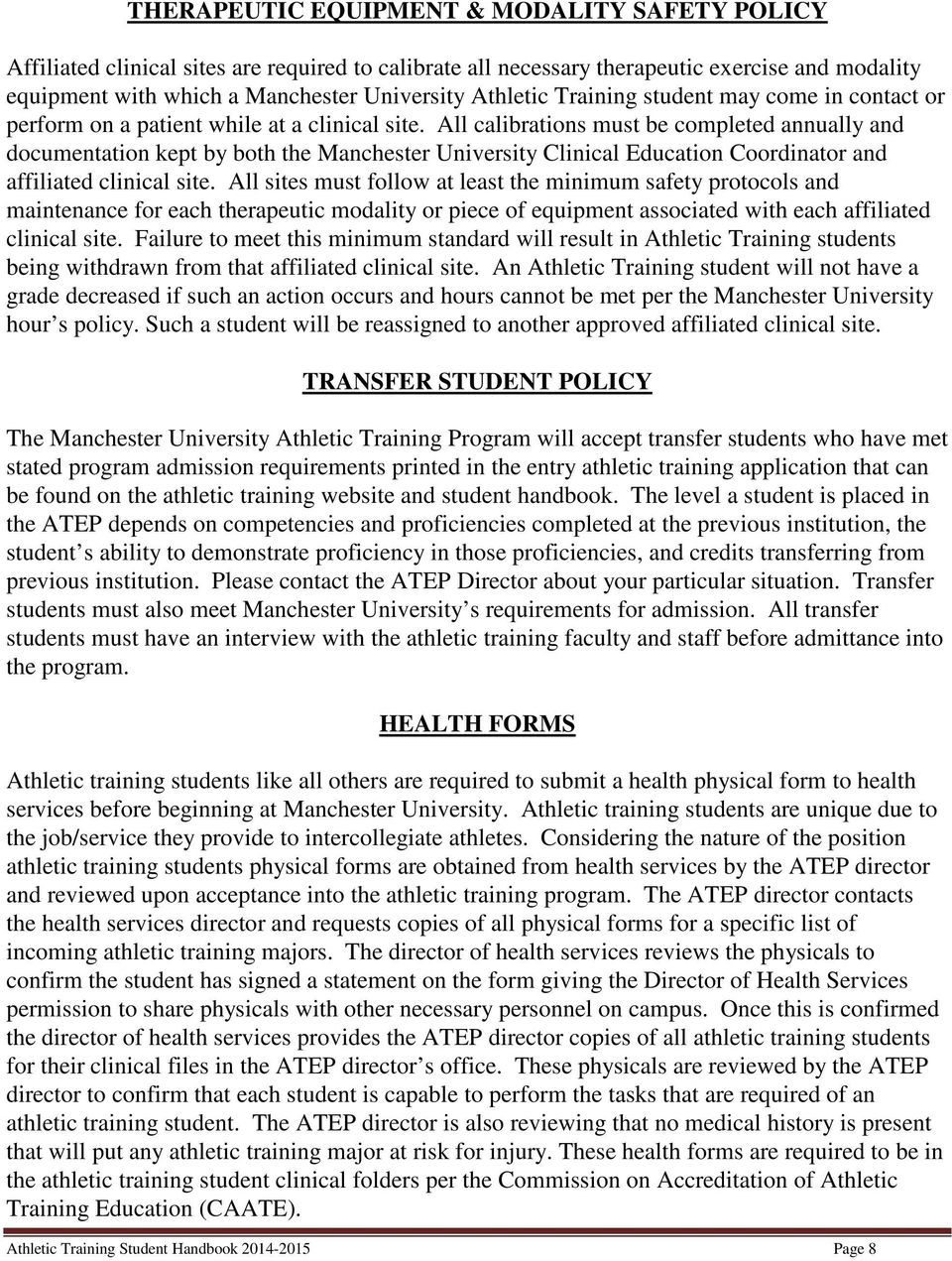
8 THERAPEUTIC EQUIPMENT & MODALITY SAFETY POLICY Affiliated clinical sites are required to calibrate all necessary therapeutic exercise and modality equipment with which a Manchester University Athletic Training student may come in contact or perform on a patient while at a clinical site. All calibrations must be completed annually and documentation kept by both the Manchester University Clinical Education Coordinator and affiliated clinical site. All sites must follow at least the minimum safety protocols and maintenance for each therapeutic modality or piece of equipment associated with each affiliated clinical site. Failure to meet this minimum standard will result in Athletic Training students being withdrawn from that affiliated clinical site. An Athletic Training student will not have a grade decreased if such an action occurs and hours cannot be met per the Manchester University hour s policy. Such a student will be reassigned to another approved affiliated clinical site. TRANSFER STUDENT POLICY The Manchester University Athletic Training Program will accept transfer students who have met stated program admission requirements printed in the entry athletic training application that can be found on the athletic training website and student handbook. The level a student is placed in the ATEP depends on competencies and proficiencies completed at the previous institution, the student s ability to demonstrate proficiency in those proficiencies, and credits transferring from previous institution. Please contact the ATEP Director about your particular situation. Transfer students must also meet Manchester University s requirements for admission. All transfer students must have an interview with the athletic training faculty and staff before admittance into the program. HEALTH FORMS Athletic training students like all others are required to submit a health physical form to health services before beginning at Manchester University. Athletic training students are unique due to the job/service they provide to intercollegiate athletes. Considering the nature of the position athletic training students physical forms are obtained from health services by the ATEP director and reviewed upon acceptance into the athletic training program. The ATEP director contacts the health services director and requests copies of all physical forms for a specific list of incoming athletic training majors. The director of health services reviews the physicals to confirm the student has signed a statement on the form giving the Director of Health Services permission to share physicals with other necessary personnel on campus. Once this is confirmed the director of health services provides the ATEP director copies of all athletic training students for their clinical files in the ATEP director s office. These physicals are reviewed by the ATEP director to confirm that each student is capable to perform the tasks that are required of an athletic training student. The ATEP director is also reviewing that no medical history is present that will put any athletic training major at risk for injury. These health forms are required to be in the athletic training student clinical folders per the Commission on Accreditation of Athletic Training Education (CAATE). Athletic Training Student Handbook Page 8
9 TRANSPORTATION & FEES Transportation: All athletic training students at Manchester University will be responsible for their own transportation and expenses with regards to any off site clinical or general medical assignment while at Manchester University. If students do not have transportation or fees, their grades will be subject to change for their clinical, field, or general medical experiences which may affect their GPAs, course grades, or graduation date. Clothing: All athletic training students will be given minimum athletic training attire (i.e. t- shirt(s), polo s) by the athletic training department but will be required to purchase any extra clothing to meet the programs dress code. All students will also be given the opportunity to purchase additional clothing at discounted prices annually. Discounted prices depend on the number of students who order clothing. Fees: Additional course fees are charged to students enrolled in the following courses: ESS 113: Emergency care requires a $20.00 max fee for purchasing first aid supplies and CPR mask. ESS 150/L: Prevention and Injury requires a $35.00 fee for the purchase of taping and wrapping supplies ESS 411: If a student registers for the BOC exam he/she will be required to pay for all fees associated with this process ESS 373: Field Experience requires an approximate $60.00 fee due to drug screening and background check for selected site(s) for liability purposes. Athletic Training Student Handbook Page 9

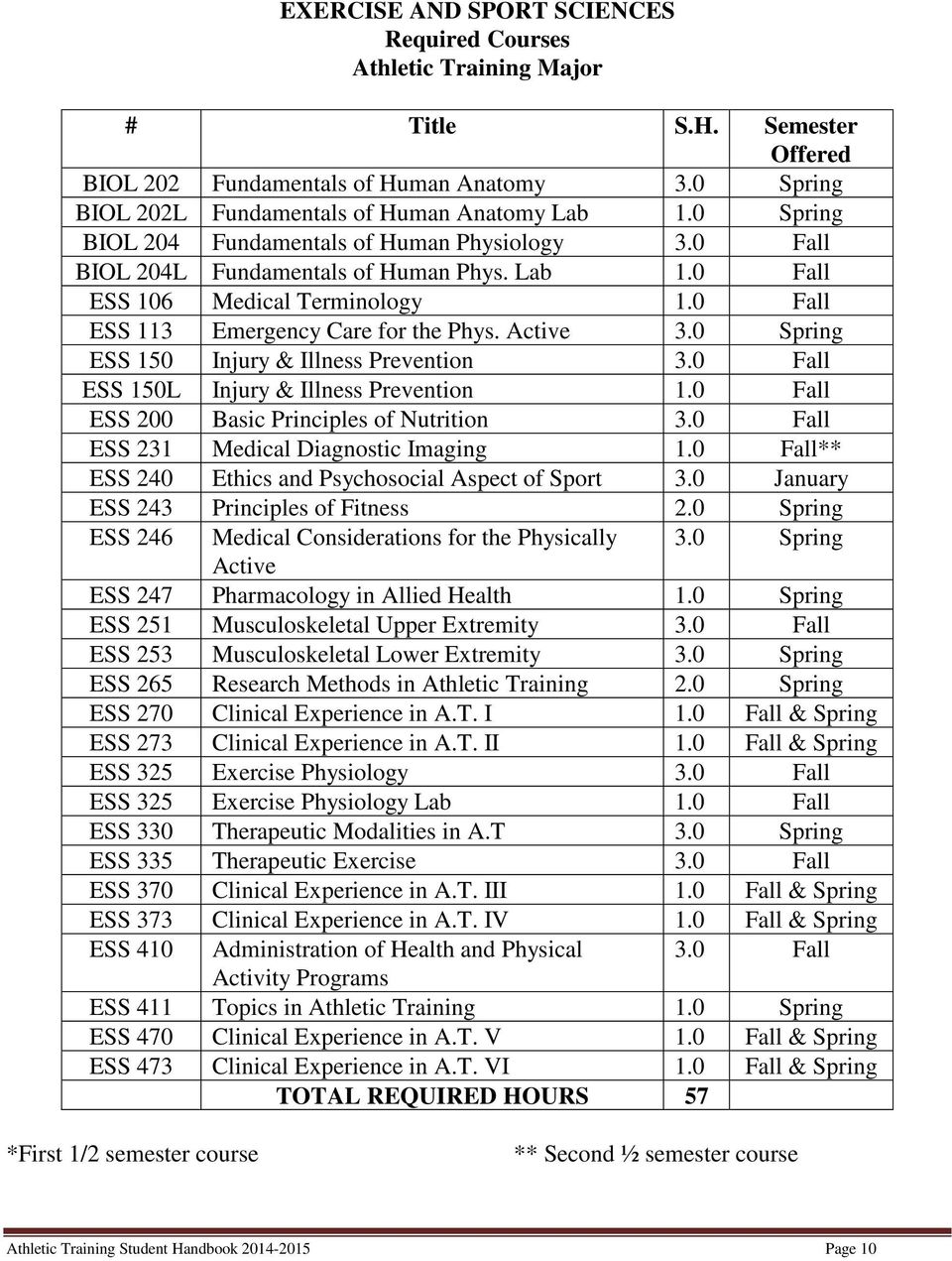
10 EXERCISE AND SPORT SCIENCES Required Courses Athletic Training Major # Title S.H. Semester Offered BIOL 202 Fundamentals of Human Anatomy 3.0 Spring BIOL 202L Fundamentals of Human Anatomy Lab 1.0 Spring BIOL 204 Fundamentals of Human Physiology 3.0 Fall BIOL 204L Fundamentals of Human Phys. Lab 1.0 Fall ESS 106 Medical Terminology 1.0 Fall ESS 113 Emergency Care for the Phys. Active 3.0 Spring ESS 150 Injury & Illness Prevention 3.0 Fall ESS 150L Injury & Illness Prevention 1.0 Fall ESS 200 Basic Principles of Nutrition 3.0 Fall ESS 231 Medical Diagnostic Imaging 1.0 Fall** ESS 240 Ethics and Psychosocial Aspect of Sport 3.0 January ESS 243 Principles of Fitness 2.0 Spring ESS 246 Medical Considerations for the Physically 3.0 Spring Active ESS 247 Pharmacology in Allied Health 1.0 Spring ESS 251 Musculoskeletal Upper Extremity 3.0 Fall ESS 253 Musculoskeletal Lower Extremity 3.0 Spring ESS 265 Research Methods in Athletic Training 2.0 Spring ESS 270 Clinical Experience in A.T. I 1.0 Fall & Spring ESS 273 Clinical Experience in A.T. II 1.0 Fall & Spring ESS 325 Exercise Physiology 3.0 Fall ESS 325 Exercise Physiology Lab 1.0 Fall ESS 330 Therapeutic Modalities in A.T 3.0 Spring ESS 335 Therapeutic Exercise 3.0 Fall ESS 370 Clinical Experience in A.T. III 1.0 Fall & Spring ESS 373 Clinical Experience in A.T. IV 1.0 Fall & Spring ESS 410 Administration of Health and Physical 3.0 Fall Activity Programs ESS 411 Topics in Athletic Training 1.0 Spring ESS 470 Clinical Experience in A.T. V 1.0 Fall & Spring ESS 473 Clinical Experience in A.T. VI 1.0 Fall & Spring TOTAL REQUIRED HOURS 57 *First 1/2 semester course ** Second ½ semester course Athletic Training Student Handbook Page 10
11 ACADEMIC PLAN FOR: Catalog and beyond MAJOR: Athletic Training: 57 Hours Course SH Course SH Course SH ESS 150 Injury & Illness 3 3 ESS 113 Emergency Care 3 ESS 150L Injury & Illness 1 BIOL 202 Fund. of 3 Lab Anatomy ESS 106 Medical Terminology 1 BIOL 202L Human Anatomy Lab 1 Total SH 14.5 Total SH 3-4 Total SH Course SH SH Course SH BIOL 204 Human 3 ESS 240 Ethics & 3 ESS 265- Research Methods 2 Physiology Psychosocial Aspect of Sport in Athletic Training BIOL 204L Human Phys. 1 ESS 253 Musculoskeletal 3 Lab Assessment of LE ESS 200 Principles of 3 ESS 330 Therapeutic 3 Nutrition Modalities ESS 251 Musculoskeletal 3 ESS 273 Clinical Exp. II 1 Assessment of UE ESS 270 Clinical Exp. I 1 ESS 246 Medical Considerations for the Physically Active 3 Total SH 14.5 Total SH 3 Total SH 14.5 Course SH Course SH Course (if not taken) SH ESS 325 Exercise 3 Physiology ESS 325L Exercise 1 ESS 247 Pharmacology in 1 Physiology Lab Allied Health ESS 335 Therapeutic Ex. 3 ESS 373 Clinical Exp. IV 1 ESS 370 Clinical Exp. III 1 ESS 243 Principles of 2 ESS 231 Diagnostic Imaging 1 Total SH Fitness Total SH 3 Total SH Course SH Course SH Course SH ESS 410 Administration 3 ESS 240 Ethics & 3 ESS 411 Topics in AT 1 Psychosocial Aspect of Sport ESS 470 Clinical Exp. V 1 ESS 473 Clinical Exp. VI 1 Total SH 15 Total SH 3 Total SH 14 Athletic Training Student Handbook Page 11

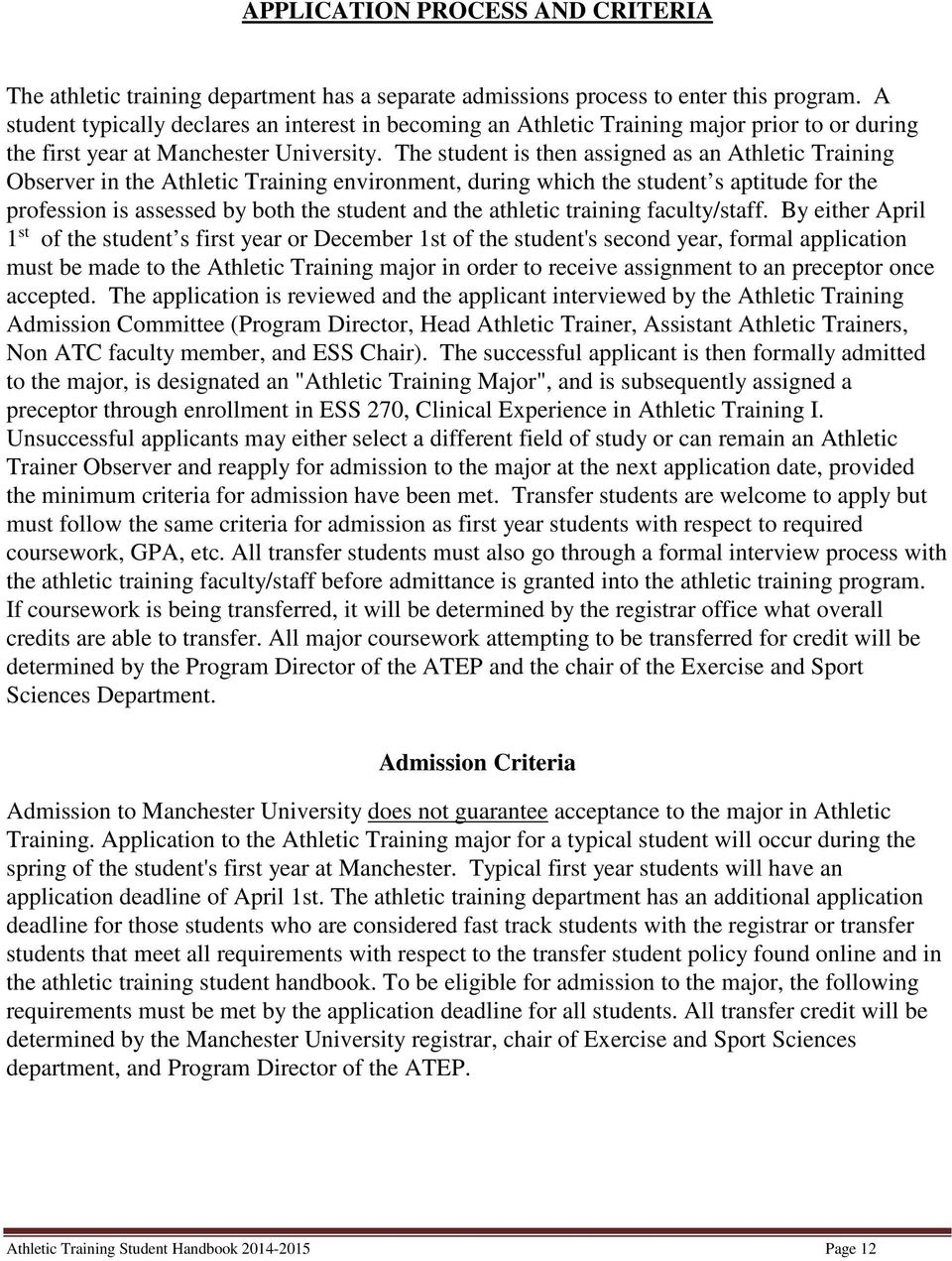
12 APPLICATION PROCESS AND CRITERIA The athletic training department has a separate admissions process to enter this program. A student typically declares an interest in becoming an Athletic Training major prior to or during the first year at Manchester University. The student is then assigned as an Athletic Training Observer in the Athletic Training environment, during which the student s aptitude for the profession is assessed by both the student and the athletic training faculty/staff. By either April 1 st of the student s first year or December 1st of the student's second year, formal application must be made to the Athletic Training major in order to receive assignment to an preceptor once accepted. The application is reviewed and the applicant interviewed by the Athletic Training Admission Committee (Program Director, Head Athletic Trainer, Assistant Athletic Trainers, Non ATC faculty member, and ESS Chair). The successful applicant is then formally admitted to the major, is designated an "Athletic Training Major", and is subsequently assigned a preceptor through enrollment in ESS 270, Clinical Experience in Athletic Training I. Unsuccessful applicants may either select a different field of study or can remain an Athletic Trainer Observer and reapply for admission to the major at the next application date, provided the minimum criteria for admission have been met. Transfer students are welcome to apply but must follow the same criteria for admission as first year students with respect to required coursework, GPA, etc. All transfer students must also go through a formal interview process with the athletic training faculty/staff before admittance is granted into the athletic training program. If coursework is being transferred, it will be determined by the registrar office what overall credits are able to transfer. All major coursework attempting to be transferred for credit will be determined by the Program Director of the ATEP and the chair of the Exercise and Sport Sciences Department. Admission Criteria Admission to Manchester University does not guarantee acceptance to the major in Athletic Training. Application to the Athletic Training major for a typical student will occur during the spring of the student's first year at Manchester. Typical first year students will have an application deadline of April 1st. The athletic training department has an additional application deadline for those students who are considered fast track students with the registrar or transfer students that meet all requirements with respect to the transfer student policy found online and in the athletic training student handbook. To be eligible for admission to the major, the following requirements must be met by the application deadline for all students. All transfer credit will be determined by the Manchester University registrar, chair of Exercise and Sport Sciences department, and Program Director of the ATEP. Athletic Training Student Handbook Page 12
13 Completion of (or equivalent transfer work) ESS 150, ESS 150L, ESS 106 and ESS 113 with a minimum cumulative GPA of 2.8 and C or higher in these courses: 1. Completion of at least 12 semester hours of university credit. 2. Completion of at least 75 hours of assigned directed observation experience in the Manchester University athletic training program 3. Successful completion of all clinical skills presented in ESS 150, ESS 150L, ESS 106 and ESS Completion of Athletic Training Application 5. Completion of interview with the Athletic Training Admission Committee The Manchester University Catalog (online) states that there is a separate admissions process to the major. The admittance process is detailed in, and the admission materials are distributed to students through, the Exercise & Sport Sciences Student Handbook, obtained from the ESS Department website. Announcements and reminders are posted in the Athletic Training treatment center, and pertinent information is located on the ATEP website. Due to the competitive nature of the athletic training program, applicants meeting the minimum admission standards will have an interview with the Athletic Training Admission Committee. If there are insufficient clinical slots for the number of athletic training students (both current and applied students), all applicants, even though meeting the minimum standards, may not be admitted to the major. In these cases, all interviewees are objectively rated according to the criteria listed below, and the order of admission is based on these criteria. 1. Cumulative GPA in required athletic training major courses; 2. Cumulative GPA for all classes taken 3. BIOL 202 (Anatomy) Course Grade 4. BIOL 204 (Physiology) Course Grade Cumulative GPA Core GPA (ESS 150, ESS 150L, ESS 106 and ESS 113) points points points points points points < points point TOTAL TOTAL These criteria are listed on the Athletic Training Educational Program website. Athletic Training Student Handbook Page 13

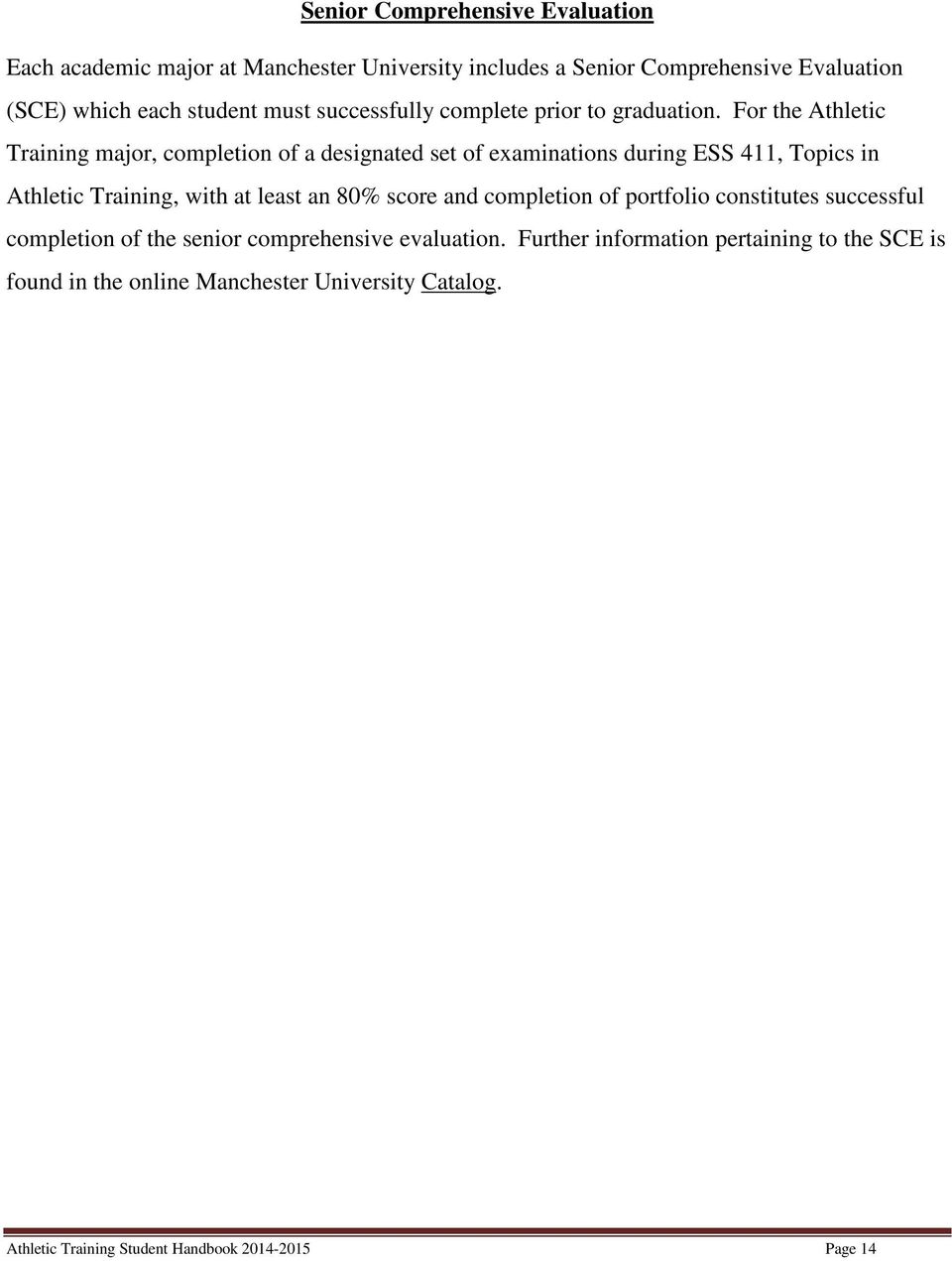
14 Senior Comprehensive Evaluation Each academic major at Manchester University includes a Senior Comprehensive Evaluation (SCE) which each student must successfully complete prior to graduation. For the Athletic Training major, completion of a designated set of examinations during ESS 411, Topics in Athletic Training, with at least an 80% score and completion of portfolio constitutes successful completion of the senior comprehensive evaluation. Further information pertaining to the SCE is found in the online Manchester University Catalog. Athletic Training Student Handbook Page 14
15 Internship The internship (ESS 477) is the culminating experience of the Athletic Training program at Manchester University. You must be of senior standing and/or have permission of the instructor to be allowed to complete this course. To begin the internship process, you should meet with the program coordinator to discuss your career interests and possible internship sites. Steps for ESS 477: Internship in Athletic Training: 1. Meet with Athletic Training program director to discuss internship interests 2. Identify possible internship sites 3. Apply/interview for internship at potential site(s) 4. Accept internship 5. Complete Internship Contract with site supervisor and ESS 477 instructor 6. Receive a Permission to Enroll form from ESS Department Chair 7. Enroll in ESS Begin internship, maintain paperwork written out on contract 9. Complete internship 10. Complete and submit internship paper and supporting documents Internship Process: While internship selection is a shared responsibility between you and faculty, the ultimate responsibility for securing the internship rests with you. Procrastination by you could result in failure to secure an internship at the preferred site during the desired semester! Internship position announcements are routinely posted on the PERC bulletin board and made public to students. You can always meet with the program director to discuss possible internship sites and career interests. You must then fill out an Internship Contract. The contract stipulates all relevant material agreements between the school, student, and internship agency. See the ESS 477 instructor for a copy of the Internship Contract. No on-site activity can begin without a formal contract, for any reason. The final step in preparation for the internship (ESS 477) is filling out an Internship Approval form with the instructor. With this form, you can obtain a Permission to Enroll form from the ESS Department Chair. Information about specific internship assessment will be provided through the ESS 477 Syllabus and supporting documents. Specific items that will be included in the assessment are: a. Internship Contract b. Internship Objectives List c. Internship Daily Journal d. Internship Signed Time Log e. Internship Summary of Learning Paper f. Final Evaluation (by site supervisor) Athletic Training Student Handbook Page 15

16 Internship Code of Conduct: As an intern you are a representative of Manchester University and the Athletic Training program. It is expected that you will hold yourself to the highest standard of ethical behavior. The following are specific expectations of all interns. Violation of any of these rules or any behavior that is detrimental to Manchester University or the internship site could result in dismissal from the internship. 1. No fraternization or external relationships with employees, athletes, or other members of the internship organization 2. All interns must have 100% attendance and arrive in a timely manner for every scheduled work shift 3. All interns will behave in an ethical manner at all times 4. All interns will dress appropriately for all internship related activities 5. Any activity that is deemed inappropriate or unprofessional by Manchester University or the internship site will result in dismissal from the internship Becoming a Professional in the Athletic Training Field Your preparation to enter the profession requires that you acquire the skills, attitudes, and values of successful professionals. The following are some guidelines to help you develop the ideals and standards of an effective professional. Professional Involvement: Athletic Training majors are expected to become professionally involved in campus organizations such as the Athletic Training Club (ATC) and/or Exercise and Sport Sciences Club (ESS Club). You should also plan to participate in numerous volunteer and professional development activities. You are encouraged to join a professional organization such as NATA (National Athletic Trainers Association, GLATA (Great Lakes Athletic Training Association), and/or IATA (Indiana Athletic Trainers Association). Finally, you are encouraged to become involved as a professional through entry-level positions, internships, coaching, and other leadership positions during the school year and summer. Attire: You must wear appropriate attire when representing the program and yourself in on-campus and offcampus activities related to the field. Appropriate dress should minimally include a collared or polo shirt, slacks, clean shoes or sneakers. No jeans, sweats, or hats should be worn at any time. Attendance: Attendance in your major courses and field experiences is expected. You are expected to behave in a professional manner and reliability and timeliness are imperative to professional practice. Academic Integrity: While at Manchester University, you are held to a high standard of academic and personal integrity. You may be dismissed from the program for violations of the Academic Policies and Procedures section of your course catalog. Athletic Training Student Handbook Page 16
17 Checklist for Athletic Training Majors: Below are the suggested activities during your time at Manchester University. This list certainly does not include all activities that will aid you in becoming an effective professional. As you review this list you may want to discuss certain activities with your advisor or the program director. It is vital that you pay attention for deadlines and meeting dates that correspond to the Athletic Training program. First Year Review the Athletic Training Student Manual and program information via A.T website Complete ESS 150,150L, 106 and 113 with the required 2.8 GPA and C or higher) Begin MCATC involvement If you are playing a sport, meet with your advisor to work out a 4-year plan so that you will be able to compete your senior year. Attend (IATA) (Not Mandatory) Apply for entrance to the major the spring of your first year Sophomore Year Register for ESS 270, Clinical Experience Organize your portfolio through your required sections Attend professional conferences if possible (IATA, NATA, GLATA) (Not Mandatory) Apply for entrance to the major if not completed in first year Work with your advisor if you do not meet the continuation GPA requirements Do a self-audit to check your progress towards major and Manchester core requirements Look to join NATA as a student member Junior Year Meet with your advisor/program director to discuss internship possibilities Continue to add to your portfolio Attend professional conferences if possible (IATA, NATA, GLATA) (Not Mandatory) Assume leadership roles in MCATC & mentor program Look for summer employment opportunities with athletic training experience Renew NATA membership if a member Senior Year Meet with your advisor/program director to discuss graduate school and career Attend professional conference if possible (IATA, NATA, GLATA) (Not Mandatory) Complete Senior Comprehensive Evaluation (ESS 411) Complete the Senior Exit Interview with Athletic Training faculty Successfully complete all degree requirements Sign up for BOC exam through Topics, ESS 411 Athletic Training Student Handbook Page 17

18 Program Assessment The Athletic Training program is committed to assessing both individual student and program goals. This assessment will take many forms including statistical analysis of numerous factors involved in recruitment, retention, performance, graduation, and post-graduation activities of students. The faculty reserves the right to use aggregate data on student achievement. Information on individual students will be protected and will not be subject to public dissemination, following federal guidelines for privacy of students. This program assessment will aid in the review, reassessment, and promotion of the Athletic Training program at Manchester University. PROGRAM PERSONNEL 1. Faculty/Staff Athletic Trainer - Certified Athletic Trainer (ATC) who is a member of the faculty or staff at Manchester University. Program Director (faculty) - Responsibility for ATEP, preceptor, Manchester University Athletic Training Club (MCATC) co-advisor, sport coverage, liaison between Athletics and Office of Student Development, teaching in academic departments, and academic advising. Head Athletic Trainer (faculty) - Sport coverage, responsible for daily operation of the athletic training room, MCATC co-advisor, Preceptor in ATEP, teaching in academic department, and academic advising. Assistant Athletic Trainers (faculty & staff) - Sport coverage, Preceptor in ATEP, teaching in academic department. Adjunct Personnel Preceptors at affiliated sites, adjunct faculty members at Manchester University teaching assigned classroom courses, and Clinical Experience courses. 2. Athletic Training Student- A Manchester University student who is enrolled in Athletic Training courses and who has either been admitted to the major in Athletic Training or is in the observation phase of the ATEP (see below). All Athletic Training students are placed in one of the two following categories:. Athletic Training Observer - All potential applicants to the Major in Athletic Training are classified in this category. Athletic Training Major - Those students who have been admitted to the Athletic Training Major and who maintain the required academic and clinical education standards as classified in this category. Athletic Training Student Handbook Page 18

19 ATHLETIC TRAINING EDUCATION PROGRAM The Athletic Training Education Program is comprised of two parts: 1) the required courses taken by the students, which include 2) the Clinical and Field experiences in Athletic Training (ESS 270, 273, 370, 373, 470, and 473). See Appendix 1 for an overview of the educational preparation of a Certified Athletic Trainer. Required Courses The Athletic Training Education Program is a 57 semester hour major within the Department of Exercise and Sport Sciences. The program requirements are based upon the NATA Role Delineation Study (5th edition), CAATE 2005 Standards and Guidelines, and the National Athletic Trainers Association Education Council Athletic Training Educational Competencies (5th edition). These entry-level competencies are attained through the prescribed coursework and include the domains of Athletic Training practice as listed on p. 9 of this handbook. The requirements for the major in Athletic Training are listed in Appendix 2 of this document and in the online Manchester University Catalog. The only way to become eligible for BOC certification at Manchester University is to successfully complete the major in Athletic Training or Entry Level Masters in Athletic Training at Manchester University. Technical Standards As stated in the online Manchester University Catalog, there are technical standards for the ATEP. These standards are found in Appendix 9 of this handbook, distributed to all students who choose to become athletic training observers, and are located on the ATEP website. Enrollment and Academic Advising Please consult the "Course sequence sheet" in Appendix 2 for an outline of the suggested sequence for courses required in the Athletic Training major. Each entering student is assigned a primary academic advisor in the department from which the student desires a major. In the spring semester of the first year, all students planning to make application to the Athletic Training major will have a faculty/staff Athletic Trainer assigned as an academic advisor. Academic advisors meet with each advisee at least once each semester (or more frequently if needed) to review academic progress, program requirements, and to assist in enrollment in the next semester's courses. Athletic Training Student Handbook Page 19
20 Clinical Experiences Athletic Training majors, beginning with the first semester after acceptance, are assigned to an preceptor by the Program Director and Head Athletic Trainer through enrollment in ESS 270, 370, 470 (Clinical Experience in Athletic Training I, II, III respectively). There is a required enrollment in a corresponding level of Field Experience course (ESS 273, 373, 473) between each level of Clinical Experience course. During enrollment in these clinical and field experience courses, the skills presented and practiced in classroom courses are practiced in a live Athletic Training setting under the direct supervision of a preceptor. Once Athletic Training majors are assigned to a preceptor, assigned meeting times are established to which the student must adhere. Students will also be required to attend evaluation and treatment sessions for athletes, physician examinations, and staff case conferences. The specific requirements, grading scale, attendance policy, objectives, etc. for each of these Clinical Experience courses is found in the syllabus for each course. All Athletic Training majors will complete at least one clinical or field experience course for each of the following rotations: 1) upper extremity emphasis; 2) lower extremity emphasis; 3) equipment intensive emphasis; and 4) a general medical emphasis completed in the fall or spring semester of the junior year. Clinical Experience Hour Policy Athletic Training students officially accepted into the Athletic Training major will abide by the following hours policy: Athletic Training students are required to perform a minimum of 250 hours of field experience when assigned to an approved preceptor for Manchester University. The hours performed must be approved by the site preceptor before credit will be given for said hours. Athletic Training students may not exceed 600 hours of field experience at any one give field experience per Manchester University. If a student does not reach the minimum amount of hours of 250 it is up to the discretion of the preceptor to approve this as acceptable. Such an instance may occur when it is impossible to accrue said hours due to the length of the field experience schedule. If said hours are not met, the assigned preceptor has the right to decrease a student s grade for the students clinical experience course associated with the current field experience. Such a decrease will occur per the clinical experience syllabus within the 40% field experience portion of the student s final grade. The below scale should be used as a reference to determine how a lack of hours will affect a student s final grade. This grading scale will be reflected in the clinical experience course associated with each field experience. Any appeals to this policy must be addressed with the student s specific preceptor and then Director of Athletic Training Education if there is no resolution. This policy DOES NOT give the student the right to stop attending his/her clinical experience if or when the minimum hours are reached. If such an action occurs, the preceptor has the right to decrease a student s clinical experience grade. All athletic training students are required to have at minimum one day off each week during their clinical experience per Manchester University Athletic Training Program and CAATE. Athletic Training Student Handbook Page 20

21 Field Experience Grading Scale Hours below the minimum 250 % grade loss 0-25 hours - 10% hours - 20% hours - 30% 76+ hours -40%. Travel The ATEP at Manchester University follows all standards set by the CAATE and DO NOT allow any travel of athletic training students without a preceptor for visual and auditory supervision. When supervision by a preceptor is present students will be given the ability to volunteer to travel but will under no circumstances be required to travel to any event while at Manchester University. It is also a policy that no student grades will be diminished if a student does not travel to events while at Manchester University. Participation in Intercollegiate Athletics Policy Many prospective athletic training students who express interest in the Manchester University Athletic Training Education Program (ATEP) are also interested in participating in an intercollegiate sport during their university years. Because the ATEP has a significant clinical experience component that requires student commitment throughout the week and on weekends, conflicts between sport demands and clinical experience requirements is a problem. The ATEP faculty and staff are committed to encouraging athletic training students to take advantage of the rich co-curricular opportunities available on campus. They are also dedicated to ensuring that athletic training students graduate on time, fulfill all ATEP requirements, and have enough quality clinical experience to enable them to become skilled health care professionals. 1. Applicants to the ATEP will be provided with a copy of this policy statement early on in the application year. It will be discussed and explained again during the application process. The intention on the part of a prospective athletic training student to participate in intercollegiate athletics shall not factor into the admission decision for the ATEP. 2. Students admitted to the ATEP may participate in intercollegiate athletics 3. Athletic training students shall limit their participation to ONE intercollegiate team. Any exceptions to this rule will be determined by the ATEP Director. Athletic Training Student Handbook Page 21
22 4. Athletic training students will be allowed to participate during their team s non-traditional season ONLY if participation does not conflict with the student s ATEP clinical experience responsibilities. 5. Athletic training students who participate in intercollegiate athletics must, like all students, fulfill ALL the didactic and clinical education program requirements before they can graduate. All student-athletes are strongly encouraged to consult the athletic training education program director early since effective planning is crucial to on-time graduation. 6. All athletic training students in the ATEP, including fall student-athletes, are required to perform at least one equipment intensive clinical experience (e.g football). Student-athletes who participate in fall sports conflict with this requirement as a result of their athletic participation. In order to meet this program requirement, athletic training students who are fall athletes, must complete the alternative equipment intensive process to fulfill this requirement or return for a ninth semester for this rotation prior to graduating from Manchester University and the ATEP. 7. Athletic training students who participate in basketball must also fulfill the equipment intensive requirements of that rotation. This means adjustments will be necessary to both the basketball and athletic training schedules to fulfill the requirements during the athletic training student s time at Manchester University. This policy will be in effect once a student has been accepted into the ATEP at the beginning of his/her sophomore or transfer year and will be in effect as long as the student remains in the ATEP. Students with questions are encouraged to speak with the ATEP director for clarification. Evaluation of Students All Athletic Training majors will be evaluated at the midterm and the end of each clinical/field experience enrollment by their assigned preceptor. The evaluations will be based upon the forms in Appendix 3, and upon the progress through the Clinical Proficiencies for that clinical experience level. The preceptor will meet with each student to discuss the evaluation. These evaluations are detailed in each course syllabus. All Athletic Training students have an opportunity to annually evaluate the faculty/staff Athletic Trainers and the Athletic Training Education Program. Performance Domains and Content Areas Through role delineation studies, six domains of practice for Athletic Trainers have been identified. Further, for each domain, the specific knowledge and skills critical to the performance of each task have been identified. These cognitive and psychomotor abilities are the basis for the BOC certification examination and the foundation upon which the Manchester University Athletic Training Education Program is based. Athletic Training Student Handbook Page 22
23 Major Performance Domains I. Prevention II. Clinical Evaluation and Diagnosis III. Immediate Care IV. Treatment, Rehabilitation, and Conditioning V. Organization and Administration VI. Professional Responsibility The Certified Athletic Trainer is prepared to provide health care within each of the following content areas: 1. Risk Management and Injury Prevention 2. Pathology of Injuries and Illnesses 3. Clinical Examination and Diagnosis 4. Acute Care of Injury and Illness 5. Pharmacology 6. Therapeutic Modalities 7. Therapeutic and Rehabilitative Exercise 8. General Medical Conditions and Disabilities 9. Nutritional Aspects of Injury and Illness 10. Psychosocial Intervention and Referral 11. Health Care Administration 12. Professional Development and Responsibilities Copies of the most recent Role Delineation Study (5 th edition), Educational Competencies and Clinical Proficiencies (5 th ed), and CAATE Standards are in the office of the Program Director. BOC CERTIFICATION REQUIREMENTS In order to become a BOC certified Athletic Trainer (ATC), an individual must pass the Board of Certification (BOC) Examination. Exams are administered at computer testing sites across the nation, and consist of written and hybrid questions. Further information regarding examination sites, deadlines, and fees is posted on the Athletic Training room bulletin board and can be found on the Board of Certification website, The only way to become BOC-certification eligible (be eligible to take the certification examination) is to graduate from a CAATE-accredited Athletic Training Education Program (either undergraduate or graduate) PROFESSIONAL MEMBERSHIPS AND LIABILITY INSURANCE Student membership in the National Athletic Trainers Association (NATA) is mandatory since it is a requirement to be on Atrack. Advantages of membership include receiving the Journal of Athletic Training, NATA News, placement on vendor mailing lists, and price reductions for conference registrations and BOC-certification examination fees. More information on NATA membership can be found at the NATA website, Athletic Training Student Handbook Page 23
24 In order to comply with program accreditation standards, professional liability insurance is provided to all Athletic Training majors (not including Athletic Training observers) through a blanket policy. This is provided at no cost to the students. Copies of this policy are placed in each student s ATEP file. These files are located in the Program Director s office. Clinical Education Policies Clinical Supervision Policy During clinical experiences, athletic training students will be assigned to a preceptor who will provide direct supervision of the athletic training student. Direct supervision at Manchester University is defined as: Daily personal/verbal contact at the site of supervision between the athletic training student and the preceptor who plans, directs, advises, and evaluates the students athletic training clinical experience. The preceptor shall be physically present to intervene on behalf of the student-athlete or patient. A preceptor must be physically present with the athletic training student and have the ability to intervene on behalf of the athletic training student and the student-athlete or patient. No athletic training student will be present at a clinical experience site without being directly supervised by a preceptor. The preceptor will communicate daily with the athletic training student to provide feedback on skills and daily tasks. The preceptor s are charged with the formal evaluation for the athletic training student s integration of clinical proficiencies during clinical experiences. The preceptor /CI will meet twice a semester to review evaluations with each student. The ATEP will provide regular communication with each PRECEPTOR/CI in order to maintain the quality of the student clinical experiences. The number of students assigned to a PRECEPTOR/CI will not exceed a ratio of 8 students per PRECEPTOR/CI in each clinical experience setting. Athletic Training Student Handbook Page 24
25 PROFESSIONAL BEHAVIOR The professionalism of Athletic Training students will be judged with reference to the following behaviors and attitudes: 1. Dependability, punctuality: showing up at the assigned times for the assigned duties, completion of assigned tasks. 2. Completion and submission of required/assigned paperwork on a timely basis (e.g. Clinical Proficiency Booklet kept up-to-date). 3. Ability to effectively communicate to and relate with supervisors, peers, coaches, and athletes. 4. Maintains appropriate attire (see Dress Code below) 5. Use/abuse of any substance which interferes with Athletic Training student academic responsibilities is considered unprofessional conduct. 6. Adherence to the NATA Code of Ethics (See Appendix 5) The evaluation and documentation of professional behaviors and attitudes comprises a portion of the total evaluation of a student s clinical and field experiences. The evaluation form for professional behaviors and attitudes is the Clinical Trait Evaluation Form (see Appendix 3). Dress Code A. When attending Clinical and Field Experience courses: 1. Collared shirt* 2. Shorts or trousers (NO jeans or cut offs) - can be athletic shorts or black wind pants 3. Shoes and socks (no sandals or flip flops ) 4. Name tag (provided for you) 5. NO hats are to be worn in the Athletic Training room during treatments, etc. 6. Shirt tucked in 7. NO exposed midriffs and NO cleavage showing *You may wear a Manchester University Athletic Training Staff tee-shirt in place of the collared shirt. Athletic Training Student Handbook Page 25
26 B. For outdoor contests: 1. Manchester University Athletic Training polo (provided for you) 2. Observation Students should wear polo and Khakis 3. Khaki shorts or trousers 4. Shoes and socks 5. Name tag (optional) C. For indoor contests: 1. As in B above or as appropriate for the sport MANCHESTER UNIVERSITY ATHLETIC TRAINING SERVICES OSHA Regulations for Blood-borne Pathogens Effective March 6, 1992, the Occupational Safety and Health Administration (OSHA) enacted specific standards designed to protect workers from the risk of blood-borne diseases, including hepatitis B virus and human immunodeficiency virus (HIV). Key provisions of this regulation are: *The employer must identify, in writing, tasks, procedures, and job classifications where occupational exposure to blood might occur; *Universal precautions must be observed; this means that all blood and body fluids should be treated as if they were infectious; *Employers must provide, at no cost, personal protective equipment such as gloves, gowns, and masks; *Employers must provide, at no cost to the employee, Hepatitis B vaccinations to those employees who have occupational exposure (does not apply to Athletic Training students) *Post-exposure medical evaluation and counseling must be made available to all employees who have had an exposure incident. All laboratory tests and medical evaluations must be provided at no cost to the employee; *Annual training must be given to each occupationally exposed employee addressing modes of transmission, preventive measures, and proper use of personal protective equipment. Athletic Training Student Handbook Page 26
27 1. Faculty/Staff Athletic Trainers and Athletic Training students at Manchester University could reasonably anticipate coming into contact with blood or other potentially infectious materials during performance of their jobs. Specific tasks which would involve potential exposure include: cleaning/dressing/evaluation of wounds (including blisters), treatment of bleeding wounds, and handling of surfaces, linens, and uniforms which have been contaminated by blood or other body fluids. 2. Universal precautions are conspicuously posted in the Athletic Training room at Manchester University. 3. Gloves will be provided in the athletic training room for occupationally exposed employees and students. 4. Annual (re)training in Universal Precautions and Blood-borne Pathogens is mandatory for all athletic training students, staff, and faculty, and is provided through individually scheduled sessions. Universal precautions and potential sources of exposure will be reviewed, as well as all provisions of the OSHA regulation. 5. In regards to the Hepatitis B Vaccine, all Athletic Training students MUST be in compliance with one of the two following provisions: a) Have documentation on file with the Student Health Service and the Program Director which demonstrates that the student has completed the Hepatitis B vaccine series; b) Have on file with the Program Director a signed waiver form, indicating that the Athletic Training student has voluntarily declined to receive the Hepatitis B vaccine series; Failure to be in compliance with #s 4 and 5 above and to be current in CPR/AED certification precludes enrollment in further Clinical or Field Experience courses. Communicable Disease Policy: Can be found on the ATEP Homepage as a link AND Appendix 8 Athletic Training Student Handbook Page 27
28 APPENDIX 1 Athletic Training Education Overview Athletic Training Student Handbook Page 28
29 ATHLETIC TRAINING EDUCATION OVERVIEW This document provides a brief overview of the education and credentialing process for entry-level athletic trainers. Athletic Training programs typically fall into three categories: a baccalaureate degree in Athletic Training; a baccalaureate degree with a major in athletic training; or graduate-level program with a major in athletic training. Academic programs are accredited by the Commission on Accreditation of Athletic Training Education (CAATE). The minimum entry point into the profession of Athletic Training is at the baccalaureate level; by , all accredited education programs in Athletic Training will lead to a degree in Athletic Training. Upon completion of a CAATEaccredited Athletic Training education program, students become eligible to obtain national certification granted by the NATA Board of Certification, Inc. (BOC). ENTRY-LEVEL EDUCATION Entry-level athletic training education uses a competency-based approach in both the classroom and clinical settings. Using a medical-based education model, Athletic Training students are educated to provide comprehensive preventive services and care in six domains of clinical practice: prevention; clinical evaluation and diagnosis; immediate care; treatment, rehabilitation and reconditioning; organization and administration; and professional responsibility. The educational requirements for CAATE-accredited Athletic Training Education Programs include not only cognitive (knowledge) and psychomotor (skill) content, but also a broad scope of foundational behaviors of professional practice, as well as a comprehensive clinical learning requirement that is embodied in the clinical proficiencies (professional, practice-oriented outcomes) as identified in the Athletic Training Educational Competencies and Clinical Proficiencies. Students must receive formal instruction in the following specific subjects Basic and Applied Sciences Human anatomy Human physiology Biology Statistics and research design Rehabilitation Exercise Physiology Kinesiology/Biomechanics Chemistry* Physics* *Recommended but not required by some ATEP Professional Content Risk Management and Injury Prevention Pathology of Injuries and Illnesses Orthopedic Clinical Examination and Diagnosis Medical Conditions and Disabilities Acute Care of Injuries and Illnesses Therapeutic Modalities Conditioning, Rehabilitative Exercise & Pharmacology Psychosocial Intervention and Referral Nutritional Aspects of Injuries & Illnesses Health Care Administration
30 CLINICAL EDUCATION Students are required to participate in a minimum of two years of academic clinical education. Through these experiences, students gain clinical experiences associated with a variety of different patient populations defined but not limited to: gender, varying levels of risk, utilization of protective equipment, and general medical conditions (e.g. diabetes, asthma) that address the continuum of care. Clinical experiences provide students with opportunities to practice, under the direct supervision of qualified Clinical Instructors (i.e., Certified Athletic Trainer [ATC ] or other credentialed health care professionals). THE ATC CREDENTIAL The ATC credential and the BOC requirements are currently recognized by 46 states for eligibility and/or regulation of the practice of athletic trainers. The credibility of the BOC program and the ATC credential it awards are supported by three pillars: (1) the BOC certification examination; (2) the BOC Standards of Professional Practice, and Disciplinary Guidelines and Procedures; and (3) continuing competence (education) requirements. BOC certification is recognized by the National Commission for Certifying Agencies and is the only accredited certification program for athletic trainers. To be certified, an individual must demonstrate that he/she is an athletic trainer capable of performing the required duties without threat of harm to the public. The BOC traditionally conducts annual examination development meetings during which certified athletic trainers and recognized experts in the science of athletic training develop, review and validate examination items and problems. The knowledge, skills, and abilities required for competent performance as an entry-level athletic trainer fall into three categories: 1. Understanding, applying, and analyzing; 2. Knowledge and decision-making; 3. Special performance abilities. BOC certified athletic trainers are educated, trained and evaluated in six major practice domains: 1. Prevention 2. Clinical Evaluation and Diagnosis 3. Immediate Care 4. Treatment, Rehabilitation and Reconditioning 5. Organization and Administration 6. Professional Responsibility For more information regarding the educational, certification, and licensure requirements for athletic trainers visit: The National Athletic Trainers Association The National Athletic Trainers Association Education Council The Board of Certification The Commission on the Accreditation of Athletic Training Education Programs
31 APPENDIX 2 Evaluation of Athletic Training Students* *Written Evaluations and proficiency evaluations for Athletic Training Students are physically housed on Atrack for all preceptors. Written evaluations are to be completed at both the mid and end semester time frame which the Clinical Coordinator and Program Director have administrative access to review.
32 APPENDIX 3 Clinical Experiences in Athletic Training
33 CLINICAL EXPERIENCES IN ATHLETIC TRAINING Students are provided with clinical experiences consistent with the goals and objectives of the ATEP. The clinical experience sequence is as follows: 1) First Year: Observe Certified Athletic Trainers and Athletic Training Majors in the traditional collegiate setting. 2) Sophomore Year (following admittance to major): Assignment to a Clinical Instructor via enrollment in ESS 270, Clinical Experience in Athletic Training I. 3) Junior Year: Assignment to a Clinical Instructor via enrollment in ESS 370, Clinical Experience in Athletic Training II. Observe 10 hours in traditional outpatient physical therapy clinic and 10 hours in an outpatient sports medicine clinic (including orthopaedic surgery observation and clinics conducted by orthopaedic surgeon). Observe team physicians for 4 hours in family-practice medical clinic. 4) Senior Year: Assignment to a Clinical Instructor via enrollment in ESS 470, Clinical Experience in Athletic Training III.
34 APPENDIX 4 National Athletic Trainers Association Code of Ethics
35
36
37 APPENDIX 5 Continuing Education Requirements for Certified Athletic Trainers
38 Continuing Education Requirements for BOC Certified Athletic Trainers Indiana State Licensing Requirements for Athletic Trainers Board of Certification (BOC) Continuing Education Requirements Upon attaining BOC certification, individuals must complete 75 hours of approved continuing education in each three year period in order to maintain BOC certification. Fulfilling this requirement can be achieved by such activities as attending meetings and conferences, completing home-study courses, authoring articles, etc. Certified Athletic Trainers maintain a record of continuing education hours online. Athletic Trainer Licensing in Indiana In order to call oneself an athletic trainer in Indiana, and in order to practice athletic training, an individual MUST be licensed by the state. If BOC certification has been achieved, one does NOT have to take a test for Indiana licensing as an athletic trainer. To maintain a state license, an athletic trainer must complete 50 hours of continuing education in each two year period (the same continuing education hours can count for both the BOC and Indiana requirements). Students should request application materials for state licensing in the spring of the final year at Manchester University. Requests should be sent to: Indiana Athletic Trainers Licensure Board Health Professions Bureau 402 W. Washington Indianapolis, IN
39 Athletic Training Regulatory Departments Application Information ALABAMA Alabama Board of Athletic Trainers PO Box Gregory Ave. Montgomery, AL (334) Fax (334) Louise Porter ARKANSAS Arkansas Board of Physical Therapy 9 Shackleford Plaza, Suite 1 Little Rock, AR (501) Fax (501) Jennifer Coleman [email protected] COLORADO Colorado Board of Medicine 1560 Broadway, Suite 1550 Denver, CO (303) Fax (303) Susan Miller CONNECTICUT Department of Public Health P.O. Box M.S. #12 MQA HARTFORD, CT (860) Fax (860) Debra Tomassone [email protected] DELAWARE Examining Board of Physical Therapy Division of Professional Regulation Cannon Bldg, Suite Silver Lake Blvd. DOVER, DE (302) Fax (302) Susan Miccio [email protected] FLORIDA Florida State Health Department Board of Athletic Trainers 2020 Capital Circle SE Bin #C08 Tallahassee, FL (850) or (850) THERESA SKELTON [email protected] GEORGIA Georgia Board of Athletic Trainers 237 Coliseum Drive Macon, Georgia (912) Fax (912) LaSharn Hughes, Executive Director HAWAII Ruth Gushiken, Executive Secretary State of Hawaii Department of Commerce and Consumer Affairs Vocational Licensing Division State Board of Physical Therapy 1010 Richards St. Honolulu, HI IDAHO Idaho State Board of Medicine PO Box Boise, ID (208) x234 Fax (208) Nancy Kerr ILLINOIS Dept. of Professional Regulation Technical Assistance 096 Athletic Training Illinois Board of Athletic Training 320 W. Washington, 3 rd Floor Springfield, IL (217) Fax (217) Dan Harden
40 INDIANA Health Professions Bureau 402 West Washington Street Room 041 Indianapolis, IN (317) Fax (317) Barbara Buck IOWA Iowa Board of Athletic Training Lucas State Office Bldg, 5 th Floor 321 East 12 th Street Des Moines, IA (515) Roxanne Sparks KANSAS Kansas State Board of the Healing Arts 235 S. Topeka Blvd. Topeka, KS (785) (785) Charlene Abbott [email protected] KENTUCKY Kentucky Board of Medical Licensure 310 Whittington Parkway, Ste. 1B Louisville, KY (502) Fax (502) Martha Smith [email protected] LOUISIANA State Board of Medical Examiners 630 Camp Street New Orleans, LA Mailing Address: P. O. Box New Orleans, LA (504) Fax (504) Carol Duchmann MAINE Maine Department of Professional and Financial Regulation Office of Licensing & Registration Board of Athletic Trainers 35 State House Station Augusta, ME (207) Fax (207) Marlene McFadden MASSACHUSETTS Board of Allied Health Professions State Office Building 100 Cambridge Street, Rm 1513 Boston, MA (617) Fax (617) Kimberly Hamel [email protected] MINNESOTA Athletic Trainers Advisory Council State Board of Medical Practice University Park Plaza 2829 University Ave. Ste. 400 Minneapolis, MN (612) Fax (612) Erika Oberfrank [email protected] MISSISSIPPI Mississippi State Department of Health Office of Professional Licensure P. O. Box 1700 Jackson, MS (601) Fax (601) David Kweller MISSOURI Missouri St Board for the Healing Arts P. O. Box 4 Jefferson City, MO (573) Fax (573) Karla Laughlin
41 NEBRASKA Department of HHS Regulation & Licensure P. O. Box Lincoln, NE (402) Fax (402) Diane Hansmeyer NEW HAMPSHIRE Office of Allied Health Professionals 2 Industrial Park Drive Concord, NH (603) Fax (603) Veronique Soucy [email protected] NEW JERSEY The Board of Medical Examiners ATHLETIC TRAINING ADVISORY COMMITTEE 140 East Front Street, 2 nd Floor PO Box 183 Trenton, NJ (609) Fax (609) Mary Lou Mattola NEW MEXICO Regulation & Licensing Department Athletic Training Practice Board P, O. Box Santa Fe, NM (505) Fax (505) Becky Armijo-Lakey [email protected] NEW YORK State Committee for Athletic Trainers NY State Education Department Cultural Education Center, Room 3023 Albany, NY (518) Fax (518) Thomas Monahan [email protected] NORTH CAROLINA Board of Athletic Training Examiners PO Box Raleigh, NC (919) Fax (919) Jim Scarborough [email protected] NORTH DAKOTA Board of Athletic Trainers 1831 North 21 st St. Bismark, ND (701) Tim McCrory, ATC OHIO Executive Secretary OT, PT, AT Board 77 S. High Street, 16 th Floor Columbus, OH (614) Fax (614) Carl Gabriel Williams or Rebecca Hammond [email protected] OKLAHOMA Bd of Medical Licensure & Supervision Athletic Trainers Advisory Committee P.O. Box Oklahoma City, OK (405) Fax (405) Kathy Plant [email protected] OREGON Health Division Licensing Programs Board of Athletic Trainers 700 SUMMER STREET NE, SUITE 320 Salem, OR (503) Fax (503) [email protected] Web: Tricia Allbritton [email protected]
42 PENNSYLVANIA Bureau of Professional & Occupational Affairs P. O. Box 2649 Harrisburg, PA (717) Fax (717) Robert Kline RHODE ISLAND Rhode Island Department of Health Division ofprofessional Regulations 3 Capital Hill, Room 104 Providence, RI (401) Fax (401) Paula Morrissey SOUTH CAROLINA SC DHEC Division of EMS 2600 Bull St. Columbia, SC (803) Fax (803) Jim Catoe [email protected] SOUTH DAKOTA South Dakota Bd of Medical & OsteopathicExaminers 1323 S. Minnesota Ave. Sioux Falls, SD (605) Fax (605) Mitzi Turley TEXAS Advisory Board of Athletic Trainers 1100 West 49 th Street Austin, TX (512) Fax (512) Steven Mills [email protected] VERMONT Secretary of State's Office Office of Professional Regulation 26 Terrace St., Drawer 09 Montpelier, VT (802) Fax: Diane Lafaille [email protected] VIRGINIA DEPARTMENT OF HEALTH PROFESSIONS 6606 W Broad St., 4 th Floor Richmond, VA (804) Fax (804) Robert Nebiker WEST VIRGINIA West Virginia Department of Education Building 6, Room Kanawha Boulevard East Charleston, WV (304) Fax (304) John Ray, Coordinator TENNESSEE Board of Medical Examiners State Department of Health Council on Athletic Training 1 st Floor, Cordell Hull Building 425 FIFTH AVE. NORTH Nashville, TN (888) (615) Fax (615) Vickie Pentecost
43 APPENDIX 6 Technical Standards for the Athletic Training Major
44 Manchester University Department of Exercise and Sport Sciences Athletic Training Educational Program Technical Standards for Admission As stated in the Manchester University Catalog, Exercise and Sport Sciences Department Student Handbook, and Athletic Training Major Handbook, a separate admissions process is required for formal entry to the athletic training major (the major ). The Athletic Training Educational Program ( ATEP ) places specific requirements and demands on students admitted to the major. An objective of the major is to prepare graduates to enter a variety of health care employment settings and to render appropriate care to a wide spectrum of individuals engaged in physical activity. The technical standards set forth by the ATEP establish the essential qualities considered necessary for students admitted to this major to achieve the knowledge, skills, and competencies of an entry-level athletic trainer, as well as meet the expectations of the ATEP s accrediting agency, the Commission on Accreditation of Athletic Training Education (CAATE). In the event a student is unable to fulfill these technical standards, even with reasonable accommodation, the student will not be admitted to the major. Compliance with the ATEP s technical standards does not guarantee a student s eligibility for the Board of Certification (BOC) certification examination. Candidates for admission to the athletic training major at Manchester University must demonstrate: 1. The mental capacity to assimilate, analyze, synthesize, and integrate concepts and to problem solve rapidly in order to formulate clinical judgments, and to be able to distinguish deviations from normal; 2. Sufficient postural and neuromuscular control, sensory function, muscular strength, and coordination to perform appropriate physical examinations using accepted techniques; to accurately, safely, and efficiently use equipment and materials during the assessment and treatment of patients and the prevention of injury and illness in the physically active population; 3. The ability to communicate effectively and sensitively with patients and colleagues, including individuals from different cultural and social backgrounds; this includes, but is not limited to, the ability to establish rapport with patients and communicate judgments and treatment information effectively. Students must be able to understand and speak the English language at a level consistent with competent professional practice; 4. The ability to record the physical examination results and a treatment plan clearly and accurately; 5. The cappreceptorty to maintain composure and continue to function well during periods of high stress; 6. The perseverance, diligence, and commitment to complete the ATEP as outlined and sequenced; 7. The ability to adjust to rapidly changing situations and uncertainty in clinical situations; 8. Affective skills (values) and appropriate demeanor and rapport that relate to professional education and quality patient care. 9. Meet class standards for course completion throughout the curriculum
45 10. Be able to read, write, speak, and understand English at a level consistent with successful course completion, having the ability to communicate with athletes and successfully complete medical records. 11. Complete readings, assignments and other activities outside of class hours 12. Gather decision-making pieces of information during an injury assessment activity in class or in the clinical setting without the use of an intermediary such as a classmate or certified athletic trainer. 13. Perform treatment and rehabilitation activities in class or in the clinical setting by direct performance or by instruction and supervision of intermediaries. 14. Apply critical thinking processes to their work in the classroom and in the clinical setting, and must exercise sound judgment in the class and in the clinical setting and must follow safety procedures established for each class and clinical setting. 15. Maintain personal appearance and hygiene conducive to the classroom and clinical setting. 16. Annually pass a cardiopulmonary resuscitation (CPR) course at the professional rescuer level. 17. Annually complete OSHA-regulated blood borne pathogen exposure training and complete the Hepatitis B vaccine series or have a written denial on file. 18. Typically sit for 2-10 hours daily in the classroom, stand for 1-2 hours daily at a field experience and must be able to ambulate 10 yards at 2 miles per hour indoor or outdoor over rough terrain. 19. Frequently lift less than 10 pounds and occasionally lift between pounds overhead. 20. Occasionally carry up to 25 pounds while walking feet. 21. Frequently twist, bend, stoop and kneel on the floor up to 15 minutes 22. Frequently move from place to place in position to position and must do so at a speed that permits safe handling of classmates and injured athletes. 23. Frequently stand and walk while providing support to an injured athlete 24. Use auditory, tactile, and visual senses to receive classroom instruction and to evaluate and treat injured athletes 25. Often work within an electrical field 26. Have corrected vision to correctly see activities across the field, court or mat. 27. Have basic neurological function to perceive hot, cold, change in contour of surface/body part and to maintain 10 pounds of grip strength for 30 seconds. 28. Frequently need bladder, bowel, and emotional control for 1-2 hours 29. Possess the ability to make and execute quick, appropriate and accurate decisions in a stressful environment
46 Candidates for admission to the athletic training major at Manchester University are required to verify they understand and meet these technical standards or they believe that, with certain accommodations, they can meet the standards. The Director of Learning Support Services will evaluate a student who states he/she could meet the ATEP s technical standards with accommodation and confirm that the stated condition qualifies as a disability under applicable laws. If a student states he/she can meet the technical standards with accommodation, the University will determine whether it agrees that the student can meet the technical standards with reasonable accommodation; this includes a review of whether the requested accommodations are reasonable, taking into account whether accommodation would jeopardize clinician/patient safety, or the educational process of the student or the institution, including all coursework, clinical experience, and field experience deemed essential for graduation. I certify that I have read and understand the technical standards for selection listed above, and I believe to the best of my knowledge that I meet each of these standards without accommodation. I understand that if I am unable to meet these standards I will not be admitted to the athletic training major. Signature of Applicant Date Alternate statement for students requesting accommodation(s) I certify that I have read and understand the technical standards of selection listed above, and I believe to the best of my knowledge that I can meet each of these standards with certain accommodations. I will contact the Director of Learning Support Services to determine what accommodations may be available. I understand that if I am unable to meet these standards, even with accommodations, I will not be admitted to the athletic training major. Signature of Applicant Date
47 APPENDIX 7 Communicable Disease Policy for Athletic Training Students
48 Manchester University Athletic Training Education Student Illness on Communicable Diseases Policy & Hepatitis B Vaccination The Manchester University Athletic Training Education Program recognizes the importance of minimizing the exposure of athletes or patients in a clinical setting to communicable diseases. Therefore, it is recommended that athletic training students not report to their clinical site if they have active signs or symptoms of a communicable disease. Active signs or symptoms include, but are not limited to fever, diarrhea, and vomiting. Athletic Training Students are to immediately notify their assigned preceptor of their status. If an athletic training student feels ill enough to miss more than one day of class or clinical experience, that student should be evaluated by the University Health Services or his/her family physician. Upon review by University Health Services or a physician, the student must furnish the ATEP with notification of his/her health status and ability to participate in the required academic and clinical activities of the program. All students must attend required OSHA / blood-borne pathogen training annually to learn, practice, and be evaluated as successfully performing all skills and tasks that will assist them in limiting their exposure in health care settings. To limit exposure, students are required to use proper hand washing techniques and practice good hygiene at all times. Students are required to use universal precautions at all time when functioning as an athletic training students in a health care setting and /or when working with potential sources of infectious disease In the event that a preceptor feels that an athletic training student assigned to his/her site missing an inordinate amount of time due to adherence to the communicable disease policy, he/she should contact the Manchester University Athletic Training Education Program Director and/or the Academic Coordinator of ATEP Clinical Education. All athletic training students are required to have had the Hepatitis B vaccination series or sign a letter of declination before they can participate in the athletic training program. Proof of immunizations is required by the Health Services Department before a student is allowed to participate in observation or clinical work. Athletic Training Student Program Director/ATEP Coordinator of Clinical Education Date Date
49 APPENDIX 8 APPLICATION TO THE MAJOR CHECK OFF LIST
50 APPLICATION REQUIREMENTS AND PROCEDURES A student must formally be admitted to the Athletic Training Major in the Department of Exercise and Sport Sciences. This admissions process is separate from that of general admittance to Manchester University. Formal application to the major is normally made during the spring semester of the first year. Students can also elect to apply in the Fall semester of the sophomore year. The following are the minimal criteria for admission to the major; the asterisked items (*) must be included in the application package as hard copies, and the entire package must be submitted in total by a deadline date noted below. The number of admissions to the major is necessarily limited to the number of clinical assignments available; meeting the minimal admission criteria, therefore, does not guarantee admittance to the Athletic Training Major. * Resume * Application to Athletic Training Major form REQUIREMENTS FOR ADMISSION/APPLICATION MATERIALS * Formal letter of application. The letter should include the reasons for applying to the Athletic Training Major (i.e. career objectives), a self-assessment of strengths and weaknesses, and any unique qualifications which might merit consideration in the admissions process. *Two completed recommendation forms (enclosed). One from a Manchester University faculty member outside the Department of Exercise and Sport Sciences. The second letter must be from someone who can attest to the applicant's ability to work in a related field. The writer need not be a member of the Manchester University faculty or staff. No member of the Athletic Training Admission Committee may write a letter of recommendation for an Athletic Training Major candidate. Each letter should be sealed in an envelope by the respondent, forwarded to the applicant, and included in the application package. *Unofficial copy of Manchester University transcript (The Registrar's Office requires at least 24 hours notice to process this request). Successful completion of, or current enrollment in, the following courses: ESS 113, Emergency Care for the Physically Active, ESS 150, Injury and Illness Prevention for the Physically Active, ESS 150L and ESS 106 (Medical Terminology). A cumulative GPA of 2.8 and C or higher grade for these four courses is required. Completion of at least 50 hours of directed observation experience in the Manchester University Athletic Training Room. The Athletic Training Observation Log * must be submitted with the application packet. Completion of at least 12 semester hours of university credit by the application deadline date. Completion of interview with the Athletic Training Admission Committee, consisting of entire athletic training staff, the Chair of Exercise and Sport Sciences Department. ANNUAL DEADLINES - There are two application periods each academic year APRIL 1/DECEMBER 1 - Application package to Program Director, including all asterisked items above. Application packages Can be submitted prior to this date. Incomplete packages will be returned! APRIL/JANUARY SESSION - Admission Committee interviews begin MAY/JANUARY TERM BREAK - Applicants notified of admissions decision by mail FALL/SPRING SEMESTER - Successful applicants enroll in ESS 270, Clinical Experience in Athletic Training I APPLICATION PACKET IS TO BE SUBMITTED TO JEFFREY BEER ATC, PROGRAM DIRECTOR
51 APPLICATION Manchester University Department of Exercise and Sport Sciences Athletic Training Major Name Student # Address City State Zip Home Phone ( ) Campus Box # Campus Phone Total credit hours completed at time of application deadline Total observation hours in training room to date Please indicate your grades for the following courses (please leave blank if currently enrolled in course): ESS 106 Medical Terminology ESS 113 Emergency Care for the Physically Active ESS 150 Injury and Illness Prevention for the Physically Active ESS 150L Injury and Illness Prevention for the Physically Active List any additional major or minor you are pursuing: Major Minor Are you pursuing teacher certification? Yes No If so, please list the teaching area List any additional experiences in athletic training (summer camps, high school student, internships, etc. ***************************************************************** Committee Use Only Letter of application Transcript Recommendation Forms Date packet received Required Courses CGPA Resume Observation Hours Accepted/Denied/Hold
52 EVALUATION FORM FOR ENTRY INTO ATHLETIC TRAINING MAJOR MANCHESTER UNIVERSITY (Duplicate as necessary) This evaluation will be kept in confidence from the candidate only if the candidate signs below. There is no obligation on the part of the candidate to sign. (CANDIDATE should sign below if applicable.) I agree that this evaluation may be kept in confidence and shown only to members of the current Athletic Training Admission Committee at Manchester University. I understand that by entering this agreement I am waiving any right of inspection or review of this evaluation which may have been granted under the terms of the Family Educational Rights and Privacy Act of Signature Date EVALUATION To the writer: Please place an "x" in the appropriate column below. COMPLETED EVALUATIONS ARE TO BE SEALED IN AN ENVELOPE AND RETURNED TO THE APPLICANT. 0 = not observed; 1 = unacceptable; 2 = needs improvement; 3 = satisfactory; 4 = good; 5 = exceptional Scholarship Spirit of cooperation Aptitude for work Initiative and enthusiasm Leadership Creativity Maturity Sense of responsibility Professional behavior COMMENTS: (a separate letter with details and specific examples is encouraged) Length of time known candidate Date Signature Phone# Position Organization
53 APPENDIX 9 JOURNAL PERIODICALS
54 Journals Available at Manchester University Athletic Training, Exercise Science, Human Performance, Sport Management, and Sports Medicine Journal Titles DA=Database, Abstract Only DF=Database, Fulltext Articles HC=Hardcopy Adapted Physical Activity Quarterly DA Academic Search Premier HC DA HC 1991 to current Academic Search Premier 1991 to current American Journal of Physical Medicine & Rehabilitation American Fitness DA Academic Search Premier DF Academic Search Premier American Journal of Sports Medicine DA Academic Search Premier DF HC Electronic Journals Service 1989 to current American Rehabilitation DA Academic Search Premier DF Academic Search Premier Annual Review of Physiology DA Academic Search Premier DF HC Archives of Physical Medicine and Rehabilitation DA Medline Academic Search Premier 1945 to current Ardell Wellness Report DA Academic Search Premier DF Academic Search Premier Age and Aging DA High Wire Press (Limited) DF High Wire Press (Limited) Arthroscopy DA Medline Athletic Therapy Today DA Academic Search Premier Athletic Training HC 1979 to 1991 British Journal of Sports Medicine DA Academic Search Premier DF Pub Med Central or Free E-Journals Clinical Exercise Physiology DA Academic Search Premier HC 1999 to 2002 Clinical Journal of Sports Medicine DA Academic Search Premier Clinical Orthopaedics and Related Research DF Pub Med Central Clinical Rehabilitation DA Academic Search Premier DF Academic Search Premier or Pub Med Central Clinics in Sports Medicine DA Medline Coach and Athletic Director DA Academic Search Premier DF Academic Search Premier HC Culture, Sport, Society DA Academic Search Premier DF Academic Search Premier European Journal of Sport Science DA Academic Search Premier Exercise and Sport Sciences Reviews DA Medline
55 Family Safety and Health DA Academic Search Premier Foot & Ankle DA Medline Foot & Ankle Clinic DA Medline Gait & Posture DA Medline Human Movement Science DA Medline Injury DA Academic Search Premier DF Pub Med Central & Highwire Press (Limited), or Free E-Journals Injury Prevention DA Academic Search Premier International Journal of Sport Nutrition & Exercise Metabolism DF DA DF Pub Med Central & Highwire Press (Limited), or Free E-Journals Academic Search Premier Pub Med Central (Limited) International Journal of Sports Medicine DA Medline International Journal of Therapy & Rehabilitation DA Academic Search Premier International Review for the Sociology of Sport DA Academic Search Premier Isokinetics and Exercise Science DA Academic Search Premier Journal of Applied Physiology DA Highwire Press (Limited) or Free E-Journals Journal of Applied Sport Psychology DA Academic Search Premier Journal of Athletic Training DA Academic Search Premier DF Pub Med Central, Electronic Journals Service, DOAJ Directory of Open Access Journals HC Current DA Academic Search Premier DF Academic Search Premier Journal of Back and Musculoskeletal Rehabilitation Journal of Biomechanics DF Academic Search Premier Journal of Bone and Joint Surgery DF Academic Search Premier, Free E-Journals & Highwire Press (limited) Journal of Electromyography and Kinesiology DA Academic Search Premier Journal of Motor Behavior DA Academic Search Premier DF Academic Search Premier Journal of Nutrition DA High Wire Press (Limited) Journal of Orthopaedic & Sports Physical Therapy Journal of Physical Education Recreation & Dance (JOPERD) Journal of Rehabilitation Research and Development Journal of Rehabilitation DF High Wire Press and Free E-Journals (Limited) DF Electronic Journal Services HC 1993-Current HC DA DF 1981-Current Academic Search Premier Academic Search Premier, Free E-Journals DA Academic Search Premier DF Academic Search Premier Journal of Rehabilitation Medicine DA Academic Search Premier DF Academic Search Premier, Free E-Journals Journal of Sport & Exercise Psychology DA Academic Search Premier Journal of Sport & Social Issues DA Academic Search Premier
56 Journal of Sport Behavior DA Academic Search Premier DF Academic Search Premier Journal of Sport Management DA Academic Search Premier Journal of Sport Rehabilitation DA Academic Search Premier DF HC Electronic Journal Services 1996-Current Journal of Strength and Conditioning Research DA Academic Search Premier HC 1998-Current Journal of Teaching in Physical Education DF Electronic Journal Services HC Journal of the Philosophy of Sport DA Academic Search Premier Journal of Vestibular Research DF Academic Search Premier Measurement in Physical Education & Exercise Science DA Academic Search Premier DF Academic Search Premier Medicine and Science in Sports and Exercise DA Academic Search Premier Men s Health DA Academic Search Premier DF Academic Search Premier New England Journal of Medicine HC 1999-Current Physical Therapy DA Academic Search Premier DF Academic Search Premier, Free E-Journals, Highwire Press Physician and Sports Medicine DF Academic Search Premier HC DF Free E-Journals, Highwire Press Physiological Reviews Psychology of Sport and Exercise DA Academic Search Premier PT: Magazine of Physical Therapy DA Academic Search Premier DT Academic Search Premier, Free E-Journals Research in Sports Medicine DA Academic Search Premier Research Quarterly for Exercise and Sport DA Academic Search Premier Scandinavian Journal of Medicine & Science in Sports HC 1980-Current DA Academic Search Premier DF Academic Search Premier Scholastic Coach & Athletic Director DA Academic Search Premier DF Academic Search Premier HC Sociology of Sport Journal DA Academic Search Premier Spinal Cord DA Academic Search Premier DF Academic Search Premier, Free E-Journals, Nature Free Sport DA Academic Search Premier Sport Education and Society DA Academic Search Premier Sports Engineering DA Academic Search Premier DF Academic Search Premier Sport History Review DA Academic Search Premier DF Business Source Premier Sport Management Review Sport Management Quarterly DF Business Source Premier
57 Sport Psychologist DA Academic Search Premier Sporting Goods Business Sports Marketing DF DF Business Source Premier Business Source Premier Sports Medicine DA Academic Search Premier DF DA DF Academic Search Premier Pub Med Central Pub Med Central (Limited) Sports Medicine, Arthroscopy, Rehabilitation, Therapy, and Technology : SMARTT Sport Sciences for Health DA Academic Search Premier Strength and Conditioning Journal HC 1999-Current Women s Sports and Fitness DA Academic Search Premier DF Academic Search Premier
58 APPENDIX 10 LIBRARY TEXTBOOK HOLDINGS
59 Athletic Training Books in Funderburg Library ACSM health & fitness track certification study guide 2000 : ACSM Exercise Leader, ACSM Health/Fitness Instructor, ACSM Health/Fitness Director / prepared by the ACSM Health/Fitness Subcommittee of the Committee on Certification and Education. Baltimore, Md. : Lippincott, Williams & Wilkins, c2000. ACSM s EXERCISE MANAGEMENT FOR PERSONS WITH CHRONIC DISEASES AND DISABILITIES/Durstine. Human Kinetics, 2009 ACSM's certification review : ACSM certified personal trainer, ACSM health/fitness instructor, ACSM registered clinical exercise specialist / American University of Sports Medicine ; senior editors, Jeffrey L. Roitman, Khalid W. Bibi ; associate editor, Walter R. Thompson. Philadelphia, PA : Lippincott Williams & Wilkins, c2006. ACSM's exercise management for persons with chronic diseases and disabilities / American University of Sports Medicine. Champaign, Ill. : Human Kinetics, c2003. ACSM's guidelines for exercise testing and prescription / American University of Sports Medicine ; senior editor, Mitchell H. Whaley ; associate editor--clinical, Peter H. Brubaker, associate editor--fitness, Robert M. Otto ; authors, Lawrence Armstrong... [et al.] Philadelphia, Pa. : Lippincott Williams & Wilkins, c2006. ACSM's guidelines for exercise testing and prescription / American University of Sports Medicine ; senior editor, Barry A. Franklin ; associate editor (clinical), Mitchell H. Whaley ; associate editor (fitness), Edward T. Howley ; authors, Gary J. Balady... [et al.]. Philadelphia : Lippincott Williams & Wilkins, c2000. ACSM's health-related physical fitness assessment guidelines / editors, Gregory B. Dwyer and Shala E. Davis. Baltimore, Md. : Lippincott Williams & Wilkins, c2005. ACSM's resource manual for Guidelines for exercise testing and prescription / American University of Sports Medicine ; Leonard A. Kaminsky, senior editor ; Kimberly A. Bonzheim... [et al.] section editors. Philadelphia : Lippincott Williams & Wilkins, c2006. ACSM's resource manual for Guidelines for exercise testing and prescription / American University of Sports Medicine ; senior editor, Jeffrey L. Roitman ; section editors, Matt Herridge... [et al.]. Philadelphia : Lippincott Williams & Wilkins, c2001. ADMINISTRATIVE TOPICS IN ATHLETIC TRAINING/Harrelson. Slack, 2009 ARNHEIM S PRINCIPLES OF ATHLETIC TRAINING/Prentice. McGraw-Hill, 2010 Arnheim's principles of athletic training : a competency-based approach / William E. Prentice. Boston : McGraw-Hill, c2006. Assessment of athletic injuries / Sandra J. Shultz, Peggy A. Houglum, David H. Perrin. Champaign, IL : Human Kinetics, ATHLETIC TRAINER S GUIDE TO PSYCHOLOGICAL INTERVENTION AND REFERRAL/Mensch. Slack, 2008* Athletic training and physical fitness : physiological principles and practices of the conditioning process / Jack H. Wilmore. Boston : Allyn & Bacon, 1976.
60 ATHLETIC TRAINING AND SPORTS MEDICINE/Starkey. Jones & Bartlett, 2011 ATHLETIC TRAINING EXAM REVIEW/Ost. Slack * Athletic training management : concepts and applications / James M. Rankin, Christopher D. Ingersoll. Boston : McGraw-Hill, c2001. Athletic training. Lafayette, Ind. : National Athletic Trainers Association, Career opportunities in the sports industry / Shelly Field. New York : Facts on File, c1999. Careers in physical therapy[electronic resource] : sports medicine. Chicago : Institute for Career Research, c2007. Catastrophic injuries in high school and university sports. Frederick O. Mueller. Champaign, Il : Human Kinetics, 1996 Certified strength and conditioning specialist (CSCS) practice exam / developed by the NSCA Certification Commission. [Lincoln, NE : NSCA Certification Commission, c1998]. CLINICAL PATHOLOGY FOR ATHLETIC TRAINERS: RECOGNIZING SYSTEMATIC DISEASE/O Connor. Slack, 2008 CONCEPTS OF ATHLETIC TRAINING/Pfeiffer. Jones & Bartlett, 2011 Concepts of athletic training[electronic resource] / Ronald P. Pfeiffer, Brent C. Mangus. Sudbury, Mass. : Jones and Bartlett Publishers, c1998. Dictionary of the sport and exercise sciences / Mark H. Anshel, editor ; Patty Freedson... [et al.]. Champaign, Ill. : Human Kinetics Books, c1991. The doctor and the athlete. / Isao Hirata. Philadelphia, Lippincott [1974] Drugs and the athlete / Gary I. Wadler, Brian Hainline. Philadelphia : F.A. Davis Co., c1989. ELECTROCARDIOGRAPHY: THE MONITORING AND DIAGNOSTIC LEADS/Wiederhold. Saunders, 1999 * EMERGENCY CARE IN ATHLETIC TRAINING/Gorse. Davis, 2010 * ESSENTIAL CLINICAL ANATOMY/Moore. Lippincott, 2010 Essentials of athletic training./ Daniel D. Arnheim. St. Louis, Mo. : Mosby-Year Book, c1991. ESSENTIALS OF MEDICAL LANGUAGE/Allan. McGraw-Hill, 2012 * Exercise medicine : physiological principles and clinical applications / edited by Alfred A. Bove, David T. Lowenthal. New York : Academic Press, EXERCISE PHYSIOLOGY: ENERGY, NUTRITION, AND HUMAN PERFORMANCE/McArdle. Lippincott, 2010 Exercise testing and prescription lab manual / Edmund O. Acevedo, Michael A. Starks. Champaign, Ill. : Human Kinetics, 2003
61 First aid for the family medicine boards[electronic resource] / Tao Le... [et al.]. New York : McGraw-Hill Medical, c2008. Fitness and sports medicine : an introduction / David C. Nieman. Palo Alto, Calif. : Bull Pub. Co., c1990. Foot orthotics in therapy and sport / Skip Hunter, Michael G. Dolan, John M. Davis. Champaign, IL : Human Kinetics, c1995. General medical conditions in the athlete / Micki Cuppett, Katie M. Walsh. St. Louis, Mo. : Elsevier Mosby, c2005. Guidelines for graded exercise testing and exercise prescription / American University of Sports Medicine. Philadelphia : Lea & Febiger, Heads-up on sports concussions. Gary S. Solomon. Champaign, IL : Human Kinetics, c2006 A history of the National Athletic Trainers Association / [Michael Edward O'Shea] [Greenville, N.C.] : National Athletic Trainers Association, c1980. HUMAN ANATOMY/Marieb. Cummings, 2010 * HUMAN PHYSIOLOGY/Fox. McGraw-Hill, 2009 * Injury prevention and rehabilitation for active older adults / Kevin P. Speer, editor. Champaign, IL : Human Kinetics, c2005. Introduction to exercise science / editor, Stanley P. Brown. Philadelphia, PA : Lippincott Williams & Wilkins, c2001. The knee in sports; conditioning, injury prevention, rehabilitation and studies related to the knee. [by] Karl K. Klein [and] FredL. Allman. Austin, Pemberton Press, [c1969] Lange instant access[electronic resource] : orthopedics and sports medicine / Anil M. Patel. New York : McGraw-Gill Medical, c2008. Management strategies in athletic training / Richard Ray. Champaign, IL : Human Kinetics, c2000. Management strategies in athletic training / Richard Ray. Champaign, IL : Human Kinetics Publishers, c1994. Modern principles of athletic training : the science of sports injury prevention and management / Carl E. Klafs, Daniel D. Arnheim. Saint Louis : Mosby, MUSCLE AND SENSORY TESTING/Reese. Saunders, 1999 * MUSCLE TESTING/Hislop. Saunders, 1995 * NCAA sports medicine handbook. Mission, Kan. : The Association, NSCA S ESSENTIALS OF STRENGTH TRAINING AND CONDITIONING/Baechle. Human kinetics, 2008 Nutrition for athletes / Ellington Darden. Winter Park, Fla. : Anna Pub., c1978.
62 Nutrition for sport success. Reston, Va. : American Alliance for Health, Physical Education, Recreation and Dance, c1984. Orthopaedic sports medicine : principles and practice / [edited by] Jesse C. DeLee, David Drez, Jr. Philadelphia : W.B. Saunders, c1994. Overtraining athletes : personal journeys in sport / Sean O. Richardson, Mark B. Andersen, Tony Morris. Champaign, IL : Human Kinetics, c2008. The Oxford dictionary of sports science and medicine / [compiled by] Michael Kent. Oxford ; New York : Oxford University Press, Oxford handbook of sports medicine / editors, Eugene Sherry, Stephen F. Wilson ; assistant editors, Lawrence Trieu, Sameer Viswanathan. Oxford ; New York : Oxford University Press, PHYSICAL EXAMINATION OF THE SPINE AND EXTREMITIES/Hoppenfeld. Appleton- Century-Crofts, 1976 PHYSICAL REHABILITATION OF THE INJURED ATHLETE/Andrews. Saunders, 1998 * PHYSIOLOGY OF SPORT AND EXERCISE/Wilmore. Human Kinetics, 2008 * Principles of athletic training / Daniel D. Arnheim, William E. Prentice. Boston, Mass. : McGraw-Hill, c2000. Principles of pharmacology for athletic trainers / Joel E. Houglum, Gary L. Harrelson, Deidre Leaver-Dunn. Thorofare, NJ : SLACK Inc., c2005. PRINCIPLES OF PHARMACOLOGY FOR ATHLETIC TRAINERS/Houglum. Slack, 2010 Pronouncements : the official position stands and opinion statements of the American University of Sports Medicine. Indianapolis, Ind. : American University of Sports Medicine, Psychological bases of sport injuries / David Pargman, editor. Morgantown, WV : Fitness Information Technology, Inc., c1993. REHABILITATION TECHNIQUES FOR SPORTS MEDICINE AND ATHLETIC TRAINING/Prentice. McGraw Hill, 2010 RESEARCH METHODS IN PHYSICAL ACTIVITY/Thomas. Human Kinetics, 2005 * Shoulder injuries in sport: evaluation, treatment, and rehabilitation. Jerome V. Ciullo. Champaign, IL : Human Kinetics, 1996 Sports fitness and sports injuries / edited by Thomas Reilly. London ; Boston : Faber and Faber, Sports injuries of the knee : surgical approaches / [edited by] Peter T. Simonian, Brian J. Cole, Bernard R. Bach, Jr. New York : Thieme, c2006. Sports medicine : prevention, evaluation, management, and rehabilitation / Steven Roy, Richard Irvin. Englewood Cliffs, N.J. : Prentice-Hall, c1983. Sports medicine for trainers [by] Laurence E. Morehouse [and] Philip J. Rasch. Philadelphia, Saunders, 1963.
63 Sports medicine meets synchronized swimming / National Association for Girls & Women in Sport. Reston, Va. : American Alliance for Health, Physical Education, Recreation and Dance, c1980. Sports medicine[electronic resource] / Jennifer L. Minigh. Westport, Conn. : Greenwood Press, c2007. TABER S CYCLOPEDIC MEDICAL DICTIONARY. Davis, 2009 THERAPEUTIC EXERCISE FOR MUSCULOSCKELETAL INJURIES/Houglum. Human Kinetics, 2010 Therapeutic medications in athletic training / written by Michael C. Koester. Champaign, IL : Human Kinetics, c2007. Therapeutic medications in sports medicine / Malissa Martin, William N. Yates, Jr. Baltimore : Williams & Wilkins, c1998. THERAPEUTIC MODALITIES FOR SPORTS MEDICINE AND ATHLETIC TRAINING/Prentice. McGraw-Hill, 2003 * Tips on training / collaborated by the Athletic Training Council Editorial Committee. Reston, Va. : American Alliance for Health, Physical Education, Recreation and Dance, c1983. Understanding and preventing noncontact ACL injuries / American Orthopaedic Society for Sports Medicine ; editors, Timothy E. Hewett, Sandra J. Shultz and Letha Y. Griffin. Champaign, IL : Human Kinetics, c2007. The week-end athlete's guide to sports medicine : upper body / James D. Key. Winter Park, Fla. : Anna Pub., c1980. Workbook: fundamentals of athletic training for women. Text illustrated by Michael "Pete" Engle and David Wright. [Washington, National Association for Girls and Women in Sports, 1974] WRITING PATIENT/CLIENT NOTES/Kettenback. Davis, 2009
How To Become A Master Of Athletic Training
 MASTER S IN ATHLETIC TRAINING GRADUATE STUDENT HANDBOOK 2014-2015 MAT Handbook, 2014-15 TABLE OF CONTENTS Welcome and Overview of Major... Faculty...4 Curriculum, Mission Statement, Statement of Purpose,...5
Valdosta State University Athletic Training Education Program
 Valdosta State University Athletic Training Education Program Bachelor of Science in Athletic Training (B.S.A.T.) Degree http://www.valdosta.edu/coe/kspe/athletictraining/index.shtml BACHELOR OF SCIENCE
Master of Science in Athletic Training The Jerry & Vickie Moyes College of Education Weber State University 2801 University Circle
 Weber State University Department of Health Promotion and Human Performance Master of Science in Athletic Training The Jerry & Vickie Moyes College of Education Weber State University 2801 University Circle
ATHLETIC TRAINING. Attend athletic training orientation and training events. Attend one information/advising session held once each semester.
 ATHLETIC TRAINING The Athletic Training major is designed for those students interested in pursuing a career in athletic training. Students who complete the Athletic Training major will be eligible to
SAN DIEGO STATE UNIVERSITY ATHLETIC TRAINING EDUCATION PROGRAM
 APPLICANT'S STATEMENT OF UNDERSTANDING CONCERNING THE SAN DIEGO STATE UNIVERSITY ATHLETIC TRAINING PROFESSIONAL PROGRAM My understanding of the Athletic Training Professional Program: A. I understand that
BGSU. Athletic Training. at Bowling Green State University
 BGSU at Bowling Green State University Athletic Training The Athletic Training major, accredited by The Commission on Accreditation of Athletic Training Education Programs (CAATE), prepares students to
The mission of the Athletic Training Program (ATP) at The University of West Florida is to
 Athletic Training Program Mission and Purpose The mission of the Athletic Training Program (ATP) at The University of West Florida is to provide quality didactic (classroom) and clinical (hands-on) preparation
Assessing Clinical Proficiencies
 Assessing Clinical Proficiencies Overview: The National Athletic Trainers Association Education Council has identified a knowledge and skill base, which it believes is necessary for a person to possess
Comprehensive Assessment Plan
 Comprehensive Assessment Plan Texas A&M University, Corpus Christi (TAMUCC) Athletic Training (AT) Program 2015 Program Outcomes & Student Learning Outcomes Pg. 1 of 12 CAATE Comprehensive Assessment Plan
Heidelberg University. Athletic Training Department. Athletic Training Education Program. AT Student Handbook
 AT Student Handbook Heidelberg University Athletic Training Department Athletic Training Education Program AT Student Handbook Table of Contents Vision & Mission Statements 3 Objective Statements 4 Academic
Athletic Training Program
 Athletic Training Program Athletic Training Student Manual 2014-2015 TABLE OF CONTENTS Section 1 Introduction to Gardner-Webb University and the Profession of Athletic Training The Purpose of Gardner-Webb
Master of Science in Occupational Therapy
 Master of Science in Occupational Therapy Applicant Handbook (entering 202-20) Occupational Therapy: Living Life to Its Fullest Philadelphia University 420 Henry Avenue Philadelphia, PA 944-5497 25.95.29
Retention in the Athletic Training Major
 Retention in the Athletic Training Major To continue in the athletic training major, students must meet program academic, conduct, and technical standards, described in this section of the athletic training
Master of Athletic Training Program Preceptor Training. Dr. Josh Yellen, Program Director Dr. Mark Knoblauch, Clinical Education Coordinator
 Master of Athletic Training Program Preceptor Training Dr. Josh Yellen, Program Director Dr. Mark Knoblauch, Clinical Education Coordinator Objectives Overview of AT and CAATE CAATE Definitions MAT Program
**All information contained in this syllabus is subject to change at the discretion of the Professor**
 University of Florida College of Health and Human Performance Department of Applied Physiology & Kinesiology Undergraduate Athletic Training Education Program Course Syllabus **All information contained
Master of Science in Occupational Therapy
 Master of Science in Occupational Therapy Applicant Handbook (entering 205-206) Occupational Therapy: Living Life to Its Fullest Philadelphia University 420 Henry Avenue Philadelphia, PA 944-5497 25.95.29
Athletic Training Bachelor of Science in Athletic Training
 Athletic Training Bachelor of Science in Athletic Training Students desiring to pursue athletic training as a profession should begin this track early in their college career. Students will receive academic
ATEP. Athletic Training Education Program. Candidate Handbook
 16 Athletic Training Education Program ATEP For More Information Contact Robert Stow, PhD, ATC, CSCS Director - ATEP University of Wisconsin - Eau Claire (715) 836-2022 [email protected] Or Mary La Rue,
Missouri Valley College Athletic Training Education Program Four-Year Clinical Plan
 Pre-Athletic Training Student/Level I (Freshman Year) During AL 130 (Introduction to Athletic Training) the prospective Athletic Training Student is expected to observe the daily operations of the Missouri
Student Athletic Trainer Policy and Procedure Handbook. Southwestern Oklahoma State University
 Student Athletic Trainer Policy and Procedure Handbook Southwestern Oklahoma State University INTRODUCTION Athletic training is a part of the Sports Medicine profession that may require many hours of total
EASTERN ATHLETIC TRAINERS ASSOCIATION, INC. DISTRICTS I AND II
 EASTERN ATHLETIC TRAINERS ASSOCIATION, INC. In Conjunction with NATIONAL ATHLETIC TRAINERS ASSOCIATION, INC. DISTRICTS I AND II NOMINATIONS PACKET FOR COLLEGE AND UNIVERSITY SCHOLARSHIPS PROFESSIONAL SCHOLARSHIPS
Standards for the Academic Accreditation of Professional Athletic Training Programs
 Standards for the Academic Accreditation of Professional Athletic Training Programs Commission on Accreditation of Athletic Training Education, July 1, 2012 Standards for the Academic Accreditation of
Athletic Training Program (ATP) 2015-2016 Master s in Athletic Training/BS HHP Exercise Science Pre-Athletic Training
 Athletic Training Program (ATP) 2015-2016 Master s in Athletic Training/BS HHP Exercise Science Pre-Athletic Training Name: ID#: Course Number Course name Restrictions and/or Prerequisites Fall First Year
ORTHOPEDIC TECHNOLOGY PROGRAM
 ORTHOPEDIC TECHNOLOGY PROGRAM Admission Packet CENTRAL GEORGIA TECHNICAL COLLEGE Macon Campus 3300 Macon Tech Drive Macon, GA 31206 478-757-3403 www.centralgatech.edu Revised June 2015 Introduction Orthopaedic
Undergraduate Athletic Training Program Student Handbook
 Undergraduate Athletic Training Program Student Handbook Edited by: Dr. Jose Ramirez-Del Toro (Medical Director) Dr. Michael Meyer (Program Director) Dr. Shelly DiCesaro (Clinical Education Coordinator)
CATAWBA COLLEGE ATHLETIC TRAINING EDUCATION & SERVICES ATHLETIC TRAINING STUDENT HANDBOOK 2013-2014
 CATAWBA COLLEGE ATHLETIC TRAINING EDUCATION & SERVICES ATHLETIC TRAINING STUDENT HANDBOOK 2013-2014 TABLE OF CONTENTS Topic Page Number Introduction 4 Part I: Policies Involving the Athletic Training Education
Dear Prospective Student:
 Dear Prospective Student: Thank you for your interest in the Physical Therapist Assistant Program at Darton State College. Please note the PTA program has a selective admissions process, therefore due
POLICIES AND PROCEDURES FOR ACADEMIC INTERNSHIPS. Geri Perret, Director Christine Szeluga, Coordinator. Career Planning and Development Office
 POLICIES AND PROCEDURES FOR ACADEMIC INTERNSHIPS Geri Perret, Director Christine Szeluga, Coordinator Career Planning and Development Office 120 Bloomfield Avenue Caldwell, New Jersey 07006-6195 973-618-3290
Master of Arts in Psychology
 Master of Arts in Psychology Introduction This handbook describes the major milestones, program regulations and requirements that students will encounter as they complete the Master s program in Psychology
Library Media Endorsement Program Handbook
 Graduate School of Education Library Media Endorsement Program Handbook Graduate School of Education PO Box 751 Portland, OR 97207-0751 www.pdx.edu/ceed/library Graduate School of Education Mission Preparing
CHADRON STATE COLLEGE. Department of Counseling, Psychology, and Social Work. Counseling Program. Graduate Student Handbook
 CHADRON STATE COLLEGE Department of Counseling, Psychology, and Social Work Counseling Program Graduate Student Handbook Revised 2008 1 INTRODUCTION The Chadron State College Department of Counseling,
The MSAT program at South Dakota State University (SDSU) is designed to provide students with the knowledge and skills necessary to:
 SECTION I: PURPOSE South Dakota State University MASTER OF SCIENCE: ATHLETIC TRAINING Program Technical Standards (Domestic or International) Verification of Technical Standards Deadline: December 1 (Fall
Athletic Training Career Information
 Athletic Training Career Information What Does a Certified Athletic Trainer Do? Look around you - people these days are on the move. We re learning more, trying more, doing more. And when the level of
GIRNE AMERICAN UNIVERSITY TEACHING AND EXAMINATION BY LAW FOR ASSOCIATE AND BACHELOR S DEGREES
 GIRNE AMERICAN UNIVERSITY TEACHING AND EXAMINATION BY LAW FOR ASSOCIATE AND BACHELOR S DEGREES Name 1. This by law is referred to as the Girne American University Teaching and Examination By law for Associate
Huntingdon College Athletic Training Education Program (ATEP) Policy and Procedures Manual Fall 09. Program Director: Roxanne St.
 1 Huntingdon College Athletic Training Education Program (ATEP) Policy and Procedures Manual Fall 09 Program Director: Roxanne St. Martin, DPT, ATC 2 Huntingdon College Athletic Training Education Program
ATHLETIC TRAINING EDUCATION PROGRAM
 WILLIAM PATERSON UNIVERSITY ATHLETIC TRAINING EDUCATION PROGRAM Bachelor of Science in Athletic Training (BS in AT) HANDBOOK 2015-2016 William Paterson University 34 Athletic Training Education Program
Department of Education School of Education & Human Services Master of Arts in Teaching Policy Manual
 Department of Education School of Education & Human Services Master of Arts in Teaching Policy Manual Prepared by: Dr. Stacey Brown Hobbs, PDS Liaison AY 2015-2016 TABLE OF CONTENTS Introduction... 2 Program
Bachelor of Science Degree in Education: Athletic Training Major
 Bachelor of Science Degree in Education: Athletic Training Major College of Education and Human Services Health and Physical Education Department Wright State University Submitted by Luis Tony Ortiz L.ATC;
The University of Mississippi School of Education
 The University of Mississippi School of Education Master s Degree in Literacy Education Department of Teacher Education Educators as Reflective Professionals Graduate Handbook Revised Fall 2012 1 Table
LANDER UNIVERSITY Greenwood, South Carolina 29649
 LANDER UNIVERSITY Greenwood, South Carolina 29649 Program Planning Summary Master of Science in Athletic Training Program Contact: Dr. Gina Barton ([email protected]) Program Contact Information: Chair,
East Central University Athletic Training Education Program
 East Central University Athletic Training Education Program Policies & Procedures Manual (Updated December 2008) Table of Contents Section 1.0 General Information 1.1 Introduction 1.2 Athletic Training
Graduate Assistantship Outreach Program. Policy and Procedure Manual
 Graduate Assistantship Outreach Program Policy and Procedure Manual 2012-2013 2 Table of Contents Mission Statement 3 Establishment of Outreach Site 4 Recruitment of BOC Certified Athletic Trainers 4 General
2014-15 Spring 2015. Master of Arts in counseling degree programs Handbook. And Certificates of Graduate Study
 2014-15 Spring 2015 Master of Arts in counseling degree programs Handbook And Certificates of Graduate Study School of Psychology & Counseling 1000 Regent University Drive Virginia Beach, VA 23464 regent.edu/acad/schcou
2014-15 Revised September 2014
 2014-15 Revised September 2014 Master of Arts in Counseling Degree Program Handbook And Certificates of Graduate Study School of Psychology & Counseling 1000 Regent University Drive Virginia Beach, VA
MASTER OF SCIENCE IN COMMUNICATIVE DISORDERS DEGREE REQUIREMENTS 2012 2014 Catalog
 MASTER OF SCIENCE IN COMMUNICATIVE DISORDERS DEGREE REQUIREMENTS 2012 2014 Catalog SUMMARY OF DEGREE REQUIREMENTS The Master of Science degree in Communicative Disorders (CDIS) provides advanced training
ACCESS EVENING / WEEKEND BSN Program Admission & Progression Policy
 ACCESS has combined the strengths of the DeSales nursing education with an accelerated format that enables busy adult learners to earn a BSN degree while continuing to work, care for a family, and handle
Kean University BS Degree in Athletic Training
 BS Degree in Athletic Training Athletic Training is an allied health profession with a specialization focusing on the total health needs of the athlete. Working under the supervision of a team physician
ADDENDUM 11/30/15 FAMILY NURSE PRACTITIONER PROGRAM POLICIES
 ADDENDUM 11/30/15 FAMILY NURSE PRACTITIONER PROGRAM POLICIES Family Nurse Practitioner students are responsible for review of and compliance with all published policies and procedures, in particular those
Delgado PHYSICAL THERAPIST ASSISTANT PROGRAM
 Delgado COMMUNITY COLLEGE PHYSICAL THERAPIST ASSISTANT PROGRAM APPLICATION PACKET Spring, 2016 The Delgado Community College Physical Therapist Assistant (PTA) Program is accredited by the Commission on
Commission on Accreditation of Allied Health Education Programs
 Standards and Guidelines for the Accreditation of Educational Programs in Surgical Technology Essentials/Standards initially adopted in l972; revised in 1991, 2000, 2002, and 2004 by the: American College
MSU-Billings College of Education & Human Services Department of Health and Physical Education Spring 2010
 MSU-Billings College of Education & Human Services Department of Health and Physical Education Spring 2010 COURSE RUBRIC & TITLE: HHP 579 Clinical Education V, 1 credit Corequisites: HHP 597, 592-2 TIME:
Student Fieldwork Manual Department of Occupational Therapy San Jose State University
 Student Fieldwork Manual Department of Occupational Therapy San Jose State University Introduction to Fieldwork Entry level education for occupational therapists requires the successful completion of both
Appendix K. Nutrition and Dietetics Department Dietetics Student Handbook. Bluffton University Bluffton, Ohio
 Appendix K Nutrition and Dietetics Department Dietetics Student Handbook Bluffton University Bluffton, Ohio Revised June, 2014 Table of Contents Page Welcome... 3 Program Information Mission Statement...
Doctorate: An Excellent Foundation for a Physical Therapy Career
 Doctorate: An Excellent Foundation for a Physical Therapy Career Physical Therapists have rewarding careers working directly with people in a variety of settings. They are respected members of the health
San José State University Department of Kinesiology (CASA) KIN 293A, Fieldwork in Athletic Training, Fall, 2015
 San José State University Department of Kinesiology (CASA) KIN 293A, Fieldwork in Athletic Training, Fall, 2015 Course and Contact Information Instructor: Masaaki Tsuruike, PhD, ATC Office Location: Spartan
UNIVERSITY OF NORTH DAKOTA COLLEGE OF NURSING AND PROFESSIONAL DISCIPLINES
 UNIVERSITY OF NORTH DAKOTA COLLEGE OF NURSING AND PROFESSIONAL DISCIPLINES ADULT-GERONTOLOGY PRIMARY CARE NURSE PRACTITIONER TRACK PRECEPTOR CLINICAL HANDBOOK 2014-2015 Welcome! Thank you so much for agreeing
Department of Education School of Education & Human Services Master of Education Policy Manual
 Department of Education School of Education & Human Services Master of Education Policy Manual Prepared by: Elizabeth C. Monahan, Director MED Programs Dr. Stacey Brown Hobbs, PDS Liaison AY 2015-2016
HANDBOOK FOR GRADUATE NURSING STUDENTS Supplement to the Ferris State University Code of Student Community Standards
 FERRIS STATE UNIVERSITY COLLEGE OF HEALTH PROFESSIONS SCHOOL OF NURSING HANDBOOK FOR GRADUATE NURSING STUDENTS Supplement to the Ferris State University Code of Student Community Standards JULY 2012 TABLE
Texas A&M University-Commerce Bachelor of Social Work (BSW) Student Handbook
 Texas A&M University-Commerce Bachelor of Social Work (BSW) Student Handbook Department of Social Work P. O. Box 3011 Commerce, TX 75429-3011 (903) 468-8100 www.tamu-commerce.edu/socialwork 1 Texas A&M
PreK 12 Practicum and Internship. School Counseling. Overview
 PreK 12 Practicum and Internship School Counseling Overview Counseling and Development Program Mission Statement The Counseling and Development program is committed to prepare counselors who promote the
ALLIED HEALTH DIVISION SURGICAL TECHNOLOGY PROGRAM
 ALLIED HEALTH DIVISION 615 City Park Avenue New Orleans LA 70119-4399 (504)-671-6201 FAX (504) 483-4609 www.dcc.edu ALLIED HEALTH DIVISION SURGICAL TECHNOLOGY PROGRAM Dear Applicant: Thank you for inquiring
American International College PSYCHOLOGY. Doctor of Education in Educational
 American International College 1 PSYCHOLOGY Doctor of Education in Educational cognition Doctor of Education in Educational Psychology The Doctor of Education in Educational Psychology (EdD) program provides
College of Engineering, Architecture, and Computer Sciences POLICIES AND PROCEDURES
 College of Engineering, Architecture, and Computer Sciences POLICIES AND PROCEDURES Academic Progress Students should track their academic progress each semester using Degree Works. Students who have completed
PROGRAM HANDBOOK MEDICAL ASSISTING. A Multi-skilled Healthcare Profession QUINEBAUG VALLEY COMMUNITY COLLEGE
 MEDICAL ASSISTING A Multi-skilled Healthcare Profession PROGRAM HANDBOOK QUINEBAUG VALLEY COMMUNITY COLLEGE Dear Medical Assisting Student: It is with great pleasure that I welcome you to this unique and
Counseling (MA) Degrees. Program Description. Learning Outcomes. Counseling (MA)
 This program offered by College of Arts & Sciences Program Description The mission of the Webster University graduate professional counseling degree program is to provide high-quality learning experiences
GREAT FALLS COLLEGE MSU RESPIRATORY THERAPIST PROGRAM
 GREAT FALLS COLLEGE MSU RESPIRATORY THERAPIST PROGRAM Student Information and Application Packet (Applications are subject to change from year to year) Fall 2015 Updated February 13, 2015 for Fall 2015
PRACTICAL NURSING PROGRAM ADMISSIONS HANDBOOK
 PRACTICAL NURSING PROGRAM ADMISSIONS HANDBOOK CENTRAL GEORGIA TECHNICAL COLLEGE Warner Robins Campus 80 Cohen Walker Drive, Warner Robins, GA 31088 (478)988-6850 Macon Campus 3300 Macon Tech Drive, Macon,
LINFIELD COLLEGE Athletic Training Program (AT Program)
 LINFIELD COLLEGE Athletic Training Program (AT Program) Administrative Policies and Procedures 2014-15 Laura Kenow, PhD, ATC AT Program Director Phone: 503-883-2580 Email: [email protected] This document
PEARL RIVER COMMUNITY COLLEGE PHYSICAL THERAPIST ASSISTANT PROGRAM CLINICAL EDUCATION INSTRUCTOR S MANUAL
 PEARL RIVER COMMUNITY COLLEGE PHYSICAL THERAPIST ASSISTANT PROGRAM CLINICAL EDUCATION INSTRUCTOR S MANUAL ALLIED HEALTH CENTER 5448 US HWY 49 SOUTH HATTIESBURG, MS 39401 (601) 554-5488 (601) 554-5487 1
M.A. Clinical Mental Health Counseling 2014-2015 Program Guidebook
 M.A. Clinical Mental Health Counseling 2014-2015 Program Guidebook NOTE: 1) This guidebook is subject to change. If it does, students will be notified via email and will be provided with the revised version.
Bridgewater State University s Athletic Training Education Program (ATEP)
 Bridgewater State University s Athletic Training Education Program (ATEP) Frequently Asked Questions If you would like to visit campus and meet with someone from the Athletic Training Faculty, please call
Tuition and Fees 2014-2015. Academic and Registration Info
 Tuition and Fees 2014-2015 Academic and Registration Info North Idaho College 31 2014-2015 REGISTRATION Registration is the official process of enrolling in classes. NIC is on a 16-week Fall/Spring Semester,
UAA DENTAL HYGIENE PROGRAM PRE MAJOR ADVISING SYLLABUS
 Sandra Pence, RDH Assistant Professor and Program Director UAA Dental Hygiene Program Office: AHS 154 (907) 786 6925 [email protected] Please print this syllabus and bring to your appointment with the
it s all about Choices S H R P School of Health Related Professions Physician Assistant Program
 D E P A R T M E N T O F P R I M A R Y C A R E it s all Choices about S H R P School of Health Related Professions Physician Assistant Program P H Y S I C I A N A S S I S T A N T Choices Students who choose
Limestone College Athletic Training Program
 Limestone College Athletic Training Program Athletic Training Student (ATS) Handbook 2014-2015 1 Section I: Standards of Conduct Table of Contents BOC Standards of Professional Practice NATA Code of Ethics
Authorization to Implement a New Program Proposal
 1 of 30 Authorization to Implement a New Program Proposal 1. PROGRAM IDENTIFICATION 1.1 Title of Proposed Program Bachelor of Science Athletic Training 1.2 Department of Functional Equivalent Department