
Bridgewater State University s Athletic Training Education Program (ATEP)
|
|
|
- Eileen Potter
- 10 years ago
- Views:
Transcription
1 Bridgewater State University s Athletic Training Education Program (ATEP) Frequently Asked Questions If you would like to visit campus and meet with someone from the Athletic Training Faculty, please call to arrange a campus tour through the Admissions Office. While on campus, you can speak with one of the Athletic Training Faculty by pre-arranging an interview time by calling either Dr. Suanne Maurer-Starks, the Undergraduate ATEP Program Director at or Dr. Marcia K. Anderson the Graduate ATEP Program Director at Every effort will be made to accommodate your travel schedule during the regular academic semester. About Athletic Training/Sports Medicine What is an Athletic Trainer? How is athletic training different than sports medicine? What are the differences between the National Athletic Trainers Association (NATA), the NATA/Board of Certification (BOC), and the Commission on the Accreditation of Athletic Training Education (CAATE)? Do I have to attend an accredited ATEP to become certified as an athletic trainer? What is the BOC certification exam? Where do BOC Certified Athletic Trainers (ATC) work? What are average starting salaries? What are the out of pocket costs associated with the program? About the Entry-Level Undergraduate Program Admissions When do I apply to the ATEP? What are the requirements for admission into the undergraduate ATEP? Do you accept undergraduate transfer students? How many students apply to the ATEP, and how many students are accepted? I'm currently a BSU student, how can I improve my chances of being accepted into the ATEP? I'm currently in high school, how can I improve my chances of being accepted in the ATEP? Who should I ask to write my recommendation letters? Can I substitute clinical hours from sites other than BSU (i.e. my high school, local clinic) for the 50 observation hours I need to apply to the program? What if I don't get into the Athletic Training Education Program the first time I apply? Can I take Athletic Training classes without being accepted into the Program? Do you have any scholarships available for Athletic Training? About Our Undergraduate Clinical Experience When do I begin my clinical assignments? What sports will I work with?

2 What clinical experiences do I complete? Can I work part-time or participate in extra-curricular activities (e.g., varsity sports, fraternities or sororities) while in the athletic training education program? About Our Graduate Program Admissions What are the requirements for admission into the Athletic Training Education Program? How many students apply to the ATEP each year, and how many are accepted? I'm currently a BSU student, how can I improve my chances of being accepted into the Athletic Training Education Program? Who should I ask to write my recommendation letters? Can I take Athletic Training classes without being accepted into the Program? Do you have any scholarships or graduate assistantships available for Athletic Training? About Our Graduate Clinical Experience When do I begin my clinical assignments? What sports will I work with? What clinical experiences do I complete? Can I work part-time or participate in extra-curricular activities (e.g., varsity sports, fraternities or sororities) while in the athletic training education program? About Our Graduates What is the pass/fail rate of our students taking the BOC certification examination? What do our students do upon graduation? What have been the unique successes of students completing the ATEP? We encourage you to visit the other pages in this Website for more information about the athletic training profession and the Athletic Training Education Program (ATEP). About Athletic Training/Sports Medicine What is an Athletic Trainer? Athletic training is recognized by the American Medical Association (AMA) as an allied healthcare profession. The AMA recommends that every high school should have access to a National Athletic Trainers Association (NATA) Board of Certification (BOC) certified athletic trainer to keep America s youth safe and healthy. BOC certified athletic trainers (ATC) are highly educated and skilled medical professionals specializing in injury prevention, assessment, treatment and rehabilitation of injuries and illnesses, particularly in the orthopedic and musculoskeletal disciplines. Specifically, the certified athletic trainer has demonstrated knowledge and skill in five practice areas or domains:

3 Injury/Illness Prevention and Wellness Protection Clinical Evaluation and Diagnosis Immediate and Emergency Care Treatment and Rehabilitation Organizational and Professional Health and Well-being As part of a complete health care team, the athletic trainer works under the direction of a physician and in cooperation with other health care professionals, athletic administrators, coaches and parents. The athletic trainer gets to know each patient individually and can treat injuries more effectively and any other single allied health professional. How is athletic training different than sports medicine? Sports medicine is a very broad term. The American College of Sports Medicine defines sports medicine as multidisciplinary, including the physiological, biomechanical, psychological, and pathological phenomena associated with exercise and sports. It involves any profession or field of study that is dedicated to physical activity and sport either through performance enhancement or through injury care and management. Examples include, but are not limited to, athletic training, physical therapy, sports nutrition, medicine, sport psychology, exercise physiology, biomechanics, sports massage, sports dentistry, orthotists/prosthetists, chiropractic, and strength and conditioning. The uniqueness of athletic training is that it combines all of these practices to work exclusively with individuals who are physically active. What are the differences between the National Athletic Trainers Association (NATA), the NATA/Board of Certification (BOC), and the Commission on the Accreditation of Athletic Training Education (CAATE)? The National Athletic Trainers' Association (NATA), founded in 1950, is a not-for-profit organization with more than 30,000 members nationwide. The mission of the NATA is to enhance the quality of health care provided by certified athletic trainers and to enhance the athletic training profession. Based in Dallas, Texas the NATA provides a variety of services to its membership including continuing education, governmental affairs and public relations. The NATA publishes the Journal of Athletic Training, a quarterly scientific journal; the Athletic Training Education Journal, a quarterly journal pertaining to didactic and clinical education; and NATA News, a monthly membership magazine. The NATA/Board of Certification, Inc. (BOC), incorporated in 1989 as an independent non-profit organization, provides the certification program for entry-level Athletic Trainers (ATs). Protecting the public is a central focus of their mission. As such, the BOC establishes and regularly reviews both the standards for the practice of athletic training in the United States, and regulates continuing education requirements for BOC certified ATs. The BOC is the only accredited certification program for ATs in the U.S. The Commission on Accreditation of Athletic Training Education (CAATE) is the agency responsible for the accreditation of 350-plus professional (entry-level)

4 undergraduate and graduate athletic training educational programs (ATEP). The American Academy of Family Physicians (AAFP), the American Academy of Pediatrics (AAP), the American Orthopedic Society for Sports Medicine (AOSSM) and the National Athletic Trainers' Association (NATA) cooperate to sponsor CAATE and collaborate to develop the Standards for Entry-Level Athletic Training Educational Programs. CAATE qualifies graduates of a CAATE accredited ATEP to sit for the BOC certification examination. Bridgewater State University has reaccreditation status for both the undergraduate and graduate athletic training programs. Do I have to attend an accredited Athletic Training Program to become certified as an athletic trainer? To sit for the BOC certification exam, candidates must graduate from a CAATE (Commission on the Accreditation of Athletic Training Education) accredited entry-level athletic training program. This can be an undergraduate entry-level program or a graduate entry-level program. Accredited Athletic Training Education Programs include the following curricular areas: Basic and Applied Sciences: Human anatomy Kinesiology/biomechanics Human physiology Chemistry * Biology Physics * Statistics and research design * Recommended but not required by some ATEPs Exercise physiology Professional Content: Risk management and injury prevention Pathology of injuries and illnesses Orthopedic clinical examination and diagnosis Medical conditions and disabilities Acute care of injuries and illnesses Therapeutic modalities Conditioning, rehabilitative exercise and referral Pharmacology Psychosocial intervention and referral Nutritional aspects of injuries and illnesses Health care administration And Health/Wellness What is the BOC certification exam?

5 In order to qualify as a candidate for the BOC certification exam, an individual must be endorsed by the recognized Program Director of the CAATE accredited education program. During the final semester of the degree program at Bridgewater State University you will be eligible to sit for the BOC certification exam that will give you the credential of ATC upon formal graduation from the institution. The Board of Certification [BOC] in conjunction with CASTLE Worldwide, Inc. offers its ATC credentialing examination on-demand through a national network of proctored and secure computer-based testing facilities. Where do BOC Certified Athletic Trainers (ATC) work? More than 50 percent of athletic trainers work outside of school athletic settings; they provide services to people of all ages. Athletic trainers work in physician offices as physician extenders. They also work in rural and urban hospitals, hospital emergency rooms, urgent and ambulatory care centers, military hospitals, physical therapy clinics, secondary schools, colleges/universities, youth leagues, commercial settings and professional sports teams. They are in great demand for their versatile health and wellness services and injury and illness prevention skills. The skills of ATs have been sought and valued by sports medicine specialists and other physicians for more than 60 years. As the U.S. continues its focus on reducing the effects of obesity and other chronic diseases, it is important that people have access to health care professionals who can support lifelong, safe physical activity. ATs are an important part of the health care workforce, especially as the demand for workers is projected to greatly increase over the next decade. What are average starting salaries? This question is difficult to answer because it depends on which area of the country and what setting you work in. According to a 2008 salary survey across all settings, ATCs with 0-1 years of work experience averaged $29,749; ATCs with 5-10 years of experience averaged $41,677. Overall salaries for bachelor s degree ATC s was $39,096 and master s degree ATC s was $44,707. What are the out of pocket costs associated with the program? Students accepted into the ATEP bear all costs associated with admission, didactic, and clinical experiences. These associated expenses may include, but not limited to: Physical examination and up-to-date immunizations: Physical exams can be performed at BSU Health Services at no cost to the student. Standard immunizations, tetanus (Td), measles, mumps, rubella (MMR) and hepatitis B, are also administered free of cost to registered students. Flu and meningitis immunizations are given 'at cost'. Meningitis immunizations are roughly $100; flu immunizations, when available vary depending on market costs. BSU Health Services does not third party bill (submit fees to insurance companies). If your health insurance covers immunization including the meningitis immunization through your primary care provider, that route may be more cost-effective.
![graduation from the institution. The Board of Certification [BOC] in conjunction with CASTLE Worldwide, Inc.](/docs-images/45/10297363/images/page_5.jpg "offers its ATC credentialing examination on-demand through a national network of proctored and secure computer-based testing facilities. Where do BOC Certified Athletic Trainers (ATC) work?")
6 CPR and First Aid Cards ($10 each if taken on-campus; off-campus classes may exceed $50 and travel costs Annual Bloodborne Pathogen training and certification - $15 done online National Athletic Trainers Association membership - $90 (2012 dues structure) Daily travel to/from campus to your clinical site - average miles one way; students typically have two rotations at sites miles away from BSU and two rotations miles away from BSU. When possible, students will be paired up to travel to some affiliated clinical sites to reduce travel expenses. Travel to/from physician s office for orthopedic exams or to watch surgical procedures. Uniform staff shirts $20-$30 each Background (CORI) checks (if required by your clinical site) will be paid for by the clinical site. About The Entry-Level Undergraduate Program Admissions When do I apply to the ATEP? All students apply by March 1 of the spring semester, typically sophomore year. Please contact the Undergraduate Program Director for specific information. In any case, the application will be evaluated for completeness, content, and clarity. Decisions will be made by the ATEP selection committee. What are the requirements for admission into the Undergraduate ATEP? Students must meet the following requirements to be admitted into the athletic training professional preparation program: 1. Formal letter of application into the ATEP 2. Copy of official transcripts from any college attended 3. Signed Oath of Confidentiality 4. Signed Technical Standards 5. Interview with members of the ATEP Faculty Committee. 6. Successful completion of prerequisites including 40 semester hours. A B- or better grade must be attained in PHED 100, ATTR 240, 241, and BIOL Documentation of a minimum of 50 hours of athletic training observation (arranged through ATTR 241). 8. Two letters of recommendation (one must come from an athletic trainer who has supervised you in a clinical setting). Students meeting all of the requirements above will be evaluated by the Program faculty with a decision rendered as to their status into the professional phase of the program. Students accepted into the professional phase must enroll in ATTR 340, 450 and 342

7 (typically the fall semester junior year) and receive an in major GPA equivalent of B or better in all classes to remain in the ATEP. Do you accept undergraduate transfer students? Yes, but transfer students must complete all requirements for the undergraduate ATEP. Depending on your past coursework some classes may count towards fulfilling our requirements. Please contact the Undergraduate Program Director about your situation during your fall sophomore year to ensure a smooth transition. How many students apply to the ATEP, and how many are accepted? It varies every year, but on average about undergraduate applicants apply into the ATEP with students accepted into the professional phase. I'm currently a BSU student, how can I improve my chances of being accepted into the ATEP? There are many things that can be done to improve your application into the ATEP. First, complete all of the pre-professional athletic training classes prior to your application. These include PHED 100 Applied Musculoskeletal Anatomy BIOL 102 Introduction to Zoology ATTR 100 Taping and Bracing ATTR 112 Sports First Aid BIOL 251 Anatomy and Physiology I ATTR 240 Introduction to Athletic Training Secondly, you may want to talk with as many athletic training students and faculty/staff in the ATEP. During your directed observation experience in ATTR 241, try not to be too shy and let us know who you are. Be professional at all times. Follow the dress code, speak appropriately, and maintain a good rapport with the athletes. This allows everyone to know who you are, and can determine your commitment to the profession. Finally, strive to maintain high academic standards through strong study habits and responsible behaviors. I'm currently in high school, how can I improve my chances of being accepted in the Athletic Training Education Program? If possible, volunteer to help a certified athletic trainer at your high school or local physical therapy/sports medicine clinic. If you can't do that on a regular basis, see if you can at least job shadow an athletic trainer for one to two days. Ask as many questions as possible about the profession and what a typically week is like. Take classes such as anatomy to see if you like learning about the human body.

8 Becoming certified in first aid and CPR can also be very beneficial. The following organizations have classes throughout the year: American Red Cross American Heart Association National Safety Council Who should I ask to write my recommendation letters? We recommend that you ask people such as Athletic Trainers (other than the ones at BSU) teachers, coaches, and employers. Avoid asking neighbors or friends of the family who may less objectively attest to your academic ability or work ethic. At least one of the recommendations must be written by an athletic trainer who has observed you in a clinical setting to be evidence of your dependability, responsible nature, and desire to become an athletic trainer. Can I substitute clinical hours from sites other than BSU (i.e. my high school, local clinic) for the 50 observation hours in ATTR 241 which I need to apply to the program? Yes. Although you are welcome to do your hours at another site, it is in your best interest to do the majority of your hours at BSU. This will give the Athletic Training Staff an opportunity to get to know you, and for you to learn where supplies are kept, what some of the policies and procedures are, and whether or not you might enjoy working in athletic training. What if I don't get into the athletic training education program the first time I apply? You have two options. One, you may reapply into the undergraduate program next year. We will assist you in identifying and correcting your deficiencies. We will let you know if you should consider pursuing another major/profession. Most of the time, those that don't get into the program have poor grades, do not seem to display a full awareness of our program or the profession, or have not demonstrated good interpersonal skills or professionalism. The other option is to change majors, complete the undergraduate degree and apply into the entry-level master s program. Can I take Athletic Training classes without being accepted into the Program? There are a few introductory classes that you can take, such as ATTR 100 Taping and Bracing and ATTR 112 Sports First Aid. The higher level classes are designed for only those students in the ATEP. However, if you have met the prerequisites for the lecture/lab classes, you are welcome to enroll in those classes. Do you have any scholarships available for Athletic Training?

9 Not at this time, but we have a variety of scholarship/awards for outstanding student performance at the University. You can see these scholarships/awards on the Website under Student Services. About Our Undergraduate Clinical Experience When do I begin my clinical experiences? If you are accepted into the professional program during the spring semester, you will begin the formal clinical program during the subsequent fall semester. What clinical experiences will I receive? Students will engage in variety of clinical experiences/assignments with BSU teams and off-campus affiliated sites during their tenure in the ATEP. All clinical experiences are under the supervision of a licensed and certified athletic trainer. Required clinical assignments are categorized to include general medical conditions, upper extremity injuries, lower extremity injuries, and equipment intensive sports (e.g., football, hockey). These assignments are distributed through individual/team sports, in-season/out-ofseason sports, contact/non-contact sports, and men/women's sports. Clinical assignments are made by the Coordinator of Clinical Education. Student-athletes accepted into the program may continue to participate in their one season sport provided: (1) they make every effort to put in additional hours prior to the start of the season; (2) put in clinical hours on days that there is no practice or competitive events; (3) they immediately begin clinical rotations once participation has ended for the season, and (4) must demonstrate that they have completed the minimum number of clinical hours each semester. Failure to complete the minimum number of hours for the clinical class may lead to a failing grade in the class, which could result in removal from the program. The majority of the clinical experiences will be completed in the afternoon during 1-6 PM. However, certain sports will practice either earlier or later than this time, and many games are in the evening or on weekends. Once a student is assigned to an approved clinical instructor/sport, they are to check with the ACI about the practice time for that sport. What clinical experiences do I complete? Students with no experience in athletic training from their high schools or previous colleges will be assigned initially to the BSU Athletic Training Room. After a full semester on campus, and for those students with past experience, students may do clinical rotations off-campus. All students are required to do at least one rotation at an area high school/college and complete hours at a physical therapy clinic and at a physician s office or health center for general medical conditions. Practicum s are primarily supervised by Approved Clinical Instructors (ACI) in school settings and guided by the clinical class instructor.

10 Can I work part-time or participate in extra-curricular activities (e.g., varsity sports, fraternities or sororities) while in the athletic training education program? Once formally accepted into the program, athletic training students are required to complete 200 laboratory/clinical hours per semester for four consecutive semesters. It is recommended that not less than two hours or more than six hours be done on any given day, and the hours should average each week throughout the semester. These hours typically occur from 2-9 p.m. Monday through Saturday depending on the clinical rotation. Because of this time commitment, it may not be possible to work part-time or participate in extra-curricular activities during these hours. Individuals who have concerns about meeting the laboratory/clinical hourly requirement should meet with the Undergraduate ATEP Program Director prior to applying into the ATEP. If playing a major sport is an issue, a recommended option is to complete an undergraduate degree in another subject area, and apply into the graduate entry-level ATEP upon completing the bachelor s degree program. Go to ADMISSIONS listed below to download the application process and packet for the graduate ATEP application requirements. About Graduate Program Admissions What are the requirements for admission into the Athletic Training Education Program? Preference will be given to students applying into the graduate entry-level program who demonstrate completion of the following prerequisite course work with a B- or better prior to the February 1 deadline. One full year of anatomy and physiology (may include separate courses in Human Anatomy and Human Physiology OR a combined course such as Anatomy and Physiology I and II). Introductory Psychology Care and Prevention of Athletic Injuries OR Introduction to Athletic Training (must show competencies in taping, bracing, and protective equipment) Kinesiology OR Biomechanics Exercise Physiology OR Exercise Science In addition to completion of the above prerequisites, students must have: Overall GPA of a 3.0 or higher on a 4.0 scale GRE exam scores are NOT REQUIRED if the GPA is over 3.0 Three strong letters of recommendation Other students will be considered for admission in the following order of preference provided they also have three strong letters of recommendation: 1. Those who have completed all prerequisites with a B- or better and have between a 2.5 and 2.99 grade point average with a GRE score greater than 152 on both the quantitative and verbal portions of the exam.

11 2. Those who have higher than a 3.0 overall grade point average, but may be deficient on a prerequisite. 3. Those who have between a 2.5 and 2.99 grade point average with a GRE score greater than 152 on both the quantitative and verbal portions of the exam, but may be deficient on a prerequisite. Applicants with less than a 2.5 grade point average and/or less than a 152 on both the quantitative and verbal portions of the exam will not be considered for admission. In addition, candidates who do not have a completed admission folder by March 1 in the College of Graduate Studies not be considered for admission into the current year s cohort group. Students admitted conditionally must enroll and complete the following classes with a B or better to be retained in the program: ATTR 540, 550, 561, and 562. How many students apply to the ATEP each year, and how many are accepted? It varies every year, but on the average there are about completed applications reviewed. Of these, graduate students are accepted annually into the ATEP cohort group. I'm currently a BSU student, how can I improve my chances of being accepted into the Athletic Training Education Program? It is critical to complete all prerequisites with a B- or better prior to admission into the ATEP by the February 1 deadline. In addition, if you have less than a 3.0 overall grade point average, then it is important to score above 152 on both the quantitative and verbal portions on the Graduate Record Exam (GRE) to balance the lower grade point average. The GRE should be taken during the fall semester prior to application so that all documentation is completed and in your folder at the College of Graduate Studies prior to the February deadline. Who should I ask to write my recommendation letters? At least one recommendation must come from a professor that can attest to your ability to handle graduate academic work including your ability to write and speak effectively, demonstrate decision making skills, work collaborative with class mates, and respect the rights of your peers and educators. At least one of the recommendations should be written by an athletic trainer who has observed you in a clinical setting, OR an employer who can attest to your dependability, responsible nature, and desire to become an athletic trainer. The third letter may come from anyone. We would recommend that this individual also be someone who can discuss your responsible, mature nature. Can I take Athletic Training classes without being accepted into the Program?

12 University policy allows only the completion of two classes (six credits) prior to formal acceptance into a graduate program. If you choose to do this, it is recommended that you enroll in ATTR 511/PHED 511 as one of the two classes. You may not register for any other ATTR classes prior to being accepted into the program. You may, however, register for any other graduate level class. Do you have any scholarships or graduate assistantships available for Athletic Training? At this time, we have no scholarship/awards for incoming graduate athletic training students. The College of Graduate Studies does have some graduate assistantships and research assistantships available on campus. If you are interested in applying for any of these assistantships, contact the College of Graduate Studies. About Our Graduate Clinical Experience When do I begin classes? Once accepted, the first clinical class begins in mid-august, and is taught by the Coordinator of Clinical Education. This class, ATTR 561 Level 1 Clinical Experience in Athletic Training, will introduce you into the clinical aspect of the ATEP. The first class meeting is primarily a meet and greet, and will include a comprehensive look at the entire program and student outcomes. The next two days of class is totally hands-on with a review of musculoskeletal anatomy, basic injury assessment and treatment, acute care, and reviewing basic taping and bracing techniques. All students will then begin their first 50 hours of clinical experience at a site assigned to you by the Coordinator of Clinical Education. The class with reconvene prior to the start of the fall semester for a clinical debriefing session. Fall clinical assignments begin on the first day of the fall semester. Clinical assignments will be provided during your final summer class time. What clinical experiences will I receive? Students will engage in variety of clinical experiences/assignments with BSU teams and off-campus affiliated sites during their tenure in the athletic training education program. All clinical experiences are under the supervision of an approved clinical instructor (ACI). Clinical assignments are categorized and expose students to general medical conditions, upper extremity injuries, lower extremity injuries, and equipment intensive sports (e.g., football, hockey). These assignments will be distributed through individual and team sports, in-season/out-of-season sports, contact and non-contact sports, and men and women's sports. Athletic training student clinical assignments will be made by the Coordinator of Clinical Education. The majority of the clinical experiences will be completed in the afternoon during 2-7 PM. However, certain sports will practice either earlier or later than this time, and many games are in the evening or on weekends. Once a student is assigned to an approved clinical instructor, they are to check with the ACI about the practice time for that sport.

13 What clinical experiences do I complete? Students with no experience in athletic training from their high schools or previous colleges will be assigned initially to the BSU Athletic Training Room. After a full semester on campus, and for those students with past experience, all students may do clinical rotations off-campus at one of more than 25 approved clinical sites. All students are required to do at least one rotation at an area high school and college, and complete at least 40 hours at a physical therapy clinic, hours of a general medical rotation (This may be done at the BSU Health Services) and at least 8 hours working shadowing an orthopedist. Practicum s are assigned by the Coordinator of Clinical Education and supervised by Approved Clinical Instructors (ACI). About Our Graduates What is the First-Time Pass/Fail rate of our students taking the BOC Certification Examination? For the past three years, the BSU pass rate for the BOC examination has been well above the national average. In academic year 80% of the graduate students (N=12) passed the BOC examination on the first time; 100% passed the second time. The national average was 43.3% and 33.7%, respectfully. In , again, 80% of the graduate students (N=8) passed the BOC exam on the first time; 100% passed the second time. The national average for this year was 60.7% for first passing rate and 34/1% passing rate for retakes. In , 100% of the graduate students (N=8) passed the BOC exam on the first time. In % of the graduate students (N=12) passed the BOC exam on their first attempt with the national average being 80%. The Undergraduate program has seen improvements of first time passing rates from 16% in ; 30% in ; 80% in and 60% in Over the past years, nearly 100% of those students who sought certification are now certified and employed in athletic training or a related field. What do our students do upon graduation? Bridgewater State University graduates take a variety of paths to success. Most graduates are immediately employed by area colleges or high schools. In some instances, hospitals hire the graduates to work in an outpatient rehabilitation clinic and then subcontract the athletic trainer to area high schools. Others go on to pursue a Master's degree or doctorate while working as a graduate assistant in that University's athletic training department. Many then accept jobs at clinics, high schools, colleges and universities. Still others pursue post-professional training in physical therapy or medicine as a physician assistant, podiatrist, or chiropractic medicine. What have been the unique successes of students completing the ATEP? The ATEP has enjoyed a fair amount of notoriety. In some part, this notoriety is due to the success/visibility of some of its alumni, faculty, and past professional staff. In some

14 part it is also due to the current recognition of its clinical education program and related research. Many athletic trainers who have attended or worked at Bridgewater State University have held leadership positions within the NATA or the BOC. One of the current faculty served as the District I Director for four years, received an Outstanding Service Award, Most Distinguished Athletic Trainer Award, and was inducted into the NATA Hall of Fame in Another faculty member, known nationally as the lead author of Foundations of Athletic Training: Prevention, Assessment and Management, (one of the leading athletic training textbooks in the United States and Canada), has served on the BOC Board of Directors, and has also received an Outstanding Service Award, Most Distinguished Athletic Trainer Award, was inducted into the inaugural Hall of Fame for the Athletic Trainers of Massachusetts (ATOM) and joined her colleague in the NATA Hall of Fame in Another faculty member received an Outstanding Service Award in 2010, while yet two others received national recognition for research and writing. Graduates of our ATEP hold or have held prominent positions as Athletic Trainers for the New England Patriots, Pawtucket Red Sox, Cape Cod Baseball League, Ottawa Links of the Baltimore Orioles, University of New Haven, Yale University, Brown University, Stonehill College, Kansas State University, San Jose State University, Stanford University, University of Miami, University of Delaware, Williams College, Bridgewater State University, Nichols College, Boston College, Tufts University, Wheaton College, Wellesley College, Brockton High School, New Bedford High School, Taunton High School, and have been Athletic Training educators at the University of North Florida, Southern Illinois University, LaSalle University and Bridgewater State University.

ATHLETIC TRAINING. Attend athletic training orientation and training events. Attend one information/advising session held once each semester.
 ATHLETIC TRAINING The Athletic Training major is designed for those students interested in pursuing a career in athletic training. Students who complete the Athletic Training major will be eligible to
Master of Science in Athletic Training The Jerry & Vickie Moyes College of Education Weber State University 2801 University Circle
 Weber State University Department of Health Promotion and Human Performance Master of Science in Athletic Training The Jerry & Vickie Moyes College of Education Weber State University 2801 University Circle
Valdosta State University Athletic Training Education Program
 Valdosta State University Athletic Training Education Program Bachelor of Science in Athletic Training (B.S.A.T.) Degree http://www.valdosta.edu/coe/kspe/athletictraining/index.shtml BACHELOR OF SCIENCE
EASTERN ATHLETIC TRAINERS ASSOCIATION, INC. DISTRICTS I AND II
 EASTERN ATHLETIC TRAINERS ASSOCIATION, INC. In Conjunction with NATIONAL ATHLETIC TRAINERS ASSOCIATION, INC. DISTRICTS I AND II NOMINATIONS PACKET FOR COLLEGE AND UNIVERSITY SCHOLARSHIPS PROFESSIONAL SCHOLARSHIPS
Master of Science in Athletic Training Department of Health and Kinesiology Texas A&M University
 Master of Science in Athletic Training Department of Health and Kinesiology The faculty of the Master of Science in Athletic Training (MSAT) Program would like to thank you for your interest in joining
The mission of the Athletic Training Program (ATP) at The University of West Florida is to
 Athletic Training Program Mission and Purpose The mission of the Athletic Training Program (ATP) at The University of West Florida is to provide quality didactic (classroom) and clinical (hands-on) preparation
BGSU. Athletic Training. at Bowling Green State University
 BGSU at Bowling Green State University Athletic Training The Athletic Training major, accredited by The Commission on Accreditation of Athletic Training Education Programs (CAATE), prepares students to
LANDER UNIVERSITY Greenwood, South Carolina 29649
 LANDER UNIVERSITY Greenwood, South Carolina 29649 Program Planning Summary Master of Science in Athletic Training Program Contact: Dr. Gina Barton ([email protected]) Program Contact Information: Chair,
Dear Prospective Student:
 Dear Prospective Student: Thank you for your interest in the Physical Therapist Assistant Program at Darton State College. Please note the PTA program has a selective admissions process, therefore due
Athletic Training Career Information
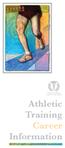 Athletic Training Career Information What Does a Certified Athletic Trainer Do? Look around you - people these days are on the move. We re learning more, trying more, doing more. And when the level of
Comprehensive Assessment Plan
 Comprehensive Assessment Plan Texas A&M University, Corpus Christi (TAMUCC) Athletic Training (AT) Program 2015 Program Outcomes & Student Learning Outcomes Pg. 1 of 12 CAATE Comprehensive Assessment Plan
Chapter 1: The Sports Medicine Team. Objectives. Objectives. What Is Sports Medicine? Sports Medicine Professionals
 Objectives Chapter 1: The Sports Medicine Team Define sports medicine & the associated professions Identify the professional organizations dedicated to athletic training & sports medicine Identify the
ATEP. Athletic Training Education Program. Candidate Handbook
 16 Athletic Training Education Program ATEP For More Information Contact Robert Stow, PhD, ATC, CSCS Director - ATEP University of Wisconsin - Eau Claire (715) 836-2022 [email protected] Or Mary La Rue,
Athletic Training Program (ATP) 2015-2016 Master s in Athletic Training/BS HHP Exercise Science Pre-Athletic Training
 Athletic Training Program (ATP) 2015-2016 Master s in Athletic Training/BS HHP Exercise Science Pre-Athletic Training Name: ID#: Course Number Course name Restrictions and/or Prerequisites Fall First Year
Introduction. This document contains the following sections: Why an application process. Prerequisites
 South Dakota State University MASTER OF SCIENCE: ATHLETIC TRAINING Application Process Overview Domestic Students Preparing Engaged Practitioners and Contemporary Leaders in Athletic Training Introduction
University of Northern Iowa Athletic Training Graduate Program Program Outline
 University of Northern Iowa Athletic Training Graduate Program Program Outline Master of Science: Athletic Training The athletic training master of science degree is designed for those who are NATABOC
Athletic Training Bachelor of Science in Athletic Training
 Athletic Training Bachelor of Science in Athletic Training Students desiring to pursue athletic training as a profession should begin this track early in their college career. Students will receive academic
B.S. in Nutrition and Exercise Physiology WSU Spokane. Application for Fall Admission
 B.S. in Nutrition and Exercise Physiology WSU Spokane Application for Fall Admission Application Requirements: 1. Completion of the B.S. NEP Application; priority deadline is the first Monday in January
Doctorate: An Excellent Foundation for a Physical Therapy Career
 Doctorate: An Excellent Foundation for a Physical Therapy Career Physical Therapists have rewarding careers working directly with people in a variety of settings. They are respected members of the health
Master of Athletic Training Program Preceptor Training. Dr. Josh Yellen, Program Director Dr. Mark Knoblauch, Clinical Education Coordinator
 Master of Athletic Training Program Preceptor Training Dr. Josh Yellen, Program Director Dr. Mark Knoblauch, Clinical Education Coordinator Objectives Overview of AT and CAATE CAATE Definitions MAT Program
ATHLETIC TRAINING MAJOR STUDENT HANDBOOK
 ATHLETIC TRAINING MAJOR STUDENT HANDBOOK 2014-2015 Athletic Training Student Handbook 2014-2015 Page 1 TABLE OF CONTENTS Welcome and Overview of Major...3 Faculty...4 Curriculum, Competitive Nature, Mission
SAN DIEGO STATE UNIVERSITY ATHLETIC TRAINING EDUCATION PROGRAM
 APPLICANT'S STATEMENT OF UNDERSTANDING CONCERNING THE SAN DIEGO STATE UNIVERSITY ATHLETIC TRAINING PROFESSIONAL PROGRAM My understanding of the Athletic Training Professional Program: A. I understand that
The Northeast Ohio Medical University-Cleveland State University Post Bacc/M.D. Frequently Asked Questions
 The Northeast Ohio Medical University-Cleveland State University Post Bacc/M.D. Frequently Asked Questions What is the NEOMED-CSU Post Bacc/M.D. program? Northeast Ohio Medical University (NEOMED) and
KINESIOLOGY. What can I do with this major? Specialized studios, e.g. yoga, pilates. Camps and park districts
 PHYSICAL FITNESS Exercise Physiology Personal Training Performance Enhancement and Management Strength and Conditioning Coaching Group Fitness Instruction Health Club or Fitness Center Management KINESIOLOGY
Department of Physical Education
 Department of Physical Education Department Chair: Craig Morrison PE 214 (45) 586-7816 Department Secretary: Joan M. Anderson Professors: Jean R. Lopour, Craig Morrison; Associate Professors: Benjamin
What is Sports Medicine and Exercise Science? What Can I Do With a Degree in Sports Medicine or Exercise Science?
 Careers in Sports Medicine and Exercise Science Career decisions are often difficult to make. The fields of sports medicine and exercise science are developing so rapidly that choosing the right career
COLLEGE OF HEALTH & HUMAN SERVICES
 COLLEGE OF HEALTH AND HUMAN SERVICES 195 COLLEGE OF HEALTH & HUMAN SERVICES The College of Health and Human Services provides quality education for professional practice in a variety of areas associated
Doctor of Physical Therapy (DPT) Degree Program
 SCHOOL OF PUBLIC HEALTH NEW YORK MEDICAL COLLEGE VALHALLA, NY 10595 Doctor of Physical Therapy (DPT) Degree Program The Department of Physical Therapy offers a professional Doctor of Physical Therapy (DPT)
Standards for the Academic Accreditation of Professional Athletic Training Programs
 Standards for the Academic Accreditation of Professional Athletic Training Programs Commission on Accreditation of Athletic Training Education, July 1, 2012 Standards for the Academic Accreditation of
Introduction. This document contains the following sections: Why an application process. Prerequisites
 South Dakota State University MASTER OF SCIENCE: ATHLETIC TRAINING Application Process Overview Domestic Students Preparing Engaged Practitioners and Contemporary Leaders in Athletic Training Introduction
Evolution of Athletic Training. Past, Present, Future
 Evolution of Athletic Training Past, Present, Future Past 1800 s athletic trainers were present in the latter part of the century, however not formally recognized. ü Traditionally concerned with the athlete
Athletic Training & Biology
 Dual Degree Program in Athletic Training & Biology I N C O L L A B O R A T I O N W I T H W E S T C H E S T E R U N I V E R S I T Y M I L L E R S V I L L E U N I V E R S I T Y Program Overview Admissions
COLLEGE OF HEALTH & HUMAN SERVICES
 COLLEGE OF HEALTH AND HUMAN SERVICES 159 COLLEGE OF HEALTH & HUMAN SERVICES Degree Program Dothan Campus Montgomery Campus The College of Health and Human Services provides quality education for professional
Assessing Clinical Proficiencies
 Assessing Clinical Proficiencies Overview: The National Athletic Trainers Association Education Council has identified a knowledge and skill base, which it believes is necessary for a person to possess
Dear Applicant: PROGRAM.APP\PTA APPLICATION 8/14 (1)
 Dear Applicant: The process for applying to the Physical Therapist Assistant (PTA) Program at Southern Illinois University Carbondale (SIUC) consists of the following steps: 1. Admission into the University
DIABLO VALLEY COLLEGE CATALOG 2014-2015
 KINESIOLOGY KINES Formerly Physical Education Theory - PETHE Christine Worsley, Dean Kinesiology, Athletics and Dance Division Physical Education Office Building, Room 104 Possible career opportunities
Pre-Physical Therapy. Admission Requirements
 226 Pre-Physical Therapy Undergraduate Degree Options Students can choose from a variety of undergraduate majors. It is essential for the student to work closely with his/her adviser to plan a program
This program is offered entirely ONLINE throughout the United States and in approved international locations.
 West Virginia University 1 Special Education Degrees Offered Master of Arts in Special Education Doctor of Education with a major in Special Education MASTER OF ARTS IN SPECIAL EDUCATION OVERVIEW The graduate
Still Scholars & Early Decision programs
 Still Scholars & Early Decision programs Osteopathic Medicine (DO degree) A.T. Still University Kirksville College of Osteopathic Medicine Location: Kirksville, Mo. Still Scholars - DO Get admitted early
What is a Nurse? A person trained to care for the sick or infirm, especially in a hospital.
 School of Nursing What is a Nurse? A person trained to care for the sick or infirm, especially in a hospital. Nursing is a profession within the health care sector focused on the care of individuals, families,
Master of Physician Assistant Studies Program. Frequently Asked Questions
 When does the MPAS program start? Master of Physician Assistant Studies Program Frequently Asked Questions A new MPAS cohort begins in Graduate Term II. This is typically the week before or after Thanksgiving.
Kean University BS Degree in Athletic Training
 BS Degree in Athletic Training Athletic Training is an allied health profession with a specialization focusing on the total health needs of the athlete. Working under the supervision of a team physician
Respiratory Care Associate in Science Degree
 2011-12 See your Career Program Advisor to help you get in the right classes. Respiratory Care Associate in Science Degree Set Yourself Up for a Great Career Respiratory therapists are an integral member
Department of Human Movement Sciences
 Department of Human Movement Sciences 2007 Student Center 757 683-4995 757 683-4270 Lynn L. Ridinger, Chair The Department of Human Movement Sciences offers programs leading to a Master of Science in degree
it s all about Choices S H R P School of Health Related Professions Physician Assistant Program
 D E P A R T M E N T O F P R I M A R Y C A R E it s all Choices about S H R P School of Health Related Professions Physician Assistant Program P H Y S I C I A N A S S I S T A N T Choices Students who choose
DIABLO VALLEY COLLEGE CATALOG 2015-2016
 KINESIOLOGY KINES Formerly Physical Education Theory - PETHE Christine Worsley, Dean Kinesiology, Athletics and Dance Division Physical Education Office Building, Room 104 Possible career opportunities
Graduate Faculty Committee Document 1249 Approved December 17, 2012
 Graduate Faculty Committee Document 1249 Approved December 17, 2012 RECOMMENDATION OF THE SUBCOMMITTEE ON GRADUATE COURSE AND CURRICULUM, THE COLLEGE OF HEALTH SCIENCES RESEARCH AND GRADUATE PROGRAMS COMMITTEE,
Authorization to Implement a New Program Proposal
 1 of 30 Authorization to Implement a New Program Proposal 1. PROGRAM IDENTIFICATION 1.1 Title of Proposed Program Bachelor of Science Athletic Training 1.2 Department of Functional Equivalent Department
How To Become A Master Of Athletic Training
 MASTER S IN ATHLETIC TRAINING GRADUATE STUDENT HANDBOOK 2014-2015 MAT Handbook, 2014-15 TABLE OF CONTENTS Welcome and Overview of Major... Faculty...4 Curriculum, Mission Statement, Statement of Purpose,...5
Department of Physical Education and Human Performance
 Department of Physical Education and Human Performance Department Chair: Rick Lambson Physical Education 214 ~ (45) 586-7822 Administrative Assistant: Joan M. Anderson Physical Education 217 ~ (45) 586-7816
Dawn Hammerschmidt, PhD, ATC [email protected]
 Dawn Hammerschmidt, PhD, ATC [email protected] 4671 10 th St. N 103 A Nemzek Hall Fargo, North Dakota 58102 Moorhead, Minnesota 56563 701-361-1413 (cell) 218-477-2318 (office) 218-477-2363 (fax) Education
COLLEGE OF HEALTH & HUMAN SERVICES
 COLLEGE OF HEALTH AND HUMAN SERVICES 187 COLLEGE OF HEALTH & HUMAN SERVICES The College of Health and Human Services provides quality education for professional practice in a variety of areas associated
MASTER OF SCIENCE IN ATHLETIC TRAINING
 MASTER OF SCIENCE IN ATHLETIC TRAINING MORAVIAN COLLEGE ATHLETIC TRAINING PROGRAM OVERVIEW The Moravian College athletic training program is a full-time, two-year, entry-level, professional-practice program.
Master of Science in Occupational Therapy
 Master of Science in Occupational Therapy Applicant Handbook (entering 205-206) Occupational Therapy: Living Life to Its Fullest Philadelphia University 420 Henry Avenue Philadelphia, PA 944-5497 25.95.29
Physician Assistant Studies
 Physician Assistant Studies Physician Assistant Phone: (540) 568-8171 Website: http://www.jmu.edu/heathsci/paweb Interim Academic Unit Head Dr. Paula Maxwell Graduate Program Director Mr. James Hammond,
RESPIRATORY THERAPY PROGRAM INFORMATION
 RESPIRATORY THERAPY PROGRAM INFORMATION Respiratory therapists work with physicians and other allied health professionals to diagnose and treat patients with disorders associated with the respiratory and
The MSAT program at South Dakota State University (SDSU) is designed to provide students with the knowledge and skills necessary to:
 SECTION I: PURPOSE South Dakota State University MASTER OF SCIENCE: ATHLETIC TRAINING Program Technical Standards (Domestic or International) Verification of Technical Standards Deadline: December 1 (Fall
Heidelberg University. Athletic Training Department. Athletic Training Education Program. AT Student Handbook
 AT Student Handbook Heidelberg University Athletic Training Department Athletic Training Education Program AT Student Handbook Table of Contents Vision & Mission Statements 3 Objective Statements 4 Academic
University of Northern Iowa Athletic Training Education Program Student Handbook
 University of Northern Iowa Athletic Training Education Program Student Handbook 2008, 2009, 2010, 2011, 2012, 2013 UNI Athletic Training Education Program UNI Sports Medicine Department All Rights Reserved
NEW UNITS OF INSTRUCTION, PUBLIC SERVICE, AND RESEARCH AT PUBLIC UNIVERSITIES
 Item #10 April 1, 2008 NEW UNITS OF INSTRUCTION, PUBLIC SERVICE, AND RESEARCH AT PUBLIC UNIVERSITIES Submitted for: Action. Summary: This item requests approval of seven degree programs and one center
Students complete 63 hours of study to meet degree requirements. The curriculum is organized into four areas of study:
 Case Study: The Western Michigan University Doctorate in Interdisciplinary Health Sciences by Paul D. Sarvela, vice president for academic affairs, Southern Illinois University The College of Health and
Master of Science in Occupational Therapy
 Master of Science in Occupational Therapy Applicant Handbook (entering 202-20) Occupational Therapy: Living Life to Its Fullest Philadelphia University 420 Henry Avenue Philadelphia, PA 944-5497 25.95.29
Occupational Therapy. School of Health. Bachelor of Science
 306 OCCUPATIONAL THERAPY Occupational Therapy School of Health Division of Health Sciences Bachelor of Science Faculty Marilyn Masunaka-Noriega, Program Coordinator Pat Nagaishi (vacant), Fieldwork Coordinator
University of Miami Bulletin, 2003-2004 Graduate, School of Nursing
 SCHOOL OF NURSING - GRADUATE NURSING - Dept. Code: NUR The School of Nursing offers two degrees: the Master of Science in Nursing and the Doctor of Philosophy with a major in Nursing. Admission to graduate
Physician Assistant Program Master of Medical Science (MMS)
 Twenty-four months to a top medical career Physician assistant (PA) is one of the fastest-growing health careers. The Department of Labor projects a 39% increase in physician assistant jobs through 2018.
Huntingdon College Athletic Training Education Program (ATEP) Policy and Procedures Manual Fall 09. Program Director: Roxanne St.
 1 Huntingdon College Athletic Training Education Program (ATEP) Policy and Procedures Manual Fall 09 Program Director: Roxanne St. Martin, DPT, ATC 2 Huntingdon College Athletic Training Education Program
University of Oklahoma Health Sciences Center
 University of Oklahoma Health Sciences Center College of Dentistry Stephen K. Young, D.D.S., M.S., Dean 1201 N. Stonewall Avenue Oklahoma City, OK 73117-1214 Phone: (405) 271-5444 FAX: (405) 271-3423 Internet:
Doctor of Nursing Practice (DNP)
 REQUEST FOR NEW PROGRAM APPROVAL Catalog Copy for New Program Doctor of Nursing Practice (DNP) The doctor of nursing practice (DNP) degree prepares nurses with a blend of clinical, organizational, economic,
East Central University Athletic Training Education Program
 East Central University Athletic Training Education Program Policies & Procedures Manual (Updated December 2008) Table of Contents Section 1.0 General Information 1.1 Introduction 1.2 Athletic Training
College of Health Sciences & Human Services
 College of Health Sciences & Human Services College of Health Affairs Agenda 1. Introductions 2. Objectives 3. News & Updates 4. Apple Distinguished Program & Apple Distinguished Educator Awards 5. The
FREQUENTLY ASKED QUESTIONS
 FREQUENTLY ASKED QUESTIONS 1. I have been practicing for several years and my degree is not in athletic training. Do I need to provide transcripts and a certification of education with my application?
South Plains College Respiratory Care Fall 2015
 South Plains College Respiratory Care Fall 2015 Hello! We are pleased that you are interested in the South Plains College Respiratory Care Program. The Respiratory Care Program classes are offered exclusively
PRE-PHYSICIAN ASSISTANT
 PRE-PHYSICIAN ASSISTANT College of Liberal Arts and s Advising Center 387 Cramer Hall, (503) 725-3822, [email protected] PTLAND STATE UNIVERSITY Physician assistants (PA s) are health care professionals
MS in Occupational Therapy Applicant Handbook. Occupational Therapy: Living Life To Its Fullest
 Sage Graduate School Office of Admission 65 First Street Troy, NY 12180 518/ 244-2217 http://www.sage.edu/academics/health_sciences/programs/occupational_therapy/ MS in Occupational Therapy Applicant Handbook
Occupational Therapy Dr. Jeff Loveland, O.T.D., M.S., O.T.R./L, Graduate Coordinator
 Occupational Therapy Dr. Jeff Loveland, O.T.D., M.S., O.T.R./L, Graduate Coordinator Phone: (540) 568-2399/8170 Web site: http://www.healthsci.jmu.edu/occupationaltherapy/ Admission Requirements The Masters
Faculty of KINESIOLOGY and HEALTH STUDIES
 UR Career Guide 1 Faculty of KINESIOLOGY and HEALTH STUDIES Profile of Opportunities What programs are offered? The Faculty of Kinesiology and Health Studies (KHS) offers the Bachelor of Kinesiology (BKin)
Frequently Asked Questions: Masters and Certification Programs in Early Childhood Special Education (ECSE) Preschool Special Education Endorsement
 Frequently Asked Questions: Masters and Certification Programs in Early Childhood Special Education (ECSE) Preschool Special Education Endorsement Department of Educational Psychology, Special Education,