
Authorization to Implement a New Program Proposal
|
|
|
- Percival Cross
- 10 years ago
- Views:
Transcription
1 1 of 30 Authorization to Implement a New Program Proposal 1. PROGRAM IDENTIFICATION 1.1 Title of Proposed Program Bachelor of Science Athletic Training 1.2 Department of Functional Equivalent Department of Kinesiology 1.3 College, School, or Functional Equivalent School of Education, University of Wisconsin-Madison 1.4 Timetable for Initiation a. Submit Authorization to Implement Bachelor of Science Athletic Training to UW-System and Board of Regents Fall 2012 b. Allow students enrolled in current Kinesiology AT option opportunity to transfer into new Bachelor of Science in Athletic Training c. First graduates with Bachelor of Science in AT Spring 2014 d. First full cohort admitted under new BSAT Fall Delivery Method This program is a traditional campus-based program relying on classroom/laboratory courses on the UW-Madison campus. Some pre-requisite content is available in an on-line delivery format (see 3.4). 2. CONTEXT 2.1 History of Program In 1990 the Department of Physical Education and Dance was renamed the Department of Kinesiology. Since 1990, all graduates of the undergraduate program in the Department of Kinesiology have received a Bachelor of Science-Kinesiology degree and a major in Kinesiology. Students in athletic training are currently distinguished from other Kinesiology majors through enrollment in the Option: Athletic Training. The academic evolution of Athletic Training education is outlined in the timeline below: 1950s 60s Walter Bakke (Head Athletic Trainer ) is on record as the instructor for Men s PE #17 Athletic Conditioning and Training in the early 1950's. The course title was later changed to Prevention and Care of Injuries. In 1967, Dr. Allan Ryan taught PE 214 Treatment and Care of Athletic Injuries. These courses served as the precursors to ATEP offerings. 1970s In 1972 the National Athletic Trainers Association developed a national certification examination. Students completing required courses and completing clinical internships could sit for this national exam. The UW-Madison prepared students in this fashion since the inception of athletic training certification. 1

2 2 of s A formalized group of athletic training courses offered in the Dept. of Physical Education and Dance provide students with an area of emphasis in athletic training. Students continue to pursue certification through this formal internship present The UW-Madison Athletic Training Education Program is accredited by the Commission on Accreditation of Athletic Training Education (CAATE) and has been since The UW- Madison Athletic Training program (as a certificate program) was the second program in the State of Wisconsin to secure CAATE accreditation and has a rich history in preparing professionals in this allied health field. In 2005 Athletic Training was approved as a major option within the Kinesiology major in the Dept. of Kinesiology and the Certificate in Athletic Training has been discontinued. In 2006 the Commission on Accreditation of Athletic Training Education (CAATE) awarded the program continuing accreditation through which has since been extended to at which time we will complete a self-study and CAATE site-visit review. The Bachelors of Science in Athletic Training will educate graduates for certification as athletic trainers in accordance with national standards and program goals. At the end of the program students will sit for the national Board of Certification Examination for Athletic Trainers. CAATE now requires that by AT education be delivered at the degree level. 2.2 Instructional Setting of Program The Bachelors of Science in Athletic Training will continue to be housed in the Department of Kinesiology within the School of Education. Like many areas of study we rely on some foundational courses taught outside the Department of Kinesiology for elements of our program. During the Entitlement to Plan process we solidified support for the Bachelors of Science in Athletic Training from those departments offering required courses e.g. Anatomy, Pharmaceutical Sciences, Nutrition, and Nursing. The Athletic Training program is proactive in collaborating with departments whose courses provide instruction of educational competencies in athletic training. We annually review all course syllabi and meet with professors and instructors to discuss competencies presented in their courses. The BS AT program will continue to collaborate with various campus and community-based clinical sites for placement of students for clinical learning (University Health Services, UW Health Sports Medicine, UW Health Athletic Training Outreach Program, and the Division of Intercollegiate Athletics Sports Medicine Program). 2.3 Relation to Mission Statement and Strategic Academic Plan The UW-Madison is distinctive in Wisconsin as the only university where physician training, a range of ancillary and allied health profession programs, and a research mission are fully combined. The Athletic Training program is well positioned to succeed as a member of this health sciences community and contribute to the research, instructional, and outreach mission of the campus. 2

3 3 of 30 The Bachelors of Science in Athletic Training will allow students to learn from faculty with active research programs committed to the creation of new knowledge in the field of athletic training. The program emphasis on evidence-guided practice, quality outcomes, and the adherence to disablement models of patient care place it at the forefront of athletic training education. The program adheres to a student-centered teaching philosophy that promotes active learning among athletic training students. The guiding principles of the program outline a learning environment dedicated to intellectual curiosity, integrity, communication, critical thinking, problem solving, decision making, and advocacy. The program has evolved to fully support the Wisconsin Idea by producing graduates who can mature into leaders in the athletic training profession at the local, state, and national levels. 3. DESCRIPTION 3.1 Program Description The Bachelor of Science in Athletic Training is designed to prepare students to meet national certification and state licensure requirements as Athletic Trainers. Athletic trainers are health care professionals who collaborate with physicians to optimize life-long physical activity of patients and clients. Athletic training encompasses the prevention, diagnosis, and intervention of emergency, acute, and chronic medical conditions involving impairment, functional limitations, and disabilities. The athletic trainer functions as an integral member of the health care team in secondary schools, colleges and universities, professional sports programs, sports medicine clinics, private/industrial workplaces, and other health care settings. Accredited programs include formal classroom instruction in areas such as injury/illness prevention, first aid and emergency care, assessment of injury/illness, human anatomy and physiology, treatment and rehabilitation, nutrition, and pharmacology. These classroom experiences are enhanced through clinical education opportunities. The BS in Athletic Training is a four year 2:2 format program that includes a four semester foundational and prerequisite sequence followed by a four semester professional sequence. This 120 credit program has 113 required credits combined with student electives to reach the 120 credit requirement. 3.2 Program Goals / Objectives / Learning Outcomes The Athletic Training Education Program at UW-Madison seeks to be a leader in athletic training education by offering a program that provides a strong basic science foundation coupled with extensive didactic, laboratory, clinical and field experiences. The program uses a variety of student-centered learning opportunities to develop critical thinking, problem solving, and decision-making skills required to enter the allied health profession of athletic training. The program prepares students for graduate study in the athletic training, successful completion of the Board of Certification (BOC) examination, and entry-level preparation for athletic training positions in a range of employment settings. Program Goals 3

4 4 of 30 The Athletic Training Education Program at UW-Madison will: ATEP Program Goals 1) Recruit and admit highly qualified students with a strong foundation in the basic sciences, challenging them and supporting them to program completion. 2) Prepare athletic training professionals for graduate study and/or entry-level employment through proper didactic and clinical education experiences. 3) Graduate scholarly clinicians who promote and adhere to evidence-based practices. 4) Contribute to evidence-based practice through faculty and student scholarship. 5) Recruit and retain faculty, academic staff, and clinical preceptors who exemplify excellence in teaching and scholarship and serve as role models for the athletic training profession. Student Learning Outcomes The student learning outcomes for the athletic training program are written with full consideration to the Essential Learning Outcomes for UW-Madison Students ( The athletic training learning outcomes incorporate: knowledge of human culture, intellectual and practical skills, personal and social responsibility, and integrative learning. In addition the curriculum strives to include all the elements of the Wisconsin Experience: substantial research experiences, global and cultural competency, leadership and activism opportunities, and application of knowledge. Graduates of UW-Madison Bachelors of Science in Athletic Training will: 1) Understand the role of the athletic trainer within the broader health care system. a) Work collaboratively with a range of practitioners. 2) Demonstrate appropriate oral and written communication skills. 3) Provide patient care that is rooted in ethical behavior, honest communication, and advocacy for patient needs. a) Abide by the Standards of Practice established by the Board of Certification. b) Abide by all State laws governing the practice of athletic training. c) Provide culturally competent athletic training care. d) Understand how athletic training principles are applied in a variety of clinical environments with diverse patient populations. 4) Maintain the highest standards of evidence-guided clinical practice. a) Incorporate quality evidence into clinical practice. b) Utilize tools that examine the quality of patient care. c) Demonstrate skill in the examination, diagnosis, management and rehabilitation of injuries. d) Demonstrate skill in the examination, diagnosis, management and rehabilitation of illnesses as they pertain to physical activity. e) Develop treatment plans are consistent with contemporary disablement models. 4
5 5 of 30 f) Track patient outcomes for the purpose of improving quality of care. 5) Participate in activities to promote life-long learning and professional development. 6) Promote the profession of athletic training a) Maintain membership in the National Athletic Trainers Association 3.3 Curriculum The 4 year 120-credit BS in Athletic Training provides rigorous preparation in liberal studies, basic sciences, athletic training theory and clinical practice, and kinesiology core courses. Students participate in clinical and field experiences and a capstone experience. The program prides itself on the quality and rigor of the student s academic and clinic experience. The five program components are: 1. Liberal Studies. These courses expose students to a broad range of academic disciplines. Students must complete at least 40 credits, including the campus General Education requirements and specific course work in the Humanities, Social Studies, and Sciences. 2. Science Core. Athletic Training students complete a rigorous science and mathematics preparation. Chemistry 103/104 General Chemistry (4/5) Biology 101/102 Animal Biology and Laboratory (3/2) Physics 103 OR 201 OR 207 General Physics (4) Math 211 or 221 Calculus (5) Statistics: Stats 371 Introductory Applied Statistics for the Life Science (3) Physiology 335 Human Physiology (5) Anatomy 328 Human Anatomy Lecture (3) Anatomy 329 Human Anatomy Lab (2) 3. Athletic Training Core. These courses (38 credits) offer advanced study in the theory and clinical practice of athletic training. Kinesiology 127 Introduction to Athletic Training (2 credits). An introductory course covering issues and basic concepts regarding prevention, management, and treatment of athletic injuries. The role of the athletic trainer in the sports medicine field is emphasized. Kinesiology 197 Basic Techniques in Athletic Training (1 credit). An applied clinical approach to basic skills commonly used in the field of athletic training. Designed for students interested in athletic training, and an appropriate elective for those who plan to teach or coach Kinesiology 227 Introduction to the Clinical Anatomy of Human Movement (2 credits). This course is designed to provide students with a foundational knowledge in musculoskeletal anatomy and anatomical considerations related to human movement and physical activity. Kinesiology 301 Advanced Techniques in Athletic Training. A course to provide the future athletic training professional with a foundation in advanced athletic training techniques. Sample topics include: injury prevention, emergency care, orthopedic appliance applications, protective equipment, environmental considerations, and computer applications. 5
6 6 of 30 Kinesiology 317 Recognition and Evaluation of Athletic Injuries (4 credits). The evaluative skills and knowledge needed for minimum competency in the recognition and evaluation of common injuries in athletes and active populations. Kinesiology 357 Therapeutic Strategies in Athletic Training I (4 credits). A study of therapeutic intervention strategies used by athletic trainers. Evidence guided principles and clinical applications of therapeutic exercise, use of physical agents, indications and contra-indications, program design, progression, and standard documentation. Kinesiology 358 Therapeutic Strategies in Athletic Training II (4 credits). A study of therapeutic intervention strategies used by athletic trainers. Evidence guided principles and clinical applications of therapeutic exercise, use of physical agents, indications and contra-indications, program design, progression, and standard documentation. Kinesiology 400 Organization and Administration of Athletic Training Programs. (3 credits). Course Description: Principles of organizational theory and administrative practice as they apply to athletic training and sports medicine programs. Emphasis on developing knowledge and skills needed for entry-level professionals in the athletic training field. Kinesiology 417 Advanced Clinical Assessment Techniques in Athletic Training. (2 credits). This course is designed to provide students with knowledge and skills in advanced clinical assessment techniques used in the evaluation of injuries, illnesses, and conditions found in physically active populations. Kinesiology 450 Field Experience in Athletic Training. (2 credits). A supervised clinical experience for athletic training students in an interscholastic setting. Kinesiology 457 Medical Aspects of Exercise and Sport (3 credits). Responses of the human body to exercise and sports with specific discussion of acute and chronic medical problems which may affect performance. Emphasis on cardiopulmonary, metabolic, nutritional, fluid-electrolyte, heat-temperature regulation. Kinesiology 499 Seminar in Athletic Training (1 credit)*must be repeated once for credit. An advanced undergraduate seminar for students in the athletic training education program. Research trends, evidence-based clinical practice, and current topics in the field of athletic training are emphasized. Nutritional Sciences 332 Human Nutritional Needs (3 credits). Biological basis of the nutritional requirements of humans and the influence of psychological and societal factors on the manner of their fulfillment. Pharmaceutical Sciences 401 Survey of Pharmacology. (3 credits). Pharmacological and toxicological actions and therapeutic use of important drugs. 4. Kinesiology Core. These courses (21-23 credits) explore how the body responds and adapt to exercise, the role of psychological factors in sports and exercise, mechanics applied to biological systems, and how movement is controlled, learned, and developed over the life span. Kinesiology 116 First Aid/CPR or certification (0-2 credits). Techniques and procedures to deal effectively with common emergencies and treatment. Includes training in cardiopulmonary resuscitation. 6

7 7 of 30 Kinesiology 119 Introduction to Kinesiology (2 credits). Introduces students to the field of kinesiology and the Department of Kinesiology at the University of Wisconsin-Madison. Introductory material about physical activity and health will be provided, and career opportunities in kinesiology will be discussed. Kinesiology 300 Practicum (3 credits). Supervised experience in a specialized area of kinesiology. Athletic training students enroll in the AT practicum section. Kinesiology 314 Physiology of Exercise (4 credits). Fundamental knowledge about, and appreciation for, the adaptability of human physiological systems in meeting a range of exercise demands. Kinesiology 318 Biomechanics of Human Movement (3 credits). Analysis of human action through the application of mechanical principles. Kinesiology 330 Research in Kinesiology (3 credits). The research process as applied in kinesiology, including hypothesis development, ethical issues, study design, measurement and statistical concepts, and presentation of results. Includes exposure to current research within the Department of Kinesiology. Kinesiology 350 Introduction to Exercise Psychology (3 credits). Emphasis on the psychological foundations of exercise with motivational techniques, perception of effort, personality dynamics, and mental health serving as the focal points. Kinesiology 361 Motor Learning and Performance (3 credits). A basic and up-to-date view of the major processes and mechanisms underlying the performance and learning of motor skills. Principles in motor learning and control are systematically introduced to produce a meaningful conceptual framework. 5. Elective classes. Elective courses to meet the 120 credit degree requirement are generally related to the student s area of study Sample Program Sequence YEAR I Semester 1 (Fall) Chemistry 103 General Chemistry (4 credits) General Education and Liberal Studies Electives Semester 2 (Spring) Chemistry 104 General Chemistry (5 credits) Math 211 Calculus & Related Topics (5 credits) Kines 127 Introduction to Athletic Training (2 credits) General Education and Liberal Studies Electives YEAR II Semester 1 (Fall) Psych 202 Introduction to Psychology (3 credits) Zoo 101/102 Animal Biology / Animal Biology Lab (5 credits) Kines 116 First Aid/CPR (2 credits) Kines 119 Introduction to Kinesiology (2 credits) General Education and Liberal Studies Electives 7

8 8 of 30 Semester 2 (Spring) Kines 227 Introduction to Clinical Anatomy of Human Movement (2 credits) Kines 197 Basic Techniques in Athletic Training (1 credit) Physics 103 General Physics (4 credits) Stats 371 Principles of Statistics (3 credits) General Education and Liberal Studies Electives Admission to program Spring of Year II / Professional Sequence Begins Fall Year III YEAR III Semester 1 (Fall) 14 credits Anat 328/329 Human Anatomy / Human Anatomy Lab (5 credits) Kines 301 Advanced Techniques in Athletic Training (2 credits) Kines 317 Recognition and Evaluation of Athletic Injuries (4 credits) Kines 361 Motor Learning & Performance (3 credits) Semester 2 (Spring) 15 credits Kines 330 Research in Kinesiology (3 credits) Phys 335 Physiology (5 credits) Kines 357 Therapeutic Strategies in Athletic Training I (4 credits) Kines 350 Introduction to Exercise Psychology (3 credits) YEAR IV Semester 1 (Fall) 16 or 17 credits Kines 499 Seminar in Athletic Training (1 credit) Kines 314 Physiology of Exercise (4 credits) Kines 417 Advanced Clinical Assessment Techniques in Athletic Training (2 credits) Kines 358 Therapeutic Strategies in Athletic Training II (4 credits) Pharm Sci 401 Introduction to Pharmacology (3 credits) Kines 300 or Kines 450 Practicum / Field Experience in Athletic Training (2 or 3 credits) Semester 2 (Spring) credits Kines 499 Seminar in Athletic Training (1 credit) Kines 400 Organization and Administration of Athletic Training Programs (3 credits) Kines 457 Medical Aspects of Exercise and Sport (3 credits) Kines 318 Biomechanics of Human Movement (3 credits) Nutri Sci 332 Human Nutritional Needs (3 credits) Kines 300 or Kines 450 Practicum / Field Experience in Athletic Training (2 or 3 credits) Admissions and Eligibility Prior to admission in the athletic training professional sequence students must complete prerequisite course work in liberal studies, sciences, and introductory kinesiology and athletic training course work. Student can then apply 8

9 9 of 30 for admission, usually during the sophomore year. Students are admitted only once a year, effective for the summer following admission. Once admitted, students in the Athletic Training professional program can complete the program in two years. Some students elect to complete the program in two and one-half years depending on their remaining elective course work. To be eligible for admission, applicants must meet the criteria outlined below. Total Credits/Prerequisite Course Work: Complete at least 54 credits of college course work by the end of the spring semester of the application year. Complete the following course work by the end of the spring semester of the application year: o Chemistry 103/104 OR Chemistry 109 (fall semester only) OR Chemistry 115/116 o Biology 101/102 OR AP Biology score of 4 or 5 OR Biology 151/152 OR Biocore 301/302 o Psychology 201 OR 202 OR 281 o Physics 103 OR 201 OR 207 o Kines 119 Introduction to Kinesiology Complete all but two of the prerequisite courses listed above by the end of the fall semester of the application year. For this purpose, Chem 109 satisfies the full general chemistry requirement but constitutes ONE course, while AP Biology scores of 4 or 5 are counted as TWO courses. Biology 101 and 102 are also counted as TWO courses in determining eligibility for the program. Additional Athletic Training Prerequisite Course Work: Complete these additional prerequisite courses by the end of the spring semester of the application year: o o o o Kines 127 Introduction to Athletic Training Kines 197 Basic Techniques in Athletic training Kines 227 Introduction to Clinical Anatomy of Human Movement Kines 116 First Aid or American Red Cross-certified First Aid and CPR for the Professional Rescuer courses Cumulative Grade Point Average: Earn a minimum 2.75 cumulative GPA or last 60 credits GPA by the end of the fall semester of the application year. Athletic Training Experience: Complete a minimum of twenty (20) total hours of volunteer or observation experiences in athletic training. Students must gain experience in at least two different locations. Each experience must be a minimum of ten (10) hours in length. Documentation of the experience (forms signed by certified athletic trainer) must be submitted along with application materials by the February 1 deadline. Students may seek observational experiences in any setting employing a certified athletic trainer where the athletic trainer is performing job duties consistent with the current BOC Role Delineation domains of athletic training. A copy of the athletic training experience form is provided in Appendix One. 9

10 10 of 30 Application and Related Documents: Applicants must submit the materials indicated below by the February 1 application deadline. Applications are available in October. Off-campus students must also submit an undergraduate application to the Office of Undergraduate Admissions by February 1. o Application form o ATEP Technical Standards form and Health Requirements form. o Official transcripts o Personal statement o Biographical sketch o Athletic Training experience form o Two (2) letters of recommendation Admission Criteria The Admissions Committee will review application files with four key areas in mind: (1) academic qualification; (2) goals; (3) recommendation letters; and (4) other contributions. Academic Qualifications. The Department of Kinesiology and the Athletic Training Education Program seeks students with strong academic credentials. This includes cumulative undergraduate grade point average (GPA), course selection and trend of college grades. Goals. The required personal statement provides an opportunity for students to express their reasons for studying athletic training and can provide insight into the student's long-term goals. Recommendation Letters. Thoughtful letters from teachers or employers addressing the student's interest and experience are beneficial to the selection process. Recommendation letters should provide information about a student's intellect, imagination, or diligence that is not evident in other parts of the application. Other Contributions. The Department of Kinesiology and the Athletic Training Education Program seeks students whose diverse work experience, life experience, stated goals, and cultural background are assets to the learning environment in both the department and the professional program. Instructions for the Personal Statement. The personal statement provides the student with an opportunity to share with the Admissions Committee personal characteristics and goals, and to give the Committee insight into the student's experiences and background. The student is asked to divide the personal statement into two sections. In the first section, the student should explain their motivations for choosing the Athletic Training Education Program and how it relates to future goals in no more than 250 words. In the second section, the student should reflect on how his or her background and experiences pertain to future success as an athletic training student and ultimately, future goals. The student is limited to 500 words for this section. 10

11 11 of 30 Application Review and Selection. Applicants to the Athletic Training program will compete for a specific number of openings in this program. Each application will be reviewed by at least two academic faculty or staff from the Admissions Committee. Each Committee member will independently examine and rate applicants' files on a scale of 1 (do not accept) to 5 (definitely accept) based on the criteria above. The Committee members will then share and discuss their ratings and select the final cohort for admission. Students will be provisionally accepted in April. The offer of admission will be revoked and the student withdrawn from fall Kinesiology courses (typically during July) if any of the following requirements are not met: all prerequisite courses completed by the end of the spring semester of the application year maintenance of a cumulative GPA or last 60-credit GPA of at least 2.75 Last 60 Credits Rule Two grade point averages will be calculated to determine candidates' eligibility and selection to programs. GPAs will be calculated using (1) all transferable college level course work attempted, and (2) the last 60 credits attempted. The higher GPA of these two will be used for purposes of admission. If fewer than 60 credits have been attempted, all credits will be used to calculate the GPA. Graded graduate course work will also be used in all GPA calculations. ("Attempted" course work indicates course work for which a grade has been earned.) Criminal Background Investigation and Disclosure Statement Criminal background investigations will be conducted for all students admitted to this program. Applicants must also complete a disclosure statement. 3.4 Delivery Method This program is a traditional campus-based program relying on classroom/laboratory courses on the UW-Madison campus. Within the professional program sequence students take several courses that rely on campus and community clinical learning sites. Two pre-requisite courses are available on-line. Kinesiology 119 Introduction to Kinesiology is offered on-line during the summer academic session and Kinesiology 127 Introduction to Athletic Training is available on-line through UW-Extension. 3.5 Interrelationship with Other Curricula As a program housed in the Department of Kinesiology the Bachelors of Science in Athletic Training will continue to rely on core Kinesiology courses as part of the professional program (see 3.3 Curriculum). Like many areas of study we rely on pre-requisite and core general studies courses taught outside the Department of Kinesiology (e.g. Anatomy, Chemistry, Physiology, Psychology, Zoology, and Physics). These courses currently serve as pre-requisite course for the program and do not represent a change with the development of the degree program. The AT program also relies on key required coursework in the professional sequence from courses 11

12 12 of 30 offered in other departments; specifically Pharmaceutical Science (Pharm Sci 401), and Nutritional Sciences (Nut Sci 332). During the Entitlement to Plan process we solicited and received support for the Bachelors of Science in Athletic Training from those departments offering required courses in the new degree offering. The Athletic Training program is proactive in collaborating with departments whose courses provide instruction of educational competencies in athletic training. We annually review all course syllabi and meet with professors and instructors to discuss competencies presented in their courses. 3.6 Accreditation Requirement The program is currently accredited by the Commission on Accreditation of Athletic Training Education (CAATE). The program has been in good standing since initial accreditation in 2000 and is scheduled for a selfstudy and site visit review in Accreditation status is not expected to change; however, elevation of the program to degree designation is required by Only graduates of accredited programs are allowed to site for credentialing exams and obtain a license to practice athletic training in Wisconsin. 3.7 Diversity The Bachelor of Science in Athletic Training program will seek to attract students and faculty from diverse social, economic and ethnic backgrounds, and to be sensitive and responsive to those groups that are under-represented within the athletic training profession. The AT program is dedicated to providing graduates with necessary cultural competency skills in the area of patient evaluation and treatment and addresses these issues in multiple locations across the curriculum. The AT program will avail itself to all UW-Madison resources to help actively recruit underrepresented students and faculty. Specifically, the program will work closely with the School of Education Office of Undergraduate Recruitment and Retention (OURR). The program will provide public service by collaborating with other campus applied health sciences programs (Physical Therapy, Occupational Therapy, and Medicine) participating in activities that address issues of cost, quality, and access to health care services. 3.8 High-Impact Practices The AT program makes use of a variety of high impact practices in the form of in-class and out-of-class opportunities that lead to the types of student outcomes expressed in the UW-Madison Essential Learning Outcomes. These include integrative learning, global competencies, group-based skills, and other practical and ethical skills and learning. The program affords students multiple opportunities including writing intensive courses within the athletic training discipline (Kines 457 Medical Aspects of Exercise and Sport Comm B), study abroad, service learning/community, undergraduate research (Wisconsin Injury and Sport Laboratory), student leadership (Association of AT Students AATS), cultural competency in health care (across the program curriculum), diversity and global learning (Gen Ed requirements), capstone courses (Kines 450 Field Experience in Athletic Training and Kines 300 Practicum in Athletic Training), internships, and capstone projects (Kines 499 Seminar in Athletic Training - Senior Case Study Symposium). Several examples of service learning and internship opportunities available to athletic training students can be found in the outreach section (3.10) below. 12

13 13 of Collaboration The UW-Madison is committed to pursuing collaborative opportunities with existing athletic training programs in the state of Wisconsin. Athletic training is unique among the applied health sciences in that students participate in clinical field placements throughout their professional sequence. This infusion of clinical education across the curriculum can be an impediment to distance education due to the need for local clinical placement in conjunction with ongoing coursework. However, there is great potential for upper level seminar style course topics and specialized lectures to be shared among programs using readily available distance learning technology. The UW- Madison is a leader in this area and has sponsored multiple webinar/streaming lecture presentations and offered them to programs across the state. These cooperative learning programs were well received and a good starting point for increased collaboration. In addition to these learning opportunities there is great potential for research collaboration specifically between faculty at the UW-Madison and faculty at UW-Milwaukee. Involvement of faculty from both institutions with the Wisconsin Athletic Trainers Association Research Committee shows promise in this area Outreach The athletic training education program is committed to the Wisconsin Idea and is dedicated to promoting community service among its students. The following is a representative sample of outreach activities available to students in the athletic training program. Many students in the athletic training program are active in the Kinesiology Club and the Association of Athletic Training Students. Athletic Training Program Outreach Activities Opportunities Offered Within or Coordinated Through the AT Program: Shadowing of Faculty and Clinicians in Clinical Settings (e.g. University Health Services) Senior Case Study Symposium Independent Studies (Kines 399) Research and Poster Projects with Faculty and Staff WATA Annual Conference WATA Student Quiz Bowl Competition WATA Research Competition WATA Case Study Competition GLATA Annual Conference NATA Annual Conference NATA Research and Education Foundation Fundraisers Student Panels for Prospective Students Health Occupations Student Association Career Fair PEOPLE Program College for Kids Study Abroad Sister Program Project with Concordia University Athletic Therapy Program Montreal Canada Interdisciplinary Brown Bag Presentations and Discussions Association of Athletic Training Students (AATS) Activities: Relay for Life Special Olympics Polar Plunge Annual Food Drive for Second Harvest Annual Toiletries and Personal Items Drive for Porchlight Girls on the Run 13

14 14 of 30 Kinesiology Club Activities: Poker Run Fundraiser Annual Blood Drive Career Night Series Opportunities Offered Through Medical Organizations: Area Health Education Center (AHEC) Wisconsin Express (summer) AHEC Community Health Internship Program (summer) AHEC Health Careers Camp UW Health Athletic Training Summer Internship Mayo Clinic Athletic Training Summer Internship 4. NEED 4.1 Comparable Programs in Wisconsin The Athletic Training Education Program at UW-Madison was the second program in the State of Wisconsin to secure national accreditation (2000). Since that time four more programs have been accredited in the UW-System. In addition to UW-Madison, LaCrosse, Oshkosh, Stevens Point, Eau Claire, and Milwaukee currently offer programs in athletic training. The presence of six AT programs with distinct identities and approaches within the UW System provide students with broad pedagogical and location choices for athletic training education in Wisconsin. The presence of this program at a major research university like UW-Madison places it in a strong position to maximize available resources in the health sciences community to create a vibrant experience for students. The presence of the School of Medicine and Public Health as well as programs in Physical Therapy, Occupational Therapy, Nursing, Pharmacy, and Physicians Assistant provide unparalleled opportunities for interdisciplinary education among health sciences students. In addition, the Division of Intercollegiate Athletics, University Health Services, UW Health Hospitals and Clinics, UW Health Sports Medicine and Athletic Training Outreach, and local secondary schools provide a full range of clinical education opportunities to best prepare future care providers. Lastly, the ability to expose students to cutting edge sports medicine research has a positive impact on both patient care and student interest in graduate study. 4.2 Comparable Programs Outside of Wisconsin Minnesota has seven accredited athletic training programs, five public and two private, none of these programs are offered in a tier one research setting. Iowa has eleven accredited athletic training programs, two public and nine private school programs. Illinois has thirteen athletic training programs, five offered at public institutions and eight in private settings. Like Minnesota none of the programs in Illinois are located in a research one comprehensive setting. Of the Committee on Institutional Cooperation (CIC) schools in bordering states, only the University of Iowa currently offers a program in athletic training. A total of nine CIC campuses currently offer athletic training programs. 14

15 15 of National Labor Trends / Employment Outlook The US Bureau of Labor Statistics data reports that employment of athletic trainers is projected to grow 37 percent from 2008 to 2018, much faster than the average for all occupations, because of their role in preventing injuries and reducing healthcare costs. Job growth will be concentrated in the healthcare industry, including hospitals and offices of health practitioners. Fitness and recreation sports centers also will provide new jobs, as these establishments grow and continue to need additional athletic trainers to provide support for their clients. Growth in positions with sports teams will be somewhat slower, however, as most professional sports clubs and colleges and universities already have complete athletic training staffs. In some States, there are efforts underway to have an athletic trainer in every high school to work with student-athletes, which may lead to growth in the number of athletic trainers employed in high schools. The demand for preventative healthcare will grow as the population ages and greater emphasis is place on prevention programs. Increasing physical activity among the general population is frequently cited as a key mechanism to improve health and reduce the cost of care; demand for athletic trainers will grow as these programs are implemented. Increased licensure requirements and regulation has led to a greater acceptance of athletic trainers as qualified healthcare providers. As a result, third-party reimbursement is expected to continue to grow for athletic training services. Athletic trainers will benefit from this expansion because they provide a costeffective way to increase the number of health professionals in an office or other setting. The transition of the AT program from an option to a stand-alone Bachelors of Science in Athletic Training is consistent with these national trends that demonstrate a greater need for athletic trainers in the healthcare field. In addition, the BS-AT allows for full recognition that these professionals have been prepared specifically in their discipline. 4.4 Student Demand Future Enrollment The Athletic Training option in Kinesiology is a limited enrollment program that currently can accepts students per year. Student demand is consistently high as introductory courses in Athletic Training that serve as program pre-requisites are filled to capacity and the program is forced to turn away qualified applicants through the admissions process. Limitations to the enrollment are due to limited availability of clinical placements and space limitations in core Kinesiology courses. The current Athletic Training option in Kinesiology is offered as a five semester professional sequence. In the interest of creating a four year time to graduation plan, the proposed program has been designed as a four semester sequence. This new format may require some adjusting in the enrollment caps for athletic training. We anticipate admitting 20 students annually and graduating the same number annually. This may fluctuate if students elect to spread their program over five semesters. No new 15
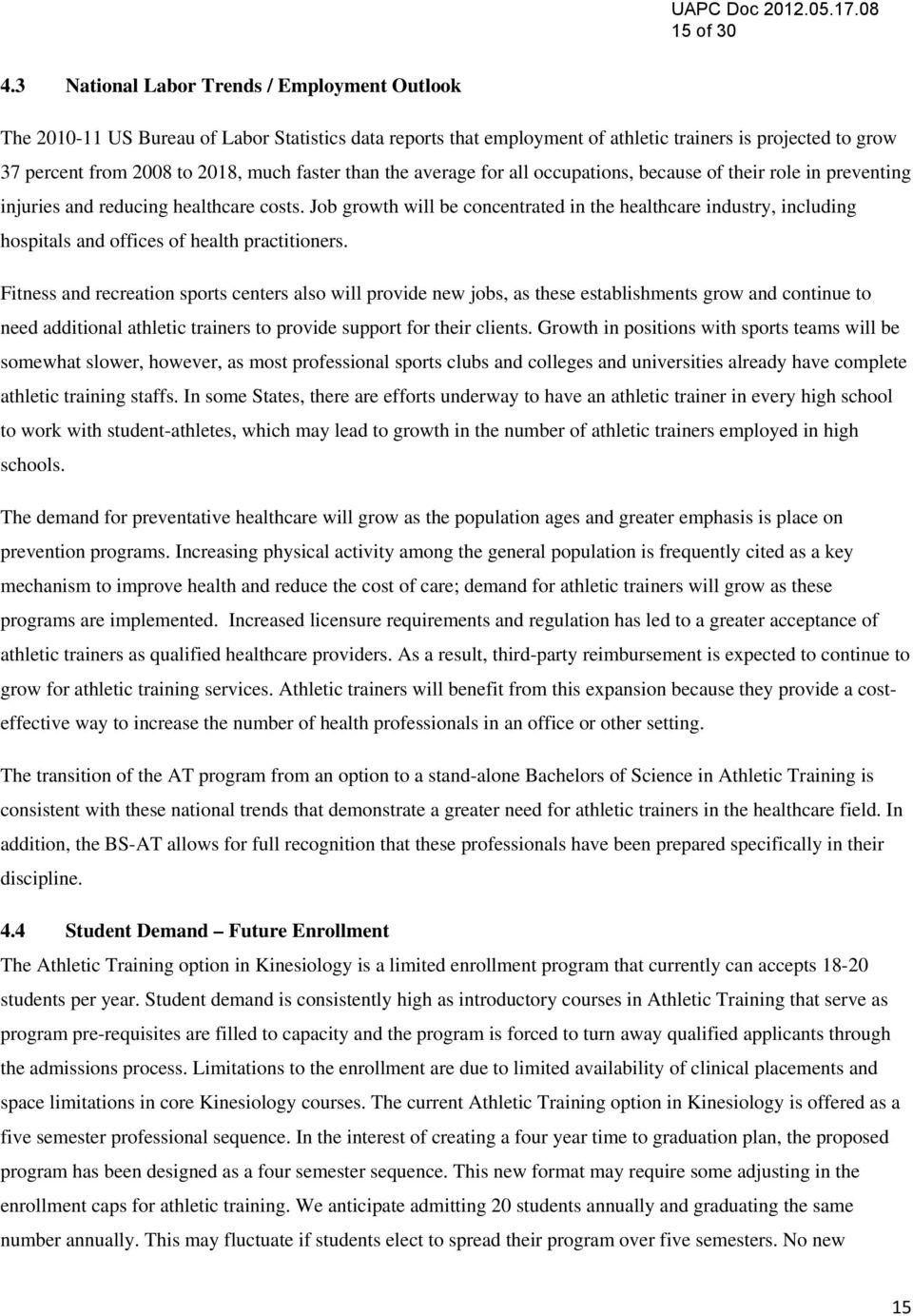
16 16 of 30 resources are requested for this proposal. Any increases in student enrollment would be contingent on program changes in Kinesiology that allow for additional students to enroll or increases in resources. Projected Enrollment Bachelors of Science in Athletic Training Fall 2012 Spring 1017 Year Implementation year nd year rd year th year th year New students admitted Continuing students 0 * Total enrollment # Graduating students *Continuing students assumes a Fall 2013 class of 18 with 18 continuing students. All continuing students, and those starting the Dept. of Kinesiology AT Option in 2013, will be given the opportunity to transfer into the new Bachelors of Science in Athletic Training. # Assumes 90% completion this is consistent with ATEP history. 4.5 Collaborative or Alternative Program Exploration The Athletic Training Education Program at UW-Madison was the second program in the State of Wisconsin to secure national accreditation (2000). Since that time four more programs have been accredited in the UW-System. Each program in the state has elected to stand alone and none have pursued a collaborative program structure. This is likely due to the need for local clinical placements that are common to athletic training programs. Programs require local supervision and assessment of clinical competencies across the curriculum. This infusion of clinical education from start to finish in the professional sequence is unique to athletic training and can be an impediment to alternative program options. After careful consideration and discussions with colleagues at other UW System campuses it was determined that the program design, required content, and required local clinical experiences are best suited for a campus based delivery model. 4.6 Program Need Summary In summary: 1) The transition of the AT program at UW-Madison to a Bachelors of Science in Athletic Training is consistent with student demand and current national trends for greater demand for preventative healthcare. 2) The program is being elevated to a BS in Athletic Training with no request for additional resources and minimal adjustments in admissions and course requirements. 3) As an accredited program the UW-Madison AT program is currently graduating professionals in athletic training; approval of the BS in Athletic Training at UW-Madison 16
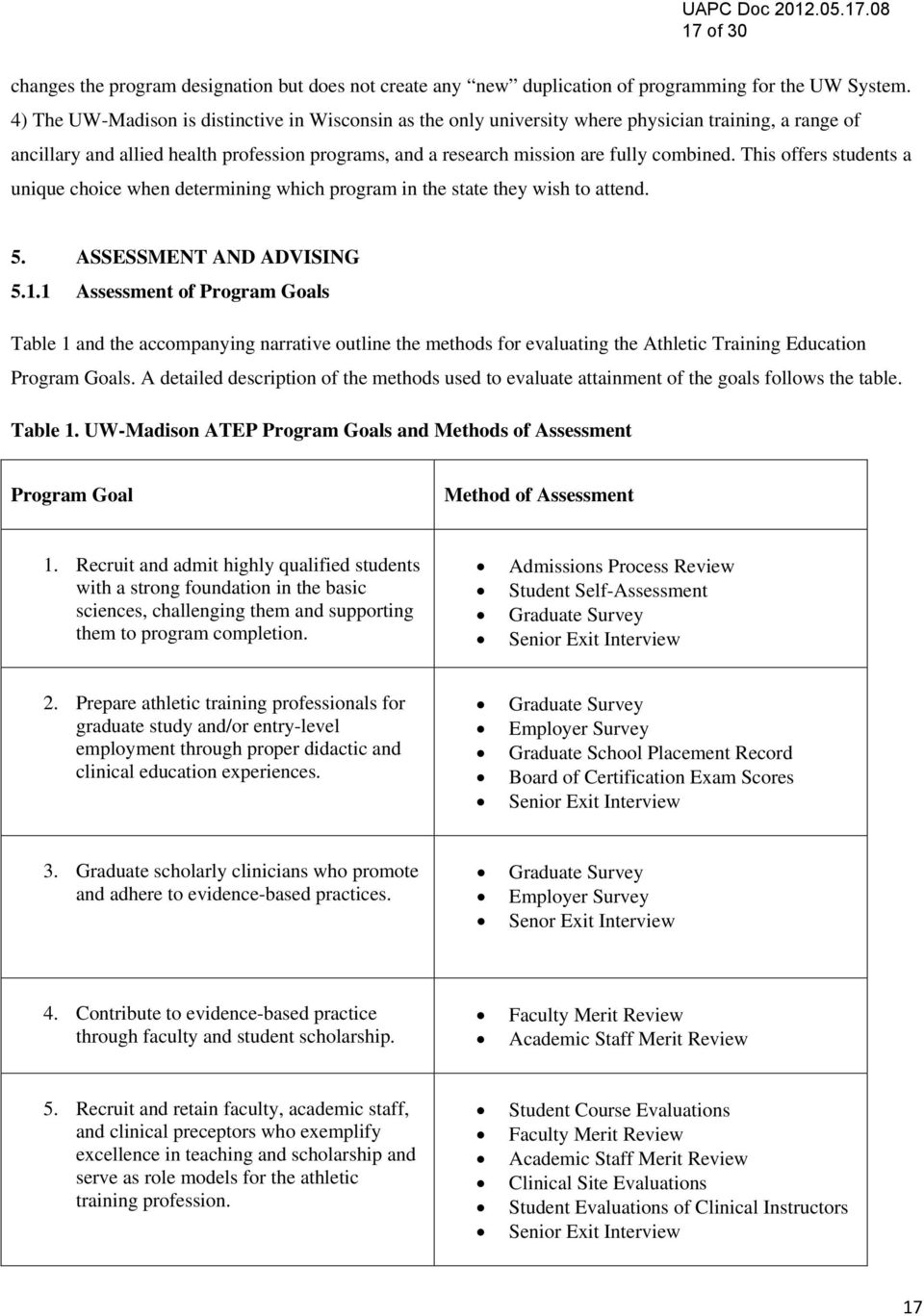
17 17 of 30 changes the program designation but does not create any new duplication of programming for the UW System. 4) The UW-Madison is distinctive in Wisconsin as the only university where physician training, a range of ancillary and allied health profession programs, and a research mission are fully combined. This offers students a unique choice when determining which program in the state they wish to attend. 5. ASSESSMENT AND ADVISING Assessment of Program Goals Table 1 and the accompanying narrative outline the methods for evaluating the Athletic Training Education Program Goals. A detailed description of the methods used to evaluate attainment of the goals follows the table. Table 1. UW-Madison ATEP Program Goals and Methods of Assessment Program Goal Method of Assessment 1. Recruit and admit highly qualified students with a strong foundation in the basic sciences, challenging them and supporting them to program completion. Admissions Process Review Student Self-Assessment Graduate Survey Senior Exit Interview 2. Prepare athletic training professionals for graduate study and/or entry-level employment through proper didactic and clinical education experiences. Graduate Survey Employer Survey Graduate School Placement Record Board of Certification Exam Scores Senior Exit Interview 3. Graduate scholarly clinicians who promote and adhere to evidence-based practices. Graduate Survey Employer Survey Senor Exit Interview 4. Contribute to evidence-based practice through faculty and student scholarship. Faculty Merit Review Academic Staff Merit Review 5. Recruit and retain faculty, academic staff, and clinical preceptors who exemplify excellence in teaching and scholarship and serve as role models for the athletic training profession. Student Course Evaluations Faculty Merit Review Academic Staff Merit Review Clinical Site Evaluations Student Evaluations of Clinical Instructors Senior Exit Interview 17
18 18 of 30 Methods of Assessment Admissions Process Review. This review is conducted annually by the ATEP Program Director. Following the admissions process the program director does the following: Reviews application mechanism, review, and notification with department and school personnel. Reviews and compares academic performance indicators from student applications at the time of admission between the students accepted and the students rejected. Using data from previous student cohorts evaluates admission criteria to help identify predictors of program performance. Report to Dept. of Kinesiology Undergraduate Studies Committee recruitment activities with emphasis on minority student recruitment. Board of Certification Exam Scores An annual report of student performance on the Board of Certification examination is provided to the program director. This report allows program personnel to compare first-time passing rates for UW-Madison students to the national average for the annual reporting period. The report also provides performance breakdowns for students from UW-Madison on specific practice domain sections of the exam. Clinical Site Evaluations The Clinical Site Coordinator of the Athletic Training Education Program evaluates (in person) every campus and community clinical site used for student placement during the academic year. Information is collected and reviewed regarding compliance with safety and fair practice issues as well as evaluation of the clinical learning environment. Employer Survey Surveys are sent to employers who have hired graduates of the UW-Madison ATEP. Data is collected on student preparation in both clinical and interpersonal skills. The emphasis is placed on the UW-Madison ATEP graduate s work performance in the major domains of athletic training. Potential areas for curricular improvement are identified through this process. Faculty and Academic Staff Merit Review All faculty and academic staff in the Dept. of Kinesiology are required to develop and submit an annual report of scholarly activities for the annual merit review. This material is reviewed by the respective merit review committees. Graduate School Placement Record The ATEP Program Director collects data to track graduate and professional program placement of AT graduates. This information is included in required accreditation reports and is shared with continuing students in the program to show the array of graduate opportunities available to them. 18

19 19 of 30 Graduate Survey Students who have graduated from the ATEP are sent a survey to assess the program after being in the workforce or graduate education setting for one year. Students are sent an on-line survey to collect data on their view of program strengths and weaknesses after having greater experience as an entry-level athletic trainer. Questions focus on the domains of athletic training and the overall strengths and weaknesses of the ATEP. Senior Exit Interviews All graduating seniors meet with the ATEP Program Director for an exit interview. This interview is used to collect general information from the graduating student about their program experience, review preparation for the Board of Certification Exam, review placement and any assistance needed for placement, and to provide an opportunity for students to share their views on all aspects of the AT Program. Students are specifically asked to comment on admissions, advising, the curriculum, clinical experiences, and any other areas they wish to comment. Comments are compiled and the Dept. of Kinesiology AT Committee reviews for the purpose continual improvement. Student Evaluations of Clinical Instructors At the completion of each clinical rotation student will evaluate their clinical instructors for the semester. Clinical instructors are provided feedback annually regarding student comments and strengths and weaknesses of each clinical site. These student evaluations are completed anonymously in an on-line format. Student Self-Assessment Students are given two opportunities during the course of the program to perform a self-assessment of their current skills, areas of improvement, and program goals. These self-assessments are reviewed by the ATEP Program Director and the ATEP Clinical Coordinator and are used to help identify program weaknesses and to aid in student clinical placements Assessment of Student Learning / Instructional Effectiveness: The ATEP employs a variety of program evaluation tools to assess instructional effectiveness and student learning outcomes (see 3.2). Student learning is assessed in multiple ways across the program. In didactic settings students are evaluated in each course through written quizzes and exams, case studies, research papers, laboratory reports, presentations, and other required assignments reflected through the course syllabi. Each class in the university performs an end of the semester evaluation that allows students to evaluate the instructor and assess instructional effectiveness. The results of these evaluations and student comments are reviewed to make adjustments in course content or instructional delivery as needed. In the spirit of academic freedom the program does not dictate any specific instructional methods or assessment practices. However, the program does insure that any educational competencies required for CAATE accreditation and assigned to a course are covered by the instructor. In clinical and laboratory learning environments students are evaluated through practical examinations, observed structured clinical exams (OSCEs), demonstration of clinical skills, and required assignments reflected through 19

20 20 of 30 the clinical syllabus. Students fill out clinical evaluation forms for their approved clinical instructors (ACIs) at the end of each semester. The results of these evaluations and student comments are shared with the clinical instructors and used in the spirit of continuous improvement. The program also utilizes several of the same processes described in the section for the assessment of program goals to monitor student learning and clinical effectiveness. Specifically Board of Certification exam scores, senior exit interviews, and student selfassessment. Descriptions of these methods are described above. 5.2 Advising Program advising is provided in many ways as a student progresses from being interested in the AT option in Kinesiology to completion of the program. Prior to admission to the Dept. of Kinesiology, students in the School of Education with an interest in the athletic training receive advising on pre-requisite courses and requirements for admission into the Department of Kinesiology s Athletic Training Program from the School of Education s Academic Services office. This group of advisors coordinates advising for all SOE students prior to their acceptance into the professional program. The School of Education Academic Services office also coordinates all advising during Summer Orientation Advising and Registration (SOAR). The athletic training program director is also available for advising to prospective ATEP students and their families during campus visits. The program participated in a variety of campus wide informational programs for students interested in the health sciences (e.g. Health Occupations Student Association HOSA) and sponsors several students question and answer sessions and an annual open house. Information on SOE advising is available at Advising for students interested in athletic training will not change under the new degree program. In the future students can hold a university designation of PKN (pre-kinesiology) or PAT (pre-athletic Training) during the pre-professional phase of their program. Upon acceptance into the professional program portion of the BS in Athletic Training, students receive advising from a designated program advisor. Students are required to attend group advising meeting every semester to insure they are making progress toward their degree. During group advising students are provided a sample fouryear plan with a suggested sequence of courses outlining their academic program requirements, given appropriate information on summer offerings, and provided a program checklist to compare to their DARS report for the purpose of monitoring their progress to graduation.. In addition to group advising meetings, athletic training program staff with advising responsibilities holds individual meetings with each athletic training student to discuss their program progress and athletic training goals (e.g. job placement and/or graduate school). These individual meetings also serve as an opportunity for students to clarify any questions regarding the ATEP and to problem solve as needed. All program advisors are readily available on a weekly basis through office hours (minimum two open hours per week plus availability by appointment) to answer any advising or program related questions. 20

21 21 of 30 The professional sequence in athletic training has clinical field requirements each semester. Supervision of clinical field placements and evaluation of clinical sites is the responsibility of the program clinical coordinator. In addition to the advising described above, students are required to meet with the clinical coordinator prior to their final two semesters in order to determine appropriate clinical placement for their capstone field courses (Kines 450 Field Experience in Athletic Training and Kines 300 Practicum in Athletic Training). These meetings allow the program to gather specific information about the clinical program and insure student placements are appropriate. 5.3 Access for Individuals with Disabilities The UW-Madison Athletic Training Education Program complies with all federal and state laws and University policies including Affirmative Action and Equal Opportunity. Copies of all pertinent University policy statements may be found on-line at The UW-Madison Athletic Training Education Program has developed the following Technical Standards for students who will be completing the Bachelors of Science in Athletic Training. TECHNICAL STANDARDS: The Athletic Training Educational Program at University of Wisconsin Madison is a rigorous and intense program that places specific requirements and demands on the students enrolled in the program. An objective of this program is to prepare graduates to enter a variety of employment settings and to render care to a wide spectrum of individuals engaged in physical activity. The technical standards set forth by the Athletic Training Educational Program establish the essential qualities considered necessary for students admitted to this program to achieve the knowledge, skills, and competencies of an entry-level athletic trainer, as well as meet the expectations of the program's accrediting agency (Commission on Accreditation of Athletic Training Education). Compliance with the program's technical standards does not guarantee a student's eligibility for the Board of Certification exam. A candidate for the Athletic Training Education Program at the University of Wisconsin-Madison must have abilities and skills in five categories: Observation, communication, motor, intellectual, and behavioral/social. Reasonable accommodation for persons with documented disabilities will be considered on an individual basis, but a candidate must be able to perform in an independent manner. The following skills are required, with or without accommodation. Observation: Candidates must have sufficient sensory capacity to observe in the lecture hall, the laboratory, the outpatient clinical setting, and in direct patient interaction. Sensory skills adequate to perform a physical examination are required. Functional vision, hearing and tactile sensation must be 21
22 22 of 30 adequate to observe a patient's condition and to elicit information through procedures regularly required in a physical examination, such as inspection, palpation, and special tests. Communication: Candidates must be able to communicate effectively in both academic and health care settings. Candidates must show evidence of effective written and verbal communication skills. Students for whom English is a second language must have a facility in English adequate for university work. Results of the ESL assessment test may require students to take one or more English courses in English as a second language. Motor: The ability to participate in basic diagnostic and therapeutic maneuvers and procedures (e.g. palpation, auscultation) is required. Candidates must have sufficient motor function to execute movements reasonably required to provide care to patients. Candidates must be able to negotiate patient care environments and must be able to move between settings, such as classroom building and clinical settings. Physical stamina sufficient to complete the rigorous course of didactic and clinical study is required. Long periods of sitting, standing, or moving are required in classroom, laboratory, and clinical experiences. Intellectual: Candidates must be able to measure, calculate, reason, analyze and synthesize. Problem solving, one of the critical skills demanded of athletic trainers, requires all of these intellectual abilities. In addition, candidates should be able to comprehend three-dimensional relationships and understand the spatial relationships of structures. Candidates must be able to read and understand allied health and medical literature. In order to complete the Athletic Training Education Program, candidates must be able to demonstrate mastery of these skills and the ability to use them together in a timely fashion in problemsolving and patient care. Behavioral and social attributes: Candidates must possess the emotional health required for full utilization of their intellectual abilities, the exercise of good judgment, and the prompt completion of all academic and patient care responsibilities. The development of mature, sensitive and effective relationships with patients and other members of the health care team are essential. The ability to function in the face of uncertainties inherent in clinical practice, flexibility, compassion, integrity, motivation, interpersonal skills, and concern for others are all required. Students must fill out the Technical Standards Signature Form and submit it with their application materials confirming their understanding and compliance with the above standards. Students who feel they are not incompliance with the above standards are encouraged to seek evaluation and assistance from the McBurney Disability Resource Center. 22
23 23 of 30 McBurney Disability Resource Center 702 W. Johnson Street, Suite 2104 Madison, WI (phone) (text) Any student who is not in compliance the above standards will consult with the Athletic Training Program Medical Director, McBurney Resource Center staff, and the AT Program Director regarding appropriate accommodation. 6. PERSONNEL 6.1 Current Faculty and Academic Staff Requirements The Athletic Training program has operated as a fully accredited program since 2000, first as a Certificate in Athletic Training and subsequently as an Option: Athletic Training in the Kinesiology program. The courses and resources to deliver the new program are already in place. The program is supported by existing tenured and tenure-track faculty and academic staff in the Department of Kinesiology. The AT option will be discontinued when the new program is approved and all resources will be reallocated to the BS-AT. Faculty and Academic Staff in the AT program who provide instruction for all AT courses: David Bell PhD, ATC Assistant Professor Sharon V. Clark MS, LAT Associate Faculty Associate - Clinical Coordinator (50% FTE) Janet Helwig, MS ATC Instructor Andrew Winterstein PhD, LAT Associate Clinical Professor and Program Director Faculty and Academic Staff in the Dept. of Kinesiology teaching courses that support this program include: Lisa Colbert PhD Associate Professor (Kines 330) Dane Cook PhD Assistant Professor (Kines 350) Gary Diffee PhD Associate Professor (Kines 314) Kreg Gruben PhD Associate Professor (Kines 318) Cindy Kuhrasch MS Faculty Associate (Kines 119) Andrea Mason PhD Associate Professor (Kines 361) Dan Timm MS Assoc. Faculty Associate (Kines 116) Current faculty and academic staff costs, resources, and percentage FTE dedicated to the program are outlined in required budget table. 6.2 Additional Faculty and Academic Staff Requirements No additional FTEs are needed. 23
24 24 of Academic and Classified Staff Program Support The program is currently served by existing classified and academic staff in the Department of Kinesiology who provide program assistance and business office support. No additional classified personnel will be requested to implement this program. The program is supported by: Lorenzo Contreras- Lab Manager II Betty Gavigan University Services Associate MaryLou Ringuist- Financial Specialist Mark Kuklinski- Senior Instrumentation Specialist Elena Ungur- Financial Specialist Supervisor Current support staff costs, resources, and percentage FTE dedicated to the program are outlined in required budget table. 7. ACADEMIC SUPPORT SERVICES 7.1 Library Resources The UW-Madison is fortunate to have an extensive library system. Students have access to multiple library and computer labs across campus. A listing of all available libraries is available at: Students in the athletic training program are encouraged to use the Ebling Health Sciences Library as their primary library resource. The Ebling Health Sciences Library maintains the Athletic Training Resource Portal This on-line web portal is an access point to health sciences resources specific to the ATEP. This portal has been specifically designed for the athletic training subject matter. Through this portal students have easy access to current journals, books, and other reference material related to the athletic training curriculum via the Ebling Library. This web portal also provides students with easy access to a variety of databases, journals, books, and on-line links. Materials not available on-site or through electronic subscription can be obtained via the interlibrary loan program. This program provides numerous services to students, faculty, and staff to secure documents, articles, books, or other media from other libraries and collections. The following is a representative list of journals pertinent to athletic training and available electronically: Journal of Athletic Training ACSM s Health and Fitness Journal American Journal of Sports Medicine British Journal of Sports Medicine Clinical Journal of Sport Medicine Current Sports Medicine Reports Dynamic Medicine Exercise and Sport Sciences Reviews International Journal of Sport and Health Science International Journal of Sports Medicine Journal of Applied Sport Psychology Journal of Orthopedic and Sports Physical Therapy Journal of Science and Medicine in Sport Journal of Sports Medicine and Physical Fitness Medicine and Science in Sports Journal of Sports Sciences Medicine and Science in Sports Medicine and Science in Sports and Exercise 24
25 25 of 30 Medscape Orthopedics and Sports Medicine Open Sports Medicine Journal Sport Sciences for Health Sports Medicine Sports Medicine and Arthroscopy Review Sports Medicine, Arthroscopy, Rehabilitation, Therapy and Technology The Ebling library athletic training resource portal also includes direct access to reference databases (e.g. PubMed, CINHL, Sport Discus, and Cochrane) with access to peer reviewed research, systematic reviews, and information to guide evidence-based practice. The portal also includes a listing e-books and print books specific to athletic training, and information on library services, classes, and tutorials to assist students and faculty. 7.2 Access to Student Services Students on the UW-Madison Campus enjoy access to a wide variety of student support resources. In addition to the extensive library resources outlined above, students have access to many computer labs throughout the campus. The campus has an extensive Wi-Fi network that allows on-line access from multiple campus locations. The following is a list of campus resources available to students enrolled in the athletic training program: University Bookstore 711 State St Bookstores HSLC (Ebling Library) 750 Highland Ave Clinical Sites Computer Labs Copy Shops Athletic Training Instructional Lab Libraries Mail Room McBurney Resource Center Student Activity Center (SAC) See clinical education materials. The UW-Madison campus provides general-access computer labs at 18 locations. Use of the labs is free (except for printing with Wiscard) for anyone with a valid UW-Madison ID. Lab locations can be found at: North Charter Street Madison, WI Room 2081 at NAT/UNIT II 2000 Observatory Dr. HSLC (Ebling Library) 750 Highland Ave. Other campus libraries: Student mailboxes are located in the Student Study Room in the Natatorium/Unit II Room W. Johnson Street, Suite 2104 (phone) (text) [email protected] 333 East Campus Mall (Third and Fourth Floor) Collaborative work area for student organizations. Student Study Room Natatorium/Unit II Room 1168 University Health Services Writing Center 333 East Campus Mall Mailroom #8104 Madison, WI H.C. White Library with satellite locations around campus. 25
26 26 of 30 Student Unions Memorial Union 800 Langdon St. Madison, WI p Union South 1308 Dayton St. Madison, WI p FACILITIES EQUIPMENT 8.1 Capital Resources Instructional Facilities and Capital Equipment The instructional facilities in the Department of Kinesiology are more than adequate to allow for an appropriate learning environment. The Department is housed in the Unit II Gymnasium/Natatorium located on Observatory Drive on the northwest corner of campus. The classrooms utilized by the athletic training program in the Unit II Gym/Nat are: include a large lecture hall (room 1140 which seats 94 students), two class rooms (rooms 2055 which seats 48 students and room 2081 which seats 40 students), and the computer lab (room 2081 which seats 16). Room 2081 is divided into two sections a classroom section and an instructional laboratory. It includes examination tables, educational posters and models, and locked storage cabinets for the ATEP. The program stores a wide range of equipment used for athletic training courses in this classroom. This includes rehabilitation tools, therapeutic modalities, digital otoscope, video equipment, digital cameras, goniometry and measurement equipment, anatomical models, and other learning tools. While this program is a shared facility, it is used primarily by the ATEP. All of the rooms described above include computer, digital video, and projection equipment. In addition to the instructional space outlined above, many lab sessions are held in the various clinical facilities described below. The positive working relationship between the Program Director and Division of Intercollegiate Athletic Sports Medicine staff allows for shared use of these facilities as needed. The Program Director and instructors in the ATEP have offices in the Unit II Gym/Nat. This allows students convenient access for office hours, specific questions, et cetera. 8.2 Capital Budget Needs Additional Facilities and Capital Equipment No new resources are requested for the development of the BS- Athletic Training. 8.3 Clinical Facilities Students in the Athletic Training Education Program (ATEP) are provided with supervised clinical experiences in a variety of athletic training settings. The following clinical facilities are used by the athletic training program: McClain Sports Medicine Center The McClain athletic training room is the main athletic training facility on campus. It is used by all the varsity sports in the morning and in the afternoon it becomes primarily a football and track facility. It houses the office of the Assistant Athletic Director for Sports Medicine, the offices of the assistant and graduate assistant athletic trainers, and an insurance coordinator. The McClain facility contains two doctor's offices one used primarily by general medicine physicians and the other by the orthopedic physicians. The facility is situated between the main weight room and the football locker room, and is constructed to ensure easy traffic flow. The taping area includes a long taping counter, four taping tables, and a wound care station. The taping area is separated from the rest of the room by the athletic trainers' offices. The remainder of the facility is used as the rehabilitation/treatment area, and includes a hydrotherapy room and rehabilitation pool. The McClain Sports Medicine Center is approximately 9,000 square feet. 26
27 27 of 30 Kohl Center Athletic Training Facility The newest of the campus facilities, the Kohl Center athletic training room is a fully functional facility that primarily serves the men's and women's basketball and hockey teams. It is located near locker room facilities to allow easy access for men and women athletes. The room contains areas for taping, treatment, rehabilitation, and hydrotherapy and storage. A private examination room is available for use by primary care and orthopedic physicians. There is also an office area for staff athletic trainers and a locker room facility within the athletic training room. The Kohl Center Athletic Training Facility is estimated at 3000 square feet. Fieldhouse Athletic Training Facility The Fieldhouse training room is the main facility for volleyball during its competitive season. This facility is also used by wrestling in preparation for home meets. The training room is located between the men's and women's locker rooms. This small facility is approximately 400 square feet. Porter Boathouse Athletic Training Facility The boathouse athletic training facility is mainly operated in the afternoon and supports the men's and women's crew teams. The Stadium facility is approximately 1200 square feet. High Schools Serviced by UW Health Sports Medicine Center Six local high schools that participate in the UW Health Sports Medicine Center - Athletic Training Outreach Program serve as clinical sites for the Athletic Training Education Program. East, Edgewood, LaFollette, Memorial, Middleton, and West High School are staffed by a full time certified athletic trainer from the UW Sports Medicine Center. Students are provided the opportunity to receive instruction in providing care for the interscholastic athlete. Each high school has adequate athletic training rooms that offer a co-educational environment. Taping tables, treatment and exam tables, and basic modalities are common to each setting. Each high school athletic training room is approximately 1000 square feet. II. FINANCE 2.1 Operating Budget and Budget Narrative The estimated total program cost and required resources are provided below in table II. Costs are based on the total number of course credits in the professional program sequence taught in the Department of Kinesiology. This includes all courses in the Kinesiology core and Athletic Training core. The total FTE requirement reflects the total FTE required to teach these courses annually. The cost estimates are based on average salary + fringe benefit costs for current faculty and instructional staff teaching in the program. A three percent adjustment is built into the costs for the second and third year of the program. The program is budget neutral as all of the costs and resources are currently allotted to the Dept. of Kinesiology (see 2.3). 2.2 Operating Budget S&E Requirements The budget provided reflects the current S&E resources. These resources are adequate for the proposed BS in AT. 2.3 Operating Budget Reallocation Resources currently allocated to the Dept. of Kinesiology undergraduate option in Athletic Training will be entirely reallocated to the Bachelors of Science in Athletic Training. 2.4 Intramural and Extramural Research Support The Wisconsin Injury and Sport Laboratory directed by Dr. David Bell is the primary location for athletic training related research projects in the Dept. of Kinesiology. 27
28 28 of 30 Current Research Support Title: Source: Role: Amount: The biomechanics and reliability of the overhead squat test. Wisconsin Athletic Trainer's Association Principle Investigator Bell DR, Olson ME (Awarded July 2011, 2 years). $984 (Undergraduate Student Research Project) Description: This grant examines the reliability and biomechanics of a common screening tool used to identify individuals at high risk of injury. Title: Clinical and outcome measures in Anterior Cruciate Ligament reconstructed individuals Source: Sports Medicine Classic Research Grant Role: Principle Investigator Bell DR (Awarded July 2011, 2 years). Amount: $5,000 Description: This grant examines common performances measures in individuals with a history of ACL reconstruction. The goal is to determine if residual deficits still exist after successful completion of a rehabilitation program and return to sport. Title: Biomechanics of the Overhead Squat in Females with Medial Knee Displacement Source: Virginia Horne Henry Fund Role: Principle Investigator Bell DR (Awarded May 2011, 2 years). Amount: $25,696 Description: This grant examines the reliability and biomechanics of a common screening tool used to identify individuals at high risk of injury. Pending Support Title: Tracking performance after ACL reconstruction and return to sport. Source: NIH (R ) Role: Principle Investigator Bell DR, Heiderscheit BC. (October 2011). July 2012-June 2015 Amount: $150,000 Description: The purpose of this project is to track individuals as they return to sport to determine if measures of performance (strength, balance, motion, etc) change over the course of one year. Title: Jump landing mechanics and balance in individuals with anterior cruciate ligament reconstruction. Source: University of Wisconsin-Madison Graduate School, Fall Competition Role: Principle Investigator Bell DR. (October 2011). Amount: $36,494 Description: The purpose of this project is to track individuals as they return to sport to determine if measures of performance (strength, balance, motion, etc) change over the course of one year. 2.5 Tuition Pricing The tuition costs are based on current 2011 UW-Madison undergraduate tuition and fees for a credit load. Current per semester costs are: 28
29 29 of 30 RESIDENT NONRESIDENT MINNESOTA SEGREGATED $4, $12,710.4 $6, $ TABLE OF ESTIMATED TOTAL COSTS AND RESOURCES First Year Second Year Third Year CURRENT COSTS #FTE Dollars #FTE Dollars #FTE Dollars Personnel 6.88 $581, $598, $616,721 Faculty/Instructional Staff 6.20 $500, $515, $531,196 Non-instructional Academic/Classified Staff Non-personnel Supplies & Expenses 0.68 $80,616 $5, $83,034 $5, $85,525 $5,513 Capital Equipment Library Computing Other (Define) Subtotal $5,000 $5,250 $5,513 ADDITIONAL COSTS Personnel Faculty/Instructional Staff Graduate Assistants Non-instructional Academic/Classified Staff Non-personnel Supplies & Expenses Capital Equipment Library Computing Other (Define) Subtotal $0 $0 $0 TOTAL COSTS $586,319 $604,009 $622,234 CURRENT RESOURCES General Purpose Revenue (GPR) $577,319 $595,009 $613,234 Gifts and Grants 9,000 9,000 9,000 Fees Other (Define) Subtotal $0 $0 $0 ADDITIONAL RESOURCES GPR Reallocation (list sources) Gifts and Grants Fees Other (Define) Subtotal $0 $0 $0 TOTAL RESOURCES $586,319 $604,009 $622,234 29
30 30 of 30 Appendix 1 Department of Kinesiology - University of Wisconsin-Madison Student Name: Athletic Training Experience Requirement Documentation Form Name of Supervising Certified Athletic Trainer: Program Name: Site Location: I certify that the above-named student has participated for observation hours under the supervision of a BOC certified athletic trainer. Signature: Date: Contact information: Phone: 30
Athletic Training Program (ATP) 2015-2016 Master s in Athletic Training/BS HHP Exercise Science Pre-Athletic Training
 Athletic Training Program (ATP) 2015-2016 Master s in Athletic Training/BS HHP Exercise Science Pre-Athletic Training Name: ID#: Course Number Course name Restrictions and/or Prerequisites Fall First Year
ATHLETIC TRAINING. Attend athletic training orientation and training events. Attend one information/advising session held once each semester.
 ATHLETIC TRAINING The Athletic Training major is designed for those students interested in pursuing a career in athletic training. Students who complete the Athletic Training major will be eligible to
Valdosta State University Athletic Training Education Program
 Valdosta State University Athletic Training Education Program Bachelor of Science in Athletic Training (B.S.A.T.) Degree http://www.valdosta.edu/coe/kspe/athletictraining/index.shtml BACHELOR OF SCIENCE
Comprehensive Assessment Plan
 Comprehensive Assessment Plan Texas A&M University, Corpus Christi (TAMUCC) Athletic Training (AT) Program 2015 Program Outcomes & Student Learning Outcomes Pg. 1 of 12 CAATE Comprehensive Assessment Plan
COLLEGE OF HEALTH & HUMAN SERVICES
 COLLEGE OF HEALTH AND HUMAN SERVICES 159 COLLEGE OF HEALTH & HUMAN SERVICES Degree Program Dothan Campus Montgomery Campus The College of Health and Human Services provides quality education for professional
Athletic Training & Biology
 Dual Degree Program in Athletic Training & Biology I N C O L L A B O R A T I O N W I T H W E S T C H E S T E R U N I V E R S I T Y M I L L E R S V I L L E U N I V E R S I T Y Program Overview Admissions
COLLEGE OF HEALTH & HUMAN SERVICES
 COLLEGE OF HEALTH AND HUMAN SERVICES 195 COLLEGE OF HEALTH & HUMAN SERVICES The College of Health and Human Services provides quality education for professional practice in a variety of areas associated
The mission of the Athletic Training Program (ATP) at The University of West Florida is to
 Athletic Training Program Mission and Purpose The mission of the Athletic Training Program (ATP) at The University of West Florida is to provide quality didactic (classroom) and clinical (hands-on) preparation
Bachelor of Science (BS) Exercise Science
 Bachelor of Science (BS) Exercise Science Pre-Physical Therapy Concentration 2013-2014 Department of Exercise Science School of Public Health and Health Services Bachelor of Science in Exercise Science
DEPARTMENT OF KINESIOLOGY (KINE)
 DEPARTMENT OF KINESIOLOGY (KINE) Mission The Kinesiology program at Huston-Tillotson University offers a program of comprehensive academic coursework and field experience to prepare students for careers
Introduction. This document contains the following sections: Why an application process. Prerequisites
 South Dakota State University MASTER OF SCIENCE: ATHLETIC TRAINING Application Process Overview Domestic Students Preparing Engaged Practitioners and Contemporary Leaders in Athletic Training Introduction
BACHELOR S OF KINESIOLOGY STUDENT MANUAL TABLE OF CONTENTS
 STUDENT MANUAL TABLE OF CONTENTS Page I. Program Purpose 2 II. Program Entry Application 3 III. Program Entry Application Form 5 IV. Background Check Instructions 6 V. Maintenance of Satisfactory Academic
Athletic Training Bachelor of Science in Athletic Training
 Athletic Training Bachelor of Science in Athletic Training Students desiring to pursue athletic training as a profession should begin this track early in their college career. Students will receive academic
Master of Library and Information Science (MLIS)
 St. Catherine University 1 Master of Library and Information Science (MLIS) Mission The Master of Library and Information Science (MLIS) program at St. Catherine educates students in the principles, practices
Annual Assessment Report: 2009-2010 Bachelor of Science in Exercise Science School of Kinesiology College of Education and Human Services
 Annual Assessment Report: 2009-2010 Bachelor of Science in Exercise Science School of Kinesiology College of Education and Human Services Introduction The School of Kinesiology (Formally the Division of
BGSU. Athletic Training. at Bowling Green State University
 BGSU at Bowling Green State University Athletic Training The Athletic Training major, accredited by The Commission on Accreditation of Athletic Training Education Programs (CAATE), prepares students to
Master of Science in Athletic Training The Jerry & Vickie Moyes College of Education Weber State University 2801 University Circle
 Weber State University Department of Health Promotion and Human Performance Master of Science in Athletic Training The Jerry & Vickie Moyes College of Education Weber State University 2801 University Circle
Bachelor of Science in Health Sciences
 University of Alaska Anchorage 1 Bachelor of Science in The Department of takes a multi-disciplinary approach to preparing students for careers in the areas of health education and health promotion, public
What is Sports Medicine and Exercise Science? What Can I Do With a Degree in Sports Medicine or Exercise Science?
 Careers in Sports Medicine and Exercise Science Career decisions are often difficult to make. The fields of sports medicine and exercise science are developing so rapidly that choosing the right career
DIABLO VALLEY COLLEGE CATALOG 2015-2016
 KINESIOLOGY KINES Formerly Physical Education Theory - PETHE Christine Worsley, Dean Kinesiology, Athletics and Dance Division Physical Education Office Building, Room 104 Possible career opportunities
Stephen F. Austin State University Department of Human Services. Clinical Mental Health Counselor Education Program
 Stephen F. Austin State University Department of Human Services Clinical Mental Health Counselor Education Program Information Packet Revised January 2016 THE DEPARTMENT OF HUMAN SERVICES Stephen F. Austin
COLLEGE OF HEALTH & HUMAN SERVICES
 COLLEGE OF HEALTH AND HUMAN SERVICES 187 COLLEGE OF HEALTH & HUMAN SERVICES The College of Health and Human Services provides quality education for professional practice in a variety of areas associated
Doctor of Physical Therapy (DPT) Degree Program
 SCHOOL OF PUBLIC HEALTH NEW YORK MEDICAL COLLEGE VALHALLA, NY 10595 Doctor of Physical Therapy (DPT) Degree Program The Department of Physical Therapy offers a professional Doctor of Physical Therapy (DPT)
Department of Human Movement Sciences
 Department of Human Movement Sciences 2007 Student Center 757 683-4995 757 683-4270 Lynn L. Ridinger, Chair The Department of Human Movement Sciences offers programs leading to a Master of Science in degree
Calendar. Program Mission and Outcomes. Class Dates. Deadlines for Intent to Graduate Card Fall 2015... September 10 Spring 2016...
 43 Mercy College of Nursing and Health Sciences Master of Science in Nursing Dean: Kezia Lilly Director: Cozi Bagley Faculty: Dana Hunt Office: 4431 S. Fremont St. Springfield, MO 65804 (417) 820-2069
DIABLO VALLEY COLLEGE CATALOG 2014-2015
 KINESIOLOGY KINES Formerly Physical Education Theory - PETHE Christine Worsley, Dean Kinesiology, Athletics and Dance Division Physical Education Office Building, Room 104 Possible career opportunities
diagnose TREAT care physical ThERApy
 diagnose TREAT care physical therapy physical therapy The human body is fascinating and at Clarke, we take pride in being a leader in preparing graduates ready to treat individuals physically, psychologically
Stephen F. Austin State University
 Stephen F. Austin State University Department of Human Services School Counselor Education Program Information Packet Revised January 2016 1 THE DEPARTMENT OF HUMAN SERVICES Stephen F. Austin State University,
MASTER OF SCIENCE IN ATHLETIC TRAINING
 MASTER OF SCIENCE IN ATHLETIC TRAINING MORAVIAN COLLEGE ATHLETIC TRAINING PROGRAM OVERVIEW The Moravian College athletic training program is a full-time, two-year, entry-level, professional-practice program.
Program in Rehabilitation Counseling
 Program in Rehabilitation Counseling The RC Profession Work and working are highly valued in our society. Rehabilitation Counselors provide and coordinate services for individuals with a range of physical,
Fine Arts (3 semester hours) WELLNESS REQUIREMENT (3 semester hours) KINE 100 Health and Wellness 1 KINA 1 1 KINA 1 1
 15-16 PETITION/PROGRAM SHEET Degree: Bachelor of Science Major: Exercise Science About This Major... Students enrolled in this concentration should have a strong interest in the sciences as this program
Master of Arts in Higher Education (both concentrations)
 Higher Education Dickinson Hall, Room 419 (501) 569-3267 Master of Arts and Doctor of Education The Master of Arts in Higher Education is designed for those individuals who are interested in entering or
DPT Doctor of Physical Therapy
 EXCELLENCE, COMPASSION, DEDICATION DPT Doctor of Physical Therapy 1 WALSH UNIVERSITY DPT Welcome to the Doctor of Physical Therapy degree program at Walsh University. Physical Therapy is one of the fastest
Masters of Science in Clinical Psychology: MFT & LPCC Program Information Packet
 Masters of Science in Clinical Psychology: MFT & LPCC Program Information Packet Department of Psychology One Washington Square San Jose CA 95192-0120 psych.sjsu.edu/grad/clinical Dear Prospective Student,
Calendar. Program Mission and Outcomes
 Mercy College of Nursing and Health Sciences 31 Mercy College of Nursing and Health Sciences Master of Science in Nursing Dean: Kezia Lilly Faculty: Dana Hunt Office: 4431 S. Fremont St. Springfield, MO
School of Accounting Florida International University Strategic Plan 2012-2017
 School of Accounting Florida International University Strategic Plan 2012-2017 As Florida International University implements its Worlds Ahead strategic plan, the School of Accounting (SOA) will pursue
Introduction. This document contains the following sections: Why an application process. Prerequisites
 South Dakota State University MASTER OF SCIENCE: ATHLETIC TRAINING Application Process Overview Domestic Students Preparing Engaged Practitioners and Contemporary Leaders in Athletic Training Introduction
Doctorate: An Excellent Foundation for a Physical Therapy Career
 Doctorate: An Excellent Foundation for a Physical Therapy Career Physical Therapists have rewarding careers working directly with people in a variety of settings. They are respected members of the health
The University of Alabama Rehabilitation Counselor Education. Information for Prospective Students
 The University of Alabama Rehabilitation Counselor Education Information for Prospective Students Thank you for your interest in the Rehabilitation Counselor Education (RCE) program at The University of
DEPARTMENT OF NURSING C.W.POST CAMPUS LONG ISLAND UNIVERSITY GRADUATE STUDENT HANDBOOK
 DEPARTMENT OF NURSING C.W.POST CAMPUS LONG ISLAND UNIVERSITY GRADUATE STUDENT HANDBOOK C.W. POST CAMPUS DEPARTMENT OF NURSING GRADUATE STUDENT HANDBOOK TABLE OF CONTENTS PAGE MISSION STATEMENT FOR C.W.
COLLEGE OF HEALTH SCIENCES
 Academic Programs 151 COLLEGE OF HEALTH SCIENCES Dr. Katherine Pasour, Dean Dr. Michael McGee, Chair SCHOOL OF HEALTH, EXERCISE, AND SPORT SCIENCE HEALTH, EXERCISE, AND SPORT SCIENCE FACULTY: Professor
Nursing (BS) Health assessment Leadership and management Nursing research Care of culturally diverse populations Global Health and policy issues
 Nursing (BS) ACADEMIC DIRECTOR: Margaret Reilly CUNY School of Professional Studies 101 West 31 st Street, 7 th Floor New York, NY 10001 Email Contact: Margaret Reilly, [email protected] URL: http://sps.cuny.edu/programs/bs_nursing
University of Minnesota 2011 13 Catalog. Degree Completion
 University of Minnesota 2011 13 Catalog Degree Completion Bachelor of Arts Degree... 60 Degree Requirements... 60 Specific Provisions... 61 General Education Requirements... 61 Major or Area of Concentration...
Nursing Science and Health-Care Leadership Graduate Group (NSHL) M.S. and Ph.D. Degree Requirements Graduate Council Approval: June 05, 2015
 Nursing Science and Health-Care Leadership Graduate Group (NSHL) M.S. and Ph.D. Degree Requirements Graduate Council Approval: June 05, 2015 M.S. DEGREE PROGRAM 1) Admission Requirements: a) Leadership
Post Graduate/APRN Certificate Programs
 POST-GRADUATE CERTIFICATE Post Graduate/APRN Certificate Programs Purpose This distance education program is designed for the experienced registered nurse who has earned a master s or doctoral degree in
Master of Science in Kinesiology
 Master of Science in Kinesiology Administrative Unit The Office of Graduate Studies and Research administers this program through the Kinesiology faculty in the Department of Kinesiology, College of Arts
Master of Science in Nursing
 Curry College s Master of Science in Nursing is designed for nurses who want to enhance their practice with cutting-edge knowledge and skills. Among the program features are: Convenient campus locations
Department of Physical Education
 Department of Physical Education Department Chair: Craig Morrison PE 214 (45) 586-7816 Department Secretary: Joan M. Anderson Professors: Jean R. Lopour, Craig Morrison; Associate Professors: Benjamin
Physician Assistant Studies
 Physician Assistant Studies Physician Assistant Phone: (540) 568-8171 Website: http://www.jmu.edu/heathsci/paweb Interim Academic Unit Head Dr. Paula Maxwell Graduate Program Director Mr. James Hammond,
Traditional Nursing. Admission. 2014-2015 Creighton University Catalog 1
 2014-2015 Creighton University Catalog 1 Traditional Nursing The traditional baccalaureate curriculum Program of Study is designed for recent high school graduates and requires eight (8) semesters of full-time
MSBS/Physician Assistant Studies Degree Requirements
 MSBS/ PHYSICIAN ASSISTANT STUDIES DEGREE REQUIREMENTS P hysician Assistants (PAs) are health professionals, prepared to practice medicine with physician supervision. Within the physician/pa relationship,
Graduate Faculty Committee Document 1249 Approved December 17, 2012
 Graduate Faculty Committee Document 1249 Approved December 17, 2012 RECOMMENDATION OF THE SUBCOMMITTEE ON GRADUATE COURSE AND CURRICULUM, THE COLLEGE OF HEALTH SCIENCES RESEARCH AND GRADUATE PROGRAMS COMMITTEE,
Permanent Status Program Review MS in Health Services Administration
 Note Oct. 28, 2006: Based on the file properties, this undated self-study was finalized by Professor Purnell sometime in Dec. 2005 and sent to the department chair prior to Jan. 8, 2006. (Chuck Mason,
MS in Occupational Therapy Applicant Handbook. Occupational Therapy: Living Life To Its Fullest
 Sage Graduate School Office of Admission 65 First Street Troy, NY 12180 518/ 244-2217 http://www.sage.edu/academics/health_sciences/programs/occupational_therapy/ MS in Occupational Therapy Applicant Handbook
Nursing. Faculty. Programs Offered. Bachelor of Science in Nursing. (707) 664-2465 www.sonoma.edu/nursing
 Nursing (707) 664-2465 www.sonoma.edu/nursing Department Chair Liz Close Administrative Staff Ana Munoz Eileen O Brien Faculty Anita Catlin Liz Close Carole Heath Deborah Kindy Jeanette Koshar Deborah
Dear Prospective Student:
 Dear Prospective Student: Thank you for your interest in the Physical Therapist Assistant Program at Darton State College. Please note the PTA program has a selective admissions process, therefore due
[ P H Y S I C A L T H E R A P Y ] Physical. herapy
![[ P H Y S I C A L T H E R A P Y ] Physical. herapy](/thumbs/39/19396397.jpg "[ P H Y S I C A L T H E R A P Y ] Physical. herapy") [ P H Y S I C A L T H E R A P Y ] Physical herapy [ D O C T O R A T E ] Doctor of Physical Therapy Preparing Movement Experts to Lead the Way In the Rueckert-Hartman College for Health Professions, physical
[ P H Y S I C A L T H E R A P Y ] Physical herapy [ D O C T O R A T E ] Doctor of Physical Therapy Preparing Movement Experts to Lead the Way In the Rueckert-Hartman College for Health Professions, physical
LANDER UNIVERSITY Greenwood, South Carolina 29649
 LANDER UNIVERSITY Greenwood, South Carolina 29649 Program Planning Summary Master of Science in Athletic Training Program Contact: Dr. Gina Barton ([email protected]) Program Contact Information: Chair,
Department of Nursing
 Department of Nursing The Department of Nursing offers two undergraduate programs of study leading to the associate degree and the baccalaureate degree. Upon completion of the first two years, the student
Guidelines for Massachusetts Early Educator Preparation Programs Participating in the Early Childhood Educator Scholarships Program.
 Guidelines for Massachusetts Early Educator Preparation Programs Participating in the Early Childhood Educator Scholarships Program Background The Departments of Higher Education and Early Education and
University of Northern Iowa Athletic Training Graduate Program Program Outline
 University of Northern Iowa Athletic Training Graduate Program Program Outline Master of Science: Athletic Training The athletic training master of science degree is designed for those who are NATABOC
Occupational Therapy. School of Health. Bachelor of Science
 306 OCCUPATIONAL THERAPY Occupational Therapy School of Health Division of Health Sciences Bachelor of Science Faculty Marilyn Masunaka-Noriega, Program Coordinator Pat Nagaishi (vacant), Fieldwork Coordinator
Physician Assistant Program Master of Medical Science (MMS)
 Twenty-four months to a top medical career Physician assistant (PA) is one of the fastest-growing health careers. The Department of Labor projects a 39% increase in physician assistant jobs through 2018.
University of Oklahoma Health Sciences Center
 University of Oklahoma Health Sciences Center College of Dentistry Stephen K. Young, D.D.S., M.S., Dean 1201 N. Stonewall Avenue Oklahoma City, OK 73117-1214 Phone: (405) 271-5444 FAX: (405) 271-3423 Internet:
Healthy People 2020 and Education For Health Successful Practices in Undergraduate Public Health Programs
 University of Massachusetts Amherst Amherst, MA Undergraduate Degree in Public Health Sciences Bachelor in Science & 4 Plus 1 BS/MPH http://www.umass.edu/sphhs/public_health/academics/undergraduate/index.html
National Standards. Council for Standards in Human Service Education. http://www.cshse.org 2013 (2010, 1980, 2005, 2009)
 Council for Standards in Human Service Education National Standards ASSOCIATE DEGREE IN HUMAN SERVICES http://www.cshse.org 2013 (2010, 1980, 2005, 2009) I. GENERAL PROGRAM CHARACTERISTICS A. Institutional
PHYSICAL THERAPIST ASSISTANT APPLICATION PACKET
 PHYSICAL THERAPIST ASSISTANT APPLICATION PACKET Physical Therapist Assistants (PTA s) are health professionals who help individuals recover from injury, illness, or dysfunction and who also assist clients
Center for Medicine, Nursing and Health Sciences North Haven Campus
 School of Nursing School and Program Information..................................................168 Mission Statement.............................................................. 169 Values.........................................................................
Occupational Therapy Dr. Jeff Loveland, O.T.D., M.S., O.T.R./L, Graduate Coordinator
 Occupational Therapy Dr. Jeff Loveland, O.T.D., M.S., O.T.R./L, Graduate Coordinator Phone: (540) 568-2399/8170 Web site: http://www.healthsci.jmu.edu/occupationaltherapy/ Admission Requirements The Masters
NORTH CAROLINA AGRICULTURAL AND TECHNICAL STATE UNIVERSITY
 NORTH CAROLINA AGRICULTURAL AND TECHNICAL STATE UNIVERSITY Institutional Effectiveness Assessment and Improvement Report Department of Sociology and Social Work Bachelor of Social Work Degree (BSW) The
1.1 Title of Proposed Minor: Minor in Nutritional Sciences
 Attachment 6 RECOMMENDATION OF THE DEPARTMENTS OF BIOMEDICAL SCIENCES AND KINESIOLOGY TO ESTABLISH A MINOR IN NUTRITIONAL SCIENCES I. PROGRAM IDENTIFICATION 1.1 Title of Proposed Minor: Minor in Nutritional
Department of Physical Education and Human Performance
 Department of Physical Education and Human Performance Department Chair: Rick Lambson Physical Education 214 ~ (45) 586-7822 Administrative Assistant: Joan M. Anderson Physical Education 217 ~ (45) 586-7816
Science, Technology, Engineering, and Mathematics (STEM) Education and Professional Studies
 Science, Technology, Engineering, and Mathematics (STEM) and Professional Web Site: http://www.odu.edu/stemps To be named, Chair The Department of STEM and Professional offers five concentrations under
College of Education. Rehabilitation Counseling
 * 515 MEDICAL AND PSYCHOSOCIAL ASPECTS OF DISABILITIES I. (3) This course is designed to prepare rehabilitation and mental health counselors, social works and students in related fields with a working
National Standards. Council for Standards in Human Service Education. http://www.cshse.org 2013 (2010, 1980, 2005, 2009)
 Council for Standards in Human Service Education National Standards BACCALAUREATE DEGREE IN HUMAN SERVICES http://www.cshse.org 2013 (2010, 1980, 2005, 2009) I. GENERAL PROGRAM CHARACTERISTICS A. Institutional
Doctor of Nursing Practice (DNP)
 REQUEST FOR NEW PROGRAM APPROVAL Catalog Copy for New Program Doctor of Nursing Practice (DNP) The doctor of nursing practice (DNP) degree prepares nurses with a blend of clinical, organizational, economic,
New Degree Proposal B.S. Nutrition February 2009
 New Degree Proposal B.S. Nutrition February 2009 The following proposal was developed by Jamie Erskine, Ph.D., Professor, Dietetics and reviewed by Ellen Meyer Gregg, Ph.D., Director, School of Human Sciences.
Engage in careful, logical thinking and critical analysis.
 A. Semester System The Ohio State University operates on the Semester System. The academic year is divided into semesters. Autumn and Spring semesters typically have 14 weeks of classes followed by a week
High School GPA: 3.0 on a 4.0 scale SAT: 1000 or Above ACT: 21 or Above
 APPLICATION PROCEDURES The Occupational Therapy Admissions Committee selects students for admission after they have met the general Tuskegee University requirements for admission to the Graduate Program.
M.Ed. COUNSELING AND GUIDANCE School Counseling and Community Counseling
 College of Education M.Ed. COUNSELING AND GUIDANCE School Counseling and Community Counseling The Counseling and Guidance Program prepares qualified counselors who can work with diverse populations and
American Psychological Association D esignation Criteria for Education and
 American Psychological Association D esignation Criteria for Education and Training Programs in Preparation for Prescriptive Authority Approved by APA Council of Representatives, 2009 Criterion P: Program
MASTER OF SOCIAL WORK
 MASTER OF SCHOOL OF Program Delivery The MSW Program accepts students as full-time or part-time students to begin in fall or spring semesters. Students entering with a degree other than the BSW must complete
BOARD OF HIGHER EDUCATION REQUEST FOR COMMITTEE AND BOARD ACTION
 BOARD OF HIGHER EDUCATION REQUEST FOR COMMITTEE AND BOARD ACTION COMMITTEE: Academic Affairs NO: AAC 14-02 COMMITTEE DATE: October 22, 2013 BOARD DATE: October 29, 2013 APPLICATION OF SPRINGFIELD TECHNICAL
DEPARTMENT OF NURSING C.W.POST CAMPUS LONG ISLAND UNIVERSITY UNDERGRADUATE STUDENT HANDBOOK
 DEPARTMENT OF NURSING C.W.POST CAMPUS LONG ISLAND UNIVERSITY UNDERGRADUATE STUDENT HANDBOOK C.W. POST CAMPUS DEPARTMENT OF NURSING UNDERGRADUATE STUDENT HANDBOOK TABLE OF CONTENTS MISSION STATEMENT FOR