
Propella Overview. Propella Software Limited
|
|
|
- Gerald Short
- 10 years ago
- Views:
Transcription
1 Propella Overview The information contained in this outline may not reflect the current software release at time of sale. It is intended as a general overview of the capabilities of the Propella business management software package Propella Software Limited. No part of this publication may be stored in a retrieval system, transmitted, or reproduced in any way without the prior agreement and written permission of Propella Software Limited. Propella Software Limited PO Box Mairangi Bay, Auckland, New Zealand Telephone Facsimile [email protected] 1 of 83
2 SALES ORDER PROCESSING... 5 DATABASE UPDATING... 6 DESPATCHING ORDERS... 7 STOCK CONTROL... 8 COUNTER SALES... 8 ONE-STEP INVOICES... 8 STOCK ORDERS... 9 BACK ORDERS... 9 STANDING ORDERS NOTES CREDIT CHECKING GOODS AND SERVICES TAX (GST) CREDIT NOTES Crediting Batch Tracked Products ENQUIRIES INVENTORY PRODUCT SET-UP Product Code, Category, Category Group & Division Source Code (label user-defined) References Alternate Products Stock Points What order do we set Inventory tables up? PRICING FIFO COSTING & SERIAL NUMBER TRACKING INVENTORY REPORTING Master List Including Price Book Exception Reporting Stock Valuation Service Levels Holding Trends Stock Movements Excess & No Movements GENERAL LEDGER INTEGRATION INVENTORY ENQUIRIES Stock Tab Orders Tab Suppliers Tab Movements Tab Sales Tab ACCOUNTS RECEIVABLE GENERAL OUTLINE of 83

3 ACCOUNT DETAILS SEARCHING FOR CUSTOMERS OPEN ITEM & BALANCE FORWARD BANKING / JOURNALS ENQUIRIES ACCOUNTS RECEIVABLE REPORTS SALES ANALYSIS SALES ANALYSIS REPORTING Selection Form Groups & Options Screen Preview SALES ANALYSIS ENQUIRY PURCHASING GENERAL OUTLINE SETTING UP SUPPLIERS & REFERENCE TABLES PURCHASE ORDER ENTRY SHIPMENT RECEIPTS & PRODUCT COSTING RE-ORDERING The Re-order process PURCHASE ORDER ENQUIRIES PURCHASE ORDER REPORTS JOB MANAGEMENT / TIME AND COST BILLING JOBBING SAMPLE OVERVIEW SCREEN JOBBING SAMPLE LABOUR PICK-UP SERVICE JOBS CASH BOOK BANK RECONCILIATION STATEMENT CODES BANK ACCOUNTS BANK STATEMENTS CHEQUE REGISTER RECONCILIATION REPORT BANK TO BANK TRANSFERS ACCOUNTS PAYABLE GENERAL OUTLINE ACCOUNTS PAYMENTS ENQUIRIES & REPORTS GENERAL LEDGER GENERAL OUTLINE ACCOUNT ANALYSIS CODING of 83

4 OPEN PERIOD POSTING...69 END OF PERIOD CLEAR AND CLOSE FOREIGN CURRENCY HANDLING JOURNALS MANUAL, RECURRING, ACCRUALS WITH REVERSALS POSTING INTERFACE AND INTEGRATION Stock System Posting Accounts Payable Posting Cash Book Posting POSTING BUDGETING REPORT WRITER ENQUIRY, ACCOUNT SEARCHING & DRILL DOWNS FIXED ASSETS of 83
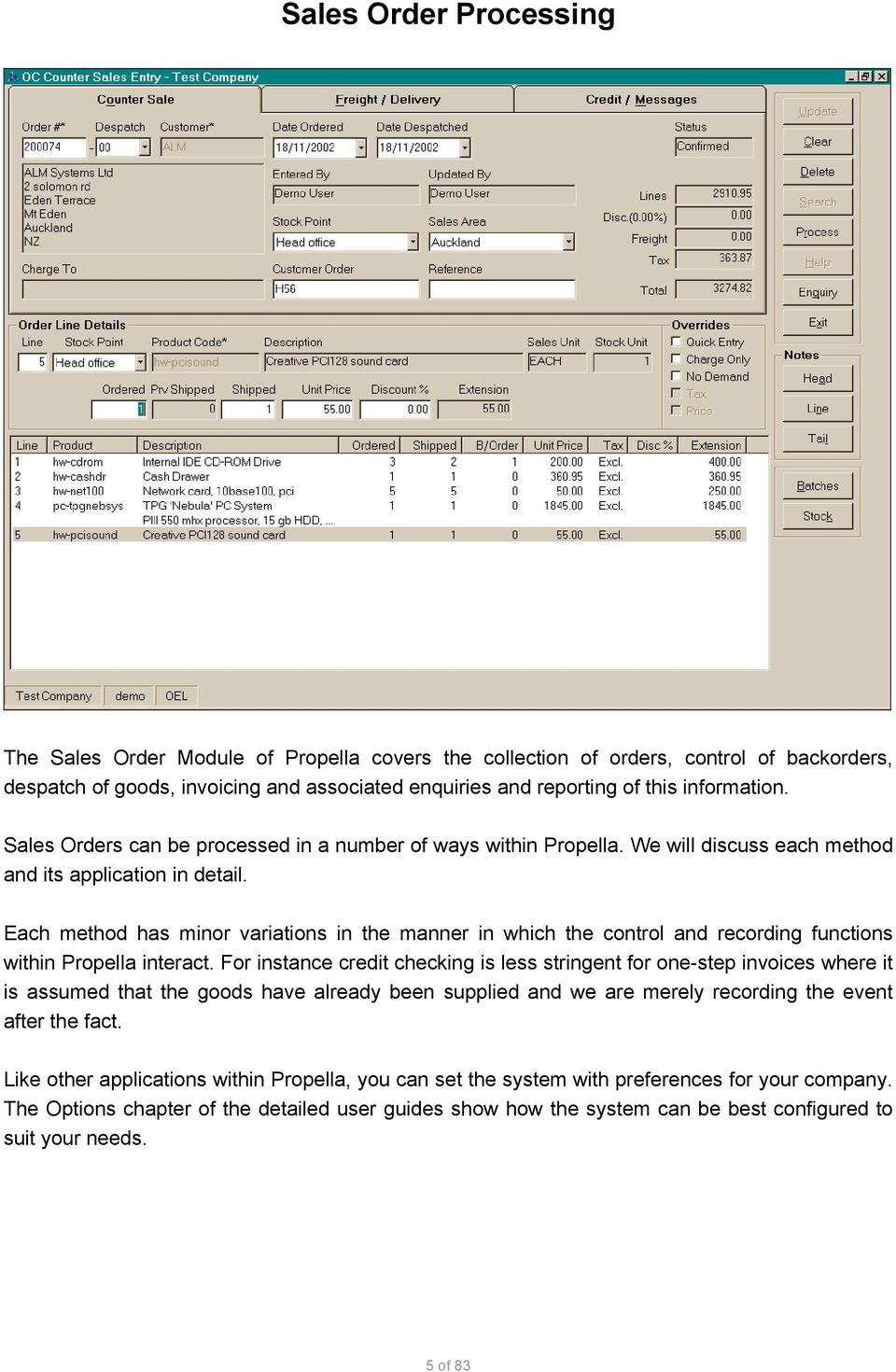
5 Sales Order Processing The Sales Order Module of Propella covers the collection of orders, control of backorders, despatch of goods, invoicing and associated enquiries and reporting of this information. Sales Orders can be processed in a number of ways within Propella. We will discuss each method and its application in detail. Each method has minor variations in the manner in which the control and recording functions within Propella interact. For instance credit checking is less stringent for one-step invoices where it is assumed that the goods have already been supplied and we are merely recording the event after the fact. Like other applications within Propella, you can set the system with preferences for your company. The Options chapter of the detailed user guides show how the system can be best configured to suit your needs. 5 of 83
6 Database Updating Database updating occurs as each order line is entered. This varies by the method of input used (e.g. stock orders only allocate the stock whereas counter sales ship the stock). These variances are explained under each section below. Like other Propella database updating processes, if a complete update can not be made (in this instance an order line), then nothing is updated. This means that integrity is preserved across the many database tables involved. So if you had a power cut in the middle of order entry, you can simply come back into an order and it will be presented as it was when you left it. Invoices can be produced on-line as the orders are entered or as a group (called batch release). Propella normally updates all relevant tables in this process so general ledger, accounts receivable and sales analysis are all synchronised. The exception is where the System Option is set to suppress immediate online invoice updates. This is so that individual invoices are not posted every time a counter sale is made, creating many general ledger entries. The Invoices can then be batch posted so that a one line posting results, perhaps at end of day. Once an Invoice is produced, financial details can not be changed however, in line with standard accounting practice. You may only make additions in the form of notes. 6 of 83
7 Despatching Orders Propella holds orders as they are entered and then creates separate despatches as the full order is satisfied. A despatch can be created even if there is already a packing slip in the warehouse for the same order. You have the option of adding to the first despatch or creating a separate one. This covers the case where a delivery is made in the morning for an order which is sitting in the outwards goods area awaiting collection when more product arrives to satisfy other parts of the same order. The first despatch can be in any status - just entered with a picking slip produced, despatch confirmed or already invoiced. Each of these despatches can have differing freight instructions, notes and even pricing if required. The order enquiry program provides an easy path to tracking the full progress from order taking to the multiple despatches which may have occurred. The back-orders are created with the same order number and have a suffix appended for each release. This number becomes the invoice number once it is produced. The order/invoice number is either generated from a range designated for the type of order or its stocking point (branch) or it can be manually entered. Orders can be amended to include new lines even if despatches have already been made from the original order. Any order line can also have its amount on back-order adjusted. This would be the case if a customer wanted to cancel the back-order for a single line but leave all other lines on back-order. Numerous customer options control which documents should be produced at the time of despatch and where they should be addressed to. Some customers may want both a delivery docket and an invoice with the invoice going to head office, posted separately and the delivery docket going with the goods to the branch. Other options include the production of bar-coded product labels specific to a customer and address labels based on the number of packages you are shipping. 7 of 83

8 Stock Control Propella delivers fully audited stock control and enforces disciplines to achieve this. Stock is allowed to be oversold (for a company as an option) but if you are batch or serial number tracking products, the item must be known (i.e. receipted) before it can be shipped and therefore tracked with its batch number. Propella is supplied with full serial number tracking, expiry stock monitoring and first in first out (fifo) costing. For the full explanation of serial number tracking and fifo costing, see the Inventory section. In this section we will describe those parts which are relevant to the processes involved with order entry. All items invoiced are held as inventory records and those which are not strictly product related are given a non-stock designation. This might relate to service charges where there is never stock on hand. When supplying non-stock items it is possible to input a cost as these may be variable by supply such as travel re-imbursement costs. A standard cost is also held on the product record for use as a default. Weighted average costing is also an option for accounting and it is possible to have your stock rotation on a FIFO basis but account using weighted average Counter Sales This is a single step process of taking an order, confirming the supply and recording any backorder associated with it. We call it counter sales because this would be a method of order taking where a customer walks up to a counter, places an order and the resulting document details the sale be it despatch note or invoice. One-Step Invoices This method of order input assumes that a manual invoice has been written and only the invoice details are going to be recorded with no provision for back-ordering. Because it is an after the fact input, you can nominate a sales period which may be different to the current accounting period used for stock orders and counter sales. There is also provision to alter the price extension so that rounding anomalies with a written invoice can be adjusted. One-step invoices do not record service level statistics (given that there is no back-ordering) and do not allow recording of lost sales which is a feature of counter sales and stock orders. 8 of 83

9 Stock Orders This is a two step process where an order is recorded, perhaps a picking slip is produced, products are assembled and then Propella has the despatch confirmed with the quantities shipped and/or back-ordered along with freight details. As the order is entered, stock is allocated from the total available. For batch tracked products a system option lets you choose whether to let the computer allocate the order to the first appropriate batch(s) or let you make this choice every time. The appropriate batch is determined by whether you want to release tracked stock on a first in first out basis or by using the expiry date. Either way, the batches allocated can be manually adjusted to suit. These tracked products would then be printed on a picking slip so the warehouse can select the correct items for despatch. These can be changed to suit (if security allows) when the despatch is confirmed. The order is confirmed in a second step called the despatch confirmation. We now have less stock on hand with a corresponding drop in the amount of stock allocated. Back Orders Stock orders and counter sales have provision for the recording of back-orders. As each delivery is made, the amount on back-order for an order line is set. For each order line, the suggested back-order defaults to the balance of the order quantity less the quantity available. This quantity can then be manually changed (where a customer may not want the balance to be left on back-order, or subsequently cancel the amount on back-order). This situation would leave the demand as the original quantity ordered. Back-orders are released in two ways. The order can be recalled individually from within the entry program or batch-released. The batch release mechanism allows selection of back-orders for release based on a number of criteria you may wish to use. You may want to release based on suppliers, groups of products, selections of customers or just release any back-orders which have stock available. The suggested releases are then presented sorted by either product or customer with all backorders for a product displayed. You can then manipulate this list to suit the customer service required before printing the packing slips. 9 of 83
10 Standing Orders Where an agreement is made for the supply of goods over an extended period, the deliveries can be set up within the standing orders option. The order is entered in a similar way to the one-step entry process. As we are only setting up the order, there is no stock interaction like allocation or statistical analysis recording. The addition is a tab called schedule which allows you to denote the release periods such as days or months for the standing orders. A customer order number is taken but this can be varied for each release. The quantities may also be different for the various releases such as alternating a supply of 10 one month and 20 the next. The standing orders are released using a number of criteria such as the individual order, a customer, or a range of dates. The release will create a picking slip and in doing so allocate stock as appropriate to the released order. Notes Propella holds a library of notes sectionalised by function. With sales order entry notes can be attached to orders to be printed on the packing slip and invoice for any of the header, tail or order line. You either enter a free-form note (there is no limit on the amount of notation) or draw a standard note or series of notes from the library, which can then be changed to suit as required. The library can be updated with new notes as you use it. 10 of 83
11 Credit Checking Propella checks for a customer s credit worthiness in three ways. These are credit on hold, credit stopped and credit limit (tax inclusive). For one-step invoices, it is assumed that goods have already been supplied, a hand-written invoice has been written and we are just recording the fact after the event. We therefore do not enforce any of the credit controls described below. Instead as you enter the invoice, a warning is provided to advise you of this. For stock orders and counter sales the following rules apply: Customer on credit hold Customer on credit stop Credit limit exceeded The order is taken but neither packing slip nor invoice is produced. The order can not be taken at all. Similar to credit hold; an order can be taken but no despatch documents are created. The credit limit is checked at the beginning and as each line of the order is taken. In the order header area, there is a credit tab where customer balances along with messages related to sales orders for that customer are displayed. Under appropriate security control, an operator can change the credit limit as the order is entered. Goods and Services Tax (GST) GST is calculated depending on the tax status of both the customer and the product being sold. The customer record contains a sales area designation. These sales areas are maintained in the sales analysis suite and contain a check box for overseas. When this is checked, all customers within that sales area will be exempt for GST purposes. GST exempt products are set at the product category level. These are maintained in the inventory suite. The category is given a GST type which applies to it. This allows for multiple GST rates across different product groupings. GST can be credited (for cases where it was charged in error). A line is entered separately with a product code of GST. Other credits have GST applied automatically. 11 of 83

12 Credit Notes Propella s credit note processing is designed to do the work for you. The key areas solved are the recall of invoices and/or specific lines to credit and showing you whether there have already been credits for that invoice line. This form of credit generation, where it is linked directly to an invoice line, means that the correct price and discount is retrieved and can be credited with the click of the mouse. You can also credit the entire invoice. We allow goods to be returned to a stocking point which may be different to the one the goods were supplied from. When Propella does not have a record of the invoice which is being credited (for instance when you first start using it), you may enter credits by providing all the details just like a reverse form of one-step invoice entry. Credits are analysed by credit type there are reports to do this. You predefine these credit types from a menu option where information about the type of credit can be preset. An example would be a credit type of faulty which you would probably set the flag to say do not return to stock. Like the one-step invoice entry, credits can be applied to a period of choice as they may not have all been entered before the new sales month is started. As discussed, GST will be applied using normal invoicing rules for the customer and product being credited. You may also specifically credit an amount of GST where this may have been charged in error. Crediting Batch Tracked Products For batch-tracked items, it is important to know which batch (and therefore cost and expiry date) the product being returned belongs to so that it can be returned correctly to the warehouse. Where a credit is linked to an invoice, we have some idea because the invoice will tell us which batches were supplied. Where there is more than one batch supplied for the same invoice line, we have to ask you to nominate which one is being returned. For fifo-costed stock, we will simply credit the product back into stock using the oldest stock cost record on the originating invoice. When a credit is not linked to an invoice, we will show you a list of batches which the product has recently known about and you may pick one of these if batch tracking the product. If the product batch being returned has never been known to Propella we then let you enter the full batch details as if it is a new shipment receipt. FIFO stock (not batch tracked) will attempt to first credit against the oldest batch with stock on hand and then the next one it finds without stock on hand. Like the batch tracked products, if there is no previous history at all, we then have to ask for a cost to be entered so that the inventory being returned is correctly valued. 12 of 83

13 Enquiries When discussing sales order enquiries it is worth remembering that Propella is a fully integrated information system. This gives you the ability to look at information from many parts of the system even though you may have entered the enquiry from the sales order menu and therefore have that perspective as your first approach to an enquiry. It is a little like thinking of a very large house with many doors. We enter through the sales order door but by moving about the house we can look at rooms with other information such as stock history and ledger postings. You will arrive at the full invoice enquiry form for instance if you drill-down from the inventory enquiry movements tab after picking an invoice you wish to look at. Similarly you might see an invoice on a customer enquiry and also arrive here. Sales order enquiry lets you find orders, back-orders and invoices by searching over a number of criteria or filters. You can look by customer, product, customer s order number, sales of a product to a customer or go directly to an order or invoice. A number of filters can then be used in isolation or together to provide not just an enquiry, but an analysis of your order taking situation. 13 of 83

14 Examples of queries you may wish to answer could be: What orders have been entered but not yet despatched? What status is my customer s order, if it has been despatched when and how did it go? (I don t know the customer s code but I have his order number) What is the value of orders taken this week compared to the value of orders invoiced? What is the comparison of orders despatched by each warehouse staff member? Which orders should be released today based on their date required? What orders are we holding because of credit difficulties? What is the value of orders entered for major customers in the Christchurch sales area? 14 of 83

15 Inventory At the heart of the Propella stock system is the inventory module where the structure and organisation of stock is defined. This is where you set up the product database and associated references. Other major components of this module include pricing, a stock adjustment program, stock take programs, reporting, statistical analysis and enquiries. Like other applications within Propella, you can set the system with preferences for your company. Product Set-Up Before starting to set up products, you should look at the ways you wish to analyse information within your company. Try to define tree structures of hierarchy and then re-draw the structure from different perspectives. It will help to know what Propella s capabilities are in this area. We have designed Propella with an unlimited number of reference groupings for a product but have also pre-defined some common groupings which the standard enquiry and reporting structures delivered are more likely to offer the choice of selection and sub-totalling within. 15 of 83

16 Product Code, Category, Category Group & Division The first consideration is the main product code. This has no pre-determined length but to fit within most enquiries and reports is best assigned a nominal length of approximately fifteen characters. (note that with graphical systems the width of characters is variable). The product code can be changed at any time in the product set up program and, because of the way data is held, all references to it including historical transactions and sales analysis is changed immediately. The product code is prefixed with a two character category code which fits the organisation of most inventory structures. These categories can have a higher grouping called a category group. An optional Division level is also available, this is used for Category Group Grouping. Stock categories are the most widely used stock grouping within Propella. sales analysis, general ledger posting, sales territories, budgeting, enquiries, re-ordering and most other statistical analysis offers category as an option to group, sub-total or post by. Propella includes an option within order entry to strip any leading characters so that product code entry is more efficient (this is only effective where the trailing code is unique such as the ISBN number assigned to books). Other stock references are also widely used however and we now discuss other methods available for structuring your stock file. 16 of 83

17 Source Code (label user-defined) This code is not unique within Propella. This means that you may use it to cross group your inventory, for instance by agency. Source is available as an alternative form of product search and is presented as an option to report and group on major reports in the system in sales analysis. References Any number of reference groupings are first defined to make use of this cross referencing tool. Examples of these could be groups within the motor vehicle industry such as make, model and original part number. So one product could have entries for all three groupings. Like source code, these references are available as product searches. Alternate Products A product can have a number of alternate products assigned to it so that if there is an out of stock situation on one product, the order taker will be prompted that an alternate product is available. Stock Points Stock points (branches or warehouses) are used where the same product is held in separate locations. This might be a branch situation, quality control area, stock on consignment or sales reps samples. The general ledger provides the ability to account for stock broken down by stock point but not necessarily every stock point. This means that all the reps samples could post to the same account while the branches are distinguished. A single sales order can be placed in a mixture of stocking points which suits the situation where two or more stocking points are within close proximity and can therefore be picked for the same despatch. If stock is not available from the warehouse you are supplying from but can be located at another you are provided with this information at order entry time. Options enable you to define whether you may receipt or issue stock from any particular stocking point. For instance you may not wish to issue stock from the QC section of your warehouse. What order do we set Inventory tables up? Once you have decided on the basic structure of your inventory, it is important to know which reference tables need to be set up first. From the Products section of the Inventory menu, there are a number of reference tables to complete. The first two references to set up should be the tax and price types. Tax type records are recorded by invoicing currency. For instance in New Zealand you would set up a tax type for exempt and one for GST at 12.5%. These will probably have been done for you by your installing company. Within product categories it is then possible to define what type of tax applies to that category of product and this can be varied by the currency or tax regime you are invoicing in. 17 of 83
18 Price types must be set up before you can load stock details. One of the price types is designated as being the list or standard price and you may enter as many others as you wish. These can then be linked to your customers. If you wish to use the category groups, these should be set up before the categories as the latter will ask which category group they belong to. These can be introduced at any time later however, by defining the groups and then retrieving the category records and assigning the appropriate group to them. Categories are the most defined stock grouping in Propella. Here you can assign such rules as desired margin and tax types. Defaults can also be set for serial or batch tracking and re-ordering demand weighting. Reference codes, discount categories, source codes and bin locations can all be set up at any time. They are merely codes with descriptions which can then be used in other parts of the system. If you are wanting to set any of these against your inventory as you load it (for instance if you intend to assign bin locations to your stocking points) you will naturally have to set these up here first. When setting up products, you may enter a preferred supplier along any number of alternative suppliers of the product. You should now also look at the section on general ledger interface once these reference tables have been set up and determine the breakdown of your stock postings. 18 of 83
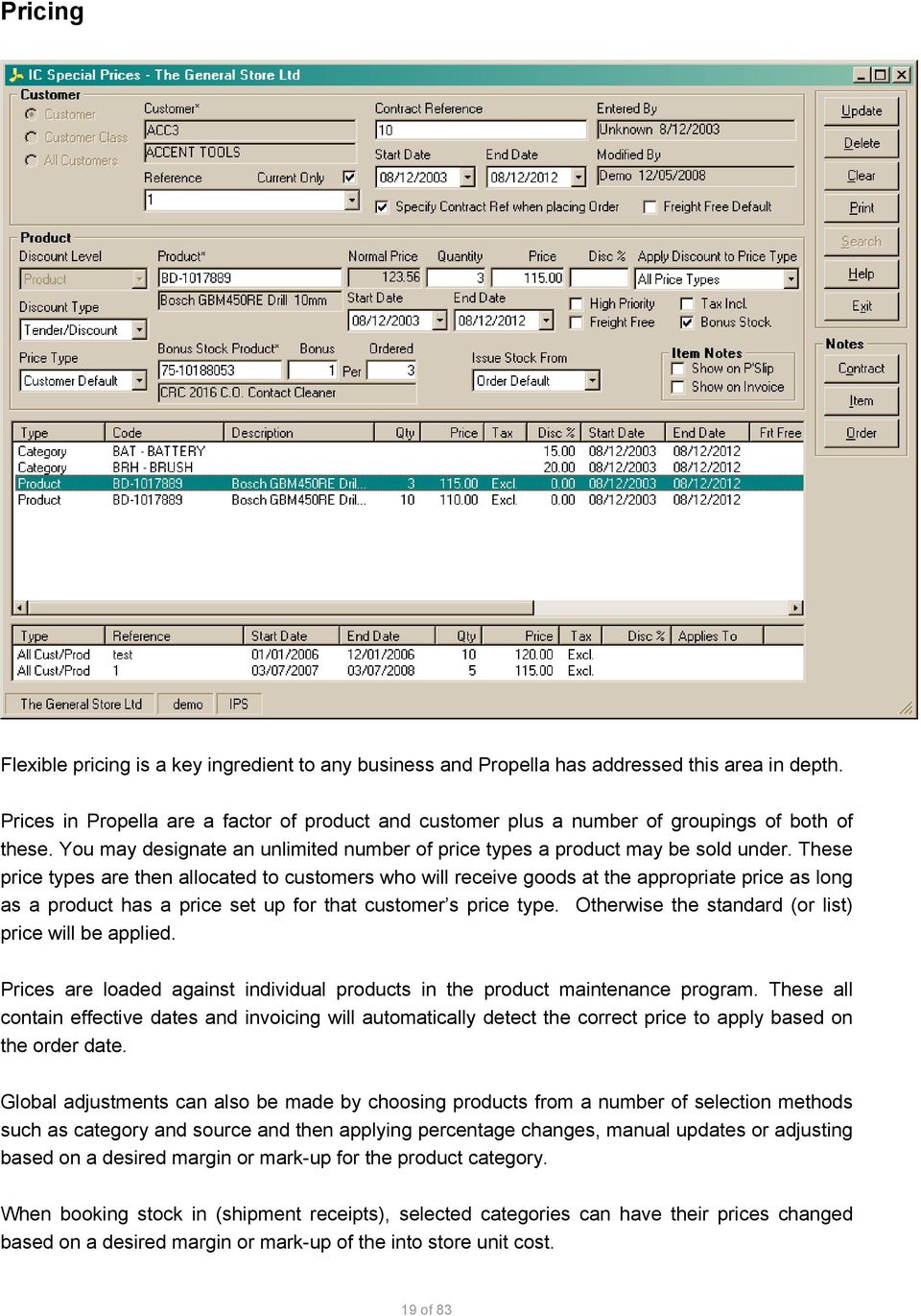
19 Pricing Flexible pricing is a key ingredient to any business and Propella has addressed this area in depth. Prices in Propella are a factor of product and customer plus a number of groupings of both of these. You may designate an unlimited number of price types a product may be sold under. These price types are then allocated to customers who will receive goods at the appropriate price as long as a product has a price set up for that customer s price type. Otherwise the standard (or list) price will be applied. Prices are loaded against individual products in the product maintenance program. These all contain effective dates and invoicing will automatically detect the correct price to apply based on the order date. Global adjustments can also be made by choosing products from a number of selection methods such as category and source and then applying percentage changes, manual updates or adjusting based on a desired margin or mark-up for the product category. When booking stock in (shipment receipts), selected categories can have their prices changed based on a desired margin or mark-up of the into store unit cost. 19 of 83
20 Discounts and prices can be assigned for a wide range of customer and product groupings in addition to the price type distinction. These are customer/product; customer/product category; customer class/product; customer class/product category; product; product category; customer; customer/discount category and customer class/discount category. (Note that logically a special net price can only be applied if there is a single product relationship, all others are discount based). There is also facility to provide an invoice discount with its own posting rules. The above special pricing and discount relationships are based on volume ordered (no limit to this split) and also have facilities to provide bonus stock (even of a different product) and a freight free option. Where more than one price or discount relationship is found, you can maintain your own hierarchy of which relationship should apply first. For instance the customer may get a standard discount of 20% for most products but 35% for one particular category. You would want the category discount to be taken in preference to the standard discount so you make this relationship higher than the standard customer discount. Of course an override of price is always available at order entry time (with security clearance) and this will take preference to all other rules. A product category can even be designated as you must enter selling price at order entry time. This might apply to miscellaneous products which are grouped under an umbrella code. A special override of this hierarchy is made when the option flag to take lowest price always is set or when a special is offered which is to take preference over all of the above pricing methods with the exception of the order override. This is entered with a high priority flag checked. Some pricing is contract or tender based and this is covered with contract references and special notes which can then be optionally printed on either or both of the invoice or packing slip. If your pricing is flexible, it can be laborious to maintain a large series of different pricing relationships. Because of this Propella offers a transfer pricing option where a pricing model relating to one product, product category or customer can be transferred to another which saves a manual record by record change. Prices can also be updated based on percentage increase or decrease based on latest supplier costs or across a range of other product selections. An export/import option lets you send a selected group of products to Excel where these can be changed to suit and then re-imported to the price-change list. With such pricing flexibility it is vital to represent the various prices applying in an easily understood manner. We provide a test pricing option where the required combination of customer, product, quantity ordered and effective date can be entered and the correct price will be returned (along with other prices applying). The inventory enquiry program also has a similar feature. When looking at an individual product you can see customer prices applying for the product based on quantity and effective date entered. Another feature of Propella pricing is the ability to price based at a per level. This would suit the fastening industry for example where nails are sold per 1000 or stationery supplies where 20 of 83

21 statements might be sold per box of The into store costing for this type of pricing follows in a parallel way so that there is a one to one correlation for profit reporting. FIFO Costing & Serial Number Tracking It is essential in a serious stock control system to separately track and retain the history of every stock movement. Propella combines the requirements of this along with fifo (first in first out) costing and lot, batch or serial number tracking. FIFO costing enables an accurate valuation of stock from a historical actual viewpoint and this further aids sales analysis profit reporting and general ledger reconciliation of both stock and profit reporting. Propella can be configured to control or rotate stock on a fifo basis while still posting all accounting-related details at weighted average. This reduces the overhead associated with maintaining a costing system based on fifo. The basic premise for our fifo system is that any receipt, positive adjustment or return of stock will create a separate table entry of that quantity with a record of all details regarding the inwards movement. Outwards goods always reduce from these fifo batch records and can never create their own credit batches. Propella knows all about every shipment or adjustment recorded and tracks stock movements of every type both inside and outside the warehouse. Batch tracking is triggered at the product level (as long as the product is recorded as a stock product ). Defaults are set at the category level (variable then by product) to show whether tracking should be on an into-stock date or stock expiry date basis. Tests for expired stock also have the option to test for an entered number of days within the expiry period. Operators are warned that although they may not be releasing expired stock, its expiry is imminent. A security check enables the supply of expired and due to expire stock. Batch numbers can be either recorded at receipt time or just allocated by an internal tracking number. Along with costs, there is optional recording of manufactured date, batch description, warranty, expiry date and notes. It is quite possible to record the same batch number for a number of stock receipts. Although this will create a number of FIFO records, when you come to track the batch number, all movements of stock relating to the batch are retrieved. If you are costing on a fifo basis, returns and stock credits such as stock take adjustments all require costs to be entered and more detail still is required if the product is batch tracked. We assist this administrative overhead by providing some intuitive prompts. Where there is other stock on hand we prompt the weighted average cost of this and if there is no stock on hand we provide the last known into store cost. If Propella has no record of the product s costing history then there is no alternative but entering the cost yourself. 21 of 83
22 If a credit note is entered and the original invoice is known, Propella will know which batches the product was supplied on and offer these as options for you to pick the correct one. The product may have been supplied from more than one batch so once again we can only give you a clue and you must decide which batch to re-stock from. When it comes to stock take, Propella lets you count at the product summary level and then only wants to know what individual batches are in stock if there is a discrepancy. This avoids the major overhead of counting every batch of every product which is batch tracked. Where additional stock is located, full batch details can be entered at stock take count time. Propella has been designed with the aim of minimising the administrative overhead involved with batch tracking products. We suggest and default where we can by using Propella s extensive historical database. When entering orders (the two step enter then confirm method), operators can either let Propella allocate from the oldest batches or they can force an allocation to be a specific batch. The picking slip will show the batches allocated and prompt the warehouse picker to select these. If the picked product differs from the batches allocated, the confirmation of the despatch altered to record the actual batches shipped. Otherwise no change is necessary from the picking slip details and an invoice is produced based on the original allocation. Propella supports bar code scanning technology and this will also reduce the overhead of a batch tracking system. The product code can be scanned and entered at both receipt entry and order entry and despatch time. If the manufacturer has recorded the batch number and expiry date these can also be scanned. This increases the accuracy of stock processing and speeds up the taking of orders and the booking in of stock. When scanning a product in order entry, Propella will recognise this and record this as a preference for your workstation. This does not stop the entry of a product from one of the alternate means such as typing the product code which might be more appropriate for another workstation so that option will be recorded there. Propella will test for all options of product recall automatically starting with the preferred option. If you select a product with a bar-code scanner, the order entry program will automatically record a quantity of one, so the order can be recorded just by scanning product codes alone if the despatch is only for single items. Changes to costs (such as write downs or corrections to costs) can be made directly from the product maintenance program. You click on the batch concerned and make any changes you wish. This is driven by correct security clearance and posts an adjustment to the general ledger equivalent to the change in stock value. Batch tracking enquiries are available from a number of perspectives. Some examples of this flexibility enables you to find what batches a product has been supplied with, what receipts and supplies have been made for a particular batch, the status of expiry stock across selected product ranges or which batches have been despatched to a customer. 22 of 83
23 Stock holdings and supply enquiries all offer drill-downs to the batch or FIFO level. For instance if you are looking at the movements of a product for a month, you can also see what batches the movement was supplied on. Similarly if you are enquiring on an invoice, a drill down of the invoice line will show what batch (and therefore cost) was supplied for that line. The landed cost enquiry similarly shows this information when looking at previous purchases of a product from a supplier. 23 of 83
24 Inventory Reporting Propella reporting is configured to be as at which means reports such as stock movement and valuation can be run for a previous point in time. This substantial feature means that there is no need for a clear month end cut off which can traditionally hold other processing up as you wait for end of month reports. Enquiries such as the inventory enquiry will also provide snapshots based on an as at position so opening to closing stock balances can show a full audit when a discrepancy is being traced. Propella features an extensive range of stock management reports in addition to the real-time drilldown enquiries discussed previously. As a Propella standard, all feature flexible selection, sorting, grouping and summary reporting. They are presented by Crystal Reports which enables the finished format to be exported via many industry standard formats which also includes an option. The standard reports described below are complemented by reports found in other suites such as the re-order schedule found in the purchasing suite and back-order reporting found in the order processing suite. Reporting is also found within other parts of the inventory suite such as stock take deviations and picking lists, stock adjustment journals and special pricing lists. Master List Including Price Book We provide a vanilla-style report of the inventory master file. Variations of this are easily tailored. With more online enquiry with extensive cross searching available for products we find that the traditional requirement for this sort of report is diminished. An option is available to produce a standard price book as well. Exception Reporting Stock exceptions will advise where no selling price has been set up, where stock on hand is less than an allowable limit, where profit margins are outside low/high limits (using either of latest or weighted average cost) and where there is a variation between latest and weighted average cost which is outside allowable margins. As usual stock can be selected for this report using a wide range of selection and grouping choices. Stock Valuation Stock valuations are provided using Propella s many varied inventory selection and grouping categories. Options allow valuation right down to the fifo batch level or at summary level by weighted average or latest costs and a record exclusion if there is negative stock or no stock on hand. Propella s as at reporting database will provide a valuation as at any stored year and period. This could be a number of years previous. 24 of 83
25 Service Levels Product service levels are maintained as orders are processed. These measure your ability to supply ex-stock as opposed to generating a back-order. Products can be assigned a service level class. These are defined as required and are commonly ranked A->C. Definition of your service class is usually based on factors such as sales ranking (see our descending sales and profit reports in the sales analysis suite to assist this) or perhaps a product has a high customer stocking requirement. For instance there might be a requirement to always stock a minimum of five heart valves so that particular product would be accorded a service level of A even though its total sales may not rank in the top 20% of all products. If a product is able to be fully supplied on an order line, the service level of that order is 100%. If 9 out of 10 products can be supplied that is 90%. So if we supplied 900 products when the order was for 1000 that is still only a service level of 90% even though we supplied many more than the order for 8. Both stock orders and counter sale order types measure this as they have backordering abilities. The one-step invoice entry does not. Reporting choices include the usual inventory categories and references plus the service level itself so a summary of the A->C ranking is possible. A typical analysis would involve looking at the summary service class, then selecting just the offending service class and exploding this by product category, then solving again at the detailed product level. Holding Trends This report shows the trend in stock holding for your selected groups of inventory items in a columnar month by month format. The as at feature is available for this report. Stock Movements A full audit trail is available between any two dates with drill-down options right down to the shipment batch level if serial number/batch tracking is invoked. Another option can also provide a view by transaction type showing receipts, invoices, adjustments, etc at detailed product or summary level. Excess & No Movements A vital tool for the control of excess inventories with detailed or summary reporting options showing items which are either slow moving or with no movement at all. New products are excluded from the analysis. Those items appearing on the report are then highlighted on any reorder schedule produced to warn against re-ordering. 25 of 83
26 General Ledger Integration Propella provides extensive general ledger interface flexibility particularly in the Stock System modules. Within each of these modules, the appropriate posting groupings (for example sales, cost of sales, freight, etc) can be selected and then allocated a general ledger account broken down in a number of ways. For instance you could post sales by your choice of stock category, category group, sales area, sales territory or internal cost centre. If you chose to allocate sales by stock category, you could then choose to only break the most important categories down. A further split of general ledger accounts can then be made by stock point (or branch) for these categories. When cost of sales and stock is assigned the same breakdown, you have a means of looking at profitability within your accounts at any of these levels. Non-stock items such as rental equipment and charged time can also have accounts assigned to them broken down to the stock category level which enables a cost of sale to be recorded. This means that commissions could be calculated from the sales analysis data for example. 26 of 83
27 Inventory Enquiries The Inventory Enquiry program incorporates a broad history of a stock item with current stock status and pricing. Stock Tab The stock tab shows a summary of current stock status along with pricing options. Available stock is the on hand quantity less allocated and back-ordered stock. Allocated is when the order is placed using the two step stock orders method of order processing and stock is assigned to the order as it is placed. This may also occur when either a standing order or a back-order is released. The lower half of the Stock tab shows the pricing variations application for this product. You can use this to answer the question: If my customer orders 100 of these next month what will they pay?. Just enter the customer code (there is a search facility to help you), enter the date that the order will be placed and the order quantity. 27 of 83
28 Orders Tab Here we see the drill-down from the stock status for both sales orders and purchase orders. These represent purchase orders which have not yet been receipted and sales orders which have not been invoiced. By either double clicking on an order or highlighting it and clicking on the Order button, you will be able to show the full details of that order. 28 of 83
29 Suppliers Tab The suppliers enquiry shows which suppliers you can purchase this product from along with a history of shipments received beginning from the latest arrival. The quantities in the landed cost section are shown in your sales unit (given that you may buy goods in a unit different to that which you supply in). The cost shown is the into store unit cost in your currency. Landed cost history can be viewed for earlier periods than first shown by changing the since date. 29 of 83
30 Movements Tab The movements enquiry tab will show a full audit of inventory changes for a product. Anything which will affect the change in inventory value is shown. A date range can be selected and then either opening to closing balances shown or just a straight list of historical changes in stock movement. Drill-down (or deeper enquiry) is possible on the movement lines and will take you to the applicable enquiry which relates to that movement. You can do this by either double clicking on a line in the list or highlighting it and clicking on the appropriate button on the right hand side. 30 of 83
31 Sales Tab The inventory enquiry sales tab provides information in a similar way to the sales analysis enquiry program. In this case however, we are only looking at one individual product. On the left hand side you have a format choice. This means that Propella can show you the information selected as month to date, year to date, last year to date, each quarter or each of the last twelve months. Last year to date will give you the equivalent financial months as year to date shows, but for the previous year. This gives you a moving comparison of this year versus last year. A product can still be grouped at a number of summary levels. These are Area, Territory, Customer, Stock Point or no breakdown at all. We have shown here a number of options to include or exclude information. By only ticking a few of the options shown, you will get more information displayed at once. Security checks will also ensure that costs and profit are only displayed when appropriate. The enquiry gives you two additional items of information as selection options. Not only can you see sales units but we have included demand units as well. Demand is tagged to the month the request for product was made (as opposed to supplied) and will also include those items flagged when taking the order as lost sales where the customer cancelled the order because supply could not be met. 31 of 83
32 Propella also shows the service level for the selection made. Service levels are measured on your ability to supply product ex-stock. If a customer orders 100 and you can supply 90 but must place 10 on back-order, the service level counter has.9 added to it against a demand of 1. (90% service). If another customer had ordered just 5 and you supplied 5 then 1 is added to the service counter and the service level is 100%. So even though we were able to supply the first customer many more than the second, the service level was not as high. Profit percentage is reported in the preferred manner for your company. It is possible to change this from margin to markup or vice versa. 32 of 83
33 Accounts Receivable General Outline This module is where customer information is stored and financial accounts for a customer are kept. This is also where the banking is done and this may also include non-customer deposits so that a bank lodgement form can be supplied to the bank with a full breakdown of the day s banking. Multiple contacts with their associated addresses, phone numbers, etc can also be held. Account Details Customers are assigned codes for direct access. These are alphanumeric and can be as long as required (but a five or six character code is usually ample). At any time you can change a customers code with instant reassignment of all current and previous transaction history. Where customers have a number of branches these can be set up as either separate delivery addresses (no limit on these) or as master/slave accounts. The latter method would mean that 33 of 83
34 sales history is kept separate for the slave account but the statement would be collated for the master account. With customer order numbers and slave accounts shown on the account enquiry, along with column clicking for sorting, it is very easy to track individual branch details within the master account. Documents such as packing slips and invoices can be targeted to which ever entity requires them. Customers can be assigned a number of references for multi-classification. These are sales area, sales rep, customer class and two fields for other classification called customer type. Some of these classifications have significance in other areas. For instance customer class can be used to group a number of customers for special pricing and sales area has particular importance for multi-currency invoicing and tax assignment. Stock can be priced at any number of different levels or price types and these are matched to the price type set up for each customer. Other flagged references include what is the usual freight carrier?, does the customer accept back orders?, should you price this customers packing slip?, is this a cash sale customer? and should we print a statement for this customer? Credit status and credit limit are set up here and checked within order entry. Credit status has two Propella known values of credit hold and credit stop. Others can be assigned for your own convenience. As well, a credit limit can be entered and this will be progressively checked as sales orders and invoices are entered. As usual, Propella offers an unlimited use of notes for customers. Here they are further broken down into general notes and order entry notes which will be brought to the operator s attention when placing orders for a customer. Although there is provision to enter a customer s usual bank/branch, drawer and account number to assist the bank lodgements report, these details will also be written progressively from the banking program as cheques are received. Account maintenance has a number of security checks where different aspects of the customers account may only be changed with suitable security clearance. Accounts can be defined in different currencies with invoices and payments able to be raised and paid in a mixture of currencies. See the general ledger section for more details on foreign currency handling within Propella. 34 of 83
35 Searching for Customers Searches for customers can use either the customer code, any part of the customer name and an alphabetic sort field called short name. When searching by code or short name Propella searches using the leading characters where as a search of the name can be made with any (embedded) string of characters you wish. The short name is also a useful tool to differentiate a multi-branch customer s accounts. You could start this field with the customer name and tag a branch identifier to the end. So Placemakers might be PlaceAKL, PlaceNMKT, PlaceCHC,. Then if you were looking for Placemakers in Newmarket you would enter Place, see a list of all branches and choose the one from the list with NMKT on it. Open Item & Balance Forward Accounts can be maintained on either a balance forward or open item basis. A mixture of these methods is possible and customers can be changed from one accounting method to the other at any time. The main differential between open item and balance forward accounting is in the application of payments or credits to the invoices (or debits) on a customer account. Balance forward accounts show the invoices and payments separately with no relationship between these. Payments are aged to a financial period or periods with an option to pay off the oldest first when entering the banking. If an error is made in the aging, a utility ( adjust aging ) is available to set the age as required. As the name suggests, any outstanding balances are carried forward to the next period as a single total. So on a statement we would only see the balance forward amount plus any current period activity. Like all transaction history within Propella, there is no limit to the amount of past history which can be kept so the previous months transactions are still available to retrieve and re-print anyway. Open item accounting has the benefit of matching invoices with payments or credits and therefore enables a closer control over the settling of accounts. This is helpful when invoices are in dispute. The down-side of this is that payments must be allocated to invoices at banking time and if customers have not provided details as to what they are paying this can add more administrative effort. Propella assists with this by providing a number of tools for matching credits to debits such as cascade payment from a point and place hold on a selected invoice and pay the rest. We have built in a lot of flexibility in this matching for situations where a customer overpays an invoice, a credit pays an invoice already paid and a customer takes up a credit to pay an invoice other than the one the credit was originally raised for. If the allocation of a payment or credit is not known, it can just be placed on account and then either picked up in a subsequent banking or a utility open item allocation can be used to assign it once the allocation is known. 35 of 83
36 Banking / Journals Daily banking is usually entered in the accounts receivable suite. A link is also made to the banking from the Cash Book when direct credits and other banking is picked up at statement reconciliation time. If a customer pays for goods as they are received (i.e. as the invoice is entered), the link is also made to banking in the same process of producing the invoice. A wide range of banking types including EFTPOS, cash, cheque and credit card are available and this then means that subsequent analysis can be obtained by any transaction type. This also assists the production of the bank lodgement form where only cheques and cash are reported with the cash totalled as one amount. Non-customer deposits can also be entered to give a convenient all-banking entry point. The general ledger account can be entered also as the posting is not likely to be for the usual debtors control account. Special attention has been paid to open item processing as discussed earlier to minimise the administration of the credit allocation. Journals are entered in a similar manner to the banking with the added option of posting the journal to the applicable general ledger account. (the contra account for these being debtors control). Banking and journal entries can be posted as each transaction is entered or saved and posted in batches. 36 of 83
37 Enquiries Accounts can be viewed for any financial year and period. This will show a representation of the customer s statement as at that date. From the list of transactions shown, you can then drill down to see the full transaction. For an invoice, this would show the full detail of the despatch including internal audit trails such as who entered the order, who despatched the goods and who produced the invoice. The enquiry screen allows you to filter the amount of information you may wish to see. You can choose not to see open item transactions which have been fully matched (paid off). Like all other enquiries within Propella it is possible to move around the various enquiries once you have begun to seek information. As we described, for example, the customer enquiry shows you the status of the account but then you may want to look at the invoice or see the general ledger posting related to that invoice. You may also arrive at the customer enquiry from a number of other starting points such as inventory movements, sales order tracking or general ledger account enquiry. Within the enquiry menu there is also a summary enquiry of the accounts receivable control account from the sub-ledger perspective. This gives you a snapshot look at your opening balance, separate totals for all transaction groups (receipts, journals and invoices) and the closing balance. 37 of 83
38 Accounts Receivable Reports Standard reports include a customer list, trial balance (at summary or full transaction level), receipts listing, overdue reports and statements. As with all Propella reporting, the selections available when reporting are very flexible. Groupings, sub-totals and options give you the power to view information from many perspectives. The usual ability to run reports as at any financial period is available. This means for example that your statements can be re-produced any time or a list of the banking for a day two months ago could be produced. 38 of 83
39 Sales Analysis The Sales Analysis menu takes you into the summarised sales analysis enquiry and reporting database. Other sales enquiries can also be made from the Order Processing menu. These approach the sale from a more detailed order basis and provide information which might be useful to customer service people and product managers. Here you will find, for example, the ability to look at exceptions on specific orders such as low gross profit, back-orders which could be shipped and despatch tracking. This reporting will also provide information on order intake (as opposed to sales) so that a to the minute measurement of business performance can be made. This discussion centres on the Sales Analysis database which contains an accumulation (or summary) of sales. This information is rounded to whole numbers (when looking at supplied units) and whole dollars (when reporting sales and profit). The database contains a number of reference points for selecting and grouping information. These are area, territory, customer classification fields, stock point, category group, category and product. Selections can be made from any of these groupings along with detailed or summary enquiries and reports. We provide two main avenues for extraction of information. These are reports and enquiries. Both are available as screen and printed formats. The reports should be used when a more formal document is required or if information is to be exported to a spreadsheet or ed. As the report is first previewed on the screen it can also be used as a means of enquiry. Reports are also capable of producing multi-level groupings of information (i.e. Territory by customer by product). Profit percentage is reported in the preferred manner for your company. When producing reports it is possible to change this from margin to markup or vice versa. 39 of 83
40 Sales Analysis Reporting The reporting menu gives you a number of formats (or layouts) of report to choose from. These are described as: 4 column current / year to date / last year to date / last 12 months 16 column current / year to date / last year to date / (11 months prior) 16 col descending qtrly current / year to date / last year to date / last 12 months sales / budget sales / budget / variance / var % - each qrtr The format selection can also be made when you select the tab headed Groups and Options as described later. We will show the selections for the 16 column format. Selection Form This form lets you choose which information you wish to see reported. Another way of thinking of this is show me sales for whatever I choose here. There is another form (not shown) which gives further selection choices as well. 40 of 83
41 Groups & Options This tab gives you the opportunity to choose how you want your report sorted, sub-totalled and/or summarised. You can also suppress the printing of some of the rows of information to make the report smaller. Like all Propella information retrieval you will be able to run the report as if you are at the end of any month you wish. The top left side of the form lets you select how you want the report grouped (or sorted). We have chosen to see customers within product categories within territories. We have also ticked the subtotal boxes to say we want totals to print at each of these level breaks. On the right hand side you have the opportunity of including (or suppressing) details on the report. This means that the report will not take up as much room if you really only want to see what units were sold to a customer and didn t need to know the sales or profit. If you tick the profit box you will get two lines being profit and profit %. Security checks are made so that only authorised people are able to tick the cost and profit boxes. As you make your choices, the list view (the section at the bottom of the screen) makes up a mock layout of what your report is going to look like so that you have a visual confirmation of the report you will get. 41 of 83
42 Screen Preview Once the report has found all the information it needs and formats all the pages, a review of your request is shown on the screen. When the first page of your report appears, a series of option buttons assist with an online enquiry of the information you have selected. The first series of buttons let you page through the report (first page, previous page, next page, last page). The first of the print buttons does the actual printing to your default printer. The second lets you change the printer settings. If you press the first button you will be given further options such as the number of copies you wish to print. The button with the envelope is for exporting data. You could send the report to a spreadsheet, word processor, disk file or perhaps even it in one of these formats. The button showing the % allows you to size the report on screen so that it can be viewed to fit and the button with the binoculars lets you find any string you type there. 42 of 83
43 Sales Analysis Enquiry It is not necessary to select the two levels. If you just wish to see a category summary, then you would ignore the grouped by selection box. The option form, not shown here, allows the same types of choices as described in the inventory enquiry form. The print button will produce a basic report of the screen data. 43 of 83
44 Purchasing General Outline Propella s purchasing module covers the placing of purchase orders, tracking of these and the shipment receipting and consequent product costing of these. Also included is a customisable reorder calculation section which will recommend which products should be ordered. From these recommendations you can adjust the suggested order quantity and then generate purchase orders based on this. As with other modules within Propella, purchasing will work with foreign currencies and complete its shipment receipting process by creating invoices in the currency of the supplier. Setting up Suppliers & Reference Tables Suppliers for purchasing use the same details as the creditors set up in the accounts payable module so access can be gained to this from both modules. If a creditor is also a supplier (i.e. they supply goods which we stock in our inventory) a flag is checked to signify this and more information is then asked for. Lead times with freight factors can be entered as a default for the supplier and then modified to suit any products which may not suit the standard. Two sets of these are provided to cover the placement of the order by sea or air freight. The factors associated with these allow an estimation of the freight and other shipping costs to be included for cash commitment reporting. 44 of 83
45 The usual way you send a purchase order is also held against the supplier although this could be changed at order placement time. This means that you can print the order, it or fax it. Propella provides for products to be sourced from more than one supplier in fact as many as you wish. When setting up details of these within your inventory system, there is provision for the entry of a preferred supplier and this will then be afforded priority when re-ordering. Within the purchasing (and also with direct links from both the accounts payable and inventory modules), details from a suppliers point of view are entered. You can enter the supplier s product code and description (using yours as a starting point) along with the base cost of the item in supplier s currency and the unit of purchase. With this purchase unit is the facility to enter a correlation between the way you order a product and the way you stock it. You might order widgets in boxes of 30 and sell these as each. You would order one box but when the shipment is received this will register as thirty to your inventory on hand. If the reverse applied in that you ordered in a unit of each but stocked them as per dozen an order for 36 would result in a stock on hand increase of only 3 and of course Propella would only let you order multiples of 12. We assist the maintenance of supplier costs by providing a program to select products loaded against a supplier and apply either a percentage increment or decrement. Costs can also be updated when placing an order or receipting it. Supplier details can also be imported. Products can be held against a supplier for which there are no associated inventory entries. These would suit general purchase items i.e. stationery and local services. To place an order however, it is not necessary to have any supplier product information pre-set. Details of the order can be entered directly. You can also simply receipt orders without raising a purchase order first. As with all Propella major codes, you may change the supplier code or any of the associated product coding at any time with immediate re-alignment of all historical information. Reference tables are provided for maintenance of freight forwarders, insurance and duty details. The freight forwarder table is used by both the purchasing and sales order modules. This means that duplicate use of these within the modules is avoided. You can also stipulate that a freight forwarder is only used in one of either the purchasing or sales order modules so that a drop down list of these will provide only the relevant details. The insurance table provides a means of associating documentation relevant to insurance with a simple code so that this can be printed on a purchase order without entering the information every time. Duty is held by type as a percentage and applied to supplier products when applicable. Placement of a purchase order for a product which attracts duty will result in this being added to the line cost. This can be overridden when placing the order if required. 45 of 83
46 Purchase Order Entry Purchase orders can be generated from the re-ordering process or entered manually in the Purchase order entry program. You may also change orders generated by the automatic reordering process within this program. As purchase orders are receipted, the amount remaining on back-order will be recorded and this can be altered at any time through this program, to suit a situation where you subsequently want to cancel the back-order. The status of an order will move through entered / printed / in transit / partially received / complete or cancelled. The purchase order, once created, can be sent to a supplier by , fax or printed. Once sent, an acknowledgment note can be entered at any time to a purchase order once your supplier has indicated that is has been received. Orders are entered in the currency, unit and product code/description of the supplier. Standard lead times are held for a supplier which are varied by product supplied if required. The cost in 46 of 83
47 suppliers currency can be updated with each new order entered by setting a flag in the options record. This is also allowed at the time of shipment receipt. When an order is entered, the lead time (ETA estimated time of arrival) can be changed to suit. When a back order is created the ETA of these remaining products is re-prompted. If an order is entered and subsequently you change the overall ETA date you will be asked whether all lines should reflect this new ETA or just those which equalled the old ETA date. Products can be ordered for items which you do not stock and these can be entered as the order is created. This suits local purchasing where items such as stationery can be ordered and tracked without interface to the stock system. Stock items, on the other hand, must have been set up in the inventory system and also details about how you purchase them set up for the supplier. If this has not been done, Propella offers to take you to both these places at the time of entering the order. Indent orders can be tracked by linking the customer to the purchase order line. This is also referred to as back to back ordering. Purchase orders are costed based on the suppliers cost, converted by the currency, plus freight and duty costs. In addition a local cost can be entered with a default value coming from the purchase order options record. Freight costs can either be entered as a single value or estimated using the freight factors (held as percentages) for each supplier (variable by product). In addition, a payment due date defaults to the terms for the supplier following the expected ETA. Duty is held as a code and rate on a reference table and this can be assigned to the products stored for a particular supplier. 47 of 83
48 Shipment Receipts & Product Costing Shipments (as opposed to purchase orders) are receipted in Propella. This is a vital distinction in that more than one purchase order could make up a delivery. A table of outstanding purchase orders with their lines can be receipted in one action by selecting all lines on the shipment. This will then create the shipment details. Receipts can only be made if the stocking point has been defined as able to receipt goods. This would be used where companies want all goods to go to head office rather than the branches or some categories of goods must be booked into a quality control stocking point before release to the general warehouse. Propella records the items being receipted across the various purchase orders along with costs for freight, duty, freight and local clearing charges. These additional costs can be disbursed by dollar value, quantity or weight to arrive at an into store unit cost in local currency. Once costed, a product can be re-priced. Within the purchase orders option record you have the choice of setting this to don t change selling price, re-price using a manual entry or re-price based on your desired markup or margin. Re-pricing is also variable by product category. The latest supplier costs can also be optionally written to the supplier/product record for future reference. 48 of 83
49 Where products have been defined as requiring batch/lot/serial number tracking, a form will appear which will request this number along with other details such as warranty date or expiry/useby date. Once all lines have been recorded for the shipment it can be posted, which results in the creation of the accounts payable invoice for the supplier along with any other invoices generated by the shipment such as freight and local charges. Tax is added where applicable in the invoice creation. The invoice is created as an accounts payable transaction but is not posted and therefore is able to be modified. The general ledger interface determines which accounts are used in the posting process. This is usually a debit to the stock account and a credit to purchases. Other splits are provided for freight, clearing and duty. If a shipment is not posted, it is recorded as in transit. This is helpful for tracking shipments and Propella provides a place to record MAWB / vessel and HAWB / voyage details. 49 of 83
50 Re-ordering The Propella re-ordering process is a tool to provide you with suggested reorder quantities for products. From a number of user-defined statistics and option settings, a list of products recommended to be re-ordered is produced. These are then displayed, with the associated stock status and other information used in the calculation, so that you can make amendments before generating the purchase order. A listing of the recommended re-order quantities can be printed (called the re-order schedule) and this is often used as an input document for review rather than working directly with the screen. The first steps in re-ordering is in the way your system and in particular your product information has been configured or set up. The purchase order option record holds information for the company overall and this is varied at the product category, supplier or product level as required. Run-time options are also enterable. Demand vs Supply (option record) A flag denotes whether you wish to analyse your product history based on demand or supply. The difference being that demand is recorded when the order is placed rather than supplied. In 50 of 83
51 addition, lost sales (recorded at sales order entry time) will show up in demand figures. Supply units will show what was actually despatched and when. Demand calculation weighting (option record and variable at category) The importance that you attach to your history can be weighted for the company in the option record and then varied within each product category. You may wish to place more emphasis on the last three or six months or perhaps give weighting to the same period twelve months ago when seasonal influences can affect demand. Safety stock (option record) The number of days stock you wish to not fall below is entered here and the reorder calculation will take this into account based on historical demand as weighted above. Lead times (supplier and variable at supplier/product) Lead times in days are kept in two categories. These represent two methods of shipping (usually sea or air). The re-order calculation will be based on sea (or slowest/most economical). This is selectable as a run-time option when calculating. The supplier has these lead times set for default purposes and as each product is assigned to a supplier, it picks up the default lead time which can then be varied by product. Accuracy in recording expected lead times will result in credible reporting and enquiry for expected deliveries. Minimum re-order quantity (product) Variable by stocking point, this is the minimum we would re-order if any order was to be placed. So if the recommended order was 3 and this field said 5 it would be 5 that we would re-order. Minimum stock level (product) Variable by stocking point, this is the lowest level that stock should fall to for this product. This level will be considered with the safety stock number of days. Service class (product) This is a selectable grouping for re-ordering given that it is usually defined as a breakdown of most important products. You might therefore choose to calculate recommended re-order points just for your A and B service classes. The setting of Service Classes is aided by use of the descending sales reports to show highest rating products. Preferred Supplier (product) Each product can be purchased from a number of suppliers. Within the product set up program you can nominate which supplier is preferred. Orders will be calculated based on this suppliers details. 51 of 83
52 Stock status When considering re-stocking requirements, Propella naturally looks at the current stock status as well as anticipated demand when calculating a recommended re-order point. Stock on hand, allocated, on back-order, already on purchase order and standing orders which will fall within the lead time are all considered. Conversion factors (supplier products) When we are re-ordering, it is worth remembering that we will be placing an order in the suppliers unit of supply. The relationship between the order unit and your stocking unit is set up on the supplier product record. When you see a recommended re-order quantity you will be seeing it related in the suppliers units. So when you want twelve items brought into the warehouse, you might only order one if your supplier stocks in packs of twelve. The Re-order process When re-ordering, there are a number of categories you can choose to measure such as stocking point, product category, service class or by supplier. When ordering by stocking point you may order directly into the stocking point or combine the sample from a number of stocking points which gives you a bulk order for a central warehouse. Once you have made your selection, Propella checks to see if there has already been a re-order process started. You may append to it, clear it completely or create your own (as opposed to someone else s in your company). There will be warnings given if more than one person is trying to re-order the same product. The calculation takes place and then presents the list of products which it has sampled. From this list you can tick filters so that you only see products on the list which have a re-order recommended. You may also exclude any products from the full list which have not had any demand. The list contains full information used by Propella such as stock status, lead time, safety stock, demand history and other parameters discussed above. This enables you to page through the recommendations and alter the re-order quantity according to other knowledge you may have, not known to Propella at the time. Alternatively you may print a hard copy schedule to use as a work list and then return to the selection screen to make changes. Once you are happy, you can press the Generate button which will produce the purchase orders. 52 of 83
53 Purchase Order Enquiries Purchase order enquiries are provided with a number of options and filters which provide lists with relevant information enabling you to make a choice on further drill-down to see the full order. Purchase orders can be seen for selected suppliers, products or customer indent orders. These can be shown across a date range and filtered by their status such as all outstanding orders, just those orders which have been entered but not sent or any partially receipted orders. Navigation is also provided to other enquiry areas such as customers, suppliers and products within Propella while you are looking at purchase orders. 53 of 83
54 Purchase Order Reports The Purchase Orders report is a multi function reporting facility which can report and group purchase orders many ways. Selections and grouping are offered for purchase order ranges, suppliers, customer indent orders, stocking points, products, product categories and groups and currency. In addition the report is selectable by ranges of either entered date or due date. Summary or full detail reporting is also offered. As an example you could therefore print a report of all Japanese indent orders which are overdue. The Supplier / Product listing gives you a simple catalogue of products you have on file by supplier with details kept. The list can be produced by type of supplier and currency with selections of suppliers, products or supplier product codes. The Shipment report is an audit of receipted goods available by supplier, shipment number, entered date range and status of the shipment. Full or summary reports are options. Monthly receipts can be listed by accounting period and broken down by currency, supplier and shipment number. The report is a summary of the receipt only showing month to date costs and quantities with a comparison of buying patterns for the year and the last twelve months. 54 of 83
55 Job Management / Time and Cost billing The core outcomes of this module are to collect data relating to a job including labour, products supplied, staff expenses and third party invoices. A key ingredient of the jobbing system is the billing of jobs and the flexibility required to bring inputs together and make decisions such as inclusion or exclusion of items; summarised or detailed invoicing; overhead inclusion for accurate profit reporting and progress billing. With the module fully integrated to the full Propella suite, there is also provision to purchase goods directly for the job or manufacture items. Two forms of jobbing are available : 1. Servicing is for an in-house situation where the history of a product (musical instrument, motor vehicle, survey equipment, ) can be recalled from the serial number tracking. A quotation could be raised, a job card printed and then labour and parts allocated. Service notes would be for internal or external use (invoice). 2. The other form of jobbing suits service industries such as consultants, trades people and others where a specific product is not serviced but a more general job is carried out. The same allocation of labour and materials applies with work in progress billing and accounting and actual to budget reporting. A project can also be created, made up of a number of jobs. Items applied to a job (including products, services or labour) are selected as on-charged or not. Time reporting can be invoiced as summary, detail, weekly or progress billing. Enquiries allow easy viewing of progress claims versus quote/estimate and comparisons to outstanding work and work in progress. Like the standard approach taken with Propella software, if invoices are summarised (e.g. labour) there is easy drill-down to see detail at the day or part-day level. Natural benefits to fall out of this are job by job profitability, employee productivity, full control over expense and creditor invoices and easing the overhead on what is normally a labour-intensive billing process. 55 of 83
56 Jobbing sample overview screen A job is set up then inputs are added from timesheet entries, accounts payable invoices, manufactured order receipt, purchased items receipted to job and issues of products to the job. The full job profitability can be seen with progress billing and work in progress. 56 of 83
57 Jobbing sample labour pick-up Labour previously entered and authorised is applied to the job from a cost perspective then able to be adjusted as to what is charged or not. Groupings of labour allow summarised or detailed invoicing. 57 of 83
58 Service Jobs The service jobbing variation looks at a known product and applies service to it. This can include labour, parts and outwork with a full history of previous servicing available. 58 of 83
59 Cash Book Propella s cash book enables you to reconcile your bank accounts and post entries to other ledgers and sub-ledgers while you are doing this. Postings can be set up for such items as bank fees and interest (which would be a debit posting to the applicable general ledger account) and customers direct credit deposits which will post to their account along with a credit to the control account. Because we are dealing with the bank account, the contra leg of the posting is always to the bank account. Side benefits of this process are the reports which can be run to produce copies of historical bank statements and cheque registers including a list of unpresented cheques. Bank accounts can be held and reconciled in foreign currencies. There is a bank to bank transfer facility which is particularly helpful when transferring to foreign bank accounts. 59 of 83
60 Bank Reconciliation The reconciliation picks up all transactions which have been posted to the bank account and have not yet been cleared by a previous reconciliation. The final date of the statement is entered and from this Propella displays a list of transactions which have a transaction date less than or equal to this. A filter can be ticked to see all outstanding transactions as well. You can tick cleared transactions in the same order as the statement appears and this will build up a facsimile in a window at the bottom of the form so that the balance of the statement can be kept in step. As you come to an item which Propella does not know about, such as bank fees, you then enter these from a pre-set drop-down list which has been set up with its account code. Transactions available include the following: Customer deposits Customer deposit reversal (dis-honoured cheque) Non-customer deposit or other credit (e.g. bank fee reversal) General expense withdrawal (e.g. bank fees, interest) Creditor refund (e.g. insurance refund) Direct debits When you are happy with your reconciliation, you will press the Post button which will update all new transactions and mark all of the others as cleared. If you exit without completing a reconciliation ( Post has not been pressed) before you exit, the details are saved and you can return to complete the reconciliation later. 60 of 83
61 Statement Codes This maintenance function lets you set up commonly used transactions which you will find when reconciling your bank accounts. These will then be available in a drop down list to make posting of the items found on the statement very easy. You can enter a short logical name, the general ledger account to which it applies and whether the transaction is to be a debit or a credit. The contra leg of the posting will always be to the bank account general ledger code. Typical entries will be for bank fees and interest. Bank Accounts You may operate as many bank accounts as you wish. You give each account a short name and a description and enter the bank account number. A box can be ticked where the account is the usual place that customer receipts will be debited to. This will then be the default bank account used when you are entering the banking in Accounts Receivable. When you are first using the Cash Book you can enter the last closing balance for the account which will then be a starting point for the first reconciliation. Bank Statements When a statement has been reconciled, the details are then available for recall as a report. The selection options present all statements cleared between a range of dates you may enter. Cheque Register The Cheque register report gives you a list of cheques or direct credits which have been paid over a selected date range. Check boxes let you see all cheques, just unpresented cheques or just direct credits. Reconciliation Report This report compares any statement you have already reconciled with your General Ledger bank account. The report lists deposits and withdrawals recorded in the general ledger which have not been included on any statement and compares this to the balance held in the general ledger. Bank to Bank Transfers This program enables an easy transaction entry process when you are moving funds from one account to another. The transaction is multi-currency and allows the picking up of bank fees associated with the transaction as well. 61 of 83
62 Accounts Payable General Outline This module assists with liquidity management requirements of a company by controlling the payables. The main functions include maintenance of the creditor, input and control of invoices, payment processing and account and history reporting. Accounts and transactions can be held in a mixture of foreign currencies. See the general ledger section for more details on foreign currency handling. Accounts Accounts are maintained on an open item basis. The processing and matching of debits and credits for open item processing follows the same principles used within the accounts receivable module. Tools are provided to easily allocate credits to debits and a facility is available to match unallocated transactions. When an account is set up for a supplier (of stocked goods) more information is collected which is used in the purchasing module for re-ordering purposes. Maintenance of the creditor/supplier is possible in either of these modules. The other integration of these two modules is in the shipment receipting process when invoices are created for the creditor (or creditors) applicable to the shipment. 62 of 83
63 Each account can have a default general ledger code assigned to it to help with invoice entry. The usual breakdown of the invoice for tax purposes is also recorded so that invoices can be entered as either tax exempt, tax inclusive or tax exclusive. When a tax inclusive invoice is entered, the general ledger breakdown will show one line to the default expense account with the tax is automatically extracted as a separate line. Within this module you also have access to currency rates and bank account details (found also in the cash book module). As with major codes throughout Propella, you can change the creditor s code at any time with immediate re-alignment of all historical information. 63 of 83
64 Payments Payments can be processed manually where the invoice and payment are created as a single entry or as a batched group based on previously entered invoices. This latter payment processing provides options for selecting invoices to pay based on criteria held either for the creditor or at the invoice level. You may select invoices to pay based on a total payment ceiling, a ceiling for each invoice, discount terms or trade terms. Invoices can be placed on hold so they are removed from the selection process. An example of this might be to pay all accounts marked priority, pay all with a discount falling within the payment cycle, all invoices less than $ and a total payment ceiling of $ Propella will display all invoices meeting these criteria and let you modify to suit. This could then be saved while you make another selection, say all invoices now less than $ if the first selection had not met your payment ceiling of $ of 83
65 Once the payment selection process has been completed, a summary will show the payment amounts for each creditor with the method of payment required. Where payment is by direct credit, a file of payments is exported to your company s banking payment software in preparation for the final lodgement with the bank. 65 of 83
66 Enquiries & Reports The account can be displayed in local or overseas currency with a mixture of currencies possible. Where the local value is displayed it is possible to see valued at either the original rate for the transaction or at current exchange rate. As with standard Propella enquiry and reporting, as at or date driven data can be displayed. From the account enquiry you are able to drill down to the full transaction (see the invoice or payment full details) or look at the allocations to or from a transaction relating to the open item matching. 66 of 83
67 General Ledger General Outline The Propella general ledger module receives postings for every financial transaction within the total system and from these becomes the core financial reporting facility. As such, integration with other modules is a key element and it is important that this process is transparent, easily understood and, most importantly, flexible. 67 of 83
68 Account Analysis Coding The Propella general ledger account structure is designed in a manner to facilitate flexible reporting. You can give an account a code but this does not have to be meaningful, sequential or structured in any way. In fact the account code can be changed at any time if you wish to re-code it. The real key to coding lies within two sets of analysis fields. The purpose of these analysis fields is to group like sets of accounts for recall when making enquiries or producing reports such as statement of position (balance sheet) or performance (profit and loss). The first set is called Account Type. This set consists of an account type with two sub-fields called sub-type 1 and sub-type 2. (not very imaginative we know!) Sub-type 2 codes belong-to sub-type 1 which in turn belongs-to account type. For example: An account type could be equity. Sub-type 1 could then contain: capital and reserves which belong to equity. Sub-type 2 belonging to capital would contain shareholder1 capital and shareholder2 capital. Account Type Sub-type 1 Sub-type 2 Account equity capital s holder 1 capital 100 s holder 2 capital 101 reserves 900 The Account Type field (in our example equity ) is also defined as holding either credit or debit accounts. This is a representation distinction so that, for example, sales accounts which will normally be showing credit values, can be shown with positive amounts for reporting or enquiry of balances or activity. Don t worry if you define the account types as credits when they should have been a debit. Propella will transpose the values of any accounts grouped under the account type you want to change. Transactions for either credit or debit accounts will always show as either the credit or debit they originated as. There is also a box to check if the account type represents Fixed Assets. This will be used by the Accounts Payable module to tell it that you are purchasing a Fixed Asset. Details from the supplier s invoice are then used to set up the Asset record in the Propella Fixed Assets module thus eliminating double entry of information. The second set of analysis codes is called Account References. Within the general ledger option record, you can define up to five of these. If you only wish to define three, that is all you will see when you a setting up an account or selecting groups of accounts to report on then at any time you can add another reference definition. 68 of 83
69 Examples could be branch, expense, sales category, employee, cost centre or further break of expense category. So from our account definition we could now define communication accounts as: Account type : Expense Reference 1 Reference 2 Reference 3 Reference 4 Auckland branch Communication (i.e. type of expense) Mobile phone (further breakdown of expense) David Smith (cost centre or employee breakdown) In this example, we are only using four of the five available reference definitions for an account. With a Sales account you might not wish to define the account further than branch or you may wish to ignore references 2, 3 and 4 and use the fifth reference which could be sales category. The advantage of these definitions is to easily group accounts through the enquiry facility or the Propella general ledger report writer. In our example above, if you wish to see the total company communication expense you will report reference 2 only. If you wanted to see the communication expenses broken down by employee you would select from the list of expenses under reference 2 plus the further breakdown showing in reference 4. This design means that you will not have to amend any report definitions just because you added a new series of accounts. Open Period Posting Propella gives you the flexibility of open period and year posting while maintaining the controls and security to ensure this is handled with due care. Transactions are assigned the current accounting period as a prompt during entry but this can be changed if your security allows. The change of period can also mean that more than one financial year can be selected at any one time also. This enables the 2002 year to remain open while you finalise that year s accounts while posting to the 2003 year as normal. Any subsequent postings made to the 2002 year will amend and carry forward a new opening balance for the applicable account for the 2003 year. Within a batch of transactions, each period must balance within itself. You can not therefore post a credit to the 2002 year with the contra debit posting to a period in the 2003 year and thus leave the 2002 year out of balance. Once a set of accounts has been finalised, you can set a flag in the options menu to this effect and thus eliminate any accidental postings to a year which has been closed. 69 of 83
70 End of Period Although Propella is a flexible open period posting system, some functions are retained as end of period related activities. These can take place any time you wish so are not affected by today s day and month. If the end of period is for other than the year end, all that happens is that the current accounting period is incremented. The only effect this has is to prompt any program to display the new period to assist transaction entry. This is one of two current accounting periods within Propella and is related to General Ledger, Accounts Payable, Cash Book and Fixed Asset processing. This means that any time journals, invoices, payments, enquiries and reports are used within these modules, the period shown will be as set here. This is just a prompt (sometimes called a default) and the period for any of these functions can be changed to suit the actual processing or reporting required. The other current accounting period is found in the stock processing modules (sales orders, purchasing, inventory, accounts receivable, sales analysis) where the prompt is likely to be for a different period. If the period end coincides with the financial year end month (as defined in the system option record), new opening balances are written to the database for all accounts. This is an internal procedure only for Propella as any reporting or enquiry will still correctly show (by calculating) new opening balances even if the end of year procedure has not written them into the database. Clear and Close An additional step (or series of steps) which can also be performed at any time is the account clear and close posting. This has the aim of setting any desired accounts to a zero balance and posting the contra leg to a nominated account. An example of this would be to clear all profit and loss accounts to an appropriation account at the end of year. Groups of accounts, as defined by any of the account types or references, can be selected, given a clear and close label or step number, and assigned an account to effectively transfer their balances to. A number of these steps can be set up and processed at any time. Like period end it does not matter when the actual transfer takes place as future balances are adjusted accordingly. The transfer process creates a series of general ledger journals just like any other journal. The difference is that these are posted to a period zero rather than to any accounting period. This means that activity for a period such as March (if that is the last period of the year) does not get cleared by the clear and close transaction. Likewise, the first period in the new year (in this case April) does not start life with a transaction from last year. The account balance however has been reset to zero between the end of the past period and the beginning of the new year period. The clear and close transactions can be viewed by clicking on the year s opening balance. This will then gives you the same drill-down ability as any enquiry so that the full journal posting can be seen as well. 70 of 83
71 Foreign Currency handling Propella allows the raising of invoices in multiple currencies and the subsequent clearing of these through journal, payment or contra transaction. Transactions may be viewed (singularly or as a report grouping such as within a trial balance) in their originating currency or in your own currency. When viewed in local currency the transaction can be seen converted at the exchange rate at the time it was raised or at the current rate now set for the currency. The general ledger posts and balances in local currency. Accounts set up as foreign currency (e.g. bank accounts) can be viewed or reported in the originating currency. All ledgers and sub-ledgers (receivables and payables) are valued at one (current) exchange rate. Any variance from this results in a gains/loss journal which is posted according to the general ledger interface set-up. If, for instance, the USD rate is changed, all outstanding transactions for accounts receivable, accounts payable and bank accounts have an adjusting journal generated for gains/loss. This simple rule means that at any time bank accounts and control accounts for payables and receivables are valued at the same rate. Where an invoice is raised at a specified exchange rate, a gain/loss journal is created to enable the control accounts to remain valued at only the current rate. When payment is made, the resulting gain/loss journal will off-set the journal first raised. This basic rule has been made to simplify the process and maintain tight control. Invoices created with specified exchange rates can still be viewed as such so profit and loss reporting based on anticipated rates can still apply. Accounts in either payables or receivables can hold a mixture of currencies and these can also be paid from a bank account which may be in a different currency. When paying a foreign account, the amount of local currency paying the invoice(s) can be specified along with an additional amount posted for bank fees and other charges. This will then result in an exchange gain/loss journal for the difference between the current rate for the transaction and the actual rate used. 71 of 83
72 Journals Manual, Recurring, Accruals with reversals Manual journals are grouped by an entered batch name and must balance within each series of financial year/periods entered. A special feature of the Propella journal entry program is its ability to recall a previously posted journal and effectively unpost it. Changes can be made and the journal can be reposted again. This means that posting errors can be retrieved and adjusted so that the company general ledger activity is clean. Naturally, an appropriate security level is assigned to this function. Recurring journals allow the entry and scheduling of standard entries such as salaries, rent and insurance, thus avoiding manual journals. A feature of this process is its flexibility in assigning periods and its ability to mix the period postings which may occur on a schedule of postings. For example, the recurring posting for rent may be due on the 20 th of April, but should be posted to the period preceding i.e. March whereas insurance, also due in April should post to April. Propella also allows for an end of month scheduling on differing days such as the 28 th, 29 th, 30 th or 31 st. Irregular days within a period can also be set. A helpful hint is to post the schedule of recurring entries early in a month so that the Cash Book module will know when these events are to take place as regards withdrawals (or deposits) from the bank account. Accruals with reversals provide a means of automatically reversing end of period or end of year accruals such as holiday pay and accountancy fees. In addition, a number of enquiries and reports have the ability to exclude or include these accruals or estimates. 72 of 83
73 Posting Interface and Integration Stock System Posting Propella provides extensive general ledger interface flexibility particularly in the Stock System modules. Within each of these modules, the appropriate posting groupings (for example sales, cost of sales, freight, etc) can be selected and then allocated a general ledger account broken down in a number of ways. For instance you could post sales by your choice of stock category, category group, sales area, sales territory or internal cost centre. If you chose to allocate sales by stock category, you could then choose to only break the most important categories down. A further split of general ledger accounts can then be made by stock point (or branch) for these categories. When cost of sales and stock is assigned the same breakdown, you have a means of looking at profitability within your accounts at any of these levels. Non-stock items such as rental equipment and charged time can also have accounts assigned to them broken down to the stock category level which enables a cost of sale to be recorded. This means that commissions could be calculated from the sales analysis data for example. Accounts Payable Posting General ledger interfacing from the accounts payable module is directed more at the type of supplier. The supplier account has a default general ledger account code and this is presented on entry of the invoice. This can be changed as the invoice is entered, including the opportunity to split a supplier s invoice into multiple general ledger accounts. An example might be where the Telecom account also includes Yellow Pages advertising. Although the default account might be for Office communications, the invoice would be split to allocate the appropriate amount to Advertising. 73 of 83
74 Cash Book Posting When you are reconciling your bank statement with the help of Propella s cash book module, there is an opportunity to post transactions to the general ledger which appear on a statement but have not been entered into your accounting system anywhere else. These transactions may be: customer deposits The program will guide you through the steps you normally take when doing the daily banking returned cheques A debit journal for the customer account creditors transactions Direct debits, automatic payments, direct refunds these will set up the appropriate transactions in the creditors account sundry debits Bank fees and interest are the most common these can be set up as journal templates 74 of 83
75 Posting When using Propella, you will see a button on many forms called Post. Pressing this means that the transaction s financial effect on the company will be recorded at that moment. Not only that, but all sub-ledgers will be updated or posted at the same time. An example of what we mean would be at invoice entry. The creation of the invoice will affect the customer s account, the sales analysis tables and the general ledger accounts such as sales, cost of sales, gst and stock. The result of this is that any sub-ledger should always agree with its control account in the general ledger. You should be able to produce trial balances in either the accounts payable or receivable modules and check the total outstanding against the control accounts for these in the general ledger. The exception to this rule is in the case of the stock accounts. Here we must allocate and reduce stock line by line within the invoice so that integrity within the available or allocated stock is maintained. If, at the end of producing an invoice, you did not post it, the stock on hand would have been reduced but the general ledger account for stock would not yet show that this supply had been made. Reconciliation for the stock account is therefore equal to the stock valuation less the value of confirmed shipments not yet invoiced. See also our notes on enquiry drill down which will help you to analyse accounts and see their history at different summary levels. Propella will also ensure that, in case of a malfunction with the network or the hardware, a partposting will not happen. We will either post everything for a transaction or nothing at all. Postings can be made at individual transaction level or summarised at the batch level. Using our example of invoice posting again, we could post each invoice as it is produced or just post the batch total. 75 of 83
76 Budgeting Budgets within the Propella general ledger module are set at account level only. With the summary level reporting available at enquiry or via the report writer, different levels of budget comparison become available. You may also want to report just at summary level (for example communications costs in total) so it would be advisable to just enter budgets for one of the accounts within the communications expense group. Setting up and maintaining budgets can be a labour-intensive chore. Because of this, the importance of monitoring against projections can often be ignored. Propella gives you a number of ways to assist this process and ensure your time is spent analysing the results not just spending all your time doing the housework. Like all of our financial reporting, it is possible to work in whatever budget year or period you wish. You may then select a previous year s budgets or actuals to create this year or next year s budgets. Adjustments can then be made up or down by a percentage adjuster. 76 of 83
77 Alternatively a budget amount can be entered as an annual, quarterly or period amount and this is then allocated to each period. Spread formulae are also available to give you an opportunity to assign an annual or quarterly budget across periods based on a weighting. For instance the annual budget might be $12,000 for electricity but you know that in the winter months the usage is half that again of the summer period. You could then assign a weighting of 2 for the summer months and 3 for the winter months giving you a spread of $800 and $1200 per appropriate period. The account enquiry form will show you an actual to budget comparison including a summary of any account type or reference level. See also the section on using the general ledger report writer. This will tell you which report formats can be used to show budget variances including percentage variance. 77 of 83
78 Report Writer The Propella General Ledger report writer is the main source of financial reporting where your Statement of Position (balance sheet), Statement of Performance (profit and loss) and GST reports are defined and run. The report writer includes numerous reporting data sources, including period trends, budget comparisons, financial year and quarters. Other features include the use of formulae, copying of other reports for use as templates, suppression of zero value accounts, formatting and direct export to an Excel spreadsheet. You may define any number of reports and recall them by any recognisable name you care to assign. This definition begins with deciding which pre-defined report format (or layout) you wish to use as a template. The key to general ledger reporting is the flexibility in account grouping selection, summarised reporting and the ease of set up and maintenance. With this in mind, we have provided up to seven categories of account definition. By structuring your accounts with these analysis codes, it is possible to select groups of accounts from anywhere within your chart of accounts and use them in your report. You may also select individual accounts by code or by a range of codes. Furthermore, if new accounts are added to your ledger, you will not have to alter your report definitions to include them as long as they are using a reference or are within a range which the 78 of 83
79 report knows about. For example, we may have a series of accounts known as expense. If you tell the report to print all expense accounts it does not matter if you add more expense accounts to your ledger as long as they have been set up with an expense reference. You can also just select some of the accounts from your expenses and then select others which might have sub-expense accounts and use the summary option on these ones. For example you may be happy for accountancy, bank fees and interest accounts to show as individual accounts on your report but you would like the communication account to be printed as a summary of all the sub-accounts such as office phone, mobile phone and internet. As a time saver, when setting up a report you can begin by copying another report s definition. Another option like this is to begin your report definition and then insert another report s definition within this one. An example of this is where you might insert a profit and loss calculation from a performance report into a statement of position definition. Report definitions consist of selecting various accounts or groups of accounts and either printing them or using them as the basis of a calculation somewhere else on the report. Print options include summary or detail printing (or both), suppressing the printing completely so that the result can be used elsewhere and printing just headings or comments. A formula option lets you use any standard mathematical function and this may be performed on sub-totals which may only be created later in the report. For example you may wish to show sales categories as a percentage of the total sales. You can therefore use the value for total sales even though this is printed after the individual categories. As you define your report, it is possible to insert and delete groups within the definition. Any calculations defined will be automatically adjusted with the changes in group position. This is similar to a spreadsheet where, if a cell is deleted, the calculation is dynamically adjusted. There is also an option to choose whether you would like to see an account s activity for the selected period or year or just the balance. This is useful if you wish to produce a mixture of accounts where sometimes the balance is applicable (for example the stock account) and within the same report you want to see the activity (for example purchases for the month). As you build up your report selections, or definition, you can see it taking shape by viewing a sample layout. This is also helpful in deciding which groups of accounts should be used in any calculations you wish to make. As with most Propella financial reporting, the report, once defined can be run as at any financial year and period you wish. As usual once the report is produced control is passed to Crystal Reports for pagination, display and printer options. Crystal has a wide choice of export options so financial data is thus available for export to a spreadsheet, word processing, or as an attachment to . In addition we have provided a specific Excel export button which saves the intermediary step of producing the report first with Crystal. 79 of 83
80 Enquiry, Account Searching & Drill Downs A good point to begin an enquiry on a general ledger account is through the account set up or maintenance program. Like other account creation programs within Propella such as those for customers or creditors, the forms have a dual purpose in being able to make transaction enquiries at the same time. Our first step when making an enquiry on an account or group of accounts is to identify or find the account. Propella provides a search form specially designed for general ledger account searches. You will be able to search by the account code or any part of the account description as you would expect. In addition, however, you can use any of the seven account types and references to find accounts. These have the ability to show a tree-structure of accounts which will draw its branches in the order that you select the various account references. To illustrate, suppose you wanted to know all of the communication accounts related to all cost centres at your Wellington branch. We would select Wellington branch from the reference holding branches, then from the cost centre reference tick that we wanted to see all cost centres, followed 80 of 83
81 by the expense category for communication. The result would be a tree-structure showing the Wellington branch followed by all of its cost centres followed by all of the accounts related to communication at each cost centre. You can then select which of the individual accounts listed that you wished to see. Once selected, the account details are displayed with current financial year activity, budgets and balances. These can be summarised for groups of accounts like we viewed in the search branch structure by selecting which summary we want from a drop-down list of the account types or references. This means that we might be viewing our selected mobile phone account at the Wellington branch and by choosing to summarise at the cost centre level, we could see all expenses for that cost centre summarised by activity, budget and year to date balance. As usual for Propella reporting and enquiry, you have the option of choosing to look at accounts for any financial year you have information for. You may now wish to drill-down so you double-click on the period you wish to delve further into. This will show you all transactions posted. You can then select an individual transaction and, by double-clicking again, you will see the entire journal which it was a part of. This means that, having seen a change in stock value, you could look at the contra legs to the posting. From the journal, you have the option of looking at the source transaction which was responsible for creating the journal. For posting which is summarised, like a batch of invoices, there would be another step where you could see the batch details which made up the journal and then drill lower to see the individual invoices which made up that batch. 81 of 83
82 Fixed Assets This module contains a database of information relevant to a company's fixed assets. The prime purpose is to calculate and record depreciation with automatic postings to the general ledger. With the fixed assets module holding such a detailed database, it also becomes useful as a resource for filing information about an asset such as serial numbers, supplier, date of purchase and purchase amount. This can then easily be located if for instance there is a burglary. Depreciation is calculated and recorded for tax purposes but there are parallel recording statistics also kept from an internal or company perspective. Options allowed are diminishing value (dv) or straight line (sl). The formulae for calculation of depreciation can be found under the section "depreciation calculation". Enquiries online or via printed output can provide a "what if" or forward projection of depreciation. Simply enter the month, year and rate of depreciation. 82 of 83
83 There are many ways to group and then search for assets. Most of the fields within the database can be used to find an asset or a group of assets including serial number, barcode and purchase date. You can even search on purchase cost allowing you to find assets over an entered value. Reports include asset lists, additions, disposals and company or tax depreciation schedules. There is an audit list that maintains a record of all changes to the database. These reports all have an extensive and easy to use selection and grouping process. Summary options are available but if a detailed listing is required, you have the choice of what sequence this should come out in. Once the report is produced, it is handled by Crystal Reports, which allows you to see it on the screen, print it or export it to a wide range of applications such as Word, Excel or Lotus Notes. The export could be to a directory of your choice or as an attachment. 83 of 83
Sales Order Processing new features
 Sage 200 Accounts v2009 is supplied with a new help system. The new help system is complemented by a comprehensive search facility across all of the accounting modules. We have provided this Sage 200 v5.1
Distribution Training Guide. D100 Inventory Management: Basic
 Distribution Training Guide D100 Inventory Management: Basic Certification Course Prerequisites The course consists of a hands- on guide that will walk you through the specifics of Acumatica s Inventory
ZETA. Business Software Defined INVENTORY & ORDER MANAGEMENT
 Business Software Defined INVENTORY & ORDER MANAGEMENT Overview The order processing module of Zeta ERP offers a comprehensive set of best-of-breed component for both order and logistics management. This
Oak Street The Complete Solution
 Oak Street The Complete Solution Eight years ago, I.S.S. set out to create a new, more powerful software package. We began with our 18 years of experience serving wholesalers. Then, we looked at the best
How To Use Hansaworld Enterprise
 HansaWorld Enterprise Integrated Accounting, CRM and ERP System for Macintosh, Windows, Linux, PocketPC 2003 and AIX Stock Module Program version: 5.1 2006-10-20 2006 HansaWorld Ireland Limited, Dublin,
BUSINESS SYSTEM SOFTWARE
 BUSINESS SYSTEM SOFTWARE For Distribution & Wholesale Engineering Fabrication & Jobbing Service & Repair Preventative Maintenance Manufacturing Custom Product Manufacturing Counter POS SOFTWARE SOLUTIONS
AdvAnced Business MAnAger The NexT GeNeraTioN of accounting software
 Advanced Business Manager The Next Generation of accounting software Overview Advanced Business Manager (ABM) has been designed and developed by accountants to create the next generation of accounting
ProStix Smartstore Training Manual - Accounts Payable. 2014 Sterland Computing
 ProStix Smartstore Training Manual - Accounts Payable Contents 3 Table of Contents Accounts Payable 4 1 Introduction to... Accounts Payable 4 2 Accounts Payable... Terminology 6 3 PreRequisites... 9 4
Sage 50 to Sage 200 Migration Guide. Not just small business. All business. www.sageallbusiness.co.uk
 Sage 50 to Sage 200 Migration Guide Not just small business. All business. www.sageallbusiness.co.uk Introduction This document is intended to be an additional, complimentary guide to the Sage 200 Upgrade
INVENTORY SET UP LESSON 6. Lesson 6: Inventory Set up LEARNING OUTCOME LEARNING OBJECTIVES
 INVENTORY SET UP LESSON 6 LEARNING OUTCOME The purpose of this lesson is to successfully set up the Inventory Module s defaults and master files. Lesson 6: Inventory Set up LEARNING OBJECTIVES On completion
Getting started with Sage Accounts The online retailers guide
 Getting started with Sage Accounts The online retailers guide Contents Overview... 3 Which Sage Accounts package to use?... 3 Configuring Sage Accounts... 5 Nominal Codes... 5 Departments... 7 Bank Accounts...
Inform Upgrade Version 20.0.77.77. New Features Improved Google Calendar Synchronization
 **The latest Inform upgrade includes features and fixes from all previous upgrades. Please review the upgrade notes for any additional versions that fall between your current version and this upgrade.**
for Sage 100 ERP Purchase Order Overview Document
 for Sage 100 ERP Purchase Order Document 2012 Sage Software, Inc. All rights reserved. Sage Software, Sage Software logos, and the Sage Software product and service names mentioned herein are registered
What s new in Sage Evolution Version 6.81
 What s new in Sage Evolution Version 6.81 Sage Sage s continuous investment in research and development ensures that you are kept up-to-date with the latest and most cutting-edge business management software.
Business System Software
 Business System Software BUSINESS SYSTEM SOFTWARE For Custom Product Manufacturing Engineering Fabrication & Jobbing Food & Chemical Process Industries Distribution & Wholesale Sales, Service & Repair
How do I Use the Inventory/Stock Management System?
 1/11 How do I Use the Inventory/Stock Management System? 1. Introduction. 2. Code Management. 3. Setting up the Product Item Catalogue. 4. Managing Prices and Price Lists. 5. Bulk Price Update. 6. Appendix
Point of Sale Setting up Point of Sale User Guide (POS)
 Point of Sale Setting up Point of Sale User Guide (POS) Page 1 of 11 Table of Contents Setting up Point of Sale for the first time... 4 Point of Sale Activation... 4 Point of Sale Security Settings...
8.0.0.0.0 Accounts Receivable. I. Overview Definitions and Abbreviations. Equipment and Supplies Required
 8.0.0.0.0 Accounts Receivable I. Overview Definitions and Abbreviations Equipment and Supplies Required Page 1 of 36 Revised October 2015 Version 4 II. Job Position(s) Accounts Receivable Clerk Page 2
Comparison of Alteris BMS and SBE
 General Multi User Capable 1 or 3 No Limit Additional Licenses Required Barcode Scanners Select Models Cash Drawers Select Models Customer Pole Displays Select Models 40 Column Receipt Printers Select
Application Programming Interface (API)
 Integration to Salesforce CRM Create a Recurring Billing Contract from an Opportunity in one click. Create a Sales Order from an Opportunity in one click. Create a Project from a list of pre- defined templates
Aplicor assumes no liability with respect to the use of the information contained herein which is provided as is and there are no warranties of any
 Aplicor assumes no liability with respect to the use of the information contained herein which is provided as is and there are no warranties of any kind provided by Aplicor with respect to this document.
Welcome to the topic on purchasing items.
 Welcome to the topic on purchasing items. In this topic, we will perform the basic steps for purchasing items. As we go through the process, we will explain the consequences of each process step on inventory
Welcome to ComputerEase 10.0
 Welcome to ComputerEase 10.0 This manual is designed to walk you through basic functions by ComputerEase Software, Inc. This manual will be a useful tool as you explore ComputerEase. If you have upgraded
Getting Started 7. The Customer Ledger 19
 Contents Contents 1 Getting Started 7 Introduction 8 Starting Sage 50 9 Sage 50 Desktop Views 10 Settings 11 Company Preferences 1 Currency & the Euro 15 Customer & Supplier Defaults 16 Finance Rates 18
AVATAR Sales Ledger. The Sales Ledger is a multi-company, multi-currency module providing all the features expected of an accounts receivable system.
 AVATAR Sales Ledger The Sales Ledger is a multi-company, multi-currency module providing all the features expected of an accounts receivable system. The Sales Ledger is designed to be seamlessly integrated
AWARE ENTERPRISE SYSTEM
 AWARE ENTERPRISE SYSTEM The Aware Enterprise System from Aware Business Systems Pty Ltd is a remarkable software package designed for Australian manufacturers and distributors. Designed and developed in
Microsoft Dynamics GP. Inventory Control
 Microsoft Dynamics GP Inventory Control Copyright Copyright 2010 Microsoft. All rights reserved. Limitation of liability This document is provided as-is. Information and views expressed in this document,
Distribution. Everything to everyone. Sales Orders Inventory Purchase Orders
 Distribution Everything to everyone Sales Orders Inventory Purchase Orders Distribution Sales Orders Inventory Purchase Orders 2 Pronto Xi Solutions Overview Distribution Everything to everyone Distribution
Accounts Payable and Inventory Management
 Accounts Payable and Inventory Management 2013 SedonaOffice Users Conference Presented by: Lisa Gambatese & Laurie Goodrich Table of Contents Accounts Payable G/L Account Defaults (AP) 4 A/P Setup Processing
Distribution Training Guide. D110 Sales Order Management: Basic
 Distribution Training Guide D110 Sales Order Management: Basic Certification Course Prerequisites The combined D110 Sales Order Management certification course consists of a hands- on guide that will walk
BVEssentials. Administrators Guide & User s Manual. Version 4.3.5
 BVEssentials Administrators Guide & User s Manual Version 4.3.5 Table Of Contents CONTACT...1 INTRODUCTION...3 Welcome to BVEssentials...3 What is BVEssentials Production Manager?...3 SETUP (ADMINISTRATORS
System Overview. ComputerlinkPOS. Software. The Point of Sale specialists exceeding expectations every time. www.computerlink.com.
 www.computerlink.com.au System Overview ComputerlinkPOS Software The Point of Sale specialists exceeding expectations every time Point of Sale Specialists Computerlink Pty Ltd Contents About the Company
OSTENDO MODULES INFORMATION AND SCREENSHOTS
 OSTENDO MODULES INFORMATION AND SCREENSHOTS Prepared for CONTENTS Inventory & Purchasing... 2 MRP & Inventory Replenishment... Error! Bookmark not defined.3 CRM, Call
How to: Account for Settlement Discount VAT Rule Changes from 1 st of April 2015
 How to: Account for Settlement Discount VAT Rule Changes from 1 st of April 2015 Users of Merlin who offer Settlement Discount to their Customers, or are given Settlement Discount by their Suppliers, will
Optional Fields (Document and Document Lines)... 32 Setting Up Sales Taxes (VAT)... 33 Setting up Tax Definitions (Government Bodies)...
 1 P a g e Contents INSTALLING PALLADIUM ACCOUNTING SOFTWARE... 10 Installing palladium on a Single Computer... 10 Installing Palladium on a workstation... 11 Server Setup... 11 Client Setup... 11 Installing
Solar Eclipse Accounts Payable. Release 8.7.2
 Solar Eclipse Accounts Payable Release 8.7.2 Legal Notices 2011 Epicor Software Corporation. All rights reserved. Unauthorized reproduction is a violation of applicable laws. Epicor and the Epicor logo
TRACS Main Menu. >> T R A C S << All Rights Reserved Tire Management System Copyright (c) 1984,1994 Version 9.0 Compu-Power, Inc.
 INVENTORY MANAGEMENT Chapter 1: System Control Master File TRACS Main Menu >> T R A C S
CHAPTER 6: SALES ORDERS
 Chapter 6: Sales Orders CHAPTER 6: SALES ORDERS Objectives Introduction The objectives are: Review the various forms and list pages for working with sales orders. Determine and apply different sales order
CONTROL the retail business solution for Jewellery and Giftware Retailers
 CONTROL the retail business solution for Jewellery and Giftware Retailers CONTROL is a fully integrated and feature-rich retail business solution designed to manage multi- and single-store retail and wholesale
Your guide to an integrated and holistic software solution for a dynamic business environment.
 Your guide to an integrated and holistic software solution for a dynamic business environment. Need a good reason to choose Sage Evolution? Here's 10. 1. Accountants recommend Sage Pastel Accounting 2.
Release 392. Exact Globe Inventory
 Release 392 Exact Globe Inventory release 392 Exact Globe Inventory EXACT GLOBE INVENTORY The information provided in this manual is intended for internal use by or within the organization of the customer
Manufacturing Inventory Management with Manufacturing Processing, Job Shop Integration, Bar Coding and Sales Analysis Part #105.
 Manufacturing Inventory Management with Manufacturing Processing, Job Shop Integration, Bar Coding and Sales Analysis Part #105 User Manual Version 7.3 Information in this document is subject to change
Apparel Importing/Manufacturing ERP Solutions
 Apparel Importing/Manufacturing ERP Solutions Inventor y & Production Management Purchasing & Supplier Management Order Processing Sales & Client Management Accounting & Financials & Payroll Business Reporting
Sage MAS 90 and 200 ERP
 Sage MAS 90 and 200 ERP What s New in Sage MAS 90 and 200 4.4? Something for Everyone in 4.4 Based on the solid foundation that Sage MAS 90 and Sage MAS 200 ERP solutions have continued to build on for
Inventory Management Overview Document. for Sage 100 ERP
 Document for Sage 100 ERP 2012 Sage Software, Inc. All rights reserved. Sage Software, Sage Software logos, and the Sage Software product and service names mentioned herein are registered trademarks or
for Sage 100 ERP General Ledger Overview Document
 for Sage 100 ERP General Ledger Document 2012 Sage Software, Inc. All rights reserved. Sage Software, Sage Software logos, and the Sage Software product and service names mentioned herein are registered
InterAcct for Invoicing (Sales Order Processing)
 InterAcct for Invoicing (Sales Order Processing) Why InterAcct? Options Pricing Formulas Point of Sale Management Information Quick & Easy Invoicing Products and Services is part of the base InterAcct
Microsoft Dynamics GP. Sales Order Processing
 Microsoft Dynamics GP Sales Order Processing Copyright Copyright 2007 Microsoft Corporation. All rights reserved. Complying with all applicable copyright laws is the responsibility of the user. Without
Accounting & Finance. Guidebook
 Accounting & Finance Guidebook January 2012 TABLE OF CONTENTS Table of Contents... 2 Preface... 6 Getting Started... 8 Accounting... 10 Accounting Welcome... 10 Sales Quotes... 11 New Sales Quote... 11
The POS system can track sales by various payment methods like cash, checks, credit cards, coupons, and gift certificates.
 Point-Of-Sale Overview You can use the Point-of-Sale module (POS) to create Cash Receipts, Invoices, and receive A/R Payments. In addition, you can create returns for Receipts and Invoices. The POS system
Accounting ERP Software
 Accounting ERP Software Hostrings Technologies Hostrings Accounting systems for small companies and our popular web based Accounting ERP Software is a simple, but powerful, system for the entire ERP chain
Introduction to Mamut Point of Sale
 // Mamut Point of Sale Introduction to Mamut Point of Sale Contents News in Mamut Point of Sale version 3.5... 2 Mamut Point of Sale... 3 Definitions of words and expressions used in the program... 7 Getting
Create a New Stock Item. Click Stock on top bar of buttons on main screen. To enter a new stock item onto the system click New.
 Chapter 6 Stock 139 140 Create a New Stock Item Click Stock on top bar of buttons on main screen. Stock Section To enter a new stock item onto the system click New. This will open the Stock Wizard. New
for Sage 100 ERP Sales Order Overview Document
 for Sage 100 ERP Sales Order Document 2012 Sage Software, Inc. All rights reserved. Sage Software, Sage Software logos, and the Sage Software product and service names mentioned herein are registered trademarks
for Sage 100 ERP Bill of Materials Overview Document
 for Sage 100 ERP Bill of Materials Document 2012 Sage Software, Inc. All rights reserved. Sage Software, Sage Software logos, and the Sage Software product and service names mentioned herein are registered
Data Sheet Plus Pack for Sage 200
 Data Sheet Plus Pack for Sage 200 A collection of 75+ addons for Sage 200 Over 75 individual addons to enhance Sage 200 Control Panel allows easy configuration Includes stock code aliasing functionality
Veterinary Practice Management
 Veterinary Practice Management Inventory Management for Veterinary Practices Although it plays a critical role in any business, inventory management is a task that is often handled ineffectively in veterinary
AccuPOS to MAS90/200 Integration Guide
 AccuPOS to MAS90/200 Integration Guide Part I - MAS90 Company Setup In order to use AccuPOS Point of Sale and have it integrate with MAS90/200 for inventory and accounting purposes, we ask that you setup
IQ Accounting +, Business, Enterprise & POS
 IQ,, Enterprise & POS Overview & Features System Comparison IQ IQ IQ Enterprise IQ POS Point of Sale Stock Processing Limited Debtors Creditors Ledger Utilities Multiple Branch Centralisation & Stock Sync
ERP Manufacturing Process Tracking and Scheduling
 ERP Manufacturing Process Tracking and Scheduling Whether your manufacturing process is a simple assembly of components or requires the scheduling and monitoring of multiple processes and resources, ERP
POS:201. Essential Managers Guide to Menumate Point of Sale
 POS:201 Essential Managers Guide to Menumate Point of Sale Contents Setting up staff... 3 Time Clock... 5 Setting up Discounts & Surcharges... 6 The Basics... 6 More Options... 7 Auto Times... 8 Happy
FSD Finance One User Manual Accounts Payable Last update: October 2013
 i FSD Finance One User Manual Accounts Payable Last update: October 2013 Accounts Payable Table of Contents AP1.0 Invoice Entry (APINV)... 1 AP2.0 Accounts Payable Ledger Enquiries... 8 AP3.0 Additional
EMAS EXECUTIVE MANAGEMENT ACCOUNTING SYSTEM Financial and Distribution application solutions PRODUCT OVERVIEW
 EXECUTIVE MANAGEMENT ACCOUNTING SYSTEM Financial and Distribution application solutions INDEX GENERAL INFORMATION Common Features Page 3 Technical Information Page 3 Product Objectives.. Page 3 MODULE
How do I Carry out an Inventory Check or Stock Take?
 1/6 How do I Carry out an Inventory Check or Stock Take? 1. Introduction. 2. Preparing the Inventory Checklist(s). 3. Importing the Stock Count(s). 4. Stock Count Import Posting. 5. Stock Count History.
CONTROL - the business solution for Fashion and Footwear Retailers and Wholesalers
 CONTROL - the business solution for Fashion and Footwear Retailers and Wholesalers CONTROL is a fully integrated and feature-rich retail business solution designed to manage multi-store retail and wholesale
Point of Sale Setting up Stock Items User Guide
 Point of Sale Setting up Stock Items User Guide Page 1 of 28 Table of Contents Stock File... 3 Create Stock Categories... 3 Create a New Stock Item... 4 Add Stock to a New Shop Location... 5 Enter Stock
Contents 1. Introduction... 3 2. Login... 4 3. Order Status... 5. 3.1 Search for pre-advice and orders... 5 3.2 View pre-advice or order...
 Contents 1. Introduction... 3 2. Login... 4 3. Order Status... 5 3.1 Search for pre-advice and orders... 5 3.2 View pre-advice or order... 5 3.2.1 Coli... 7 3.2.2 Coli and Tracking and Tracing... 8 3.2.3
Sage 200 Manufacturing Datasheet
 Sage 200 Manufacturing Datasheet Sage 200 Manufacturing is a powerful manufacturing solution that enables you to manage your entire supply chain in detail, end to end, giving you the information needed
Best Practices for Inventory Control Using Dynamics GP
 Best Practices for Inventory Control Using Dynamics GP Inventory Humor Agenda Sales Inventory Valuation Methods Reason Code Troubleshooting Cost Issues Taking Physical Inventory Counts Landed Cost Review
Menumate Stock Control 10 Steps to Total Stock Control
 Menumate Stock Control 10 Steps to Total Stock Control Introduction Stock Control is an important part of any hospitality business. Industry statistics indicate a hospitality business with no stock control
Purchase Order Processing new features. Order entry Generate list of suggested purchases Print the negotiation reports Amend a suggested order
 Sage 200 Accounts v2009 is supplied with a new help system. The new help system is complemented by a comprehensive search facility across all of the accounting modules. We have provided this Sage 200 v5.1
Unit 26768 (V1) Use a computerised accounts receivable and payable system to produce financial information. with. MYOB AccountRight Standard 2011.
 Easy Steps Unit 26768 (V1) Use a computerised accounts receivable and payable system to produce financial information with MYOB AccountRight Standard 2011.1 Easy to follow Step-by-step instructions Covers
Infusion Business Software Update 8.200
 Infusion Business Software Update 8.200 Administration The re-index process now has an option to complete all the Integrity checks for Customers, Suppliers, Products and Financials along with a History
Logistics. Presenting Navision Axapta Logistics
 Logistics Overview Contracts, trade agreements, special pricing and discounts Price and discount management, purchase and sales Inventory, purchase and sales forecasting Forecast evaluation Product development
Integrated Accounting, CRM and ERP System for Mac OS X, Windows, Linux, PocketPC 2003 and AIX
 Integrated Accounting, CRM and ERP System for Mac OS X, Windows, Linux, PocketPC 2003 and AIX Business Alerts Module Program version: 6.4 130124 2013 HansaWorld Ireland Limited, Dublin, Ireland Preface
Financials & accounting
 Financials & accounting With a heritage that goes back over 20 years, you can rely on Access Dimensions financial software to provide the very best in functionality, reliability and ease of use. At the
i -Global System Inventory Management Module User Manual
 i -Global System Inventory Management Module User Manual i-global System Copyright 2004, i-global Solutions Limited. All rights reserved. Inventory Management Module User Manual -- Version: 1.01 This product
Introduction. Epos tills capture the sales information to ensure you make better decisions
 EPOS FEATURES TILLS Introduction Epos tills capture the sales information to ensure you make better decisions Openxpos stock system has two till versions depending on the product range and serving method
Accounts Payable. Highlights
 Accounts Payable With Blackbaud s Accounts Payable, paying bills is now easier and more efficient. Make payments any way you want by system-generated or handwritten check, bank draft or electronic funds
INVENTORY MANAGEMENT. TechStorm. http://www.gotechstorm.com/howto/inventorymanagement.pdf
 INVENTORY MANAGEMENT TechStorm http://www.gotechstorm.com/howto/inventorymanagement.pdf Inventory Management Table Of Contents Add Inventory Items In Tablet... 3 Transaction Flow for Adding Inventory in
elev8 Australia specialise in business software for hire, accounting, HR & payroll
 elev8 Australia specialise in business software for hire, accounting, HR & payroll Evotools Elev8 specialise in providing custom programming services for Sage Pastel Evolution. These programs have been
AeroTrac Premium + v2.40 Process Control Software
 AeroTrac Premium + v2.40 Process Control Software Part 21 - Manufacturing www.tracware.co.uk Affordable process control software for OEM s What is AeroTrac Premium Plus? AeroTrac Premium+ is a commercial
Allmakes DMS Dealer Management System
 Allmakes DMS Dealer Management System Workshop job cards Vehicle sales Stock control Service histories Purchase orders Postcode look up SMS Text Messaging Service reminders EPOS & barcoding Sage line 50
PORTFOLIO ACCOUNTING SYSTEM
 PORTFOLIO ACCOUNTING SYSTEM by Investment Systems Company 37840 Jackson Road Moreland Hills, OH 44022-1912 (440) 247-2865 www.investmentsystems.com Table of Contents Text Overview...1 Base System...2 Optional
Inventory Control System Administration Manual
 Inventory Control System Administration Manual Confidential Information This document contains proprietary and valuable, confidential trade secret information of APPX Software, Inc., Richmond, Virginia
Request for Credit in Accounts Payable
 App Number: 010045 Request for Credit in Accounts Payable Last Updated 21 st January 2014 Powered by: AppsForGreentree.com 2014 1 Table of Contents Features... 3 Detailed Features... 3 Important Notes...
HorseTrak Accounting System
 HorseTrak Accounting System For Users of HT Gold and HT Deluxe General In this manual we explain the operation of the accounting features of HorseTrak Software. While teaching the principles of accounting
Synergy POS. Straightforward, easy to use business software for New Zealand retailers
 Synergy POS Straightforward, easy to use business software for New Zealand retailers Most regular functions available from the simple quick menu screen Increase turnover Have the tools to improve profitability
MAS90, 3.7, Best Software, Inc.
 , 3.7, Best Software, Inc. General Ledger Chart of Accounts G/L Account Code Supports: Event/Project Costing Accounts Y F Supports Budget Groups Y F Define Separately Major Structures for: Operating Units
Sage 200 Business Intelligence Cubes and Reports
 Sage 200 Business Intelligence Cubes and Reports Sage (UK) Limited Copyright Statement Sage (UK) Limited, 2014. All rights reserved If this documentation includes advice or information relating to any
A system specifically developed for: Importers / Wholesalers Distributor / Manufacturers / Equipment Repairers
 ADAPTABLE ERP BUSINESS SOFTWARE A system specifically developed for: Importers / Wholesalers Distributor / Manufacturers / Equipment Repairers Increase your customer service and profitability while also
Omni Getting Started Manual. switched on accounting
 Omni Getting Started Manual switched on accounting Omni Getting Started Table of Contents Install & Register... 3 Install and Register... 3 Omni Programs... 3 Users... 4 Creating Companies... 5 Create
Merchant Order Management System Key Features
 Incorporates all the features to help the busy merchant business run smoothly including, Multi-Company, Multi-Site, Multi-Warehouse Document Imaging and View of All documentation Company Wide Real Time
Company: Name: GENERAL FUNCTIONS: How important are they to your business?
 Industrious Software Solutions Business Operations Questionnaire Company: Name: Phone No. ( ) Fax No. ( ) GENERAL FUNCTIONS: How important are they to your business? Put an X in the most appropriate column,
Accounts Payable 6.4 User Manual
 Accounts Payable 6.4 User Manual Accounts Payable TABLE OF CONTENTS Accounts Payable User Manual Introduction... 3 Purpose... 3 Accounts Payable Overview... 3 Enter Payable... 4 General Info... 6 Remit
ACTIVANT. Prophet 21 ACTIVANT PROPHET 21. New Features Guide Version 11.0 INVENTORY MANAGEMENT NEW FEATURES GUIDE (INV, PUR) Pre-Release Documentation
 ACTIVANT ACTIVANT PROPHET 21 Prophet 21 INVENTORY MANAGEMENT NEW FEATURES GUIDE (INV, PUR) New Features Guide Version 11.0 Version 11.0 Pre-Release Documentation This manual contains reference information
How To Connect Legrand Crm To Myob Exo
 Legrand CRM MYOB EXO Accounting link and transfer of Data Contents 1. Introduction 2. Adding New Accounts Option 3. Get Latest Financial Data Option 4. Updating Address Details Option 5. Viewing Transaction
MYOB EXO BUSINESS WHITE PAPER
 MYOB EXO BUSINESS WHITE PAPER Stock Integration EXO BUSINESS MYOB ENTERPRISE SOLUTIONS Contents Overview... 3 Perpetual Inventory... 3 Overview... 3 Setup... 4 Operation... 5 Periodic Inventory... 6 Overview...