
4 of /7/ :51 PM
|
|
|
- Zoe Watkins
- 10 years ago
- Views:
Transcription
1 National Fire Protection Association Report 4 of /7/ :51 PM Second Revision No. 167-NFPA [ Section No ] Corrosion-Retardant Retarding Material. A lining or coating material that when applied to piping or appurtenances has the property of reducing or slowing the deterioration of the object's surface or properties when exposed to its environment. [24, ] Submitter Information Verification Submitter Full Name: Matthew Klaus Organization: National Fire Protection Assoc Street Address: City: State: Zip: Submittal Date: Tue Sep 30 21:48:47 EDT 2014 Committee Statement Committee Statement: This definition was revised to match the language in the document it is extracted from. Response Message:

2 National Fire Protection Association Report 5 of /7/ :51 PM Second Revision No. 166-NFPA [ Section No ] Fire Department Connection. A connection through which the fire department can pump supplemental water into the sprinkler system, standpipe, or other system water-based fire protection systems, furnishing water for fire extinguishment to supplement existing water supplies. [24, ] Submitter Information Verification Submitter Full Name: Matthew Klaus Organization: National Fire Protection Assoc Street Address: City: State: Zip: Submittal Date: Tue Sep 30 21:39:26 EDT 2014 Committee Statement Committee Statement: This definition was revised to match the language in the document it is extracted from. Response Message:

3 National Fire Protection Association Report 6 of /7/ :51 PM Second Revision No. 169-NFPA [ Section No ] Pumper Outlet. The hydrant outlet intended for use by fire departments for to be connected to a fire department pumper for use in taking supply from the hydrant for pumpers. [24, ] Submitter Information Verification Submitter Full Name: Matthew Klaus Organization: National Fire Protection Assoc Street Address: City: State: Zip: Submittal Date: Tue Sep 30 22:03:26 EDT 2014 Committee Statement Committee Statement: This definition was revised to match the language in the document it is extracted from. Response Message:

4 National Fire Protection Association Report 7 of /7/ :51 PM Second Revision No. 168-NFPA [ Section No ] Flushing Test. A test of a piping system using high velocity flows flowrates intended to remove debris from the piping system prior to it being placed in service. [24, ] Submitter Information Verification Submitter Full Name: Matthew Klaus Organization: National Fire Protection Assoc Street Address: City: State: Zip: Submittal Date: Tue Sep 30 21:56:36 EDT 2014 Committee Statement Committee Statement: This definition was revised to match the language in the document it is extracted from. Response Message:

5 National Fire Protection Association Report 8 of /7/ :51 PM Second Revision No. 170-NFPA [ Section No ] * Indicating Valve. A valve that has components that show if provides the valve is operating position, open or closed. Examples are outside screw and yoke (OS&Y) gate valves and underground gate valves with indicator posts. [24, ] Supplemental Information File Name SR_170_annex.docx Description Submitter Information Verification Submitter Full Name: Matthew Klaus Organization: National Fire Protection Assoc Street Address: City: State: Zip: Submittal Date: Tue Sep 30 22:05:32 EDT 2014 Committee Statement Committee Statement: This definition was revised to match the language in the document it is extracted from. Response Message:
![Examples are outside screw and yoke (OS&Y) gate valves and underground gate valves with indicator posts. [24,2013 2016 ] Supplemental Information File Name SR_170_annex.](/docs-images/42/11998931/images/page_5.jpg "docx Description Submitter Information Verification Submitter Full Name: Matthew Klaus Organization: National Fire Protection Assoc Street Address: City: State: Zip: Submittal Date: Tue Sep 30")
6 A Examples are outside screw and yoke (OS&Y) gate valves, butterfly valves, and underground gate valves with indicator posts.

7 National Fire Protection Association Report 9 of /7/ :51 PM Second Revision No. 171-NFPA [ Section No ] Dry Barrel Hydrant (Frostproof Hydrant) This is the most common A type of hydrant it has a with the main control valve below the frost line between the footpiece and the barrel. [24, ] Submitter Information Verification Submitter Full Name: Matthew Klaus Organization: National Fire Protection Assoc Street Address: City: State: Zip: Submittal Date: Tue Sep 30 22:11:23 EDT 2014 Committee Statement Committee Statement: This definition was revised to match the language in the document it is extracted from. Response Message:
![[24,2013 2016 ] Submitter Information Verification Submitter Full Name: Matthew Klaus Organization: National Fire Protection Assoc Street Address: City: State: Zip: Submittal Date: Tue](/docs-images/42/11998931/images/page_7.jpg "Sep 30 22:11:23 EDT 2014 Committee Statement Committee Statement: This definition was revised to match the language in the document it is extracted from. Response Message:")
8 National Fire Protection Association Report 0 of /7/ :51 PM Second Revision No. 172-NFPA [ Section No ] Wet Barrel Hydrant. A type of hydrant that sometimes is used is intended for use where there is no danger of freezing weather. Each outlet on a wet barrel hydrant, where each outlet is provided with a valved outlet threaded for fire hose valve and an outlet. [24, ] Submitter Information Verification Submitter Full Name: Matthew Klaus Organization: National Fire Protection Assoc Street Address: City: State: Zip: Submittal Date: Tue Sep 30 22:13:08 EDT 2014 Committee Statement Committee Statement: This definition was revised to match the language in the document it is extracted from. Response Message:

9 National Fire Protection Association Report 17 of /7/ :51 PM Second Revision No. 165-NFPA [ Chapter 10 ] Chapter 10 Underground Requirements 10.1* Piping. [24:10.1] * All piping used in private fire service mains shall be in accordance with , or [24:10.1.1] Listing. Piping manufactured in accordance with Table shall be permitted to be used. [24: ] Table Manufacturing Standards for Underground Pipe Materials and Dimensions Ductile Iron Cement Mortar Lining for Ductile Iron Pipe and Fittings for Water Polyethylene Encasement for Ductile Iron Pipe Systems Rubber-Gasket Joints for Ductile Iron Pressure Pipe and Fittings Flanged Ductile Iron Pipe with Ductile Iron or Gray Iron Threaded Flanges Thickness Design of Ductile Iron Pipe Ductile Iron Pipe, Centrifugally Cast for Water Standard for the Installation of Ductile Iron Water Mains and Their Appurtenances Concrete Reinforced Concrete Pressure Pipe, Steel-Cylinder Type Prestressed Concrete Pressure Pipe, Steel-Cylinder Type Reinforced Concrete Pressure Pipe, Non-Cylinder Type Reinforced Concrete Pressure Pipe, Steel-Cylinder Type, Pretensioned Standard for Asbestos-Cement Distribution Pipe, 4 in. Through 16 in., for Water Distribution Systems Cement-Mortar Lining of Water Pipe Lines 4 in. and Larger in Place Plastic Polyvinyl Chloride (PVC) Pressure Pipe, 4 in. Through 12 in., for Water Distribution Polyvinyl Chloride (PVC) Pressure Pipe, 14 in. Through 48 in., for Water Distribution Polyethylene (PE) Pressure Pipe and Fittings, 4 in. (100 mm) Through 63 in. (1575 mm) for Water Distribution Molecularly Oriented Polyvinyl Chloride (PVCO) 4-24 in. Brass Specification for Seamless Red Brass Pipe Copper Specification for Seamless Copper Tube Specification for Seamless Copper Water Tube Requirements for Wrought Seamless Copper and Copper-Alloy Tube Standard AWWA C104 AWWA C105 AWWA C111 AWWA C115 AWWA C150 AWWA C151 AWWA C600 AWWA C300 AWWA C301 AWWA C302 AWWA C303 AWWA C400 AWWA C602 AWWA C900 AWWA C905 AWWA C906 AWWA C909 ASTM B43 ASTM B75 ASTM B88 ASTM B251 [24:Table ] Piping specifically listed for use in private fire service mains shall be permitted to be used. [24: ] Where listed pipe is used, it shall be installed in accordance with the listing limitations including installation instructions. [24: ] Where listing limitations or installation instructions differ from the requirements of this standard, the listing limitations and installation instructions shall apply. [24: ]
![1.1.3. [24:10.1.1] 10.1.1.1 Listing. Piping manufactured in accordance with Table 10.1.1.1 shall be permitted to be used. [24:10.1.1.1] Table 10.1.1.1 Manufacturing Standards for Underground Pipe](/docs-images/42/11998931/images/page_9.jpg "Materials and Dimensions Ductile Iron Cement Mortar Lining for Ductile Iron Pipe and Fittings for Water Polyethylene Encasement for Ductile Iron Pipe Systems Rubber-Gasket Joints for Ductile Iron")
10 National Fire Protection Association Report 18 of /7/ :51 PM Steel piping manufactured in accordance with Table that is externally coated and wrapped and internally galvanized shall be permitted to be used between the hose coupling(s) on the fire department connection and the check valve installed in the fire department connection piping. [24: ] Table Steel Piping for Fire Department Connections Materials and Dimensions Specification for Black and Hot-Dipped Zinc-Coated (Galvanized) Welded and Seamless Steel Pipe for Fire Protection Use Standard Specification for Pipe, Steel, Black and Hot-Dipped, Zinc-Coated, Welded and Seamless Standard Specification for Electric-Resistance Welded Steel Pipe Standard ASTM A795 ASTM A53 ASTM A135 [24:Table ] External coating and wrapping as required by shall be approved. [24: ] * All piping used in private fire service mains shall be rated for the maximum system working pressure to which the piping is exposed to but shall not be rated at less than 150 psi (10 bar). [24:10.1.2] * When lined piping is used, the manufacturer s literature for internal diameter shall be used for all hydraulic calculations. [24:10.1.3] Where piping installed in a private fire service main must be installed above grade, the piping materials shall conform to NFPA 13. [24:10.1.4] * Underground piping shall be permitted to extend into the building through the slab or wall not more than 24 in. (0.6 m). [24: ] 10.2 Fittings. [24:10.2] All fittings used in private fire service mains shall be in accordance with , or or [24:10.2.1]

11 National Fire Protection Association Report 19 of /7/ :51 PM Fittings manufactured in accordance with Table shall be permitted to be used. [24:Table ] Table Fittings Materials and Dimensions Materials and Dimensions Standard Cast Iron Gray Iron Threaded Fittings, Classes 125 and 250 ASME B16.4 Gray Iron Pipe Flanges and Flanged Fittings, Classes 25, 125, and 250 ASME B16.1 Ductile Iron Ductile Iron and Gray Iron Fittings, 3 in. Through 48 in., for Water and other Liquids Ductile Iron Compact Fittings, 3 in. Through 24 in. and 54 in. through 64 in. for Water Service AWWA C110 AWWA C153 Malleable Iron Malleable Iron Threaded Fittings, Class 150 and 300 ASME B16.3 Steel Factory-Made Wrought Steel Buttweld Fittings ASME B16.9 Buttwelding Ends ASME B16.25 Specification for Piping Fittings of Wrought Carbon Steel and Alloy Steel for Moderate and Elevated Temperatures ASTM A234 Pipe Flanges and Flanged Fittings, NPS 1 2 Through 24 ASME B16.5 Forged Steel Fittings, Socket Welded and Threaded ASME B16.11 Steel Pipe Flanges for Waterworks Service Sizes 4 in. Through 144 in. AWWA C207 Dimensions for Fabricated Steel Water Pipe Fittings AWWA C208 Copper Wrought Copper and Bronze Solder Joint Pressure Fittings Cast Cast Bronze Solder Joint Pressure Fittings ASME B16.22 ASME B16.18 Bronze Fittings Cast Bronze Threaded Fittings ASTM B16.15 [24:Table ] Fittings specifically listed for use in private fire service mains shall be permitted to be used. [24: ] Where listed fittings are used, they shall be installed in accordance with their listing limitations including installation instructions. [24: ] Where listing limitations or installation instructions differ from the requirements of this standard, the listing limitations and installation instructions shall apply. [24: ] Approved fittings shall be permitted to be used.[ 24: ] All fittings used in private fire service mains shall be rated for the maximum system working pressure to which the fittings are exposed, but shall not be rated at less than 150 psi (10 bar). [24:10.2.2] Where fittings installed in a private fire service main must be installed above grade, the fittings shall conform to NFPA 13. [24:10.2.3] Fittings in accordance with shall be permitted for the transition to the above ground piping or fittings. [24: ] 10.3 Connection of Pipe Fittings and Appurtenances. [24:10.3] * Connection of all fittings and appurtenances to piping shall be in accordance with Section [24:10.3.1] Connections of pipe and fittings indicated in Table and Table shall be in accordance with the referenced standard in the Table. [24:10.3.2] Listed Connections. Connections utilizing listed products shall be in accordance with the listing limitations and the manufacturer s installation instructions. [24:10.3.3]

12 National Fire Protection Association Report 20 of /7/ :51 PM Where listing limitations or installation instructions differ from the requirements of this standard, the listing limitations and installation instructions shall apply. [24: ] Where pipe, fittings or appurtenances are connected using threads, all threads shall be in accordance with ANSI/ASME B [24:10.3.4] Grooved Connections. Where pipe, fittings or appurtenances are connected using grooves, they shall be connected in accordance with through [24:10.3.5] Pipe, fittings, and appurtenances to be joined with grooved couplings shall contain cut, rolled, or cast grooves that are dimensionally compatible with the couplings. [24: ] Pipe, fittings, and appurtenances that are connected with grooved couplings and are part of a listed assembly shall be permitted to be used. [24: ] * Pipe joined with grooved fittings shall be joined by a listed combination of fittings, gaskets, and grooves. [24: ] All joints for the connection of copper tube shall be brazed or joined using pressure fittings as specified in Table [24:10.3.6] 10.4 Protection of Private Fire Service Mains. [24:10.4] Protection from Corrosion. [24:10.4.1] Coatings. All bolted joint accessories shall be cleaned and thoroughly coated with asphalt or other corrosion-retarding material after installation. [24: ] The requirements of shall not apply to epoxy coated fittings, valves, glands or other accessories. [24: ] * Where it is necessary to join metal pipe with pipe of dissimilar metal, the joint shall be insulated against the passage of an electric current using an approved method. [24: ] * Protection of Piping. [24:10.4.2] Protection from Freezing. The depth of cover for private fire service mains and their appurtenances to protect against freezing shall be in accordance with [24: ] * The top of the pipe shall be buried not less than 1 ft (0.3 m) below the frost line for the locality. [24: ] The depth of piping shall be measured from the top of the piping to the final grade. [24: ] Where listed piping is used and the bury depth differs from this standard, the listing limitations shall apply. [24: ] Where private fire service mains are installed above ground, they shall be protected from freezing in accordance with NFPA 13. [24: ] Private fire service mains installed in water raceways or shallow streams shall be installed so that the piping will remain in the running water throughout the year. [24: ] Where piping is installed adjacent to a vertical face, it shall be installed from the vertical face at the same distance as if the piping were buried. [24: ] Protection of private fire service mains from freezing using heat tracing shall be permitted when the heat tracing is specifically listed for underground use. [24: ] Heat tracing not listed for underground use shall be permitted when piping is installed in accordance with [24: ] Protection From Mechanical Damage. The depth of cover for private fire service mains and their appurtenances to protect against mechanical damage shall be in accordance with [24: ] The depth of piping shall be measured from the top of the piping to the final grade. [24: ] In locations where freezing is not a factor, the depth of cover shall not be less than 30 in. (0.8 m) below grade to prevent mechanical damage. [24: ]
![[24:10.3.3.1] 10.3.4 Where pipe, fittings or appurtenances are connected using threads, all threads shall be in accordance with ANSI/ASME B1.20.1. [24:10.3.4] 10.3.5 Grooved Connections.](/docs-images/42/11998931/images/page_12.jpg "Where pipe, fittings or appurtenances are connected using grooves, they shall be connected in accordance with 10.3.5.")
13 National Fire Protection Association Report 21 of /7/ :51 PM Where listed piping is used and the bury depth differs from this standard, the listing limitations shall apply. [24: ] Private fire service mains installed under driveways or roadways shall be buried at a minimum depth of 3 ft (0.9 m). [24: ] Sidewalks, walkways and other paved or concrete pedestrian passageways shall not be required to comply with [24: ] Private fire service mains installed under railroad tracks shall be buried at a minimum depth of 4 ft (1.2 m). [24: ] Where railroad operators require a greater depth of bury, the greater depth shall apply. [24: ] Private fire service mains installed under large piles of heavy commodities or subject to heavy shock and vibrations shall be buried at a minimum depth of 4 ft (1.2 m). [24: ] Where private fire service mains are installed above ground, they shall be protected with bollards or other means as approved by the AHJ when subject to mechanical damage. [24: ] Private Fire Service Mains Under Buildings. Except as allowed by , private fire service mains shall not be allowed to run under buildings. [24:10.4.3] * Private fire service mains supplying fire protection systems within the building shall be permitted to extend no more than 10 ft (3 m), as measured from the outside of the building, under the building to the riser location. [24: ] * Pipe joints shall not be located directly under foundation fittings. [24: ] * Piping shall be installed a minimum of 12 in. (305 mm) below the bottom of building foundations or footers. [24: ] The requirements of shall not apply when the piping is sleeved with an approved material. [24: ] * Where approved, private fire service mains supplying systems within the building shall be permitted to extend more than 10 ft (3 m) under the building when all the requirements of , through are met. [24: ] Where the piping is installed under the building, all foundations or footers over the private fire service main shall be arched to create a minimum of 24 in (610 mm) clearance. [24: ] It shall be acceptable to install the piping in covered trenches where the trenches are accessible from within the building. [24: ] All joints shall be mechanically restrained. [24: ] A valve shall be installed before the piping enters under the building and within 24 in. (610 mm) of where the piping enters the building. [24: ] 10.5 Grounding and Bonding. [24:10.5] * In no case shall the underground piping be used as a grounding electrode for electrical systems. [24:10.5.1] * The requirement of shall not preclude the bonding of the underground piping to the lightning protection grounding system as required by NFPA 780 in those cases where lightning protection is provided for the structure. [24: ] 10.6* Restraint. Private fire service mains shall be restrained against movement at changes in direction in accordance with , or [24:10.6] * Thrust Blocks Thrust blocks shall be permitted where soil is stable and capable of resisting the anticipated thrust forces. [24: ] Thrust blocks shall be of concrete, of a mix not leaner than one part cement, two and one-half parts sand, and five parts stone. [24: ] Thrust blocks shall be placed between undisturbed earth and the fitting to be restrained and shall be capable of resisting the calculated thrust forces. [24: ] Wherever possible, thrust blocks shall be located so that the joints are accessible for repair. [24: ]
![9 m). [24:10.4.2.2.3] 10.4.2.2.3.1 Sidewalks, walkways and other paved or concrete pedestrian passageways shall not be required to comply with 10.4.2.3 10.4.2.2.3. [24:10.4.2.2.3.1] 10.4.2.2.4 Private fire service mains installed under railroad tracks shall be buried at a minimum depth of 4 ft (1.](/docs-images/42/11998931/images/page_13.jpg "2 m). [24:10.4.2.2.4] 10.4.2.2.4.1 Where railroad operators require a greater depth of bury, the greater depth shall apply. [24:10.4.2.2.4.1] 10.4.2.2.5 Private fire service mains installed under large piles of heavy commodities or subject to heavy shock and vibrations shall be buried at a minimum depth of 4 ft (1.")
14 National Fire Protection Association Report 22 of /7/ :51 PM * Restrained Joint Systems. Private fire service mains using restrained joint systems shall include one or more of the following: (1) Locking mechanical or push-on joints (2) Mechanical joints utilizing setscrew retainer glands (3) Bolted flange joints (4) Pipe clamps and tie rods (5) Other approved methods or devices [24:10.6.2] Sizing Clamps, Rods, Bolts, and Washers. [24: ] Clamps. [24: ] Clamps shall have the following dimensions: (1) 1 2 in. 2 in. (12.7 mm 50.8 mm) for 4 in. (102 mm) to 6 in. (152 mm) pipe (2) 5 8 in in. (15.9 mm 63.5 mm) for 8 in. (204 mm) to 10 in. (254 mm) pipe (3) 5 8 in. 3 in. (15.9 mm 76.2 mm) for 12 in. (305 mm) pipe [24: ] The diameter of a bolt hole shall be 1 8 in. (3.2 mm) larger than that of the corresponding bolts. [24: ] Rods. [24: ] Rods shall be not less than 5 8 in. (15.9 mm) in diameter. [24: ] Table provides numbers of various diameter rods that shall be used for a given pipe size. [24: ] Table Rod Number Diameter Combinations Nominal Pipe Size (in.) 5 8 in. (15.9 mm) 3 4 in. (19.1 mm) 7 8 in. (22.2 mm) 1 in. (25.4 mm) Note: This table has been derived using pressure of 225 psi (15.5 bar) and design stress of 25,000 psi (172.4 MPa). [24:Table ] When using bolting rods, the diameter of mechanical joint bolts shall limit the diameter of rods to 3 4 in. (19.1 mm). [24: ] Threaded sections of rods shall not be formed or bent. [24: ] Where using clamps, rods shall be used in pairs for each clamp. [24: ] Assemblies in which a restraint is made by means of two clamps canted on the barrel of the pipe shall be permitted to use one rod per clamp if approved for the specific installation by the AHJ. [24: ] Where using combinations of rods, the rods shall be symmetrically spaced. [24: ]
![(3) Bolted flange joints (4) Pipe clamps and tie rods (5) Other approved methods or devices [24:10.6.2] 10.6.2.1 Sizing Clamps, Rods, Bolts, and Washers. [24:10.6.2.1] 10.6.2.1.1 Clamps. [24:10.6.2.1.1] 10.6.2.1.1.1 Clamps shall have the following dimensions: (1) 1 2 in.](/docs-images/42/11998931/images/page_14.jpg "2 in. (12.7 mm 50.8 mm) for 4 in. (102 mm) to 6 in. (152 mm) pipe (2) 5 8 in. 2 1 2 in. (15.9 mm 63.5 mm) for 8 in. (204 mm) to 10 in. (254 mm) pipe (3) 5 8 in. 3 in. (15.9 mm 76.2 mm) for 12 in.")
15 National Fire Protection Association Report 23 of /7/ :51 PM Clamp Bolts. Clamp bolts shall have the following diameters: (1) 5 8 in. (15.9 mm) for pipe 4 in. (102 mm), 6 in. (152 mm), and 8 in. (204 mm) (2) 3 4 in. (19.1 mm) for 10 in. (254 mm) pipe (3) 7 8 in. (22.2 mm) for 12 in. (305 mm) pipe [24: ] Washers. [24: ] Washers shall be permitted to be cast iron or steel and round or square. [24: ] Cast-iron washers shall have the following dimensions: (1) 5 8 in. 3 in. (15.9 mm 76.2 mm) for 4 in. (102 mm), 6 in. (152 mm), 8 in. (204 mm), and 10 in. (254 mm) pipe (2) 3 4 in in. (19.1 mm 88.9 mm) for 12 in. (305 mm) pipe [24: ] Steel washers shall have the following dimensions: (1) 1 2 in. 3 in. (12.7 mm 76.2 mm) for 4 in. (102 mm), 6 in. (152 mm), 8 in. (204 mm), and 10 in. (254 mm) pipe (2) 1 2 in in. (12.7 mm 88.9 mm) for 12 in. (305 mm) pipe [24: ] The diameter of holes shall be 1 8 in. (3.2 mm) larger than that of bolts or rods. [24: ] Sizes of Restraint Straps for Tees. [24: ] Restraint straps for tees shall have the following dimensions: (1) 5 8 in. (15.9 mm) thick and in. (63.5 mm) wide for 4 in. (102 mm), 6 in. (152 mm), 8 in. (204 mm), and 10 in. (254 mm) pipe (2) 5 8 in. (15.9 mm) thick and 3 in. (76.2 mm) wide for 12 in. (305 mm) pipe [24: ] The diameter of rod holes shall be 1 16 in. (1.6 mm) larger than that of rods. [24: ] Figure and Table shall be used in sizing the restraint straps for both mechanical and push-on joint tee fittings. [24: ] Figure Restraint Straps for Tees. [24:Figure ] Table Restraint Straps for Tees A B C D Nominal Pipe Size (in.) in. mm in. mm in. mm in. mm [24:Table ] Sizes of Plug Strap for Bell End of Pipe. [24: ] The strap shall be 3 4 in. (19.1 mm) thick and in. (63.5 mm) wide. [24: ]
![2 mm) for 12 in. (305 mm) pipe [24:10.6.2.1.3] 10.6.2.1.4 Washers. [24:10.6.2.1.4] 10.6.2.1.4.1 Washers shall be permitted to be cast iron or steel and round or square. [24:10.6.2.1.4.1] 10.6.2.1.4.2 Cast-iron washers shall have the following dimensions: (1) 5 8 in.](/docs-images/42/11998931/images/page_15.jpg "3 in. (15.9 mm 76.2 mm) for 4 in. (102 mm), 6 in. (152 mm), 8 in. (204 mm), and 10 in. (254 mm) pipe (2) 3 4 in. 3 1 2 in. (19.1 mm 88.9 mm) for 12 in. (305 mm) pipe [24:10.6.2.1.4.2] 10.6.2.1.4.3 Steel washers shall have the following dimensions: (1) 1 2 in.")
16 National Fire Protection Association Report 24 of /7/ :51 PM The strap length shall be the same as dimension A for tee straps as shown in Figure [24: ] The distance between the centers of rod holes shall be the same as dimension B for tee straps as shown in Figure [24: ] * Material. Clamps, rods, rod couplings or turnbuckles, bolts, washers, restraint straps, and plug straps shall be of a material that has physical and chemical characteristics that indicate its deterioration under stress can be predicted with reliability. [24: ] Corrosion Resistance. After installation, rods, nuts, bolts, washers, clamps, and other restraining devices shall be cleaned and thoroughly coated with a bituminous or other acceptable corrosion-retarding material. [24: ] The requirements of shall not apply to epoxy coated fittings, valves, glands or other accessories. [24: ] * Private fire service mains utilizing one or more of the following connection methods shall not require additional restraint, provided that such joints can pass the hydrostatic test of without shifting of piping. (1) Threaded connections (2) Grooved connections (3) Welded connections (4) Heat Fused connections (5) Chemical or solvent cemented connections [24:10.6.3] 10.7 Steep Grades. [24:10.7] On steep grades, mains shall be additionally restrained to prevent slipping. [24:10.7.1] Pipe shall be restrained at the bottom of a hill and at any turns (lateral or vertical). [24: ] The restraint specified in shall be to natural rock or to suitable piers built on the downhill side of the bell. [24: ] Bell ends shall be installed facing uphill. [24: ] Straight runs on hills shall be restrained as determined by a design professional. [24: ] 10.8 Installation Requirements. [24:10.8] Piping, valves, hydrants, gaskets, and fittings shall be inspected for damage when received and shall be inspected prior to installation. [24:10.8.1] The tightness of bolted joints shall be verified by the bolt torque or by the method described in the listing information or manufacturer s installation instructions. [24:10.8.2] Pipe, valves, hydrants, and fittings shall be clean and free from internal debris. [24:10.8.3] When work is stopped, the open ends of piping, valves, hydrants, and fittings shall be plugged or covered to prevent foreign materials from entering. [24:10.8.4] All piping, fittings, valves, and hydrants shall be examined for cracks or other defects while suspended above the trench and lowered into the trench using appropriate equipment. [24:10.8.5] Plain ends shall be inspected for signs of damage prior to installation. [24:10.8.6] Piping, fittings, valves, hydrants and appurtenances shall not be dropped, dumped or rolled or skidded against other materials. [24:10.8.7] Pipes shall be supported in the trench throughout their full length and shall not be supported by the bell ends only or by blocks. [24:10.8.8] If the ground is soft, other means shall be provided to support the pipe. [24:10.8.9]
![6.2.2.3. [24:10.6.2.3.31] 10.6.2.4* Material.](/docs-images/42/11998931/images/page_16.jpg "Clamps, rods, rod couplings or turnbuckles, bolts, washers, restraint straps, and plug straps shall be of a material that has physical and chemical characteristics that indicate its deterioration")
17 National Fire Protection Association Report 25 of /7/ :51 PM Valves and fittings used with nonmetallic pipe shall be supported and restrained in accordance with the manufacturer's installation instructions. [24: ] 10.9 Backfilling. [24:10.9] Backfill material shall be tamped in layers or puddled under and around pipes to prevent settlement or lateral movement. [24:10.9.1] Backfill material shall not contain ash, cinders, refuse, organic matter or other corrosive materials. [24:10.9.2] Rocks shall not be used for backfill. [24:10.9.3] Frozen earth shall not be used as backfill material. [24:10.9.4] In trenches cut through rock, tamped backfill shall be used for at least 6 in. (150 mm) under and around the pipe and for at least 2 ft (0.6 m) above the pipe. [24:10.9.5] Where using piping listed for private fire service mains, the manufacturer s installation instructions for backfill shall be followed. [24:10.9.6] Testing and Acceptance. [24:10.10]
![Backfilling. [24:10.9] 10.9.1 Backfill material shall be tamped in layers or puddled under and around pipes to prevent settlement or lateral movement. [24:10.9.1] 10.9.2 Backfill material shall not contain ash, cinders, refuse, organic matter or other corrosive materials.](/docs-images/42/11998931/images/page_17.jpg "[24:10.9.2] 10.9.3 Rocks shall not be used for backfill. [24:10.9.3] 10.9.4 Frozen earth shall not be used as backfill material. [24:10.9.4] 10.9.5 In trenches cut through rock, tamped backfill shall be used for at least 6 in.")
18 National Fire Protection Association Report 26 of /7/ :51 PM Approval of Underground Piping. The installing contractor shall be responsible for the following: (1) Notifying the AHJ and the owner's representative of the time and date testing is to be performed (2) Performing all required acceptance tests (3) Completing and signing the contractor's material and test certificate(s) shown in Figure [24: ] Figure Sample of Contractor's Material and Test Certificate for Underground Piping. [24: Figure ] Acceptance Requirements. [24: ] * Flushing of Piping. [24: ]
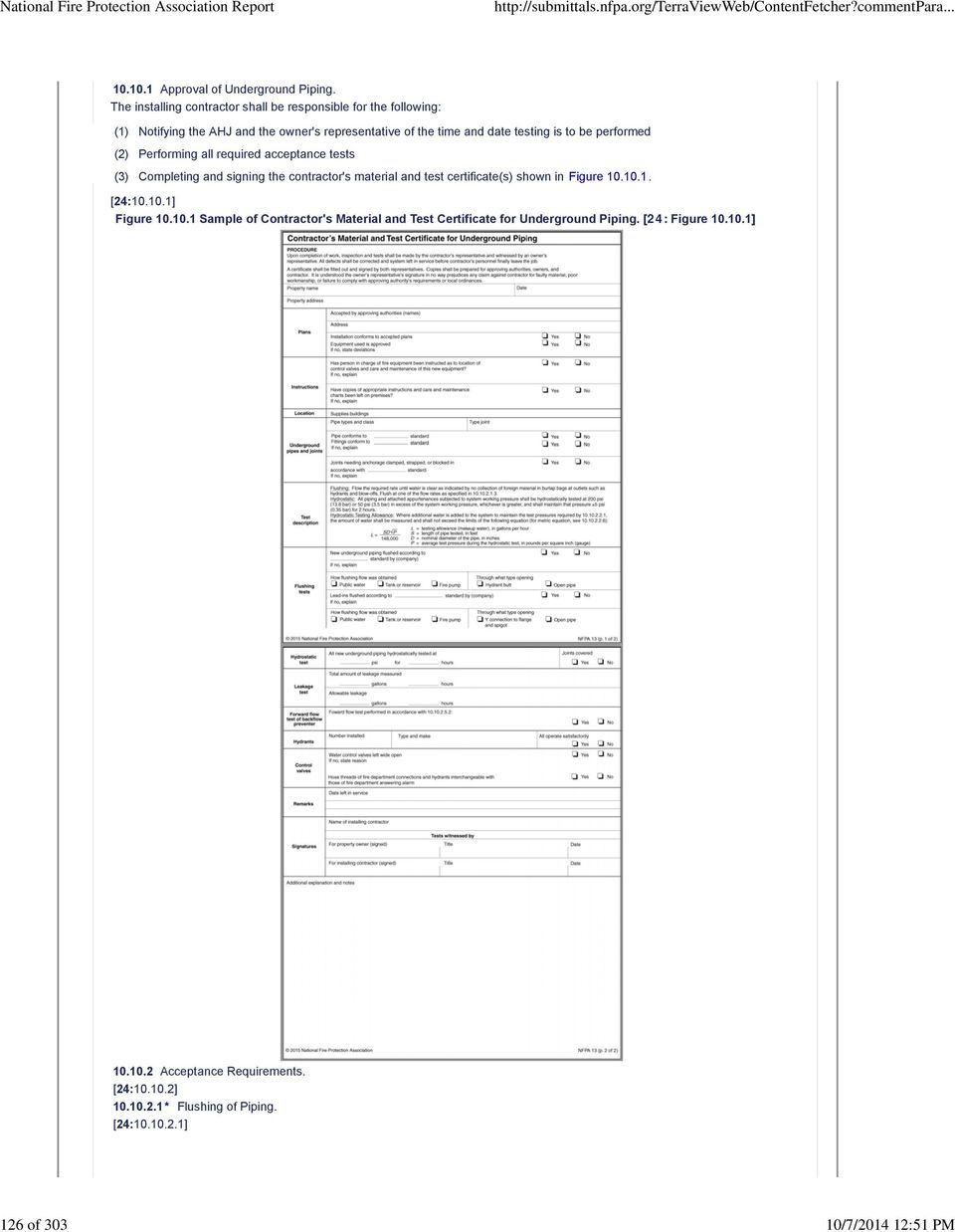
19 National Fire Protection Association Report 27 of /7/ :51 PM Underground piping, from the water supply to the system riser, and lead-in connections to the system riser, including all hydrants, shall be completely flushed before connection is made to downstream fire protection system piping. [24: ] The flushing operation shall continue until water flow is verified to be clear of debris. [24: ] The minimum rate of flow shall be in accordance with Table [ 24: ] The minimum rate of flow shall be not less than one of the following: Hydraulically calculated water demand rate of the system, including any hose requirements Flow in accordance with Table Maximum flow rate available to the system under fire conditions [ 24: ] Table Flow Required to Produce a Velocity of 10 ft/sec (3 m/sec) in Pipes Pipe Size Flow Rate in. mm gpm L/min , , , ,560 5, ,440 9, ,520 13,323 [24: Table ] Where the flow rates established in Table are not attainable, the maximum flow rate available to the system shall be acceptable. [ 24: ] Provision shall be made for the proper disposal of water used for flushing or testing. [24: ] Hydrostatic Test. [24: ] * All piping and attached appurtenances subjected to system working pressure shall be hydrostatically tested at gauge pressure of 200 psi (13.8 bar) or 50 psi (3.5 bar) in excess of the system working pressure, whichever is greater, and shall maintain that pressure at gauge pressure of ±5 psi (0.35 bar) for 2 hours. [24: ] Acceptable test results shall be determined by indication of either a pressure loss less than gauge pressure of 5 psi or by no visual leakage. [24: ] The test pressure shall be read from one of the following, located at the lowest elevation of the system or the portion of the system being tested: (1) A gauge located at one of the hydrant outlets (2) A gauge located at the lowest point where no hydrants are provided [24: ] * The trench shall be backfilled between joints before testing to prevent movement of pipe. [24: ] Where required for safety measures presented by the hazards of open trenches, the pipe and joints shall be permitted to be backfilled, provided the installing contractor takes the responsibility for locating and correcting leakage. [24: ]

20 National Fire Protection Association Report 28 of /7/ :51 PM * Hydrostatic Testing Allowance. Where additional water is added to the system to maintain the test pressures required by , the amount of water shall be measured and shall not exceed the limits of Table , which are based upon the following equation: U.S. Customary Units: [ (a) a ] where: L = testing allowance (makeup water) [gph (gal/hr)] S = length of pipe tested (ft) D = nominal diameter of the pipe (in.) P = average test pressure during hydrostatic test (gauge psi) Metric Units: [ (b) b ] where: L = testing allowance (makeup water) (L/hr) S = length of pipe tested (m) D = nominal diameter of pipe (mm) P = average test pressure during the hydrostatic test (kpa) [24: ] Table Hydrostatic Testing Allowance at 200 psi (gph/100 ft of Pipe) Nominal Pipe Diameter (in.) Testing Allowance Notes: (1) For other length, diameters, and pressures, utilize Equation (a) a or (b) b to determine the appropriate testing allowance. (2) For test sections that contain various sizes and sections of pipe, the testing allowance is the sum of the testing allowances for each size and section. [24: Table ] Other Means of Hydrostatic Tests. Where required by the AHJ, hydrostatic tests shall be permitted to be completed in accordance with the requirements of AWWA C600, AWWA C602, AWWA C603, and AWWA C900. [24: ] Operating Test. [24: ] Each hydrant shall be fully opened and closed under system water pressure. [24: ] Dry barrel hydrants shall be checked for proper drainage. [24: ] All control valves shall be fully closed and opened under system water pressure to ensure proper operation. [24: ] Where fire pumps supply the private fire service main, the operating tests required by shall be completed with the pumps running. [24: ] Backflow Prevention Assemblies. [24: ] The backflow prevention assembly shall be forward flow tested to ensure proper operation. [24: ]
![S. Customary Units: [10.10.2.2.6(a) a ] where: L = testing allowance (makeup water) [gph (gal/hr)] S = length of pipe tested (ft) D = nominal diameter of the pipe (in.](/docs-images/42/11998931/images/page_20.jpg ") P = average test pressure during hydrostatic test (gauge psi) Metric Units: [10.10.2.")
21 National Fire Protection Association Report 29 of /7/ :51 PM The minimum flow rate required by shall be the system demand, including hose stream demand where applicable. [24: ] Supplemental Information File Name 13_Chapter_10_Annex_A_from_24.docx 13_Chapter_10_from_24.docx Description Submitter Information Verification Submitter Full Name: Matthew Klaus Organization: National Fire Protection Assoc Street Address: City: State: Zip: Submittal Date: Wed Sep 24 10:14:34 EDT 2014 Committee Statement Committee Statement: Response Message: Chapter 10 from NFPA 24 has historically been extracted into Chapter 10 of NFPA 13. This revision will bring all of the second revisions to chapter 10 of NFPA edition into NFPA 13.
22 A.10.1 Copper tubing (Type K) with brazed joints conforming to Table and Table is acceptable for underground service. (1) Listing and labeling. certification organizations list or label the following: (a) Cast iron and ductile iron pipe (cement-lined and unlined, coated and uncoated) (b) Steel pipe (c) Copper pipe (d) Fiberglass filament-wound epoxy pipe and couplings (e) Polyethylene pipe (f) Polyvinyl chloride (PVC) pipe and couplings (g) Reinforced concrete pipe (cylinder pipe, nonprestressed and prestressed) A The type and class of pipe for a particular underground installation should be determined through consideration of the following factors: (1) Maximum system working pressure (2) Maximum pressure from pressure surges and anticipated frequency of surges (3) Depth at which the pipe is to be installed (4) Soil conditions (5) Corrosion (6) Susceptibility of pipe to external loads, including earth loads, installation beneath buildings, and traffic or vehicle loads The following pipe design manuals and standards can be used as guides: (1) AWWA C150, Thickness Design of Ductile Iron Pipe (2) AWWA C900, Polyvinyl Chloride (PVC) Pressure Pipe, 4 in. Through 12 in. for Water Distribution (3) AWWA C905, AWWA Standard for Polyvinyl Chloride (PVC) Pressure Pipe and Fabricated Fittings, 14 in. through 48 in. (350 mm through 1,200 mm) (4) AWWA C906, Standard for Polyethylene (PE) Pressure Pipe and Fittings, 4 in. (100 mm) through 68 in. (1,600 mm), for Water Distribution and Transmission (5) AWWA M41, Ductile Iron Pipe and Fittings (6) Concrete Pipe Handbook, American Concrete Pipe Association A For underground system components, a minimum system pressure rating of 150 psi (10 bar) is specified in , based on satisfactory historical performance. Also, this pressure rating reflects that of the components typically used underground, such as piping, valves, and fittings. Where system pressures are expected to exceed pressures of 150 psi (10.3 bar), system components and materials manufactured and listed for higher pressures should be used. Systems that do not incorporate a fire pump or are not part of a combined standpipe system do
23 not typically experience pressures exceeding 150 psi (10.3 bar) in underground piping. However, each system should be evaluated on an individual basis. It is not the intent of this section to include the pressures generated through fire department connections as part of the maximum working pressure. A See Table A Table A Internal Diameters (IDs) for Cement-Lined Ductile Iron Pipe Pipe Size (in.) OD (in.) Pressure Class Thickness Class Wall Thickness Minimum Lining Thickness* ID (in.) with Lining
24
25
26
27 ID: internal diameter; OD: outside diameter. *Note: This table is appropriate for single lining thickness only. The actual lining thickness should be obtained from the manufacturer. A Where nonmetallic underground piping is provided above grade or inside a building, the following should be considered: (1) Exposure from direct rays of sunlight
28 A (2) Compatibility with chemicals such as floor coatings and termiticides/insecticides (3) Support of piping and appurtenances attached thereto (e.g., sprinkler risers, backflow preventers) The following standards apply to joints used with the various types of pipe: (1) ASME B16.1, Cast Iron Pipe Flanges and Flanged Fittings (2) AWWA C111, Rubber-Gasket Joints for Ductile Iron Pressure Pipe and Fittings (3) AWWA C115, Flanged Ductile Iron Pipe with Ductile Iron or Gray Iron Threaded Flanges (4) AWWA C206, Field Welding of Steel Water Pipe (5) AWWA C606, Grooved and Shouldered Joints A Fittings and couplings are listed for specific pipe materials that can be installed underground. Fittings and couplings do not necessarily indicate that they are listed specifically for underground use. A Gray cast iron is not considered galvanically dissimilar to ductile iron. Rubber gasket joints (unrestrained push-on or mechanical joints) are not considered connected electrically. Metal thickness should not be considered a protection against corrosive environments. In the case of cast iron or ductile iron pipe for soil evaluation and external protection systems, see Appendix A of AWWA C105. A As there is normally no circulation of water in private fire mains, they require greater depth of covering than do public mains. Greater depth is required in a loose gravelly soil (or in rock) than in compact soil containing large quantities of clay. The recommended depth of cover above the top of underground yard mains is shown in Figure A (a). Figure A (a) Recommended Depth of Cover (in feet) Above Top of Underground Yard Mains.
29 In determining the need to protect aboveground piping from freezing, the lowest mean temperature should be considered as shown in Figure A (b). Figure A (b) Isothermal Lines Lowest One-Day Mean Temperature ( F).
30
31 A Consideration should be given to the type of soil and the possibility of settling. Also, many times the inspection of the piping might occur before final grading and fill of the installation is complete. The final grade should be verified. A Items such as sidewalks or patios should not be included as they are no different from roadways. See Figure A Figure A Riser Entrance Location. A The individual piping standards should be followed for load and bury depth, accounting for the load and stresses imposed by the building foundation. Figure A shows location where pipe joints would be prohibited. Figure A Pipe Joint Location in Relation to Foundation Footings.
32 A Sufficient clearance should be provided when piping passes beneath foundations or footers. See Figure A Figure A Piping Clearance from Foundation.
33 A The design concepts in through should apply to both new installations and existing private fire service mains approved to remain under new buildings. A Where lightning protection is provided for a structure, NFPA 780, Section 4.14, requires that all grounding media, including underground metallic piping systems, be interconnected to provide common ground potential. These underground piping systems are not permitted to be substituted for grounding electrodes but must be bonded to the lightning protection grounding system. Where galvanic corrosion is of concern, this bond can be made via a spark gap or gas discharge tube. A While the use of the underground fire protection piping as the grounding electrode for the building is prohibited, NFPA 70 requires that all metallic piping systems be bonded and grounded to disperse stray electrical currents. Therefore, the fire protection piping will be bonded to other metallic systems and grounded, but the electrical system will need an additional ground for its operation. A.10.6 It is a fundamental design principle of fluid mechanics that dynamic and static pressures, acting at changes in size or direction of a pipe, produce unbalanced thrust forces at locations such as bends, tees, wyes, dead ends, and reducer offsets. This design principle includes consideration of lateral soil pressure and pipe/soil friction, variables that can be reliably determined using current soil engineering knowledge. Refer to A for a list of references for use in calculating and determining joint restraint systems. Section 10.6 does not mandate which method of restraint should be used. This decision is left to the design professional or the owner.
34 ... Except for the case of welded joints and approved special restrained joints, such as is provided by approved mechanical joint retainer glands or locked mechanical and push-on joints, the usual joints for underground pipe are expected to be held in place by the soil in which the pipe is buried. Gasketed push-on and mechanical joints without special locking devices have limited ability to resist separation due to movement of the pipe. A The use of concrete thrust blocks is one method of restraint, provided that stable soil conditions prevail and space requirements permit placement. Successful blocking is dependent on factors such as location, availability and placement of concrete, and possibility of disturbance by future excavations. Resistance is provided by transferring the thrust force to the soil through the larger bearing area of the block so that the resultant pressure against the soil does not exceed the horizontal bearing strength of the soil. The design of thrust blocks consists of determining the appropriate bearing area of the block for a particular set of conditions. The parameters involved in the design include pipe size, design pressure, angle of the bend (or configuration of the fitting involved), and the horizontal bearing strength of the soil. Table A (a) gives the nominal thrust at fittings for various sizes of ductile iron and PVC piping. Figure A (a) shows an example of how thrust forces act on a piping bend. Table A (a) Thrust at Fittings at 100 psi (6.9 bar) Water Pressure for Ductile Iron and PVC Pipe Nominal Pipe Diameter (in.) Notes: Dead End 90- Degree Bend 45- Degree Bend Total Pounds Degree Bend Degree Bend Degree Bend , ,685 19,353 10, ,385 26,001 14, ,779 33,628 18, ,865 42,235 22,858 11, ,644 51,822 28,046 14, ,279 73,934 40,013 20,398 10, , ,738 61,554 31,380 15, , ,931 88,177 44,952 22,585 10, , , ,036 60,684 30,489 13, , , ,127 79,083 39,733 18,124 (1) For SI units, 1 lb = kg; 1 in. = 25.4 mm.
35 ..... (2) To determine thrust at pressure other than 100 psi (6.9 bar), multiply the thrust obtained in the table by the ratio of the pressure to 100 psi (6.9 bar). For example, the thrust on a 12 in. (305 mm), 90-degree bend at 125 psi (8.6 bar) is 19, /100 = 24,191 lb (10,973 kg). Table A (b) Required Horizontal Bearing Block Area Nominal Pipe Diameter (in.) Notes: Bearing Block Area (ft 2 ) Nominal Pipe Diameter (in.) Bearing Block Area (ft 2 ) Nominal Pipe Diameter (in.) Bearing Block Area (ft 2 ) (1) Although the bearing strength values in this table have been used successfully in the design of thrust blocks and are considered to be conservative, their accuracy is totally dependent on accurate soil identification and evaluation. The ultimate responsibility for selecting the proper bearing strength of a particular soil type must rest with the design engineer. (2) Values listed are based on a 90-degree horizontal bend, an internal pressure of 100 psi, a soil horizontal bearing strength of 1000 lb/ft 2, a safety factor of 1.5, and ductile iron pipe outside diameters. (a) For other horizontal bends, multiply by the following coefficients: for 45 degrees, 0.541; for degrees, 0.276; for degrees, (b) For other internal pressures, multiply by ratio to 100 psi. (c) For other soil horizontal bearing strengths, divide by ratio to 1000 lb/ft 2. (d) For other safety factors, multiply by ratio to 1.5. Example: Using Table A (b), find the horizontal bearing block area for a 6 in. diameter, 45- degree bend with an internal pressure of 150 psi. The soil bearing strength is 3000 lb/ft 2, and the safety factor is 1.5. From Table A (b), the required bearing block area for a 6 in. diameter, 90-degree bend with an internal pressure of 100 psi and a soil horizontal bearing strength of 1000 psi is 7.9 ft 2. For example: Table A (c) Horizontal Bearing Strengths [A (a)a] Soil Bearing Strength (Sb) lb/ft 2 kn/m 2 Muck 0 0
36 Soil Bearing Strength (Sb) lb/ft 2 kn/m 2 Soft clay Silt Sandy silt Sand Sand clay Hard clay Note: Although the bearing strength values in this table have been used successfully in the design of thrust blocks and are considered to be conservative, their accuracy is totally dependent on accurate soil identification and evaluation. The ultimate responsibility for selecting the proper bearing strength of a particular soil type must rest with the design engineer. Figure A (a) Thrust Forces Acting on Bend. Thrust blocks are generally categorized into two groups bearing and gravity blocks. Figure A (b) depicts a typical bearing thrust block on a horizontal bend.
37 Figure A (b) Bearing Thrust Block. The following are general criteria for bearing block design: (1) The bearing surface should, where possible, be placed against undisturbed soil. (2) Where it is not possible to place the bearing surface against undisturbed soil, the fill between the bearing surface and undisturbed soil should be compacted to at least 90 percent Standard Proctor density. (3) Block height (h) should be equal to or less than one-half the total depth to the bottom of the block (H t) but not less than the pipe diameter (D). (4) Block height (h) should be chosen so that the calculated block width (b) varies between one and two times the height.
38 (5) Gravity thrust blocks can be used to resist thrust at vertical down bends. In a gravity thrust block, the weight of the block is the force providing equilibrium with the thrust force. The design problem is then to calculate the required volume of the thrust block of a known density. The vertical component of the thrust force in Figure A (c) is balanced by the weight of the block. For required horizontal bearing block areas, see Table A (b). The required block area (A b) is as follows: where: [A (b)b] A b = required block area (ft 2 ) h = block height (ft) b = calculated block width (ft) T = thrust force (lbf) S f = safety factor (usually 1.5) S b = bearing strength (lb/ft 2 ) Then, for a horizontal bend, the following formula is used: where: [A (c)c] b = calculated block width (ft) S f = safety factor (usually 1.5 for thrust block design) P = water pressure (lb/in. 2 ) A = cross-sectional area of pipe based on outside diameter h = block height (ft) S b = horizontal bearing strength of soil (lb/ft 2 )(in. 2 ) A similar approach can be used to design bearing blocks to resist the thrust forces at locations such as tees and dead ends. Typical values for conservative horizontal bearing strengths of various soil types are listed in Table A (c). Figure A (c) Gravity Thrust Block.
39 In lieu of the values for soil bearing strength shown in Table A (c), a designer might choose to use calculated Rankine passive pressure (P p) or other determination of soil bearing strength based on actual soil properties. It can be easily shown that T y = PA sin θ. The required volume of the block is as follows: where: [A (d)d] V g = block volume (ft 3 ) S f = safety factor P = water pressure (psi) A = cross-sectional area of pipe interior W m = density of block material (lb/ft 3 ) In a case such as the one shown, the horizontal component of thrust force is calculated as follows: where: [A (e)e] T x = horizontal component of thrust force
40 P = water pressure (psi) A = cross-sectional area of pipe interior The horizontal component of thrust force must be resisted by the bearing of the right side of the block against the soil. Analysis of this aspect follows the same principles as the previous section on bearing blocks. A A method for providing thrust restraint is the use of restrained joints. A restrained joint is a special type of joint that is designed to provide longitudinal restraint. Restrained joint systems function in a manner similar to that of thrust blocks, insofar as the reaction of the entire restrained unit of piping with the soil balances the thrust forces. The objective in designing a restrained joint thrust restraint system is to determine the length of pipe that must be restrained on each side of the focus of the thrust force, which occurs at a change in direction. This will be a function of the pipe size, the internal pressure, the depth of cover, and the characteristics of the solid surrounding the pipe. The manufacturer s installation instructions should be referenced to determine the distance from each change in direction that joints should be restrained. The following documents apply to the design, calculation, and determination of restrained joint systems: (1) Thrust Restraint Design for Ductile Iron Pipe, Ductile Iron Pipe Research Association (2) AWWA M41, Ductile Iron Pipe and Fittings (3) AWWA M9, Concrete Pressure Pipe (4) AWWA M11, A Guide for Steel Pipe Design and Installation (5) Thrust Restraint Design Equations and Tables for Ductile Iron and PVC Pipe, EBAA Iron, Inc. Figure A shows an example of a typical connection to a fire protection system riser utilizing restrained joint pipe. Figure A Typical Connection to Fire Protection System Riser Illustrating Restrained Joints.
41 A Examples of materials and the standards covering these materials are as follows: (1) Clamps, steel (2) Rods, steel (3) Bolts, steel (ASTM A 307A307) (4) Washers, steel, cast iron (Class A cast iron as defined by ASTM A 126A126) (5) Anchor straps, plug straps, steel (6) Rod couplings, turnbuckles, malleable iron (ASTM A 197A197) The materials specified in A (1) through (6)A (6) do not preclude the use of other materials that also satisfy the requirements of this section. A Solvent-cemented and heat-fused joints such as those used with CPVC piping and fittings are considered restrained. They do not require thrust blocks. A Underground mains and lead-in connections to system risers should be flushed through hydrants at dead ends of the system or through accessible aboveground flushing outlets allowing the water to run until clear. Figure A shows acceptable examples of flushing the system. If water is supplied from more than one source or from a looped system, divisional valves should be closed to produce a high-velocity flow through each single line. The flows specified in Table will produce a velocity of at least 10 ft/sec (3 m/sec), which is necessary for cleaning the pipe and for lifting foreign material to an aboveground flushing outlet. Figure A Methods of Flushing Water Supply Connections. A (2)
42 The velocity of approximately 10 ft/sec (3.1 m/sec) was used to develop Table because this velocity has been shown to be sufficient for moving obstructive material out of the pipes. It is not important that the velocity equal exactly 10 ft/sec (3.1 m/sec), so there is no reason to increase the flow during the test for slightly different internal pipe dimensions. Note that where underground pipe serves as suction pipe for a fire pump, NFPA 20 requires greater flows for flushing the pipe. A A sprinkler system has for its water supply a connection to a public water service main. A 100 psi (6.9 bar) rated pump is installed in the connection. With a maximum normal public water supply of 70 psi (4.8 bar), at the low elevation point of the individual system or portion of the system being tested and a 120 psi (8.3 bar) pump (churn) pressure, the hydrostatic test pressure is 70 psi (4.8 bar) psi (8.3 bar) + 50 psi (3.5 bar), or 240 psi (16.5 bar). To reduce the possibility of serious water damage in case of a break, pressure can be maintained by a small pump, the main controlling gate meanwhile being kept shut during the test. Polybutylene pipe will undergo expansion during initial pressurization. In this case, a reduction in gauge pressure might not necessarily indicate a leak. The pressure reduction should not exceed the manufacturer's specifications and listing criteria. When systems having rigid thermoplastic piping such as CPVC are pressure tested, the sprinkler system should be filled with water. The air should be bled from the highest and farthest sprinklers. Compressed air or compressed gas should never be used to test systems with rigid thermoplastic pipe. A recommended test procedure is as follows: The water pressure is to be increased in 50 psi (3.5 bar) increments until the test pressure described in is attained. After each increase in pressure, observations are to be made of the stability of the joints. These observations are to include such items as protrusion or extrusion of the gasket, leakage, or other factors likely to affect the continued use of a pipe in service. During the test, the pressure is not to be increased by the next increment until the joint has become stable. This applies particularly to movement of the gasket. After the pressure has been increased to the required maximum value and held for 1 hour, the pressure is to be decreased to 0 psi while observations are made for leakage. The pressure is again to be slowly increased to the value specified in and held for 1 more hour while observations are made for leakage and the leakage measurement is made. A Hydrostatic tests should be made before the joints are covered, so that any leaks can be detected. Thrust blocks should be sufficiently hardened before hydrostatic testing is begun. If the joints are covered with backfill prior to testing, the contractor remains responsible for locating and correcting any leakage in excess of that permitted. A One acceptable means of completing this test is to utilize a pressure pump that draws its water supply from a full container. At the completion of the 2-hour test, the amount of water to refill the container can be measured to determine the amount of makeup water. In order to minimize pressure loss, the piping should be flushed to remove any trapped air. Additionally, the piping should be pressurized for 1 day prior to the hydrostatic test to account for expansion, absorption, entrapped air, and so on. The use of a blind flange or skillet is preferred for hydrostatically testing segments of new work. Metal-seated valves are susceptible to developing slight imperfections during transport, installation, and operation and thus can be likely to leak more than 1 fl oz/in. (1.2 ml/mm) of valve diameter per hour. For this reason, the blind flange should be used when hydrostatically testing.
43 Chapter 10 Underground Requirements 10.1* Piping * All piping used in private fire service mains shall be in accordance with , , or Listing. Piping manufactured in accordance with Table shall be permitted to be used.. Table Manufacturing Standards for Underground Pipe Materials and Dimensions Ductile Iron Cement Mortar Lining for Ductile Iron Pipe and Fittings for Water Polyethylene Encasement for Ductile Iron Pipe Systems Standard AWWA C104 AWWA C105 Rubber-Gasket Joints for Ductile Iron Pressure Pipe and Fittings Flanged Ductile Iron Pipe with Ductile Iron or Gray Iron Threaded Flanges AWWA C111 AWWA C115 Thickness Design of Ductile Iron Pipe Ductile Iron Pipe, Centrifugally Cast for Water AWWA C150 AWWA C151 Standard for the Installation of Ductile Iron Water Mains and Their Appurtenances AWWA C600 Concrete Reinforced Concrete Pressure Pipe, Steel-Cylinder Type Prestressed Concrete Pressure Pipe, Steel-Cylinder Type Reinforced Concrete Pressure Pipe, Non-Cylinder Type Reinforced Concrete Pressure Pipe, Steel-Cylinder Type, Pretensioned AWWA C300 AWWA C301 AWWA C302 AWWA C303
44 Materials and Dimensions Standard for Asbestos-Cement Distribution Pipe, 4 in. Through 16 in., for Water Distribution Systems Standard AWWA C400 Cement-Mortar Lining of Water Pipe Lines 4 in. and Larger in Place AWWA C602 Plastic Polyvinyl Chloride (PVC) Pressure Pipe, 4 in. Through 12 in., for Water Distribution Polyvinyl Chloride (PVC) Pressure Pipe, 14 in. Through 48 in., for Water Distribution Polyethylene (PE) Pressure Pipe and Fittings, 4 in. (100 mm) Through 63 in. (1575 mm) for Water Distribution Molecularly Oriented Polyvinyl Chloride (PVCO) 4 in. Through 12 in. (100 mm Through 600 mm) for Water Distribution AWWA C900 AWWA C905 AWWA C906 AWWA C909 Brass Specification for Seamless Red Brass Pipe ASTM B 43B43 Copper Specification for Seamless Copper Tube Specification for Seamless Copper Water Tube Requirements for Wrought Seamless Copper and Copper-Alloy Tube ASTM B 75B75 ASTM B 88B88 ASTM B 251B Piping specifically listed for use in private fire service mains shall be permitted to be used Where listed pipe is used, it shall be installed in accordance with the listing limitations including installation instructions Where listing limitations or installation instructions differ from the requirements of this standard, the listing limitations and installation instructions shall apply Steel piping manufactured in accordance with Table that is externally coated and wrapped and internally galvanized shall be permitted to be used between the hose coupling(s) on the fire department connection and the check valve installed in the fire department connection piping. Table Steel Piping for Fire Department Connections
45 Materials and Dimensions Specification for Black and Hot-DippedZinc-Coated (Galvanized) Welded and Seamless Steel Pipe for Fire Protection Use Standard Specification for Pipe, Steel, Black and Hot-Dipped, Zinc-Coated, Welded and Seamless Standard Specification for Electric-Resistance Welded Steel Pipe Standard ASTM A 795A795 ASTM A 53A53 ASTM A 135A External coating and wrapping as required by shall be approved * All piping used in private fire service mains shall be rated for the maximum system working pressure to which the piping is exposed to but shall not be rated at less than 150 psi (10 bar) * When lined piping is used, the manufacturer s literature for internal diameter shall be used for all hydraulic calculations Where piping installed in a private fire service main must be installed above grade, the piping materials shall conform to NFPA * Underground piping shall be permitted to extend into the building through the slab or wall not more than 24 in. (0.6 m) Fittings All fittings used in private fire service mains shall be in accordance with ,or , or Fittings manufactured in accordance with Table shall be permitted to be used. Table Fittings Materials and Dimensions Materials and Dimensions Standard Cast Iron Gray Iron Threaded Fittings, Classes 125 and 250 ASME B16.4 Gray Iron Pipe Flanges and Flanged Fittings, Classes 12, 125, and 250 ASME B16.1 Ductile Iron Ductile Iron and Gray Iron Fittings, 3 in. Through 48 in., for Water and other Liquids Ductile Iron Compact Fittings, 3 in. Through 24 in. and 54 in. through 64 in. for Water Service AWWA C110 AWWA C153
46 Materials and Dimensions Standard Malleable Iron Malleable Iron Threaded Fittings, Class 150 and 300 ASME B16.3 Steel Factory-Made Wrought Steel Buttweld Fittings ASME B16.9 Buttwelding Ends ASME B16.25 Specification for Piping Fittings of Wrought Carbon Steel and Alloy Steel for Moderate and Elevated Temperatures ASTM A 234A234 Pipe Flanges and Flanged Fittings, NPS 1 2 Through 24 ASME B16.5 Forged Steel Fittings, Socket Welded and Threaded ASME B16.11 Steel Pipe Flanges for Waterworks Service Sizes 4 in. Through 144 in. Dimensions for Fabricated Steel Water Pipe Fittings AWWA C207 AWWA C208 Copper Wrought Copper and Bronze Solder Joint Pressure Fittings ASME B16.22 Cast Bronze Solder Joint Pressure Fittings ASME B16.18 Bronze Fittings Cast Bronze Threaded Fittings ASTM B Special Listed Fittings. Fittings specifically listed for use in private fire service mains shall be permitted to be used Where listed fittings are used, they shall be installed in accordance with their listing limitations including installation instructions Where listing limitations or installation instructions differ from the requirements of this standard, the listing limitations and installation instructions shall apply Approved fittings shall be permitted to be used All fittings used in private fire service mains shall be rated for the maximum system working pressure to which the fittings are exposed, but shall not be rated at less than 150 psi (10 bar) Where fittings installed in a private fire service main must be installed above grade, the fittings shall conform to NFPA
47 Fittings in accordance with shall be permitted for the transition to the above ground piping or fittings Connection of Pipe, Fittings, and Appurtenances * Connection of all fittings and appurtenances to piping shall be in accordance with Section Threaded Pipe and Fittings. Connections of pipe and fittings indicated in Table and Table shall be in accordance with the referenced standard in the table Listed Connections. Connections utilizing listed products shall be in accordance with the listing limitations and the manufacturer s installation instructions Where listing limitations or installation instructions differ from the requirements of this standard, the listing limitations and installation instructions shall apply Where pipe, fittings or appurtenances are connected using threads, all threads shall be in accordance with ANSI/ASME B Grooved Connections. Where pipe, fittings, or appurtenances are connected using grooves, they shall be connected in accordance with through Pipe, fittings, and appurtenances to be joined with grooved couplings shall contain cut, rolled, or cast grooves that are dimensionally compatible with the couplings Pipe, fittings, and appurtenances that are connected with grooved couplings and are part of a listed assembly shall be permitted to be used * Pipe joined with grooved fittings shall be joined by a listed combination of fittings, gaskets, and grooves All joints for the connection of copper tube shall be brazed or joined using pressure fittings as specified in Table Protection of Private Fire Service Mains Protection from Corrosion Coatings. All bolted joint accessories shall be cleaned and thoroughly coated with asphalt or other corrosion-retarding material after installation The requirements of shall not apply to epoxy-coated fittings, valves, glands, or other accessories *
48 Where it is necessary to join metal pipe with pipe of dissimilar metal, the joint shall be insulated against the passage of an electric current using an approved method * Protection of Piping Protection from Freezing. The depth of cover for private fire service mains and their appurtenances to protect against freezing shall be in accordance with * The top of the pipe shall be buried not less than 1 ft (0.3 m) below the frost line for the locality The depth of piping shall be measured from the top of the piping to the final grade Where listed piping is used and the bury depth differs from this standard, the listing limitations shall apply Where private fire service mains are installed above ground, they shall be protected from freezing in accordance with NFPA Private fire service mains installed in water raceways or shallow streams shall be installed so that the piping will remain in the running water throughout the year Where piping is installed adjacent to a vertical face, it shall be installed from the vertical face at the same distance as if the piping were buried Protection of private fire service mains from freezing using heat tracing shall be permitted when the heat tracing is specifically listed for underground use Heat tracing not listed for underground use shall be permitted when piping is installed in accordance with Protection from Mechanical Damage. The depth of cover for private fire service mains and their appurtenances to protect against mechanical damage shall be in accordance with The depth of piping shall be measured from the top of the piping to the final grade In locations where freezing is not a factor, the depth of cover shall not be less than 30 in. (0.8 m) below grade to prevent mechanical damage Where listed piping is used and the bury depth differs from this standard, the listing limitations shall apply
49 Private fire service mains installed under driveways or roadways shall be buried at a minimum depth of 3 ft (0.9 m) Sidewalks, walkways and other paved or concrete pedestrian passageways shall not be required to comply with Private fire service mains installed under railroad tracks shall be buried at a minimum depth of 4 ft (1.2 m) Where railroad operators require a greater depth of bury, the greater depth shall apply Private fire service mains installed under large piles of heavy commodities or subject to heavy shock and vibrations shall be buried at a minimum depth of 4 ft (1.2 m) Where private fire service mains are installed above ground, they shall be protected with bollards or other means as approved by the AHJ when subject to mechanical damage Private Fire Service Mains Under Buildings. Except as allowed by , private fire service mains shall not be allowed to run under buildings * Private fire service mains supplying fire protection systems within the building shall be permitted to extend no more than 10 ft (3 m), as measured from the outside of the building, under the building to the riser location * Pipe joints shall not be located directly under foundation fittings * Piping shall be installed a minimum of 12 in. (305 mm) below the bottom of building foundations or footers The requirements of shall not apply when the piping is sleeved with an approved material * Where approved, private fire service mains supplying systems within the building shall be permitted to extend more than 10 ft (3 m) under the building when all the requirements of , through are met Where the piping is installed under the building, all foundations or footers over the private fire service main shall be arched to create a minimum of 24 in (610 mm) clearance It shall be acceptable to install the piping in covered trenches where the trenches are accessible from within the building
50 All joints shall be mechanically restrained A valve shall be installed before the piping enters under the building and within 24 in. (610 mm) of where the piping enters the building Grounding and Bonding * In no case shall the underground piping be used as a grounding electrode for electrical systems * The requirement of shall not preclude the bonding of the underground piping to the lightning protection grounding system as required by NFPA 780 in those cases where lightning protection is provided for the structure. 10.6* Restraint. Private fire service mains shall be restrained against movement at changes in direction in accordance with , , or * Thrust Blocks Thrust blocks shall be permitted where soil is stable and capable of resisting the anticipated thrust forces Thrust blocks shall be concrete of a mix not leaner than one part cement, two and one-half parts sand, and five parts stone Thrust blocks shall be placed between undisturbed earth and the fitting to be restrained and shall be capable of resisting the calculated thrust forces Wherever possible, thrust blocks shall be located so that the joints are accessible for repair * Restrained Joint Systems. Private fire service mains using restrained joint systems shall include one or more of the following: (1) Locking mechanical or push-on joints (2) Mechanical joints utilizing setscrew retainer glands (3) Bolted flange joints (4) Pipe clamps and tie rods (5) Other approved methods or devices Sizing Clamps, Rods, Bolts, and Washers Clamps Clamps shall have the following dimensions: (1) 1 2 in. 2 in. (12.7 mm 50.8 mm) for 4 in. (102 mm) to 6 in. (152 mm) pipe
51 .... (2) 5 8 in in. (15.9 mm 63.5 mm) for 8 in. (204 mm) to 10 in. (254 mm) pipe (3) 5 8 in. 3 in. (15.9 mm 76.2 mm) for 12 in. (305 mm) pipe The diameter of a bolt hole shall be 1 8 in. (3.2 mm) larger than that of the corresponding bolt Rods Rods shall be not less than 5 8 in. (15.9 mm) in diameter Table provides the numbers of various diameter rods that shall be used for a given pipe size. Table Rod Number Diameter Combinations Nominal Pipe Size (in.) 5 8 in. (15.9 mm) 3 4 in. (19.1 mm) 7 8 in. (22.2 mm) 1 in. (25.4 mm) Note: This table has been derived using pressure of 225 psi (15.5 bar) and design stress of 25,000 psi (172.4 MPa) Where using bolting rods, the diameter of mechanical joint bolts shall limit the diameter of rods to 3 4 in. (19.1 mm) Threaded sections of rods shall not be formed or bent Where using clamps, rods shall be used in pairs for each clamp Assemblies in which a restraint is made by means of two clamps canted on the barrel of the pipe shall be permitted to use one rod per clamp if approved for the specific installation by the AHJ Where using combinations of rods, the rods shall be symmetrically spaced Clamp Bolts. Clamp bolts shall have the following diameters: (1) 5 8 in. (15.9 mm) for pipe 4 in. (102 mm), 6 in. (152 mm), and 8 in. (204 mm)
52 (2) 3 4 in. (19.1 mm) for 10 in. (254 mm) pipe (3) 7 8 in. (22.2 mm) for 12 in. (305 mm) pipe Washers Washers shall be permitted to be cast iron or steel and round or square Cast iron washers shall have the following dimensions: (1) 5 8 in. 3 in. (15.9 mm 76.2 mm) for 4 in. (102 mm), 6 in. (152 mm), 8 in. (204 mm), and 10 in. (254 mm) pipe (2) 3 4 in in. (19.1 mm 88.9 mm) for 12 in. (305 mm) pipe Steel washers shall have the following dimensions: (1) 1 2 in. 3 in. (12.7 mm 76.2 mm) for 4 in. (102 mm), 6 in. (152 mm), 8 in. (204 mm), and 10 in. (254 mm) pipe (2) 1 2 in in. (12.7 mm 88.9 mm) for 12 in. (305 mm) pipe The diameter of holes shall be 1 8 in. (3.2 mm) larger than that of bolts or rods Sizes of Restraint Straps for Tees Restraint straps for tees shall have the following dimensions: (1) 5 8 in. (15.9 mm) thick and 21 2 in. (63.5 mm) wide for 4 in. (102 mm), 6 in. (152 mm), 8 in. (204 mm), and 10 in. (254 mm) pipe (2) 5 8 in. (15.9 mm) thick and 3 in. (76.2 mm) wide for 12 in. (305 mm) pipe The diameter of rod holes shall be 1 16 in. (1.6 mm) larger than that of rods Figure and Table shall be used in sizing the restraint straps for both mechanical and push-on joint tee fittings. Figure Restraint Straps for Tees. Table Restraint Straps for Tees
53 .. Nominal Pipe Size (in.) A B C D in. mm in. mm in. mm in. mm Sizes of Plug Strap for Bell End of Pipe The strap shall be 3 4 in. (19.1 mm) thick and 21 2 in. (63.5 mm) wide The strap length shall be the same as dimension A for tee straps as shown in Figure The distance between the centers of rod holes shall be the same as dimension B for tee straps as shown in Figure Material. Clamps, rods, rod couplings or turnbuckles, bolts, washers, restraint straps, and plug straps shall be of a material that has physical and chemical characteristics that indicate its deterioration under stress can be predicted with reliability * Corrosion Resistance. After installation, rods, nuts, bolts, washers, clamps, and other restraining devices shall be cleaned and thoroughly coated with a bituminous or other acceptable corrosion-retarding material The requirements of shall not apply to epoxy-coated fittings, valves, glands, or other accessories * Private fire service mains utilizing one or more of the following connection methods shall not require additional restraint, provided that such joints can pass the hydrostatic test of without shifting of piping. (1) Threaded connections (2) Grooved connections (3) Welded connections (4) Heat-fused connections (5) Chemical or solvent cemented connections 10.7 Steep Grades On steep grades, mains shall be additionally restrained to prevent slipping.
54 Pipe shall be restrained at the bottom of a hill and at any turns (lateral or vertical) The restraint specified in shall be to natural rock or to suitable piers built on the downhill side of the bell Bell ends shall be installed facing uphill Straight runs on hills shall be restrained as determined by a design professional Installation Requirements Piping, valves, hydrants, gaskets, and fittings shall be inspected for damage when received and shall be inspected prior to installation The tightness of bolted joints shall be verified by the bolt torque or by the method described in the listing information or manufacturer s installation instructions Pipe, valves, hydrants, and fittings shall be clean and free from internal debris When work is stopped, the open ends of piping, valves, hydrants, and fittings shall be plugged or covered to prevent foreign materials from entering All piping, fittings, valves, and hydrants shall be examined for cracks or other defects while suspended above the trench and lowered into the trench using appropriate equipment Plain ends shall be inspected for signs of damage prior to installation Piping, fittings, valves, hydrants, and appurtenances shall not be dropped, dumped or rolled or skidded against other materials Pipes shall be supported in the trench throughout their full length and shall not be supported by the bell ends only or by blocks If the ground is soft, other means shall be provided to support the pipe Valves and fittings used with nonmetallic pipe shall be supported and restrained in accordance with the manufacturer's installation instructions Backfilling
55 Backfill material shall be tamped in layers or in puddles under and around pipes to prevent settlement or lateral movement and shall contain no ashes, cinders, refuse, organic matter, or other corrosive materials Backfill material shall not contain ash, cinders, refuse, organic matter or other corrosive materials Rocks shall not be used for backfill Frozen earth shall not be used as backfill material In trenches cut through rock, tamped backfill shall be used for at least 6 in. (150 mm) under and around the pipe and for at least 2 ft (0.6 m) above the pipe Where using piping listed for private fire service mains, the manufacturer s installation instructions for backfill shall be followed Testing and Acceptance Approval of Underground Piping. The installing contractor shall be responsible for the following: (1) Notifying the AHJ and the owner's representative of the time and date testing is to be performed (2) Performing all required acceptance tests (3) Completing and signing the contractor's material and test certificate(s) shown in Figure Figure Sample of Contractor's Material and Test Certificate for Underground Piping.
56
57 DELETED
58
59
60 Acceptance Requirements * Flushing of Piping Underground piping, from the water supply to the system riser, and lead-in connections to the system riser, including all hydrants, shall be completely flushed before the connection is made to downstream fire protection system piping The flushing operation shall be continue until water flow is verified to be clear of debris The minimum rate of flow shall be not less than one of the following:in accordance with Table (1) Hydraulically calculated water demand flow rate of the system, including any hose requirements (2) *Flow in accordance with Table (3) Maximum flow rate available to the system under fire conditions Table Flow Required to Produce Velocity of 10 ft/sec (3 m/sec) in Pipes Nominal Pipe Size Flow Rate in. mm gpm L/min , , , , , , , , , Where the flow rates established in Table are not attainable, the maximum flow rate available to the system shall be acceptable Provision shall be made for the proper disposal of water used for flushing or testing Hydrostatic Test * All piping and attached appurtenances subjected to system working pressure shall be hydrostatically tested at gauge pressure of 200 psi (13.8 bar) or 50 psi (3.5 bar) in excess of the system working pressure, whichever is greater, and shall maintain that pressure at gauge pressure of ±5 psi (0.35 bar) for 2 hours.
61 Acceptable test results shall be determined by indication of either a pressure loss less than gauge pressure of 5 psi or by no visual leakage The test pressure shall be read from one of the following, located at the lowest elevation of the system or the portion of the system being tested: (1) A gauge located at one of the hydrant outlets (2) A gauge located at the lowest point where no hydrants are provided * The trench shall be backfilled between joints before testing to prevent movement of pipe Where required for safety measures presented by the hazards of open trenches, the pipe and joints shall be permitted to be backfilled, provided the installing contractor takes the responsibility for locating and correcting leakage * Hydrostatic Testing Allowance. Where additional water is added to the system to maintain the test pressures required by , the amount of water shall be measured and shall not exceed the limits of Table , which are based upon the following equations:. U.S. Customary Units: where: [ (a)a] L = testing allowance (makeup water) [gph (gal/hr)] S = length of pipe tested (ft) D = nominal diameter of pipe (in.) P = average test pressure during hydrostatic test (gauge psi) Metric Units: where: [ (b)b] L = testing allowance (makeup water) (L/hr) S = length of pipe tested (m) D = nominal diameter of pipe (mm) P = average test pressure during hydrostatic test (kpa) Table Hydrostatic Testing Allowance at 200 psi (gph/100 ft of Pipe)
62 . Notes: Nominal Pipe Diameter (in.) Testing Allowance (1) For other length, diameters, and pressures, utilize Equation (a)a or (b)b to determine the appropriate testing allowance. (2) For test sections that contain various sizes and sections of pipe, the testing allowance is the sum of the testing allowances for each size and section Other Means of Hydrostatic Tests. Where required by the AHJ, hydrostatic tests shall be permitted to be completed in accordance with the requirements of AWWA C600, AWWA C602, AWWA C603, and AWWA C Operating Test Each hydrant shall be fully opened and closed under system water pressure Dry barrel hydrants shall be checked for proper drainage All control valves shall be fully closed and opened under system water pressure to ensure proper operation Where fire pumps supply the private fire service main, the operating tests required by shall be completed with the pumps running Backflow Prevention Assemblies The backflow prevention assembly shall be forward flow tested to ensure proper operation The minimum flow rate tested in shall be the system demand, including hose stream demand where applicable.
SECTION 33 11 00.15 DUCTILE IRON PIPE AND FITTINGS
 SECTION 33 11 00.15 DUCTILE IRON PIPE AND FITTINGS PART 1: GENERAL 1.01 COORDINATION OF WORK Connection to existing pipelines may require shutdown of AW facilities. Closely coordinate construction work
SECTION 02630 STORM DRAINAGE SYSTEM
 SECTION 02630 PART 1 - GENERAL 1.01 DESCRIPTION A. Section includes specifications for storm drainage systems including modifications and connections to existing storm drainage systems. 1.02 REFERENCE
DESIGN AND CONSTRUCTION GUIDELINES AND STANDARDS DIVISION 33 UTILITIES 33 00 00 SITE UTILITIES
 SECTION INCLUDES Domestic Water Fire Water Service Water Well Sanitary Sewer Storm Drains Foundation Drainage RELATED SECTIONS 03 30 00 Concrete 21 00 00 Fire Suppression - Sprinklers 22 00 00 Plumbing
SECTION 15076 CEMENT-MORTAR LINED AND COATED STEEL PIPE
 SECTION 15076 CEMENT-MORTAR LINED AND COATED (CML&C) STEEL PIPE PART 1 GENERAL 1.01 DESCRIPTION This section designates the requirements for steel pipe fabrication, test in shop, installation of steel
SECTION 15105 DUCTILE IRON PIPE AND FITTINGS
 SECTION 15105 DUCTILE IRON PIPE AND FITTINGS PART 1 GENERAL.01 COORDINATION OF WORK Connection to existing pipelines may require shutdown of Owner facilities. Closely coordinate construction work and connections
SECTION 02720 SANITARY SEWER AND STORM DRAIN SYSTEMS
 SECTION 02720 SANITARY SEWER AND STORM DRAIN SYSTEMS PART 1 GENERAL 1.01 SECTION INCLUDES A. The requirements for pipe material and installation in sewer and drainage collection systems. All materials
SECTION 33 11 00.11 POLYVINYL CHLORIDE (PVC) PIPE
 SECTION 33 11 00.11 POLYVINYL CHLORIDE (PVC) PIPE PART 1: GENERAL 1.01 SECTION INCLUDES PVC pressure pipe and fabricated fittings in nominal sizes 4-inches through 12-inches with cast iron pipe equivalent
SECTION 1 GENERAL REQUIREMENTS
 Page 1 of 6 SECTION 1 GENERAL REQUIREMENTS 1. SCOPE OF WORK: The work to be performed under the provisions of these documents and the contract based thereon includes furnishing all labor, equipment, materials,
STANDARD SPECIFICATIONS SECTION 02512 CLEANING AND LINING WATER MAINS
 STANDARD SPECIFICATIONS SECTION 02512 CLEANING AND LINING WATER MAINS PART 1 GENERAL 1.1 DESCRIPTION A. Section includes requirements for cleaning and lining existing cast iron and ductile iron water mains
INDEX. Sec. No. Items Page Nos.
 INDEX Sec. No. Items Page Nos. 1. Types of Pipe............... MSSP- 2 2. Concrete Pipe............... MSSP- 2 thru MSSP-3 3. ABS and PVC Truss Pipe............... MSSP- 3 4. ABS and PVC Solid Wall Pipe...............
3. Contractor shall ensure that all permits are obtained prior to any construction. Contractor shall be responsible for all utility fees.
 The following shall serve as the minimum requirements for contractors performing work in relation to the Authority s potable water and sanitary sewer system(s), appurtenances and service connections. General:
SECTION 6 SANITARY SEWER MAIN 6.01 SCOPE
 6.01 SCOPE The work covered by this section of the specifications consists of the furnishing of all plant, labor, materials, equipment and supervision and performing all operations involved in the construction
SECTION 02400 - STORM DRAIN SYSTEM
 SECTION 02400 - STORM DRAIN SYSTEM CONTENTS: Part 1 - General... 1 1.01 Work Included... 1 1.02 Related Requirements... 1 1.03 Reference Standards... 1 1.04 Quality Assurance... 1 1.05 Measurement And
SECTION 02401 - SANITARY SEWER PIPE
 PART 1 - GENERAL 1.1 DESCRIPTION A. The WORK under this Section includes providing all labor, materials, tools and equipment necessary for furnishing and installing sanitary sewer pipe, in accordance with
EXHIBIT "A. Technical Specifications for Water and Sewer Service Lines
 EXHIBIT "A Technical Specifications for Water and Sewer Service Lines Water and Sewer Line Bedding and Backfill: Drawings show cross-section of trench, pipe laid on top of 6" min. bedding material, bedding
SECTION 221413 FACILITY STORM DRAINAGE PIPING
 SECTION 221413 FACILITY STORM DRAINAGE PIPING PART 1 - GENERAL 1.01 RELATED DOCUMENTS A. Drawings and general provisions of the Contract, including General and Supplementary Conditions and Division 01
Section C-1 Pipes and Fittings
 Section C-1 Pipes and Fittings C1.00 Work Included The work under this Division of the Specifications shall include all labor, materials, and equipment necessary to furnish and install all piping, pipelines,
SECTION 15056 DUCTILE-IRON PIPE AND FITTINGS
 SECTION 15056 PART 1 GENERAL 1.01 DESCRIPTION This section includes materials and installation of ductile-iron pipe and fittings for potable and recycled water systems. A written request to use Ductile
State of Illinois Department Of Transportation CONSTRUCTION INSPECTOR S CHECKLIST FOR STORM SEWERS
 State of Illinois Department Of Transportation CONSTRUCTION INSPECTOR S CHECKLIST FOR STORM SEWERS While its use is not required, this checklist has been prepared to provide the field inspector a summary
WATER MAIN CONSTRUCTION TECHNIQUES DEPARTMENT OF PUBLIC WORKS WATER & WASTEWATER DIVISION
 WATER MAIN CONSTRUCTION TECHNIQUES Overview Water Main - Materials Specifications Installation Future? Water Main Materials Material Types There are various material types used for water mains, these include:
DIVISION 2 - SEWERAGE AND DRAINAGE SECTION 02720 - STORM DRAIN SYSTEMS PART 1 - GENERAL
 DIVISION 2 - SEWERAGE AND DRAINAGE SECTION 02720 - STORM DRAIN SYSTEMS PART 1 - GENERAL 1.01 DESCRIPTION A. Furnish and install all storm drains, including manholes, inlets, service lines and other appurtenant
Bethel Township Municipal Authority (BTMA) RESIDENTIAL SEWER CONNECTION MANUAL
 155 E. Front Street (rear) Lititz, PA 17543 Phone (717) 625-1930 Fax (717) 625-1931 Bethel Township Municipal Authority (BTMA) RESIDENTIAL SEWER CONNECTION MANUAL CONSTRUCTION SPECIFICATIONS AND DETAILS
The work of this Section includes furnishing and installing Reinforced Concrete Pressure Pipe as shown on the Drawings and as specified.
 Section 33 0200- Page 1 of 4 PART 1 - GENERAL 1.1 DESCRIPTION OF WORK The work of this Section includes furnishing and installing Reinforced Concrete Pressure Pipe as shown on the Drawings and as specified.
SECTION 15125 HIGH DENSITY POLYETHYLENE (HDPE) PIPE AND FITTINGS FOR WATER DISTRIBUTION AND TRANSMISSION
 SECTION 15125 HIGH DENSITY POLYETHYLENE (HDPE) PIPE AND FITTINGS FOR WATER DISTRIBUTION AND TRANSMISSION PART 1 GENERAL.01 SECTION INCLUDES Furnishing and installing 4 inch through 16 inch high density
SECTION 02110 - ASBESTOS CEMENT PIPE REPAIRS, DEMOLITION, AND DISPOSAL
 SECTION 02110 - ASBESTOS CEMENT PIPE REPAIRS, DEMOLITION, AND DISPOSAL PART 1 - GENERAL 1.1 WORK INCLUDED IN THIS SECTION A. The WORK of this Section includes the repair, demolition, and disposal of asbestos
SANITARY SEWER SPECIFICATIONS
 SANITARY SEWER SPECIFICATIONS OCTOBER 2003 HARVEST-MONROVIA WATER, SEWER, AND FIRE PROTECTION AUTHORITY SECTION 1.00 1.10 Purpose The purpose of this document is to assemble the sewer specifications, policies,
SECTION 33 31 00.11 GRAVITY SANITARY SEWERS
 SECTION 33 31 00.11 GRAVITY SANITARY SEWERS PART 1: GENERAL 1.01 SCOPE A. Gravity sanitary sewers and appurtenances. 1.02 SUBMITTALS A. Conform to requirements of Section 01 33 00 Submittals. B. Submit
C. Section 014510 TESTING LABORATORY SERVICE.
 SECTION 014500 QUALITY CONTROL PART 1 GENERAL 1.01 RELATED REQUIREMENTS A. Drawings and General Provisions of Contract, including General and Special Conditions and other Division 1 Specification Sections,
Section 02702 SEWER PIPE INSTALLATION AND TESTING
 PART 1 - GENERAL Section 02702 SEWER PIPE INSTALLATION AND TESTING 1-1. SCOPE. This section covers the installation and testing of all sewer pipe furnished under the following specification sections: Concrete
A. Contractor shall furnish, to the Engineer, all materials certifications available from the manufacturer for all required materials.
 PART 1 GENERAL 1.1 SCOPE A. This item shall include the work necessary for the installation of storm sewer line construction. B. Reference Section 3800 Trenching and Backfill and the General Conditions,
SECTION 55 PIPE FOR STORM DRAINS AND CULVERTS (FAA D-701)
 SECTION 55 PIPE FOR STORM DRAINS AND CULVERTS (FAA D-701) 55-1 GENERAL The Contractor shall perform all work required by the plans for construction of pipe for storm drains, precast polymer trench drains
08003-1 WATER SERVICE 2
 08003_Mar08_2011.pdf Page 1 of 7 INDEX Page 08003-1 WATER SERVICE 2 1.1 Pipe 2 1.1.1 Copper 2 1.1.2 Polyethylene 2 1.2 Valves and Fittings 2 1.2.1 Main Stops 3 1.2.2 Curb Stops 3 1.2.3 Curb Box 3 1.2.4
CHAPTER 11 STORM DRAINAGE
 CHAPTER 11 STORM DRAINAGE SECTION 11 GENERAL 11.1 Scope. The provisions of this chapter shall govern the materials, design, construction and installation of storm drainage. 11.2 Where required. All roofs,
SECTION 33 12 19 FIRE HYDRANTS
 SECTION 33 12 19 FIRE HYDRANTS PART 1: GENERAL 1.01 SCOPE A. Fire hydrants. B. Adjustment of fire hydrants and gate valves. 1.02 SUBMITTALS A. Conform to requirements of Section 01 33 00 - Submittals.
SECTION 15410 GROUND WATER STORAGE TANKS
 SECTION 15410 GROUND WATER STORAGE TANKS PART 1 GENERAL.01 SCOPE A. Section Includes Requirements for designing, fabricating, and erecting a welded steel ground storage tank..02 SYSTEM DESCRIPTION A. Design
SECTION 15140 - PIPE HANGERS AND SUPPORTS
 Part I - GENERAL 1.01 SECTION INCLUDES A. The work covered under this section consists of the furnishing of all necessary labor, supervision, materials, equipment, and services to completely execute the
Section 2100-Trenching and Tunneling
 SECTION 5200 - STORM SEWER PART 1 - GENERAL 1.01 SCOPE: This Section covers installation of storm sewer mains and culverts. Topics include permits and fees, trench widths, pipe laying, bedding, initial
Section 3510: Reclaimed water Pipes, Valves, and Appurtenances February 11, 2011
 STANDARDS AND CONSTRUCTION MANUAL : Reclaimed water Pipes, Valves, and Appurtenances February 11, 2011 PART 1 - GENERAL 1.01 SCOPE OF WORK A. These specifications cover the pipes, fittings, and appurtenances
SIERRA LAKES COUNTY WATER DISTRICT P.O. Box 1039, Soda Springs, CA 95728-1039 (7300 Short Road, Serene Lakes)
 SIERRA LAKES COUNTY WATER DISTRICT P.O. Box 1039, Soda Springs, CA 95728-1039 (7300 Short Road, Serene Lakes) Maintenance Office Administrative Office Billing Office 530-426-7802 530-426-7800 916-332-4872
LS 2540 SEWER LATERALS AND INSPECTION TEES
 LS 2540 SEWER LATERALS AND INSPECTION TEES A. Summary B. Submittals C. Site Information D. Sewer Pipe and Fittings E. Lateral Locations F. Lateral Installation G. Inspection Tee Installation H. Removal
SERIES ASM NEOPRENE/EPMD FLANGED SINGLE SPHERE CONNECTOR CONNECTORS. Pressures to 225 PSIG (15.51 barg) Temperatures to 230ºF (110ºC)
 APPLICATIONS Process Industry Weak Acids Alkalies Compressed Air Pulp & Paper MODELS ASM - Flanged Connection OPTIONS Control Rods Oil & Gas Water & Waste Pump suction & discharge Sea water Chemical lines
2013 Edition. Flanged fittings 30"-64" NSF. industrial Applications, water & Wastewater. Certified to ANSI/NSF 61
 30"-64" Ductile Iron industrial Applications, water & Wastewater 2 Table of Contents Flanged Fittings for Water 3 Flange Details 5 Flanged Fittings 6 90º and 45º Bend 6 22-1/2º and 11-1/4º Bends 7 Tees
SECTION 603 SANITARY SEWER FORCE MAINS
 SECTION 603 SANITARY SEWER FORCE MAINS 1. GENERAL Pipelines for sanitary sewer force main systems shall conform to the following specifications and shall be installed at the locations indicated on the
Underground Piping for Private Hydrants & Sprinkler Supply Line
 ORANGE COUNTYFIRE AUTHORITY Planning & Development Services Section 1 Fire Authority Road, Bldg. A, Irvine, CA 92602 714-573-6100 www.ocfa.org Underground Piping for Private Hydrants & Sprinkler Supply
Chapter 7 Plumbing Connections
 Chapter 7 Plumbing Connections 7-1 General All plumbing equipment and installations must be designed, constructed, and installed in accordance with this code and where not specific, to the applicable provisions
Model Specification 509 DRISCOPLEX 4200 and DRISCOPLEX 4300 Gravity Flow Sanitary Sewer
 Model Specification 509 DRISCOPLEX 4200 and DRISCOPLEX 4300 Gravity Flow Sanitary Sewer The user may choose to adopt part or all of this Model Specification; however, the user should ensure that all parts
SECTION 15 AIR RELEASE VALVE ASSEMBLIES. 15-1 General
 SECTION 15 AIR RELEASE VALVE ASSEMBLIES 15-1.01 Scope 15-1 General This section describes the requirements for furnishing and installing Air Release Valve Assemblies of the size and type shown on the plans,
Chapter 3 Pre-Installation, Foundations and Piers
 Chapter 3 Pre-Installation, Foundations and Piers 3-1 Pre-Installation Establishes the minimum requirements for the siting, design, materials, access, and installation of manufactured dwellings, accessory
SUBDRAINS AND FOOTING DRAIN COLLECTORS. A. Construct subdrains, subdrain cleanouts and outlets, and footing drain collectors.
 SUBDRAINS AND FOOTING DRAIN COLLECTORS PART 1 - GENERAL 1.01 SECTION INCLUDES A. Subdrains B. Subdrain Cleanouts and Outlets C. Footing Drain Collectors D. Storm Sewer Service and Connections 1.02 DESCRIPTION
PIPING SYSTEM - ABRASIVE SLURRIES Engineering Standard Specification. 96 B. Riutta
 PIPING SYSTEM - ABRASIVE SLURRIES Engineering Standard Specification Number: 3503-11.2.610 Rev. 2 Rubber Lined Steel Pipe and Fittings Mechanically Coupled Plain End Type System Issued Revised Approved
SECTION 08000 STORM DRAINAGE TABLE OF CONTENTS
 SECTION 08000 STORM DRAINAGE 08010 DESIGN A. Location B. Sizing TABLE OF CONTENTS 08020 MATERIALS A. Pipe Materials B. Structure Materials C. Installation D. Inlets and Outlets 08030 INSPECTIONS AND TESTING
SUPPLEMENTAL TECHNICAL SPECIFICATIONS BI-DIRECTIONAL STATIC LOAD TESTING OF DRILLED SHAFTS
 July 14, 2015 1.0 GENERAL BI-DIRECTIONAL STATIC LOAD TESTING OF DRILLED SHAFTS This work shall consist of furnishing all materials, equipment, labor, and incidentals necessary for conducting bi-directional
AIR RELEASE, CLEANOUT, AND SEWER MANHOLES
 AIR RELEASE, CLEANOUT, AND SEWER MANHOLES **From Hartford IM BLDG(10) DESCRIPTION. This work shall consist of the construction of air release, cleanout, and sanitary sewer manholes; and the furnishing
NFPA31FuelOilPiping 1 Revised 3-1-11
 NFPA 31 Fuel Oil Piping, Installation and Testing Chapter 8 Fuel Piping Systems and Components 8.1 Scope. This chapter shall apply to piping systems and their components used to transfer fuel oil from
SECTION 15109 PRESTRESSED CONCRETE CYLINDER PIPE
 SECTION 15109 PRESTRESSED CONCRETE CYLINDER PIPE PART 1 - GENERAL 1.01 DESCRIPTION A. Work Specified The work specified shall include all labor, materials, tools, equipment, services, and incidentals necessary
Wastewater Capital Projects Management Standard Construction Specification
 CITY AND COUNTY OF DENVER ENGINEERING DIVISION Wastewater Capital Projects Management Standard Construction Specification 10.1 Precast Concrete Pipe 10.1.1 General This section covers material requirements,
SECTION 36 - CAST-IN-PLACE CONCRETE PIPE (CIPCP) TABLE OF CONTENTS
 SECTION 36 - CAST-IN-PLACE CONCRETE PIPE (CIPCP) TABLE OF CONTENTS Section Page 36-1 GENERAL... 36.1 36-2 PIPEMAKING EQUIPMENT... 36.1 36-3 TRENCH EXCAVATION... 36.1 36-4 SPECIAL FOUNDATION TREATMENT...
SECTION 02732 BUILDING SEWERS. B. Connection of building sanitary drainage system to municipal sewers.
 SECTION 02732 BUILDING SEWERS PART 1 GENERAL 1.01 SECTION INCLUDES A. Lateral piping, fittings, and accessories. B. Connection of building sanitary drainage system to municipal sewers. 1.02 REGULATORY
BEST PRACTICE GUIDELINES FOR CULVERT LINER SELECTION
 BEST PRACTICE GUIDELINES FOR CULVERT LINER SELECTION GENERAL Rehabilitation of culverts with pipe liners is one of several methods available for extending the life of an existing culvert. It is often cost
SECTION 724 PIPE CULVERTS
 SECTION 724 PIPE CULVERTS 724.1 Description. This work shall consist of providing pipe or pipe arch of the diameter or shape designated, laid upon a firm bed and backfilled as specified. Where appropriate
DIVISION 4300 STORM DRAINAGE
 DIVISION 4300 STORM DRAINAGE SECTION 4305 STORM SEWER PART 1 - GENERAL 1.01 SCOPE This section covers the construction of storm sewers for the collection and transport of stormwater runoff. 1.02 REFERENCES
60.12. Depend-O-Lok FxE Expansion Coupling. System No. Submitted By Spec Sect Para Location Date Approved Date. DEPEND-O-LOK FxE EXPANSION COUPLING
 60.1 D-O-L FxE expansion couplings are a bolted, split-sleeve design that provides for expansion and contraction at the coupled joint. These couplings are furnished with restraint rings that, when affixed
CONTENTS. Yale University Design Standards. Underground Electrical Duct Bank. A. Summary. B. System Design and Performance Requirements
 16600 Underground Electrical Duct Bank This document provides design standards only, and is not intended for use, in whole or in part, as a specification. Do not copy this information verbatim in specifications
STANDARD SPECIFICATIONS FOR PRIVATE BUILDING SEWER LINES IN PUBLIC RIGHT-OF-WAY
 STANDARD SPECIFICATIONS FOR PRIVATE BUILDING SEWER LINES IN PUBLIC RIGHT-OF-WAY Approved and adopted as Official Document Number 800576 this 10th day of December, 1980 Donald R. Boyd, P.E., Director Water
Beacon Hill Sewer District Standard Specifications
 Beacon Hill Sewer District Standard Specifications Residential Gravity Side Sewer Including Design Criteria and Standard Construction Drawings Residential Gravity Side Sewer Design Criteria 1. Provisions
Copper and Copper Alloy Tube, Pipe and Fittings
 Copper and Copper Alloy Tube, Pipe and Fittings COPPER and COPPER ALLOY TUBE and PIPE Seamless Copper Pipe: Copper pipe is almost pure copper manufactured to the requirements of ASTM B 42 - Standard Specification
SECTION LS 2530 SANITARY SEWERS. A. General: Submit the following in accordance with The General Conditions.
 SECTION LS 2530 SANITARY SEWERS PART 1 GENERAL 1.1 SUBMITTALS A. General: Submit the following in accordance with The General Conditions. 1. Product data for drainage piping specialties. 2. Shop drawings
505.3.6 For a building with a crawl space, see Figure 10. 505-1
 505 WATER SERVICE INSTALLATION 505.1 DEFINITION A service line is comprised of the piping and related appurtenances including the connection installed from the Des Moines Water Works water main to the
SECTION 02763 POINT REPAIRS TO SANITARY SEWERS. A. Repairs to existing sewer lines by replacing short lengths of failed pipe.
 SECTION 02763 PART 1 G E N E R A L 1.01 SECTION INCLUDES A. Repairs to existing sewer lines by replacing short lengths of failed pipe. 1.02 UNIT PRICES A. Measurement for point repairs is on a unit price
CHAPTER. Standpipes and Hose Systems OVERVIEW. Standpipe and Hose Systems Defined
 Standpipes and Hose Systems CHAPTER 3 This chapter, which opens with an overview of standpipe and hose systems, is intended to assist the registered design professional (RDP), commissioning agent, authority
2006 Codes. Please verify the following before calling for inspection
 INSPECTION CHECKLIST RESIDENTIAL PLUMBING ROUGH IN 2006 Codes This checklist is intended for use to prepare for an inspection. This is only a general list and is not intended to address all possible conditions.
1.3.2 Method of construction and restoration of existing water service connections. This shall include:
 1.0 GENERAL 1.1 DESCRIPTION: This specification shall cover the rehabilitation of existing water lines using the GRUNDOCRACK PIPE BURSTING SYSTEM. Pipe bursting is a system by which the pneumatic bursting
A. This Section includes the following for soil, waste, and vent piping inside the building:
 June 2014, Draft 01 22 1316 Sanitary and Waste Vent Piping PART 1. GENERAL 1.01 Summary A. This Section includes the following for soil, waste, and vent piping inside the building: 1. Pipe, tube, and fittings.
LEGACY REPORT ER-5110. www.icc-es.org. ICC Evaluation Service, Inc. Reissued November 1, 2003. Legacy report on the 1997 Uniform Building Code
 LEGACY REPORT Reissued November 1, 2003 ICC Evaluation Service, Inc. www.icc-es.org Business/Regional Office # 5360 Workman Mill Road, Whittier, California 90601 # (562) 699-0543 Regional Office # 900
SECTION 33 05 16.13 PRECAST CONCRETE UTILITY STRUCTURES
 SECTION 33 05 16.13 PRECAST CONCRETE PART 1 - GENERAL 1.01 SECTION INCLUDES A. This item shall consist of the construction of both sanitary and storm sewer precast concrete manholes in accordance with
San Antonio Water System Standard Specifications for Construction ITEM NO. 1100 SLIP-LINING SANITARY SEWERS
 ITEM NO. 1100 SLIP-LINING SANITARY SEWERS 1100.1 DESCRIPTION: This item shall consist of slip-lining sanitary sewer pipe, which is accomplished by pulling or pushing liner pipe into existing sewers by
SECTION 02150 REMOVAL OR ABANDONMENT OF EXISTING UTILITIES AND UNDERGROUND STRUCTURES. 1. Trench excavation, backfill, and compaction; Section 02250.
 02150-1 of 6 SECTION 02150 REMOVAL OR ABANDONMENT OF EXISTING 02150.01 GENERAL A. Description Removal or abandonment of existing utilities and underground structures shall include, but not necessarily
CONSTRUCTION CHECKLIST Residential Plumbing Rough-In September 2004
 Bellevue Bothell Kenmore Kirkland Issaquah Mercer Island Sammamish Snoqualmie Woodinville CONSTRUCTION CHECKLIST Residential Plumbing Rough-In September 2004 This checklist is intended for use to prepare
SECTION 33 11 00.13 HIGH DENSITY POLYETHYLENE (HDPE) PIPE AND FITTINGS
 SECTION 33 11 00.13 HIGH DENSITY POLYETHYLENE (HDPE) PIPE AND FITTINGS PART 1: GENERAL 1.01 SECTION INCLUDES Furnishing and installing up to 16-inch high density polyethylene (HDPE) pipe and fittings for
TG 105 ALLOWABLE PIPE SIZE, CLASS AND MATERIALS FOR WATER MAINS TECHNICAL GUIDELINE. Manager Asset Management SOUTH AUSTRALIAN WATER CORPORATION
 TG 105 SOUTH AUSTRALIAN WATER CORPORATION TECHNICAL GUIDELINE ALLOWABLE PIPE SIZE, CLASS AND MATERIALS FOR WATER MAINS Issued by: Manager Asset Management Issue Date: SA WATER 2007 This document is copyright
Louisiana Administrative Code Title 51 Part XIII. Sewage Disposal
 Louisiana Administrative Code Title 51 Part XIII. Sewage Disposal Regulations Regarding Septic Tank Installations with Field Beds/Absorption Trenches For Individual Residential Installations Chapter 3.
Foundation Experts, LLC Specializes in Foundation Repair and Waterproofing
 1 Most basements show some signs of leaking and cracking. Through the years, problems with water, poor soils, grading, drainage and possible settling affect the integrity of a basement. Being able to recognize
Let Us Give Utilities the Respect that they Deserve.
 Water & Sewer Utilities Miscellaneous Design and Plan Preparation Guidelines Issued by: Ray Mowla, P.E. Jefferson Parish Department of Engineering, Utilities Section The purpose of issuing these miscellaneous
MS-3/2009 HDPE (High Density Polyethylene) Pipe and Fittings Specification for Buried Potable Water
 MS-3/2009 HDPE (High Density Polyethylene) Pipe and Fittings Specification for Buried Potable Water 105 Decker Court, Suite 825, Irving, TX 75062 P: 469-499-1044 F: 469-499-1063 www.plasticpipe.org HDPE
HYDRAULIC ANALYSIS OF PIPE LINED WITH MADISON S 100% SOLIDS STRUCTURAL POLYURETHANE COATINGS
 HYDRAULIC ANALYSIS OF PIPE LINED WITH MADISON S 100% SOLIDS STRUCTURAL POLYURETHANE COATINGS Shiwei William Guan, Ph.D. Vice President, R&D and International Business Madison Chemical Industries Inc. 490
SECTION 33 41 13 PUBLIC STORM UTILITY DRAINAGE PIPING
 SECTION 33 41 13 PUBLIC STORM PART 1 - GENERAL 1.01 SECTION INCLUDES A. Storm drainage piping, fittings, and accessories at proposed station areas and locations other than under and immediately adjacent
The Manitoba Water Services Board SECTION 027030 Standard Construction Specifications September 2013 Page 1 of 21
 September 2013 Page 1 of 21 Part 1 General 1.1 DESCRIPTION OF WORK.1 The work described herein shall consist of the construction of sewers including: the supply and installation of pipe, saddles, tees,
San Antonio Water System Standard Specifications for Construction ITEM NO. 854 SANITARY SEWER LATERALS
 San Antonio Water System Standard Specifications for Construction ITEM NO. 854 SANITARY SEWER LATERALS 854.1 DESCRIPTION: This item shall govern sanitary sewer laterals installed in accordance with these
ASME/ANSI B16.1-1998 - Cast Iron Pipe Flanges and Flanged Fittings ASME/ANSI B16.3-1998 - Malleable Iron Threaded Fittings ASME/ANSI B16.
 ASME/ANSI B16.1-1998 - Cast Iron Pipe Flanges and Flanged Fittings ASME/ANSI B16.3-1998 - Malleable Iron Threaded Fittings ASME/ANSI B16.4-1998 - Cast Iron Threaded Fittings ASME/ANSI B16.5-1996 - Pipe
SPECIFICATIONS FOR THE INSTALLATION OF FIRE ALARM SYSTEMS, SPRINKLER SYSTEMS, AND MASTER BOXES IN THE POQUONNOCK BRIDGE FIRE DISTRICT
 SPECIFICATIONS FOR THE INSTALLATION OF FIRE ALARM SYSTEMS, SPRINKLER SYSTEMS, AND MASTER BOXES IN THE POQUONNOCK BRIDGE FIRE DISTRICT The purpose of these specifications is to insure that there are minimum
SECTION 03300 CAST-IN-PLACE CONCRETE
 SECTION 03300 PART 1 GENERAL 1.01 DESCRIPTION This section describes materials and methods for formwork, reinforcement, mixing, placement, curing and repairs of concrete, and the use of cementations materials
Reticulation sewers in basements Technical guidelines
 Reticulation sewers in basements Technical guidelines Overview What These guidelines explain our technical requirements for laying sewers in building basements. The scope of the guide is restricted to
STANDARD SPECIFICATIONS SECTION 03461 PRECAST REINFORCED CONCRETE MANHOLES AND MANHOLE BASES. 1. Structure Earthwork: 02200
 STANDARD SPECIFICATIONS SECTION 03461 PRECAST REINFORCED CONCRETE MANHOLES AND MANHOLE BASES PART 1 - GENERAL A. Description This section includes materials, testing, and installation of precast concrete
C. CR: Chlorosulfonated polyethylene synthetic rubber. E. EPDM: Ethylene-propylene-diene terpolymer rubber.
 PART 1 - GENERAL 1.1 RELATED DOCUMENTS A. Drawings and general provisions of the Contract, including General and Supplementary Conditions and Division 01 Specification Sections, apply to this Section.
Specifications for Residential Property Owners Connection to New Public Sewer
 Specifications for Residential Property Owners Connection to New Public Sewer Spalding Tract property owners are required to connect to the community sewer system when construction is complete and the
Mueller. Pipe Repair Products. Saddles Tapping Sleeves Pipe Repair Clamps A complete selection for all types of pipe... all from a single source.
 Mueller Pipe Repair Products Saddles Tapping Sleeves Pipe Repair Clamps A complete selection for all types of pipe... all from a single source. SERVICE SADDLES Mueller service saddles, available in bronze,