
Calgary Drug Treatment Court 2010 Evaluation Report
|
|
|
- Andra Barker
- 10 years ago
- Views:
Transcription
1 July Calgary Drug Treatment Court 2010 Evaluation Report Written by: Irene Hoffart, Director, Synergy Research Group Calgary, Alberta; July 2010

2 TABLE OF CONTENTS I. PROGRAM DESCRIPTION PROGRAM HISTORY PROGRAM PROCESS TREATMENT FACILITIES... 3 II. CDTC EVALUATION EVALUATION HISTORY EVALUATION FRAMEWORK EVALUATION LIMITATIONS... 7 III. CLIENT SCREENING AND RETENTION SCREENING AND ADMISSION RETENTION CDTC RETENTION RATES IN CONTEXT CDTC SCREENING AND RETENTION RECOMMENDATIONS IV. CLIENT DESCRIPTION CLIENT CHARACTERISTICS CLIENT CHARACTERISTICS AND RETENTION CLIENT DESCRIPTION - RECOMMENDATIONS V. PROGRAM OUTCOMES PRO-SOCIAL LIFESTYLE INDICATORS RELAPSE AND BEHAVIORAL INCIDENTS WHILE IN PROGRAM RECIDIVISM PROGRAM OUTCOMES RECOMMENDATIONS VI. SOCIAL RETURN ON INVESTMENT OVERALL CDTC SROI CDTC EMPLOYMENT PROGRAM SROI SOCIAL RETURN ON INVESTMENT RECOMMENDATIONS VII. PARTICIPANT INTERVIEW SUMMARY IMPORTANT CDTC SUPPORTS IMPORTANT TREATMENT SUPPORTS ISSUES AND CONCERNS PROGRAM IMPACT CLIENTS SUGGESTIONS FOR THE PROGRAM PARTICIPANT INTERVIEWS RECOMMENDATIONS VIII. STAKEHOLDER INTERVIEW SUMMARY TEAM RELATIONSHIP & DEVELOPING A COMMON UNDERSTANDING ROLES OF CDTC STAKEHOLDERS TREATMENT CONSIDERATIONS CLIENT EMPLOYMENT PROGRAM EXPANSION PROGRAM SUSTAINABILITY STAKEHOLDER INTERVIEWS - RECOMMENDATIONS IX. PROGRAM SUCCESSES AND NEXT STEPS... 40
3 TABLE OF CONTENTS - CONTINUED LIST OF TABLES 1. SOCIAL VALUE CALCULATIONS: TWO YEAR, 11 GRADUATES AND 7 DISCHARGES SOCIAL VALUE CALCULATIONS: EMPLOYMENT PROGRAM LIST OF FIGURES 1. CDTC APPLICANT SCREENING ATTRITION RETENTION STATUS TO-DATE AGE AT ADMISSION ETHNO-CULTURAL BACKGROUND PARTICIPANTS DRUGS OF CHOICE PERSONALITY ASSESSMENT INVENTORY RESULTS RETENTION AND GENDER RETENTION AND ETHNO-CULTURAL BACKGROUND RETENTION AND AGE TYPES OF INCIDENTS AND RETENTION TYPE I AND TYPE II INCIDENTS GRADUATES TYPE I AND TYPE II INCIDENTS DISCHARGED CLIENTS LIST OF APPENDICES A. REFERENCES B. CALGARY DRUG TREATMENT COURT LOGIC MODEL C. PARTICIPANT INTERVIEW PROTOCOLS D. STAKEHOLDER INTERVIEW PROTOCOLS... 52

4 SECTION I. PROGRAM DESCRIPTION Like other drug treatment courts in Canada, the Calgary Drug Treatment Court (CDTC), is intended to provide an alternative approach to working with non-violent offenders charged with offences that are directly or indirectly related to drug addiction. Eligible individuals are offered an intensive and judicially supervised addiction recovery program. The court operates weekly on Thursdays from 9:30am to 12:30 pm in the Calgary Provincial Courthouse. 1.1 Program History The development of the Calgary Drug Treatment Court was originally supported by a small steering committee that began its work in 2004 under the leadership of Judge Pepler. Following Judge Pepler s retirement, in the fall of 2006, Judge Ogle agreed to preside over the CDTC pilot project. The CDTC formally opened in May of The program operations were supported by a CDTC Steering committee, which included representation from the Provincial and Federal Crown, Alberta Legal Aid, Probation, Calgary Police Service, and the treatment providers. The City of Calgary Crime Prevention Investment Plan (CPIP) provided interim operational funding and further funding was provided by Alberta Justice Safe Communities Innovation Fund. The City has also provided in-kind support by assigning a Calgary Police Service representative who participates actively in the program. In-kind funding for the justice personnel involved Judge, Crown prosecutor, duty counsel, court security staff, probation staff, and court clerk time and has been provided through the Alberta government. Since the pilot start-up in May of 2007, there were a total of five agencies that supported CDTC work by housing and providing treatment to CDTC clients. Those agencies included the Salvation Army Centre of Hope, Calgary Dream Centre and Fresh Start for men and Aventa, Youville and, most recently, YWCA Mary Dover House for women. The Salvation Army Centre of Hope and Aventa subsequently left the program. The Centre of Hope location proved to be challenging for relapse prevention and Aventa did not have sufficient space in which to accommodate CDTC clients. 1.2 Program Process The applicants to the program are first screened by the Crown Prosecutor to limit admission to non-violent, drug addicted offenders who had been charged with offences such as possession for the purpose of trafficking (CDSA); trafficking (CDSA); or non-violent Criminal Code charges 1. In addition to meeting these eligibility requirements, applicants for the pilot project are required to be: 1. Adult drug-addicted offenders who live in Calgary; 2. Dependent on methamphetamine, cocaine, heroin, or another opiate; 1 Note that screening criteria were changed in December of 2010 accept applicants with residential break and enter offences. Page 1
5 3. Assessed by the program s drug treatment providers as being drug addicted. This assessment, as well as an initial drug screening, is completed while the applicant is at the Remand Centre. Applicants to the CDTC are also required to: 1. Observe a session of the Calgary Drug Treatment Court; 2. Complete a CDTC Application form containing information about criminal and substance abuse history and reasons for applying for program admission; 3. Sign waivers consenting to provide information to the court and to abide by conditions for participation in the program; 4. Agree to postpone Bail Application until the program application process is complete; 5. Agree to accept responsibility for criminal conduct and plead guilty to the offence; and, 6. Complete a Treatment Assessment Form, containing detailed information about background, history and drug use, as well as any other assessment the treatment provider or the CDTC precourt team considered necessary. Applicants whose admission is recommended by the CDTC pre-court team are offered an opportunity to enter a judicially supervised drug rehabilitation program. There are three stages to the CDTC program. The applicants must be willing to enter residential treatment for the first stage of the program which, depending on the requirements of the treatment program, may range from three to five months. In the course of the first stage, CDTC staff work closely with the treatment staff and participants to assist them in reaching their goal of living a drug and crime-free life in the community. During the residential treatment stage, clients also participate in a recovery program targeting addictions and have access to other on-site resources such as employment-related skill development programs, including computer skills training, life skills instruction, financial management, and linkages to community resources. Stage 2 of the program is the longest stage and averages from 8 to 18 months, depending on how participants move through their recovery. The expectations for this stage are for participants to abstain from using drugs or alcohol; obtain stable housing; demonstrate a way to support themselves either through employment or else be enrolled in a school program; as well as have a solid recovery support network. They must also complete the mandatory 10 week Criminal and Addictive Thinking program offered by the CDTC Treatment Specialist. Stage 3 is the final stage which involves sentencing and graduation. In order to graduate from the program, the client must achieve the following requirements: Be drug-free and have clean drug tests for a minimum of six months; Achieve satisfactory completion of residential treatment component; Complete Transition into Community (Stage 2); Have a solid recovery plan; and, Submit a completed Graduation Application to the Team for review and approval. Page 2

6 The participants progress is routinely monitored through weekly court appearances in the Drug Treatment Court before the same judge; 2 frequent meetings with the CDTC case manager; and, random drug screening. The CDTC Court Team also meets weekly to review current cases, pending applications, and other business. When participants complete the program requirements, they return to court to be sentenced for the original offence and celebrate this achievement with a Graduation Ceremony. 1.3 Treatment Facilities At the time information for this report was gathered, CDCT clients were referred to one of three treatment facilities: the Dream Centre and Fresh Start for men and Youville for women as briefly described below. The Calgary Dream Centre has been in operation for nearly seven years and provides therapeutic community for men who are coming off the streets or other unhealthy living arrangements and need a place to get back on their feet. There may be up to 125 men living in the facility. The men are provided with three meals a day and shared accommodation and are expected to do chores every day to contribute to program operations. Dream Centre participants may be in A stream (free residence 28-day addiction recovery program that includes life skills and relapse prevention), B stream (working and paying rent but live at the centre with restrictions and mandatory AA meetings), and C stream (men who have jobs and are working towards independent living). The Dream Centre uses a Hazelden Model to guide the addiction treatment that is provided on site. This is a zero tolerance facility, which means that any use of drugs or alcohol will result in removal from the facility for a period from two weeks to 30 days. Fresh Start Recovery Centre offers a comprehensive approach to drug and alcohol abuse. The program provides both residential and outpatient treatment options and utilizes the Twelve Step model and Family Systems approach. New residents take part in an intensive recovery program that can last 8 to 16 weeks depending on individual needs. The program includes daily individual and group counseling, as well as recreational therapeutic activities. Those who successfully complete the intensive program can stay in the house for up to 18 months as long as they are employed or enrolled in an education program and continue to abstain from drug or alcohol use. Fresh Start has adapted various models of Relapse Prevention Therapies to ensure that the program is designed to give the best opportunity for success. Fees are based on a sliding scale. As the Dream Centre, Fresh Start is also a zero tolerance facility. 2 Note, however, that due to the Fresh Start requirements that clients remain on-site for treatment during Phase I, the clients call into court or to the team meetings. Page 3

7 Youville operates a residential recovery facility for women who experience the co-occurring issues of addiction, mental health distress and a history of abuse. In a home-like setting, Youville promotes recovery by providing its clients with holistic counseling and programming services that strive to meet the physical, emotional, spiritual, occupational, and social needs of each client. For women who are mothers and who might otherwise avoid recovery for fear of being separated from their children, Youville additionally offers accommodations and programs that keep families intact and that allow mothers and their children to remain together during recovery. Youville s residential program currently has a capacity to serve 37 women, four with their children and is a two-phase program that includes a Day treatment component and outreach services. Women can spend up to two years at Youville. Over the course of their program stay, CDTC participants receive several different types of treatment services, including: General addiction treatment (12-step or 16-step program at Youville); Relapse prevention; Individual counselling aimed at addressing a variety of issues such as past abuse, anger management and self-esteem; Life skills programming with focus on problem solving; Criminal and Addictive Thinking group for Phase II participants; Cognitive and behavioral therapy in combination with psychodrama approaches. Page 4

8 SECTION II. CDTC EVALUATION 2.1 Evaluation History This document represents a second evaluation report, summarizing information about CDTC activities from its inception up to July of The first evaluation report was produced in December of 2008 and covered the period between February 2007 and November of Recommendations in the first report were directed at responding to clients treatment needs, defining roles and structures, clarifying screening policy and criteria, involving the community and seeking new funding. The list below summarizes the activities CDTC has implemented to respond to the recommendations in the first evaluation report. Responding to Clients Treatment Needs o Retention of female clients is improved o Additional treatment components are added (e.g., criminal and addictive thinking group) o Participant manual is developed to clarify program expectations o Clinical Director is hired o Case Manager is hired Defining Roles and Structure o Roles and responsibilities within the CDTC program are clarified o Policy and procedures manual is developed o Multiple team building activities take place (e.g., Betty Ford) Expanding the Program o Client case load is increased o Administrative staff is hired o The treatment agency roster is diversified o Additional funding is obtained This document builds on the information collected in the first evaluation report. It describes and summarizes all evaluative information that has been collected since the inception of the program, including client documentation, client feedback, stakeholder feedback, Social Return on Investment Analysis (SROI) and the recidivism analysis. In the course of the analysis, it discusses in more detail how the recommendations from the first report were addressed and provides recommendations for CDTC to consider in its future programming. The first draft of this report was produced in August of 2010, but it was not finalized until June of 2011 in order to integrate recidivism information, which became available in winter of 2011 and to include the SROI analysis for the CDTC employment program which was produced in May of Since the production of the first draft, however, several presentations were made to CDTC staff and board, to ensure that the dissemination of the information in the report to the CDTC stakeholders was not delayed and could be acted upon immediately. Page 5

9 2.2 Evaluation Framework The evaluation framework is consistent with the previous research and promising practices in evaluation of drug treatment courts and coordinated community responses such as CDTC (Rempel, 2006 and 2010; Carey, 2008; Heck, 2006), and includes the following components: Logic Model: The purpose of a logic model is to ensure meaningful evaluation by identifying and linking the project components in a logical fashion. The CDTC Logic Model identifies project activities, inputs, outputs and outcomes (attached in Appendix B). Description of the Client Group: CDTC clients history and characteristics were collected using information in the client screening summary provided by CDTC Crown, the application forms, and the assessment forms completed by each client. This information is discussed in Section IV. Client screening, retention, participation and outcomes: Documentation provided by CDTC Crown was used to describe Crown screening processes and results (Section III). Information about retention, client participation in program processes and outcomes were documented using a review of the minutes of the pre-court meetings, weekly updates on client progress, and other relevant internal communications. Sections III, IV and V discuss information about client retention, participation in treatment and outcomes related to behavioural incidents and relapses as well as stability indicators. Recidivism Analysis: This component of the evaluation considered the impact of the CDTC program on the clients involvement in criminal activities. The analysis compared the frequency and type of the criminal activities CDTC clients were involved with in the year prior to their admission to CDTC, during their program tenure, and to the extent possible, in the year after the program (Section V). Social Return on Investment: The Social Return on Investment (SROI) methodology is a principles-based approach that values change for people and the environment that would otherwise not be valued. It assigns monetary value to traditionally non-valued things such as the environment and social value (The City of Calgary, 2010). Two SROI analyses were produced for the purposes of the CDTC evaluation one for the overall program and another specifically for the employment program (Section VI). Participant Interviews: Nineteen program participants were interviewed and their perspectives were gathered regarding the functioning of the program and its effectiveness. The themes based on the interview comments from the program participants are discussed in Section VII (see Appendix C for relevant interview protocols). Page 6

10 CDTC Staff and Stakeholder Interviews: Interviews with key program stakeholders helped reflect the perspective of those who work with CDTC on the regular basis. The interviews were used to help identify areas of strength and challenges with respect to program implementation and to gather opinions about the program s effectiveness in achieving its goals. A total of 12 stakeholders were interviewed (see Section VIII and Appendix D). 2.3 Evaluation Limitations The CDTC evaluation was based on multiple sources of data, was consistent with promising practices in drug court program evaluations and included both qualitative and quantitative data collection and analysis methods. The research that was gathered on evaluation of drug courts provided the context for the development of the evaluation methodology and the analysis of the results (see Appendix A for the related references). As all other evaluations, however, this study was subject to several limitations, as listed below: Comparatively small sample of participants on which the report is based (n=31), creating limitations for comparisons with other drug courts and for statistical testing; Limited follow-up information available, and comparatively short follow-up period; Some client information was not available, particularly for the clients participating in the first two years of the program, when data collection systems were not yet fully developed; and, The information in the report is dated and may not, therefore, be reflective of the current CDTC clients. Page 7

11 SECTION III. CLIENT SCREENING AND RETENTION As discussed in the program description section, clients must participate in several screening and application activities in order to be accepted into the program, including Crown screening to ensure that the applicant meets federal legal requirements and treatment screening to assess mental health and level of addiction. Once in program, the client is expected to follow the rules and policies of the residential placement, submit to random drug tests and attend, on the weekly basis, the Drug Treatment Court. Participants can be discharged from the program and returned to court for sentencing if they commit a new offence, leave the treatment program prior to completion, repeatedly fail drug screening, or if any of their behaviour is thought to represent a threat to public safety. 3.1 Screening and Admission Most referrals to CDTC come from defence lawyers or the Remand Centre staff. Clients interested in admission to the program complete a CDTC Application form containing information about criminal and substance abuse history and reasons for applying. The application is reviewed by the Federal and Provincial Crown, for consistency with the CDTC eligibility criteria. The Crown also receives a criminal background history from the Calgary Police Services and consults this history and the police in making screening decisions. In the period between January 2007 and July 13, 2010, CDTC Crown reviewed a total of 141 applications. 3 Over the four years of program operations, the Crown has consistently accepted between 36% and 30% of the applicants. Overall, however, a higher number of applicants were accepted in 2010, primarily because more applications were reviewed by the Crown in that year (56 as compared to 30, 33 and 22 in 2007, 2008 and 2010 respectively). The increase in the application rates over time are likely due to increased awareness about the program among the defence counsel, the timing of drug-related police actions and some changes in the screening criteria. Of 141 applications received, the Crown approved a total of 44. The reasons for refusing admission were grouped in 18 different categories and often there were more than one reason for Crown decision. Perceived risk to the community was the most frequently cited reasons for non-acceptance (documented in over 55% of the cases) followed by offences for commercial gains cited as the reason for refusal in 14% of the cases. Crown screening is followed by the court team screening which is comprised of administering the Personality Assessment Inventory and the Court Team discussion of the client s application. Of the 44 applicants who were screened as eligible by the CDTC Crown, a total of 9 clients were not accepted into the program. 3 Note that only formal applications to the Crown are reflected here. The informal applications (e.g., phone calls to Crown by the lawyers or others that did not result in the completed application) are not included. Page 8

12 In five of these cases clients mental health issues were judged too serious for admission to the program, in two cases clients potential for aggression resulted in non-acceptance and the situation of the two other clients was not documented. All clients who are judged eligible by the Crown and by the Court Team have to undergo a one month probationary period before they are formally accepted. In that one month the clients participate fully in the program offerings, and that time is used by both the program and the client to determine whether or not there is a good fit between the client needs and motivation and program goals. A total of 4 clients left the program during the probationary period. Two of these clients left on their own, one client was discharged because he tested positive for drug use and another client was transferred to the Edmonton program because there was no space available for her in Calgary. As shown in Figure 1, in total, 31 applicants were formally accepted into the program. Figure 1. CDTC Applicant Screening Attrition 141 formal applications to Crown 44 applications approved by Crown 36 applications approved by Court Team 31 clients formally accepted after probationary period 3.2 Retention Thirty one clients remained in the program for a period of one month or longer and were, therefore, formally accepted into the program subsequent to the Crown screening, treatment assessment, probationary period and completion of the necessary documentation and procedures required for acceptance. As shown in the Figure 2 below, 11 clients have been formally discharged since program start up (a rate of about 32%). The clients were generally discharged because of multiple relapses (n=1), behaviour problems in the program (n=2), their own choice to withdraw from the program (n=3), and/or a team decision that judged the client a poor fit for the program (n=2). One client was discharged because she had to be hospitalized and two were discharged for other, unspecified reasons. Five clients successfully graduated and, as of June 30, 2010, 16 clients were still in the program. Page 9
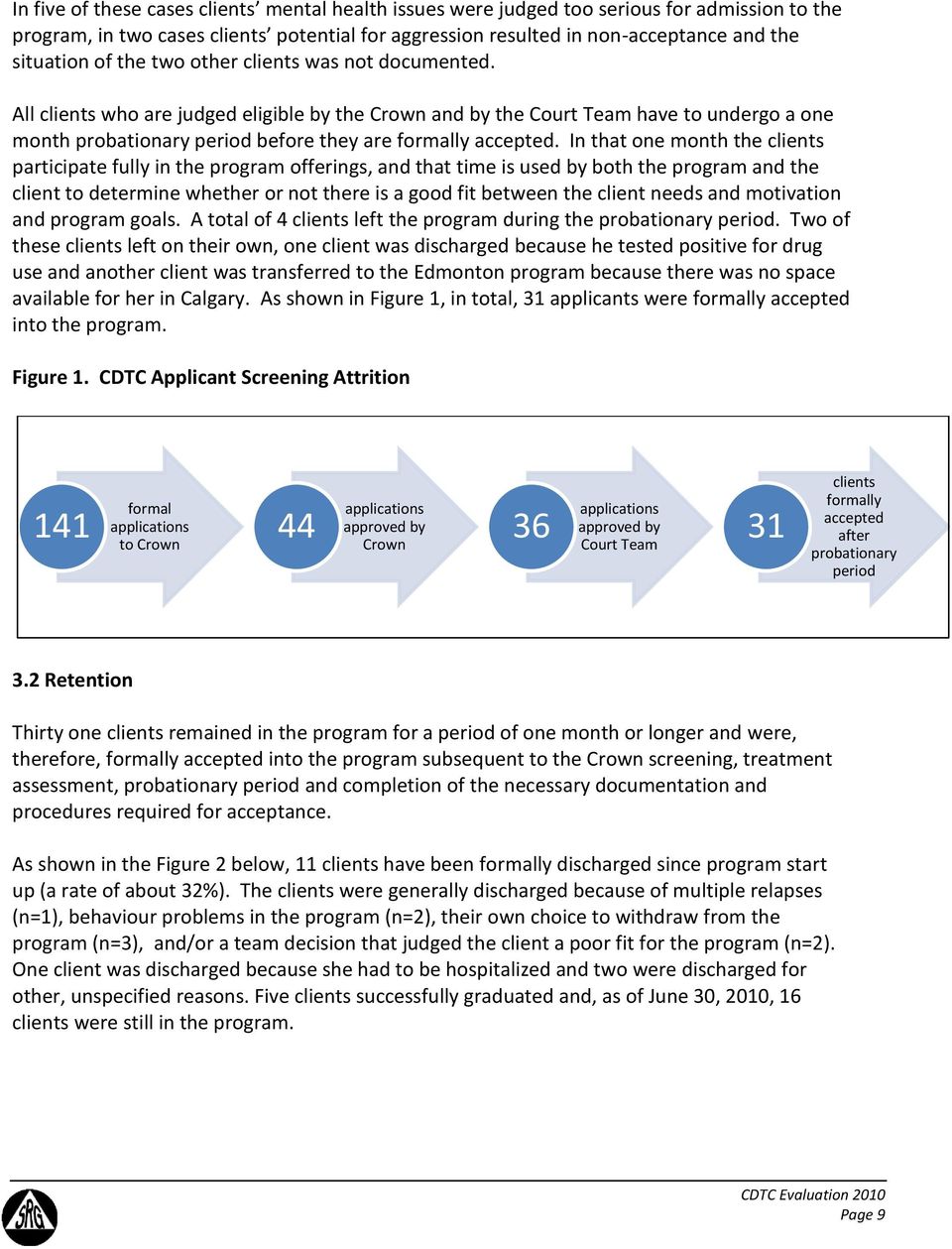
13 Figure 2. Retention Status To-Date Stage I, 4, 13% Graduated, 5, 16% Stage II, 11, 35% Discharged, 11, 36% At the time of this report, there were a total of 21 clients who either graduated or were still in the program (68%). Further review showed that seventeen clients (about 56%) remained in the program for a year or longer and an additional 16% were in the program for a period between 9 months and a year. 3.3 CDTC Retention Rates in Context Efforts were made to compare the CDTC retention rates to the retention rates of other Canadian Drug Courts 4 (Gliksman, Newton-Taylor, Patra, and Rehm, 2004; Edmonton, 2008; Millson, et al, 2005; Gorkoff, Weinrath and Cattini, 2010, Innova Learning, 2004). Unfortunately, this is a daunting task, because of several significant differences among the drug courts: The eligibility criteria for acceptance into the program may be different, resulting in higher graduation rates for courts that accept less complex client groups; The retention data may be based on data collected several years ago or the programs are too new to report on retention; The definitions of graduation vary substantially from court to court. For example, o In some courts, graduation requires a shorter period of sobriety (e.g., 4 months in Winnipeg); o In Regina, a distinction is made between completers (those who are not able to discontinue marijuana use but are otherwise fully compliant) and graduates; in Edmonton there is a difference between graduation with honors and just graduation (i.e., substantial completion), or, in Ottawa, graduation is distinguished from a Level 3 graduation (i.e., someone who s not able to achieve significant period of abstinence but is compliant otherwise). Similar problems exist with definitions of discharges and differences in how discharge decisions are made and recorded. 4 There are six drug court programs in Canada, including those in Toronto, Edmonton, Vancouver, Winnipeg, Ottawa and Regina. Page 10

14 Given the limitations above, it is difficult to determine how CDTC retention rates compare to the retention rates in other Canadian courts. However, even with all those limitations, Calgary s discharge rate of about 32% is much lower than the rates in older courts, specifically Toronto (84%) and Vancouver (51%), and is comparable to the rates in the more recent courts (17% in Winnipeg and 39% in Edmonton). Calgary s graduation rate of 16% is on the higher end of the graduation rates elsewhere that range between 7% and 16%. 3.4 CDTC Screening and Retention Recommendations Efficient movement of offenders through the process measured as reduced time from charge to treatment initiation is one of the CDTC objectives. Presently, there is not a system in place that allows CDTC to measure the time required for screening activities, and, particularly, the time between the initial charge and Crown referral to program. Recommendation 1: Develop a system that allows to accurately measure the time between the original charge and Crown referral. By comparison to other Drug Treatment Courts, CDTC supports a relatively small group of participants. There have been ongoing discussions among CDTC stakeholders whether and how to increase the number of clients taking part in the program. If CDTC chooses to increase the number of participants, then police actions (e.g., operation Endeavour) may represent the most effective methods to do so. Such actions increase the number of applicants and, therefore, the number of participants. Recommendation 2: If CDTC wishes to increase the number of program participants, then it should work with the Calgary Police Services to explore viability of possible police actions. Client retention is often used as an indicator of success in Drug Treatment Courts. However, using this particular measure presents a challenge, partially because it does not provide any information about the actual experience of the participant in the program and also because discharge is not necessarily a sign of program failure. Moreover, substantial differences among Drug Treatment Courts eligibility, graduation and discharge criteria make it difficult to use retention rate as a comparative measure. Recommendation 3: That CDTC and other Drug Treatment Courts consider not using the retention rate as a measure of success and instead focus on other measures such as program engagement, recidivism, drug use and pro-social lifestyle indicators. Page 11


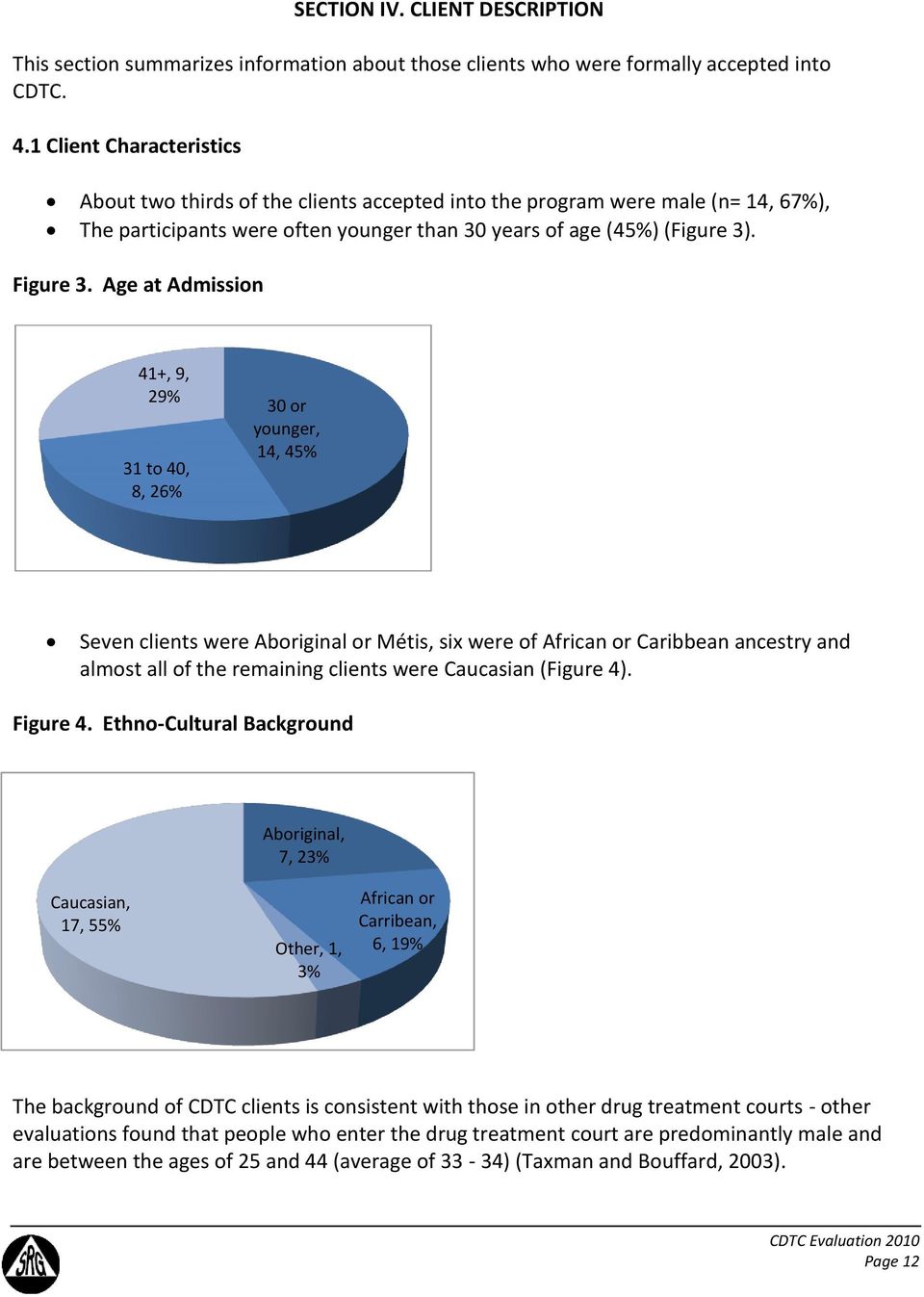
15 SECTION IV. CLIENT DESCRIPTION This section summarizes information about those clients who were formally accepted into CDTC. 4.1 Client Characteristics About two thirds of the clients accepted into the program were male (n= 14, 67%), The participants were often younger than 30 years of age (45%) (Figure 3). Figure 3. Age at Admission 41+, 9, 29% 31 to 40, 8, 26% 30 or younger, 14, 45% Seven clients were Aboriginal or Métis, six were of African or Caribbean ancestry and almost all of the remaining clients were Caucasian (Figure 4). Figure 4. Ethno-Cultural Background Aboriginal, 7, 23% Caucasian, 17, 55% Other, 1, 3% African or Carribean, 6, 19% The background of CDTC clients is consistent with those in other drug treatment courts - other evaluations found that people who enter the drug treatment court are predominantly male and are between the ages of 25 and 44 (average of 33-34) (Taxman and Bouffard, 2003). Page 12
16 Employment, Education, Income and Housing 5 At the time of intake, most CDTC clients were unemployed (76%), over half did not complete high school (56%) and overwhelming majority of those responding (82%) have had an unstable housing history or were living on the street at the time of acceptance into the program. Accordingly, almost all CDTC clients with this information documented earned $15,000 per year or less and at least half of those earned their income illegally. Similarly, the clients in other Canadian drug courts are unskilled or semi-skilled, have some secondary education, and are unemployed or partially employed. Support Less than half of the clients (n=14) indicated that they had someone to whom they could go for support (usually family or friends), only 4 clients indicated that they were in a stable marital relationship and about a third have children. Health Of those clients with information about health, about 61% have had physical health concerns at the time of intake. Those conditions ranged from acute, treatable problems such as dental issues and vision issues, injuries and allergies to serious chronic problems requiring on-going management such as heart problems, Hep C, HIV and chronic pain. Four clients also had mental health concerns such as Post Traumatic Stress Disorder, anxiety and depression for which they were hospitalized at least once in the past. Three clients also had seriously thought about or attempted suicide in the past and about 60% of the clients with this information were taking medication, usually to manage sleep, depression or physical health issues. Two clients were also pregnant at the time of their acceptance into the program. Addictions All clients admitted to CDTC met the DSM criteria for addiction, defined as a maladaptive pattern of substance use leading to clinically significant impairment or distress, as manifested by one or more of the following occurring within a 12-month period : This pattern is further defined as: 1. Recurrent substance use resulting in failure to fulfill major role obligations at work, school or home; 2. Recurrent substance us in situations in which it is physically hazardous (e.g. street living); 3. Recurrent substance-related legal problems; and, 4. Continued substance use despite having persistent or recurrent social or interpersonal problems caused or exacerbated by the effects of the substance. 5 The percentages are out of total clients for whom specific information was available Page 13

17 Congruent with CDTC admission criteria, all clients were addicted to either methamphetamine, cocaine, heroin, or another opiate. Figure 5 provides information about the clients drugs of choice. Most clients who answered this question were addicted to cocaine and often described multiple drug use generally a combination of cocaine and marijuana or cocaine and alcohol. There were several clients who also used methamphetamine (n=5), heroin (n=3) or prescription drugs (n=2). Figure 5. Participants Drugs of Choice Prescription Methamphetamine Marijuana Cocaine Number of Clients Using Prior to Admission For most clients these addictions were long-standing. Among those whose age at first use was known, 86% began using when they were 18 years of age or earlier. These results were similar to demographics of the clients in other Canadian courts where clients are, on average 18 years of age at their first drug use, and identify cocaine as their primary substance abuse problem. Some clients also described history of substance abuse among their family members and two female clients had a history of physical or sexual abuse. Personality Assessment Information obtained from the assessment process is used to inform case management and court team recommendations, to inform treatment and selection of the most appropriate treatment site, and for purposes of CDTC program evaluation. The applicants accepted by the Crown complete a Treatment Assessment Form, which contains detailed information about applicant s background and drug use history. Personality Assessment Inventory (PAI) is also used to determine client eligibility. The PAI is a self-administered, objective inventory of adult personality designed to determine if certain problems are clinically significant when compared to normative and clinical populations. 6 6 The PAI contains 344 items, and helps identify clients whose mental health concerns are more serious than what can be managed in the program. Scores of 70 and above indicate the presence of significant concerns in that area. Scores at or above 96 are associated with an extreme degree of problem. Page 14

18 AGG ALC ANT ANX ARD BOR DRG PAR SCZ SOM DEP MAN SUI STR NON RXR DOM WRM Median T-Score The PAI results suggest that, for most CDTC clients, drug addiction is a form of self-medication for various mental health issues including anxiety, depression, stress, shame, interpersonal problems as well as the post-traumatic stress disorder associated with long-standing history of abuse (Figure 6). The PAI also showed that some clients experienced other types of disorders (e.g., anti-social and borderline personality traits). 7 Figure 6. Personality Assessment Inventory Results Previous Treatment At least 54% of the clients had attempted to address their addiction problems prior to their admission to the Drug Treatment Court Program and almost all of these were residential treatment options. Such treatment options included Calgary Dream Centre (n=13), NA, AA or CA (n=7), and other services such as AADAC (e.g., Henwood Treatment Centre), Action North Recovery Centre, South Country Recovery Centre, Salvation Army Centre of Hope, Aventa, Crossroads Addictions Services, Fresh Start, Renaissance, and Sunrise Native Addiction Services. 4.2 Client Characteristics and Retention There are some trends indicating interaction between client retention and some client characteristics. These characteristics include client age, client gender and client ethnocultural background. For the purposes of this comparison, clients were divided into two groups in accordance with their current status in program: 1) Discharged: including clients who were accepted and who remained in the program for a period of one month or longer; and,2) Graduated/In Treatment long-term: those clients who have been accepted into the program, remained in program for a long-term period (Stage II in program for 300 days or longer) and have not been discharged. 7 Note that median scores obscure the actual scores. In general, the chart shows that most clients have a significant elevations on Alcohol (ALC), Anti-social (ANT), Borderline (BOR), Drug (DRG), and Stress (STR) sub-scales. Page 15


19 As shown in Figure 7, female clients are more likely to graduate or remain in the program for a long period of time without being discharged (71% graduate or remain in the program over a long term as compared to 50% of male clients). There has been an improvement of retention of female clients since the last evaluation report, likely due to the ability of the Youville program to provide separate housing for the CDTC clients. Figure 7. Retention and Gender 80% 60% 40% 20% 0% Female Discharged Male Graduated or Long- Term As shown in Figure 8 below, visible minority clients are the most likely group to be discharged early (57% as compared to 40% and 39% of the other groups). Caucasian clients are also more likely to graduate or remain in the program for a long period of time (62% as compared to 60% and 43% of the other ethno-cultural groups). Figure 8. Retention and Ethno-Cultural Background 70% 60% 50% 40% 30% 20% 10% 0% Caucasian Aboriginal Visible Minority Discharged Graduated or Long- Term As shown in the chart below, youngest clients (30 or younger) are less likely to graduate or remain in the program for a long period of time as compared to the oldest clients (41 or older) or the 31 to 40 age group (10%, 86% and 87% respectively) (Figure 9). These results are consistent with evaluations of other drug courts where younger clients present challenges for the drug court programs, both in terms of retention and treatment (Patra, 2007). Younger male clients also bring more behavioural and developmental problems that can be more difficult to manage in residential treatment settings. Page 16
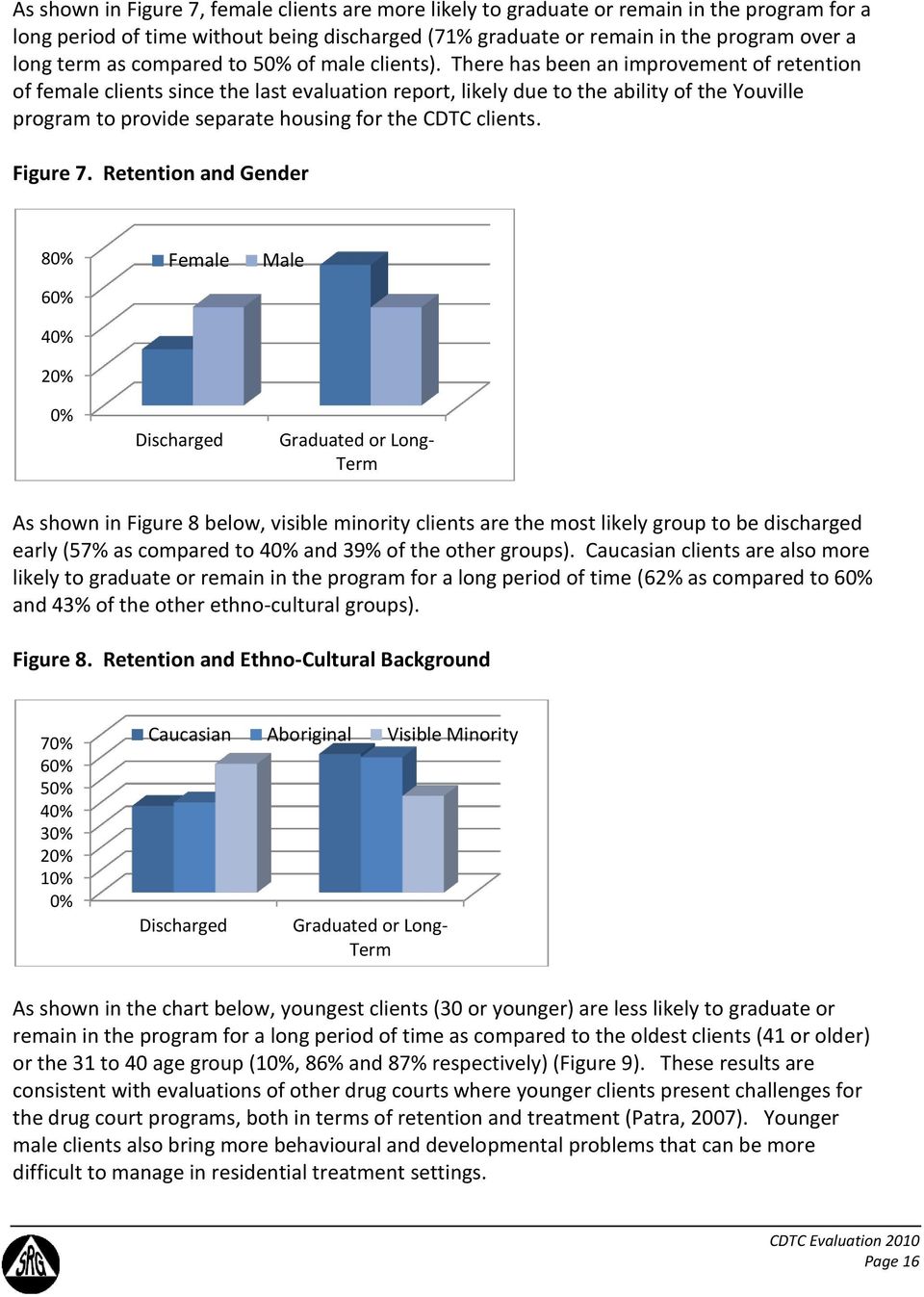

20 Figure 9. Retention and Age 100% 80% 60% 40% 20% 0% Discharged 30 or younger 31 to Graduated or Long- Term 4.3 Client Description - Recommendations The CDTC client population is consistent with the high needs, high risk group that Marlow (2010) suggests drug courts should target. According to Marlow, the clients represent a good fit for the Drug Treatment Courts if they are: Younger Previously failed treatment Drug dependent or addicted Unemployed Homeless With chronic medical conditions Diagnosed with antisocial personality disorder With more prior felony convictions Clients with multiple and complex array of issues over and above their addictions require intensive services and supports, lower case load sizes and involvement of multiple disciplines. Recommendation 4. Any future expansion of the CDTC program that takes place should ensure that the clients still continue to receive adequate individual attention and support. As noted above, there has been an improvement in retention of female clients since the last evaluation report and this improvement has been attributed to the ability of the Youville program to provide separate housing for the CDTC clients. Participant and stakeholder feedback summarized later in this document also suggests that separation of the CDTC population from the other clients in the treatment facility is advisable. In this way unique considerations and requirements of the CDTC program, such as court attendance and response to relapse can be consistently addressed. Page 17

21 Recommendation 5. Where possible, develop a program for CDTC clients that is separated physically from the other programs and clients in the treatment facility to minimize perceptions of unfairness, to consistently meet CDTC program expectations and to allow for additional intervention. Clients who are 30 years of age or younger are more likely to be discharged but less likely to graduate or stay in the program for a year or longer than the clients who are 31 years of age or older. Because they are younger, those clients tend to be more impulsive, reckless and physically restless. They are also more likely to have interpersonal problems, anger management problems and repeated self-destructive behaviours. Recommendation 6. Ensure programming reflects the needs of younger clients (i.e., more structure, physical activity and attention to relationship issues). Recommendation 7. Ensure that discharge decisions are not solely based on lack of maturity, lack of personal skills and issues with authority that often arise for younger clients. Almost half of the CDTC participants are either Aboriginal or have a visible minority background. For both of these groups success in the program depends in part on the effective integration of culturally-appropriate treatment and court procedures. Recommendation 8. Consider adding to a treatment roster addiction programs that specifically target Aboriginal or immigrant clients. Page 18
22 SECTION V. PROGRAM OUTCOMES The CDTC program seeks to accomplish several outcomes for its clients, for the service providers who are involved with the program and for the community as a whole. Service provider outcomes, including enhanced collaboration and communication as well as the enhanced knowledge of court processes and issues are discussed in Section VIII. Social Return on Investment analysis is discussed in Section VI. This section summarizes the information measuring the pro-social lifestyle indicators as well as participant behavior, relapse and recidivism outcomes. 5.1 Pro-Social Lifestyle Indicator Pro-social lifestyle indicator measures were: ability to secure and maintain affordable housing, ability to secure employment or upgrading and strengthened informal supports. CDTC started collecting this information recently so it is only available for some of the clients. Thirteen clients (including 3 graduates, one discharged client and 9 Stage II clients) obtained employment while they were receiving CDTC services. Six clients have changed their jobs at least once while still in program, and three of them changed their jobs at least twice (see some of the employment-related challenges described in the Section VII Participant Interviews). Note, however, that with some minor exceptions, all of these clients have been long-term unemployed at the time of their arrest and acceptance into the program. Nine clients (five Stage II clients, three graduates and one discharged client) were assisted by the program to address their health needs. Most of these clients neglected their health needs for a long period of time. The supports provided by CDTC and/or treatment facility staff included linkages with dentists for dental work or surgery, accompaniment to the hospital emergency room for pain or injuries, support with medication management, or assistance addressing pregnancy-related complications. Fourteen clients have been able to reconnect with positive sources of support over the course of their stay with the program. Seven of these clients were able to reconnect with multiple sources of support, which most often included family members (e.g., mother, siblings, children) and, in some cases girlfriends or boyfriends. Most CDTC clients have not been in contact with their families or friends for over 10 years. It is now a requirement for program graduation that the clients get connected with a sponsor to support them in their recovery process. All current Stage II clients were able to do so as well as 2 graduates and 1 discharged client. Page 19

23 Average Number of Incidents per Month 5.2 Relapse and Behavioral Incidents while in Program When in the program, the clients were expected to follow the rules of each treatment facility, demonstrate positive attitude, actively participate in treatment options, remain in the treatment facility unless provided permission to leave and to abstain from drug and alcohol use. Non-compliance with rules or program expectations resulted in various sanctions. More serious incidents that were generally associated with a positive drug test, criminal charges and leaving the facility without permission often resulted in Remand placement. Behavioral incidents such as altercations with other residents, concerns about client s attitude, disobeying outings procedures, staying in bed after wake up, smoking in the room, missing appointments, being in possession of a cell phone, or missing chapel and chores may result in lighter sanctions such as removal of reward buckets during court, or a requirement to write a letter of apology, although in some of these cases resulted in a Remand placement as well. Figure 10 compares the average number of relapse and behavioral incidents of the discharged and graduated clients. Discharged clients had more behavioral than relapse incidents, while the reverse was true for the graduates. On the overall, higher number of incidents both behavioral and relapse are predictive of program discharge. Figure 10. Types of Incidents and Retention 0.25 Behavioural Incident 0.2 Relapse Discharged Graduated The length of time sober (as measured by the absence of positive drug tests or self-reported drug use) was tracked for 14 clients. On average, Stage I clients have been sober for about 120 days and Stage II clients have been sober for a total of 300 days. Over half of the Stage II clients (6 of 11) have been sober for over a year. Page 20
24 In cases of clients who have demonstrated long-term program engagement, the length of time between relapses increased and the nature of those relapses changed (e.g., including shorter AWOL periods and incidents that are less serious in nature). Notably, in the year prior to their admission to the program all of these clients might have been sober for much shorter periods, likely consisting of a few days at a time. 5.3 Recidivism An application was submitted and permission was obtained to gain access to the Alberta Justice Department for information describing criminal involvement of the CDTC clients. The information was collected for a total of 15 clients who attended the program between October 2007 and June The characteristics of those clients were comparable to the overall CDTC client group and included: 12 males and 3 females; 5 clients of African heritage and 2 Aboriginal clients; 8 clients 30 years of age or younger, 3 aged 31 to 40 and 4 aged 41 or older; 5 graduates and 10 discharged clients; and, 8 clients who remained in program for a year or longer, three clients who were in the program for a period of 9 to 10 months and the remaining four clients who were in the program for a period ranging between 3 and 5 months. Recidivism information included all charges and convictions related to the incidents that took place in three time periods: 1) in the year prior to program admission; 2) during the client s program participation; and, 3) a year after program graduation or discharge or before June 30 th 2010, whichever came first. For simplicity the analysis focused on charges only. The charges were divided into 2 types: 1. Type I charges were those resulting from breaches of conditions that did not involve active participation in criminal behavior but were rather issues of attendance or rule compliance (e.g., not attending counseling, not attending court, residing at a particular residence, failure to report to a Probation Officer, failure to carry a release document, failure to attend for fingerprints, etc). 2. Type II charges were those that resulted from active involvement in crime (e.g., trafficking, possession for the purpose of trafficking, property damage, tempering with a motor vehicle, weapons charges, theft, robbery and assault). Figure 11 illustrates the frequency of Type I and Type II incidents for 5 graduates. 8 Both types of the incidents have decreased substantially for almost all graduates when pre-program and in-program year were compared. The opposite trend, where the number of post-program incidents was higher than the number of pre-program incidents, was true for only 1 of 5 graduates (see Client D, Type II incidents). 8 *denotes less than 3 months between conclusion of program and June 2010 ; (j) denotes that the participant was jailed for some period of time after program completion and, therefore, their number of incidents post program could not be provided Page 21

25 Figure 11. Type I and Type II Incidents Graduates Number Type I Incidents Pre-Program In Program Post-Program 0 Client A* Client B* Client C (j) Client D Client E Number Type II Incidents Pre-Program In Program Post-Program 0 Client A* Client B* Client C (j) Client D Client E Figure 12 illustrates the frequency of Type I and Type II incidents for 10 discharged clients. The pattern of Type I incidents was different with the discharged clients than with the graduates. That is, there was not a consistent decrease for all clients from pre-program to in-program period. While there appeared to be a significant decrease in the number of incidents for three of the discharged clients, there was no change observed for two clients and the remaining four discharged clients had more Type I incidents while in-program than they did in the pre-program year. However, even for discharged clients there was a consistent decrease in the number of Type II incidents when the pre-program and in-program time periods were compared. In the similar fashion as with the graduates, those discharged clients for whom post program information was available, showed a substantially lower number of incidents when pre and post program year were compared. Page 22

26 Figure 12. Type I and Type II Incidents Discharged Clients Number of Type I Incidents Pre-Program In Program Post-Program 0 Client F (j) Client G Client H* Client I Client J* Client K Client L (j) Client M (j) Client N (j) Client O (j) Number of Type II Incidents Pre-Program In Program Post-Program 0 Client F (j) Client G Client H* Client I Client J* Client K Client L (j) Client M (j) Client N (j) Client O (j) 5.4 Program Outcomes - Recommendations The recidivism analysis demonstrated that CDTC program leads to a reduction in criminal behaviour associated with drug use such as theft, assault and trafficking. This result is particularly consistent for CDTC graduates, but is also true for some of the discharged clients, particularly those who appear to have been more engaged with the program, as demonstrated by length of time sober, but also longer program stays and positive attitudes towards program participation. Recommendation 9. In order to more fully understand and describe the impact of the CDTC and the experience of different client groups in the program, CDTC should distinguish those discharged clients who have never been engaged with the program from those who were discharged subsequent to a period of substantial program engagement. Page 23
27 Conclusive recidivism analysis is only possible with continued and long-term access to recidivism information. Recommendation 10. Develop a strategy to gain continued access to information describing participants criminal involvement before, during and after program completion. Information that is currently collected describing CDTC outcomes does not include treatment indicators such as knowledge about substance abuse and drug avoidance skills as well as wellbeing indicators such as enhanced self-esteem, mental and physical health and enhanced social skills. The specific definition of those outcomes and indicators as well as the relevant tools and measures would need to be developed collaboratively with the treatment providers. Recommendation 11. Discuss with the CDTC treatment providers the possibility of measuring treatment indicators. Page 24
28 SECTION VI. SOCIAL RETURN ON INVESTMENT The social return on investment (SROI) methodology is a principles-based approach that values change for people and the environment that would otherwise not be valued. It assigns monetary value to traditionally non-valued things such as the environment and social value (The City of Calgary, 2011). In addition to information that has already been provided in this report (e.g., project description and the logic model), the components of the SROI usually include a Theory of Change and monetizing the change using financial proxies. Two SROI reports were produced for the purposes of this evaluation an SROI monetizing the change resulting from the overall CDTC program and an SROI focusing specifically on the CDTC Employment program. Information from both of those reports is briefly summarized below. 6.1 Overall CDTC SROI Theory of Change If repeat, chronic untreated addicts who commit non-violent crimes to support their habits, participate in a multi-disciplined, intensively supervised court/treatment program, than they are less likely to use drugs and reoffend. Program Benefit Cost reallocation within the justice system and as specifically related to the work of the police, probation, legal aid, and court; Reduction in incarceration as well as the cost of property that is stolen to support the addiction; and, Reduction in the costs of addiction-driven crime. The SROI ratios in this document will likely be an underestimation of the overall program benefit. The full SROI that will be done in the subsequent evaluation phase will also include indicators related to utilization of health system, housing, and client stability indicators (e.g., productive employment). Addition, in future SROI work, of those other indicators, will increase the SROI ratio, likely demonstrating higher benefits and savings to the society. Cost of Delivering CDTC Program In-kind costs including the Judge, court clerk, security, facility, legal aid or duty counsel, the work of the Crown prosecutor, probation and the work of the assigned police officer; CDTC budget that includes staffing, operation and office costs, evaluation costs as well as treatment and housing costs associated with the first phase of the program; Temporary stays in Remand that occur for CDTC clients most often as a result of a positive drug test or other transgressions that break the rules of the treatment facility; and, Page 25
29 Probation services that are provided after the program conclusion as part of the standard procedure associated with final sentencing. SROI Snapshot: 11 Graduates and 7 Discharges A total of 18 clients were served in 2009 by CDTC. Of these, 2 clients have already graduated, 9 were in Stage II and 7 were discharged. Based on the history of the 9 clients currently in Stage II, they are all expected to graduate and 7 of them are expected to do so without any associated in-program Remand stays. Table 1 below also calculates costs and benefits for a total of 7 clients who have been discharged from the program and subsequently incarcerated. The SROI ratio for this group is $1:$4.03. That is, for every dollar spent $4.04 are created in savings to the community. Table 1. Social Value Calculations: Two Year, 11 Graduates and 7 Discharges Total Year One Year 2 Total Two Year In Kind Funds $235, $41, Investment/ $277, Benefit Actual Budget Funds $366, $63, $429, In-Program Remand Stay $32, $0.00 $32, Probation post program $0.00 $ $ Total Program Cost/Investment $634, $105, $739, Provincial Court costs $121, $77, $198, Incarceration $243, $116, $359, Property Crime $1,894, $1,894, $3,788, Police Investigations 0 $84, $84, Total for Modesty of Claim (16% of Benefit) Total Benefit Created $2,258, $2,087, $4,429, $708, Actual Program Benefit $3,720, Net Benefit (Actual Benefit minus $2,981, Investment) SROI Ratio (Net Benefit/Total Cost) $ CDTC Employment Program SROI Theory of Change If repeat, chronic untreated addicts who commit non-violent crimes to support their habits, participate in an employment program that is a component of a larger, multi-disciplined, intensively supervised court/treatment program, then they are more likely to become economically self-sustaining. Page 26
30 Program and Client Description The CDTC Employment program was designed to provide safe and supervised employment to participants who successfully completed Stage 1 of the program and who were ready to begin employment. The program was designed recognizing that most of the participants accepted into drug court had little if any, legal employment histories. Given such histories and criminal records they would have a difficult time obtaining employment that was safe and that also respected the restrictions that being in program had, specifically, weekly court appearances and the need to have all employment prescreened and approved by the Court Team. The Employment Program was designed to provide an opportunity of working with a program friendly employer, for whom placement would be automatically approved if a participant wanted it. The Employment Program was also designed to teach participants some basic employment skills, such as submitting a resume, meeting to discuss the employment, showing up on time, calling in if sick, giving notice when leaving a job, etc. It is the expectation of CDTC graduation that the participant will be working and be able to support him or herself, be in school or be parenting a young child full time. Scope of this Social Return on Investment Analysis The costs and benefits that are calculated here are limited to those specific to the employment program only. They do not include proxies related to criminal justice costs that are outlined in detail in the overall program SROI and, instead, focus on the stability-related proxies, such as income, housing and health that are expected as a result of the clients participation in the Employment Program. The Employment Program started at the beginning of 2010, and the SROI is based on the seven (7) clients participating in the program over the course of the 2010 calendar year. Employment Program Benefit Increased Income Increased taxes paid Reallocated health costs Reduced shelter costs Costs of Delivering Employment Program Actual CDTC budget for this program includes portions of the staffing costs (i.e., the Executive Director, Administrative Assistant, a part time Treatment Supervisor, and a Case Manager), plus some allocations from the overall CDTC budget to support additional Executive Director time for this program. Page 27
31 SROI Snapshot: 3 successful and 4 partially successful graduates Table 2 below outlines the costs and benefits created by the program for all 7 participants. The overall SROI ratio is $1:$2:19. That is, for every dollar spent on the program, $ 2.19 is created in savings to the community. Table 2. Social Value Calculations: Employment Program Employment Program Post CDTC Graduation Year Two Year Social Value Program Budget 96, , Health Care Costs 2, , , Subsidized Housing Rent Supplement 17, , , Total Program Cost/Investment 115, , , Increased Income 77, , , Increased Taxes Paid , , Reduced Health Costs 19, , , Alberta Health Care payment 10, , , Reduced Shelter Costs 88, , , Total Benefit Created 196, , , Total for Modesty of Claim (16% of Benefit) 89, Actual Program Benefit 470, Net Benefit (Actual Benefit minus 322, Investment) SROI Ratio (Net Benefit/Total Cost) Social Return on Investment Recommendations The SROI ratios in this document are likely be an underestimation of the overall costs saved. A full SROI is required to include indicators related to utilization of health system, housing, and client stability indicators. The full SROI should also integrate information from the employment program and be updated to reflect more recent client information. Recommendation 12. Develop a full SROI inclusive of all CDTC programs, possible indicators and most recent client information. Page 28
32 SECTION VII. PARTICIPANT INTERVIEW SUMMARY A total of 19 clients were interviewed for this report. Only clients who have been in program for at least 3 months were selected, so that they would have sufficient information to share about their experiences in the program. All groups of clients were interviewed, including both discharged clients, clients who graduated and clients still in program. Clients who did not participate in the interviews were either in the program for a very short time (n=4) or were no longer with the program and could not be located this included 2 graduates and 4 discharged clients. Most of the clients who could not be located were early CDTC clients (all but one of these clients started the program in 2007 or 2008). Five clients were discharged, three graduated and the remaining 11 clients were in CDTC Stage 2 at the time of the interview. At least 8 of these clients have had relapses since they were accepted into CDTC. The participants also have experienced all of the CDTC treatment options, and, in 4 cases, have resided in multiple treatment agencies. The agencies included Dream Centre (n=12), Fresh Start (n=6), Youville (n=5), Salvation Army (n=1) and Aventa (n=1). The interview sample also included both younger and older client age groups 7 clients were 30 years of age or younger, 7 clients were between 31 and 40 years of age and the remaining 5 clients were 41 years of age or older. Men and women were also represented proportionally to the overall client group: 5 females and 14 males were interviewed. Finally, the sample included both Aboriginal (n=3) and African or Caribbean clients (n=3). All of these interviews were held face-to-face in spring and summer of 2010 and all of the clients and the former clients signed consent forms and were fully cooperative with the interview. The information obtained from the client interviews was thematically analyzed and the analysis is summarized below, exemplifying the clients descriptions of their experiences in the program, their struggles, their successes and their suggestions. 7.1 Important CDTC Supports With some minor exceptions (generally related to those clients who were discharged or in Remand at the time of the interview), the overall experience of the clients in the program has been very positive. They often described CDTC as having provided support, help with overcoming addiction and other problems. Even those who have experienced multiple relapses saw the program in a positive way and were very grateful to the program staff for their patience in dealing with and understanding that someone who has been an addict for as long as he has is not going to succeed quickly. Page 29
33 Clients identified several program elements that have been most helpful to them: The weekly court sessions and the drug testing were described as valuable by almost all respondents. The drug testing and court appearances helped hold participants accountable for their actions, and court sessions also provided an opportunity to share accomplishments, stay grounded, get support and get new ideas. Clients have often talked about strong connections they have made with the CDTC judge. In addition to the court/accountability element of the program the clients also described positively the overall program length, the importance of the first phase of treatment, the need to go slow, the requirement for escort from Remand to the treatment facility site, and a need for a careful transition from one stage to another in recovery. The clients also appreciate the support that they received from the program staff, court team and the treatment agencies. They talked about how each member of the court team has been helpful, available, caring, accepting and genuinely concerned about the clients. Connections with others experiencing similar issues were also identified as very important. In most cases those connections were made in the course of the 12-step meetings. 7.2 Important Treatment Supports In general, the clients described the treatment options in a positive way, although there were some reservations, particularly about treatment options that are no longer part of the CDC treatment roster. They also commented about some important program elements, as listed below: Addiction treatment was judged as essential by many clients. In most cases those were 12-step programs or 16-step program for women, that included emotional, physical, spiritual and empowerment focus as well as linkages with a sponsor. Others talked about the value of the addictive thinking and cognitive skills development courses provided by the CDTC Clinical Director as well as the relapse prevention courses. In addition to services focused specifically on addictions, clients also received individual counseling that helped them address related issues such as past abuse, anger management, selfesteem and life skills. Most clients also described the support they received to address their health issues that often included dental care and assistance or support to access treatment for pregnancy care or for chronic health problems such as HIV, HEP C, high blood pressure, etc. All clients talked about importance of the support they received for their educational and employment goals. As a result of their participation in the program a number of clients began and/or completed their educational upgrading, are starting a business or have developed a plan to pursue further education or establish a career. Over half of the interview participants also described the support they received from the treatment facilities in helping them reconnect with their families. In most of these cases the clients have not seen their family members for an extended period of time. Other treatment supports that clients described as important included spiritual support, financial support, volunteer opportunities, connections to other community resources, supervision and escort when needed for community appointments, housing and connections to Elders. Page 30
34 7.3 Issues and Concerns About half of the clients identified some things they did not like about the program. Some of them talked about inconsistency or lack of clarity in the decisions made by CDTC as being an impediment to their success. In some cases this was a result of different expectations for CDTC clients as compared to the other clients in a particular treatment facility. Clients also thought that CDTC focused too much on what the clients were doing wrong and not enough on what they were doing right. Some examples of behaviours that were considered wrong by the program included having a visitor that had not been approved by the team, missing chores, or getting into a verbal argument with other residents. Often times the clients thought that their behaviour was an improvement over what they would have done in the past and thought that Remand was an inappropriate sanction for such behaviours because it would actually result in relapses or further exacerbation of problems. Seven clients talked about having relapses while in the program and described circumstances surrounding those relapses. In some cases relapses occurred after the conclusion of the treatment phase and when the client moved into the community phase. There also seemed to be association between relapses and inactivity, worries about finding work, being reprimanded or incidences with family members or friends. 7.4 Program Impact All clients, including those who were discharged, those who had relapses and those who stayed in Remand during their program tenure, described ways in which the program was of benefit to them. For most clients being clean and staying clean even for a relatively short time was a sign of success. Other areas of impact included: Opportunity to reconnect with their family and other supportive people in their lives; Increased self-awareness, ultimately resulting in a sense of acceptance and forgiveness; Profound personal changes clients described themselves as a completely different person. Even though they recognize that they will still face challenges, several clients appear to be determined to have and maintain a new life without addictions; Opportunity to give back to the community, to the people who have helped them and to others who might be dealing with similar issues; and, Increased stability, as defined by improved life skills, obtaining stable housing, or opportunity to upgrade or re-build a career. Page 31
35 7.5 Clients Suggestions for the Program Most clients commented about the issue of sanctions and rewards and their use in some treatment facilities as well as by the CDTC Court Team. There were a number of different opinions expressed: some suggested that everyone who relapses should go to Remand. Others thought that alternatives to Remand were required for less serious relapses and suggested that there should be some kind of warning before clients get send to Remand or a more gradual transition from more to less restrictive environment. There was generally consensus, however, that that there should be more consistency in dealing with relapses. There were also several suggestions about the support the program could provide to clients who wish to return to work. Some of the barriers that clients thought should be addressed were having to appear in court every week, the program taking too long to approve an employment offer, having to accept a job one does not like, need for financial support to get started and, in general, not being allowed to look for a job as soon as possible. The challenges associated with inactivity were also reflected in the respondents suggestions that more activities be available in the treatment centres. Those included field trips, opportunity for physical exercise and other fun things to do. As noted earlier in this section, many clients appreciated the opportunity to access 12-step and AA or NA meetings. Some, however, would have also welcomed an opportunity to choose from several other options or alternatives to the 12-step approach. Related to this was a suggestion from one client to make available options to practice different religions or spirituality. Some clients identified a need for follow-up after program completion to ensure that the graduates have the support they need (from the perspectives of accountability, support and service) to ensure continued success. 7.6 Participant Interviews - Recommendations CDTC treatment facilities follow a zero tolerance rule, which means that any use of drugs or alcohol will result in removal from the facility for a period from two weeks to 30 days. In some cases a removal from the facility is also used as a sanction for inappropriate behaviour and noncompliance with rules or expectations. At present, the only option for CDTC clients who are temporarily removed from the facility is a return to jail. Although return to jail may help reduce the risk for the community, it is often counterproductive from the point of client s recovery and goal achievement. Recommendation 13. Resources permitting, an alternative to Remand needs to be put in place to accommodate sanctions that require clients to be temporarily removed from a treatment facility. Page 32
36 The interviews with the clients as well as other information in the evaluation supports the notion that the period immediately following graduating is the most challenging for the clients from the perspective of ensuring continued sobriety and overall improvement. At present all CDTC supports discontinue at the time of graduation. Recommendation 14. CDTC may consider establishing a group for CDTC graduates to provide an opportunity for the program alumni to stay connected and receive supports or referrals to ensure continued success. Having too much free time and not being able to return to work as soon as possible represented another relapse trigger. CDTC addressed this issue by starting a new program that links Stage II program participants with employment opportunities. Recommendation 15. (Pending positive outcomes) CDTC employment program is an important addition to the program service roster and should continue. The information gathered from client interviews has proven to be extremely valuable from the perspective of identifying program elements that work well and those that could be improved. However, it is not possible, resource-wise, for the program to undertake this exercise every year. Instead, CDTC could consider holding interviews with every client who leaves the program. Recommendation 16. Establish a process to undertake Exit interviews with clients who are discharged or who graduate. Page 33
37 SECTION VIII. STAKEHOLDER INTERVIEW SUMMARY The interviews included a total of 15 stakeholders, representing the Court Judge, CDTC staff including Executive Director, Clinical Director and Case Manager, the Court Team members including Probation, Duty Council, Federal and Provincial Crown and Police, and representatives of three treatment facilities - Fresh Start, Youville and Dream Centre. In general, the respondents agree that CDTC is very valuable to the community and the clients that it serves. Overall, the impression from the interviews with all participants, including clients was that the court is an effective intervention that should be encouraged. There is also a great deal of commitment and investment among the stakeholders to making sure that the program is the best that it can be and in seeing it succeed. They note both the emerging successes ( The whole process, the whole idea of the drug court team, has grown leaps and bounds ) and identify areas for improvement (e.g., role clarification, program expansion). The interview notes were sorted to categorize them by content area and are reported separately below for each content grouping. 8.1 Team Relationship and Developing a Common Understanding Stakeholder comments suggested that the effectiveness of the Court Team has grown substantially over time. The major contributions to this included the effort by the team members to use a consultative process, the visit to Betty Ford Centre, and other activities such as monthly team lunches, and the day retreats including the Board members. According to many respondents, shared understanding of addiction and recovery that occurred as a result of the Betty Ford retreat was particularly valuable in building relationship among team members. However, there is not always consistent agreement on the role and purpose of sanctions as a component of recovery among all CDTC stakeholders nor is there always a consensus with regards to screening and reinstatement decisions. Effectively addressing disagreements and conflict among the team members is crucial. Unresolved conflict can impact the ability of the team to function effectively, the ability of the treatment facilities to deliver needed services and, may ultimately negatively impact the clients and their success in the program. Open and transparent discussion of issues, willingness to be flexible, spending the time to understand client histories, team bonding activities and coordination of decisions through the Executive Director were some recommendations from the respondents to help address conflict and disagreements. 8.2 Roles of the CDTC Stakeholders Respondents talked about the importance of establishing role clarity for all CDTC stakeholders. CDTC is different from the standard courts or even other problem-solving courts and some flexibility is required in traditional role definitions, particularly in regards to selections of sanctions for client behaviour. If this is not clear at the start, problems may result at all levels of program functioning. Page 34
38 Many interview participants talked about the necessity of orientation to the program when the new members join, that includes review of relevant materials. Such a process has, in fact, been recently implemented. Personality fit is also important for effective team functioning. The respondents described specifically the roles of various program stakeholders, and, in some cases, described how those roles have changed or made suggestions about how they should change. Note that there were no specific comments with regards to the roles of the Judge or the Executive Director. Role of the Police investigation and enforcement. The role of the police has changed substantially over the course of the last year. The police involvement has been reduced both in the amount of time allocated, but also in the role of the police on the team and level of authority within the police department that is represented. It is possible that the reduction in the role was due to a perception that the police were not consulted sufficiently when it came to admission or reinstatement decisions. Role of Probation community safety, supervision and compliance. The role of probation has also changed over the last year, as the expectations for the role became clearer. While the Probation Officer is still expected to follow the usual probation expectations with regards to community safety, supervision and client compliance with court orders, a certain amount of flexibility is required in working with the court team and making joint decisions, particularly about client rehabilitation and breaches. Role of the Crown Prosecutor screening and reinstatement decisions, representation in Court. Both Federal and Provincial Crown are represented on the CDTC. Although CDTC was originally the initiative of the Federal government, Provincial Crown came on board with recognition that, in addition to committing crimes contrary to the Narcotics Control Act, the addicts were also committing other types of crime. The CDTC Crown has veto over the screening and reinstatement decisions and represents the government in Court. The current tensions in the role of the Crown are primarily due to the shortage of staff in both Crown s offices, need to educate the justice system about the program, need for more support to inform screening decisions and timely access to police checks. Role of Duty Counsel representation of client in Court, general client support. In addition to the usual elements of the Duty Council work of client consultation and advise, the current Duty Council also makes himself available to the client on a 24/7 basis and assists clients with a range of requirements (e.g., employment, reinstatement applications, etc.). Some of the current challenges in the role include reduced Council role in court as compared to the traditional role and the timing of sharing with clients the decisions that are made on their behalf in the court team. Role of the Clinical Director/Treatment Specialist client assessment and recovery. Ideally, the role of the Clinical Director is to supervise case managers, to implement client assessment, to provide recommendations for client treatment and to deliver proven clinical interventions to address client addiction concerns. The challenges in this role were due to lack of clarity in the role description and having to expand the role due to the shortage of funding (i.e., to include case management of female clients, urine tests, being on-call in case of crisis, covering for the ED and educating the Court Team). Page 35
39 Role of Case Manager/Treatment Coordinator reporting, client liaison, assessment. The primary function of the case manager is to maintain regular contact with clients, to support their progress in the program, to document all relevant client information and to share this information with the court team. The program now has a new case manager - a result of recognition of the importance of the professional education and experience to this position and that a female case manager is needed to support female clients in the CDTC. Supervisory position to support the case manager is important and may need to be defined further. Role of the Treatment Agencies provision of residential treatment and support. Initially the treatment representatives attended the weekly court team meetings, however, this proved to be an unnecessary use of their time. Now they meet with the rest of the team once per month to discuss issues that are particularly relevant to them and the clients in their facilities. It is the responsibility of the case manager to ensure that linkages are made on the regular basis between the treatment providers and the other CDTC stakeholders. Shortage of resources (to support housing in the community phase, to provide clinical treatment etc.,), and, particularly for Youville, a low number of females that apply represent primary challenges for those service providers. 8.3 Treatment Considerations CDTC stakeholders recognize the importance of developing and maintaining a strong relationship with the program treatment providers. Personal connections, formal agreements (i.e., MOUs) and willingness to be flexible helped develop a common vision and, ultimately, have a positive impact on the quality of treatment that clients receive. Differences between treatment agencies are often beneficial their unique approaches help address individual client needs (e.g., spiritual, psychoeducational, 12-step vs. 16-step approaches). There are some drawbacks, however. First, the understanding of the addiction issues and effective treatment models is not always consistent within or among treatment agencies. Second, differences in agency rules may result in inconsistencies that create problems for client bonding or adjustment to the program. Those issues include differences in requirements to attend court on the weekly basis or in opportunities available to clients to obtain employment. The opportunity at Youville to provide separate facility to CDTC clients appeared to work extremely well. The representatives of the treatment agencies were uniformly positive about the support they receive from the CDTC court team. The reporting requirements appear reasonable, particularly as the reporting forms have been significantly streamlined. The policies and protocols are in place to ensure clarity of roles. The treatment representatives especially appreciated the reduced expectations with regards to court team attendance. Page 36
40 Instead of attending every week they can now get together on a monthly basis to discuss issues that are specifically address their needs. In the mean time, as a result of the support provided by the case manager and clinical supervisor, there is still an opportunity for treatment providers to remain connected with the program on the daily basis, to ensure consistent responses to client issues, and to build addictions knowledge base. The treatment providers identified several possible areas for improvement, including more time devoted to the monthly meetings, a female case manager, new documentation to assist in communication about clients, review of policy that requires all employment opportunities to be approved by CDTC, an opportunity to meet other CDTC stakeholders and treatment providers and further clarification of the roles of the CDTC team members. 8.4 Client Employment There is an increasing emphasis among the CDTC stakeholders on the value of employment as part of the recovery process. However, there are significant challenges to making this opportunity available to the CDTC participants, in particular, low wages, public perceptions, ensuring legitimacy of a particular employment option and locating employment options that understand the requirements of the program. CDTC is working to address those issues by applying and receiving wage support for some program participants and establishing relationships with employment programs that represent a good fit. The respondents also provided a number of other recommendations, such as developing a roster of program-friendly employers, educating potential employers and developing a partnership with employmentrelated programs. 8.5 Program Expansion From the perspective of many stakeholders program expansion is a necessary consideration for CDTC. Such expansion will help CDTC better demonstrate program success, address the needs of current clients as well as specific client groups (e.g., youth, Aboriginal clients), and build the profile of the program in the community. There are several obstacles to expansion, however, particularly the amount of court time that is currently available. Program expansion (some suggest to double current allocations) would require increases in the court-related time (i.e., Judge, Crown and other judicial resources) to accommodate a full day of Drug Court and corresponding increases in CDTC staff allocations. Other relevant suggestions were decreasing court time for certain groups of participants to twice per months instead of once per week, although there are concerns that decrease in judicial involvement may negatively impact the clients. Page 37
41 Some program expansion initiatives have already been underway, as CDTC developed stronger connections with the larger community, added two new treatment options (Fresh Start and Youville) and is developing several partnership options with other community programs to support employment component and office space requirements. There will be minimal challenges in treatment space availability to support CDTC expansion, as Fresh Start is doubling its bed capacity to 50 and Youville can accommodate more female clients through its Stage 2 housing. CDTC would also like to add nursing, psychiatric and medical support and a program for families, however, there are no resources in place to accommodate this. 8.6 Program Sustainability As noted in the discussion above, program expansion is often seen as a necessary requirement to ensure long-term sustainability. At present, sustained funding is a key issue for the program and there is a perception among program stakeholders that CDTC is underfunded when compared to other Canadian Drug Courts. Program sustainability may be further in jeopardy as a result of the government s focus on a new community court concept that is currently under development. There are concerns that this model will not take into account the unique requirements of the high risk, high needs clients that CDTC serves. The respondents thought that CDTC must continue providing services separate from other courts and work with the government to ensure that unique requirements of CDTC are clearly understood. Effectiveness of the CDTC (and drug courts in general) and an ability to demonstrate it were also identified as important to ensure long-term sustainability of drug courts in Canada and elsewhere. The main focus for measurement effectiveness included curtailment of criminal activity and cost effectiveness. There also remain challenges in demonstrating effectiveness, because not every program uses proven models, because the measurement standards differ among programs as do definitions of success, and because it is still too early for CDTC, in terms of the number of clients that it has served, to demonstrate effectiveness. 8.7 Stakeholder Interviews - Recommendations Team bonding opportunities that took place over the last year have proven to be extremely helpful, in supporting the effectiveness of the Court team, enhancing shared understanding of addiction and recovery, building relationships among team members and supporting respectful team functioning. Recommendation 17. Team bonding opportunities such as the visit to the Betty Ford Centre, the retreats and monthly team lunches should continue and prioritized particularly when new members join the Court Team. Page 38
42 Since program inception CDTC Court Team experienced frequent changes to its membership and this is likely to continue in the future. Because flexibility is required in traditional role definitions, each new team member will need time to learn how the team functions, to understand what their roles will be and in general to learn about the program and how it operates. Over the past year, the CDTC has developed an orientation process In order to support new team members. Recommendation 18. The orientation process that is now in place at CDTC for the new team members is necessary and should continue. Recommendation 19. There does not seem to be a full agreement on treatment philosophy related to sanctions across court program and the treatment agencies. More discussion is required to achieve consistency in treatment sanctions. Page 39
43 SECTION IX. PROGRAM SUCCESSES AND NEXT STEPS In general, the information presented in this report demonstrates that CDTC is valuable to the community and the clients that it serves. Some highlights are as follows: The applicants undergo a thorough and careful screening process; Eligible individuals are offered an intensive and judicially supervised addiction recovery program; Program provides access to diverse treatment facilities for men and women and addiction treatment based on promising practices; CDTC client characteristics are consistent with the high needs and high risk group recommended for Drug Courts; Over 70% of program participants are positively engaged with the program as defined by their stay in the program for 9 months or longer; For the engaged participants, the length of time between relapses increases and the nature of the relapse incidents becomes less serious over time; The program helps clients develop long-term stability by linking them with employment opportunities, health services and positive sources of support; Program leads to a reduction in criminal behavior associated with drug use such as theft, assault and trafficking; Clients describe the program as life changing and the CDTC staff and court team as supportive, caring and helpful; There is a great deal of commitment and investment among the program stakeholders to making sure that the program is the best that it can be and in seeing it succeed; and, The Social Return on Investment analysis showed that, for every dollar spent $4.04 is created in savings to the community. The report also identified several directions for action, as highlighted in the recommendations provided throughout the document, and as summarized briefly below: Program expansion while ensuring adequate individual client attention and support; Further diversification of treatment provider roster; Developing an alternative to Remand for clients who are temporarily removed from treatment facilities; Consistency in sanctions and rewards; Programming reflecting the needs of younger clients; On-going access to client criminal background information; Establishing an alumni group for CDTC graduates; Role clarification among Court Team members; and, Importance of establishing of a formal process for cross-disciplinary dialogue to deal with tensions and issues that are bound to arise in any multidisciplinary program. Page 40
44 APPENDIX A REFERENCES Anspach, D. F., & Ferguson, A. S. (2005). Process evaluation of Maine s statewide adult drug treatment court program. Drug Court Review, 5(1), Anspach, D., & Ferguson, A. (2003). Assessing the efficacy of treatment modalities in the context of adult drug courts: Final report. Portland, Maine: University of Southern Maine. Anspach, D., Ferguson, A., & Collom, V. (2005). Evaluation of program completion and rearrest rates across four drug court programs. Drug Court Review, 5(1), Banks, D., & Gottfredson, D. C. (2003). The effects of drug treatment and supervision on time to rearrest among drug treatment court participants. Journal of Drug Issues, 33(2), Barnoski, R., & Aos, S. (2003). Washington State s drug courts for adult defendants: Outcome evaluation and cost-benefit analysis: Washington State Institute for Public Policy. Based on extensive analyses of process and outcome measures, it is clear that Wyoming s drug courts are well on their way to implementing effective programs. Bouffard, J. A., & Smith, S. (2005). Programmatic, counsellor, and client-level comparison of rural versus urban drug court treatment. Substance Use and Misuse, 40(3), Bouffard, J., & Taxman, F. (2004). Looking inside the" Black box" Of drug court treatment services using direct observations. Journal of Drug Issues, 34(1), Bryan, V. L., & Clark, J. J. (2005). Individual and community-level socioeconomic factors and drug court outcomes: Analysis and implications. Unpublished Doctoral Thesis, University of Kentucky, Lexington. Bull, M. (2005). A comparative review of best practice guidelines for the diversion of drug-related offenders. International Journal of Drug Policy, 16(4), Butler, S., Heck, C., & Powell, S. C. (2005). Drug courts in Wyoming, 2005: Statewide and local evaluation. Laramie, WY: Wyoming Survey & Analysis Center. Byrne, F., Schauffler, R., Lightman, L., Finigan, M., & Carey, S. (2004). California drug courts: A methodology for determining costs and avoided costs. Journal of Psychoactive Drugs, Suppl 2, Carey, S. M., Finigan, M., Crumpton, D., & Waller, M. (2006). California drug courts: Outcomes, costs and promising practices: An overview of Phase II in a statewide study. Journal of Psychoactive Drugs, Suppl 3, Carey, S., Crumpton, D., Finigan, M., & Waller, M. (2005). California drug courts: A methodology for determining costs and benefits. Phase II: Testing the methodology. Final report. Portland, OR: NPC Research. Carey, S., Pukstas, K., Finigan, M., Allen, T., Linhares, R., & James, D. (2008). Exploring the key components of drug courts: A comparative study of eighteen adult drug courts on practices, outcomes, and costs. Portland, OR: NPC Research. Carey, S., Pukstas, K., Waller, M., Macklin, R., & Finigan, M. (2008). Drug courts and state mandated drug treatment programs: Outcomes, costs and consequences: U.S. Department of Justice. Christie, T., & Anderson, J. F. (2003). Drug treatment courts are popular but do they work and are they ethical and appropriate for Canada? Health Law in Canada, 23(4), Cissner, A., & Rempel, M. (2005). The state of drug court research: Moving beyond "Do they work?" Center for Court Innovation. Clarke, T., Schauffer, R., Ostrom, B., Ostrom, C., & Hansen, R. (2008). A unifying framework for court performance measurement: Final report. Williamsburg, Virginia: National Centre for State Courts. Crumpton, C., Carey, S., & Finigan, M. (2004). Enhancing cost analysis of drug courts: The transactional and institutional cost analysis approach: National Institute of Justice, Office of Justice Programs. Edmonton Drug Treatment and Community Restoration Court (2008). Edmonton drug treatment and Page 41
45 community restoration court (EDTCRC) program evaluation, from Edwards, M. (2005). Therapeutic jurisprudence revisited: The experience of criminal justice and treatment in Toronto s drug treatment court. Simon Fraser University, Vancouver. Ettner, S., Huang, D., Evans, E., Rose Ash, D., Hardy, M., Jourabchi, M., et al. (2006). Benefit-cost in the California treatment outcome project: Does substance abuse treatment pay for itself? Health Services Research, 41(1), Evaluation Division. Office of Strategic Planning and Performance Management (2009). Drug Treatment Court Funding Program. Summative Evaluation. Report Prepared for the Department of Justice Canadan. Fischer, B. (2003). Doing good with a vengeance: A critical assessment of the practices, effects and implications of drug treatment courts in North America. Criminal Justice, 3(3), Fischer, B., Roberts, J. V., & Kirst, M. (2002). Compulsory drug treatment in Canada: Historical origins and recent developments. European Addiction Research, 8, Fletcher, B., & Wexler, H. (2005). National criminal justice drug abuse treatment studies (CJ-DATS): Update and progress. Justice Research and Statistics Association, 23, 1-8. Freeman, K. (2003). Health and well-being outcomes for drug-dependent offenders in the NSW drug court programme. Drug and Alcohol Review, 22(4), Garrity, T. F., Prewitt, S. H., Joosen, M., Tindall, M. S., Webster, J. M., & Leukefeld, C. G. (2008). Baseline subjective stress predicts 1-year outcomes among drug court clients. International Journal of Offender Therapy and Comparative Criminology, 52(3), Gliksman, L., Newton-Taylor, B., Patra, J., & Rehm, J. (2004). Toronto drug treatment court evaluation project final report. Toronto, ON: Centre for Addiction and Mental Health. Gorkoff, K., Weinrath, M., & Appel, J. (2007). Winnipeg drug treatment court interim evaluation. Winnipeg: University of Winnipeg Department of Criminal Justice. Green, B. L., Furrer, C., Worcel, S., Burrus, S., & Finigan, M. W. (2007). How effective are family treatment drug courts?: Outcomes from a four-site national study. Child Maltreatment, 12(1), Harvey, E. (2007). The efficacy of diversion and aftercare strategies for adult drug-involved offenders: A summary and methodological review of the outcome literature. Drug and Alcohol Review, 26(4), Heck, C., & Thanner, M. H. (2006). Drug court performance measurement: Suggestions from the national research advisory committee. Drug Court Review, 5(2), Heck, C., & Thanner, M. H. (2006). Evaluating drug courts: A model for process evaluation. Drug Court Review, 5(2), Huddleston, C. W., Freeman-Wilson, K., Marlowe, D. B., & Roussell, A. (2005) Painting the current picture: A national report card on drug courts and other problem solving court programs in the U.S. Vol. 1(2). Washington, D.C.: National Drug Court Institute. Huddleston, C., Freeman-Wilson, K., & Boone, D. (2004) Painting the current picture : A national report card on drug courts and other problem solving court programs in the United States. Vol. 1(1). Addiction Research & Theory. Alexandria, VA: National Drug Court Institute. Indermaur, D., & Roberts, L. (2003). Drug courts in Australia: The first generation. Current Issues in Criminal Justice, 15, 136. INNOVA Learning (2004). Evaluation framework: Regina and area drug strategy. Regina, Saskatchewan. James, D., & Sawka, E. (2002). Drug treatment courts: Substance abuse intervention within the justice system. ISUMA Canadian Journal of Policy Research, 3(1), Jensen, E., & Mosher, C. (2005). Adult drug courts: Emergence, growth, outcome evaluations, and the need for a continuum of care. Idaho Law Review, 42(2), Page 42
46 Jensen, E., Parsons, N., & Mosher, C. (2007). Adult drug treatment courts: A review. Sociology Compass, 1(2), Johnson, C. M., & Wallace, S. (2004). Critical elements to consider for methodologically sound impact evaluations of drug court programs. Drug Court Review, 4(2), Kalich, D. M., & Evans, R. D. (2006). Drug court: An effective alternative to incarceration. Deviant Behavior, 27(6), Krebs, C. P., Lindquist, C. H., Koetse, W., & Lattimore, P. K. (2007). Assessing the long-term impact of drug court participation on recidivism with generalized estimating equations. Drug and Alcohol Dependence, 91(1), La Prairie, C., Gliksman, L., Erickson, P. G., Wall, R., & Newton-Taylor, B. (2002). Drug treatment courts - a viable option for Canada? Sentencing issues and preliminary findings from the Toronto court. Substance Use & Misuse, 37(12&13), Latimer, J., K, M.-B., & Chretien, J. (2006). A meta-analytic examination of drug treatment courts: Do they reduce recidivism? Ottawa: Department of Justice Canada. Logan, T., Hoyt, W. H., McCollister, K. E., French, M. T., Leukefeld, C., & Minton, L. (2004). Economic evaluation of drug court: Methodology, results, and policy implications. Evaluation and Program Planning, 27(4), Lutze, F., & van Wormer, J. (2007). The nexus between drug and alcohol treatment program integrity and drug court effectiveness: Policy recommendations for pursuing success. Criminal Justice Policy Review, 18(3), MacKenzie, D. L. (2000). Evidence-based corrections: Identifying what works. Crime and Delinquency, 46, 457. Mackenzie, D. L. (2005). The importance of using scientific evidence to make decisions about correctional programming. Criminology and Public Policy, 4(2), Marinelli-Casey, P., Gonzales, R., Hillhouse, M., Ang, A., Zweben, J., Cohen, J., et al. (2008). Drug court treatment for methamphetamine dependence: Treatment response and post treatment outcomes. Journal of Substance Abuse Treatment, 34(2), Marlowe, D. (2003). Integrating substance abuse treatment and criminal justice supervision. NIDA Science & Practice Perspectives, 2(1), Marlowe, D. B., Festinger, D. S., Dugosh, K. L., & Lee, P. A. (2005). Are judicial status hearings a "key component" of drug court? Six and twelve month outcomes. Drug and Alcohol Dependence, 79(2), Marlowe, D. B., Festinger, D. S., Dugosh, K. L., Lee, P. A., & Benasutti, K. M. (2007). Adapting judicial supervision to the risk level of drug offenders: Discharge and 6-month outcomes from a prospective matching study. Drug and Alcohol Dependence, 88(Suppl 2), S4-S13. Marlowe, D. B., Festinger, D. S., Foltz, C., Lee, P. A., & Patapis, N. S. (2005). Perceived deterrence and outcomes in drug court. Behavioural Sciences & the Law, 23(2), Marlowe, D. B., Festinger, D. S., Lee, P. A., Dugosh, K. L., & Benasutti, K. M. (2006). Matching judicial supervision to clients' risk status in drug court. Crime and Delinquency, 52(1), Marlowe, D. (2007). Evidence-based sentencing for drug offenders: an analysis of prognostic risks and criminogenic needs. Chapman Journal of Criminal Justice, 1(1). Mateyoke-Scrivner, A., Webster, J. M., Staton, M., & Leukefeld, C. (2004). Treatment retention predictors of drug court participants in a rural state. The American Journal of Drug and Alcohol Abuse, 30(3), McIvor, G., Barnsdale, L., Eley, S., Malloch, M., Yates, R., & Brown, A. (2006). The operation and effectiveness of the Scottish drug court pilots: Scottish Executive Social Research. Millson, W., Robinson, D., Stringer, A., & VanDieten, M. (2005). Drug treatment court of Vancouver program evaluation: Final evaluation report. Ottawa, ON: Orbis Partners Inc. Page 43
47 Morey, L.C. (1991). Personality Assessment Inventory. A Professional Manual. Psychological Assessment Resources, Florida. National Association of Drug Court Professionals (2004). Defining Drug Courts: The Key Components. Report prepared for the Bureau of Justice Assistance. National Institute of Justice (2006). Drug courts: The second decade. Nored, L., & Carlan, P. (2008). Success of drug court programs: Examination of the perceptions of drug court personnel. Criminal Justice Review, 33(3), O'Callaghan, F., Sonderegger, N., & Klag, S. (2004). Drug and crime cycle: Evaluating traditional methods versus diversion strategies for drug-related offences. Australian Psychologist, 39(3), Parker, L. (2005). Mental health courts: Moving beyond the drug court model. Developments in Mental Health Law, 24(1). Patra, J. (2007). Barriers to retention in the Toronto drug treatment court program: What provides the impetus to succeed or to fail? (Ontario). Patra, Jayadeep: U Toronto, Canada. Perry, A., Coulton, S., Glanville, J., Godfrey, C., Lunn, J., McDougall, C., et al. (2008). Plotnikoff, J., & Woolfson, R. (2005). Review of the effectiveness of specialist courts in other jurisdictions: Department for Constitutional Affairs. Prendergast, M. L., Hall, E. A., Roll, J., & Warda, U. (2008). Use of vouchers to reinforce abstinence and positive behaviours among clients in a drug court treatment program. Journal of Substance Abuse Treatment, 35(2), Redlich, A. D., Steadman, H. J., Monahan, J., Petrila, J., & Griffin, P. A. (2005). The second generation of mental health courts. Psychology, Public Policy, & Law, 11(4), Rempel, M. (2006). Recidivism 101: Evaluating the impact of your drug court. Drug Court Review, 5(2), Rempel, M., Fox-Kralstein, D., Cissner, A., Cohen, R., Labriola, M., Farole, D., et al. (2003). The New York State adult drug court evaluation: Policies, participants, and impacts. New York: New York Centre for Court Innovation. Rempel, M. (2010). Action Research. Using Information to Improve Your Drug Court. A Report for Center for Court Innovation, U.S. Bureau of Justice Assistance. Roebuck, M. C., French, M. T., & McLellan, A. T. (2003). Datstats: Results from 85 studies using the drug abuse treatment cost analysis program (DATDAP). Journal of Substance Abuse Treatment, 25(1), Roll, J. M., Prendergast, M., Richardson, K., Burdon, W., & Ramirez, A. (2005). Identifying predictors of treatment outcome in a drug court program. American Journal of Drug & Alcohol Abuse, 31(4), Sanders, B., Richardson, L., & Mosley, J. (2005). A meta-analysis of Missouri drug court performance measures: Institute of Public Policy. Sanford, J. S., & Arrigo, B. A. (2005). Lifting the cover on drug courts: Evaluation findings and policy concerns. International Journal of Offender Therapy and Comparative Criminology, 49(3), Shaffer, D. (2006). Reconsidering drug court effectiveness: A meta-analytic review. University of Cincinnati, Cincinnati. Shanahan, M., Lancsar, E., Haas, M., Lind, B., Weatherburn, D., & Chen, S. (2004). Cost-effectiveness analysis of the New South Wales adult drug court program. Evaluation Review, 28(1), Shivji, S. D. (2005). A communal conflict management system: The Toronto drug treatment court program. Unpublished Thesis. Royal Roads University, Victoria, British Columbia. Simpson, A. (2001). Closing the revolving door: The Toronto drug treatment court Retrieved September 30, 2008, from Social e-valuator (2008). SROI Methodology: An Introduction. Page 44
48 Stevens, A., Berto, D., Heckmann, W., Kerschl, V., Oeuvray, K., Ooyen, M., et al. (2005). Quasicompulsory treatment of drug dependent offenders: An international literature review. Substance Use & Misuse, 40(3), Stevens, A., Trace, M., & Bewley-Taylor, D. (2005). Reducing drug related crime: An overview of the global evidence (No. 5): Beckley Foundation Drug Policy Programme. Taxman, F. S., & Bouffard, J. A. (2003). Drug treatment in the community: A case study of system integration issues. Federal Probation, 67(2), Taxman, F. S., & Bouffard, J. A. (2003). Substance abuse counsellors treatment philosophy and the content of treatment services provided to offenders in drug court programs. Journal of Substance Abuse Treatment, 25(2), Taxman, F. S., & Bouffard, J. A. (2005). Treatment as part of drug court: The impact on graduation rates. Journal of Offender Rehabilitation, 42(1), Taxman, F., Pattavina, A., & Bouffard, J. (2005). An evaluation of treatment in the Maine adult drug courts. College Park, MD: University of Maryland. Taxman, F., Perdoni, M., & Harrison, L. (2007). Drug treatment services for adult offenders: The state of the state. Journal of Substance Abuse Treatment, 32(3), The City of Calgary (2010). Social Return on Investment (SROI). t.calgary.ca/cca/city+hall/business+units/community+and+neighbourhood+services/fcss/soc ial+return+on+investment+sroi.htm Treloar, C., & Holt, M. (2006). Deficit models and divergent philosophies: Service providers' perspectives on barriers and incentives to drug treatment. Drugs: Education, Prevention & Policy, 13(4), Weekes, J., Mugford, R., Bourgon, G., & Price, S. (2007). Drug treatment courts FAQS. Ottawa: Canadian Centre on Substance Abuse. Werb, D., Elliott, R., Fischer, B., Wood, E., Montaner, J., & Kerr, T. (2007). Drug treatment courts in Canada: An evidence-based review. HIV/AIDS Policy & Law Review, 12, West, L., & Cook, T. (2004). Drug courts in the state of Wyoming: A process and outcome evaluation. Laramie, WY: Wyoming Survey & Analysis Center, University of Wyoming. Wild, T., Wolfe, J., & Alexander, V. (2006). Edmonton drug treatment and community restoration court: Monitoring and evaluation framework. Edmonton: Addiction and Mental Health Research Laboratory, University of Alberta. Wilson, D., Mitchell, O., & Mackenzie, D. (2006). A systematic review of drug court effects on recidivism. Journal of Experimental Criminology, 2, Weinrath, M., and Cattini, M. (2010). Winnipeg drug Treatment Court. Program Evaluation Department of Criminal Justice and University of Winnipeg. Winnipeg Drug Treatment Court (2008). Participant handbook Retrieved October 5, 2008, from Wolf, E. M., Sowards, K. A., & Wolf, D. A. (2003). Predicting retention of drug court participants using event history analysis. Journal of Offender Rehabilitation, 37(3-4), Wolff, N., & Pogorzelski, W. (2005). Measuring the effectiveness of mental health courts: Challenges and recommendations. Psychology, Public Policy, & Law, 11(4), Wood, E., and Montaner, J. (2007). Drug treatment courts in Canada: an evidence-based review. HIV/AIDS Policy and Law Review, 12, 2/3. Young, D., Fluellen, R., & Belenko, S. (2004). Criminal recidivism in three models of mandatory drug treatment. Journal of Substance Abuse Treatment, 27(4), Page 45
49 Appendix B: Calgary Drug Treatment Court Logic Model GOALS 1. To rehabilitate drug dependent offenders through Court-mandated treatment. 2. To promote public safety by reducing recidivism. 3. To promote cost effectiveness in the justice process, in health services, and in the community. 4. To collect information on the effectiveness of the drug treatment court to refine treatment approaches and provide a clinical research base for the study of drug dependency. 5. To focus community resources to build knowledge and awareness among criminal justice, health and social service practitioners and the public about drug courts and drug use. 6. To improve the health of participants and the public through drug treatment and the promotion of healthy lifestyles. OUTPUTS INPUTS ACTIVITIES PARTICIPANTS OUTCOMES* Court Staff Liaison workers (2) Judicial staff Probation Treatment Staff Counselors Supervisor//Manager Admin/support Partner agency staff Research/Evaluation Consultant Boards/Committees Steering Committee Operations Committee John Howard Society as a fiscal agent Funding Multiple funding partners Materials and facilities Treatment beds Office space/equip t Court Staff Eligibility screening Assessment Case conferencing Referrals Reviews/supervision Implement rewards & sanctions Treatment staff Drug screening Addiction treatment Aftercare Ongoing assessment Data collection Assist with film dev. Evaluation Develop framework Data sharing protocol Data collection Database design and maintenance Data analysis/ Reporting Offenders # screened # in court # in treatment (attending, completing) demographic characteristics Service Providers # training sessions # attending training sessions # participating in collaborative activities Public # viewing the video or receiving other media releases # participating in workshops Offenders 1. Increased accountability for behavior; motivation to comply with the program; respect for the court process 2. Drug avoidance skill development 3. Improved housing and living conditions 4. Decreased recidivism 5. Decreased drug use 6. Increased pro-social lifestyle indicators 7. Improved overall well-being of the participants Program 8. Systemic implementation of program protocols 9. Efficient movement of offenders through system 10. Program accountability Service Providers 11. Enhanced collaboration and communication 12. Enhanced knowledge of court process and issues Public 13. Enhanced public awareness of drug court and related issues Page 46
50 DEFINITIONS FOR OUTCOMES: OFFENDER-LEVEL OUTCOMES Immediate 1. Increased accountability for behavior, motivation to comply with the program and respect for the court process: Regular attendance in court, decreased incidence of special concern reports, regular attendance at treatment, completion of treatment, completion of treatment tasks assignments, follows through on community referrals, satisfaction with program components, increased knowledge about the program. 2. Increased confidence in drug avoidance abilities, increased knowledge about substance abuse and drug avoidance skills. Intermediate 3. Improved housing and living conditions: Able to secure and maintain stable affordable housing. 4. Decreased recidivism: number of arrests, charges, convictions and breaches during and subsequent to program completion. Length of time from program completion to a subsequent offence. 5. Decreased drug use: Reduced frequency of drug use, increased periods of abstinence, reduced relapses. 6. Increased pro-social lifestyle indicators: Ability to secure employment, education or life skills training; participation in recreational activities, increased awareness and intention to live in a pro-social manner in the community. Ultimate 7. Improved well-being: enhanced self-esteem, mental and physical health, enhanced social skills, reduced incidence of domestic violence and other family discord. PROGRAM OUTCOMES Immediate 8. Systematic implementation of program protocols: fidelity of the program as delivered to the model developed for the court and treatment. Intermediate 9. Efficient movement of offenders through the process: Reduced time from charge to treatment initiation. 10. Program accountability: Production of regular reports, communication plan, manuals, protocols etc. on the dates scheduled, ongoing identification of the strengths and weaknesses of the DTC and revision of process as needed. Page 47
51 Ultimate 11. Cost savings: A cost benefit analysis of the program can identify cost savings to the community of the drug court process. SERVICE PROVIDER OUTCOMES Immediate 12. Enhanced collaboration and communication: information sharing agreements in place, program builds on existing expertise in community, partnership development Intermediate 13. Enhanced knowledge of court process and issues: Further development of service provider s knowledge base and skills, generating best practice information, contributing to the field through research data collection PUBLIC OUTCOMES Ultimate 14. Enhanced public awareness of drug court and related issues: Improved public awareness of drug court and of problems associated with drug use (particularly the relationship between addiction and crime, impact on FAS, addiction treatment). This outcome would be accomplished through a completion of a film/video by a community partner for use in school drug education programs and working together with others to deliver public education workshops. Page 48
52 APPENDIX C PARTICIPANT INTERVIEW PROTOCOLS JANUARY MARCH, 2010 CALGARY DRUG TREATMENT COURT CONSENT FORM FOR PARTICIPATION IN INTERVIEWS Dear Participant: The Calgary Drug Treatment Court (CDTC) is undergoing an evaluation of its services. The Court combines addiction treatment and court attendance to help you deal with your addiction, and to stop the crime related to it. CDTC has hired external evaluators to do the evaluation of the Project. The purpose of the evaluation is to understand whether the CDTC makes a positive difference in the lives of the program participants and, if so, how. As part of the evaluation, current and former clients will be interviewed about their experiences in the program. However, the evaluation is about the program, not about individual participants. Information gathered from these interviews will be confidential. The evaluators will not provide identifying information about any client in their reports. The information collected from interviews will be securely stored at the evaluator s office for one year after the end of the project and will then be destroyed. Your participation in the evaluation is voluntary. Should you choose not to participate, the services you receive from CDTC will not be affected, nor will your legal status change in any way. If you decide to participate now, but later decide that you don t want to participate, the information you provided will not be used in the evaluation. We hope that you will participate in this interview. Your experiences and opinions will help the CDTC program staff understand what things are working and what could be done to improve services. If you have any questions about this evaluation or your role in it, please feel free to call Irene Hoffart at A report on the evaluation results will be available at the end of April We will be happy to give copies of the report to participants who ask for them. Yours truly, Irene Hoffart, Director, Synergy Research Group Evaluator Page 49
53 Participant Evaluation Consent Form I agree to participate in an interview for the purpose of evaluation of the Calgary Drug Treatment Court (CDTC). I understand that information about my participation in the Calgary Drug Treatment Court Program, my perception of the program s impact and my suggestions for change will be collected during this interview. I understand that reports or publications using the interview data will not identify me, and will be reported as a summary of everyone s responses only. I understand that participation in the interview is voluntary and that I can refuse participation or withdraw from the evaluation at any time. By signing this form, I acknowledge that I have had the opportunity to read this form, ask questions, seek independent legal advice before signing if I think this is necessary, and have received a signed copy. Participant Name (please print) Participant Signature Page 50
54 Questions: 1. How would you describe your overall experience with the CDTC program to date? 2. Was the CDTC program a good choice for you? 3. Is the CDTC program helping you deal with your addiction?. 4. What other issues is the CDTC program helping you with? (e.g., relationship with family and friends, getting a job/education, feeling better about yourself)? 5. How would you describe your overall experience with the treatment portion of the program? Did you stay at more than one treatment program during your time with the CDTC? (Yes/No) If yes, how were they different from one another? 6. What types of treatment did you find most or least useful (e.g., group, individual, etc.)? 7. What services did you receive outside of the CDTC program? Were those services useful? Why or why not? 8. How would you describe your overall experience with the court portion of the program? 9. Did you appear in front of one judge or several different judges? Describe your experience with this judge or judges. 10. How would you describe your overall experience with the CDTC staff (i.e., the executive director, the clinical director, case manager, the administrative assistant) 11. How would you describe your overall experience with the other members of the court team (e.g., Crown, duty council, probation, police). 12. Did you relapse during the program? (Yes/No) If yes, how did the CDTC respond to your relapse experience? Do you think the response was appropriate? For clients who have graduated: 13. Please describe your situation since you ve graduated from CDTC (prompts: employment, education, addictions treatment, other treatment, informal supports). 14. Have you had any relapses since graduation? (Yes/No) If yes, what precipitated these relapses? How did you deal with these relapses? Obtain history. 15. Has/have this/these relapse(s) resulted in any criminal activity? Any new charges or convictions? (Detail) If so, please describe type and frequency. 16. Do you think that CDTC prepared you for living in the community drug free? If yes, what were the most effective or important components of your treatment? If no, what additional interventions do you think would have been helpful? 17. What were the strengths of the program? Its weaknesses? For non-graduate clients (currently in program or dropped out): 18. Did you had any relapses while you were in the program? (Yes/No) If yes, what precipitated these relapses? How did you deal with these relapses? Obtain history. 19. Do you think that CDTC prepared you for living in the community drug free? If yes, what were the most effective or important components of your treatment? If no, what additional interventions do you think would have been helpful? 20. What program components were most/least helpful to you in relapse prevention? 21. What suggestions do you have for improvements to the CDTC program? Page 51
55 APPENDIX D STAKEHOLDER INTERVIEW PROTOCOLS Dear Colleague: CALGARY DRUG TREATMENT COURT STAKEHOLDER INTERVIEWS MAY 20, 2010 We are writing this letter to participate in an evaluation of the Calgary Drug Treatment Court The evaluation serves four functions: 1. To document the program s activities, development, and outcomes. 2. To identify challenges and opportunities for continuous improvement. 3. To assess short-term and long-term effectiveness, as well as the mechanisms that might account for observed outcomes. 4. To evaluate the costs of the program in relationship to the social cost savings. This evaluation has several components, one of which includes interviews with the program and community representatives. The interview participants will include individuals who have had an opportunity to work with CDTC and who have information about the program. The interviews can help the evaluator identify areas of strength and challenges with respect to program implementation and gather opinions about program effectiveness in achieving its goals. We hope that you can assist in this evaluation by participating in an interview. Your participation in these interviews is completely voluntary. The interview will take place at your preferred location and will take about one hour. The information you provide in the interview is confidential. Only the evaluators will have access to your specific comments. Should information from your interview be used in any report or publication, all identifying information would be removed so that you or your organization would not be individually identifiable in any way. The interview information will be stored at the evaluators offices for the duration of the evaluation. The results of the interviews will be integrated into the evaluation report provided to the CDTC and the program funder. We hope that you will help CDTC by participating in this interview. Your observations and opinions are invaluable to this evaluation. Your assistance will help CDTC be accountable to its funders and partners, to continually improve its programming and ensure that the program continues to respond to the needs of its clients. If you have any questions about this evaluation or your role in it, please feel free to call Irene Hoffart at Please refer to the next page for additional information about the interviews. Yours truly, Irene Hoffart, Director, Synergy Research Group Page 52
56 CALGARY DRUG TREATMENT COURT STAKEHOLDER INTERVIEW COMPONENT MAY, 2010 Purpose: The purpose of the stakeholder interview component is to understand program strengths and weaknesses and to learn about interaction among the key program partners and the broader community. Major lessons learned over the course of program operations and suggestions for change will also be identified. Participants: Expect up to 12 individuals. The interview participants will represent the following stakeholder groups: o CDTC judge o CDTC current treatment providers o CDTC staff o CDTC Crown, probation, police, duty counsel When: June 2010 Question Areas: (Note that the selection of specific areas of questions will be adjusted to reflect the information available to each stakeholder and their roles with respect to CDTC) The interviews will ascertain the current state of the program as well as seek to identify whether there have been any changes over the last 2 years of program functioning in the areas identified below: Coordination with the services in the community (e.g., referrals, community planning, etc.); Court team functioning, coordination, decision making; Client issues (referrals, eligibility, dealing with relapses, etc.); Treatment issues (e.g., models and methods); CDTC staff (recruitment, roles and responsibilities, training, supervision practices etc.); Role of court; Expected areas of outcomes for clients (e.g., abstinence vs. reduction in relapses, employment, criminal activity); Potential impact of the CDTC on the community and judicial system; Public awareness activities; and, Future: sustainability/funding, future role, fit with other agencies/initiatives in the sector, allocation of resources, information tracking. Page 53
CALGARY DRUG TREATMENT COURT
 CALGARY DRUG TREATMENT COURT 2012 EVALUATION REPORT Irene Hoffart Synergy Research Group October 2012 TABLE OF CONTENTS I. PROGRAM DESCRIPTION... 1 1. PROGRAM VISION, MISSION AND OBJECTIVES... 1 2. PROGRAM
Calgary Drug Treatment Court (CDTC)
 Calgary Drug Treatment Court (CDTC) Breaking the Cycle of Drug Use & Criminal Recidivism Diana Krecsy RN, BN, MEd. CEO, Calgary Drug Treatment Court Society Mount Royal University, Nov 21, 2012 Disclosures
DeKalb County Drug Court: C.L.E.A.N. Program (Choosing Life and Ending Abuse Now)
 DeKalb County Drug Court: C.L.E.A.N. Program (Choosing Life and Ending Abuse Now) MISSION STATEMENT The mission of the DeKalb County Drug Court:.C.L.E.A.N. Program (Choosing Life and Ending Abuse Now)
The Honourable Madam Justice Jacqueline Loignon Ontario Court of Justice. Brigid Luke Public Prosecution Service of Canada
 The Honourable Madam Justice Jacqueline Loignon Ontario Court of Justice Brigid Luke Public Prosecution Service of Canada Angela Stewart Legal Aid Ontario Peter Napier Ministry of Attorney General History
Georgia Accountability Court Adult Felony Drug Court. Policy and Procedure Manual
 Georgia Accountability Court Adult Felony Drug Court Policy and Procedure Manual Contents Policy and Procedure Manual: Adult Felony Drug Court Overall purpose...3 Mission Statement...4 Adult Drug Court
Ottawa Drug Treatment Court
 Ottawa Drug Treatment Court May 26, 2015 Rideauwood Addiction & Family Services Paul Welsh Executive Director Ruth Mayhew Manager Drug Treatment Court Ottawa For further inquires please feel free to contact
OFFICE OF THE DIRECTOR OF PUBLIC PROSECUTIONS
 OFFICE OF THE DIRECTOR OF PUBLIC PROSECUTIONS GUIDELINE FOR FEDERAL PROSECUTORS November 8, 2012 DRUG TREATMENT COURTS Purpose [1] The purpose of this guideline is to advise federal Crown counsel of the
What is Addiction? DSM-IV-TR Substance Abuse Criteria
 Module 2: Understanding Addiction, Recovery, and Recovery Oriented Systems of Care This module reviews the processes involved in addiction and what is involved in recovering an addiction free lifestyle.
UTAH DIVISION OF SUBSTANCE ABUSE AND MENTAL HEALTH SUBSTANCE USE DISORDER SERVICES MONITORING CHECKLIST (FY 2014) GENERAL PROGRAM REQUIREMENTS
 UTAH DIVISION OF SUBSTANCE ABUSE AND MENTAL HEALTH SUBSTANCE USE DISORDER SERVICES MONITORING CHECKLIST (FY 2014) Program Name Reviewer Name Date(s) of Review GENERAL PROGRAM REQUIREMENTS 2014 Division
SUBSTANCE ABUSE TREATMENT PROGRAMS AT THE CORRECTIONS CENTER OF NORTHWEST OHIO
 SUBSTANCE ABUSE TREATMENT PROGRAMS AT THE CORRECTIONS CENTER OF NORTHWEST OHIO Appropriate treatment helps to prevent recidivism among offenders. This holds true at the Corrections Center of Northwest
Metropolitan Detention Center (MDC) DWI Addiction Treatment Programs (ATP) Outcome Study for DWI Offenders
 Metropolitan Detention Center (MDC) DWI Addiction Treatment Programs (ATP) Outcome Study for DWI Offenders Prepared for: The DWI Addiction Treatment Programs (ATP) Metropolitan Detention Center Prepared
Hamilton County Municipal and Common Pleas Court Guide
 Hamilton County Municipal and Common Pleas Court Guide Updated January 2012 PREVENTION ASSESSMENT TREATMENT REINTEGRATION MUNICIPAL & COMMON PLEAS COURT GUIDE Table of Contents Table of Contents... 2 Municipal
The New York State Adult Drug Court Evaluation
 520 Eighth Avenue, 18 th Floor New York, New York 10018 212.397.3050 fax 212.397.0985 www.courtinnovation.org Executive Summary: The New York State Adult Drug Court Evaluation Policies, Participants and
DRAFT Metropolitan Detention Center (MDC) DWI Addiction Treatment Programs (ATP) Outcome Study Final Report UPDATED
 DRAFT Metropolitan Detention Center (MDC) DWI Addiction Treatment Programs (ATP) Outcome Study Final Report UPDATED Prepared for: The DWI Addiction Treatment Programs (ATP) Metropolitan Detention Center
Alcohol and Drug Abuse Treatment Centers
 Division of State Operated Healthcare Facilities Alcohol and Drug Abuse Treatment Centers Jenny Wood Interim ADATC Team Leader HHS LOC Mental Health Subcommittee February 24, 2014 ADATC Locations R.J.
The Drug Court program is for addicted offenders. The program treats a drug as a drug and an addict as an addict, regardless of the drug of choice.
 Drug Court Handbook Mission Statement Drug Courts in the 7th Judicial District will strive to reduce recidivism of alcohol & drug offenders in the criminal justice system and provide community protection
POSSESSION OF CONTROLLED DRUGS AND SUBSTANCES
 Type of law: CRIMINAL LAW A 2015 Alberta Guide to the Law POSSESSION OF CONTROLLED DRUGS AND SUBSTANCES Student Legal Services of Edmonton COPYRIGHT & DISCLAIMER GENERAL All information is provided for
Montgomery County VETERANS TREATMENT COURT PROGRAM
 Montgomery County VETERANS TREATMENT COURT PROGRAM Montgomery County VETERANS TREATMENT COURT MISSION STATEMENT The mission of the Montgomery County Veterans Treatment Court is to assist Veterans and their
M ANHATTAN T REATMENT. Contents. Handbook. webready MTC. Guidelines and Program Information for Participants
 M ANHATTAN T REATMENT C O U R T Welcome to MTC 3 What is MTC? 4 What s in it for me? 5 MTC Rules 6-8 STEP Phase Description and 9-14 Sanction Schedule Graduation 15 MTC Expectations 16-18 MTC Support Services
Hamilton County Municipal and Common Pleas Court Guide
 Hamilton County Municipal and Common Pleas Court Guide Updated July 2015 PREVENTION ASSESSMENT TREATMENT REINTEGRATION MUNICIPAL & COMMON PLEAS COURT GUIDE Table of Contents Table of Contents... 2 Municipal
Petrus UW-L Journal of Undergraduate Research X (2007)
 Fighting the Addiction: The Effectiveness of the La Crosse County Drug Court Program Erin R. Petrus Faculty Sponsor: William G. Zollweg, Department of Sociology/Archeology ABSTRACT The purpose of the research
JOHNSON COUNTY, IOWA DRUG TREATMENT COURT PROGRAM
 JOHNSON COUNTY, IOWA DRUG TREATMENT COURT PROGRAM Enhancement of Employment Support Services THE IOWA CONSORTIUM FOR SUBSTANCE ABUSE RESEARCH AND EVALUATION Year One Evaluation Report October 2015 With
Los Angeles County Department of Health Services Alcohol and Drug Program Administration
 Los Angeles County Department of Health Services Annual Review of Participants in Alcohol and Drug Programs Contracted by the 2003-04 Fiscal Year Prepared by Research and Evaluation Planning Division Los
Tompkins County Treatment Court
 Tompkins County Treatment Court TCTC At the Community Justice Center 312 North Cayuga Street Ithaca, New York 14850 TCTC: (607) 277-1455 Coordinator: (607) 274-7508 Ext. 114 Fax: (607) 272-0783 Handbook
The Region of Waterloo Drug Treatment Court
 The Region of Waterloo Drug Treatment Court Adult PROGRAM Waiver for Stream B Participants I understand that I am charged with the following criminal offence(s) of: [LIST BELOW] The normal course of a
Section V Adult DUI/Drug Court Standards
 Section V Table of Contents 1. DUI/Drug courts integrate alcohol and other drug treatment services with justice system case processing....31 2. Using a non-adversarial approach, prosecution and defense
Frequently Asked Questions (FAQs) of Drug Abuse Treatment for Criminal Justice Populations
 Frequently Asked Questions (FAQs) of Drug Abuse Treatment for Criminal Justice Populations From The National Institute on Drug Abuse (NIDA) 2. Why should drug abuse treatment be provided to offenders?
Handbook for DWI Court Participants
 Handbook for DWI Court Participants Important names and numbers: My Attorney: Phone # My Probation Officer: Name: Phone # My Treatment Program: Phone # Drop Line # Your Assigned color is Visit the web
Guidelines for Information Sharing related to the Youth Criminal Justice Act (2003)
 Guidelines for Information Sharing related to the Youth Criminal Justice Act (2003) For School Division and Young Offender Programs Personnel April 2011 Prepared by the Ministries of Education and Corrections,
Behavioral Health Services for Adults Program Capacity Eligibility Description of Services Funding Dosage Phase I 33 hours
 Outpatient Substance Abuse Recovery (OSARP) Dual Diagnosis Behavioral Health Services for Adults Capacity Eligibility Description of Services Funding Dosage 35 at any Adults with Phase I 33 hours point
Title 10 DEPARTMENT OF HEALTH AND MENTAL HYGIENE
 Title 10 DEPARTMENT OF HEALTH AND MENTAL HYGIENE Subtitle 21 MENTAL HYGIENE REGULATIONS Chapter 26 Community Mental Health Programs Residential Crisis Services Authority: Health-General Article, 10-901
12 & 12, INC. FY 15 ANNUAL MANAGEMENT REPORT
 12 & 12, INC. FY 15 ANNUAL MANAGEMENT REPORT 12 & 12 Inc. is a comprehensive addiction recovery treatment center serving individuals and their families who are affected by alcoholism and other drug addictions.
M ANHATTAN MISDEMEANOR T REATMENT
 M ANHATTAN MISDEMEANOR T REATMENT C O U R T Index Welcome to MMTC 3 What is MMTC? 4 What s in it for me? 5 MMTC Rules 6-8 MMTC Phase Description and 9-15 Sanction Scheme Graduation 16 MMTC Expectations
Group Intended Participant Locations Cost Curriculum Length. Longmont & Boulder. Longmont & Boulder
 County Public Health ADDICTION RECOVERY CENTERS (ARC) www.countyarc.org We offer some of the best evidence-based outpatient treatment services for men, women, and teens in the State of Colorado. We offer
TORONTO BAIL PROGRAM
 TORONTO BAIL PROGRAM Cameron Brown The Toronto Bail Program is a private, non-profit, charitable organization which provides Bail Verification and Supervision services under contract to the Ministry of
LEVEL III.5 SA: SHORT TERM RESIDENTIAL - Adult (DUAL DIAGNOSIS CAPABLE)
 LEVEL III.5 SA: SHT TERM RESIDENTIAL - Adult (DUAL DIAGNOSIS CAPABLE) Definition The following is based on the Adult Criteria of the Patient Placement Criteria for the Treatment of Substance-Related Disorders
CUMULATIVE SECOND YEAR COST-BENEFIT ANALYSIS OF PIMA COUNTY S DRUG TREATMENT ALTERNATIVE TO PRISON PROGRAM REPORT
 CUMULATIVE SECOND YEAR COST-BENEFIT ANALYSIS OF PIMA COUNTY S DRUG TREATMENT ALTERNATIVE TO PRISON PROGRAM REPORT Submitted to: Barbara LaWall Pima County Attorney and Melissa Rueschhoff, Esq. Program
SPECIAL OPTIONS SERVICES PROGRAM UNITED STATES PRETRIAL SERVICES AGENCY EASTERN DISTRICT OF NEW YORK
 SPECIAL OPTIONS SERVICES PROGRAM UNITED STATES PRETRIAL SERVICES AGENCY EASTERN DISTRICT OF NEW YORK February 4, 2013 1 I. Introduction The Special Options Services (SOS) Program was established in the
Appendix I. Thurston County Criminal Justice Treatment Account Plan
 Appendix I Thurston County Criminal Justice Treatment Account Plan 2014-2016 Thurston County Criminal Justice Treatment Account Plan 2014-2016 This plan has been prepared in response to Behavioral Health
ATLANTIC JUDICIAL CIRCUIT DRUG COURT
 ATLANTIC JUDICIAL CIRCUIT DRUG COURT History The Atlantic Judicial Circuit began exploring the possibility of a Drug Court in 2008 under the leadership of Superior Court Judge D. Jay Stewart. A planning
TRAVIS COUNTY DWI COURT JUDGE ELISABETH EARLE, PRESIDING
 TRAVIS COUNTY DWI COURT JUDGE ELISABETH EARLE, PRESIDING DWI Cases Are A Significant Percentage Of New Cases Filed In Travis County: 23% of all new cases filed in FY 2009 are new DWI cases Total cases
King County Drug Court Program Profile
 Appendix B1 County Drug Court Profiles: King County Drug Court Program Profile 40 KING COUNTY ADULT DRUG COURT PROGRAM PROFILE June 2000 BACKGROUND The King County Drug Court program, the oldest in the
Treatment System 101
 Treatment System 101 A brief overview for courtroom decision-makers and people working in criminal justice sectors March 11, 2015 West Toronto Human Services & Justice Coordinating Cttee. Agenda Introduction
Brantford Native Housing Residential Support/ Addiction Treatment Program
 Brantford Native Housing Residential Support/ Addiction Treatment Program Application Package Ojistoh House or Karahkwa House 318 Colborne Street East Brantford, ON N3S 3M9 (519) 753-5408 x 235 T (519)
A Guide to Special Sessions & Diversionary Programs in Connecticut. Superior Court Criminal Division
 A Guide to Special Sessions & Diversionary Programs in Connecticut Superior Court Criminal Division The Judicial Branch of the State of Connecticut complies with the Americans with Disabilities Act (ADA).
Section IV Adult Mental Health Court Treatment Standards
 Section IV Adult Mental Health Court Treatment Standards Table of Contents 1. Screening...27 2. Assessment...27 3. Level of Treatment...27 4. Treatment/Case Management Planning...28 5. Mental Health Treatment
ORGANIZATION OF AMERICAN STATES
 ORGANIZATION OF AMERICAN STATES INTER-AMERICAN DRUG ABUSE CONTROL COMMISSION FIRST INTER-REGIONAL FORUM OF EU-LAC CITIES: PUBLIC POLICIES IN DRUG TREATMENT April 2 5, 2008 Santo Domingo, Dominican Republic
406 TH JUDICIAL DISTRICT sobriety treatment program Participation agreement
 406 TH JUDICIAL DISTRICT sobriety treatment program Participation agreement The State of Texas vs. Cause# The 406 th Judicial District Drug Court Program is a drug intervention program. The program is
Chapter 388-877B WAC CHEMICAL DEPENDENCY SERVICES. Section One--Chemical Dependency--Detoxification Services
 Chapter 388-877B WAC CHEMICAL DEPENDENCY SERVICES Section One--Chemical Dependency--Detoxification Services WAC 388-877B-0100 Chemical dependency detoxification services--general. The rules in WAC 388-877B-0100
Welcome. This presentation is designed for people working in criminal justice and drug abuse treatment settings. It provides an overview of drug
 Welcome. This presentation is designed for people working in criminal justice and drug abuse treatment settings. It provides an overview of drug abuse treatment principles for individuals involved in the
Juvenile and Domestic Relations District Court
 LOB #190: LONG-TERM RESIDENTIAL CARE Purpose The Long-Term Residential Care (LTRC) Line of Business incorporates three programs: Boys Probation House (BPH) Foundations Transitional Living Program (TLP)
Pierce County. Drug Court. Established September 2004
 Pierce County Drug Court Established September 2004 Policies and Procedures Updated September 2013 TABLE OF CONTENTS I. Drug Court Team II. Mission Statement III. The Drug Court Model IV. Target Population
Denver Sobriety Court Program Memorandum of Agreement
 Fina~~26/ll Denver Sobriety Court Program Memorandum of Agreement Introduction The Denver Sobriety Court (Sobriety Court) was established in 2010 through efforts of the Crime Prevention and Control Commission
GUIDE TO THE DUI INTEGRATED TREATMENT COURT FOR LAWYERS (DITC)
 1 GUIDE TO THE DUI INTEGRATED TREATMENT COURT FOR LAWYERS (DITC) The DITC is a wonderful, voluntary program designed to assist multiple DUI/DWAI offenders to complete probation successfully in order to
CITY OF ST. LOUIS JUVENILE DRUG COURT PARTICIPANT'S HANDBOOK
 CITY OF ST. LOUIS JUVENILE DRUG COURT PARTICIPANT'S HANDBOOK MISSION STATEMENT CITY OF ST. LOUIS JUVENILE DRUG COURT To provide an environment for court-supervised juveniles to become clean and sober and
Department of Community and Human Services Mental Health, Chemical Abuse and Dependency Services Division
 Criminal Justice Initiative Community Center for Alternative Programs Intensive Outpatient Chemical Dependency Treatment Program Two Year Outcomes Subsequent to Program Changes Department of Community
Mental Health Court 101
 Mental Health Court 101 2007 Georgia Drug & DUI Court Conference Peachtree City, GA Honorable Kathlene Gosselin, Hall County Superior Court & H.E.L.P. Program Team While the number of patients in psychiatric
Community Supervision Texas Association of Counties October 2015
 10/26/2015 Community Supervision Texas Association of Counties October 2015 Presented by District Judge Todd Blomerth, 421 st Judicial District Court of Caldwell County 1 10/26/2015 2 10/26/2015 Your Possible
Quality Management. Substance Abuse Outpatient Care Services Service Delivery Model. Broward County/Fort Lauderdale Eligible Metropolitan Area (EMA)
 Quality Management Substance Abuse Outpatient Care Services Broward County/Fort Lauderdale Eligible Metropolitan Area (EMA) The creation of this public document is fully funded by a federal Ryan White
Dodge-Fillmore- Olmsted Methamphetamine Treatment Project. July 2006-December 2007 evaluation report
 Dodge-Fillmore- Olmsted Methamphetamine Treatment Project July 2006-December 2007 evaluation report M A Y 2 0 0 8 Dodge-Fillmore-Olmsted Methamphetamine Treatment Project July 2006-December 2007 evaluation
Title. Presentation. April 3, 2013. www.cmhagrb.on.ca www.cmhawwd.ca. www.cmhawwd.ca
 Title CMHA CMHA Waterloo Waterloo Wellington Wellington Dufferin Dufferin Presentation April 3, 2013 Welcome to the Region of Waterloo Drug Treatment Court Sharon Deally-Grzybowski, Manager MH and Justice
OPERATING GUIDELINES FOR CHEMICAL DEPENDENCE SERVICES OPERATED BY THE NEW YORK STATE DEPARTMENT OF CORRECTIONS AND COMMUNITY SUPERVISION
 OPERATING GUIDELINES FOR CHEMICAL DEPENDENCE SERVICES OPERATED BY THE NEW YORK STATE DEPARTMENT OF CORRECTIONS AND COMMUNITY SUPERVISION BACKGROUND INFORMATION The New York State Department of Corrections
JUVENILE DRUG TREATMENT COURT STANDARDS
 JUVENILE DRUG TREATMENT COURT STANDARDS SUPREME COURT OF VIRGINIA Adopted December 15, 2005 (REVISED 10/07) PREFACE * As most juvenile justice practitioners know only too well, the populations and caseloads
Utah Juvenile Drug Court Certification Checklist May, 2014 Draft
 Utah Juvenile Drug Court Certification Checklist May, 2014 Draft Standards followed by an R are required features of a drug court, and adherence to these standards is required for certification. Standards
Phoenix House. Outpatient Treatment Services for Adults in Los Angeles and Orange Counties
 Phoenix House Outpatient Treatment Services for Adults in Los Angeles and Orange Counties Phoenix House s outpatient programs offer comprehensive and professional clinical services that include intervention,
Statistics on Women in the Justice System. January, 2014
 Statistics on Women in the Justice System January, 2014 All material is available though the web site of the Bureau of Justice Statistics (BJS): http://www.bjs.gov/ unless otherwise cited. Note that correctional
Women in Drug Treatment Courts: Sexual Assault as the Underlying Trauma. Women, Trauma and Substance Abuse
 Women in Drug Treatment Courts: Sexual Assault as the Underlying Trauma National Judicial Education Program* *A Project of Legal Momentum in cooperation with the National Association of Women Judges Women,
WHAT MAKES A PERSON ELIGIBLE FOR THE DRUG COURT PROGRAM? WHAT HAPPENS NOW THAT I HAVE BEEN ACCEPTED INTO DRUG COURT?
 WHAT MAKES A PERSON ELIGIBLE FOR THE DRUG COURT PROGRAM? A person who is interested in the Drug Court Program is looked at for both legal and social factors to determine if they may be admitted. These
Manatee County Drug Court Overview. The Drug Court concept began in 1989 in Miami-Dade County in response to the crack
 Manatee County Drug Court Overview Prepared by: Manatee County Drug Court Alfred James, Manager January 2014 Drug Court History The Drug Court concept began in 1989 in Miami-Dade County in response to
Overview of Federal Criminal Cases
 Overview of Federal Criminal Cases Fiscal Year 2012 Glenn R. Schmitt Jennifer Dukes Office of Research and Data The United States Sentencing Commission 1 received information on 84,360 federal criminal
Special Treatment/Recovery Programs -- Participant Demographics
 Chapter 3 Special Treatment/Recovery Programs -- Participant Demographics Chapter 3 describes the participants who received services provided by the following special programs during the : Adolescent Intervention,
The Begun Center is currently serving as the evaluator for five drug courts in Ohio receiving SAMHSA grant funding. http://begun.case.
 The Begun Center for Violence and Prevention Research & Education at Case Western Reserve University has been awarded the contract to evaluate the effectiveness of Ohio s Addiction Treatment Pilot Program
17 th Judicial District Treatment Court. Participant Handbook
 17 th Judicial District Treatment Court Participant Handbook Name: Date Issued: Case Manager: Case Manager Phone: Probation Officer: Probation Officer Phone: Counselor Name: Counselor Phone: CHARACTER
Supervising the Drug Addicted Offender. Jac A. Charlier, M.P.A. Director Consulting and Training
 Supervising the Drug Addicted Offender Jac A. Charlier, M.P.A. Director Consulting and Training Learning Objectives Learn your supervision philosophy Review some of the 13 NIDA Principles of Drug Abuse
A Homeless Prevention System for London Ontario
 A Homeless Prevention System for London Ontario A Three Year Implementation Plan A coordinated and integrated individual and family centred housing stability approach that is outcome focussed and designed
The Hamilton County Drug Court: Outcome Evaluation Findings
 The Hamilton County Drug Court: Outcome Evaluation Findings Final Report Submitted by: Shelley Johnson, M.S. Project Director and Edward J. Latessa, Ph.D. Principal Investigator University of Cincinnati
VETERANS TREATMENT COURTS. Jay E. Town Prosecutor, State of Alabama AWP, Board of Directors
 VETERANS TREATMENT COURTS Jay E. Town Prosecutor, State of Alabama AWP, Board of Directors BRIEF HISTORY OF VTCs Began in Buffalo, New York in 2008 Drug Court Model Judge Robert Russell Multiple Awards
Certified Criminal Justice Professional (CCJP) Appendix B
 Certified Criminal Justice Professional (CCJP) Appendix B Appendix B Certified Criminal Justice Professional (CCJP) Performance Domains and Job Tasks Domain I: Dynamics of Addiction and Criminal Behavior
Substance Use Disorder Screening and Testing 35-45-3
 Policy The Department of Children and Families shall screen all adult and adolescent clients for indicators of substance use disorders and refer those in need of further assessment or treatment to an appropriate
Stopping the Revolving Door for Mentally Ill Offenders in the Criminal Justice System via Diversion and Re-entry Programs
 GEORGIA GEORGIA GEORGIA GEORGIA GEORGIA Department of Corrections ON THE MOVE Stopping the Revolving Door for Mentally Ill Offenders in the Criminal Justice System via Diversion and Re-entry Programs Academic
Mental Health Fact Sheet
 Mental Health Fact Sheet Substance Abuse and Treatment Branch (SATB), Community Supervision Services Re-Entry and Sanctions Center (RSC), Office of Community Justice Programs Adult Probationers / Parolees
2014 SYNC Review. Teton County Court Supervised Treatment Program, Jackson, WY
 2014 SYNC Review Teton County Court Supervised Treatment Program, Jackson, WY Program Director: Anne Comeaux, 8.5 years in position Founded: 2004 SYNC Evaluation Date: February 5, 2014 Total Participants
Participant Handbook. Williamson County. DWI/Drug Court Program
 Participant Handbook Williamson County DWI/Drug Court Program March, 2014 Introduction Welcome Welcome to the Williamson County DWI/Drug Court. This requirement of community supervision is designed to
Treatment Approaches for Drug Addiction
 Treatment Approaches for Drug Addiction [NOTE: This is a fact sheet covering research findings on effective treatment approaches for drug abuse and addiction. If you are seeking treatment, please call
Optum By United Behavioral Health. 2015 Florida Medicaid Managed Medical Assistance (MMA) Level of Care Guidelines
 Optum By United Behavioral Health 2015 Florida Medicaid Managed Medical Assistance (MMA) Level of Care Guidelines Therapeutic group care services are community-based, psychiatric residential treatment
Department of Health Services. Alcohol and Other Drug Services Division
 Department of Health Services Alcohol and Other Drug Services Division Summary of Programs and Services Rita Scardaci, MPH, Health Services Director Gino Giannavola, AODS Division Director Alcohol and
Outcomes for People on Allegheny County Community Treatment Teams
 Allegheny HealthChoices, Inc. Winter 2010 Outcomes for People on Allegheny County Community Treatment Teams Community Treatment Teams (CTTs) in Allegheny County work with people who have some of the most
12 Core Functions. Contact: IBADCC PO Box 1548 Meridian, ID 83680 Ph: 208.468.8802 Fax: 208.466.7693 e-mail: [email protected] www.ibadcc.
 Contact: IBADCC PO Box 1548 Meridian, ID 83680 Ph: 208.468.8802 Fax: 208.466.7693 e-mail: [email protected] www.ibadcc.org Page 1 of 9 Twelve Core Functions The Twelve Core Functions of an alcohol/drug
Treatment Approaches for Drug Addiction
 Treatment Approaches for Drug Addiction NOTE: This is a fact sheet covering research findings on effective treatment approaches for drug abuse and addiction. If you are seeking treatment, please call 1-800-662-HELP(4357)
Adult Mental Health Court Certification Application
 As required by O.C.G.A. 15-1-16, to receive state appropriated funds adult mental health courts must be certified by the Judicial Council of Georgia (Council). The certification process is part of an effort
2015 OPIOID TREATMENT PROGRAM DESCRIPTIONS
 2015 OPIOID TREATMENT PROGRAM PROGRAM DESCRIPTIONS Contents Opioid T reatment Program Core Program Standards... 2 Court Treatment (CT)... 2 Detoxification... 2 Day Treatment... 3 Health Home (HH)... 3
Fairfax-Falls Church Community Services Board. 106-11-Alcohol and Drug Adult Day Treatment Services
 106-11-Alcohol and Drug Adult Day Treatment Services Fund/Agency: 106 Fairfax-Falls Church Community Services Board Personnel Services $1,480,282 Operating Expenses $288,147 Recovered Costs $0 Capital