
BCP03 Plumbing and Services Training Package. Volume 2 of 3
|
|
|
- Christopher Simpson
- 10 years ago
- Views:
Transcription


1 BCP03 Plumbing and Services Training Package Volume 2 of 3 Version Number: 3 Review Date: 30 November 2006

2 Title Page BCP03 Plumbing and Services Training Package Volume 2 of 3 Plumbing and Services Training Package Volume 2- Licensing Units of Competency The units of competency were developed for licensing purposes and do not form a single qualification. These units of competency are packaged into a qualification in volume 3 of BCP03 Plumbing and Services Training Package. The Plumbing and Services Training Package (BCP03) is comprised of three volumes. This Training Package was endorsed by NTQC in October This Training Package is to be reviewed by November Volume 2 of 3 Page 1 of 135
3 Imprint Page BCP03 - Plumbing and Services Training Package Commonwealth of Australia 2003 The views expressed in the copyright work do not necessarily represent the views of the Commonwealth of Australia. This work is copyright and licensed under the AEShareNet Free for Education instant licence (AEShareNet-FfE Licence). The onus rests with you to ensure compliance with the AEShareNet-FfE licence and the following is merely a summary of the scope of the Licence. When you obtain a copy of material that bears the AEShareNet-FfE licence mark by legitimate means you obtain an automatic licence to use and copy the work in whole or in part, solely for educational purposes. Individual learners may: 1 use the material personally for their education such as including it, with proper attribution, in work that is performed in the course of that education; and 2 make unlimited copies, in whole or in part, of the material. Education Providers or Other Organisations may: 1 use the material within the organisation or for the services provided by the organisation; 2 make or give copies to learners; 3 charge for the education provided; and 4 charge learners for the material on a cost-recovery basis. Conditions for the licence can be found at Queries regarding the standard AEShareNet-FfE Licence conditions should be directed to the AEShareNet website at In addition to the standard AEShareNet-FfE Licence conditions, the following special conditions apply: 1 Territory: The copyright work must only be used in Australia and New Zealand. 2 Development Rights: Licensees are not permitted to develop either an Edited Version or Enhancements of the Licensed Material. Use of this work for purposes other than those indicated above, requires the prior written permission from the Commonwealth. Requests should be addressed to Training Copyright, Department of Education, Employment and Workplace Relations,(DEEWR) GPO Box 9880 Canberra City, ACT, 2601 or [email protected]. Disclaimer This work is the result of wide consultations with Australian industry participants. It is a collaborative view and does not necessarily represent the view of DEEWR or any specific Volume 2 of 3 Page 2 of 135

4 Imprint Page body. For the sake of brevity it may omit factors which could be pertinent in particular cases. While care has been taken in the preparation of this Training Package, DEEWR and the original developer do not warrant that any licensing or registration requirements specified here are either complete or up-to-date for your State or Territory. DEEWR and the original developer do not accept any liability for any damage or loss (including indirect and consequential loss) incurred by any person as a result of relying on the information contained in this Training Package. The Commonwealth, through the Department of Education, Employment and Workplace Relations, does not accept any liability to any person for the information or advice (or the use of such information or advice) which is provided in this material or incorporated into it by reference. The information is provided on the basis that all persons accessing this material undertake responsibility for assessing the relevance and accuracy of its content. No liability is accepted for any information or services which may appear in any other format. No responsibility is taken for any information or services which may appear on any linked websites. Published by: Construction Property Services Industry Skills Council PO Box 151 BELCONNEN ACT 2615 ABN: Phone: Fax: [email protected] Website: First published: 1 November 2003 Stock Code Number: ISBN: Printed by: AEShareNet Code: Print Version No: 3 Document Printing Australia Pty Ltd FfE Release Date: 24 August 06 Review Date: 30 November 2006 Volume 2 of 3 Page 3 of 135
5 Table of Contents TABLE OF CONTENTS Version Modification History... 5 Qualifications Framework... 7 The Australian Qualifications Framework...7 Skill Sets...12 Assessment Guidelines...14 Introduction...14 Assessment System Overview...14 Australian Quality Training Framework Assessment Requirements Requirements for Assessors Pathways...19 Designing Assessment Tools Use of Assessment Tools...22 Using Prepared Assessment Tools Developing Assessment Tools Conducting Assessment...22 Access and Equity...23 Industry Assessment Contextualisation Futher Sources of Information...25 General Resources Assessment Resources...27 Assessment Tool Design and Conducting Assessment...28 Assessor Training...28 Assessment System Design and Management...28 Units BCPCM4001A Carry out work based risk control processes BCPCM4002A Estimate and cost work...36 BCPDR4001A Plan, size and layout sanitary drainage systems BCPDR4002A Plan, size and layout stormwater drainage systems BCPDR4003A Plan, size and layout domestic treatment plant disposal systems BCPFS4001A Commission domestic and residential fire suppression sprinkler systems BCPFS4002A Commission and maintain special hazards fire suppression systems BCPFS4003A Commission fire system pump sets BCPFS4004A Design residential and domestic fire sprinkler systems BCPGS4001A Plan, size and layout consumer gas installations...82 BCPGS4002A Service Type A gas appliances BCPMS4001A Plan, size and layout heating and cooling systems...96 BCPMS4002A Commission air and water systems BCPRF4001A Plan, size and layout roof drainage systems BCPSN4001A Plan, size and layout sanitary pipework and fixtures BCPWT4001A Plan, size and layout hot and cold water services/systems BCPWT4002A Commission and maintain backflow prevention devices BCPWT4003A Commission and maintain hot water temperature control devices Volume 2 of 3 Page 4 of 135
6 Version Modification History Version Modification History The version details of this endorsed Training Package are in the table below. The latest information is at the top of the table. Version Release Date Comments 3 24/08/06 Addition of new units of competency and qualifications at Certificate IV and Diploma levels. Packaging into qualifications of previously endorsed units (Version 2) used for licensing purposes. 2 22/10/04 Addition of Licensing Units and replacement mains piping unit BCPDR3004A Addition of nineteen competency standards for licensing purposes: BCPCM4001A Carry out work based risk control processes BCPCM4002A Estimate and cost work BCPDR4001A Plan, size and layout sanitary drainage systems BCPDR4002A Plan, size and layout stormwater drainage systems BCPDR4003A Plan, size and layout domestic treatment plant disposal systems BCPFS4001A Commission domestic and residential fire suppression sprinkler systems BCPFS4002A Commission and maintain special hazards fire suppression systems BCPFS4003A Commission fire system pump sets BCPFS4004A Design residential and domestic fire sprinkler systems BCPGS4001A Plan, size and layout consumer gas installations BCPGS4002A Service Type A gas appliances BCPMS4001A Plan, size and layout heating and cooling systems BCPMS4002A Commission air and water systems BCPRF4001A Plan, size and layout roof drainage systems BCPSN4001A Plan, size and layout sanitary pipework and fixtures BCPWT4001A Plan, size and layout hot and cold water services/systems BCPWT4002A Commission and maintain backflow prevention devices BCPWT4003A Commission and maintain hot water temperature control devices Volume 2 of 3 Page 5 of 135
7 Version Modification History Version Release Date Comments BSBSBM401A Establish business and legal requirements Note: There are no qualifications attached to these standards. 1 20/11/03 Initial Release of the Package Forms control : All endorsed training packages will have a version number displayed on the imprint page of every volume constituting that training package. Every training package will display an up-to-date copy of this modification history form, to be placed immediately after the contents page of the first volume of the training package. Comments on changes will only show sufficient detail to enable a user to identify the nature and location of the change. Changes to training packages will generally be batched at quarterly intervals. This modification history form will be included within any displayed sample of that training package and will constitute all detail available to identify changes. Volume 2 of 3 Page 6 of 135

8 Qualifications Framework Qualifications Framework The Australian Qualifications Framework What is the Australian Qualifications Framework? A brief overview of the Australian Qualifications Framework (AQF) follows. For a full explanation of the AQF, see the AQF Implementation Handbook. The 2007 version of the AQF Implementation Handbook is expected to be available on the Australian Qualifications Framework Advisory Board (AQFAB) website during September 2007, and in print in October 2007 (obtain the hard copy by contacting AQFAB on phone or at [email protected]). The AQF provides a comprehensive, nationally consistent framework for all qualifications in post-compulsory education and training in Australia. In the vocational education and training (VET) sector it assists national consistency for all trainees, learners, employers and providers by enabling national recognition of qualifications and Statements of Attainment. Training Package qualifications in the VET sector must comply with the titles and guidelines of the AQF. Endorsed Training Packages provide a unique title for each AQF qualification which must always be reproduced accurately. Qualifications Training Packages can incorporate the following eight AQF qualifications. Certificate I in... Certificate II in... Certificate III in... Certificate IV in... Diploma of... Advanced Diploma of... Vocational Graduate Certificate of... Vocational Graduate Diploma of... On completion of the requirements defined in the Training Package, a Registered Training Organisation (RTO) may issue a nationally recognised AQF qualification. Issuance of AQF qualifications must comply with the advice provided in the AQF Implementation Handbook and the AQTF 2007 Essential Standards for Registration. Statement of Attainment A Statement of Attainment is issued by a Registered Training Organisation when an individual has completed one or more units of competency from nationally recognised qualification(s)/courses(s). Issuance of Statements of Attainment must comply with the advice provided in the current AQF Implementation Handbook and the AQTF 2007 Essential Standards for Registration. Under the AQTF 2007, RTOs must recognise the achievement of competencies as recorded on a qualification or Statement of Attainment issued by other RTOs. Given this, recognised competencies can progressively build towards a full AQF qualification. AQF Guidelines and Learning Outcomes The AQF Implementation Handbook provides a comprehensive guideline for each AQF qualification. A summary of the learning outcome characteristics and their distinguishing features for each VET related AQF qualification is provided below. Certificate I Volume 2 of 3 Page 7 of 135

9 Qualifications Framework Characteristics of Learning Outcomes Breadth, depth and complexity of knowledge and skills would prepare a person to perform a defined range of activities most of which may be routine and predictable. Applications may include a variety of employment related skills including preparatory access and participation skills, broad-based induction skills and/or specific workplace skills. They may also include participation in a team or work group. Distinguishing Features of Learning Outcomes Do the competencies enable an individual with this qualification to: demonstrate knowledge by recall in a narrow range of areas; demonstrate basic practical skills, such as the use of relevant tools; perform a sequence of routine tasks given clear direction receive and pass on messages/information. Certificate II Characteristics of Learning Outcomes Breadth, depth and complexity of knowledge and skills would prepare a person to perform in a range of varied activities or knowledge application where there is a clearly defined range of contexts in which the choice of actions required is usually clear and there is limited complexity in the range of operations to be applied. Performance of a prescribed range of functions involving known routines and procedures and some accountability for the quality of outcomes. Applications may include some complex or non-routine activities involving individual responsibility or autonomy and/or collaboration with others as part of a group or team. Distinguishing Features of Learning Outcomes Do the competencies enable an individual with this qualification to: demonstrate basic operational knowledge in a moderate range of areas; apply a defined range of skills; apply known solutions to a limited range of predictable problems; perform a range of tasks where choice between a limited range of options is required; assess and record information from varied sources; take limited responsibility for own outputs in work and learning. Certificate III Characteristics of Learning Outcomes Breadth, depth and complexity of knowledge and competencies would cover selecting, adapting and transferring skills and knowledge to new environments and providing technical advice and some leadership in resolution of specified problems. This would be applied across a range of roles in a variety of contexts with some complexity in the extent and choice of options available. Performance of a defined range of skilled operations, usually within a range of broader related activities involving known routines, methods and procedures, where some discretion and judgement is required in the section of equipment, services or contingency measures and within known time constraints. Applications may involve some responsibility for others. Participation in teams including Volume 2 of 3 Page 8 of 135
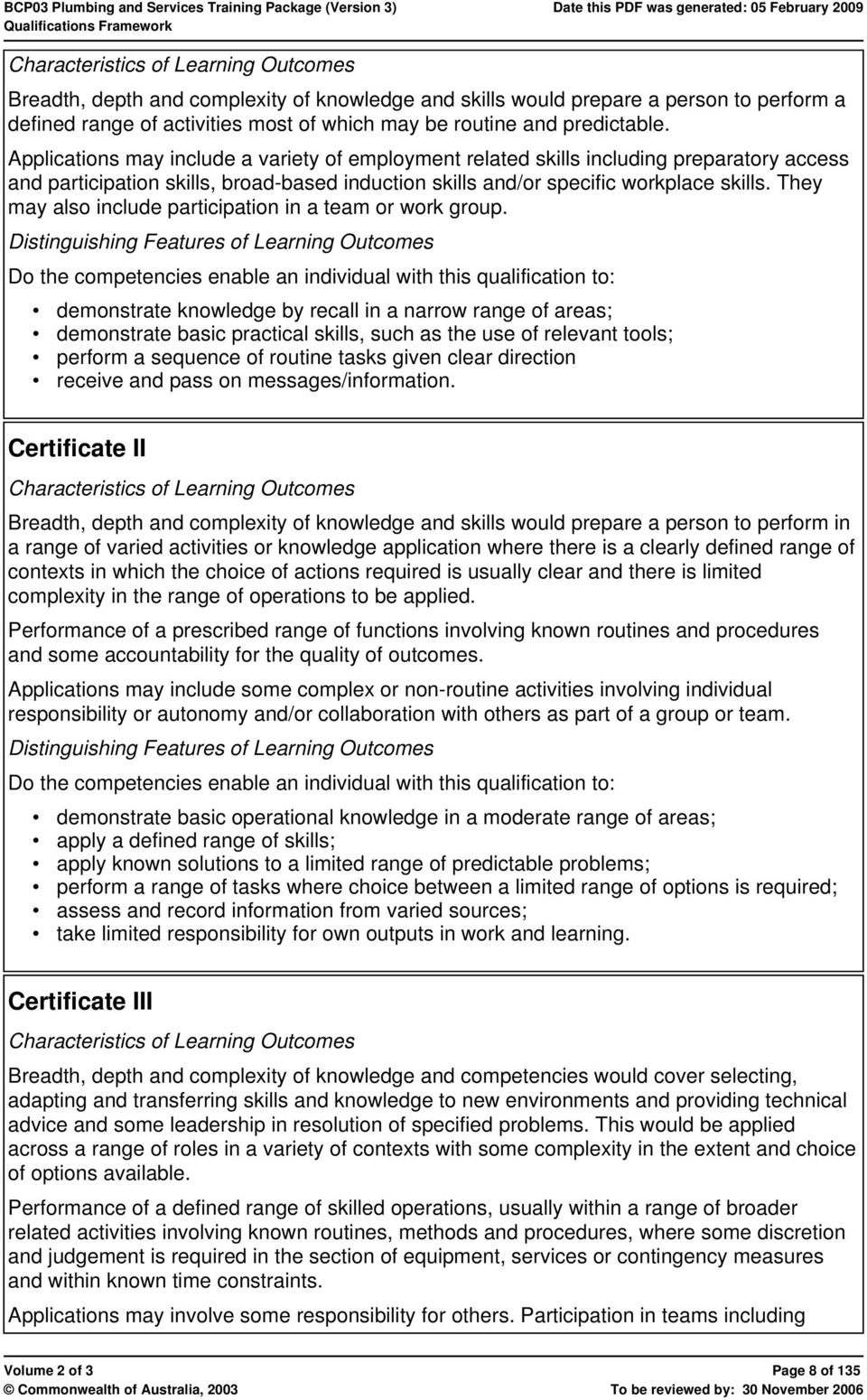
10 Qualifications Framework group or team co-ordination may be involved. Distinguishing Features of Learning Outcomes Do the competencies enable an individual with this qualification to: demonstrate some relevant theoretical knowledge apply a range of well-developed skills apply known solutions to a variety of predictable problems perform processes that require a range of well-developed skills where some discretion and judgement is required interpret available information, using discretion and judgement take responsibility for own outputs in work and learning take limited responsibility for the output of others. Certificate IV Characteristics of Learning Outcomes Breadth, depth and complexity of knowledge and competencies would cover a broad range of varied activities or application in a wider variety of contexts most of which are complex and non-routine. Leadership and guidance are involved when organising activities of self and others as well as contributing to technical solutions of a non-routine or contingency nature. Performance of a broad range of skilled applications including the requirement to evaluate and analyse current practices, develop new criteria and procedures for performing current practices and provision of some leadership and guidance to others in the application and planning of the skills. Applications involve responsibility for, and limited organisation of, others. Distinguishing Features of Learning Outcomes Do the competencies enable an individual with this qualification to: demonstrate understanding of a broad knowledge base incorporating some theoretical concepts apply solutions to a defined range of unpredictable problems identify and apply skill and knowledge areas to a wide variety of contexts, with depth in some areas identify, analyse and evaluate information from a variety of sources take responsibility for own outputs in relation to specified quality standards take limited responsibility for the quantity and quality of the output of others. Diploma Characteristics of Learning Outcomes Breadth, depth and complexity covering planning and initiation of alternative approaches to skills or knowledge applications across a broad range of technical and/or management requirements, evaluation and co-ordination. The self directed application of knowledge and skills, with substantial depth in some areas where judgment is required in planning and selecting appropriate equipment, services and techniques for self and others. Applications involve participation in development of strategic initiatives as well as personal responsibility and autonomy in performing complex technical operations or organising others. It may include participation in teams including teams concerned with planning and evaluation Volume 2 of 3 Page 9 of 135

11 Qualifications Framework functions. Group or team co-ordination may be involved. The degree of emphasis on breadth as against depth of knowledge and skills may vary between qualifications granted at this level. Distinguishing Features of Learning Outcomes Do the competencies or learning outcomes enable an individual with this qualification to: demonstrate understanding of a broad knowledge base incorporating theoretical concepts, with substantial depth in some areas analyse and plan approaches to technical problems or management requirements transfer and apply theoretical concepts and/or technical or creative skills to a range of situations evaluate information, using it to forecast for planning or research purposes take responsibility for own outputs in relation to broad quantity and quality parameters take some responsibility for the achievement of group outcomes. Advanced Diploma Characteristics of Learning Outcomes Breadth, depth and complexity involving analysis, design, planning, execution and evaluation across a range of technical and/or management functions including development of new criteria or applications or knowledge or procedures. The application of a significant range of fundamental principles and complex techniques across a wide and often unpredictable variety of contexts in relation to either varied or highly specific functions. Contribution to the development of a broad plan, budget or strategy is involved and accountability and responsibility for self and others in achieving the outcomes is involved. Applications involve significant judgement in planning, design, technical or leadership/guidance functions related to products, services, operations or procedures. The degree of emphasis on breadth as against depth of knowledge and skills may vary between qualifications granted at this level. Distinguishing Features of Learning Outcomes Do the competencies or learning outcomes enable an individual with this qualification to: demonstrate understanding of specialised knowledge with depth in some areas analyse, diagnose, design and execute judgements across a broad range of technical or management functions generate ideas through the analysis of information and concepts at an abstract level demonstrate a command of wide-ranging, highly specialised technical, creative or conceptual skills demonstrate accountability for personal outputs within broad parameters demonstrate accountability for personal and group outcomes within broad parameters. Vocational Graduate Certificate Characteristics of competencies or learning outcomes The self-directed development and achievement of broad and specialised areas of knowledge and skills, building on prior knowledge and skills. Substantial breadth and complexity involving the initiation, analysis, design, planning, execution and evaluation of technical and management functions in highly varied and Volume 2 of 3 Page 10 of 135

12 Qualifications Framework highly specialised contexts. Applications involve making significant, high-level, independent judgements in major broad or planning, design, operational, technical and management functions in highly varied and specialised contexts. They may include responsibility and broad-ranging accountability for the structure, management and output of the work or functions of others. The degree of emphasis on breadth, as opposed to depth, of knowledge and skills may vary between qualifications granted at this level. Distinguishing features of learning outcomes Demonstrate the self-directed development and achievement of broad and specialised areas of knowledge and skills, building on prior knowledge and skills. Initiate, analyse, design, plan, execute and evaluate major broad or technical and management functions in highly varied and highly specialised contexts. Generate and evaluate ideas through the analysis of information and concepts at an abstract level. Demonstrate a command of wide-ranging, highly specialised technical, creative or conceptual skills in complex contexts. Demonstrate responsibility and broad-ranging accountability for the structure, management and output of the work or functions of others. Vocational Graduate Diploma Characteristics of competencies or learning outcomes The self-directed development and achievement of broad and specialised areas of knowledge and skills, building on prior knowledge and skills. Substantial breadth, depth and complexity involving the initiation, analysis, design, planning, execution and evaluation of major functions, both broad and highly specialised, in highly varied and highly specialised contexts. Further specialisation within a systematic and coherent body of knowledge. Applications involve making high-level, fully independent, complex judgements in broad planning, design, operational, technical and management functions in highly varied and highly specialised contexts. They may include full responsibility and accountability for all aspects of work and functions of others, including planning, budgeting and strategy development. The degree of emphasis on breadth, as opposed to depth, of knowledge and skills may vary between qualifications granted at this level. Distinguishing features of learning outcomes Demonstrate the self-directed development and achievement of broad and highly specialised areas of knowledge and skills, building on prior knowledge and skills. Initiate, analyse, design, plan, execute and evaluate major functions, both broad and within highly varied and highly specialised contexts. Generate and evaluate complex ideas through the analysis of information and concepts at an abstract level. Demonstrate an expert command of wide-ranging, highly specialised, technical, creative or conceptual skills in complex and highly specialised or varied contexts. Demonstrate full responsibility and accountability for personal outputs. Demonstrate full responsibility and accountability for all aspects of the work or functions of others, including planning, budgeting and strategy. Qualification Pathways Volume 2 of 3 Page 11 of 135

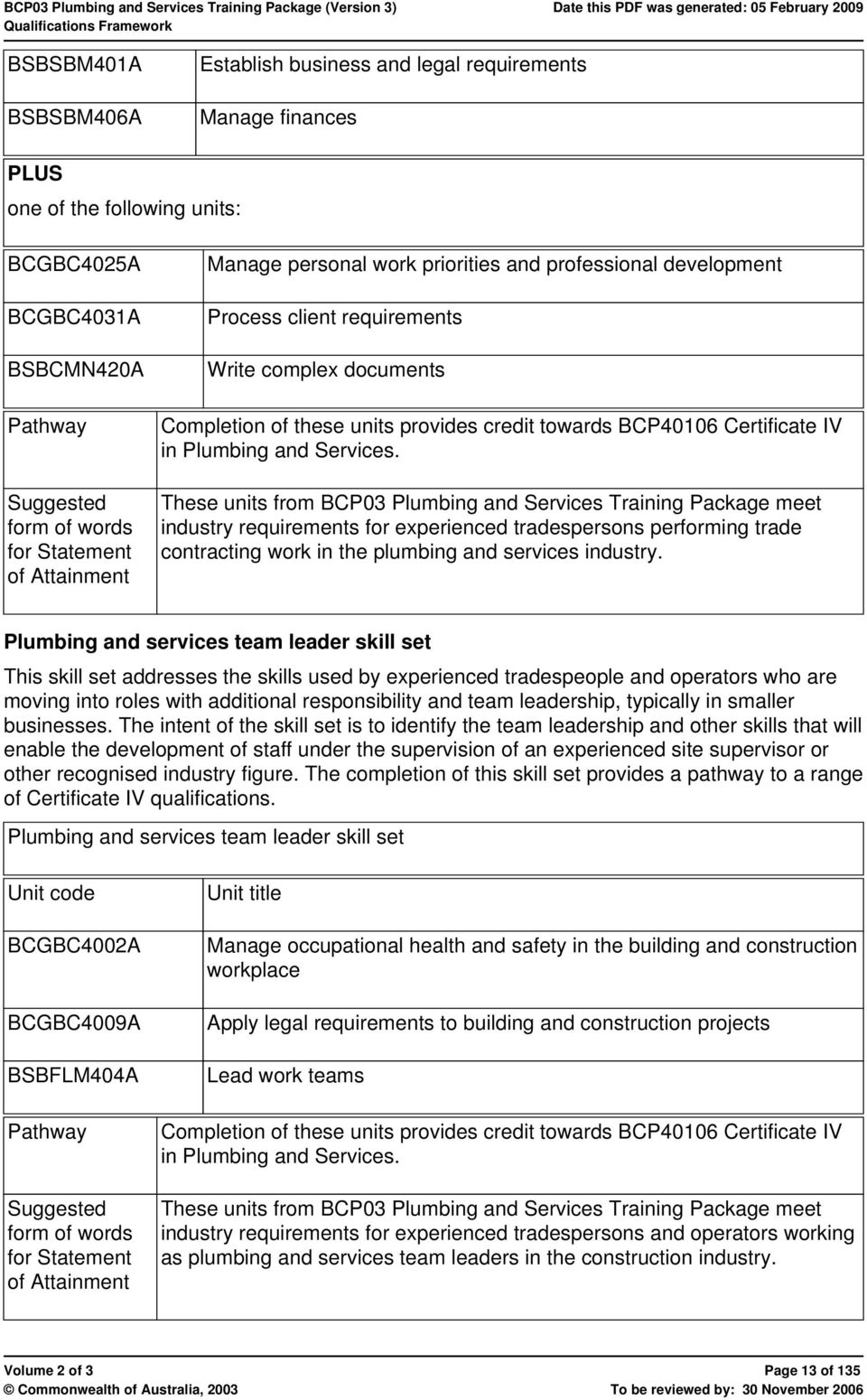
13 Qualifications Framework The following pathways charts are provided to show the types of pathways into and from qualifications that are possible with this Training Package. For more information about qualifications and pathways contact Construction and Property Services Industry Skills Council ( Skill Sets Definition Skill sets are defined as single units of competency, or combinations of units of competency from an endorsed Training Package, which link to a licence or regulatory requirement, or defined industry need. Wording on Statements of Attainment Skill sets are a way of publicly identifying logical groupings of units of competency which meet an identified need or industry outcome. Skill sets are not qualifications. Where skill sets are identified in a Training Package, the Statement of Attainment can set out the competencies a person has achieved in a way that is consistent and clear for employers and others. This is done by including the wording "these competencies meet [insert skill set title or identified industry area] need" on the Statement of Attainment. This wording applies only to skill sets that are formally identified as such in the endorsed Training Package. See the 2007 edition of the AQF Implementation Handbook for advice on wording on Statements of Attainmentthe updated version is expected to be available on the AQFAB website during September 2007 and in print in October Skill Sets in this Training Package Trade contracting skill set This skill set addresses the skills used by experienced tradespeople operating as sole traders, or with limited staff, contracting their services to builders. The contractors may be in the early stages of developing and growing their newly-established businesses. The intent of the skill set is to provide an initial set of business skills to support contractors' existing trade skills. The completion of this skill set provides a pathway to a range of Certificate IV qualifications. Trade contracting skill set Unit code Unit title BCGBC4004A Identify and produce estimated costs for building and construction projects BCGBC4024A Resolve business disputes BCGBC4034A Apply codes and standards to building trade and services contracting BSBCMN310A Deliver and monitor a service to customers BSBOHS403A Identify hazards and assess OHS risks Volume 2 of 3 Page 12 of 135

14 Qualifications Framework BSBSBM401A Establish business and legal requirements BSBSBM406A Manage finances PLUS one of the following units: BCGBC4025A Manage personal work priorities and professional development BCGBC4031A Process client requirements BSBCMN420A Write complex documents Pathway Completion of these units provides credit towards BCP40106 Certificate IV in Plumbing and Services. Suggested form of words for Statement of Attainment These units from BCP03 Plumbing and Services Training Package meet industry requirements for experienced tradespersons performing trade contracting work in the plumbing and services industry. Plumbing and services team leader skill set This skill set addresses the skills used by experienced tradespeople and operators who are moving into roles with additional responsibility and team leadership, typically in smaller businesses. The intent of the skill set is to identify the team leadership and other skills that will enable the development of staff under the supervision of an experienced site supervisor or other recognised industry figure. The completion of this skill set provides a pathway to a range of Certificate IV qualifications. Plumbing and services team leader skill set Unit code Unit title BCGBC4002A Manage occupational health and safety in the building and construction workplace BCGBC4009A Apply legal requirements to building and construction projects BSBFLM404A Lead work teams Pathway Completion of these units provides credit towards BCP40106 Certificate IV in Plumbing and Services. Suggested form of words for Statement of Attainment These units from BCP03 Plumbing and Services Training Package meet industry requirements for experienced tradespersons and operators working as plumbing and services team leaders in the construction industry. Volume 2 of 3 Page 13 of 135
15 Assessment Guidelines Assessment Guidelines Introduction These Assessment Guidelines provide the endorsed framework for assessment of units of competency in this Training Package. They are designed to ensure that assessment is consistent with the AQTF Assessments against the units of competency in this Training Package must be carried out in accordance with these Assessment Guidelines. Assessment System Overview This section provides an overview of the requirements for assessment when using this Training Package, including a summary of the AQTF 2007 requirements; licensing/registration requirements; and assessment pathways. Benchmarks for Assessment Assessment within the National Skills Framework is the process of collecting evidence and making judgments about whether competency has been achieved to confirm whether an individual can perform to the standards expected in the workplace, as expressed in the relevant endorsed unit of competency. In the areas of work covered by this Training Package, the endorsed units of competency are the benchmarks for assessment. As such, they provide the basis for nationally recognised Australian Qualifications Framework (AQF) qualifications and Statements of Attainment issued by Registered Training Organisations (RTOs). Australian Quality Training Framework Assessment Requirements Assessment leading to nationally recognised AQF qualifications and Statements of Attainment in the vocational education and training sector must meet the requirements of the AQTF as expressed in the AQTF 2007 Essential Standards for Registration. The AQTF 2007 Essential Standards for Registration can be downloaded from < The following points summarise assessment requirements. Registration of Training Organisations Assessment must be conducted by, or on behalf of, an RTO formally registered by a State or Territory Registering/Course Accrediting Body in accordance with the AQTF 2007 Essential Standards for Registration. The RTO must have the specific units of competency and/or AQF qualifications on its scope of registration. Quality Training and Assessment Each RTO must provide quality training and assessment across all its operations. See the AQTF 2007 Essential Standards for Registration, Standard 1. Assessor Competency Requirements Each person involved in training, assessment or client service must be competent for the functions they perform. See the AQTF 2007 Essential Standards for Registration, Standard 1, for assessor (and trainer) competency requirements. Assessment Requirements The RTOs assessments, including RPL, must meet the requirements of the relevant endorsed Training Package. See the AQTF 2007 Essential Standards for Registration, Standard 1. Assessment Strategies Volume 2 of 3 Page 14 of 135

16 Assessment Guidelines Each RTO must have strategies for training and assessment that meet the requirements of the relevant Training Package or accredited course and are developed in consultation with industry stakeholders. See the AQTF 2007 Essential Standards for Registration, Standard 1. National Recognition Each RTO must recognise the AQF qualifications and Statements of Attainment issued by any other RTO. See the AQTF 2007 Essential Standards for Registration, Condition of Registration 7: Recognition of qualifications issued by other RTOs. Access and Equity and Client Outcomes Each RTO must adhere to the principles of access and equity and maximise outcomes for its clients. See the AQTF 2007 Essential Standards for Registration, Standard 2. Monitoring Assessments Training and/or assessment provided on behalf of the RTO must be monitored to ensure that it is in accordance with all aspects of the Essential Standards for Registration. See the AQTF 2007 Essential Standards for Registration, Standard 3. Recording Assessment Outcomes Each RTO must manage records to ensure their accuracy and integrity. See the AQTF 2007 Essential Standards for Registration, Standard 3. Issuing AQF Qualifications and Statements of Attainment Each RTO must issue AQF qualifications and Statements of Attainment that meet the requirements of the current AQF Implementation Handbook and the endorsed Training Packages within the scope of its registration. An AQF qualification is issued once the full requirements for a qualification, as specified in the nationally endorsed Training Package are met. A Statement of Attainment is issued when an individual has completed one or more units of competency from nationally recognised qualification(s)/courses(s). See the AQTF 2007 and the 2007 edition of the AQF Implementation Handbook-available on the AQFAB website < Licensing/registration requirements Licensing and registration requirements that apply to specific industries, and vocational education and training, vary between each State and Territory and can regularly change. The developers of this Training Package and DEST consider that the licensing/ registration requirements described in this section apply to RTOs, assessors or candidates with respect to this Training Package. While reasonable care has been taken in its preparation, the developers of this Training Package and DEST cannot guarantee that the list is definitive or accurate at the time of reading; the information in this section is provided in good faith on that basis. A number of occupations and roles within the plumbing and services industry are regulated in some or all of the States and Territories. The regulators for each jurisdiction are listed below: Jurisdiction Name of Regulatory Body Address Australian Plumbing Compliance Ground Floor North Capital Territory ACT Planning and Land Authority Dame Pattie Menzies House 16 Challis Street Volume 2 of 3 Page 15 of 135

17 Assessment Guidelines Dickson ACT 2601 New South Wales Plumbing Policy, Standards and Regulations Sydney Water Corporation 2nd Floor, Corner of Bigge Sydney Water Corporation and Moore Streets Liverpool NSW 2170 Northern Territory Building Advisory Services First Floor Cavenagh House Department of Planning & Infrastructure 38 Cavenagh Street Darwin NT 0800 Queensland Plumbing Standards Level 25, 41 George Street Building Codes Queensland Brisbane QLD 4000 South Australia Plumbing Services South Australian Water Corporation South Australian Water Corporation East Terrace Thebarton SA 5031 Tasmania Building Standards and Regulation 30 Gordons Hill Road Rosny Park TAS 7018 Victoria Plumbing Industry Commission 450 Burke Road Camberwell Vic 3124 West Australia Western Australian Plumbers Licensing Board Locked Bag 14 Cloisters Square WA 6850 When selecting a qualification, including the choice of electives, reference should be made to the requirement identified by the Australian and New Zealand Reciprocity Association that the following units must be completed for the range of plumbing specialisms and which are used within the States and Territories for licensing purposes: ALL STREAMS BCPCM4001A Carry out work based risk control processes BCPCM4002A Estimate and cost work BSBSBM401A Establish business and legal requirements WATER SUPPLY BCPWT4001A Plan, size and layout hot and cold water services/systems BCPWT4002A Commission and maintain backflow prevention devices Volume 2 of 3 Page 16 of 135
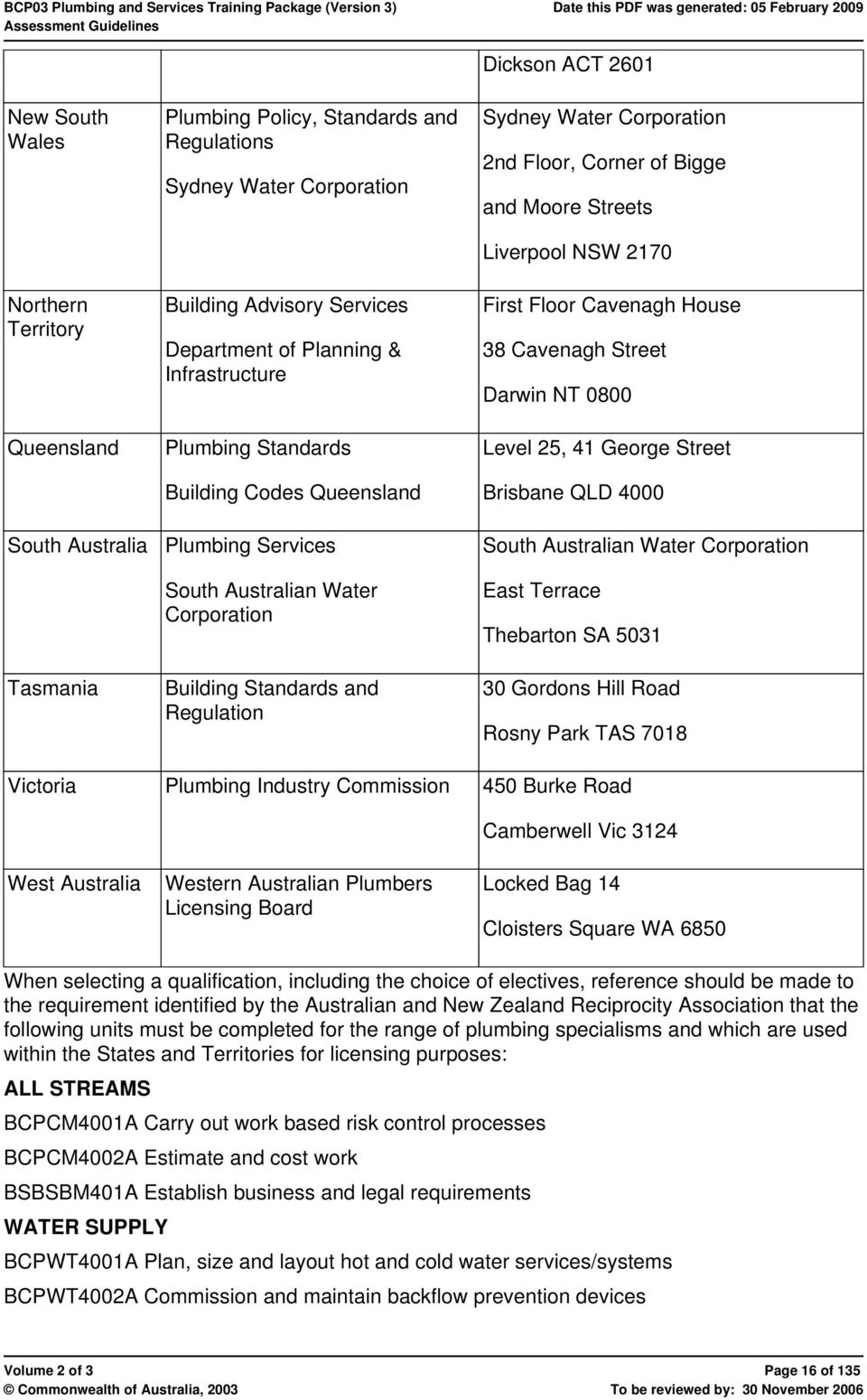
18 Assessment Guidelines BCPWT4003A Commission and maintain hot water temperature control devices DRAINAGE BCPDR4001A Plan, size and layout sanitary drainage systems BCPDR4002A Plan, size and layout stormwater drainage systems BCPDR4003A Plan, size and layout domestic treatment plant disposal systems SANITARY BCPSN4001A Plan, size and layout sanitary pipe work and fixtures GASFITTING BCPGS4001A Plan, size and layout consumer gas installations BCPGS4002A Service Type A gas appliances AIR CONDITIONING AND MECHANICAL SERVICES BCPMS4001A Plan, size and layout heating and cooling systems BCPMS4002A Commission air and water systems ROOFING BCPRF4001A Plan, size and layout roof drainage systems FIRE SERVICES BCPFS4001A Commission domestic and residential fire suppression sprinkler systems BCPFS4002A Commission and maintain special hazards fire suppression systems BCPFS4003A Commission fire system pump sets BCPFS4004A Design residential and domestic fire sprinkler systems It is of importance that RTOs and candidates make themselves familiar with the licensing and registration arrangements that apply in their jurisdiction. Requirements for Assessors Licensing and registration requirements that apply to specific industries, and vocational education and training, vary between each State and Territory and can regularly change. The developers of this Training Package and DEST consider that the licensing/ registration requirements described in this section apply to RTOs, assessors or candidates with respect to this Training Package. While reasonable care has been taken in its preparation, the developers of this Training Package and DEST cannot guarantee that the list is definitive or accurate at the time of reading; the information in this section is provided in good faith on that basis. A number of occupations and roles within the plumbing and services industry are regulated in some or all of the States and Territories. The regulators for each jurisdiction are listed below: Jurisdiction Name of Regulatory Body Address Australian Plumbing Compliance Ground Floor North Capital Territory ACT Planning and Land Authority Dame Pattie Menzies House 16 Challis Street Volume 2 of 3 Page 17 of 135
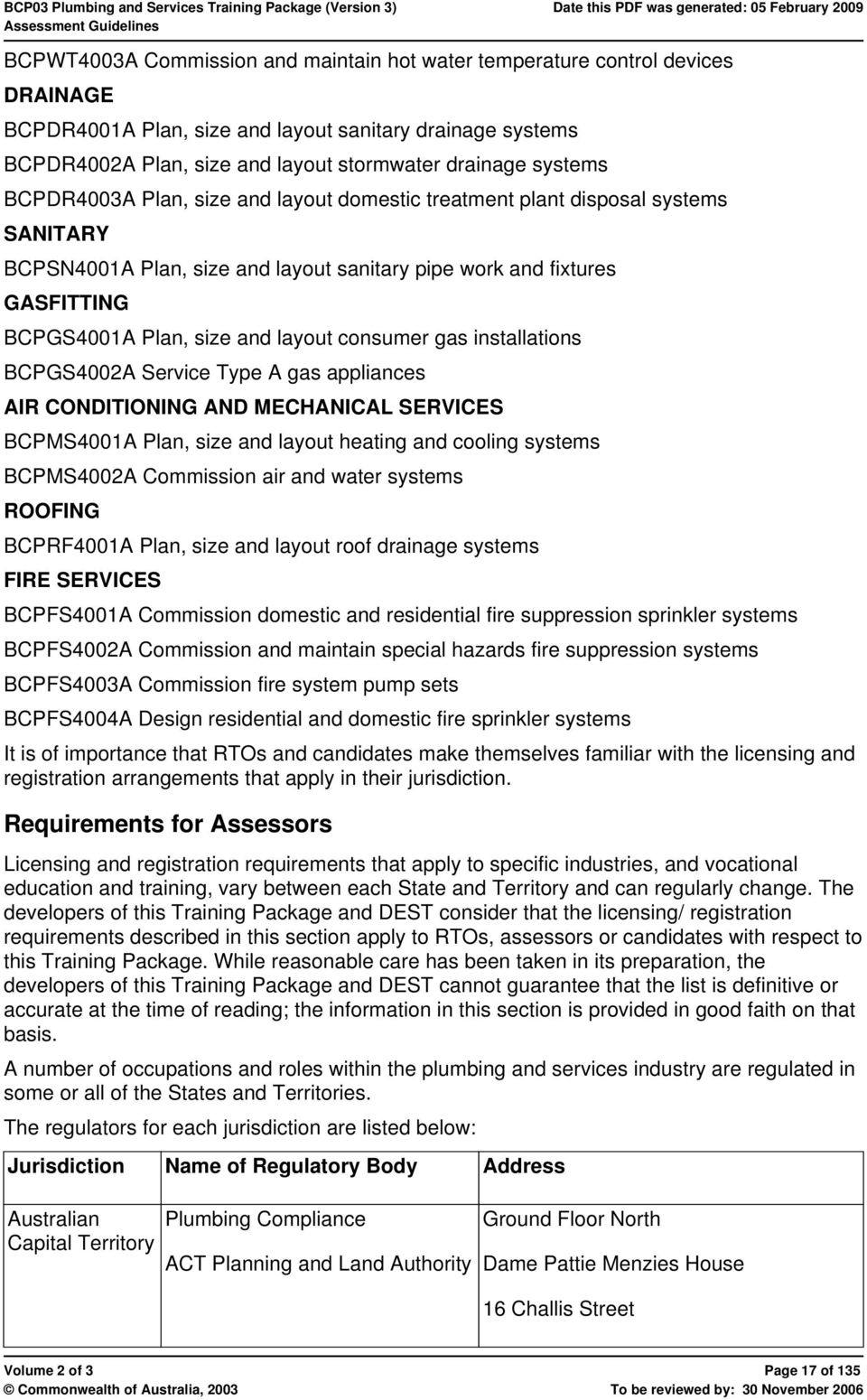
19 Assessment Guidelines Dickson ACT 2601 New South Wales Plumbing Policy, Standards and Regulations Sydney Water Corporation 2nd Floor, Corner of Bigge Sydney Water Corporation and Moore Streets Liverpool NSW 2170 Northern Territory Building Advisory Services First Floor Cavenagh House Department of Planning & Infrastructure 38 Cavenagh Street Darwin NT 0800 Queensland Plumbing Standards Level 25, 41 George Street Building Codes Queensland Brisbane QLD 4000 South Australia Plumbing Services South Australian Water Corporation South Australian Water Corporation East Terrace Thebarton SA 5031 Tasmania Building Standards and Regulation 30 Gordons Hill Road Rosny Park TAS 7018 Victoria Plumbing Industry Commission 450 Burke Road Camberwell Vic 3124 West Australia Western Australian Plumbers Licensing Board Locked Bag 14 Cloisters Square WA 6850 When selecting a qualification, including the choice of electives, reference should be made to the requirement identified by the Australian and New Zealand Reciprocity Association that the following units must be completed for the range of plumbing specialisms and which are used within the States and Territories for licensing purposes: ALL STREAMS BCPCM4001A Carry out work based risk control processes BCPCM4002A Estimate and cost work BSBSBM401A Establish business and legal requirements WATER SUPPLY BCPWT4001A Plan, size and layout hot and cold water services/systems BCPWT4002A Commission and maintain backflow prevention devices Volume 2 of 3 Page 18 of 135

20 Assessment Guidelines BCPWT4003A Commission and maintain hot water temperature control devices DRAINAGE BCPDR4001A Plan, size and layout sanitary drainage systems BCPDR4002A Plan, size and layout stormwater drainage systems BCPDR4003A Plan, size and layout domestic treatment plant disposal systems SANITARY BCPSN4001A Plan, size and layout sanitary pipe work and fixtures GASFITTING BCPGS4001A Plan, size and layout consumer gas installations BCPGS4002A Service Type A gas appliances AIR CONDITIONING AND MECHANICAL SERVICES BCPMS4001A Plan, size and layout heating and cooling systems BCPMS4002A Commission air and water systems ROOFING BCPRF4001A Plan, size and layout roof drainage systems FIRE SERVICES BCPFS4001A Commission domestic and residential fire suppression sprinkler systems BCPFS4002A Commission and maintain special hazards fire suppression systems BCPFS4003A Commission fire system pump sets BCPFS4004A Design residential and domestic fire sprinkler systems It is of importance that RTOs and candidates make themselves familiar with the licensing and registration arrangements that apply in their jurisdiction. Pathways The competencies in this Training Package may be attained in a number of ways including through: formal or informal education and training experiences in the workplace general life experience, and/or any combination of the above. Assessment under this Training Package leading to an AQF qualification or Statement of Attainment may follow a learning and assessment pathway, an assessment-only or recognition pathway, or a combination of the two as illustrated in the following diagram. Volume 2 of 3 Page 19 of 135

21 Assessment Guidelines Each of these assessment pathways leads to full recognition of competencies held - the critical issue is that the candidate is competent, not how the competency was acquired. Assessment, by any pathway, must comply with the assessment requirements set out in the Assessment Guidelines of the Training Package and the AQTF Learning and Assessment Pathways Usually, learning and assessment are integrated, with assessment evidence being collected and feedback provided to the candidate at anytime throughout the learning and assessment process. Learning and assessment pathways may include structured programs in a variety of contexts using a range of strategies to meet different learner needs. Structured learning and assessment programs could be: group-based, work-based, project-based, self-paced, action learning-based; conducted by distance or e-learning; and/or involve practice and experience in the workplace. Learning and assessment pathways to suit Australian Apprenticeships have a mix of formal structured training and structured workplace experience with formative assessment activities through which candidates can acquire and demonstrate skills and knowledge from the relevant units of competency. Assessment-Only or Recognition of Prior Learning Pathway Competencies already held by individuals can be formally assessed against the units of competency in this Training Package, and should be recognised regardless of how, when or where they were achieved. In an assessment-only or Recognition of Prior Learning (RPL) pathway, the candidate provides current, quality evidence of their competency against the relevant unit of competency. This process may be directed by the candidate and verified by the assessor, such as in the compilation of portfolios; or directed by the assessor, such as through observation of workplace performance and skills application, and oral and/or written assessment. Where the outcomes of this process indicate that the candidate is competent, structured training is not required. The RPL requirements of the AQTF 2007 must be met (Standard 1). As with all assessment, the assessor must be confident that the evidence indicates that the candidate is currently competent against the endorsed unit of competency. This evidence may take a variety of forms and might include certification, references from past employers, testimonials from clients, and work samples. The onus is on candidates to provide sufficient evidence to satisfy assessors that they currently hold the relevant competencies. In judging evidence, the assessor must ensure that the evidence of prior learning is: Volume 2 of 3 Page 20 of 135
22 Assessment Guidelines authentic (the candidate"s own work) valid (directly related to the current version of the relevant endorsed unit of competency) reliable (shows that the candidate consistently meets the endorsed unit of competency) current (reflects the candidate"s current capacity to perform the aspect of the work covered by the endorsed unit of competency), and sufficient (covers the full range of elements in the relevant unit of competency and addresses the four dimensions of competency, namely task skills, task management skills, contingency management skills, and job/role environment skills). The assessment only or recognition of prior learning pathway is likely to be most appropriate in the following scenarios: candidates enrolling in qualifications who want recognition for prior learning or current competencies existing workers individuals with overseas qualifications recent migrants with established work histories people returning to the workplace, and people with disabilities or injuries requiring a change in career. Combination of Pathways Where candidates for assessment have gained competencies through work and life experience and gaps in their competence are identified, or where they require training in new areas, a combination of pathways may be appropriate. In such situations, the candidate may undertake an initial assessment to determine their current competency. Once current competency is identified, a structured learning and assessment program ensures that the candidate acquires the required additional competencies identified as gaps. Assessor Requirements This section identifies the mandatory competencies for assessors, and clarifies how others may contribute to the assessment process where one person alone does not hold all the required competencies. Assessor Competencies The AQTF 2007 specifies mandatory competency requirements for assessors. For information, Standard 1, Element 1.4 from the AQTF 2007 Essential Standards for Registration follows: 1.4 Training and assessment is delivered by trainers and assessors who: a) have the necessary training and assessment competencies as determined by the National Quality Council or its successors b) have the relevant vocational competencies at least to the level being delivered or assessed c) continue developing their vocational and training and assessment competencies to support continuous improvements in the delivery of the RTO"s services. Designing Assessment Tools This section provides an overview on the use and development of assessment tools. Volume 2 of 3 Page 21 of 135
23 Assessment Guidelines Use of Assessment Tools Assessment tools provide a means of collecting the evidence that assessors use in making judgments about whether candidates have achieved competency. There is no set format or process for the design, production or development of assessment tools. Assessors may use prepared assessment tools, such as those specifically developed to support this Training Package, or they may develop their own. Using Prepared Assessment Tools If using prepared assessment tools, assessors should ensure these are benchmarked, or mapped, against the current version of the relevant unit of competency. This can be done by checking that the materials are listed on the National Training Information Service < Materials on the list have been noted by the National Quality Council as meeting their quality criteria for Training Package support materials. Developing Assessment Tools When developing assessment tools, assessors must ensure that they: are benchmarked against the relevant unit or units of competency are reviewed as part of the continuous improvement of assessment strategies as required under Standard 1 of the AQTF 2007 meet the assessment requirements expressed in Standard 1 of the AQTF A key reference for assessors developing assessment tools is TAA04 Training and Assessment Training Package and the unit of competency TAAASS403A Develop assessment tools. There is no set format or process for the design, production or development of assessment materials. Conducting Assessment This section details the mandatory assessment requirements and provides information on equity in assessment including reasonable adjustment. Assessment Requirements Assessments must meet the criteria set out in the AQTF 2007 Essential Standards for Registration. For information, the mandatory assessment requirements from Standard 1 from the AQTF 2007 Essential Standards for Registration are as follows: 1.5 Assessment, including Recognition of Prior Learning: a) meets the requirements of the relevant Training Package or accredited course, b) is conducted in accordance with the principles of assessment and the rules of evidence, and c) meets workplace and, where relevant, regulatory requirements. Assessment of Employability Skills Employability Skills are integral to workplace competency. As such they must be considered in the design, customisation, delivery and assessment of vocational education and training programs in an integrated and holistic way, as represented diagrammatically below. Volume 2 of 3 Page 22 of 135
24 Assessment Guidelines Employability Skills are embedded and explicit within each unit of competency. Training providers must use Employability Skills information in order to design valid and reliable training and assessment strategies. This analysis could include: reviewing units of competency to locate relevant Employability Skills and determine how they are applied within the unit analysing the Employability Skills Summary for the qualification in which the unit or units are packaged to help clarify relevant industry and workplace contexts and the application of Employability Skills at that qualification outcome designing training and assessment to address Employability Skills requirements. For more information on Employability Skills in Construction and Property Services Industry Skills Council Training Packages go to the Construction and Property Services Industry Skills Council website at Access and Equity An individual"s access to the assessment process should not be adversely affected by restrictions placed on the location or context of assessment beyond the requirements specified in this Training Package: training and assessment must be bias-free. Under the rules for their development, Training Packages must reflect and cater for the increasing diversity of Australia"s VET clients and Australia"s current and future workforce. The flexibilities offered by Training Packages should enhance opportunities and potential outcomes for all people so that we can all benefit from a wider national skills base and a shared contribution to Australia"s economic development and social and cultural life. Reasonable adjustments It is important that education providers take meaningful, transparent and reasonable steps to consult, consider and implement reasonable adjustments for students with disability. Volume 2 of 3 Page 23 of 135
25 Assessment Guidelines Under the Disability Standards for Education 2005, education providers must make reasonable adjustments for people with disability to the maximum extent that those adjustments do not cause that provider unjustifiable hardship. While "reasonable adjustment" and "unjustifiable hardship" are different concepts and involve different considerations, they both seek to strike a balance between the interests of education providers and the interests of students with and without disability. An adjustment is any measure or action that a student requires because of their disability, and which has the effect of assisting the student to access and participate in education and training on the same basis as students without a disability. An adjustment is reasonable if it achieves this purpose while taking into account factors such as the nature of the student"s disability, the views of the student, the potential effect of the adjustment on the student and others who might be affected, and the costs and benefits of making the adjustment. An education provider is also entitled to maintain the academic integrity of a course or program and to consider the requirements or components that are inherent or essential to its nature when assessing whether an adjustment is reasonable. There may be more than one adjustment that is reasonable in a given set of circumstances; education providers are required to make adjustments that are reasonable and that do not cause them unjustifiable hardship. See Part 4, Chapter 2 of the Training Package Development Handbook (DEST, September 2007) for more information on reasonable adjustment, including examples of adjustments. Industry Assessment Contextualisation 2 Assessment in the Plumbing and Services Industry The Plumbing and Services Industry places premium on skills and knowledge that can be demonstrated in a real workplace environment. Whilst assessment of some of the Unit(s) of Competency in the Plumbing and Services Training Package can be carried out in a simulated work environment, the industry strongly recommends that assessment is conducted in the workplace, wherever possible. Assessment of competency requires the collection of evidence and this should be conducted over a period of time. This assessment approach may include demonstration at the workplace and/or a simulated work environment to ensure that the demonstration of competency is valid and reliable. The individual being assessed needs to be aware that the collection of evidence is ongoing and needs to be part of the planning, conduct and review of the assessment process. Supporting Integrated Training Delivery and Assessment As a general principle, the Plumbing and Services Industry supports the integration of Unit(s) of Competency for assessment, where practical, as this reflects real work practices. An integrated approach to assessment brings together a number of Unit(s) of Competency, which reflect actual workplace requirements. For example, an employee working on a plumbing work site would complete a number of interrelated installation and occupational, health and safety tasks together, not simply one individual task at a time. An integrated assessment activity would be designed to collect evidence for a number of units together rather than designing one assessment activity for each individual element of performance criteria. Where both training and assessment are required the industry supports an approach which provides for off-the-job training combined with assessment of the application of skills and knowledge in a real work situation. Volume 2 of 3 Page 24 of 135
26 Assessment Guidelines The Plumbing and Services Training Package defines on-the-job assessment as that assessment which occurs in the workplace as part of the normal operation of the business. The Plumbing and Services Training Package defines off-the-job assessment as that which occurs away from the normal operation of the business including, for example, assessment which may occur in the workplace but not under normal industry working conditions. The industry considers it important that candidates should have the opportunity to develop competency in structured learning programs which includes assessing in the workplace whenever possible. It would be expected that where an integrated competency assessment approach is implemented that several integrated competency assessments would be necessary to cover the breadth and complexity of the qualification, at Certificates II and III. The context of the assessment, the role of the candidate and the complexity of the task will influence how many Unit(s) of Competency will be integrated. Further Sources of Information The section provides a listing of useful contacts and resources to assist assessors in planning, designing, conducting and reviewing of assessments against this Training Package. Contacts Contacts Contacts Construction and Property Services Industry Skills Council (CPSISC) PO Box 151 Belconnen ACT 2616 Tel: (02) [email protected] Website: Contact details for the National Network of Building and Construction Industry Training Advisory Bodies are as follows: State or Territory Organisation Contact Details New South Wales Construction Industry Advisory Board (NSW) Chief Executive Officer Tel: (02) PO Box [email protected] Hornsby Westfield NSW 1635 Queensland Northern Territory Construction Training Queensland Operations Manager PO Box 28 Tel: (07) Salisbury QLD [email protected] Major Industry Training Advisory Council Executive Officer Tel: (08) Volume 2 of 3 Page 25 of 135
27 Assessment Guidelines GPO Box Darwin NT 0801 Western Australia Building and Construction Industry Executive Officer Training Council Tel: (08) st Floor Hay Street West Perth WA 6005 South Australia Construction Industry Training Board (SA) Chief Executive Officer Tel: (08) PO Box Unley SA 5034 Tasmania Tasmania Building and Construction Industry Board Executive Director Tel: (03) PO Box Sandy Bay TAS 7006 Australian Capital Territory ACT Building and Construction Industry Training Council Executive Officer Tel: (02) PO Box Dickson ACT 2602 National Construction and Property Services Industry Skills Council (CPSISC) Chief Executive Officer Tel: (02) PO Box 151 Belconnen ACT Technical and Vocational Education and Training (TVET) Australia Limited Level 21, 390 St Kilda Road, Melbourne VIC 3150 PO Box 12211, A"Beckett Street Post Office MELBOURNE VICTORIA 8006 Ph: Fax: [email protected] Web: Volume 2 of 3 Page 26 of 135
28 Assessment Guidelines For information on the TAA04 Training and Assessment Training Package contact: Innovation & Business Skills Australia Level 2, Building B, 192 Burwood Road HAWTHORN VIC 3122 Telephone: (03) Facsimile: (03) Web: General Resources Refer to to locate the following ANTA publications. AQF Implementation Handbook, third Edition. Australian Qualifications Framework Advisory Board, 2002, aqf.edu.au Australian Quality Training Framework 2007 (AQTF 2007) - for information and resources go to < AQTF 2007 Essential Standards for Registration. Training organisations must meet these standards in order to deliver and assess nationally recognised training and issue nationally recognised qualifications. They include three standards, a requirement for registered training organisations to gather information on their performance against three quality indicators, and nine conditions of registration AQTF 2007 User"s Guide to the Essential Standards for Registration. A Users" Guide for training organisations who must meet these standards in order to deliver and assess nationally recognised training and issue nationally recognised qualifications. AQTF 2007 Standards for Accredited Courses. State and Territory accrediting bodies are responsible for accrediting courses. This standard provides a national operating framework and template for the accreditation of courses. TAA04 Training and Assessment Training Package. This is available from the Innovation and Innovation & Business Skills Australia (IBSA) Industry Skills Council and can be viewed, and components downloaded, from the National Training Information Service (NTIS). National Training Information Service, an electronic database providing comprehensive information about RTOs, Training Packages and accredited courses - Training Package Development Handbook (DEST, August 2007). Can be downloaded from Assessment Resources Training Package Assessment Guides - a range of resources to assist RTOs in developing Training Package assessment materials (originally developed by ANTA with funding from the Department of Education, Training and Youth Affairs) and made up of 10 separate titles, as described at the publications page of Go to Printed and/or CD ROM versions of the Guides can be purchased from Technical and Vocational Education and Training (TVET) Australia Limited. The resource includes the following guides: Volume 2 of 3 Page 27 of 135
29 Assessment Guidelines Training Package Assessment Materials Kit Assessing Competencies in Higher Qualifications Recognition Resource Kit to Support Assessor Training Candidates Kit: Guide to Assessment in New Apprenticeships Assessment Approaches for Small Workplaces Assessment Using Partnership Arrangements Strategies for ensuring Consistency in Assessment Networking for Assessors Quality Assurance Guide for Assessment An additional guide "Delivery and Assessment Strategies" has been developed to complement these resources. Assessment Tool Design and Conducting Assessment VETASSESS & Western Australian Department of Training and Employment 2000, Designing Tests - Guidelines for designing knowledge based tests for Training Packages. Vocational Education and Assessment Centre 1997, Designing Workplace Assessment Tools, A self-directed learning program, NSW TAFE. Manufacturing Learning Australia 2000, Assessment Solutions, Australian Training Products, Melbourne. Rumsey, David 1994, Assessment practical guide, Australian Government Publishing Service, Canberra. Assessor Training Australian Committee on Training Curriculum (ACTRAC) 1994, Assessor training program learning materials, Australian Training Products, Melbourne. Australian National Training Authority, A Guide for Professional Development, ANTA, Brisbane. Australian Training Products Ltd Assessment and Workplace Training, Training Package Toolbox, ATPL Melbourne (available from TVET). Green, M, et al. 1997, Key competencies professional development Package, Department for Education and Children"s Services, South Australia. Victorian TAFE Association 2000, The professional development CD: A learning tool, VTA, Melbourne. Assessment System Design and Management Office of Training and Further Education 1998, Demonstrating best practice in VET project assessment systems and processes, OTFE (now OTTE) Victoria. Toop, L., Gibb, J. & Worsnop, P. Assessment system designs, Australian Government Publishing Service, Canberra. Volume 2 of 3 Page 28 of 135
30 BCPCM4001A Carry out work based risk control processes BCPCM4001A Carry out work based risk control processes Unit Descriptor This unit covers the competency to carry out work based risk control processes. It covers the identification of hazards, the assessment of risk and the identification of unacceptable risk and the determination, preparation and completion of a course of action. This unit of competence is strongly related to the Business Services Australia unit BSBCMN416A Identify risk and apply risk management processes. Employability Skills Unit Sector Work associated with this unit is undertaken within the plumbing and services sector. This unit has employability skills. Common Units ELEMENT PERFORMANCE CRITERIA 1. Identify hazards Assess risk Identify unacceptable risk Identify and decide on course of action Volume 2 of 3, Unit 1 of 18 Site conditions and functions are analysed to identify/recognise potential hazards Relevant safety systems information is accessed and analysed to eliminate situations covered by existing and adequate procedures The type and scope of unresolved hazards and their likely impact are recognised Likelihood of the event happening is considered and determined Consequence if the event should occur is evaluated and determined Risk level (likelihood and consequence combined) is considered and determined Criteria for determining the acceptability/ unacceptability of the risk is identified or sought from the appropriate authority Risk is evaluated against criteria to identify if it warrants 'unacceptable risk' status and is either actioned or referred to the appropriate person Range of actions/controls which may eliminate or minimise the risk are identified All possible options for resolution of the problem/ dealing with the risk are identified and considered Feasible options are subject to detailed analysis including the identification of resource requirements Most appropriate action for dealing with the situation is selected Page 29 of 135
31 BCPCM4001A Carry out work based risk control processes 5. Take action Complete records and reports Review effectiveness of risk control measures Volume 2 of 3, Unit 1 of 18 The course of action is planned and prepared in detail Resources required for the course of action are acquired or obtained Safety information and procedures are accessed and applied throughout the operation The course of action is implemented Information on the course of action and implementation is communicated to the relevant people All hazards and actions from personal risk assessment are recorded as specified by legislative and workplace requirements Risk control measures are periodically reviewed Review findings are used as the basis for adjustment of control measures Documentation and risk management processes are adjusted as required Page 30 of 135
32 BCPCM4001A Carry out work based risk control processes RANGE STATEMENT The Range Statement provides advice to interpret the scope and context of this unit of competency allowing for differences between enterprises and workplaces. It relates to the unit as a whole and facilitates holistic assessment. The following variables may be present for this particular unit: Unit scope The unit covers the three steps of identifying work-based Volume 2 of 3, Unit 1 of 18 hazards, assessing the risk and identification of unacceptable risk situations. It requires the referral of critical unacceptable risk situations to others. For other circumstances it requires the identification of courses of action, the initiation of action and the completion of records and reports Safety information and procedures may be contained in legislation and regulations, relevant Australian Standards, management plans, manager's rules, OH&S policy, codes of practice, manufacturers' instructions, safe working or job procedures (or equivalent) This competency is to be applied by employees who have responsibility for the safety of others including work activity coordinators, plant operators or equivalent who coordinate workplace activities, team leaders, supervisors and managers In the absence of other authorities, risk management processes must conform with the relevant and current Australian Standard Criteria for acceptable risk must be determined by the organisation's internal policy, goals and/or objectives Controls for hazards should be considered using option types in sequence from eliminating the hazard, substitution, engineering controls, administrative controls (procedures, etc) and, finally personal protective equipment Records and reports for risk assessment may include hazard reporting forms, supervisors' reports, incident reports, near miss reports, shift reports, etc Workplace policy, objectives, rules, procedures and assessment techniques will vary between work locations Risk assessment terminology: consequence is the outcome of an event or situation expressed qualitatively or quantitatively, being a loss, injury, disadvantage or gain frequency is a measure of likelihood expressed as the number of occurrences of an event in a given time hazard is a source of potential harm or a situation with a potential to cause loss likelihood is used as a qualitative description of probability and frequency probability is the likelihood of a specific outcome, measured by the ratio of specific outcomes to the total number of possible outcomes. Probability is expressed as a number between 0 and 1, with 0 indicating an impossible outcome and 1 indicating an outcome is Page 31 of 135
33 BCPCM4001A Carry out work based risk control processes certain risk is the chance of something happening that will have an impact upon objectives. It is measured in terms of consequences and likelihood risk assessment is the process used to determine risk management priorities by evaluating and comparing the level of risk against predetermined standards, target risk levels or other criteria risk identification is the process of determining what can happen, why and how Safety (OH&S) OH&S requirements are to be in accordance with State or Environmental requirements Volume 2 of 3, Unit 1 of 18 Territory legislation and regulations, organisational safety policies and procedures, and project safety plan. This may include protective clothing and equipment, use of tools and equipment, workplace environment and safety, handling of materials, use of fire fighting equipment, use of first aid equipment, hazard control and hazardous materials and substances Personal protective equipment is to include that prescribed under legislation, regulation and workplace policies and practices Hazards and risks may include but not be limited to uneven/unstable terrain, overhead objects, fire, gas, electricity, water, working at height or in confined spaces, overhead and underground services, buildings, structures and hazardous materials Safe operating procedures are to include but not be limited to recognising and preventing hazards associated with overhead services, electricity, gas, water, fire, other machines, personnel, and restricted access barriers, working at height, working in proximity to others, worksite visitors and the public and traffic control Safe work access is to include but not be limited to ensuring access ways are clear, equipment/machinery is away from overhangs and refuelling sites, safe distances are maintained from excavations, safety systems are installed on roofs and work areas are secured from unauthorised access or movement Emergency procedures are to include but may not be limited to, fire fighting, medical and first aid and evacuation Environmental requirements are to include but are not limited to waste management, stormwater protection, noise, dust and clean-up management Page 32 of 135
34 BCPCM4001A Carry out work based risk control processes Quality assurance Quality assurance requirements include International Standards Organisation, internal company quality assurance policy and risk management strategy, Environment Protection Authority (EPA), site safety plan and workplace operations and procedures Statutory/regulatory authorities Statutory/regulatory authorities may include statutory Communications Statutory/regulatory authorities may include statutory plumbing authority and the local council statutory authority plumbing authority and the local council statutory authority Information Information sources may include but not be limited to Volume 2 of 3, Unit 1 of 18 verbal or written and graphical instructions, signage, work schedules/plans/specifications, work bulletins, charts and hand drawings, memos, maps, Material Safety Data Sheets (MSDS), diagrams or sketches and graphics Safe work procedures related to work in the plumbing and services sector Regulatory/legislative requirements pertaining to work and the environment Relevant Australian Standards Manufacturer's specifications and instructions Organisation work specifications and requirements Instructions issued by authorised organisational or external personnel Page 33 of 135
35 BCPCM4001A Carry out work based risk control processes EVIDENCE GUIDE The Evidence Guide identifies the critical aspects, knowledge and skills to be demonstrated to confirm competency for this unit. This is an integral part of the assessment of competency and should be read in conjunction with the Performance Criteria, the Range Statement, and the Assessment Guidelines of the Training Package. Critical aspects of evidence required to demonstrate competency in this unit Location, interpretation and application of relevant Relationship to other units information, standards and specifications Compliance with OH&S regulations and State/Territory legislation applicable to workplace operations Compliance with organisational policies and procedures including quality assurance requirements Individually or as a member of a team, participate in two different circumstances requiring: the conduct of a worksite risk assessment to identify the acceptability/unacceptability of risk the development and implementation of a site based risk control activity and action the recording and reporting of the risk control process and outcomes Communicate and work effectively and safely with others This unit may be assessed with any of the units of competency which involves a degree of risk requiring the application of risk control processes Where related units form an integral part of workplace responsibilities and roles, they can be assessed concurrently Specific knowledge required to achieve the performance criteria A knowledge of: risk management theory including the hierarchy of controls on treatments regulatory requirements related to obligations and risk Volume 2 of 3, Unit 1 of 18 management workplace and equipment safety requirements workplace rules, policies, procedures and regulations personal safety measures personal risk assessment and control processes (hazard identification through to action) workplace communication methods industry terminology reporting and recording procedures processes for interpreting plans, specifications, drawings and sketches work access and traffic control responsibilities Materials Safety Data Sheets (MSDS) and materials handling methods quality assurance systems and standards JSAs/safe work method statement Page 34 of 135
36 BCPCM4001A Carry out work based risk control processes The context of assessment The application of competency is to be assessed in the workplace or realistically simulated workplace Assessment is to occur under standard and authorised work practices, safety requirements and environmental constraints Assessment of essential underpinning knowledge, other than confirmatory questions, will usually be conducted in an off-site context Assessment is to comply with relevant regulatory or Australian Standards requirements Methods of assessment The application of competency is to be assessed in the workplace or realistically simulated workplace Assessment is to occur under standard and authorised work practices, safety requirements and environmental constraints Assessment of essential underpinning knowledge, other than confirmatory questions, will usually be conducted in an off-site context Assessment is to comply with relevant regulatory or Australian Standards requirements What are the specific resource requirements for this unit? The following resources should be made available: workplace location or simulated workplace situations requiring the application of risk control processes realistic tasks covering the mandatory task requirements relevant specifications and work instructions research resources including industry related systems information and data Volume 2 of 3, Unit 1 of 18 Page 35 of 135
37 BCPCM4002A Estimate and cost work BCPCM4002A Estimate and cost work Unit Descriptor This unit specifies the competency required to estimate materials, labour and time requirements and establish costs for provision of services or products. It covers the gaining of information, the estimation of materials, labour and time, the calculation of costs and the associated documentation. Employability Skills Unit Sector Work associated with this unit is undertaken within the plumbing and services sector in accordance with relevant Australian Standards. This unit has employability skills. Common Units ELEMENT PERFORMANCE CRITERIA 1. Gather information Estimate materials, labour and time Calculate costs Document and verify details Volume 2 of 3, Unit 2 of 18 Details of customer requirements are obtained through discussion with customer or from information supplied Plans/specifications are accessed and site inspected Details of products and/or services to be provided are developed Delivery point and methods of transportation are determined where necessary Details are recorded in accordance with workplace procedures Work, including preparatory tasks, is planned and sequenced Types and quantities of materials required for product work are estimated Labour requirements to perform work are estimated Time requirements to perform work are estimated Total materials, labour and overhead costs are calculated in accordance with workplace procedures Total work cost is calculated, including overheads and mark-up percentages Final cost for work is calculated Details of costs and charges are documented in accordance with workplace procedures Costs, calculations or other details are verified in accordance with workplace procedures Customer quotation/tender is prepared Details are documented for future reference in accordance with workplace procedures Page 36 of 135
38 BCPCM4002A Estimate and cost work RANGE STATEMENT The Range Statement provides advice to interpret the scope and context of this unit of competency allowing for differences between enterprises and workplaces. It relates to the unit as a whole and facilitates holistic assessment. The following variables relate to this particular unit: Unit scope This unit requires the estimation of materials and labour required for a work activity and the determination of costs for the provision of a quotation or tender in the plumbing and services industry Estimation and costing is to include overheads, labour and materials Site location for work application may be either domestic or commercial, and may be a new worksite, or an existing structure being renovated, extended, restored or maintained Safety (OH&S) OH&S requirements are to be in accordance with State or Territory legislation and regulations and may include protective clothing and equipment, use of tools and equipment, workplace environment and safety, handling of materials, use of fire fighting equipment, use of first aid equipment, hazard control and hazardous materials and substances Personal protective equipment is to include that prescribed under legislation, regulation and workplace policies and practices Safe operating procedures are to include but not be limited to recognising and preventing hazards associated with the use of tools and equipment, trip hazards, underground services, surrounding structure and facilities, hazardous materials, other machines, working at heights, working in proximity to others, worksite visitors, the public and may include working in confined spaces Environmental requirements Environmental requirements are to cover water quality Quality assurance Quality assurance requirements include International management and may include waste management, stormwater protection and clean-up protection Standards Organisation, internal company quality assurance policy and risk management strategy, Environment Protection Authority (EPA), site safety plan and workplace operations and procedures Statutory/regulatory authorities Volume 2 of 3, Unit 2 of 18 Statutory/regulatory authorities may include statutory plumbing authority and the local council statutory authority Page 37 of 135
39 BCPCM4002A Estimate and cost work Tools and equipment Tools and equipment are to include calculators and stationery and measuring equipment appropriate to work Tools and equipment may also include levelling equipment, ladders/elevated work platforms and computers running appropriate software for estimating and calculating necessary details Communications Communications are to include oral and written and may be direct or indirect Information Information sources may include but not be limited to verbal or written and graphical instructions, signage, work schedules/plans/specifications, job drawing, work bulletins, charts and hand drawings, memos, Material Safety Data Sheets (MSDS), diagrams or sketches Safe work procedures relating to the estimation and costing of work Regulatory/legislative requirements, particularly those pertaining to plumbing regulations, building codes, OH&S and environmental requirements Relevant Australian Standards Manufacturers' specifications and instructions Organisation work specifications and requirements Instructions issued by authorised organisational or external personnel EVIDENCE GUIDE The Evidence Guide identifies the critical aspects, knowledge and skills to be demonstrated to confirm competency for this unit. This is an integral part of the assessment of competency and should be read in conjunction with the Performance Criteria, the Range Statement, and the Assessment Guidelines of the Training Package. Critical aspects of evidence required to demonstrate competency in this unit Locate, interpret and apply relevant information, Volume 2 of 3, Unit 2 of 18 standards and specifications to the estimation and costing of work Apply safety requirements throughout the work sequence, including the use of personal protective clothing and equipment As a minimum, estimate and cost three varied jobs in at least Class 1 buildings, including: estimate quantities of material required determine the types and amount of labour required to complete the work estimate time required to complete the work estimate overheads associated with the job a written quotation/tender for each of the work requirements Communicate and work effectively and safely with others Page 38 of 135
40 BCPCM4002A Estimate and cost work Relationship to other units BSBSBM401A Establish business and legal requirements Where related units form an integral part of workplace responsibilities and roles, they can be assessed concurrently Specific knowledge required to achieve the performance criteria A The context of assessment knowledge of: the SI system of measurements workplace and equipment safety requirements the relevant statutory and authority requirements related to estimating and costing work the standards applicable to the work to be undertaken estimating and calculating processes the impact of time on wages and other costs the sources of information and the processes for the calculation of material requirements the process of estimating and costing work tendering and contracting processes JSAs/safe work method statements The application of competency is to be assessed in the workplace or realistically simulated workplace Assessment is to occur under standard and authorised work practices, safety requirements and environmental constraints Assessment of essential underpinning knowledge, other than confirmatory questions, will usually be conducted in an off-site context Assessment is to comply with relevant regulatory or Australian Standards requirements Methods of assessment Assessment must satisfy the endorsed assessment Volume 2 of 3, Unit 2 of 18 guidelines of the building and construction industry's Plumbing and Services Training Package Assessment methods must confirm consistency and accuracy of performance together with application of underpinning knowledge Assessment must be by direct observation of tasks, with questioning on underpinning knowledge and it must also reinforce the integration of key competencies Assessment methods must confirm the ability to access and correctly interpret and apply the essential underpinning knowledge Assessment may be applied under project related conditions (real or simulated) and require evidence of process Assessment must confirm a reasonable inference that competency is able not only to be satisfied under the particular circumstance, but is able to be transferred to other circumstances Assessment may be in conjunction with assessment of other units of competency, including those listed above Page 39 of 135
41 BCPCM4002A Estimate and cost work Specific resource requirements for this unit The following resources should be made available: workplace location or simulated workplace tools and equipment appropriate to the estimating and Volume 2 of 3, Unit 2 of 18 costing of work calculators or equivalent support materials appropriate to the activity appropriate work to be costed research resources including systems information and data Page 40 of 135
42 BCPDR4001A Plan, size and layout sanitary drainage systems BCPDR4001A Plan, size and layout sanitary drainage systems Unit Descriptor This unit specifies the competency required to plan, size and document the layout of sanitary drainage systems for unit developments. Employability Skills Unit Sector It covers the preparation for the work, the identification and confirmation of system specifications and requirements, the planning of the system layout and work finalisation processes including records and documentation. This unit has employability skills. Drainage ELEMENT PERFORMANCE CRITERIA 1. Prepare for planning Identify system requirements Plan the system layout Restore work area Volume 2 of 3, Unit 1 of 18 The nature and scope of the planning task are identified and confirmed OH&S requirements associated with planning, sizing and documenting the layout of sanitary drainage systems, and the workplace environment, are adhered to throughout the work The work is organised and sequenced in conjunction with others involved in or affected by the work Tools and equipment required for the planning, sizing and documenting the layout of sanitary drainage systems, including personal safety equipment, are selected and checked for serviceability Work area in which the planning process is to be conducted is prepared Information and specifications for the required work are obtained and confirmed, if necessary by site inspection Regulations and standards relevant to the work are consulted and applied to all aspects of the work Quantity, location and type of take off points and legal points of discharge are determined from development drawings, plans and specifications System is sized in accordance with standards and regulatory authorities' and workplace requirements Layout of the sanitary drainage system is planned in accordance with the development plans, standards and workplace procedures Materials required are specified and optimised in accordance with standards from the proposed design Plans are recorded in accordance with regulatory authorities' and workplace requirements Work area is restored in accordance with workplace procedures Tools and equipment used in the process are refurbished and left in accordance with workplace procedures Documentation, including work backup, is completed in accordance with workplace requirements Page 41 of 135
43 BCPDR4001A Plan, size and layout sanitary drainage systems RANGE STATEMENT The Range Statement provides advice to interpret the scope and context of this unit of competency allowing for differences between enterprises and workplaces. It relates to the unit as a whole and facilitates holistic assessment. The following variables relate to this particular unit: Unit scope The unit requires the interpretation of plans/ specifications of a multi-unit development to plan, size and document the layout of the required sanitary drainage system The system is to terminate at the legal point of discharge, including a gravitational sewer, vacuum sewer and on-site disposal system The site location for the application of the plan will be residential/commercial, and may be a new worksite, or an existing structure being renovated, extended, restored or maintained Safety (OH&S) OH&S requirements are to be in accordance with State or Territory legislation and regulations and may include protective clothing and equipment, use of tools and equipment, workplace environment and safety, handling of materials, use of fire fighting equipment, use of first aid equipment, hazard control and hazardous materials and substances Personal protective equipment is to include that prescribed under legislation, regulation and workplace policies and practices Safe operating procedures are to include but not be limited to recognising and preventing hazards associated with the use of tools and equipment, trip hazards, underground services, surrounding structure and facilities, hazardous materials, other machines, working at heights, working in proximity to others, worksite visitors, the public and may include working in confined spaces Environmental requirements Environmental requirements are to cover water quality Quality assurance Quality assurance requirements include International management and may include waste management, stormwater protection and clean-up protection Standards Organisation, internal company quality assurance policy and risk management strategy, Environment Protection Authority (EPA), site safety plan and workplace operations and procedures Statutory/regulatory authorities Volume 2 of 3, Unit 1 of 18 Statutory/regulatory authorities may include statutory plumbing authority and the local council statutory authority Page 42 of 135
44 BCPDR4001A Plan, size and layout sanitary drainage systems Tools and equipment Tools and equipment are to include drawing instruments and measuring equipment Tools and equipment may include computers running appropriate computer aided design software Materials Materials are to include drafting materials and relevant development plans/specifications Communications Communications are to include, voice and hand signals and may include two-way radio and site specific instructions Information Information sources may include but not be limited to Volume 2 of 3, Unit 1 of 18 verbal or written and graphical instructions, signage, work schedules/plans/specifications, job drawing, work bulletins, charts and hand drawings, memos, material safety data sheets, diagrams or sketches Safe work procedures relating to the planning, sizing and documenting the layout of sanitary drainage systems Regulatory/legislative requirements, particularly those pertaining to plumbing regulations, building codes, OH&S and environmental requirements Relevant Australian Standards including AS/NZS Sanitary Plumbing and Drainage - Acceptable Solutions Manufacturers' specifications and instructions Organisation work specifications and requirements Instructions issued by authorised organisational or external personnel Page 43 of 135
45 BCPDR4001A Plan, size and layout sanitary drainage systems EVIDENCE GUIDE The Evidence Guide identifies the critical aspects, knowledge and skills to be demonstrated to confirm competency for this unit. This is an integral part of the assessment of competency and should be read in conjunction with the Performance Criteria, the Range Statement, and the Assessment Guidelines of the Training Package. Critical aspects of evidence required to demonstrate competency in this unit Locate, interpret and apply relevant information, Volume 2 of 3, Unit 1 of 18 standards and specifications to planning, sizing and documenting the layout of a sanitary drainage system Apply safety requirements throughout the work sequence, including the use of personal protective clothing and equipment As a minimum, plan, size and document the layout details of a sanitary drainage system for: a residential unit development of at least five two storey (Class 1) units a commercial (Class 2) building incorporating trade waste to a legal point of discharge, or on-site disposal system, ensuring: correct identification of details of the plan correct selection and use of appropriate processes, tools and equipment completion of all work to specification compliance with regulations, standards and organisational quality procedures and processes correct identification of trade waste and appropriate treatment processes Communicate and work effectively and safely with others Page 44 of 135
46 BCPDR4001A Plan, size and layout sanitary drainage systems Specific knowledge required to achieve the performance criteria A The context of assessment knowledge of: the SI system of measurements workplace and equipment safety requirements the relevant statutory and authority requirements related to planning, sizing and documenting sanitary drainage systems the standards applicable to the sanitary drainage system design concepts and performance measures for sanitary drainage systems principles of drainage the properties/characteristics of sewage including temperature implications, trade waste requirements and discharge levels the process of treating trade waste to acceptable levels for discharge handling of hazardous waste infectious diseases characteristics and the application of different pipe systems, including their fittings and fixture supports and fixing and joining techniques the process of planning, sizing and documenting the layout of sanitary drainage systems computers and software including computer aided design the sources of information JSAs/safe work method statements The application of competency is to be assessed in the workplace or realistically simulated workplace Assessment is to occur under standard and authorised work practices, safety requirements and environmental constraints Assessment of essential underpinning knowledge, other than confirmatory questions, will usually be conducted in an off-site context Assessment is to comply with relevant regulatory or Australian Standards requirements Volume 2 of 3, Unit 1 of 18 Page 45 of 135
47 BCPDR4001A Plan, size and layout sanitary drainage systems Methods of assessment Assessment must satisfy the endorsed assessment Specific resource requirements for this unit guidelines of the building and construction industry's Plumbing and Services Training Package Assessment methods must confirm consistency and accuracy of performance together with application of underpinning knowledge Assessment must be by direct observation of tasks, with questioning on underpinning knowledge and it must also reinforce the integration of key competencies Assessment methods must confirm the ability to access and correctly interpret and apply the essential underpinning knowledge Assessment may be applied under project related conditions (real or simulated) and require evidence of process Assessment must confirm a reasonable inference that competency is able not only to be satisfied under the particular circumstance, but is able to be transferred to other circumstances Assessment may be in conjunction with assessment of other units of competency, including those listed above The following resources should be made available: workplace location or simulated workplace tools and equipment appropriate to the planning, sizing Volume 2 of 3, Unit 1 of 18 and layout process computers, software and calculators or equivalent support materials appropriate to activity plans/specifications of a development research resources including systems information and data Page 46 of 135
48 BCPDR4002A Plan, size and layout stormwater drainage systems BCPDR4002A Plan, size and layout stormwater drainage systems Unit Descriptor This unit specifies the competency required to plan, size and document the layout of surface and sub-soil stormwater drainage systems up to points of connection. Employability Skills Unit Sector It covers the preparation for the planning, the identification and confirmation of system specifications and requirements, the planning of the system layout and work finalisation processes including records and documentation. This unit has employability skills. Drainage ELEMENT PERFORMANCE CRITERIA 1. Prepare for planning Identify system requirements Volume 2 of 3, Unit 2 of 18 The nature and scope of the planning task are identified and confirmed OH&S requirements associated with planning, sizing and documenting the layout of stormwater drainage systems, and the workplace environment, are adhered to throughout the work The work is organised and sequenced in conjunction with others involved in or affected by the work Tools and equipment required for the planning, sizing and documenting the layout o f stormwater drainage systems, including personal safety equipment, are selected and checked for serviceability Work area in which the planning process is to be conducted is prepared Information and specifications for the required work are obtained and confirmed, if necessary by site inspection Regulations and standards relevant to the work are consulted and applied to all aspects of the work Design criteria is determined from standards and proposed method of installation Stormwater catchment and flow requirements are identified Stormwater pipe size is determined to conform to regulatory authorities' main or street kerb and standards Stormwater retention pit size, silt/flotation arrestor pit size, rainwater tank size, and stormwater overflow discharge locations are determined to suit job requirements System type is selected to suit collection and/or disposal requirements Page 47 of 135
49 BCPDR4002A Plan, size and layout stormwater drainage systems 3. Plan system layout 3.1 Layout of the stormwater drainage system is planned in accordance with the plans/specifications, standards and workplace procedures Stormwater disposal system is specified in accordance with job requirements Materials required are specified and optimised in accordance with standards from the proposed design Plans are recorded in accordance with regulatory authorities' and workplace requirements Restore work area 4.1 Work area is restored in accordance with workplace procedures Tools and equipment used in the process are refurbished and left in accordance with workplace procedures Documentation, including work backup, is completed in accordance with workplace requirements RANGE STATEMENT The Range Statement provides advice to interpret the scope and context of this unit of competency allowing for differences between enterprises and workplaces. It relates to the unit as a whole and facilitates holistic assessment. The following variables relate to this particular unit: Unit scope The unit requires the interpretation of plans/ specifications Volume 2 of 3, Unit 2 of 18 to plan, size and document the layout of a surface and sub-soil stormwater drainage system, incorporating downpipes, pits, tanks and overflow discharge The system is to terminate at the point of connection with the external stormwater drainage network including a stormwater drain, easement, on-site storage tank, disposal pit, gutter and sub-soil disposal system Stormwater systems will be gravity, pumped and displacement operated Information relating to stormwater disposal plans may include stormwater flow rates, maximum discharge rates allowed, authority mains or kerb, site relative levels and possible locations of stormwater components The site location for the application of the plan will be residential/commercial, and may be a new worksite, or an existing structure being renovated, extended, restored or maintained Page 48 of 135
50 BCPDR4002A Plan, size and layout stormwater drainage systems Safety (OH&S) OH&S requirements are to be in accordance with State or Territory legislation and regulations and may include protective clothing and equipment, use of tools and equipment, workplace environment and safety, handling of materials, use of fire fighting equipment, use of first aid equipment, hazard control and hazardous materials and substances Personal protective equipment is to include that prescribed under legislation, regulation and workplace policies and practices Safe operating procedures are to include but not be limited to recognising and preventing hazards associated with the use of tools and equipment, trip hazards, underground services, surrounding structure and facilities, hazardous materials, other machines, working at heights, working in proximity to others, worksite visitors, the public and may include working in confined spaces Environmental requirements Environmental requirements are to cover water quality Quality assurance Quality assurance requirements include International management and may include waste management, stormwater protection and clean-up protection Standards Organisation, internal company quality assurance policy and risk management strategy, Environment Protection Authority (EPA), site safety plan and workplace operations and procedures Statutory/regulatory authorities Statutory/regulatory authorities may include statutory Tools and equipment Tools and equipment are to include drawing instruments, plumbing authority and the local council statutory authority measuring equipment and ladders Tools and equipment may also include laser measuring devices and computers running appropriate computer aided design software Materials Materials are to include drafting and drawing materials and relevant plans/specifications Communications Communications are to include, voice and hand signals and may include two-way radio and site specific instructions Volume 2 of 3, Unit 2 of 18 Page 49 of 135
51 BCPDR4002A Plan, size and layout stormwater drainage systems Information Information sources may include but not be limited to verbal or written and graphical instructions, signage, work schedules/plans/specifications, job drawing, work bulletins, charts and hand drawings, memos, Material Safety Data Sheets (MSDS), diagrams or sketches Safe work procedures relating to the planning, sizing and documenting the layout of stormwater drainage systems Regulatory/legislative requirements, particularly those pertaining to plumbing regulations, building codes, OH&S and environmental requirements Relevant Australian Standards including AS/NZS Sanitary Plumbing and Drainage - Acceptable Solutions Manufacturers' specifications and instructions Organisation work specifications and requirements Instructions issued by authorised organisational or external personnel EVIDENCE GUIDE The Evidence Guide identifies the critical aspects, knowledge and skills to be demonstrated to confirm competency for this unit. This is an integral part of the assessment of competency and should be read in conjunction with the Performance Criteria, the Range Statement, and the Assessment Guidelines of the Training Package. Critical aspects of evidence required to demonstrate competency in this unit Locate, interpret and apply relevant information, Volume 2 of 3, Unit 2 of 18 standards and specifications to the planning, sizing and documenting the layout of a stormwater drainage system Apply safety requirements throughout the work sequence, including the use of personal protective clothing and equipment As a minimum, plan, size and document the layout details of a surface and sub-soil stormwater drainage system for: a residential unit development of at least five two storey (Class 1) units a commercial (Class 2) building which includes drainage to the point of connection to the external stormwater drainage network (or legal point of discharge), ensuring: correct identification of details of the plan correct selection and use of appropriate processes, tools and equipment completion of all work to specification compliance with regulations, standards and organisational quality procedures and processes Communicate and work effectively and safely with others Page 50 of 135
52 BCPDR4002A Plan, size and layout stormwater drainage systems Specific knowledge required to achieve the performance criteria A The context of assessment knowledge of: the SI system of measurements workplace and equipment safety requirements the relevant statutory and authority requirements related to planning, sizing and documenting stormwater and sub-soil drainage systems the standards applicable to the stormwater drainage system design concepts and performance measures for stormwater and sub-soil drainage systems stormwater installation techniques water tank installation principles of water flow and stormwater and sub-soil drainage catchment, rainfall intensity and run-off calculations determining levels characteristics and the application of different pipe systems, including their fittings and fixture supports and fixing and joining techniques the process of planning the sizing and documenting the layout of stormwater and sub-soil drainage systems and sources of information computers and software including computer aided design JSAs/safe work method statements The application of competency is to be assessed in the workplace or realistically simulated workplace Assessment is to occur under standard and authorised work practices, safety requirements and environmental constraints Assessment of essential underpinning knowledge, other than confirmatory questions, will usually be conducted in an off-site context Assessment is to comply with relevant regulatory or Australian Standards requirements Volume 2 of 3, Unit 2 of 18 Page 51 of 135
53 BCPDR4002A Plan, size and layout stormwater drainage systems Methods of assessment Assessment must satisfy the endorsed assessment Specific resource requirements for this unit guidelines of the building and construction industry's Plumbing and Services Training Package Assessment methods must confirm consistency and accuracy of performance together with application of underpinning knowledge Assessment must be by direct observation of tasks, with questioning on underpinning knowledge and it must also reinforce the integration of key competencies Assessment methods must confirm the ability to access and correctly interpret and apply the essential underpinning knowledge Assessment may be applied under project related conditions (real or simulated) and require evidence of process Assessment must confirm a reasonable inference that competency is able not only to be satisfied under the particular circumstance, but is able to be transferred to other circumstances Assessment may be in conjunction with assessment of other units of competency, including those listed above The following resources should be made available: workplace location or simulated workplace tools and equipment appropriate to the planning Volume 2 of 3, Unit 2 of 18 process computers, software and calculators or equivalent support materials appropriate to activity appropriate plans/specifications research resources including systems information and data Page 52 of 135
54 BCPDR4003A Plan, size and layout domestic treatment plant disposal systems BCPDR4003A Plan, size and layout domestic treatment plant disposal systems Unit Descriptor This unit specifies the competency required to plan, size and document the layout of domestic treatment plant disposal systems. Employability Skills Unit Sector It covers the preparation for the planning, the identification and confirmation of system specifications and requirements, the planning of the system layout and work finalisation processes including records and documentation. This unit has employability skills. Drainage ELEMENT PERFORMANCE CRITERIA 1. Prepare for planning Identify system requirements Volume 2 of 3, Unit 3 of 18 The nature and scope of the planning task are identified and confirmed OH&S requirements associated with planning, sizing and documenting the layout of domestic treatment plant disposal systems, and the workplace environment, are adhered to throughout the work The work is organised and sequenced in conjunction with others involved in or affected by the work Tools and equipment required for planning, sizing and documenting the layout of domestic treatment plant disposal systems, including personal safety equipment, are selected and checked for serviceability Work area in which the planning process is to be conducted is prepared Information and specifications for the required work are obtained and confirmed, if necessary, by site inspection Regulations and standards relevant to the work are consulted and applied to all aspects of the work System requirements, including capacity, method of disposal, types of system, treatment system performance requirements and processes are determined from specifications Information on the assessment of land capability for on-site land application of effluent are obtained and confirmed Information for a suitable location for the land application area and reserve area are obtained and confirmed System is sized in accordance with standards, regulatory authorities and workplace requirements Page 53 of 135
55 BCPDR4003A Plan, size and layout domestic treatment plant disposal systems 3. Plan the system layout 3.1 The disposal system is planned in accordance with the specifications, Environment Protection Authority (EPA) and regulatory authorities' requirements, standards and workplace procedures Plans are developed to accord with standards, regulatory authorities' requirements, maintenance, site topography and landscape application areas Materials required are specified and optimised in accordance with standards from the proposed design Plans are recorded in accordance with regulatory authorities' and workplace requirements Restore work area 4.1 Work area is restored in accordance with workplace procedures Tools and equipment used in the process are refurbished and left in accordance with workplace procedures Documentation, including work backup, is completed in accordance with workplace requirements RANGE STATEMENT The Range Statement provides advice to interpret the scope and context of this unit of competency allowing for differences between enterprises and workplaces. It relates to the unit as a whole and facilitates holistic assessment. The following variables relate to this particular unit: Unit scope The unit requires the interpretation of plans/ specifications Volume 2 of 3, Unit 3 of 18 to design the layout and operational details of a domestic treatment plant disposal system Process may be anaerobic or aerobic Disposal may be by absorption, spray or recycling Absorption may be by absorption trenches or transpiration beds The site location for the application of the design will be domestic, and may be a new worksite, or an existing structure being renovated, extended, restored or maintained Page 54 of 135
56 BCPDR4003A Plan, size and layout domestic treatment plant disposal systems Safety (OH&S) OH&S requirements are to be in accordance with State or Territory legislation and regulations and may include protective clothing and equipment, use of tools and equipment, workplace environment and safety, handling of materials, use of fire fighting equipment, use of first aid equipment, hazard control and hazardous materials and substances Personal protective equipment is to include that prescribed under legislation, regulation and workplace policies and practices Safe operating procedures are to include but not be limited to recognising and preventing hazards associated with the use of tools and equipment, trip hazards, underground services, surrounding structure and facilities, hazardous materials, other machines, working at heights, working in proximity to others, worksite visitors, the public and may include working in confined spaces Environmental requirements Environmental requirements are to cover water quality Quality assurance Quality assurance requirements include International management and may include waste management, stormwater protection and clean-up protection Standards Organisation, internal company quality assurance policy and risk management strategy, EPA, site safety plan and workplace operations and procedures Statutory/regulatory authorities Statutory/regulatory authorities may include statutory Tools and equipment Tools and equipment are to include drawing instruments plumbing authority and the local council statutory authority and measuring equipment Tools and equipment may also include computers running appropriate computer aided design software Materials Materials are to include drafting materials and relevant plans/specifications Communications Communications are to include, voice and hand signals and may include two-way radio and site specific instructions Volume 2 of 3, Unit 3 of 18 Page 55 of 135
57 BCPDR4003A Plan, size and layout domestic treatment plant disposal systems Information Information sources may include but not be limited to verbal or written and graphical instructions, signage, work schedules/plans/specifications, job drawing, work bulletins, charts and hand drawings, memos, Material Safety Data Sheets (MSDS), diagrams or sketches Safe work procedures relating to the design of domestic treatment plant disposal systems Regulatory/legislative requirements, particularly those pertaining to plumbing regulations, building codes, OH&S and environmental requirements Relevant Australian Standards Manufacturers' specifications and instructions Organisation work specifications and requirements Instructions issued by authorised organisational or external personnel EVIDENCE GUIDE The Evidence Guide identifies the critical aspects, knowledge and skills to be demonstrated to confirm competency for this unit. This is an integral part of the assessment of competency and should be read in conjunction with the Performance Criteria, the Range Statement, and the Assessment Guidelines of the Training Package. Critical aspects of evidence required to demonstrate competency in this unit Volume 2 of 3, Unit 3 of 18 Locate, interpret and apply relevant information, standards and specifications to the design of domestic treatment plant disposal systems Apply safety requirements throughout the work sequence, including the use of personal protective clothing and equipment As a minimum, document the layout of a treatment system for a domestic dwelling which is compliant with current and relevant environmental and legislative requirements, ensuring: correct identification of details of the plan correct selection and use of appropriate processes, tools and equipment completion of all work to specification compliance with regulations, standards and organisational quality procedures and processes Communicate and work effectively and safely with others Page 56 of 135
58 BCPDR4003A Plan, size and layout domestic treatment plant disposal systems Specific knowledge required to achieve the performance criteria A The context of assessment knowledge of: the SI system of measurements workplace and equipment safety requirements the relevant statutory and authority requirements related to the design of domestic treatment plant disposal systems the standards applicable to the treatment system design concepts and performance measures for domestic treatment plant disposal systems principles, techniques and characteristics of effluent treatment and disposal principles of the assessment of land capability for application of effluent properties/characteristics of soil including percentages of sand, silt and clay and absorption capacity implications properties/characteristics of landscape application areas with suitable plants and vegetation including hardiness, maintenance requirements, high and low water requirements, phosphorus tolerance and native to the local area implications handling of hazardous waste infectious diseases the process of designing domestic treatment plant disposal systems sources of information computers and software including computer aided design JSAs/safe work method statements The application of competency is to be assessed in the workplace or realistically simulated workplace Assessment is to occur under standard and authorised work practices, safety requirements and environmental constraints Assessment of essential underpinning knowledge, other than confirmatory questions, will usually be conducted in an off-site context Assessment is to comply with relevant regulatory or Australian Standards requirements Volume 2 of 3, Unit 3 of 18 Page 57 of 135
59 BCPDR4003A Plan, size and layout domestic treatment plant disposal systems Methods of assessment Assessment must satisfy the endorsed assessment Specific resource requirements for this unit guidelines of the building and construction industry's Plumbing and Services Training Package Assessment methods must confirm consistency and accuracy of performance together with application of underpinning knowledge Assessment must be by direct observation of tasks, with questioning on underpinning knowledge and it must also reinforce the integration of key competencie s Assessment methods must confirm the ability to access and correctly interpret and apply the essential underpinning knowledge Assessment may be applied under project related conditions (real or simulated) and require evidence of process Assessment must confirm a reasonable inference that competency is able not only to be satisfied under the particular circumstance, but is able to be transferred to other circumstances Assessment may be in conjunction with assessment of other units of competency, including those listed above The following resources should be made available: workplace location or simulated workplace tools and equipment appropriate to the planning Volume 2 of 3, Unit 3 of 18 process computers, software and calculators or equivalent support materials appropriate to activity appropriate plans/specifications research resources and systems information Page 58 of 135
60 BCPFS4001A Commission domestic and residential fire suppression sprinkler systems BCPFS4001A Commission domestic and residential fire suppression sprinkler systems Unit Descriptor This unit specifies the competency required to test and commission domestic and residential fire suppression sprinkler systems in buildings up to four storeys in height. Employability Skills Unit Sector It covers the preparation for the work, the identification and confirmation of system specifications and requirements, the physical testing and commissioning of the systems and work finalisation processes including records and documentation. This unit has employability skills. Fire protection service ELEMENT PERFORMANCE CRITERIA 1. Prepare for work Identify system requirements Test and commission system Volume 2 of 3, Unit 1 of 18 Drawings and specifications are obtained OH&S requirements associated with commissioning domestic and residential fire suppression sprinkler systems, and the workplace environment, are adhered to throughout the work Quality assurance requirements are identified and adhered to in accordance with workplace requirements Tasks are planned and sequenced in conjunction with others involved in or affected by the work Tools and equipment for commissioning domestic and residential fire suppression sprinkler systems, including personal safety equipment, are selected and checked for serviceability Work area is prepared to support the efficient commissioning process System design requirements are identified and confirmed from job specifications and in accordance with standards Domestic and residential fire suppression sprinkler commissioning requirements are identified in accordance with standards, authorities' requirements and job specifications Sprinkler systems are checked to ensure type and installation conform to standards, job specifications, manufacturers' recommendations and authorities' requirements Operation of system is tested in accordance with job specifications, manufacturers' recommendations and authorities' requirements and adjusted as required System is commissioned and maintained to ensure correct operation in accordance with standards, manufacturers' and job specifications Page 59 of 135
61 BCPFS4001A Commission domestic and residential fire suppression sprinkler systems 4. Clean up work area Work area is cleared and materials disposed of or recycled in accordance with State or Territory legislation and workplace procedures Tools and equipment are cleaned, checked, maintained and stored in accordance with manufacturers' recommendations and workplace procedures Documentation is completed in accordance with workplace requirements RANGE STATEMENT The Range Statement provides advice to interpret the scope and context of this unit of competency allowing for differences between enterprises and workplaces. It relates to the unit as a whole and facilitates holistic assessment. The following variables relate to this particular unit: Unit scope The unit requires the testing and commissioning of domestic and residential fire suppression sprinkler systems Domestic and residential fire suppression sprinkler systems include piping, control valve assemblies, actuating devices, alarms and sprinkler heads Site locations for work application will be domestic and residential, and may be a new worksite, or an existing structure being renovated, extended, restored or maintained Safety (OH&S) OH&S requirements are to be in accordance with State or Territory legislation and regulations and may include protective clothing and equipment, use of tools and equipment, workplace environment and safety, handling of materials, use of fire fighting equipment, use of first aid equipment, hazard control and hazardous materials and substances Personal protective equipment is to include that prescribed under legislation, regulation and workplace policies and practices Safe operating procedures are to include but not be limited to recognising and preventing hazards associated with the use of tools and equipment, trip hazards, underground services, surrounding structure and facilities, hazardous materials, other machines, working at heights, working in proximity to others, worksite visitors, the public and may include working in confined spaces Environmental requirements Volume 2 of 3, Unit 1 of 18 Environmental requirements are to cover water quality management and may include waste management, stormwater protection and clean-up protection Page 60 of 135
62 BCPFS4001A Commission domestic and residential fire suppression sprinkler systems Quality assurance Quality assurance requirements include International Standards Organisation, internal company quality assurance policy and risk management strategy, Environment Protection Authority (EPA), site safety plan and workplace operations and procedures Statutory/regulatory authorities Statutory/regulatory authorities may include statutory Tools and equipment Tools and equipment are to include test equipment and plumbing authority and the local council statutory authority hand and power tools Materials Materials are to include UPVC, steel or copper pipes, control valve assemblies, actuating devices, alarms and sprinkler heads Communications Communications are to include, voice and hand signals and may include two-way radio and site specific instructions Information Information sources may include but not be limited to Volume 2 of 3, Unit 1 of 18 verbal or written and graphical instructions, signage, work schedules/plans/specifications, job drawing, work bulletins, charts and hand drawings, memos, Material Safety Data Sheets (MSDS), diagrams or sketches Safe work procedures relating to the testing and commissioning of domestic and residential fire suppression sprinkler systems Regulatory/legislative requirements, particularly those pertaining to plumbing regulations, building codes, OH&S and environmental requirements Relevant Australian Standards including AS 2118 Automatic Fire Sprinkler Systems Manufacturers' specifications and instructions Organisation work specifications and requirements Instructions issued by authorised organisational or external personnel Page 61 of 135
63 BCPFS4001A Commission domestic and residential fire suppression sprinkler systems EVIDENCE GUIDE The Evidence Guide identifies the critical aspects, knowledge and skills to be demonstrated to confirm competency for this unit. This is an integral part of the assessment of competency and should be read in conjunction with the Performance Criteria, the Range Statement, and the Assessment Guidelines of the Training Package. Critical aspects of evidence required to demonstrate competency in this unit Locate, interpret and apply relevant information, standards and specifications to the testing and commissioning of domestic and residential fire suppression sprinkler systems Apply safety requirements throughout the work sequence, including the use of personal protective clothing and equipment As a minimum, test and commission: a fire suppression sprinkler system for a residential complex containing a minimum of a communal catering and living area and multiple residential quarters (or equivalent) a fire suppression sprinkler system for a domestic residence containing a minimum of two rooms, ensuring: correct identification of location, design specification and details of proposed service correct selection and use of appropriate processes, tools and equipment completion of all work to specification compliance with regulations, standards and organisational quality procedures and processes where at least one of the systems is for a complex of not less than three storeys Communicate and work effectively and safely with others Relationship to other units BCPCM4001A Carry out work based risk control processes Where related units form an integral part of workplace responsibilities and roles, they can be assessed concurrently Volume 2 of 3, Unit 1 of 18 Page 62 of 135
64 BCPFS4001A Commission domestic and residential fire suppression sprinkler systems Specific knowledge required to achieve the performance criteria A The context of assessment knowledge of: the SI system of measurements workplace and equipment safety requirements the relevant statutory and authority requirements related to the commissioning of domestic and residential fire suppression sprinkler systems the standards applicable to the service National Fire Protection Association (NFPA) and Factory Mutual Performance based codes of practice properties of water including pressure and flow rates components and materials of fire suppression sprinkler systems pressure test systems and procedures the sources of information and the processes for the calculation of material requirements the process of installing, testing and commissioning of domestic and residential fire suppression sprinkler systems JSAs/safe work method statements The application of competency is to be assessed in the workplace or realistically simulated workplace Assessment is to occur under standard and authorised work practices, safety requirements and environmental constraints Assessment of essential underpinning knowledge, other than confirmatory questions, will usually be conducted in an off-site context Assessment is to comply with relevant regulatory or Australian Standards requirements Methods of assessment Assessment must satisfy the endorsed assessment Volume 2 of 3, Unit 1 of 18 guidelines of the building and construction industry's Plumbing and Services Training Package Assessment methods must confirm consistency and accuracy of performance together with application of underpinning knowledge Assessment must be by direct observation of tasks, with questioning on underpinning knowledge and it must also reinforce the integration of key competencies Assessment methods must confirm the ability to access and correctly interpret and apply the essential underpinning knowledge Assessment may be applied under project related conditions (real or simulated) and require evidence of process Assessment must confirm a reasonable inference that competency is able not only to be satisfied under the particular circumstance, but is able to be transferred to other circumstances Assessment may be in conjunction with assessment of other units of competency, including those listed above Page 63 of 135
65 BCPFS4001A Commission domestic and residential fire suppression sprinkler systems Specific resource requirements for this unit The following resources should be made available: workplace location or simulated workplace tools and equipment appropriate to the commissioning Volume 2 of 3, Unit 1 of 18 process calculators or equivalent support materials appropriate to the activity specifications in the form of a job or work order research resources including systems information and data Page 64 of 135
66 BCPFS4002A Commission and maintain special hazards fire suppression systems BCPFS4002A Commission and maintain special hazards fire suppression systems Unit Descriptor This unit specifies the competency required to test, commission and maintain special hazards fire suppression systems. Employability Skills Unit Sector It covers the preparation for the work, the identification and confirmation of system specifications and requirements, the physical testing and commissioning of the systems, the conduct of systems maintenance and work finalisation processes, including records and documentation. This unit has employability skills. Fire protection service ELEMENT PERFORMANCE CRITERIA 1. Prepare for work Identify system requirements Test and commission system Volume 2 of 3, Unit 2 of 18 Drawings and specifications are obtained OH&S requirements associated with commissioning special hazards fire suppression systems, and the workplace environment, are adhered to throughout the work Quality assurance requirements are identified and adhered to in accordance with workplace requirements Tasks are planned and sequenced in conjunction with others involved in or affected by the work Tools and equipment for commissioning and maintaining special hazards fire suppression systems, including personal safety equipment, are selected and checked for serviceability Work area is prepared to support the efficient commissioning process Service design requirements are identified and confirmed from job specifications and being in accordance with standards Special hazards fire suppression systems testing and commissioning requirements are identified in accordance with standards, authorities' requirements and job specifications Special hazards fire suppression systems are checked to ensure type and installation conform to standards, job specifications, manufacturers' recommendations and authorities' requirements Operation of system is tested in accordance with job specifications, manufacturers' recommendations and authorities' requirements and adjusted as required System is commissioned to ensure correct operation in accordance with standards, manufacturers' and job specifications Page 65 of 135
67 BCPFS4002A Commission and maintain special hazards fire suppression systems 4. Maintain system Clean up work area Service and maintenance requirements are identified from manufacturers' specifications or authorities' requirements Replacement components are checked and fitted periodically/as required in accordance with specifications Maintenance and the repair of system is conducted observing manufacturers' and/or authorities' requirements Work area is cleared and materials disposed of or recycled in accordance with State or Territory legislation and workplace procedures Tools and equipment are cleaned, checked, maintained and stored in accordance with manufacturers' recommendations and workplace procedures Documentation is completed in accordance with workplace requirements RANGE STATEMENT The Range Statement provides advice to interpret the scope and context of this unit of competency allowing for differences between enterprises and workplaces. It relates to the unit as a whole and facilitates holistic assessment. The following variables relate to this particular unit: Unit scope The unit requires the testing, commissioning and maintaining of a special hazard protection system consisting of an extinguishing agent, piping, actuating devices and sprinkler delivery Special hazard extinguishing systems include, but are not limited to, foam, water mist, carbon dioxide and other gases (such as halon, inergen, argonite and NAFS III), water, dry chemical, chemical reaction and explosion suppression systems Site location for work application may be either domestic or residential, and may be a new worksite, or an existing structure being renovated, extended, restored or maintained Volume 2 of 3, Unit 2 of 18 Page 66 of 135
68 BCPFS4002A Commission and maintain special hazards fire suppression systems Safety (OH&S) OH&S requirements are to be in accordance with State or Territory legislation and regulations and may include protective clothing and equipment, use of tools and equipment, workplace environment and safety, handling of materials, use of fire fighting equipment, use of first aid equipment, hazard control and hazardous materials and substances Personal protective equipment is to include that prescribed under legislation, regulation and workplace policies and practices Safe operating procedures are to include but not be limited to recognising and preventing hazards associated with the use of tools and equipment, trip hazards, underground services, surrounding structure and facilities, hazardous materials, other machines, working at heights, working in proximity to others, worksite visitors, the public and may include working in confined spaces Environmental requirements Environmental requirements are to cover water quality Quality assurance Quality assurance requirements include International management and may include waste management, stormwater protection and clean-up protection Standards Organisation, internal company quality assurance policy and risk management strategy, Environment Protection Authority (EPA), site safety plan and workplace operations and procedures Statutory/regulatory authorities Statutory/regulatory authorities may include statutory Tools and equipment Tools and equipment are to include test equipment and plumbing authority and the local council statutory authority hand and power tools Materials Materials are to include UPVC, steel or copper pipes, control valve assemblies, actuating devices, alarms, sprinkler heads and special hazards fire suppression agents Communications Communications are to include, voice and hand signals and may include two-way radio and site specific instructions Volume 2 of 3, Unit 2 of 18 Page 67 of 135
69 BCPFS4002A Commission and maintain special hazards fire suppression systems Information Information sources may include but not be limited to verbal or written and graphical instructions, signage, work schedules/plans/specifications, job drawing, work bulletins, charts and hand drawings, memos, Material Safety Data Sheets (MSDS), diagrams or sketches Safe work procedures relating to the testing and commissioning of special hazards fire suppression systems Regulatory/legislative requirements, particularly those pertaining to plumbing regulations, building codes, OH&S and environmental requirements Relevant Australian Standards including AS 2118 Automatic Fire Sprinkler Systems Manufacturers' specifications and instructions Organisation work specifications and requirements Instructions issued by authorised organisational or external personnel EVIDENCE GUIDE The Evidence Guide identifies the critical aspects, knowledge and skills to be demonstrated to confirm competency for this unit. This is an integral part of the assessment of competency and should be read in conjunction with the Performance Criteria, the Range Statement, and the Assessment Guidelines of the Training Package. Critical aspects of evidence required to demonstrate competency in this unit Locate, interpret and apply relevant information, Relationship to other units BCPCM4001A Carry out work based risk control standards and specifications to the testing and commissioning of special hazards fire suppression systems Apply safety requirements throughout the work sequence, including the use of personal protective clothing and equipment As a minimum, test and commission one special hazards fire suppression system, being a gaseous, chemical or fluid based system, ensuring: correct identification of location, design specification and details of proposed service correct selection and use of appropriate processes, tools and equipment completion of all work to specification compliance with regulations, standards and organisational quality procedures and processes Communicate and work effectively and safely with others processes Where related units form an integral part of workplace responsibilities and roles, they can be assessed concurrently Volume 2 of 3, Unit 2 of 18 Page 68 of 135
70 BCPFS4002A Commission and maintain special hazards fire suppression systems Specific knowledge required to achieve the performance criteria A The context of assessment knowledge of: the SI system of measurements workplace and equipment safety requirements the relevant statutory and authority requirements related to the commissioning of domestic and residential fire suppression sprinkler systems the standards applicable to the service National Fire Protection Association (NFPA) and Factory Mutual Performance based codes of practice the function and operation of components and qualities of materials of special hazards systems EPA requirements (particularly in relation to ozone depleting substances) hazard categories, classes of fire hazard, extinguishing agents and application methods pressure test systems and procedures the sources of information and the processes for the calculation of material requirements the process of installing, testing and commissioning of special hazard systems JSAs/safe work method statements The application of competency is to be assessed in the workplace or realistically simulated workplace Assessment is to occur under standard and authorised work practices, safety requirements and environmental constraints Assessment of essential underpinning knowledge, other than confirmatory questions, will usually be conducted in an off-site context Assessment is to comply with relevant regulatory or Australian Standards requirements Volume 2 of 3, Unit 2 of 18 Page 69 of 135
71 BCPFS4002A Commission and maintain special hazards fire suppression systems Methods of assessment Assessment must satisfy the endorsed assessment Specific resource requirements for this unit guidelines of the building and construction industry's Plumbing and Services Training Package Assessment methods must confirm consistency and accuracy of performance together with application of underpinning knowledge Assessment must be by direct observation of tasks, with questioning on underpinning knowledge and it must also reinforce the integration of key competencies Assessment methods must confirm the ability to access and correctly interpret and apply the essential underpinning knowledge Assessment may be applied under project related conditions (real or simulated) and require evidence of process Assessment must confirm a reasonable inference that competency is able not only to be satisfied under the particular circumstance, but is able to be transferred to other circumstances Assessment may be in conjunction with assessment of other units of competency, including those listed above The following resources should be made available: workplace location or simulated workplace tools and equipment appropriate to the commissioning Volume 2 of 3, Unit 2 of 18 and maintaining processes calculators or equivalent support materials appropriate to the activity specifications in the form of a job or work order research resources including systems information and data Page 70 of 135
72 BCPFS4003A Commission fire system pump sets BCPFS4003A Commission fire system pump sets Unit Descriptor This unit specifies the competency required to test and commission fire system pump sets. Employability Skills Unit Sector It covers the preparation for the work, the identification and confirmation of system specifications and requirements, the physical testing and commissioning of systems and work finalisation processes including records and documentation. This unit has employability skills. Fire protection service ELEMENT PERFORMANCE CRITERIA 1. Prepare for work Identify pump set requirements Test and commission pump sets Clean up work area Volume 2 of 3, Unit 3 of 18 Drawings and specifications are obtained OH&S requirements associated with commissioning fire system pump sets, and the workplace environment, are adhered to throughout the work Quality assurance requirements are identified and adhered to in accordance with workplace requirements Tasks are planned and sequenced in conjunction with others involved in or affected by the work Tools and equipment for commissioning fire system pump sets, including personal safety equipment, are selected and checked for serviceability Work area is prepared to support the efficient commissioning process System design requirements are identified and confirmed from job specifications and being in accordance with standards Fire system pump sets testing and commissioning requirements are identified in accordance with standards, authorities' requirements and job specifications Fire system pump sets are checked to ensure type and installation conform to standards, job specifications, manufacturers' recommendations and authorities' requirements Operation of pump set is tested in accordance with job specifications, manufacturers' recommendations and authorities' requirements and adjusted as required Pump set is commissioned to ensure correct operation in accordance with standards, manufacturers' and job specifications Work area is cleared and materials disposed of or recycled in accordance with State or Territory legislation and workplace procedures Tools and equipment are cleaned, checked, maintained and stored in accordance with manufacturers' recommendations and workplace procedures Documentation is completed in accordance with workplace requirements Page 71 of 135
73 BCPFS4003A Commission fire system pump sets RANGE STATEMENT The Range Statement provides advice to interpret the scope and context of this unit of competency allowing for differences between enterprises and workplaces. It relates to the unit as a whole and facilitates holistic assessment. The following variables relate to this particular unit: Unit scope The unit requires the testing and commissioning of a fire system pump set Fire system pump sets may include centrifugal, positive displacement, multi-stage turbine, submersible and electric and compression ignition driven pumps and may be close coupled, long coupled with mechanical joints or belt driven by an electric or petrol/diesel motor Pump controls may be manual or automatic. Automatic controls may be float, level, flow or pressure switches Site location for work application may be either domestic or residential, and may be a new worksite, or an existing structure being renovated, extended, restored or maintained Safety (OH&S) OH&S requirements are to be in accordance with State or Territory legislation and regulations and may include protective clothing and equipment, use of tools and equipment, workplace environment and safety, handling of materials, use of fire fighting equipment, use of first aid equipment, hazard control and hazardous materials and substances Personal protective equipment is to include that prescribed under legislation, regulation and workplace policies and practices Safe operating procedures are to include but not be limited to recognising and preventing hazards associated with the use of tools and equipment, trip hazards, underground services, surrounding structure and facilities, hazardous materials, other machines, working at heights, working in proximity to others, worksite visitors, the public and may include working in confined spaces Environmental requirements Environmental requirements are to cover water quality Quality assurance Quality assurance requirements include International management and may include waste management, stormwater protection and clean-up protection Standards Organisation, internal company quality assurance policy and risk management strategy, Environment Protection Authority (EPA), site safety plan and workplace operations and procedures Volume 2 of 3, Unit 3 of 18 Page 72 of 135
74 BCPFS4003A Commission fire system pump sets Statutory/regulatory authorities Statutory/regulatory authorities may include statutory Tools and equipment Tools and equipment are to include test equipment and plumbing authority and the local council statutory authority hand and power tools Materials Materials are to include fire pump sets Communications Communications are to include, voice and hand signals and may include two-way radio and site specific instructions Information Information sources may include but not be limited to Volume 2 of 3, Unit 3 of 18 verbal or written and graphical instructions, signage, work schedules/plans/specifications, job drawing, work bulletins, charts and hand drawings, memos, Material Safety Data Sheets (MSDS), diagrams or sketches Safe work procedures relating to the testing and commissioning of fire system pump sets Regulatory/legislative requirements, particularly those pertaining to plumbing regulations, building codes, OH&S and environmental requirements Relevant Australian Standards including AS 2118 Automatic Fire Sprinkler Systems Manufacturers' specifications and instructions Organisation work specifications and requirements Instructions issued by authorised organisational or external personnel Page 73 of 135
75 BCPFS4003A Commission fire system pump sets EVIDENCE GUIDE The Evidence Guide identifies the critical aspects, knowledge and skills to be demonstrated to confirm competency for this unit. This is an integral part of the assessment of competency and should be read in conjunction with the Performance Criteria, the Range Statement, and the Assessment Guidelines of the Training Package. Critical aspects of evidence required to demonstrate competency in this unit Locate, interpret and apply relevant information, Relationship to other units BCPCM4001A Carry out work based risk control standards and specifications to the testing and commissioning of fire system pump sets Apply safety requirements throughout the work sequence, including the use of personal protective clothing and equipment As a minimum, test and commission one fire system pump set, ensuring: correct identification of location, design specification and details of proposed set correct selection and use of appropriate processes, tools and equipment completion of all work to specification compliance with regulations, standards and organisational quality procedures and processes Communicate and work effectively and safely with others processes Where related units form an integral part of workplace responsibilities and roles, they can be assessed concurrently Specific knowledge required to achieve the performance criteria A Volume 2 of 3, Unit 3 of 18 knowledge of: the SI system of measurements workplace and equipment safety requirements the relevant statutory and authority requirements related to the commissioning of fire system pump sets the standards applicable to the installation and commissioning of fire system pump sets properties of water including pressure, flow rates and atmospheric pressure performance measures for fire system pump sets National Fire Protection Association (NFPA) and Factory Mutual Performance based codes of practice test systems, equipment and procedures the sources of information and the processes for the calculation of material requirements the process of installing, testing and commissioning of fire system pump sets JSAs/safe work method statements Page 74 of 135
76 BCPFS4003A Commission fire system pump sets The context of assessment The application of competency is to be assessed in the workplace or realistically simulated workplace Assessment is to occur under standard and authorised work practices, safety requirements and environmental constraints Assessment of essential underpinning knowledge, other than confirmatory questions, will usually be conducted in an off-site context Assessment is to comply with relevant regulatory or Australian Standards requirements Methods of assessment Assessment must satisfy the endorsed assessment Specific resource requirements for this unit guidelines of the building and construction industry's Plumbing and Services Training Package Assessment methods must confirm consistency and accuracy of performance together with application of underpinning knowledge Assessment must be by direct observation of tasks, with questioning on underpinning knowledge and it must also reinforce the integration of key competencies Assessment methods must confirm the ability to access and correctly interpret and apply the essential underpinning knowledge Assessment may be applied under project related conditions (real or simulated) and require evidence of process Assessment must confirm a reasonable inference that competency is able not only to be satisfied under the particular circumstance, but is able to be transferred to other circumstances Assessment may be in conjunction with assessment of other units of competency, including those listed above The following resources should be made available: workplace location or simulated workplace tools and equipment appropriate to the commissioning Volume 2 of 3, Unit 3 of 18 process calculators or equivalent support materials appropriate to the activity specifications in the form of a job or work order research resources including systems information and data Page 75 of 135
77 BCPFS4004A Design residential and domestic fire sprinkler systems BCPFS4004A Design residential and domestic fire sprinkler systems Unit Descriptor This unit specifies the competency required to design residential and domestic fire sprinkler systems using hydraulic calculations. Employability Skills Unit Sector It covers the preparation for the work, the determination of system requirements, the detailed design and recording of the system plans and work finalisation processes. This unit has employability skills. Fire protection service ELEMENT PERFORMANCE CRITERIA 1. Prepare for design process Determine system requirements Volume 2 of 3, Unit 4 of 18 The nature and scope of the design task are identified and confirmed OH&S requirements associated with designing residential and domestic fire sprinkler systems, and the workplace environment, are adhered to throughout the work The work is organised and sequenced in conjunction with others involved in or affected by the work Tools and equipment required for the designing residential and domestic fire sprinkler systems, including personal safety equipment, are selected and checked for serviceability Work area in which the design process is to be conducted is prepared Information and specifications for the required work are obtained and confirmed, if necessary by site inspection Regulations and standards relevant to the work are consulted and applied to all aspects of the work Relevant data is extracted from plans/specifications Building classification and hazard ratings are established in accordance with standards and other relevant regulations Page 76 of 135
78 BCPFS4004A Design residential and domestic fire sprinkler systems 3. Design sprinkler system 3.1 Water supply needs are established and graphs are drawn for the automatic fire sprinkler system 3.2 Pipework is sized to manufacturers' specifications and standards using hydraulic calculations 3.3 Sprinkler system is designed to meet plans/ specifications, standards, manufacturers' recommendations and water supply data 3.4 Sprinkler heads are selected for appropriate size, spray pattern, temperature and finish 3.5 Sprinklers are spaced in accordance with manufacturers' specifications, standards and relevant regulations 3.6 Pipe layout drawings are prepared in accordance with standards and workplace requirements 3.7 Computations and other supporting evidence are appropriately documented to support design 3.8 Materials required are specified and optimised in accordance with standards from the proposed design 3.9 Fabrication sheets and material lists are prepared 3.10 Plans are recorded in accordance with regulatory authorities' and workplace requirements 4. Restore work area Work area is restored in accordance with workplace procedures Tools and equipment used in the design process are refurbished and left in accordance with workplace procedures Documentation, including work backup, is completed in accordance with workplace requirements RANGE STATEMENT The Range Statement provides advice to interpret the scope and context of this unit of competency allowing for differences between enterprises and workplaces. It relates to the unit as a whole and facilitates holistic assessment. The following variables relate to this particular unit: Unit scope The unit requires the development of a residential and domestic fire sprinkler system design using hydraulic calculations. It involves the collection of design data, the spacing of sprinkler heads and the sizing and arranging of pipework (using hydraulic calculations) and the preparation of layout drawings, fabrication sheets and material lists for the installation of the system Domestic and residential fire suppression sprinkler systems include piping, control valve assemblies, actuating devices, alarms and sprinkler heads Site location for work application will be domestic and residential, and may be a new worksite, or an existing structure being renovated, extended, restored or maintained Volume 2 of 3, Unit 4 of 18 Page 77 of 135
79 BCPFS4004A Design residential and domestic fire sprinkler systems Safety (OH&S) OH&S requirements are to be in accordance with State or Territory legislation and regulations and may include protective clothing and equipment, use of tools and equipment, workplace environment and safety, handling of materials, use of fire fighting equipment, use of first aid equipment, hazard control and hazardous materials and substances Personal protective equipment is to include that prescribed under legislation, regulation and workplace policies and practices Safe operating procedures are to include but not be limited to recognising and preventing hazards associated with the use of tools and equipment, trip hazards, underground services, surrounding structure and facilities, hazardous materials, other machines, working at heights, working in proximity to others, worksite visitors, the public and may include working in confined spaces Environmental requirements Environmental requirements are to cover water quality Quality assurance Quality assurance requirements include International management and may include waste management, stormwater protection and clean-up protection Standards Organisation, internal company quality assurance policy and risk management strategy, Environment Protection Authority (EPA), site safety plan and workplace operations and procedures Statutory/regulatory authorities Statutory/regulatory authorities may include statutory Tools and equipment Tools and equipment are to include drawing/drafting plumbing authority and the local council statutory authority equipment, calculator, design data, design tables and reference materials Tools and equipment may include computers running appropriate computer aided design software Materials Materials are to include drafting materials and plans Communications Communications are to include, voice and hand signals and may include two-way radio and site specific instructions Volume 2 of 3, Unit 4 of 18 Page 78 of 135
80 BCPFS4004A Design residential and domestic fire sprinkler systems Information Information sources may include but not be limited to verbal or written and graphical instructions, signage, work schedules/plans/specifications, job drawing, work bulletins, charts and hand drawings, memos, Material Safety Data Sheets (MSDS), diagrams or sketches Safe work procedures relating to the design of residential and domestic fire sprinkler systems Regulatory/legislative requirements, particularly those pertaining to plumbing regulations, building codes, OH&S and environmental requirements Relevant Australian Standards including AS 2118 Automatic Fire Sprinkler Systems Manufacturers' specifications and instructions Organisation work specifications and requirements Instructions issued by authorised organisational or external personnel EVIDENCE GUIDE The Evidence Guide identifies the critical aspects, knowledge and skills to be demonstrated to confirm competency for this unit. This is an integral part of the assessment of competency and should be read in conjunction with the Performance Criteria, the Range Statement, and the Assessment Guidelines of the Training Package. Critical aspects of evidence required to demonstrate competency in this unit Locate, interpret and apply relevant information, Volume 2 of 3, Unit 4 of 18 standards and specifications to the design of residential and domestic fire sprinkler systems Apply safety requirements throughout the work sequence, including the use of personal protective clothing and equipment As a minimum, using hydraulic calculations: design a fire sprinkler system for a residential complex containing a minimum of a communal catering and living area and multiple residential quarters (or equivalent) design a fire sprinkler system for a domestic residence containing a minimum of two rooms ensuring: correct identification of location, design specification and details of proposed service correct selection and use of appropriate processes, tools and equipment completion of all work to specification compliance with regulations, standards and organisational quality procedures and processes Communicate and work effectively and safely with others Page 79 of 135
81 BCPFS4004A Design residential and domestic fire sprinkler systems Relationship to other units BCPFS4001A Commission residential and domestic fire suppression sprinkler systems Where related units form an integral part of workplace responsibilities and roles, they can be assessed concurrently Specific knowledge required to achieve the performance criteria A The context of assessment knowledge of: the SI system of measurements workplace and equipment safety requirements the relevant statutory and authority requirements related to the commissioning of domestic and residential fire suppression sprinkler systems the standards applicable to the design National Fire Protection Association (NFPA) and Factory Mutual Performance based codes of practice properties of water including pressure and flow rates components and materials of fire suppression sprinkler systems and their operating characteristics calculating and measuring techniques and their application design techniques and technology the sources of information and the processes for the calculation of material requirements the process of designing fire sprinkler systems JSAs/safe work method statements The application of competency is to be assessed in the workplace or realistically simulated workplace Assessment is to occur under standard and authorised work practices, safety requirements and environmental constraints Assessment of essential underpinning knowledge, other than confirmatory questions, will usually be conducted in an off-site context Assessment is to comply with relevant regulatory or Australian Standards requirements Volume 2 of 3, Unit 4 of 18 Page 80 of 135
82 BCPFS4004A Design residential and domestic fire sprinkler systems Methods of assessment Assessment must satisfy the endorsed assessment Specific resource requirements for this unit guidelines of the building and construction industry's Plumbing and Services Training Package Assessment methods must confirm consistency and accuracy of performance together with application of underpinning knowledge Assessment must be by direct observation of tasks, with questioning on underpinning knowledge and it must also reinforce the integration of key competencies Assessment methods must confirm the ability to access and correctly interpret and apply the essential underpinning knowledge Assessment may be applied under project related conditions (real or simulated) and require evidence of process Assessment must confirm a reasonable inference that competency is able not only to be satisfied under the particular circumstance, but is able to be transferred to other circumstances Assessment may be in conjunction with assessment of other units of competency, including those listed above The following resources should be made available: workplace location or simulated workplace tools and equipment appropriate to the design process calculators or equivalent support materials appropriate to the activity specifications in the form of a job or work order research resources including systems information and data Volume 2 of 3, Unit 4 of 18 Page 81 of 135
83 BCPGS4001A Plan, size and layout consumer gas installations BCPGS4001A Plan, size and layout consumer gas installations Unit Descriptor This unit specifies the competency required to plan, size and document a consumer's gas installation including consumer piping operating up to a pressure of 200 kpa, fluing, ventilation and appliance installation associated with NG, SNG, LPG and TLPG for a building of minimum four floors and multiple buildings supplied through one gas source (billing meter or storage tank). It covers preparation for the work, determination of the gas installation requirements, the detailed planning of the layout and the completion of work finalisation processes including records and documentation. Employability Skills Unit Sector Work associated with this unit is undertaken within the scope of AS This unit has employability skills. Gas fitting service ELEMENT PERFORMANCE CRITERIA 1. Prepare for planning Identify system requirements Plan the system layout Volume 2 of 3, Unit 1 of 18 The nature and scope of the planning task are identified and confirmed OH&S requirements associated with planning, sizing and documenting the layout of gas installations, and the workplace environment, are adhered to throughout the work The work is organised and sequenced in conjunction with others involved in or affected by the work Tools and equipment required for the planning, sizing and documenting the layout of gas installations, including personal safety equipment, are selected, checked for serviceability and faults rectified or referred for action Work area in which the planning process is to be conducted is prepared Information and specifications for the required work are obtained and confirmed, if necessary by site inspection Regulations and standards relevant to the work are consulted and applied to all aspects of the work Quantity, location and type of take off materials and fixtures are determined from plans/specifications Gas installations are sized in accordance with standards and regulatory authorities' and workplace requirements Layout of the gas installations are planned in accordance with the building plans, standards and workplace procedures Materials required are specified and optimised in accordance with standards from the proposed design Plans are recorded in accordance with regulatory authorities' and workplace requirements Page 82 of 135
84 BCPGS4001A Plan, size and layout consumer gas installations 4. Restore work area Work area is restored in accordance with workplace procedures Tools and equipment used in the process are refurbished and left in accordance with workplace procedures Documentation, including work backup, is completed in accordance with workplace requirements RANGE STATEMENT The Range Statement provides advice to interpret the scope and context of this unit of competency allowing for differences between enterprises and workplaces. It relates to the unit as a whole and facilitates holistic assessment. The following variables relate to this particular unit: Unit scope The unit requires the planning, sizing and documenting the layout of gas installations for single and multiple buildings up to a minimum of four floors Gas installations may include natural gas, simulated natural gas, liquefied petroleum gas and tempered liquefied petroleum gas Site location for work application may be either domestic or commercial, and may be a new worksite, or an existing structure being renovated, extended, restored or maintained Safety (OH&S) OH&S requirements are to be in accordance with State or Territory legislation and regulations and may include protective clothing and equipment, use of tools and equipment, workplace environment and safety, handling of materials, use of fire fighting equipment, use of first aid equipment, hazard control and hazardous materials and substances Personal protective equipment is to include that prescribed under legislation, regulation and workplace policies and practices Safe operating procedures are to include but not be limited to recognising and preventing hazards associated with gas fires and explosions, electrical components and safety, the use of tools and equipment, trip hazards, underground services, surrounding structure and facilities, hazardous materials, other machines, working at heights, working in proximity to others, worksite visitors, the public and may include working in confined spaces Environmental requirements Volume 2 of 3, Unit 1 of 18 Environmental requirements may include air pollution, waste management, environmental protection and clean-up protection Page 83 of 135
85 BCPGS4001A Plan, size and layout consumer gas installations Quality assurance Quality assurance requirements include International Standards Organisation, internal company quality assurance policy and risk management strategy, Environment Protection Authority (EPA), Australian Gas Authority (AGA) requirements, site safety plan and workplace operations and procedures Statutory/regulatory authorities Statutory/regulatory authorities may include statutory Tools and equipment Tools and equipment are to include drawing instruments licensing authority and the local council statutory authority and measuring equipment Tools and equipment may include computers running appropriate computer aided design software Materials Materials are to include building plans/specifications Communications Communications are to include, voice and hand signals and may include two-way radio and site specific instructions Information Information sources may include but not be limited to Volume 2 of 3, Unit 1 of 18 verbal or written and graphical instructions, signage, work schedules/plans/specifications, job drawing, work bulletins, charts and hand drawings, memos, Material Safety Data Sheets (MSDS), diagrams or sketches Safe work procedures relating to the planning, sizing and documentation of the layout of gas installations Regulatory/legislative requirements, particularly those pertaining to gas regulations, plumbing regulations, building codes, OH&S and environmental requirements Relevant Australian Standards including AS / AG Manufacturers' specifications and instructions Organisation work specifications and requirements Instructions issued by authorised organisational or external personnel Page 84 of 135
86 BCPGS4001A Plan, size and layout consumer gas installations EVIDENCE GUIDE The Evidence Guide identifies the critical aspects, knowledge and skills to be demonstrated to confirm competency for this unit. This is an integral part of the assessment of competency and should be read in conjunction with the Performance Criteria, the Range Statement, and the Assessment Guidelines of the Training Package. Critical aspects of evidence required to demonstrate competency in this unit Locate, interpret and apply relevant information, standards and specifications to the planning, sizing and layout of gas installations Apply safety requirements throughout the work sequence, including the use of personal protective clothing and equipment As a minimum, plan, size and document the layout of three (3) gas installations which are to include any combinations covering: pipe sizing and pressures up to 200 kpa at least one natural gas installation at least one LPG installation at least one domestic installation at least one light industrial installation at least one to a minimum of four floors a caravan/motorhome installation or equivalent a marine installation, including the installation of an LPG leak detection system in a mono hull vessel containing: multiple buildings a two stage LPG system five or more gas appliances domestic and commercial Type A appliances a common flue system a minimum of three piping materials an overpressure controlling device a subsidiary meter and ensuring: correct identification of location, design and details of proposed services correct selection and use of appropriate processes, tools and equipment completion of all work to specification compliance with regulations, standards and organisational quality procedures and processes Communicate and work effectively and safely with others Volume 2 of 3, Unit 1 of 18 Page 85 of 135
87 BCPGS4001A Plan, size and layout consumer gas installations Specific knowledge required to achieve the performance criteria A knowledge of: types and properties of fuel gas including pressure and flow rates gas safety including combustion characteristics and effects general electrical safety requirements building and construction industry terminology the relevant statutory and authority requirements The context of assessment related to the planning, sizing and layout of gas installations the SI system of measurement types, characteristics, uses and limitations of gas pipe work and reticulation materials including joining techniques and systems the impact of ventilation on design the processes related to planning, sizing and layout of gas installations AG 601/AS 5601, including the use of tables workplace and equipment safety requirements drawing and sketching techniques including the use of conventional symbols computers and computer aided design software the sources of information and the processes for the calculation of material requirements JSAs/safe work method statements The application of competency is to be assessed in the workplace or realistically simulated workplace Assessment is to occur under standard and authorised work practices, safety requirements and environmental constraints Assessment of essential underpinning knowledge, other than confirmatory questions, will usually be conducted in an off-site context Assessment is to comply with relevant regulatory, AGA and Australian Standards requirements Methods of assessment Assessment must satisfy the endorsed assessment guidelines of the building and construction industry's Plumbing and Services Training Package Assessment methods must confirm the ability to access and correctly interpret and apply the essential underpinning knowledge Assessment may be applied under project related conditions (real or simulated) and require evidence of process Assessment must confirm a reasonable inference that competency is able not only to be satisfied under the particular circumstance, but is able to be transferred to other circumstances Volume 2 of 3, Unit 1 of 18 Page 86 of 135
88 BCPGS4001A Plan, size and layout consumer gas installations Specific resource requirements for this unit The following resources should be made available: workplace location or simulated workplace tools and equipment appropriate to the planning Volume 2 of 3, Unit 1 of 18 process calculators or equivalent support materials appropriate to the activity realistic job specifications in the form of a job or work order research resources including systems information and data Page 87 of 135
89 BCPGS4002A Service Type A gas appliances BCPGS4002A Service Type A gas appliances Unit Descriptor This unit specifies the competency required to diagnose and repair faults on domestic and commercial Type A gas appliances. It covers preparation for the work, fault diagnosis, disassembly, repair/replacement, reassembly and the completion of work finalisation processes including equipment and job records. Employability Skills Unit Sector Work associated with this unit is undertaken within the scope of AS 5601 and local licensing requirements (gas, electrical and plumbing). This unit has employability skills. Gas fitting service ELEMENT PERFORMANCE CRITERIA 1. Prepare for work Disassemble/assemble Type A gas appliances Volume 2 of 3, Unit 2 of 18 Appliance specifications and servicing/manufacturers' manuals are obtained for planned work activity OH&S requirements associated with the conduct of servicing of Type A gas appliances, and the workplace environment, are adhered to throughout the work Quality assurance requirements for company operations are identified and adhered to Tools and equipment are selected consistent with servicing needs, checked for serviceability and faults are rectified or referred for action Tasks are planned in conjunction with others involved in or affected by the work Work area is prepared to support the efficient conduct of servicing of the Type A gas appliance Electrical safety checks and isolation procedures are completed and recorded to manufacturers and other authority requirements before any servicing work is commenced Appliance specifications and servicing/manufacturers' manuals are obtained and analysed to confirm assembly/disassembly techniques and sequences Preliminary diagnosis is completed to focus and minimise disassembly requirement Disassembly and reassembly is carried out safely and a sequential manner Appliance is assessed to ensure it complies with relevant standards and manufacturers specifications prior to commissioning and return to service Page 88 of 135
90 BCPGS4002A Service Type A gas appliances 3. Diagnose and remedy electrical/electronic circuitry faults Diagnose and remedy gas system faults on Type A appliances Clean up work area Volume 2 of 3, Unit 2 of 18 Electrical safety checks and isolation procedures are completed and recorded to manufacturers and other authority requirements before any servicing work is commenced Electrical circuit/wiring diagrams are read and correctly interpreted to identify potential fault pathways and locations Appropriate testing techniques, procedures and equipment are selected and applied to diagnose faults in circuit wiring, components and ignition systems Cause of fault is determined and confirmed The most appropriate corrective action is selected after a complete analysis of options Repair/replacement/adjustment action is taken in accordance with the manufacturers specifications/ service manuals Appliance is assessed to ensure it complies with relevant standards and manufacturers specifications prior to commissioning and return to service Electrical and gas safety checks and isolation procedures are completed and recorded to manufacturers and other authority requirements before any servicing work is commenced Gas system plans and diagrams are read and correctly interpreted to identify potential fault pathways and locations Appropriate testing techniques, procedures and equipment are selected and applied to diagnose gas system faults Flue gases are analysed in accordance with recognised industry practice and local authority requirements Cause of fault is determined and confirmed The most appropriate corrective action is selected after a complete analysis of options Repair/replacement/adjustment action is taken in accordance with the manufacturers specifications/ service manuals Appliance is assessed to ensure it complies with relevant standards and manufacturers specifications prior to commissioning and return to service Work area is cleared and materials disposed of or recycled in accordance with State or Territory legislation and workplace procedures Tools and equipment are cleaned, checked, serviced and stored in accordance with manufacturers' recommendations and workplace procedures Documentation is completed in accordance with workplace requirements Page 89 of 135
91 BCPGS4002A Service Type A gas appliances RANGE STATEMENT The Range Statement provides advice to interpret the scope and context of this unit of competency allowing for differences between enterprises and workplaces. It relates to the unit as a whole and facilitates holistic assessment. The following variables relate to this particular unit: Unit scope Type A gas appliances are badged appliances of less Safety (OH&S) than 500 MJ for which an AGA/ALPGA approval scheme exists. They include, but are not limited to space heaters, ducted heating systems, hot water storage, instant hot water heaters, decorative heaters and gas stoves/hot plates The maintenance of Type A appliances is to accord with the appropriate Australian Standards De-energised and energised tests are to include but not be limited to thermostats direct and indirect wired, time clocks mechanical and electronic, heat activated switches, solenoid coils, electric motors, capacitors, transformers, thermistors, relay time delay/ conventional, Printed Circuit Boards, ignition systems (basic, ignition/re-ignition, flame safeguard systems, hot surface ignition) Mechanical components and gas appliance systems include heat exchangers, primary flues and combustion chambers Adjusting and calibrating is to include but not be limited to thermostats, fan limit controls, fan speed settings, dip switches and heat anticipators Component removal and replacement is to include but not be limited to fans, combination controls, solenoid valves regulators, burners, thermocouples, pilots, rail cocks and thermostats and associated components Site location for work application may be a customer's premises OH&S requirements are to be in accordance with State or Territory legislation and regulations and may include protective clothing and equipment, use of tools and equipment, workplace environment and safety, handling of materials, use of fire fighting equipment, use of first aid equipment, hazard control and hazardous materials and substances Personal protective equipment is to include that prescribed under legislation, regulation and workplace policies and practices Safe operating procedures are to include but not be limited to recognising and preventing hazards associated with gas fires and explosions, electrical components and safety, the use of tools and equipment, trip hazards, service lines, surrounding structures and facilities, hazardous materials, working at heights, working in proximity to others, worksite visitors and the public Volume 2 of 3, Unit 2 of 18 Page 90 of 135
92 BCPGS4002A Service Type A gas appliances Environmental requirements Environmental requirements may include air pollution, Quality assurance Quality assurance requirements include International waste management and clean-up protection Standards Organisation, internal company quality assurance policy and risk management strategy, Environment Protection Authority (EPA), Australian Gas Authority (AGA) requirements, site safety plan and workplace operations and procedures Statutory/regulatory authorities Statutory/regulatory authorities will include statutory Tools and equipment Tools and equipment are to include measuring plumbing authority, statutory gasfitting authority, statutory electrical authority and other relevant State/Territory/local statutory authorities equipment, test equipment/instruments (including manometers, multi-meter, dual probe voltage tester and megohm meter, wrenches, spanners, hand and power tools) Tools and equipment including lifting/load shifting equipment may also include hand trolleys, rollers, forklifts, chain blocks, hoists and jacks Materials Materials for the maintenance of Type A gas appliances are to include Type A appliances, piping materials, regulators and meters Materials are to comply with the appropriate standards for the maintenance of Type A gas appliances Communications Communications are to include, voice and hand signals and may include two-way radio and site specific instructions State/Territory/local regulatory authorities are to be informed of the work and work notices obtained and submitted in compliance with their requirements Volume 2 of 3, Unit 2 of 18 Page 91 of 135
93 BCPGS4002A Service Type A gas appliances Information Information sources may include but not be limited to Volume 2 of 3, Unit 2 of 18 verbal or written and graphical instructions, signage, work schedules/plans/specifications, job drawing, work bulletins, charts and hand drawings, memos, maps, Material Safety Data Sheets (MSDS), diagrams or sketches and graphics Safe work procedures relating to the maintenance of Type A appliances Regulatory/legislative requirements, particularly those pertaining to plumbing and gas fitting regulations, building codes, OH&S and environmental requirements Manufacturers' specifications and instructions Organisation work specifications and requirements Instructions issued by authorised organisational or external personnel Relevant Australian Standards including AS/NZS 3000 Wiring Rules, AS/NZS 4836 Safe Working on Low-Voltage Electrical Installations, AG 601/AS 5601 Gas Installations Page 92 of 135
94 BCPGS4002A Service Type A gas appliances EVIDENCE GUIDE The Evidence Guide identifies the critical aspects, knowledge and skills to be demonstrated to confirm competency for this unit. This is an integral part of the assessment of competency and should be read in conjunction with the Performance Criteria, the Range Statement, and the Assessment Guidelines of the Training Package. Critical aspects of evidence required to demonstrate competency in this unit Locate, interpret and apply relevant information, Relationship to other units standards and specifications for the determination of requirements and the maintenance of Type A appliances Apply safety requirements throughout the work sequence, including the use of personal protective clothing and equipment, and isolation of appliances from gas and electrical services As a minimum, perform the following servicing activities/functions: disassembly, re-assembly, testing and recommissioning of a minimum of two different Type A appliances conduct evaluative tests on electrical/electronic components including Central Processing Units, Printed Circuit Boards and associated parts in order to diagnose and remedy faults/ malfunctions conduct evaluative tests on gas systems to diagnose and remedy faults/malfunctions on the mandatory components listed in the Range Statement convert a Type A appliance to operate on another gas type in accordance with AG 601/AS 5601 and manufacturers specifications, ensuring: correct selection and use of appropriate processes, tools and equipment completion of all work to specification compliance with regulations, standards and organisational quality procedures and processes Communicate and work effectively and safely with others BCPCM2003A Carry out OH&S requirements BCPGS3003A Install and commission Type A gas appliances Volume 2 of 3, Unit 2 of 18 Page 93 of 135
95 BCPGS4002A Service Type A gas appliances Specific knowledge required to achieve the performance criteria A knowledge of: types and properties of fuel gas including pressure and flow rates classification of appliances and identification of related components gas safety including isolation procedures, combustion characteristics and effects basic electrical theory including Ohms law, current The context of assessment flow, conduction, insulation, ignition systems, characteristics of fuses, circuit breakers, residual current devices and earthing systems, and characteristics of Electro Motive Force (EMF) electrical safety including isolation procedures and requisite precautions the SI system of measurement the operation of flame failure systems utilised in Type A gas appliances gas appliance regulators gas appliance thermostats burners and burner adjustment characteristics of conversion from one gas type to another AG 601/AS 5601, including the use of tables workplace and equipment safety requirements the sources of information and the processes for the calculation of material requirements JSAs/safe work method statements The application of competency is to be assessed in the workplace or realistically simulated workplace Assessment is to occur under standard and authorised work practices, safety requirements and environmental constraints Assessment of essential underpinning knowledge, other than confirmatory questions, will usually be conducted in an off-site context Assessment is to comply with relevant licensing/regulatory authority and Australian Standards requirements Volume 2 of 3, Unit 2 of 18 Page 94 of 135
96 BCPGS4002A Service Type A gas appliances Methods of assessment Assessment must satisfy the endorsed assessment Specific resource requirements for this unit guidelines of the building and construction industry's Plumbing and Services Training Package Assessment methods must confirm consistency and accuracy of performance together with application of underpinning knowledge Assessment must be by direct observation of tasks, with questioning on underpinning knowledge and it must also reinforce the integration of key competencies Assessment methods must confirm the ability to access and correctly interpret and apply the essential underpinning knowledge Assessment may be applied under project related conditions (real or simulated) and require evidence of process Assessment must confirm a reasonable inference that competency is able not only to be satisfied under the particular circumstance, but is able to be transferred to other circumstances The following resources should be made available: workplace location or simulated workplace appropriate Type A appliances tools and equipment appropriate to the servicing Volume 2 of 3, Unit 2 of 18 process calculators or equivalent support materials appropriate to activity specifications in the form of a job or work order research resources including systems information and data Page 95 of 135
97 BCPMS4001A Plan, size and layout heating and cooling systems BCPMS4001A Plan, size and layout heating and cooling systems Unit Descriptor This unit specifies the competency required to plan, size and document the layout of heating and cooling systems for multi-floor structures. Employability Skills Unit Sector It covers the preparation for the work, the identification and confirmation of system specifications and requirements, the planning of the system layout and work finalisation processes including records and documentation. This unit has employability skills. Mechanical services ELEMENT PERFORMANCE CRITERIA 1. Prepare for planning Identify system requirements Plan the system layout Volume 2 of 3, Unit 1 of 18 The nature and scope of the planning task are identified and confirmed OH&S requirements associated with planning, sizing and documenting the layout of heating and cooling systems, and the workplace environment, are adhered to throughout the work The work is organised and sequenced in conjunction with others involved in or affected by the work Tools and equipment required for the planning, sizing and documenting the layout of heating and cooling systems, including personal safety equipment, are selected and checked for serviceability Work area in which the planning process is to be conducted is prepared Information and specifications for the required work are obtained and confirmed, if necessary by site inspection Regulations and standards relevant to the work are consulted and applied to all aspects of the work Heating and cooling requirements are determined from building drawings, plans and specifications System is sized to provide for the required heating/ cooling load and to provide the required piping/ ducting in accordance with standards and regulatory authorities' and workplace requirements Layout of the heating and cooling system is planned in accordance with the building plans, standards and workplace procedures Materials required are specified and optimised in accordance with standards from the proposed design Plans are recorded in accordance with regulatory authorities' and workplace requirements Page 96 of 135
98 BCPMS4001A Plan, size and layout heating and cooling systems 4. Restore work area 4.1 Work area is restored in accordance with workplace procedures Tools and equipment used in the process are refurbished and left in accordance with workplace procedures Documentation, including work backup, is completed in accordance with workplace requirements RANGE STATEMENT The Range Statement provides advice to interpret the scope and context of this unit of competency allowing for differences between enterprises and workplaces. It relates to the unit as a whole and facilitates holistic assessment. The following variables relate to this particular unit: Unit scope The unit requires the interpretation of plans/ specifications Volume 2 of 3, Unit 1 of 18 to plan, size and document the layout of heating and cooling systems for multi-floor buildings up to a height of six floors This unit applies to: ducting systems for air conditioning, heating or ventilation purposes in buildings Class 1 or 2 with a maximum static pressure of 0.75 kpa and a maximum velocity of 12.5 metres per second piping systems conveying heating and chilled water operating at a maximum pressure of 700 kpa or a maximum temperature of 100 degrees C, and systems having a maximum output of 50 kw and total air quantities not exceeding 950 litres per second Air conditioning includes split system and evaporative cooling and may be single or multiple room Small bore heating systems include boilers, piping and radiators The site location for the application of the plan will be residential/commercial, and may be a new worksite, or an existing structure being renovated, extended, restored or maintained Page 97 of 135
99 BCPMS4001A Plan, size and layout heating and cooling systems Safety (OH&S) OH&S requirements are to be in accordance with State or Territory legislation and regulations and may include protective clothing and equipment, use of tools and equipment, workplace environment and safety, handling of materials, use of fire fighting equipment, use of first aid equipment, hazard control and hazardous materials and substances Personal protective equipment is to include that prescribed under legislation, regulation and workplace policies and practices Safe operating procedures are to include but not be limited to recognising and preventing hazards associated with the use of tools and equipment, trip hazards, underground services, surrounding structure and facilities, hazardous materials, other machines, working at heights, working in proximity to others, worksite visitors, the public and may include working in confined spaces Environmental requirements Environmental requirements are to cover water quality Quality assurance Quality assurance requirements include International management and may include waste management, stormwater protection and clean-up protection Standards Organisation, internal company quality assurance policy and risk management strategy, Environment Protection Authority (EPA), site safety plan and workplace operations and procedures Statutory/regulatory authorities Statutory/regulatory authorities may include statutory Tools and equipment Tools and equipment are to include drawing instruments plumbing authority and the local council statutory authority and measuring equipment Tools and equipment may include computers running appropriate computer aided design software Materials Materials are to include drafting materials and relevant structure plans/specifications Communications Communications are to include, voice and hand signals and may include two-way radio and site specific instructions Volume 2 of 3, Unit 1 of 18 Page 98 of 135
100 BCPMS4001A Plan, size and layout heating and cooling systems Information Information sources may include but not be limited to verbal or written and graphical instructions, signage, work schedules/plans/specifications, job drawing, work bulletins, charts and hand drawings, memos, Material Safety Data Sheets (MSDS), diagrams or sketches Safe work procedures relating to the planning, sizing and documenting heating and cooling systems Regulatory/legislative requirements, particularly those pertaining to plumbing regulations, building codes, OH&S and environmental requirements Relevant Australian Standards Manufacturers' specifications and instructions Organisation work specifications and requirements Instructions issued by authorised organisational or external personnel EVIDENCE GUIDE The Evidence Guide identifies the critical aspects, knowledge and skills to be demonstrated to confirm competency for this unit. This is an integral part of the assessment of competency and should be read in conjunction with the Performance Criteria, the Range Statement, and the Assessment Guidelines of the Training Package. Critical aspects of evidence required to demonstrate competency in this unit Locate, interpret and apply relevant information, Volume 2 of 3, Unit 1 of 18 standards and specifications to the planning, sizing and documenting the layout of a heating and cooling system Apply safety requirements throughout the work sequence, including the use of personal protective clothing and equipment As a minimum, plan, size and document the layout details of: a domestic heating and cooling system requiring a minimum heat load of 150 mega joules/hour a commercial heating and cooling system for a structure with at least four floors ensuring: correct identification of details of the plan correct selection and use of appropriate processes, tools and equipment completion of all work to specification compliance with regulations, standards and organisational quality procedures and processes Communicate and work effectively and safely with others Page 99 of 135
101 BCPMS4001A Plan, size and layout heating and cooling systems Specific knowledge required to achieve the performance criteria A The context of assessment knowledge of: the SI system of measurements workplace and equipment safety requirements the relevant statutory and authority requirements related to planning, sizing and documenting the layout of heating and cooling systems the standards applicable to heating and cooling systems design concepts and performance measures for heating and cooling systems principles, operation and characteristics of heating and cooling systems environmental impact of gases and EPA requirements properties of water and air including pressure and flow rates electrical and electronic principles and safety requirements effective isolation processes and procedures characteristics and application of different fixing and joining techniques and methods characteristics and the application of pipe and ducting systems, including their fittings and fixture supports and fixing and joining techniques the process of planning, sizing and documenting the layout of heating and cooling systems computers and software including computer aided design the sources of information JSAs/safe work method statements The application of competency is to be assessed in the workplace or realistically simulated workplace Assessment is to occur under standard and authorised work practices, safety requirements and environmental constraints Assessment of essential underpinning knowledge, other than confirmatory questions, will usually be conducted in an off-site context Assessment is to comply with relevant regulatory or Australian Standards requirements Volume 2 of 3, Unit 1 of 18 Page 100 of 135
102 BCPMS4001A Plan, size and layout heating and cooling systems Methods of assessment Assessment must satisfy the endorsed assessment Specific resource requirements for this unit guidelines of the building and construction industry's Plumbing and Services Training Package Assessment methods must confirm consistency and accuracy of performance together with application of underpinning knowledge Assessment must be by direct observation of tasks, with questioning on underpinning knowledge and it must also reinforce the integration of key competencies Assessment methods must confirm the ability to access and correctly interpret and apply the essential underpinning knowledge Assessment may be applied under project related conditions (real or simulated) and require evidence of process Assessment must confirm a reasonable inference that competency is able not only to be satisfied under the particular circumstance, but is able to be transferred to other circumstances Assessment may be in conjunction with assessment of other units of competency, including those listed above The following resources should be made available: workplace location or simulated workplace tools and equipment appropriate to the process computers, software and calculators or equivalent support materials appropriate to activity plans/specifications of a development research resources including systems information and data Volume 2 of 3, Unit 1 of 18 Page 101 of 135
103 BCPMS4002A Commission air and water systems BCPMS4002A Commission air and water systems Unit Descriptor This unit specifies the competency required to test and commission air and water heating and cooling systems. It includes ducted systems to a maximum static pressure of 0.75 kpa and maximum velocity of 12.5 metres per second, and piping systems with a maximum output of 50 kw and air quantities not exceeding 950 litres per second. Employability Skills Unit Sector It covers preparation for the work, the determination of testing requirements, the preparation of systems for balancing, the physical balancing, testing and commissioning of the systems and the completion of work finalisation processes including recording. This unit has employability skills. Mechanical services ELEMENT PERFORMANCE CRITERIA 1. Prepare for work Determine testing requirements Prepare system for balancing Volume 2 of 3, Unit 2 of 18 Information and plans/specifications are obtained OH&S requirements associated with testing and commissioning of air and water systems, and the workplace environment, are adhered to throughout the work Quality assurance requirements are identified and adhered to in accordance with workplace requirements Tasks are planned and sequenced in conjunction with others involved in or affected by the work Tools and equipment for testing and commissioning of air and water systems, including personal safety equipment, are selected and checked for serviceability Work area is prepared to support the efficient testing and commissioning process Equipment is checked for safe operation and correct functioning Equipment performance data is checked against plans and specification requirements Instruments and associated equipment suitable for measuring quantities are selected in accordance with the job specification Dampers are set in the open or specified position and an operational check of system-related fans and ducting is carried out in accordance with workplace procedures Automatic control devices are energised to provide maximum demand for airflow Piping system is checked for flow direction and leaks and an operational check of system and related pumps is carried out All manual and automatic valves are set in the specified position Page 102 of 135
104 BCPMS4002A Commission air and water systems 4. Balance, test and commission system Restore work area Valves or throttling devices are adjusted to achieve specified water flow ratings Air volumes moved by system fans are measured Dampers and terminal devices are correctly adjusted to achieve specified airflow ratings Automatic controls and devices are set to specified settings Testing and balancing of the system is carried out in accordance with the job specification and/or manufacturer's recommendations Test and monitored results are documented in the format required by the job specification and/or manufacturer Work area is cleared and materials disposed of or recycled in accordance with State or Territory legislation and workplace procedures Tools and equipment are cleaned, checked, maintained and stored in accordance with manufacturers' recommendations and workplace procedures Documentation is completed in accordance with workplace requirements RANGE STATEMENT The Range Statement provides advice to interpret the scope and context of this unit of competency allowing for differences between enterprises and workplaces. It relates to the unit as a whole and facilitates holistic assessment. The following variables relate to this particular unit: Unit scope The unit requires the testing, balancing and commissioning of air conditioning, heating and ventilation ducting and piping systems This unit applies to: ducting systems for air conditioning, heating or ventilation purposes in buildings Class 1 or 2 with a maximum static pressure of 0.75 kpa and a maximum velocity of 12.5 metres per second piping systems conveying heating and chilled water operating at a maximum pressure of 700 kpa or a maximum temperature of 100 degrees C, and systems having a maximum output of 50 kw and total air quantities not exceeding 950 litres per second The site location for the application of the plan will be residential/commercial, and may be a new worksite, or an existing structure being renovated, extended, restored or maintained Volume 2 of 3, Unit 2 of 18 Page 103 of 135
105 BCPMS4002A Commission air and water systems Safety (OH&S) OH&S requirements are to be in accordance with State or Territory legislation and regulations and may include protective clothing and equipment, use of tools and equipment, workplace environment and safety, handling of materials, use of fire fighting equipment, use of first aid equipment, hazard control and hazardous materials and substances Personal protective equipment is to include that prescribed under legislation, regulation and workplace policies and practices Safe operating procedures are to include but not be limited to recognising and preventing hazards associated with the use of tools and equipment, trip hazards, underground services, surrounding structure and facilities, hazardous materials, other machines, working at heights, working in proximity to others, worksite visitors, the public and may include working in confined spaces Environmental requirements Environmental requirements are to cover water quality Quality assurance Quality assurance requirements include International management and may include waste management, ozone management, stormwater protection and clean-up protection Standards Organisation, internal company quality assurance policy and risk management strategy, Environment Protection Authority (EPA), site safety plan and workplace operations and procedures Statutory/regulatory authorities Statutory/regulatory authorities may include statutory Tools and equipment Tools and equipment are to include test equipment, hand plumbing authority and the local council statutory authority and power tools, ladders, elevated work platforms and scaffolds Communications Communications are to include, voice and hand signals and may include two-way radio and site specific instructions Volume 2 of 3, Unit 2 of 18 Page 104 of 135
106 BCPMS4002A Commission air and water systems Information Information sources may include but not be limited to verbal or written and graphical instructions, signage, work schedules/plans/specifications, job drawing, work bulletins, charts and hand drawings, memos, material safety data sheets, diagrams or sketches Safe work procedures relating to the testing, balancing and commissioning air and water systems Regulatory/legislative requirements, particularly those pertaining to plumbing regulations, building codes, OH&S and environmental requirements Relevant Australian Standards Manufacturers' specifications and instructions Organisation work specifications and requirements Instructions issued by authorised organisational or external personnel EVIDENCE GUIDE The Evidence Guide identifies the critical aspects, knowledge and skills to be demonstrated to confirm competency for this unit. This is an integral part of the assessment of competency and should be read in conjunction with the Performance Criteria, the Range Statement, and the Assessment Guidelines of the Training Package. Critical aspects of evidence required to demonstrate competency in this unit Locate, interpret and apply relevant information, Relationship to other units standards and specifications to the testing, balancing and commissioning of air and water systems system Apply safety requirements throughout the work sequence, including the use of personal protective clothing and equipment As a minimum: balance and commission an air conditioning system (up to 150 megajoule) for a domestic situation balance and commission a commercial air conditioning system for a structure of at least four floors balance and commission a hydronic water heating system for a structure of at least four floors ensuring: correct identification of details of the plan correct selection and use of appropriate processes, tools and equipment completion of all work to specification compliance with regulations, standards and organisational quality procedures and processes Communicate and work effectively and safely with others BCPCM4001A Carry out work based risk control processes Where related units form an integral part of workplace responsibilities and roles, they can be assessed concurrently Volume 2 of 3, Unit 2 of 18 Page 105 of 135
107 BCPMS4002A Commission air and water systems Specific knowledge required to achieve the performance criteria A The context of assessment knowledge of: the SI system of measurements workplace and equipment safety requirements the relevant statutory and authority requirements related to the installation, testing, balancing, commissioning and operation of air and water systems the standards applicable to testing, balancing and commissioning air and water systems design concepts, tests and performance standards for measuring various water and air systems environmental impact of gases and EPA requirements operating principles and characteristics of system components used in water and air systems the application of mechanical, hydraulic, electric and electronic principles and safety requirements effect of bacteria in water and potential impact on health performance standards for balancing systems processes of commissioning air and water systems the sources of information JSAs/safe work method statements The application of competency is to be assessed in the workplace or realistically simulated workplace Assessment is to occur under standard and authorised work practices, safety requirements and environmental constraints Assessment of essential underpinning knowledge, other than confirmatory questions, will usually be conducted in an off-site context Assessment is to comply with relevant regulatory or Australian Standards requirements Volume 2 of 3, Unit 2 of 18 Page 106 of 135
108 BCPMS4002A Commission air and water systems Methods of assessment Assessment must satisfy the endorsed assessment Specific resource requirements for this unit guidelines of the building and construction industry's Plumbing and Services Training Package Assessment methods must confirm consistency and accuracy of performance together with application of underpinning knowledge Assessment must be by direct observation of tasks, with questioning on underpinning knowledge and it must also reinforce the integration of key competencies Assessment methods must confirm the ability to access and correctly interpret and apply the essential underpinning knowledge Assessment may be applied under project related conditions (real or simulated) and require evidence of process Assessment must confirm a reasonable inference that competency is able not only to be satisfied under the particular circumstance, but is able to be transferred to other circumstances Assessment may be in conjunction with assessment of other units of competency, including those listed above The following resources should be made available: workplace location or simulated workplace tools and equipment appropriate to the commissioning Volume 2 of 3, Unit 2 of 18 process computers, software and calculators or equivalent support materials appropriate to activity plans/specifications of a development research resources including systems information and data Page 107 of 135
109 BCPRF4001A Plan, size and layout roof drainage systems BCPRF4001A Plan, size and layout roof drainage systems Unit Descriptor This unit specifies the competency required to plan, size and document the layout of components for roof drainage systems. Employability Skills Unit Sector It covers preparation for the work, identification of the roof drainage system requirements, the planning of the system layout and the completion of work finalisation processes. This unit has employability skills. Roofing ELEMENT PERFORMANCE CRITERIA 1. Prepare for planning Identify system requirements Plan the system layout Restore work area Volume 2 of 3, Unit 1 of 18 The nature and scope of the planning task are identified and confirmed OH&S requirements associated with planning, sizing and documenting the layout of roof drainage systems, and the workplace environment, are adhered to throughout the work The work is organised and sequenced in conjunction with others involved in or affected by the work Tools and equipment required for the planning, sizing and documenting the layout of roof drainage systems, including personal safety equipment, are selected and checked for serviceability Work area in which the planning process is to be conducted is prepared Information and specifications for the required work are obtained and confirmed, if necessary by site inspection Regulations and standards relevant to the work are consulted and applied to all aspects of the work Roof catchment areas and design flows are determined from rainfall data and standards Quantity and size of gutters, sumps and/or rain heads and downpipes are determined in accordance with standards and plans/specifications Layout of the roof drainage system is planned in accordance with the development plans, standards and workplace procedures Materials required are specified and optimised in accordance with standards from the proposed design Plans are recorded in accordance with regulatory authorities' and workplace requirements Work area is restored in accordance with workplace procedures Tools and equipment used in the process are refurbished and left in accordance with workplace procedures Documentation is completed in accordance with workplace requirements Page 108 of 135
110 BCPRF4001A Plan, size and layout roof drainage systems RANGE STATEMENT The Range Statement provides advice to interpret the scope and context of this unit of competency allowing for differences between enterprises and workplaces. It relates to the unit as a whole and facilitates holistic assessment. The following variables relate to this particular unit: Unit scope The unit requires the planning, sizing and documenting the layout of a roof drainage system, including its components The components of a roof drainage system include gutters, sumps, rain heads and downpipes Site location for work application will be residential/ commercial, and may be a new worksite, or an existing structure being renovated, extended, restored or maintained Safety (OH&S) OH&S requirements are to be in accordance with State or Territory legislation and regulations and may include protective clothing and equipment, use of tools and equipment, workplace environment and safety, handling of materials, use of fire fighting equipment, use of first aid equipment, hazard control and hazardous materials and substances Personal protective equipment is to include that prescribed under legislation, regulation and workplace policies and practices Safe operating procedures are to include but not be limited to recognising and preventing hazards associated with the use of tools and equipment, trip hazards, underground services, surrounding structure and facilities, hazardous materials, other machines, working at heights, working in proximity to others, worksite visitors, the public and may include working in confined spaces Environmental requirements Environmental requirements are to cover water quality Quality assurance Quality assurance requirements include International management and may include waste management, stormwater protection and clean-up protection Standards Organisation, internal company quality assurance policy and risk management strategy, Environment Protection Authority (EPA), site safety plan and workplace operations and procedures Statutory/regulatory authorities Volume 2 of 3, Unit 1 of 18 Statutory/regulatory authorities may include statutory plumbing authority and the local council statutory authority Page 109 of 135
111 BCPRF4001A Plan, size and layout roof drainage systems Tools and equipment Tools and equipment are to include drawing instruments, ladders and measuring equipment Tools and equipment may also include laser measuring devices and computers running appropriate computer aided design Materials Materials for design of roof drainage systems is to include drafting and drawing materials and plans and specifications Materials may include manufacturers catalogues and specifications Communications Communications are to include, voice and hand signals and may include two-way radio and site specific instructions Information Information sources may include but not be limited to Volume 2 of 3, Unit 1 of 18 verbal or written and graphical instructions, signage, work schedules/plans/specifications, job drawing, work bulletins, charts and hand drawings, memos, Material Safety Data Sheets (MSDS), diagrams or sketches Safe work procedures relating to the planning, sizing and documentation of the layout of roof drainage systems Regulatory/legislative requirements, particularly those pertaining to plumbing regulations, building codes, OH&S and environmental requirements Relevant Australian Standards including AS/NZS Stormwater Drainage and SAA/SNZ HB 114:1998 Manufacturers' specifications and instructions Organisation work specifications and requirements Instructions issued by authorised organisational or external personnel Page 110 of 135
112 BCPRF4001A Plan, size and layout roof drainage systems EVIDENCE GUIDE The Evidence Guide identifies the critical aspects, knowledge and skills to be demonstrated to confirm competency for this unit. This is an integral part of the assessment of competency and should be read in conjunction with the Performance Criteria, the Range Statement, and the Assessment Guidelines of the Training Package. Critical aspects of evidence required to demonstrate competency in this unit Locate, interpret and apply relevant information, Volume 2 of 3, Unit 1 of 18 standards and specifications to the planning, sizing and layout of roof drainage systems Apply safety requirements throughout the work sequence, including the use of personal protective clothing and equipment As a minimum, plan, size and document the layout of a roof drainage system for three varied roof types, including at least: one shape incorporating eaves gutter one shape for a Class 2 building incorporating box gutters ensuring: correct identification of details of the plan correct selection and use of appropriate processes, tools and equipment completion of all work to specification compliance with regulations, standards and organisational quality procedures and processes Communicate and work effectively and safely with others Page 111 of 135
113 BCPRF4001A Plan, size and layout roof drainage systems Specific knowledge required to achieve the performance criteria A The context of assessment knowledge of: the SI system of measurements workplace and equipment safety requirements the relevant statutory and authority requirements related to the planning, sizing and documenting the layout of roof drainage systems the standards applicable to roof drainage design concepts and performance measures for various roof draining components for all types of roofs implications of climate variations for the design of roof draining components characteristics of various metals and finishes capacity of fabrication machinery involved in the production of roof draining components electrolysis and problems associated with the use of dissimilar metals capillary action, thermal expansion and fabrication techniques to prevent leaking corrosion prevention treatment requirements of cut sheets levelling and alignment processes computers and computer aided design software the sources of information and the processes for the calculation of catchment areas and design flows the process of planning, sizing and layout of roof drainage systems JSAs/safe work method statements The application of competency is to be assessed in the workplace or realistically simulated workplace Assessment is to occur under standard and authorised work practices, safety requirements and environmental constraints Assessment of essential underpinning knowledge, other than confirmatory questions, will usually be conducted in an off-site context Assessment is to comply with relevant regulatory or Australian Standards requirements Volume 2 of 3, Unit 1 of 18 Page 112 of 135
114 BCPRF4001A Plan, size and layout roof drainage systems Methods of assessment Assessment must satisfy the endorsed assessment Specific resource requirements for this unit guidelines of the building and construction industry's Plumbing and Services Training Package Assessment methods must confirm consistency and accuracy of performance together with application of underpinning knowledge Assessment must be by direct observation of tasks, with questioning on underpinning knowledge and it must also reinforce the integration of key competencies Assessment methods must confirm the ability to access and correctly interpret and apply the essential underpinning knowledge Assessment may be applied under project related conditions (real or simulated) and require evidence of process Assessment must confirm a reasonable inference that competency is able not only to be satisfied under the particular circumstance, but is able to be transferred to other circumstances Assessment may be in conjunction with assessment of other units of competency, including those listed above The following resources should be made available: workplace location or simulated workplace tools and equipment appropriate to the process calculators or equivalent support materials appropriate to the activity specifications in the form of a job or work order research resources including systems information and data Volume 2 of 3, Unit 1 of 18 Page 113 of 135
115 BCPSN4001A Plan, size and layout sanitary pipework and fixtures BCPSN4001A Plan, size and layout sanitary pipework and fixtures Unit Descriptor This unit specifies the competency required to plan, size and document the layout of sanitary pipework and fixtures for multi-floor buildings. Employability Skills Unit Sector It covers preparation for the work, identification and confirmation of system requirements, the planning of the system layout and the completion of work finalisation processes. This unit has employability skills. Sanitary ELEMENT PERFORMANCE CRITERIA 1. Prepare for planning Identify system requirements Plan the system layout Restore work area Volume 2 of 3, Unit 1 of 18 The nature and scope of the planning task are identified and confirmed OH&S requirements associated with planning, sizing and documenting the layout of sanitary pipework and fixtures, and the workplace environment, are adhered to throughout the work The work is organised and sequenced in conjunction with others involved in or affected by the work Tools and equipment required for the planning, sizing and documenting the layout of sanitary pipework and fixtures, including personal safety equipment, are selected and checked for serviceability Work area in which the planning process is to be conducted is prepared Information and specifications for the required work are obtained and confirmed, if necessary by site inspection Regulations and standards relevant to the work are consulted and applied to all aspects of the work Quantity, location and type of fixtures is determined from design drawings, plans and elevations Fixture unit loading is determined in accordance with standards and regulatory authorities' requirements System is sized in accordance with standards and regulatory authorities' and workplace requirements Layout of the sanitary pipework and fixtures is planned in accordance with the building plans, standards and workplace procedures Materials required are specified and optimised in accordance with standards from the proposed design Plans are recorded in accordance with regulatory authorities' and workplace requirements Work area is restored in accordance with workplace procedures Tools and equipment used in the process are refurbished and left in accordance with workplace procedures Documentation, including work backup, is completed in accordance with workplace requirements Page 114 of 135
116 BCPSN4001A Plan, size and layout sanitary pipework and fixtures RANGE STATEMENT The Range Statement provides advice to interpret the scope and context of this unit of competency allowing for differences between enterprises and workplaces. It relates to the unit as a whole and facilitates holistic assessment. The following variables relate to this particular unit: Unit scope The unit requires the interpretation of plans/ specifications for a building of up to ten floors to plan, size and document the layout of the required sanitary pipework and fixtures The system is to include fixtures, discharge pipes, stacks and suspended/aerial drains The site locations for the application of the plans will be residential/commercial, and may be a new worksite, or an existing structure being renovated, extended, restored or maintained Safety (OH&S) OH&S requirements are to be in accordance with State or Territory legislation and regulations and may include protective clothing and equipment, use of tools and equipment, workplace environment and safety, handling of materials, use of fire fighting equipment, use of first aid equipment, hazard control and hazardous materials and substances Personal protective equipment is to include that prescribed under legislation, regulation and workplace policies and practices Safe operating procedures are to include but not be limited to recognising and preventing hazards associated with the use of tools and equipment, trip hazards, underground services, surrounding structure and facilities, hazardous materials, other machines, working at heights, working in proximity to others, worksite visitors, the public and may include working in confined spaces Environmental requirements Environmental requirements are to cover water quality Quality assurance Quality assurance requirements include International management and may include waste management, stormwater protection and clean-up protection Standards Organisation, internal company quality assurance policy and risk management strategy, Environment Protection Authority (EPA), site safety plan and workplace operations and procedures Statutory/regulatory authorities Volume 2 of 3, Unit 1 of 18 Statutory/regulatory authorities may include statutory plumbing authority and the local council statutory authority Page 115 of 135
117 BCPSN4001A Plan, size and layout sanitary pipework and fixtures Tools and equipment Tools and equipment are to include drawing instruments and measuring equipment Tools and equipment may include computers running appropriate computer aided design software Materials Materials are to include building plans/specifications including drainage plans Communications Communications are to include, voice and hand signals and may include two-way radio and site specific instructions Information Information sources may include but not be limited to Volume 2 of 3, Unit 1 of 18 verbal or written and graphical instructions, signage, work schedules/plans/specifications, job drawing, work bulletins, charts and hand drawings, memos, Material Safety Data Sheets (MSDS), diagrams or sketches Safe work procedures relating to the planning, sizing and documenting the layout of sanitary pipework and fixtures Regulatory/legislative requirements, particularly those pertaining to plumbing regulations, building codes, OH&S and environmental requirements Relevant Australian Standards including AS/NZS Sanitary Plumbing and Drainage - Acceptable Solutions Manufacturers' specifications and instructions Organisation work specifications and requirements Instructions issued by authorised organisational or external personnel Page 116 of 135
118 BCPSN4001A Plan, size and layout sanitary pipework and fixtures EVIDENCE GUIDE The Evidence Guide identifies the critical aspects, knowledge and skills to be demonstrated to confirm competency for this unit. This is an integral part of the assessment of competency and should be read in conjunction with the Performance Criteria, the Range Statement, and the Assessment Guidelines of the Training Package. Critical aspects of evidence required to demonstrate competency in this unit Locate, interpret and apply relevant information, Specific knowledge required to achieve the performance criteria standards and specifications to the planning, sizing and documenting the layout of sanitary pipework and fixtures for a multi-floor building Apply safety requirements throughout the work sequence, including the use of personal protective clothing and equipment As a minimum, plan, size and document the layout details of: a fully ventilated modified sanitary system for a building with a minimum of six floors, including a basement a single stack sanitary system for a commercial building of at least six floors ensuring: correct identification of details of the plan correct selection and use of appropriate processes, tools and equipment completion of all work to specification compliance with regulations, standards and organisational quality procedures and processes Communicate and work effectively and safely with others A Volume 2 of 3, Unit 1 of 18 knowledge of: the SI system of measurements workplace and equipment safety requirements the relevant statutory and authority requirements related to planning, sizing and documenting the layout of sanitary plumbing systems the standards applicable to the system principles of sanitary plumbing principles of drainage pipe materials and sanitary fixtures characteristics and the application of different pipe systems, including their fittings and fixture supports and fixing and joining techniques handling of hazardous waste infectious diseases the process of planning the sizing and documenting the layout of sanitary pipework and fixtures computers and computer aided design software the sources of information JSAs/safe work method statements Page 117 of 135
119 BCPSN4001A Plan, size and layout sanitary pipework and fixtures The context of assessment The application of competency is to be assessed in the workplace or realistically simulated workplace Assessment is to occur under standard and authorised work practices, safety requirements and environmental constraints Assessment of essential underpinning knowledge, other than confirmatory questions, will usually be conducted in an off-site context Assessment is to comply with relevant regulatory or Australian Standards requirements Methods of assessment Assessment must satisfy the endorsed assessment Specific resource requirements for this unit guidelines of the building and construction industry's Plumbing and Services Training Package Assessment methods must confirm consistency and accuracy of performance together with application of underpinning knowledge Assessment must be by direct observation of tasks, with questioning on underpinning knowledge and it must also reinforce the integration of key competencies Assessment methods must confirm the ability to access and correctly interpret and apply the essential underpinning knowledge Assessment may be applied under project related conditions (real or simulated) and require evidence of process Assessment must confirm a reasonable inference that competency is able not only to be satisfied under the particular circumstance, but is able to be transferred to other circumstances Assessment may be in conjunction with assessment of other units of competency, including those listed above The following resources should be made available: workplace location or simulated workplace tools and equipment appropriate to the planning Volume 2 of 3, Unit 1 of 18 process computers and software and calculators or equivalent support materials appropriate to activity plans/specifications of a multi-floor building research resources including systems information and data Page 118 of 135
120 BCPWT4001A Plan, size and layout hot and cold water services/systems BCPWT4001A Plan, size and layout hot and cold water services/systems Unit Descriptor This unit specifies the competency required to plan, size and document the layout of hot and cold water services/systems for multi-floor buildings. Employability Skills Unit Sector It covers preparation for the work, identification of the water service/system requirements, the planning of the service/system layout and the completion of work finalisation processes. This unit has employability skills. Water ELEMENT PERFORMANCE CRITERIA 1. Prepare for planning Identify system requirements Plan the service/ system layout Restore work area Volume 2 of 3, Unit 1 of 18 The nature and scope of the planning task are identified and confirmed OH&S requirements associated with planning, sizing and documenting the layout of hot and cold water services/systems, and the workplace environment, are adhered to throughout the work The work is organised and sequenced in conjunction with others involved in or affected by the work Tools and equipment required for the planning, sizing and documenting the layout of hot and cold water services/systems, including personal safety equipment, are selected and checked for serviceability Work area in which the planning process is to be conducted is prepared Information and specifications for the required work are obtained and confirmed, if necessary by site inspection Regulations and standards relevant to the work are consulted and applied to all aspects of the work Quantity, location and type of take off points and fixtures are determined from plans/specifications Hot and cold water services/systems are sized in accordance with standards and regulatory authorities' and workplace requirements Layout of the hot and cold water services/systems are planned in accordance with the building plans, standards and workplace procedures Materials required are specified and optimised in accordance with standards from the proposed design Plans are recorded in accordance with regulatory authorities' and workplace requirements Work area is restored in accordance with workplace procedures Tools and equipment used in the process are refurbished and left in accordance with workplace procedures Documentation, including work backup, is completed in accordance with workplace requirements Page 119 of 135
121 BCPWT4001A Plan, size and layout hot and cold water services/systems RANGE STATEMENT The Range Statement provides advice to interpret the scope and context of this unit of competency allowing for differences between enterprises and workplaces. It relates to the unit as a whole and facilitates holistic assessment. The following variables relate to this particular unit: Unit scope The unit requires the planning, sizing and documenting the layout of hot and cold water services/systems for multi-floor buildings up to a height of ten floors Water services/systems may include: drinkable water from a water meter, storage tank to a point of discharge/storage hot water service to a point of discharge/storage non-drinkable water from a source to a point of discharge/storage Point of discharge may be an isolating valve or fixture Site location for work application will be residential/ commercial, and may be a new worksite, or an existing structure being renovated, extended, restored or maintained Safety (OH&S) OH&S requirements are to be in accordance with State or Territory legislation and regulations and may include protective clothing and equipment, use of tools and equipment, workplace environment and safety, handling of materials, use of fire fighting equipment, use of first aid equipment, hazard control and hazardous materials and substances Personal protective equipment is to include that prescribed under legislation, regulation and workplace policies and practices Safe operating procedures are to include but not be limited to recognising and preventing hazards associated with the use of tools and equipment, trip hazards, underground services, surrounding structure and facilities, hazardous materials, other machines, working at heights, working in proximity to others, worksite visitors, the public and may include working in confined spaces Environmental requirements Environmental requirements are to cover water quality Quality assurance Quality assurance requirements include International management and may include waste management, stormwater protection and clean-up protection Standards Organisation, internal company quality assurance policy and risk management strategy, Environment Protection Authority (EPA), site safety plan and workplace operations and procedures Volume 2 of 3, Unit 1 of 18 Page 120 of 135
122 BCPWT4001A Plan, size and layout hot and cold water services/systems Statutory/regulatory authorities Statutory/regulatory authorities may include statutory Tools and equipment Tools and equipment are to include drawing instruments plumbing authority and the local council statutory authority and measuring equipment Tools and equipment may include computers running appropriate computer aided design software Materials Materials are to include building plans/specifications Communications Communications are to include, voice and hand signals and may include two-way radio and site specific instructions Information Information sources may include but not be limited to Volume 2 of 3, Unit 1 of 18 verbal or written and graphical instructions, signage, work schedules/plans/specifications, job drawing, work bulletins, charts and hand drawings, memos, Material Safety Data Sheets (MSDS), diagrams or sketches Safe work procedures relating to the planning, sizing and documentation of the layout of hot and cold water services/systems Regulatory/legislative requirements, particularly those pertaining to plumbing regulations, building codes, OH&S and environmental requirements Relevant Australian Standards including AS/NZS Water Supply - Acceptable Solutions Manufacturers' specifications and instructions Organisation work specifications and requirements Instructions issued by authorised organisational or external personnel Page 121 of 135
123 BCPWT4001A Plan, size and layout hot and cold water services/systems EVIDENCE GUIDE The Evidence Guide identifies the critical aspects, knowledge and skills to be demonstrated to confirm competency for this unit. This is an integral part of the assessment of competency and should be read in conjunction with the Performance Criteria, the Range Statement, and the Assessment Guidelines of the Training Package. Critical aspects of evidence required to demonstrate competency in this unit Locate, interpret and apply relevant information, Volume 2 of 3, Unit 1 of 18 standards and specifications to the planning, sizing and layout of hot and cold water services/systems Apply safety requirements throughout the work sequence, including the use of personal protective clothing and equipment As a minimum, plan, size and document the layout of: a water supply system for a building with a minimum of six floors a flush valve system for a multi-floor complex, a minimum of 35 metres high a hot water supply system for a building with a minimum of six floors a hydrant/hose reel system for a building with a minimum of six floors ensuring: correct identification of location, design and details of proposed services/systems correct selection and use of appropriate processes, tools and equipment completion of all work to specification compliance with regulations, standards and organisational quality procedures and processes Communicate and work effectively and safely with others Page 122 of 135
124 BCPWT4001A Plan, size and layout hot and cold water services/systems Specific knowledge required to achieve the performance criteria A The context of assessment knowledge of: the SI system of measurements workplace and equipment safety requirements the relevant statutory and authority requirements related to the planning, sizing and layout of hot and cold water services/systems, including non-drinking water requirements the standards applicable to the service/system properties of water including pressure and flow rates water treatment processes characteristics and application of hot water heating systems characteristics and application of water pumps and water storage tanks for multiple floor buildings selection, installation, testing, commissioning and maintenance of thermostatic mixing valves selection, installation, testing, commissioning and maintenance of backflow prevention devices characteristics and application of different pipes and fittings including fixing and joining techniques and methods levelling and alignment processes computers and computer aided design software the sources of information and the processes for the calculation of material requirements the process of planning, sizing and layout of hot and cold water services/systems JSAs/safe work method statements The application of competency is to be assessed in the workplace or realistically simulated workplace Assessment is to occur under standard and authorised work practices, safety requirements and environmental constraints Assessment of essential underpinning knowledge, other than confirmatory questions, will usually be conducted in an off-site context Assessment is to comply with relevant regulatory or Australian Standards requirements Volume 2 of 3, Unit 1 of 18 Page 123 of 135
125 BCPWT4001A Plan, size and layout hot and cold water services/systems Methods of assessment Assessment must satisfy the endorsed assessment Specific resource requirements for this unit guidelines of the building and construction industry's Plumbing and Services Training Package Assessment methods must confirm consistency and accuracy of performance together with application of underpinning knowledge Assessment must be by direct observation of tasks, with questioning on underpinning knowledge and it must also reinforce the integration of key competencies Assessment methods must confirm the ability to access and correctly interpret and apply the essential underpinning knowledge Assessment may be applied under project related conditions (real or simulated) and require evidence of process Assessment must confirm a reasonable inference that competency is able not only to be satisfied under the particular circumstance, but is able to be transferred to other circumstances Assessment may be in conjunction with assessment of other units of competency, including those listed above The following resources should be made available: workplace location or simulated workplace tools and equipment appropriate to the planning Volume 2 of 3, Unit 1 of 18 process calculators or equivalent support materials appropriate to the activity specifications in the form of a job or work order research resources including systems information and data Page 124 of 135
126 BCPWT4002A Commission and maintain backflow prevention devices BCPWT4002A Commission and maintain backflow prevention devices Unit Descriptor This unit specifies the competency required to test, commission and maintain backflow prevention devices in water services. Employability Skills Unit Sector It covers preparation for the work, identification of testing and commissioning requirements, the physical testing and commissioning of devices, the maintenance of devices and the completion of work finalisation processes. This unit has employability skills. Water ELEMENT PERFORMANCE CRITERIA 1. Prepare for work Identify testing and commissioning requirements Test and commission device Volume 2 of 3, Unit 2 of 18 Drawings and specifications are obtained OH&S requirements associated with testing, commissioning and maintaining backflow prevention devices, and the workplace environment, are adhered to throughout the work Quality assurance requirements are identified and adhered to in accordance with workplace requirements Tasks are planned and sequenced in conjunction with others involved in or affected by the work Tools and equipment for testing, commissioning and maintaining backflow prevention devices, including personal safety equipment, are selected and checked for serviceability Work area is prepared to support the efficient testing, commissioning and maintaining of backflow prevention devices Service/system design and testing and commissioning requirements are identified and confirmed from job specifications and in accordance with standards Backflow prevention device specifications are identified in accordance with standards, authorities' requirements and job specifications Installation is checked to ensure the device is appropriate and installed in accordance with standards, job specifications, manufacturers' recommendations and authorities' requirements Operation of device is tested in accordance with job specifications, manufacturers' recommendations and authorities' requirements and adjusted as required Documentation is completed in accordance with regulating authorities' requirements Page 125 of 135
127 BCPWT4002A Commission and maintain backflow prevention devices 4. Maintain device Restore work area Service and maintenance requirements are identified from manufacturers' specifications or authorities' requirements Replacement components are checked and fitted periodically/as required in accordance with specification Maintenance and the repair of devices is conducted observing manufacturers' and/or authorities' requirements Work area is cleared and materials disposed of or recycled in accordance with State or Territory legislation and workplace procedures Tools and equipment are cleaned, checked, maintained and stored in accordance with manufacturers' recommendations and workplace procedures Documentation is completed in accordance with workplace requirements RANGE STATEMENT The Range Statement provides advice to interpret the scope and context of this unit of competency allowing for differences between enterprises and workplaces. It relates to the unit as a whole and facilitates holistic assessment. The following variables relate to this particular unit: Unit scope The unit requires the testing, commissioning and maintaining of high, medium and low hazard backflow prevention devices in water services Types of backflow prevention devices include double check valves, pressure type vacuum breakers, reduced pressure zone devices, registered break tanks (RBT) and registered air gaps (RAG) Site location for work will be either residential or commercial, and may be a new worksite, or an existing structure being renovated, extended, restored or maintained Safety (OH&S) OH&S requirements are to be in accordance with State or Territory legislation and regulations and may include protective clothing and equipment, use of tools and equipment, workplace environment and safety, handling of materials, use of fire fighting equipment, use of first aid equipment, hazard control and hazardous materials and substances Personal protective equipment is to include that prescribed under legislation, regulation and workplace policies and practices Safe operating procedures are to include but not be limited to recognising and preventing hazards associated with the use of tools and equipment, trip hazards, underground services, surrounding structure and facilities, hazardous materials, other machines, working at heights, working in proximity to others, worksite visitors, the public and may include working in confined spaces Volume 2 of 3, Unit 2 of 18 Page 126 of 135
128 BCPWT4002A Commission and maintain backflow prevention devices Environmental requirements Environmental requirements are to cover water quality Quality assurance Quality assurance requirements include International management and may include waste management, stormwater protection and clean-up protection Standards Organisation, internal company quality assurance policy and risk management strategy, Environment Protection Authority (EPA), site safety plan and workplace operations and procedures Statutory/regulatory authorities Statutory/regulatory authorities may include statutory Tools and equipment Tools and equipment are to include test equipment and plumbing authority and the local council statutory authority hand and power tools Materials Materials are to include backflow prevention devices Communications Communications are to include, voice and hand signals and may include two-way radio and site specific instructions Information Information sources may include but not be limited to Volume 2 of 3, Unit 2 of 18 verbal or written and graphical instructions, signage, work schedules/plans/specifications, job drawing, work bulletins, charts and hand drawings, memos, Material Safety Data Sheets (MSDS), diagrams or sketches Safe work procedures relating to the commissioning of backflow prevention devices Regulatory/legislative requirements, particularly those pertaining to plumbing regulations, building codes, OH&S and environmental requirements Relevant Australian Standards including AS/NZS Water Supply - Acceptable Solutions Manufacturers' specifications and instructions Organisation work specifications and requirements Instructions issued by authorised organisational or external personnel Page 127 of 135
129 BCPWT4002A Commission and maintain backflow prevention devices EVIDENCE GUIDE The Evidence Guide identifies the critical aspects, knowledge and skills to be demonstrated to confirm competency for this unit. This is an integral part of the assessment of competency and should be read in conjunction with the Performance Criteria, the Range Statement, and the Assessment Guidelines of the Training Package. Critical aspects of evidence required to demonstrate competency in this unit Locate, interpret and apply relevant information, Relationship to other units BCPCM4001A Carry out work based risk control standards and specifications to the commissioning of backflow prevention devices Apply safety requirements throughout the work sequence, including the use of personal protective clothing and equipment As a minimum, test and commission two each of a high, medium and low hazard backflow prevention device, incorporating at least two different double check valves, two different pressure type vacuum breakers and two different reduced pressure zone devices, indicating the ongoing maintenance requirements for each of them, ensuring: correct identification of location, design and details of proposed service correct selection and use of appropriate processes, tools and equipment completion of all work to specification compliance with regulations, standards and organisational quality procedures and processes Communicate and work effectively and safely with others processes Where related units form an integral part of workplace responsibilities and roles, they can be assessed concurrently Volume 2 of 3, Unit 2 of 18 Page 128 of 135
130 BCPWT4002A Commission and maintain backflow prevention devices Specific knowledge required to achieve the performance criteria A The context of assessment knowledge of: the SI system of measurements workplace and equipment safety requirements the relevant statutory and authority requirements related to the testing and commissioning of backflow prevention devices the standards applicable to the service properties of water including pressure and flow rates hydraulics and mechanics testing equipment and techniques characteristics and applications of the materials and backflow prevention devices relationship with other service controls and devices effective isolation procedures the sources of information and the processes for the calculation of material requirements the process of testing, commissioning and maintaining backflow prevention devices JSAs/safe work method statements The application of competency is to be assessed in the workplace or realistically simulated workplace Assessment is to occur under standard and authorised work practices, safety requirements and environmental constraints Assessment of essential underpinning knowledge, other than confirmatory questions, will usually be conducted in an off-site context Assessment is to comply with relevant regulatory or Australian Standards requirements Methods of assessment Assessment must satisfy the endorsed assessment Volume 2 of 3, Unit 2 of 18 guidelines of the building and construction industry's Plumbing and Services Training Package Assessment methods must confirm consistency and accuracy of performance together with application of underpinning knowledge Assessment must be by direct observation of tasks, with questioning on underpinning knowledge and it must also reinforce the integration of key competencies Assessment methods must confirm the ability to access and correctly interpret and apply the essential underpinning knowledge Assessment may be applied under project related conditions (real or simulated) and require evidence of process Assessment must confirm a reasonable inference that competency is able not only to be satisfied under the particular circumstance, but is able to be transferred to other circumstances Assessment may be in conjunction with assessment of other units of competency, including those listed above Page 129 of 135
131 BCPWT4002A Commission and maintain backflow prevention devices Specific resource requirements for this unit The following resources should be made available: workplace location or simulated workplace tools and equipment appropriate to the testing, Volume 2 of 3, Unit 2 of 18 commissioning and maintaining process calculators or equivalent support materials appropriate to the activity specifications in the form of a job or work order research resources including systems information and data Page 130 of 135
132 BCPWT4003A Commission and maintain hot water temperature control devices BCPWT4003A Commission and maintain hot water temperature control devices Unit Descriptor This unit specifies the competency required to test, commission and maintain hot water temperature control devices including thermostatic mixing valves in water services. Employability Skills Unit Sector It covers preparation for the work, the identification of testing and commissioning requirements, the physical testing and commissioning of devices, the maintenance of devices and the completion of work finalisation processes. This unit has employability skills. Water ELEMENT PERFORMANCE CRITERIA 1. Prepare for work Identify testing and commissioning requirements Test and commission device Volume 2 of 3, Unit 3 of 18 Drawings and specifications are obtained OH&S requirements associated with testing, commissioning and maintaining hot water temperature control devices, and the workplace environment, are adhered to throughout the work Quality assurance requirements are identified and adhered to in accordance with workplace requirements Tasks are planned and sequenced in conjunction with others involved in or affected by the work Tools and equipment for testing, commissioning and maintaining hot water temperature control devices, including personal safety equipment, are selected and checked for serviceability Work area is prepared to support the efficient commissioning of hot water temperature control devices Service/system testing and commissioning requirements are identified from job specifications and in accordance with standards Hot water temperature control device specifications are identified in accordance with standards, authorities' requirements and job specifications Service/system is checked to ensure the device is appropriate and installed in accordance with standards, job specifications, manufacturers' recommendations and authorities' requirements Operation of device is tested for correct flow rate, operation and compliance to specifications, manufacturers' recommendations and authorities' requirements and adjusted as required Documentation is completed in accordance with regulating authorities' requirements Page 131 of 135
133 BCPWT4003A Commission and maintain hot water temperature control devices 4. Maintain device Restore work area Maintenance requirements are identified from manufacturers' specifications or authorities' requirements Replacement components are checked and fitted periodically/as required in accordance with specification Maintenance of valves is conducted observing manufacturers' and/or authorities' requirements Work area is cleared and materials disposed of or recycled in accordance with State or Territory legislation and workplace procedures Tools and equipment are cleaned, checked, maintained and stored in accordance with manufacturers' recommendations and workplace procedures Documentation is completed in accordance with workplace requirements RANGE STATEMENT The Range Statement provides advice to interpret the scope and context of this unit of competency allowing for differences between enterprises and workplaces. It relates to the unit as a whole and facilitates holistic assessment. The following variables relate to this particular unit: Unit scope The unit requires the testing, commissioning and maintenance of hot water temperature control devices, including thermostatic mixing valves, in hot water systems/appliances requiring temperature control Site location for work will be residential/commercial, and may be a new worksite, or an existing structure being renovated, extended, restored or maintained Safety (OH&S) OH&S requirements are to be in accordance with State or Territory legislation and regulations and may include protective clothing and equipment, use of tools and equipment, workplace environment and safety, handling of materials, use of fire fighting equipment, use of first aid equipment, hazard control and hazardous materials and substances Personal protective equipment is to include that prescribed under legislation, regulation and workplace policies and practices Safe operating procedures are to include but not be limited to recognising and preventing hazards associated with the use of tools and equipment, trip hazards, underground services, surrounding structure and facilities, hazardous materials, other machines, working at heights, working in proximity to others, worksite visitors, the public and may include working in confined spaces Environmental requirements Volume 2 of 3, Unit 3 of 18 Environmental requirements are to cover water quality management and may include waste management and clean-up protection Page 132 of 135
134 BCPWT4003A Commission and maintain hot water temperature control devices Quality assurance Quality assurance requirements include International Standards Organisation, internal company quality assurance policy and risk management strategy, Environment Protection Authority (EPA), site safety plan and workplace operations and procedures Statutory/regulatory authorities Statutory/regulatory authorities may include statutory Tools and equipment Tools and equipment are to include test equipment and plumbing authority and the local council statutory authority hand and power tools Materials Materials are to include hot water temperature control devices including thermostatic mixing valves Communications Communications are to include, voice and hand signals and may include two-way radio and site specific instructions Information Information sources may include but not be limited to Volume 2 of 3, Unit 3 of 18 verbal or written and graphical instructions, signage, work schedules/plans/specifications, job drawing, work bulletins, charts and hand drawings, memos, Material Safety Data Sheets (MSDS), diagrams or sketches Safe work procedures relating to the commissioning of hot water temperature control devices Regulatory/legislative requirements, particularly those pertaining to plumbing regulations, building codes, OH&S and environmental requirements Relevant Australian Standards including AS/NZS Water Supply - Acceptable Solutions Manufacturers' specifications and instructions Organisation work specifications and requirements Instructions issued by authorised organisational or external personnel Page 133 of 135
135 BCPWT4003A Commission and maintain hot water temperature control devices EVIDENCE GUIDE The Evidence Guide identifies the critical aspects, knowledge and skills to be demonstrated to confirm competency for this unit. This is an integral part of the assessment of competency and should be read in conjunction with the Performance Criteria, the Range Statement, and the Assessment Guidelines of the Training Package. Critical aspects of evidence required to demonstrate competency in this unit Locate, interpret and apply relevant information, Relationship to other units BCPCM4001A Carry out work based risk control standards and specifications to commission hot water temperature devices Apply safety requirements throughout the work sequence, including the use of personal protective clothing and equipment As a minimum, test, commission and maintain three different types of hot water temperature control devices, including at least one thermostatic mixing valve type, indicating maintenance requirements, ensuring: correct identification of location, design and details of proposed service correct selection of valve for given application completion of all work to specification compliance with regulations, standards and organisational quality procedures and processes Communicate and work effectively and safely with others processes Where related units form an integral part of workplace responsibilities and roles, they can be assessed concurrently Specific knowledge required to achieve the performance criteria A Volume 2 of 3, Unit 3 of 18 knowledge of: the SI system of measurements workplace and equipment safety requirements the relevant statutory and authority requirements related to the commissioning of hot water temperature control devices the standards applicable to the service properties of water including pressure and flow rates hydraulics and mechanics testing techniques characteristics of materials characteristics and applications of different types of hot water temperature control valves/devices effective isolation procedures bacteria in water and its effect on health the sources of information and the processes for the calculation of material requirements the process of commissioning hot water temperature control devices JSAs/safe work method statements Page 134 of 135
136 BCPWT4003A Commission and maintain hot water temperature control devices The context of assessment The application of competency is to be assessed in the workplace or realistically simulated workplace Assessment is to occur under standard and authorised work practices, safety requirements and environmental constraints Assessment of essential underpinning knowledge, other than confirmatory questions, will usually be conducted in an off-site context Assessment is to comply with relevant regulatory or Australian Standards requirements Methods of assessment Assessment must satisfy the endorsed assessment Specific resource requirements for this unit guidelines of the building and construction industry's Plumbing and Services Training Package Assessment methods must confirm consistency and accuracy of performance together with application of underpinning knowledge Assessment must be by direct observation of tasks, with questioning on underpinning knowledge and it must also reinforce the integration of key competencies Assessment methods must confirm the ability to access and correctly interpret and apply the essential underpinning knowledge Assessment may be applied under project related conditions (real or simulated) and require evidence of process Assessment must confirm a reasonable inference that competency is able not only to be satisfied under the particular circumstance, but is able to be transferred to other circumstances Assessment may be in conjunction with assessment of other units of competency, including those listed above The following resources should be made available: workplace location or simulated workplace tools and equipment appropriate to the commissioning Volume 2 of 3, Unit 3 of 18 process calculators or equivalent support materials appropriate to the activity specifications in the form of a job or work order research resources including and data Page 135 of 135
137 BCP03 Plumbing and Services Training Package Plumbing and Services Training Package Volume 2Licensing Units of Competency Volume 2 of 3 BCP03 Plumbing and Services Training Package Plumbing and Services Training Package Volume 2- Licensing Units of Competency Volume 2 of 3
Implementation Handbook
 Implementation Handbook Fourth Edition 2007 Published by Australian Qualifications Framework (AQF) Advisory Board PO Box 609 Carlton South Vic 3053 Tel: (03) 9639 1606 Fax: (03) 9639 1315 Email: [email protected]
TAE40110 Certificate IV in Training and Assessment... 1. Press Crtl + Click to go to link... 1. Table of Contents... 1. Employment opportunities...
 TAE40110 Certificate IV in Training and Assessment Press Crtl + Click to go to link Table of Contents TAE40110 Certificate IV in Training and Assessment... 1 Press Crtl + Click to go to link... 1 Table
Essential Standards for Registration
 Essential Standards for Registration State and Territory Registering Bodies Australian Capital Territory New South Wales Northern Territory Queensland South Australia Tasmania Victoria Western Australia
Information Technology Curriculum Framework
 Information Technology Curriculum Framework Stage 6 Syllabus Part A for implementation from 2000 Information Technology (120 indicative hours) Information Technology (180 indicative hours) Information
CPC40912 Certificate IV in Plumbing and Services
 CPC40912 Certificate IV in Plumbing and Services Release: 1 CPC40912 Certificate IV in Plumbing and Services Modification History Revised qualification deemed not equivalent to CPC40911 Core and elective
MAPPING OF THE SIMILARITIES BETWEEN THE AQTF 2010 AND THE STANDARDS FOR RTOS 2015 Attachment B
 Overview MAPPING OF THE SIMILARITIES BETWEEN THE AQTF 2010 AND THE STANDARDS FOR RTOS 2015 Attachment B This document has been developed to provide RTOs regulated by the Training Accreditation Council
TRAINING & ASSESSMENT POLICY
 The purpose of the Training and Assessment Policy is to; Inform the Fluid Maintenance Australia (FMA) Skills College Training and Assessment Procedure guide the Training Management Team Ensure consistent,
Changes ahead for VET trainers and assessors
 Changes ahead for VET trainers and assessors For further information about any other work being undertaken by Innovation and Business Skills Australia (IBSA), please visit www.ibsa.org.au Innovation &
Standards for Accredited Courses
 Standards for Accredited Courses Commonwealth of Australia October 2007 This work is copyright. It may be reproduced in whole or in part for study or training purposes, subject to the inclusion of an acknowledgement
VET Quality Framework audit report of Enrich Training
 VET Quality Framework audit report of Enrich Training Prepared for APAC Renewal registration as a national VET regulator (NVR) registered training organisation (RTO) Legal name of RTO Enrich Training Date/s
QUALIFICATIONS ASSESSMENT GUIDELINES COMPETENCY STANDARDS
 QUALIFICATIONS ASSESSMENT GUIDELINES COMPETENCY STANDARDS WRH20100 WRH30100 WRH40100 WRH50100 CERTIFICATE II IN HAIRDRESSING CERTIFICATE III IN HAIRDRESSING CERTIFICATE IV IN HAIRDRESSING DIPLOMA OF HAIRDRESSING
SAMPLE. Assessment field. TAAASS403B Develop assessment tools Learner Guide. Supporting the TAA04 Training and Assessment Training Package Version 2.
 TAAASS403B Develop assessment tools Learner Guide Assessment field Supporting the TAA04 Training and Assessment Training Package Version 2.1 Shea Business Consulting Copyright 2009 Shea Business Consulting
Guidelines for assessing competence in VET
 Guidelines for assessing competence in VET 5th Edition 2013 First published 2005 2 nd edition 2008 3 rd edition 2010 4 th edition 2012 5 th edition 2013 DISCLAIMER as at March 2014: A number of changes
Training & Assessment candidate kit
 Training & Assessment candidate kit Culinary Solutions Australia Government Registered Training Organisation Number: 21322 Training & Assessment Candidate Kit Version 3 June 2011 Page 1 Thank you for your
Manager, Continuing Education and Testing. Responsible Officer Policy Officer Approver. Marc Weedon-Newstead Emma Drummond Rob Forage
 RTO Training and Assessment Policy Category/ Business Group Published Externally (Yes/No) Responsible Officer Contact Officer Approver Education Group Yes Group Executive, UNSWIL Manager, Continuing Education
Facilitator Guide. Supporting the TAE10 Learner Guides. Version 2.0. supporting the TAE10 Training and Education Training Package
 Supporting the TAE10 Learner Guides Shea Business Consulting supporting the TAE10 Training and Education Training Package Version 2.0 stockcode: SHEA78 Complementing the Shea Series Learner Guides Why
THE VOCATIONAL GRADUATE CERTIFICATE IN LOCAL GOVERNMENT MANAGEMENT
 THE VOCATIONAL GRADUATE CERTIFICATE IN LOCAL GOVERNMENT MANAGEMENT IT S THE CAREER ACCELERATOR FOR COUNCIL MANAGERS SUBJECT CHOICES Govern councils Manage the human resources process in local government
Essential Conditions and Standards for Initial Registration
 Essential Conditions and Standards for Initial Registration Registering Bodies Australian Skills Quality Authority Tel: 1300 701 801 www.asqa.gov.au Victoria Victorian Registration and Qualifications Authority
Training for the Automotive Service and Repair Sector
 Training for the Automotive Service and Repair Sector Current composition of the automotive industry Auto Skills Australia (ASA) has always defined and measured the automotive industry in conjunction with
Assessment field. learner guide. TAEASS403A Participate in assessment validation. Learner Guide
 TAEASS403A Participate in assessment validation Learner Guide Assessment field Shea Business Consulting learner guide supporting the TAE10 Training and Education Training Package stockcode: SHEA62 Learner
Business Services (Administration) Curriculum Framework
 Business Services (Administration) Curriculum Framework Stage 6 Syllabus Part A for implementation from 2000 Business Services Office Administration (120 indicative hours) Business Services Office Administration
Plumbing. thegordon.edu.au #thegordon 5225 0600. #thegordon
 2017 Plumbing thegordon.edu.au #thegordon 5225 0600 #thegordon Contents Student Profiles 03 CPC32413 Certificate III in Plumbing 04 CPC40912 Certificate IV in Plumbing and Services 05 Licensing Courses
PRD01 Property Development and Management Training Package. Volume 1 of 5
 PRD01 Property Development and Management Training Package Volume 1 of 5 Version Number: 5 Review Date: 1 December 005 Title Page PRD01 Property Development and Management Training Package The material
COURSE PROFILE BSB41407 CERTIFICATE IV IN OCCUPATIONAL HEALTH & SAFETY
 P-E HANDLEY-WALKER TRAINING Pty. Ltd. ACN 150 893 931 ABN 12 150 893 931 RTO No. 21789 P.O. Box 681 Mornington VIC 3931 Ph: (03) 9708 8809 Fax: (03) 9775 4607 www.pehw.net.au BSB41407 CERTIFICATE IV IN
Dr Ruby Training College
 Dr Ruby Training College We focus on those, who are from non-english, Asian background Certificate IV in Training and Assessment RTO: 32382 www.drrubytraining.com.au 01.2014 1 Introduction of Certificate
Standards for Registered Training Organisations (RTOs) 2015
 Standards for Registered Training Organisations (RTOs) 2015 I, Ian Elgin Macfarlane, Minister for Industry, make this legislative instrument under subsection 185(1) and subsection 186(1) of the National
Business Services Curriculum Framework
 Business Services Curriculum Framework Stage 6 Syllabus Part A for implementation from 2002 Business Services (120 indicative hours) Business Services (240 indicative hours) Business Services Extension
Quality assurance guide for assessment
 Quality assurance guide for assessment The Training Package Assessment Materials Project is an initiative of the Australian National Training Authority with funding provided by the Department of Employment,
ICP Printing and Graphic Arts Training Package Implementation Guide
 ICP Printing and Graphic Arts Training Package Implementation Guide Companion Volume Disclaimer This work has been produced with the assistance of funding provided by the Commonwealth Government through
COURSE INFORMATION BSB61015 Advanced Diploma of Leadership and Management
 COURSE INFORMATION BSB61015 Advanced Diploma of Leadership and Management What is the Australian Qualifications Framework? The Australian Qualifications Framework (AQF) establishes the quality of Australian
Next Steps for the IBSA VET Capability Framework. Options Paper prepared for IBSA
 Next Steps for the IBSA VET Capability Framework Options Paper prepared for IBSA October 2012 Contents Introduction... 1 Mapping the Capability Framework to TAE10 units and qualifications... 3 At Level
Certificate IV in Legal Services
 Certificate IV in Legal Services BSB42215 Course Guidelines General Information This document provides an overview of the Certificate IV in Legal Services (BSB42215) qualification offered via the Queensland
Approved courses for licences and licence endorsements detailed in the Plumbing and Drainage Regulation 2003 (Qld) Licences
 Licence Type Qualification Required Practical Experience Other Information Drainer Provisional drainer qualification plus six (a) At least one year s practical draining competencies from CPC40912 Certificate
Audit report VET Quality Framework Continuing registration as a national VET regulator (NVR) registered training organisation
 Audit report VET Quality Framework Continuing registration as a national VET regulator (NVR) registered training organisation ORGANISATION DETAILS Organisation s legal name Trading name/s RAM Training
Audit report VET Quality Framework Continuing registration as a national VET regulator (NVR) registered training organisation
 Audit report VET Quality Framework Continuing registration as a national VET regulator (NVR) registered training organisation ORGANISATION DETAILS Organisation s legal name Trading name/s Harvest Education
COURSE INFORMATION BSB50415 Diploma of Business Administration
 COURSE INFORMATION BSB50415 Diploma of Business Administration What is the Australian Qualifications Framework? The Australian Qualifications Framework (AQF) establishes the quality of Australian qualifications.
Audit report VET Quality Framework Continuing registration as a national VET regulator (NVR) registered training organisation
 Audit report VET Quality Framework Continuing registration as a national VET regulator (NVR) registered training organisation ORGANISATION DETAILS Organisation s legal name Trading name/s Access Training
Continuing registration as a national VET regulator (NVR) registered training organisation (RTO)
 ORGANISATION DETAILS Organisation s legal name Health Courses Australia Pty Ltd Trading name/s Health Courses Australia RTO number 32412 CRICOS number AUDIT TEAM Lead auditor Auditors Technical adviser/s
Training and Education TAE10 Training Package
 Training and Education TAE10 Training Package Training and Assessment / The TAE10 training package contains nationally recognised qualifications that provide you with the skills and confidence to become
BSB51415. Diploma of Project Management. Course Overview
 BSB51415 Diploma of Project Management Course Overview Table of Contents Table of Contents... 1 1. Welcome... 2 1.1 VECCI Team... 2 2. BSB51415 Diploma of Project Management... 2 2.1 Program Information...
Assessor Advice Re: CPC and CPC08 Training Packages
 373 Elizabeth Street North Hobart, Tasmania 7000 PO Box 547 North Hobart, Tasmania 7002 03 6218 2841 [email protected] www.artibus.com.au Assessor Advice Re: CPC and CPC08 Training Packages Artibus
BSB40812 Certificate IV in Frontline Management
 BSB40812 Certificate IV in Frontline Management Course information and vocational outcomes This nationally accredited qualification reflects the role of individuals who take the first line of management
RTO Policy 9: Issuing Qualifications
 RTO Policy 9: Issuing Qualifications 2 RTO POLICY 9: ISSUING QUALIFICATIONS OWNERSHIP This policy is the responsibility of CPA Australia s Registered Training Organisation () working group ( Working Group).
Training and Assessment Strategy (TAS)
 Training and Assessment Strategy (TAS) RTO Name: Baker Ebert Pty Ltd RTO Code: 40958 Qualification: Learner Group: Use hygienic practices for food safety Public Date Implemented: 1 January 2016 The Training
Continuing registration as a national VET regulator (NVR) registered training organisation (RTO)
 ORGANISATION DETAILS Organisation s legal name Australasian Lawrence Aged Care College Pty Ltd Trading name/s As Above RTO number 21872 CRICOS number 02933E AUDIT TEAM Lead auditor Auditors Technical adviser/s
BSB51413. Diploma of Project Management. Course Overview
 BSB51413 Diploma of Project Management Course Overview 1. Welcome... 2 1.1 VECCI Team... 2 2. BSB51413 Diploma of Project Management... 2 2.1 Program Information... 2 2.2 Entry Requirements and Pathways...
Fitness Industry Training Package SRF04
 SRF04 Fitness Industry Training Package Volume I of V Fitness Industry Training Package SRF04 Volume I of V Volume I of V Version Number: 2.0 Review Date: September 2007 Stockcode: ATP12384H SRF04 FITNESS
Initial registration as a national VET regulator (NVR) registered training organisation (RTO)
 ORGANISATION DETAILS Organisation s legal name/s Trading name/s Advanced Training Institute Pty Ltd AUDIT TEAM Lead auditor Auditors Technical adviser/s Robert East AUDIT DETAILS Application number/s 1032423
BSB50613 Diploma of Human Resources Management. Course Overview
 BSB50613 Diploma of Human Resources Management Course Overview Table of Contents Table of Contents... 1 1. Welcome... 2 1.1 VECCI Team... 2 2. BSB50613 Diploma of Human Resources Management... 2 2.1 Program
FINANCIAL SERVICES TRAINING PACKAGE FNB99
 FINANCIAL SERVICES TRAINING PACKAGE FNB99 This is Volume 12 of a 13-volume set. This volume should not be used in isolation but in the context of the complete set for the Financial Services Training Package.
Glossary of terms and acronyms used in Vocational Education and Training WORKFORCE COUNCIL
 Glossary of terms and acronyms used in Vocational Education and Training WORKFORCE COUNCIL Glossary of Terms Accreditation means the process of formal recognition of a course by the State or Territory
Audit report VET Quality Framework Continuing registration as a national VET regulator (NVR) registered training organisation
 Audit report VET Quality Framework Continuing registration as a national VET regulator (NVR) registered training organisation ORGANISATION DETAILS Organisation s legal name Trading name/s REGIONAL TRAINING
Financial Markets Accreditation Program
 Financial Markets Accreditation Program A pathway to: Diploma of Financial Markets AFMA Accredited Individual Status ASIC Regulatory Guide 146 ASIC Regulatory Guide 105 Accredited Derivatives Adviser Level
NQC RESPONSE TO THE PRODUCTIVITY COMMISSION DRAFT RESEARCH REPORT ON THE VOCATIONAL EDUCATION AND TRAINING WORKFORCE
 INTRODUCTION The National Quality Council (NQC) is pleased to provide feedback to the Productivity Commission on the Draft Research Report Vocational Education and Training Workforce (November 2010). Council
TAE Institute. Course Brochure. TAE40110 Certificate IV Training and Assessment
 TAE Institute Course Brochure TAE40110 Certificate IV Training and Assessment TAE40110 Certificate IV Training and Assessment Introduction TAE Institute is a Registered Training Organisation (RTO number
Strategic Industry Audit Report
 Strategic Industry Audit Report www.tac.wa.gov.au 2012 Strategic Industry Audit of qualifications which lead to an electrician s licence in Western Australia The Training Accreditation Council conducted
Training Package assessment materials kit
 Training Package assessment materials kit The Training Package Assessment Materials Project is an initiative of the Australian National Training Authority with funding provided by the Department of Employment,
BSB50615 Diploma of Human Resources Management. Release Number 2. Online Flexible Delivery
 BSB50615 Diploma of Human Resources Management Release Number 2 Online Flexible Delivery Course Guide Course BSB50615 Diploma of Human Resources Management Release Number & Currency 2 Current. Course Description
GUIDELINE (VET): VALIDATION AND MODERATION OF ASSESSMENT
 GUIDELINE (VET): VALIDATION AND MODERATION OF ASSESSMENT 1 Purpose...2 2 Scope...2 3 Principles...2 4 Definitions...3 5 Continuous Improvement...4 6 Actions -Validation...4 7 The role of the VET Assessor
Continuing registration as a national VET regulator (NVR) registered training organisation (RTO)
 ORGANISATION DETAILS Organisation s legal name Education Training & Employment Australia Pty Ltd Trading name/s Education Training & Employment Australia Pty Ltd RTO number 5089 CRICOS number 02925E AUDIT
Audit report VET Quality Framework
 Audit report VET Quality Framework Continuing registration as a national VET regulator (NVR) registered training organisation ORGANISATION DETAILS Organisation s legal name Australian Skills Group Pty
Aboriginal and Torres Strait Islander Health Workers / Practitioners in focus
 Aboriginal and Torres Strait Islander Health Workers / Practitioners in focus i Contents Introduction... 1 What is an Aboriginal and Torres Strait Islander Health Worker?... 2 How are Aboriginal and Torres
BSB41415 Certificate IV in Work Health and Safety. Course Overview
 BSB41415 Certificate IV in Work Health and Safety Course Overview Table of Contents Table of Contents... 1 1. Welcome... 2 1.1 VCCI Team... 2 2. BSB41415 Certificate IV in Work Health and Safety... 2 2.1
AQF COUNCIL. Review of Graduate and Vocational Graduate Certificates and Diplomas in the Australian Qualifications Framework
 AQF COUNCIL Review of Graduate and Vocational Graduate Certificates and Diplomas in the Australian Qualifications Framework November 2011 1. INTRODUCTION The AQF Council is undertaking a review of the
BSB50615 Diploma of Human Resources Management. Course Overview
 BSB50615 Diploma of Human Resources Management Course Overview Table of Contents Table of Contents... 1 1. Welcome... 2 1.1 VCCI Team... 2 2. BSB50615 Diploma of Human Resources Management... 2 2.1 Program
VET Quality Framework audit report
 VET Quality Framework audit report Continuing registration as a national VET regulator (NVR) registered training organisation (RTO) Legal name of organisation Logan Workforce Solutions Pty Ltd Date/s of
Continuing registration as a national VET regulator (NVR) registered training organisation (RTO)
 ORGANISATION DETAILS Organisation s legal name Complex Institute of Education Pty Ltd Trading name/s Complex Training Academy RTO number 21009 CRICOS number Status allowed to lapse in 2013 AUDIT TEAM Lead
Did you know? A guide to vocational education and training in Australia
 Did you know? A guide to vocational education and training in Australia In Australia, after people complete their compulsory schooling, their main choices for further education are vocational education
REPORT. Training for the White Card for Australia s Construction Industry
 REPORT Training for the White Card for Australia s Construction Industry A national strategic review of registered training organisations offering industry induction training - the White Card 20 September
CUF40407 Certificate IV in Make-up Training and Assessment Strategy
 Training and Assessment Strategy Version 1.3 March 2015 Australian College of Make-up and Special Effects CUF40407 v1.3 1 CUF40407 Training and Assessment Strategy RTO National Provider Number 90910 CRICOS
Assessment field. learner guide. TAEASS502B Design and develop assessment tools. Learner Guide. Version 2.0
 TAEASS502B Design and develop assessment tools Learner Guide Assessment field learner guide Shea Business Consulting supporting the TAE10 Training and Education Training Package Version 2.0 stockcode:
www.tac.wa.gov.au VOCATIONAL COMPETENCE AND INDUSTRY CURRENCY
 www.tac.wa.gov.au VOCATIONAL COMPETENCE AND INDUSTRY CURRENCY 2013/28996 Version 1 November 2013 Vocational Competence and Industry Currency Fact Sheet Background The VET sector has long required its practitioners
AQTF Audit Report Continuing Registration Australian College of Training and Employment, EVOCCA College NTIS #31455
 AQTF Audit Report Continuing Registration Australian College of Training and Employment, EVOCCA College NTIS #31455 FM-PMA-34A TRIM No: 09/182321 Version 11.1 29 July 2011 Training and International Quality
Causes of non-compliance and strategies to manage the risk
 RISK & Strategy (Policy & Procedure) The college/company maintains procedures that provide it with a simple but systematic view of the risks it faces in the course of its activities. Risk is the chance
TLI10 Transport & Logistics
 TLI10 Transport & Logistics T R A I N I N G A V A I L A B L E Certificate I to III in Logistics TLI 11310 TLI 21810 TLI 32410 Certificate I to III in Warehousing Operations TLI 11210 TLI 21610 TLI 31610
Victorian Purchasing Guide for UEG11 Gas Industry Training Package Version No 2
 Victorian Purchasing Guide for UEG11 Gas Industry Training Package Version No 2 July 2014 State of Victoria (Department of Education and Early Childhood Development) 2014. Copyright of this material is
Financial Services Certificate III in Financial Services (FNS30111) based on the Financial Services Training Package (FNS10) version 5.
 Financial Services Certificate III in Financial Services (FNS30111) based on the Financial Services Training Package (FNS10) version 5.1 Effective from 2012 Date published 14 October 2011 Updated February
Employability Skills in Financial Services
 Employability Skills in Financial Services Effective from 2012 Date published 14 October 2011 2011 Copyright Board of Studies NSW for and on behalf of the Crown in right of the State of New South Wales.
BSB51915 Diploma of Leadership and Management. Course Overview
 BSB51915 Diploma of Leadership and Management Course Overview Table of Contents Table of Contents... 1 1. Welcome... 2 1.1 The Victorian Chamber Team... 2 2. BSB51915 Diploma of Leadership and Management...
BSB51415 Diploma of Project Management. Course Overview
 BSB51415 Diploma of Project Management Course Overview Table of Contents 1. Welcome... 2 1.1 The Victorian Chamber Team... 2 2. BSB51415 Diploma of Project Management... 2 2.1 Program Information... 2
AQTF Audit Handbook. This publication remains current and applicable to the VET sector.
 AQTF Audit Handbook The following publication was endorsed by the former Standing Council for Tertiary Education Skills and Employment (SCOTESE). On 13 December 2013, COAG agreed that its council system
Audit report VET Quality Framework Initial registration as a national VET regulator (NVR) registered training organisation
 Audit report VET Quality Framework Initial registration as a national VET regulator (NVR) registered training organisation ORGANISATION DETAILS Organisation s legal name Trading name/s Broadband Connect
AQTF Audit Report Initial Registration
 AQTF Audit Report Initial Registration Australian Pacific College Brisbane NTIS# 32352 FM-PMA-34e TRIM No: 10/159096 Version 3 2 November 2010 Training and International Quality Organisation details Principal
Continuing registration as a national VET regulator (NVR) registered training organisation (RTO)
 ORGANISATION DETAILS Organisation s legal name Service to Youth Council Inc Trading name/s Training Prospects RTO number 40053 CRICOS number AUDIT TEAM Lead auditor Auditors Technical adviser/s Dan Nicholas
BSB51915 Diploma of Leadership and Management. Release Number 2. Online Flexible Delivery
 BSB51915 Diploma of Leadership and Management Release Number 2 Online Flexible Delivery Course Guide Course BSB51915 Diploma of Leadership and Management Release Number & Currency 2 Current. Course Description
Certificate IV in Human Resources
 Traineeships Certificate IV in Human Resources (BSB41007) accredited online training Accredited Online Training Pty Ltd > ABN 84 105 938 476 > RTO #31102 > 283-289 Draper St > PO Box 7575 Cairns QLD 4870
AQTF Essential Conditions and Standards for Continuing Registration
 Standards for Continuing Registration (SNR) comparison table Words and phrases in bold indicate changes in terminology or where changes in wording have occurred between the AQTF and the SNRs Standards
So you're thinking of becoming an RTO?
 So you're thinking of becoming an RTO? One of the first questions you need to ask is... why? Have you considered the compliance costs and risks? What is the business case for your decision? Are you going
BSB51407. Diploma of Project Management. Course Overview
 BSB51407 Diploma of Project Management Course Overview 1. Welcome... 2 1.1 VECCI Team... 2 2. BSB51407 Diploma of Project Management... 2 2.1 Program Information... 2 2.2 Entry requirements and pathways...
Advance Diploma of Management. Behind any GREAT service exist GREAT professionals who value quality, originality, and positive thinking.
 BSB60407 Advance Diploma of Superseded Behind any GREAT service exist GREAT professionals who value quality, originality, and positive thinking. RTO Number: 21122 CRICOS PROVIDER Number: 02254F - Anonymous
TAE 40110 Certificate IV Training and Assessment Overview
 TAE 40110 Certificate IV Training and Assessment Overview TAE40110 Qualification Overview v12 Page 2 DESCRIPTOR This qualification reflects the roles of individuals delivering training and assessment services
BSB60612 Advanced Diploma of Work Health and Safety FAQ
 BSB60612 Advanced Diploma of Work Health and Safety FAQ How do I achieve BSB60612 Advanced Diploma of Work Health and Safety? ABOUT THE QUALIFICATION BSB60612 Advanced Diploma of Work Health and Safety
Administration Training Package BSA97. (Enhanced)
 Administration Training Package BSA97 (Enhanced) Australian National Training Authority 2000 This work has been produced initially with the assistance of funding provided by the Commonwealth Government
Victorian Purchasing Guide for TAE10 Training and Education Training Package Version No 3. December 2012
 Victorian Purchasing Guide for TAE10 Training and Education Training Package Version No 3 December 2012 State of Victoria (Department of Education and Early Childhood Development) 2012. Copyright of this
TAE40110 Certificate IV in Training and Assessment Qualification
 TAE40110 Certificate IV in Training and Assessment Qualification TAE10 Training Package Structure of the new qualification includes 7 core and 3 elective units. 2 electives must be from the elective list.
AQF Glossary of Terminology
 AQF Glossary of inology The Australian Qualifications Framework (AQF) includes qualifications across the different education and training sectors and in a broad range of fields of study/disciplines. The
Recognition (RPL) Guide
 Recognition (RPL) Guide RPL Guide Version 3 January 2012 & Industry Queensland TABLE OF CONTENTS RECOGNITION OF PRIOR LEARNING (RPL) GUIDE... 2 Introduction... 2 What is Recognition?... 2 What Recognition