
Implementation Handbook
|
|
|
- Myles Tate
- 10 years ago
- Views:
Transcription
1 Implementation Handbook Fourth Edition 2007

2 Published by Australian Qualifications Framework (AQF) Advisory Board PO Box 609 Carlton South Vic 3053 Tel: (03) Fax: (03) Website: Australian Qualifications Framework Advisory Board to MCEETYA 2007 All rights reserved. Prior written permission must be obtained from Australian Qualifications Framework Advisory Board for any substantial reproduction of material from this text. This text is also available for viewing and printout from the Australian Qualifications Framework Advisory Board website. National Library of Australia Cataloguing-in-publication data Australian Qualifications Framework: implementation handbook Fourth edition ISBN: Produced by Curriculum Corporation Designed by Tom Kurema Printed in Australia by Impact Printing Pty Ltd

3 Contents LIST OF TABLES DEFINITION OF TERMS LIST OF ACRONYMS INTRODUCTION AN OVERVIEW OF THE AUSTRALIAN QUALIFICATIONS FRAMEWORK 1 GUIDELINES 3 Summary Tables of Qualifications: Key Features of Each Qualification 5 Senior Secondary Certificate of Education 13 Certificate I 15 Certificate II 19 Certificate III 25 Certificate IV 31 Diploma 37 Advanced Diploma 43 Associate Degree 49 Bachelor Degree 51 Graduate Certificate 53 Vocational Graduate Certificate 55 Graduate Diploma 61 Vocational Graduate Diploma 63 Masters Degree 69 Doctoral Degree 71 ISSUING A QUALIFICATION 73 MONITORING THE FRAMEWORK 81 NATIONAL GUIDELINES ON CROSS-SECTOR QUALIFICATION LINKAGES 83 RECOGNITION OF PRIOR LEARNING: NATIONAL PRINCIPLES AND OPERATIONAL GUIDELINES FOR RECOGNITION OF PRIOR LEARNING (RPL) 91 APPENDIX: VOCATIONAL EDUCATION AND TRAINING REFERENCE DOCUMENTS 99 iv v vi vii
4 List of Tables Table 1: Qualifications According to Sector 1 Table 2: Authority for Learning Outcomes 6 Table 3: Characteristics of Learning Outcomes 8 Table 4: Distinguishing Features of Learning Outcomes 11 Table 5: Distinguishing Features: Certificates I and II 17 Table 6: Distinguishing Features: Certificates I, II and III 21 Table 7: Distinguishing Features: Certificates II, III and IV 27 Table 8: Distinguishing Features: Certificates III, IV and Diploma 33 Table 9: Distinguishing Features: Certificate IV, Diploma and Advanced Diploma 40 Table 10: Distinguishing Features: Diploma and Advanced Diploma 46 Table 11: Table 12: Distinguishing Features: Advanced Diploma, Vocational Graduate Certificate and Vocational Graduate Diploma 57 Distinguishing Features: Advanced Diploma, Vocational Graduate Certificate and Vocational Graduate Diploma 65 IV AQF Implementation Handbook 2007

5 Definition of Terms Qualification is defined as follows: formal certification, issued by a relevant approved body, in recognition that a person has achieved learning outcomes or competencies relevant to identified individual, professional, industry or community needs. In the schooling sector these learning outcomes normally relate to general education, and mark the completion of secondary schooling. They prepare students for initial entry into the workforce, for vocational education, and training and higher education studies. In the vocational education and training sector qualifications are awarded for the achievement of competencies. For the purposes of qualifications, the vocational education and training sector defines competency as the possession and application of both knowledge and skills to defined standards, expressed as outcomes, that correspond to relevant workplace requirements and other vocational needs. It focuses on what is expected of the person in applying what they have learned and embodies the ability to transfer and apply skills and knowledge to new situations and environments. Australian higher education institutions, wherever their location and whatever their selected profile, must enable their graduates to operate anywhere, and in any sphere, at a level of professionalism consistent with best international practice, and in ways that embody the highest ethical standards. A Statement of Attainment may be issued in the vocational education and training sector and is defined by the National Quality Council as follows: A Statement of Attainment is issued by a Registered Training Organisation when an individual has completed one or more units of competency from nationally recognised qualification(s)/course(s). (Revised 2007) V

6 List of Acronyms ACACA AQF AQFAB AQTF AST DEST MCEETYA MCVTE NTF RATE RTO TAFE UA VET Australasian Curriculum, Assessment and Certification Authorities Australian Qualifications Framework Australian Qualifications Framework Advisory Board Australian Quality Training Framework formerly Australian Recognition Framework (ARF) Australian Scaling Test Australian Government Department of Education, Science and Training Ministerial Council on Education, Employment, Training and Youth Affairs Ministerial Council for Vocational and Technical Education National Training Framework Register of Australian Tertiary Education Registered Training Organisation Technical and Further Education Universities Australia formerly Australian Vice-Chancellors Committee Vocational Education and Training VI AQF Implementation Handbook 2007
7 Introduction This fourth edition of the AQF Implementation Handbook (2007) incorporates: Certificate and the Vocational Graduate Diploma (2005); expanded national guidelines on cross-sector linkages to include the schools sector (2004); national principles and operational guidelines for recognition of prior learning (RPL) (2004); updated references to the AQTF revised AQF guidelines for the Senior Secondary Certificate of Education (2004); revised AQF guidelines for the Graduate Certificate and the Graduate Diploma (2005); AQF guidelines for three new qualifications: the Associate Degree (2004), the Vocational Graduate a new definition of a Statement of Attainment and protocols for certification (2007); and This Handbook provides a detailed guide for the implementation of the Australian Qualifications Framework. It should be read in conjunction with documents issued by accrediting bodies. The Handbook consists of six sections: An Overview of the Australian Qualifications Framework A brief introduction to the Australian Qualifications Framework with a description of its key features. Guidelines Information required to determine the level of a qualification. Issuing a Qualification Advice regarding who issues a qualification, how and when. Monitoring the Framework Details regarding the Australian Qualifications Framework Advisory Board which has been established to monitor implementation of the Framework. National Guidelines on Cross-Sector Qualification Linkages National Principles and Operational Guidelines for Recognition of Prior Learning (RPL) This text is also available for viewing and printout from the Australian Qualifications Framework Advisory Board website at VII
8

9 An Overview of the Australian Qualifications Framework The Australian Qualifications Framework (AQF) provides a comprehensive, nationally consistent yet flexible framework for all qualifications in post-compulsory education and training. The Framework was introduced Australia-wide on 1 January The AQF recognises that the schools sector, vocational education and training sector and higher education sector each have different industry and institutional linkages. It connects these in a coherent single Framework incorporating qualification titles and guidelines. The AQF now comprises fifteen qualifications. These fifteen qualifications are shown below, grouped according to the sector with authority for setting the standards of each qualification. It should be noted that: there is rapidly increasing provision of vocational education and training in the schools sector, which may be recognised at the appropriate Certificate I IV level and contribute towards a Senior Secondary Certificate of Education; Registered Training Organisations (RTOs); and some Certificate I IV qualifications are issued by the higher education institutions approved as some higher education qualifications, such as Associate Degrees and Bachelor Degrees, are issued by vocational education and training institutions approved to provide higher education qualifications. Table 1: Qualifications According to Sector AQF Qualification by Sector of Accreditation Schools Sector Accreditation Senior Secondary Certificate of Education Vocational Education and Training Sector Accreditation Vocational Graduate Diploma Vocational Graduate Certificate Advanced Diploma Diploma Certificate IV Certificate III Certificate II Certificate I Higher Education Sector Accreditation Doctoral Degree Masters Degree Graduate Diploma Graduate Certificate Bachelor Degree Associate Degree, Advanced Diploma Diploma 1

10 It should be also noted that there are no standardised rankings or equivalences between different qualifications issued in different sectors, as these qualifications recognise different types of learning reflecting the distinctive educational responsibilities of each sector. Where the same qualifications are issued in more than one sector but authorised differently by each sector (ie Diploma, Advanced Diploma) they are equivalent qualifications, although sector-differentiated. The Guidelines contain the main criteria for defining qualifications based on the general characteristics of education and training at each qualification level. These characteristics are expressed principally as learning outcomes. The Guidelines provide common ground for qualifications across the sectors. Differences in approach between the sectors are, in the main, related to the area of authority for learning outcomes, and these are reflected in the Guidelines. To enable effective implementation, the Framework is supported by: Guidelines for Cross-Sector Qualification Linkages and Recognition of Prior Learning (RPL); Principles for the issuance of qualifications and protection of titles, which include provision for the issuance of a Statement of Attainment which is issued by a Registered Training Organisation when an individual has completed one or more units of competency from nationally recognised qualification(s)/course(s); and The AQF: Arrangements for monitoring the implementation of the Framework, through the Australian Qualifications Framework Advisory Board. provides nationally consistent recognition of outcomes achieved in post-compulsory education; helps with developing flexible pathways which assist people to move more easily between the education and training sectors and between those sectors and the labour market by providing the basis for recognition of prior learning, including credit transfer and experience; individuals and interested organisations; offers flexibility to suit the diversity of purposes of education and training; integrates and streamlines the requirements of participating providers, employers and employees, encourages individuals to progress through education and training by improving access to qualifications, clearly defining avenues for achievement, and generally contributing to lifelong learning; encourages the provision of more and higher quality vocational education and training through qualifications that meet individual, workplace and vocational needs, thus contributing to national economic performance; and promotes national and international recognition of qualifications offered in Australia. 2 AQF Implementation Handbook 2007
11 Guidelines The Guidelines have been developed to assist employers; employees; professional associations; unions; Training Package, course and curriculum developers; accrediting bodies; and the wider public, including students, parents, and education and training bodies, to understand factors defining a qualification available under the Australian Qualifications Framework (AQF). The introduction of the National Skills Framework represented a landmark decision by the Australian, State and Territory governments to simplify the vocational education and training system and to reduce the points of regulation. This decision has a number of implications for the AQF. The National Skills Framework is made up of two elements: the Australian Quality Training Framework and Training Packages. The Australian Quality Training Framework 2007 (AQTF 2007) is a set of nationally agreed standards to ensure the quality of vocational education and training services throughout Australia. States and Territories apply the AQTF 2007 when: (and continue to meet) the requirements of the AQTF; accrediting courses. registering organisations to deliver training, assess competency and issue AQF qualifications; auditing Registered Training Organisations (RTOs) to ensure they meet applying mutual recognition of qualifications and Statements of Attainment; and The AQTF ensures that all RTOs and the qualifications they issue are recognised throughout Australia. The AQTF 2007 includes two sets of standards: Essential Standards for Registration; and Standards for State and Territory Registering Bodies. Training Packages are sets of nationally endorsed standards and qualifications for recognising and assessing people s skills. A Training Package describes the skills and knowledge needed to perform effectively in the workplace. They do not prescribe how an individual should be trained. Teachers and trainers develop learning strategies depending on learners needs, abilities and circumstances. Training Packages are developed by industry through national Industry Skills Councils (ISCs) and other recognised bodies including relevant enterprises to meet the identified training needs of specific industries or industry sectors. To gain national endorsement, developers must provide evidence of extensive consultation and support within the industry area or enterprise. Training Packages complete a quality assurance process and are then endorsed by the National Quality Council (NQC). The responsible Ministers then agree to place the Training Package on the National 3

12 Training Information Service (NTIS). Endorsed Training Packages are subject to periodic review. The Guidelines specify the characteristics of learning outcomes as well as explaining the responsibilities for assessment, issuance and certification. They are set out in a common format to enable comparisons and assist in distinguishing between qualifications. This common format covers the following areas: Purpose The aim of the Guideline. Context Why the Guideline is necessary. Learning Outcomes Authority The ultimate determinants of the qualification. Characteristics A descriptor of learning outcomes or competencies to be achieved for this particular qualification. Distinguishing Features The features that distinguish adjacent qualifications. Responsibility for Assessment Who is ultimately responsible for assessment. Pathways to the Qualification How the qualification can be achieved. Authority to Issue the Qualification Who issues the qualification. Certification Issued When the qualification is issued and what is issued. 4 AQF Implementation Handbook 2007

13 Summary Tables of Qualifications: Key Features of Each Qualification 5

14 Table 2: Authority for Learning Outcomes Senior Secondary Certificate of Education At a State/Territory level, requirements for Senior Secondary Certificates of Education are set by Statutory Boards which are responsible for the development and accreditation of courses of study, assessment, issuance of the qualification and associated quality assurance and consultative processes. Certificate I Certificate II Certificate III Certificate IV In the vocational education and training sector, qualifications are based on nationally endorsed competency standards where they exist or on competency standards developed by relevant industry, enterprise, community or professional groups. The qualifications certify achievement of learning outcomes generally identified as sets of competencies for levels of workplace performance reflected in the characteristics and distinguishing features of each qualification. The focus in the vocational education and training sector is on the capacity to directly assess the performance criteria in the competencies specified within the Training Package or accredited course. Authorisation of alignment of competency standards to AQF qualifications occurs as follows: National Industry Skills Councils and other recognised bodies including relevant enterprises, through the process of developing Training Packages, determine the relevant qualification for each set of national competency standards in their respective Training Packages. This determination is subject to endorsement by the National Quality Council. State/Territory Course Accrediting Bodies, or Registered Training Organisations with delegated authority to self-manage accreditation, through the course accreditation process determine the relevant qualifications for any combined sets of national competency standards for which there is a training need, derived either from more than one Training Package and/or other endorsed sets of competency standards. The title of the new qualification must be clearly distinct from those in the related Training Packages. Where there is no relevant Training Package, State/Territory Course Accrediting Bodies, through the course accreditation process, determine the relevant qualification for other sets of competency standards developed by relevant industry, enterprise, community or professional bodies to meet an identified training need. Diploma Advanced Diploma Vocational Graduate Certificate Vocational Graduate Diploma In the vocational education and training sector, qualifications are based on nationally endorsed competency standards where they exist or on competency standards developed by relevant industry, enterprise, community or professional groups. The qualifications certify achievement of learning outcomes generally identified as sets of competencies for levels of workplace performance reflected in the characteristics and distinguishing features of each qualification. The focus in the vocational education and training sector is on the capacity to directly assess the performance criteria in the competencies specified within the Training Package or accredited course. 6 AQF Implementation Handbook 2007
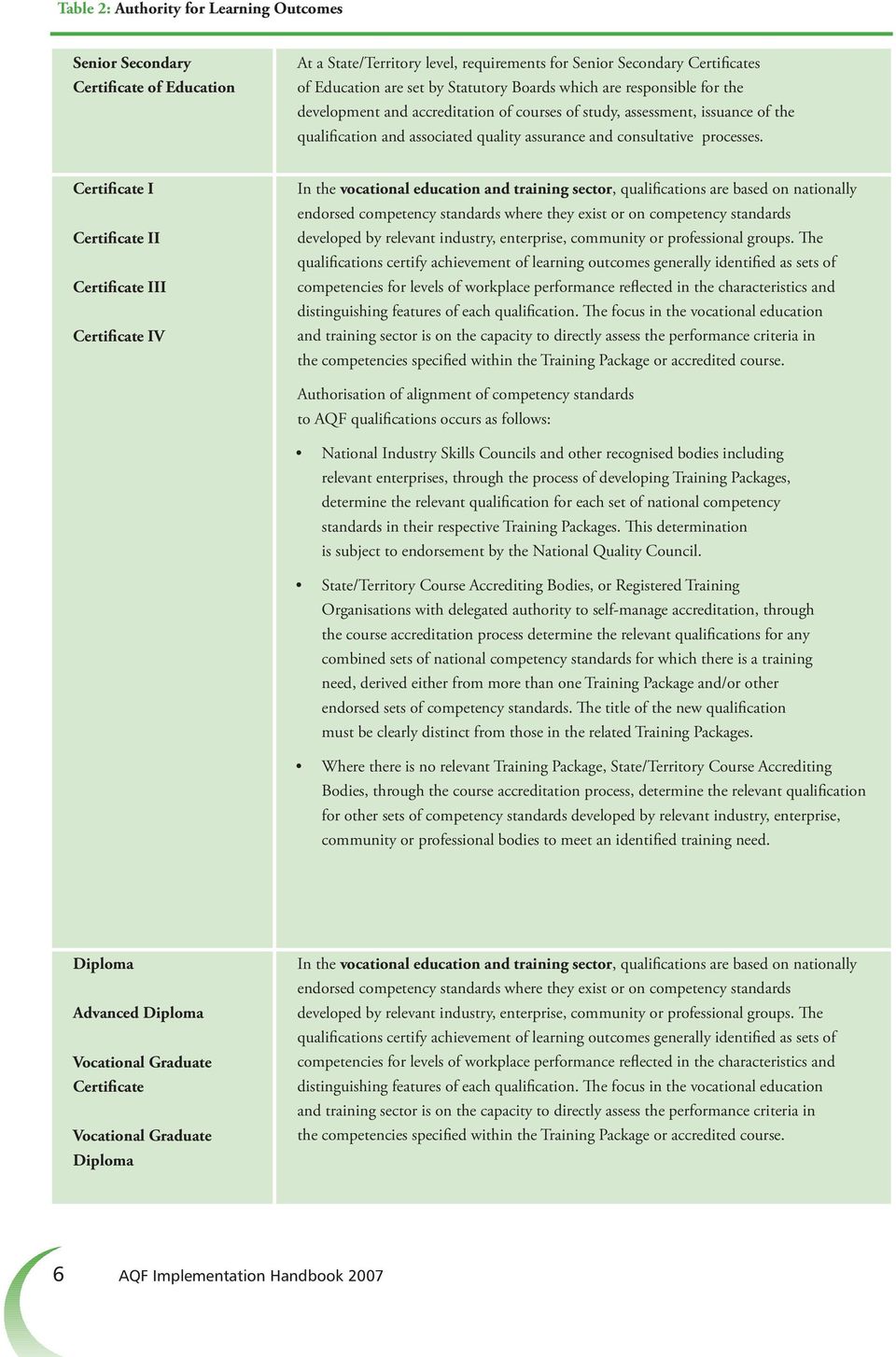
15 Authorisation of alignment of competency standards to AQF qualifications occurs as follows: National Industry Skills Councils and other recognised bodies including relevant enterprises, through the process of developing Training Packages, determine the relevant qualifications for each set of national competency standards in their respective Training Packages. This determination is subject to endorsement by the National Quality Council. State/Territory Course Accrediting Bodies, or Registered Training Organisations with delegated authority to self-manage accreditation, through the course accreditation process determine the relevant qualifications for any combined sets of national competency standards for which there is a training need, derived either from more than one Training Package and/or other endorsed sets of competency standards. The title of the new qualification must be clearly distinct from those in the related Training Packages. Where there is no relevant Training Package, State/Territory Course Accrediting Bodies, through the course accreditation process, determine the relevant qualifications for other sets of competency standards developed by relevant industry, enterprise, community or professional bodies to meet an identified training need. For Diploma and Advanced Diploma qualifications issued in the higher education sector, objectives and academic requirements of courses are set by higher education institutions having regard for requirements set by peer review and the requirements of relevant professional bodies and employer groups. They may establish course advisory committees comprising a range of interested parties including practitioners, employers, community representatives and academic staff from other institutions to facilitate ongoing review of content and relevance. Universities and other self-accrediting institutions are authorised to accredit their own courses. Non self-accrediting institutions must have their courses approved by government accreditation authorities through processes which ensure that the courses are comparable in requirements and learning outcomes to a course at the same level in a similar field at an Australian university. Associate Degree Bachelor Degree Graduate Certificate Graduate Diploma Masters Degree Doctoral Degree In the higher education sector, objectives and academic requirements of courses are set by higher education institutions having regard for requirements set by peer review and the requirements of relevant professional bodies and employer groups. They may establish course advisory committees comprising a range of interested parties including practitioners, employers, community representatives and academic staff from other institutions to facilitate ongoing review of content and relevance. Universities and other self-accrediting institutions are authorised to accredit their own courses. Non self-accrediting institutions must have their courses approved by government accreditation authorities through processes which ensure that the courses are comparable in requirements and learning outcomes to a course at the same level in a similar field at an Australian university. Guidelines 7

16 Table 3: Characteristics of Learning Outcomes Senior Secondary Certificate of Education Certificate I Certificate II Certificate III Certificate IV The characteristics of learning outcomes at this level include the knowledge, skills and understandings, both generic and subjectspecific, required as a basic preparation for civic life, work and lifelong learning. These are developed through studies that may include academic disciplines, vocational education and training, and communitybased learning. Breadth, depth and complexity of knowledge and skills would prepare a person to perform a defined range of activities most of which may be routine and predictable. Applications may include a variety of employment-related skills including preparatory access and participation skills, broad-based induction skills and/ or specific workplace skills. They may also include participation in a team or work group. Breadth, depth and complexity of knowledge and skills would prepare a person to perform in a range of varied activities or knowledge application where there is a clearly defined range of contexts in which the choice of actions required is usually clear and there is limited complexity in the range of options to be applied. Performance of a prescribed range of functions involving known routines and procedures and some accountability for the quality of outcomes. Applications may include some complex or non-routine activities involving individual responsibility or autonomy and/or collaboration with others as part of a group or team. Breadth, depth and complexity of knowledge and competencies would cover selecting, adapting and transferring skills and knowledge to new environments and providing technical advice and some leadership in resolution of specific problems. This would be applied across a range of roles in a variety of contexts with some complexity in the extent and choice of options available. Performance of a defined range of skilled operations, usually within a range of broader related activities involving known routines, methods and procedures, where some discretion and judgement is required in the selection of equipment, services or contingency measures and within known time constraints. Applications may involve some responsibility for others. Participation in teams including group or team coordination may be involved. Breadth, depth and complexity of knowledge and competencies would cover a broad range of varied activities or application in a wider variety of contexts most of which are complex and non-routine. Leadership and guidance are involved when organising activities of self and others as well as contributing to technical solutions of a non-routine or contingency nature. Performance of a broad range of skilled applications including requirements to evaluate and analyse current practices, develop new criteria and procedures for performing current practices and provision of some leadership and guidance to others in the application and planning of the skills. Applications involve responsibility for, and limited organisation of, others. 8 AQF Implementation Handbook 2007

17 Diploma Advanced Diploma Associate Degree Bachelor Degree Graduate Certificate Breadth, depth and complexity covering planning and initiation of alternative approaches to skills or knowledge applications across a broad range of technical and/or management requirements, evaluation and coordination. The self-directed application of knowledge and skills, with substantial depth in some areas where judgement is required in planning and selecting appropriate equipment, services and techniques for self and others. Applications involve participation in development of strategic initiatives, as well as personal responsibility and autonomy in performing complex technical operations or organising others. It may include participation in teams including teams concerned with planning and evaluation functions. Group or team coordination may be involved. The degree of emphasis on breadth as against depth of knowledge and skills may vary between qualifications granted at this level. Breadth, depth and complexity involving analysis, diagnosis, design, planning, execution and evaluation across a broad range of technical and/ or management functions including development of new criteria or applications or knowledge or procedures. The application of a significant range of fundamental principles and complex techniques across a wide and often unpredictable variety of contexts in relation to either varied or highly specific functions. Contribution to the development of a broad plan, budget or strategy is involved and accountability and responsibility for self and others in achieving the outcomes is involved. Applications involve significant judgement in planning, design, technical or leadership/ guidance functions related to products, services, operations or procedures. The degree of emphasis on breadth as against depth of knowledge and skills may vary between qualifications granted at this level. The acquisition of the foundational underpinnings of one or more disciplines, including understanding and interpretation of key concepts and theories and how they are evolving within the relevant scientific, technical, social and cultural contexts. Development of the academic skills and attributes necessary to access, comprehend and evaluate information from a range of sources. Development of generic employment related skills relevant to a range of employment contexts. A capacity for self-directed and lifelong learning. A course leading to this qualification is generally but not exclusively articulated with relevant Bachelor Degree programs. A course leading to this qualification will vary in breadth and depth according to whether it is a single or multidisciplinary program but will be taken to sufficient depth to provide a basis for full articulation with relevant Bachelor Degree programs. The acquisition of a systematic and coherent body of knowledge, the underlying principles and concepts, and the associated communication and problem-solving skills. Development of the academic skills and attributes necessary to undertake research, comprehend and evaluate new information, concepts and evidence from a range of sources. Development of the ability to review, consolidate, extend and apply the knowledge and techniques learnt, including in a professional context. A foundation for self-directed and lifelong learning. Interpersonal and teamwork skills appropriate to employment and/ or further study. A course leading to this qualification also usually involves major studies in which significant literature is available. Course content is taken to a significant depth and progressively developed to a high level which provides a basis for postgraduate study and professional careers. Characteristics of learning outcomes at this level cover a wide range of specialised needs following an undergraduate program or relevant prior work, ranging from initial and ongoing professional development to preparation for further postgraduate study. The learning outcomes reflect a standard appropriate to advanced study and primarily include the acquisition and application of knowledge and skills in a new discipline or professional area, which may also involve extending knowledge and skills gained in an undergraduate program or relevant prior work. Guidelines 9
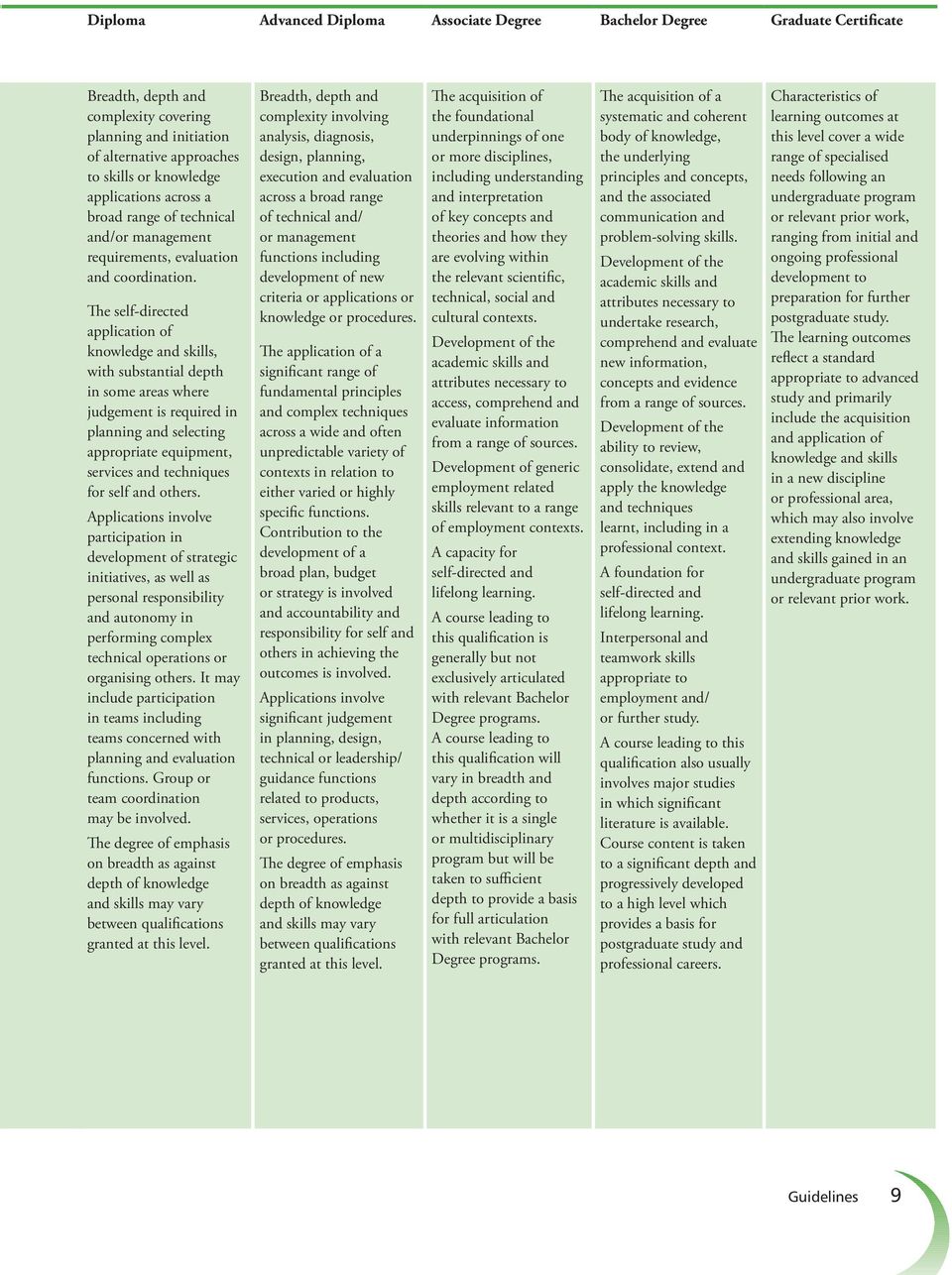
18 Table 3: Characteristics of Learning Outcomes continued Vocational Graduate Certificate Graduate Diploma Vocational Graduate Diploma Masters Degree Doctoral Degree The self-directed development and achievement of broad and/or specialised areas of knowledge and skills building on prior knowledge and skills. Substantial breadth, depth and complexity involving the initiation, analysis, design, planning, execution and evaluation of technical and/or management functions in highly varied and /or highly specialised contexts. Applications involve making significant, high level, independent judgements in major, broad or specialised planning, design, operational, technical and/or management functions in highly varied and/or highly specialised contexts. It may include responsibility and broadranging accountability for the structure, management and output of the work of others and/or functions. The degree of emphasis on breadth as against depth of knowledge and skills may vary between qualifications granted at this level. Characteristics of learning outcomes at this level cover a wide range of specialised needs following an undergraduate or postgraduate program or relevant prior work, ranging from initial and ongoing professional development to preparation for further postgraduate study, including research higher degrees. The learning outcomes reflect a standard appropriate to a graduate intake and may include: the acquisition and critical application of knowledge and skills in a new discipline or professional area, which may also involve extending knowledge and skills already gained in an undergraduate program or relevant prior work; and further specialisation within a systematic and coherent body of knowledge. The self-directed development and achievement of broad and/or specialised areas of knowledge and skills building on prior knowledge and skills. Substantial breadth, depth and complexity involving the initiation, analysis, design, planning, execution and evaluation of major functions, both broad and/or highly specialised, in highly varied and/or highly specialised contexts. Further specialisation within a systematic and coherent body of knowledge. Applications involving making high level, fully independent, complex judgements in broad and/or highly specialised planning, design, operational, technical and/or management functions in highly varied and/or highly specialised contexts. They may involve full responsibility and accountability for all aspects of work of others and functions including planning, budgeting and strategy. Mastery or overview of the relevant field of study or area of professional practice and the emphasis may range from the acquisition or enhancement of specific professional or vocational skills and knowledge, usually undertaken in a combination of coursework and research, through to the acquisition of indepth understanding in a specific area of knowledge which is usually undertaken through research. Provide appropriate evidence of advanced knowledge about a specialist body of theoretical and applied topics. Demonstrate a high order of skill in analysis, critical evaluation and/or professional application through the planning and execution of project work or a piece of scholarship or research. Demonstrate creativity and flexibility in the application of knowledge and skills to new situations, to solve complex problems and to think rigorously and independently. A substantial original contribution to knowledge in the form of new knowledge or significant and original adaptation, application and interpretation of existing knowledge. A comprehensive and searching review of the literature, experimentation, creative work with exegesis or other systematic approach or an advanced, searching and expansive critical reflection on professional theory and practice. Undertake an original research project, or a project(s) addressing a matter of substance concerning practice in a profession at a high level of originality and quality. Presentation of a substantial and well ordered dissertation, non-print thesis or portfolio, for submission to external examination against international standards. 10 AQF Implementation Handbook 2007
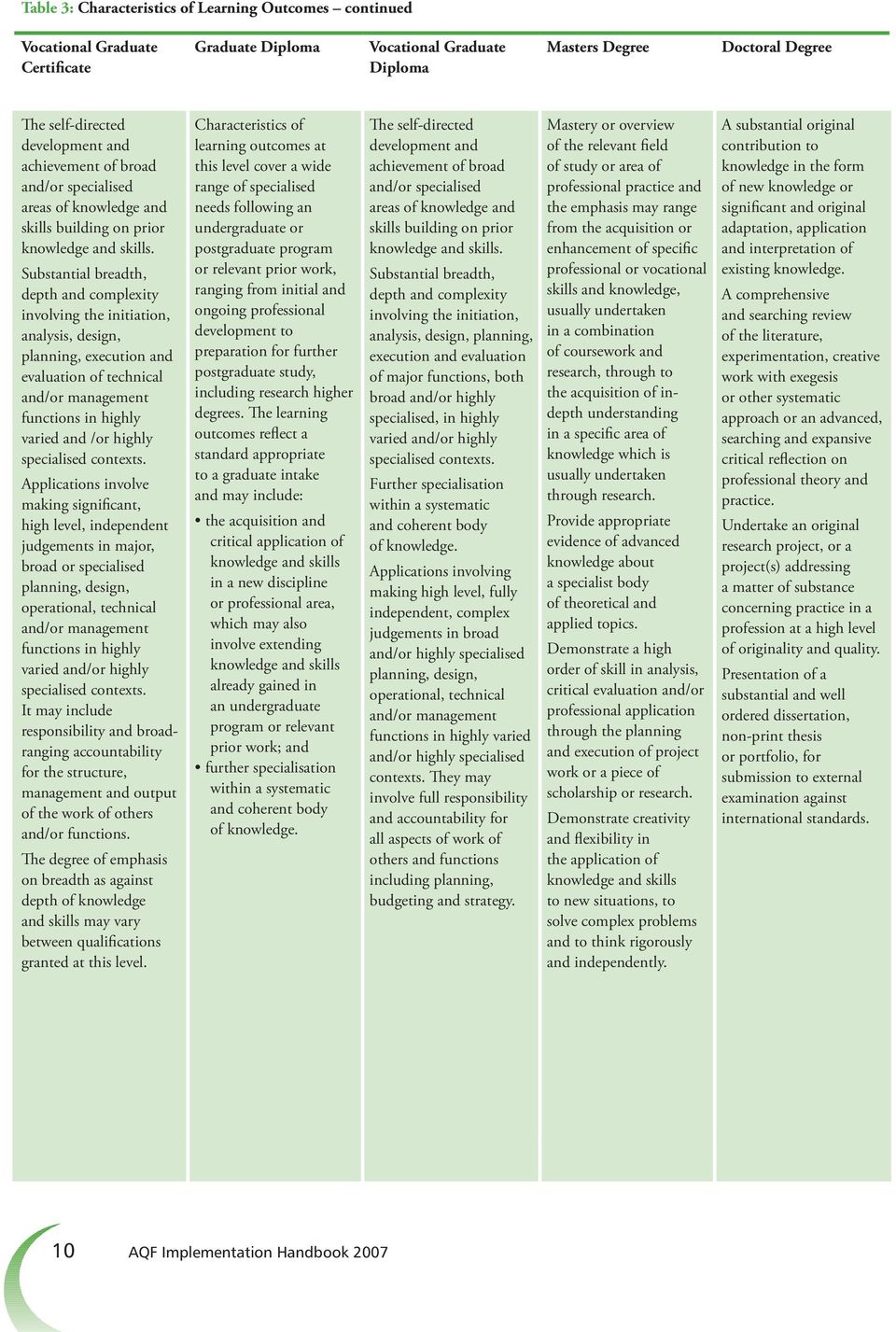
19 Table 4: Distinguishing Features of Learning Outcomes Certificate I Certificate II Certificate III Certificate IV Do the Competencies enable an individual with this qualification to: Do the Competencies enable an individual with this qualification to: Do the Competencies enable an individual with this qualification to: Do the Competencies enable an individual with this qualification to: demonstrate knowledge by recall in a narrow range of areas demonstrate basic operational knowledge in a moderate range of areas demonstrate some relevant theoretical knowledge demonstrate understanding of a broad knowledge base incorporating some theoretical concepts demonstrate basic practical skills such as the use of relevant tools apply a defined range of skills apply a range of well developed skills apply known solutions to a limited range of predictable problems apply known solutions to a variety of predictable problems apply solutions to a defined range of unpredictable problems perform a sequence of routine tasks given clear direction perform a range of tasks where choice between a limited range of options is required perform processes that require a range of well developed skills where some discretion and judgement is required identify and apply skill and knowledge areas to a wide variety of contexts with depth in some areas receive and pass on messages/ information assess and record information from varied sources interpret available information, using discretion and judgement identify, analyse and evaluate information from a variety of sources take limited responsibility for own outputs in work and learning take responsibility for own outputs in work and learning take responsibility for own outputs in relation to specified quality standards take limited responsibility for the output of others take limited responsibility for the quantity and quality of the output of others Guidelines 11
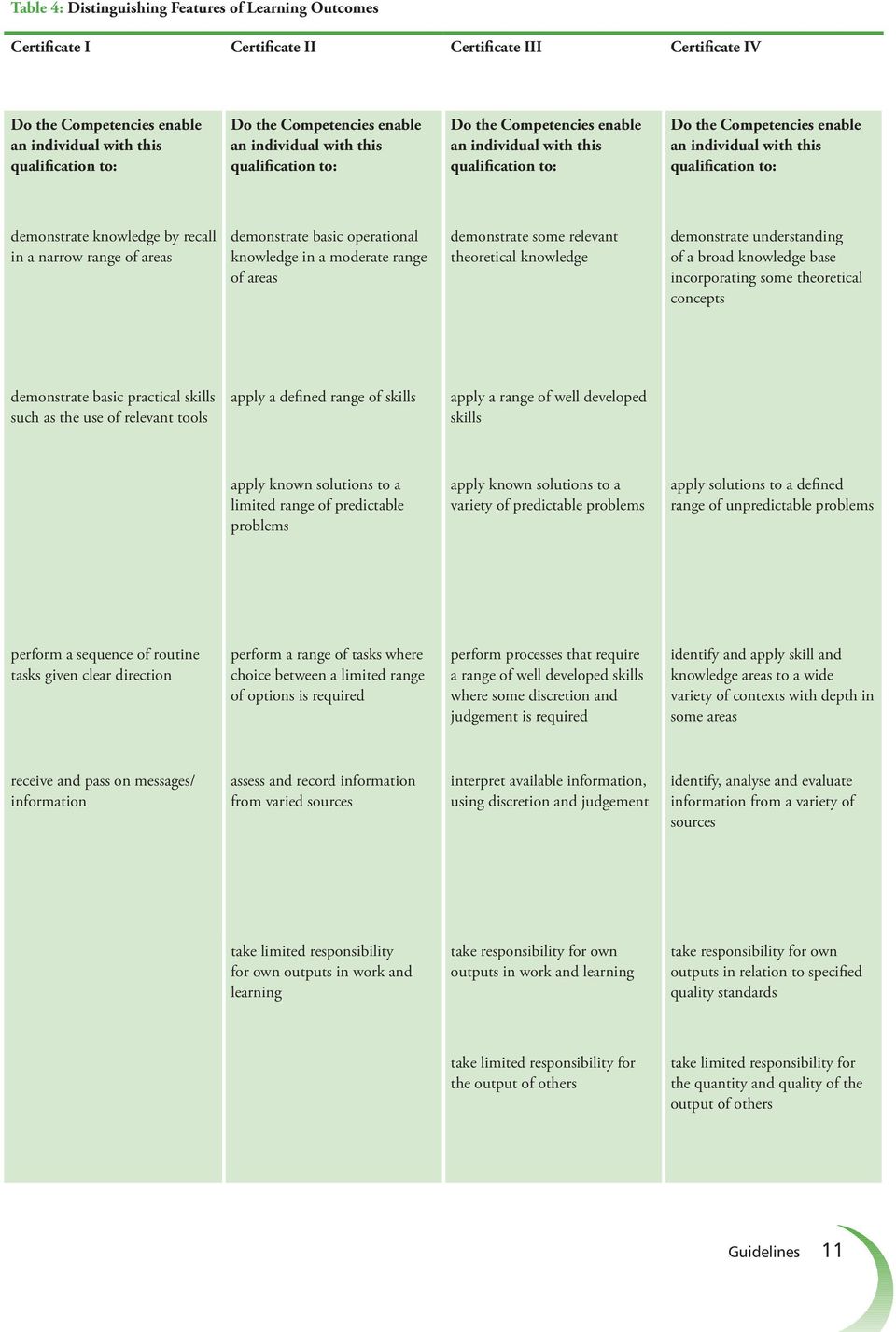
20 Table 4: Distinguishing Features of Learning Outcomes continued Diploma Advanced Diploma Vocational Graduate Certificate Vocational Graduate Diploma Do the Competencies or Learning Outcomes enable an individual with this qualification to: Do the Competencies or Learning Outcomes enable an individual with this qualification to: Do the Competencies or Learning Outcomes enable an individual with this qualification to: Do the Competencies or Learning Outcomes enable an individual with this qualification to: demonstrate understanding of a broad knowledge base incorporating theoretical concepts, with substantial depth in some areas demonstrate understanding of specialised knowledge with depth in some areas demonstrate the self-directed development and achievement of broad and/or specialised areas of knowledge and skills building on prior knowledge and skills demonstrate the self-directed development and achievement of broad and/or highly specialised areas of knowledge and skills building on prior knowledge and skills analyse and plan approaches to technical problems or management requirements analyse, diagnose, design and execute judgements across a broad range of technical or management functions initiate, analyse, design, plan, execute and evaluate major, broad and/or highly specialised technical and/or management functions in highly varied and/ or highly specialised contexts initiate, analyse, design, plan, execute and evaluate major functions either broad and/ or highly specialised within highly varied and/or highly specialised contexts transfer and apply theoretical concepts and/or technical or creative skills to a range of situations demonstrate a command of wide-ranging, highly specialised technical, creative or conceptual skills generate and evaluate ideas through the analysis of information and concepts at an abstract level generate and evaluate complex ideas through the analysis of information and concepts at an abstract level evaluate information using it to forecast for planning or research purposes generate ideas through the analysis of information and concepts at an abstract level demonstrate a command of wide-ranging highly specialised technical, creative or conceptual skills in complex contexts demonstrate an expert command of wide-ranging, highly specialised technical, creative or conceptual skills in complex and/or highly specialised or varied contexts take responsibility for own outputs in relation to broad quantity and quality parameters demonstrate accountability for personal outputs within broad parameters demonstrate responsibility and broad-ranging accountability for personal outputs demonstrate full responsibility and accountability for personal outputs take limited responsibility for the achievement of group outcomes demonstrate accountability for group outcomes within broad parameters demonstrate responsibility and broad-ranging accountability for the structure, management and output of work of others and/or functions demonstrate full responsibility and accountability for all aspects of work of others and functions including planning, budgeting and strategy 12 AQF Implementation Handbook 2007

21 Senior Secondary Certificate of Education Guideline (Revised November 2004) 1. Purpose To assist employers, employees, professional associations, unions, curriculum developers, accrediting bodies and the wider public, including students, parents, and education and training bodies, to understand factors determining the level of the qualification. 2. Context Senior Secondary Certificates of Education (local titles are used at State/ Territory level) certify the completion of secondary education. 3. Learning Outcomes 3.1 Authority At a State/Territory level, requirements for the Senior Secondary Certificate of Education are set by statutory authorities, which are responsible for the development and accreditation of courses of study, assessment, issuance of the qualification and associated quality assurance and consultative processes. 3.2 Characteristics The characteristics of learning outcomes at this level include the knowledge, skills and understandings, both generic and subject-specific, required as a basic preparation for civic life, work and lifelong learning. These are developed through studies that may include academic disciplines, vocational education and training, and community-based learning. 4. Responsibility for Assessment In each State/Territory, statutory authorities are responsible for determining assessment requirements and ensuring that assessment standards are maintained through appropriate quality assurance processes. The work of the statutory authorities is underpinned by nationally agreed principles of integrity and quality in assessment and certification. 5. Pathways to, through and from the Qualification Entry to this qualification normally requires the equivalent of Year 10. Adult students may undertake the qualification without necessarily having completed Year 10 and in most States/Territories may receive recognition for prior learning. Pathways through the qualification may include: Full-Time School Study A two-year post Year 10 Senior Secondary School Certificate of Education program. Schools/TAFE Programs Guidelines 13
22 A Senior Secondary School Certificate of Education program incorporating units of competency from a National Training Package or recognising other c ommunity-based learning. A combination of an accredited course of study and credit for prior learning which may include a formally recognised program or other learning achieved by an individual, meeting the quality assurance requirements of the senior secondary certificate. These examples suggest only some of a wide range of possible programs of study. They are not intended to be prescriptive, nor are they limited to this particular qualification. Time taken to gain the qualification will vary according to the pathway taken but typically requires two years of full-time study (normally Years 11 and 12) although students who are able to meet the requirements may commence studies in earlier years. Longer part-time programs are available in most States. Some States specify a limit of five years for the completion of the Certificate requirements; others have no limits. Pathways for students who complete the requirements of the Certificate can include higher education, vocational education and training and direct entry to the work force or a combination thereof. 6. Authority to Issue the Qualification The Senior Secondary Certificate of Education is issued in each State/Territory by a statutory authority. 7. Certification Issued A qualification is: formal certification, issued by a relevant approved body, in recognition that a person has achieved learning outcomes relevant to identified individual, professional, industry or community needs. Each State/Territory has legislative responsibility for authorising the issue of the Certificate. These qualifications may be referred to using a number of local titles at State/Territory level. Individuals who complete some of the requirements for the Certificate will receive a record of their achievements. The State/Territory statutory authorities are responsible for providing and maintaining records in relation to the above. 14 AQF Implementation Handbook 2007
23 Certificate I Guideline 1. Purpose To assist employers; employees; professional associations; unions; Training Package, course and curriculum developers; accrediting bodies; and the wider public, including students, parents, and education and training bodies, to understand factors determining the level of the qualification. Also, to assist developers of Training Packages and courses of training to assign appropriate AQF qualifications within a Training Package, or to a course to be submitted for accreditation. 2. Context These Guidelines replace the RATE Descriptions, which have previously been used to provide guidance on qualification levels. The Guideline for the Certificate I qualification, which is authorised by the vocational education and training sector, takes into account developments under the National Skills Framework the introduction of Training Packages and the implementation of the Australian Quality Training Framework 2007 (AQTF 2007). Training Packages use competency standards to describe the skills and knowledge needed to perform effectively in the workplace. These competency standards are packaged into units of competency. Units of competency are components of AQF qualifications. It is a requirement of the AQTF 2007 that competency standards from relevant Training Packages be used where they exist. Qualifications developed outside Training Packages must not duplicate qualifications contained in Training Packages. Registered Training Organisations and/or State/Territory Course Accrediting Bodies will need to be satisfied that any qualification proposed outside a Training Package cannot be achieved by the customisation and flexibility offered within a Training Package or by the issuance of a Training Package qualification together with one or more Statements of Attainment. The National Quality Council, the body responsible for the endorsement of Training Packages, also has responsibility for the endorsement of national competency standards that are not part of Training Packages. These Guidelines apply equally to qualifications based on these competency standards. In the vocational education and training sector there are a number of useful reference documents, which are listed in the Appendix. Guidelines 15
24 3. Learning Outcomes 3.1 Authority In the vocational education and training sector, qualifications are based on nationally endorsed competency standards where they exist or on competency standards developed by relevant industry, enterprise, community or professional groups. The qualifications certify achievement of learning outcomes generally identified as sets of competencies for levels of workplace performance reflected in the characteristics and distinguishing features of each qualification. The focus in the vocational education and training sector is on the capacity to assess directly the performance criteria in the competencies specified within the Training Package or accredited course. Authorisation of alignment of competency standards to AQF qualifications occurs as follows: National Industry Skills Councils and other recognised bodies including relevant enterprises, through the process of developing Training Packages, determine the relevant qualification for each set of national competency standards in their respective Training Packages. This determination is subject to endorsement by the National Quality Council. State/Territory Course Accrediting Bodies, or Registered Training Organisations with delegated authority to self-manage accreditation, through the course accreditation process determine the relevant qualifications for any combined sets of national competency standards for which there is a training need, derived either from more than one Training Package and/or other endorsed sets of competency standards. The title of the new qualification must be clearly distinct from those in the related Training Packages. Where there is no relevant Training Package, State/Territory Course Accrediting Bodies, through the course accreditation process, determine the relevant qualification for other sets of competency standards developed by relevant industry, enterprise, community or professional bodies to meet an identified training need. 3.2 Characteristics Characteristics of competencies include: defined range of activities most of which may be routine and predictable; and breadth, depth and complexity of knowledge and skills would prepare a person to perform a applications may include a variety of employment-related skills including preparatory access and participation skills, broad-based induction skills and/or specific work place skills. They may also include participation in a team or work group. 3.3 Distinguishing Features Where additional information is required to assist in determining the qualification level, the following chart could be used to help determine the most compatible match. It is emphasised that the chart is not intended to be used as a checklist which all Certificate I qualifications must include, or to replace the authority statement above. 16 AQF Implementation Handbook 2007
25 Table 5: Distinguishing Features: Certificates I and II Certificate I Do the Competencies enable an individual with this qualification to: Certificate II Do the Competencies enable an individual with this qualification to: demonstrate knowledge by recall in a narrow range of areas demonstrate basic operational knowledge in a moderate range of areas demonstrate basic practical skills such as the use of relevant tools perform a sequence of routine tasks given clear direction apply a defined range of skills apply known solutions to a limited range of predictable problems perform a range of tasks where choice between a limited range of options is required receive and pass on messages/information assess and record information from varied sources take limited responsibility for own outputs in work and learning Note: In Table 5 italicised words emphasise distinguishing features of the competencies between qualifications. In order to assist determining the relevant qualification, the most compatible set of features should be selected. Not all features will necessarily apply. 4. Responsibility for Assessment Qualifications issued in the vocational education and training sector certify the achievement of competency. Assessment is the responsibility of Registered Training Organisations. These bodies must comply with the AQTF 2007 Essential Standards for Registration. 5. Pathways to the Qualification 5.1 Access to the qualification could be through: or or a training program meeting the requirements of an endorsed Training Package or a training program meeting the requirements of an accredited course(s) delivered by a Registered Training Organisation; a combination of a training program meeting the requirements of an endorsed Training Package or a training program meeting the requirements of an accredited course delivered by a Registered Training Organisation, plus recognition of prior learning including credit transfer and/or experience; the recognition of prior learning that provides evidence of the achievement of the competencies for the qualification. Guidelines 17
26 5.2 Time taken to gain the qualification will vary according to the pathway taken and factors related to the particular industry or work area. Structured training at this level may be broad-based induction skills for work in a large and diverse industry area and therefore involve more hours than others that focus on more specific workplace skills. Nominal duration statements may appear in training programs which may be part of the non-endorsed Learning Strategies component of a Training Package. Nominal duration statements are also to be included in accreditation submissions but will not be used to determine the level of a qualification. 5.3 Examples of possible pathways include: Work-Based Training and Assessment Based Training and Assessment Recognition of Prior Learning Institution-Based Education and Training and Assessment (including schools) Part Institution-Based Education and Training and Assessment (including schools)/part Work- Recognition of Prior Learning combined with Further Training as required Accumulation of a Variety of Short Courses/Training Programs NOTE: These examples suggest only some of a wide range of possible pathways. They are not intended to be prescriptive, nor are they limited to this particular qualification. 6. Authority to Issue the Qualification In the vocational education and training sector, each State/Territory has legislative responsibility for authorising the issuance of the qualification. This responsibility is carried out by Registered Training Organisations or in some instances by a body authorised under statute. RTOs agree to AQTF 2007 Conditions of Registration within the Essential Standards for Registration regarding the certification and issuing of qualifications and Statements of Attainment. 7. Certification Issued A qualification is: formal certification, issued by a relevant approved body, in recognition that a person has achieved competencies relevant to identified individual, professional, industry or community needs. Individuals issued with the qualification, ie Certificate I, will also receive documentation that identifies the units of competency that have been achieved when training is based on nationally endorsed competency standards (such as those in Training Packages). Individuals who complete only some of the requirements for the qualification will receive a Statement of Attainment. The Statement of Attainment will include, either on the Statement itself or as an attachment, the whole units of competency that have been achieved when training is based on nationally endorsed competency standards (such as those in Training Packages). The issuing body will be responsible for providing and maintaining records in relation to the above. See AQTF 2007 Essential Standards for Registration including the Conditions of Registration. 18 AQF Implementation Handbook 2007
27 Certificate II Guideline 1. Purpose To assist employers; employees; professional associations; unions; Training Package, course and curriculum developers; accrediting bodies; and the wider public, including students, parents, and education and training bodies, to understand factors determining the level of the qualification. Also, to assist developers of Training Packages and courses of training to assign appropriate AQF qualifications within a Training Package, or to a course to be submitted for accreditation. 2. Context These Guidelines replace the RATE Descriptions, which have previously been used to provide guidance on qualification levels. The Guideline for the Certificate II qualification, which is authorised by the vocational education and training sector, takes into account developments under the National Skills Framework the introduction of Training Packages and the implementation of the Australian Quality Training Framework 2007 (AQTF 2007). Training Packages use competency standards to describe the skills and knowledge needed to perform effectively in the workplace. These competency standards are packaged into units of competency. Units of competency are components of AQF qualifications. It is a requirement of the AQTF 2007 that competency standards from relevant Training Packages be used where they exist. Qualifications developed outside Training Packages must not duplicate qualifications contained in Training Packages. Registered Training Organisations and/or State/Territory Course Accrediting Bodies will need to be satisfied that any qualification proposed outside a Training Package cannot be achieved by the customisation and flexibility offered within a Training Package or by the issuance of a Training Package qualification together with one or more Statements of Attainment. The National Quality Council, the body responsible for the endorsement of Training Packages, also has responsibility for the endorsement of national competency standards that are not part of Training Packages. These Guidelines apply equally to qualifications based on these competency standards. In the vocational education and training sector there are a number of useful reference documents, which are listed in the Appendix. Guidelines 19
28 3. Learning Outcomes 3.1 Authority In the vocational education and training sector, qualifications are based on nationally endorsed competency standards where they exist or on competency standards developed by relevant industry, enterprise, community or professional groups. The qualifications certify achievement of learning outcomes generally identified as sets of competencies for levels of workplace performance reflected in the characteristics and distinguishing features of each qualification. The focus in the vocational education and training sector is on the capacity to assess directly the performance criteria in the competencies specified within the Training Package or accredited course. Authorisation of alignment of competency standards to AQF qualifications occurs as follows: National Industry Skills Councils and other recognised bodies including relevant enterprises, through the process of developing Training Packages, determine the relevant qualification for each set of national competency standards in their respective Training Packages. This determination is subject to endorsement by the National Quality Council. State/Territory Course Accrediting Bodies, or Registered Training Organisations with delegated authority to self-manage accreditation, through the course accreditation process determine the relevant qualifications for any combined sets of national competency standards for which there is a training need, derived either from more than one Training Package and/or other endorsed sets of competency standards. The title of the new qualification must be clearly distinct from those in the related Training Packages. Where there is no relevant Training Package, State/Territory Course Accrediting Bodies, through the course accreditation process, determine the relevant qualification for other sets of competency standards developed by relevant industry, enterprise, community or professional bodies to meet an identified training need. 3.2 Characteristics Characteristics of competencies include: procedures and some accountability for the quality of outcomes; performance of a prescribed range of functions involving known routines and breadth, depth and complexity of knowledge and skills would prepare a person to perform in a range of varied activities or knowledge applications where there is a clearly defined range of contexts in which the choice of actions required is usually clear and there is limited complexity in the range of options to be applied; and applications may include some complex or non-routine activities involving individual responsibility or autonomy and/or collaboration with others as part of a group or team. 3.3 Distinguishing Features Where additional information is required to assist in determining the qualification level, the following chart could be used to help determine the most compatible match. It is emphasised that the chart is not intended to be used as a checklist which all Certificate II qualifications must include, or to replace the authority statement above. 20 AQF Implementation Handbook 2007
29 Table 6: Distinguishing Features: Certificates I, II and III Certificate I Certificate II Certificate III Do the Competencies enable an individual with this qualification to: Do the Competencies enable an individual with this qualification to: Do the Competencies enable an individual with this qualification to: demonstrate knowledge by recall in a narrow range of areas demonstrate basic operational knowledge in a moderate range of areas demonstrate some relevant theoretical knowledge demonstrate basic practical skills such as the use of relevant tools apply a defined range of skills apply a range of well developed skills apply known solutions to a limited range of predictable problems apply known solutions to a variety of predictable problems perform a sequence of routine tasks given clear direction perform a range of tasks where choice between a limited range of options is required perform processes that require a range of well developed skills where some discretion and judgement is required receive and pass on messages/ information assess and record information from varied sources interpret available information, using discretion and judgement take limited responsibility for own outputs in work and learning take responsibility for own outputs in work and learning take limited responsibility for the output of others Note: In Table 6 italicised words emphasise distinguishing features of the competencies between qualifications. In order to assist determining the relevant qualification, the most compatible set of features should be selected. Not all features will necessarily apply. 4. Responsibility for Assessment Qualifications issued in the vocational education and training sector certify the achievement of competency. Assessment is the responsibility of Registered Training Organisations. These bodies must comply with AQTF 2007 Essential Standards for Registration. Guidelines 21
30 5. Pathways to the Qualification 5.1 Access to the qualification could be through: or or a training program meeting the requirements of an endorsed Training Package or a training program meeting the requirements of an accredited course(s) delivered by a Registered Training Organisation; a combination of a training program meeting the requirements of an endorsed Training Package or a training program meeting the requirements of an accredited course delivered by a Registered Training Organisation, plus recognition of prior learning including credit transfer and/or experience; the recognition of prior learning that provides evidence of the achievement of the competencies for the qualification. 5.2 Time taken to gain the qualification will vary according to the pathway taken and factors related to the particular industry or work area. Nominal duration statements may appear in training programs which may be part of the non-endorsed Learning Strategies component of a Training Package. Nominal duration statements are also to be included in accreditation submissions but will not be used to determine the level of a qualification. 5.3 Examples of possible pathways include: Work-Based Training and Assessment Based Training and Assessment Recognition of Prior Learning Institution-Based Education and Training and Assessment (including schools) Part Institution-Based Education and Training and Assessment (including schools)/part Work- Recognition of Prior Learning combined with Further Training as required Accumulation of a Variety of Short Courses/Training Programs NOTE: These examples suggest only some of a wide range of possible pathways. They are not intended to be prescriptive, nor are they limited to this particular qualification. 6. Authority to Issue the Qualification In the vocational education and training sector, each State/Territory has legislative responsibility for authorising the issuance of the qualification. This responsibility is carried out by Registered Training Organisations or in some instances by a body authorised under statute. RTOs agree to AQTF 2007 Conditions of Registration within the Essential Standards for Registration regarding the certification and issuing of qualifications and Statements of Attainment. 22 AQF Implementation Handbook 2007
31 7. Certification Issued A qualification is: formal certification, issued by a relevant approved body, in recognition that a person has achieved competencies relevant to identified individual, professional, industry or community needs. Individuals issued with the qualification, ie Certificate II, will also receive documentation that identifies the units of competency that have been achieved when training is based on nationally endorsed competency standards (such as those in Training Packages). Individuals who complete only some of the requirements for the qualification will receive a Statement of Attainment. The Statement of Attainment will include, either on the Statement itself or as an attachment, the whole units of competency that have been achieved when training is based on nationally endorsed competency standards (such as those in Training Packages). The issuing body will be responsible for providing and maintaining records in relation to the above. See AQTF 2007 Essential Standards for Registration including the Conditions of Registration. Guidelines 23
32
33 Certificate III Guideline 1. Purpose To assist employers; employees; professional associations; unions; Training Package, course and curriculum developers; accrediting bodies; and the wider public, including students, parents, and education and training bodies, to understand factors determining the level of the qualification. Also, to assist developers of Training Packages and courses of training to assign appropriate AQF qualifications within a Training Package, or to a course to be submitted for accreditation. 2. Context These Guidelines replace the RATE Descriptions, which have previously been used to provide guidance on qualification levels. The Guideline for the Certificate III qualification, which is authorised by the vocational education and training sector, takes into account developments under the National Skills Framework the introduction of Training Packages and the implementation of the Australian Quality Training Framework 2007 (AQTF 2007). Training Packages use competency standards to describe the skills and knowledge needed to perform effectively in the workplace. These competency standards are packaged into units of competency. Units of competency are components of AQF qualifications. It is a requirement of the AQTF 2007 that competency standards from relevant Training Packages be used where they exist. Qualifications developed outside Training Packages must not duplicate qualifications contained in Training Packages. Registered Training Organisations and/or State/Territory Course Accrediting Bodies will need to be satisfied that any qualification proposed outside a Training Package cannot be achieved by the customisation and flexibility offered within a Training Package or by the issuance of a Training Package qualification together with one or more Statements of Attainment. The National Quality Council, the body responsible for the endorsement of Training Packages, also has responsibility for the endorsement of national competency standards that are not part of Training Packages. These Guidelines apply equally to qualifications based on these competency standards. In the vocational education and training sector there are a number of useful reference documents, which are listed in the Appendix. 3. Learning Outcomes 3.1 Authority In the vocational education and training sector, qualifications are based on nationally endorsed competency standards where they exist or on competency standards developed by relevant industry, enterprise, community or professional groups. The qualifications certify achievement of learning outcomes generally identified as sets of competencies for levels of workplace performance reflected in the characteristics and distinguishing features of each qualification. The focus in the vocational education Guidelines 25
34 and training sector is on the capacity to assess directly the performance criteria in the competencies specified within the Training Package or accredited course. Authorisation of alignment of competency standards to AQF qualifications occurs as follows: National Industry Skills Councils and other recognised bodies including relevant enterprises, through the process of developing Training Packages, determine the relevant qualification for each set of national competency standards in their respective Training Packages. This determination is subject to endorsement by the National Quality Council. State/Territory Course Accrediting Bodies, or Registered Training Organisations with delegated authority to self-manage accreditation, through the course accreditation process determine the relevant qualifications for any combined sets of national competency standards for which there is a training need, derived either from more than one Training Package and/or other endorsed sets of competency standards. The title of the new qualification must be clearly distinct from those in the related Training Packages. Where there is no relevant Training Package, State/Territory Course Accrediting Bodies, through the course accreditation process, determine the relevant qualification for other sets of competency standards developed by relevant industry, enterprise, community or professional bodies to meet an identified training need. 3.2 Characteristics Characteristics of competencies include: performance of a defined range of skilled operations, usually within a range of broader related activities involving known routines, methods and procedures, where some discretion and judgement is required in the selection of equipment, services or contingency measures and within known time constraints; breadth, depth and complexity of knowledge and competencies would cover selecting, adapting and transferring skills and knowledge to new environments and providing technical advice and some leadership in resolution of specific problems. This would be applied across a range of roles in a variety of contexts with some complexity in the extent and choice of options available; and applications may involve some responsibility for others. Participation in teams including group or team coordination may be involved. 3.3 Distinguishing Features Where additional information is required to assist in determining the qualification level, the following chart could be used to help determine the most compatible match. It is emphasised that the chart is not intended to be used as a checklist which all Certificate III qualifications must include, or to replace the authority statement above. 26 AQF Implementation Handbook 2007
35 Table 7: Distinguishing Features: Certificates II, III and IV Certificate II Certificate III Certificate IV Do the Competencies enable an individual with this qualification to: Do the Competencies enable an individual with this qualification to: Do the Competencies enable an individual with this qualification to: demonstrate basic operational knowledge in a moderate range of areas demonstrate some relevant theoretical knowledge demonstrate understanding of a broad knowledge base incorporating some theoretical concepts apply a defined range of skills apply a range of well developed skills apply known solutions to a limited range of predictable problems apply known solutions to a variety of predictable problems apply solutions to a defined range of unpredictable problems perform a range of tasks where choice between a limited range of options is required perform processes that require a range of well developed skills where some discretion and judgement is required identify and apply skill and knowledge areas to a wide variety of contexts with depth in some areas assess and record information from varied sources interpret available information, using discretion and judgement identify, analyse and evaluate information from a variety of sources take limited responsibility for own outputs in work and learning take responsibility for own outputs in work and learning take responsibility for own outputs in relation to specified quality standards take limited responsibility for the output of others take limited responsibility for the quantity and quality of the output of others Note: In Table 6 italicised words emphasise distinguishing features of the competencies between qualifications. In order to assist determining the relevant qualification, the most compatible set of features should be selected. Not all features will necessarily apply. 4. Responsibility for Assessment Qualifications issued in the vocational education and training sector certify the achievement of competency. Guidelines 27
36 Assessment is the responsibility of Registered Training Organisations. These bodies must comply with AQTF 2007 Essential Standards for Registration including the Conditions of Registration. 5. Pathways to the Qualification 5.1 Access to the qualification could be through: or or a training program meeting the requirements of an endorsed Training Package or a training program meeting the requirements of an accredited course(s) delivered by a Registered Training Organisation; a combination of a training program meeting the requirements of an endorsed Training Package or a training program meeting the requirements of an accredited course delivered by a Registered Training Organisation, plus recognition of prior learning including credit transfer and/or experience; the recognition of prior learning that provides evidence of the achievement of the competencies for the qualification. 5.2 Time taken to gain the qualification will vary according to the pathway taken and factors related to the particular industry or work area. Nominal duration statements may appear in training programs which may be part of the non-endorsed Learning Strategies component of a Training Package. Nominal duration statements are also to be included in accreditation submissions but will not be used to determine the level of a qualification. 5.3 Examples of possible pathways include: Work-Based Training and Assessment Based Training and Assessment Recognition of Prior Learning Institution-Based Education and Training and Assessment (including schools) Part Institution-Based Education and Training and Assessment (including schools)/part Work- Recognition of Prior Learning combined with Further Training as required Accumulation of a Variety of Short Courses/Training Programs NOTE: These examples suggest only some of a wide range of possible pathways. They are not intended to be prescriptive, nor are they limited to this particular qualification. 6. Authority to Issue the Qualification In the vocational education and training sector, each State/Territory has legislative responsibility for authorising the issuance of the qualification. This responsibility is carried out by Registered Training Organisations or in some instances by a body authorised under statute. RTOs agree to AQTF 2007 Conditions of Registration within the Essential Standards for Registration regarding the certification and issuing of qualifications and Statements of Attainment. 28 AQF Implementation Handbook 2007
37 7. Certification Issued A qualification is: formal certification, issued by a relevant approved body, in recognition that a person has achieved competencies relevant to identified individual, professional, industry or community needs. Individuals issued with the qualification, ie Certificate III, will also receive documentation that identifies the units of competency that have been achieved when training is based on nationally endorsed competency standards (such as those in Training Packages). Individuals who complete only some of the requirements for the qualification will receive a Statement of Attainment. The Statement of Attainment will include, either on the Statement itself or as an attachment, the whole units of competency that have been achieved when training is based on nationally endorsed competency standards (such as those in Training Packages). The issuing body will be responsible for providing and maintaining records in relation to the above. See AQTF 2007 Essential Standards for Registration including the Conditions of Registration. Guidelines 29
38
39 Certificate IV Guideline 1. Purpose To assist employers; employees; professional associations; unions; Training Package, course and curriculum developers; accrediting bodies; and the wider public, including students, parents, and education and training bodies, to understand factors determining the level of the qualification. Also, to assist developers of Training Packages and courses of training to assign appropriate AQF qualifications within a Training Package, or to a course to be submitted for accreditation. 2. Context These Guidelines replace the RATE Descriptions, which have previously been used to provide guidance on qualification levels. The Guideline for the Certificate IV qualification, which is authorised by the vocational education and training sector, takes into account developments under the National Skills Framework the introduction of Training Packages and the implementation of the Australian Quality Training Framework 2007 (AQTF 2007). Training Packages use competency standards to describe the skills and knowledge needed to perform effectively in the workplace. These competency standards are packaged into units of competency. Units of competency are components of AQF qualifications. It is a requirement of the AQTF 2007 that competency standards from relevant Training Packages be used where they exist. Qualifications developed outside Training Packages must not duplicate qualifications contained in Training Packages. Registered Training Organisations and/or State/Territory Course Accrediting Bodies will need to be satisfied that any qualification proposed outside a Training Package cannot be achieved by the customisation and flexibility offered within a Training Package or by the issuance of a Training Package qualification together with one or more Statements of Attainment. The National Quality Council, the body responsible for the endorsement of Training Packages, also has responsibility for the endorsement of national competency standards that are not part of Training Packages. These Guidelines apply equally to qualifications based on these competency standards. In the vocational education and training sector there are a number of useful reference documents, which are listed in the Appendix. 3. Learning Outcomes 3.1 Authority In the vocational education and training sector, qualifications are based on nationally endorsed competency standards where they exist or on competency standards developed by relevant industry, enterprise, community or professional groups. The qualifications certify achievement of learning outcomes generally identified as sets of competencies for levels of workplace performance reflected in the characteristics and distinguishing features of each qualification. The focus in the vocational education and training sector is on the capacity to assess directly the performance criteria in the competencies specified within the Training Package or accredited course. Guidelines 31
40 Authorisation of alignment of competency standards to AQF qualifications occurs as follows: National Industry Skills Councils and other recognised bodies including relevant enterprises, through the process of developing Training Packages, determine the relevant qualification for each set of national competency standards in their respective Training Packages. This determination is subject to endorsement by the National Quality Council. State/Territory Course Accrediting Bodies, or Registered Training Organisations with delegated authority to self-manage accreditation, through the course accreditation process determine the relevant qualifications for any combined sets of national competency standards for which there is a training need, derived either from more than one Training Package and/or other endorsed sets of competency standards. The title of the new qualification must be clearly distinct from those in the related Training Packages. Where there is no relevant Training Package, State/Territory Course Accrediting Bodies, through the course accreditation process, determine the relevant qualification for other sets of competency standards developed by relevant industry, enterprise, community or professional bodies to meet an identified training need. 3.2 Characteristics Characteristics of learning outcomes/competencies include: skills; performance of a broad range of skilled applications including requirements to evaluate and analyse current practices, develop new criteria and procedures for performing current practices, and provision of some leadership and guidance to others in the application and planning of the breadth, depth and complexity of knowledge and competencies would cover a broad range of varied activities or applications in a wider variety of contexts most of which are complex and nonroutine. Leadership and guidance are involved when organising activities of self and others as well as contributing to technical solutions of a non-routine or contingency nature; and applications involve responsibility for, and limited organisation of, others. 3.3 Distinguishing Features Where additional information is required to assist in determining the qualification level, the following chart could be used to help determine the most compatible match. It is emphasised that the chart is not intended to be used as a checklist which all Certificate IV qualifications must include, or to replace the authority statement above. 32 AQF Implementation Handbook 2007
41 Table 8: Distinguishing Features: Certificates III, IV and Diploma Certificate III Certificate IV Diploma Do the Competencies enable an individual with this qualification to: Do the Competencies enable an individual with this qualification to: Do the Competencies enable an individual with this qualification to: demonstrate some relevant theoretical knowledge demonstrate understanding of a broad knowledge base incorporating some theoretical concepts demonstrate understanding of a broad knowledge base incorporating theoretical concepts, with substantial depth in some areas apply a range of well developed skills apply known solutions to a variety of predictable problems apply solutions to a defined range of unpredictable problems analyse and plan approaches to technical problems or management requirements perform processes that require a range of well developed skills where some discretion and judgement is required identify and apply skill and knowledge areas to a wide variety of contexts with depth in some areas transfer and apply theoretical concepts and/or technical or creative skills to a range of situations interpret available information, using discretion and judgement identify, analyse and evaluate information from a variety of sources evaluate information using it to forecast for planning or research purposes take responsibility for own outputs in work and learning take responsibility for own outputs in relation to specified quality standards take responsibility for own outputs in relation to specified quality standards take limited responsibility for the output of others take limited responsibility for the quantity and quality of the output of others take some responsibility for the achievement of group outcomes Note: In Table 8 italicised words emphasise distinguishing features of the competencies between qualifications. In order to assist determining the relevant qualification, the most compatible set of features should be selected. Not all features will necessarily apply. 4. Responsibility for Assessment Qualifications issued in the vocational education and training sector certify the achievement of competency. Assessment is the responsibility of Registered Training Organisations. These bodies must comply with AQTF 2007 Essential Standards for Registration including the Conditions of Registration. Guidelines 33
42 5. Pathways to the Qualification 5.1 Access to the qualification could be through: or or a training program meeting the requirements of an endorsed Training Package or a training program meeting the requirements of an accredited course(s) delivered by a Registered Training Organisation; a combination of a training program meeting the requirements of an endorsed Training Package or a training program meeting the requirements of an accredited course delivered by a Registered Training Organisation, plus recognition of prior learning including credit transfer and/or experience; the recognition of prior learning that provides evidence of the achievement of the competencies for the qualification. 5.2 Time taken to gain the qualification will vary according to the pathway taken and factors related to the particular industry or work area. Nominal duration statements may appear in training programs which may be part of the non-endorsed Learning Strategies component of a Training Package. Nominal duration statements are also to be included in accreditation submissions but will not be used to determine the level of a qualification. A Certificate IV could be part of a program which includes both a Certificate IV and a Diploma. An individual may complete the requirements for a Certificate IV only or may go on to gain a Diploma. (IH 2002, p 34) 5.3 Examples of possible pathways include: Work-Based Training and Assessment Based Training and Assessment Recognition of Prior Learning Institution-Based Education and Training and Assessment (including schools) Part Institution-Based Education and Training and Assessment (including schools)/part Work- Recognition of Prior Learning combined with Further Training as required Accumulation of a Variety of Short Courses/Training Programs NOTE: These examples suggest only some of a wide range of possible pathways. They are not intended to be prescriptive, nor are they limited to this particular qualification. 6. Authority to Issue the Qualification In the vocational education and training sector, each State/Territory has legislative responsibility for authorising the issuance of the qualification. This responsibility is carried out by Registered Training Organisations or in some instances by a body authorised under statute. RTOs agree to AQTF 2007 Conditions of Registration within the Essential Standards for Registration regarding the certification and issuing of qualifications and Statements of Attainment. 34 AQF Implementation Handbook 2007
43 7. Certification Issued A qualification is: formal certification, issued by a relevant approved body, in recognition that a person has achieved competencies relevant to identified individual, professional, industry or community needs. Individuals issued with the qualification, ie Certificate IV, will also receive documentation that identifies the units of competency that have been achieved when training is based on nationally endorsed competency standards (such as those in Training Packages). Individuals who complete only some of the requirements for the qualification will receive a Statement of Attainment. The Statement of Attainment will include, either on the Statement itself or as an attachment, the whole units of competency that have been achieved when training is based on nationally endorsed competency standards (such as those in Training Packages). The issuing body will be responsible for providing and maintaining records in relation to the above. See AQTF 2007 Essential Standards for Registration including the Conditions of Registration. Guidelines 35
44
45 Diploma Guideline 1. Purpose To assist employers; employees; professional associations; unions; Training Package, course and curriculum developers; accrediting bodies; and the wider public, including students, parents, and education and training bodies, to understand factors determining the level of the qualification. Also, to assist developers of Training Packages and courses of training to assign appropriate AQF qualifications within a Training Package, or to a course to be submitted for accreditation. 2. Context These Guidelines replace the RATE Descriptions, which have previously been used to provide guidance on qualification levels. The Diploma qualification is authorised differently in the vocational education and training sector and the higher education sector. However, providers from either sector may offer a Diploma within a Training Package, and this entails meeting the requirements of the Australian Quality Training Framework. The Guideline for the Diploma qualification issued in the vocational education and training sector has been revised to take into account developments under the National Skills Framework the introduction of Training Packages and the implementation of the Australian Quality Training Framework 2007 (AQTF 2007). Training Packages use competency standards to describe the skills and knowledge needed to perform effectively in the workplace. These competency standards are packaged into units of competency. Units of competency are components of AQF qualifications. It is a requirement of the AQTF 2007 that competency standards from relevant Training Packages be used where they exist. Qualifications developed outside Training Packages must not duplicate qualifications contained in Training Packages. Registered Training Organisations and/or State/Territory Course Accrediting Bodies will need to be satisfied that any qualification proposed outside a Training Package cannot be achieved by the customisation and flexibility offered within a Training Package or by the issuance of a Training Package qualification together with one or more Statements of Attainment. The National Quality Council, the body responsible for the endorsement of Training Packages, also has responsibility for the endorsement of national competency standards that are not part of Training Packages. These Guidelines apply equally to qualifications based on these competency standards. In the vocational education and training sector there are a number of useful reference documents, which are listed in the Appendix. Guidelines 37
46 3. Learning Outcomes 3.1 Authority In the vocational education and training sector, qualifications are based on nationally endorsed competency standards where they exist or on competency standards developed by relevant industry, enterprise, community or professional groups. The qualifications certify achievement of learning outcomes generally identified as sets of competencies for levels of workplace performance reflected in the characteristics and distinguishing features of each qualification. The focus in the vocational education and training sector is on the capacity to assess directly the performance criteria in the competencies specified within the Training Package or accredited course. Authorisation of alignment of competency standards to AQF qualifications occurs as follows: National Industry Skills Councils and other recognised bodies including relevant enterprises, through the process of developing Training Packages, determine the relevant qualification for each set of national competency standards in their respective Training Packages. This determination is subject to endorsement by the National Quality Council. State/Territory Course Accrediting Bodies, or Registered Training Organisations with delegated authority to self-manage accreditation, through the course accreditation process determine the relevant qualifications for any combined sets of national competency standards for which there is a training need, derived either from more than one Training Package and/or other endorsed sets of competency standards. The title of the new qualification must be clearly distinct from those in the related Training Packages. Where there is no relevant Training Package, State/Territory Course Accrediting Bodies, through the course accreditation process, determine the relevant qualification for other sets of competency standards developed by relevant industry, enterprise, community or professional bodies to meet an identified training need. In the higher education sector, objectives and academic requirements of courses are set by higher education institutions having regard for requirements set by peer review and the requirements of relevant professional bodies and employer groups. They may establish course advisory committees comprising a range of interested parties including practitioners, employers, community representatives and academic staff from other institutions to facilitate ongoing review of content and relevance. Universities and other self-accrediting institutions are authorised to accredit their own courses. Non self-accrediting institutions must have their courses approved by government accreditation authorities through processes which ensure that the courses are comparable in requirements and learning outcomes to a course at the same level in a similar field at an Australian university. 38 AQF Implementation Handbook 2007
47 3.2 Characteristics Characteristics of competencies or learning outcomes include: the self-directed application of knowledge and skills, with substantial depth in some areas where judgement is required in planning and selecting appropriate equipment, services and techniques for self and others; breadth, depth and complexity covering planning and initiation of alternative approaches to skills or knowledge applications across a broad range of technical and/or management requirements, evaluation and coordination; and applications involve participation in development of strategic initiatives, as well as personal responsibility and autonomy in performing complex technical operations or organising others. It may include participation in teams including teams concerned with planning and evaluation functions. Group or team coordination may be involved. The degree of emphasis on breadth as against depth of knowledge and skills may vary between qualifications granted at this level. 3.3 Distinguishing Features Where additional information is required to assist in determining the qualification level, the following chart could be used to help determine the most compatible match. It is emphasised that the chart is not intended to be used as a checklist which all Diploma qualifications must include, or to replace the authority statement above. Guidelines 39
48 Table 9: Distinguishing Features: Certificate IV, Diploma and Advanced Diploma Certificate IV Diploma Advanced Diploma Do the Competencies enable an individual with this qualification to: Do the Competencies enable an individual with this qualification to: Do the Competencies enable an individual with this qualification to: demonstrate understanding of a broad knowledge base incorporating some theoretical concepts demonstrate understanding of a broad knowledge base incorporating theoretical concepts, with substantial depth in some areas demonstrate understanding of specialised knowledge with depth in some areas apply solutions to a defined range of unpredictable problems analyse and plan approaches to technical problems or management requirements analyse, diagnose, design and execute judgements across a broad range of technical or management functions identify, analyse and evaluate information from a variety of sources identify and apply skill and knowledge areas to a wide variety of contexts with depth in some areas evaluate information using it to forecast for planning or research purposes transfer and apply theoretical concepts and/or technical or creative skills to a range of situations generate ideas through the analysis of information and concepts at an abstract level demonstrate a command of wide-ranging, highly specialised technical, creative or conceptual skills take responsibility for own outputs in relation to specified quality standards take responsibility for own outputs in relation to broad quantity and quality demonstrate accountability for personal outputs within broad parameters take limited responsibility for the quantity and quality of the output of others take limited responsibility for the achievement of group outcomes demonstrate accountability for personal and group outcomes within broad parameters Note: In Table 9 italicised words emphasise distinguishing features of the competencies between qualifications. In order to assist determining the relevant qualification, the most compatible set of features should be selected. Not all features will necessarily apply. 40 AQF Implementation Handbook 2007
49 4. Responsibility for Assessment Qualifications issued in the vocational education and training sector certify the achievement of competency. Assessment is the responsibility of Registered Training Organisations. These bodies must comply with AQTF 2007 Essential Standards for Registration including the Conditions of Registration. In the higher education sector, the university or other recognised higher education institution is responsible for the assessment of individuals and the issuance of the qualification. It is ultimately responsible for the quality of assessment regardless of who actually does the assessing, the point of delivery or the assessment method used. It is also responsible for ensuring the quality of the assessment strategies, ie that they are flexible, valid, reliable and provide for the recognition of prior learning. 5. Pathways to the Qualification 5.1 Access to the qualification in the vocational education and training sector could be through: a training program meeting the requirements of an endorsed Training Package or or or a training program meeting the requirements of an accredited course(s) delivered by a Registered Training Organisation; a combination of a training program meeting the requirements of an endorsed Training Package or a training program meeting the requirements of an accredited course delivered by a Registered Training Organisation, plus recognition of prior learning including credit transfer and/or experience; the recognition of prior learning that provides evidence of the achievement of the competencies or learning outcomes for the qualification. 5.2 Time taken to gain the qualification will vary according to the pathway taken and factors related to the particular industry or work area. Nominal duration statements may appear in training programs which may be part of the non-endorsed Learning Strategies component of a Training Package. Nominal duration statements are also to be included in accreditation submissions for planning purposes but will not be used to determine the level of a qualification. A Diploma could be part of a program which includes both a Diploma and an Advanced Diploma. An individual may complete the requirements for a Diploma only or may go on to gain an Advanced Diploma. (IH 2002, p 40) 5.3 Access to the qualification in the higher education sector follows: education institution; and recognition of prior learning, including credit transfer. satisfactory completion of the requirements set by a university or other recognised higher Guidelines 41
50 5.4 Examples of possible pathways include: Work-Based Training and Assessment Assessment Recognition of Prior Learning Institution-Based Education and Training and Assessment Part Institution-Based Education and Training and Assessment/Part Work-Based Training and Recognition of Prior Learning combined with Further Training as required Accumulation of a Variety of Short Courses/Training Programs NOTE: In the higher education sector, an example of Institution-Based Education and Training could involve full-time study at a university or other recognised higher education institution. This could be expected to involve the equivalent of two years of full-time study after the completion of a Senior Secondary Certificate of Education. These examples suggest only some of a wide range of possible pathways. They are not intended to be prescriptive, nor are they limited to this particular qualification. 6. Authority to Issue the Qualification In the vocational education and training sector, each State/Territory has legislative responsibility for authorising the issuance of the qualification. This responsibility is carried out by Registered Training Organisations or in some instances by a body authorised under statute. RTOs agree to AQTF 2007 Conditions of Registration within the Essential Standards for Registration regarding the certification and issuing of qualifications and Statements of Attainment. In the higher education sector, universities are empowered by governments to issue qualifications. Additionally, States and Territories have established processes to facilitate the accreditation of courses and issuance of qualifications by other recognised higher education institutions. 7. Certification Issued A qualification is: formal certification, issued by a relevant approved body, in recognition that a person has achieved learning outcomes or competencies relevant to identified individual, professional, industry or community needs. In the vocational education and training sector, individuals issued with the qualification, ie Diploma, will also receive documentation that identifies the units of competency that have been achieved when training is based on nationally endorsed competency standards (such as those in Training Packages). In the vocational education and training sector, individuals who complete only some of the requirements for the qualification will receive a Statement of Attainment. The Statement of Attainment will include, either on the Statement itself or as an attachment, the whole units of competency that have been achieved when training is based on nationally endorsed competency standards (such as those in Training Packages). The issuing body will be responsible for providing and maintaining records in relation to the above. See AQTF 2007 Essential Standards for Registration including the Conditions of Registration. 42 AQF Implementation Handbook 2007
51 Advanced Diploma Guideline 1. Purpose To assist employers; employees; professional associations; unions; Training Package, course and curriculum developers; accrediting bodies; and the wider public, including students, parents, and education and training bodies, to understand factors determining the level of the qualification. Also, to assist developers of Training Packages and courses of training to assign appropriate AQF qualifications within a Training Package, or to a course to be submitted for accreditation. 2. Context These Guidelines replace the RATE Descriptions, which have previously been used to provide guidance on qualification levels. Advanced Diploma qualifications are authorised differently in the vocational education and training sector and the higher education sector. However, providers from either sector may offer an Advanced Diploma within a Training Package, and this entails meeting the requirements of the Australian Quality Training Framework. The Guideline for the Advanced Diploma qualification issued in the vocational education and training sector has been revised to take into account developments under the National Skills Framework the introduction of Training Packages and the implementation of the Australian Quality Training Framework 2007 (AQTF 2007). Training Packages use competency standards to describe the skills and knowledge needed to perform effectively in the workplace. These competency standards are packaged into units of competency. Units of competency are components of AQF qualifications. It is a requirement of the AQTF 2007 that competency standards from relevant Training Packages be used where they exist. Qualifications developed outside Training Packages must not duplicate qualifications contained in Training Packages. Registered Training Organisations and/or State/Territory Course Accrediting Bodies will need to be satisfied that any qualification proposed outside a Training Package cannot be achieved by the customisation and flexibility offered within a Training Package or by the issuance of a Training Package qualification together with one or more Statements of Attainment. The National Quality Council, the body responsible for the endorsement of Training Packages, also has responsibility for the endorsement of national competency standards that are not part of Training Packages. These Guidelines apply equally to qualifications based on these competency standards. In the vocational education and training sector there are a number of useful reference documents, which are listed in the Appendix. Guidelines 43
52 3. Learning Outcomes 3.1 Authority In the vocational education and training sector, qualifications are based on nationally endorsed competency standards where they exist or on competency standards developed by relevant industry, enterprise, community or professional groups. The qualifications certify achievement of learning outcomes generally identified as sets of competencies for levels of workplace performance reflected in the characteristics and distinguishing features of each qualification. The focus in the vocational education and training sector is on the capacity to assess directly the performance criteria in the competencies specified within the Training Package or accredited course. Authorisation of alignment of competency standards to AQF qualifications occurs as follows: National Industry Skills Councils and other recognised bodies including relevant enterprises, through the process of developing Training Packages, determine the relevant qualification for each set of national competency standards in their respective Training Packages. This determination is subject to endorsement by the National Quality Council. State/Territory Course Accrediting Bodies, or Registered Training Organisations with delegated authority to self-manage accreditation, through the course accreditation process determine the relevant qualification for any combined sets of national competency standards for which there is a training need, derived either from more than one Training Package and/or other endorsed sets of competency standards. The title of the new qualification must be clearly distinct from those in the related Training Packages. Where there is no relevant Training Package, State/Territory Course Accrediting Bodies, through the course accreditation process, determine the relevant qualification for other sets of competency standards developed by relevant industry, enterprise, community or professional bodies to meet an identified training need. In the higher education sector, objectives and academic requirements of courses are set by higher education institutions having regard for requirements set by peer review and the requirements of relevant professional bodies and employer groups. They may establish course advisory committees comprising a range of interested parties including practitioners, employers, community representatives and academic staff from other institutions to facilitate ongoing review of content and relevance. Universities and other self-accrediting institutions are authorised to accredit their own courses. Non self-accrediting institutions must have their courses approved by government accreditation authorities through processes which ensure that the courses are comparable in requirements and learning outcomes to a course at the same level in a similar field at an Australian university. 44 AQF Implementation Handbook 2007
53 3.2 Characteristics Characteristics of competencies or learning outcomes include: the application of a significant range of fundamental principles and complex techniques across a wide and often unpredictable variety of contexts in relation to either varied or highly specific functions. Contribution to the development of a broad plan, budget or strategy is involved and accountability and responsibility for self and others in achieving the outcomes is involved; breadth, depth and complexity involving analysis, diagnosis, design, planning, execution and evaluation across a broad range of technical and/or management functions including development of new criteria or applications or knowledge or procedures; and applications involve significant judgement in planning, design, technical or leadership/guidance functions related to products, services, operations or procedures. The degree of emphasis on breadth as against depth of knowledge and skills may vary between qualifications granted at this level. 3.3 Distinguishing Features Where additional information is required to assist in determining the qualification level the following chart could be used to help determine the most compatible match. It is emphasised that the chart is not intended to be used as a checklist which all Advanced Diploma qualifications must include, or to replace the authority statement above. Guidelines 45
54 Table 10: Distinguishing Features: Diploma and Advanced Diploma Diploma Do the Competencies or Learning Outcomes enable an individual with this qualification to: Advanced Diploma Do the Competencies or Learning Outcomes enable an individual with this qualification to: demonstrate understanding of a broad knowledge base incorporating theoretical concepts, with substantial depth in some areas demonstrate understanding of specialised knowledge with depth in some areas analyse and plan approaches to technical problems or management requirements analyse, diagnose, design and execute judgements across a broad range of technical or management functions evaluate information using it to forecast for planning or research purposes generate ideas through the analysis of information and concepts at an abstract level transfer and apply theoretical concepts and/ or technical or creative skills to a range of situations demonstrate a command of wide-ranging, highly specialised technical, creative or conceptual skills take responsibility for own outputs in relation to broad quantity parameters demonstrate accountability for personal outputs within broad parameters take limited responsibility for the achievement of group outcomes demonstrate accountability for group outcomes within broad parameters Note: In Table 10 italicised words emphasise distinguishing features of the competencies between qualifications. In order to assist determining the relevant qualification, the most compatible set of features should be selected. Not all features will necessarily apply. 4. Responsibility for Assessment Qualifications issued in the vocational education and training sector certify the achievement of competency. Assessment is the responsibility of Registered Training Organisations. These bodies must comply with AQTF 2007 Essential Standards for Registration including the Conditions of Registration. In the higher education sector, the university or other recognised higher education institution is responsible for the assessment of individuals and the issuance of the qualification. It is ultimately responsible for the quality of assessment regardless of who actually does the assessing, the point of delivery or the assessment method used. 46 AQF Implementation Handbook 2007
55 5. Pathways to the Qualification 5.1 Access to the qualification in the vocational education and training sector could be through: a training program meeting the requirements of an endorsed Training or or Package or a training program meeting the requirements of an accredited course(s) delivered by a Registered Training Organisation; a combination of a training program meeting the requirements of an endorsed Training Package or a training program meeting the requirements of an accredited course delivered by a Registered Training Organisation, plus recognition of prior learning including credit transfer and/or experience; the recognition of prior learning that provides evidence of the achievement of the competencies or learning outcomes for the qualification. 5.2 Time taken to gain the qualification will vary according to the pathway taken and factors related to the particular industry or work area. Nominal duration statements may appear in training programs which may be part of the non-endorsed Learning Strategies component of a Training Package. Nominal duration statements are also to be included in accreditation submissions for planning purposes but will not be used to determine the level of a qualification. An Advanced Diploma could be part of a program which includes a Diploma and an Advanced Diploma. An individual may complete the requirements for a Diploma only or may go on to gain an Advanced Diploma. (IH 2002, p 46) 5.3 Access to the qualification in the higher education sector follows: education institution; and recognition of prior learning, including credit transfer. 5.4 Examples of possible pathways include: Work-Based Training and Assessment Institution-Based Education and Training and Assessment Assessment Recognition of Prior Learning Accumulation of a Variety of Short Courses/Training Programs satisfactory completion of the requirements set by a university or other recognised higher Part Institution-Based Education and Training and Assessment/Part Work-Based Training and Recognition of Prior Learning combined with Further Training as required Guidelines 47
56 NOTE: In the higher education sector, an example of Institution-Based Education and Training could involve full-time study at a university or other recognised higher education institution. This could be expected to involve the equivalent of three years of full-time study after the completion of a Senior Secondary Certificate of Education. These examples suggest only some of a wide range of possible pathways. They are not intended to be prescriptive, nor are they limited to this particular qualification. 6. Authority to Issue the Qualification In the vocational education and training sector, each State/Territory has legislative responsibility for authorising the issuance of the qualification. This responsibility is carried out by Registered Training Organisations or in some instances by a body authorised under statute. RTOs agree to AQTF 2007 Conditions of Registration within the Essential Standards for Registration regarding the certification and issuing of qualifications and Statements of Attainment. In the higher education sector, universities are empowered by governments to issue qualifications. Additionally, some States and Territories have established processes to facilitate the accreditation of courses and issuance of qualifications by other recognised higher education institutions. 7. Certification Issued A qualification is: formal certification, issued by a relevant approved body, in recognition that a person has achieved learning outcomes or competencies relevant to identified individual, professional, industry or community needs. In the vocational education and training sector, individuals issued with the qualification, ie Advanced Diploma, will also receive documentation that identifies the units of competency that have been achieved when training is based on nationally endorsed competency standards (such as those in Training Packages). In the vocational education and training sector, individuals who complete only some of the requirements for the qualification will receive a Statement of Attainment. The Statement of Attainment will include, either on the Statement itself or as an attachment, the whole units of competency that have been achieved when training is based on nationally endorsed competency standards (such as those in Training Packages). The issuing body will be responsible for providing and maintaining records in relation to the above. See AQTF 2007 Essential Standards for Registration including the Conditions of Registration. 48 AQF Implementation Handbook 2007
57 Associate Degree Guideline 1. Purpose To assist employers, professional associations, curriculum developers, accrediting bodies and the wider public, including students, parents, and education and training bodies, to understand factors determining the level of the qualification. 2. Context These Guidelines are intended to support the inclusion in the Australian Qualifications Framework of the new award of Associate Degree, as endorsed by MCEETYA in July Learning Outcomes 3.1 Authority Objectives and academic requirements of courses are set by higher education institutions having regard for requirements set by peer review and the requirements of relevant professional bodies and employer groups. They may establish course advisory committees comprising a range of interested parties including practitioners, employers, community representatives and academic staff from a number of institutions to facilitate ongoing review of content and relevance. Universities and other self-accrediting institutions are authorised to accredit their own courses. Non self-accrediting institutions must have their courses approved by government accreditation authorities through processes which ensure that the courses are comparable in requirements and learning outcomes to a course at the same level in a similar field at an Australian university. 3.2 Characteristics Characteristics of learning outcomes include: acquisition of the foundational underpinnings of one or more disciplines, including understanding and interpretation of key concepts and theories and how they are evolving within the relevant scientific, technical, social and cultural contexts; comprehend and evaluate information from a range of sources; employment contexts; and a capacity for self-directed and lifelong learning. development of the academic skills and attributes necessary to access, development of generic employment-related skills relevant to a range of A course leading to the Associate Degree is generally but not exclusively articulated with relevant Bachelor Degree programs. A course leading to an Associate Degree will vary in breadth and depth according to whether it is a single or multidisciplinary program but will be taken to sufficient depth to provide a basis for full articulation with relevant Bachelor Degree programs. An Associate Degree qualification provides a broad-based point of entry to employment, in particular in a range of associate professional occupations, and an introduction to the foundations of a discipline or Guidelines 49
58 across several disciplines. 4. Responsibility for Assessment Responsibility for assessment lies with the institution that issues the Associate Degree. 5. Pathways to, through and from the Qualification Candidates on entry typically hold the Senior Secondary Certificate of Education or its equivalent, including mature age or other special provisions for entry or bridging or foundation programs, or an appropriate vocational education and training qualification including Certificate III or IV. Entry to an Associate Degree would not normally presume significant work experience or employment prior to or concurrent with study. The Associate Degree is a qualification of two years duration post-year 12. An Associate Degree program may be developed around a single discipline or may be multidisciplinary in scope, and integrate generic employment-related skills as appropriate to its particular orientation. Specialist vocational preparation to meet the practitioner requirements of the professional associations or industry would be expected to occur through subsequent completion of a professional Bachelor Degree or a vocational Advanced Diploma. There are a number of different pathways from an Associate Degree into other qualifications. The primary pathway is through a fully articulated arrangement into a Bachelor Degree program in a directly related area of study, with a maximum of two years advanced standing, with specified credit. There is also scope for an articulated arrangement with a Bachelor Degree in an adjacent or different discipline, with correspondingly less credit where appropriate. An articulated pathway to an Advanced Diploma* is another alternative, subject to requirements for employment or work experience. With additional relevant employment experience to satisfy graduate equivalence, an Associate Degree pathway into a Graduate Certificate is a further option. 6. Authority to Issue the Qualification Universities are empowered by governments to issue qualifications. Additionally, States and Territories have established processes to facilitate the accreditation of courses and issuance of qualifications by other recognised higher education institutions. 7. Certification Issued A qualification is: formal certification, issued by a relevant approved body, in recognition that a person has achieved learning outcomes relevant to identified individual, professional, industry or community needs. The issuing body will be responsible for providing and maintaining records in relation to the above. * For example, a generalist Associate Degree program may be structured to articulate with an Advanced Diploma program delivering specialist industry competencies, to enhance employment opportunities or credit into a specialist Bachelor Degree. The reverse pathway is also encouraged, where a program delivering an Advanced Diploma is articulated with a generalist Associate Degree program to enhance credit into a Bachelor Degree or broaden employment opportunities. 50 AQF Implementation Handbook 2007
59 Bachelor Degree Guideline 1. Purpose To assist employers, professional associations, curriculum developers, accrediting bodies and the wider public, including students, parents, and education and training bodies, to understand factors determining the level of the qualification. 2. Context These Guidelines replace the RATE Descriptions, which have previously been used to provide guidance on qualification levels. 3. Learning Outcomes 3.1 Authority Objectives and academic requirements of courses are set by higher education institutions having regard for requirements set by peer review and the requirements of relevant professional bodies and employer groups. They may establish course advisory committees comprising a range of interested parties including practitioners, employers, community representatives and academic staff from other institutions to facilitate ongoing review of content and relevance. Universities and other self-accrediting institutions are authorised to accredit their own courses. Non self-accrediting institutions must have their courses approved by government accreditation authorities through processes which ensure that the courses are comparable in requirements and learning outcomes to a course at the same level in a similar field at an Australian university. 3.2 Characteristics Characteristics of learning outcomes at this level include: the acquisition of a systematic and coherent body of knowledge, the underlying principles and concepts, and the associated communication and problem-solving skills; development of the academic skills and attributes necessary to undertake research, comprehend and evaluate new information, concepts and evidence from a range of sources; learnt, including in a professional context; development of the ability to review, consolidate, extend and apply the knowledge and techniques a foundation for self-directed and lifelong learning; and interpersonal and teamwork skills appropriate to employment and/or further study. A course leading to this qualification also usually involves major studies in which a significant literature is available. Course content is taken to a significant depth and progressively developed to a high level which provides a basis for postgraduate study and professional careers. Guidelines 51
60 4. Responsibility for Assessment Responsibility for assessment lies with the institution that issues the degree. 5. Pathways to the Qualification Candidates on entry typically hold the Senior Secondary Certificate of Education or its equivalent, including mature age or other special provisions for entry or bridging or foundation programs. Candidates may also enter from a Diploma, Advanced Diploma or Associate Degree, which may involve articulation and credit transfer arrangements, or from another undergraduate degree. There is a range of Bachelor Degree programs, including the following: the three-year degree; skills and techniques necessary to apply their skills effectively in a professional context; the combined or double degree program which allows students particular the three- or four-year (or longer) professional degree which equips students with the practical combinations of subjects from the two degrees and to graduate with both degrees in a shorter time than required to complete both degrees independently; the graduate entry degree, which is a minimum of two years in duration, is specifically designed on the assumption of graduate entry, sometimes in a specified discipline, often as a shorter alternative to the standard four year (or longer) degree for initial professional preparation; and the Bachelor Honours Degree which may be undertaken by students who demonstrate a high level of achievement at an earlier stage in the undergraduate degree program, and involves some research preparation. In the case of the three-year degree, the Bachelor Honours Degree requires the completion of an additional year or its equivalent. For degrees of four (or more) years, the Bachelor Honours Degree is awarded on the basis of the level of performance in the degree as a whole. A graduate of a Bachelor Degree is eligible to apply for entry to a relevant Graduate Certificate, Graduate Diploma and a Masters Degree by coursework program. A graduate from a Bachelor Honours Degree may also be eligible for entry to a Doctoral Degree program, providing that the candidate has demonstrated potential to undertake work at this level. In some circumstances, a period of professional experience may be required for admission to these postgraduate programs. 6. Authority to Issue the Qualification Universities are empowered by governments to issue qualifications. Additionally, States and Territories have established processes to facilitate the accreditation of courses and issuance of qualifications by other recognised higher education institutions. 7. Certification Issued A qualification is: formal certification, issued by a relevant approved body, in recognition that a person has achieved learning outcomes relevant to identified individual, professional, industry or community needs. The issuing body will be responsible for providing and maintaining records in relation to the above. 52 AQF Implementation Handbook 2007
61 Graduate Certificate Guideline (Revised February 2005) 1. Purpose To assist employers, professional associations, curriculum developers, accrediting bodies and the wider public, including students, parents, and education and training bodies, to understand factors determining the level of the qualification. 2. Context These Guidelines replace those published within the first, second and third editions of the AQF Implementation Handbook. 3. Learning Outcomes 3.1 Authority Objectives and academic requirements of courses are set by higher education institutions having regard for requirements set by peer review and the requirements of relevant professional bodies and employer groups. They may establish course advisory committees comprising a range of interested parties including practitioners, employers, community representatives and academic staff from other institutions to facilitate ongoing review of content and relevance. Universities and other self-accrediting institutions are authorised to accredit their own courses. Non self-accrediting institutions must have their courses approved by government accreditation authorities through processes which ensure that the courses are comparable in requirements and learning outcomes to a course at the same level in a similar field at an Australian university. 3.2 Characteristics Characteristics of learning outcomes at this level cover a wide range of specialised needs following an undergraduate program or relevant prior work, ranging from initial and ongoing professional development to preparation for further postgraduate study. The learning outcomes reflect a standard appropriate to advanced study and primarily include the acquisition and application of knowledge and skills in a new discipline or professional area, which may also involve extending knowledge and skills already gained in an undergraduate program or relevant prior work. 4. Responsibility for Assessment Responsibility for assessment lies with the body that issues the Graduate Certificate. It is responsible for ensuring the quality of the assessment strategies, ie that they are flexible, valid, reliable and provide for the recognition of prior learning. It is also responsible for providing and maintaining records of achievement. Guidelines 53
62 5. Pathways to the Qualification Candidates may enter under various arrangements, such as: extensive relevant work experience; or from a Bachelor Degree, sometimes with relevant professional practice required; from an Advanced Diploma, Diploma or higher-level vocational Certificate together with on the basis of extensive relevant work experience demonstrating potential to undertake work at this level. Although the duration of programs may vary, courses at this level typically require six months of fulltime study. Upon completion, depending upon their level of results, candidates may be admitted to a relevant Graduate Diploma with credit for up to half of the longer program, often within an articulated program leading to a Masters Degree. 6. Authority to Issue the Qualification Universities are empowered by governments to issue qualifications. As such they are responsible for decisions relevant to the certification of their own Graduate Certificate programs. Additionally, some States and Territories have established processes to facilitate the accreditation of courses and issuance of qualifications by other recognised higher education institutions. 7. Certification Issued A qualification is: formal certification, issued by a relevant approved body, in recognition that a person has achieved learning outcomes relevant to identified individual, professional,industry or community needs. Issuance of the qualification follows satisfactory completion of the requirements set by a university or other recognised higher education institution. 54 AQF Implementation Handbook 2007
63 Vocational Graduate Certificate Guideline 1. Purpose To assist employers, employees, professional associations, unions, Training Package and course developers, accrediting bodies, Registered Training Organisations and the wider public, including students, parents, and education and training bodies, to understand factors determining the level of the qualification. Also, to assist developers of Training Packages and courses of training to assign appropriate AQF qualifications within a Training Package, or to a course to be submitted for accreditation. 2. Context The Vocational Graduate Certificate qualification is authorised in the vocational education and training sector. The Vocational Graduate Certificate qualification takes into account developments under the National Skills Framework the introduction of Training Packages and the implementation of the Australian Quality Training Framework 2007 (AQTF 2007). Training Packages use competency standards to describe the skills and knowledge needed to perform effectively in the workplace. These competency standards are packaged into units of competency. Units of competency are components of AQF qualifications. It is a requirement of the AQTF 2007 that competency standards from relevant Training Packages be used where they exist. Qualifications developed outside Training Packages must not duplicate qualifications contained in Training Packages. Registered Training Organisations and/or State/Territory Course Accrediting Bodies will need to be satisfied that any qualification proposed outside a Training Package cannot be achieved by the customisation and flexibility offered within a Training Package or by the issuance of a Training Package qualification together with one or more Statements of Attainment. The National Quality Council, the body responsible for the endorsement of Training Packages, also has responsibility for the endorsement of national competency standards that are not part of Training Packages. These Guidelines apply equally to qualifications based on these competency standards. In the vocational education and training sector there are a number of useful reference documents, which are listed in the Appendix. 3. Learning Outcomes 3.1 Authority In the vocational education and training sector, qualifications are based on nationally endorsed competency standards where they exist or on competency standards and vocational knowledge developed by relevant industry, enterprise, training, community or professional groups. The qualifications certify achievement of learning outcomes generally identified as sets of competencies for levels of workplace performance reflected in the characteristics and distinguishing features of each qualification. The focus in the vocational education and training sector is on the capacity to assess directly the performance criteria in the competencies specified within the Training Package or accredited course. Authorisation of alignment of competency standards to AQF qualifications occurs as follows: Guidelines 55
64 National Industry Skills Councils, through the process of developing Training Packages, determine the relevant qualification for each set of national competency standards in their respective Training Packages. Through this process a Vocational Graduate Certificate may be added to an existing Training Package or included in a new Training Package. This determination is subject to endorsement by the National Quality Council. State/Territory Course Accrediting Bodies, or Registered Training Organisations with delegated authority to self-manage accreditation, through the course accreditation process determine the relevant qualifications for any combined sets of national competency standards for which there is a training need, derived either from more than one Training Package and/or other endorsed sets of competency standards. The title of the new qualification must be clearly distinct from those in the related Training Packages. Where there is no relevant Training Package, State/Territory Course Accrediting Bodies, through the course accreditation process, determine the relevant qualification for other sets of competency standards and vocational knowledge developed by relevant industry, enterprise, training, community or professional bodies to meet an identified training need. 3.2 Characteristics Characteristics of competencies or learning outcomes at this level include: and skills building on prior knowledge and skills; the self-directed development and achievement of broad and/or specialised areas of knowledge substantial breadth, depth and complexity involving the initiation, analysis, design, planning, execution and evaluation of technical and/or management functions in highly varied and/or highly specialised contexts; and applications involve making significant, high level, independent judgements in major, broad or specialised planning, design, operational, technical and/or management functions in highly varied and/or highly specialised contexts. It may include responsibility and broad-ranging accountability for the structure, management and output of the work of others and/or functions. The degree of emphasis on breadth as against depth of knowledge and skills may vary between qualifications granted at this level. 3.3 Distinguishing Features Where additional information is required to assist in determining the qualification level, the following chart could be used to help determine the most compatible match. It is emphasised that the chart is not intended to be used as a checklist which all Vocational Graduate Certificate qualifications must include, or to replace the authority statement above. 56 AQF Implementation Handbook 2007
65 Table 11: Distinguishing Features: Advanced Diploma, Vocational Graduate Certificate and Vocational Graduate Diploma Advanced Diploma Do the Competencies or Learning Outcomes enable an individual with this qualification to: demonstrate understanding of specialised knowledge with depth in some areas Vocational Graduate Certificate Do the Competencies or Learning Outcomes enable an individual with this qualification to: demonstrate the self-directed development and achievement of broad and/or specialised areas of knowledge and skills building on prior knowledge and skills Vocational Graduate Diploma Do the Competencies or Learning Outcomes enable an individual with this qualification to: demonstrate the self-directed development and achievement of broad and/ or highly specialised areas of knowledge and skills building on prior knowledge and skills analyse, diagnose, design and execute judgements across a broad range of technical or management functions initiate, analyse, design, plan, execute and evaluate major, broad or specialised technical and/or management functions in highly varied and/or highly specialised contexts initiate, analyse, design, plan, execute and evaluate major functions either broad and/ or highly specialised within highly varied and/or highly specialised contexts generate ideas through the analysis of information and concepts at an abstract level demonstrate a command of wide-ranging, highly specialised technical, creative or conceptual skills generate and evaluate ideas through the analysis of information and concepts at an abstract level demonstrate a command of wide-ranging, highly specialised technical, creative or conceptual skills in complex contexts generate and evaluate complex ideas through the analysis of information and concepts at an abstract level demonstrate an expert command of wide-ranging, highly specialised, technical, creative or conceptual skills in complex and/or highly specialised or varied contexts demonstrate accountability for personal outputs within broad parameters demonstrate responsibility and broad-ranging accountability for personal outputs demonstrate full responsibility and accountability for personal outputs demonstrate accountability for personal and group outcomes within broad parameters demonstrate responsibility and broad-ranging accountability for the structure, management and output of the work of others and/or functions demonstrate full responsibility and accountability for all aspects of work of others and functions including planning, budgeting and strategy Note: In order to assist determining the relevant qualification, the most compatible set of features should be selected. Not all features will necessarily apply. Guidelines 57
66 4. Responsibility for Assessment Assessment is the responsibility of Registered Training Organisations. These bodies must comply with AQTF 2007 Essential Standards for Registration including the Conditions of Registration. 5. Pathways to the Qualification 5.1 Candidates may enter the qualification through a number of entry points demonstrating potential to undertake study at graduate level, including from: with significant relevant vocational practice; a Bachelor Degree; or a relevant Advanced Diploma or Diploma, or a relevant Certificate IV or Certificate III together relevant extensive vocational practice, without formal qualifications; other higher education qualification, often with relevant vocational practice. Where a Vocational Graduate Certificate is in a directly related field, or is part of a program which includes a Vocational Graduate Diploma the Vocational Graduate Certificate would normally provide up to 50% credit towards the Vocational Graduate Diploma. 5.2 Access to the qualification in the vocational education and training sector could be through: a training program meeting the requirements of an endorsed Training Package or a training or or or program meeting the requirements of an accredited course(s) delivered by a Registered Training Organisation; where it is necessary to meet specific vocational requirements, a training program meeting the requirements of an accredited course(s) delivered by a Registered Training Organisation drawing on units of competence from more than one endorsed Training Package and/or other competency-based programs accredited by States and Territories; a combination of a training program meeting the requirements of an endorsed Training Package or a training program meeting the requirements of an accredited course delivered by a Registered Training Organisation, plus recognition of prior learning and/or credit transfer and/or experience; the recognition of prior learning that provides evidence of the achievement of the competencies or learning outcomes for the qualification. 5.3 Time taken to gain the qualification will vary according to the pathway taken (see 5.4 below) and factors related to the particular industry or work area. Nominal duration statements may appear in training programs that may be part of the non-endorsed Learning Strategies component of a Training Package. Nominal duration statements are also to be included in accreditation submissions for planning purposes but will not be used to determine the level of a qualification. 58 AQF Implementation Handbook 2007
67 Although the duration of programs may vary, the volume of learning in the Vocational Graduate Certificate should be comparable to that of the higher education Graduate Certificate; that is, typically requiring six months full-time or the equivalent part-time. 5.4 Examples of possible pathways include: Work-Based Training and Assessment Assessment Recognition of Prior Learning Institution-Based Education and Training and Assessment Part Institution-Based Education and Training and Assessment/Part Work-Based Training and Recognition of Prior Learning combined with Further Training as required Accumulation of a Variety of Short Courses/Training Programs NOTE: These examples suggest only some of a wide range of possible pathways. They are not intended to be prescriptive, nor are they limited to this particular qualification. 6. Authority to Issue the Qualification In the vocational education and training sector, each State/Territory has legislative responsibility for authorising the issuance of the qualification. This responsibility is carried out by Registered Training Organisations or in some instances by a body authorised under statute. RTOs agree to AQTF 2007 Conditions of Registration within the Essential Standards for Registration regarding the certification and issuing of qualifications and Statements of Attainment. 7. Certification Issued A qualification is: formal certification, issued by a relevant approved body, in recognition that a person has achieved learning outcomes or competencies relevant to identified individual, professional, industry or community needs. Individuals issued with the qualification Vocational Graduate Certificate will also receive documentation that identifies the units of competency that have been achieved. Individuals who complete only some of the requirements for the qualification will receive a Statement of Attainment. The Statement of Attainment will include, either on the Statement itself or as an attachment, the whole units of competency that have been achieved. The issuing body will be responsible for providing and maintaining records in relation to the above. See AQTF 2007 Essential Standards for Registration including the Conditions of Registration. Guidelines 59
68
69 Graduate Diploma Guideline (Revised February 2005) 1. Purpose To assist employers, professional associations, curriculum developers, accrediting bodies and the wider public, including students, parents, and education and training bodies, to understand factors determining the level of the qualification. 2. Context These Guidelines replace those published within the first, second and third editions of the AQF Implementation Handbook. 3. Learning Outcomes 3.1 Authority Objectives and academic requirements of courses are set by higher education institutions having regard for requirements set by peer review and the requirements of relevant professional bodies and employer groups. They may establish course advisory committees comprising a range of interested parties including practitioners, employers, community representatives and academic staff from other institutions to facilitate ongoing review of content and relevance. Universities and other self-accrediting institutions are authorised to accredit their own courses. Non self-accrediting institutions must have their courses approved by government accreditation authorities through processes which ensure that the courses are comparable in requirements and learning outcomes to a course at the same level in a similar field at an Australian university. 3.2 Characteristics Characteristics of learning outcomes at this level cover a wide range of specialised needs following an undergraduate or postgraduate program or relevant prior work, ranging from initial and ongoing professional development to preparation for further postgraduate study, including research higher degrees. The learning outcomes reflect a standard appropriate to a graduate intake and may include: the acquisition and critical application of knowledge and skills in a new discipline or professional area, which may also involve extending knowledge and skills already gained in an undergraduate program or relevant prior work; and further specialisation within a systematic and coherent body of knowledge. Guidelines 61
70 4. Responsibility for Assessment Responsibility for assessment lies with the body that issues the Graduate Diploma. It is responsible for ensuring the quality of the assessment strategies, ie that they are flexible, valid, reliable and provide for the recognition of prior learning. It is also responsible for providing and maintaining records of achievement. 5. Pathways to the Qualification Candidates may enter under various arrangements, such as: directly from a Bachelor Degree; from a Bachelor Degree followed by a Graduate Certificate completed to a satisfactory standard, in a nested arrangement within the coursework Masters Degree; relevant work experience, often following completion of a Graduate Certificate; or from an Advanced Diploma, Diploma or higher-level vocational Certificate with additional on the basis of extensive relevant prior experience demonstrating potential to undertake work at this level, usually following completion of a Graduate Certificate. Although the duration of programs may vary, courses at this level typically require one year of full-time study. The Graduate Diploma is typically articulated to a coursework Masters Degree and may be given credit of up to half of the Masters Degree. 6. Authority to Issue the Qualification Universities are empowered by governments to issue qualifications. As such they are responsible for decisions relevant to the certification of their own Graduate Diploma programs. Additionally, some States and Territories have established processes to facilitate the accreditation of courses and issuance of qualifications by other recognised higher education institutions. 7. Certification Issued A qualification is: formal certification, issued by a relevant approved body, in recognition that a person has achieved learning outcomes relevant to identified individual, professional, industry or community needs. Issuance of the qualification follows satisfactory completion of the requirements set by a university or other recognised higher education institution. 62 AQF Implementation Handbook 2007
71 Vocational Graduate Diploma Guideline 1. Purpose To assist employers, employees, professional associations, unions, Training Package and course developers, accrediting bodies, Registered Training Organisations and the wider public, including students, parents, and education and training bodies, to understand factors determining the level of the qualification. Also, to assist developers of Training Packages and courses of training to assign appropriate AQF qualifications within a Training Package, or to a course to be submitted for accreditation. 2. Context The Vocational Graduate Diploma qualification is authorised in the vocational education and training sector. The Vocational Graduate Diploma qualification takes into account developments under the National Skills Framework the introduction of Training Packages and the implementation of the Australian Quality Training Framework 2007 (AQTF 2007). Training Packages use competency standards to describe the skills and knowledge needed to perform effectively in the workplace. These competency standards are packaged into units of competency. Units of competency are components of AQF qualifications. It is a requirement of the AQTF that competency standards from relevant Training Packages be used where they exist. Qualifications developed outside Training Packages must not duplicate qualifications contained in Training Packages. Registered Training Organisations and/or State/Territory Course Accrediting Bodies will need to be satisfied that any qualification proposed outside a Training Package cannot be achieved by the customisation and flexibility offered within a Training Package or by the issuance of a Training Package qualification together with one or more Statements of Attainment. The National Quality Council, the body responsible for the endorsement of Training Packages, also has responsibility for the endorsement of national competency standards that are not part of Training Packages. These Guidelines apply equally to qualifications based on these competency standards. In the vocational education and training sector there are a number of useful reference documents, which are listed in the Appendix. 3. Learning Outcomes 3.1 Authority In the vocational education and training sector, qualifications are based on nationally endorsed competency standards where they exist or on competency standards and vocational knowledge developed by relevant industry, enterprise, training, community or professional groups. The qualifications certify achievement of learning outcomes generally identified as sets of competencies for levels of workplace performance reflected in the characteristics and distinguishing features of each qualification. The focus in the vocational education and training sector is on the capacity to assess directly the performance criteria in the competencies specified within the Training Package or accredited course. Guidelines 63
72 Authorisation of alignment of competency standards to AQF qualifications occurs as follows: National Industry Skills Councils, through the process of developing Training Packages, determine the relevant qualification for each set of national competency standards in their respective Training Packages. Through this process a Vocational Graduate Diploma may be added to an existing Training Package or included in a new Training Package. This determination is subject to endorsement by the National Quality Council. State/Territory Course Accrediting Bodies, or Registered Training Organisations with delegated authority to self-manage accreditation, through the course accreditation process determine the relevant qualifications for any combined sets of national competency standards for which there is a training need, derived either from more than one Training Package and/or other endorsed sets of competency standards. The title of the new qualification must be clearly distinct from those in the related Training Packages. Where there is no relevant Training Package, State/Territory Course Accrediting Bodies, through the course accreditation process, determine the relevant qualification for other sets of competency standards and vocational knowledge developed by relevant industry, enterprise, training, community or professional bodies to meet an identified training need. 3.2 Characteristics Characteristics of competencies or learning outcomes at this level include: and skills building on prior knowledge and skills; the self-directed development and achievement of broad and/or specialised areas of knowledge substantial breadth, depth and complexity involving the initiation, analysis, design, planning, execution and evaluation of major functions, both broad and/or highly specialised, in highly varied and/or highly specialised contexts; further specialisation within a systematic and coherent body of knowledge; and applications involve making high level, fully independent, complex judgements in broad and/or highly specialised planning, design, operational, technical and/or management functions in highly varied and/or highly specialised contexts. It may involve full responsibility and accountability for all aspects of work of others and functions including planning, budgeting and strategy. The degree of emphasis on breadth as against depth of knowledge and skills may vary between qualifications granted at this level. 3.3 Distinguishing Features Where additional information is required to assist in determining the qualification level, the following chart could be used to help determine the most compatible match. It is emphasised that the chart is not intended to be used as a checklist which all Vocation Graduate Diploma qualifications must include, or to replace the authority statement above. 64 AQF Implementation Handbook 2007
73 Table 12: Distinguishing Features: Advanced Diploma, Vocational Graduate Certificate and Vocational Graduate Diploma Advanced Diploma Do the Competencies or Learning Outcomes enable an individual with this qualification to: Vocational Graduate Certificate Do the Competencies or Learning Outcomes enable an individual with this qualification to: Vocational Graduate Diploma Do the Competencies or Learning Outcomes enable an individual with this qualification to: demonstrate understanding of specialised knowledge with depth in some areas demonstrate the self-directed development and achievement of broad and/or specialised areas of knowledge and skills building on prior knowledge and skills demonstrate the self-directed development and achievement of broad and/or highly specialised areas of knowledge and skills building on prior knowledge and skills analyse, diagnose, design and execute judgements across a broad range of technical or management functions initiate, analyse, design, plan, execute and evaluate major, broad or specialised technical and/or management functions in highly varied and/or highly specialised contexts initiate, analyse, design, plan, execute and evaluate major functions either broad and/ or highly specialised within highly varied and/or highly specialised contexts generate ideas through the analysis of information and concepts at an abstract level generate and evaluate ideas through the analysis of information and concepts at an abstract level generate and evaluate complex ideas through the analysis of information and concepts at an abstract level demonstrate a command of wide-ranging, highly specialised technical, creative or conceptual skills demonstrate a command of wide-ranging, highly specialised technical, creative or conceptual skills in complex contexts demonstrate an expert command of wide-ranging, highly specialised, technical, creative or conceptual skills in complex and/or highly specialised or varied contexts demonstrate accountability for personal outputs within broad parameters demonstrate responsibility and broad-ranging accountability for personal outputs demonstrate full responsibility and accountability for personal outputs demonstrate accountability for personal and group outcomes within broad parameters demonstrate responsibility and broad-ranging accountability for the structure, management and output of the work of others and/or functions demonstrate full responsibility and accountability for all aspects of work of others and functions including planning, budgeting and strategy Note: In order to assist determining the relevant qualification, the most compatible set of features should be selected. Not all features will necessarily apply. Guidelines 65
74 4. Responsibility for Assessment Assessment is the responsibility of Registered Training Organisations. These bodies must comply with AQTF 2007 Essential Standards for Registration including the Conditions of Registration. 5. Pathways to the Qualification 5.1 Candidates may enter the qualification through a number of entry points demonstrating potential to undertake study at graduate level, including from: Certificate IV or Certificate III together with significant relevant vocational practice; of a Vocational Graduate Certificate; a Bachelor Degree; or other higher education qualification, often with relevant vocational practice. a relevant Vocational Graduate Certificate, Advanced Diploma or Diploma, or a relevant relevant extensive vocational practice, without formal qualifications, usually following completion The completion of a Vocational Graduate Certificate from a directly related field, for example from the same Training Package, or in a program which includes a Vocational Graduate Diploma would normally provide up to 50% credit towards the completion of the Vocational Graduate Diploma. 5.2 Access to the qualification could be through: or or a training program meeting the requirements of an endorsed Training Package or a training program meeting the requirements of an accredited course(s) delivered by a Registered Training Organisation; where it is necessary to meet specific vocational requirements, a training program meeting the requirements of an accredited course(s) delivered by a Registered Training Organisation drawing on units of competence from more than one endorsed Training Package and/or other competency-based programs accredited by States and Territories; a combination of a training program meeting the requirements of an endorsed Training Package or a training program meeting the requirements of an accredited course delivered by a Registered Training Organisation, plus recognition of prior learning and/or credit transfer and/or experience; the recognition of prior learning that provides evidence of the achievement of the competencies or learning outcomes for the qualification. 5.3 Time taken to gain the qualification will vary according to the pathway taken (see 5.4 below) and factors related to the particular industry or work area. Nominal duration statements may appear in training programs that may be part of the non-endorsed Learning Strategies component of a Training Package. Nominal duration statements are also to be included in accreditation submissions for planning purposes but will not be used to determine the level of a qualification. 66 AQF Implementation Handbook 2007
75 Although the duration of programs may vary, the volume of learning in the Vocational Graduate Diploma should be comparable to that of the higher education Graduate Diploma; that is, typically requiring one year full-time or the equivalent part-time. 5.4 Examples of possible pathways include: Work-Based Training and Assessment Assessment Recognition of Prior Learning Institution-Based Education and Training and Assessment Part Institution-Based Education and Training and Assessment/Part Work-Based Training and Recognition of Prior Learning combined with Further Training as required Accumulation of a Variety of Short Courses/Training Programs NOTE: These examples suggest only some of a wide range of possible pathways. They are not intended to be prescriptive, nor are they limited to this particular qualification. 6. Authority to Issue the Qualification In the vocational education and training sector, each State/Territory has legislative responsibility for authorising the issuance of the qualification. This responsibility is carried out by Registered Training Organisations or in some instances by a body authorised under statute. RTOs agree to AQTF 2007 Conditions of Registration within the Essential Standards for Registration regarding the certification and issuing of qualifications and Statements of Attainment. 7. Certification Issued A qualification is: formal certification, issued by a relevant approved body, in recognition that a person has achieved learning outcomes or competencies relevant to identified individual, professional, industry or community needs. Individuals issued with the qualification Vocational Graduate Diploma will also receive documentation that identifies the units of competency that have been achieved. Individuals who complete only some of the requirements for the qualification will receive a Statement of Attainment. The Statement of Attainment will include, either on the Statement itself or as an attachment, the whole units of competency that have been achieved. The issuing body will be responsible for providing and maintaining records in relation to the above. See AQTF 2007 Essential Standards for Registration including the Conditions of Registration. Guidelines 67
76
77 Masters Degree Guideline 1. Purpose To assist employers, professional associations, curriculum developers, accrediting bodies and the wider public, including students, parents, and education and training bodies, to understand factors determining the level of the qualification. 2. Context These Guidelines replace the RATE Descriptions, which have previously been used to provide guidance on qualification levels. 3. Learning Outcomes 3.1 Authority Objectives and academic requirements of courses are set by higher education institutions having regard for requirements set by peer review and the requirements of relevant professional bodies and employer groups. They may establish course advisory committees comprising a range of interested parties including practitioners, employers, community representatives and academic staff from other institutions to facilitate ongoing review of content and relevance. Universities and other self-accrediting institutions are authorised to accredit their own courses. Non self-accrediting institutions must have their courses approved by government accreditation authorities through processes which ensure that the courses are comparable in requirements and learning outcomes to a course at the same level in a similar field at an Australian university. 3.2 Characteristics Characteristics of learning outcomes at this level include the mastery or overview of the relevant field of study or area of professional practice and the emphasis may range from the acquisition or enhancement of specific professional or vocational skills and knowledge, usually undertaken in a combination of coursework and research, through to the acquisition of in-depth understanding in a specific area of knowledge which is usually undertaken through research. A graduate of a Masters Degree program is able to: applied topics; through the planning and execution of project work or a piece of scholarship or research; and provide appropriate evidence of advanced knowledge about a specialist body of theoretical and demonstrate a high order of skill in analysis, critical evaluation and/or professional application demonstrate creativity and flexibility in the application of knowledge and skills to new situations, to solve complex problems and to think rigorously and independently. 4. Responsibility for Assessment Responsibility for assessment lies with the body that issues the Masters Degree. It is responsible for Guidelines 69
78 ensuring the quality of the assessment strategies, ie that they are flexible, valid, reliable and provide for the recognition of prior learning. It is also responsible for providing and maintaining records of achievement. 5. Pathways to the Qualification Entry to the Masters Degree is based on evidence of a capacity to undertake higher degree studies in the proposed field. There is a wide range of entry pathways, varying according to the program methodology and the discipline involved. Predominantly research-based programs normally have a research prerequisite whereas predominantly coursework-based programs may be accessed more broadly. Typical programs and entry pathways include: the typical coursework Masters Degree program comprising coursework, project work and research in varying combinations, may be entered from a Bachelor Degree, a Bachelor Honours Degree or a Graduate Diploma. Coursework Masters Degrees are often structured in a threeto four-semester nested arrangement with the Graduate Certificate (one semester), Graduate Diploma (a further semester), and Masters Degree (a further two semesters); the typical research Masters Degree program comprising at least two-thirds research with a substantial, often externally assessed thesis outcome, entered from a Bachelor Honours Degree or Masters preliminary year, a research-based Graduate Diploma or equivalent research experience; a professional coursework Masters Degree program, which may involve a work-based project, specifically designed for entry on the basis of a relevant qualification and professional experience or extensive relevant professional experience. Because of the range of entry pathways and methodologies the duration of Masters Degree programs varies. However, most Masters Degrees require the equivalent of two years of study post the threeyear Bachelor Degree or one year of study post the Bachelor Honours Degree or four-year (or longer) Bachelor Degree. 6. Authority to Issue the Qualification Universities are empowered by governments to issue qualifications. As such they are responsible for decisions relevant to the certification of their own Masters Degree programs. Additionally, States and Territories have established processes to facilitate the accreditation of courses and issuance of qualifications by other recognised higher education institutions. 7. Certification Issued A qualification is: formal certification, issued by a relevant approved body, in recognition that a person has achieved learning outcomes relevant to identified individual, professional, industry or community needs. Issuance of the qualification follows satisfactory completion of the requirements set by a university or other recognised higher education institution. If it is the view of the assessors and examiners that the work undertaken does not satisfy the requirements for a Masters Degree, it may be, in some circumstances, that the work undertaken will satisfy requirements for a Graduate Certificate or a Graduate Diploma which may be awarded in place of the Masters Degree. 70 AQF Implementation Handbook 2007
79 Doctoral Degree Guideline 1. Purpose To assist employers, professional associations, curriculum developers, accrediting bodies and the wider public, including students, parents, and education and training bodies, to understand factors determining the level of the qualification. 2. Context These Guidelines replace the RATE Descriptions, which have previously been used to provide guidance on qualification levels. 3. Learning Outcomes 3.1 Authority Objectives and academic requirements of courses are set by higher education institutions having regard for requirements set by peer review and the requirements of relevant professional bodies and employer groups. They may establish course advisory committees comprising a range of interested parties including practitioners, employers, community representatives and academic staff from other institutions to facilitate ongoing review of content and relevance. Universities and other self-accrediting institutions are authorised to accredit their own courses. Non self-accrediting institutions must have their courses approved by government accreditation authorities through processes which ensure that the courses are comparable in requirements and learning outcomes to a course at the same level in a similar field at an Australian university. 3.2 Characteristics Characteristics of learning outcomes at this level include a substantial original contribution to knowledge in the form of new knowledge or significant and original adaptation, application and interpretation of existing knowledge. These characteristics of learning outcomes may be based on a comprehensive and searching review of the literature, experimentation, creative work with exegesis or other systematic approach or may be based on advanced, searching and expansive critical reflection on professional theory and practice. A graduate of a Doctoral Degree program is able to: practice in a profession at a high level of originality and quality; and carry out an original research project, or a project(s) addressing a matter of substance concerning present a substantial and well ordered dissertation, non-print thesis or portfolio, for submission to external examination against international standards. 4. Responsibility for Assessment Responsibility for assessment lies with the body that issues the Doctoral Degree. The body responsible for the issuance of the qualification is also responsible for ensuring the quality of the assessment strategies. The provider of the program will also be responsible for providing and maintaining records of achievement where applicable. Guidelines 71
80 5. Pathways to the Qualification Candidates typically hold a Masters Degree or a Bachelor Honours Degree (First or Second Class, upper division) or equivalent and are expected to demonstrate potential to undertake work at this level in the proposed field of study. In some institutions, candidates may upgrade an in-progress Masters Degree to a Doctoral Degree where they have not yet taken out the Masters Degree. For some doctoral programs, substantial professional experience will be an integral requirement. There is a range of doctoral programs, in varying combinations of research and coursework and professional orientation, as follows: The research doctorate is usually entered from a research or part-research Masters Degree or a Bachelor Honours Degree (First or Second Class, upper division) and is primarily achieved through supervised research. The professional doctorate is usually entered from a combined research and coursework Masters Degree, a Bachelor Honours Degree (First or Second Class, upper division) or equivalent and requires significant professional practice either prior to and/or as part of the program, which may be undertaken through varying combinations of coursework and research. Because candidates hold a range of relevant skills and knowledge, the duration of programs varies. A typical research or professional doctoral program would be expected to require the equivalent of three to four years of full-time work. There is a further type of Doctoral Degree, the higher doctorate, which is awarded to candidates usually possessing a Doctoral Degree on the basis of an internationally recognised original contribution to knowledge rather than supervised candidature, often in the context of a substantial association with the conferring institution. 6. Authority to Issue the Qualification Universities are empowered by governments to issue qualifications. As such they are responsible for decisions relevant to the certification of their own Doctoral Degree programs. Additionally, States and Territories have established processes to facilitate the accreditation of courses and issuance of qualifications by other recognised higher education institutions. 7. Certification Issued A qualification is: formal certification, issued by a relevant approved body, in recognition that a person has achieved learning outcomes relevant to identified individual, professional, industry or community needs. Issuance of the qualification follows satisfactory completion of the requirements set by a university or other recognised higher education institution. If it is the view of the assessors and examiners that the work undertaken does not satisfy the requirements for a Doctoral Degree, it may be, in some circumstances, that the work undertaken does satisfy requirements for a Masters Degree which may be awarded in place of the Doctoral Degree. 72 AQF Implementation Handbook 2007
81 Issuing a Qualification 1. Introduction This section sets out: Framework; issued; and mechanisms for the protection of the titles of the qualifications in the Australian Qualifications guidelines relating to responsibility for, and conditions under which, the qualifications may be a protocol defining the form of the qualification to be issued. The Framework is based on a set of principles and specific objectives. The first principle is expressed as follows: should provide nationally consistent recognition of outcomes achieved in post-compulsory education and training. State/Territory legislation provides some form of protection for the titles in the Framework and it assigns responsibility for issuance of the qualifications. However, the most significant contribution to nationally consistent recognition of outcomes achieved will come from endorsement of Training Packages, accreditation of courses and issuance of qualifications in a consistent form. Accordingly, elements for inclusion in the format of qualifications issued under the Framework are outlined below. 2. Protection of Titles The most significant protection of titles of the qualifications in the Framework will come from registration of training organisations, endorsement of Training Packages, accreditation, issuance of the qualifications in a consistent format, and an effective and continuing publicity campaign. Training Package endorsement or course accreditation is important, as evidence of quality and credibility. Registration of training organisations establishes the quality and credibility of the qualification issued. The protocol for the form of qualifications to be issued under the Australian Qualifications Framework will assist in the protection of the titles. 73
82 3. Issuance of the Qualifications 3.1 Responsibility Schools Sector Each State/Territory has legislative responsibility for authorising the issuance of the relevant Senior Secondary Certificate of Education. These qualifications are issued by Statutory Boards. The schools sector authorities will liaise with the relevant State/Territory Training Authority and will operate within the AQTF requirements when intending to issue vocational education and training sector Australian Qualification Framework qualifications. Vocational Education and Training Sector While each State/Territory has legislative responsibility for authorising the issuance of the qualification, the AQTF provides nationally agreed principles for the registration of Registered Training Organisations (RTOs). RTOs may issue qualifications and these qualifications are nationally recognised. Higher Education Sector In the higher education sector, universities are empowered by legislation to accredit their own courses and issue qualifications. Additionally, some States/Territories have established processes to facilitate the accreditation of courses and issuance of qualifications conducted by other recognised higher education providers. Where higher education providers issue VET qualifications they must conform to the Standards outlined in the AQTF. 3.2 Principles The Framework provides for a range of pathways to the qualifications, particularly in the vocational education and training sector. For example, in that sector a qualification may be gained as a result of work-based training, work- and institution-based training, institution-based training, recognition of prior learning and further training as necessary. Prior learning may include training and courses undertaken outside the AQF and informal learning gained through work or other life experience. In all circumstances a single qualification should be issued (this does not preclude dual certification in certain circumstances, eg schools and vocational education and training, in agreement with the Australian Qualifications Framework Advisory Board). In the vocational education and training sector, a Statement of Attainment is issued by a Registered Training Organisation when an individual has completed one or more units of competency from nationally recognised qualification(s)/course(s). AQF qualifications and Statements of Attainment covered by the Australian Quality Training Framework must be delivered and assessed at a level of English language proficiency appropriate to the context of delivery. This does not preclude the use of Languages Other Than English (LOTE) to support training delivery and assessment for some or all of the qualification. Where the majority of units of competency or the majority of the qualification has been delivered and assessed in a LOTE, then the language of delivery and assessment should be noted on the qualification or Statement of Attainment. Qualifications and Statements of Attainment are to be in English. Official translations may (optionally) be included on the reverse of the document. 74 AQF Implementation Handbook 2007
83 4. Protocol Defining the Form of the Qualifications (See also Item 7 Certification Issued under the relevant qualification in the Guidelines section of this Handbook.) All vocational education and training qualifications issued under the Framework will include the following elements: date issued; name, code and logo of issuing body; name of person receiving the qualification; nomenclature as in the Framework, eg Certificate I, Diploma; authorised signatory. Additionally, in the vocational education and training sector the following elements should be included: Framework ; and industry descriptor, eg Engineering; occupational or functional stream, in brackets, eg (Fabrication); the words, the qualification certified herein is recognised within the Australian Qualifications where appropriate, include the words, achieved through Australian Apprenticeship arrangements ; where relevant, include the words, has been delivered and assessed in <insert language> ; where the qualification is from a Training Package, include the words, A summary of the employability skills developed through this qualification can be downloaded from Note: Some qualifications in training packages may not yet incorporate employability skills. As a result, this statement does not need to be included on testamurs for these qualifications. The qualification must also include the Nationally Recognised Training logo and may include the State/ Territory Training Authority logo (see AQTF 2007 Essential Standards for Registration, Conditions of Registration: 6. Certification and issuing of qualifications and Statements of Attainment, and note following Protocol for defining the form of Statements of Attainment). The level of consistency in the format required nationally is restricted to the name of the qualification being indicated first, followed by the word in (for Certificates I IV and Vocational Graduate Certificate) or the word of (for Diploma, Advanced Diploma and Vocational Graduate Diploma) followed by the title. In the case of a general category and a more specific category the title should be written as the example below: Certificate III in General Category (specific if required) An example of the form of the qualification can be found on the following page. Issuing a Qualification 75
84 5. Suggested Form: Qualifications NAME AND LOGO OF ISSUING BODY (For VET sector name of RTO and RTO code.) This is to certify that JANE SMITH has fulfilled the requirements for CERTIFICATE IV in INDUSTRY DESCRIPTOR eg METALS AND ENGINEERING (OCCUPATION STREAM) (eg FABRICATION) Dated 30 September 2007 Authorised Signatory Issuing Body Nationally Recognised Training logo (for VET sector) State/Territory Training Authority logo (for VET sector) achieved through Australian Apprenticeship arrangements (as relevant) State/Territory Statutory Authority logo (for schools sector) Higher Education Institution logo (for HE sector) State/Territory Higher Education Authority logo (as relevant) (Where relevant: This qualification has been delivered and assessed in [insert language].) A summary of the employability skills developed through this qualification can be downloaded from The qualification certified herein is recognised within the Australian Qualifications Framework 76 AQF Implementation Handbook 2007
85 6. Protocol for Defining the Form of Statements of Attainment 6.1 Statements of Attainment are issued in the vocational education and training sector by Registered Training Organisations and will include the following features: name and code of the issuing RTO; date issued; each unit of competency (see also 7.3); authorised signatory; the Nationally Recognised Training logo; name of the person who achieved the competencies or modules; a list of competencies (or modules where no competencies exist) including the national code for contact details for enquiries relating to the Statement of Attainment; the words A Statement of Attainment is issued by a Registered Training Organisation when an individual has completed one or more units of competency from nationally recognised qualification(s)/course(s); and the words This Statement of Attainment is recognised within the Australian Qualifications Framework. 6.2 Statements of Attainment may include optional wording: These competencies form part of [code and title of qualification(s)/course(s)] ; or These competencies were attained in completion of [insert code] Course in [insert full title note this is only for accredited courses titled Course in ], and may include the State/Territory Training Authority logo in accordance with the registering body s conditions of use. 6.3 A Statement of Attainment will normally consist of a single page: it may run on to a further page where there is a long list of competencies (or modules). 6.4 Statements of Attainment issued to recognise achievement of a skill set identified in a particular Training Package: the Statement of Attainment will contain the name of the skill set and a statement using the wording given in the Training Package to indicate whether the skill set meets a licensing or regulatory requirement or an identified industry need; examples of how Statements of Attainment for these situations can be written are provided at Example A: Training Package identified skill set which meets a licence or regulatory requirement, and at Example B: Training Package identified skill set which meets a defined industry need. 6.5 Statements of Attainment awarded for a combination of units identified by a Registered Training Organisation as meeting enterprise needs: The Statement of Attainment wording will be as for 7.1 Generic and, if required, additional brief information reflecting its identified purpose can be provided on the Statement. Issuing a Qualification 77
86 7. Suggested Form: Statement of Attainment 7.1 Generic (ie, other than for skill sets identified in Training Packages) STATEMENT OF ATTAINMENT A Statement of Attainment is issued by a Registered Training Organisation when an individual has completed one or more units of competency from nationally recognised qualification(s)/course(s) NAME OF RTO and RTO CODE This is a statement that JANE SMITH has attained [list code and title of unit(s) of competency] (Optional: These competencies form part of the [insert code and title of qualification(s)/course(s)], OR These competencies were attained in completion of [insert code] Course in [insert full title note this is only for accredited courses titled Course in ], OR These competencies have been identified as meeting [insert brief statement of enterprise need] by [insert enterprise]. ) (Where relevant: These competencies have been delivered and assessed in [insert language].) Dated 30 September 2007 Authorised Signatory Issuing Body Nationally Recognised Training logo State/Territory Training Authority logo (optional) This Statement of Attainment is recognised within the Australian Qualifications Framework 78 AQF Implementation Handbook 2007
87 7.2 Example A: Statement of Attainment wording for Training Package identified skill set which meets a licence or regulatory requirement STATEMENT OF ATTAINMENT A Statement of Attainment is issued by a Registered Training Organisation when an individual has completed one or more units of competency from nationally recognised qualification(s)/course(s) NAME OF RTO AND RTO CODE This is a statement that JANE SMITH has attained CHCMCEL401A Marriage Celebrant Skill Set Plan, conduct and review a marriage ceremony This competency from the CHC02 Community Services Training Package meets the competency requirement of the Attorney General s Department for registration as a Marriage Celebrant. (Optional: These competencies form part of the [insert code and title of qualification(s)]) (Where relevant: These competencies have been delivered and assessed in [insert language].) Dated 30 September 2007 Authorised Signatory Issuing Body Nationally Recognised Training logo State/Territory Training Authority logo (optional) This Statement of Attainment is recognised within the Australian Qualifications Framework Issuing a Qualification 79
88 7.3 Example B: Statement of Attainment wording for Training Package identified skill set which meets a defined industry need STATEMENT OF ATTAINMENT A Statement of Attainment is issued by a Registered Training Organisation when an individual has completed one or more units of competency from nationally recognised qualification(s)/course(s) NAME OF RTO AND RTO CODE This is a statement that JANE SMITH has attained Clinical Coding Skill Set HLTCC301A HLTCC401A HLTCC402A Produce coded clinical data Undertake complex clinical coding Complete highly complex clinical coding These units from the Health Training Package (HLT07) meet industry requirements for clinical coding in the health industry (Optional: These competencies form part of the [insert code and title of qualification(s)]) (Where relevant: These competencies have been delivered and assessed in [insert language].) Dated 30 September 2007 Authorised Signatory Issuing Body Nationally Recognised Training logo State/Territory Training Authority logo (optional) This Statement of Attainment is recognised within the Australian Qualifications Framework 80 AQF Implementation Handbook 2007
89 Monitoring the Framework Please note: This section has not been updated from 2002 pending substantive changes to the governance of the AQF anticipated late 2007/early Introduction The Australian Qualifications Framework Advisory Board (AQFAB) which reports to the Ministerial Council on Education, Employment, Training and Youth Affairs (MCEETYA) was established in This Board replaced the Register of Australian Tertiary Education (RATE) Advisory Committee and is the means of facilitating and monitoring the Australian Qualifications Framework. The nature of the Board s membership and its functions are outlined below. 2. Australian Qualifications Framework Advisory Board (AQFAB) 2.1 Role The national body AQFAB complements the operations of school sector accreditation agencies, selfaccrediting higher education institutions, State/Territory accreditation and recognition authorities and the Australian National Training Authority (ANTA) which is responsible for advising the ANTA Ministerial Council on resource allocation and other national policy matters, and undertaking national strategic planning for vocational education and training. AQFAB reports directly to MCEETYA. Through a small staff it provides hands on input into the implementation and monitoring of the Framework. 2.2 Membership AQFAB is small, reflects the range of stakeholders, and brings the necessary expertise to advise on the implementation and monitoring of the Framework. Accordingly, AQFAB includes: two representatives of each of the education and training sectors (schools, vocational education and training, higher education); a representative of the Australian Government; an observer representing the New Zealand Qualifications Authority; and an independent Chair. three community representatives (one industry, one union and one representing equity groups); 81
90 2.3 Reporting Relationships AQFAB liaises closely with the higher education sector, the schools sector, the vocational education and training sector and, especially, accrediting bodies. In order to monitor implementation and the general progress of the development of the Framework effectively, a system of reporting by all such bodies will be put in place on a regular basis and as requested. AQFAB has an evaluation role and is an agent of change, in particular recommending action to achieve the goals of the Framework. AQFAB reports publicly and to MCEETYA annually, or more frequently as required. 2.4 Functions AQFAB has the following functions as revised in 2000: AQFAB is responsible to MCEETYA to : review and revise AQF qualifications criteria and guidelines; national policy implications and undertake related research; and issue qualifications; the AQF, in particular the qualifications guidelines; provide relevant advice on the AQF to all interested parties; monitor the operation of the AQF with particular emphasis on the cross-sector interface and promote the quality assurance processes in place in each sector to protect AQF provider standards; maintain registers of bodies authorised by governments to accredit courses, recognise providers monitor international movements in qualifications and their implications for the AQF; maintain an electronic infrastructure as a cost-effective medium to disseminate information about maintain liaison with school sector accrediting bodies, higher education accreditation bodies (including bi-annual meetings between the Chair of the Multilateral Joint Planning Committee and the AQF Advisory Board), recognition bodies in the vocational education and training sector, training bodies and providers as well as industry, enterprises, the community and professional organisations, and Australian agencies responsible for international education and training, in particular, Australian Education International; maintain liaison with international and overseas bodies to receive and provide advice; advise MCEETYA on the operation of the AQF, including compliance, and recommend any appropriate changes to the Framework and its operation. 82 AQF Implementation Handbook 2007
91 National Guidelines on Cross-Sector Qualification Linkages These National Guidelines were developed jointly by the Australian Vice-Chancellors Committee and the Australian National Training Authority in 2002, and approved by the AQF Advisory Board to replace the 1995 AQF guidelines on articulation and credit transfer. In 2004 the National Guidelines were expanded to include the schools sector. Please also refer to the MCEETYA Good Practice Principles for Credit Transfer and Articulation from VET to Higher Education and the MCEETYA Principles for Good Practice Information Provision on Credit Transfer and Articulation from VET to Higher Education, which complement the AQF National Guidelines on Cross-Sector Qualification Linkages and the AQF National Principles and Operational Guidelines for Recognition of Prior Learning (RPL). 1. Preamble An important aspect of the Australian Qualifications Framework (AQF) is the development of closer connections between secondary education, vocational education and training (VET) and higher education. The development of structured arrangements to link qualifications across the sectors represents a key process in building closer intersectoral relationships. Qualifications linkages enable individual learners to move from one qualification to another in more efficient and effective learning pathways. Qualification linkages are essential working tools for the operation of a meaningful and dynamic AQF. Qualification linkages also provide a mechanism for creating a more open, accessible and relevant post-compulsory education system and a vehicle for implementing lifelong learning. The term cross-sector qualification linkage is used deliberately to identify the scope of the National Guidelines as any formal connection between qualifications issued within secondary education, VET and higher education. These connections may be based on articulation and credit transfer arrangements, but may also extend to newer models of integrated cross-sector qualification linkages. The National Guidelines support a diversity of organisational models for forging links from individual partnerships between institutions to statewide secondary education/vet arrangements, to VET partnerships with individual higher education institutions, to consortia models and national arrangements between Industry Skills Councils and partner universities. The National Guidelines have been developed with particular attention to reforms in the VET sector involving the introduction of Training Packages and the Australian Quality Training Framework. These National Guidelines relate to the formal linkages between qualifications across sectors. 83
92 2. Objectives of the Policy Guidelines These National Guidelines have been developed to provide the organisations involved in determining structured cross-sector qualification linkages with a framework to guide and facilitate these arrangements. The National Guidelines are also designed to provide students and other interested individuals and organisations with information about these processes, to assist general understanding and to clarify pathways and outcomes. The National Guidelines are based on the acceptance of, and support for, a diverse set of arrangements and models for linking qualifications across the sectors. Different models have different strengths and reflect differing needs and contexts. The intent is to encourage a diversity of approach. Specific Objectives of the National Guidelines These National Guidelines have been developed to: identifying key processes, models and approaches; organisations; participating in secondary and tertiary education; and give effect to lifelong learning. provide advice at the national level on developing cross-sector linkages between qualifications; assist organisations involved in developing structured cross-sector qualification linkages by promote the continuing development of diverse structured cross-sector qualification linkages by facilitate the establishment of diverse educational and training pathways for individuals 3. General Principles 3.1 The AQF provides an agreed framework for designing, developing and issuing recognised qualifications within Australia and for supporting linkages between these qualifications. 3.2 Individual qualifications set benchmarks for establishing linkages across the AQF. In higher education, individual universities determine content of qualifications and accredit their own courses, and other approved higher education institutions submit their own courses for accreditation by the States and Territories. In VET, qualifications are based on competencies and established through industry-defined Training Packages and/or through accredited courses developed by State Accreditation Authorities, Registered Training Organisations and other bodies. 3.3 In secondary education the statutory authorities establish the requirements and standards of the Senior Secondary Certificate of Education (SSCE). 3.4 Cross-sector qualification linkages are critical to the achievement of a more efficient, open, integrated and relevant education system that can meet the challenge of rapidly changing needs and priorities for knowledge and skill development, including continuous skilling and lifelong learning. 3.5 In addition to providing more efficient pathways between qualifications, cross-sector linkages should seek to add value to the learning outcomes for students through development of different approaches to qualification structures. 84 AQF Implementation Handbook 2007
93 3.6 Cross-sector linkages can be established between any of the qualification titles in the AQF, not only between proximate qualifications such as the Advanced Diploma and Bachelor Degree, or the SSCE and VET Certificates, and can take a variety of forms including sequential and concurrent studies. Appropriate care is to be exercised to avoid combinations of qualifications that are not justified. 3.7 Qualification linkages may be focused on various learning pathways such as VET to higher education, higher education to VET, secondary education to VET, VET to secondary education, secondary education to higher education, or any of these combinations. 3.8 Qualification linkages should incorporate admission arrangements in a transparent way, as part of the agreed arrangements. 3.9 Where appropriate and relevant, linkages between qualifications should identify credit relationships between one qualification and another. Not all qualification linkages will involve granting credit for previous qualifications Where credit arrangements are established through a structured qualification linkage, the credit should be awarded to individuals who have evidence of achievement without the need for further assessment or demonstration of the relevant knowledge/skills The formal agreement of a qualification linkage is determined by the organisation issuing the endpoint award Credit should not be conditional on the students being required to undertake additional courses equivalent to the workload value of the credit awarded The decision to develop qualification linkages is a matter for individual authorised organisations to determine in collaboration with each other Information about qualification linkages should be widely disseminated to students as part of enrolment information. 4. Operational Advice Developing Linkages between Qualifications The bodies authorised to develop and/or issue AQF qualifications should consider the development of cross-sector qualification linkages as part of their responsibilities under the AQF. Linkages should define transparent and coherent relationships between the qualifications. Linkages will generally be developed between qualifications involving the same, similar or complementary specialisations/fields of study. Arrangements reflecting linkages between general and specialised qualifications may also be developed, where appropriate. Linkages should reflect and recognise different education and training pathways for achievement. Processes for Developing Qualification Linkages Structured linkages can be established through a number of processes. These include: articulation of existing awards credit transfer between components of existing awards integrated dual-sector sequential awards integrated dual sector-concurrent programs Each of these processes is suited to different purposes and circumstances. Integrated dual-sector awards provide for linkages to be considered as part of the qualification development process. Articulation provides a sequential pathway between qualifications while credit transfer provides a means of linking individual components of existing awards. Where credit transfer is applied, consideration needs to be given as to whether full or partial credit transfer is granted. This will depend on the currency of the learning and the relationship between National Guidelines on Cross Sector Qualification Linkages 85
94 the subjects or units or learning outcomes in one qualification with those in another qualification. In a dual-sector award, credit arrangements should be identified as part of the agreed structure of the award. Basis of Determining the Qualification Linkage Linkages are generally based on a content or outcome relationship in which parts of one qualification are recognised as having equivalence with, or are integrated into, another qualification. Some linkages may also be based on acceptance of agreed relativities between different qualifications in the AQF. These linkages may also involve content or outcomes interrelationships. Content and Outcomes Equivalence Linkages that are determined through a content or outcome relationship are established primarily through identification and assessment of same, similar or complementary knowledge and skill requirements across the linked qualifications. The basis used to establish the content and outcome linkage between VET and higher education is the relevant components of the Training Package, and/or accredited course curriculum (in qualifications recognised outside Training Packages), which are related to, and assessed against, the learning objectives and/or subject/unit descriptions of the relevant higher education qualifications. The basis used to establish linkages between secondary education and VET is the outcomes of secondary courses and the relevant units of the Training Package, and/or units or modules of an accredited VET course. The basis used to establish linkages between secondary education and higher education is the outcomes of the courses of study and the learning objectives and/or subject/unit descriptors of the relevant higher education qualification. Linkages Using Training Package Qualifications In Training Package derived qualifications, competencies should be used as the instruments to identify content and outcome equivalences with secondary education and/or higher education qualifications. Training Package Support Materials, including the learning strategies and assessment materials, can also be used as additional tools to identify the linkage, where these materials will more clearly assist in identifying the relationships between qualifications from different sectors. Where competencies are used directly as the linkage instrument, the whole content of the competency needs to be considered to ensure all knowledge and skills relevant to the linkage have been identified. A key aspect of the competency to be considered is the Evidence Guide. Where learning strategies are used as an additional instrument, the relationship between these materials and the competencies that define the qualification in the Training Package needs to be clearly evident. 86 AQF Implementation Handbook 2007
95 Linkages Using Accredited Courses Where the qualifications in VET are based on accredited courses, a content linkage should be determined by comparing units or modules of the VET course against the subject content or outcomes of the secondary education/higher education courses. Linkages Based on Agreed Relativities between Qualifications Linkages that incorporate an agreed connection and credit value between awards are suited to articulation and dual qualification arrangements that establish a sequential or concurrent pathway, particularly between Diploma level qualifications and Bachelor Degrees, and between SSCE and VET Certificates. These linkages are usually predicted on an accepted equivalence in content or in learning outcomes across a similar field or discipline between linked awards. Guide to Credit Levels The following linkage relationships are identified as a guide in developing articulation arrangements and dual award qualifications in the same fields between Diploma and Bachelor qualifications. Depending on the particular nature of the awards being linked actual credit levels may be greater or less than the recommended level:* 50% credit for an Advanced Diploma when linked to a three-year Bachelor Degree 37.5% credit for an Advanced Diploma when linked to a four-year Bachelor Degree 33% credit for a Diploma when linked to a three-year Bachelor Degree 25% credit for a Diploma when linked to a four-year Bachelor Degree In most instances students may be granted up to 40% credit towards the requirements for the award of the SSCE in jurisdictions where these are specified. Depending on the particular circumstance, the credit levels may be greater or less than the recommended level. Application of the Linkage determining the linkage. individual awards. Responsibility for Developing Qualification Linkages The specific organisation(s) involved in the linkage process will determine which process to use in It is accepted that differing credit outcomes may be established to reflect differing requirements of Linkages only have application between the agreed parties. Responsibility for developing qualification linkages between VET and higher education and higher education and VET is the responsibility of the universities and other approved higher education providers in partnership with: Individual Registered Training Organisations Training Package Developers State Accreditation Authorities Responsibility for developing qualification linkages between secondary education and VET involves a partnership between senior secondary statutory authorities and one or more of the following: Individual Registered Training Organisations Training Package Developers State VET Accreditation Authorities * The recommended levels of credit may be reviewed in the future following monitoring and analysis of the actual levels of credit granted. National Guidelines on Cross Sector Qualification Linkages 87
96 Responsibility for developing qualification linkages between secondary education and higher education is the responsibility of the statutory authority in partnership with the universities. Responsibility for Endorsement and Maintenance issuing the destination qualification. The formal endorsement of a linkage should be given by the institution/authority responsible for Maintenance of the linkage is the responsibility of the partnership organisations. A Training Package Endorsement and/or Review and/or course accreditation in VET or a restructuring of the higher education qualification or the SSCE is the catalyst for review of the linkage arrangements. Credit Outcomes predetermined as part of the linkage process. Where credit is the outcome of the formal linkage, it is standardised, that is the quantum credit is The quantum of standardised credit in qualification linkages will vary with each linkage and is dependent upon the level of agreed overlap and equivalence and the agreed relationships between awards. Factors Impacting on Credit make up a normal load. Credit should not be conditional on students meeting other substituted requirements in order to Individuals who have completed part of the relevant previous award may be entitled to receive credit for the specific components they have achieved. Restraints on credit may be employed where there is a significant time lapse between achievement of the qualification/part qualification and an application for credit in the destination qualification. Full credit might not be possible for a linkage depending on the field or area, or the relationship between one qualification and the other. Forms of Credit Credit can be granted in different forms. These include specialised credit, unspecified credit and block credit. The form of credit will depend on the circumstances and context. Variables may include: the linkage process the qualifications being linked the fields or areas the competencies or learning outcomes. As a general guide: Specified credit is most relevant to credit transfer based linkages based on specific content linkages, for example Module Y in VET is equivalent to Unit X in higher education. Specified credit is also the most appropriate form for incomplete qualifications. Unspecified credit is most appropriate to articulation arrangements based on agreed relative value of awards being linked and/or linkages between generic qualifications. Unspecified credit taken as a block is most appropriate in dual and nested awards. 88 AQF Implementation Handbook 2007
97 Provision of Information to Individuals Organisations involved in establishing structured qualification linkages, with or without credit, should disseminate information on their arrangements via handbooks, websites and through State/Territory Admissions Centres. Information about linkages should include advice that indicates that the existence of a pathway/ linkage between qualifications does not imply automatic entry into the destination qualification. However, if admission is part of the agreement, this should be clearly stated. Information on linkages should clearly indicate, where appropriate, whether the meeting of additional requirements (such as bridging courses) designed to provide prerequisite knowledge or skills not included in the original qualification is a condition of the pathway/linkage. Information about linkages which involve the applicant incurring costs should indicate whether, and in what form, such costs will be recovered. Appeal Mechanisms An effective means of appeal should be established in each institution in relation to credit transfer/ articulation decisions. In the VET sector, AQTF 2007 Essential Standards for Registration Standard 2.6 requires that complaints and appeals are addressed efficiently and effectively. Appeals against decisions are able to be lodged in accordance with the appeal procedures of the relevant organisations. National Guidelines on Cross Sector Qualification Linkages 89
98
99 Recognition of Prior Learning: National Principles and Operational Guidelines for Recognition of Prior Learning (RPL) 1. Preamble Recognition of prior learning (RPL) may be defined in a number of ways, some more expansive than others. All definitions, however, include the key notion that RPL involves the assessment of previously unrecognised skills and knowledge that an individual has achieved outside the formal education and training system. RPL assesses this unrecognised learning against the requirements of the qualification, in respect of both entry requirements and the outcomes to be achieved. By removing the need for duplication of learning, RPL encourages an individual to continue upgrading their skills and knowledge, through structured education and training, towards formal qualifications and improved employment outcomes. The Australian Qualifications Framework (AQF) sets out the qualification standards upon which RPL ultimately relies for its credibility. Under the AQF, each qualification Guideline provides for an RPL pathway as an alternative or non-institutional access point or source of credit. This keeps the system of qualifications open to recognition of the value of learning achieved outside the formal system, as part of everyday living in a continuum of learning throughout one s life. With the introduction of the AQF in 1995, the AQF Advisory Board commenced the development of readily available, transparent and consistent RPL policy and procedures within and across each of the schools, vocational education and training, and higher education sectors. In 1997 the Ministerial Council on Education, Employment, Training and Youth Affairs gave the support of the jurisdictions to this policy objective, together with recommendations on monitoring key indicators, such as parity of esteem for qualifications gained through (or partly through) RPL assessment, RPL funding arrangements which maximise savings for the taxpayer, and widely accessible models of good RPL practice. The National Principles and Operational Guidelines for Recognition of Prior Learning (RPL) represent the progression of these Ministerial objectives into a set of national cross-sector guidelines to support implementation of RPL as an important element of Australian education and training. They have been derived from intensive consultations with all the interested parties in the period The National Principles and Guidelines are not prescriptive in intent but, acknowledging the wide diversity of RPL policy and practice, seek to encourage national consistency through sharing and facilitating good practice across sectors and jurisdictions. The National Principles and Operational Guidelines for Recognition of Prior Learning (RPL) complement the National Guidelines on Cross-Sector Qualification Linkages (2002) which provide guidance on credit transfer and articulation agreements and arrangements within and between sectors. 91
100 2. Principles 2.1 The AQF provides an agreed framework for designing, developing and issuing recognised qualifications within Australia. 2.2 The AQF supports the development of pathways between qualifications based on access and credits that may consist of, or may include, RPL. 2.3 RPL is critical to the development of an open, accessible, inclusive, integrated and relevant postcompulsory education and training system, and is the key foundation for lifelong learning policies that encourage individuals to participate in learning pathways that include formal, non-formal and informal learning. 2.4 There is no one RPL model that is suitable for all qualifications and all situations. In particular, different sectors give rise to different models. The model of RPL that is implemented must be aligned with the outcomes, goals and objectives of the qualification. 2.5 RPL should recognise learning regardless of how, when and where it was acquired, provided that the learning is relevant to the learning or competency outcomes in a subject, unit module, course or qualification. 2.6 RPL will be more accessible to the individual if there is consistency in definition across sectors. 2.7 RPL can be used for: education and training have not been undertaken; and access into a course when the specified prerequisites based on completion of a formal course of the award of credit for the partial or complete fulfilment of a qualification, within the relevant institutional or sectoral guidelines that specify the maximum amount of credit that may be granted. 2.8 RPL processes should be timely, fair and transparent. 2.9 RPL assessment should be based on evidence, and should be equitable, culturally inclusive, fair, flexible, valid and reliable RPL assessment processes should be: of a comparable standard to those used to deliver and assess the qualification; evidence-based, transparent and accountable; and explicitly subject to the quality assurance processes used to ensure the standard and integrity of assessment processes within sectors, or institutions, and be validated and monitored in the same way other assessment processes are validated and monitored RPL policies, procedures and processes should be explicitly included in quality assurance procedures within institutions to ensure that qualifications achieved in part or full through RPL are of the same quality and have the same standing as qualifications achieved as a consequence of formal education and training RPL assessment should be structured to minimise costs to the individual RPL decisions should be accountable, transparent, and subject to appeal and review RPL information and support services should be actively promoted, easy to understand and recognise the diversity of learners Jurisdictions, institutions and providers should develop advice and information about RPL for employers of students and potential students to promote RPL among those employers; help employers understand the possible benefits to their business that may ensue through implementing RPL; and encourage employers to support staff in undertaking RPL. 92 AQF Implementation Handbook 2007
101 2.16 Jurisdictions, institutions and providers should include RPL in access strategies for disadvantaged learners who are not in the work force, or are marginally attached to the work force, and who are not engaged with studying or training Funding models should not impede the implementation of RPL. 3. Objectives of the Policy Principles and Operational Guidelines These principles and operational guidelines have been developed to provide advice at the national level about RPL, and to guide the four sectors of post-compulsory secondary education and training (senior secondary, adult and community education, vocational education and training, and higher education) to develop RPL policies and procedures that ensure: learning recognised and counted towards a qualification; diverse and inclusive pathways to lifelong learning; opportunities for Australians to have their non-formal and informal consistency in the principles used in implementing RPL within sectors and between sectors; and the quality, integrity and standing of Australian qualifications. The principles and guidelines have also been developed to provide information to individuals and organisations about: how RPL is defined; the principles and processes used by institutions to implement RPL; and how to promote greater awareness and understanding of RPL and how it can be used. 4. Definition 4.1 RPL and Credit Transfer Although RPL and credit transfer are related, and the boundaries between them are often blurred, they are distinguished as alternative pathways to an AQF qualification. They are distinguished by the way they relate to learning achieved through formal education and training (credit transfer) and learning achieved outside the formal education and training system (RPL). RPL is an assessment process that assesses the individual s non-formal and informal learning to determine the extent to which that individual has achieved the required learning outcomes, competency outcomes, or standards for entry to, and/or partial or total completion of, a qualification. Credit transfer assesses the initial course or subject that the individual is using to claim access to, or the award of credit in, the destination course to determine the extent to which it is equivalent to the required learning outcomes, competency outcomes, or standards in a qualification. This may include credit transfer based on formal learning that is outside the AQF framework. 4.2 How RPL is Used and Assessed The key distinguishing characteristic is that it is the student who is assessed in the case of RPL, and the course or subject in the case of credit transfer. In credit transfer the judgement is about the learning program, outcomes and assessment in the initial course or subject. Recognition of Prior Learning 93
102 Both credit transfer and RPL are learning pathways that can be used in two ways: as alternative mechanisms for access to a course or qualification. A student may gain entry to a course or qualification using credit transfer or RPL as an alternative to having undertaken and completed the prerequisites for entry based on formal education and training. An example of this is a student who obtains a place in a degree program in a university using RPL (based on life or work experience) or credit transfer (based on having completed an alternative course at an equivalent level) when they have not completed the senior school certificate; and/or for the award of credit in a course or qualification, leading to the partial or full completion of the requirements for that course or qualification. In order to recognise prior learning it is necessary to: compare the informal or non-formal learning the individual has achieved against the learning outcomes or performance criteria of the course or qualification for which the student is using as a basis for seeking entry or the award of credit; and determine appropriate evidence to support the claim of prior learning. The processes used to assess RPL applications may take several (not mutually exclusive) forms, for example: required to complete as part of the full course. Assessment based on a portfolio of evidence. Direct observation of demonstration of skill or competence. outcomes of the current course or qualification. other setting in which the student applies their learning, skill or competence. Testimonials of learning, skill or competence. Combinations of any of the above. Participation in exactly the same or modified versions of the assessment the student would be Reflective papers, journals or portfolios that relate past learning to the learning or competency Provision of examples of the student s work drawn from the workplace, social, community or 5. Operational Guidelines 5.1 Development of Institutional RPL Policies The bodies authorised to develop and/or issue AQF qualifications should consider the development of RPL policies as part of their responsibilities under the AQF. The sectors differ in the extent to which RPL can be used for the partial or complete fulfilment of the requirements of a qualification. For example: RPL can be used for access and for the award of credit in a higher education course leading to an AQF qualification, but it is not normally possible to gain an entire higher education qualification using RPL. RPL can be used for access and for the partial or complete fulfilment of the requirements of a qualification in the vocational education and training (VET) sectors and the adult and community education (ACE) sectors, and for VET accredited qualifications in the ACE and senior secondary school sectors. VET accredited qualifications are required to make RPL available to all students in compliance with the Australian Quality Training Framework. RPL can be used for access and for the award of credit in many of the senior secondary school certificates (particularly for the VET components), but cannot normally be used to gain the entire school certificate. 5.2 RPL Models All providers and institutions within each sector should develop and maintain quality assured procedures 94 AQF Implementation Handbook 2007
103 that promote RPL to the individual/learner. This may be in the form of: qualifications for which RPL can be used to establish access and exemptions. Information and advice to students about which subjects, modules, competencies, courses and Information for students about how to apply for RPL, who to contact for further information concerning the process, who to contact for support in preparing their application, and information about time lines, appeals processes and fees. An outline of the learning competency outcomes against which students will be assessed. Advice to students as to the nature of the RPL assessment process, the kind of evidence that can be used, the forms in which it can be presented, and, where appropriate, a guide as to what is considered sufficient and valid evidence. results, advising students of the outcome, and administering appeals processes. statement of the qualifications and skills assessors are expected to possess. An outline of the different assessment processes that may be used. 5.3 RPL Processes less time. accountabilities, and these should be widely publicised in information about RPL. Administrative processes for receiving RPL applications, administering assessment, recording Designation of responsibilities and accountabilities for undertaking RPL assessments, and a An outline of the way in which RPL policies, processes and assessments are quality assured. Processes should ensure that, where possible, the student is able to complete the qualification in Processes should include and clearly label academic and administrative responsibilities and Processes should be timely, and, where possible, decisions made prior to the subject commencement of the course, subject or unit for which RPL is being claimed. 5.4 Assessment Processes RPL processes and procedures may consist of the following stages: establishing the purpose of the assessment; identifying the evidence required; using appropriate evidence-gathering methods; interpreting the evidence and making a judgement; recording the outcome; and reporting to key stakeholders. Assessment methods should accommodate literacy levels, cultural background and experiences of students. Assessment methods should provide for a range of ways for students to demonstrate that they have met the required outcomes. RPL assessment processes should not be proxy for assessment of skills such as literacy, except where these are intrinsic to the learning or competency outcomes in the subject, unit, module, course or qualification. Recognition of Prior Learning 95
104 Students should be provided with advice about the assessment processes and the sort of evidence the institution will consider in assessing their RPL application. Students should be provided with sufficient information to enable them to prepare their evidence to the standard required for the RPL assessment process. As with all assessment, RPL assessment should be undertaken by academic or teaching staff with expertise in the subject, content or skills area, as well as knowledge of, and expertise in, RPL policies and procedures. RPL assessment processes should be comparable to other assessment processes used to assess whether the learning or competency outcomes in a subject, module, unit, course or qualification have been met. 5.5 Forms of Credit RPL may be used for access into a course when the specified prerequisites based on completion of a formal course of education have not been undertaken, or where other access mechanisms are not applicable or appropriate. The award of credit in a course as the result of a successful RPL application may include: specified credit for designated subjects, modules, units or competencies; unspecified credit, resulting in the student being required to complete fewer subjects, modules or competencies (for example, by exempting a student from undertaking elective units); block credit, resulting in exemption from the requirement to undertake a block component of a course (for example, first semester of first year); and exemptions or advanced standing. This involves exempting a student from preparatory subjects, units, modules or competencies in the early stages of the course or qualification, while still requiring them to undertake the same number of subjects, units, modules or competencies as they would be required to complete if they had not been granted the extension. This usually involves substituting the exempted subjects, units, modules or competencies with others. Credit may be awarded on the basis of a combination of credit transfer plus an individual RPL assessment for additional non-formal or informal learning. Once a student has been awarded credit on the basis of RPL, subsequent credit transfer based on these learning outcomes should not include revisiting the RPL assessment, but should be based on credit transfer agreements, articulation arrangements or other agreements between institutions. 5.6 Quality Assurance sectoral or institutional quality assurance mechanisms. RPL policies, procedures and processes and assessment outcomes should be explicitly included in Clear and transparent quality assurance mechanisms are essential for ensuring that one sector has confidence in the RPL decisions made by another sector. These arrangements should be included in negotiations between providers within and across sectors about credit transfer, articulation and other arrangements to link qualifications. 96 AQF Implementation Handbook 2007
105 5.7 Support for Learners RPL should be offered prior to, or at enrolment, and be available at other times in the student s enrolment in a qualification. Where necessary, support should be available to students to learn the skills needed to gain RPL, in either a formal group, or an informal setting. Support should be offered to students to ensure they engage in appropriate learning pathways as a consequence of their RPL process. In some sectors, this may include advice about gap training or education that may be necessary to meet the full requirements of the qualification. It may also include advice as to learning pathways that are available to them and how to access those pathways. 5.8 Advice and Information Institutions and other relevant bodies in each of the sectors should promote their RPL policies, and include information about whether RPL is offered, as well as the qualifications, courses, subjects, units, modules and competencies in which it is offered. contact for more information, and where to go for support. Information should be provided about the processes, time lines, appeal mechanisms, who to Information should be made available via institutional, faculty and school websites, in promotional material and advertising in handbooks and through the State and Territory Tertiary Admissions Centres. Information should be written in clear accessible language, and should take into account the literacy skills, cultural background, and educational background and experiences of students and potential students. 5.9 Fees and Funding Policies and procedures implemented by jurisdictions and institutions to improve cost efficiency and remove financial disincentives in the implementation of RPL may include: working with groups of students from industries, enterprises or occupational areas to achieve economies of scale; fee charges no higher than students would normally be required to pay if they were undertaking formal study towards the qualification; incorporating RPL duties into workloads for teaching and administrative staff; and funding specific RPL subjects or modules to assist students who are preparing RPL applications, which can then be credited towards the qualification. Institutional policy frameworks and strategies to implement RPL should be developed to encourage implementation of internal funding arrangements and allocations to support the policy framework Appeal Mechanisms An effective means of appeal should be established in each institution in relation to RPL decisions. Processes should be fair, transparent, accountable and subject to appeal. Information about appeal mechanisms should be provided at the commencement of RPL procedures and made available throughout a student s enrolment in a qualification. Recognition of Prior Learning 97
106 98 AQF Implementation Handbook 2007
107 Appendix: Vocational Education and Training Reference Documents Essential Standards for Registration Standards for State and Territory Registering Bodies Users Guide to the Essential Standards for Registration The full suite of AQTF 2007 reference documents may be obtained from: 99
108 100 AQF Implementation Handbook 2007
Information Technology Curriculum Framework
 Information Technology Curriculum Framework Stage 6 Syllabus Part A for implementation from 2000 Information Technology (120 indicative hours) Information Technology (180 indicative hours) Information
Associate Degrees and the VET Sector
 GIENTZOTIS CONSULTING ABN: 29 166 575 370 Associate Degrees and the VET Sector Presentation to the 17 th IDP Australian International Education Conference 21-24 October 2003 Jill Gientzotis Gientzotis
How To Understand The Qf
 Addendum to AQF Second Edition January 2013 Amended Qualification Type: Published by the Australian Qualifications Framework Council, South Australia. Contact: Executive Director, Australian Qualifications
AQF Glossary of Terminology
 AQF Glossary of inology The Australian Qualifications Framework (AQF) includes qualifications across the different education and training sectors and in a broad range of fields of study/disciplines. The
THE VOCATIONAL GRADUATE CERTIFICATE IN LOCAL GOVERNMENT MANAGEMENT
 THE VOCATIONAL GRADUATE CERTIFICATE IN LOCAL GOVERNMENT MANAGEMENT IT S THE CAREER ACCELERATOR FOR COUNCIL MANAGERS SUBJECT CHOICES Govern councils Manage the human resources process in local government
Bachelor of Nursing courses leading to division 1 registration
 Bachelor of Nursing courses leading to division 1 registration Discussion paper response August 2008 Question 1: If the type of educational institution (i.e. university or other higher education providers)
Business Services (Administration) Curriculum Framework
 Business Services (Administration) Curriculum Framework Stage 6 Syllabus Part A for implementation from 2000 Business Services Office Administration (120 indicative hours) Business Services Office Administration
QUALIFICATIONS ASSESSMENT GUIDELINES COMPETENCY STANDARDS
 QUALIFICATIONS ASSESSMENT GUIDELINES COMPETENCY STANDARDS WRH20100 WRH30100 WRH40100 WRH50100 CERTIFICATE II IN HAIRDRESSING CERTIFICATE III IN HAIRDRESSING CERTIFICATE IV IN HAIRDRESSING DIPLOMA OF HAIRDRESSING
BSB51415. Diploma of Project Management. Course Overview
 BSB51415 Diploma of Project Management Course Overview Table of Contents Table of Contents... 1 1. Welcome... 2 1.1 VECCI Team... 2 2. BSB51415 Diploma of Project Management... 2 2.1 Program Information...
Vocational Education and Training in Schools Guidelines
 Vocational Education and Training in Schools Guidelines Department of Training and Workforce Development Department of Education 1. Introduction These guidelines support the implementation of the Joint
AQF specification for the Doctoral Degree
 This Specification informs the design and accreditation of qualifications. The principal users of the AQF Qualification Type Specifications are the accrediting authorities in each education and training
BSB51413. Diploma of Project Management. Course Overview
 BSB51413 Diploma of Project Management Course Overview 1. Welcome... 2 1.1 VECCI Team... 2 2. BSB51413 Diploma of Project Management... 2 2.1 Program Information... 2 2.2 Entry Requirements and Pathways...
AQF COUNCIL. Review of Graduate and Vocational Graduate Certificates and Diplomas in the Australian Qualifications Framework
 AQF COUNCIL Review of Graduate and Vocational Graduate Certificates and Diplomas in the Australian Qualifications Framework November 2011 1. INTRODUCTION The AQF Council is undertaking a review of the
TAE40110 Certificate IV in Training and Assessment... 1. Press Crtl + Click to go to link... 1. Table of Contents... 1. Employment opportunities...
 TAE40110 Certificate IV in Training and Assessment Press Crtl + Click to go to link Table of Contents TAE40110 Certificate IV in Training and Assessment... 1 Press Crtl + Click to go to link... 1 Table
AQF specification for the Masters Degree
 This Specification informs the design and accreditation of qualifications. The principal users of the AQF Qualification Type Specifications are the accrediting authorities in each education and training
Business Services Curriculum Framework
 Business Services Curriculum Framework Stage 6 Syllabus Part A for implementation from 2002 Business Services (120 indicative hours) Business Services (240 indicative hours) Business Services Extension
COURSE INFORMATION BSB61015 Advanced Diploma of Leadership and Management
 COURSE INFORMATION BSB61015 Advanced Diploma of Leadership and Management What is the Australian Qualifications Framework? The Australian Qualifications Framework (AQF) establishes the quality of Australian
BSB41415 Certificate IV in Work Health and Safety. Course Overview
 BSB41415 Certificate IV in Work Health and Safety Course Overview Table of Contents Table of Contents... 1 1. Welcome... 2 1.1 VCCI Team... 2 2. BSB41415 Certificate IV in Work Health and Safety... 2 2.1
HIGHER DEGREES BY RESEARCH: POLICY AND PROCEDURES (THE GOLD BOOK)
 HIGHER DEGREES BY RESEARCH: POLICY AND PROCEDURES (THE GOLD BOOK) PART 3 DISTINCTIVE FEATURES OF THE RESEARCH DEGREES AND PROGRAMS... 3 3.1 Introduction to Part 3... 3 3.2 PhD... 4 3.2.1 The degree of
Country Education Profiles Australia
 Country Education Profiles Australia ISBN 978-1-76028-292-9 [Print] ISBN 978-1-76028-290-5 [PDF] ISBN 978-1-76028-291-2 [DOCX] With the exception of the Commonwealth Coat of Arms, the Department s logo,
Standards for Registered Training Organisations (RTOs) 2015
 Standards for Registered Training Organisations (RTOs) 2015 I, Ian Elgin Macfarlane, Minister for Industry, make this legislative instrument under subsection 185(1) and subsection 186(1) of the National
BCP03 Plumbing and Services Training Package. Volume 2 of 3
 BCP03 Plumbing and Services Training Package Volume 2 of 3 Version Number: 3 Review Date: 30 November 2006 Title Page BCP03 Plumbing and Services Training Package Volume 2 of 3 Plumbing and Services Training
Glossary of terms and acronyms used in Vocational Education and Training WORKFORCE COUNCIL
 Glossary of terms and acronyms used in Vocational Education and Training WORKFORCE COUNCIL Glossary of Terms Accreditation means the process of formal recognition of a course by the State or Territory
Standards for Accredited Courses
 Standards for Accredited Courses Commonwealth of Australia October 2007 This work is copyright. It may be reproduced in whole or in part for study or training purposes, subject to the inclusion of an acknowledgement
Health and Safety Professionals Alliance (HaSPA) Proposal for Program Accreditation for Generalist OHS Professionals 1
 Health and Safety Professionals Alliance (HaSPA) Proposal for Program Accreditation for Generalist OHS Professionals 1 CONTENTS 1 Overview... 2 1.1 Useful definitions... 2 1.2 Why accreditation is needed...
Next Steps for the IBSA VET Capability Framework. Options Paper prepared for IBSA
 Next Steps for the IBSA VET Capability Framework Options Paper prepared for IBSA October 2012 Contents Introduction... 1 Mapping the Capability Framework to TAE10 units and qualifications... 3 At Level
BSB51915 Diploma of Leadership and Management. Course Overview
 BSB51915 Diploma of Leadership and Management Course Overview Table of Contents Table of Contents... 1 1. Welcome... 2 1.1 The Victorian Chamber Team... 2 2. BSB51915 Diploma of Leadership and Management...
The New Zealand Qualifications Framework NEW ZEALAND QUALIFICATIONS AUTHORITY
 The New Zealand Qualifications Framework NEW ZEALAND QUALIFICATIONS AUTHORITY Contents Section 1. The New Zealand Qualifications Framework 2 Purpose of the NZQF 2 Principles underpinning New Zealand qualifications
Essential Standards for Registration
 Essential Standards for Registration State and Territory Registering Bodies Australian Capital Territory New South Wales Northern Territory Queensland South Australia Tasmania Victoria Western Australia
Programme Specification
 Programme Specification Title: Master of Business Final Award: Master of Business Administration (MBA) With Exit Awards at: Postgraduate Certificate in Management (CMS) Diploma in Management Studies (DMS)
Essential Conditions and Standards for Initial Registration
 Essential Conditions and Standards for Initial Registration Registering Bodies Australian Skills Quality Authority Tel: 1300 701 801 www.asqa.gov.au Victoria Victorian Registration and Qualifications Authority
BSB50415. Diploma of Business Administration. Course Overview
 BSB50415 Diploma of Business Administration Course Overview Table of Contents Table of Contents... 1 1. Welcome... 2 1.1 VCCI Team... 2 2. BSB50415 Diploma of Business Administration... 2 2.1 Program Information...
BSB51407. Diploma of Project Management. Course Overview
 BSB51407 Diploma of Project Management Course Overview 1. Welcome... 2 1.1 VECCI Team... 2 2. BSB51407 Diploma of Project Management... 2 2.1 Program Information... 2 2.2 Entry requirements and pathways...
ACCREDITATION STANDARDS FOR PROGRAMS OF STUDY IN PSYCHOLOGY
 CONSULTATION DRAFT ACCREDITATION STANDARDS FOR PROGRAMS OF STUDY IN PSYCHOLOGY Eligible for Approval under the National Registration & Accreditation Scheme for the Health Professions September 2012 Australian
NATIONAL PROTOCOLS FOR HIGHER EDUCATION APPROVAL PROCESSES
 NATIONAL PROTOCOLS FOR HIGHER EDUCATION APPROVAL PROCESSES The following National Protocols for Higher Education Approval Processes were recommended by the Joint Committee on Higher Education and approved
Administration Training Package BSA97. (Enhanced)
 Administration Training Package BSA97 (Enhanced) Australian National Training Authority 2000 This work has been produced initially with the assistance of funding provided by the Commonwealth Government
COURSE INFORMATION BSB50415 Diploma of Business Administration
 COURSE INFORMATION BSB50415 Diploma of Business Administration What is the Australian Qualifications Framework? The Australian Qualifications Framework (AQF) establishes the quality of Australian qualifications.
RTO Delegations Guidelines
 RTO Delegations Guidelines ISBN 0 7594 0389 9 Victorian Qualifications Authority 2004 Published by the Victorian Qualifications Authority This publication is copyright. Apart from any use permitted under
2016 Course Prospectus
 RTO ID 88112 2016 Course Prospectus For Certificate IV, Diploma and Advanced Diploma Qualifications Practical. Accessible. Simple to use. PO Box 493, Fyshwick, ACT 2610 T: 02 6188 4320 F: 02 6273 8988
RTO Policy 9: Issuing Qualifications
 RTO Policy 9: Issuing Qualifications 2 RTO POLICY 9: ISSUING QUALIFICATIONS OWNERSHIP This policy is the responsibility of CPA Australia s Registered Training Organisation () working group ( Working Group).
BSB51107. Diploma of Management. Course Overview
 BSB51107 Diploma of Management Course Overview Table of Contents Table of Contents... 1 1. Welcome... 2 1.1 VECCI Team... 2 2. BSB51107 Diploma of Management... 2 2.1 Program Information... 2 2.2 Entry
AITSL is funded by the Australian Government. Guide to the Certification of Highly Accomplished and Lead Teachers in Australia
 AITSL is funded by the Australian Government Guide to the Certification of Highly Accomplished and Lead Teachers in Australia The Australian Institute for Teaching and School Leadership (AITSL) has been
BSB50613 Diploma of Human Resources Management. Course Overview
 BSB50613 Diploma of Human Resources Management Course Overview Table of Contents Table of Contents... 1 1. Welcome... 2 1.1 VECCI Team... 2 2. BSB50613 Diploma of Human Resources Management... 2 2.1 Program
Award STANDARDS - Nursing and midwifery
 Award STANDARDS - Nursing and midwifery www.qqi.ie July 2014/HS10 QQI Foreword The Qualifications (Education & Training) Act 1999 required the Higher Education and Training Awards Council to determine
TAFE Development Centre response to the Productivity Commission Issues Paper on the VET Workforce
 TAFE Development Centre response to the Productivity Commission Issues Paper on the VET Workforce In this response the TAFE Development Centre (TDC) addresses the specific questions that focus on workforce
TRAINING & ASSESSMENT POLICY
 The purpose of the Training and Assessment Policy is to; Inform the Fluid Maintenance Australia (FMA) Skills College Training and Assessment Procedure guide the Training Management Team Ensure consistent,
Guidelines for the approval of Masters Courses for student income support payments 2
 Guidelines for the approval of Masters Courses for student income support payments 2 Contents THE PURPOSE OF THESE GUIDELINES... 4 STUDENT INCOME SUPPORT... 5 Youth Allowance, Austudy and Pensioner Education
Programme Specification
 Programme Specification Title: Master of Business Final Award: Master of Business Administration (MBA) With Exit Awards at: Postgraduate Certificate in Management (CMS) Postgraduate Diploma (PG Dip) Master
NSW INSTITUTE OF TEACHERS
 NSW INSTITUTE OF TEACHERS THE UNDERGRADUATE STUDIES AND POSTGRADUATE STUDIES POLICY SUPPORTING THE MAINTENANCE OF ACCREDITATION AT PROFESSIONAL COMPETENCE 1 Contents 1. Purpose..3 2. Legislation... 3 3.
BSB60407 Advanced Diploma of Management
 Descriptor This qualification reflects the role of individuals who have senior or managerial responsibilities. They may oversee the work of others or have specialised roles where they do not supervise
CONTINUING PROFESSIONAL DEVELOPMENT POLICY - SUPPORTING THE MAINTENANCE OF ACCREDITATION AT PROFICIENT TEACHER/ PROFESSIONAL COMPETENCE
 NSW INSTITUTE OF TEACHERS CONTINUING PROFESSIONAL DEVELOPMENT POLICY - SUPPORTING THE MAINTENANCE OF ACCREDITATION AT PROFICIENT TEACHER/ PROFESSIONAL COMPETENCE Updated 21 June 2012 CONTENTS PART 1: INTRODUCTION:...
BSB51415 Diploma of Project Management. Course Overview
 BSB51415 Diploma of Project Management Course Overview Table of Contents 1. Welcome... 2 1.1 The Victorian Chamber Team... 2 2. BSB51415 Diploma of Project Management... 2 2.1 Program Information... 2
TEQSA and the Australian Qualifications Framework. Questions and answers
 TEQSA and the Australian Qualifications Framework Questions and answers February, 2013 TEQSA AND THE AQF What is TEQSA s role in relation to the Australian Qualifications Framework? TEQSA s role is to
AQTF Audit Handbook. This publication remains current and applicable to the VET sector.
 AQTF Audit Handbook The following publication was endorsed by the former Standing Council for Tertiary Education Skills and Employment (SCOTESE). On 13 December 2013, COAG agreed that its council system
Changes ahead for VET trainers and assessors
 Changes ahead for VET trainers and assessors For further information about any other work being undertaken by Innovation and Business Skills Australia (IBSA), please visit www.ibsa.org.au Innovation &
BSB50615 Diploma of Human Resources Management. Course Overview
 BSB50615 Diploma of Human Resources Management Course Overview Table of Contents Table of Contents... 1 1. Welcome... 2 1.1 VCCI Team... 2 2. BSB50615 Diploma of Human Resources Management... 2 2.1 Program
Programme Specification
 Programme Specification Title: Finance Final Award: Master of Business Administration (MBA) With Exit Awards at: Master of Business Administration (MBA) Postgraduate Diploma (PG Dip) Postgraduate Certificate
So you're thinking of becoming an RTO?
 So you're thinking of becoming an RTO? One of the first questions you need to ask is... why? Have you considered the compliance costs and risks? What is the business case for your decision? Are you going
2. Design principles for UNSW postgraduate coursework programs
 THE STRUCTURE OF POSTGRADUATE COURSEWORK PROGRAMS PROCEDURE Policy Hierarchy Link Structure of Postgraduate Coursework Programs Policy Responsible Officer Vice-President and Deputy Vice-Chancellor (Academic)
NQC RESPONSE TO THE PRODUCTIVITY COMMISSION DRAFT RESEARCH REPORT ON THE VOCATIONAL EDUCATION AND TRAINING WORKFORCE
 INTRODUCTION The National Quality Council (NQC) is pleased to provide feedback to the Productivity Commission on the Draft Research Report Vocational Education and Training Workforce (November 2010). Council
Quality assurance guide for assessment
 Quality assurance guide for assessment The Training Package Assessment Materials Project is an initiative of the Australian National Training Authority with funding provided by the Department of Employment,
AQF COUNCIL. Review of Graduate and Vocational Graduate Certificates and Diplomas in the Australian Qualifications Framework.
 AQF COUNCI Review of and Vocational s and s in the Australian ns Framework November 2011 1. INTRODUCTION The AQF Council is undertaking a review of the AQF and Vocational s and s qualificatio. In its advice
Procedures for Assessment and Accreditation of Medical Schools by the Australian Medical Council 2011
 Australian Medical Council Limited Procedures for Assessment and Accreditation of Medical Schools by the Australian Medical Council 2011 Medical School Accreditation Committee These procedures were approved
MAPPING OF THE SIMILARITIES BETWEEN THE AQTF 2010 AND THE STANDARDS FOR RTOS 2015 Attachment B
 Overview MAPPING OF THE SIMILARITIES BETWEEN THE AQTF 2010 AND THE STANDARDS FOR RTOS 2015 Attachment B This document has been developed to provide RTOs regulated by the Training Accreditation Council
Part B Credit Framework for All Taught Programmes 3Rs for Students on Taught Programmes September 2014
 B B1 Credit Framework for all Taught Programmes Principles B1.1 Students receive academic credit in respect of their learning achievements as expressed in terms of learning outcomes. B1.2 A credit value,
COURSE APPROVAL GUIDELINES APS COLLEGE OF ORGANISATIONAL PSYCHOLOGISTS
 COURSE APPROVAL GUIDELINES APS COLLEGE OF ORGANISATIONAL PSYCHOLOGISTS Updated January 2007 1. General Introduction and Principles These Guidelines have been developed for use by tertiary institutions
Recognition Pathway. BSB42015 Certificate IV in Leadership & Management
 BSB42015 Certificate IV in Leadership & Management Descriptor This qualification reflects the role of individuals working as developing and emerging leaders and managers in a range of enterprise and industry
Training Package assessment materials kit
 Training Package assessment materials kit The Training Package Assessment Materials Project is an initiative of the Australian National Training Authority with funding provided by the Department of Employment,
BSB50407. Diploma of Business Administration. Course Overview
 BSB50407 Diploma of Business Administration Course Overview Table of Contents Table of Contents... 1 1. Welcome... 2 1.1 VECCI Team... 2 2. BSB50407 Diploma of Business Administration... 2 2.1 Program
TRAINING, ASSESSMENT & EVALUATION POLICY
 TRAINING, ASSESSMENT & EVALUATION POLICY RATIONALE North Melbourne Language and Learning (NMLL) is a Registered Training Organisation(RTO) that delivers foundation level accredited and pre-accredited courses
Accreditation of Initial Teacher Education Programs in Australia
 AITSL is funded by the Australian Government Accreditation of Initial Teacher Education Programs in Australia Guide to the accreditation process May 2013 First published December 2011 Revised with amendments
UAE Qualifications Framework
 UAE Qualifications Framework Presentation by: Professor Ian Cumbus CAA Commissioner September 2012 Commission for Academic Accreditation Ministry of Higher Education and Scientific Research United Arab
Nottingham Trent University Course Specification
 Nottingham Trent University Course Specification 1. 2. 3. 4. 5. Basic Course Information Awarding Institution: School/Campus: Final Award, Course Title and Modes of Study: Normal Duration: UCAS Code: Nottingham
AUSTRALIAN PROFESSIONAL STANDARDS FOR TEACHERS I L C O U N C
 AUSTRALIAN PROFESSIONAL STANDARDS FOR TEACHERS QUALITY TEACHING I L C O U N C Contents Introduction 2 Organisation of the Australian Professional Standards for Teachers 4 Professional Knowledge 8 Professional
Manager, Continuing Education and Testing. Responsible Officer Policy Officer Approver. Marc Weedon-Newstead Emma Drummond Rob Forage
 RTO Training and Assessment Policy Category/ Business Group Published Externally (Yes/No) Responsible Officer Contact Officer Approver Education Group Yes Group Executive, UNSWIL Manager, Continuing Education
BSB51407 Diploma of Project Management
 BSB51407 Diploma of Project Management Revision Number: 1 BSB51407 Diploma of Project Management Modification History Not applicable. Approved Page 2 of 7 Description Descriptor This qualification reflects
NATIONAL RECOGNITION (NR) RECOGNITION OF CURRENT COMPETENCIES (RCC) CREDIT TRANSFER (CT) Policy and Procedure
 NATIONAL RECOGNITION (NR) RECOGNITION OF CURRENT COMPETENCIES (RCC) CREDIT TRANSFER (CT) Policy and Procedure Policy Purpose: National Recognition (NR) and Recognition of Current Competencies (RCC) A student
Guidelines for assessing competence in VET
 Guidelines for assessing competence in VET 5th Edition 2013 First published 2005 2 nd edition 2008 3 rd edition 2010 4 th edition 2012 5 th edition 2013 DISCLAIMER as at March 2014: A number of changes
International Skills Institute COURSE OUTLINE. BSB50207 Diploma of Business RTO 40541
 International Skills Institute COURSE OUTLINE BSB50207 Diploma of Business RTO 40541 Contents International Skills Institute (ISI) BSB50207 Diploma of Business Information about ISI 1 Who is ISI? 1 Courses
Preparing Secondary Students for Work. A framework for vocational learning and VET delivered to secondary students
 Preparing Secondary Students for Work A framework for vocational learning and VET delivered to secondary students Copyright and Terms of Use Education Services Australia 2014, as the legal entity for the
Framework for Programs of Instruction
 3.0 Programs Framework for Programs of Instruction Framework for Programs of Instruction Issued: April 1, 2003 Revised: April 1, 2005 3.0 Programs Framework for Programs of Instruction TABLE OF CONTENTS
Assessment field. learner guide. TAEASS403A Participate in assessment validation. Learner Guide
 TAEASS403A Participate in assessment validation Learner Guide Assessment field Shea Business Consulting learner guide supporting the TAE10 Training and Education Training Package stockcode: SHEA62 Learner
Dr Ruby Training College
 Dr Ruby Training College We focus on those, who are from non-english, Asian background Certificate IV in Training and Assessment RTO: 32382 www.drrubytraining.com.au 01.2014 1 Introduction of Certificate
Community Services Institute of Training
 Community Services Institute of Training U 6 : 1 9 Information Fact Sheets for CHC50702 Diploma of Community Welfare Work 4 3 3 L o g a n R o a d S t o n e s C o r n e r Q 4 1 2 0 P h : 0 7 3 1 6 5 2 0
TAE40110 Certificate IV in Training and Assessment. Course Overview
 TAE40110 Certificate IV in Training and Assessment Course Overview Table of Contents Table of Contents... 1 1. Welcome... 2 1.1 VECCI Team... 2 2. TAE40110 Certificate IV in Training and Assessment...
Australia-wide accreditation of programs for the professional preparation of teachers. A consultation paper
 Australia-wide accreditation of programs for the professional preparation of teachers A consultation paper was established as the national body for the teaching profession with funding provided by the
TAE40110 Certificate IV in Training and Assessment
 TAE40110 Certificate IV in Training and Assessment Course information and vocational outcomes This is a nationally accredited qualification that reflects the roles of individuals delivering training and
Academic Registrar, Academic Administration [email protected] (07) 373 57334
 Bachelor Degree (AQF Level 7) Policy Approving authority Approval date Academic Committee 20 August 2015 (6/2015 meeting) Advisor Next scheduled review 2020 Academic Registrar, Academic Administration
E. DOCTOR OF THEOLOGY (ThD) AWARD SUMMARY. Qualifications for Admission to Candidature
 E. DOCTOR OF THEOLOGY (ThD) AWARD SUMMARY Qualifications for Admission to Candidature Duration Structure English Proficiency A person may apply for admission to the ThD if he or she has obtained or is
National Trade Cadetships
 Schools Vocational Pathways National Trade Cadetships Discussion paper National Trade Cadetships Background Paper National Trade Cadetships Introduction The National Trade Cadetship offers the potential
Standards for Registered Training Organisations (RTOs) 2014
 Standards for Registered Training Organisations (RTOs) 2014 PART 1 Preliminary Name of Standards These Standards are the Standards for Registered Training Organisations 2014. These Standards form part
Statements of Learning for Information and Communication Technologies (ICT)
 Statements of Learning for Information and Communication Technologies (ICT) ISBN-13: 978-1-86366-633-6 ISBN-10: 1 86366 633 8 SCIS order number: 1291673 Full bibliographic details are available from Curriculum
Australian Professional Standards for Teachers
 AITSL is funded by the Australian Government Australian Professional Standards for Teachers February 2011 Formerly the National Professional Standards for Teachers Work on the (the Standards) commenced
Australia s career and technical education (CTE) system. - key features - challenges - reforms
 Australia s career and technical education (CTE) system - key features - challenges - reforms Key Features of the Australian CTE System Strong industry leadership and engagement Training qualifications