
Conflict analysis. What is conflict analysis and why is it important? Purpose of chapter. Who should read it. Why they should read it CHAPTER 2
|
|
|
- Amanda Sparks
- 10 years ago
- Views:
Transcription
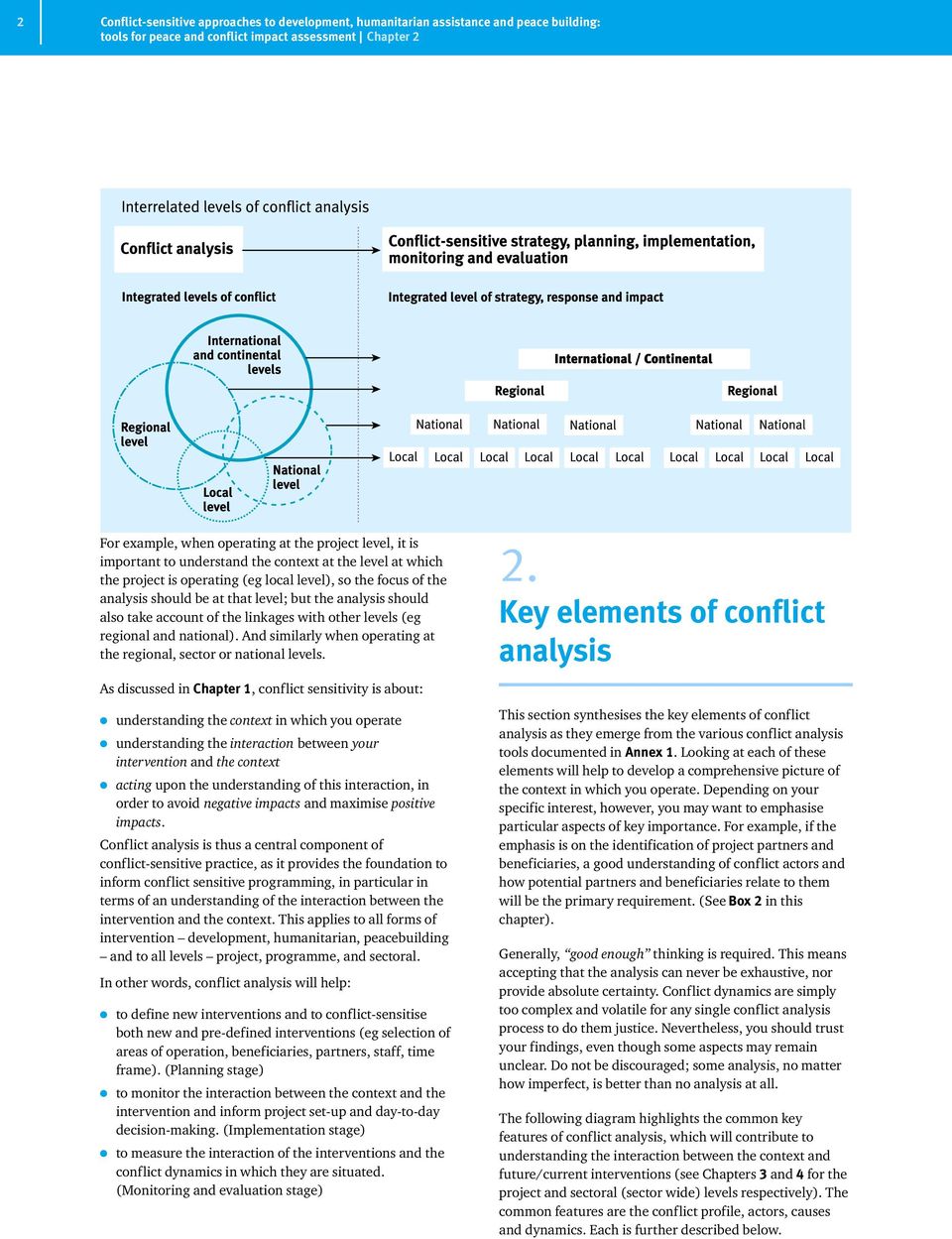
1 CHAPTER 2 Confict anaysis Purpose of chapter This chapter expains: what confict anaysis is and why it matters how to undertake an anaysis Who shoud read it The chapter is aimed at practitioners in governments, civi society (oca and internationa) and donor organisations concerned with deveopment, humanitarian assistance and peacebuiding. The chapter may aso be of interest to others (eg in the private sector, the dipomatic fied, etc). Why they shoud read it Because confict anaysis is the foundation of confict sensitivity and without a good understanding of the context in which interventions are situated, organisations that support or directy impement them may unintentionay hep to fue vioent confict or to exacerbate existing tensions. Confict anaysis heps organisations towards a better understanding of the context in which they work, and a confict sensitive approach. Contents 1. What is confict anaysis and why is it important? 2. Key eements of confict anaysis 3. Working with indicators 4. Integrating confict anaysis and other forms of assessment 5. Better practice in confict anaysis 6. Choosing the right too for confict anaysis 7. Endnotes Annex 1. Toos for confict anaysis 1. What is confict anaysis and why is it important? Confict anaysis is the systematic study of the profie, causes, actors, and dynamics of confict (see Section 2). It heps deveopment, humanitarian and peacebuiding organisations to gain a better understanding of the context in which they work and their roe in that context. Confict anaysis can be carried out at various eves (eg oca, regiona, nationa, etc) and seeks to estabish the inkages between these eves (see Fig 1). Identifying the appropriate focus for the confict anaysis is crucia: the issues and dynamics at the nationa eve may be different from those at the grassroots. But whie inking the eve of confict anaysis (eg community, district, region or nationa) with the eve of intervention (eg project, sector, poicy), it is aso important to estabish systematic inkages with other interreated eves of confict dynamics. These inkages are important, as a of these different eves impact on each other.

2 2 Confict-sensitive approaches to deveopment, humanitarian assistance and peace buiding: toos for peace and confict impact assessment Chapter 2 For exampe, when operating at the project eve, it is important to understand the context at the eve at which the project is operating (eg oca eve), so the focus of the anaysis shoud be at that eve; but the anaysis shoud aso take account of the inkages with other eves (eg regiona and nationa). And simiary when operating at the regiona, sector or nationa eves. 2. Key eements of confict anaysis As discussed in Chapter 1, confict sensitivity is about: understanding the context in which you operate understanding the interaction between your intervention and the context acting upon the understanding of this interaction, in order to avoid negative impacts and maximise positive impacts. Confict anaysis is thus a centra component of confict-sensitive practice, as it provides the foundation to inform confict sensitive programming, in particuar in terms of an understanding of the interaction between the intervention and the context. This appies to a forms of intervention deveopment, humanitarian, peacebuiding and to a eves project, programme, and sectora. In other words, confict anaysis wi hep: to define new interventions and to confict-sensitise both new and pre-defined interventions (eg seection of areas of operation, beneficiaries, partners, staff, time frame). (Panning stage) to monitor the interaction between the context and the intervention and inform project set-up and day-to-day decision-making. (Impementation stage) to measure the interaction of the interventions and the confict dynamics in which they are situated. (Monitoring and evauation stage) This section synthesises the key eements of confict anaysis as they emerge from the various confict anaysis toos documented in Annex 1. Looking at each of these eements wi hep to deveop a comprehensive picture of the context in which you operate. Depending on your specific interest, however, you may want to emphasise particuar aspects of key importance. For exampe, if the emphasis is on the identification of project partners and beneficiaries, a good understanding of confict actors and how potentia partners and beneficiaries reate to them wi be the primary requirement. (See Box 2 in this chapter). Generay, good enough thinking is required. This means accepting that the anaysis can never be exhaustive, nor provide absoute certainty. Confict dynamics are simpy too compex and voatie for any singe confict anaysis process to do them justice. Nevertheess, you shoud trust your findings, even though some aspects may remain uncear. Do not be discouraged; some anaysis, no matter how imperfect, is better than no anaysis at a. The foowing diagram highights the common key features of confict anaysis, which wi contribute to understanding the interaction between the context and future/current interventions (see Chapters 3 and 4 for the project and sectora (sector wide) eves respectivey). The common features are the confict profie, actors, causes and dynamics. Each is further described beow.
3 Confict-sensitive approaches to deveopment, humanitarian assistance and peace buiding: toos for peace and confict impact assessment Chapter Causes of confict In order to understand a given context it is fundamenta to identify potentia and existing confict causes, as we as possibe factors contributing to peace. Confict causes can be defined as those factors which contribute to peope s grievances; and can be further described as: structura causes pervasive factors that have become buit into the poicies, structures and fabric of a society and may create the pre-conditions for vioent confict proximate causes factors contributing to a cimate conducive to vioent confict or its further escaation, sometimes apparenty symptomatic of a deeper probem triggers singe key acts, events, or their anticipation that wi set off or escaate vioent confict. 2.1 Profie A confict profie provides a brief characterisation of the context within which the intervention wi be situated. BOX 1 Key questions for a confict profie What is the poitica, economic, and socio-cutura context? eg physica geography, popuation make-up, recent history, poitica and economic structure, socia composition, environment, geo-strategic position. What are emergent poitica, economic, ecoogica, and socia issues? eg eections, reform processes, decentraisation, new infrastructure, disruption of socia networks, mistrust, return of refugees and internay dispaced persons (IDPs), miitary and civiian deaths, presence of armed forces, mined areas, HIV/AIDS. What specific confict prone/affected areas can be situated within this context? eg, areas of infuence of specific actors, frontines around the ocation of natura resources, important infrastructure and ines of communication, pockets of sociay marginaised or excuded popuations. Is there a history of confict? eg critica events, mediation efforts, externa intervention. Note: this ist is not exhaustive and the exampes may differ according to the context Protracted conficts aso tend to generate new causes (eg weapons circuation, war economy, cuture of vioence), which hep to proong them further. As the main causes and factors contributing to confict and to peace are identified, it is important to acknowedge that conficts are muti -dimensiona and muti-causa phenomena that there is no singe cause of confict. It is aso essentia to estabish inkages and synergies between causes and factors, in order to identify potentia areas for intervention and further prioritise them. Some of the toos in Annex 1 eg Cingendae / Fund for Peace, RTC offer methods to assess the reative importance of different factors. Many toos deveoped for confict anaysis aso categorise confict causes or issues by governance, economics, security and socio-cutura factors. BOX 2 Key questions for an anaysis of confict causes What are structura causes of confict? eg iegitimate government, ack of poitica participation, ack of equa economic and socia opportunities, inequitabe access to natura resources, poor governance. What issues can be considered as proximate causes of confict? eg uncontroed security sector, ight weapons proiferation, human rights abuses, destabiising roe of neighbouring countries, roe of diasporas. What triggers can contribute to the outbreak / further escaation of confict? eg eections, arrest / assassination of key eader or poitica figure, drought, sudden coapse of oca currency, miitary coup, rapid change in unempoyment, food, increased price/scarcity of basic commodities, capita fight.

4 4 Confict-sensitive approaches to deveopment, humanitarian assistance and peace buiding: toos for peace and confict impact assessment Chapter 2 What new factors contribute to proonging confict dynamics? eg radicaisation of confict parties, estabishment of paramiitaries, deveopment of a war economy, increased human rights vioations, weapons avaiabiity, deveopment of a cuture of fear. What factors can contribute to peace? eg communication channes between opposing parties, demobiisation process, reform programmes, civi society commitment to peace, anti-discrimination poicies. Note: This ist is not exhaustive and the exampes may differ according to the context. Particuar attention shoud be paid to spoiers, ie specific groups with an interest in the maintenance of the negative status quo. If not adequatey addressed within the framework of preventive strategies, they may become an obstace to peace initiatives. Simiary, it is important to identify existing institutiona capacities for peace, in order to further define entry points to address causes of vioent confict. Capacities for peace typicay refer to institutions, organisations, mechanisms and procedures in a society for deaing with confict and differences of interest. In particuar, such actors need to be assessed in reation to their capacity for confict management, their egitimacy, the ikeihood of their engagement, and the possibe roes they can adopt. 2.3 Actors Peope are centra when thinking about confict anaysis. The Resource Pack uses the term actors to refer to a those engaged in or being affected by confict. This incudes individuas, groups and institutions contributing to confict or being affected by it in a positive or negative manner, as we as those engaged in deaing with confict. Actors differ as to their goas and interests, their positions, capacities to reaise their interests, and reationships with other actors (see Box 3). BOX 3 Interests, goas, positions, capacities and reationships Interests: the underying motivations of the actors (concerns, goas, hopes and fears). Goas: the strategies that actors use to pursue their interests. Positions: the soution presented by actors on key and emerging issues in a given context, irrespective of the interests and goas of others. Capacities: the actors potentia to affect the context, positivey or negativey. Potentia can be defined in terms of resources, access, socia networks and constituencies, other support and aiances, etc. Reationships: the interactions between actors at various eves, and their perception of these interactions. Some approaches distinguish actors according to the eve at which they are active (grassroots, midde eve, top eve). In particuar, confict transformation theory attaches great importance to midde eve eaders, as they may assume a cataytic roe through their inkages both to the top and the grassroots. In any case, it is important to consider the reationships between actors / groups at various eves and how they affect the confict dynamics. BOX 4 Key questions for an actor anaysis Who are the main actors? eg nationa government, security sector (miitary, poice), oca (miitary) eaders and armed groups, private sector/business (oca, nationa, trans-nationa), donor agencies and foreign embassies, mutiatera organisations, regiona organisations (eg African Union), reigious or poitica networks (oca, nationa, goba), independent mediators, civi society (oca, nationa, internationa), peace groups, trade unions, poitica parties, neighbouring states, traditiona authorities, diaspora groups, refugees / IDPs, a chidren, women and men iving in a given context. (Do not forget to incude your own organisation!) What are their main interests, goas, positions, capacities, and reationships? eg reigious vaues, poitica ideoogies, need for and, interest in poitica participation, economic resources, constituencies, access to information, poitica ties, goba networks. What institutiona capacities for peace can be identified? eg civi society, informa approaches to confict resoution, traditiona authorities, poitica institutions (eg head of state, pariament), judiciary, regiona (eg African Union, IGAD, ASEAN) and mutiatera bodies (eg Internationa Court of Justice). What actors can be identified as spoiers? Why? eg groups benefiting from war economy (combatants, arms/drug deaers, etc), smuggers, non confict sensitive organisations (see Chapter 1). Note: This ist is not exhaustive and the exampes may differ according to the context.

5 Confict-sensitive approaches to deveopment, humanitarian assistance and peace buiding: toos for peace and confict impact assessment Chapter Dynamics Confict dynamics can be described as the resuting interaction between the confict profie, the actors, and causes. Understanding confict dynamics wi hep identify windows of opportunity, in particuar through the use of scenario buiding, which aims to assess different possibe deveopments and think through appropriate responses. Scenarios basicay provide an assessment of what may happen next in a given context according to a specific timeframe, buiding on the anaysis of confict profie, causes and actors. It is good practice to prepare three scenarios: (a) best case scenario (ie describing the optima outcome of the current context; (b) midde case or status quo scenario (ie describing the continued evoution of current trends); and (c) worst case scenario (ie describing the worst possibe outcome). If history is the key to understanding confict dynamics, it may be reevant to use the timeine to identify its main phases. Try to expain key events and assess their consequences. Tempora patterns (eg the four-year rotation of presidents or cimatic changes) may be important in understanding the confict dynamics. Undertaking this exercise with different actors and groups can bring out contrasting perspectives. BOX 5 Key questions for an anaysis of confict Dynamics What are current confict trends? eg escaation or de-escaation, changes in important framework conditions. What are windows of opportunity? eg are there positive deveopments? What factors support them? How can they be strengthened? What scenarios can be deveoped from the anaysis of the confict profie, causes and actors? eg best case, midde case and worst case scenarios. Note: This ist is not exhaustive and the exampes may differ according to the context. 2.5 Summary BOX 6 Key questions for confict anaysis Profie What is the poitica, economic, and socio-cutura context? What are emergent poitica, economic and socia issues? What confict prone/affected areas can be situated within the context? Is there a history of confict? Causes What are the structura causes of confict? What issues can be considered as proximate causes of confict? What triggers coud contribute to the outbreak/ further escaation of confict? What new factors contribute to proonging confict dynamics? What factors can contribute to peace? Actors Who are the main actors? What are their interests, goas, positions, capacities and reationships? What capacities for peace can be identified? What actors can be identified as spoiers? Why? Are they inadvertent or intentiona spoiers? Dynamics What are current confict trends? What are windows of opportunity? What scenarios can be deveoped from the anaysis of the confict profie, causes and actors? 3. Working with indicators In addition to traditiona (eg project, sectora) indicators, confict sensitive approaches require confict sensitive indicators to monitor and measure: (a) the context and its changes over time; and (b) the interaction between the context and the intervention. They have three eements:

6 6 Confict-sensitive approaches to deveopment, humanitarian assistance and peace buiding: toos for peace and confict impact assessment Chapter 2 Confict indicators Used to monitor the progression of confict factors against an appropriate baseine, and to provide targets against which to set contingency panning (see beow). Project indicators Monitor the efficiency, effectiveness, impact and sustainabiity of the project (see Chapter 3 Modue 1, step 3). Interaction indicators Measure the interaction between the context and the project (see Chapter 3 Modue 1, step 2c). Confict indicators Confict anaysis provides just a snap-shot of a highy fuid situation. It is therefore important to combine an in-depth anaysis with more dynamic and continuous forms of monitoring to provide up-to-date information from which to measure the interaction between the context and the intervention. Indicators are usefu in this respect, as they hep reduce a compex reaity to a few concrete dimensions and represent vauabe pointers to monitor change. The confict anaysis wi have ooked at the reationship between specific actors, causes and profie, in order to gain an understanding of the confict dynamics. Indicators can then be deveoped in order to refect these reationships and how they evove over time. It is important to have a mix of perception-based and objective indicators, each of which shoud refect quaitative and quantitative eements. Good indicators refect a variety of perspectives on the context. It is good practice to invove communities and other actors in identifying the indicators; not ony shoud this produce better indicators but it is aso an important opportunity to buid a common understanding of the context, to ascertain joint priorities and to agree on benchmarks of progress. Since each confict is unique, there is no standard ist of indicators appicabe to a contexts. The foowing tabe provides some exampes of sampe perception-based and objective indicators for the four key eements. TABLE 1 Sampe of confict anaysis indicators Key eement Exampe Sampe Indicators (a)objective and (b) perception-based Profie Geographic mobiisation around natura resources (a) What is the price of timber? How has it evoved over time? (b) (In the view of the respondent) How has confict intensity changed around this particuar area? Causes Human rights abuses (a) Has the number of poitica prisoners risen or faen? (b) To what extent can you/others openy criticise the government? Actors Diaspora (a) Have overseas remittances increased or decreased? (b) To what extent does the diaspora support or undermine the peace process? Dynamics Increased commitment to resove confict (a) Has the frequency of negotiations increased or decreased among confict parties? (b) Do you beieve that party X is committed to the peace process? Note: the exampes in Tabe 1 reate to each specific key eement ony (eg sampe indicators for profie have no reation to the exampe or sampe indicators for causes).

7 Confict-sensitive approaches to deveopment, humanitarian assistance and peace buiding: toos for peace and confict impact assessment Chapter Integrating confict anaysis and other forms of assessment At a eves, humanitarian, deveopment and peacebuiding organisations use some form of pre-intervention assessment of the context in which they operate in order to identify entry points and pan their work. This is usuay caed a needs assessment. Needs assessment frameworks, such as sustainabe iveihoods assessments, participatory poverty assessments, participatory rura appraisas, good governance assessments and gender anayses can usefuy be compemented by confict anayses, and vice versa as expained beow: assumptions about context: iveihood, poverty and governance frameworks assume static situations and therefore provide itte guidance on how to dea with changing and fuid contexts. Confict anaysis thus heps to better understand these environments focus: iveihood and poverty assessments take the individua househod as a starting point, seeking to estabish the economic, poitica, socia and cutura factors affecting the ives and iveihoods of its members. This perspective is a vauabe addition to the top-down view of confict anaysis. In practice, however, these approaches often describe rather than expain poverty and tend to negect issues of poitics and power. There is itte scope, for exampe, for exporing competition and expoitation. There aso tends to be a ack of attention to the impications of weak poitica systems, bad governance and instabiity for househods iveihood strategies. Governance assessment frameworks dea with these issues, too, but usuay under the assumption of peacefu poitica competition and wiingness to reform. These assumptions might be questioned by a confict anaysis (see section 2.5) externa / interna view: poverty and other participatory forms of assessment hep understand peope s individua perspectives and experience. These are often missing from confict anaysis, which tends to pace more emphasis on the interests and strategies of organised poitica actors. Not infrequenty, confict anayses are conducted from an outside perspective. It is important to recognise the distinct frameworks underying confict anaysis and other forms of needs assessment. In practice, however, there is a growing effort and acknowedged need to carry out an integrated research and anaytica process that takes account of both perspectives. The foowing tabe provides some preiminary entry points for integrating confict anaysis into needs assessments. TABLE 2 Entry points for integrating confict anaysis into needs assessment Beyond describing poverty, focus on its potentia causes, examine the impact of power and poweressness on poverty and estabish the sources of power in the particuar community. Refine the understanding of group membership and group identity and how they affect vunerabiity (eg persecution, expoitation). Examine how the wider confict dynamics impact on institutions and reations within the community, understand processes of dominance, aignment and excusion. Link oca processes (eg dispacement) to poitica and economic interests and strategies at regiona and nationa eves (eg and appropriation, war economy). 5. Good practice in confict anaysis The foowing section addresses key concerns in reation to undertaking confict anaysis, as the confict-anaysis process itsef needs to be confict sensitive. This section offers exampes of good practice based on consutations in Kenya, Uganda and Sri Lanka. Buiding capacity for confict anaysis Conducting confict anaysis requires human and financia resources, which organisations may find hard to afford, especiay if confict sensitivity has not yet become a mainstreamed poicy within the organisation (see Chapter 5). As a resut, this may require systematicay and sustainaby buiding the need for confict anaysis into funding appications (for civi society organisations), budgets, panning guideines, and human and organisationa deveopment pans. According to the eve of awareness and capacity in your organisation, capacity buiding for confict anaysis may invove: heping staff to better understand the context in which they work. For exampe, in post-confict contexts, staff
8 8 Confict-sensitive approaches to deveopment, humanitarian assistance and peace buiding: toos for peace and confict impact assessment Chapter 2 of internationa organisations often do not recognise the inks between their work and possibe vioence. Loca government or civi society staff, on the other hand, may be too invoved at the micro eve to see the arger picture making sure organisations give confict anayses and their integration equa priority to other forms of assessment (governance, poverty, needs assessments, etc) (see Section 4) wherever possibe, integrating confict anayses into estabished procedures (eg strategic pans, needs assessments, etc), as we as into the contributions of service providers (eg terms of reference for short-term advisors, cas for proposas / tenders, etc). When preparing such processes, it is fundamenta to make sufficient time to accommodate confict anayses budgeting for confict anaysis in funding appications and operationa budgets. Donors (and the tax payers to whom donors are accountabe) may need to be sensitised to the importance of confict anaysis. NGOs often find that donors either (a) assume or even require that confict anaysis be conducted at the project proposa stage, without being aware of its costs for smaer organisations; or (b) do not prioritise confict anaysis at a supporting staff in acquiring confict anaysis skis on an ongoing basis, for exampe through staff deveopment pans deveoping an externa network of nationa and internationa experts on which to draw for specific tasks. Who conducts the anaysis? Confict anaysis can be undertaken for various purposes. The purpose wi determine the specific process and wi hep to determine who shoud conduct the anaysis. For exampe, if the purpose is to promote a participatory and transformative process within a community, the community shoud pay a vita roe in the panning, impementation (eg data coection) and assessment of the anaysis. If the purpose is to deveop a strategy for engagement in a given context, it may be that an interna team from within the organisation deveoping the strategy shoud ead the process. Some eements of the anaysis may be highy sensitive, and thus may need to be confidentia. Loca project staff typicay conduct participatory confict anaysis exercises with communities to decide on further project activities. Confict anaysis, in the context of project monitoring by internationa NGOs, is frequenty carried out by nationa and internationa staff, sometimes with the support of an externa adviser. Donors tend to commission externa experts or speciaised institutes in their own countries for countrywide confict anaysis studies, whie governments may have dedicated departments to dea with specific confict issues. In any case, it is important to get the right mix of skis and backgrounds, which can be summarised as foows: good confict anaysis skis good knowedge of the context and reated history sensitivity to the oca context oca anguage skis sectora / technica expertise as required sufficient status / credibiity to see through recommendations good knowedge of the organisations invoved representation of different perspectives within the context under consideration moderation skis, team work, possiby counseing faciitation skis. The quaity and reevance of the anaysis mainy depends on the peope invoved. These incude the person or team conducting the anaysis, on the one hand, and other confict actors, on the other. Confict anaysis consists of eiciting the views of the different groups and pacing them into a arger anaytica framework. The quaity of the anaysis wi depend on how faithfuy it refects the views received views may be distorted or given too much or too itte weight during the fitering process, either inadvertenty or deiberatey. It wi aso be infuenced by how the team is perceived by various actors within the context. For exampe, if the team is trusted by a actors, they are ikey to get more and better information than if they are perceived to be too cose to certain parties. Every confict anaysis is highy poitica, and bias is a constant concern. It may be difficut to be objective, as persona sympathies deveop and make it difficut to maintain an unbiased approach. Even a fy-in expert wi be infuenced by his / her vaues, previous knowedge of the country, the perspectives of his or her empoyer, and the peope s / he is working with. It may therefore be more productive to spe out one s own position and preconceptions and be cear about the conditions and restrictions under which the confict anaysis takes pace. The coective basis of the confict anaysis team may aso ensure higher eves of objectivity and impartiaity. Seecting the appropriate framework for confict anaysis When panning to use a specific framework to support confict anaysis, it is worth considering its strengths and weaknesses. In genera, organisations may find that toos do not necessariy offer new information, particuary if they have aready deveoped strong inkages to institutions and communities in the area under consideration. Their main vaue ies in guiding the systematic search for this information and providing a framework for anaysing it, thus prompting critica questions and offering new perspectives. Toos can aso enhance interna

9 Confict-sensitive approaches to deveopment, humanitarian assistance and peace buiding: toos for peace and confict impact assessment Chapter 2 9 communication about confict within an organisation, eg between provinces and the capita, or between fied offices and headquarters. Simiary, confict anaysis toos can guide consutation with a range of communities and other stakehoders. Finay, internationa actors appreciate that standardised toos ensure a certain degree of comparabiity between different confict anayses. On the other hand, confict anaysis toos shoud not be mistaken for a substitute for detaied oca knowedge and human judgement nor stife creative thinking. Toos that offer pre-defined ists of structura causes or indicators may be too genera to adequatey capture a specific confict. Toos may aso be too comprehensive for an organisation with imited research capacities, or not focussed enough to answer specific questions. For these reasons, organisations wi tend to customise existing toos to their own specific needs, objectives and capacities. BOX 7 Adapting toos for Northern Uganda In Uganda, a consortium of INGOs and government representatives consensuay deveoped a hybrid confict anaysis too that best met their needs and at the same time hed maximum reevance in the Northern Uganda context. The hybrid too deveoped by the consortium uses the profie-actors-context framework outined in Figure 2 above, with components of toos deveoped by Word Vision, ACORD and Oxfam in Uganda, the Loca Capacities for Peace Project (Do No Harm), and various other toos. The consortium then used the too they had deveoped to conduct a shared confict anaysis and to coectivey buid the capacity of their fied staff to conduct and update simiar anayses in the future. (The capacity buiding and fied research work is sti ongoing at the time of writing). There are some further issues around toos that organisations shoud consider: visua aids (eg graphs) and indicator ratings used in some toos suggest a degree of precision and objectivity that usuay does not stand up to reaity. Participants in a confict anaysis shoud therefore be encouraged to refect on the subjectivity of their assessments toos reying on some technica support (eg software) may appear intimidating to some participants. Simiary, extensive ists of indicators tend to make the anaysis unmanageabe in genera, aim to create a safe space for extensive discussions. Coecting information for confict anaysis It is important to gather information from as wide a range of sources as possibe and to isten to many different actors, in order to broaden the understanding of the context and to incude a wide range of perspectives (see Box 3). BOX 8 FORED Sri Lanka FORED undertakes surveys with women in target communities (women are FORED s main beneficiaries) to understand the socio-economic situation of the community. To gain the trust and confidence of the women, fied staff visit the famiies and spend time with the women in the kitchen, heping them with their tasks. Information gathered in the questionnaire is thus compemented through indirect cross-referencing from these informa chats. Information is further trianguated (see Box 9) with knowedgeabe community eaders. Various techniques can be used to gather these perspectives, from surveys and interviews to group discussion and stakehoder consutations (see Box 4). In contexts where groups cannot openy and directy discuss confict, it may be usefu to consider having separate meetings. Meetings and interviews must be conducted in a anguage in which participants can confidenty express their views. BOX 9 Stakehoder consutations Internationa and government agencies now routiney use stakehoder meetings to coect information in preparation for certain poicy decisions. They typicay hod one or a series of workshops in the capita and arge district towns, to which representatives of different interest groups (eg oca government, private sector, civi society, etc) are invited, to discuss specific issues. Athough an improvement on former practices, this form of stakehoder consutation presents a number of difficuties: one-way communication: where participation is misunderstood to mean heping to impement poitica decisions rather than heping to shape them, meetings wi be used to announce work pans and expected commitments, rather than to get feedback ack of capacity: grassroots representatives often do not fuy grasp the context of the meeting or have difficuties in discussing certain issues power: peope bring their power reations with them into the meeting room, and it is unreaistic to expect ow-ranking peope to speak up against their superiors/patrons in pubic. For the same reason, it is difficut to discuss confict issues process fatigue: participants who have repeatedy undergone consutations tend to voice soutions, before going through the step-by-step process that eads to the identification of core issues marginaisation: women and other marginaised groups usuay ack equa representation. Participants typicay over-represent we-educated, reativey weathy urban eites. Care therefore needs to be taken to incude representation from both urban and rura communities as we as poor communities (whether urban or rura).

10 10 Confict-sensitive approaches to deveopment, humanitarian assistance and peace buiding: toos for peace and confict impact assessment Chapter 2 The information gathered wi not a be reiabe. Gatekeepers such as oca eaders and interpreters may try to infuence information. Ordinary peope wi rarey dare to speak up against them in pubic or even in private. Information is aso argey determined by access. Aid agencies report restrictions of access by the nationa government, their own governments, or oca strongmen, which imit the type of information they are abe to gather. In certain contexts, when information is a scarce commodity, it tends to become highy poitica. There nonetheess exist some research methods, such as trianguation, which aim to reduce some of these imitations (see Box 10). BOX 10 Trianguation Given the difficuties of obtaining reiabe information for undertaking confict anaysis, it is often usefu to use a mix of data gathering methods ( trianguation ) for exampe a desk study, quantitative surveys, expert interviews, stakehoder consutations, and feedback workshops to present and discuss concusions. The aim of trianguation is to verify each piece of information with at east two corroborative or compementary sources, to obtain data that eventuay matches up and carifies differing perspectives. (For more information about trianguation, see Chapter 3, Modue 1, section 3.2). Conducting the anaysis Confict anaysis requires a great dea of care and sensitivity due to the highy poitica nature of the information gathered. A participatory process can become transformative by heping participants to define their own confict an important step towards addressing it. Because confict anaysis touches on sensitive issues such as power, ownership, and neutraity, however, it can aso provoke confict by bringing sensitive issues to the fore. For this reason, the confict anaysis itsef needs to be carried out in a confict sensitive manner. It is thus good practice to get stakehoders on board eary on and avoid antagonising potentia spoiers (see section 2.3). In particuar, when undertaking the confict anaysis, it is important to show respect for peope s ownership and feeings, to incude a wide range of actors and perspectives, to be transparent about the goas of the process and to ink the anaysis to demonstrabe action. In many contexts, it is fundamenta to ensure that staff, partners and communities are not at risk through the anaysis process, for exampe as a resut of insensitive questions being asked in pubic or researchers being sent to insecure areas. In such situations, the commitment to transparency may need to be restricted by the need to ensure security for some sensitive eements of the anaysis. The confict anaysis process can aso hep foster partnership and co-ordination, whie promoting a shared understanding of the context. The joint donor government / civi society confict assessment in Nigeria (see Box 11) may prove a vauabe experience from which to earn. BOX 11 Strategic Confict Assessment in Nigeria: An incusive and muti-stakehoder approach1 In Nigeria, a radicay different approach has been taken to conducting a confict assessment at the strategic eve. First, the assessment has been country owned with the Institute for Peace and Confict Resoution (IPCR) taking the ead. The IPCR is inked directy to the Nigerian Presidency and was estabished by the Nigerian government in Second, the assessment has been supported by a muti-donor group consisting of four main donors DFID, the Word Bank, USAID and UNDP. Third, civi society actors have been invoved in the process strategicay from the outset. Background and objectives The incusive and joint approach to undertaking the Strategic Confict Assessment (SCA) was adopted by both the Nigerian government and the supporting donors, in recognition of a number of issues which needed addressing. These were: a ack of coherent anaysis of the causes and dynamics of confict in Nigeria a ack of coordination in the anaysis and responses to confict by the government, civi society and donors (with civi society focusing mainy on oca / micro confict issues and responses, whist at a more macro eve the government found it difficut to understand the inkages between the different conficts affecting the country) a recognition by donors that if any donor undertook such an assessment uniateray, or even coectivey, without the consent of the Nigerian government, it coud resut in considerabe obstaces and high poitica risks, due to the sensitive nature of confict in Nigeria. A joint approach woud reap considerabe benefits in reducing those risks. The overa objective of the SCA was to provide an anaysis of confict in Nigeria which ooked at a areas of nationa ife and woud feed into the strategic, or poicy, eve in order to inform nationa and internationa debates about possibe responses and provide specific recommendations to government, the internationa community, the private sector and civi society. The study aso aimed to deveop and inform the IPCR s own work and capacity. Process and methodoogy The process was initiated in May 2002 with an incusive workshop of stakehoders incuding the donors, government and a broad range of civi society groups. The objectives of the workshop were to buid knowedge of reevant activities being undertaken by different groups (who is doing what and where); to provide a basis for buiding awareness of the confict assessment process, providing space for feedback from different stakehoders; and to strengthen the interaction and reationship between the different actors.

11 Confict-sensitive approaches to deveopment, humanitarian assistance and peace buiding: toos for peace and confict impact assessment Chapter 2 11 The methodoogy used in the SCA was based on the DFID Confict Assessment Guidance (see Annex 1) but adapted through modifications by the IPCR and fied teams (researchers). The SCA was undertaken by teams of IPCR and consutants in two phases: Phase one invoved desk-based research mapping the causes, actors and dynamics of confict, based on written sources. Phase two tested the findings of phase one through fiedwork carried out by research teams in a the Nigerian states which endeavoured to invove different stakehoders and interest groups. Phase two aso focused on considering responses and poicy options. A team eader coaborated in the writing of a summary report for each phase. The phase two report was aso scrutinised in a technica workshop in October 2002 invoving a technica pane comprised of experts from the different stakehoder groups (government, donors and civi society). Outcome and next steps In terms of future responses, the phase two report provides a detaied agenda for change on the poitica stage. Recommendations are directed at the different actors, incuding the federa government, state governments, oca governments, civi society, the internationa community and the IPCR itsef. They are divided into recommendations that need immediate, medium term and ong-term action (those on which work can start now but where resuts are not expected for 8-10 years). In particuar, the report recommends immediate attention to eary warning and confict prevention in recognition of the ack of Nigerian eary warning systems and the absence of systematic provision for preventative responses. The report identifies an over reiance on and imited or even negative effect of miitary responses. In order to share the research findings a further stakehoder workshop was hed in March 2003 which considered the issue of what next and the roes of different stakehoders in taking the findings forward. The discussion was centred on a number of themes security sector reform and sma arms, eary warning and eary response, poitica confict, socia and economic causes, the roe of civi society and mainstreaming into donor and government action. Foowing from the phase 2 report and stakehoder workshop, a Nationa Action Pan (NAP) has been drafted which outines a concrete agenda for taking forward the recommendations in the report, incuding a strategy for mainstreaming confict sensitivity within government institutions. In terms of progress to date, the SCA process has produced a number of demonstrabe steps forward in terms of promoting confict sensitivity in the Nigerian context. These incude: steps by the Nigerian government to integrate the findings of the SCA into the PRSP process steps taken by donors to review their strategies and approaches on the basis of the anaysis an increased sense of awareness and empowerment by civi society of the roe they can pay in pushing the agenda forward. 6. Choosing the right framework for confict anaysis This section aims to provide guidance on seecting a confict anaysis too from Annex 1, which best corresponds to the needs and capacities of specific organisations. At this point, it is important to note that the toos incuded in the Resource Pack were seected according to the foowing criteria: sufficient documentation avaiabe to describe the toos adequatey each too was used by at east one organisation the toos cover both micro and macro-eve confict anaysis the toos represent a wide range of approaches to confict anaysis (especiay in terms of targeted audiences and fieds of interventions). Athough the project team has gone to some engths to document the practice and experience of smaer, particuary Southern, organisations (especiay in Kenya, Uganda and Sri Lanka), a brief gance at the ist of toos reveas that most have been deveoped by Northern NGOs and donor agencies. Their perspective on confict is therefore argey externa, thus refecting the current state of pay in the area of forma confict anaysis. In the context of North / South reations, it may therefore be important to enhance cross-fertiisation and shared earning on confict anaysis and the deveopment of confict anaysis toos. The checkist poses a number of questions that can hep organisations think about the type of confict anaysis too they need. It is not comprehensive and wi need to be further adapted to each organisation.

12 12 Confict-sensitive approaches to deveopment, humanitarian assistance and peace buiding: toos for peace and confict impact assessment Chapter 2 Checkist for seecting a confict anaysis too 1. Purpose Does the too provide the information you need for your work? Is the proposed process of confict anaysis consistent with your aims? 2. Assumptions Do you share the too s specific understanding of confict? Does this perspective correspond to the mandate and vaues of your organisation? 3. Methodoogy Does the proposed methodoogy match the purpose of the anaysis? Does the proposed methodoogy agree with the ways of working of your organisation? How ong does it take to gain resuts? 4. Resource impications What are the resource impications of the seected too (staff time, trave, seminar costs, faciities, data management)? Is your organisation abe to aocate the required resources? 5. Avaiabiity Is the too avaiabe at the time and cost that suit you? Can fu documentation be accessed? TABLE 3 Summary of confict anaysis toos isted in Annex 1 Purpose Leve Potentia users Assumptions Methodoogy Resources 1. Strategic Confict Assessment (SCA) - DFID - DEV* Country/regiona strategic panning, can aso be appied to projects/ programmes Regiona, nationa, oca DFID and partner biatera / mutiatera agencies desk officers Combine poitica and economic dimensions; greed/grievance; structures and actors Combination of desk study and fied consutations Assessment team (5 peope). Consutation meetings in-country 2. Benefits / harms handbook - CARE - DEV/HA Anaysis, impact assessment and project (re)design Loca mainy project eve NGO project managers, fied staff Focus on rights-based approach Desk-based and fied research and possibe workshop consutations Varies few hours in emergencies to more detaied workshops / consutations 3. Confict Anaysis Framework (CAF) - Word Bank - DEV Country strategic panning Nationa, can aso be adapted to (sub) regiona Mutiatera organisation desk staff / panners Focus on socio-economic dimensions of confict Checkist; Desk studies, workshops, stakehoder consutations, consutants Fu CAF anaysis resource intensive (workshops, consutations, consutants); but can be simpified 4. Confict anaysis and response definition - FEWER - PB Eary warning, country strategic panning Nationa, oca Dipomats, donor desk officers, NGOs Focus on confict dynamics Ongoing anaysis by oca civi society organisations Modest for desk study; more for training or workshops

13 Confict-sensitive approaches to deveopment, humanitarian assistance and peace buiding: toos for peace and confict impact assessment Chapter 2 13 Purpose Leve Potentia users Assumptions Methodoogy Resources 5. EC Checkist for root causes of confict - European Commission - DEV Eary warning, strategic and programme panning Nationa, regiona Muti- and biatera donor desk officers, dipomatic actors Focus on structura root causes of confict Checkist; externa research capacity Limited as mainy desk-based 6. Working with confict: skis and strategies for action - Responding to confict - PB Confict anaysis, programme panning Loca, nationa Loca and INGO staff, fied and headquarters Focus on understanding conficts Coection of toos for participatory confict anaysis Limited depending on format (workshop, consutation meetings etc) 7. Making Sense of Turbuent Contexts (MSTC): Anaysis toos for humanitarian actors - Word Vision - DEV / HA Confict anaysis, project panning Nationa, regiona NGO emergency response, deveopment and advocacy staff Focus on chronic poitica instabiity, dovetais with Do No Harm Coection of toos, fexibe appication Variabe, depending on use of toos, desk study or consutations 8. Do No Harm / Loca capacities for peace project Confict anaysis, project monitoring and impact assessment Loca Donor, NGO (internationa and oca) staff Focus on dividers and connectors in confict Workshop, integration into standard procedures Limited, for workshop 9. Confict and Poicy Assessment Framework (CPAF) - Cingendae Institute - DEV / F Confict anaysis, country strategic panning Nationa, sectora Donor and embassy staff Focus on indicators of interna confict and state faiure Externa research capacity, workshops Costs of preparing for and hoding workshops, can incude externa consutant invovement 10. Eary Warning and Preventive Measures - UN Staff Coege - ALL Eary warning, confict anaysis, design Nationa UN staff (HQ and fied), other donor agencies or NGOs Focus on human security and human rights framework Training/workshop setting Training materias, faciitation, workshop / training costs 11. Confict assessment framework - USAID - DEV Confict anaysis, country and project panning Nationa Donor desk officers, impementing partners, other US government officias Broad scope, synthesis of other toos Desk study, workshop, foow up integration into programming strategy For desk study, in country visit and foow-up work. 12. Confict anaysis for project panning and impementation - GTZ - DEV Confict anaysis, country and project panning Nationa, project Donor, NGO desk officers, project managers Broad scope, synthesis of other toos Combination of desk study and empirica research, toos for participatory confict anaysis Costs of organising workshops and consutation meetings

14 14 Confict-sensitive approaches to deveopment, humanitarian assistance and peace buiding: toos for peace and confict impact assessment Chapter 2 Purpose Leve Potentia users Assumptions Methodoogy Resources 13. FAST methodoogy - Swiss Peace - DEV / FP Eary warning, risk assessments Nationa, can be sub-regiona Government ministries, deveopment agencies, NGOs, internationa organisations Event data anaysis (quantitative and quaitative) Fied information coection, desk-based anaysis Resource intensive for maintaining oca information networks and speciaist anaysis network 14. Confict diagnostic handbook - CPR / CIDA - PB / DEV Confict and stakehoder assessment Country, regiona Deveopment practitioners Devising evidence-based peacebuiding strategies Mainy workshop setting anaysis Costs of organising and presenting workshop 15. Better Programming Initiative - IFRC - HA Confict assessment, training Programme; oca, nationa, regiona Red Cross/Red Crescent Nationa Societies, deegation and other staff Focus on aid fostering ong-term reconciiation and recovery Anaysis and training Depending on scope of assessment or ength of training *Fied of activity DEV Deveopment HA Humanitarian Assistance PB Peacebuiding FP Foreign Poicy 7. Endnotes 1 Programme team research. See aso, Federa Government of Nigeria, Strategic Confict Assessment Nigeria: Consoidated report, Institute for Peace and Confict Resoution, October 2002.

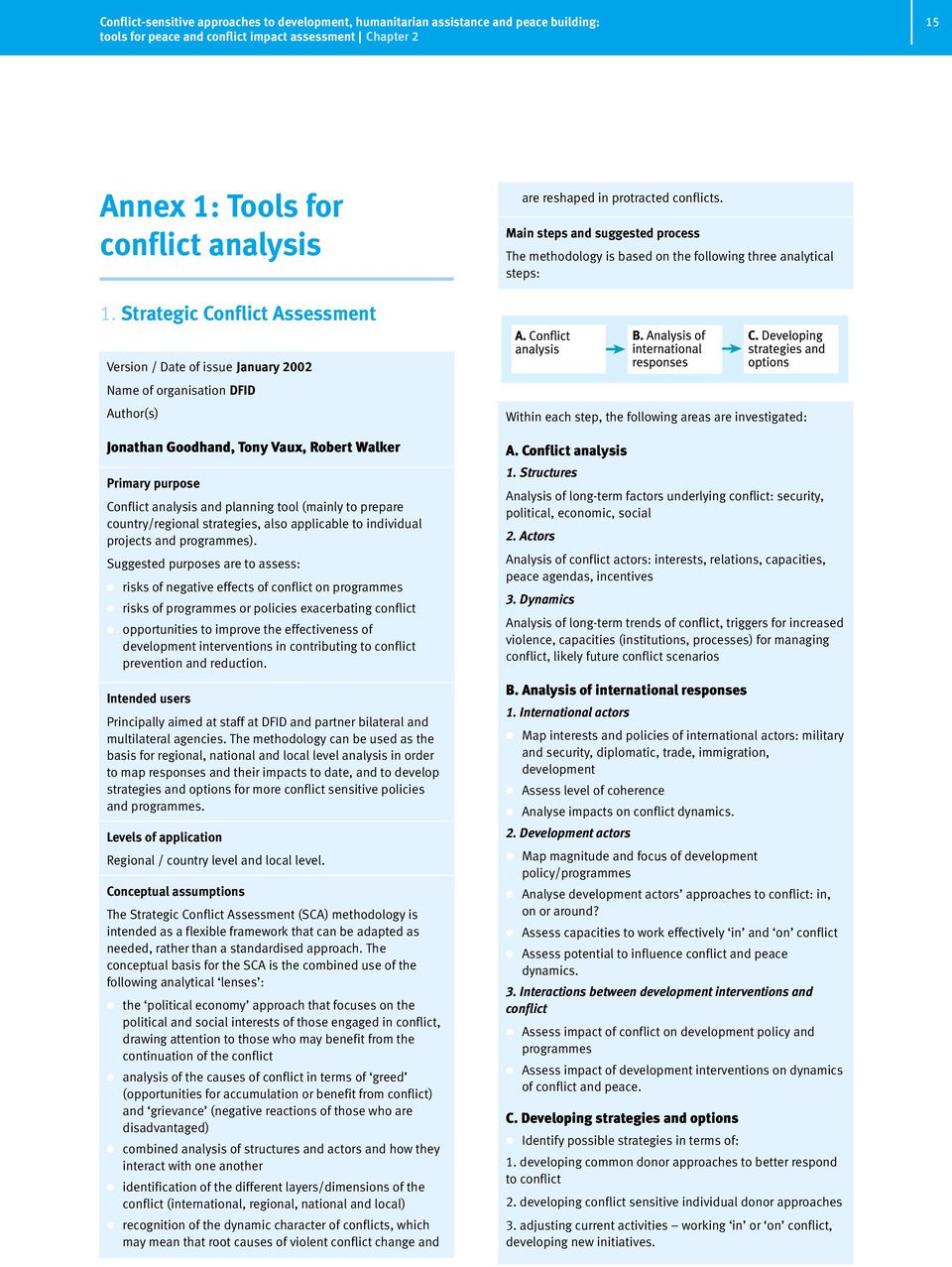
15 Confict-sensitive approaches to deveopment, humanitarian assistance and peace buiding: toos for peace and confict impact assessment Chapter 2 15 Annex 1: Toos for confict anaysis are reshaped in protracted conficts. Main steps and suggested process The methodoogy is based on the foowing three anaytica steps: 1. Strategic Confict Assessment Version / Date of issue January 2002 Name of organisation DFID Author(s) Jonathan Goodhand, Tony Vaux, Robert Waker Primary purpose Confict anaysis and panning too (mainy to prepare country/regiona strategies, aso appicabe to individua projects and programmes). Suggested purposes are to assess: risks of negative effects of confict on programmes risks of programmes or poicies exacerbating confict opportunities to improve the effectiveness of deveopment interventions in contributing to confict prevention and reduction. Intended users Principay aimed at staff at DFID and partner biatera and mutiatera agencies. The methodoogy can be used as the basis for regiona, nationa and oca eve anaysis in order to map responses and their impacts to date, and to deveop strategies and options for more confict sensitive poicies and programmes. Leves of appication Regiona / country eve and oca eve. Conceptua assumptions The Strategic Confict Assessment (SCA) methodoogy is intended as a fexibe framework that can be adapted as needed, rather than a standardised approach. The conceptua basis for the SCA is the combined use of the foowing anaytica enses : the poitica economy approach that focuses on the poitica and socia interests of those engaged in confict, drawing attention to those who may benefit from the continuation of the confict anaysis of the causes of confict in terms of greed (opportunities for accumuation or benefit from confict) and grievance (negative reactions of those who are disadvantaged) combined anaysis of structures and actors and how they interact with one another identification of the different ayers/dimensions of the confict (internationa, regiona, nationa and oca) recognition of the dynamic character of conficts, which may mean that root causes of vioent confict change and Within each step, the foowing areas are investigated: A. Confict anaysis 1. Structures Anaysis of ong-term factors underying confict: security, poitica, economic, socia 2. Actors Anaysis of confict actors: interests, reations, capacities, peace agendas, incentives 3. Dynamics Anaysis of ong-term trends of confict, triggers for increased vioence, capacities (institutions, processes) for managing confict, ikey future confict scenarios B. Anaysis of internationa responses 1. Internationa actors Map interests and poicies of internationa actors: miitary and security, dipomatic, trade, immigration, deveopment Assess eve of coherence Anayse impacts on confict dynamics. 2. Deveopment actors Map magnitude and focus of deveopment poicy/programmes Anayse deveopment actors approaches to confict: in, on or around? Assess capacities to work effectivey in and on confict Assess potentia to infuence confict and peace dynamics. 3. Interactions between deveopment interventions and confict Assess impact of confict on deveopment poicy and programmes Assess impact of deveopment interventions on dynamics of confict and peace. C. Deveoping strategies and options Identify possibe strategies in terms of: 1. deveoping common donor approaches to better respond to confict 2. deveoping confict sensitive individua donor approaches 3. adjusting current activities working in or on confict, deveoping new initiatives.
16 16 Confict-sensitive approaches to deveopment, humanitarian assistance and peace buiding: toos for peace and confict impact assessment Chapter 2 The foowing process (for a donor country assessment) is suggested: Desk study Review of reevant documents from a variety of sources Interviews with key stakehoders in the donor country. Fied work Interna consutation with donor staff (deveopment agency, embassy) Stakehoder consutation (possiby series of workshops with range of stakehoders within and outside the capita) Debriefing workshop with donor staff and sma expert group to feed back and discuss resuts. Drafting confict assessment document Guiding questions / indicators The too provides usefu exampes of sources of confict and tension, confict actors, confict triggers, confict scenarios, donor poicy instruments and possibe confict prevention strategies. The exampes refer to specific countries; no genera ists are provided. Required resources Suggested composition of a country-eve confict assessment team: team eader (18 working days) internationa consutant (25 working days, incudes preparation of fina report) two in-country project consutants (10 working days each) confict adviser (10 working days) socia deveopment adviser (10 working days). However, this wi depend on the context in which the confict assessment framework wi be appied, the end users of the anaysis, and their objectives. Current appications DFID has appied the confict assessment methodoogy to a range of country studies, incuding Nepa, Kyrgyzstan, Modova, Sri Lanka and the Caucasus. There has aso been a muti-donor assessment in Nigeria, which incuded DFID, on the basis of the SCA framework. Lessons earnt The foowing methodoogica and practica essons have been earned from appying the Strategic Confict Assessments (SCAs): SCAs have improved the quaity of anaysis across UK government departments and encouraged a more joined-up approach. They have provided a framework within which to assess new proposas and have been usefu in designing coherent, strategic interventions. there is a need to determine the SCAs target audiences and purpose in the design phase. A imited audience enabes a more critica anaysis, whereas a wider audience necessitates more sensitivity and potentia watering down. If other reevant ministries are invoved and have a serious stake in the outcome of the process, a strongy worded anaysis coud imit efforts to engage in subte dipomatic pressure. there is a need to be cear about why and when to conduct SCAs; in particuar, they shoud be timed to coincide with a natura pause or turning point in the programme cyce, or before aunching a new programme. composition of the team is a crucia eement in its success; it is important to encompass expertise from a number of different areas in order to widen and deepen the quaity of the anaysis. It is aso good to have a combination of externa and oca consutants. there is a need to achieve the right baance between contextua anaysis and programme design. In this sense, it is important to have as wide an anaysis as possibe so that the compexity of the confict coud be propery understood before converting it into programme ideas. precise recommendations on what action to take next bring added vaue to SCAs. They aso hep overcome the feeing that the process coud be an extra burden, eg describing exacty what response needs to be taken, who shoud be responsibe for taking it, which NGO to work with, and how much funding woud be required. it is essentia to have active participation of in-country staff to inform the purpose and approach and a staff member dedicated to the foow-up and impementation of recommendations. SCAs shoud be conducted in a timeframe of about six weeks up to two months, depending on the depth and scope of the study. A minimum of two weeks for fied research and two weeks for the writing-up process is recommended. Reports shoud be pubished immediatey after the assessment to guarantee timey reevance. the practica appication of the SCA depends on the confict expertise of the users and whether or not they ask the right questions. Less experienced staff may require induction, training and support. (A different approach was foowed in the Strategic Confict Assessment in Nigeria in that an NGO ed the process and support came from 4 different donors (incuding DFID). The essons earned from that process are therefore different). Commentary on the too The too presents a very comprehensive form of confict anaysis, but with a methodoogica basis that is designed to be taiored to suit specific contexts and end users. Some parts of the anaysis outputs may become out of date quicky, and a higher eve strategic assessment may not be appropriate as the basis for designing micro-eve projects or sectora interventions without further specific contextua anaysis. It woud therefore be idea to compement the confict assessment methodoogy with a ighter too for more continuous monitoring of the programme and confict situation. The too can be used at any point in the programming cyce and at various points in the confict cyce in a country (ie pre-confict, post-confict etc). Avaiabe reports The Strategic Confict Assessment (Conducting Confict
17 Confict-sensitive approaches to deveopment, humanitarian assistance and peace buiding: toos for peace and confict impact assessment Chapter 2 17 Assessments: Guidance Notes) is avaiabe on the DFID website, under the Confict and Humanitarian Affairs Department ( Reports on confict assessments on Sri Lanka and Kyrgyzstan, as we as a synthesis report on Kyrgyzstan, Modova, Nepa and Sri Lanka are aso avaiabe on the above website. A essons earned report on the Strategic Confict Assessment in Nigeria (conducted by the Institute for Peace and Confict Resoution in the Nigerian Presidency, with support from DFID, the Word Bank, USAID and UNDP) is avaiabe by contacting the address beow. Contact detais Department for Internationa Deveopment Confict and Humanitarian Affairs Department 20 Victoria Street London SW1H 0NB Emai: [email protected] Te: 0044 (0) Fax: 0044 (0) Benefits / harms handbook Version / Date of issue September 2001 Name of organisation CARE Author(s) Pau O Brien Primary purpose To hep humanitarian and deveopment workers take responsibiity for the impact of their work on peope s human rights. It offers a set of simpe interrogative toos that hep staff think more deepy and effectivey about the impacts of their work, and taking responsibiity for both positive and negative impacts. It aso provides a framework for monitoring potentia negative or unintended impacts, as we as ways to mitigate these. Intended users NGO project managers and other fied staff and consutants working in the areas of deveopment and humanitarian assistance. The methodoogy may aso be of interest to nationa government officias and possiby donors. Leves of appication Project eve, athough the concepts coud be appied at other eves as we. Conceptua assumptions 1. Human-rights approach CARE s human rights-based approach to reief and deveopment presupposes that a peope are entited to certain minimum conditions of iving with dignity (human rights). Reief and deveopment organisations aim to hep peope achieve these conditions, thereby acknowedging their human responsibiity to do so. This impies they take responsibiity for the human rights impact of their work whether positive or negative. Human rights are therefore the centra criteria for anaysing the overa impact of a project. 2. Anaytica framework The methodoogy is based on three categories of human rights and impacts: poitica rights and impacts (eg right to equaity and recognition before the aw, right to a fair tria, freedom of thought and expression, right to association and poitica participation) security rights and impacts (eg right to ife, iberty, security of person, movement, freedom from torture, forced dispacement, degrading treatment, sexua assaut, arbitrary arrest) economic, socia and cutura rights and impacts (eg iveihood security, nutrition, food security, water, heath, education, cean environment, sheter, participation in one s cuture).
18 18 Confict-sensitive approaches to deveopment, humanitarian assistance and peace buiding: toos for peace and confict impact assessment Chapter 2 Main steps and suggested process The benefits / harms handbook contains toos for situation anaysis (profie toos), impact assessment (impact toos), and project (re)design (decision toos). In particuar: profie toos hep users gain a more comprehensive understanding of the contexts in which they work impact toos hep users think about the unintended impacts of their work decision toos hep users work through difficut decisions when there is a rea danger of harming peope with an intervention. The handbook assumes that most of the information required to answer the toos questions is aready avaiabe from the organisation s fied staff. Further information can be gathered from individuas famiiar with the oca situation, who are invited for consutation. If the organisation has been working in the area for some time aready, it is recommended to hod a workshop inviting midde-eve and fied staff as we as oca experts. For assessing a new project, the questions in the toos may be put to the oca community in a sensitive way. it takes organisationa commitment to make them work. Avaiabe reports An eectronic copy of the handbook is avaiabe on request. Contact detais Pau O Brien Afghanistan Poicy Advisor, CARE Internationa E-mai: [email protected] Dan Maxwe East Africa Regiona Programme Coordinator, CARE Internationa E-mai: [email protected] Guiding questions / indicators The profie, impact and decision toos are organised according to the three categories of human rights, namey: poitica, security and economic, socia and cutura rights. In addition, the profie too aso focuses on rights, responsibiities and underying causes, in order to hep users think about the underying causes of any human rights probem. To this end, consideration is given to the actions, attitudes and artifices (eg systems and structures) that cause the rights probem. Required resources Depends on the required research. A few hours taking through the profie toos with oca staff are considered enough in emergency situations. Otherwise, workshops with fied staff, decision makers and possiby additiona experts are recommended. Current appications Projects in East Africa must conduct a benefits / harms anaysis before starting impementation. The intention is twofod: to conduct such an anaysis prior to impementation to ensure that the benefits / harms thinking aso pervades the project impementation, monitoring and evauation. Lessons earnt It is not possibe to design a totay harm-free project upfront, so that equa emphasis needs to be paced on the foow up, in the form of an ongoing benefits / harms anaysis during the project impementation, and the identification of ways to mitigate potentia negative impacts. Commentary on the too The benefits / harms toos themseves are fairy straightforward to use and capacity can be buit quicky. But

19 Confict-sensitive approaches to deveopment, humanitarian assistance and peace buiding: toos for peace and confict impact assessment Chapter Confict Anaysis Framework Version / Date of issue October 2002 Name of organisation Word Bank Author(s) Per Wam, Shonai Sardesai Primary purpose Confict anaysis too Intended users Desk officers / panners in donor deveopment organisations (Word Bank staff). Leves of appication Country eve, in preparation of country strategies, poverty reduction strategies, poicies and individua programmes. It can aso be adapted for use at the (sub) regiona eve. Conceptua assumptions The contribution of deveopment organisations, such as the Word Bank, to confict prevention is regarded as threefod: making countries more resiient to the eruption and escaation of vioent confict by strengthening participatory and incusive socia processes and institutions that may hep manage conficts in non-vioent ways addressing factors reated to confict and determine their inks with poverty - sources (incuding roots) of conficts; opportunities for groups to engage in vioent activities and the consequences of confict determining the factors that can be addressed through Word Bank assisted strategies, and the modaities through which they can best be managed. Main steps and suggested process The Word Bank s methodoogy incudes two stages, namey: a screening process, aimed to test whether it is (or not) appropriate to undertake a fu confict anaysis in the country under consideration. The screening considers a set of nine indicators of potentia vioence a fu confict anaysis process, on the basis of the Confict Anaysis Framework (CAF). The foowing steps are recommended for conducting a CAF-based confict anaysis: reinterpretation of existing information on the confict situation of a country aong the ines of the CAF (brief desk study) workshops with country speciaists to cover each of the six CAF categories and anaysis of variabes aong a set of specific dimensions, that wi hep determine a country s overa position reative to confict foow-up studies, as needed, on issues identified in the workshop and monitoring of issues identified as confict-sensitive stakehoder anaysis to identify and examine groups who have the abiity to affect poitica and socia change, incuding vioence, and the main groups who are ikey to be affected by such changes country consutation with different stakehoder groups, as needed concuding workshops to discuss integration of the above issues into the poverty reduction strategy, country strategy or other country programmes. CAF can be conducted as a stand-aone anaysis or integrated into a more comprehensive macro-socia anaysis (for more information, see ). Guiding questions / indicators A. Risk screening indicators Athough none of these factors aone is necessary or sufficient to determine the outbreak, escaation or resumption of vioent confict, they have been found to be statisticay highy reated to confict. B. Confict Anaysis Framework Categories of variabes Socia and ethnic reations, eg socia ceavages, group identity-buiding, bridging socia capita Governance and poitica institutions, eg stabiity of poitica institutions, equity of aw Human rights and security, eg human rights status, miitarisation of society, roe of media Economic structure and performance, eg income disparities, income changes Environment and natura resources, eg avaiabiity of and access to natura resources Externa factors, eg regiona conficts, roe of diasporas. Desk officers are encouraged to use their knowedge of the country to identify those variabes which seem most reevant to the confict in question. These variabes are anaysed according to the foowing dimensions: History / changes: how the variabe has deveoped/changed over a reevant time span? Dynamics / trends: what is determining the future path of the variabe and how is it ikey to deveop? Pubic perceptions: pubic attitudes and biases regarding the variabe Poiticization: how the variabe is used poiticay by groups and organizations; Organisation: the extent to which the variabe has ed to the estabishment of interest organisations, and / or infuenced poitica parties and miitant organisations Link to confict and intensity: how the variabe contributes to confict and the current eve of intensity Link to poverty: how the variabe reates to poverty. Based on the anaysis of variabes, desk officers are aso

20 20 Confict-sensitive approaches to deveopment, humanitarian assistance and peace buiding: toos for peace and confict impact assessment Chapter 2 encouraged to examine inkages between variabes. Required resources Considerabe resources are required to conduct a fu CAF, incuding expert workshops, stakehoder consutations and the depoyment of consutants. Whie a fu CAF (desk and fied work) may require considerabe resources, this is not a necessity. It is possibe to conduct a CAF via a simper and ess expensive process, incuding two to three-day workshops, desk studies, etc. It is aso possibe to adapt CAF to the country context by identifying a few confict sensitive variabes and monitoring them on a reguar basis. Current appications CAF is being appied to Venezuea, Burundi (in co-operation with the Internationa Fund for Agricutura Deveopment (IFAD)), Rwanda and Somaia. Lessons earnt A essons earnt document on the above appications is being panned for the end of Commentary on the too N/A Avaiabe Reports The CAF methodoogy can be obtained at: [email protected]. Contact detais Per Wam / Shonai Sardesai Confict Prevention and Reconstruction Unit Word Bank Emai: [email protected] Website: 4. Confict anaysis and response definition Version / Date of issue Apri 2001 Name of organisation Forum on Eary Warning and Eary Response (FEWER), West Africa Network for Peacebuiding (WANEP), Centre for Confict Research (CCR) Author(s) FEWER (adapted by WANEP) Primary purpose Confict anaysis. It provides an anaytica and action framework, which wi hep pan preiminary responses to eary warning. Intended users Dipomatic and deveopment actors, mainy desk officers and poicy makers in foreign poicy and deveopment departments. Indigenous and internationa NGOs engaged in eary warning. Leves of appication Country eve, athough an adaptation of the methodoogy to ook at oca conficts has aso proven usefu. Conceptua assumptions The methodoogy is designed as a quick too, which can provide insight into overa trends. It is not meant as a substitute for more sustained confict anaysis, monitoring and consutations. The key assumption is: (a) Confict trends (b) peace trends +/- (c) stakehoder trends = overa trends. Main steps and suggested process Confict anaysis consists of four broad steps: 1. anaysis of confict indicators (root causes, proximate causes and confict triggers in the areas of poitics/security, economy and socio-cuture) 2. anaysis of peace indicators (systems, processes and toos sustaining peace in a given society, in the areas of poitics/security, economy and socio-cuture) 3. stakehoder anaysis (agenda/power, needs and actions of stakehoders in areas of poitics/security, economy and socio-cuture) In each of these three areas, the anayst is asked to estabish inkages and synergies between the indicators/stakehoders identified and buid three scenarios (best-case, status-quo, worst-case) 4. summary anaysis: using the above formuae, the predominant trends in the areas of confict and peace indicators as we as among stakehoders are brought together to determine overa confict trends. Again, three overa scenarios are formuated.

21 Confict-sensitive approaches to deveopment, humanitarian assistance and peace buiding: toos for peace and confict impact assessment Chapter 2 21 The methodoogy can be used for a desk study or to faciitate a confict anaysis workshop. Participants mainy draw on their existing knowedge of the confict, itte new research is required. Guiding questions / indicators For iustrative purposes, the methodoogy contains an extensive ist of confict and peace indicators for the Caucasus and the Great Lakes Region, which were generated during FEWER s eary warning activities. Required resources Modest resources are required for desk study, workshop or trainings based on the methodoogy. Current appications WANEP has been using this methodoogy internay for their own peace-buiding work, as we as training with other actors in most countries in West Africa (Nigeria, Niger, Ghana, Sierra Leone, Liberia, Senega, Gambia) and ECOWAS. WANEP has deveoped numerous poicy briefs incuding briefs on Côte d Ivoire, Guinea, and Liberia. Poicy briefs are targeted broady at various eves, incuding governments, the UN, ECOWAS, the EU and internationa NGOs. Their methodoogy has aso been appied in the form of a training of trainers in East Africa. The UN Department of Economic and Socia Affairs (UNDESA) aso asked WANEP to work on the provision of training on confict methodoogies, based on the FEWER/WANEP/CCR approach and experiences. Commentary on the too Athough primariy designed for country eve confict anaysis, the experience of appying the methodoogy has shown that in countries such as Nigeria and Ghana conficts are more ocaised, but with the potentia for nationa destabiisation. The adaptation of the methodoogy to ook at such oca eve communa conficts has proved usefu. Avaiabe reports The confict anaysis and response definition approach, as we as reated poicy briefs are avaiabe at and Contact detais West Africa Network for Peacebuiding (WANEP) Te: +233 (0) ; ; ; Fax: +233 (0) E-mai: [email protected] Website: Forum on Eary Warning and Eary Response (FEWER) Te: +44 (0) Fax: +44 (0) Emai: [email protected] Website: Lessons earnt Good anaysis is appreciated by stakehoders, incuding poicy makers, and aows track 1 at nationa eve to be infuenced in positive ways by track 2 peace-buiding and confict prevention activities. In Côte d Ivoire, the poicy briefs produced by the West Africa Eary Warning and Response Network (WARN) impacted on the Makousis and Accra Accords. The confict anaysis too provides a standard too which faciitates the production of easiy-digested poicy briefs. The too has served a usefu purpose in supporting the engendering of eary warning systems in West Africa. With the use of this approach, good confict anaysis enabed various assessments at various eves, from community to nationa eves. In turn, strategic programme panning and intervention processes were we faciitated. These vauabe essons emerged from civi society intervention programmes in Sierra Leone. In situations where vioence had escaated, faciitating a confict anaysis amongst primary and secondary confict stakehoders brought about carity in terms of appreciating outstanding issues and working coaborativey to resove the issues. Many conficts in West Africa thrive on confict systems that are ocated across nationa borders. Confict anaysis has infuenced poicy making to appreciate regiona approaches to confict prevention rather than imiting these approaches to what appear to be interna conficts.
22 22 Confict-sensitive approaches to deveopment, humanitarian assistance and peace buiding: toos for peace and confict impact assessment Chapter 2 5. EC checkist for root causes of confict Version / Date of issue 2001 Name of organisation European Commission Author(s) European Commission, based on the contribution of the Confict Prevention Network (CPN). Primary purpose Awareness raising / eary warning and pro-active agenda setting Intended users Decision makers and desk officers in biatera and mutiatera donor organisations. It is most reevant to dipomatic and deveopment actors Leves of appication Country and regiona eves. Conceptua assumptions N / A Main steps and suggested process The checkist is fied in by European Commission desk officers and deegation staff, on the basis of their genera knowedge of the country and other open sources of information. Subsequent statistica anaysis aows the addition of other quantitative data (eg UNDP Human Deveopment Index) and the custering of resuts according to category. Guiding questions / indicators The checkist uses the foowing root causes of confict / eary warning indicators: 1. egitimacy of the state: are there proper checks and baances in the poitica system? How incusive is the poitica/administrative power? What is the overa eve of respect for nationa authorities? Is corruption widespread? 2. rue of aw: how strong is the judicia system? Does unawfu state vioence exist? Does civiian power contro security forces? Does organised crime undermine the country s stabiity? 3. respect for fundamenta rights: are civi and poitica freedoms respected? Are reigious and cutura rights respected? Are other basic human rights respected? 4. civi society and media: can civi society operate freey and efficienty? How independent and professiona are the media? 5. reations between communities and dispute-soving mechanisms: how good are reations between identity groups? Does the state arbitrate over tensions and disputes between communities? Are there uncontroed fows of migrants/refugees? 6. sound economic management: how robust is the economy? Is the poicy framework conducive to macro-economic stabiity? How sustainabe is the state s environmenta poicy? 7. socia and regiona inequaities: how are socia wefare poicies addressed? How are socia inequaities tacked? How are regiona disparities tacked? 8. geopoitica situation: how stabe is the region s geopoitica situation? Is the state affected by externa threats? Is the state affecting regiona stabiity? In the origina too, each question is further specified by two to four sub-questions. Required resources Mainy desk-based too, imited resources required. Current appications In preparation for the January 2002 debate on potentia confict issues, confict assessments were carried out by Commission desk officers and EC deegations for more than 120 countries, on the basis of the indicators. The objectives were: to increase awareness, within the EU decision making forums, of the probems of those countries/regions with the highest assessed risk of an outbreak, continuation or re-emergence of confict to heighten efforts to ensure that EU poicies (and in particuar EC ones) contribute to confict prevention/resoution. Countries receiving highest scores were drawn to the attention of the Genera Affairs Counci through a confidentia watch ist. The watch ist is subject to constant revision, on the basis of the above indicators. When drafting the poitica anaysis section of the Commission s country and regiona strategy papers, risk factors contained in the checkist are systematicay reviewed by the Commission s geographica services and, on the basis of the confict anaysis, attention is drawn to confict prevention focused activities that externa aid shoud target. Lessons earnt Athough the checkist is reativey new, generay EC desk officers and deegations are positive about the usefuness of the too. It is regarded as an important step forward for mainstreaming confict prevention and addressing structura causes of confict through EU poicies and programmes. In order to streamine the procedure further, a web-based patform is under deveopment. In order to further improve the efficiency of the checkist, the foowing actions are being considered: a review of the appropriateness of the indicators and the custers, with a view to identifying whether more indicators shoud be added or whether indicators shoud be further adapted to specific geographica regions. more speciaised training for desk officers and deegations on the root causes checkist using the checkist requires aocating a rating to each indicator
23 Confict-sensitive approaches to deveopment, humanitarian assistance and peace buiding: toos for peace and confict impact assessment Chapter 2 23 (from 0-4) and thus invoves a certain measure of persona perception. The training woud hep ensure that the resuts of the anaysis can be assessed consistenty and comparativey. another possibe use for the checkist woud be to appy it, in the Commission s interactions with partners (eg EU member states, internationa organisations, NGOs, etc). Commentary on the too The checkist exercise needs to be paced in the context of the Communication from the Commission on confict prevention and the EU programme for the prevention of vioent conficts, which highighted the need to move the timescae for EU action forward, becoming progressivey more pro-active and ess reactive. It aso promotes the notion that an eary identification of risk factors increases the chances of timey and effective action to address the underying causes of confict. The checkist is ony one of the toos that the Commission has at its disposa for monitoring and eary warning. Others incude reguar reporting from Deegations and desk officers on issues reated to the economic and poitica deveopments in concerned countries, open source information via the Commission's crisis room, and ECHO s disaster monitoring system, known as ICONS (Impeding Crisis Onine New System). Avaiabe reports The checkist for root causes of confict is avaiabe on the EC website ( cpcm/cp/ist.htm). Contact detais Confict Prevention Unit European Commission Externa Reations Directorate Genera Javier Niño Pérez Te: E-mai: [email protected] Guy Banim Te: E-mai: [email protected] 6. Working with confict: skis and strategies for action Version / Date of issue 2000 Name of organisation Responding to Confict (RTC) Authors Simon Fisher, Dekha Ibrahim Abdi, Jawed Ludin, Richard Smith, Steve Wiiams, Sue Wiiams Primary purpose Confict anaysis and intervention within the framework of confict transformation (the handbook contains toos for anaysis, panning, impementation and impact monitoring) Intended users Loca and internationa NGOs, fied and headquarters staff, mainy working on peacebuiding. Individua toos can be appied in a wide range of contexts, incuding deveopment co-operation and humanitarian assistance. It is aso used by nationa governments and donors. Leves of appication Mainy project eve and oca conficts, athough it is aso appicabe to country-eve anaysis. Conceptua assumptions Confict is compex, dynamic and a part of ife. When it is vioent it becomes destructive. Confict transformation is a hoistic and mutifaceted process of engaging with confict. It aims to reduce vioence and bring about sustainabe justice and peace. It requires work in a spheres, at a eves and with a stakehoders. The handbook contains an easiy accessibe introductory section on understanding confict, which deas with different ways of making sense of confict and vioence, concepts of confict transformation and the nature of peace processes. A further section is devoted to critica issues in confict anaysis, incuding power, cuture, identity, gender and rights. Generay, the handbook takes a vaue-based approach to confict, which is firmy grounded on the principes of active non-vioence. Main steps and suggested process The handbook contains a series of toos for anaysing confict. The aim is to reach a muti-dimensiona anaysis of the confict and find entry points for action. An important aspect is the incusion of stakehoders in the anaytica and decision-making process. 1. Stages of confict Identify stages of confict Predict future patterns Seect particuar episode for further anaysis This too identifies the different stages, eves and patterns of intensity of a confict over a specific period of time. It assists in identifying indicators for different stages of
24 24 Confict-sensitive approaches to deveopment, humanitarian assistance and peace buiding: toos for peace and confict impact assessment Chapter 2 confict and vioence. Stages of confict can be used to represent different perceptions of a confict. 2. Timeines Carify oca confict history Hep peope know and accept each other s understandings of history This step provides graphic potting of key confict-reated and other events against a particuar timescae. It aso highights the different perceptions of the parties in the confict. 3. Confict mapping Identify actors, issues and reationships Identify potentia aies and entry points for action This too heps visuaising reationships between confict actors (it can aso incude geographica mapping, mapping of issues or power aignments, mapping of needs and fears). The power reationships become evident through the reative size of actors in the diagram, ines between actors symboise type of reationship (eg aiance, confict over particuar issue) 4. ABC (Attitudes, Behaviour and Context) Triange Gain insight into motivations of confict parties and the structures or systems in pace that contribute to the confict Identify the key needs of each party Find entry points. For each confict party, drawing an ABC triange heps to understand the position from which each party is approaching confict, the context within which confict is taking pace, and identifies key needs. 5. Onion Move beyond pubic positions of each party Prepare for faciitation, mediation or probem soving interventions. For each confict party, an onion of three concentric circes is drawn. These represent, from inside to outside, needs ( what we must have ), interests ( what we reay want ), and positions ( what we say we want ). It heps identify common ground between groups as basis for further discussions. 6. Confict tree Reates causes and effects to each other, and heps to focus interventions Faciitates decision making on work priorities A tree symboises the core probem of the confict (trunk), its underying causes (roots) and effects (branches). It heps reaching agreement in groups on the core probem to be addressed, and shows the inks between the underying causes and the effects. 7. Force-fied anaysis (adapted) Carify negative and positive forces that are working for or against the continuation of vioent confict Deveop strategies for reducing/eiminating the negative and buiding on positive forces It heps provide a visua anaysis of positive and negative factors infuencing a desired change or pan of action. Positive and negative forces are isted in parae coumns with arrows symboising their reative strength. 8. Piars Find ways to weaken or remove factors supporting a negative situation. Upside-down triange symboises a (negative) situation, which is uphed by piars representing the forces maintaining this situation. This step increases understanding of structures sustaining an undesirabe situation. 9. Pyramid Find right approaches for working at different eves Position own work Identify potentia aies. Two to three eveed pyramids show stakehoders at different eves of the confict (eg top, midde, grass roots). It heps identify key actors/eadership and inks between eves. Most toos are best used during a workshop or community meeting, or within a team. Users can seect and combine toos according to their specific needs. Most toos are more effective when used with the active invovement of communities and are designed to deepen their understanding of confict issues. They need to be used with sensitivity to oca circumstances. Guiding questions / indicators Refer to individua toos. Required resources None, except a famiiarity with the toos. Current appications The RTC approach is used extensivey in countries in situations of crisis or in post-settement peace-buiding, both by externa interveners and by those taking action for change in their own situations. They have been, and are being, appied in a wide variety of contexts, from oca government offices in the UK, through internationa NGOs such as Word Vision and Oxfam (West India), to pastoraist communities in North-eastern Kenya. Lessons earnt Using and deveoping the toos assist peope to express their perspectives and understanding of the situation, as a perspectives are seen as vauabe. The debate is focused on the issue rather than the individuas. This gives a more compete picture to a invoved and carifies the understanding of a. It is important to use some or, indeed, a of the toos together, as a package, in order to gain fu and nuanced understanding of compex confict situations. Adaptation of the toos to make them more famiiar to participants is hepfu for exampe in parts of Kenya the Confict Stages diagram is referred to as the came s hump. Commentary on the too
25 Confict-sensitive approaches to deveopment, humanitarian assistance and peace buiding: toos for peace and confict impact assessment Chapter 2 25 Anaysis is not a one-off activity. Because confict, vioence and peace are dynamic, anaysis needs to be reguary updated. Avaiabe reports Some reports can be obtained on appication from Responding to Confict and from various peace networks gobay, such as ACTION for Confict Transformation, Coaition for Peace in Africa (COPA South and East Africa), Cooperation for Peace and Unity (CPAU Afghanistan) and West African Network for Peacebuiding (WANEP). Contact detais Responding to Confict Te Fax Emai: [email protected] Website: 7. Making Sense of Turbuent Contexts (MSTC): Anaysis toos for humanitarian actors Version / Date of issue January 2003 Name of organisation Word Vision Authors Stephen Jackson with Siobhan Cathrop Primary purpose Confict anaysis and panning Intended users Initiay designed for emergency response staff of internationa NGOs. It is aso usefu for staff invoved in panning and design of deveopment or advocacy programmes in countries experiencing instabiity. Leves of appication Country and regiona eves. Conceptua assumptions 1. Turbuent Contexts Refers to what the humanitarian sector is caing Situations of Chronic Poitica Instabiity (SCPI).This term expands the notion of compex humanitarian emergency to refect the ong-term, cycica and poitica nature of many of these contexts. It covers phenomena such as cycica confict, vioence against civiians, poitica unrest, extreme poarisation of weath, natura disasters over a number of years, popuation dispacement, and the need for humanitarian assistance. The emphasis is on the chronic and poitica nature of these contexts. 2. MSTC Toos These toos are based on recent research on the economy of war, but do not oppose greed and grievance. Rather, the methodoogy aims at capturing both the economic agendas in war and the socia dynamics (eg around cass, gender, identity, history, beief systems) eading to vioence. The MSTC anaysis uses speciay designed, practica toos to pee away the poitica, economic and socio-historic ayers of compex conficts. MSTC was designed to dovetai with the Do No Harm approach. It provides for detaied contextua information at the meso- and macro-eve, on which Do No Harm can then buid. Main steps and suggested process MSTC anaysis provides five toos to answer the foowing key questions: 1. What phases has the context moved through? (Rapid Historica Phase Anaysis) 2. What are the symptoms of instabiity? (Symptoms of
26 26 Confict-sensitive approaches to deveopment, humanitarian assistance and peace buiding: toos for peace and confict impact assessment Chapter 2 Instabiity Anaysis) 3. What kinds of actors are at pay in the growing instabiity? (Actor Characteristics Anaysis) 4. What strugges over resources and power have payed a roe in the growing instabiity? (Poitica Economy of Instabiity Anaysis) 5. What resentment and stereotypes have payed a roe in the growing instabiity? (Inter-group Reationship Anaysis) There are two further toos, one to synthesise the anaysis (SCPI Mapping) and the other to outine possibe future scenarios (Scenario and Sensitivity Anaysis). Other toos are aso avaiabe in the annex, incuding the iceberg method inspired by the UN Eary Warning and Preventive Measures methodoogy (see Survey of confict causes as expained in too 10) that can be used to compement the Symptoms of Instabiity Anaysis, in order to identify the structura causes that ie behind the immediate causes identified within the MSTC process. are not avaiabe owing to sensitivities. Contact detais Word Vision Internationa Siobhan Cathrop Poicy & Advocacy Capacity Buiding Co-ordinator Emai: [email protected] Guiding questions / indicators Refer to individua toos Required resources Variabe, as modues can be combined in different ways. Current appications It has recenty been appied by Word Vision Sudan and wi be undertaken in Kosovo and Uganda (panned for Juy / August 2003). There are aso pans to use these toos, combined with other tried and tested toos, for an inter-agency anaysis of Iraq. Key Word Vision humanitarian, poicy and programme staff have been exposed to it. Lessons earnt Lessons earnt are yet to be gathered, as it is sti eary in the test stage. It is nonetheess panned that key practitioners invoved in the test runs wi be brought together by the end of 2004 for the review and revision of the toos. However, key essons earnt so far incude: the need for fexibiity in the choice of toos used the need for sensitivity and confidentiaity in the dissemination of findings the usefuness of the toos for strategic panning in genera the need to consider simpifying the toos. Commentary on the too The too is sti in its infancy, and yet to be fuy tested, but eary indications are that it is very usefu for confict-sensitive programming (emergency or onger-term deveopment) in areas where macro-eve anaysis has been negected. It is aso usefu for the anaysis of custers of countries, i.e regions, where causa factors are cross-border. Avaiabe reports Reports of MSTC anaysis findings for the above countries
27 Confict-sensitive approaches to deveopment, humanitarian assistance and peace buiding: toos for peace and confict impact assessment Chapter Do No Harm / Loca capacities for peace project Version / Date of issue 2001 Name of organisation Coaborative for Deveopment Action (CDA) Author Mary Anderson Primary purpose Micro confict anaysis, project panning and programme quaity, and impact assessment of programme on confict Intended users Fied staff of internationa or oca NGOs, aso widespread among donor agencies (headquarters and fied offices). It is primariy targeted at humanitarian organisations, but is aso appicabe to deveopment co-operation and peacebuiding. Leves of appication Project eve Conceptua assumptions Aid is not neutra in the midst of confict. Aid and how it is administered can cause harm or can strengthen peace capacities in the midst of conficted communities. A aid programmes invove the transfer of resources (food, sheter, water, heath care, training, etc.) into a resource-scarce environment. Where peope are in confict, these resources represent power and weath and they become an eement of the confict. Some peope attempt to contro and use aid resources to support their side of the confict and to weaken the other side. If they are successfu or if aid staff fai to recognise the impact of their programming decisions, aid can cause harm. However, the transfer of resources and the manner in which staff conduct the programmes can strengthen oca capacities for peace, buid on connectors that bring communities together, and reduce the divisions and sources of tensions that can ead to destructive confict. To do no harm and to support oca capacities for peace requires: carefu anaysis of the context of confict and the aid programme, examining how aid interacts with the confict, and a wiingness to create options and redesign programmes to improve its quaity carefu refection on staff conduct and organisationa poicies so that the impicit ethica messages that are sent communicate congruent messages that strengthen oca capacities for peace. Main steps and suggested process Anayse dividers and sources of tensions between groups: Systems & Institutions; Attitudes & Actions; [Different] Vaues & Interests; [Different] Experiences; Symbos & Occasions. Anayse connectors across subgroups and Loca Capacities for Peace: Systems & Institutions; Attitudes & Actions; [Shared] Vaues & Interests; [Shared] Experiences; Symbos & Occasions. Anayse the aid programme: mission, mandate, headquarters; describe the oca programme in terms of why; where; what; when; with whom; by whom and how. Anayse the aid programme s impact on dividers/tensions and connectors / oca capacities for peace: is the programme design, its activities, or its personne increasing or decreasing dividers / tensions? Is it supporting or undercutting connectors / oca capacities for peace? Consider options for programming redesign and re-check the impact on dividers / tensions and connectors / oca capacities for peace: how can the programme detais be redesigned so it wi Do No Harm and strengthen oca capacities for peace? Ensure the redesign options avoid negative impacts on the dividers or connectors. The Do No Harm framework is generay used by a group of practitioners famiiar with the context and project. In this sense, most data is drawn from the participants. However, there are times when information gaps are identified and data is coected from other sources to improve the quaity of the anaysis. It does not incude expicit confict and peace indicators. However, there are many impicit indicators that can be made expicit, through a community-based process of indicator deveopment. Such indicators coud incude a just distribution of resources, creating or strengthening networks of reationships across divisions, strengthening good governance, the use of participatory processes for decision making, supporting traditiona or indigenous mechanisms for confict resoution and reconciiation, incusion of diversity of ethnic or reigious groups, gender, or youth in programme activities and eadership structures. Guiding questions / indicators Required resources Limited, if conducted in workshop format. Current appications The Do No Harm methodoogy is widey used among
28 28 Confict-sensitive approaches to deveopment, humanitarian assistance and peace buiding: toos for peace and confict impact assessment Chapter 2 internationa and increasingy oca humanitarian and deveopment organisations. In Germany, for exampe, a arge group of NGOs has committed themseves to mainstreaming Do No Harm within their operations. Whie engaged in the eary deveopment of the too in coaboration with CDA, Word Vision has aso moved toward a process of mainstreaming the use of the Do No Harm framework since To this end, workshops, training of trainers, programme assessments and case studies of the use of the above framework have been undertaken wordwide. Options for Aid in Confict: Lessons from Fied Experience, Ed. by Mary B. Anderson, December Contact detais Coaborative for Deveopment Action Te: Emai: [email protected] Lessons earnt The Do No Harm framework is an approach that is highy compatibe with community-based participatory processes and may in fact hep strengthen oca capacities for peace, in the process of using it. The underying concepts of the Do No Harm framework are reativey easy to grasp (this can be done in a one- to two-day workshop). It is nonetheess a onger process to integrate it into staff perspective in such a way that it becomes a confict anaysis ens for better assessing humanitarian and deveopment work. It is descriptive in nature and therefore chaenges the users to do their own anaysis and appy probem-soving skis to the situation. When used we, it can improve the quaity of programming, owers the risks to staff and community, and ays a soid foundation on which peace-buiding can take pace. After extensive appication of the Do No Harm approach in a variety of contexts, a number of internationa NGOs, incuding Word Vision, have found that it is very usefu in both emergency and deveopment settings. It is primariy focused on the micro situation, so that, if used without consideration of the macro context, it may create a fase sense of security for staff. It is ess suitabe for an in-depth anaysis of macro-eve confict. Some organisations, such as Word Vision, have thus tried to address the above, by combining Do No Harm with other macro confict anaysis toos. Commentary on the too The Do No Harm framework has proved a very vauabe too for micro confict anaysis, in both reief and deveopment contexts. It is aso regarded as a fexibe too that can be further adapted to the various needs of the organisations appying the Do No Harm framework. For instance, Word Vision found that the use of case study writing and the use of case studies in training hep compement the LCPP framework. Avaiabe reports More information on the Do No Harm approach can be found on CDA s website ( Training materias are avaiabe in Engish, French and Spanish. The foowing pubications are particuary usefu: Do No Harm: How Aid can Support Peace or War, Mary B. Anderson, Bouder: Lynne Rienner Pubishers, February 1999.
29 Confict-sensitive approaches to deveopment, humanitarian assistance and peace buiding: toos for peace and confict impact assessment Chapter Confict and Poicy Assessment Framework Version / Date of issue summer 2000 Name of organisation Cingendae Institute Author(s) Suzanne Verstegen, Luc van de Goor (together with Fund for Peace) Primary purpose Confict anaysis and eary warning, with a view to deveoping confict prevention poicy strategy. Intended users Donor desk officers, incuding embassy staff, it mainy addresses foreign poicy and deveopment issues. Leves of appication Country and sectora eves. Conceptua assumptions The Confict and Poicy Assessment Framework (CPAF) heps to anayse the confict or stabiity sensitivity of countries by assessing the roe of a number of specified indicators. The assessment wi provide information on indicators that (potentiay) have a destabiising effect or can put a country at risk. The use of trend ines per indicator wi aso emphasise whether certain indicators are areas of persistent difficuty, suggesting that more attention coud/shoud have been devoted to these in the past. The assessment wi aso bring into focus the voatiity of the situation and identify indicators and areas on which to focus from the perspective of imiting risks to the sustainabiity of peace or stabiity. Within the framework of the CPAF, Cingendae uses the Anaytica Mode of Interna Confict and State Coapse deveoped by the Fund for Peace (1998), for the confict assessment part. This mode uses indicators of interna confict and state faiure. In this approach, interna confict is caused by state faiure, not the other way round. Main steps and suggested process Steps for confict anaysis 1. Trend anaysis (Fund for Peace indicators) 2. Anaysis of probem areas (ie priority areas for poicy response) 3. Confict anaysis paper (to estabish response-oriented warnings). Steps for poicy anaysis 1. Organisation s capacity assessment (eg mandate, operationa framework) 2. Toobox assessment (poicy instruments) 3. Poicy assessment and essons earned (of ongoing poicies, incuding ex-ante peace and confict impact assessment) 4. Assessment of the overa security context (partnerships, coaitions) 5. Strategic poicy paper. In order to improve the aspect of shared anaysis and co-operation with oca partners, the CPAF works with a workshop format in which a participants (donor desk officers, embassy staff and oca partners, both governmenta and non-governmenta) are guided through the first three steps of the CPAF. The participants assess the situation of a given country as regards the sustainabiity of peace and stabiity by appying the Fund for Peace methodoogy, deveop the atest trend ine, and assess the range of poicy options for addressing the areas that are fagged on the basis of the anaysis. The workshop provides the participants with an opportunity to engage in a diaogue on the assessment of the situation, as we as the poicy options. During the workshop the participants are divided into severa groups to assess the tweve indicator trend ines. The findings are discussed in a penary session with a moderator. Based on this penary session, the overa trend and probem indicators are estabished. In the next step, participants are divided into working groups with particuar expertise, in order to focus discussions and to come up with adequate suggestions for addressing the probems that were identified. The workshop resuts in a warning dispatch that highights the potentiay destabiising trends, as we as a ist of options to address or reverse these trends. The impications for specific donors are discussed in a separate meeting. Guiding questions / indicators On the basis of the Fund for Peace s anaytica mode, top indicators on the nationa state eve form a centra part of the confict trend anaysis. These top indicators are: mounting demographic pressure massive movement of refugees or internay dispaced persons egacy of vengeance-seeking group grievance or group paranoia chronic and sustained human fight uneven economic deveopment aong group ines sharp and/or severe economic decine criminaisation and/or deegitimisation of the state progressive deterioration of pubic services suspension or arbitrary appication of the rue of aw and widespread vioation of human rights security apparatus operates as a state within the state rise of factionaised eites intervention of other states or externa poitica and/or economic actors. Each top indicator is further specified by three to six measures, which are inked to potentia aspects of confict and probem areas. Required resources The main resources required reate to the organisation of the
30 30 Confict-sensitive approaches to deveopment, humanitarian assistance and peace buiding: toos for peace and confict impact assessment Chapter 2 workshop and incude preparatory research and workshop materia deveopment, as we as the costs of trave, accommodation, etc for externa participants/consutants. Current appications In 2002 and 2003, the Cingendae Institute has run a number of test cases, in Rwanda and Mozambique, to further refine the too. Its findings are used for poicy purposes, and it is intended to mainstream the competed too within the Dutch Ministry of Foreign Affairs. Another appication is panned for Kenya at the end of In the case of Rwanda, the Netherands Ministry of Foreign Affairs aready used the CPAF to feed into its work pan for the country. In the panned Kenyan appication, the CPAF wi be used specificay as a basis for Dutch poicy and practice. Lessons earnt Carrying out the CPAF in a workshop format forced participants to be cear about deveopments and trends, and their potentia impications and consequences if not addressed. Athough participants were generay aware of this, the use of ratings was an added vaue, as it gave some sense of urgency that aowed for the visuaisation of positive or negative trends over time. The ratings were expained by using exampes, thus making them more concrete. In terms of poicy, it became cear that some of the sectora choices that have been made do not adequatey reate to some of the identified trends from a confict prevention perspective, this ceary needed improvement. On the other hand, the projects and activities that were carried out and panned in the sectors of choice coud be focused on confict prevention. It was aso cear that the overa poitica position of the Netherands Embassy coud be more critica in its poitica diaogue with the host governments. The CPAF report can be downoaded from the Cingendae website ( The reports of the workshops are not avaiabe for wider distribution. Contact detais Confict Research Unit Netherands Institute of Internationa Reations Cingendae Teephone: +31 (0) Fax: + 31 (0) E-mai: [email protected] Website: Luc van de Goor +31 (0) [email protected] Suzanne Verstegen +31 (0) [email protected] Fund for Peace (for their confict anaysis) Pauine H. Baker E-mai: [email protected] Website: The findings were aso shared with other agencies (USAID and DFID) and it was found that they coincided. This provided opportunities for joint approaches. In Rwanda, foowing this initia appication, further foow-up is being panned with a view to basing future poicies and programmes on the same CPAF anaysis. Commentary on the too The too is currenty being used in a fied test phase by the Netherands Ministry of Foreign Affairs. It wi be adapted to make it more easiy appicabe in the future. This mainy impies speeding up the anaysis and the trend ine deveopment. It is considered to be fexibe and adaptabe and practica in a poicy setting. The too is not addressing the specifics of programmes or activities, but mainy focuses on strategic approaches for donors (overa programme deveopment and poicy approaches) from the perspective of confict prevention. Its continued appication for the Netherands Ministry of Foreign Affairs is under consideration and wi be decided upon in Avaiabe reports
31 Confict-sensitive approaches to deveopment, humanitarian assistance and peace buiding: toos for peace and confict impact assessment Chapter Eary Warning and Preventive Measures Version / Date of issue 1999 Name of organisation UN System Staff Coege Author(s) United Nations System Staff Coege (UNSSC) Primary purpose Confict anaysis, eary warning and response design Intended users It is primariy targeted at United Nations staff (at both HQ and fied eve), to identify eements for potentia preventive action strategies in their respective countries of assignment. It may aso be used by nationa actors and other institutions (donors, civi society, etc) who can adopt the methodoogy, in order to design and deveop nationa preventive action strategies to address home-grown issues with oca soutions. Leves of appication Country eve. Conceptua assumptions Human security and human rights provide the conceptua framework for the UN confict anaysis methodoogy. In particuar, human security refers to the safety for individuas and groups from both: vioent threats, eg vioent crime, gross vioations of human rights, terrorism, etc non-vioent threats, eg environmenta degradation, iicit drugs, economic crises, infectious diseases, natura disasters. Main steps and suggested process 1. Situation profie Estabish a shared understanding and broad picture of the country / region under consideration, incuding geography, history, current events, economy, poitica system, socia structure, externa issues, etc. 2. Actors anaysis matrix Identify and assess key actors who can faciitate or undermine peace and stabiity in a society, in particuar from the perspective of: their main characteristics their interests and underying needs the resources that they currenty have and those that they sti need or hope to obtain. 3. Survey of confict causes Identify possibe causes of vioent confict, foowing two main dimensions: categorise possibe causes of vioent confict, in terms of their potentia threat to various aspects of human security. These incude: governance and poitica stabiity, socia and communa stabiity, economic and resource stabiity, persona security, miitary mobiisation and arms suppy, externa factors further distinguish between proximate and structura causes within each human security category. Consider human rights as a cross-cutting issue and ensure that it is mainstreamed in a human security categories. 4. Composite anaysis Expore the interaction between the structura causes of confict in order to assess the resuting confict dynamics and to identify the core issues which preventive action wi need to address. 5. Preventive measures matrix Identify eements of a preventive action strategy in order to address the core issues highighted through the confict anaysis. This wi be based on the formuation of objectives, the generation of options for preventive action and the identification of recommended measures, through a triage process. 6. Scenario buiding Buid a two-track scenario refecting ikey deveopments resuting from the impementation or ack thereof of the recommended preventive measures, in order to deveop a convincing argument on the need to take preventive action. The above steps are usuay introduced through a five-day training workshop that combines penary and country working groups. Guiding questions / indicators Context specific indicators are deveoped to measure the impact of the potentia preventive action, using the SMART principe (ie Specific; Measurabe; Achievabe; Reevant; Time-bound). No specific ist of avaiabe indicators is used. Required resources Training materias (card and chart technique); Human resources to faciitate the process (eg faciitators); Limited financia resources uness externa faciitation is required. Current appications From 1999 to 2003, 34 training workshops have been conducted at the country and regiona eve and targeted UN staff, nationa actors (eg Niger) and civi society (Washington; Bibao). Lessons earnt On the basis of the externa evauation conducted in 2002/2003, key findings and recommendations can be summed up as foows: Overa, the Eary Warning and Preventive Measures (EWPM) project has achieved a great dea in ess than five years. The evauators found a heightened awareness concerning areas of eary warning and confict prevention
32 32 Confict-sensitive approaches to deveopment, humanitarian assistance and peace buiding: toos for peace and confict impact assessment Chapter 2 and a determination to make eary warning a cross-cutting issue throughout the UN. The course content needs to be continuousy reviewed, in order to ensure it is in ine with new deveopments emerging in the confict prevention fied. The poo of trainers that the United Nations System Staff Coege currenty uses needs to be further expanded. Human rights issues need to be integrated better. Increased advocacy is needed to reach a arger audience beyond the UN system. Commentary on the too The EWPM methodoogy remains time consuming, if a steps are foowed in an in-depth fashion. It does not require extensive financia resources, as ong as no externa faciitator is needed. It is a fexibe methodoogy that can be adapted to a arge variety of audiences beyond the UN system (eg civi society; donor agencies). Avaiabe reports A reports of the 34 trainings conducted ( ), as we as the recenty competed externa evauation, are avaiabe on the UN System Staff Coege website ( Contact person Svenja Korth Project Officer (EWPM) United Nations System Staff Coege Emai: [email protected] Website: Confict assessment framework Version / Date of issue 7 January 2002 Name of organisation USAID, Office of Confict Management and Mitigation Author Sharon Morris Primary purpose To integrate confict sensitivity into the Mission strategy. It is mainy deveopment focused. Intended users USAID desk officers, impementing partners, mission staff, US embassy staff and other US government participants. Leves of appication Country / nationa, regiona and sectora eves (eg democracy and governance, heath, natura resource management) Conceptua assumptions The framework aims to pu together the best research avaiabe on the causes of confict and focuses on the way that the different variabes interact. It does not aim to make predictions. It aso does not expicity weight variabes, athough it identifies a few categories of key causes of confict, namey: ethnic and reigious divisions economic causes of confict environment and confict popuation, migration and urbanisation institutiona causes of confict. Main steps and suggested process Desk study on the country context and the main causes of confict. Discussions with other US agencies (eg State Department, Department of Justice, etc.) on the panned engagement for that country and the panned confict assessment. Assessment team goes to the country for a three to four week visit. This visit generay incudes a workshop with the mission staff and partner organisations (ie partner organisations working on confict, as we as from different sectors). The country visit eads to a confict mapping, which is being compared to existing programmes to assess whether they addressing the confict causes. The outcome of the assessment is a report with recommendations on how to address the confict causes through deveopment programmes. The recommendations focus specificay on examining the in-country organisationa capacity to address the causes
33 Confict-sensitive approaches to deveopment, humanitarian assistance and peace buiding: toos for peace and confict impact assessment Chapter 2 33 of confict that have been identified. The mission then takes forward the recommendations (with support from the origina assessment team) within their programming strategy. After the desk study has been conducted, specific sectora themes generay emerge as key confict causes (eg competition for access to natura resources) and a muti-sectora team wi be pued together accordingy. The team wi normay consist of no more than five peope, incuding sectora speciaists, who can be either from the head office or in-country consutants (the number of peope from head office is usuay restricted to one or two peope). The team spends about three to four weeks in-country, working with the mission staff. Guiding questions / indicators The methodoogy suggests some broad guiding questions, in order to stimuate thinking on the interaction of different issues and tensions. They centre on the need to first estabish the variety of causes that interact and overap, and then to move into the more detaied anaysis of what these causes are and the dynamics between them. This anaysis focuses on four categories of the causes of interna confict and specifies a number of key issues under each category: 1. root causes (greed and grievance): incuding ethnic and reigious divisions; economic causes of confict; environment and confict; popuation, migration and urbanisation; and the interaction between different root causes and confict 2. causes that faciitate the mobiisation and expansion of vioence (access to confict resources): organisations and coective action; financia and human resources; confict resources and widespread vioence 3. causes at the eve of institutiona capacity and response: democracy and autocracy; poitica transitions and partia democracies; weak states, shadow states and state faiure; state capacity, poitica eadership and confict 4. regiona and internationa causes/forces: gobaisation, war economies and transnationa networks; bad neighbourhoods. In addition to the categories and principes outined above, the idea of windows of vunerabiity is aso introduced, which indicates the moments when particuar events (eg eections, riots, assassinations etc) can trigger the outbreak of fu-scae vioence. Required resources The resources required reate to the time spent on the desk study before the in-country visit, the in-country visit itsef, and the foow-up support after the visit. In tota, the entire process takes around two months. Current appications This methodoogy has been appied in about 18 countries to date in Africa, the Midde East, the Caucasus, Latin America, Asia / Near East and the NIS. USAID aso participated in the muti-donor assessment that was conducted in Nigeria (together with DFID, the Word Bank and UNDP). Workshops were found to be a usefu format for the in-country assessment work. Using oca consutants has been very vauabe, but one needs to carefuy seect them, bearing in mind their own poitica opinions and affiiations. In some cases, it has been impossibe to use oca consutants due to such sensitivities or the fact that they may be put at risk through their invovement in the assessment. The importance of having a team composed of speciaists from different sectors has been proven, so as to broaden it beyond peope usuay working ony on confict. Simiary, integrated, muti-sectora programming is important in order to effectivey address the confuence of the different confict causes and dynamics. The utimate objective of the assessment is to enabe the mission to adjust their programming in order to make a difference to the confict dynamics in-country. The cose invovement and buy-in from the mission staff is therefore critica to ensure that impementation takes pace. In-country, good co-operation with the US Embassies has proven very usefu. After producing the assessment report with its recommendations, it is crucia to foow up and ensure that the findings are incorporated into the programme strategies in country. It has proved fairy easy to convince mission staff of the ink between confict and their programming, but the chaenge has been how to then design and impement more confict-sensitive programmes. With this in mind, USAID has started deveoping a menu of options / exampes for different types of programmes on different sectors, such as for instance how to design a programme for confict-sensitive water management or youth engagement. Commentary on the too This methodoogy has been very successfu at estabishing the anaysis of what confict causes are and how they ink to sector programming. The chaenge is now to ensure that this reaisation is impemented through appropriate programme design and impementation. Avaiabe reports The country reports are not avaiabe pubicy and the confict assessment framework methodoogy is not avaiabe yet, athough it is envisaged that it wi eventuay be avaiabe on the USAID website. Contact detais Adam Reisman Office of Confict Management and Mitigation USAID Te: Emai: [email protected] Website: Lessons earnt
34 34 Confict-sensitive approaches to deveopment, humanitarian assistance and peace buiding: toos for peace and confict impact assessment Chapter Confict anaysis for project panning and impementation Version / Date of issue 2002 Name of organisation GTZ Author(s) Manuea Leonhardt Primary purpose Confict anaysis and panning Intended users Desk officers, regiona representatives, project managers of donors and internationa NGOs working in deveopment. Leves of appication Country and project eves. Conceptua assumptions The confict anaysis too is based on a synthesis of existing toos. It paces particuar emphasis on participatory approaches to confict anaysis. Main steps and suggested process A. Confict anaysis 1. Confict profie What kind of confict do we dea with? What are its consequences? When did it start? How did it deveop over the ast years? What phase are we in? Where does the confict take pace? Territoria issues? 2. Stakehoder anaysis Who are the parties to the confict? What are their positions, interests and capacities? Aiances? What position do the (intended) beneficiaries have towards the confict? How does the confict affect them? What surviva strategies have they deveoped? What capacities do the confict parties have to continue the confict? Are there capacities for peace? What are the concusions of this anaysis for the seection of partners and beneficiaries? 3. Causes of confict Why did the confict start? What are its root causes (security, poitica, economic, socia, externa)? What factors contribute to proonging the confict? What are the main obstaces working against a peacefu soution? 4. Trends and opportunities How does the confict presenty deveop? What factors encourage vioence, what factors contribute to peace? Are there peace initiatives? At what eve? What have they achieved? How can inkages between micro-eve activities and macro-eve processes be achieved? B. Project panning 1. Capacity anaysis (own organisation and partners) Why do we want to work on confict? What is our mandate? Do partners and beneficiaries wish such an engagement? Do we have the necessary skis, knowedge, resources, and networks to work on confict? How can we buid them? How woud this affect our other activities in the area? 2. Goa anaysis What are the key entry points for working on the confict? What are the beneficiaries/partners priorities? What are our priorities? What is our comparative advantage? 3. Strategy deveopment Do we have a coherent strategy to address the priority issues identified above? Do we have the minimum poitica, ega, and security requirements to do this work? Do we have sufficient poitica support (oca, nationa)? Is the timing appropriate? Is there a window of opportunity? Is the initiative sustainabe? 4. Risk assessment Is there a possibiity that the initiative, directy or indirecty, intentionay or unintentionay: contributes to socia and economic poarisation? reinforces undemocratic poitica structures? weakens civi society and undermines poitica participation? compromises oca mediators or confict management structures? provides opportunities for hate propaganda or censorship? 5. Peace and confict indicators To cover the security, poitica, economic, socia, and externa dimensions of confict. Guiding questions / indicators Each anaytica step contains a set of guiding questions, which hep the user to buid an understanding of the confict and prepare confict-sensitive action. The key guiding questions are: A. Confict anaysis 1. Confict profie 2. Stakehoder anaysis 3. Causes of confict 4. Trends and opportunities B. Project panning 1. Capacity anaysis
35 Confict-sensitive approaches to deveopment, humanitarian assistance and peace buiding: toos for peace and confict impact assessment Chapter Goa anaysis 3. Strategy deveopment 4. Risk assessment 5. Peace and confict indicators The manua offers fifteen anaytica toos to support the user in working on the guiding questions. The toos are drawn from the participatory rura assessment toobox, the Responding to Confict toos as we as from the work of individua confict speciaists. They incude: confict profie phases of confict timeine arena anaysis (spatia confict anaysis) confict mapping (actor anaysis) confict actors pyramid confict onion (positions, interests, needs anaysis) confict tree (simiar to probem tree) confict piars (factors uphoding the confict) trend anaysis confict scenario capacities and vunerabiities anaysis institutiona anaysis capacity anaysis Do No Harm anaysis. Required resources The required resources reate to the organisation of workshops and consutation meetings. Some desk-based work can aso be undertaken, but it is better to organise workshops and consutation meetings on site. Current appications GTZ conducted approximatey 20 country studies in the Caucasus, Centra Asia, South Asia, Africa, the Midde East and Latin America on the basis of this too. The too was aso requested by other German deveopment co-operation organisations and used in their work. Lessons earned This methodoogy focused on deveopment co-operation and adopts a participatory approach, which has proven to be a great strength in its appication. In order to use this methodoogy, faciitators require some time investment to become acquainted with the guideines, as they comprise amost 100 pages. methodoogy: GTZ, Tara Pozer 2002, Deveoping confict sensitivity: essons earned from seven country studies (Draft version) GTZ 2002, Nepa Country Study on Confict Transformation and Peace Buiding GTZ 2002, Peace Deveopment and Crisis Prevention in Coombia (avaiabe in German ony) GTZ 2002, Peace Deveopment and Crisis Prevention in Guatemaa (avaiabe in German ony) GTZ 2002, Confict Assessment Afghanistan (avaiabe in German ony) GTZ, FES, FriEnt 2002, Regiona Confict Assessment Afghanistan (avaiabe in German ony) GTZ 2002, Country Study Zimbabwe (avaiabe in German ony) GTZ 2002, Tajikistan: Confict and Reconstruction (avaiabe in German ony) GTZ, KfW, DED 2002, Anaysis of Peace and Confict Potentia in Yemen GTZ 2002, Peace Promotion and Confict Transformation in Sierra Leone and Guinea GTZ 2001, Confict Anaysis Caucasus (avaiabe in German ony) GTZ 2001, Chad: Confict Management and Peace Deveopment (avaiabe in German ony) GTZ 2001, Prospects of Crisis Prevention and Confict Management in Muanje District, Maawi (Southern Region) GTZ 2000, Crisis Prevention and Confict Transformation in Uganda (avaiabe in German ony) The reports in Engish avaiabe from the same website. Contact detais GTZ Sector Programme Crisis Prevention and Confict Management Meanie Seegräf Te.:0049-(0) Fax: 0049-(0) E-Mai: [email protected] Website: Commentary on the too Experiences of the appications are currenty being examined. The too wi be revised on the basis of these experiences up to the end of Pubication of the revised too is envisaged. Avaiabe reports The GTZ approach is avaiabe at The foowing reports were aso conducted on the basis of the above
36 36 Confict-sensitive approaches to deveopment, humanitarian assistance and peace buiding: toos for peace and confict impact assessment Chapter FAST methodoogy Version / Date of issue 1999 Name of organisation Swisspeace Version / Date of issue 1999 Author Swisspeace, in coaboration with VRA (Virtua Research Associates) Primary purpose Risk assessments and eary warning Intended users Deveopment agencies, especiay at desk officer eve, Foreign Ministries and internationa organisations and NGOs. Leves of appication FAST provides country-focused rea-time monitoring of socia, economic and poitica deveopments, by way of continuous coection of events data, with an emphasis on poitica stabiity and instabiity. The methodoogy can aso be used for regions or sub-regions and be modified for other thematic focuses (eg migration, heath, human rights, etc.). Conceptua assumptions The objective of FAST is the recognition of impending or potentia crisis situations for the purpose of eary action and the prevention of vioent confict. FAST aims to enhance the abiity of poitica decision makers to identify critica deveopments in a timey manner, in order to formuate coherent poitica strategies to prevent or imit destructive effects of vioent conficts. FAST uses a comprehensive combination of quaitative and quantitative anaytica methods to produce risk assessments. The concept that forms the foundation of the FAST eary warning methodoogy is event data anaysis ie the ongoing information coection of daiy events and its quantitative anaysis. This is suppemented by the quaitative anaysis provided by internationa experts as we as the in-house anaysis carried out by the desk officers. Main steps and suggested process The confict anaysis is carried out aong two principes: The quaitative confict anaysis of a given country is conducted by appying the FAST anaytica framework, which aims to determine root, proximate, and intervening factors that can ead to the outbreak of a vioent confict or shape an existing confict. The quantitative anaysis foows the ogic of event data anaysis, meaning the ongoing coection of daiy events that are reevant for our focus of increasing/decreasing stabiity in a country. This data set is then anaysed statisticay and the resuts are dispayed in graphs. The information coection is carried out by oca information networks on the ground in order to have a set of data that is independent from Western newswires but aso to gain higher frequency and dispersion throughout the country. Guiding questions / indicators The anaytica framework ooks at root and proximate causes, as we as intervening factors, aong a timeine. Thereby, various indicators are identified, foowing a set of topics, incuding historic, poitica / institutiona, economic, societa / socio demographic, ecoogica, and internationa issues. These indicators, however, have to be appied in a fexibe manner and need to be adjusted according to the context. The indicators that are identified in the anaytica framework are used for the ongoing monitoring that is carried out. Besides, these issues correate with the indicators that are used in the quantitative system used by FAST. Required resources Due to the different components of FAST, the amount of human resources that is required is as foows: desk officers in Bern (each desk officer covers 2-3 countries) oca Information networks (3-5 fied monitors in each country as we as one country coordinator) an expert network to cover a the countries that are monitored by FAST statisticians and personne for quaity contro. At present there are 12 empoyees at the headquarters in Bern. Current appications FAST currenty covers 22 countries in Centra Asia, South Asia, the Bakans, the Midde East, the Horn of Africa, the Great Lakes region and Southern Africa. The coverage can be expanded according to cients needs. The Confict Eary Warning and Response Mechanism (CEWARN), initiated by IGAD, has adapted the FAST methodoogy focusing on cross-border, pastora conficts in the IGAD member states.
37 Confict-sensitive approaches to deveopment, humanitarian assistance and peace buiding: toos for peace and confict impact assessment Chapter 2 37 Lessons Learnt Rea-time monitoring of 186 event types confict / cooperation using event data anaysis System can be taiored to meet the end-user s needs Combination of quaitative and quantitative anaysis The anaytica framework too has proven an effective anaysis too that has aso been effectivey used at severa eary warning training workshops. Commentary on the too FAST is an eary warning too based on confict anaysis, and not an eary response mechanism, as the responses to be taken, on the basis of the forecasting provided by FAST, remain with the end users. The anaytica framework FAST s quaitative anaysis too can easiy be appied by other institutions. Besides, FAST has used this too in severa training workshops (hed in coaboration with the FEWER network) and has received positive response to its appication. The framework aows for a comprehensive, in-depth anaysis of a region / country and gives an exceent overview of the causes and the deveopment of a confictive environment over time, whie highighting positive intervening factors that can be usefu for peace-buiding initiatives. The compex FAST methodoogy can be modified and adjusted to different regions and focuses. The set-up and appication, however, is cost-intensive due to the different components needed for information coection and quaity contro, anaysis, and report writing. Nevertheess, the advantage of having oca networks for information coection and data that is independent from Western newswires ceary outweighs the higher overa costs. Avaiabe Reports The quartery risk assessments are pubished on the FAST website ( ) Contact detais Swisspeace Te.: +41 (0) Emai: [email protected] Website: Confict diagnostic handbook Version / Date of issue January 2003 Name of Organisation Canadian Internationa Deveopment Agency (CIDA)/Confict Prevention and Post-Confict Reconstruction (CPR) Network resource Author(s) FEWER/CIDA Primary purpose To faciitate the design of a Confict Diagnostic Framework that enabes panners to make strategic choices, and define entry points for response, by assessing confict and peace factors and conducting a stakehoder anaysis. Intended users Deveopment practitioners seeking to mainstream peace and confict anaysis into their ong-term deveopment programmes Leves of appication Country and regiona Conceptua assumptions The Confict Diagnostic Framework is based on the assumption that the identification of key indicators / stakehoders, the definition of scenarios / objectives, and the unpacking of strategic issues, together set the stage for a comprehensive (and evidence-based) peace-buiding strategy. The framework is not aimed at assessing the impact of a particuar project on the peace and confict dynamics in a society nor to fuy cover programme impementation issues. Main steps and suggested process For each step there is a tabe that needs to be competed, that refects the components of the anaysis in each step. Step 1: Confict Diagnostic Framework Step 2: Confict anaysis Step 3: Peace anaysis Step 4: Stakehoder anaysis Step 5: Scenarios and objectives Step 6: Strategic issues and choices Step 7: Peacebuiding recommendations Guiding questions / indicators 1. Step 1: Confict Diagnostic Framework This has a series of assumptions as part of its rationae: that confict indicators, peace indicators and stakehoders need to be identified for confict anaysis that trends in key confict/peace indicators and stakehoders need to be anaysed in order to be abe to
38 38 Confict-sensitive approaches to deveopment, humanitarian assistance and peace buiding: toos for peace and confict impact assessment Chapter 2 identify ikey scenarios that scenarios can be easiy transated into objectives, thus rooting peacebuiding objectives in reaity that, in order to define responses to confict, the foowing strategic issues need to be considered: the main confict indicators and the synergies among them; any gaps in peace-buiding; and strategic choices to be made by responding institutions. 2. Step 2 & 3: Confict anaysis and peace anaysis The foowing guiding questions are used for these two steps: have you considered indicators at a eves (oca, nationa, internationa)? have you considered indicators that reate to poitica, economic, socia, and security issues? have you considered the reative importance of historic, present and future indicators? are your indicators refective ony of the current phase of the confict (pre-confict, actua confict, post confict)? If so, pease consider whether other phases are reevant. are the indicators you seected important both in terms of facts and perceptions? do the indicators seected refect the concerns of different sectors of the popuation (women, edery, poor, chidren, rich etc)? 3. Step 4: Stakehoder anaysis The same guiding questions as above, pus the foowing: peace agendas: what visions of peace do the stakehoders have? What kind of peace do they want? What are the main eements of their peace agendas (and reform, nationa autonomy)? capacities: what capacities do the stakehoders have to support confict prevention and peacebuiding or to otherwise affect it? impications for peacebuiding: strategic concusions: what impications does this anaysis have for pursuing structura stabiity and peacebuiding? 4. Step 5: Scenarios and objectives The guiding questions are: what are trends in key confict indicators/synergies, peace indicators, and stakehoder dynamics? what is your judgement about best/midde/worst-case scenarios when considering the overa (confict, peace, stakehoder) picture? what optima and contingency objectives can you draw from the best and worst case (respectivey) scenarios? 5. Step 6: Strategic issues and choices The guiding questions are: in view of the fu anaysis, review identified confict synergies. Are they compete? assess the initiatives of other agencies and the capacity and comparative advantage of one s own agency in the different fieds (governance, economic, socio-cutura and security). in view of the previous questions, are key peacebuiding gaps adequatey defined? specificay ook at your capacity in different fieds (poitica, economic, socia, security) at a eves (oca, regiona and internationa). What can be mobiised to impact on confict synergies and peacebuiding gaps? 6. Step 7: Peacebuiding recommendations Once the recommendations have been identified, they need to be ooked at in terms of: the overa peacebuiding objectives coherence of the strategy who shoud be invoved Required resources The framework is designed to be most usefu when used in a workshop setting, and so resources woud be required to organise a workshop. Current appications Three workshops have been hed to appy this framework: in Sierra Leone, the Phiippines and the DRC. Lessons earnt 1. Athough systematised thinking is required for good confict anaysis and strategy deveopment, the constanty changing nature of confict is not easiy captured in tabes and boxes. The use of suppementary devices to enhance understanding (eg confict trees) is therefore essentia. 2. The diagnostic too is just that - it does not enabe good anaysis if its users ack a good understanding of the confict under study, or anaytica skis. 3. The too needs to be adapted for use by different types of actors, eg internationa deveopment agencies with programmed deveopment interventions, or oca NGOs engaging in various activities. 4. In order to ensure high quaity anaysis and a good strategy, the too shoud be appied in a workshop process that brings together key (constructive) stakehoders. Commentary on the too None Avaiabe reports The Compendium of Operationa Toos can aso be consuted at for operationa toos, best practices and essons earned. Contact detais Chief, Peacebuiding Unit [email protected]
39 Confict-sensitive approaches to deveopment, humanitarian assistance and peace buiding: toos for peace and confict impact assessment Chapter Better Programming Initiative Version / Date of issue 1998 Name of organisation Internationa Federation of Red Cross and Red Crescent Societies (IFRC) Author Based on the Do No Harm approach and the Loca Capacities for Peace Project (LCPP), adapted by the IFRC Primary purpose Impact assessment methodoogy and training initiative for anaysing the positive or negative impact of Red Cross / Red Crescent Nationa Societies aid programmes on communities recovering from vioence or confict. Intended users Red Cross / Red Crescent Nationa Societies and Deegation programming staff and vounteers. Leves of appication Loca, nationa and regiona eves. Conceptua assumptions Aid cannot reverse or compensate for the suffering and trauma that has occurred during confict. It cannot prevent confict from continuing or restarting, but it can be the first opportunity for war or vioence affected communities to experience an aternative to confict as the soe basis for their reationship with opposing groups. In the context of post-confict recovery, where resources are scarce and vioence is endemic, the seective aocation of aid can be a powerfu reason for disagreement and confict between those who receive assistance and those who do not. How Nationa Society and Federation programmes use and distribute resources wi have an impact (positive or negative; direct or indirect) on the context in which they are working. Even if their approach is totay neutra and impartia, the perception of those who are excuded from assistance may be competey different. Where aid organisations, particuary oca Red Cross and Red Crescent, can make a difference is in the panning and impementation of their own aid programmes. Humanitarian aid can and shoud promote ong-term recovery and reconciiation within and between communities at a very minimum it shoud never become a pretext for or cause of confict or tension between groups. Main steps and suggested process 1. Anayse the context Identify dividers within the categories of systems and institutions; attitudes and actions; vaues and interests; experiences; and symbos and occasions. Identify connectors within the categories of systems and institutions; attitudes and actions; vaues and interests; experiences; and symbos and occasions. 2. Describe the aid programme Describe in detais the panned / undertaken activities in terms of why, where, what, when, with whom, by whom and how. Anayse important institutiona issues such as: mandate/infuence in programme impementation; headquarters roe/infuence in programme impementation; fundraising/infuence in programme impementation. 3. Identify the impacts Wi the panned action reinforce a connector or weaken one? Wi it aggravate a tension or essen one? Use some specific questions as guidance, eg is our aid provoking theft, thus diverting resources towards the potentia confict? is our aid affecting the oca markets, thus distorting the oca economy? are our distributions exacerbating divisions within the popuation? is our aid substituting controing authorities responsibiities, thus aowing further resources to be invested in the potentia confict? are we, through our aid, egitimising oca supporters of the potentia confict or those who want reconciiation? 4. Find aternative options For each impact identified (positive or negative) as a side effect of the panned programme: brainstorm programme options that wi decrease negative effects and increase positive ones; check the options for their impact on the other connectors and dividers. 5. Repeat the anaysis As often as the context demands, and as often as the project cyce indicates. Guiding questions / indicators See the section above Required resources Required resources and time wi depend on the scope and context of the assessment. A training kit, with different modues, was created to introduce the Better Programming Initiative (BPI) in 90 minutes, one day or three days session. A BPI training of trainers workshop (9 days) was aso deveoped. Current appications Initiay undertaken in Coombia, Liberia, Nigeria, Bangadesh, Tajikistan and Kosovo. In order to contribute to the institutionaisation of the BPI methodoogy within Nationa Societies, the Internationa Federation is training Nationa Society staff and deegates as BPI trainers and integrating this too within other Federation panning and assessment toos. Nationa Societies and Federation deegations are using the too to assess the positive or negative impact of their projects, especiay in post-confict situations and in countries recovering from vioence.
40 40 Confict-sensitive approaches to deveopment, humanitarian assistance and peace buiding: toos for peace and confict impact assessment Chapter 2 Lessons earnt 1. Assessing needs We-panned aid programmes can ease suffering and reduce vunerabiity, providing a genuine foundation for recovery. However, experience in a six countries has shown that a thorough needs assessment is not enough uness it is accompanied by an in-depth anaysis and understanding of the context, at the eve of the intervention. 2. Designing programming Rehabiitation programming by humanitarian aid organisations, incuding the Internationa Federation, is increasingy used to support recovery and transition pans which form part of an overa poitica settement. Evidence from severa of the countries in which the BPI was pioted suggests that, when the Federation supports Nationa Societies engaged in rehabiitation programs inked to poitica settements, it needs to examine carefuy the conditions under which it wi be expected to work. Inevitaby, there are groups who may oppose the settement and the recovery pan that provides aid and resources to their former enemies. The popuation may aso be sensitive to the type of assistance provided and the proportion in which it is aocated. 3. Seecting and accessing beneficiaries Throughout the BPI testing phase, Nationa Societies and deegation staff found that the most common way in which they may contribute to fue tension is through the seection beneficiaries, without undertaking a thorough anaysis of the needs of a groups affected by the confict. Fax: E-mai: [email protected] Website: Commentary on the too Athough this methodoogy initiay focused on confict and post-confict situations, it has now been recognised that it may aso be usefu in other contexts. There are aso concrete and successfu exampes of the BPI methodoogy used to anayse the impact of our Nationa Societies institutiona capacities, as we as the impact of our Disaster Response, Disaster Preparedness and Deveopment projects. The experience aso shows that BPI can be an eement of anaysis that supports the inkage between aid or reief and onger-term recovery and deveopment. As a panning and impact assessment methodoogy and training initiative, BPI may aso be a capacity-buiding mechanism. Avaiabe reports In 2003, the Federation was schedued to pubish Aid: Supporting or Undermining Recovery? Lessons from the Better Programming Initiative,containing the essons earnt in six countries (Coombia, Liberia, Nigeria, Bangadesh, Tajikistan and Kosovo). Contact detais Inigo Barrena Disaster Preparedness and Poicy Department Internationa Federation of Red Cross and Red Crescent Societies Te:
Learning from evaluations Processes and instruments used by GIZ as a learning organisation and their contribution to interorganisational learning
 Monitoring and Evauation Unit Learning from evauations Processes and instruments used by GIZ as a earning organisation and their contribution to interorganisationa earning Contents 1.3Learning from evauations
3.3 SOFTWARE RISK MANAGEMENT (SRM)
 93 3.3 SOFTWARE RISK MANAGEMENT (SRM) Fig. 3.2 SRM is a process buit in five steps. The steps are: Identify Anayse Pan Track Resove The process is continuous in nature and handed dynamicay throughout ifecyce
Australian Bureau of Statistics Management of Business Providers
 Purpose Austraian Bureau of Statistics Management of Business Providers 1 The principa objective of the Austraian Bureau of Statistics (ABS) in respect of business providers is to impose the owest oad
COASTLINE GROUP HUMAN RESOURCES STRATEGY 2015 2017. Great homes, great services, great people.
 COASTLINE GROUP HUMAN RESOURCES STRATEGY 2015 2017 Great homes, great services, great peope. Contents Foreword 2 Executive summary 1. Achievements 5 2. Context 7 3. Our peope 9.Objectives 11 5. What we
Qualifications, professional development and probation
 UCU Continuing Professiona Deveopment Quaifications, professiona deveopment and probation Initia training and further education teaching quaifications Since September 2007 a newy appointed FE ecturers,
CERTIFICATE COURSE ON CLIMATE CHANGE AND SUSTAINABILITY. Course Offered By: Indian Environmental Society
 CERTIFICATE COURSE ON CLIMATE CHANGE AND SUSTAINABILITY Course Offered By: Indian Environmenta Society INTRODUCTION The Indian Environmenta Society (IES) a dynamic and fexibe organization with a goba vision
Human Capital & Human Resources Certificate Programs
 MANAGEMENT CONCEPTS Human Capita & Human Resources Certificate Programs Programs to deveop functiona and strategic skis in: Human Capita // Human Resources ENROLL TODAY! Contract Hoder Contract GS-02F-0010J
How To Deiver Resuts
 Message We sha make every effort to strengthen the community buiding programme which serves to foster among the peope of Hong Kong a sense of beonging and mutua care. We wi continue to impement the District
Frequently Asked Questions
 Community Heathcare Organisations Report & Recommendations of the Integrated Service Area Review Group Frequenty Asked Questions 1. What are Community Heathcare Services? Community Heathcare Services are
Teamwork. Abstract. 2.1 Overview
 2 Teamwork Abstract This chapter presents one of the basic eements of software projects teamwork. It addresses how to buid teams in a way that promotes team members accountabiity and responsibiity, and
Introduction the pressure for efficiency the Estates opportunity
 Heathy Savings? A study of the proportion of NHS Trusts with an in-house Buidings Repair and Maintenance workforce, and a discussion of eary experiences of Suppies efficiency initiatives Management Summary
Undergraduate Studies in. Education and International Development
 Undergraduate Studies in Education and Internationa Deveopment Wecome Wecome to the Schoo of Education and Lifeong Learning at Aberystwyth University. Over 100 years ago, Aberystwyth was the first university
Creative learning through the arts an action plan for Wales
 Creative earning through the arts an action pan for Waes 2015 2020 Audience The entire teaching workforce and government and nationa partners, incuding regiona education consortia, oca authorities, governing
Strengthening Human Resources Information Systems: Experiences from Bihar and Jharkhand, India
 Strengthening Human Resources Information Systems: Experiences from Bihar and Jharkhand, India Technica Brief October 2012 Context India faces critica human resources (HR) chaenges in the heath sector,
IT Governance Principles & Key Metrics
 IT Governance Principes & Key Metrics Smawood Maike & Associates, Inc. 9393 W. 110th Street 51 Corporate Woods, Suite 500 Overand Park, KS 66210 Office: 913-451-6790 Good governance processes that moves
Message. The Trade and Industry Bureau is committed to providing maximum support for Hong Kong s manufacturing and services industries.
 Message The Trade and Industry Bureau is committed to providing maximum support for Hong Kong s manufacturing and services industries. With the weight of our economy shifting towards knowedge-based and
Internal Control. Guidance for Directors on the Combined Code
 Interna Contro Guidance for Directors on the Combined Code ISBN 1 84152 010 1 Pubished by The Institute of Chartered Accountants in Engand & Waes Chartered Accountants Ha PO Box 433 Moorgate Pace London
ASSET MANAGEMENT OUR APPROACH
 ASSET MANAGEMENT OUR APPROACH CONTENTS FOREWORD 3 INTRODUCTION 4 ASSET MANAGEMENT? 6 THE NEED FOR CHANGE 6 KEY PRINCIPLES 7 APPENDIX 1 19 GLOSSARY 20 2 FOREWORD Few things affect our customers ives as
Business schools are the academic setting where. The current crisis has highlighted the need to redefine the role of senior managers in organizations.
 c r o s os r oi a d s REDISCOVERING THE ROLE OF BUSINESS SCHOOLS The current crisis has highighted the need to redefine the roe of senior managers in organizations. JORDI CANALS Professor and Dean, IESE
Leadership & Management Certificate Programs
 MANAGEMENT CONCEPTS Leadership & Management Certificate Programs Programs to deveop expertise in: Anaytics // Leadership // Professiona Skis // Supervision ENROLL TODAY! Contract oder Contract GS-02F-0010J
Niagara Catholic. District School Board. High Performance. Support Program. Academic
 Niagara Cathoic District Schoo Board High Performance Academic Support Program The Niagara Cathoic District Schoo Board, through the charisms of faith, socia justice, support and eadership, nurtures an
Business Banking. A guide for franchises
 Business Banking A guide for franchises Hep with your franchise business, right on your doorstep A true understanding of the needs of your business: that s what makes RBS the right choice for financia
Integrating Gender Responsiveness in Environmental Planning and Management
 The EPM Source Book Series Integrating Gender Responsiveness in Environmenta Panning and Management Prepared and written by the staff and consutants of the Sustainabe Cities Programme HS/595/00 ISBN 92-1-131455-0
Asia Pacific Disability Rehabilitation Journal
 DEVELOPMENTAL ARTICLES Asia Pacific Disabiity Rehabiitation Journa PRIMARY HEALTH CARE AND COMMUNITY BASED REHABILITATION: IMPLICATIONS FOR PHYSICAL THERAPY Tracy Bury* ABSTRACT The Word Confederation
Chapter 2 Developing a Sustainable Supply Chain Strategy
 Chapter 2 Deveoping a Sustainabe Suppy Chain Strategy Bakan Cetinkaya Learning Goas. By reading this chapter you wi: Know the basics of competitive strategy and suppy chain strategy and understand their
Fixed income managers: evolution or revolution
 Fixed income managers: evoution or revoution Traditiona approaches to managing fixed interest funds rey on benchmarks that may not represent optima risk and return outcomes. New techniques based on separate
Addressing the Leadership Gap in Healthcare
 A White Paper Addressing the Leadership Gap in Heathcare What s needed when it comes to eader taent? Issued June 2010 / Revised June 2011 CONTENTS 3 6 10 13 15 18 19 19 19 Introduction Prioritizing Competencies
ICAP CREDIT RISK SERVICES. Your Business Partner
 ICAP CREDIT RISK SERVICES Your Business Partner ABOUT ICAP GROUP ICAP Group with 56 miion revenues for 2008 and 1,000 empoyees- is the argest Business Services Group in Greece. In addition to its Greek
Order-to-Cash Processes
 TMI170 ING info pat 2:Info pat.qxt 01/12/2008 09:25 Page 1 Section Two: Order-to-Cash Processes Gregory Cronie, Head Saes, Payments and Cash Management, ING O rder-to-cash and purchase-topay processes
DECEMBER 2008. Good practice contract management framework
 DECEMBER 2008 Good practice contract management framework The Nationa Audit Office scrutinises pubic spending on behaf of Pariament. The Comptroer and Auditor Genera, Tim Burr, is an Officer of the House
SELECTING THE SUITABLE ERP SYSTEM: A FUZZY AHP APPROACH. Ufuk Cebeci
 SELECTING THE SUITABLE ERP SYSTEM: A FUZZY AHP APPROACH Ufuk Cebeci Department of Industria Engineering, Istanbu Technica University, Macka, Istanbu, Turkey - [email protected] Abstract An Enterprise
Vital Steps. A cooperative feasibility study guide. U.S. Department of Agriculture Rural Business-Cooperative Service Service Report 58
 Vita Steps A cooperative feasibiity study guide U.S. Department of Agricuture Rura Business-Cooperative Service Service Report 58 Abstract This guide provides rura residents with information about cooperative
Bite-Size Steps to ITIL Success
 7 Bite-Size Steps to ITIL Success Pus making a Business Case for ITIL! Do you want to impement ITIL but don t know where to start? 7 Bite-Size Steps to ITIL Success can hep you to decide whether ITIL can
Older people s assets: using housing equity to pay for health and aged care
 Key words: aged care; retirement savings; reverse mortgage; financia innovation; financia panning Oder peope s assets: using housing equity to pay for heath and aged care The research agenda on the ageing
Program Management Seminar
 Program Management Seminar Program Management Seminar The word s best management schoos are noted for their superior program execution, high eves of customer satisfaction, and continuous program improvements.
HEALTH PROFESSIONS PATHWAYS
 T heoffic eofcommuni t yco egeres ea r c ha ndl ea der s hi p Co egeofe duc a t i ona ti i noi s The Heath Professions Pathways (H2P) Consortium is a nationa consortium comprised of nine coeges in five states
Accreditation: Supporting the Delivery of Health and Social Care
 Accreditation: Supporting the Deivery of Heath and Socia Care PHARMACY E F P T O L P E D P E C M F D T G L E F R Accreditation: Supporting the Deivery of Heath and Socia Care June 9, 2015 marks Word Accreditation
Contingency Planning Guidelines A PRACTICAL GUIDE FOR FIELD STAFF. UNHCR Division of Operations Support. August 1996
 Contingency Panning Guideines A PRACTICAL GUIDE FOR FIELD STAFF UNHCR Division of Operations Support August 1996 Contents The Purpose This section covers the "when" and "why" of contingency panning. It
Early access to FAS payments for members in poor health
 Financia Assistance Scheme Eary access to FAS payments for members in poor heath Pension Protection Fund Protecting Peope s Futures The Financia Assistance Scheme is administered by the Pension Protection
Performance measurement practice. The use of sanctions and rewards in the public sector
 Performance measurement practice The use of sanctions and rewards in the pubic sector The foowing individuas contributed to this report: Sascha Kiess, Diane French, Nick Soan, Dan Vaance, Daniee Wiiams.
Key Questions to Ask About
 everychid. onevoice. Every time i have to go to the bathroom at schoo, there s a ine. And sometimes they reay need to be ceaned. Maybe the schoo can get some more hep to open up a of the restrooms again.
Introduction to the Resource Pack
 INTRODUCTION Introduction to the Resource Pack Over the ast decade there has been a growing reaisation that humanitarian assistance sometimes feeds confict rather than aeviates it, and that deveopment
Overview of Health and Safety in China
 Overview of Heath and Safety in China Hongyuan Wei 1, Leping Dang 1, and Mark Hoye 2 1 Schoo of Chemica Engineering, Tianjin University, Tianjin 300072, P R China, E-mai: [email protected] 2 AstraZeneca
A Description of the California Partnership for Long-Term Care Prepared by the California Department of Health Care Services
 2012 Before You Buy A Description of the Caifornia Partnership for Long-Term Care Prepared by the Caifornia Department of Heath Care Services Page 1 of 13 Ony ong-term care insurance poicies bearing any
Degree Programs in Environmental Science/Studies
 State University Memorandum of New York to Presidents Date: June 30, 2000 Vo. 00 No. I From: Office of the Provost and Vice Chanceor for Academic Affairs SLbject: Guideines for the Consideration o New
Integrating Risk into your Plant Lifecycle A next generation software architecture for risk based
 Integrating Risk into your Pant Lifecyce A next generation software architecture for risk based operations Dr Nic Cavanagh 1, Dr Jeremy Linn 2 and Coin Hickey 3 1 Head of Safeti Product Management, DNV
l l ll l l Exploding the Myths about DETC Accreditation A Primer for Students
 Expoding the Myths about DETC Accreditation A Primer for Students Distance Education and Training Counci Expoding the Myths about DETC Accreditation: A Primer for Students Prospective distance education
Vendor Performance Measurement Using Fuzzy Logic Controller
 The Journa of Mathematics and Computer Science Avaiabe onine at http://www.tjmcs.com The Journa of Mathematics and Computer Science Vo.2 No.2 (2011) 311-318 Performance Measurement Using Fuzzy Logic Controer
UCU Continuing Professional Development
 UCU Continuing Professiona Deveopment Cassroom management The background Good cassroom and behaviour management is one of the key eements of successfu teaching and earning, and wi be crucia to your success
Corporate Governance f o r M a i n M a r k e t a n d a i M C o M p a n i e s
 Corporate Governance f o r M a i n M a r k e t a n d a i M C o M p a n i e s 23. Corporate governance towards best-practice corporate reporting John Patterson, PricewaterhouseCoopers LLP Reporting is
GRADUATE RECORD EXAMINATIONS PROGRAM
 VALIDITY and the GRADUATE RECORD EXAMINATIONS PROGRAM BY WARREN W. WILLINGHAM EDUCATIONAL TESTING SERVICE, PRINCETON, NEW JERSEY Vaidity and the Graduate Record Examinations Program Vaidity and the Graduate
The guaranteed selection. For certainty in uncertain times
 The guaranteed seection For certainty in uncertain times Making the right investment choice If you can t afford to take a ot of risk with your money it can be hard to find the right investment, especiay
endorsed programmes With our expertise and unique flexible approach NOCN will work with you to develop a product that achieves results.
 endorsed programmes With our expertise and unique fexibe approach NOCN wi work with you to deveop a product that achieves resuts. NOCN is a eading reguated UK awarding organisation that has been creating
How To Teach Chidhood
 READY TO LEARN White Paper on Eary Chidhood Education Pn.7939 5.00 a6.35 Government of Ireand 1999 ISBN 0-7076-6411-X Designed by Metaphor Printed by Cahi Printers Ltd. Dubin Pubished by The Stationery
Federal Financial Management Certificate Program
 MANAGEMENT CONCEPTS Federa Financia Management Certificate Program Training to hep you achieve the highest eve performance in: Accounting // Auditing // Budgeting // Financia Management ENROLL TODAY! Contract
Let s get usable! Usability studies for indexes. Susan C. Olason. Study plan
 Let s get usabe! Usabiity studies for indexes Susan C. Oason The artice discusses a series of usabiity studies on indexes from a systems engineering and human factors perspective. The purpose of these
Management Accounting
 Management Accounting Course Text Professiona, Practica, Proven www.accountingtechniciansireand.ie Tabe of Contents FOREWORD...v SYLLABUS: MANAGEMENT ACCOUNTING...vii PART 1 INTRODUCTION Chapter 1: Introduction
Using School Leadership Teams to Meet the Needs of English Language Learners
 Nationa Center on Response to Intervention Information Brief: Using Schoo Leadership Teams to Meet the Needs of Engish Language Learners M. Movit, I. Petrykowska, and D. Woodruff May 2010 Leadership teams
Pay-on-delivery investing
 Pay-on-deivery investing EVOLVE INVESTment range 1 EVOLVE INVESTMENT RANGE EVOLVE INVESTMENT RANGE 2 Picture a word where you ony pay a company once they have deivered Imagine striking oi first, before
Oracle. L. Ladoga Rybinsk Res. Volga. Finland. Volga. Dnieper. Dnestr. Danube. Lesbos. Auditing Oracle Applications Peloponnesus
 N o r w e g i a n S e a White 60ûN ATLANTIC OCEAN UNITED KINGDOM Rio Douro Hebrid Bay of Biscay Garonne Faroe Isands Shetand Isands Orkney Isands North Loire ine Rhone Rhine Po Ebe Adriatic Batic Guf of
Ricoh Healthcare. Process Optimized. Healthcare Simplified.
 Ricoh Heathcare Process Optimized. Heathcare Simpified. Rather than a destination that concudes with the eimination of a paper, the Paperess Maturity Roadmap is a continuous journey to strategicay remove
History of Stars and Rain Education Institute for Autism (Stars and Rain)
 History of Education Institute for Autism () Estabished:: March 15. 1993 in Beijing Founder:: Ms. Tian Huiping (mother of a boy with autism) STARS AND RAIN was founded in 1993 by a parent and is China
A Field Guide to. Population Communication Services Johns Hopkins Bloomberg School of Public Health/Center for Communication Programs
 A Fied Guide to Designing A Heath Communication Strategy A Resource for Heath Communication Professionas Popuation Communication Services Johns Hopkins Boomberg Schoo of Pubic Heath/Center for Communication
Preschool Services Under IDEA
 Preschoo Services Under IDEA W e don t usuay think of Specific Learning Disabiities in connection with chidren beow schoo age. When we think about chidren age birth to six, we think first of their earning
Best Practices for Push & Pull Using Oracle Inventory Stock Locators. Introduction to Master Data and Master Data Management (MDM): Part 1
 SPECIAL CONFERENCE ISSUE THE OFFICIAL PUBLICATION OF THE Orace Appications USERS GROUP spring 2012 Introduction to Master Data and Master Data Management (MDM): Part 1 Utiizing Orace Upgrade Advisor for
FINANCIAL ACCOUNTING
 FINANCIAL ACCOUNTING Part 1 A conceptua framework: setting the scene 1 Who needs accounting? 2 A systematic approach to financia reporting: the accounting equation 3 Financia statements from the accounting
MARKETING INFORMATION SYSTEM (MIS)
 LESSON 4 MARKETING INFORMATION SYSTEM (MIS) CONTENTS 4.0 Aims and Objectives 4.1 Introduction 4.2 MIS 4.2.1 Database 4.2.2 Interna Records 4.2.3 Externa Sources 4.3 Computer Networks and Internet 4.4 Data
A short guide to making a medical negligence claim
 A short guide to making a medica negigence caim Introduction Suffering from an incident of medica negigence is traumatic and can have a serious ong-term impact on both the physica and menta heath of affected
The BBC s management of its Digital Media Initiative
 The BBC s management of its Digita Media Initiative Report by the Comptroer and Auditor Genera presented to the BBC Trust s Finance and Compiance Committee, 13 January 2011 Department for Cuture, Media
INDUSTRIAL PROCESSING SITES COMPLIANCE WITH THE NEW REGULATORY REFORM (FIRE SAFETY) ORDER 2005
 INDUSTRIAL PROCESSING SITES COMPLIANCE WITH THE NEW REGULATORY REFORM (FIRE SAFETY) ORDER 2005 Steven J Manchester BRE Fire and Security E-mai: [email protected] The aim of this paper is to inform
No longer living together: how does Scots cohabitation law work in practice?
 Centre for Research on Famiies and Reationships Briefing 51 October 2010 No onger iving together: how does Scots cohabitation aw work in practice? crfr In response to the greater diversity of famiy ife
SABRe B2.1: Design & Development. Supplier Briefing Pack.
 SABRe B2.1: Design & Deveopment. Suppier Briefing Pack. 2013 Ros-Royce pc The information in this document is the property of Ros-Royce pc and may not be copied or communicated to a third party, or used
Capability Development Grant. Build business capabilities to sharpen your competitive edge
 Capabiity Deveopment Grant Buid business capabiities to sharpen your competitive edge 1 Buid up your business with the Capabiity Deveopment Grant The Capabiity Deveopment Grant (CDG) is a financia assistance
A PERFORMANCE AUDIT REPORT ON THE MANAGEMENT OF PRIMARY HEALTH CARE: A CASE STUDY OF HEALTH CENTERS
 THE UNITED REPUBLIC OF TANZANIA NATIONAL AUDIT OFFICE (NAO) A PERFORMANCE AUDIT REPORT ON THE MANAGEMENT OF PRIMARY HEALTH CARE: A CASE STUDY OF HEALTH CENTERS A REPORT OF THE CONTROLLER AND AUDITOR GENERAL
Chapter 3: e-business Integration Patterns
 Chapter 3: e-business Integration Patterns Page 1 of 9 Chapter 3: e-business Integration Patterns "Consistency is the ast refuge of the unimaginative." Oscar Wide In This Chapter What Are Integration Patterns?
CONTRIBUTION OF INTERNAL AUDITING IN THE VALUE OF A NURSING UNIT WITHIN THREE YEARS
 Dehi Business Review X Vo. 4, No. 2, Juy - December 2003 CONTRIBUTION OF INTERNAL AUDITING IN THE VALUE OF A NURSING UNIT WITHIN THREE YEARS John N.. Var arvatsouakis atsouakis DURING the present time,
professional indemnity insurance proposal form
 professiona indemnity insurance proposa form Important Facts Reating To This Proposa Form You shoud read the foowing advice before proceeding to compete this proposa form. Duty of Discosure Before you
Tools for monitoring and evaluating children s participation
 A Tookit for Monitoring and Evauating CHILDREN S Participation Booket 5 Toos for monitoring and evauating chidren s participation Save the Chidren works in more than 120 countries. We save chidren s ives.
A Guide to Environmental Auditing of Hydropower Projects
 Reguating and Monitoring Capacity Buiding for Environmenta Impact Assessment (EIA) of Hydropower Project in Nepa A Guide to Environmenta Auditing of Hydropower Projects Government of Nepa Ministry of Environment,
The Impact of Parental Involvement on Children s Education
 The Impact of Parenta Invovement on Chidren s Education 2 The Impact of Parenta Invovement on Chidren s Education The Impact of Parenta Invovement on Chidren s Education Key findings Parenta invovement
How to deal with personal financial problems
 How to dea with persona financia probems D I S P U T E R E S O L U T I O N Introduction Heping you face the future with confidence In 2014, the eve of consumer debt in the UK grew to reach a seven-year
Barriers or Bridges? CityWide. CityWide. Drugs Rehabilitation Projects the Road to Recovery. A CityWide Consultation Report. Drugs Crisis Campaign
 Barriers or Bridges? CityWide Drugs Crisis Campaign 11 Cadogan Road, Fairview, Dubin 3 Te: 01 836 5090 / 836 5039 Emai: [email protected] Web www.citywide.ie Drugs Rehabiitation Projects the Road to Recovery
Investigating and Researching HR Issues
 part 1 INTRODUCTION A sampe chapter from Research Methods in Human Resource Management: Investigating a Business Issue, by Vaerie Anderson. Pubished by the CIPD. Copyright 2013. A rights reserved. No part
Distribution of Income Sources of Recent Retirees: Findings From the New Beneficiary Survey
 Distribution of Income Sources of Recent Retirees: Findings From the New Beneficiary Survey by Linda Drazga Maxfied and Virginia P. Rena* Using data from the New Beneficiary Survey, this artice examines
Art of Java Web Development By Neal Ford 624 pages US$44.95 Manning Publications, 2004 ISBN: 1-932394-06-0
 IEEE DISTRIBUTED SYSTEMS ONLINE 1541-4922 2005 Pubished by the IEEE Computer Society Vo. 6, No. 5; May 2005 Editor: Marcin Paprzycki, http://www.cs.okstate.edu/%7emarcin/ Book Reviews: Java Toos and Frameworks
Benefits That Count. Colonial Life is the proud sponsor of SHRM s Annual Employee Benefits Survey. coloniallife.com
 Benefits That Count Coonia Life is the proud sponsor of SHRM s Annua Empoyee Benefits Survey cooniaife.com 1 Dear Empoyer: Randa C. Horn President & CEO Coonia Life & Accident Insurance Company 1200 Coonia
Are Leaders Born or Made? Perspectives from the Executive Suite. QuickView Leadership Series. Helping you navigate the leadership landscape
 QuickView Leadership Series Heping you navigate the eadership andscape Are Leaders Born or Made? Perspectives from the Executive Suite By: Wiiam Gentry, Ph.D., Jennifer J. Dea, Ph.D., Sarah Stawiski, Ph.D.,