
Symantec Endpoint Encryption Full Disk
|
|
|
- Lindsay Ross
- 10 years ago
- Views:
Transcription
1 Symantec Endpoint Encryption Full Disk User Guide Version 6.0

2 Information in this document is subject to change without notice. No part of this document may be reproduced or transmitted in any form or by any means, electronic or mechanical, for any purpose, without the express written permission of Symantec Corporation Symantec Corporation. All rights reserved. Authenti-Check is a registered trademark of GuardianEdge Technologies Inc. Microsoft, Active Directory, Windows, and Windows XP are either registered trademarks or trademarks of Microsoft Corporation. Any other trademarks used herein are the property of their respective owners and are hereby acknowledged. Other product and company names mentioned herein may be the trademarks of their respective owners. Printed in the United States of America.
3 Contents Contents 1. Introduction Overview Basic Concepts Registration Encryption Single Sign-On The Client Console Policy Administrators Client Administrators Best Practices Password/PIN Strength Password/PIN Secrecy Authenti-Check Questions and Answers Computer Shutdown Trusted Software Backups Registration & Re-Registration Overview Registration Prompts Grace Restarts Available Registration Mandate Multiple Users Registration Wizard Basics Registration Password Password Registration Token Registration Re-Registration Basics Re-Registration Notification Re-Registration Mandate Pre-Windows Authentication Overview Password-Based Authentication Getting Started Logging On Logon Delay Logon Assistance Token-Based Logon Basics Token Insertion at Startup Screen Logging On Token Error Messages and Logon Assistance Logon Assistance Overview Symantec Endpoint Encryption Full Disk iii

4 Contents Forgotten Password or Token Basics Authenti-Check One-Time Password (OTP) Forgotten PIN Basics One-Time Password (OTP) The Client Console Overview Logon Single Sign-On Enabled Single Sign-On Not Enabled Welcome Navigation Password Change Basics Instructions Authenti-Check Change Computer Check-In User Account Viewing Encrypting How To View Status Decrypting How To View Status About Appendix A. Supported Character Sets SEE Passwords Authenti-Check Questions and Answers Appendix B. Token Error Messages Overview Registration or Re-Registration Pre-Windows Logon Client Console Logon Glossary Index Symantec Endpoint Encryption Full Disk iv
5 Figures Figures Figure 2.1 Registration Prompt, Grace Restarts Available Figure 2.2 Registration Prompt, Mandate Figure 2.3 Registration Prompt, Multiple Users Figure 2.4 Registration, Registration Password Figure 2.5 Password Registration, SSO Enabled, Domain Account Figure 2.6 Password Registration, SSO Not Enabled Figure 2.7 Password Registration, Authenti-Check Figure 2.8 Password Registration, Account Is Active Figure 2.9 Token Registration, SSO Enabled Figure 2.10 Token Registration, SSO Not Enabled, Token Insertion Figure 2.11 Token Registration, PIN Entry Figure 2.12 Token Registration, Information Summary Figure 2.13 Select Certificate Figure 2.14 Token Registration, Account Is Active Figure 2.15 Re-Registration Notification Figure 2.16 Re-Registration Mandate Figure 3.1 Pre-Windows Startup, Default Figure 3.2 Pre-Windows Logon, Password Figure 3.3 Pre-Windows Logon, One-Minute Delay Figure 3.4 Pre-Windows Startup, Default Figure 3.5 Pre-Windows Logon, Token PIN Entry Figure 4.1 Pre-Windows Password Logon, Logon Assistance Figure 4.2 Pre-Windows Logon Assistance, No Methods Available Figure 4.3 Pre-Windows Logon Assistance, Default Message Figure 4.4 Pre-Windows Logon Assistance, Authenti-Check Figure 4.5 Pre-Windows Logon Assistance, Success Figure 4.6 Change Password, Windows Figure 4.7 Pre-Windows Logon Assistance, SEE Password Change Figure 4.8 SEE Password Change Success Figure 4.9 Pre-Windows Logon Assistance, Authenti-Check Incorrect, OTP Begins Figure 4.10 Pre-Windows Logon Assistance, OTP Figure 4.11 Change Password, Windows Figure 4.12 Password Change, SEE Figure 4.13 Pre-Windows Token Logon, Logon Assistance Figure 4.14 Pre-Windows Logon Assistance, Default Message Figure 4.15 Pre-Windows Logon Assistance, OTP Figure 5.1 Client Console Logon, Password Figure 5.2 Client Console Logon, Token Figure 5.3 Select Certificate Figure 5.4 Client Console Welcome Figure 5.5 Client Console User Interface Elements Figure 5.6 Client Console Password Figure 5.7 Client Console Authenti-Check Figure 5.8 Client Console Check-In, Check-In with No Enforcement Figure 5.9 Client Console Users Figure 5.10 Client Console Encryption Figure 5.11 Client Console Decryption Figure 5.12 Client Console About Symantec Endpoint Encryption Full Disk v
6 Introduction 1. Introduction Overview Symantec Endpoint Encryption Full Disk (SEE Full Disk) protects your data while it is at rest through pre-boot authentication and FIPS-validated encryption. As part of Symantec Endpoint Encryption (SEE), it accomplishes this from a central point of control. This Guide is written for the registered user and includes chapters on registering for an account, authenticating in pre- Windows with a password or a token, using the Client console, and accessing logon assistance methods for forgotten passwords, PINs, or tokens. This chapter provides you, the user, with an introduction to basic concepts such as registration, encryption, authentication, and the Client console. The roles of Policy Administrator and Client Administrator are also described. In addition, this chapter includes Best Practices, which provide direction on how to secure the computer work environment. The sections are as follows: Basic Concepts on page 1 Best Practices on page 2 Basic Concepts Registration SEE Full Disk protects the data stored on your hard disk by requiring you to authenticate before it allows Windows to load. This prevents unauthorized users from accessing your data. You must register for an account before you can authenticate. The first user will be forced to register once their grace restarts expire, if they have any. Additional users are allowed to defer registration but must also register to be able to boot to Windows. If your Policy Administrator has pushed out a policy to upgrade you from a password to a token user, you will have to re-register. During registration, you set your SEE password or identify your token and PIN. Encryption SEE Full Disk also protects the data stored on your hard disk by encrypting it so that unauthorized users cannot access it. Encryption is the process by which an algorithm renders data unreadable to anyone who does not have the proper credentials. Most likely the encryption was configured to happen immediately following the installation of SEE Full Disk. Encryption is transparent to you. You can continue to work normally during and after the encryption of your hard disk. Single Sign-On If Single Sign-On (SSO) is enabled, you will have to log on only once with your Windows user name and password or token. If SSO is not enabled, you will need to log on to SEE Full Disk and then to Windows. Though it requires an extra step, not having SSO enabled is the more secure configuration. The Client Console The Client console is available once Windows has loaded and allows you to: View the encryption status of your hard disk partitions. View the other registered users and the Client Administrator accounts on your computer. Symantec Endpoint Encryption Full Disk 1

7 Introduction View the last time your computer checked in with the Symantec Endpoint Encryption Server (SEE Server), if at all. View product version information. Encrypt hard disk partitions that are decrypted, if any. In addition, you might be able to: Change your SEE password. Change your Authenti-Check questions and answers. Decrypt hard disk partitions. These additional functions may or may not have been enabled by your administrator. Policy Administrators The Policy Administrator performs centralized administration activities that include pushing out policy updates. An organization s centralized point of control for SEE is one or more Policy Administrators. A Policy Administrator defines installation settings and policies that are pushed out to Client Computers through Active Directory. Client Administrators The Client Administrator is your primary SEE administrator contact. The administrator can help you if you get locked out of your computer, forget your password, or if your computer fails to boot. Best Practices Password/PIN Strength Define a password or PIN that you can remember, so that you don t have to write it down. Try to choose passwords and PINs that are closer to the maximum length allowed rather than to the minimum length allowed. Include a variety of characters, including upper and lowercase letters mixed with numbers and special characters, if allowed. When you create a password or PIN, think of one that is hard to guess; for example, don t use a commonly known fact, such as your spouse s name, or a fact that can be easily researched, such as your mother s maiden name. Password/PIN Secrecy You are responsible for your password or PIN s security. Change your password or request a new PIN if you feel that your password or PIN may have become compromised. Some situations to be mindful of are: You wrote your password or PIN on a piece of paper but now you can t find that paper. Someone looked over your shoulder and watched you type your password or PIN. Authenti-Check Questions and Answers If you have Authenti-Check available as a password-recovery method, you define up to three question-answer pairs during registration. Then if you forget your SEE password, you can authenticate to SEE Full Disk by correctly answering the questions. These questions and answers, therefore, are just as important as your password. Follow similar guidelines for your questions and answers that you would for your password. That is, create pairs that do not contain commonly known information, that are longer rather than shorter, and that you can remember. Also, do not let others watch you enter them. Unlike passwords, the question-answer pairs are not displayed as asterisks or dots on your screen; they display in plain text. Therefore, be especially mindful of anyone looking over your shoulder. Also, even if only one question-answer pair is required, define all three. The more information that is required to authenticate you to SEE Full Disk, the more secure your access is. Computer Shutdown Once you have authenticated to SEE Full Disk and Windows has loaded, SEE Full Disk cannot protect your data anymore. For this reason, it s best not to leave your computer unattended, particularly in an insecure location, such as Symantec Endpoint Encryption Full Disk 2

8 Introduction a cafe. If you must step away, you should invoke the Windows screensaver that requires Windows credentials before it allows you to get back into Windows. To achieve the peace of mind that comes with SEE Full Disk protection, shut down your computer all the way. Trusted Software Be familiar with the software that is authorized to run on your computer. Be careful if you download software from the Internet. This software could contain spyware, viruses, malware, Trojan horses, or worms. Also use caution when opening attachments. Backups If your organization does not perform automated backups, you should do so yourself on a regular basis. This will allow you to recover from theft or hard disk failure. Store your backups in a physically secure location, such as a locked cabinet. Symantec Endpoint Encryption Full Disk 3

9 Registration & Re-Registration 2. Registration & Re-Registration Overview The registration of the first user greatly improves the ability of SEE Full Disk to protect your computer. Therefore, you should register as soon as you are prompted, even if you have the option to wait. During registration your password or PIN is set. In addition, you may need to set your Authenti-Check question-answer pairs. If your Policy Administrator has pushed out a policy to upgrade you from a password to a token user, you will have to re-register. Both registration and re-registration are accomplished by the same Registration wizard. Registration Prompts After SEE Full Disk is installed and your computer reboots, SEE Full Disk will prompt you to register for your SEE account. Grace Restarts Available Grace restarts are the number of times you can reboot without having to register. The following figure shows a sample of a message you may receive if your administrator has given you grace restarts. Figure 2.1 Registration Prompt, Grace Restarts Available The prompt informs you that you can restart a set number of times without having to register. While you can click Cancel and continue working normally, it s best to click Register Now and begin the registration process. Registration Mandate Once your grace restarts expire, or if your administrator did not give you any grace restarts, you will be forced to register. The following figure shows a sample of a message you will receive if your administrator has not given you grace restarts. Figure 2.2 Registration Prompt, Mandate Symantec Endpoint Encryption Full Disk 4

10 Registration & Re-Registration Registration takes only a few moments. Click Register to begin the registration process. If you can t complete registration now, click Log Off Windows. The next time you boot up, you will receive the same registration mandate. Multiple Users Your administrator may have set up your computer to allow more than one user to register to SEE. You can check to see if this is allowed by using the Client console (see Chapter 5 User Account Viewing on page 42). As the first user, you will need to power the machine up from an off state and authenticate to SEE Full Disk before additional users can register. If you have Single Sign-On, log off Windows and have the additional user log on to Windows. If you do not have Single Sign-On, have the additional user log on at the Windows prompt. Once Windows boots, a prompt similar to the following is shown: Figure 2.3 Registration Prompt, Multiple Users The additional user should click Register Now to begin the registration process. The additional user will also have the option to click Ask Me Later or Don t Ask me Again. If the user chooses not to register, then that user will be unable to authenticate in pre-windows. This could be appropriate if the new user only needs to use the computer this one time or will never need to boot it up from a powered-off state. Registration Wizard Basics The Registration wizard guides you through the registration process. This wizard is the same for both registration and re-registration. The steps in this process will vary according to how your computer has been configured. Registration Password You may need a password to begin the registration process. If you don t see the following window (Figure 2.4), you don t need to enter a registration password. Skip to the section on Password Registration on page 6 or on Token Registration on page 11, as appropriate. Symantec Endpoint Encryption Full Disk 5

11 Registration & Re-Registration Figure 2.4 Registration, Registration Password A registration password is a way for your administrator to identify ahead of time which users are intended to use SEE. The registration password is not your SEE password; the registration password admits you to the registration process. You should have received this password ahead of time. If the Registration password screen appears but you do not have the password, call your help desk or click Cancel. Enter the password and click Next. If the password is accepted, the next window in the registration process appears. If the password is not accepted, a message appears and you will need to correct the password then click Next to resubmit it, or click Cancel. The Back button is not enabled; you can only click Next or Cancel. If you click Cancel, your SEE account will not be created. You will be prompted to confirm that you really want to cancel. Password Registration Single Sign-On Enabled If Single Sign-On is enabled and you are using a domain account, you will see a window similar to the following. If you don t see this window, skip to the next section Single Sign-On Not Enabled on page 7. Symantec Endpoint Encryption Full Disk 6

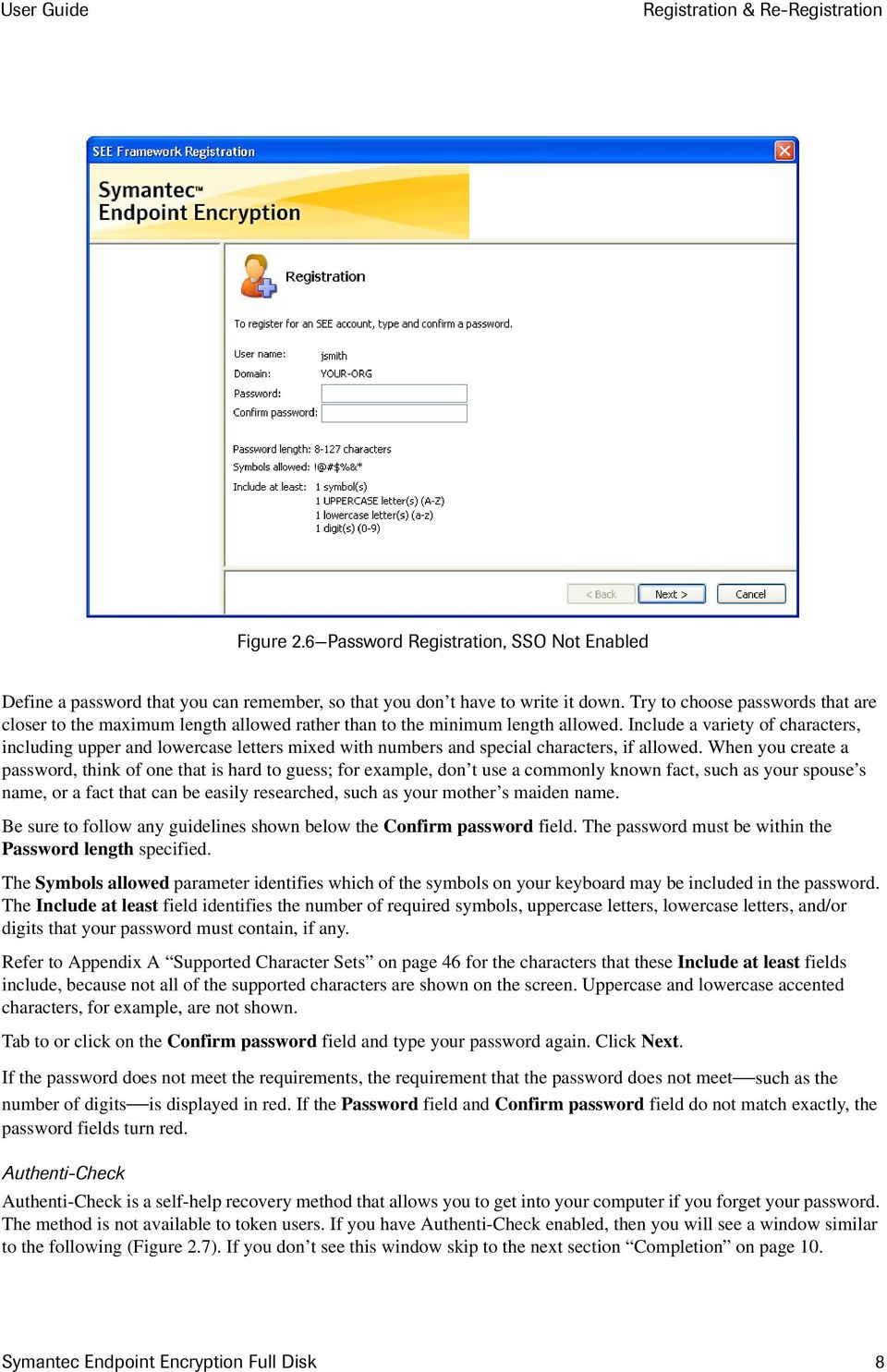
12 Registration & Re-Registration Figure 2.5 Password Registration, SSO Enabled, Domain Account Your Windows name, domain, and password will be used for your SEE account. Click Next to continue. If you click Cancel, your SEE account will not be created. You will be prompted to confirm that you really want to cancel. Single Sign-On Not Enabled If Single Sign-On is not enabled, the registration window displays your Windows user name, and domain or computer name (Figure 2.6) and prompts you to enter and confirm an SEE password. Symantec Endpoint Encryption Full Disk 7

13 Registration & Re-Registration Figure 2.6 Password Registration, SSO Not Enabled Define a password that you can remember, so that you don t have to write it down. Try to choose passwords that are closer to the maximum length allowed rather than to the minimum length allowed. Include a variety of characters, including upper and lowercase letters mixed with numbers and special characters, if allowed. When you create a password, think of one that is hard to guess; for example, don t use a commonly known fact, such as your spouse s name, or a fact that can be easily researched, such as your mother s maiden name. Be sure to follow any guidelines shown below the Confirm password field. The password must be within the Password length specified. The Symbols allowed parameter identifies which of the symbols on your keyboard may be included in the password. The Include at least field identifies the number of required symbols, uppercase letters, lowercase letters, and/or digits that your password must contain, if any. Refer to Appendix A Supported Character Sets on page 46 for the characters that these Include at least fields include, because not all of the supported characters are shown on the screen. Uppercase and lowercase accented characters, for example, are not shown. Tab to or click on the Confirm password field and type your password again. Click Next. If the password does not meet the requirements, the requirement that the password does not meet such as the number of digits is displayed in red. If the Password field and Confirm password field do not match exactly, the password fields turn red. Authenti-Check Authenti-Check is a self-help recovery method that allows you to get into your computer if you forget your password. The method is not available to token users. If you have Authenti-Check enabled, then you will see a window similar to the following (Figure 2.7). If you don t see this window skip to the next section Completion on page 10. Symantec Endpoint Encryption Full Disk 8
14 Registration & Re-Registration Figure 2.7 Password Registration, Authenti-Check One Authenti-Check question is always required. Up to three questions may be required, depending on how your system is configured. Questions identified as required, must be entered and answered. If a question is identified as optional, you are encouraged to enter a question and an answer. The more questionanswer pairs you have, the more secure your SEE Full Disk access is. For maximum security, enter three questions and three answers. Sometimes your administrator predefines questions for you. These questions you cannot change and you must provide answers for. Try to choose answers that other people cannot guess easily, but that you can remember without writing down. See Table 2.1 for examples of secure and less secure questions. Table 2.1 Authenti-Check Sample Questions Secure Who was your favorite teacher? Who was your childhood hero? What is the street name where your favorite relative lived? Less Secure What is your social security number? Where were you born? What is your mother s maiden name? See Appendix A Supported Character Sets on page 46 to see the characters that are allowed in your Authenti- Check questions and answers. When you have entered all questions and answers, click the Next button to submit your information. If your questions and answers fall within established guidelines, your information will be accepted; otherwise, fields that contain errors will be highlighted in red. Correct any highlighted information then click Next. Symantec Endpoint Encryption Full Disk 9

15 Registration & Re-Registration If you click Cancel, your SEE account will not be created. You will be prompted to confirm that you really want to cancel. Completion Once you complete the Registration wizard, the final window notifies you that your SEE user account is active (Figure 2.8). Figure 2.8 Password Registration, Account Is Active The Launch the SEE Client when I click Finish check box is selected by default to provide an easy means for you to access the primary control point for your SEE Full Disk protection. You should launch the Client console to view status and ensure that the encryption of your hard disk has begun or completed. Click Finish to complete the wizard and dismiss the window. If you leave the check box selected, when you click Finish: If you have Single Sign-On enabled, the Client console launches with the Welcome panel; you are already authenticated. If you do not have Single Sign-On enabled, the Client console launches with the Logon panel. Log on using the password that you just created for your account. See Chapter 5 The Client Console on page 33 for information about using the console. Symantec Endpoint Encryption Full Disk 10

16 Registration & Re-Registration Token Registration Token and Reader General Usage When the Registration wizard instructs you to insert your token: If you are using an RSA token, connect the USB-connector end of your token to a USB port or into a USB extension cable attached to your computer. Wait until you see the RSA icon in your system tray change to include a plus sign. If you are using a smart card, hold the card so that the side containing the gold chip is on top and the card end containing the chip is closest to the reader. If your token has a light or the reader has a light, it blinks when information from your token is being read. If you are using an Axalto smart card, the icon s computer screen changes from black to blue while the icon s golden token blinks, then returns to black when the blinking stops. Wait until the blinking stops before taking the next action, such as clicking Next. If you encounter token, certificate, or PIN errors during registration, refer to Appendix B Token Error Messages and check the section Registration or Re-Registration on page 48 for possible causes and resolution. Single Sign-On Enabled If Single Sign-On (SSO) is enabled, a window similar to the following will be shown. If you don t see this window, skip to the next section Single Sign-On Not Enabled on page 12. If your token is not yet inserted, your registration screen prompts you to insert your token (Figure 2.9). If you have already inserted your token, the window does not prompt you to insert it. Figure 2.9 Token Registration, SSO Enabled Symantec Endpoint Encryption Full Disk 11

17 Registration & Re-Registration To register your token for your SEE account, insert the token that you use to log on to Windows. The Next button becomes enabled. The token or reader light should blink as the card is read. When the token or reader light stops blinking, click Next. You continue to the next window in the Registration wizard. See PIN Entry on page 12. If you click Cancel, your SEE account will not be created. You will be prompted to confirm that you really want to cancel. Single Sign-On Not Enabled If Single Sign-On is not enabled, you will see the following window: Figure 2.10 Token Registration, SSO Not Enabled, Token Insertion When you insert your token, the token or reader light should blink as the card is read. When the light stops blinking or if you have no light but several seconds have passed click Next. You proceed to the next window in the Registration wizard. If you click Cancel, your SEE account will not be created. You will be prompted to confirm that you really want to cancel. PIN Entry A window similar to Figure 2.11 prompts you for your PIN. If you don t see this window, either SSO is not enabled or the Registration wizard has accessed your PIN from your token; skip to the next section Confirmation on page 13. Symantec Endpoint Encryption Full Disk 12

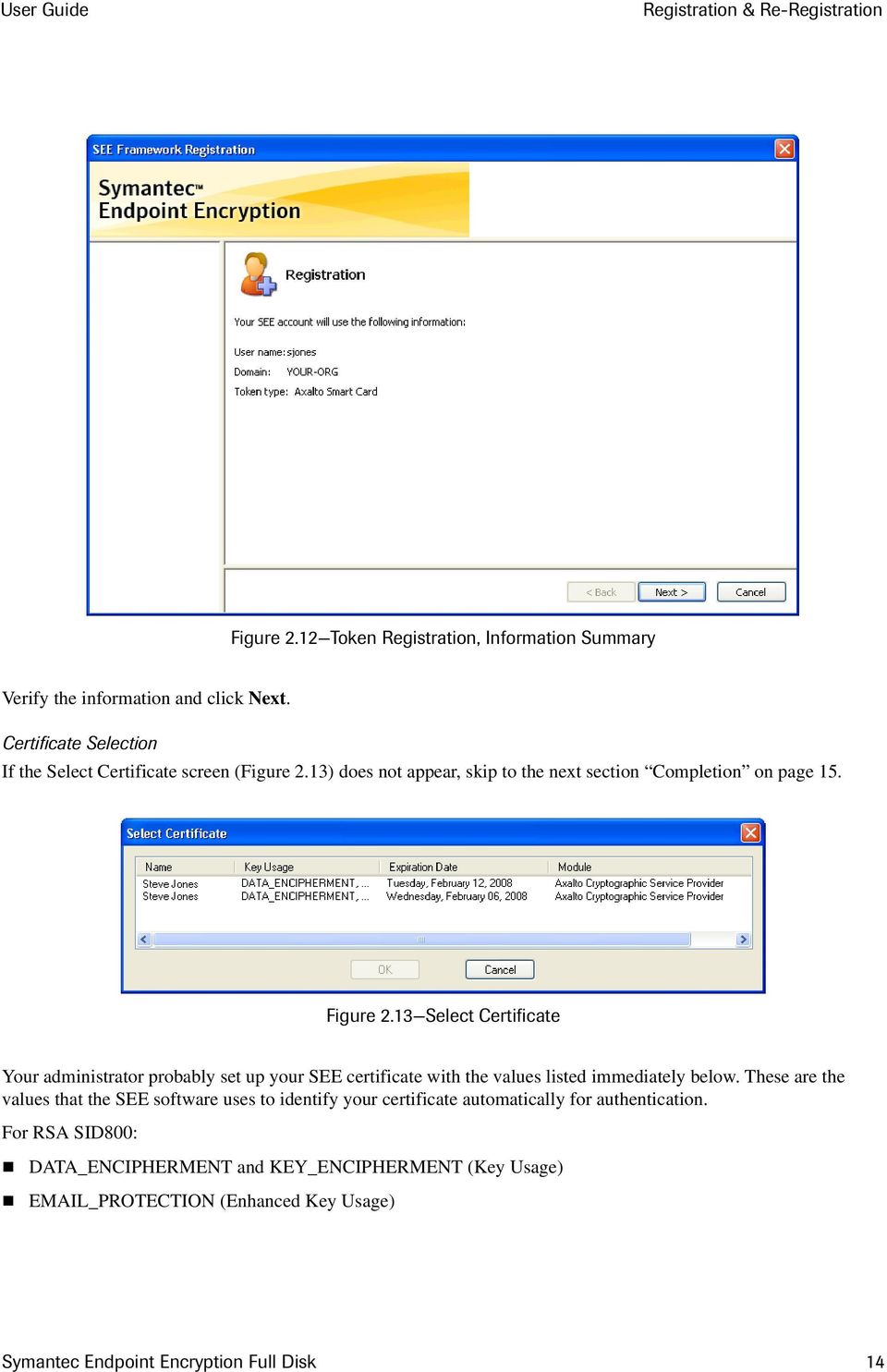
18 Registration & Re-Registration Figure 2.11 Token Registration, PIN Entry The User name and Domain fields are filled from the information stored on your token. If you are a local user, your computer name appears in the Domain field. Type your PIN in the PIN field, then click Next. If you click Cancel, your SEE account will not be created. You will be prompted to confirm that you really want to cancel. If you click Back, you return to the previous window (Figure 2.10) in the Registration wizard. Confirmation The next registration window confirms the token information that SEE Full Disk will use to authenticate you. Figure 2.12 shows an example. Symantec Endpoint Encryption Full Disk 13

19 Registration & Re-Registration Figure 2.12 Token Registration, Information Summary Verify the information and click Next. Certificate Selection If the Select Certificate screen (Figure 2.13) does not appear, skip to the next section Completion on page 15. Figure 2.13 Select Certificate Your administrator probably set up your SEE certificate with the values listed immediately below. These are the values that the SEE software uses to identify your certificate automatically for authentication. For RSA SID800: DATA_ENCIPHERMENT and KEY_ENCIPHERMENT (Key Usage) _PROTECTION (Enhanced Key Usage) Symantec Endpoint Encryption Full Disk 14
20 Registration & Re-Registration For Smart Card: DATA_ENCIPHERMENT and KEY_ENCIPHERMENT (Key Usage) _PROTECTION (Enhanced Key Usage) For Common Access Card (CAC): KEY_ENCIPHERMENT (Key Usage) However, if more than one certificate or no certificate exists with these values, the Select Certificate window (Figure 2.13) opens and you must manually identify your SEE certificate. Select your SEE certificate by clicking on the appropriate row, then clicking OK. In the Figure 2.13 example, the administrator created two certificates with the expected Key Usage settings, so this user identifies their certificate based on Expiration Date. If you don t know which certificate to choose, contact your administrator. If you select a certificate that is not valid, you will receive an error message. Refer to Appendix B Token Error Messages and check the section Registration or Re-Registration on page 48 for possible resolution. Completion The final Registration window (Figure 2.14) notifies you that your SEE user account is active. Figure 2.14 Token Registration, Account Is Active The Launch the SEE Client when I click Finish check box is selected by default to provide an easy means for you to access the primary control point for your SEE Full Disk protection. You should launch the Client console to view status and ensure that the encryption of your hard disk has begun or completed. Click Finish to complete the wizard and dismiss the window. Symantec Endpoint Encryption Full Disk 15

21 Registration & Re-Registration If you leave the check box selected, when you click Finish: If you have Single Sign-On enabled, the Client console launches with the Welcome panel; you are already authenticated. If you do not have Single Sign-On enabled, the Client console launches with the Logon panel. Log on using the token and PIN that you just identified for your account. See Chapter 5 The Client Console on page 33 for information about using the Client console. Re-Registration Basics Your Policy Administrator may issue a policy requiring you to convert your SEE account authentication method, either from a password to a token, or from a token to a password. Should this occur, you will be prompted to reregister. This prompting can also happen if this authentication-conversion setting is in place following an upgrade of SEE Full Disk. Re-Registration Notification If your Policy Administrator requires that you convert your account, you will be notified. Your re-registration prompt message contains a date by which you must re-register. Figure 2.15 shows a sample notification prompt for users moving from password-based to token-based authentication. Figure 2.15 Re-Registration Notification You are encouraged to click Re-register Now to begin the re-registration process. If your prompt states, You need to re-register for a token-based account, follow the instructions under Token Registration on page 11. If you are converting to a token-based account, be sure you have been issued your token. You will need it for the re-registration process. If Single Sign-On is enabled, use the token that you use to log on to Windows. If your prompt states, You need to re-register for a password-based account, follow the instructions under Password Registration on page 6. Click Cancel to re-register later, but you must re-register prior to the date shown in the message or you will be locked out of Windows until you do re-register. If you cancel for now and the enforcement date arrives, you will still be able to authenticate in pre-windows with your current account; then when you authenticate to Windows, you will again be prompted to re-register. As long as the date has not yet arrived, you can delay re-registration and work normally. Re-Registration Mandate Once the enforcement date arrives, you will be forced to re-register. The following figure shows the sample prompt for re-registering for a token authentication method. Symantec Endpoint Encryption Full Disk 16
22 Registration & Re-Registration Figure 2.16 Re-Registration Mandate Click Re-register to launch the Registration wizard. If you need to re-register for a password-based account, follow the instructions under Password Registration on page 6. If you need to re-register for a token-based account and you have been issued your token, follow the instructions under Token Registration on page 11. If you can t complete re-registration, click Log Off Windows. This could occur if you receive the prompt before you receive your token. The next time you boot up, you can authenticate in pre-windows with your existing SEE account, but when you try to log on to Windows, you will receive the same re-registration mandate. Symantec Endpoint Encryption Full Disk 17
23 Pre-Windows Authentication 3. Pre-Windows Authentication Overview Pre-Windows authentication ensures that only authorized users can access the encrypted disk. If you have Single Sign-On (SSO), you will only have to log on once with your Windows user name and password or token. If you do not have SSO, you will need to log on to SEE Full Disk and then to Windows. Though it requires an extra step, not having SSO enabled is the more secure configuration. Authentication is accomplished with either a token or a password, according to how your administrator configured your account. The Symantec Startup screen and the pre-windows logon screen may not be displayed if the Policy Administrator is running Autologon. Autologon allows the Administrator to install software without having users authenticate. If Autologon is running, you will skip the SEE Full Disk logon and log on to Windows only. If you are a password-based user, proceed to read the next section. Token users skip to Token-Based Logon on page 20. Password-Based Authentication Getting Started Once you have registered, each time you turn on your computer, you will be greeted by the Symantec Startup screen. The figure below shows the default Startup screen distributed with Symantec Endpoint Encryption. Figure 3.1 Pre-Windows Startup, Default Symantec Endpoint Encryption Full Disk 18
24 Pre-Windows Authentication Your organization may have created a different screen altogether or they may have chosen to customize the text. At a minimum, the Startup screen should provide you with instructions on how to log on. As a password user, press CTRL+ALT+DEL. Logging On Figure 3.2 shows an example of the pre-windows Logon screen. Figure 3.2 Pre-Windows Logon, Password SEE Full Disk shows the active keyboard layout in a bar displayed in the lower right-hand corner of your computer screen, similar to this:. If your administrator defined multiple keyboards and you need a keyboard layout different than the one identified in the bar, you can press Left ALT+SHIFT or CTRL+SHIFT the key sequence depends on which sequence was defined to Windows to toggle to another keyboard. To log on to SEE Full Disk, type your user name or UPN into the User name field. The UPN syntax is [email protected]; for example, [email protected]. Select your domain from the Domain drop-down menu. If you used UPN syntax, no domain selection is necessary. Type your password into the Password field. Click OK. Logon Delay If you provide incorrect logon information, you may be forced to wait 60 seconds before trying again. Figure 3.3 shows an example of the message you see on the Logon screen, if logon delay is active. Symantec Endpoint Encryption Full Disk 19
25 Pre-Windows Authentication Figure 3.3 Pre-Windows Logon, One-Minute Delay This forced delay prevents unauthorized users from breaking in to your system with automated guessing tools. Logon Assistance If you continue to have trouble logging on and you need help, provide your user name and domain, then click Logon Assistance. See Chapter 4 Logon Assistance on page 23 for more information. Token-Based Logon Basics If you are using an RSA token, connect the USB-connector end of your token to a USB port or into a USB extension cable attached to your computer. When you insert your token, hold the card so that the side containing the gold chip is on top and the card end containing the chip is closest to the reader. If your token has a light or the reader has a light, it blinks when information from your token is being read. Wait until the blinking stops before taking the next action, such as clicking OK from the Logon screen. This wait time allows the system to recognize your token. Token Insertion at Startup Screen Once you have registered, each time you turn on your computer, you will be greeted by the Startup screen, if your token is not yet inserted. If your token is already inserted, the Startup screen will not appear or will appear only briefly. If you do not see this screen (Figure 3.4), skip to the next section Logging On on page 21. Symantec Endpoint Encryption Full Disk 20
26 Pre-Windows Authentication Figure 3.4 Pre-Windows Startup, Default The figure shows the default Startup screen distributed with Symantec Endpoint Encryption. Your administrator may have created a different screen altogether or may have chosen to customize the text. At a minimum, the Startup screen should provide you with instructions on how to log on. If you have not inserted your token yet, insert it now. The pre-windows Logon screen appears. If you encounter token errors, refer to Appendix B Token Error Messages and check the section Pre-Windows Logon on page 51 for possible causes and resolution. Logging On Figure 3.5 shows an example of the pre-windows token Logon screen. Figure 3.5 Pre-Windows Logon, Token PIN Entry Symantec Endpoint Encryption Full Disk 21
27 Pre-Windows Authentication SEE Full Disk defaults to the keyboard defined to Windows when the computer was set up. The active keyboard is identified on a bar in the lower right-hand corner of your screen, similar to this:. If your administrator defined multiple keyboards and you need a keyboard layout different than the one identified in the bar, you can press Left ALT+SHIFT or CTRL+SHIFT the key sequence depends on which sequence was defined to Windows to toggle to another keyboard. To authenticate, type your PIN into the PIN field then click OK. Do not remove your token until processing completes. The first time this pre-windows Logon screen appears, it may display only the PIN field. Enter your PIN and click OK. Once you log on the first time, the next time you reboot, this Logon screen displays your User name and Domain as well. Token Error Messages and Logon Assistance If you encounter token, certificate, or PIN errors while trying to log on, refer to Appendix B Token Error Messages and check the section Pre-Windows Logon on page 51 for possible causes and resolution. If you have forgotten your PIN and you need help authenticating, click Logon Assistance, then refer to Chapter 4 Logon Assistance on page 23. Symantec Endpoint Encryption Full Disk 22
28 Logon Assistance 4. Logon Assistance Overview SEE Full Disk offers two automated methods of logon assistance for users who have forgotten their password or PIN. These methods may or may not have been enabled for you. If you are a token user, you will not have the Authenti- Check method available. Both methods are available in pre-windows and require either a token or a valid user and domain/computer name. If you successfully complete one of the methods and Single Sign-On is enabled, you are authenticated to Windows and prompted to change your password. If Single Sign-On is not enabled, you are prompted to change your SEE password, then you are prompted to enter your Windows credentials. If you are a token-based user, you will have to contact the appropriate administrator to change your PIN. If you do not have either method available, ask your Client Administrator to assist you. If you are a token user with your token, go to Forgotten PIN on page 31. If you are a password user or a token user who has forgotten their token, proceed to the next section. Forgotten Password or Token Basics Recover from a forgotten password or a forgotten token by invoking logon assistance from the pre-windows Logon screen. If you are not already on that screen, press CTRL+ALT+DEL from the Symantec Startup screen; the Logon screen appears (Figure 4.1). Figure 4.1 Pre-Windows Password Logon, Logon Assistance SEE Full Disk shows the active keyboard layout in a bar displayed in the lower right-hand corner of your computer screen, similar to this:. If your administrator defined multiple keyboards and you need a keyboard layout different than the one identified in the bar, you can press Left ALT+SHIFT or CTRL+SHIFT the key sequence depends on which sequence was defined to Windows to toggle to another keyboard. Symantec Endpoint Encryption Full Disk 23
29 Logon Assistance To log on to SEE Full Disk, type your user name or UPN into the User name field. The UPN syntax is for example, Select your domain from the Domain drop-down menu. If you used UPN syntax, no domain selection is necessary. Type your password into the Password field. Click Logon Assistance. If you have no automated logon assistance methods available, contact your administrator or follow any customized directions on the screen. Figure 4.2 shows the default message. You can skip the rest of this chapter. Figure 4.2 Pre-Windows Logon Assistance, No Methods Available Otherwise, you do have one or more authentication assistance methods available and the Logon Assistance wizard begins. Figure 4.3 shows the default message, but your organization may have customized the message with a contact name and phone number. Write down the information before clicking Next. You may need this information later. Figure 4.3 Pre-Windows Logon Assistance, Default Message Symantec Endpoint Encryption Full Disk 24
30 Logon Assistance Click Next. Authenti-Check If you have Authenti-Check, you will see a screen similar to the screen in Figure 4.4. If you don t see this screen, skip to the next section One-Time Password (OTP) on page 28. Figure 4.4 Pre-Windows Logon Assistance, Authenti-Check The Authenti-Check method involves up to three question-answer pairs, established during registration. If you forget your password, the questions are displayed and you are prompted to enter the answers. Correct answers authenticate you. You are then prompted to change your SEE password. In each box that appears below a question, type the correct answer. Make sure that you enter the answer exactly as you entered it when you defined it. Note that punctuation matters. Spaces matter if they precede or end the question. The answers are not case-sensitive. If an Authenti-Check answer is long (up to 99 characters may be allowed by policy), the characters that you type at the beginning of the answer may move out of view as you continue to type. You can press the arrow keys or HOME and END keys to scroll through your answer, or you can use SHIFT in combination with arrow keys to select text. If you need to delete some or all of the text of a long answer, use one of the methods below to ensure that the nonvisible characters are deleted: To delete the entire answer, press END, then SHIFT+HOME. All text becomes highlighted. Press DELETE. To delete part of the answer, use an arrow key to move to the right of the characters in question, then press BACKSPACE until all of the characters that you intended to delete are removed. You could also move to the left of the characters, then press DELETE. Replace any deleted text with correct information, as appropriate. Once you have entered your answers, click Next. Success, SSO Enabled If your Authenti-Check process ends successfully and SSO is enabled, Windows proceeds to load. A success message appears with instructions about changing your password (Figure 4.5). Symantec Endpoint Encryption Full Disk 25
31 Logon Assistance Figure 4.5 Pre-Windows Logon Assistance, Success If your computer is connected to the domain and you are using a domain account, the Windows Change Password dialog appears when Windows starts. If you are using a local account, connection to the domain is not required; you will be prompted to change your password whether you are connected or not. Figure 4.6 Change Password, Windows Enter your new password into the New Password field. Type your password again, in the Confirm New Password field. Click OK. If your password is not valid, Windows displays an error message. Correct your information and click OK again. If your password satisfies all Windows password requirements and if the new password and confirmed password match, your Windows password is changed and you gain access to Windows. The next time you log on in pre-windows, use the new password. If your Windows account is new or you changed your Windows password quite recently, Windows may stop you from changing your password again because of a minimum password-age restriction. If this happens, call your help desk. Your administrator will need to reset your Windows password. If you are a domain user and not connected to the domain, you will not be able to change your password. You will need to connect to the domain and/or contact your administrator for assistance. Success, SSO Not Enabled If your Authenti-Check process ends successfully and SSO is not enabled, the SEE Password Change screen appears. Symantec Endpoint Encryption Full Disk 26
32 Logon Assistance Figure 4.7 Pre-Windows Logon Assistance, SEE Password Change Enter a new password in the New password field. Follow any guidelines shown on the screen. In addition to password length and symbols allowed, your screen may also identify the number of required symbols, uppercase letters, lowercase letters, and/or digits that your password must contain. See also Appendix A Supported Character Sets on page 46 for the characters that are allowed in registered user passwords but do not appear in the user interface. Type your new password again, in the Confirm new password field. Click Finish. Your password is submitted. If the password meets the requirements and the confirmation matches, a Password Change success message appears (Figure 4.8). Figure 4.8 SEE Password Change Success Click OK to dismiss the message. Once your password is changed, Windows loads. If your password is not valid, an error message appears. Re-enter the information and click Finish again. Symantec Endpoint Encryption Full Disk 27
33 Logon Assistance Failure, OTP Not Enabled If your Authenti-Check answers are not correct, a message box appears with a message stating this fact. Click OK to return to the pre-windows Logon screen (Figure 4.1) where you can try to log on again, or call your Client Administrator for help. Failure, OTP Enabled If your answers are not correct and the OTP recovery method is available, the following message box appears: Figure 4.9 Pre-Windows Logon Assistance, Authenti-Check Incorrect, OTP Begins Click Next. One-Time Password (OTP) If you have failed to recover using Authenti-Check, or do not have Authenti-Check enabled, the One-Time Password Program will launch. The One-Time Password (OTP) Program allows you to recover from a forgotten password, PIN, or token with help desk assistance. This assistance provides you with a one-time password known as a response key or secret recovery key that allows you to temporarily authenticate. You then will be prompted to enter a new password. When you click Next from the Logon Assistance wizard or from the Authenti-Check message box, the One-Time Password program launches (Figure 4.10). Secret Recovery Key Checksum Number Figure 4.10 Pre-Windows Logon Assistance, OTP Symantec Endpoint Encryption Full Disk 28
34 Logon Assistance Your user Name, Domain, and Computer name are pre-filled and a Code is displayed. The response key (secret recovery key) fields are empty. Figure 4.10 shows the window with sample response key fields already filled in. Contact the person or organization whose name and number appeared in the Logon Assistance message screen. (If you did not write down the information, you can click Back to see the information again, then return to this window by clicking Next.) This person may be your Client Administrator. Let the Client Administrator know that you need assistance with the One-Time Password process. Tell the Client Administrator the Name, Domain, Computer, and Code information displayed in your window. The Client Administrator will then read back to you a series of numbers (the response key). Type the response key numbers into the blank fields on your screen. Enter the numbers in sequence, from left to right and top to bottom. After you have entered the response key numbers, the Client Administrator may ask you to read the checksums that appear to the bottom-right of each data-entry field. These checksums confirm that you have entered the numbers correctly. Figure 4.10 shows an example with callouts that identify a response key (secret recovery key) number and a checksum number. If the Client Administrator confirms that the numbers are correct, click Next. Success, SSO Enabled for Token-Based User If the OTP process ends successfully and SSO is enabled, Windows will proceed to load. Success, SSO Enabled for Password-Based User If the OTP process ends successfully and SSO is enabled, Windows proceeds to load. This message appears, You have successfully completed the Logon Assistance Wizard. When you are connected to your domain, you will be prompted to change your password after Windows starts. If your computer is connected to the domain and you are using a domain account, the Windows Change Password screen appears when Windows starts. If you are using a local account, connection to the domain is not required; you will be prompted to change your password whether you are connected or not. Figure 4.11 Change Password, Windows Enter your new password in the New Password field. Type your password again in the Confirm New Password field. Click OK. If your password is not valid, Windows displays an error message. Correct your information and click OK again. Symantec Endpoint Encryption Full Disk 29
35 Logon Assistance If your password satisfies all Windows password requirements and if the new password and confirmed password match, your Windows password is changed and you gain access to Windows. The next time you log on in pre-windows, use the new password. If your Windows account is new or you changed your Windows password quite recently, Windows may stop you from changing your password again because of a minimum password-age restriction. If this happens, call your help desk. Your system administrator will need to reset your Windows password. If you are a domain user and not connected to the domain, you will not be able to change your password. You will need to connect to the domain and/or contact your administrator for assistance. Success, SSO Not Enabled for Token-Based User If your OTP process ends successfully and SSO is not enabled, you are authenticated to SEE Full Disk and are now prompted to authenticate to Windows. Success, SSO Not Enabled for Password-Based User If your OTP process ends successfully and SSO is not enabled, the SEE Password Change screen appears. Figure 4.12 Password Change, SEE Enter a new password in the New password field. Follow any guidelines shown on the screen. In addition to password length and symbols allowed, your screen may also identify the number of required symbols, uppercase letters, lowercase letters, and/or digits that your password must contain. See also Appendix A Supported Character Sets on page 46 for the characters that are allowed in passwords. Type your new password again in the Confirm new password field. Click Finish. Your password is submitted. If the password meets the requirements and the confirmation matches, a password-change success message appears. Once your password is changed, Windows loads. If your password is not valid, an error message appears. Re-enter the information and click Finish again. Symantec Endpoint Encryption Full Disk 30
36 Logon Assistance Forgotten PIN Basics If you have forgotten your PIN, invoke logon assistance from the pre-windows Logon screen (Figure 4.13). If you are not already on that screen, insert your token at the Symantec Startup screen; the Logon screen appears. Figure 4.13 Pre-Windows Token Logon, Logon Assistance Your user name and domain are pre-filled. Leave the PIN field blank. Click Logon Assistance. The Logon Assistance wizard begins with a message (Figure 4.14). Figure 4.14 Pre-Windows Logon Assistance, Default Message The figure shows the default message, but your organization may have customized the message with a contact name and phone number. Write down the information before clicking Next. If your customized message states that no automated recovery methods are available, then call your Client Administrator and skip the remainder of this chapter; otherwise, click Next to begin the One-Time Password recovery method. Symantec Endpoint Encryption Full Disk 31
37 Logon Assistance One-Time Password (OTP) The One-Time Password (OTP) Program allows you to recover from a forgotten password, PIN, or token with help desk assistance. This assistance provides you with a one-time password known as a response key or secret recovery key that allows you to temporarily authenticate. You then will be prompted to enter a new password. When you click Next from the Logon Assistance wizard, the One-Time Password program launches (Figure 4.15). Secret Recovery Key Checksum Number Figure 4.15 Pre-Windows Logon Assistance, OTP Your user Name, Domain, and Computer name are pre-filled and a Code is displayed. The response key (secret recovery key) fields are empty. Figure 4.15 shows the window with sample response key fields already filled in. Contact the person or organization whose name and number appeared in the message screen. (If you did not write down the information, you can click Back to see the information again, then return to this window by clicking Next.) This person may be your Client Administrator. Let the Client Administrator know that you need assistance with the One-Time Password process. Tell the Client Administrator the Name, Domain, Computer, and Code information displayed in your window. The Client Administrator will then read back to you a series of numbers (the response key). Type the response key numbers into the blank fields in your window. Enter the numbers in sequence, from left to right and top to bottom. After you have entered the response key numbers, the Client Administrator may ask you to read the checksums that appear to the bottom-right of each data-entry field. These checksums confirm that you have entered the numbers correctly. Figure 4.15 shows an example with callouts that identify a response key (secret recovery key) number and a checksum number. If the Client Administrator confirms that the numbers are correct, click Next. Success, SSO Enabled If the OTP process ends successfully and SSO is enabled, Windows loads and you have Windows access. You will not be prompted to change your PIN. To recover your PIN or to be issued a new PIN, contact the person or organization that issued you your token. Success, SSO Not Enabled If the OTP process ends successfully and SSO is not enabled, you advance to the Windows logon prompt. Symantec Endpoint Encryption Full Disk 32
38 The Client Console 5. The Client Console Overview The Client console is available once Windows has loaded and allows you to: View the encryption status of your hard disk partitions. View the SEE registered user and Client Administrator accounts on your computer. View the last time your computer checked in with the SEE Server, if at all. View product version information. Encrypt hard disk partitions that are decrypted, if any. In addition, you might be able to: Change your SEE password (only if SSO is off). Change your Authenti-Check questions and answers. Decrypt hard disk partitions. These additional functions may or may not have been enabled by your administrator. This chapter begins by describing how to start, log on to, and navigate the Client console. The chapter then describes step-by-step instructions for doing the tasks listed above. To start the Client console select Symantec Endpoint Encryption Client from the Start menu. Logon Single Sign-On Enabled If you have Single Sign-On enabled and you authenticate using a password, you do not need to log on to the Client console. You will be logged on automatically as soon as Windows loads. Skip to Welcome on page 36. Single Sign-On Not Enabled When the Client console launches, it prompts you for your credentials. Only the user currently logged on to Windows can log on to the Client console. If Single Sign-On is not enabled, you will be prompted to authenticate with your SEE token or password. For password authentication, continue to the next section. For token authentication, skip to Token Logon Preparation on page 34. Password Logons If your account uses a password to authenticate, the Logon screen prompts you for your password (Figure 5.1). Symantec Endpoint Encryption Full Disk 33
39 The Client Console Figure 5.1 Client Console Logon, Password To log on to the Client console with a password, type your SEE password in the Password field, then click Log On. If your password is not correct, the logon fails. Check your password and re-enter the information. Your Policy Administrator may have implemented a logon delay to occur when one or more incorrect logon attempts are made. This delay helps protect the computer against unwanted password-guessing attacks. If such a setting or policy is in place and you trigger that restriction, a message appears informing you that the number of allowed logon attempts has been exceeded and that you can try again in 60 seconds. If your password is correct, you are given access to the Client console. Skip to Welcome on page 36. Token Logon Preparation If you are using an RSA token, connect the USB-connector end of your token to a USB port or into a USB extension cable attached to your computer. Make sure that the RSA token software recognizes your token. You will see the RSA icon in your system tray change to include a plus sign. When you insert a smart card, hold the card so that the side containing the gold chip is on top and the card end containing the chip is closest to the reader. If your token has a light or the reader has a light, it blinks when information from your token is being read. If you are using an Axalto smart card, the icon s computer screen changes from black to blue while the icon s golden token blinks, then returns to black when the blinking stops such as clicking Next. Token Logons If your token is not yet inserted, the Logon screen prompts you to insert your token.. Wait until the blinking stops before taking the next action, Symantec Endpoint Encryption Full Disk 34
40 The Client Console Figure 5.2 Client Console Logon, Token Insert your token. Do not remove the token until authentication completes. In the PIN field, type your PIN, then click Log On. If you encounter token, certificate, or PIN errors during logon, please refer to the section Client Console Logon on page 53 in Appendix B Token Error Messages for possible causes and resolution. Your Policy Administrator may have implemented a logon delay to occur when one or more incorrect logon attempts are made. This delay helps protect the computer against unwanted attacks. If such a setting or policy is in place and you trigger that restriction, a message appears informing you that the number of allowed logon attempts has been exceeded and that you can try again in 60 seconds. Certificate Selection If the Select Certificate screen (Figure 5.3) does not appear, skip to the next section Welcome on page 36. Figure 5.3 Select Certificate Your administrator may have set up your SEE certificate with the values listed immediately below. These are the values that the Symantec software uses to identify your certificate automatically for authentication. For RSA SID800: DATA_ENCIPHERMENT and KEY_ENCIPHERMENT (Key Usage) _PROTECTION (Enhanced Key Usage) Symantec Endpoint Encryption Full Disk 35
41 The Client Console For Smart Card: DATA_ENCIPHERMENT and KEY_ENCIPHERMENT (Key Usage) _PROTECTION (Enhanced Key Usage) For Common Access Card (CAC): KEY_ENCIPHERMENT (Key Usage) However, if more than one certificate or no certificate exists with these values, the Select Certificate window (Figure 5.3) opens and you must manually identify your SEE certificate. Select your SEE certificate by clicking on the appropriate row, then clicking OK. In the Figure 5.3 example, the administrator created two certificates with the expected Key Usage settings, so this user identifies their certificate based on Expiration Date. If you don t know which certificate to choose, contact your administrator. If you select a certificate that is not valid, you will receive an error message. Refer to Appendix B Token Error Messages and check the section Client Console Logon on page 53 for possible causes and resolution. Welcome The Client console opens with the Welcome panel and an enabled navigation pane (Figure 5.4). Figure 5.4 Client Console Welcome Symantec Endpoint Encryption Full Disk 36
42 The Client Console Navigation The Client console is divided into several sections. Banner Navigation Pane Quick Help Pane Main Pane Figure 5.5 Client Console User Interface Elements The elements are as follows: The banner displays the product logo, the name of the currently logged on user, and the user s domain or local computer name. The navigation pane contains hyperlinks to all tasks. Each task has its own panel, which loads into the main pane when its link is clicked. The links are clustered under two main headings: Account Settings and Full Disk. The main pane changes in response to your clicking a link in the navigation pane. For example, if you click Users, the main pane displays the Users panel. The Quick Help pane appears when you click the help icon. It provides context-sensitive help based on the location of your mouse. To close the Quick Help pane, click the help icon again. Password Change Basics If Single Sign-On is not enabled, you can change your SEE password using the Password panel. Changing your password periodically is a good practice, especially if you suspect that it may have been compromised. Instructions From the navigation pane, click Password. The Password panel appears (Figure 5.6). Symantec Endpoint Encryption Full Disk 37
43 The Client Console Figure 5.6 Client Console Password If password management is enabled, the Password panel displays the required password length and the symbols that are allowed in your password, and any requirements for the number and type of allowed symbols, and the number of uppercase letters, lowercase letters, and/or digits that your password must contain. Your panel will also describe any overall requirements, such as, Your new password must be different than the last 10. In the New Password field, enter your new SEE password. Follow any requirements shown on the panel for Password length, Symbols allowed, and Include at least. You can refer to Appendix A Supported Character Sets on page 46 for the characters that these Include at least fields include, because not all of the supported characters are shown on the screen. For example, upper and lowercase accented characters are not shown. In the Confirm new password field type your new password again. Click OK. If your password meets the requirements, your password is updated and the Welcome panel (Figure 5.4) replaces the Password panel. If the password change is not allowed for example, if not enough time has elapsed since you last changed your password the fields and buttons become unavailable. An error message box will inform you of the nature of the problem. On the message box, click OK to dismiss the box. You can select another task from the navigation pane or click to quit the Client console. If the password change is allowed but the password does not comply with the password requirements, then the requirement that the password does not satisfy is highlighted in red. Make the changes necessary to bring it into compliance, then click OK to resubmit the password. At any time you may exit the panel by choosing another task from the navigation pane or clicking console. Your password will not be changed. If you click Cancel, the fields are cleared and your password is not submitted. to quit the Client Symantec Endpoint Encryption Full Disk 38
44 The Client Console Authenti-Check Change From the navigation pane, click Authenti-Check. The Authenti-Check panel appears. If Authenti-Check is not enabled for you, the main pane will say so. The following figure shows an example panel with Authenti-Check enabled and three questions predefined. Figure 5.7 Client Console Authenti-Check When you bring up the Authenti-Check panel, all answers and any questions that are required or optional are not displayed, even though they are on file, for security reasons. When entering questions and answers, consider the following: Answers are visible when typed, so be sure no one is watching you type them. These answers are as important as your password. Also, remember precisely how you enter the answers; if you must enter them later to recover from a forgotten password, they must match what you enter now. Note that when you enter the answers later, punctuation will matter as well as spaces that precede or follow the answers. The answers are not case-sensitive. To see suggestions on creating effective questions, refer to Chapter 2 Registration & Re-Registration under the section Authenti-Check on page 8. To see a list of characters that are allowed in your Authenti-Check questions and answers, refer to Appendix A Authenti-Check Questions and Answers on page 46. Questions and answers marked required must be completed. Minimum character lengths are indicated in parentheses beside Questions and Answers. Even if a question or answer is marked optional, consider filling it in as it will increase the security of your data. When you have entered all questions and answers, click OK to submit your information. If your questions and/or answers are accepted, your information is updated. The Welcome panel (Figure 5.4) appears, replacing the Authenti-Check panel. Symantec Endpoint Encryption Full Disk 39
45 The Client Console If your questions and/or answers are not accepted, the field that needs correcting turns red. Make your corrections. You may click the help icon to display Quick Help and read about what is incorrect. Click OK again. If you click Cancel, your information is cleared and is not submitted. Computer Check-In SEE Client Computers can be configured to attempt to connect to the SEE Server at a designated interval. When your computer checks in, it sends important recovery, status, and account information. The Policy Administrator can optionally add a policy to enforce check-in by locking out users when a computer is required to check in but doesn t. If lockout occurs, no user can log on to the Client Computer in pre-windows and a Client Administrator must log on to allow the user to boot into Windows. Use the Check-In panel to see: What check-in policy is active; The last communication date information; The next communication date information, if check-in is enforced by lockout. To access the panel, from the navigation pane click Check-In. The Check-In panel appears. If the check-in policy is active without lockout enforcement, the panel displays the last date and time the Client Computer communicated with the SEE Server. Figure 5.8 shows an example. Figure 5.8 Client Console Check-In, Check-In with No Enforcement The panel would show different information if the computer had not yet communicated; the Last communication with the SEE Server field would display never connected. This scenario would be unlikely. If the check-in policy with lockout enforcement is active, the panel displays the last date and time the Client Computer communicated with the SEE Server and the next date and time when communication must occur to prevent a lockout. The values that may be displayed in the Check-In panel are described in the following table. Symantec Endpoint Encryption Full Disk 40
46 The Client Console Table 5.1 Check-In Panel Information Field Label Value Meaning Last communication with the SEE Server Next communication due by* Date and time never connected Future date and time Past date and time in red with a warning icon. Tooltip message, Communication is overdue, appears. *This field will not be shown if a lockout enforcement policy is not in effect. If the information in the Client console indicates that a lockout is imminent, contact your Client Administrator as soon as possible. Your Client Administrator can extend the due date for you, and separately, resolve whatever is preventing your computer from making the required contact with the SEE Server. About Lockouts If lockouts are used for enforcement of check-in and the computer fails to check in, then the next time you boot, you will not be able to log on in pre-windows and you will not have password-recovery methods available. Instead of the Startup screen appearing, you will see this message: This computer has been locked. Only a Client Administrator can unlock this computer. Your Client Administrator will need to log you on to bring you to the Windows prompt. Lockout Prevention There are three ways to determine that a lockout is probable: On the Check-In panel, the Next communication due by date turns red and a warning icon appears next to the date. When you hover your mouse over the icon the message Communication is overdue appears. A lockout is imminent at the next reboot. You realize that a communication due date is near and you know that the computer will not be checking in; for example, perhaps you are about to leave on vacation or will be on the road with your laptop. You reboot your computer and before the Startup screen loads, you see this message: Access to this computer will be locked in n days unless communication with the SEE server is re-established. Please contact a client administrator for assistance. You can click OK to dismiss the message and gain access to the Startup screen, but be sure to follow up with one of the preventative actions described in the following bulleted list. A lockout is prevented when: You connect your computer to the network, triggering a check-in with the SEE Server before the next communication due date. A Client Administrator logs on to the computer in pre-windows. A Client Administrator extends the Next communication due by date. Communication with the SEE Server occurred on the specified date at the specified time. This Client Computer has never connected to the SEE Server. You will not be able to use the OTP recovery method. A lockout enforcement policy is in effect and this Client Computer must make contact with the SEE Server no later than the specified date and time. A lockout enforcement policy is in effect and this Client Computer has failed to connect within the mandatory interval. A lockout is imminent. Symantec Endpoint Encryption Full Disk 41
47 The Client Console Lockout Recovery If your computer is already locked, ask a Client Administrator to log on to the computer in pre-windows. This action unlocks the computer. If Autologon is activated while a computer is in a lockout state, the Autologon policy preempts the lockout condition for as long as the Autologon policy is in effect. This functionality ensures that a communication lockout condition does not disrupt the completion of the Autologon process, which is used to allow software installations and upgrades to run without users authenticating in pre-windows. User Account Viewing The Users panel provides a view of all SEE registered users on this computer and Client Administrator accounts set up on this computer. From the navigation pane click Users. The Users panel appears, listing all current users. The figure shows an example. Figure 5.9 Client Console Users Encrypting How To The full encryption of the Client Computer is usually set up to begin immediately after installation. It is unlikely that you will need to use the Client console to start this process manually. Should you need to encrypt the disk, you should first connect to an uninterruptible power source. For example, if you are encrypting a laptop, plug in the laptop before you start. To encrypt one or more partitions, from the navigation pane click Encryption. The Encryption panel appears. Figure 5.10 shows an example. Symantec Endpoint Encryption Full Disk 42
48 The Client Console Figure 5.10 Client Console Encryption If partitions are listed with a status of Decrypted, Decrypting, or Decryption Pending you can check the check box beside them to select them for encryption. Once you select one or more partitions, the Encrypt Selected Partitions button becomes available. Click Encrypt Selected Partitions. A partition s status changes to Encryption Pending, then to Encrypting. A check box beside a partition will not be available if the partition has a status of Encrypted, Encrypting, or Encryption Pending. This unavailability could also occur if a remote decryption policy prevents encryption. You can continue to work while partitions are encrypting. View Status To view the encryption status of partitions, from the navigation pane click Encryption. The Encryption panel appears (Figure 5.10). The panel shows the encryption and decryption status of the primary hard disk s partitions. The statuses are: Encryption Pending, Encrypting, Encrypted, Decryption Pending, Decrypting, and Decrypted. Decrypting How To Users are seldom given the right to decrypt. If you do not have the right to decrypt, the fields and buttons on the Decryption panel appear disabled and the message You do not have permission to decrypt the hard disk. is displayed. Symantec Endpoint Encryption Full Disk 43
49 The Client Console If you do have decryption rights, you may need to use them for the following reasons: The operating system is about to be upgraded. A major physical change in the core hardware is about to occur. For example, an upgraded processor or motherboard is going to be installed. Changes to the partition table are not possible on an encrypted computer and the hard disk must be decrypted prior to the repartitioning. You or an administrator are uninstalling SEE Full Disk. Should you need to decrypt the disk, first connect to an uninterruptible power source. For example, if you are decrypting a laptop, fully charge the battery or plug in the laptop before you start. To decrypt one or more partitions, from the navigation pane click Decryption. The Decryption panel appears. Figure 5.11 shows an example. Figure 5.11 Client Console Decryption If partitions are listed with a status of Encrypted, Encrypting, or Encrypting Pending you can check the check box beside them to select them for decryption. Once you select one or more partitions, the Decrypt Selected Partitions button becomes available. Click Decrypt Selected Partitions. A decrypted partition s status changes to Decryption Pending, then to Decrypting. A check box beside a partition will not be available if the partition has a status of Decrypted, Decrypting, or Decryption Pending, or if you do not have the right to decrypt. You can continue to work while partitions are decrypting. View Status To view the decryption status of partitions, from the navigation pane click Decryption. The Decryption panel appears (Figure 5.11). The panel shows the encryption and decryption status of the primary hard disk s partitions. The statuses are: Encryption Pending, Encrypting, Encrypted, Symantec Endpoint Encryption Full Disk 44
50 The Client Console Decryption Pending, Decrypting, and Decrypted. About Use the Client console to find out which version of SEE Framework and SEE Full Disk you are running. From the navigation pane, click About. The About panel appears (Figure 5.12), displaying version numbers and copyrights, and each module running in this Symantec Endpoint Encryption installation. The figure shows an example. Figure 5.12 Client Console About The build number is accessible as a Tool Tip when you hover your mouse over the version number. The build number can be used to see whether patches have been applied. Symantec Endpoint Encryption Full Disk 45
51 Supported Character Sets Appendix A. Supported Character Sets SEE Passwords If Single Sign-On is not enabled, the screens that you use to create or change your SEE password may identify the characters that are allowed in your password. This identification is known as password management. (If Single Sign- On is enabled, Windows manages your password requirements.) The allowed characters are displayed in the user interface, except for the characters included in this appendix. When password management is enabled, password requirements appear in the following circumstances: The Registration wizard displays the password requirements when you create your password (Figure 2.6 in Chapter 2 Registration & Re-Registration ). A successfully completed logon assistance method displays the requirements when you are forced to change your password (Figure 4.12 in Chapter 4 Logon Assistance ). The Client console displays the password requirements in the Password panel when you change your password (Figure 5.6 in Chapter 5 The Client Console ). Table A.1 lists the additional characters that are also allowed under the Include at least field for uppercase and lowercase letters, but are not shown in the user interface. Table A.1 Allowed Characters for Uppercase and Lowercase Letters in Include at Least Field Character Type Shown on Password Not Shown on Password Screens Screens UPPERCASE letter A-Z À Á Â Ã Ä Å Æ Ç È É Ê Ë Ì Í Î Ï Ð Ñ Ò Ó Ô Õ Ö Ø Ù Ú Û Ü Ý Þ Ÿ Œ lowercase letter a-z ß à á â ã ä å æ ç è é ê ë ì í î ï ð ñ ò ó ô õ ö ø ù ú û ü ý þ ÿ œ n/a <space> Authenti-Check Questions and Answers Table A.2 lists the characters that the SEE Framework allows in Authenti-Check questions and answers, but which are not shown in the user interface. Table A.2 Allowed Characters for Authenti-Check Questions and Answers Character Type Allowed Characters <space> Digits Uppercase A B C D E F G H I J K L M N O P Q R S T U V W X Y Z Uppercase accented À Á Â Ã Ä Å Æ Ç È É Ê Ë Ì Í Î Ï Ð Ñ Ò Ó Ô Õ Ö Ø Ù Ú Û Ü Ý Þ Ÿ Œ Lowercase a b c d e f g h i j k l m n o p q r s t u v w x y z Lowercase accented ß à á â ã ä å æ ç è é ê ë ì í î ï ð ñ ò ó ô õ ö ø ù ú û ü ý þ ÿ œ Symantec Endpoint Encryption Full Disk 46
52 Supported Character Sets Table A.2 Allowed Characters for Authenti-Check Questions and Answers (Continued) Character Type Allowed Characters # $ % & * +? <> ^ () - _ = ~ ` { } [ ] \ ; : ' " /,. Non-alphanumeric from supported non-us English keyboards _ µ ª ± ² ³ ¼ ½ ¾ Symantec Endpoint Encryption Full Disk 47
53 Token Error Messages Appendix B. Token Error Messages Overview This appendix lists the error and warning messages that you may encounter while using your token to: Register for an SEE account, or re-register for an account when required to change your authentication method from password-based to token-based; Authenticate in pre-windows; or Authenticate to the Client console. The appendix lists specific actions that you can take in response to each message. In some cases, the message itself contains the default instruction: Please call the help desk for assistance. This instruction appears in the Message column in italics. The instruction is configurable by your administrator, so your instruction may differ from the default shown in these tables. Registration or Re-Registration Table B.1 lists the error and warning messages that may occur when you are initially registering for your SEE account, or when you are re-registering in response to a policy change that requires you to change your account authentication method from password-based to token-based. Table B.1 Registration Messages Token Type CAC Severity Message Meaning Action A token error has occurred. The registration process cannot continue. [Please call the help desk for assistance.] This generic message is displayed for any of the following conditions: incorrect PIN, blocked PIN, or expired certificate. Click OK to dismiss the message, then click Cancel in the Registration wizard to end the registration process. Contact the appropriate administrator to determine the exact issue with your token. You cannot register or re-register until this situation is resolved. Symantec Endpoint Encryption Full Disk 48
54 Token Error Messages Table B.1 Registration Messages (Continued) Token Type RSA All All Severity Message Meaning Action A token error has occurred. The registration process cannot continue. [Please call the help desk for assistance.] The certificate selection failed. The current token may need to be replaced or modified by an administrator. [Please call the help desk for assistance.] The token has been removed. Please reinsert the token. It is possible that your certificate cannot be found or is not being recognized. A certificate was not found that matches the criteria required for an SEE account. You removed your token before the registration process completed. Click OK to dismiss the message, then click Cancel in the Registration wizard to end the registration process. Log off Windows and restart your computer. Log on. When you are prompted to register (or re-register), insert your token. For all token types, wait for the token light to stop blinking before clicking Register (or Reregister) or Register Now (or Re-register Now) from the prompt window. If you are using an RSA token, wait until you see the RSA icon in your system tray change to include a plus sign. If you are using an Axalto smart card, wait for the icon s gold token to stop blinking and for the icon s computer screen to return from blue to black. This wait time ensures that your token is recognized by the system before the registration wizard starts. If you receive this message when you try again, contact the appropriate administrator. You cannot register or re-register until this situation is resolved. Click OK to dismiss the warning message, then click Cancel in the Registration wizard to end the registration process. Contact the appropriate administrator. You cannot register or re-register until this situation is resolved. Reinsert your token and leave it inserted until you click Finish in the final registration window. Symantec Endpoint Encryption Full Disk 49
55 Token Error Messages Table B.1 Registration Messages (Continued) Token Type All Severity Message Meaning Action The PIN is blocked for this token. The current token needs to be replaced or modified by an administrator. Your token s PIN is blocked and cannot be used. All Incorrect PIN. The PIN you entered was incorrect. Contact the appropriate administrator. You cannot register or re-register until this situation is resolved. Try again. All A token error has occurred. The registration process cannot continue. The type of token you are attempting to register with does not match the type of token your administrator configured for your use. Remove the incorrect token and insert the correct one. If you do not know which token or card type is correct or you have not been issued the correct card click OK to dismiss the message, then click Cancel in the Registration wizard to end the registration process. Contact the appropriate administrator. You cannot register or re-register until this situation is resolved. All A certificate validation error has occurred. The current token needs to be replaced or modified by an administrator. Your token does not contain any certificate, or your token contains an invalid certificate. Click OK to dismiss the message, then click Cancel in the Registration wizard to end the registration process. Contact the appropriate administrator. You cannot register or re-register until this situation is resolved. Symantec Endpoint Encryption Full Disk 50
56 Token Error Messages Pre-Windows Logon Table B.2 lists the error messages that may be generated when you attempt to log on to SEE Full Disk in pre- Windows. Table B.2 Pre-Windows Logon Messages Token Severity Message Meaning Action Type CAC / Smart Card CAC / Smart Card Smart Card SEE Full Disk has discovered that the inserted token can not be recognized. You will need to use a token that can be recognized by the system. A matching certificate could not be located on this token. The current token needs to be replaced or modified by an administrator. [Please call the help desk for assistance.] No certificate could be found on this token. The current token needs to be replaced or modified by an administrator. [Please call the help desk for assistance.] The type of token you are attempting to log on with does not match the type of token your administrator configured for your use. The certificate on this token is not the certificate that you registered for your SEE account. Your certificate was issued today, but is not yet valid because the Certificate Authority issues certificates using Greenwich Mean Time (GMT). Therefore, your local system date has not yet caught up with the GMT activation date. Your token does not contain any certificates. Click OK to dismiss the message, remove the incorrect token, then insert the correct one. If you do not know which token or card type is correct or you have not been issued the correct card contact the appropriate administrator. You cannot log on until this situation is resolved. Click OK to dismiss the message, then click Cancel to exit the Logon screen. Contact the appropriate administrator. Click OK to dismiss the message. Ask a Client Administrator or a registered user to log on in pre-windows, so that you can access Windows. Tomorrow your certificate should work, or you could set your local system date ahead, to activate the certificate now. Click OK to dismiss the message. Contact the appropriate administrator; you cannot use this token in its present state to log on. Symantec Endpoint Encryption Full Disk 51
57 Token Error Messages Table B.2 Pre-Windows Logon Messages (Continued) Token Type RSA An error occurred during communication with the token. To try logging on with a token again, click Restart Computer. Your computer will restart automatically. Your token s certificate is not registered to you. Your token does not contain any certificates. All Incorrect PIN. You inserted your token for the Startup screen but did not enter your PIN on the Logon screen before clicking OK. All All All Severity Message Meaning Action SEE Full Disk has detected that the token has been removed. Please reinsert the token and click OK. SEE Full Disk could not detect a token. To resume the authentication process with a token, please insert a token and then click OK. The PIN is blocked for this token. The current token needs to be replaced or modified by an administrator. [Please call the help desk for assistance.] You removed your token before your logon process was complete. Your token reader was unplugged after SEE Full Disk detected your token. You removed your token before your logon process was complete. Your token reader was unplugged after SEE Full Disk detected your token. Your PIN has been blocked by your token software for exceeding the maximum number of incorrect retries to enter your PIN. Click Restart Computer from the message box. Insert the token that contains the certificate that you registered with. On the Logon screen, type your PIN then click OK. If you do not know which token or certificate to use, contact the appropriate administrator and ask for help. Click OK to dismiss the message. On the Logon screen, type your PIN then click OK. Click OK to dismiss the message. Re-insert your token. On the Logon screen, type your PIN then click OK. Click OK to dismiss the message. Plug the reader back in, then reboot. Insert your token at the Startup screen to bring up the Logon screen. Type your PIN then click OK. Click OK to dismiss the message. Re-insert your token. On the Logon screen, type your PIN then click OK. Click OK to dismiss the message. Plug the reader back in, then reboot. Insert your token at the Startup screen to bring up the Logon screen. Type your PIN then click OK. Click OK to dismiss the message and contact the appropriate administrator. Symantec Endpoint Encryption Full Disk 52
58 Token Error Messages Table B.2 Pre-Windows Logon Messages (Continued) Token Type Severity Message Meaning Action All Incorrect PIN. The PIN you entered is not correct. Type your PIN again then click OK. Click OK to dismiss the message. If you think that you know your correct PIN, re-type your PIN then click OK. Note that your administrator may have defined the number of times that you can re-enter your PIN before SEE Full Disk locks you out. If you get locked out, you will need a Client Administrator to log you on in pre-windows. If you do not remember your PIN, click Logon Assistance and follow the instructions under Forgotten PIN on page 31 in Chapter 4 Logon Assistance. Client Console Logon Table B.3 lists the error messages that may occur when you are trying to log on to the Client console. Table B.3 Client Console Logon Messages Token Type CAC Severity Message Meaning Action A token error has occurred. This message is displayed for any of the following conditions: incorrect PIN, blocked PIN, or expired certificate. Click OK to dismiss the message, then click to close the Client console. Contact the appropriate administrator to determine the exact issue with your token. Symantec Endpoint Encryption Full Disk 53
59 Token Error Messages Table B.3 Client Console Logon Messages (Continued) Token Type RSA All A token error has occurred. The program could not log you on. The token was removed. It is possible that your certificate cannot be found or is not being recognized. There is no token in your reader. Click OK to dismiss the message, then click to close the Client console. Log off Windows and restart your computer. Insert your token and log on. Make sure you wait for the token or reader light to stop blinking before proceeding. Do not remove your token. Launch the Client console. Enter your PIN at the Logon panel and wait for the token or reader light to stop blinking before clicking Log On. If you are using an RSA token, the RSA icon in your system tray should include a plus sign. If you are using an Axalto smart card, wait for the icon s gold token to stop blinking and for the icon s computer screen to return from blue to black. If you receive the same error message again, contact the appropriate administrator. Click OK to dismiss the message. Insert your token. In the Logon panel, type your PIN, then click Log On. All Incorrect PIN. You did not enter the correct PIN. Click OK to dismiss the message. In the Logon panel, type the correct PIN, then click Log On. All Severity Message Meaning Action The PIN is blocked for this token. The current token needs to be replaced or modified by an administrator. Your token s certificate contains a blocked PIN. Call the appropriate administrator. You cannot use this token and certificate for SEE Full Disk until this issue is resolved. Symantec Endpoint Encryption Full Disk 54
60 Token Error Messages Table B.3 Client Console Logon Messages (Continued) Token Type All Severity Message Meaning Action The program could not log you on. Your credentials could not be verified. The inserted token may not be for the user who is logged in to Windows. It is also possible that your token does not contain any certificates or that it contains certificates that were not registered to you. Make sure that you are the user who is logged on to the Windows session. If you are not, log on to Windows now. Make sure that the inserted token is the one that you registered for your SEE account. If it is not, remove the invalid token and insert the registered token. Try to log on again. If the console still cannot verify your credentials, call the appropriate administrator. You cannot use this token for SEE Full Disk until the issue is resolved. Symantec Endpoint Encryption Full Disk 55
61 Glossary Glossary Authenti-Check Authenti-Check is a self-help password recovery method for registered users. Policy Administrators can choose whether to enable or disable this feature. The Authenti- Check method involves up to three question-answer pairs, established during SEE registration. If a user forgets his or her password in pre-windows, the questions are displayed and the user is prompted to enter the answers. Correct answers authenticate the user. If Single Sign-On is enabled, the user is then prompted by Windows to change his or her Windows password; if Single Sign-On is not enabled, the user is then prompted to change his or her SEE password. Authenti-Check is not available to Client Administrators or to token users. Client Administrator Client Administrators provide support on one or more Client Computers to SEE registered users. The main functions include unregistering users, extending a computer s check-in due date with the SEE Server, unlocking a locked computer, and running the One-Time Password program. They also can run hard disk recovery procedures, to attempt data recovery on a Client Computer. Common Access Card (CAC) The CAC is a type of smart card issued as standard identification for active duty U.S. military personnel, selected reserve personnel, civilian employees, and eligible contractor personnel. The CAC is used not only as a general identification card but also for authentication to enable access to Department of Defense (DoD) computers, networks, and certain DoD facilities. It also serves as an identification card under the Geneva Conventions. The CAC enables encrypting and cryptographically signing and establishes an authoritative process for the use of identity credentials. Federal Information Processing Standards (FIPS) Federal Information Processing Standards (FIPS) are issued by the National Bureau of Standards. Several standards (140-1, 140-2, 140-3) provide guidelines for implementing cryptographic software. The validation process is administered by National Institute of Standards and Technology s (NIST) Cryptographic Module Validation (CMV) Program. Grace Restarts Grace restarts are the number of times a user can reboot without having to register for an SEE account. One-Time Password (OTP) The One-Time Password (OTP) Program allows a user to recover from a forgotten password, PIN, or token with help desk assistance. This assistance provides the user with a one-time password known as a response key or secret recovery key which allows the user to temporarily authenticate. A password-based user is then prompted to enter a new password. Partition A partition is a logical division on a hard disk that allows the application of operating system-specific logical formatting to that division only and not to the entire hard disk. Symantec Endpoint Encryption Full Disk 56
62 Glossary Password Management Password management is the ability of a Policy Administrator to define attributes to which a registered user s password must adhere, such as age, reusability, and complexity, if Single Sign-On (SSO) is not enabled. Password management applies during the registration process when a user defines a password, during passwordrecovery methods when a user is prompted to change their password, and in the Client console Password panel, where registered users without SSO may change their SEE passwords. Policy Administrator Policy Administrators are an organization s centralized point of control for Symantec Endpoint Encryption. A Policy Administrator defines installation settings and policies that are pushed out to Client Computers through Active Directory. User accounts and computers are thereby configured to conform to these policies. Policies may differ from computer to computer, and from user to user. The policy requirements defined for user accounts display on user interface screens. Pre-Windows Environment The pre-windows environment is the SEE Full Disk environment that loads upon reboot, before the Windows operating system loads. This environment helps protect the Client Computer s primary hard disk by requiring authentication before a user gains access to Windows. Registered User A registered user is the user of a Client Computer who has registered for an SEE account, with either a token or a password. A registered user has the right to change their SEE password, use the password recovery methods set by policy, use Single Sign-On (if set by policy), and encrypt disk partitions. A registered user can also decrypt disk partitions, if allowed by policy. Registration When users register to SEE, they set a PIN, or a password possibly along with important information that allows them to recover their password, should they forget it. Once the first user has registered, the Client Computer is in a much more secure state. For this reason, users are forced to register after an optional, configurable number of grace restarts expires. The Symantec registration wizard that walks users through a series of screens to define and activate their SEE account. A user may register on more than one computer. SEE Symantec Endpoint Encryption. Single Sign-On (SSO) Single Sign-On is a feature that allows SEE registered users to use their Windows password as their SEE password. If SSO is enabled, a user logs on once in pre- Windows and is automatically authenticated to Windows and to the Client console. If SSO is not enabled, a user logs on in pre-windows using their SEE password, logs on to Windows using their Windows password, and logs on a third time to the Client console, if they need to, using their SEE password. If SSO is enabled, password criteria are the Windows password criteria, and the user uses the Windows change password screen to change their SEE password. SSO See Single Sign-On. Symantec Endpoint Encryption Full Disk 57
63 Glossary Symantec Endpoint Encryption Framework SEE Framework provides the extensible functionality that can be used across SEE. Token A token is a physical device that a registered user or Client Administrator may use to authenticate to SEE. Symantec Endpoint Encryption Full Disk 58
64 Index Index A Account Settings Authenti-Check change 39 password change 37 user account viewing 42 Active Directory, pushing out policies 2 Authenti-Check changing 39 guidelines 9 setting up 8 using 25 B build number, purpose of and viewing 45 C character sets, supported 46, 48 check-in lockout 41 Client Administrator, role 2 F Full Disk Check-In 40 Decryption 43 Encryption 42 overview 45 G grace restarts, definition 4 L lockout Check-In panel settings 41 Client Administrator help 41, 42 definition 40 preventing 41 logging on Client console 33 delay for too many attempts 19, 34 pre-windows 18 logon assistance Authenti-Check 25 invoking 23 One-Time Password 28 overview 23 P password recovery methods Authenti-Check 25 invoking 23 One-Time Password 28 overview 23 PIN logon assistance 31 token registration 12 Policy Administrator, role 2 pre-windows logon logon assistance 23 password 18 token 20 Q Quick Help, use of 37 R registered user overview of functions 1 viewing accounts 42 registration Authenti-Check setup 8 mandate 4 multiple certificates 14, 35, 36 notification, grace restarts available 4 password 6 registration password 5 token 11 re-registration basics 16 mandate 16 notification 16 S SEE password Authenti-Check change prompt 26 Client console change panel 37 creating 7 guidelines 8 logging on to Client console 33 logging on to pre-windows 18 OTP change prompt 30 Single Sign-On Client console 33 password change from Authenti-Check 25 password change from OTP 29 password registration 6 pre-windows 18 token registration 11 T token Client console logon 34 logon assistance 23 multiple certificates 35 preparation for using 20, 34 pre-windows logon 20 registration 11 token error messages Client console logon 53 pre-windows logon 51 registration or re-registration 48 Symantec Endpoint Encryption Full Disk 59
65 Index U UPN, use 19, 24 Symantec Endpoint Encryption Full Disk 60
Symantec Endpoint Encryption Removable Storage
 Symantec Endpoint Encryption Removable Storage Client Administrator Guide Version 8.2.1 Copyright 2012 Symantec Corporation. All rights reserved. Symantec and the Symantec Logo are trademarks or registered
Symantec PGP Whole Disk Encryption Hands-On Lab V 3.7
 Symantec PGP Whole Disk Encryption Hands-On Lab V 3.7 Description This hands-on lab session covers the hard drive encryption technologies from PGP. Students will administer a typical Whole Disk Encryption
Symantec Endpoint Encryption Full Disk
 Symantec Endpoint Encryption Full Disk Policy Administrator Guide Version 7.0 Information in this document is subject to change without notice. No part of this document may be reproduced or transmitted
Symantec Endpoint Encryption Full Disk
 Symantec Endpoint Encryption Full Disk Autologon Utility & Reboot Utility Guide Version 6.1 Information in this document is subject to change without notice. No part of this document may be reproduced
HP ProtectTools for Small Business Security Software, Version 5.10. User Guide
 HP ProtectTools for Small Business Security Software, Version 5.10 User Guide Copyright 2010 Hewlett-Packard Development Company, L.P. The information contained herein is subject to change without notice.
PUBLIC Password Manager for SAP Single Sign-On Implementation Guide
 SAP Single Sign-On 2.0 SP1 Document Version: 1.0 2015-10-02 PUBLIC Password Manager for SAP Single Sign-On Implementation Guide Content 1 Password Manager....4 2 Password Manager Installation Guide....5
ScoMIS Encryption Service
 Introduction This guide explains how to install the ScoMIS Encryption Service Software onto a laptop computer. There are three stages to the installation which should be completed in order. The installation
IBM Security Access Manager for Enterprise Single Sign-On Version 8.2.1. User Guide IBM SC23-9950-05
 IBM Security Access Manager for Enterprise Single Sign-On Version 8.2.1 User Guide IBM SC23-9950-05 IBM Security Access Manager for Enterprise Single Sign-On Version 8.2.1 User Guide IBM SC23-9950-05
AKO Email Shutdown Quick Reference Guide
 AKO Email Shutdown Quick Reference Guide NETWORK ENTERPRISE CENTER This guide explains how the Army is shutting down AKO Email and outlines steps you must take to ensure a smooth transition to full DoD
HP MediaSmart Server Software Upgrade from v.2 to v.3
 HP MediaSmart Server Software Upgrade from v.2 to v.3 Table of Contents Table of Contents Upgrade Your Server Software to HP MediaSmart Server v.3 2 Before You Begin 3 What's New 3 Features That Will
ZENworks 11 Support Pack 4 Full Disk Encryption Agent Reference. May 2016
 ZENworks 11 Support Pack 4 Full Disk Encryption Agent Reference May 2016 Legal Notice For information about legal notices, trademarks, disclaimers, warranties, export and other use restrictions, U.S. Government
McAfee Endpoint Encryption (SafeBoot) User Documentation
 TABLE OF CONTENTS Press the CTRL key while clicking on topic to go straight to the topic in this document. I. Introduction... 1 II. Installation Process Overview... 1 III. Checking for a Valid Current
Symantec Endpoint Encryption Removable Storage
 Symantec Endpoint Encryption Removable Storage Policy Administrator Guide Version 7.0 Information in this document is subject to change without notice. No part of this document may be reproduced or transmitted
HP ProtectTools User Guide
 HP ProtectTools User Guide Copyright 2007 Hewlett-Packard Development Company, L.P. Microsoft and Windows are U.S. registered trademarks of Microsoft Corporation. Intel is a trademark or registered trademark
Symantec Endpoint Encryption Full Disk Release Notes
 Symantec Endpoint Encryption Full Disk Release Notes Symantec Endpoint Encryption Full Disk 7.0.3 Symantec Endpoint Encryption Framework 7.0.3 www.symantec.com About SEE Full Disk SEE Full Disk protects
SecureDoc for Mac v6.1. User Manual
 SecureDoc for Mac v6.1 User Manual Copyright 1997-2012 by WinMagic Inc. All rights reserved. Printed in Canada Many products, software and technologies are subject to export control for both Canada and
Full Disk Encryption Agent Reference
 www.novell.com/documentation Full Disk Encryption Agent Reference ZENworks 11 Support Pack 3 May 2014 Legal Notices Novell, Inc., makes no representations or warranties with respect to the contents or
Getting Started. Getting Started with Time Warner Cable Business Class. Voice Manager. A Guide for Administrators and Users
 Getting Started Getting Started with Time Warner Cable Business Class Voice Manager A Guide for Administrators and Users Table of Contents Table of Contents... 2 How to Use This Guide... 3 Administrators...
Time Stamp. Instruction Booklet
 Time Stamp Instruction Booklet Time Stamp Introductions Time stamp is a useful solution for backing up and restoring system, it backs up the entire computer system to the Backup Zone. Time Stamp is used
HP ProtectTools Embedded Security Guide
 HP ProtectTools Embedded Security Guide Document Part Number: 364876-001 May 2004 This guide provides instructions for using the software that allows you to configure settings for the HP ProtectTools Embedded
Full Disk Encryption Pre-Boot Authentication Reference
 www.novell.com/documentation Full Disk Encryption Pre-Boot Authentication Reference ZENworks 11 Support Pack 4 Beta April 2015 Legal Notices Novell, Inc., makes no representations or warranties with respect
Sophos SafeGuard Native Device Encryption for Mac Administrator help. Product version: 7
 Sophos SafeGuard Native Device Encryption for Mac Administrator help Product version: 7 Document date: December 2014 Contents 1 About SafeGuard Native Device Encryption for Mac...3 1.1 About this document...3
ScoMIS Encryption Service
 Introduction This guide explains how to implement the ScoMIS Encryption Service for a secondary school. We recommend that the software should be installed onto the laptop by ICT staff; they will then spend
SafeGuard Enterprise User help. Product version: 6 Document date: February 2012
 SafeGuard Enterprise User help Product version: 6 Document date: February 2012 Contents 1 SafeGuard Enterprise on endpoint computers...3 2 Security best practices...5 3 Power-on Authentication...7 4 Power-on
PowerSchool Parent Portal User Guide. PowerSchool 7.x Student Information System
 PowerSchool 7.x Student Information System Released December 2011 Document Owner: Documentation Services This edition applies to Release 7.1 of the [product name] software and to all subsequent releases
Symantec Endpoint Encryption Full Disk
 Symantec Endpoint Encryption Full Disk Policy Administrator Guide Version 8.0.1 Copyright 2011 Symantec Corporation. All rights reserved. Symantec and the Symantec Logo are trademarks or registered trademarks
Symantec Endpoint Encryption Full Disk
 Symantec Endpoint Encryption Full Disk Policy Administrator Guide Version 6.0 Information in this document is subject to change without notice. No part of this document may be reproduced or transmitted
HP ProtectTools. Getting Started
 HP ProtectTools Getting Started Copyright 2012 Hewlett-Packard Development Company, L.P. Bluetooth is a trademark owned by its proprietor and used by Hewlett-Packard Company under license. Intel is a trademark
SafeGuard Enterprise Web Helpdesk. Product version: 6 Document date: February 2012
 SafeGuard Enterprise Web Helpdesk Product version: 6 Document date: February 2012 Contents 1 SafeGuard web-based Challenge/Response...3 2 Installation...5 3 Authentication...8 4 Select the Web Helpdesk
Trend Micro Incorporated reserves the right to make changes to this document and to the products described herein without notice.
 Trend Micro Incorporated reserves the right to make changes to this document and to the products described herein without notice. Before installing and using the software, please review the readme files,
HP MediaSmart Server Software Upgrade from v.1 to v.3
 HP MediaSmart Server Software Upgrade from v.1 to v.3 Table of Contents Upgrade Your Server Software to HP MediaSmart Server v.3 2 Before You Begin 3 What's New... 3 Features That Will Change... 4 Prepare
NetIQ Advanced Authentication Framework - Client. User's Guide. Version 5.1.0
 NetIQ Advanced Authentication Framework - Client User's Guide Version 5.1.0 Table of Contents 1 Table of Contents 2 Introduction 4 About This Document 4 NetIQ Advanced Authentication Framework Overview
McAfee Endpoint Encryption 7.0 Users Guide and FAQ
 McAfee Endpoint Encryption 7.0 Users Guide and FAQ Table of Contents Introduction... 1 Installation... 1 Boot-Up/Login... 1 Encryption Status... 3 Notes for Encryption... 4 Changing Your Password... 4
NovaBACKUP. Storage Server. NovaStor / May 2011
 NovaBACKUP Storage Server NovaStor / May 2011 2011 NovaStor, all rights reserved. All trademarks are the property of their respective owners. Features and specifications are subject to change without notice.
SafeGuard Enterprise Web Helpdesk
 SafeGuard Enterprise Web Helpdesk Product version: 5.60 Document date: April 2011 Contents 1 SafeGuard web-based Challenge/Response...3 2 Installation...5 3 Authentication...8 4 Select the Web Help Desk
SafeGuard Enterprise User help. Product version: 6.1
 SafeGuard Enterprise User help Product version: 6.1 Document date: January 2014 Contents 1 About SafeGuard Enterprise 6.1...3 2 SafeGuard Enterprise on Windows endpoints...5 3 Security best practices...7
Symantec Endpoint Encryption (SEE Client) Installation Instructions. Version 8.2
 Symantec Endpoint Encryption (SEE Client) Installation Instructions Version 8.2 Warning: This software is labor intensive, therefore it is important to validate that the hard drive is healthy by first
HP ProtectTools User Guide
 HP ProtectTools User Guide Copyright 2009 Hewlett-Packard Development Company, L.P. Bluetooth is a trademark owned by its proprietor and used by Hewlett-Packard Company under license. Java is a US trademark
SafeGuard Enterprise User help. Product version: 7
 SafeGuard Enterprise User help Product version: 7 Document date: December 2014 Contents 1 About SafeGuard Enterprise 7.0...5 2 SafeGuard Enterprise on Windows endpoints...7 3 Security best practices...9
BounceBack User Guide
 Table Of Contents 1. Table of Contents... 2 2. 1-0 Introduction... 3 2.1 1-0: Introduction... 4 2.2 1-1: BounceBack Software Overview... 6 3. 2-0 Navigating the BounceBack Control Center... 9 3.1 2-0:
Trend Micro Incorporated reserves the right to make changes to this document and to the products described herein without notice.
 Trend Micro Incorporated reserves the right to make changes to this document and to the products described herein without notice. Before installing and using the software, please review the readme files,
Motion Computing Tablet PC
 Motion Computing Tablet PC TRUSTED PLATFORM MODULE (TPM) ACTIVATION User Guide Trusted Platform Module Activation With the Infineon Security Platform Tools and the built-in Trusted Computing Group compliant
Spector 360 Deployment Guide. Version 7
 Spector 360 Deployment Guide Version 7 December 11, 2009 Table of Contents Deployment Guide...1 Spector 360 DeploymentGuide... 1 Installing Spector 360... 3 Installing Spector 360 Servers (Details)...
Windows BitLocker Drive Encryption Step-by-Step Guide
 Windows BitLocker Drive Encryption Step-by-Step Guide Microsoft Corporation Published: September 2006 Abstract Microsoft Windows BitLocker Drive Encryption is a new hardware-enhanced feature in the Microsoft
Symantec Endpoint Encryption Full Disk Release Notes
 Symantec Endpoint Encryption Full Disk Release Notes Symantec Endpoint Encryption Full Disk 7.0.6 Symantec Endpoint Encryption Framework 7.0.6 www.symantec.com About SEE Full Disk SEE Full Disk protects
How To Backup Your Computer With A Remote Drive Client On A Pc Or Macbook Or Macintosh (For Macintosh) On A Macbook (For Pc Or Ipa) On An Uniden (For Ipa Or Mac Macbook) On
 Remote Drive PC Client software User Guide -Page 1 of 27- PRIVACY, SECURITY AND PROPRIETARY RIGHTS NOTICE: The Remote Drive PC Client software is third party software that you can use to upload your files
Encrypting with BitLocker for disk volumes under Windows 7
 Encrypting with BitLocker for disk volumes under Windows 7 Summary of the contents 1 Introduction 2 Hardware requirements for BitLocker Driver Encryption 3 Encrypting drive 3.1 Operating System Drive 3.1.1
Smart TPM. User's Manual. Rev. 1001 12MD-STPM-1001R
 Smart TPM User's Manual Rev. 1001 12MD-STPM-1001R We recommend that you download the latest version of the Smart TPM utility from GIGABYTE's website. If you have installed Ultra TPM earlier, you can install
Sophos SafeGuard Disk Encryption, Sophos SafeGuard Easy Demo guide
 Sophos SafeGuard Disk Encryption, Sophos SafeGuard Easy Demo guide Product version: 5.60 Document date: April 2011 Contents 1 Introduction...3 2 Requirements...5 3 The demo configuration package...6 4
How Endpoint Encryption Works
 WHITE PAPER: HOW ENDPOINT ENCRYPTION WORKS........................................ How Endpoint Encryption Works Who should read this paper Security and IT administrators Content Introduction to Endpoint
account multiple solutions
 Quick Start Guide 1 Our easy to use guide will get you up and running in no time! The guide will assist you with: Generating your Sage Pay login Navigation Creating contacts Creating system users Setting
Cyber Security: Software Security and Hard Drive Encryption
 Links in this document have been set for a desktop computer with the resolution set to 1920 x 1080 pixels. Cyber Security: Software Security and Hard Drive Encryption 301-1497, Rev A September 2012 Copyright
Administrators Help Manual
 Administrators Help Manual Lepide Active Directory Self Service Lepide Software Private Limited Page 1 Administrators Help Manual for Active Directory Self-Service Lepide Active Directory Self Service
Digital Signatures on iqmis User Access Request Form
 Digital Signatures on iqmis User Access Request Form When a user clicks in the User Signature block on the iqmis Access Form, the following window appears: Click Save a Copy and rename it with your name,
SafeGuard Enterprise Web Helpdesk. Product version: 6.1
 SafeGuard Enterprise Web Helpdesk Product version: 6.1 Document date: February 2014 Contents 1 SafeGuard web-based Challenge/Response...3 2 Scope of Web Helpdesk...4 3 Installation...5 4 Allow Web Helpdesk
Check Point FDE integration with Digipass Key devices
 INTEGRATION GUIDE Check Point FDE integration with Digipass Key devices 1 VASCO Data Security Disclaimer Disclaimer of Warranties and Limitation of Liabilities All information contained in this document
BillQuick Agent 2010 Getting Started Guide
 Time Billing and Project Management Software Built With Your Industry Knowledge BillQuick Agent 2010 Getting Started Guide BQE Software, Inc. 2601 Airport Drive Suite 380 Torrance CA 90505 Support: (310)
Bosch ReadykeyPRO Unlimited Installation Guide, product version 6.5. This guide is item number DOC-110-2-029, revision 2.029, May 2012.
 Bosch ReadykeyPRO Unlimited Installation Guide, product version 6.5. This guide is item number DOC-110-2-029, revision 2.029, May 2012. Copyright 1995-2012 Lenel Systems International, Inc. Information
DPMS2 McAfee Endpoint Encryption New Installation
 DPMS2 McAfee Endpoint Encryption New Installation Contents DPMS2 McAfee Endpoint Encryption New Installation... 1 1. Registering for the Application... 2 2. Downloading the Application... 6 3. Important
Endpoint Security Client for Mac
 Endpoint Security Client for Mac E80.60 User Guide 23 December 2014 Classification: [Protected] 2014 Check Point Software Technologies Ltd. All rights reserved. This product and related documentation are
WD Sentinel DX4000. Small Office Storage Server Administrator s Quick Install Guide
 0 WD Sentinel DX4000 Small Office Storage Server Administrator s Quick Install Guide 1 Introduction This quick install guide steps the Administrator through the procedures for setting up the WD Sentinel
Getting Started with Vision 6
 Getting Started with Vision 6 Version 6.9 Notice Copyright 1981-2009 Netop Business Solutions A/S. All Rights Reserved. Portions used under license from third parties. Please send any comments to: Netop
GoldKey Software. User s Manual. Revision 7.12. WideBand Corporation www.goldkey.com. Copyright 2007-2014 WideBand Corporation. All Rights Reserved.
 GoldKey Software User s Manual Revision 7.12 WideBand Corporation www.goldkey.com 1 Table of Contents GoldKey Installation and Quick Start... 5 Initial Personalization... 5 Creating a Primary Secure Drive...
Table of Contents. TPM Configuration Procedure... 2. 1. Configuring the System BIOS... 2
 Table of Contents TPM Configuration Procedure... 2 1. Configuring the System BIOS... 2 2. Installing the Infineon TPM Driver and the GIGABYTE Ultra TPM Utility... 3 3. Initializing the TPM Chip... 4 3.1.
Yale Software Library
 e/ Yale Software Library http://www.yale.edu/its/software/ For assistance contact the ITS Help Desk 432-9000 or [email protected] Installation PGP Desktop for Windows Operating Systems Preparing your computer:
How Drive Encryption Works
 WHITE PAPER: HOW DRIVE ENCRYPTION WORKS........................................ How Drive Encryption Works Who should read this paper Security and IT administrators Content Introduction to Drive Encryption.........................................................................................
Network Connect Installation and Usage Guide
 Network Connect Installation and Usage Guide I. Installing the Network Connect Client..2 II. Launching Network Connect from the Desktop.. 9 III. Launching Network Connect Pre-Windows Login 11 IV. Installing
Welcome Guide for MP-1 Token for Microsoft Windows
 Welcome Guide for MP-1 Token for Microsoft Windows Protecting Your On-line Identity Authentication Service Delivery Made EASY Copyright 2012 SafeNet, Inc. All rights reserved. All attempts have been made
Table of Contents. CHAPTER 1 About This Guide... 9. CHAPTER 2 Introduction... 11. CHAPTER 3 Database Backup and Restoration... 15
 Table of Contents CHAPTER 1 About This Guide......................... 9 The Installation Guides....................................... 10 CHAPTER 2 Introduction............................ 11 Required
How to Encrypt your Windows 7 SDS Machine with Bitlocker
 How to Encrypt your Windows 7 SDS Machine with Bitlocker ************************************ IMPORTANT ******************************************* Before encrypting your SDS Windows 7 Machine it is highly
What is e-services? Registered User Portal RUP
 IRS e-services Registration Process What is e-services? Suite of products designed for tax professionals and taxpayers to do business with IRS electronically Includes: Registration e-file Application Preparer
CITY OF BURLINGTON PUBLIC SCHOOLS MICROSOFT EXCHANGE 2010 OUTLOOK WEB APP USERS GUIDE
 CITY OF BURLINGTON PUBLIC SCHOOLS MICROSOFT EXCHANGE 2010 OUTLOOK WEB APP USERS GUIDE INTRODUCTION You can access your email account from any workstation at your school using Outlook Web Access (OWA),
Contents. Hardware Configuration... 27 Uninstalling Shortcuts Black...29
 Contents Getting Started...1 Check your Computer meets the Minimum Requirements... 1 Ensure your Computer is Running in Normal Sized Fonts... 7 Ensure your Regional Settings are Correct... 9 Reboot your
DriveLock and Windows 7
 Why alone is not enough CenterTools Software GmbH 2011 Copyright Information in this document, including URL and other Internet Web site references, is subject to change without notice. Unless otherwise
WhatsUp Gold v16.2 Installation and Configuration Guide
 WhatsUp Gold v16.2 Installation and Configuration Guide Contents Installing and Configuring Ipswitch WhatsUp Gold v16.2 using WhatsUp Setup Installing WhatsUp Gold using WhatsUp Setup... 1 Security guidelines
Inpatient Rehabilitation Assessment Validation and Entry Systems (jirven) Installation Guide. In support of Software Version 1.2.
 Inpatient Rehabilitation Assessment Validation and Entry Systems (jirven) Installation Guide In support of Software Version 1.2.0 October 01, 2015 Page 2 of 28 Table of Content QUICK ACCESS TIP: To navigate
Kaspersky Password Manager
 Kaspersky Password Manager User Guide Dear User, Thank you for choosing our product. We hope that you will find this documentation useful and that it will provide answers to most questions that may arise.
Citrix Password Manager Using the Account Self-Service Feature. Citrix Password Manager 4.6 with Service Pack 1 Citrix XenApp 5.0, Platinum Edition
 Citrix Password Manager Using the Account Self-Service Feature Citrix Password Manager 4.6 with Service Pack 1 Citrix XenApp 5.0, Platinum Edition 2 Citrix Password Manager - Account Self-Service Copyright
How to enable Disk Encryption on a laptop
 How to enable Disk Encryption on a laptop Skills and pre-requisites Intermediate IT skills required. You need to: have access to, and know how to change settings in the BIOS be confident that your data
for Windows 7 Laplink Software, Inc. Quick Start Guide h t t p : / / w w w. l a p l i n k. c o m / h e l p MN-LLG-EN-15 (REV.
 1 for Windows 7 Laplink Software, Inc. Customer Service/Technical Support: Web: http://www.laplink.com/help E-mail: [email protected] Laplink Software, Inc. 14335 NE 24th Street, Suite 201 Bellevue,
PROPHIX Reporting What is PROPHIX?
 ALA Financial System PROPHIX Reporting What is PROPHIX? ALA s Financial System upgrade is comprised of three new software solutions: 1. Bill Payment Process (BPP), a Microsoft SharePoint web-based platform
CONSOLEWORKS WINDOWS EVENT FORWARDER START-UP GUIDE
 CONSOLEWORKS WINDOWS EVENT FORWARDER START-UP GUIDE BEFORE YOU BEGIN This document assumes some things: You are using ConsoleWorks 4.6 or later (required), it s currently running, and a browser displaying
Team Foundation Server 2013 Installation Guide
 Team Foundation Server 2013 Installation Guide Page 1 of 164 Team Foundation Server 2013 Installation Guide Benjamin Day [email protected] v1.1.0 May 28, 2014 Team Foundation Server 2013 Installation Guide
WD Sentinel DX4000. Small Office Storage Server. Administrator s Quick Install Guide
 WD Sentinel DX4000 Small Office Storage Server Administrator s Quick Install Guide Kit Contents WD Sentinel DX4000 Ethernet cable AC adapter About Your WD Product Kit Contents WD Sentinel DX4000 Small
Verizon Remote Access User Guide
 Version 17.12 Last Updated: August 2012 2012 Verizon. All Rights Reserved. The Verizon names and logos and all other names, logos, and slogans identifying Verizon s products and services are trademarks
1. System Requirements
 BounceBack Data Transfer 14.2 User Guide This guide presents you with information on how to use BounceBack Data Transfer 14.2. Contents 1. System Requirements 2. Attaching Your New Hard Drive To The Data
Comodo Disk Encryption
 Comodo Disk Encryption Version 2.0 User Guide Version 2.0.122010 Versi Comodo Security Solutions 525 Washington Blvd. Jersey City, NJ 07310 Table of Contents 1.Comodo Disk Encryption Introduction... 3
Basic Setup Guide. Remote Administrator 4 NOD32 Antivirus 4 Business Edition Smart Security 4 Business Edition
 Basic Setup Guide Remote Administrator 4 NOD32 Antivirus 4 Business Edition Smart Security 4 Business Edition Contents Getting started...1 Software components...1 Section 1: Purchasing and downloading
WHAT IS VIRTUAL DESKTOP? WHAT YOU NEED LOG IN TO VIRTUAL DESKTOP SET UP CITRIX RECEIVER REMOTE ACCESS GUIDE
 WHAT IS VIRTUAL DESKTOP? Virtual Desktop is an online environment that allows you to access NSF applications and a virtual desktop that mimics a Windows 7 environment. You can use Virtual Desktop to use
Single Sign On and Launch Pad User Guide
 Single Sign On and Launch Pad User Guide 7001 Weston Parkway, Suite 200 Cary, North Carolina 27513 2014 Railinc Corp. All Rights Reserved. Last Updated: March 2014 SSO/Launch Pad User Guide SSO/Launch
User Guide. IntraLinks Courier Plug-in for Microsoft Outlook
 IntraLinks Courier Plug-in for Microsoft Outlook User Guide Copyright 2012 IntraLinks, Inc. Version 3.2 September 2012 IntraLinks 24/7/365 support US: 212 543 7800 UK: +44 (0) 20 7623 8500 See IntraLinks
White Paper: Whole Disk Encryption
 How Whole Disk Encryption Works White Paper: Whole Disk Encryption How Whole Disk Encryption Works Contents Introduction to Whole Disk Encryption.....................................................................
Delegated Administration Quick Start
 Delegated Administration Quick Start Topic 50200 Delegated Administration Quick Start Updated 22-Oct-2013 Applies to: Web Filter, Web Security, Web Security Gateway, and Web Security Gateway Anywhere,
DIGIPASS CertiID. Getting Started 3.1.0
 DIGIPASS CertiID Getting Started 3.1.0 Disclaimer Disclaimer of Warranties and Limitations of Liabilities The Product is provided on an 'as is' basis, without any other warranties, or conditions, express
Portions of this product were created using LEADTOOLS 1991-2009 LEAD Technologies, Inc. ALL RIGHTS RESERVED.
 Installation Guide Lenel OnGuard 2009 Installation Guide, product version 6.3. This guide is item number DOC-110, revision 1.038, May 2009 Copyright 1992-2009 Lenel Systems International, Inc. Information
RSA Authentication Agent 7.2 for Microsoft Windows Installation and Administration Guide
 RSA Authentication Agent 7.2 for Microsoft Windows Installation and Administration Guide Contact Information Go to the RSA corporate web site for regional Customer Support telephone and fax numbers: www.rsa.com
Connecting to UNOSECURE using Windows 7
 Connecting to UNOSECURE using Windows 7 1. Click the Wireless status icon on the task bar. 2. Select the unosecure connection and click connect. 3. Enter your UNO username and password. Click OK. UCC Help
VPN Client User s Guide. 9235966 Issue 2
 VPN Client User s Guide 9235966 Issue 2 Copyright 2004 Nokia. All rights reserved. Reproduction, transfer, distribution or storage of part or all of the contents in this document in any form without the
SELF SERVICE RESET PASSWORD MANAGEMENT ADMINISTRATOR'S GUIDE
 SELF SERVICE RESET PASSWORD MANAGEMENT ADMINISTRATOR'S GUIDE Copyright 1998-2015 Tools4ever B.V. All rights reserved. No part of the contents of this user guide may be reproduced or transmitted in any
STATISTICA VERSION 9 STATISTICA ENTERPRISE INSTALLATION INSTRUCTIONS FOR USE WITH TERMINAL SERVER
 Notes: STATISTICA VERSION 9 STATISTICA ENTERPRISE INSTALLATION INSTRUCTIONS FOR USE WITH TERMINAL SERVER 1. These instructions focus on installation on Windows Terminal Server (WTS), but are applicable