
SAMPLE QUESTION PAPERS
|
|
|
- Lora Ball
- 10 years ago
- Views:
Transcription
1 CLASS-XII EXAMINATION 2012 SAMPLE QUESTION PAPERS in ECONOMICS, BUSINESS STUDIES ACCOUNTANCY, MATHEMATICS Central Board of Secondary Education Preet Vihar, Delhi

2

3 ECONOMICS 1

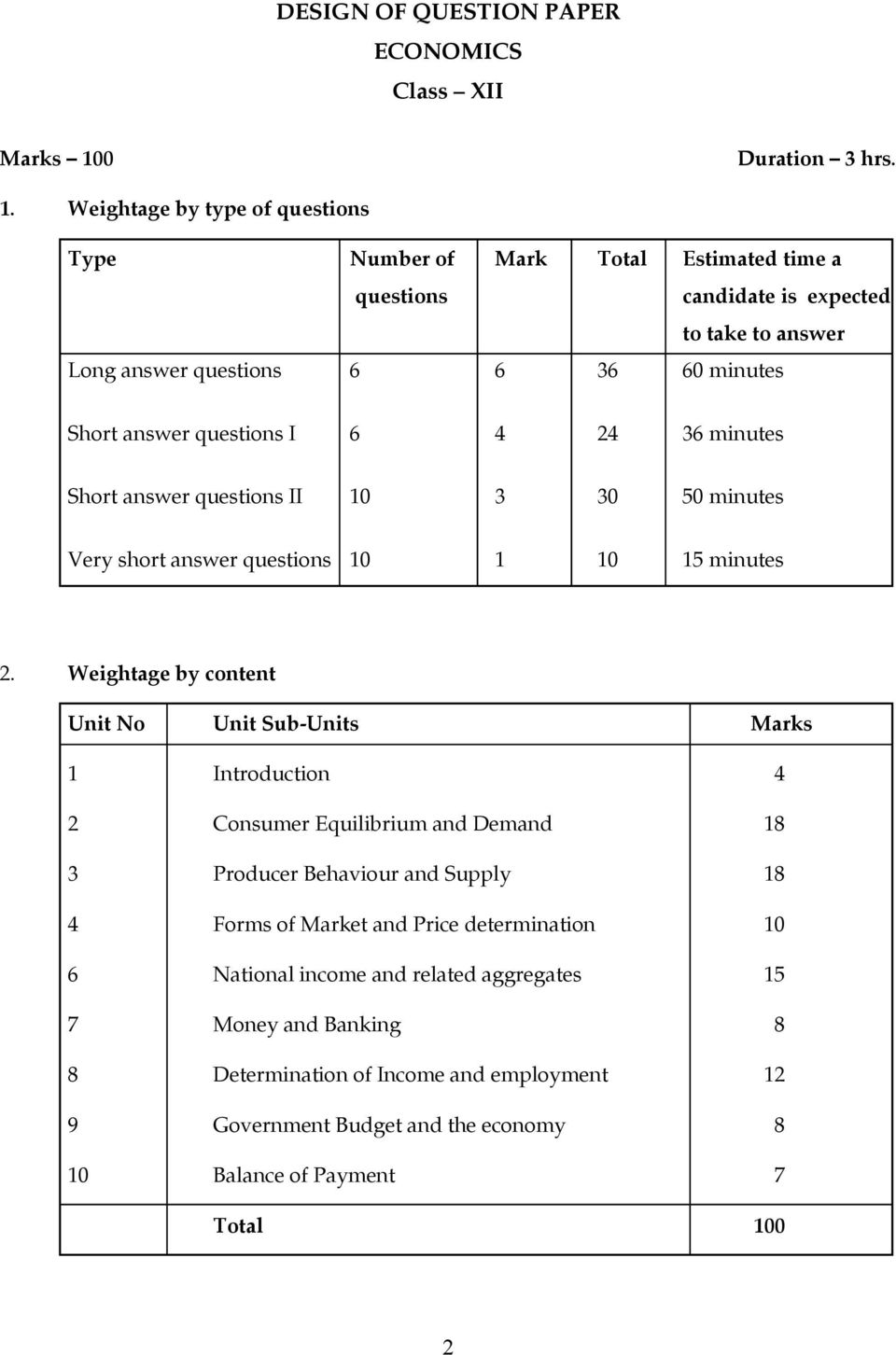
4 DESIGN OF QUESTION PAPER ECONOMICS Class XII Marks 100 Duration 3 hrs. 1. Weightage by type of questions Type Number of Mark Total Estimated time a questions candidate is expected to take to answer Long answer questions minutes Short answer questions I minutes Short answer questions II minutes Very short answer questions minutes 2. Weightage by content Unit No Unit Sub-Units Marks 1 Introduction 4 2 Consumer Equilibrium and Demand 18 3 Producer Behaviour and Supply 18 4 Forms of Market and Price determination 10 6 National income and related aggregates 15 7 Money and Banking 8 8 Determination of Income and employment 12 9 Government Budget and the economy 8 10 Balance of Payment 7 Total 100 2
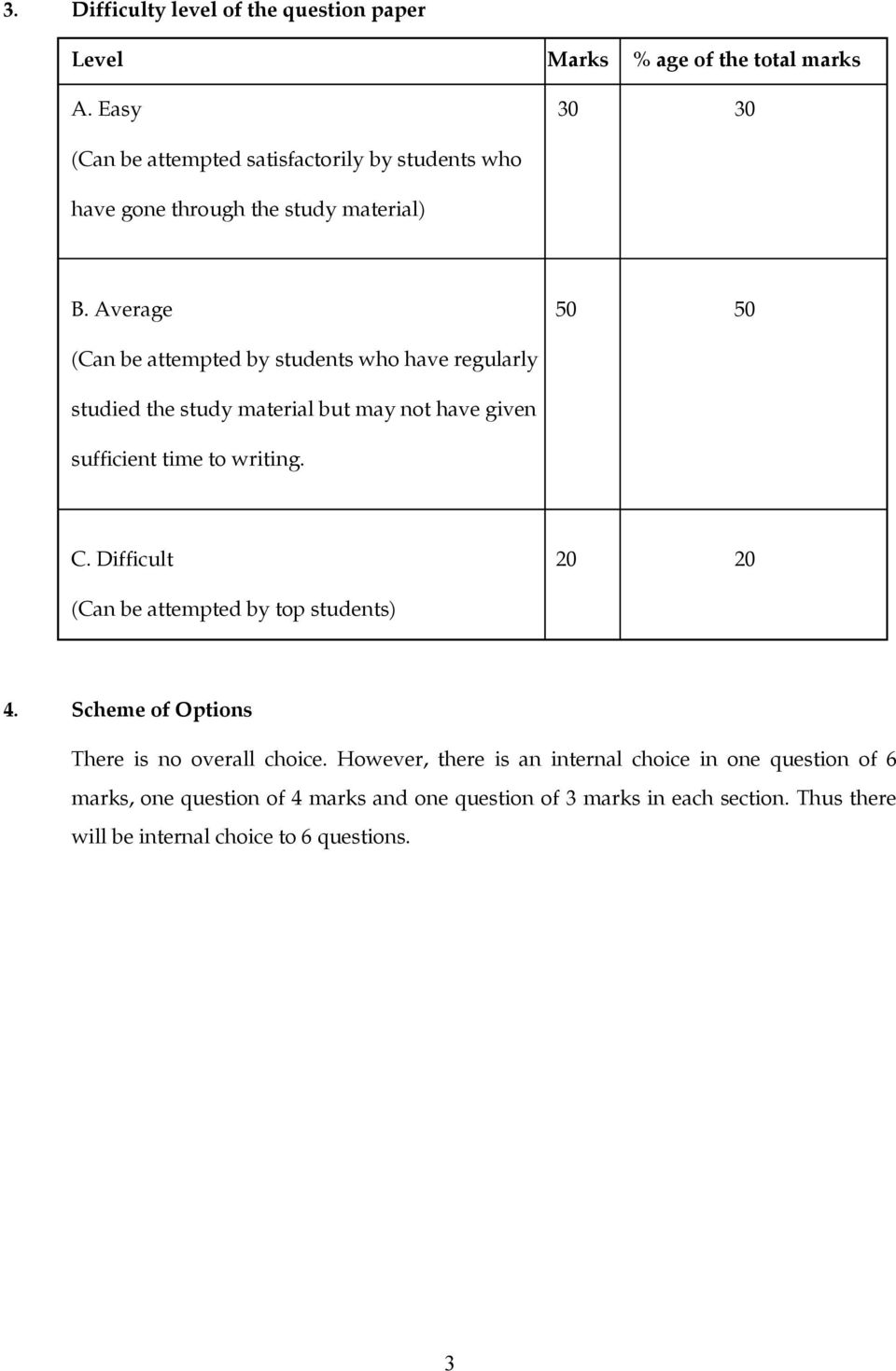
5 3. Difficulty level of the question paper Level Marks % age of the total marks A. Easy (Can be attempted satisfactorily by students who have gone through the study material) B. Average (Can be attempted by students who have regularly studied the study material but may not have given sufficient time to writing. C. Difficult (Can be attempted by top students) 4. Scheme of Options There is no overall choice. However, there is an internal choice in one question of 6 marks, one question of 4 marks and one question of 3 marks in each section. Thus there will be internal choice to 6 questions. 3
6 SAMPLE QUESTION PAPER 1 ECONOMICS Class XII Maximum Marks: 100 Time: 3 hours BLUE PRINT Sl. No. Forms of Questions Content Unit Very Short (1 Mark) Short Answer (3,4 Marks) Long Answer (6 Marks) Total 1. Unit 1 1 (1) 3 (1) - 4 (2) 2. Unit 2 1 (2) 3 (2) 4 (1) 6(1) 18 (6) 3. Unit 3 1 (1) 3 (1) 4 (2) 6 (1) 18 (5) 4. Unit 4 1 (1) 3 (1) 6 (1) 10 (3) 5. Unit 6-3 (3) 6 (1) 15 (4) 6. Unit 7 1 (2) - 6 (1) 8 (3) 7. Unit 8 1 (2) 4 (1) 6 (1) 12 (4) 8. Unit 9-4 (2) - 8 (2) 9 Unit 10 1 (1) 3 (2) - 7 (3) Sub-Total 10 (10) 30 (10) 24 (6) 36 (6) 100 (32) Notes: Figures within brackets indicate the number of questions and figures outside the brackets indicate Marks for each question. 4

7 Sample Question Paper I Economics Class XII Time 3 Hours. Maximum Marks 100 Instructions 1. All questions in both the sections are compulsory. 2. Marks for questions are indicated against each. 3. Question Nos. 1-5 and are very short-answer questions carrying 1 mark each. They are required to be answered in one sentence each. 4. Question Nos and are short-answer questions carrying 3 marks each. Answer to them should not normally exceed 60 words each. 5. Question Nos and are also short-answer questions carrying 4 marks each. Answer to them should not normally exceed 70 words each. 6. Question Nos and are long-answer questions carrying 6 marks each. Answer to them should not normally exceed 100 words each. 7. Answer should be brief and to the point and the above word limit be adhered to as far as possible. Section A 1. State two features of resources that give rise to an economic problem. (1) What happens to total expenditure on a commodity when its price falls and its demand is price elastic? What happens to equilibrium price of a commodity if there is an increase in its demand and decrease in its supply? (1) (1) 4. Give the meaning of equilibrium price. (1) 5. What is meant by cost in economics? (1) 6. State any three factors that cause an increase in demand of a commodity. (3) What will be the price elasticity of supply at a point on a positively sloped, straight line supply curve? Explain the shape of a production possibility frontier. OR 5 (3) (3)
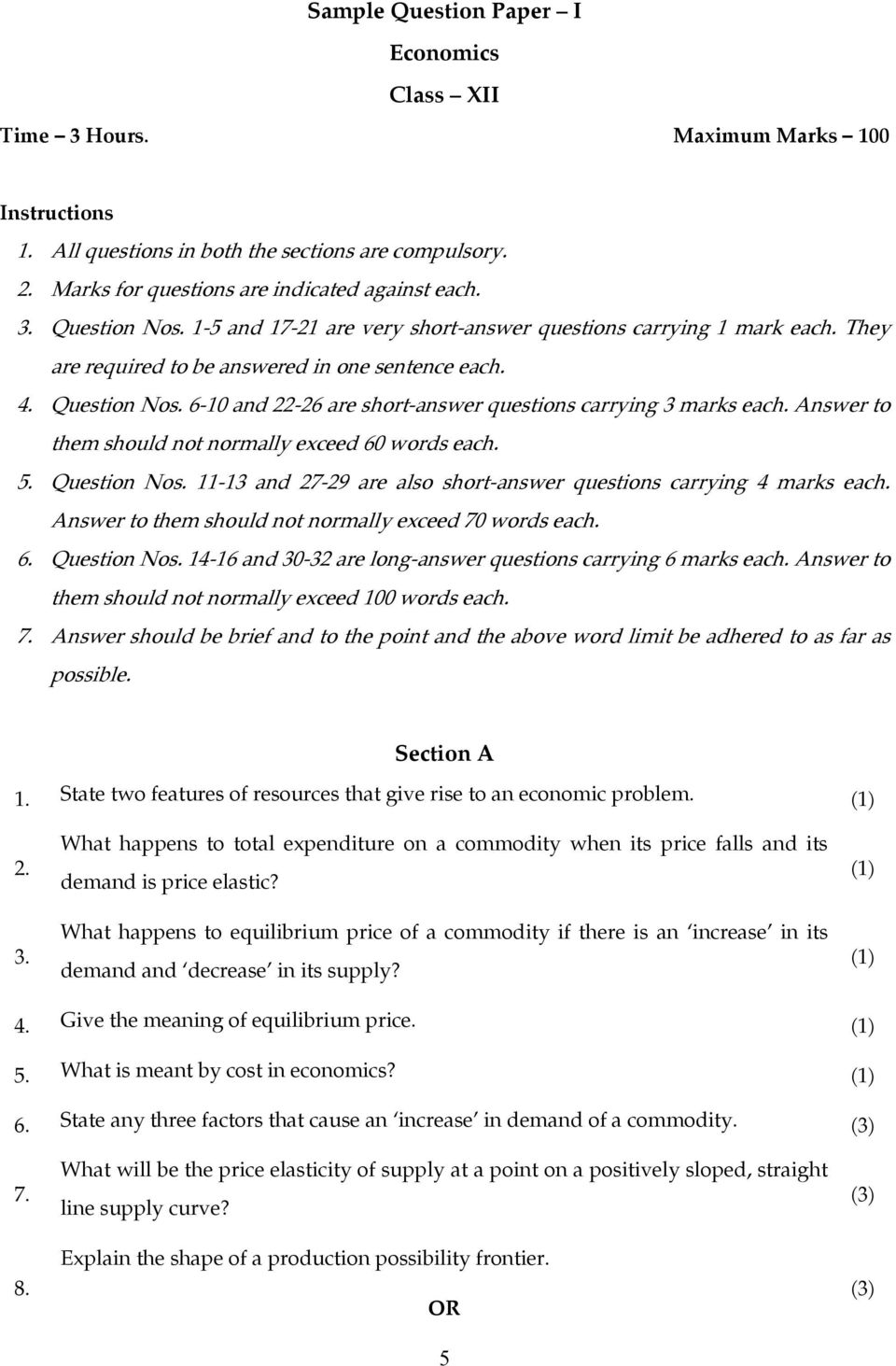
8 Explain the Central problem how to produce. 9. How does the nature of a commodity influence its price elasticity of demand? (3) Explain the changes that will take place in the market for a commodity if the prevailing market price is less than the equilibrium price. Calculate the price elasticity of demand for a commodity when its price increases by 25% and quantity demanded falls from 150 units to 120 units. Explain the relation between marginal revenue and average revenue when a firm is able to sell more quantity of output (i) at the same price. (3) (4) 12. (ii) only by lowering the price. OR (4) Explain the effect of the following on the supply of a commodity: (a) Fall in the prices of factor inputs. (b) Rise in the prices of other commodities. On the basis of the information given below, determine the level of output at which the producer will be in equilibrium. Use the marginal cost marginal revenue approach. Give reasons for your answer. Output (Units) Average Revenue (Rs) Total Cost (Rs) Why does the difference between Average Total Cost and Average Variable Cost decrease with an increase in the level of output? Can these two be equal at some level of output? Explain. Explain the implications of the following features of perfect competition: (a) large number of buyers and sellers (b) freedom of entry and exit of firms (4) (6) (6) 6
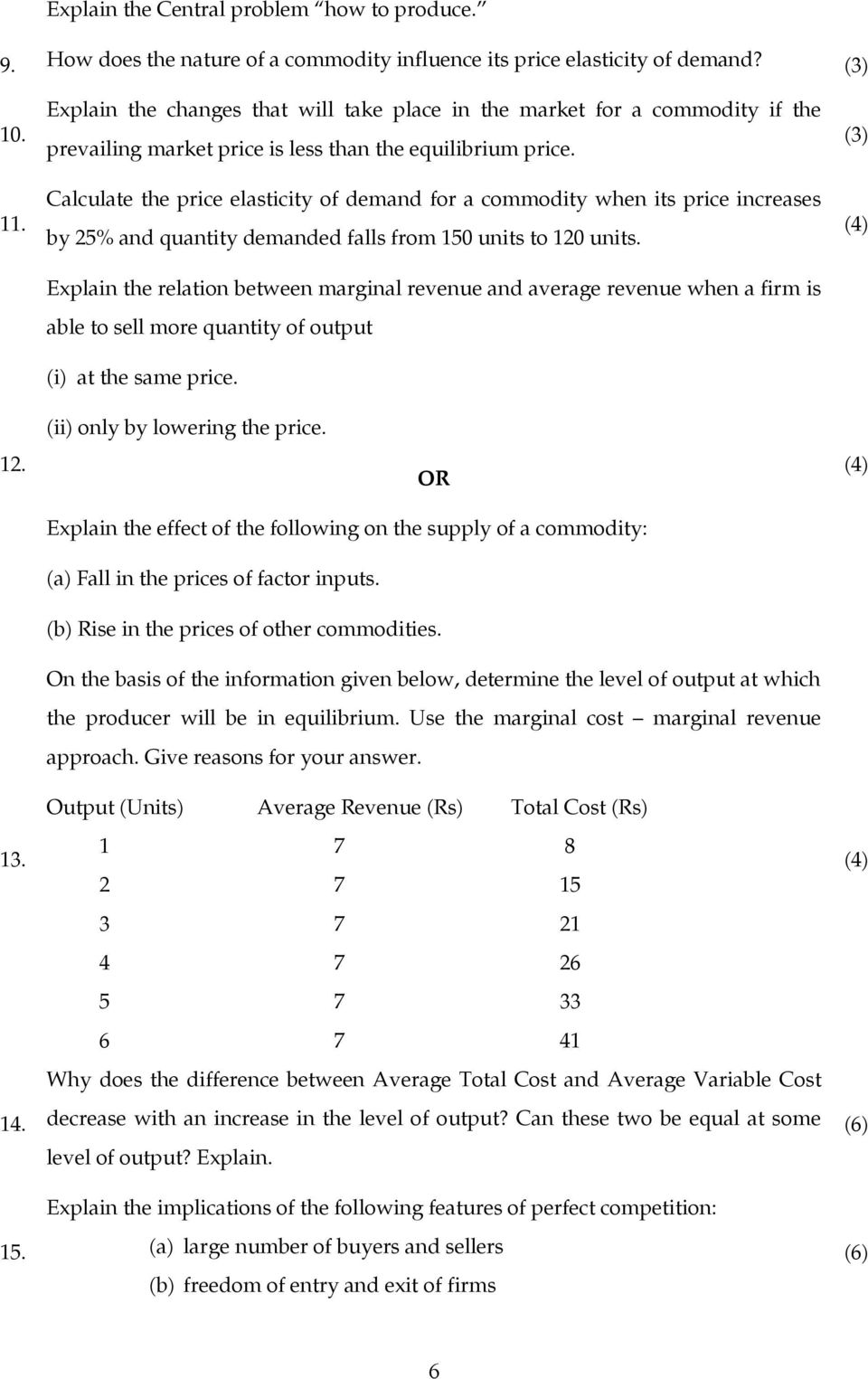
9 For a consumer to be in equilibrium why must marginal rate of substitution be equal to the ratio of prices of the two goods? 16. OR Why is the consumer in equilibrium when he buys only that combination of the two goods that is shown at the point of tangency of the budget line with an indifference curve? Explain. For Blind Candidates in lieu of choice question of question No. 16 Explain how a consumer consuming two commodities X and Y attains equilibrium under the utility approach. (6) Section B 17. Give the meaning of involuntary unemployment. (1) 18. What is the relationship between marginal propensity to save and marginal propensity to consume? 19. The price of 1 US Dollar has fallen from Rs 50 to Rs 48. Has the Indian currency appreciated or depreciated? (1) (1) 20. State the two components of money supply. (1) 21. What is meant by cash reserve ratio? (1) 22. From the following data relating to a firm, calculate its net value added at factor cost: (3) (Rs in Lacs) (i) Subsidy 40 (ii) Sales 800 (iii) Depreciation 30 (iv) Exports 100 (v) Closing stock 20 (vi) Opening stock 50 (vii) Intermediate purchases 500 (viii) Purchase of machinery for own use 200 (ix) Import of raw material 60 7
10 23. Give the meaning of Nominal GDP and Real GDP. Which of these is the indicator of economic welfare? 24. Machine purchased is always a final good. Do you agree? Give reasons for your answer. 25. Explain the effect of depreciation of domestic currency on exports. (3) (3) (3) OR Explain the effect of appreciation of domestic currency on imports. 26. Distinguish between the current account and capital account of balance of payments account. Is import of machinery recorded in current account or capital account? Give reasons for your answer. 27. What is a government budget? Give the meaning of : (3) (4) a) Revenue deficit b) Fiscal deficit 28. Categories the following government receipts into revenue and capital receipts. Give reasons for your answer. (4) (a) Receipts from sale of shares of a public sector undertaking. (b) Borrowings from public. (c) Profits of public sector undertakings. (d) Income tax received by government. 29. Explain the meaning of equilibrium level of income and output using savings and investment approach. Use a diagram. (4) OR Complete the following table: Income Saving Marginal Propensity Average Propensity to Consume to Consume
11 For Blind Candidates in lieu of Question 29 Explain the meaning of equilibrium level of income and output using savings and investment approach. 30. Explain the process of money creation by commercial banks. (6) 31. Draw a straight line consumption curve. From it derive a savings curve explaining the process. Show on this diagram: (a) the level of income at which Average Propensity to Consume is equal to one. (b) a level of income at which Average Propensity to Save is negative. (6) For Blind Candidates in lieu of Question 31 Explain the meaning of underemployment equilibrium. State two policy measures that the government can take to make the economy reach full employment equilibrium. 32. From the following data calculate National Income by Income and Expenditure methods: (Rs crores) (i) Government final consumption expenditure 100 (ii) Subsidies 10 (iii) Rent 200 (iv) Wages and salaries 600 (v) Indirect taxes 60 (vi) Private final consumption expenditure 800 (vii) Gross domestic capital formation 120 (viii) Social security contributions by employers 55 (ix) Royalty 25 (x) Net factor income paid to abroad 30 (xi) Interest 20 (xii) Consumption of fixed capital 10 (xiii) Profit 130 (xiv) Net exports 70 (xv) Change in stock 50 OR (6) 9

12 Calculate Gross National Disposable Income and Personal Income from the given data: (Rs crores) (i) Personal tax 120 (ii) Net indirect tax 100 (iii) Corporation tax 90 (iv) National income 1000 (v) Net factor income from abroad 5 (vi) Consumption of fixed capital 50 (vii) National debt interest 70 (viii) Retained earnings of private corporate sector 40 (ix) Net current transfers to the rest of the world (-)20 (x) Current transfers from government 30 (xi) Share of government in national income 80 Marking Scheme for Sample Question Paper 1 Section A 1. The two features of resources that give rise to an economic problem are (i) resources are limited and (ii) they have alternative uses. ½ x2 2. Total expenditure will increase Equilibrium price will increase It is the price at which market demand and market supply are equal Cost of producing a good is the sum of actual expenditure on inputs and the imputed expenditure on the inputs supplied by the owner The factors causing an increase in demand of a commodity are: (i) Rise in the price of substitute goods. (ii) Fall in the price of complementary goods. (iii) Rise in income of its buyers (in case of a normal good). (iv) Fall in income of its buyers (in case of an inferior good). (v) Favourable change in taste etc for the good. (vi) Increase in the number of its buyers. 1x3 (Any three) 7. Es = 1, at any point on the supply curve if it touches the origin when extended. 10
13 Es >1, at any point on the supply curve if it touches the y-axis when extended. Es<1, at any point on the supply curve if if it touches the x-axis when extended. 1x Note: This question if answered with the help of diagrams will also be treated as correct. Production Possibility Frontier (PPF) is a downward sloping, concave curve. It shows increasing Marginal Rate of Transformation (MRT) as more quantity of one good is produced by reducing quantity of the other good. This behaviour of the MRT is based on the assumption that all resources are not equally efficient in production of all goods. As more of one good is produced, less and less efficient resources have to be transferred to the production of the other good which raises marginal cost i.e. MRT. OR How to produce is the problem of choosing the technique of production. Techniques are broadly classified into capital intensive and labour intensive. The problem is to use capital intensive technique in which more of capital goods like machines, etc. are used, or to use labour intensive technique in which more of labour is used. A commodity for a person may be a necessity, a comfort or a luxury. When a commodity is a necessity its demand is generally inelastic. When a commodity is a comfort its demand is generally elastic. When a commodity is a luxury its demand is generally more elastic that the demand for comforts. When price is lower than equilibrium price, market demand is greater than market supply. This will result in competition among buyers. The price will rise. A rise in price will reduce the demand and raise the supply. This will reduce the original gap between market demand and market supply. These changes will continue till price rises to a level at which market demand is equal to market supply. This is the equilibrium price. 3 1½ 1½ 1x percentage change in demand E d = percentage change in price 1½ 2 11
14 = x ½ = -0.8 (i) Price is constant. As price means average revenue, so average revenue is also constant. Average revenue is constant only when marginal revenue is equal to average revenue. Thus, when a firm is able to sell more quantity of output at the same price marginal revenue is equal to average revenue (ii) If more can be sold only by lowering the price, it means that average revenue falls as more is sold. Average revenue falls only when marginal revenue is less than average revenue. Thus, when a firm is able to sell more quantity by lowering the price, marginal revenue will be less than the average revenue. OR (i) When the prices of factor inputs decreases, the cost of production decreases. Thus, it becomes more profitable to produce the commodity and so its supply will increase (ii) When the prices of other goods rise, it becomes relatively more profitable to produce these goods in comparison to the given good. This results in diversion of resources from the production of given good to other goods. So, the supply of the given good decreases. Output (units) AR (Rs) TC (Rs) MC (Rs) MR (Rs) The producer achieves equilibrium at 5 units of output. It is because this level of 1 12

15 14. output satisfies both the conditions of producer s equilibrium : (i) Marginal cost is equal to marginal revenue. (ii) Marginal cost becomes greater than MR after this level of output. Average Total Cost (ATC) minus Average Variable Cost (AVC) is equal to Average Fixed Cost (AFC). AFC = TFC / Output. As the level of output increases, AFC falls. So, the difference between ATC and AVC decreases with increase in output ATC and AVC can never be equal at any level of output as AFC can never be zero because TFC is positive. (a) The number of sellers is so large that the share of each is insignificant in the total supply. Hence, an individual seller cannot influence the market price. Similarly, a single consumer s share in total purchase is so insignificant because of their large numbers that she cannot influence the market price on her own (b) The implication is that firms will earn only normal profit in the long run. In the short run, there can be abnormal profits or losses. If there are abnormal profits, new firms enter the market. The total market supply increases, resulting in a fall in market price and a fall in profits. This trend continues till profits are reduced to normal. Similarly, if there are losses, firms start exiting. The total market supply decreases resulting in a rise in market price, and a reduction in losses. This trend continues till losses are wiped out. Let the two goods be X and Y. MRSxy is the number of units of Y the consumer is willing to sacrifice to obtain one extra unit of X. The ratio of prices is Px/Py which also equals the ratio of the number of units of Y required to be sacrificed to obtain one extra unit of X in the market Initially when the consumer starts purchases, MRSxy is greater than Px/Py. It means that to obtain one extra unit of X the consumer is willing to sacrifice more than he has to sacrifice actually. The consumer gains. As he goes on obtaining more and more units of X, marginal utility of X goes on declining. Therefore the consumer is willing to sacrifice less and less of Y each time he obtains one extra unit of X. As a result MRSxy falls and ultimately becomes equal to Px/Py at some 13 3
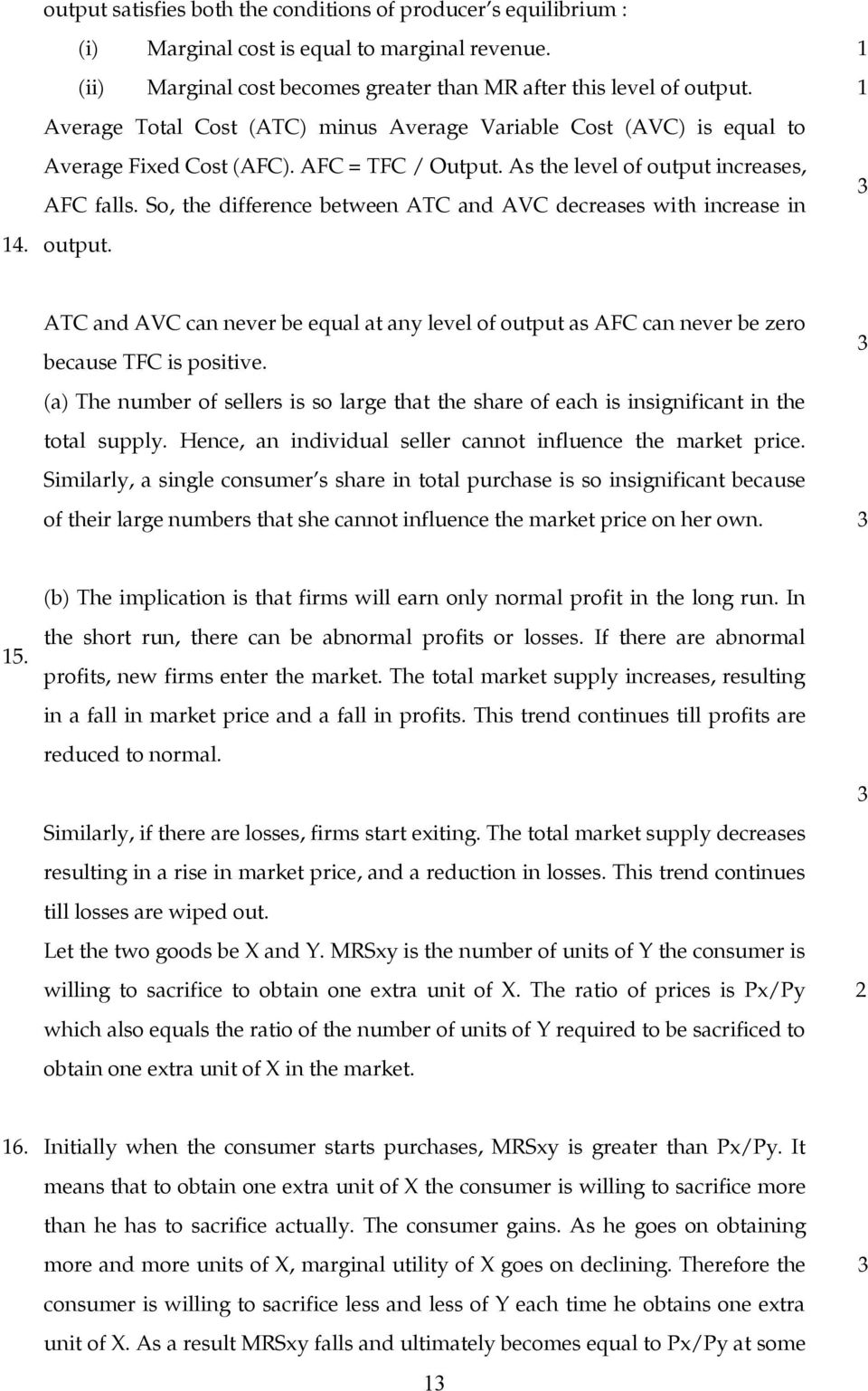
16 Good Y combination of X and Y. At this combination the consumer is in equilibrium. If the consumer attempts to obtain more units of X beyond the equilibrium level, MRSxy will become less than Px/Py and he will start losing. So he will not try to obtain more of X. Y OR 1 A C y E I3 2 D I1 I2 O x B X Good X Let the two good be X and Y as shown in the diagram. The tangency is at point E where : Slope of indifference curve = Slope of budget line Or MRSxy = Px/Py The equilibrium purchase is Ox of X and Oy of Y on the indifference curve I 2. The consumer cannot get satisfaction level higher than I 2 because his income does 2 not permit him to move above the budget line AB. The consumer will not like to purchase any other bundle on the budget line AB, for example the bundle at C and D, because they all lie on the lower indifference curve, and give him lower satisfaction. Therefore, the equilibrium choice is only at the tangency point E. For Blind candidates in lieu of choice question of Q. No A consumer will attain equilibrium if he allocates his given income on purchase of goods X and Y in a manner that gives him maximum satisfaction. He will get maximum satisfaction if he buys only that quantity of each good that gives him same utility from the last rupee spent on each good. 14

17 In other words, M.U.x must be equal to M.U.y Px Py M.U.x M.U.y If is not equal to then the consumer is not in equilibrium. If Px Py M.U.x M.U.y > then per rupee M.U.x > per rupee M.U.y. He will buy more of Px Py X and less of Y. This will reduce M.U.x and increase M.U.y. These changes will continue till M.U.x M.U.y = and he will be in equilibrium. Px Py Section B 17. Involuntary unemployment occurs when those who are able and willing to 1 work at the prevailing wage rate do not get work. 18. The sum of MPC and MPS is equal to one Indian currency has appreciated The two components of money supply are: currency held with the public and 1 demand deposits with commercial banks. 21. Cash reserve ratio is the ratio of bank deposits that commercial banks must 1 keep as reserves with the Central bank. 22. NVAfc = (ii) + (v) (vi) (vii) - (iii) + (i) 1 = ½ = Rs 280 lakhs ½ 23. Nominal GDP values the current year s output in an economy at current year 1 prices. Real GDP values the current year s output in an economy at base year prices. 1 Real GDP is the indicator of economic welfare. 1 15
18 24. Whether machine is a final good or not depends on how it is being used. If the machine is bought by a household, then it is a final good. If the machine is bought by a firm for its own use, then also it is a final good. If the machine is bought by a firm for re-sale then it is an intermediate good Depreciation of domestic currency mean a fall in the price of domestic currency (say rupee) in terms of a foreign currency (say $). It means one $ can be exchanged for more rupees. So with the same amount of dollars more of goods can be purchased from India. It means exports to USA have become cheaper. They may result in increase of exports to USA. OR Appreciation of domestic currency means a rise in the price of domestic currency (say rupee) in terms of a foreign currency (say $) It means one rupee can be exchanged for more $. So with the same amount of money (Rupees) more goods can be purchased from USA. It means imports from USA have become cheaper. They may result in increase of imports (from USA) The current account records transactions relating to the export and import of goods and services, income and transfer receipts and payments during a year. The capital account records transactions affecting foreign assets and foreign liabilities during a year. Since import of machinery is an import of good, it is recorded in the current account. 27. Government budget is a statement of expected receipt and expenditure of the government during a financial year. 1 (a) Revenue deficit is the excess of revenue expenditure over revenue receipts 1½ (b) Fiscal deficit is the excess of total expenditure over total receipts 1½ excluding borrowings. 28. (a) It is a capital receipt as it results in a reduction of assets. (b) It is a capital receipt as it creates a liability. (c) It is a revenue receipt as it neither creates a liability nor reduces any asset. (d) It is a revenue receipt as it neither creates a liability nor reduces any asset The equilibrium level of income and output is that level at which planned saving and planning investment are equal. 1 16

19 Savings/ Investment S I I 1 O Y2 Y* Y1 Income/ Output S 1 At an income level OY 1, planned savings are greater than planned investment. This means that households aggregate expenditure is less than output. As a result inventories increase. Firms, seeing a build up of unplanned inventories start cutting production, and hence output, income and savings fall. This process continues till planned savings and planned investment are equal. At an income level OY 2, planned savings are less than planned investment. This means that aggregate expenditure is more than output. Firms, seeing a depletion of planned inventories step up production, and hence output and income increase. Savings increase. This process continues till planned savings and planned investment are equal. 1 OR Income Y Saving Consumption C MPC APC ½x8 4 For Blind Candidates in lieu of Question No.29 Same as above except diagram. 17
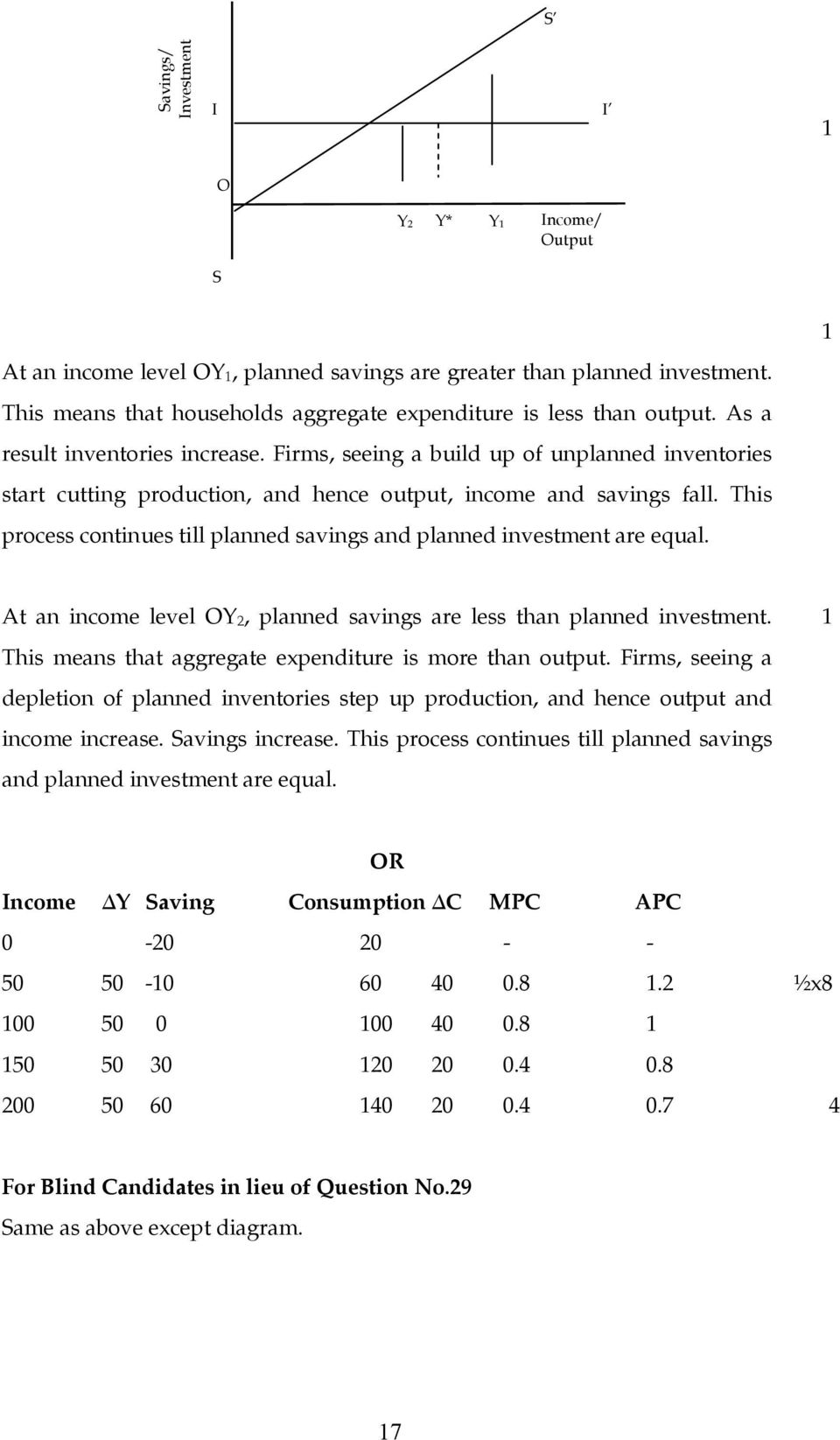
20 Consumption 30. Money creation (or deposit creation or credit creation) by the banks is determined by (1) the amount of the initial fresh deposits and (2) the Legal Reserve Ratio (LRR), the minimum ratio of deposit legally required to be kept as cash by the banks. It is assumed that all the money that goes out of banks is redeposited into the banks. Let the LRR be 20% and there is a fresh deposit of Rs. 10,000. As required, the banks keep 20% i.e. Rs as cash. Suppose the banks lend the remaining Rs Those who borrow use this money for making payments. As assumed those who receive payments put the money back into the banks. In this way banks receive fresh deposits of Rs The banks again keep 20% i.e. Rs as cash and lend Rs. 6400, which is also 80% of the last deposits. The money again comes back to the banks leading to a fresh deposit of Rs The money goes on multiplying in this way, and ultimately total money creation is Rs Given the amount of fresh deposit and the LRR, the total money creation is : 1 Total money creation = Initial deposit x LRR } Saving Negative Saving / Dissaving C A { 18

21 Savings O B Income/ Output S 2 Negative Saving / Dissaving } Saving O - A { B Income/ Output AC is the consumption curve and OA is the consumption expenditure at zero level of income. 2 Income minus consumption is savings. When income is zero, the economy s consumption level is OA. Thus, the corresponding level of savings is OA. So, A is the starting point of saving curve At OB level of income consumption is equal to income, so savings are zero. So B is another point on saving curve Joining A and B and extending we get the saving curve S. (a) The level of income at which APC is equal to one is OB (b) A level of income at which APS is negative is the level less than OB
22 For Blind Candidates in lieu of Question No. 31 An economy is in equilibrium when aggregate demand is equal to aggregate supply. If aggregate demand is only sufficient to support a level of aggregate supply at less than full employment, then the economy is in under full employment equilibrium. 1 1 The two policy measures that the government can take are : (i) Increase government expenditure (j) Increase availability of credit 32. Income Method National Income = iv + viii + (iii + ix) + xi +xiii x = ( ) = Rs 1,000 crores 1 1½ ½ Expenditure Method National Income = vi + i + vii + xiv v + ii xii x = = Rs 1,000 crores OR GNDI = iv + ii + vi ix = (-20) = Rs 1170 crores 1 1½ ½ 1 1½ ½ Personal Income = (iv xi) + (vii ix + x) viii iii = (- 20) = Rs 910 crores 1 1½ ½ 20
23 Max. Marks 100 Sample Question Paper I Economics Class XII Question wise Analysis Time : 3 hrs. S. No. Unit No. Marks Estimated Estimated of Q. allotted Time (Min) difficulty level ½ A ½ B ½ A ½ A ½ C A A A A B A B B B B C ½ A ½ A ½ C ½ A ½ A B A B B B A B B C C B Reference for difficulty level A Easy 30% 30 Marks B Average 50% 50 Marks C Difficult 20% 20 Marks 21
24 SAMPLE QUESTION PAPER 2 ECONOMICS Class XII Maximum Marks: 100 Time: 3 hours BLUE PRINT Sl. No. Forms of Questions Content Unit Very Short (1 Mark) Short Answer (3,4 Marks) Long Answer (6 Marks) Total 1. Unit 1 4 (1) - 4 (1) 2. Unit 2 1 (1) 3 (1) 4 (2) 6(1) 18 (5) 3. Unit 3 1 (3) 3 (3) 6 (1) 18 (7) 4. Unit 4 1 (1) 3 (1) 6 (1) 10 (3) 5. Unit 6-3 (1) 6 (2) 15 (3) 6. Unit 7 1 (1) 3 (1) 4 (1) 8 (3) 7. Unit 8-3 (2) 6 (1) 12 (3) 8. Unit 9 1 (1) 3 (1) 4 (1) - 8 (3) 9 Unit 10 1 (3) 4 (1) - 7 (4) Sub-Total 10 (10) 30 (10) 24 (6) 36 (6) 100 (32) Notes: Figures within brackets indicate the number of questions and figures outside the brackets indicate the Marks for each question. 22
25 Sample Question Paper II Economics Class XII Time 3 Hours. Maximum marks 100 Instructions 1. All questions in both the sections are compulsory. 2. Marks for questions are indicated against each. 3. Question Nos. 1-5 and are very short-answer questions carrying 1 mark each. They are required to be answered in one sentence each. 4. Question Nos and are short-answer questions carrying 3 marks each. Answer to them should not normally exceed 60 words each. 5. Question Nos and are also short-answer questions carrying 4 marks each. Answer to them should not normally exceed 70 words each. 6. Question Nos and are long-answer questions carrying 6 marks each. Answer to them should not normally exceed 100 words each. 7. Answer should be brief and to the point and the above word limit be adhered to as far as possible. Section A 1. What causes an upward movement along a demand curve of a commodity? (1) 2. What is the price elasticity of supply of a commodity whose straight line supply (1) curve passes through the origin forming an angle of 75? 3. What change will take place in marginal product, when total product increases at (1) a diminishing rate? 4. Give the meaning of marginal cost. (1) 5. Give the meaning of oligopoly. (1) 6. Explain the inverse relationship between the price of a commodity and its (3) demand. 7. State the law of supply. What is meant by the assumption other things (3) remaining the same on which the law is based? 8. The price elasticity of supply of good X is half the price elasticity of supply of (3) 23
26 Price Good Y. A 10% rise in the price of good Y results in a rise in its supply from 400 units to 520 units. Calculate the percentage change in quantity supplied of good X when its price falls from Rs 10 to Rs 8 per unit. 9. State the distinction between explicit cost and implicit cost. Give an example of each. 10. Explain the implication of product differentiation feature of monopolistic competition. OR Explain the implication of homogenous product feature of perfect competition. 11. Explain the effect of a rise in the prices of related goods on the demand for a good X. 12. Explain the concept of opportunity cost with the help of an example. OR Explain the central problem of distribution in an economy. 13. A B (3) (3) (4) (4) O Demand C D E The diagram shows AE is the demand curve of a commodity. On the basis of this diagram, state whether the following statements are true or false. Give reasons for your answer: (a) Demand at point B is price inelastic. (b) Demand at point C is more price elastic than at point B. (c) Demand at point C is price elastic. (d) Price elasticity of demand at point C is greater than the price elasticity of demand at point D. (4) For Blind candidates in lieu of Q. No. 13 Calculate the percentage fall in demand for a good whose price rises from Rs. 10 per unit to Rs. 11 per unit. Its price elasticity of demand is (4)
27 14. Explain the likely behaviour of Total Product and Marginal Product when for increasing production only one input is increased while all other inputs are kept constant. 15. There is a simultaneous decrease in demand and supply of a commodity. When will it result in: (a) No change in equilibrium price. (b) A fall in equilibrium price. Use diagrams. (6) For Blind Candidates in lieu of Ques. 15 There is a simultaneous decrease in demand and supply of a commodity. (6) Explain its effect on equilibrium price. 16. (a) What is a budget line? What does the point on it indicate in terms of prices? (b) A consumer consumes only two goods X and Y. Her money income is Rs 24 and the prices of Goods X and Y are Rs 4 and Rs 2 respectively. Answer the following questions: (i) Can the consumer afford a bundle 4X and 5Y? Explain (ii) What will be the MRS XY when the consumer is in equilibrium? Explain. OR Explain the following: (a) Why is an indifference curve convex to the origin? (b) Why does a higher indifference curve represent a higher level of satisfaction? (6) Section B 17. What is meant by foreign exchange rate? (1) 18. What is meant by Statutory Liquidity Ratio? (1) 19. How is primary deficit calculated? (1) 20. What is meant by balance of trade? (1) 21. State two sources of supply of foreign currency. (1) 22. Can an economy be in equilibrium when there is unemployment in the economy. Explain. 23. In an economy income increases by 10,000 as a result of a rise in investment expenditure by 1,000. Calculate: 25 (3) (3)
28 (a) Investment Multiplier (b) Marginal Propensity to Consume 24. How does money solve the problem of double coincidence of wants? (3) 25. How can budgetary policy be used for reducing inequalities in income and (3) wealth? OR How can budgetary policy be used for allocation of resources in the economy? 26. Calculate gross fixed capital formation from the following data: (3) Rs crores (i) Private final consumption expenditure 1,000 (ii) Government final consumption expenditure 500 (iii) Net exports (-) 50 (iv) Net factor income from abroad 20 (v) Gross domestic product at market price 2,500 (vi) Opening stock 300 (vii) Closing stock Distinguish between revenue expenditure and capital expenditure in a (4) government budget. Give two examples of each. 28. Explain the function of a Central Bank as a banker to the government. (4) OR Explain the open market operations method of credit control used by a Central Bank: 29. Explain the meaning of deficit in Balance of Payments. (4) 30. State whether the following statements are true or false. Give reasons for your (6) answer: (a) Capital formation is a flow. (b) Bread is always a consumer good. (c) Nominal GDP can never be less than Real GDP. (d) Gross domestic capital formation is always greater than gross fixed capital formation. 31. Given below is the consumption function in an economy: C = Y With the help of a numerical example show that in this economy as income increases APC will decrease. (6) 26
29 OR The savings function of an economy is S = Y. The economy is in equilibrium when income is equal to 2,000. Calculate: (a) Investment expenditure at equilibrium level of income. (b) Autonomous consumption. (c) Investment multiplier. 32. Calculate Gross National Product at market price and Personal Disposable income from the following data: (Rs crores) (i) Subsidy 20 (ii) Net factor income from abroad (-) 60 (iii) Consumption of fixed capital 50 (iv) Personal tax 110 (v) Savings of private corporations 40 (vi) Dividend 20 (vii) Indirect tax 100 (viii) Corporation tax 90 (ix) Net national disposable income 1,000 (x) National debt interest 30 (xi) Net current transfers from abroad 20 (xii) Current transfers from government 50 (xiii) Miscellaneous receipts of the government administrative 30 departments (xiv) Private income 700 (xv) Private final consumption expenditure 380 (6) 27
30 Marking Scheme Sample Question Paper II Economics: Class XII Section A 1. Rise in the price of the good Price elasticity of supply is equal to one Marginal product will decline but remain positive Marginal cost is the addition to total cost on producing one more unit of output It is a form of market in which there are a few firms, or a few large firms A consumer purchases that much quantity of a good at which its marginal utility 3 equals its price. Given this situation, suppose price falls. It makes marginal utility greater than the price and induces the consumer to buy more of the good. This establishes inverse relation between price and demand. 7. According to the law there is a direct relation between price of the good and its supply, 3 other things remaining the same. Other things include all factors, other than the own price, which can influence supply, like prices of inputs, taxes on production, prices of other goods, etc. 8. E of good Y = s % change in supply of Y % change in price of Y ½ x 100 = = 30 = Since Es of X is half of the Es of Y, therefore ½ ½ Es of X = 3/2 = 1.5 Substituting values to find supply of X, ½ 1.5 = % change in supply of Y x
31 % change in Sx = 1.5 x -20 = -30 ½ Therefore supply of X falls by 30 percent. ½ 9. Explicit cost is the actual monetary expenditure on inputs, like expenditure on 1½ purchases of raw materials, on payment of wages, interest, rent, etc. Implicit cost is the estimated value of inputs supplied by the owner of the firm, like imputed salaries of the owners, imputed rent of the building of the owners, imputed interest on the money invested by the owners, etc. 1½ 10. Product differentiation means that the buyers of a product differentiate between the 3 same product produced by different firms. Therefore, they are also willing to pay different prices for the same product produced by different firms. This gives an individual firm some monopoly power to influence market price of its product. OR Homogonous product means that the buyers treat products of all the firms in the 3 industry as identical. Therefore, the buyers are willing to pay only the same price for the products of all the firms in the industry. It also implies that no individual firm is in a position to charge a higher price for its product. This ensures uniform price in the market. 11. Related goods can be substitutes or complementary to goods X. 2 Rise in the price of a substitute makes good X relatively cheaper. So X will be substituted for this good. Hence demand for good X will increase. Rise in price of complementary good will result in fall in its demand. As good X and its 2 complementary good are used together, demand for good X will decrease. 12. Opportunity cost refers to forgoing the next best opportunity in availing the best 2 opportunity. It can be defined as the value of next best use to which the resources could be put. Suppose a producers has two options, to produce good X and earn Rs.10000, produce Y and earn Rs Producer choose X because it gives him more profit. Then the opportunity cost of choosing to produce X is Rs OR 29
32 Price (Rs. ) The problem is related to distribution of goods and services produced in the economy. 4 It arises because the output produced is limited while the wants of people are unlimited. In other words it is the problem of distribution of income because income gives the people power to purchase these goods. 13. Y A B C O D E X Demand (units) X (a) False. Demand at B is price elastic lower segment Elasticity of demand = upper segment As BE (lower segment) > BA (upper segment) Elasticity >1. 1 (b) False. Demand is less elastic at C than at B 1 CE BE Because ---- < ---- AC AB (c) False. Demand at C is in elastic because CE/AC is less than 1. 1 (d) True. 30
33 At pt. C, e = At pt. D, e = CE CA DE DA CE DE As > elasticity at pt C is greater than elasticity at pt. D. CA DA 1 For Blind candidates in lieu of Q. No. 13 Percentage change in demand Ed = Percentage change in price 1½ Percentage change in demand Ed = x ½ Percentage change in demand = Percentage change in demand = x 10 = 2.5 % fall The likely behavior of TP and MP is summed up as the Law of Variable proportions and is : Phase I : Initially TP increases at increasing rate i.e. MP rises. It is because initially the quantity 2 of the variable input is too small in relation to the fixed input. As the quantity of the variable input increases the fixed input is effectively utilized leading to rise in MP of the variable input. 31
34 Price Price Phase II : After a certain level of output TP increases at a decreasing rate i.e. MP starts falling but 2 remaining positive. It is because now a pressure is being felt on fixed inputs as the variable input is increased further. This leads to fall in MP of the variable input. Phase III : Ultimately TP starts falling and MP is negative and decreasing. It is because the quantity 2 of fixed input now becomes too small to accommodate the continuously rising variable input. This makes MP of the variable input negative. 15. Decrease in demand means less quantity demanded at the same price. This leads to shift 1 of demand curve leftward from D 1 to D 2 and decrease in supply means less quantity supplied at same price. This leads to leftward shift of supply curve from S 1 to S 2. (a) If decrease in demand is equal to decrease in supply there will be no change in 1 equilibrium price. In the diagram (A) the two decreases are equal to Q 2 Q 1. The equilibrium price remains unchanged at OP. Y S2 S1 1½ P E2 E1 D1 O Q2 Q1 D2 B X Quantity (A) Y S2 S1 P1 P2 A B E2 E1 1½ D1 O Q2 Q1 Quantity D2 B X (B) 32
35 (b) Equilibrium price will fall when decrease in demand is greater than decrease in supply. 1 In diagram (B) decrease in demand (AE 1) is greater than decrease in supply (BE 1) leading to fall in the equilibrium price from OP 1 to OP 2. For the blind candidates in lieu of Q.No. 15 There are three possible effects on the equilibrium price: (i) If decrease in demand is equal to decrease in supply the equilibrium price 2 remains unchanged. (ii) If decrease in demand is greater than the decrease in supply, equilibrium price 2 will fall. (iii) If decrease in demand is less than the decrease in supply, equilibrium price 2 will rise. 16. (a) Budget line is the locus of points that show different possible combinations of the 1 two goods which a consumer can afford, given his income and the market prices of the two goods. In terms of prices, a point on the budget line represents the ratio of price of the 2 good shown on the X-axis to the price of the good shown on the Y-axis. (b) (i) The cost of 4X + 5Y = (4x4) + (5x2) = Rs Since the income is only Rs. 24 the consumer cannot afford the bundle. (ii) When the consumer is in equilibrium, 2 MRS = Px/Py Substituting Px = 4, and Py = 2, MRS = 4/2 = 2 OR (a) The indifference curve being convex to origin means that Marginal Rate of 3 Substitution (MRS) between the two goods continuously falls. Let the two goods be X and Y shown on the X-axis and the Y-axis respectively. It means that the consumer is willing to sacrifice less and less of Y each time he obtains one more unit of X. Sacrifice of Y is the price the consumer is willing to pay for obtaining X. 33
36 As he obtains more and more units of X marginal utility of X declines and therefore he is willing to sacrifice only less of Y. (b) Any point on a higher indifference curve means more of both the goods or the 3 same quantity of one good and more quantity of the other good. The indifference curve analysis is based on the assumption that preference are monotonic which means that consumption of more goods means more satisfaction. Therefore, a higher indifference curve represents higher level of satisfaction. Section B 17. Foreign exchange rate is the price of one unit of foreign currency in terms of the domestic currency. 18. Statutory Liquidity Ratio is the ratio of demand deposits of a commercial bank which it has to keep in the form of special liquid assets. 19. Primary deficit = Fiscal deficit interest payments Balance of trade is the difference between value of exports of goods and imports of goods. 21. Exports of goods; exports of services; remittances into a country; borrowings from abroad, foreign direct investment; etc. 34 (Any two) 22. An economy is in equilibrium when aggregate demand and aggregate supply are equal. Aggregate demand may not be sufficient for aggregate supply at full employment. This means aggregate demand is only sufficient to support aggregate supply at less than full employment level. So the two would be equal at less than full employment. Thus the economy can be in equilibrium when there is unemployment in the economy. 23. ΔY (a) Multiplier = (b) Multiplier 10 = = ΔI MPC = MPC 1 1-MPC 10,000 = = 10 1, Double coincidence of wants means that what one person wants to sell and buy must coincide with what some other person wants to buy and sell. It was very difficult that such coincidence of wants to take place. Money has removed ½x ½ ½ 3
37 this difficulty. You can sell your goods for money to whosoever wants it and with this money you can buy what you want from whosoever wants to sell that. 25. To reduce inequalities in income and wealth government can use a progressive taxation policy. The government puts a higher rate of taxation on rich people and lower rates of taxation on lower income groups. This reduces disparities in income and wealth. The government can provide subsidies and other amenities to people whose income levels are low. This increases their disposable income and thus reduces the inequalities. OR There are certain goods and services in which the private sector shows little interest due to huge investment required and lower profits, like sanitation, roads, parks, etc. Government can undertake the production of these goods and services. Alternatively, it can encourage private sector by giving tax concessions and subsidies. 26. Gross fixed capital formation = (v) (i) (ii) (iii) - (vii) + (vi) = (-) = Rs 1150 crores. 27. Revenue expenditure is the expenditure which does not lead to any creation of assets or reduction in liabilities. (1) Examples: Expenditure or salaries, interest etc. (any two) ½ x2 (1) Capital expenditure is the expenditure that leads to creation of assets or leads to production in liabilities. (1) Examples: Expenditure on buildings, shares etc. (any two) ½ x2 28. The Central Bank acts as a banker to the Central government and state governments. It carries out all the banking business of the government It accepts receipts and makes payments for the government. It provides short term credit to the government. It also advises the government on banking and financial matters. OR Buying and selling of government securities in the open market by the Central Bank is called open market operations. When Central bank buys securities it makes payments to the sellers who deposit the same in commercial banks. This 35 1½ 1½ 1½ ½
38 raises deposits with them and thus directly increases banks ability to give credit. When central bank sells securities the buyers make payments by cheques. As a result the deposits with the commercial banks decline, reducing banks ability to give credit. 29. The transactions recorded in the balance of payments accounts can be categorized as autonomous transactions and accommodating transactions. Autonomous transactions are transactions done for some economic consideration such as profit. When the total inflows on account of autonomous transactions is less than total outflows on account of such transactions, there is a deficit in the balance of payments account. 30. (a) True. Capital formation is measured over a period of time. (b) False. It depends on the use of bread. When it is purchased by a household, it is a consumer good. If it is purchased by restaurant, it is a producer (intermediate) good. (c) False. Nominal GDP can be less than real GDP, if prices in the current year are less than the prices in the base year. (d) False. Gross domestic capital formation can be less than gross fixed capital formation if change in stock is negative. 31. C = Y Let us take Y as 400, 500, 600 When Y = 400 C = x 400 = 300 When Y = 500 C = x 500 = 350 When Y = 600 C = x 600 = ½ 1½ 1½ 1½ Thus : Y Y C APC = C Thus as income increases APC falls
39 OR S = Y (a) At equilibrium planned savings are equal to planned investment. Equilibrium level of income is 2,000. Substituting the value of Y in the savings function, we get; S = x 2000 S = 300 I = 300 Thus, investment expenditure at equilibrium level of income is 300. (b) Consumption + Savings = Income Autonomous consumption means the level of consumption expenditure when income is zero. When y = 0, Saving = -200 So autonomous consumption = 200 (c) Investment multiplier = 1/MPS From the savings function, we know that MPS = 0.25 Investment multiplier = 1/0.25 = GNP at market price = (ix) + (iii) (xi) = = Rs 1030 crores ½ 1½ ½ ½ Personal disposable income = (xiv) (v) (viii) (iv) (xiii) = = Rs 430 crores 1 1½ ½ 37
40 Max. Marks: 100 Question wise Analysis Sample Question Paper II Subject: Economics Class XII Time : 3 hrs. S. No. of Unit Marks Estimated Estimated Questions Number Allotted Time (Min) difficulty level ½ A ½ A ½ B ½ A ½ A B A B A B A A C B B C ½ A ½ A ½ A ½ A ½ A B B A B B B A C B C B Reference for difficulty level A Easy 30% 30 marks B Average 50% 50 marks C Difficult 20% 20 marks 38
41 BUSINESS STUDIES 39
42 DESIGN OF QUESTION PAPER BUSINESS STUDIES Class - XII Time - 3 Hrs. Max. Marks The weightage to marks over different dimensions of the question paper shall be as under : A. Weightage to Content/ Subject units S. No. Content Unit Marks Part A : Principles and Functions of Management 1. Nature and Significance of Management 7 2. Principles of Management 7 3. Business Environment 5 4. Planning 7 5 Organizing 10 6 Staffing 8 7 Directing 10 8 Controlling 6 Total (A) 60 Part B : Business Finance and Marketing 9 Financial Management Financial Markets 8 11 Marketing Consumer Protection 6 Total (B) 40 Grand total (A+B) 100 B. Weightage to forms of Questions S. No. Forms of Questions Marks for No. of Total Marks each question questions 1. Very short answer type (VSA) 2. Short answer type I (SAI) Short answer type II (SAII) Long answer type I (LA I) Long answer type II (LA II) Total
43 C. Scheme of Options There will be no overall choice. However, there is an internal choice in every question of 6 marks D. Weightage to difficulty level of questions S. No Estimated difficulty level of questions Percentage 1. Easy 30% 2. Average 50% 3. Difficult 20% E. Typology of Questions In order to assess different abilities related to the subject, the question paper is likely to include questions based on higher order skills, such as open-ended questions, questions based on case-study, diagrams, cartoons given in the text book. 41
44 SAMPLE QUESTION PAPER I Sub : Business Studies Class : XII Blue Print Units Very Short Answer Short Answer I & II Long Answer I & II Total 1 (3,4) (5, 6) Unit 1 (7) - 3(1) 4(1) - 7(2) Unit 2 (7) 1(2) 5(1) 7(3) Unit 3 (5) 1(1) 4(1) _ 5(2) Unit 4 (7) 1(2) 5(1) 7(3) Unit- 5 (10) 4(1) 6(1) 10(2) Unit- 6 (8) 1(2) - 6(1) 8(3) Unit- 7 (10) - 4(1) 6(1) 10(2) Unit- 8 (6) 1(1) - 5(1) 6(2) Unit- 9 (12) 3(2) 6(1) 12(3) Unit- 10 (8) 3(1) 5(1) 8(2) Unit- 11 (14) 3(1) 5(1),6(1) 14(3) Unit- 12 (6) 1(2) 4(1) 6(3) 10(10) 35(10) 55(10) 100(30) 42
45 SAMPLE QUESTION PAPER - I BUSINESS STUDIES Class - XII Max. Marks Time - 3 hrs. General Instructions 1. Answers to questions carrying 1 mark may be from one word to one sentence. 2. Answer to questions carrying 3 marks may be from 50 to 75 words. 3. Answer to questions carrying 4-5 marks may be about 150 words 4. Answer to questions carrying 6 marks may be about 200 words. 5. Attempt all parts of a question together. 1. Govt. of India is seriously thinking to allow oil marketing public sector undertakings to fix their own price for petrol and diesel. Which economic reform is the reason of this change in government s policy (1) 2. Why is it said that recruitment is a positive step in the process of staffing? (1) 3. The Principles of Management are different from those used in pure science. Write any one difference. (1) 4. Why is it said that the management principles are universal? (1) 5. A Company needs a detailed plan for its new project, Construction of a Shopping Mall. What type of plan is it? (1) 6. Planning eliminates changes/uncertainties. Do you agree? Give reason in support of your answer. (1) 7. A company gets applications on and off even without declaring any vacancy. However as and when the vacancy arises, the company makes use of such applications. Name the source of recruiment used by the comapny. (1) 8. Is controlling the end of management functions cycle? Give reason in support of your answer. (1) 9. Which Consumer Right gives the business firms freedom to set up their own consumer service and grievance cell? (1) 10. Deepak Shah purchased a car for Rs. 19 lacs from an automobile company and found its engine defective. Despite many complaints the defect was not rectified. He filed a case in the District forum.but he was not satisfied with the orders of the District Forum and decided to appeal. Suggest him the highest authority where he could appeal if not satisfied again by the decision of the next higher authority (1) 11. There are different objectives of business and economics objectives are one among them. Explain these economic objectives. (3) 12. Which process prepares a blue print of an organisation s future preparations relating to finance? Give any two reasons why this process is needed? (3) 43
46 13. State any three objectives of National Stock Exchange. (3) 14. Distinguish between the concepts product and production in Marketing keeping following as the base: (3) (i) Focus (ii) Means (iii) Ends 15. How are the shareholders of a company likely to gain with a debt component in the capital employed? Explain with the help of an example. (3) 16. Management is a Profession like Accounting, Medicine and Law as it also has a well defined body of knowledge. Yet management does not qualify to be a full fledged profession. Why? (4) 17. Identify the type or dimension of environment to which the following are related: (4) (i) Banks reducing interest rates on housing loans. (ii) An increasing number of working women. (iii) Booking of air tickets through internet. (iv) Alchohol beverages are prohibited to be advertised on Door Darshan. 18. Mohan and Sohan are friends working in Surya Ltd. as Production and Sales Manager respectively. In an interdepartmental meeting Sohan informed Mohan about a change in the marketing policy of the company. (a) Identify the type of communication used in the above example. (b) Name & explain any two networks of the type of communication identified in part(a). (1+3 = 4) 19. Distinguish between delegation & decentralization of authority on the following bases: (i) Nature (ii) Purpose (iii) Freedom of action (iv) Level of authority (4) 20. State any four responsibilities of a consumer while purchasing/ consuming goods/ services. (4) 21. Explain the steps involved in the process controlling function of management. (5) 22. Determination of the Price of a Product is influenced by many factors. Explain any five factors that have an influence on price. (5) 23. Explain the following principles of management: (a) Equity. (b) Remuneration of Employees. (5) 24. In spite of best efforts of managers sometimes planning fails to achieve desired results due to its limitations. Explain any five limitations of planning. (5) 25. Explain any five functions of a Stock Exchange. (5) 44
47 26. What is meant by Functional organizational structure? State any two advantages & two disadvantages of such structures. OR Describe the steps involved in the process of Organising. (6) 27. Explain the process of staffing in an organisation. OR Training is a life long necessity both for the employees as well as for the organisation. Justify the statement by giving three arguments each in favour of the employees and the organisation. (6) 28. In an organization there are many leaders. But a good leader must be a distinguished one. Suggest any four qualities that a good leader must possess. (1½x4=6 Marks) OR It is only Motivation through which the managers can inspire their subordinates to give their best to the organisation. In the light of this statement explain any four points of importance of motivation. (6) 29. What is meant by Working Capital? Describe any four factors which affect the working capital requirements of company. OR What is meant by Fixed capital? Describe any four factors which affect the fixed capital requirements of a company. (6) 30. You have been appointed as a Brand Manager of Ford Motors. The Company is to introduce a Compact small car in the Indian Market. The name of the car is yet to be decided. You have been asked to chair a Brain Storming Session. Before the suggestions come forward you have to briefly explain the participants as to what constitutes a good brand name with the help of suitable examples. (1 mark) OR Various tools of communication are used by the marketers to promote their products Answer the following questions : (a) (b) Why do Companies use all tools at the same time? Name and explain the most commonly used non-personal tool of promotion which is paid for by the marketer. (c) Which tool of promotion will primarily be used for the following : (i) To get good Corporate image without being paid for. (ii) An existing product meant for mass usage by literate people. (iii) To introduce a new product to a particular class of people through door to door visits. 45
48 Marking Scheme Business Studies Sample Question Paper - I 1. The reason for this change in the Government s policy is Liberalisation. (1) 2. Recruitment is a positive process because it aims at attracting number of candidates to apply for the given job and there is no rejection in this process. (1) 3. Any one of the following differences : (i) (ii) (iii) Principles of management are not as rigid as Principles of pure sciences. Principles of management deal with human behavior and cannot be tested in laboratories like the Principles of pure sciences. Principles of management are general guidelines where as Principles of Pure Sciences are specific. (1) 4. Management Principles are said to be universal because these are applicable in all types of organizations, at all levels, and at all times. (1) 5. The Company will prepare Programme. (1) 6. No, I do not agree because planning only anticipates not eliminates changes/uncertainties. (1) 7. The source of recruitment is casual callers. (1) 8. No, controlling is not the end of management functions cycle because it brings back the management cycle to planning function. (1) 9. The Right to be heard. (1) 10. The highest authority where he can appeal is National Commission (1) 11. The economic objectives of business are - (i) Survival (ii) Profit (iii) Growth. (3) (i) (ii) (iii) Survival is the basic objective of any business and an organisation must earn sufficient revenues to recover cost. Profit : Mere survival is not enough. Management has to ensure that the organisation makes profit as it is an incentive for the continued successful operation of the business. Growth : Every business needs to add to its prospects in the long run. For this it is important for the business to grow. For this management must exploit fully the growth potential of the organisation. 12. The process of Financial Planning prepares a blue print of an organisation s future preparations relating to finance. This process is needed to : (Any two) (1+1x2=3) (i) Help in avoiding business shocks and surprises and help the company in preparing for the future. (ii) Help in coordinating various business functions. 46
49 (iii) Reduce waste, duplication of efforts and gap in planning. (iv) Provide a continuous link between investment and financing decisions. (v) Help in forcasting what may happen in future under different business situations. 13. Objectives of the National Stock Exchange are (any three) : (i) (ii) (iii) Establishing a nationwide trading facility for all types of securities. Ensuring equal access to investors all over the country. Providing a fair, efficient and transparent securities market using electronic trading system. (iv) Enabling shorter settlement cycles and book entry settlements. (v) Meeting international benchmarks & standards. (3) 14. Distinction between Product concept and Production Concept Bases Product Concept Production Concept 1. Focus On Quality, features, On Quantity of the performance etc. Product of the product. 2. Means Product Availability and affordability improvements of Product. 3. Ends Profit through Profit through volume of Product quality. production (1 Mark for each difference) 15. Yes, With a Debt component in the total capital, shareholders are likely to have the benefit of a higher rate of return on share capital. This is because debt/ loans carry a fixed charge and the amount of interest paid is deductible from earnings before tax payment. The benefit to shareholders will be realised only if the average rate of return on total capital invested is more than the rate of interest payable on loan/debt. (3) Example Company X Company Y Share Capital Rs. 10 Lakhs Rs. 4 Lakhs P.A. - Rs. 6 Lakhs Total Rs. 10 Lakhs Rs. 10 Lakhs Profit before interests Rs. 3 Lakhs Rs. 3 Lakhs and Tax Interest NIL Rs. 0.9 Lakhs Profit before Tax Rs. 3 Lakhs Rs. 2.1 Lakhs 50% Rs. 1.5 Lakhs Rs Lakhs 47
50 Rate of return on sharecapital 15% 26.25% It should be clear from this example that shareholders of Company Y have higher rate of return than those of Company X due to the debt/loan component in the total capital of the Company 16. Yes, mangement is a profession like Accounting, Medicine and Law as it also has a well defined body of knowledge yet it does not qualify to be full fledged profession because it does not fullfit the following crieteria of a profession : (i) Restricted entry : No restriction on anyone being designated or appointed as manager in any business. (ii) Professional Association : No compulsion for managers to be members of management also do not follow the ethical associations. (iii) Ethical Code of Condut : Due to non compulsion of professional Associations ethical managers code of conduct devised by these associations. (iv) Service Motive : The basic motive of most of the organisations is profit-maximisation. (1 mark for each correct benefit =1x4= 4) 17. (i) Economic Environment (ii) (iii) (iv) Social Environment Technological Environment Legal Environment (1x4 = 4) 18. (a) The type of communication is formal communication (1) (b) The networks of formal communication are : (Any Two) (i) Wheel (ii) Chain (iii) Circular (iv) Free flow (v) Inverted V (vi) Y - shaped [½ mark for naming + 1 mark for explanation of each network= ½x2 = 3) 48
51 19. Distinction between delegation and decentralisation of authority Basis Delegation of authority Decentralisation (i). Nature Delegation is a necessary Decentralisation is an act because no individual can optional policy decision, It perform all tasks on his own is done at the discretion of top management. (ii) Purpose The purpose of delegation is The purpose of to lessen the burden of the decentralisation manager. is to increase the role of subordinates in the organization by giving them more autonomy (iii) Freedom of action It gives less freedom It gives greater freedom of action as there is more control of action as there is less by superiors over subordinates. control over executives (iv) Authority The maximum authority is The authority is systematically retained at top level distributed at every level 49 (1 Mark for each correct distinction = 1x4= 4) 20. A consumer should keep in mind the following responsibilities (Any four) (i) (ii) (iii) (iv) (v) (vi) To make an intelligent and prudent choice. He should be aware of various goods and services available in the market and discourage unscrupulous practices like blackmarketing, hoarding etc. For the assurance of quality he should purchase only standardised goods. He should read labels carefully so as to have complete information about the product. To have the proof of purchase he must insist upon for cash memo. He should follow the manufacturer s instructions and use the products safely. To file a complaint with an appropriate consumer forum, in case of a short coming in the quality of goods purchased or services availed (vii) To form consumer societies to educate consumers. (viii) To respect the environment to avoid addition to pollution. (1Mark for each statement 1x4= 4) 21. The steps involved in the process of controlling function of management are : (i) Setting performance standards. (ii) Measurement of actual performance (iii) Comparison of actual performance with the standards (½ mark of heading + ½ mark (iv) Analysing deviations for correct explanation (v) Taking corrective action, if any. of each heading)(1x5=5)
52 22. Following factors influence the determination of price of a Product. (Any Five) (i) (ii) (iii) (iv) (v) (vi) Product Cost Utility and demand Extent of competition in the market. Government and legal regulations. Pricing objectives. Marketing method used 23. (a) Principle of Equity [½ mark for naming +½ mark for explaining each factor = 1x5 = 5] The principle of equity implies that similar treatment is assured to employees in similar positions. According to this principle, managers should be fair & impartial while dealing with their subordinates and there should be no discrimination on the basis of caste, creed, colour, religion, and sex. Equity is essential to create and maintain cordial relations between the managers and the subordinates. (2½) (b) Principle of Remuneration Remuneration payable to employees should be fair and reasonable so as to give maximum amount of satisfaction to both the employees and the employer. Remuneration should be determined on the basis of work assigned, cost of living and wages being paid for similar work in the industry. The level of wages must be within the capacity of the employer to pay, i.e. in accordance with the financial position of the business. (2½) 24. The limitations of planning are (Any five, with explanation) (i) (ii) (iii) (iv) (v) (vi) Planning leads to rigidity. It reduces creativity. It involves huge costs. It is time consuming. It does not guarantee success. It may result in delay in decisions and action. 50
53 (vii) It fails due to sudden change in social, economic, political and technological environment. (viii) It fails due to natural calamities. (½ mark for each limitation + ½ mark for each explanation=1x5 marks) 25. The functions of a Stock Exchange are (Any five) (i) (ii) (iii) (iv) (v) (vi) Providing liquidity and marketability to existing securities. Pricing of securities Safety of transaction Contributes to economic growth. Spreading of equity cult. Providing scope for speculation (vii) Better allocation of Capital (½ mark for naming and ½ mark for explanation 1x5 = 5). 26. Functional structure of organisation means an organisation structure which is formed by grouping together jobs of similar nature under functions and organising such functions into separate departments such as production, marketing, finance etc. Advantages of functional structure : (Any two) (i) It leads to specialisation since emphasis is placed on specific functions. (ii) It promotes control and coordination within a department because of similarity in the tasks being performed. (iii) It helps in increasing managerial and operational efficiency leading to higher profits. (iv) It leads to minimal duplication of effort, which results in economies of scale and thus lowers cost. (v) It makes training of employees easier as the focus is only on a limited range of skills. (vi) It ensures that different functions get due attention. ( 1 mark for each correct advantage = 1x2 = 2) Disadvantages of functional structure (Any two) (2) (i) (ii) (iii) A functional structure may place less emphasis on overall enterprise objectives than the objectives pursued by a functional head, leading to formation of functional empires. It may lead to problems in coordination as information has to be exchanged across functionally differentiated departments. Inter-departmental conflicts can arise when the interests of two or more departments are not compatible or in absence of clear separation of responsibility. 51
54 (iv) It may lead to inflexibility as people with same skills and knowledge base may develop a narrow perspective and have difficulty in appreciating any other view point. (v) Functional heads do not get training for top management positions because they are unable to gather experience in diverse areas. (1 mark for each correct disadvantage=1x2 = 2 marks = = 6) OR The steps in the process of organising are ( with description) (i) Identification and division of work (ii) Departmentation (iii) Assignment of duties to different job positions (iv) Establishing authority/ reporting relationship. (½ mark for naming + 1 mark for correct explanation = 1½x4 = 6) 27. The step in the process of staffing in an organisation are : (i) Estimating man-power-requirements. (ii) Recruitment and selection (iii) Placement and orientation (iv) Performance appraisal and training (v) Compensation (vi) Career Planning (½ mark for naming the step + ½ Mark for explanation of each step) (1x6 = 6) OR Training is a life long necessity for employees because : (Any three) (i) It leads to better career of the individual (ii) It helps them to earn more by increased performance (iii) It increases the satisfaction and morale of employees. (iv) It makes the employees more efficient to handle machines and thus less prone to accidents. (1x3=3) Training as a life long necessity for organisations because : (Any three) (i) It is a systematic learning which leads to avoidance of wastage of efforts and money. (ii) It enhances employee productivity and thus leads to higher profits. (iii) It prepares future managers. (iv) It helps in obtaining effective response to fast changing technological and economic environment. (1x3 = 3) (3+3=6) 52
55 28. Qualities of a Good Leader (Any four) are : (i) (ii) (iii) (iv) (v) (vi) Initiative Integrity Knowledge Communication skills Motivation skills Self Confidence (vii) Decisiveness (viii) Social Skills (ix) (x) Physical Appearance Any other (½ mark for naming the quality + 1 mark for correct explanation = 1½x4 = 6) Importance of Motivation (Any Four) OR (i) (ii) (iii) (iv) (v) It helps to improve performance levels of employees It helps in development of positive attitude towards work. It helps to reduce employees turnover. It helps to reduce employees absenteeism. It helps to reduce resistance to changes (or any other correct point) (½ mark for naming the point + 1 mark for correct explanation = 1½x4 = 6) 29. Working Capital means the portion of capital invested in short term assets of a firm. It is the excess of current assets over current liabilities. Factors affecting working capital requirements are : (Any four) (2) (i) (ii) (iii) (iv) (v) (vi) Nature of business Scale of operations Business cycle Seasonal factors Production Cycle Credit allowed 53
56 (vii) Credit availed (viii) Operating Efficiency (ix) (x) (xi) Availability of raw material Growth prospects Level of competition (xii) Inflation (½ Mark for naming and ½ for explanation = 1x4 = 2+4 = 6) OR Fixed Capital means the portion of capital investment in long-term assets/ fixed assets of a firm. Factors affecting the requirement of fixed capital (Any four) (i) (ii) (iii) (iv) (v) (vi) Nature of Business. Scale of Operations Choice of Techniques Technology upgradation Growth Prospects Diversification (vii) Financial Alternatives (viii) Levels of Collaboration (½ mark for naming+½ mark for explanation=1x4=4, 2+4=6) 30. The constituents of a good brand name are : (i) It should be short, easy to pronounce, spell, recognise and remember e.g. NANO, VIP, VIM. (ii) It should suggest the products benefits and qualities like - Genteel, Promise, Safi, Duracell, Kleenfloor, Eveready. (iii) It should be distinctive like- Zodiac, Kodak, Zerox (iv) It should have a staying power, i.e. should not be out of date, like Lux, Coca Cola, etc. (1½x4 = 6) OR (a) The Companies use all tools at the same time because of the nature of market, nature of product, promotion budget and objectives of promotion being different at different 54
57 (b) (c) times. The most commonly used non-personal tool of promotion which is paid for by the marketer is advertising. The explanation should include : It is a paid and non-personal form having an identified sponsor to promote an idea. The tools of promotion used are (i) Publicity (ii) Advertisement (iii) Personal-Selling (2x3=6) 55
58 SAMPLE QUESTION PAPER I Sub : Business Studies Class : XII Question Wise Analysis S. No. of Unit/Ch. Marks Estimated Estimated Question Number Allotted Time Difficulty level minutes A minutes A minutes A minutes A minutes B minutes C minutes A minutes C minutes A minutes B minutes B minutes C minutes B minutes A minutes C minutes A minutes B minutes B minutes B minutes B minutes B minutes B minutes A minutes B minutes B minutes B minutes C minutes A minutes A minutes C Reference for abbreviations Difficulty Level A Easy 30% 30 Marks B Average 50% 50 Marks C Difficult 20% 20 Marks 56
59 SAMPLE QUESTION PAPER -II Sub : Business Studies Class : XII Blue Print Units Very Short Answer Short Answer I, II Long Answer I, II (1) (3, 4) (5, 6) Total Unit 1 (7) 1(2) 5(1) 7(3) Unit 2 (7) 1(2) 5(1) 7(3) Unit 3 (5) 1(2) 3(1) _ 5(3) Unit 4 (7) 3(1), 4(1) 7(2) Unit- 5 (10) 4(1) 6(1) 10(2) Unit- 6 (8) 3(1) 5(1) 8(2) Unit- 7 (10) 1(1) 3(1) 6(1) 10(3) Unit- 8 (6) 1(2) 4(1) - 6(3) Unit- 9 (12) 1(1) - 5(1) 6(1) 12(3) Unit- 10 (8) 4(2) 8(2) Unit- 11 (14) - 3(1) 5(1) 6(1) 14(3) Unit- 12 (6) 6(1) 6(1) Total 10(10) 35(10) 55(10) 100(30) 57
60 SAMPLE QUESTION PAPER - II BUSINESS STUDIES Class - XII Max. Marks Time - 3 Hrs. General Instructions :- 1. Answers to questions carrying 1 mark may be from one word to one sentence. 2. Answer to questions carrying 3 marks may be from 50 to 75 words. 3. Answer to questions carrying 4-5 marks may be about 150 words 4. Answer to questions carrying 6 marks may be about 200 words. 5. Attempt all parts of a question together. 1. Different techniques were developed by Taylor to facilitate principles of scientific management. One of them is Fatigue Study. What is the objective of this study? (1) 2. Just after declaration of Lok Sabha Elections 2009 results, the Bombay stock exchange s price index (Sensex) rose by 2100 points in a day. Identify the environmental factor which led to this rise. (1) 3. Management is multi-dimensional. Enumerate any two dimensions of management. (1) 4. List any two principles of Scientific Management formulated by Taylor for managing an organization scientifically? (1) 5. Give meaning of the term Deviation as used in the control function of management. (1) 6. Which two steps in the process of control are concerned with compelling events to conform to the plan? (1) 7. State any two impacts of change of government policy on business and industry. (1) 8. A good leader does not wait for opportunities but creates them. Which quality of a good leader is highlighted by this statement. (1) 9. Managerial activities are performed in all types of organisations in all departments and at all levels. Which management character is highlighted here? (1) 10. Name the type of investment decision which relates to short-term and affects day to day operations of a company (1) 11. Rajat a sales manager, achieved his sales targets one month in advance. This achievement was displayed on the notice board & a certificate for the best performance was awarded to him by the CEO of the company. 1. Name the incentive provided to Rajat. 2. Identify the type of incentive. 3. List two other incentives of the type identified in part (2). (1+1+1 = 3) 58
61 12. Explain the steps involved in the process of planning. (3) 13. State any three features of a good brand name. (3) 14. Explain any three features of Business Environment. (3) 15. Despite internal sources of recruitment being economical why do companies not always use this source? Explain any three reasons. (3) 16. Failing to plan is planning to fail. Explain with suitable Examples. (4) 17. The employees of Manik Ltd., a software company, have formed a Dramatic group for their recreation. Name the type of organization so formed and state its three features. (4) 18. You are a mangement guru. You have been asked by a business firm to make its managers understand the importance of controlling. Give any four arguments. (4) 19. What does the abbreviation SEBI stand for? Explain the term sensex. How many shares are included in the sensex? (4) 20. Define primary market. State any two methods of issuing securities in primary market. (4) 21. Success of an organization largely depends upon its management Explain any five reasons to justify the statement. (5) 22. In your school, you observe that books are kept in office, chalks in the library and office records in the staffroom. How will that affect the achievement of school objectives? Which aspect of management is lacking here and Why? As a manager, what steps will you take to rectify the short comings? (5) 23. Explain the process of selection of employees in an organisation. (5) 24. State any five factors which help in determining the working capital requirements of a company. (5) 25. State any five functions of marketing from the management viewpoint. (5) 26. Explain the term Organisational Structure. Distinguish between Functional and Divisional structure on the following bases : i. Formation ii. Managerial development iii. Responsibility iv. Suitability 59
62 OR Delegation of Authority is necessary in all types of organizations. Explain any four reasons in support of your answer. (6) 27. Identify the method of sales-promotion in the following cases : (i) A mobile company offers a discount of Rs to clear off excess inventory. (ii) A customer gets Rs. 5 off on return of an empty wrapper while making a new purchase of the same product. (iii) A Company offers a pack of ½ kg. of sugar with the purchase of a 5 kg. bag of wheat flour. (iv) (v) (vi) A comapny offers 40% of extra shaving cream in a pack of 500 gms. Scratch a card and get a gold coin with the purchase of a cold drink. Purchase goods worth Rs. 50,000 and get a holiday package worth Rs. 10,000 free. OR Identify the type of products in the following cases and give one example of each type : (i) (ii) (iii) Purchase of goods in which buyers devote considerable time to compare quality, price and style. Consumer products which are purchased freequently, immediately and with least time and efforts. Consumer goods having attained brand loyality with some specific features because of which people make more efforts in their purchase. (6) 28. Good and effective directing should be based upon certain principles. Explain any three principles of Directing. OR Supervision is an important element of directing function. Explain any four reasons in support of the above statement. (6) 29. The Board of Directors has asked you to design the capital structure of the company. Explain any six factors that your would consider while doing so. OR 60
63 Every manager has to take three major decisions while performing the finance function. Explain them. (6) 30. Consumer Protection Act provides some Rights to the consumers. Explain any four rights of a consumer as per the Act. OR Non-Government Organizations perform several functions for the protection and promotion of interests of consumers. State any six functions performed by them. (6) 61
64 MARKING SCHEME BUSINESS STUDIES SAMPLE QUESTION PAPER - II 1. The objective of fatigue study is to determine the amount and frequency of rest interval in completing a task. (1) 2. Political Envionment (1) 3. Any two objectives from the following : i. Management of work ii. Management of people iii. Management of operations. (½ mark x 2 = 1) 4. Any two of the following. (½ x 2 = 1) i. Science, not the rule of thumb ii. Harmony, not discord iii. Co-operation, not individualism iv. Maximum, not restricted, output v. Separation of planning & organizational work. 5. Deviation means any variation in the actual performance from the laid down standards. (1) 6. (i) Comparison of actual performance with standards. (ii) Taking corrective action. (½ x 2 = 1) 7. Impact of change of government policy on business and industry : (Any two) (i) (ii) (iii) Increasing competition More demanding customers environment. Rapidly changing technological environment 62
65 (iv) (v) Necessity for charnge Need for developing human resource (vi) Market orientation etc. (½ x 2 = 1) 8. Quality of a good leader : Initiative (1) 9. Management is all pervasive. (1) 10. Working capital decisions or short term investment decisions. (1) 11. i. The Incentive provided to Rajat is Recognition. ii. The type of Incentive is Non-financial Incentive. iii. Two other incentives of this type are : (a) Status (b) Organisational Climate (c) Career advancement opportunity (d) Job Enrichment (e) Job Security (f) Employee participation (g) Employee empowerment (1+1 + (½ x 2 =1) = 3) 12. The steps involved in the process of planning are : i. Defining organizational objectives. ii. Developing planning premises. iii. Listing the alternative ways of reaching objectives. iv. Evaluating each alternative with reference to the planning premises to choose the best alternative. v. Formulating supportive plans. vi. Putting the plans into action and their follow-up. (½ mark for each step = 6 x ½ = 3) 13. Feature of a good brand name : (Any three) (i) It should be short, easy to pronounce, spell, recognise and remember. (ii) It should suggest the product s benefits and qualities. (iii) It should be distictive. (iv) It should be adaptable to packing or labelling requirement. (v) It should be sufficiently versatile to accomodate new products which are added to the product line. 63
66 (vi) (vii) It should be capable of being registered and protected legally. It should not get out of date very soon. (1x3 = 3) 14. Feature of Business Environment (Any two) (3) (i) (ii) (iii) (iv) (v) (vi) Totality of external forces. Specific and general forces Inter-relatedness Dynamic nature Uncertainty Complexity (viii) Relativity (½ mark for naming + ½ mark for explaining each feature) 1x3 = The reasons why companies do not always choose internal sources of Recruitment are (Any three) i. Limited choice ii. Incomplete source iii. Lack of competition among employers iv. Conflict among employers v. Non-availability of fresh talent (or any other correct reason) 64 [½ marks for naming + ½ mark for explaining each feature) 1x3 = 3] 16. Failing to plan is planning to fail because planning : (any two with examples) i. Provides directions ii. Reduces the risks of uncertainty iii. Reduces overlapping and wasteful activities. iv. Promotes innovation v. Facilitates control vi. Brings coordination (or any other correct point) (1 Mark for each reason + 1 mark for each example = 2x2 = 4)
67 17. The type of organisation formed by employees of Manik Ltd. is informal organisation. (1) Features of Informal Organisation (any three) (a) An informal organisation originates from within the formal organisation as a result of personal interaction among employees. (b) The standards of behaviour evolve from group norms rather than officially laid down rules. (c) Independent channels of communication without specified direction of flow of information are developed by group members. (d) It emerges spontaneously and is not deliberately created by the management. (1 mark for each correct feature = 1x3 = 3 marks = [1+3 ] =4) 18. Importance of controlling (Any four) i. It helps in accomplishing oragnisational goals. ii. It enables managers to judge the accuracy of standards. iii. It ensures efficient use of resources. iv. It helps in improving employees motivation. v. It ensures order and discipline. (½ mark for naming + ½ mark for explaining each point) 1x4= 4) 19. Securities and Exchange Board of India. - Sensex is the benchmark index of BSE. Since BSE has been the leading exchange of Indian Securities Market, the sensex is an important indicator of Indian Stock Market. Sensex includes shares of thirty companies, most actively traded in. (1+2+1)) 20. The market where the securities are sold for the first time is defined as Primary Market. In this market, the securities are directly issued by the company to the investors. It includes all long term financial instruments such as equity shares, debentures, bonds, preference shares etc. (2) Methods of issuing securities. (Any two) i. Offer through Prospectus ii. Offer for sale iii. Private placement iv. Right issue v. e-ipo (½ for naming + ½ for explanation 1 x 2 = 2, 2+2 = 4) 65
68 21. Success of an organisation largely depends upon its management. This can be justified with the following reasons : i. It helps in achieving group goals. ii. It increases efficiency. iii. It creates a dynamic organisation iv. It helps in the development of society v. It helps in achieving individual goals. vi. It helps in optimum utilisation of resources. vii. It provides vision & foresight. (or any other correct reason) (1 mark for each correct reason with explanation 1 x 5 = 5) 22. In the absence of orderliness, school objectives will not be achieved effieciently and effectively. The aspect of management lacking is organising/ principle of order. Things should be placed at appropriate places to achieve maximum efficiency within given time framework (1+2+2) 23. Process of selection of employees in an organisation i. Precliminary screening. ii. Selection tests and interviews. iii. Reference and Background checks. iv. Selection decision. v. Job offer and contract of employment. [½ mark for naming + ½ mark for explaining each step) 1x5 = 5] 24. Factors which help in determining the working capital requiremets of a company are : (Any five) (i) (ii) (iii) (iv) (v) (vi) Nature of Business Scale of operations Business cycle Seasonal factors Production cycle Credit Allowed 66
69 (vii) Credit Availed (viii) Operating Efficiency (ix) Availability of Raw material (or any other correct factor) (½ mark for naming and ½ mark for on explaining each factor)1 x 5 = 5) To gather and analyse market information which is necessary to identify the needs of customers. 2. To achieve marketing objectives of the organisation, develop appropriate marketing plan. 3. To develop and design product in such a way that it attracts the target customers. 4. To achieve uniformity and consistency in the output, standardise the product and grade the products to ensure that the good belongs to a particular quality. 5. Packaging not only provides protection to the product but also serves as a promotional tool. Labelling helps in providing information about the product. Meaning of organisational structure 26. It is the system of job positions, the roles assigned to them and the authority responsibility among the various positions. (2) Distinction between Functional and Divisional structures Sl. Basis Functional Divisional 1. Formation It is based upon It is based functions upon product lines and is supported by functions 2. Managerial Difficult, as each functional Easier autonomy as Development manager has to report to top well as the chance management to perform multiple functions help in managerial development 3. Responsibility Difficult to fix on one Easy to fix department responsibility for performance 67
70 4. Suitability Suitable for medium sized Suitable for large firms having a single product firms having or small number of related multiple products products with distinct characteristics OR 68 (1 mark for each correct distinction 1 x 4 = 4, = 6) Delegation of authority is necessary in all types of organisations because it ensures. i. Effective management ii. iii. iv. Employee development Motivation to employees Better coordination v. Reduction in the work load of superiors vi. 27 (i) Rebate (ii) (iii) (iv) (v) Organisational Growth. Refund Product - combination Quantity - gift Instant draws and assigned gift (Any four with explanation) (½ mark for naming each point + 1 for correct explanation = 4 x 1½ = 6) (vi) Lucky Draw (1x6 = 6) OR (i) Shopping Products (1) Example - colour T.V., Jewellery etc. (½x2 = 1) (1+1 = 2)
71 (ii) Convenience Products (1) Example - Salt, soap, tooth paste etc. 69 (½ x 2 = 1) (1+1 = 2) (iii) Speciality Products (1) Examples - Antique work, Painting etc. 28 Principles of Directing are (Any four) : i. Maximum individual contribution ii. iii. iv. Harmony of objectives Unity of Command Appropriateness of direction technique v. Managerial communication vi. vii. Use of informal organisation Leadership (½ x 2 = 1) (1+1 = 2) (2+2+2=6) viii. Follow up. (½ mark for naming the principle + 1 mark for explanation = 4 x 1½ = 6) OR Supervision is an important element of directing function as it ensures : i. Issuing instructions ii. iii. iv. Facilitating Control Optimal utilisation of resources Maintenance of discipline v. Improvement in communication vi. Improvement in motivation vii. Timely feedback (½ mark for each correct reason = 4 x 1½ = 6)
72 29. Factors affecting capital structure (any six) are : i. Cash flow position. ii. iii. iv. Interest coverage ratio. Debt service coverage ratio. Return on investment v. Cost of Debt vi. vii. viii. ix. Tax rate Cost of equity Floatation cost Risk consideration x. Flexibility xi. Control (½ mark for naming & ½ mark for explanation 1x6 = 6) Three major decisions are : i. Investment Decision ii. Financing Decision OR iii. Dividend Decision (½ mark for naming & 1½ marks for explanation 2 x 3 = 6) 30. Rights (Any four) i. Right to safety ii. iii. iv. Right to be informed Right to choose Right to be heard v. Right to seek redressal vi. Right to consumer education (½ mark for naming & 1 mark for explanation 1½ x 4 = 6) Any six from the following : OR i. Organising training programmes, seminars & workshops to educate general public about consumer rights. 70
73 ii. iii. iv. Publishing periodicals and other publications to impart knowledge about consumer problems, legal reporting, reliefs available and other matters of interest. Carrying out comparative testing of consumer products in accredited laboratories to test relative qualities of competing brands and publishing the test results for the benefit of consumers. Encouraging consumers to strongly protest and take action against unscrupulous, exploitative and unfair trade practices of sellers. v. Providing legal assistance to consumers by way of providing aid, legal advice, etc. in seeking legal remedy. vi. vii. Filing complaints with appropriate consumer courts on behalf of the consumers. Taking an initiative in filing cases in consumer courts in the interest of the general public, not for any individual. (1 mark for each correct function 1 x 6 = 6) 71
74 SAMPLE QUESTION PAPER II Sub : Business Studies Class : XII Question Wise Analysis S. No. of Unit/Ch. Marks Estimated Estimated Question Number Allotted Time Difficulty level minutes B minutes A minutes A minutes A minutes B minutes B minutes A minutes C minutes B minutes B minutes C minutes A minutes A minutes C minutes B minutes C minutes B minutes C minutes B minutes A minutes B minutes C minutes B minutes A minutes A minutes B minutes B minutes B minutes B minutes C Reference for abbreviations Difficulty Level A Easy 30% B Average 50% C Difficult 20% 72
75 ACCOUNTANCY 73
76 DESIGN OF QUESTION PAPER ACCOUNTANCY Class - XII Time Allowed - 3 Hrs. Max. Marks - 80 The weightage to marks over different dimensions of the question paper shall be as under : A. Weightage to Content/ Subject units S. No. Content Unit Marks Part A : Accounting for Not for Profit Organizations, Partnership Firms and Companies 1. Accounting for not for profit organizations Accounting for Partnership Firms 5 3. Reconstitution of Partnership Accounting for Share Capital and Debentures 25 TOTAL 60 Part B : Financial Statement Analysis 5. Analysis of Financial Statements Cash flow Statement 8 Total 20 OR Part C : Computerized Accounting 5 Overview of computerized Accounting system 5 6. Accounting using Database Management System(DBMS) 8 7 Accounting Applications of Electronic Spread sheet 7 TOTAL 20 Grand Total (A+B)/(A+C) 80 74
77 B. Weightage to forms of Questions S. No. Forms of Questions Marks for No. of Total Marks each question questions 1. Very short answer type (VSA) Short answer type (SAI) Short answer type (SAII) Long answer type (LAI) Long answer type (LAII) Total C. No. of Sections The question paper will have three sections A, B and C. The students will have choice between sections B and C. D. Scheme of Options There will be no overall choice. However, there is an internal choice in the questions of 8 marks. E. Weightage of difficulty level of questions S. No Estimated difficulty level of questions Percentage 1. Easy 20% 2. Average 60% 3. Difficult 20% 75
78 SAMPLE QUESTION PAPER I ACCOUNTANCY Class - XII Senior Secondary School Examination Set-I & II Marks - 60 Part A - PARTNERSHIP AND COMPANY ACCOUNTS BLUE PRINT Long Answer Short Answer Very Short Answer Total Form of Questions/ 6,8 3,4 1 Units 1. Accounting 6(1) 3(1) 1(1) 10(3) for Not for profit organisations. 2. Accounting 4(1) 1(1) 5(2) for Partnership Firms 3. Reconstitution of 8(1) Partnership 6(1) 4(1) 1(2) 20(5) 4. Accounting for 8(1) 3(1) 25(6) (a) Share Capital (b) Debentures 6(1) 3(1) 4(1) 1(1) Sub Total (A) 34(5) 21(6) 5(5) 60(16) Note : Number of questions are given within brackets and total marks outside the brackets 76
79 SAMPLE QUESTION PAPER I SENIOR SECONDARY SCHOOL EXAMINATION Subject - Accountancy. Max. Marks - 80 Class - XII Set-I Part B - Financial Statement Analysis. Blue Print Form of Long Answer Short Answer Very Short Answer Total Questions/ 6,8 3,4 1 Units 5. Analysis of 1(1) 12(4) Financial 3(1) Statements 4(2) 6. Cash flow 6(1) 1(2) 8(3) Statement Sub Total (B) 6(1) 11(3) 3(3) 20(7) Grand Total 40(6) 32(9) 8(8) 80(23) (A+B) Note : Number of questions are given within brackets and marks outside the brackets. 77
80 SAMPLE QUESTION PAPER ACCOUNTANCY Class - XII Set - I Time Allowed - 3 Hrs. Max. Marks - 80 General Instructions :- 1. This question paper contains three parts A, B and C. 2. Part A is compulsory for all. 3. Attempt only one part of the remaining parts B and C. 4. All parts of questions should be attempted at one place. Part A Accounting for Not-for-Profit Organisations, Partnership Firms and Companies 1. Not-for-profit organisations have some distinguishing features from that of profit organisations. State any one of them. (1) 2. Alka, Barkha and Charu are partners in a firm having no partnership agreement. Alka, Barkha and Charu contributed Rs. 2,00,000, Rs. 3,00,000 and Rs.1,00,000 respectively. Alka and Barkha desire that the profits should be divided in the ratio of capital contribution. Charu does not agree to this. Is Charu correct? Give reasoning. (1) 3. Give the formula for calculating gaining share of a partner in a partnership firm. (1) 4. Pawan and Jayshree are partners. Bindu is admitted for 1/4th share. What is the ratio in which Pawan and Jayshree will sacrifice their share in favour of Bindu? (1) 5. What is meant by Convertible debentures? (1) 6. Show the following information in the Balance Sheet of the Cosmos Club as on 31st March, 2007: Particulars Debit Credit Rs. Rs. Tournament Fund 1,50,000 Tournament Fund Investment 1,50,000 Income from Tournament Fund Investment 18,000 Tournament Expenses 12,000 Additional Information :- Interest Accrued on Tournament Fund Investment Rs. 6,000. (3) 7. Shubh Limited has the following balances appearing in its Balance Sheet : 78
81 Rs. Securities Premium 22,00,000 9% Debentures 120,00,000 Underwriting Commission 10,00,000 The company decided to redeem its 9% Debentures at a premium of 10%. You are required to suggest the ways in which the company can utilise the securities premium amount. (3) 8. 20,000 Shares of Rs. 10 each were issued for public subscription at a premium of 10%. Full amount was payable on application. Applications were received for 30,000 shares and the Board decided to allot the shares on a pro-rata basis. Pass journal entries. (3) 9. A, B and C are partners in a firm. They have omitted interest on 10% p.a. for three years ended 31st March, Their fixed capitals on which interest was to be calculated throughout were: A Rs. 1,00,000 B Rs. 80,000 C Rs. 70,000 (4) Give the necessary adjusting journal entry with working notes. 10. X, Y and Z were sharing profits and losses in the ratio of 5:3:2. They decided to share future profits and losses in the ratio of 2:3:5 with effect from They decided to record the effect of the following, without affecting their book values:- (i) Profit and Loss Account Rs. 24,000 (ii) Advertisement Suspense Account Rs. 12,000 Pass the necessary adjusting entry. (4) 11. Vinod Ltd. decided to redeem Rs. 50,000, 10% debentures. It purchased Rs. 40,000 debentures in the open market at Rs each. The expenses being Rs. 200 and redeemed the balance of Rs. 10,000 debentures by draw of lots. Journalise. (4) 12. (a) Raghav Limited purchased a running business from Krishna Traders for a sum of Rs. 15,00,000, payable Rs. 3,00,000 by cheque and for the balance issued 9% Debentures of Rs. 100 each at par. The assets and liabilities consisted of the following : Rs. Plant and Machinery 4,00,000 Buildings 6,00,000 Stock 5,00,000 Sundry Debtors 3,00,000 Sundry Creditors 2,00,000 Record necessary journal entries in the books of Raghav Limited. 79
82 (b) On 1st January, 2004, Rhythm Limited issued 1,000 10% debentures of Rs. 500 each at par. Debentures are redeemable after 7 years. However, the company gave an option to debenture holders to get their debentures converted into equity shares of Rs. 100 each at a premium of Rs. 25 per share anytime after the expiry of one year. Shivansh, holder of 200 debentures, informed on Jan. 1, 2006 that he wanted to exercise the option of conversion of debentures into equity shares. The company accepted his request and converted debentures into equity shares. Pass necessary journal entires to record the issue of debentures on Jan. 1,2004 and conversion of debentures on Jan. 1, (3+3 = 6) 13. From the following Receipts and Payments Account of Sonic Club and from the given additional information; prepare Income and Expenditure Account for the year ending 31st December, 2006 and the Balance Sheet as on that date : Receipts and Payments Account for the year ending 31st December, 2006 Dr. Cr. Receipts Rs. Payments Rs. To Balance b/d 1,90,000 By Salaries 3,30,000 To Subscriptions 6,60,000 By Sports Equipment 4,00,000 To Interest on Investments By Balance c/d 8% p.a. for full year 40,000 8,90,000 8,90,000 Additional Information : (a) The club had received Rs. 20,000 for subscription in 2005 for (b) Salaries had been paid only for 11 months (c) Stock of Sports Equipment on 31st December, 2005 was Rs. 3,00,000 and on 31st December, 2006 Rs. 6,50,000. (6) 14. Ram, Mohan and Sohan were partners sharing profits and losses in the ratio of 5:3:2. On 31st March, 2006 their Balance Sheet was as under : Liabilities Rs. Assets Rs. Capitals : Rs. Leasehold 1,25,000 Ram 1,50,000 Patents 30,000 Mohan 1,25,000 Machinery 1,50,000 Sohan 75,000 3,50,000 Stock 1,90,000 Cash at Bank 40,000 Workmen s Compensation 30,000 Reserve Creditors 1,55,000 5,35,000 5,35,000 80
83 Sohan died on 1st August, It was agreed that : (i) Goodwill of the firm is to be valued at Rs. 1,75,000. (ii) (iii) Machinery be valued at Rs. 1,40,000; Patents at Rs. 40,000; Leasehold at Rs. 1,50,000 on this date. For the purpose of calculating Sohan s share in the profits of , the profits should be taken to have accrued on the same scale as in , which were Rs. 75,000. Prepare Sohan s Capital Account and Revaluation Account. (6) 15. Srijan Limited issued Rs. 10,00,000 new capital divided into Rs. 100 shares at a premium of Rs. 20 per share, payable as under : On Application Rs. 10 per share On Allotment Rs. 40 per share (including premium of Rs. 10 per share) On First and Final Call Balance Over-payments on application were to be applied towards sums due on allotment and first and final call. Where no allotment was made, money was to be refunded in full. The issue was oversubscribed to the extent of 13,000 shares. Applicants for 12,000 shares were allotted only 2,000 shares and applicants for 3,000 shares were sent letters of regret and application money was returned to them. All the money due was duly received. Give Journal Entries to record the above transactions (including cash transactions) in the books of the company. (8) OR Sangita Limited invited application for issuing 60,000 shares of Rs. 10 each at par. The amount was payable as follows : On Application On Allotment On First and Final Call Rs. 2 per share Rs. 3 per share Rs. 5 per share Applications were received for 92,000 shares. Allotment was made on the following basis : (i) To applicants for 40,000 shares - Full (ii) To applicants for 50,000 shares - 40% (iii) To applicants for 2,000 Shares - Nil Rs. 1,08,000 was realised on account of allotment (excluding the amount carried from application money) and Rs. 2,50,000 on account of call. The directors decided to forfeit shares of those applicants to whom full allotment was made and on which allotment money was overdue. Pass journal entries in the books of Sangita Limited to record the above transactions. (8) 81
84 16. L and M share profits of a business in the ratio of 5:3. They admit N into the firm for a fourth share in the profits to be contributed equally by L&M. On the date of admission, the Balance Sheet of L&M is as follows : Balance Sheet as at Liabilities Rs. Assets Rs. L s Capital 30,000 Machinery 26,000 M s Capital 20,000 Furniture 18,000 Reserve Fund 4,000 Stock 10,000 Bank Loan 12,000 Debtors 8,000 Creditors 2,000 Cash 6,000 68,000 68,000 Terms of N s admission were as follows : (i) N will bring Rs. 25,000 as his capital. (ii) Goodwill of the firm is to be valued at 4 years purchase of the average super profits of the last three years. Average profits of the last three years are Rs. 20,000; while the normal profits that can be earned on the capital employed are Rs. 12,000. (iii) Furniture is to be revalued at Rs. 24,000 and the value of stock to be reduced by 20%. Prepare Revaluation Account, Partners Capital Accounts and the Balance Sheet of the firm after admission of N. (8) OR Following is the Balance Sheet of X and Y, who share profits and losses in the ratio of 4:1, as at 31st March, 2009 : Liabilities Amount Rs. Assets Amount Rs. Sundry Creditors 8,000 Bank 20,000 Bank overdraft 6,000 Debtors 17,000 X s Brother Loan 8,000 Less Provision 2,000 15,000 Y s Loan 3,000 Stock 15,000 Investment Fluctuation Fund 5,000 Investments 25,000 Capital X 50,000 Buildings 25,000 Y 40,000 Goodwill 10,000 Profit and Loss A/c 10,000 1,20,000 1,20,000 The firm was dissolved on the above date and the following arrangements were decided upon : (i) X agreed to pay off his brother s Loan (ii) Debtors of Rs. 5,000 proved bad (iii) Other assets realised - Investments 20% less; and goodwill at 60% (iv) One of the creditors for Rs. 5,000 was paid only Rs. 3,000. (v) Buildings were auctioned for Rs. 30,000 and the auctioneer s commission amounted to Rs. 1,000. (vi) Y took over part of stock at Rs. 4,000 (being 20% less that the book value). Balance stock realised 50%. 82
85 (vii) Realisation expenses amounted to Rs. 2,000. Prepare : i) Realisation A/c ii) Partners Capital accounts iii) Bank A/c (8) Part-B Financial Statement Analysis 17. X Ltd. has a Debt Equity Ratio at 3 : 1. According to the management it should be maintained at 1:1. What are the two choices to do so? (1) 18. State whether cash deposited in bank will result in inflow, outflow or no flow of cash.(1) 19. Interest received by a finance company is classified under which kind of activity while preparing a cash flow statement? (1) 20. Show the major headings into which the liabilities side of a Company s Balance Sheet is organised and presented as per Schedule VI Part I of the Companies Act, (3) 21. Prepare a Comparative Income Statement with the help of the following information :(4) Particulars Sales Rs. 20,00,000 Rs. 30,00,000 Gross Profit 40% 30% Indirect Expenses 50% of G.P. 40% of G.P. Income Tax 50% 50% 22. Following is the Balance Sheet of X Ltd. as on 31st March, 2008 : Liabilities Rs. Assets Rs. Bills Payable 10,00,000 Cash 1,00,000 Creditors 15,00,000 Bills Receivable 4,00,000 10% Long Term Loan 10,00,000 Debtors 20,00,000 Profit & Loss A/c 5,00,000 Stock 9,00,000 Reserves 5,00,000 Investment 1,00,000 Share Capital 10,00,000 Fixed Assets (Net) 20,00,000 55,00,000 55,00,000 The existing liquid ratio stands at 1:1. A liability of Rs. 4,00,000 under dispute has to be paid immediately as per High Court Order Show the effect of this order on Liquid Ratio and Current Ratio as on 31st March 08. (4) 83
86 23. From the following balance sheets of ABC Ltd., Find out cash from operating activities only. : Liabilities Assets Rs. Rs. Rs. Rs. Equity Share Capital 30,000 35,000 Goodwill 10,000 8,000 General Reserve 10,000 15,000 Machinery 41,000 54,000 Profit & Loss Account 7,000 10% Investments 3,000 8,000 10% Debentures 21,000 25,000 Stock 6,000 24,500 Sundry Creditors 8,500 12,500 Cash and Bank 12,000 13,000 Provision for Depreciation Discount on on Machinery 9,000 13,000 Debentures 500 Profit & Loss Account 6,000 78,500 1,07,500 78,500 1,07,500 Additional Information : *Debentures were issued on *Investments were made on (6) Part C Computerised Accounting 84
87 MARKING SCHEME SAMPLE QUESTION PAPER -I ACCOUNTANCY Class - XII Set - I Part A Accounting for Not for Profit Organizations, Partnership Firms and Companies 1. Such organisations are formed for providing service to a specific group or public at large and not to earn profit. (1) 2. Charu is correct. Reason : In the absence of partnership deed profits are to be shared equally. (½+½=1) 3. Gaining share = New Share-Old Share (1) 4. Old Ratio i.e. 1:1 (1) 5. The debentures which are convertible into equity shares or other securities either at the option of debentureholder or at the option of the company after a specified period. (1) 6. COSMOS CLUB Balance Sheet as on 31 March, 2007 Liabilities Rs. Assets Rs. Tournament Tournament Fund Fund 1,50,000 Investment 1,50,000 (+) Income from Accrued Interest on Tournament Fund Tournament Fund Investment 18,000 Investment 6,000 1,68,000 (+) Accrued Interest on Tournament Fund Investment 6,000 1,74,000 ( ) Tournament expenses 12,000 1,62,000 (½ x 6 = 3) 7. (i) Utilise Rs. 10,00,000 to write off underwriting commission. (ii) Utilise remaining Rs. 12,00,000 to provide for premium on redemption of 9% Debentures. (1½+1½=3) 85
88 8. JOURNAL Date Particulars L.F. Debit Credit Bank Account Dr. 3,30,000 To Share Application & Allotment A/c 3,30,000 (Being application money received on 30,000 Rs.11 each ) Share Application & Allotment Account Dr. 3,30,000 To Share Capital Account 2,00,000 To Securities Premium Account 20,000 To Bank Account 1,10,000 (Being application money adjusted towards share capital and securities premium; balance refunded) (1 + 2 = 3) 9. JOURNAL Date Particulars L.F. Debit Credit B s Current A/c Dr. 1,000 C s Current A/c Dr. 4,000 To A s Current A/c 5,000 (Being omission of interest on capital for three years rectified) (2) Working Notes : (i) Interest on capital (A) x Rs. 1,00,000 = Rs. 10,000 x 3 years = Rs.30,000 (B) x Rs. 80,000 = Rs. 8,000 x 3 years = Rs. 24,000 (C) x Rs. 70,000 = Rs. 7,000 x 3 years = Rs.21,000 Total Rs. 75,000 (1) 86
89 (ii) Statement showing Adjustment to be made : Particulars A B C 1. Amount already credited by way of share of profit Rs. 25,000 Rs. 25,000 Rs. 25, Amount which should have been credited by way of interest on capital Rs. 30,000 Rs. 24,000 Rs. 21, Difference (1 2) Rs. 5,000 1,000 Rs. 4,000 Cr. Dr. Dr. Short excess excess (1) ( = 4) 10. X Y Z Old Ratio 5 : 3 : 2 New Ratio 2 : 3 : 5 Change in Ratio = OR NR (1) Total amount of adjustment to be made : Profit and Loss A/c (Cr. Balance) Rs.24,000 Advertisement Suspense (12,000) Total Amount to be adjusted 12,000 Z s share of gain = 3/10 x Rs.12,000 = Rs.3,600 X s share of sacrifice = 3/10 x Rs.12,000 = Rs.3,600 (1) JOURNAL Date Particulars Rs. Rs. Z s Capital A/c Dr. 3,600 To X s Capital A/c 3,600 (Being adjustment made on account of change in profit-sharing ratio) (2) (1+1+2=4) 87
90 11. Book of Vinod Ltd Journal Date Particulars Amount (Rs.) Amount (Rs.) 10% Debentures A/c Dr 40,000 To Bank A/c 39,200 1 To profit on Redemption of Debentures A/c 800 (Being purchase of 400 Rs plus 200 for expenses) 10% Debentures A/c Dr 10,000 2 To Debenture Holders A/c 10,000 (Being redemption of Rs. 10,000 debentures due) Debenture Holders A/c Dr 10,000 To Bank A/c 10,000 3 (Being amount paid to debenture holders) Profit on Redemption of debentures A/c Dr 800 To Capital Reserve A/c (Being transfer of Profit on redemption to Capital Reserve) Profit and Loss Appropriation A/c Dr 10,000 To Bank A/c 10,000 5 (Being transfer of Profit to Debenture Redemption Reserve) 2 marks for entry no. 1, ½ mark each for remaining 4 entries 2+½+½+½+½ = 4 marks 88
91 12. (a) JOURNAL Date Particulars L.F. Debit Credit Plant and Machinery A/c Dr. 4,00,000 Buildings A/c Dr. 6,00,000 Stock A/c Dr. 5,00,000 Sundry Debtors A/c Dr. 3,00,000 To Sundry Creditors A/c 2,00,000 To Krishna Limited A/c 15,00,000 To Capital Reserve A/c 1,00,000 (being the purchase of assets and liabilities of Krishna Limited) Krishna Limited A/c Dr. 3,00,000 To Bank A/c 3,00,000 (Being Rs.3,00,000 paid to Krishna Ltd. by cheque) Krishna Limited A/c Dr. 12,00,000 To 9% Debentures A/c 12,00,000 (Being the balance Rs.12,00,000 discharged by issue of 9% Debentures at par) ( = 3) 12. (b) JOURNAL Date Particulars L.F. Debit Credit Bank A/c Dr. 5,00,000 To 10% Debenture Application and Allotment A/c 5,00,000 (Being application money received on 1000 Rs.500) % Debenture Application and Allotment A/c Dr. 5,00,000 To 10% Debentures A/c 5,00,000 (Being application money transferred to 10% Debentures account consequent upon allotment) % Debentures A/c Dr. 1,00,000 To Debentureholder A/c 1,00,000 (Being amount due to Debentureholder on conversion) Debentureholder A/c Dr. 1,00,000 To Equity Share Capital A/c 80,000 To Securities Premium A/c 20,000 (Being the issue of 800 equity shares of Rs. 100 each at a premium of Rs.25 per share) 89
92 Working Note : Calculation of Number of Shares Number of equity shares = 13. = 800. (½ ½ + 1 = 3) (3+3=6) Income and Expenditure Account for the year ending December, 2006 Dr. Cr. Expenditure Rs. Income Rs. To Salaries Rs.3,30,000 By Subscription Rs.6,60,000 Add : Outstanding Add : Advance for salaries 30,000 3,60,000 Subscription received To Depreciation on in 2005 for 2006 Rs. 20,000 6,80,000 Sports Equipments 3,00,000 By Interest on Investments + on Rs.5,00,000 40,000-6,50,000 50,000 To Surplus 3,10,000 (bal. fig.) 7,20,000 7,20,000 Balance Sheet as on 31st December, 2006 (2½) Liabilities Rs. Assets Rs. Capital Fund Rs. 9,70,000 Investments 5,00,000 Add : Surplus 3,10,000 12,80,000 Sports Equipments Rs.3,00,000 Add : Purchased 4,00,000 7,00,000 Salaries Outstanding 30,000 Less : Depreciation 50,000 6,50,000 Cash 1,60,000 13,10,000 13,10,000 Working Note : (2½) Balance Sheet as on 31st December, 2005 Liabilities Rs. Assets Rs. Subscription Received in Cash 1,90,000 Advance 20,000 Investment 5,00,000 Capital Fund 9,70,000 Sports Equipment 3,00,000 (bal.fig) 9,90,000 9,90,000 (1) (2½+2½+1=6) 90
93 14. REVALUATION ACCOUNT Dr. Cr. Particulars Rs. Particulars Rs. To Machinery 10,000 By Leasehold 25,000 To Profit Transferred to By Patents 10,000 Capital Accounts : Ram : Rs. 12,500 Mohan : 7,500 Sohan : 5,000 25,000 35,000 35,000 Sohan s Capital Account Rs. Rs. By Balance b/d 75,000 To Sohan s Executor s A/C By Revaluation A/c 5,000 1,26,000 By Ram s Capital A/c (2) By Mohan s Capital A/c 21,875 Working Notes : 13,125 By P& L Suspense A/c 5,000 By Workmen s Compensation Reserve A/c 6,000 1,26,000 1,26,000 (i) Sohan s share of Goodwill : 1/5 of Rs. 1,75,000 = Rs. 35,000. The amount for Goodwill to be contributed by Ram and Mohan in the ratio of 5:3. (4) (ii) Profit of Sohan till the time of death that is upto (for 4 months) Rs. 75,000 x 4/12 x 2 10 = Rs. 5,000. (2+4=6) 91
94 15. JOURNAL Date Particulars L. F. Dr. Cr. Amt. (Rs.) Amt. (Rs.) (i) Bank A/c Dr. 2,30,000 To Share Application A/c 2,30,000 (Being application money received on per share) (ii) Share Application A/c Dr. 2,30,000 To Share Capital A/c 1,00,000 To Share Allotment A/c 80,000 To Call in advance A/c 20,000 To Bank A/c 30,000 (Being application money adjusted and balance refunded) (iii) Share Allotment A/c Dr. 4,00,000 To Share Capital A/c 3,00,000 To Securities Premium A/c 1,00,000 (Being allotment money due) (iv) Bank A/c Dr. 3,20,000 To Share Allotment A/c 3,20,000 (Being allotment money received) (v) Share First & Final Call A/c Dr. 7,00,000 To Share Capital A/c 6,00,000 To Securities Premium A/c 1,00,000 (Being Call money due) (vi) Bank A/c Dr. 6,80,000 Call in advance Dr. 20,000 To Share First & Final Call A/c 7,00,000 (Being call money received) ( ½ ½ = 8) Working Notes : i) Total amount received on application = Rs.10x23,000 = Rs. 2,30,000 ii) Pro rata category applied 12,000 : Allotted 2,000 (i.e. 6:1) Money received on application 12,000xRs10 = Rs.1,20,000 Money required on application 2,000xRs10 = Rs.20,000 Excess money received on application = Rs. 1,00,000 Money required on allotment 2,000xRs.40 = Rs.80,000 So entire amount due on allotment is already received. Excess Rs.20,000 is transferred to calls in advance. This amount will be credited to Calls in Advance A/c. In that case, Calls in Advance A/c will be debited in entry No.6 along with Bank A/c and Share First and Final Call A/c will be credited with full amount of Rs.7,00,
95 15. OR IN THE BOOKS OF SANGITA LTD. JOURNAL Date Particulars L. F. Dr. Cr. Amt. (Rs.) Amt. (Rs.) (i) Bank A/c Dr. 1,84,000 To Share Application A/c 1,84,000 (Being application money received on 92,000 2 per share) (ii) Share Application A/c. Dr. 1,84,000 To Share Capital A/c. 1,20,000 To Bank A/c 4,000 To Share Allotment A/c 60,000 (Being the application money adjusted towards share capital and share allotment and surplus refunded ) (iii) Share Allotment A/c Dr. 1,80,000 To Share Capital A/c 1,80,000 (Being allotement money due on 60,000 Rs. 3 per Share) (iv) Bank A/c Dr. 1,08,000 To Share Allotment A/c 1,08,000 (Being allotment money received) (v) Share First and Final Call A/c Dr. 3,00,000 To Share Capital A/c 3,00,000 (Being first and final call money due on 60,000 Rs. 5 per share) (vi) Bank A/c. Dr. 2,50,000 To Share First and Final Call A/c (Being first and final call money 2,50,000 received) (vii) Share Capital A/c Dr. 40,000 To Share Allotment A/c 12,000 To Share First and Final Call A/c 20,000 To Share Forfeited A/c 8,000 (Being 4000 shares forfeited due to non-payment of allotment and first and final call) 93 (Marks = 8)
96 Working Notes : 1. Utilization of excess money received on application for pro rata category 5 : 2 Rs. Money received on application 50,000x Rs.2 =1,00,000 Money required an application 20,000x Rs.2 = 40,000 Excess money received = 60,000 Amount due on allotment 20,000x Rs.3 =60,000 So entire excess money (Rs. 60,000) is adjusted towards allotment. 2. Number of shares on which allotment is not received Rs. Total Allotment money due 60000x Rs.3 = 1,80,000 Less : Allotment money already received = 60,000 Less : Allotment money received = 1,08,000 Amount not received on allotment =12,000 Allotment money per share = Rs. 3 Number of shares on which Allotment Money is not received Shares 3. Number of Shares on which first call is not received Rs. Total First Call money due 60,000xRs.5 = 3,00,000 Less First Call money received = 2,50,000 Amount Not Received on first call = 50,000 First call per share Rs. 5 Number of shares on which first call money is not received (Which includes 4,000 shares on which allotment money was not received. These shares were forfeited) 16. Revaluation A/c Particulars Rs. Particulars Rs. To Stock 2,000 By Furniture 6,000 To Partners Capital A/c L 2,500 4,000 M 1,500 6,000 6,000 (1½) 94
97 16. Dr. Partners Capital A/c. Cr. Particulars L M N Particulars L M N Rs. Rs. Rs. Rs. Rs. Rs. To L s Capital 4,000 By Balance b/d 30,000 20,000 - To M s Capital 4,000 By Reserve Fund 2,500 1,500 - To Balance c/d 39,000 27,000 17,000 By Revaluation A/c 2,500 1,500 - By Cash A/c ,000 By N s Capital A/c* 4,000 4,000 39,000 27,000 25,000 39,000 27,000 25,000 (1½x3=4½) Balance Sheet as at... Liabilities Rs. Assets Rs. Capital Rs. Machinery 26,000 L 39,000 Furniture 24,000 M 27,000 Stock 8,000 N 17,000 83,000 Debtors 8,000 Bank Loan 12,000 Cash 31,000 Creditors 2,000 97,000 97,000 ( 2) *Working Note N s Capital A/c Dr 8,000 To L s Capital A/c 4,000 To M s Capital A/c 4,000 1½ + 4½ + 2 = 8 OR Dr. Realisation Account Cr. Particulars Rs. Particulars Rs. To Goodwill 10,000 By Investment Fluctuation Fund 5,000 To Buildings 25,000 By Provision for doubtful debts 2,000 To Investments 25,000 By Creditors 8,000 To Stock 15,000 By Bank overdraft 6,000 To Debtors 17,000 By X s Brother s loan 8,000 To X s Capital A/c By Bank : (X s brother s Loan) 8,000 Assets realised To Bank : Debtors 12,000 Creditors 6,000 Investments 20,000 Bank overdraft 6,000 12,000 Goodwinll 6,000 Buildings 29,000 Stock 5,000 72,000 To Bank : By Y s Capital (Realisation exp.) 2,000 Stock 4,000 By Loss transfered to: X s capital A/c 7200 Y s capital A/c ,14,000 1,14, (4)
98 Partners Capital A/c Particulars X (Rs) Y (Rs) Particulars X (Rs) Y (Rs) To Profit & Loss A/c 8,000 2,000 By Balance b/d 50,000 40,000 To Realisation A/c By Realisation A/c 8,000 - To Realisation A/c 7,200 1,800 (Loss) To Bank A/c 42,800 32,200 58,000 40,000 58,000 40,000 (2) Dr. Bank A/c Cr. Particulars Amount (Rs) Particulars Amount (Rs) To balance b/d 20,000 By Y s Loan A/c 3,000 To Realisation A/c 72,000 By Realisation A/c Liabilities paid off 12,000 By Realisation Exp. A/c 2,000 By X s Capital A/c 42,800 By Y s Capital A/c 32,200 92,000 92,000 (2) (4+2+2= 8) 96
99 PART - B 17. The two choices to maintain Debt equity at 1:1 from 3:1 are : (i) To increase equity or (ii) To reduce Debt (iii) Both i.e. increase equity and reduce Debt No Flow Operating Activity Liabilities side of the Company s Balance Sheet as per Schedule VI Part -I of the Companies Act, 1956 Liabilities Rs. Asset Rs. 1. Share Capital 2. Reserves & Surplus 3. Secured Loans 4. Unsecured Loans 5. Current Liabilities & Provisions : (A) Current Liabilities (B) Provision (½ Mark for first four items and ½ + ½ for fifth item = 3) 21. Comparative Income Statement for the year ended 31st Dec, 2007 Particulars Absolute Figures Change (Base year 2006) Absolute Percentage (Rs.) (Rs.) figures (Rs.) (%) Sales 20,00,000 30,00,000 10,00,000 50% Less : Cost of goods sold 12,00,000 21,00,000 9,00,000 75% Gross Income/ Profit 8,00,000 9,00,000 1,00, % Less : Indirect Expenses (4,00,000) (3,60,000) 40,000 10% Profit before Tax 4,00,000 5,40,000 1,40,000 35% Less : Tax (50%) (2,00,000) (2,70,000) (70,000) 35% Profit after tax 2,00,000 2,70,000 70,000 35% 2 marks for calculating absolute changes 2 marks for calculating percentage (2+2=4) 97
100 Liquid Assets 22. Liquid Ratio = Current Liabilities = = = Bills Receivables + Debtors + Cash Creditors + Bills Payable 4,00,000+20,00,000+1,00,000 15,00,000+10,00,000 25,00,000 25,00,000 1:1 (1) After Court s decision, Current Liability increased by Rs. 4,00,000 and thus Liquid Ratio = 25,00,000 29,00,000 = 0.86:1 hence reduced (1) Current Ratio before court s decision was = = = Current Assets Current Liabilities Liquid Assets + Stock Current Liabilities 25,00, ,00,000 25,00,000 OR 1.36 : 1 (1) After Court s decision 34,00,000 Current Ratio = 29,00,000 OR 1.17 : 1 Hence reduced (1) ( = 4) 98
101 23. CALCULATION OF CASH FLOWS FROM OPERATING ACTIVITIES Particulars Details (Rs.) Amount (Rs.) Net profit before tax and extra-ordinary Items : 18,000 Items to be added Add : Depreciation 4000 Discount on issue of Deb 500 Goodwill Written off 2000 Interest on Debentures 2100 (10% of 21000) 8600 Items to be deducted Less : Interest on Investment (300) 8300 Operating profit before working Capital Changes Add : Increase in creditors 4000 (14,500) Less : Increase in stock (18,500) Cash generated from operating activities 11,800 (5) Working Notes : Calculation of profit before Tax Less : Closing balance as per P& L A/c Rs. 7,000 Less : Opening balance as per P & L (6,000) Add : Transfer to General Reserve 5,000 18,000 (1) (5+1=6) 99
102 SAMPLE QUESTION PAPER-I Subject : Accountancy Class XII Max. Marks 80 Time : 3 hrs. QUESTION-WISE ANALYSIS S. No of Unit/Ch. Marks Estimated time Estimated Difficulty question Number allotted (Minutes) level minutes A minutes A minutes A minutes A minutes A minutes A minutes C minutes A minutes B minutes C minutes C minutes B minutes B minutes B minutes B minutes B minutes B minutes A 100
103 S. No of Unit/Ch. Marks Estimated time Estimated Difficulty question Number allotted (Minutes) level minutes A minutes A minutes B minutes B minutes C Reference for abbreviations to Difficulty Level A Easy 20% 16 B Average 60% 48 C Difficult 20%
104 SAMPLE QUESTION PAPER ACCOUNTANCY Class - XII Set - II Time Allowed - 3 Hrs. Max. Marks - 80 General Instructions :- 1. This question paper contains three parts A, B and C. 2. Part A is compulsory for all candidates. 3. Candidates can attempt only one part of the remaining part B and C. 4. All parts of a question should be attempted at one place. Part A Accounting for Not for Profit Organizations, Partnership Firms and Companies 1. Name the account which shows the classified summary of transactions of a Cash Book in a not-for-profit organisation. (1) 2. List two items that may appear on the Credit side of a partner s fixed capital account.(1) 3. Give two circumstances in which sacrificing ratio may be applied. (1) 4. Name any two factors affecting goodwill of a partnership firm. (1) 5. What is the nature of Interest on Debentures? (1) 6. On the basis of following information, calculate the amount of stationery to be shown in Income and Expenditure Account for the year ended 31st March, (3) Stock of stationery on ,000 Stock of stationery on ,000 Amount paid for stationery during the year 2,00,000 Creditors for stationery on ,000 Creditors for stationery on , State the exceptions to the creation of Debenture Redemption Reserve as per SEBI Guidelines. (3) 8. Akash Ltd. issued 1,00,000 shares of Rs. 10 each, payable as follows : Rs. 2 on application payable on 1st March, 2006; Rs. 3 on allotment payable on 1st May, 2006; Rs. 2 on first call payable on 1st August, 2006 and Rs. 3 on second and final call payable on 1st December, All these shares were subscribed for and amounts duly received. Akriti, who had 8,000 shares, paid the amount of both the calls alongwith allotment. 102 Rs.
105 Suniti, who had 4,000 shares, paid the amount of second and final call with the first call. Calculate the amount of interest on calls-in-advance payable to Akriti and Suniti. The Company adopts Table A. (3) 9. X, Y and Z are partners sharing profits and losses in the ratio of 3:2:1. After the final accounts have been prepared, it was discovered that interest on 5% p.a. had not been taken into consideration. The drawings of the Partners were : X Rs. 15,000; Y Rs. 12,600; Z Rs. 12,000.Give the necessary adjusting journal entry. (4) 10. P, Q and R are partners sharing profits and losses in the ratio of 5:3:2. From 1st January, 2006, they decide to share profits and losses in equal proportion. The partnership deed provides that in the event of any change in profit sharing ratio, the goodwill should be valued at three years purchase of the average of five years profits. The profits and losses of the preceding five years are: Profits : Rs. 60, Rs. 1,50, Rs. 1,70, Rs. 1,90,000. Loss : Rs. 70,000. Give the necessary journal entry to record the above change. (4) 11. A company took a loan of Rs. 5,00,000 from State Bank of India and issued 10% debentures of Rs. 8,00,000 of Rs. 100 each as a collateral security. Explain how will you deal with issue of debentures in the books of company. (4) 12. (a) Alpha Ltd. has 5,000 8% Debentures of Rs. 100 each due for redemption on March 31, Assume that Debenture Redemption Reserve has a balance of Rs. 1,90,000 on that date. Record the necessary entries at the time of redemption of debentures. (b) What journal entries should be made for the issue of debentures in the following cases: (i) X Limited issued 30,000 12% Debentures of Rs. 100 each at par, redeemable at a premium of 5%. (ii) Y Limited issued 50,000 12% Debentures of Rs 100 each at a premium of 5%, redeemable at par. (3+3=6) 13. From the following extract of Receipts and Payments Account of Sonic club and the given additional information, show the Salaries items in the Income and Expenditure Account for the year ending 31st Dec and the Balance Sheet as on 31st December, 2005 and 31st December, (6) An Extract of Receipts and Payments Account for the year ending 31st December, 2006 Receipts Rs. Payment Rs. By Salaries , ,80, ,
106 Additional Information : a) Salaries outstanding on ,000 b) Salaries outstanding on ,000 c) Salaries paid in advance on , A and B Share profits and losses in the ratio of 5:2. They have decided to dissolve the firm. Assets and external liabilities have been transferred to Realization A/c. Pass the journal entries to effect the following : a) Bank Loan of Rs. 12,000 is paid off. b) A was to bear all expenses of realisation for which he is given a commission of Rs. 400/- c) Deferred Advertisement Expenditure A/c appeared in the books at Rs. 28,000. d) Stock worth Rs. 1,600 was taken over by B at Rs. 1,200. e) An unrecorded computer realised Rs f) There was an outstanding bill for repairs for Rs. 2000, which was paid off. Rs. (6) 15. Metallic Ltd. invited applications for 40,000 equity shares of Rs. 50 each issued at a premium of Rs. 10 per share. The amount was payable as follows : On application and allotment Rs. 20 per share. Balance (including premium)- on first and final call. Applications for 70,000 shares were received. Applications for 20,000 shares were rejected and pro-rata allotment was made to the remaining applicants. First and final call was made and duly received except on 400 shares allotted to Nitesh and his shares were forfeited. Journalise the above transactions. (8) OR Arti Limited invited applications for issuing 80,000 shares of Rs. 10 each at a premium of Rs. 4 per share. The amount was payable as follows On Application - Rs. 5 per share On Allotment - Rs. 9 per share (Including Premium) Applications were received for 1,40,000 shares. Allotment was made on the following basis : (i) To applicants for 80,000 shares - 60,000 shares (ii) To applicants for 60,000 shares - 20,000 shares 104
107 Money overpaid on applications was utilized towards sum due on allotment. Rajiv, belonging to category (i),/had applied for 1,200 Shares failed to pay his dues and his shares were forfeited. Pass journal entries in the books of Arti Limited to record the above transactions. (8) 16. Rajat and Ravi are partners in a firm sharing profits and losses in the ratio of 7:3. Their Balance Sheet as at 31st March, 2007 is as follows : Liabilities Rs. Assets Rs. Creditors 60,000 Cash in hand 36,000 Reserve 10,000 Cash at Bank 90,000 Capital Accounts Debtors 44,000 Rajat 1,00,000 Stock 50,000 Ravi 80,000 1,80,000 Furniture 30,000 2,50,000 2,50,000 On 1st April, 2007, they admit Rohan on the following terms : (i) Goodwill is valued at Rs. 40,000 and Rohan is to bring in the necessary amount in cash as premium for goodwill and Rs. 60,000 as Capital for 1/4 share in profits. (ii) Stock is to be reduced by 40% and furniture is to be reduced to 40%. (iii) Capitals of the partners shall be proportionate to their Profit Sharing Ratio taking Rohan s Capital as base. Adjustments of Capitals to be made by cash. Prepare Revaluation Account, Partners Capital Accounts and Cash Account. (8) OR The Balance Sheet of X, Y and Z who were sharing profits in the ratio of 5 : 3 : 2 as at March 31, 2007 : Liabilities Amount Assets Amount Creditors 50,000 Cash at Bank 40,000 Employees Provident Sundry Debtors 1,00,000 Fund 10,000 Stock 80,000 Profit & Loss A/c 85,000 Fixed Assets 60,000 Capital A/cs : X 40,000 Y 62,000 Z 33,000 1,35,000 2,80,000 2,80,000 X retired on March 31, 2007 and Y and Z decided to share profits in future in the ratio of 2:3 respectively. The other terms on retirement were as follows : (i) Goodwill of the firm is to be valued at Rs. 80,000. (ii) Fixed Assets are to be valued at Rs. 57,500 (iii) Make a provision for doubtful debts at 5% on debtors (iv) A liability for claim, included in creditors for Rs. 10,000, is settled at Rs
108 The amount to be paid to X by Y and Z in such a way that their Capitals are proportionate to their profit sharing ratio and leave a balance of Rs. 15,000 in the Bank Account. Prepare Profit and Loss Adjustment Account and Partners Capital Accounts. (8) Part B Financial Statement Analysis 17. Assuming that the Debt - Equity Ratio is 1:2, state giving reason, whether the ratio will improve, decline or will have no change in case equity shares are issued for cash. (1) 18. Mention the net amount of Source or Use of cash when a fixed asset (having book value of Rs. 15,000) is sold at a loss of Rs. 5,000. (1) 19. Dividend paid by a trading company is classified under which kind of activity while preparing cash flow statement. (1) 20. Show the major headings into which the assets side of company s Balance Sheet is organised and presented as per Schedule VI Part I of the Companies Act, (3) 21. Prepare the Common Size Income Statement from the following information : (4) Particulars March 31, 2006 March 31, 2007 Net Sales 1,00,000 Rs. 1,00,000 Cost of Goods Sold 70% of sales 74.8% of sales Operating Expenses 8,000 9,800 Income Tax Rate 50% 50% 22. A company s Stock Turnover is 5 times. Stock at the end is Rs. 20,000 more than that at the beginning. Sales are Rs. 8,00,000. Rate of Gross Profit on cost 1/4; Current Liabilities Rs. 2,40,000. Acid Test Ratio Calculate Current Ratio. (4) 23. The Balance Sheets of Kewal Ltd. as on 31st December, 2006 and 31st December, 2007 were as follows Liabilities Assets Rs. Rs. Rs. Rs. Share Capital 10,00,000 7,00,000 Plant and P/L Account 2,50,000 1,50,000 Machinery 8,00,000 5,00,000 Stock 1,00,000 75,000 Proposed Dividend 50,000 40,000 Cash 4,00,000 3,15,000 13,00,000 8,90,000 13,00,000 8,90,000 Additional Information :- (a) Rs. 50,000 depreciation has been charged to Plant and Machinery during the year (b) A Piece of machinery costing Rs.12,000 (book value Rs. 5,000) was sold at 60% profit on book value. Prepare Cash Flow Statement. (6) Part C Computerised Accounting 106
109 Marking Scheme Sample Question Paper Accountancy Class XII Set - II 1. Receipts and Payments Account. (1) 2. (i) Opening Capital. (ii) Additional Capital Introduced. (½x2=1) 3. (i) Admission of a partner. (ii) Change in profit-sharing ratio of partners. (½x2=1) 4. (i) Location of the business. (ii) Skill of the management. (½x2=1) 5. It is a charge against profits. (1) 6. Consumption of Stationery = Opening stock + Amount paid + Creditors (beginning) + Creditors (end) - Closing stock = Rs. 50,000+ 2,00,000-20,000+10,000-40,000 = Rs. 2,00,000 (½ mark for Formula (½ mark for each adjustments ½ x 5 = 2½ marks = (½ + 2½ = 3) 7. SEBI guidelines would not apply : (i) To Infrastructure companies. (ii) A company issuing debentures with a maturity period of not more than 18 months. (iii) For debentures issued by All India Financial Institutions regulated by RBI. (iv) For debentures issued by Banking companies. (v) For Privately placed debentures (any three 1x3=3) 8. Interest on calls-in-advance payable to Akriti. On Ist Call (1) (for three months) On 2nd Call (1) (for seven months) Rs
110 Smriti On 2nd Call (1) mark (for four months) = (1+1+1=3) 9. Journal Date Particulars L. F. Amount (Dr.) Amount (Cr.) Z s Capital A/c Dr. 135 To X s Capital A/c 120 To Y s Capital A/c 15 (Interest on drawings omitted, now adjusted) Working Notes : (Interest is to be calculated for six months only.) Partners Dr. interest on drawings Cr. profits Net effect (Rs.) to Capital A/cs in the ratio of 3:2:1 to Capital A/cs Dr. Cr. X Y Z Rs (2) marks 10. (i) Valuation of goodwill Average Profits = (2) (2+2 = 4) = = Rs. 1,00,000 Goodwill = Rs. 1,00,000x3 = Rs. 3,00,000 (1) (ii) Calculation of Gain/ Loss P Q R New Share 1/3 1/3 1/3 Old Share 5/10 3/10 2/10 Difference P Sacrifice = 108
111 Q s Gain = R s Gain= (iii) Compensation (5/30 x Rs. 3,00,000 = 50,000) payable by Q and R in the ratio of 1/30 and 4/30 of Rs. 3,00,000. i.e., Rs. 10,000 and Rs. 40,000 respectively. (1) JOURNAL Date Particulars L. F. Debit Rs. Credit Rs. Q s Capital A/c Dr Rs. 10,000 R s Capital A/c Dr Rs. 40,000 To P s Capital A/c Rs. 50,000 (Being adjustment made for goodwill on change in profit sharing ratio (2) = (1+1+2 = 4) 11. There are 2 methods to deal with issue of debentures as collateral security. They are given below : First Method Balance Sheet of Co. (Extract) Liabilities Amount (Rs.) Assets Amount (Rs.) Secured Loans : Loan from SB India (Secured by 5,00,000 issued of 8000, 10% debentures of Rs. 100 each as collateral security) Note : No entry in the books of accounts. (1½) Second Method Journal Entries Date Particulars LF Amount (Rs.) Dr Amount (Rs.) Cr Debentures Suspense A/c Dr 8,00,000 To 10% Debenture A/c 8,00,000 (Being 8000 debentures of Rs. 100 each issued as collateral security to SBI Bank) 1½ marks Balance Sheet of Co. (Extract) Liabilities Amount (Rs.) Assets Amount (Rs.) Loan from SBI Bank 5,00,000 10% Debentures 8,00,000 less Debenture 8,00,000 Suspense A/c Note : No entry in the books of accounts. (1) (1½+1½+1=4) 109
112 12. (a) JOURNAL Date Particulars L. F. Debit Rs. Credit Rs Profit and Loss Appropriation A/c Dr. 60,000 Mar 31 To Debenture Redemption Reserve A/c. 60,000 (1) (Being amount transfered to Debenture Redemption Reserve A/c) % Debentures A/c Dr. 5,00,000 Mar 31 To Debentureholders A/c. 5,00,000 (½) (Being amount due to debentureholders) 2007 Debentureholders A/c. Dr. 5,00,000 Mar 31 To Bank A/c 5,00,000 (½) (Being amount paid to the debentureholders) 2007 Debenture Redemption Reserve A/c Dr. 2,50,000 Mar 31 To General Reserve A/c. 2,50,000 (1) (Being DRR transferred to general reserve) 12(b). JOURNAL (1+½+½+1= 3) Date Particulars L. F. Debit Rs. Credit Rs. Case (i) Bank A/c Dr. 30,00,000 (½) To Debenture Application and Allotment A/c 30,00,000 (Being amount received on application) Debenture Application and Allotment A/c Dr. 30,00,000 Loss on Issue of Debentures A/c Dr. 1,50,000 To 12% Debentures A/c 30,00,000 (1) To Premium on Redemption of Debentures A/c 1,50,000 (Being transfer of application money to debentures account redeemable at a premium) Case (ii) Bank A/c Dr. 52,50,000 (½) To Debenture Application and Allotment A/c 52,50,000 (Being amount received on application) Debenture Application and Allotment A/c Dr. 52,50,000 To 12% Debentures A/c 50,00,000 To Securites Premium A/c 2,50,000 (1) (Being transfer of application money to Debentures, issued at a premium, redeemable at par) (½+1+½+1 = 3) 110
113 13. BALANCE SHEET As on 31st December, 2005 Dr. Cr. Particulars Amount Particulars Amount Salaries Outstanding 25,000 Salaries Prepaid 10,000 (1) INCOME AND EXPENDITURE ACCOUNT for the year ending Dr. Cr. Particulars Amount Particulars Amount To Salaries 2,80,000 (+) Advance at beginning 10,000 2,90,000 (+) Outstanding for ,000 3,30,000 BALANCE SHEET As on Assets Amount Liabilities Amount Salaries Outstanding Salaries Prepaid for ,000 for ,000 for ,000 45,000 (3) (2) (1+3+2 = 6) 14. Date Particulars Dr. (Rs.) Cr. (Rs.) a. Realisation A/c Dr. 12,000 To Bank A/c 12,000 (Being bank loan discharged) b. Realisation A/c Dr. 400 To A s Capital A/c 400 (Being commission credited to A) c. A s Capital A/c Dr. 20,000 B s Capital A/c Dr. 8,000 To Deferred Advertisement Expenditure A/c 28,000 (Being the deferred advertisement expenditure written off d. B s Capital A/c Dr. 1,200 To stock A/c 12,00 (Being stock taken our by B at Rs. 1,200) 111
114 e. Bank A/c Dr. 7,000 To Realisation A/c 7,000 (Being unrecorded computer sold for Rs. 7,000) f. Realisation A/c Dr. 2,000 To Bank A/c 2,000 (Being outstanding repair bill paid) (1x6 = 6) 15. JOURNAL Date Particulars L. F. Debit Rs. Credit Rs. i. Bank A/c Dr. 14,00,000 To Share Application & Allotment A/c 14,00,000 (Being application money received on 70,000 Rs. 20 per share) ii. Share Application and Allotment A/c. Dr. 14,00,000 To Share Capital A/c 8,00,000 To Calls in advance A/c 2,00,000 To Bank A/c 4,00,000 (Being application and allotment money adjusted towards share capital; first & final call account and refunded on 20,000 shares) iii. Share First & Final A/c Dr. 16,00,000 To Share Capital A/c 12,00,000 To Securities Premium A/c 4,00,000 (Being amount due on share first & final call) iv. Bank A/c Dr. 13,86,000 Calls in Advance A/c Dr. 2,00,000 To Share First and Final Call A/c 15,86,000 (Being share first & final call money received on 39,600 Rs. 40 per share less received in advance with share application and allotment money) v) Share capital A/c Dr. 20,000 Securities premium A/c Dr. 4,000 To Share first & final call A/c 14,000 To Share forfeited A/c 10,000 (Being 400 shares forfeited for non-payment of share first & final call money) ( = 8) 112
115 Working Note : Application recd. No of shares Application No of shares Rejected for Allotted ,000 20,000 40,000 to Applicants for 50,000 shares Hence Prorata Ratio is 5:4 So Nitesh applied for 500 shares and paid Application and allotment Rs. 20 =10,000 but required application and allotment money on his 400 shares (400x20) Rs.8,000. So his excess Rs. 2,000 is adjusted in advance of share first & final call money. So Share First & Final Call Money due on 400 shares Rs. Rs. 40 Less - Excess Money Received Rs. 2,000 First & Final Call Money Rs. 14,000 not received on 400 shares. OR IN THE BOOKS OF ARTI LIMITED JOURNAL Date Particulars L. F. Debit Rs. Credit Rs. i) Bank A/c Dr. 7,00,000 To Share Application A/c 7,00,000 (Being application money received on 1,40,000 Rs. 5 per Share) ii) Share Application A/c Dr. 7,00,000 To Share Capital A/c 4,00,000 To Share Allotment A/c 2,80,000 To Bank A/c 20,000 (Being application money transferred to share capital and excess application money adjusted to share allotment and returned the balance) iii) Share Allotment A/c Dr. 7,20,000 To Share Capital A/c 4,00,000 To Securities Premium A/c 3,20,000 (Being allotment money due on 80,000 Rs.9 per share including Rs.4 per share) iv) Bank A./c Dr. 4,33,400 To Share Allotment A/c 4,33,400 (Being allotment money received) v) Share Capital A/c Dr. 9,000 Securities Premium A/c Dr. 3,600 To Share Allotment A/c 6,600 To Share Forfeited A/c 6,000 (Being 900 shares of Rajiv forfeited on non-payment of allotment money) [ = 8] 113
116 Working Note (i) Utilization of excess money received on application (a) for pro rata cetegory of 4:3 Rs. Money received on application 80000xRs.5 = 4,00,000 Money required on application 60000xRs.5 = 3,00,000 Excess money received = 1,00,000 Amount due on allotment 60000xRs.9 = 5,40,000 So entire excess money (Rs.1,00,000) is adjusted towards allotment. (b) for pro-rata category of 3:1 Rs. Money received on application 60000xRs.5 = 3,00,000 Money required on application 20000xRs.5 = 1,00,000 Excess money received = 2,00,000 Amount due on allotment 20000x9 = 1,80,000 So only Rs. 1,80,000 out of excess application money of Rs. 2,00,000 can be adjusted towards allotment and remaining Rs. 20,000 is to be returned. Hence, Total excess application money adjusted towards allotment is Rs. 2,80,000 [i.e. Rs. 1,00,000 + Rs. 1,80,000] It also shows that defaulter Rajiv belongs to pro-rata category of 4:3. Rajiv s applied number of shares = 1,200 So shares alloted to him = (ii) Amount not paid by Rajiv. Rs. Application money received 1200xRs.5 = 6,000 Less application money due 900xRs.5 = 4,500 Excess application money adjusted to allotment = 1,500 Allotment money due 900xRs.9 = 8,100 Allotment money not received (Rs. 8,100 Rs. 1500) = 6,600 (iii) Calculation of Amount Received on Allotment Total allotment money due 80,000xRs.9 = 7,20,000 Less allotment money already received = 2,80,000 Less allotment money not received = 6,600 Amount received on allotment = 4,33, REVALUATION A/c Dr. Cr. Particulars Amount Particulars Amount Rs. Rs. To Stock 20,000 By Loss : To Furniture 18,000 Rajat s Cap A/c 26,600 Ravi s Cap A/c 11,400 38,000 38,000 (2) 114
117 PARTNERS CAPITAL ACCOUNTS Particulars Rajat Ravi Rohan Particulars Rajat Ravi Rohan Rs. Rs. Rs. Rs. Rs. Rs. To Revalution A/c 26,600 11,400 - By Balance b/d 1,00,000 80,000 - To Cash A/c - 20,600 - By Reserve 7,000 3,000 - By Cash ,000 By Premium 7,000 3,000 - To Balance c/d 1,26, ,000 By Cash A/c. 38,600 1,52,600 86,000 60,000 1,52,600 86,000 60,000 (3) Working Notes : Rohan s Capital for 1/4 th share = Rs. 60,000 Total capital = Rs. 60,000 x 4 = Rs. 2,40,000 Rajat share in profits =, and Ravi s share = Hence, Rajat s Capital = Rs. 2,40,000 x = Rs. 1,26,000 Ravi s Capital = Rs. 2,40,000 x = Rs. 54,000 (2) Dr. CASH A/C Cr. Particulars Amount Particulars Amount Rs. Rs. To Bal b/d 36,000 By Ravi s Capital A/c 20,600 To Rohan s Capital A/c 60,000 By Bal. c/d To Premium 10,000 1,24,000 To Rajat s Capital A/c 38,600 1,44,600 1,44,600 (1) ( =8) OR Dr. PROFIT AND LOSS ADJUSTMENT A/C Cr. Particulars Amount Particulars Amount Rs. Rs. By Creditors A/c 2,000 By Loss transferred to : To Fixed Assets A/c 2,500 X s Capital A./c 2,750 To Provision for Y s Capital A/c 1,650 Doubtful Debts A/c 5,000 Z s Capital A/c 1,100 5,500 7,500 7, (2)
118 PARTNERS CAPITAL A/C Particulars X Y Z Particulars X Y Z By Balance b/d 40,000 62,000 33,000 By P& L A/c 42,500 25,500 17,000 To P & L Adjustment A/c 2,750 1,650 1,100 By Y s Cap A/c 8,000 To X Cap A/c - 8,000 32,000 By Z s Cap A/c 32,000 To Bank A/c 1,19, By Bank A/c 96,800 To Bank A/c - 2,050 - To Balance c/d 75,800 1,13,700 1,22,500 87,500 1,46,800 1,22,500 87,500 1,46,800 Working Notes : Total Capital = Rs.77,850+ Rs.16,900+Rs. 94,750 = Rs.1,89,500 Total Capital of the new firm = 1,89,500 Y s Capital = Rs. 1,89,500 x = Rs. 75,800 (2x3=6) (2+6 = 8) Z s Capital = Rs. 1,89,500 x = Rs. 1,13,700 Shortage of cash at Bank Opening Bal of Cash = Rs. 40,000 Less Minimum Balance Required = Rs. 1,5000 Amount available Rs to pay to X Amount payable to X = Rs. 1,19,750 Less Available at Bank Rs. 25,000 Shortage to be brought in By Y and Z = Rs. 94, Issue of Equity Shares Debt equity ratio = The ratio will decline Reason :- Debt remains unchanged. Equity increases. (½ mark for answer and ½ mark for reason) 18. Source - Rs. 10,000 (1) 19. Financing Activity (1) 116
119 20. Major headings on the asset side are : 1. Fixed Assets 2. Investments 3. Current Assets, Loans and Advances (a) Current Assets (b) Loans and Advances 4. Miscellaneous Expenditure 5. Profit and Loss A/c. (Dr.) (½x6= 3) 21. COMMON SIZE INCOME STATEMENT FOR THE YEAR ENDED 31ST MARCH 2006 & 2007 Particulars Absolute Amounts Percentage of Net Sales 2006 (Rs.) 2007(Rs.) 2006 (%) 2007(%) Net Sales 1,00,000 1,00, Less: Cost of goods 70,000 74, sold Gross Profit 30,000 25, Less: Operating Exp , Opereting Profit 22,000 15, Less: Tax 11,000 7, Net Profit 11,000 7, Stock Turnover Ratio = (½) 2 marks for % of marks for % of 2007 (2+2= 4) 5 = (Let Opening stock= X) 5 = 10x + 1,00,000 = 12,80,000 10x = Rs. 11,80,
120 x = Rs. 1,18,000 (1) Closing Stock = Opening Stock + 20,000 Rs. 1,18, ,000 = Rs. 1,38,000 (½ ) (½ +1+½=2) Acid Test Ratio = (½ ) 0.75 = Liquid Asset = 2,40,000 x 0.75 = Rs. 1,80,000 (½) Current Assets = Liquid Assets + Closing Stock Rs. 1,80,000 + Rs. 1,38,000 (½) = Rs. 3,18,000 Current Ratio = (½) Current Ratio = (½ +½+½ = 2) (2+2 = 4) 23. Cash Flow Statement Particulars Rs. Rs. (A) Cash Flow from Operating Activities Profit before tax 1,50,000 1 Adjustments: Add : Depreciation on Plant and Machinery 50,000 ½ Less : Profit on sale of Plant and Machinery (3,000) ½ Operating Profit before working capital changes 1,97,000 Less : Increase in stock (25,000) Cash generated from operations 1,72,000 ½ ( ) Tax Paid. Net Cash Flow from Operating Activities 1,72,000 (B) Cash Flow from Investing Activities Sale of Plant and Machinery 8,000 1 Purchase of Plant and Machinery (3,55,000) 1 Net Cash used in Investing Activities (3,47,000) (C) Cash Flow from Financing Activities Issue of Share Capital 3,00,000 ½ Dividend paid (40,000) ½ Net Cash flow from Financing Activities 2,60,000 Net Increase/Decrease in cash and cash equivalents 85,000 Add : Opening cash and cash equivalents 3,15,000 ½ Closing cash and cash equivalent 4,00, (1+½+½+½+1+1+½+½+½= 6)
121 Working Notes : (1) Profit Before Tax Rs. Profit as per P/L Account 1,00,000 Add Proposed Dividend 50,000 1,50,000 (2) Plant and Machinery Account Dr. Cr. Particulars Rs. Particulars Rs. To Balance b/d 5,00,000 By Depreciation A/c 50,000 To Profit and Loss A/c 3,000 By Bank A/c (Sale) 8,000 To Bank A/c (Purchase) 3,55,000 By Balance c/d 8,00,000 (Balancing/figure) 8,58,000 8,58,000 (2) 119
122 SAMPLE QUESTION PAPER-II Subject : Accountancy Class XII Max. Marks 80 Time : 3 hrs. QUESTION-WISE ANALYSIS S. No of Unit/Ch. Marks Estimated time Estimated Difficulty question Number allotted (Minutes) level minutes A minutes A minutes A minutes A minutes B minutes A minutes A minutes B minutes B minutes B minutes C minutes B minutes B minutes B minutes C minutes B minutes A minutes A 120
123 S. No of Unit/Ch. Marks Estimated time Estimated Difficulty question Number allotted (Minutes) level minutes A minutes A minutes B minutes C minutes B Reference for abbreviations to Difficulty Level A Easy 20% 16 B Average 60% 48 C Difficult 20%
124
125
126
127
128
129
130
131
132
133
134
135
136
137
138
139
140
141
142
143
144
145
146
147
148
149
150
151
152
153
154
155
156
157
158
159
160
161
162
163
164
165
166
167
168
169
170
171
172
173
174
175
176
177
178
179 SAMPLE QUESTION PAPERS SAMPLE QUESTION PAPERS
SAMPLE PAPER II ECONOMICS Class - XII BLUE PRINT
 SAMPLE PAPER II ECONOMICS Class - XII Maximum Marks 100 Time : 3 hrs. BLUE PRINT Sl. No. Form of Very Short Short Answer Long Answer Total Questions (1 Mark) (3, 4 Marks) (6 Marks) Content Unit 1 Unit
INTRODUCTORY MICROECONOMICS
 INTRODUCTORY MICROECONOMICS UNIT-I PRODUCTION POSSIBILITIES CURVE The production possibilities (PP) curve is a graphical medium of highlighting the central problem of 'what to produce'. To decide what
LIST OF MEMBERS WHO PREPARED QUESTION BANK FOR ECONOMICS FOR CLASS XII TEAM MEMBERS. Sl. No. Name Designation
 LIST OF MEMBERS WHO PREPARED QUESTION BANK FOR ECONOMICS FOR CLASS XII TEAM MEMBERS Sl. No. Name Designation 1. Mrs. Neelam Vinayak V. Principal (Team Leader) G.G.S.S. Deputy Ganj, Sadar Bazar Delhi-110006
Sample Question Paper (Set-2) Economics (030) Class XII (2015-16) Section A: Microeconomics
 Sample Question Paper (Set-2) Economics (00) Class XII (205-6) Time : Hours Maximum Marks : 00 Instructions:. All questions in both sections are compulsory. However, there is internal choice in some questions.
Sl. No. Name Designation. 1. Mrs. Neelam Vinayak V. Principal G.G.S.S. Deputy Ganj, Sadar Bazar Delhi-110006
 Sl. No. Name Designation 1. Mrs. Neelam Vinayak V. Principal (Team Leader) G.G.S.S. Deputy Ganj, Sadar Bazar Delhi-110006 2. Dr. Haresh Pandey Lecturer (Economics) R.P.V.V. Kishan Ganj, Delhi-110007 3.
Sample Question Paper (Set-2) Economics (030) Class XII (2015-16) Section A: Microeconomics
 Sample Question Paper (Set-2) Economics (030) Class XII (2015-16) Time : 3 Hours Maximum Marks : 100 Instructions: 1. All questions in both sections are compulsory. However, there is internal choice in
Study Questions 8 (Keynesian Model) MULTIPLE CHOICE. Choose the one alternative that best completes the statement or answers the question.
 Study Questions 8 (Keynesian Model) MULTIPLE CHOICE. Choose the one alternative that best completes the statement or answers the question. 1) In the Keynesian model of aggregate expenditure, real GDP is
2.5 Monetary policy: Interest rates
 2.5 Monetary policy: Interest rates Learning Outcomes Describe the role of central banks as regulators of commercial banks and bankers to governments. Explain that central banks are usually made responsible
MULTIPLE CHOICE. Choose the one alternative that best completes the statement or answers the question.
 Study Questions 5 (Money) MULTIPLE CHOICE. Choose the one alternative that best completes the statement or answers the question. 1) The functions of money are 1) A) medium of exchange, unit of account,
C04-Fundamentals of business economics
 Sample Exam Paper Question 1 The recession phase of the trade cycle A. Is often caused by excessive consumer expenditure. B. Is normally characterised by accelerating inflation. C. Is most prolonged when
MEASURING GDP AND ECONOMIC GROWTH CHAPTER
 MEASURING GDP AND ECONOMIC GROWTH CHAPTER Objectives After studying this chapter, you will able to Define GDP and use the circular flow model to explain why GDP equals aggregate expenditure and aggregate
1. From the following data calculate GNP at factor cost by Income Method & Expenditure Method. Rs. in Crores
 National Income Accounting 1. From the following data calculate GNP at factor cost by Income Method & Expenditure Method Items Rs. in Crores Net Domestic capital formation 500 Compensation of employees
2. With an MPS of.4, the MPC will be: A) 1.0 minus.4. B).4 minus 1.0. C) the reciprocal of the MPS. D).4. Answer: A
 1. If Carol's disposable income increases from $1,200 to $1,700 and her level of saving increases from minus $100 to a plus $100, her marginal propensity to: A) save is three-fifths. B) consume is one-half.
The Circular Flow of Income and Expenditure
 The Circular Flow of Income and Expenditure Imports HOUSEHOLDS Savings Taxation Govt Exp OTHER ECONOMIES GOVERNMENT FINANCIAL INSTITUTIONS Factor Incomes Taxation Govt Exp Consumer Exp Exports FIRMS Capital
University of Lethbridge Department of Economics ECON 1012 Introduction to Macroeconomics Instructor: Michael G. Lanyi
 University of Lethbridge Department of Economics ECON 1012 Introduction to Macroeconomics Instructor: Michael G. Lanyi CH 27 Expenditure Multipliers 1) Disposable income is A) aggregate income minus transfer
13 EXPENDITURE MULTIPLIERS: THE KEYNESIAN MODEL* Chapter. Key Concepts
 Chapter 3 EXPENDITURE MULTIPLIERS: THE KEYNESIAN MODEL* Key Concepts Fixed Prices and Expenditure Plans In the very short run, firms do not change their prices and they sell the amount that is demanded.
MULTIPLE CHOICE. Choose the one alternative that best completes the statement or answers the question.
 Econ 111 Summer 2007 Final Exam Name MULTIPLE CHOICE. Choose the one alternative that best completes the statement or answers the question. 1) The classical dichotomy allows us to explore economic growth
Chapter 12. Aggregate Expenditure and Output in the Short Run
 Chapter 12. Aggregate Expenditure and Output in the Short Run Instructor: JINKOOK LEE Department of Economics / Texas A&M University ECON 203 502 Principles of Macroeconomics Aggregate Expenditure (AE)
S.Y.B.COM. (SEM-III) ECONOMICS
 Fill in the Blanks. Module 1 S.Y.B.COM. (SEM-III) ECONOMICS 1. The continuous flow of money and goods and services between firms and households is called the Circular Flow. 2. Saving constitute a leakage
Revenue Structure, Objectives of a Firm and. Break-Even Analysis.
 Revenue :The income receipt by way of sale proceeds is the revenue of the firm. As with costs, we need to study concepts of total, average and marginal revenues. Each unit of output sold in the market
How To Learn Economics In India
 B.A. PROGRAMME DISCIPLINE COURSE ECONOMICS COURSE CONTENTS (Effective from the Academic Year 2011-2012 onwards) DEPARTMENT OF ECONOMICS UNIVERSITY OF DELHI DELHI 1 Syllabus for B.A. Programme - Economics
Answers to Text Questions and Problems. Chapter 22. Answers to Review Questions
 Answers to Text Questions and Problems Chapter 22 Answers to Review Questions 3. In general, producers of durable goods are affected most by recessions while producers of nondurables (like food) and services
AGGREGATE DEMAND AND AGGREGATE SUPPLY The Influence of Monetary and Fiscal Policy on Aggregate Demand
 AGGREGATE DEMAND AND AGGREGATE SUPPLY The Influence of Monetary and Fiscal Policy on Aggregate Demand Suppose that the economy is undergoing a recession because of a fall in aggregate demand. a. Using
ASSIGNMENT 1 ST SEMESTER : MACROECONOMICS (MAC) ECONOMICS 1 (ECO101) STUDY UNITS COVERED : STUDY UNITS 1 AND 2. DUE DATE : 3:00 p.m.
 Page 1 of 13 ASSIGNMENT 1 ST SEMESTER : MACROECONOMICS (MAC) ECONOMICS 1 (ECO101) STUDY UNITS COVERED : STUDY UNITS 1 AND 2 DUE DATE : 3:00 p.m. 19 MARCH 2013 TOTAL MARKS : 100 INSTRUCTIONS TO CANDIDATES
CHAPTER 5: MEASURING GDP AND ECONOMIC GROWTH
 CHAPTER 5: MEASURING GDP AND ECONOMIC GROWTH Learning Goals for this Chapter: To know what we mean by GDP and to use the circular flow model to explain why GDP equals aggregate expenditure and aggregate
The level of price and inflation Real GDP: the values of goods and services measured using a constant set of prices
 Chapter 2: Key Macroeconomics Variables ECON2 (Spring 20) 2 & 4.3.20 (Tutorial ) National income accounting Gross domestic product (GDP): The market value of all final goods and services produced within
ECONOMIC GROWTH* Chapter. Key Concepts
 Chapter 5 MEASURING GDP AND ECONOMIC GROWTH* Key Concepts Gross Domestic Product Gross domestic product, GDP, is the market value of all the final goods and services produced within in a country in a given
Econ 202 Final Exam. Table 3-1 Labor Hours Needed to Make 1 Pound of: Meat Potatoes Farmer 8 2 Rancher 4 5
 Econ 202 Final Exam 1. If inflation expectations rise, the short-run Phillips curve shifts a. right, so that at any inflation rate unemployment is higher. b. left, so that at any inflation rate unemployment
MONEY, INTEREST, REAL GDP, AND THE PRICE LEVEL*
 Chapter 11 MONEY, INTEREST, REAL GDP, AND THE PRICE LEVEL* The Demand for Topic: Influences on Holding 1) The quantity of money that people choose to hold depends on which of the following? I. The price
CHAPTER 9 Building the Aggregate Expenditures Model
 CHAPTER 9 Building the Aggregate Expenditures Model Topic Question numbers 1. Consumption function/apc/mpc 1-42 2. Saving function/aps/mps 43-56 3. Shifts in consumption and saving functions 57-72 4 Graphs/tables:
Week 4 Tutorial Question Solutions (Ch2 & 3)
 Chapter 2: Q1: Macroeconomics P.52 Numerical Problems #3 part (a) Q2: Macroeconomics P.52 Numerical Problems #5 Chapter 3: Q3: Macroeconomics P.101 Numerical Problems #5 Q4: Macroeconomics P102 Analytical
real r = nominal r inflation rate (25)
 3 The price of Loanable Funds Definition 19 INTEREST RATE:(r) Charge per dollar per period that borrowers pay or lenders receive. What affects the interest rate: inflation. risk. taxes. The real interest
11 PERFECT COMPETITION. Chapter. Competition
 Chapter 11 PERFECT COMPETITION Competition Topic: Perfect Competition 1) Perfect competition is an industry with A) a few firms producing identical goods B) a few firms producing goods that differ somewhat
PART B : INTRODUCTORY MACROECONOMICS
 PART B : INTRODUCTORY MACROECONOMICS UNIT 6 - NATIONAL INCOME AND RELATED AGGREGATES SOME CONCEPTS CONCEPT OF ECONOMIC TERRITORY INTRODUCTION National income accounting is a branch of macroeconomics of
Study Questions for Chapter 9 (Answer Sheet)
 DEREE COLLEGE DEPARTMENT OF ECONOMICS EC 1101 PRINCIPLES OF ECONOMICS II FALL SEMESTER 2002 M-W-F 13:00-13:50 Dr. Andreas Kontoleon Office hours: Contact: [email protected] Wednesdays 15:00-17:00 Study
Value Based Questions
 Subject : Economics Class : XII Value Based Questions PART A : INTRODUCTORY MICROECONOMICS Unit-I Introduction to Microeconomics 1. India is a labour abundance and capital scarce economy. Which technique
ANSWERS TO END-OF-CHAPTER QUESTIONS
 ANSWERS TO END-OF-CHAPTER QUESTIONS 9-1 Explain what relationships are shown by (a) the consumption schedule, (b) the saving schedule, (c) the investment-demand curve, and (d) the investment schedule.
MULTIPLE CHOICE. Choose the one alternative that best completes the statement or answers the question.
 Survey of Macroeconomics, MBA 641 Fall 2006, Quiz 4 Name MULTIPLE CHOICE. Choose the one alternative that best completes the statement or answers the question. 1) The central bank for the United States
Equilibrium of a firm under perfect competition in the short-run. A firm is under equilibrium at that point where it maximizes its profits.
 Equilibrium of a firm under perfect competition in the short-run. A firm is under equilibrium at that point where it maximizes its profits. Profit depends upon two factors Revenue Structure Cost Structure
MULTIPLE CHOICE. Choose the one alternative that best completes the statement or answers the question.
 Suvey of Macroeconomics, MBA 641 Fall 2006, Final Exam Name MULTIPLE CHOICE. Choose the one alternative that best completes the statement or answers the question. 1) Modern macroeconomics emerged from
a) Aggregate Demand (AD) and Aggregate Supply (AS) analysis
 a) Aggregate Demand (AD) and Aggregate Supply (AS) analysis Determinants of AD: Aggregate demand is the total demand in the economy. It measures spending on goods and services by consumers, firms, the
0 100 200 300 Real income (Y)
 Lecture 11-1 6.1 The open economy, the multiplier, and the IS curve Assume that the economy is either closed (no foreign trade) or open. Assume that the exchange rates are either fixed or flexible. Assume
Managerial Economics. 1 is the application of Economic theory to managerial practice.
 Managerial Economics 1 is the application of Economic theory to managerial practice. 1. Economic Management 2. Managerial Economics 3. Economic Practice 4. Managerial Theory 2 Managerial Economics relates
AP Microeconomics Chapter 12 Outline
 I. Learning Objectives In this chapter students will learn: A. The significance of resource pricing. B. How the marginal revenue productivity of a resource relates to a firm s demand for that resource.
03104 Management and Business Economics. Certificate in Accounting and Business I Examination March 2014
 SUGGESTED SOLUTIONS 03104 Management and Business Economics Certificate in Accounting and Business I Examination March 2014 THE INSTITUTE OF CHARTERED ACCOUNTANTS OF SRI LANKA All Rights Reserved PAPER
UNIT I NATIONAL INCOME AND MACROECONOMICS
 UNIT I NATIONAL INCOME AND MACROECONOMICS 1 National Income National Income is defined as the sum total of all the goods and services produced in a country, in a particular period of time. Normally this
2 0 0 0 E D I T I O N CLEP O F F I C I A L S T U D Y G U I D E. The College Board. College Level Examination Program
 2 0 0 0 E D I T I O N CLEP O F F I C I A L S T U D Y G U I D E College Level Examination Program The College Board Principles of Macroeconomics Description of the Examination The Subject Examination in
Econ 202 H01 Final Exam Spring 2005
 Econ202Final Spring 2005 1 Econ 202 H01 Final Exam Spring 2005 1. Which of the following tends to reduce the size of a shift in aggregate demand? a. the multiplier effect b. the crowding-out effect c.
Economics 152 Solution to Sample Midterm 2
 Economics 152 Solution to Sample Midterm 2 N. Das PART 1 (84 POINTS): Answer the following 28 multiple choice questions on the scan sheet. Each question is worth 3 points. 1. If Congress passes legislation
Keynesian Economics I. The Keynesian System (I): The Role of Aggregate Demand
 Keynesian Economics I The Keynesian System (I): The Role of Aggregate Demand Labor Market Excess supply and excess demand are not equally strong forces in the labor market. The supply of workers is such
CHAPTER 7: AGGREGATE DEMAND AND AGGREGATE SUPPLY
 CHAPTER 7: AGGREGATE DEMAND AND AGGREGATE SUPPLY Learning goals of this chapter: What forces bring persistent and rapid expansion of real GDP? What causes inflation? Why do we have business cycles? How
Practice Problems on Current Account
 Practice Problems on Current Account 1- List de categories of credit items and debit items that appear in a country s current account. What is the current account balance? What is the relationship between
Reading the balance of payments accounts
 Reading the balance of payments accounts The balance of payments refers to both: All the various payments between a country and the rest of the world The particular system of accounting we use to keep
WORKING CAPITAL MANAGEMENT
 CHAPTER 9 WORKING CAPITAL MANAGEMENT Working capital is the long term fund required to run the day to day operations of the business. The company starts with cash. It buys raw materials, employs staff
What three main functions do they have? Reducing transaction costs, reducing financial risk, providing liquidity
 Unit 4 Test Review KEY Savings, Investment and the Financial System 1. What is a financial intermediary? Explain how each of the following fulfills that role: Financial Intermediary: Transforms funds into
Answers to Text Questions and Problems in Chapter 8
 Answers to Text Questions and Problems in Chapter 8 Answers to Review Questions 1. The key assumption is that, in the short run, firms meet demand at pre-set prices. The fact that firms produce to meet
Introduction to Macroeconomics 1012 Final Exam Spring 2013 Instructor: Elsie Sawatzky
 Introduction to Macroeconomics 1012 Final Exam Spring 2013 Instructor: Elsie Sawatzky Name Time: 2 hours Marks: 80 Multiple choice questions 1 mark each and a choice of 2 out of 3 short answer question
(a) Using an MPC of.5, the impact of $100 spent the government will be as follows: 1 100 100 2 50 150 3 25 175 4 12.5 187.5 5 6.25 193.
 S5 Solutions 24 points Chapter 2: Fiscal policy. If the marginal propensity to save is.5, how large is the multiplier? If the marginal propensity to save doubles to., what happens to the multiplier? With
The Short-Run Macro Model. The Short-Run Macro Model. The Short-Run Macro Model
 The Short-Run Macro Model In the short run, spending depends on income, and income depends on spending. The Short-Run Macro Model Short-Run Macro Model A macroeconomic model that explains how changes in
1. Firms react to unplanned inventory investment by increasing output.
 Macro Exam 2 Self Test -- T/F questions Dr. McGahagan Fill in your answer (T/F) in the blank in front of the question. If false, provide a brief explanation of why it is false, and state what is true.
Macroeconomics: GDP, GDP Deflator, CPI, & Inflation
 HOSP 2207 (Economics) Learning Centre Macroeconomics: GDP, GDP Deflator, CPI, & Inflation Macroeconomics is the big picture view of an economy. Microeconomics looks at the market for a specific good, like
MULTIPLE CHOICE. Choose the one alternative that best completes the statement or answers the question.
 Chapter 11 Perfect Competition - Sample Questions MULTIPLE CHOICE. Choose the one alternative that best completes the statement or answers the question. 1) Perfect competition is an industry with A) a
Exam 1 Review. 3. A severe recession is called a(n): A) depression. B) deflation. C) exogenous event. D) market-clearing assumption.
 Exam 1 Review 1. Macroeconomics does not try to answer the question of: A) why do some countries experience rapid growth. B) what is the rate of return on education. C) why do some countries have high
7 AGGREGATE SUPPLY AND AGGREGATE DEMAND* Chapter. Key Concepts
 Chapter 7 AGGREGATE SUPPLY AND AGGREGATE DEMAND* Key Concepts Aggregate Supply The aggregate production function shows that the quantity of real GDP (Y ) supplied depends on the quantity of labor (L ),
Table of Contents MICRO ECONOMICS
 economicsentrance.weebly.com Basic Exercises Micro Economics AKG 09 Table of Contents MICRO ECONOMICS Budget Constraint... 4 Practice problems... 4 Answers... 4 Supply and Demand... 7 Practice Problems...
STATE COUNCIL OF EDUCATIONAL RESEARCH &TRAINING VARUN MARG, DEFENCE COLONY, NEW DELHI. Teaching- Learning Material
 STATE COUNCIL OF EDUCATIONAL RESEARCH &TRAINING VARUN MARG, DEFENCE COLONY, NEW DELHI Teaching- Learning Material (On the basis of weekly syllabus for the Month of August 2011) For Class XII PGT (Economics)
Econ 202 Section 4 Final Exam
 Douglas, Fall 2009 December 15, 2009 A: Special Code 00004 PLEDGE: I have neither given nor received unauthorized help on this exam. SIGNED: PRINT NAME: Econ 202 Section 4 Final Exam 1. Oceania buys $40
= C + I + G + NX ECON 302. Lecture 4: Aggregate Expenditures/Keynesian Model: Equilibrium in the Goods Market/Loanable Funds Market
 Intermediate Macroeconomics Lecture 4: Introduction to the Goods Market Review of the Aggregate Expenditures model and the Keynesian Cross ECON 302 Professor Yamin Ahmad Components of Aggregate Demand
INDEX OF TABLES. II 8 Import Components of Final Uses, 1958 63... 26. III 1 The Balance of Payments, by Main Category, 1958 63 28
 INDEX OF TABLES PART ONE THE DEVELOPMENT OF THE ECONOMY CHAPTER I. MAIN ECONOMIC DEVELOPMENTS IN 1963 Table I 1 Indicators of Economic Development. 4 CHAPTER II. RESOURCES, USES, AND INCOMES II 1 Resources
Econ 202 Section 2 Final Exam
 Douglas, Fall 2009 December 17, 2009 A: Special Code 0000 PLEDGE: I have neither given nor received unauthorized help on this exam. SIGNED: PRINT NAME: Econ 202 Section 2 Final Exam 1. The present value
With lectures 1-8 behind us, we now have the tools to support the discussion and implementation of economic policy.
 The Digital Economist Lecture 9 -- Economic Policy With lectures 1-8 behind us, we now have the tools to support the discussion and implementation of economic policy. There is still great debate about
12 Marginal Costing. 12.1 Definitions
 12 Marginal Costing Learning Objectives When you have finished studying this chapter, you should be able to Understand the difference between absorption costing and marginal costing Understand the concept
These are some practice questions for CHAPTER 23. Each question should have a single answer. But be careful. There may be errors in the answer key!
 These are some practice questions for CHAPTER 23. Each question should have a single answer. But be careful. There may be errors in the answer key! 67. Public saving is equal to a. net tax revenues minus
3 Macroeconomics LESSON 8
 3 Macroeconomics LESSON 8 Fiscal Policy Introduction and Description Fiscal policy is one of the two demand management policies available to policy makers. Government expenditures and the level and type
PRACTICE- Unit 6 AP Economics
 PRACTICE- Unit 6 AP Economics Multiple Choice Identify the choice that best completes the statement or answers the question. 1. The term liquid asset means: A. that the asset is used in a barter exchange.
FISCAL POLICY* Chapter. Key Concepts
 Chapter 11 FISCAL POLICY* Key Concepts The Federal Budget The federal budget is an annual statement of the government s expenditures and tax revenues. Using the federal budget to achieve macroeconomic
International Economic Relations
 nternational conomic Relations Prof. Murphy Chapter 12 Krugman and Obstfeld 2. quation 2 can be written as CA = (S p ) + (T G). Higher U.S. barriers to imports may have little or no impact upon private
The Keynesian Total Expenditures Model
 The Keynesian Total Expenditures Model LEARNING OBJECTIVES 1. Draw the consumption function and explain its appearance. 2. Discuss the factors that will shift the consumption function to a new position.
CHAPTER 8 PROFIT MAXIMIZATION AND COMPETITIVE SUPPLY
 CHAPTER 8 PROFIT MAXIMIZATION AND COMPETITIVE SUPPLY TEACHING NOTES This chapter begins by explaining what we mean by a competitive market and why it makes sense to assume that firms try to maximize profit.
The Multiplier Effect of Fiscal Policy
 We analyze the multiplier effect of fiscal policy changes in government expenditure and taxation. The key result is that an increase in the government budget deficit causes a proportional increase in consumption.
Accounting for Branches Including Foreign Branch Accounts
 9 Accounting for Branches Including Foreign Branch Accounts BASIC CONCEPTS Types of branches Dependent branches Independent branches Based on accounting point of view, branches may be classified as follows:
2.If actual investment is greater than planned investment, inventories increase more than planned. TRUE.
 Macro final exam study guide True/False questions - Solutions Case, Fair, Oster Chapter 8 Aggregate Expenditure and Equilibrium Output 1.Firms react to unplanned inventory investment by reducing output.
3. a. If all money is held as currency, then the money supply is equal to the monetary base. The money supply will be $1,000.
 Macroeconomics ECON 2204 Prof. Murphy Problem Set 2 Answers Chapter 4 #2, 3, 4, 5, 6, 7, and 9 (on pages 102-103) 2. a. When the Fed buys bonds, the dollars that it pays to the public for the bonds increase
Agenda. Saving and Investment in the Open Economy. Balance of Payments Accounts. Balance of Payments Accounting. Balance of Payments Accounting.
 Agenda. Saving and Investment in the Open Economy Goods Market Equilibrium in an Open Economy. Saving and Investment in a Small Open Economy. Saving and Investment in a Large Open Economy. 7-1 7-2 Balance
1 Multiple Choice - 50 Points
 Econ 201 Final Winter 2008 SOLUTIONS 1 Multiple Choice - 50 Points (In this section each question is worth 1 point) 1. Suppose a waiter deposits his cash tips into his savings account. As a result of only
How To Calculate Profit Maximization In A Competitive Dairy Firm
 Microeconomic FRQ s 2005 1. Bestmilk, a typical profit-maximizing dairy firm, is operating in a constant-cost, perfectly competitive industry that is in long-run equilibrium. a. Draw correctly-labeled
MULTIPLE CHOICE. Choose the one alternative that best completes the statement or answers the question.
 Practice for Perfect Competition Name MULTIPLE CHOICE. Choose the one alternative that best completes the statement or answers the question. 1) Which of the following is a defining characteristic of a
THE MARKET OF FACTORS OF PRODUCTION
 THE MARKET OF FACTORS OF PRODUCTION The basis of the economy is the production of goods and services. Economics distinguishes between 3 factors of production which are used in the production of goods:
Chapter 6 Competitive Markets
 Chapter 6 Competitive Markets After reading Chapter 6, COMPETITIVE MARKETS, you should be able to: List and explain the characteristics of Perfect Competition and Monopolistic Competition Explain why a
M.A.PART - I ECONOMIC PAPER - I MACRO ECONOMICS
 1 M.A.PART - I ECONOMIC PAPER - I MACRO ECONOMICS 1. Basic Macroeconomics Income and spending The consumption function Savings and investment The Keynesian Multiplier The budget Balanced budget : theorem
Economics The Economy Student Activities (Higher)
 Economics The Economy Student Activities (Higher) 5625 August 1999 HIGHER STILL Economics The Economy Student Activities Higher Support Materials *+,-./ HIGHER ECONOMICS: STUDENT ACTIVITIES: THE ECONOMY
An increase in the number of students attending college. shifts to the left. An increase in the wage rate of refinery workers.
 1. Which of the following would shift the demand curve for new textbooks to the right? a. A fall in the price of paper used in publishing texts. b. A fall in the price of equivalent used text books. c.
Pre-Test Chapter 8 ed17
 Pre-Test Chapter 8 ed17 Multiple Choice Questions 1. The APC can be defined as the fraction of a: A. change in income that is not spent. B. change in income that is spent. C. specific level of total income
(1) A reduction in the lump sum tax (2) A rise in the marginal propensity to import (3) A decrease in the marginal propensity to consume
 S.7 Economics On 3 & 4-Sector Simple Keynesian Models S.7 Economics/3 & 4-sector Keynesian Models/p.1 95 #4 Which of the following would reduce the multiplier effect of investment on national income? (1)
Practice Problems on the Capital Market
 Practice Problems on the Capital Market 1- Define marginal product of capital (i.e., MPK). How can the MPK be shown graphically? The marginal product of capital (MPK) is the output produced per unit of
Final Exam (Version 1) Answers
 Final Exam Economics 101 Fall 2003 Wallace Final Exam (Version 1) Answers 1. The marginal revenue product equals A) total revenue divided by total product (output). B) marginal revenue divided by marginal
MULTIPLE CHOICE. Choose the one alternative that best completes the statement or answers the question.
 Multiple choice review questions for Midterm 2 MULTIPLE CHOICE. Choose the one alternative that best completes the statement or answers the question. 1) A consumption point inside the budget line A) is
FINANCIAL ACCOUNTING
 FINANCIAL ACCOUNTING FORMATION 2 EXAMINATION - AUGUST 2012 NOTES: You are required to answer Question 1. You are also required to answer any three out of Questions 2 to 5. (If you provide answers to all
Subject CT7 Business Economics Core Technical Syllabus
 Subject CT7 Business Economics Core Technical Syllabus for the 2016 exams 1 June 2015 Aim The aim of the Business Economics subject is to introduce students to the core economic principles and how these