
High and low in urban Danish speech styles
|
|
|
- Miles Flowers
- 10 years ago
- Views:
Transcription
1 Language in Society 42, doi: /s High and low in urban Danish speech styles LIAN MALAI MADSEN University of Copenhagen, Department of Scandinavian Studies and Linguistics, Njalsgade 120, 2300 Kbh. S., Denmark ABSTRACT This article approaches on-going sociolinguistic processes in Copenhagen by focusing on the overt metalinguistic activities of a group of adolescents. The article sheds light on how social power differences are refracted in the metalinsguistic activities of these adolescents in spite of the relatively homogenous (or hegemonic) sociolinguistic conditions of Danish society. In the article, I investigate how social status relations understood as cultural interpretations of societal high and low are relevant to on-going social value ascriptions to the contrasting ways of speaking labelled integrated and street language. The metalinguistic data I present points to a sociolinguistic transformation. Linguistic signs that used to be seen as related to migration, on an insider/outsider dimension of comparison, are now related to status on a high/low dimension as well. (Sociolinguistic transformation, ethnicity, social class, enregisterment, metalinguistic reflections)* INTRODUCTION In correspondence to the general development in larger European cities towards more culturally and ethnically heterogeneous populations, an increased number of sociolinguistic studies on youth language have focused on contact situations. In particular, these works have been concerned with the development of vernacular speech styles in urban multicultural communities (for recent overviews of Scandinavian and European research see Quist & Svendsen 2010 and Kern & Selting 2012). Some of these studies include situated use and attitudinal aspects (such as Jonsson 2007; Keim 2007; Møller 2009; Aarsæther 2010; Madsen 2012; and partly Quist 2008). However, the speech of contemporary urban European youth has predominantly been studied from variationist research perspectives. A similar interest for the developments of new varieties in multicultural contexts can be found in work on youth language in urban African settings (see overview in Kießling & Mous 2004). In both European and African contexts a major focus has been linguistic descriptions of what has been considered new hybrid versions of a base language (in the European cases, the national majority language). Less attention has been paid to the processes through which these ways of speaking come to be Cambridge University Press, /13 $

2 LIAN MALAI MADSEN considered varieties ideologically associated with particular values, how these processes are dynamic, and how speakers, as well as mass media and, indeed, researchers participate in such ENREGISTERMENT (Agha 2003, 2007) of the contemporary youth styles (though see Jaspers 2008; Newell 2009; Madsen, Møller & Jørgensen 2010; Madsen 2012). Recent research on language use and youth styles within linguistic anthropology and linguistic ethnography documents how sociolinguistic indexicality often involve intersections of several social categories (Bucholtz 2004, 2011; Mendoza-Denton 2008; Chun 2011; Jaspers 2011; Rampton 2011). These studies show how linguistic resources associated with, for instance, race or ethnicity might also invoke associations related to gender, sexuality, age, and social class. Yet a significant part of the variationist sociolinguistic research concerned with the speech of urban youth does not capture the complexity in the relationship between language, ethnicity, and other social categories. Sociolinguistic research focusing on how linguistic varieties are distributed and research concerned with situated linguistic practices or language ideologies, it could be argued, plainly reflect different perspectives on contemporary urban sociolinguistic processes and thereby answer different questions. However, I propose here, ethnographically informed research of linguistic practice and speakers language ideologies can contribute significantly to the interpretation of broader patterns of distribution and change of linguistic forms. In a Danish context, work statistically correlating linguistic features with social categories have found that new linguistic features are predominantly used by multiethnic male youth groups. These findings have led to the suggestion that gender and ethnicity are influential in the ongoing linguistic developments in the Danish capital (Maegaard 2007; see Torgersen, Kerswill, & Fox 2006 for similar findings in London). Besides, recent Danish sociolinguistic studies suggest that social status differences defined in the traditional sense, as belonging to a class of a certain educational and occupational level, have lost a clear connection to the idea of particular linguistic varieties. Hence, traditional classrelated speech varieties do not appear relevant to the adolescents in current culturally diverse environments (e.g. Maegaard 2007; Kristiansen 2009). Thus, it seems that within recent sociolinguistics there is a tendency to emphasize ethnicity and abandon social class as a differentiating category in relation to language use. In this article, I employ a linguistic ethnographic perspective (Blackledge & Creese 2010; Blommaert & Rampton 2011) and look into the speakers understandings of a contemporary urban speech style in Copenhagen that variationist research has identified as multiethnic. Drawing on a case study of a group of adolescents in a multicultural school, I demonstrate how social power differences are refracted in the overt metalinguistic activities of these adolescents in spite of the relatively homogenous (or hegemonic) sociolinguistic conditions of Danish society. I discuss the style s contrastive relation to a more standard way of speaking as it is ideologically constructed by the adolescent users. Finally, I argue that the ideological positioning of this speech style as a contrast to standard speech sheds new light on 116 Language in Society 42:2 (2013)

3 HIGH AND LOW INURBANDANISHSPEECHSTYLES sociolinguist s understandings of the urban vernacular speech styles that have previously been characterized as primarily related to ethnic differences. As an entry point for looking at the data in the light of the wider sociocultural conditions of their production, I initially provide a description of the major trends in the sociolinguistic developments in Denmark as well as a brief overview of the dominating macrodiscursive constructions of cultural diversity. Next, I introduce the data, their ethnographic and sociolinguistic context, and I consider Agha s (2007) theoretical framework for understanding situated metalinguistic activities in relation to wider sociolinguistic developments. Finally, I turn to discuss the adolescents explicit metalinguistic reflections on the contrasting ways of speaking that they label integrated and street language. Thus, my argument is that studying the speakers metalinguistic accounts as part of the enregisterment of contemporary Copenhagen speech styles contributes to Danish sociolinguistics by pointing to a significant sociolinguistic transformation of linguistic signs that used to be seen as related to migration, but are now related to social status as well. Yet, in comparison with other similar studies, these observations are of relevance to sociolinguistic developments in urban multicultural settings in other European contexts and beyond. Finally, the article contributes to sociolinguistic research on a more general level by demonstrating how a linguistic ethnographic study of language ideologies can improve our understanding of broader sociolinguistic developments typically approached from variationist perspectives. ETHNICITY, SOCIAL CLASS, AND SOCIOLINGUISTIC DEVELOPMENT IN DENMARK According to recent Danish sociolinguistics, cultural leveling has been the major development in Danish society during the twentieth century (e.g. Kristiansen & Jørgensen 2003; Kristiansen 2009). The leveling is related to the political expansion of the Scandinavian welfare model resulting in relatively small socioeconomic and educational differences among the Danes (Brochmann & Hagelund 2010). Furthermore, linguistic development in Denmark since the 1900s is characterized by a radical linguistic standardization. Kristiansen (2009:168) suggests that Danish today is possibly more homogeneous than any other language with millions of speakers. This is closely related to a conservative standard language ideology, firmly governing linguistic attitudes and policies, evident in public discourse and education and resulting in orientations to linguistic uniformity (Kristiansen & Jørgensen 2003). Currently, there is very little grammatical variation within speech observed around the country. Local accents are signified primarily by prosodic coloring, and the existing variation in segmental phonology is strongly dominated by developments within and spread from Copenhagen speech (Kristensen 2003; Kristiansen 2009). Thus, recent Danish sociolinguistics emphasizes that the socio-economic and linguistic differences within Danish society have Language in Society 42:2 (2013) 117

4 LIAN MALAI MADSEN diminished throughout the twentieth century. Of course this does not mean that social class has never been considered a significant sociolinguistic variable. Brink & Lund (1975) describe the development of class-correlated variation in Copenhagen speech from the middle of the nineteenth century to the middle of the twentieth. Furthermore, the sound changes in Standard Danish has been characterized by innovation from the speakers that used to be considered working class and spoke what was formerly referred to by sociolinguistics as Low Copenhagen. This means that the primary pattern of change has been that former working-class speech forms eventually have become the new standard forms. Because of these sociolinguistic and societal developments, recent sociolinguistics gives up speech labels referring to social class relations and instead use the term modern Copenhagen when refering to speech containing features formerly associated with workingclass speech and conservative Copenhagen when referring to speech containing forms formerly associated with middle-class speech (e.g. Jørgensen & Kristensen 1994; Kristiansen 2009). At the same time, the most recent work on new linguistic developments in Copenhagen consider ethnicity particularly significant in current sociolinguistic variation because linguistic innovations are found among young speakers in ethnically diverse communities. In what follows, however, I argue that social status relations are still relevant. Indeed, if we consider young people s situated language use and metalinguistic reflections and employ an understanding of social categories as cultural and ideological interpretations rather than bounded (real) groups, there are good reasons for suggesting that it is an oversimplification to say that ethnicity is crucial just because it is ethnically mixed groups that introduce new features. In line with an anthropological approach to sociolinguistics, I understand social class, ethnicity, and other social categories as sociocultural (and political) interpretations signified by certain cultural and linguistic practices rather than as existing bounded groups reflecting biological, place-related, or socioeconomic facts (see also Ortner 1998; Brubaker 2004; Rampton 2006, 2011). According to Bradley (1996:45), social class is a label applied to a nexus of unequal lived relationships arising from the social organization of production, distribution, exchange and consumption, and race and ethnicity are social categories used to explain a highly complex set of territorial relationships (Bradley 1996:19). Social class includes various aspects of occupation and employment hierarchies, income and wealth, lifestyle, and finally cultural practices (including linguistic) arising from these (Bradley 1996:45 46), whereas ethnicity involves the idea of territorial groups, nations states, and processes of migration and conquests (Bradley 1996:19 20). Class, then, can be seen as an awareness of a high and low societal stratification and ethnicity as an awareness of territorial belongings involving inside/outside relations. In a Danish context, indeed, ethnic interpretations imply a pervasive construction of in- and out-group relations, and in Danish public discourse cultural and ethnic differences are frequently debated whereas social status differences are more rarely discussed (Pedersen 2007). 118 Language in Society 42:2 (2013)

5 HIGH AND LOW INURBANDANISHSPEECHSTYLES In Danish media and current policy-making a majority ethnocentric type of discourse has dominated public debates about cultural diversity (Rennison 2009). From this perspective, ethnic minorities (in particular those of Muslim background) are seen as one joint category, and differentiation is rarely made between different ethnicities or other differences within the collective of individuals typically referred to as bilinguals, minorities, new Danes, or foreigners (these category labels are also applied to youth born in Denmark with parents or grandparents born in particularly South Asian, Middle Eastern, and North African countries). An ethnocentric discourse on diversity is not an exclusively Danish phenomenon but characteristic of public debate and policy-making in a range of Western European countries (e.g. Blommaert & Verschueren 1998; Extra, Spotti, & Van Avermaet 2009). This tendency to homogenize and position minority members as one coherent out-group differs from tendencies in, for instance, American and British contexts where more specified racial and ethnic categorization has been a central part of public policy and administrative practices (Ortner 1998; Fanshawe & Sriskandarajah 2010), and the majority-minority relation plays a part in the enregisterment of current urban speech styles among the adolescents we study. ENREGISTERMENT It is well documented in recent research on linguistic and cultural diversity that speakers in practice draw on their collective linguistic repertoires of resources to achieve their communicative aims in a given situation, and this is evident in the linguistic practices we observe among contemporary urban youth. Studies in such contexts have led to re-examinations of the traditional conceptions of a language or a variety as bounded sets of linguistic features, and it has become clear that speakers language use is not restricted by common associations of certain linguistic resources belonging to certain varieties or languages. Rather such concepts are representations of particular language ideologies (Blackledge & Creese 2010; Jørgensen, Karrebæk, Madsen, & Møller 2011), and like social categories, the idea of linguistic codes can fruitfully be seen as sociocultural and ideological constructions. Agha s theory of enregisterment appeals to this kind of approach to language with its emphasis on processes and practices whereby performable signs become recognized (and regrouped) as belonging to distinct, differentially valorized semiotic registers by a population (Agha 2007:81), and it has been widely employed and discussed within the past few years of sociolinguistic research (e.g. Johnstone, Andrus, & Danielson 2006; Newell 2009; Madsen et al. 2010). The theory of enregisterment accounts for the processes through which linguistic codes (or in Agha s terms, registers) are constructed and take into consideration metapragmatic activities on various levels ranging from widely circulating media stereotypes to local speaker practices. From an enregisterment perspective, speakers interactional use of different linguistic forms (re)creates the stereotypic indexical values of the used forms. Hence, in Language in Society 42:2 (2013) 119

6 LIAN MALAI MADSEN interactional use of resources associated with different registers, the stereotypical indexical values of the registers can be said to be brought into play and used for situational purposes. At the same time, the employment of linguistic resources continuously contributes to their enregisterment, and in this sense the indexical values of the linguistic features used are also (re)created. Johnstone et al. (2006) differentiate between first-, second-, and third-order indexicality (building on Michael Silverstein) in relation to the enregisterment of Pittsburghese and thereby describe different stages in the process of sociolinguistic enregisterment. These include, in short, the development from a stage of an identifiable pattern of distributional correlation of a linguistic feature with particular social categories (first-order), to linguistic features being available for social work and style shifting on the basis of this correlational pattern (second-order) and, finally, the noticing of the second-order stylistic variation and the linguistic features becoming the topic of overt metapragmatic commentary (Johnstone et al. 2006:82). Thus, the construction, maintenance, and development of a register involve users overtly explicit evaluations, labeling, and descriptions of the register (corresponding to thirdorder indexicality) as well as their use of its characteristic features (first- or second-order indexicality). The data I discuss in this article can be characterized as such overt (third-order) metapragmatic discourse. DATA AND ETHNOGRAPHIC CONTEXT From 2009 to 2011 my colleagues and I have been conducting a collaborative study of linguistic practices in the everyday life of forty-eight grade-school children and adolescents in a Copenhagen public school (Madsen et al. 2010). The overall focus of our research is to understand how language patterns and language norms are acquired, developed, and used in various everyday contexts. Most of the participants have a linguistic minority background and they live in a highly diverse area of the Danish capital. In the two classes we study, the percentage of students with minority background is seventy-five and eighty-two percent. Over two years, we conducted team-ethnographic fieldwork and collected data in a number of different settings: in school during classes and breaks, in youth clubs, at sports practices, in the local neighborhood, and in participants homes. The data include field diaries, largely unstructured qualitative interviews with the participants in groups and individually, as well as with teachers, parents, and club workers. We also recorded different kinds of conversations, both researcher-initiated and participants self-recordings. In addition, we collected written data in the form of protocols, student essays, and Facebook interactions. In my work, I focus primarily on nine key participants, which include five girls Israh, Fadwa, Yasmin, Lamis, and Selma and four boys Isaam, Mahmoud, Bashaar and Shahid. But in this article only Isaam s interview is quoted. The participants were all born in Denmark or arrived as very 120 Language in Society 42:2 (2013)

7 HIGH AND LOW INURBANDANISHSPEECHSTYLES young children. They were thirteen and fourteen years old when we began the field work. The extracts I discuss are predominantly from the interviews with the key participants, and I discuss aspects of content as well as performance (specifically what could be described as exemplifying or demonstrating stylizations) during sequences characterized by overt metalinguistic reflection. The interviews took place about five months into our first year of fieldwork. The adolescents were invited in self-selected groups to the university, and we talked to them in one of our offices. The interview was ethnographic and semistructured. We all went through certain topics such as groups of friends in the class, leisure activities, and language, but we attempted to let the participants lead the conversation in the directions of their choice. The researcher usually initiated the topic of language by typically asking in what way or how the participants talked in various contexts (for instance, with the teachers, with friends, in the youth club). During some of the first interviews, the participants introduced labels for two ways of speaking that differed from what they referred to as normal. One was integreret integrated, and I discuss this register in the next section. The other register was referred to with varying labels: predominantly gadesprog street language, but also perkeraccent or perkersprog (equivalent to paki accent or language ) or slang slang. Perker is originally a derogative term used about immigrants, equivalent of paki or nigger. In in-group use, however, the term refers to a social category defined by ethnic minority status (in relation to the Danish mainstream society) across various ethnicities. Moreover, in local in-group use perker also invokes values of toughness and street credibility (Madsen 2008:214). In spite of the different naming practices, there was general agreement about the indexical values and the characteristic features of this register, which I discuss in the section on street language. I supplement the analyses of the interview sequences with extracts from two sets of written essays: Language in my everyday life (essay 1) and Rules of language use (essay 2). These essays were the results of two language-themed seminars during the first and second year of fieldwork led by two researchers from our team (the interviews were conducted before any of these seminars took place). The seminars were integrated into the curricular activities of the school classes we followed and they were intended as ways of contributing to the discussions in class in return for their willingness to take part in our studies. I have taken the entire corpus of written essays from the students in the two gradeschool classes into consideration. The extracts I present are chosen as representative of the typical tendencies in the value ascriptions to the registers among the adolescents and, in addition, examples are included to reflect the width and variation of the stereotypic associations. The purpose of discussing the interview data is to build a qualitative argument pointing out social dimensions of language ideological constructions that have been overlooked in much previous research. 1 Language in Society 42:2 (2013) 121

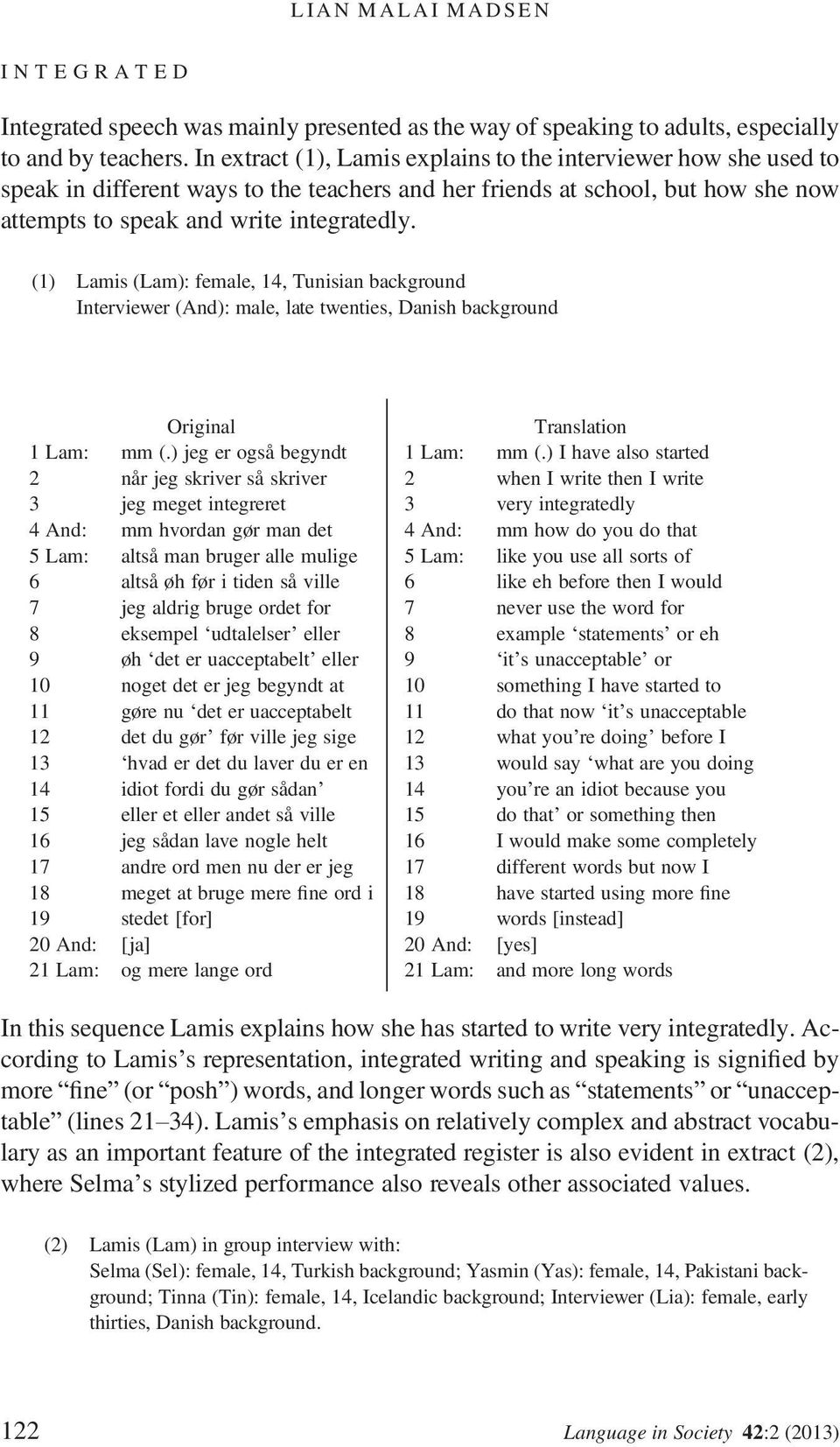
8 LIAN MALAI MADSEN INTEGRATED Integrated speech was mainly presented as the way of speaking to adults, especially to and by teachers. In extract (1), Lamis explains to the interviewer how she used to speak in different ways to the teachers and her friends at school, but how she now attempts to speak and write integratedly. (1) Lamis (Lam): female, 14, Tunisian background Interviewer (And): male, late twenties, Danish background Original Translation 1 Lam: mm (.) jeg er også begyndt 1 Lam: mm (.) I have also started 2 når jeg skriver så skriver 2 when I write then I write 3 jeg meget integreret 3 very integratedly 4 And: mm hvordan gør man det 4 And: mm how do you do that 5 Lam: altså man bruger alle mulige 5 Lam: like you use all sorts of 6 altså øh før i tiden så ville 6 like eh before then I would 7 jeg aldrig bruge ordet for 7 never use the word for 8 eksempel udtalelser eller 8 example statements or eh 9 øh det er uacceptabelt eller 9 it s unacceptable or 10 noget det er jeg begyndt at 10 something I have started to 11 gøre nu det er uacceptabelt 11 do that now it s unacceptable 12 det du gør før ville jeg sige 12 what you re doing before I 13 hvad er det du laver du er en 13 would say what are you doing 14 idiot fordi du gør sådan 14 you re an idiot because you 15 eller et eller andet så ville 15 do that or something then 16 jeg sådan lave nogle helt 16 I would make some completely 17 andre ord men nu der er jeg 17 different words but now I 18 meget at bruge mere fine ord i 18 have started using more fine 19 stedet [for] 19 words [instead] 20 And: [ja] 20 And: [yes] 21 Lam: og mere lange ord 21 Lam: and more long words In this sequence Lamis explains how she has started to write very integratedly. According to Lamis s representation, integrated writing and speaking is signified by more fine (or posh ) words, and longer words such as statements or unacceptable (lines 21 34). Lamis s emphasis on relatively complex and abstract vocabulary as an important feature of the integrated register is also evident in extract (2), where Selma s stylized performance also reveals other associated values. (2) Lamis (Lam) in group interview with: Selma (Sel): female, 14, Turkish background; Yasmin (Yas): female, 14, Pakistani background; Tinna (Tin): female, 14, Icelandic background; Interviewer (Lia): female, early thirties, Danish background. 122 Language in Society 42:2 (2013)
9 HIGH AND LOW INURBANDANISHSPEECHSTYLES 1 Lia: hvad taler I så med lærerne 1 Lia: then what do you speak with 2 i skolen 2 the teachers at school 3 Lam: integreret 3 Lam: integrated 4 Sel: integreret 4 Sel: integrated 5 Lia: [integreret] 5 Lia: [integrated] 6 Sel: [vil du] gerne bede om en 6 Sel: [would you] like to have a 7 kop te hhh 7 cup of tea hhh ((shrieky high pitched voice)) ((shrieky high pitched voice)) 8 Lam: hhh nej der bruger man de 8 Lam: hhh no there you use all 9 der integrerede ord 9 those integrated words 10 Sel: der [prøver xxx] 10 Sel: there [tries xxx] 11 Lam: [nogle gange]nogle gange 11 Lam: [sometimes] sometimes 12 når jeg har trip over 12 when I have a trip about the 13 lærerne så taler jeg det der 13 teachers then I speak that 14 gadesprog 14 street language 15 Lia: hvad øh kan du give 15 Lia: what eh can you give 16 eksempler på integreret 16 examples of integrated 17 Yas: [integration] 17 Yas: [integration] 18 Sel: [sådan der] [hvad] laver du 18 Sel: [like][what] are you doing 19 Lam: [int] 19 Lam: [int] 20 Yas: hhh 20 Yas: hhh 21 Sel: har du haft en god dag 21 Sel: have you had a nice day ((shrieky high pitched voice)) ((shrieky high pitched voice)) 22 Lam: nej nej nej ikke sådan noget 22 Lam: no no no nothing like that 23 ikke sådan noget sådan noget 23 nothing like that more like 24 hvor de kommer med 24 where they come out with 25 [rigtig rigtig] 25 [really really] 26 Sel: [god weekend] 26 Sel: [have a nice weekend] ((shrieky high pitched)) ((shrieky high pitched)) 27 Lam: rigtig svære ord 27 Lam: really difficult words 28 Yas: mm 28 Yas: mm 29 Sel: sådan der rigtig 29 Sel: like this really 30 Lam: (.)nej nej[nej] 30 Lam: (.)no no[no] 31 Sel: [ube]høvlet hhh 31 Sel: [im]pertinent hhh ((deep voice)) ((deep voice)) 32 Lam: ja hhh [og sådan der] 32 Lam: yes hhh [and like that] 33 Lia: [det lyder rigtigt] 33 Lia: [it sound really] 34 Lam: det så uaccep [tabelt Lam] 34 Lam: it s so unaccep[table Lam] 35 Yas: [ja men også] 35 Yas: [yes but also] When the girls are asked how they speak to their teachers, they claim to speak integratedly. An exception to this may occur when they are angry with the teachers or have a trip, as Lamis puts it. In such situations street language may be used (lines 12 14). Throughout the sequence Selma demonstrates integrated speech with a stylized performance marked by a shrieky, high-pitched voice (in bold lines 6 7, 18, 21, 26). In her performance she emphasizes politeness with ritual phrases such as haveaniceday, have a nice weekend, and would you like to have some tea?. The politeness, the tea offer, and the high-pitched, shrieky voice bring about stereotypical associations of higher class cultural practices. As Language in Society 42:2 (2013) 123
![high pitched voice)) 8 Lam: hhh nej der bruger man de 8 Lam: hhh no there you use all 9 der integrerede ord 9 those integrated words 10 Sel: der [prøver xxx] 10 Sel: there [tries xxx] 11 Lam: [nogle](/docs-images/42/11483602/images/page_9.jpg "gange]nogle gange 11 Lam: [sometimes] sometimes 12 når jeg har trip over 12 when I have a trip about the 13 lærerne så taler jeg det der 13 teachers then I speak that 14 gadesprog 14 street language")
10 LIAN MALAI MADSEN in (2) above, Lamis underlines so-called difficult words as the significant trait of integrated speech (line 27), and Selma supports with the example of impertinent in line 31. As well as being exemplified with words like impertinent and unacceptable, integrated speech is related to reprimands or corrections of behavior typically performed by authority figures. So integrated speech appears associated with authority, control, and aversion to rudeness, combined with ritual politeness and higher class cultural practices. More generally, when examples of vocabulary are presented in the interview accounts and the written essays, four main aspects are emphasized. About half of the examples in the essays are related to academic activities (e.g. analyze, criticize, argue, curriculum, lecture ). The other half are almost equally divided between ritual politeness (e.g. have a nice day, you re welcome, etc.), relatively complex and abstract adjectives (e.g. hypothetical, fascinating, intelligent, well organized ), and finally, corrections of behavior as above. With respect to the stylizations in extract (2), it is worth noting that the integrated performance is accompanied by quite a bit of ridicule in the girls representations, detectable, for instance, in the change of voice and the laughs following the examples of difficult words (lines 31 32). In this manner the girls present a certain distance to this register, and this is emphasized by Selma s jocular remark on not being able to say it in spite of practicing the difficult words in front of the mirror (lines 37 39). In fact there are significant differences in the way the girls relate to the integrated register in their constructions during the interviews, and this appears to correspond to their school orientation more generally. Overall, Lamis and Yasmin (and Selma up to a point) presented a positive orientation to academic work and school achievement, both in their everyday social practices at school as well as in their representations in interviews. Although they ridiculed integrated speech in their stylized performances and did not present integrated as their own way of speaking (with the possible exception of Lamis in the individual interview, extract (1)), they still claimed to use the integrated register for certain purposes: speaking to teachers (or other adults) and writing in school. In contrast, there was another pair of girls who did not generally orient positively to school, and they claimed not to have access to the integrated register, as we see in the next extract. (3) Fadwa (Fad) (female, 14, Iraqi background) in-group interview with: Israh (Isr): female, 14, Jordanian background; Jamila (Jam): female, 14, Iraqi background; Interviewer (Ast): female, mid twenties, Danish-Norwegian background 1 Fad: vi prøver at være integreret 1 Fad: we try to be integrated 2 ligesom dem men det kan vi 2 like them but we 3 ikke 3 can t 4 Isr: fordi vi ikke er vi er ikke 4 Isr: because we re not we re not 124 Language in Society 42:2 (2013)

11 HIGH AND LOW INURBANDANISHSPEECHSTYLES 5 gode til alle de der ord de 5 goo at all those words 6 siger 6 they re saying 7 Fad: de der svære ord (du skal) 7 Fad: those difficult words (you 8 forstå sådan hvordan skal 8 have to) understand like how 9 jeg forklare dig det øh 9 shall I explain it to you eh 10 Isr: ø:h du skal problematisere 10 Isr: e:h you should problematize 11 dine forklaringer på hvad 11 your explanations for what the 12 ordet(.) beskyttelse er 12 word (.) protection is ((distinct pronunciation)) ((distinct pronunciation)) 13 sådan nogle der [ting ikke] 13 stuff like [that right] 14 Fad: [ja sådan] 14 Fad: [yes such] stuff 15 nogle ting ikke 15 like that right 16 Isr: vi er ikke sådan rigtig gode 16 Isr: we re not really good at 17 til sådan noget der 17 stuff like that Like the girls in extract (2), Fadwa and Israh present examples of integrated words, and these are related to academic activities ( analyse and problematize ), but their self-representations here emphasize a lack of competence with respect to the integrated register. They say they sometimes try, but we can t (lines 2 3), we re not really good at all those words they re saying (lines 4 6), and we re not really good at stuff like that (lines 16 17). Clearly, Israh is perfectly able to perform examples of integrated speech in the stylizations marked by extra distinctness (lines 10 12), but even so, the two of them jointly emphasize a distance from this register through the references to them (in this context, the teachers; line 2) and we (throughout the sequence). This identity construction is in line with the nonacademic personae they practice elsewhere. When we asked the adolescents about speakers of integrated, most of them mentioned teachers, and initially, also the ethnic Danes among them as typical users. It did turn out after further discussion that in most cases their Danish classmates did not actually use many difficult words. However, it seemed that to the minority students participating in our study, the integrated register was also partly associated with Danish ethnicity: But the integrated language one usually uses to teachers or other adults. It s to talk very beautifully and try to sound as Danish as possible (Mark, 15, minority background, written essay 2). In the following extract, Israh explains how she and Selma get a surprised reaction when they put on their integrated performance because, as Israh phrases it, she is not like a real Dane. (4) Israh (Isr) and Interviewer (Ast) 1 Ast: men hvordan gør man så det 1 Ast: but how do you do that then 2 Isr: vi taler for eksempel 2 Isr: we speak for example pardon Language in Society 42:2 (2013) 125

12 LIAN MALAI MADSEN 3 hvabehar jeg ved ikke på den 3 me I don t know like that 4 måde hhh hhh 4 hhh hhh 5 Ast: okay 5 Ast: okay (0.2) (0.2) 6 Isr: jeg ved ikke rigtig øh ja 6 Isr: I don t really know eh yes 7 det kommer bare ud af munden 7 it just comes out of my mouth 8 Ast: ja 8 Ast: yes 9 Isr: og fordi jeg er ikke sådan 9 Isr: and because I m not like a 10 rigtig dansker hel hel men 10 real Dane complete complete 11 derfor så kigger alle sammen 11 but therefore then everyone 12 de alle sammen kigger på mig 12 looks they all look at me 13 og Selma når vi (rykker) 13 and Selma when we (move) 14 fordi vi taler rigtig 14 because we talk really 15 integreret 15 integrated But not all of the participants regarded integrated as predominantly a Danish register. In her essay Lamis presents an understanding of integrated as diassociated from the idea of a specific national language. Instead, speaking integrated seems related to stylistic adjustments. But slang and integrated are also important, because there is some people who cannot tolerate listening to slang, then you have to be able to talk to them so that they are comfortable. But slang and integrated are not just in one language, but they are in English, Danish, Arabic, and all languages there exist.. :D (Lamis, written essay 1) In a few of the essays we also find accounts of the use of integrated Arabic : With my family I speak completely normal/integrated Arabic but when I speak to my cousins it is street language Arabic. When I speak to my family: I speak normal Arabic to my family, I also speak integrated Arabic to show respect. (Jamil, 15, minority background, written essay 2) but with my parents [I] speak integrated Arabic, like polite (Fadwa, 15, minority background, written essay 2) In addition, some of the participants referred to Urdu as the integrated Punjabi. Finally, it is worth noting that several of the students of majority background also in their essays describe integrated Danish as a register relevant to their everyday encounters particularly with elderly adults and teachers. This listing of rules of language by a girl of Danish heritage is an example. Speak integrated to people you need to show respect for Speak normal to you relatives Speak normal/street language to your school friends 126 Language in Society 42:2 (2013)

13 HIGH AND LOW INURBANDANISHSPEECHSTYLES Speak integrated to elderly to show respect. (Marie, 15, majority background, written essay 2) These observations suggest that integrated practices seem to be undergoing reinterpretation. Integrated as a term has originally been (and still most typically is) employed in dominant macrodiscourses on integration as minorities adaption to majority society from the ethnocentric perspective sketched above (e.g. Rennison 2009). So as a term in the Danish context, integrated carries traces of an association with adaption to mainstream Danish cultural practices. Here, however, we see integrated reinterpreted as conservative standard practices (respectful, polite, upscale) in a more general sense. In its use among these adolescents, the term is not tied exclusively to the foreigner and Dane categorizations typical of dominant integration discourses, even though it includes an ironic reference to these discourses. In fact, there is an account in the written essays, which explicitly links successful integration ( well integrated ) to high socioeconomic status ( rich ). Integrated can be used by everyone, by and large, but if one speaks integrated language one is considered polite, rich well integrated person because people who speak integrated are like that. (Isaam, 15, minority background, written essay 2) From the overt metalinguistic reflections presented in the interviews and essays, we can see that there is an awareness among these Copenhagen adolescents of a register labeled integrated. The enregisterment of integrated involves accounts or demonstrations of performable signs and stereotypical indexical values. PERFORMABLE SIGNS: distinct pronunciation, abstract and academic vocabulary (long, fine words), high pitch, quiet and calm attitude, ritual politeness phrases STEREOTYPICAL INDEXICAL VALUES: higher class culture (wealth), sophistication, authority, emotional control and aversion to rudeness, academic skills, politeness and respect, (Danishness) It appears part of a social school-positive practice to present integrated as an available linguistic resource, and part of a more school-resistant practice to emphasise distance to this register. A slightly different use of the notion of integrated can be seen in extract (5). Here one of the male participants employ the term integrated in a characterization of the young youth club workers with minority background. (5) Isaam (Isa): male, 14, Arabic background with interviewer (And) 1 And: men med dine lærere der taler 1 And: but with your teachers there 2 du med respekt 2 you speak with respect Language in Society 42:2 (2013) 127

14 LIAN MALAI MADSEN 3 Isa: ja 3 Isa: yes 4 And: hvad så me:d øh hvad så med 4 And: what then abou:t eh what 5 over for Ilias og 5 about in front of Ilias and 6 Isa: de der de er ba nogle faggots 6 Isa: them they re ju some faggots 7 siger jeg bare de er helt væk 7 I say they re completely 8 spiller rigtig integreret når 8 gone play really integrated 9 Kirsten er der de der ikke det 9 when Kirsten is there they re 10 er nogle faggots no:gle 10 not it s some faggots so:me 11 bøssekarler 11 faggots 12 And: og Ilias Ahmed 12 And: and Ilias Ahmed 13 Isa: Ahmed han er også en bøssekarl 13 Isa: Ahmed he s also a faggot 14 And: hhh hhh [nå] 14 And: hhh hhh [well] 15 Isa: [nej] nej de er flinke 15 Isa: [no] no they re nice 16 koran jeg laver sjov de de er 16 Koran I m making fun they 17 gode nok 17 they re nice enough In this extract, Isaam is asked how he speaks to Ilias and Ahmed in the youth club. Instead of answering the question directly, he mockingly describes the young minority club workers as completely gone faggots who play really integrated when the majority adult female youth club worker, Kirsten, is around. The expression play integrated invokes elements of fakeness, and in addition, the derogative term faggots brings out non-hetero-masculine associations. Thus, we might add feminine, homosexual, or at least non-hetero-masculine to the stereotypic indexical values locally ascribed to the integrated register. Exaggerated feminine associations were also evident in the girls stylized shrieky, high-pitched performance voice in extract (2), and in fact the gender-associations involved in these ongoing processes of enregisterment become even clearer when we turn to the register seen as contrasting with integrated, namely street language. Indeed, the relationship of opposition between integrated and street language was crucial to the enregisterment of each. STREET LANGUAGE Street language was generally presented as the register the adolescents used to manage peer relations in school and leisure contexts. As with integrated, their metalinguistic reflections on street language often focused on vocabulary. In extract (6), Isaam emphasizes slang words in an exemplifying stylization of street language. (6) Isaam (Isa); Interviewer (And) 1 And: men (.) hvordan taler du i 1 And: but (.) how do you speak 2 skolen 2 in school 128 Language in Society 42:2 (2013)

15 HIGH AND LOW INURBANDANISHSPEECHSTYLES 3 Isa: integreret 3 Isa: integrated 4 And: mm hvad vil det sige 4 And: mm what does that mean 5 Isa: altså jeg taler (.) fint med 5 Isa: well I speak (.) fine with 6 min lærer og lærerne 6 my teacher and the teachers 7 And: mm (0.3) 7 And: mm (0.3) 8 And: hvad så: i frikvartererne 8 And: so what during recess do you 9 taler du også integreret der 9 also speak integrated then 10 Isa: nej (.) der t j aler jeg sgu 10 Isa: no (.) then I speak bloody 11 gadesprog ma:n 11 street language ma:n 12 And: t j aler du gadesprog hhh 12 And: you speak street language hhh 13 Isa: heh heh hhh ((laughs)) 13 Isa: heh heh hhh ((laughs)) In the beginning of this extract, Isaam claims to speak integratedly to teachers, and in fact more generally, he combined school-positive and streetwise practices in a similar way to the taekwondo practitioners described in Madsen (2008; see also Stæhr 2010 and Madsen 2012). So integrated seems to be a linguistic resource available to him. But when he is asked how he speaks with friends he answers with a stylized performance illustrating significant traits of street language: the swear word sgu (equivalent of bloody ), the American slang expression man pronounced with American features ( pitch raise and prolongation of the vowel), and prevocalic t pronounced with affrication and palatalization (line 10). The interviewer repeats this t-pronunciation (line 12) and this display of recognition causes joint amusement. The affricated palatalized pronunciation of t is a feature described by Maegaard (2007:164) as a new pronunciation feature associated with stylistic practices of tough ethnically mixed boys groups. Among the adolescents in the current study, Møller (2009) and Madsen et al. (2010) find that this t-pronunciation is also a marked feature stereotypically associated with speakers of Turkish background. But otherwise only a few of the indexical features overtly associated by our informants with integrated and street registers were related to pronunciation. The characterization of these registers focused largely on vocabulary, although we in line with other recent sociolinguistic studies in Copenhagen, have observed other pronunciation features characteristic of the speech style. These include initial uvular r pronounced voiceless (Maegaard 2007) and a characteristic prosody, which involves less use of the Danish stød ( phonetically a form of laryngealization or creaky voice) and less contrast between short and long vowels compared to more standard pronunciations (Pharao & Hansen 2006; Quist 2008; see also Madsen 2012). But these features were not mentioned by the participants other than by some perhaps referred to as a strange accent. Another significant practice associated with street language mentioned by several participants is the mixing of features generally considered to belong to different national languages, such as Danish, Arabic, Kurdish, Spanish, and Turkish. In extract (7), Israh describes how making up new words is considered part of the slang/perker ( paki) language. Language in Society 42:2 (2013) 129

16 LIAN MALAI MADSEN (7) Israh (ISR) with interviewer (Ast) 1 Isr: uden for skolen der gør vi 1 Isr: outside school then we do 2 også vi taler bare slang 2 also we just talk slang 4 perkersprog taler normalt 4 perker language talk 5 altså sådan arabisk dansk 5 normally like Arabic Danish 6 bruger alle mulige mærkelige 6 use all sorts of strange 7 ord i 7 words in (0.3) (0.3) 8 Ast: [jo] 8 Ast: [yes] 9 Isr: [og] så kommer vi hver gang 9 Isr: [and] then we every time come 10 med nye ord 10 up with new words 11 Ast: hvordan det 11 Ast: how so 12 Isr: altså et eller andet vi finder 12 Isr: like something we make up 13 på noget nyt der ligner lidt 13 something new that s similar 14 arabisk og så laver vi lidt 14 to Arabic then we make it 15 omvendt på det 15 opposite a bit What Israh here refers to appears to be the polylingual behavior documented among Copenhagen youth in several of our recent studies of situated interactions (Ag 2010; Stæhr 2010; Jørgensen et al. 2011). Polylingual practices are central to the street language register in the adolescents interview reports, as well as in sociolinguists observation of situated speech and in media constructions. Based on participants accounts, the linguistic signs and practices associated with street language include slang, polylingual mixing, and creativity, as well as an example of a particular pronunciation feature. The value ascriptions related to this register are also brought about in the presentations by the adolescents. Lamis describes and performs street language in extract (8). (8) Lamis (Lam) with interviewer (And) 1 Lam: hvor man sådan meget stiller 1 Lam: how you like put yourself 2 op 2 up front 3 And: mm 3 And: mm 4 Lam: og de:t viser sig meget frem 4 Lam: and i:t show off yourself 5 And: ja 5 And: yes 6 Lam: og sådan er tror man er meget 6 Lam: and like think you re very 7 stor i det (.) sådan og har 7 big like (.) that and have 8 meget sådan mærkelig accent 8 very like strange accent 9 hhh sådan uh hvem tror 9 hhh like uh who do you 10 du du er sådan hhh 10 think you are like that hhh ((deep voice)) ((deep voice)) 130 Language in Society 42:2 (2013)
![3) 8 Ast: [jo] 8 Ast: [yes] 9 Isr: [og] så kommer vi hver gang 9 Isr: [and] then we every time come 10 med nye ord 10 up with new words 11 Ast: hvordan det 11 Ast: how so 12 Isr: altså et eller andet](/docs-images/42/11483602/images/page_16.jpg "vi finder 12 Isr: like something we make up 13 på noget nyt der ligner lidt 13 something new that s similar 14 arabisk og så laver vi lidt 14 to Arabic then we make it 15 omvendt på det 15 opposite a")
17 HIGH AND LOW INURBANDANISHSPEECHSTYLES 11 And: ja 11 And: yes 12 Lam: sådan den der accent der 12 Lam: like that accent 13 det er så [dan] 13 it s like [that] 14 And: [mm] 14 And: [mm] 15 Lam: perkerattitude 15 Lam: perker attitude Lamis does not primarily describe linguistic features when she is asked what street language is like. She does mention the rather unspecified pronunciation of a strange accent (line 8), but otherwise describes a perker attitude of showing off (lines 4 5). She performs a tough persona through her stylized utterance in lines 9 10 signalled by the deep voice and the pragmatic function of a challenge, and this value ascription of toughness corresponds to the use of the register observed in studies of situated interaction (Madsen 2008, 2012; Stæhr 2010). In these studies, we find that features associated with street language are predominantly employed in peer interactions concerned with social negotiations of local status relations. Our studies also suggest that the perker attitude and its associated linguistic practice invoke traditional masculinity, and this chimes with research on similar linguistic practices in other urban European settings (e.g. blattesvenska in Stockholm in Jonsson 2007 or Creole English in Rampton 1995). This association with masculinity does not mean that the street register is not employed by any females, and the girls who employ it also use other semiotic resources stereotypically associated with toughness and street credit. For instance, towards the end of their group interview, Fadwa and Israh co-construct self-representations based on narratives about fights they have been involved in, emphasizing how hard they have hit their opponents. But the girls who emphasize more traditional feminine values in their identity practices claim not to use street language at all (although Ag s (2010) study of their peer interactions reveals several instances where the street language features are actually used). In extract (9) we see another example of a girl distancing herself from street language and its associated tough perker attitude. Six months after the group interview, Lamis is interviewed again and she now explains how she tries to remove her perker attitude. (9) Lamis (Lam) with interviewer (And) 1 And: mm hvordan var det før 1 And: mm how was it before 2 Lam: før var jeg sådan meget uh med 2 Lam: before I was very uh with 3 mine venner og sådan og så 3 my friends and stuff and 4 foran lærer var jeg sådan 4 then in front of the teacher 5 stille og rolig og snak rigtig 5 I was like quiet and calm and 6 meget dansk men med mine 6 talk like very Danish but with 7 venner der var jeg sådan 7 my friends I was like very 8 rigtig meget perkeragtigt 8 perker like Language in Society 42:2 (2013) 131

18 LIAN MALAI MADSEN 9 And: ja 9 And: yes 10 Lam: og nu: øh jeg er begyndt at 10 Lam: and no:w eh I have started 11 tage mig sammen for jeg synes 11 to pull myself together because I don t 12 ikke det er noget man skal 12 think it s something you should be 13 være stolt over hvis man har 13 proud of if you have 14 sådan en perkerattitude (.) 14 such a perker attitude 15 det synes jeg ikke man skal 15 I don t think you 16 være stolt over så jeg prøver 16 should be proud of it so I 17 faktisk at fjerne det 17 actually try to remove it In this account, Lamis relates ways of speaking to ways of being: before I was very uh (lines 2 8). She further states that she has now pulled herself together a perker attitude is not something one should be proud of, but rather try to get rid of. Lamis is a student who orients to academic achievement and she does not see the register associated with perker attitude as prestigious. In the final extract, Isaam illustrates an identity aspect central to the ongoing enregisterment among the adolescents, namely the age-dimension. (10) Isaam (Isa) with interviewer (And) 1 Isa: men men hvis der kommer en 1 Isa: but but if some other person 2 anden person der er 2 comes who is integrated and 3 integreret og siger hvordan 3 says how are the young how 4 er de unge hvordan taler de 4 do the young speak to each 5 unge til hinanden 5 other 6 And: ja 6 And: yes 7 Isa: men vi vi man kan sige man 7 Isa: but we we you can say you 8 taler sådan (.) for tiden 8 speak like this (.) at this 9 det er helt væk jeg kan 9 time it s completely gone 10 bare sige Mahmoud giver mig 10 I can just say Mahmoud give 11 eller 11 me or (0.2) (0.2) 12 Isa: Mahmoud han siger jeg har 12 Isa: Mahmoud he says I don t have 13 ikke flere tᶨyggegummi fuck 13 any more chewing gum fuck 14 dig forstår du det det er 14 you do you understand it it 15 ikke [ne:]gativt 15 isn t [ne:]gative 16 And: [mm] 16 And: [mm] 17 Isa: det er bare sådan det er 17 Isa: it s just the way it is Here Isaam opposes a person who is integrated to the young (lines 1 5). He demonstrates the way the young speak by hypothetically quoting himself in 132 Language in Society 42:2 (2013)

19 HIGH AND LOW INURBANDANISHSPEECHSTYLES interaction with a friend (Mahmoud), employing the characteristic t-pronunciation and a swear word. He opposes integrated to youthful behavior, and this is consistent with the other interview descriptions of integrated as a register employed by and with adults. So in these accounts street language ( perker language or slang ) is continuously enregistered in the following way: PERFORMABLE SIGNS: STEREOTYPIC INDEXICAL VALUES: slang, swearing, affricated and palatalized t-pronunciation, polylingual practices, strange accent, linguistic creativity toughness, masculinity, youth, panethnic minority street culture, academic nonprestige To summarize, the participants generally present resources of integrated and street language as relevant to their linguistic everyday practice. Lamis, Aisha, and Selma, who orient positively towards academic achievements, report a use of the integrated register to teachers, parents, and other adults. Fadwa and Israh, who do not orient towards academic skills, report a use of the register only in jocular ways (and claim to have a limited competence in using integrated words ). The girls claim to use the street-language register to present an attitude of toughness. In front of the researchers, some of the girls claim not to use the street-language register at all and some girls claim mainly to use it to address boys. The boys among my key participants emphasize the use of the street-language register as a peer-group practice. Most of the adolescents also present the notion of normal Danish, which appears to be a socially unmarked way of speaking. Some participants refer to normal Danish as an alternative to street language and others as a contrast to integrated speech. CONCLUDING DISCUSSION I have now discussed overt evaluations of language among Copenhagen youth and treated their metalinguistic reflections as part of the ongoing enregisterment of integrated and street (or perker) language. A range of different aspects of cultural practice have been drawn into this: ways of orienting to academic skills, ways of engaging with emotions, and typical interlocutors. In fact, the associations of these two registers seem to map on to a set of opposing binaries, shown in Table 1 below. These binary value ascriptions allow us to link integrated and street language to the value system that previous Danish sociolinguistic studies associate with conservative Copenhagen and school-related standard ideology, where excellence is perceived in relation to superiority (Kristiansen 2009:189). According to Maegaard (2005) and Kristiansen (2001, 2009) conservative Copenhagen speech speech containing features traditionally seen as high-status is associated with the stereotypic indexical values of intelligence, articulation, ambition, Language in Society 42:2 (2013) 133

20 LIAN MALAI MADSEN TABLE 1. Value binaries associated with integrated and street. integrated (majority) high academic polite reason feminine adult perker (minority) low street cultural tough emotion masculine youthful independence, rationality, and conscientiousness. The speech indexing these values are by our participants labelled integrated, and they present an understanding of the street language as belonging to the opposite end of a stylistic spectrum associated with contrasting values. Of course, there can be significant differences between speakers reports about language use and their actual linguistic practice. The accounts presented here provide important insights into the speakers ideas about linguistic stereotypes, but the study of how linguistic stereotypes are brought into use for situated pragmatic functions in particular interactional contexts may add to and possibly alter the picture (Rampton 2006, Bucholtz 2011, and Jaspers 2011 are good examples of this). In Madsen et al. (2010) we demonstrate that the adolescents do actively use features of street language and integrated as stylistic resources in their everyday conversations to signal frame shifts on various levels. It would extend the scope of this article to go into detailed analysis of our interactional data, but a brief summary of some interactional observations can inform the discussion of this ongoing enregisterment. Features of street language are used in relatively unmarked speech by boys who orient positively to school achievements at the same time as orienting to streetwise coolness. They increase the use of the street-language features in interactional sequences where school-related capital is negotiated and demonstrated and thereby achieve school competent identities in a nonnerdy way (see details in Madsen 2011, Madsen 2012). The participants inauthentically put on integrated voices in contexts where institutional inequalities are spotlighted. They do so by performing stylized speech characterized by a combination of marked conservative pronunciations with exaggerated expressions of agreement, enthusiasm, or politeness and vocabulary indexing sophistication/academic reflection in communicative contexts where norm transgressions and relations of power involving adult authorities of some kind are at play (Madsen 2013). These observations, in fact, support the insights we have gained from our interview and essay data and show that stylistic features of street language and 134 Language in Society 42:2 (2013)

21 HIGH AND LOW INURBANDANISHSPEECHSTYLES integrated in the adolescents everyday interactions are used to bring about relations of academic and street cultural values, as well as relations of inequality and authority. Recent Danish sociolinguistics has suggested that social class relations have relatively little contemporary sociolinguistic significance, and instead, the discovery of new linguistic practices among youth in culturally and linguistically diverse environments has led to ethnicity being foregrounded. But the data I have discussed in this article shows that high/low stratification is indeed still relevant to contemporary Danish youth. In the values and privileges it evokes, integrated is enregistered as a conservative standard code, and street language is enregistered partly in opposition to this. Social status is profoundly interwoven with ethnicity, both in the metalinguistic descriptions and in the linguistic labels applied to these registers. As argued in the beginning of this article the foregrounding of ethnicity is not only characteristic of Danish studies of urban youth language, but a general European tendency, and considerations of how ethnicity intersects with social status relations and other social categories are likely to be relevant to work on contemporary urban speech styles in other contexts as well. The data I have presented points to a significant sociolinguistic transformation. Linguistic signs that used to be seen as related to migration identified as ethnic minority rather than majority on an insider/outsider dimension of comparison are now related to status on a high/low dimension as well. This is particularly clear in our informants association of integrated with a notion of conservative standardness that carries across national language boundaries. In this way, our data document processes similar to the ones described by Rampton (2011) in Britain, and there are comparable intersections of ethnicity and status relations in Chun (2011), Bucholtz (2011), or Mendoza-Denton (2008), where the conception of race among American adolescents incorporates aspects of class (and gender). Jaspers (2011) also shows how in Belgium, minority adolescents stylizations of the traditional Antwerp dialect reconfigure its social meaning so that instead of simply being associated with hostility to migrants, it is used to spotlight institutional inequalities, positioning the young people within the dynamics of high/low stratification, not just inside/outside exclusion. So there is evidence from ethnographically informed studies of linguistic practice in several countries that linguistic styles once associated with migration and minorities are being actively mapped into social stratification and status. As Silverstein (1985:220) notes, the object of study of a science of language should be sign forms contextualised to situations of interested human use and mediated by the fact of cultural ideology, and this case study reminds us that studying the language ideological dimension is as important a part of studying sociolinguistic processes as is descriptions of forms and linguistic practice. Language in Society 42:2 (2013) 135
22 LIAN MALAI MADSEN APPENDIX: TRANSCRIPTION CONVENTIONS [overlap] overlapping speech LOUD louder volume than surrounding utterances silent lower volume than surrounding utterances xxx unintelligible speech (questionable) parts I am uncertain about ((comment)) my comments : prolongation of preceding sound local pitch raise (.) short pause (0.6) timed pause stress stress hhh laughter breath mm confirming mm mm denying italics English in original bold stylized utterance NOTES *I am grateful to the research participants and my colleagues in Copenhagen; J. Normann Jørgensen, Janus S. Møller, Astrid Ag, and Andreas Stæhr for their collaboration on this study. The writing of this article has benefited greatly from insightful comments from Ben Rampton, Jürgen Jaspers, Constadina Charalambous, Elaine Chun, and J. Normann Jørgensen, as well as from the suggestions from the editor of this journal and the two anonymous reviewers. 1 All interview extracts are transcribed according to the conventions presented in the appendix. The original transcripts are presented in the left column and the English translations are presented in the right column. When utterances contain English features in the original version, they marked by italics in the translation. Stylizations are in bold and reported speech is surrounded by speech marks. REFERENCES Ag, Astrid (2010). Sprogbrug og identitetsarbejde hos senmoderne storbypiger. Copenhagen: University of Copenhagen. Agha, Asif (2003). The social life of cultural value. Language & Communication 23: (2007). Language and social relations. Cambridge: Cambridge University Press. Aarsæther, Finn (2010). The use of multiethnic youth language in Oslo. In Quist & Svendsen, Blackledge, Adrian, & Angela Creese (2010). Multilingualism: A critical perspective. London: Continuum. Blommaert, Jan, & Ben Rampton (2011). Language and superdiversity. Diversities 13:1 22., & Jef Verschueren (1998). Debating diversity: Analysing the discourse of tolerance. London: Routledge. Bradley, Harriet (1996). Fractured identities: Changing patterns of inequality. London: Polity. Brink, Lars, & Jørn Lund (1975). Dansk Rigsmål. Copenhagen: Gyldendal. Brochmann, Grete, & Anniken Hagelund (2010). Velferdens grenser. Copenhagen: Scanvik. 136 Language in Society 42:2 (2013)
23 HIGH AND LOW INURBANDANISHSPEECHSTYLES Brubaker, Rogers (2004). Ethnicity without groups. Cambridge, MA: Harvard University Press. Bucholtz, Mary (2004). Styles and stereotypes: The linguistic negotiation of identity among Laotian American youth. Pragmatics 14: (2011). White kids: Language, race and styles of youth identities. Cambridge: Cambridge University Press. Chun, Elaine (2011). Reading race beyond black and white. Discourse & Society 22: Extra, Guus; Max Spotti; & Piet van Avermaet (eds.) (2009). Language testing, migration and citizenship: Cross-national perspectives on integration regimes. London: Continuum. Fanshawe, Simon, & Danny Sriskandarajah (2010). You can t put me in a box: Super-diversity and the end of identity politics in Britain. Online at the Institute for Public Policy Research, org.uk/publication/55/1749/you-cant-put-me-in-a-box-super-diversity-and-the-end-of-identity-politics-in-britain. Jaspers, Jürgen (2008). Problematizing ethnolects: Naming linguistic prcatices in an Antwerp secondary school. International Journal of Bilingualism 12: (2011). Strange bedfellows: Appropriations of a tainted urban dialect. Journal of Sociolinguistics 15: Jonsson, Rickard (2007). Blatte betyder kompis: Om maskulinitet och språk i en högstadieskola. Stockholm: Ordfront. Johnstone, Barbara; Jennifer Andrus; & Andrew E. Danielsen (2006). Mobility, indexicality and the enregisterment of Pittsburghese. Journal of English Linguistics 34: Jørgensen, Jens Normann, & Kjeld Kristensen (1994). Moderne sjællandsk: En undersøgelse af unge sjællænderes talesprog. København: C. A. Reitzel., Martha Karrebæk, Lian Malai Madsen; & Janus Spindler Møller (2011). Polylanguaging in superdiversity. Diversities 13: Keim, Inken (2007). Die türkischen Powergirls. Lebenswelt und kommunikativer Stil einer Migrantinnengruppe in Mannheim. Türbinger: Narr. Kern, Friederike, & Margret Selting (eds.) (2012). Ethnic styles of speaking in European metropolitan areas. Amsterdam: John Benjamins. Kießling, Roland, & Maarten Mous (2004). Urban youth languages in Africa. Anthropological Linguistics 46: Kristensen, Kjeld (2003). Standard Danish, Copenhagen sociolects, and regional varieties in the 1900s. International Journal of the Sociology of Language 159: Kristiansen, Tore (2001). Two standards: One for the media and one for the school. Language Awareness 10(1):9 24. (2009). The macro-level social meanings of late modern Danish accents. Acta Linguistica Hafniensia 41: , & Jens Normann Jørgensen (2003). The sociolinguistics of Danish. International Journal of the Sociology of Language 159:1 7. Madsen, Lian Malai (2008). Fighters and outsiders: Linguistic practices, social identities and social relationships among youth in a martial arts club. Copenhagen: University of Copenhagen. (2011). Interactional renegotiations of educational discourses in recreational learning contexts. Linguistics and Education 22: (2012). Late modern youth style in interaction. In Kern & Selting, (2013). Heteroglossia, voicing and social categorisation. In Adrian Blackledge & Angela Creese (eds.), Heteroglossia as practice and pedagogy, to appear. ; Janus Spindler Møller, & J. Normann Jørgensen (2010). Street language and integrated : Language use and enregisterment among late modern urban girls. In Lian Malai Madsen, Janus Spindler Møller, & Jens Normann Jørgensen (eds), Ideological constructions and enregisterment of linguistic youth styles, (Copenhagen studies in bilingualism 55.) Copenhagen: University of Copenhagen. Language in Society 42:2 (2013) 137
24 LIAN MALAI MADSEN Maegaard, Marie (2005). Language attitudes, norm and gender: A presentation of the method and results from a language attitude study. Acta Linguistica Hafniensia 37: (2007). Udtalevariation og forandring i københavnsk en etnografisk undersøgelse af sprogbrug, sociale kategorier og social praksis blandt unge på en københavnsk folkeskole. Copenhagen: University of Copenhagen. Mendoza-Denton, Norma (2008). Homegirls: Language and cultural practice among Latina youth gangs. Oxford: Blackwell. Møller, Janus Spindler (2009). Poly-lingual interaction across childhood, youth and adulthood. Copenhagen: University of Copenhagen. Newell, Sasha (2009). Enregistering modernity, bluffing criminality: How Nouchi speech reinvented (and fractured) the nation. Journal of Linaguiatic Anthropology 19: Ortner, Sherry (1998). Identities: The hidden life of class. Journal of Anthropological Research 45:1 17. Pedersen, Marianne H. (2007). Umm Zainaps Rejse. In Karen Fog Olwig & Karsten Pærregaard (eds.), Integration: Antropologiske perspektiver, Copenhagen: Museum Tusculanum. Pharao, Nicolai, & Gert Foget Hansen (2006). Prosodic aspects of the Copenhagen multiethnolect. Nordic prosody: Proceedings of the IXth Conference, Lund 2004, Frankfurt am Main: Peter Lang. Quist, Pia (2008). Sociolinguistic approaches to multiethnolect: Language variety and stylistic practice. International Journal of Bilingualism 12:43 61., & Bente A. Svendsen (eds.) (2010). Multilingual urban Scandinavia. Bristol: Multilingual Matters. Rampton, Ben (1995). Crossing: Language and ethnicity among adolescents. London: Longman. (2006). Language in late modernity: Interaction in an urban school. Cambridge: Cambridge University Press. (2011). Style contrast, migration and social class. Journal of Pragmatics 43: Rennison, Bettina Wolfgang (2009). Kampen om integrationen. Copenhagen: Hans Reitzel. Silverstein, Michael (1985). On the pragmatic poetry of prose. In Deborah Schiffrin (ed.), Meaning, form and use in context, Washington, DC: Georgetown University Press. Stæhr, Andreas (2010). Rappen reddede os: Et studie af senmoderne storbydrenges identitetsarbejde i fritids- og skolemiljøer. Copenhagen: University of Copenhagen. Torgersen, Eivind; Paul Kerswill; & Sue Fox (2006). Ethnicity as a source of changes in the London vowel system. In Frans Hinskens (ed.), Language variation: European perspectives. Selected papers from the Third International Conference on Language Variation in Europe (ICLaVE3), Amsterdam, June 2005, Amsterdam: John Benjamins. (Received 19 August 2011; revision received 12 April 2012; accepted 22 April 2012; final revision received 28 September 2012) 138 Language in Society 42:2 (2013)
Working Papers in Urban Language & Literacies
 Working Papers in Urban Language & Literacies Paper 72 Social status relations and enregisterment in contemporary Copenhagen Lian Malai Madsen (University of Copenhagen) 2011 1 Social status relations
Questionnaire #1: The Patient (Spørgeskema, må gerne besvares på dansk)
 Table of Contents Questionnaire #1: The Patient... 2 Questionnaire #2: The Medical Staff... 4 Questionnaire #3: The Visitors... 6 Questionnaire #4: The Non-Medical Staff... 7 Page1 Questionnaire #1: The
Research on the Danish heroin assisted treatment programme
 Research on the Danish heroin assisted treatment programme Katrine Schepelern Johansen Anthropologist, PhD Post.doc, Department of Anthropology, University of Copenhagen Treatment with heroin in Denmark
Subordinate clause and main clause (ledsætning og helsætning) main clause subordinate clause main clause
 Structure of the Danish phrase The key to the understanding of the Danish phrase is the relative position of verb (in present or past), v, subject, s, and adverbs like ikke (not), a in the first part of
The modal verbs kan sende modtage Same word for must and may Future expressed without modal verb
 The modal verbs A modal verb can, may must, shall or will is an auxiliary it modifies the verb and expresses whether the action described is seen as plan, intention, necessity, possibility, prediction,
Student evaluation form
 Student evaluation form Back Number of respondents: 17 1. Multiple choice question Percentage Name of course: [Insert name of course here!] Course Objectives: [Insert course objectives (målbeskrivelse)
Too Much. Workmate. A. Listen to Adrian talking about obesity. 1 Who is he especially worried about?
 Too Much Workmate 1. Work in pairs. Find these expressions in the text. Read them aloud. 1 Jo større han blev, desto mindre motionerede han. 2 I mange år havde han ikke kunnet gå i biografen. 3 Han løste
Nordic Master in Didactics of Mathematics
 Nordic Master in Didactics of Mathematics NORDIMA Barbro Grevholm Seminar i Bergen den 7-8 september 2011 Nordic Master in Didactics of Mathematics Project number NMP-2009/10730 The Master Consortium consists
Claus B. Jensen IT Auditor, CISA, CIA
 Claus B. Jensen IT Auditor, CISA, CIA I am employed in Rigsrevisionen, Denmark. (Danish National Audit Office) I have worked within IT Audit since 1995, both as internal and external auditor and now in
How To Build Connection With New Arrival Students
 Building connection in working with new arrival immigrant and refugee students Jenny Barnett, University of South Australia, South Australia Rosie Antenucci, Department of Education and Children s Services,
ENCOURAGING STUDENTS IN A RACIALLY DIVERSE CLASSROOM
 Derek Bok Center for Teaching and Learning, Harvard University ONLINE DOCUMENT TIPS FOR TEACHERS: ENCOURAGING STUDENTS IN A RACIALLY DIVERSE CLASSROOM Topics: The Cardinal Rule Questions a teacher might
DEFINITE AND INDEFINITE FORM
 DEFINITE AND INDEFINITE FORM In Norwegian, a noun can appear either in the indefinite form or in the definite form. There are some absolute rules that determine which form is correct, but three important
Study Plan for Master of Arts in Applied Linguistics
 Study Plan for Master of Arts in Applied Linguistics Master of Arts in Applied Linguistics is awarded by the Faculty of Graduate Studies at Jordan University of Science and Technology (JUST) upon the fulfillment
Study program International Communication (120 ЕCTS)
 Study program International Communication (120 ЕCTS) Faculty Cycle Languages, Cultures and Communications Postgraduate ECTS 120 Offered in Skopje Description of the program The International Communication
CAMP LOGOS administrated by Boligselskabet Sct. Jørgen (housing agency)
 CAMP LOGOS administrated by Boligselskabet Sct. Jørgen (housing agency) Camp Logos the buildings Camp Logos is the dorm across the street from The Animation Workshop. There are 4 buildings side by side
MA in Teaching English to Speakers of Other Languages (TESOL) 2015/16
 MA in Teaching English to Speakers of Other Languages (TESOL) 2015/16 Programme structure full time students Full time students must complete the programme in one year. All students complete the following
PRESSEKIT INTERNATIONALE STUDERENDE
 PRESSEKIT INTERNATIONALE STUDERENDE FÅ MENTOR KORT MED MASSER AF FORDELE! Studenterhuset vil gerne bakke op om mentorernes store arbejde på KU. Derfor har vi i år lavet et mentorkort! Med et mentorkort
COACH BOT Modular e-course with virtual coach tool support
 COACH BOT Modular e-course with virtual coach tool support LIFELONG LEARNING PROGRAM LEONARDO da VINCI Aarhus Social and Health Care College TRAINING FOR HEALTHCARE PROFESSIONALS AND HOME CARE PROVIDERS
Skolestart. Solveig Gaarsmand Skole og Samfund Good ID 2007
 Skolestart Solveig Gaarsmand Skole og Samfund Good ID 2007 1 Præsentation Hvem er vi? Hvor skal vores børn gå i skole? The trainer welcomes parents, pedagogues and teachers present and invites everybody
Why Do People Pay the Way They Do: The Case of Cards, Cash, and Internet Banking in the Context
 Why Do People Pay the Way They Do: The Case of Cards, Cash, and Internet Banking in the Context of Danish Society Xiao Xiao, Jonas Hedman, and Emma Runnemark Department of IT Management, Copenhagen Business
Azfar Bassir. Summary. Experience. Developer at SHFT [email protected]
 Azfar Bassir Developer at SHFT [email protected] Summary I consider myself as a positive, happy, energetic and responsible person. I love challenges because I always want to improve my skills. I am ambitious
Agil Business Process Management - i Finans
 Agil Business Process Management - i Finans Thomas Hildebrandt Lektor, PhD Leder af gruppen for Proces- & Systemmodeller ved IT Universitetet i København og Interessegruppen for processer og IT ved Infinit
MINISTRY OF DEFENCE LANGUAGES EXAMINATIONS BOARD
 Name: Candidate Registration Number: Date of Exam: MINISTRY OF DEFENCE LANGUAGES EXAMINATIONS BOARD SURVIVAL SLP1 PAPER D English Base Paper for Reading Task 1 Task 2 Time allowed Translation Comprehension
in Language, Culture, and Communication
 22 April 2013 Study Plan M. A. Degree in Language, Culture, and Communication Linguistics Department 2012/2013 Faculty of Foreign Languages - Jordan University 1 STUDY PLAN M. A. DEGREE IN LANGUAGE, CULTURE
PUBLIC INTEREST IN POLITICAL PHILOSOPHY. A NECESSARY ETHICAL AND REGULATORY CONCEPT FOR TERRITORIAL PLANNING
 Boletín de Public la Asociación interest in de political Geógrafos philosophy. Españoles A necessary N.º 53-2010, ethical págs. and regulatory 381-386 concept for territorial planning I.S.S.N.: 0212-9426
University of Khartoum. Faculty of Arts. Department of English. MA in Teaching English to Speakers of Other Languages (TESOL) by Courses
 University of Khartoum Faculty of Arts Department of English MA in Teaching English to Speakers of Other Languages (TESOL) by Courses 3 Table of Contents Contents Introduction... 5 Rationale... 5 Objectives...
Master of Arts Program in Linguistics for Communication Department of Linguistics Faculty of Liberal Arts Thammasat University
 Master of Arts Program in Linguistics for Communication Department of Linguistics Faculty of Liberal Arts Thammasat University 1. Academic Program Master of Arts Program in Linguistics for Communication
LANG 557 Capstone Paper . Purpose: Format: Content: introduction view of language
 Masters of Science in Curriculum & Instruction Special Education Emphasis Alignment of Summative Assessments to InTASC Standards The Courses in the TESL Emphasis are aligned to MN Board of Teaching Standards
Orientation Lecture Series: LEARNING TO LEARN Developing critical thinking skills
 Orientation Lecture Series: LEARNING TO LEARN Developing critical thinking skills Outline of Lecture what is critical thinking? demonstrating critical thinking strategies for critical writing using evidence
Anthropology 130 NM HED Area IV. Social and Behavioral Sciences Competencies UNM Area 4. Social and Behavioral Sciences
 Anthropology 130 NM HED Area IV. Social and Behavioral Sciences Competencies UNM Area 4. Social and Behavioral Sciences Student Learning Objectives 1. Students will be able to identify the thinkers and
REDUCING PREJUDICE IN CHILDREN -EXTENDED REPORT
 1 REDUCING PREJUDICE IN CHILDREN -EXTENDED REPORT Research Conducted: March 2001 March 2005 Researcher directors: Dr Adam Rutland Professor Rupert Brown Principal Researcher: Lindsey Cameron Funded by:
MONTE VISTA CHRISTIAN SCHOOL SOSC 3422, Sociology Course Syllabus
 MONTE VISTA CHRISTIAN SCHOOL SOSC 3422, Sociology Course Syllabus Course Description : An elective social science course designed to challenge and prepare for the rigors of collegiate sociological study.
Study Plan. Bachelor s in. Faculty of Foreign Languages University of Jordan
 Study Plan Bachelor s in Spanish and English Faculty of Foreign Languages University of Jordan 2009/2010 Department of European Languages Faculty of Foreign Languages University of Jordan Degree: B.A.
American Sociological Association Guidelines. CEOE Competencies. 0017 Understand methods of data collection and analysis in sociology.
 Certification Examinations for Oklahoma Educators (CEOE) Framework Development Correlation Table The Framework Development Correlation Table provides information about possible alignment of some of the
Telecommunication (120 ЕCTS)
 Study program Faculty Cycle Software Engineering and Telecommunication (120 ЕCTS) Contemporary Sciences and Technologies Postgraduate ECTS 120 Offered in Tetovo Description of the program This master study
MULTICULTURAL EDUCATION DEPARTMENT
 MULTICULTURAL EDUCATION DEPARTMENT MULTICULTURAL EDUCATION DEPARTMENT Dr. Mihri Napoliello Chairperson [email protected] Dr. John Klosek Graduate Advisor [email protected] Dr. Donna Farina Graduate Advisor
The Effect of a Classroom Management Intervention Results from an RCT Anders Holm, Maria Keilow, Mette Friis-Hansen, and Rune Kristensen
 The Effect of a Classroom Management Intervention Results from an RCT Anders Holm, Maria Keilow, Mette Friis-Hansen, and Rune Kristensen Table 2. Course plan for the Classroom Management Intervention.
REGULATIONS FOR THE DEGREE OF MASTER OF EDUCATION (MEd)
 215 REGULATIONS FOR THE DEGREE OF MASTER OF EDUCATION (MEd) (See also General Regulations) Any publication based on work approved for a higher degree should contain a reference to the effect that the work
COSMETIC SURGERY UNIT OVERVIEW. Authors Introduction Go to impactseries.com/issues to listen to Joseph s unit introduction.
 UNIT 1 COSMETIC SURGERY UNIT OVERVIEW In this unit, students will: T Read and listen to the conversation between Ayu and her mother. Answer open-ended comprehension questions to show understanding of the
The Decline in Student Applications to Computer Science and IT Degree Courses in UK Universities. Anna Round University of Newcastle
 The Decline in Student Applications to Computer Science and IT Degree Courses in UK Universities Introduction Anna Round University of Newcastle The research described in this report was undertaken for
Touchstone Level 2. Common European Framework of Reference for Languages (CEFR)
 Touchstone Level 2 Common European Framework of Reference for Languages (CEFR) Contents Introduction to CEFR 2 CEFR level 3 CEFR goals realized in this level of Touchstone 4 How each unit relates to the
Master of Arts in Teaching English to Speakers of Other Languages (MA TESOL)
 Master of Arts in Teaching English to Speakers of Other Languages (MA TESOL) Overview Teaching English to non-native English speakers requires skills beyond just knowing the language. Teachers must have
ACADEMIC DIRECTOR: Barbara Walters Email Contact: URL THE PROGRAM Career and Academic Advancement Prospects Program Requirements Required Courses
 Sociology (BA) ACADEMIC DIRECTOR: Barbara Walters CUNY School of Professional Studies 101 West 31st Street, 7 th Floor New York, NY 10001 Email Contact: Barbara Walters, [email protected] URL: http://sps.cuny.edu/programs/ba_sociology
STUDENTS PERCEPTIONS OF ONLINE LEARNING AND INSTRUCTIONAL TOOLS: A QUALITATIVE STUDY OF UNDERGRADUATE STUDENTS USE OF ONLINE TOOLS
 STUDENTS PERCEPTIONS OF ONLINE LEARNING AND INSTRUCTIONAL TOOLS: A QUALITATIVE STUDY OF UNDERGRADUATE STUDENTS USE OF ONLINE TOOLS Dr. David A. Armstrong Ed. D. D [email protected] ABSTRACT The purpose
How To Price Power In Norsk
 Electricity consumption should there be a limit? Implications of people s attitudes for the development of sustainable pricing systems Behave Conference Hege Westskog and Tanja Winther Background for the
Mapping the Educational Market in Tajikistan
 Mapping the Educational Market in Tajikistan May August 2013 Dushanbe, Tajikistan Research Abstract: In the years since the collapse of the Soviet Union there has been tremendous growth in the variety
Equal Access: Universal Design of Instruction
 Equal Access: Universal Design of Instruction A checklist for inclusive teaching by Sheryl Burgstahler, Ph.D. Universal Design of Instruction The universal design of instruction (UDI) is gaining increased
Free/Libre and Open Source Software: Survey and Study FLOSS
 Free/Libre and Open Source Software: Survey and Study FLOSS Deliverable D18: FINAL REPORT Part 0: Table of Contents and Executive Summary International Institute of Infonomics University of Maastricht,
Deep Secrets: Boys' Friendships and the Crisis of Connection by Niobe Way
 Deep Secrets: Boys' Friendships and the Crisis of Connection by Niobe Way Cambridge, MA: Harvard University Press, 2011 (ISBN: 978-0-6740-4664-1). 326pp. Clare Stainthorp (University of Glasgow) Niobe
The Business Impact of the Cloud. According to 460 Senior Financial Decision-Makers
 The Business Impact of the Cloud According to 460 Senior Financial Decision-Makers March 2012 Contents Summary of key findings 4 Finance decision-makers have a high awareness of cloud computing 4 The majority
Join af tabeller med SAS skal det være hurtigt?
 Join af tabeller med SAS skal det være hurtigt? Henrik Dorf, chefkonsulent, PS Commercial Join af tabeller Skal det være hurtigt kræver det Valgmuligheder Viden Eksperimenter Historien En af de første
CHAPTER 4: PREJUDICE AND DISCRIMINATION
 CHAPTER 4: PREJUDICE AND DISCRIMINATION CHAPTER OVERVIEW Chapter 4 introduces you to the related concepts of prejudice, stereotyping and discrimination. The chapter begins with definitions of these three
EnglishBusiness CompactMINIs Fast and to the point. Cheap and effective.
 EnglishBusiness CompactMINIs Fast and to the point. Cheap and effective. CLICK ON THE MINI OF YOUR CHOICE TO READ MORE M01: How to present your company in just 5 minutes M02: How to present yourself in
Executive Summary and Recommendations
 Executive Summary and Recommendations To download a free copy of the complete report, go to www.aauw.org/learn/research/whysofew.cfm. Executive Summary Women have made tremendous progress in education
Teaching about race and prejudice: key issues
 Teaching about race and prejudice: key issues Teacher skill Expertise and appropriate teaching approaches can be built up within a team over time. Teaching about race and prejudice takes courage and practice!
COMPARATIVES WITHOUT DEGREES: A NEW APPROACH. FRIEDERIKE MOLTMANN IHPST, Paris [email protected]
 COMPARATIVES WITHOUT DEGREES: A NEW APPROACH FRIEDERIKE MOLTMANN IHPST, Paris [email protected] It has become common to analyse comparatives by using degrees, so that John is happier than Mary would
Degree Type Bachelor of Arts (BA) Degree Title Spanish
 Degree Type Bachelor of Arts (BA) Degree Title Spanish Globalization and the Internet Revolution have intensified contact among cultures, and hence an education in multiple languages and technology is
Master of Arts Program in Teaching English as a Foreign Language
 Master of Arts Program in Teaching English as a Foreign Language Academic Program Master of Arts Program in Teaching English as a Foreign Language Degree Offered Objectives Master of Arts (Teaching English
PERFORMANCE STANDARDS FOR ADVANCED MASTERS PROGRAMS CURRICULUM STUDIES
 1 PERFORMANCE STANDARDS FOR ADVANCED MASTERS PROGRAMS CURRICULUM STUDIES 2 PREAMBLE VINCENTIAN SPIRIT AND URBAN MISSION Given that the School of Education subscribes to the Vincentian spirit and urban
Bilingual Education Assessment Urdu (034) NY-SG-FLD034-01
 Bilingual Education Assessment Urdu (034) NY-SG-FLD034-01 The State Education Department does not discriminate on the basis of age, color, religion, creed, disability, marital status, veteran status, national
Danish Language and Culture Section I &II Spring 2014 Credits: 6 Classroom N7-C22 Monday, Tuesday, Thursday and Friday 13:15-14:35
 Danish Language and Culture Section I &II Spring 2014 Credits: 6 Classroom N7-C22 Monday, Tuesday, Thursday and Friday 13:15-14:35 Disciplines: Language, Anthropology H.C. Andersen: AT REJSE ER AT LEVE
Graduate Courses. 713 PERFORMANCE CRITICISM (3). Introduction to the critical analysis and interpretation of performance events.
 Graduate Courses 700 INTRODUCTION TO RESEARCH AND THEORY IN COMMUNICATION STUDIES I (3). Prerequisite, admission to graduate program or permission of the chair. Considers theory and philosophy in the study
Chapter Four: How to Collaborate and Write With Others
 Chapter Four: How to Collaborate and Write With Others Why Collaborate on Writing? Considering (and Balancing) the Two Extremes of Collaboration Peer Review as Collaboration * A sample recipe for how peer
How To Teach English To Other People
 TESOL / NCATE Program Standards STANDARDS FOR THE ACCREDIATION OF INITIAL PROGRAMS IN P 12 ESL TEACHER EDUCATION Prepared and Developed by the TESOL Task Force on ESL Standards for P 12 Teacher Education
Insurance of Intangible Asset Risks
 Insurance of Intangible Asset Risks IP in innovative economy - Symposium Krakow, Poland 4-5 September 2008 Agenda Introduction to SAMIAN What do we mean by IP Risk? What insurance solutions exist for European
En tidning i tiden? Metro och den svenska dagstidningsmarknaden [A Paper for Its Time? Metro and the Swedish Newspaper Market.]
![En tidning i tiden? Metro och den svenska dagstidningsmarknaden [A Paper for Its Time? Metro and the Swedish Newspaper Market.]](/thumbs/26/9113104.jpg "En tidning i tiden? Metro och den svenska dagstidningsmarknaden [A Paper for Its Time? Metro and the Swedish Newspaper Market.]") Göteborg university Department of Journalism and Mass Communication English summary of the dissertation: En tidning i tiden? Metro och den svenska dagstidningsmarknaden [A Paper for Its Time? Metro and
Göteborg university Department of Journalism and Mass Communication English summary of the dissertation: En tidning i tiden? Metro och den svenska dagstidningsmarknaden [A Paper for Its Time? Metro and
Working with Youth to Develop Critical Thinking Skills On Sexual Violence and Dating Violence: Three Suggested Classroom Activities
 Working with Youth to Develop Critical Thinking Skills On Sexual Violence and Dating Violence: Three Suggested Classroom Activities The Southern Arizona Center Against Sexual Assault s Rape Prevention
Tolerance Types and Features of Intercultural Adaptation in International Students
 Tolerance Types and Features of Intercultural Adaptation in International Students Doi:10.5901/jesr.2013.v3n7p625 Abstract Irina A. Novikova, PhD Alexey L. Novikov, PhD Peoples Friendship University of
Summary. /3 The purpose of this report was to observe Vestergaard Company A/S s possibilities of
 entering the Turkish market. /3 The purpose of this report was to observe Vestergaard Company A/S s possibilities of Summary Vestergaard Company A/S Belinda S. Jensen, Gamze Celik, Katrine Junker og Kristine
Introduction: Reading and writing; talking and thinking
 Introduction: Reading and writing; talking and thinking We begin, not with reading, writing or reasoning, but with talk, which is a more complicated business than most people realize. Of course, being
The verbs. The major differences to English are:
 The verbs The verbs decline only according to tense, not according to person. The tenses are: Nutid ( now time = present), datid ( then time = past), førnutid ( beforenow time = present perfect) and førdatid
GCSE English Language
 SPECIMEN MATERIAL 1 GCSE English Language Paper 2 Writers viewpoints and perspectives Mark Scheme 8700 Version 2.1 2 MARK SCHEME GCSE ENGLISH LANGUAGE PAPER 2 Mark schemes are prepared by the Lead Assessment
Instruction: Design, Delivery, Assessment Worksheet
 Reading Specialist Instruction: Design, Delivery, Assessment Worksheet Sponsoring Organization University of Massachusetts Amherst Program/Group of Programs Reading Specialist Required Documents Program
JOINT MASTER OF ARTS IN LEADERSHIP AND EDUCATION CHANGE COURSE DESCRIPTIONS
 JOINT MASTER OF ARTS IN LEADERSHIP AND EDUCATION CHANGE COURSE DESCRIPTIONS A. CORE COURSES MALC 801 Perspectives in Educational Leadership Educational leadership is a complex concept, both in theory and
PHILOSOPHY AT COPENHAGEN BUSINESS SCHOOL
 PHILOSOPHY AT COPENHAGEN BUSINESS SCHOOL by Ole Thyssen research professor, dr. phil Dept. Of Management, Politics and Philosophy Copenhagen Business School In 1986, a position in general systems theory
Free reflexives: Reflexives without
 Nordic Atlas of Language Structures (NALS) Journal, Vol. 1, 522 526 C opyright Björn Lundquist 2014 Licensed under a Creative Commons Attribution 3.0 License Free reflexives: Reflexives without a sentence
Pronunciation in English
 The Electronic Journal for English as a Second Language Pronunciation in English March 2013 Volume 16, Number 4 Title Level Publisher Type of product Minimum Hardware Requirements Software Requirements
What makes a language attractive its sound, national identity or familiarity?
 LÍNGUA INGLESA What makes a language attractive its sound, national identity or familiarity? The allure of a language may have more to do with perceptions of that country's status and social values than
Key Principles for Promoting Quality in Inclusive Education. Recommendations Matrix
 Key Principles for Promoting Quality in Inclusive Education Key Principles for Promoting Quality in Inclusive Education European Agency for Development in Special Needs Education CONTENTS INTRODUCTION...3
Questions in Coaching Conversations
 Questions in Coaching Conversations Questions and Actions of Questioning in Danish Coach-Client Interactions Anna Mark Diget Master of Arts (by research) in Sociology University of York Department of Sociology
SPDE. Lagring af større datamængder. make connections share ideas be inspired. Henrik Dorf Chefkonsulent SAS Institute A/S
 make connections share ideas be inspired SPDE Lagring af større datamængder Henrik Dorf Chefkonsulent SAS Institute A/S SPDE Scalable Performance Data Engine I/O delen af SPDServer software Følger med
B.Ed. Two Year Programme. F.2: Human Development, Diversity and Learning
 B.Ed. Two Year Programme F.2: Human Development, Diversity and Learning Maximum Marks: 100 Vision This course will facilitate an understanding of the processes of development and learning and some of the
COMMUNICATION COMMUNITIES CULTURES COMPARISONS CONNECTIONS. STANDARDS FOR FOREIGN LANGUAGE LEARNING Preparing for the 21st Century
 COMMUNICATION COMMUNITIES CULTURES COMPARISONS CONNECTIONS STANDARDS FOR FOREIGN LANGUAGE LEARNING Preparing for the 21st Century Language and communication are at the heart of the human experience. The
WHO HOMESCHOOLS? TOWARDS UNDERSTANDING HOW HOMESCHOOLING FAMILIES IN SINGAPORE AND JAPAN CONSTRUCT THEMSELVES. TEO SIEW HUI, DAWN (B.A. (Hons.
 WHO HOMESCHOOLS? TOWARDS UNDERSTANDING HOW HOMESCHOOLING FAMILIES IN SINGAPORE AND JAPAN CONSTRUCT THEMSELVES TEO SIEW HUI, DAWN (B.A. (Hons.), NUS) A DISSERTATION SUBMITTED IN PART FULFILLMENT OF THE
What Women Want Addressing the gender imbalance on MBA programmes
 What Women Want Addressing the gender imbalance on MBA programmes 1 Introduction JWT Education undertook an international market research project addressing female participation in MBA programmes. The
How To Understand The Reactions Of Students Of The Layout And Graphics Design In Computer Course
 THE EXPERIENTIAL LEARNING CYCLE IN VISUAL DESIGN Aysu ARSOY & Bahire Efe ÖZAD Abstract Experiential Learning Cycle has been applied to the Layout and Graphics Design in Computer Course provided by the
Determining Future Success of College Students
 Determining Future Success of College Students PAUL OEHRLEIN I. Introduction The years that students spend in college are perhaps the most influential years on the rest of their lives. College students