
ENCOURAGING STUDENTS IN A RACIALLY DIVERSE CLASSROOM
|
|
|
- Thomas Morgan
- 9 years ago
- Views:
Transcription
1 Derek Bok Center for Teaching and Learning, Harvard University ONLINE DOCUMENT TIPS FOR TEACHERS: ENCOURAGING STUDENTS IN A RACIALLY DIVERSE CLASSROOM Topics: The Cardinal Rule Questions a teacher might ask to examine his or her own racial or cultural biases in preparation for teaching What a teacher can do in preparation for class What a teacher can do to be sure the classroom itself is open to all students What a teacher can do to handle hot moments Some helpful definitions Colleges and universities are at a turning point. The student population is more and more diverse, and colleges are experiencing pressure to broaden both their curriculum and the cultural and ethnic representation of their faculty. Teachers of many years are being asked to acknowledge and accept students with perspectives other than their own and to include in their syllabi material that may be unfamiliar and uncomfortable. Additionally they are being asked to increase their awareness of classroom dynamics and assume an expanded responsibiltity for the well-being of their students. All of us are asked to reexamine our own assumptions -- about our students, our course content, our universities, and even ourselves. Our collective ability to respond to and be enriched by these challenges will determine the success of our institutions in the next century. None of this is easy. Among other things, it leaves people feeling uncertain about how to proceed and how to behave. In this context, we have put together this Tip Sheet, with the hopes that it will help people to work in a multicultural university or college with greater effectiveness and pleasure. (1 of 7) [9/2/2003 1:29:48 PM]

2 When teaching in a multicultural context, we suggest that teachers prepare themselves in several ways. (1) Begin to assess one's own conscious and unconscious biases about people of cultures other than one's own. (2) Plan the course with the multicultural context in mind: to think of syllabi, course assignments, and potential classroom dynamics in these terms. (3) Find ways to make the actual classroom open and safe for all students, and to make the material accessible for all students. (4) Learn how to deal with hot moments and hot topics. This Tip Sheet provides some suggestions for all of these stages of teaching in a multicultural context. Undoubtedly, readers will have their own suggestions; we would appreciate comments and further thoughts. THE CARDINAL RULE: 1. Learn as much about and become as sensitive as you can to racial, ethnic, and cultural groups other than your own. At the same time: 2. NEVER make assumptions about an individual based on the racial, ethnic, or cultural groups he or she belongs to. Treat each student first and foremost as an individual. Get to know students individually. Questions a teacher might ask to examine his or her own racial or cultural biases in preparation for teaching: * Am I comfortable around minority students? * Am I afraid of students whose background differs markedly from my own? * Am I afraid of the emotional level when there are students of other races and cultures in my classroom? * Am I afraid minority students might not be fully competitive with the other students? What is my definition of "fully competitive"? * Do I expect minority students to need extra help? * Do I call on minority students as often as others? (2 of 7) [9/2/2003 1:29:48 PM]

3 * When minority students do answer, am I afraid their answers will not be correct, or that their method of answering will be inappropriate? * Do I think that there is one correct or appropriate mode of argument or discussion in class? How open am I to multiple modes of discourse? * Do the minority students seem to participate less than others? * Do I rationalize or tolerate lack of participation from minority students more than I would for other students? Do I think their silence means ignorance? Do I believe it is culturally based? * Do I tend to shelve or "make time later" for minority points of view? * If an issue involving race does come up, do I assume the minority student will know most about it? Will not mind acting as the class expert concerning it? * How do I behave with minority students who are under-prepared? * Does the logic of my classroom hypotheticals or test answers depend upon stereotypical views of minorities? * What assumptions do I make about different student groups: * Do I imagine that Latinos or African Americans will express their opinions in non-academic language? * Do I expect that Asian students will do better than most others? * Do I respond to a white student's voice as if it had more intellectual weight? * Do I assume that white students will be insensitive, arrogant, and condescending towards persons of color? * Do I assume that African Americans or Latinos or other students of color are all alike? * Do I assume that when an African American man disagrees he is angry? * Do I assume that Asian women are likely to be quiet? (3 of 7) [9/2/2003 1:29:48 PM]

4 What a teacher can do in preparation for class: * Develop a syllabus that explores multiple perspectives on the topic. * Develop paper topics that encourage students to explore different racial and cultural perspectives. * Assign the work of minority scholars relevant to the topic being studied. * Consider how all students would experience the syllabus. * Consider whether students of all cultures are likely to have a background in the material. * Consider whether different approaches to learning are accounted for. * Anticipate sensitive areas in the subject matter being taught. * Think in advance about how one might handle sensitive topics or explosive moments. * Incorporate multicultural examples, materials, visual aids as much as possible in lectures. * Structure project groups, panels, laboratory teams, and the like so that membership and leadership roles are balanced across ethnic and gender groups. What a teacher can do to be sure the classroom itself is open to all students: * Get to know each student individually. Learn their names and how to pronounce them correctly. * Divide the class into smaller groups, each with the responsiblity of reporting on the material from the viewpoint of a particular minority group. * Ask students to locate cultural or even discriminatory content in textbooks or other materials. * Ask for each student's thoughts about the subject, acknowledging the statement of each as it is made. This lets students know from the very beginning that their thoughts have a place in the classroom, that there are differences, and that the differences will be tolerated. * Make it safe for everyone to voice their views by accepting all views as worthy of consideration. Don't permit scapegoating of any student or any view. Team up with a student who is alone out on a limb. (4 of 7) [9/2/2003 1:29:48 PM]

5 * Present all sides of an issue. Play the devil's advocate for the least popular view. * Ask students to research the position they are least comfortable with and come prepared to articulate a defense of that posture. * Acknowledge racial and cultural differences in the room. Ask students to discuss racial tensions or cultural outlooks when they come up in class or in the materials. * Make the classroom norms explicit. * Keep expectations high and provide the support required to meet these expectations. * Be careful about the language you use, avoiding terms or expressions, like "black sheep," that might be offensive. If you use fictitious names or examples in discussions or on exams, use names from a variety of cultures. * Avoid discussing particular racial groups or race-related issues with a focus that is derogatory or stereotypical to the race. e.g., talking about blacks only in the context of ghettos, welfare, or gangs. * Use eye contact with all students; be open and friendly outside of class. What a teacher can do to handle hot moments: * Ask students, when there is a particularly heated exchange, to step back and see how they might make something positive of this exchange, what they can learn from it. This can move the discussion to a broader, more general level that helps everyone to see what issues have been at stake and what the clash itself might mean. * Ask students to think about how their reactions mirror the subject at hand, and what they might learn about the subject from their own behavior. Often groups act out or replicate in their own discussion the topic under discussion. Thus a discussion of a case in which race is a factor which has been denied may mirror the case by avoiding the issue of race. Seeing this can enhance people's understanding of the issues. * If a student makes a blatantly racist assertion or there is a particularly charged discussion, stop the class and give all the students an assignment for the next class meeting to research this statement and write a short essay about their findings. Alternatively, ask students to write about the issue for five minutes in class. This enables students to think about and come to some kind of terms with the issue (5 of 7) [9/2/2003 1:29:48 PM]

6 and can enable further discussion of it. * Go around the room and ask each student who has spoken (and others if they wish) to state his or her view and explain the reasoning behind it. Every student is heard and the class can be enriched by the range of perceptions. * Use the passion as a vehicle to talk about differences in kinds and levels of discourse: who is comfortable with emotion and who is not, who favors personalizing material and who prefers to keep it abstract, whether or not there are cultural differences that underlie these differences. * Use the passion and arguments to look at how group dynamics work -- who speaks and who does not, who allies him or herself with whom, who plays what role -- and to think about how the group wants to work. In short, the teacher will have to decide whether to stop the emotional charge and go on, or whether to use it to explore the topic at hand. Often when things get most hot, people are most capable of learning at a very deep level, if the exchange among students is properly handled. To make this possible, however, requires comfort with feelings and with conflict and enormous skill on the part of the teacher. Some helpful definitions: We have been helped by the following definitions, which distinguish between racism and other realities often associated with discussions of race. * Prejudice: prejudgment on insufficient grounds; can be positive or negative. * Bigotry: more intensive form of prejudice and carries the negative side of prejudgment. * Stereotyping: attributing characteristics to a group simplistically and uncritically. * Discrimination: the act or practice of according differential treatment to persons on the basis of group categories such as race, religion, sex, class. * Scapegoating: assigning blame or failure to persons or groups in place of other persons or groups to whom blame or failure actually belongs. * Racism: a set of attitudes, behaviors, and social structures that differentiates on the basis of race. It involves four essential elements: (6 of 7) [9/2/2003 1:29:48 PM]

7 * Power: the capacity to make and enforce decisions is disporportionately or unfairly distributed. * Resources: access to such resources as money, education, information, etc. is unequal. * Standards: standards for appropriate behavior are ethnocentric, reflecting the norms and values of the dominant society. * Problem Defining: reality is defined by naming the problem incorrectly and thus misplacing it. Produced by the Derek Bok Center for Teaching and Learning and the Office of Race Relations and Minority Affairs at Harvard University. Special thanks to Ron Salley, Emily C. (Rusty) Wadsworth, Robert Terry, and Nancy Richardson for their contributions. Copyright 2002, 2003 by the President and Fellows of Harvard College. Permission is granted to non-profit educational institutions to reproduce this document for internal use provided that the Bok Center's authorship and copyright are acknowledged. Derek Bok Center for Teaching and Learning Harvard University Science Center 318 One Oxford Street Cambridge, MA Voice: (617) * Fax: (617) (7 of 7) [9/2/2003 1:29:48 PM]

Teaching about race and prejudice: key issues
 Teaching about race and prejudice: key issues Teacher skill Expertise and appropriate teaching approaches can be built up within a team over time. Teaching about race and prejudice takes courage and practice!
Ten Tips for Facilitating Classroom Discussions on Sensitive Topics
 Ten Tips for Facilitating Classroom Discussions on Sensitive Topics By Alicia L. Moore and Molly Deshaies All teachers will inevitably teach about sensitive topics. These topics may range from racism,
RACE RELATIONS, CROSS CULTURAL UNDERSTANDING AND HUMAN RIGHTS IN LEARNING POLICY
 RACE RELATIONS, CROSS CULTURAL UNDERSTANDING AND HUMAN RIGHTS IN LEARNING POLICY 1. GENERAL PRINCIPLES 2. DEFINITIONS 3. POLICY FRAMEWORK 4. CURRICULUM 5. INSTRUCTION 6. ASSESSMENT AND EVALUATION 7. GUIDANCE
DEFINITIONS AND KEY CONCEPTS
 DEFINITIONS AND KEY CONCEPTS Race: A social construct that artificially divides people into distinct groups based on characteristics, such as physical appearance (particularly color), ancestral heritage,
South Plains College: General Course Syllabus
 South Plains College: General Course Syllabus Department: Behavioral Sciences Discipline: Sociology Course Number: Sociology 1301 Course Name: Introduction to Sociology Credit: 3 Lecture: 3 Lab: 0 This
Why do we stereotype?
 Why do we stereotype? by Krystle Lagein Version 1 (12/04/07 04:00 PM) Reviewer: Nadine Tepper Reviewed on: 12/05/07 09:41 AM Project Description Research and Teach about an Issue in Multicultural Education
Valuing Diversity for Young Children. Three Diversity Principles for the Early Childhood Educator
 Valuing Diversity for Young Children A POSITION STATEMENT OF THE Southern Early Childhood Association P.O. Box 55930 - Little Rock, AR 72215-5930 1-800-305-7322 [email protected] Three Diversity
MICROAGGRESSIONS IN OUR LIVES
 THE CURRENT EVENTS CLASSROOM MICROAGGRESSIONS IN OUR LIVES Microaggression is a term that was coined in the 1970s and more recently used by Derald Wing Sue, a Columbia University professor, to describe
CHAPTER 4: PREJUDICE AND DISCRIMINATION
 CHAPTER 4: PREJUDICE AND DISCRIMINATION CHAPTER OVERVIEW Chapter 4 introduces you to the related concepts of prejudice, stereotyping and discrimination. The chapter begins with definitions of these three
Values Go to School. Exploring Ethics with Children. Booklet prepared by The Child Development Institute, Sarah Lawrence College, Bronxville, NY 10708
 Values Go to School Booklet prepared by The Child Development Institute, Sarah Lawrence College, Bronxville, NY 10708 The Child Development Institute was established in 1987 to develop outreach programs
Guide 7 Iceberg beliefs underlying beliefs that can undermine our resilience
 Guide 7 Iceberg beliefs underlying beliefs that can undermine our resilience Some of our beliefs are difficult to identify because they are deeper and more complex. These beliefs operate at an unconscious
HealthStream Regulatory Script
 HealthStream Regulatory Script Diversity in the Workplace Version: May 2007 Lesson 1: Introduction Lesson 2: Significance of Workplace Diversity Lesson 3: Diversity Programs Lesson 4: Doing Your Part Lesson
Like Audrey, many school counselors may feel inadequate in their work with
 Knowledge of Multicultural School Counseling 2 At my school about half the population is ELL students. I feel inadequate when it comes to working with ELL students due to language barriers. My school is
Addressing and preventing prejudice in medical students
 Addressing and preventing prejudice in medical students Dr Katherine Woolf & Dr Jayne Kavanagh UCL Medical School What is prejudice? (1) Preconceived opinion not based on reason or actual experience; bias,
Teaching and Learning Together. Equal Opportunities Policy (see also Disability Non-Discrimination; EAL; Gifted and Talented; Racial Equality; SEN)
 Teaching and Learning Together Equal Opportunities Policy (see also Disability Non-Discrimination; EAL; Gifted and Talented; Racial Equality; SEN) 1 Introduction We are committed to inclusion and will
Reading Diversity TEACHING TOLERANCE A TOOL FOR SELECTING DIVERSE TEXTS. Extended Edition COMPLEXITY CRITICAL LITERACY DIVERSITY AND REPRESENTATION
 COMPLEXITY READER AND TASK CONSIDERATIONS DIVERSITY AND REPRESENTATION CRITICAL LITERACY Reading Diversity A TOOL FOR SELECTING DIVERSE TEXTS Extended Edition TEACHING TOLERANCE UPDATED 12.16.15 Text selection
Restructuring a Masters Teaching Program
 Restructuring a Masters Teaching Program Marilyn Koeller National University This article will explain the process that Course Leads used to restructure the Masters in the Arts of Teaching program by working
SOUTHEAST MISSOURI STATE UNIVERSITY DEPARTMENT OF EDUCATIONAL LEADERSHIP AND COUNSELING
 SOUTHEAST MISSOURI STATE UNIVERSITY DEPARTMENT OF EDUCATIONAL LEADERSHIP AND COUNSELING COURSE SYLLABUS Title of Course: Social and Cultural Counseling (3 cr) Course No. CP 613 Revised Spring 2012 Semester:
GIVING VOICE TO VALUES: BRIEF INTRODUCTION
 GIVING VOICE TO VALUES: BRIEF INTRODUCTION Most of us want to bring our whole selves to work. Yet, experience and research demonstrate that many of us will encounter values conflicts in our careers, when
Train The Trainer: When Used For Diversity. Garry Shirts, Ph.D. Simulation Training Systems www.simulationtrainingsystems.com 800.942.
 BaFa BaFa Train The Trainer: When Used For Diversity Garry Shirts, Ph.D. Simulation Training Systems www.simulationtrainingsystems.com 800.942.2900 Copyright 2009, Simulation Training Systems BaFa BaFa
Planning a Class Session
 Planning a Class Session A Guide for New Teachers by Diane M. Enerson Kathryn M. Plank R. Neill Johnson The Pennsylvania State University 301 Rider Building II University Park, PA 16802 www.schreyerinstitute.psu.edu
Designing Learning for All Learners
 Foreword Designing Learning for All Learners Martha L. Minow How can public policy help us envision and implement a new kind of curriculum one that expands learning opportunities for everyone rather than
Social Work that Matters
 Social Work that Matters Elizabeth Root, MA Scott County Health & Human Services Social Work that Matters Viewer Discretion is Advised Life in Stories & Narrative Interventions Inquiry-Based Approach (lots
SYG 2000 Course. 1. Define Sociology and explain the insights and benefits of the sociological imagination/perspective.
 SYG 2000 Course Introduction to Sociology Learning Objectives In General, always be able to present a review of the key insights from any classroom video or activity connected to each chapter. Also, know
A Family Guide to Talking About Race
 A Family Guide to Talking About Race Prepared By Felicia Gomez, Mary Margaret Overbey, Joseph Jones and Amy Beckrich A Project of American Anthropological Association Funded by Ford Foundation and National
IOWA WESTERN COMMUNITY COLLEGE Course Syllabus Information SPC-122 Interpersonal Communication Term: Winterim (12/19-1/6)
 IOWA WESTERN COMMUNITY COLLEGE Course Syllabus Information SPC-122 Interpersonal Communication Term: Winterim (12/19-1/6) I. Faculty Information: Instructor: Mrs. Tanna White Cell Phone: (319) 830-9728
Culture, Communities and Rural Affairs Equality And Diversity Awareness
 Culture, Communities and Rural Affairs Equality And Diversity Awareness 1 Introduction This booklet is aimed at Culture Communities and Rural Affairs (CCRA) staff and casual staff who do not have access
Social Bias: Prejudice, Stereotyping, and Discrimination Sabrina Keene, MSP*
 ISSN 2161-0231(Online) Social Bias: Prejudice, Stereotyping, and Discrimination Sabrina Keene, MSP* Abstract The United States is a melting pot of cultures. Encountering individuals of a different culture
Accountability for Others being responsible for the consequences of the actions of those whom you manage.
 List of Soft Skill Competencies with Descriptions Each title is available as a separate training and development module and is based on the competencies measured by the TriMetrix Job and Personal Talent
Equality & Diversity. Positive Use of Language. Guidelines for Staff and Students
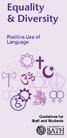 Equality & Diversity Positive Use of Language Guidelines for Staff and Students University of Bath Equality and Diversity This leaflet is produced to assist in the pursuit of corporate aims of supporting
Department of Clinical Health Sciences Social Work Program SCWK 3329 Social Welfare: Policy and Advocacy I
 Page 1 of 9 Department of Clinical Health Sciences Social Work Program SCWK 3329 Social Welfare: Policy and Advocacy I Course Dates, Time, and Location Fall Semester, 2015: August 24, 2015 to December
Racial Harassment and Discrimination Definitions and Examples (quotes are from the Stephen Lawrence Inquiry report, 23 March, 1999)
 APPENDIX C Racial Harassment and Discrimination Definitions and Examples (quotes are from the Stephen Lawrence Inquiry report, 23 March, 1999) Racial Harassment is an act designed to intimidate, humiliate,
Selection of Basic Instructional Materials Adopted for Classroom Use
 Instructional Materials Selection The authority of the Board of Education primarily places the responsibility for the selection of instructional materials with the professional staff of the school district.
Preparing to Serve: Online Training Modules
 Preparing to Serve: Online Training Modules M A S S E N, A. A N D K O W A L E W S K I, B. ( E D S. ) C O P Y R I G H T 2 0 1 0. W E B E R S T A T E U N I V E R S I T Y P R E P A R I N G T O S E R V E :
Professional Culture: Difference in the Workplace
 Module 9: difference in the workplace 1 Your Passport to Professionalism: Module 9 Professional Culture: Difference in the Workplace Steps in this module: 1. Learn: Respond and comment in Whom Do You See?
Change. Each of these themes will be discussed below. Employees
 Becoming a Diverse Law Firm Why it is Important, and the Skills Necessary to be Effective in an Increasingly Diverse Environment By Dr. William Guillory The most compelling question about diversity a law
Chapter Five Socialization. Human Development: Biology and Society. Social Isolation
 Chapter Five Socialization Socialization is the lifelong process of social interaction through which individuals acquire a self-identify and the physical, mental, and social skills needed for survival
Young Men s Work Stopping Violence & Building Community A Multi-Session Curriculum for Young Men, Ages 14 19 From HAZELDEN
 Young Men s Work Stopping Violence & Building Community A Multi-Session Curriculum for Young Men, Ages 14 19 From HAZELDEN What is Young Men s Work? Young Men s Work: Stopping Violence and Building Community
Review of Diversity and Public Administration: Theory, Issues, and Perspectives, 2nd ed.
 Review of Diversity and Public Administration: Theory, Issues, and Perspectives, 2nd ed. by Mitchell F. Rice Review by Laura C. Hand Arizona State University The topic of diversity in public administration
Religious education. Programme of study (non-statutory) for key stage 4. (This is an extract from The National Curriculum 2007)
 Religious education Programme of study (non-statutory) for key stage 4 and years 12 and 13 (This is an extract from The National Curriculum 2007) Crown copyright 2007 Qualifications and Curriculum Authority
History of BaFa' BaFa'
 History of BaFa BaFa A Cross Cultural/Diversity/Inclusion Simulation By R. Garry Shirts Simulation Training Systems www.simulationtrainingsystems.com [email protected] (800) 942-2900 -
MANAGING DIFFICULT BEHAVIOUR
 MANAGING DIFFICULT BEHAVIOUR All materials Lindsay Wright. This pack for sample purposes only and not for re-use. 1 WHAT IS CONFLICT Conflict can be defined as a difference in view between stakeholders;
TOOL KIT for RESIDENT EDUCATOR and MENT OR MOVES
 Get to Know My RE Observe Collect Evidence Mentor Moments Reflect Review Respond Tailor Support Provide Provide specific feedback specific Feedback What does my RE need? Practice Habits Of Mind Share Data
Course Syllabus. AAD 252: Art and Gender
 AAD 252: Art and Gender Course Syllabus Description: This course addresses socio-cultural factors influencing roles of women and men in arts, culture, and society. We will examine underlying social structures
Race, Gender, Sexuality, Ethnicity, Age, Socioeconomic background
 DIVERSITY UNIT MIKE BERGOLD MEYERS HIGH SCHOOL MISSION STATEMENT: To enlighten students and teachers of Meyers High School about diversity and to help understand and appreciate the differences among all
Culture and Mental Health PSYCH 285 (Fall 2012) Tuesday & Thursday 11:00am-12:25pm Room: Graff 307
 Culture and Mental Health PSYCH 285 (Fall 2012) Tuesday & Thursday 11:00am-12:25pm Room: Graff 307 Course Instructor: Prof. Jennifer Wang, PhD, [email protected] Office hours: M-Th 12:30-1:30pm Graff 341-A
THE LEGAL ENVIRONMENT OF BUSINESS GB
 THE LEGAL ENVIRONMENT OF BUSINESS GB 202-001 Spring 2013 Monday Evenings 6-9pm Instructor: Tim Kurtz, J.D., MBA. Phone: 208.794.7524 E-mail: [email protected] Office Hours: By Appointment; After/Before
IQ Testing: A critique for parents of children with developmental disabilities
 IQ Testing: A critique for parents of children with developmental disabilities by Bruce Uditsky Part one of a three-part critique One of the most common assessments parents are told they need in order
GAME 1301. Computer Ethics COURSE SYLLABUS
 Game 1301 Course Syllabus Page 1 COURSE NUMBER AND TITLE: GAME 1301 GAME 1301 Computer Ethics COURSE SYLLABUS COURSE (CATALOG) DESCRIPTION: Computer ethics and related ethical issues that apply to computers
Developing Lesson Plans that are Multicultural
 Consider the following: The nature of the learner. What do you know about the students entry level knowledge and skills; attitudes, values, and beliefs; learning styles; need for structure; family/peer
The Benefits of Understanding Cultural Diversity in Education. Maliha Farhadi
 The Benefits of Understanding Cultural Diversity in Education Maliha Farhadi Diversity The term Diversity, race, language, age, faith, culture, ethnicity.. has direct effects to the growth of children.
Socialization From Infancy to Old Age A. Socialization and the Self self a. Self-identity Socialization
 I. Socialization From Infancy to Old Age A. Socialization and the Self 1. Over our lives, we develop a sense of self: a perception of being a distinct personality with a distinct identity. a. Self-identity:
Diversity within Professional Engineering
 Diversity within Professional Engineering Matt Erickson Fall 2013 Employers & Diversity - Google Google Celebrates Diversity Diversity and inclusion are fundamental to Google s way of doing things. We
Integrating Diversity Training into Doctoral Programs in Mathematics Education
 Transformations Volume 1 Issue 1 Winter 2016 Article 4 1-1-2016 Integrating Diversity Training into Doctoral Programs in Mathematics Education Ruthmae Sears University of South Florida Tonisha B. Lane
NURSING ASSISTANT TRAINING MODEL
 NURSING ASSISTANT TRAINING MODEL Online Course Curriculum INTRODUCTION This model curriculum meets the requirements of the Omnibus Reconciliation Act of 1987. PROGRAM DURATION The curriculum includes objectives,
Independent Listening Task: Stereotypes
 At a glance Level: ISE III Independent Listening Task: Stereotypes Focus: Independent listening task Aims: To develop listening strategies when listening to a lecture on the use of stereotypes in education
Diversity and Equality Policy
 Diversity and Equality Policy For the attention of: All Staff Produced by: Director, Human Resources Approved by: SMT Date of publication: September 2013 Date of review: August 2015 Our Mission To provide
Valuing Diversity & Inclusion with ACPE
 Valuing Diversity & Inclusion with ACPE Audrey D. Hines & Marita Harrell, Facilitators May 6, 2015 Today We Will Application: External Relations & Engagement Self - Awareness Application: Organizational
Activity 1 Myth Busters Disability 13. Activity 15 Growing Up and Growing Older Age 85. Activity 16 Similarities Between Old and Young Age 88
 Equality and Diversity UK Ltd Six Strands of Equality and Diversity Activity Pack EDUK 2008 Contents Introduction About the Activities 4 Introduction Activity Descriptions 5 Introduction Where does equality
Exploring Systemic Macroaggressions and Community Colleges Dr. Luca Lewis Dr. Ata Karim
 Exploring Systemic Macroaggressions and Community Colleges Dr. Luca Lewis Dr. Ata Karim Introduction Welcome Who We Are Training Overview Rules of Engagement Collaborative Exploration Outcomes Learn how
Module: Culturally Competent Care
 Module: Culturally Competent Care Objectives: After completion of the module, students will be able to: Define and/or describe culture, diversity, cultural competence, and cultural diversity Identify steps
WAYS IN WHICH MEN AND WOMEN MAY BE TREATED DIFFERENTLY
 WAYS IN WHICH MEN AND WOMEN MAY BE TREATED DIFFERENTLY Bernice R. Sandler Senior Scholar Women s Research and Education Institute 1350 Connecticut Avenue, NW Suite 850 Washington, DC 20036 [email protected]
PHL 295 Business Ethics (Three Credit Hours) Instructor: Mark Schranz Email: [email protected] Lectures: TBD Office/Hours: TBD
 PHL 295 Business Ethics (Three Credit Hours) Instructor: Mark Schranz Email: [email protected] Lectures: TBD Office/Hours: TBD Course Description In this course we shall examine some fundamental
Catherine Knight Steele [email protected]
 Catherine Knight Steele [email protected] EDUCATION 2014 Ph.D. Communication, University of Illinois Chicago Dissertation: Digital Barbershops: The politics of African American oral culture
High-Impact Practices and Experiences from the Wabash National Study
 1 High-Impact Practices and Experiences from the Wabash National Study In our research thus far, we have found that four broad categories of teaching practices and institutional conditions predict growth
PRESCHOOL. Curriculum for the Preschool Lpfö 98
 PRESCHOOL Curriculum for the Preschool Lpfö 98 Revised 2010 Orders to: Fritzes kundservice SE-106 47 Stockholm Telephone: +46 (0)8 598 191 90 Fax: +46 (0)8 598 191 91 E-mail: [email protected] www.fritzes.se
Reviewing Applicants. Research on Bias and Assumptions
 Reviewing Applicants Research on Bias and Assumptions Weall like to think that we are objective scholars who judge people solely on their credentials and achievements, but copious research shows that every
Five Key Questions of Media Literacy. Five Core Concepts
 PMS 187 U Five Key Questions of Media Literacy 2005 / Center for Media Literacy PMS 187 C 1. 2. Who created this message? What creative techniques are used to attract my attention? 3. How might different
Standards for Student Interpersonal Skills
 Standards for Student Interpersonal Skills Grades PreK 12 Pennsylvania Department of Education TABLE OF CONTENTS Introduction. THE ACADEMIC STANDARDS Self-Awareness and Self-Management.. A. Managing Emotions
PREPARATION: - facilitator coordinates focus of panel, introduces and summarizes - briefs panel
 Lecture - presents factual material in direct, logical manner - contains experience which inspires - stimulates thinking to open discussion - useful for large groups - experts are not always good teachers
Can the criminal justice system be made to operate equitably in relation to race?
 Can the criminal justice system be made to operate equitably in relation to race? Conceptions of race within the criminal justice system have always been a controversial issue. Indeed, there is no denying
Beyond the Bake Sale: The Essential Guide to Family-School Partnerships. Book Study Guide
 Beyond the Bake Sale: The Essential Guide to Family-School Partnerships Book Study Guide Are you interesting in stimulating some creative discussions among teachers about how to work more effectively with
Specialisation Psychology
 Specialisation Psychology Semester 1 Semester 2 An Introduction to Doing Research Politics, Power and Governance I Philosophy of the Social Sciences Economics, Markets and Organisations I Rhetoric Law,
ANOTHER GENERATION OF GENERAL EDUCATION
 ANOTHER GENERATION OF GENERAL EDUCATION Peter K. Bol Charles H. Carswell Professor of East Asian Languages and Civilizations I was asked to set forth some personal reflections rather than to summarize
How To Learn Sociology
 Nick Scharrer North High Room 209 Phone# 803-7667 Office Hours: Monday-Friday, 7:00-4:00PM (or by appointment) [email protected] [email protected] SOCIOLOGY-Course Syllabus Course Description:
North Carolina TEACHER. evaluation process. Public Schools of North Carolina State Board of Education Department of Public Instruction
 North Carolina TEACHER evaluation process Public Schools of North Carolina State Board of Education Department of Public Instruction Rubric for Evaluating North Carolina Teachers ( This form should be
CLASS SYLLABUS Fall 2014 Updated 2/18/2015
 CLASS SYLLABUS Fall 2014 Updated 2/18/2015 Women in Science & Engineering HTS 3021/SOCIOLOGY 11:05-11:55 AM MWF: ARCH (East), Room 107. Instructor: Dr. W. Pearson, Jr. Office: OCE, Room 119 Phone: 385-2265
PRINCIPLES OF MULTICULTURAL PSYCHIATRIC REHABILITATION SERVICES Executive Summary
 PRINCIPLES OF MULTICULTURAL PSYCHIATRIC REHABILITATION SERVICES Executive Summary PRA recognizes the striking disparities in mental health care found for cultural, racial and ethnic minorities in the USA,
Discussion Questions
 Discussion Questions Spring Quarter 2013 Whistling Vivaldi: How Stereotypes Affect Us and What We Can Do 1. Claude Steele says that Whistling Vivaldi is about identity contingencies, or the things you
The Polymath Degree Program
 The Polymath Degree Program Philosophy/Mission If Leonardo da Vinci were alive today, where would he go to college? The Polymath Institute is founded on the principle that all knowledge is interconnected,
Teaching About Controversial Issues
 1 of 7 6/20/2012 10:58 AM site links Site Homepage Environmental Education Learning Resource Center and Library Grants EE Workshops SEEK Minnesota Healthy Schools Program Integrated Pest Management (IPM)
DIVERSITY. Harmony, Division and Solution. Diversity means differences or variations or unlikeness. In our modern world,
 DIVERSITY Harmony, Division and Solution Diversity means differences or variations or unlikeness. In our modern world, diversity plays an important role. Present study, diversity has been sorted with many
Valuing Diversity, Promoting Equality, Equal Opportunity and Inclusion
 Safeguarding and Welfare Requirement: Equal Opportunities. Providers must have and implement a policy and procedure to promote equality of opportunity for children in their care, including support for
Sociology Course of Study
 UNIT ONE: How do sociologists study the world? (January February) 1. The Sociological Perspective 2. The Emergence of Scientific 3. Use of the Scientific Method 4. Difficulties of Sociological Research
Standard 4. Narrative 4.1
 Standard 4 Narrative 4.1 In its curriculum and experiences, the Unit addresses these elements of diversity: ethnicity, race, socioeconomic status, gender, exceptionalities, language, religion, and geographic
NURSING 3580 TRANSCULTURAL COMMUNICATION. Elaine Hummel, MSN, RN, APRN,BC, FNP Office Phone: (706) 864-1938 E-mail: ehummel@northgeorgia.
 NURSING 3580 TRANSCULTURAL COMMUNICATION Elaine Hummel, MSN, RN, APRN,BC, FNP Office Phone: (706) 864-1938 E-mail: [email protected] Revised June 2012 Department of Nursing BSN Nursing Program Course
The Wisconsin Comprehensive School Counseling Model Student Content Standards. Student Content Standards
 The Wisconsin Comprehensive School Counseling Model Student Content Standards The Wisconsin Comprehensive School Counseling Model builds the content of developmental school counseling programs around nine
Review of definition and concept of cultural competence and cultural humility Defining the practice of cultural humility and its application to
 Review of definition and concept of cultural competence and cultural humility Defining the practice of cultural humility and its application to social work practice Exploring the pros and cons of both
The Nine Grounds of Discrimination under the Equal Status Act. Sexual Orientation
 The Nine Grounds of Discrimination under the Equal Status Act Sexual Orientation School Ethos Donabate/Portrane Educate Together National School operates under the direct patronage of Educate Together.
Challenges Faced in a Harassment Investigation
 Challenges Faced in a Harassment Investigation By: Lauren M. Bernardi This article outlines five of the most common challenges faced during a harassment investigation and provides strategies for responding
Dealing with prejudice and bias in work with newcomers
 Company LOGO Dealing with prejudice and bias in work with newcomers Jewish Family Services of Ottawa Agenda Why Do We Need this Training? Helping Newcomers Canadian Values Racism, Bias, Prejudice, Stereotypes
American Attitudes Toward Arabs and Muslims
 American Attitudes Toward Arabs and Muslims July 29, 2014 Executive Summary Since we first began our polling on American attitudes toward Arabs and Muslims in 2010, there has been continued erosion in
The Miniature Guide. How It Learns How It Mislearns. by Dr. Linda Elder and Dr. Richard Paul. Based on Critical Thinking Concepts & Principles
 The Miniature Guide to The Human Mind How It Learns How It Mislearns by Dr. Linda Elder and Dr. Richard Paul Based on Critical Thinking Concepts & Principles The Foundation for Critical Thinking Dear Reader:
The Cultural Plunge: Cultural Immersion as a Means of Self-Awareness and Cultural Sensitivity among Students Teachers. Presented By William Foley
 The Cultural Plunge: Cultural Immersion as a Means of Self-Awareness and Cultural Sensitivity among Students Teachers. Presented By William Foley The number of K-12 students from culturally and linguistically
Introduction to Comparative Study
 Introduction to Comparative Study The comparative study question asks you to compare and contrast two texts under one of the three modes of comparison. The comparative modes for the exam in June 2014 are:
STUDENT WORKLOAD, TEACHING METHODS AND LEARNING OUTCOMES: THE TUNING APPROACH
 STUDENT WORKLOAD, TEACHING METHODS AND LEARNING OUTCOMES: THE TUNING APPROACH The need While many countries in Europe are preparing the implementation of a two cycle system in accordance with the Bologna