
Study Design. Health and Human Development
|
|
|
- Charity Carr
- 10 years ago
- Views:
Transcription
1 Study Design Accreditation period Health and Human Development Victorian Certificate of Education The images shown above represent a cross section of works covering sculpture, textiles, assemblage, drawing, photography, prints, painting and electronic media as exhibited in VCE Top Arts.
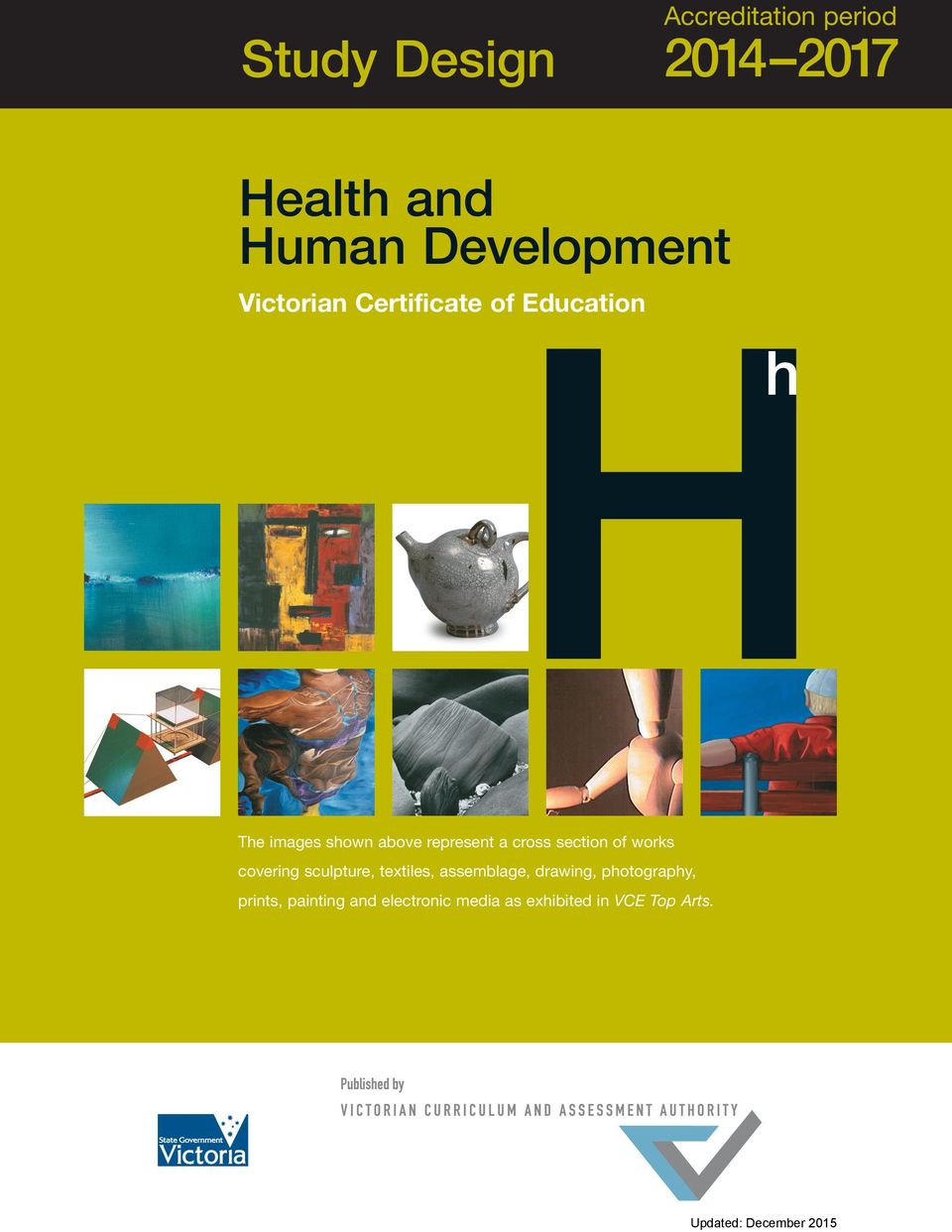
2 COVER ARTWORK WAS SELECTED FROM THE TOP ARTS EXHIBITION. COPYRIGHT REMAINS THE PROPERTY OF THE ARTIST. Latoya BARTON The sunset (detail) from a series of twenty-four 9.0 x 9.0 cm each, oil on board Tarkan ERTURK Visage (detail) x cm synthetic polymer paint, on cotton duck Liana RASCHILLA Teapot from the Crazy Alice set 19.0 x 22.0 x 22.0 cm earthenware, clear glaze. lustres Kate WOOLLEY Sarah (detail) 76.0 x cm, oil on canvas Nigel BROWN Untitled physics (detail) 90.0 x x 70.0 cm composition board, steel, loudspeakers, CD player, amplifier, glass Chris ELLIS Tranquility (detail) 35.0 x 22.5 cm gelatin silver photograph Christian HART Within without (detail) digital film, 6 minutes Kristian LUCAS Me, myself, I and you (detail) 56.0 x cm oil on canvas Merryn ALLEN Japanese illusions (detail) centre back: 74.0 cm, waist (flat): 42.0 cm polyester cotton Ping (Irene VINCENT) Boxes (detail) colour photograph James ATKINS Light cascades (detail) three works, 32.0 x 32.0 x 5.0 cm each glass, flourescent light, metal Tim JOINER 14 seconds (detail) digital film, 1.30 minutes Lucy McNAMARA Precariously (detail) x 61.0 x 61.0 cm painted wood, oil paint, egg shells, glue, stainless steel wire Accredited by the Victorian Registration and Qualifications Authority Level 4, 2 Lonsdale Street, Melbourne, Victoria 3000 Developed and published by the Victorian Curriculum and Assessment Authority Level 1, 2 Lonsdale Street, Melbourne, Victoria 3000 This revised and accredited edition published 2013 Victorian Curriculum and Assessment Authority 2013 No part of this publication may be reproduced except as specified under the Copyright Act 1968 or by permission from the Victorian Curriculum and Assessment Authority. For more information go to: aboutus/policies/policy-copyright.aspx The Victorian Curriculum and Assessment Authority provides the only official, up-to-date versions of Victorian Curriculum and Assessment Authority publications. Details of updates can be found on the Victorian Curriculum and Assessment Authority website: This publication may contain copyright material belonging to a third party. Every effort has been made to contact all copyright owners. If you believe that material in this publication is an infringement of your copyright please the Copyright Officer: [email protected] Copyright in materials appearing at any sites linked to this document rests with the copyright owner/s of these materials, subject to the Copyright Act. The Victorian Curriculum and Assessment Authority recommends you refer to copyright statements at linked sites before using such materials. Edited by Ruth Learner Cover designed by Chris Waldron of BrandHouse Desktop published by Julie Coleman VCE Health and Human Development Study Design ISBN

3 Contents 5 Important information 7 Introduction Scope of study 8 Rationale Aims Structure 9 Entry Duration Changes to the study design Monitoring for quality Safety and wellbeing Employability skills 10 Legislative compliance 11 Assessment and reporting Satisfactory completion Authentication Levels of achievement 13 Unit 1: The health and development of Australia s youth Areas of study and Outcomes 16 Assessment 17 Unit 2: Individual human development and health issues Areas of study and Outcomes 20 Assessment 22 Unit 3: Australia s health Areas of study and Outcomes 25 Assessment 27 Unit 4: Global health and human development Areas of study and Outcomes 30 Assessment

4

5 IMPORTANT INFORMATION Accreditation period Units 1 4: 1 January December 2017 Implementation of this study commences in Other sources of information The VCAA Bulletin VCE, VCAL and VET is the only official source of changes to regulations and accredited studies. The Bulletin, including supplements, also regularly includes advice on VCE studies. It is the responsibility of each VCE teacher to refer to each issue of the Bulletin. The Bulletin is available as an e-newsletter via free subscription on the Victorian Curriculum and Assessment Authority s website at: To assist teachers in assessing School-assessed Coursework in Units 3 and 4, the Victorian Curriculum and Assessment Authority publishes online an assessment handbook that includes advice on the assessment tasks and performance descriptors for assessment. The companion document to the assessment handbook Administrative Procedures for Assessment in VCE Studies is available on the Victorian Curriculum and Assessment Authority s website at: The current VCE and VCAL Administrative Handbook contains essential information on assessment processes and other procedures. VCE providers Throughout this study design the term school is intended to include both schools and other VCE providers. Copyright VCE schools may reproduce parts of this study design for use by teachers. The full Victorian Curriculum and Assessment Authority Copyright Policy is available at: policies/policy-copyright.aspx 5

6

7 Introduction scope of study Through the study of VCE Health and Human Development, students investigate health and human development in local, Australian and global communities. Health is a dynamic condition that is influenced by complex interrelationships between individuals and biomedical and behavioural factors, as well as physical and social environments. These interrelationships are reflected in a social view of health that sees health as being created in the settings where people live and work. This social view of health recognises the need for personal skills development, the importance of empowering communities to take action to promote health, the creation of social and physical environments that are supportive of health and development, an awareness of the impacts on health of public policies and the need for health services to be oriented towards health promotion and the prevention of ill health. The VCE Health and Human Development study approaches the concept of development as a continuum that begins with individual human development and progresses towards human development at a societal level. At an individual level, the study of human development is about individual change, that is, a continuous lifelong process that begins at conception and continues until death. Individual human developmental changes are cumulative; development that occurs in the future is dependent upon development occurring in the past. At a society level, the study takes a global perspective on health and human development and uses definitions of human development that are consistent with approaches taken by both the World Health Organization (WHO) and the United Nations (UN). Human development at this level is about expanding people s choices and enhancing capabilities (the range of things people can be and do) and their freedoms; enabling people to live full, productive and creative lives; having access to knowledge, health and a decent standard of living; and participating in the life of their community and decisions affecting their lives (adapted from the United Nations Development Programme, 1990). The study also promotes the understanding that nutrition plays a major role in influencing both health status and individual human development. 7

8 Introduction HEALTH AND HUMAN DEVELOPMENT Rationale VCE Health and Human Development provides students with the skills and knowledge to make informed decisions about their own health and to recognise the importance of health in society. In undertaking this study, they will be able to actively participate in making appropriate choices that allow for good health and be able to seek appropriate advice. VCE Health and Human Development enables students to understand the current ideologies of health and human development in contemporary society. Students critically evaluate the health and development of the individual across the lifespan in the context of both Australia s and global health and human development. VCE Health and Human Development offers students a range of pathways and caters to those who wish to pursue further formal study in areas such as health promotion, community health research and policy development, humanitarian aid work, allied health practices, education, and the health profession. Aims This study enables students to: develop an understanding of individual human development (physical, social, emotional and intellectual) that occurs through the lifespan stages of prenatal, childhood, youth and adulthood develop an understanding of the physical, mental and social dimensions of health and the interrelationship between health and individual human development develop an understanding that variations in health and human development are influenced by a range of determinants including biological, behavioural and social factors, as well as physical environments critically examine health and human development from an individual, a community, a national and a global perspective develop an understanding of the interdependencies between health, human development and sustainability identify, develop and evaluate behaviours and strategies that promote health and human development analyse the role of governments and non-government agencies in achieving sustainable improvements in health and human development in Australia and globally. Structure The study is made up of four units: Unit 1: The health and development of Australia s youth Unit 2: Individual human development and health issues Unit 3: Australia s health Unit 4: Global health and human development Each unit deals with specific content contained in areas of study and is designed to enable students to achieve a set of outcomes for that unit. Each outcome is described in terms of key knowledge and key skills. A glossary defining terms used across Units 1 to 4 is included in the Advice for teachers companion document on pages vce study design

9 HEALTH AND HUMAN DEVELOPMENT Introduction Entry There are no prerequisites for entry to Units 1, 2 and 3. Students must undertake Unit 3 prior to undertaking Unit 4. Units 1 to 4 are designed to a standard equivalent to the final two years of secondary education. All VCE studies are benchmarked against comparable national and international curriculum. Duration Each unit involves at least 50 hours of scheduled classroom instruction over the duration of a semester. Changes to the Study design During its period of accreditation minor changes to the study will be announced in the VCAA Bulletin VCE, VCAL and VET. The Bulletin is the only source of changes to regulations and accredited studies. It is the responsibility of each VCE teacher to monitor changes or advice about VCE studies published in the Bulletin. MONITORING FOR Quality As part of ongoing monitoring and quality assurance, the Victorian Curriculum and Assessment Authority will periodically undertake an audit of VCE Health and Human Development to ensure the study is being taught and assessed as accredited. The details of the audit procedures and requirements are published annually in the VCE and VCAL Administrative Handbook. Schools will be notified if they are required to submit material to be audited. Safety and wellbeing It is the responsibility of the school to ensure that duty of care is exercised in relation to the health and safety of all students undertaking the study. Teachers should be aware of their school s policies and procedures for providing appropriate support to students. This study may involve investigation of potentially sensitive topics, particularly in relation to mental health. Discussion of potentially sensitive or controversial topics should be consistent with the school ethos as well as community and parental expectations. Teachers should ensure that students have opportunities to consider topics systematically and objectively, and to become aware of the diversity of views held on such matters. Students should not be asked to disclose personal information about their own or family s health status and behaviours nor should they be expected to volunteer this information. EMPLOYABILITY SKILLS This study offers a number of opportunities for students to develop employability skills. The Advice for teachers companion document provides specific examples of how students can develop employability skills during learning activities and assessment tasks. vce study design 9

10 Introduction HEALTH AND HUMAN DEVELOPMENT LEGISLATIVE COMPLIANCE When collecting and using information, the provisions of privacy and copyright legislation, such as the Victorian Information Privacy Act 2000 and Health Records Act 2001, and the federal Privacy Act 1988 and Copyright Act 1968, must be met. 10 vce study design

11 Assessment and reporting SATISFACTORY COMPLETION The award of satisfactory completion for a unit is based on a decision that the student has demonstrated achievement of the set of outcomes specified for the unit. This decision will be based on the teacher s assessment of the student s performance on assessment tasks designated for the unit. Designated assessment tasks are provided in the details for each unit. The Victorian Curriculum and Assessment Authority publishes online an assessment handbook that includes advice on the assessment tasks and performance descriptors for assessment for Units 3 and 4. Teachers must develop courses that provide opportunities for students to demonstrate achievement of outcomes. Examples of learning activities are provided in the Advice for teachers companion document. Schools will report a result for each unit to the Victorian Curriculum and Assessment Authority as S (Satisfactory) or N (Not Satisfactory). Completion of a unit will be reported on the Statement of Results issued by the Victorian Curriculum and Assessment Authority as S (Satisfactory) or N (Not Satisfactory). Schools may report additional information on levels of achievement. Authentication Work related to the outcomes of each unit will be accepted only if the teacher can attest that, to the best of their knowledge, all unacknowledged work is the student s own. Teachers need to refer to the current VCE and VCAL Administrative Handbook for authentication procedures. LEVELS OF ACHIEVEMENT Units 1 and 2 Procedures for the assessment of levels of achievement in Units 1 and 2 are a matter for school decision. Assessment of levels of achievement for these units will not be reported to the Victorian Curriculum and Assessment Authority. Schools may choose to report levels of achievement using grades, descriptive statements or other indicators. 11

12 Assessment and reporting HEALTH AND HUMAN DEVELOPMENT Units 3 and 4 The Victorian Curriculum and Assessment Authority will supervise the assessment of all students undertaking Units 3 and 4. In VCE Health and Human Development the students level of achievement will be determined by School-assessed Coursework and an end-of-year examination. The Victorian Curriculum and Assessment Authority will report students level of performance on each assessment component as a grade from A+ to E or UG (ungraded). To receive a study score, students must achieve two or more graded assessments and receive S for both Units 3 and 4. The study score is reported on a scale of 0 50; it is a measure of how well the student performed in relation to all others who took the study. Teachers should refer to the current VCE and VCAL Administrative Handbook for details on graded assessment and calculation of the study score. Percentage contributions to the study score in VCE Health and Human Development are as follows: Unit 3 School-assessed Coursework: 25 per cent Unit 4 School-assessed Coursework: 25 per cent End-of-year examination: 50 per cent. Details of the assessment program are described in the sections on Units 3 and 4 in this study design. 12 vce study design

13 Unit 1: The health and development of Australia s youth In this unit students are introduced to the concepts of health and individual human development. The World Health Organization (WHO) defines health as a state of complete physical, mental and social well-being and not merely the absence of disease or infirmity (World Health Organization, 1946). The WHO s definition is still widely used today, despite the identification of a number of limitations. Individual human development is a lifelong continuous process beginning at conception and ending with death and is perceived as involving a series of orderly and predictable changes, which can be classified as physical, social, emotional and intellectual. This unit focuses on the health and individual human development of Australia s youth. For the purposes of this study, youth is defined as twelve to eighteen years of age; however, it should be acknowledged that some agencies may use differing age classifications for the stage of youth. There are many factors that influence health and individual human development of youth, including the importance of nutrition. The health status of Australia s youth is good and continues to improve as demonstrated by reductions in morbidity and mortality from communicable diseases, chronic diseases, suicide, motor vehicle accidents and other injuries. However, Australia s youth still experience a range of health issues that affect both their immediate and longer term health and individual human development. In this unit students identify issues that have an impact on the health and individual human development of Australia s youth. Students investigate one health issue in detail and analyse personal, community and government strategies or programs that affect youth health and individual human development. Area of study 1 Understanding youth health and human development In this area of study students develop understanding of the concepts of youth health and individual human development, and explore the interrelationships that exist within and between them. Students become aware of the differing methods for measuring health status and develop a greater understanding of the health status of youth. 13

14 Unit 1 HEALTH AND HUMAN DEVELOPMENT Outcome 1 On completion of this unit the student should be able to describe the dimensions of, and the interrelationships within and between, youth health and individual human development, and analyse the heath status of Australia s youth using appropriate measurements. To achieve this outcome the student will draw on key knowledge and key skills outlined in Area of Study 1. Key knowledge definitions of physical, social, emotional and intellectual development characteristics of, and interrelationships between, physical, social, emotional and intellectual development during the lifespan stage of youth definitions of health and the limitations of these definitions characteristics of, and interrelationships between, physical, social and mental dimensions of health measurements of health status, including life expectancy, incidence, prevalence, trends, morbidity, mortality, disability adjusted life years (DALYs) and burden of disease the health status of Australia s youth biological determinants of health and individual human development of Australia s youth, including genetics, body weight and hormonal changes the interrelationships between health and individual human development during the lifespan stage of youth. Key skills define health and individual human development describe characteristics of, and interrelationships between, the different types of individual human development during the lifespan stage of youth explain the limitations of definitions of health describe the characteristics of, and interrelationships between, the dimensions of health explain health status measurement terms interpret and analyse data on the health status of Australia s youth using appropriate measurements explain the biological determinants of health and development and discuss the impact on the health and development of youth explain the interrelationships between health and human development during the lifespan stage of youth. AREA OF STUDY 2 Youth issues In this area of study students develop understanding of a range of determinants and their ability to influence youth health and individual human development. Students explore the importance of nutrition and the developmental functions it performs in the body, including the consequences of nutritional imbalance on the health and individual human development of youth. 14 vce study design

15 HEALTH AND HUMAN DEVELOPMENT Unit 1 Students investigate in detail one health issue relevant to youth. They explore the impact of this health issue on all dimensions of youth health and individual human development. They develop an understanding of how determinants of health act as risk and/or protective factors in relation to their selected health issue. Students form conclusions about personal, community and government strategies and programs designed to influence and promote youth health and individual human development. Outcome 2 On completion of this unit the student should be able to describe and explain the factors that have an impact on the health and individual human development of Australia s youth, outline health issues relevant to Australia s youth and, in relation to a specific health issue, analyse strategies or programs that have an impact on youth health and development. To achieve this outcome the student will draw on key knowledge and key skills outlined in Area of Study 2. Key knowledge the function of major nutrients for the development of hard tissue, soft tissue, blood tissue and energy the consequence of nutritional imbalance in a youth s diet on short- and long-term health and individual human development food selection models as tools to promote healthy eating during youth determinants of the health and individual human development of Australia s youth, including at least one from each of the following: behavioural, such as sun protection, level of physical activity, food intake, substance use, sexual practices, skills in developing and maintaining friendships and seeking help from health professionals physical environment, such as tobacco smoke in the home, housing environment, work environment, access to recreational facilities social environment: family and community, such as family cohesion, socioeconomic status of parents, media, community and civic participation (sport, recreation, arts and faith-based activities) and access to education health issues facing Australia s youth such as mental health, weight issues (including obesity), injury (including injury and death from drowning), tobacco smoking, alcohol use, illicit substance use and STI prevention the key features of one health issue for Australia s youth, including: its impact on all dimensions of health and individual human development its incidence, prevalence and changes over time (trends) determinants of health that act as risk and/or protective factors government, community and personal strategies or programs designed to promote health and individual human development of youth the range of health care services available to youth and their rights and responsibilities in accessing and using relevant services (including Medicare). Key skills explain the functions of major nutrients for the development of hard tissue, soft tissue, blood tissue and energy during youth explain the possible consequences of nutritional imbalance in a youth s diet on short- and longterm health and individual human development vce study design 15

16 Unit 1 HEALTH AND HUMAN DEVELOPMENT explain how food models can be used as a tool to promote health explain the determinants of health and individual human development and analyse their impact on youth using relevant examples analyse data to draw informed conclusions about the range of health issues facing Australia s youth describe a specific health issue facing Australia s youth gather information on a selected health issue related to youth using a range of sources such as primary data, print and electronic material analyse information on a selected youth health issue and draw informed conclusions about personal, community and government strategies and programs to optimise youth health and development identify the range of health care services available to youth and discuss their rights and responsibilities in accessing and using these services. ASSESSMENT The award of satisfactory completion for a unit is based on a decision that the student has demonstrated achievement of the set of outcomes specified for the unit. This decision will be based on the teacher s assessment of the student s overall performance on assessment tasks designated for the unit. The key knowledge and key skills listed for each outcome should be used for course design and the development of learning activities. The key knowledge and key skills do not constitute a checklist and such an approach is not necessary or desirable for determining the achievement of outcomes. Assessment tasks must be a part of the regular teaching and learning program and must not unduly add to the workload associated with that program. They must be completed mainly in class and within a limited timeframe. Teachers should select a variety of assessment tasks for their assessment program to reflect the key knowledge and key skills being assessed and to provide for different learning styles. For this unit students are required to demonstrate achievement of two outcomes. As a set these outcomes encompass both areas of study. Demonstration of achievement of Outcomes 1 and 2 must be based on the student s performance on a selection of assessment tasks. Where teachers allow students to choose between tasks they must ensure that the tasks they set are of comparable scope and demand. Assessment tasks for this unit are selected from the following: a case study analysis a data analysis a visual presentation, such as a concept/mind map, poster or presentation file a multimedia presentation, using more than two data types (for example, text, still or moving images, sound or numeric) and involving some form of interaction such as hyperlinks an oral presentation, such as a debate or podcast (audio or visual) a blog a test a written response, such as a research assignment or written report. 16 vce study design

17 Unit 2: Individual human development and health issues Individual human development involves a series of orderly and predictable changes, which can be classified as physical, social, emotional and intellectual. Over the lifespan, individuals accumulate life experiences that affect both their health and individual human development. This unit focuses on the health and individual human development for the lifespan stages of prenatal, childhood and adulthood. The prenatal stage is characterised as the most rapid time of growth and physical development during the human lifespan. During this stage the health and development of the embryo/foetus is shaped by a range of determinants, which in turn can have an impact on future health and development. Health and development during childhood has also been identified as having a significant impact on both health and development throughout the rest of the lifespan. There are many determinants of health and development of Australia s children; however, social factors such as family and community are crucial, as children develop through their relationships with others. The lifespan stage of adulthood represents a period of great diversity. The period of adulthood commonly spans a time frame of over sixty years. The health and individual human development of this group can vary considerably and is influenced by a range of determinants, which include physical environment, biological, behavioural and social. In this unit students identify issues that affect the health and individual human development of Australia s mothers and babies, children and adults. Students investigate health issues in detail and analyse personal, community and government strategies and programs that affect the health and individual human development of mothers and babies, children and adults. Area of study 1 Prenatal health and individual development In this area of study students develop understanding of the health and individual human development of Australia s unborn children. Students study the physical changes that occur from conception to birth. Students investigate how determinants, including physical environment, biological, behavioural and social, influence prenatal health and individual human development. 17

18 Unit 2 HEALTH AND HUMAN DEVELOPMENT Outcome 1 On completion of this unit the student should be able to describe and explain factors that affect the health and individual human development during the prenatal stage. To achieve this outcome the student will draw on key knowledge and key skills outlined in Area of Study 1. Key knowledge the process of fertilisation physical development from conception to birth, including the features of the germinal, embryonic and foetal stages the health status of Australia s pregnant women and unborn babies determinants that have an impact on health and individual human development during the prenatal stage of the lifespan, including at least one from each of the following: biological, such as genetics behavioural, such as maternal nutrition prior to and during pregnancy, parental smoking, alcohol and drug use during pregnancy, and vaccination physical environment, such as tobacco smoke in the home and access to healthcare social, such as parental education, parental income, parental health and disability and access to healthcare determinants that act as risk and/or protective factors in relation to one health issue such as spina bifida, low birth weight, foetal alcohol syndrome or gestational diabetes government, community and personal strategies and programs designed to promote health and individual human development of pregnant women and unborn children. Key skills describe the characteristics of physical development from conception to birth interpret data on health status of pregnant women and unborn babies explain the determinants of health and individual human development and their impact during the prenatal stage of the lifespan using relevant examples describe a specific health issue affecting the prenatal stage of the lifespan and draw informed conclusions about personal, community and government strategies and programs to optimise prenatal health and development. AREA OF STUDY 2 Child health and individual development The focus of this area of study is the development of students understanding of the health and individual human development of Australia s children. Students study the period from birth to approximately twelve years. They explore the physical, social, emotional and intellectual changes that occur from birth to late childhood. Students investigate how determinants, including physical environment, biological, behavioural and social, influence child health and development. 18 vce study design

19 HEALTH AND HUMAN DEVELOPMENT Unit 2 Outcome 2 On completion of this unit the student should be able to describe and explain factors that affect the health and individual human development of Australia s children. To achieve this outcome the student will draw on key knowledge and key skills outlined in Area of Study 2. Key knowledge physical, social, emotional and intellectual development from birth to late childhood the principles of individual human development the health status of Australia s children determinants of the health and individual human development of Australia s children, including at least one from each of the following: biological, such as genetics, birth weight and body weight behavioural, such as eating habits, level of physical activity, oral hygiene, breastfeeding and vaccination physical environment, such as tobacco smoke in the home, housing environment, fluoridation of water and access to recreational facilities social, such as parental education, parenting practices, media and access to healthcare determinants that act as risk and/or protective factors in relation to one health issue such as asthma, falls and injuries, food allergies, juvenile arthritis or type 1 diabetes government, community and personal strategies and programs designed to promote the health and human individual development of children. Key skills describe the characteristics of individual human development from birth to late childhood interpret data on the health status of Australia s children explain the determinants of health and individual human development and their impact on children using relevant examples describe a specific health issue facing Australia s children and draw informed conclusions about personal, community and government strategies and programs to optimise child health and development. AREA OF STUDY 3 Adult health and individual development The focus of this area of study is the development of students understanding of the health and individual human development of Australia s adults, including older adults. Students explore the physical, social, emotional and intellectual changes that occur during adulthood. They describe the health status of Australia s adults, including the various determinants that have an impact on health and individual human development. Outcome 3 On completion of this unit the student should be able to describe and explain the factors that affect the health and individual human development of Australia s adults. To achieve this outcome the student will draw on key knowledge and key skills outlined in Area of Study 3. vce study design 19

20 Unit 2 HEALTH AND HUMAN DEVELOPMENT Key knowledge the different classifications of the stages of adulthood characteristics of physical development during adulthood, including the physiological changes associated with ageing the social, emotional and intellectual development associated with the stages of adulthood and ageing the health status of Australia s adults, including the similarities and differences between adult males and females determinants of health and individual human development of Australia s adults, including at least one from each of the following: biological, such as genetics, body weight, blood pressure and blood cholesterol behavioural, such as sun protection, smoking, physical activity, food intake, alcohol and drug use and sexual practices physical environment, such as housing, workplace safety, neighbourhood safety and access to healthcare social, such as media, level of education, employment status and income, the workplace, community belonging, that is, voluntary work and social connections, living arrangements, social support, family and work life balance determinants that act as risk and/or protective factors in relation to one health issue such as cardiovascular disease, cancer, type 2 diabetes, obesity or mental illness government, community and personal strategies and programs designed to promote health and individual human development of adults. Key skills describe the stages of adulthood and ageing describe the characteristics of development during adulthood interpret data on the health status of Australia s adults explain the determinants of health and individual human development and their impact on adults using relevant examples describe a specific health issue facing Australia s adults and draw informed conclusions about personal, community and government strategies and programs to optimise adult health and development. assessment The award of satisfactory completion for a unit is based on a decision that the student has demonstrated achievement of the set of outcomes specified for the unit. This decision will be based on the teacher s assessment of the student s overall performance on assessment tasks designated for the unit. The key knowledge and key skills listed for each outcome should be used for course design and the development of learning activities. The key knowledge and key skills do not constitute a checklist and such an approach is not necessary or desirable for determining the achievement of outcomes. Assessment tasks must be a part of the regular teaching and learning program and must not unduly add to the workload associated with that program. They must be completed mainly in class and within a limited timeframe. Teachers should select a variety of assessment tasks for their assessment program to reflect the key knowledge and key skills being assessed and to provide for different learning styles. 20 vce study design

21 HEALTH AND HUMAN DEVELOPMENT Unit 2 For this unit students are required to demonstrate achievement of three outcomes. As a set these outcomes encompass all areas of study. Demonstration of achievement of Outcomes 1, 2 and 3 must be based on the student s performance on a selection of assessment tasks. Where teachers allow students to choose between tasks they must ensure that the tasks they set are of comparable scope and demand. Assessment tasks for this unit are selected from the following: a case study analysis a data analysis a visual presentation, such as a concept/mind map, poster or presentation file a multimedia presentation, using more than two data types (for example, text, still or moving images, sound or numeric) and involving some form of interaction such as hyperlinks an oral presentation, such as a debate or podcast (audio or visual) a blog a test a written response, such as a research assignment or written report. vce study design 21
22 Unit 3: Australia s health Australians generally enjoy good health and are among the healthiest people in the world. The health status of Australians can be measured in many ways, such as consideration of burden of disease, health adjusted life expectancy, disability adjusted life years (DALYs), life expectancy, under-five mortality rate, mortality and morbidity rates, incidence and prevalence of disease. Despite Australia s good health status, there is still potential for improvements. The National Health Priority Areas (NHPAs) initiative provides a national approach that aims to improve health status in the areas that contribute most of the burden of disease in Australia. Regardless of how health is measured, health is not shared equally by all Australians. Different levels of health are experienced by different groups, which can be attributed to the determinants of health, including the physical environment, biological, behavioural and social. Funding for the Australian health system involves a combination of both government and nongovernment sources. The Australian Government makes a significant contribution to the health system through the funding of Medicare. Both government and non-government organisations play an important role in the implementation of a range of initiatives designed to promote health in Australia. Area of study 1 Understanding Australia s health In this area of study students develop understanding of the health status of Australians by investigating the burden of disease and the health of population groups in Australia. Students use key health measures to compare health in Australia and analyse how determinants of health, including the physical environment, biological, behavioural and social, contribute to variations in health status. The NHPAs initiative seeks to bring a national health policy focus to diseases and conditions that have a major impact on the health of Australians. The NHPAs represent the disease groups with the largest burden of disease and potential costs (direct, indirect and intangible) to the Australian community. Students examine the development of the NHPAs and their relationship to burden of disease in Australia. They analyse initiatives designed to promote health relevant to the NHPAs, and come to understand that nutrition is an important factor for a number of the NHPAs. 22
23 HEALTH AND HUMAN DEVELOPMENT Unit 3 Outcome 1 On completion of this unit the student should be able to compare the health status of Australia s population with that of other developed countries, compare and explain the variations in health status of population groups within Australia and discuss the role of the National Health Priority Areas in improving Australia s health status. To achieve this outcome the student will draw on key knowledge and key skills outlined in Area of Study 1. Key knowledge definitions of physical, social and mental dimensions of health and health status different measures of health status of Australians, including the meaning of burden of disease, health adjusted life expectancy and disability adjusted life years (DALYs), life expectancy, under-five mortality rate, mortality, morbidity, incidence and prevalence health status of Australians compared with populations in other developed countries variations in the health status of population groups in Australia, including males and females, higher and lower socioeconomic status groups, rural and remote populations and Indigenous populations the role of determinants of health, including the physical environment, biological, behavioural and social, in explaining variations in health status the National Health Priority Areas (NHPAs) including: key features and reasons for selection of each NHPA determinants that act as risk factors direct, indirect and intangible costs to individuals and communities of NHPAs one health promotion program relevant to each NHPA the role of nutrition in addressing the following conditions recognised in the NHPAs: cardiovascular disease, diabetes mellitus, colorectal cancer, obesity and osteoporosis, taking into account, where relevant, the function (as a determinant of health) and major food sources of protein, carbohydrate (including fibre), fats (mono, poly, saturated and trans), water, calcium, phosphorus, sodium and vitamin D. Key skills define key health terms use and interpret data to compare the health status of Australia s population with that of other developed countries use and interpret data to compare the health status of selected population groups within Australia use the determinants of health to explain differences in the health status of Australians and between population groups explain and justify one health promotion program that addresses each NHPA explain the role of nutrition in addressing specific conditions within the NHPAs, including the functions and major food sources of relevant nutrients. vce study design 23
24 Unit 3 HEALTH AND HUMAN DEVELOPMENT AREA OF STUDY 2 Promoting health in Australia This area of study examines different models of health and health promotion. Students investigate the roles and responsibilities of governments in addressing health needs and promoting health for all through the provision of a national health system and health promotion initiatives. They examine the role of government and non-government organisations in providing programs and support for the promotion of healthy eating. Outcome 2 On completion of this unit the student should be able to discuss and analyse approaches to health and health promotion, and describe Australia s health system and the different roles of government and non-government organisations in promoting health. To achieve this outcome the student will draw on key knowledge and key skills outlined in Area of Study 2. Key knowledge models of health and health promotion including: biomedical model of health social model of health the Ottawa Charter for Health Promotion the role of VicHealth including: the mission and strategic priorities of VicHealth potential health outcomes of a VicHealth funded project and how it reflects the social model of health Australia s health system including: local, state and federal governments responsibilities for health and health funding the values that underpin the Australian health system Medicare, Pharmaceutical Benefits Scheme (PBS) and private health insurance the role of Australia s governments in promoting healthy eating through: the information provided by nutrition surveys and how it is used the Australian Guide to Healthy Eating and Dietary Guidelines for Australian Adults the role of Australia s non-government agencies, including Nutrition Australia, in providing dietary advice to promote healthy eating. Key skills analyse the different models of health and health promotion identify and explain key components of Australia s health system describe the role of VicHealth including the mission and strategic priorities identify the principles of the social model of health evident in a VicHealth project explain and draw informed conclusions about the role of government and non-government agencies in promoting healthy eating. 24 vce study design
25 HEALTH AND HUMAN DEVELOPMENT Unit 3 Assessment The award of satisfactory completion for a unit is based on a decision that the student has demonstrated achievement of the set of outcomes specified for the unit. This decision will be based on the teacher s assessment of the student s overall performance on assessment tasks designated for the unit. The Victorian Curriculum and Assessment Authority publishes online an assessment handbook for this study that includes advice on the assessment tasks and performance descriptors for assessment. The key knowledge and key skills listed for each outcome should be used for course design and the development of learning activities. The key knowledge and key skills do not constitute a checklist and such an approach is not necessary or desirable for determining the achievement of outcomes. Assessment of levels of achievement The student s level of achievement in Unit 3 will be determined by School-assessed Coursework and an end-of-year examination. Contribution to final assessment School-assessed Coursework for Unit 3 will contribute 25 per cent. The level of achievement for Units 3 and 4 is also assessed by an end-of-year examination, which will contribute 50 per cent. School-assessed Coursework Teachers will provide to the Victorian Curriculum and Assessment Authority a score representing an assessment of the student s level of achievement. The score must be based on the teacher s rating of performance of each student on the tasks set out in the following table and in accordance with the assessment handbook published online by the Victorian Curriculum and Assessment Authority. The assessment handbook also includes advice on the assessment tasks and performance descriptors for assessment. Assessment tasks must be a part of the regular teaching and learning program and must not unduly add to the workload associated with that program. They must be completed mainly in class and within a limited timeframe. Where teachers provide a range of options for the same assessment task, they should ensure that the options are of comparable scope and demand. Teachers should select a variety of assessment tasks for their program to reflect the key knowledge and key skills being assessed and to provide for different learning styles. vce study design 25
26 Unit 3 HEALTH AND HUMAN DEVELOPMENT Outcomes Marks allocated* Assessment tasks Outcome 1 Compare the health status of Australia s population with that of other developed countries, compare and explain the variations in health status of population groups within Australia and discuss the role of the National Health Priority Areas in improving Australia s health status. 30 A response on the relative health status of Australians in one or more of the following formats: a case study analysis a data analysis a visual presentation, such as a concept/mind map, poster or presentation file a multimedia presentation using more than two data types (for example, text, still or moving images, sound or numeric) and involving some form of interaction such as hyperlinks an oral presentation, such as a debate or podcast (audio or visual) a blog a test (multiple-choice, short-answer and/or extended response) a written response. 30 A response on the National Health Priority Areas in one or more of the following formats: a case study analysis a data analysis a visual presentation such as a concept/mind map, poster or presentation file a multimedia presentation, using more than two data types (for example, text, still or moving images, sound or numeric) and involving some form of interaction such as hyperlinks an oral presentation, such as a debate or podcast (audio or visual) a blog a test (multiple-choice, short-answer and/or extended response) a written response. Outcome 2 Discuss and analyse approaches to health and health promotion, and describe Australia s health system and the different roles of government and nongovernment organisations in promoting health. 40 A response in one or more of the following formats: a case study analysis a data analysis a visual presentation, such as a concept/mind map, poster or presentation file a multimedia presentation using more than two data types (for example, text, still or moving images, sound or numeric) and involving some form of interaction such as hyperlinks an oral presentation, such as a debate or podcast (audio or visual) a blog a test (multiple-choice, short-answer and/or extended response) a written response. Total marks 100 *School-assessed Coursework for Unit 3 contributes 25 per cent. 26 vce study design
27 Unit 4: Global health and human development This unit takes a global perspective on achieving sustainable improvements in health and human development. In the context of this unit human development is about creating an environment in which people can develop to their full potential and lead productive, creative lives in accord with their needs and interests. It is about expanding people s choices and enhancing capabilities (the range of things people can be and do), having access to knowledge, health and a decent standard of living, and participating in the life of their community and decisions affecting their lives (adapted from the United Nations Development Programme, 1990). Sustainability implies meeting the needs of the present without compromising the ability of future generations to meet their own needs (96th plenary meeting of the UN, December 1987). The United Nations (UN) human development work is encapsulated in the Sustainable Development Goals, where the world s countries have agreed to a set of measurable goals and targets. The Sustainable Development Goals resolve to end poverty and hunger; to promote health and wellbeing; to combat inequalities within and among countries; to build peaceful, just and inclusive societies; to protect human rights and promote gender equity and empowerment of women and girls. A significant focus of the Sustainable Development Goals is reducing the inequalities that result in human poverty and lead to inequalities in health status and human development. The World Health Organization (WHO) is the directing and coordinating authority for international health within the United Nations. Both the WHO and the UN have a range of strategies aimed at reducing global burdens of disease and promoting human development through the achievement of the Sustainable Development Goals. The Department of Foreign Affairs and Trade (DFAT) manages the Australian Government s overseas aid program. DFAT aims to reduce poverty in developing countries and improve human development, with a focus on assisting developing countries to achieve the Sustainable Development Goals. Non-government organisations also play a role in promoting sustainable human development. 27
28 Unit 4 HEALTH AND HUMAN DEVELOPMENT Area of study 1 Introducing global health and human development This area of study explores global health, human development and sustainability. Students identify similarities and differences in the health status between people living in developing countries and Australians, and analyse reasons for the differences. The role of the United Nations Sustainable Development Goals is investigated in relation to achieving sustainable improvements in health status and human development. Outcome 1 On completion of this unit the student should be able to analyse factors contributing to variations in health status between Australia and developing countries, and explain the contribution the United Nations Sustainable Development Goals can make to promoting global health and sustainable human development. To achieve this outcome the student will draw on key knowledge and key skills outlined in Area of Study 1. Key knowledge characteristics of developed and developing countries, including high/low mortality strata definitions of sustainability (including elements of appropriateness, affordability, equity) and human development (including the human development index) according to the UN similarities and differences in health status and human development between developing countries and Australia in relation to morbidity, mortality, life expectancy, burden of disease and human development index the influence on the health status of developing countries compared to Australia of income, gender equality, peace/political stability, education, access to healthcare, global marketing (of alcohol, tobacco and fast/processed foods) and physical environments the UN s Sustainable Development Goals (1, 2, 3, 4, 5, 6, 8 and 16) and reasons why they are important. Key skills define human development and sustainability concepts use, interpret and analyse data to draw informed conclusions about the health status and human development of developing countries compared to Australia compare factors that influence the health status and human development of Australia and developing countries describe the UN s Sustainable Development Goals (1, 2, 3, 4, 5, 6, 8 and 16) and why they are important explain the contribution the UN s Sustainable Development Goals could make to global health and sustainable human development. 28 vce study design
29 HEALTH AND HUMAN DEVELOPMENT Unit 4 AREA OF STUDY 2 Promoting global health and human development This area of study explores the role of international organisations including the UN and WHO in achieving sustainable improvements in health and human development. Students consider strategies designed to promote health and sustainable human development globally, as well as Australia s contribution to international health programs and contributions to non-government organisations. Outcome 2 On completion of this unit the student should be able to describe and evaluate programs implemented by international and Australian government and non-government organisations, and analyse the interrelationships between health, human development and sustainability. To achieve this outcome the student will draw on key knowledge and key skills outlined in Area of Study 2. Key knowledge the interrelationships between health, human development and sustainability to produce sustainable human development in a global context different types of aid, including emergency aid, bilateral and multilateral, non-government organisation aid, and how they are used to achieve global health and sustainable human development the role of the UN in providing global health and sustainable development through the following areas of action: world peace and security, human rights, humanitarian assistance and social and economic development the agenda of the WHO in promoting global health and sustainable human development the priorities of the Australian Government s aid initiatives and the role it plays in developing programs to improve global health and sustainable human development the role of non-government organisations based in Australia in promoting global health and sustainable human development programs focusing on literacy, food security, HIV/AIDS and malaria, immunisation, safe water and sanitation in terms of: reasons for each program types of aid involved in the programs implementation of the programs their contribution to the achievement of sustainable human development. Key skills identify and explain different types of aid and evaluate their contribution towards achieving global health and sustainable human development describe the role of international and Australian government and non-government agencies and organisations in promoting global health and sustainable development interpret and analyse data analyse and evaluate aid programs in terms of the elements of sustainability and their contribution to health and sustainable human development analyse the interrelationships between health, human development and sustainability in a range of scenarios. vce study design 29
30 Unit 4 HEALTH AND HUMAN DEVELOPMENT assessment The award of satisfactory completion for a unit is based on a decision that the student has demonstrated achievement of the set of outcomes specified for the unit. This decision will be based on the teacher s assessment of the student s overall performance on assessment tasks designated for the unit. The Victorian Curriculum and Assessment Authority publishes online an assessment handbook for this study that includes advice on the assessment tasks and performance descriptors for assessment. The key knowledge and key skills listed for each outcome should be used for course design and the development of learning activities. The key knowledge and key skills do not constitute a checklist and such an approach is not necessary or desirable for determining the achievement of outcomes. Assessment of levels of achievement The student s level of achievement for Unit 4 will be determined by School-assessed Coursework and an end-of-year examination. Contribution to final assessment School-assessed Coursework for Unit 4 will contribute 25 per cent. The level of achievement for Units 3 and 4 is also assessed by an end-of-year examination, which will contribute 50 per cent. School-assessed Coursework Teachers will provide to the Victorian Curriculum and Assessment Authority a score representing an assessment of the student s level of achievement. The score must be based on the teacher s rating of performance of each student on the tasks set out in the following table and in accordance with the assessment handbook published online by the Victorian Curriculum and Assessment Authority. The assessment handbook also includes advice on the assessment tasks and performance descriptors for assessment. Assessment tasks must be a part of the regular teaching and learning program and must not unduly add to the workload associated with that program. They must be completed mainly in class and within a limited timeframe. Where teachers provide a range of options for the same assessment task, they should ensure that the options are of comparable scope and demand. Teachers should select a variety of assessment tasks for their program to reflect the key knowledge and key skills being assessed and to provide for different learning styles. 30 vce study design
31 HEALTH AND HUMAN DEVELOPMENT Unit 4 Outcomes Marks allocated* Assessment tasks Outcome 1 Analyse factors contributing to variations in health status between Australia and developing countries, and evaluate progress towards the United Nations Sustainable Development Goals. 25 A response on the variations in health status between developing countries and Australia in one or more of the following formats: a case study analysis a data analysis a visual presentation, such as a concept/mind map, poster or presentation file a multimedia presentation using more than two data types (for example, text, still or moving images, sound or numeric) and involving some form of interaction such as hyperlinks an oral presentation, such as a debate or podcast (audio or visual) a blog a test (multiple-choice, short-answer and/or extended response) a written response. 25 A response on the contribution of the Sustainable Development Goals to global health and sustainable human development in one or more of the following formats: a case study analysis a data analysis a visual presentation, such as a concept/mind map, poster or presentation file a multimedia presentation using more than two data types (for example, text, still or moving images, sound or numeric) and involving some form of interaction such as hyperlinks an oral presentation, such as a debate or podcast (audio or visual) a blog a test (multiple-choice, short-answer and/or extended response) a written response. Outcome 2 Describe and evaluate programs implemented by international and Australian government and non-government organisations, and analyse the interrelationships between health, human development and sustainability. 50 A response in one or more of the following formats: a case study analysis a data analysis a visual presentation, such as a concept/mind map, poster or presentation file a multimedia presentation using more than two data types (for example, text, still or moving images, sound or numeric) and involving some form of interaction such as hyperlinks a blog a test (multiple-choice, short-answer and/or extended response) a written response. Total marks 100 *School-assessed Coursework for Unit 4 contributes 25 per cent. vce study design 31
32 Unit 4 HEALTH AND HUMAN DEVELOPMENT End-of-year examination Description The examination will be set by a panel appointed by the Victorian Curriculum and Assessment Authority. All the key knowledge and key skills that underpin the outcomes in Units 3 and 4 are examinable. Conditions The examination will be completed under the following conditions: Duration: two hours. Date: end-of-year, on a date to be published annually by the Victorian Curriculum and Assessment Authority. Victorian Curriculum and Assessment Authority examination rules will apply. Details of these rules are published annually in the VCE and VCAL Administrative Handbook. The examination will be marked by assessors appointed by the Victorian Curriculum and Assessment Authority. Contribution to final assessment The examination will contribute 50 per cent. Further advice The Victorian Curriculum and Assessment Authority publishes specifications for all VCE examinations on the Victorian Curriculum and Assessment Authority website. Examination specifications include details about the sections of the examination, their weighting, the question format/s and any other essential information. The specifications are published in the first year of implementation of the revised Units 3 and 4 sequence together with any sample material. 32 vce study design
Health and Human Development
 Health and Human Development 2010 2013 Victorian Certificate of Education Study Design Victorian Curriculum and Assessment Authority 2009 Accredited by the Victorian Registration and Qualifications Authority
Media. Victorian Certificate of Education Study Design
 Media Victorian Certificate of Education Study Design Version 1: Updated October 2011 (VCAA Bulletin VCE, VCAL and VET, October 2011, p. 8) Version 2: Updated March 2013 (School-assessed Task information
Business Management. Victorian Certificate of Education Study Design. Victorian Curriculum and Assessment Authority 2009
 Business Management Victorian Certificate of Education Study Design Victorian Curriculum and Assessment Authority 2009 COVER ARTWORK WAS SELECTED FROM THE TOP ARTS EXHIBITION. COPYRIGHT REMAINS THE PROPERTY
Religion and Society
 Religion and Society Victorian Certificate of Education Study Design Victorian Curriculum and Assessment Authority 2010 VICTORIAN CURRICULUM AND ASSESSMENT AUTHORITY COVER ARTWORK WAS SELECTED FROM THE
Visual Communication Design
 Accreditation period 2013 2017 Visual Communication Design Victorian Certificate of Education Study Design The images shown above represent a cross section of works covering sculpture, textiles, assemblage,
Sociology. Victorian Certificate of Education Study Design
 Sociology Victorian Certificate of Education Study Design Victorian Curriculum and Assessment Authority 2011 COVER ARTWORK WAS SELECTED FROM THE TOP ARTS EXHIBITION. COPYRIGHT REMAINS THE PROPERTY OF THE
VCE Health and Human Development 2014 2017
 VCE Health and Human Development 2014 2017 Written examination End of year Examination specifications Overall conditions The examination will be sat at a time and date to be set annually by the Victorian
Music. Victorian Certificate of Education Study Design. Victorian Curriculum and Assessment Authority 2010
 Music Victorian Certificate of Education Study Design Victorian Curriculum and Assessment Authority 2010 VICTORIAN CURRICULUM AND ASSESSMENT AUTHORITY COVER ARTWORK WAS SELECTED FROM THE TOP ARTS EXHIBITION.
Southern Grampians & Glenelg Shires COMMUNITY PROFILE
 Southern Grampians & Glenelg Shires COMMUNITY PROFILE Contents: 1. Health Status 2. Health Behaviours 3. Public Health Issues 4. References This information was last updated on 14 February 2007 1. Health
Teaching the Accounting Study Design 2012 2016
 Teaching the Accounting Study Design 2012 2016 This document will address the key changes to the key knowledge and key skills in the 2012 2016 VCE Accounting Study Design. There has been re-wording for
Maternal and Child Health Service. Program Standards
 Maternal and Child Health Service Maternal and Child Health Service Program Standards Contents Terms and definitions 3 1 Introduction 6 1.1 Maternal and Child Health Service: Vision, mission, goals and
PROGRAM FOR LICENSING ASSESSMENTS FOR COLORADO EDUCATORS (PLACE ) OBJECTIVES FIELD 031: HEALTH
 PROGRAM FOR LICENSING ASSESSMENTS FOR COLORADO EDUCATORS (PLACE ) OBJECTIVES Subareas Physical Health Mental Health Social Health Community Health PHYSICAL HEALTH Understand the stages of physical growth
Improving School Sport and Physical Education in your School
 Improving School Sport and Physical Education in your School Published by the Student Learning Division Office of Government School Education Department of Education and Early Childhood Development Melbourne
Teaching the Business Management Study Design 2010 2014
 Teaching the Business Management Study Design 2010 2014 Key Knowledge and Key Skill Changes This document will address some of the key changes to the key knowledge and key skills statements in the 2010
Mathematics. Victorian Certificate of Education Study Design. Version 1: Updated February 2010
 Mathematics Victorian Certificate of Education Study Design Version 1: Updated February 2010 Victorian Curriculum and Assessment Authority 2010 Accredited by the Victorian Qualifications Authority 33 St
King County City Health Profile Vashon Island
 King County City Health Profile Vashon Island West Seattle North Highline Burien SeaTac/Tukwila Vashon Island Des Moines/Normandy Park Kent-West East Federal Way Fed Way-Dash Point/Woodmont December, 212
Bachelor of Bachelor of Education (Honours)
 Bachelor of Bachelor of Education (Honours) Detailed Course Requirements The 2016 Monash University Handbook will be available from October 2015. This document contains interim 2016 course requirements
South Australian Women s Health Policy
 South Australian Women s Health Policy 1 2 South Australian Women s Health Policy To order copies of this publication, please contact: Department of Health PO Box 287 Rundle Mall Adelaide SA 5000 Telephone:
Foreword. Closing the Gap in Indigenous Health Outcomes. Indigenous Early Childhood Development. Indigenous Economic Participation.
 National Aboriginal and Torres Strait Islander Health Workforce Strategic Framework 2011 2015 Prepared for The Australian Health Ministers Advisory Council by the Aboriginal and Torres Strait Islander
Providing support to vulnerable children and families. An information sharing guide for registered school teachers and principals in Victoria
 Providing support to vulnerable children and families An information sharing guide for registered school teachers and principals in Victoria Service Coordination Tool Templates 2006 reference guide Providing
Bachelor of Health Sciences
 Medicine, Nursing and Health Sciences Bachelor of Health Sciences Bachelor of Emergency Health and Paramedic Practice Bachelor of Human Services Bachelor of Public Health Science Bachelor of Radiation
Procedures for Assessment in VCE Studies
 Procedures for Assessment in VCE Studies 2015 Contents Procedures for Assessment in VCE Studies... 1 Introduction... 1 School-based Assessment... 1 Satisfactory completion of VCE units... 1 The VCAA rules
Victorian Guidelines
 Victorian Guidelines Secondary School Nursing Program Victorian Secondary School Nursing Program Guidelines Published by Rural and Regional Health and Aged Care Division Victorian Government Department
Field 011: Career and Technical Education Family and Consumer Sciences Assessment Blueprint
 Field 011: Career and Technical Education Family and Consumer Sciences Assessment Blueprint Domain I Family Studies, Human Development, and Education 0001 Career, Community, and Family Connections (Standard
HLTEN516B Apply understanding of the Australian health care system
 HLTEN516B Apply understanding of the Australian health care system Release: 1 HLTEN516B Apply understanding of the Australian health care system Modification History Not Applicable Unit Descriptor Descriptor
17/02/2015 Katie Williams Senior Industry Development Officer Exercise & Sports Science Australia [email protected]
 17/02/2015 Katie Williams Senior Industry Development Officer Exercise & Sports Science Australia [email protected] Re: Stakeholder feedback on AWLC401 Certificate IV in Weight Management. To
Bachelor of Health Sciences
 Bachelor of Health Sciences Detailed Course Requirements The 2016 Monash University Handbook will be available from October 2015. This document contains interim 2016 course requirements information. Description
A national framework for health promoting schools (2000-2003)
 A national framework for health promoting schools (2000-2003) National Health Promoting Schools Initiative Logo Commonwealth Department of Health and Family Services Australian Health Promoting Schools
Key Priority Area 1: Key Direction for Change
 Key Priority Areas Key Priority Area 1: Improving access and reducing inequity Key Direction for Change Primary health care is delivered through an integrated service system which provides more uniform
National curriculum for the Bachelor's Degree Programme in Nutrition and Health WWW.UVM.DK
 National curriculum for the Bachelor's Degree Programme in Nutrition and Health WWW.UVM.DK Table of contents Bachelor in nutrition and health... 4 The professional field of a bachelor in nutrition and
Children s Health and Nursing:
 Children s Health and Nursing: A Summary of the Issues What s the issue? The foundation for healthy growth and development in later years is established to a large degree in the first six years of life.
VCE Food and Technology: Administrative information for Schoolbased Assessment in 2016
 VCE Food and Technology: Administrative information for Schoolbased Assessment in 2016 Units 3 and 4 School-assessed Task The School-assessed Task contributes 40 per cent to the study score and is commenced
Take Care New York 2016: An Agenda for Healthier New York City
 Take Care New York 2016: An Agenda for Healthier New York City Presentation to the Health Committee of Community Board 6 Camellia Mortezazadeh, MPH, Executive Director, Take Care New York and Ewel Napier,
Georgia Performance Standards. Health Education
 HIGH SCHOOL Students in high school demonstrate comprehensive health knowledge and skills. Their behaviors reflect a conceptual understanding of the issues associated with maintaining good personal health.
How To Write A School Based Assessment
 2015 General administrative information for the audit and review of school-based assessment for all VCE studies Units 3 The information contained in this document should be read in conjunction with the
Career paths and opportunities for the Dental Assistant
 Career paths and opportunities for the Dental Assistant Ms Eleanor Schroeder Program Coordinator Dental Assistant Programs Session overview Career pathways for the qualified Dental Assistant (Certificate
Get a move on The importance of school-based initiatives to increase children s physical activity
 Get a move on The importance of school-based initiatives to increase children s physical activity Andrew Barr MLA Minister for Education and Training Minister for Sport and Recreation 1 Message from the
Australian Nursing Federation (Victorian Branch)
 Australian Nursing Federation (Victorian Branch) 17 th February 2012 Lisa Fitzpatrick State Secretary Box 12600 A Beckett Street PO Melbourne Victoria Telephone: 03 9275 9333 Fax: 03 9275 9344 www.anfvic.asn.au
Chapter 3 Curriculum, teaching and learning
 Chapter 3 Curriculum, teaching and learning We need school leaders to provide encouragement, guidance and support to ensure the curriculum is implemented as planned, to ensure that teachers have access
9-12. Health and Wellness Curriculum Framework. Revised 2011
 9-12 Health and Wellness Curriculum Framework Revised 2011 Course Title: Health and Wellness Course/Unit Credit:.05 Course Number: 480000 Teacher Licensure: Please refer to the Course Code Management System
VCE Studio Arts: Administrative advice for School-based Assessment in 2015
 VCE Studio Arts: Administrative advice for School-based Assessment in 2015 Unit 3 School-assessed Task 1 School-assessed Task 1 contributes 33 per cent to the study score and is commenced and completed
Healthy People in Healthy Communities
 Healthy People 2020 Alaska Hawaii American Samoa U.S. Virgin Islands Federated States of Micronesia Republic of Marshall Islands Commonwealth of Northern Mariana Islands Puerto Rico Palau Guam www.healthypeople.gov
Healthy People in Healthy Communities
 Healthy People 2020 Alaska Hawaii American Samoa U.S. Virgin Islands Federated States of Micronesia Republic of Marshall Islands Commonwealth of Northern Mariana Islands Puerto Rico Palau Guam www.healthypeople.gov
Outputs and performance measures
 Outputs and performance s This section reports on achievement against the outputs and performance s listed in the Budget Papers (Budget Paper no. 3, chapter 3). Outputs and performance s are listed under
Registered School Nurses Scope of Practice
 Registered School Nurses Scope of Practice INTRODUCTION: This document identifies the fundamental competencies required in each of the three domains of nursing practice, namely: Care Provision and Management,
Guide to Health Promotion and Disease Prevention
 Family Health Teams Advancing Primary Health Care Guide to Health Promotion and Disease Prevention January 16, 2006 Table of Contents 3 Introduction 3 Purpose 3 Background 4 Developing Health Promotion
The National Health Plan for Young Australians An action plan to protect and promote the health of children and young people
 The National Health Plan for Young Australians An action plan to protect and promote the health of children and young people Copyright 1997 ISBN 0 642 27200 X This work is copyright. It may be reproduced
The Curriculum of Health and Nutrition Education in Czech Republic Jana Koptíková, Visiting Scholar
 The Curriculum of Health and Nutrition Education in Czech Republic Jana Koptíková, Visiting Scholar ABSTRACT The average one-year health expenditure per capita in the European member states has doubled
Health education as a new compulsory school subject in Finnish schools
 Health education as a new compulsory school subject in Finnish schools Lasse Kannas, Professor of Health Education, Department of Health Sciences, Faculty of Sport and Health Sciences University of Jyväskylä,
VCE Visual Communication Design: Administrative advice for School-based Assessment in 2015
 VCE Visual Communication Design: Administrative advice for School-based Assessment in 2015 Units 3 and 4 School-assessed Task The School-assessed Task contributes 40 per cent to the study score and is
Nutrition. September 2001. Module Descriptor. www.fetac.ie
 The Further Education and Training Awards Council (FETAC) was set up as a statutory body on 11 June 2001 by the Minister for Education and Science. Under the Qualifications (Education & Training) Act,
NEW YORK STATE TEACHER CERTIFICATION EXAMINATIONS
 NEW YORK STATE TEACHER CERTIFICATION EXAMINATIONS TEST DESIGN AND FRAMEWORK September 2014 Authorized for Distribution by the New York State Education Department This test design and framework document
Master of Counselling with nested Graduate Diploma of Counselling
 Master of Counselling with nested Graduate Diploma of Counselling Transforming lives through excellence in Christian higher education Master of Counselling with nested Graduate Diploma of Counselling The
Early Childhood Education- Distance Prior Learning Assessment Recognition (PLAR) - Comprehensive. Course Descriptions 2012 Program
 School of Academics, Applied Arts and Tourism Early Childhood Education- Distance Prior Learning Assessment Recognition (PLAR) - Comprehensive Course Descriptions 2012 Program EE1290 Positive Behaviour
Australian Professional Standard for Principals
 AITSL is funded by the Australian Government Australian Professional Standard for Principals July 2011 Formerly the National Professional Standard for Principals 2011 Education Services Australia as the
PRESERVICE. PROFESSIONAL STANDARDS FOR QUEENSLAND TEACHERS (graduate level): A guide for use with preservice teachers QUEENSLAND COLLEGE OF TEACHERS
 PRESERVICE PROFESSIONAL STANDARDS FOR TEACHERS (graduate level): March 2009 INTRODUCTION The Professional Standards for Queensland Teachers underpin all stages of teachers professional learning throughout
KNHS - Kinesiology and Health Science Courses
 KNHS - Kinesiology and Health Science Courses KNHS 2100 Diet and Nutrition (2-0-2) A study of the relationship that exists between diet and nutrition with specific application to maximizing overall health.
The cost of physical inactivity
 The cost of physical inactivity October 2008 The cost of physical inactivity to the Australian economy is estimated to be $13.8 billion. It is estimated that 16,178 Australians die prematurely each year
Department of Human Services Standards
 Department of Human Services Standards Department of Human Service Standards June 2011 Department of Human Services Standards If you would like to receive this publication in an accessible format, please
Health and wellbeing 1 Experiences and outcomes
 Health and wellbeing 1 Experiences and outcomes Learning in health and wellbeing ensures that children and young people develop the knowledge and understanding, skills, capabilities and attributes which
Draft Sri Lanka National Health Promotion Policy
 Draft Sri Lanka National Health Promotion Policy Table of contents Executive summary...1 Forewords...2 Preamble...3 The Concept for Health Promotion development...4 Guiding Principles...4 Current Sri Lanka
The Health and Well-being of the Aboriginal Population in British Columbia
 The Health and Well-being of the Aboriginal Population in British Columbia Interim Update February 27 Table of Contents Terminology...1 Health Status of Aboriginal People in BC... 2 Challenges in Vital
Nutrient Reference Values for Australia and New Zealand
 Nutrient Reference Values for Australia and New Zealand Questions and Answers 1. What are Nutrient Reference Values? The Nutrient Reference Values outline the levels of intake of essential nutrients considered,
Georgia Quality Core Curriculum for Health Scope and Sequence for Grades K-5 DISEASE PREVENTION
 Scope and Sequence for Grades K-5 Page 1 of 6 ALCOHOL, TOBACCO AND OTHER DRUGS DISEASE PREVENTION FAMILY LIVING GROWTH AND DEVELOPMENT K 1. Medicine 2. Poison and unknown substances 3. Hand washing 4.
CURRICULUM OVERVIEW. Please contact your child s subject teacher or Head of Department for answers to subject related questions
 CURRICULUM OVERVIEW Please contact your child s subject teacher or Head of Department for answers to subject related questions SUBJECT SHORT COURSE GCSE PE YEAR GROUP Y9 &10 This course is for students
Population Health Priorities for NSW
 Population Health Priorities for NSW 2012 2017 POPULATION AND PUBLIC HEALTH DIVISION NSW Ministry of Health Locked Mail Bag 961 North Sydney NSW 2059 Copyright NSW Ministry of Health 2012 This work is
Using Family History to Improve Your Health Web Quest Abstract
 Web Quest Abstract Students explore the Using Family History to Improve Your Health module on the Genetic Science Learning Center website to complete a web quest. Learning Objectives Chronic diseases such
Physical activity: a major public health priority. Professor Brian Oldenburg School of Public Health & Preventive Medicine, Monash University
 Physical activity: a major public health priority Professor Brian Oldenburg School of Public Health & Preventive Medicine, Monash University What is health? Health is a state of complete physical, mental,
NUTR& 101 General Nutrition
 NUTR& 101 General Nutrition Instructor: Jill Emigh Email Address: [email protected] Phone: (509) 527-4558 Course Description (taken from the WWCC catalog) The study of food and nutrients and the application
Health Authority Abu Dhabi
 Health Authority Abu Dhabi Document Title: Policy Scope of Practice for Registered Nurses Document Ref. Number: PPR/HC/EX/P0004/07 - A Version 0.9 Approval Date: May 2007 Effective Date: May 2007 Last
NATIONAL STRATEGY FOR FOOD SECURITY IN REMOTE INDIGENOUS COMMUNITIES
 NATIONAL STRATEGY FOR FOOD SECURITY IN REMOTE INDIGENOUS COMMUNITIES Council of Australian Governments A Strategy agreed between: the Commonwealth of Australia and the States and Territories, being: the
Adolescence (13 19 years)
 AUSTRALIAN INSTITUTE OF HEALTH AND WELFARE This section focuses on adolescents (13 19 year olds). Teenagers are in transition between childhood and adulthood, and their increasing independence brings about
ADVANCED DIPLOMA IN COUNSELLING AND PSYCHOLOGY
 ACC School of Counselling & Psychology Pte Ltd www.acc.edu.sg Tel: (65) 6339-5411 9 Penang Road #13-22 Park Mall SC Singapore 238459 1) Introduction to the programme ADVANCED DIPLOMA IN COUNSELLING AND
Home Economics Education
 Subject Area Syllabus and Guidelines Home Economics Education (Part 2 of 4) Level 4 to Beyond Level 6 Note: The PDF version of this document has been split into sections for easier download. This file
NSW Healthy Eating and Active Living Strategy:
 NSW Healthy Eating and Active Living Strategy: Preventing overweight and obesity in New South Wales 2013-2018 NSW MINISTRY OF HEALTH 73 Miller Street NORTH SYDNEY NSW 2060 Tel. (02) 9391 9000 Fax. (02)
VICTORIAN INSTITUTE OF TEACHING SPECIALIST AREA GUIDELINES for NATIONALLY ACCREDITED PROGRAMS only 2015
 VICTORIAN INSTITUTE OF TEACHING SPECIALIST AREA GUIDELINES for NATIONALLY ACCREDITED PROGRAMS only 2015 All initial teacher education programs offered by Victorian higher education institutions are currently
WELLNESS POLICY Comprehensive Health Education
 WELLNESS POLICY The Academy recognizes that it cannot achieve their primary mission of educating students for lifelong learning and success if students and staff are not physically, mentally and socially
CONTENTS... 3 OVERVIEW... 4 PRIVACY... 6 CLIENT SELECTION... 7
 CONTENTS CONTENTS... 3 OVERVIEW... 4 PRIVACY... 6 CLIENT SELECTION... 7 TASK 1 CLIENT PREPARATION... 8 PART A GAINING CONSENT... 8 PART B PREPARE FOR CLIENT SCREENING & TESTING... 8 PART C FITNESS BUSINESS
Assessing Health Education in Middle Schools
 404 405 409 At the middle school level, comprehensive health education: Includes functional knowledge and skills-based lessons on healthy eating and benefits of physical activity Is required in at least
St Pius School, Banyo CHILD AND YOUTH RISK MANAGEMENT STRATEGY
 St Pius School, Banyo CHILD AND YOUTH RISK MANAGEMENT STRATEGY PART 1: COMMITMENT Statement of Commitment (mandatory requirement 1) St Pius School is committed to the safety and wellbeing of all students.
Looking After Children framework for children and young people living in out-of-home care arrangements. A guide for disability service providers
 Looking After Children framework for children and young people living in out-of-home care arrangements A guide for disability service providers If you would like to receive this publication in an accessible
Service Skills Australia. Fitness Training Package Consultation. April 2014
 Service Skills Australia Fitness Training Package Consultation April 2014 The Dietitians Association of Australia (DAA) is the national association of the dietetic profession with over 5500 members, and