
Model of Professional Nursing Care Delivery
|
|
|
- Suzanna Wilson
- 10 years ago
- Views:
Transcription
1 Model of Professional Nursing Care Delivery Commitment to Clinical Excellence Caring About You!

2

3 Introduction As nursing advances, matures, and evolves in its higher/deeper consciousness of its timeless mission and covenant with society for sustaining humanity, it will continue to awaken to the essence or core of human caring (Clark, Watson, & Brewer, 2009, p. 339). Nurses at Maricopa Integrated Health System (MIHS) are dedicated to providing exceptional, comprehensive, and safe care to all those who live in Maricopa county in accordance with the American Nurses Association s Standards of Practice. MIHS serves a variety of patients from diverse backgrounds, cultures, and socioeconomic status. As one of the busiest hospitals in Maricopa County with over 500 beds, MIHS is a teaching hospital that takes pride in their professional collaboration amongst health care workers with different specialties, training and backgrounds. MIHS nurses observe both Drs. Kristen Swanson and Jean Watson s Theory of Caring by integrating this into the Caring About You Theory. This theory essentially embraces the art of caring intentionally from a holistic perspective. As such, MIHS nurses create collaborative partnerships by actively participating with those in need of care in order to promote health and wellness. This in turn empowers patients, families, and others within the community to gain control and promote healthy change. Nursing practice at MIHS is built upon several key components: The Mission, Vision, and Values of MIHS Nursing Beliefs on Caring and Nursing The Nursing Theoretical Framework Interprofessional Collaboration Nursing Shared Governance Nursing Standards of Care Page 1

4 Highlights of Our Practice Model Components Organizational Mission Statement MIHS is committed to offering comprehensive and safe care to all of those who live in Maricopa County, including the underserved and medically needy, through a seamless continuum of care that keeps our community healthy and self-sufficient and effectively treats illness. Not only is MIHS devoted to fostering the academic programs that train physicians and nurses for this community, but also to advancing the clinical research that improves health care outcomes. Nursing Mission The nursing mission is to provide the highest level of compassionate and patient-centered care through innovative evidence-based practice, education and research. Nursing Vision MIHS nurses are dedicated to promoting health and caring service by providing our patients with exceptional nursing care in an environment that empowers, educates, and nurtures patients and guides them and their families through the healthcare system. MIHS Values Respect Leadership Compassion Integrity Collaboration Education Excellence Innovation Stewardship Accountability The MIHS Pillars of Excellence People * Service * Quality * Finance * Growth Page 2

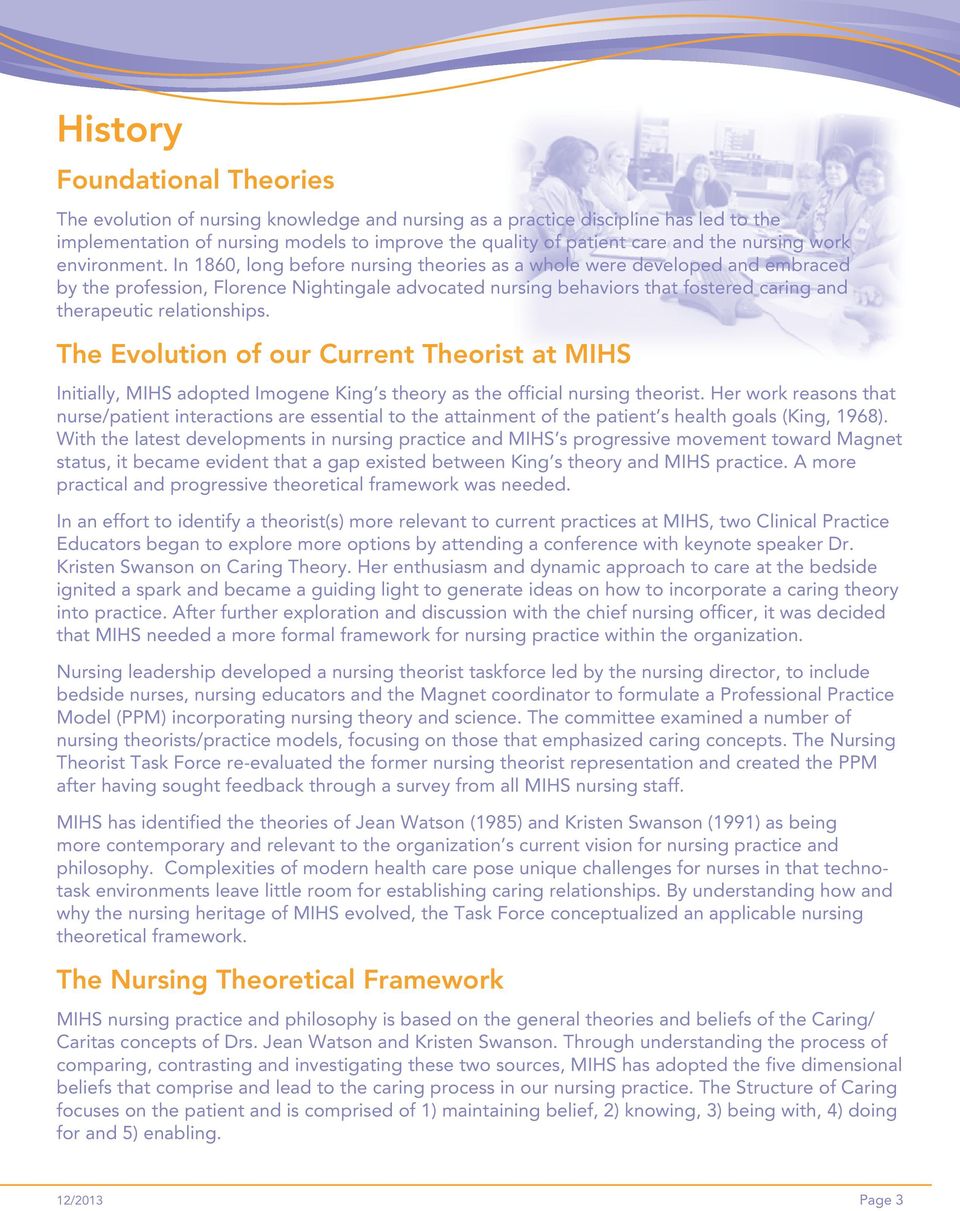
5 History Foundational Theories The evolution of nursing knowledge and nursing as a practice discipline has led to the implementation of nursing models to improve the quality of patient care and the nursing work environment. In 1860, long before nursing theories as a whole were developed and embraced by the profession, Florence Nightingale advocated nursing behaviors that fostered caring and therapeutic relationships. The Evolution of our Current Theorist at MIHS Initially, MIHS adopted Imogene King s theory as the official nursing theorist. Her work reasons that nurse/patient interactions are essential to the attainment of the patient s health goals (King, 1968). With the latest developments in nursing practice and MIHS s progressive movement toward Magnet status, it became evident that a gap existed between King s theory and MIHS practice. A more practical and progressive theoretical framework was needed. In an effort to identify a theorist(s) more relevant to current practices at MIHS, two Clinical Practice Educators began to explore more options by attending a conference with keynote speaker Dr. Kristen Swanson on Caring Theory. Her enthusiasm and dynamic approach to care at the bedside ignited a spark and became a guiding light to generate ideas on how to incorporate a caring theory into practice. After further exploration and discussion with the chief nursing officer, it was decided that MIHS needed a more formal framework for nursing practice within the organization. Nursing leadership developed a nursing theorist taskforce led by the nursing director, to include bedside nurses, nursing educators and the Magnet coordinator to formulate a Professional Practice Model (PPM) incorporating nursing theory and science. The committee examined a number of nursing theorists/practice models, focusing on those that emphasized caring concepts. The Nursing Theorist Task Force re-evaluated the former nursing theorist representation and created the PPM after having sought feedback through a survey from all MIHS nursing staff. MIHS has identified the theories of Jean Watson (1985) and Kristen Swanson (1991) as being more contemporary and relevant to the organization s current vision for nursing practice and philosophy. Complexities of modern health care pose unique challenges for nurses in that technotask environments leave little room for establishing caring relationships. By understanding how and why the nursing heritage of MIHS evolved, the Task Force conceptualized an applicable nursing theoretical framework. The Nursing Theoretical Framework MIHS nursing practice and philosophy is based on the general theories and beliefs of the Caring/ Caritas concepts of Drs. Jean Watson and Kristen Swanson. Through understanding the process of comparing, contrasting and investigating these two sources, MIHS has adopted the five dimensional beliefs that comprise and lead to the caring process in our nursing practice. The Structure of Caring focuses on the patient and is comprised of 1) maintaining belief, 2) knowing, 3) being with, 4) doing for and 5) enabling. Page 3
6 Jean Watson, PhD, RN, AHN-BC, FAAN Dr. Watson is a distinguished professor of nursing and holds an Endowed Chair in Caring at the University of Colorado Health Sciences Center. She developed her theory in 1985 by publishing the ten carative factors. By 2001 she had expanded her theory and wrote the theory s primary elements. They are as follows: a) carative factors, b) transpersonal holistic caring relationship, and c) caring moments coupled with caring occasions. Her theory has continued to evolve by replacing the carative factors with clinical caritas factors and bringing it more into every aspect involved in bedside nursing. The Greek word caritas means cherishing and giving loving attention to another (Watson & Smith, 2002, p. 452). The following represents the translation of Watson s evolution of her carative factors into clinical caritas processes. 1. The practice of compassion and loving kindness 2. Being authentically and consciously present. 3. Cultivating one s own spiritual practice/preservation and opening to others with sensitivity and compassion. 4. Developing, sustaining and protecting human dignity and a helping, trusting patient relationship. 5. Acceptance of patients/families where they are emotionally and allow positive and or negative feelings. 6. Creative use of self bridge, catalyst, facilitator 7. Attempting to stay within another s frame of reference allowing and accepting their world view. 8. Creating healing environments transforming patient and nurse through caring occasions. 9. Assisting with basic needs. 10. Soul caring to one s self and the one receiving the care. (Watson & Smith, 2002) Nurses obtain mutuality concerning individual patient s situations and needs through therapeutic communication with their patients, families, communities and support systems. By always being conscious and authentically present, this creates helping-trusting relationships (Watson, 2002). Caring moments are created when the nurse and another (patient, family, significant other) meet in such a way that a human caring occasion takes place. Dr. Watson (2002) supports the significance of caring, conscious, authentic relationships between the nurse and patient, in order to treat patients positively and holistically in achieving whole health and healing. This promotes the continuing of professional growth/mastery for each nurse. Kristen Swanson, PhD, RN, FAAN Dr. Kristen Swanson published the Empirical Development of a Middle Range Theory of Caring (Swanson, 1991) sharing her structure of caring which provides a nurturing link to a valued other (patient) toward whom one feels a personal sense of responsibility and commitment. When a nurse demonstrates they care about their patient, patient outcomes are enhanced and promoted. One Page 4

7 feels a personal sense of commitment and responsibility. Caring leads to: emotional/spiritual wellbeing, physically enhanced healing, trusting relationships, sense of accomplishment and preserved integrity. Dr. Swanson (Swanson, 1993) cross-validated Dr. Watson s work with her research arriving at five caring processes, which are as follows: 1. Knowing - Endeavoring to understand events meaning in another s life, by completely assessing, seeking verbal/nonverbal clues and calling on collegial expertise. 2. Being with Being consciously and emotionally present to the other. Caring practices include being present, preserving. Actively listening, revealing and not imposing. 3. Doing for Doing for the other what they would do for themselves, if they could accomplish it. Caring practices include competent performance, preservation of dignity, comforting and protecting. 4. Enabling/Empowering Being a facilitator for others passages and transitions through unfamiliar life events. Caring practices include anticipating and preparing for future needs through informing, creating options, supporting, explaining, validating and advocating currently and for the future. 5. Maintaining belief Maintaining a foundational belief in people and their survival capacity to find meaning in the future as they pass through events and transitions. Caring practices include having faith, being able to persevere in going the extra mile. (Swanson, 1993) Nursing Professional Practice Model of Care Page 5

8 Transformational Leadership Continuous Quality Improvement Exemplary Professional Practice Professional Collaboration Clinical Advancement Structural Empowerment Pillars of Excellence Mission and Vision Core Values Nursing Division Goals Strategic Management Supportive Transformational Culture Institute of Medicine s Quality Measures Committees and Councils Patient Satisfaction Surveys Voluntary Protection Program (VPP) Technological Advancements Patient Centered Medical Home Model Standard Compliance and Clinical Outcomes Nursing Peer Review Organizational Accreditations Art of Intentionally Caring About You Standards of Practice Sociocultural Competency and Cultural Diversity Behavior Standards Promotion of Therapeutic Healing Environment Interdisciplinary Plan of Care A.I.D.E.T. Fundamentals of Service I.C.A.R.E. 5 Step Recovery Process Evidence to Excellence via Evidence-Based Practice Innovation and Inspiring New Technologies Dedication to Research New Knowledge and Skill Acquisition Center for Clinical Excellence Individual Empowerment Role Development Educational Needs Assessment Patient Safety SBAR Reporting Mentoring Specialty Certification Nurse Sensitive Indicators Performance Improvement and Evaluations Recruitment and Retention Employee Engagement Shared Accountability Social Support System Involvement Ancillary Support Devotion to Community Involvement MIHS Employee Recognition Educational Resource Allocation Professional Networking Shared Governance Educational Partnerships Preceptor-ships and Residencies Community Partnerships and Outreach Programs Page 6

9 The Nursing Professional Practice Model (PPM) Introduction Discovering that the former nursing professional practice model (PPM) was bereft of any substantial guiding force, nursing officials prioritized formalizing a PPM of which nurses could not only identify with, but also use as a guiding light in their practice. Nursing officials designated a Nurse Theorist Task Force to formulate a PPM based off of nursing theory and science. Comprised of passionate bedside nurses, nurse educators, and specialty directors, the Nurse Theorist Task Force reevaluated/adapted the former nursing theorist representation and created the PPM after having sought feedback from nursing staff. Through the unfailing commitment of the task force members, the model was implemented and evaluated for applicability and efficacy. Development As the Center for Clinical Excellence, MIHS trademark approach of Every person. Every Time. resonates the truth that in every interaction MIHS professionals have with another human being, they are given the opportunity to make a positive difference for that person. This compels all MIHS professionals to be cognizant of how they want to be remembered and leave their legacy, whilst at the same time representing all that MIHS stands for. As a collective whole, MIHS serves and cares for a unique population, that being typically the underserved, underprivileged, and vulnerable persons that, most often, society turns their backs on. Intending to reach out and affect positive, lasting change for this special population, MIHS nurses welcome this population with open arms to provide them with the highest quality care while upholding their dignity and self-worth. In that caring is the light that shines in darkness (B. Melnyk, personal communication, August 16, 2006), MIHS nurses truly care for people with compassion, determination, and conviction in their darkest hour of need. Design The nursing professional practice model (PPM) design depicts the nursing practice environment at MIHS. As the universal symbol of nursing, the white hearts depicted in our PPM reflects the structures and processes that constitute and guide MIHS practice. Each white heart points to the center, Caring About You to portray the essential principles on which nursing practice is founded. Caring About You encompasses both the patients and nursing staff. The elemental white heart configuration forms a daisy as symbolic of the Daisy Foundation, thereby also presenting an appreciation for nurses (The Daisy Foundation, n.d.). The outer circle of the design represents unity among all MIHS professionals to provide you with the highest quality care possible. To illustrate that the MIHS Pillars of Excellence transcend all integral parts of the model by serving as a foundation for practice, the Pillars of Excellence are illustrated at the bottom of the PPM classification table. Ultimately though, caring is the heart of the matter for MIHS nurses; that is, the fundamental guiding force of what MIHS nurses do is Caring about You, indiscriminate of who you are and where you have been. Page 7

10 PPM Composition and Theoretical Constructs Constituent elements that establish nursing at MIHS include transformational leadership, continuous quality improvement, exemplary professional practice, professional collaboration, clinical advancement, and structural empowerment. Transformational Leadership Health care transformation requires the power of only one to create an impetus for change. Recognizing the ability of one person to inspire an entire health care organization, the supportive transformational culture of MIHS propels every nurse to stand as that leader. The Pillars of Excellence and core values of MIHS serve as a foundation on which nurses base their practice. Nurses align their own personal mission and vision with that of the mission and vision of MIHS while being cognizant of nursing division goals. Through strategic management, transformational leaders capitalize on team member s strengths and encourage champion initiatives by believing in the power of the team and celebrating victories. Recognizing that innovation is a source of power for health care industry and that innovation inherently begets change, nurses at MIHS are called to be transformational innovative leaders who embark on the transformational journey together. The following are examples and descriptions of MIHS Transformational Leadership: Pillars of Excellence People Service Quality Finance Growth Mission and Vision Core Values Respect Compassion Collaboration Excellence Stewardship Leadership Integrity Education Innovation Accountability Nursing Division Goals Strategic Management Supportive Transformational Culture Challenging the Status Quo Embracing Spirit of Inquiry Page 8

11 Continuous Quality Improvement In order to offer the clinical excellence MIHS is so recognized for, nurses continually seek opportunities to enhance the quality value of their work. Quality improvement strategies in place at MIHS for nurses include abiding by the Institute of Medicine s quality measures, participation in committees and councils, gaining insight with quality enhancement of the patient experience through patient satisfaction surveys and nursing peer review, advocating for safety via the Voluntary Protection Program, and revolutionizing health care delivery through use of innovative technological advancements and processes. Furthermore, MIHS nurses continually exceed standard compliance and clinical outcomes as delineated by governing officials. MIHS perpetually seeks organizational accreditation to ascertain optimal health care delivery via nursing practice. By not only addressing areas on which to improve practice, but also by advocating for the adoption of quality improvement strategies through innovative processes, nurses at MIHS truly are able to transform care delivery at the bedside. The following are examples and descriptions of MIHS Continuous Quality Improvement: Institute of Medicine s Quality Measures Patient-centered Equitable Timely Safe Efficient Effective Committees and Councils Performance Improvement Committee Infection Prevention and Control Committee Employee Activity Committee Quality Management Council Nurse Practice Council Nurse Executive Council Staff Education Committee Patient Satisfaction Surveys Press Ganey Hospital Consumer Assessment of Healthcare Providers and Services (HCHAPS) Voluntary Protection Program (VPP) Technological Advancements EPIC SIMs Center Nursing Informatics Home Medical Model Standard Compliance and Clinical Outcomes (Core Measures) Office of Patient Experience Nursing Peer Review Organizational Accreditations Det Norske Veritas (DNV) Specialty Certification Page 9

12 Exemplary Professional Practice Only through the compassionate dedication of nurses is MIHS able to achieve exemplary professional practice. By fully applying the art of caring intentionally as derived from a holistic integrated theory based on the works of Jean Watson and Kristen Swanson, nurses at MIHS are able to provide clinical excellence. MIHS nurses practice autonomy, but abide by nursing practice standards and behavior standards identified by the organization. They are also upheld to the highest standard with incentives through performance improvement and evaluations. MIHS nurses continually exceed patient safety and nurse sensitive indicators. Celebrating cultural diversity and honoring individuals as holistic beings, nurses provide sociocultural competent care while also involving the patient s social support system. Nurses at MIHS exemplify the character and aptitude of all that nursing encompasses as both art and science. The following are examples and descriptions of MIHS Exemplary Professional Practice: Art of Caring Intentionally-Holistic Integrated Theory of Caring (Watson and Swanson Nurse Theorists) Standards of Practice American Nurses Association and Arizona State Board of Nursing standards of practice AZ Nurse Practice Act Nursing Code of Ethics Sociocultural Competency and Cultural Diversity Behavior Standards Positive Attitude Communication Professionalism Team Player Trustworthy Safety Responsiveness Patient Safety Nurse Sensitive Indicators National Database of Nursing Quality Indicators (NDNQI) Performance Improvement and Evaluations Recruitment and Retention Employee Engagement Employee Engagement and Satisfaction Surveys Page 10

13 Professional Collaboration With emphasis placed on open communication styles, collaboration, and teamwork, nurses at MIHS are able to authentically engage others and advance multidisciplinary solutions in the interdisciplinary plan of care. Applying the fundamentals of service, the recovery process, and reporting format, nurses engage in caring relationships all the while promoting a therapeutic healing environment. Acknowledging the strength of team efforts surrounding the individual being cared for, MIHS nurses call on ancillary supportive measures to provide the best care possible. By connecting with others, nurses at MIHS facilitate interdisciplinary, intra-disciplinary, and societal collaboration to improve upon health care outcomes and the patient care experience. The following are examples and descriptions of MIHS Professional Collaboration: Promotion of Therapeutic Healing Environment Interdisciplinary Plan of Care A.I.D.E.T. Fundamentals of Service ɂ Acknowledge ɂ Introduce ɂ Duration ɂ Explanation ɂ Thank You I.C.A.R.E. 5 Step Recovery Process ɂ Identify ɂ Communicate ɂ Actively Listen ɂ Recommend a Solution ɂ Exceed their Expectations SBAR Reporting ɂ Situation ɂ Background ɂ Assessment ɂ Recommendation Shared Accountability Social Support System Involvement ɂ Family-Centered Care *(Also comprised of friends, significant others, spiritual groups, and community) Ancillary Support ɂ Hospital Emergency Response Team (Emergency Preparedness) ɂ Rapid Response Team ɂ PICC Team ɂ Critical Incident Stress Management Team ɂ Life Support Program ɂ Bereavement Program ɂ Skin and Diabetes Champions Page 11

14 Clinical Advancement Acknowledging the importance of education, MIHS not only encourages professional development, but also inspires nurses to share what they know. The evidence-based practice and innovative infrastructure of MIHS allows for nurses to disrupt the status quo, embrace a spirit of inquiry, generate ideas, engage critical thinking, spark collaborative efforts, involve nurses as mentors, and take risks in which perceived failures are thought of as growth opportunities, in order to ultimately expand their capacity for caring via innovative ideas. Knowing that it may take one to two decades to translate research into practice, MIHS nurses work stealthily to bridge this knowledge gap by utilizing a science to service model prioritizing nursing informatics and research. This also requires continual new knowledge and skill acquisition founded in evidence-based practice. By cultivating a supportive environment for learning, MIHS provides nurses with opportunities for accomplishment and growth. The following are examples and descriptions of MIHS Clinical Advancement: Evidence to Excellence via Evidence-Based Practice Innovation and Inspiring New Technologies Dedication to Research New Knowledge and Skill Acquisition Mentoring Student Involvement Nurse Shadow Program Evidence-Based Practice Mentors Structural Empowerment The structural framework of nursing at MIHS inhabits a climate of shared ownership within a supportive health innovative culture. Thus, the cultural climate itself empowers nurses to engage in efforts to enhance the provision of care. Emphasizing shared decision-making and accountability, nurses participate in shared governance, employee engagement, role development, educational needs assessment, community involvement, and employee service recognition. In order to advance the nursing profession, nursing officials at MIHS create partnerships with educational institutions, devise preceptor-ships and residencies, support specialty certification, and allocate resources for educational pursuits. Within a contextual framework of interfacing open systems, nurses at MIHS build and maintain network relationships both internal and external to the organization to broaden perspectives and expand interest in future enterprising adventures. With a strong sense of community, nurses reach out to create partnerships and professional networks. The visionary nursing leadership at MIHS supports nurses on a quest for personal, professional, and organizational growth. Page 12

15 The following are examples and descriptions of MIHS Structural Empowerment: Center for Clinical Excellence Individual Empowerment Managerial Support Role Development Clinical Ladder Program Leadership Development Institute Educational Needs Assessment Specialty Certification Specialty Incentive Devotion to Community Involvement MIHS Employee Recognition Daisy Award Nightingale Nurses Award Nurse of the Year Award March of Dimes Nurse of the Year Award Pillar Award Star Throwers Years of Service Award MIHS Exceeds Box Educational Resource Allocation Nursing Education Loan Repayment Program Perpetual Nursing Education Scholarship Fund Tuition Reimbursement Library Services Professional Networking Shared Governance Shared Governance Council Educational Partnerships Nursing Student Programs Affiliation with Educational Institutions (Employee Discounts) Preceptor-ships and Residencies New Grad Program Specialty Nurse Residency Programs Community Partnerships and Outreach Programs Health Fairs, Refugee Women s Craft Fairs, Mariposa Domestic Violence Education, Outreach Education, Health-Related Camps, and Health Walks (heart walk, diabetes) Magnet Journey Page 13

16 Our Nursing Support Structure Patient Services/Nursing Committees MIHS Nursing Committees/Councils Committee Mission Statement Meeting Date Nurse Executive Committee The Nursing Executive Council provides oversight Meets once a week to the other Councils. on Friday Nurse Practice Council To promote continuous improvement in quality of nursing care through supported evidence-based practice. Provides a forum for collaborating on and approving patient care. Meets once a month on the fourth Tuesday Nurse Policy and Procedure Clinical Practice Education Infection Control Shared Governance/Unit Based Council Pharmacy/Nursing Nursing Research & Quality Improvement Patient Safety Committee Executive Nursing Peer Review Regulatory/Standards Review and approve all policies that involve nursing. To provide quality education to nurses and allied health professionals throughout the health care system and community To provide prevention forum for the planning, development, implementation and monitoring of safe and appropriate infection prevention and control practices within Maricopa Integrated Health System (MIHS). A way for nursing to have a say in their professional practice and nursing care through the use of evidence based practice To bring together representatives from nursing and pharmacy departments to resolve issues using a cooperative approach. The committee addresses medication-related patient care issues, including drug distribution, administration, documentation, security and safety. Monitors outcomes of nursing practice and nursing care. Ensures evidence-based practice. Review and compiles data reflecting compliance with internal and external standards. To reduce clinical error (human/technical/near misses) and minimize adverse outcomes for the users of our services Process to review individual standards of care to improve the standards of practice. To ensure continuous survey readiness throughout the organization. Meets on the first Thursday & third Tuesday Meets Quarterly 1st Tuesday Meets once a month on the third Wednesday Meets once a month on the third Tuesday Meets once a month on the fourth Friday. Page 14

17 Nursing Standards of Care MIHS Nursing Process Assessment Assessment is completed by an RN. Aspects of data collection may be delegated to an LPN, MA, NE, Certified Nursing Assistant within his/her scope of practice. Reassessment may be either a focus or a complete assessment based on patient need and department specific guidelines. Completion of the admission assessment process includes body systems assessment and initiation of the problem list, plan of care, or Individual Treatment Discharge Plan (ITDP). Documentation is completed within four hours after arrival on the unit. Diagnosis Problems or patient care issues derived from the assessment are identified as nursing diagnoses or collaborative problems. Problems for which the nursing staff is actively involved during the patient s hospitalization/outpatient visit is documented on the Problem List, Plan of Care, Progress Note, or Individual Treatment Discharge Plan (ITDP) by the RN. Other problems are referred, as appropriate, to a member of the health care team. Planning Planning is documented by the RN or MA using the Problem List, Plan of Care, or Individual Treatment Discharge Plan (ITDP) according to patient needs. Planning is updated as needed following reassessment and in collaboration with the health care team. Intervention The RN is responsible for implementing physician orders. Independent interventions are initiated by RNs based on scope of practice. Nursing interventions may be delegated by the RN to an LPN, Dialysis Tech, MA, NE, C.NA following scope of practice and standards of care. The RN is responsible for clarification of orders when necessary. Evaluation Each problem/patient care concern needs to be documented on the Problem List, Plan of Care, or Individual Treatment Discharge Plan (ITDP); it is evaluated at least once per shift in the inpatient setting by the RN, LPN, or Nurse Extern for patient progress toward the expected outcome, appropriateness of the interventions prescribed, and the status/currency of the plan until resolved. The RN indicates progress toward the expected outcome in the narrative notes when indicating that the need has been resolved or discontinued on the Problem List, Plan of Care, or Individual Treatment Discharge Plan. Page 15

18 Nurse Practice Act for Registered Nurses Arizona State Board of Nursing MIHS finds the Arizona State Board of Nursing Nurse Practice Act to be essential to safe nursing practice and encourages their nurses to practice to the full extent of their scope of practice, education and competencies. STANDARDS OF PROFESSIONAL NURSING PRACTICE American Nurses Association (ANA, 2013) Standard 1. Ethics The registered nurse practices ethically. Standard 2. Education The registered nurse attains knowledge and competence that reflects current nursing practice. Standard 3. Evidence-Based Practice and Research The registered nurse integrates evidence and research findings into practice. Standard 4. Quality of Practice The registered nurse contributes to quality nursing practice. Standard 5. Communication The registered nurse communicates effectively in a variety of formats in all areas of practice. Standard 6. Leadership The registered nurse demonstrates leadership in the professional practice setting and the profession. Standard 7. Collaboration The registered nurse collaborates with the healthcare consumer, family and others in the conduct of nursing practice. Standard 8. Professional Practice Evaluation The registered nurse evaluates her or his own nursing practice in relation to professional practice standards and guidelines, relevant statutes, rules and regulations. Standard 9. Resource Utilization The registered nurse utilizes appropriate resources to plan and provide nursing services that are safe, effective and financially responsible. Standard 10. Environmental Health The registered nurse practices in an environmentally safe and healthy manner. Page 16

19 References American Nurses Association. (ANA). (2013). Scope and standards of nursing practice. Retrieved from Arizona State Board of Nursing. (AZBN). (2012). Nurse Practice Act. Retrieved from Clark, P.N., Watson, J., & Brewer, B.B. (2009). From theory to practice: Caring science according to Watson and Brewer. Nursing Science Quarterly, 22(4), The Daisy Foundation. (n.d.). Retrieved from Hoffart, N. & Woods, C. (1996). Elements of a nursing professional practice model. Journal of Professional Nursing, 12(6) King, I. M. (1968). A conceptual frame of reference for nursing. Nursing Research, 17(1), Swanson, K.M. (1991). Empirical Development of a middle range theory of caring. Nursing Research, 40(3), Swanson, K.M. (1993). Nursing as informed; Caring for the well-being of others. IMAGE: Journal of Nursing Scholarship, 25(4), Watson, J. (1985). Nursing: Human science and human caring: A theory of nursing. Norwalk, CT: Appleton-Century-Crofts. Watson, J. (2002). Caring and healing our living and dying. The International Nurse, 15(2), p Watson, J. & Smith, M. (2002). Transpersonal caring science and the science of unitary human beings: A trans-theoretical discourse for nursing knowledge development. Journal of Advanced Nursing, 37, Page 17

20

St. Luke s Hospital and Health Network Philosophy of Nursing:
 St. Luke s Hospital and Health Network Philosophy of Nursing: Nursing, a healing profession, is an essential component of St. Luke's Hospital & Health Network's commitment to providing safe, compassionate,
Discover Teach Heal. UC Irvine Health: Advancing the Future of Healthcare Nursing Strategic Plan FY2011 FY2015 Nursing Strategic Plan Summary
 UC Irvine Health: Advancing the Future of Healthcare Nursing Strategic Plan FY2011 FY2015 Nursing Strategic Plan Summary Mission Statement (Our purpose) Discover Teach Heal Vision Statement (Our aspiration)
AACN SCOPE AND STANDARDS
 AACN SCOPE AND STANDARDS FOR ACUTE AND CRITICAL CARE NURSING PRACTICE AMERICAN ASSOCIATION of CRITICAL-CARE NURSES AACN SCOPE AND STANDARDS FOR ACUTE AND CRITICAL CARE NURSING PRACTICE Editor: Linda Bell,
Nursing s Social Policy Statement
 CHAPTER 1 Nursing s Social Policy Statement Catherine E. Neuman, MSN, RN, NEA-BC Overview Nursing is a part of the society from which it grew and continues to evolve. As a profession, nursing is valued
KAISER PERMANENTE NATIONAL NURSING RECOGNITION PROGRAM
 KAISER PERMANENTE NATIONAL NURSING RECOGNITION PROGRAM Dear Colleagues, Welcome to Kaiser Permanente s National Nursing Recognition Program. This program complements existing regional recognition programs
Westminster Campus Nursing Program Curriculum Organizing Framework
 Westminster Campus Nursing Program Curriculum Organizing Framework The curriculum organizing framework describes the concepts, beliefs and philosophy upon which the nursing curriculum is organized and
Expected Competencies of graduates of the nursing program at Philadelphia University
 Expected Competencies of graduates of the nursing program at Philadelphia University Background Educational programs are prepared within the context of the countries they serve. They are expected to respond
EDYTH T. JAMES DEPARTMENT OF NURSING
 EDYTH T. JAMES DEPARTMENT OF NURSING Our nursing program has a rich 106-year history that includes being the first nursing school established in the state of Maryland. The Washington Missionary College
2009 Nursing Strategic Plan. Atrium Medical Center
 2009 Nursing Strategic Plan Atrium Medical Center Mission Nurses at Atrium Medical Center are empowered to serve our patients by providing personalized, compassionate care with integrity and respect because
NATIONAL NURSING PIN PROGRAM
 NATIONAL NURSING PIN PROGRAM Dear Colleagues, Welcome to the Kaiser Permanente Nursing Pin Program. This pin was specially designed to represent the pride we take in our profession and in our nurses. Kaiser
Kaiser Permanente Nursing Professional Practice Introduction to the Voice of Nursing
 Kaiser Permanente Nursing Professional Practice Introduction to the Voice of Nursing Copyright 2015 Kaiser Permanente 1 Internal Use Only Kaiser Permanente Nursing Professional Practice Introduction to
No one was ever able to teach who was not able to learn. Florence Nightingale. The Preceptor Role. Beth Tamplet Ulrich, EdD, RN, FACHE, FAAN
 No one was ever able to teach who was not able to learn. Florence Nightingale 1 The Preceptor Role Beth Tamplet Ulrich, EdD, RN, FACHE, FAAN 1 Precepting is an organized, evidence-based, outcome-driven
Saint Francis Care Patient Care Services Advancement to Clinical Excellence Program (ACE Program) INTRODUCTION
 INTRODUCTION Advancement to Clinical Excellence (ACE), the Clinical Advancement Program at St. Francis Care was designed to recognize nurses involved in direct patient care and improve promotional opportunities
CARE LOVE HOPE Nursing Matters
 CARE LOVE HOPE Nursing Matters Arkansas Children s Hospital Professional Nursing Practice Guide Mission Arkansas Children s Hospital is committed to working with others to achieve high quality, cost-effective,
Role of Nursing Professional Development in Helping Meet. Institute of Medicine s Future of Nursing Recommendations. Preamble:
 1 Role of Nursing Professional Development in Helping Meet Institute of Medicine s Future of Nursing Recommendations Preamble: The Robert Wood Johnson Foundation s Initiative on The Future of Nursing at
Alignment of ANCC Forces of Magnitude and TIGER Collaboratives
 Alignment of and I. Transformational Today's health care environment is experiencing unprecedented, intense reformation. Unlike yesterday's leadership requirement for stabilization and growth, today's
Texas State University University Library Strategic Plan 2012 2017
 Texas State University University Library Strategic Plan 2012 2017 Mission The University Library advances the teaching and research mission of the University and supports students, faculty, and other
Develop students abilities to serve as Christian leaders in professional nursing roles and to be contributing members of the profession of nursing.
 Mission, Goals and Outcomes for BSN Online Nursing Program Concordia University, Texas 2015 Mission of the School of Nursing Programs (BSN and MSN) The mission of the Concordia Nursing program is to develop
LEADERSHIP DEVELOPMENT FRAMEWORK
 LEADERSHIP DEVELOPMENT FRAMEWORK February 13, 2008 LEADERSHJP PERSPECTIVE I consider succession planning to be the most important duty I have as the Director of the NOAA Corps. As I look toward the future,
How To Be A Baccalaureate Prepared Nurse
 1 Statement of Understanding Thank you for your interest in becoming a part of the Carroll College Nursing Program. The decision to apply to the nursing program is one that you have already spent time
collaboration/teamwork and clinical knowledge and decision-making (attachment 4.1.b). The Staff Nurse position description links position
 4.1 Describe the formal and informal performance appraisal processes used in the organization, including self-appraisal, peer review, and 360 o evaluation (as appropriate) for all levels in the organization.
Introduction. C h a p t e r O n e
 Contents Foreword vii Preface ix Acknowledgments xiii 1. Introduction 1 2. Caring and the Nursing Administrator 10 3. The Element of Caring in Nursing Administration 27 4. Organizational Theory 38 5. Leadership
Running head: PROGRAM DESCRIPTION 1. Program Description. Bachelor of Science and Master of Science Degree Programs in Nursing
 Running head: PROGRAM DESCRIPTION 1 Program Description Bachelor of Science and Master of Science Degree Programs in Nursing Messiah College Department of Nursing Approved_11-3-15 PROGRAM DESCRIPTION 2
TOOL KIT for RESIDENT EDUCATOR and MENT OR MOVES
 Get to Know My RE Observe Collect Evidence Mentor Moments Reflect Review Respond Tailor Support Provide Provide specific feedback specific Feedback What does my RE need? Practice Habits Of Mind Share Data
WWCC NURSING STUDENT HANDBOOK 2015-16 ADDENDUM: SECOND-YEAR STUDENTS DURING 2015-16 ACADEMIC YEAR ONLY (Revised 9.16.15) PROGRAM OF LEARNING
 WWCC NURSING STUDENT HANDBOOK 2015-16 ADDENDUM: SECOND-YEAR STUDENTS DURING 2015-16 ACADEMIC YEAR ONLY (Revised 9.16.15) Second-year nursing students during the 2015-16 academic year will be completing
NLN Competencies for Graduates of Practical/Vocational Programs (2012) which LPN Programs shall meet.
 Added by ICN/INAC Education Subcommittee NLN Competencies for Graduates of Practical/Vocational Programs (2012) which LPN Programs shall meet. Competencies to Facilitate Seamless Nursing Educational Transition
Melissa Edmister, RN, BSN Clinical Manager Surgical Acute Unit Providence St. Peter Hospital
 Melissa Edmister, RN, BSN Clinical Manager Surgical Acute Unit Providence St. Peter Hospital Why do some organizations do well with safety initiatives while others do poorly or fail? The most important
Role 1 Leader The Exceptional Nurse Leader in Long Term Care:
 Competencies for Nurse Leaders in Long Term Care National Validation March 2001 American Health Care Association TENA(R) Sponsorship Program from SCA Hygiene Products Part 1 Directions: Place a check mark
Performance Factors and Campuswide Standards Guidelines. With Behavioral Indicators
 Performance Factors and Campuswide Standards Guidelines With Behavioral Indicators Rev. 05/06/2014 Contents PERFORMANCE FACTOR GUIDELINES... 1 Position Expertise... 1 Approach to Work... 2 Quality of Work...
BS, MS, DNP and PhD in Nursing Competencies
 BS, MS, DNP and PhD in Nursing Competencies The competencies arise from the understanding of nursing as a theory-guided, evidenced -based discipline. Graduates from the curriculum are expected to possess
Leading Self. Leading Others. Leading Performance and Change. Leading the Coast Guard
 Coast Guard Leadership Competencies Leadership competencies are the knowledge, skills, and expertise the Coast Guard expects of its leaders. The 28 leadership competencies are keys to career success. Developing
SALT LAKE COMMUNITY COLLEGE PHILOSOPHY OF THE NURSING PROGRAM
 SALT LAKE COMMUNITY COLLEGE PHILOSOPHY OF THE NURSING PROGRAM The philosophy of the nursing program is consistent with the mission statement and values of Salt Lake Community College. The mission of the
Section Three: Ohio Standards for Principals
 Section Three: Ohio Standards for Principals 1 Principals help create a shared vision and clear goals for their schools and ensure continuous progress toward achieving the goals. Principals lead the process
WHAT IS A PRECEPTORSHIP?
 C HAPTER 1 WHAT IS A PRECEPTORSHIP? LEARNING OBJECTIVES After reading this chapter, the participant will be able to explain the need for establishing effective nurse preceptorships in today s complex healthcare
Magnet Recognition and the Role of the Wound, Ostomy and Continence Nurse FACT SHEET
 Magnet Recognition and the Role of the Wound, Ostomy and Continence Nurse Originated By: WOCN Professional Practice Committee Date Completed: May 4, 2012 FACT SHEET The Wound, Ostomy and Continence Nurses
Strategic Plan 2015-2020. Collaborate Act Transform
 Strategic Plan 2015-2020 Collaborate Act Transform In 2007, as founding dean of the Florida International University Herbert Wertheim College of Medicine, I was tasked with implementing our first strategic
STANDARDS FOR SOCIAL WORK PRACTICE WITH GROUPS. Second Edition
 STANDARDS FOR SOCIAL WORK PRACTICE WITH GROUPS Second Edition ASSOCIATION FOR THE ADVANCEMENT OF SOCIAL WORK WITH GROUPS, INC. An International Professional Organization (AASWG, Inc.) First edition Adopted
PROFESSIONAL ADVANCEMENT LADDER CLINICAL NURSE III
 PROFESSIONAL ADVANCEMENT LADDER CLINICAL NURSE III APPLICATION PACKET **Please consult with your Nurse Director before beginning the Clinical Ladder process. ** Name of applicant: Approved by mentor: (Signature
Nursing Service Organization Shared Governance Guiding Principles
 Nursing Service Organization Shared Governance Guiding Principles Original Document 5/1997; Revised 5/2000; 12/2005; 8/2009; 7/2014. TABLE OF CONTENTS ARTICLE I PREAMBLE...5 Section 1. Purpose of the Guiding
School of Nursing Program
 School of Nursing Program 18 Admisssion and Progression The Duke University School of Nursing Program MISSION The mission of the Duke University School of Nursing is to create a center of excellence for
ASSOCIATE OF SCIENCE IN NURSING PROGRAM
 A LEADING AMERICAN UNIVERSITY WITH INTERNATIONAL REACH ASSOCIATE OF SCIENCE IN NURSING PROGRAM Dear Preceptor, The faculty members of the Associate of Science in Nursing Program of Western Kentucky University
*Performance Expectations, Elements and Indicators
 C o m m o n C o r e o f L e a d i n g : Connecticut School Leadership Standards *Performance Expectations, Elements and Indicators *For further information, visit: http://www.sde.ct.gov/sde/cwp/view.asp?a=2641&q=333900
2015 ASHP STRATEGIC PLAN
 2015 ASHP STRATEGIC PLAN ASHP Vision ASHP s vision is that medication use will be optimal, safe, and effective for all people all of the time. ASHP Mission The mission of pharmacists is to help people
STRATEGIC PLAN 2015-2020
 STRATEGIC PLAN 2015-2020 EXECUTIVE SUMMARY Georgia Regents University Division of Enrollment & Student Affairs participates in annual strategic planning so that the division can clarify goals and focus
School of Nursing Program
 School of Nursing Program 18 School of Nursing Program The Duke University School of Nursing Program Mission The mission of the Duke University School of Nursing is to create a center of excellence for
UTHealth School of Nursing Doctor of Nursing Practice (DNP) Preceptor Guidelines
 1 UTHealth School of Nursing Doctor of Nursing Practice (DNP) Preceptor Guidelines Introduction A clinical preceptorship/fellowship is a supervised clinical experience that allows students to apply knowledge
Subdomain Weight (%)
 CLINICAL NURSE LEADER (CNL ) CERTIFICATION EXAM BLUEPRINT SUBDOMAIN WEIGHTS (Effective June 2014) Subdomain Weight (%) Nursing Leadership Horizontal Leadership 7 Interdisciplinary Communication and Collaboration
FRAMEWORK NURSING BEHAVIORS
 DOMAIN: Clinical Skills and Knowledge NURSING PROCESS Assessment Performs assessment and identifies appropriate nursing diagnosis and/or patient care standard with assistance. Recognizes data and identifies
ARN Competency Model For Professional Rehabilitation Nursing
 ARN Competency Model For Professional Rehabilitation Nursing Copyright @ 2014, Association of Rehabilitation Nurses 8735 W. Higgins Rd, Suite 300 Chicago, IL 60631 Introduction The specialty of rehabilitation
Scope and Standards of Practice for The Acute Care Nurse Practitioner. American Association of Critical-Care Nurses
 Scope and Standards of Practice for The Acute Care Nurse Practitioner American Association of Critical-Care Nurses Editor: Linda Bell, RN MSN Copy Editor: Anne Bernard Designer: Derek Bennett An AACN Critical
2011-2016 Strategic Plan. Creating a healthier world through bold innovation
 2011-2016 Strategic Plan Creating a healthier world through bold innovation 2011-2016 STRATEGIC PLAN Table of contents I. Global direction 1 Mission and vision statements 2 Guiding principles 3 Organizational
M.S.N. Graduate Program
 M.S.N. Graduate Program Graduate Program Mission The Saint Luke s College of Health Sciences is an educational leader serving exceptional students pursuing a graduate nursing degree. An institution of
Post-Professional Athletic Training Residency Accreditation Standards & Guidelines. Version 1.2 August, 2010
 Post-Professional Athletic Training Residency Accreditation Standards & Guidelines Version 1.2 August, 2010 POST-PROFESSIONAL ATHLETIC TRAINING RESIDENCY STANDARDS & GUIDELINES Post-Professional Athletic
Health Authority Abu Dhabi
 Health Authority Abu Dhabi Document Title: Policy Scope of Practice for Registered Nurses Document Ref. Number: PPR/HC/EX/P0004/07 - A Version 0.9 Approval Date: May 2007 Effective Date: May 2007 Last
STRATEGIC PLAN 2013-2017 SUPPORTING STUDENT SUCCESS
 STRATEGIC PLAN 2013-2017 SUPPORTING STUDENT SUCCESS FROM THE VICE PRESIDENT It is my pleasure to share the University of Houston Division of Student Affairs and Enrollment Services 2013-2017 Strategic
Standards for Accreditation of Master s Programs in Library and Information Studies. Introduction
 Standards for Accreditation of Master s Programs in Library and Information Studies Adopted by approval of the Council of the American Library Association, February 2, 2015 Purpose of Accreditation Introduction
Nursing Strategic Plan. Fiscal Year 2015. Shaping the Future of UCLA Nursing at Ronald Reagan UCLA Medical Center
 Nursing Strategic Plan Fiscal Year 2015 Shaping the Future of UCLA Nursing at Ronald Reagan UCLA Medical Center The strategic plan of the Ronald Reagan UCLA Medical Center Department of Nursing aligns
Magnet Recognition and the Role of WOC Nurses
 WOCN Society Magnet Recognition and the Role of WOC Nurses Although many healthcare facilities are recognized by the American Nurses Credentialing Center (ANCC) Magnet Recognition Program, the program
Domains. Components/Domains a meaningful set of related concepts or indicators
 Quest for Nursing Excellence Magnet Journey Quest for Nursing Excellence Quest for Nursing Excellence Diane Hanley, MS, RN-BC, EJD Director, Nursing Education, Quality and Professional Practice St. A s
Thank you for taking a leadership role at Gustavus! Best of luck this year!
 G.O.L.D. Gusties In Ongoing Leadership Development Thank you for taking a leadership role at Gustavus! Best of luck this year! 800 West College Avenue Saint Peter, MN 56082 gustavus.edu gustavus adolphus
Nursing Framework and Program Outcomes
 Nursing Framework and Program Outcomes The program's conceptual framework is based on the National League for Nursing (NLN) Educational Competencies Model and the components within it. The model consists
Kouzes, J. M., & Posner, B. Z. (2007). The leadership challenge (4th ed.). San Francisco, CA: Jossey-Bass.
 Kouzes, J. M., & Posner, B. Z. (2007). The leadership challenge (4th ed.). San Francisco, CA: Jossey-Bass. Reviewed by Chelsea Truesdell Introduction The Leadership Challenge serves as a resource for any
Nursing Programs Philosophical Concepts
 Nursing Programs Philosophical Concepts PHILOSOPHICAL CONCEPTS: DEFINITION OF TERMS CRITICAL ELEMENTS: The five critical elements (5 C s) are the essential attributes that the faculty believe all nursing
Comparison Between Joint Commission Standards, Malcolm Baldrige National Quality Award Criteria, and Magnet Recognition Program Components
 Comparison Between Joint Commission Standards, Malcolm Baldrige National Quality Award Criteria, and Magnet Recognition Program Components The Joint Commission accreditation standards, the National Institute
DEAN OF THE SCHOOL OF HEALTH SCIENCES
 OAKLAND UNIVERSITY DEAN OF THE SCHOOL OF HEALTH SCIENCES Oakland University seeks an inspiring and visionary leader to serve as Dean of the School of Health Sciences. The Search Committee will begin reviewing
Crosswalk of the Master s Essentials with the Baccalaureate and DNP Essentials
 Crosswalk of the Master s Essentials with the Baccalaureate and DNP Essentials Essential 1: Background for Practice from Sciences and Humanities Baccalaureate: Liberal Education for Baccalaureate Generalist
Mission Statement: Program Goals:
 Program: School of Nursing and Health Sciences BSN Program Assessed by: Date: 2012-2013 Mission Statement: The purpose of the BSN Nursing program at Malone University is to provide an education that produces
Stand Up for Standards. A companion resource to the CARNA Nursing Practice Standards
 1 2 Stand Up for Standards 3 4 A companion resource to the CARNA Nursing Practice Standards The purpose of this document is to increase awareness and understanding among registered nurses of the CARNA
How To Be A Medical Director
 AMERICAN MEDICAL DIRECTORS ASSOCIATION WHITE PAPER RESOLUTION A-11 1 SUBJECT: WHITE PAPER ON THE NURSING HOME MEDICAL DIRECTOR: LEADER AND MANAGER UPDATES RESOLUTION A06 INTRODUCED BY: ROLE OF MEDICAL
University Hospitals. May 2010
 University s May 2010 The Organization University s (UH) is a diverse, not-for-profit integrated delivery system serving northeastern Ohio. The UH system consists of UH Case Medical Center, a major academic
Crosswalk of the New Colorado Principal Standards (proposed by State Council on Educator Effectiveness) with the
 Crosswalk of the New Colorado Principal Standards (proposed by State Council on Educator Effectiveness) with the Equivalent in the Performance Based Principal Licensure Standards (current principal standards)
Mount San Jacinto College Associate Degree Nursing Program
 1 Mount San Jacinto College Associate Degree Nursing Program NURS 248 Preceptor Handbook 2014-2015 2 Letter to Preceptor Preceptorship Agreement Preceptorship Self Learning Module Table of Contents Preceptor
Nursing Model: Jean Watson s Caring Theory. Gina Gessner. Georgetown University
 Nursing Model 1 Nursing Model: Jean Watson s Caring Theory Gina Gessner Georgetown University Nursing Model 2 Watson s model of caring was developed originally in the 1970 s and amended many times to the
Job Description / Performance Evaluation ASSISTANT EXECUTIVE DIRECTOR OF NURSING
 Hamad Medical Corporation Department of Nursing Job Description / Performance Evaluation ASSISTANT EXECUTIVE DIRECTOR OF NURSING Name: Corp. No. : Title : No. of Day(s) Sick : Department : No. of Day(s)
Dear Colleagues, Best Regards, Pamela L. Quinones, RDH, BS
 A Letter from the 2011-2012 ADHA President Dear Colleagues, Partnering with ADEA to develop the Core Competencies for Graduate Dental Hygiene Education was a very positive and rewarding experience for
White Paper: Holistic Nurse Coaching. Authors. Darlene Hess, PhD, RN, AHN-BC, PMHNP-BC, ACC Brown Mountain Visions
 Running head: WHITE PAPER: HOLISTIC NURSE COACHING 1 White Paper: Holistic Nurse Coaching Authors Darlene Hess, PhD, RN, AHN-BC, PMHNP-BC, ACC Brown Mountain Visions Linda A. Bark, PhD, RN, MCC Bark Coaching
Scope of Practice for the Acute Care CNS. Introduction
 Scope of Practice for the Acute Care CNS Introduction The historical conceptualization of nursing delineates clinical practice dimensions according to the practitioner s role, the practice environment,
Global Health and Nursing:
 Global Health and Nursing: Transformations in nurses roles in the 21 st century Gwen Sherwood, PhD, RN, FAAN Professor and Associate Dean for Academic Affairs University of North Carolina at Chapel Hill
OKLAHOMA BOARD OF NURSING 2915 North Classen Blvd., Suite 524 Oklahoma City, OK 73106 (405) 962-1800
 OKLAHOMA BOARD OF NURSING 2915 North Classen Blvd., Suite 524 Oklahoma City, OK 73106 (405) 962-1800 NURSING COMPETENCIES BY EDUCATIONAL LEVEL: GUIDELINES FOR NURSING PRACTICE AND EDUCATION IN OKLAHOMA
Chief Nursing Information Officers (CNIO) Job Descriptions
 Chief Nursing Information Officers (CNIO) Job Descriptions About: As part of the sentinel HIMSS position statement on Transforming Nursing Practice through Technology & Informatics, HIMSS aims to foster
Scope and Standards of Home Health Nursing Practice
 Scope and Standards of Home Health Nursing Practice Marilyn D. Harris, MSN, RN, NEA BC, FAAN Lisa Gorski, MS, RN, HHCNS BC, CRNI, FAAN Mary Curry Narayan, MSN, RN, HHCNS BC, CTN Why should you care? ANA
CODE OF ETHICS. Approved: June 2, 2014 Effective: December 1, 2014
 CODE OF ETHICS Approved: June 2, 2014 Effective: December 1, 2014 463 St. Anne s Road Winnipeg, MB R2M 3C9 [email protected] T: (204) 663-1212 TF: (1-877-663-1212 F: (204) 663-1207 Introduction: The Code of
VA Nursing Academic Partnership (VANAP) Strategic Plan
 1 VA Nursing Academic Partnership (VANAP) Strategic Plan VISION Ensure high quality Veteran nursing care now and in the future. MISSION Promote the safe and effective care of Veterans within and across
COMPETENCY STANDARDS FOR SPECIALIST PALLIATIVE CARE NURSING PRACTICE
 COMPETENCY STANDARDS FOR SPECIALIST PALLIATIVE CARE NURSING PRACTICE Introduction to Using this Framework: This framework provides a set of competency standards for specialist palliative care nursing practice.
The new Nursing Governance Structure developed by a team representing all nurses within the UMHS nursing community, health care colleagues and
 The new Nursing Governance Structure developed by a team representing all nurses within the UMHS nursing community, health care colleagues and Patient and family representatives, is now ready for roll
National Student Nurses Association, Inc. Code of Ethics: Part II Code of Academic and Clinical Conduct and Interpretive Statements
 National Student Nurses Association, Inc. Code of Ethics: Part II Code of Academic and Clinical Conduct and Interpretive Statements Adopted by the NSNA Board of Directors, October 27, 2009 in Phoenix,
Chief Nursing Executive / Chief Nursing Officer Roles and Responsibilities Framework
 Chief Nursing Executive / Chief Nursing Officer Roles and Responsibilities Framework The following framework is intended to illustrate Chief Nursing Executive (CNE) and Chief Nursing Officer (CNO) roles
Welcome to The Caritas Coach Education Program Presentation-A Journey of Transformation
 Welcome to The Caritas Coach Education Program Presentation-A Journey of Transformation Jan Anderson, RN, MSN, AHN-BC, Caritas Nurse & Caritas Coach CCEP Director & WCSI Faculty & Bernice Yale, RN, Caritas
ORGANIZATIONAL FRAMEWORK
 ORGANIZATIONAL FRAMEWORK The organizing framework of the associate degree in nursing program is derived from the Philosophy of the Division of Nursing. It supports the Values of the College, which include
Superintendent Effectiveness Rubric*
 Public Document 3 Purpose: Outlines the standards that are the foundation for the evaluation. Name of Superintendent: Date: Performance Rating Scale: Distinguished (4) Accomplished (3) standards for most
College of DuPage. Associate Degree Nursing Program
 Student Name: Clinical Instructor: Clinical Site : College of DuPage Associate Degree Nursing Program Clinical Evaluation Tool: Nursing 1220 Health and Illness Concepts I Student Learning Outcome 1. SAFETY:
Competencies for Early Childhood Professionals Area VIII: Teacher Qualifications and Professional Development
 Competencies for Early Childhood Professionals Area VIII: Teacher Qualifications and Professional Development Rationale: Professional development in early childhood education contributes to continuous
UTHealth School of Nursing MSN Preceptor Handbook
 UTHealth School of Nursing MSN Preceptor Handbook Introduction A clinical preceptorship is a supervised clinical experience that allows students to apply knowledge and skills in a practice setting. Each
Working here could be the most inspiring thing you ve ever done.
 Working here could be the most inspiring thing you ve ever done. Why work at St. Michael s? There are many reasons. Everyone here speaks about how both patients and staff are treated with dignity and respect.
DAYTONA STATE COLLEGE SCHOOL OF NURSING CURRICULUM FRAMEWORK/CONCEPTUAL MODEL
 CURRICULUM FRAMEWORK/CONCEPTUAL MODEL The Daytona State College associate degree nursing program \ curriculum framework was developed by faculty and guided by the Daytona State College and School of Nursing
Standards for the School Nurse [23.120]
![Standards for the School Nurse [23.120]](/thumbs/25/4559478.jpg "Standards for the School Nurse [23.120]") Standards for the School Nurse [23.120] STANDARD 1 Content Knowledge The certificated school nurse understands and practices within a framework of professional nursing and education to provide a coordinated
Standards for the School Nurse [23.120] STANDARD 1 Content Knowledge The certificated school nurse understands and practices within a framework of professional nursing and education to provide a coordinated
Palliative Nursing. An EssEntiAl REsouRcE for HospicE And palliative nurses
 Palliative Nursing An EssEntiAl REsouRcE for HospicE And palliative nurses American Nurses Association Silver Spring, Maryland 2014 American Nurses Association 8515 Georgia Avenue, Suite 400 Silver Spring,