
2014 State New Economy Index
|
|
|
- Martha McDowell
- 10 years ago
- Views:
Transcription
1 THE 2014 State New Economy Index Benchmarking Economic Transformation in the States

2 ABOUT THE INFORMATION TECHNOLOGY AND INNOVATION FOUNDATION The Information Technology and Innovation Foundation (ITIF) is a Washington, D.C.-based nonprofit, nonpartisan think tank at the cutting edge of designing innovation policies and documenting how advances in technology are creating new economic opportunities to boost economic growth and improve quality of life in the United States and around the world. Our mission is to help policymakers better understand the nature of the new innovation economy and the types of public policies needed to drive innovation, productivity and broad-based prosperity. ITIF publishes policy reports, holds forums and policy debates, advises elected officials and their staff, and is an active resource for the media. We develop new and creative policy proposals to advance innovation, analyze existing policy issues through the lens of advancing innovation and productivity, and oppose policies that hinder digital transformation and innovation. FOR FURTHER INFORMATION, TO VIEW THIS REPORT ONLINE, OR TO LEARN MORE ABOUT ITIF, VISIT US ONLINE AT [email protected] 1101 K Street NW Suite 610 Washington, DC Phone: (202) Fax: (202) Twitter: twitter.com/itifdc Facebook: facebook.com/innovationpolicy Information Technology and Innovation Foundation The 2014 State New Economy Index

3 THE 2014 STATE NEW ECONOMY INDEX Benchmarking Economic Transformation in the States Robert D. Atkinson and Adams B. Nager Information Technology and Innovation Foundation June 2014 The 2014 State New Economy Index Information Technology and Innovation Foundation

4 Information Technology and Innovation Foundation The 2014 State New Economy Index

5 Report Section Divider REPORT TABLE SECTION OF CONTENTS DIVIDER Introduction... 3 The Index... 6 Overall Scores... 7 Indicator Scores by Rank...8 Indicator Scores by State...10 Summary of Results...12 Knowledge Jobs...14 Information Technology Jobs...15 Managerial, Professional and Technical Jobs...16 Workforce Education...17 Immigration of Knowledge Workers...18 Migration of U.S. Knowledge Workers...19 Manufacturing Value Added...20 High-Wage Traded Services...21 Globalization Foreign Direct Investment...23 Export Focus of Manufacturing and Services...24 Economic Dynamism Job Churning...27 Fast-Growing Firms...28 Initial Public Offerings...29 Entrepreneurial Activity...30 Inventor Patents...31 The Digital Economy Online Agriculture...33 E-Government...34 Broadband Telecommunications...36 Health IT...37 Innovation Capacity High-Tech Jobs...39 Scientists and Engineers...40 Patents...41 Industry Investment in R&D...42 Non-Industry Investment in R&D...43 Movement Toward a Clean Energy Economy...44 Venture Capital...45 Policy Implications Economic Development Analysis and Strategy...47 Financial Incentives for Innovation...48 Education Reform for Innovation...49 Startup Support...52 Conclusion Appendix: Index Methodology Indicator Weights...55 Indicator Methodologies and Data Sources...56 Endnotes About the Authors The 2014 State New Economy Index Information Technology and Innovation Foundation 1

6 REPORT SECTION DIVIDER Report Section Divider It is not the strongest of the species that survive, nor the most intelligent, but the ones most responsive to change. Charles Darwin 2 Information Technology and Innovation Foundation The 2014 State New Economy Index

7 The Evidence of Competitive Decline INTRODUCTION INTRODUCTION The conventional view of the U.S. economy, and of state economies, is as static entities which change principally in size (growing in normal times and contracting during recessions). But in fact, state economies are constantly evolving complex ecosystems. Indeed, U.S. state economies of 2014 are not just larger but different than the state economies of On any given day this year each state will on average be home to businesses that receive 12 patents, release nine new products and introduce nine new production processes, while about 32 firms will go out of business and another 32 will be launched. 1 Firms in some industries will get bigger (the average number of workers in non-store retailers e.g., the Amazon.coms of the world grew 0.03 percent every day in 2013) while some will get smaller (the average size of data processing, hosting, and related services shrank 0.07 percent every day in 2013, despite the emergence of cloud computing). 2 Understanding that we are dealing with evolving rather than static state economies has significant implications for state economic policy. So how exactly does economic evolution occur? Economist Joseph Schumpeter provides some answers. In his classic 1942 book Capitalism, Socialism and Democracy he wrote: The opening up of new markets, foreign or domestic, and the organizational development from the craft shop and factory to such concerns as U.S. Steel illustrate the same process of industrial mutation if I may use that biological term that incessantly revolutionizes the economic structure from within, incessantly destroying the old one, incessantly creating the new one. 3 In other words, two factors drive evolution: geographic changes in production and markets and technological changes. Prior to the 1980s the spatial relocation of economic activities, based largely on differential levels of production sophistication, occurred largely within U.S. borders. Higher income areas, mostly in the Northeast, the Midwest, and California, served as seedbeds for the development of new innovations, firms, and industries. However, once new product and process innovations matured and became more stable they were able to move away from these regions without any significant loss of economic viability. They now could locate in lower cost regions, often in the U.S. South and West. So while for 30 to 40 years after WWII the U.S. economy was evolving spatially with innovation bubbling up in core regions and later diffusing to lowcost regions as it matured, this evolutionary spatial dynamic was largely a domestic one. 4 Companies might be born in Boston or Chicago, but once their technology and/or production systems matured that production would be moved to a place like South Carolina, not South China. By the late 1970s the process began to change, slowly at first and then much more rapidly as globalization took hold. As technology enabled more globally integrated trade and production systems, this evolutionary process of migration evolved into one where standardized production systems could now locate in a much larger array of places, most of them outside low-cost U.S. areas such as the South, which, Understanding that we are dealing with evolving rather than static state economies has significant implications for state economic policy. The 2014 State New Economy Index Information Technology and Innovation Foundation 3
8 INTRODUCTION in comparison to the new overseas alternatives, were not all that low cost anymore. These offshore locations were made all the more attractive by the lack of unions, generous investment incentives provided by governments desperate to attract foreign investment, and a relatively strong U.S. dollar which made offshore production cost less. In part because of this, U.S. manufacturing jobs peaked in 1979, with production jobs hemorrhaging particularly in the 2000s when the United States lost one-third of its manufacturing jobs, with over 60 percent of losses stemming from loss of global competiveness. 5 Rural U.S. manufacturing was hit as hard as urban, and the South hit as hard as the North. During the 1970s, rural factory jobs increased three times faster than urban factory job growth as high-cost urban manufacturing migrated to low cost rural areas. 6 But in the 2000s, rural and urban areas lost factory jobs at the same rate since they were now both part of the higher cost core region (the United States). Of the top ten states in terms of the share of manufacturing job loss in the 2000s, four (North Carolina, Tennessee, Mississippi, and South Carolina) were in the South, all of which lost more than 37 percent of their manufacturing jobs. 7 There is one other major change in the spatial environment that was critical to the evolution of the U.S economy. For much of the 20th century, especially after WWII, the U.S. economy played the role of global rain forest for species evolution. In other words, America was the technological leader, with a large share of the new industries and new firms being developed and nurtured in America. In some industries, such as electronics and aerospace, America was the undisputed leader. In others, such as pharmaceuticals, chemicals, automobiles, machine tools, and steel, it had some competitors, but not so strong as to threaten U.S. leadership. But that lead, while enormous, was not insurmountable. Indeed, competitor nations like Germany and Japan began to challenge the U.S. lead by the early 1980s. In the 1990s the Asian tigers of Hong Kong, Singapore, South Korea, and Taiwan emerged as strong competitors. And more recently in the 2000s, India and China have emerged. Many nations realized as the United States still has not that they were in intense evolutionary competition with other nations. As such, the pace of competitive response dramatically ratcheted up in many nations, as they cut corporate taxes, 8 increased R&D tax incentives, 9 expanded funding for R&D, 10 and established sophisticated national innovation policies. In the United States, however, the focus on the global war on terror, the general belief that America s position as the innovation leader was unassailable, and the dominance of neoclassical economics that decried national innovation strategies as unwarranted distortions of optimized price mediated markets, meant that the U.S. federal government has been mainly on the sidelines in efforts to spur the nation s evolutionary response to changes in global market competition. In essence, the evolutionary environment went from one where the United States was dominant in generating new industries to replace the ones that were moving first to low-wage regions in the United States and then to low wage nations, to one where the competition for leading-edge evolutionary replacement species became much stiffer. As a result, it has become more challenging for America to develop new industries, products and services to replace the more mature ones lost at a more rapid pace to low-cost nations. This is all to suggest that not only is the U.S. economy in a continuous process of evolutionary change, but so too are state economies. Some firms go out of business, while others grow. Some states gain 4 Information Technology and Innovation Foundation The 2014 State New Economy Index

9 competitive advantage, while others lose advantage. Some technologies emerge that support economic development in particular states (e.g., shale gas technology in states like Ohio and Pennsylvania). So the challenge for state economic development is to encourage evolution. This means helping the states traded sector companies to both win in advanced technology sectors and to slow the loss of more mature industries to lower cost locations. But evolution also means that government should not only not erect barriers to natural evolutionary loss (e.g., the loss of output of some firms and industries coming from disruptive technological change), it should actively remove barriers to such disruption. This means reducing the regulation and other protections that incumbents (big or small) face visà-vis more entrepreneurial (big or small) innovators. And it means both encouraging innovation through smart state technology-based economic development strategies and programs while also ensuring a tax and regulatory environment that supports state competitive advantage. To maximize evolution, the critical issue of the role of the state and market should not be framed, as it is currently by some, as government versus the market. Instead, as Eric Beinhocker suggests, the issue should be framed as how to combine states and markets to create an effective evolutionary system. 11 How to craft an effective evolutionary system that supports organizations (including commercial enterprises, nonprofit organizations, and government entities) in their quest to become more productive in the most effective way is largely an empirical and practical problem that cannot and should not be guided by broad ideologically sweeping statements, like government always gets it wrong or corporate profits are antithetical to the public good. Decisions about where to draw the line between what should be public, what should be private, and what should be public and private should be guided by actual experience, data, research, and logic. If there is any ideology governing this, it should be that smart public-private partnerships can play a key role in helping non-governmental organizations become more innovative and productive where there are significant market failures limiting their action. As Greg Tassey writes, the future of U.S. advanced manufacturing will be determined not only by the efforts of individual companies, although such efforts are of course indispensable, but also by the extent to which the U.S. public private system for bringing new waves of technology to market is updated and reformed. 12 In short, to be well positioned to drive economic evolution, state economies need to be firmly grounded in what can be called New Economy success factors. The following section of this report, The Index, uses 25 indicators to assess states fundamental capacities to successfully navigate the shoals of economic evolution. It measures the extent to which state economies are structured and operate according to the tenets of an evolutionary-based New Economy. In other words, it examines the degree to which state economies are knowledge-based, globalized, entrepreneurial, ITdriven, and innovation- based. The second section of this report outlines innovative policies that other nations have put in place that might serve as models for U.S. states. The challenge for state economic development is to encourage evolution. The 2014 State New Economy Index Information Technology and Innovation Foundation 5
10 THE INDEX THE INDEX This report builds on six prior State New Economy Indexes published in 1999, 2002, 2007, 2008, 2010 and The purpose of the Index is to measure the economic structure of states. Unlike some other reports which assess state economic performance or state economic policies, this report focuses more narrowly on a simple question: to what degree does the structure of state economies match the ideal structure of the New Economy? For example, we know that a defining characteristic of the New Economy is that it is global. Therefore, the Index uses a number of variables to measure state economies degrees of global integration. Overall, the report uses 25 indicators, divided into five categories that best capture what is new about the New Economy: 4. The digital economy: Indicators measure the degree to which state governments use information technologies to deliver services; Internet and computer use by farmers; adoption rates and speed of broadband telecommunications; and use of information technology in the health care system. 5. Innovation capacity: Indicators measure the number of jobs in high-tech industries such as electronics manufacturing, telecommunications, and biomedical industries; the number of scientists and engineers in the workforce; the number of patents granted; industry investment in research and development; non-industry investment in research and development; movement toward a clean energy economy; and venture capital investment. 1. Knowledge jobs: Indicators measure employment of IT professionals outside the IT industry; jobs held by managers, professionals, and technicians; the educational attainment of the entire workforce; immigration of knowledge workers; migration of domestic knowledge workers; worker productivity in the manufacturing sector; and employment in high-wage traded services. 2. Globalization: Indicators measure the export orientation of manufacturing and services and foreign direct investment. 3. Economic dynamism: Indicators measure the degree of job churning (i.e., the percentage of new business startups and existing business failures); the number of Deloitte Technology Fast 500 and Inc. 500 firms; the number and value of initial public stock offerings (IPOs) by companies; the number of entrepreneurs starting new businesses; and the number of individual inventor patents granted. 6 Information Technology and Innovation Foundation The 2014 State New Economy Index
11 Overall Scores THE INDEX OVERALL SCORES WA OR NV CA AK ID AZ UT MT WY CO NM ND SD NE TX KS OK MN IA MO AR LA WI IL IN MI TN KY OH MS AL GA WV SC NC FL VA MD DE ME VT NH NY MA CT RI PA NJ 100th 76th percentile 75th 51st percentile 50th 26th percentile 25th 1st percentile HI 2014 Rank 2014 Score State 1999 Rank 2002 Rank 2007 Rank 2010 Rank 2012 Rank Change from 2010* 2012* Massachusetts Delaware California Washington Maryland Colorado Virginia Connecticut Utah New Jersey New Hampshire New York Minnesota Vermont Oregon Illinois Arizona Michigan Rhode Island Texas Georgia Pennsylvania North Carolina Idaho Florida Rank 2014 Score State 1999 Rank 2002 Rank 2007 Rank 2010 Rank 2012 Rank Change from 2010* 2012* New Mexico Nevada Maine Ohio Wisconsin Kansas Alaska Missouri South Carolina Nebraska North Dakota Iowa Indiana Montana Tennessee Alabama South Dakota Hawaii Kentucky Wyoming Louisiana Arkansas Oklahoma West Virginia Mississippi *Due to changes in methodology, change ranks cannot be positively attributed to changes in the economic conditions or structure of a state. The 2014 State New Economy Index Information Technology and Innovation Foundation 7

12 THE INDEX Indicator Scores by Rank OVERALL Information Technology Jobs Managerial, Professional, and Technical Jobs Workforce Education Immigration of Knowledge Workers Migration of U.S. Knowledge Workers Manufacturing Value Added High-Wage Traded Services Export Focus of Manufacturing and Services Foreign Direct Investment State Rank Score Rank Score Rank Score Rank Score Rank Score Rank Score Rank Score Rank Score Rank Score Rank Score Rank Score Rank Score Rank Score Massachusetts % % % % 17 $45, % % % Delaware % % % % 6 $80, % % % California % % % % 15 $48, % % % Washington % % % % 3 $87, % % % Maryland % % % % 22 $42, % % % Colorado % % % % 38 $29, % % % Virginia % % % % 27 $34, % % % Connecticut % % % % 25 $37, % % % Utah % % % % 7 $68, % % % New Jersey % % % % 10 $55, % % % New Hampshire % % % % 45 $21, % % % New York % % % % 8 $66, % % % Minnesota % % % % 32 $31, % % % Vermont % % % % 9 $58, % % % Oregon % % % % 21 $42, % % % Illinois % % % % 13 $50, % % % Arizona % % % % 23 $40, % % % Michigan % % % % 19 $44, % % % Rhode Island % % % % 49 $19, % % % Texas % % % % 2 $108, % % % Georgia % % % % 11 $52, % % % Pennsylvania % % % % 36 $29, % % % North Carolina % % % % 29 $32, % % % Idaho % % % % 14 $48, % % % Florida % % % % 4 $85, % % % New Mexico % % % % 26 $36, % % % Nevada % % % % 1 $121, % % % Maine % % % % 43 $24, % % % Ohio % % % % 31 $32, % % % Wisconsin % % % % 39 $27, % % % Kansas % % % % 40 $25, % % % Alaska % % % % 48 $19, % % % Missouri % % % % 44 $23, % % % South Carolina % % % % 12 $52, % % % Nebraska % % % % 28 $34, % % % North Dakota % % % % 16 $46, % % % Iowa % % % % 33 $30, % % % Indiana % % % % 37 $29, % % % Montana % % % % 42 $24, % % % Tennessee % % % % 18 $44, % % % Alabama % % % % 30 $32, % % % South Dakota % % % % 47 $20, % % % Hawaii % % % % 50 $15, % % % Kentucky % % % % 20 $43, % % % Wyoming % % % % 34 $30, % % % Louisiana % % % % 5 $80, % % % Arkansas % % % % 41 $25, % % % Oklahoma % % % % 46 $20, % % % West Virginia % % % % 35 $30, % % % Mississippi % % % % 24 $37, % % % U.S. Average % % % % - $43, % % % Job Churning Fast Growing Firms Initial Public Offerings 8 Information Technology and Innovation Foundation The 2014 State New Economy Index

13 Indicator Scores by Rank THE INDEX State Entrepreneurial Activity Inventor Patents E-government Online Agriculture Broadband Telecommunication Health IT High-Tech Jobs Scientists and Engineers Rank Score Rank Score Rank Score Rank Score Rank Score Rank Score Rank Score Rank Score Rank Score Rank Score Rank Score Rank Score Rank Score Patents Industry Investment in R&D Non-Industry Investment in R&D Movement Toward a Clean Energy Economy Venture Capital MA % % 3 5.3% % 4 1.6% % DE % % 7 4.2% % % % CA % % 6 4.5% % % % WA % % 1 5.9% % % % MD % % 4 5.0% % 2 4.8% % CO % % 5 4.8% % % % VA % % 2 5.4% % 6 1.3% % CT % % % % % % UT % % % % 9 1.0% % NJ % % % % % % NH % % % % % % NY % % % % % % MN % % % % % % VT % % % % % % OR % % % % % % IL % % % % % % AZ % % % % % % MI % % 8 3.8% % % % RI % % % % 3 1.9% % TX % % % % % % GA % % % % % % PA % % % % % % NC % % % % % % ID % % % % 7 1.2% % FL % % % % % % NM % % % % 1 7.4% % NV % % % % % % ME % % % % % % OH % % % % % % WI % % % % % % KS % % % % % % AK % % 9 3.7% % % % MO % % % % % % SC % % % % % % NE % % % % % % ND % % % % % % IA % % % % % % IN % % % % % % MT % % % % % % TN % % % % 8 1.1% % AL % % % % 5 1.4% % SD % % % % % % HI % % % % % % KY % % % % % % WY % % % % % % LA % % % % % % AR % % % % % % OK % % % % % % WV % % % % % % MS % % % % % % U.S % % - 3.0% % - 0.9% % The 2014 State New Economy Index Information Technology and Innovation Foundation 9

14 THE INDEX Indicator Scores by State OVERALL Information Technology Jobs Managerial, Professional, and Technical Jobs Workforce Education Immigration of Knowledge Workers Migration of U.S. Knowledge Workers Manufacturing Value Added High-Wage Traded Services Export Focus of Manufacturing and Services Foreign Direct Investment State Rank Score Rank Score Rank Score Rank Score Rank Score Rank Score Rank Score Rank Score Rank Score Rank Score Rank Score Rank Score Rank Score Alabama % % % % 30 $32, % % % Alaska % % % % 48 $19, % % % Arizona % % % % 23 $40, % % % Arkansas % % % % 41 $25, % % % California % % % % 15 $48, % % % Colorado % % % % 38 $29, % % % Connecticut % % % % 25 $37, % % % Delaware % % % % 6 $80, % % % Florida % % % % 4 $85, % % % Georgia % % % % 11 $52, % % % Hawaii % % % % 50 $15, % % % Idaho % % % % 14 $48, % % % Illinois % % % % 13 $50, % % % Indiana % % % % 37 $29, % % % Iowa % % % % 33 $30, % % % Kansas % % % % 40 $25, % % % Kentucky % % % % 20 $43, % % % Louisiana % % % % 5 $80, % % % Maine % % % % 43 $24, % % % Maryland % % % % 22 $42, % % % Massachusetts % % % % 17 $45, % % % Michigan % % % % 19 $44, % % % Minnesota % % % % 32 $31, % % % Mississippi % % % % 24 $37, % % % Missouri % % % % 44 $23, % % % Montana % % % % 42 $24, % % % Nebraska % % % % 28 $34, % % % Nevada % % % % 1 $121, % % % New Hampshire % % % % 45 $21, % % % New Jersey % % % % 10 $55, % % % New Mexico % % % % 26 $36, % % % New York % % % % 8 $66, % % % North Carolina % % % % 29 $32, % % % North Dakota % % % % 16 $46, % % % Ohio % % % % 31 $32, % % % Oklahoma % % % % 46 $20, % % % Oregon % % % % 21 $42, % % % Pennsylvania % % % % 36 $29, % % % Rhode Island % % % % 49 $19, % % % South Carolina % % % % 12 $52, % % % South Dakota % % % % 47 $20, % % % Tennessee % % % % 18 $44, % % % Texas % % % % 2 $108, % % % Utah % % % % 7 $68, % % % Vermont % % % % 9 $58, % % % Virginia % % % % 27 $34, % % % Washington % % % % 3 $87, % % % West Virginia % % % % 35 $30, % % % Wisconsin % % % % 39 $27, % % % Wyoming % % % % 34 $30, % % % U.S. Average % % % % - $43, % % % Job Churning Fast Growing Firms Initial Public Offerings 10 Information Technology and Innovation Foundation The 2014 State New Economy Index

15 Indicator Scores by State THE INDEX State Entrepreneurial Activity Inventor Patents E-government Online Agriculture Broadband Telecommunication Health IT High-Tech Jobs Scientists and Engineers Rank Score Rank Score Rank Score Rank Score Rank Score Rank Score Rank Score Rank Score Rank Score Rank Score Rank Score Rank Score Rank Score Patents Industry Investment in R&D Non-Industry Investment in R&D Movement Toward a Clean Energy Economy Venture Capital AL % % % % 5 1.4% % AK % % 9 3.7% % % % AZ % % % % % % AR % % % % % % CA % % 6 4.5% % % % CO % % 5 4.8% % % % CT % % % % % % DE % % 7 4.2% % % % FL % % % % % % GA % % % % % % HI % % % % % % ID % % % % 7 1.2% % IL % % % % % % IN % % % % % % IA % % % % % % KS % % % % % % KY % % % % % % LA % % % % % % ME % % % % % % MD % % 4 5.0% % 2 4.8% % MA % % 3 5.3% % 4 1.6% % MI % % 8 3.8% % % % MN % % % % % % MS % % % % % % MO % % % % % % MT % % % % % % NE % % % % % % NV % % % % % % NH % % % % % % NJ % % % % % % NM % % % % 1 7.4% % NY % % % % % % NC % % % % % % ND % % % % % % OH % % % % % % OK % % % % % % OR % % % % % % PA % % % % % % RI % % % % 3 1.9% % SC % % % % % % SD % % % % % % TN % % % % 8 1.1% % TX % % % % % % UT % % % % 9 1.0% % VT % % % % % % VA % % 2 5.4% % 6 1.3% % WA % % 1 5.9% % % % WV % % % % % % WI % % % % % % WY % % % % % % U.S % % - 3.0% % - 0.9% % The 2014 State New Economy Index Information Technology and Innovation Foundation 11

16 THE INDEX Summary of Results SUMMARY OF RESULTS The state that is farthest along on the path to the New Economy is Massachusetts, as it has been in all previous editions of the State New Economy Index. Boasting a concentration of software, hardware, and biotech firms supported by world-class universities such as MIT and Harvard, Massachusetts survived the early 2000s downturn and was less hard hit than the nation as a whole during the Great Recession in terms of job growth and per-capita income growth. As in the 2012 Index, Massachusetts shares the top quartile with Delaware, California, Washington, and Maryland. Second-place Delaware is perhaps the most globalized of states, with business-friendly corporate law that attracts both domestic and foreign companies and supports a high-wage traded service sector. The state has moved up four ranks since 2010, driven by top rankings in high-wage traded services, foreign direct investment, and industry investment in R&D. Thirdranked California thrives on innovation capacity, due in no small part to Silicon Valley and high-tech clusters in Southern California. California still dominates in venture capital, receiving 55 percent of U.S. venture investments, and also scores extremely well across the board on R&D, patents, entrepreneurship and skilled workforce indicators. 14 Washington State, in fourth place, ranks in the top five due not only to its strength in software and aviation, but also because of the entrepreneurial activity that has developed in the Puget Sound region and the widespread use of digital technologies by all sectors. Maryland and Virginia, ranked fifth and seventh respectfully, have realized high rankings primarily due to high concentrations of knowledge workers, many employed with the federal government or related contractors in the suburbs of Washington, D.C. Colorado, in sixth place, maintains a highly dynamic economy along with the second-most highly educated workforce in the country. The state has become a hotbed for high-tech innovation in the middle of the country and scores well on entrepreneurship and knowledge-employment indicators. Eighth-place Connecticut excels in traded services, aided by a highly educated workforce, high levels of foreign direct investment, and excellent broadband infrastructure. The state also enjoys robust R&D investment and high scores in inventor patents and fast-growing firms. Ninth-place Utah ranks first in economic dynamism. Moreover, its high-tech manufacturing cluster centered on Salt Lake City and Provo supports its second-place ranking in manufacturing value added. New Jersey s strong pharmaceutical industry, coupled with a hightech agglomeration around Princeton, an advanced services sector in Northern New Jersey, and high levels of foreign direct investment, helps put it in tenth place. In general, these top 10 New Economy states have more in common than just high-tech firms. They also tend to have a high concentration of managers, professionals, and college-educated residents working in knowledge jobs (jobs that require at least a two-year degree). In fact, the variable that is most closely correlated (0.89) with a high overall ranking is high-tech jobs. With one or two exceptions, their companies tend to be more geared toward global markets, both in terms of export orientation and the amount of foreign direct investment. Almost all are at the forefront of the IT revolution, with a large share of their institutions and residents embracing the digital economy. Most have a solid innovation infrastructure that fosters and supports technological innovation. Many attract high levels of domestic and foreign immigration of highly mobile, highly skilled knowledge workers seeking good employment opportunities and a high quality of life. While top-ranked states tend to be richer (there is a strong correlation of 0.53 between overall rank and per-capita income), wealth is not a simple determinant of states progress in adapting to the New Economy, as not all forms of income contribute to a place in the New Economy. 15 In particular, resource dependent 12 Information Technology and Innovation Foundation The 2014 State New Economy Index
17 Summary of Results THE INDEX Wyoming, North Dakota, Alaska, and Louisiana lag behind in their scores. Wyoming, in particular, scores in the bottom 10 in the Index despite scoring in the top 10 in per capita income. In contrast, Arizona, Idaho, Utah, Michigan, and Vermont do significantly better on the New Economy Index score than would be expected by solely looking at per-capita incomes. The two states whose economies have lagged the most in making the transition to the New Economy are Mississippi and West Virginia. Oklahoma, Arkansas, Louisiana, Wyoming, Kentucky, Hawaii, South Dakota and Alabama round out the bottom 10. Historically, the economies of many of these states depended on natural resources, on tourism, or on mass-production manufacturing, and relied on low costs rather than innovative capacity to gain a competitive advantage. In the New Economy, however, innovative capacity (derived through universities, R&D investments, scientists and engineers, highly skilled workers, and entrepreneurial capabilities) is increasingly the driver of competitive success, while states only offering low costs are being undercut by cheaper producers abroad. Regionally, the New Economy has taken hold most strongly in the Northeast, the mid-atlantic, the Mountain West, and the Pacific regions. All three states along the Pacific coast, four of five Mid-Atlantic states, and four of six New England states made the top 15. The Mountain West adds Colorado, Utah, and Arizona. In contrast, only one Midwestern state (Minnesota) and one Southern state (Virginia) made the top 15. Meanwhile, 16 of the 20 lowest-ranking states are in the Midwest, Great Plains, and the South (the exceptions being Wyoming, Montana, Alaska, and Hawaii). Given some states reputations as technology-based, New Economy states, their scores seem surprising at first. For example, North Carolina and New Mexico rank in the middle, twenty-third and twenty-sixth respectively, in spite of the fact that the region around Research Triangle Park boasts top universities, a highly educated workforce, cutting-edge technology companies, and global connections, while Albuquerque and Los Alamos are home to two leading national laboratories. In both cases, however, many parts of the state outside these metropolitan regions are more rooted in the old economy, with more jobs in traditional manufacturing, agriculture, and lower-skilled services, a lesseducated workforce, and a less-developed innovation infrastructure. As these examples reveal, most state economies are in fact a composite of many regional economies that differ in the degree to which they are structured in accordance to New Economy factors. Previous editions of the State New Economy Index have found strong correlations between the overall score on the index and growth in per capita GDP. The natural resources boom following the recession has reduced this, and lower-scoring states such as the Dakotas and Wyoming have seen booms in their income, while higher-scoring states such as California have languished under the effects of the real estate market bust. Yet, while yielding impressive performance in the short term, resource booms are not a winning economics strategy for the long run. As history has shown, such an undiversified approach leaves an economy at the mercy of world price fluctuations that bring busts as well as booms. Despite the recession, looking over the longer term from 1997 to 2012, there is indeed a positive correlation between the overall index score and absolute per capita income growth (0.39) and, as previous indexes have found, prior to the recession and the resource boom this correlation was even higher. 16 As the global economy recovers and reintegrates, the New Economy factors that drove income growth prerecession will return to prominence. States that embrace the New Economy can expect to sustain greater percapita GDP growth for the foreseeable future. The 2014 State New Economy Index Information Technology and Innovation Foundation 13
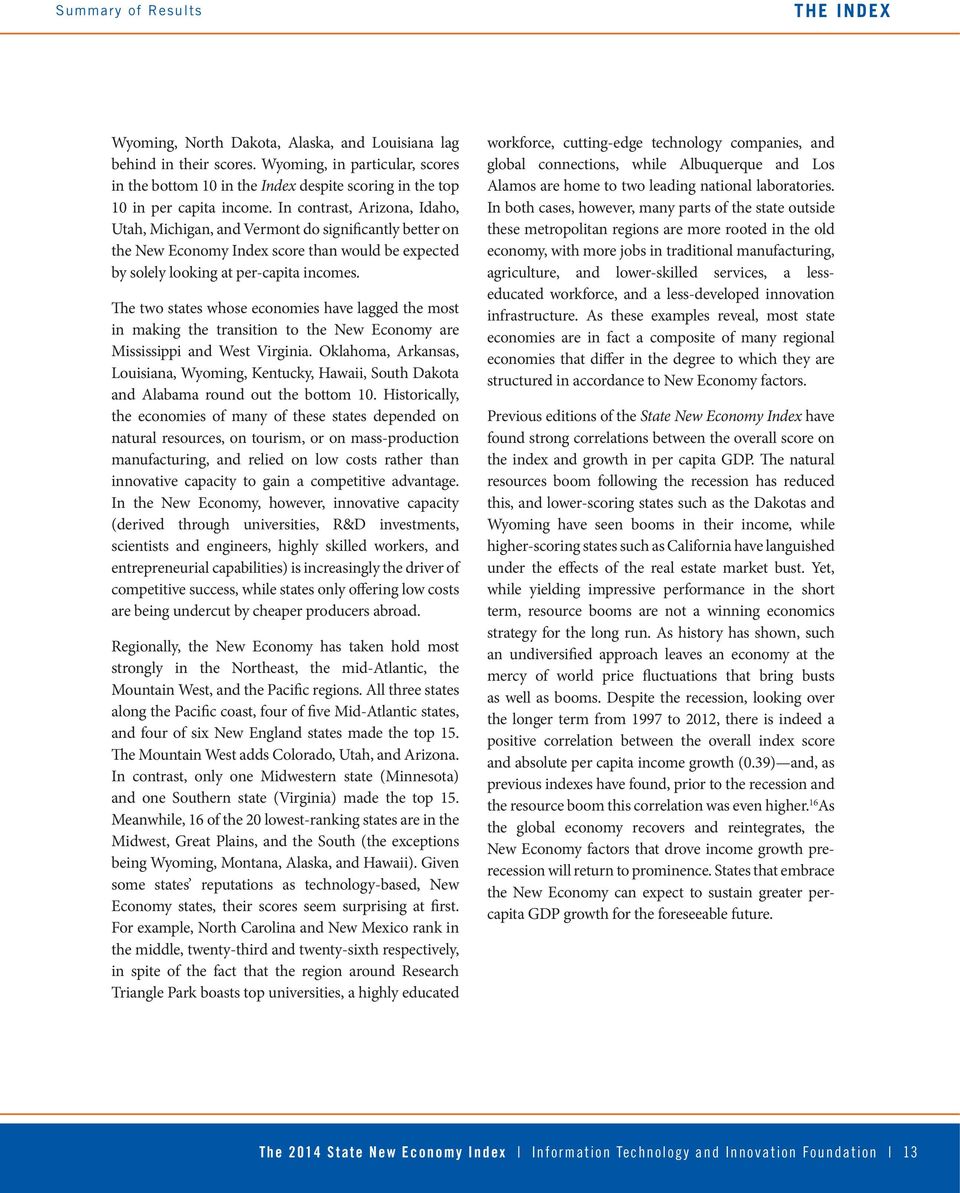
18 THE INDEX Knowledge Jobs Rank State Score Rank* 1 Massachusetts Virginia Maryland Connecticut Delaware Colorado Washington Minnesota New York New Jersey Oregon California Utah Illinois New Hampshire Vermont Nebraska Rhode Island New Mexico Arizona North Carolina Missouri Pennsylvania Georgia Ohio Michigan Kansas Alaska Texas Wisconsin Iowa Maine North Dakota South Carolina Idaho Montana Alabama Florida Hawaii Tennessee Indiana Oklahoma Louisiana South Dakota Arkansas Wyoming Kentucky Nevada West Virginia Mississippi U.S. Average 10.0 KNOWLEDGE JOBS Workers who were skilled with their hands and who could reliably work in repetitive and sometimes physically demanding jobs were the engine of the old economy. In today s New Economy, knowledge-based jobs are driving prosperity. These jobs tend to be managerial, professional and technical positions held by individuals with at least two years of college education. Such skilled and educated workers are the backbone of states most important industries, from high-value-added manufacturing to highwage traded services. The knowledge jobs indicators measure seven aspects of knowledgebased employment: 1) employment in IT occupations in non-it sectors; 2) the share of the workforce employed in managerial, professional, and technical occupations; 3) the education level of the workforce; 4) the average educational attainment of recent immigrants; 5) the average educational attainment of recent U.S. inter-state migrants; 6) worker productivity in the manufacturing sector; and 7) employment in high-wage traded services. Aggregated Knowledge Job Scores OR CA AK WA NV ID AZ UT MT WY CO NM HI ND SD NE TX KS OK MN IA MO AR LA WI IL IN MI TN KY OH MS AL GA 100th 76th percentile 75th 51st percentile 50th 26th percentile 25th 1st percentile WV SC NC FL VA MD DE ME VT NH NY MA CT RI PA NJ *Due to methodological changes, ranking comparisons are not exact. 14 Information Technology and Innovation Foundation The 2014 State New Economy Index
19 Knowledge Jobs THE INDEX Information Technology Jobs Employment in IT occupations in non-it industries as a share of total private-sector jobs Why Is This Important? The IT revolution continues to transform the economy, as businesses in all industries use IT to find new ways to boost productivity, develop new products and services, and create new business models. The number of IT workers in non-it industries is a good proxy to measure the extent to which traditional industries are making use of IT. IT workers, even in traditional industries, are bringing IT to an ever-growing list of applications, from standard website design, to tracking supply and product shipments in real time, to streamlining internal office operations, to finding new ways to communicate with customers. In fact, because of the continuing digital transformation of the economy, IT jobs grew by 22.2 percent between 2001 and 2011, versus only 0.2 percent for private-sector employment in general. 17 The Rankings: Even after controlling for the size of states software and IT-producing industries, most of the states with high scores are those with more technology-driven economies, including every one of the top five. In these IT jobs grew by 22.2 percent between 2001 and 2011, versus only 0.2 percent for employment in general. states, the creation of strong IT-producing industries leads to complementary work in non-it fields. Number-oneranked Virginia, for example, has the highest concentration of IT workers in both IT and non-it industries. 18 Low scoring states tend to have natural-resource-based or traditional manufacturing-based economies. The Top Five Percentage of IT jobs in non-it industries 1 Virginia 3.3% 2 Washington 3.1% 3 Delaware 3.0% 4 Massachusetts 2.9% 5 Maryland 2.9% U.S. Average 1.8% Source: Bureau of Labor Statistics, 2012 The Top Six Movers 2010 Rank 2014 Rank Rank Change 1 Arizona Nebraska Alabama California North Dakota Vermont WA OR NV CA AK ID AZ UT MT WY CO NM ND SD NE TX KS OK MN IA MO AR LA WI IL IN MI TN KY OH MS AL GA WV SC NC FL VA MD DE ME VT NH NY MA CT RI PA NJ HI 100th 76th percentile 75th 51st percentile 50th 26th percentile 25th 1st percentile The 2014 State New Economy Index Information Technology and Innovation Foundation 15

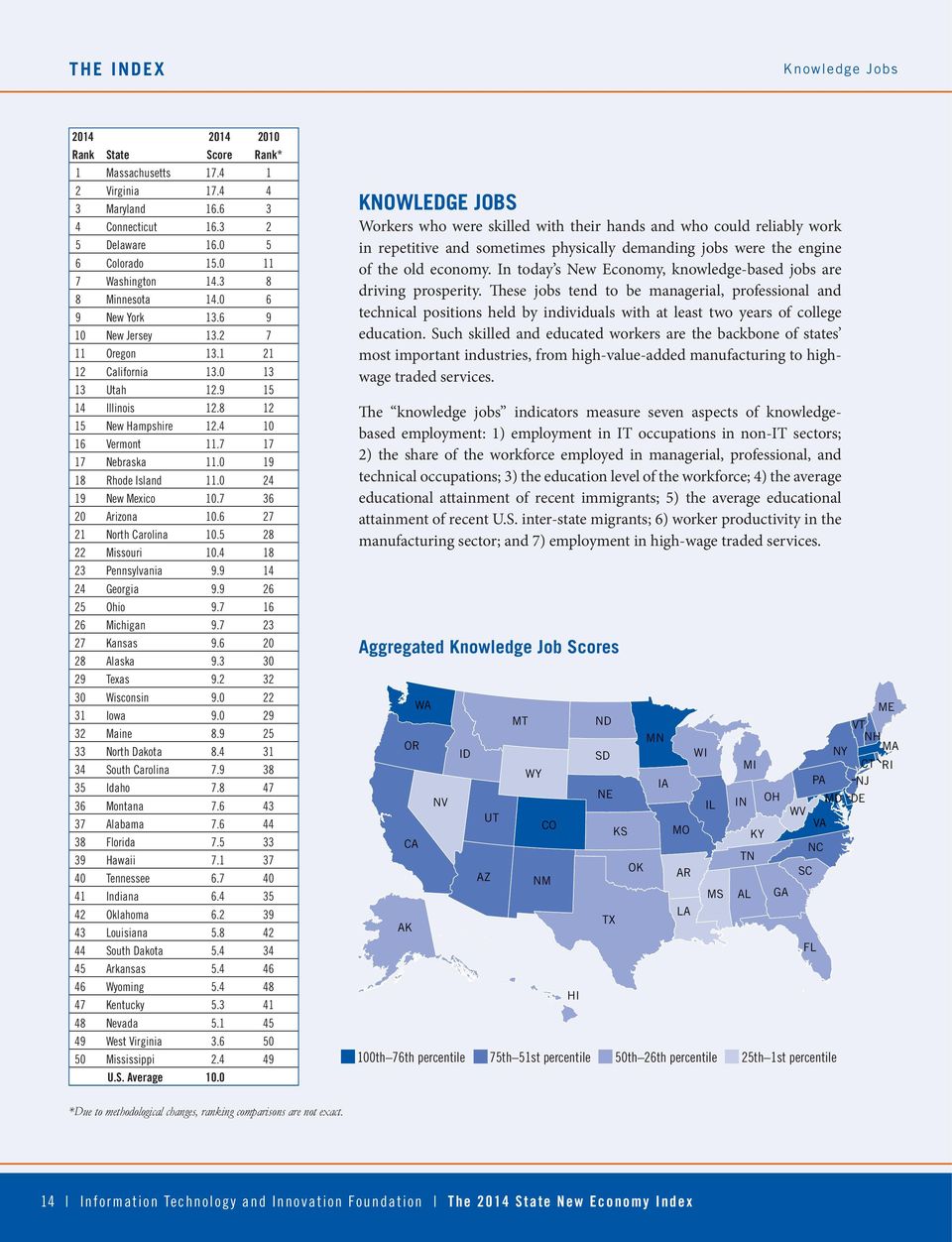
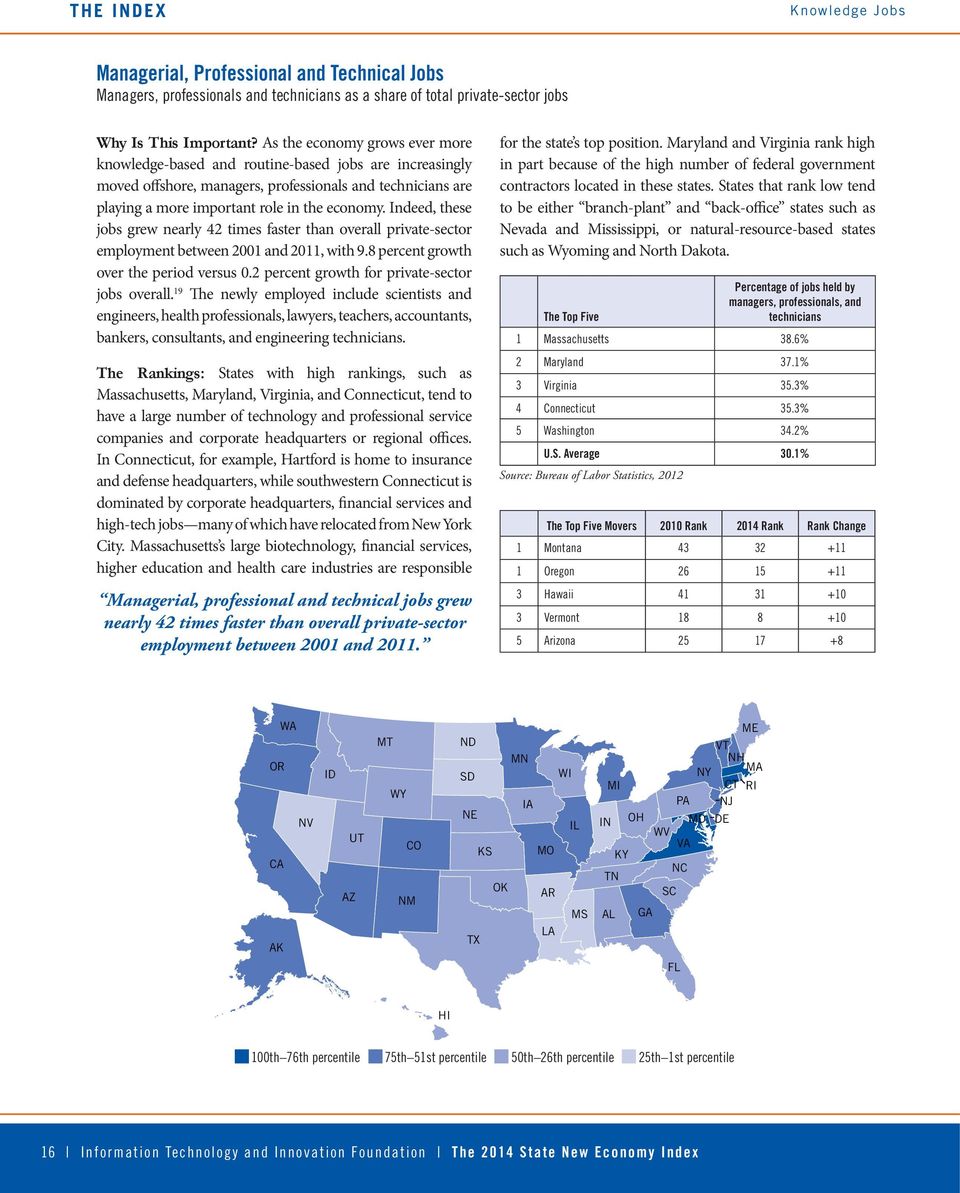
20 THE INDEX Knowledge Jobs Managerial, Professional and Technical Jobs Managers, professionals and technicians as a share of total private-sector jobs Why Is This Important? As the economy grows ever more knowledge-based and routine-based jobs are increasingly moved offshore, managers, professionals and technicians are playing a more important role in the economy. Indeed, these jobs grew nearly 42 times faster than overall private-sector employment between 2001 and 2011, with 9.8 percent growth over the period versus 0.2 percent growth for private-sector jobs overall. 19 The newly employed include scientists and engineers, health professionals, lawyers, teachers, accountants, bankers, consultants, and engineering technicians. The Rankings: States with high rankings, such as Massachusetts, Maryland, Virginia, and Connecticut, tend to have a large number of technology and professional service companies and corporate headquarters or regional offices. In Connecticut, for example, Hartford is home to insurance and defense headquarters, while southwestern Connecticut is dominated by corporate headquarters, financial services and high-tech jobs many of which have relocated from New York City. Massachusetts s large biotechnology, financial services, higher education and health care industries are responsible Managerial, professional and technical jobs grew nearly 42 times faster than overall private-sector employment between 2001 and for the state s top position. Maryland and Virginia rank high in part because of the high number of federal government contractors located in these states. States that rank low tend to be either branch-plant and back-office states such as Nevada and Mississippi, or natural-resource-based states such as Wyoming and North Dakota. The Top Five Percentage of jobs held by managers, professionals, and technicians 1 Massachusetts 38.6% 2 Maryland 37.1% 3 Virginia 35.3% 4 Connecticut 35.3% 5 Washington 34.2% U.S. Average 30.1% Source: Bureau of Labor Statistics, 2012 The Top Five Movers 2010 Rank 2014 Rank Rank Change 1 Montana Oregon Hawaii Vermont Arizona WA OR NV CA AK ID AZ UT MT WY CO NM ND SD NE TX KS OK MN IA MO AR LA WI IL IN MI TN KY OH MS AL GA WV SC VA NC MD DE ME VT NH NY MA CT RI PA NJ FL HI 100th 76th percentile 75th 51st percentile 50th 26th percentile 25th 1st percentile 16 Information Technology and Innovation Foundation The 2014 State New Economy Index
21 Knowledge Jobs THE INDEX Workforce Education A weighted measure of the educational attainment of the workforce Why Is This Important? In the New Economy, an educated workforce is critical to increasing productivity and fostering innovation. Fortunately, the American workforce has become more educated (at least in terms of number of years of schooling) to meet the economy s increased need for skilled workers. In 2012, 29 percent of Americans over 25 years of age held at least a bachelor s degree, up from 24 percent in 2000, 21 percent in 1990, and 16 percent in Unfortunately, it s increasingly clear that many of these graduates are failing to gain the competencies they need. 21 One recent study found that over one-third of college graduates made no progress on the Collegiate Learning Assessment between the time they entered college and when they graduated. 22 The Rankings: States such as Massachusetts, Maryland and Connecticut with strong higher education systems and hightech industrial clusters tend to attract and retain individuals with the most years of schooling. Colorado attracts individuals from other regions who, on average, have more years of schooling than those heading to other fast-growing Western In 2012, 29 percent of Americans over 25 years of age held at least a bachelor s degree, up from 24 percent in 2000 and 21 percent in states. Likewise, Maryland and Virginia are sustained, in part, by the immigration of highly educated individuals to the Washington, D.C. metropolitan area. 23 Meanwhile, those that have historically invested less in education (like Alabama, Louisiana, Mississippi, and Nevada) tend to fall near the bottom. The Top Five Composite Score 1 Massachusetts Colorado Maryland Connecticut Vermont 0.51 U.S. Average 0.42 Source: Census Bureau, 2012 The Top Five Movers 2010 Rank 2014 Rank Rank Change 1 Georgia North Carolina New Mexico Rhode Island California WA OR NV CA AK ID AZ UT MT WY CO NM ND SD NE TX KS OK MN IA MO AR LA WI IL IN MI TN KY OH MS AL GA WV SC NC FL VA MD DE ME VT NH NY MA CT RI PA NJ HI 100th 76th percentile 75th 51st percentile 50th 26th percentile 25th 1st percentile The 2014 State New Economy Index Information Technology and Innovation Foundation 17
22 THE INDEX Knowledge Jobs Immigration of Knowledge Workers The average educational attainment of recent migrants from abroad Why Is This Important? To compete in the new global economy, states need a supply of talented labor with the right skills and education to meet the demands of globally competitive businesses. And in a world with ever-increasing flows of talent across national borders, a small but growing share of this talent pool is coming from overseas. In many cases, these workers do more than merely fill occupational gaps; by bringing new ideas and perspectives from other countries and cultures, they can enhance states levels of innovation and boost wage levels for both themselves and for natives. 24 For example, foreign-born and foreign-educated scientists and engineers in the United States are overrepresented among authors of the most-cited scientific papers and among inventors holding highly cited patents. 25 In fact, 76 percent of patents at the top-10 patent-producing universities included at least one foreign-born inventor, and 40 percent of 2010 Fortune 500 companies were founded by immigrants. 26 Another study found that 16 percent of fast growing gazelle firms had at least one foreign-born founder. 27 The Rankings: Backed by resource wealth, North Dakota and Alaska attracted a large number of highly skilled workers. Among immigrants to North Dakota, 40 percent had college or graduate degrees while another 42 percent reported having at least some college or an associate s degree. Corporate friendly Delaware cracked the top five by attracting very few immigrants without at least high school equivalency. In New Hampshire, 62 percent of immigrants possessed a college degree or above, the highest rate in the country. In contrast, in Idaho, South Dakota, and Mississippi, the three lowest scorers, less than 30 percent of immigrants had college diplomas. Many states in the Deep South and Southwest experienced poor results based on proximity to the Mexican border, while Northern states such as Vermont, New Hampshire, and Washington may have benefitted from proximity to Canada. The Top Five Average years of education 1 North Dakota Alaska Alabama Delaware New Hampshire 14.6 U.S. Average 13.1 Source: Census Bureau, 2012 The Top Six Movers 2010 Rank 2014 Rank Rank Change 1 Alabama Wyoming Delaware Arkansas Colorado Oregon WA OR NV CA AK ID AZ UT MT WY CO NM ND SD NE TX KS OK MN IA MO AR LA WI IL IN MI TN KY OH MS AL GA WV SC NC FL VA MD DE ME VT NH NY MA CT RI PA NJ Seventy-six percent of patents at the top-10 patent-producing universities included at least one foreignborn inventor. HI 100th 76th percentile 75th 51st percentile 50th 26th percentile 25th 1st percentile 18 Information Technology and Innovation Foundation The 2014 State New Economy Index
23 Knowledge Jobs THE INDEX Migration of U.S. Knowledge Workers The average educational attainment of recent migrants from within the United States Why Is This Important? Just as countries compete for talent, so do states. While foreign immigration is important, the lion s share of immigration into states involves American residents moving across state lines. As information technology has become more accessible and companies have expanded their operations across the country, Americans have more ability to be mobile. Many organizations allow workers to telecommute that is, permanently work away from the office. For example, due to the high living costs in Washington, D.C., the Internal Revenue Service allows employees to work in remote offices around the country. Accordingly, states now compete with one another not only to attract business, but also to attract the skilled workers who can work for those businesses or start their own. Indeed, research has found that a 1 percent increase in a metropolitan area s level of educational attainment leads to a 0.04 increase in per-capita real income, and that a 1 percent increase in the supply of college graduates increases all high school dropouts wages by 1.6 percent and all college graduates wages by 0.4 percent. 28 The Rankings: There appears to be several factors driving immigration of knowledge workers. States with a large share of high-wage, professional and managerial jobs that rely more on knowledge workers do well. 29 Strong higher education systems in Massachusetts and Connecticut contributed to lofty rankings, while highly educated workers heading to government jobs in the D.C. area pushed Virginia and Maryland into the top five. In addition, quality of outdoor life appears to play a key role, with states like Vermont, Hawaii, New Hampshire, Colorado, and Maine ranking highly. The Top Five Average years of education 1 Vermont Massachusetts Maryland Connecticut Virginia 14.5 U.S. Average 13.6 Source: Census Bureau, 2012 The Top Five Movers 2010 Rank 2014 Rank Rank Change 1 Alaska Delaware Oregon Idaho Alabama A 1 percent increase in the supply of college graduates increases all high-school dropouts wages by 1.6 percent and all college graduates wages by 0.4 percent. WA OR NV CA AK ID AZ UT MT WY CO NM ND SD NE TX KS OK MN IA MO AR LA WI IL IN MI TN KY OH MS AL GA WV SC VA NC MD DE ME VT NH NY MA CT RI PA NJ FL HI 100th 76th percentile 75th 51st percentile 50th 26th percentile 25th 1st percentile The 2014 State New Economy Index Information Technology and Innovation Foundation 19
24 THE INDEX Knowledge Jobs Manufacturing Value Added Manufacturing value added per production hour worked as a percentage of the national average, adjusted for industry mix Why Is This Important? Value added is the difference in value between inputs into the production process (such as materials and energy) and the value of final products or services sold. Within manufacturing, high-value-added firms tend to be those that are capital intensive, producing more technologically complex products and organizing their work to take better advantage of worker skills. Because their workers are more productive generating greater value for each hour worked they typically earn higher wages. Within sectors, firms with higher-valueadded levels, all else being equal, are better equipped to meet competitive challenges both at home and abroad. The Rankings: Western states dominate this category, with New Mexico, Utah, Oregon, Nevada, Texas and Arizona The Top Five Adjusted value added as a percentage of U.S. average 1 New Mexico 146.0% 2 Utah 129.8% 3 Oregon 126.5% 4 Virginia 113.4% 5 Nevada 112.8% U.S. Average 98.7% Source: Census Bureau, 2012 all making the top 10. The states that did well had business friendly policies and low costs of doing business that attracted specialized clusters producing high-tech goods with high efficiency. New Mexico s production of electronics, concentrated in Albuquerque and Santa Fe, accounts for 30 percent of total manufactures and has contributed to an economic revitalization for the state. Similarly, Provo and Salt Lake City, Utah, have been transformed into softwarefueled boomtowns, while Delaware s low costs of business makes it attractive to companies looking for access to lucrative east coast markets. In each case, homogeneous high-skilled firms form high-tech, knowledge-based clusters that increase production efficiency. Even after controlling for a state s industry mix, states that have a high share of high-tech jobs and a high proportion of scientists and engineers in their workforce also have more productive manufacturers. 30 The Top Five Movers 2012 Rank 2014 Rank Rank Change 1 Idaho Nebraska Delaware Arkansas Kansas WA OR NV CA AK ID AZ UT MT WY CO NM HI ND SD NE TX KS OK MN IA MO AR LA WI IL IN MI TN KY OH MS AL GA WV SC NC FL VA MD DE ME VT NH NY MA CT RI PA NJ States that have a high share of high-tech jobs and a high proportion of scientists and engineers in their workforce also have more productive manufacturers. 100th 76th percentile 75th 51st percentile 50th 26th percentile 25th 1st percentile 20 Information Technology and Innovation Foundation The 2014 State New Economy Index
25 Knowledge Jobs THE INDEX High-Wage Traded Services The share of employment in traded service sectors in which the average wage is above the national median for traded services Why Is This Important? The service sector consists of more than just local-serving, low-wage industries like fast food. From insurance and financial services to publishing and goods transportation, traded services those that are not primarily consumed locally accounted for nearly 19 percent of U.S. private sector employment in Many of these, like investment services, publishing, legal services, advertising, and shipping, pay wages above the national average. High-wage traded services have rebounded from the economic recession and have become a significant source of employment. For example, professional and business services added 2,058,000 private-sector jobs between January 2010 and March Moreover, in most states, services are increasingly the only part of a region s economic base (firms that sell most of their output outside the region) that is growing in employment. Indeed, the IT revolution is enabling a growing share of informationbased services to be physically distant from the customer while remaining functionally close. For example, the Internet has transformed services like banking and book sales from localserving industries to being potentially global in scale. The Rankings: Large, traditional centers of business activity lead the rankings. Delaware s state strategy to attract banking industries has helped propel it to the top of the rankings. Connecticut hosts a large number of insurance companies and law firms, while the New York metropolitan area is home to a wide array of corporate headquarters, financial services, and publishing institutions. States near the bottom of the rankings, such as Wyoming, Montana, and West Virginia, tend to be economies more heavily based on resource-dependent industries and traditional manufacturing. The Top Five Percentage of jobs in high-wage traded service sectors 1 Delaware 16.7% 2 New York 15.6% 3 Connecticut 15.4% 4 Minnesota 13.7% 5 Virginia 13.2% U.S. Average 10.2% Source: Bureau of Labor Statistics, 2012 The Top Five Movers 2010 Rank 2014 Rank Rank Change 1 Rhode Island Colorado Maryland Oklahoma Washington Traded services accounted for nearly 19 percent of U.S. private sector employment in WA OR NV CA AK ID AZ UT MT WY CO NM ND SD NE TX KS OK MN IA MO AR LA WI IL IN MI TN KY OH MS AL GA WV SC VA NC MD DE ME VT NH NY MA CT RI PA NJ FL HI 100th 76th percentile 75th 51st percentile 50th 26th percentile 25th 1st percentile The 2014 State New Economy Index Information Technology and Innovation Foundation 21
26 THE INDEX Globalization Rank State Score Rank* 1 Delaware Nevada Texas South Carolina New Jersey New York Massachusetts Washington Connecticut Florida Georgia Illinois Kentucky New Hampshire Louisiana Vermont Rhode Island Michigan Tennessee Indiana North Carolina Pennsylvania California Maine Maryland Utah Alabama Ohio Virginia North Dakota Kansas Arizona West Virginia Minnesota Alaska Oregon Colorado Iowa Hawaii Wisconsin Idaho Nebraska Missouri Wyoming Arkansas Mississippi New Mexico Oklahoma South Dakota Montana U.S. Average 10.0 GLOBALIZATION While the old economy was national in scope, the New Economy is global. While in 1988 there were 3.8 million workers employed in multinational companies in the United States, in 2011 there were 5.6 million. 33 Likewise, the capital expenditures from majority-owned foreign affiliates in the United States increased from 1.1 percent of GDP in 1997 to over 1.4 percent of GDP in 2007, before the recession. 34 However, this has fallen back to 1.1 percent of GDP in 2011, in part due to the recession and the failure of the United States to maintain global competiveness. 35 When the old economy emerged after World War II, the winners were states whose businesses sold to national markets, as opposed to local or regional ones. In the New Economy, the winners are the states whose businesses are best integrated into the world economy, as a global orientation ensures expanding markets for a state s industries. Since workers at globally oriented firms also earn higher wages than those at domestically oriented firms, global integration provides a state s workforce with a higher standard of living. The globalization indicators in this section measure two aspects of globalization: 1) the extent to which the state s manufacturing and service workforce is employed producing goods and services for export; and 2) the share of the workforce employed by foreign-owned companies. Aggregated Globalization Scores OR CA AK WA NV ID AZ UT MT WY CO NM HI ND SD NE TX KS OK MN IA MO AR LA WI IL IN MI TN KY OH MS AL GA SC VT NH NY MA CT RI PA NJ NC FL VA MD DE 100th 76th percentile 75th 51st percentile 50th 26th percentile 25th 1st percentile WV ME *Due to methodological changes, ranking comparisons are not exact. 22 Information Technology and Innovation Foundation The 2014 State New Economy Index
27 Globalization THE INDEX Foreign Direct Investment The percentage of each state s workforce employed by majority-owned foreign companies Why Is This Important? Incoming foreign direct investment (FDI) refers to significant investments by foreign companies in new facilities in the United States that employ workers. FDI grew rapidly in the late 1990s, reaching an apex in 2000 of $314 billion, before dropping precipitously to $53 billion in Since then, FDI has rebounded to $161 billion in However, because of data limitations, it is not clear how much of this is new Greenfield investment and how much is the purchasing of existing U.S. assets. In 2011, majority-owned foreign-owned companies employed 3.6 percent of American workers and accounted for 4.7 percent of U.S. GDP, both figures down from The Rankings: States in the North Atlantic region have the highest percentage of their workforce employed by foreign firms due to the impact of investment by European firms. Firms in five European countries France, Germany, the Netherlands, Switzerland, and the United Kingdom accounted for 51 percent of all U.S. employment in foreign firms in And European firms are more concentrated in the North Atlantic states (excluding Maine, where FDI In 2011, majority-owned foreign-owned companies employed 3.6 percent of American workers and accounted for 4.7 percent of U.S. GDP. is dominated by Canada), where the share of employment in firms from these five countries is 59 percent. The geographic outlier in the top five is South Carolina, the only state in the top quartile not located on the North Atlantic seaboard. Driven by significant growth in the automotive manufacturing industry in the Greenville-Spartanburg area, South Carolina has largely reinvented itself as an international-friendly manufacturing hub. The Top Five Percentage of jobs in foreign-controlled companies 1 Delaware 5.6% 2 New Hampshire 4.7% 3 South Carolina 4.6% 4 Connecticut 4.6% 5 New Jersey 4.5% U.S. Average 3.0% Source: Bureau of Economic Analysis, 2011 The Top Five Movers 2012 Rank 2014 Rank Rank Change 1 Michigan Iowa South Carolina Wisconsin Virginia WA OR NV CA AK ID AZ UT MT WY CO NM ND SD NE TX KS OK MN IA MO AR LA WI IL IN MI TN KY OH MS AL GA WV SC VT NH NY MA CT RI PA NJ VA NC MD DE ME FL HI 100th 76th percentile 75th 51st percentile 50th 26th percentile 25th 1st percentile The 2014 State New Economy Index Information Technology and Innovation Foundation 23
28 THE INDEX Globalization Export Focus of Manufacturing and Services The value of exports per manufacturing and service worker, adjusted for industry mix Why Is This Important? Trade has become an integral part of the U.S. and world economies. The combined total of U.S. exports and imports has increased from just 11 percent of GDP in 1970 to 20 percent in 1990, reaching 30 percent in Services exports have been growing in importance over the past three decades, having increased from 18 percent of exports in 1980 to over 30 percent in Moreover, service exports were impacted less by the economic recession than goods exports. From 2011 to 2013, service exports have increased by 9.4 percent, compared with manufactured goods increase of 5.9 percent. Growth of exports during this period helped reduce the trade deficit by over 13 percent. 39 Manufacturing strength has been a driving force in the U.S. recovery, adding almost 500,000 jobs from 2000 to Increasingly, U.S. manufacturers are knowledge workers who are better educated and more highly paid than their non-manufacturing counterparts. In fact, 54 percent of manufacturing workers have at least some college education, and on average manufacturing employees earn 17 percent more than the average American. Likewise, growth in export-oriented services is very good news. With the advent of the Internet and instant global communication, many services can now be performed practically anywhere on the globe, meaning that service workers are now competing with firms all over the world. Success brings significant boons. In business services, workers at exporting firms earn almost 20 percent more than their counterparts at comparable non-exporting business services firms. 41 Research also finds that the more stable a state s service-sector exports, the less unemployment rises during an economic downturn. During the current recession, the unemployment rate was 1 percent higher for every five percentage points lost in the service-exports growth rate. 42 States that win the race to provide high-quality services for the global marketplace will secure their position in the New Economy. The Rankings: The leading states are generally those that have high-value-added, technologically advanced manufacturing sectors. 43 Nevada, the clear winner, has seen the emergence of a thriving primary metals manufacturing sector that boosted its adjusted export value per worker by over $30,000 since Louisiana and Texas owe high ranks to petroleum production. Texas also benefits from proximity to Mexico, which accounts for one-third of Texan exports as well as the state s robust oil and petroleum industry exports. Even after holding constant the oil and petroleum industry sectors propensities to export, Texan exports per employee are more than twice the national average. Washington s rank demonstrates the importance of software publishing (a service industry), as Microsoft s software exports, together with Boeing s aerospace manufacturing, are largely responsible for its strong performance. Overall, the United States has seen a sharp decline in exports per worker over recent years, with the U.S. average declining by over $11,000 since Growth of exports from 2011 to 2013 helped reduce the trade deficit by over 13 percent. 24 Information Technology and Innovation Foundation The 2014 State New Economy Index
29 Globalization THE INDEX The Top Five Adjusted export value per manufacturing and service worker 1 Nevada $121,882 2 Texas $108,586 3 Washington $87,353 4 Florida $85,953 5 Louisiana $80,577 U.S. Average $43,482 Sources: International Trade Administration, 2012; Census Bureau, 2010 The Top Seven Movers 2010 Rank 2014 Rank Rank Change 1 New Mexico Idaho Vermont Mississippi Georgia Illinois New York WA OR NV CA AK ID AZ UT MT WY CO NM ND SD NE TX KS OK MN IA MO AR LA WI IL IN MI TN KY OH MS AL GA WV SC VT NH NY MA CT RI PA NJ VA NC MD DE ME FL HI 100th 76th percentile 75th 51st percentile 50th 26th percentile 25th 1st percentile The 2014 State New Economy Index Information Technology and Innovation Foundation 25
30 THE INDEX Economic Dynamism Rank State Score Rank* 1 Utah Colorado California Massachusetts Arizona Florida Idaho Maryland Alaska Texas Nevada Montana Georgia New York Vermont Virginia New Hampshire Delaware New Jersey Maine North Carolina Connecticut South Dakota New Mexico Washington Oregon North Dakota Rhode Island Pennsylvania Minnesota Kansas South Carolina Illinois Indiana Louisiana Oklahoma Kentucky Arkansas Wyoming Missouri Michigan Hawaii Tennessee Mississippi Wisconsin Nebraska Ohio Iowa Alabama West Virginia U.S. Average 10.0 ECONOMIC DYNAMISM The old economy was driven by large companies facing limited competition in stable markets with high barriers to entry. The New Economy is driven by economic dynamism and competition, exemplified by fast growing entrepreneurial companies and rapidly changing fortunes in many industries. Given this new economic paradigm, the ability of state economies to rejuvenate themselves through the formation of new, innovative companies is critical to economic vitality. The dynamism and competition indicators in this section measure five aspects of economic dynamism: 1) the degree of job churning; 2) the number fast growing firms; 3) the number and value of companies IPOs; 4) the number of entrepreneurs starting new businesses; and 5) the number of individual inventor patents granted. Aggregated Economic Dynamism Scores AK OR CA WA NV ID AZ UT MT WY CO NM HI ND SD NE TX 100th 76th percentile 75th 51st percentile 50th 26th percentile 25th 1st percentile KS OK MN IA MO AR LA WI IL IN MI TN KY OH MS AL GA WV SC VT NH NY MA CT RI PA NJ NC FL VA MD DE ME *Due to methodological changes, ranking comparisons are not exact. 26 Information Technology and Innovation Foundation The 2014 State New Economy Index
31 Economic Dynamism THE INDEX Job Churning The number of business establishment startups and business failures as a share of total establishments Why Is This Important? Steady growth in employment masks the constant churning of job creation and destruction, as less innovative and efficient companies downsize or go out of business and more innovative and efficient companies grow or take their place. While startups have a higher failure rate than older, more established businesses, the ones that survive have very high rates of growth and job creation. 44 Indeed, according to the Census Bureau, surviving firms less than five years of age had a job creation rate of 19 percent in 2011, versus just 12 percent for older firms. 45 Along with jobs and income, it is frequently these entrepreneurial businesses including new manufacturers that bring fresh new ideas and innovations to the marketplace, replacing those of less innovative incumbents, and thus raising living standards. While such turbulence increases the economic risk faced by workers, companies, and even regions, in the New Economy it is a fundamental driver of innovation and economic growth. The Rankings: Churning has been in part related to faster employment growth in Western and Southern states like Alaska, Idaho, Colorado, Florida, and Utah. 46 In part, this is because fast-growing economies produce more startups, especially in local-serving industries (such as restaurants, dry cleaners, or accountants). As a result, some states experience a great deal of churning. Yet, interestingly, there is no correlation between state unemployment and churn rates, perhaps because churning reflects higher levels of economic dynamism, even if that means more job loss. 47 The Top Five Percentage of establishment startups and failures 1 Alaska 46.5% 2 Idaho 44.0% 3 Utah 43.4% 4 Florida 43.2% 5 Colorado 42.6% U.S. Average 34.2% Source: Bureau of Labor Statistics, The Top Five Movers 2010 Rank 2014 Rank Rank Change 1 Delaware North Dakota Arkansas Kentucky South Dakota Surviving firms less than five years of age had a job creation rate of 19 percent in 2011, versus just 12 percent for older firms. WA OR NV CA AK ID AZ UT MT WY CO NM ND SD NE TX KS OK MN IA MO AR LA WI IL IN MI TN KY OH MS AL GA WV SC VT NH NY MA CT RI PA NJ VA NC MD DE ME FL HI 100th 76th percentile 75th 51st percentile 50th 26th percentile 25th 1st percentile The 2014 State New Economy Index Information Technology and Innovation Foundation 27
32 THE INDEX Economic Dynamism Fast-Growing Firms The number of firms on the Inc. 500 and Technology Fast 500 lists as a share of total firms Why Is This Important? The Technology Fast 500 and Inc. 500 lists are composed of the fastest growing U.S. firms. Every firm on the 2013 Technology Fast 500 list has experienced annual revenue growth of at least 137 percent each year over a five-year period. For the 2013 Inc. 500, firms on the list averaged 2,600 percent growth between 2009 and While firms attaining such growth rates are generally quite small, with fewer than 100 employees, they represent a state s most successful entrepreneurial efforts and hold strong promise for continued growth. In fact, there are a number of well-known companies (including Microsoft and Paul Mitchell) that were listed on the Inc. 500 before they became household names. A state s performance in this measure is one indication of the vitality of its entrepreneurial network. The Rankings: Not surprisingly, states that perform well are generally ones with major cities known for their entrepreneurial technology sectors. Indeed, over half of Inc. 500 firms are located in the Bay area, Boston, New York City, Washington, D.C., or in Los Angeles. California excels at IT and telecommunications, while Massachusetts has a large number of medical technology firms. Many states that perform well have developed clusters of wellorganized, fast-growing firms and support systems to help firms grow. For example, local university partnerships have helped Provo, Utah rank first among metropolitan areas in Inc. 500 firms per capita. 48 The Top Five Percentage of firms that are fast-growing 1 Massachusetts 0.041% 2 California 0.036% 3 Virginia 0.033% 4 Maryland 0.032% 5 Utah 0.030% U.S. Average 0.011% Sources: Deloitte, ; Inc., The Top Five Movers 2010 Rank 2014 Rank Rank Change 1 Delaware Rhode Island Idaho Hawaii Wyoming Over half of Inc. 500 firms are located in the Bay area, Boston, New York City, Washington D.C., or in Los Angeles. WA OR NV CA AK ID AZ UT MT WY CO NM ND SD NE TX KS OK MN IA MO AR LA WI IL IN MI TN KY OH MS AL GA WV SC VT NH NY MA CT RI PA NJ VA NC MD DE ME FL HI 100th 76th percentile 75th 51st percentile 50th 26th percentile 25th 1st percentile 28 Information Technology and Innovation Foundation The 2014 State New Economy Index
33 Economic Dynamism THE INDEX Initial Public Offerings A weighted measure of the number and value of initial public stock offerings as a percentage of worker earnings Why Is This Important? Initial public offerings (IPOs the first rounds of companies stock sold when they make their debut in public markets) are an important way by which high growth companies obtain needed capital to enable their next round of growth. Total proceeds from U.S. IPOs were valued at $55 billion in 2013, making it the strongest year for IPOs since the peak of the tech bubble in The Internet slump and economic recession reduced the number of offerings in 2003 to just 17 percent of 2000 numbers. IPOs grew again from 2004 to 2007, reaching a peak of $49 billion. The recession had a large negative effect on IPOs, but the market has since recovered. From 2009 to 2013, U.S. IPOs total revenue has averaged 26 percent annual growth. 49 The Rankings: Strong results in the energy sector secured the top spot for Texas. Backed by high levels of investment and cultures of innovation, technologically savvy Massachusetts and California produced a large number of valuable IPOs. In fact, California alone has been home to over 25 percent of IPOs from 2011 to Many of the states with low scores simply had no companies go public. In 2013, 20 states did not record a single IPO. However, IPOs do appear to be spreading beyond traditional centers of innovation. Had the index only used 2013 data, the top two spots would belong to Colorado and North Carolina, despite the two states combining for just two IPOs worth $0.2 billion in The Top Five Composite Score 1 Texas California Massachusetts Colorado New Jersey 6.14 U.S. Average 5.00 Source: Renaissance Capital, The Top Five Movers 2010 Rank 2014 Rank Rank Change 1 South Dakota Kansas North Carolina South Carolina Nebraska Total U.S. IPOs were valued at $55 billion in 2013 total proceeds, making it the strongest year for IPOs since the peak of the tech bubble in WA OR NV CA AK ID AZ UT MT WY CO NM ND SD NE TX KS OK MN IA MO AR LA WI IL IN MI TN KY OH MS AL GA WV SC VT NH NY MA CT RI PA NJ NC FL VA MD DE ME HI 100th 76th percentile 75th 51st percentile 50th 26th percentile 25th 1st percentile The 2014 State New Economy Index Information Technology and Innovation Foundation 29
34 THE INDEX Economic Dynamism Entrepreneurial Activity The number of entrepreneurs starting new businesses Why Is This Important? In the New Economy, where lowwage developing nations serve as attractive options for U.S. multinationals, competitive advantage is increasingly based on innovation and the generation of new business models. As a result, entrepreneurial activity is now more important to a state s economic health than ever before. Although only 1 in 20 new firms are high growth in terms of job creation, firms that survive the first few years have high rates of job growth and also often produce innovative goods, services, and processes. 50 The Rankings: Myriad factors affect states rates of entrepreneurship from industry and firm size mix, to education, to culture and thus it is difficult to pinpoint one primary factor driving the different scores. Western states continue to have the highest concentration of entrepreneurs, while Midwest states generally have the lowest rates. Surprisingly, many of the top states for entrepreneurship had very low levels of venture capital investment. This trend implies that many entrepreneurs in Western states are owners of small independent businesses that are reemerging as the economy recovers from the 2008 recession. Overall, U.S. entrepreneurship rates have dropped to 0.30 percent from a recent peak of 0.34 percent in 2010, perhaps because entrepreneurship of necessity has declined as the economy has recovered. The Top Five Percentage of people starting a business 1 Vermont 0.46% 2 Montana 0.43% 3 Arizona 0.43% 4 California 0.42% 5 Alaska 0.42% U.S. Average 0.30% Source: Kauffman Foundation, The Top Seven Movers 2012 Rank 2014 Rank Rank Change 1 Hawaii New Mexico South Carolina Montana Delaware South Dakota Washington Firms that survive the first few years have high rates of job growth and also often produce innovative goods, services, and processes. WA OR NV CA AK ID AZ UT MT WY CO NM ND SD NE TX KS OK MN IA MO AR LA WI IL IN MI TN KY OH MS AL GA WV SC VT NH NY MA CT RI PA NJ NC FL VA MD DE ME HI 100th 76th percentile 75th 51st percentile 50th 26th percentile 25th 1st percentile 30 Information Technology and Innovation Foundation The 2014 State New Economy Index
35 Economic Dynamism THE INDEX Inventor Patents The number of independent inventor patents per 1,000 working-age people Why Is This Important? From Benjamin Franklin to Bill Gates to Steve Jobs, the independent inventor is an established American icon. Today, many owners of individual patents those patents not assigned to any organization are not mere tinkerers, but rather are trained scientists, engineers, or students pursuing independent research. Because the New Economy places a premium on innovation, this wellspring of innovative activity has become an important foundation for many entrepreneurial ventures. Inventor patents can quickly turn into real economic activity. Thirty-nine percent of independent inventor patent filers reported sales from their inventions, and 20 percent turned profits. 51 The Rankings: Not surprisingly states with a large number of inventor patents are also likely to have a large number of scientists and engineers. 52 Many of these states also have strong higher education science and engineering programs. States that are typically strong in tech-based entrepreneurial activity, including Utah, California, and Massachusetts perform well. The states generating the fewest inventor patents per capita tend to be Southeastern states, with workforces rooted in agriculture and more traditional industries and historically lower levels of entrepreneurial activity. The Top Five Patents per 1,000 people of workforce age 1 Utah California Massachusetts Connecticut New Hampshire 0.11 U.S. Average 0.07 Source: U.S. Patent and Trademark Office, The Top Five Movers 2010 Rank 2014 Rank Rank Change 1 South Dakota Georgia Delaware Indiana Colorado Thirty-nine percent of independent inventor patent filers reported sales from their inventions, and 20 percent turned profits. WA OR NV CA AK ID AZ UT MT WY CO NM ND SD NE TX KS OK MN IA MO AR LA WI IL IN MI TN KY OH MS AL GA WV SC VT NH NY MA CT RI PA NJ NC FL VA MD DE ME HI 100th 76th percentile 75th 51st percentile 50th 26th percentile 25th 1st percentile The 2014 State New Economy Index Information Technology and Innovation Foundation 31
36 THE INDEX The Digital Economy Rank State Score Rank* 1 Massachusetts Minnesota New Hampshire Rhode Island Michigan Colorado Vermont Wisconsin Connecticut Oregon North Dakota Virginia Utah New Jersey Washington South Dakota Delaware New York California Iowa Pennsylvania Ohio Illinois Maine Maryland Indiana Nebraska Kansas Missouri North Carolina Georgia Wyoming Florida Idaho Tennessee Montana Arizona Texas Nevada West Virginia Hawaii Arkansas Alaska Kentucky Louisiana South Carolina Mississippi Oklahoma Alabama New Mexico U.S. Average 10.0 THE DIGITAL ECONOMY In the old economy, virtually all economic transactions involved the transfer of physical goods and paper records, or the interaction of people in person or by telephone. In the digital economy, a significant share of both business and government transactions are conducted through digital means. For example, 6 percent of total retail sales are now conducted online, as compared to only 4.5 percent in Moreover, between 2002 and 2013, U.S. retail sales through e-commerce increased by 17.5 percent annually in comparison to just 3.4 percent annual growth for total retail sales. Total U.S. e-commerce sales reached $263 billion in As the use of IT is transforming virtually all sectors of the economy, the result has been a large jump in productivity. 54 In 2012, 79 percent of U.S. households and 75 percent of individuals used the Internet. 55 Farmers use the Internet to buy seed and fertilizer, track market prices, and sell crops. Governments provide open data access so that data scientists can develop advanced analytics to solve problems and provide solutions. Whether it is to pay bills or locate a package, consumers increasingly forgo a phone call to corporate customer service centers in favor of more efficient self-service over the Internet. Moreover, with the advent of health IT, patients and medical staff exchange real-time information, making health care decisions faster and more reliable. All of this translates into productivity gains and higher standards of living. In this way, digital technology is doing as much to foster state economic growth in the early 21st century as mechanical and electrical technologies did in the early and mid-20th century. The digital economy indicators measure four aspects of the digital economy: 1) the use of IT to deliver state government services; 2) the percentage of farmers online and using computers for business; 3) the adoption and average speed of broadband telecommunications; and 4) health information technology use. Aggregated Digital Economy Scores OR CA AK WA NV ID AZ UT MT WY CO NM HI ND SD NE TX KS 100th 76th percentile 75th 51st percentile 50th 26th percentile 25th 1st percentile OK MN IA MO AR LA WI IL IN MI TN KY OH MS AL GA WV SC VT NH NY MA CT RI PA NJ NC FL VA MD DE ME *Due to methodological changes, ranking comparisons are not exact. 32 Information Technology and Innovation Foundation The 2014 State New Economy Index
37 The Digital Economy THE INDEX Online Agriculture A weighted measure of the percentage of farmers with Internet access and using computers for business Why Is This Important? While agriculture accounts for less than 5 percent of national employment, in many states it remains an important component of the economy. As in other sectors, the New Economy is transforming agriculture. Farmers and ranchers increasingly use the Internet to buy feed and seed, check on weather conditions, obtain the latest technical information, and even to sell their livestock or crops. In 2013, 67 percent of farms had access to the Internet, compared to 51 percent in 2005 and 29 percent in Additionally, 95 percent of those farms with Internet access used a broadband connection. 56 The degree to which farmers take advantage of the New Economy will increasingly determine their competitive success. Two measures of this are the percentage of farmers with Internet access, and the percentage that use computers to run their farms. The Rankings: Farmers in New England states lead the nation in both use of computers and access to the Internet, as well as in the percentage of farmers who conduct business on the USDA website. Mountainous Western states did well, while states in the South and Southwest fell near the bottom. The Top Ten Composite Score 1 New England States New Jersey Oregon Wyoming Washington 6.61 U.S. Average 5.00 Source: U.S. Department of Agriculture, 2013; USDA combines some states into single geographic areas: Arizona and Nevada; Delaware and Maryland; Connecticut, Maine, Massachusetts, New Hampshire, Rhode Island, and Vermont; Alaska and Hawaii are estimated using the national median. The Top Five Movers 2010 Rank 2014 Rank Rank Change 1 Utah Georgia Louisiana Illinois Maryland In 2013, 67 percent of farms had Internet access, compared to 29 percent in WA OR NV CA AK ID AZ UT MT WY CO NM ND SD NE TX KS OK MN IA MO AR LA WI IL IN MI TN KY OH MS AL GA WV SC VT NH NY MA CT RI PA NJ VA NC MD DE ME FL HI 100th 76th percentile 75th 51st percentile 50th 26th percentile 25th 1st percentile The 2014 State New Economy Index Information Technology and Innovation Foundation 33
38 THE INDEX The Digital Economy E-Government A measure of the utilization of digital technologies in state governments Why Is This Important? State governments that fully embrace the potential of networked information technologies will not only increase the quality and cut the costs of government services, but will also help to foster broader use of information technologies among residents and businesses. State governments have made considerable progress in using the Internet to allow individuals to interact with government from paying taxes to renewing drivers licenses. But the next phase of e-government breaking down bureaucratic barriers to create functionally oriented, citizen-centered government Web presences designed to give citizens a self-service government has only just begun. 57 In particular, most states need to go much further to help businesses interact with local and state governments online. While some states like Wisconsin and Oregon have online wizards to navigate users through the process of creating a business, most states continue to see online business portals only as places to house government documents. For instance, in 2011, 93.5 percent of local governments posted council agendas and minutes online, but only 57.9 percent allowed citizens to request services or pay bills. 58 Yet on the whole, states are moving in the right direction. Governments are reducing bureaucratic barriers by moving utility bill payments, requests for records, payments of fines and fees, and even tax payments online. 59 By placing these functionalities online, governments can substantially reduce the amount of time it takes to provide government services, eliminating inefficiencies and cutting costs for both citizens and government agencies. The Social Security Administration estimated that switching to electronic statements could save up $70 million annually in printing and mailing costs. 60 We still have a long way to go. In 2012, according to a UN index, the United States dropped to fifth place worldwide in use of e-government, behind Denmark, the United Kingdom, the Netherlands, and South Korea. 61 The Rankings: States with a tradition of good government, such as Michigan, Utah, and Minnesota, appear to have gone farther along the path toward digital government than states without it. But this relationship is not completely predictive. Much of the move to digital government appears to be driven by the efforts of particular individuals, including governors, secretaries of states, and legislative committee chairs. Strong gubernatorial leadership is surely at play in explaining some states higher scores. Both Ohio and West Virginia entered the top quartile in 2014 after initiating state-level e-government programs that worked with local governments to streamline programs and services. 62 Ohio and West Virginia, along with other states with similar programs, have cited streamlining and expanding e-government services as vital to their ongoing efforts to improve the quality, speed, and accessibility of government services. In 2011, 93.5 percent of local governments posted council agendas and minutes online, but only 57.9 percent allowed citizens to request services or pay bills. 34 Information Technology and Innovation Foundation The 2014 State New Economy Index
39 Report The Digital Section Economy Divider REPORT SECTION THE DIVIDER INDEX The Top Eight Composite Score 1 Michigan Utah California Minnesota Ohio Pennsylvania Tennessee West Virginia U.S. Average Source: Government Technology, 2012 The Top Five Movers 2012 Rank 2014 Rank Rank Change 1 Indiana Ohio Iowa Nebraska South Carolina WA OR NV CA AK ID AZ UT MT WY CO NM ND SD NE TX KS OK MN IA MO AR LA WI IL IN MI TN KY OH MS AL GA WV SC VA NC MD DE ME VT NH NY MA CT RI PA NJ FL HI 100th 76th percentile 75th 51st percentile 50th 26th percentile 25th 1st percentile The 2014 State New Economy Index Information Technology and Innovation Foundation 35
40 REPORT THE INDEX SECTION DIVIDER Report The Digital Section Economy Divider Broadband Telecommunications A weighted measure of broadband adoption by individuals and average download speed Why Is This Important? Over computer networks, bandwidth measures the size of the pipes between the sender and receiver of the data. Greater bandwidth allows faster transmission of larger amounts of data, which is critical for the increasing number of businesses that use the Internet to communicate with customers, suppliers, and other parts of the company. Broadband adoption is also important, not only for allowing a state s residents to more easily engage in e-commerce, but also for enabling telecommuting, distance education, telemedicine, and a host of other applications that can boost productivity and quality of life. 63 It is no surprise, then, that broadband deployment and adoption is proceeding at a robust pace. Broadband adoption rose from 10 percent of all Internet connections in 2000 to 97 percent in And, in the last five years, average connection speeds across the country have increased by 131 percent, including 31 percent growth in 2013 alone. 65 The Rankings: Broadband adoption and speeds tend to be highest in high-tech, high-income states, including the topfive-ranked states. Many of the top-scoring states are served by Verizon, which has widely deployed fiber-to-the-home technology, prompting competitive response from cable providers. Because it is less costly to invest in broadband in metropolitan areas, states that are predominately urban are much more likely to have extensive broadband networks. Indeed, there is a strong correlation (0.47) between the score on broadband telecommunications and state population density. 66 Each of the states making up the bottom five Mississippi, Arkansas, New Mexico, West Virginia, and Montana have large rural populations. However, Washington and Utah make the top five despite relatively low population density. The Top Five* Composite Score 1 Massachusetts New Hampshire Washington Connecticut Utah 6.26 U.S. Average 5.00 *Top Five Mover Table Unavailable Due to Methodology Change Sources: Akamai, 2013; NTIA, 2011 In the last five years, average connection speeds across the country have increased by 131 percent. WA OR NV CA AK ID AZ UT MT WY CO NM ND SD NE TX KS OK MN IA MO AR LA WI IL IN MI TN KY OH MS AL GA WV SC VA NC MD DE ME VT NH NY MA CT RI PA NJ FL HI 100th 76th percentile 75th 51st percentile 50th 26th percentile 25th 1st percentile 36 Information Technology and Innovation Foundation The 2014 State New Economy Index
41 The Digital Economy THE INDEX Health IT A weighted measure of the share of eligible prescriptions routed electronically and eligible health records kept electronically Why Is This Important? Significant improvements in health care in the future will come from increased use of IT. Robust adoption of health IT could reduce America s health bill by $80 billion annually. 67 And with health care costs rising steadily, the need for innovative cost-saving strategies has never been greater. The cost of health care has increased from $256 billion in 1980 to $2.6 trillion in In the last few years, adoption of health IT has increased. Hospital adoption of basic electronic health record systems tripled between 2009 and Similarly, in 2013, 788 million prescriptions, or 44 percent of all prescriptions, were routed electronically, an increase of 38 percent from E-prescribing cuts medical transaction costs by eliminating the need for confirmation phone calls and faxes, and reduces health risks associated with prescription delays. Electronic records and prescriptions open the door for future technology-based telehealth innovations in health care, including video-conference doctor appointments, remote diagnoses, and increased access to specialists that can cut costs and improve health outcomes. 71 The Rankings: In 2004, over half of states had legislation banning e-prescribing. Today, all 50 states allow it, and many have begun to actively promote e-prescribing. Moreover, in 2013, 47 states had over a third of prescriptions filled electronically, up from just 23 in State ranks appear to be determined, in part, by the extent to which leadership in the health care industry and state government makes health IT a priority. Vermont s top ranking reflects a serious push to modernize its health systems. In 2011, Minnesota became the first state to pass an e-prescribing mandate to encourage adoption. 72 Likewise, South Dakota adopted a program to incentivize electronic record-keeping in Overall, states with advanced research hospitals and backing from state legislatures rank more highly. 73 The Top Five* Composite Score 1 Vermont Minnesota South Dakota Wisconsin Ohio 6.46 U.S. Average 5.00 *Top Five Mover Table Unavailable Due to Methodology Change Sources: Surescripts, 2012; American Heart Association, 2012 In 2013, 788 million prescriptions, or 44 percent of all prescriptions, were routed electronically. WA OR NV CA AK ID AZ UT MT WY CO NM ND SD NE TX KS OK MN IA MO AR LA WI IL IN MI TN KY OH MS AL GA WV SC VA NC MD DE ME VT NH NY MA CT RI PA NJ FL HI 100th 76th percentile 75th 51st percentile 50th 26th percentile 25th 1st percentile The 2014 State New Economy Index Information Technology and Innovation Foundation 37
42 REPORT THE INDEX SECTION DIVIDER Report Innovation Section Capacity Divider Rank State Score Rank* 1 Washington Massachusetts California Delaware Maryland Virginia Colorado New Jersey Michigan New Hampshire Connecticut Utah Minnesota Oregon Idaho New Mexico Arizona New York Illinois Pennsylvania Rhode Island North Carolina Vermont Texas Georgia Alabama Ohio Wisconsin Missouri Nevada Florida South Carolina Montana Kansas Indiana Iowa Nebraska Alaska Maine Tennessee Wyoming Hawaii Kentucky South Dakota North Dakota Oklahoma Arkansas West Virginia Louisiana Mississippi U.S. Average 10.0 INNOVATION CAPACITY Most growth in the New Economy, especially growth in per-capita incomes, stems from increases in knowledge and innovation. Studies show that it is not the amount of capital, but the effectiveness with which it is used that accounts for as much as 90 percent of the variation in growth of income per worker. 74 Technological innovation is a fundamental driver of growth because it makes existing amounts of capital more productive. The innovation capacity indicators in this section measure seven aspects of innovation capacity: 1) share of jobs in high-tech industries; 2) the share of workers that are scientists and engineers; 3) the number of patents issued to companies and individuals; 4) industry R&D as a share of worker earnings; 5) non-industrial R&D as a share of GSP; 6) clean energy consumption; and 7) venture capital invested as a share of worker earnings. Aggregated Innovation Capacity Scores OR CA AK WA NV ID AZ UT MT WY CO NM HI ND SD NE TX KS OK MN 100th 76th percentile 75th 51st percentile 50th 26th percentile 25th 1st percentile IA MO AR LA WI IL IN MI TN KY OH MS AL GA WV SC VT NH NY MA CT RI PA NJ NC FL VA MD DE ME *Due to methodological changes, ranking comparisons are not exact. 38 Information Technology and Innovation Foundation The 2014 State New Economy Index
43 Innovation Capacity THE INDEX High-Tech Jobs The share of employment in the electronics manufacturing, software and computer-related services, telecommunications, and biomedical industries Why Is This Important? The high-tech sector remains a key engine of innovation and source of high-paying jobs. The 2000 meltdown, growth of IT offshoring, and faster productivity growth in the IT sector all caused a decline in high-tech employment, which began to rebound in 2004 and Between 2005 and 2006, 60 percent more high-tech jobs were created than between 2004 and Yet high-tech jobs were not immune to the recession. In 2009, the high-tech industry lost 245,600 jobs a 4 percent decline followed by a loss of 115,800 jobs in 2010 a smaller, 2 percent decline, but a decline nonetheless. However, the industry added 63,900 jobs in 2012, with North Dakota, Michigan, and Missouri showing the percentage largest gains. The high-tech sector is a stronghold of high-wage jobs: in 2012, the average wage was 98 percent higher than the average private sector wage. 75 The Rankings: High-tech specialization of states varies significantly, from a high of 9 percent of the workforce in Massachusetts to just 2 percent in Wyoming. While all states have high-tech jobs, the leaders tend to be in the Northeast, the Mountain states, and the Pacific region. High-tech industry jobs are often concentrated in particular regions of a state: information technology in southern New Hampshire; software in Provo, Utah and Seattle, Washington; semiconductors in Boise, Idaho and Albuquerque, New Mexico; biotechnology in the Washington, D.C. area; telecommunications in Denver, Colorado; and a broad mix of technologies in Silicon Valley, Los Angeles, and Boston. States with lower rankings tend to be natural-resource-dependent states (such as Alaska, Montana, and Wyoming), or Southern states with more branchplant traditional industries (such as Mississippi, Louisiana, and Kentucky). The Top Five Percentage of jobs in high-tech industries 1 Massachusetts 9.0% 2 Virginia 8.4% 3 Colorado 7.8% 4 Maryland 7.7% 5 California 7.3% U.S. Average 4.8% Source: Bureau of Labor Statistics, 2012 The Top Five Movers 2010 Rank 2014 Rank Rank Change 1 North Carolina Rhode Island Kentucky South Carolina Vermont WA OR NV CA AK ID AZ UT MT WY CO NM ND SD NE TX KS OK MN IA MO AR LA WI IL IN MI TN KY OH MS AL GA WV SC NC FL VA MD DE ME VT NH NY MA CT RI PA NJ In 2012, the average high-tech industry wage was 98 percent higher than the average private sector wage. HI 100th 76th percentile 75th 51st percentile 50th 26th percentile 25th 1st percentile The 2014 State New Economy Index Information Technology and Innovation Foundation 39
44 THE INDEX Innovation Capacity Scientists and Engineers The share of the private sector employed as scientists or engineers Why Is This Important? A key driver of the growth of high-technology and research-based companies is the availability of a high-caliber scientific and engineering workforce. Though scientists and engineers comprised just 3.3 percent of total private sector jobs in 2012, they are key drivers of innovation, research, and high-tech manufacturing strength. 76 In fact, the total number of scientists and engineers in a state is strongly correlated with both patents granted and with industry-funded R&D. 77 However, growing or attracting a high-quality scientific workforce is critical to economic growth, as these workers enable more innovation in state economies (in both new products and production processes), which leads to higher-wage jobs and greater economic output. The Rankings: States with the highest rankings tend to be high-tech states such as Washington, Virginia, Massachusetts and Colorado; states with significant corporate R&D laboratory facilities (such as Delaware, Connecticut, New Jersey, New York, and Vermont); or states with significant federal laboratory facilities (such as Maryland, New Mexico, and Rhode Island). In addition, many of these states have robust science and engineering higher education programs. States that lag behind have few high-tech companies or labs, and relatively limited science and engineering higher education programs. The Top Five Percentage of jobs held by scientists and engineers 1 Washington 5.9% 2 Virginia 5.4% 3 Massachusetts 5.3% 4 Maryland 5.0% 5 Colorado 4.8% U.S. Average 3.0% Source: Bureau of Labor Statistics, 2012 The Top Eight Movers 2010 Rank 2014 Rank Rank Change 1 Alabama Tennessee Alaska South Carolina California Hawaii Louisiana Nebraska The total number of scientists and engineers is strongly correlated with both patents granted and with industry-funded R&D. WA OR NV CA AK ID AZ UT MT WY CO NM ND SD NE TX KS OK MN IA MO AR LA WI IL IN MI TN KY OH MS AL GA WV SC VT NH NY MA CT RI PA NJ NC FL VA MD DE ME HI 100th 76th percentile 75th 51st percentile 50th 26th percentile 25th 1st percentile 40 Information Technology and Innovation Foundation The 2014 State New Economy Index
45 Innovation Capacity THE INDEX Patents The total number of patents granted per 1,000 private sector workers, adjusted for industrial composition Why Is This Important? The capacity of firms to develop new products and processes will determine their competitive advantage and ability to pay higher wages. In fact, one study finds that firms not replacing at least 10 percent of their revenue stream annually with new products or services are likely to be out of business within five years. 78 One indicator of the rate of new product innovation is the number of patents issued. As technological innovation has become more important, patents issued per year with U.S. origins have grown from 97,000 in 2000 to an all-time high of 148,000 in Indeed, since hitting a recession low in 2008, patent grants have increased by over 60 percent. 79 The Top Five Adjusted patents per 1,000 workers 1 Washington Nevada Delaware California Wyoming 1.86 U.S. Average 1.00 Source: U.S. Patent and Trademark Office, 2012 The Rankings: States with an above-average share of either high-tech corporate headquarters or R&D labs tend to score the highest. Washington leads by a large margin, thanks to its high concentration of high-tech companies in aerospace, biotech, and software. In particular, Redmond, Washingtonbased Microsoft is one of the world s most prolific patent filers. 80 California ranks highly because of their established high-technology industries. Many Northeastern states with high-tech companies and research laboratories also score well. The Top Seven Movers 2010 Rank 2014 Rank Rank Change 1 Wyoming Nevada Montana Kansas Georgia Hawaii South Carolina Since hitting a recession low in 2008, patent grants have increased by over 60 percent. WA OR NV CA AK ID AZ UT MT WY CO NM ND SD NE TX KS OK MN IA MO AR LA WI IL IN MI TN KY OH MS AL GA WV SC VT NH NY MA CT RI PA NJ VA NC MD DE ME FL HI 100th 76th percentile 75th 51st percentile 50th 26th percentile 25th 1st percentile The 2014 State New Economy Index Information Technology and Innovation Foundation 41
46 THE INDEX Innovation Capacity Industry Investment in R&D The amount of industry-performed research and development as a percentage of worker earnings, adjusted for industry composition Why Is This Important? Research and development yields product and process innovations, adds to the knowledge base of industry, and is a key driver of economic growth. In 2011, business performed 69 percent of all U.S. R&D, with companies funding 81 percent of that research. 81 After steadily rising in the 1980s and falling in the early 1990s, industry R&D as a share of GDP climbed to a peak in 2000 before declining through Since 2004, industry R&D spending picked up, reaching an all-time high of 1.97 percent of GDP in However, by 2011, industry R&D had fallen slightly to 1.89 percent of GDP. 82 The Rankings: Delaware far surpasses other states in R&D as a share of worker earnings in part because R&Dintensive firms like DuPont are such a large part of the state s economy. Much of Michigan s success is due to its auto industry hub, which is home to much of North American automotive R&D. Massachusetts, Colorado and California each have established high-technology industries with high R&D expenditure. In general, states with significant corporate R&D laboratory facilities or with a large number of high-tech firms score well. The Top Five Adjusted industry R&D as a percentage of worker earnings 1 Delaware 10.1% 2 Michigan 5.5% 3 California 5.0% 4 Connecticut 4.3% 5 Massachusetts 4.3% U.S. Average 2.6% Source: National Science Foundation, 2011 The Top Five Movers 2010 Rank 2014 Rank Rank Change 1 Nevada Indiana Iowa Idaho Hawaii Since 2004, industry R&D spending picked up, reaching an all-time high of 1.97 percent of GDP in WA OR NV CA AK ID AZ UT MT WY CO NM ND SD NE TX KS OK MN IA MO AR LA WI IL IN MI TN KY OH MS AL GA WV SC VT NH NY MA CT RI PA NJ VA NC MD DE ME FL HI 100th 76th percentile 75th 51st percentile 50th 26th percentile 25th 1st percentile 42 Information Technology and Innovation Foundation The 2014 State New Economy Index
47 Innovation Capacity THE INDEX Non-Industry Investment in R&D The amount of research and development performed outside of industry as a share of gross state product Why Is This Important? While R&D performed outside of business constitutes only 31 percent of total R&D, federal, state, university, and nonprofit R&D has had a substantial impact on innovation. For example, in 2006, 77 of the 88 U.S. entities that produced award-winning innovations were beneficiaries of federal funding. 83 In addition to research in U.S. universities, the United States spends billions on federal laboratories, which foster partnerships with universities and private industries and help to lay the foundation for profitable future private sector research. In 2011, 350 firms, including 47 Fortune 500 companies, used federally funded laboratory facilities and specialized equipment to conduct research that facilitates private-sector innovations. 84 Moreover, research by universities and non-profits between 1996 and 2010 was credited with increasing GDP by $836 billion and creating 3 million jobs. 85 The Rankings: With Los Alamos and Sandia National Laboratory accounting for over 80 percent of New Mexico s non-industry R&D, the state far exceeds any other state in non-industry R&D as a share of GSP at nearly nine times the national average. Maryland ranks second, at six times the national average, building on Department of Defense laboratories, NIH, NIST, and NASA s Goddard Space Flight Center. 86 Of the top five, only in Massachusetts does a majority of non-industrial R&D come from sources other than federal labs, with university R&D making up the lion s share of R&D preformed. Other states with large federal facilities, such as Alabama, Rhode Island, and Virginia also score well. The Top Five Non-industry R&D as a percentage of GSP 1 New Mexico 7.4% 2 Maryland 4.8% 3 Rhode Island 1.9% 4 Massachusetts 1.6% 5 Alabama 1.4% U.S. Average 0.9% Source: National Science Foundation, The Top Eight Movers 2010 Rank 2014 Rank Rank Change 1 Michigan Utah Indiana Arizona Pennsylvania South Carolina South Dakota Wisconsin WA OR NV CA AK ID AZ UT MT WY CO NM ND SD NE TX KS OK MN IA MO AR LA WI IL IN MI TN KY OH MS AL GA WV SC VT NH NY MA CT RI PA NJ NC FL VA MD DE ME In 2006, 77 of the 88 U.S. entities that produced award-winning innovations were beneficiaries of federal funding. HI 100th 76th percentile 75th 51st percentile 50th 26th percentile 25th 1st percentile The 2014 State New Economy Index Information Technology and Innovation Foundation 43
48 REPORT THE INDEX SECTION DIVIDER Report Innovation Section Capacity Divider Movement Toward a Clean Energy Economy A weighted measure of the change in energy consumption per capita and the clean energy share of total energy consumption Why Is This Important? Beyond being good for the planet, reduced consumption of carbon-intensive energy sources is an emerging component of economic vitality. Increasing energy efficiency can lead to lower costs for businesses, governments, and residents, making a state a more attractive place to live and do business. Between 2008 and 2013, total energy consumption in the United States fell by 2 percent, while the share of renewable and nuclear energy increased from 15.7 percent to 17.9 percent. 87 Part of this growth is likely related to the decline in overall consumption stemming from the poor economy, but much of it can also be associated with states making concerted efforts to expand non-fossil-fuel energy production. The Rankings: In renewable and nuclear energy consumed as a share of total energy consumption, Washington, Oregon, and New Hampshire are the leaders. Vermont and South Carolina use the most nuclear power, with nuclear power providing 34.4 percent of energy consumption in both states. Washington s and Oregon s high scores are due in part to their reliance on hydroelectric power which, combined with other renewable energy sources, accounts for over half of their energy consumption. In terms of energy use, Virginia, Montana, and Nevada led the nation in per capita reductions. Oil producers Texas, Louisiana, and North Dakota comprise the bottom three. The Top Five Composite Score 1 Oregon Washington New Hampshire Montana Maine 5.90 U.S. Average 5.00 Source: Energy Information Administration, The Top Five Movers 2010 Rank 2014 Rank Rank Change 1 Nevada South Dakota Colorado Rhode Island Wyoming Between 2008 and 2013, total energy consumption in the United States fell by 2 percent, while the share of renewable and nuclear energy increased from 15.7 percent to 17.9 percent. WA OR NV CA AK ID AZ UT MT WY CO NM ND SD NE TX KS OK MN IA MO AR LA WI IL IN MI TN KY OH MS AL GA WV SC VA NC MD DE ME VT NH NY MA CT RI PA NJ FL HI 100th 76th percentile 75th 51st percentile 50th 26th percentile 25th 1st percentile 44 Information Technology and Innovation Foundation The 2014 State New Economy Index
49 Innovation Capacity THE INDEX Venture Capital The amount of venture capital invested as a percentage of worker earnings Why Is This Important? Venture capital is an important source of funding for new, fast-growing entrepreneurial companies. In effect, venture capitalists identify promising innovations and help bring them to the marketplace. Venture capital funding peaked in 2000 at $105 billion, in the midst of the tech boom, and then dropped precipitously after the tech bubble burst, to just $20 billion in Since then, it increased slowly until falling again during the Great Recession. However, since then venture capital investment has recovered to its pre-recession levels, and between 2009 and 2013, venture capital investment increased by over 52 percent to $29 billion. 88 Venture capital-backed firms generally have enormous potential and significantly outperform the rest of the economy. In 2010, venturebacked companies employed 11 percent of the workforce and generated $3.1 trillion in revenue, which is equal to 22 percent of GDP. 89 The Rankings: In 2013, 60 percent of venture capital was located in California and Massachusetts. Each receives nearly four times more venture capital as a share of worker earnings than the average state. Both states not only have a robust venture capital industry, but also strong university engineering and science programs and an existing base of high-tech companies, both of which can be the source of entrepreneurial startups or spinoffs that receive venture capital funding. The Top Five Venture capital investment as a percentage of worker earnings 1 Massachusetts 0.86% 2 California 0.82% 3 Utah 0.31% 4 Washington 0.27% 5 Colorado 0.25% U.S. Average 0.09% Source: PricewaterhouseCoopers, 2013 The Top Six Movers 2010 Rank 2014 Rank Rank Change 1 Kansas Wisconsin Illinois Arizona South Carolina West Virginia Between 2009 and 2013, venture capital investment increased by over 52 percent to $29 billion. WA OR NV CA AK ID AZ UT MT WY CO NM ND SD NE TX KS OK MN IA MO AR LA WI IL IN MI TN KY OH MS AL GA WV SC VT NH NY MA CT RI PA NJ NC FL VA MD DE ME HI 100th 76th percentile 75th 51st percentile 50th 26th percentile 25th 1st percentile The 2014 State New Economy Index Information Technology and Innovation Foundation 45
50 POLICY IMPLICATIONS LESSONS FROM FOREIGN NATIONS POLICY IMPLICATIONS: LESSONS FROM FOREIGN NATIONS Not only is the economy different today, so too is the practice of economic development. One notable change has been the increased interest in technology-based economic development (TBED) by other nations and their sub-national governments. With the rise of the Internet, regions around the globe can now easily and quickly learn from each other and pick from best-in-class policies and programs to institute at home, often with appropriate customization to fit local conditions and policy frameworks. As such, U.S. state and local economic development officials would be well advised to track what their competitors are doing abroad, for as this section describes, there are many interesting and effective models for spurring TBED that may be adopted within the United States. This section identifies noteworthy foreign efforts in four key areas: 1) economic development analysis and strategy; 2) financial incentives for innovation; 3) education reform; 4) and startup support. It is not intended to be a comprehensive review, but rather simply an attempt to highlight some interesting policy ideas. It is also worth noting that other nations and subnational governments have focused on other policy areas important to state economic success, including business climate factors like tax and regulation. Indeed, many other places have worked hard to become more business-friendly over the last decade. For example, the average tax rate in the non-u.s. OECD nations was equal to the U.S. combined state-federal rate in the late 1990s. However, because these other nations and their sub-national governments have sought to put in place more competitive tax systems, the combined rate is now 13 percentage points below the U.S. rates (39 percent vs 26 percent). Many sub-national governments have also lowered rates. For example, the province of Ontario lowered its corporate tax rate from 14 percent in 2010 to 11.5 per cent in Many nations have also put in place or expanded tax incentives designed to spur investment, including in plant and equipment. For example, Taiwan s Statute for Upgrading Industries, established in 1991, provides a package of corporate tax incentives including accelerated depreciation and tax credits for investments in R&D, automation, worker training, pollution controls, and investments in newly emerging important and strategic industries. Companies can also take a credit of up to 20 percent of funds invested in hardware, software, and/or technology that can promote an enterprise s digital information efficiency. While the tax credit for investing in automation cost the government NT$7.8 billion ($268 million U.S.) it spurred growth which led to an increase in overall tax revenues of NT$13.3 billion ($458 million U.S.). Many other nations also have corporate tax incentives for investment. These include: Austria: firms can receive a tax credit of 6 percent on the costs of education and training their workforce. Malaysia: companies can depreciate general plant and equipment over six years, with heavy machinery over 4 years, and computer and IT equipment even faster. UK: firms can expense investment for plant and machinery up to 100,000 in the first year. And other investments can be depreciated relatively quickly (equal to 20 percent per year). Singapore: firms can expense in the first year all computers and prescribed automation equipment, robots and energy efficiency equipment. In addition, companies in manufacturing and engineering services 46 Information Technology and Innovation Foundation The 2014 State New Economy Index
51 ECONOMIC DEVELOPMENT ANALYSIS AND STRATEGY POLICY IMPLICATIONS industries may receive investment allowances for projects in addition to depreciation allowances. Japan: companies can benefit from a modestly accelerated depreciation scheme (consisting of increased initial depreciation and accelerated depreciation ). France: allows 50 percent of the capital investments for research buildings to be written off in the first year. Canada: purchases of computers are eligible for a 55-per-cent declining-balance capital cost allocation rate in the first year. Manufacturing equipment is also eligible for accelerated depreciation. In addition to these kinds of capital investment incentives, a growing number of nations have put in place tax incentives to spur the commercialization of R&D, not just the conduct of R&D. These patent box or innovation box incentives allow corporate income from the sale of patented products (or in some countries from innovation-based products) to be taxed at a significantly lower rate than other income. Eight nations Belgium, China, France, Ireland, Luxembourg, the Netherlands, Spain, and Switzerland have established patent boxes, and the UK is set to implement its patent box policy in 2013 with a tax rate of 10 percent on income generated from patented products, compared to the standard rate of 28 percent. France s patent box reduces corporate income tax from 34 percent to 15 percent on qualifying income. Economic Development Analysis and Strategy A core component of any effective economic development strategy is analysis and insight gathering. Many nations have undertaken a comprehensive analysis of their competitiveness and benchmarked it against other nations at both broad economic and major industry levels. Among other things, they assess their business climate for the competitiveness of their traded sectors and how their science and technology education and training policies affect competitiveness at the sector level. These nations further identify critical emerging technology areas, chart research road maps needed to keep their companies at the cutting edge of these emerging technologies, look to identify gaps or shortfalls in investments or technology competencies, and attempt to bridge those gaps. The innovation strategies of many countries also support the coordination of technology development within industry across a vertically fragmented industrial ecosystem in order to align with larger commercial, societal, or security goals. For example, Germany s High-Tech Strategy for Germany, released in 2006, identified 17 advanced cross-cutting technologies (ranging from biotechnology, nanotechnology, and microsystems technology to optical, materials, production, and information and communications technologies) that are critical to the ability of German industries and its broader economy to compete. For each technology, the strategy undertakes a SWOT (strengths, weaknesses, opportunities, and threats) assessment of where Germany (that is, its enterprises, universities, and research institutions) stands with regard to the development and deployment of the technologies. The strategy helps to identify gaps and to coordinate the limited resources of Germany s government, enterprises, and universities toward charting technology road maps (and making the requisite investments) to ensure German leadership in these technologies. 90 Ensuring that knowledge is effectively transferred to enterprises is a central goal of many regions innovation strategies. This involves not only providing financial support to research universities but also creating new The 2014 State New Economy Index Information Technology and Innovation Foundation 47
52 POLICY IMPLICATIONS FINANCIAL INCENTIVES FOR INNOVATION knowledge about innovation processes, methods, techniques, measurements, and how best to diffuse innovation throughout an economy. For example, through its Technology Review series, Finland s Tekes has a long history of funding research that seeks to create new knowledge about innovation. The Tekes Technology Review 205, Seizing the White Space: Innovative Service Concepts in the United States, surveyed innovative business models in U.S. financial services, professional services, logistics, and retail trade industries and explained how Finnish small and medium-sized enterprises (SMEs) could adapt those models. 91 Financial Incentives for Innovation A number of nations and regions are using novel incentives to spur research and innovation. For example, some countries including Denmark, the Netherlands, and Norway have extended R&D tax credits to cover process R&D activities, effectively extending the R&D tax credit to include services industries as well as goods. Other nations have more generous credits for companies co-funding research at national laboratories or universities. For example, in France, companies funding research at national laboratories and universities receive a 60 percent credit on every dollar invested. Denmark, Hungary, Japan, Norway, Spain, and the United Kingdom provide firms more generous tax incentives for collaborative R&D undertaken with public research institutions than for R&D activity undertaken independently. 92 In addition, a number of countries have implemented innovative tax policies offering preferential tax treatment to small businesses, especially those engaged in innovative activities. For example, France s Jeunes Enterprises Innovantes (JEI) program targets young companies that are less than eight years old, have fewer than 250 employees and less than 50 million in turnover, devote at least 15 percent of their expenditures to R&D, and are independent and not listed on a stock exchange. Another innovative tax technique France uses to support entrepreneurs is giving wealthy individuals the opportunity to invest in startups in lieu of paying a wealth tax. 93 Australia, Canada, France, Norway, and the United Kingdom also offer young innovative firms refundable R&D tax credits in lieu of using carry-forward or carrybackward provisions on business losses. Within the EU, governments can give extra incentives to firms less than six years old that invest more than 15 percent of their total revenues on R&D across all regions and sectors without breaking EU state aid rules. 94 Several countries, including Austria, Belgium, Canada, Denmark, Germany, the Netherlands, Ireland, and Sweden, have begun using Innovation Vouchers to support SMEs. These vouchers, usually ranging in value from $5,000 to $30,000, enable SMEs to buy expertise from universities, national laboratories, or public research institutes. 95 The intent is to provide incentives for research institutes to be responsive to the needs of SMEs and to stimulate knowledge transfer, whether assisting SMEs with particular technical research challenges or helping them implement improved innovation systems. For example, Austria s Innovationsscheck (Innovation Voucher) is designed to help SMEs start with continuous research and innovation activities. SMEs receive a $7,000 voucher for a cooperation project with a research institution for preparatory studies, analysis of technology transfer, or analysis of the innovation potential of a new technology. Holland s innovation agency, Senter Novem, has found that the program substantially stimulates innovation eight out of ten vouchers issued resulted in an innovation that otherwise would not have come to fruition and 80 percent of new R&D jobs created in Holland since 2005 are attributable to the vouchers. 96 Likewise, a 2011 review 48 Information Technology and Innovation Foundation The 2014 State New Economy Index
53 EDUCATION REFORM FOR INNOVATION POLICY IMPLICATIONS of the Austrian Innovationsscheck found it to be a very useful program that engendered positive networking effects between SMEs and research institutions and through which approximately 500 SMEs had started an R&D effort. 97 But one key to success appears to be to require firms to provide matching funds so that they have skin in the game. Education Reform for Innovation Many countries rightly see educational institutions as having a key role to play in supporting innovationbased growth and are therefore adopting innovation policy measures. For example, some nations are using existing funding for scientific research to incentivize universities to focus more on technology commercialization. In Sweden, 10 percent of regular research funds allocated by the national government to universities are now distributed using performance indicators. Half of these funds are allocated based on the amount of external funding the institutions have been able to attract, with the other half based on the quality of scientific articles published by each institution (as determined through bibliometric measures such as the number of citations). 98 Finland has started to base its university budgets on performance, with 25 percent of the research and research training budgets of Finnish universities based on quality and efficacy, including the quality of scientific and international publications and the university s ability to attract research investment from businesses. 99 In other words, without increasing government budgets, these nations are using existing funds to provide a strong incentive for universities to be greater engines of national innovation. Another area of institutional innovation that countries are increasingly focusing on is reforming their education systems to ensure a more skilled workforce. These countries recognize that talent is an important source of competitive advantage and thus have made education and training a core component of their innovation strategies. For example, Finland has set a goal that all its young citizens will have the technical, analytic, and communications skills required for them to be competitive in a global economy the day they graduate from high school. Finland s Oivallus (Insight), a national educational foresight project, interviews individuals at corporations worldwide to understand what skills will be required by businesses in the years 2020 to It then advises how the Finnish education system needs to reform now so that students graduating in the future will be prepared to compete. 100 Sweden introduced universal K-12 school vouchers that can be used at any accredited private, nonprofit, or public school in a sweeping reform to enhance the competitiveness of its secondary education system. Finland consolidated three of its institutes of higher learning the Helsinki School of Economics, the University of Art and Design Helsinki, and the Helsinki University of Technology into a single institution, Aalto University. Finland intends for it to become one of the world s leading academic institutions at combining business, technology, and design by Likewise, Denmark, desiring to create four very strong, globally competitive universities, merged eight universities into four. 101 Some nations have focused on new models to bring together academic institutions and companies. For example, Finland s Strategic Centres for Science, Technology and Innovation (SHOKs) are a cooperation platform for innovative companies and spearheading research in six areas: energy and the environment, bioeconomy, metal products and mechanical engineering, built environment innovations, health and well-being, and digital services. 102 In partnership with key companies, universities and research institutes in a topic area, a not-for-profit limited company is The 2014 State New Economy Index Information Technology and Innovation Foundation 49
54 POLICY IMPLICATIONS EDUCATION REFORM FOR INNOVATION responsible for running each SHOK. Research carried out by the SHOKs is strategic, pre-commercial, and as a rule not associated with short-term market goals. Likewise, Germany s Fraunhofer Institutes have long provided a compelling model for performing applied research of direct utility to industry by helping to translate research into marketable products. 103 The Fraunhofers bring together cutting-edge research in an industrially relevant way across a number of sectors and technology platforms (such as advanced machining, optics, photonics, nanotechnology, robotics, advanced materials and surfaces, wireless technologies, and many others) by providing a platform for joint precompetitive research, bilateral applied research with individual firms, prototype manufacturing, and preproduction and cooperative technology transfer arrangements with companies. 104 The German federal and Länder (state) governments supply almost 30 percent of the Fraunhofers budget, about $700 million, while most of the remainder is contributed by industry. 105 Similar to Germany s Fraunhofer Institutes is the lesser-known Industrielle Gemeinschaftsforschung program, operated by the Allianz Industrie Forschung, a separate program supporting sector-oriented pre-competitive research projects undertaken by manufacturing consortia themselves. 106 Germany has about 25 of these research associations, typically in old industry sectors such as textiles or steel (whereas Fraunhofer Institutes are generally focused more on advanced technologies like adaptronics, mechatronics, nanotechnology, etc.). Germany s federal government provides grants of up to 100 percent for research projects orchestrated by research associations, with the projects industryselected, and the research results are available for use by all interested companies. Similar to Germany s Fraunhofer Institutes, Austria supports 35 Kompetenzzentren (Competence Centers for Excellent Technologies). The Kompetenzzentren are organized by industrial technological application or industry, with various centers focusing on technologies such as advanced materials, mechatronics, electromechanical systems, metallurgy, information and communications technology (ICT), or sectors such as medical research, mobile communications, or forestry. The centers are owned by the companies and universities themselves. Generally operating on a seven to ten year timeframe, they convene to form a common pre-competitive research agenda and to chart technological roadmaps for these technologies or industries. Funding for the Kompetenzzentren comes 50 percent to 60 percent from the government (through the Austrian Research Promotion Agency), 35 percent to 40 percent from companies, and 5 percent from the universities. 107 Many SME manufacturers participate in Kompetenzzentren research programs. Some regions are also focusing on making it easier for companies to work with universities. For example, the University of Manitoba has developed a new approach to working with industry where the university will make the research available to partners with no financial commitment until the company itself starts making money from the technology. 108 In addition, some nations realize that in order to compete in the innovation-based global economy they need to reform their university Ph.D. programs to make them more relevant to industry. A leading example of such efforts is in Denmark. Denmark s Industrial Ph.D. program, administered by the Danish Agency for Science, Technology and Innovation, oversees industrial Ph.D. collaboration between universities, companies, and Ph.D. students in Denmark Information Technology and Innovation Foundation The 2014 State New Economy Index
55 EDUCATION REFORM FOR INNOVATION POLICY IMPLICATIONS Denmark s Industrial Ph.D. Program has emerged as a solution to the traditional challenges faced by industry and academe. 110 Many academics are very knowledgeable, but they are removed from the issues and concerns of corporations. Much of their research is too abstract to be applied in corporate settings. Companies, on the other hand, often fail to take advantage of strategic knowledge and research. They often do not take the time to think critically or to pursue key research questions. The program focuses on a change agent, the Industrial Ph.D. student. As part of the program, the student enters a Danish university and is hired by a Danish company for a three-year period. The student spends 100 percent of his or her time on the project, and shares his or her time equally between the company and the university in a way that makes sense for the specific project. The Danish Agency for Science Technology and Innovation pays the full tuition to the university and a supplement of approximately $2,700 to the company per month (about 30 percent to 50 percent of the student s salary). The student has both a project leader at the university and the company. The program strikes a balance between commercialization and academics. Students are subject to all the rigorous requirements of the university s Ph.D. program (coursework, doctoral thesis, teaching, etc.). Typically this includes study abroad, and an international group of peer reviewers which is assembled to review the doctoral thesis. The program is associated with higher patent applications, increased gross profit, increased overall employment, and increased total factor productivity for the participating companies. Students in the program experience an increased salary and higher corporate leadership roles compared to conventional Ph.D. students and ordinary graduates. While a program that has an annual budget of $27 million for 120 projects in a country of five million people may seem small from a U.S. perspective, it offers a relevant and interesting comparison for many states in the United States and state university innovation programs. 111 Likewise, several German states, including Brandenburg, seek to facilitate the transfer of new knowledge from universities to SMEs by co-financing the placement of recent Ph.D. graduates with SME manufacturers. In Brandenburg s program, the state covers 50 percent of the cost for an SME manufacturer to employ a recent Ph.D. graduate for up to two years. Australia s Researchers in Business grants allow businesses to bring a researcher from a university or public research agency into the business to help develop commercial ideas. Australian businesses selected to receive a Researchers in Business grant receive funding for up to 50 percent of salary costs, to a maximum of $53,000, for each placement between two and twelve months. 112 In a similar program, Canada s Industrial Research Assistance Program (IRAP) provides direct financial support for Youth Employment in Canadian SMEs, funding up to $30,500 in salary for six to twelve months for recent college or university graduates employed by SMEs. Productivity Alberta organizes mentoring programs in which local MBA students are assigned to local SMEs to identify and help solve innovation, technical, and scientific challenges by connecting them to resources available at their graduate schools. 113 Likewise, Korea s Small and Medium Business Administration (SMBA) encourages the linkage of enterprises with technical high schools and junior colleges that produce graduates especially suited to SME requirements. Several nations have introduced programs to help SME manufacturers understand the importance and role of design methods and principles. The UK s Designing Demand program is a mentoring and support service The 2014 State New Economy Index Information Technology and Innovation Foundation 51
56 POLICY IMPLICATIONS STARTUP SUPPORT helping businesses make strategic design decisions and set up and manage design projects. 114 The program gives high-growth-potential SMEs up to 10 days of design and innovation focused mentoring over 6 to 18 months. Designing Demand helps SMEs gain a deeper understanding of design processes and how to specify demand projects and issue design tenders. Companies taking part in the program benefit from government support of up to 80 percent of the cost of services provided by the Design Associate, with SMEs incurring average expenses of $8,000 to $22,500 on design engagements. For the most part, the Designing Demand service is not delivered as part of MAS (although at least two MAS Centers provide this service), but rather by the UK Design Council. Likewise, Ontario s Design Industry Advisory Committee (DIAC) has launched the Design Advisory Service, a design support program to help manufacturers and other growth-oriented SMEs improve their innovation outcomes. 115 The program aims to expand Ontarian SMEs use of strategic design in every stage of the product development process. The effort includes a series of design seminars to introduce Canada s IRAP Industrial Technology Advisors (ITAs) and SME client participants to the value of integrating design with business strategy and adopting an integrated design process in product development and commercialization. Companies receive a one-day Design Audit that shows how design principles can be used in the development of the SMEs products, environment, and communications. Following the design audit, DIAC supports a one-week design project that introduces the SME to the strategic design process and tactics for leveraging design opportunities. 116 Startup Support Many regions around the world are focusing on establishing better support systems for high growth entrepreneurs. One core step is to simply make it easy to register a new business with the government. Some countries have streamlined their new business registration procedures, often with dramatic results. Portugal s On the Spot Firm initiative enables new businesses to register with the government in just 45 minutes online, and has been so successful that 60,000 new firms formed that way in just two years. Portugal went from requiring 20 different forms to create a business (a process that took up to 80 days) to a digitalized process based on one website. A firm can be created in just a few days using its new Firm Online program. Chile has copied the Portugal model to create a similar system for new Chilean firms. 117 Some places are also establishing programs to help their high-growth entrepreneurs better network. For example, the Chilean Economic Development Organization has developed a program for Chilean SMEs where selected enterprises will reside in Austin, Texas in order to accelerate their business in international markets. Israel has established its 8200 workshop, a program sponsored by alumni of an elite Israeli military unit (akin to the U.S. NSA) in cooperation with major high-tech law firms, Tel-Aviv University, and investors. Every year, 20 entrepreneurs (usually pre-seed stage with an idea and a full-time team) are selected to attend a 12-day workshop (one full day twice a month) ending with a demo day that lets participants present their ideas to the investment community. In addition, they have established Kinnernet an annual networking event for Internet professionals with some 250 attendees that serves as a think tank for everything Internet. Kinnernet is an invitation-only, self-organized un-conference, originally inspired by Tim O Reilly s Foo Camp. Kinnernet aims to provide Internet professionals, creatives, and geeks the opportunity to gather informally and discuss topics of mutual interest. 118 Likewise, Geekcon brings together more than 100 people once a year for a weekend of technical creativity Information Technology and Innovation Foundation The 2014 State New Economy Index
57 CONCLUSION Some places have established sophisticated entrepreneurial support networks. For example, the Ontario Network of Entrepreneurs (ONE) was launched in May 2013 by integrating its Small Business Enterprise Centres and local business advisory services with its 14 Regional Innovation Centres (RICs). 120 ONE offers a broad array of resources, including: educational programs to enhance entrepreneurial skills and talent development; advisory services to provide clients with coaching and mentorship opportunities; industry-academic programs to encourage knowledge exchange and resource sharing; customer development opportunities to provide clients the opportunity to engage with users; and, leads to financing programs and opportunities with potential investors from the private sector as well as from municipal and federal sources. 121 Furthermore, entrepreneurs and technology-based companies working with ONE have access to over 400 commercialization experts located across the province who can provide them with the assistance necessary for launching and growing their businesses. New Economy transformation, while lower-scoring states have significant ground to make up. While low-scoring states would perhaps benefit most from implementing comprehensive and cogent innovation strategies, even the high-scoring states have room for improvement. Indeed, all of the states, and perhaps most importantly, the federal government, need innovation strategies in order to compete in the New Economy. Successful strategies will incentivize, among other things: having a workforce and jobs based on higher skills; strong global connections; dynamic firms, including strong, high-growth startups, industries, and individuals embracing digital technologies; and strong capabilities in technological innovation. Without these, most states will find itself perpetually stuck in the economic doldrums, unable to reap the job growth and quality of life improvements that the New Economy enables. Conclusion The U.S. economy has faced challenges before, and each time policymakers have responded. However, the current challenge of global economic competitiveness and manufacturing decline is more severe than ever before, and on the federal level, our political system seems less able to respond with the kinds of comprehensive solutions that take the best from both sides of the aisle than it has been for at least a century. Until federal action is forthcoming, states will be the level of government best positioned to spur on the process of economic revitalization, but only if they stake out new ground and new approaches. States that score highly on the State New Economy Index are best able to face the challenges brought on by the The 2014 State New Economy Index Information Technology and Innovation Foundation 53
58 APPENDIX: INDEX METHODOLOGY APPENDIX: INDEX METHODOLOGY As with previous editions, the 2014 State New Economy Index controls for a state s industry-sector mix when considering variables that measure company behavior: R&D, exports, patents, and manufacturing value added. Holding the industry mix constant is important because some industries inherently invest more in R&D, export more, produce more patents, or are more productive than other industries. For example, without controlling for industry mix, the state of Washington would score very high in manufacturing exports because its aviation sector is so large relative to the rest of its economy, and exports are a large share of an aviation industry s output. Accounting for a state s industrial composition presents a more accurate measure of the degree to which companies in a state, irrespective of the industry they are in, export, invest in R&D, or patent. Similarly, manufacturing value added is measured on a sector-by-sector basis, ensuring that a state s companies are compared to the nationwide performance of firms in the same industry. Industry mix is controlled for on the following indicators: Manufacturing Value Added, Export Focus of Manufacturing and Services, Patents, and Industry Investment in R&D. In order to measure the magnitude of the differences between the states instead of just their rank from 1 to 50, raw scores for each indicator are standardized. Weights for each indicator are determined according to their relative importance and adjusted such that closely correlated indicators do not bias the final results. To produce the section scores, the standardized indicators scores under each section are multiplied by their respective weights, summed, and then this sum is translated by +10. The overall score is calculated by first summing the maximum score of each section to determine a maximum potential overall score. The overall score for each state is then the sum of the state s score on each section, which is expressed as a percentage of the maximum potential overall score. The maps were coded by partitioning the score distributions into quartiles. The quartiles do not necessarily contain an equal number of states, but rather indicate whether a state s score falls into a quartile range based on a normal distribution. Because each State New Economy Index since 1999 has used slightly different indicators and methodologies, the total scores are not directly comparable. Therefore, a state s movement to a higher or lower overall rank between editions may not positively reflect actual changes in their economic structure. In all cases, the report relies on the most recently published statistics available; however, because of the delays in publishing federal statistics, some data may be several years old. Where applicable and appropriate, raw data is normalized to control for factors such as state population, GDP size, etc. 54 Information Technology and Innovation Foundation The 2014 State New Economy Index
59 INDICATOR WEIGHTS APPENDIX: INDEX METHODOLOGY Weights for Section Scores Indicator Weight Knowledge Jobs Information Technology Jobs Managerial, Professional, and Technical Jobs Workforce Education Immigration of Knowledge Workers Migration of U.S. Knowledge Workers Manufacturing Value Added High-Wage Traded Services Globalization Export Focus of Manufacturing and Services Foreign Direct Investment Economic Dynamism Job Churning Fast-Growing Firms Initial Public Offerings Entrepreneurial Activity Inventor Patents The Digital Economy E-Government Online Agriculture Broadband Telecommunications Health IT Innovation Capacity High-Tech Jobs Scientists and Engineers Patents Industry Investment in R&D Non-Industry Investment in R&D Movement Toward a Clean Energy Economy Venture Capital Overall (sum) The 2014 State New Economy Index Information Technology and Innovation Foundation 55
60 APPENDIX: INDEX METHODOLOGY INDICATOR METHODOLOGIES AND DATA SOURCES Indicator Methodologies and Data Sources Page 15 Page 16 Page 17 Information Technology Jobs Methodology: Because the High-Tech Jobs indicator captures the number of IT workers employed in the IT sector, this indicator estimates the number of IT workers in non-it sectors. All figures include only private sector jobs. The shares of IT worker employment in IT industries (NAICS 334, 5112, and 5415) are first estimated on the national level. These shares are then applied to the same IT industries on the state level, which provides a proxy for number of IT jobs in the IT sector for each state. The total number of IT workers in each state is determined by summing Bureau of Labor Statistics occupation codes (2010 SOC and ). The estimated number of IT workers in the IT sectors of each state is then subtracted from total number of IT works in each state to get the number of IT workers in non-it sectors for the final score, expressed as a share of total private-sector employment. Data sources: Bureau of Labor Statistics, Occupational Employment Statistics (national 3-digit NAICS industry-specific estimates, 2012; national 4-digit NAICS industry specific estimates, 2012; state cross-industry estimates, 2012; accessed September 17, 2013), oes/oes_dl.htm; Bureau of Labor Statistics, Quarterly Census of Employment and Wages (special requests, beta files, 2012 annual by industry; accessed September 17, 2013), ftp://ftp.bls.gov/pub/special. requests/cew/beta/2011/. Managerial, Professional and Technical Jobs Methodology: Managerial, professional and technical jobs are defined as the following federal SOC (2010) codes in the private sector: , , , , , , , (excluding , , ), (excluding , , , , , , , , , , , , ), , , , , , , , , , , , , , , , Total managerial professional and technical jobs are expressed as a percentage of total private sector employment for the final score. Data source: Bureau of Labor Statistics, Occupational Employment Statistics (national crossindustry estimates, 2012; state cross-industry estimates, 2012; accessed December 12, 2013), Workforce Education Methodology: The shares of each state s population aged 25 years and over with no high school diploma, some college (one or more years, no degree), associate s degree, bachelor s degree, master s or professional school degree, and doctorate degree are calculated. Each degree class is assigned a weight: for no high school diploma, 0.25 for some college, 0.5 for associates degree, 1 for bachelor s degree, 1.5 for master s or professional degree, and 2 for doctorate degree. Each share is multiplied by its respective weight for the final score. 56 Information Technology and Innovation Foundation The 2014 State New Economy Index
61 INDICATOR METHODOLOGIES AND DATA SOURCES APPENDIX: INDEX METHODOLOGY Data source: Census Bureau, 2012 American Community Survey 1-year Estimates (B15003: educational attainment for the population 25 years and over; accessed December 7, 2013), Page 18 Page 19 Page 20 Immigration of Knowledge Workers Methodology: The educational attainment of recent (last year) immigrants from abroad, aged 25 years and older, is classified as either less than high school graduate, high school graduate (includes equivalency), some college or associate s degree, bachelor s degree, or graduate or professional degree. Each degree class is assigned a weight based on the equivalent average years of schooling the U.S. education system would require for the level of education attainment: 0 for less than high school graduate, 12 for high school graduate, 14 for some college or associate s degree, 16 for bachelor s degree, and for graduate or professional degree (the average number of years of schooling of the U.S. population of graduate, professional, and doctorate degree holders). The number of recent immigrants in each education class is multiplied by its respective weight, and then divided by the total number of recent immigrants aged 25 years and older for the final score. Data source: Census Bureau, 2012 American Community Survey 1-year Estimates (B07009: geographical mobility in the past year by educational attainment for current residence in the United States; accessed December 7, 2013), Migration of U.S. Knowledge Workers Methodology: The educational attainment of recent (last year) immigrants from other states within the United States, aged 25 years and older, is classified as either less than high school graduate, high school graduate (includes equivalency), some college or associate s degree, bachelor s degree, or graduate or professional degree. Each degree class is assigned a weight based on the average years of schooling the U.S. education system would require for the level of education attainment: 0 for less than high school graduate, 12 for high school graduate, 14 for some college or associate s degree, 16 for bachelor s degree, and for graduate or professional degree (the average number of years of schooling of the U.S. population of graduate, professional, and doctorate degree holders). The number of recent immigrants in each education class is multiplied by its respective weight, and then divided by the total number of recent immigrants aged 25 years and older for the final score. Data source: Census Bureau, 2012 American Community Survey 1-year Estimates (B07009: geographical mobility in the past year by educational attainment for current residence in the United States; accessed December 7, 2013), Manufacturing Value Added Methodology: Value added per hour is calculated for each four-digit NAICS industry within the manufacturing sector (NAICS 31-33) for each state. Where current year data is unavailable, previous year data is used as a proxy. Where neither current year nor previous year data is available, unavailable data is calculated as an aggregate remainder by subtracting available The 2014 State New Economy Index Information Technology and Innovation Foundation 57
62 APPENDIX: INDEX METHODOLOGY INDICATOR METHODOLOGIES AND DATA SOURCES data from the total of the parent industry (one digit up for example, the parent industry of NAICS 3329 is NAICS 332). Value added per hour for each four-digit industry with available data in each state is then expressed as a ratio to value added per hour for the same industry on the national level. Each ratio is then multiplied by employment (either current year or previous year, depending on the ratio s year) in its respective four-digit industry for each state, which is then summed across industries in each state to determine the level of manufacturing employment the state would be expected to have in order to produce the same level of value added but with manufacturing labor productivity (value added per hour) equal to the national baseline ( expected available employment ). The aggregate remainders for each state are used to determine equivalent remainders on the national level where the United States is missing the same industry data as each state. Value added per hour for each state remainder is then expressed as a ratio to value added per hour for the equivalent remainder on the national level. Each ratio is then multiplied by employment in the remainder for each state, which is then summed across the remainders for each state ( expected remainder employment ). The share of each state s manufacturing employment contained within its remainders is calculated ( remainder share ). Because the accuracy of the remainder estimates decrease as the size of the remainders increase, both expected remainder employment and actual remainder employment are multiplied by unity minus the remainder share, such that the influence of the remainders on each state s final score decreases as uncertainty about remainder precision increases ( adjusted expected remainder employment and adjusted actual remainder employment ). Adjusted expected remainder employment is summed with expected available employment for each state. Adjusted actual remainder employment is likewise summed with actual available employment. The final score is then the ratio of summed expected employment to summed actual employment, such that states that outperform national baseline manufacturing productivity score greater than unity, and states that underperform score less than unity. Data source: Census Bureau, 2011 Annual Survey of Manufactures (AM1031AS101: geographic area statistics, statistics for all manufacturing by state, 2011 and 2010; AM1031GS101: general statistics, statistics for industry groups and industries, 2011 and 2010; accessed December 3, 2013), Page 21 High-Wage Traded Services Methodology: The median of the average weekly wages of 73 traded service industries is calculated on the national level. All data is for the private sector only. The following is a list of the NAICS (2012) codes for the 73 industries, with bolded industries having an average weekly wage higher than the median: 4251, 4811, 4812, 4821 (excluding ), 4831, 4841 (excluding 48411), 4842 (excluding 48422), 4852, 4855, 4861, 4862, 4869, 4871, 4872, 4879, 4881, 4882, 4883, 4884, 4885, 4889, 4931, 51112, 51113, 51114, 51119, 5121 (excluding 51213), 5122, 5152, 5191 (excluding 51912), 5221, 5222, 5223, 5231, 5232, 5239, 5241, 5251, 5259, 5321, 5331, 5411, 5412, 54131, 54136, 54132, 54134, 54137, 5414 (excluding 54141), 5416, 5418, 54199, 54191, 5511, 5614, 6113, 61143, 6117, 7111, 7113, 7114, 7115, 7121, 71311, 7132, 7211, 7212, 8132, 8133, 81391, 81392, 81393, and Employment in each industry with a national average weekly wage higher than the median is calculated for each state and summed to get total high-wage traded service sector employment for each state. Unavailable data is estimated using 58 Information Technology and Innovation Foundation The 2014 State New Economy Index
63 INDICATOR METHODOLOGIES AND DATA SOURCES APPENDIX: INDEX METHODOLOGY prior years data. Total high-wage traded service sector employment is expressed as a share of total service sector employment in each state for the final score. Total service sector employment is the sum of employment in the following NAICS codes: 42, 44-45, 48-49, 51, 52, 53, 54, 55, 56, 61, 62, 71, 72, and 81. Data source: Bureau of Labor Statistics, Quarterly Census of Employment and Wages (various series IDs, private sector, 2012; accessed December 12, 2013), Page 23 Foreign Direct Investment Methodology: Employment in majority-owned U.S. affiliates of foreign multinational corporations is expressed as a percentage of total employment for a final score for each state. Data sources: Bureau of Economic Analysis, Direct Investment and Multinational Companies (employment in majority-owned U.S. affiliates, state by country of UBO, 2011; accessed December 13, 2013), Bureau of Economic Analysis, Regional Data (total full-time and part-time employment by NAICS industry, 2011; accessed December 13, 2013), regional.cfm. Page 24 Export Focus of Manufacturing and Services Methodology: Gross export value per employee is calculated for 26 manufacturing- and servicesector industries on the national level. Service industries are determined by data availability. The NAICS (2012) codes for the 26 industries are as follows: 311, 312, 313, 314, 315, 316, 321, 322, 323, 324, 325, 326, 327, 331, 332, 333, 334, 335, 336, 337, 339, 511, 541 (excluding 5412, 5414, 5418, and 5419), 5615, 7111, and Gross export value per employee for each industry is expressed as a ratio to the average gross export value per employee across these industries on the national level. Each ratio is multiplied by employment in its respective industry on the state level to obtain each state s expected employment were its industrial mix the same as that on the national level. Actual employment in these industries in each state is then divided by the expected employment to obtain the industry mix adjustor. Current year service-sector exports are estimated using available year state data and national growth rates. Exports in the 26 industries are then summed for each state to obtain total exports. Total exports are multiplied by the industry mix adjustor to obtain adjusted exports. Adjusted exports are expressed as a ratio to actual employment for the final score. Data sources: International Trade Administration, TradeStats Express (national trade data, product profiles of U.S. merchandise trade; state export data, export product profiles, 2012; accessed December 4, 2013), Bureau of Labor Statistics, Quarterly Census of Employment and Wages (various series IDs, private sector; accessed December 5, 2013), The 2014 State New Economy Index Information Technology and Innovation Foundation 59
64 APPENDIX: INDEX METHODOLOGY INDICATOR METHODOLOGIES AND DATA SOURCES Page 27 Page 28 Page 29 Job Churning Methodology: Private establishment openings and closings are summed for each state for both the current year and the prior year. Each value is divided by the total number of establishments for each state for its respective year. These values are averaged for the final score. Data sources: Bureau of Labor Statistics, Business Employment Dynamics (openings, closings, establishments, total private, 2011, 2012; accessed December 10, 2013), Bureau of Labor Statistics, Quarterly Census of Employment and Wages (number of establishments, private, 2011, 2012; accessed December 10, 2013), Fast-Growing Firms Methodology: The state locations of firms on the Deloitte Technology Fast 500 and Inc. 500 lists are counted and summed for both the current year and the prior year. The sums for both years are averaged. A count of total firms in each state is averaged over the current year and the prior year. The average list count is then expressed as a share of average total firms for each state for the final score. Data sources: Technology Fast 500 Rankings (Deloitte Development, 2013), c75a1ec6f vgnvcm100000ba42f00arcrd.htm; 2013 Inc. 5000, Inc., 2013, accessed April 10, 2014, Inc. 5000, Inc., 2012, accessed April 10, 2014, Small Business Administration, Small Business Economy, 2012 Small Business Data Tables (table A.1, business counts, ; accessed December 7, 2013), advocacy/849/6282. Initial Public Offerings Methodology: IPO values are expressed as a ratio to personal income for the current year and two prior years, and then the ratio is averaged across the three years. Likewise, IPO counts are expressed as a ratio to personal income for the current year and two prior years, and then the ratio is averaged across the three years. Both the IPO value scores and the IPO count scores are standardized. Standardized IPO value scores are multiplied by a weight of 0.3 and standardized IPO count scores are multiplied by a weight of 0.7, and then the weighted scores are summed to obtain a final score for each state. Data sources: Renaissance Capital, IPO Home, U.S. IPO Stats (U.S. market, IPOs near you, 2013, 2012, 2011; accessed April 2, 2014), MediaRoom.aspx?market=us; Bureau of Economic Analysis, Regional Data (state personal income, 2013; accessed April 2, 2014), 60 Information Technology and Innovation Foundation The 2014 State New Economy Index
65 INDICATOR METHODOLOGIES AND DATA SOURCES APPENDIX: INDEX METHODOLOGY Page 30 Page 31 Page 33 Page 34 Page 36 Entrepreneurial Activity Methodology: Kauffman Entrepreneurial Index values are averaged across the current year and the prior year. Data source: Kauffman Foundation, Kauffman Index of Entrepreneurial Activity (KIEA State Microdata, 2012, 2011; accessed December 3, 2013), research/kauffman-index-of-entrepreneurial-activity/kauffman-index-of-entrepreneurialactivity-data-files. Inventor Patents Methodology: Patent counts for current year and prior year are averaged and expressed as a ratio to the state population aged between 18 and 64 years of age. Data sources: U.S. Patent and Trademark Office, Patent Technology Monitoring Team (independent inventors by state by year: utility patents report, 2012, 2011; accessed December 13, 2013), Census Bureau, State Characteristics: Vintage 2011 (population by selected age groups: estimates of the resident population by selected age groups for the United States, states, and Puerto Rico: July 1, 2011; accessed December 13, 2013), index.html. Online Agriculture Methodology: The share of farms that use computers for business and the share of farms with Internet access are both standardized. Both standardized scores are then summed to obtain the final score. Data source: U.S. Department of Agriculture, Economics, Statistics, and Market Information System (farm computer usage and ownership, 2013; accessed November 1, 2013), mannlib.cornell.edu/mannusda/viewdocumentinfo.do?documentid=1062. E-Government Data source: 2010 Digital States Survey, Government Technology, September 28, 2010, Broadband Telecommunications Methodology: The percentage of individuals with broadband connections in their home and the median download speed for each state are standardized and then summed for the final score. Data sources: Economics and Statistics Administration and National Telecommunications and Information Administration, Exploring the Digital Nation: Computer and Internet Use at Home (Washington, D.C.: U.S. Department of Commerce, 2013), publications/july_2011_cps_summary_t ables.pdf; Akamai, State of the Internet Data Visualization Data Files (accessed April 7, 2014), akamai.com/stateoftheinternet/dataviz/avg_connection_speed_country_wise.csv. The 2014 State New Economy Index Information Technology and Innovation Foundation 61
66 APPENDIX: INDEX METHODOLOGY INDICATOR METHODOLOGIES AND DATA SOURCES Page 37 Page 39 Page 40 Health IT Methodology: Health IT contains two statistics: percentage of eligible prescriptions routed electronically and the percentages of non-federal acute care hospitals with basic Electronic Health Record (EHR) systems. A basic EHR system is defined as an electronic record system with a core of basic functionalities which include diagnostic, radiology and lab results, patient demographics, physician notes and nursing assessments, and problem and medication lists. Electronic prescription scores are standardized and given a weight of 0.4 and basic EHR percentages are standardized and given a weight of 0.6, then the values are summed to give a score for each state. Data sources: Surescripts, The National Progress Report on E-Prescribing and Interoperable Health Care: Year 2012 (Surescripts, 2013), State Progress Reports, on the Surescripts website, 2012, accessed April 10, 2014, surescripts.com/company-initiatives/saferx; Electronic Health Record Systems among U.S. Non-federal Acute Care Hospitals: (Office of the National Coordinator for Health Information Technology, March 2013), High-Tech Jobs Methodology: High-tech jobs data came from the Bureau of Labor Statistics, and then was expressed as a percentage of total employment for the final score. The NAICS (2012) codes are 3254, , 334, 335, 33911, 517, 5112, 5182, 51913, 54133, 54138, 5417, 6215, and Missing data is estimated using prior years data and national averages. Data sources: Bureau of Labor Statistics, Quarterly Census of Employment and Wages (various series IDs, private sector, 2012; April 7, 2014), Scientists and Engineers Methodology: Private-sector scientist and engineer employment is calculated for each state in 50 SOC (2010) occupation codes: , , , , , , , , , , , , , , , , , , , , , , , , , , , , , , , , , , , , , , , , , , , , , , , , , and Missing data is estimated using prior years data. Employment in these occupations is then expressed as a percentage of total occupation employment for the final score. Data source: Bureau of Labor Statistics, Occupational Employment Statistics (national crossindustry estimates, 2012; state cross-industry estimates, 2012; accessed March 2, 2014), Information Technology and Innovation Foundation The 2014 State New Economy Index
67 INDICATOR METHODOLOGIES AND DATA SOURCES APPENDIX: INDEX METHODOLOGY Page 41 Page 42 Patents Methodology: Patents per employee is calculated for 17 industries on the national level as determined by data availability. The NAICS (2012) codes for the 17 industries are 311, 312, , 321, 322 and 323 combined, 325, 326, 327, 331, 332, 333, 334, 335, 336, 337, 339, and all industries minus manufacturing (31-33). Patents per employee for each industry are expressed as a ratio to the average patents per employee across these industries on the national level. Each ratio is multiplied by employment in its respective industry on the state level to obtain each state s expected employment were its industrial mix the same as that on the national level. Actual employment in these industries is then divided by the expected employment to obtain the industrial mix adjustor. Total state patents are then multiplied by the industrial mix adjustor to obtain adjusted state patents. Adjusted state patents are expressed as a ratio to employment (thousands) for the final score. Note that patents by industry (used to create the adjustors) are not end-use counts; rather they are a proxy for end-use: the United States Patent and Trademark Office classifies them by technology and then assigns the technology to a particular manufacturing NAICS code, regardless of end-use. Data sources: United States Patent and Trademark Office, Calendar Year Patent Statistics (patent counts by country/state and year, utility patents report, 2012; patent trends in the U.S. by industry category, 2008; accessed December 10, 2013), ido/oeip/taf/reports.htm; Bureau of Labor Statistics, Quarterly Census of Employment and Wages (various series IDs, private sector; accessed December 10, 2013), Industry Investment in R&D Methodology: Industry R&D investment per employee is calculated for 15 industries on the national level as determined by data availability. The NAICS (2012) codes for the 15 industries are 3254, 325 (excluding 3254), 333, 334, 335, 3364, 336 (excluding 3364), (excluding 325, 333, 334, 335, and 336), 5112, 51 (excluding 5112), 52, 5415, 5417, 54 (excluding 5415, and 5417), and plus (excluding 51, 52, and 54). R&D per employee for each industry is expressed as a ratio to the average R&D per employee across these industries on the national level. Each ratio is multiplied by employment in its respective industry on the state level to obtain each state s expected employment were its industrial mix the same as that on the national level. Actual employment in these industries is then divided by the expected employment to obtain the industrial mix adjustor. Total state industry R&D is then multiplied by the industrial mix adjustor to obtain adjusted state industry R&D. Adjusted state industry R&D is expressed as a ratio to total employee compensation for the final score. Data sources: National Science Foundation, Business and Industrial R&D (table 2, funds spent for business R&D performed in the United States, by source of funds and selected industry, 2011; table 4, funds spent for business R&D performed in the United States, by source of funds and state, 2011; accessed December 11, 2013), Bureau of Economic Analysis, Regional Data (compensation of employees by NAICS industry, 2011; accessed December 11, 2013), The 2014 State New Economy Index Information Technology and Innovation Foundation 63
68 APPENDIX: INDEX METHODOLOGY INDICATOR METHODOLOGIES AND DATA SOURCES Page 43 Page 44 Page 45 Non-Industry Investment in R&D Methodology: State agency R&D data and other non-industry data are summed and then expressed as a ratio to gross state product for the final score. Data sources: National Science Foundation, Science and Engineering Indicators 2014 (appendix table 4-11, U.S. research and development expenditures, by state, performing sector, and source of funding, 2010; accessed March 4, 2014), appendix/tables.htm; National Science Foundation, State Government Research and Development: Fiscal Year 2009 (table 2, state agency expenditures for R&D, by state and performer, 2009; accessed August 22, 2012), Movement Toward a Clean Energy Economy Methodology: The changes in energy consumption per capita in the commercial, industrial, residential, and commercial sectors from three years prior to the current year is calculated for each state and is then standardized and multiplied by -1. The total energy share of nuclear and renewable energy in the current year is calculated and standardized. The standardized changes in energy consumption per capita for the commercial, residential, and industrial sectors are multiplied a weight of 0.1, the standardized change for the industrial sector is multiplied by a weight of 0.2, and the standardized share of nuclear and renewable energy is multiplied by a weight of 0.5. Each component is summed for the final score. Data source: Energy Information Administration, State Energy Data System (consumption in BTU, 2008, 2011; accessed December 10, 2013), Venture Capital Methodology: Venture capital investment for the current year is expressed as a ratio to total personal income for the final score. Data sources: PricewaterhouseCoopers, MoneyTree (historical trend data, 2013; accessed December 10, 2013), Bureau of Economic Analysis, Regional Data (personal income, 2012; accessed December 13, 2013), Bureau of Economic Analysis, National Income and Product Accounts (personal income and its disposition, 2012; accessed December 10, 2013), 64 Information Technology and Innovation Foundation The 2014 State New Economy Index
69 ENDNOTES ENDNOTES 1. Raymond M. Wolfe, Business Research and Development and Innovation Survey: (National Science Foundation, September 2013), 2. Economic Census of the United States: Core Business Statistics Series (All sectors: Core Business Statistics Series, Advance Comparative Statistics for the U.S., 2007 NAICS Basis, 2012 and 2007; accessed April 23, 2014), 3. Joseph A. Schumpeter, Capitalism, Socialism and Democracy, (New York: Kessinger Publishing, 1943), Prior to WWI, this spatial reallocation process tended to take place within regions of the United States, not across them and whole regions of the nation (e.g., the Mountain West, the South) were largely natural resource input providers. 5. Robert D. Atkinson, Luke A. Stewart, Scott M. Andes, and Stephen J. Ezell, Worse Than the Great Depression: What Experts Are Missing About American Manufacturing Decline, (ITIF, March 2012), www2.itif.org/2012-american-manufacturing-decline.pdf. 6. Jason Henderson, Rebuilding Rural Manufacturing, Federal Reserve Bank of Kansas, no. 2 (2012), Chart 1, Rural Manufacturing Employment and Earnings, 7. Atkinson, et. al, Worse Than the Great Depression: What Experts Are Missing About American Manufacturing Decline, Figure Joseph V. Kennedy, Assessing U.S. Corporate Tax Reform in an Age of Global Competition, (ITIF, March 2014), 9. Luke A. Stewart, Jacek Warda and Robert D. Atkinson, We re #27!: The United States Lags Far Behind in R&D Tax Incentive Generosity, (ITIF, July 2012), Robert D. Atkinson and Scott Andes, The Atlantic Century II, (ITIF, July 2011), files/2011-atlantic-century.pdf. 11. Eric Beinhocker, Origin of Wealth: Evolution, Complexity, and the Radical Remaking of Economics (Boston: Harvard Business School Press, 2006), Gregory Tassey, Competing in Advanced Manufacturing: The Need for Improved Growth Models and Policies, Journal of Economic Perspectives 28, no. 1 (2014): The first two were written by one of the authors when he was with the Progressive Policy Institute. See: Robert D. Atkinson and Randall Court, The 1999 State New Economy Index (Progressive Policy Institute, 1999), and Robert D. Atkinson, The 2002 State New Economy Index (Progressive Policy Institute, 2002). 14. PricewaterhouseCoopers and National Venture Capital Association, MoneyTree Report: Q3, 2013 (PricewaterhouseCoopers, 2013), summary-report.pdf. 15. Bureau of Economic Analysis, Regional Data (GDP and Personal Income, Local Area Personal Income, per capital personal income, 2012; accessed April 14, 2014), The 2014 State New Economy Index Information Technology and Innovation Foundation 65
70 ENDNOTES 16. Bureau of Economic Analysis, Regional Data (GDP by State, Per capita real GDP; accessed April 14, 2014), Authors calculation; excludes outlier North Dakota. 17. Luke A. Stewart and Robert D. Atkinson, Looking for Jobs? Look to IT in 2012 and Beyond (ITIF, August 2012), Bureau of Labor Statistics, Occupation Employment Statistics (state cross-industry estimates; national sector NAICS industry-specific estimates; accessed August 7, 2012), Stewart and Atkinson, Looking for Jobs? 20. Census Bureau, 2010 American Community Survey 1-year Estimates (B15003: educational attainment for the population 25 years and over; accessed July 31, 2012), Robert D. Atkinson and Scott Andes, The 2010 State New Economy Index (ITIF, 2010), Robert D. Atkinson, The Failure of American Higher Education, Huffington Post (blog), July 1, 2010, Richard Arum and Josipa Roksa, Your So-Called Education, New York Times, May 14, 2011, nytimes.com/2011/05/15/opinion/15arum.html. 23. U.S. Census Bureau, Residence One Year Ago by Educational Attainment in the United States, American Community Survey (2012), David M. Hart, Global Flows of Talent: Benchmarking the United States (ITIF, November 2006), Asadul Islam, Faridul Islam, and Chau Nguyen, Skilled Immigration, Innovation and Wages of Native-Born American (discussion paper, Monash University, 2013), Paula E. Stephan and Sharon G. Levin, Exceptional Contributions to U.S. Science by Foreign-Born and Foreign-Educated, Population Research and Policy Review 20, no. 1-2 (2001): Partnership for a New American Economy, Patent Pending: How Immigrants Are Reinventing the American Economy (Partnership for a New American Economy, 2012), themes/pnae/patent-pending.pdf; Partnership for a New American Economy, The New American Fortune 500 (Partnership for a New American Economy, 2012), pnae/img/new-american-fortune-500-june-2011.pdf; Cameron Cushman, Immigrant Entrepreneurs are People Too, Policy Forum Blog, July 11, 2012, Blog/2012/July/Immigrant-Entrepreneurs-Are-People-Too.aspx. 27. David M. Hart, Zoltan J. Acs, and Spender L. Tracy, Jr., High-tech Immigrant Entrepreneurship in the United States (Small Business Administration, 2009), See: Paul D. Gottlieb and Michael Fogarty, Educational Attainment and Metropolitan Growth, Economic Development Quarterly 17, no. 4 (2003): ; Enrico Moretti, Estimating the Social Return to Higher Education: Evidence from Longitudinal and Repeated Cross-Sectional Data, Journal of Econometrics 121, nos. 1-2 (2004): Information Technology and Innovation Foundation The 2014 State New Economy Index
71 ENDNOTES 29. There is a 0.75 correlation between employment in managerial, professional and technical jobs and migration of knowledge workers. Authors calculation. 30. Manufacturing Value Added scores have a 0.47 correlation with High-Tech Jobs scores and a 0.34 correlation with Scientist and Engineers scores. Authors calculation. 31. Bureau of Labor Statistics, Quarterly Census of Employment and Wages (various series IDs, private sector, 2012; accessed December 12, 2013), Bureau of Labor Statistics, Quarterly Census of Employment and Wages (professional and technical services, private, all employees; accessed March 5, 2014), Bureau of Economic Analysis, Direct Investment and Multinational Companies (comprehensive data, financial and operating data for U.S. affiliates of foreign multinational companies, employment, 1988, 2011; accessed March 5, 2014), Bureau of Economic Analysis, Direct Investment and Multinational Companies (comprehensive data, financial and operating data for U.S. affiliates of foreign multinational companies, capital expenditure, 1988, 2011; accessed March 5, 2014), Bureau of Economic Analysis, Direct Investment and MNCs (foreign direct investment in the U.S., investment in plants, property and equipment: majority-owned bank and nonbank U.S. affiliates, ; majority-owned nonbank U.S. affiliates, ; accessed March 5, 2014), index_mnc.cfm; Bureau of Economic Analysis, National Income and Product Accounts (gross domestic product; accessed March 5, 2014), There is a break in the series between 2006 and 2007 because data prior to 2007 excludes bank expenditures; however, this means that the fall in investment since 2007 is likely even more severe. 36. Bureau of Economic Analysis, Direct Investment and Multinational Companies (foreign direct investment in the U.S., financial inflows without current cost adjustment; accessed March 5, 2014), itable/index_mnc.cfm. 37. Bureau of Economic Analysis, Direct Investment and Multinational Companies (foreign direct investment in the U.S., majority-owned bank and non-bank affiliates, employment, value added; accessed March 5, 2014), Bureau of Economic Analysis, National Income and Product Accounts (gross domestic product; full- and part-time employees by industry; accessed March 6, 2014), Bureau of Economic Analysis, International Data (U.S. international transactions; accessed September 20, 2012), Bureau of Economic Analysis, National Income and Product Accounts (gross domestic product; accessed March 6, 2014), nipa.cfm. 39. Bureau of Economic Analysis, International Data (U.S. international transactions; accessed March 6, 2014), Bureau of Economic Analysis, National Income and Product Accounts (gross domestic product; accessed March 6, 2014), David Langdon and Rebecca Lehrman, Benefits of Manufacturing Jobs: Executive Summary (Department of Commerce, May 2012) thebenefitsofmanufacturingjobsfinal5812.pdf. The 2014 State New Economy Index Information Technology and Innovation Foundation 67
72 ENDNOTES 41. J. Bradford Jensen, Measuring the Impact of Trade in Services: Prospects and Challenges (conference paper: Measuring Issues Arising from the Growth of Globalization, November 6-7, 2009, Washington, D.C.), Jonathan Rothwell, Are Service Exports Leading the Recovery?, The New Republic, April 22, 2012, Score on Export Focus of Manufacturing has a 0.40 correlation with scores on Manufacturing Value Added. 44. Steven J. Davis, John Haltiwanger, and Ron Jarmin, Turmoil and Growth: Young Businesses, Economic Churning, and Productivity Gains (Kauffman Foundation, June 2008), uploadedfiles/turmoilandgrowth pdf. 45. Cynthia Wagner Weick and Cynthia F. Eakin, Independent Inventors and Innovation, Entrepreneurship and Innovation, February There is a correlation of 0.53 between 2012 job churning and job growth from 1997 to Correlation between Job Churning Score and average unemployment rates from is Yasuyuki Motoyama and Brian Danley, The Ascent of America s High-Growth Companies: An Analysis of the Geography of Entrepreneurship (Kauffman Foundation, September 2012), uploadedfiles/inc_geography.pdf. 49. Renaissance Capital s Press Room, IPO Center on the Renaissance Capital website, accessed April 2, 2014, U.S. IPO Market, 2013 Annual Review (Renaissance Capital, January 2, 2014), renaissancecapital.com/ipohome/review/2013usreviewpublic.pdf. 51. Cynthia Wagner Weick and Cynthia F. Eakin, Independent Inventors and Innovation, Entrepreneurship and Innovation, February The correlation between inventor patents and scientists and engineers is Authors calculation. 53. Census Bureau, Quarterly E-Commerce Report (time series, adjusted; accessed February 28, 2014), Indeed, economists estimate that all of the increase in productivity growth rates of the last decade was a result of the IT revolution. For example, see: Dale W. Jorgenson, Mun S. Ho, and Kevin J. Stiroh, A Retrospective Look at the U.S. Productivity Growth Resurgence (working paper, Federal Reserve Bank of New York, February 2007), Tobias Kretschmer, Information and Communication Technologies and Productivity Growth: A Survey of the Literature, OECD Digital Economy Paper, no. 195 (2012), and Robert D. Atkinson and Andrew S. McKay, Digital Prosperity: Understanding the Benefits of the Information Technology Revolution (ITIF, 2007), Census Bureau, Current Population Survey (Computer and Internet Access in the United States; Table 2: 2012; accessed April 21, 2014), Bureau, 2012 Statistical Abstract, Information and Communications: Internet Publishing and Broadcasting and Internet Usage (household Internet access in and outside of the home by state: 2010; accessed August 8, 2012), and_broadcasting_and_internet_usage.html. 68 Information Technology and Innovation Foundation The 2014 State New Economy Index
73 ENDNOTES 56. U.S. Department of Agriculture, Economics, Statistics, and Market Information System (farm computer usage and ownership, 2013; accessed March 3, 2014), viewdocumentinfo.do?documentid=1062; Atkinson and Andes, The 2010 State New Economy Index. 57. Robert D. Atkinson, Turbo Government: A Bold New Vision for E-government (ITIF, September 27, 2006), Donald F. Norris, Christopher G. Reddick, Local E-Government in the United States: Transformation or Incremental Change?, Public Administration Review 73, no. 1 (2013): , com/doi/ /j x/pdf. 59. Ibid. 60. Statement for the Record: Hearing Before the Subcommittee on Labor, Health and Human Services, Education, and Related Agencies, United States Senate, 112th Cong. (statement of Michael J. Astrue, Commissioner, Social Security Administration), BudgetTestimony pdf. 61. UN Public Administration Programme, Country Data View (Rank E-Government, World; accessed March 23, 2014), e-government, on the West Virginia State Treasurers Office website, accessed March 20, 2014, wvsto.com/dept/egov/pages/default.aspx; Barb Galincia, Lean government initiative extended to city, county and school officials, Northeast Ohio Media Group, November 19, 2013, bayvillage/index.ssf/2013/11/lean_government_initiative_ext.html. 63. Stephen Ezell et al., The Need for Speed: The Importance of Next-Generation Broadband Networks (ITIF, March 2009), Akamai, State of the Internet Data Visualization Data Files (average connection speed by country; accessed April 7, 2014), Ibid. 66. Census Bureau, 2012 Statistical Abstract (state population; accessed April 22, 2014), compendia/statab/cats/population.html; Authors calculations. 67. See: Federico Girosi, Robin Meili, and Richard Scoville, Extrapolating Evidence of Health Information Technology Savings and Costs (RAND Corporation, 2005), RAND_MG410.pdf; Jan Walker et al., The Value of Health Care Exchange and Interoperability, Health Affairs 24 (January 19, 2005): U.S. Healthcare Costs, on the Kaiser Family Foundation website, 2012, Modules/US-Health-Care-Costs/Background-Brief.aspx.pdf. 69. Dustin Charles, Jennifer King, Vaishali Patel, and Michael Furukawa, Adoption of Electronic Health Record Systems among U.S. Non-federal Acute Care Hospitals: (Office of the National Coordinator for Health Information Technology, March 2013), pdf. 70. Surescripts, The National Progress Report on E-prescribing and Interoperable Healthcare: Year 2011 (Surescripts, 2012), The 2014 State New Economy Index Information Technology and Innovation Foundation 69
74 ENDNOTES 71. Daniel Castro, Ben Miller, and Adams Nager, Unlocking the Potential of Physician-to-Patient Telehealth Services, (ITIF, May 2014), Mary Mosquera, Minnesota s e-prescribing mandate drives adoption, Government Health IT, July 31, 2012, Minnesota Department of Public Health, Minnesota Named Top State for E-prescribing, news release, July 31, 2012, John Halamka et al., E-Prescribing in Massachusetts: Collaboration Leads to Success, Patient Safety and Quality Healthcare (PSQH) e-newsletter, September 2006, US News Rankings, on the Cleveland Clinic website, accessed March 20, 2014, rankings.aspx; State seeks electronic health record applications, South Dakota State News, August 27, 2008, Peter J. Klenow and Andres Rodriguez, The Neoclassical Revival in Growth Economics: Has It Gone Too Far? NBER Macroeconomics Journal 12 (1997): Josh James and Patrick Leary, Cyberstates 2013 (TechAmerica Foundation, 2013), Bureau of Labor Statistics, Occupational Employment Statistics (all occupations, national, 2011, 2012; accessed March 4, 2014), Scientist and Engineering final score has a 0.58 correlations with patents granted and a 0.54 correlation with corporate R&D. Authors calculations. 78. Larry Keeley, The Taming of the New: Larry Keeley Workshop on Innovation (presentation, Puget Sound SIGCHI, Seattle, September 18, 2007); Carl Franklin, Why Innovation Fails: Hard Won Lessons for Business (London: Spiro Press, 2003). 79. U.S. Patent and Trademark Office (number of patents granted as distributed by year of patent grant, breakout by U.S. state and country of origin; accessed April 21, 2014), ido/oeip/taf/reports.htm; U.S. Patent and Trademark Office (patents by country, state, and year, all patent types, December 2013; accessed April 21, 2014), htm. 80. Chloe Albanius, Top Patent Recipients in 2012: IBM and Samsung, PC Magazine, January 11, 2013, National Science Foundation, Science and Engineering Indicators 2014 (Table 4-1; accessed April 21, 2014), Raymond Wolfe, Business R&D Performance in the United States Increased in 2011 (National Science Foundation, September 2013), National Science Foundation, Science and Engineering Indicators 2014 (Table 4-1; accessed April 21, 2014); Fred Block and Matthew R. Keller, Where Do Innovations Come From? Transformations in the U.S. National Innovation System, (ITIF, July 2008), come_from.pdf. 70 Information Technology and Innovation Foundation The 2014 State New Economy Index
75 ENDNOTES 84. Matt Stepp et al., Turning the Page: Reimagining the National Labs in the 21st Century Innovation Economy, (ITIF, Center for American Progress, and the Heritage Foundation, June 2013), org/2013-turning-page-national-lab-innovation-economy.pdf. 85. Lori Pressman et al., The Economic Contributions of University/Nonprofit Inventions in the United States: (Biotechnology Industry Organization, June 2012), Bio%20Economic%20Impact%202012%20June%2020.pdf. 86. Donna Fossum et al., Federal Research and Development in Maryland, in Discovery and Innovation (Santa Monica, CA: RAND Corporation, 2000), U.S. Energy Information Administration, Monthly Energy Review (Table 1.1 Primary Energy Overview, March 2014; accessed April 21, 2014), Historical Trend Data, MoneyTree Report (PricewaterhouseCoopers, 2014), com/mtpublic/ns/nav.jsp?page=historical. 89. Venture Impact: The Economic Importance of Venture Capital-Backed Companies to the U.S. Economy, Edition 6.0 (National Venture Capital Association, 2011), content&view=article&id=255&itemid= German Federal Ministry of Education and Research (BMBF), The High-Tech Strategy of Germany (BMBF, 2006), Tekes, Technology Review 205: Seizing the White Space: Innovative Service Concepts in the United States (Tekes, 2007), 72-74, Matthew Stepp and Robert D. Atkinson, Creating a Collaborative R&D Tax Credit (Information Technology and Innovation Foundation, June 2011), Organization for Economic Co-operation and Development, OECD Innovation Strategy (OECD, 2010), Ibid. 95. M. Cornet et al., De effectiviteit van de innovatievoucher 2004, CPB Document No. 95 (The Hague, 2005). 96. Ibid. 97. Barbara Good and Brigitte Tiefenthaler, Zwischenevaluierung des Programms Innovationsscheck (Technopolis Group, August 11, 2010), downloadsstruktur/zwischenevaluierung_innovationsscheck.pdf. 98. Jukka Haapamäki and Ulla Mäkeläinen, Universities 2006 (Finnish Ministry of Education, 2007), 23-24, Gregory C. Tassey, Beyond the Business Cycle: The Need for a Technology-Based Growth Strategy, Science and Public Policy (December 19, 2012): 5, id= Clyde Prestowitz, The Betrayal of American Prosperity: Free Market Delusions, America s Decline, and How We Must Compete in the Post-Dollar Era (New York: Free Press, 2010), 94. The 2014 State New Economy Index Information Technology and Innovation Foundation 71
76 ENDNOTES 101. Stephen Ezell, Effective Innovation Policies and Institutions Continue to Help Drive Success of Nordic Economies, Innovation Files (blog), ITIF, October 17, 2013, irwxdtwa.dpuf Strategic Centres for Science, Technology and Innovation (SHOKs) website, Tekes 2011, accessed April 22, 2014, Fraunhofer Business Model, on the Fraunhofer Institute website, Institutes and Research Establishments, on the Fraunhofer Institute website, institutes-research-establishments Facts and Figures at a Glance, on the Fraunhofer Institute website, AiF im Profil, on the Allianz Industrie Forschung website, In person interview with Michael Binder, Strategic Director, Austrian Research Promotion Agency, May 23, Martin Cash, University of Manitoba Employs Groundbreaking Tech Transfer Model, Winnipeg Free Press, January 22, 2013, Denmark- an attractive study destination, on the Ministry of Higher Education and Science website, last modified February 8, 2013, Roslyn Layton, What The U.S. Can Learn From Denmark s Industrial PhD, Innovation Files (blog), Information Technology and Innovation Foundation, November 20, 2013, what-the-u-s-can-learn-from-denmarks-industrial-phd-program/#sthash.ersoefi8.dpuf Ibid Our Services, on the Australian Department of Innovation, Industry, Science and Research website, Peter J. Klenow and Andres Rodriguez, The Neoclassical Revival in Growth Economics: Has It Gone Too Far?, NBER Macroeconomics Journal 12 (1997): Interview with Lori Schmidt, Senior Director, Productivity Alberta, July 6, Designing demand: design support for businesses, on the UK Design Council website, designcouncil.org.uk/designingdemand Arlene Gould and Tim Poupore, New SME advisory service targets innovation RODI, Designophy, November 24, 2009, Ibid. 72 Information Technology and Innovation Foundation The 2014 State New Economy Index
77 ENDNOTES 117. The World Bank and the International Finance Corporation, Doing Business 2014: Economy Profile: Portugal (International Bank for Reconstruction and Development / World Bank, 2013), data/exploreeconomies/portugal/~/media/giawb/doing%20business/documents/profiles/country/prt.pdf Kinnernet Avallon website, accessed April 22, 2014, GeekCon website, accessed April 22, 2014, Nicola Hepburn, Allison Bramwell and David A. Wolfe, Growing Innovation Ecosystems: University- Industry Knowledge Transfer and Regional Economic Development in Canada (Innovation Policy Lab, Munk School of Global Affairs, University of Toronto, May 15, 2012), presentations/pdfdoc/2012/growing%20innovation%20ecosystems15my12.pdf Ontario Network of Entrepreneurs website, accessed April 22, 2014, The 2014 State New Economy Index Information Technology and Innovation Foundation 73
78 ABOUT THE AUTHORS ABOUT THE AUTHORS Dr. Robert Atkinson is the president of the Information Technology and Innovation Foundation. He is also the author of the books Innovation Economics: The Race for Global Advantage (Yale University Press, 2012) and The Past and Future of America s Economy: Long Waves of Innovation that Power Cycles of Growth (Edward Elgar, 2005). Dr. Atkinson received his Ph.D. in City and Regional Planning from the University of North Carolina at Chapel Hill in Adams Nager is an economic research assistant at the Information Technology and Innovation Foundation. Areas of interest include macroeconomic growth, competitiveness, and tax theory. Prior to ITIF, Adams was a student at Washington University in St. Louis, where he earned an M.A. in Political Economy and Public Policy and a B.A. in Economics and Political Economy. ACKNOWLEDGEMENTS We would like to thank our colleagues Ben Miller, Kathryn Angstadt, Bethany Imondi, and Alex Key at the Information Technology and Innovation Foundation for their editorial support. We would also like to thank those who provided data and background information for the index, including Stephanie Craig, Paul Taylor, Center for Digital Government, and Luke Stewart. 74 Information Technology and Innovation Foundation The 2014 State New Economy Index
79 It is not the strongest of the species that survive, nor the most intelligent, but the ones most responsive to change. Charles Darwin The 2014 State New Economy Index Information Technology and Innovation Foundation 75
ANTHONY P. CARNEVALE NICOLE SMITH JEFF STROHL
 State-Level Analysis HELP WANTED PROJECTIONS of JOBS and EDUCATION REQUIREMENTS Through 2018 JUNE 2010 ANTHONY P. CARNEVALE NICOLE SMITH JEFF STROHL Contents 1 Introduction 3 U.S. Maps: Educational concentrations
LexisNexis Law Firm Billable Hours Survey Top Line Report. June 11, 2012
 LexisNexis Law Firm Billable Hours Survey Top Line Report June 11, 2012 Executive Summary by Law Firm Size According to the survey, we found that attorneys were not billing all the time they worked. There
2016 Individual Exchange Premiums updated November 4, 2015
 2016 Individual Exchange Premiums updated November 4, 2015 Within the document, you'll find insights across 50 states and DC with available findings (i.e., carrier participation, price leadership, gross
Foreign Language Enrollments in K 12 Public Schools: Are Students Prepared for a Global Society?
 Foreign Language s in K 2 Public Schools: Are Students Prepared for a Global Society? Section I: Introduction Since 968, the American Council on the Teaching of Foreign Languages (ACTFL) has conducted
INTRODUCTION. Figure 1. Contributions by Source and Year: 2012 2014 (Billions of dollars)
 Annual Survey of Public Pensions: State- and Locally- Administered Defined Benefit Data Summary Report: Economy-Wide Statistics Division Briefs: Public Sector By Phillip Vidal Released July 2015 G14-ASPP-SL
Hail-related claims under comprehensive coverage
 Bulletin Vol. 29, No. 3 : April 2012 Hail-related claims under comprehensive coverage Claims for hail damage more than doubled in 2011 compared with the previous three years. Hail claims are primarily
Table 1: Advertising, Marketing and Promotional Expense as a Percentage of Net Operating Revenue
 Table 1: Advertising, Marketing and Promotional Expense as a Percentage of Net Operating Revenue NAIC Group % Attorney s Title 3.8% Chicago / Fidelity 0.9% Diversified 0.6% First American 2.7% Investors
STATE INCOME TAX WITHHOLDING INFORMATION DOCUMENT
 STATE INCOME TAX WITHHOLDING INFORMATION DOCUMENT Zurich American Life Insurance Company (ZALICO) Administrative Offices: PO BOX 19097 Greenville, SC 29602-9097 800/449-0523 This document is intended to
THE FUTURE OF HIGHER EDUCATION IN TEXAS
 THE FUTURE OF HIGHER EDUCATION IN TEXAS WOODY L. HUNT, CHAIRMAN HIGHER EDUCATION STRATEGIC PLANNING COMMITTEE September 17, 2015 1 Let s talk about higher education in Texas and the educational competitiveness
COMMERCIAL FINANCE ASSOCIATION. Annual Asset-Based Lending and Factoring Surveys, 2008
 COMMERCIAL FINANCE ASSOCIATION Annual Asset-Based Lending and Factoring Surveys, 2008 Non-Member Edition May 6, 2009 R.S. Carmichael & Co., Inc. Commercial Finance Association 70 West Red Oak Lane (4 th
Closing the College Attainment Gap between the U.S. and Most Educated Countries, and the Contributions to be made by the States
 National Center for Higher Education Management Systems Closing the College Attainment Gap between the U.S. and Most Educated Countries, and the Contributions to be made by the States Patrick J. Kelly
The Case for Change The Case for Whopping Big Change
 TESTIMONY The California Assembly Higher Education Committee October 7, 2013 Presentation by: David Longanecker President, Western Interstate Commission for Higher Education (WICHE) FINANCING CALIFORNIA
VCF Program Statistics (Represents activity through the end of the day on June 30, 2015)
 VCF Program Statistics (Represents activity through the end of the day on June 30, 2015) As of June 30, 2015, the VCF has made 12,712 eligibility decisions, finding 11,770 claimants eligible for compensation.
ENS Governmental Format Status (As of 06/16/2008)
 Alaska AK Production (G) Region D Tan - Development Required Alabama AL Production (G) Region C Arkansas AR Production (G) Region C D Yellow - Pended for required Beta Site Green - In Production - Direct
Notices of Cancellation / Nonrenewal and / or Other Related Forms
 Forms are listed alphabetically by form title. INDEX POLICY CODES 1. Auto 2. Fire and Multiple Peril 3. Liability 4. Property, other than Fire and Multiple Peril (e.g. Crime & Inland Marine) 5. Workers
Health Coverage for the Hispanic Population Today and Under the Affordable Care Act
 on on medicaid and and the the uninsured Health Coverage for the Population Today and Under the Affordable Care Act April 2013 Over 50 million s currently live in the United States, comprising 17 percent
STATE SUPPLEMENTAL NUTRITION ASSISTANCE PROGRAM PARTICIPATION RATES IN 2009 FOOD AND NUTRITION SERVICE
 Responsibility and Work Opportunity Reconciliation Act.... STATE SUPPLEMENTAL NUTRITION ASSISTANCE PROGRAM PARTICIPATION RATES IN 2009 FOOD AND NUTRITION SERVICE Recent studies have examined national participation
50-State Analysis. School Attendance Age Limits. 700 Broadway, Suite 810 Denver, CO 80203-3442 303.299.3600 Fax: 303.296.8332
 0-State Analysis School Attendance Age Limits 700 Broadway, Suite 810 Denver, CO 80203-32 303.299.3600 Fax: 303.296.8332 Introduction School Attendance Age Limits By Marga Mikulecky April 2013 This 0-State
United States Bankruptcy Court District of Arizona NOTICE TO: DEBTOR ATTORNEYS, BANKRUPTCY PETITION PREPARERS AND DEBTORS
 United States Bankruptcy Court District of Arizona NOTICE TO: DEBTOR ATTORNEYS, BANKRUPTCY PETITION PREPARERS AND DEBTORS UPDATED REQUIREMENTS FOR FORMAT OF MASTER MAILING LIST The meeting of creditors
Annual Survey of Public Employment & Payroll Summary Report: 2013
 Annual Survey of Public Employment & Payroll Summary Report: 2013 Economy-Wide Statistics Briefs: Public Sector by Robert Jesse Willhide Released December 19, 2014 G13-ASPEP INTRODUCTION This report is
kaiser medicaid and the uninsured commission on The Cost and Coverage Implications of the ACA Medicaid Expansion: National and State-by-State Analysis
 kaiser commission on medicaid and the uninsured The Cost and Coverage Implications of the ACA Medicaid Expansion: National and State-by-State Analysis John Holahan, Matthew Buettgens, Caitlin Carroll,
recovery: Projections of Jobs and Education Requirements Through 2020 June 2013
 recovery: Projections of Jobs and Requirements Through June 2013 Projections of Jobs and Requirements Through This report projects education requirements linked to forecasted job growth by state and the
How To Regulate Rate Regulation
 Rate Regulation Introduction Concerns over the fairness and equity of insurer rating practices that attempt to charge higher premiums to those with higher actual and expected claims costs have increased
90-400 APPENDIX B. STATE AGENCY ADDRESSES FOR INTERSTATE UIB CLAIMS
 INTERSTATE UIB CLAIMS Alabama Multi- Unit (#01) Industrial Relations Bldg. Montgomery, AL 31604 Alaska Interstate Unit (#02) P.O. Box 3-7000 Juneau, AK 99801 Arizona Interstate Liable Office (#03) Department
Benefits of Selling WorkLife 65
 PruTerm WorkLife 65 SM LEARN ABOUT THE PRODUCT AND MARKET Benefits of Selling WorkLife 65 Pru s new and innovative term product will resonate with your clients. WorkLife 65 is a new and innovative term
United States Bankruptcy Court District of Arizona
 United States Bankruptcy Court District of Arizona NOTICE TO: DEBTOR ATTORNEYS, BANKRUPTCY PETITION PREPARERS AND DEBTORS UPDATED REQUIREMENTS FOR FORMAT OF MASTER MAILING LIST The meeting of creditors
Community College/Technical Institute Mission Convergence Study
 Center for Community College Policy Education Commission of the States Community College/Technical Institute Mission Convergence Study Phase 1: Survey of the States Prepared by Donald E. Puyear, Ph.D.
Rates are valid through March 31, 2014.
 The data in this chart was compiled from the physician fee schedule information posted on the CMS website as of January 2014. CPT codes and descriptions are copyright 2012 American Medical Association.
AAIS Mobile-Homeowners 2008 Series
 Policy Forms and Endorsements IT IS WOLTERS KLUWER FINANCIAL SERVICES' POLICY TO LIMIT THE SALE OF BUREAU FORMS TO THE MEMBERS AND SUBSCRIBERS OF THOSE RESPECTIVE BUREAUS. PURCHASE AND USE OF BUREAU FORMS
Health Insurance Exchanges and the Medicaid Expansion After the Supreme Court Decision: State Actions and Key Implementation Issues
 Health Insurance Exchanges and the Medicaid Expansion After the Supreme Court Decision: State Actions and Key Implementation Issues Sara R. Collins, Ph.D. Vice President, Affordable Health Insurance The
Alaska (AK) Arizona (AZ) Arkansas (AR) California-RN (CA-RN) Colorado (CO)
 Beth Radtke 50 Included in the report: 7/22/2015 11:15:28 AM Alaska (AK) Arizona (AZ) Arkansas (AR) California-RN (CA-RN) Colorado (CO) Connecticut (CT) Delaware (DE) District Columbia (DC) Florida (FL)
Health Insurance Coverage of Children Under Age 19: 2008 and 2009
 Health Insurance Coverage of Children Under Age 19: 2008 and 2009 American Community Survey Briefs Issued September 2010 ACSBR/09-11 IntroductIon Health insurance, whether private or public, improves children
ASNT Conference Edition - Fall 2013. Salary Survey 2013. Your Path to the Perfect Job Starts Here.
 ASNT Conference Edition - Fall 2013 Salary Survey 2013 ABOUT PQNDT ABOUT PQNDT PQNDT (Personnel for Quality and Nondestructive Testing) is the premier personnel recruitment and placement agency for the
Radiologic Sciences Staffing and Workplace Survey 2015
 Radiologic Sciences Staffing and Workplace Survey 2015 Reproduction in any form is forbidden without written permission from publisher. 1 Table of Contents Executive Summary... 3 Staffing Levels... 3 Longitudinal
Alabama Commission of Higher Education P. O. Box 302000 Montgomery, AL. Alabama
 Alabama Alaska Arizona Arkansas California Colorado Connecticut Delaware Alabama Commission of Higher Education P. O. Box 302000 Montgomery, AL 36130-2000 (334) 242-1998 Fax: (334) 242-0268 Alaska Commission
Cancellation of Debt (COD) R. Bruce McCommons Harford County, MD TrC 12/4/2013 [email protected]
 Cancellation of Debt (COD) R. Bruce McCommons Harford County, MD TrC 12/4/2013 [email protected] 1 Cancellation of debt (COD)... Generally, if a debt for which the taxpayer was personally responsible
Quality & Nondestructive Testing Industry. Salary Survey 2012. Your Path to the Perfect Job Starts Here.
 Quality & Nondestructive Testing Industry Salary Survey 2012 Your Path to the Perfect Job Starts Here. ABOUT PQNDT PQNDT (Personnel for Quality and Nondestructive Testing) is the leading personnel recruitment
Health Insurance Price Index Report for Open Enrollment and Q1 2014. May 2014
 Health Insurance Price Index Report for Open Enrollment and May 2014 ehealth 5.2014 Table of Contents Introduction... 3 Executive Summary and Highlights... 4 Nationwide Health Insurance Costs National
8. Network Usage and Growth
 8. Network Usage and Growth To monitor use of the public switched telephone network, the National Exchange Carrier Association (NECA) provides quarterly reports to the Commission on the volume of interstate
How To Get A National Rac (And Mac)
 7 th National RAC (and MAC) Summit December 5 6, 2012 Washington, DC Jane Snecinski P.O. Box 12078 Atlanta, GA 30355 www.postacuteadvisors.com National client base (both public and private sector) based
AAIS Personal and Premises Liability Program
 Policy Forms and Endorsements IT IS WOLTERS KLUWER FINANCIAL SERVICES' POLICY TO LIMIT THE SALE OF BUREAU FORMS TO THE MEMBERS AND SUBSCRIBERS OF THOSE RESPECTIVE BUREAUS. PURCHASE AND USE OF BUREAU FORMS
Cancellation/Nonrenewal Surplus Lines Exemptions
 Cancellation/Nonrenewal Surplus Lines Exemptions * Indicates updates in laws or regulations for the state Contact: Tina Crum, [email protected], 847-553-3804 Disclaimer: This document was prepared by
AN INSIDE LOOK AT SOCIAL RECRUITING IN THE USA
 AN INSIDE LOOK AT SOCIAL RECRUITING IN THE USA THE BULLHORN REACH RANKINGS REPORT TM WWW.BULLHORNREACH.COM @BULLHORNREACH JUNE 2012 COPYRIGHT 2012 BULLHORN, INC. ALL RIGHTS RESERVED. EXECUTIVE SUMMARY
TAX PREP FEE PHILOSOPHY. Copyright 2013 Drake Software
 TAX PREP FEE PHILOSOPHY Copyright 2013 Drake Software Table of Contents Tax Prep Fee Survey Introduction... 2 Profile of Respondents... 3 Tax Prep Fee Averages - Federal Forms... 4 1040 Prep Fee Averages
TABLE 1. Didactic/Clinical/Lab SEMESTER TWO (Apply for admission to Nursing Program during Semester Two)
 ITEM 127-105-R0505 TABLE 1 CURRICULUM FOR 72 CREDIT ASN WITH OPTIONAL PN EXIT AFTER 48(+) CREDITS ( STAND-ALONE LPN PROGRAMS WILL OFFER FIRST FOUR SEMESTERS) Course Credits Didactic/Clinical/Lab Course
LIMITED PARTNERSHIP FORMATION
 LIMITED PARTNERSHIP FORMATION The following Chart has been designed to allow you in a summary format, determine the minimum requirements to form a limited partnership in all 50 states and the District
Motor Vehicle Financial Responsibility Forms
 Alphabetical Index Forms are listed alphabetically by form title. Important Note: The forms shown herein for each state may not be a complete listing of all the financial responsibility forms that are
Impact of Undocumented Populations on 2010 Congressional Reapportionment
 Impact of Undocumented Populations on 2010 Congressional Reapportionment September 19, 2007 Orlando J. Rodriguez, M.A. Manager/Connecticut State Data Center College of Liberal Arts and Sciences University
Motor Vehicle Financial Responsibility Forms
 Alphabetical Index Forms are listed alphabetically by form title. Important Note: The forms shown herein for each state may not be a complete listing of all the financial responsibility forms that are
Public School Teacher Experience Distribution. Public School Teacher Experience Distribution
 Public School Teacher Experience Distribution Lower Quartile Median Upper Quartile Mode Alabama Percent of Teachers FY Public School Teacher Experience Distribution Lower Quartile Median Upper Quartile
Alaska (AK) Arizona (AZ) Arkansas (AR) California-RN (CA-RN) Colorado (CO)
 Beth Radtke 49 Included in the report: 7/22/2015 11:24:12 AM Alaska (AK) Arizona (AZ) Arkansas (AR) California-RN (CA-RN) Colorado (CO) Connecticut (CT) Delaware (DE) District Columbia (DC) Florida (FL)
NEW CARRIER SIGN UP REQUEST FORM
 Instructions: (Please fax or email the completed documents) [email protected] Fax: 1-855-631-4174 o Fill o Copy o Copy o initial o Insurance out Carrier profile of Common Carrier Authority Company
Required Minimum Distribution Election Form for IRA s, 403(b)/TSA and other Qualified Plans
 Required Minimum Distribution Election Form for IRA s, 403(b)/TSA and other Qualified Plans For Policyholders who have not annuitized their deferred annuity contracts Zurich American Life Insurance Company
State Insurance Information
 State Insurance Information Alabama 201 Monroe St. Suite 1700 Montgomery, AL 36104 334-269-3550 fax:334-241-4192 http://www.aldoi.org/ Alaska Dept. of Commerce, Division of Insurance. P.O. Box 110805 Juneau,
Marketplaces (Exchanges): Information for Employers and Individuals Lisa Klinger, J.D. www.leavitt.com/healthcarereform.com
 10-21- 2013 As of January 1, 2014, the Patient Protection and Affordable Care Act (PPACA) requires most U.S. citizens and lawful residents to either have minimum essential coverage or to pay a federal
Resource Brief: Ombudsman Program Data Management Systems
 Resource Brief: Ombudsman Program Prepared by the National Association of State Units on Aging National Long-Term Care Ombudsman Resource Center National Citizens' Coalition for Nursing Home Reform 1424
NCCI Filing Memorandum Item B-1420
 NCCI Filing Memorandum Item B-1420 NATIONAL COUNCIL ON COMPENSATION INSURANCE, INC. (Applies in: AK, AL, AR, AZ, CO, CT, DC, FL, GA, HI, IA, ID, IL, IN, KS, KY, LA, MD, ME, MO, MS, MT, NC, NE, NH, NM,
Driving under the influence of alcohol or
 National Survey on Drug Use and Health The NSDUH Report December 9, 2010 State Estimates of Drunk and Drugged Driving In Brief Combined 2006 to 2009 data indicate that 13.2 percent of persons aged 16 or
NYCOM 2009 Entering Class - Matriculant Comparison Data
 NYCOM 2009 Entering Class - Matriculant Comparison Data Enclosed are summary tables of the 2009 matriculants and parallel data for matriculants to your college. Matriculant data were matched to the applicant
FR Y-14Q: Retail US Auto Loan Schedule Instructions
 FR Y-14Q: Retail US Auto Loan Schedule Instructions This document provides general guidance and data definitions for the US Auto Loan Schedule. For the International Auto Loan Schedule, see the separate
Department of Banking and Finance
 Criminal History Reference Listings The following contacts may assist in obtaining criminal history checks from various state agencies. While the information is believed to be reliable, the links reflect
University of Saint Joseph College of Pharmacy
 State School code Name of School AL 001 Auburn University AL 002 Samford University AR 004 University of Arkansas AR 096 Harding University AZ 003 University of Arizona AZ 082 Midwestern University-Glendale
State Vocational Rehabilitation (VR) Agencies
 State Vocational Rehabilitation (VR) Agencies State Vocational Rehabilitation (VR) agencies furnish a wide variety of services to help people with disabilities return to work. These services are designed
First-Time Homebuyer Share and House Price Growth Page 2
 FHFA Brief 14-02 July 31, 2014 FIRST-TIME HOMEBUYER SHARE AND HOUSE PRICE GROWTH Saty Patrabansh, Andrew Leventis, and Nayantara Hensel 1 Introduction In 2013, the Federal Housing Finance Agency (FHFA)
BUSINESS DEVELOPMENT OUTCOMES
 BUSINESS DEVELOPMENT OUTCOMES Small Business Ownership Description Total number of employer firms and self-employment in the state per 100 people in the labor force, 2003. Explanation Business ownership
Arizona Form 2014 Credit for Taxes Paid to Another State or Country 309
 Arizona Form 2014 Credit for Taxes Paid to Another State or Country 309 Phone Numbers For information or help, call one of the numbers listed: Phoenix (602) 255-3381 From area codes 520 and 928, toll-free
Audio Monitoring And The Law: How to Use Audio Legally in Security Systems. Today s Learning Objectives
 Audio Monitoring And The Law: How to Use Audio Legally in Security Systems Presented to ISC West / SIA Education April 11, 2013 Donald J Schiffer Attorney at Law General Counsel Louroe Electronics Today
The Vermont Legislative Research Shop
 The Vermont Legislative Research Shop State Responses to Terrorism Every state has responded in some way to the events of September 11 th. Most states have named a Director of Homeland or a liaison to
*Time is listed as approximate as an offender may be charged with other crimes which may add on to the sentence.
 Victims of drunk driving crashes are given a life sentence. In instances of vehicular homicide caused by drunk drivers, these offenders rarely receive a life sentence in prison. Laws vary greatly on the
States Served. CDFI Fund 601 Thirteenth Street, NW, Suite 200, South, Washington, DC 20005 (202) 622-8662 25
 s Served CDFI Fund 601 Thirteenth Street, NW, Suite 200, South, Washington, DC 20005 (202) 622-8662 25 New Markets Tax Credit Program Sixth Round (2008) s Served NOTES: (1) Allocatees that are italicized
Three-Year Moving Averages by States % Home Internet Access
 Three-Year Moving Averages by States % Home Internet Access Alabama Alaska Arizona Arkansas California Colorado Connecticut Delaware Florida Georgia Hawaii Idaho Illinois Indiana Iowa Kansas Kentucky Louisiana
Regional Electricity Forecasting
 Regional Electricity Forecasting presented to Michigan Forum on Economic Regulatory Policy January 29, 2010 presented by Doug Gotham State Utility Forecasting Group State Utility Forecasting Group Began
CPT Codes For Spirometry
 Micro Direct, Inc. 803 Webster Street Lewiston, ME 04240 (800) 588-3381 (207) 786-7280 FAX www.mdspiro.com CPT Codes For Spirometry The current Procedural Teminology (CPT) codes defined below are the most
Recent Trends in Medicaid and CHIP Enrollment: Analysis of CMS Performance Measure Data through August 2014
 Recent Trends in and CHIP Enrollment: Analysis of CMS Performance Measure Data through August Samantha Artiga, Robin Rudowitz, Jessica Stephens and Laura Snyder Starting in December 2013, the Centers for
State-by-State Listing of Departments of Insurance Updated August 2005
 BUREAUS State-by-State Listing of Departments of Insurance Updated August 2005 Alabama Dept. of Insurance P.O. Box 303351 201 Monroe St. #1700 Montgomery AL 36104 (334) 269-3550 http://www.aldoi.org E-mail:
State and Federal Individual Capital Gains Tax Rates: How High Could They Go?
 Special Report State and Federal Individual Capital Gains Tax Rates: How High Could They Go? A Special Report by the ACCF Center for Policy Research As the debate on federal tax reform continues, the ACCF
How To Get An R22 In Massachusetts
 MAIA Bulletin #2004-26 December 2004 (updated 6/6/05) SR-22 Project One of the most common complaints we receive is that consumers in Massachusetts are unable to secure SR-22 (financial responsibility)
STATE PERSONAL INCOME TAXES ON PENSIONS & RETIREMENT INCOME: TAX YEAR 2010
 STATE PERSONAL INCOME TAXES ON PENSIONS & RETIREMENT INCOME: TAX YEAR 2010 Ronald Snell Denver, Colorado February 2011 Most states that levy a personal income tax allow people who receive retirement income
ONLINE SERVICES FOR KEY LOW-INCOME BENEFIT PROGRAMS What States Provide Online with Respect to SNAP, TANF, Child Care Assistance, Medicaid, and CHIP
 820 First Street NE, Suite 510 Washington, DC 20002 Tel: 202-408-1080 Fax: 202-408-1056 [email protected] www.cbpp.org Updated June 8, 2011 ONLINE SERVICES FOR KEY LOW-INCOME BENEFIT PROGRAMS What States
Building Codes in Effect by State
 s in Effect by Mandated or Electrical Mechanical Plumbing Fuel Gas Efficiency Accessibility Life Safety Fire Alabama (AL) The only state mandatory code is Life Safety. Only state buildings, schools, hotels,
Cost and Benefits of Individual and Family Health Insurance. December 2013
 Cost and Benefits of Individual and Family Health Insurance December 2013 ehealth 12.2013 Table of Contents Introduction and Background... 3 Methodology Summary... 3 Report Highlights - Policies active
Masters of Science in Finance Online Degree Program Updated February 5, 2014.
 Masters of Science in Finance Online Degree Program Updated February 5, 2014. This document contains the following information related to Georgetown University s Master of Science in Finance Online Program:
AAIS Commercial Umbrella Liability Program
 Policy Forms and Endorsements THIS REFERENCE GUIDE FEATURES FORMS CONTAINED IN THE COMMERCIAL UMBRELLA LIABITY PROGRAM 1.0 AND COMMERCIAL UMBRELLA LIABITY PROGRAM 09 10. IT IS WOLTERS KLUWER FINANCIAL
Impacts of Sequestration on the States
 Impacts of Sequestration on the States Alabama Alabama will lose about $230,000 in Justice Assistance Grants that support law STOP Violence Against Women Program: Alabama could lose up to $102,000 in funds
INSTRUCTIONS FOR.TXT FIXED FILE SSA UPLOAD QUARTERLY WAGE & TAX REPORTING
 INSTRUCTIONS FOR.TXT FIXED FILE SSA UPLOAD QUARTERLY WAGE & TAX REPORTING LWC_Instructions_Rev:06/2/5 TABLE OF CONTENTS I. Instruction for Quarterly wage reporting..3 II. General Information. 4 A. What
AZ State Board of Physical Therapy, 1400 W Washington, Suite 230, Phoenix, AZ 85007, Phone: 520-542-3095 Fax: 520-542-3093
 General Information Licensing requirements vary state by state. This page will provide you links to each State Licensing Board, along with contact information; and, as we develop it. Please refer to each
MAINE (Augusta) Maryland (Annapolis) MICHIGAN (Lansing) MINNESOTA (St. Paul) MISSISSIPPI (Jackson) MISSOURI (Jefferson City) MONTANA (Helena)
 HAWAII () IDAHO () Illinois () MAINE () Maryland () MASSACHUSETTS () NEBRASKA () NEVADA (Carson ) NEW HAMPSHIRE () OHIO () OKLAHOMA ( ) OREGON () TEXAS () UTAH ( ) VERMONT () ALABAMA () COLORADO () INDIANA
Trends in0. Trends Higher Education Series COLLEGE PRICING 2014
 Trends in0 1 Trends Higher Education Series COLLEGE PRICING 2014 See the Trends in Higher Education website at trends.collegeboard.org for the figures and tables in this report and for more information
Health Reform. Health Insurance Market Reforms: Pre-Existing Condition Exclusions
 Health Insurance Market Reforms: Pre-Existing Cditi Exclusis SEPTEMBER 2012 Overview What is a pre-existing cditi? Pre-existing cditis are medical cditis or other health problems that existed before the
Pro Hac Vice Admission Rules
 AMERICAN BAR ASSOCIATION CENTER FOR PROFESSIONAL RESPONSIBILITY CPR POLICY IMPLEMENTATION COMMITTEE Pro Hac Vice Admission Rules Recommendation: The American Bar Association adopts a Model Rule on Pro