
SMARTSTOR. NAS Product Manual. Version 1.0
|
|
|
- Leon Newman
- 10 years ago
- Views:
Transcription
1 SMARTSTOR NAS Product Manual Version 1.0

2 Copyright 2010 Promise Technology, Inc. All Rights Reserved. Copyright by Promise Technology, Inc. (Promise Technology). No part of this manual may be reproduced or transmitted in any form without the expressed, written permission of Promise Technology. Trademarks Promise, and the Promise logo are registered in U.S. Patent and Trademark Office. All other product names mentioned herein may be trademarks or registered trademarks of their respective companies. Important data protection information Notice You should back up all data before installing any drive controller or storage peripheral. Promise Technology is not responsible for any loss of data resulting from the use, disuse or misuse of this or any other Promise Technology product. Although Promise Technology has attempted to ensure the accuracy of the content of this manual, it is possible that this document may contain technical inaccuracies, typographical, or other errors. Promise Technology assumes no liability for any error in this publication, and for damages, whether direct, indirect, incidental, consequential or otherwise, that may result from such error, including, but not limited to loss of data or profits. Promise Technology provides this publication as is without warranty of any kind, either express or implied, including, but not limited to implied warranties of merchantability or fitness for a particular purpose. The published information in the manual is subject to change without notice. Promise Technology reserves the right to make changes in the product design, layout, and driver revisions without notification to its users. This version of the Product Manual supersedes all previous versions. Recommendations In this Product Manual, the appearance of products made by other companies, including, but not limited to software, servers, and disk drives, is for the purpose of illustration and explanation only. Promise Technology does not recommend, endorse, prefer, or support any product made by another manufacturer. ii
3 Table of Contents Chapter 1: About This Manual... 1 Chapter 2: SmartStor NAS Introduction Specifications... 2 Chapter 3: Installation and Setup Task 1: Unpacking the SmartStor NAS Task 2: Installing Disk Drives Task 3: Connecting to the Network Task 4: Connecting the Power Task 5: Installing the SmartNAVI(Recommend) Connecting to Web Promise Advanced Storage Manager (WebPASM) Shutting Down the SmartStor Chapter 4: File and Printer Sharing by the SmartStor NAS Setting up a Network Drive on a Windows PC Setting up a Network Drive on a UNIX or Linux PC Setting up a Network Drive on a Mac Connecting a USB Printer to SmartStor Setting up the Print Server on SmartStor Setting up Windows Printing Setting up Linux Printing Setting up Mac Printing Connecting a USB Drive Disconnecting a USB Drive Chapter 5: SmartNAVI Setting up the SmartStor Managing Users and Groups Managing RAID Volumes Managing Backups Managing Share Folders Making Management Settings Managing Downloads Using Media Center Managing Photo Albums Chapter 6: WebPASM Choosing a Language Navigating in WebPASM Logging out of WebPASM Managing Monitor and Wizard Managing Users and Groups iii

4 6.6 Managing File & Print Services Managing RAID Volumes & File System Managing Backups Managing the Network Connection Making Management Settings Managing the System Media Center Download itunes Server Web File Manager Database Server Web Server Squeeze Center Chapter 7: Technology Background Introduction to RAID Choosing a RAID Level Spare Drive Automatic Rebuilding Partition and Format RAID Volume Migration Chapter 8: Troubleshooting Responding to an Audible Alarm Checking the System Status LED Checking Disk Status LEDs Replacing a Failed Disk Drive Checking RAID Volume Status in WebPASM Checking File System Status in WebPASM Checking the Event Log in WebPASM Checking Enclosure Status in WebPASM Solving Network Connection Problems SmartStor Lockup Checking Your Inbox Restoring the Default Password Resolving a Windows Firewall Issue Chapter 9: Support Frequently Asked Questions Contacting Technical Support Limited Warranty Returning Product For Repair Appendix A: Important Information GNU General Public License Battery iv
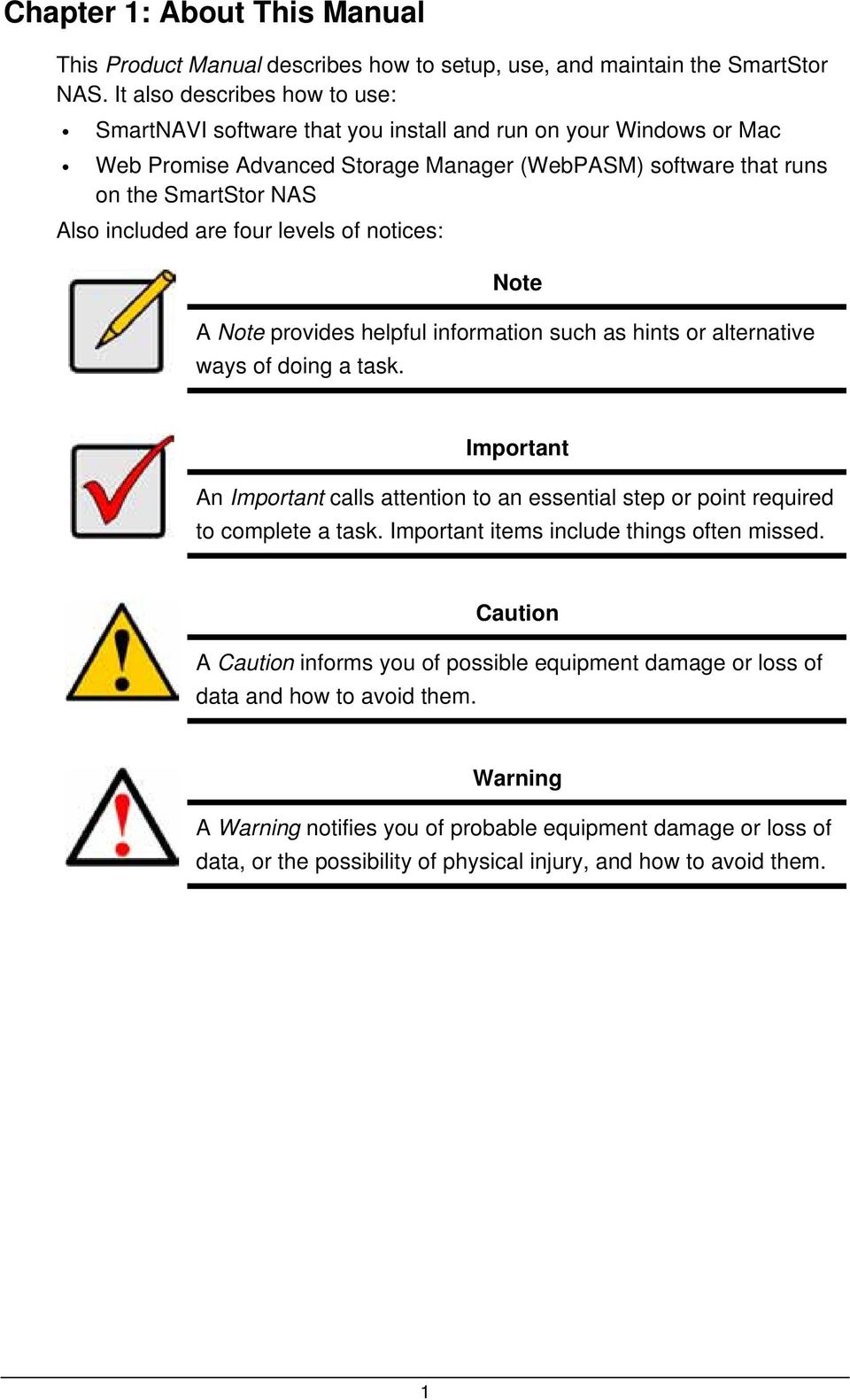
5 Chapter 1: About This Manual This Product Manual describes how to setup, use, and maintain the SmartStor NAS. It also describes how to use: SmartNAVI software that you install and run on your Windows or Mac Web Promise Advanced Storage Manager (WebPASM) software that runs on the SmartStor NAS Also included are four levels of notices: Note A Note provides helpful information such as hints or alternative ways of doing a task. Important An Important calls attention to an essential step or point required to complete a task. Important items include things often missed. Caution A Caution informs you of possible equipment damage or loss of data and how to avoid them. Warning A Warning notifies you of probable equipment damage or loss of data, or the possibility of physical injury, and how to avoid them. 1
6 SmartStor NAS Product Manual Chapter 2: SmartStor NAS Introduction 2.1 Specifications Product 4 Bay NAS 2 Bay NAS Applied Model NS4600 NS2600 Hot-swappable Yes Yes Ethernet x1 x1 esata port x1 No USB 2.0 port x2 x1 Internal HDD Support 3.5" SATA I/II 3.5" SATA I/II RAID 0 Yes Yes RAID 1 Yes Yes RAID 5 Yes No RAID 10 Yes No iscsi Target Service 16 No Printer Server Yes Yes HDD S.M.A.R.T Yes Yes SMB/CIFS (Windows) Yes Yes NFS (Linux client support) Yes Yes AFP (Mac) Yes Yes Bonjour Yes Yes Windows AD Service Yes Yes Web Advance Management WebPASM 2.0 (AJAX) WebPASM 2.0 (AJAX) Client Management Utility SmartNAVI 2.0 SmartNAVI 2.0 HTTPS Yes Yes Web File Management Yes Yes NAS Remote Replication Yes No External HDD Backup/restore Backup/restore Backup/restore FTP Server Yes Yes Web Download Station BT/emule/HTTP/FTP BT/emule/HTTP/FTP Web Server Yes Yes SQL Server Yes Yes DLNA Certificated DLNA 1.5 DLNA 1.5 Facebook upload Yes Yes upnp/dlna Media Server Yes Yes itunes Server Yes Yes Squeezebox Server Yes No Mobile Media Center Yes Yes Photo Album Yes Yes 2
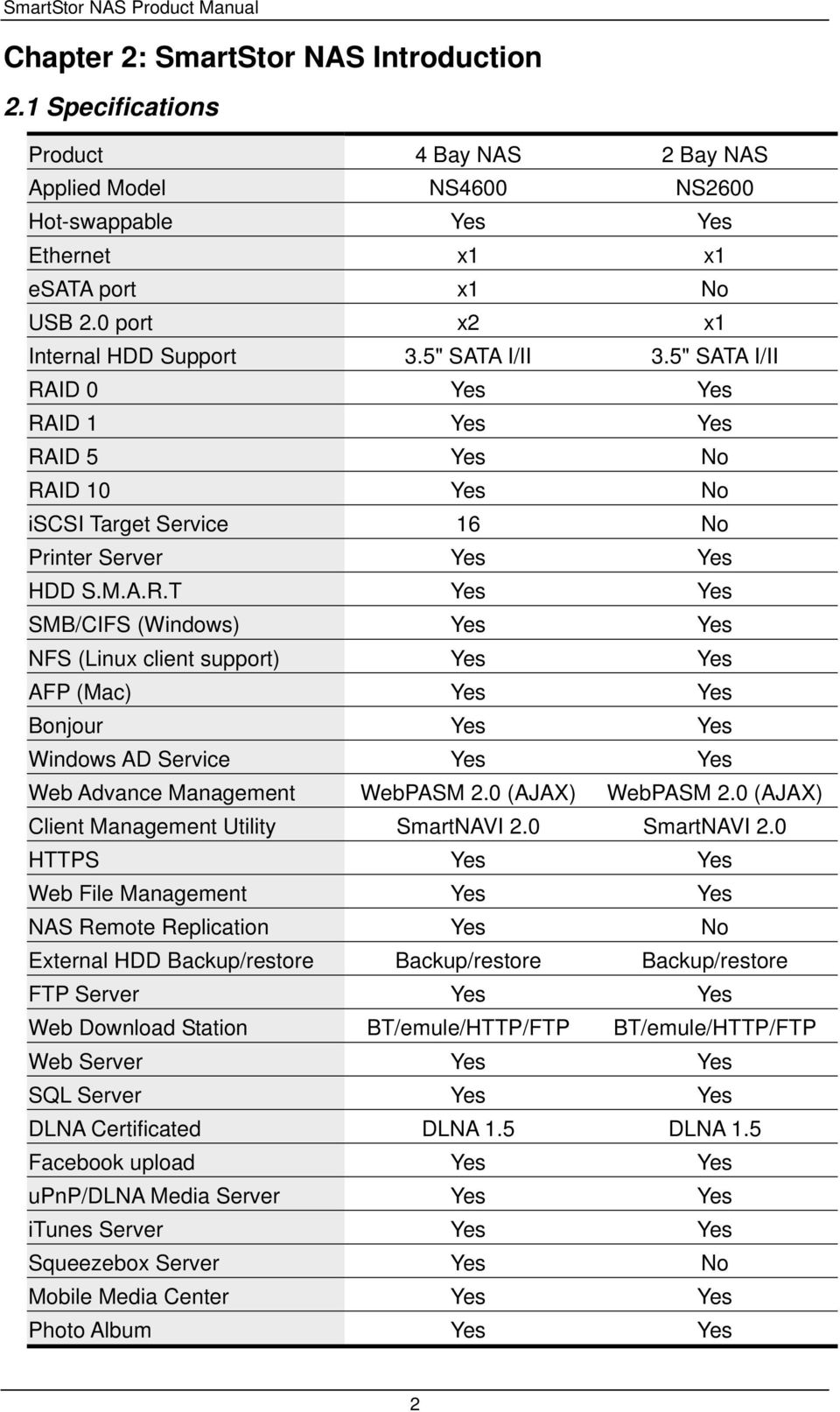
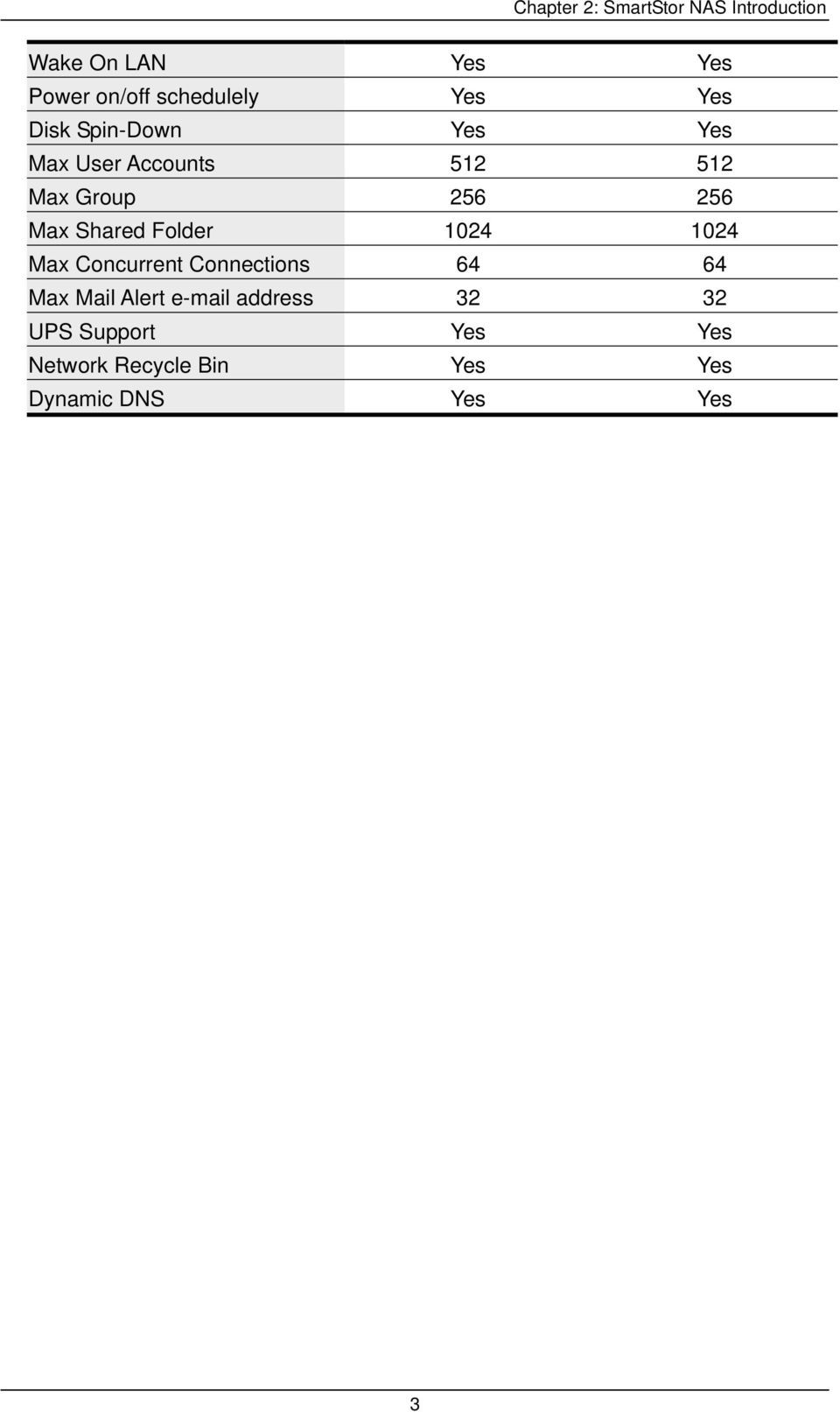
7 Chapter 2: SmartStor NAS Introduction Wake On LAN Yes Yes Power on/off schedulely Yes Yes Disk Spin-Down Yes Yes Max User Accounts Max Group Max Shared Folder Max Concurrent Connections Max Mail Alert address UPS Support Yes Yes Network Recycle Bin Yes Yes Dynamic DNS Yes Yes 3
8 SmartStor NAS Product Manual Chapter 3: Installation and Setup 3.1 Task 1: Unpacking the SmartStor NAS The SmartStor NAS box contains the following items: SmartStor NAS Unit Quick Start Guide Screws for disk drives (1 package) Ethernet cable Power cord CD with SmartNAVI software, Product Manual and Quick Start Guide Warning The electronic components within the SmartStor are sensitive to damage from Electro-Static Discharge (ESD). Observe appropriate precautions at all times when handling the SmartStor or its subassemblies. Important To configure the SmartStor, you must install SmartNAVI. See Installing the SmartNAVI(Recommend) on page 8. 4

9 Chapter 3: Installation and Setup Figure 1. SmartStor 2 Bay NAS Front View Disk Drive Drive Carrier Drive Status LED Drive Activity LED Ethernet Activity LED Power Button System Status LED Figure 2. SmartStor 2 Bay Rear View Cooling Fan RJ45 Network Connection Power Connection USB Connection 5

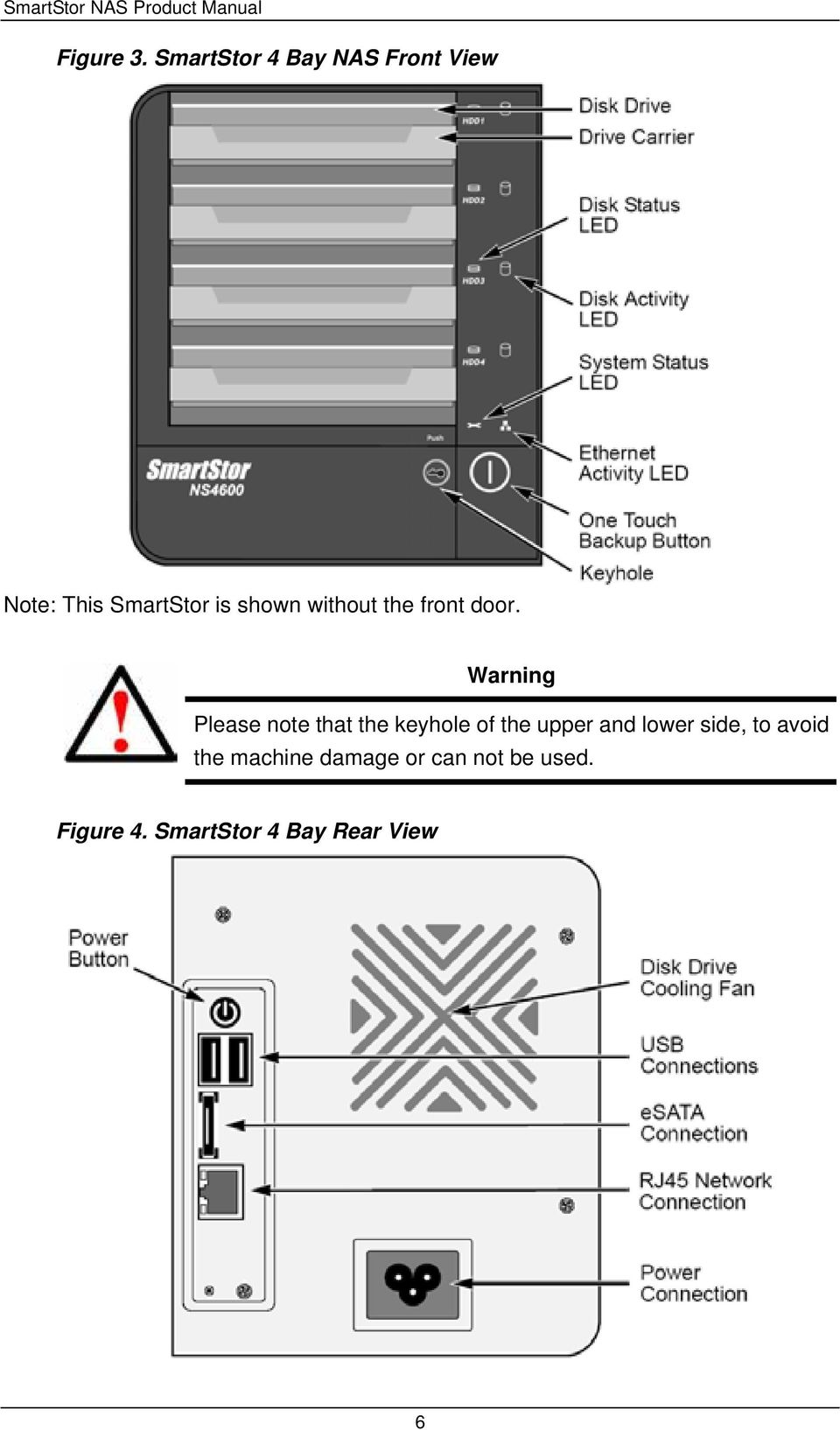
10 SmartStor NAS Product Manual Figure 3. SmartStor 4 Bay NAS Front View Note: This SmartStor is shown without the front door. Warning Please note that the keyhole of the upper and lower side, to avoid the machine damage or can not be used. Figure 4. SmartStor 4 Bay Rear View 6
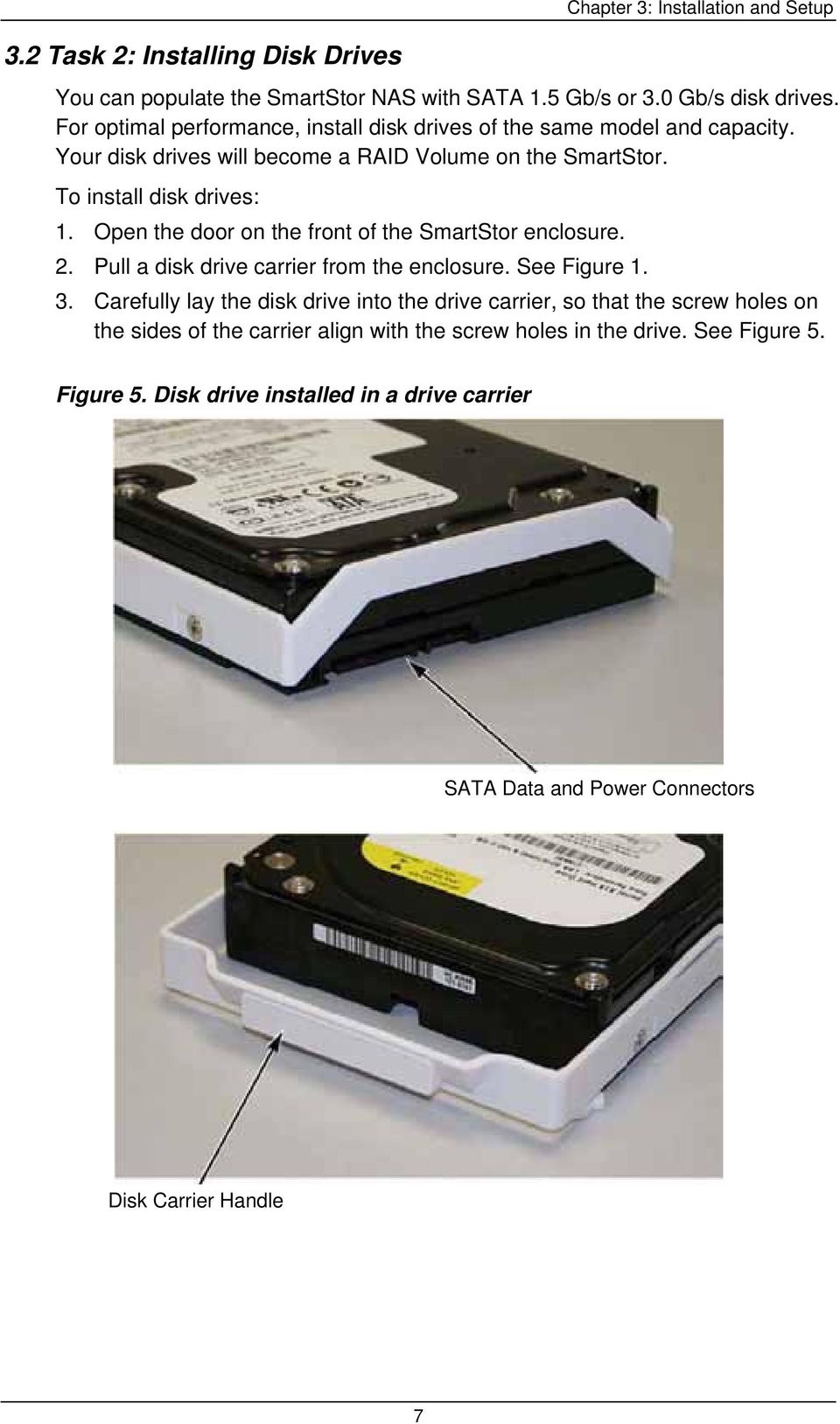
11 3.2 Task 2: Installing Disk Drives Chapter 3: Installation and Setup You can populate the SmartStor NAS with SATA 1.5 Gb/s or 3.0 Gb/s disk drives. For optimal performance, install disk drives of the same model and capacity. Your disk drives will become a RAID Volume on the SmartStor. To install disk drives: 1. Open the door on the front of the SmartStor enclosure. 2. Pull a disk drive carrier from the enclosure. See Figure Carefully lay the disk drive into the drive carrier, so that the screw holes on the sides of the carrier align with the screw holes in the drive. See Figure 5. Figure 5. Disk drive installed in a drive carrier SATA Data and Power Connectors Disk Carrier Handle 7
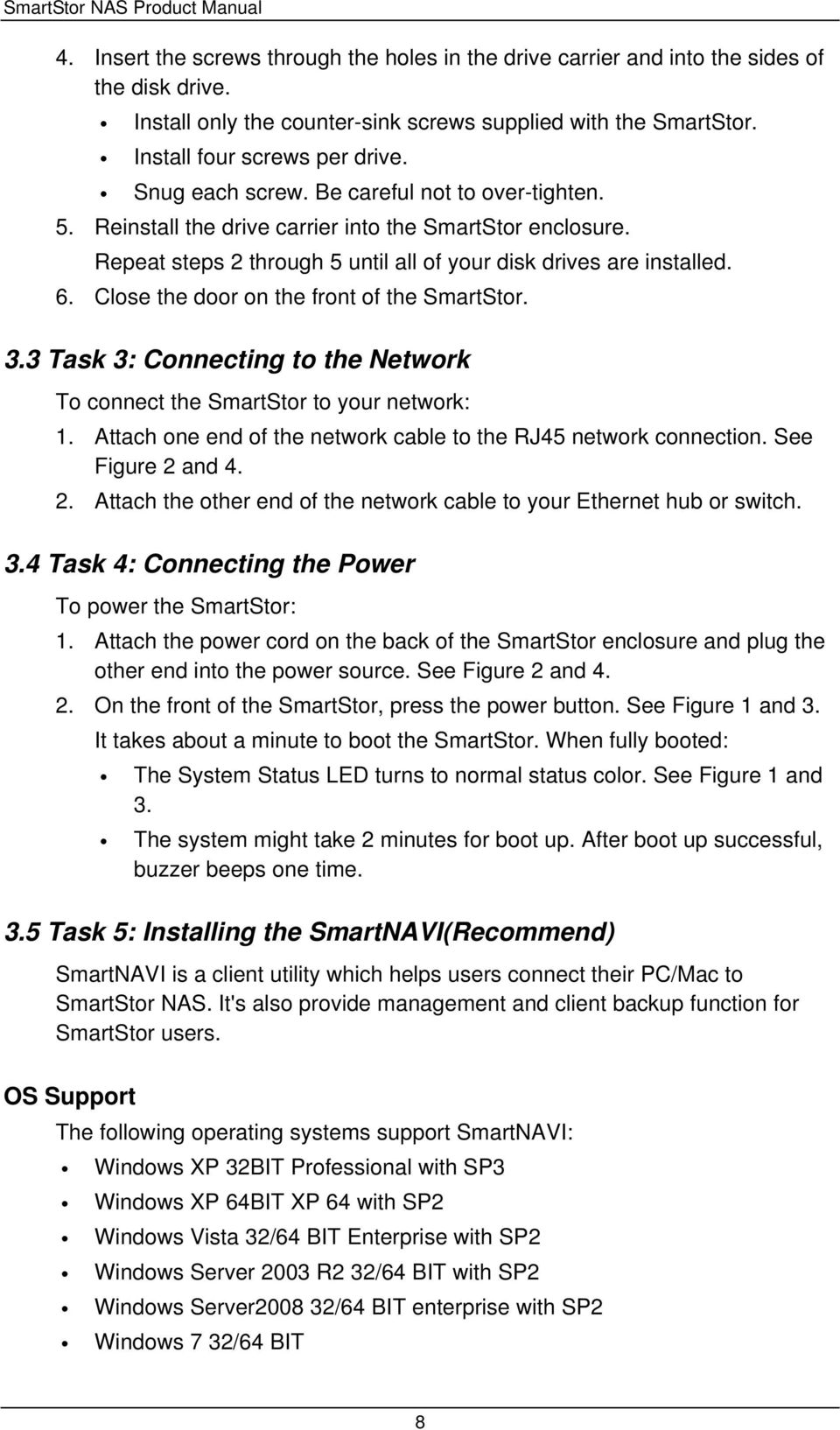
12 SmartStor NAS Product Manual 4. Insert the screws through the holes in the drive carrier and into the sides of the disk drive. Install only the counter-sink screws supplied with the SmartStor. Install four screws per drive. Snug each screw. Be careful not to over-tighten. 5. Reinstall the drive carrier into the SmartStor enclosure. Repeat steps 2 through 5 until all of your disk drives are installed. 6. Close the door on the front of the SmartStor. 3.3 Task 3: Connecting to the Network To connect the SmartStor to your network: 1. Attach one end of the network cable to the RJ45 network connection. See Figure 2 and Attach the other end of the network cable to your Ethernet hub or switch. 3.4 Task 4: Connecting the Power To power the SmartStor: 1. Attach the power cord on the back of the SmartStor enclosure and plug the other end into the power source. See Figure 2 and On the front of the SmartStor, press the power button. See Figure 1 and 3. It takes about a minute to boot the SmartStor. When fully booted: The System Status LED turns to normal status color. See Figure 1 and 3. The system might take 2 minutes for boot up. After boot up successful, buzzer beeps one time. 3.5 Task 5: Installing the SmartNAVI(Recommend) SmartNAVI is a client utility which helps users connect their PC/Mac to SmartStor NAS. It's also provide management and client backup function for SmartStor users. OS Support The following operating systems support SmartNAVI: Windows XP 32BIT Professional with SP3 Windows XP 64BIT XP 64 with SP2 Windows Vista 32/64 BIT Enterprise with SP2 Windows Server 2003 R2 32/64 BIT with SP2 Windows Server /64 BIT enterprise with SP2 Windows 7 32/64 BIT 8
13 Chapter 3: Installation and Setup Mac OS 10.4.x and above Installation: Windows To install the SmartNAVI on a Windows PC: 1. Insert the CD into your PC s CD-ROM. 2. Double-click the SmartNAVI installer icon (right). 3. Click the Next button to begin installation. The License Agreement screen appears. 4. Click the I accept the terms... option, then click the Next button. The Choose Destination Location screen appears. 9
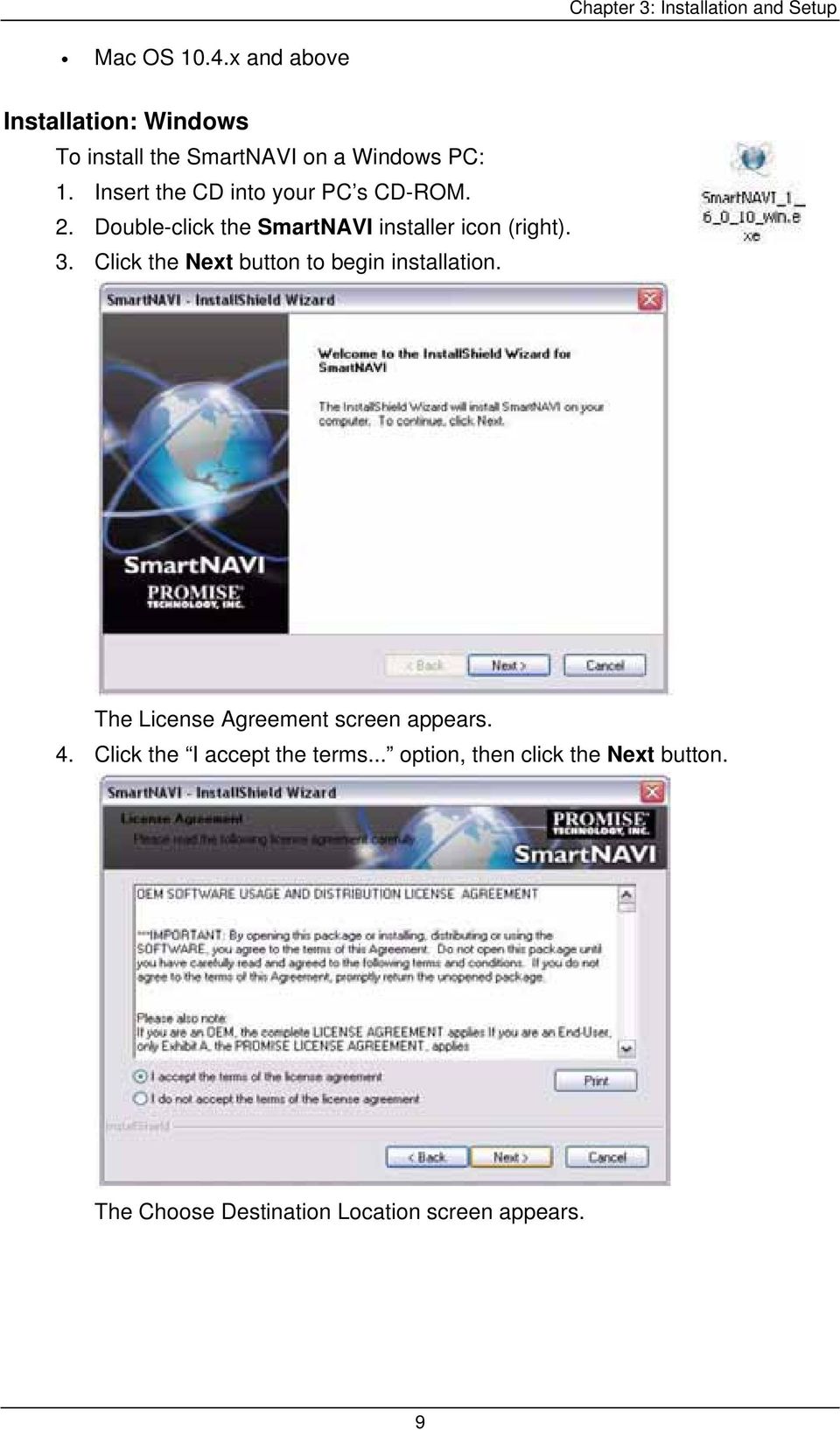
14 SmartStor NAS Product Manual 5. Optional. Click the Browse... button to choose a new install location for the software. Click the Next button. The Ready to Install screen appears. 6. Click the Install button to proceed with installation. When the installation is finished, the final installation screen appears. 10
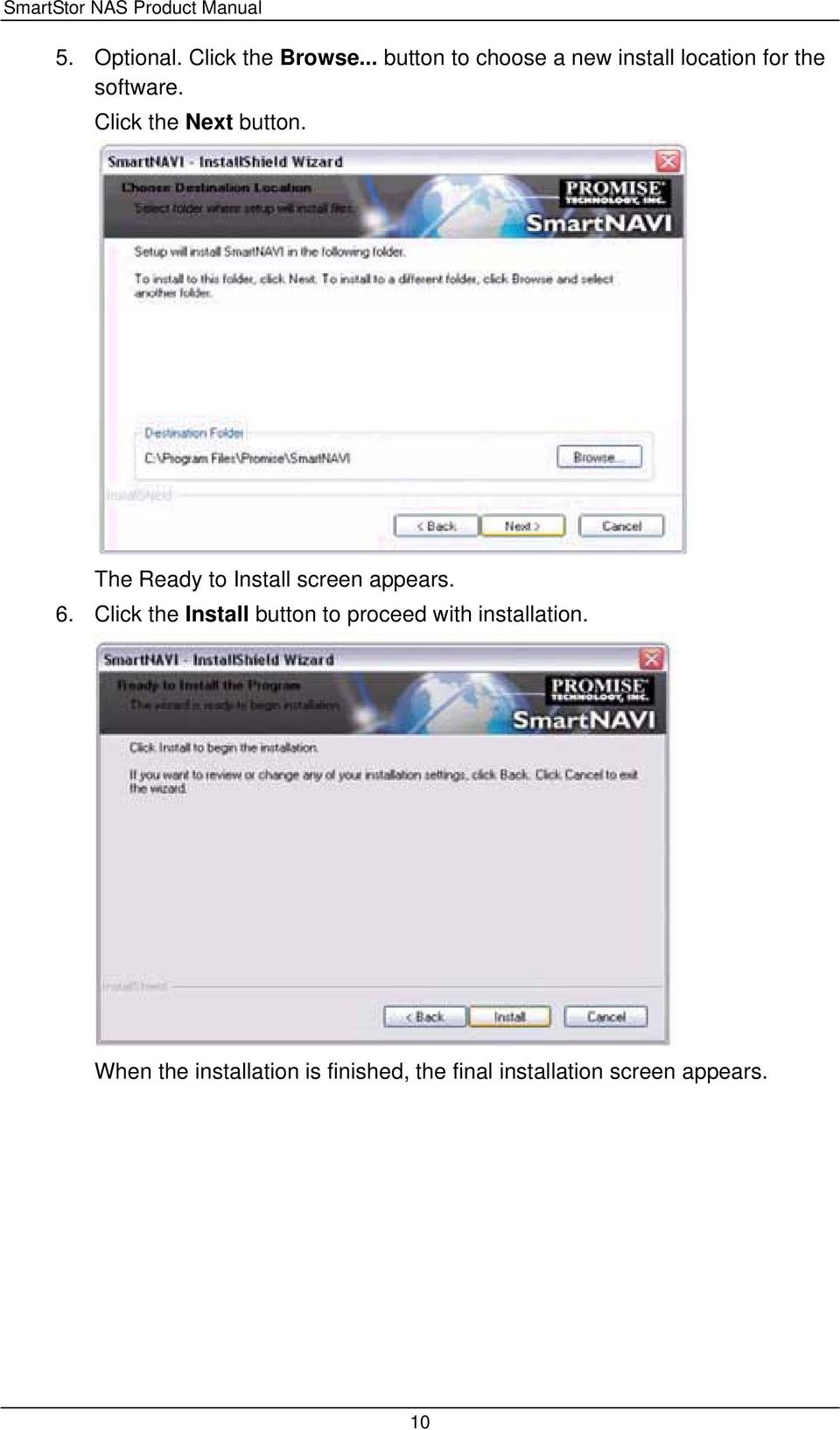
15 Chapter 3: Installation and Setup 7. Click to Finish button to close the installer. With the Online Registration box checked, your browser will open and go directly to the Promise product registration website. Thank you for taking the time to register. The installer adds a SmartNAVI icon to the: Start menu Application tray SmartNAVI loads automatically every time your Windows OS starts. Installation: Mac 1. Please double-click the SmartNAVI.dmg file to open and install the disk of SmartNAVI Image. (right) 2. Click the SmartNAVI Image to open the folder. (right) 3. Drag the SmartNAVI.app icon to the right side Applications folder. 11

16 SmartStor NAS Product Manual 3.6 Connecting to Web Promise Advanced Storage Manager (WebPASM) The WebPASM software is factory-installed on the SmartStor system. WebPASM runs in the browser on your PC. You can access WebPASM: From browser directly. See page 12. Connect WebPASM form SmartNAVI. See page 13. From browser directly To log into WebPASM in your browser: In the Browser address field, type in the IP address of the SmartStor. Note that the IP address shown below is only an example. The IP address you type into your browser will be different. WebPASM uses an HTTP connection... Enter the SmartStor s IP address Add.../admin/ Together, your entry looks like this: 12

17 Chapter 3: Installation and Setup Connect WebPASM form SmartNAVI To log into WebPASM from SmartNAVI: 1. Right-click the SmartStor NAS in the Device list. 2. Choose the Open Advanced Management item to start the browser and open WebPASM. SmartNAVI in Windows SmartNAVI in Mac OS X Your default browser starts and the WebPASM login screen displays. 13
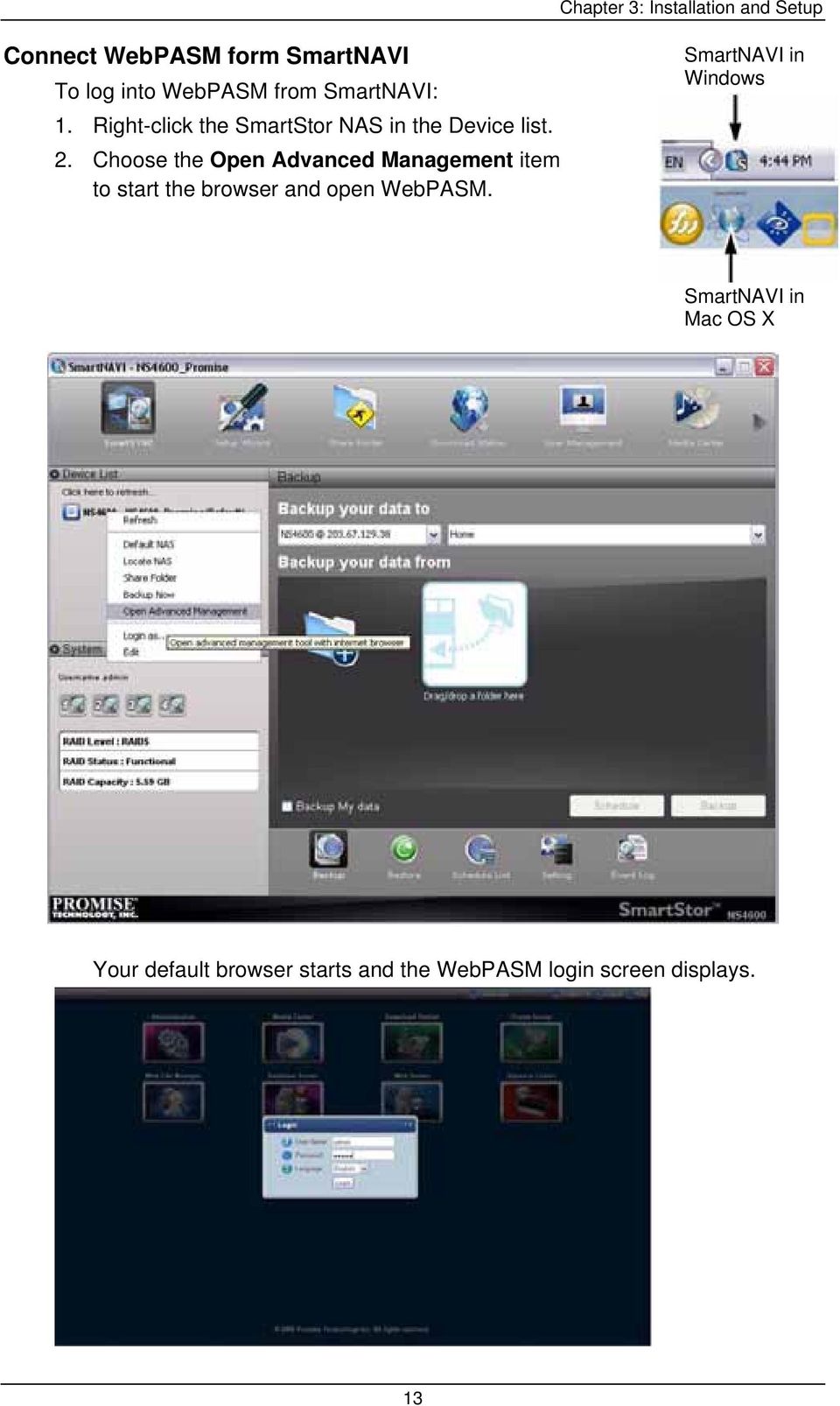
18 SmartStor NAS Product Manual 4. Type admin in both the User Name and Password fields, then click the Login button. The user name and password are case sensitive. Note: For more information about WebPASM, see Chapter 6: WebPASM on page Shutting Down the SmartStor To shut down the SmartStor, press and hold the power button for four seconds. The system status LED turns red, then goes dark. To restart the SmartStor, press the power button again. 14
19 Chapter 4: File and Printer Sharing by the SmartStor NAS Chapter 4: File and Printer Sharing by the SmartStor NAS 4.1 Setting up a Network Drive on a Windows PC You can also use SmartNAVI for this purpose, see Mounting a Share Folder / Creating a Network Drive on page 83. If your PC does not have SmartNAVI, use the following procedure to setup a Network Drive with My Network Places. To setup a network drive: 1. On the Windows desktop, double-click the My Network Places icon. 2. Click the Search button in the toolbar. If the Search button is not shown, from the View menu, choose Toolbars, then Standard Buttons. 15

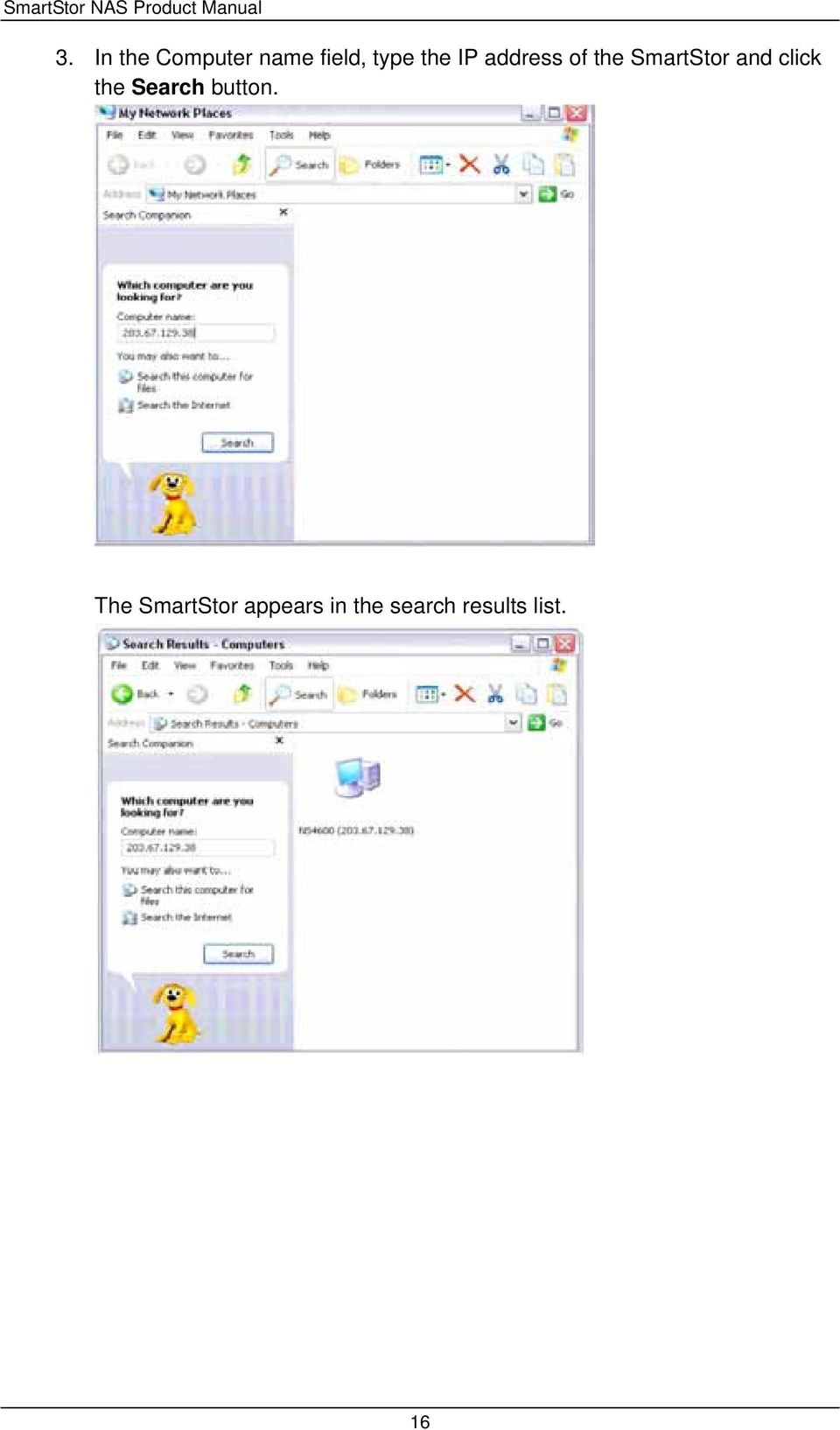
20 SmartStor NAS Product Manual 3. In the Computer name field, type the IP address of the SmartStor and click the Search button. The SmartStor appears in the search results list. 16
21 Chapter 4: File and Printer Sharing by the SmartStor NAS 4. Double-click the SmartStor to show the Public folder and any other folders you have created. 5. Right-click the folder you want and choose Map Network Drive from the dropdown menu. The Map Network Drive dialog box appears. 17
22 SmartStor NAS Product Manual 6. In the Map Network Drive dialog box, choose a drive letter and click the Finish button. 7. Double-click the My Computer icon on your Windows desktop. The folder on the SmartStor appears under My Computer as a network drive. You can now copy files to and from the folder on the SmartStor. 4.2 Setting up a Network Drive on a UNIX or Linux PC Before you can access the SmartStor from a UNIX or Linux PC, you must configure the SmartStor to communicate with UNIX and Linux. Step 1. Enable Linux/Unix NFS 1. Click the Administration topic and choose the File & Print icon to expand the Tree. (A) 2. In the Tree, click the Protocol Control icon (B), then click the UNIX/Linux tab (C). 18
23 Chapter 4: File and Printer Sharing by the SmartStor NAS 3. In the Services field, click the Enable option button (default). (D) 4. Optional. To join a NIS Domain, click the UNIX/Linux tab (A), then click the Yes button beside Services. (B) Note: If you join an NIS Domain, you automatically disable your AD Domain settings. See Setting up Windows Access on page Enter the Domain name into the field provided. (C) See your Network Administrator for help with this information. 6. Click the OK button to save your settings. (D) The setting runs automatically. Step 2. Setting up File Sharing File access from UNIX and Linux PCs is controlled by specifying the IP address of each PC that can access a given folder. You must designate the IP addresses for each folder individually. You can have up to 256 IP addresses for all of your folders. You can use *.*.*.* to allow all IP access. To set up UNIX/Linux file sharing: 1. Click the Administration topic and choose the File & Print icon to expand the Tree. (A) 2. In the Tree, click the Sharing Setup icon (B), then click the UNIX/Linux Sharing tab. (C) 3. Choose a volume from the Volume dropdown menu. (D) 4. Choose a folder from the Folder Name dropdown menu. (E) 19
24 SmartStor NAS Product Manual 5. In the New IP Address field, type the IP address of the UNIX or Linux PC from which you will access this folder, then click the Add button. 6. Click the OK button in the confirmation box. On the UNIX/Linux PC with Command Line Interface 1. Open a terminal window. 2. Create a new folder for the SmartStor. Type mkdir SmartStor and press Enter. 3. Mount the SmartStor. Type mount SmartStor NAS IP/VOLUME1/PUBLIC/ SmartStor and press Enter. Note that the IP address shown above is only an example. Volume1 and Public refer to the default Volume and folder created during setup. If you created a different volume or folder, use those names. 4. Change to the SmartStor directory. Type cd /SmartStor and press Enter. You can now copy files to and from the folder on the SmartStor. When you are done with the SmartStor, type cd; umount /SmartStor and press Enter. On the Linux PC with Graphic Desktop This procedure is for a RedHat Enterprise Linux 4 configuration. If you run a different version of Linux, you might have to adapt the procedure. See your OS documentation. 1. From the Applications menu, choose Network Servers. 20
25 Chapter 4: File and Printer Sharing by the SmartStor NAS 2. In the Network window, double-click Windows Network. 3. Double-click the SmartStor NAS on the network. 21
26 SmartStor NAS Product Manual 4. Double-click the folder you want. If this is the first time you accessed this folder, an Authentication dialog box opens. 5. Type the user name and password in the respective fields, then click the OK button. The default user name is admin. The default password is admin. The user name and password are case sensitive. Leave the Domain field blank. The folder opens. You can now copy files to and from the folder on the SmartStor. 4.3 Setting up a Network Drive on a Mac Before you can access the SmartStor from a Mac, you must configure the SmartStor to communicate with the MacOS. In WebPASM 1. Click the Administration topic and choose the File & Print icon to expand the Tree. (A) 2. In the Tree, click the Protocol Control icon (B), then click the Mac tab. (C) 3. In the Services field, click the Enable button (D). 4. Optional. Type a message in the Login Message field. (E) 5. Click the OK button to save your settings. (F) The optional login message appears on the Welcome screen when you log into SmartStor from a Mac. 22
27 Chapter 4: File and Printer Sharing by the SmartStor NAS To set up Mac file sharing: 1. Click the Administration topic and choose the File & Print icon to expand the Tree. (A) 2. In the Tree, click the Sharing Setup icon (B), then click the Windows/Mac/ FTP Sharing tab. (C) 3. Choose a volume from the Volume dropdown menu. (D) 4. Choose a folder from the Folder Name dropdown menu. (E) 5. Check the Mac protocol box. (F) 6. In the User/Group list, group names are preceded by character. (G) 7. Under Permissions, choose a permission level for this user or group: (H) 8. Click the OK button to save your settings. (I) 9. In the confirmation box, click the OK button. You can now access the specified folder from a Mac. The Mac file sharing enables Macs to access folders on the SmartStor. In this case, access is given for the PUBLIC folder. 23
28 SmartStor NAS Product Manual On the Mac Desktop 1. From the Go menu, choose Connect to Server. 2. In the Connect to Server dialog box, type afp://smartstor NAS IP and click the Connect button. Note that the IP address shown below is only an example. The IP address you type in the dialog box on your Mac will be different. Click the + button to add this IP address to the Favorite Servers list. 3. Type the user name and password in the respective fields, then click the OK button. The default user name is admin. The default password is admin. The user name and password are case sensitive. 24
29 Chapter 4: File and Printer Sharing by the SmartStor NAS 4. In the SmartStor NAS dialog box, click the folder you want, then click the OK button. 5. In the SmartStor NAS Welcome screen, click the OK button. 25
30 SmartStor NAS Product Manual A window opens on the Mac desktop to access the folder on the SmartStor. You can now copy files to and from the folder on the SmartStor. 4.4 Connecting a USB Printer to SmartStor To connect a USB printer to the SmartStor: 1. Set up your printer and install the printer drivers onto your PC as described in the printer s Setup Guide or User Manual. 2. Attach the USB cable from your printer to one of the USB connections on the back of the SmartStor. USB Connection 4.5 Setting up the Print Server on SmartStor To set up the SmartStor s print server: 26
31 Chapter 4: File and Printer Sharing by the SmartStor NAS 1. Start WebPASM. See From browser directly on page 12, or Connect WebPASM form SmartNAVI on page Click the Administration topic and choose the File & Print icon to expand the Tree. (A) 3. Click the Protocol Control icon (B), then click the Printer Server tab. (C) 4. Click the Enable option button beside Printer Server. (D) 5. Click the OK button to save your settings. (E) 4.6 Setting up Windows Printing If your printer came with automatic configuration software, you might have to complete this procedure first to create a connection path. Then use the configuration software. To set up printing on a Windows PC: 1. On the Windows desktop, double-click the My Network Places icon. 2. Click the Search button in the toolbar. If the Search button is not shown, from the View menu, choose Toolbars, 27
32 SmartStor NAS Product Manual then Standard Buttons. 3. In the Computer name field, type the IP address of the SmartStor and click the Search button in the side bar. The SmartStor appears in the search results list. 4. In the computer list, double-click the SmartStor to open it. If the Connect to dialog box appears, type the user name and password in the respective fields, then click the OK button. The default user name is admin. The default password is admin. The user name and password are case sensitive. 5. Right-click the usbptr01 icon folder and choose Connect... from the dropdown menu. 6. When the warning message about printer drivers appears, click the OK button to continue. 28
33 Chapter 4: File and Printer Sharing by the SmartStor NAS 7. In the Add Printer Wizard, click the Manufacturer and SmartStor NAS name of your USB printer, then click the OK button. 8. To verify printer installation, in the Windows Start menu, choose Settings, then Printers and Faxes. The Printers and Faxes screen appears. The usbptr01 is the USB printer on the SmartStor. 4.7 Setting up Linux Printing This procedure is for a RedHat Enterprise Linux 4 configuration. If you run a different version of Linux, you might have to adapt the procedure. See your OS documentation. 1. From the Applications menu, choose System Settings, then Printing. Printer configuration window opens. 2. Click the New button. Add a new print queue dialog box opens. 3. Click the Forward button. 29
34 SmartStor NAS Product Manual 4. In the Name field, type a name for the printer, such as NAS_printer, a description, and click the Forward button. 5. From the Select a queue type dropdown menu, choose Network Windows (SMB). 6. Scroll the list and click the triangle icon beside SmartStor NAS. USBPTR01 appears below SmartStor NAS. USBPTR01 represents the USB printer connected to the SmartStor. 7. Highlight USBPTR01 and click the Forward button. The Authentication dialog box opens. 8. In the User name and Password fields, type admin, then click the OK button. The user name and password are case sensitive. 30
35 Chapter 4: File and Printer Sharing by the SmartStor NAS The Printer Model dialog box opens. 9. From the dropdown menu, choose the manufacturer of your printer. From the model list, highlight the model of your computer, then click the Forward button. 10. Click the Finish button. USBPTR01 is added to your printer list. 31
36 SmartStor NAS Product Manual 4.8 Setting up Mac Printing To set up printing on a Mac: 1. From the Apple Menu, choose System Preferences. 2. Double-click the Print & Fax icon. 3. Click the Setup Printers button. 4. In the Printer List, click the Add icon. The Printer List displays a new panel. 5. In the new panel, from the popup menus, choose: Windows Printing Workgroup 6. From the list, highlight the SmartStor, then click the Choose button. A user name and password dialog box appears. 7. Type the user name and password in the respective fields, then click the OK button. The default user name is admin. The default password is admin. The user name and password are case sensitive. The printer list displays a new panel. 32
37 Chapter 4: File and Printer Sharing by the SmartStor NAS 8. Highlight the USBPTR01 in the list. USBPRT01 represents the USB printer connected to the SmartStor. 9. In the Printer Model popup menu, choose the make of your printer. 10. In the SmartStor NAS name list, choose the model of your printer. 11. Click the Add button. USBPTR01 is added to your printer list. 33
38 SmartStor NAS Product Manual 4.9 Connecting a USB Drive To connect a USB drive to the SmartStor, attach the USB cable from your external drive to one of the USB connections on the back of the SmartStor. If you have a USB memory stick, attach it directly to one of the USB connections or use a USB cable, whichever is more convenient. USB Connection The USB drive or memory stick appears as a folder called usbdisk when you create your network drive. See the instructions on the following page. SmartStor supports USB drives and memory sticks formatted to FAT32 and Ext3 file formats. If the SmartStor does recognize the USB drive or memory stick, the usbdisk folder does not appear. See Formatting an External USB Drive or Memory Stick on page 163. Windows PC The USB drive appears as a folder on the SmartStor when you create a network drive on a Windows PC. Follow the procedure Setting up a Network Drive on a Windows PC on page 15, but choose the usbdisk folder instead of the public folder. 34
39 Linux PC Chapter 4: File and Printer Sharing by the SmartStor NAS The USB drive appears as a folder on the SmartStor when you create a network drive on a Linux PC. Follow the procedure Setting up a Network Drive on a UNIX or Linux PC on page 18, but choose the USBDISK folder instead of the PUBLIC folder. Mac The USB drive appears as a folder on the SmartStor when you create a network drive on a Mac. Follow the procedure Setting up a Network Drive on a Mac on page 22, but choose the USBDISK folder instead of the PUBLIC folder. 35
40 SmartStor NAS Product Manual 4.10 Disconnecting a USB Drive To disconnect a USB drive or memory stick from the SmartStor: 1. Be sure that no files on the USB drive or memory stick are still open. 2. Unplug the USB drive or memory stick from the SmartStor. The SmartStor automatically unmounts the USB drive or memory stick. 36
41 Chapter 5: SmartNAVI Chapter 5: SmartNAVI 5.1 Setting up the SmartStor The SmartNAVI performs the setup procedures on your SmartStor. After the procedure is done, you will have a default folder on the SmartStor, set up as a network drive on your PC. You can change the network settings, create RAID volumes, add and mount folders on your SmartStor after initial setup using SmartNAVI. You can also made more advanced settings using the WebPASM software. See Connecting to Web Promise Advances Storage Manager (WebPASM) on page 13. SmartNAVI in Windows Opening SmartNAVI 1. Double-click the SmartNAVI icon in the Windows application tray or Mac Dock (right). The SmartNAVI Window opens. SmartNAVI in Mac OS X 2. From Language dropdown menu, choose the language you prefer. 37
42 SmartStor NAS Product Manual 3. Double-click the SMARTSTOR NAS in the Device list. 4. Type admin in the Username, Password, and Confirm fields, then click the Login button. This action creates a default user and logs the default user into SmartNAVI. The Main Window opens. 38
43 5. Choose a Setup Mode and click the button: One Click Setup - Loads a collection of default settings. Recommended for most users. Advanced Setup - Enables you to make your own settings. Recommended for advanced users. One Click Setup To configure your NAS system using One Click Setup: 1. Go to the Main Window. See Opening SmartNAVI on page Click the Setup Wizard icon. 3. Click the One Click Setup button. 4. Click the OK button to continue. Chapter 5: SmartNAVI 5. Click the Yes button in the confirmation box. The NAS reboots. Then your RAID volume is ready. The PUBLIC folder on the RAID Volume appears under My Computer as a network drive. You are finished with the setup. If you chose Advanced Setup, continue under Advanced Setup on page
44 SmartStor NAS Product Manual Advanced Setup To configure your NAS system using Advanced Setup: 1. Go to the Main Window. See Opening SmartNAVI on page Click the Setup Wizard icon. (A) 3. Click the Advanced Setup button. (B) 4. Choose Automatic (DHCP) or Manual network settings. (C) If you chose Manual settings, type entries for each of the following parameters in the fields provided: (D) Click the Next button to continue. (E) 5. Choose the following values from their respective dropdown menus: Timezone Year Month Day Time in Hours, Minutes, and Seconds Click the Next button to continue. 40
45 Chapter 5: SmartNAVI 6. Choose Automatic or Manual RAID Volume creation. If you chose Manual, choose the type of RAID Volume you want: Maximum Capacity and performance - RAID 0, using all disk drives Data Protection - RAID 5, using all disk drives Click the Next button to continue. 7. Choose a network drive letter from the dropdown menu. This drive will be mapped as a network drive on your PC. The list begins with S and goes in reverse alphabetical order. Click the Next button to continue. 8. Review your parameters. To make changes, click the Previous button. To accept the parameters and configure your NAS system, click the OK button. 41
46 SmartStor NAS Product Manual 9. Click the Yes button in the confirmation box. 10. The NAS reboots. Then your RAID volume is ready. The PUBLIC folder on the RAID Volume appears under My Computer as a network drive. See Figure 4. You are finished with the setup. Figure 4. The PUBLIC folder as a Windows network drive You can now copy files to and from the folder on the SmartStor. To access this folder from other PCs, see Chapter 4: Connecting to the SmartStor on page 15. To create additional RAID Volumes and folders, see Chapter 6: WebPASM on page
47 Chapter 5: SmartNAVI 5.2 Managing Users and Groups Creating a User To create a user: 1. Go to the Main Window. 2. Click the User Management icon. (A) 3. Click the Create New User button. (B) 4. Type a Username in the field provided. (C) Up to 16 characters, A-Z, 0-9, and _, first character must be a letter. No spaces. 5. Type a Password in the field provided. (D) Up to 16 characters, A-Z and 0-9. No spaces. 6. Retype the Password in the Confirm field. (E) 7. Click the OK button. (F) 8. Click the Yes button in the confirmation box. 9. User created successfully. Note These users can access the share folders but not SmartNAVI or WebPASM. 43
48 SmartStor NAS Product Manual Creating the Default User This feature creates the default user for SmartNAVI. Important If you change to a new default user, the previous default user s network drives, backup schedules, username, and password information all will be deleted. To create the default user: 1. Go to the Main Window. 2. Right-click the system in the Device List. 3. Choose Default NAS from the popup menu. 4. Type the default username admin in the field provided. 5. Type the default password admin in the field provided. 44
49 Chapter 5: SmartNAVI 6. Click the Login button. If you do not choose a default user, SmartNAVI sets the default user after you first log on. To create additional users, see Creating the Default User on page 44. Changing User Passwords To change a user s password: 1. Go to the Main Window. 2. Click the User Management icon. (A) 3. Click the Modify User button. (B) 4. Click the user whose password you want to change. (C) 45
50 SmartStor NAS Product Manual 5. Admin user ONLY. Type the old password in the field provided. 6. Type the new password in the field provided. (D) 7. Retype the password in the Confirm field. (E) 8. Click the OK button. (F) Viewing a List of Users To view a list of Users: 1. Go to the Main Window. 2. Click the User Management icon. The User List appears. 46
51 Chapter 5: SmartNAVI Deleting a User To delete a user: 1. Go to the Main Window. 2. Click the User Management icon. (A) 3. Click the Delete User button. (B) 4. Click the user you want to delete. (C) 5. Click the OK button. (D) 6. Click the Yes button in the confirmation box. 7. User deleted. Creating a Group To create a Group: 1. Go to the Main Window. 2. Click the User Management icon. (A) 3. Click the Create New Group button. (B) 4. Type a Group name in the field provided. (C) Up to 16 characters, A-Z, 0-9, and _. No spaces. 5. Optional. Move members to the Selected User list to add them. Or add them later. (D) 47
52 SmartStor NAS Product Manual 6. Click the OK button. (E) Viewing a List of Groups To view a list of Groups: 1. Go to the Main Window. 2. Click the User Management icon. 3. Click the Group List button. 48
53 Chapter 5: SmartNAVI Adding Members to a Group Note A User can only belong to one Group. If a User already belongs to a Group and you add him to this Group, you automatically delete him from the previous Group. To add Users as Group members: 1. Go to the Main Window. 2. Click the User Management icon. (A) 3. Click the Modify Group Member button. (B) 4. Click the Group whose membership you want to change. (C) 5. Move members to the Selected User list to add them. (D) 6. Click the OK button. (E) Deleting Members from a Group Note Deleting a User from a Group does not delete the User from the System. To delete Users from a Group: 1. Go to the Main Window. 2. Click the User Management icon. (A) 3. Click the Modify Group Member button. (B) 49
54 SmartStor NAS Product Manual 4. Click the Group whose membership you want to change. (C) 5. Move members to the Available User list to delete them. (D) 6. Click the OK button. (E) Deleting a Group Before you can delete a Group, you must first delete all of the Members from the Group. To delete a Group: 1. Go to the Main Window. 2. Click the User Management icon. (A) 3. Click the Delete Group button. (B) 4. Click the Group you want to delete. (C) 5. Click the OK button. (D) 50
55 Chapter 5: SmartNAVI 6. Click the Yes button in the confirmation box. Viewing Quotas Quotas are portions of storage space that you assign to each user or group. To view a quota: 1. Go to the Main Window. 2. Click the User Management icon. 3. Click the Quota icon. Setting Quotas Quotas are portions of storage space that you assign to each user or group. Assigning quotas enables you to control how much storage space each user or group can access. By default, each user and group is assigned an unlimited quota, meaning that any one user or group can access the entire storage space. In the Quota screen, the names of groups are preceded with symbol. To set a quota: 1. Go to the Main Window. 2. Click the User Management icon. (A) 3. Click the Quota icon. (B) 4. Click the user or group whose quota you want to assign. (C) 51
56 SmartStor NAS Product Manual 5. From the dropdown menu, choose the RAID Volume to which the quotaapplies. (D) 6. Click one of the following options: (E) Unlimited Limited Quota 7. If you chose Limited Quota, type a number into the field provided. (E) This number represents how many MB of data the user or group can access. 8. Click the OK button. (F) 9. The setting succeeds. Note If you set different size quotas for the user and the group, SmartStor will use the smaller quota. 52
57 Chapter 5: SmartNAVI 5.3 Managing RAID Volumes Creating a RAID Volume This feature enables you to create a RAID volume or designate a disk drive as a spare. To create a RAID volume: 1. Go to the Main Window. 2. Click the Volume Configuration icon. (A) 3. Click the Create Volume button. (B) 4. Choose Automatic or Manual RAID Volume creation. (C) If you chose Manual, choose the type of RAID Volume you want: (D) Maximum Capacity - RAID 0, using all disk drives Data Protection - RAID 1, 5, or 10, depending on the number of disk drives available 5. Click the OK button. (E) The RAID volume takes several minutes to create and initialize, depending on the size of your disk drives. Note When you create your RAID volume in WebPASM, you can choose additional options, such as Multiple RAID volumes. See Setting up SmartStor with the Setup Wizard on page
58 SmartStor NAS Product Manual Expanding a RAID Volume This feature adds all unassigned disk drives to your existing RAID volume. To expand a RAID volume: 1. Go to the Main Window. 2. Click the Volume Configuration icon. 3. Click the Expand Volume button. 4. Click the OK button. 5. Click the Yes button in the confirmation box. The RAID volume might take couples of hours to expand and initialize. Note Expansion is only available when your NAS system has the proper combination of RAID volume and free disk drives. For additional expansion options or to change the RAID level of your volume, use WebPASM. See Migrating a RAID Volume on page
59 Chapter 5: SmartNAVI Viewing RAID Volume Status RAID Volume status includes: RAID level Capacity Usage - Percentage of capacity used Disk drive model and capacity To view the status of a RAID Volume: 1. Go to the Main Window. 2. Click the Volume Configuration icon. 3. Click the Volume Status List button. The Volume Status appears. Viewing a List of RAID Volumes To view a list of RAID Volumes: 1. Go to the Main Window. 2. Click the Volume Configuration icon. 55
60 SmartStor NAS Product Manual 3. Click the Volume List button. The Volume List appears. Recreating a RAID Volume Caution When you recreate a RAID volume, you delete all the data saved in the volume. Back up any important data before you recreate a volume. To recreate a RAID volume: 1. Go to the Main Window. 2. Click the Volume Configuration icon. (A) 3. Click the Recreate Volume button. (B) 4. Choose Automatic or Manual RAID Volume creation. (C) If you chose Manual, choose the type of RAID Volume you want: (D) Maximum capacity and performance - RAID 0 Data Protection - RAID 1, 5, or 10, depending on the NAS model and number of drives 56
61 Chapter 5: SmartNAVI 5. Click the OK button. (E) 6. Click the Yes button in the first confirmation box. 7. Type YES then click the OK button in the second confirmation box. The RAID volume takes several minutes to recreate and initialize, depending on the size of your disk drives. 57
62 SmartStor NAS Product Manual 5.4 Managing Backups Caution Please do not close the SmartNAVI or logout the MS Windows system while you are setting a scheduled backup or running the backup process. It will discontinue backup process. Doing a Backup Now This feature enables you to perform an immediate schedule backup of your files from your Windows or Mac to the NAS system (SmartNAVI). You can perform an immediate backup of your files from: SmartNAVI Main Window SmartNAVI Device List SmartNAVI tray icon (Windows PCs only) One Touch Button Main Window If you do not have a backup schedule for your PC, start your backup from the SmartNAVI Main Window. 1. Go to the Main Window. 2. Click the SmartSYNC icon. 3. Click the Backup button. 4. Under Backup your data to, choose: The SmartStor NAS or Local drive (your PC or MAC) from the first dropdown menu. 58
63 Chapter 5: SmartNAVI The letter designation of your PC or MAC drive under the second dropdown menu. 5. Do any of the following actions to select your backup folders: Check the Backup My Data box - Selects the My Documents, Favorites, and Desktop folders with all their contents. 59
64 SmartStor NAS Product Manual Click the Add to Backup icon - Opens the My Documents folder. Click a folder you want to backup, and then click the Choose button. Repeat for additional folders. Drag and drop the folders you want to backup to the Backup your data from window. 6. Click the Backup button. The backup begins immediately. 60
65 Device List Chapter 5: SmartNAVI Before you can do a backup from the SmartNAVI Main Window, you must create a backup schedule. 1. Go to the Main Window. 2. Right-click the system in the Device List whose backup you want to run. 3. Choose the Backup Now item. The backup begins immediately. Tray Icon Before you can do a backup from the SmartNAVI tray icon, you must create a backup schedule and setup default NAS first. This feature applies to Windows Cs only. 1. Right-click the SmartNAVI icon in the application tray. 2. Choose Backup Now in the popup menu. The backup begins immediately. The amount of time required depends on the size and number of files being backed up. The backed up files will appear on the NAS system (SmartNAVI) in a folder 61
66 SmartStor NAS Product Manual named BACKUPDATA_your username. You can restore the backup files to your PC at any time. See Restoring Backed-up Files on page 70. Scheduling a Backup You can schedule backups by the hour, day, or week. To set a schedule for backing up files from your PC to the NAS system (SmartNAVI): 1. Go to the Main Window. 2. Click the SmartSYNC icon. 3. Click the Backup button. 4. Under Backup your data to, choose: The SmartStor NAS or Local drive (your PC or MAC) from the first dropdown menu. The letter designation of your PC or MAC drive under the second dropdown menu. 62
67 5. Do any of the following actions to select your backup folders: Chapter 5: SmartNAVI Check the Backup My Data box - Selects the My Documents, Favorites, and Desktop folders with all their contents. Click the Add to Backup icon - Opens the My Documents folder. Click a folder you want to backup, and then click the Choose button. Repeat for additional folders. 63
68 SmartStor NAS Product Manual Drag and drop the folders you want to backup to the Backup your data from window. 6. Click the Schedule button. 7. Click an option button for: Hour Day Day of the week 8. Choose the corresponding values from the dropdown menus: Number of hours Time of day in hours and minutes Time of day and day of the week 64
69 Chapter 5: SmartNAVI 9. Click the Add button. The newly created schedule appears in the Schedule List. The backed up files will appear on the NAS in a folder named BACKUPDATA_ your username. You can also click the Start button to run a scheduled backup immediately. 65
70 SmartStor NAS Product Manual Viewing Backup Schedules To view the list of current schedules: 1. Go to the Main Window. 2. Click the SmartSYNC icon. 3. Click the Schedule List button. The list of all backup schedules appears. Changing a Scheduled Backup You can schedule backups by the hour, day, or week. To change the scheduled backup of files from your PC to the NAS system (SmartNAVI): 1. Go to the Main Window. 2. Click the SmartSYNC icon. (A) 3. Click the Schedule List button. (B) 4. Click the schedule you want to change. (C) 66
71 Chapter 5: SmartNAVI 5. Click the Modify button. (D) 6. Click the folder whose contents you want to backup. 67
72 SmartStor NAS Product Manual Click the Add to Backup choices. icon to expand the tree and narrow your 7. Click the Schedule button. 8. Click an option button for: Hour Day Day of the week 9. Choose the corresponding values from the dropdown menus: Number of hours Time of day in hours and minutes Time of day and day of the week 10. Click the Add button. The modified schedule appears in the Schedule List. 68
73 Chapter 5: SmartNAVI You can also click the Start button to run a scheduled backup immediately. Deleting a Scheduled Backup Deleting a scheduled backup has no effect upon any files previously backed-up to the NAS system (SmartNAVI). To delete a scheduled backup: 1. Go to the Main Window. 2. Click the SmartSYNC icon. (A) 3. Click the Schedule List button. (B) 4. Click the schedule you want to delete. (C) 5. Click the Delete button. (D) 69
74 SmartStor NAS Product Manual 6. Click the Yes button in the confirmation box. Restoring Backed-up Files You can restore all or any portion of the files in the BACKUPDATA_your username folder on the NAS system (SmartNAVI). You can choose to restore the files to: Their original location on your PC or MAC An alternative location on your PC or MAC The original file structure is maintained during backup and restoration. Caution If you restore to the original folders on your PC, the restore function will overwrite the files in those folders. Be careful which files you restore and where on your PC you direct the backup files. To restore your backed-up files from the NAS system to your PC: 1. Go to the Main Window. 2. Click the SmartSYNC icon. (A) 3. Click the Restore button. (B) 4. Click the folder whose contents you want to restore. (C) Click the arrow icons to expand the tree and narrow your choices. (D) 70
75 5. Click an option button for: Chapter 5: SmartNAVI Restore to original folder - The backup files will overwrite the files on your PC (E) Restore to a specific folder - No files are overwritten on your PC (E) 6. If you chose Restore to a specific folder, do one of the following actions: Type the name of an existing folder in the field provided Type the name of an new folder in the field provided Click the Folder icon - Opens the My Documents folder. (F) Click a folder you want to use for a target, then click the Open button (G) 7. Click the Restore button. (H) 71
76 SmartStor NAS Product Manual 8. Click the Yes button in the confirmation box. The restoration begins immediately. The amount of time required depends on the size and number of files being restored. Viewing the Backup Event Log Backup events report on backups, schedules, and file transfers. Events are reported by date, time, severity (information or error) and description. To view Backup Event Log: 1. Go to the Main Window. 2. Click the SmartSYNC icon. (A) 3. Click the Event Log button. (B) 4. Optional. Set the Event Filter dropdown menu to display: (C) All events Information events only Error events only 72
77 5. Optional. Click the arrow on the Date/Time header to reverse the chronological order. (D) Chapter 5: SmartNAVI Note For NAS system events, see Viewing the System Event Log on page 95. Saving the Event Log This function saves a copy of the Backup Event Log as a text file onto your PC. The text file records the events displayed in the Event Log window. Set the Event Filter dropdown menu to display: All events Information events only Error events only Click the arrow on the Date/Time header to reverse the chronological order. To save a copy of the Backup Event Log as a text file: 1. Go to the Main Window. 2. Click the SmartSYNC icon. 3. Click the Event Log button. 73
78 SmartStor NAS Product Manual 4. Click the Save button. 5. Optional. Change the file name or save to a different location. 6. Click the Save button in the Save dialog box. Clearing the Event Log Note Before you clear the Backup Event Log, consider saving a copy for future reference. See Saving the Event Log on page 73. To clear the Backup Event Log: 1. Go to the Main Window. 2. Click the SmartSYNC icon. 3. Click the Event Log button. 74
79 Chapter 5: SmartNAVI 4. Click the Clear All button. 5. Click the Yes button in the confirmation box. Setting the Port By using port setting, the public services like a WWW server or an FTP server, and others running on your private network may become accessible from the Internet. To set the Port: 1. Go to the Main Window. 2. Click the SmartSYNC icon.(a) 3. Click the Setting button. (B) 4. Type the Port number in the field provided. The default number is 873. (C) 5. Click the OK button. (D) 75
80 SmartStor NAS Product Manual The setting begins immediately. 6. Click the OK button in the confirmation box. The Setting is successful. 5.5 Managing Share Folders Creating a Share Folder To create a new share folder: 1. Go to the Main Window. 2. Click the Share Folder icon. (A) 3. Click the Create New Share Folder button. (B) 4. Type a folder name in the field provided. (C) Use A-Z, 0-9, - and _. No spaces. 5. Choose the RAID Volume from the dropdown menus. (D) 6. For each user in the list, click one of the following options: (E) 76
81 Chapter 5: SmartNAVI Deny access Read Only Read and Write Guest is the only other default user. 7. Click the OK button. (F) 8. Click the Yes button in the confirmation box. The permission has been set successfully. Opening a Share Folder This feature opens share folders in the file browser. From the Device List: 1. Right-click the system in the Device List whose share folders you want to open. 77
82 SmartStor NAS Product Manual 2. Choose the Share Folders item. All share folders open in your PC s file browser. From the Main Window: 78
83 Chapter 5: SmartNAVI 1. Click the Share Folder icon. 2. Double-click the folder in the Share Folder List that you want to open. The share folder opens in your PC s file browser. From the Tray Icon: 1. Right-click the SmartNAVI icon in the application tray. 2. Choose Share Folder in the popup menu. 79
84 SmartStor NAS Product Manual All share folders open in your PC s file browser. Viewing a List of Share Folders To view a list of Share Folders: 1. Go to the Main Window. 2. Click the Share Folder icon. 3. Click the Share Folder List button. The Share Folder List appears. 80
85 4. Double-click the individual share folder to view its contents. Chapter 5: SmartNAVI Changing Share Folder Permissions The Admin user always has read and write permission. All other users have Read Write permission by default. To change permissions: 1. Go to the Main Window. 2. Click the Share Folder icon. (A) 3. Click the Share Folder Permission button. (B) 4. Click the share folder whose permissions you want to change. (C) The folder name will become highlighted. 5. For each user in the list, click one of the following options: (D) Deny access Read Only Read and Write Guest is the only other default user. 81
86 SmartStor NAS Product Manual 6. Click the OK button. (E) The permission change happens immediately. Deleting a Share Folder Note For NAS system events, see Viewing the System Event Log on page 95. Caution When you delete a share folder, you delete all the data saved in the folder. Back up any important data before you delete a folder. To delete a share folder: 1. Go to the Main Window. 2. Click the Share Folder icon. 3. Click the Delete Share Folder button. 82
87 Chapter 5: SmartNAVI 4. Click the share folder you want to delete. The folder name will become highlighted. 5. Click the OK button. 6. Click the Yes button in the first confirmation box. 7. Type Yes then click the OK button in the second confirmation box. Mounting a Share Folder /Creating a Network Drive To mount a share folder or create a network drive (Windows): 1. Go to the Main Window. 2. Click the Share Folder icon. (A) 3. Click the Mount Share Folder button. (B) Click the share folder you want to mount or make a network drive. (C) 4. The folder name will become highlighted. 5. Choose a device name (drive letter) from the dropdown menu. (D) 83
88 SmartStor NAS Product Manual 6. Click the Mount button. (E) The share folder appears on your PC as a mounted or network drive. Un-mounting a Share Folder /Disconnecting a Network Drive To un-mount a share folder or disconnect a network drive (Windows): 1. Go to the Main Window. 2. Click the Share Folder icon. (A) 3. Click the Mount Share Folder button. (B) 4. Click the share folder you want to un-mount or delete as a network drive. (C) The folder name will become highlighted. 84
89 Chapter 5: SmartNAVI 5. Click the Un-Mount button. (D) 6. Click the Yes button in the confirmation box. The share folder is un-mounted or disconnected but the link remains (Windows). Setting up a Share Folder for Time Machine Time Machine is a backup utility included with Mac OS X 10.5 Leopard or more. Before you begin, be sure your Mac is running and connected to the same network as the SmartStor. On SmartNAVI To set up a SmartStor folder for Time Machine backups: 1. Go to the Main Window. 2. Click the Share Folder icon. 3. Click the Mount Share Folder button. 4. Click the share folder you want to use for Time Machine backups. 5. Check the Support TimeMachine box. 6. Click the Mount button. If the process goes correctly, the following message appears: This folder has been set to a network drive. 85
90 SmartStor NAS Product Manual On the Mac Follow this procedure if you have not set up Time Machine. To set up the Mac for backups with SmartStor: 1. On the desktop, go to the Dock and click the Time Machine icon. A popup message informs you that no storage location is set up. 2. In the popup message, click the Set Up Time Machine button. The Time Machine dialog box appears. 3. In the Time Machine dialog box, click the Choose Backup Disk... button. 4. In the list of external drives, choose the share folder that you mounted on the SmartStor and click the Use for Backup button. A Name and Password dialog box appears. 5. In the dialog box, enter your username and password of NAS authentication, then click the Connect button. Pre-existing Time Machine Configuration on the Mac Follow this procedure if you currently have a Time Machine configuration. To set up the Mac for backups with SmartStor: 1. On the desktop, go to the Dock and click the Time Machine icon. The Time Machine dialog box appears. 2. In the Time Machine dialog box, click the Change Disk... button. 3. In the list of external drives, choose the share folder that you mounted on the SmartStor and click the Use for Backup button. A Name and Password dialog box appears. 4. In the dialog box, enter your username and password, then click the Connect button. 5.6 Making Management Settings Configuring a NAS System The Setup Wizard has two modes: One Click Setup - Loads a collection of default settings. Recommended for most users. Advanced Setup - Enables you to make your own settings. Recommended for advanced users. Caution Do NOT run the Setup Wizard on a NAS system that is already configured! That action will delete your data and network drives! 86
91 Chapter 5: SmartNAVI One Click Setup To configure your NAS system using One Click Setup: 1. Go to the Main Window. 2. Click the Setup Wizard icon. 3. Click the One Click Setup button. 4. Click the OK button to continue. 5. Click the Yes button in the confirmation box. The NAS reboots. Then your RAID volume is ready. Advanced Setup To configure your NAS system using Advanced Setup: 1. Go to the Main Window. 2. Click the Setup Wizard icon. (A) 3. Click the Advanced Setup button. (B) 4. Choose Automatic (DHCP) or Manual network settings. (C) If you chose Manual settings, type entries for each of the following parameters in the fields provided: (D) Computer (NAS system) Name IP Address Subnet Mask Gateway 87
92 SmartStor NAS Product Manual Primary and Secondary DNS - optional Click the Next button to continue. (E) 5. Choose the following values from their respective dropdown menus: Timezone Year Month Day Time in Hours, Minutes, and Seconds Click the Next button to continue. 6. Choose Automatic or Manual RAID Volume creation. If you chose Manual, choose the type of RAID Volume you want: Maximum Capacity and performance - RAID 0, using all disk drives Data Protection - RAID 5, using all disk drives (Note: Only for 4 Bay NAS) 88
93 Chapter 5: SmartNAVI Click the Next button to continue. 7. Choose a network drive letter from the dropdown menu. This drive will be mapped as a network drive on your PC. The list begins with S and goes in reverse alphabetical order. Click the Next button to continue. 8. Review your parameters. To make changes, click the Previous button. To accept the parameters and configure your NAS system, click the OK button. 89
94 SmartStor NAS Product Manual 9. Click the Yes button in the confirmation box. 10. The NAS reboots. Then your RAID volume is ready. Changing Network Settings Caution If your NAS system is on a network, check with your Network Administrator before you change the network settings. Incorrect settings can result in address conflicts and connection failures. To change your network settings: 1. Go to the Main Window. 2. Click the NAS Management icon. (A) 3. Click the Network Setting button. (B) 4. Choose Automatic (DHCP) or Manual network settings. (C) If you chose Manual settings, type entries for each of the following parameters in the fields provided: (D) Computer (NAS system) Name IP Address Subnet Mask Gateway Primary and Secondary DNS - optional 90
95 Chapter 5: SmartNAVI 5. Click the OK button. (E) 6. Click the Yes button in the Network Setup box. 7. The NAS reboots automatically. 8. Click your system in the Device List. The Main Window reopens. Locating the SmartStor This feature helps you to physically locate a NAS system. 91
96 SmartStor NAS Product Manual To locate a SmartStor: 1. Go to the Main Window. 2. Rignt-click the system in the Device List that you want to locate. 3. Choose the Locate NAS item. On the NAS system you chose: The buzzer sounds three times The Status LED blinks RED three times Wake-on-LAN This feature allows you to turn on or wake up the System SmartStor by locate a NAS system. Status LED To wake up a SmartStor: 1. Go to the Main Window. 2. Rignt-click the system in the Device List that you want to wake up. 92
97 Chapter 5: SmartNAVI 3. Choose the Locate NAS item. It takes about a minute to boot the SmartStor. When fully booted: The System Status LED turns to normal status color. The buzzer beeps one time. Choosing a Default NAS System This feature sets the default NAS system (SmartStor) for the Main Window and SmartNAVI tray icon. A default NAS activates several important functions, including: Share Folder: Opening a Share Folder Backup Now: Performing an Immediate Backup Open Advanced Management: Starting the Advanced Storage Manager Event Notice: Enabling Event Notification If you do not choose a default NAS, SmartNAVI sets the default NAS after you first log on. To set a default NAS: 1. Go to the Main Window. 2. Right-click the system in the Device List that you want to make the default. 93
98 SmartStor NAS Product Manual 3. Choose the Default NAS item. The default NAS is highlighted in the Device List. Enabling or Disabling Event Notification This feature displays popup notices of events on the default NAS system. Enabling Event Notification To enable event notification: 1. Right-click the SmartNAVI icon in the application tray. 2. Check Event Notice in the popup menu. SmartNAVI displays a popup message indicating that event notification is working. 94
99 Chapter 5: SmartNAVI Disabling Event Notification To disable event notification: 1. Right-click the SmartNAVI icon in the application tray. 2. Uncheck Event Notice in the popup menu. Viewing the System Event Log NAS events report functions and status of the NAS system. The Event Log displays the 20 most recent events. Events are reported by date, time, severity (information or warning) and description. To view the NAS systemís Event Log: 1. Go to the Main Window. 2. Click the NAS Management icon. 3. Click the Event Log button. Click the arrow on the Date/Time header to reverse the chronological order. Note For backup system events, see Viewing the Backup Event Log on page
100 SmartStor NAS Product Manual Adding Application Plug-ins Application plug-ins are enhancements to SmartStorís capabilities. SmartNAVI installs plug-ins from your PC. WebPASM installs plug-ins from a folder on the SmartStor. Also see Adding Application Plug-ins on page 179. Download your plug-ins from the Promise Support Website. Plug-in file names end with a.ppg extension. Save the plug-in file to a convenient place on your PC. To add a plug-in to SmartStor: 1. Go to the Main Window. 2. Click the NAS Management icon. 3. Click the Add Plugin button. 96
101 4. Do one of the following actions: Type the name of the plug-in file Chapter 5: SmartNAVI Click the folder icon, navigate to the plug-in file, click it, then click the Open button 5. Click the OK button. After a few moments, the plug-in is added. Warning Do not disconnect the power or shut down the SmartStor while the plug-in installation is running! 6. Click the Configure Plugin button. The newly added plug-in appears in the list. Its Service Status is OFF. 97
102 SmartStor NAS Product Manual 7. Click the plug-in to choose it. The plug-inís name will become highlighted. 8. Click the Enable button. After a moment, the Service Status changes to ON. The plug-in is now installed SmartStor. Viewing a List of Plug-ins To view a list of installed plug-ins: 1. Go to the Main Window. 2. Click the NAS Management icon. 98
103 Chapter 5: SmartNAVI 3. Click the Configuration Plugin button. Currently installed plug-ins appear in the Configuration Plugin list. Viewing Plug-in Version Numbers To view plug-in version numbers: 1. Right-click the SmartNAVI icon in the application tray. 99
104 SmartStor NAS Product Manual 2. Choose About from the popup menu. The About window appears. The About window includes a list of installed plug-ins and their version numbers. When you are done with the About window, click the Close button. Enabling and Disabling Plug-ins Enabling Plug-ins You must add a plug-in to SmartStor before you can use this function. To enable a plug-in: 1. Go to the Main Window. 2. Click the NAS Management icon. (A) 3. Click the Configuration Plugin button. (B) 4. Click the Plug-in you want to enable. (C) The plug-inís name will become highlighted. 100
105 Chapter 5: SmartNAVI 5. Click the Enable button. (D) After a moment, the Service Status changes to ON. The plug-in is now enabled on SmartStor. Disabling Plug-ins Disabling a plug-in saves memory space and processing time on the SmartStor. If you do not use a feature, consider disabling its plug-in. To disable a plug-in: 1. Go to the Main Window. 2. Click the NAS Management icon (A). 3. Click the Configuration Plugin button (B). 4. Click the Plug-in you want to disable (C). The plug-inís name will become highlighted. 101
106 SmartStor NAS Product Manual 5. Click the Disable button (D). After a moment, the Service Status changes to OFF. The plug-in is now disabled. Removing Plug-ins There are two reasons to remove a plug-in: To replace the old plug-in with a new one You know that you will never use the plug-in Before you remove a plug-in, consider disabling it, instead. See Enabling and Disabling Plug-ins on page 100. To remove a plug-in: 1. Go to the Main Window. 2. Click the NAS Management icon. (A) 3. Click the Configuration Plugin button. (B) 102
107 Chapter 5: SmartNAVI 4. Click the Plug-in you want to remove. (C) The plug-inís name will become highlighted. 5. Click the Remove button. (D) 6. Click the Yes button in the confirmation box. The plug-in is removed from SmartNAVI. If you need the plug-in later, you can reinstall it. See Adding Application Plug-ins on page 96. Rebooting the SmartStor Normally you will only need to reboot the SmartStor is after a firmware upgrade or plug-in installation. During the reboot, none of your folders will be accessible rom your networked PCs. To reboot the SmartStor: 1. Go to the Main Window. 2. Click the NAS Management icon. (A) 3. Click the Shutdown button. (B) 4. Click the Restart option (C) 103
108 SmartStor NAS Product Manual 5. Click the OK button. (D) 6. The reboot runs automatically. When the SmartStor is fully booted: The system status LED turns to normal status color The buzzer beeps one time (if the buzzer is nabled) See Enabling and Disabling the Buzzer on page 180. System Status LED 104
109 Shutting Down the SmartStor Chapter 5: SmartNAVI The only time you need to shut down the SmartStor is to eplace the disk drive cooling fan or the power supply. During and after the shutdown, none of your folders will be accessible from your etworked PCs. Using SmartNAVI To shut down the SmartStor: 1. Go to the Main Window. 2. Click the NAS Management icon. (A) 3. Click the Shutdown button. (B) 4. Click the Shutdown option. (C) 5. Click the OK button. (D) 6. The shutdown runs automatically. 105
110 SmartStor NAS Product Manual Directly System Status LED Power Button To shut down the SmartStor, press and hold the power utton on the back of the SmartStor enclosure for five econds (top, right). The system status LED turns red, then goes dark (bottom, right). Restarting the SmartStor To restart the SmartStor after a shutdown, press the power button on the back of the SmartStor enclosure (top, right). When the SmartStor is fully booted: The system status LED turns to normal status color (bottom, right) The buzzer beeps one time (if the buzzer is enabled) See Enabling and Disabling the Buzzer on page Managing Downloads Adding a Link Note This feature requires the BT server plug-in for each NAS system. See Adding Application Plug-ins on page 96. SmartNAVI and the NAS system can download files using several protocols, including: Torrent HTTP FTP edonkey For Torrent files, use your browser to locate the file you want on the Internet and download its link to your PC. Then add the Torrent file link to the Download Station as described below. To add a Torrent file download link: 1. Go to the Main Window. 2. Click the Download Station icon. 106
111 Chapter 5: SmartNAVI 3. Click the Add New Link button. 4. Do one of the following actions: Type the link into the field provided. Click the folder icon, navigate to the link, click it, then click the Open button. 107
112 SmartStor NAS Product Manual 5. Click the Add button. The Torrent files are added to the Download List and begin to download automatically. The Torrent files are saved to the download folder on the NAS system. Drag and Drop Files Drag and drop supports HTTP, FTP, and Torrent files. The process includes two actions: Showing the Dropzone icon on your desktop Dragging and dropping files onto the Dropzone icon Windows To show the Dropzone icon in Windows, right-click the SmartNAVI icon in the Windows tray and choose Dropzone from the popup menu. The Dropzone icon appears on the desktop. Mac OS X To show the Dropzone icon in Mac OS X: 1. Go to the Main Window. 2. From the Function dropdown menu, choose Dropzone. The Dropzone icon appears on the desktop. 108
113 Chapter 5: SmartNAVI Dragging and dropping files Drag and drop your files onto the Dropzone icon. Torrent files are added to the Download List and begin to download automatically. Files are saved to the download folder on the NAS system. To close the Dropzone icon, choose Dropzone again in the popup (Windows) or dropdown (Mac OS X) menu. Batch Downloading Files You can batch-download files from a server. The files must have the same name with sequential numbering. You might have to rename your files to use this feature. To add a series of sequential download links: 1. Go to the Main Window. 2. Click the Download Station icon. 3. Click the Add New Link button. 4. Click the Batch button. A dialog box appears. 5. In the field provided, type the URL of the file server. Then type a slash (/) and the file name with an asterisk (*). (A) 6. Choose one of the following values for the asterisk: 109
114 SmartStor NAS Product Manual Numbering from 0 to 20, Maximum Length is in 1 to 4 places (B) Lettering from a to z or A to Z for Case Sensitive. (C) A list of files appears in the window. (D) 7. Click the OK button. (E) The batch-download files are added to the Download List and begin to download automatically. The files are saved to the download folder on the NAS system. Viewing the Download List The Torrent files in this list have not been downloaded yet. To view the Download List: 1. Go to the Main Window. 2. Click the Download Station icon. 3. Click the Download List button. 110
115 Downloading began automatically when you added the links. Chapter 5: SmartNAVI Torrent files are saved to the download folder on the NAS system. Removing a Link When you remove a link, the Download Station does not download the corresponding Torrent file. To remove a Torrent file download link: 1. Go to the Main Window. 2. Click the Download Station icon. 3. Click the Download List button. 4. Click the file link you want to remove. 111
116 SmartStor NAS Product Manual 5. Click the Remove button. 6. Click the Yes button in the confirmation box. Pausing and Resuming a Download Pausing a Download To pause a Torrent file download: 1. Go to the Main Window. 2. Click the Download Station icon. 3. Click the Download List button. 4. Click the link of the file download you want to pause. 112
117 Chapter 5: SmartNAVI 5. Click the Pause button. Resuming a Download To resume a Torrent file download: 1. Go to the Main Window. 2. Click the Download Station icon. 3. Click the Download List button. 4. Click the link of the paused file download you want to resume. 5. Click the Start button. Viewing the Downloaded List The Torrent files in this list have been downloaded. To view a list of downloaded files: 1. Go to the Main Window. 113
118 SmartStor NAS Product Manual 2. Click the Download Station icon. 3. Click the Downloaded List button. Torrent files are saved to the download folder on the NAS system. Opening a Downloaded File Note This feature requires a plug-in for each NAS system. See Adding Application Plug-ins on page 96. To open a downloaded file: 1. Go to the Main Window. 2. Click the Download Station icon. 3. Click the Downloaded List button. 4. Click the file you want to open. 114
119 Chapter 5: SmartNAVI 5. Click the Open button. Deleting a Downloaded File Caution The feature deletes Torrent files from the download folder on the NAS system. To delete a downloaded Torrent file: 1. Go to the Main Window. 2. Click the Download Station icon. 3. Click the Downloaded List button. 4. Click the file you want to delete. 5. Click the Delete button. 115
120 SmartStor NAS Product Manual 6. Click the Yes button in the confirmation box. The link and corresponding Torrent file in the download folder on the NAS system are deleted. 5.8 Using Media Center Media Center contains the Media Library, which enables you to organize and play your music and video files that are saved on the NAS system. Note that there are two features called Media Center. This section deals with Media Center in SmartNAVI. See Media Center on page 192. Important This feature requires the DLNA plug-in to be installed and enabled on the NAS system. Your music and video files must be saved in the MUSIC and VIDEO folders, respectively, on the NAS system. Viewing Playlists To view a Playlist: 1. Go to the Main Window. 2. Click the Media Center icon. The Media Library window appears with List highlighted. A list of playlists appears in the List Window. 116
121 Chapter 5: SmartNAVI Playlists are shown by name and the number of files in the playlist. Creating a Playlist This function requires a LAN connection to the NAS system. To create a Playlist: 1. Go to the Main Window. 2. Click the Media Center icon. The Media Library window appears with List highlighted. 3. Click the Create Playlist icon. 4. Type a name for the playlist in the highlighted box and press Enter. 5. Click and drag files from the folder list to the Playlist icon. The playlist is stored in the DLNA database on the NAS system. Playing a Playlist To play a Playlist: 1. Go to the Main Window. 2. Click the Media Center icon. 117
122 SmartStor NAS Product Manual The Media Library window appears with List highlighted. 3. Right-click the playlist in the List Tree or the List Window and choose Play from the dropdown menu. The List Tree The List Window Renaming a Playlist This function requires a LAN connection to the NAS system. To rename a Playlist: 1. Go to the Main Window. 2. Click the Media Center icon. The Media Library window appears with List highlighted. 3. Right-click the playlist in the List Tree you want to rename and choose Rename from the dropdown menu. 4. Type a name for the playlist in the highlighted box and press Enter. 5. Right-click the playlist in the Window you want to rename and choose Rename from the dropdown menu. Deleting a Playlist This function requires a LAN connection to the NAS system. To delete a Playlist: 1. Go to the Main Window. 2. Click the Media Center icon. The Media Library window appears with List highlighted. 118
123 Chapter 5: SmartNAVI 3. Right-click the playlist in the List Tree or the List Window you want to delete and choose Delete from the dropdown menu. 4. Click the Yes button in the confirmation box. The playlist is deleted. Playing a Single Music or Video File To play a single music or video file: 1. Go to the Main Window. 2. Click the Media Center icon. The Media Library window appears with List highlighted. 3. Click the Music or Video folder icon. 4. Right-click on the file you want to play and choose Play from the dropdown menu. Using the Panel 1. Go to the Main Window. 2. Click the Media Center icon. The Media Library window appears with List highlighted. 3. Click the Music or Video folder icon. 119
124 SmartStor NAS Product Manual 4. Click the arrow on the list header to reverse the chronological order by Name, Artist, Genre and Length. 5. In the Media Library window, click these icons as desired to apply their effects: Icon Function Media Library Media Player Mute Volume Play Stop Previous Next No Repeat Shuffle Repeat One Repeat All 120
125 5.9 Managing Photo Albums Making an Album Chapter 5: SmartNAVI An album is a collection of photo files that you can browse by means of Adobe Flash and HTML technology. You can make any number of albums using photos in a variety of file formats. And you can use the same photos in multiple albums. Part 1: Making your Album To make a new album: 1. Go to the Main Window. 2. Click the Photo Album icon. The Make Album screen appears. 3. Click the Select button and choose From folder in the dropdown menu. 121
126 SmartStor NAS Product Manual 4. In the Open dialog box, navigate to the folder that contains the photo files you want to add to your album and click the Open button. Thumbnails of the photos in the folder appear in the left window. 5. Click and drag the photos to the right window to add them to your album. 122
127 Chapter 5: SmartNAVI Optional: To view a photo, click the View icon. 123
128 SmartStor NAS Product Manual To sort the photos, click the Sort icon and choose a sort method by name, size or data from the dropdown menu. To delete a photo, click the photo, then click the Delete icon. 6. When you finish your selection of photos, click the Next button. The Album Style Setting screen appears. 7. Type a Title for your album in the Title field. (A) Or accept the default title. 8. Choose the Date with year, month and day in the dropdown menus. (B) 9. Choose a Style from the list. (C) An example of the highlighted Style appears in the Preview window. Your photos do not appear in the Preview window. 124
129 Chapter 5: SmartNAVI Part 2: Exporting or Uploading your Album You now have the choice of: Exporting (saving) the album to your PC Uploading (saving) the album to the NAS system Both actions To export the album to your PC: 1. Click the Export Album icon. 2. In the Final Confirm box: Type the name of the destination folder where you want the Album to be saved. Navigate to the place where you want the destination folder created. Click the Confirm button. 125
130 SmartStor NAS Product Manual 3. When the album success message appears, click the Confirm button. The album has been saved in the destination folder. To upload the album to the NAS system: 1. Click the Upload Album icon. 2. When the album success message appears, click the Confirm button. The album has been uploaded to the WWW\Album folder on the NAS system. 126
131 Chapter 5: SmartNAVI Part 3: Viewing your Album To view your album, open its folder and double-click the index.html file. The album opens in your default browser. Viewing an Album To view an album: 1. Go to the Main Window. 2. Click the Photo Album icon. (A) 3. Click the Manage Album button. (B) The Manage Album screen appears. 4. Choose the location, year, and month in the dropdown menus. (C) Local means on your PC. Other names apply to NAS systems. The albums matching the criteria appear in the Manage Album list. (D) 127
132 SmartStor NAS Product Manual 5. Click the album you want to view and click the View button. (E) In the View window, click these icons as desired to apply their effects: - Rotate left - Rotate right - Zoom in - Zoom out - Default size - Color/grayscale toggle - Photo metadata 128
133 Chapter 5: SmartNAVI - Add/view/delete comments - Full screen view Editing an Album The album must be on saved your PC for editing. To edit an album: 1. Go to the Main Window. 2. Click the Photo Album icon. (A) 3. Click the Manage Album button. (B) The Manage Album screen appears. 4. Choose Local, the year and month in the dropdown menus. (C) The albums matching the criteria appear in the Manage Album list. (D) 5. Click the album you want to edit and click the Edit button. (E) 129
134 SmartStor NAS Product Manual The Make Album screen appears. To continue, go to Making an Album on page 121. Deleting an Album Caution Deleting an album deletes the photo files saved in the album itself. Deleting an album does not delete the original photo files that you copied when you created the album or later added to it. To delete an album: 1. Go to the Main Window. 2. Click the Photo Album icon. (A) 3. Click the Manage Album button. (B) The Manage Album screen appears. Choose the location, year, and month in the dropdown menus. (C) Local means on your PC. Other names apply to NAS systems. The albums matching the criteria appear in the Manage Album list. (D) 130
135 4. Click the album you want to delete and click the Delete button. (E) Chapter 5: SmartNAVI 5. In the Confirmation box, click the Yes button. The album is deleted. 131
136 SmartStor NAS Product Manual Chapter 6: WebPASM 6.1 Choosing a Language To choose a language, click the Language menu in the WebPASM Header and choose the language you prefer. 6.2 Navigating in WebPASM The Tree is the primary navigation tool in WebPASM. Categories of functions listed with icons for different topics. Icons for specific functions are listed under the categories. Click the icon to show the functions. Click the function icons to display their information on the screen. Each function has one or more tabs in its screen. The Tree expands and contracts in DHTML-capable browsers. If your browser does not support DHTML, the Tree is expanded all of the time. The functions are not affected. 6.3 Logging out of WebPASM There are two ways to log out of WebPASM: 132
137 Chapter 6: WebPASM Close your browser window. Click Logout in the WebPASM Header. Clicking Logout brings you back to the Login Screen. After logging out, you must enter your user name and password in order to log in again. 6.4 Managing Monitor and Wizard Viewing the information of the Resource Monitor To view the Resource Monitor: 1. Click the Administration topic and choose the Monitor & Wizard icon to expand the Tree. 2. Click the Resource Monitor icon. The Resource Monitor displays information about the hardware and software as following: File System: Volume Capacity Free Capacity Used Capacity Usage System Information: CPU Usage Memory Usage Network Flow: inflow and outflow Up Time Enclosure Information: System Temperature 133
138 SmartStor NAS Product Manual System Fan Speed Setting up SmartStor with the Setup Wizard If you used the SmartNAVI Setup Wizard to set up your SmartStor, you do not need to run the Setup Wizard in WebPASM. If you have not yet set up your SmartStor: 1. Click the Administration topic and choose the Monitor & Wizard icon to expand the Tree. 2. In the Tree, click the Setup Wizard icon to display the Setup Wizard screen. 3. The Setup Wizard screen appears. The Setup Wizard tab enables you to modify the network parameters of the SmartStor. Changing the Default Computer Name 1. Click the Administration topic and choose the Monitor & Wizard icon to expand the Tree. 2. In the Tree, click the Setup Wizard icon. 3. Under network setting, enter a name for the SmartStor in the Computer Name field. Use only letters, numbers, and the underscore character for the name. 4. Click the OK button. 5. In the confirmation box, click the OK button. Setting Network Configuration You can configure your network connection automatically. This option requires you to have a DHCP server on your network. If you do not have a DHCP server, use the manual configuration as below. 1. Click the Administration topic and choose the Monitor & Wizard icon to expand the Tree. 2. In the Tree, click the Setup Wizard icon. 134
139 3. Under network setting, choose one of the following options: Chapter 6: WebPASM Obtain an IP address automatically - Choose this option if your network has a DHCP server with addresses available Specify an IP address - Choose this option if you want to set the IP address and other network setting manually 4. If you chose the Specify an IP address option, type the following information in the fields provided: IP Address Subnet Mask Default Gateway IP Address Primary DNS Secondary DNS Contact your Network Administrator for help with these settings. 5. Click the OK button. 6. In the confirmation box, click the OK button. The new network settings are applied. Viewing File System 1. Click the Administration topic and choose the Monitor & Wizard icon to expand the Tree. 2. In the Tree, click the Setup Wizard icon. 3. The File System list displays the following information: File System RAID Level Total Capacity Free Capacity Used Capacity RAID Status 6.5 Managing Users and Groups Viewing a List of Users To view the list of Users: 1. Click the Administration topic and choose the Users & Group icon to expand the Tree. (A) 2. In the Tree, click the User Management icon. (B) A list of users appears on the Information tab. 3. Click the Information tab. A list of users appears under the User List. (C) 135
140 SmartStor NAS Product Manual Creating a User You can create up to 512 Users. To create or add a new user: 1. Click the Administration topic and choose the Users & Group icon to expand the Tree. (A) 2. In the Tree, click the User Management icon. (B) 3. Click the Create User tab. (C) 4. Type a user name in the User Name field provided. (D) 5. Type a password into the New Password field provided. (E) 6. Type a password into the Retype Password field provided. (F) 7. Click the OK button. (G) 8. In the confirmation box, click the OK button. Changing the User s Password To change the User s password: 1. Click the Administration topic and choose the Users & Group icon to expand the Tree. (A) 2. In the Tree, click the User Management icon. (B) 3. Click the Change Password tab. (C) 4. From the User Name drop-down menu, choose the name of the user whose password you want to change. (D) 5. Type a new password into the fields provided. (E) 6. Type the new password again in the Retype Password field. (F) 7. Click the OK button. (G) 136
141 Chapter 6: WebPASM 8. In the confirmation box, click the OK button. If you forget your new password, you reset the SmartStor to the default Administrator s password. See Restoring the Default Password on page 230. Deleting a User You cannot delete the Administrator (admin). To delete any other user: 1. Click the Administration topic and choose the Users & Group icon to expand the Tree. (A) 2. In the Tree, click the User Management icon. (B) 3. Click the Delete User tab. (C) 4. Click the option button to the left of the user you want to delete. (D) 5. Click the OK button. (E) 6. In the confirmation box, click the OK button. Viewing a List of Groups Groups are composed of users. You can assign permissions to a group, the same as you would do with individual users. To view a list of groups: 1. Click the Administration topic and choose the Users & Group icon to expand the Tree. (A) 2. In the Tree, click the Group Management icon. (B) 3. Click the Information tab. A list of groups appears under the Group List. (C) 137
142 SmartStor NAS Product Manual Creating a Group Groups are composed of users. You can assign permissions to a group, the same as you would do with individual users. You can create up to 256 groups. To create a group: 1. Click the Administration topic and choose the Users & Group icon to expand the Tree. (A) 2. In the Tree, click the Group Management icon. (B) 3. Click the Create tab. (C) 4. Type a group name in the field provided. (D) 5. Click the OK button. (E) 6. In the confirmation box, click the OK button. Adding Members to a Group You must create a group before you can assign members to it. See Creating a Group on page 138. To add members to a group: 1. Click the Administration topic and choose the Users & Group icon to expand the Tree. (A) 2. In the Tree, click the Group Management icon. (B) 3. Click the Group Members tab. (C) 4. From the dropdown menu, choose a group to which you want to add members. (D) 5. Highlight users in the Users column (E) and click the >> button to move them to the Members column. (F) 138
143 Chapter 6: WebPASM Removing Members from a Group 1. Click the Administration topic and choose the Users & Group icon to expand the Tree. (A) 2. In the Tree, click the Group Management icon. (B) 3. Click the Group Members tab. (C) 4. From the dropdown menu, choose a group from which you want to remove members. (D) 5. Highlight users in the Members column (E) and click the << button to move them to the Users column. (F) Deleting a Group You must remove all members from the group before you can delete the group. See Removing Members from a Group on page 139. To delete a group: 1. Click the Administration topic and choose the Users & Group icon to expand the Tree. (A) 2. In the Tree, click the Group Management icon. (B) 3. Click the Delete tab. (C) 4. Click the option button next to the group you want to delete. (D) 139
144 SmartStor NAS Product Manual 5. Click the OK button. (E) 6. In the confirmation box, click the OK button. Viewing Quotas Quotas are portions of storage space that you assign to each user or group. To view a quota: 1. Click the Administration topic and choose the Users & Group icon to expand the Tree. (A) 2. In the Tree, click the Quota icon. (B) 3. Click the Information tab. (C) 4. From the Volume dropdown menu, choose the RAID Volume you want. (D) A list of users and groups, and the following data appear under the Quota Information List. (E) Groups & Users name: User group names are preceded with symbol. RAID Volume Currently assigned quotas Used space Free space Usage 140
145 Setting Quotas Chapter 6: WebPASM Quotas are portions of storage space that you assign to each user or group. Assigning quotas enables you to control how much storage space each user or group can access. By default, each user and group is assigned an unlimited quota, meaning that any one user or group can access the entire storage space. In the Quota screen, the names of groups are preceded with character. To set a quota: 1. Click the Administration topic and choose the Users & Group icon to expand the Tree. (A) 2. In the Tree, click the Quota icon. (B) 3. Click the Settings tab. (C) 4. From the dropdown menu, choose the RAID Volume to which the quota applies. (D) 5. Under the Quota Information List, click one of the following options: (E) Unlimited Limited Quota 6. If you chose Limited Quota, type a number into the field provided. This number represents how many MB of data the user or group can access. 7. Click the OK button. (F) 8. In the confirmation box, click the OK button. Note If you set different size quotas for the user and the group, SmartStor will use the smaller quota. 141
146 SmartStor NAS Product Manual 6.6 Managing File & Print Services Viewing a List of Protocols To view the list of Protocols: 1. Click the Administration topic and choose the File & Print icon to expand the Tree.(A) 2. In the Tree, click the Protocol Control icon.(b) 3. Click the Information tab. A list of protocols appears on the Protocol List.(C) 4. The built-in protocols are: Windows, Mac, FTP Sharing, UNIX/Linux, and Print Server. (D) 5. Click the Enable/Disable button to activate or deactivate the protocol service, then the Status will show ON/ OFF. (E) Setting up Windows Access Setting up Windows Service The Windows tab enables you to activate the Windows service for the SmartStor and provides options to set up the Windows workgroup. With the Windows service, Windows PC users can access the SmartStor from the network and use it for data storage. To set up access from a Windows PC: 1. Click the Administration topic and choose the File & Print icon to expand the Tree. (A) 2. In the Tree, click the Protocol Control icon (B), then click the Windows tab. (C) 3. In the Services field, click the Enable option button. (D) 142
147 Chapter 6: WebPASM To change the SmartStor s default computer name, go to the Setup wizard or Network Setup. (E) 4. Optional. Type a new Computer Description into the field provided. (F) 5. Optional. Click the Enable option button beside Recycle Bin. (G) Enabled - Deleted files move the Recycle Bin. You must empty the Recycle Bin to remove them from the SmarStor. Uses more space. Disabled - Default. Deleted files are immediately removed from the SmartStor. Saves space but has no chance of file recovery. 6. Choose the option button to make the SmartStor a member of: (H) An Active Directory (AD) Domain A Workgroup Note: If you join an AD Domain, you automatically disable your NIS Domain settings. See Setting up UNIX/Linux Access on page Optional. If you chose an AD Domain, enter the following in the fields provided: (H-1) Domain or Workgroup Name. This name appears in the Windows Network Neighborhood. Domain Controller Administrator Account Administrator Password See your Network Administrator for help with this information. 8. Optional. If you chose an Workgroup, enter the Workgroup name into the field provided:(h-1) This name appears in the Windows Network Neighborhood. See your Network Administrator for help with this information. 9. Click the OK button to save your settings. (I) Setting up File Sharing To set up Windows file sharing: 1. Click the Administration topic and choose the File & Print icon to expand the Tree. (A) 143
148 SmartStor NAS Product Manual 2. In the Tree, click the Sharing Setup icon (B), then click the Windows/Mac/ FTP Sharing tab. (C) 3. Choose a Volume from the Volume dropdown menu. (D) 4. Choose a folder from the Folder Name dropdown menu. (E) 5. Check the Windows protocol box. (F) 6. In the User/Group list, group names are preceded by character. (G) 7. Under Permissions, choose a permission level for this user or group: (H) Deny Access - Visible only, cannot open Read Only Read and Write - Default 8. Click the OK button to save your settings. (I) 9. In the confirmation box, click the OK button. You can now access the folder you chose from a Windows PC. See Chapter 4: Connecting to the SmartStor on page 15 for information about the settings that you must make on your PC. Note Windows support is only through SMB and CIFS protocols. SmartStor supports the Recycle Bin feature. When you delete a file, the file is moved to the Recycle Bin, a hidden folder in the share folder. Setting up UNIX/Linux Access Setting up UNIX/Linux Service The Unix/Linux tab enables you to activate the Unix and Linux service for the SmartStor. With the Unix/Linux service, Unix/Linux PC users can access the SmartStor from the network and use it for data storage. 144
149 Chapter 6: WebPASM To set up access from a UNIX or Linux PC: 1. Click the Administration topic and choose the File & Print icon to expand the Tree. (A) 2. Click the Protocol Control icon (B), then click the UNIX/Linux tab (C). 3. Click the Enable option button (default). (D) 4. Optional. To join a NIS Domain, click the UNIX/Linux tab (A), then click the Yes button beside Services. (B) Note: If you join an NIS Domain, you automatically disable your AD Domain settings. See Setting up Windows Access on page Enter the Domain name into the field provided. (C) See your Network Administrator for help with this information. 6. Click the OK button to save your settings. (D) The setting runs automatically. Setting up File Sharing File access from UNIX and Linux PCs is controlled by specifying the IP address of each PC that can access a given folder. You must designate the IP addresses for each folder individually. You can have up to 256 IP addresses for all of your folders. To set up UNIX/Linux file sharing: 1. Click the Administration topic and choose the File & Print icon to expand the Tree. (A) 2. Click the Sharing Setup icon (B), then click the UNIX/Linux Sharing tab. (C) 3. Choose a volume from the Volume dropdown menu. (D) 145
150 SmartStor NAS Product Manual 4. Choose a folder from the Folder Name dropdown menu. (E) 5. In the New IP Address field, type the IP address of the UNIX or Linux PC from which you will access this folder, then click the Add button. 6. Click the OK button in the confirmation box. You can now access the folder you chose from a UNIX or Linux PC. See Chapter 4: Connecting to the SmartStor on page 15 for information about the settings that you must make on your UNIX or Linux PC. Setting up Mac Access Setting up Mac Service The Mac tab enables you to activate the Mac service for the SmartStor. With the Mac service, Mac computer users can access the from the network and use it for data storage. To set up access from a Mac: 1. Click the Administration topic and choose the File & Print icon to expand the Tree. (A) 2. Click the Protocol Control icon (B), then click the Mac tab. (C) 3. Click the Enable button (D). 4. Optional. Type a message in the Login Message field. (E) 146
151 Chapter 6: WebPASM 5. Click the OK button to save your settings. (F) The optional login message appears on the Welcome screen when you log into SmartStor from a Mac. Setting up File Sharing To set up Mac file sharing: 1. Click the Administration topic and choose the File & Print icon to expand the Tree. (A) 2. Click the Sharing Setup icon (B), then click the Windows/Mac/FTP Sharing tab. (C) 3. Choose a volume from the Volume dropdown menu. (D) 4. Choose a folder from the Folder Name dropdown menu. (E) 5. Check the Mac protocol box. (F) 6. In the User/Group list, group names are preceded by character. (G) 7. Under Permissions, choose a permission level for this user or group: (H) Deny Access - Visible only, cannot open Read Only Read and Write - Default 8. Click the OK button to save your settings. (I) 147
152 SmartStor NAS Product Manual 9. In the confirmation box, click the OK button. You can now access the specified folder from a Mac. See Chapter 4: Connecting to the SmartStor on page 15 for information about the settings that you must make on your Mac. Setting up FTP Access Setting up FTP Service The FTP Sharing tab enables you to activate the file transfer protocol (FTP) service for the SmartStor. This service enables the to act as an FTP server. To set up FTP access for your folders: 1. Click the Administration topic and choose the File & Print icon to expand the Tree. (A) 2. In the Tree, click the Protocol Control icon (B), then click the FTP Sharing tab. (C) 3. In the Services field, click the Enable option button. (D) 4. To specify a new Command Port number, type the number into the field provided. (E) Port 21 is typically used for the Command Port. 5. To specify a range of passive data port numbers, type those numbers into the fields provided. (F) The port range is 1024 to Be sure the port numbers you enter are enabled on your firewall and server. In active mode, the FTP server uses port 20 for the data port. 6. If your FTP client uses double-byte characters but does not support Unicode, choose your FTP client s encoding from the Client Coding Type dropdown menu, shown here translated to English. Choose from: (G) English (Unicode) Japanese Simplified Chinese Traditional Chinese Korean 148
153 Chapter 6: WebPASM 7. Click the Enable/ Disable option to activate or deactivate the Explicit Encryption. (H) 8. Click the OK button to save your settings. (I) Setting up File Sharing To set up FTP file sharing: 1. Click the Administration topic and choose the File & Print icon to expand the Tree. (A) 2. In the Tree, click the Sharing Setup icon (B), then click the Windows/Mac/FTP Sharing tab. (C) 3. Choose a Volume from the Volume dropdown menu. (D) 4. Choose a folder from the Folder Name dropdown menu. (E) 5. Check the FTP Sharing protocol box. (F) 6. In the User/Group list, group names are preceded by character. (G) 7. Under Permissions, choose a permission level for this user or group: (H) Deny Access - Visible only, cannot open Read Only Read and Write - Default 8. Click the OK button to save your settings. (I) 9. In the confirmation box, click the OK button. You can now access the specified folder from your PC using FTP. 149
154 SmartStor NAS Product Manual Setting up your Print Server The Printer Server tab enables you to activate the printer server capability of the SmartStor. You can connect a network-shared printer to either of the SmartStor s two USB ports. You can only connect one printer at a time. You must activate Windows service (on the Windows tab) before you start the printer server. See Viewing a List of Protocols on page 142. To set up the SmartStor as a printer server: 1. Click the Administration topic and choose the File & Print icon to expand the Tree. (A) 2. Click the Protocol Control icon (B), then click the Printer Server tab. (C) 3. Click the Enable option button beside Printer Server. (D) 4. Click the OK button to save your settings. (E) Note The Printer Server tab also verifies that your USB printer is connected and online. If you do not see your printer on the Printer Server tab, take the necessary action to connect and power the printer. See Connecting a USB Printer to SmartStor on page 26. The software driver for your printer must be installed on your PC before you can print from the PC. See the printer s Setup Guide or User Manual. Setting up your DLNA Server The Digital Living Network Alliance (DLNA) service enables the Universal Plug-and-Play (UPnP) protocol, so your SmartStor can function as a Digital Media Server (DMS). When your DLNA service is enabled, you can connect your DLNA control unit or UPnP client on the network where the SmartStor is 150
155 Chapter 6: WebPASM connected, and use the SmartStor to play image, audio, and AV media. You must install the optional DLNA plug-in before you can make this setting and use the UPnP protocol. See Adding Application Plug-ins on page 179. The media content directory is under /VOLUME1/. Three share folders are created when you install the DLNA plug-in: PICTURE, MUSIC, and VIDEO. With the DLNA plug-in, SmartStor supports these media formats: Picture - bmp, gif, jpg, jpeg, png, tif Music - mp3, pcm, wma Video - avi, mpg, mpeg, wmv, tts, vob Viewing a List of Application Plug-ins To view a list of installed plug-ins: 1. Click the Administration topic and choose the File & Print icon to expand the Tree. (A) 2. In the Tree, click the Protocol Control icon. (B) 3. A list of installed application plug-ins, version numbers and status appear on the Information tab. (C) Many plug-ins have a clickable link that takes you to their management interface. Enabling and Disabling Application Plug-ins Enabling Application Plug-ins You must add a plug-in to SmartStor before you can use this function. To add a plug-in to SmartStor, see Adding Application Plug-ins on page 179. To enable a plug-in: 1. Click the Administration topic and choose the File & Print icon to expand the Tree. (A) 2. In the Tree, click the Application Plug-in icon. (B) 151
156 SmartStor NAS Product Manual 3. In the Information tab, click the Enable button on the end of the plug-in list you want to enable. (C) 4. Click the OK button in the confirmation box. After a moment, the Service Status changes to ON. The plug-in is now enabled. Disabling Application Plug-ins Disabling a plug-in saves memory space and processing time on the SmartStor. If you do not use a feature, consider disabling its plug-in. To disable a plug-in: 1. Click the Administration topic and choose the File & Print icon to expand the Tree. (A) 2. In the Tree, click the Application Plug-in icon. (B) 3. In the Information tab, click the Disable button on the end of the plug-in list you want to disable. (C) 4. Click the OK button in the confirmation box. After a moment, the Service Status changes to OFF. The plug-in is now disabled. Viewing a List of Folders A folder is the entity that appears as a Network Drive on your PC. To view the list of folders: 1. Click the Administration topic and choose the File & Print icon to expand the Tree. (A) 2. In the Tree, click the File Sharing icon. (B) A list of current folders appears in the Information tab. (C) Services enable different types of PCs to access your folders. Use this 152
157 Chapter 6: WebPASM function to add or remove a service for a specific folder. 3. Check the boxes beside the services you want to use. (D) 4. Click the OK button. (E) 5. In the confirmation box, click the OK button. If the service you want is OFF, see: Setting up Windows Access on page 142 Setting up UNIX/Linux Access on page 144 Setting up Mac Access on page 146 Setting up FTP Access on page 148 Adding a Folder A folder is the entity that appears as a Network Drive on your PC. To add a folder: 1. Click the Administration topic and choose the File & Print icon to expand the Tree. (A) 2. In the Tree, click the File Sharing icon. (B) 3. Click the Create tab. (C) 4. From the Volume dropdown menu, choose the RAID Volume in which you want to create a new folder. (D) 5. In the Folder Name field, type a name for your new folder. (E) 6. Click the types of file systems that you want to associate with the folder. The Service Status column displays ON when a service is activated. 153
158 SmartStor NAS Product Manual 7. Click the OK button. The new folder is created. (G) To access the new folder from a Windows PC, see Setting up Folder Sharing: Windows, Mac, FTP on page 155. To access the new folder from a UNIX or Linux PC, see Setting up Folder Sharing: UNIX and Linux on page 156. To make the folder a network drive on your PC, see Chapter 4: Connecting to the SmartStor on page 15. Deleting a Folder Caution When you delete a folder, you delete all the data saved in the folder. Back up any important data before you delete a folder. To delete a folder: 1. Click the Administration topic and choose the File & Print icon to expand the Tree. (A) 2. In the Tree, click the File Sharing icon. (B) 3. Click the Remove tab. (C) 4. Click the option button beside the folder you want to delete. (D) 5. Click the OK button. (E) 154
159 6. In the confirmation box, click the OK button to confirm. Note: The default folder cannot be removed from the folder list. Setting up Folder Sharing: Windows, Mac, FTP Chapter 6: WebPASM Sharing Setup assigns user access the folders on your SmartStor. By default all users and groups have read and write access. To set up sharing for a folder: 1. Click the Administration topic and choose the File & Print icon to expand the Tree. (A) 2. In the Tree, click the Sharing Setup icon. (B) 3. Click the Windows/Mac/FTP Sharing tab. (C) 4. From the Volume dropdown menu, choose the RAID Volume containing the folder you want to modify. (D) 5. From the Folder Name dropdown menu, choose the folder you want to modify. (E) 6. Check the boxes for the protocols you want for this folder: (F) Windows Mac FTP In the User/Group list, group names are preceded by character. 7. In the Permission list, click the option button for one of the following permissions for each group and user: (G) Deny Access - Visible only, cannot open Read Only Read and Write - Default 8. Click the OK button. (H) 9. In the confirmation box, click the OK button. Be sure the appropriate services are running for this folder. See: 155
160 SmartStor NAS Product Manual Setting up Windows Access on page 142. Setting up Mac Access on page 146. Setting up FTP Access on page 148. Setting up Folder Sharing: UNIX and Linux UNIX and Linux sharing designates which UNIX and Linux PCs can access the folders on your SmartStor. You specify a UNIX or Linux PC by its IP address. You can add up to 256 IP addresses for all of your folders. You must designate the IP addresses for each folder individually. To set up UNIX and Linux sharing for a folder: 1. Click the Administration topic and choose the File & Print icon to expand the Tree. (A) 2. In the Tree, click the Sharing Setup icon. (B) 3. Click the UNIX/Linux Sharing tab. (C) 4. From the Volume dropdown menu, choose the RAID Volume containing the folder you want to modify. (D) 5. From the Folder Name dropdown menu, choose the folder you want to modify. (E) 6. In the New IP Address field, type the IP address of the UNIX or Linux PC from which you will access this folder. (F) 7. Click the Add button to add the computer to the access list. (G) 8. In the confirmation box, click the OK button. Be sure the UNIX/Linux service is running for this folder. See Setting up UNIX/Linux Access on page 144. To remove a computer from the access list: 1. Highlight the IP address of the computer you want to delete. (A) 2. Click the Delete button. (B) 156
161 Chapter 6: WebPASM 3. Click the OK button in the confirmation box. The computer is removed from the list. 6.7 Managing RAID Volumes & File System Viewing RAID Volume Status RAID status refers to the disk drives on your SmartStor and how they are arranged into a RAID Volume. To view the status of your RAID Volume: 1. Click the Administration topic and choose the RAID & File System icon to expand the Tree. (A) 2. In the Tree, click the RAID Management icon. (B) The RAID Status tab displays the current RAID system and its status: (C) RAID Name - The name of your RAID, automatically assigned when it was created RAID Level - RAID 0, 1, 5, or 10, specified when it was created Capacity - Data capacity of the RAID Volume in GB RAID Status - Functional is normal. Critical means a disk drive has failed. Offline means you cannot access your data. Critical and offline RAIDs require you to take corrective action. See Replacing a Failed Disk Drive on page 217. Action Status - Idle is normal. Rebuilding means the RAID Volume is being rebuilt after a disk drive failure. Migrating means the RAID Volume is adding a disk drive or changing RAID levels. Background Activity - None is normal. Running means a background activity is in progress. 157
162 SmartStor NAS Product Manual Viewing Disk Drive Information To view information about a disk drive: 1. Click the Administration topic and choose the RAID & File System icon to expand the Tree. (A) 2. In the Tree, click the RAID Management icon. (B) The RAID Status tab displays the current RAID system and its status. 3. In the Disk List, double-click a disk drive icon. (C) The disk drive information displays under Disk Status as below: (D) Channel Model Firmware Version Serial Number Capacity Sectors Heads Cylinders Ultra DMA Mode PIO Mode Support Smart Support Smart Enable Creating a RAID Volume On SmartStor, the term RAID Volume refers to one or more disk drives working together as a RAID logical drive. You can also use a USB disk to create a RAID Volume. See Viewing an External USB Drive or Memory Stick on page 162. You must have unassigned disk drives in your SmartStor to create a new RAID. To create a new RAID Volume: 1. Click the Administration topic and choose the RAID & File System icon to expand the Tree. 158
163 Chapter 6: WebPASM 2. In the Tree, click the RAID Management icon. 3. Click the Create tab. 4. From the RAID Level dropdown menu, choose the RAID level you prefer for your disk array. See Choosing a RAID Level on page 212 for more information. 5. Highlight disk drives in the Free Disks column and click the >> button to move them to the Disks in RAID column. 6. Click the OK button. 7. In the confirmation box, click the OK button. The RAID Volume is created and formatting begins. Formatting requires several minutes, depending on the size of your disk drives. After formatting is done, you must create folders on your RAID Volume. See Adding a Folder on page 153. Designating a Spare Drive If you have an unassigned disk drive, you can assign it as a spare drive. For more information, see Spare Drive on page 214 and Automatic Rebuilding on page 214. To assign a spare drive: 1. Click the Administration topic and choose the RAID & File System icon to expand the Tree. 2. In the Tree, click the RAID Management icon. 3. Click the Create tab. 4. From the RAID Level dropdown menu, choose Spare Disk. 5. Highlight a disk drive in the Free Disks column and click the >> button to move it to the Disks in RAID column. 6. Click the OK button. 7. In the confirmation box, click the OK button. Note: Only for 4 Bay NAS. Migrating a RAID Volume To migrate a RAID Volume means to change its RAID level or to add disk drives. See RAID Volume Migration on page 215 for more information. To migrate a RAID Volume: 1. Click the Administration topic and choose the RAID & File System icon to expand the Tree. 2. In the Tree, click the RAID Management icon. 3. Click the Modify tab. 4. From the Current Volume dropdown menu, choose the RAID Volume which you want to modify. 159
164 SmartStor NAS Product Manual 5. In the Migrate to RAID Level dropdown menu, choose the target RAID Level. 6. To add disk drives, highlight disk drives in the Free Disks column and click the >> button to move them to the Disks in RAID column. 7. Click the OK button. The RAID Volume is modified as you directed. Migration can take up to two hours, depending on the size of your disk drives. During the modification, your RAID Volume and all of the folders on it are fully accessible. After the Migration is completed, you must extend the file system in order to use the storage space you have added. You can extend the file system immediately or wait until later. 8. Click the File System Management icon. 9. In the File System Status tab, click the Extend File System button. Deleting a RAID Volume Caution When you delete a RAID Volume, you delete all the folders in the RAID volume and all the data saved in the folders. Back up any important data before you delete a RAID Volume. Note You cannot delete a RAID Volume while a background activity is running, such as Migration or Rebuild. Wait until these activities are completed. To delete a RAID Volume: 1. Click the Administration topic and choose the RAID & File System icon to expand the Tree. (A) 2. In the Tree, click the RAID Management icon. (B) 3. Click the Delete tab. (C) 4. Click the option button beside the RAID Volume you want to delete. (D) 5. Click the OK button. (E) 160
165 Chapter 6: WebPASM 6. In the confirmation box, type YES into the field provided, then click the OK button. After a RAID Volume is deleted, the SmartStor reboots automatically. When the SmartStor is fully booted: System The System Status LED turns to normal status Status color (right) LED The buzzer beeps one time (if the buzzer is enabled) 7. Close your browser then restart the browser to access WebPASM. Viewing the File System Status To view the status of your File System: 1. Click the Administration topic and choose the RAID & File System icon to expand the Tree. (A) 2. In the Tree, click the File System Management icon. (B) 3. This File System Status tab displays file and disk space information for the SmartStor as below: (C) Volume Name RAID Level RAID Status Total Capacity Free Capacity Used Capacity Usage Assign Capacity-Type the capacity you want into the Assign Capacity column and click the Extend File System button. Note You can assign the reserve storage capacity from iscsi space to the total RAID capacity, but you cannot convert it back. If the capacity is exhausted, this information of Assign Capacity field will not appear. 161
166 SmartStor NAS Product Manual Viewing an External USB Drive or Memory Stick To view a USB drive or memory stick attached to the SmartStor: 1. Click the Administration topic and choose the RAID & File System icon to expand the Tree. (A) 2. In the Tree, click the RAID Management icon. (B) The USB drive or memory stick appears as a USB External Disk. (C) 3. Click the File System Management icon. (D) The USB drive or memory stick appears as a Volume called USBDISK. (E) You do NOT create a RAID Volume or folders with the USB drive or memory stick as you would with the disk drives installed in the SmartStor enclosure. With the USB drive or memory stick connected to the SmartStor, create a network drive on your PC and choose the USB disk as the folder. Then you can access the USB drive or memory stick from your PC. See Chapter 4: Connecting to the SmartStor on page 15 for more information. 162
167 Formatting an External USB Drive or Memory Stick Chapter 6: WebPASM This option only appears when SmartStor does not recognize the file system on the USB drive or memory stick. Caution When you format a USB drive or memory stick, you delete all the data saved on it. Back up any important data before you format. To format a USB drive or memory stick: 1. Attach the USB drive or memory stick to one of the USB ports on the back of the SmartStor. 2. Click the Administration topic and choose the RAID & File System icon to expand the Tree. 3. In the Tree, click the File System Management icon. 4. On the File System Status tab, highlight the USB drive. 5. From the Format File System Type dropdown menu, choose a file system: FAT 32 - Use for Windows, Linux, and Macs, and SmartStor Ext3 - Use for UNIX and Linux PCs, and SmartStor 6. Click the Format USB Disk button. 7. In the confirmation box, type YES, then click the OK button. Formatting requires several minutes, depending on the size of your USB drive or memory stick. Viewing the iscsi Status The iscsi Status screen allows you to set up the services setting and displays information about the iscsi on the SmartStor: iscsi (Internet Small Computer System Interface) is an Internet Protocol (IP)- based storage networking standard for linking data storage facilities To setup the iscsi services settings: 1. Click the Administration topic and choose the RAID & File System icon to expand the Tree. 2. In the Tree, click the iscsi Management icon. 3. In the iscsi Status tab, click the Enable button in the Services field. 4. Type the following items into their respective fields: iscsi Port isns (Internet Storage Name Service)Server Address Contact your network administrator for help with these settings. 5. Click the OK button. The iscsi settings are applied. 163
168 SmartStor NAS Product Manual The following list displays the iscsi Information for the: iscsi name Volume (file system) iscsi Size RAID status Action status Click the Enable/Disable button in the Action column to activate or deactivate the iscsi service. To delete the iscsi volume: 1. Click the Delete button in the Action column. 2. In the confirmation box, type YES in the field provided and click the OK button. The iscsi volume is deleted. Creating the iscsi Volume To create a iscsi VOLUME (file system): 1. Click the Administration topic and choose the RAID & File System icon to expand the Tree. 2. In the Tree, click the iscsi Management icon. 3. Type a new iscsi name into the iscsi Name field. 4. Select a iscsi VOLUME you want to create from the iscsi Name dropdown list. Note The Free Capacity shown here to let you know how much capacity you can create. 5. Type a number of iscsi capacity into the Capacity field. 164
169 Chapter 6: WebPASM 6. Click the OK button. The file system is created automatically. There are several levels of iscsi security available with Storage Manager for SANs. The basic level is based on the CHAP (Challenge Handshake Authentication Protocol). To create the iscsi type to CHAP: 1. Click the CHAP option. 2. Type your user name into the User Name field. 3. Type your password into the Password field. 4. Retype your password into the Retype Password field. 5. Click the OK button to save your settings. Modifying the iscsi Volume The Modify tab enables you to modify an existing iscsi VOLUME(file system). To change the iscsi s default name: 1. Click the Administration topic and choose the RAID & File System icon to expand the Tree. 2. In the Tree, click the iscsi Management icon. 3. Select a iscsi VOLUME you want to modify from the iscsi Name dropdown list. 4. Type a new iscsi name into the Modify iscsi Name field. 5. Click the OK button. 165
170 SmartStor NAS Product Manual The new iscsi name is applied. The list also displays the iscsi information for the Volume and Capacity. There are several levels of iscsi security available with Storage Manager for SANs. The basic level is based on the CHAP (Challenge Handshake Authentication Protocol). To modify the iscsi type settings from None to CHAP : 1. Click the CHAP option. 2. Type your user name into the User Name field. 3. Type your password into the Password field. 4. Retype your password into the Retype Password field. 5. Click the OK button to save your settings. 6.8 Managing Backups Viewing a List of Snapshot Backups To view the list of Snapshot backups: 1. Click the Administration topic and choose the Backup icon to expand the Tree. 2. In the Tree, click the Snapshot Backup icon. The current list of Snapshots displays on the Information tab as below: Timestamp of the snapshot VOLUME (file system) Status of the file system Capacity of the file system Usage in percent of the file system Setting up a Snapshot Backup Caution Setting up a Snapshot will delete all existing Snapshots. 166
171 Chapter 6: WebPASM To setup a Snapshot Backup: 1. Click the Administration topic and choose the Backup icon to expand the Tree. 2. In the Tree, click the Snapshot Backup icon. 3. Click the Setup tab. 4. From the Volume dropdown menu, choose the RAID Volume you want to backup. 5. Next to Snapshot Status, click the Enable option. 6. In the Reserve Capacity dropdown menu, choose a portion in GB of the RAID Volume you want to reserve for snapshots. 7. Choose the number of snapshots (1 to 4) you want from the Number of Snapshots drop-down menu. 8. Click the OK button. 9. In the confirmation box, type yes into the filed provided than click the OK button. The snapshot backup settings are applied. The process takes a few moments. Click the Schedule tab for scheduling options. Scheduling a Snapshot Backup To schedule a Snapshot Backup: 1. Click the Administration topic and choose the Backup icon to expand the Tree. 2. In the Tree, click the Snapshot Backup icon. 3. Click the Schedule tab. 4. Click the option you want from the Schedule Type list. Disable - No snapshots will be taken. Do it at once - Snapshots will be taken now, one time only. Time interval by hour - Snapshots will be taken at the hourly interval you choose from the dropdown menu. Daily - Snapshots will be taken at the time of day you choose from the dropdown menus. Weekly - Snapshots will be taken on the day of the week, at the time of day you choose from the dropdown menus. 5. As needed, make your choices from the dropdown menus. 167
172 SmartStor NAS Product Manual 6. Click the OK button. 7. In the confirmation box, click the OK button. The new backup schedule is applied. If you have not yet made your Snapshot settings, click the Setup tab and make them now. Recovering Snapshot Backups The Snapshot recovery feature has two functions: Use a Snapshot to restore the data volume (VOLUME1 or VOLUMEx) to an earlier point in time. Export a Snapshot to the share folder. The recovered Snapshot volume is read-only. To recover a Snapshot backup: 1. Click the Administration topic and choose the Backup icon to expand the Tree. 2. In the Tree, click the Snapshot Backup icon. 3. Click the Recovery tab. The Recovery tab lists recovered snapshot backups and the following information about them: Timestamp of the snapshot VOLUME (file system) Status of the file system Usage in percent of the file system 4. Click the option button beside the Timestamp and Volume that you want to recover or export. 168
173 Chapter 6: WebPASM 5. Do one of the following actions: To restore the data volume using the Snapshot, click the OK button. To export the Snapshot to the share folder, click the Export button. SmartStor performs the action you specified. Viewing the NAS Replication Schedule NAS Replication is a feature that uses one SmartStor to backup the data on another SmartStor. The two SmartStor systems must be on the same network. To view the NAS Replication schedule: 1. Click the Administration topic and choose the Backup icon to expand the Tree. 2. In the Tree, click the NAS Replication icon. The current schedule displays on the Information tab. Role: Standalone - No backup server was specified Primary Server - This SmartStor is the primary, the other SmartStor is the backup Backup Server - This SmartStor is the backup, the other SmartStor is the primary Primary or Backup Server - The IP address of the other SmartStor on the network. Schedule - Replication schedule in number of hours, daily or weekly. Appears on the primary server. Setting up NAS Replication To set up NAS replication: 1. Click the Administration topic and choose the Backup icon to expand the Tree. 2. In the Tree, click the NAS Replication icon. 169
174 SmartStor NAS Product Manual 3. Click the Setup tab. 4. Under Settings, click the option button to assign a role to this SmartStor: Standalone - Use this option when you only have one SmartStor on your network. This is the default setting and it disables NAS Replication. Primary - This SmartStor is the primary and the other SmartStor is the backup server. Backup Server - The other SmartStor is the primary and this SmartStor is the backup server. 5. Optional. If you chose Primary or Backup Server, type the IP address of the other SmartStor on your network. 6. Under Schedule, click the option button for the schedule type you want: Disable - Disables NAS Replication Do it at once - Performs a NAS Replication when you click the OK button. Daily - Sets the time of day when the NAS Replications happen. Weekly - Sets the time of day and day of the week when the NAS Replications happen. 7. Click the OK button. 8. In the confirmation box, click the OK button. Enabling One Touch Backup One Touch Backup is a feature that enables you to backup specified folders from your PC to the SmartStor by pressing a button on the front of the SmartStor. There are three settings under the One Touch Backup: Client Backup USB Backup To enable One Touch Backup: 1. Click the Administration topic and choose the Backup icon to expand the Tree. 170
175 Chapter 6: WebPASM 2. In the Tree, click the Easy Backup icon. 3. In the One Touch Backup tab, click the Enable option. 4. Click the OK button. 5. In the confirmation box, click the OK button. To disable One Touch Backup, click the Disable option, then click the OK button. You must create a backup schedule in SmartNAVI so the One Touch Backup function will know which folders and files to backup. Setting USB Backup The USB Backup tab enables you to change the backup services of the SmartStor and the USB storage device. To set the USB Backup settings: 1. Click the Administration topic and choose the Backup icon to expand the Tree. 2. In the Tree, click the Easy Backup icon. 3. Click the USB Backup tab and then the Backup Services you want. Backup data from the USB storage device to Share Folder Backup data from Share Folder to the USB storage device 4. Select a Backup Method you want from the drop-down list. Add Directory Copy Synchronize 171
176 SmartStor NAS Product Manual 5. Select a Folder Name you want from the drop-down list. If you chose the Backup data from Share Folder to the USB storage device, you can select the folder you want from the Select Folder list. 6. Click the OK button. The above action will set the USB Backup and perform an initial replication (backup) of your data. You can set the schedule under the Schedule list. To set the replication schedule: 1. Choose the replication option you want. Do it at once to set schedule immediately and one time only Daily Weekly 2. If you chose Daily, select the time of day from the menus. If you chose Weekly, select the day of the week and time of day from the menus. 172
177 Chapter 6: WebPASM 3. Click the OK button. Replication will occur automatically as scheduled. 6.9 Managing the Network Connection Viewing Network Setup Information To view network setup information: 1. Click the Administration topic and choose the Network icon to expand the Tree. 2. In the Tree, click the Network Setup icon. The current network setup for this SmartStor displays on the Information tab: Computer Name IP Address Subnet Mask Default Gateway IP Address Primary Domain Name Server IP Address Secondary Domain Name Server IP Address To change these settings, click the Setup tab. Making Network Settings To make network settings: 1. Click the Administration topic and choose the Network icon to expand the Tree. 2. In the Tree, click the Network Setup icon. 3. Click the Setup tab. 4. Optional. Type a name for the SmartStor in the Computer Name field. 5. Click an option button to choose an Internet Protocol option: Obtain an IP address automatically - Choose this option to let your DHCP server make the network settings. Specify an IP address - Choose this option if you want to make your network settings manually. 173
178 SmartStor NAS Product Manual 6. Optional. If you chose Specify an IP address, enter the following settings in the fields provided: IP Address Subnet Mask Default Gateway IP Address Primary Domain Name Server IP Address Secondary Domain Name Server IP Address See your Network Administrator for help in making these settings. 7. Click the OK button. 8. In the confirmation box, click the OK button. Working with Jumbo Frames The term jumbo frame refers to a frame on a local area network that is larger than the standard 1518 byte size. SmartStor supports jumbo frames up to 9000 bytes. On SmartStor, the frame size setting is called Maximum Transmission Unit (MTU). The default MTU or frame is 1500 bytes. This setting is appropriate for most users. See your Network Administrator before you change this setting. To make frame size settings: 1. Click the Administration topic and choose the Network icon to expand the Tree. 2. In the Tree, click the Network Setup icon. 3. Click the Jumbo Frame tab. 4. From the MTU dropdown menu, choose the maximum MTU or frame size: 1500 bytes (default) 4000 bytes 7000 bytes 9000 bytes 174
179 Chapter 6: WebPASM 5. Click the OK button. 6. In the confirmation box, click the OK button. Working with DDNS A Domain Name Service (DNS) translates human-readable host names, such as into IP addresses, such as , and back again. A Dynamic DNS (DDNS) is required because in many cases, IP addresses periodically change. The DDNS enables you to keep up-to-date and stay connected. There are two DDNS options: Provide your own DDNS server Register with an online DDNS service A free online DDNS service is available at Making DDNS Settings WebPASM requires the DDNS domain name, user name, and password to work with the DDNS server. See your Network Administrator or the online DDNS service for this information. To make DDNS settings: 1. Click the Administration topic and choose the Network icon to expand the Tree. 2. In the Tree, click the Network Setup icon. 3. Click the DDNS tab. 4. Click the Enable option. 5. Type the required information in the fields provided: DDNS (domain) name User name Password 175
180 SmartStor NAS Product Manual 6. Click the OK button. 7. In the confirmation box, click the OK button Making Management Settings Viewing the Event Log The event log keeps a log of the 20 most recent events on the SmartStor. You can use this information to review your actions and to diagnose problems. To view the Event Log: 1. Click the Administration topic and choose the Management icon to expand the Tree. 2. In the Tree, click the Event Log icon. A list of the 50 most recent events displays on the Event Log tab. Events are ranked in severity as Information, Warning, and Error. Setting up SMTP Authentication In order to set up alerts over a network, you must enable the SMTP service, specify a SMTP server, and in most cases, supply authentication information. 176
181 Chapter 6: WebPASM See your Network Administrator for help with these settings. To set up SMTP authentication: 1. Click the Administration topic and choose the Management icon to expand the Tree. 2. In the Tree, click the Mail Alert icon. 3. Click the Setup tab. 4. Next to Service, click the Enable option button. 5. In the SMTP Server field, type the IP address or the DNS name of your SMTP server. 6. Optional. Type a new number in the Command Port field. 25 is the default number. 7. In the From field, the sender s address that you want to appear in the alert messages. 8. Next to SMTP Authentication: Click the Yes option button to enable authentication. Click the No option button to disable authentication. Note that most SMTP servers require authentication. 9. If you enabled authentication, to the following: In the User Name field, type the mail server account name. In the Password field, type the password of the mailer server account. 10. Click the OK button. 11. In the confirmation box, click the OK button. Sending a Test Message Before you can send a test message, you must set up SMTP authentication and have at lease one alert recipient. To send a test message: 1. Click the Administration topic and choose the Management icon to expand the Tree. 2. In the Tree, click the Mail Alert icon. 3. Click the Setup tab. 4. Click the Test button. 177
182 SmartStor NAS Product Manual 5. In the confirmation box, click the OK button. A test message is sent to each recipient on the Mail List tab. Viewing the Alert List The SmartStor will send alerts via to the recipients you designate. To view a list of Alert recipients: 1. Click the Administration topic and choose the Management icon to expand the Tree. 2. In the Tree, click the Mail Alert icon. The list of recipients displays on the Mail List tab. See Checking Your Inbox on page 229 for an example of an alert message. Adding an Alert Recipient You can have up to 32 Alert recipients. To add an Alert recipient: 1. Click the Administration topic and choose the Management icon to expand the Tree. 2. In the Tree, click the Mail Alert icon. 3. Click the Add tab. 4. In the Address field, type the recipient s address. 178
183 Chapter 6: WebPASM 5. Click the OK button. 6. In the confirmation box, click the OK button. Deleting an Alert Recipient To delete an Alert recipient: 1. Click the Administration topic and choose the Management icon to expand the Tree. 2. In the Tree, click the Mail Alert icon. 3. Click the Delete tab. 4. Click the option button beside the Address you want to delete. 5. Click the OK button. 6. In the confirmation box, click the OK button. Adding Application Plug-ins This feature enables you to upgrade the SmartStor by adding an application plugin. The procedure requires you to place the plug-in file into a folder on the SmartStor. WebPASM installs plug-ins from a folder on the SmartStor. SmartNAVI installs plugins from your PC. Also see Adding Application Plug-ins on page 96. Download your plug-ins from the Promise Support Website. Plug-in file names end with a.ppg extension. Place the plug-in file into a folder on the SmartStor. To create a new folder, click on the File & Print icon, then on the File Sharing icon, then click on the Create tab. To install the plug-in: Unzip the file if necessary. Click the Browse button to select the plug-in file (the file name ends with.ppg normally). 179
184 SmartStor NAS Product Manual Click the OK button. The application plug-in installs automatically. The process takes several minutes. Warning Do not disconnect the power or shut down the SmartStor while the plug-in installation is running! When the installation is done, WebPASM displays a notification dialog box. 7. In the confirmation box, click the OK button. Removing Plug-ins There are two reasons to remove a plug-in: To replace the old plug-in with a new one You know that you will never use the plug-in Before you remove a plug-in, consider disabling it, instead. See Enabling and Disabling Application Plug-ins on page 151. To remove a plug-in from SmartStor: 1. In the Tree, click the + beside the Management icon. 2. In the Tree, click the System Upgrade icon, then click the Delete Plug-in tab. 3. Click the option button to the left of the plug-in you want to delete. 4. Click the OK button. 5. In the confirmation box, click the OK button. Enabling and Disabling the Buzzer The SmartStor has a buzzer that sounds when the SmartStor is finished booting and when a problem is detected. The buzzer is enabled by default. Promise recommends that you leave the buzzer enabled. To disable the buzzer: 1. Click the Administration topic and choose the Management icon to expand the Tree. 2. In the Tree, click the Buzzer&LED icon. 3. Click the Buzzer setup tab and the Disable option button. 180
185 Chapter 6: WebPASM 4. Click the OK button. 5. In the confirmation box, click the OK button. Click the Enable option button, then click the OK button to enable the buzzer, then click the OK button in the confirmation box. Enabling and Disabling the LED The LED Setup tab enables you to turn on or off the SmartStor LED and set the time schedule. To activate the LED: 1. Click the Administration topic and choose the Management icon to expand the Tree. 2. In the Tree, click the Buzzer&LED icon. 3. Click the LED setup tab and the Disable option button. 4. Click the Always ON button. 5. Click the OK button. The LED is enabled. To deactivate the LED: 1. Click the Always OFF button. 2. Click the OK button. The LED is disabled. To set the time period for turning on/off the LED: 1. Select the Daily button and select the time of day from the menus. 181
186 SmartStor NAS Product Manual 2. Click the OK button. The time setting is applied. Viewing UPS Status If you have an APC Uninterruptable Power Supply (UPS) attached to the SmartStor, you can check its status in WebPASM. To view UPS status: 1. Click the Administration topic and choose the Management icon to expand the Tree. 2. In the Tree, click the APC UPS icon. The Information tab displays the status of the UPS. If there is no UPS connected or recognized, the Status field reports NO UPS. Setting up a UPS This feature enables you to tell the SmartStor how long to run on UPS battery power and when to shutdown, after a power failure. To set up a UPS: 1. Attach the APC UPS to one of the SmartStor s USB ports. 2. Click the Administration topic and choose the Management icon to expand the Tree. 3. In the Tree, click the APC UPS icon. 4. Click the Setup tab. 5. Click the option button beside the shutdown option you want: Disable - Run until the UPS battery is depleted Run until the UPS battery reaches a certain percentage Run on the UPS battery for certain period of time If you chose battery percentage, type a percentage amount in the % field. If you chose running time, type the number of minutes into the Mins. field. 6. Click the OK button. 7. In the confirmation box, click the OK button. 182
187 Setting up System Standby Chapter 6: WebPASM This feature enables the SmartStor to shut down the disk drives in order to save power. You choose the interval of inactivity on the SmartStor after which the drives are powered down. System standby is disabled by default. To set up System Standby: 1. Click the Administration topic and choose the Disk Status LED Management icon to expand the Tree. 2. In the Tree, click the Power Options icon. 3. From the dropdown menu on the System Standby tab, choose the time interval you want. Click the option button beside the shutdown option you want: After 3 minutes - Minimum After X minutes or hours After 5 hours - Maximum Never - Disabled Disk Activity LED 4. Click the OK button. 5. In the confirmation box, click the OK button. When the SmartStor is on standby, the Disk Status and Disk Activity LEDs go dark. The System Status LED remains to Ethernet activity LED normal status color. The Ethernet Activity LED continues to blink blue/green in response to network activity. System Status LED 183
188 SmartStor NAS Product Manual Enabling and Disabling the Power On LAN The Power On LAN tab allows you to enable or disable the Power On LAN function, which enables SmartNAVI to change the Standby state to Powered state. 1. Click the Administration topic and choose the Management icon to expand the Tree. 2. In the Tree, Click the Power Options icon. 3. To enable Power On LAN, click the Enable option and click the OK button. 4. To disable Power On LAN, click the Disable option and click the OK button. Power On/Off Automatically The Power On/Off Automatically tab allows you to set the AC power resumes and the power On/Off schedule. 1. Click the Administration topic and choose the Management icon to expand the Tree. 2. In the Tree, Click the Power Options icon. 3. The AC Power Resumes setting enables you to: Turn on the server automatically The server should remain off 4. Click the button beside the option you want and click the OK button. The power On/Off schedule enables you to schedule when the SmartStor turn on and off. The options are: Disable--no power turn on and off automatically Daily--at a set time of day Weekly--on a certain day and time To specify a power on/off schedule: 1. Click the button beside the option you want. 2. If you selected Daily, choose the hour and minute (time of day) from the dropdown menus. If you selected Weekly, choose the day of the week, hour and minute (time of day) from the dropdown menus. 184
189 Chapter 6: WebPASM 3. Click the OK button. The new power on/off schedule is applied Managing the System Setting System Date and Time To set the date and time on the SmartStor: 1. Click the Administration topic and choose the System icon to expand the Tree. 2. In the Tree, click the Date / Time icon. 3. Click the Setup tab. 4. From the dropdown menus, choose the time and date values. 5. Click the OK button. 6. In the confirmation box, click the OK button. Adjusting for Daylight Saving Time To adjust the SmartStor s clock for daylight saving time: 1. Click the Administration topic and choose the System icon to expand the Tree. 2. In the Tree, click the Date / Time icon. 3. Click the Time Zone tab. 4. Check the Adjust clock for daylight saving changes box. 5. From the dropdown menu, choose the increment for daylight saving time in your location. 185
190 SmartStor NAS Product Manual 6. Click the OK button. 7. In the confirmation box, click the OK button. Running the Network Time Protocol You can use the Network Time Protocol (NTP) to set the system date and time on your SmartStor to synchronize itself with an external Time Server. To run the Network Time Protocol: 1. Click the Administration topic and choose the System icon to expand the Tree. 2. In the Tree, click the Date / Time icon. 3. Click the Time Zone tab. 4. From the dropdown menu, choose the time zone for your location. 5. Click the OK button. 6. Click the NTP tab. 7. In the Time Server field, type the URL of the time server you want to use. URL time.nist.gov is the default. 8. Under Schedule, choose one of the options: Disable - Disables NTP synchronization Do it at once - Performs a synchronization when you click the OK button. Time interval by hour - Set an hourly interval for a synchronization to happen. Daily - Sets the time of day when the synchronization happens. Weekly - Sets the time of day and day of the week when the synchronization happens. 186
191 Chapter 6: WebPASM 9. Click the OK button. 10. In the confirmation box, click the OK button. Viewing the Results of NTP Synchronization To view the results of an NTP synchronization: 1. Click the Administration topic and choose the System icon to expand the Tree. 2. In the Tree, click the Date / Time icon. 3. Click the NTP tab. The results of the latest synchronization are displayed: Last Synchronization Time - Time and date of the last synchronization Last Synchronization Result - OK means success Rebooting the SmartStor Normally you will only need to reboot the SmartStor is after a firmware upgrade or a plug-in installation. During the reboot, none of your folders will be accessible from your networked PCs. To reboot the SmartStor: 1. Click the Administration topic and choose the System icon to expand the Tree. 2. In the Tree, click the Reboot / Shutdown icon. 3. Click the Reboot option. 187
192 SmartStor NAS Product Manual 4. Click the OK button. 5. In the confirmation box, click the OK button. System The reboot runs automatically. When the SmartStor Status LED is fully booted: The system status LED turns to normal status color (right) The buzzer beeps one time (if the buzzer is enabled) See Enabling and Disabling the Buzzer on page 180. Shutting Down the SmartStor The only time you need to shut down the SmartStor is to replace the disk drive cooling fan or the power supply. During and after the shutdown, none of your folders will be accessible from your networked PCs. Using WebPASM To shut down the SmartStor: 1. Click the Administration topic and choose the System icon to expand the Tree. 2. In the Tree, click the Reboot / Shutdown Power Button icon. 3. Click the Shutdown option. 4. Click the OK button. 188
193 5. In the confirmation box, click the OK button. Directly To shut down the SmartStor, press and hold the power System button for two seconds. The system status LED turns red, Status LED then goes dark (right). Chapter 6: WebPASM Restarting the SmartStor To restart the SmartStor after a shutdown, press the power button on the front of the SmartStor chassis (right). When the SmartStor is fully booted: The system status LED turns to normal status color (right) The buzzer beeps one time (if the buzzer is enabled) See Enabling and Disabling the Buzzer on page 180. System Status LED Locating the SmartStor If your SmartStor in is on a rack with other equipment and you need to locate it quickly, this function will assist you. To locate the SmartStor: 1. Click the Administration topic and choose the System icon to expand the Tree. 2. In the Tree, click the System Information icon. 3. Click the System Information tab. 4. Click the Locate button. Power Button The SmartStor s buzzer beeps three times and the system status LED blinks RED three times (right). Viewing System Information To view system information: 1. Click the Administration topic and choose the System icon to expand the Tree. 2. In the Tree, click the System Information icon. 189
194 SmartStor NAS Product Manual 3. Click the System Information tab. System Information includes: Operating System - Embedded Linux Firmware Version - Changes when you upgrade the firmware. CPU model - MPC 8343 Network Adapter - Gigabit Ethernet MAC Address - MAC address of the Ethernet card Network Flow - Inflow and Outflow speeds in bits per second Viewing Enclosure Information To view enclosure information: 1. Click the Administration topic and choose the System icon to expand the Tree. 2. In the Tree, click the System Information icon. 190
195 Chapter 6: WebPASM 3. Click the Enclosure Information tab. Enclosure Information includes: CPU temperature System Fan Speed Power Status 5V Power Status 12V Power Status 3.3V If any values are out of specification, see Checking Enclosure Status in WebPASM on page 224. Enabling the Smart Fan The Smart Fan feature slows or turns off the fan to save energy and reduce noise when the fan is not needed to cool the SmartStor enclosure. The Smart Fan is enabled by default. To enable the Smart Fan: 1. Click the Administration topic and choose the System icon to expand the Tree. 2. In the Tree, click the System Information icon. 3. Click the Enclosure Information tab. 4. Under Fan Control, click the Enable option. 191
196 SmartStor NAS Product Manual 5. Click the OK button. 6. In the confirmation box, click the OK button Media Center Media Center enables you to play your picture, video, and music files from the SmartStor and to download those files to your PC. Note that there are two features called Media Center. This chapter deals with Media Center on the SmartStor. See page 116 for Media Center in SmartNAVI. Important In order for your music and video to play, your PC must have the proper software to support the file formats and codecs used to create those music and video files. You can identify a file s format by its file extension. If you do not recognize a file extension, look it up on a reference website such as Wikipedia or FILExt.com. You can download players for common music and video file formats free over the Internet. 192
197 Accessing Media Center Chapter 6: WebPASM To access Media Center: 1. Launch your Browser. 2. In the Browser address field, type the IP address of the SmartStor subsystem. Note that the IP address shown below is only an example. The IP address you type into your browser will be different. WebPASM uses an HTTP connection... Enter the SmartStor s IP address add.../admin/ Together, your entry looks like this: The WebPASM login screen displays. 3. Type admin in both the User Name and Password fields, then click the Login button. The user name and password are case sensitive. 193
198 SmartStor NAS Product Manual 4. Click the Media Center icon. The Media Center screen displays. Using Media Center Media Center enables you to play your music, video and picture files from the SmartStor and to download those files to your PC or upload those files to the SmartStor. ALL The ALL tab enables you to play your entire folder by Download, music, picture, upload and video type name. Music Click the music To play a music file: icon to access your music files. 1. Choose and click a music folder by Browse, Album, Artist, Genre, Playlist, Tracks or Year to view your music files. 2. Click the music file icon or the play icon for the music file. To download a music file: 194
199 Chapter 6: WebPASM 1. Choose and click a music folder by Browse, Artist, Album, or Genre to view your music files. 2. Click the download icon for the music file. To make a new Playlist: 1. Choose and click a music folder by Browse, Artist, Album, or Genre to view your music files. 2. Click the add-to-playlist icon for the music file. 3. In the Playlist box, click the Save Playlist button. 4. In the Playlist Name box, type the name for the Playlist and click the OK button. 5. In the confirmation box, click the OK button. To add a music file to an existing Playlist: 1. Choose and click a music folder by Browse, Artist, Album, or Genre to view your music files. 2. Click the add-to-playlist icon for the music file. 3. In the Playlist box, click the Save button. 4. In the Playlist Name box, type the name of the Playlist to which you want to add the music file, and click the OK button. If the name does not match an existing Playlist, a new Playlist is created with the name that you just typed. 5. In the confirmation box, click the OK button. To play music files from a Playlist: 1. Click the Playlist folder icon to view your Playlists. 2. Click the Playlist icon to choose a Playlist. 3. Click the play icon to play a single music file. Or Click the Play ALL icon to play all music files in the playlist. To delete a Playlist: 1. Click the Playlist folder icon to view your Playlists. 2. Click the delete icon for the Playlist. 195
200 SmartStor NAS Product Manual Video Click the video icon to access your video files. To play a video, click the video file icon or the play icon for the video file. To download a video, click the download icon for the video file. Picture Click the picture icon to access your picture files. To display a picture, click the picture icon or the display icon for the picture file. To download a picture, click the download icon for the picture file. Configuration The Configuration tab enables you to change the service status and configuration value and lists Media center information. Service To activate/deactivate the DLNA Server service: Click the Stop/Start the Server action button to activate or deactivate the DLNA server. To activate the File Scanner service: Click the Sta rt Full Re-Scan action button to activate the File Scanner service. Configuration To set the configurations for skip scanning files: This setting enables you to set the value for skip scanning images, audio or video files smaller than the value you want. 1. Type the value number you want to skip scanning into the Value field. 2. Click the Apply Change action button to activate the skip scanning service. Information The Information lists the statistics of songs, videos and pictures. 196
201 Chapter 6: WebPASM 6.13 Download Transfers The Transfers tab displays a list of download process information as below: ID Network Filename Size Downloaded Percentage % Sources Speed (kb/s) ETA Priority Action In the action field, you can click the Pause, Resume or Cancel button to activate or deactivate the download process. Add Download The Add Download tab enables you to add the Input Link to download the file you want and load torrent file. Input Link To add the Input Link to download: 1. Type the URL/FTP Link into the input link field. 2. Click the download button to start the download action. Load Torrent To add the Torrent file to load: 1. Click the Browse button the select the torrent file you want. 2. Click the Load button to load the file. 197
202 SmartStor NAS Product Manual Options The Options tab enables you to set and change the value of download item you want. The option list displays the information as below: Item Value Action To set and change the value: 1. Type the value into each field. 2. Click the change button to change the value. 3. Click the OK button to the confirmation box. Search The Search tab enables you to search the download file and view the result. To search the download files: 1. Type the keyword information in the Keyword field. 2. Click the Search button to start the search action. The search list displays the information as below: ID Keyword Found Waiting Action 198
203 Chapter 6: WebPASM In the action field, you can click the View Result or Remove Search button to do the next download step. If you click the View Result button, the Results list display. It shows the information as below: ID Name Size Avail Action If you click the Remove Search button, click the OK button in the confirmation box. Servers The Servers tab enables you to connect servers and add edonkey and emule server you want. The Conn Servers list displays the information as below: ID Network Name IP Port Users Files State Action To add Server.met: 1. Type the server information into the server field. 2. Click the Add button to add the server into the servers. 199
204 SmartStor NAS Product Manual 6.14 itunes Server Create Playlist The Create Playlist enables you to search the playlist by Titile, Artist, Album or Genre and create your new playlist. To create the playlist: 1. Under the Searches list, type the keyword into the keyword field. 2. Select the option from the drop-down menu you want. By Title By Artist By Album By Genre 3. Click the Search button to search the songs related your keyword. 4. The Result lists display the search results. 5. Click the + add into playlist button or - remove from playlist button to create your playlist. 200
205 6. A playlist window appears, click the Save the Playlist button. Chapter 6: WebPASM 7. Type the playlist name you want and click the Save button. 8. Click the OK button. The new playlist setting is applied. Playlist The Playlist displays the information about the Playlist Name. To change the playlist: 1. Click the Edit button. 2. A playlist window appears, click the Save the Playlist button. 3. Type the playlist name you want and click the Save button. 4. Click the OK button. The new playlist setting is applied. Click the Delete button to delete the playlist you want Web File Manager The File Manager enables you to delete, download, rename, move or copy your files to your destination folder. The File Management lists all the folders defaulted by the SmartStor and created by users. Admin DOWNLOAD MUSIC PICTURE PUBLIC 201
206 SmartStor NAS Product Manual UPLOAD VIDEO Other folders created by users To delete a file: 1. Select a file you want to delete. 2. Click the delete icon. 3. Click the OK button in the confirmation box. To download a file: 1. Select a file you want to download. 2. Click the download icon. 3. Click the Save button and select your destination to save the file. To rename a file: 1. Select a file you want to rename. 2. Click the rename icon. 3. Type the new file name in the New Name field. 4. Click Rename button and the setting is applied. To move or copy a file: 1. Select a file you want to move or copy. 2. Click the move or copy icon. 3. Select the destination folder from the drop-down menu. 4. Click the Move to or Copy to button to move or copy a file to the other folder you want. 202
207 Chapter 6: WebPASM 6.16 Database Server The Database Server enables you to view the database information and change settings for the database server. To login the database server: 1. Select the language you want from the drop-down menu. 2. Type the default username root and password password into the login field. 3. Click the Go button to access to the phpmyadmin webpage. Note: Please be reminded to change your username and password first Web Server You can set up your own website by just uploading your web pages to the share folder WWW. You can simply upload your web pages to the SmartStor NAS by the following 3 methods: Mapped Share folder SmartNAVI FTP Upload Windows Mapped Shares By mapping the network shares (WWW) on the NAS server to a drive folder in Windows and you may refer to the step-by-step guide below. 1. Right click on My Computer and select Map Network Drive
208 SmartStor NAS Product Manual 2. Select the Drive and Folder you want. 3. Type your user name and password, and click the OK button. 204
209 Chapter 6: WebPASM 4. The uploaded web page appears in the drive folder. SmartNAVI By mapping the network shares (WWW) on the NAS server to a drive folder in SmartNAVI and you may refer to the step-by-step guide below. 1. Go to the Main Window. 2. Click the Share Folder icon. 3. Click the Mount Share Folder button. 4. Click the share folder you want to mount or make a network drive. 5. Choose a device name (driver letter) from the dropdown menu. 6. Click the Mount button. 205
210 SmartStor NAS Product Manual 7. The share folder appears on our PC as a mounted or network drive. 206
211 FTP Upload Chapter 6: WebPASM 1. Connect to the WWW share via any FTP client of your choice and type in the username and password when prompted. 2. Click the folder you want to transmit. 3. The web page appears in the drive folder. 207
212 SmartStor NAS Product Manual 6.18 Squeeze Center The Squeeze Center is not installed by default. Please download the software by users and refer to the Adding Application Plug-ins on page 96 for further information. Please refer to the Logitech Website for all the functions and settings about the Squeeze Center. 208
213 Chapter 7: Technology Background Chapter 7: Technology Background 7.1 Introduction to RAID RAID (Redundant Array of Independent Disks) allows multiple disk drives to be combined together into a RAID Volume. You create a RAID Volume on your SmartStor when you perform the setup procedure, either in SmartNAVI or the WebPASM Setup Wizard. The benefits of a RAID can include: Higher data transfer rates for increased server performance Increased overall storage capacity for a single Volume Data redundancy/fault tolerance for ensuring continuous system operation in the event of a disk drive failure Different RAID levels use different organizational models and have varying benefits. Also see Choosing a RAID Level on page 212. The following outline breaks down the properties for each RAID level supported on the SmartStor: Note: 2 Bay NAS only supports RIAD 0, 1. RAID 0 - Stripe When a RAID Volume is striped, the read and write blocks of data are interleaved between the sectors of multiple disk drives. Performance is increased, since the workload is balanced between drives or members that form the RAID Volume. Identical drives are recommended for performance as well as data storage efficiency. Data Stripe Disk drives Figure 1. RAID 0 Striping interleaves data across multiple drives The RAID Volume s data capacity equals the capacity of the smallest disk drive times the number of disk drives. For example, one 100 GB and three 120 GB drives will form a 400 GB (4 x 100 GB) RAID Volume instead of 460 GB. If disk drives of different capacities are used, there will also be unused capacity on the larger drives. Because RAID 0 does not offer Fault Tolerance, meaning that you cannot recover your data after a disk drive failure, Promise does not recommend a 209
214 SmartStor NAS Product Manual RAID 0 Volume for your SmartStor. RAID 0 Volumes on SmartStor consist of one or more disk drives. RAID 1 - Mirror When a RAID Volume is mirrored, identical data is written to a pair of disk drives, while reads are performed in parallel. The reads are performed using elevator seek and load balancing techniques where the workload is distributed in the most efficient manner. Whichever drive is not busy and is positioned closer to the data will be accessed first. With RAID 1, if one disk drive fails or has errors, the other mirrored disk drive continues to function. This is called Fault Tolerance. Moreover, if a spare disk drive is present, the spare drive will be used as the replacement drive and data will begin to be mirrored to it from the remaining good drive. Data Mirror Disk drives Figure 2. RAID 1 Mirrors identical data to two drives The RAID Volume s data capacity equals the smaller disk drive. For example, a 100 GB disk drive and a 120 GB disk drive have a combined capacity of 100 GB in a mirrored RAID Volume. If disk drives of different capacities are used, there will also be unused capacity on the larger drive. RAID 1 Volumes on SmartStor consist of two disk drives. If you want a mirrored RAID Volume with more than two disk drives, see RAID 10 - Mirror / Stripe on page
215 RAID 5 - Block Striping with Distributed Parity Chapter 7: Technology Background RAID 5 organizes block data and parity data across the disk drives. Generally, RAID level 5 tends to exhibit lower random write performance due to the heavy workload of parity recalculation for each I/O. RAID 5 works well for file, database, application and web servers. Distributed Parity Data Blocks disk drives Figure 3. RAID 5 Stripes all drives with data and parity information The capacity of a RAID 5 Volume equals the smallest disk drive times the number of disk drives, minus one. Hence, a RAID 5 Volume with four 100 GB disk drives will have a capacity of 300 GB. A RAID Volume with two 120 GB disk drives and one 100 GB disk drive will have a capacity of 200 GB. RAID 5 is generally considered to be the most versatile RAID level. RAID 5 requires a minimum of three disk drives. RAID 10 - Mirror / Stripe Mirror/Stripe combines both of the RAID 0 and RAID 1 types. RAID 10 can increase performance by reading and writing data in parallel while protecting data with duplication. At least four disk drives are needed for RAID 10 to be installed. With a four-disk-drive RAID Volume, one drive pair is mirrored together then striped over a second drive pair. 211
216 SmartStor NAS Product Manual Data Stripe Data Mirror Figure 4. RAID 10 takes a data mirror on one drive pair and stripes it over two drive pairs The data capacity RAID 10 Volume equals the capacity of the smallest disk drive times the number of disk drives, divided by two. In some cases, RAID 10 offers double fault tolerance, depending on which disk drives fail. RAID 10 Volumes on SmartStor consist of four disk drives. Because all of the available disk drives are used for the RAID Volume, you cannot set up a spare drive with RAID Choosing a RAID Level Disk drives There are several issues to consider when choosing the RAID level for your Volume. The following discussion summarizes some advantages, disadvantages and applications for each choice. RAID 0 Advantages Implements a striped disk RAID Volume, the data is broken down into blocks and each block is written to a separate disk drive I/O performance is greatly improved by spreading the I/O load across many channels and drives No parity calculation overhead is involved Disadvantages Not a true RAID because it is not fault tolerant The failure of just one drive will result in all data in an RAID Volume being lost Should not be used in mission critical environments Recommended applications for RAID 0: Image Editing 212
217 Chapter 7: Technology Background Pre-Press Applications Any application requiring high bandwidth RAID 1 Advantages Simplest RAID storage subsystem design Can increase read performance by processing data requests in parallel since the same data resides on two different drives Disadvantages Very high disk overhead - uses only 50% of total capacity Recommended applications for RAID 1: Accounting/Financial Payroll Any application requiring very high availability RAID 5 Advantages Disadvantages High Read data transaction Disk failure has a medium impact on ratemedium Write data transaction throughput rategood aggregate transfer ratemost versatile RAID level Recommended applications for RAID 5: File and Application servers WWW, , and News servers Intranet servers RAID 10 Advantages Disadvantages Implemented as a mirrored RAID Very high disk overhead - uses only Volume whose segments are RAID 0 50% of total capacity RAID Volumes High I/O rates are achieved thanks to multiple stripe segments Recommended applications for RAID 10: Imaging applications Database servers General fileserver 213
218 SmartStor NAS Product Manual 7.3 Spare Drive A spare is a disk drive that has been designated to replace a failed disk drive in a RAID Volume. In the event of the failure of a disk drive within a RAID 1 or three drive RAID 5 Volume, the spare drive is activated as a member of the RAID Volume to replace a disk drive that has failed. A spare drive cannot replace the failed drive in a RAID 0 Volume because of the way in which data is written to the disk drives under RAID 0. A spare drive is not available for a RAID 10 Volume because RAID 10 requires all four disk drives in the SmartStor enclosure. However, when you replace the failed disk drive, the SmartStor will automatically rebuild the RAID Volume using the new disk drive. You must designate a disk drive as a Spare. By default, and unassigned disk drive is Free. Use WebPASM to designate the Free disk drive as a Spare. See Maintaining a spare drive is a good precaution to protect your RAID Volume integrity in the event of disk drive failure. 7.4 Automatic Rebuilding When a disk drive in your RAID 1, 5, or 10 Volume fails, and a replacement disk drive becomes available, the RAID Volume will rebuild itself to the new disk drive automatically. For RAID 1 and three-drive RAID 5 Volumes, you can designate a spare drive. If a spare drive is present when the RAID Volume experiences a disk drive failure, the rebuild will start automatically using the spare drive. For RAID 1, RAID 5, and RAID 10 Volumes without a spare drive, the RAID Volume will begin to rebuild itself automatically when you remove the failed disk drive and install a new disk drive. A RAID 0 Volume cannot be rebuilt because of the way in which data is written to the disk drives under RAID 0. Even if there is a designated spare drive, rebuilding is not possible for RAID 0 Volumes. 7.5 Partition and Format When you create a RAID Volume on SmartStor, the RAID Volume is automatically partitioned and formatted for you. To use your RAID Volume, you must create Folders on the RAID Volume and assign services to those Folders according to your requirements. SmartStor provides file services for Windows, UNIX/Linux and Mac, so all of those PCs can access the folders on the SmartStor, even though each PC might have a different file system. 214
219 7.6 RAID Volume Migration Migration is the process of: Changing the RAID level Adding disk drives but keeping the same RAID level Chapter 7: Technology Background In the migration process, the existing RAID Volume is called the Source. The proposed RAID Volume is called the Target. Each target RAID Volume has certain requirements and they are different for each RAID level. You must meet all of the requirements in order to successfully migrate a RAID Volume. In most cases, you must add one or more disk drives during the migration process. You can never reduce the number of disk drives. While the migration is running, you can still access the folders on your RAID Volume and the data they contain. The tables below shows the migration options for a source RAID Volume according to its RAID level. The available target RAID levels are shown with their requirements. RAID 0 A RAID 0 source Volume can migrate to the following target RAID levels: Target Requirements RAID 0 Add disk drives. RAID 1 2 disk drives only. Only a 1-drive RAID 0 can migrate to RAID 1. Add 1 disk drive. RAID 5 3 disk drives minimum. At least 1 more disk drive than the RAID 0 RAID Volume. RAID 1 RAID 5 RAID 10 A RAID 1 source Volume can migrate to the following target RAID level: Target Requirements RAID 5 3 disk drives minimum. At least 1 more disk drive than the RAID 0 RAID Volume. A RAID 5 source Volume can only add a drive. Target Requirements RAID 5 Add a disk drive. A RAID 10 source Volume cannot migrate or add more disk drives. 215
220 SmartStor NAS Product Manual Chapter 8: Troubleshooting This chapter deals problems you might encounter with your SmartStor and how to resolve them. Also see Frequently Asked Questions on page Responding to an Audible Alarm The SmartStor has two beep patterns Single beep, not repeated - The SmartStor is online Two beeps, continuously repeated - The SmartStor reports a problem When you boot or reboot the SmartStor, and the buzzer is enabled, the buzzer sounds one time to indicate that the SmartStor is online. 8.2 Checking the System Status LED The SmartStor system status LED (see Figure 1.) reports the condition of the Enclosure fan and power supply: Blue(NS4600)/Green(NS2600) - Normal Enclosure function Amber - There is a problem with the fan or power supply Red - The fan, power supply, or file system has failed. The system status LED blinks red three times when you click the Locate NAS icon in SmartNAVI or the Locate button in WebPASM. If your SmartStor is configured to work with a UPS, it will continue to run after a power supply failure. 8.3 Checking Disk Status LEDs The disk status LEDs (see Figure 1.) report the condition of the disk drives: Blue(NS4600)/Green(NS2600) - Normal disk drive function Amber - Rebuilding to this disk drive Red - Failed disk drive Dark - No disk drive is installed The disk status LEDs are also dark when the drives are powered down during system stand-by. See Replacing a Failed Disk Drive on page
221 Chapter 8: Troubleshooting Figure 1. SmartStor Disk and System Status LEDs Disk Activity LED Disk Activity LED System Status LED 8.4 Replacing a Failed Disk Drive If a disk drive fails, the Disk Status LED is red. See Figure 1. If the disk drive belongs to a RAID Volume, the Volume goes Critical or Offline. See Checking RAID Volume Status in WebPASM on page 217. Replace the failed disk drive with a new disk drive of the same or slightly greater capacity. You do not have to power down the SmartStor. 1. Open the SmartStor s front door. 2. Pull out the drive carrier with the failed drive. 3. Remove the failed disk drive from the drive carrier. 4. Install a new disk drive into the carrier. 5. Place the carrier with the new disk drive back into the open slot in the SmartStor. If the failed drive belonged to a RAID Volume, the RAID Volume will begin rebuilding as soon as the new drive is installed. During the Rebuild, the Disk Status LED show amber. When the Rebuild is finished, the Disk Status LED turns to normal status color. If the replacement drive is free, that is, not assigned to a RAID Volume or as a spare, the Disk Status LED remains dark after you install the new drive. 8.5 Checking RAID Volume Status in WebPASM To view RAID Volume status: 1. Start WebPASM. 217
222 SmartStor NAS Product Manual 2. Click the Administration topic and choose the RAID & File System icon to expand the Tree. 3. In the Tree, click the RAID Management icon. The status is displayed in the RAID Status tab. Figure 2. WebPASM reports a Critical RAID Volume SmartStor Responds to a Critical RAID Volume How the SmartStor responds to a Critical RAID Volume depends on the RAID level of your Volume and whether you have a spare drive available: For a RAID 1 Volume or a three-drive RAID 5 Volume, if a spare drive is available, the RAID Volume begins rebuilding itself automatically. For RAID 1, 5, and 10 Volumes, when no spare drive is available, you must replace the failed disk drive. The RAID Volume will begin rebuilding itself when you install the new disk drive. See Replacing a Failed Disk Drive on page 217. RAID 0 Volumes go offline after a disk drive failure. A RAID 0 Volume cannot be rebuilt. All data on the Volume is lost. Additional Details about Rebuilds The Rebuild takes several minutes, depending on the size of your disk drives. During a rebuild, you can access your folders on the SmartStor. RAID Critical icon. When you replace the failed disk drive with a new disk drive, the new disk drive becomes a Free Drive. Responding to an Invalid RAID Volume The SmartStor considers a RAID Volume invalid when the RAID Volume was created by a different SmartStor. However, the RAID Volume itself remains functional and the data on it is safe. This condition could happen when you: Move the disk drives from one SmartStor to a different SmartStor. 218
223 Chapter 8: Troubleshooting Remove the disk drives in order to send your SmartStor for service. When the SmartStor s memory does not recognize the RAID Volume, so ASM displays the RAID Volume as invalid. See Figure 3. Use the Recover function to validate the RAID Volume. The Recover tab is only active when an invalid RAID Volume is present and can be recovered. Figure 3. An invalid RAID Volume in WebPASM Using the Recover Function To validate the RAID Volume: 1. Click the Administration topic and choose the RAID & File System icon to expand the Tree. 2. In the Tree, click the RAID Management icon. 3. Click the Recover tab. 4. On the Recover tab, click the option button beside the invalid RAID Volume. 5. Click the OK button. The SmartStor will reboot itself to update its configuration and recognize the RAID Volume. Important Running the Recover function might erase some or all of your SmartStor settings. If that condition happens, run the NAS Setup Wizard. See Setting up the SmartStor on page Checking File System Status in WebPASM Typically the first indication of a problem with the SmartStor s file system is when your network drive becomes unavailable. You might also see the message, File system contains errors. Please check. when you click the icons under the File & Print menu. To view File System status: 1. Start WebPASM. 2. Click the Administration topic and choose the RAID & File System icon to expand the Tree. 219
224 SmartStor NAS Product Manual 3. In the Tree, click the File System Management icon. 4. Look for the RAID Volume icon on the File System Status tab. If the RAID Volume icon is Critical (has a yellow!), the file system contains errors and you must rebuild the file system. See below. Rebuilding the File System When you only have read access to your files or no access at all, the File System might be damaged. This feature checks, and where necessary rebuilds the File System without loss of data. You cannot access any data on the SmartStor while the check/rebuild operation is running. To rebuild a File System: 1. Click the Administration topic and choose the RAID & File System icon to expand the Tree. 2. In the Tree, click the File System Management icon. 3. In the File System Status tab, click the RAID Volume Critical icon to display the Check File System button. 4. Click the Check File System button. 5. In the confirmation box, type yes into the field provided, then click the OK button. During the File System Check or Rebuild, the System Status LED blinks amber and the Disk Activity LEDs blink blue/green. See page 217, Figure 1. The time needed to check and rebuild the File System depends on the amount of data on the SmartStor. The process can take anywhere from 10 minutes to 2 hours. Warning Do not disconnect the power or shut down the SmartStor while the check/rebuild is running! 8.7 Checking the Event Log in WebPASM To view the Event Log in WebPASM: To check Enclosure status: 1. Start WebPASM. 2. Click the Administration topic and choose the Management icon to expand the Tree. 3. In the Tree, click the Event Log icon. The Event Log displays. See Figure
225 Chapter 8: Troubleshooting Figure 4. The WebPASM Event Log 4. Check the Event Log for reports of disk drive failure or other problems. Responding to Events All events are reported in the Event Log. Most events are simply reports that the SmartStor is responding to your commands. Many events are also reported via . The SmartStor s buzzer sounds for serious events that require your attention. Reported Event Corrective Action File System File system of volume X content The file system has a problem. errors! Check the system before Reboot the SmartStor and check file continuing. system again. If the event appears again, the file system has crashed. Rebuild the file system. See page 219. File system capacity usage of volume X is over 90%. File system capacity usage of volume X is 100%. Rebuilding file system... Reduce the number or size of the files or expand the volume size. See Migrating a RAID Volume on page 159. The file system is being rebuild by user action. 221
226 SmartStor NAS Product Manual Reported Event NAS Replication NAS replication is completed. System is busy. NAS replication is abort! System is doing another replication. NAS replication is abort! NAS replication is failed! Snapshots The snapshot capacity usage which timestamp is [date and time] of volume X is over 90%. System is busy. Snapshot creation was aborted! System is creating another snapshot. Snapshot creation was aborted! System (enclosure) System is starting to work. Normal. System is rebooting. System is shutting down. System was shut down abnormally. CPU temperature is higher than 58 C/138 F. System will shut down. Corrective Action NAS replication has finished. Normal. The RAID Volume is currently formatting, rebuilding, or migrating. Wait until this process is done. Then try the replication again. The SmarStor is currently doing a replication. Wait until the current replication is done. Then try the second replication again. There is a failed network connection between the two SmartStors. Correct the problem and try again. See page 225. Move the snapshot volume to another storage location. Or delete the snapshot and then create a new one. See page 167. The RAID Volume is currently formatting, rebuilding, or migrating. Wait until this process is done. Then try the snapshot again. The SmarStor is currently doing a snapshot. Wait until the current snapshot is done. Then try the second snapshot again. Normal. The SmartStor shut down incorrectly the last time. See Shutting Down the SmartStor on page 188. Allow the SmartStor to cool for several minutes. Then restart the SmartStor and check system temperature and fan operation. See page 191. Be sure there is adequate air circulation around the SmartStor. 222
227 Chapter 8: Troubleshooting Reported Event System fan speed is lower than 1800 RPM. Check the system before continuing. AC Power failure. System will shut down. Disk Drives Task X timeout on disk Y at LBA [address] Task X disk error on disk Y at LBA [address] with status Z Corrective Action Try enabling or disabling the Smart Fan. See page 191. If the fan still runs below 1800 RPM, contact Technical Support. See page 236. Restore the AC power. Then restart the SmartStor. See Connecting the Power on page 8. A LBA error. Check the disk drives. See page 217. Check the RAID Volume. See page 217. Replace the disk drive or rebuild the RAID Volume as needed. S.M.A.R.T threshold exceeded Check the disk drives. See page 217. Replace the failed drive. See page 217. BSL update on disk X at LBA [address] BSL log disk X at LBA [address] cleared Delete Spare Disk RAID Volumes Create [RAID name, RAID level and X number of disk drives] Delete RAID X Migration or Rebuilding on array X started. Migration or Rebuilding on array X at Y%. Migration or Rebuilding on array X paused at Y% Migration or Rebuilding on array X resumed at Y% Migration or Rebuilding on array X completed. Bad sector on a disk drive. Check the disk drives. See page 217. Replace the disk drive if it continues to receive BSL updates. Check the disk drives. See page 217. Delete a spare drive. Normal. Create a RAID Volume. Normal. Delete a RAID Volume. Normal. RAID Volume Migration or Rebuild has started. Normal. Progress report on RAID Volume Migration or Rebuild. Normal. RAID Volume Migration or Rebuild was paused temporarily by user action. RAID Volume Migration or Rebuild was paused and then resumed by user action. RAID Volume Migration or Rebuild has finished. Normal. 223
228 SmartStor NAS Product Manual Reported Event Migration or Rebuilding on array X aborted at Y% Migration or Rebuilding on array X aborted at Y% because of error. RAID status: OFFLINE. The SmartStor NAS X volume Y is offline. RAID status: CRITICAL. The SmartStor NAS X volume Y is not functioning correctly. RAID X had some errors. Formatting was aborted! Corrective Action RAID Volume Migration or Rebuild was aborted (stopped) by user action. RAID Volume Migration or Rebuild has aborted (stopped) because of an error. Check the disk drives. See page 217. Check the RAID Volume. See page 217. Check the disk drives. See page 217. Replace the failed drive. See page 217. Create a new RAID Volume. See page 158. Check the disk drives. See page 217. Replace the failed drive. See page 217. The RAID Volume will rebuild automatically. Check the disk drives. See page 217. Replace the failed drive. See page Checking Enclosure Status in WebPASM To check Enclosure status: 1. Start WebPASM. 2. Click the Administration topic and choose the System icon to expand the Tree. 3. In the Tree, click the System Information icon. 4. Click the Enclosure Information tab. See Figure
229 Chapter 8: Troubleshooting Figure 5. The Enclosure Information tab with malfunctions shown The corrective action you take depends on the nature of the problem: If CPU temperature is above specification: Be sure there is adequate air flow around the SmartStor. Be sure the ambient temperature is below 35 C (95 F). Check the fan speed. If the fan speed is below specification, contact Technical Support. See page 236. If any power status is out-of-specification, contact Technical Support. See page Solving Network Connection Problems Most network connection problems are the result of poor connections. When the SmartStor is fully booted and connected to the network, the Ethernet Activity LED indicates status and activity: Blue(NS4600)/Green(NS2600) - Network link is properly connected Flashing Blue/green - Network Activity Dark - No Connection See Figure 6. If your SmartStor is connected to your network but the Ethernet Activity LED on your SmartStor is dark, check the following items: Verify that the switch, hub, or facility network service connection that you are using is operational. Switches and hubs have LEDs that light when there is a connection and flash when there is activity. Network service connections generally do not have LEDs to verify whether they actually are connected to the network. See your Network Administrator for assistance. Be sure the network cable is firmly attached to the SmartStor network 225
230 SmartStor NAS Product Manual connector at one end and to the network switch, hub, or facility network connection at the other. If the cable connections are good, remove the existing network cable and install a known-good network cable. Figure 6. System Status and Ethernet Activity LEDs System Status LED Ethernet Activity LED POWER button If you know your network devices are working properly and you know that your network cable is good, but the Ethernet Activity LED remains dark, see Contacting Technical Support on page 236. The SmartNAVI application is designed to detect the SmartStor on your network. If SmartNAVI does not detect your SmartStor, check the following items: Be sure the SmartStor is powered up and fully booted. The System Status LED should be blue/green. See Figure 6. Be sure the SmartStor is properly connected to your network. The Ethernet Activity LED should be blue/green or blinking blue/green. See Figure 6. If the Ethernet Activity LED is dark, see Solving Network Connection Problems on page 225. Be sure that SmartNAVI is looking on the same network where you connected the SmartStor. If you are running a personal firewall on your Windows PC, the firewall might prevent you from accessing folders on the SmartStor. You must do one of the following actions: Disable the firewall Add an exception for the SmartStor See Resolving a Windows Firewall Issue on page
231 Chapter 8: Troubleshooting Verifying Connections with SmartNAVI If your PC has multiple network connections, you must verify that SmartNAVI is looking on the network where the SmartStor is installed: Double-click the SmartNAVI icon in the Windows application tray or Mac Dock (right). The SmartNAVI Main Window opens. SmartNAVI in Windows SmartNAVI in Mac OS X If your SmartStor does not appear in the SmartNAVI Main window, SmartNAVI does not detect the SmartStor on your network. If you have verified all other functions, then you might have SmartNAVI and SmartStor on different etworks SmartStor Lockup On rare occasions, SmartNAVI or WebPASM become unresponsive to your inputs. If that happens, check the SmartNAVI Main window on your PC. See Figure
232 SmartStor NAS Product Manual Figure 7. SmartNAVI Main window If the SmartStor used to appear in the SmartNAVI Main window previously but is no longer there, the SmartStor is probably locked up or frozen and requires a hard reboot. Caution This action is appropriate only when there are no data transfers or installations in progress. Do not disconnect the power to reboot the SmartStor unless the proper shutdown procedure does not work. Keep the SmartNAVI Main window open during this procedure. To hard reboot the SmartStor: 1. Press and hold the Power button for two seconds. During a proper shutdown, the System Status LED turns RED, then goes dark. If the System Status LED stays the normal status color, the SmartStor is locked up. See Figure
233 Chapter 8: Troubleshooting Figure 8. SmartStor front and back views Disk Activity LED System Status LED Power Button Power Connection 2. Disconnect the power cable from the SmartStor. 3. Wait 10 seconds, then reconnect the power cable. 4. Press the Power button. It takes about a minute to boot the SmartStor. When fully booted: The System Status LED turns the normal status color. The buzzer beeps one time. 5. Verify that the SmartStor now appears in SmartNAVI Main window. The SmartStor automatically runs a File System Check due to the abnormal shutdown. During the File System Check, the System Status LED blinks amber and the Disk Activity LEDs blink blue/green. See page 219 for more information Checking Your Inbox If you enabled Mail Alert in WebPASM, the SmartStor will send you an message when a problem arises. Look for a message from root. 229
234 SmartStor NAS Product Manual Figure 9. message from the SmartStor. See Adding an Alert Recipient on page 178 for more information about alerts Restoring the Default Password Normally, you change your password in WebPASM. See Changing the User s Password on page 136. If you changed the password and then forgot the new password, you can reset the SmartStor to the default password: admin. Use a straightened paper clip or the tip of a ball-point pen as a reset tool. To reset the Administrator s password: 1. Verify that the SmartStor is fully booted. 2. Insert your reset tool into the reset button hole on the back of the SmartStor. See Figure Press and hold the reset button for Five seconds, until the System Status LED flashes three times. See Figure 10. The Administrator s password is now reset to admin. 230
235 Chapter 8: Troubleshooting Figure 10. Reset button and System Status LED Reset button System Status LED 8.13 Resolving a Windows Firewall Issue If you a running a personal firewall on your Windows PC, the firewall might prevent the you from accessing the SmartStor over your network. Follow this procedure to add an exception for the SmartStor: 1. From the Windows Start menu, choose Settings, then Network Connections. The Network Connections window opens. 2. Right-click Local Area Connection and choose Properties from the popup menu. The local Area Connection properties dialog box opens. 3. Click the Advanced tab. 4. Click the Settings button. The Windows Firewall dialog box opens. 5. Click the Advanced tab. 6. Under Network Connection Setting, click the Settings button. The Advanced Settings dialog box opens. 7. Click the Add button. The Service Settings dialog box opens. 8. In the Description of service field, type Promise NAS utility. 9. In the Name or IP address field, type the IP address of the SmartStor. 10. In the External Port field, type Click the UDP option button. 231
236 SmartStor NAS Product Manual 12. In the Internal Port field, type Click the OK button. Figure 11. Windows Firewall Advanced Service Settings 14. Click the OK buttons in the Advanced Settings, Windows Firewall, and Local Area Connection Properties dialog boxes. 232
237 Chapter 9: Support Chapter 9: Support 9.1 Frequently Asked Questions Also see Chapter 8: Troubleshooting on page 216. The SmartStor worked OK until I turned it off. When I turned it on again, my Windows network drive connection no longer works. When you powered up the SmartStor, the DHCP server assigned a different IP address to the SmartStor. Here are two possible solutions: You may be able to reset the SmartStor s IP address manually. See Mounting a Share Folder / Creating a Network Drive on page 83 or Changing Network Settings on page 90. Note that changing the SmartStor s IP address may cause an IP address conflict on your network. Check with your Network Administrator before taking this action. If you cannot restore the previous IP address, you must create new network drives and printer connections. See Chapter 4: Connecting to the SmartStor on page 15. When I start Windows, a message displays that says, Could not reconnect all network drives. The SmartStor reconnects to your PC shortly after Windows starts. In most cases, the SmartStor network drives will be available by the time you click them. The SmartNAVI application cannot access the SmartStor over the network. If you a running a personal firewall on your Windows PC, the firewall might prevent you from accessing folders on the SmartStor. You must do one of the following actions: Disable the firewall Add an exception for the SmartStor See Resolving a Windows Firewall Issue on page 231. I tried to connect my SmartStor as a network drive using SmartSYNC, but Windows displayed an error message. There might be an IP address conflict between the SmartStor and another device on your network. See your Network Administrator for assistance. I cannot log into the SmartStor with through the AD Domain. Be sure you use a domain name\user name when you log into the SmartStor using SMB, FTP, or AFP. You must use the \ character. Many FTP clients do not support a space in the domain name or user name. 233
238 SmartStor NAS Product Manual Also, the SmartStor does not support a user home directory. How does the SmartStor integrate into an NIS Domain? If the NIS domain account or group name is the same as the SmartStor, the SmartStor will apply them to its account or group. If the SmartStor joins a NIS Domain, joining only affects the NFS service and Quota settings. The other services are not affected. How are non-ascii folder file names displayed? The SmartStor supports Unicode, so you can use non-ascii characters in your folder names. Windows 98 and ME do not support Unicode, so they cannot display your folder names properly. But you can still access your folders. I tried to copy a Windows shortcut to my network drive, but an error message says there is not enough free disk space. Normally, you can copy a Windows shortcut to a network drive. However, if the network drive is a USB drive or memory stick with FAT32 file format, the SmartStor might not recognize the shortcut and prevent you from copying it. If this situation occurs, choose a different folder in which to copy the shortcut. Does SmartStor support a USB drive or memory stick with FAT16 file format? No. If you attach the FAT16 USB drive or memory stick to SmartStor, you can see the files on it. But if you attempt to copy files to the drive or memory stick, Windows might display a disk full message. How do I remove a USB drive or memory stick from the SmartStor? Be sure that no files on the USB drive or memory stick are still open. Then unplug the USB drive or memory stick from the SmartStor. The SmartStor automatically unmounts the USB drive or memory stick. Can I do a One Touch Backup or a regular Backup on a protected folder or file on my Windows PC? No. Windows does not allow SmartSYNC to access protected folders and files. If you want to perform a backup, you must first disable protection on your folders and files. 234
239 Chapter 9: Support I enabled One Touch Backup and pressed the button on the SmartStor but no files were backed up. What happened? You must create a backup schedule using SmartNAVI. The backup schedule tells One Touch Backup which folders and files to backup from your PC onto the SmartStor. Which FTP clients are compatible with the SmartStor s FTP server? Promise recommends FTP clients that support Unicode, such as Filezilla or Smart FTP for Windows, Filezilla for Linux, and Transmit v3.5.5 for Mac. If your FTP client does not support Unicode, you have two choices: Use only ASCII characters to name your shared folders. Set your SmartStor for double-byte character encoding. See page 148. Can I move the disk drives from one SmartStor to a different SmartStor? Yes. However, to access the RAID Volume on the new SmartStor, you must run the Recover function. When SmartStor s memory does not match the RAID Volume on the disk drives, the RAID Volume is considered invalid and the Recover function becomes available. See Responding to an Invalid RAID Volume on page 218. I set up alert recipients but they never receive any messages. In most cases, you must setup SMTP authentication in order for your alert messages to pass your SMTP server. See Setting up SMTP Authentication on page 176. Can SmartStor handle jumbo frames? Yes. But you must set the maximum frame size in WebPASM. See Working with Jumbo Frames on page 174. I tried to create a share folder called Admin but the WebPASM software would not let me. The Admin name is a reserved folder name. Choose another folder name. I created a share folder and gave it the same name as a local user. This action caused a conflict. The system does not check share folder names against user names, therefore it is possible to create two folders with the same name. If this happens, delete the share folder, so that only the user s home folder remains. 235
240 SmartStor NAS Product Manual Is there a Windows browser that supports the Bonjour service? Yes. Apple s Safari browser supports Bonjour and is available for Windows. And a Bonjour for Windows plug-in is available for Internet Explorer. Why do my drives fill up when I regularly delete unused files? If you are running a Windows OS with the Recycle Bin enabled, you must periodically empty Recycle Bin. Deleted files move to the Recycle Bin, the same as on a Windows PC. They are not deleted from the SmartStor until you empty the Recycle Bin. Where can I find a list of plug-ins installed on my SmartStor? You can view a list of installed plug-ins using NAS Management in the SmartNAVI Main Window or under File & Print, Protocol Control in WebPASM. On a Windows PC, you can also right-click the SmartNAVI tray icon and choose About. On a Mac, you can also click the Help dropdown menu and choose About. Where can I find a list of plug-ins available for my SmartStor? Check for the latest plug-ins on the Promise Support Website. Plug-in file names end with a.ppg extension. How do I make the SmartStor quieter? The loudest component on SmartStor is the cooling fan. But the fan can run at low speed part of the time and sometimes not at all. Be sure the Smart Fan feature is enabled in WebPASM under System Management, Enclosure Management. Does the SmartStor have a power-saving feature? Yes. The System Standby feature powers down the disk drives after a selected period of inactivity. To enable System Standby, go to Management, Power Options in WebPASM. 9.2 Contacting Technical Support Promise Technical Support provides several support options for Promise users to access information and updates. We encourage you to use one of our electronic services, which provide product information updates for the most efficient service and support. If you decide to contact us, please have the following information available: Product model and serial number 236
241 BIOS, firmware, and driver version numbers A description of the problem / situation Chapter 9: Support System configuration information, including: motherboard and CPU type, hard drive model(s), SAS/SATA/ATA/ATAPI drives & devices, and other controllers. Technical Support Services Promise Online Web Site United States (technical documents, drivers, utilities, etc.) Support e-support On-Line Fax Support (408) Attn: Technical Support Phone Support (408) option 4 If you wish to write us for support: Promise Technology, Inc. 580 Cottonwood Drive Milpitas, CA 95035, USA The Netherlands Support e-support On-Line Fax Support +31 (0) Attn: Technical Support Phone Support +31 (0) If you wish to write us for support: Promise Technology Europe B.V. Science Park Eindhoven EL Son, The Netherlands Germany Support Fax Technical Support Phone Technical Support If you wish to write us for support: e-support On-Line +49 (0) Attn: Technical Support +49 (0) Promise Technology Germany Europaplatz Dortmund, Germany Italy Support e-support On-Line Fax Support Attn: Technical Support Phone Support If you wish to write us for support: Promise Technology Italy Piazza del Popolo Roma, Italia 237
242 SmartStor NAS Product Manual Taiwan Support e-support On-Line Fax Support Attn: Technical Support Phone Support (ext. 8822, 8823) If you wish to write us for support: Promise Technology, Inc. 2F, No. 30, Industry E. Rd. IX Science-based Industrial Park Hsin-Chu 30075, Taiwan (R.O.C.) China Beijing Support e-support On-Line Fax Support Attn: Technical Support Phone Support or 8095 If you wish to write us Promise Technology China - Beijing Room 1205, for support: Tower C Webok Time Center, No.17 South Zhong Guan Cun Street Hai Dian District, Beijing , China China Shanghai Support e-support On-Line Fax Support Attn: Technical Support Phone Support , 4193, or 4199 If you wish to write us Promise Technology China - Shanghai Room 508, for support: Leader Tower 1189 West Wu Ding Road Jing An District, Shanghai , China 9.3 Limited Warranty Promise Technology, Inc. ( Promise ) warrants that this product, from the time of he delivery of the product to the original end user: a) all components for a period of two (2) years; b) will conform to Promise s specifications; c) will be free from defects in material and workmanship under normal use and service. This warranty: a) applies only to products which are new and in cartons on the date of purchase; b) is not transferable; c) is valid only when accompanied by a copy of the original purchase invoice; d) Is not valid on spare parts. This warranty shall not apply to defects resulting from: 238
243 Chapter 9: Support a) improper or inadequate maintenance, or unauthorized modification(s), performed by the end user; b) operation outside the environmental specifications for the product; c) accident, misuse, negligence, misapplication, abuse, natural or personal disaster, or maintenance by anyone other than a Promise or a Promise-authorized service center. Disclaimer of other warranties This warranty covers only parts and labor, and excludes coverage on software items as expressly set above. Except as expressly set forth above, Promise DISCLAIMS any warranties, expressed or implied, by statute or otherwise, regarding the product, including, without limitation, any warranties for fitness for any purpose, quality, merchantability, non-infringement, or otherwise. Promise makes no warranty or representation concerning the suitability of any product for use with any other item. You assume full responsibility for selecting products and for ensuring that the products selected are compatible and appropriate for use with other goods with which they will be used. Promise DOES NOT WARRANT that any product is free from errors or that it will interface without problems with your computer system. It is your responsibility to back up or otherwise save important data before installing any product and continue to back up your important data regularly. No other document, statement or representation may be relied on to vary the terms of this limited warranty. Promise s sole responsibility with respect to any product is to do one of the following: a) replace the product with a conforming unit of the same or superior product; b) repair the product. Promise shall not be liable for the cost of procuring substitute goods, services, lost profits, unrealized savings, equipment damage, costs of recovering, reprogramming, or reproducing of programs or data stored in or used with the products, or for any other general, special, consequential, indirect, incidental, or punitive damages, whether in contract, tort, or otherwise, notwithstanding the failure of the essential purpose of the foregoing remedy and regardless of whether Promise has been advised of the possibility of such damages. Promise is not an insurer. If you desire insurance against such damage, you must obtain insurance from another party. Some states do not allow the exclusion or limitation of incidental or consequential damages for consumer products, so the above limitation may not apply to you. This warranty gives specific legal rights, and you may also have other rights that vary from state to state. This limited warranty is governed by the State of 239
244 SmartStor NAS Product Manual California. Your Responsibilities You are responsible for determining whether the product is appropriate for your use and will interface with your equipment without malfunction or damage. You are also responsible for backing up your data before installing any product and for regularly backing up your data after installing the product. Promise is not liable for any damage to equipment or data loss resulting from the use of any product. 9.4 Returning Product For Repair If you suspect a product is not working properly, or if you have any questions about your product, contact our Technical Support Staff through one of our Technical Services, making sure to provide the following information: Product model and serial number (required) Return shipping address Daytime phone number Description of the problem Copy of the original purchase invoice The technician will assist you in determining whether the product requires repair. If the product needs repair, the Technical Support Department will issue an RMA (Return Merchandise Authorization) number. Important Obtain an RMA number from Technical Support before you return the product and write the RMA number on the label. The RMA number is essential for tracking your product and providing the proper service. Return ONLY the specific product covered by the warranty (do not ship cables, manuals, diskettes, etc.), with a copy of your proof of purchase to: USA and Canada: Promise Technology, Inc. Customer Service Dept. Attn.: RMA # Kato Road Fremont, CA
245 Chapter 9: Support Other Countries: Return the product to your dealer or retailer. Contact them for instructions before shipping the product. You must follow the packaging guidelines for returning products: Use the original shipping carton and packaging Include a summary of the product s problem(s) Write an attention line on the box with the RMA number Include a copy of proof of purchase You are responsible for the cost of insurance and shipment of the product to Promise. Note that damage incurred due to improper transport or packaging is not covered under the Limited Warranty. When repairing returned product(s), Promise may replace defective parts with new or reconditioned parts, or replace the entire unit with a new or reconditioned unit. In the event of a replacement, the replacement unit will be under warranty for the remainder of the original warranty term from purchase date, or 30 days, whichever is longer. Promise will pay for standard return shipping charges only. You will be required to pay for any additional shipping options (such as express shipping). 241
246 SmartStor NAS Product Manual Appendix A: Important Information GNU General Public License Battery This product includes copyrighted third-party software licensed under the terms of the GNU General Public License. Please see the GNU General Public License ( GPL ) for the exact terms and conditions of this license at The GPL source code incorporated into the product is available for free download at our web site Subject to GPL, you may re-use, re-distribute and modify the GPL source code. Note that with respect solely to the GPL Software, no warranty is provided, we do not offer direct support for the distribution. Caution Risk of explosion if battery is replaced by an incorrect type. Dispose of used batteries according to the instructions. 242
SMARTSTOR NS4300N Product Manual. Version 1.4
 SMARTSTOR NS4300N Product Manual Version 1.4 SmartStor NS4300N Product Manual Copyright 2007 Promise Technology, Inc. All Rights Reserved. Copyright by Promise Technology, Inc. (Promise Technology). No
SMARTSTOR NS4600 Product Manual. Version 1.0
 SMARTSTOR NS4600 Product Manual Version 1.0 SmartStor NS4600 Product Manual Copyright 2009 Promise Technology, Inc. All Rights Reserved. Copyright by Promise Technology, Inc. (Promise Technology). No part
LevelOne GNS-4000. User Manual. 4-Bay SATA NAS w/ Gigabit LAN. v1.0-0706
 LevelOne GNS-4000 4-Bay SATA NAS w/ Gigabit LAN User Manual v1.0-0706 ii Ver. 1.0-0706 Notice Although LevelOne has attempted to ensure the accuracy of the content of this manual, it is possible that this
PROMISE ARRAY MANAGEMENT (PAM) for
 PROMISE ARRAY MANAGEMENT (PAM) for FastTrak SX4030, SX4060 and S150 SX4-M User Manual Version 1.1 PAM for FastTrak SX4030, SX4060 and S150 SX4-M User Manual Copyright 2004 Promise Technology, Inc. All
How To Use 1Bay 1Bay From Awn.Net On A Pc Or Mac Or Ipad (For Pc Or Ipa) With A Network Box (For Mac) With An Ipad Or Ipod (For Ipad) With The
 1-bay NAS User Guide INDEX Index... 1 Log in... 2 Basic - Quick Setup... 3 Wizard... 3 Add User... 6 Add Group... 7 Add Share... 9 Control Panel... 11 Control Panel - User and groups... 12 Group Management...
WHICH INTERFACE: USB OR ETHERNET?... 3 CONNECTING NAS DRIVE USING USB...
 Revision 1.2 INTRODUCTION... 1 CONTROLS, CONNECTORS AND INDICATORS... 1 Front Panel Area... 1 Rear Panel Area... 2 ABOUT THE HARD DISK... 2 LOCATING NAS DRIVE ON YOUR DESK... 3 WHICH INTERFACE: USB OR
Network Storage System with 2 Bays
 USER GUIDE Network Storage System with 2 Bays Model: NAS200 About This Guide About This Guide Icon Descriptions While reading through the User Guide you may see various icons that call attention to specific
ReadyNAS Setup Manual
 ReadyNAS Setup Manual NETGEAR, Inc. 4500 Great America Parkway Santa Clara, CA 95054 USA October 2007 208-10163-01 v1.0 2007 by NETGEAR, Inc. All rights reserved. Trademarks NETGEAR, the NETGEAR logo,
ReadyNAS Duo Setup Manual
 ReadyNAS Duo Setup Manual NETGEAR, Inc. 4500 Great America Parkway Santa Clara, CA 95054 USA February 2008 208-10215-01 v1.0 2008 by NETGEAR, Inc. All rights reserved. Trademarks NETGEAR, the NETGEAR logo,
NAS HARD DRIVE ENCLOSURE USER MANUAL. S T O R E n S H A R E MUSIC DATA PHOTO MOVIE
 NAS HARD DRIVE ENCLOSURE USER MANUAL S T O R E n S H A R E MUSIC DATA PHOTO MOVIE w w w. v a n t e c u s a. c o m Package Contents: NexStar LX External 3.5 HDD NAS Enclosure: User Manual NexStar LX External
Iomega Home Media Network Hard Drive
 Page 1 of 75 Iomega Home Media Network Hard Drive Iomega, the stylized "i" logo, and all Iomega brand blocks are either registered trademarks or trademarks of Iomega Corporation in the United States and/or
User s Manual. Copyright 2010 Vantec Thermal Technologies. All Rights Reserved.
 Copyright 2010 Vantec Thermal Technologies. All Rights Reserved. User s Manual Package Contents: 1 NextStar FX Gigabit NAS Adapter x1 2 AC Adapter x1 3 Installation Guide x1 4 Rubber Feet x4 5 User s CD
READYNAS INSTANT STORAGE. Quick Installation Guide
 READYNAS INSTANT STORAGE Quick Installation Guide Table of Contents Step 1 Connect to FrontView Setup Wizard 3 Installing RAIDar on Windows 3 Installing RAIDar on Mac OS X 3 Installing RAIDar on Linux
Network Storage Link
 A Division of Cisco Systems, Inc. WIRED Network Storage Link for USB 2.0 Disk Drives User Guide Model No. NSLU2 Copyright and Trademarks Specifications are subject to change without notice. Linksys is
SATA150 TX2PLUS, TX4 QUICK START GUIDE. Version 1.2
 SATA150 TX2PLUS, TX4 QUICK START GUIDE Version 1.2 SATA150 TX2plus, TX4 Copyright 2002 Promise Technology, Inc. Copyright by Promise Technology, Inc. (Promise Technology). No part of this manual may be
DocuPrint C3290 FS Features Setup Guide
 DocuPrint C3290 FS Features Setup Guide Adobe and PostScript are trademarks of Adobe Systems Incorporated in the United States and/or other countries. Apple, Bonjour, ColorSync, EtherTalk, Macintosh, and
User s Manual Ver. 2.3
 Office NAS 3.5 IDE/SATA Network Attached Storage Model # ANAS350 User s Manual Ver. 2.3 Table of Contents 1. Introduction... 3 1.1 Package Contents... 3 1.2 Features... 3 1.3 NAS Diagram... 4 2. Hard Drive
RAIDXPERT USER MANUAL. Version 2.1
 RAIDXPERT USER MANUAL Version 2.1 RAIDXpert User Manual Copyright 2010 Advanced Micro Devices, Inc. All Rights Reserved. Copyright by Advanced Micro Devices, Inc. (AMD). No part of this manual may be reproduced
Dell Statistica 13.0. Statistica Enterprise Installation Instructions
 Dell Statistica 13.0 2015 Dell Inc. ALL RIGHTS RESERVED. This guide contains proprietary information protected by copyright. The software described in this guide is furnished under a software license or
NetBak Replicator 4.0 User Manual Version 1.0
 NetBak Replicator 4.0 User Manual Version 1.0 Copyright 2012. QNAP Systems, Inc. All Rights Reserved. 1 NetBak Replicator 1. Notice... 3 2. Install NetBak Replicator Software... 4 2.1 System Requirements...
Allworx Installation Course
 VPN Hello and welcome. In the VPN section we will cover the steps for enabling the VPN feature on the Allworx server and how to set up a VPN connection to the Allworx System from your PC. Page 1 VPN The
Dual HD Giganet NAS Enclosure User s Manual
 Before you begin Dual HD Giganet NAS Enclosure User s Manual 1. If you purchased the Dual HD Giganet NAS enclosure (indicated as The NAS hereafter) to share your file or media with other computers, you
BlackArmor NAS 110 User Guide
 BlackArmor NAS 110 User Guide BlackArmor NAS 110 User Guide 2010 Seagate Technology LLC. All rights reserved. Seagate, Seagate Technology, the Wave logo, and FreeAgent are trademarks or registered trademarks
CLICK HERE TO ACCESS AN UP-TO-DATE ONLINE VERSION
 CLOUDBOX USER MANUAL CLICK HERE TO ACCESS AN UP-TO-DATE ONLINE VERSION of this document. Online User Manuals feature easy navigation, expandable illustrations, and search capability. 1 INTRODUCTION The
FastTrak TX4000, FastTrak S150 TX2plus, FastTrak S150 TX4 PROMISE ARRAY MANAGEMENT ( PAM) User Manual
 FastTrak TX4000, FastTrak S150 TX2plus, FastTrak S150 TX4 PROMISE ARRAY MANAGEMENT ( PAM) User Manual Version 1.1 Promise Array Management Copyright 2003 Promise Technology, Inc. Copyright by Promise Technology,
MZK-NAS01SG User s Manual. Version. 1.0
 MZK-NAS01SG User s Manual Version. 1.0 Foreword Explanation of the Signals In order to let you set up and use this product correctly, please pay attention when reading or browsing the manual as you see
CTERA Agent for Windows
 User Guide CTERA Agent for Windows May 2012 Version 3.1 Copyright 2009-2012 CTERA Networks Ltd. All rights reserved. No part of this document may be reproduced in any form or by any means without written
Network Setup Guide. Introduction. Setting up for use over LAN
 Network Setup Guide This manual contains the setup information required to use the machine over wired LAN. If you use the machine with USB connection, refer to your setup sheet. Introduction To use the
Nexio Connectus with Nexio G-Scribe
 Nexio Connectus with Nexio G-Scribe 2.1.2 3/20/2014 Edition: A 2.1.2 Publication Information 2014 Imagine Communications. Proprietary and Confidential. Imagine Communications considers this document and
User Guide. CTERA Agent. August 2011 Version 3.0
 User Guide CTERA Agent August 2011 Version 3.0 Copyright 2009-2011 CTERA Networks Ltd. All rights reserved. No part of this document may be reproduced in any form or by any means without written permission
Setup and Configuration Guide for Pathways Mobile Estimating
 Setup and Configuration Guide for Pathways Mobile Estimating Setup and Configuration Guide for Pathways Mobile Estimating Copyright 2008 by CCC Information Services Inc. All rights reserved. No part of
File and Printer Sharing with Microsoft Windows
 Operating System File and Printer Sharing with Microsoft Windows Microsoft Corporation Published: November 2003 Abstract File and printer sharing in Microsoft Windows allows you to share the contents of
User s Manual. Copyright 2010 Vantec Thermal Technologies. All Rights Reserved.
 Copyright 2010 Vantec Thermal Technologies. All Rights Reserved. User s Manual Package Contents: 1 NexStar FX Gigabit NAS Enclosure x1 2 AC Adapter x1 3 Installation Guide x1 4 Rubber Feet x4 5 User s
User Manual. Onsight Management Suite Version 5.1. Another Innovation by Librestream
 User Manual Onsight Management Suite Version 5.1 Another Innovation by Librestream Doc #: 400075-06 May 2012 Information in this document is subject to change without notice. Reproduction in any manner
VERITAS Backup Exec 9.1 for Windows Servers Quick Installation Guide
 VERITAS Backup Exec 9.1 for Windows Servers Quick Installation Guide N109548 Disclaimer The information contained in this publication is subject to change without notice. VERITAS Software Corporation makes
Operating Instructions
 Operating Instructions (For Setting up the Printer Driver and the Panasonic Document Management System) Digital Imaging Systems Model No. DP-800P / 800E / 806P Installation Table of Contents Installation
Network User's Guide for HL-2070N
 f Multi-Protocol On-board Print Server Network User's Guide for HL-2070N Please read this manual thoroughly before using the printer. You can print or view this manual from the Printer CD-ROM at any time,
Dual Bay Home Media Store. User Manual
 Dual Bay Home Media Store User Manual CH3HNAS2 V1.0 CONTENTS Chapter 1: Home Page... 3 Setup Wizard... 3 Settings... 3 User Management... 3 Download Station... 3 Online User Manual... 3 Support... 3 Chapter
Diamond II v2.3 Service Pack 4 Installation Manual
 Diamond II v2.3 Service Pack 4 Installation Manual P/N 460987001B ISS 26APR11 Copyright Disclaimer Trademarks and patents Intended use Software license agreement FCC compliance Certification and compliance
Open Source and License Source Information
 BlackArmor NAS 220 BlackArmor NAS 220 User Guide 2010 Seagate Technology LLC. All rights reserved. Seagate, Seagate Technology, the Wave logo, and FreeAgent are trademarks or registered trademarks of Seagate
Getting Started. rp5800, rp5700 and rp3000 Models
 Getting Started rp5800, rp5700 and rp3000 Models Copyright 2011 Hewlett-Packard Development Company, L.P. The information contained herein is subject to change without notice. Microsoft, Windows, and Windows
HP MediaSmart Server Software Upgrade from v.2 to v.3
 HP MediaSmart Server Software Upgrade from v.2 to v.3 Table of Contents Table of Contents Upgrade Your Server Software to HP MediaSmart Server v.3 2 Before You Begin 3 What's New 3 Features That Will
LabelWriter. Print Server. User Guide
 LabelWriter Print Server User Guide Copyright 2010 Sanford, L.P. All rights reserved. 08/10 No part of this document or the software may be reproduced or transmitted in any form or by any means or translated
Installation & Upgrade Guide. Hand-Held Configuration Devices Mobility DHH820-DMS. Mobility DHH820-DMS Device Management System Software
 Installation & Upgrade Guide Hand-Held Configuration Devices Mobility DHH820-DMS Mobility DHH820-DMS Device Management System Software WARNING notices as used in this manual apply to hazards or unsafe
Quick Start Guide. NSS322 Smart Storage. Package Contents. Cisco Small Business
 Quick Start Guide Cisco Small Business NSS322 Smart Storage Package Contents Smart Storage Power Adapter Quick Start Guide Ethernet Cable (2) Disk Tray Screws (2 Packs) Inline Switch Module HDD Sequence
Portions of this product were created using LEADTOOLS 1991-2009 LEAD Technologies, Inc. ALL RIGHTS RESERVED.
 Installation Guide Lenel OnGuard 2009 Installation Guide, product version 6.3. This guide is item number DOC-110, revision 1.038, May 2009 Copyright 1992-2009 Lenel Systems International, Inc. Information
Addonics T E C H N O L O G I E S. NAS Adapter. Model: NASU2. 1.0 Key Features
 1.0 Key Features Addonics T E C H N O L O G I E S NAS Adapter Model: NASU2 User Manual Convert any USB 2.0 / 1.1 mass storage device into a Network Attached Storage device Great for adding Addonics Storage
VERITAS Backup Exec TM 10.0 for Windows Servers
 VERITAS Backup Exec TM 10.0 for Windows Servers Quick Installation Guide N134418 July 2004 Disclaimer The information contained in this publication is subject to change without notice. VERITAS Software
WD Sentinel DX4000. Small Office Storage Server Administrator s Quick Install Guide
 0 WD Sentinel DX4000 Small Office Storage Server Administrator s Quick Install Guide 1 Introduction This quick install guide steps the Administrator through the procedures for setting up the WD Sentinel
How To Set Up An Ipa Ez On A Pc Or Mac Or Macbook Or Ipa Or Ipamorade
 Iomega EZ Media and Backup Center User Guide Table of Contents Setting up Your Device... 1 Setup Overview... 1 Set up My Iomega StorCenter If It's Not Discovered... 2 Discovering with Iomega Storage Manager...
2-Bay Raid Sub-System Smart Removable 3.5" SATA Multiple Bay Data Storage Device User's Manual
 2-Bay Raid Sub-System Smart Removable 3.5" SATA Multiple Bay Data Storage Device User's Manual www.vipower.com Table of Contents 1. How the SteelVine (VPMP-75211R/VPMA-75211R) Operates... 1 1-1 SteelVine
BlackArmor NAS 440/420 User Guide
 BlackArmor NAS 440/420 User Guide BlackArmor NAS 440/420 User Guide 2010 Seagate Technology LLC. All rights reserved. Seagate, Seagate Technology, the Wave logo, and FreeAgent are trademarks or registered
UFR II Driver Guide. UFR II Driver Ver. 2.20 ENG
 UFR II Driver Guide UFR II Driver Ver. 2.20 Please read this guide before operating this product. After you finish reading this guide, store it in a safe place for future reference. ENG 0 Ot UFR II Driver
Lepide Software. LepideAuditor for File Server [CONFIGURATION GUIDE] This guide informs How to configure settings for first time usage of the software
![Lepide Software. LepideAuditor for File Server [CONFIGURATION GUIDE] This guide informs How to configure settings for first time usage of the software](/thumbs/33/16328811.jpg "Lepide Software. LepideAuditor for File Server [CONFIGURATION GUIDE] This guide informs How to configure settings for first time usage of the software") Lepide Software LepideAuditor for File Server [CONFIGURATION GUIDE] This guide informs How to configure settings for first time usage of the software Lepide Software Private Limited, All Rights Reserved
Lepide Software LepideAuditor for File Server [CONFIGURATION GUIDE] This guide informs How to configure settings for first time usage of the software Lepide Software Private Limited, All Rights Reserved
Pleiades USB/LAN. User Manual. & Installation Guide. External Storage Enclosure for 3.5 Hard Drive. v1.1
 Pleiades USB/LAN External Storage Enclosure for 3.5 Hard Drive User Manual & Installation Guide v1.1 Table of Contents CHAPTER 1 - INTRODUCTION - 1 - CHAPTER 4 LAN DISK SETUP - 11 - ICON KEY - 1 - NETWORK
Coolmax CN-590 Network Storage Solution
 Coolmax CN-590 Network Storage Solution Model Name Controller hip CPU OS Memory Interface CN-590 S2892 150MHz RTOS 8MB SDRAM / 1MB NOR Flash LAN Standard 10/100Base-TX Auto MDI/MDI-X Connector Type RJ-45
Datasheet Fujitsu CELVIN NAS Server Q700
 Datasheet Fujitsu CELVIN NAS Server Q700 Accessories 2-Drive RAID Protection The FUJITSU CELVIN NAS Server Line is an all-in-one, high performance NAS server line, designed principally for storage-hungry
Quick Start Guide. NSS324 and NSS326 Smart Storage. Package Contents. Cisco Small Business
 Quick Start Guide Cisco Small Business NSS324 and NSS326 Smart Storage Package Contents Smart Storage Power Cord Quick Start Guide Ethernet Cable (2) Disk Tray Screws (2 Packs) Inline Switch Module HDD
NETGEAR genie Apps. User Manual. 350 East Plumeria Drive San Jose, CA 95134 USA. August 2012 202-10933-04 v1.0
 User Manual 350 East Plumeria Drive San Jose, CA 95134 USA August 2012 202-10933-04 v1.0 Support Thank you for choosing NETGEAR. To register your product, get the latest product updates, get support online,
Personal Call Manager User Guide. BCM Business Communications Manager
 Personal Call Manager User Guide BCM Business Communications Manager Document Status: Standard Document Version: 04.01 Document Number: NN40010-104 Date: August 2008 Copyright Nortel Networks 2005 2008
Reporting for Contact Center Setup and Operations Guide. BCM Contact Center
 Reporting for Contact Center Setup and Operations Guide BCM Contact Center Document Number: NN40040-302 Document Status: Standard Document Version: 04.00 Part Code: N0060637 Date: June 2006 Copyright 2005
Print Server Application Guide. This guide applies to the following models.
 Print Server Application Guide This guide applies to the following models. TL-WR842ND TL-WR1042ND TL-WR1043ND TL-WR2543ND TL-WDR4300 CONTENTS Chapter 1. Overview... 1 Chapter 2. Before Installation...
Centran Version 4 Getting Started Guide KABA MAS. Table Of Contents
 Page 1 Centran Version 4 Getting Started Guide KABA MAS Kaba Mas Welcome Kaba Mas, part of the world-wide Kaba group, is the world's leading manufacturer and supplier of high security, electronic safe
Setting Up a Unisphere Management Station for the VNX Series P/N 300-011-796 Revision A01 January 5, 2010
 Setting Up a Unisphere Management Station for the VNX Series P/N 300-011-796 Revision A01 January 5, 2010 This document describes the different types of Unisphere management stations and tells how to install
HP MediaSmart Server Software Upgrade from v.1 to v.3
 HP MediaSmart Server Software Upgrade from v.1 to v.3 Table of Contents Upgrade Your Server Software to HP MediaSmart Server v.3 2 Before You Begin 3 What's New... 3 Features That Will Change... 4 Prepare
5-Bay Raid Sub-System Smart Removable 3.5" SATA Multiple Bay Data Storage Device User's Manual
 5-Bay Raid Sub-System Smart Removable 3.5" SATA Multiple Bay Data Storage Device User's Manual www.vipower.com Table of Contents 1. How the SteelVine (VPMP-75511R/VPMA-75511R) Operates... 1 1-1 SteelVine
Installation Instruction STATISTICA Enterprise Server
 Installation Instruction STATISTICA Enterprise Server Notes: ❶ The installation of STATISTICA Enterprise Server entails two parts: a) a server installation, and b) workstation installations on each of
WhatsUp Gold v16.2 Installation and Configuration Guide
 WhatsUp Gold v16.2 Installation and Configuration Guide Contents Installing and Configuring Ipswitch WhatsUp Gold v16.2 using WhatsUp Setup Installing WhatsUp Gold using WhatsUp Setup... 1 Security guidelines
AMD RAID Installation Guide
 AMD RAID Installation Guide 1. AMD BIOS RAID Installation Guide.. 2 1.1 Introduction to RAID.. 2 1.2 RAID Configurations Precautions 3 1.3 Installing Windows XP / XP 64-bit / Vista / Vista 64-bit With
Guest PC. for Mac OS X. User Guide. Version 1.6. Copyright 1996-2005 Lismore Software Systems, Ltd. All rights reserved.
 Guest PC for Mac OS X Version 1.6 User Guide Copyright 1996-2005 Lismore Software Systems, Ltd. All rights reserved. Table of Contents About Guest PC... 1 About your Virtual Computer... 1 Creating a Virtual
ES3452 MFP, ES5462 MFP,
 Configuration Guide This guide supports the following models: MC332dn, MC342dn, MC342dw, MC352dn, MC362dn, MC362dw, MC562dn, MC562dw, ES3452 MFP, ES5462 MFP, MPS2731mc PREFACE Every effort has been made
Vess A2000 Series. NVR Storage Appliance. Windows Recovery Instructions. Version 1.0. 2014 PROMISE Technology, Inc. All Rights Reserved.
 Vess A2000 Series NVR Storage Appliance Windows Recovery Instructions Version 1.0 2014 PROMISE Technology, Inc. All Rights Reserved. Contents Introduction 1 Different ways to backup the system disk 2 Before
Sage 200 Web Time & Expenses Guide
 Sage 200 Web Time & Expenses Guide Sage (UK) Limited Copyright Statement Sage (UK) Limited, 2006. All rights reserved If this documentation includes advice or information relating to any matter other than
Central Management Software CV3-M1024
 Table of Contents Chapter 1. User Interface Overview...5 Chapter 2. Installation...6 2.1 Beginning Installation...6 2.2 Starting the CMS software...10 2.3 Starting it from the Start menu...10 2.4 Starting
Overview of ServerView Windows Agent This chapter explains overview of ServerView Windows Agent, and system requirements.
 ServerView User s Guide (For Windows Agent) Areas Covered - Before Reading This Manual This section explains the notes for your safety and conventions used in this manual. Chapter 1 Overview of ServerView
AMD RAID Installation Guide
 AMD RAID Installation Guide 1. AMD BIOS RAID Installation Guide.. 2 1.1 Introduction to RAID.. 2 1.2 RAID Configurations Precautions 3 1.3 Installing Windows 7 / 7 64-bit / Vista / Vista 64-bit / XP /
InventoryControl for use with QuoteWerks Quick Start Guide
 InventoryControl for use with QuoteWerks Quick Start Guide Copyright 2013 Wasp Barcode Technologies 1400 10 th St. Plano, TX 75074 All Rights Reserved STATEMENTS IN THIS DOCUMENT REGARDING THIRD PARTY
CTERA Agent for Windows
 User Guide CTERA Agent for Windows September 2013 Version 4.0 Copyright 2009-2013 CTERA Networks Ltd. All rights reserved. No part of this document may be reproduced in any form or by any means without
VMware/Hyper-V Backup Plug-in User Guide
 VMware/Hyper-V Backup Plug-in User Guide COPYRIGHT No part of this publication may be reproduced, stored in a retrieval system, or transmitted in any form or by any means, electronic, mechanical, photocopying,
Parallels Desktop for Mac
 Parallels Software International, Inc. Parallels Desktop for Mac Quick Start Guide 3.0 (c) 2005-2007 Copyright 2006-2007 by Parallels Software International, Inc. All rights reserved. Parallels and Parallels
Parallels Panel. Parallels Small Business Panel 10.2: User's Guide. Revision 1.0
 Parallels Panel Parallels Small Business Panel 10.2: User's Guide Revision 1.0 Copyright Notice ISBN: N/A Parallels 660 SW 39 th Street Suite 205 Renton, Washington 98057 USA Phone: +1 (425) 282 6400 Fax:
Network Scanner Tool R3.1. User s Guide Version 3.0.04
 Network Scanner Tool R3.1 User s Guide Version 3.0.04 Copyright 2000-2004 by Sharp Corporation. All rights reserved. Reproduction, adaptation or translation without prior written permission is prohibited,
While every effort was made to verify the following information, no warranty of accuracy or usability is expressed or implied.
 AG082411 Objective: How to set up a 3G connection using Static and Dynamic IP addressing Equipment: SITRANS RD500 Multitech rcell MTCBAH4EN2 modem PC with Ethernet card Internet explorer 6.0 or higher
Administrator Operations Guide
 Administrator Operations Guide 1 What You Can Do with Remote Communication Gate S 2 Login and Logout 3 Settings 4 Printer Management 5 Log Management 6 Firmware Management 7 Installation Support 8 Maintenance
QUANTIFY INSTALLATION GUIDE
 QUANTIFY INSTALLATION GUIDE Thank you for putting your trust in Avontus! This guide reviews the process of installing Quantify software. For Quantify system requirement information, please refer to the
Legal Notes. Regarding Trademarks. 2012 KYOCERA Document Solutions Inc.
 Legal Notes Unauthorized reproduction of all or part of this guide is prohibited. The information in this guide is subject to change without notice. We cannot be held liable for any problems arising from
GE Healthcare Life Sciences UNICORN 5.31. Administration and Technical Manual
 GE Healthcare Life Sciences UNICORN 5.31 Administration and Technical Manual Table of Contents Table of Contents 1 Network setup... 1.1 Network terms and concepts... 1.2 Network environment... 1.3 UNICORN
LOREX CLIENT Remote Software 4.0
 LOREX CLIENT Remote Software 4.0 Instruction Manual English Version 2.0 MODEL: L20WD800 Series www.lorexcctv.com Copyright 2008 LOREX Technology Inc. Table of Contents Table of Contents Software Installation...
InfoPrint 4247 Serial Matrix Printers. Remote Printer Management Utility For InfoPrint Serial Matrix Printers
 InfoPrint 4247 Serial Matrix Printers Remote Printer Management Utility For InfoPrint Serial Matrix Printers Note: Before using this information and the product it supports, read the information in Notices
Symantec Backup Exec TM 11d for Windows Servers. Quick Installation Guide
 Symantec Backup Exec TM 11d for Windows Servers Quick Installation Guide September 2006 Symantec Legal Notice Copyright 2006 Symantec Corporation. All rights reserved. Symantec, Backup Exec, and the Symantec
ViewPower. User s Manual. Management Software for Uninterruptible Power Supply Systems
 ViewPower User s Manual Management Software for Uninterruptible Power Supply Systems Table of Contents 1. ViewPower Overview... 2 1.1. Introduction...2 1.2. Structure...2 1.3. Applications...2 1.4. Features...2
Quick Scan Features Setup Guide. Scan to E-mail Setup. See also: System Administration Guide: Contains details about E-mail setup.
 Quick Scan Features Setup Guide XE3024EN0-2 This guide includes instructions for: Scan to E-mail Setup on page 1 Scan to Mailbox Setup on page 6 Network Scanning Setup on page 9 Scan to PC Setup on page
Installation Guide Wireless 4-Port USB Sharing Station. GUWIP204 Part No. M1172-a
 Installation Guide Wireless 4-Port USB Sharing Station 1 GUWIP204 Part No. M1172-a 2011 IOGEAR. All Rights Reserved. PKG-M1172-a IOGEAR, the IOGEAR logo, MiniView, VSE are trademarks or registered trademarks
Lenovo Online Data Backup User Guide Version 1.8.14
 Lenovo Online Data Backup User Guide Version 1.8.14 Contents Chapter 1: Installing Lenovo Online Data Backup...5 Downloading the Lenovo Online Data Backup Client...5 Installing the Lenovo Online Data
Allworx OfficeSafe Operations Guide Release 6.0
 Allworx OfficeSafe Operations Guide Release 6.0 No part of this publication may be reproduced, stored in a retrieval system, or transmitted, in any form or by any means, electronic, mechanical, photocopy,
3.5 EXTERNAL NETWORK HDD. User s Manual
 3.5 EXTERNAL NETWORK HDD User s Manual Table of Content Before You Use Key Features H/W Installation Illustration of Product LED Definition NETWORK HDD Assembly Setup the Network HDD Home Disk Utility
External Storage 200 Series. User s Manual
 External Storage 200 Series User s Manual Version 1.2 00P3DS200ZSEA2 Table of Contents User s Manual 1. Overview...3 2. Key Features...3 3. Rear Connectors...4 4. Setup the External Storage 200...4 5.
Verizon Remote Access User Guide
 Version 17.12 Last Updated: August 2012 2012 Verizon. All Rights Reserved. The Verizon names and logos and all other names, logos, and slogans identifying Verizon s products and services are trademarks
**Please read this manual carefully before you use the product**
 -1- **Please read this manual carefully before you use the product** Description: The CEB-2355S is a multifunction storage device designed in a special body structure, which can be simply connected to
XStream Remote Control: Configuring DCOM Connectivity
 XStream Remote Control: Configuring DCOM Connectivity APPLICATION BRIEF March 2009 Summary The application running the graphical user interface of LeCroy Windows-based oscilloscopes is a COM Automation