
The Future of Australia - An Accounting Analysis
|
|
|
- Hilary Payne
- 5 years ago
- Views:
Transcription
1 What is an intergenerational report? An intergenerational report assesses the long term sustainability of Commonwealth finances. It examines the impact of current policies and trends, including population ageing and slower population growth, on the Commonwealth s budget 40 years from now. Contents Planning for the challenges of an ageing population 3 Examining the outlook for future budgets 4 More older people, fewer younger people 6 Spending on health, aged care and age pensions to rise 7 Demanding high-tech health and better medicines 8 Many more people needing aged care 10 Super savings keep age pension spending down 11 Encouraging more people to join the workforce 12 Fewer young people, lower education spending 14 Living within our means 15 1

2 2 Intergenerational Report In brief

3 To maintain a strong, fair and resilient Australia we need to plan for the future now Living standards of next generations will depend on decisions made now (real GDP per person $ 000) Planning for the challenges of an ageing population Australia, like most industrialised countries, is experiencing an ageing of its population. This is already beginning to place some pressure on government spending. However, much larger pressures are expected to emerge when the baby-boomer generation starts reaching old age in the middle of the next decade. By careful planning now, we will be better prepared to meet the future challenges of an ageing population. Australians already enjoy the prosperity and well-being that comes from sound management of government finances and sensible economic policies. The Government wants to continue that performance so that future Australians can look forward to: a higher standard of living opportunities to improve their own circumstances sustainable management of natural resources To achieve this future, Australian governments need to anticipate and meet future challenges to prosperity. Sound decision making will ensure that the Commonwealth budget remains strong, so all Australians, including future generations, can continue to experience growing prosperity. 3

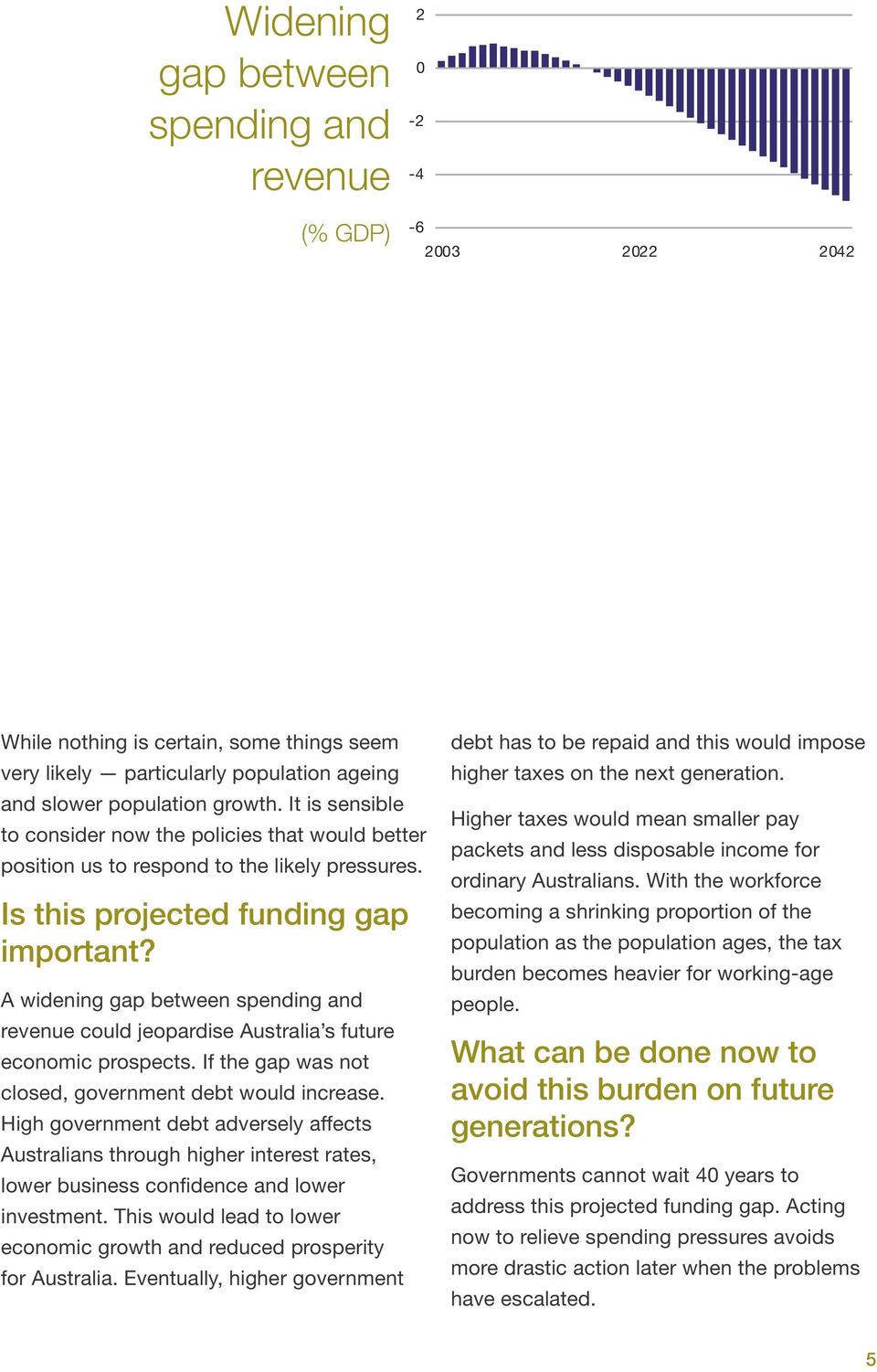
4 Right now, and for at least the next decade, the budget position is in good shape. However, current and future generations could face higher taxes if spending is not kept in check Examining the outlook for future budgets In 40 years time, how might the Commonwealth government budget shape up? Over the next 40 years, if current trends continue, Commonwealth government spending is likely to rise significantly. Assuming that revenue remains around its current share of GDP, rising levels of spending would push the budget into deficit. The gap between spending and revenue could grow to 5 per cent of GDP by 2042, or $87 billion in today s dollars. Where might government spending grow and why? Three key social areas are most likely to have escalating growth. These are health, aged care and age pensions. Health spending will increase because the population is ageing, but more importantly, because people want and expect access to the latest medical advancements. Uncertainties We cannot be certain about the future, but it is important to consider what we might have to deal with if current trends and policies continue. This is what the Intergenerational Report does it is not a fixed forecast, but a picture of what seems likely on current trends. 4 Intergenerational Report In brief

5 Widening gap between spending and revenue (% GDP) While nothing is certain, some things seem very likely particularly population ageing and slower population growth. It is sensible to consider now the policies that would better position us to respond to the likely pressures. Is this projected funding gap important? A widening gap between spending and revenue could jeopardise Australia s future economic prospects. If the gap was not closed, government debt would increase. High government debt adversely affects Australians through higher interest rates, lower business confidence and lower investment. This would lead to lower economic growth and reduced prosperity for Australia. Eventually, higher government debt has to be repaid and this would impose higher taxes on the next generation. Higher taxes would mean smaller pay packets and less disposable income for ordinary Australians. With the workforce becoming a shrinking proportion of the population as the population ages, the tax burden becomes heavier for working-age people. What can be done now to avoid this burden on future generations? Governments cannot wait 40 years to address this projected funding gap. Acting now to relieve spending pressures avoids more drastic action later when the problems have escalated. 5
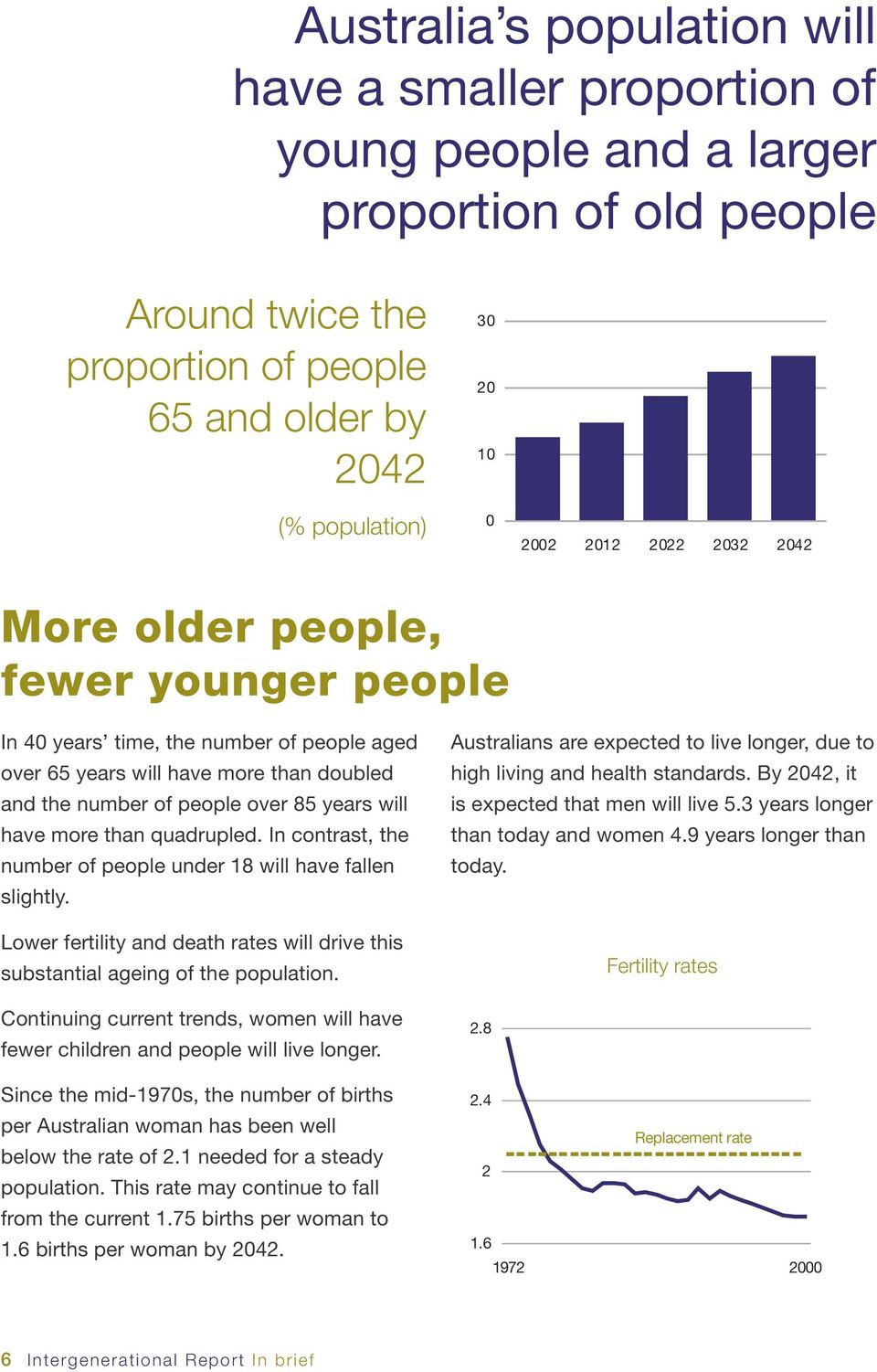
6 Australia s population will have a smaller proportion of young people and a larger proportion of old people Around twice the proportion of people 65 and older by 2042 (% population) More older people, fewer younger people In 40 years time, the number of people aged over 65 years will have more than doubled and the number of people over 85 years will have more than quadrupled. In contrast, the number of people under 18 will have fallen slightly. Lower fertility and death rates will drive this substantial ageing of the population. Continuing current trends, women will have fewer children and people will live longer. Australians are expected to live longer, due to high living and health standards. By 2042, it is expected that men will live 5.3 years longer than today and women 4.9 years longer than today. Fertility rates Since the mid-1970s, the number of births per Australian woman has been well below the rate of 2.1 needed for a steady population. This rate may continue to fall from the current 1.75 births per woman to 1.6 births per woman by Intergenerational Report In brief
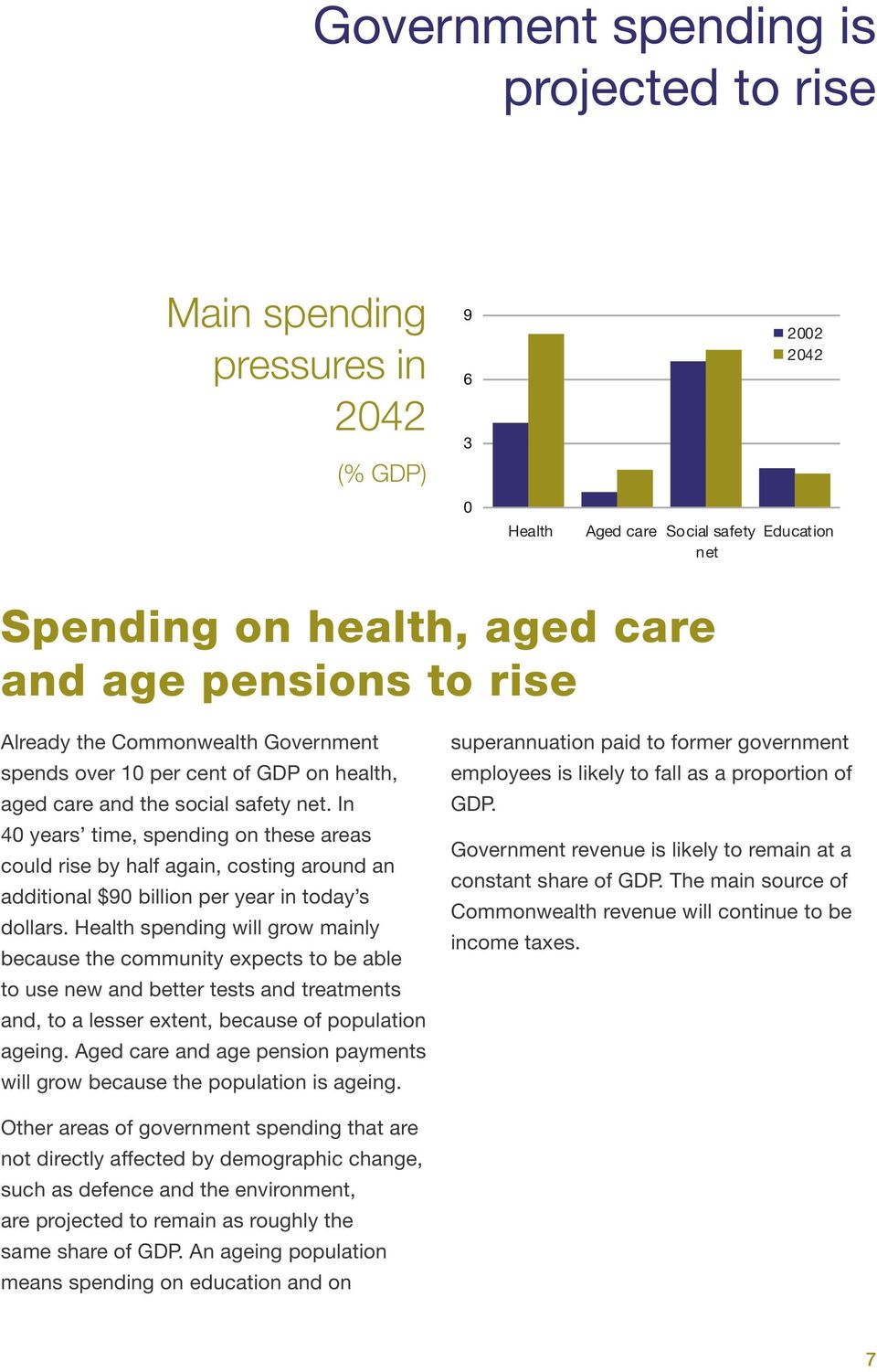
7 Government spending is projected to rise Main spending pressures in 2042 (% GDP) Spending on health, aged care and age pensions to rise Already the Commonwealth Government spends over 10 per cent of GDP on health, aged care and the social safety net. In 40 years time, spending on these areas could rise by half again, costing around an additional $90 billion per year in today s dollars. Health spending will grow mainly because the community expects to be able to use new and better tests and treatments and, to a lesser extent, because of population ageing. Aged care and age pension payments will grow because the population is ageing. superannuation paid to former government employees is likely to fall as a proportion of GDP. Government revenue is likely to remain at a constant share of GDP. The main source of Commonwealth revenue will continue to be income taxes. Other areas of government spending that are not directly affected by demographic change, such as defence and the environment, are projected to remain as roughly the same share of GDP. An ageing population means spending on education and on 7
8 Commonwealth health spending could double as more people want the latest technology and more older people use more medicines Demanding high-tech health and better medicines In 40 years time, Commonwealth health spending is likely to more than double to 8.1 per cent of GDP. An ageing population contributes to this. This increase is mainly because people want access to the latest testing technology and medicines. For example, spending on the Pharmaceutical Benefits Scheme (PBS) could rise to more than five times its current level, making it by far the most expensive item on the Commonwealth s health budget, more expensive than spending on hospitals and doctors. Australia currently has one of the highest life expectancies in the world, partly because Australians enjoy a high level of health care. The Commonwealth provides most of the money for health care. Commonwealth spending on health is around 4 per cent of GDP. The Medicare levy raises only a small proportion of this, around 20 per cent. Advancing health technology Medical technology is helping people to live longer and have a better quality of life. Improved testing methods and treatments (over recent years) include: premature babies now have a better chance of survival organ transplants are common and artificial organ implants are becoming a reality 8 Intergenerational Report In brief

9 Health costs to rise steeply from 2002 to 2042 (% GDP) Higher average cost of prescriptions to Government after copayments (today s dollars) people infected with HIV can now expect to live for years, rather than months, due to the rapid introduction of antiretroviral drugs such as Kaletra. Such drugs cost about $10,000 per patient per year but are made affordable through the PBS But these improvements come at a significant cost and the cost is growing rapidly each year. All areas of health spending (hospital, doctors and medicines) are growing, but the fastest growth is in the PBS. For over 50 years, the Commonwealth has subsidised pharmaceutical products through the PBS. Generally, people do not pay the full costs of their medicines. People who have a health concession card pay no more than $4.60 for a prescription others pay no more than $ This means that as new, more costly drugs are introduced, the subsidy that the government pays keeps rising. So in 40 years time, spending on the PBS could be more than five times its current level. Technology is likely to continue to advance bringing substantial health benefits. But with more older people in the community who use the most medicines the costs will escalate. In 40 years time, the PBS could account for 3.4 per cent of GDP, making it the largest part of the Commonwealth s spending on health. 9

10 Spending on aged care may more than double, with the number of people aged over 85 quadrupling Nursing home use increases with age (% of age group) Many more people needing aged care The majority of older Australians live healthy, independent lives. For those that need assistance, the Commonwealth Government provides funding for care for the aged so they can continue to live in the community or move to residential care. Community care helps people live independently in their homes for as long as possible. The Government also supports carers in their caring role. If it becomes necessary, people can be cared for in nursing homes. These provide accommodation, meals and access to medical services. Residential care is more costly than community care. Of people aged over 85, over 25 per cent are cared for in residential care and over 50 per cent receive help to live in their own homes. As the number of older people increases over the next 40 years, more people will require both community care and the more costly residential aged care. By 2042, spending on aged care is likely to more than double as the number of people aged over 85, who are more likely to require residential care, quadruples. 10 Intergenerational Report In brief

11 Private superannuation savings means less pressure on government age pension spending Australia s age pension spending to grow relatively slowly in next 40 years (% GDP increase by 2050) Super savings keep age pension spending down One of the Government s higher priorities is to provide for people who have contributed to society throughout their life. Age pension payments are the largest part of Australia s social safety net. Already 2.7 million Australians are old enough to receive the age pension. In 40 years time, 6.3 million Australians are likely to be of age pension age. Australia is well placed to take care of its retirees in the future because of its age pension and maturing superannuation systems. Spending on age pension payments in Australia is likely to grow more slowly than spending in most other industrialised nations. But increasingly, Australians have been preparing for their retirement by contributing to superannuation schemes. By taking responsibility for their own retirement income, retirees rely less on government payments and can enjoy higher standards of living. It also reduces the burden on future taxpayers to fund age pensions for retired people. 11

12 If substantially more people are in the workforce then economic growth will be stronger and the funding of government services will be spread more evenly across the population Encouraging more people to join the workforce In the future, Australia will have more older people and fewer children. This means the working-age population and the number of workers will be low compared with the total population. With lower growth in employment, economic growth is slower. Government revenue increases with growth in the economy, so slower growth in employment would result in slower revenue growth. wish to work need the support that allows them to work. The Government is acting now to address the welfare and work balance in the Australians Working Together package. But in the future, it will be even more important to help these people to find work. The ageing of the population is likely to bring new opportunities for employment as older people will have new and different requirements for goods and services. Conversely, stronger growth in employment would increase economic growth and increase government revenue used for funding government services. At the moment many people wishing to work find they cannot. For example, they may lack suitable skills or have disabilities. People who 12 Intergenerational Report In brief

13 More adults not working compared with those working (ratio of adults not in employment to those in employment) Employment brings many benefits to people, including higher incomes, social networks and a greater capacity to provide for themselves. It also leads to lower government spending on pensions and allowances such as the Disability Support Pension and unemployment allowances. to five per cent, government spending in this area is likely to fall. More opportunities for people of working age to work would lead to even bigger falls in government spending on pensions and allowances. Spending on the Disability Support Pension has grown significantly. In 1980, 229,000 people received this benefit. Now, 624,000 people receive it. Over one in ten people aged between 50 and 64 years receive it. This growth is projected to continue, although at a slower rate. Spending on unemployment allowances is closely related to the unemployment rate. With the unemployment rate projected to fall 13

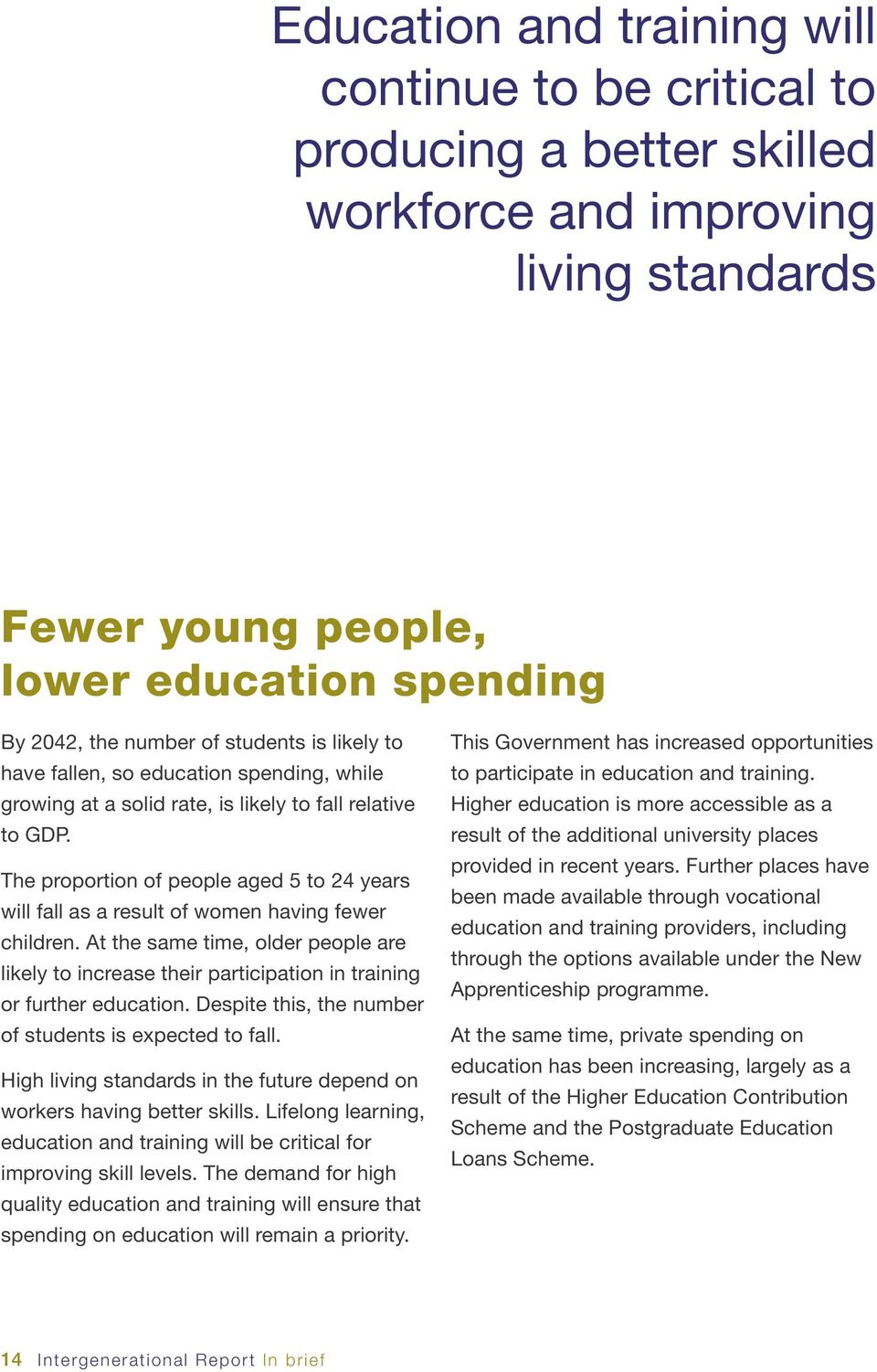
14 Education and training will continue to be critical to producing a better skilled workforce and improving living standards Fewer young people, lower education spending By 2042, the number of students is likely to have fallen, so education spending, while growing at a solid rate, is likely to fall relative to GDP. The proportion of people aged 5 to 24 years will fall as a result of women having fewer children. At the same time, older people are likely to increase their participation in training or further education. Despite this, the number of students is expected to fall. High living standards in the future depend on workers having better skills. Lifelong learning, education and training will be critical for improving skill levels. The demand for high quality education and training will ensure that spending on education will remain a priority. This Government has increased opportunities to participate in education and training. Higher education is more accessible as a result of the additional university places provided in recent years. Further places have been made available through vocational education and training providers, including through the options available under the New Apprenticeship programme. At the same time, private spending on education has been increasing, largely as a result of the Higher Education Contribution Scheme and the Postgraduate Education Loans Scheme. 14 Intergenerational Report In brief
15 Governments must live within their means to ensure stability and continuity in government services Spending projections (without policy change) (billions of today s dollars) Living within our means Over the next 40 years, Commonwealth governments will face significant challenges. Future spending pressures will need to be managed responsibly so the quality of life of all Australians continues to improve. In recent years, the Australian economy has been particularly resilient to world events. To retain that resilience, governments must maintain sustainable government finances. This is why the Government acted, when it was elected in 1996, to restore the budget to surplus. It is why the Government has reformed Australia s tax system, to provide a more secure long-term revenue base. And it is why the Government is acting in this year s Budget to address growth in the Pharmaceutical Benefits Scheme and Disability Support Pension. Future governments will also need to make the difficult decisions that ensure future generations of Australians continue to enjoy the stable and resilient economy that we have today. Governments also will need to continue to take a long-term view of policies and consider their long-term consequences. This Government s commitment to sound budget planning will ensure Australia continues to have a prosperous and strongly growing economy well into the future. 15

16 16 Intergenerational Report In brief

Chapter 4: Ageing pressures and spending
 Chapter : Ageing pressures and spending Overview Ageing of the Australian population will contribute to substantial pressure on government spending over the next years. Total spending is projected to increase
Age, Demographics and Employment
 Key Facts Age, Demographics and Employment This document summarises key facts about demographic change, age, employment, training, retirement, pensions and savings. 1 Demographic change The population
Use of the Coat of Arms The terms under which the Coat of Arms can be used are set out on the It s an Honour website (see www.itsanhonour.gov.
 Health 13 May 2014 Commonwealth of Australia 2014 ISBN 978-0-642-74982-6 This publication is available for your use under a Creative Commons Attribution 3.0 Australia licence, with the exception of the
Use of the Coat of Arms The terms under which the Coat of Arms can be used are set out on the It s an Honour website (see www.itsanhonour.gov.au).
 Social Services 13 May 2014 Commonwealth of Australia 2014 ISBN 978-0-642-74983-3 This publication is available for your use under a Creative Commons BY Attribution 3.0 Australia licence, with the exception
I ve been asked to talk about the Pharmaceutical Benefits Scheme in the context of Medicare and the broader health sector.
 1 Sustaining the PBS for the future Dr Brendan Shaw, Chief Executive, Medicines Australia Speech to 2 nd Future of Medicare Conference 11 November 2010, Sydney Thank you for the opportunity to speak with
finding the balance between public and private health the example of australia
 finding the balance between public and private health the example of australia By Zoe McKenzie, Senior Researcher This note provides an overview of the principal elements of Australia s public health system,
Global Demographic Trends and their Implications for Employment
 Global Demographic Trends and their Implications for Employment BACKGROUND RESEARCH PAPER David Lam and Murray Leibbrandt Submitted to the High Level Panel on the Post-2015 Development Agenda This paper
PENSIONS AT A GLANCE 2011: RETIREMENT-INCOME SYSTEMS IN OECD COUNTRIES AUSTRALIA
 PENSIONS AT A GLANCE 2011: RETIREMENT-INCOME SYSTEMS IN OECD COUNTRIES Online Country Profiles, including personal income tax and social security contributions AUSTRALIA Australia: pension system in 2008
Barton Deakin: Commission of Audit Report Health. 7 May 2014
 Barton Deakin: Commission of Audit Report Health 7 May 2014 The Report delivered to the Government by the National Commission of Audit contained several recommendations to reform the Australian health
BUDGET 2014 ADSO S IMPACT ANALYSIS
 BUDGET 2014 ADSO S IMPACT ANALYSIS This summary has been compiled from the Budget Papers, DVA s Budget Presentation, and analyses from industry, commercial and community organisations reports with the
ACHPER NSW. PDHPE HSC Enrichment Day 2009. Core 1
 ACHPER NSW PDHPE HSC Enrichment Day 2009 Core 1 Health Priorities in Australia Concept map of syllabus What role do health care facilities & services play in achieving better health for all Australians?
Out of pocket costs in Australian health care Supplementary submission
 Out of pocket costs in Australian health care Supplementary submission The AMA welcomes the opportunity provided by the Senate Community Affairs References Committee to make a supplementary submission
Australia. Old Age, Disability, and Survivors. Australia. Exchange rate: US$1.00 equals 1.32 Australian dollars (A$). Qualifying Conditions
 Australia Exchange rate: US$1.00 equals 1.32 Australian dollars (A$). Old Age, Disability, and Survivors First laws: 1908 (old-age and disability) and 1942 (widows). Current laws: 1991 (social security),
HEALTH PREFACE. Introduction. Scope of the sector
 HEALTH PREFACE Introduction Government and non-government sectors provide a range of services including general practitioners, hospitals, nursing homes and community health services to support and promote
11 August 2014. Review of Australia s Welfare System CANBERRA ACT 2600. Dear Sir/Madam. Welfare Review Submission
 11 August 2014 Review of Australia s Welfare System CANBERRA ACT 2600 Dear Sir/Madam Welfare Review Submission The Financial Services Council (FSC) represents Australia's retail and wholesale funds management
SUBMISSION TO THE SENATE INQUIRY INTO OUT-OF- POCKET COSTS IN AUSTRALIAN HEALTHCARE. Prepared by National Policy Office
 SUBMISSION TO THE SENATE INQUIRY INTO OUT-OF- POCKET COSTS IN AUSTRALIAN HEALTHCARE Prepared by National Policy Office May 2014 COTA Australia Authorised by: Ian Yates AM Chief Executive [email protected]
Health Policy, Administration and Expenditure
 Submission to the Parliament of Australia Senate Community Affairs Committee Enquiry into Health Policy, Administration and Expenditure September 2014 Introduction The Australian Women s Health Network
COUNTRY UPDATE ORGANISATION OF THE HEALTH CARE SYSTEM IN AUSTRALIA
 COUNTRY UPDATE ORGANISATION OF THE HEALTH CARE SYSTEM IN AUSTRALIA 1. Organisation Briefly outline the structural provision of health care. The Australian health system is complex, with many types and
RBA ECONOMICS COMPETITION
 RBA ECONOMICS COMPETITION 2007 The consequences of an ageing population for Australia's future productivity and economic growth, and the associated economic policy challenges Best Essay from a First Year
Dragan Savic. 12 August 2013
 FSC Deloitte Future Leaders Award 2013 Australia s ageing population What existing policy settings could be changed, or new polices implemented, to better insulate Australia from the future economic impacts
Conference on Population and Development, Cairo, 5-13 September 1994 (United Nations publication, Sales No. E.95.XIII.7).
 EXECUTIVE SUMMARY The General Assembly, in its resolution 54/262 of 25 May 2, decided to convene the Second World Assembly on Ageing in 22, coinciding with the twentieth anniversary of the first World
Australia to 2050: future challenges OVERVIEW. the 2010 intergenerational report
 Australia to 5: future challenges the intergenerational report OVERVIEW Contents Intergenerational challenges Planning for the future Long-term economic outlook 3 Australia s ageing population Long-term
A Context for Change Management in the Capital Regional District
 A Context for Change Management in the Capital al District Future Population, Labour Force, Employment and Housing in the Capital al District URBAN FUTURES FINAL REPORT AUGUST 2009 A Context for Change
Contents. Introduction. Introduction 1. Top five Budget proposals 2. Taxation 7. Social security and aged care 10.
 Contents Introduction 1 Top five Budget proposals 2 Taxation 7 Social security and aged care 10 Other measures 15 Introduction After weeks of speculation, the Federal Treasurer Joe Hockey handed down the
An update on the level and distribution of retirement savings
 ASFA Research and Resource Centre An update on the level and distribution of retirement savings Ross Clare Director of Research March 2014 The Association of Superannuation Funds of Australia Limited (ASFA)
Key Findings ASIC Report 419. Australian Financial Attitudes and Behaviour Tracker Wave 1: March August 2014
 ASIC Report 419 Wave 1: March August 2014 Australian Securities and Investments Commission December 2014 Contents INTRODUCTION 3 KEY FINDINGS 9 Financial attitudes 10 Keeping track of finances 11 Planning
21 August 2015 ACSA CONTACTS
 ACSA response to Exposure Draft Legislation Tax and Superannuation Laws Amendment (2015 Measures No. #) Bill 2015: Limiting fringe benefit tax concessions on salary packaged entertainment benefits 21 August
Project LINK Meeting New York, 20-22 October 2010. Country Report: Australia
 Project LINK Meeting New York, - October 1 Country Report: Australia Prepared by Peter Brain: National Institute of Economic and Industry Research, and Duncan Ironmonger: Department of Economics, University
Carers Australia. 2014/15 Federal Budget Summary
 Carers Australia 2014/15 Federal Budget Summary Overview This document lists the major 2014/15 Federal Budget changes which are either carer-specific or are likely to more generally impact on carers. Among
Employment opportunities for older people
 Employment opportunities for older people Response to the Enterprise and Business Committee Contact: Aaron Hill Policy & Public Affairs Officer, NIACE Cymru Tel: +44 (0)29 20370900 Email: [email protected]
Pension Sustainability
 Pension Sustainability Making public sector pensions more secure and affordable gov.pe.ca/pensionplans Minister s message Prince Edward Island s two large public sector pension plans, the Civil Service
NEWSLETTER MAY 2014 2 0 1 4 T A X P L A N N I N G 2 0 1 4 F E D E R A L B U D G E T U P D A T E. www.mgh.com.au 1
 NEWSLETTER MAY 2014 2 0 1 4 T A X P L A N N I N G The end of the financial year is fast approaching. We encourage you to make an appointment with our office so we can formulate personalised tax strategies
Contact us. Hoa Bui T: + 61 (02) 9335 8938 E: [email protected]. Briallen Cummings T: + 61 (02) 9335 7940 E: [email protected]. www.kpmg.com.
 Contact us Hoa Bui T: + 61 (02) 9335 8938 E: [email protected] Briallen Cummings T: + 61 (02) 9335 7940 E: [email protected] www.kpmg.com.au No reliance This report should not be regarded as suitable
LITHUANIAN PENSION SCHEMES
 LITHUANIAN PENSION SCHEMES Audrius Bitinas Vice-minister Ministry of Social protection and labour I. STATUTORY MANDATORY SOCIAL INSURANCE P-A-Y-G PENSION SCHEME (DB) About 96 % of the employed population
Adjusting to a Changing Economic World. Good afternoon, ladies and gentlemen. It s a pleasure to be with you here in Montréal today.
 Remarks by David Dodge Governor of the Bank of Canada to the Board of Trade of Metropolitan Montreal Montréal, Quebec 11 February 2004 Adjusting to a Changing Economic World Good afternoon, ladies and
STATEMENT FROM THE NATIONAL REFORM SUMMIT
 STATEMENT FROM THE NATIONAL REFORM SUMMIT Australia is a wealthy country that can have an even more prosperous future shared by everyone. We believe in sustainable economic growth and the creation of high-quality
PrivateHealth.gov.au Australia s leading independent source of information about private health insurance
 PrivateHealth.gov.au Australia s leading independent source of information about private health insurance There are many things to consider when looking into private health insurance how does it all work?
A super waste of money
 A super waste of money Redesigning super tax concessions April 2015 ISSN 1836-9014 Matt Grudnoff Policy Brief About TAI The Australia Institute is an independent public policy think tank based in Canberra.
Occupational and Career Outlook for MIS Majors 2012-2018. Ken Laudon New York University Stern School of Business 2011
 Occupational and Career Outlook for MIS Majors 2012-2018 Ken Laudon New York University Stern School of Business 2011 Total employment in the United States is expected to increase by about ten percent
Levy Consultation 2010/11. Accident Compensation Corporation. Work Levy Rates for Employers and Self-Employed People
 Levy Consultation 2010/11 Accident Compensation Corporation Work Levy Rates for Employers and Self-Employed People Your chance to have your say on what you pay Deadline for Submissions 5.00 pm, 10 November
Centrelink payments and entitlements, pension bonus scheme and work bonus
 Centrelink payments and entitlements, pension bonus scheme and work bonus 1 January 2014 While there are many different Centrelink payments and entitlements available, in this flyer we have outlined the
Expenditure on education and training in Australia Update and analysis
 MITCHELL POLICY PAPER NO. 08/2015 Expenditure on education and training in Australia Update and analysis AUGUST 2015 Peter Noonan, Gerald Burke, Andrew Wade, Sarah Pilcher About the authors Professor Peter
3.2 Staying Independent: Finances Income Security, Work, Concessions and Financial Assistance
 3.2 Staying Independent: Finances Income Security, Work, Concessions and Financial Assistance The following information is a guide to the various forms of assistance that can help people with PSP and their
SAMA Working Paper: POPULATION AGING IN SAUDI ARABIA. February 2015. Hussain I. Abusaaq. Economic Research Department. Saudi Arabian Monetary Agency
 WP/15/2 SAMA Working Paper: POPULATION AGING IN SAUDI ARABIA February 2015 By Hussain I. Abusaaq Economic Research Department Saudi Arabian Monetary Agency Saudi Arabian Monetary Agency The views expressed
Commission on the Future of Health and Social Care in England. The UK private health market
 Commission on the Future of Health and Social Care in England The UK private health market The NHS may dominate the provision of health care in England, but that still leaves the country with a significant
Population, Housing and Economic Forecasts for the Winnipeg CMA and the City of Winnipeg
 Population, Housing and Economic Forecasts for the Winnipeg CMA and the City of Winnipeg The City of Winnipeg commissioned the Conference Board of Canada to develop a Long-Term Demographic and Economic
College: A Necessity Priced as a Luxury
 College: A Necessity Priced as a Luxury Six Facts on College and the Middle Class May 2014 A Middle Class Job Does Not Get a Middle Class Life v Today, a middle class job increasingly does not support
Workers Still Uneasy About Financial Security and Retirement
 Workers Still Uneasy About Financial Security and Retirement Results from Towers Watson s 2013/2014 Global Benefit Attitudes Survey By Jonathan Gardner and Steve Nyce 1 In the more than five years since
III. World Population Growth
 III. World Population Growth Population dynamics are one of the key factors to consider when thinking about development. In the past 50 years the world has experienced an unprecedented increase in population
Summary. Abbas P. Grammy 1 Professor of Economics California State University, Bakersfield
 The State of the Economy: Kern County, California Summary Abbas P. Grammy 1 Professor of Economics California State University, Bakersfield Kern County households follow national trends. They turned less
Briefing Paper on Equity Release
 COUNCIL of MORTGAGE LENDERS Briefing Paper on Equity Release What is equity release? 1. Equity is the difference between any mortgage you may have and the value of your home. Equity release is a way of
The Menzies-Nous Australian Health Survey 2010
 The Menzies-Nous Australian Health Survey 2010 November 2010 Contents 1 Executive summary...1 1.1 Health and health services...1 1.2 Aged care services...2 2 Background...3 3 Health and health services...5
Australian Institute of Health and Welfare Canberra Cat. no. IHW 97
 Australian Institute of Health and Welfare Canberra Cat. no. IHW 97 Healthy for Life Aboriginal Community Controlled Health Services Report Card Key findings We have done well in: Increasing the proportion
Surprisingly Australia is a civilized and developed country! We have universal health care (more or less)!
 Surprisingly Australia is a civilized and developed country! We have universal health care (more or less)! s About 21 million people live in a country of 7,692,024 square kilometers So we seem to have
The recession of 2007 2009, a
 Employment outlook: Labor force projections to : a more slowly growing workforce The projected labor force growth over the next 10 years will be affected by the aging of the baby-boom generation; as a
APRIL 2014 ELECTRICITY PRICES AND NETWORK COSTS
 APRIL 2014 ELECTRICITY PRICES AND NETWORK COSTS 1 WHAT MAKES UP THE RETAIL ELECTRICITY BILL? Retail electricity bills are made up of a number of components: Wholesale costs reflecting electricity generation
SUBMISSION TO INQUIRY INTO AFFORDABLE HOUSING. Prepared by National Policy Office
 SUBMISSION TO INQUIRY INTO AFFORDABLE HOUSING Prepared by National Policy Office March 2014 COTA Australia Authorised by: Ian Yates AM Chief Executive [email protected] 0418 835 439 Prepared by: Jo Root
Consumption Structure Evolutions in an Aging Society and Implications for the Social Security System
 Consumption Structure Evolutions in an Aging Society and Implications for the Social Security System Dr. Rui Mao School of Management, Zhejiang University, China PRI-ADBI joint conference, Tokyo Rui Mao
First Home Buyers: The Big Picture
 First Home Buyers: The Big Picture April 2014 Key Points: There has been considerable coverage of late regarding the First Home Buyer (FHB) market share, with the widespread perception that this group
7 Reasons Why Property
 7 Reasons Why Property Investment can t be ignored. Know your options before it s too late. What is in this report? This report is a must read for anyone looking to improve their lifestyle and enjoy greater
Methods of financing health care
 International Social Security Association Fifteenth International Conference of Social Security Actuaries and Statisticians Helsinki, Finland, 23-25 May 2007 Methods of financing health care Finnish national
Her Majesty the Queen in Right of Canada (2012) All rights reserved
 Her Majesty the Queen in Right of Canada (2012) All rights reserved All requests for permission to reproduce this document or any part thereof shall be addressed to Public Works and Government Services
Health expenditure Australia 2011 12: analysis by sector
 Health expenditure Australia 2011 12: analysis by sector HEALTH AND WELFARE EXPENDITURE SERIES No. 51 HEALTH AND WELFARE EXPENDITURE SERIES Number 51 Health expenditure Australia 2011 12: analysis by sector
Personal debt ON LABOUR AND INCOME
 ON LABOUR AND INCOME Personal debt Although the economy and population are almost times the size of s, the two countries show several similarities. Both have relatively high per-capita income and living
NATIONAL HEALTHCARE AGREEMENT 2012
 NATIONAL HEALTHCARE AGREEMENT 2012 Council of Australian Governments An agreement between the Commonwealth of Australia and the States and Territories, being: t t t t t t t t the State of New South Wales;
Creating Opportunity or Entrenching Disadvantage? ACT Labour Market Data
 Creating Opportunity or Entrenching Disadvantage? ACT Labour Market Data October 2014 About ACTCOSS ACTCOSS acknowledges Canberra has been built on the land of the Ngunnawal people. We pay respects to
World Population Growth
 3 World Population Growth Why is world population growing faster than ever before? Population dynamics are one of the key factors to consider when thinking about development. In the past years the world