
RBA ECONOMICS COMPETITION
|
|
|
- Alberta Cooper
- 10 years ago
- Views:
Transcription
1 RBA ECONOMICS COMPETITION 2007 The consequences of an ageing population for Australia's future productivity and economic growth, and the associated economic policy challenges Best Essay from a First Year Student ASHLEY CHENG The University of New South Wales

2 Introduction The social phenomenon, population aging, is gradually changing the economic structure of many developed and some developing countries. Whilst the primary impact is felt in the workforce and employment, flow-on effects to productivity, growth and output are significant. Changes in the dependency ratio, savings ratio and government revenue and expenditure will lead to slower growth and lower productivity if they are not redressed by economic policies. Yet, such problems cannot be redressed by the government s traditional macroeconomic policies alone. Microeconomic reform, working in tandem with social reform policy, is required to address the long-term concerns. Population Changes Demographic changes in the Australia can be attributed to two main factors: decreasing birth rates and increasing life expectancies. With these factors operating, the population age structure bulges at the baby boomers but tapers offs in younger generations assuming a projected coffin shape (Fig. 1) 1. This age structure produces unfavourable conditions in the long-run as the population becomes top-heavy with an increasing dependency ratio. The larger older generation needs to be supported by a smaller younger generation. This has significant economic impacts. Figure 1: Changing Age Structure Source: Productivity Commission 2005, Economic Implications of an Ageing Australia, Research Report, Canberra, pxiv Effect on Productivity The impact of an aging population will be to reduce average productivity, but the extent of that decrease will not be significant. Productivity is defined as the output per unit of input. In this case, we are concerned about the productivity of labour defined as: 1 Productivity Commission 2005, Economic Implications of an Ageing Australia, Research Report, Canberra, pxiv (Productivity Commission 2005: Econ. Impl.) 1

3 The implication of an aging population will be a decrease in the total number of employed persons. As more people retire from the workforce and less people enter, it appears on face value that productivity will rise if output remains constant. However, this is not the case. A decrease in the number of workers will lead to changes in output. Depending on the changes in technology used in the production process, the value of output may or may not decline. Whilst is true that aging brings about experience and increases in productivity and hence production, there is a point where the physical and mental effects of aging are likely to offset the benefits of experience 2. Production may increase as the population ages, but at the point where the effects of aging begin to affect the majority of workers, production will experience a decline, ceteris paribus. As a result, there will be an inevitable decrease in aggregate productivity. Counteracting this will be changes in technology and education. Although globally, Australia ranks low on the educational attainment of its citizens, there has been a steady increase in tertiary education participation and an increase in secondary school retention rates. 3 The increase in skills will lead to an increase in labour productivity. The rapid advances in technology will also increase productivity of capital and may make it more efficient for workers to perform their roles. However, the effect of this on labour productivity will be a minimal increase, if any. Whilst average productivity is a measure of output per worker, it is not a definitive measure of a person s suitability in a job position. Productivity is a macroeconomic measure and is suitable for an aggregate analysis of the labour market. It is not suitable for measuring the microeconomic suitability of workers for a job. Often, older workers will display superior performance to younger workers. 4 Thus, the overall impact of an aging population on productivity is somewhat unclear. However, the most likely effect will be a gradual but not significant decline in average productivity. Effect on Investment and Capital Growth An aging population will reduce the available supply of capital, restricting investment and growth. As people age and move into retirement, they will draw down on their savings. There will also be a decline in public savings because an aging population will increase government expenditure and decrease taxation receipts. This will reduce the supply of capital leading to reduced investment opportunities. The effects will be twofold. Firstly, there will be a reduction in the rate of capital deepening. Whilst some analysts predict that this will increase the intensity of world capital flows 5, historical data reveals the effect to be muted. Secondly, businesses will be unable to obtain domestic funds for expansion. This may lead to decreases in output and growth as old technology is used. Further, innovation through research and development will be restricted. Alternatively, businesses could borrow overseas capital and this would lead to an increase in foreign debt. Australia s low savings ratio will also contribute to an increase in net foreign debt as retirees seek more funds during their retirement. Whilst the government has encouraged self-funded retirement, the low levels of domestic savings means Australia will continue to rely of foreign lending to fund its consumption. This will lead to problems in debt repayment as well as external imbalances with a widening Current Account deficit. Effects on Economic Growth 2 Productivity Commission 2005: Econ. Impl., p96 3 Australian Bureau of Statistics, 2007:Australia at a Glance, Canberra 4 Productivity Commission 2005: Econ. Impl., p110 5 Productivity Commission 2005: Econ. Impl., p116 2

4 Population aging acts a depressant on economic growth. A withdrawal of workers from the labour force, without supporting growth in capital deepening, will result in declining production. Further, there will be a reduction in consumption as older people tend to purchase less luxury consumer goods. Producers will respond to the unplanned increase in inventories and reduce production. The primary measure of output, Gross Domestic Product (GDP), will decline. This will lead to a slowing in economic growth as shown in Figure 2. Figure 2: Impact of Aging on Economic Growth Source: Productivity Commission 2005, Economic Implications of an Ageing Australia, Research Report, Canberra, pxxvii Despite the negative economic effects, certain industries will benefit from an aging population. The insurance industry will experience growth in health insurance sales as more people join insurance policies. As people age, they tend to increase their insurance coverage. This will benefit the private health care industry, particularly in light of the Howard Government s plan in encouraging private health coverage for ordinary Australians. There will also be an increased demand for Aged Care services. This sector is likely to experience dramatic growth as the baby boomers bulge enters retirement age. Growth will then slow as the bulge disappears. Macroeconomic Policies Traditionally, the Australian government has managed the macro-economy with two arms of economic policy: Fiscal and Monetary. Due its nature, an aging population will not affect Monetary Policy decisions to the same extent as it affects Fiscal Policy decisions. An aging population will, at the most basic level, reduce taxation receipts and increase social welfare expenditure particularly in health and Social Security. As more people leave the workforce, there will be a reduction in the income tax receipts which are the majority of the government s revenue. The government may have to increase taxes to compensate for the increased expenditures. Despite the widespread belief to the contrary, Australians are not heavily taxed 6 by international standards. However, a tax increase is unlikely to occur to the higher tax bracket and governments have been traditionally unwilling to increase the tax rates in the lower tax brackets. An alternative to increasing income taxes is to increase company or indirect taxes. Whilst an increase in company tax would increase revenue, it will be offset by 6 Tiffen, R and Gittins R, How Australia Compares (Cambridge University Press, 2004) p89 3

5 a decline in profit resulting from less consumption by an aging population. An aging population will cause difficulties in revenue collection which must be addressed. On the expenditure side of the budget, the government will experience a need to increase expenditure to sectors of the economy pertaining to the elderly s needs. There will be increased expenditure on health care services as there is a change in the welfare mix - that is, the mix between family, the state and the market for underwriting and enhancing the welfare of the population 7 Older people have more demand for health services as a result of a decline in their physical wellbeing. The Government must address this need by increasing funding to hospitals for the development, renovation and expansion of their health care facilities. The government is also likely to find an increased need for additional expenditure on aged care facilities. A side effect to the changing welfare mix will be an increased spending on childcare provision. As the increased dependency on younger workers, by aged persons, increases the working hours or labour force participation of younger people, parents with children may be forced back into the workforce and will require childcare facilities. This trend is becoming more apparent in the current economic situation, where housewives are increasingly participating in part-time work. The government will also need to invest in transport facilities to increase accessibility to essential services for elderly people. With the recent proposals to limit driving range for persons over 85 8, the government will need to increase the accessibility, scope and efficiency of public transport, particularly in Bus and Rail services. This increased expenditure of the government will inevitably increase creating a problem in financing the expected budget deficits. This will be the main challenge for fiscal policy in the future. Microeconomic Policies The steady growth period experienced by Australia in recent years has been aided by the microeconomic reform instituted by the Hawke-Keating governments. However, the changing population structure will increase the need for microeconomic reform to boost production. Microeconomic reform has the benefit of increasing output, without increasing inflationary pressures, by acting on the supply side of the economy. As such, labour market reform can be used to increase the productivity of labour. In addition, skills programs can be used to address the current skills shortage, which is likely to worsen as the population ages and more skilled workers leave the workforce. The increasing need for skilled labour will be a driving force behind government microeconomic policies. Welfare system reform will also be a significant challenge for reformists. As the population ages, there will be an increased demand for pensions. Whilst the government s policy for self-funded retirement through a superannuation scheme will relieve some pressure of the aged pension system, the Budget predicts an increase in Social Security and Welfare to over $100,000m by To combat this, the government must implement policies to encourage more contributions to superannuation funds and other investment fund to ensure the social security system is not overburdened. The government, in the most extreme scenario, may wish to phase out the pensions system and leave Australians to fund their own retirements. However, this highly unlikely. 7 Productivity Commission and Melbourne Institute of Applied Economic and Social Research 1999, Policy Implications of the Ageing of Australia s Population, Conference Proceedings, AusInfo, Canberra., p264 (Productivity Commission 1999: Policy Impl.) quoting Evers 1988; Evers and Svetlik Road Traffic Authority (NSW) 2007, Licensing of Older Drivers, Discussion Paper, New South Wales, p7 9 See Figure 3 4
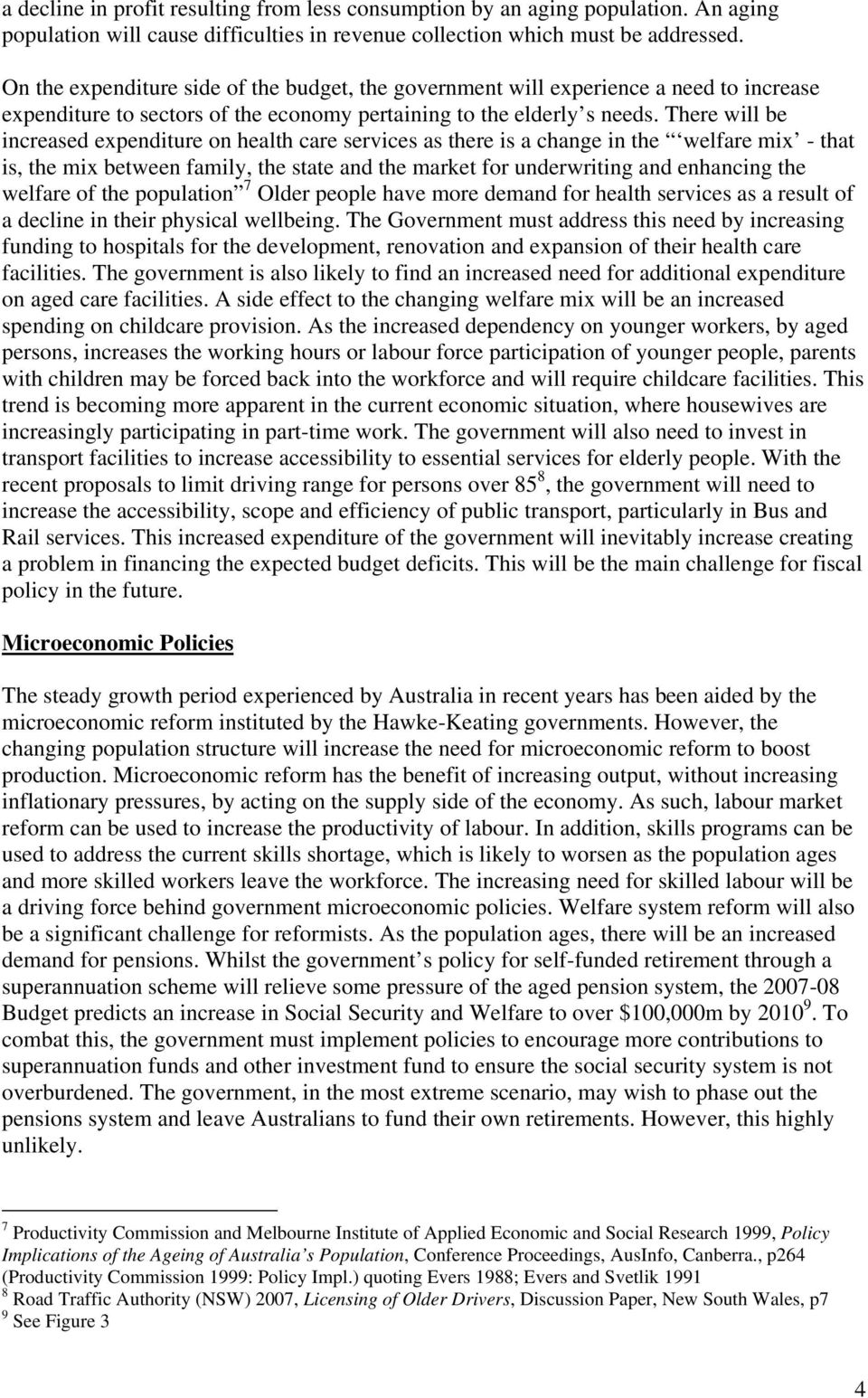
6 Conclusions Figure 3: Table of Expenses Source: Australian Government, Budget Strategy and Outlook , Canberra, p6-15 Australia s aging population presents serious challenges to growth and economic policy decisions. Whilst the effect on productivity will be negligible, the aging population will result in a dramatic decline in economic growth. To counter, the government must employ both macroeconomic and microeconomic policies. The constraints on taxation revenue and substantial increases in expected expenditure will lead to recurring budget deficits. This must be redressed by the government else it becomes an economic problem in itself. The need microeconomic reform to assist the economy to adapt to the changing population structure is also necessary with emphasis on social security reform. These challenges will significantly impact on Australia s future economic performance. Therefore, it is of utmost priority that the impacts on an aging population be recognised and addressed. 5

The Future of Australia - An Accounting Analysis
 What is an intergenerational report? An intergenerational report assesses the long term sustainability of Commonwealth finances. It examines the impact of current policies and trends, including population
5 Comparison with the Previous Convergence Programme and Sensitivity Analysis
 5 Comparison with the Previous Convergence Programme and Sensitivity Analysis 5.1 Comparison with the Previous Macroeconomic Scenario The differences between the macroeconomic scenarios of the current
MACROECONOMIC ANALYSIS OF VARIOUS PROPOSALS TO PROVIDE $500 BILLION IN TAX RELIEF
 MACROECONOMIC ANALYSIS OF VARIOUS PROPOSALS TO PROVIDE $500 BILLION IN TAX RELIEF Prepared by the Staff of the JOINT COMMITTEE ON TAXATION March 1, 2005 JCX-4-05 CONTENTS INTRODUCTION... 1 EXECUTIVE SUMMARY...
GCE Economics Candidate Exemplar Work ECON4: The National and International Economy
 hij Teacher Resource Bank GCE Economics Candidate Exemplar Work ECON4: The National and International Economy The Assessment and Qualifications Alliance (AQA) is a company limited by guarantee registered
Project LINK Meeting New York, 20-22 October 2010. Country Report: Australia
 Project LINK Meeting New York, - October 1 Country Report: Australia Prepared by Peter Brain: National Institute of Economic and Industry Research, and Duncan Ironmonger: Department of Economics, University
Best Essay from a First Year Student
 RBA ECONOMICS COMPETITION 2010 Appreciation of Australia s real exchange rate: causes and effects Best Essay from a First Year Student ASHVINI RAVIMOHAN The University of New South Wales Appreciation of
ENCOURAGING A DYNAMIC LIFE INSURANCE INDUSTRY: ECONOMIC BENEFITS AND POLICY ISSUES
 ENCOURAGING A DYNAMIC LIFE INSURANCE INDUSTRY: ECONOMIC BENEFITS AND POLICY ISSUES by Gerry Dickinson Professor and Director, Centre for Insurance & Investment Studies, City University Business School,
Australia s Future Tax System Preliminary Submission from the Institute of Actuaries of Australia
 21 October 2008 AFTS Secretariat The Treasury Langton Crescent PARKES ACT 2600 Email: [email protected] Dear Sir/Madam Purpose Australia s Future Tax System Preliminary Submission from the Institute
Assessment Schedule 2014 Economics: Demonstrate understanding of macro-economic influences on the New Zealand economy (91403)
 NCEA Level 3 Economics (91403) 2014 page 1 of 10 Assessment Schedule 2014 Economics: Demonstrate understanding of macro-economic influences on the New Zealand economy (91403) Assessment criteria with Merit
MACROECONOMIC AND INDUSTRY ANALYSIS VALUATION PROCESS
 MACROECONOMIC AND INDUSTRY ANALYSIS VALUATION PROCESS BUSINESS ANALYSIS INTRODUCTION To determine a proper price for a firm s stock, security analyst must forecast the dividend & earnings that can be expected
An Evaluation of the Possible
 An Evaluation of the Possible Macroeconomic Impact of the Income Tax Reduction in Malta Article published in the Quarterly Review 2015:2, pp. 41-47 BOX 4: AN EVALUATION OF THE POSSIBLE MACROECONOMIC IMPACT
Defining Housing Equity Withdrawal
 Housing Reserve Equity Bank of Australia Bulletin February 23 Housing Equity The increase in housing prices in recent years has contributed to rising household wealth and has helped to underpin continued
PROJECTION OF THE FISCAL BALANCE AND PUBLIC DEBT (2012 2027) - SUMMARY
 PROJECTION OF THE FISCAL BALANCE AND PUBLIC DEBT (2012 2027) - SUMMARY PUBLIC FINANCE REVIEW February 2013 SUMMARY Key messages The purpose of our analysis is to highlight the risks that fiscal policy
Expenditure on education and training in Australia Update and analysis
 MITCHELL POLICY PAPER NO. 08/2015 Expenditure on education and training in Australia Update and analysis AUGUST 2015 Peter Noonan, Gerald Burke, Andrew Wade, Sarah Pilcher About the authors Professor Peter
CHAPTER 5: MEASURING GDP AND ECONOMIC GROWTH
 CHAPTER 5: MEASURING GDP AND ECONOMIC GROWTH Learning Goals for this Chapter: To know what we mean by GDP and to use the circular flow model to explain why GDP equals aggregate expenditure and aggregate
The Economists Voice
 The Economists Voice Volume 2, Issue 1 2005 Article 8 A Special Issue on Social Security Saving Social Security: The Diamond-Orszag Plan Peter A. Diamond Peter R. Orszag Summary Social Security is one
Scottish Independence. Charting the implications of demographic change. Ben Franklin. I May 2014 I. www.ilc.org.uk
 Scottish Independence Charting the implications of demographic change Ben Franklin I May 2014 I www.ilc.org.uk Summary By 2037 Scotland s working age population is expected to be 3.5% than it was in 2013
Modelling of Labour Markets in the European Union Final Report Part IV - Illustrative Simulations
 Modelling of Labour Markets in the European Union Final Report Part IV - Illustrative Simulations Johannes Berger, Christian Keuschnigg, Mirela Keuschnigg, Michael Miess, Ludwig Strohner, and Rudolf Winter-Ebmer
Retirement Income White Paper Insights Presentation
 Retirement Income White Paper Insights Presentation Alun Stevens Jack Ding Nathan Bonarius Agenda Background Preliminary projections What are the risks? What are the possible solutions? Purpose of presentation
General Certificate of Education Advanced Subsidiary Examination January 2013
 General ertificate of Education dvanced Subsidiary Examination January 2013 Economics EON2 Unit 2 The National Economy Monday 28 January 2013 1.30 pm to 2.45 pm For this paper you must have: an objective
Ageing, health spending and the long-term fiscal outlook: a UK perspective
 Ageing, health spending and the long-term fiscal outlook: a UK perspective 31 January 2014 Robert Chote Chairman Long-term fiscal analysis at the OBR Annual Fiscal sustainability Report Public sector balance
Global Aging 2010: Australia
 October 11, 2010 Global Aging 2010: Australia Primary Credit Analyst: Kyran Curry, Melbourne (61) 3-9631-2082; [email protected] Secondary Contact: Marko Mrsnik, Madrid +34 913 896 953;
a) Aggregate Demand (AD) and Aggregate Supply (AS) analysis
 a) Aggregate Demand (AD) and Aggregate Supply (AS) analysis Determinants of AD: Aggregate demand is the total demand in the economy. It measures spending on goods and services by consumers, firms, the
University of Lethbridge Department of Economics ECON 1012 Introduction to Microeconomics Instructor: Michael G. Lanyi. Chapter 29 Fiscal Policy
 University of Lethbridge Department of Economics ECON 1012 Introduction to Microeconomics Instructor: Michael G. Lanyi Chapter 29 Fiscal Policy 1) If revenues exceed outlays, the government's budget balance
Age, Demographics and Employment
 Key Facts Age, Demographics and Employment This document summarises key facts about demographic change, age, employment, training, retirement, pensions and savings. 1 Demographic change The population
2. UK Government debt and borrowing
 2. UK Government debt and borrowing How well do you understand the current UK debt position and the options open to Government to reduce the deficit? This leaflet gives you a general background to the
Dragan Savic. 12 August 2013
 FSC Deloitte Future Leaders Award 2013 Australia s ageing population What existing policy settings could be changed, or new polices implemented, to better insulate Australia from the future economic impacts
ENGINEERING LABOUR MARKET
 ENGINEERING LABOUR MARKET in Canada Projections to 2025 JUNE 2015 ENGINEERING LABOUR MARKET in Canada Projections to 2025 Prepared by: MESSAGE FROM THE CHIEF EXECUTIVE OFFICER Dear colleagues: Engineers
The level of price and inflation Real GDP: the values of goods and services measured using a constant set of prices
 Chapter 2: Key Macroeconomics Variables ECON2 (Spring 20) 2 & 4.3.20 (Tutorial ) National income accounting Gross domestic product (GDP): The market value of all final goods and services produced within
REGISTERED NURSE: OCCUPATIONAL SKILL SHORTAGE ASSESSMENT
 NOVEMBER 2005 REGISTERED NURSE: OCCUPATIONAL SKILL SHORTAGE ASSESSMENT Current Situation: Recruitment and retention difficulties Short-term Outlook: Recruitment and retention difficulties (improving) 1
GAO PATIENT PROTECTION AND AFFORDABLE CARE ACT. Effect on Long-Term Federal Budget Outlook Largely Depends on Whether Cost Containment Sustained
 GAO United States Government Accountability Office Report to the Ranking Member, Committee on the Budget, U.S. Senate January 2013 PATIENT PROTECTION AND AFFORDABLE CARE ACT Effect on Long-Term Federal
CHAPTER 3 THE LOANABLE FUNDS MODEL
 CHAPTER 3 THE LOANABLE FUNDS MODEL The next model in our series is called the Loanable Funds Model. This is a model of interest rate determination. It allows us to explore the causes of rising and falling
DENTIST: OCCUPATIONAL SKILL SHORTAGE ASSESSMENT
 NOVEMBER 2005 DENTIST: OCCUPATIONAL SKILL SHORTAGE ASSESSMENT Current Situation: No shortage Short-term Outlook: No shortage 1 Executive Summary 1.1 Results from the 2004 Survey of Employers who have Recently
SUBMISSION TO INQUIRY INTO AFFORDABLE HOUSING. Prepared by National Policy Office
 SUBMISSION TO INQUIRY INTO AFFORDABLE HOUSING Prepared by National Policy Office March 2014 COTA Australia Authorised by: Ian Yates AM Chief Executive [email protected] 0418 835 439 Prepared by: Jo Root
Section 2 Evaluation of current account balance fluctuations
 Section 2 Evaluation of current account balance fluctuations Key points 1. The Japanese economy and IS balance trends From a macroeconomic perspective, the current account balance weighs the Japanese economy
SAMA Working Paper: POPULATION AGING IN SAUDI ARABIA. February 2015. Hussain I. Abusaaq. Economic Research Department. Saudi Arabian Monetary Agency
 WP/15/2 SAMA Working Paper: POPULATION AGING IN SAUDI ARABIA February 2015 By Hussain I. Abusaaq Economic Research Department Saudi Arabian Monetary Agency Saudi Arabian Monetary Agency The views expressed
CONCEPT OF MACROECONOMICS
 CONCEPT OF MACROECONOMICS Macroeconomics is the branch of economics that studies economic aggregates (grand totals):e.g. the overall level of prices, output and employment in the economy. If you want to
PENSIONS AT A GLANCE 2011: RETIREMENT-INCOME SYSTEMS IN OECD COUNTRIES AUSTRALIA
 PENSIONS AT A GLANCE 2011: RETIREMENT-INCOME SYSTEMS IN OECD COUNTRIES Online Country Profiles, including personal income tax and social security contributions AUSTRALIA Australia: pension system in 2008
Narrowing the Sustainability Gap of EU and US Health Care Spending
 Working Paper Research Division EU Integration Stiftung Wissenschaft und Politik German Institute for International and Security Affairs Amy Medearis, Ognian N. Hishow 1 Narrowing the Sustainability Gap
1 Fiscal strategy and outlook
 1 Fiscal strategy and outlook Features The 2015-16 Budget delivers the Government s election commitments, with key measures to revitalise the State economy and frontline service delivery, especially in
Labour Market Responses to the Abolition of Compulsory Superannuation. by Louise Carter 1
 Labour Market Responses to the Abolition of Compulsory Superannuation by Louise Carter 1 Economics Program School of Economics and Commerce University of Western Australia Abstract: This paper aims to
An outlook on the Spanish economy Official Monetary and Financial Institutions Forum (OMFIF), London
 09.02.2016 An outlook on the Spanish economy Official Monetary and Financial Institutions Forum (OMFIF), London Luis M. Linde Governor I would like to thank OMFIF and Mr. David Marsh for the invitation
AS Economics. Introductory Macroeconomics. Sixth Form pre-reading
 AS Economics Introductory Macroeconomics Sixth Form pre-reading National income National income (Y) = money value of goods and services produced in an economy over a period of time, usually one year. National
With lectures 1-8 behind us, we now have the tools to support the discussion and implementation of economic policy.
 The Digital Economist Lecture 9 -- Economic Policy With lectures 1-8 behind us, we now have the tools to support the discussion and implementation of economic policy. There is still great debate about
Meeting with Analysts
 CNB s New Forecast (Inflation Report II/2015) Meeting with Analysts Petr Král Prague, 11 May, 2015 1 Outline Assumptions of the forecast The new macroeconomic forecast Comparison with the previous forecast
Chapter 4: Ageing pressures and spending
 Chapter : Ageing pressures and spending Overview Ageing of the Australian population will contribute to substantial pressure on government spending over the next years. Total spending is projected to increase
MEASURING GDP AND ECONOMIC GROWTH CHAPTER
 MEASURING GDP AND ECONOMIC GROWTH CHAPTER Objectives After studying this chapter, you will able to Define GDP and use the circular flow model to explain why GDP equals aggregate expenditure and aggregate
Monetary policy, fiscal policy and public debt management
 Monetary policy, fiscal policy and public debt management People s Bank of China Abstract This paper touches on the interaction between monetary policy, fiscal policy and public debt management. The first
The Economic Environment for Business
 B. FINANCIAL MANAGEMENT ENVIRONMENT 1. The economic environment for business 2. The nature and role of financial markets and institutions The Economic Environment for Business What are the targets of macroeconomic
The Elasticity of Taxable Income: A Non-Technical Summary
 The Elasticity of Taxable Income: A Non-Technical Summary John Creedy The University of Melbourne Abstract This paper provides a non-technical summary of the concept of the elasticity of taxable income,
Spending patterns of older retirees: New ASFA Retirement Standard
 ASFA Research and Resource Centre Spending patterns of older retirees: New ASFA Retirement Standard September quarter 2014 The Association of Superannuation Funds of Australia The Association of Superannuation
The Benefits of a Fully Funded Social Security System
 The Benefits of a Fully Funded Social Security System By Nathan Taulbee I. INTRODUCTION The Social Security system, formally known as Old-Age and Survivors Insurance Disability Insurance (OASDI), began
STRONG AND SUSTAINABLE ECONOMIC GROWTH
 STRONG AND SUSTAINABLE ECONOMIC GROWTH DEFINITION OF ECONOMIC GROWTH The government aims for a rapid but steady rise in the volume of goods and services produced from year to year. The aim is to achieve
The Case for a Tax Cut
 The Case for a Tax Cut Alan C. Stockman University of Rochester, and NBER Shadow Open Market Committee April 29-30, 2001 1. Tax Increases Have Created the Surplus Any discussion of tax policy should begin
Hungary. 1. Economic situation
 2. COUNTRY NOTES: HUNGARY 125 1. Economic situation has faced considerable challenges to regain fiscal credibility. After almost a decade of persistent, high fiscal deficits and the building up of external
Structural Change in the Australian Economy
 Structural Change in the Australian Economy Ellis Connolly and Christine Lewis* Over time, the structure of the Australian economy has gradually shifted away from agriculture and manufacturing towards
Sustaining progress in a low-growth world 2015 MEDIUM TERM BUDGET POLICY STATEMENT
 Sustaining progress in a low-growth world 2015 MEDIUM TERM BUDGET POLICY STATEMENT Sustaining progress in a low-growth world The world economy is experiencing a sustained period of low growth. All countries
6 Quality of Public Finances Revenues and Expenditures
 6 Quality of Public Finances Revenues and Expenditures 6.1 The Government s Strategy In 2003, the Czech government launched a public finance reform focusing on fiscal consolidation and elimination of the
Her Majesty the Queen in Right of Canada (2012) All rights reserved
 Her Majesty the Queen in Right of Canada (2012) All rights reserved All requests for permission to reproduce this document or any part thereof shall be addressed to Public Works and Government Services
COMMONWEALTH EXPENDITURE ASSOCIATED WITH RETIREMENT (SUBCLASS 410) VISA
 COMMONWEALTH EXPENDITURE ASSOCIATED WITH RETIREMENT (SUBCLASS 410) VISA Copyright Statement Commonwealth of Australia, 2011 This copyright work is licensed under a Creative Commons Attribution - No Derivatives
Living Standard Trends in Australia: Report for Anglicare Australia. BEN PHILLIPS NATSEM UNIVERSITY OF CANBERRA, September 2015
 Living Standard Trends in Australia: Report for Anglicare Australia BEN PHILLIPS NATSEM UNIVERSITY OF CANBERRA, September 2015 2 Contents 1 Executive Sumary 3 2 Introduction 5 3 Methodology 6 4 Results
0 100 200 300 Real income (Y)
 Lecture 11-1 6.1 The open economy, the multiplier, and the IS curve Assume that the economy is either closed (no foreign trade) or open. Assume that the exchange rates are either fixed or flexible. Assume
Credit Card Business in Macao and Its Credit Risk Management
 Credit Card Business in Macao and Its Credit Risk Management P.S. Un Research and Statistics Department, Monetary Authority of Macao Abstract Credit card holdings and loans have experienced rapid growth
Foreign Currency Exposure and Hedging in Australia
 Foreign Currency Exposure and Hedging in Australia Anthony Rush, Dena Sadeghian and Michelle Wright* The 213 Australian Bureau of Statistics (ABS) Foreign Currency Exposure survey confirms that Australian
. In this case the leakage effect of tax increases is mitigated because some of the reduction in disposable income would have otherwise been saved.
 Chapter 4 Review Questions. Explain how an increase in government spending and an equal increase in lump sum taxes can generate an increase in equilibrium output. Under what conditions will a balanced
Lars Osberg. Department of Economics Dalhousie University 6214 University Avenue Halifax, Nova Scotia B3H 3J5 CANADA Email: Lars.Osberg@dal.
 Not Good Enough to be Average? Comments on The Weak Jobs recovery: whatever happened to the great American jobs machine? by Freeman and Rodgers Lars Osberg Department of Economics Dalhousie University
Superannuation funds and alternative asset investment: issues for policy makers
 Superannuation funds and alternative asset investment: issues for policy makers As Australia s pool of superannuation assets continues to grow rapidly, many funds are allocating a growing share of their
STATEMENT FROM THE NATIONAL REFORM SUMMIT
 STATEMENT FROM THE NATIONAL REFORM SUMMIT Australia is a wealthy country that can have an even more prosperous future shared by everyone. We believe in sustainable economic growth and the creation of high-quality
CHAPTER 7: AGGREGATE DEMAND AND AGGREGATE SUPPLY
 CHAPTER 7: AGGREGATE DEMAND AND AGGREGATE SUPPLY Learning goals of this chapter: What forces bring persistent and rapid expansion of real GDP? What causes inflation? Why do we have business cycles? How
1. INTRODUCTION 2. EXECUTIVE SUMMARY 3. SUBMISSIONS. Loretta DeSourdy Head of Regulatory Affairs Westpac New Zealand Limited PO Box 691 Wellington
 BT FUNDS MANAGEMENT (NZ) LIMITED AND WESTPAC NEW ZEALAND LIMITED Submission to the Commission for Financial Literacy and Retirement Income on the 2013 Review of Retirement Income Policy 10 June 2013 Mariëtte